New Book: July 26, 2025
Posted by OromianEconomist in Uncategorized.add a comment
Institutional Entropy and the Thermodynamics of Governance: A Framework for Diagnosing Disorder and Engineering Efficiency
New Book:Institutional Entropy and the Thermodynamics of Governance: A Framework for Diagnosing Disorder and Engineering Efficiency https://amzn.eu/d/1T2eL9e
Institutional Entropy and Governance Thermodynamics July 15, 2025
Posted by OromianEconomist in Uncategorized.add a comment
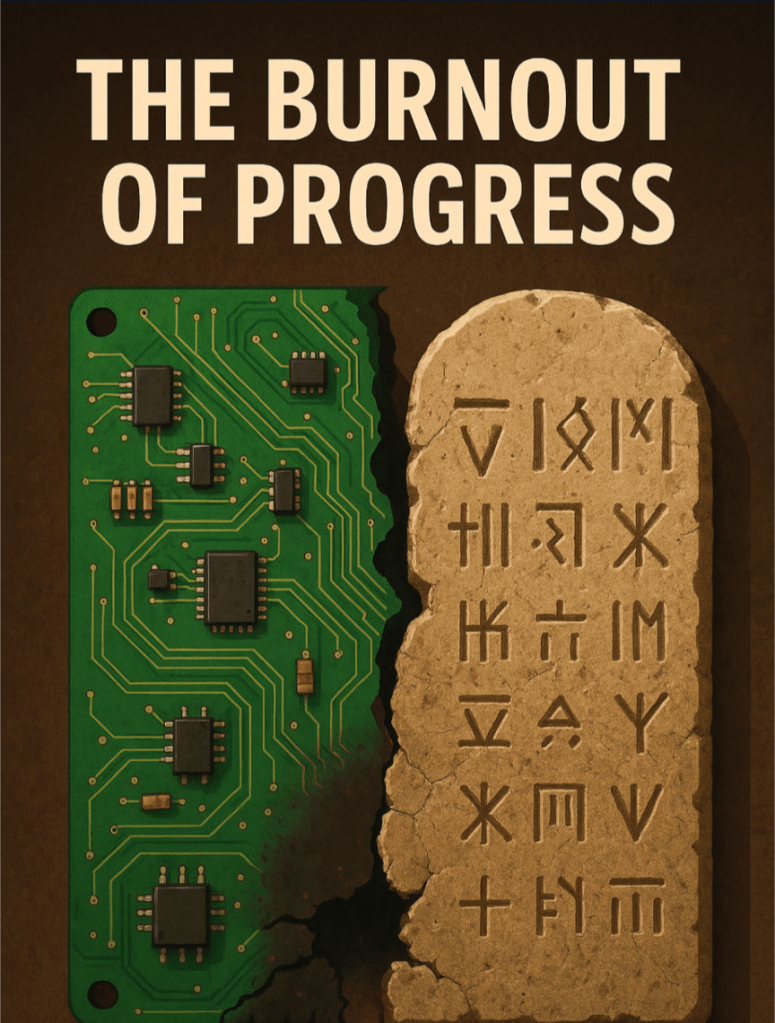
Institutional Entropy and Governance Thermodynamics
A Philosophical and Mathematical Framework for Diagnosing Systemic Disorder
By Temesgen Muleta-erena
Abstract
Governance is more than machinery—it is the choreography of human agency, trust, and collective memory. This paper introduces institutional entropy as both a thermodynamic and philosophical condition: inefficiency in political systems mirrors signal degradation in energy networks and the erosion of civic meaning. Using metaphors from engineering, autoimmune failure, and spectacle, we present mathematical models, economic curve simulations, and a diagnostic toolkit to explore how dysfunctional regimes attack the foundations of pluralism, intellectual discourse, and structural integrity. Entropy, in its deepest form, becomes silence—the decay of systems and the disappearance of purpose.
1. Introduction: From Matter to Meaning
Institutions are designed to transmit power, purpose, and trust. When loyalty becomes currency and merit is bypassed by patronage, those channels corrode. Signal weakens. Governance becomes spectacle: policies enacted without substance, rights performed without roots, reforms diluted into routines.
Institutional entropy is not merely inefficiency—it is a form of forgetting. It signals decay not just in capacity, but in conscience. Some systems evolve; others resist. And those that resist evolution begin to unmake history itself.
2. Literature Review: Signals, Systems, and Sovereignty
- Weber (1922) warned of bureaucratic routinization and the loss of ethical purpose.
- Wiener (1948) introduced cybernetics as a system of feedback and correction.
- Acemoglu and Robinson (2012) examined the resilience and failure of political institutions.
- Georgescu-Roegen (1971) and Schneider & Kay (1994) analyzed entropy in economic and ecological systems.
- Foucault and Nietzsche diagnosed value erosion, disciplinary silencing, and loss of intellectual coherence.
This paper builds on these foundations, modeling disorder as both a thermodynamic event and a moral regression.
3. Theoretical Framework: Institutions as Energy-Conducting Meaning Systems
Governance is modeled as an electrical system:
- Policy → Electric current
- Trust → Voltage
- Bureaucracy → Conducting wire
- Resistance → Friction, opacity, distortion
Entropy emerges when:
- Merit is displaced by factional loyalty
- Feedback loops are disabled
- Civic engagement is symbolic, not substantive
- Cultural pluralism is vilified as weakness
Some systems collapse toward nostalgia—glorify in past autocratic warlord chieftains over intellectual and social evolutions. Their ideal is not the Stone Age but pre-Lucy: a conceptual era before language, diversity, or human consciousness. A time where obedience replaced debate and performance supplanted ideas.
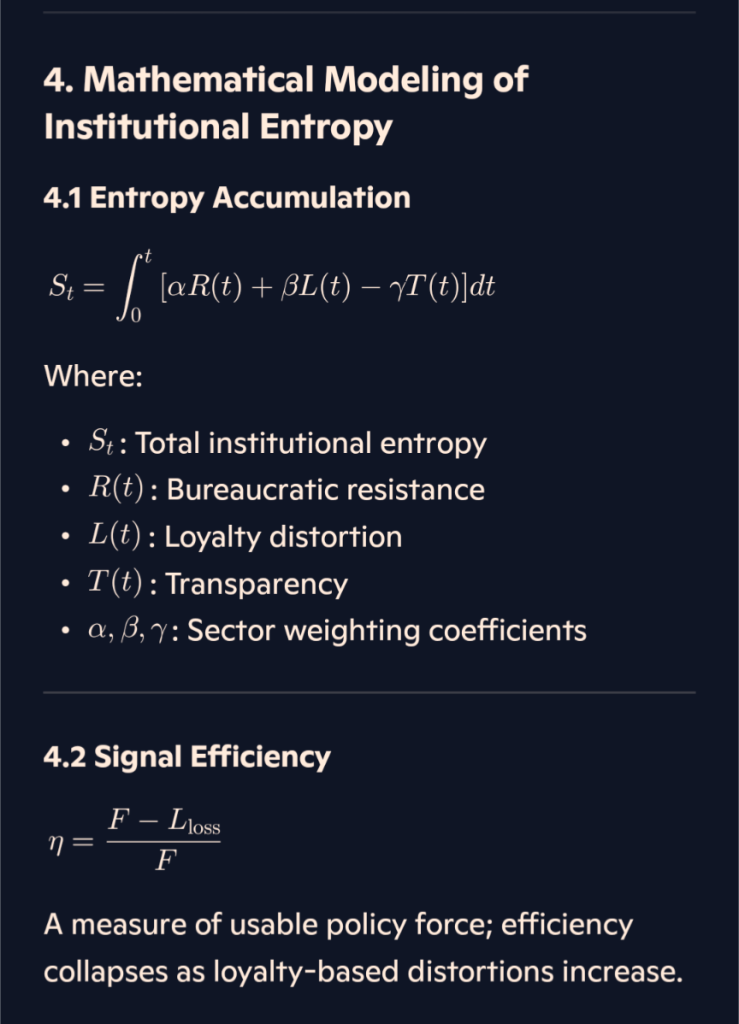
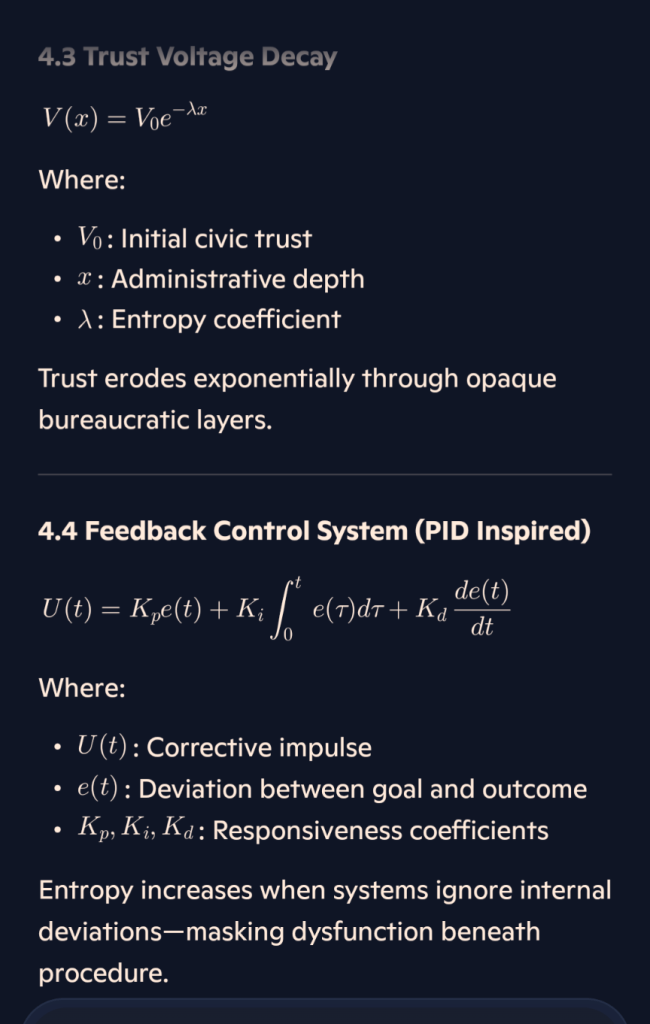
5. Economic Curve Simulations
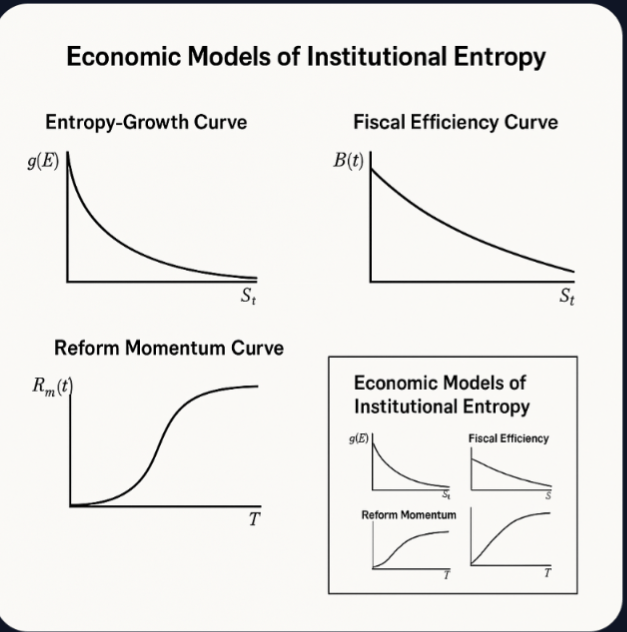
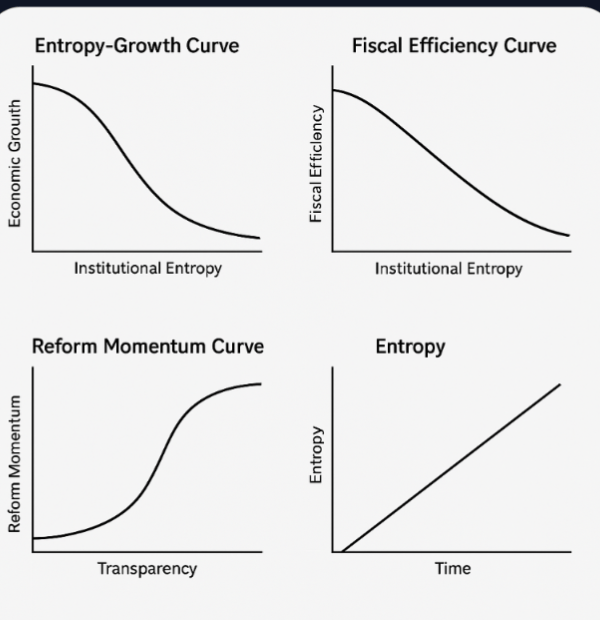
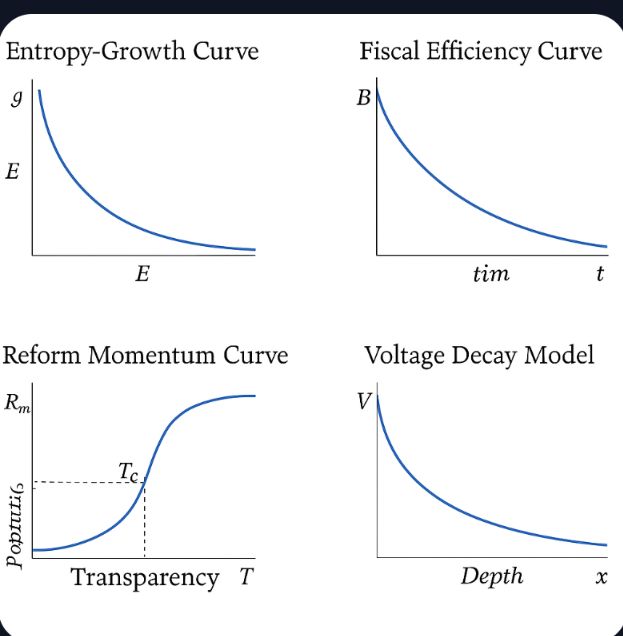
Figure 1: Entropy–Growth Curve
An exponential decay illustrating how increased entropy correlates with shrinking GDP growth potential.
Figure 2: Budget Efficiency Curve
A linear decline representing fiscal coherence deterioration as entropy rises—capturing leakage, patronage, and misallocation.
Figure 3: Reform Momentum Curve
A sigmoid curve indicating that transparency surpassing a critical threshold sparks nonlinear reform acceleration.
6. Philosophical Lens: Entropy as Autoimmune Spectacle
In the UK, Formula 1 is more than sport—it is a weekly celebration of motor engineering and institutional excellence. Its beauty lies in precision, systems thinking, and heritage—a Silicon Valley of speed.
By contrast, dysfunctional regimes manufacture spectacle to mask decay. State TV showcases shimmering towers while omitting the shantytowns encircling them. A refurbished lake is praised—while ecological collapse lurks beyond the camera.
These shows aren’t governance. They’re camouflage.
Entropy lives in the details—unstructured infrastructure, missing foundations, unreformed institutions. Collapse is not dramatic. It is quiet, cumulative, and inevitable.
Such regimes are autoimmune. Like Type 1 diabetes eroding its own insulin-producing cells, dysfunctional systems attack the very organs that sustain civic vitality—education, pluralism, public trust.
They regress past modernity, past humanity, past conversation.
Entropy becomes silence.
8. Conclusion: Rewiring Systems with Purpose
In structured societies, beauty emerges naturally. In dysfunctional ones, it is fabricated—staged to hide collapse. Entropy begins in the forgetting of foundations. Its end is silence.
Reform demands more than metrics. It demands memory.
Systems must be built not only to deliver policy—but to carry meaning. To enable plurality. To protect evolution. To allow contradiction. To restore deliberation.
Entropy is not just a technical failure. It is a spiritual wound. To heal, we must remember why we govern at all.
References
Acemoglu, Daron, and James A. Robinson. 2012. Why Nations Fail: The Origins of Power, Prosperity, and Poverty. New York: Crown Publishing.
Dahl, Robert A. 1971. Polyarchy: Participation and Opposition. New Haven: Yale University Press.
Deutsch, Karl W. 1963. The Nerves of Government: Models of Political Communication and Control. New York: Free Press.
Easton, David. 1953. The Political System: An Inquiry into the State of Political Science. New York: Alfred A. Knopf.
Foucault, Michel. 1975. Discipline and Punish: The Birth of the Prison. Translated by Alan Sheridan. New York: Vintage Books.
Georgescu-Roegen, Nicholas. 1971. The Entropy Law and the Economic Process. Cambridge, MA: Harvard University Press.
Nietzsche, Friedrich. 1887. On the Genealogy of Morals. Translated by Walter Kaufmann and R.J. Hollingdale. New York: Vintage Books.
North, Douglass C., John Joseph Wallis, and Barry R. Weingast. 2009. Violence and Social Orders: A Conceptual Framework for Interpreting Recorded Human History. Cambridge: Cambridge University Press.
Schneider, Eric D., and James J. Kay. 1994. “Life as a Manifestation of the Second Law of Thermodynamics.” Mathematical and Computer Modelling 19 (6–8): 25–48.
Weber, Max. 1922. Economy and Society: An Outline of Interpretive Sociology. Translated by Ephraim Fischoff et al. Berkeley: University of California Press.
Wiener, Norbert. 1948. Cybernetics: Or Control and Communication in the Animal and the Machine. Cambridge, MA: MIT Press.


 Oromian Economist
You must be logged in to post a comment.