
jump to navigation

Oakland Institute: Ethiopia’s State of Emergency: Authorizing Oppression. #Oromoprotests #OromoRevolution October 22, 2016

Posted by OromianEconomist in #OromoProtests.
Tags: , , , , , , , ,
add a comment

Odaa OromooOromianEconomistOakland Institute


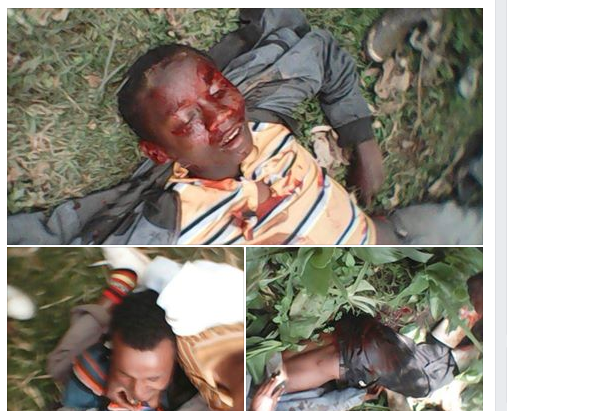
un-copyoromo-youth-murdered-by-fascist-ethiopias-agaziforces-in-arsi-kokosaa-dstrict-on-17-october-2016to-have-facebook-is-illegal-in-ethiopia


orompoprotests-picture-from-the-economist-13-october-2016

Ethiopia’s State of Emergency: Authorizing Oppression


The government of Ethiopia has responded to a groundswell of protests, which are calling for democracy and human rights for all, by imposing a six-month long state of emergency, effective October 8.

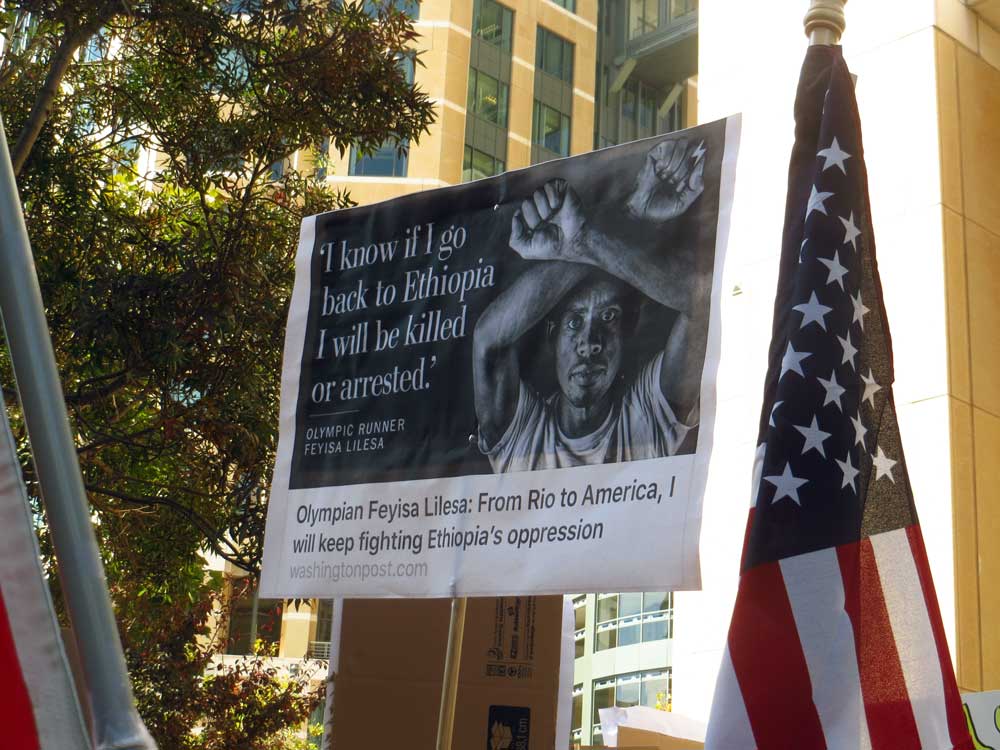
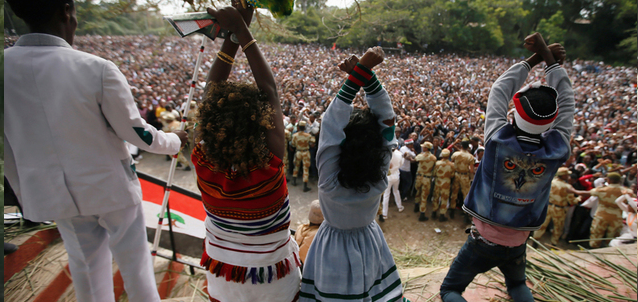
The list of measures curtailing freedoms through the emergency are far-reaching. They include bans on: social media; accessing news outlets such as the US-based ESAT and Oromo Media Network; participating in or organizing protests without government authorization; making gestures, including the infamous crossing of arms above your head; and visiting government, agriculture or industry facilities between 6pm and 6am. With Addis Ababa as the seat of several international organizations including the African Union, foreign diplomats are now only allowed to travel within a 25 miles radius of the capital. Security forces have been given greater powers, including the ability to search people and homes without a court order and the authority to use force, while due process is suspended. Finally, opposition groups are barred from issuing statements to the press, and Ethiopians are not allowed to discuss issues that could “incite violence” with foreigners. This includes speaking to the media or providing information to international civil society groups such as the Oakland Institute.

A poster of Olympic silver medallist Feyisa Lilesa at a protest in Oakland, California. Making the crossed arm gesture is now a criminal offense under Ethiopia’s state of emergency. Credit: Elizabeth Fraser
A poster of Olympic silver medallist Feyisa Lilesa at a protest in Oakland, California. Making the crossed arm gesture is now a criminal offense under Ethiopia’s state of emergency. Credit: Elizabeth Fraser.

These measures are appalling, especially given that a major cause of the protests was the prevailing lack of basic human rights, democracy, and freedoms of speech and assembly in the first place. Ethiopia has been under a de-facto state of emergency for a long time. These new draconian rules don’t address the situation in the country. Instead, they legalize and expand the authoritarian and repressive rule that the Ethiopian regime has maintained for years.

The international community must take swift action to denounce the state of emergency and the continuous repression of basic human rights in the country. If they do not, history will remember donor countries – including the US – as complicit, while hundreds have already been killed and thousands lie in jail for speaking out for democracy, human rights, and true development for all.

Ethiopia’s State of Emergency: Cracking Down on Basic Freedoms

The state of emergency in Ethiopia puts significant restrictions on basic freedoms of assembly and expression. But this is not new.

Numerous bloggers and journalists continue to suffer in Ethiopia’s prisons because of their vocal opposition to the government. On October 1, 2016, prominent blogger Seyoum Teshome was arrested after being quoted in a New York Times article about anti-government protests and announcing his plans to start a new blog. Seyoum is yet another addition to a long list in a country that is the third worst jailer of journalists in Africa.

Opposition parties have also experienced serious crackdowns on their ability to express themselves. Bekele Gerba, deputy chairman of one of the largest opposition parties, was arrested in August 2011 after meeting with Amnesty International. He was released prior to President Barak Obama’s visit to Ethiopia in July 2015, and re-arrested in December of the same year when protests started in Oromo. He continues to languish in jail.

Similarly, bans on social media and internet black outs are common, with numerous reports of internet shut downs this year.

This further crack down on social media and freedom of expression is an effort to shut out the international community, making it easier for the Ethiopian government to supress dissent. Repressing freedoms of expression and assembly have already created a highly volatile situation – these new measures will only worsen things.

Ruling with an Iron Fist

In early October 2016, Ethiopia’s Prime Minister admitted that 500 protesters had been killed by security forces in previous months, stating that the number of casualties was unimportant and threatening to deal with protesting groups forcefully. This declaration came a week after the Irreechaa tragedy, where between fifty-five and several hundred protesters were killed after security forces used tear gas, rubber bullets, and live ammunition on crowds at the country’s largest religious and cultural festival, triggering a stampede. It came a month after a fire in the Kilinto prison, which holds numerous political prisoners and anti-government protesters, left dozens of prisoners dead.  And it came two months after the Prime Minister threatened that his government would use “its full forces to bring the rule of law” to protesting regions.

With the state of emergency, the government legalizes and legitimizes a long tradition of ruling by force. It has already had a significant impact. Between October 17 and 20, over 2,600 people were arrested under the new laws. This number will undoubtedly increase in the days, weeks, and months to come.

Due Process: A Farce in Ethiopia

Due process has long been a farce in Ethiopia. The country’s draconian Anti-Terrorism Proclamation (ATP), adopted in 2009, has been used to arbitrarily detain and arrest students, bloggers, land rights defenders, indigenous leaders, opposition politicians, religious leaders, and more for exercising basic freedoms. The law violates international human rights law, as well as modern criminal justice and due process standards.

Amongst the thousands who have been unlawfully detained under the ATP are Pastor Omot Agwa and Okello Akway Ochalla.

Pastor Omot, a former interpreter for the World Bank Inspection Panel, was arrested in March 2015 while attempting to travel to a food security conference, organized by Bread for All, in Nairobi. He was charged as a terrorist under the claim that the meeting he was attending was a terrorist meeting. He has been in jail since then, and is still waiting for a trial.

Okello Akway Ochalla was illegally kidnapped in South Sudan and renditioned to Ethiopia. His charge is based on his vocal opposition to the Ethiopian government, and its role in a massacre of indigenous Anuak people in December 2003.  After two years of detention, during which Mr. Okello was forced to sign a false confession under duress, his sentence was lessened from terrorist to criminal charges. He was still given nine years in prison.

The suspension of due process under the state of emergency increases the likelihood of arbitrary detainments and unfair trials, two issues already endemic to Ethiopia and must be addressed immediately.

The Failure of the International Community

The mainstream media is finally waking up to the brutality of the Ethiopian regime. The Financial Times called this Ethiopia’s “Tiananmen Square moment.” Foreign governments are also taking notice, however, their statements remain very mild and fail to firmly condemn the violence and repression.

The US State Department declared that it was “troubled by the potential impact” of the state of emergency, reiterated its “longstanding call for the Government of Ethiopia to respect its citizens’ constitutionally-guaranteed freedoms,” and called for “peaceful dialogue” in the country. Statements by the United Nations, Canadian Minister of Foreign Affairs, andEuropean Union make similar calls for “inclusive dialogue” that are stunningly disconnected from the reality on the ground.

This toothless rhetoric fails to acknowledge the years of oppression and abuse that Ethiopians have faced under the current regime and that generated these protests. More importantly, it must be asked who can take part to the dialogue when so many political opponents and community leaders are in jail or in exile?

For years, the US, UK, and others have heralded Ethiopia as a blueprint for development, and provided massive financial support to their champion. But the model has failed. As our recent report shows, economic growth in Ethiopia has not lifted up the masses – it has happened alongside widespread hunger and poverty, forced displacements, and massive human rights abuses. This has led to the current tipping point, and tensions in the country are finally, understandably boiling over. The international community must recognize the failure of this model – and their role in it – and step in before more blood is shed.


Vice News: #OromoProtests: Ethiopia’s massive protests are getting desperate – and dangerous October 21, 2016

Posted by OromianEconomist in #OromoProtests.
Tags: , , , , , , , ,
1 comment so far

Odaa OromooOromianEconomist

“We don’t care if we get killed”

 irreecha-malkaa-2016-bishoftu-horaa-harsadi-oromia-oromoprotests
https://youtu.be/dtKA_RQY8QI

Ethiopia’s massive protests are getting desperate – and dangerous

The Ethiopian government has declared a state of emergency in the country as it intensifies a crackdown on widespread anti-government protests born of frustration that’s been fomenting for decades. In the past two weeks alone, authorities have arrested thousands of protesters, overwhelmingly young people by some accounts.

In the unprecedented anti-government protests sweeping the country, this week alone has seen more than 2,600 people detained in the Oromia and Amhara regions, with 450 arrested in the capital Addis Ababa. Those detained include business owners who closed their shops and teachers who “abandoned their schools.” In June, Human Rights Watch reported that “tens of thousands” of protesters had been arrested since the unrest that began 11 months ago.

However, the number arrested is already likely much higher than the figure quoted by the government, according to Fisseha Tekle, the chief researcher for Amnesty International in Ethiopia. He told VICE News that arrests are ongoing and that the focus is on younger people.

“They must have some list, the security forces, because they are not arresting everyone, but they really target the youths, because it is the youths who have been protesting for the last year,” Tekle said. “They don’t arrest older people; students are the main target.”

The protests began last November, triggered by plans made by the government to extend the capital, Addis Ababa, into Oromia. That plan has since been shelved, but the protests have continued, with decades-old frustration and anger at the ruling Ethiopian People’s Revolutionary Democratic Front coalition coming to the surface.

“This coalition has been in power for 25 years now and a lot of people want to see something different,” Clementine de Montjoye, the head of advocacy atDefend Defenders, a group that protects human rights workers in Ethiopia, told VICE News.

Because the Ethiopian government limits the operations of human rights activists in the country, many are wary about speaking on the record. One source within a human rights group operating in Ethiopia, who spoke on the condition of anonymity, told VICE News that protesters had told them “we don’t have anything to lose anymore, we don’t care if we get killed.”

An Amnesty International report published this week says that in total 800 protesters have been killed by security forces in Ethiopia since these protests began last November.

The government declared a state of emergency on Oct. 9, giving them sweeping powers to crush any dissenting voices. They have also cut internet connectivity in most of the country — including the capital — for the last three weeks.

This has made it difficult to get accurate details of what is happening, especially outside of Addis. And even if a connection can be made, people are still afraid to talk. “People are suspicious because of online surveillance and also mobile phone surveillance, so people might not be [comfortable] talking over the phone about what is happening,” Tekle said.

VICE News contacted several activists on the ground in Ethiopia to talk about the current situation, but due to a combination of fear and lack of connectivity, we were unable to talk to them.

The declaration of a six-month state of emergency followed a high-profile incident at the beginning of the month when a stampede during Irreecha, an Oromo holiday festival, resulted in 55 people killed. As well as increasing the powers of the security forces in Ethiopia to arbitrarily arrest and detain people, the state of emergency aims to silence criticism of the regime. It is now illegal to contact those termed “outsiders” on social media like Twitter and Facebook. “The military command will take action on those watching and posting on these social media outlets,” Siraj Fegessa, Ethiopia’s minister for defense, said.

The UN High Commissioner for Human Rights has made two calls for access to conduct an international, independent, and impartial investigation into the alleged violations, both of which have been rejected by the Ethiopian government. The regime has also sought to limit the impact of human rights organizations in the country with the Charities and Societies Proclamation, which states that if you receive more than 10 percent of your funding from foreign sources, you can’t work on human rights issues in Ethiopia.

Tekle says that Amnesty is refraining from contacting the human rights workers left in the country to avoid revealing their location.

In a report to be launched late Thursday, Defend Defenders has documented at least 27 cases of journalists who have been charged with terrorism since the Anti-Terrorism Proclamation was enacted in 2009. “They have intimidated, arrested, chased away most of the independent media. So if people want to express their frustrations, the only way they have to do it is [by taking] to the streets,” de Montjoye said.

So why isn’t the West doing more to sanction the Ethiopian government?

One reason is Ethiopia’s strategic importance in Africa, helping stem the tide of migrants entering Europe and stopping the spread of Islamic extremism.

According to the European Union’s foreign affairs head Federica Mogherini, citing a report published this week, Ethiopia is among five key African countries that have achieved “better results” in the past four months as part of the EU’s efforts to better manage migration.

Ethiopia is also viewed as a strategic bulwark against the further spread of violent Islamic extremism in the horn of Africa, and it’s been the main military player in fighting the terrorist group al Shabaab in Somalia for years.

Ethiopia is a close ally of the U.S. and given that the political climate in neighbouring countries like Eritrea, Somalia, Sudan and Egypt is fairly shaky, keeping Ethiopia relatively stable is seen as key to preventing chaos in the region.


How Ethiopia’s State of Emergency affects Universal Declaration of Human Rights October 19, 2016

Posted by OromianEconomist in #OromoProtests, Uncategorized.
Tags: , , , , , , ,
8 comments

Odaa OromooOromianEconomist

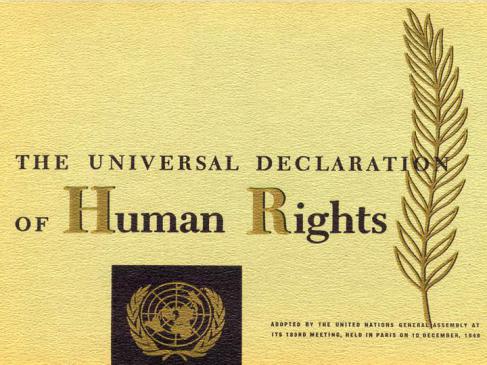
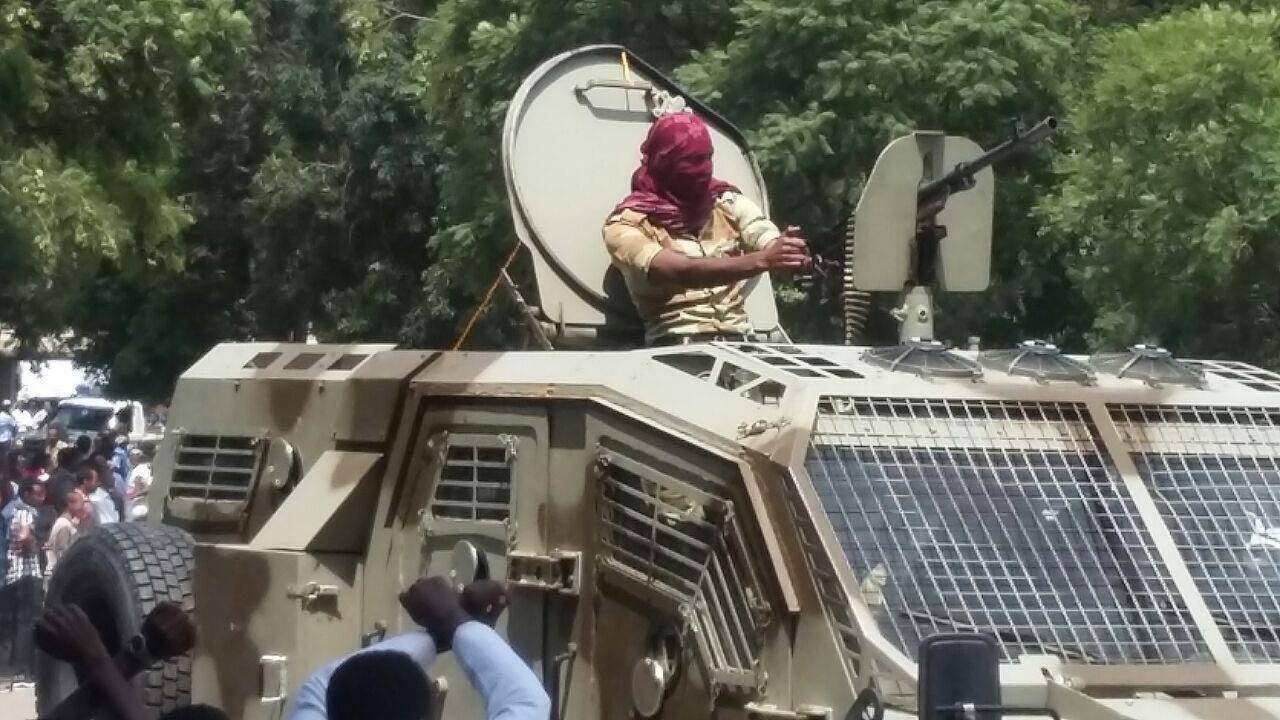
The Universal Declaration of Human Rightsirreecha-malkaa-2016-bishoftu-horaa-harsadi-oromia-oromoprotestsmilitary-grade-humvee-inside-the-civilian-perimeter-at-the-2nd-october-2016-irreecha-festivalin-bishoftu-why-was-the-soldieed-against-oromo-irreecha-participants-on-2nd-october-2016-bishoftu-massacr

AI: Ethiopia: Draconian measures will escalate the deepening crisis. #OromoProtests October 19, 2016

Posted by OromianEconomist in #OromoProtests.
Tags: , , , , , , , , , , , , ,
7 comments

Odaa OromooOromianEconomistAmnesty Internationaloromorevolution-thefinalmarchforfreedom

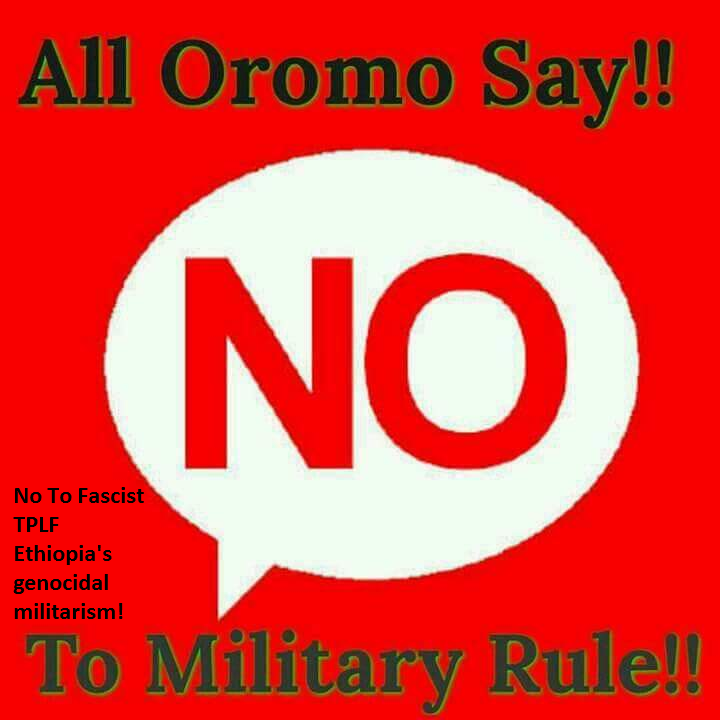
stop-killing-oromo-peopleorompoprotests-picture-from-the-economist-13-october-2016No To Fascist TPLF Ethiopia's genocidal militarism and mass killings in Oromia, Ethiopia


Ethiopia: Draconian measures will escalate the deepening crisis

Amnesty International, 18 October 2016


Heavy-handed measures by the Ethiopian government will only escalate a deepening crisis that has claimed the lives of more than 800 protesters since protests began in November 2015, said Amnesty International today after the government issued a directive imposing wide-ranging restrictions as part of a state of emergency.

The directive authorises arrests without warrants, as well as rehabilitation measures. When such measures have been used in the past, they have led to arbitrary detention of protesters at remote military facilities without access to their families and lawyers.

“These emergency measures are extremely severe and so broad that they threaten basic human rights that must not be curtailed even under a state of emergency,” said Muthoni Wanyeki, Amnesty International’s Regional Director for East Africa, the Horn and the Great Lakes.

“These measures will deepen, not mitigate, the underlying causes of the sustained protests we have seen throughout the year, which have been driven by deep-seated human rights grievances. These grievances must be properly addressed by the authorities. Further crackdowns and human rights violations will only make the situation worse.”

It is the government’s failure to constructively engage with the protesters that continues to fuel these protests. It must now change course
Muthoni Wanyeki, Amnesty International’s Regional Director for East Africa, the Horn and the Great Lakes

In a public statement issued today Amnesty International recommends that instead of further curtailing human rights, the government should seize the moment and recommit itself to respecting, protecting and fulfilling them, in line with its regional and international obligations.

“It is the government’s failure to constructively engage with the protesters that continues to fuel these protests. It must now change course,” said Muthoni Wanyeki.

“The government must ensure an end to excessive and arbitrary use of force by the security forces against demonstrators and release all protesters, opposition leaders and supporters, as well as journalists and bloggers, arrested for exercising their rights to freedom of expression, association and peaceful assembly.”

At least 600 protesters have been killed in Oromia and 200 in Amhara since November last year.

Background

Protests began in November 2015 when ethnic Oromos took to the streets fearing possible land seizures under the government’s Addis Ababa Masterplan, which aimed to expand the capital’s administrative control into Oromia. The protests continued even after the Addis Ababa Masterplan was scrapped, evolving into demands for accountability for human rights violations, ethnic equality and the release of political prisoners.

Protests later spread to Amhara, a region that has long complained of marginalization.

The worst incident involved the death of possibly hundreds of protesters in a stampede on 2 October at Bishoftu, about 45 kilometres southeast of Addis Ababa, during the Irrecha religious festival. Protest groups say the stampede was caused by the security forces’ unnecessary and excessive use of force. The government has denied this, instead blaming the deaths on “anti-peace forces.”


Click here for related article:  Access Now: Freedom of Expression: What’s happening in Ethiopia and how can we protect human rights?

What’s happening in Ethiopia and how can we protect human rights?

Protests, internet shutdowns, deaths — and a new law that threatens digital rights when the people of Ethiopia need them most

Ethiopia has issued a six-month state of emergency in the country following months of citizen protests. The state of emergency comes in an environment of increasing repression. Government forces have killed more than 500 people since November 2015 and authorities have already shut down access to social media in the Oromia region four times this year: in January, July, August, September, and October. Now the situation is escalating, with the government cutting mobile internet in the capital Addis Ababa for more than a week (the previous shutdowns affected only the Oromia region).

Human rights advocates are taking action. On October 10th, seven U.N. human rights experts issued a statement calling on the Ethiopian government to allow an international investigation into allegations that it has violated the human rights of its citizens. Additionally, on October 12th, the African Commission on Human and Peoples’ Rights released a statementhighlighting the fact that it will investigate the Ethiopian situation with regard to human rights.

More atrocities to come?

Ethiopia began a series of shutdowns in January 2016 after activists shared a video online showing police brutality. The deaths during protests ­­– and the government’s decision to disrupt the internet — ­­ underscore how shutting down the internet often precedes or is accompanied by atrocities. This new state of emergency could not have come at a worse time, because it will set a lower threshold for arresting and detaining citizens, just when more human rights protections are needed.

This is a dark time for human rights in Ethiopia. Shutting down communications networks, even during times of conflict, violates the human right to freedom of expression and access to information. Shutdowns also cause knock-on effects.

Internet shutdowns do not restore order. They hamper journalism, obscure the truth of what is happening on the ground, and stop people from getting the information they need to keep safe.  Further, shutdowns harm the local economy; by June 2016,Ethiopia had already lost $8.5 million due to internet disruptions, according to a recent report by the Brookings Institution.

In the U.N. statement last week, special rapporteurs Maina Kiai and Dr. Agnes Callamard said, “We are outraged at the alarming allegations of mass killings, thousands of injuries, tens of thousands of arrests and hundreds of enforced disappearances…We are also extremely concerned by numerous reports that those arrested had faced torture and ill-treatment in military detention centres.”

This statement highlight dangers exacerbated by the ongoing internet shutdowns, which are happening concurrently with the state of emergency. As we have pointed out, research shows that internet shutdowns and state violence go hand-in-hand. We are deeply concerned that the casualties due to state actions will increase over the next six months.

New computer crime law threatens privacy, free expression

The shutdowns are not the only cause for worry when it comes to fundamental rights. There’s also a new computer crime law that legislators in Ethiopia have approved and have forwarded for presidential signature, the Computer Crime Proclamation of 2016 (draft text). It threatens people’s free speech and privacy just when they need it most.

Our analysis of this new law shows it would hobble digital rights. The proclamation aims “to prevent, control, investigate and prosecute computer crimes and facilitate the collection of electronic evidences.” However, the legislation would infringe human rights and chill cybersecurity research not only in Ethiopia but throughout the African continent.

The law goes against Ethiopia’s commitment to the International Covenant on Civil and Political Rights, among other international instruments, which support the right to privacy (Article 17, ICCPR), the right to freedom of expression (Article 19, ICCPR), and the right to freedom of association (Article 22, ICCPR). Ethiopia is also a party to the African Charter on Human and Peoples’ Rights (Banjul Charter), which establishes the rights to dignity (Article 5) and freedom of information and expression (Article 9), among other rights.

This proclamation hasn’t been signed into law yet, so there’s still time to strip out harmful provisions. This should take place as part of the electoral reforms that were announced last week by Ethiopia’s prime minister, Hailemariam Desalegn, after pressure from German Chancellor Angela Merkel.

How to promote human rights in Ethiopia now

It will take effort from many corners to restore Ethiopia from its human rights crisis, stop rights violations from happening, and protect privacy and free expression in the long term.

Our recommendations are:

For the government of Ethiopia and the federal Attorney General

  • Call on the Ethiopian government to immediately restore full internet access in the country.
  • Urge the government to safeguard human rights in the Computer Crime Proclamation 2016 and to recommend repealing or amending sections of the law that threaten human rights.
  • Advise the government on international best practices to protect democracy and free speech in the country. This includes acting on all recommendations accepted at the United Nations Universal Periodic Review process.

For donors and governments trading with Ethiopia

  • Push Ethiopia to fulfil its human rights obligations and reforms its practices impacting access to the free and open internet.
  • Hold corporations registered in Ethiopia responsible for any of their technology used to infringe on human rights in Ethiopia.

For companies selling products or services in Ethiopia

  • Desist from selling or servicing technology that is used to infringe on human rights in the country. This includes technology used to surveil citizens or technology used to disrupt access to information online. Some of the companies with a record of bad practices in Ethiopia include Hacking Team and Gamma International.

For civil society organizations and individuals who want to make a difference in Ethiopia

  • Request that your government question Ethiopia about human rights at its mid-term review for United Nations Universal Periodic Review, taking place in May 2017.

Right now, our thoughts are with the people of Ethiopia. We call on humanitarian and digital rights organizations globally to draw attention to what is happening and join us in our efforts to #KeepItOn so Ethiopians can exercise their rights and freedoms, and above all, stay safe from harm.


QZ: Ethiopia: LOCKED IN:One of the world’s most important diplomatic hubs is restricting the movement of diplomats October 19, 2016

Posted by OromianEconomist in #OromoProtests.
Tags: , , , , , , ,
add a comment

Odaa OromooOromianEconomist


LOCKED IN:One of the world’s most important diplomatic hubs is restricting the movement of diplomats

Ethiopia, home to the third largest number of diplomatic missions in the world, only after New York and Geneva—has limited foreign diplomats from traveling beyond a 40-kilometer radius (25 miles) out of the capital Addis Ababa.

It’s part of new stringent laws published in the wake of a nation-wide state emergency. The government said the diplomats shouldn’t travel without official permission for reasons related to “their own security,” as the country grapples with renewed protests and a security crackdown.

The new rules also prohibit making contacts with groups labeled as terrorists, posting updates about the current state of the country, and introduced a dusk-to-dawn curfew around farms, factories, and government institutions. The new directives are the government’s response to the protests that have engulfed the country since Nov. 2015, which have led to the death of more than 500 people, according to international human rights organizations.

Protests started over plans to expand the capital, Addis Ababa.
Protests started over plans to expand the capital, Addis Ababa.(Reuters)

The new raft of measures has come as a surprise to many, who have viewed Ethiopia as an economic success and a bastion of stability in a turbulent region. As the continent’s oldest nation state, observers say the country cannot afford the current ethnic unrest to derail its economic progress.

“This is a state of emergency and we expect repressive measures,” a western diplomat told AFP on condition of anonymity on Monday. “But we also expect an opening of the political space for the opposition as stated by the president in front of the parliament. This is not what seems to be happening.”

The bustling capital of Addis Ababa is also known as the ‘political capital’ of Africa, and hosts the seat of the African Union. The body’s $200 million headquarters is also the tallest building that dominates the skyline of Addis Ababa. The city was first recognized s Africa’s ‘capital’ after Ethiopia’s then leader Emperor Haile Selassie, convened leaders from around the continent for an African Summit in May 1963.

Emperor Haile Selassie of Ethiopia, poses with African heads of state in Addis Ababa in May 1963 at the end of their “summit” conference. (AP Photo)

Ethiopia also hosts the United Nations Economic Commission for Africa and is home to more than 100 foreign embassies, according to Embassy Pages, which assembles a directory of foreign embassies and consulates.

The new wave of unrest has worried the AU, which has called for restraint from all parties and encouraged dialogue to address the socio-political and economic issues motivating the protests. Members of the Oromo and Amhara communities have been protesting economic and political marginalization from the Tigray-dominated government. The UN secretary general also expressed concern on Monday (Oct. 17) regarding the recent developments in the country, and urged authorities “to ensure the protection of fundamental human rights.”

As part of the emergency laws, political parties are also banned from issuing pressers that may incite any violence. Security forces are also not allowed to resign or go on holidays during the six-month emergency period. Those who break the terms of the state of emergencyrisk jail terms of three to five years.

Cell phone internet access has also been reportedly cut for weeks in most parts of the country.


 Related:

CNN: Ethiopia’s list of banned activities

The World Today: Ethiopian Politics Beyond the Vanguard?

DW: TOP STORIES: My picture of the week | State of emergency in Ethiopia – a license to oppression. #OromoProtests #OromoRevolution October 16, 2016

Posted by OromianEconomist in #OromoProtests.
Tags: , , , , , , ,
add a comment

Odaa OromooOromianEconomist


orompoprotests-picture-from-the-economist-13-october-2016

TOP STORIES: My picture of the week | State of emergency in Ethiopia – a license to oppression

They are the biggest ethnic group in Ethiopia but they are rarely heard: For almost a year the Oromo people have been demanding their rights. The government has responded brutally and has now declared a state of emergency. Tesfalem Waldyes felt the harshness of the regime: he was jailed for more than a year.