Recent Popular Reports about Africa’s Explosive Growth are Highly Exaggerated January 4, 2013
Posted by OromianEconomist in Africa, Corruption, Development, Economics, Uncategorized.Tags: Africa, Asia, Economic and Social Freedom, Economic development, Economic growth, Economist, Four Asian Tigers, Gross domestic product, Human rights, Manufacturing industries, Market value added, Oromia, Oromo people, Oromummaa, Sub-Saharan Africa
add a comment

“Recent high growth rates and increased foreign investment in Africa have given rise to the popular idea that the continent may well be on track to become the next global economic powerhouse. This “Africa Rising” narrative has been most prominently presented in recent cover stories by Time Magazine and The Economist. Yet both publications are wrong in their analysis of Africa’s developmental prospects — and the reasons they’re wrong speak volumes about the problematic way national economic development has come to be understood in the age of globalization.Both articles use unhelpful indicators to gauge Africa’s development. They looked to Africa’s recent high GDP growth rates, rising per capita incomes, and the explosive growth of mobile phones and mobile phone banking as evidence that Africa is “developing.” Time referred to the growth in sectors such as tourism, retail, and banking, and also cited countries with new discoveries of oil and gas reserves. The Economist pointed to the growth in the number of African billionaires and the increase in Africa’s trade with the rest of the world. But these indicators only give a partial picture of how well development is going — at least as the term has been understood over the last few centuries. From late 15th century England all the way up to the East Asian Tigers of recent renown, development has generally been taken as a synonym for “industrialization.” Rich countries figured out long ago, if economies are not moving out of dead-end activities that only provide diminishing returns over time (primary agriculture and extractive activities such as mining, logging, and fisheries), and into activities that provide increasing returns over time (manufacturing and services), then you can’t really say they are developing. despite some improvements in a few countries, the bulk of African countries are either stagnating or moving backwards when it comes to industrialization. The share of MVA in Africa’s GDP fell from 12.8 percent in 2000 to 10.5 percent in 2008, while in developing Asia it rose from 22 percent to 35 percent over the same period. There has also been a decline in the importance of manufacturing in Africa’s exports, with the share of manufactures in Africa’s total exports having fallen from 43 percent in 2000 to 39 percent in 2008. In terms of manufacturing growth, while most have stagnated, 23 African countries had negative MVA per capita growth during the period 1990 – 2010, and only five countries achieved an MVA per capita growth above 4 percent.”
http://www.foreignpolicy.com/articles/2013/01/04/the_myth_of_africa_s_rise?page=0,1
http://www.vice.com/read/is-this-the-century-of-africas-rise-1
http://www.wider.unu.edu/publications/newsletter/articles/en_GB/05-09-Szirmai/
http://thinkafricapress.com/development/africa-rising-myth-bring-authoritarian-capitalism-instead
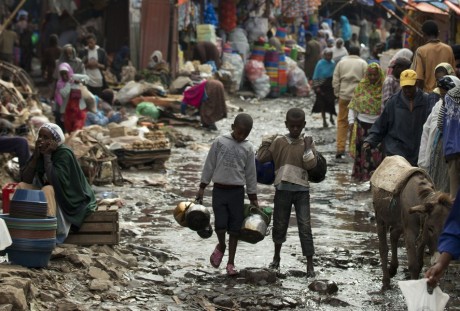
http://www.forbes.com/pictures/mef45jgim/10-saddest-ethiopia/
Copyright © Oromianeconomist 2013 and Oromia Quarterly 1997-2013. All rights reserved. Disclaimer.
Related articles
- The biggest challenges facing Africa have little to do with religion, per se, and less with global terrorism.http://www.foreignpolicy.com/articles/2013/10/02/demography_is_destiny_africa_al_shabab#.Uk3ZTTT2_xA.twitter …
- “Re-Branding Africa” and “Africa Rising”: Whose #Africa? Whose Rise? http://aconerlycoleman.wordpress.com/2013/10/03/re-branding-africa-and-africa-rising-whose-africa-whose-rise/
- Africa is not rising, survey shows that ”the boom” only benefits a narrow elite http://www.theguardian.com/world/2013/oct/02/africa-not-rising-survey?CMP=twt_gu
- A skeptical perspective on African development (marginalrevolution.com)
-
http://transitions.foreignpolicy.com/posts/2013/09/30/the_african_statistics_smackdown_continued
CONTOURS OF THE EMERGENT & ANCIENT OROMO NATION September 25, 2012
Posted by OromianEconomist in Uncategorized.Tags: African Studies, Ancient time, Berlin Conference, Civilization, Democratic African institution, Democratisation, Developing country, Economic growth, economics, Freedom, Gadaa System, Governance issues, Land grabs in Africa, New Africa, Old Egypt, Oromia, Oromia Region, Oromo people, Oromummaa, Parliament, Social Sciences, State and Development, Tokkummaa Oromo, Universal Declaration of Human Rights
3 comments

This book is an important contribution to the study of identity politics, a subject hotly contested by many Africanists. Bulcha’s discussion the state-centered bias in the much of academic work on Ethiopia and its denial of the history and pre-colonial autonomy of indigenous non-Abyssinian peoples aught to lead to some serious debate. (Kajsa Ekholm Friedman, Professor Emeritus, Lund University, Sweden).
This work by Mekuria Bulcha is the most comprehensive and innovative work on the Oromo of Ethiopia ever to be written. Identity politics, he argues can be a positive challenge to the development of the state. As it has been the case of Southern Sudan states can also evolve, disappear and change. This work outlines the history, the traditions and politics of the Oromo people summarized and critically assessing all scholarly work done previously. It will remain a seminal work for scholars of Africa and the Oromo for many years to come. It is master peace and sets new challenge for all of us researching on the Oromo nation and people. (Mario I. Aguilar, Professor, Chair of Religion and Politics & Director of the Center for the Study of Religion and Politics (CSRP), University of St. Andrew, Scotland, UK).
Based on empirical evidence and relevant theories of nationalism Bulcha convincingly argues that the pre-colonial Oromo were a pre-modern nation. He revisits the representation of the Oromo identity in Ethiopian history and proposes the innovative and stimulating thesis that the 16th century Oromo ‘invasion’ of the Ethiopian highlands was the result of a conscious effort to regain control of a territory that was lost and contended since the 14th century Abyssinian expansion into the region. Mekuria Bulcha’s presentation of new evidence of the Oromo resistance to the 19th century conquest, his description of the international appeals by the Oromo elite in the colonial phase, his analysis of the activities of the Oromo social movements for the cultural and linguistic rights in the 1960s, and his account of the history of rebellion and armed struggle from the 60s, up to the current ethnic federalism are likely to make this book a classic reference for the studies on ethno-nationalism. (Marco Bassi, Ph.D. Research Associate, African Centre, University of Oxford, UK).
In his important and interesting discussions on the Gadaa System Mekurian Bulcha argues that:
The Oromo People created Gadaa, and Gadaa created the Oromo nation (Legesse, 2000 as quoted in Bulcha 2012)
The Gadaa system is the matrix of the Oromo culture and society: in the past it stood for several related ideas and practices encompassing cultural, political, economic and religious elements. Many of the basic elements of traditional Oromo culture that are anchored in the Gadaa system have withstood the exigencies of time and still today influence the values, attitudes, and social practices of Oromo people irrespective of, region, religion and social class. Oromo worldview and way of life was shaped by Gadaa system (Bulcha,, 2012 & Legesse, 2006).
The unity of the Oromos that is crystallized in the Gadaa culture is not a nostalgic memory of a glorious past or illusory of vision of the future paradise. Gadaa is a reality embedded in the Oromo psyche that constitutes what is to be Oromo as an individual and as a nation. Gadaa underpins the cohesive or corporate Oromo history that scholars who have not studied the Oromo fail to recognize (Gebissa, 2008).
The most important organ of the Gadaa system is the federal assembly known as Gumii Gayoo in Borana and Caffee in other places. These assemblies were very large and attended by councillors called hayyuu, drawn from different sections of the society. These assemblies made laws which defined the essence of Oromo democracy. In short, the specificity and similarity of the myriads of norms, rituals and political practices around which it was organized throughout the Oromo country make Gadaa a unique pan- Oromo institution of great historical depth (Bulcha, 2012, Legesse, 2000).
http://www.casas.co.za/Publications.aspx?PID=316
Copyright © Oromianeconomist 2012 and Oromia Quarterly 1997-2012. All rights reserved. Disclaimer.
Theorizing Development June 8, 2011
Posted by OromianEconomist in Economics: Development Theory and Policy applications, Temesgen M. Erena, Theory of Development, Uncategorized.Tags: Aid, Developing country, Development Economics, Economic, Economic development, Economic growth, John Stuart Mill, Joseph Stiglitz, Latin America, Social Sciences, Temesgen M. Erena, Theorizing Development
add a comment

JEL: A11, A23, B13, D2, D6, O1, O5
Theorizing Development
Temesgen M. Erena (DPhil), Economist
From historical perspectives, the urgency underlying the contemporary development quest of developing economies has been recognised for the last seven decades. Of course, this should not be considered as that there were no problems of development prior to 1940’s. However, paralleling the increasing for economic self-determination and development of developing economies, there has been a tremendous growth in intellectual activity concerning the development problems.
The past 70 years have also witnessed a gluttony of models, theories, and empirical investigations of the development problem and the possibilities offered for transforming Asia, African, Latin American, and Caribbean nations. This body of knowledge as come to be known in academics and policy circles as development economics.
In these perspectives development is discerned in the context of sustained rise of an entire society and social system towards a better and ‘humane life’. What constitutes a better and humane life is an inquiry as old as humankind. Nevertheless, it must be regularly and systematically revised and answered over again in the unsteady milieu of the human society. Economists have agreed on at least on three universal or core values as a discernible and practical guidelines for understanding the gist of development (see Todaro,1994; Goulet, 1971; Soedjatmoko, 1985; Owens, 1987). These core- values include:
Sustenance:
the ability to meet basic needs: food, shelter, health and protection. A basic function of all economic activity, thus, is to provide a means of overcoming the helplessness and misery emerging from a lack of food, shelter, health and protection. The necessary conditions are improving the quality of life, rising per head income, the elimination of absolute poverty, greater employment opportunity and lessening income inequalities;
self-esteem:
which includes possessing education, technology, authenticity, identity, dignity, recognition, honour, a sense of worth and self respect, of not being used as a tool by others for their own exigency;
Freedom from servitude:
to be able to choose. Human freedom includes emancipation from alienating material conditions of life and from social servitude to other people, nature, ignorance, misery, institutions, and dogmatic beliefs. Freedom includes an extended range of choices for societies and their members and together with a minimization of external restraints in the satiation of some social goals. Human freedom embraces personal security, the rule of law, and freedom of leisure, expression, political participation and equality of opportunity.
Sustained and accelerated increase and change in quantity and quantity of material goods and services (both in absolute and per capita), increase in productive capacity and structural transformation of production system (e.g. from agriculture to industry then to services and presently to knowledge based (new) economy), etc. hereinafter economic growth is a necessary if not a sufficient condition for development.
As elaborated in Hirischman (1981) and Lal (1983), this corpus of thought and knowledge denotes economics with a particular perspective of developing nations and the development process. It has come to shape the beliefs about the economic development of developing countries and policies and strategies that should be followed in this process. While development economics goes beyond the mere application of traditional economic principles to the study of developing economies, it remains an intellectual offspring and sub discipline of the mainstream economics discipline. The growth in economic knowledge and the corresponding intellectual maturation of development thought and policy debate has led to the appearance of various perspectives of thought on the theory and reality of development and underdevelopment within the same discipline of development economics. The two main paradigms are neo-classicals (orthodox), and Political economy (neo-Marxists). There are also eclectics.
Copyright © Oromianeconomist 2011 and Oromia Quarterly 1997-2011. All rights reserved. Disclaimer.


 Oromian Economist
You must be logged in to post a comment.