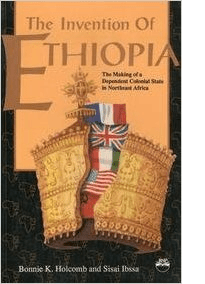
Finfinnee Radio: Historian Edao Boru on Ethiopian HIstory 101 November 19, 2015
Posted by OromianEconomist in Uncategorized.Tags: Ethiopia's Colonizing Structure and the Development Problems of People of Oromia, Finfinnee Radio, Historian Edao Boru on Ethiopian HIstory 101, Invention of Ethiopia: The Making of Dependent Colonial State in Northeast Africa by Bonnie K. Holcomb, Obbo Edao Boru
add a comment

Unity of the Oppressed in Ethiopia: The Founding of Peoples’ Alliance for Freedom and Democracy (PAFD) October 24, 2015
Posted by OromianEconomist in Uncategorized.Tags: Africa, African Studies, Benishangul, Decolonization, Ethiopia's Colonizing Structure and the Development Problems of People of Oromia, Gambella and Omo Valley, National Self Determination, Ogadenia, Oromia, Sidama, The Founding of Peoples’ Alliance for Freedom and Democracy (PAFD)
add a comment
Final Press Release: The Founding of Peoples’ Alliance for Freedom and Democracy (PAFD)

Finally, PAFD call upon the current government in Ethiopia to refrain from all acts of violence, respect human rights, obey the rule of law, and commit to peaceful and democratic resolution of political conflicts.
Issued by PAFD
Oslo, Norway
October 23, 2015
Contacts
PAFD22102015@gmail.com
- ONLF +447940624477;
- OLF +4797357264;
- GPLM +12042185988;
- SNLF +44 7984480752;
- BPLM +2917296477
https://www.oromiamedia.org/2015/10/omn-oduu-onk-23-2015/
https://www.oromiamedia.org/2015/10/omn-amharic-news-oct-24-2015/
International News Media Report about PAFD, Newly Established Coalition of National Liberation Movements for the Right to National Self-Determination in Ethiopia

International media outlets continue to report about the founding of the Peoples’ Alliance for Freedom and Democracy, PAFD – the newly formed coalition of national liberation struggles for the right to national self-determination in Ethiopia (the member organizations of PAFD, i.e. BPLM, GPLM, OLF, ONLF and SNLF, represent more than 60% of the nations, nationalities and peoples in Ethiopia – a population that is inhabiting an area that is ~70% of Ethiopia). Below is how ‘U.S. News & World Report’ reported about the formation of PAFD; other news outlets, such as ABC News, The New York Timesand The Washington Post have also carried the story.
—-
Scientific Research: Colonialism of Mind: Deterrent of Social Transformation, The Experiences of Oromo People in Ethiopia June 30, 2015
Posted by OromianEconomist in Ethiopia's Colonizing Structure and the Development Problems of People of Oromia, Afar, Ogaden, Sidama, Southern Ethiopia and the Omo Valley.Tags: Africa, African Studies, Because I am Oromo, Ethiopia's Colonizing Structure and the Development Problems of People of Oromia
add a comment

Colonialism of Mind: Deterrent of Social Transformation
By Begna F. Dugassa, Sociology Mind 2011. Vol.1, No.2, 55-64 Copyright © 2011 SciRes
An educational system and its curricula are shaped by the culture and epistemology in which it is embedded. It is influenced by the societal knowledge, but it also instrumental in shaping the knowledge of the society. Culture influences learning style. Based on cultural diversities and social needs, different societies have distinct curricula. As such, Oromo students ought to be taught now to interrogate the colonial epistemology and ideology as well schooled in the ways of dismantling the hegemony. However, in many cases, they are simply taught to reproduce the knowledge, culture, power structure, thinking and the worldview of colonizers. This means that education, which is supposed to be about critical inquiry and social transformation has been used to indoctrinate or brainwash some students. Such colonial educational curricula have invalidated the knowledge of indigenous Oromo people and compromised their needs. This type of education system, instead of empowering the students and their society, has incapacitated them. For the Oromo people, such curricula have distorted their history, image, identity, and damaged their social fabric. In this paper I argue that, colonial knowledge and education system is not in a position to bring about social transformation among Oromo people; on the contrary it disrupts their peace (nagaa), health (fayya) and (tasgabii) social order.
From Oh No! to Oromo! White Supremacy and Colonialism in the 21st Century June 27, 2015
Posted by OromianEconomist in Because I am Oromo, Ethiopia's Colonizing Structure and the Development Problems of People of Oromia.Tags: Africa, Because I am Oromo, Ethiopia's Colonizing Structure and the Development Problems of People of Oromia, Oromia, Oromo, Oromo people, untwist the twisted history
add a comment
Oromia: Untwist the twisted history
https://oromianeconomist.wordpress.com/2014/12/28/oromia-untwist-the-twisted-history/


We spoke today with Ms. Veta Byrd-Perez of WhenAndWhereIEnter.org about the on-going struggle of African women in Latin America, and with Dr. Fido Ebba about the Oromo people in East Africa all in the context of what continues to be misrepresentations of White supremacist symbolism and violence.
An Insult to the People and Democracy: On the Ethiopian General Election June 19, 2015
Posted by OromianEconomist in Sham elections, The Tyranny of TPLF Ethiopia.Tags: 2015 Sham Elections: Marred by rampant electoral fraud, Africa, Ethiopia's Colonizing Structure and the Development Problems of People of Oromia, Ethiopia's sham elections, The tyranny of TPLF Ethiopia
3 comments

An Insult to the People and Democracy
On the Ethiopian General Election
Every five years the Ethiopian people are invited by the ruling party to take part in a democratic pantomime called ‘General Elections’. Sunday 24th May saw the latest production take to the national stage.
With most opposition party leaders either in prison or abroad, the populace living under a suffocating blanket of fear, and the ruling party having total control over the media, the election result was a foregone conclusion. The European Union, which had observed the 2005 and 2010 elections, refused to send a delegation this time, maintaining their presence would legitimise the farce, and give credibility to the government.
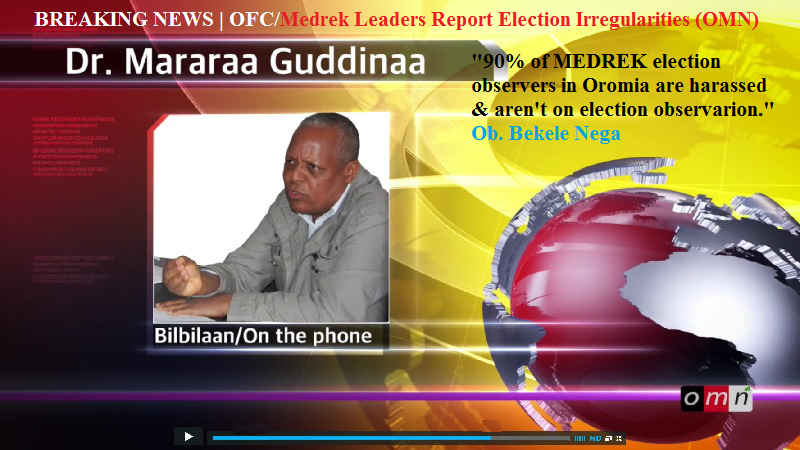
With most ballots counted, the National Election Board of Ethiopia announced the incumbent party to have ‘won’ all “442 seats declared [from a total of 547], leaving the opposition empty-handed…the remaining 105 seats are yet to be announced.” ‘Won’ is not really an accurate description of the election result; as the chairman of the Oromo Federalist Congress, Merera Gudina, put it, this “was not an election, it was an organised armed robbery”.
The days leading up to the election saw a regimented display of state arrogance and paranoia, as the government deployed huge numbers of camouflaged security personnel and tanks onto the streets of Addis Ababa and Bahir Dar. For months beforehand anyone suspected of political dissent had been arrested and imprisoned; fabricated charges drawn up with extreme sentencing for the courts, which operate as an extension of the government, to dutifully enforce.
Despite the ruling party’s claims to the contrary, this was not a democratic election and Ethiopia is not, nor has it ever been a democracy.
The country is governed by a brutal dictatorship in the form of the Ethiopian People’s Revolutionary Democratic Front (EPRDF) that has been in power since 1991, when they violently overthrew the repressive Derg regime. The EPRDF speaks generously of democracy and freedom, but they act in violation of democratic principles, trample on universal human rights, ignore international law, and violently control the people.
Independent international bodies and financial donors, from Human Rights Watch and Amnesty International to the European Union and the US State Department, are well aware of the nature and methods of the EPRDF, which is one of the most repressive regimes in Africa. The Committee to Protect Journalists reports that Ethiopia is “the fourth most heavily censored country in the World”, with more journalists forced to leave the country last year than anywhere except Iran.
In the lead up to the recent election, CPJ found that, “the state systematically cracked down on the country’s remaining independent publications through the arrests of journalists and intimidation of printing and distribution companies. Filing lawsuits against editors and forcing publishers to cease production.” Various draconian laws are used to gag the media and stifle dissent, the Anti Terrorist Proclamation being the most common weapon deployed against anyone who dares speak out against the government, which rules through fear, and yet, riddled with guilt as they must surely be, seem themselves fearful.
Democracy and Development
The government proudly talks a great deal about economic development, which it believes to be more important than democracy, human rights and the rule of law, all of which are absent in the country. And yes, during the past decade the country has seen economic development, with between 4% and 9% (depending on who you believe) GDP growth per annum achieved, the CIA states “through government-led infrastructure expansion and commercial agriculture development.” It is growth, however, that depends, the Oakland Institute make clear, on “state force and the denial of human and civil rights.”
GDP figures are only one indicator of a country’s progress, and a very narrow one at that. The broader Ethiopian picture, beyond the debatable statistics, paints a less rosy image:
Around 50% of Ethiopia’s federal budget is met by various aid packages, totaling $3.5 billion annually. Making it “the world’s second-largest recipient of total external assistance, after Indonesia” (excluding war torn nations, Afghanistan and Iraq), Human Rights Watch states. The country remains 173rd (of 187 countries) in the UN Human Development Index and is one of the poorest nations in the world, with, the CIA says, over 39% of the population living below the low poverty line of $1.25 a day (the World Bank worldwide poverty line is $2 a day) – many Ethiopians question this figure and would put the number in dire need much higher.
Per capita income is among the lowest in the world and less than half the rest of sub-Sahara Africa, averaging, according to the World Bank, “$470 (£287)”. This statistic is also questionable, as Dr. Daniel Teferra (Professor of Economics, Emeritus at Ferris State University,) explains, “In 2008-2011 income per capita (after inflation), was only $131,” contrary to the International Monetary Fund’s (IMF) 2013 report, which put the figure at $320.
The cost of living has risen sharply (current inflation is around 8%) and, as The Guardian reports, “growing economic inequality threatens to undermine the political stability and popular legitimacy that a developmental state acutely needs. Who benefits from economic growth is a much-contested issue in contemporary Ethiopia.” Not amongst the majority of Ethiopians it isn’t: they know very well who the winners are. As ever it is the 1%, who sit in the seats of power, and have the education and the funds to capitalize on foreign investment and development opportunities.
Some of those suffering as a result of the government’s development policies are the 1.5 million threatened with ‘relocation’ as their land is taken – or ‘grabbed’ from them. Leveled and turned into industrial-sized farms by foreign multinationals which grow crops, not for local people, but for consumers in their home countries – India or China for example.
Indigenous people cleared from their land are violently herded into camps under the government’s universally criticised “Villagization” program, which is causing the erosion of ancient lifestyles, “increased food insecurity, destruction of livelihoods, and the loss of cultural heritage”, relates the Oakland Institute. Any resistance is met with a wooden baton or the butt or bullet of a rifle; reports of beatings, torture and rape by security forces are widespread. No compensation is paid to the affected people, who are abandoned in camps with no essential services, such as water, health care and education facilities – all of which are promised by the EPRDF in their hollow development rhetoric.
An Insult to the People
Economic development is not democracy, and whilst development is clearly essential to address the dire levels of poverty in Ethiopia, it needs to be democratic, sustainable development. First and foremost Human Rights must be observed, and there must be participation, and consultation, which – despite the Prime Minister Hailemariam Desalegn’s duplicitous comments to Al Jazeera that, “we make our people to be part and parcel of all the [developmental] engagements,” – never happens.
The Prime Minister describes Ethiopia as a “fledgling democracy”, and says the government is “on the right track in democratizing the country”. Nonsense. Democracy is rooted in the observation of Human Rights, freedom of expression, the rule of law and social participation. None of these values are currently to be found in Ethiopia.
Not only is the EPRDF universally denying the people their fundamental human rights, in many areas they are committing acts of state terrorism (one thinks of the abuses taking place in the Ogaden region and the atrocities being committed against the Oromo people for example) that amount to crimes against humanity.
The recent election was an insult to the people of Ethiopia, who are being intimidated, abused and suppressed by a brutal, arrogant regime that talks the democratic talk, but acts in violation of all democratic ideals.
Graham Peebles is director of the Create Trust. He can be reached at: graham@thecreatetrust.org
Ethiopia’s poverty reduction – who benefits? February 20, 2015
Posted by OromianEconomist in Amnesty International's Report: Because I Am Oromo, Corruption in Africa, Ethiopia the least competitive in the Global Competitiveness Index, Ethiopia's Colonizing Structure and the Development Problems of People of Oromia, Afar, Ogaden, Sidama, Southern Ethiopia and the Omo Valley, Free development vs authoritarian model, Uncategorized.Tags: Afar, Africa, African Studies, Because I am Oromo, Developing country, Development and Change, Ethiopia's Colonizing Structure and the Development Problems of People of Oromia, Free development vs authoritarian model, Genocide against the Oromo, Governance issues, Human rights violations, Land grabs in Africa, Ogaden, Oromia, poverty, Sidama, Southern Ethiopia and the Omo Valley, State and Development, Tyranny
add a comment
Tigray first
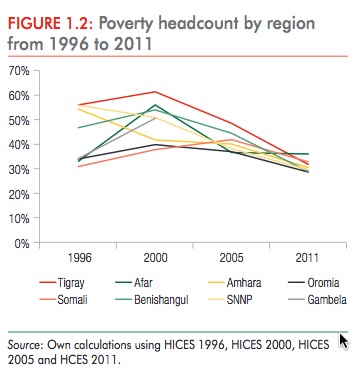
The answer is clear: it is the people of Tigray, whose party, the TPLF led the fight against the Mengistu regime and took power in 1991, who benefited most. What is also striking is that the Oromo (who are the largest ethnic group) hardly benefited at all.
This is what the World Bank says about this: “Poverty reduction has been faster in those regions in which poverty was higher and as a result the proportion of the population living beneath the national poverty line has converged to around one in 3 in all regions in 2011.”
The World Bank does little to explain just why Tigray has done (relatively) so well, but it does point to the importance of infrastructure investment and the building of roads. It also points to this fact: “Poverty rates increase by 7% with every 10 kilometers from a market town. As outlined above, farmers that are more remote are less likely to use agricultural inputs, and are less likely to see poverty reduction from the gains in agricultural growth that are made. The generally positive impact of improvements in infrastructure and access to basic services such as education complements the evidence for Ethiopia that suggests investing in roads reduces poverty.”
Not surprisingly, the TPLF under Prime Minister Meles Zenawi and beyond concentrated their investment on their home region – Tigray. The results are plain to see.


The World Bank has just published an authoritative study of poverty reduction in Ethiopia. The fall in overall poverty has been dramatic and is to be greatly welcomed. But who has really benefited?
This is the basic finding:
In 2000 Ethiopia had one of the highest poverty rates in the world, with 56% of the population living on less than US$1.25 PPP a day. Ethiopian households experienced a decade of remarkable progress in wellbeing since then and by the start of this decade less than 30% of the population was counted as poor.
There are of course many ways of answering the question – “who benefited” – were they men or women, urban or rural people. All these approaches are valid.
The Ethnic Dimension
But in Ethiopia, where Ethic Federalism has been the primary driver of government policy one cannot ignore the ethnic dimension.
Here this graph is particularly telling:
View original post 234 more words


 Oromian Economist
You must be logged in to post a comment.