Economic and development analysis: Perspectives on economics, society, development, freedom & social justice. Leading issues in Oromo, Oromia, Africa & world affairs. Oromo News. African News. world News. Views. Formerly Oromia Quarterly
The problem with using statistics to sing the praises of autocracy is that collecting verifiable data inside closed societies is nearly impossible. From Ethiopia to Kazakhstan, the data that “proves” that an authoritarian regime is doing good is often produced by that very same regime.
Once regime-produced data makes it into the world’s most trusted indexes, authoritarians and their unintentional supporters use these numbers in their propaganda, which hampers efforts to promote human rights.
When Ethiopian prime minister Meles Zenawi died in 2012, Bill Gates led a chorus of Western praise for his development efforts, praising Zenawi for bringing millions out of poverty and ignoring his near-total censorship or his massacre of hundreds of protestors. The Economist and the The New York Review of Books have since pointed out that the Ethiopian regime fabricates development statistics.
Why Dictators Love Development Statistics
They’re an easily faked way to score international points.
Exchanges at the Organization of American States usually don’t do well on YouTube. But when the Honduran Minister of Foreign Affairs brought up Venezuela’s crackdown on dissent last summer, Venezuelan representative Delcy Rodríguez scored surprise points with a rebuttal citing the United Nations’ 2016 Human Development Index, which ranks Venezuela 59 spots higher than Honduras. Crackdown or no crackdown, “Venezuela does not demonstrate such terrifying statistics,” she said, in an exchange that soon went viral on Spanish-speaking social media. It was a win for the Maduro regime, and the key to victory was trusted U.N. data.
For those of us working to advance human rights, such episodes are becoming frustratingly familiar. From the development initiatives of Jeffrey Sachs and Bill Gates, to Tony Blair’s despotic partnerships or Tom Friedman championing Chinese autocracy in The New York Times, the last two decades have seen political concerns repeatedly sidelined by development statistics. The classic defense of dictatorship is that without the messy constraints of free elections, free press, and free protests, autocrats can quickly tear down old cities to build efficient new ones, dam rivers to provide electricity, and lift millions out of poverty.
The problem with using statistics to sing the praises of autocracy is that collecting verifiable data inside closed societies is nearly impossible. From Ethiopia to Kazakhstan, the data that “proves” that an authoritarian regime is doing good is often produced by that very same regime.
A handful of organizations power the global industry of statistics collection, including the World Bank, the United Nations, and the World Economic Forum. Each of these organizations conduct large-scale socio-economic surveys, where researchers want to include as many countries as possible. However, many of these countries—93 of them, comprising nearly 4 billion people, according to the Human Rights Foundation—are ruled by authoritarian regimes that typically block impartial investigators from entering their borders. Often, data collectors are forced to work with the strongmen in charge.
For Bahrain, the World Economic Forum receives most of its data from surveys given to government officials at the Bahrain Economic Development Board, who conduct them and give the results back to Geneva. In WEF’s analysis from that point, outliers may be cast out or excluded with data modeling, but the foundational numbers remain entirely a creation of the dictatorship.
UNESCO representatives say that in the case of Cuba, they use the regime’s education numbers in compiling their reports. There is no on-the-ground verification for these often-encouraging figures. Meanwhile, a former treasury official from Uzbekistan said that visits from international data collectors were highly choreographed, and that the regime was easily able to control survey outcomes.
When surveys don’t go according to plan, dictators can simply shut polling down. Gallup World Poll director Jon Clifton, when I called him up as part of a Human Rights Foundation interview several years ago, recalled a time when the company’s researchers had collected data in one African country, only to have their equipment seized at the airport on the way out.
Still, no one wants blank countries on their world maps. “Ultimately, organizations need to produce some kind of data,” Clifton said. “Even if it’s not terribly good, they still need data.”
But the development reports using such numbers also wind up giving them institutional legitimacy, in ways that can affect huge decisions in aid and trade. World Bank data in particular, as one 2012 study observed, is promoted in media outlets as a reputable guide for global investment, and has inspired reforms as countries seek to climb the rankings. UNESCO’s numbers go into the World Development Report (World Bank) and the Human Development Index (UNDP), where they serve, in UNESCO’s own words, to “benchmark progress towards national and international targets.” The educational components of the Sustainable Development Goals—which guide and inspire do-gooders and impact investors across the planet—are measured with UNESCO data. Statistics flow directly from many dictatorial governments to UNESCO and then into the SDG reports.
Once regime-produced data makes it into the world’s most trusted indexes, authoritarians and their unintentional supporters use these numbers in their propaganda, which hampers efforts to promote human rights.
When Ethiopian prime minister Meles Zenawi died in 2012, Bill Gates led a chorus of Western praise for his development efforts, praising Zenawi for bringing millions out of poverty and ignoring his near-total censorship or his massacre of hundreds of protestors. The Economist and the The New York Review of Books have since pointed out that the Ethiopian regime fabricates development statistics.
Halfway across the globe in Venezuela, the late Hugo Chávez built a global reputation as the people’s president, proudly flaunting statistics showing his administration had reduced poverty by 50 percent. In 2014, Chavismo heir Nicolás Maduro justified his crackdown on dissent—torturing and kidnapping student protesters—in a New York Times op-ed citing data showing that his regime “consistently reduced inequality,” “reduced poverty enormously,” and “improved citizens’ lives over all.” The source of that data? The U.N. Economic Commission for Latin America and the Caribbean, which used Millennium Development Goal data—which came directly from the regime’s own statisticians.
In Azerbaijan, Ilham Aliyev’s dictatorship has used economic growth data to convince the world that it is a thriving, effectivegovernment with a robust investment climate. The World Economic Forum, among others, gave the Azeri regime a platform to talk about its financial success—which is used to whitewash crimes ranging from the jailing of dissidents to the theft of billions.
Rwandan dictator Paul Kagame’s human rights violations are legion: the assassination of critical journalists, sponsorship of death squads in the Congolese jungle, the use of international hitmen, and the jailing of political opponents. Despite all this, supporters ranging from Bill Clinton to Jeffrey Sachs breathlessly praise his leadership and economic success. When Kagame “won” 99 percent of the presidential vote a few months ago, the international community was quick to call that political data into question. But Rwanda’s literacy rates, life expectancy, and economic growth numbers continue to be taken at face value.
This near-universal lack of skepticism is hard to explain, especially since the problem isn’t new. In 1987, two Soviet economists published an article called Lukavaya Tsifra(“cunning numbers”) which demonstrated that between 1928 and 1985, the USSR’s GDP had grown over ten times slower than reported by the regime’s Central Statistical Administration. They showed that the regime’s “official” economic data was being falsified to whitewash human suffering.
When used by universities and research institutions, socio-economic data sets guide our fundamental understanding of the world. When used by policy makers, philanthropists, and bankers, they steer billions of dollars of aid and investment. Often, the reason data from dictators remains unchallenged is that so many economists, financiers, diplomats, and donors rely on it to do their jobs.
But without more rigorous inquiry into the origin and quality of socio-economic data, the grim reality of dictatorship often remains obscured. Beyond that, intellectuals and world leaders might do well reflect on their worship of development numbers over human rights concerns.
After all, even if the data behind the UN’s 17 Sustainable Development Goals could be verified, what do they signify if not a single one mentions the words individual rights, civil liberties, or democracy—even once? Numbers aren’t always as simple or as neutral as they seem.
Ethiopian children study in a classroom. (AP Photo/Sayyid Azim)
Thomas Yilma didn’t last a day as a teacher in an Ethiopian government school. After graduating from university he was packed off to a small village in a remote corner of the Ethiopian highlands with scant electricity or phone signal, let alone internet connection, where he was to begin his career. “I felt like I was being abandoned in the middle of nowhere,” he says now. After one restless night he turned around and headed back to the Ethiopian capital, Addis Ababa, leaving the country’s state education sector behind him.
Thomas’s story—extreme though it is—sheds some light on the troubles plaguing Ethiopia’s rapidly expanding school system. Though he eventually found a job in an American-owned private school, this too proved only temporary. After six years he did what many of his colleagues—and thousands of teachers across Ethiopia—so often end up doing, and quit the profession entirely. “I never had any desire to become a teacher,” he says. “You could guess what their lives were like. I wanted to be a doctor or an engineer—like everybody else.”
Few governments in Africa spend as much of their revenues on education as that of Ethiopia.At first sight this is surprising. Education in Ethiopia over the past decade is in some senses a success story. Government statistics are not wholly reliable—the ruling party does a good job of steering clear of most international surveys, making regional comparison difficult—but many of the headline figures are impressive regardless. Few governments in Africa—or elsewhere, for that matter—spend as much of their revenues on education as that of Ethiopia. In a continent which today directs a higher proportion of government expenditure towards the sector than any other—18.4%—Ethiopia has consistently been in the top rank for the past decade. Between 2000 and 2013 it almost doubled the share of its budget allocated to education, from 15% to 27%.
Measured in terms of access to primary education (which is now free), the results are striking. Ethiopia now has one of the highest enrollment rates in Africa, up from the nadir in the early 1990s when it had one of the world’s lowest. The number of primary schools almost tripled from 1996 to 2015, while student enrollment grew from less than 3 million to over 18 million within the same period—almost universal. Youth literacy meanwhile jumped from 34% in 2000 to 52% in 2011.
According to the UN’s Education For All Development Index, which provides a snapshot of the overall progress of national education systems, Ethiopia came second only to Mozambique in terms of size of the improvement over the previous decade, and made fastest progress in terms of expanding universal primary enrolment. Between 2001 and 2008, the number of out-of-school children fell by more than 60%.Compare this to Nigeria, which at the same moment experienced a lost decade: the percentage of children out of school showed no improvement whatsoever by the end of it.
Teacher status
But all this masks a deep-seated malaise. According to the government’s own figures, for every 1,000 children who begin school, around one-half will pass uninterrupted to Grade 5 and only one-fifth to completion of Grade 8. Soaring enrolment at secondary level in Addis Ababa—statistical quirks mean the figure here is actually over 100%—contrasts with less than a tenth in the sparsely populated, largely pastoralist region of Afar, which stretches eastwards towards Eritrea and Djibouti.
Those who do manage to stick it out struggle, consistently under-performing what the curriculum expects of them. According to Belay Hagos, director of educational research at Addis Ababa University, students at various grades are learning on average only 40% of the material they are supposed to master. National Learning Assessments, conducted every four years, reveal a stubborn lack of progress. The average score for a Grade 4 student, for instance, dipped from 41% to 40% between 2010 and 2014, and remains stuck below 50% in all regions except Addis Ababa. Comparing 15-year-old children who correctly answered comparable maths questions in 2009 and 2016, Young Lives, a British charity, also found no overall improvement. “I think the education system is in crisis,” says Alula Pankhurst, the charity’s country director.
Why? Part of the answer lies in Thomas’s story. Ethiopia’s brightest and best don’t want to be teachers, and those that do rarely last long. The country’s teachers were once high status: in the northern region of Tigray, the word itself is a title, used to indicate social respect. But this respect has “declined over time,” says Hagos. The profession has been progressively been de-professionalized, ever since the days of the Marxist regime known as the Derg, during which teachers were either co-opted or purged.
Today, teachers are mostly selected from poor-performing students: those who graduate Grade 10 in the top 30% or so go on to Grade 11; those in the tier below join the police; the rest who pass can go to teacher training college. “This is not a good strategy,” says Hagos. “They can’t be good teachers because weren’t good students in the first place.” His latest research has uncovered what he calls a “professional identity crisis”. 70% of those surveyed reported feeling bad about the profession, while 98% said the pay was too low. “They are teachers but they don’t want to be called teachers,” he says. “They are ashamed of it.”
Language problem
Other problems specific to Ethiopia—beyond the obvious lack of financial resources—are compounding its teaching troubles. An especially tricky one is the country’s federal constitution, which devolves a great deal of education policy to the nine regional governments, in particular language of instruction.
“The transition to English in some regions can be a very, very steep curve.” Even at university level standards can be shockingly poor.Regions tend to choose to educate their children at primary level in the local language, but after that instruction suddenly switches to English—a treacherous passage that few sail through easily. “It’s very worrying,” says Pankhurst. “The transition to English in some regions can be a very, very steep curve.” Even at university level standards can be shockingly poor.
The government knows it has itself in a bind: expanding educational access at such a fast pace was always bound to lead to a dilution in standards. “Ethiopia judiciously picked one route, which was students in rooms and bums on seats,” says Ravi Shankar of Accelerated, a company based in Addis Ababa that is working to improve teaching standards in Ethiopia and elsewhere on the continent. Now the government is making efforts to correct this: teachers wages, for instance, were increased sharply last year, and it has embarked on a large-scale program of skills training for teachers.
But whether it can ever follow in the footsteps of a country like Vietnam—whose single-minded focus on education the government has long sought to emulate—is uncertain. And what if it fails? “A crisis of expectation is a recipe for unrest,” says Pankhurst, noting that the anti-government protests which have swept across much of the country since 2014 were led by students with few prospects and even less hope.
The dearth of foreign currency is compelling the Ethiopian government to delay payments that should be made to international companies in US dollars.
The Reporter has learnt that the government has been unable to settle payments to oil companies that delivered petroleum products to the country in 2015-2017 according to schedule. Vitol Oil supplied diesel and gasoline to the Ethiopian Petroleum Supply Enterprise in 2015 and 2016 after winning the international tenders put up by the enterprise in two consecutive years. Vitol Oil’s second contract was terminated in December 2016.
Reliable sources told The Reporter that EPSE now owes Vitol Oil 20 million US dollars. “Though the company’s petroleum supply contract expired on December 2016 EPSE is unable to settle the remaining 20 million dollars due to foreign currency shortage. The National Bank of Ethiopia has not been able to provide dollars to settle the payment,” sources said.
Similarly the government is unable to settle a 170 million US dollars payment that was supposed to be made to Petro China, the Chinese oil company which has been supplying petroleum products to the country since January 2017. Petro China won the international bid floated by the EPSE in September 2016 and won the tender to supply diesel and gasoline for the 2017 fiscal year. Petro China’s contract will expire on December31, 2017.
Sources told The Reporter that the government now owes Petro China 170 million dollars for the petroleum products it supplied in the fiscal year. Usually payments should be settled within 90 days after the petroleum products have been delivered. According sources, the payment arears are now more than one year old.
Meanwhile international airlines flying to Addis Ababa are facing difficulty in repatriating their sales to their countries. Foreign carriers sell their tickets in the local currency Birr and repatriate their sales revenue in US dollars to their respective countries.
The International Air Transport Association (IATA) told The Reporter that Ethiopia has joined the list of African nations where international airlines face difficulties in repatriating their funds. According to IATA, Ethiopia owes foreign carriers 22 million dollars.
In an interview in his office in Geneva, Switzerland Alexander de Juniac, director general and CEO of IATA, said that nine African countries have a total of 1.1 billion dollars in airlines’ blocked funds. Angola has the largest airlines blocked fund-507 million USD, Algeria-146 million, Sudan-125 million, Nigeria-121 million, Eritrea-64 million, Zimbabwe-52 million, Mozambique-33 million, Ethiopia 22 million and Libya 20 million.
Juniac told The Reporter that most of the countries faced shortage of foreign currency due to the drop in oil price while others have their own economic challenges. “We have been working with African governments to get the airlines blocked funds released and we are successful in releasing most of the funds in Egypt and Nigeria,” Juniac said.
The Ethiopian government officials explain that the country is facing the foreign currency crunch due to the commodity price decline in the international market stunting the foreign currency earnings. The increasing fuel imports and hefty expenditures on mega infrastructure projects are among the long list of contributing factors to the foreign currency shortage. The government is taking various measures to stimulate the weakened export.
ESAT, 7 December 2017: According to a well-placed source, the foreign currency reserve in the coffers is only about 700 million dollars that could only run for three weeks.
Several mega projects have already been put on hold. Prominent among the projects is the 550 kms gas pipeline that stretches from the port of Djibouti to well inside Ethiopia.
The import of petroleum and medicines were seriously affected and businesses engaged in export trade had to wait upto a year to obtain foreign currency from banks.
The Ethiopian Shipping and Logistics Services Enterprise was unable to withdraw the 100 million dollars deposit it has with National Bank of Ethiopia.
The source also revealed that about 2000 containers were on hold at the port of Djibouti due to unpaid port fees.
The country’s annual debt payment has reached 2 million dollars of which a significant amount is due to be paid to the Chinese import export bank, China EximBank.
Meanwhile, the managing director of the International Monetary Fund Christine Lagarde is due to visit the country and is expected to talk on possible loans to help the country ease the shortage of hard currency. But the IMF, according to the source, demands the regime to halt the progress of mega projects. The IMF also requires the country privatize state-owned enterprises like Ethio-Telecom, according to the source.
A recent effort by regime officials to rekindle relationships with Qatar in hopes of getting some hard currency from the oil rich country has resulted in unintended and bad consequences. Irate over the developments, the United Arab Emirates, one of the gulf states that loves to hate Qatar, had demanded Ethiopia to pay 400 million dollars for petroleum that it had bought in loan. The UAE has for a long time been lenient on requiring Ethiopia pay the loan, the source said.
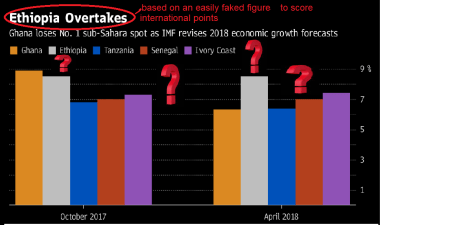
'Using fabricated economic data to seek legitimacy,… the regime then advanced narratives about its double-digit economic growth, described with such catchphrases as Ethiopia rising, the fastest growing economy in the world and African lioness.' https://t.co/gV7b30elp4
Ethiopia: “There’s been a brilliant PR campaign on its part to sell a story that does not really exist.”
‘Yet the data show that manufacturing now accounts for a smaller slice of Ethiopia’s economy than at almost any point since the early 1980s.In 2015, the sector accounted for just 4.1 per cent of Ethiopia’s gross value added, well below the peak of 7.8 per cent in 1997, according to data from the World Bank, as the second chart shows. Moreover, manufacturing accounts for a smaller share of Ethiopia’s economy than that of virtually any other country in sub-Saharan Africa.
South Africa, Kenya, Ivory Coast, Cameroon, Benin, Malawi, Mozambique and even Zimbabwe all generate at least 10 per cent of their gross value-added from manufacturing, with the likes of Nigeria and Uganda not far behind, as the third chart shows. Across sub-Saharan Africa as a whole, 10.6 per cent of continental GVA emanates from the sector, according to the World Bank, raising the question as to why Ethiopia is seen as one of the few African nations to have made a go of manufacturing.
“Ethiopia has the smallest manufacturing share of any of the African countries we look at,” says Charles Robertson, chief economist at Renaissance Capital, a Moscow-based investment bank with a focus on emerging markets. “There’s been a brilliant PR campaign on its part to sell a story that does not really exist.”
John Ashbourne, Africa economist at Capital Economics, a consultancy, adds: “Media coverage of Ethiopia’s manufacturing sector sometimes exaggerates its economic importance. A close look at the country’s economy shows that it is much more similar to its African peers than leaders in Addis Ababa would like to admit.”
Despite the hype, Ethiopia exported just $44m worth of shoes in 2015, for example, 0.25 per cent of those exported by Vietnam and less than the footwear exports of the cordwaining powerhouse that is El Salvador. The east African state’s entire exports of clothing and textiles are worth just a tenth of its coffee exports.’ FT
Ethiopia’s success in attracting foreign manufacturers is often held up as a beacon of hope that sub-Saharan Africa, by far the poorest region on the planet, can follow the well-trodden development model that has allowed the rest of the world to become richer.
Industrialisation has largely been the key to development elsewhere, allowing relatively unproductive subsistence agricultural workers to be absorbed by a rapidly growing manufacturing sector boasting far higher productivity.
With China now slewing off lower valued-added manufacturing jobs in sectors such as textiles and basic electronics as wages rise rapidly in the Middle Kingdom, low-wage Africa has long been seen as a potential rival to the likes of Bangladesh and Vietnam for such jobs, as suggested by the first chart.
While this has yet to happen on any meaningful scale — the continent accounts for just 1 per cent of global manufacturing output — Ethiopia has won plaudits for attracting Chinese, Turkish and US investment into garment and shoe factories, notably from Chinese shoemaker Huajian Group, which employs 4,000 people in an industrial park outside Addis Ababa, the capital.
This had led to the country being described as a regional manufacturing powerhouse. Yet the data show that manufacturing now accounts for a smaller slice of Ethiopia’s economy than at almost any point since the early 1980s.
In 2015, the sector accounted for just 4.1 per cent of Ethiopia’s gross value added, well below the peak of 7.8 per cent in 1997, according to data from the World Bank, as the second chart shows.
Moreover, manufacturing accounts for a smaller share of Ethiopia’s economy than that of virtually any other country in sub-Saharan Africa.
South Africa, Kenya, Ivory Coast, Cameroon, Benin, Malawi, Mozambique and even Zimbabwe all generate at least 10 per cent of their gross value-added from manufacturing, with the likes of Nigeria and Uganda not far behind, as the third chart shows.
Across sub-Saharan Africa as a whole, 10.6 per cent of continental GVA emanates from the sector, according to the World Bank, raising the question as to why Ethiopia is seen as one of the few African nations to have made a go of manufacturing.
“Ethiopia has the smallest manufacturing share of any of the African countries we look at,” says Charles Robertson, chief economist at Renaissance Capital, a Moscow-based investment bank with a focus on emerging markets. “There’s been a brilliant PR campaign on its part to sell a story that does not really exist.”
John Ashbourne, Africa economist at Capital Economics, a consultancy, adds: “Media coverage of Ethiopia’s manufacturing sector sometimes exaggerates its economic importance. A close look at the country’s economy shows that it is much more similar to its African peers than leaders in Addis Ababa would like to admit.”
Despite the hype, Ethiopia exported just $44m worth of shoes in 2015, for example, 0.25 per cent of those exported by Vietnam and less than the footwear exports of the cordwaining powerhouse that is El Salvador. The east African state’s entire exports of clothing and textiles are worth just a tenth of its coffee exports.
Slightly more charitably, Mr Ashbourne does suggest that part of the “Ethiopia story” is that it has been more successful than many of its regional peers in attracting investment from “big brand names” from overseas.
Moreover, while in some African states a fair chunk of manufacturing activity may be a byproduct of those countries’ primary sectors (eg oil refining in Nigeria, processing and packaging of agricultural products in Kenya), Ethiopia is instead producing “relatively high quality goods that are exported”.
“It’s being pulled into these global supply chains, which is not common across Africa and is impressive. Exports have risen sharply, [Ethiopian manufacturing] does employ more people than it used to,” Mr Ashbourne adds, even if job growth since the turn of the century has been faster in areas such as construction, mining, transport and the public sector.
Mr Robertson believes it is Ethiopia’s close links to China that has captured the world’s interest. This extends beyond investments such as that of Huajian and China’s funding of a $4.2bn, 470-mile rail line from Addis Ababa to the port of Djibouti, which opened this year.
More fundamentally, Ethiopia is following the state-led, investment-heavy development model so successfully blazed by China
“What has captured the interest is this comparison with China,” says Mr Robertson. Whereas most African countries are pursuing a private sector-led development model, “Ethiopia has adopted the five-year plan, top-down approach that we have seen in China,” which focuses on rolling out infrastructure such as electricity provision first, then developing light manufacturing, followed by heavy industry.
“People are saying China has grown for 30 years at a very fast pace with a top-down programme. Ethiopia has grown very fast for 10 years [around 11 per cent a year] with a top-down programme. [People] are jumping to the conclusion that Ethiopia is following [in terms of manufacturing growth] when it’s really not,” he adds.
Ethiopia’s rapid economic growth since 2004 does, though, raise the question as to whether other sub-Saharan states, with their private sector-led, bottom-up development models, could or should follow its lead.
Mr Robertson, for one, does not believe the likes of Nigeria would be well suited to the Ethiopian approach. Firstly, Ethiopia can manage a state-led process because it has a strong bureaucracy, something that is lacking in much of Africa but has developed in Ethiopia because the country “has a long history of relatively stable government dating back to 1270,” Mr Robertson says.
Secondly, Nigerians are wealthier than Ethiopians and are used to far more freedom than a government-led, top-down economic model would permit, he argues.
“It is being used as an example in Nigeria but I don’t think it will fit. [Nigerians] are too democratic, too free, too opinionated. Ethiopia has had this regime in place for 30 years and it’s working and they have shown a commitment to relatively low corruption.
“In Ethiopia nobody has anything. Nigerians are three times richer and I just can’t see them being put into the communist box. Ghana, Senegal and Kenya have all moved beyond that stage.”
The self-defeating tactics adopted by the Ethiopian government to address genuine cries against lack of job opportunities, more political inclusion and more space to enjoy freedoms and rights in the Oromo and Amhara regions may scare away investors, according to theEmbassy of the US.
Nearly a year since the Oromia protests began, and despite efforts by the Ethiopian government to hide the ugly suppression on its own citizens from the rest of the world, it has culminated into a state of emergency for the next six months to restore order in restive Oromia and Amhara regions.
The decision to put one of Africa’s fastest growing nation on lock-down came after three incidents that are likely to redefine one of the continent’s silent massacres where economic and political marginalization has for months been met with brutal force and resulted in the deaths of hundreds of people.
In September, Dutch-owned florist, Esmeralda Farms BV shut down operations in the horn of Africa nation after protesters attacked its farm in Bahir Dar, causing at least $7.8 million of destruction. Last week, the protesters attacked a Dangote Cement plant in the Amhara region.
The government linked the two attacks to the Oromia protests that have rocked the country since November last year.
Prior to the attack on Dangote Cement plant, dozens of people died in a stampede in Bishoftu after helicopter gunship fired on nearly two million celebrants attending the Irreecha festival, an annual thanksgiving ceremony by the Oromo tribe.
The stampede is so far the darkest moment in the clashes. At least 250 people died in the melee, according to social activists quoted byTesfaNews.
Two weeks after the massacre, the government decreed a state of emergency, an uncomfortable admission that state machinery has failed to suppress protests by the two biggest tribes.
Foreign investors are already developing cold feet in a nation where cheap labor and electricity has wooed manufacturers to set up operations. Ethiopia is on course to become the continent’s manufacturing hub in coming years.
The authoritarian regime under Hailemariam Desalegn accused some foreign eyes of inciting the Oromo and Amhara people to the violence. It branded opposition politicians terrorists and dissidents.
This decision follows an all-too familiar tact by African governments that cannot tolerate objective opposition, choosing to label those involved as enemies of the state.
It accused neighboring Eritrea, Egypt and other countries of arming and training the groups that attacked the two plants in the months-long violence that is threatening to undo the nation’s economic gains, The Guardian reported.
Economic and political marginalization became the fire behind the protests that have seen investors leave the nation and others incur losses running into billions of dollars. The government can no longer hide it.
The declaration came days after Ethiopia opened Africa’s first electric railway linking it to Djibouti which will boost Ethiopia’s economy by reducing the transport of imports from the port of Djibouti from three days by road to about 12 hours.
It will handle nearly 90 percent of the nation’s imports currently transported by road, BBCreported.
The government however chose economic growth over the economic inclusion of its people, despite their persistent protests and now it is paying the price through the state of emergency.
After hundreds of deaths ignored by the international community and trampled upon by the government’s security forces, the next six-months are set to be key to the country.
It will be a testing period for the nation to maintain investor confidence on the back of the Oromia protests.
The self-defeating tactics adopted by the Ethiopian government to address genuine cries against lack of job opportunities, more political inclusion and more space to enjoy freedoms and rights in the Oromo and Amhara regions may scare away investors, according to theEmbassy of the US.
(Financial Times, 25 October 2016): A wave of anti-government protests and the imposition of a state of emergency has triggered a collapse in tourism bookings in Ethiopia.
“There are so many problems facing the Oromo people… “But those who speak about it are getting arrested. Educated people, farmers, teachers, doctors — the government accuses them all of being part of the protests.”
ADAMA, Ethiopia — For those who would speak frankly about politics in this landlocked East African country, the first challenge is to find a safe space.
But on a recent evening in Adama, a city in the heart of a region reeling from the largest protest movement Ethiopia has faced in decades, most people seemed at ease. University students poured out of the city’s main campus, spilling into claustrophobic bars and pool halls. Others crowded around a cluster of aging taxis, jostling for a quick ride home.
Though it is one of the largest cities in Oromia — where members of Ethiopia’s Oromo ethnic group have taken to the streets in recent months in unprecedented numbers to protest their political and economic marginalization — Adama has remained mostly quiet.
Hidden beneath the casual veneer of daily life, however, lurks a deep-seated suspicion of the government, which has built a massive surveillance apparatus and cracked down violently on its opponents
Hidden beneath the casual veneer of daily life, however, lurks a deep-seated suspicion of the government, which has built a massive surveillance apparatus and cracked down violently on its opponents.
Citizens feel they have to watch what they say, and where they say it. At the hangouts where crowds have gathered, a political statement might be overheard. Out on the sidewalks, government spies could be on patrol. Inside the university campus, security officials are on the lookout for suspicious behavior.
In a way, the recent unrest is rooted in Ethiopia’s rapid economic rise. The federal government claims to have notched double-digit GDP growth rates over the past decade, but its rigid, top-down approach to developing industry, and attracting foreign investment, has resulted in mass displacement and disrupted millions of lives. This, in turn, has heightened ethnic tensions that today threaten Ethiopia’s reputation for stability.
All across Oromia, government security forces have been struggling to control the spate of violent protests that erupted in November, partly in response to the government’s so-called master plan to coordinate development in Addis Ababa with nearby towns in Oromia, a sprawling central region that surrounds the capital on all sides. Like much of the country, the vast majority of Oromia is rural, home to small-scale farmers who feel left behind by the dazzling growth of Addis.
When this latest round of protests began last year, demonstrators seized on the master plan as symbolic of broader encroachments on Oromo autonomy. They also accused the government of taking land from Oromo farmers for little or no compensation, suppressing the Oromo language in schools, and unfairly redistributing the region’s natural resources.
In Adama, a 23-year-old engineering student, whose full name has been withheld for his safety, was initially reluctant to speak with this reporter for fear of reprisal. He relaxed only after he and some close friends sat down in a deserted cafe near campus, where a quiet woman brewing coffee over hot coals was the only person listening in.
“There are so many problems facing the Oromo people,” he said. “But those who speak about it are getting arrested. Educated people, farmers, teachers, doctors — the government accuses them all of being part of the protests.”
His caution was warranted. Less than two weeks later, a confrontation erupted at the university, reportedly in response to a small demonstration by students — though the details, as always, are hazy. One witness who asked not be named said he heard gunshots as security forces descended on the campus. Amid the confusion, at least two fires were sparked — one in the school’s backup generator.
“On campus, students already feared the armed forces,” said the witness, who is a student at the university. “Now, no one feels like they have any right to speak at all.”
Government security forces have been accused of exacerbating the crisis in Oromia by violently suppressing the protests. In a recent report, Human Rights Watch said it had “documented security forces firing into crowds of protesters with little or no warning, the arrests of students as young as 8, and the torture of protesters in detention.” The rights group said military and police forces have killed “several hundred peaceful protesters” since November.
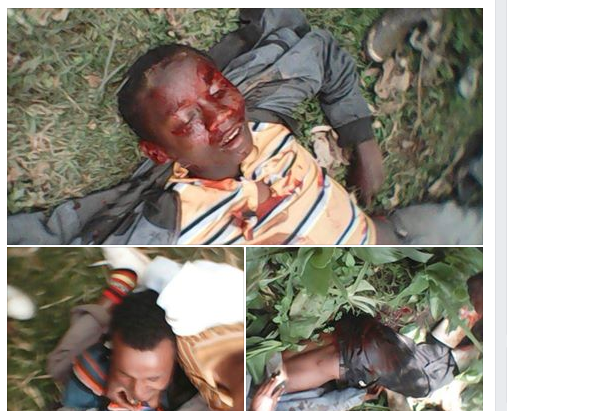
Members of the Ethiopian diaspora have been equally vocal, taking to social media to call attention to alleged atrocities. Jawar Mohammed, who is based in Minnesota, is perhaps the most prominent online activist, manning a number of social media feeds featuring bloody photos of dead demonstrators and grainy videos of police brutality that have become hubs for Oromo diaspora members around the world. His Facebook page has amassed nearly a half million followers.
“We have freelancers embedded in pretty much every district across the country,” said Mohammed, who was born in Ethiopia but works abroad as the executive director of the Oromia Media Network, a news broadcaster whose satellite feed here has been repeatedly jammed by the Ethiopian government. “They infiltrate the system from top to bottom,” he said in a Skype interview.
How much of an impact social media activism has had on the actual protest movement is a matter of debate. In a country with limited Internet penetration, and where the sole government-owned telecommunications provider has the power to shut down signals and block opposition websites, online activists like Mohammed are necessarily limited in what they can do. According to the engineering student in Adama, people on the ground are driving the protests, and social media matters “only a little bit.”
Where online activists have succeeded is in channeling video and photographic evidence of abuses to the outside word
Where online activists have succeeded is in channeling video and photographic evidence of abuses to the outside word. But even this evidence is difficult to verify; several journalists, including this correspondent, have been detained by officials for attempting to report in some of the worst-affected areas.
There are also questions about the direction social media activists have steered the debate surrounding the protests. Comments by Mohammed’s passionate social media followers sometimes advocate violence against members of the Tigray People’s Liberation Front (TPLF), a political party from the northern region of Tigray that dominates the government’s security and intelligence agencies. And because he and other online activists are far from the front lines, some argue that their social media posts are ultimately a distraction. The student who witnessed the altercation at the university in Adama, for instance, said he agrees with Mohammed’s political analysis, but is concerned that the Facebook page has become a magnet for a dizzying array of viewpoints — about religion, regional politics, and ethnic strife — that make the movement more controversial than it needs to be.
Still, Mohammed has a clear strategy in mind. When it comes to human life, he advocates nonviolence. But he encourages demonstrators to block trade routes, destroy the property of companies that are seen as operating against Oromo interests, and avoid bringing crops to market in order to raise food prices.
Might such tactics be unethical during the worst drought Ethiopia has witnessed in decades, which has left 10.2 million people in need of emergency food aid? “Morally, yes,” Mohammed said. “Strategically, no.”
Officials have no time for these “activists on the other side of the Atlantic,” said government spokesman Getachew Reda. He claimed that agitators, some of whom have backing from Eritrea, Ethiopia’s archrival, have infiltrated the ranks of the protesters and are responsible for the current violence. The government security forces, by contrast, have generally handled the situation professionally, he said.
“We may have some bad apples,” Reda said. “Otherwise, the security apparatus that we have in this country is very much oriented towards serving the interests of the public.”
Amid this war of words, normal citizens are caught in the middle. In the quiet café in Adama, the engineering student spelled out a set of remarkably prosaic demands: He would like to see more Oromo professors at the university, for instance, and a fairer allocation of resources for the region. But, he said, he stays quiet for fear of Ethiopia’s pervasive security and intelligence apparatus.
“People don’t feel free,” he said. “We are all psychologically impacted.”
After two months of violent demonstrations, the government announced that it was scrapping the master plan. It wasn’t enough. Some protesters said they didn’t believe it had really been canceled. Others were motivated by grievances that run much deeper than any development scheme, citing marginalization stretching all the way back to the late 1800s, when the Ethiopian emperor Menelik II swept in from the north to expand Ethiopia’s borders and establish the capital city in Oromo lands.
On paper, today’s federal system is meant to ensure some measure of autonomy for all of the country’s ethnic groups, including the Oromos. The ruling coalition, the Ethiopian People’s Revolutionary Democratic Front (EPRDF), is made up of four regional parties, including the TPLF and the Oromo People’s Democratic Organization (OPDO). But the government lost some credibility in May, when the EPRDF and allied parties won every parliamentary seat in a national election. Though the OPDO holds more parliamentary seats than any other party, protesters say the party either cannot or will not challenge the dominance of the TPLF — and Oromos remain marginalized as a result.
Officials say they are trying to promote meaningful dialogue. “It is the government’s responsibility to make sure that people’s legitimate grievances are addressed properly,” Reda said. To that end, OPDO officials have convened meetings with concerned citizens across Oromia, and hundreds of low-level officials have been dismissed for corruption.
But the government has continued to lean on its powerful security apparatus, which has both enabled Ethiopia’s impressive, state-led economic development and imperiled it by bringing ethnic tensions to the fore. The ongoing protests in Oromia point to cracks in the facade, where citizens feel left out as the government pursues its uncompromising vision of modernization.
By continuing to crack down on demonstrators instead of listening to their demands, Ethiopia risks compromising the reputation for political stability that fueled its unprecedented decade of growth and foreign investment. In that way, the government may soon erode the very foundation of its own economic ambitions.
Ethiopia’s fake economic growth borrows from ENRON’s accounting
J Bonsa analyses Ethiopia’s economic growth over the last ten years. Africa At LSE
More than 70 people have been killed and dozens wounded in an ongoing crackdown on peaceful protesters in Oromia. One of the underlying causes of the prevailing tense political situation is Ethiopia’s bogus claim about “miraculous” economic growth in the last decade.
The youth is not benefitting from the country’s supposed growth and doesn’t anticipate the fulfillment of those promises given the pervasive nepotism and crony capitalism that underpins Ethiopia’s developmentalism.
Courtesy: OPride
The ruling Ethiopian People’s Revolutionary Democratic Front (EPRDF) came to power in 1991 and briefly experimented with democratic transition. However, a little over a decade into its rule, the party’s former strongman, the late Meles Zenawi, realized that their pretentious experiment with liberal democracy was not working. Zenawi then crafted a dubious concept called, “developmental state.”
Stripped of the accompanying jargon and undue sophistication, Zenawi was simply saying that he had abandoned the democratic route but would seek legitimacy through economic development guided by a strong hand of the state. This was a ploy, the last ditch attempt to extend EPRDF’s rule indefinitely.
Using fabricated economic data to seek legitimacy and attract foreign direct investments, the regime then advanced narratives about its double-digit economic growth, described with such catchphrases as Ethiopia rising, the fastest growing economy in the world and African lioness. The claims that EPRDF has delivered economic growth at miraculous scales has always been reported with a reminder that it takes several decades to build democratic governance. The underlining assumption was that, as long as they deliver economic growth, Ethiopia’s leaders could be excused on the lack of democracy and human rights abuses associated with the need for government intervention in the economy.
EPRDF spent millions to retain the services of expensive and well-connected Western lobbying firms to promote this narrative and create a positive image of the country. These investments were also accompanied with a tight grip on the local media, including depriving foreign reporters’ access if they cross the government line. Ethiopia’s communication apparatus was so successful that even serious reporters and analysts started to accept and promote EPRDF’s narrative on rapid economic growth.
However, a few recent events have tested the truthfulness of Ethiopia’s economic rise. Drought and the resulting famine remain the Achilles heels of the EPRDF government. The government can manipulate data on any other sector, including the aggregate Gross Domestic Product, and get away with it, but agriculture is a tricky sector whose output is not so easy to lie about. The proof lies in the availability of food in the market, providing the absolute minimum subsistence for the rural and urban population.
The sudden translation of drought into famine raises serious questions. For example, it is proving difficult to reconcile the country’s double-digit economic growth with the fact that about 15 million Ethiopians are currently in need of emergency food aid.
Rampant famine
Except for some gullible foreign reporters or parachute consultants, who visit Addis Ababa and depart within days, serious analysts and students of Ethiopian economy know that authorities have often fabricated economic statistics in order to generate fake GDP growth. To the trained eye, it does not take a lot to find inconsistencies in the data series. In fact, Ethiopia’s economic growth calculus is so reminiscent of Enron accounting. (See my recent pieces questioning EPRDF’s economic policies, including anomalies in the alleged achievements of millennium development goals, crony businesses, devaluation, external tradeand finance.)
The tacit understanding in using GDP as a measure of economic growth is that responsible governments generate such data by applying viable international standards and subjecting the data to scrutiny and consistency checks.
Unfortunately, these standards are not foolproof; irresponsible governments with mischievous motives can abuse them. There is credible evidence that shows Ethiopian authorities deliberately inflated economic statistics to promote feel-good, success stories.
Let’s take the agricultural data, which is timely and topical given the ongoing famine. This came to light recently as the European Union tried to understand anomalies in Ethiopia’s grain market, particularly persistent food inflation which the EU found incompatible with the agricultural output reported by the Central Statistical Authority (CSA) of Ethiopia.
The EU’s Joint Research Centre (JRC) then developed the technical specification for studying the scope of the Cereal Availability Study in order to account for the developments in the Ethiopian cereal markets. The International Food Policy Research Institute (IFPRI) was selected to carry out the study.
Figure 1 (above) compares the EU-sponsored survey and the Ethiopian government’s survey produced by the CSA. I am using the data for 2007/08 for comparison. The negative numbers indicate that the IFPRI estimates were consistently lower than the CSA data. For instance, CSA overstated cereal production by 34 percent on average. This ranged from 29 percent for maize to 44 percent for sorghum. The actual amount of Teff produced is lower by a third of what’s reported by the CSA.
The research team sought to explain this “puzzle” by examining the sources of the confusion, the methodological flaws that might have led CSA to generate such exaggerated economic data. Toward that end, they compared CSA’s crop yield estimates with comparable data from three neighboring countries: Kenya, Tanzania, and Uganda (see Figure 2).
From 2000 to 2007, the average increase in cereal yield for these countries, including Ethiopia, was 19 percent. Yet the CSA reported a whopping 66 percent for Ethiopia’s yield growth. The country was not experiencing an agricultural revolution to justify such phenomenal growth. It is unrealistic that Ethiopia’s yield growth would be greater than the neighboring East African countries, particularly Kenya, where the agricultural sector is at a much more advanced stage. If anything, the reality in Ethiopia is closer to Uganda, which did not report any yield increase during that period.
This reveals the extents of data manipulation by Ethiopian authorities to create an inexistent economic success story and seeks political legitimacy using a bogus record. We now know the widespread distortions in official statistics on cereal production thanks, in no small part, to EU’s intervention in sponsoring a study and explaining the disparities. Cereals represent only a sub-sector in the agricultural realm. It is likely that worse distortions would be revealed if similar studies were done on Ethiopia’s growth statistics in other sectors, including manufacturing and service divisions.
‘Poverty reduction’
The IMF has praised Ethiopia for achieving accelerated growth with a focus on equity and poverty reduction, a challenging dilemma for most countries. However, a closer look at three interconnected facts turns this claim on its head.
First, as noted above, Ethiopia’s agricultural output has been inflated by 34 percent on average. Second, a33 percent poverty reduction since 2000 is widely reported. Third, there is a consensus that poverty reduction has happened mostly in rural Ethiopia. Now we put these three facts together and apply a simple logic to establish that the 33 percent poverty reduction is explained by the 34 percent exaggerated agricultural outputs. Notice that it is not by accident that the two percentage points are almost identical. Therefore, the ups and downs cancel each other out. In the best-case scenario, poverty rate must remain at the same level as in 2000.
The World Bank, IMF and other donors have often anchored their conclusions on poverty reduction on alleged changes in the agricultural sector, where the bulk of the poor live and work. Little do they know that the data they used to compute the poverty index comes from agricultural statistics with hugely inflated yield assumptions as shown above.
This raises the question: where has the billions of dollars in bilateral and multilateral aid pumped into Ethiopia in the name of poverty reduction and the millennium development goals gone?
‘The enclave economy’
The ‘Ethiopia rising’ storyline is a standard set by foreign correspondents who often repurpose official government press releases, or reports based on the construction projects in the capital, Addis Ababa.
For example, Bloomberg Africa’s William Davison, often uses the proliferating high-rise buildings in Addis Ababa as tangible evidence of Ethiopia’s double-digit economic growth. In his latest whitewash, Davison writes, “such growth is already visible in parts of the capital, where shopping malls and luxury hotels are sprouting up.” That a veteran reporter for a business website unashamedly passes judgment on economic success by referring to heights and width of buildings underscores his shallow understanding of the country’s social and political fabric.
Here are some of the questions that reporters aren’t asking and seeking answers for: Who owns those building? Where did the investment money come from? Are there any firm linkages between these physical infrastructures and the rest of the Ethiopian economy? I have partially answered some of these questions in a previous piece and will soon provide additional insights.
For now, I would like to draw attention to the existence of an “enclave economy” within the mainstream Ethiopian economy. This enclave is made up of highly interconnected crony businesses, which are owned and operated by Tigrean elites, who also have a tight grip on the political and military command structures. Take, for example, the Endowment Fund for Rehabilitation of Tigray (EFFORT), a business conglomerate affiliated with the Tigrean People’s Liberation Front (TPLF). EFFORT has its humble origin in the relief and rehabilitation arm of the TPLF. However, it has undergone amorphous growth and now controls the commanding heights of the Ethiopian economy. By some estimates, EFFORT now controls more than 66 business entities.
The EFFORT controlled enclave and related military engineering complexes have created a semi-autonomous economy in Ethiopia. They made smart choices and specialized in engineering and construction businesses. This means they do not have to rely on the Ethiopian public for their products; instead, each specialize in separate industrial branches and buy from each other and also sell to the government, which is also in their hand. The huge government infrastructural projects necessitated by the “developmental state” model create business opportunities for these engineering companies.
The enclave economy is only loosely linked to the mainstream economy and it does not benefit the bulk of the Ethiopian people in any meaningful way. The luxury hotels and supermarkets that Davison refers to cater for the needs of the affluent business classes, their families, and the expatriate community.
In other words, Ethiopia’s miraculous economic growth, if it in fact exists, must have happened only in the enclave economy. Statistically, it is possible to generate a double-digit economic growth at the national level through a combination of some real astronomical growth in the enclave component and stagnation or declines hidden, through some accounting tricks, in the rest of the economy.
Lock-in style of reporting
Unfortunately, the unquestioned reporting on Ethiopia’s economic success has continued. Even the EU study appears to have been shelved, or deliberately ignored despite the significant findings. Even as a fifth of the population is in need of emergency aid, the World Bank is sticking with the outdated data and has recently released a sensationalized report entitled “Ethiopia’s Great Run: the growth acceleration and how to pace it.”
The ensuing famine has shaken the foundation of Ethiopia’s growth narrative, yet western NGOs and media outlets appear to suffer from the lock-in effect in adopting consistent storylines. They continue to link and refer to the World Bank, IMF and others reports and indexes by multilateral organizations.
That’s why we continue to see comical headlines such as “Ethiopian Drought Threatens Growth as Cattle Die, Crops Fail,” which assumes that Ethiopia’s growth is actually occurring. This acquiescence does not only display ignorance, but it also underscores an effort to evade accountability for previous mistakes and failure to report accurate information.
In a recent interview with The Ethiopian Reporter, Prime Minister Hailemariam Desalegn made a rare and fateful admission: “if we crave for too much praise for our achievements, we might run the risk of undermining the challenges we are facing. These challenges could grow bigger and become irreversible and that would be detrimental.”
Over the past 25 years, the EPRDF worked tirelessly to create a distorted image of the country and began craving and lobbying foreigners for praises.
Enron’s success involved an elaborate scam, but the firm was named “America’s Most Innovative Company” for six consecutive years. This fame did not stop Enron from crumbling. EPRDF’s fate will not be any different. The Oromo uprising has already started the unraveling of its elaborate scams devised to attain legitimacy on the back of non-existent economic and democratic advancement.











 Oromian Economist
You must be logged in to post a comment.