
Economic and development analysis: Perspectives on economics, society, development, freedom & social justice. Leading issues in Oromo, Oromia, Africa & world affairs. Oromo News. African News. world News. Views. Formerly Oromia Quarterly
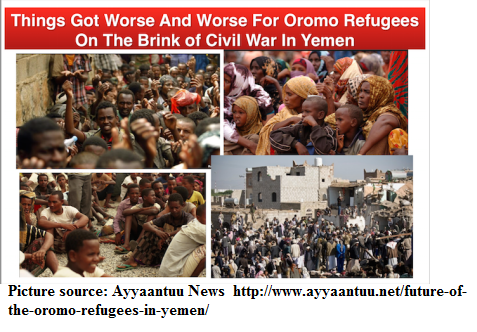
Since the civil war began in Yemen in 2015, the conditions there have only gotten worse and worse. So when you think of refugees, typically you think of people FLEEING the country and not trying to…
HARGEISA, 11 August 2015 (IRIN) – Qader and Abdi are two weeks into their journey. Carrying only one empty plastic water bottle each, flattened, with no liquid to return it to its cylindrical shape, the two men figure they will be walking for another month-and-a-half before they reach the sea. From there, they will take a smuggler boat the short distance to Yemen, where another 600-kilometre walk lies ahead before they may reach their final destination, Saudi Arabia.
The pair – members of Ethiopia’s largest ethnic group, the Oromo, which activists charge is systematically disenfranchised by the government – are walking along an uncrowded road connecting the capital of Somaliland, Hargeisa, to a northern port city. They walk because they cannot afford the roughly $150-200 that a series of smugglers would charge to take them from the Ethiopian border east through Somaliland to the port of Bosaso in the neighbouring semi-autonomous region of Puntland.“We will walk until we become weak,” said 30-year-old Qader, who withheld his last name to protect his identity. He and his 19-year-old companion are dressed in dirtied long-sleeve shirts to shield them from the early morning sun, which will become unbearable by midday. They have made it this far off the good will of Somalilanders who offer them small change or meals as they pass.There is a small risk they could be arrested so they veer off the paved road near checkpoints but quickly return so as not to lose their way. Although walking along roads in Somaliland – a self-declared nation that the international community still classifies as a region of Somalia – puts migrants like them at increased risk of robbery or assault, Somalilanders generally do not wish the duo ill will. Government officials have even been known to stop and provide food and drink to migrants despite their illegal status in the country.
When they reach Bosaso the help will likely come to an end and Qader and Abdi will have to pay. Unlike on land, which the destitute can traverse without charge as long as they can avoid arrest, the sea is only passable by ships operated by smugglers, who are more than happy to continue transporting people to war-torn Yemen for a fee.
Ever more dangerous journey
Migration to and through Yemen – historically the backdoor for migrants and asylum seekers from the Horn of Africa trying to reach Saudi Arabia – has always put people at risk of death and inhumane treatment. Last year, there were numerous drownings in the Gulf of Aden and Human Rights Watch released a report in 2014 documenting “torture camps” where smugglers held newcomers for ransom.
But a civil war, precipitated by the departure of Yemen’s internationally-recognised government and a Saudi Arabian-led bombing campaign to restore its legitimacy, has made an already perilous journey for migrants all the more death-defying.
“It’s very dangerous, and I cannot stress that enough,” said Teddy Leposky, an external relations officer for the UN’s refugee agency, UNHCR, in Yemen.
Not only has the war given smugglers license to act more ruthlessly than before, but also the ability of aid agencies to provide services to migrants and refugees has been severely compromised and the conflict’s violence has been indiscriminate. Five migrants were caught in shelling near the Saudi border in May and, at the end of March, a camp for displaced people camp was bombed, killing at least 45.
But as migrants and refugees know, the grinding poverty, political persecution or violence that typically push them out of the Horn of Africa, do not conveniently abate as wars break out in their path. So they continue to risk life and liberty and end up on Yemen’s shores. According to figures from UNHCR, more than 10,500 people have arrived in Yemen since March when the bombing campaign began. Although some of those might be part of the 51,000 who are now also leaving, as war in Yemen has created a circular flow in the region.
Exhausted survivors of the Gulf of Aden crossing wait for help on a beach in Yemen (file photo)
“I know it’s a high risk, but I will take it,” said Fila Aden, 24, in a café in Hargeisa. He is familiar with what lies ahead. This is the second time he left home in Ethiopia for work in oil-rich Saudi Arabia. Although he struggles to provide a precise timeline of events, he estimates he was deported from the kingdom about a month ago after working there for almost a year.Hiding the risks
Some aid officials believe that boat smugglers in Bosaso and Djibouti (for the Red Sea route to Yemen) may be downplaying the conflict in Yemen or flat-out lying to clients about the dangers they have seen.
Fila Aden in Hargeisa doesn’t doubt smugglers are sugarcoating forecasts, but he thinks the conflict in Yemen might actually work to his advantage. He is reassured by news that one of his friends just traversed Yemen and slipped unnoticed across the border with Saudi.
“We worry about Yemen. We could be accused of fighting [for a certain side] in the conflict. People are more paranoid now,” he said. “But looking at it from the Saudi perspective, they aren’t concerned about us. They are fighting a war in Yemen.”
As long as those like Aden are willing to go, there is money to be made. Several sources said the smugglers had doubled their asking price in Bosaso, which pre-war ran from $60 to $120 for the sea crossing. Omar, who asked that a pseudonym be used, smuggles Ethiopians from the border into Somaliland. He is fairly new, joining the ranks of the illicit business just five months ago. But the job has proven lucrative. He saw a drop in numbers around the time war broke out in Yemen, but Ramadan (which straddled June and July this year) was profitable, suggesting an uptick in those still willing to go to Yemen.
“People know damn well that they are taking a risk,” he said, when IRIN asked if smugglers were taking advantage of the war and luring clients under false pretenses. But he said smugglers too were taking extra risks, and more and more fearful of arrest. “I feel bad sometimes but what can I do? I have to make a living.”
No refuge any more
While Omar continues to facilitate a migrant march east, deteriorating conditions in Yemen have destroyed a refuge that many once sought.
Abdulqader Ahmed, a 17-year-old Ethiopian migrant, arrived in Yemen in March from Djibouti right as street battles began to erupt in the southern port city of Aden. He made his way to the UN-sponsored al-Kharaz camp nearby, too afraid to begin his journey north to Saudi Arabia. He watched as the camp ran short of food and water, with aid agencies unable to get supplies in. Finally, he managed to secure passage on a ship that evacuated him to Somaliland.
At a migrant response center in Hargeisa, where he was waiting to be repatriated back to Ethiopia, Ahmed said the war in Yemen had helped him reach the realisation that his goal of getting to Saudi Arabia would likely cost him his life. He now intends to return to farming with his father in Ethiopia, even though it will be almost impossible to earn a living.
For UNHCR’s Leposky, Yemen’s collapse is particularly concerning because of the country’s history of opening its borders to refugees and asylum seekers. He told IRIN that those arriving now in Yemen are making the costly journey across the sea only to find themselves in a similar situation, if not worse.
“It’s so unfortunate that a country that has provided protection and asylum to people for so many years is now in dire straits.”
Carmelo Imbesi—APMigrants wait to disembark from the Irish Navy vessel LE Niamh at the Messina harbor in Sicily, on Aug. 24, 2015. Source:- http://time.com/4031569/migrant-crisis-europe-african-refugees/
There is growing concern that Europe may unwittingly divide migrants into two distinct classes
With E.U. leaders finally working on a Europe-wide refugee policy, there is growing concern among some migrants and aid officials that the new policies might unwittingly divide the migrants into two distinct classes—with two different kinds of welcomes.
First, the hundreds of thousands of Syrians fleeing the war back home, whose stunning flight into Europe has seized world attention; and second, the hundreds of thousands of much poorer, less educated newcomers who have also fled dire circumstances in Africa.
As EU officials prepare to meet in Brussels on Monday to hash out an emergency plan, the details are sketchy as to how the continent will integrate the massive influx of migrants who have crossed into Europe from Asia, Africa, and the Middle East. On Wednesday the European Commission President Jean-Claude Juncker made it clear to the EU Parliament that the union’s 28 countries were duty-bound to help host the 160,000 asylum-seekers currently stuck in Greece, Italy, and Hungary, and emphasized that all would be treated equally. “Europe has made the mistake in the past of distinguishing between Jews, Christians, Muslims,” he said. “There is no religion, no belief, no philosophy when it comes to refugees.”
Yet, for some of the 80,000 or so who have landed in Sicily this year—the vast majority African—the promise of fairness for all sounds unconvincing.
Africans who have fled deadly, often forgotten conflicts, or various kinds of persecution—including religious and anti-gay violence—say they believe it could take years to win refugee status or residence in Europe, if they ever receive it at all. Those simply fleeing poverty, and there are many, are not eligible for asylum.
Instead, many predict a long, tough road towards acceptance and employment somewhere on the continent. Several African asylum-seekers in Sicily described overwhelming bureaucratic hurdles towards those goals — a far different picture than the tens of thousands of Syrians whom the E.U. and U.S. now appear willing to host.
Yet both sets of newcomers share one experience: life-threatening journeys to Europe. “”We risked everything to cross the Mediterranean,” says Samate, a tall 17-year-old from Senegal, sitting in a detention center in the Sicilian town of Messina on Wednesday. He said he fled his home last February after separatist rebels in the disputed Casamance region where he comes from tried to draft him into battle. The Italian Coast Guard rescued him and other migrants as they tried to cross the Mediterranean on in late July, and brought them to Sicily.
About half of those who have landed on Europe’s shores this year have been Syrian, according to the U.N. refugee agency, most crossing from Turkey to Greece, before moving quickly on to Austria, Germany and Sweden. But a large portion of the rest are Africans who have crossed from Libya to Italy—a more lethal sea route that has so far killed more than 2,200 migrants this year. Most have arrived after hair-raising treks across the vast, searing Sahara, and then weeks in Libya’s migrant jails. Samate’s five-month journey included working for traffickers in Niger and Libya at meager wages.
Far different from the Syrians clambering off boats in Greece, the Africans land in Sicily penniless and empty-handed. When I ask to see what they carried with them, most look puzzled, then point to the clothes on their back. “I arrived with nothing, not even my documents,” said Mandjo, 16, from Guinea, who fled when religious violence destroyed his village. What little he grabbed as he fled was lost to bandits along the way.
Now, the plight of African refugees like Mandjo risks getting lost amid the Syrian refugee crisis in Europe, aid officials say. “It’s important to us that Europe is now beginning to talk about opening their borders and welcoming refugees,” says Giovanna Di Benedetto of Save the Children in Sicily. “But it is not only Syrians who have to be welcomed.”
To underscore her point, Di Benedetto whips out her iPhone to show me photos of dead African infants whose bodies washed ashore on a beach off Zuwara, Libya on August 28, when their smugglers’ boat capsized. About 200 people drowned when the ship overturned.
Five days later, a photo on a beach off Bodrum, Turkey showed another dead toddler: Aylan Kurdi, a three-year-old Syrian boy. That image finally jolted EU leaders into action. “Syrians of course need help, but they are not the only ones,” Di Benedetto says. Shaking her head at the photos of dead African children on her phone, she says she wonders whether Aylan’s “white skin” made the difference.
On Wednesday, Juncker, the European Commission President, announced a new €1.8-billion fund for Africa that will be financed from the EU’s operating budget. The fund is meant to address “root causes of illegal migration in Africa,” and Juncker expects individual European countries to “pitch in” with more money to effectively persuade Africans to stay at home, rather than move to Europe. He said the money would help generate jobs in Africa, thus reducing “destabilization, forced displacement and illegal migration.”
Such programs, sorely needed, could take generations to work, however. In the meantime, thousands of African migrants await settlement inside Europe’s borders.
How the EU will address this more immediate problem that problem is less clear than the issue of the new Syrian arrivals. “The EU is talking about the Syrians,” says Valeria Morace, an Italian working in the Messina center for unaccompanied minors. “But politicians don’t talk about Africans in general, because they are not really doing anything for them.”
Human rights organization appeals to UNHCR for lifesaving assistance to Oromo refugees in Yemen
The following is a statement from the Human Rights League of the Horn of Africa (HRLHA), “a non-political and nonpartisan organization which attempts to challenge abuses of human rights of the peoples of various nations and nationalities in the Horn of Africa. HRLHA is aimed at defending fundamental human rights, including freedoms of thought, expression, movement and organization. It is also aimed at raising the awareness of individuals about their own basic human rights and that of others. It has intended to work on the observances as well as due processes of law. It promotes the growth and development of free and vigorous civil societies.”
——-
May 16, 2015
HRLHA’s Appeal to the United Nations High Commissioner for Refugees (UNHCR)
Mr. Antonio Guterres
United Nations High Commissioner for Refugee (UNHCR)
Case Postale 2500
CH-1211 Geneve 2 Depot Suisse
Emails: infoDesk@ohchr.org; GUTERRES@unhcr.org
Attention To:
Mr Amin Awad
Middle East and North Africa Bureau
UNHCR, Geneva
Dear Mr. Guterres,
The Human Rights League of the Horn of Africa/HRLHA is very concerned about the current humanitarian crisis in the Republic of Yemen following the internal conflicts and political instabilities that have broken down the social services in the country. Many nongovernmental and humanitarian organizations are reporting that the crisis in Yemen has highly affected refugees and asylum seekers who came from the Horn of Africa to Yemen to escape the volatile situations in Somalia, Ethiopia, Eritrea and other places. Among the most vulnerable are Oromo refugees and asylum seekers residing in Sanaa, Aden and other areas in Yemen.
According to the letter disseminated by the Oromo refugee community in Aden-Yemen under the heading “Only Oromo refugees are still caught up under the fire and critical circumstance and also expecting an imminent danger”, Oromo refugees are desperately seeking attention and lifesaving assistance of the UNHCR. The UNHCR’s Middle East and North Africa branch office confirmed its commitment to providing life–saving assistance for the needy people under its strategy’s priority: “UNHCR’s strategic priorities in 2015 are: to deliver innovative operational responses, including lifesaving assistance; to ensure protection for all people of concern with a particular focus on the most vulnerable, especially those in urban areas; to seek durable solutions, including resettlement as a protection tool; and to continue to respond to ongoing emergencies.” (UNHCR, Middle East and North Africa – http://www.unhcr.org/pages/4a02db416.html)
Dear Mr. Guterres,
HRLHA, Amnesty International and Human Rights Watch have reported and are still reporting that the Oromos are fleeing their country to escape persecutions by the current Ethiopian government led by the TPLF/EPRDF. The recent research document released by Amnesty International – “Because I am Oromo” – Sweeping Repression in the Oromia Region of Ethiopia – exposes that how Oromos have been regularly subjected to arbitrary arrests, prolonged detentions without charges, enforced disappearances, repeated tortures and unlawful state killings since 1991, when the current Ethiopian government came into power, as part of the government’s incessant attempts to crush dissidents.
Dear Mr. Guterres,
Thousands from other nations and nationalities in Ethiopia have also been killed, kidnapped and arrested by the TPLF/EPRDF government because of exercising their fundamental rights or holding political opinions different from TPLF/EPRDF’s political agenda.
Therefore, the HRLHA politely urges the UNHCR to:
1. Provide food and shelter assistance to vulnerable Oromo and other refugees in Yemen
2. Move them to safer neighboring countries in the Middle East or beyond.
Sincerely,
Garoma B. Wakessa
Director, HRLHA
Contact Addresses:
– 994 Pharmacy Avenue, M1R 2G7 Toronto Ontario, Canada
– Tel:- (416) 492 2506 or (647) 280 7062
– E-Mail:- hrldirector@mail.org
– Web site:- www.humanrightsleague.org
This article provides photos and personal stories of some of the many migrants risking the Mediterranean crossing to arrive in Europe. This dangerous undertaking would not be attempted if the situation they left behind was not so dire.
The following is a statement from the Oromo Community of Minnesota.
The United Nations High Commissioner for Refugees
94 rue de Montbrillant
Geneva, Switzerland
Subject: Urgent Appeal on Behalf of Oromo Refugees Stranded in Yemen
The Oromo Community of Minnesota (OCM) is sending an urgent appeal to all governmental, non-governmental and UN humanitarian agencies, on behalf of Oromo refugees stranded in Yemen due to the ongoing fighting in that country.
The Oromo in Minnesota, the largest Oromo community outside East Africa, is following the plight of refugees in Yemen with great trepidation. Our compatriots make the difficult decision to flee from their beloved homeland due to rampant and persistent persecution by successive Ethiopian regimes. Their choices are either to stay in their country and remain silent over the daily injustices or speak up and get sent to prisons for the simple reason of asserting their inalienable rights; dare to oppose violations of human rights and face disappearance, long incarceration without trial, and extra-judicially killings simply because, to use the words of Amnesty international’s recent report, they are Oromo.
These refugees had to cross through harsh environments to get to the Gulf of Aden and then board overcrowded boats. They took these risky steps to escape more serious dangers at home. As the situation in Yemen deteriorates, most of the Yemenis have moved out to the relative safety of the countryside, while other refugees have left to other countries. The only helpless ones still stranded in urban centers are Oromo refugees. We are gravely concerned for their safety.
Our urgent appeal is for the protection of their critically endangered lives based on humanitarian grounds and their evacuation to a safer country. We humbly request that repatriation to Ethiopia not be an option as they are going to face persecution by the Ethiopian government, which is what drove them to make the excruciating choice of becoming refugees in the first place.
Therefore, the Oromo Community of Minnesota is appealing to all humanitarian agencies and all individuals of goodwill to do all things in their means to assist our brothers and sisters caught up in the present tragic situation in Yemen. Our community is ready and on standby to cooperate with humanitarian agencies in their concerted efforts to save the lives of our people.
Sincerely,
The Oromo Community of Minnesota
CC:
– International Organization for Migration
– International Red Cross and Crescent Societies
– American Refugee Committee
– European Union
– US Department of State Bureau of Population, Refugees, and Migration
– American Red Cross Society
– MN Congressional Delegation
– Minnesota Governor Mark Dayton
Mr. António Guterres, UN High Commissioner for Refugees
Case Postale 2500 CH-1211 Genève 2 Dépôt Switzerland
Your Excellency Mr. Guterres,
The Board of Directors of the Macha-Tulama Association, USA, is writing this urgent letter to bring to your attention about the suffering of thousands of Oromo refugees and other nationals in Yemen, South Africa, Libya as well as in the Middle East and Africa. Among these refugees were individuals who were killed or beheaded by terrorists and other criminal elements. Furthermore, the most vulnerable elements of these refugees such as the sick, women, children and elderly are dying every day. At this moment no calling is more urgent and noble and no responsibility greater for the leadership of UNHCR than trying its very best for saving the lives of thousands of Oromo refugees and others who are trapped among warring factions in Yemen and attacked by terrorists in Libya and burned by criminals in South Africa.
The Macha-Tulama Association (MTA) is a non-profit organization legally registered in the United States of America for advancing the objective for which the main MTA was established in Oromia (Ethiopia) in 1963. For your information, the Oromo constitute the single largest national group in Ethiopia. And yet, they are political minority in that country. Consequently, successive Ethiopian governments, including the present one, have banned MTA, the only civic institution of the Oromo people in the Ethiopian Empire. The MTA envisioned mobilizing Oromo citizens for fighting illiteracy, diseases, constructing schools, building roads and clinics, promoting Oromo self-consciousness, and reviving Oromo language, culture and history. It also struggled to restore the human dignity and inalienable rights of the Oromo people that have been suppressed by successive Ethiopian regimes.
Continuing the policies of the previous regimes of Ethiopia, the current minority Ethiopian government has intensified political repression as well as land-grabbing and transferring other economic resources of the Oromo and other peoples to the current government officials, their supporters and foreign corporations. It is the Ethiopian government’s policy of illegal land grabbing and political persecution of the Oromo and others that have forced the young, old, women and children to flee from their fatherland and get exposed to dangerous conditions in foreign lands. Oromo refugees and other nationals who have been forced to leave their homeland by the political and economic repression of the current minority Ethiopian government are exposed to gross human rights violations and terrorism. These refugees have been forced to flee from their homeland in order to seek protection from persecution, arbitrary imprisonment, torture and extra-judicial killings because of their ethno-national and religious identities, political opinions and their economic resources. According to Amnesty International report, entitled ‘Because I am Oromo: Sweeping Repression in the Oromia Region of Ethiopia, between 2011 and 2014 at least 5000 Oromo were arrested, tortured, and faced extra-judicial executions because of being Oromo, and for also peacefully demonstrating against the regime’s land grabbing policies and the so-called Addis Ababa Master Plan that has been intended to evict millions of Oromo farmers from their prime land around Addis Ababa (Finfinnee), the capital city of the Ethiopian Empire.
Unfortunately, global powers and international financial institutions indirectly finance the gross violations of human rights of the Oromo and other people claiming that the current minority Ethiopian government is “democratic” and promotes “development.” For the Oromo and other people who have been terrorized and evicted from their ancestral lands, the claims of democracy and development are just propaganda ploys. In fact, the policies of this dictatorial regime are exposing the Oromo and others to unimaginable misery. When the people have resisted illegal removal from their ancestral lands, the current Ethiopian government’s police force and soldiers have beaten and detained them without trial, and many have been killed. It was for the purpose of saving their lives that thousands of Oromo and others have fled from Ethiopia to foreign lands. However, those who fled to South Africa, Yemen and Libya have faced torture, looting, and burning; they have been also beheaded, raped, tortured and killed by criminal elements and extremists. (Please see the following sites and videos for further information). http://www.ayyaantuu.net/ethiopia-muslim-martyr-among-those-killed-by-isis/; http://www.theguardian.com/commentisfree/2015/apr/20/south-africa-xenophobic-violencemigrant-workers-apartheid; http://www.csmonitor.com/World/Security-Watch/terrorism-security/2015/0420/Islamic-Statemurders-30-African-migrants-in-Libya-while-up-to-700-died-off-coast-video
Particularly, there are thousands Oromo refugees in Yemen alone in areas including Sana, Eden and other refugee camps. The current political crises and turmoil in Yemen has put the lives of these refugees in a very dangerous condition. These refugees are trapped among warring factions without any help from international and regional organizations such as yours. Many of these refugees have been raped, imprisoned, wounded or killed. They are also exposed to terrorists, fundamentalists, slavers and human traffickers. We are gravely concerned about the deteriorating conditions of Oromo and other refugees in Yemen, South Africa and Libya. These refugees are concentrated in camps and other places without adequate food, shelter and medical services. Therefore, we appeal to the UNHCR and your leadership to take the following urgent actions:
• First, we request that the UNHCR demand that the governments in Yemen, Libya and South Africa provide protection for Oromo and other refugees who have sought protection and safety in their countries.
• Second, we request that the UNHCR provide material support urgently for those Oromo refugees and others who are trapped among warring factions, especially in Yemen.
• Third, we appeal to the UNHCR to arrange suitable conditions with other countries for these refugees to have an opportunity for permanent settlement in third countries.
• Fourth, we request that the UNHCR seeks permanent solutions through the United Nations for eliminating political and economic conditions that have produced tens of thousands of Oromo and other refugees from Ethiopia.
• Fifth, we request that the UNHCR persuade big powers and international financial institutions not to finance the Ethiopian government’s policy of land grabbing, which has evicted tens of thousands of Oromo nationals and others from their ancestral lands.
We believe that as the UN High Commissioner for Refugees and the principal voice on refugee issues, you have an extraordinary opportunity to alleviate the incredible human sufferings of the Oromo and other refugees in Yemen, Libya and South Africa and in other countries. We urgently request you to take a concrete measure that will save the lives of Oromo and other refugees who are trapped among warring factions in Yemen. Additionally we request you to urge the government officials of Libya and South Africa to protect Oromo and other nationals in their countries. Finally, we thank you for your interest in the wellbeing of the Oromo and other refugees from Ethiopia and for taking concrete actions to protect them.
Sincerely,
Abera Tefera,
For the Board of Directors of the Macha-Tulama Association, USA
Macha Tulama USA: Urgent Call to Help Refugees in Yemen, Libya and South Africa
April 21, 2015
As we all have been following the events happening in Yemen, South Africa and Libya and other countries in the Middle East and Africa, Oromos and other nationals are facing gross human rights violations, brutal and cold blooded murder. Oromos are appealing to Macha Tulama Association (MTA) to stand for them in any capacity as soon as possible. The appeal and plea are coming to MTA email address daily in large number. Our people are in desperate situation in the countries where they are seeking refuge to save their lives.
In the past, MTA-USA offered modest help in the wake of such emergencies. What is happening now is even more dangerous for Oromo nationals. MTA is now ready to facilitate the collection and delivery of financial support to those who are in desperate need. Time is of the essence in this issue. MTA is also planning to find the ways to support the resettlement works of the UNHCR and International Organization for Migration (IOM).
Therefore, we hereby request all Oromos and friends of Oromos to respond to these emergency calls for support of our brothers and sisters by contributing as much as we can online or by mailing check or money order to our address. We have created a separate account for this specific purpose. The board of MTA will look in to the means and ways of disbursing the funds soon and will announce on our website and social media.
To donate online, click on the “Donate” button below which takes you to “Emergency Reponse – Yemen, Libya and South Africa” page.
If you want to send check or money order, please make it payable to Macha Tulama and mail to the address below. If you have any question, email us at machatulama.usa@gmail.
Letter to UN from Oromo Community in Seattle on Plight of Refugees in Yemen
Open letter to UNHCR from the Oromo Community Services of Seattle (OCSS)
………………………………………………………………………………………………………………..
Antonio Guterres, United Nations High Commissioner for Refugees
Case Postale 2500
CH-1211 Genève 2 Dépôt
Switzerland
Dear Commissioner Guterres,
We, the Oromo Community in Seattle*, are writing this letter to express our deep concern and dismay regarding the inhuman suffering of Oromo refugees in Yemen. Thousands of Oromo refugees have fled their homeland to neighboring countries, including Yemen, seeking protection from persecutions, large-scale arbitrary detentions, disappearances, tortures and extra-judicial killings they would be subjected to from the Ethiopian government due to their ethnic identity and political opinions. According to the Amnesty Internationalreport ‘Because I am Oromo’ – Sweeping Repression in the Oromia Region of Ethiopia, that was released on October 2014, between 2011 and 2014, at least 5000 Oromo have been arrested, tortured, and faced extra-judicial executions due to their peaceful opposition to the government. This report is self-evident that Oromo were forced to escape to rescue their lives from possible harassment of the Ethiopian government.
Currently, it is estimated that over ten thousands Oromo refuges reside in refugee camps in Yemen, including Sana and Eden. The current political turmoil in Yemen put the refugees’ lives in dire situation. Reports reaching us from Yemen indicate that refugees are trapped with no help in situation beyond their control. We have also received a report that a number of Oromo refugees have been killed, and some of them wounded by the flying bullets and indiscriminate ongoing fighting due to lack of adequate protection. Lives that they clenched to save are again put them in grave danger.
We are gravely concerned about the deteriorating condition of Oromo refugees in Yemen unless your leadership and international community intervene as soon as possible, and necessary steps are taken immediately to save the lives of the refugees. Oromo refugees in Yemen are also suffering from lack of food, shelter and medical care. Furthermore, the Ethiopian government security agents follow Oromo refugees and abduct some individuals using the current political crisis as an opportunity. This situation also jeopardizes the safety of the refugees.
We believe that, at this critical juncture, your leadership and the active engagement of the international community could mean the difference between life and death for many Oromo refugees. The Universal Declaration of Human Rights, signed in 1948 and 1951, have articles that recognize the rights for refugees. Any country that has signed these declarations is obliged to respect them. When every letter of these declarations violated, member countries of the UN and humanitarian organizations should not keep silent.
Your Excellency,
We strongly believe that as a UN refugee agency, you are sanctioned to making a lasting impact on the lives of refugees and other displaced communities around the world by focusing on the basic needs and rights for refugees – like shelter, water, food, safety and protection from harm. Silence about the dire situation of Oromo refugees in Yemen is not only inhuman, but it is also a flagrant violation of the letter and spirit of the 1951 UN Convention, the 1967 Protocol Relating to Status of Refugees, and the UN General Assembly Resolution 2198 (XXI).
It is a duty of the United Nations High Commissioners for Human Rights, UNHCR and the international community to take a swift action to rescue the refugees whose lives and freedom have fallen in a grave danger. We earnestly demand the UNHCR and member nations to extend their humanitarian assistance so as to find a way in which the refugees could be rescued from that imminent humanitarian disaster that may result in carnage. We believe Oromo refugees, as any other people in the world, are entitled to get protection and humanitarian from the UNHCR and governments that signed 1951 Geneva Convention.
We, therefore, appeal to the UNHCR, all UN member nations and other humanitarian organizations to put all necessary pressure on the governments and groups to refrain from violating the rights of refugees in Yemen and territories under their control. As the current situation in Yemen exposes Oromo refugees to further threats, we demand respectfully the UNHCR Office to find urgently durable solutions in which the lives of the refugees can be saved. We also request urgent medical care, food and shelter for Oromo refugees in Yemen.
Sincerely Yours,
Oromo Community Services of Seattle
C.C:
H. E. Ban Ki-moon
Secretary-General
The United Nations
New York. NY 10017
E-mail: Inquiries@UN.Org
Fax: 212-963-7055
U.S. Secretary of State
John Kerry
Washington, DC 20520
E-mail: Secretary@state.gov
European Union
E-mail: public.info@consilium.eu.int
Fax: Fax (32-2) 285 73 97 / 81
U.S. Committee for Refugees
1717 Massachusetts Ave. NW
Suite 200
Washington, DC 20036
Tel: 202-347-3507
Fax: 202-347-3418
E-mail: uscr@irsa-uscr.org
Amnesty International
International Secretariat
1 Easton Street
London
WC1X 0DW, UK
Fax: +44-20-79561157
Human Rights Watch
Rory Mungoven
Global Advocacy Director
350 Fifth Avenue, 34th Floor
New York, NY 10118-3299 USA
Tel: 1-(212) 290-4700
Fax: 1-(212) 736-1300
———– * Oromo Community Services of Seattle
Address: 7058 32nd Avenue S. Suite # 101 – Seattle, WA 98118
Tel: (206) 251-1789
(Oromo Refugees in Aden) – Yemen seeking for international attention to the excessive discrimination made against us, in particular all the last two decades. The right delayed is the right denied.
Subject: problem of the Oromo Refugees in Yemen remains unsolved, while Other refugees enjoy with fair protection and the rights (to live or move with free, education, health, resettlement out of Yemen just for better changes of life etc) which the Oromo refugees are denied even, after more than 17 years of deprivation and discrimination. And now under fire of the war
Who is behind and why is this all about? Is it sensible to think or say that such huge discrimination and inhuman treatment against the Oromo refugees, in particular is made out of the sight of or, does the international community including the relevant law intends to discriminate against the Oromo refugees? And what will the outcome or effects of the closed eyes (of the governments, human rights etc) to the abuses facing the Oromo refugees in Yemen be on future of the human rights?
Despite the prevailing situation is serious in general and probable to deteriorate our situation from bad to worse or to expose us more to the dangers anticipated/ intended, but it is not seemed however to be much different from the war of the excessive discriminations inflicted on us, in particular since more than 17 years as refugees in Yemen. As Oromo refugees we were under constant threats, intimidation, systematical discrimination and deprivation of the rights as refugees and, or the right to seek /claim against or for fair protection and treatment as equal as the other refugees in Yemen.
Specific details
Threats: harassment and extortion the Oromo refugees with UNHCR mandates (in the streets, at their work places and even, in their home etc) by the police just for they are” Oromo refugees” that compelled the Oromo to hide under the pretense of Somalis on need (during movement out of the living area etc). Intimidation: frightening the Oromo refugees by threatening situation or forcibly deportation for claiming for the right to protection, equal treatment to other refugees, Or for claiming against the abuses. Systematical discrimination: whenever we seek for the right to (protection, education, etc), the response for this by UNHCR (national staffs) in Aden is to say that we are not allowed to have or to seek for these rights in Yemen because the authority doesn’t recognize or that it does consider the Oromo refugees as illegal.
We are honest that we should respect the irregular policy of the Yemeni government towards us because it has been clear to be unwilling to grant the Oromo refugees as others. But we are seriously pointing to UNHCR which fails a pinnacle of its obligation towards us by procrastination with our refugee protection.
Oromo refugees particularly, in Aden are trapped in the moist of systematical pressures and deprivation by UNHCR , which was and still having political outlook towards us and practicing very scathing criticism( as to blame us as though we behave to contravene against the law etc) and misinformation against us excessively as a pretext to disprove or deny as well as to blur the international attention towards the well-founded and flagrant threats facing the Oromo refugees, in particular in Yemen. Whatever we seek or claim for (e.g. Refugee protection, assistance, the rights etc as refugees) is distorted as being for resettlement (: as if our entire claim intends for resettlement) even though it is for specific assistance. On the contrary, UNHCR is giving resettlement in third countries just for better change, for non-Oromo refugees those are granted all the rights as equal as the host community. Sometimes UNHCR claims that they are treating the Oromo refugees as same as the others by offering them assistance needed including resettlement. And at the same time they contradict what they’ve already mentioned by saying that ‘our refugee status has been deaden for belonging to the (OLF), which has lost its political legitimacy in the world. But they are still unable to respond to the question says “ how could the Oromo Refugees in Aden – Yemen seeking for international attention to the excessive discrimination made against us, in particular all the last two decades. The right delayed is the right denied. failure of the” OLF” policy in the world effect on only the refugees in Yemen apart from those in other countries of asylum”?
We are under influence of the national staffs who struggle hard to hide and confuse the actual facts related to our prolonged sufferings. UNHCR expatriate doesn’t perceive severity / situation facing us, because we are denied the right to access to persons of concern, and any written letter is interceded by the staffs intend to fail our reasonable claim before reaching the person of concern. So, they use to deter and eliminate us even, our committee leaders by their guards or the police. The staffs just then give the expats distorted information and persuade them wrongly about our intention.
What kind of the humanity is this, of which the deserving people are deprived while offered for those who should be considered as secondary concern?
In spite of such flagrant abuses, unkind treatment and discrimination treated against Oromo refugees, but the international community uses to turn a blind eye towards us by relying on the distorted information given by its customers (UNHCR) concern problems of the Oromo refugees.
All this discrimination is made to us because we are defenseless and without advocate, although the situation necessitates because the general attention to the refugee protection has become less and complicated unless international advocacy is made on behalf of these refugees according to the relevant laws. But the silence of the international community, Human Rights watch etc towards these inhuman treatments against the Oromo in particular has discouraged humanity and courage much more the abusive policy of the Ethiopian government against Oromo in Yemen.
UNHCR has played very crucial role in getting the Oromo refugees deprived of not only the rights as refugee in Yemen, but also of humanitarian intervention endeavored by some government interests and supports humanity such as( the government of Canada, which made great attempts two consecutive years [ 2004, 2005 ] willingly intending to give the Oromo refugees citizenship. But UNHCR in Aden denied the two times missions preventing them even, from visiting location of the Oromo refugees. However, we never forget the praiseworthy attempts intended by government of Canada.
The prolonged deprivation or discrimination treated against us has now been affecting our children those were born under the flag of UNHCR in Yemen. If the law itself discriminates against the parents, isn’t there any of the laws which support the right of the children?
This is not for the first time but we wrote a lot of petition to you since 2004 but never brought any positive change. Instead, we have been made to face worse and badly overreacted pressures resulted from the petitions applied, because no intervention or attention has been made towards us, excepting the amnesty’s very humanitarian Endeavour which should never be forgotten. But UNHCR blocked the process before reaching destination.
Comment on the Oromo communities in (the global continents) On behalf of the Oromo refugees living under appalling condition in Yemen, we would like to mention fraternal regards to all the Oromo communities in the world and we hope for you great success in your efforts aiming for the Oromo problems inside and outside of Oromia in general and for the Oromo Refugees in Aden – Yemen seeking for international attention to the excessive discrimination made against us, in particular all the last two decades. The right delayed is the right denied. Refugees those have threatened by the abusive policies emanating from the despotic government of Ethiopia in countries of asylum.
As we believe Oromo has lots of intellectuals in many countries in the word but we are disappointed and surprising about their silence on the sufferings of their people (refugees). What is the main role they have played in bringing a possible solution for their threatened refugees particularly, those in the Arab countries although a massive petition to you has been applied? We hope this time should not be as before.
You are aware of what is going on in Yemen that has compelled the international community to take its peoples from Yemen. Refugees (Somalis) have been leaving and others even, the Eritrean refugees have been promised by the Ethiopian authority to be taken from Yemen. But what about the Oromo refugees who have nowhere to return although Oromo is the most vulnerable, the most threatened refugee in Yemen? UNHCR in Aden also has left us heedlessly and without even, a piece of advice concern the dangers surrounding despite we are the most liable refugees to any possible threats on the ground more than any others.
Effects expected from this deterioration towards us: Oromo refugees in Yemen are beset by Ethiopian abusive policy through the Saudi which is striking on Yemen.
As we know the last aggressive deportation process made against thousands of Ethiopian from Saudi Arabia was carried out by the request from the Ethiopian authority through its friendly relationship with kingdom of Saudi. And now it is controlling completely all over Yemen and it is intending to deploy its forces that can be very harmful to us in Yemen. It is believable that Saudi will carry out forcibly deportation against us on the request of Ethiopia. In addition there is rumor information that some political faction in Yemen uses to recruit and exploit peoples (refugees) in struggling. And this can make us target to any possible revenge.
As remembered last year on 7 March 2014 Ethiopian authority came to our settled area called Basateen with Yemeni authority to make plane how to deport Ethiopian refugees In Aden/ Yemen. The other side is the Ethiopian government is planning and made agreement with Djibouti government to deport Oromo refugees in Yemen by sea if by the plane is impossible, as we hearing information and we seen in this month they taken 30 Ethiopian embassy community from Aden to Ethiopia by the sea.
Therefore, we are writing this urgent appeal letter to international community( US government, human rights organizations and others) seeking your urgent attention and assistance to get us rid of this threatening situation as soon as possible.
Finally, we would like to insist you( the Oromo communities and representatives wherever they are) to give a good support to this petition and enable it reach to all peoples of concern and governments possible to give us lasting solution as humanitarian.
Thank you
You can contact to: Abdulmalik Mohamed Ahmed. Mobile No, +967-771361374
Ahmed Kamal Abdalla, Mobile No. +967-771605410/+967-734420407
Over 250,000 East African refugees trapped in Yemen
Many refugees and asylum-seekers from Somalia, Ethiopia and Eritrea say they have nowhere else to go
Tens of thousands of East African refugees and asylum-seekers are at risk of being left behind in Yemen’s roiling violence, deprived not only of safe options for evacuation but also of a home country that might take them in, activists and U.N. officials said this week.
Since pitched fighting between Yemen’s Houthi rebels and forces loyal to the ousted president erupted in March, escape from the country has been arduous even for foreign citizens and wealthy Yemenis. Airports are under fire and commercial transportation cut off, forcing the most desperate to charter simple power boats and make harrowing journeys across the Red Sea.
But for the over 250,000 registered Somali, Ethiopian and Eritrean refugees and asylum-seekers, the situation is even more trying. The U.N. High Commissioner for Refugees (UNHCR) and its partners have a contingency plan to receive 100,000 refugees in Somalia’s relatively stable regions of Somaliland and Puntland, and another 30,000 in Djibouti, but that process will unfold over the next six months. And it is barely underway.
“The reality is that there are limited options for people to get out,” said Charlotte Ridung, the Officer-in-Charge for the UNHCR in Yemen. “Some have fled by boat, but many ports are closed, and fuel is an issue so the options for escape are indeed limited.”
As gunbattles and aerial bombardment engulf the port city of Aden, at least 2,000 people have fled urban areas to take shelter in the nearby Kharraz refugee camp, Ridung said. Thousands more refugees and Yemenis alike have begun to make the dangerous voyage across the water, including 915 people who fronted $50 each for boats from the Yemeni port of Mukha to Somalia — among them Somalis returning home for the first time in decades.
There, the UNHCR registered “women and children who arrived extremely thirsty and asking for water,” Ridung said. They included a pregnant woman who was immediately transferred to a hospital to deliver her baby.
Meanwhile, asylum-seekers and migrants traveling in the opposite direction from East Africa continue to arrive in war-wracked Yemen. Last Sunday, the UNHCR registered another 251 people, mostly Ethiopians and Somalis, who arrived by boat at the port city of Mayfa’a. Whether they were unaware of the violence in Yemen or hopeful mass evacuations from the country might take them somewhere safer is unclear.
“Many people think when they reach Yemen they’ll get passage to Europe right away, but it is wrong information,” said Sana Mohamed Nour, 21, an Eritrean refugee and community leader in the Yemeni capital city of Sanaa. “We are trying our best to get out.”
For those like Nour, whose parents brought her to Yemen from politically oppressive Eritrea when she was just an infant, Yemen’s violence has made the daily hardships of refuge that much worse. Many refugees, who are only able to find informal work as maids, construction workers or day laborers, have lost their jobs in recent weeks as businesses shut down and people hole up in their homes. The closure of ports means food and other supplies are dwindling in the country, which imports roughly 90 percent of its food. “At night, we can’t sleep,” she said. “And when we go out during the day, we’ll be asked for ID or passport [by security forces], and there’s a lot of people [being] taken to prison.”
The options for escaping Yemen are somewhat more acceptable to Somalis, the largest refugee contingent in Yemen at over 236,000, according to UNHCR estimates. While violence has plagued Somalia since the early 1990s — including the Al-Qaeda-linked Al-Shabab insurgency that still terrorizes pockets of the country — many Somali refugees have taken the war in Yemen as their cue to finally return, if not to their home towns then to the Somaliand and Puntland regions.
The situation is different for political refugees, who include most of the over 14,000 Eritrean and Ethiopian refugees or asylum-seekers left in Yemen. They say returning home would mean political persecution, imprisonment or violence. “The Somali refugees can go back to their home country, because there was no problem, and it will take them,” said Abdulmalik Mohamed Ahmed, a 42-year-old ethnic Oromo refugee from Ethiopia, who lives in Aden with his five children. “But we have no place or country to welcome us. We are just waiting.”
Ahmed said many of the estimated thousands of Oromos in Yemen are fearful that the Ethiopian government, which denies it persecutes Oromos and considers them economic migrants, will try to use evacuation efforts to whisk his people back home and perhaps into prison. In recent days Ethiopian embassy officials have deployed in Oromo neighborhoods in Aden, hoping to round up volunteers for government-run charter flights back to Ethiopia, he said.
But the idea of relocating anywhere in the Horn of Africa, as the U.N. is planning, is unfeasible, Ahmed said. Somalia, which borders Ethiopia to the east, is within reach of the government in Addis Ababa that imprisoned Ahmed once and still holds his father. “If we go back it is clear, we will face our fate there,” he said.
The U.N. has told refugee community leaders that it is “working on” getting them out, Nour said, but there has been little sign of progress. Members of the Eritrean diaspora have been called upon to help negotiate transportation for refugees, but she fears “no one else is talking about refugees in Yemen.”
“We are waiting, and every day the situation gets worse.”
You must be logged in to post a comment.