
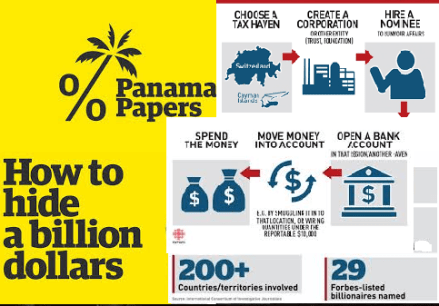
At the latest with the revelations of the Panama Papers, mass media and wider public joined a chorus of outrage over the hidden financial assets of politicians, celebrities and criminal organisations. According to ICIJ, the Panama leaks expose “a system that enables crime, corruption and wrongdoing, hidden by secretive offshore companies”. In particular, the Panamanian law firm Mossack Fonseca has become one of the main protagonists in bribery and money laundering scandals. These leaked documents disclose internal files that contain information on 214,488 offshore entities connected to people in more than 200 countries and territories.
What are the services of law firms like Mossack Fonseca? What are shell companies, offshore entities and so-called tax havens? Can they be used for legitimate or illegitimate businesses? What does the current legislation say? Here is a brief guide and explanation of what has been going on for decades in the hidden financial world.
To put it simple, shell companies are corporations without any active business or operations, or companies that passively own the shares of other companies. Shell companies are also referred to as international business companies, personal investment companies, or “mailbox”/”letterbox” companies. Generally, establishing a shell company is no different from setting up any other type of company.There are legitimate purposes for shell companies, such as helping entrepreneurs gain cheaper and easier public listings on a stock exchange despite minimal sales turnover. Another example of legal use of shell corporations occurs in the case of hidden financial interactions between two companies: if “Company A” does not want to be associated with “Company B”, for instance because of its poor reputation, they can create a shell corporation through which the transaction can be concealed.
Nevertheless, this mechanism is being used to hide corruption and illegal financial transactions such as money laundering and tax evasion. Shell companies have the essential characteristic of being able to obscure the true ownership of an asset. By disguising both the ownership of the shell corporation and its activities, it is relatively simple to conceal the true origin and intent of large amounts of funds that might have been obtained through illegal actions such as drug dealing or other criminal processes.
Shell companies are often formed in so-called tax havens. There are dozens of tax havens besides Panama such as Switzerland, or Luxembourg and many countries in the Caribbean like the British Virgin Islands that provide little or no tax liability and financial information to foreign tax authorities.
The debate surrounding the legality of shell companies is characterised by pro-arguments that in particular focus on the distinct use and counterarguments that question the entire system of shell companies asking why a company should be allowed to hide financial transactions and assets.
Does law enforcement clarify the controversy? Here is the key issue of the discussion: law avoidance is possible and legally permitted – law firms like Mossack Fonseca are specialised to “protect” their clients from the law. Often, governments that harshly criticise tax avoidance and offshore finance are themselves beneficiaries of those strategies. In most cases public anger, accusations of being opportunistic or unethical and undermined political credibility bring about accountability of wrongdoings, not the judgement in a courtroom. Current laws do not require the creators of shell companies – such as Mossack Fonseca – to report who actually controls them. Further, the compliance with international anti-money laundering obligations remains low and inefficient since financial institutions may be negligent or incapable to perform due diligence to the appropriate depth. Anti-Corruption International fights for more transparency and less “legal corruption” in order to stop the immoral businesses of shell companies……More at: http://anticorruption-intl.org/criticising-shell-companies/
AI: Violation of Oromo Human Rights in Ethiopia April 9, 2016
Posted by OromianEconomist in #OromoProtests, Africa, Amnesty International's Report: Because I Am Oromo, Ethiopia's Colonizing Structure and the Development Problems of People of Oromia, Afar, Ogaden, Sidama, Southern Ethiopia and the Omo Valley, Groups at risk of arbitrary arrest in Oromia: Amnesty International Report.Tags: #OromoProtests, Africa, AI, Amensty International Report: Because I am Oromo, Amnesty International UK, Escalation of Human Rights Violations in Ethiopia Must Stop and an independent investigation is Required, Oromia, Oromo, Patricia Bartley, Violation of Oromo Human Rights in Ethiopia
add a comment



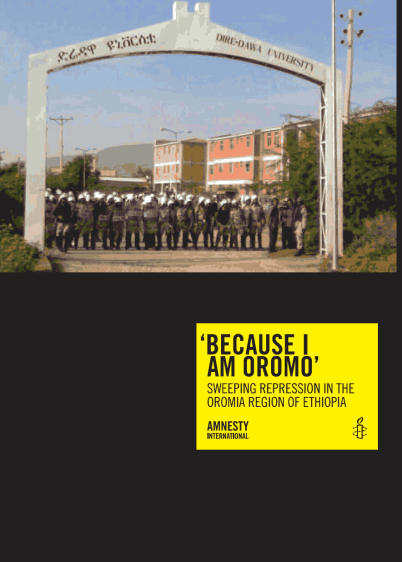
@OSA London Conference @London School of EConomics on Violation of Oromo Human Rights in Ethiopia, by Patricia Bartley, Amnesty International UK, Ethiopia Country Coordinator; 3rd April 2016.
Governance: Ethiopia’s clampdown on dissent tests ethnic federal structure. #KonsoProtests #OromoProtests April 8, 2016
Posted by OromianEconomist in #OromoProtests, Ethiopia's Colonizing Structure and the Development Problems of People of Oromia, Afar, Ogaden, Sidama, Southern Ethiopia and the Omo Valley.Tags: #OromoProtests, Africa, Ethiopia, Governance: Ethiopia's clampdown on dissent tests ethnic federal structure. #KonsoProtests #OromoProtests, Konso, Oromia, Oromo, The Guardian
add a comment
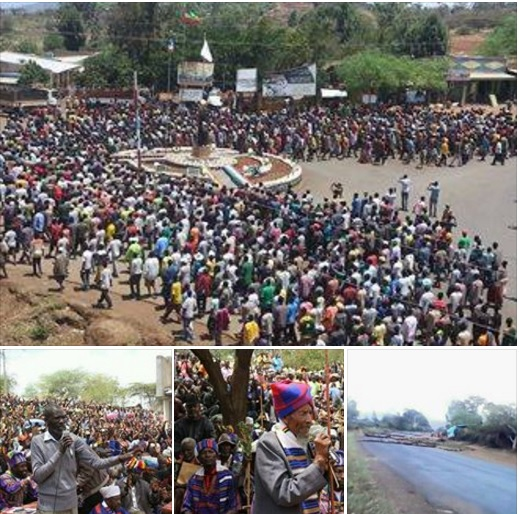
Ethiopia’s clampdown on dissent tests ethnic federal structure
Protests sparked by the arrest of Konso leader Kala Gezahegn underlined growing tensions between Ethiopia’s central government and many ethnic populations
BY William Davison, The Guardian, Global development, 8 April 2016
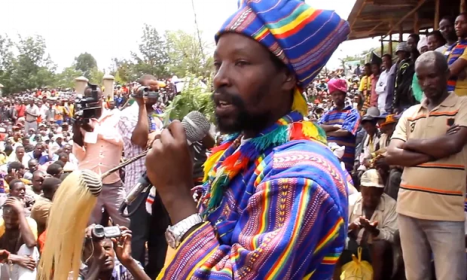
Kala Gezahegn, the traditional leader of Ethiopia’s Konso people.
Kala Gezahegn, the leader of the Konso people, addresses a crowd. His arrest highlighted growing tensions in Ethiopia between state power and ethnic groups’ desire for autonomy. Photograph: Courtesy of Kasaye Soka
Nothing seemed amiss when an Ethiopian government vehicle arrived to collect the traditional leader of the Konso people for a meeting in March. But instead of being taken to discuss his community’s requests for more autonomy, Kala Gezahegn was arrested.
Kala’s detention marked a low point in fraught relations between the Konso in southern Ethiopia and the regional authorities in the state capital, Hawassa. Five years ago, the Konso lost their right to self-govern, and growing tensions since then mirror discontent in other parts of Ethiopia.
The 1995 constitution in Africa’s second most populous country allows different ethnic groups to self-govern and protects their languages and culture under a system called ethnic federalism. The largest ethnicities – such as the approximately 35 million-strong Oromo – have their own regional states, while some smaller groups administer zones within regions, as the Konso effectively used to do.
Many of Ethiopia’s ethnic identities, which number more than 80, were suppressed during the imperial and national-socialist eras that preceded the federal system.
What happened in Konso followed demonstrations and killings by security forces in Oromia, the most populous region. A rights group says 266 people have been killed since mid-November during protests over injustice and marginalisation.
Demonstrations were sparked by a government plan to integrate the development of Addis Ababa and surrounding areas of Oromia. After fierce opposition from the Oromo, that scheme was shelved in January, but protests have continued, fuelled by anger over alleged killings, beatings and arrests.
In Amhara, a large region north of Addis Ababa, there was violence late last year related to the Qemant group’s almost decade-old claim for recognition as a group with constitutional rights. The fact that the Qemant rejected a territorial offer from the authorities, saying it was too small, may have provoked local Amhara people. In December, federal security forces were dispatched to contain escalating communal violence.
In Konso, after Kala and other leaders were locked up, thousands took to the streets to protest. During clashes with police on 13 March, three people were killed, and now the dispute seems entrenched.
Women at Fasha market in Ethiopia’s Konso region. Photograph: Grant Rooney/Alamy
The crux of the issue is a 2011 decision to include the Konso – which is in the multi-ethnic Southern Nations, Nationalities and Peoples’ Region (SNNPR) and has 250,000 people – in the newly created Segen zone, thereby removing their right to self-rule. That decision was taken without consultation and resulted in worsening public services and unresponsive courts, says Kambiro Aylate, a member of a committee chosen to represent the community’s demands.
The budget for Konso’s government was reduced by 15%, says Orkissa Orno, another committee member. “The Konso people used their rights to ask for a different administrative structure,” he says.
In a recent interview, prime minister Hailemariam Desalegn blamed the unrest in Oromia on high youth unemployment and a “lack of good governance”, a line echoed by officials in other regions.
Kifle Gebremariam, the deputy president of the SNNPR, said the Konso leaders were arrested on suspicion of maladministration and corruption, issues “completely different” from the political question.
Kifle added that discussions had been held with residents about the status of the administration. “The regional government, including the president, gave them the right response, but they are not peacefully accepting this.”
Kala’s supporters dispute that account, although there have been signs of compromise, with the traditional leader permitted to take part in recent negotiations.
Concerns over the federal system’s ability to withstand such strains are not new. For example, southern groups such as the Wolayta were involved in violent clashes before they were granted their own zone in 2000.
In 2009, the International Crisis Group wrote in a report (pdf): “Ethnic federalism has not dampened conflict, but rather increased competition among groups that vie over land and natural resources, as well as administrative boundaries and government budgets.”
Officials have argued for decades that the focus on minority rights has been integral to an unprecedented period of peace and development.
Assefa Fiseha, a federalism expert at Addis Ababa University, agrees the system has brought stability to a country threatened with fragmentation in the early 1990s after ethno-nationalist rebellions overthrew a military regime.
But a lack of democratisation and centralised economic decision-making works against local autonomy and exacerbates grievances, according to Assefa.
“The regional states, as agents of the regional people, have to be consulted on whatever development project the federal government wants to undertake,” he says.
In fact, the government appears to have been moving in the opposite direction, as its legitimacy depends on economic growth and improving social services and infrastructure.
National projects – 175,000 hectares (430,000 acres) of state-owned sugar plantations in the ethnically rich south Omo area, for instance – are designed, implemented and owned by federal agencies.
The now scrapped integrated Oromia-Addis Ababa plan is another example, as it was developed without scrutiny by “key stakeholders” in the Oromia government, Addis Ababa city and the federal parliament, Assefa says.
One reason for quick decisions in a devolved federation is that the political positions of Ethiopia’s diverse communities are filtered through a rigid ruling coalition.
Along with allied parties, the Ethiopian Peoples’ Revolutionary Democratic Front won every federal and regional legislative seat in May’s elections, extending its control of all tiers of government.
The EPRDF has held power for 25 years, partly by building a popular base of millions of farmers and demanding strict obedience to party doctrine and policy, but some say this is now changing.
The wave of protests, so soon after the landslide election victory, shows that the “dominant party system is facing problems”, Assefa says.
“Growing ethno-nationalism, centralised policymaking and the failure to provide space for political dissent combined together make a perfect storm for violence.”
Read more at:-
Ethiopia: The failed State’s Collapsing Economy April 8, 2016
Posted by OromianEconomist in Ethiopia's Colonizing Structure and the Development Problems of People of Oromia, Afar, Ogaden, Sidama, Southern Ethiopia and the Omo Valley, Free development vs authoritarian model.Tags: Africa, Africa's statistics, economics, Ethiopia, Ethiopia's Colonizing Structure and the Development Problems of People of Oromia, Ethiopia: The chronic shortage economy, Ethiopia: TPLF's corruption empire, poverty, The danger of Single story on Africa Rising, The failed State's Collapsing Economy, The Shadow Over Ethiopia's Construction Boom
1 comment so far
Ethiopia: Double Digit Growth or Collapsing Economy?
Analysis by Andualem Sisay, All Africa, 8 April 2016
Ethiopian government’s increasing reliance on foreign loans is posing a serious risk of economic collapse, a renowned economist has revealed.
“Take for instance China, which has loaned over $17 billion to the Ethiopian government for infrastructure projects. Our total investment is 40 per cent of the GDP. Our saving is between 10-20 per cent of the GDP.
“We import $13 billion and export $3 billion. They are the ones who are filling all these deficit gaps,” said Dr Alemayehu Geda.
The Addis Ababa and London universities don was presenting his paper on Foreign Direct Investment (FDI) in Ethiopia and Credit Financing.
“What will happen if they stopped such financing tomorrow? What if, for instance, the Chinese government tomorrow says sell for me Ethio Telecom or sell to me Ethiopian Airlines or give me some share or buy my aeroplanes, or I will stop such credit financing?
Strategic items
“The country will collapse, I guarantee you,” he said.
Dr Alemayehu went on: “About 77 per cent of our imports are strategic items. Fuel only has 25 per cent share of the total import. As a result, even if we want to reduce these imports, we can’t. Ethiopia needs to minimise strategic vulnerability.”
The don elaborated giving the example of how the Koreans mitigated against such dependency risks when they used to source 75 per cent of their imports from the US some decades ago.
Dr Alemayehu presented his paper in Addis Ababa at the launch of a two-year 12 series of public dialogue by the Forum for Social Studies – a local civil society, partially financed by the UK’s Department for International Development (DfID).
“The Koreans came out of such vulnerability risk after analysing their situation properly, discussing the issue with their intellectuals and setting long term plans,” he said, advising the Ethiopian government to invest in quality education, skilled labour and improve the negotiations capacity as well as have in place a well-designed policy.
Last decade
Official estimates have shown the Ethiopian economy growing by double digits annually for about a decade now, a figure that has highly been doubted by independent scholars.
The Addis government has been applauded for growing the country’s GDP by around 10 per cent per year for the last decade.
In his paper, Dr Alemayehu indicated that Ethiopia’s external loan included $17.6 billion from China for various infrastructure developments, around $3 billion from Turkish and close to $1 billion from Indian governments.
The World Bank’s data shows that from 2012 – 2016, Ethiopia has taken a total loan of close to $6 billion from the global lender. Last year, Ethiopia for the first time, joined Euro Bond and accessed $1.5 billion.
In addition to loans, reports show that some $3 billion annually came to the country in the form of aid from donors.
Have declined
Ethiopia’s exports have declined from around $3 billion last year to around $2.5 billion this year, as revealed in the recent six-month report of the prime minister to the parliament.
Even though tax collection has been growing by an average of 20 per cent annually over the past five years, Ethiopia’s tax to GDP ratio still stands at 13 per cent, which is less than the around 16 per cent of the sub-Saharan average.
Last year, Ethiopia collected around $6 billion from tax, including $25 million recovered from contraband traders. The figure could have been raised by at least $3 billion had it not been for the generous tax incentives the country has provided to investors, according to latest report of the Ethiopian Revenue and Customs Authority (ERCA).
In only nine months of Ethiopia’s last budget (July 8, 2014 – July 7, 2015), the country provided tax incentives of around $2.4 billion to investors, by exempting them from customs and excise duties and withholding, VAT and surtaxes, according to ERCA’s report.
Financial integrity
A financial integrity report last December indicated that around $2 billion was leaving Ethiopia every year through mis-invoicing and other tax frauds.
When it comes to the FDI coming from China, India and Turkey, close to 71 per cent of their investments in Ethiopia were in the manufacturing sector.
However, job creation, technology transfer and export contribution were insignificant for Ethiopia, which has over an 90 million population dominated by the youth. The country has about 16 per cent unemployment rate, according to Dr Alemayehu.
Between 2003-2012, there were 93 Chinese companies that had reportedly invested $600 million, creating around 69,000 permanent and 79,000 temporary jobs for Ethiopians. There was little contribution to technology transfer and foreign currency generation through the exportation of their products.
However, his special economic adviser with a ministerial docket, Dr Arkebe Equbay, reportedly told Bloomberg media that the economy was expected to grow by 11 per cent this year.
Foreign debts
The government was now expected to deal with puzzles such as why the economic performance was not as good as in the previous years, with all the generous incentives to investors and huge infrastructure investments mainly dependent on local and external loans?
How to repay its local and foreign debts before the lenders force the government to cede shares in its highly protected businesses, such as, Ethio Telecom, Ethiopian Airlines, the Commercial Bank of Ethiopia, the Ethiopian Insurance Corporation and Ethiopian Shipping Lines is, for sure, the elephant in the room.
But the big question is: How soon will these issues get the attention of a government pre-occupied with trying to feed about a dozen million people affected by drought and dealing with political unrest and conflicts mainly in Oromia and Gondar area of Amhara Region?
Anti-Corruption International: What is the #Panamapapers and how does it work? April 8, 2016
Posted by OromianEconomist in 10 best Youtube videos, 25 killer Websites that make you cleverer, Corruption.Tags: Anti-Corruption International, Corruption, The networks of shell companies, What is the #Panamapapers and doeshow it works?
1 comment so far
What are we talking about when we criticise the networks of shell companies?
ACI, 8 April 2016
Oromia & Ethiopia: #OromoProtests: With whom are the European Union, the United States, and the African Union Officials meeting to discuss and end the exclusion and marginalization of the Oromo people in Ethiopia? April 8, 2016
Posted by OromianEconomist in #OromoProtests.Tags: #OromoProtests, Africa, and the African Union Officials meeting to discuss and end the exclusion and marginalization of the Oromo people in Ethiopia?, AU, Crimes against Humanity in Oromia/Ethiopia, Ethiopia: Update - European Parliament Adopts Powerful Ethiopia Resolution, Oromia, Oromo, the United States, With whom are the European Union
1 comment so far
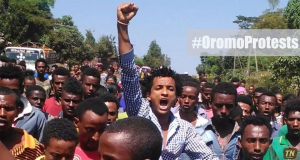
With whom are the European Union, the United States, and the African Union Officials meeting to discuss and end the exclusion and marginalization of the Oromo people in Ethiopia?
By Dr. Birhanemeskel Abebe Segni, 8 April 2016
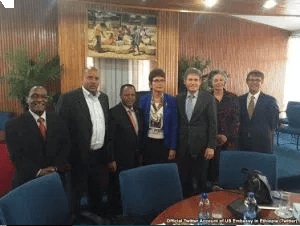
In response to the Ethiopian government’s unrelenting attack on the ongoing #OromoProtests, the United States, European Union, and African Union have been sending delegations to Ethiopia to express their “concerns” about the killings, large scale mass arrest and torture of Oromo Protesters; and urge the Ethiopian government to end the systemic exclusion and marginalization of the Oromo people from Ethiopia’s economic, political, social and urban lives.
But, with whom are these American, European and African Officials meeting and talking in Ethiopia if they don’t meet a single Oromo? More specifically, if they don’t meet and speak with a single Oromo on an Oromo issue, in a country where the Oromo people constitutes close 50% of the population, with whom are they convening and speaking? Who is representing and speaking on behalf of the Oromo people in Ethiopia?
One may think the OPDO, the Oromo wing of the EPRDF– the ruling party in Ethiopia, is representing and speaking for the Oromo people. That is not actually the case. No official from the United States, the European Union or the African Union ever spoke and convened with a single OPDO officials over the last four months.
For instance, no one from the United States delegations that visited Ethiopia in recent months including Ambassador Samantha Power (United States Permanent Representative to the United Nations in New York), Ambassador Linda Thomas-Greenfield (Assistant Secretary of State for African Affairs), Ms. Gayle E. Smith (Administrator of USAID), and Tom Malinowski ( the U.S. Assistant Secretary of State for Democracy, Human Rights, and Labor) convened and talked with a single OPDO officials both at federal and regional levels. They all met with non-Oromo Ethiopian officials with no Oromo present and discussed about the plight of the Oromo people and left, or they told us so.
Similarly, no one from the European Union officials who recently visited Ethiopia to express their concern on the Oromo people’s economic and political marginalization and exclusion and the ongoing bloody crackdown on the #OromoProtests met with a single OPDO official, both at the federal and regional levels.
Some might think these European, African and American officials who visited Addis Ababa over the last four months to express their concern about the systemic exclusion and marginalization of the Oromo people in Ethiopia are meeting and holding consultation with the only legally registered Oromo opposition party, the Oromo Federalist Congress(OFC), officials. That is not the case either.
In early February this year, the Assistant Secretary of State for African Affairs, Ambassador Linda Thomas-Greenfield, who went to Ethiopia to participate on the AU Summit held consultation with the Ethiopian authorities on the Oromo issues. She also said she met with the Oromo community representatives.
It turned out Ambassador Linda Thomas-Greenfield did not meet with anyone from the Oromo wing of the EPRDF, the OPDO, as well as the Oromo Federalist Congress (OFC), the two known groups who claim to represent the Oromo.
Dr. Merera Gudina, the Chairman of the Oromo Federalist Congress, stated on record that no one from OFC met with the delegation of Ambassador Linda Thomas-Greenfield including Ms. Gayle E. Smith, the Administrator of USAID. It is mindboggling who met with Ms. Thomas-Greenfield delegation as there is no known Oromo community in Addis Ababa let alone Oromo community representatives.
Similarly, the African Union spokeswoman stated that African Union is talking with the Ethiopian Authorities behind closed doors on the #OromoProtests. But, who are these proxies with whom these officials are speaking on behalf of the Oromo people?
The representation of the Oromo professionals in the Ethiopian federal government bureaucracy including in the Ethiopian federal security and defense forces are virtually non-existent. One may blame the Amharic only monolingual language policy of the federal government for the total and complete exclusion of Afaan Oromo speakers, but that is just one reason among many written and unwritten exclusionary policies in place.
The critical questions though are, how long could the Ethiopian government keep the Oromo people in obscurity as non-existing majority with no representation?
And how long could the United States, the European Union and the African Union turn blind eyes and deaf ears to the plight of the Oromo people in Ethiopia?
Are violence and war necessary prerequisites for the rights of peaceful people like the Oromo to be respected?
Is investing in peace not less expensive in comparison to investing in war, violence and the resultant humanitarian crisis for the so called development and security partners of Ethiopia, particularly the United States and United Kingdom? #OromoProtests.
http://ethiopia.usembassy.gov/pr_2016_20.html#.Vv2G3uGIVNs.twitter
Read more at: http://www.caboowanci.com/2016/04/08/eu-us-au-officials-meeting/
QZ: Political Tweets: Politics and activism are driving Africa’s Twitter conversations to new highs April 8, 2016
Posted by OromianEconomist in #OromoProtests, 10 best Youtube videos.Tags: #OromoProtests, Africa, Best youtube videos that make you the brightest, QZ, TWEETOCRACY Politics and activism are driving Africa’s Twitter conversations to new highs
add a comment

In past decades, older generations of Africans had to be tolerant of oppressive governments, which were often dictatorships—if only for their own safety. But the younger generation is more vocal, critical and demanding of their leaders, and unwilling to allow their questions to be left unanswered.
Those higher expectations have been voiced on the streets of African cities from Bujumbura to Cape Town in the last year, but increasingly the murmurings of protest and criticism start via social media apps on mobile phones. And Twitter, with its relatively low bandwidth consumption, good for the slower networks and 3G phones of many African consumers, has played a leading role as a platform for raising political awareness on the continent.Data from the latest How Africa Tweets report conducted by Portland shows Twitter continues to provide an important platform for political discourse in Africa. The report analyzed 1.6 billion tweets and 5,000 hashtags from 2015 and found that politics-related tweets in Africa, while behind entertainment and commerce, were very much on the rise, and generally topped the rates of political tweets in the United States and United Kingdom.
http://qz.com/654958/politics-and-activism-are-driving-africas-twitter-conversations-to-new-highs/
“My People” – #OromoProtests Spoken Word Poetry April 7, 2016
Posted by OromianEconomist in #OromoProtests.Tags: "My People" – #OromoProtests Spoken Word Poetry, Africa, Oromia, Oromo
1 comment so far
WhatsApp’s new encryption won’t protect you unless you’re also doing all these things April 6, 2016
Posted by OromianEconomist in 25 killer Websites that make you cleverer, Uncategorized.Tags: Tachnology, Whatsapp adds end-to-end encryption; Viber to by-pass blockage
add a comment

Whatsapp adds end-to-end encryption; Viber to by-pass blockage


WhatsApp made waves yesterday with its decision to switch on end-to-end encryption for all its billion-plus users. “End-to-end” means the communication is encrypted before it leaves your phone and decrypted only after it reaches the other person’s phone, so nobody else, not even WhatsApp itself, can read or listen to it.
Encryption alone isn’t much help unless all the following things are happening as well.
You’re not storing messages on your phone
If you really need a message to stay secret, delete it after it’s read. If someone gets hold of your phone (e.g. by stealing it) and can get into it—as the FBI has now done with the iPhone used by the San Bernardino shooter—everything that’s on there will still be accessible. Some messaging apps, such as Telegram, have an “auto-destruct” feature that deletes messages from the phone after a set period of time. WhatsApp currently doesn’t. (Telegram, on the other hand, doesn’t use end-to-end encryption by default; you have to choose it.)
You’re not backing up messages to the cloud
WhatsApp doesn’t store your messages on its servers. But in an iPhone, for instance, you can tell WhatsApp to keep a backup of messages in iCloud, Apple’s cloud storage service. Once the information is in the cloud, it could be subpoenaed by a government.

(The Guardian) — From strict privacy policies to its origins in Israel, there are a few things that distinguish Viber, the upstart free calls and messaging application, from its more established rival Skype. But the feature its 200 million international followers seem to appreciate most is the stickers.
A selection of images that can be texted as an alternative to written messages, the stickers available include love hearts, a red rose, the obligatory LOL, and the controversial middle finger hand gesture. There have been outraged calls for its removal.
Viber founder Talmon Marco is listening. “It will not be available by default with the next release of Viber,” he says.
Having begun life three years ago in the Israeli iPhone app store, before going international and onto other mobile platforms including Android, Blackberry and Windows, Viber took the fight to Skype’s home turf by launching a desktop version in May. Downloads onto personal computers are already in the millions.
Speaking from Singapore, Marco is busy preparing the next two important milestones. The first is a sticker store. While this may not sound momentous, it represents the company’s first foray into money making.
The app and all its current services, including calls between Viber users, will remain free. But in order to transform itself into a real business, Viber must search for revenues.
“We announced earlier this year that we will start monetising. The first thing we are going to announce is a sticker store, but we will be introducing additional paid services as early as this year.”
The second development, which is already being tested in Saudi Arabia, is technology that can stop Viber being blocked. During its rapid expansion, Viber has occasionally met resistance from both mobile networks and some of the more authoritarian states.
For some time, many Vodafone customers have been unable to use Viber without disruption, particularly those on pay-as-you-go tariffs, says Marco. Mobile operators have previously voiced concerns about free calls and messaging apps as a threat to their own revenues.
And there has been government opposition. Iran, Syria and Lebanon have all lifted previous blocks on Viber, but the service was recently barred by the Saudi Arabian authorities. Marco says the ban was introduced after Saudi officials indicated to Skype, Viber and the popular messaging service Whatsapp that they would be blocked if they did not agree to be monitored.
Social networks have allowed unprecedented freedom to communicate in Saudi Arabia, propelling a steep adoption curve. They are also relied on by the nation’s many foreign workers as a cheap way to keep in touch with families abroad.
“A few days ago we launched a test of Viber with enhanced connectivity,” says Marco. “This version allows users to connect in places where Viber is blocked. At present we have several thousand users in Saudi Arabia that can access Viber despite the local ban. Once the technology is rolled out, we will likely roll it out to Vodafone UK users as well.”
Marco says he is serious about the right to communicate, and the ability to do so in privacy. Viber’s policy is that if it receives a proper subpoena, it will provide records of who made and received calls, and when, but that no content from those conversations will be shared.
He says Viber does not “have the capability to listen to conversations”. Messages are stored, for two weeks or until they are opened by the recipient, whichever is shorter. Around 80% are deleted in less than a second. The messages are encrypted, and Marco says he has never handed the encryption key to any government.
“We have been asked if we would co-operate. We never provided anybody with anything that will let them listen to conversations or messages on Viber. I do believe people should take notice of the fact that the Saudi government has threatened three companies with shutdown of service – us, Skype and Whatsapp. Only one company was shut down. Users should ask themselves why the other companies were not shut down.”
In fact, Marco has himself been accused by at least one blogger of being an agent of the Israeli state. The rather sketchy claims are based on his military career. He spent four years in the Israel Defence Forces, rising to chief information officer of the central command.
But Viber was funded entirely by what Marco refers to as “friends and family”. “We never took a single dollar from the state of Israel, we are not even incorporated in Israel. We maintain a research and development centre in Israel and that’s it.”
For now, Viber is growing quickly. With just 120 staff, based in Cyprus and Belarus as well as Marco’s homeland, the app is being downloaded by more than 500,000 people a day and reached 200m downloads in May. Last time Viber released information on usage, in February, it was carrying 3bn minutes of calls and 12bn text messages every month. It has some way to go to catch up with Skype – which in April announced 2bn calls a day.
But on the mobile phone, if the iPhone app store reviews are to be believed, Viber is better liked. Skype’s transition to mobile has been rocky, with users complaining the service crashes. Most give Skype a one-star rating on iPhone, while Viber receives the maximum of five stars from most of its reviewers.
Time will tell whether revelations by the Guardian and other media about the extent of Skype’s cooperation with intelligence agencies will harm its business. But Marco believes individuals should care.
“Personally, I would be concerned being on a service knowing that everybody can listen to my conversations,” he says. “People should be concerned about their privacy.”
Telesurtv: Ethiopia’s Oromo Protest ‘Development,’ Displacement and Death. #OromoProtests April 6, 2016
Posted by OromianEconomist in #OromoProtests.Tags: #OromoProtests, Africa, Ethiopia’s Oromo Protest Displacement and Death, Oromia, Oromo, Telesurtv
2 comments
Events in Oromia have been described as the worst civil unrest in a decade.

Ethiopia’s Oromo Protest ‘Development,’ Displacement and Death
Events in Oromia have been described as the worst civil unrest in a decade.
(telesurtv) — “This government is at least better than previous ones,” remarked a 74-year-old Eritrean man to me last month in the Ethiopian capital of Addis Ababa, his longtime residence. Clad in a tattered grey suit and speaking to me in Italian, the man was peddling a book of useful Amharic phrases he had compiled for the foreign visitor, proceeds of which would go toward the purchase of a second-hand comforter for his bed.
As it turned out, his assessment of the relative superiority of the current Ethiopian administration was for good reason: two of his children had been killed by a previous ruling outfit, the Derg military junta that took power in 1974 and began eliminating suspected opponents in droves.
Although that particularly bloody epoch came to an end in 1991, many a resident of Ethiopia might nowadays still have cause to complain about homicidal activity by the state. In the Oromia region surrounding Addis Ababa, for example, there are claims that more than 200 people have been killed by Ethiopian security forces since November 2015, when protests broke out in response to the government’s so-called “Master Plan” to expand the boundaries of the capital by a factor of 20.
As a Newsweek article explains, the Oromo inhabitants of the region viewed the plan as “an attempted land grab that could result in the forced eviction of Oromo farmers and the loss of valuable arable land in a country regularly plagued by drought.”
This was no doubt a valid concern given the government’s established tradition of wantonly displacing Ethiopians in the interest of “development”—that handy euphemism for removing human obstacles to the whims of international and domestic investment capital.
Comprising some 35 percent of the population, the Oromo are Ethiopia’s largest ethnic group and have regularly decried discrimination by the ruling coalition party, the Ethiopian People’s Revolutionary Democratic Front (EPRDF), which is dominated by ethnic Tigrayan interests. Politically motivated detention, incarceration, and other abuses have long characterized the landscape in Oromia, and the current protests have seen children as young as eight arrested.
Apparently, torture has also been a difficult habit for security forces to break.
And while the government has opted to shelve the Master Plan for now, protests in Oromia have continued. When I recently visited the town of Woliso, one of many protest sites in the region, residents pointed out that cancelling the plan wouldn’t bring back the dead people.
Events in Oromia have been described as the worst civil unrest in a decade. The United States, never too quick to condemn the excesses of its African ally, helpfully responded by emitting a “security message” for U.S. citizens and restricting the movements in Oromia of its government personnel; the British government, for its part, provided a color-coded map of Ethiopia on which a vast chunk of land around Woliso is designated inadvisable for “all but essential travel.”
Even without the Master Plan, meanwhile, the government is doing a decent job of courting investors. As I traveled west from Addis Ababa toward Woliso — a journey of about two hours — I passed sprawling factory complexes, including one featuring a Turkish flag flying alongside its more indigenous counterparts.
A January report by the Ethiopian News Agency outlines the government’s goal of luring Turkish and other investors to “priority areas” as part of an overall scheme to convert the economy from agriculture- to industry-based. Noting that “about 110 Turkish investment projects have become operational” and that “incentives from the government includ[e] electricity and cheap labor,” the report highlights the exploits of the Ayka Addis textile factory 20 kilometers west of the Ethiopian capital, in the Oromia region.
Launched in 2010 with a price tag of US$140 million, the Turkish factory is said to occupy several hundred thousand square meters of land.
The website of the Ethiopian Investment Commission furthermore lists Ayka Addis as one of “a number of private Industrial Zones” in Ethiopia, described as “success stories.” The site, which advertises thousands of hectares worth of “investment opportunities” in the country, cites perks including exemptions from customs duties for machinery and other equipment as well as certain exemptions from income taxes.
Indeed, the EPRDF can point to double-digit economic growth over recent years to justify plowing ahead with its development model. But there’s more to life than GDP — as sizable poverty-stricken sectors of the Ethiopian population can presumably confirm.
If we want to consider other, less superficial digits, we might take a look at the estimated 10.2 million Ethiopians currently “in need of urgent food assistance”— as reported, perhaps ironically, in a March edition of the English-language Ethiopian newspaper Capital, “the paper that promotes free enterprise.”
Additional troublesome statistics are contained in a 2014 BBC dispatch titled “The village where half the people are at risk of blindness.” The village in question is Kuyu, located in the Oromia region; the risk is due to infectious trachoma, “the world’s leading cause of preventable blindness.”
At the time of the article’s publication, 200,000 people were reportedly in danger of trachoma-induced blindness in Oromia alone. Quoted in the piece is one Simon Bush of the Sightsavers organization, who remarks that trachoma is “a disease of poverty” that is “endemic in areas which have poor access to water and sanitation.”
All of this is merely to point out that, in the end, a lot of people in Oromia and beyond might have greater priorities than, say, income tax immunity for international developers. Because it doesn’t take a functioning eyeball to see that such development models are themselves in need of some serious development.
Belén Fernández is the author of “The Imperial Messenger: Thomas Friedman at Work,” published by Verso. She is a contributing editor at Jacobin magazine.
Growing public dissatisfaction with ‘rent seeking’ and corruption in the ruling party and government culminated recently in the unprecedented Oromo protests.
https://www.issafrica.org/events/view-on-africa-protests-political-instability-and-purge-in-ethiopia
Egypt defends treatment of Oromo refugees April 6, 2016
Posted by OromianEconomist in Uncategorized.Tags: #OromoProtests, 'BECAUSE I AM OROMO’: SWEEPING REPRESSION IN THE OROMIA, Africa, Almonitor, Egypt, Egypt defends treatment of Ethiopian refugees, Ethiopia, Kenya, Oromia, Oromo, Oromo Refugees in Egypt
2 comments

Egypt defends treatment of Ethiopian refugees

CAIRO (Almonitor, April 5, 2016) — On March 13, nearly 1,000 people of the Oromo ethnic community took part in a big ceremony celebrating the second anniversary of the Oromia Media Network (OMN), which opposes the ruling regime in Ethiopia.
The ceremony was the first event held by the Ethiopian opposition in Cairo since theoutbreak of violence in Ethiopia between the government and the ethnic community in December. The violence arose over Ethiopia’s “master plan” to expand the capital, Addis Ababa, into large parts of Oromo farmlands without any actual compensation.
At that time, Egypt’s Foreign Affairs Ministry contented itself with issuing a press statement on Dec. 21, saying that the incidents “are an internal Ethiopian issue.”
“We are looking forward to stability and the completion of the comprehensive economic and social development programs in Ethiopia,” the ministry said.
Yet local Ethiopian media outlets continued to circulate statements by Ethiopian officials accusing Cairo of supporting the opposition and of being behind these events in order to weaken Ethiopia. These statements were based on the late Ethiopian Prime Minister Meles Zenawi’s remarks in November 2010 that there was irrefutable evidence of Egypt’s support for insurgents in Ethiopia, under the rule of former President Hosni Mubarak.
At the second anniversary ceremony, OMN head Jawar Mohammed spoke of the need for the Oromo uprising to continue against the policies of the Ethiopian government and the ruling Tigrayan People’s Liberation Front (TPLF) party. He accused the government of adopting systematic policies against the Oromo community and of seizing its land.
A government official who coordinates African affairs and spoke to Al-Monitor on condition of anonymity said, “The Egyptian authorities have nothing to do with the ceremony.”
He explained, “A group of Ethiopian activists applied for a security approval for the ceremony, which they obtained, similarly to any other foreign communities wishing to hold activities in Cairo.”
The United Nations High Commissioner for Refugees (UNHCR) fact sheet issued in February said 6,916 Ethiopian asylum seekers are registered with the UNHCR in Cairo.
“Most of the Ethiopians who are registered with the UNHCR are of the Oromo people, whose registration rate has been constant since 2015,” Marwa Hashem, assistant public information officer for the UNHCR in Cairo, told Al-Monitor.
“The UNHCR have provided all political asylum seekers and refugees from Africa with services such as material aid to the most needy, educational grants, health care and psychosocial support.”
Ahmad Badawi, head of the Egyptian Foundation for Refugee Support, told Al-Monitor, “Egypt is committed to its international obligations not to reject asylum seekers when they do not oppose national security, even those who enter illegally.”
The Egyptian government does not provide any special advantages to Ethiopian refugees without providing the same to other foreign nationals, he said. UNHCR is in charge of providing services to all refugees.
The Oromo ethnic community makes up 40% of Ethiopia’s population, followed by the Amhara and Tigrayan communities, which make up 32% — though Tigrayans control the government through the ruling TPLF party. The Oromia Regional State stretches over large areas in central Ethiopia, where the capital is located, and includes most of Ethiopia’s wealth, as it controls the country’s coffee exports, gold mines and the rivers’ headwaters.
Due to the escalating protests, the Ethiopian government canceled the plan to expand the capital. Yet the Oromo revolution has not ended, as the people continue to demand freedom and fair representation in the government and to protest the ruling party’s practices.
“The Oromo community will continue to protest not only against the Ethiopian government’s master plan, which raised problems in the past, but also to preserve the Oromo ethnic community’s land, culture and language, against the ethnic policies of the Tigrayan who control the rule,” Girma Gutema, an Oromo community activist, told Al-Monitor.
“Eritrea and Sudan supported the Oromo struggle. Yet following the Sudanese-Ethiopian rapprochement, many rebels fled to Eritrea,” Gutema said. However, the Egyptians, as well as the international community, don’t know enough about the Oromo community’s problems to be able to offer support.
Such rumors, he said, are propaganda spread by the Ethiopian government due to its historic bickering with Egypt.
Galma Guluma, an Ethiopian political activist and organizer of the ceremony in Cairo, told Al-Monitor that Cairo is the safest place for Oromo people fleeing Ethiopia, particularly sinceSudan changed its policy and is now turning over Ethiopian oppositionists to their government.
“Fleeing to Cairo was not an easy thing to do. Many refugees went through difficult situations and conditions until they reached the Egyptian border,” Guluma said. “Most of the Oromo refugees in Cairo do not have permanent jobs, and some girls are working as domestic servants. Moreover, they receive very little aid from the civil society organizations.”
Guluma added, “We do not have weapons to face the regime in Ethiopia. Our goal is to focus on [getting] the media to speak of the suffering of the Oromo people,” who are oppressed despite the great wealth in their state.
He noted, “Cairo has been a historical place for the Oromo struggle and the idea of the media network and Oromo radio started in Cairo more than 50 years ago with SheikhMohammed Rashad, who studied at the Al-Azhar University in the 1960s and was honored by [former Egyptian President] Gamal Abdel Nasser.”
The Egyptian political administration has said that, while it seeks to build trust and goodwill, its open-door policy for Oromo refugees is part of an international commitment to the refugees’ case and should not be perceived as an attempt to exploit any internal conflicts to weaken the Ethiopian state.
Nevertheless, this issue remains a focus of constant tension in Egyptian-Ethiopian ties, in addition to the historic conflict over Nile water management.
SCEINTIFIC EVIDENCE OF COVERT DEPOPULATION MEASURES IN ETHIOPIA: EVIDENCE OF GENOCIDE IN ETHIOPIA April 3, 2016
Posted by OromianEconomist in Uncategorized.Tags: Africa, Ethiopia: From wells in the Rift Valley, Genocide, Genocide Against Oromo People, SCEINTIFIC EVIDENCE OF COVERT DEOPULATION MEASURES IN ETHIOPIA: EVIDENCE OF GENOCIDE IN ETHIOPIA
add a comment

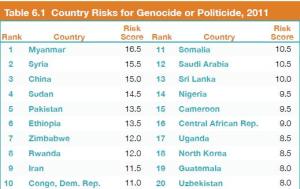
Ethiopia joined the Global Depopulation Policy in 1995 and its total fertility rate has declinedfrom 7 to 3.8 children per woman. This decline was accomplished with naturally fluoridated water that is pumped into the cities from wells in the Rift Valley, where fluoride in water occurs naturally at endemic levels between 1.5 mg-F/L to 36 mg-F/L, which is why 14 million Ethiopians (12% of the population) suffer from skeletal and dental fluorosis, the same percentagethat has below replacement level fertility.
Kevine Galalae, University of Victoria
Read More At:-
https://www.academia.edu/11879503/Evidence_of_Genocide_in_Ethiopia
https://uvic.academia.edu/KevinGalalae
Goota Oromoo tokko ta’uu mirkaneessee boqote: Galata addaa! Du’a doktora Oromoodhaa, Doktor Amiin Abbaa Gumbul ilaalchisee April 1, 2016
Posted by OromianEconomist in Uncategorized.add a comment
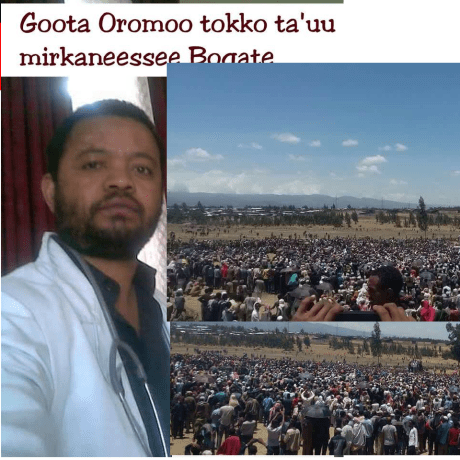
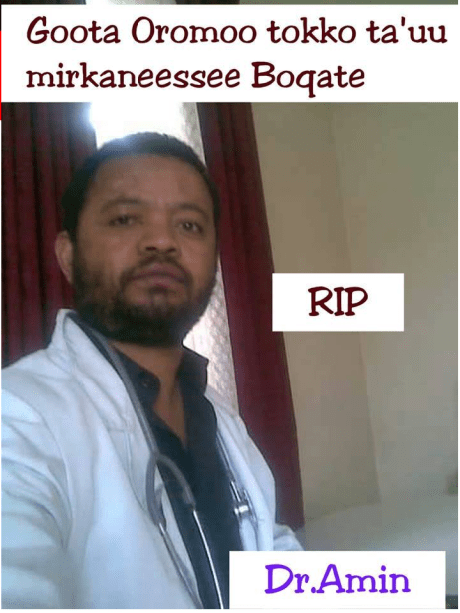
GALATA ADDAA!!! ■■■■■■■■■■■■ Du’a doktora Oromoodhaa, Doktor Amiin_Abbaa Gumbul ilaalchisee Oromoota kutaa Jimmaatiif akka dhalataa kutaa arsii lixaatti Galata addaa galchuu barbaada. …
Source: | Fighting for Freedom and Equality on WordPress.com
Geeska Afrika:Oromia (Ethipoia): I prefer death to detention at Maeklawi: Bekele Gerba. #OromoProtests April 1, 2016
Posted by OromianEconomist in #OromoProtests, Africa, Baqqalaa Garbaa, Because I am Oromo, Ethiopia's Colonizing Structure and the Development Problems of People of Oromia, Oromia, Oromo.Tags: #OromoProtests, Africa, Bekele Gerba, Ethipoia: I prefer death to detention at Maeklawi: Bekele Gerba, Geeska Africa, Human rights, Oromia, Oromo, Systematic genocide against Oromo people
add a comment


NAIROBI (HAN) March 31. 2016. Public Diplomacy & Regional Security News- “I prefer death to detention at Maekelawi,” prominent opposition leader Bekele Gerba has told a court after enduring appalling conditions in one of the chambers of hell at the notorious Maekelawi Prison in the Ethiopian capital.
The prison cell is sardine-packed: 30 prisoners in a 10×10 meter area. Because it is too crowded, respiration coupled with body heat drips back onto the prisoners from the ceiling. No need to divulge details of the hell-on-earth place called “Maekelawi” prison, where prominent political prisoners from the recent protests in Oromia are being held.
The horrible conditions led Bekele and other top OFC leaders to lauch a hunger strike, and on the fifth day on Sunday, when most of them were in critical health conditions, a small change was introduced: the number of occupants in Bekele’s cell was cut down to 17. Better than before but still brutal.
According to OFC Deputy chairperson, Mulatu Gemechu, prominent Oromo individuals who are at Maekelawi are Bekele Gerba, Dejene Taffa, Desta Dinka, Gurmesa Ayano, Addisu Bulala, Dereje Merga and Alemu Abdisa
This small area was so crowded not only with the human occupants but also personal belongings as well as sanitation goodies for the occupants who are not allowed to get air except very short timeouts at dawn and dusk.
Political prisoners suffer not only for torture or life in extremely appalling prison conditions. They are also handed lengthy appointments so that they would break down psychologically. The court has adjourned the prisoners case for another 28 days.
In another development, Mulatu said an unprecedented crackdown on Oromo people was in full swing throughout Oromia, and the mass arrests came in despite Prime Minister Hailemariam Desalegn’s recent speech sounded promising for the suffering majority. However, on the ground, a brutal massive crackdown is under way as the following list shows:
1. Shashemene, Western Arsi – Close to 1200 people have been taken away as prisoners and no one knows their whereabouts.
2. Chiro, Western Hararghe – Between 800 to 1000 people were hauled away by nine trucks. No one knows their whereabouts.
3. Gujji Zone – 150 people taken away.
4. Ambo, Western Shoa – 103 people taken away
5. Gimbi, Western Wellega – 60 people were arrested and taken to an unknown destination.
6. Qelem, Wellega – 54 people taken away.
7. Horo Gudru, Wellega – 39 people were taken away in one night.
8. Burayu (near Addis) – Two individuals taken away to an unknown destination.
Though Ethiopia is hemmoraging from the political crisis, the government is trying to use the prevalent “drought and famine” as a cover to wipe out dissent in Oromia and beyond.
Read more at: http://geeskaafrika.com/2016/03/31/ethipoia-i-prefer-death-to-detention-at-maeklawi-bekele-gerba/


 Oromian Economist
You must be logged in to post a comment.