The Quantum Gadaa System: Indigenous Architecture for Planetary‑Scale Ethics September 14, 2026
Posted by OromianEconomist in Uncategorized.Tags: African Philosophy, AI, artificial-intelligence, Autonomous Systems, Civilizational Theory, consciousness, Digital Sovereignty, Ecology Videos, Entanglement, Gadaa System, Indigenous Governance, Nonbinary Ethics, Oromo Civilization, philosophy, Planetary Institutions, Post Scarcity, Quantum Ethics, Quantum Gadaa, Safuu, Science, Siiqqee, Superposition, TC Press, Temesgen Muleta‑Erena
1 comment so far
The Quantum Gadaa System: Indigenous Architecture for Planetary‑Scale Ethics
TC Press Cultural Ecology Series — Continuation
Author/ Contributor: Temesgen Muleta-Erena (PhD) Economist, Sovereign Publisher, Epistemic Steward
Affiliation: TC Press / The Codex Press, London
Abstract
As humanity enters a transition era defined by quantum computation, autonomous agents, and planetary‑scale digital systems, existing ethical frameworks are collapsing under the weight of non‑binary machine logic. This essay proposes that the Oromo Gadaa system—a cyclical, distributed, egalitarian governance architecture—offers a structurally compatible model for quantum ethics. By mapping superposition, entanglement, rotation, Siiqqee, and Safuu onto algorithmic accountability, we reveal how ancestral African democracy can inform the next generation of planetary institutions.
1. Introduction: The Transition Era
We are living through a structural shift in global technology. Quantum systems, probabilistic computation, and autonomous agents are emerging faster than any regulatory body can adapt. Traditional governance models—rooted in binary logic, permanent power structures, and linear accountability—are no longer capable of regulating machines that operate in superposition and entanglement.
This is not a crisis of a single year. It is a planetary transition.
The ethical mismatch between binary institutions and non‑binary computation is widening. The world needs a governance architecture capable of rotating power, distributing authority, and embedding moral constraints directly into the computational substrate.
The Oromo Gadaa system provides such a model.
Video link: https://youtu.be/P5WFpBXHQ3k
2. The Failure of Binary Governance
Modern digital governance is built on rigid binaries:
- allowed / not allowed
- safe / unsafe
- aligned / misaligned
- consent / reject
Quantum systems do not operate in binaries. They operate in probabilities, gradients, and evolving states.
Current institutions fail because:
- Big Tech creates permanent power structures
- Quantum systems evolve faster than regulation
- Autonomous agents bypass binary ethical checks
- No cyclical accountability exists in digital governance
- Planetary institutions are not designed for non‑binary computation
We are attempting to regulate probabilistic machines with laws written for deterministic machines.
This mismatch is the core ethical problem of the transition era.
3. Gadaa as a Non‑Binary Ethical Architecture
The Oromo Gadaa system is a democratic institution built on:
- cyclical power rotation
- distributed authority
- federated decision‑making
- ritual accountability
- moral constraint layers
It is structurally aligned with quantum logic.
Below is the mapping between Gadaa and quantum computation.
3.1 Superposition → Gadaa Age‑Sets
Quantum superposition allows multiple states to exist simultaneously. Gadaa age‑sets function the same way: multiple leadership cohorts operate at once, each with defined responsibilities.
This creates layered governance, not binary governance.
3.2 Entanglement → Federated Clans
Quantum entanglement links distant nodes so that actions in one location affect another. Gadaa federated clans operate through interconnected decision‑making, where outcomes ripple across the entire system.
This is distributed ethics, not centralized ethics.
3.3 Rotation → 8‑Year Power Cycle
Quantum systems rotate states. Gadaa rotates leadership every eight years.
No entity—human or algorithm—can hold permanent dominance.
This is the antidote to Big Tech’s permanent power structures.
3.4 Siiqqee → Algorithmic Accountability
Siiqqee is the moral instrument carried by Oromo women to enforce justice, balance, and social correction. In quantum ethics, Siiqqee becomes the metaphor for:
- ethical override signals
- moral interrupts
- emergency stop conditions
- accountability triggers
It is the moral failsafe embedded into computation.
3.5 Safuu → Quantum Constraint Layer
Safuu is the Oromo moral boundary that prevents imbalance and protects harmony. In quantum systems, Safuu becomes the constraint layer that prevents harmful outcomes.
Safuu is not a rule. It is a boundary condition.
This is exactly what quantum ethics requires.
4. Planetary Institutions and Indigenous Logic
As quantum systems begin to govern climate models, financial flows, ecological monitoring, and autonomous infrastructure, humanity must design institutions capable of regulating non‑binary computation.
Binary governance will fail. Linear accountability will fail. Permanent power structures will fail.
Planetary institutions must be:
- cyclical
- distributed
- entangled
- morally constrained
- override‑capable
- non‑binary
The Gadaa system already embodies these principles.
Indigenous governance is not a relic. It is a blueprint for the future of computation.
5. Conclusion: The Future Has Always Been Indigenous
The Quantum Gadaa System is not an attempt to import African democracy into modern technology. It is a recognition that the architecture of quantum ethics already exists in ancestral knowledge.
Gadaa offers:
- cyclical accountability
- distributed governance
- moral constraint layers
- override mechanisms
- non‑binary logic
- planetary‑scale compatibility
As humanity enters the next era of digital sovereignty, the fusion of indigenous egalitarianism and quantum computation becomes not only possible—but necessary.
The future of planetary institutions may depend on the wisdom encoded in Gadaa, Siiqqee, and Safuu.
References
Books by Temesgen Muleta‑Erena (TC Press, London)
- Muleta‑Erena, Temesgen (2026). The Institutions of the Autonomous Civilisation: Governance and Economics Beyond the Consumption World: A Framework for Governance, Value, and Stewardship in the Post‑Scarcity Era. TC Press, London. (Discusses the structural significance of Gadaa for post‑scarcity governance and planetary institutions.)
- Muleta‑Erena, Temesgen (2026). The Time‑Tested Republic: Beyond the State – Gadaa as a Living Blueprint for Ethical Governance. TC Press, London. (Provides a foundational analysis of Gadaa as a reproducible constitutional architecture for modern governance.)
- Muleta‑Erena, Temesgen (2026). Beyond the Sun: Humanity’s Thermodynamic Republic in the Billion‑Year Frontier: Modelling Scarcity and Abundance through the Co‑Application of Economics and Physics. TC Press, London. (Explores long‑horizon governance, thermodynamic ethics, and the role of indigenous systems in future civilizational design.)
Do Ethiopia’s Oromo People Have A Better Alternative For Modern Democracy? December 13, 2016
Posted by OromianEconomist in Ancient African Direct Democracy, Gadaa System, Sirna Gadaa.Tags: Africa, Ancient African Direct Democracy, Gada system, Gadaa System, Oromia, Oromo, Oromo Civilization, Sirna Gadaa, Sirna Gadaa Oromoo, UNESCO world Heritage
add a comment

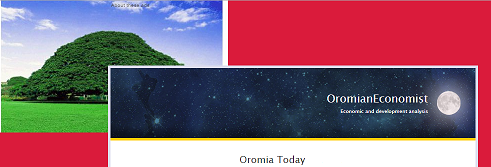


Oromo nation and Gadaa system

Odaa (the Official Plant) and Abbaa Gadaa, the origin of democracy and elected government

Do Ethiopia’s Oromo People Have A Better Alternative For Modern Democracy?
By Dana Sanchez, AFK Insider, December 13, 2016

Gada is the traditional governance system of Oromos in Ethiopia and Northern Kenya. Photo: gadasunlightours.comEthiopia’s Oromo people made headlines around the world when peaceful protests turned violent against government land use changes, prompting a state of emergency.
Now Oromo voices are being heard thanks to an entity more often associated with boosting tourism than governance — UNESCO.
Ethiopians rejoiced when the traditional Oromo governance system, known as Gada, was inscribed on UNESCO’s list of intangible cultural heritage of humanity. The announcement was made during the 11th session of UNESCO’s Intergovernmental Committee for the Safeguarding of Intangible Cultural Heritage, held in Ethiopia.
UNESCO, the United Nations Educational, Scientific and Cultural Organisation, is a special agency of the U.N. created to build the defenses of peace in the minds of men.
Built over generations, the traditional Oromo Gada governance system contains regulatory measures for conflict resolution, questions of religion and women’s rights.
“In contrast to the modus operandi employed by the current, authoritarian government, the Gada form of governance contains provisions guaranteeing an effective system of ‘checks and balances,’ the separation of powers and an institutionalized opposition – all of which provides safeguards against totalitarianism and a governmental abuse of power,” according to the U.N.
When UNESCO announced it was listing the Gada system as an intangible cultural heritage, Ethiopians rejoiced, the Ethiopian Herald reported. Sara Dubee, head of the West Arsi Culture and Tourism Office, said the Oromo people have been subjected to marginalization and subjugation during the former regimes. “The day is special to me and the people of Oromo. The day is a most awaited one in the history of Oromo. Oromo people have paid all the sacrifice to see the day.”
Gada has some features that differ from western democracies, according to Waltainfo. One is the distribution of power. Researchers say western democracies are deficient in distributing power. Those in power control most of the authority and wealth of the country. The young, poor and the elders are politically and economically marginalized in Western democracies.
The Oromo make up about 35 percent of Ethiopia’s population, which now exceeds 102 million, according to Worldometers.
Ethiopia already has eight cultural and one natural site designated as UNESCO World Heritage Sites — the most of any African country. Morocco has the second highest.
The Gada system developed from knowledge gained by community experience over generations, UNESCO wrote on its website, according to Waltoinfo.com. Gada is practiced in Northern Kenya as well as Ethiopia.
The system serves as a mechanism for enforcing moral conduct, building social cohesion, and expressing forms of community culture.
In addition to distribution of power, another distinctive Gada feature that sets it apart from Western democracy is a testing period for elected leaders. Researchers say Gada believes in rigorous practical testing of candidates before they assume office, unlike western democracy, which relies almost exclusively on election.
Even though the Gada system is considered an intangible heritage, Ethiopians say the UNESCO designation will stimulate tourism.
“The Oromo people have sustained their authenticity for so long. We believe the values attached to the Gada system deserve to be safeguarded, nurtured, shared and spread across the world,” said Hirut Woldemariam, culture and tourism minster, Ethiopian Herald reported.
People can learn from the system, said Lemma Megerssa, Oromia state chief. “The adoption would increase our responsibility of safeguarding and promoting the convention, the system would be a center of tourist attraction.”
Oromo artist Mohammed Tawil said, “Our forefathers should be honored for their priceless endeavors in handing over the culture and identity of the system.”
“The Gada System is the true manifestation of the identity of the Oromo people,” Oromo artist Tadele Gemechu told the Ethioian Herald. “We should preserve it. UNESCO’s inscription could overturn the business-as-usual way of handing the values of the heritage. The government and research institutions should look ways how to bolster and promote the assets of (gada) system.”
The Oromo people have suffered a lot, said Atsede Kadire. “The Oromos have original and unique heritages that could take into account the whole form of life. The Gada system is one of the heritages that binds all. Gada system could be one of the bases for modern democracy.”
The UNESCO designation is a milestone and “a huge step to beef up our tourism industry because the world will come to learn about the Gada system from the community,” Kadire told Ethiopian Herald.
Ethiopia’s UNESCO World Heritage Sites and dates of designation include the following:
- Aksum (1980)
- Fasil Ghebbi, Gondar Region (1979)
- Harar Jugol, the Fortified Historic Town (2006
- Konso Cultural Landscape (2011)
- Lower Valley of the Awash (1980)
- Lower Valley of the Omo (1980)
- Rock-Hewn Churches, Lalibela (1978)
- Tiya (1980)
- Simien National Park (1978)
Here’s what UNESCO had to say about the Gada system, according to Waltoinfo.com:
Gada is organized into five classes with one of these functioning as the ruling class consisting of a chairperson, officials and an assembly. Each class progresses through a series of grades before it can function in authority with the leadership changing on a rotational basis every eight years.
Class membership is open to men, whose fathers are already members, while women are consulted for decision-making on protecting women’s rights. The classes are taught by oral historians covering history, laws, rituals, time reckoning, cosmology, myths, rules of conduct, and the function of the Gada system.
Meetings and ceremonies take place under a sycamore tree (considered the Gada symbol) while major clans have established Gada centers and ceremonial spaces according to territory. Knowledge about the Gada system is transmitted to children in the home and at school.
Various sources indicated that the Gada system has the principles of checks and balances (through periodic succession of every eight years), and division of power (among executive, legislative, and judicial branches), balanced opposition (among five parties), and power sharing between higher and lower administrative organs to prevent power from falling into the hands of despots. Other principles of the system include balanced representation of all clans, lineages, regions and confederacies, accountability of leaders, the settlement of disputes through reconciliation, and the respect for basic rights and liberties.


You must be logged in to post a comment.