Where the River Meets the Sky September 30, 2026
Posted by OromianEconomist in Uncategorized.Tags: acoustic guitar song, acoustic music, birds and nature, cinematic music, contemporary world music, Earth song, ecological music, ecology music series, environmental awareness, environmental music, folk pop, harmony with nature, human connection, inspirational music, love song, meaningful lyrics, mountains and rivers, Music, nature, nature and love, nature lover, nature song, peaceful music, poetry, positive music, relaxing music, river and sky, river song, romantic song, singer songwriter, storytelling song, TC Press, Temesgen Muleta Erena, uplifting music, Where the River Meets the Sky, world music, world pop, writing
add a comment
A Reflection on Love, Nature, and Shared Belonging
Where the River Meets the Sky
A Reflection on Love, Nature, and Shared Belonging
Author (Contributor): Temesgen Muleta-Erena
TC Press Ecology Series

Some songs are about two people. Others are about nature. Where the River Meets the Sky is about both.
The song begins with a simple image: two people sharing a moment beside a river. There is no grand stage, no city lights, and no pursuit of material wealth. Instead, the setting is a living landscape of water, trees, birds, mountains, and open sky. In this environment, love becomes part of the natural world rather than something separate from it.
The central idea of the song is that human relationships flourish when they are connected to the places that sustain life. The river represents continuity and movement. The trees symbolize endurance. The mountains suggest stability. Together, these elements remind us that love grows not only between people but also through our connection with the Earth itself.
Throughout the lyrics, nature is not a background decoration. It is an active companion. Birds contribute to the music, rivers carry stories, and changing seasons become reminders of renewal and continuity. The song suggests that caring for another person and caring for nature are closely related acts. Both require attention, patience, appreciation, and stewardship.
At a time when many people experience life primarily through screens and fast-moving information, Where the River Meets the Sky invites listeners to slow down and reconnect with the world around them. It celebrates simple experiences: walking together, listening to birds, watching a sunset, and appreciating the beauty that already exists.
The song also carries a message for future generations. The landscapes we enjoy today are not ours alone. Rivers, forests, flowers, and wildlife are living inheritances that deserve protection and renewal. Love, therefore, extends beyond the present moment. It includes a responsibility to leave the world in good condition for those who come after us.
Musically, the composition blends world-music inspiration with a warm, uplifting atmosphere. It seeks to create a feeling of peace, belonging, and gratitude. The listener is invited into a space where human affection and ecological awareness exist together in harmony.
Ultimately, Where the River Meets the Sky is a celebration of two forms of love: love for another person and love for the living world that surrounds us. It reminds us that some of life’s most meaningful moments occur not in places of noise and urgency, but beside rivers, beneath trees, under open skies, and in the company of those we cherish.
Video Version 1
Video Version 2
Video Version 3
Read more at:
https://theoromianeconomist.blogspot.com/2026/09/where-river-meets-sky-reflection-on.html
When Landscapes Become Part of the Story | by Temesgen Muleta-Erena | Sep, 2026 | Medium
One Sky, One Home on the Spinning Blue September 26, 2026
Posted by OromianEconomist in Uncategorized.Tags: AI assisted music, cinematic music, contemporary world music, cultural music, Earth from space, Earth song, environmental music, future generations, Gemini music, global music, global unity, hope song, human connection, humanity song, inspirational song, love for humanity, meaningful lyrics, motivational song, One Sky One Home, One Sky One Home on the Spinning Blue, one world one people, peaceful music, planet Earth, planetary music, pop music, positive music, reflective music, relaxing music, shared humanity, spiritual music, TC Press, unity song, uplifting music, world music, world pop
add a comment
One Sky, One Home on the Spinning Blue
A Reflection on Planetary Belonging, Human Connection, and World Music
Author (Contributor): Temesgen Muleta-Erena
TC Press Ecology Series
Music has a unique ability to transform simple observations into shared human experiences. One Sky, One Home on the Spinning Blue is built around a simple but powerful idea: despite our differences, humanity lives together on a small revolving planet suspended in the vastness of space. The phrase “spinning blue” serves as a reminder that every person, language, culture, and dream exists on the same Earth.
Music Video
Watch and Listen
Official Music Video:
https://www.youtube.com/watch?v=wBAvsvVx2AQ
Watch the song (Short) : https://youtube.com/shorts/W6y9ngrk8XE
The accompanying videos present the song’s planetary theme through visual imagery that reinforces the message of unity, shared humanity, and global belonging.
The Opening Vision
The opening verse captures the planetary perspective through everyday human experiences:
I saw a child beside the ocean line,
Drawing futures in the sand with time,
Far away another dream takes flight,
Under the same moon, under the same light.
Read the full essay at:
https://theoromianeconomist.blogspot.com/2026/09/one-sky-one-home-on-spinning-blue.html
Nooruu Yaa Birraa: The Timeless Anthem of Irreecha and Oromo Renewal September 25, 2026
Posted by OromianEconomist in Uncategorized.add a comment
Nooruu Yaa Birraa: The Timeless Anthem of Irreecha and Oromo Renewal
Author (producer): Temesgen Muleta-Erena
Affiliation: TC Press, London
Every year, as the heavy seasonal rains give way to the brilliant golden skies of Birraa, the Oromo nation undergoes a profound spiritual and cultural awakening. The fields burst into vibrant flora (Birraa baala daraartuu), and the air is filled with a sense of renewal, gratitude, and deep reverence. At the heart of this seasonal transformation lies Irreecha—the grand thanksgiving festival of the Oromo people.
Unlike a fixed holiday, Irreecha is a living, breathing tradition that transcends any single year. It is an evergreen celebration of life, a timeless anthem of gratitude sung across generations whenever the season of harvest and light returns.
Read more at:
https://theoromianeconomist.blogspot.com/2026/09/nooruu-yaa-birraa-timeless-anthem-of.html
Daily Cognitive Erosion: A Decision-Science Model of Personal Entropy and System Entropy in Modern Societies September 22, 2026
Posted by OromianEconomist in Uncategorized.add a comment
Daily Cognitive Erosion: A Decision-Science Model of Personal Entropy and System Entropy in Modern Societies
Temesgen Muleta-Erena (PhD) Economist, Sovereign Publisher, Epistemic Steward Affiliation: TC Press / The Codex Press, London
Abstract
This paper introduces a formal decision-theoretic and game-theoretic framework to analyse daily cognitive erosion: the progressive decay of fundamental reasoning, spatial mapping, and practical problem-solving skills driven by habitual digital offloading or structural exclusion. We formalize this phenomenon as an interaction between personal entropy (the degradation of internal cognitive activation states) and system entropy (the environmental opacity, automated complexity, and infrastructural friction of modern socioeconomic architectures). By constructing a multi-agent game-theoretic model between utility-maximizing individuals and institutional or technological systems, we demonstrate how rational short-term offloading decisions converge toward suboptimal low-activation equilibria. Furthermore, we contrast the dual manifestations of cognitive erosion across advanced post-industrial economies (driven by hyper-automation and cognitive hyper-dependence) and developing regions (driven by digital exclusion and infrastructural volatility). Finally, we propose a multi-tiered structural intervention model encompassing activation-based institutional design, hybrid digital-literacy frameworks, and thermodynamic system optimization.
Keywords: Cognitive erosion; personal entropy; system entropy; decision science; game theory; behavioural economics; technological dependence; digital cognition; activation theory.
JEL Codes: D91; D83; O33; I31; D81
https://theoromianeconomist.blogspot.com/2026/09/daily-cognitive-erosion-decision.html
Irreecha 2026: The Quantum Thanksgiving of Continuity and Light September 19, 2026
Posted by OromianEconomist in Uncategorized.Tags: aadaa, Hora Finfinnee, Hora Harsadi, Indigenous People, inspiration, Irreecha, Irreecha (Irreesa) Oromoo, Irreecha (Irreessa), Irreecha 2026, Malkaa Ateetee, News, Oromia, Oromo culture, Quantum, Thanksgiving
add a comment
Irreecha 2026: The Quantum Thanksgiving of Continuity and Light
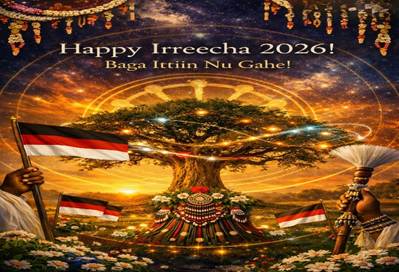
Irreecha is not repetition — it is continuity in motion. Each year, as the rivers shimmer and the skies clear, the Oromo people gather not only to thank Waaqa, the Creator, but to re‑synchronize the rhythm of existence. Irreecha 2026 arrives as a luminous reminder that gratitude is not a ritual of memory alone — it is a quantum act of coherence.
🌿 The Ceremony of Sovereign Renewal
Irreecha is the Oromo calendar’s heartbeat — a ceremony where time itself becomes ethical. It is the moment when the people, the land, and the cosmos align to declare: Order has returned; life continues. In this thanksgiving, the community does not merely celebrate; it diagnoses balance. To give thanks is to measure the health of the world — to sense whether Safuu, the moral equilibrium, still holds.
⚛️ From Thermodynamic Order to Quantum Continuity
In 2025, Irreecha reminded us that dignity circulates like energy — regenerating through fairness and rhythm. In 2026, that insight deepens: Irreecha becomes quantum thanksgiving, where every act of gratitude collapses disorder into harmony. The Gadaa system, with its rotation and integrity, mirrors the quantum field — a governance of probabilities resolved through ethical observation. To thank Waaqa is to stabilize the wave of existence; to honour Gadaa is to encode justice into the structure of time.
🌍 Irreecha as Institutional Blueprint
Legacy institutions fear new technology because they cling to linear order. Irreecha teaches that true governance is cyclical, not hierarchical — regenerative, not extractive. It is the living prototype of quantum institutions, where leadership rotates, truth circulates, and power dissolves into stewardship. In this sense, Irreecha is not folklore; it is civilizational engineering — a model for how humanity might design ethical systems for the age of computation and climate.
🌸 The Communal Pulse
Irreecha is not solitary thanksgiving; it is team gratitude. It is the choreography of equality — the people moving together, singing together, remembering together. It teaches that survival is not conquest but cooperation, not isolation but entanglement. Every hand raised in blessing is a node in the quantum network of peace.
🌞 The Message of 2026
Irreecha 2026 speaks softly yet powerfully:
“Do not fear the new light. Design with it.” It calls humanity to build institutions that resonate with the rhythm of nature — systems that rotate, renew, and remember. It reminds us that thanksgiving is not nostalgia; it is architecture. To thank is to design. To design is to sustain.
🌾 Conclusion
Irreecha is not only Oromo — it is planetary memory. It teaches that gratitude is governance, that fairness is physics, and that renewal is the only true form of progress. In 2026, as the world stands between entropy and awakening, Irreecha offers the blueprint: Rotation instead of domination. Renewal instead of decay. Light instead of fear.
Happy Irreecha 2026! Baga Ittiin Nu Gahe! May this thanksgiving remind us that the rhythm of renewal is the rhythm of survival — for a people, for a planet, and for the civilization yet to come.
Irreecha 2026: A Quantum Thanksgiving of Continuity and Light This essay and image are offered as a gift of remembrance — a reflection on Irreecha’s purpose as the rhythm of renewal and the architecture of fairness. May this season remind us that gratitude is governance, and renewal is survival.
Happy Irreecha to everyone. Here is the new Irreecha song in Afaan Oromoo and English — a celebration of grace, renewal, and harmony. From ancient roots to futures new, Irreecha shines in all we do. Hayyuun urjii dhaye, Irreechaatu gayee — Baga ittiin nu gahe. Watch the song here:
🌿 Lyrics Included
Afaan Oromoo: Hayyuun urjii dhayee,
Irreechaatu gayee
Baga ittin nugayee
Baga ittin isin gayee
Nooruu yaa bacaqii birraa
Oromoon waliin jirraa
Hambaalee Gadaa keenyaa
Irreechi irree keenyaa
English: Happy Irreecha, day of grace,
Strength and harmony fill this place.
From ancient roots to futures new,
Irreecha shines in all we do.
Credits:
Author/Creator/contributor: Temesgen Muleta-Erena
Melody: Gemini
Composition/ Publisher: TC Press London
Book Review September 17, 2026
Posted by OromianEconomist in Uncategorized.Tags: Cultural Formation, Jamila, Narrative Sovereignty, Oromo, Qixxoo, Strategic Truth, Tesfaye Gebre’ab
1 comment so far
Scrolls on Experimental Microeconomics and the Hidden Identity Game:
Cultural Formation, Narrative Sovereignty, and Strategic Truth in Tesfaye Gebre’ab
Book Review
Scrolls on Experimental Microeconomics and the Hidden Identity Game:
Cultural Formation, Narrative Sovereignty, and Strategic Truth in Tesfaye Gebre’ab is a rare and sovereign work that bridges two worlds often kept apart: the precision of mathematical modelling and the lived truth of cultural identity. Temesgen Muleta‑Erena constructs a diagnostic framework that reveals how identity survives suppression, how truth re‑emerges through community memory, and how cultural systems correct institutional fiction over time.
Drawing on Tesfaye Gebre’ab’s literary discoveries, the book treats narrative as empirical data. Each case — from overwritten names to erased genealogies — becomes a structural signal that exposes the mechanics of erasure and the pathways of reconstruction. Muleta‑Erena then applies game theory, information theory, entropy modelling, and experimental microeconomics to illuminate these mechanisms with scientific clarity.
The result is a scroll‑based analytical architecture that feels both rigorous and sovereign. It shows how identity functions as a signal under distortion, how cultural memory behaves like a distributed engine, and why truth ultimately becomes the equilibrium that outlasts suppression. This is not simply cultural commentary; it is a mathematical reconstruction of identity systems.
Muleta‑Erena’s writing is disciplined, elegant, and deeply intentional. Every essay builds toward a larger insight: identity rooted in truth cannot be erased — only delayed. Sovereignty is the natural outcome of truth.
A powerful, original, and necessary contribution to cultural theory, microeconomics, and sovereign literature.
Available on Amazon: https://www.amazon.co.uk/dp/B0HK3V7N28
Jamila Ali Damacoo: The Hidden Mother in Ethiopia’s Imperial Narrative September 14, 2026
Posted by OromianEconomist in Uncategorized.Tags: Ali Damacoo, book-reviews, genealogy, history, Jamila Ali Damacoo, Mekonnen Guddisaa, Munaa Ali Damacoo, Qixxo Hussein, writing, Yejjuu Oromo, Yeshimebet
1 comment so far
⭐ Jamila Ali Damacoo: The Hidden Mother in Ethiopia’s Imperial Narrative
TC Press Cultural Ecology Series — Continuation
Author/ Contributor: Temesgen Muleta-Erena
History often remembers power but forgets the people who shaped it. Among these forgotten figures stands Jamila Ali Damacoo, a woman whose identity was rewritten inside the machinery of Ethiopia’s imperial state. Her story is not only personal — it is a window into the broader pattern of Oromo erasure within official historiography.
Jamila, born to Ali Damacoo of the Yejjuu Oromo, carried a lineage deeply rooted in Oromo cultural identity. Her mother, Qixxoo Hussein, embodied a mixed heritage: Silxee on her maternal side and Yejjuu Oromo on her paternal side. The name Qixxoo itself means “equal” in Afaan Oromo — a symbolic reflection of balance and dignity.
Jamila was not alone in this heritage. She had a junior sister, Munaa Ali, who shared the same ancestral roots. Together, Jamila and Munaa represent a family whose identity was shaped by Oromo values, yet later obscured by imperial narratives.
According to author Tesfaye Gebre’ab, whose research includes a detailed interview on OMN with journalist Fiqaaduu (VOA Afaan Oromo), Jamila’s original name and identity were replaced with Yeshimebet — the name officially recorded as the mother of Emperor Haile Selassie. This renaming was not accidental; it was part of a systematic pattern of assimilation within the imperial court.
The pattern extends further. Haile Selassie’s father, Ras Makonnen, was born Mekonnen Guddisa, tracing his lineage through Fitawrari Woldemikael Guddisa, a noble family of Oromo origin. Both maternal and paternal lines reveal a clear Oromo heritage — yet official imperial narratives reframed these identities to fit the Solomonic mythos.
This rewriting served a political purpose: to reinforce centralized legitimacy by absorbing Oromo ancestry into a highland Christian imperial identity. Jamila’s transformation into “Yeshimebet” is one example of how personal identity became a tool of state narrative construction.
Tesfaye Gebre’ab’s work — including the OMN interview — helps restore these erased histories. It reveals how Oromo lineage shaped the imperial establishment, even as the state attempted to conceal it. Jamila Ali Damacoo’s story is therefore not only about one woman; it is about the broader struggle for historical truth, cultural recognition, and the dignity of remembering.
Her name, her lineage, and her story deserve to stand in the open — not hidden behind the architecture of empire.
The Quantum Gadaa System: Indigenous Architecture for Planetary‑Scale Ethics September 14, 2026
Posted by OromianEconomist in Uncategorized.Tags: African Philosophy, AI, artificial-intelligence, Autonomous Systems, Civilizational Theory, consciousness, Digital Sovereignty, Ecology Videos, Entanglement, Gadaa System, Indigenous Governance, Nonbinary Ethics, Oromo Civilization, philosophy, Planetary Institutions, Post Scarcity, Quantum Ethics, Quantum Gadaa, Safuu, Science, Siiqqee, Superposition, TC Press, Temesgen Muleta‑Erena
1 comment so far
The Quantum Gadaa System: Indigenous Architecture for Planetary‑Scale Ethics
TC Press Cultural Ecology Series — Continuation
Author/ Contributor: Temesgen Muleta-Erena (PhD) Economist, Sovereign Publisher, Epistemic Steward
Affiliation: TC Press / The Codex Press, London
Abstract
As humanity enters a transition era defined by quantum computation, autonomous agents, and planetary‑scale digital systems, existing ethical frameworks are collapsing under the weight of non‑binary machine logic. This essay proposes that the Oromo Gadaa system—a cyclical, distributed, egalitarian governance architecture—offers a structurally compatible model for quantum ethics. By mapping superposition, entanglement, rotation, Siiqqee, and Safuu onto algorithmic accountability, we reveal how ancestral African democracy can inform the next generation of planetary institutions.
1. Introduction: The Transition Era
We are living through a structural shift in global technology. Quantum systems, probabilistic computation, and autonomous agents are emerging faster than any regulatory body can adapt. Traditional governance models—rooted in binary logic, permanent power structures, and linear accountability—are no longer capable of regulating machines that operate in superposition and entanglement.
This is not a crisis of a single year. It is a planetary transition.
The ethical mismatch between binary institutions and non‑binary computation is widening. The world needs a governance architecture capable of rotating power, distributing authority, and embedding moral constraints directly into the computational substrate.
The Oromo Gadaa system provides such a model.
Video link: https://youtu.be/P5WFpBXHQ3k
2. The Failure of Binary Governance
Modern digital governance is built on rigid binaries:
- allowed / not allowed
- safe / unsafe
- aligned / misaligned
- consent / reject
Quantum systems do not operate in binaries. They operate in probabilities, gradients, and evolving states.
Current institutions fail because:
- Big Tech creates permanent power structures
- Quantum systems evolve faster than regulation
- Autonomous agents bypass binary ethical checks
- No cyclical accountability exists in digital governance
- Planetary institutions are not designed for non‑binary computation
We are attempting to regulate probabilistic machines with laws written for deterministic machines.
This mismatch is the core ethical problem of the transition era.
3. Gadaa as a Non‑Binary Ethical Architecture
The Oromo Gadaa system is a democratic institution built on:
- cyclical power rotation
- distributed authority
- federated decision‑making
- ritual accountability
- moral constraint layers
It is structurally aligned with quantum logic.
Below is the mapping between Gadaa and quantum computation.
3.1 Superposition → Gadaa Age‑Sets
Quantum superposition allows multiple states to exist simultaneously. Gadaa age‑sets function the same way: multiple leadership cohorts operate at once, each with defined responsibilities.
This creates layered governance, not binary governance.
3.2 Entanglement → Federated Clans
Quantum entanglement links distant nodes so that actions in one location affect another. Gadaa federated clans operate through interconnected decision‑making, where outcomes ripple across the entire system.
This is distributed ethics, not centralized ethics.
3.3 Rotation → 8‑Year Power Cycle
Quantum systems rotate states. Gadaa rotates leadership every eight years.
No entity—human or algorithm—can hold permanent dominance.
This is the antidote to Big Tech’s permanent power structures.
3.4 Siiqqee → Algorithmic Accountability
Siiqqee is the moral instrument carried by Oromo women to enforce justice, balance, and social correction. In quantum ethics, Siiqqee becomes the metaphor for:
- ethical override signals
- moral interrupts
- emergency stop conditions
- accountability triggers
It is the moral failsafe embedded into computation.
3.5 Safuu → Quantum Constraint Layer
Safuu is the Oromo moral boundary that prevents imbalance and protects harmony. In quantum systems, Safuu becomes the constraint layer that prevents harmful outcomes.
Safuu is not a rule. It is a boundary condition.
This is exactly what quantum ethics requires.
4. Planetary Institutions and Indigenous Logic
As quantum systems begin to govern climate models, financial flows, ecological monitoring, and autonomous infrastructure, humanity must design institutions capable of regulating non‑binary computation.
Binary governance will fail. Linear accountability will fail. Permanent power structures will fail.
Planetary institutions must be:
- cyclical
- distributed
- entangled
- morally constrained
- override‑capable
- non‑binary
The Gadaa system already embodies these principles.
Indigenous governance is not a relic. It is a blueprint for the future of computation.
5. Conclusion: The Future Has Always Been Indigenous
The Quantum Gadaa System is not an attempt to import African democracy into modern technology. It is a recognition that the architecture of quantum ethics already exists in ancestral knowledge.
Gadaa offers:
- cyclical accountability
- distributed governance
- moral constraint layers
- override mechanisms
- non‑binary logic
- planetary‑scale compatibility
As humanity enters the next era of digital sovereignty, the fusion of indigenous egalitarianism and quantum computation becomes not only possible—but necessary.
The future of planetary institutions may depend on the wisdom encoded in Gadaa, Siiqqee, and Safuu.
References
Books by Temesgen Muleta‑Erena (TC Press, London)
- Muleta‑Erena, Temesgen (2026). The Institutions of the Autonomous Civilisation: Governance and Economics Beyond the Consumption World: A Framework for Governance, Value, and Stewardship in the Post‑Scarcity Era. TC Press, London. (Discusses the structural significance of Gadaa for post‑scarcity governance and planetary institutions.)
- Muleta‑Erena, Temesgen (2026). The Time‑Tested Republic: Beyond the State – Gadaa as a Living Blueprint for Ethical Governance. TC Press, London. (Provides a foundational analysis of Gadaa as a reproducible constitutional architecture for modern governance.)
- Muleta‑Erena, Temesgen (2026). Beyond the Sun: Humanity’s Thermodynamic Republic in the Billion‑Year Frontier: Modelling Scarcity and Abundance through the Co‑Application of Economics and Physics. TC Press, London. (Explores long‑horizon governance, thermodynamic ethics, and the role of indigenous systems in future civilizational design.)
The Economics of Digital Inactivation: Personal Entropy, Institutional Entropy, and Civilisation Tools September 11, 2026
Posted by OromianEconomist in Uncategorized.add a comment
The Economics of Digital Inactivation: Personal Entropy, Institutional Entropy, and Civilisation Tools
Muleta-Erena, Temesgen, The Economics of Digital Inactivation: Personal Entropy, Institutional Entropy, and Civilisation Tools (September 05, 2026). Available at SSRN: https://ssrn.com/abstract=7415238 or http://dx.doi.org/10.2139/ssrn.7415238
Abstract
Digital tools have become the core infrastructure of modern civilisation, yet large segments of the global population remain inactive despite full access. This essay introduces a dual-entropy frameworkpersonal entropy and institutional entropy-to explain why individuals and societies fail to activate available knowledge. Using decision-science and game-theoretic modelling, the essay demonstrates how digital inactivation reduces productivity, weakens trust, and slows knowledge accumulation. It argues that activation, not access, is the central economic variable of the 21st century. Without reducing entropy, humanity cannot accelerate knowledge fast enough to reach advanced frontiers such as artificial stellar engineering. The essay concludes that autonomous digital systems and long-horizon planetary institutions will become the primary trust infrastructure, enabling multigenerational projects that extend into the million-and billion-year frontier.
Keywords: Digital Inactivation, Personal Entropy, Institutional Entropy, Cognitive Activation, Civilisation Tools, Game Theory, Decision Science, Trust, Autonomous Systems, Planetary Institutions, Gadaa System, Long-Term Governance, Multigenerational Continuity
Read the full essay at:
Advertisements
Eyyoo, Ya Faacha Ishee — Ilfinash Qannoo September 10, 2026
Posted by OromianEconomist in Uncategorized.Tags: art, history, Oromo music, poetry, writing
add a comment
A Short Essay on Courage, Lineage, and Oromo Cultural Memory
Eyyoo, Ya Faacha Ishee — Ilfinash Qannoo
A Short Essay on Courage, Lineage, and Oromo Cultural Memory
Video Reference:
Essay Link:
https://theoromianeconomist.blogspot.com/2026/09/haadha-hawwii-haadha-daangaa-ilfinash.html
Oromo cultural history is carried not only by political leaders and fighters, but by women whose courage shaped the continuity of their people. Among these foundational figures stand Warqituu and Mastawat of Walloo (North Oromia) — 19th‑century Oromo women who assumed leadership after Abyssinian hegemonic forces killed many male leaders. In a period marked by severe repression and mass violence under Emperor Tewodros II, they stepped forward to protect their communities. Historical records show that they cooperated with the British Napier Expedition, whose intervention ended Tewodros’s rule, halting the mass killings in Walloo. Their leadership was an act of survival, clarity, and strategic resistance.
Alongside them stands Saartuu (Saartu) of Hararghee (Eastern Oromia) — a 20th‑century resistance figure whose courage became a symbol of Eastern Oromo endurance. Saarituu represents a later generation of Oromo women who continued the tradition of stepping into leadership when danger threatened their people. Saartuu Yuusuf — also known as Saartu Yusuf or Saartuu Bonnayaa — remains one of the most revered yet least documented Oromo women of the resistance era. A daughter of Eastern Oromia, from the Harraghee and Chercher region, she served as a combatant with OLF forces during the Dergue regime, carrying responsibilities far beyond her age. In oral accounts, Saartuu is remembered as a symbol of ultimate resistance: a woman who moved quietly, decisively, and with unwavering commitment to her people’s survival. Her sacrifices were known across villages even when her name never entered written archives. By restoring her presence in cultural memory, we honour not only her courage but the countless Oromo women whose contributions were preserved only through spoken lineage and communal remembrance.
Ilfinash Qannoo emerged in the lineage these women opened. She did not stand alone; she stood after Warqituu, Mastaw, and Saartuu, carrying forward the cultural energy they created. Her faachaa — the call that lifts, awakens, and mobilizes — was originally sung for them, for their courage, for their sacrifices, for the path they carved. In the essay on Oromo cultural activation, we explored how certain individuals become sources of motion in a community. Warqituu, Mastaw, and Saarituu were among the first. Ilfinash Qannoo became one of the strongest.
Her faachaa strengthened Hawwii. It guided Dangaa. It echoed in the footsteps of Haylee Fidaa, Abbishee Garbaa, Taaddee Birruu, and Waaqoo Guutuu — figures whose names mark the geography of Oromo resistance.
Clarifying a Common Misunderstanding
Some people ask why Ilfinash Qannoo is honoured so strongly now, even though she lived a difficult life and did not receive wide support during her lifetime. This question misunderstands the nature of Oromo resistance. Women like Ilfinash acted in periods of repression, displacement, and silence — times when public recognition was dangerous, and when cultural work happened quietly, inside families, villages, and hidden gatherings. The absence of public celebration during her life was not neglect; it was the reality of living under systems that suppressed Oromo identity. Honouring her now is not “late”—it is finally possible. It is the restoration of dignity that was denied by historical conditions, not by her people.
By turning her faachaa back toward her — Eyyoo, ya faacha ishee — we restored the cultural circle. We honoured Ilfinash Qannoo with the same force she once gave to others. This is how Oromo culture works: courage is transmitted, not consumed. It moves through lineage — from Warqituu, Mastaw, and Saarituu, to Ilfinash, to Hawwii and Dangaa, and onward to the present.
The song and the essay together remind us that heritage is an active system, not a passive memory. When we name Ilfinash Qannoo, we are not only remembering her — we are acknowledging the infrastructure of courage she inherited and expanded. And when we write, sing, or publish about her, we extend that infrastructure into the future.
This is serious work. It is for Africa. It is for the Oromo people. It is for anyone who understands that cultural memory is a form of power — one that must be read carefully, respected deeply, and put into action.
Lyrics Section
TC Press Cultural Ecology Series
Lyrics by Temesgen Muleta‑Erena
Melody by Gemini
Eyyoo Ya faacha ishee,
Kan Ilfinash Qannoo utuu ittiin garmaamsani.
Akka Warqituu,
Akka Saarituu!
Iyyoo, ya faacha ishee,
Kan haadha Hawwii utuu ittin garmaamsani,
Akka Haylee Fidaa,
Akka Abbishee Garbaa,
Akka Taaddee Birruu,
Akka Waaqoo Guutuu!
Iyyoo, ya faacha ishee,
Kan Haadha Dangaa utuu ittin garmaamsani!
Faachaa ishee — the melody she gave to those who sacrificed for Oromo causes — now returns to her, the one who carried courage in her voice and passed it to a generation.
Leapfrogging the Industrial Sequence: Africa’s Digital‑First Development Path and the Elimination of Institutional Entropy September 10, 2026
Posted by OromianEconomist in Uncategorized.Tags: Africa, Development Economics, economics, Game theory, governance-micro-grids-mobile-money-industrial-policy, institutional-entropy, leapfrogging, Politics, renewable-energy, technology, temesgen-muleta-erena
1 comment so far
Leapfrogging the Industrial Sequence: Africa’s Digital‑First Development Path and the Elimination of Institutional Entropy
Temesgen Muleta-Erena (PhD) Economist, Sovereign Publisher, Epistemic Steward
Affiliation: TC Press / The Codex Press, London
Abstract
Africa’s development trajectory differs fundamentally from the historical industrial pathways of Europe and Asia. The continent’s limited legacy infrastructure, mobile‑first digital culture, and abundant renewable energy potential create conditions for industrial leapfrogging—the ability to bypass multiple generations of industrial development and transition directly into decentralized, digital, and sustainable systems. This paper integrates a literature review, expanded sectoral analysis, mathematical game‑theory modelling, and institutional analysis to examine how Africa can leapfrog traditional industrial stages while addressing its most significant barrier: institutional entropy, a human‑made, correctable form of systemic fragmentation. The paper concludes with a clear, accessible explanation of why entropy must be eliminated and how Africa can build coherent, future‑ready institutions.
Keywords: Leapfrogging; Institutional Entropy; Development Economics; Game Theory; Renewable Energy; Digital Industrialization; Africa; Governance; Micro‑grids; Mobile Money; Industrial Policy.
JEL Codes: O10; O14; O33; O55; D02; C72
1. Introduction
Africa’s industrial future is frequently evaluated through outdated assumptions suggesting the continent must replicate the sequential industrialization model of the West. Yet Africa’s structural conditions—low legacy infrastructure, high solar potential, and rapid digital adoption—mirror the telecommunication leapfrog of past decades, where the continent bypassed copper landlines entirely to adopt mobile cellular networks.
This paper argues that Africa can similarly bypass heavy industrial phases across energy, manufacturing, agriculture, logistics, and finance. However, this historic opportunity is constrained by institutional entropy, a correctable, human‑made problem rather than an inherent genetic or cultural limitation.
2. Literature Review
2.1 Leapfrogging Theory
Fagerberg (2005) and Perez (2010) argue that latecomer economies can adopt frontier technologies without incurring the heavy sunk costs of maintaining legacy systems. Aker and Mbiti (2010) demonstrate how mobile phones transformed African markets organically without traditional landline infrastructure. Ndulu (2007) emphasizes that Africa’s lack of legacy constraints can serve as a strategic advantage, provided that institutional coordination is optimized.
2.2 Institutional Constraints
North (1990) defines institutions as the “rules of the game” that shape long-term economic performance. Acemoglu and Robinson (2012) argue that inclusive institutions foster broad-based innovation, whereas extractive institutions suppress it. African institutional challenges—such as bureaucratic inertia, fragmentation, and regulatory unpredictability—are entirely human-made and correctable. Muleta‑Erena (2026) introduces Institutional Entropy as a diagnostic framework to explain how disorder accumulates within governance systems and how efficiency can be engineered through deliberate, coherent institutional design.
2.3 Digital Industrialization
The African Development Bank (2020) identifies renewable energy, mobile finance, and digital agriculture as the core pillars of Africa’s leapfrog economy. Concurrently, the World Bank (2022) highlights regulatory sandboxes and continental free trade initiatives (AfCFTA) as vital policy enablers.
3. Sectoral Leapfrogging Opportunities
3.1 Energy: Decentralized Solar Micro‑Grids
- What can be done: Deploy community‑level solar micro‑grids; distribute home solar kits; build local solar maintenance industries.
- What can be achieved: Universal electrification; lower household energy costs; creation of sustainable local employment.
- How it can be implemented: Harmonize regional solar standards under the AfCFTA; train local technicians; establish flexible regulatory sandboxes.
- Citizen‑friendly explanation: Villages can generate electricity immediately from sunlight, bypassing the decades-long wait for massive, centralized power plants and transmission lines.
3.2 Manufacturing: Additive and Modular Production
- What can be done: Establish decentralized micro‑factories; manufacture spare parts locally via 3D printing; train youth in digital fabrication.
- What can be achieved: Reduced import dependency; faster repair cycles for critical machinery; thriving local entrepreneurship ecosystems.
- How it can be implemented: Provide tax incentives for micro-manufacturing; integrate digital fabrication into technical colleges; build open-source digital design marketplaces.
- Citizen‑friendly explanation: Local communities can print needed tools and replacement parts in hours instead of waiting months for expensive imports to clear customs.
3.3 Agriculture: Precision Farming
- What can be done: Deploy agricultural drones; utilize IoT soil sensors; apply artificial intelligence for localized climate prediction.
- What can be achieved: Significantly higher crop yields; optimized water usage; drastically reduced post-harvest losses.
- How it can be implemented: Launch farmer training cooperatives; offer smart-farming subsidies; build unified national agricultural data platforms.
- Citizen‑friendly explanation: Farmers can use simple mobile apps to receive real-time advice on precisely when to water, fertilize, plant, or harvest their crops.
3.4 Logistics: Drones and Electric Mobility
- What can be done: Expand autonomous drone delivery networks; promote electric two‑wheelers; build decentralized logistics hubs.
- What can be achieved: Accelerated delivery times for critical goods; lower transport overhead; reduced urban and rural pollution.
- How it can be implemented: Establish unified drone air corridors; set up solar-powered charging stations; integrate digital tracking systems across supply chains.
- Citizen‑friendly explanation: Life-saving medicine and emergency medical supplies can reach remote villages in minutes via drone, rather than taking days over broken roads.
3.5 Finance: Mobile Money and Decentralized Finance (DeFi)
- What can be done: Expand mobile money cross-border interoperability; introduce digital national identities; promote accessible digital savings and credit tools.
- What can be achieved: Deep financial inclusion; explosive growth of digital micro-commerce; lower transaction costs for everyday citizens.
- How it can be implemented: Harmonize regional financial regulations; digitize secure national IDs; support homegrown fintech incubation hubs.
- Citizen‑friendly explanation: People can securely save, borrow, and pay for goods using basic mobile phones, eliminating the need to travel to physical brick-and-mortar banks.
4. Mathematical Game‑Theory Model of Leapfrogging
4.1 Model Setup
Let:
- G= Government
- F= Firms
- C= Citizens
Each actor chooses between:
- A (Legacy Path)
- B (Leapfrog Path)
Payoff Functions



Where:
E= institutional entropy
R= regulatory uncertainty
U= user level uncertainty
α,γ,θ= benefits of coordination
β,δ,λ= costs of uncertainty
Constraints



Nash Equilibrium
A Nash equilibrium occurs when:

But this equilibrium is only stable when:

Thus:

4.2 Graphical Representation of the Leapfrogging Coordination Equilibrium
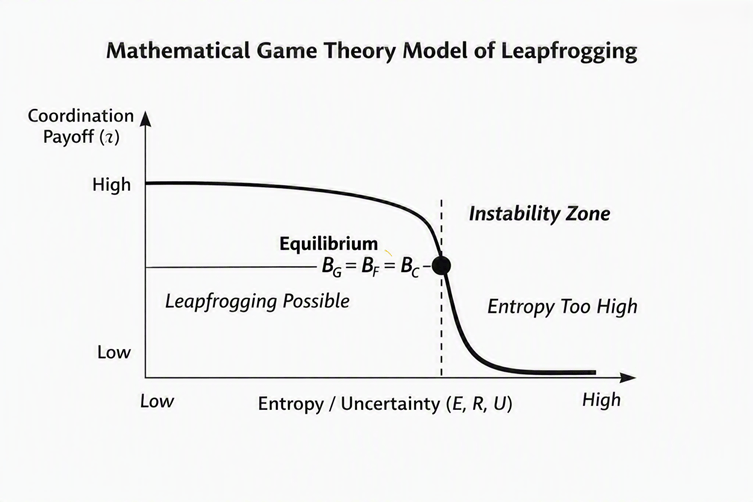
Figure 1*. Mathematical Game Theory Model of Leapfrogging. The diagram depicts the coordination payoff (π) as a function of institutional, regulatory, and user‑level entropy (E, R, U). The curve remains high and stable at low entropy but drops sharply beyond a critical threshold, marking the Nash equilibrium where BG=BF=BC. Leapfrogging is feasible only when entropy and uncertainty approach zero; beyond this point, the system enters an instability zone in which coordination collapses.
The figure titled Leapfrogging Coordination Equilibrium illustrates the relationship between institutional entropy (E) on the horizontal axis and leapfrog payoff (π) on the vertical axis. The curve remains flat at high payoff levels when entropy is low, then drops sharply after a critical threshold — representing the fragility of coordination under rising uncertainty.
This threshold curve captures the core intuition of the model: as institutional entropy increases, the payoff from leapfrogging collapses beyond a critical point. When institutions are coherent, predictable, and well‑coordinated, entropy is low and the payoff is high. When fragmentation and inconsistency rise, entropy crosses the equilibrium threshold and coordination fails.
The equilibrium point is marked where:

This represents the Nash equilibrium — the condition under which governments, firms, and citizens successfully coordinate on leapfrog strategies. The equilibrium is stable only when E, R, U → 0, meaning institutional, regulatory, and user‑level uncertainties are minimized.
To the right of the equilibrium threshold lies the Instability Zone, where entropy becomes too high for coordination. In this region:
- policy signals become inconsistent
- regulatory uncertainty increases
- firms hesitate to invest
- citizens lose confidence
- governments revert to legacy strategies
The graph therefore reinforces the central insight of the model: leapfrogging is not simply a technological choice — it is an institutional equilibrium. Africa’s ability to bypass traditional industrial stages depends on keeping entropy below the critical threshold.
5. Africa’s Institutional Limitations: Human‑Made, Not Genetic
Africa’s historical institutional weaknesses are not genetic, cultural, or geographical invariants. Instead, they are human‑made structural errors resulting from:
- Colonial administrative fragmentation that ignored organic local trade routes.
- Post‑independence replication of rigid, heavy bureaucratic models.
- Short-term political cycles that prioritize immediate optics over 20-year structural plans.
- Weak inter-ministerial coordination mechanisms.
- Fragmented and unpredictable regulatory environments.
Because these limitations are human-made, they are entirely correctable through deliberate, modern institutional design.
6. Institutional Entropy: Nature, Causes, and Elimination
6.1 What Institutional Entropy Is
Institutional entropy refers to the gradual, systemic loss of coherence, strategic direction, and operational coordination within public governance systems over time.
6.2 Why Entropy Must Be Eliminated
Unchecked institutional entropy directly destroys a nation’s capacity to leapfrog by:
- Exponentially increasing regulatory uncertainty for investors.
- Discouraging foreign and domestic capital investment.
- Fragmenting national and regional development strategies.
- Slowing down necessary regulatory innovations.
- Weakening the unifying potential of continental economic integration.
6.3 How Africa Can Eliminate Entropy
- Continental Integration (AfCFTA): Enforcing harmonized trade, digital, and technical standards across borders to eliminate market fragmentation.
- Regulatory Sandboxes: Creating safe, flexible legal spaces where innovators can test drones, fintech models, and micro-grids without bureaucratic penalties.
- Long‑Term Industrial Planning: Shifting governance frameworks away from short-term election-cycle planning toward binding 20-year national development visions.
- Digital Governance Systems: Digitize public procurement, business licensing, and regulatory filings to remove human friction and corruption.
- Incentive Realignment: Structuring civil service performance metrics to reward cross-ministerial cooperation rather than isolated bureaucratic silo-building.
7. Conclusion
Africa possesses a rare historical window to skip outdated, high-pollution industrial stages—much like it bypassed landlines to embrace mobile communications. However, achieving this requires governments to align their policies, establish transparent and predictable rules, and eliminate internal institutional friction.
When institutional systems are streamlined and organized, Africa can reliably generate clean power from sunlight, manufacture goods locally through digital fabrication, modernize farming with smart analytics, deliver critical healthcare via autonomous drones, and bank securely through mobile networks. Leapfrogging is entirely achievable; institutional entropy is the primary obstacle, and deliberate cross-sector coordination is the definitive solution.
References
- Acemoglu, Daron, and James Robinson. 2012. Why Nations Fail. New York: Crown.
- African Development Bank. 2020. African Economic Outlook. Abidjan: AfDB.
- Aker, Jenny, and Isaac Mbiti. 2010. “Mobile Phones and Economic Development in Africa.” Journal of Economic Perspectives 24(3): 207–232.
- Fagerberg, Jan. 2005. Innovation: A Guide to the Literature. Oxford: Oxford University Press.
- Muleta‑Erena, Temesgen. 2026. Institutional Entropy and the Thermodynamics of Governance: A Framework for Diagnosing Disorder and Engineering Efficiency. London: TC Press.
- Ndulu, Benno. 2007. The Political Economy of Economic Growth in Africa. Cambridge: Cambridge University Press.
- North, Douglass. 1990. Institutions, Institutional Change and Economic Performance. Cambridge: Cambridge University Press.
- Perez, Carlota. 2010. Technological Revolutions and Financial Capital. Cheltenham: Edward Elgar.
- World Bank. 2022. Digital Africa: Transforming Economies Through Technology. Washington, DC: World Bank.
About the Author
Temesgen Muleta-Erena, PhD (University of West London) and MA in Economics (University of East Anglia), is an independent economist, sovereign publisher, and epistemic steward based in London. He is the founder of TC Press (The Codex Press), a sovereign imprint dedicated to legacy-driven publishing, ceremonial documentation, and civilizational theorization. His works explore post-labour economics, value theory, planetary coordination, and the recursive architecture of knowledge. His books and essays are archived in global institutions including the British Library, Cambridge, Oxford, Berkeley, and UNAM, and distributed across federated platforms such as Kobo Plus, OverDrive, Smashwords and Hoopla. He publishes modular essays and republical scrolls to activate epistemic sovereignty and inspire coordinated futures.
**Haadha Hawwii, Haadha Daangaa: September 7, 2026
Posted by OromianEconomist in Uncategorized.Tags: art, history, Music, writing
add a comment
Ilfinash Qannoo — The Mother of Hope, The Mother of the Land, The Mother of Culture, The Mother of Resistance**
**Haadha Hawwii, Haadha Daangaa:
Ilfinash Qannoo — The Mother of Hope, The Mother of the Land, The Mother of Culture, The Mother of Resistance**
Author / Contributor: Temesgen Muleta-Erena
Abstract
Ilfinash Qannoo is one of the foundational figures in modern Oromo cultural history. Emerging in the early 1970s as part of a wider cohort of Oromo cultural pioneers — including, among others, Abitew Kebede and Ali Birra — she helped reverse a hegemonic strategy designed to fragment, de‑urbanize, and silence Oromo identity. Through culturally distinct regional melodies, resistance songs, and principled preservance, she urbanized Oromo culture, elevated hidden traditions to national visibility, and contributed to the formation of pan‑Oromo consciousness. Her legacy extends beyond music: she embodies a civilizational role comparable to Miriam Makeba in South Africa, serving as an exemplar for indigenous women across Africa and beyond. This essay examines her cultural mission, her Kaayyoo, her resistance, her gender‑boundary crossing, and her billion‑years frontier legacy.
Keywords: Ilfinesh Qannoo, Ilfinash Qannoo, Oromo cultural urbanization, Oromo music history, pan‑Oromo consciousness, cultural resistance, indigenous African women, Kaayyoo, geerarsaa, Oromo regional melodies, cultural preservation, Oromo identity formation, indigenous cultural revival, Miriam Makeba comparative study, Oromo women in music, Oromo cultural history, Guddattuu Wallaggaa
1. Introduction
The emergence of Ilfinash Qannoo in the early 1970s marks a turning point in Oromo cultural history. Her work did not simply entertain; it restructured the cultural landscape. At a time when Oromo identity faced systematic fragmentation, she brought regional cultural authenticity into urban spaces, transforming hidden traditions into national consciousness. Her songs became instruments of unity, dignity, and resistance. This essay situates Ilfinash within the broader cultural awakening of the Oromo and examines her enduring legacy.
2. Historical Context: The Hegemonic Strategy
The cultural environment preceding Ilfinash’s emergence was shaped by a deliberate hegemonic strategy:
- De‑urbanization of Oromo identity, pushing Oromo culture out of national visibility.
- Fragmentation of regions, preventing communication between west, east, south, and north.
- Urbanization of assimilated characters, presenting them as “modern” while regional authenticity was erased.
- Absorption of educated Oromo, using them to weaken cultural continuity.
- Suppression of Oromo language and music from national platforms.
This strategy produced cultural disconnection, regional isolation, and a broken sense of shared identity. It also obscured the regional and subgroup diversity of Oromo cultural life — including distinct melodic traditions from Maccaa, Tuulama, Wallo, Hararghe, Borana, Guji, Arsi, and others — each with its own rhythm, vocal style, and cultural symbolism.
3. Cultural Reversal: The 1970s Urbanization of Oromo Culture
Ilfinash Qannoo, Abitew Kebede, and Ali Birra initiated a cultural reversal. They were not commercial artists; they were cultural carriers. Their work:
- brought hidden regional traditions into national stages,
- introduced distinct Oromo melodies to urban audiences,
- recorded tapes that circulated across regions,
- created visibility where silence had been enforced.
Their performances in Finfinnee were transformative. They urbanized Oromo culture itself — the opposite of the hegemonic strategy.
3A. Guddattuu Wallaggaa: The Cultural Band That Shaped Ilfinash Qannoo
Before Ilfinash Qannoo emerged as a solo cultural icon, she was part of Guddattuu Wallaggaa, one of the most influential Oromo cultural bands of the early 1970s. The band brought together naturally gifted youth artists from Wallaggaa and surrounding regions — young talents whose voices carried distinct regional melodies and cultural authenticity.
Guddattuu Wallaggaa played a decisive role during the early Derg era. Its performances:
- introduced regional Oromo melodies to urban audiences,
- unified diverse subgroup traditions under one cultural platform,
- demonstrated the artistic potential of Oromo youth,
- and accelerated the cultural urbanization process.
The band’s impact was so significant that it drew the attention of the Derg regime. As elders recount, the band was banned abruptly once its cultural influence became visible. This suppression forced its members into new artistic paths.
From this rupture, solo artists emerged — most notably:
- Ilfinash Qannoo,
- Abitew Kebede,
- and others whose names remain preserved in oral histories.
These artists carried forward the mission of Guddattuu Wallaggaa. They produced iconic songs and cassette recordings that circulated widely across Oromia, further urbanizing Oromo culture and inspiring the next generation of solo artists.
The story of Guddattuu Wallaggaa demonstrates that Ilfinash’s rise was not accidental. It was rooted in a collective cultural movement — a band that served as a training ground, a cultural incubator, and a catalyst for the pan‑Oromo awakening.
4. Cultural Melodies as Instruments of National Awakening
Ilfinash’s cultural melodies were diplomatic tools of identity formation. They carried:
- regional vocal styles,
- indigenous emotional expression,
- local rhythmic patterns,
- the storytelling cadence of Oromo subgroups.
When she sang in national gatherings, Oromo from different regions heard the same cultural sound for the first time. This produced:
- shared cultural memory,
- shared emotional identity,
- recognition of common marginalisation,
- the beginning of pan‑Oromo consciousness.
Her songs became the first bridge across fragmented regions.
5. Resistance Through Melody
Ilfinash’s resistance was non‑violent but profound. Her line:
“Kolonii luka dooluu hamma jedhu hin haleeluu.” It is amputated in its leg; it cannot strike as much as it threatens.
This message provided psychological liberation. She taught her people:
- tyranny exaggerates its strength,
- fear is a tool of domination,
- dignity is stronger than intimidation,
- cultural truth is a form of resistance.
Her songs became emotional infrastructure for survival.
6. Gender Boundary Crossing: Geerarsaa
Traditionally, geerarsaa is a male genre. Ilfinash crossed this boundary, demonstrating:
- women’s cultural authority,
- the universality of resistance,
- the non‑gendered nature of cultural voice,
- the central role of women in national consciousness.
Her geerarsaa declared:
Being a woman is not a shortcoming — it is a blessing.
This was a cultural revolution.
7. Principle, Preservance, and Kaayyoo
Ilfinash’s cultural mission was guided by Kaayyoo — the national purpose. Her principles included:
- Preservance: she maintained her cultural line without compromise.
- Continuity: she carried her tradition until death.
- Dignity: she addressed injustice with character.
- Humiliation‑endurance: she faced suppression without breaking.
- National mission: she pushed for total cultural/national liberation, not partial recognition.
She was not limited by personal gain. She pursued historical justice through melody.
Her legacy belongs to what can be called the billion‑years frontier — a civilizational horizon beyond political eras.
8. Unity as Cultural Philosophy
Her message of unity was foundational:
“Wal malee maal qabna.” We have only each other.
This principle shaped:
- Oromo unity,
- national awakening,
- cultural revival,
- resistance identity.
Her songs taught that unity is not optional — it is existential.
9. Generational Impact
Ilfinash’s cultural revival created the emotional environment that later produced:
- the Qubee generation,
- the Qeerroo youth movement,
- modern Oromo cultural confidence,
- Oromo protests,
- Oromo media platforms,
- diaspora cultural revival.
These movements grew in a cultural landscape she helped create. Her songs became collective memory.

Figure 1. Ilfinash Qannoo performing in Finfinnee, September 1991 — a landmark moment showing her cultural continuity into the post‑Derg era.
10. Global Relevance: An Indigenous African Icon
When written in English, Ilfinash’s legacy becomes global. Like Miriam Makeba, she:
- preserved indigenous identity,
- resisted cultural erasure,
- elevated regional authenticity to national visibility,
- became a model for indigenous women across Africa.
Her work belongs in global discussions of cultural resistance and indigenous revival.
11. Legacy Through Her Daughters
Ilfinash’s lineage continues through her daughters:
- Hawwii — meaning Hope.
- Daangaa — meaning Territorial boundary / Oromo land.
She taught them:
- Oromo culture,
- Oromo language,
- Oromo melody,
- Oromo identity.
They became among the best Oromo singers of their generation.
12. Conclusion
Ilfinash Qannoo’s legacy is foundational. She urbanized Oromo culture, reversed hegemonic fragmentation, unified regions, liberated minds through melody, carried Kaayyoo without compromise, and became a global symbol of indigenous courage.
Her correct title is:
**Haadha Hawwii, Haadha Daangaa:
Ilfinash Qannoo — The Mother of Hope, The Mother of the Land, The Mother of Culture, The Mother of Resistance**
Her work is not a chapter in Oromo history — it is one of its foundations.
References
Books and Academic Works
- Baxter, Paul T.W. Peoples and Cultures of the Oromo. Addis Ababa: Addis Ababa University Press, 1994.
- Bulcha, Mekuria. Contours of the Emergent and Ancient Oromo Nation. Minneapolis: Kirk House Publishers, 2016.
- Hassen, Mohammed. The Oromo of Ethiopia: A History, 1570–1860. Trenton, NJ: Red Sea Press, 1990.
- Jalata, Asafa. Oromo Nationalism and the Ethiopian Discourse. Lawrenceville, NJ: Red Sea Press, 1998.
- Lewis, Herbert S. A Galla Monarchy: Jimma Abba Jifar, Ethiopia, 1830–1932. Madison: University of Wisconsin Press, 1965.
- Lydon, Ghislaine. On Trans-Saharan Trails: Islamic Law, Trade Networks, and Cross-Cultural Exchange in Nineteenth-Century Western Africa. Cambridge: Cambridge University Press, 2009.
- Makeba, Miriam. Makeba: The Miriam Makeba Story. New York: Plume, 1988.
- Muleta-Erena, Temesgen. The Game of Strategic Legacy: Essays in Behavioural Economics on Courage, Coordination, and Cultural Sovereignty. London: TC Press, 2025.
- Smith, Linda Tuhiwai. Decolonizing Methodologies: Research and Indigenous Peoples. London: Zed Books, 1999.
Journal Articles
- Benti, Getahun. “The Role of Oromo Music in Cultural Resistance.” Journal of Oromo Studies 12, no. 2 (2005): 45–68.
- Bulcha, Mekuria. “Cultural Identity, Modernity, and Nationalism: The Oromo Experience.” African Affairs 96, no. 385 (1997): 493–514.
- Gemeda, Abebe. “Women, Music, and Resistance in Oromo Society.” Northeast African Studies 10, no. 3 (2008): 23–49.
- Jalata, Asafa. “The Struggle for Knowledge: The Case of the Oromo.” International Journal of Ethiopian Studies 1, no. 2 (2004): 57–88.
- Schlee, Günther. “Cultural Fragmentation and Identity Formation in East Africa.” Africa 70, no. 3 (2000): 505–528.
Chapters in Edited Volumes
- Baxter, Paul T.W. “The Creation of the Pan‑Oromo Identity.” In Being and Becoming Oromo, edited by Paul T.W. Baxter, Jan Hultin, and Alessandro Triulzi, 167–186. Lawrenceville, NJ: Red Sea Press, 1996.
- Triulzi, Alessandro. “Songs of Resistance: Memory and Identity in the Horn of Africa.” In Cultural Memory in Africa, edited by Abebe Zegeye, 89–112. Cape Town: HSRC Press, 2002.
Primary Cultural Sources
- Ali Birra. Selected Recordings, 1970–1985. Addis Ababa: National Radio Archives.
- Abitew Kebede. Studio and Live Recordings. Finfinnee: Ethiopian Broadcasting Corporation Archives.
- Ilfinash Qannoo. Cultural and Resistance Songs (1970s–2000s). Oromo Music Preservation Archive.
- Qannoo, Ilfinash. “Kolonii Luka Dooluu.” Audio recording. Oromo Cultural Heritage Collection.
Indigenous and Oral Sources
- Oral testimonies collected from Oromo elders in East, West, South, and North Oromia (1970–2026).
- Community interviews archived in the Oromo Oral Heritage Project, Addis Ababa University.
- Field notes from cultural gatherings in Finfinnee, Ambo, Jimma, and Hararghe (1975–1995).
- Ilfinash Qannoo and the Guddattuu Wallaggaa Cultural Band (1970s): Oral Testimonies from Elders Associated with TC Press, London. Collected 2015–2026.
Beyond Official Titles: Cultural Breakthroughs in Performance and Representation September 5, 2026
Posted by OromianEconomist in Uncategorized.Tags: Africa, art, Ethiopia, history, Miss World 2026, Music, News, Oromo, Oromo culture, Oromo music, Ruth Yirgalem Weldesilasie, writing
add a comment
Beyond Official Titles: Cultural Breakthroughs in Performance and Representation
Competitions often create moments where the official winner is not the only artist who leaves a lasting impact. In the BBC Fame Academy series, David Sneddon secured the title with 3.5 million votes. Yet two other finalists — Lemar Obika and Sinéad Quinn — became widely recognised as cultural winners. Their performances resonated strongly with audiences, and both went on to build successful music careers. Their breakthrough came not from the final vote, but from the authenticity and talent they displayed on stage.
A similar dynamic is emerging with Ruth Yirgalem Weldesilasie, whose performance in traditional Oromo dance introduced a global audience to a cultural heritage that has long been underrepresented. Her appearance — authentic choreography, traditional costume, and confident cultural expression — revealed a tradition that many viewers had never encountered before. The reaction from international audiences, influencers, and cultural commentators was overwhelmingly positive, recognising the performance as a display of a rich and distinctive heritage.
For a culture that has faced historical suppression, this moment carried a different kind of significance. When given visibility, indigenous traditions often resonate far beyond expectations, and Ruth’s performance demonstrated how cultural authenticity can create its own form of victory — independent of any official result.
Her journey is also marked by personal resilience, including the loss of her senior sister to kidnappers. Despite this, she has continued to carry herself with strength and dignity, treating all cultures with equal respect. Her background, including her Tigrayan roots, has enabled her to navigate diverse cultural spaces with openness, helping to bring people together across East Africa and beyond.
Whether or not she wins an official title, Ruth’s performance at Miss World 2026 has already achieved something meaningful: it opened a window for the world to witness a cultural treasure, and it placed her on a path similar to artists who became iconic through impact rather than votes.
To support visual understanding of the cultural analysis, this essay includes a link to a publicly available YouTube clip uploaded by an independent creator. The video provides a clear view of Ruth Yirgalem Weldesilasie’s Oromo traditional dance performance:


You must be logged in to post a comment.