Gelloo Yaa Gelloo October 20, 2026
Posted by OromianEconomist in Uncategorized.Tags: African Culture,, Arjo,, Community Heritage,, Cultural Memory,, Cultural Preservation,, Dance,, Dhidhessaa Corridor,, Ecology,, history, Indigenous Knowledge, Killoo Kombolchaa,, Music, News, Oromia,, Oromo Culture,, Oromo Language,, Oromo music,, reviews, TC Press, Temesgen Muleta-Erena,, Traditional Music,, World Music,, writing
add a comment
Culture, Dance, and Cultural Exchange Along the Arjo–Dhidhessaa Corridor

Watch the Video
Gelloo Yaa Gelloo
Culture, Dance, and Cultural Exchange Along the Arjo–Dhidhessaa Corridor
Music, dance, and cultural memory have always travelled together. Long before modern media, communities transmitted stories, values, traditions, and collective identities through songs performed at gatherings, celebrations, and social occasions. The song Gelloo Yaa Gelloo belongs to this continuing tradition.
Inspired by the cultural life of Arjo and the wider Dhidhessaa corridor of Oromia, the song combines traditional Oromo lyricism with modern creative technologies to create a new interpretation of an enduring cultural atmosphere. Through music, dance, imagery, and digital production, the project seeks to document and celebrate a living cultural landscape while making it accessible to wider audiences.
Full Lyrics
Gelloo yaa gelloo,
Gelloo raasaa buqqee,
Gelloo jennan dhuftee.
Yoona yoonaa,
Yeroon keenyaa,
Yoona yoonaa.
Koottu yaa shubbee,
Mee shabshab goonaa.
Silaa Arjotti gallaa,
Maaf adda baanee dallannaa,
Koottu gaaddissa teenyaa,
Maal abbaashee wal dhabnaa.
The Cultural Landscape of Arjo
The world represented in Gelloo Yaa Gelloo emerges from a specific cultural and ecological setting. Arjo and the wider Dhidhessaa corridor have long been places where community life, agriculture, nature, and cultural expression intersect.
Songs from such environments often reflect everyday social relationships. They carry memories of gatherings under trees, seasonal celebrations, village pathways, communal experiences, and the landscapes that shape people’s lives. The lyrics of Gelloo Yaa Gelloo capture this atmosphere through playful dialogue, invitations to dance, and references to shared cultural spaces.
Although the song is rooted in a particular locality, its themes remain familiar across many societies. Friendship, celebration, belonging, and human connection are experiences that transcend geography.
Dance as a Living Cultural Language
Dance occupies an important place within Oromo cultural expression.
It is more than movement. It is a language of participation.
Through rhythm, gesture, and collective performance, people communicate identity, community, and joy. The repeated invitation within the song to dance together reflects a longstanding tradition in which celebration becomes a shared cultural experience rather than an individual activity.
The dance imagery accompanying the song illustrates how cultural forms continue to evolve. Traditional influences remain visible while contemporary styles and technologies contribute new dimensions to presentation and preservation.
Tradition Meets Technology
One of the most distinctive aspects of this project is the fusion of traditional inspiration with modern technology.
The lyrics emerged from cultural memory and local expression. The melody was developed using AI-assisted music generation. Video technologies made it possible to transform a simple concept into a visual performance capable of reaching audiences across the world.
Rather than replacing cultural traditions, technology can support their preservation and dissemination. Songs that might previously have been limited to local performance can now become part of a permanent digital archive, available to future generations.
In this sense, technology functions as a cultural bridge.
Cultural Exchange in Both Directions
The video presents traditional Oromo attire and cultural aesthetics while simultaneously incorporating creative approaches that resonate with broader global audiences.
This creates a two-way exchange.
Culture travels from Arjo to the world through music, dance, and storytelling.
At the same time, exposure to global technologies and creative tools provides new ways of documenting and renewing local cultural expression.
The result is not cultural loss but cultural dialogue.
A community remains rooted in its heritage while participating in wider conversations about creativity, identity, and artistic expression.
Ecology, Memory, and Culture
The song also reflects a broader principle that runs throughout the TC Press Ecology Series.
Culture and ecology are deeply connected.
People inherit landscapes, but they also inherit songs about those landscapes.
Memories become attached to rivers, fields, schools, trees, pathways, and gathering places. Cultural expressions preserve those relationships long after individual events have passed.
Documenting music therefore contributes not only to cultural preservation but also to the preservation of ecological memory.
In this way, songs become part of a larger record of lived experience.
Conclusion
Gelloo Yaa Gelloo is both a cultural performance and a cultural document.
It celebrates the traditions of the Arjo–Dhidhessaa corridor while demonstrating how modern technologies can help preserve, share, and renew local heritage.
The project shows that culture does not need to choose between tradition and innovation. It can remain deeply rooted in place while engaging with the wider world.
From Arjo to global audiences and back again, the journey of the song illustrates how cultural expression continues to connect people across generations, landscapes, and communities.
TC Press
Ecology Lyrics Series – Oromo Cultural Soundscapes
Author: Temesgen Muleta-Erena
From Oromia to the World October 17, 2026
Posted by OromianEconomist in Uncategorized.Tags: Communication,, Cultural Diversity,, Cultural Exchange, Education, Global Citizenship,, Humanity,, language, Language Learning, Languages,, Multilingualism, Oromo Culture,, TC Press, technology, Temesgen Muleta-Erena,, writing
add a comment
How Language Learning Builds Bridges Between Culture

From Oromia to the World: How Language Learning Builds Bridges Between Cultures
Watch the Video:
https://youtu.be/j_UA_JlzCNs
Language is one of humanity’s most powerful tools. It allows people to exchange ideas, build friendships, preserve culture, and cooperate across borders. While geography, history, and tradition may shape different communities, language provides a pathway through which people can learn from one another.
The video From Oromia to the World explores this idea through a simple but meaningful interaction. Two young Oromo people meet in a beautiful rural setting, exchange greetings, and continue their conversation in multiple languages from different parts of the world.
Although the video begins in a specific cultural context, its message is universal: communication creates connection.
Language and Human Connection
Human societies have always depended on communication.
Before trade, diplomacy, education, or scientific collaboration can occur, people must find ways to understand one another. Languages differ in vocabulary, grammar, pronunciation, and history, yet they often serve similar purposes. People introduce themselves, ask about one another’s well-being, share knowledge, and build relationships.
A simple greeting is therefore more significant than it may appear.
When someone learns a greeting in another language, they demonstrate respect for another community and a willingness to communicate across cultural boundaries.
Cultural Confidence and Global Openness
An important feature of the video is that the participants remain connected to their cultural identity.
The setting is rural and natural.
The clothing reflects Oromo cultural traditions.
The conversation begins in Afaan Oromo.
Yet from that local foundation, the discussion expands to include numerous world languages.
This reflects an important principle:
Global engagement does not require cultural abandonment.
A person can celebrate their own heritage while learning from others.
A community can preserve its language while encouraging multilingual communication.
Identity and openness can coexist.
Speaking Together, Learning Together
The phrase Speaking Together, Learning Together captures the educational spirit of the project.
Every language contains:
- history,
- knowledge,
- traditions,
- literature,
- and unique ways of describing the world.
Learning another language therefore means more than learning words. It means gaining access to another perspective.
The exchange of greetings in Oromo, Sidama, English, German, Spanish, French, Arabic, Italian, Urdu, Chinese, and Hausa symbolises this broader process of mutual learning.
The video does not seek to promote one language over another. Instead, it highlights the value of linguistic diversity itself.
Technology and Cultural Exchange
Modern technology has transformed language learning.
A smartphone now provides access to translation tools, educational resources, cultural content, and speakers of different languages from around the world.
This creates opportunities that previous generations rarely enjoyed.
People can remain deeply connected to their communities while engaging with a global audience.
Educational and cultural projects can be produced and shared at very low cost.
Knowledge can travel across continents within seconds.
The result is a world in which learning becomes increasingly accessible.
Many Languages, One Humanity
Humanity speaks thousands of languages.
This diversity is sometimes viewed as a barrier.
Yet it can also be viewed as a source of cultural richness.
Every language contributes something unique to human civilisation.
Every language represents generations of experience, memory, and creativity.
The goal of multilingual communication is not to eliminate differences. It is to create understanding despite those differences.
When people learn one another’s languages, even at a basic level, they strengthen the foundations of cooperation and mutual respect.
Conclusion
From Oromia to the World uses a simple conversation to communicate a larger idea.
Languages do not separate humanity. They connect it.
The ability to learn, share, and communicate across cultures remains one of the most valuable skills in an increasingly interconnected world.
By remaining rooted in local identity while embracing global communication, people can preserve cultural heritage and expand human understanding at the same time.
In a world that often emphasises division, multilingual communication reminds us of something important:
Many Languages. One Humanity.
Author (Producer): Temesgen Muleta-Erena
Publisher: TC Press, London
Ideas, Culture, and Strategic Truth 🌍🗣️🌿✨
Taming Cognitive and Strategic Chaos: A Plain-Language Guide to Decision Entropy October 12, 2026
Posted by OromianEconomist in Uncategorized.Tags: Behavioural Economics, decision science, Entropy, Game theory, Institutional Design, philosophy, TC Press, temesgen-muleta-erena, The Codex Press
1 comment so far

Taming Cognitive and Strategic Chaos: A Plain-Language Guide to Decision Entropy
Temesgen Muleta-Erena (PhD), Economist, Sovereign Publisher, Epistemic Steward
Affiliation: TC Press (The Codex Press), London
Abstract
Decision science is frequently defined as the study of how human beings process choices and respond to behavioural triggers. This essay presents an alternative perspective: the primary purpose of decision science is to systematically reduce entropy across human systems. In social and cognitive contexts, entropy manifests as the accumulation of confusion, distortion, unverified assumptions, strategic errors, and institutional breakdown. These failures routinely occur when individuals, organizations, and polities rely on low-effort, impulsive, or unexamined decision habits. Drawing upon dual-process psychology, bounded rationality, game theory, and institutional analysis, this paper outlines a clear framework connecting decision quality to entropy management. Deliberate analytical reasoning, systematic verification, and aligned incentives serve as essential mechanisms that reduce chaos and improve resilience across everyday choices and complex organizations.
Keywords: Decision Science, Entropy, Dual-Process Theory, Bounded Rationality, Game Theory, Verification, Institutional Design.
Introduction
Why do smart people frequently make poor decisions? Why do successful organizations repeat avoidable mistakes? Why do modern societies fall victim to widespread misinformation despite having access to endless streams of information?
Traditional behavioural science answers these questions by identifying cognitive biases and explaining why humans act irrationally. However, simply explaining a mistake does not prevent it from happening again.
This essay argues that decision science should be understood as a discipline focused on entropy reduction. In physics, entropy refers to the natural tendency of systems to decay into disorder. In human systems, decision entropy is the accumulation of noise, misunderstanding, unverified assumptions, and poor strategic choices. The fundamental challenge of modern life is not gathering more information, but building systems that turn raw information into clear, reliable choices.
For readers interested in the complete formal mathematical proofs, proof-of-concept equations, and technical economic modeling behind this framework, refer to the full technical version of Entropy and the Architecture of Human Decisions
Theoretical Foundations made Simple
The concept of decision entropy unites four major fields of study:
Bounded Rationality
Herbert Simon showed that human beings cannot be perfectly logical actors because we have limited time, energy, and information. As a result, people settle for options that are “good enough” rather than finding the absolute best solution. This natural limitation leaves every decision vulnerable to mistakes and mental clutter.
Dual-Process Theory
Daniel Kahneman and Amos Tversky showed that human thinking relies on two interacting mental modes:
┌────────────────────────────────────────────────────────┐
│ SYSTEM 1 (Fast Gear) │
│ Autopilot • Intuitive • Low Energy • Prone to Bias │
└───────────────────────────┬────────────────────────────┘
│
[ Active Override ]
│
▼
┌────────────────────────────────────────────────────────┐
│ SYSTEM 2 (Slow Gear) │
│ Deliberate • Analytical • Checks Facts • High Effort │
└────────────────────────────────────────────────────────┘
- System 1: Fast, automatic, emotional, and intuitive. It is essential for routine daily tasks, but prone to errors when dealing with complex, unfamiliar problems.
- System 2: Slow, deliberate, logical, and verification-focused. It requires conscious mental effort, but acts as a critical filter against errors.
Game Theory and Incentives
Game theory examines how people make choices when their outcomes depend on the actions of others. Poor group decisions often occur not because individuals are foolish, but because the rules and incentives encourage bad behaviour.
Institutional Design
Research in institutional economics shows that organizations, laws, and social rules exist primarily to create stability and predictable choices. Strong institutions succeed because they lower uncertainty and encourage cooperation.
A Simple Model of Decision Entropy
Decision entropy increases whenever choices are driven by impulse, emotional reactions, unverified headlines, or peer pressure.
We can represent this relationship with a straightforward framework:

Where α,β,γ>0 represent the relative weight of each factor.
┌────────────────────────┐
│ DECISION QUALITY │
└───────────┬────────────┘
│
┌──────────────┴──────────────┐
▼ ▼
Analytical Thinking Fact Verification
(System 2 Shift) (Empirical Check)
│ │
└──────────────┬──────────────┘
│ [Drives Down]
▼
┌────────────────────────┐
│ DECISION ENTROPY │
│ (Noise & Illusions) │
└────────────────────────┘
From this core relationship, we can define Decision Quality (D):

This model yields three core principles:
- Rising Entropy Degrades Quality: As noise, confusion, and impulse increase, decision quality drops.
- Slowing Down Improves Outcomes: Engaging deliberate analytical thinking directly lowers entropy.
- Fact-Checking Creates Stability: Verification protects decision quality even when full information is unavailable.
Separating Impression from Reality
A major source of decision entropy is confusing subjective experience with objective truth.
Flawed Mental Process: [ Perception ] ═════► [ Absolute Truth ]
Correct Mental Process: [ Perception ] ──► [ Critical Analysis ] ──► [ Verification ] ──► [ Truth ]
When individuals assume that their immediate reaction or interpretation represents reality without checking the facts, entropy rises. Strategic clarity requires us to separate what we observe, how we interpret it, and what is objectively true.
Institutions as Chaos Filters
Throughout history, human civilization has built structured systems designed specifically to filter out noise and reduce collective entropy:
INSTITUTIONAL FILTERS
│
┌──────────────────┬────────────┴───────────┬──────────────────┐
▼ ▼ ▼ ▼
Scientific Judicial Market Academic
Methods Courts Prices Education
│ │ │ │
Filters out Filters out Filters out Filters out
Flawed Theories False Claims Resource Waste Ignorance
│ │ │ │
└──────────────────┴────────────┬───────────┴──────────────────┘
▼
SYSTEMIC STABILITY
- Science: Uses replication and testing to filter out false ideas.
- Legal Systems: Use rules of evidence to separate facts from rumors.
- Economic Markets: Use price signals to coordinate supply and demand.
- Education: Transmits tested knowledge to eliminate ignorance.
When these systems break down or lose public trust, overall societal entropy surges, leading to confusion and systemic instability.
Practical Interventions for Managing Entropy
To reduce decision entropy across personal, organizational, and societal domains, we can apply targeted practices:
Individual Level: Introduce Deliberate Pauses
- Establish habit-based “cooling-off” periods before making significant financial commitments or posting online.
- Practice asking basic verification questions: “What is the proof for this claim?” and “What alternative explanations exist?”
Organizational Level: Structure the Decision Process
- Use “pre-mortems” where teams imagine a project has failed before launch to discover hidden risks.
- Align employee incentives so that long-term accuracy and stability are rewarded over short-term metrics.
Societal Level: Invest in Epistemic Infrastructure
- Support educational frameworks that teach critical thinking, media literacy, and scientific reasoning.
- Design platforms and systems that reward fact verification rather than immediate emotional engagement.
Conclusion
Decision science should not merely describe how human beings act; it should provide practical tools to combat chaos.
Entropy accumulates whenever individuals and institutions rely excessively on unexamined impulses and unverified assumptions. By activating deliberate reasoning, enforcing fact-checking habits, and designing clear institutional incentives, we can lower decision entropy and build more resilient, capable systems.
Further Reading & References
For the complete technical breakdown and economic models, visit the full essay paper:
- Full Technical Paper: Entropy and the Architecture of Human Decisions (The Oromian Economist)
Key Academic Citations:
- Gibbons, Robert. Game Theory for Applied Economists. Princeton, NJ: Princeton University Press, 1992.
- Kahneman, Daniel. Thinking, Fast and Slow. New York: Farrar, Straus and Giroux, 2011.
- Muleta-Erena, Temesgen. Daily Cognitive Erosion: A Decision-Science Model of Personal Entropy and System Entropy in Modern Societies. London: TC Press, 2026.
- Muleta-Erena, Temesgen. The Epistemological Divide: Decoupling Subjective Phenomenological Certainty from Objective Truth in Decision Theory. London: TC Press, 2026.
- North, Douglass C. Institutions, Institutional Change and Economic Performance. Cambridge: Cambridge University Press, 1990.
- Ostrom, Elinor. Governing the Commons: The Evolution of Institutions for Collective Action. Cambridge: Cambridge University Press, 1990.
- Simon, Herbert A. Models of Bounded Rationality. 2 vols. Cambridge, MA: MIT Press, 1982.
- Tversky, Amos, and Daniel Kahneman. “Judgment under Uncertainty: Heuristics and Biases.” Science 185, no. 4157 (1974): 1124–1131.
- Von Neumann, John, and Oskar Morgenstern. Theory of Games and Economic Behaviour. Princeton, NJ: Princeton University Press, 1944.
From Heritage to High Fashion October 6, 2026
Posted by OromianEconomist in Uncategorized.Tags: #Irreecha, art, creative industry, fashion, Hetritage, High fasshion, lifestyle, Oromo fashion design, style, Sustainable Fasshion, TC Press, Temesgen Muleta‑Erena, Travel
add a comment
How Irreecha Inspired a Cultural Design Revolution
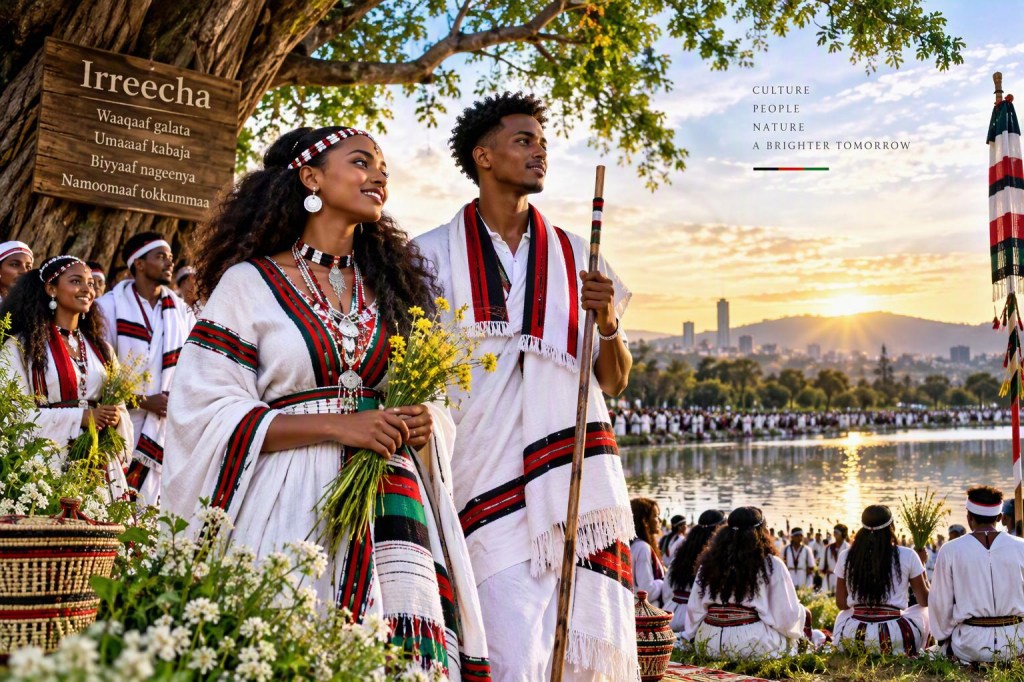
From Heritage to High Fashion
How Irreecha Inspired a Cultural Design Revolution
Every generation inherits something from the past. Some inherit buildings, some inherit languages, and others inherit knowledge. One of the most visible inheritances passed from one generation to another is cultural design.
In Ethiopia, few cultural events have influenced fashion and design as profoundly as Irreecha. While widely known as a celebration of gratitude, community, and cultural identity, Irreecha has also become an unexpected catalyst for creativity, entrepreneurship, and innovation. The celebration has helped transform traditional attire from cultural heritage into a dynamic and evolving design movement.
Today, the influence of Irreecha reaches far beyond the ceremonial field. It can be seen in photography, social media, fashion design, public events, digital art, and contemporary cultural expression.
A Living Design Archive
The success of cultural fashion did not emerge from a vacuum.
Across generations, communities preserved textile traditions, embroidery styles, jewellery designs, colour combinations, and various forms of artistic craftsmanship. These traditions formed a living archive of design knowledge.
Young designers did not need to invent a completely new visual language. Instead, they found inspiration in what already existed.
Traditional attire became a foundation upon which contemporary creativity could flourish.
Rather than looking backward, many designers discovered that cultural heritage provided a pathway forward.
The Irreecha Showcase Effect
Every year, Irreecha creates a unique public stage.
Thousands of people present their finest cultural attire. Photographs circulate widely. Videos are shared across platforms. New designs attract attention. Conversations emerge around colour, tailoring, symbolism, and craftsmanship.
This visibility matters.
For many young creatives, the celebration offers something invaluable: an audience.
A design that might once have been seen only by a small local community can now be viewed by people across continents. Through social media and digital communication, cultural attire has gained a level of visibility unimaginable only a generation ago.
For young graduates entering fashion and design, this creates opportunities that extend far beyond the celebration itself.
Confidence as an Economic Resource
Economists often discuss physical resources, financial capital, and infrastructure. Yet cultural confidence is also a resource.
When people believe their heritage has value, they invest in it.
When they invest in it, new industries emerge.
Designers create new collections.
Photographers build portfolios.
Artisans expand production.
Content creators document and promote cultural stories.
Entrepreneurs discover new markets.
The result is the development of a cultural economy built upon creativity rather than extraction.
This is particularly important because cultural industries often combine economic opportunity with social and educational value.
A Broader Cultural Wave
One of the most interesting outcomes of Irreecha’s success is its wider influence.
As Oromo cultural attire became increasingly visible, other Ethiopian communities also began promoting and celebrating their own traditions more actively.
This demonstrates the power of cultural visibility.
Confidence can be contagious.
When one community successfully presents its heritage with dignity and pride, others are often encouraged to do the same.
The result is not uniformity but diversity.
Different traditions become more visible. Different artistic styles gain recognition. Different communities contribute their own designs and interpretations to a growing cultural landscape.
In this way, cultural expression expands rather than competes.
Beyond Stereotypes
The rise of cultural fashion also challenges outdated assumptions.
Traditional attire is sometimes viewed as something belonging exclusively to ceremonies, museums, or historical memory. Yet contemporary designers increasingly demonstrate that heritage can be modern, elegant, innovative, and internationally relevant.
The growing prominence of cultural attire in public life suggests that indigenous aesthetics are fully capable of participating in global conversations about design, beauty, and creativity.
The question is no longer whether traditional fashion can be contemporary.
The question is how far contemporary cultural design can go.
A Sustainable Creative Future
The future of cultural fashion may be particularly promising because it is rooted in renewable assets.
Knowledge can be shared.
Designs can be refined.
Skills can be taught.
Creativity can multiply.
Unlike finite natural resources, cultural knowledge often grows stronger through use and transmission.
Every new designer contributes to the archive.
Every new interpretation expands the possibilities.
Every new generation adds another layer of creativity.
This makes cultural design both sustainable and adaptive.
Looking Forward
Perhaps the most important lesson of Irreecha’s fashion story is that cultural preservation and innovation are not opposites.
The most successful contemporary designs often emerge from respectful engagement with existing traditions. Heritage provides the foundation. Creativity builds upon it.
As new generations continue to reinterpret cultural attire, they are not simply preserving the past. They are creating the future.
Irreecha demonstrates what becomes possible when tradition is treated not as a constraint but as a source of inspiration.
What began as a celebration of gratitude has also become a platform for artistic excellence, entrepreneurship, and cultural confidence.
In the process, it has helped show that local heritage can have global relevance, and that cultural designs born from community traditions can stand proudly on any stage in the world.
By Temesgen Muleta-Erena
TC Press, London
Where the River Meets the Sky September 30, 2026
Posted by OromianEconomist in Uncategorized.Tags: acoustic guitar song, acoustic music, birds and nature, cinematic music, contemporary world music, Earth song, ecological music, ecology music series, environmental awareness, environmental music, folk pop, harmony with nature, human connection, inspirational music, love song, meaningful lyrics, mountains and rivers, Music, nature, nature and love, nature lover, nature song, peaceful music, poetry, positive music, relaxing music, river and sky, river song, romantic song, singer songwriter, storytelling song, TC Press, Temesgen Muleta Erena, uplifting music, Where the River Meets the Sky, world music, world pop, writing
add a comment
A Reflection on Love, Nature, and Shared Belonging
Where the River Meets the Sky
A Reflection on Love, Nature, and Shared Belonging
Author (Contributor): Temesgen Muleta-Erena
TC Press Ecology Series

Some songs are about two people. Others are about nature. Where the River Meets the Sky is about both.
The song begins with a simple image: two people sharing a moment beside a river. There is no grand stage, no city lights, and no pursuit of material wealth. Instead, the setting is a living landscape of water, trees, birds, mountains, and open sky. In this environment, love becomes part of the natural world rather than something separate from it.
The central idea of the song is that human relationships flourish when they are connected to the places that sustain life. The river represents continuity and movement. The trees symbolize endurance. The mountains suggest stability. Together, these elements remind us that love grows not only between people but also through our connection with the Earth itself.
Throughout the lyrics, nature is not a background decoration. It is an active companion. Birds contribute to the music, rivers carry stories, and changing seasons become reminders of renewal and continuity. The song suggests that caring for another person and caring for nature are closely related acts. Both require attention, patience, appreciation, and stewardship.
At a time when many people experience life primarily through screens and fast-moving information, Where the River Meets the Sky invites listeners to slow down and reconnect with the world around them. It celebrates simple experiences: walking together, listening to birds, watching a sunset, and appreciating the beauty that already exists.
The song also carries a message for future generations. The landscapes we enjoy today are not ours alone. Rivers, forests, flowers, and wildlife are living inheritances that deserve protection and renewal. Love, therefore, extends beyond the present moment. It includes a responsibility to leave the world in good condition for those who come after us.
Musically, the composition blends world-music inspiration with a warm, uplifting atmosphere. It seeks to create a feeling of peace, belonging, and gratitude. The listener is invited into a space where human affection and ecological awareness exist together in harmony.
Ultimately, Where the River Meets the Sky is a celebration of two forms of love: love for another person and love for the living world that surrounds us. It reminds us that some of life’s most meaningful moments occur not in places of noise and urgency, but beside rivers, beneath trees, under open skies, and in the company of those we cherish.
Video Version 1
Video Version 2
Video Version 3
Read more at:
https://theoromianeconomist.blogspot.com/2026/09/where-river-meets-sky-reflection-on.html
When Landscapes Become Part of the Story | by Temesgen Muleta-Erena | Sep, 2026 | Medium
One Sky, One Home on the Spinning Blue September 26, 2026
Posted by OromianEconomist in Uncategorized.Tags: AI assisted music, cinematic music, contemporary world music, cultural music, Earth from space, Earth song, environmental music, future generations, Gemini music, global music, global unity, hope song, human connection, humanity song, inspirational song, love for humanity, meaningful lyrics, motivational song, One Sky One Home, One Sky One Home on the Spinning Blue, one world one people, peaceful music, planet Earth, planetary music, pop music, positive music, reflective music, relaxing music, shared humanity, spiritual music, TC Press, unity song, uplifting music, world music, world pop
add a comment
One Sky, One Home on the Spinning Blue
A Reflection on Planetary Belonging, Human Connection, and World Music
Author (Contributor): Temesgen Muleta-Erena
TC Press Ecology Series
Music has a unique ability to transform simple observations into shared human experiences. One Sky, One Home on the Spinning Blue is built around a simple but powerful idea: despite our differences, humanity lives together on a small revolving planet suspended in the vastness of space. The phrase “spinning blue” serves as a reminder that every person, language, culture, and dream exists on the same Earth.
Music Video
Watch and Listen
Official Music Video:
https://www.youtube.com/watch?v=wBAvsvVx2AQ
Watch the song (Short) : https://youtube.com/shorts/W6y9ngrk8XE
The accompanying videos present the song’s planetary theme through visual imagery that reinforces the message of unity, shared humanity, and global belonging.
The Opening Vision
The opening verse captures the planetary perspective through everyday human experiences:
I saw a child beside the ocean line,
Drawing futures in the sand with time,
Far away another dream takes flight,
Under the same moon, under the same light.
Read the full essay at:
https://theoromianeconomist.blogspot.com/2026/09/one-sky-one-home-on-spinning-blue.html
The Quantum Gadaa System: Indigenous Architecture for Planetary‑Scale Ethics September 14, 2026
Posted by OromianEconomist in Uncategorized.Tags: African Philosophy, AI, artificial-intelligence, Autonomous Systems, Civilizational Theory, consciousness, Digital Sovereignty, Ecology Videos, Entanglement, Gadaa System, Indigenous Governance, Nonbinary Ethics, Oromo Civilization, philosophy, Planetary Institutions, Post Scarcity, Quantum Ethics, Quantum Gadaa, Safuu, Science, Siiqqee, Superposition, TC Press, Temesgen Muleta‑Erena
1 comment so far
The Quantum Gadaa System: Indigenous Architecture for Planetary‑Scale Ethics
TC Press Cultural Ecology Series — Continuation
Author/ Contributor: Temesgen Muleta-Erena (PhD) Economist, Sovereign Publisher, Epistemic Steward
Affiliation: TC Press / The Codex Press, London
Abstract
As humanity enters a transition era defined by quantum computation, autonomous agents, and planetary‑scale digital systems, existing ethical frameworks are collapsing under the weight of non‑binary machine logic. This essay proposes that the Oromo Gadaa system—a cyclical, distributed, egalitarian governance architecture—offers a structurally compatible model for quantum ethics. By mapping superposition, entanglement, rotation, Siiqqee, and Safuu onto algorithmic accountability, we reveal how ancestral African democracy can inform the next generation of planetary institutions.
1. Introduction: The Transition Era
We are living through a structural shift in global technology. Quantum systems, probabilistic computation, and autonomous agents are emerging faster than any regulatory body can adapt. Traditional governance models—rooted in binary logic, permanent power structures, and linear accountability—are no longer capable of regulating machines that operate in superposition and entanglement.
This is not a crisis of a single year. It is a planetary transition.
The ethical mismatch between binary institutions and non‑binary computation is widening. The world needs a governance architecture capable of rotating power, distributing authority, and embedding moral constraints directly into the computational substrate.
The Oromo Gadaa system provides such a model.
Video link: https://youtu.be/P5WFpBXHQ3k
2. The Failure of Binary Governance
Modern digital governance is built on rigid binaries:
- allowed / not allowed
- safe / unsafe
- aligned / misaligned
- consent / reject
Quantum systems do not operate in binaries. They operate in probabilities, gradients, and evolving states.
Current institutions fail because:
- Big Tech creates permanent power structures
- Quantum systems evolve faster than regulation
- Autonomous agents bypass binary ethical checks
- No cyclical accountability exists in digital governance
- Planetary institutions are not designed for non‑binary computation
We are attempting to regulate probabilistic machines with laws written for deterministic machines.
This mismatch is the core ethical problem of the transition era.
3. Gadaa as a Non‑Binary Ethical Architecture
The Oromo Gadaa system is a democratic institution built on:
- cyclical power rotation
- distributed authority
- federated decision‑making
- ritual accountability
- moral constraint layers
It is structurally aligned with quantum logic.
Below is the mapping between Gadaa and quantum computation.
3.1 Superposition → Gadaa Age‑Sets
Quantum superposition allows multiple states to exist simultaneously. Gadaa age‑sets function the same way: multiple leadership cohorts operate at once, each with defined responsibilities.
This creates layered governance, not binary governance.
3.2 Entanglement → Federated Clans
Quantum entanglement links distant nodes so that actions in one location affect another. Gadaa federated clans operate through interconnected decision‑making, where outcomes ripple across the entire system.
This is distributed ethics, not centralized ethics.
3.3 Rotation → 8‑Year Power Cycle
Quantum systems rotate states. Gadaa rotates leadership every eight years.
No entity—human or algorithm—can hold permanent dominance.
This is the antidote to Big Tech’s permanent power structures.
3.4 Siiqqee → Algorithmic Accountability
Siiqqee is the moral instrument carried by Oromo women to enforce justice, balance, and social correction. In quantum ethics, Siiqqee becomes the metaphor for:
- ethical override signals
- moral interrupts
- emergency stop conditions
- accountability triggers
It is the moral failsafe embedded into computation.
3.5 Safuu → Quantum Constraint Layer
Safuu is the Oromo moral boundary that prevents imbalance and protects harmony. In quantum systems, Safuu becomes the constraint layer that prevents harmful outcomes.
Safuu is not a rule. It is a boundary condition.
This is exactly what quantum ethics requires.
4. Planetary Institutions and Indigenous Logic
As quantum systems begin to govern climate models, financial flows, ecological monitoring, and autonomous infrastructure, humanity must design institutions capable of regulating non‑binary computation.
Binary governance will fail. Linear accountability will fail. Permanent power structures will fail.
Planetary institutions must be:
- cyclical
- distributed
- entangled
- morally constrained
- override‑capable
- non‑binary
The Gadaa system already embodies these principles.
Indigenous governance is not a relic. It is a blueprint for the future of computation.
5. Conclusion: The Future Has Always Been Indigenous
The Quantum Gadaa System is not an attempt to import African democracy into modern technology. It is a recognition that the architecture of quantum ethics already exists in ancestral knowledge.
Gadaa offers:
- cyclical accountability
- distributed governance
- moral constraint layers
- override mechanisms
- non‑binary logic
- planetary‑scale compatibility
As humanity enters the next era of digital sovereignty, the fusion of indigenous egalitarianism and quantum computation becomes not only possible—but necessary.
The future of planetary institutions may depend on the wisdom encoded in Gadaa, Siiqqee, and Safuu.
References
Books by Temesgen Muleta‑Erena (TC Press, London)
- Muleta‑Erena, Temesgen (2026). The Institutions of the Autonomous Civilisation: Governance and Economics Beyond the Consumption World: A Framework for Governance, Value, and Stewardship in the Post‑Scarcity Era. TC Press, London. (Discusses the structural significance of Gadaa for post‑scarcity governance and planetary institutions.)
- Muleta‑Erena, Temesgen (2026). The Time‑Tested Republic: Beyond the State – Gadaa as a Living Blueprint for Ethical Governance. TC Press, London. (Provides a foundational analysis of Gadaa as a reproducible constitutional architecture for modern governance.)
- Muleta‑Erena, Temesgen (2026). Beyond the Sun: Humanity’s Thermodynamic Republic in the Billion‑Year Frontier: Modelling Scarcity and Abundance through the Co‑Application of Economics and Physics. TC Press, London. (Explores long‑horizon governance, thermodynamic ethics, and the role of indigenous systems in future civilizational design.)


You must be logged in to post a comment.