Leapfrogging the Industrial Sequence: Africa’s Digital‑First Development Path and the Elimination of Institutional Entropy September 10, 2026
Posted by OromianEconomist in Uncategorized.Tags: Africa, Development Economics, economics, Game theory, governance-micro-grids-mobile-money-industrial-policy, institutional-entropy, leapfrogging, Politics, renewable-energy, technology, temesgen-muleta-erena
trackback
Leapfrogging the Industrial Sequence: Africa’s Digital‑First Development Path and the Elimination of Institutional Entropy
Temesgen Muleta-Erena (PhD) Economist, Sovereign Publisher, Epistemic Steward
Affiliation: TC Press / The Codex Press, London
Abstract
Africa’s development trajectory differs fundamentally from the historical industrial pathways of Europe and Asia. The continent’s limited legacy infrastructure, mobile‑first digital culture, and abundant renewable energy potential create conditions for industrial leapfrogging—the ability to bypass multiple generations of industrial development and transition directly into decentralized, digital, and sustainable systems. This paper integrates a literature review, expanded sectoral analysis, mathematical game‑theory modelling, and institutional analysis to examine how Africa can leapfrog traditional industrial stages while addressing its most significant barrier: institutional entropy, a human‑made, correctable form of systemic fragmentation. The paper concludes with a clear, accessible explanation of why entropy must be eliminated and how Africa can build coherent, future‑ready institutions.
Keywords: Leapfrogging; Institutional Entropy; Development Economics; Game Theory; Renewable Energy; Digital Industrialization; Africa; Governance; Micro‑grids; Mobile Money; Industrial Policy.
JEL Codes: O10; O14; O33; O55; D02; C72
1. Introduction
Africa’s industrial future is frequently evaluated through outdated assumptions suggesting the continent must replicate the sequential industrialization model of the West. Yet Africa’s structural conditions—low legacy infrastructure, high solar potential, and rapid digital adoption—mirror the telecommunication leapfrog of past decades, where the continent bypassed copper landlines entirely to adopt mobile cellular networks.
This paper argues that Africa can similarly bypass heavy industrial phases across energy, manufacturing, agriculture, logistics, and finance. However, this historic opportunity is constrained by institutional entropy, a correctable, human‑made problem rather than an inherent genetic or cultural limitation.
2. Literature Review
2.1 Leapfrogging Theory
Fagerberg (2005) and Perez (2010) argue that latecomer economies can adopt frontier technologies without incurring the heavy sunk costs of maintaining legacy systems. Aker and Mbiti (2010) demonstrate how mobile phones transformed African markets organically without traditional landline infrastructure. Ndulu (2007) emphasizes that Africa’s lack of legacy constraints can serve as a strategic advantage, provided that institutional coordination is optimized.
2.2 Institutional Constraints
North (1990) defines institutions as the “rules of the game” that shape long-term economic performance. Acemoglu and Robinson (2012) argue that inclusive institutions foster broad-based innovation, whereas extractive institutions suppress it. African institutional challenges—such as bureaucratic inertia, fragmentation, and regulatory unpredictability—are entirely human-made and correctable. Muleta‑Erena (2026) introduces Institutional Entropy as a diagnostic framework to explain how disorder accumulates within governance systems and how efficiency can be engineered through deliberate, coherent institutional design.
2.3 Digital Industrialization
The African Development Bank (2020) identifies renewable energy, mobile finance, and digital agriculture as the core pillars of Africa’s leapfrog economy. Concurrently, the World Bank (2022) highlights regulatory sandboxes and continental free trade initiatives (AfCFTA) as vital policy enablers.
3. Sectoral Leapfrogging Opportunities
3.1 Energy: Decentralized Solar Micro‑Grids
- What can be done: Deploy community‑level solar micro‑grids; distribute home solar kits; build local solar maintenance industries.
- What can be achieved: Universal electrification; lower household energy costs; creation of sustainable local employment.
- How it can be implemented: Harmonize regional solar standards under the AfCFTA; train local technicians; establish flexible regulatory sandboxes.
- Citizen‑friendly explanation: Villages can generate electricity immediately from sunlight, bypassing the decades-long wait for massive, centralized power plants and transmission lines.
3.2 Manufacturing: Additive and Modular Production
- What can be done: Establish decentralized micro‑factories; manufacture spare parts locally via 3D printing; train youth in digital fabrication.
- What can be achieved: Reduced import dependency; faster repair cycles for critical machinery; thriving local entrepreneurship ecosystems.
- How it can be implemented: Provide tax incentives for micro-manufacturing; integrate digital fabrication into technical colleges; build open-source digital design marketplaces.
- Citizen‑friendly explanation: Local communities can print needed tools and replacement parts in hours instead of waiting months for expensive imports to clear customs.
3.3 Agriculture: Precision Farming
- What can be done: Deploy agricultural drones; utilize IoT soil sensors; apply artificial intelligence for localized climate prediction.
- What can be achieved: Significantly higher crop yields; optimized water usage; drastically reduced post-harvest losses.
- How it can be implemented: Launch farmer training cooperatives; offer smart-farming subsidies; build unified national agricultural data platforms.
- Citizen‑friendly explanation: Farmers can use simple mobile apps to receive real-time advice on precisely when to water, fertilize, plant, or harvest their crops.
3.4 Logistics: Drones and Electric Mobility
- What can be done: Expand autonomous drone delivery networks; promote electric two‑wheelers; build decentralized logistics hubs.
- What can be achieved: Accelerated delivery times for critical goods; lower transport overhead; reduced urban and rural pollution.
- How it can be implemented: Establish unified drone air corridors; set up solar-powered charging stations; integrate digital tracking systems across supply chains.
- Citizen‑friendly explanation: Life-saving medicine and emergency medical supplies can reach remote villages in minutes via drone, rather than taking days over broken roads.
3.5 Finance: Mobile Money and Decentralized Finance (DeFi)
- What can be done: Expand mobile money cross-border interoperability; introduce digital national identities; promote accessible digital savings and credit tools.
- What can be achieved: Deep financial inclusion; explosive growth of digital micro-commerce; lower transaction costs for everyday citizens.
- How it can be implemented: Harmonize regional financial regulations; digitize secure national IDs; support homegrown fintech incubation hubs.
- Citizen‑friendly explanation: People can securely save, borrow, and pay for goods using basic mobile phones, eliminating the need to travel to physical brick-and-mortar banks.
4. Mathematical Game‑Theory Model of Leapfrogging
4.1 Model Setup
Let:
- G= Government
- F= Firms
- C= Citizens
Each actor chooses between:
- A (Legacy Path)
- B (Leapfrog Path)
Payoff Functions



Where:
E= institutional entropy
R= regulatory uncertainty
U= user level uncertainty
α,γ,θ= benefits of coordination
β,δ,λ= costs of uncertainty
Constraints



Nash Equilibrium
A Nash equilibrium occurs when:

But this equilibrium is only stable when:

Thus:

4.2 Graphical Representation of the Leapfrogging Coordination Equilibrium
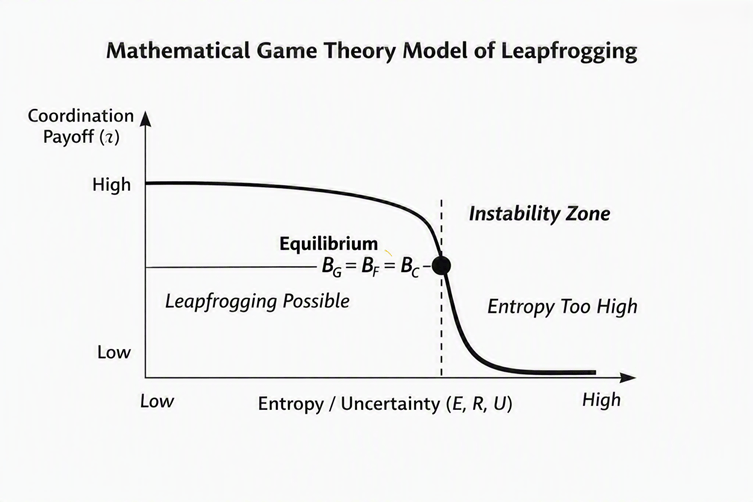
Figure 1*. Mathematical Game Theory Model of Leapfrogging. The diagram depicts the coordination payoff (π) as a function of institutional, regulatory, and user‑level entropy (E, R, U). The curve remains high and stable at low entropy but drops sharply beyond a critical threshold, marking the Nash equilibrium where BG=BF=BC. Leapfrogging is feasible only when entropy and uncertainty approach zero; beyond this point, the system enters an instability zone in which coordination collapses.
The figure titled Leapfrogging Coordination Equilibrium illustrates the relationship between institutional entropy (E) on the horizontal axis and leapfrog payoff (π) on the vertical axis. The curve remains flat at high payoff levels when entropy is low, then drops sharply after a critical threshold — representing the fragility of coordination under rising uncertainty.
This threshold curve captures the core intuition of the model: as institutional entropy increases, the payoff from leapfrogging collapses beyond a critical point. When institutions are coherent, predictable, and well‑coordinated, entropy is low and the payoff is high. When fragmentation and inconsistency rise, entropy crosses the equilibrium threshold and coordination fails.
The equilibrium point is marked where:

This represents the Nash equilibrium — the condition under which governments, firms, and citizens successfully coordinate on leapfrog strategies. The equilibrium is stable only when E, R, U → 0, meaning institutional, regulatory, and user‑level uncertainties are minimized.
To the right of the equilibrium threshold lies the Instability Zone, where entropy becomes too high for coordination. In this region:
- policy signals become inconsistent
- regulatory uncertainty increases
- firms hesitate to invest
- citizens lose confidence
- governments revert to legacy strategies
The graph therefore reinforces the central insight of the model: leapfrogging is not simply a technological choice — it is an institutional equilibrium. Africa’s ability to bypass traditional industrial stages depends on keeping entropy below the critical threshold.
5. Africa’s Institutional Limitations: Human‑Made, Not Genetic
Africa’s historical institutional weaknesses are not genetic, cultural, or geographical invariants. Instead, they are human‑made structural errors resulting from:
- Colonial administrative fragmentation that ignored organic local trade routes.
- Post‑independence replication of rigid, heavy bureaucratic models.
- Short-term political cycles that prioritize immediate optics over 20-year structural plans.
- Weak inter-ministerial coordination mechanisms.
- Fragmented and unpredictable regulatory environments.
Because these limitations are human-made, they are entirely correctable through deliberate, modern institutional design.
6. Institutional Entropy: Nature, Causes, and Elimination
6.1 What Institutional Entropy Is
Institutional entropy refers to the gradual, systemic loss of coherence, strategic direction, and operational coordination within public governance systems over time.
6.2 Why Entropy Must Be Eliminated
Unchecked institutional entropy directly destroys a nation’s capacity to leapfrog by:
- Exponentially increasing regulatory uncertainty for investors.
- Discouraging foreign and domestic capital investment.
- Fragmenting national and regional development strategies.
- Slowing down necessary regulatory innovations.
- Weakening the unifying potential of continental economic integration.
6.3 How Africa Can Eliminate Entropy
- Continental Integration (AfCFTA): Enforcing harmonized trade, digital, and technical standards across borders to eliminate market fragmentation.
- Regulatory Sandboxes: Creating safe, flexible legal spaces where innovators can test drones, fintech models, and micro-grids without bureaucratic penalties.
- Long‑Term Industrial Planning: Shifting governance frameworks away from short-term election-cycle planning toward binding 20-year national development visions.
- Digital Governance Systems: Digitize public procurement, business licensing, and regulatory filings to remove human friction and corruption.
- Incentive Realignment: Structuring civil service performance metrics to reward cross-ministerial cooperation rather than isolated bureaucratic silo-building.
7. Conclusion
Africa possesses a rare historical window to skip outdated, high-pollution industrial stages—much like it bypassed landlines to embrace mobile communications. However, achieving this requires governments to align their policies, establish transparent and predictable rules, and eliminate internal institutional friction.
When institutional systems are streamlined and organized, Africa can reliably generate clean power from sunlight, manufacture goods locally through digital fabrication, modernize farming with smart analytics, deliver critical healthcare via autonomous drones, and bank securely through mobile networks. Leapfrogging is entirely achievable; institutional entropy is the primary obstacle, and deliberate cross-sector coordination is the definitive solution.
References
- Acemoglu, Daron, and James Robinson. 2012. Why Nations Fail. New York: Crown.
- African Development Bank. 2020. African Economic Outlook. Abidjan: AfDB.
- Aker, Jenny, and Isaac Mbiti. 2010. “Mobile Phones and Economic Development in Africa.” Journal of Economic Perspectives 24(3): 207–232.
- Fagerberg, Jan. 2005. Innovation: A Guide to the Literature. Oxford: Oxford University Press.
- Muleta‑Erena, Temesgen. 2026. Institutional Entropy and the Thermodynamics of Governance: A Framework for Diagnosing Disorder and Engineering Efficiency. London: TC Press.
- Ndulu, Benno. 2007. The Political Economy of Economic Growth in Africa. Cambridge: Cambridge University Press.
- North, Douglass. 1990. Institutions, Institutional Change and Economic Performance. Cambridge: Cambridge University Press.
- Perez, Carlota. 2010. Technological Revolutions and Financial Capital. Cheltenham: Edward Elgar.
- World Bank. 2022. Digital Africa: Transforming Economies Through Technology. Washington, DC: World Bank.
About the Author
Temesgen Muleta-Erena, PhD (University of West London) and MA in Economics (University of East Anglia), is an independent economist, sovereign publisher, and epistemic steward based in London. He is the founder of TC Press (The Codex Press), a sovereign imprint dedicated to legacy-driven publishing, ceremonial documentation, and civilizational theorization. His works explore post-labour economics, value theory, planetary coordination, and the recursive architecture of knowledge. His books and essays are archived in global institutions including the British Library, Cambridge, Oxford, Berkeley, and UNAM, and distributed across federated platforms such as Kobo Plus, OverDrive, Smashwords and Hoopla. He publishes modular essays and republical scrolls to activate epistemic sovereignty and inspire coordinated futures.


[…] Posted on September 10, 2026 by Rashid Faridi Leapfrogging the Industrial Sequence: Africa’s Digital‑First Development Path and the Eliminatio… […]