Temporal Sovereignty: The Physics, Philosophy, and Economics of Time January 18, 2026
Posted by OromianEconomist in Uncategorized.add a comment
Temporal Sovereignty: The Physics, Philosophy, and Economics of Time
Author: Temesgen Muleta‑Erena (PhD)
TC Press (Codex Press), London
Public Versions:
TC Press: https://sites.google.com/view/the-codex-press/xxxx
Oromian Economist: https://sites.google.com/view/theoromianeconomist/yesss
OSF link: OSF | Temporal Sovereignty^J What is Time Essay.pdf
Abstract
Time remains one of the most contested and foundational concepts across physics, philosophy, and the social sciences. In physics, time is treated as a dimension embedded within spacetime, shaped by gravity and velocity as described by Einstein’s theories of relativity (Britannica 2025). Philosophers debate whether time exists independently of the universe or emerges from physical processes (Cycleback 2021). Cosmology suggests that time began with the Big Bang approximately 13.8 billion years ago, raising questions about whether time is finite or infinite and whether it can exist without matter or energy (Science Times 2025). This essay synthesizes these perspectives, offering mathematical formulations of time dilation, gravitational effects, and entropy. It further examines the implications of time for economic modelling, societal organization, and civilizational planning. Understanding time is essential not only for scientific inquiry but also for long‑term governance, sustainability, and interplanetary exploration. The essay argues for a framework of “temporal sovereignty,” in which civilizations cultivate the capacity to model, govern, and extend their temporal agency across scales of life, economy, and cosmos.
Keywords: Time; Relativity; Time Dilation; Arrow of Time; Temporal Sovereignty; Cosmology; Economic Time; Entropy
Disciplines: Physics; Philosophy; Cosmology; Economics
JEL Codes: B41 PACS: 04.20.-q MSC: 83C99
Document Type: Modular Essay
Introduction
Time is often described as the continuous progression of events from past to future, yet this intuitive definition conceals profound complexity. In classical physics, time is absolute and universal. Newton described time as “absolute, true, and mathematical,” existing independently of the physical world. Modern physics rejects this view. Einstein’s theories of relativity demonstrate that time is relative, shaped by velocity and gravitational fields (Britannica 2025).
Philosophers remain divided on whether time exists independently of the universe. Presentists argue that only the present is real, while eternalists claim that past, present, and future coexist in a four‑dimensional spacetime block (Cycleback 2021). Cosmology adds further complexity: if time began with the Big Bang, then time itself may be finite. Yet models of eternal inflation or cyclic universes suggest that time may extend infinitely in both directions (Science Times 2025).
A central question emerges: can time exist without the universe? Most physicists argue no — time is defined by change, and change requires matter, energy, and physical processes. Without a universe, time may be meaningless.
Mathematical Formulation of Time
Newtonian Time
In Newtonian mechanics, time is absolute:
Special Relativity
Einstein showed that time slows for objects moving at high speeds:
This has been confirmed through atomic clock experiments and particle decay observations (IOSR‑JAP 2025).
General Relativity
Time also slows in stronger gravitational fields:
This explains why clocks on Earth run slower than clocks on the Moon or in orbit (Britannica 2025).
Entropy and the Arrow of Time
The Second Law of Thermodynamics states that entropy increases over time:
This gives time its directionality.
Analysis
Time is not merely a parameter in equations; it is a structural feature of physical reality that behaves differently under varying gravitational, cosmological, and kinematic conditions. Understanding these differences requires examining three major domains: relativistic time travel, entropy and the arrow of time, and the role of time in space exploration and planetary environments.
Relativistic Time Travel and Forward Temporal Displacement
Forward time travel is not speculative fiction but a demonstrated physical phenomenon. Special relativity predicts that as an object approaches the speed of light, its proper time slows relative to an external observer. This has been confirmed through experiments involving fast‑moving particles and high‑precision atomic clocks flown on aircraft and satellites (IOSR‑JAP 2025). Astronauts aboard the International Space Station experience measurable time dilation due to both their velocity and reduced gravitational potential, aging microseconds less than people on Earth (Science Times 2025). While negligible for human lifespans, these effects become profound at relativistic speeds. A spacecraft traveling at 0.99c would experience a time dilation factor of approximately 7, meaning one year onboard corresponds to seven years on Earth. This creates a natural form of forward time travel, with implications for interstellar missions, communication delays, and the psychological experience of time.
Backward Time Travel and Causality Paradoxes
Backward time travel remains theoretically contentious. Solutions to Einstein’s field equations — such as Gödel’s rotating universe, Tipler cylinders, and traversable wormholes — mathematically permit closed timelike curves. However, these solutions require exotic matter or cosmological conditions not known to exist (Britannica 2025). Philosophical paradoxes, such as the grandfather paradox, challenge the coherence of backward time travel, while the Novikov self‑consistency principle suggests that events on closed timelike curves must be self‑consistent, preventing paradoxical outcomes. Quantum interpretations, including the many‑worlds hypothesis, propose that backward time travel may be possible only if it results in branching universes rather than altering a single timeline (Cycleback 2021). While speculative, these models illuminate the deep relationship between time, causality, and physical law.
Entropy, Irreversibility, and the Arrow of Time
The arrow of time arises from entropy — the statistical tendency of systems to evolve from ordered to disordered states. While the fundamental laws of physics are time‑symmetric, macroscopic processes are not. Ice melts, but melted water does not spontaneously reassemble into ice without external work. This asymmetry defines the psychological arrow of time (our experience of remembering the past but not the future), the thermodynamic arrow (entropy increase), and the cosmological arrow (the universe’s expansion) (Science Times 2025). Understanding entropy is essential for modelling irreversible processes in physics, biology, and economics.
Time in Space Exploration and Planetary Environments
Time behaves differently on other planets and moons due to variations in gravitational potential. Clocks on Mars run slightly faster than on Earth; clocks on the Moon run faster still. These differences, though small, matter for precision navigation, satellite synchronization, and long‑duration missions. For interstellar exploration, relativistic time dilation becomes a strategic asset: astronauts could travel vast distances while experiencing only a fraction of the time elapsed on Earth. This raises profound questions about identity, communication, and the continuity of civilizations across relativistic time gaps.
Discussion
Time is not only a physical dimension but a social, economic, and civilizational resource. How societies conceptualize and manage time shapes their capacity for coordination, innovation, and long‑term survival. This section explores time across four domains: economics, society, science, and civilizational planning.
Time in Economics: Discounting, Growth, and Intergenerational Value
Economic theory is fundamentally temporal. Discounting — the process of valuing future benefits relative to present ones — shapes investment, savings, climate policy, and intergenerational justice. High discount rates prioritize immediate consumption, while low rates emphasize long‑term stewardship (Cycleback 2021). Growth models, such as the Solow model, depend on assumptions about time horizons, technological progress, and capital accumulation. Behavioural economics shows that humans systematically misperceive time, leading to present bias and suboptimal long‑term decisions. Understanding time is therefore essential for designing policies that align short‑term incentives with long‑term societal goals.
Time in Society: Coordination, Ritual, and Governance
Human societies are structured around temporal frameworks: calendars, work cycles, religious rituals, and political terms. These frameworks enable coordination across large populations. Timekeeping technologies — from sundials to atomic clocks — have historically driven economic and scientific revolutions. Governance itself is temporal: constitutions define terms of office, legal systems define statutes of limitations, and social contracts define obligations across generations. Societies that fail to manage time effectively often struggle with instability, short‑termism, and institutional decay.
Time in Science: Measurement, Causality, and Prediction
Scientific inquiry depends on temporal ordering. Causality requires that causes precede effects; prediction requires models that evolve over time. Physics, chemistry, biology, and geology all rely on temporal scales ranging from femtoseconds to billions of years. Without a coherent understanding of time, scientific laws lose their explanatory power. Advances in time measurement — such as optical lattice clocks — are enabling new tests of relativity, quantum mechanics, and fundamental constants (Britannica 2025).
Civilizational Planning and Temporal Sovereignty
Civilizations rise or fall based on their temporal orientation. Short‑term civilizations exhaust resources, destabilize ecosystems, and collapse. Long‑term civilizations cultivate temporal sovereignty — the ability to model, govern, and extend their temporal agency. This includes long‑term climate planning, intergenerational ethics, archival preservation, and interstellar strategy. As humanity contemplates space exploration and planetary stewardship, understanding time becomes a prerequisite for survival. Temporal sovereignty is therefore not merely a philosophical concept but a civilizational imperative.
Conclusion
Time is the foundational dimension through which all physical, biological, economic, and social processes unfold. It shapes the structure of the universe, the behaviour of matter, the evolution of life, and the trajectory of civilizations. From the relativistic effects that govern space travel to the economic models that determine intergenerational welfare, time is both a scientific parameter and a societal resource. This essay has argued that understanding time requires an interdisciplinary approach that integrates physics, philosophy, economics, and governance.
As humanity enters an era of planetary stewardship and potential interstellar expansion, temporal literacy becomes essential. Civilizations that master time — its measurement, its modelling, its ethical implications — will be better equipped to navigate uncertainty, preserve knowledge, and extend their agency across cosmic scales. Temporal sovereignty is therefore not merely an intellectual framework but a strategic necessity for any society seeking resilience, longevity, and purpose in an evolving universe.
References
Britannica. 2025. “Time in General Relativity and Cosmology.” Encyclopaedia Britannica. Cycleback, David. 2021. What Is Time? Centre for Artifact Studies.
IOSR Journal of Applied Physics. 2025. “The Truth of Time Dilation.” IOSR‑JAP 17 (2): 19–39.
Science Times. 2025. “Relativity Time Dilation Explained.” Science Times, December 22. Wikipedia. 2025. “Time.” https://en.wikipedia.org/wiki/Time..
Temesgen Muleta-Erena (PhD) is an independent economist, sovereign publisher, and epistemic steward based in London. He is the founder of TC Press (The Codex Press), a sovereign imprint dedicated to legacy-driven publishing, ceremonial documentation, and civilizational theorization. His works explore post-labour economics, value theory, planetary coordination, and the recursive architecture of knowledge. His books and essays are archived in global institutions including the British Library, Cambridge, Oxford, Berkeley, and UNAM, and distributed across federated platforms such as Kobo Plus, OverDrive, and Woolaa.com. He publishes modular essays and republical scrolls to activate epistemic sovereignty and inspire coordinated futures.
Oromian Economist 2011-2026 Oromia Quarterly 1997-2026
Beyond Terrestrial Limits: Japan’s Orbital Solar Transmission Test and the Emergence of Post‑Planetary Energy Systems January 13, 2026
Posted by OromianEconomist in Uncategorized.add a comment
Beyond Terrestrial Limits: Japan’s Orbital Solar Transmission Test and the Emergence of Post‑Planetary Energy Systems
Beyond Terrestrial Limits: Japan’s Orbital Solar Transmission Test and the Emergence of Post‑Planetary Energy Systems
Public Versions:
TC Press:
Oromian Economist:
Abstract
Japan’s 2025 demonstration of wireless power transmission from space marks a pivotal moment in the evolution of global energy systems. For the first time, a satellite in low Earth orbit successfully collected solar energy, converted it into microwave radiation, and transmitted it to a terrestrial receiver where it was reconverted into usable electricity. This essay examines the demonstration as a civilizational inflection point, confirming the technical feasibility of space‑based solar power (SBSP) and opening pathways toward scalable orbital energy infrastructure. The analysis explores the physics of microwave transmission, the economic logic of scaling orbital arrays, the safety and governance frameworks required for global deployment, and the broader implications for planetary resilience and long‑horizon civilizational engineering. Japan’s achievement is interpreted as the first operational step toward post‑terrestrial energy abundance and the billion‑year frontier of human development.
Keywords: Space‑Based Solar Power, Wireless Energy Transmission, Microwave Beaming, Orbital Infrastructure, Renewable Energy, Civilizational Engineering, Japan, OHISAMA Project.
Primary Discipline:
Energy Economics (EE)
Secondary Discipline: Space Policy (SP)
Citation Style: Chicago Author‑Date (17th Edition)
Citation Code: ChicagoAD
Primary Journal Code:
Energy Economics eJournal (EEJ)
Secondary Journal Codes:
Space & Planetary Science eJournal (SPS)
Technology & Operations Management eJournal (TOM)
Environmental Economics eJournal (ENV)
Innovation & Technology eJournal (ITE)
Document Type: Modular Essay
1. Introduction: A New Epoch in Energy Collection
For decades, space‑based solar power (SBSP) has existed as a theoretical possibility, first articulated by Peter Glaser (1968) and later refined by aerospace agencies and academic institutions. The concept is simple: place solar collectors in orbit, where sunlight is uninterrupted by weather or atmospheric scattering, convert the energy into microwaves or lasers, and transmit it to Earth for reconversion into electricity. Yet until recently, SBSP remained speculative — a vision constrained by technological uncertainty, high launch costs, and unresolved safety concerns.
Japan’s 2025 OHISAMA demonstration fundamentally alters this landscape. A compact satellite in low Earth orbit (LEO) collected solar energy, converted it into a coherent microwave beam, and transmitted it to a ground station in Suwa, where it was successfully reconverted into electricity. Although the power delivered was modest, the demonstration is historically significant: it provides the first empirical confirmation that end‑to‑end orbital energy harvesting and terrestrial delivery is technically feasible (JAXA 2025).
This essay situates Japan’s achievement within the broader trajectory of energy history and civilizational development. It argues that the demonstration marks the beginning of a transition from terrestrial energy dependence to orbital energy orchestration — a shift with profound implications for planetary resilience, economic systems, and the long‑term future of human civilization.
2. Technical Foundations: How Japan’s Demonstration Worked
The OHISAMA test involved four sequential processes: orbital solar collection, conversion to microwave energy, transmission through the atmosphere, and reconversion at a terrestrial rectenna. Each step draws on decades of research in photovoltaics, microwave engineering, and wireless power transmission.
2.1 Orbital Solar Collection
Solar panels in LEO receive sunlight at intensities approximately 30 percent higher than on Earth’s surface due to the absence of atmospheric attenuation (Mankins 2014). Moreover, orbital collectors avoid the intermittency inherent in terrestrial solar systems, operating continuously except during brief eclipses.
2.2 Conversion to Microwave Energy
The satellite converted electrical energy into microwaves using solid‑state amplifiers. Microwave frequencies around 2.45 GHz or 5.8 GHz are typically chosen because they are non‑ionizing, well‑studied, and compatible with atmospheric transmission windows (Brown 1992).
2.3 Transmission to Earth
The microwave beam was directed toward a receiving antenna array in Suwa. Beam steering was achieved through phased‑array technology, allowing precise control of direction and intensity. Japan’s system incorporated automatic shutoff protocols to prevent misalignment — a critical safety feature (METI 2025).
2.4 Reconversion to Electricity
The ground station used a rectifying antenna (“rectenna”) to convert microwave energy back into direct current. Rectennas have demonstrated conversion efficiencies exceeding 80 percent in laboratory conditions (Shinohara 2013), making them viable for large‑scale deployment.
Japan’s demonstration confirms that each component of the SBSP chain functions reliably in real‑world conditions. The physics is no longer hypothetical; it is operational.
3. Why Space‑Based Solar Power Matters
The significance of SBSP lies in its ability to overcome the limitations of terrestrial energy systems. Ground‑based solar power is constrained by weather, cloud cover, seasonal variation, and the day‑night cycle. Even in optimal locations, capacity factors rarely exceed 25 percent (IEA 2023). In contrast, orbital solar arrays can achieve capacity factors approaching 99 percent.
This difference is not incremental — it is transformative. Continuous solar exposure enables SBSP to function as a baseload renewable energy source, something terrestrial renewables struggle to provide. Moreover, SBSP requires no land, avoids ecological disruption, and can deliver power to any location on Earth, including remote or disaster‑affected regions.
In a world facing climate instability, geopolitical energy tensions, and rising global demand, SBSP offers a pathway toward planetary energy resilience.
4. Confirming Technical Possibility: The End of the Feasibility Debate
Japan’s demonstration resolves the central question that has shadowed SBSP for decades: Is it technically possible? The answer is now unequivocally yes.
The remaining challenges — scaling, cost reduction, safety, and governance — are engineering and policy problems, not physical impossibilities. This distinction matters. Once a technology crosses the threshold from “theoretically possible” to “empirically demonstrated,” the trajectory of development shifts from speculation to implementation.
Japan’s achievement therefore represents a civilizational milestone comparable to the first powered flight or the first satellite launch. It transforms SBSP from a speculative concept into a viable infrastructure pathway.
5. Scaling Up: Economic and Engineering Pathways
Scaling SBSP from a small demonstration to multi‑gigawatt orbital arrays requires coordinated advances in launch economics, modular construction, and energy markets. Each of these domains is already undergoing rapid transformation.
5.1 Launch Cost Decline
The cost of placing payloads into orbit has fallen dramatically due to reusable rockets and commercial launch competition. SpaceX’s Falcon 9 has reduced launch costs to below $3,000 per kilogram, with further reductions expected (Jones 2022). As launch costs decline, the economic feasibility of deploying large orbital arrays improves correspondingly.
5.2 Modular Orbital Construction
Future SBSP systems will be assembled in orbit using modular components, robotic construction, and autonomous maintenance. This approach mirrors terrestrial solar farm expansion and avoids the need for monolithic launches. JAXA and NASA have both proposed modular architectures for SBSP arrays (Mankins 2014).
5.3 Continuous Energy Revenue
Unlike terrestrial solar, which suffers from intermittency, SBSP provides continuous power. This enables predictable revenue streams and reduces the need for storage infrastructure. The economic logic of SBSP therefore aligns with the financial structures of existing baseload energy systems.
Scaling is not trivial, but it is achievable — and increasingly economically rational.
6. Safety, Risk Management, and Public Confidence
Public scepticism often centres on safety, particularly regarding microwave transmission. Japan’s demonstration provides strong reassurance.
Microwave beams used in SBSP are non‑ionizing and operate at intensities comparable to common telecommunications infrastructure (Brown 1992). Beam steering technologies ensure precise targeting, while automatic shutoff systems prevent accidental exposure. Distributed rectenna networks further enhance safety by reducing reliance on single large receivers.
Safety concerns are therefore manageable through engineering controls, regulatory frameworks, and transparent public communication.
7. Coordination: The True Determinant of Success
The primary challenge facing SBSP is not technological but organizational. Successful deployment requires coordination across:
- international frequency regulation
- orbital traffic management
- safety standards
- public‑private partnerships
- global energy markets
These challenges resemble those faced during the development of the internet, GPS, and global telecommunications networks. They are solvable through treaties, standards, and institutions.
Coordination is the key variable that will determine the pace and scale of SBSP adoption.
8. Toward Post‑Earth Energy Abundance
Japan’s demonstration marks the beginning of a new energy epoch. For the first time, humanity has harvested energy beyond Earth and delivered it wirelessly to the surface. This achievement opens pathways toward:
- post‑scarcity renewable energy
- off‑world industrialization
- planetary resilience
- long‑horizon civilizational planning
- the billion‑year frontier of human development
SBSP is not merely a technological innovation. It is a civilizational pivot — a step toward an energy system no longer bound by geography, atmosphere, or planetary surface constraints.
9. Conclusion
Japan’s 2025 OHISAMA demonstration represents a foundational moment in the history of energy. It confirms the technical feasibility of space‑based solar power, establishes a credible pathway toward scalable orbital infrastructure, and signals the emergence of post‑terrestrial energy systems. The implications extend far beyond renewable energy, touching on planetary resilience, economic sovereignty, and the long‑term trajectory of human civilization.
As launch costs fall, modular construction advances, and global coordination frameworks mature, SBSP will transition from experimental demonstration to operational infrastructure. Japan’s achievement is therefore not an isolated event but the opening chapter of a new civilizational narrative — one in which humanity begins to orchestrate energy beyond Earth and step into the billion‑year frontier.
References
Brown, William C. 1992. “The History of Power Transmission by Radio Waves.” IEEE Transactions on Microwave Theory and Techniques 40 (6): 1239–1250.
Glaser, Peter. 1968. “Power from the Sun: Its Future.” Science 162 (3856): 857–861.
International Energy Agency (IEA). 2023. Renewables 2023: Analysis and Forecast to 2028. Paris: IEA.
Japan Aerospace Exploration Agency (JAXA). 2025. Wireless Power Transmission Demonstration Report. Tokyo: JAXA.
Jones, Harry. 2022. “Launch Cost Trends and the Economics of Space Access.” Acta Astronautica 194: 1–12.
Mankins, John. 2014. The Case for Space Solar Power. Houston: Virginia Edition Publishing.
Ministry of Economy, Trade and Industry (METI). 2025. Space-Based Solar Power: Technical Summary and Safety Protocols. Tokyo: METI.
Shinohara, Naoki. 2013. Wireless Power Transfer via Radiowaves. Hoboken: Wiley.
Unmasking Cancer: The Removal of Tumour Glycan Shields and the Future of Immune Recognition January 5, 2026
Posted by OromianEconomist in Uncategorized.add a comment
Unmasking Cancer: The Removal of Tumour Glycan Shields and the Future of Immune Recognition
Temesgen Muleta-Erena (PhD) Economist, Sovereign Publisher, Epistemic Steward
TC Press / The Codex Press, London
Public Version: https://sites.google.com/view/theoromianeconomist/economic-and-development-analysis
Available at SSRN: https://ssrn.com/abstract=5996694 or http://dx.doi.org/10.2139/ssrn.5996694
Abstract
Recent advances in cancer immunotherapy have revealed a novel mechanism by which tumours evade immune detection: the expression of glycan-based “sugar shields” that suppress immune activation. A 2025 study by researchers at MIT and Stanford has demonstrated a hybrid molecular therapy capable of stripping these glycan layers, thereby restoring immune recognition and enhancing anti-tumour response. This article reviews the scientific basis of the discovery, its therapeutic implications, and its limitations, while situating the breakthrough within a broader systemic understanding of cancer as a recursive, multi-domain disorder. The findings offer both technical promise and symbolic resonance for global health equity and post-entropic medical coordination.
Keywords: Cancer immunotherapy, glycan shield, sialic acid, AbLec, immune evasion, systemic disease, global health, sovereign publishing
Discipline: Health Sciences > Oncology
Social Sciences > Global Health Policy
Interdisciplinary > Epistemology of Science
Document Type: Modular Essay
1. Introduction
Cancer remains one of the most complex and adaptive diseases in human biology. Despite advances in immunotherapy, many tumours develop mechanisms to evade immune surveillance. One such mechanism involves the overexpression of sialylated glycans—sugar molecules that bind to Siglec receptors on immune cells, effectively sending a “don’t attack” signal. This biochemical camouflage has been termed the “sugar shield” of cancer.
In late 2025, a team of scientists from the Massachusetts Institute of Technology (MIT) and Stanford University introduced a novel therapeutic strategy to dismantle this shield. Their work, published in Nature Biotechnology, represents a significant step forward in the field of glyco-immunology and offers new hope for patients resistant to conventional therapies.
2. The Discovery: Hybrid Molecules for Glycan Removal
The researchers developed a class of hybrid molecules known as AbLec—a fusion of monoclonal antibodies and lectins. These molecules are designed to:
- Target tumour-specific antigens via the antibody component
- Bind and remove sialic acid residues via the lectin domain
- Expose the tumour to immune recognition, enabling T-cell activation and cytotoxic response
In preclinical mouse models, AbLec therapy demonstrated superior efficacy compared to standard antibody treatments, with enhanced tumour regression and immune activation.
“By stripping away the sugar coating, we’re essentially unmasking the tumour,” said Dr. Darrell Irvine, co-author of the study and professor at MIT. “This allows the immune system to see and attack the cancer more effectively.” [1]
3. Scientific Significance
This discovery underscores the growing importance of glycobiology in oncology. While most immunotherapies focus on protein-based checkpoints (e.g., PD-1/PD-L1), the glycan layer represents a non-protein-based immune evasion strategy. Targeting this layer opens new therapeutic avenues, particularly for:
- Tumours resistant to checkpoint inhibitors
- Cancers with low mutational burden
- Patients with suppressed immune responses
Moreover, the modularity of AbLec molecules suggests potential for broad-spectrum application across multiple cancer types.
4. Limitations and Systemic Considerations
Despite its promise, this approach is not a panacea. Cancer is a systemic disorder, involving:
- Genomic instability
- Metabolic reprogramming
- Microenvironmental manipulation
- Immune exhaustion and suppression
The removal of glycan shields addresses one layer of immune evasion, but multi-modal coordination remains essential. Future therapies must integrate glycan-targeting with metabolic, genetic, and environmental interventions.
5. Ethical and Global Implications
The symbolic power of this discovery extends beyond the laboratory. In regions where access to advanced therapies is limited—such as rural Africa, South Asia, and other underserved areas—this research offers a glimpse of a future where cancer treatment is more precise, less toxic, and potentially more accessible.
However, the politics of access remain unresolved. As with mobile phones, which leapfrogged landlines in the Global South, the challenge is not only technical but institutional: ensuring that such therapies are decentralized, affordable, and ethically distributed.
6. Conclusion
The removal of cancer’s sugar shield is a technical breakthrough and a civilizational metaphor. It reveals that even the most elusive diseases can be unmasked—not through force, but through epistemic precision and recursive coordination.
The sugar shield may fall. But the republic of healing must rise.
This discovery invites us to imagine a future where energy, knowledge, and healing are no longer hoarded, but beamed, shared, and stewarded—across borders, systems, and generations.
References
1. ScienceDaily. (2025, December 22). New hybrid therapy strips cancer of its sugar camouflage. Retrieved from https://www.sciencedaily.com/releases/2025/12/251222044058.htm
2. Nature Biotechnology. (2025). Antibody–lectin fusion molecules enhance immune recognition of sialylated tumours. DOI: 10.1038/s41587-025-XXXX-X
3. New Atlas. (2025, December). Scientists uncloak bowel cancer’s sugar shield to boost immune attack. Retrieved from https://newatlas.com/disease/colorectal-cancer-sialylation-immune-defense/
4. Irvine, D. J., et al. (2025). Engineering glycan-targeting immunotherapies for tumour unmasking. MIT News. Retrieved from https://news.mit.edu/2025/glycan-immune-cancer-therapy-1221
Temesgen Muleta-Erena is an independent economist, sovereign publisher, and epistemic steward based in London. He is the founder of TC Press (The Codex Press), a sovereign imprint dedicated to legacy-driven publishing, ceremonial documentation, and civilizational theorization. His works explore post-labour economics, value theory, planetary coordination, and the recursive architecture of knowledge. His books and essays are archived in global institutions including the British Library, Cambridge, Oxford, Berkeley, and UNAM, and distributed across federated platforms such as Kobo Plus, OverDrive, and Woolaa.com. He publishes modular essays and republical scrolls to activate epistemic sovereignty and inspire coordinated futures.
Press Release: TC Press /The Codex Press Announces the Release of Beyond Labour: How Knowledge Becomes the New Engine of Value January 1, 2026
Posted by OromianEconomist in Uncategorized.add a comment
PRESS RELEASE
FOR IMMEDIATE RELEASE
London — 1 January 2026
TC Press /The Codex Press Announces the Release of Beyond Labour: How Knowledge Becomes the New Engine of Value
A 175‑page economic scroll redefining value creation for the post‑scarcity age https://amzn.eu/d/fGuBDiH
TC Press / Codex Press, London, proudly announces the publication of Beyond Labour: How Knowledge Becomes the New Engine of Value, the eleventh volume by economist and sovereign publisher Temesgen Muleta‑Erena. Released simultaneously in Kindle, paperback, and hardcover editions, this 175‑page work inaugurates a new paradigm for understanding value, coordination, and civilizational design.
Beyond Labour argues that the engines of value in the 21st century are no longer labour, scarcity, or extraction, but knowledge, coordination, legacy, and ceremony. Through a series of modular chapters, Muleta‑Erena models a republic where epistemic capital becomes infinitely generative, coordination emerges as the central economic constraint, and legacy yields the most enduring returns.
Drawing from behavioural economics, indigenous strategy, thermodynamic governance, and systems design, the scroll reframes economics as a lineage‑building discipline. It offers not only theory but ceremonial infrastructure—rituals, scrolls, and sovereign institutions designed for a world beyond toil.
“This work is inscribed for stewards, system designers, and republic builders,” Muleta‑Erena writes. “It is not a conclusion. It is a transmission. The republic begins wherever knowledge is sovereign and legacy is inscribed.”
About the Author
Temesgen Muleta‑Erena is a sovereign publisher, modular essayist, and ceremonial infrastructure theorist. He holds a PhD in Economics from the University of West London and an MA from the University of East Anglia. His work integrates behavioural economics, indigenous strategy, and epistemic modelling to engineer legacy‑driven publishing systems.
He is the author of ten prior volumes, including The Time‑Tested Republic, Beyond the Sun, Macroeconomics Beyond GDP, Institutional Entropy, Experimental Microeconomics from Daily Life (Volumes I & II), Game Theory in Indigenous Strategy, The Secret Economist, Scrolls on Experimental Microeconomics and the Pen‑State Paradox, and The Game of Strategic Legacy.
Beyond Labour is his eleventh scroll and marks the ceremonial opening of his 2026 publishing cycle.
Publication Details
- Title: Beyond Labour: How Knowledge Becomes the New Engine of Value
- Author: Temesgen Muleta‑Erena
- Publisher: TC Press / The Codex Press, London
- Format: Kindle, Paperback, Hardcover
- Length: 175 pages
- Release Date: 1 January 2026
Book Review: Beyond Labour: How Knowledge Becomes the New Engine of Value January 1, 2026
Posted by OromianEconomist in Uncategorized.add a comment
Book Review: Beyond Labour: How Knowledge Becomes the New Engine of Value
175 pages | TC Press / The Codex Press, London (2026)
Beyond Labour is a bold and meticulously constructed intervention in contemporary economic thought. Temesgen Muleta‑Erena proposes nothing less than a civilizational reframing: a shift from labour‑centric economics to a paradigm where knowledge, coordination, and legacy become the primary engines of value. The result is a work that reads simultaneously as economic theory, systems design, and ceremonial manifesto.
What distinguishes this volume is its refusal to treat economics as a closed technical discipline. Instead, Muleta‑Erena positions it as a lineage‑building practice—one that integrates behavioural economics, indigenous strategy, thermodynamic reasoning, and epistemic modelling. The book’s modular structure allows each chapter to function as a self‑contained scroll, yet together they form a coherent architecture of post‑scarcity thinking.
At the heart of the argument is a compelling claim: in a world where knowledge is infinitely generative, the true constraint is not labour but coordination. This insight allows the author to explore value creation through a new lens—one that prioritizes symbolic production, strategic alignment, and the design of institutions capable of sustaining abundance. The discussion of sovereign publishing as a form of economic and cultural infrastructure is particularly original, offering a rare synthesis of theory and lived practice.
Stylistically, Beyond Labour is written with ceremonial clarity. The prose is confident, intentional, and often poetic, yet grounded in rigorous conceptual reasoning. Muleta‑Erena’s background in economics is evident, but so is his commitment to crafting a scroll that transcends disciplinary boundaries. Readers encounter not only models and frameworks but rituals, signals, and republic‑building gestures.
This is not a book for those seeking incremental adjustments to existing economic models. It is a work for stewards, system designers, and thinkers interested in the long arc of civilizational development. Its ambition is vast, but its execution is disciplined, offering a rare combination of theoretical depth and visionary coherence.
Beyond Labour stands as a significant contribution to the emerging literature on post‑labour economics and coordinated intelligence. It is a scroll that invites rereading, reflection, and activation. For those willing to engage its ideas, it offers a blueprint for a world where knowledge is sovereign and legacy becomes the enduring currency of value.
The Game of Strategic Legacy: Essays in Behavioural Economics on Courage, Coordination, and Cultural SovereigntyThe Game of Strategic Legacy: Essays in Behavioural Economics on Courage, Coordination, and Cultural Sovereignty November 17, 2025
Posted by OromianEconomist in Uncategorized.add a comment

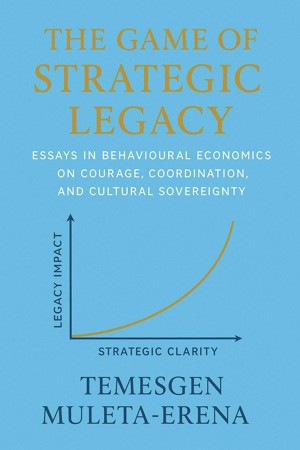
The Game of Strategic Legacy: Essays in Behavioural Economics on Courage, Coordination, and Cultural Sovereignty
A modular anthology of ten essays modeling courage, coordination, and cultural sovereignty through behavioural economics and game theory. Legacy agents like Swift, Malala, Gates, and Seenaa activate public goods and strategic clarity across ecological, institutional, and diasporic domains.
The Game of Strategic Legacy: Essays in Behavioural Economics on Courage, Coordination, and Cultural Sovereignty By Temesgen Muleta-Erena Published by TC Press, London, 2025 Humanity stands at a threshold — not of invention, but of coordination. The Game of Strategic Legacy is a modular anthology of ten essays that model how individuals—under constraint and with clarity—activate behavioural architectures to provision public goods, shift expectations, and build republics of trust. Through behavioural economics and game theory, Temesgen Muleta-Erena inscribes strategic blueprints for courage, coordination, and cultural sovereignty across ecological, institutional, and diasporic domains. Departing from classical economics, this work embraces threshold, signalling, and trust games to model lived realities. Legacy agents transform visibility into infrastructure, identity into leverage, and repetition into coordination. Figures include Taylor Swift (reputational leverage), Greta Thunberg (climate signalling), Malala Yousafzai (institutional trust), Maria Makeba (diasporic voice), Bill Gates (capital as trust), Seenaa Solomon (indigenous sovereignty), Wangarĩ Maathai (stewardship), Vandana Shiva (epistemic resistance), Ai Weiwei (art as defiance), and Emma González (coalition signalling). Together, they form a behavioural constellation—a republic of stewards whose actions illuminate survival protocols for climate justice, indigenous sovereignty, and institutional reform. This anthology critiques traditional economics and offers diagnostic grammar for republic-builders and epistemic stewards. As humanity faces ecological collapse and institutional entropy, this scroll offers not a forecast—but a protocol. Legacy is not what we leave behind, but what we signal into being. About the Author Temesgen Muleta-Erena is a sovereign publisher, modular essayist, and ceremonial infrastructure theorist. He holds a PhD in Economics from the University of West London and an MA from the University of East Anglia. His work integrates behavioural economics, indigenous strategy, and epistemic modelling to engineer legacy-driven publishing systems. He is the author of nine books, including The Time-Tested Republic, Beyond the Sun, Macroeconomics Beyond GDP, Institutional Entropy, Experimental Microeconomics from Daily Life (Vols. 1 & 2), Game Theory in Indigenous Strategy, The Secret Economist, and Scrolls on Experimental Microeconomics and the Pen-State Paradox. The Game of Strategic Legacy is his tenth scroll—a ceremonial offering for scholars, stewards, and future strategists.
Publisher:TC Press
Also By Publisher
And also at Amazon
Game Theory and the Time-Tested Republic October 12, 2025
Posted by OromianEconomist in Uncategorized.add a comment
Game Theory and the Time-Tested Republic
A Strategic Rehearsal of Ancestral Wisdom and Entropy Modelling
Across continents and catalogues, a scroll has emerged that refuses to rehearse the usual. The Time-Tested Republic, grounded in game theory and entropy modelling, is not merely a book — it is a diagnostic republic, a strategic mirror, and a scholarly threshold. It reveals that the ancestral systems of indigenous peoples — especially the Oromo — are not cultural ornaments but strategic infrastructures, encoded with civic logic, thermodynamic calibration, and institutional foresight.
🎯 Game Theory as Ancestral Strategy
The republic’s core insight is simple yet profound: the old stories are strategic games, not symbolic folklore. From reputation collapse to coordination failure, these narratives model civic vulnerability and sovereign timing. They are rehearsals of governance, not nostalgia.
Game theory, long reserved for Western economic modelling, finds its most elegant application in these indigenous frameworks. The scroll proves that ancestral strategy stories contain:
- Equilibrium logic
- Incentive structures
- Feedback loops
- Civic payoff matrices
This is not reinterpretation — it is recognition.
🔥 Entropy Modelling: Recalibrating Growth and Institutional Metrics
The republic goes further. It exposes the ceremonial inflation of growth figures across many regions, revealing that without entropy adjustment — accounting for population pressure, infrastructural decay, and institutional fatigue — development metrics are epistemically hollow.
Entropy modelling demands:
- Thermodynamic calibration
- Civic absorption metrics
- Institutional sustainability
- Rejection of ceremonial inflation in favor of sovereign diagnostics
Researchers who bypass this framework rehearse incompleteness. Institutions that ignore it risk ceremonial blindness.
📚 Scholarly Responsibility and Global Availability
The republic is now globally visible — listed in WorldCat, linked to cloudLibrary, and indexed in academic catalogues. Its availability through sovereign publishers and distributors is not just a logistical achievement — it is a social responsibility.
Those who claim to protect ancestral heritage — whether activist or loyalist — must now:
- Read and understand the scroll
- Use it to teach the world about ancestral strategy
- Stand with its global availability
- Advance its reach through citation, curriculum, and stewardship
Symbolic pride without epistemic engagement is coordination failure. The republic offers the test — will stewards rise to it?
🌍 Shine Beyond Entropy
This is not just a book. It is a calibration tool. It offers a path beyond personal and collective entropy — toward strategic clarity, civic dignity, and global recognition. The republic doesn’t just publish. It rehearses the future.
Gadaa: A Planetary Blueprint for Stewardship September 27, 2025
Posted by OromianEconomist in Uncategorized.add a comment
🌍 Gadaa: A Planetary Blueprint for Stewardship
Gadaa is not just heritage — it is humanity’s survival algorithm.
Recognized by UNESCO as a world heritage system, Gadaa models non-entropic governance: rotational leadership, communal truth, and ceremonial renewal.
It resists decay not by force, but by rhythm.
It teaches us that fairness is not optional — it is the architecture of endurance.
As we scale toward planetary survival — climate, biosphere, space — Gadaa offers a framework.
Today, astronauts survive through shared rhythm and honesty.
In a billion years, this will not be a luxury for the few — it will be a survival necessity for billions.
Gadaa must evolve into a planetary stewardship system.
Its values must be taught, practiced, and ritualized — not just in Ethiopia, but in every civic institution across the globe.
📘 Read the Twin Scrolls:
To understand this rhythm, we invite you to read the twin books:
- The Time-Tested Republic — a thermodynamic model of governance and entropy
- Beyond the Sun — a ceremonial mirror of renewal and symbolic frontier
These titles have been published and distributed by global literary giants, including:
Amazon, Draft2Digital, Palace Marketplace, OverDrive, Odilo, BorrowBox, and others on the way.
🔗 Explore the books on Amazon https://amzn.eu/d/dAbjPT9
🛡️ A Call to Libraries and Readers
These books are not just essays — they are sovereign scrolls.
They deserve full cataloguing, not just samples.
Libraries must be asked to activate them.
Readers must demand access.
The Oromo community must join this stewardship — Gadaa is now digital, searchable, and planetary.
What was once oral is now eternal. What was once seasonal is now scalable. Let the republic read. https://amzn.eu/d/dAbjPT9
Irreecha 2025: A Thanksgiving of Order and Renewal September 26, 2025
Posted by OromianEconomist in Uncategorized.Tags: #Irreecha 2025, #Oromo #Thanksgiving #fairness #nature #humanity, Irreecha, Irreessa, Oromo
add a comment
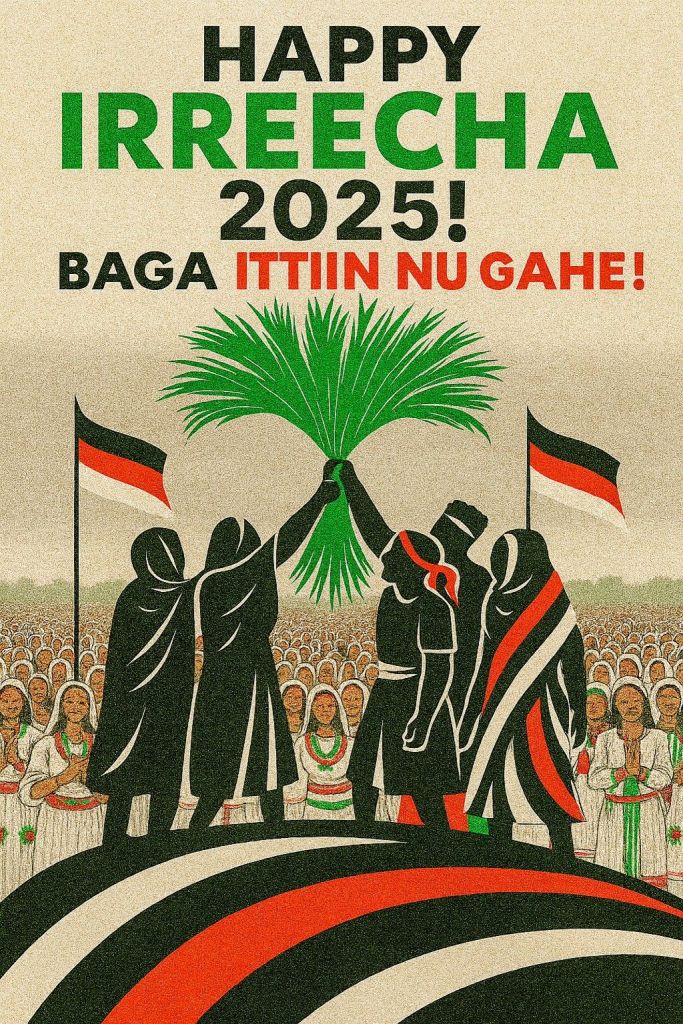
Baga Ittiin Nu Gahe
Irreecha 2025: A Thanksgiving of Order and Renewal
Irreecha is not merely a seasonal ritual — it is a sovereign act of remembering.
As the rains recede and the rivers swell, the nation and communities gather to honour Waaqa, the Creator, and to give thanks for peace, fertility, and the return of cosmic balance.
For the Oromo people, Irreecha is more than celebration — it is identity embodied. It reflects who they are: a people of rhythm, of renewal, of sovereign memory. It is the cultural display of Erreecha, the ceremonial gathering that mirrors the Gadaa system — a UNESCO-recognized heritage of ethical governance, fairness, and non-entropic order.
In 2025, Irreecha arrives with quiet power. It reminds us that gratitude is not a performance — it is a diagnostic truth.
To give thanks is to recognize order where there was disorder, to honour continuity where rupture once threatened.
Irreecha is the thermodynamic pulse of a people who understand that dignity must circulate, regenerate, and return.
Irreecha is not solitary — it is team celebration, a communal choreography that reflects the horizontal politics of Gadaa.
Gadaa is not hierarchy — it is rotation, integrity, and shared stewardship.
Irreecha reminds us that governance is rhythm, not domination. That truth is communal, not imposed.
Together, Irreecha and Gadaa form a symbolic system of survival — one that models how humanity might endure not just seasons, but billions of years of frontier.
As astronauts prepare for space travel, Irreecha teaches us:
We survive not by isolation, but by team spirit.
Not by conquest, but by honesty and fairness.
Not by entropy, but by ceremonial renewal.
Irreecha is not only Oromo. It is humanity’s mirror.
It teaches us to gather, to thank, to remember.
It teaches us that epistemic dignity is not a luxury — it is a survival tool.
It teaches us that fairness is not optional — it is the architecture of endurance.
Thank you, Irreecha 2025.
You are the rhythm of our renewal.
You are the order beneath our memory.
You are the sovereign breath of a people who remember — and a planet that must.
The Time-Tested Republic: Rethinking Governance Through Gadaa August 30, 2025
Posted by OromianEconomist in Uncategorized.add a comment
The Time-Tested Republic: Rethinking Governance Through Gadaa
Across East Africa, the Oromo people have sustained one of humanity’s most elegant systems of ethical governance: Gadaa. Far from a relic of the past, Gadaa remains a living constitutional order—decentralised, cyclical, and rooted in ritual accountability, gendered justice, and moral economy. It offers a radically different blueprint from the centralised, entropic systems that dominate global politics today.
Gadaa’s architecture is modular and regenerative. Power rotates through age-based grades, ensuring no single group monopolises authority. Rituals such as Siinqee, Ateetee, and Daadoo embed checks and balances not through coercion, but through cultural obligation and moral stewardship. These institutions are not symbolic—they are functional, binding, and adaptive.
In an era of planetary crisis, Gadaa’s thermodynamic logic offers a compelling alternative. It resists entropy by decentralising control, distributing responsibility, and embedding governance within ecological and ancestral rhythms. Its behavioural economics are not extractive but reciprocal, honouring the interdependence between community, land, and law.
For economists, reformers, and systems thinkers, Gadaa is not merely an indigenous curiosity—it is a sovereign framework for institutional renewal. It invites us to rethink governance from the inside out, not by imposing new models, but by remembering those that have endured.
A republic not imagined, but remembered.
A system not imposed, but inherited.
Explore the full framework here: https://amzn.eu/d/bQqI5WC
Significant to read here is from unusual corner: the answer to pressing concerns August 11, 2025
Posted by OromianEconomist in Uncategorized.add a comment
📢 What Are You Missing—Simply Because It Didn’t Come From Your Usual Corner?
On social media, attention often flows toward what’s familiar—whether it’s significant or not. Many overlook content that could reward them with real knowledge, simply because it doesn’t come wrapped in the usual packaging.
But what if the answers to your most pressing concerns—about growth, development, and the economy—are quietly waiting in places you’ve never looked?
If you’re tired of headline-driven noise and want to understand the deeper forces shaping our world, this might be your moment. A fresh perspective on macroeconomics and development is just a click away.
Don’t miss it simply because it didn’t arrive with fanfare.
Macroeconomics Beyond GDP: Introducing Efficient GDP (EGDP): A Thermodynamic Framework for Institutional Clarity https://amzn.eu/d/4xAn0do
New Book: July 26, 2025
Posted by OromianEconomist in Uncategorized.add a comment
Institutional Entropy and the Thermodynamics of Governance: A Framework for Diagnosing Disorder and Engineering Efficiency
New Book:Institutional Entropy and the Thermodynamics of Governance: A Framework for Diagnosing Disorder and Engineering Efficiency https://amzn.eu/d/1T2eL9e
Institutional Entropy and Governance Thermodynamics July 15, 2025
Posted by OromianEconomist in Uncategorized.add a comment
Institutional Entropy and Governance Thermodynamics
A Philosophical and Mathematical Framework for Diagnosing Systemic Disorder
By Temesgen Muleta-erena
Abstract
Governance is more than machinery—it is the choreography of human agency, trust, and collective memory. This paper introduces institutional entropy as both a thermodynamic and philosophical condition: inefficiency in political systems mirrors signal degradation in energy networks and the erosion of civic meaning. Using metaphors from engineering, autoimmune failure, and spectacle, we present mathematical models, economic curve simulations, and a diagnostic toolkit to explore how dysfunctional regimes attack the foundations of pluralism, intellectual discourse, and structural integrity. Entropy, in its deepest form, becomes silence—the decay of systems and the disappearance of purpose.
1. Introduction: From Matter to Meaning
Institutions are designed to transmit power, purpose, and trust. When loyalty becomes currency and merit is bypassed by patronage, those channels corrode. Signal weakens. Governance becomes spectacle: policies enacted without substance, rights performed without roots, reforms diluted into routines.
Institutional entropy is not merely inefficiency—it is a form of forgetting. It signals decay not just in capacity, but in conscience. Some systems evolve; others resist. And those that resist evolution begin to unmake history itself.
2. Literature Review: Signals, Systems, and Sovereignty
- Weber (1922) warned of bureaucratic routinization and the loss of ethical purpose.
- Wiener (1948) introduced cybernetics as a system of feedback and correction.
- Acemoglu and Robinson (2012) examined the resilience and failure of political institutions.
- Georgescu-Roegen (1971) and Schneider & Kay (1994) analyzed entropy in economic and ecological systems.
- Foucault and Nietzsche diagnosed value erosion, disciplinary silencing, and loss of intellectual coherence.
This paper builds on these foundations, modeling disorder as both a thermodynamic event and a moral regression.
3. Theoretical Framework: Institutions as Energy-Conducting Meaning Systems
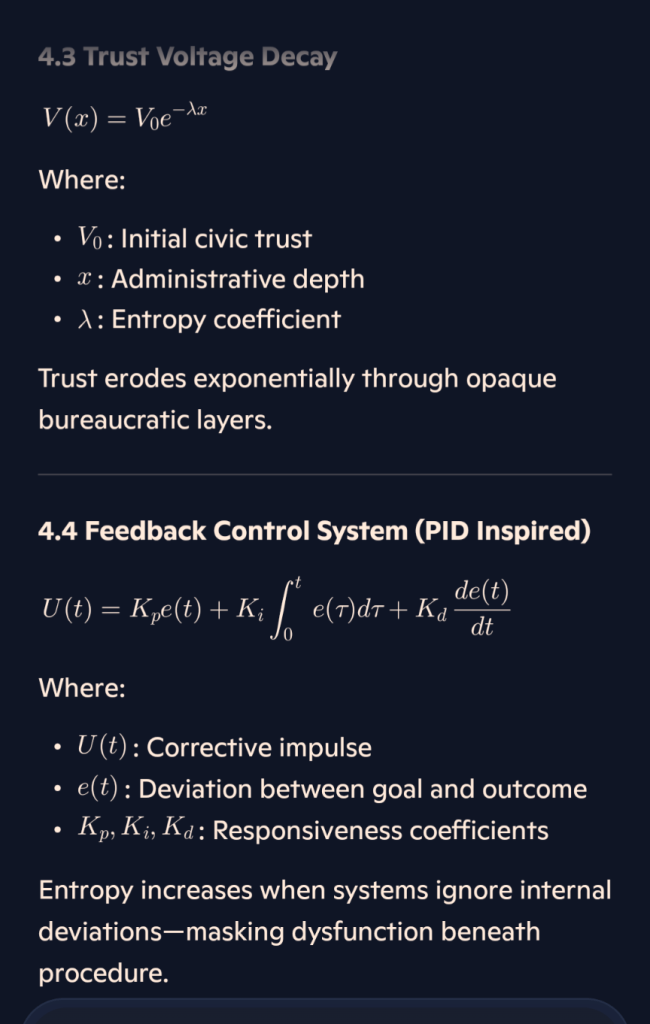
Governance is modeled as an electrical system:
- Policy → Electric current
- Trust → Voltage
- Bureaucracy → Conducting wire
- Resistance → Friction, opacity, distortion
Entropy emerges when:
- Merit is displaced by factional loyalty
- Feedback loops are disabled
- Civic engagement is symbolic, not substantive
- Cultural pluralism is vilified as weakness
Some systems collapse toward nostalgia—glorify in past autocratic warlord chieftains over intellectual and social evolutions. Their ideal is not the Stone Age but pre-Lucy: a conceptual era before language, diversity, or human consciousness. A time where obedience replaced debate and performance supplanted ideas.
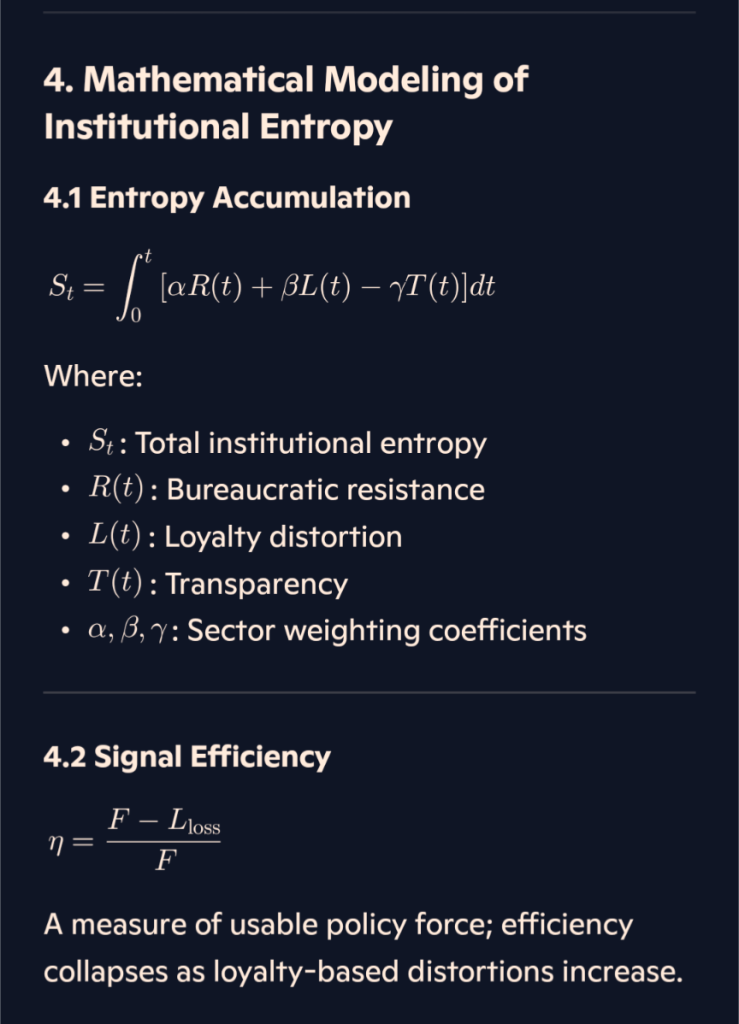
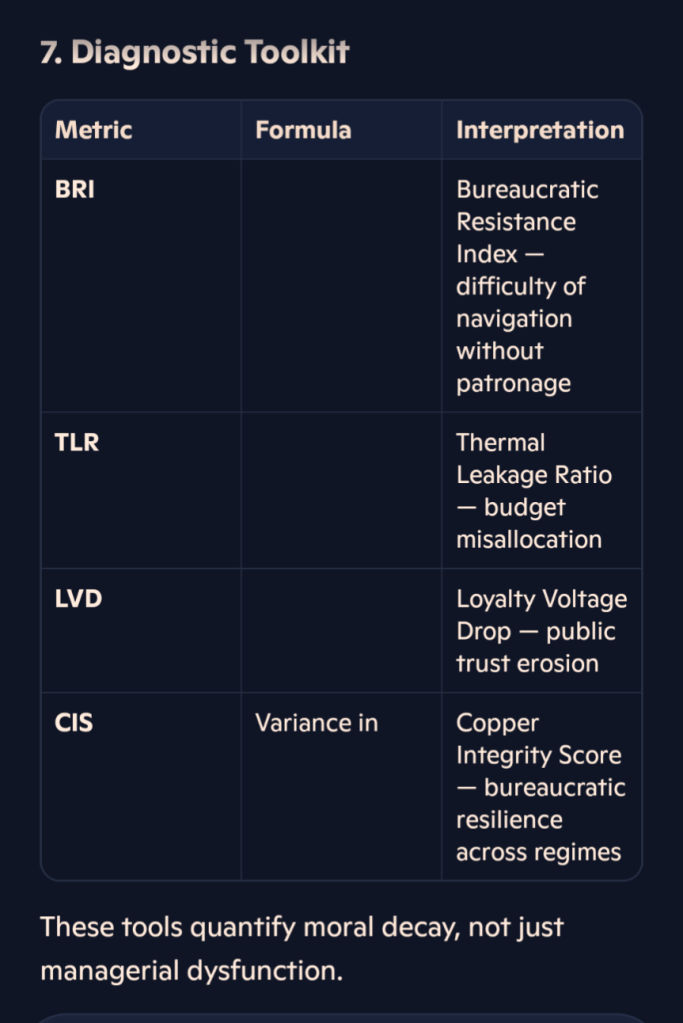
5. Economic Curve Simulations
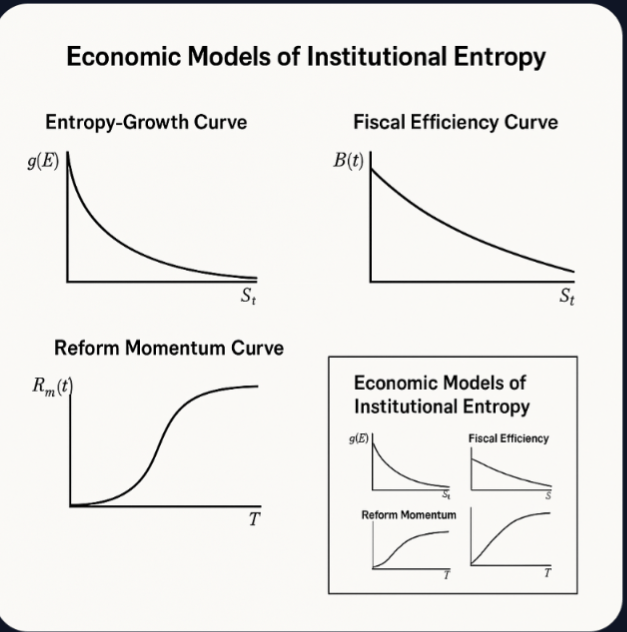
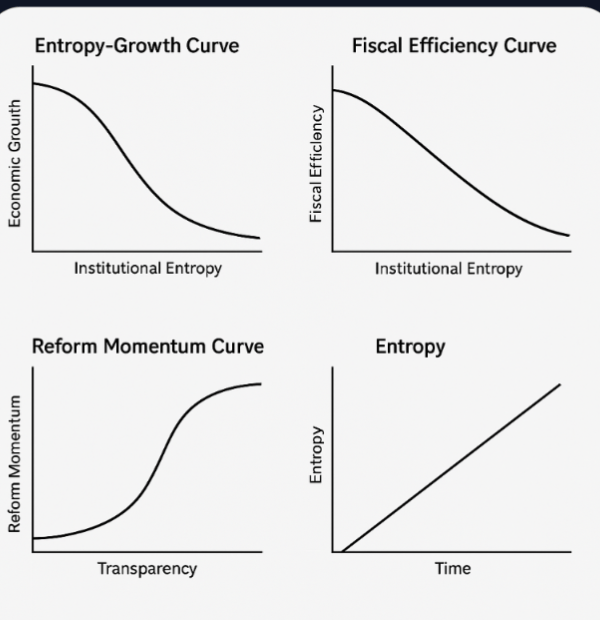
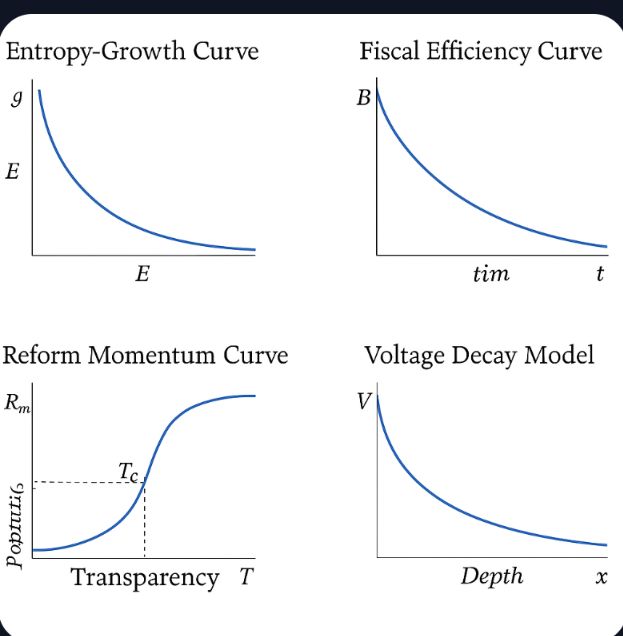
Figure 1: Entropy–Growth Curve
An exponential decay illustrating how increased entropy correlates with shrinking GDP growth potential.
Figure 2: Budget Efficiency Curve
A linear decline representing fiscal coherence deterioration as entropy rises—capturing leakage, patronage, and misallocation.
Figure 3: Reform Momentum Curve
A sigmoid curve indicating that transparency surpassing a critical threshold sparks nonlinear reform acceleration.
6. Philosophical Lens: Entropy as Autoimmune Spectacle
In the UK, Formula 1 is more than sport—it is a weekly celebration of motor engineering and institutional excellence. Its beauty lies in precision, systems thinking, and heritage—a Silicon Valley of speed.
By contrast, dysfunctional regimes manufacture spectacle to mask decay. State TV showcases shimmering towers while omitting the shantytowns encircling them. A refurbished lake is praised—while ecological collapse lurks beyond the camera.
These shows aren’t governance. They’re camouflage.
Entropy lives in the details—unstructured infrastructure, missing foundations, unreformed institutions. Collapse is not dramatic. It is quiet, cumulative, and inevitable.
Such regimes are autoimmune. Like Type 1 diabetes eroding its own insulin-producing cells, dysfunctional systems attack the very organs that sustain civic vitality—education, pluralism, public trust.
They regress past modernity, past humanity, past conversation.
Entropy becomes silence.
8. Conclusion: Rewiring Systems with Purpose
In structured societies, beauty emerges naturally. In dysfunctional ones, it is fabricated—staged to hide collapse. Entropy begins in the forgetting of foundations. Its end is silence.
Reform demands more than metrics. It demands memory.
Systems must be built not only to deliver policy—but to carry meaning. To enable plurality. To protect evolution. To allow contradiction. To restore deliberation.
Entropy is not just a technical failure. It is a spiritual wound. To heal, we must remember why we govern at all.
References
Acemoglu, Daron, and James A. Robinson. 2012. Why Nations Fail: The Origins of Power, Prosperity, and Poverty. New York: Crown Publishing.
Dahl, Robert A. 1971. Polyarchy: Participation and Opposition. New Haven: Yale University Press.
Deutsch, Karl W. 1963. The Nerves of Government: Models of Political Communication and Control. New York: Free Press.
Easton, David. 1953. The Political System: An Inquiry into the State of Political Science. New York: Alfred A. Knopf.
Foucault, Michel. 1975. Discipline and Punish: The Birth of the Prison. Translated by Alan Sheridan. New York: Vintage Books.
Georgescu-Roegen, Nicholas. 1971. The Entropy Law and the Economic Process. Cambridge, MA: Harvard University Press.
Nietzsche, Friedrich. 1887. On the Genealogy of Morals. Translated by Walter Kaufmann and R.J. Hollingdale. New York: Vintage Books.
North, Douglass C., John Joseph Wallis, and Barry R. Weingast. 2009. Violence and Social Orders: A Conceptual Framework for Interpreting Recorded Human History. Cambridge: Cambridge University Press.
Schneider, Eric D., and James J. Kay. 1994. “Life as a Manifestation of the Second Law of Thermodynamics.” Mathematical and Computer Modelling 19 (6–8): 25–48.
Weber, Max. 1922. Economy and Society: An Outline of Interpretive Sociology. Translated by Ephraim Fischoff et al. Berkeley: University of California Press.
Wiener, Norbert. 1948. Cybernetics: Or Control and Communication in the Animal and the Machine. Cambridge, MA: MIT Press.
The Trajectory of Human Energy Evolution: From Fossil Fuels to Solar to Cosmic-Scale Power June 10, 2025
Posted by OromianEconomist in Uncategorized.add a comment

The Trajectory of Human Energy Evolution: From Fossil Fuels to Solar to Cosmic-Scale Power
By Temesgen Muleta-erena
Abstract
Human civilization is undergoing an energy transformation, moving from finite fossil fuels toward renewable sources such as solar energy. However, in the grand cosmic scale, even solar power is temporary. As the Sun progresses toward its eventual death, humanity must prepare for energy strategies that transcend planetary and stellar limitations. This paper explores the origin of the universe, Earth’s geological dynamics, solar dependence, and the necessity of cosmic-scale energy solutions. Utilizing physics to the fullest extent, humanity may re-engineer the Sun or harness interstellar energy sources to secure its survival across billions of years.
Introduction: Energy at a Crossroads
For thousands of years, energy has been the foundation of civilization. The Industrial Revolution introduced fossil fuels, which accelerated human progress but led to environmental degradation. In recent decades, solar and nuclear technologies have become viable alternatives. Yet, even these solutions remain bound to Earth’s conditions and the Sun’s finite lifespan.
As humanity approaches the next phase of technological advancement, we must look beyond our immediate energy sources. If civilization is to endure beyond the limits of our solar system, we must master physics, stellar engineering, and interstellar energy extraction.
Formation of the Universe, Earth, and the Sun
1. The Universe’s Birth and Cosmic Energy
The universe began with the Big Bang approximately 13.8 billion years ago, generating energy that permeates space and time. Over billions of years, gravity condensed hydrogen into stars, igniting nuclear fusion and forming galaxies and planetary systems.
2. The Sun and Earth’s Formation
Around 4.6 billion years ago, the Sun formed from a collapsing molecular cloud. Earth emerged from the remnants of a protoplanetary disk, accumulating atmosphere, oceans, and dynamic geological processes. Natural forces—including gravity, nuclear fusion, and thermodynamics—continue to govern planetary evolution.
3. Earth’s Geological Dynamics and Energy Sources
Earth’s internal heat, tectonic movements, and atmospheric cycles shape its energy ecosystem. Fossil fuels, geothermal energy, and solar radiation have powered civilization, but each source comes with limitations. The question remains: What happens when Earth’s energy sources become insufficient?
The Transition from Fossil Fuels to Solar Energy
1. Fossil Fuels: A Finite Resource
For centuries, coal, oil, and natural gas have fueled human development, but reserves are depleting. The environmental impact—carbon emissions, climate change, and pollution—highlights the need for alternatives.
2. Solar and Renewable Energy: A Step Forward, But Not the Final Answer
Solar panels, wind turbines, and nuclear fusion have emerged as sustainable solutions. However, they remain dependent on the Sun, which has a limited lifespan. While transitioning to solar is crucial, it is only a temporary phase in the grand energy timeline.
The Sun’s Future and Earth’s Fate
1. The Sun’s Lifecycle
In approximately 5 billion years, the Sun will exhaust its hydrogen fuel, expand into a red giant, and incinerate the inner planets. Earth will either be engulfed or rendered uninhabitable as the oceans evaporate and the atmosphere dissipates.
2. Earth’s Transformation Before Extinction
Long before the Sun’s death, increasing solar radiation will alter Earth’s climate. If humanity does not intervene with advanced energy solutions, civilization may fade. To prevent extinction, energy systems must evolve toward cosmic-scale mastery.
Long-Term Energy Solutions: Beyond Planetary Limitations
1. Harnessing Cosmic Energy
Future civilizations must look beyond planetary resources and tap into interstellar and cosmic forces, such as:
- Black hole radiation
- Neutron star emissions
- Dark matter interactions
2. Building Dyson Swarms
A Dyson Swarm—a vast network of energy-collecting satellites—could harvest energy from multiple stars, ensuring a continuous power supply independent of Earth’s conditions.
3. Extracting Hydrogen from Interstellar Clouds
Giant molecular clouds contain abundant hydrogen, which could be used in fusion reactors to create a permanent energy source independent of stellar decay.
4. Quantum Energy Manipulation
Future advancements in quantum physics may allow civilization to extract energy directly from spacetime, redefining our understanding of sustainable power.
5. Re-engineering the Sun
Rather than abandoning our solar system, future technology might enable humans to reignite the Sun by injecting hydrogen or controlling nuclear fusion.
6. Relocating Earth to a New Star
If solar engineering is impractical, Earth could gradually migrate to a younger, stable star, or civilizations might construct space habitats capable of sustaining life indefinitely.
The Role of Physics in Cosmic Engineering
1. Understanding Natural Laws
Physics governs energy systems, from planetary thermodynamics to quantum mechanics. Mastering these laws is essential for long-term survival.
2. Advancing Space Infrastructure
Asteroid mining, space-based fusion reactors, and interstellar transport must be developed over the next millennium to ensure sustainable expansion.
3. Creating a Universal Knowledge Repository
Beyond energy, humans must preserve knowledge, ensuring future generations inherit scientific insights needed for stellar engineering.
Time Factors: The Urgency of Planning
1. The Window of Opportunity
Although 5 billion years remain before the Sun’s collapse, the infrastructure for interstellar expansion requires centuries or millennia. Planning must begin now to ensure uninterrupted progress.
2. Humanity’s Role as Cosmic Architects
Rather than fading like the dinosaurs, humans can become guardians of the universe, mastering energy systems that secure civilization’s future for billions of years.
Conclusion: Engineering Humanity’s Survival
The trajectory of energy evolution is clear—fossil fuels are finite, solar power is temporary, and cosmic-scale solutions must be our long-term goal. Humanity must transition beyond planetary dependencies, mastering physics to re-engineer energy at universal scales.
Will we rise as heroes of science and cosmic survival, ensuring an eternal legacy? Or will we disappear, forgotten in the depths of time? The answer depends on how we act today.
Hin Gaabbuu: The Unyielding Spirit of Jawar Mohammed December 24, 2024
Posted by OromianEconomist in Uncategorized.add a comment
New Book: Hin Gaabbu: The Unyielding Spirit of Jawar Mohammed
Part One: The Rise of a Revolutionary
Jawar Mohammed, a name synonymous with the Oromo struggle for justice and equality, has become a beacon of hope and a catalyst for change in Ethiopia. His memoir, “Hin Gaabbu: The Unyielding Spirit of Jawar Mohammed,” offers an in-depth look into his life, his relentless activism, and his vision for the future of Ethiopia.
Born in Oromia, Jawar’s early life was marked by the systemic oppression faced by the Oromo people. This environment fueled his passion for activism and led him to pursue higher education in the United States, where he honed his skills in political science and communication. Jawar’s return to Ethiopia marked the beginning of a new era in Oromo politics.
The Founding of OMN
In 2013, Jawar founded the Oromia Media Network (OMN), a platform dedicated to giving a voice to the Oromo people. OMN quickly became a powerful tool for mobilizing the Oromo youth and raising awareness about the injustices they faced. Through OMN, Jawar utilized social media to reach millions, making him one of the most influential figures in Ethiopian politics.
A Social Media Influencer and Political Analyst
Jawar’s ability to leverage social media transformed him into a significant political influencer. His insightful analyses and bold statements resonated with many, particularly the youth, who saw him as a leader who truly understood their struggles. His influence was instrumental in the 2018 political changes that led to the resignation of Prime Minister Hailemariam Desalegn and the appointment of Abiy Ahmed.
Part Two: A Vision for the Future
The second part of Jawar’s memoir delves into his vision for Ethiopia’s future. He outlines the structural weaknesses of the Ethiopian state and how these have historically burdened the Oromo people. Jawar argues that true peace and stability in Ethiopia can only be achieved through genuine federalism that respects the rights and autonomy of all ethnic groups.
The Roadmap for Aluta Continua
Jawar’s roadmap for the continued struggle, or “aluta continua,” emphasizes the importance of unity among the Oromo and other marginalized groups. He advocates for a peaceful but determined resistance against oppression and calls for international solidarity in the fight for human rights.
Legacy and Significance
“Hin Gaabbu: The Unyielding Spirit of Jawar Mohammed” is not just a memoir; it is a manifesto for change. Jawar’s story is a testament to the power of resilience and the enduring spirit of the Oromo people. His vision extends beyond the present, offering a blueprint for the next many thousand years, ensuring that the struggle for justice and equality continues.
This book is a must-read for anyone interested in understanding the complexities of Ethiopian politics and the indomitable spirit of one of its most influential figures. Jawar Mohammed’s legacy will undoubtedly inspire generations to come.
The 2024 Out of the Stadium Nominees of World Athletics: 5 Out of 10 from Oromo Origin November 2, 2024
Posted by OromianEconomist in Uncategorized.add a comment
The 2024 Out of Stadium Nominees of World Athletics: 5 Out of 10 from Oromo Origin
The Oromo ethnic group in Ethiopia has long been recognized for its extraordinary contributions to the world of athletics, particularly in long-distance running. This year, the tradition continues with five out of the ten nominees for the 2024 World Athletics Out of Stadium Athlete of the Year being of Oromo origin. This remarkable achievement underscores the enduring legacy and athletic prowess of the Oromo people.
The Nominees
Women:
- Sifan Hassan (Netherlands) – Known for her versatility, Sifan Hassan has had an outstanding year, winning the Olympic marathon and setting an Olympic record.
- Tigist Ketema (Ethiopia) – Tigist has dominated the marathon scene, winning both the Berlin and Dubai Marathons.
- Sutume Asefa Kebede (Ethiopia) – With a victory at the Tokyo Marathon and the second-fastest marathon time of the year, Sutume has proven her elite status.
Men:
- Tamirat Tola (Ethiopia) – Tamirat set an Olympic record in the marathon, showcasing his exceptional endurance and speed.
- Yomif Kejelcha (Ethiopia) – Yomif broke the world half marathon record and led the world in the 10km road race.
Historical Achievements
The achievements of these athletes are not isolated incidents but part of a long-standing tradition of excellence in athletics among the Oromo people. This legacy dates back to the 1950s with pioneers like Wami Biratu and Abebe Bikila, who won the marathon at the 1960 Rome Olympics barefoot. The 1970s saw the rise of Mamo Wolde, another marathon legend.
In the following decades, athletes like Derartu Tulu, the first African woman to win an Olympic gold medal in the 10,000 meters, and the Dibaba sisters, Tirunesh and Genzebe, continued to elevate the status of Oromo runners on the global stage. Fatuma Roba, the first black African woman to win an Olympic marathon in the 1990s, further solidified this legacy. More recently, Kenenisa Bekele and Almaz Ayana have set world records and won numerous international titles.
The Cultural Impact
The success of Oromo athletes is deeply rooted in their culture and lifestyle. The high-altitude regions of Oromia provide an ideal training ground, and running is often a part of daily life from a young age. This cultural emphasis on endurance and physical fitness has undoubtedly contributed to the remarkable achievements of Oromo runners.
Conclusion
The nomination of five Oromo athletes for the 2024 World Athletics Out of Stadium Athlete of the Year is a testament to the enduring legacy and exceptional talent of the Oromo people in long-distance running. Their achievements continue to inspire and set new standards in the world of athletics.
Oromo nation: The Most Athletically Blessed on Earth. #Oromia. #Africa
: World Athletics Nominees : Oromo Historical Achievements: AI information
Africa: New Infrastructure and Sustainable Development in the Robotic Era October 29, 2024
Posted by OromianEconomist in Uncategorized.add a comment
Africa: New Infrastructure and Sustainable Development in the Robotic Era
Introduction
Africa is at the forefront of technological innovation, often leapfrogging traditional infrastructure to adopt cutting-edge solutions. Just as the continent bypassed landline telephones in favor of mobile phones, it now has the opportunity to revolutionize rural development through the use of solar-powered, autonomous robots. These innovations promise to overcome infrastructural limitations and promote sustainable development.
Leapfrogging Traditional Infrastructure
In many rural areas, the lack of developed road networks and reliable electricity poses significant challenges. However, by adopting advanced technologies, these regions can bypass traditional infrastructure hurdles. Solar-powered robots designed to mimic the capabilities of donkeys and horses can navigate rough terrains, carry goods, and perform agricultural tasks, making them ideal for areas with limited road access.
Sustainability and Environmental Impact
Transitioning from wood fires to solar energy is a crucial step towards sustainability. Solar-powered robots not only reduce reliance on fossil fuels but also help preserve forests and reduce air pollution. This shift aligns with global efforts to combat climate change and promote renewable energy sources. By harnessing the abundant sunlight in Africa, these robots can operate efficiently and sustainably.
Economic and Social Benefits
The introduction of autonomous robots in rural areas can drive economic growth by improving agricultural productivity and transportation efficiency. Farmers can benefit from reduced physical labor and increased yields, while communities gain better access to goods and services. This technological leap can enhance living standards and create new economic opportunities, fostering a more prosperous and resilient rural economy.
Technological Advancements
Recent advancements in robotics and solar technology have made it feasible to develop robust, efficient, and cost-effective robots. These machines can be equipped with durable solar panels, efficient batteries, and advanced navigation systems to operate autonomously in challenging environments. As production scales up, the costs of these robots are expected to decrease, making them more accessible to rural communities.
Conclusion
Africa’s ability to leapfrog traditional infrastructure through innovative technologies holds great promise for sustainable development. By embracing solar-powered, autonomous robots, rural areas can overcome infrastructural limitations, reduce environmental impact, and drive economic growth. This forward-thinking approach not only addresses immediate challenges but also paves the way for a more sustainable and prosperous future.
Irreecha: The Highest of The high Culture October 2, 2024
Posted by OromianEconomist in Uncategorized.add a comment
Irreecha, also known as Irreessa or Dhibaayyuu, is a significant cultural festival celebrated by the Oromo people in Ethiopia. When people refer to Irreecha as “the highest of the high culture,” they are highlighting its profound cultural, spiritual, and social importance.

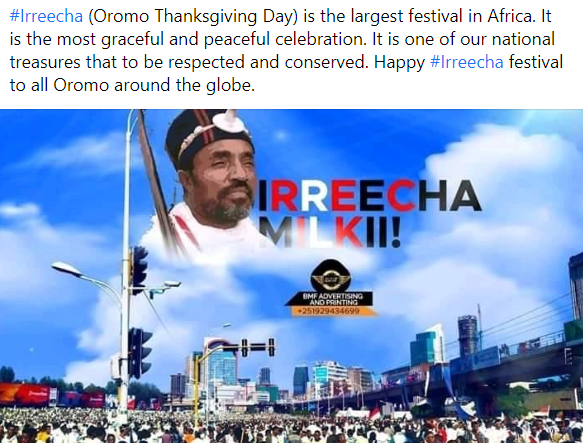
Explore
Irreecha: The Highest of the High Culture
Irreecha, also known as Irreessa or Dhibaayyuu, is a vibrant and deeply significant cultural festival celebrated by the Oromo people in Oromia and all over the world . One of Irreecha’s annual events, Irreecha Birra, which marks the end of the rainy season and the beginning of the harvest season, Autumnal equinox ( the equivalent Irreecha Arfaasa in Spring) is not just a celebration but a profound expression of gratitude, unity, and cultural identity.
A Celebration of Gratitude
At its core, Irreecha is a thanksgiving festival. The Oromo people gather to give thanks to Waaqa (God) for the blessings and mercies received throughout the year. This act of collective gratitude is performed through prayers, songs, dances, and various rituals that symbolize the renewal of life and the hope for a prosperous future1.
Cultural Revival and Identity
Irreecha is more than just a festival; it is a powerful symbol of Oromo cultural revival. Historically, the Oromo people faced numerous challenges, including attempts to suppress their culture and identity. Irreecha serves as a resilient response to these challenges, celebrating the rich traditions and heritage of the Oromo people2. The festival is a testament to the enduring spirit of the Oromo, showcasing their unity and strength. It is a time for the Oromo people to gather and give thanks to Waaqa (God) for the blessings and mercies received throughout the year1. The festival is celebrated with vibrant rituals, including prayers for peace (Nagaa) and reconciliation (Araara), and it serves as a powerful symbol of Oromo identity and cultural revival2.
Rituals and Traditions
The rituals of Irreecha are deeply symbolic. Three of the most significant traditions are the gatherings at Hora Finfinnee, in Finfinnee the capital city of Oromia &Ethiopia, Hora Arsadi, a lake in Bishoftu and Malkaa Ateetee, in Buraayyu near Finfinnee where millions of participants dip grass and flowers into the water as a sign of gratitude and renewal. This act is accompanied by prayers for peace (Nagaa) and reconciliation (Araara), emphasizing the festival’s spiritual and communal aspects3.
A National and Global Event
Irreecha has grown beyond a local celebration to become a national and even global event. Millions of Oromos from all over Oromia and Ethiopia and the diaspora, as well as non-Oromo visitors, come together to participate in the festivities. This gathering not only strengthens the bonds within the Oromo community but also promotes cultural exchange and understanding4.
Irreecha is the largest endogenous festival in Africa which has been based on the evolving very ancient tradition of over 6000 years.
The Highest of the High Culture
When Irreecha is referred to as “the highest of the high culture,” it underscores the festival’s unparalleled significance in Oromo society. It is a time when the Oromo people collectively express their deepest values, including gratitude, unity, and resilience. Irreecha stands as a pinnacle of cultural expression, embodying the essence of Oromo heritage and identity.
In conclusion, Irreecha is a celebration that transcends mere festivity. It is a profound cultural event that honors the past, celebrates the present, and looks forward to the future with hope and gratitude. As the highest of the high culture, Irreecha continues to inspire and unite the Oromo people, preserving their rich traditions for generations to come.
1: Wikipedia 2: Gadaa 3: Waaqeffannaa 4: AI information #Oromo #Culture #Irreecha
De-empiring Ethiopia’s Structure: A Path to True Self- Determination August 26, 2024
Posted by OromianEconomist in Uncategorized.add a comment
De-empiring Ethiopia’s Structure: A Path to True Self-Determination

Empire the Vampire
Ethiopia, often celebrated for its ancient history and cultural diversity, has a complex and contentious political structure rooted in its imperial past. This structure, established by Emperor Menelik II in the 19th century, was built on the conquest and subjugation of various ethnic groups, including the Oromo, Sidama, Qimant, Agew, Afar, Ogaden, Silte, Hadiya, Kambta, Gumuz, Gambella, and Wolayita. These groups were incorporated into the Ethiopian state not by their own free will, but through the colonizing efforts of Menelik, an Amharic warlord and slave trader.
Historical Context
Menelik II’s expansionist campaigns in the late 19th century were driven by a desire to consolidate power and create a centralized Ethiopian empire. This process involved the forceful annexation of territories and the imposition of Amharic culture and language on diverse ethnic groups. The resulting multiethnic empire was characterized by a hierarchical structure that privileged the Amhara elite and marginalized other ethnicities.
Institutionalized Oppression
The legacy of Menelik’s conquests has persisted through successive Ethiopian governments, which have maintained the centralized and oppressive structure of the state. This institutionalized colonial framework has led to widespread suffering among the majority of Ethiopia’s ethnic groups, who have been denied genuine self-determination and autonomy. The current government, like those before it, continues to uphold this system, perpetuating the dominance of Amharic elites and suppressing calls for self-determination, decentralization and federalism.
Parallels with Yugoslavia
The situation in Ethiopia bears striking similarities to the former Yugoslavia, where Serb extremists under Slobodan Milošević sought to impose a centralized state structure, leading to violent conflicts and eventual disintegration. In Ethiopia, Amharic extremists and the central government similarly impose a unitary state model, disregarding the aspirations of other ethnic groups for greater autonomy and self-governance.
The Case for Decentralization
Many of Ethiopia’s ethnic groups, including the Oromo, Sidama, Qimant, Agew, Afar, Silte, Waliyta, Ogaden, Gumuz, Hadiya, Kambata, Gambella, and Tigray, and more advocate for a federal system and autonomy that allows for self-determination and respects the cultural and political rights of all communities. Such a system would enable these groups to nurture their unique cultures and economies, fostering development and stability. Decentralization has been shown to contribute to Ethiopia’s development in the past, as seen in the period following the end of the civil war in 1991, when the country adopted a federal structure and experienced significant economic growth.
The Danger of Centralization
While promoting slogans like “Ethiopia First” and “Ethiopia Shall Continue,” the central government has been attacking and undermining the very building blocks of the country —its ethnicities, cultures, and languages. This approach has bred misery and danger, as it disregards the rich diversity that forms the DNA of Ethiopia as a country . The suppression of these fundamental elements only exacerbates tensions and fuels conflict.
International Community’s Role
To achieve lasting peace and development, it is crucial for the international community to recognize the need for a fundamental restructuring of the Ethiopian state. Supporting efforts to dismantle the imperial framework and promote a decentralized, federal system can help address the root causes of conflict and ensure that all ethnic groups have a voice in their governance. This approach, akin to the dissolution of Yugoslavia, could pave the way for a more equitable and prosperous future.
Conclusion
De-empiring Ethiopia’s structure is essential for achieving true self-determination and development for its diverse ethnic groups. By embracing decentralization, federalism and self-determination Ethiopia can move towards a more inclusive and just society, where all communities can thrive.
Amnesty International : BBC : LSE International Development : Africa at LSE : Al Jazeera : The Guardian : Foreign Policy: AI Info.
Sifan Hassan: A Remarkable Journey from Oromo Roots to Olympic Glory August 18, 2024
Posted by OromianEconomist in Uncategorized.add a comment
Photo credit: Copilot
Explore
Sifan Hassan: A Remarkable Journey from Oromo Roots to Olympic Glory
Sifan Hassan’s story is one of extraordinary resilience, determination, and triumph. Born in Adama, Oromia, Ethiopia, in 1993, Hassan’s journey from a young refugee to a celebrated Olympic champion is nothing short of inspirational.
Early Life and Oromo Heritage
Hassan’s early years were spent in the Oromia region of Ethiopia, where she was part of the Oromo ethnic group. The Oromo people have a rich cultural heritage and are known for their strong sense of community and resilience. This background played a significant role in shaping Hassan’s character and determination.
At the age of 15, Hassan moved to the Netherlands as a refugee. The transition was challenging, but it also marked the beginning of her remarkable journey in athletics. Settling in a shelter for young asylum seekers, Hassan quickly adapted to her new environment and began to pursue her passion for running.
Rise to Athletic Stardom
Hassan’s talent was soon recognized by Dutch athletics coaches, and she was sent to the elite Olympic training center in Papendal. Her rise in the world of athletics was meteoric. She gained Dutch citizenship in 2013 and won the European U23 cross-country title the same year1.
Her breakthrough on the global stage came at the 2019 World Championships in Doha, where she won gold in both the 1500 meters and 10,000 meters, becoming the first athlete in history to achieve this double2.
Tokyo 2020 Olympics: A Historic Triple
Hassan’s performance at the Tokyo 2020 Olympics was nothing short of legendary. Competing in six races over eight days, she won gold medals in the 5000 meters and 10,000 meters, and a bronze medal in the 1500 meters1. This unprecedented achievement made her the only athlete in Olympic history to win medals across a middle-distance event and both long-distance races in a single Games2.
Paris 2024 Olympics: Continuing the Legacy
At the Paris 2024 Olympics, Hassan continued to defy expectations. She secured bronze medals in both the 5000 meters and 10,000 meters, and capped her performance with a gold medal in the women’s marathon3. This made her the only woman to win Olympic gold in the 5000 meters, 10,000 meters, and marathon races2.
Impact and Legacy
Hassan’s journey from a refugee to an Olympic champion has made her a symbol of hope and perseverance. Her achievements have not only brought pride to the Netherlands but also to her Oromo heritage. She often speaks about the importance of resilience and never giving up, a message that resonates with many around the world1.
In addition to her athletic prowess, Hassan’s story highlights the potential of refugees and the positive contributions they can make to society. Her success serves as an inspiration to young athletes, especially those from marginalized communities, proving that with determination and hard work, anything is possible.
Sifan Hassan’s remarkable accomplishments on the track and her inspiring personal journey make her one of the most extraordinary athletes of our time. Her legacy will undoubtedly continue to inspire future generations.
The article generated with help of AI
#Sifan #Hassan #Paris #Olympics #Marathon #Oromia #AthleticNation
Reuters: In Ethiopia a secret committee orders killings and arrests of civilians February 29, 2024
Posted by OromianEconomist in Uncategorized.add a comment
https://www.reuters.com/investigates/special-report/ethiopia-violence-committee/
Denialism as a strategy of epistemological violence meted out against Oromo identity in Ethiopia: Making sense of the pervasive propaganda against Oromummaa – Addis Standard July 21, 2023
Posted by OromianEconomist in Uncategorized.add a comment
Conversation with Faisal Roble: State of the Horn of Africa/ UMD Media January 17, 2022
Posted by OromianEconomist in Uncategorized.add a comment
Executive Order on Imposing Sanctions on Certain Persons With Respect to the Humanitarian and Human Rights Crisis in Ethiopia September 19, 2021
Posted by OromianEconomist in Uncategorized.add a comment
The White House: Executive Order on Imposing Sanctions on Certain Persons With Respect to the Humanitarian and Human Rights Crisis in Ethiopia
SEPTEMBER 17, 2021•PRESIDENTIAL ACTIONS
By the authority vested in me as President by the Constitution and the laws of the United States of America, including the International Emergency Economic Powers Act (50 U.S.C. 1701 et seq.) (IEEPA), the National Emergencies Act (50 U.S.C. 1601 et seq.) (NEA), sections 212(f) and 215(a) of the Immigration and Nationality Act of 1952 (8 U.S.C. 1182(f) and 1185(a)), and section 301 of title 3, United States Code,
I, JOSEPH R. BIDEN JR., President of the United States of America, find that the situation in and in relation to northern Ethiopia, which has been marked by activities that threaten the peace, security, and stability of Ethiopia and the greater Horn of Africa region — in particular, widespread violence, atrocities, and serious human rights abuse, including those involving ethnic-based violence, rape and other forms of gender-based violence, and obstruction of humanitarian operations — constitutes an unusual and extraordinary threat to the national security and foreign policy of the United States. I hereby declare a national emergency to deal with that threat.
The widespread humanitarian crisis precipitated by the violent conflict in northern Ethiopia has left millions of people in need of humanitarian assistance and has placed an entire region on the brink of famine. While maintaining pressure on those persons responsible for the crisis, the United States will seek to ensure that appropriate personal remittances to non-blocked persons and humanitarian assistance to at-risk populations can flow to Ethiopia and the greater Horn of Africa region through legitimate and transparent channels, including governments, international organizations, and non-profit organizations. The United States supports ongoing international efforts to promote a negotiated ceasefire and political resolution of this crisis, to ensure the withdrawal of Eritrean forces from Ethiopia, and to promote the unity, territorial integrity, and stability of Ethiopia.
Accordingly, I hereby order:
Section 1. The Secretary of the Treasury is authorized to impose any of the sanctions described in section 2(a) of this order on any foreign person determined by the Secretary of the Treasury, in consultation with the Secretary of State:
(a) to be responsible for or complicit in, or to have directly or indirectly engaged or attempted to engage in, any of the following:
(i) actions or policies that threaten the peace, security, or stability of Ethiopia, or that have the purpose or effect of expanding or extending the crisis in northern Ethiopia or obstructing a ceasefire or a peace process;
(ii) corruption or serious human rights abuse in or with respect to northern Ethiopia;
(iii) the obstruction of the delivery or distribution of, or access to, humanitarian assistance in or with respect to northern Ethiopia, including attacks on humanitarian aid personnel or humanitarian projects;
(iv) the targeting of civilians through the commission of acts of violence in or with respect to northern Ethiopia, including involving abduction, forced displacement, or attacks on schools, hospitals, religious sites, or locations where civilians are seeking refuge, or any conduct that would constitute a violation of international humanitarian law;
(v) planning, directing, or committing attacks in or with respect to northern Ethiopia against United Nations or associated personnel or African Union or associated personnel;
(vi) actions or policies that undermine democratic processes or institutions in Ethiopia; or
(vii) actions or policies that undermine the territorial integrity of Ethiopia;
(b) to be a military or security force that operates or has operated in northern Ethiopia on or after November 1, 2020;
(c) to be an entity, including any government entity or a political party, that has engaged in, or whose members have engaged in, activities that have contributed to the crisis in northern Ethiopia or have obstructed a ceasefire or peace process to resolve such crisis;
(d) to be a political subdivision, agency, or instrumentality of the Government of Ethiopia, the Government of Eritrea or its ruling People’s Front for Democracy and Justice, the Tigray People’s Liberation Front, the Amhara regional government, or the Amhara regional or irregular forces;
(e) to be a spouse or adult child of any sanctioned person;
(f) to be or have been a leader, official, senior executive officer, or member of the board of directors of any of the following, where the leader, official, senior executive officer, or director is responsible for or complicit in, or who has directly or indirectly engaged or attempted to engage in, any activity contributing to the crisis in northern Ethiopia:
(i) an entity, including a government entity or a military or security force, operating in northern Ethiopia during the tenure of the leader, official, senior executive officer, or director;
(ii) an entity that has, or whose members have, engaged in any activity contributing to the crisis in northern Ethiopia or obstructing a ceasefire or a peace process to resolve such crisis during the tenure of the leader, official, senior executive officer, or director; or
(iii) the Government of Ethiopia, the Government of Eritrea or its ruling People’s Front for Democracy and Justice, the Tigray People’s Liberation Front, the Amhara regional government, or the Amhara regional or irregular forces, on or after November 1, 2020;
(g) to have materially assisted, sponsored, or provided financial, material, or technological support for, or goods or services to or in support of, any sanctioned person; or
(h) to be owned or controlled by, or to have acted or purported to act for or on behalf of, directly or indirectly, any sanctioned person.
Sec. 2. (a) When the Secretary of the Treasury, in consultation with the Secretary of State, has determined that a foreign person meets any of the criteria described in section 1(a)-(h) of this order, the Secretary of the Treasury is authorized to select, in consultation with the Secretary of State, one or more of the sanctions set forth in subsections (a)(i)(A)-(E) or (a)(ii)(A)-(B) of this section to impose on that foreign person:
(i) the Secretary of the Treasury shall take the following actions as necessary to implement the selected sanctions:
(A) block all property and interests in property of the sanctioned person that are in the United States, that hereafter come within the United States, or that are or hereafter come within the possession or control of any United States person, and provide that such property and interests in property may not be transferred, paid, exported, withdrawn, or otherwise dealt in;
(B) prohibit any United States person from investing in or purchasing significant amounts of equity or debt instruments of the sanctioned person;
(C) prohibit any United States financial institution from making loans or providing credit to the sanctioned person;
(D) prohibit any transactions in foreign exchange that are subject to the jurisdiction of the United States and in which the sanctioned person has any interest; or
(E) impose on the leader, official, senior executive officer, or director of the sanctioned person, or on persons performing similar functions and with similar authorities as such leader, official, senior executive officer, or director, any of the sanctions described in subsections (a)(i)(A)-(D) of this section that are applicable.
(ii) the heads of the relevant executive departments and agencies, in consultation with the Secretary of the Treasury, shall take the following actions as necessary and appropriate to implement the sanctions selected by the Secretary of the Treasury:
(A) actions required to deny any specific license, grant, or any other specific permission or authority under any statute or regulation that requires the prior review and approval of the United States Government as a condition for the export or reexport of goods or technology to the sanctioned person; or
(B) actions required to deny a visa to and exclude from the United States any noncitizen whom the Secretary of the Treasury, in consultation with the Secretary of State, determines is a leader, official, senior executive officer, or director, or a shareholder with a controlling interest in, the sanctioned person.
(b) The prohibitions in subsection (a) of this section apply except to the extent provided by statutes, or in regulations, orders, directives, or licenses that may be issued pursuant to this order, and notwithstanding any contract entered into or any license or permit granted before the date of this order. No entity shall be blocked pursuant to this order solely because it is owned in whole or in part, directly or indirectly, by one or more sanctioned persons, unless the entity is itself a sanctioned person and the sanctions in section 2(a)(i)(A) of this order are imposed on the entity.
Sec. 3. The prohibitions in section 2(a) of this order include:
(a) the making of any contribution or provision of funds, goods, or services by, to, or for the benefit of any person whose property and interests in property are blocked pursuant to this order; and
(b) the receipt of any contribution or provision of funds, goods, or services from any such person.
Sec. 4. (a) The unrestricted immigrant and nonimmigrant entry into the United States of noncitizens determined to meet one or more of the criteria in section l of this order, and for whom the sanctions described in section 2(a)(i)(A) or section 2(a)(ii)(B) of this order have been selected, would be detrimental to the interests of the United States, and the entry of such persons into the United States, as immigrants or nonimmigrants, is hereby suspended, except when the Secretary of State or the Secretary of Homeland Security, as appropriate, determines that the person’s entry would not be contrary to the interests of the United States, including when the Secretary of State or the Secretary of Homeland Security, as appropriate, so determines, based on a recommendation of the Attorney General, that the person’s entry would further important United States law enforcement objectives.
(b) The Secretary of State shall implement this order as it applies to visas pursuant to such procedures as the Secretary of State, in consultation with the Secretary of Homeland Security, may establish.
(c) The Secretary of Homeland Security shall implement this order as it applies to the entry of noncitizens pursuant to such procedures as the Secretary of Homeland Security, in consultation with the Secretary of State, may establish.
(d) Such persons shall be treated by this section in the same manner as persons covered by section 1 of Proclamation 8693 of July 24, 2011 (Suspension of Entry of Aliens Subject to United Nations Security Council Travel Bans and International Emergency Economic Powers Act Sanctions).
Sec. 5. (a) Any transaction that evades or avoids, has the purpose of evading or avoiding, causes a violation of, or attempts to violate any of the prohibitions set forth in this order is prohibited.
(b) Any conspiracy formed to violate any of the prohibitions set forth in this order is prohibited.
Sec. 6. I hereby determine that the making of donations of the types of articles specified in section 203(b)(2) of IEEPA (50 U.S.C. 1702(b)(2)) by, to, or for the benefit of any person whose property and interests in property are blocked pursuant to this order would seriously impair my ability to deal with the national emergency declared in this order, and I hereby prohibit such donations as provided by section 2 of this order.
Sec. 7. For the purposes of this order:
(a) the term “entity” means a partnership, association, trust, joint venture, corporation, group, subgroup, or other organization;
(b) the term “Government of Ethiopia” means the Government of Ethiopia, any political subdivision, agency, or instrumentality thereof, including the National Bank of Ethiopia, and any person owned, controlled, or directed by, or acting for or on behalf of, the Government of Ethiopia;
(c) the term “Government of Eritrea” means the Government of Eritrea, any political subdivision, agency, or instrumentality thereof, including the Bank of Eritrea, and any person owned, controlled, or directed by, or acting for or on behalf of, the Government of Eritrea;
(d) the term “noncitizen” means any person who is not a citizen or noncitizen national of the United States;
(e) the term “person” means an individual or entity;
(f) the term “sanctioned person” means a foreign person that the Secretary of the Treasury, in consultation with the Secretary of State, has determined meets any of the criteria described in section 1 of this order and has selected, in consultation with the Secretary of State, one or more of the sanctions set forth in section 2(a) of this order to impose on that foreign person; and
(g) the term “United States person” means any United States citizen, lawful permanent resident, entity organized under the laws of the United States or any jurisdiction within the United States (including foreign branches), or any person in the United States.
Sec. 8. For those persons whose property and interests in property are blocked or affected by this order who might have a constitutional presence in the United States, I find that because of the ability to transfer funds and other assets instantaneously, prior notice to such persons of measures to be taken pursuant to this order would render those measures ineffectual. I therefore determine that for these measures to be effective in addressing the national emergency declared in this order, there need be no prior notice of a listing or determination made pursuant to section 1 of this order.
Sec. 9. The Secretary of the Treasury, in consultation with the Secretary of State, is authorized to take such actions, including the promulgation of rules and regulations, and to employ all powers granted to the President by IEEPA as may be necessary to carry out the purposes of this order. The Secretary of the Treasury may, consistent with applicable law, redelegate any of these functions within the Department of the Treasury. All executive departments and agencies of the United States shall take all appropriate measures within their authority to implement this order.
Sec. 10. Nothing in this order shall prohibit transactions for the conduct of the official business of the Federal Government by employees, grantees, and contractors thereof.
Sec. 11. The Secretary of the Treasury, in consultation with the Secretary of State, is authorized to submit recurring and final reports to the Congress on the national emergency declared in this order, consistent with section 401(c) of the NEA (50 U.S.C. 1641(c)) and section 204(c) of IEEPA (50 U.S.C. 1703(c)).
Sec. 12. (a) Nothing in this order shall be construed to impair or otherwise affect:
(i) the authority granted by law to an executive department or agency, or the head thereof; or
(ii) the functions of the Director of the Office of Management and Budget relating to budgetary, administrative, or legislative proposals.
(b) This order shall be implemented consistent with applicable law and subject to the availability of appropriations.
(c) This order is not intended to, and does not, create any right or benefit, substantive or procedural, enforceable at law or in equity by any party against the United States, its departments, agencies, or entities, its officers, employees, or agents, or any other person.
JOSEPH R. BIDEN JR.
THE WHITE HOUSE,
September 17, 2021.
WPF: Many autocrats kill people. It takes a particular kind of leader to kill a country. This is what the Ethiopian Prime Minister is doing. July 20, 2021
Posted by OromianEconomist in Uncategorized.4 comments
The Tigray-Amhara Boundary Should be Resolved by Constitutional Means

July 2021 Employee of the Month: Abiy Ahmed
by ALEX DEWAAL on JULY 19, 2021
The ‘Employee of the Month award’ is bestowed on the person who has done the most to harm the cause of world peace in the last month. Image: “A Conversation with Abiy Ahmed, Prime Minister of Ethiopia” by World Economic Forum is licensed under CC BY-NC-SA 2.0.
Ethiopia’s Prime Minister Abiy Ahmed inherited a state. He sacrificed it to the dream of an empire. On his current trajectory, Abiy’s political obituary will be that he left Ethiopians with neither state nor empire.
Many autocrats kill people. It takes a particular kind of leader to kill a country. This is what the Ethiopian Prime Minister is doing.
There was a moment when Abiy was seen indispensable to solving Ethiopia’s problems. Today he is the problem.
At the United Nations Security Council meeting on July 2, western nations put their emphasis on human rights and humanitarian calamity, while Kenya (representing the African nations) and China focused their concern on preserving the Ethiopian state. None of them subscribed to the Ethiopian government’s official narrative.
As if to confirm their fears, three days later Abiy made a speech in parliament and announced that he was closing thirty of Ethiopia’s sixty embassies. He said he didn’t think that his country’s diplomats were value for money, and suggested that the diaspora were doing a better job. Africa’s oldest and most esteemed diplomatic corps, which was built up by Emperor Haile Selassie after World War II and nurtured by successive regimes, is being willfully destroyed.
In the same speech, Abiy denied that his army had suffered a defeat in Tigray, and said that he could raise and train 100,000 special forces in a month, and a million soldiers if need be. The rout of the Ethiopian National Defense Force in Tigray was due in part to Abiy’s dismantling of the army as an institution, which he began almost as soon as he took office. Huge numbers of foot soldiers along with new tanks and drones cannot compensate for lack of generalship, doctrine and strategy. Abiy is simply arming Ethiopians to kill and die.
Abiy’s economic policy of liberalization and attracting foreign investment has been sacrificed to the war, which has consumed the government’s budget, destroyed a significant part of its industry and service sector, and shattered its reputation among international financial institutions and private sector investors.
Abiy Ahmed became prime minister in April 2018 at a time of crisis in Ethiopia. ‘Crisis’ is a relative term. The economy was growing fast, the country had functioning state institutions envied by its neighbors, the ruling party was finally moving towards being an arena for genuine political debate, and the country was at peace with all its neighbors save one—and was well positioned to impose peace terms that would compel Eritrea to demilitarize and democratize. The government faced no military threats at home or abroad; it was Africa’s largest contributor to United Nations and African Union peacekeeping operations; Ethiopia enjoyed strong relations with the U.S., Europe, and China. Middle Eastern that countries it had long regarded as strategic challengers—Egypt and the Gulf States—were at bay.
Abiy came to power because a largely non-violent democratic protest movement caused the head of government to step down and the core element in the ruling party and security sector—the Tigrayan People’s Liberation Front (TPLF)—to step aside.
After 27 years in power, the Ethiopian People’s Revolutionary Democratic Front (EPRDF) had dismally failed on democracy and human rights, but had won Ethiopia an enviable reputation for stability and growth. Ethiopia’s state capacity was not an automatic inheritance of its long history as an independent polity. Ethiopia’s state had been built by decades of statesmanship at the top, investment in institutions, and lifelong dedication by civil servants.
Many African leaders in ‘crisis’ countries envied Abiy the political capital he possessed and the opportunity to build on strengths and remedy weaknesses. Viewed by many as a reformer, he also enjoyed considerable popular support. His early steps seemed to manifest that promise—releasing political prisoners, inviting opposition parties back, lifting censorship, reaching out to Eritrea.
Abiy made grand promises to everyone, and everyone loved it. He basked in the glory. He took the accolades far more seriously than he should have done. Drawing on his Pentecostal faith and his personal sense of destiny, Abiy refashioned the myth of Ethiopia as a nation chosen by God. He dispensed with any humility and readiness to reflect upon and learn from error. In short, Abiy had a messianic vision but lacked the basics of statecraft.
Abiy did not bring Ethiopia to this precipice alone. His predecessor, Prime Minister Haile Mariam Dessalegn, failed to lead and allowed the country to drift into turmoil. Hailemariam compounded rather than remedied the problems he inherited from Prime Minister Meles Zenawi. Getachew Asefa, former head of security, was responsible for many of the most egregious abuses of the EPRDF government—and when Abiy issued an arrest warrant for him, he fled to Tigray where the TPLF elevated him to their central committee. Before and during the current war, the TPLF spokesman, Getachew Reda, prefers posturing and point-scoring to problem solving. Berhanu Nega, leader of the Ethiopian Citizens for Social Justice (EZEMA) party, has cultivated a nostalgic imperial-nationalism that has been instrumental in driving the war fever in Addis Ababa and parts of Amhara region, and Deputy Prime Minister Demeke Mekonnen has connived with this effort. Legions of twitter warriors roar incendiary nonsense on social media. Foreign actors who indulged Abiy’s egomania share responsibility. Above all, Eritrean President Isaias Afewerki seized his moment to become godfather to Ethiopia’s self-destruction, pursuing his long-held ambitions of seeking to crush Tigray and bring Ethiopia to its knees.
Helped by these men—whether adversaries or allies—Abiy has brought Ethiopia to the brink of political, economic, and reputational collapse. He has made Ethiopia the land of famine once again (though he denies that there is hunger in Tigray), and the land of gang rape for the first time (something he jokes about). He banned opposition parties, imprisoned dissenters, closed newspapers and detained journalists. He has destroyed the army while making needless enemies at home and abroad. His friends—notably Pres. Isaias—are more dangerous to Ethiopia than his enemies. Abiy rushed into a preventable war and bragged about it.
These are all sufficient reason for Abiy to warrant Abiy’s award as ‘employee of the month’—the individual who has done most to stand in the way of peace. But what singles out Abiy is the culmination of his folly, which is contemplating the breakup of Ethiopia—the secession of Tigray—as preferable to his accepting the reality that he has failed. The measure of a statesman is handling adversity. In the face of the calamities of the last months, Abiy has preferred to live in a bubble of illusion rather than take the necessary and painful steps to salvage his country. He is sustaining that bubble with incendiary mobilization of ethno-national passions that he cannot control. His most recent statement, speaking of Tigrayans as an incurable disease and an invasive weed is aptly described as ‘a textbook example of dehumanizing speech and incitement to genocide.’ The havoc Abiy is unleashing and the hatred he is fomenting will surely outlast his tenure in office.
Many autocrats cause appalling suffering to their people, but historians assess them as having built states. PM Abiy is responsible for immeasurable human distress—mass killings, rape, torture and starvation. But he is also leaving a legacy of deliberately turning Ethiopia into a fragile and quite possibly a failed state.
The New York Times: After Sudden Defeat, Captured Ethiopian Soldiers Are Marched to Prison July 3, 2021
Posted by OromianEconomist in Uncategorized.1 comment so far
After Sudden Defeat, Captured Ethiopian Soldiers Are Marched to Prison
The scale of the loss suffered by one of Africa’s most powerful armies was on vivid display on Friday as thousands of government troops were paraded through Mekelle, the regional capital of Tigray.
MEKELLE, Ethiopia — Thousands of Ethiopian prisoners of war were paraded through the regional capital of Tigray on Friday as jubilant crowds lined the streets to jeer the captives and cheer the Tigrayan forces who only days earlier had routed one of Africa’s most powerful armies.
Many of the soldiers bowed their heads and cast their eyes downward. Some had to be carried on stretchers, and others wore bandages freshly stained with blood.
The swift defeat of the Ethiopian forces was a stunning reversal in a civil war that has led to the displacement of nearly two million people in the Tigray region, widespread hunger and reports that civilians were subjected to atrocities and sexual violence.
The parade of prisoners served as a pointed rebuke to Ethiopia’s prime minister, Abiy Ahmed, who had proclaimed in a speech on Tuesday in the national capital, Addis Ababa, that reports of his troops’ defeat were “a lie.” He had declared a unilateral cease-fire, he insisted, for humanitarian reasons.
Mr. Abiy had actually declared victory last year, only about a month after he initiated the military operation in Tigray in November — but the fighting had continued for seven more months.
Flanked by Tigrayan fighters, the columns of defeated Ethiopian soldiers had been marching for four days from the quickly established battlefield camps where they had been held since the fighting ended this week. They flooded the streets of the Tigrayan capital, Mekelle, and were taken to a large prison on the northern edge of the city.
- Dig deeper into the moment.
Special offer: Subscribe for $1 a week.
A 14-year-old dashed out into the street to run alongside the column, shouting her admiration for the leader of the Tigrayan forces, calling him a “lion.”
“All these soldiers tried to kill us,” the girl, Mearge Gebroemedhin, said a few moments later, referring to the Ethiopian government forces. “But the Tigrayan soldiers showed their mercy. I am proud of our soldiers.”
While some in the crowd jeered the soldiers, the onlookers focused much of their anger on the Ethiopian prime minister, Mr. Abiy.

Nearly eight months before, Mr. Abiy had sent his forces to Mekelle to wrest power from the region’s leaders, declaring the move was necessary because the Tigrayans had held local elections without permission from the federal government, and had tried to capture an Ethiopian military base.
Now the victorious Tigrayan leaders are back in Mekelle, reoccupying their former offices.
In a lengthy, exclusive interview soon after he arrived from his holdout in the mountains, Debretsion Gebremichael, the leader of the ruling party, the Tigray People’s Liberation Front, said that his fighters had captured more than 6,000 Ethiopian soldiers.
He said that Tigrayan officials have been in touch with the International Committee of the Red Cross, and would soon release the low-ranking soldiers, but would keep officers in custody.
Under the Geneva Conventions, prisoners of war must be given food and clothing, and protected from violence, intimidation and “public curiosity.” There was no immediate indication that the Ethiopian soldiers had been mistreated, or whether marching them through the streets of Mekelle amounted to a violation of the Conventions.

Ever since Ethiopia announced a unilateral cease-fire on Monday and pulled its troops out of Mekelle, Tigray has experienced electricity, telecommunications and internet blackouts. The consequences will exacerbate an already dire humanitarian situation, according to the United Nations.
International aid agencies warned of a looming humanitarian catastrophe and said it was unclear if the rebel victory would allow international assistance to start reaching those most in need in the Tigray region, which is bordered by Eritrea to the north and Sudan to the west.
The U.N. said that at least 350,000 people in the conflict-ravaged region had entered a state of famine. The U.S. Agency for International Development put its estimate for those facing famine conditions at 900,000.
On Thursday, a bridge was destroyed that provided vital access over the Tekeze River to the town of Shire in central Tigray, where the U.N. estimates there are between 400,000 and 600,000 internally displaced people living in dire conditions.
The U.N. Office for the Coordination of Humanitarian Affairs said that the bridge had been destroyed by troops belonging to the Amhara Special Forces and the army of Eritrea, the country to the north of Tigray, which had fought as allies with the Ethiopian troops.
“The bridge’s destruction will have an impact,” said Claire Nevill, a spokeswoman for the World Food Program.
Redwan Hussein, an Ethiopian government spokesman, said on Friday that two bridges connecting the Tigray region had been destroyed, but denied that the government or allied forces were responsible. He blamed the Tigrayans.
One aid agency employee who was traveling through Tigray on Thursday said that there was “little to nothing” entering the region at the moment and that food trucks had been prevented from getting there by troops along the border with the Amhara region.
In the interview, Mr. Debretsion said that Tigrayan leaders were working to bring in international aid as swiftly as possible.

Linda Thomas-Greenfield, the U.S. ambassador to the United Nations, said at a Security Council briefing on Friday that she is hearing reports that getting aid into Tigray is “more difficult” now than it was a week ago — which is “not an indication of a humanitarian cease-fire, but of a siege.”
She added, “The Ethiopian government can and should prove this analysis wrong by providing unhindered movement of humanitarian supplies, commodities, and personnel into and throughout Tigray. If they do not, we believe hundreds of thousands of people could starve to death.”
Analysts say that Mr. Abiy, who has served as Ethiopia’s prime minister since 2018 and who won a Nobel Peace Prize in 2019 for making peace with Eritrea and instituting domestic democratic reforms, now faces tremendous political challenges.
The alliance Ethiopia forged with Eritrea and fighters in the Amhara region could fracture as Ethiopian troops continue to pull back from direct engagement, and Tigray fighters go on the offensive.
“The Amhara support for him will eventually dwindle,” said Mehari Taddele Maru, a professor of governance and geopolitics at the European University Institute. “The one thing that was holding things together in the Amhara region was the anti-Tigray sentiment. Once the Tigray matter is out of the game, the glue that held his support together is no longer there.”

Getachew Reda, a senior Tigrayan leader, said in a telephone interview on Tuesday that Tigray’s forces would not hesitate to enter Eritrea, and even might try to advance toward its capital, if that is what it would take to keep Eritrean troops from attacking again. And he claimed that in recent days, Tigrayan forces had killed many Ethiopian troops and militia fighters.
Since June 30, fighting has continued between Tigrayan and Eritrean forces in northwestern Tigray, close to the contested towns of Badme and Shiraro, U.N. security documents show.
“We want to degrade as many enemy capabilities as possible,” Mr. Getachew said. “We are still in hot pursuit so that enemy forces will not pose a threat to our Tigray in any way.”
As Friday wore on, many of the marching Ethiopian soldiers who arrived at the jail appeared hungry and exhausted. They were put in cells, men separated from women.
They had passed through a gauntlet of Tigrayans celebrating their capture. Adanay Hagos, 23, who had walked alongside the soldiers yelling at them, later explained that he was so angry because some of his friends had been killed by Eritrean troops allied with the Ethiopian army.
“This is just one step,” he said. “They invaded our land from the west and the south. Until they leave, the war is not over.”
A statement from The Oromo Federalist Congress on the Ethiopian June 2021 Sham Elections June 26, 2021
Posted by OromianEconomist in Uncategorized.add a comment
A statement from The Oromo Federalist Congress on the Ethiopian June 2021 Sham Elections
A statement from The Oromo Federalist Congress on the Ethiopian ‘Elections’
For over the past three years, the Oromo Federalist Congress (OFC) has been expressing its position and concerns regarding the political direction of Ethiopia and has been working tirelessly in advising for the creation of a favorable condition for the realization of the right political environment for a successful democratic transition. Our party repeatedly underlined the fact that only a broader understanding among the political forces of the country through a meaningful political dialogue can take the country out of the existing political dead-end.
However, the ruling party that believes in a domination of one group and determined to rule in perpetuity at all costs repeatedly has frustrated our quests for political dialogue by turning them into a ‘dialogue of the deaf, which in turn have led the country to wallow under an endless political quagmire.
The on-going political theater under the name of “national election” we have witnessed yesterday was the direct consequence of the rigid stand taken from the side of the ruling party. And as we feared all along – the election from which our party has been forced out was proved to be a fixed game and orchestrated by the ruling party – a very fact that finally being understood by those parties stayed in the election as it can be read from the complaints they are making. As it is to be recalled, the election was not able to seriously attract the attention of our citizens as a result of which voters registration deadlines had been postponed at least three times. Far worse, as even the Election Board admitted – there were seventy-nine election stations that the board itself did not know while no elections were taken place in hundreds of constituencies across the country because of security reasons. And in regions like Oromia, because of the absence of those who could help the ruling party’s political drama in several places, there were only nominal presence of a very few opposition parties while in hundreds of constituencies the ruling party cadres had to compete by themselves unopposed. What also should be noted is that as the Tigray Administrative Region was in the middle of a war, the entire region was out of this election. In a nutshell, about 50% of the population of the country was out of this election process. To be sure, the outcome of such a political drama and what it meant to the future of our country is not difficult to predict.
As even our own political rivals understood it, the fact that the Oromo Liberation Front (OLF) and our party, the Oromo Federalist Congress (OFC) not be able to take part in this election would not spell well for anyone. Above all, in the eyes of the Oromo youth who have paid the ultimate sacrifices to bring about this three-year-old political change that was expected to transit the country to stability and democratic governance, missing the two Oromo parties they overwhelmingly support in the election definitely leaves a black spot in the history of the Oromo people’s struggle for freedom and democracy. To say it in the clearest language possible, this can be taken as a second betrayal to the struggle of our people for their democratic rights and self-rule.
Finally, we repeat again and again that there will be no miraculous shortcut to fulfill the three greatest needs of our country: lasting peace and stability, birth of democratic Ethiopia that equally house all its citizens and a prosperous country that provides better opportunities to the millions of its citizens – without a genuine all-inclusive political dialogue based on a common road map.
Therefore, from our end, we are suggesting the following as a way forward to all the political forces of the country to take them seriously:To start an immediate talk for the establishment of all-inclusive Government of Salvation that can undertake the aborted reform of governmental institutions;To start an immediate all-inclusive and honest political dialogue to sort out the country’s our standing political problems;
Based on an agreed common road map, to hold an all-inclusive ‘free and fair’ election within one year that can be acceptable to and respected by all of the peoples of Ethiopia.
At the end, at this very decisive moment in the history of our country promising to play our share of the game genuinely and positively, we call upon the peoples of Ethiopia and the international community to stand with us in our endeavor to create lasting peace and true democratic transition.
Oromo Federalist Congress (OFC)
Addis Ababa: June 23, 202
Read the the following related articles and views on Ethiopia’s crises from social media and Oromian Economist sources:-
Ethiopian leaders said they would ‘wipe out’ Tigrayans: EU envoy
CNN: Condemnation builds over deadly government airstrike in Tigray
Urgent appeal to stop the Invasion of Oromia and Benishangul-Gumuz regional States by Eritrean Forces June 13, 2021
Posted by OromianEconomist in Uncategorized.add a comment
Urgent appeal to stop the Invasion of Oromia and Benishangul-Gumuz regional States by Eritrean Forces.
Open Letter to His Excellency Antony Blinken,
Secretary of State, United States
2201 C Street N.W.
Washington, DC 20520
Dear Secretary Blinken:
We, members of the Oromia Global Forum – a global alliance of 45 Oromo civic, professional, faith-based organizations, and scholars – would like to bring to your attention the invasion of Oromia by Eritrean soldiers, in a serious escalation of the civil war in Ethiopia by Abiy’s government. We are seriously concerned that the invading armies of Ethiopia and Eritrea will cause yet another human tragedy in Oromia at a similar or even larger scale than they caused in Tigray.
As you know, an untold number of people have been killed and victimized due to the war in Tigray, exposing over five million people to a severe risk of famine. We believe that millions of people may suffer cruel and slow death by starvation if the international community does not immediately take drastic measures to provide a safe passage for humanitarian aid in Tigray. Consequently, we wholeheartedly support your administration’s actions and the Senate and House resolutions calling for immediate withdrawal of Eritrean forces from Tigray and the rest of Ethiopia, the call for an immediate ceasefire and free access to humanitarian aid for Tigray.
Unfortunately, as the international community is focusing on the crisis in Tigray, Abiy Ahmed’s regime is expanding the war into Oromia by deploying – reportedly – more than 30, 000 Eritrean troops and Amhara militias. It has been reported before that some Eritrean forces are already in Oromia doing what they have become famous for – killing, looting, and destabilizing communities. Since June 1, 2021, two additional divisions of Eritrean forces, the 37th and 58th divisions – consisting of more than 30, 000 troops – are being deployed in multiple directions to the Northern, Western, Eastern, Central Oromia, and Benishangul-Gumuz regions. Isaias’s expansion of the war into Oromia and Benishangul makes his ambition of controlling Ethiopia abundantly clear, disproving the argument that The TPLF provoked Eritrea to get involved in the war in Tigray.
Oromia is the largest regional state in Ethiopia about ten times larger than Tigray Regional State in geographical area and population, contributing about 60% to Ethiopia’s economy. The escalation of conflicts in Oromia and the foray of Eritrean mercenaries, known for their brutality, deep into Oromia will create a greater human tragedy, potentially displacing millions of people, exposing them to starvation.
Dear Mr. Secretary,
We are proud Americans who have personally experienced the agonies of war and displacement, are taking action to stop the devastating wars in Ethiopia. We applaud your leadership as America’s chief diplomat as you push for a peaceful and just resolution of the conflict in Tigray. We appeal to your good office to apply the necessary political, economic, and diplomatic pressures for the withdrawal of Eritrean mercenaries and the Amhara militia from Oromia immediately before a severe tragedy befalls millions of people. Unless the world community, led by your good office, takes prompt action the Horn of Africa will soon sink into chaos, humanitarian catastrophe and famine of biblical proportion aided by the pandemic that is already raging in the region out of control.
Finally, we earnestly believe that as America’s top diplomat and principal voice on international issues, you have a unique position and responsibility to alleviate the incredible human sufferings in Ethiopia. We sincerely thank you for your interest in the wellbeing of all the people of Ethiopia.
Sincerely,
cc. Mr. António Guterres, United Nations Secretary-General
cc. Mr. Jeffrey Feltman, US Special Envoy to the Horn of Africa
cc: Senator Christopher Andrew Coons
Ethiopia: Ethnic Cleansing in Amhara region: Wollo Oromo, isolated within Amhara Region, were attacked by Amhara militia in Oromia Special Zone and adjacent zones At least 13 villages were razed to the ground April 6, 2021
Posted by OromianEconomist in Uncategorized.add a comment

REPORT 55 April 2021: Ethnic cleansing in Amhara Region; collapse of democracy and rule of law; attacks in Guliso; massacre of migrants in Yemen
Wollo Oromo, isolated within Amhara Region, were attacked by Amhara militia in Oromia
Special Zone and adjacent zones from 19-22 March (pp.9-12) and 25-28 March (see Late
News, pp.25-6) . At least 13 villages were razed to the ground. The militia went on a rampage of killing, raping and burning homes and crops (illustrated below, around Kemise).
In five villages in Jille Dhuguma district and ten villages in the adjacent district of Artuma Fursi alone, at least 79 named farmers and their wives were killed, not counting those killed in Ataye town. Eye-witnesses reported hundreds dead, ‘bodies everywhere’ and over 10,000 displaced.
In a press release, the OLF wrote of killings by Amhara militias elsewhere – in Tigray and in Benishangul-Gumuz Regions – and that Amhara Liyu Police were deployed throughout Wallega and in West and North Showa. Earlier in the year, on 15 February, Amhara militia attacked villagers in an adjacent area of E Wallega, Gida Ayana, killing dozens and wounding more (p.17).
Ethiopia: The Amhara militia and the special forces committed Genocide/ ethnic cleansing against Wallo Oromo March 30, 2021
Posted by OromianEconomist in Uncategorized.add a comment

The Amhara militia and the Amhara special forces have been conducting mass killings and ethnic cleansings against the Oromo people in Wallo, Oromia special Zone in Amhara regional state, in North Shawa zone and in Metekele (Benishangul Gumuz state).
‘የአማራ ልዩ ሃይል እና ሚሊሻ በወሎ ህዝብ ላይ ባደረገው ወርራ ከ 19/03/2021 እስከ አሁኗ ሰአት ድረስ በሰው እና በንብረት ላይ የደረሰው ጉዳት። የተገደሉ 135 ሰዎችየቆሰሉ 182 ሰዎችከእርግዝና ጋር ተያይዞ የሞቱ እናቶች 3ከቤታቸው ተፈናቅለው ጫካ ውስጥ የወለዱ እናቶች 3የተቃጠሉ ቤቶች ብዛት 1539ከቤታቸው የተፈናቀሉ ሰዎች ከ 40,000 በላይ ይህ ዳታ በአጣዬ፣ በታችኛው ዝግባ እና ላይኛው ዝግባ ውስጥ የደረሰውን ግድያ፣ ቁስለኞች የተቃጠሉ ቤት እና የንብረት ውድመትን ሳያጠቃልል ነው። ዳታውን በዝርዝር በዝሁ ገፄ ይዤ እመለሳለሁ/አሳውቃችኋለሁ።’ https://www.facebook.com/ismail.aliwo
Empayerri Jiguu qaba February 14, 2021
Posted by OromianEconomist in Uncategorized.add a comment
Empayerri jiguu qaba: Waa’ee angoo irratt Amaaraa fi Tigreen gara laafina walitt agarsiisanii hin beekanii. Inni ammaa, kan lamuu walitt dhinuun mamii taa’aa jiru. Kanaaf, Godinichi keessa deebi’amee caasamuu barbaadee jira. Hammeenyi walitt raawwataa jiran, isuma eengaddaa fi kaleessa Oromoo irratt raawwataa bahanii. Isaan keessa kan sagalee mormii agarsiise hin turre. Qaama ciruun, ibidaan gubuun, tuutaan gudeeduun, qaccee balleessuu fi beelaan adabuu yaaluun, waan salphisu fi laalessaa ta’e hunda ilmoo namaatt raawwachuun aadaa saaniitii. Kana baruuf seenaa saanii Yekuno Amlak hanga Minilikitt dubbisuu dha. Kanaaf, Oromoon olhaanummaa saanii fagoott ofirraa eeguu qabuun gorfama. Oromoon, aangoo hammaa bahaa ummata haa ta’uu abba abaa kam irratt raawatu balaaleffachuun aadaa saaniitii. Jarri kan ofii irratt raawwachuu yaadan, Oromooon nurraan ga’e jedhani firisanii iyyuu. “Iji abshaalaa utuu hin rukutamin boosiin” jecha saaniitii. Empayerri Itophiyaa dharraa qabeenya Oromiyaa fi jibba Oromoo irratt hundaawe. Kana fiixaan baasuun akeeka saaniitii. Eenyu jala ta’uyyuu, empayerich Oromoo fi kolonootaa nagaa waan hin yaadneef diigame kolonooti bilisa ta’uu qabu.
Uumaan Oromoo, dhaabi sammuuquwii fi aadaan waatattaa saanii jaraan addaa. Sana irra haanuuf, garajabeessi Bulgu Frankenstein murni Tigree Oromoo hacuucuuf ummate, isatis garagalee barbadeessaa jira. OPDOn maqaan Oromoodha malee nameeenyaan nafxanyaa ta’ee jira. ABOn kan takaalamee furga’uu dadhabef maaliif akka ta’e nuu ifaa jira. Mootummaa Oromo fixaa jiru, nafxanyaa waliin dhaabbatanii Oromoon “Ttaranyaa” dha yoo jedhan ammawoo maal nu yaadaniitu? Qondaaloti maqaa Oromoo qabaatanii ummatoota biraa miidha jiran, Oromoos isaantu fixaa jira.
Hidhamtich Jawar fi jaallewan saa haala hamaa lubbuuf sodachisu keessa jira. Murni maqaa Oromoon daldalu hamma Jawar Oromoof waan gumaache lakkaawuu danda’a? Innu gumaacha Jawar ta’uun ifaa mitii? Halagaa jala lixanii dutaniif gaalichi ni trata malee deemsa hin dhaabu. Hoongaatuun hongaatullee, geerarsa hin dadhabduf yeelaluu. Afaan walabummaa, bilisummaa fi tokkummaa lallabaa bahe, faallaa saaf yoo banamu ni ajaawaa. Kanaaf callisuu wayya ture. Yoo Oromummaa isaan keessatt hafte jiraatte, michuu saaniin Oromoo irraa ajjeechaa dhaabi haa jedhaanii, haasaan biraa hafaa dha.
Ergamsi kan Masaraa Minilik qabatan hunda tokko. Oromoo aangoo dhabsiisuun deegsanii Oromiyaa dhuunfachuu dha. Haalli akka durii isaaniif mijjaawaa hin ta’uu. Oromoon daddaaqina malee tokkummaan kaanaan kan jala dhaabbatu hin jiru. Oromummaan dhiiga mitii, ilaalchaa. Farra Oromummaa kan labsan diinaa, qubi itt qabamuuf saaxilamuu qabu. Yaadaan adda tahuu fi ilaalchaan farra Oromummaa ta’uun adda adda. Diinni gootota Oromoo marsuun kan ajjeese ajjeesee, kan biyyaa baase, baasee kan hidhe, hidhee itt roorrisaa jira. Tokkummaan ka’anii ofirraa finqilchuu dha. Kan darbe barumsa godhannee fulduratt haa dhiichinuu.
Kanaaf Kanneen hidhaa keessa taa’anii salphina saba keenya arguu manna du’uu nuu wayya jedhan meeshaa tokkittii qaban agabuun dirree waranaa seenanii jiru. Isaan oolchuun qabsoo Oromoo oolchuu dha. Gaaffii saanii gaaffii ofii godhatanii kan danda’aniin diinatt bobba’uu dha. Kan ala jiran hidhaa sammuu yoo ta’e malee hidhaa qaamaa keessa hin jirani. Kanaaf isaan irra wayyaa hojjechuu ni danda’u. Dubbiin saa akka saanii lubbuu ofii biyya ofii dabarsanii kennuuf qophee ta’uu fi roorroo ofirraa gatuuf murteeffachuu gaafata. Murannoo ummata Oromo qofa kan mootummichi akka gaaffii saaniif deebii kennu gochuu danda’u. Yoo tarkaanfii ariifachiisaa fudhachuu dadhabuu saaniin, hogganoota saanii kana irra hamtuun geese sabichaaf qaanii guddaa ta’a. Hogganoota keenyatt ni amanna taanaan tarkaanfii kana waan fudhataniif akka qabanis amannee waan hoggansa saanii fiixan baasu hunda gumaachuu dha. Haalichi Bilisummaan jiraachuu yk du’a jedhanii ka’uu gaafataa jira. Oromiyaan haa jiraattu!
https://www.facebook.com/100002499302910/posts/3710702962356311/?sfnsn=scwspmo
Awash Post: Oromo hunger strikers in mortal danger in Ethiopia February 13, 2021
Posted by OromianEconomist in Uncategorized.add a comment
Oromo hunger strikers in mortal danger in Ethiopia
Calls grow for immediate US intervention to spare Jawar Mohammed, Bekele Gerba, and other political prisoners on the 17th day of the strike. By QABBANEE WAQAYO, Awash Post 13 February 2021

Prominent Ethiopian democracy advocates Jawar Mohammed and Bekele Gerba, along with 22 other political prisoners, are in the third week of a hunger strike, which began on January 27. Doctors, lawyers, and their families warn that the detainees are getting weaker and are now at risk of organ failure or other complications. At least five of the strikers collapsed this week and were rushed to the hospital.
On Friday, Bekele Gerba, deputy chairperson of the Oromo Federalist Congress (OFC), was denied medical treatment after his doctors determined that he needed urgent medical attention and demanded his transfer to the hospital.
Held for more than 7 months based on trumped-up charges, the prisoners went on hunger strike as a measure of the last recourse to demand an end to their unjust detention and the harassment and crackdown of their political parties and their members. The strikers are individuals of considerable popular following, particularly among the Oromo youth, and pose a direct and significant electoral challenge to Prime Minister Abiy Ahmed and his party.
Jawar, Bekele, and Hamza Borana are among the leading members of the opposition OFC party. Michael Boran, Abdi Ragassa, and Gammachu Ayana are among the key members and organizers for the Oromo Liberation Front (OLF). Together, the individuals and their respective parties are seen as credible threats to Abiy’s chances for victory at the polls. Their arrest and detention angered Oromos across the region, and their deaths would almost certainly plunge Ethiopia into an unprecedented political crisis. The Oromo are Ethiopia’s largest ethnic group, comprising a majority of the country’s population.
Jawar, Bekele, and Hamza, in particular, played a critical role in the pro-democracy Oromo youth movement that ushered Abiy into power in April 2018. However, as the Prime Minister consolidated power and secured his position, formidable Oromo opposition forces became targets of repression and crackdown. The arrest of these highly visible public figures was carried out last year, within hours of the assassination of the popular Oromo artist and activist Haacaaluu Hundeessaa in Addis Ababa, which occurred the evening of 29 June 2020,
Charges brought against Jawar and several members, supporters, and activists of the OFC and OLF though couched in criminal terms, are unfounded. Their detention is political. The defendants and their lawyers contend that the indictment is a blatant overreach and abuse of power meant to remove Abiy’s adversaries from the democratic competition. Their trial is widely perceived as a deliberate and systematic attack against ethnonational movements and the right to self-determination of nations and nationalities protected under the current constitution. The extended detention and nearly eight months of legal wrangling are driven by the ruling party’s desire to remove its most outspoken and popular opponents from the political field before the election.
By late January, the prisoners launched the hunger strike to demand release and an end to what has become a systematic campaign of repression and disenfranchisement against Oromo and other marginalized peoples in the country. In a letter they sent to the Court, Jawar, Bekele and their co-defendants spoke about the Oromo youth who sacrificed their lives to bring about the change in Ethiopia and how those in power betrayed the cause of Oromo and others, systematically excluding genuine voices from the upcoming election and the national conversation about the future of the country. “Because we are no longer able to use the usual tools of non-violent protest and activism from inside the prison,” the letter noted, “we are resorting to the only form of protest available to us.”
So far, the government has chosen to ignore the issue. The hunger strike is taking place as international attention is focused almost exclusively on the war and the humanitarian crises in the northern Tigray region. In other parts of Ethiopia, however, public discontent was on full display this week. Secondary school students in various cities across the east, west-central, and southern Oromia came out to demonstrate, demanding the immediate release of these political figures. Members of the Oromo community across the U.S. and around the world are also staging solidarity rallies. The political crisis and the return of street protests in Oromia underscore the complete reversal of Ethiopia’s promised democratic transition.
Election prospects
In fact, the mounting public concerns over the well-being of the hunger strikers adds another layer to the myriad crises facing Ethiopia. The economy is in dire straits. The COVID-19 pandemic has blunted the growth of the Ethiopian economy. The already high youth unemployment is on the rise. Ethiopia is involved in border disputes with neighboring Sudan. Negotiations over the mega Nile dam with Egypt and Sudan have repeatedly broken down.
Political and ethnic tensions have characterized the tenure of the Abiy government. The last two years saw high-level political assassinations, massive displacement of civilians, and brutal and widespread restrictions on independent voices and opposition activities. Several regions have been under Command Post and communications blackout for nearly two years. Tensions reached a fever pitch in November after Abiy’s government launched a military offensive against opponents in the Tigray region. The fallout from the declaration of hostilities and humanitarian crises unleashed by that war has turned Abiy, the 2019 Peace Laureate, into an international pariah.
As the Abiy regime sets its sights on elections scheduled for June 5, 2021, crackdown and repression against Abiy’s critics and opponents, have intensified. Many of the current crises in Ethiopia result from the Abiy administration’s unilateral decision to postpone elections scheduled for August 2020 using a dubious constitutional process to claim extended legitimacy. The power struggle between Abiy and leaders of the Tigray People’s Liberation Front (TPLF) escalated in September after the latter held regional elections defying Abiy’s orders. Federal authorities responded by withholding budget subsidies. Tensions blew over in November after months of war preparations on both sides.
Conflicting accounts of the war in Tigray have been made impossible for the media to cover or confirm due to a communications blackout imposed in the region. As the world’s attention remains fixed on Tigray, the crises in other parts of Ethiopia, particularly in Oromia and the Beni Shangul Gumuz region, are also unfolding under total darkness. Political discontent across the Southern region, including in Wolaita and Sidama, continue to deepen over the government’s refusal to address statehood demands and implementation.
Given the destruction and the humanitarian crisis unfolding in Tigray and the crackdown against opposition forces across the country, the forthcoming election cannot be deemed credible or seen as a reliable democratic exercise. The conditions for a free, fair, and competitive election are simply not in place. Holding an election under the current situation serves only one purpose: to consolidate Abiy’s authoritarian grip on power while his viable opponents languish in prison, silenced and facing bogus charges. Importantly, unless some dramatic and well-supported alternative is introduced and a pathway negotiated among a range of stakeholders, it would not address any of the country’s explosive challenges. It would simply sharpen and exacerbate them.
Clearly, Bekele, Jawar, and other ignominiously detained political leaders have decided that they would rather die bringing attention to these grievous injustices than being inadvertently complicit in the travesty they see unfolding from behind bars.
National dialogue
The political crisis in Ethiopia is urgent, and the stakes could not be higher. Dealing with this unprecedented crisis demands a sober and mature reflection on the country’s complex past and the diverse political loyalties, views, and sentiments that organize and structure contemporary debate about Ethiopia’s future. The government’s authoritarian turn and its fierce determination to silence every critical voice and impose its preferred vision of the future on Ethiopia’s diverse population will have calamitous consequences far beyond the country’s borders. Ethiopia is already facing an existential crisis, and the very continuity of the Ethiopian state as a united and cohesive entity is on the line.
The Tigray war already ruptured the thread that tied the Ethiopian body-politic together; the government’s imperious march to impose a new political settlement has proven deadly. It is the primary driver of the war in Tigray. In fact, the hostilities in the north drew attention from the mounting challenges in other regions, particularly those areas in Oromia and the Southern region where illegal Command Posts have been in effect since 2018. The risk of state disintegration is likely without external intervention to salvage a semblance of peace and balance.
To avoid further bloodshed and the prospect of state collapse, Prime Minister Abiy must be encouraged to demonstrate leadership in prioritizing the country’s well-being. If advised to return the country to the transitional process and begin the indispensable work of promoting reconciliation and building national consensus, he might play a constructive role in facilitating a plausible pathway forward for Ethiopia. The only way to avoid plunging Ethiopia into the abyss is by initiating an all-inclusive national dialogue and securing a constitutional settlement for the country. This requires, first and foremost, releasing all political prisoners and widening the political space, once again, to facilitate and foster a spirit of dialogue. Such a national dialogue must precede the election to have any legitimacy or impact.
However, it appears that the government is planning to muddle through until the election, where Abiy hopes to secure a five-year mandate in a poll in which he would be the only real contender and the outcome of which is predetermined. Having jailed popular opposition voices within Oromia, the largest electoral constituency in the country, and Addis Ababa, the metropolis where the federal government sits, Abiy seems to believe that securing the five-year mandate will allow him much needed time and authority to consolidate power further and micromanage Ethiopia’s political settlement.
Ethiopia’s allies and partners, particularly the U.S. government, could play a critically important role by understanding this broader context for the crisis in Ethiopia and acting to intervene. Abiy had a once-in-a-generation opportunity to usher in a democratic transition. Unfortunately, he has squandered enormous national and international goodwill, which was topped off by the Nobel Prize. To pursue an all-inclusive national dialogue is to try to salvage Ethiopia’s configuration as the world knows it.
This project has far-reaching geographical and historical consequences for Ethiopia and U.S. interests in the region. As President Biden rekindles relations with Africa, Ethiopia should be atop that agenda. The Biden administration must prepare for a frank and open conversation with Abiy and other players in the region, making clear that an election with only one contestant is not acceptable and cannot receive the support or recognition of the United States.
In the short run, the lives of highly visible and respected individuals are at mortal risk. The clock is ticking. The prisoners themselves point to the fates of others. More than 30,000 young people who demonstrated peacefully to bring democratic rights to Ethiopia are detained in Oromia alone.
Jawar Mohammed, Bekele Gerba, Hamza Borana, Abdi Ragassa, Gammachu Ayana, and other pro-democracy leaders and advocates of nonviolent social change are violently treated and jailed to facilitate Abiy’s political advantage. They must be released immediately and unconditionally. To avert the enormous consequences that will inevitably follow their deaths in detention, the U.S. government must lead the international community in proactively and publicly calling for their release.
Related from Oromian Economist sources:-
Aljazeera News: Ethiopia: Concern grows over health of jailed political leaders
Ethiopia and the perils of war January 10, 2021
Posted by OromianEconomist in Uncategorized.add a comment
Ethiopia and the perils of war
In conversation with Eritrean human rights activist Paulos Tesfagiorgis
Pierre Beaudet, Canadian Dimension / January 8, 2021
Paulos Tesfagiorgis was the head of the Eritrean Relief Association (ERA) and one of the senior cadres of the Eritrean People’s Liberation Front (EPLF) from the 1970s until the liberation of the country in 1991. While EPLF liberated Eritrea, opposition forces in Ethiopia, under the leadership of the Tigray People’s Liberation Front (TPLF) and its coalition partners, also succeeded in establishing a new government in Addis Ababa. The hope then was that both Ethiopia and Eritrea would cooperate in rebuilding. But that did not come to pass. Under the leadership of the EPLF and new president Isaias Afwerki, Eritrea escalated a border skirmish into an all-out war which caused a great deal of destruction and animosity for another two decades. Like many of his former comrades, Tesfagiorgis was forced into exile. Many senior EPLF and government cadres were detained and disappeared, never to be seen again.
Recently, in 2018, there was a shift in power with the arrival of Ethiopian Prime Minister Abiy Ahmed, who looked to be a champion of peace and democracy. He pushed the TPLF out of the commanding heights they had occupied for many years. He released political prisoners and relaxed control over the press. And he signed a peace accord with Eritrea. His actions inspired confidence and resonated with a large swath of Ethiopian society. He appeared to have a strong mandate to pursue and consolidate his reform agenda.
It was not too long, however, before conflict erupted once again. The battle between the TPLF and members of the new Ethiopian power circle, to which the prime minister seemed beholden, finally exploded dramatically in 2020 when the TPLF pulled out of Addis, held its own elections, and took over the Ethiopian military bases in Tigray, apparently to pre-empt the prime minister from using them against Tigray. The Ethiopian government responded by launching a full-scale invasion of Tigray on November 4. Two months later, Ethiopian military forces are now occupying the main towns, including the Tigrayan capital, Mekelle, with the support of Eritrea. TPLF battle-hardened troops went into the hills, promising a battle to the finish, and to make Tigray the “burial ground of the invaders.”
What are the prospects for peace, now, at what appears to be the beginning of a protracted war? What can be expected from other Horn of Africa countries? Canadian Dimension put these questions to Tesfagiorgis, who has been carefully observing the situation by keeping in touch with many of his former comrades and friends in Ethiopia, Tigray and Eritrea.

What is happening on the ground in Tigray?
It is very difficult to know much under the circumstances. Apparently, battles are taking place in many regions of Tigray. More than 70 percent of the Ethiopian army is now in Tigray. According to Mesfin Hagos, Eritrea’s former chief of staff and minster of defense, the Eritrean president sent 11 mechanized divisions, four infantry divisions and two commando divisions in addition to providing intelligence, logistics and heavy armaments. This makes one wonder who is doing the actual fighting. Despite this enormous deployment, TPLF seems to be able to inflict major losses, including destroying tanks and heavy armaments and taking prisoners of war, although so far we have not seen related footage or photos. Nonetheless, human and material costs seem to be quite high on the Ethiopian side. Although the extent of the TPLF’s losses is unknown, we can presume they have also sustained serious damage but it is likely that they were well prepared. They know how to fight, and they know their terrain. They can also count on the support of most of the people in Tigray who might not necessarily like the TPLF’s policies and practices, but who will support them in face of an Ethiopian assault which has already badly affected civilians.
Is the situation heading towards a protracted war?
I see it as a real possibility. Despite their quantitative strength, I do not think the government forces can crush the TPLF easily. There are many questions about the quality of their military leadership, since until 2018 the Ethiopian army was led by TPLF senior commanders who have defected en masse to join the resistance. Ethiopian soldiers who come from various nationalities do not necessarily have the training and motivation that one finds on the Tigrayan side, united by the call to “defend the nation.” Ethiopia, one should not forget, is still a very poor country, despite its relative economic success in the past decade and half, and thus will not be able to sustain a fight with a well-organized, well-trained and highly motivated army without its economy collapsing or the country risking ultimate disintegration.
Can the involvement of Eritrean forces make a difference?
If the evidence that we have until now is confirmed, the Eritrean military is playing a leading role. Although militarily effective, this could be dangerous politically. The conflicts between Eritrea and Tigray, and more specifically between EPLF and TPLF, are deeper and have a long history. Eritrean domination and participation in the war would appear as a foreign invasion. That would make Ethiopians, let alone Tigrayans, very uncomfortable. All in all, I see the possibility of a protracted war that will sap Ethiopia’s energy, distract its attention from resolving the many problems that it is encountering in different places, and put a damper on economic activity and development projects.
Was this disaster unavoidable?
It is a complex and multi-dimensional crisis; nothing could have been easily resolved. It would have required years, perhaps decades, to build a genuine political space, institute dialogue as a participatory political process and improve the lives of ordinary people. There were some positive signs in 2018 as Ethiopia moved towards democratization to some extent. The sort of “ethnic federalism” that emerged in the 1990s had its limitations, but it also had benefits. Ethiopia had to find a way out of the oppressive heritage of the feudal regime of Haile Selassie and the barbaric military junta of Mengistu, who had cultivated the idea that the country was the property of the Amhara elite, and that the others were all ignorant peasants. Ethiopian federalism was based on ethnicity, a system that sought to empower the historically subjugated and the minority ethnic groups. It was not easy to redesign the constitution and the governance structures of this type of federalism so that finances, power and resource-sharing, security, services, etc. functioned as they should. Another challenge is that minorities also live within minorities. It was unclear whether they would be asking to assert their identity and claim their right to govern themselves and whether they would be treated as equal to the minorities among whom they live. The TPLF, which dominated the government, did try, but did not really understand the complexity of the situation, nor, in the later years, was it adequately prepared. The marginalized are now expected to rally around the newly created Prosperity Party and Prime Minister Abiy, which claim to have come up with some sort of a reform agenda, but without the required depth, relevance, sophistication, patient dialogue and negotiations.
But then, everything has broken down…
I think that Abiy and the new Ethiopian ruling class were unable to grasp the consequences of the conflict with TPLF, even before the dramatic escalation of the last two months. The thinking was that the new government could force the TPLF to accept the inevitable—losing their grip on power in Addis and remaining silent forever.
Abiy miscalculated…
Despite many differences between political and social groups and ethnic identities in Ethiopia, there was a deeply felt and shared desire that Ethiopia no longer be ruled by the TPLF. But it seems a strategic mistake to think that they can easily be dislodged in Tigray. Abiy did not understand that the TPLF is rooted in the society for historical reasons. Bear in mind too that last summer the TPLF won a huge majority in the Tigray elections, which were, by the way, transparent, free and fair. This can also be taken as a new mandate given by the people to the TPLF to govern the region. At the end of the day, going to war against the TPLF was and is a serious failure of leadership and of statecraft; it is a failure to think beyond the present and appreciate the damage that it can cause to people’s lives and livelihood as well as to the economy and the unity of the country.
Tell us a bit more about the role of Eritrea in this confrontation.
I have suggested before that the huge Eritrean military presence is one of the reasons that Ethiopia can maintain its occupation of Tigray. It seems that Afwerki had planned this war a long time ago. He had an axe to grind with the TPLF whose forces had defeated him in the war of 1998-2000, which he took as a personal humiliation. Apparently, Abiy looked up to the Eritrean leader when it appeared that the conflict with Tigray was intensifying. He wrongly believed that the solution was to eliminate the TPLF or at least undermine it strategically through quick surgical military action. What a blunder!
Eritrea will ultimately pay the price.
I am extremely sad that my country is involved. It is not that Eritrea has no issues with the TPLF. The non-acceptance of the border decision and refusal to implement an international ruling has left bad blood between Eritreans and the TPLF. The nearly two decades of no-war-no-peace that ensued from this refusal gave the Eritrean dictator an excuse to suspend all freedoms, democratization, development and the implementation of a constitution that was made by the people. But if one thinks about peace and reconstruction, reverting to war is madness. War begets war. It is only a matter of time. Military conflict can only exacerbate and complicate the relationship for a long time, delaying cooperation and integration that is much needed in the region. My country, my people, young and old, will bear the burden of the ongoing war. Only candid discussions and a patient dialogue can lead to reconciliation, by telling the truth about the damage inflicted on both sides and looking for a long-term solution that would promote peace, security and prosperity for the peoples of Eritrea and Tigray and the people of Ethiopia more broadly.
What about Ethiopia? Who will pay?
Ethiopia was regarded as an anchor of peace and stability in the Horn of Africa region with all its problems. No more! As a matter of fact, it now runs the risk of becoming a source of instability in the region with unimagined consequences. A revealing side story is that Ethiopia is now pulling out of United Nations peace keeping operations in Somalia and South Sudan. Abiy, after having won the Nobel Peace Prize for his effort to make peace with Eritrea, seems to have gone to war with his own country, against his own people. Tigrayans are Ethiopians! They will always remain there. In the meantime, there is a renewed political squeeze in the rest of Ethiopia: political party leaders are in prison, some parties have been deregistered, and others have stated they will not participate in the 2021 elections in the present climate of intimidation. Ethiopia seems to have gone back to the dark days of the 1980s when extrajudicial killings were the order of the day, and slaughter, displacement and a heavy cloud of silence and fear dominated everyday life. Independent media that flourished in the last few years have resorted to self-censorship.
What about security?
It is evident that security is threatened in many regions of Ogaden, Afar, Beni Shangul and other places. There is unrest in many parts of Ethiopia, including armed resistance, massacres, and ethnic cleansing. Militias are taking the law into their own hands; these are ill-trained, ill-disciplined, marauding criminals creating chaos and destruction. They can easily turn into mercenaries, doing the dirty work of whoever pays them more. The recent massacre in Mai Kadra, where the bodies of over 600 civilians were recovered, is said to have been committed by militias. Whether they were Amhara or Tigrayan militias does not make much difference, although initial investigations seem to indicate that Amhara militias committed the massacres.
What about the situation in Oromia?
As I indicated earlier, the regular Ethiopian defence forces are needed in many other places in Ethiopia, but they are concentrated in Tigray. The dissatisfaction that expresses itself in violence in Oromia has not been addressed yet and might not be if the tactic that is being employed by the government is to instill fear through imprisoning their leaders, accusing them of terrorism and shooting them in broad daylight, instead of creatively confronting the huge problem of youth unemployment that manifests itself in sporadic destructive activities.
What about the situation of the Tigrayans outside Tigray?
Ethnic profiling is being practiced against the Tigrayans in the rest of Ethiopia, especially in the capital, Addis Ababa. Tigrayan businesses are closed. Tigrayans cannot access their bank accounts. Tigrayans are dismissed from government jobs and prevented from travelling. They are refused boarding on Ethiopian Airlines, for example. This is not going to disappear, especially if the military campaign fails and the invasion of Tigray is not quickly lifted. This might also escalate into massacres that will complicate peace efforts in Ethiopia for generations and discourage Tigrayans from wanting to remain a part of Ethiopia.
What is the role of global actors in all this?
The United States, which was historically an ally of Ethiopia, is expressing its discontent with the ongoing violence and the involvement of Eritrea. At this point, it is hard to discern a real strategic approach by the international community. The European Union and China, which have big economic stakes in Ethiopia, have little political influence and leverage, and additionally, limited capacities to pressure the Ethiopian government to change course.
And the regional powers?
The main regional governments such as Sudan and Kenya seem to have a problem with Ethiopia. Both in the past and at present, Egypt and Ethiopia have had many conflicts, mainly revolving around the waters of the Nile River. Sudan, on the other hand, has had several land-based conflicts with Ethiopia that are threatening to get out of hand. Eritrea is clearly on the side of Ethiopia and sees chaos as suiting its designs. Djibouti is quiet, perhaps wisely. Somalia supports Ethiopia but without throwing any meaningful weight around one way or the other, as the government is unstable and dependent on outside forces for its own security. Because of the many aggravating crises in these countries, it is unlikely that they can intervene with the necessary means and sufficient credibility to promote some sort of peace process. What exacerbates this passivity is the historical fact that the policy of many states in the region has been locked into the false principle that the “enemy of my enemy is my friend.” All these countries have supported their neighbours’ opposition groups. To close this chapter, foreign intervention in the affairs of the Horn countries is a historical reality. No one can believe that Saudi Arabia and the Emirates, which have become the “new friends” of Ethiopia, can play any constructive role except dispensing money to different warring factions. What they have done in Yemen, Libya, Syria indicates that no one has confidence they can play a constructive role or bring about any positive change.
Does this sustain the TPLF’s hope of finding regional allies?
The rumour is that the TPLF is already lobbing Khartoum and Cairo, at least to gain open access to these countries and obtain some passages for supplies, as was the case with the Eritrean liberation movement and the TPLF until 1991. But in the current confused and dangerous situation, external states will think twice before getting involved with forces, on both sides, which are playing with fire. But the longer this conflict continues the more it risks drawing in other interested parties, complicating the situation even more.
In this very dark moment, what can we hope for?
I would be surprised if there are no sane voices in Addis Ababa or the rest of Ethiopia for that matter. I am certain there are many who not only disagree with the war but who are pained by the loss of life, loss of resources and loss of opportunities. Many academic and research institutions have sprouted up in Ethiopia. Many professionals and highly skilled and experienced people exist. They have also witnessed the mistakes and blunders of the TPLF and, I very much believe, were ready to participate in correcting them. There is a new generation out there that must strive to move beyond the conception of Ethiopia as a centralized state dominated by a single ethnic group. The present and future well-being of Ethiopians depends on jettisoning the pan-Ethiopianist vision, which is as unjust as it is unworkable.
Young Tigrayans and other Ethiopians have gone to the same universities in Ethiopia. Many have come to study in Mekelle University in Tigray and lived safely, interacting with each other. These are potential allies. Given the opportunity, they could make genuine efforts to resolve these seemingly intractable problems and lay the foundations for all citizens to live in harmony as one people in a peaceful country.
Ethiopia has gone through several interesting stages in its history. It had its glorious days when it defeated outside conquerors and established modern institutions. It also had its dark times. In the end it has proved incredibly resilient.
What can we expect from the current rulers both in Ethiopia and Tigray?
I would hope that some of the leaders will stop the killing and resolve their differences politically through dialogue. Yes, it would be a not so small miracle! On the Ethiopian side, the grave mistakes committed by Abiy must force serious rethinking within the ruling group. We can hope that some people will step up and challenge the idea that smashing the TPLF or suppressing other regional identities is a sustainable policy. The TPLF must also do some hard thinking. They cannot risk an endless war that would ruin Tigray for decades. It might be difficult to change their mindset informed by their past history of military success under difficult conditions, but they have enough young members who can help to shift their politics of force and manipulation to a politics of negotiation, power-sharing and respect for those who do not think like themselves.
Dialogue is not always easy; it can also be time consuming. But, in the end, it can work and the reward benefits everyone—the country and the people—helping to usher in the bright future that Ethiopia and Ethiopians deserve.
This interview has been edited for clarity and length.
Pierre Beaudet is active in international solidarity and social movements in Québec. He teaches international development at the University of Québec Outaouais campus in Gatineau. He is founder of the Québec NGO Alternatives, and editor of Nouveaux cahiers du socialisme.
Related articles from Oromian Economist sources:-
2021 Emergency Watchlist
Crisis in Ethiopia: New conflict threatens the region
“With over 21 million people already in need of humanitarian assistance and this number now rising due to the crisis in Tigray, we must ensure that nothing disrupts humanitarian access and programming,” says Richard Data, the IRC’s interim deputy director of emergencies for Ethiopia.
Situation Report EEPA HORN No. 51 – 10 January 2021
Ethiopian women raped in Mekelle, says soldier
FP: THE YEAR IN REVIEW: Is Ethiopia the Next Yugoslavia?
Eritrea’s brutal shadow war in Ethiopia laid bare
New video backs extensive Telegraph reports pointing towards egregious abuses, including massacres and pillaging
Satellite Images Show Ethiopia Carnage as Conflict Continues
Abiy Ahmed and the Consolidation of Ethiopia’s Dictatorship
FIFA is set to move its Regional Office from Addis Ababa to Kigali
All Is Not Quiet on Ethiopia’s Western Front
War-Torn Ethiopian Region Still Wracked by Fighting, UN Says
Viewpoint: Why Ethiopia and Sudan have fallen out over al-Fashaga
Mounting violence in Ethiopia exposes deepening fault lines and leadership crisis
Ethiopia: Empire strikes back: catastrophic consequences. OSG REPORT 54, JANUARY 2021 January 9, 2021
Posted by OromianEconomist in Uncategorized.Tags: Human rights violations, Human Rights violations against Oromo People, OSG Report
1 comment so far
Empire strikes back: catastrophic consequences
There seems to be a pattern to all this. It is very worrying.
Teshale Abera, former President of Oromia Region Supreme Court, November 2020.
Despite severe restrictions on the flow of information from Ethiopia OSG continues to record
a relentless rise in the death toll as the government stifles all aspirations for self-
determination for the peoples of Ethiopia.
Particularly large numbers have been killed in Western Oromia, especially in Wallega, where
another 92 killings of Oromo have been added to the 350 recorded previously since October.
In a terrifying throwback to imperial grandeur and ambition, and demonstrating a complete
failure to learn from history, Prime Minister Abiy Ahmed and the imperial old guard which
refuses to let go of its designs on all the assets of the Ethiopian empire, have brought Ethiopia
to the brink of ruin.
Stifling the democratic aims of the peoples of Ethiopia whose claims for self-determination
were satisfied to some extent with the distribution of powers along federal lines, the one party
state which has been forced on the peoples of Ethiopia has violently suppressed opposition in
Walaita, Sidama, Qimant, Benishangul-Gumuz, Oromo and other areas and has prosecuted a
genocidal war against Tigray Region. The Ethiopian government has precipitated and
fostered inter-ethnic violence all over Ethiopia (see letter from Human Rights League for the
Horn of Africa p.20) while seeking to establish a unitary state by force. It has terrorised and
killed its own citizens merely to vilify the OLF and other Oromo organisations and
institutions.
Tributes paid to Agitu Ideo Gudeta, an Oromo refugee farmer who championed integration in Italy January 1, 2021
Posted by OromianEconomist in Uncategorized.Tags: Agitu Ideo Gudeta, entrepreneurship, Inspirational Oromo Woman, Refugees
add a comment
The Guardian: Tributes paid to Ethiopian refugee farmer who championed integration in Italy
Agitu Ideo Gudeta, who was killed on Wednesday, used abandoned land to start a goat farming project employing migrants and refugees
Agitu Ideo Gudeta stearted with just 15 goats, increasing the herd to 180 in just a few years. Photograph: Alessandro Bianchi/ReutersGlobal development is supported byAbout this contentLorenzo Tondo in Palermo@lorenzo_tondoFri 1 Jan 2021
Tributes have been paid to a 42-year-old Ethiopian refugee and farmer who became a symbol of integration in Italy, her adopted home.
Agitu Ideo Gudeta was attacked and killed, allegedly by a former employee, on her farm in Trentino on Wednesday.
Gudeta had left Addis Ababa in 2010 after angering the authorities by taking part in protests against “land grabbing”. Once in Italy, she tenaciously followed and realised her ambition to move to the mountains and start her own farm. Taking advantage of permits that give farmers access to abandoned public land in depopulated areas, she reclaimed 11 hectares (27 acres) around an old barn in the Mòcheni valley, where she founded her La Capra Felice (The Happy Goat) enterprise.
Gudeta started with a herd of 15 goats, quickly rising to 180 in a few years, producing organic milk and cheese using environmentally friendly methods and hiring migrants and refugees.
“I created my space and made myself known, there was no resistance to me,” she told Reuters news agency that year.
“Agitu brought to Italy the dream she was unable to realise in Ethiopia, in part because of land grabbing,” Gabriella Ghermandi, singer, performer, novelist and friend of Gudeta, told the Guardian. “Her farm was successful because she applied what she had learned from her grandparents in the countryside.‘Entire families are arriving at our shores’: Covid drives Tunisian exodusRead more
“In Italy, many people have described her enterprise as a model of integration. But Agitu’s dream was to create an environmentally sustainable farm that was more than just a business; for her it also symbolised struggle against class divisions and the conviction that living in harmony with nature was possible. And above all she carried out her work with love. She had given a name to each one of her goats.”
In a climate where hostility toward migrants was increasing, led by far-right political leaders, her success story was reported by numerous media outlets as an example of how integration can benefit communities.
“The most rewarding satisfaction is when people tell me how much they love my cheeses because they’re good and taste different,” she said in an interview with Internazionale in 2017. “It compensates for all the hard work and the prejudices I’ve had to overcome as a woman and an immigrant.”
Two years ago she received death threats and was the target of racist attacks, which she reported to police, recounting them on her social media posts.
But police said a man who has confessed to the rape and murder of the farmer was an ex-employee who, they said, allegedly acted for “economic reasons”.
The UN refugee agency said it was “pained” by Gudeta’s death, and that her entrepreneurial spirit “demonstrated how refugees can contribute to the societies that host them”.
“Despite her tragic end, the UNHCR hopes that Agitu Ideo Gudeta will be remembered and celebrated as a model of success and integration and inspire refugees that struggle to rebuild their lives,” the agency said.
“We spoke on the phone last week’’, said Ghermandi. “We spent two hours speaking about Ethiopia. We had plans to get together in the spring. Agitu considered Italy her home. She used to say that she had suffered too much in Ethiopia. Now Agitu is gone, but her work mustn’t die. We will soon begin a fundraising campaign to follow her plan for expanding the business so that her dream will live on.”
Gudeta would have turned 43 on New Year’s Day.
Related Articles from Oromian Economist sources:-
Ethiopian migrant who became symbol of integration in Italy killed on her goat farm
Integration with Goat’s Cheese
Ethiopian refugee, symbol of integration in Italy, killed on farm
Awash Post: Jawar Mohammed: The war in Tigray is a result of Ethiopia’s mismanaged transition December 1, 2020
Posted by OromianEconomist in Uncategorized.add a comment
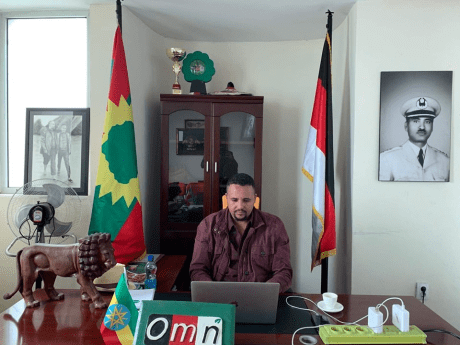
Jawar Mohammed: The war in Tigray is a result of Ethiopia’s mismanaged transition
Ethiopia is back in the global spotlight once again with the outbreak of the war in Tigray. I am saddened but not surprised. For anyone with a cursory understanding of the fragility of Ethiopia’s transitional politics, the escalation of tensions between the federal government and the Tigray state into a full-blown military conflict does not come as a surprise. The tell-tale signs were there for everyone to see as the warring parties openly prepared their respective forces for the eventuality of an all-out armed confrontation.
While the specter of war had been hanging over our heads for at least two solid years, the weeks before the formal commencement of the war were particularly alarming. As antagonisms between the federal government and the Tigray state reached a climax, federal and Tigray state media outlets regularly showed military parades, highly drilled commando paratrooper units, and red-beret Special Forces performed in mock-operations in an apparent show of force. All indications were that clashes were in the offing in a not so distant future. Then came November 4, 2020: The country woke up to the news of yet another deadly war.
We, in the Oromo Protest movement, had precisely anticipated this danger long before the drums of war began to reverberate between Finfinne and Mekelle, and put a considerable amount of effort in a desperate attempt to avert the unfortunate bloodshed. Regrettably, all political actors and outside stakeholders -including us- failed to prevent the war despite having ample time and incentive to do so in what now appears to be a collective failure of imagination. But why did we fail?
Below I will highlight some of our efforts and reflection as to why we could not attain the desired outcome in the interests of setting the record straight and as a useful lesson as we continue to navigate the treacherous terrains of Ethiopia’s utterly mismanaged political transition. Note that since I don’t have access to my journal and other useful reference materials as I sit inside the four walls of a prison cell, I rely on retrieved recollections from memory to outline the sequence of events on the topic.
Long before Prime Minister Abiy Ahmed emerged as chairman of the then ruling coalition and eventually took over the stewardship of the transitional process -in fact way before the Oromo Protests erupted- we knew that one of our main tasks was designing a strategy to dislodge the principal handlers of the authoritarian regime from power without plunging what was already a polarized country into a civil war, or even worse, without turning it into a failed state.
We believed that the process of inducing change into a minority-dominated authoritarian rule and its aftermath would have extremely dangerous consequences if not carefully handled. Our fear of a carelessly handled regime change possibly leading to a civil war and/or state collapse, was based on the following assessments of present and historical factors.
History of Ethiopian state formation
Ethiopia is a polity created via the conquest of various national groups, and the successive nation-building projects attempted through forced assimilationist policies aborted with the rise of the national question. The last attempt at nation and state-building through the formation of a multinational federation was also undermined by the authoritarian nature of the regime. Thus, the failure to build a state whose legitimacy is unquestioned by constituent national groups led to the birth of competing nationalisms.
In such a situation, the contest between the power holders and its challengers is highly likely to take an ethnic dimension as each side taps into those competing nationalist narratives, paving way for horizontal conflicts among various national groups. By the time we were designing the strategy against the ruling Ethiopian People’s Revolutionary Democratic Front (EPRDF), these competing nationalisms were already robust and institutionalized. The risk for horizontal conflicts to arise and transform into a civil war was very high.
Nature of the regime
EPRDF was dominated by the coalition’s senior partner, the Tigray People’s Liberation Front (TPLF), whose political base is a minority ethno-linguistic group representing merely six percent of Ethiopia’s population. When such minority political groups disproportionately dominate power, as much as holding power yields disproportionate material and sentimental dividend to members and affiliates of this group, the loss of this power or threat thereof, poses perceived or real existential threat both to their accumulated wealth and/or to their safety.
Although authoritarian rules of this type mostly enrich only a small clique of voracious sharks in the upper echelons of power, the fear of existential threat is usually shared by the rank and file within the party structure as well as by the entire population from which the dominant group hails.
The power holding political elite also tap into this fear to mobilize the mass and thereby insulate themselves from potential harm. Given this scenario, power contestations between those in power and their challengers could easily turn into a horizontal ethnic conflict. The fact that institutions of the federal government were dominated by elites of TPLF’s minority group meant that such a sense of existential threat and subsequent horizontal conflict could fracture those institutions, risking state collapse. I have written about this in 2010 on Tigrayan Nationalism. Our concern was exacerbated when we witnessed events in Syria and how a threatened power holding minority could wreak havoc, as I argued here in September 2012.
The above factors weighed heavy on our minds when designing a strategy to induce change towards a democratic transition in Ethiopia. The core principles of our strategic approach were as follows:
- While demanding that the TPLF cede power by mounting pressure through popular protests that indicated that change was inevitable, we also advocated that they should be given assurances against a punitive redistribution of wealth, aggressive persecution, and prosecution for past crimes should they give up federal power without further bloodshed. The assurances would also include a guarantee of autonomy for the Tigray Regional State so it could continue to be protected by federal forces against external threats. It was agreed to clearly and repeatedly communicate this to them formally and informally.We were very much aware of the gross human rights violations and corruption the TPLF dominated EPRDF had been engaged in. After all, Oromos and Oromia were the primary victims of brutality and exploitation. Yet, as painful as it is, we felt that sacrificing justice would be necessary to avoid a catastrophic civil war and broaden the chance for the transition into a sustainable democratic system.
- To reinforce this assurance and reduce uncertainty, it was believed that we should adopt a non-violent popular movement rather than an armed struggle. We believed civil disobedience posed less existential threat than armed confrontations. Furthermore, the transition should be through reform rather than overthrowing the regime entirely, and that is it should be led by reform-minded elements or factions within the ruling party who hold onto power rather than the opposition. We thought it would be simpler to assuage fears by the TPLF leadership of aggressive persecution, if they relinquished power to members of their ruling coalition than opposition groups that they considered more hostile.
- During the resistance movement, civilian members of the minority group should be protected to reduce the development of a sense of collective insecurity among the Tigrayan people. This was effectively implemented during the four and half years of the Oromo Protest. No Tigrayan was harmed by protesters. Even senior political and security elites were spared from direct attack. These strategies worked better than we could hope for. The resistance movement overall cost us thousands of lives but the TPLF finally understood that it was no longer tenable to cling on to power in the face of mounting pressure. The leaders wisely accepted the golden parachute, agreeing to hand over power to then OPDO, and retreated to their home state.
It all went according to plan thus far but our scheme had a second phase. The first, as discussed above, was dislodging the TPLF from power without causing a civil war in the process. The second phase was reintegrating and reconciling TPLF members to be part of the new democratic multinational federation. We believed that reconciling and reintegrating them was as crucial for the success of the transition as carefully dislodging them from power was.
It was the failure to effectively implement this second phase that significantly contributed to the current crisis. There are many reasons and enough blame to go around on why this phase failed. From my perspective, the following are a few of them:
- The plan to implement the second phase began to falter from the very beginning of the transition. On the eve of the transition, tension began to increase between TPLF hardliners and the incoming reformist team. At the ruling coalition council’s meeting convened to elect new leadership, the TPLF lodged a harsh and abusive criticism on the designated chairman and Prime Minister-elect, Abiy Ahmed, and went as far as refusing to cast even a single of their 45 votes for him. This created a bitter rift between the group that needed to be reconciled and the person responsible for presiding over the reintegration process.
- Another reason is that those tasked with implementing the second phase had different understandings, motivations, and tactics from those who planned it. In other words, those who came to power to lead the transition and those at the forefront of the protest movement had a different understanding of the way forward. The freshly minted “reformist” leaders saw the TPLF as a mortal threat to consolidating power rather than an old regime that could be useful to facilitate the transition process if properly reconciled with and reintegrated into the plan.Part of the problem was that individuals who came to play a decisive role in government were not active participants in the negotiations that led to the transition – not only did they not share our concerns nor did they feel that they should abide by the terms of those agreements. Instead of actively reassuring TPLFites and the larger Tigrayan elite, they pursued aggressive purging, harsh criticisms of their track records, and persecution of many key members of the TPLF including army generals and businesses. This led the TPLF and majority Tigrayan elites to believe they were deceived into giving up power with false promises strengthening the position of hardliners and silencing moderates.They immediately resorted to aggressive and combative rhetoric, having felt that they immediately became a target despite holding onto their end of the bargain to relinquish power. Their fear was exacerbated by how the peace deal with Eritrea was handled. Their exclusion from the peacemaking process with their archenemy made the TPLF feel the reproach was motivated by the desire to create an alliance against them rather than a sincere effort to end the decade’s long hostility between the two countries.Those who ascended to federal power also had reasons to feel insecure and threatened by TPLF’s deep state. They suspected TPLF operatives to be behind several acts of violence, such as communal clashes and the attempted assassination of Abiy himself. For the new power holders, the TPLF was sabotaging the reform effort as a means of blackmailing and undermining the federal government. The TPLF did not do much to reassure them either. In fact, harsh criticisms forwarded by some of its senior officials against the Prime Minister further heightened the sense of insecurity by the central government.The grenade attack at the rally organized in support of the new Prime Minister in June of 2018 was officially blamed on former chief of intelligence, Getachew Assefa, yet he was re-elected to the Executive Committee in a clear act of aggression. The fact that key elites in both camps had known each other for long has also resulted in personalized animosity. More importantly, leaders of the two sides grew up under an authoritarian culture where imposing one’s views and interests on the other with the use of force was a norm, and reaching compromises to bridge differences was regarded as a sign of weakness.
- It was obvious that the ruling coalition needed to reform, or at least rebrand itself, to remain in power and remain relevant. In fact, the coalition partners had agreed to reform the party even before the transition had begun. It was also obvious that TPLF’s dominant role would be reduced to reflect the new power order. And such reduction of power would create sour feelings in various sectors, hence the need for careful negotiations, power bargains, and discussions. Yet no such negotiations and discussions were undertaken during the early period of the transition.
On the contrary, such possibilities were deliberately avoided in favor of false harmony. For instance, at the 11th EPRDF Congress in Hawassa, the TPLF gave 100% of its vote to PM Abiy to continue as chairman of the coalition; this was despite their increasing resentment and fear towards his actions such as the purging of Tigrayan security and military officials and his right-wing leaning political rhetoric that contradicted EPRDF’s core leftist ideology and the perceived threat Abiy’s rhetoric carried to their regional autonomy.
During the early months of the transition, at the time when deeper discussion and negotiations were needed, the coalition stopped its usual culture of holding regular meetings and debates guided by the coalition’s principles of ‘democratic centralism’ in which differences are supposed to be ironed out internally rather than exposed to the public.
The EPRDF’s Executive Committee of the 36 powerful individuals rarely met. Even the crucial issue of merging the party, which was agreed upon in Hawassa, was avoided until the last minute. There was no real and genuine discussion and negotiation about the matter. When the issue was finally tabled, it was presented as a take it or leave it to matter on both sides with no desire for finding a middle ground.
Instead of negotiations, power bargains, and persuasions, deceptions and threats were deployed in public from both sides. After such a badly managed merger affair, the bond that tied the Tigray region and the new power holders in the federal government was all but severed. In a polity where a single party rule from federal to village level was the norm, two parties with an ugly break up began ruling the federal and regional governments, making their relationship more cumbersome than that between two sovereign countries hostile to one another. After the merger fiasco, the enmity between the two sides became official and preparations to forcefully assert their respective interests began to be pursued publicly.
To say that the postponement of the regional and national elections due to the COVID-19 is the single most important factor that ignited the current conflict is to arrive at an erroneous conclusion.
The relationship between the two had been severely damaged way before the arrival of the COVID-19 pandemic. As I have argued in several interviews the two sides were already preparing for war long before election politics gripped public consciousness.
One could safely argue that the election postponement was a missed opportunity to reset the relationship and to negotiate an amicable political settlement but the two sides only used it as an opportunity to further de-legitimize each other as they prepared behind the scenes for today’s armed showdown. The postponement might have sped up the war, but for anyone closely observing Ethiopia, it was obvious that the two sides had made up their mind to settle their differences by the barrel of the gun rather than around the negotiating table. The writing was on the wall.
In the absence of mutually reassuring communication and negotiation, insecurity on both sides, that is TPLF’s fear of retribution for past misdeeds and Abiy’s concern of losing control due to acts of sabotage by TPLF’s deep state was worsening. Hence each side focused on taking defensive actions to neutralize perceived threats. Abiy by purging them from security and bureaucracy and TPLF by building its military capability and attempting to broaden its political and security alliance outside Tigray.
The securitization of the relationship facilitated for hardliners to dominate TPLF’s decision making while pushing Abiy and the federal government to rely on and come under increasing influence personalities and entities that advocated violent resolution of the TPLF issue. Sadly, international actors, perhaps underestimating the likelihood of a war breaking out, did little to diffuse the ever-growing tension. Even worse some foreign states and ambassadors took sides emboldening the quarreling forces to be more aggressive and combative.
Thus, the war in Tigray did not suddenly erupt due to the attacks on the Northern Command of the National Defense Forces. The Northern Command has been a hostage of the Finfinne – Mekele political gridlock for the last two years. The Tigray regional government had openly declared that no weapon could leave the region and the army’s movement had been severely restricted. As the tension increased, Tigray feared the federal government would use the Northern Command to forcefully take over the region from within the territory, while the federal authorities were worried that the heavy armament in possession of the Northern Command could be used by the TPLF to launch an attack not only within the regional state but even on the center.
In other words, the Northern Command was seen as a crucial element that could tip the balance of force in the power struggle between Finfinne and Mekelle. After squandering opportunities to negotiate a mutually reassuring deal during the early months of the transition and with external actors fanning the tension rather than pressing for resolution, the war was inevitable.
Finally, at the risk of self-praise, let me highlight some of those little efforts. As one of the people involved in designing the Oromo Protests strategies, I spent a considerable amount of time pondering, writing, and speaking to stakeholders about how to dislodge TPLF from power and safely reintegrate them. I played an active role in the first phase – in dislodging the TPLF – and tried to play a bit of an advisory (mediator) role in the second.
In the first phase, I had direct participation in the discussions and negotiations. In the second phase, I tried to urge the two sides charged with the matter to take reconciliation and reintegration as a priority. For instance, when PM Abiy and President Lamma came to the US, one of the main topics of our discussion was how to handle the TPLF conundrum.
Having had a positive reaction from them, I called President Debretsion while Abiy and Lemma were still in the U.S. and explained to him the urgency of this task. I also informed both Abiy and Debretsion that activists and public intellectuals would wage campaigns to shape public opinions in favor of reconciliation and reintegration. To work towards this end we would travel to Mekelle right after my return to Ethiopia. Both sides thought this was a good idea.
Upon my return, I communicated with both sides to arrange the trip to Mekelle. Those in Finfinne advised me to travel to Bahir Dar first to prevent possible suspicion and negative reactions from the Amhara side. Mekelle also agreed and I first traveled to Bahir Dar. However, my travel to Mekelle was repeatedly delayed and postponed primarily as the relationship between the two sides deteriorated. Those at the federal government were reluctant while Mekelle also grew suspicious of our true intentions. The plan was finally canceled when the former spy chief, Getachew Assefa, was elected to TPLF’s Executive Committee (EC) in defiance of the federal government’s arrest warrant against him.
Although the plan to travel to Mekelle to help with public opinion did not materialize, I did not give up lobbying for the two sides to solve their differences through negotiations. That tragic day the chief of armed forces and the president of the Amhara region were assassinated, I was extremely alarmed by how state media in Amhara and Tigray regional states were fanning the tension. I decided to reach out to veterans of the ANDM and TPLF in the respective regional states to plead with them to tone down the hostility and honor the martyrs of both sides.
This conversation developed into an idea of veteran politicians, drawn both from the EPRDF and opposition side, conducting back door negotiations between Mekelle and Finfinne to facilitate formal negotiations among the officials. Six individuals from both sides were selected. The plan was endorsed both by PM Abiy and president Debretsion. But for reasons I still don’t know it was abandoned before any face-to-face meeting was held. After the effort failed, I realized any effort to solve the problem amicably would prove futile. When we talked to them, officials of the two sides were more interested in soliciting our support for the inevitable confrontation.
Reconciliation and reintegration of TPLF was one of the primary focuses of my advocacy when meeting foreign diplomats as well. For instance, a few days after returning to Ethiopia I had meetings with ambassadors of some 20 countries including that of the U.S. and the European Union. In those meetings, I emphasized the crucial importance of resolving the TPLF/ Tigray issue for the success of the transition and emphasized that failure to reconcile would have serious ramifications for the country and regional stability. I urged these diplomats to put pressure on both sides to negotiate. In several meetings with foreign diplomats and officials in the last two and half years in the Horn Region, Europe, and the US, I have been pleading the same point, but I am not sure if it was taken seriously.
Conclusion
We dreamed of and planned for a peaceful transition to democracy. Nonviolently dislodging and then reintegrating the power holders in TPLF’s base was the centerpiece of our plan. We strongly believed successfully dislodging followed by reconciliation would be an essential component of not only successfully transitioning Ethiopia to democracy but also building on the multinational federal state by avoiding falling back into a catastrophic civil war. It did not work as we hoped.
While our plans to weaken and dislodge the TPLF turned out to be more successful than we had anticipated, efforts to reintegrate them into the transitional set up proved inadequate, forcing us to confront our worst fear – a civil war. Ironically, we choose to let EPRDF, the party that tyrannically ruled, continue to lead the transition believing that opposition taking over through regime change carries more risk of war.
Yet it is the split within the ruling coalition that brought about what we hoped to avoid. This reminds me of what the chairman of Oromo Federalist Congress (OFC), Professor Merera Gudina, said at the start of the transition that ‘Abiy’s main difficulty was managing the EPRDF rather than dealing with the opposition’ or something to that effect.
As I jot down this piece, the war is raging and the federal government has said it was marching to capture Mekelle. Regardless of which side wins in key battlefronts or the war itself, it’s obvious that Ethiopia loses on multiple fronts. Even before the war erupted the much-hoped-for transition was severely harmed by confrontations of the two sides and several other factors.
The main reason why we wanted to ease out TPLF with the offer of a golden parachute – assuring them that they would not be targets of vengeful persecutions and punitive redistribution of wealth, they would preserve their regional autonomy as well as receive protection from foreign adversaries – was to save the federation from eventual fragmentation.
We operated with a working assumption that any perception of an existential threat by the TPLF, which dominated the political and security apparatus of the Ethiopian state for almost three decades, could lead to the collapse of some of the federal institutions it built and held together. A look into the impact this war is having on the cohesion of the Ethiopian army provides a glimpse into the disastrous outcome of this fallout.
The war in Tigray is a direct result of a poorly managed transition into a democratic dispensation, which should not be viewed as an isolated problem. It is a tragic collective failure of the country’s political leadership – all of us, not just Abiy and the TPLF. There is enough blame to go around. One person or party could bear larger or lesser responsibilities but we all played a role. Through our acts of omission and commission, we squandered this great opportunity for a peaceful democratic transition and placed the country at a horrible civil war that could rip it apart.
From my prison cell, I cannot pretend to be up to speed with everyday developments on the war and the efforts of external actors to end it before it causes irreversible damage. It would therefore be presumptuous of me to try to offer concrete recommendations with limited information at hand. All I could do for the time being is plead with all sides to give peace a chance; remind various political groups to refrain from fanning the war and instead exert pressure to end the hostility.
Even if this war ends with the defeat of the TPLF leadership, genuine efforts must be made to reconcile and reintegrate the disenfranchised Tigrayan political, security, and economic elites into the country’s governance structures. The defeat of TPLF does not necessarily mean the end of the ‘Tigrayan problem’ for the Ethiopian state. The resurgence of wounded Tigrayan nationalism is inevitable unless extra care is given to avoid the victimization of Tigrayans. For instance, the disputed border between Amhara and Tigray states should be carefully handled not to leave cause for future conflict.
The unfinished issue of the Eritrean border also requires sensitive handling. In both border disputes, a ‘winner takes it all’ approach must be avoided.
The international community and regional players should exert maximum pressure to save this country from further mayhem by insisting on the immediate cessation of hostilities and encouraging Ethiopia’s political forces to resolve their differences through an all-inclusive national dialogue.
Finally, if any actor, be it state or non-state, believes they can achieve victory through a war in this country, they are mistaken. Certainly, one can defeat the other on the battlefield, but neither side would be victorious in building a peaceful and sustainable political order. We are poised to lose the country if we keep insisting on advancing our particular interest through the use of force. In our part, during the Oromo Protests, we consciously chose to wage nonviolent struggle because we believed it would give us a better chance of bringing about a transition to a multinational democratic federal system.
At the OFC, we firmly believe -as always-that nonviolent struggle and an all-inclusive dialogue remain Ethiopia’s best hope to successfully transition into a democratic order, ensure enduring stability and achieve sustainable development, and are committed to abiding by these principles. It has worked for us in the past. We hope it serves us better in the future as well.
Jawar Mohammed
November 2020
Qaliti Federal Prison, Ethiopia
#OromoProtests Statement on Ongoing War in Ethiopia November 22, 2020
Posted by OromianEconomist in Uncategorized.add a comment
Statement on Ongoing War in Ethiopia https://oromoprotests.org/index.php/2020/11/21/statement-on-ongoing-war-in-ethiopia/ via @OromoProtestsHQ
Ethiopia: 52 Oromo nationals slaughtered on one day in Metekel by extremist militias November 15, 2020
Posted by OromianEconomist in Uncategorized.2 comments
(Metekel, 14 November 2020) 52 Oromo nationals slaughtered, 17 wounded (in critical conditions) and 18 kidnapped (their whereabouts unknown) by extremist/terrorist Amhara militias organised by Ethiopia’s deputy PM Demeke Mekonnen and illegally operating in Metekel (Benishangul Gumuz state). From one family alone 6 people murdered by this Oromphobic group.

Oromoota Matakkal aanaa Dibaaxeetti sababa eenyummaa isaaniitiin Sadaasa 14, 2020 otobusii keessaa gad guuramanii ajjeefaman.Ummani keenya yeroo ammaa bakak iyyuutti ajeefamaa jira. Mootummaan ummata kanaaf dubabtu hin jiru. Oromoon mootummaa ummata Oromoo bakak bu’u ijaarrachuuf kutatee hojjachuu qaba. Qaama biraa irraa waanti eegamu hin jiru. Ummanni keenya utuu geggeessaa quuqama uummatummaa qabu qabatee, akkanatti bakka argetti hin qalamu; hin ajjeefamu. Uummatni Oromoo akkanatti bakka hundatti ajjeefamuu keessaa kan ba’u, mootummaa isaaf dhaababtu yoo hundeeffatee dha.Mootumaman Ce’umsaa Biyyoolessaa Oromiyaa hatattamaan hundeeffamee ummata keenyaaf akka dhaqqabuuf haa goonu!! Kan caalu otuu hin dhufiin, ummata keenay haa baraarru!!
በአንድ ጀንበር 6 የቤተሰብ አባል ጨምሮ 43 ሰው መኪና ውስጥ የተጨፈጨፉ በጥይት የተገደሉ 9 አጠቃላይ 52 ሞት. ቁስለኛ 17ሰው. እስካሁን ታግተው የደረሱበት ያልታወቁ # 18 ሰው.
ዛረ በመተከል ድባጤ ወረዳ የተለያዬ ቀበለዎች በም/ጠ ምንስተር ደመቀ መኮኖን ትዛዝ የታጠቁት ርስት አስመላሾች ጥቃት አደርሳል፡፡ ከነዝህም ውስጥ 4 ኦሮሞች ትናንት ያፕ ቀበለ ስገደሉ ዛረ አንድ መክና ሙሉ ደግሞ ቅዶ ቀበለ ተገላል የማቾች 48 አስከረን ቡለን ሆስፕታል እየተመረመረ ይገኛል።እነዝህ ርስት አስመላሾች ባለፈው መከላከያ ወልቃይት ጠገደ ነፃ አወጣልን ርስት ለባለበቱ ተመለሰች ብለዉ አቧራ ስያነሱ ነበር።ዋና አላማቸው ርስት ማስመለሰ የሆነው በPP film Director ነት የተፈፄመ ስሆን አሁን በፀጥታ ማስከበር ስም የአማራ ልዩ ሀይል ወደ ስፍራው የተቀሳቀሱ ስሆን ነገ ደግሞ ርስት ለባለበቱ ተመለሰች እንደምሉ ይጠበቃል።PP ም የዘጎችን ደህንነት መጠበቅ አልቻላቹም በማለት መተከል በአማራ እንድትመራ ለማድረግ ድራማው እንደተሰራም የውስጥ ምንጮች ያረጋግጣል። የዝህም ማሳያ የምሆነው የአማራ ልዩ ሀይል ፀጥታውን ለማስከበር መላካቸው ስሆን ይህንን ኦኘረሽን በበላይነት የምመራ ም/ጠ ምስተር ደመቀ መኮኖን ነው።
Press Release (Oct. 23, 2020): OLLAA CONDEMNS THE CONTINUED STATE SANCTIONED VIOLENCE IN ETHIOPIA: MILITARY FORCES MURDERED FIVE YOUTH at THEIR HOMES IN NAQAMTEE, WESTERN OROMIA, ETHIOPIA October 24, 2020
Posted by OromianEconomist in Uncategorized.add a comment
Press Release (Oct. 23, 2020): OLLAA CONDEMNS THE CONTINUED STATE SANCTIONED VIOLENCE IN ETHIOPIA: MILITARY FORCES MURDERED FIVE YOUTH at THEIR HOMES IN NAQAMTEE, WESTERN OROMIA, ETHIOPIA
===
Falls Church, Virginia (Oct. 23, 2020) – the Oromo Legacy Leadership and Advocacy Association (OLLAA) condemns the continued state sanctioned violence in Ethiopia. Today, October 23, 2020 government security forces brutally murdered five innocent young men in the city of Naqamtee, Western Oromia, Ethiopia in Kebele 05 near Qasso Secondary School. Naqamtee (Nekemte) is a vibrant city located 310 km west of Finfinnee (Addis Ababa), the capital city of Ethiopia.

Motummaan Ce’umsaa Oromiyaa Hatattamaan Ijaarramuu Qaba! October 7, 2020
Posted by OromianEconomist in Uncategorized.1 comment so far
Motummaan Ce’umsaa Oromiyaa Hatattamaan Ijaarramuu Qaba!
Dr. Tsegaye R Ararssa tiin
Motummaan Itiyoophiyaa Abiy Ahmadin hogganamu guyyaa kaleessaa (October 5, 2020) irraa jalqabee haangoo seera qabeessa kan biyyattii ittin bulchu dhabeet jira. Motummaan bulchiinsa Naannoo Oromiyaa kan harka Bilxiginnaa keessa tures, kaleessa irraa kaasee Oromiyaa bulchuuf haangoo seera-qabeessa ta’e hin qabu. Kanaaf, Oromiyaan motummaa ce’umsaa gad dhaabuu dhaan hanga filannoon godhamee bulchiinsi dimokraatawaa ta’e ijaarramutti, naannicha shiftoota Bilxiginnaa jalaa oolchuu dhaaf, nagaa fi tasgabbii uumuu dhaan, saba keenya bulchuu, lammilee keenya balaa irraa hambisuu, qabdi.
1. Motummaa ce’uumsaa kana eenyutu ijaaruu qaba? Eenyutu itti hirmaata?
Motummaa ce’umsaa ijaaruun walgayii haanga’oota hundaa walitti fidee kallattii motummaan ce’umsaa ittin ijaarramuun fi haala hojii isaa ittin raaw’atu irratti waliigaltee uumuu barbaada. Walgayiin kun qaamota adda addaatin waamamuu mala. Garuu Abbootin Gadaa Oromiyaa qaama siyaasaa kamuu dursanii, dhiimma kanarratti utuu mari’atanii, qaamota birootif waamicha godhaan gaarii natti fakkaata.
Qaamonni walgayii kana irratti hirmaachuu qaban:
a) Abbootii Gadaa
b) Jarmiyaalee siyaasaa Oromiyaa hunda (Bilxiginnaa hin dabalatu)
c) Qeerroo fi Qarree Oromoo
d) Qaamota miti motummaa Oromoo (NGOs)
e) Waldaawwan ogeessotaa oogummaa adda addaa fi waldaale hawaasaa adda addaa
f) Hogganoota waldaalee amantaa Naannoo Oromiyaa
g) kkf.
Qaamni siyaasaa hundi (Bilxiginnaan ala) akka itti hirmaatu godhuun barbaachisaa dha. (Bilxiginnaan paartii yakkaamtootaa waan ta’eef dhaabichi akka dhaabaatitti diiggamuu qaba. Miseensonnii isaanii akkuma gayee isaanititti seeratti dhiyaatanii itti gaafatamuu qabu. Rakkoo siyaasaa amma itti jiru kan uume isaan waan ta’anif, motummaa ce’umsaa rakkoo keenyaaf furmaata fida jedhamee ijaarramuuf deemu keessaa shoora qabaachuu hin danda’ani.
2) Motummaan Ce’uumsaa Maal dalaga? Hojiin isaa maali?Hojiin isaa…
a) nagaa fi tasgabbii uumuu;
b) hidhamtoota siyaasaa hunda hiiksisuu/hiikuu;
c) Oromiyaa fi Oromoota baraaruu [(securing Oromia)– daangaa kabachiisuu; saba keenyaa naannoo ollaa keessatti rakkatanii jiraatan (Fakk.Walloo, Wambaraa, kkf) deeggaruu dhaan diina jalaa baraaruu; lammiilee magaaloota adda addaa keessa jiraatan hiraarsa diinaa jalaa oolchuu; lammiilee Oromoo Finfinnee fi naannoo ishee jiranif eegumsa barbaachisu godhuu; kkf.]
d) tajaajilli adda addaa sivil servisii fi qaama adda addaa motummaatin keenamaan akka hin dhaabbanne, ykn haalan akka itti fufan, godhuu;
e) karoora ce’uumsaa lafa kaa’uu dhaan, yeeroo fi haala filannoon ittin gaggeeffamun baafachuu fi kanas raawwachuu; fi
f) kkf
…dabalata.
Abbotiin Gadaa qaama ce’umsaa uumamu kana keessaa, isaanuma wajjin mari’atanii, nama (ykn garee) hojii raawwachiisaa ta’ee dirqama fudhatu utuu muudani gaari natti fakkaata.
Oromoo fi Oromiyaa baraaruun akka danda’amu, Motummaan Ce’uumsaa Oromiya, Poolisii Oromiyaa, Humna Addaa Oromiyaa, qaama tikaa naannoo Oromiyaa, Milishaa Naannoo Oromiyaa, Qarree fi Qeerroo naannoo Oromiyaa guutuu, Foollee Oromoo, miseensota WBO, fi Oromoota Raayyaa Ittisa Biyyaa (RIB) keessa jiran hundaa wajjin walitti dhiyeenya fi qindoominaan yoo hojjate qofa dha.
3. Motummaan ce’umsaa kun hojii isaa seera akkamiitin raawwata?
Karoorri ce’umsaa motummaa kanaa kan ittin raawwatamu waliigaltee qaamooni mootummaa kana ijaaran gidduuti uumamuun ta’a. Walii galteen isaan lafa kaawwatan kan akka chaartaraa fakkaatu jiraachuu qaba. Walii galteen kun, hojii fi dirqama isaan gidduu jiru hirachuu irratti, seera haala adeemsaa isaanii ittin bulfatan, fi karoora filannoo dhufuuf lafa kaawwatan irratti kan xiyyeeffatu ta’a.
Hojiin jabaan motummaa ce’umsaa kanaa inni cimaan Oromiyaa diigumsa irraa fi oromoota balaa irraa baraaruu dha. Kanaaf seerri motummaan ce’umsaa haalan kabachiisuu qabu seera heera Naannoo Oromiyaa fi Seera heera federaalati.
Hojiin biraa motummaan ce’umsaa kun hojjatu tajaajila sivil servisii itti fufsiisuu waan ta’eef kanaaf ammoo seerri heera motummaa fi seeronni adda addaa tajaajila motummaa adda addaa irratti bahani lafa jiran hordofamuu qabu. Nagaa fi tasgabbii uumuu dhaafis seera idilee biyyattii fi naannoo Oromiyaa keessatti hojii irra jiran fayyadamuun barbaachisaa ta’a.
Motummaan Ce’umsaa kun akka milkaayee, Oromiyaa gara sirna dimokraasii dhugaatitti tarkaanfachiisu Oromoon hundi bakka jirutti dirqama lammummaa isaa bahuu qaba.
Na ofkalchaa!
(Barreffamni kun bal’inaan kan itti fufu ta’a).
Related article:


 Oromian Economist
You must be logged in to post a comment.