
An appeal to International community on the pathetic situation of human rights violation against Ethiopian Oromo people.
Economic and development analysis: Perspectives on economics, society, development, freedom & social justice. Leading issues in Oromo, Oromia, Africa & world affairs. Oromo News. African News. world News. Views. Formerly Oromia Quarterly
When public protest in a peaceful and democratic way, no warnings, no lotty charge, no water shelling, no tear gas, but directly shooting by the police of government on the chest or head of the public. I wonder how the government kills its own people?
It is certainly racist government or fascist government where TPLF police are brutally killing the Oromo people. Under the cover of so many hidden and pseudo reasons, the Ethiopia Government is misleading the entire international community, I believe.
When people were brutally killed by the Ethiopia government, like a Hitler govt, why the international Humanitarian organizations are keeping silent. The international community and Human right organisations must come forward to assess the facts without any prejudices.
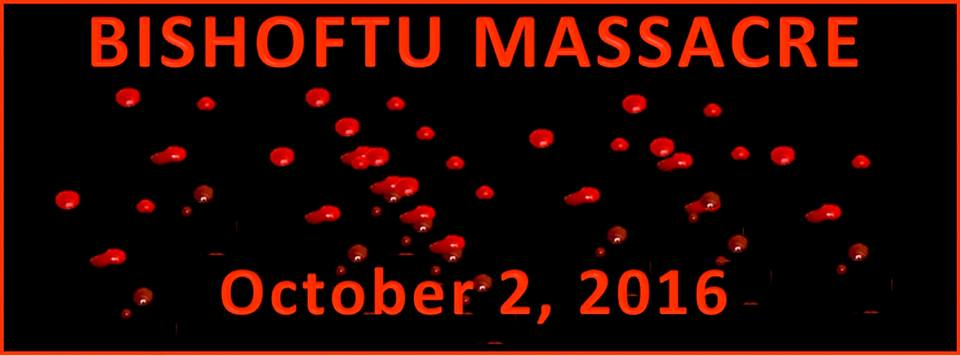


An appeal to International community on the pathetic situation of human rights violation against Ethiopian Oromo people.
An appeal to International community on the pathetic situation of human rights violation against Ethiopian Oromo people.
I am an Indian, worked as a professor for about 5 years since 2011. All these days, I never felt that Ethiopia is a democratic country. I never saw any kind of freedom to the public in Ethiopia. The government is running against the principles of democracy. I felt it as totally dictatorship government with autocratic policies.
They conduct elections for name sake to elect their nominees only. For name sake that is for the sake of international funds from UN, UNDP, US and EU. They named their constitution as Democratic Republic of Ethiopia, but it is totally autocratic government. As senior professor, I was surprised to note that how the US, UN, EU and UNDP are kept silent where there is no freedom for the people, killing the people who ever raise their voice for freedom, no transparent news media, control over internet and telecom media and no support from the government to protect public against hunger and poverty, but brutal killings that to massacre killings. Public are living similar to the refugee camp of some other enemy country.
When public protest in a peaceful and democratic way, no warnings, no lotty charge, no water shelling, no tear gas, but directly shooting by the police of government on the chest or head of the public. I wonder how the government kills its own people?
It is certainly racist government or fascist government where TPLF police are brutally killing the Oromo people. Under the cover of so many hidden and pseudo reasons, the Ethiopia Government is misleading the entire international community, I believe.
When people were brutally killed by the Ethiopia government, like a Hitler govt, why the international Humanitarian organizations are keeping silent. The international community and Human right organisations must come forward to assess the facts without any prejudices. It is very hard to know that how the human beings are killed by other human beings on political revenge, that too how the government kills its own people brutally.
As an economist, well known to White House and Obama governance bureau, I have a question how the international community praises the growth of the GDP in Ethiopia, by ignoring the extent of free funds received by the Ethiopia from international community, that too when there is no transparent performance assessment of any kind at any level across the Ethiopian governance.
It is very clear that all the funds received from the international community are diverted to maintain the excessive police force rather than to the public welfare. I saw the people at rural areas who are suffering for piece of bread and piece of cloth, where there are no incidences of visiting to those areas by the government and its representatives.
I saw at several government offices in Ethiopia saying that ” Ethiopia need not answer to any foreign country”. I am surprised, how they can say like that when they are enjoying huge foreign funds for the development of their country. Definitely every foreign country giving funds to Ethiopia in any manner has a right to ask its performance on the development of people and related human rights.
I expect that an independent investigation is to be counseled immediately and all kinds of funds to Ethiopia government from international community must be stopped until the investigation reports are analyzed on the facts.

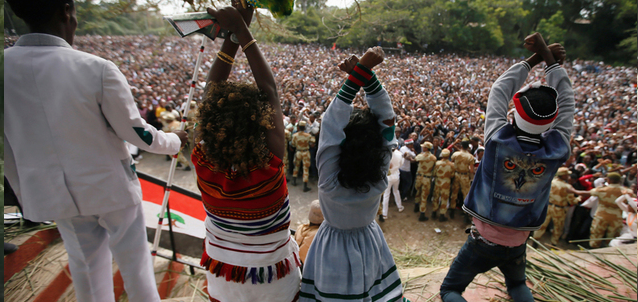

The government claims 52 people were killed in the Irreecha celebrations, but the opposition puts the figure much higher.
When Shibiru Amana heard gunshots ring out near his home in the town of Mandi on 26 September, he immediately rushed outside where he saw people clamouring for safety and kids running for their lives. Across the commotion, he later told VOA Afaan Oromo, Amana spotted a young boy lying lifeless on the ground. He mustered up the courage and took a few steps towards him. It was his younger brother Lidata.
Lidata, who was just 15 years old, had been shot in the torso. His transgression had been shouting a few anti-government slogans at a gathering on the eve of the Meskel holiday.
A week later, enormous numbers of people from all corners of the Oromia region descended on the town of Bishoftu to celebrate Irreechaa, an annual Oromo thanksgiving festival. When some began to protest, security officers responded by firing tear gas and live ammunition, according to witnesses and videos that later emerged on social media.
The crowed was packed between a lake and treacherous terrain, and in the panic that ensued, many died. The government reported that 52 died. Human rights groups say several hundreds were killed. Meanwhile, the Oromo Federalist Congress (OFC) put the death toll at a huge 678.
The ongoing wave of protests in Ethiopia was initially triggered in November 2015 by a development plan that would have expanded the capital Addis Ababa into neighbouring Oromia towns. This plan was eventually suspended, but the protests amongst the Oromo people continued and have since spread to over 200 towns and been joined by Amhara demonstrators too. The government has often responded by sending in security forces that have engaged in deadly violence, leading to the deaths of over 600 people, according to rights groups, and over 1,000, according to activists.
[Ethiopia’s unprecedented nationwide Oromo protests: who, what, why?]
While some of these killings in Oromia have been carried out by regional police, it is notable that much of the security response has been conducted by the federal police and army. As Amana explained, “I wanted to ask the police officers why they killed my brother but they speak a different language”.
Under Ethiopia’s system of ethnic federalism – comprising of nine states and two chartered cities – significant powers are devolved to regional authorities, including the right to establish a state police force and maintain public order within the region. The federal army is only permitted to intervene at the request of the Oromia regional government.
However, the reality is that much of this devolved autonomy only exists in theory, and the fact that federal forces have been deployed reportedly without the express request of the Oromia government speaks to its lack of sovereignty.
Indeed, for the last 25 years, politics has been controlled by the four-party ruling coalition known as the Ethiopian People’s Revolutionary Democratic Front (EPRDF). This alliance includes the Oromo People’s Democratic Organisation (OPDO), the Amhara National Democratic Movement (ANDM), and the Southern Ethiopian People’s Democratic Movement (SEPDM). But its lead partner is the Tigray People’s Liberation Front (TPLF).
This latter party’s base represents just 6% of Ethiopia’s 100 million population, but TPLF elites have long dominated the country’s political and economic spheres and kept a hold on key posts such as defence, intelligence and foreign affairs.
It is partly anger at these inequalities that is driving protests in Oromia and Amhara. The government has largely denounced these demonstrators and used force, but it also recently announced it would evaluate the performance of its regional parties and engage in the necessary reforms of them to address the people’s concerns.
“Deep reform”?
In 2001, the year Lidata was born, the Ethiopian government also faced the need for an internal upheaval. A struggle for power within the TPLF had just concluded and the faction led by then Prime Minister Meles Zenawi had come out on top. A major purge of his opponents in government soon followed.
OPDO’s leaders had been indecisive in declaring their loyalties during the factional fight and were largely sidelined. Negasso Gidada, former president of Ethiopia and chair of the OPDO, was suspended along with other senior leaders. Meanwhile, Kuma Demeksa, an OPDO central committee member and president of the Oromia region, was removed and later replaced by Juneydi Saaddo, a new technocrat on the block.
In times of crisis and internal party strife such as these, there was nothing Meles enjoyed more than conducting a highly charged meeting (‘gimgema’) in which participants engaged in criticism and self-criticism. Those from the OPDO reportedly engaged in a frantic admission of guilt.
15 years on from this – and four years since Meles’ death in 2012 – today’s widespread protests have forced senior leaders in the TPLF and EPRDF to resurrect their ideologue’s penchant for reform. These recent changes have been spoken about under the banner ofTilq Tehadiso, which is Amharic for “deep reform”, and are supposed to “tackle rent-seeking” and “root out nepotism”. But the reality is that the exercise has been, at best, a cosmetic reshuffle.
At worst, it has been used to usher in an even more confrontational approach to the protests. In its September 2016 party congress, for instance, the OPDO replaced its chair and vice-chair with Lemma Megersa, a former Security Chief for the region, and Workneh Gebeyehu, a former Director-General of the Federal Police Commission. This shift is widely believed to have been choreographed by the TPLF, and the combined intelligence and law enforcement expertise of the two new leaders will be of immediate value to the government. According to Jawar Mohammed, a US-based Oromo political activist, the move is an attempt to “further militarize the administration in Oromia”.
Indeed, early evidence suggests the new leadership is taking a more ruthless approach. Weeks after the change of guard, crackdowns have intensified in parts of Oromia, leading scores if not hundreds such as Lidata to lose their lives. “That’s the closest I have ever been to a war,” Bayesa Abera, who has attended every Irreechaa celebration for the past 10 years, said of events earlier this week. “I am lucky to be alive today.”
Neither the cause nor the solution
The OPDO is not the only Oromo political party in Ethiopia, but thanks to the TPLF, it has developed a sense of near invincibility over its competitors in the region since the 1990s.
According to insiders, the TPLF masterminded the very creation of the OPDO in 1989 in order to pit them against the Oromo Liberation Front (OLF), a group with which its relations were deteriorating. The TPLF struggled to encourage the formation of this new OPDO party, however, and reportedly had to call upon on Oromo-speaking prisoners of war to make up its members. From its early days, OPDO officials were widely referred to disparagingly as ‘maxxanne’, Oromo for freeloader.
In 1992, the now banned OLF, a more potent symbol of Oromo nationalism, finally withdrew from the transitional government in acrimonious circumstances, and since then, the TPLF has ensured that its OPDO ally has completely dominated in the region. As a Human Rights Watch report from 2005 noted, “From top to bottom, the OPDO has had a near-total monopoly on political power in Oromia since 1992”.
Two Oromo opposition parties – the Oromo National Congress (ONC) and Oromo Federalist Democratic Movement (OFDM) – did manage to enter the political fray when they won seats in the 2005 elections. But they were constantly undermined to prevent them from mounting a real challenge to the OPDO’s supremacy. This strategy of restricting political space to opposition parties culminated in the 2015 elections in which the OPDO officially won all 537 seats in the regional state council and all 178 seats allocated to the region in the federal parliament.
The OPDO’s loyalties have thus always been with the TPLF, and when men and women across Oromia have been gunned down, no OPDO official has had the courage to condemn excessive use of force. Juneydi Saaddo, a former ODPO cabinet minister who is now in exile, explained recently in an interview that those in government fear reprisals if they speak out against TPLF dominance, and confessed that the OPDO has never been able to shake off its subservient status.
[Behind the Ethiopia protests: A view from inside the government]
For the protesters in Oromia therefore, the OPDO possesses neither legitimacy nor autonomy, and any reshuffle of its leadership is considered as inconsequential as the party itself. The overwhelming belief is that its leaders are handpicked by the TPLF puppet-masters, and the new generation of Oromo youth – known as the ‘Qeerroo’ – have seen that it is business as usual after the latest reform. As Jawar Mohammedargued following the change of guard, “the OPDO is neither the cause nor the solution for the political crisis”.
Over the past year, Oromo protesters have been calling for genuine representation in government, an end to the dominance of a single ethnic group, respect for democratic and human rights, an end to indiscriminate killings and repression, and the cessation of marginalisation and evictions of Oromo from their ancestral lands. These are issues that far exceed the powers of the OPDO.
A Luta Continua
Over the past few months, the Amhara have joined the protests and there have been shows of unprecedented solidarity with the Oromo, united in their shared grievances. This is a significant development. Together, these two ethnic groups make up more than two-thirds of Ethiopia’s population, and Prime Minister Hailemariam Desalegn’s most urgent and perhaps toughest job now is to halt or reverse this growing trend.
Former strongman Meles Zenawi long managed to avoid this situation by stoking historical antagonisms in order to create perpetual mistrust between the two groups. He effectively drilled this trick into his disciples too, including current Communications Minister Getachew Reda, who in a recent interview, bluntly admitted that “the alliance between the two…is clear evidence that the government has failed to do its job”.
But Prime Minister Hailemariam, a former technocrat hailing from Ethiopia’s southern region, has proven less politically cunning than his predecessor. His attempts at employing the old divisive tactics, even mimicking Meles’ language and gestures at times, have failed as solidarity between the Amhara and Oromo has grown both within Ethiopia and in the diaspora. When the state TV recently unearthed and aired old footage of Meles expounding on the “narrow nationalism” and “chauvinism” of the two groups, it highlighted Hailemariam’s comparative lack of skill in delivering effective propaganda.
From Hailemariam’s first day in office, it has been clear that the TPLF still calls the shots. In fact, it is believed that his very survival strategy is to play second fiddle to gain approval from the TPLF hierarchy. But if protests continue, he could end up as a sacrificial lamb.
However, one thing the PM may take encouragement from is the fact that despite the turmoil facing the country, support from key Western allies hasn’t wavered. The US government in particular has shown little interest beyond penning half-heartedstatements of concern, reluctant to criticise a partner it sees as a force for stability in a volatile region and a major ally in its War on Terror.
In this configuration, the Ethiopian government has barely had to project even the semblance of democracy for Western diplomats to continue singing its praises. For instance, when US President Barack Obama paid a visit to the country in July 2015 – just two months after the ruling party and its allies won 100% of seats in parliament amidst accusations of intimidation and fraud – he described the government as “democratically elected”. The killing of hundreds of protesters since then has done little to shift this position.
The events of the last 11 months – and the responses from the Ethiopian government and its allies – have shown that Ethiopia’s protesters must take it upon themselves to define their destiny and bring an end to their peripheral role. Indeed, this seems to be the position that demonstrators in both Oromia and Amhara have willingly adopted, aware that as the two largest ethnic groups in the region, the success of their struggle lies in their ability to galvanise the public to rally and create links of solidarity with others who share their grievances. External actors can facilitate, but not replace, this process.
But this struggle goes on. At the funeral of Lidata, just one of many who have lost their lives at the hands of security forces, friends and family said their eulogies to celebrate his life and grieved that it had been so tragically cut short. A whole community gave him the send-off that he deserved, with mourners chanting pro-freedom slogans, of which one particularly stood out. Qabsoon itti fufa, or Oromo for “A Luta Continua”.
Michael C. Mammo is studying for his PhD at the University of Birmingham. He is a former Ethiopia correspondent for Inter Press Service and Spanish News Agency (EFE). He tweets at @mcmammo.
 Image copyrightREUTERS
Political protests which have swept through Ethiopia are a major threat to the country’s secretive government, writes former BBC Ethiopia correspondent Elizabeth Blunt.
For the past five years Ethiopia has been hit by waves of protest, not only by formal opposition groups but also Muslims unhappy at the imposition of government-approved leaders, farmers displaced to make way for commercial agriculture, Amhara communities opposed at their inclusion in Tigre rather than the Amhara region and, above all, by groups in various parts of the vast Oromia region.
In the most recent unrest in Oromia, at least 55 people died when security forces intervened over the weekend during the annual Ireecha celebrations – a traditional Oromo seasonal festival.
The Oromo protests have continued long after plans to expand the capital Addis Ababa’s boundaries to take in more of the region were abandoned earlier this year. And in the last few months groups which were previously separate have made common cause.

In particular, Amhara and Oromo opposition has coalesced, with both adopting the latest opposition symbol – arms raised and wrists crossed as if handcuffed together.
The picture of Olympic silver medallist Feyisa Lilesa making this gesture while crossing the finish line at the Rio 2016 went round the world, and photographs from the Ireecha celebrations in Bishoftu show the crowd standing with their arms crossed above their heads before police intervention triggered the deadly panic.
 Image copyrightAFP
The ruling coalition, the Ethiopian People’s Revolutionary Democratic Front (EPRDF), has some solid achievements to show for its 25 years in power, in terms of economic development and improved health and education, especially for the rural poor.
But what it has not been able to do is manage the transition from being a centralised, secretive revolutionary movement to running a more open, democratic and sustainable government.
In theory, Ethiopia has embraced parliamentary democracy, but such hurdles are put in the way of potential rival parties that there are currently no opposition members of parliament.
 Image copyrightREUTERS
The EPRDF has in theory devolved a good deal of power to the country’s ethnically based regions, but time and again regional leaders have been changed by central government.
Ethiopia’s constitution allows freedom of speech and association but draconian anti-terrorism laws have been used against those who have tried to use those freedoms to criticise the government.
It is now clear that these attempts to hold on to control in a changing world have misfired.
Just as attempts to dictate who should lead the Muslim community led to earlier protests, reports from Bishoftu town, where the 55 died, say that anger spilled over on Sunday because of official attempts to control which Oromo leaders were allowed to speak at the event.
The overreaction of the security forces then turned a protest that might have gone largely unnoticed into a major catastrophe, inflaming anger in Ethiopia itself and causing growing concern abroad.
And so the cycle continues, and every time protests are badly handled they create more grievances, and generate more anger and more demonstrations.
 Image copyrightAFP
 Image copyrightAFP
The US government is among those who have expressed concern at the deteriorating situation. Its Assistant Secretary of State for African Affairs, Linda Thomas-Greenfield, met Ethiopia’s Prime Minister Hailemariam Dessalegn during the UN General Assembly last month.
She urged him to be more open to dialogue, to accept greater press freedom, to release political prisoners and to allow civil society organisations to operate.
Source: CIA World Factbook estimates from 2007
“We have encouraged him to look at how the government is addressing this situation,” she said after the meeting.
“We think it could get worse if it’s not addressed – sooner rather than later.”
The latest reports from Ethiopia show why concerted opposition from Oromia is such a potential problem for the government.
The Oromos are the largest ethnic group in Ethiopia, and they have a long-standing grievance about the fact that despite this they have never controlled the political leadership.
More on Ethiopia’s unrest:
 Image copyrightAFP
Amhara domination, under Ethiopia’s former military government and emperors, was replaced by Tigrean leadership following the overthrow of long-serving ruler Mengistu Haile Mariam in 1991.
Meles Zenawi, who played a key role in the rebellion to overthrow the Mengistu regime, took power, serving as president and later as prime minister.
When he died in 2012, the Oromo hoped it would be their turn to rule, but his chosen replacement, Mr Hailemariam, came from the small Welayta ethnic group in the south.
 Image copyrightAFP
Not only are the Oromo numerous, their region is large and more productive than the densely populated highlands.
It produces a lot of Ethiopia’s food, and most of its coffee, normally the biggest export earner.
The sprawling region encircles Addis Ababa, controlling transport routes in and out of the city.
For a government so worried about loss of control, big Oromo protests are a serious threat indeed.
Mail & Guardian AL JAZEERA 06 OCT 2016
The world’s third worst jailer of journalists detains notable critic after days of deadly protests in Oromia and Amhara.
Ethiopian police have arrested a blogger who criticised the government, especially its handling of the ongoing protests in the Oromia and Amhara regions.
Seyoum Teshome, an outspoken university lecturer who has been quoted frequently by foreign media outlets about the anti-government protests, was detained on October 1 at his home in Wolisso town in the Oromia region.
Ethiopia’s government spokesman, Getachew Reda, told The Associated Press news agency on Tuesday that he heard about Seyoum’s arrest and is investigating the reasons why.
Days before his arrest, Seyoum told the AP that he was planning to start his doctoral studies at Addis Ababa University and was starting his own blogging website, Ethiothinkthank. He wrote about Ethiopia’s anti-government protests on his blogging site and Facebook page.
“This arrest of a prominent writer and commentator is deeply disturbing as it comes against a backdrop of government moves to stifle protests and criticism,” said Robert Mahoney, deputy director of the New York-based Committee to Protect Journalists. “Seyoum Teshome should be released without delay and without condition.”
Ethiopia is the third worst jailer of journalists in Africa, and a number of journalists are serving jail terms for writing critical pieces about the government, said the journalists’ group.
The arrest came a day before dozens of people were killed in the Oromia region.
They were crushed in a stampede after government forces fired tear gas and bullets to disperse protesters during the annual Irrecha thanksgiving celebration of the Oromo people.
The government has said 55 have died, but online activists and opposition groups outside Ethiopia claim the death toll is much higher.
The incident has sparked renewed protests in many towns across Oromia, where over the past year anti-government protests have called for respect for human rights, wider freedoms and the release of detained opposition figures and journalists.
Witnesses said many people were crushed to death and others fell into ditches as they tried desperately to escape police. Shoes and clothing littered the scene of the disaster as a small group of angry residents dug for bodies in a deep ditch.
On Monday, Human Rights Watch called for an independent investigation and said the government should “end the use of deadly force to quell largely peaceful protests that began nearly a year ago”.
Protests started among the Oromo – Ethiopia’s biggest ethnic group – in November. They later spread to the Amhara, the second-most largest in the country.
Both groups say a ruling multi-ethnic coalition is dominated by the Tigray ethnic group, which makes up about six percent of the population. – Al Jazeera
Public statement of Oromo religious organizations on the killing and injuries that took place at the Irreecha festival in Bishoftu on October 2, 2016
Dear my Friend,
Peace of the Lord be with you.
In repose to the tragic events unfolding in Ethiopia, the Oromo religious organizations: Oromo Evangelical Lutheran Mission Society, Oromo Muslim Association of North America, Oromo Seventh-Day Adventist Church of Minnesota and United Oromo Evangelical Churches (UOEC), have issued the attached public statement to express our grave sadness by the irresponsible killing and injuries that took place at the Irreecha festival in Bishoftu over the weekend, where thousands of people gathered here for the annual thanksgiving. The report that government’s troops and a helicopter gunship had opened fire, driving people off a cliff and into a lake, for entirely peaceful expression opinion, is beyond our comprehension.
We mourn the loss of precious lives and express our deep condolences to the families of the deceased.
In this Association, we have also made it clear that Ethiopia is heading toward unrecoverable human tragedy, only because of the irresponsible action of the Ethiopian government and absolute disregard for human life and dignity. We call on the Ethiopian government for an immediate corrective action, and the international community to take tangible direct involvement to save the nation from further loss of the human life, and serious national and regional destabilization, which is not in the interest of all concerned.
I want to encourage and comfort you all with a quote from Martin Luther King, and the scripture, that we should not lose sight with this tragic event, and not to be swept up into simple bitterness, but only work for a united action.
“Violence is impractical because it is a descending spiral ending in destruction for all … Violence ends up defeating itself.” Martin Luther King
“Whoever sows injustice will reap calamity, and the rod of his fury will fail.” Prov. 22:8
This evil government is paving a way for its demise, but we should be united and resolved more than ever to endure with the powerless majority, with one voice: advocating for justice, freedom, liberty, democracy now or never!
Peace and many blessings,
Rev. Gemechu Olana
Related:


By FELIX HORNE, 6 October 2016
 Addis Abeba. As a valuable friend, the EU needs to push Ethiopia to respect divergent views, and rein in forces who rapidly turn to bullets, beatings, and mass arrests. (Photo: Henrik Berger Jorgensen)
(EU Observer) — In January, the European Parliament passed a 19-point resolution condemning the Ethiopian government’s brutal crackdown on protests that had left more than a hundred dead. Many Ethiopians rejoiced at the resolution. I read it to some Ethiopian friends, who cried.
They had assumed Ethiopia was part of an international order in which no Western institution would dare criticise a trusted ally despite the government’s brutal repression. They hoped the resolution would be a watershed in Europe’s relationship with Ethiopia.
But in the nine months since, the European Parliament’s outrage has not been matched by the European Union or its member countries. This despite the hundreds more Ethiopians killed throughout the country, the detention of tens of thousands, and widespread torture in detention, as we have documented.
Instead, on the sidelines of EU Development Days in June, High Representative Frederica Mogherini and Ethiopian Prime Minister Hailemariam Desalegn worked on a joint declaration “Towards an EU-Ethiopia Strategic Engagement” that proclaimed business as usual. While demonstrators were being shot, journalists and opposition members locked up, and peaceful activists punished, the EU was silently signing the cheques.
EU officials are quick to point to rare but tepid statements expressing concern for Ethiopia’s human rights situation but it’s not enough. The October 12 European parliamentary hearing on Ethiopia could be the catalyst for much stronger action —built on a willingness to use the considerable leverage that comes with providing various forms of support to the Ethiopian government, including €745 million in European aid for 2014-2020.
Ethiopia’s protests began last November in the largest region, Oromia, over the government’s development plans. Protests soon spread to the Amhara region where grievances focused on complex questions of ethnic identity and the dominance in economic and political affairs of people with ties to the ruling party.
Security forces have shown no intention of changing their heavy-handed tactics, and the government hasn’t been willing to discuss the issues. The cycle of demonstrations and brutal government responses is feeding Ethiopia’s biggest political and human rights crisis in decades.
How this plays out could jeopardise Europe’s long-term interests in the Horn of Africa.
Ethiopia’s current crisis came as a surprise to many European policymakers, but it follows years of systematic government attacks on fundamental rights and freedoms, cutting off dissent.
Despite widespread frustration with the government, the ruling party is able to hold every one of the seats in the federal and regional parliaments. The courts have shown little independence on politically sensitive cases, misusing an anti-terrorism law to punish peaceful dissent.
There is little scrutiny of abusive security forces in part because of restrictions on independent media and NGOs. All of this has contributed to the complete closure of political space, creating the perfect storm.
The EU is among many donors that have historically been silent about Ethiopia’s human rights abuses, afraid to risk strategic partnerships on development, migration, peacekeeping, and security.
Foreign diplomats and development organisations working in Ethiopia understand that you limit public criticism in exchange for access. The EU claims that “quiet diplomacy” is the most effective way to push Ethiopia in the right direction.
But given the dramatic deterioration in Ethiopia’s human rights record it’s hard to argue that this approach works.
Offering government benefits in exchange for silence is something many Ethiopians, particularly in rural areas, have known for years.
Ethiopia’s government carefully controls access to the benefits of development– including seeds, fertilisers, food aid, and jobs, much of it funded by the EU and its members.
To their credit, some African institutions have broken rank and expressed concern over the killings, including the African Commission on Human and Peoples’ Rights and the African Union. And the United States, a key ally of Ethiopia, has been stronger than usual in condemning the use of lethal force, with forceful resolutions introduced in the US House and Senate.
Last month the UN’s top human rights official, Zeid Ra’ad Al Hussein, said an international investigation is needed. A recent EU statement at the UN Human Rights Council in Geneva echoed his call for an investigation, an important step that needs follow-up.
The EU needs a new approach to Ethiopia. Strategic relationships will become obsolete if Ethiopia plunges further into crisis, and all the signs are there. As a valuable friend, the EU needs to push Ethiopia to respect divergent views, and rein in forces who rapidly turn to bullets, beatings, and mass arrests.
Ethiopia’s current approach to dissent guarantees future unrest and makes it less likely that the government will be able to find a way back to gain the trust of its citizens, all of which jeopardises the EU’s long term interests in the Horn.
The EU and its member states should continue to push for an international investigation into the killings, press the government to grant the UN access to investigate, and urge the government to hold to account security force members responsible for abuses.
By taking these steps, the EU and its member states can improve the potential for Ethiopians to be stable long-term partners.
Felix Horne is the senior Ethiopia researcher at Human Rights Watch.
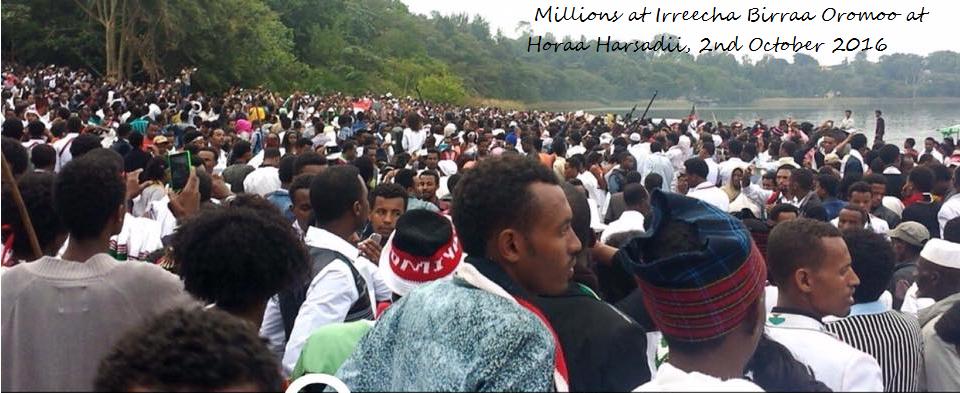
On October 2, 2016, the Tigre-led Ethiopian regime massacred more than seven hundred Oromos and injured hundreds more at Irreechaa, the Oromo national holiday of thanksgiving held in Bishoftu in which millions had gathered. During the Irreecha festival, Ethiopian security forces shot live ammunition into the crowd and fired tear gas, although they claimed that the lives lost were due to a stampede. Western media have joined in this claim, spreading inaccurate information about the tragic events of this day. However, Oromo victims know what happened to them and they are telling their truth. They have used videos, pictures, and social media to release accurate information.
The victims say that the Tigre-led government used live bullets, tear gas, helicopter gunships, armored cars, and snipers to terrify and kill Oromo children, elderly, women and other sectors of the Oromo society that had gathered to celebrate Irreecha. During the holiday, many young Oromos had chanted anti-government slogans to show support for Oromo Protests, a protest movement that has been taking place since November 2015. Although the holiday festival had this political moment, the massacre of hundreds of people on this day was an inhumane violation of one of the most sacred rituals of the Oromo.Irrechaa is a sacred holiday of peace and a celebration of culture, and the Ethiopian regime continues to push the limits of its inhumane violent practices.
For a quarter of a century, the Tigre-led regime has targeted Oromo mosques, churches and Galma (the house of Oromo indigenous religion) and killed hundreds of Oromo religious leaders who have expressed their Oromummaa (Oromo identity, culture, and ideology) through their religions, language, clothing, and other activities. The regime, mainly representing the interests of the Tigre, 6% of the Ethiopian population, has been committing heinous abuses and violence against the Oromo people, the largest ethno-national group in Ethiopia, and others, since its coming to power. Furthermore, in the process of transferring Oromo land and other resources to Tigre colonial elites and their collaborators, the regime has also targeted Oromo activists, politicians, students, and farmers who oppose its discriminatory and terrorist policies.
It is estimated that more than one million Oromos have been killed and thousands of Oromos have been suffering in prisons and secret concentration camps. Oromos who have been released from these prisons and concentration camps have exposed how Oromos are tortured, castrated, blinded, incapacitated, killed, and infected with HIV in various prisons and concentration camps. Also, hundreds of prisoners have perished due to the lack of adequate food, clothing, healthcare and other essential services. All these criminal acts have been committed on the brightest and conscious elements of the Oromo society. Unfortunately, the financial, military and diplomatic support of big powers has contributed to these genocidal and terrorist policies and practices for twenty-five years. Still these big powers refuse to take practical actions to stop the regime from its criminal acts. While giving lip service, these powers have continued to provide material support to the regime.
Currently, the Oromo people are determined more than ever to establish their political destiny. Despite continuous violent crackdowns and heinous massacres such as that at Irreecha, they continue to protest peacefully and raise their voices to challenge the Ethiopian regime’s oppressive anti-Oromo policies. Tigre colonial elites and their collaborators have somehow convinced themselves that continuing and escalating violence against unarmed and peaceful civilians is their answer to controlling and quieting a people who are determined to struggle for their rights, sovereignty, and freedoms. The reaction from the Oromo has instead been more protests and more outrage at the Ethiopian regime’s inhumanity.
The Oromo, the Amhara, the Somali, the Konso, the Sidama, the Gambella and others need to join the Oromo protest movement to remove the Tigre-led terrorist and genocidal regime. Learning from the failures of the last two decades, the Oromo movement must rebuild its national organizational capacity and form an alliance with all peoples that are suffering from Ethiopian state terrorism, genocide, and war on the principles of national self-determination and an egalitarian multinational democracy.
By Finfinne Tribune and Gadaa.com Onkoloolessa/October 4, 2016
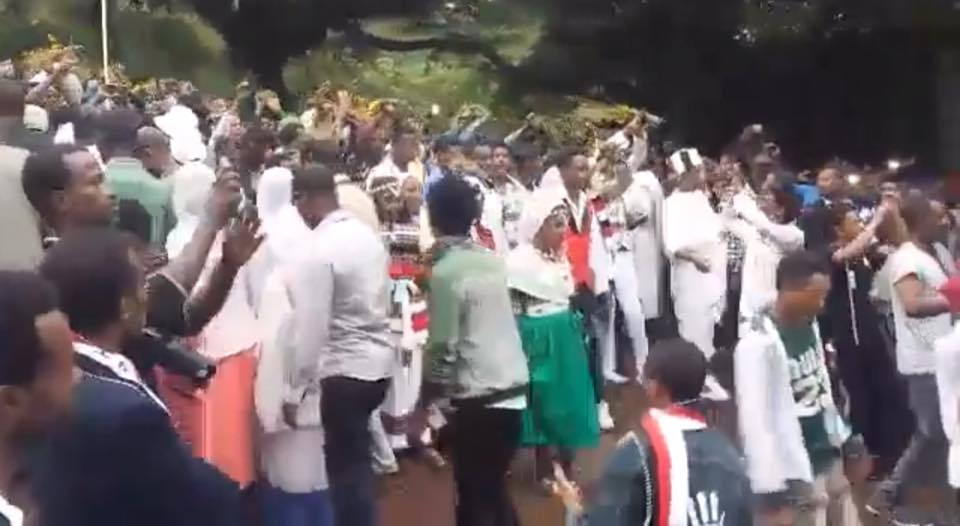
The following video shows two segments: one is the moment immediately before the Ethiopian government’s security forces opened fire at the Oromo Irreecha participants who gathered around the main stage in millions – some voicing their protests peacefully; the stage is situated in front of Hora (Lake) Arsadi, which is the sacred ground where millions of Oromos come to every year to pay tribute to Waaqa, the Supreme spiritual power equivalent to God.
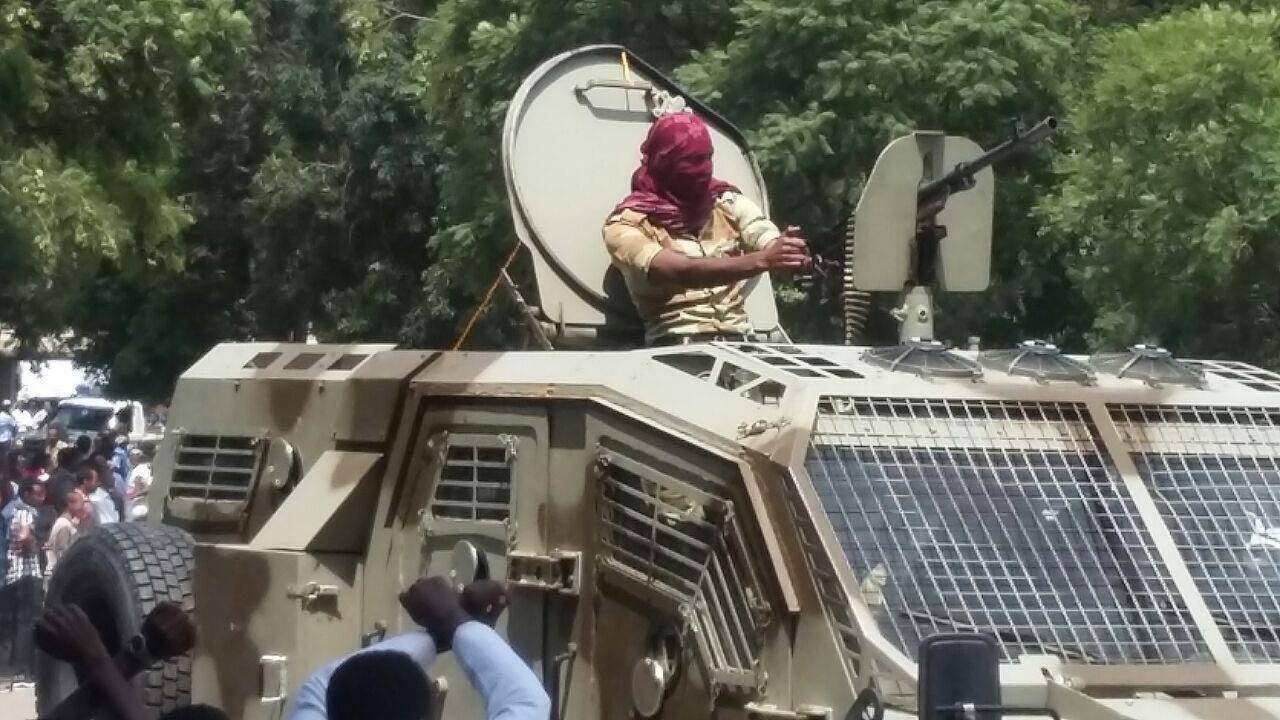
Secondly, immediately after the gunshots, the area around the stage is seen to have been evacuated massively and swiftly as millions run away from the gunshots — as a consequence, hundreds ran into their untimely deaths as they slipped into ravines around the lake. The government’s sniper gunshots were accompanied aerially with military helicopters (not shown on the video, but see photo below) – which entered the civilian perimeter to further escalate the situation. And, on the ground, military-grade Humvees were deployed (seen on the video) straight into the main stage area to drive Oromo Irreechaparticipants into the ravines.
These remain unanswered:
1) who gave the order to deploy the military as a response to the peaceful protest at the Irreecha festival;
2) the swiftness (fastness) with which the military responded (within minutes of the breakout of the peaceful protests) does initiate the question: was this a pre-planned massacre? Why was the military staged near the civilian festival?
Photo of the aerial force deployed against Oromo Irreecha participants:
Military-grade Humvee inside the civilian perimeter at the 2016 Irreecha festival (why was the soldier’s face covered with a bandanna?):
Audio Player
Onkolooleessa 5,2016 Bulchiinsi TPLF Bososee Irree Ummata Oromoon Diigamaa Jira,Qabeenyi Mootummaa fi Kuufami Meeshaa Humna Addaan Booji’amee Jira,Daandiin Cumaaa Jira.
Haaluma kanaan daandiileen bakka garagaraa geessu cufamee jiraachuun barameera. Magaalaaleefi Baadiyaaleetti bakkeewwan daandiin cufamee humna uummataa jala oolan keessaa:
Namtokko Qeerroo irraa wareegamul illee dhagahameera.
Dabalataan shonkoraa warshaa sukkaara Matahaaraa zoonii sadii irratti guutummaa guutuutti gubuun daaraatti deebisanii jiru.
Oduu biraan ammoo magaalaa Adaamaa keessatti dhukaasni bakka garagaraatti uummataaf wayyaanee jidduutti banamee jira. Barattootni Yuunvarsiitii Adaamaa heeddumminaan bahanii mooraa kaampaasii irraa eegaluun BOOLEE IRRA GORANII FUULLEE ADAAMAA GENERAL HOSPITAL itti harka harka qaxxaamursuun mallattoo diddaa/Xumura Gabrummaa agarsiisaa jiru. Continue reading
Audio Player


Appeal for urgent action:
The Ethiopian Government is utterly responsible for the unlawful killings at the Ardsade Irrecha (Thanksgiving) Oromo Celebration
To: Office of the United Nations High Commissioner for Human Rights (OHCHR)
Palais Wilson
52 rue des Pâquis
CH-1201 Geneva, Switzerland.
Dear Commissioner,
Oromia Support Group Australia extremely shocked about the killings of innocent Oromo civilians at the Ardsade, few Kilometers from the capital city (Finfinnee – Addis Ababa) during today’s Irrecha (Oromo Thanksgiving) celebration on 2 October 2016.
The Ethiopian Federal forces, racially affiliated and heavily armed, known as Agazi and part of the select force of the ruling Tigrean People’s Liberation Front (TPLF), violently opened fire and killed more than 140 people out for the celebration (please see attached evidence).


#OromoProtests: “We want our own government and those in the current government don’t represent us. They are incompetent to administer us and we want them to leave power.”

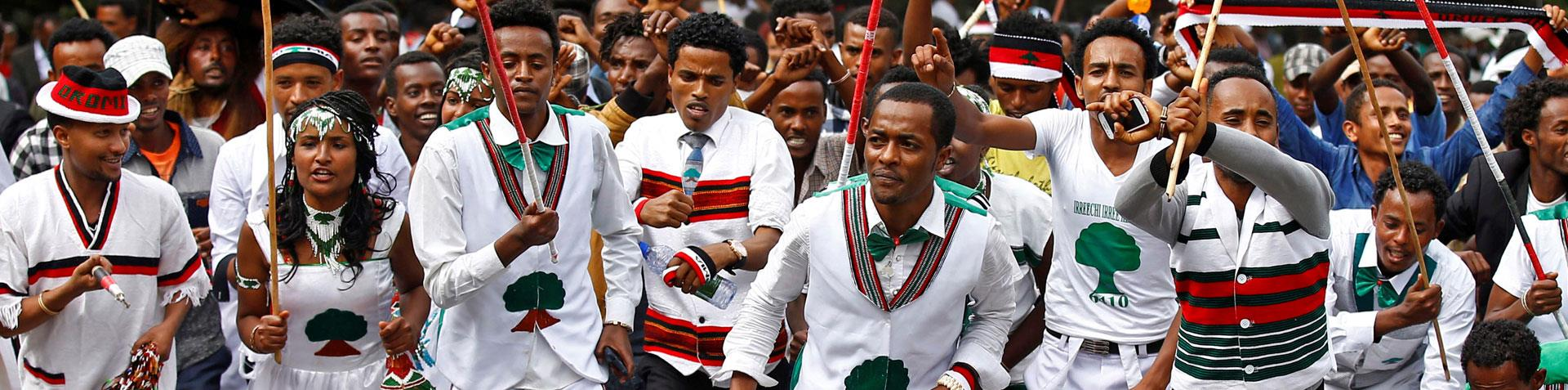
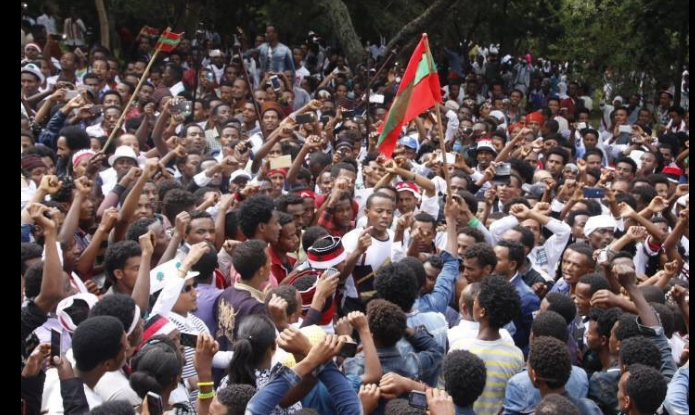
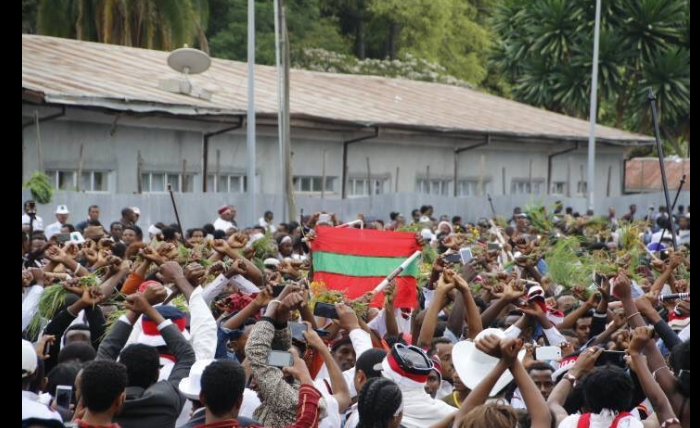
FILE — Demonstrators chant slogans and flash the Oromo protest gesture during Irreecha, the thanksgiving festival of the Oromo people, in Bishoftu town, Oromia region, Ethiopia.
(VOA, WASHINGTON ) Ethiopia is observing an official mourning period for more than 50 people killed during a crackdown and stampede at an ethnic cultural festival in the Oromia region Sunday.At the same time, the country is seeing a continuation, possibly an escalation, of the anti-government protests that sparked the violence.
Hundetu Biratu took part in a protest that turned deadly Monday in Dembidolo, a town in southwestern Ethiopia. She told VOA that her brother was shot and killed during the demonstration.
“We were taking my brother to the hospital. A bullet pierced his neck and exited through his ears. They fired tear gas and I fell. When I got up they shot me on my thighs and I fell,” she said.
Mulatu Gemechu, assistant deputy chairman of the opposition Oromo Federalist Congress, said other protests took place Monday and Tuesday across eastern and western Oromia. He said clashes broke out in Sendefa, a town in central Ethiopia, as mourners returned from a funeral for a mother and a child who died in Sunday’s pandemonium.
The Oromia Police Commission deputy commissioner, Sori Dinqa, told reporters that protesters in the region are destroying property, burning cars and targeting government offices.
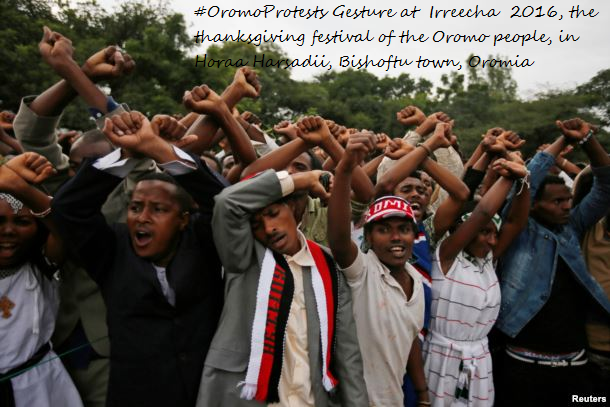
Demonstrators protest gesture during Irreecha, the thanksgiving festival of the Oromo people, in Bishoftu town, Oromia region, Ethiopia. More than 50 people were killed in the violence.
“There are continued and sporadic efforts to block streets, disturb the peace and burn administrative buildings. Our police are continuing to prevent that. We want the people to condemn the uprising and discourage people from taking part in these acts,” he said.
But few people appear to be heeding his call.
A witness in Alem Gena, a town in central Ethiopia, said a funeral service for victims turned into an anti-government demonstration. He said no one was killed but anger in his area is running high.
“We want our own government and those in the current government don’t represent us. They are incompetent to administer us and we want them to leave power,” said the man, who asked not to be identified for safety reasons.
Questions about the stampede
Official tallies put the death toll from Monday’s violence at 52, while Desalegn Bayisa, general manager of the Bishoftu Hospital, told reporters 55 people had been killed. Opposition members and activists, however, place the number of people who died in the hundreds.
Bayisa said the hospital also treated more than 100 injured people.
Advocacy groups such as Freedom House blamed some of the deaths on security forces firing tear gas and live ammunition at festival attendees.
Questions about safety precautions are also being asked of the organizers of the festival, which drew hundreds of thousands of people to a location that includes a lake and deep ditches.

FILE — People assist an injured protester during Irrechaa, the thanksgiving festival of the Oromo people in Bishoftu town of Oromia region, Ethiopia.
“It’s amazing really. There seemed to be no preparation or planning about how to manage the flows of people,” said William Davison, a reporter for Bloomberg News who attended the event and said there were no barriers between the people and the ditches.
“To make those mistakes given the high likelihood of a protest and a government response just seems sort of criminally negligent to me,” Davison added.
Stifling dissent and criticism
Free speech advocates say the government was attempting to silence critical voices even before the festival.
Seyoum Teshome, a prominent Oromo blogger and lecturer at Ambo University, was arrested on October 1 in Wolisso, 110 kilometers from the capital of Addis Ababa. His house was searched and the police confiscated his computer according to local reports.
“My attempts to reach him via his phone ended unsuccessfully. May he stay safe,” wrote Befekadu Hailu, another blogger, on his Facebook page.
The Committee to Protect Journalists (CPJ), a group advocating for the safety of journalists, condemned the arrest and called on the government to release Teshome without delay or conditions.
It is “deeply disturbing as it comes against a backdrop of government moves to stifle protests and criticism,” CPJ’s deputy director Robert Mahoney said.
“We want to see any pending charges or charges they might try to pursue dropped,” Kerry Paterson, the senior advocacy officer for CPJ’s Africa program told VOA. “The chilling effect that occurs as a result of arresting people doesn’t just hurt the individual journalist who gets arrested. It hurts all Ethiopia.”
What’s next?
Analysts see no end in sight to the ethnic tensions roiling Ethiopia.
Jeffrey Smith, executive director of Vanguard Africa Movement, a group that advocates for good governance, said protesters do not feel the promise of Ethiopian federalism, in which all regions are supposed to have a degree of self-governance, has been realized.
“I don’t see it ending anytime soon,” he said of the widespread anger. “I think a lot of this resentment and a lot of this discord that we are seeing is because the highly intrusive, highly repressive central government has not allowed those basic democratic avenues to be opened up. They have not allowed the Oromo people in particular to exercise and to demonstrate their basic rights that are enshrined in the country’s own constitution.”
Adane Tilahun, the chairman of the opposition All Ethiopian Unity Party, said that to begin the healing process from this week’s events, the government needs to recognize the killings were unjustified, apologize, and offer compensation to the families of the victims.
Tilahun also called on international actors and human rights groups to put pressure on the Ethiopian government in order to establish an independent investigation into the deaths.
VOA reporters Tujube Hora and Solomon Kifle contributed to this report.


Often violent protests in which rights groups say hundreds of people have been killed by security forces have flared again in Ethiopia, with a US citizen among the latest deaths.
Protests reignited in the Oromia region – the main focus of a recent wave of demonstrations – after at least 55 people were killed in a stampede at the weekend, which was sparked by police firing tear gas and warning shots at a huge crowd of protesters attending a religious festival.
Fifty-five is the official death toll given by the government, though opposition activists and rights groups say they believe more than 100 people died as they fled security forces, falling into ditches that dotted the area. Ethiopian radio said excavators had to be used to remove some of the bodies.
| Are Ethiopia’s Oromo being repressed? |
The anti-government demonstrations started in November among the Oromo, Ethiopia’s biggest ethnic group, and later spread to the Amhara, the second most populous group. Though they initially began over land rights they later broadened into calls for more political, economic and cultural rights.
Both groups say that a multi-ethnic ruling coalition and the security forces are dominated by the Tigray ethnic group, which makes up about six percent of the population.
The government, though, blames rebel groups and foreign-based dissidents for stoking the violence.
Staff at the California-based UC Davis university confirmed the identity of the US citizen as Sharon Gray, a postdoctoral researcher of biology, who had been in the Horn of Africa nation to attend a meeting.
The US embassy said she was killed on Tuesday when stones were hurled at her vehicle on the outskirts of Addis Ababa, where residents said crowds have attacked other vehicles since the stampede.
The embassy did not give further details or a precise location for the incident.
News of Gray’s death came as foreign-owned factories and equipment were damaged in the protests. Demonstrators in Oromia say farmland has been seized to build foreign factories and housing blocks.
On Tuesday, crowds damaged a factory run by Turkish textile firm Saygin Dima and the BMET Energy cable plant, which also has Turkish investors, officials from firms in the area said. Both plants are in the Oromia area.
READ MORE: The ‘Ethiopia rising’ narrative and the Oromo protests
A third of the Saygin Dima plant in Sebeta, 35 km (20 miles) southwest of Addis Ababa, was destroyed by fire, General Manager Fatih Mehmet Yangin said.
“A large crowd attacked the factory,” he said, adding three vehicles were also destroyed.
Yangin said a flower farm nearby was also attacked. The Oromia Regional Administration said vehicles and some machinery at a plant owned by Nigeria’s Dangote Cement were vandalised.
Oromia has been a focus for industrial development that has fuelled Ethiopia’s economic growth, but locals say they receive little compensation when land is taken by the government.
The death toll from unrest and clashes between police and demonstrators over the past year or more runs into several hundred, according to opposition and rights group estimates. The US-based Human Rights Watch says at least 500 people have been killed by security forces.
The government says such figures are inflated.
The attacks will cast a shadow over Ethiopia’s ambition to draw in more investment to industrialise a nation where most people rely on subsistence farming, and have been struggling with a severe drought in the past two years or so.
The government has been building new infrastructure, including an electrified railway connecting the capital of the landlocked nation with a port in neighbouring Djibouti, which was inaugurated on Wednesday.
At least seven foreign-owned flower farms in Ethiopia’s Amhara region, another area where protests have flared, were damaged in political violence at the start of September.
Rights groups and opposition politicians accuse the government of excessive force in dealing with demonstrations, crushing opponents and stifling free speech.
WATCH: What is triggering Ethiopia’s unrest?
The Committee for the Protection of Journalists (CPJ) called on authorities on Tuesday to free Seyoum Teshoume , a blogger critical of the government, who writes for the website Ethiothinktank.com. CPJ said he was reported detained on October 1.
Another blogger who has expressed support for the protests, Natnael Feleke, was arrested on Tuesday, according to a blogging collective of which he is a member. Natnael was previously arrested in 2014 and released after more than a year in prison when charges against him were dropped.
There were also reports that the internet had been shutdown periodically over the last two days.
Officials could not immediately be reached for comment, but the government says it only detains people who threaten national security and says it guarantees free speech.
The opposition failed to win a single seat in a 547-seat parliament in a 2015 election and had just one in the previous parliament.
Source: Al Jazeera News And Agencies
Related Article from Financial Times
Ethiopian anti-government protesters are escalating attacks on foreign investors as anger grows over the regime’s crackdown on demonstrations, in which hundreds of people have been killed.
Activists torched a Turkish textile factory and attacked a mine owned by Aliko Dangote, Africa’s richest man, damaging trucks and machinery on Tuesday, days after more than 50 people were killed when police fired tear gas and rubber bullets to disperse protests at a religious festival. The US embassy in Addis Ababa said an American woman died on Tuesday when her vehicle was struck by rocks thrown by Ethiopians on the outskirts of the capital.
The violence comes after a wave of protests this year that were originally triggered over a land dispute in the Oromia region of central and southern Ethiopia. They have since escalated into broader demonstrations against the autocratic government and spread to other regions, threatening the stability of one of Africa’s best-performing economies.
Addis Ababa has responded with force — activists accuse security forces of firing live ammunition on unarmed demonstrators and say hundreds have been killed in the protests.
Washington has called the government’s approach to the unrest “self-defeating,” while the EU on Wednesday called for the authorities to address the “wider aspects of the grievances”.
Activists and analysts say the attacks on foreign companies are becoming increasingly co-ordinated.
More than two dozen foreign companies, including flower farms and other agribusinesses have suffered millions of dollars in damage in recent weeks, according to Verisk Maplecroft, a UK-based consultancy.
Juan Carlos Vallejo, co-owner of Esmeralda Farms, pulled out of the country after his business was attacked several weeks ago.
“Right now, everyone is really scared,” he said. “We never expected something like this to happen. I don’t think anyone is going to want to invest here any more.”
Ethiopia has been one of Africa’s star performers, recording 10 per cent annual growth and attracting tens of billions of dollars in foreign investment over the past decade thanks to a carefully planned, state-led development and industrialisation policies.
But it is also a tightly controlled society, with the Ethiopian People’s Revolutionary Democratic Front — which has governed with an iron grip since 1991 — and its allies controlling all the seats in parliament.
Dissent is swiftly repressed and the political opposition was severely weakened by a government crackdown — during which scores of people were also killed — after disputed 2005 elections.
“We have made clear that Ethiopia’s prosperity depends on the ability of its government to maintain a stable and predictable investment climate and to expand political space,” a western diplomat said.
The current protests began in Oromia region last November over plans to expand Addis Ababa into Oromo lands. The initiative was shelved but the government’s aggressive response to the protests saw them spread to northern areas, which are dominated by the Amhara ethnic group.
Both the Amhara and Oromo are frustrated by the political dominance of the Tigray minority, which makes up 6 per cent of the 100m population, analysts say. The Oromo and Amhara comprise some two-thirds of Ethiopians.
Awol Allo, an Ethiopian law lecturer at Keele University, said foreign investors were being targeted because “they are seen as the source of legitimacy for the government”.
“The government has to attract foreign investment to keep the economy growing and has to provide land and services cheaply,” he said. “People are taking out their anger on investments by foreigners to undermine the government.”
The government has sought to play down the protests, blaming overseas agitators and criminal elements.
Analysts say the Tigray-dominated regime has maintained its grip in part by keeping the larger ethnic groups divided. But they add that now the Oromo and Amhara have united in their opposition to the government, it will be hard for the authorities to appease them without making significant concessions.
However, Rashid Abdi, an analyst at the International Crisis Group, said some ministers, and the Tigray-controlled military, are loath to do this.
“The protests have now reached a serious level, a different scale,” he said. “We should not exaggerate and say the government is going to keel over tomorrow, but it portends future trouble unless they get a grip. What’s worrying is that so far they haven’t.”
October 4, 2016
Afar People’s Party is dismayed by the mass killing of our Oromo brothers in Bishoftu, while celebrating the Irrecha seasonal holyday. This act of state-terror and coward action on civilian population is a testimony for that the Woyane regime is falling apart and the situation is getting out of its control. It’s time to make sense of the causes, the causes that people are scarifying their lives for all over the country. Many heroic Ethiopians have been killed, prisoned, tortured and driven from their homes because they merely voiced their grievances and said No to social injustice and said Yes for human dignity.
In this trying time our hearts are bleeding and our souls are mourning with all families who lost their beloved ones. Afar People’s Party would like to express its solidarity with all Ethiopian people in general and with our Oromo brothers in particular.
Since its control of power, the EPRDF/TPLF regime has been systematically dismantling every aspects of societal institutions to create fertile ground for its divide and rule policies. The paradox is that those who have been killed repeatedly are civilians not armed opposition groups.
The question is now, how long shall we wait and see while such gross human rights violations and crime against humanity are committed in daily basis? We believe that it’s our responsibility to accomplish the dreams and aspiration of many fallen brothers and sisters and we can only achieve that when we are united against the tyrannical regime.
Together we can make it happen !
Afar People’s Party
click-here-to-read-the-full-text-condolences-and-solidarity-message-to-bishoftu-massacre



Following the death of at least 55 people in the weekend, Ethiopia is coming out of a three-day national mourning with a complete internet shutdown and more protests engulfing the country. Anti-government protests have broken both in the outskirts of the capital Addis Ababa, with reports of closed roads, a heavy presence of riot police…
via Ethiopia emerges from national mourning with more protests and internet shutdown — Quartz


The annual Irreechaa festival is a time of celebration and thanksgiving for the Oromo people of Ethiopia. After the hardship of the winter months, the festival welcomes the spring and attracts millions to the town of Bishoftu in one of the largest cultural and spiritual celebrations of the year.
But instead of jubilation, this year’s festival was met with bloodshed. Between 55 and several hundred anti-government protesters were killed when Ethiopian security forces used tear gas, rubber bullets, and live ammunition on crowds, triggering a stampede.
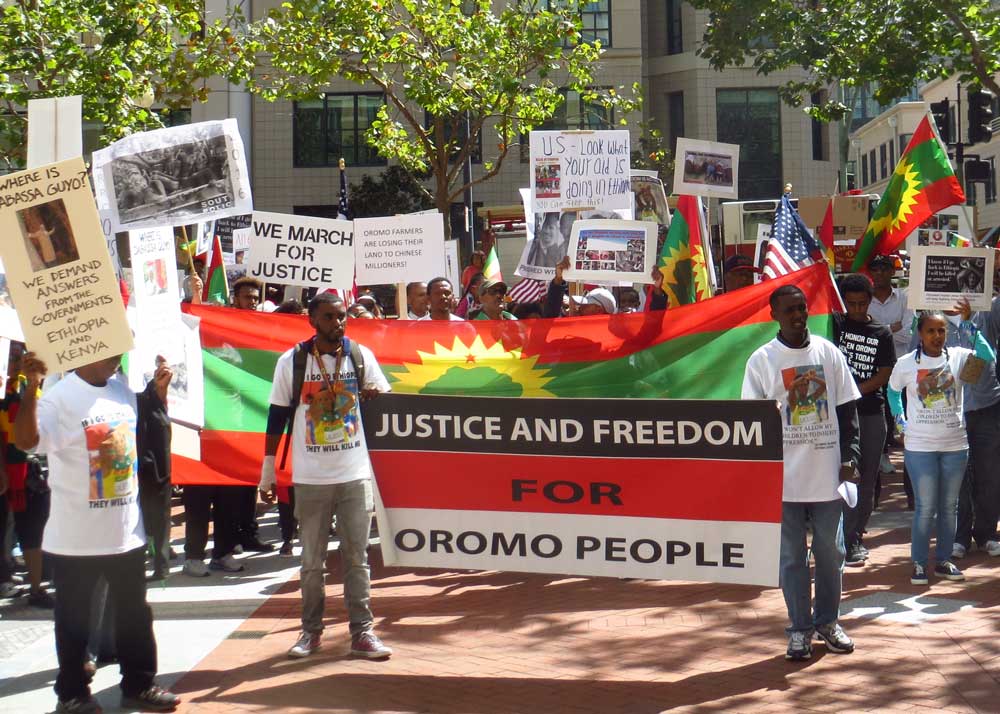
The exact details of this atrocity are difficult to confirm—Ethiopian authorities routinely jail journalists and bloggers for critiquing the government and internet and cell phone reception in the Bishoftu region has reportedly been cut off. But regardless of the exact details, this is the latest in a series of events that signal increasing state violence.
For almost a year, protests have erupted in the Oromo and now also the Amhara regions of Ethiopia. They originated in response to a “Master Plan” that was set to expand the boundaries of Addis Ababa and take land away from farmers in the region, but have grown into larger calls for democracy and human rights in the country. Between November 2015 and January 2015, at least 400 people—mostly students—were killed by security forces in Oromo in the start of these protests. In August, nearly 100 more were killed in similar events in Oromo and Amhara. In September, a fire in the prison holding political prisoners and anti-government protesters in September took the lives of 23.
The trend is clear: state violence and repression in Ethiopia is mounting, and the international community is doing little to stop it.
Over the past eight years, the Oakland Institute has extensively researched, monitored, and reported on land and human rights abuses in Ethiopia. We started this work by examining detrimental land investments. This work led us to document the widespread human rights violations and repression of critics and opponents of the government’s development plans that were grabbing land and resources from its own citizens. In the wake of the Anti-Terrorism Proclamation that led to the arrest of students, land rights defenders, journalists, indigenous leaders, opposition politicians, religious leaders, and more for exercising basic freedoms; in the wake of the villagization program that set out to forcibly relocate up to 1.5 million people to make their land available for foreign investment; in the wake of this year’s anti-government protests that have seen hundreds, if not thousands, killed by security forces—our work has expanded and our appeals for justice have grown.
Today, as we all reel from this latest tragedy, we say enough is enough. The US—as the largest bilateral donor to the country—must take a firm stand for human rights, democracy, and justice in Ethiopia.
In September, Resolution 861—“Supporting Respect for Human Rights and Encouraging Inclusive Governance in Ethiopia”—was introduced in the House of Representatives, thanks to the courageous leadership of Representative Chris Smith. To date, it has been publically co-sponsored by Rep. Keith Ellison (D-MN), Rep. Al Green (D-TX), Rep. Mike Coffman (R-CO), Rep. Eliot L. Engel (D-NY), Rep. David Cicilline (D-RI), Rep. Zoe Lofgren (D-CA), Rep. Pete Sessions (R-TX), and Rep. Joyce Beatty (D-OH). The resolution summarizes and condemns the massive abuses taking place in Ethiopia; calls on numerous US departments and agencies to review their financing of the Ethiopian government; and “stands by the people of Ethiopia and supports their peaceful efforts to increase democratic space and to exercise the rights guaranteed by the Ethiopian constitution.” The resolution’s support is growing, with news received last week that Rep. Barbara Lee (D-CA) will also be signing on.
The US and Ethiopia have a unique relationship: the US has relied on Ethiopia in its war on terrorism in the region, while Ethiopia relies on the US as a primary aid contributor. Because of this relationship, the position of the US is vital. A strong statement from the US would not only cause the Ethiopian authorities to take heed, but could inspire other world leaders to stand up for human rights in the country as well.
Over the past year, nearly one thousand people have lost their lives because they stood up for justice and human rights. How many more innocent lives need to be lost before the US is willing to take a stand?
All eyes are on us. The time to act is now.

October 2, 2016
The HRLHA deeply condemn the mass murder by the Ethiopian government sponsored killing squad Agazi force near Bishoftu, Oromia where over 4,000,000 Oromos were gathered to celebrate the Irrecha annual festival , the Oromo thanksgiving day on October 2, 2016.
The attack by the killing squad Agazi which was supported by helicopter from the air has left at least 300 civilians dead on the spot and thousands wounded and has been taken to hospitals in Bishoftu and Addis Ababa, 40 km away from the place of mass murder took place. According the HRLHA informants from the place, the dead bodies were everywhere on the ground around the Hora Arsadi, the area of the irrecha festival
The October 2, 2016 mass murder would be one of the highest tolls for a single day in Oromia since 10 months the Oromo protest has begun in November 2015
The HRLHA calls on the world governments and donor organizations to condemn the barbaric acts of government sponsored killing squad Agazi force against Oromo civilians and put pressure on the TPLF/EPRDF government to allow swiftly neutral body to investigate this horrific action of this dictatorial government sponcered killing squads..
The HRLHA will continue updating the fast growing number of the victims from around the area.
Note: The following pictures are extremely graphics. Proceed with procuation
All photos were taken from social media, names are not identified


Update: Ethiopian police release Oromo leader Bekele Gerba’s daughter
30 September 2016
(Africa Times) — Oromo rights activists said Friday that Bontu Bekele Gerba, daughter of the imprisoned Oromo political opposition leader in Ethiopia, had been released after security forces detained her in the town of Mojo.
Independent Oromo journalist Mohammed Ademo, a former al Jazeera America columnist based in the United States, said the family’s lawyer confirmed the late-afternoon disappearance.
Ademo and other Oromo advocates immediately took to social media, some demanding that U.S. officials and international NGOs confirm her whereabouts and intervene as necessary.
Journalist Jawar Mohammed, executive director for the Oromio Media Network in the U.S., reported that she was released after being detained for questioning at a Mojo police station.
Bontu Bekele Gerba is a political activist in her own right, speaking often to media organizations and Ethiopian activists on behalf of her father, a leader of the Oromo Federalist Congress, and the movement.
The elder Bekele Gerba was most recently detained at Ethiopia’s Kilinto Prison in Addis Ababa, a maximum-security facility where high-profile political prisoners and anti-government protesters are incarcerated. He was rearrested in December following a short release and since remained at the facility, where a fire claimed 23 lives in early September, according to official Ethiopian government totals.
Bontu Bekele Gerba led a search for her father when prison authorities failed to provide information to anxious families who knew nothing of their loved ones’ fate, and spoke publicly again on their behalf.
Her father’s initial 2011 arrest followed a meeting with Amnesty International researchers that led to terrorism charges, which are often used by Ethiopia to silence political dissidents including the Oromo.
Global concern for the 30 million Oromo living under President Mulatu Teshome has increased, following a year in which at least 500 hundred Ethiopians died in violent clashes with security forces.
That visibility was raised following the protest of Ethiopian Feyisa Lelisa at the Olympic Games in Rio de Janeiro and his subsequent application for U.S. asylum. Activists in the U.S. have held large protest marches, most recently on Thursday in Washington D.C., on behalf of the Oromo.
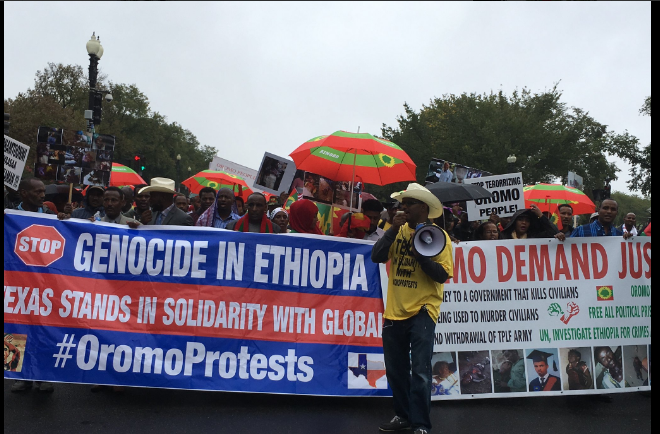
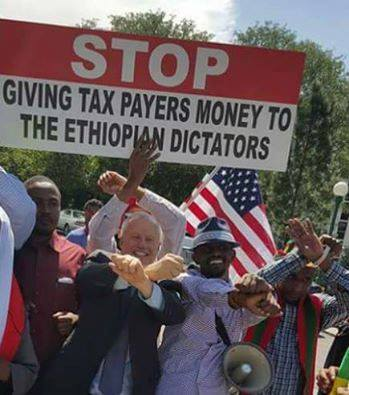
A bipartisan group of U.S. Representatives has proposed legislation targeted at the government of Ethiopia, after Amnesty International and Human Rights Watch documented hundreds of cases of alleged human rights abuses. House Resolution 861, titled “Supporting respect for human rights and encouraging inclusive governance in Ethiopia,” was introduced by Reps. Chris Smith (R-NJ), Keith Ellison (D-MN), Al Green (D-TX), Mike Coffman (R-CO), and Eliot Engel (D-NY).
“It is an abomination when any country tortures its own citizens,” said Rep. Smith, at a September 13th press conference on Capitol Hill. The human rights abuses, waged primarily against the Oromo and Amhara populations, have come to light despite Ethiopian authorities efforts preventing independent screeners from conducting transparent investigations.
The Resolution condemns the killing of peaceful protesters, the arrest and detention of students, journalists, and political leaders, and the stifling of political dissent under the guise of “counterterrorism.”
Ethiopia is a strategic ally of the United States. The country headquarters the 54 nation African Union, and, critical to U.S. interests, assists in counterterrorism efforts against al-Shabab, an Al-Qaeda aligned jihadi terrorist group based in Somalia. Ethiopia is also host to a staggering 750,000 refugeesfrom the war torn region.

In a press statement Rep. Ellison said, “While Ethiopia is an important ally for the United States, continuing to let the Ethiopian government oppress its own people will only further destabilize the region. We must do all we can to ensure that the human rights of all Ethiopians are respected.” Rep. Smith added, “A valuable contributor to global peacekeeping missions, growing unrest in Ethiopia in reaction to human rights violations by the government threaten to destabilize a nation counted on to continue its role on the international scene”.
Resolutions, like the one proposed, tend to be more of an opinion that often do little in themselves because they lack the political leverage to prompt much action. They often fail to hold allied nations to a standard of conduct, as countries and international organizations are hesitant to regulate how other nations behave within their own borders.
The bill expressly calls on the government of Ethiopia to end the use of excessive force by security forces; hold security forces accountable after a full, credible, transparent investigation; release dissidents, activists, and journalists who have been imprisoned for exercising constitutional rights; respect freedom of assembly and freedom of the press; engage with citizens on development; allow theUnited Nations to conduct independent examinations; repeal certain proclamations limiting inclusive growth; and investigate shootings and a fire on September 3, that killed 23 people at a prison housing high-profile politicians.
Noteworthy, is that the bill also seeks to apply financial and other pressure towards the government, by calling for the Secretary of State to “conduct a review of security assistance to Ethiopia” and “improve transparency” with respect to such assistance, and to “improve oversight and accountability of United States assistance to Ethiopia”.

Despite the good intention of the bill, critics highlight that it doesn’t go far enough. Henok Gabisa, a visiting Academic Fellow and faculty member at Washington and Lee University School of Law, stated in a personal interview:
“H.RES.861 is generally a good gesture from the United States Congress. It is very specific in a sense that it points out the consistent and constant patterns of corrosion of civil and economic liberties in the country. It also seems to give scrupulous attention to the marginalized groups who remain on the receiving end of the pain. That is really great. Nonetheless, owing to the mammoth financial aid transported to Ethiopian government by the U.S. under their bilateral security partnership, H. RES. 861 failed to deploy the political leverage of the [United States Government], and as a result it is nowhere nearer to fulfilling the goal it promises. In fact, Resolutions by merit are just declaratory statements or positions of a government. They may not be considered law in a positivist school of law. Yet again, H.RES.861 has no teeth to bite those who fail to comply the soft obligations it enumerated under the last sections 3-6.”
Experts give the bill a 32% chance of getting past the Foreign Affairs Committee and a 29% chance of being agreed to completely. Comparatively, from 2013-2015, 46% of simple resolutions made it past committee.
In a country of over 86 million, Oromos and Amharas constitute the two largest ethnic groups, combining for over 61% of the population. Yet, they are the most politically marginalized andeconomically disenfranchised. In 2015 Ethiopia’s ruling party, the Ethiopian People’s Revolutionary Democratic Front, won every seat in parliament despite little ethnic diversity. The EPRDF has remained in power since the overthrow of Ethiopia’s military government in 1991.
Lima Charlie News, by J. David Thompson
J David Thompson (US Army) is a Juris Doctor candidate at Washington & Lee University School of Law focusing on International Human Rights Law. He is a Veterans in Global Leadership Fellow, and brings experience on human rights, international relations, strengthening civil society, refugee issues, interagency collaboration, and countering violent extremism. Prior to Washington & Lee, he served in the US Army as a Military Police officer and Special Operations Civil Affairs with multiple deployments to Afghanistan and one to Jordan—receiving a Bronze Star amongst other decorations. In Jordan, David worked at the US Embassy in countering violent extremism, strengthening civil society, and refugee response with other United States Government organizations, the United Nations, and various non-governmental organizations.




Gincii, Amboo, Jalduu, Gudar, Giddaa Ayyaanaa, Mandii, Najjoo, Laaloo Assaabii, Jaarsoo, Gullisoo, Bojjii, Gujii,Dambi Doolloo, Gimbii, Naqamtee, Buraayyuu, sabbataa, Dirree Incinnii, Adaamaa, Harammayyaa, Mattuu, Baale (Robee), Madda Walabu, Walliisoo, Tulluu Boolloo, Sulultaa (Caancoo), Horroo Guduruu, Buuraayyuu, Dirree Dhawaa, Calanqoo, Ada’aa Bargaa, Baddannoo, Holootaa, Shaashee, Awaday (E. Harargee), Hara Qallo (Goro Dola, Gujii), Gaasaraa (Baalee), Bulee Hora, Jimmaa, Arjo, Heebantuu, Giddaa Ayyaanaa ,Kiiramuu, Ciroo, Dodolaa, Anfilloo (Mugii), Walqixxee, Diillaa, Bishooftuu, Finfinnee, Yuniversiitii Finfinnee, Geedoo, Asallaa, Shaambuu, Agaarfaa, Sibuu Siree, Kotobee, Wacaalee, Saalaalee, Machaaraa, Ammayyaa, Tokkee Kuttaayee, Innaangoo, Baabbichaa, Laaloo Qilee, Hiddii Lolaa, .Mugii, Arsi Nagallee, Baabbichaa, Shukutee, Baakkoo Tibbee, Jalduu, Gindoo, Buun’dho Beddellee, Grawwaa, Gaara Mul’ataa, Qarsaa, Qobboo (Dardar, Eastern Oromia), Sinaanaa (Baalee), Jimmaa Arjoo, Bojjii, Kombolcha, Aggaaroo,Tajji (Iluu), Qilxuu Kaarraa, Baabboo Gambel, Daawoo,Tulu Milki (Warra Jarso), Hirnaa, Xuulloo, Masalaa, Galamso, Bordode, Mi’esso, Waheel, Diggaa, Arjoo Guddattuu, Guraawa, waamaa Adaree, Shabee Somboo, Limmuu Saqaa, Amuruu (Agamsa), Daroo Labuu (Gaadulloo), Yaabelloo, Aliboo (Jaartee Jardagoo), Saasigga, Magaalaa Dafinoo, Dhumugaa, Daroo Labuu (Buraysaa) Begii (Kobor), Mardida Halo Guba (Daroo Labuu), Qassoo, Bonayyaa Boshee, Baalee (Dalloo Mannaa), Jimmaa Raaree (Magaalaa Gobaan), Nophaa (Iluu), Bordoddee, Togowacaalee, Dooguu, Metekel (Wanbara), Asaasaa, Waabee, Heeraroo, Doguu, Quufanziq (Dadar), Boku Luboma (Miyo, Borana), Eddoo, Dirree (Ada’aa), Qilxuu Kaarraa, Shebel town, Bate, Walanchiti, Warra Jiruu, Boolee Bulbulaa, Diilallaa, Gannat Haaraa (dodolaa)……………
Gabaasa FDG Oromiyaa Sadaasa (November) 12, 13, 25, 26, 27, 28, 30, Muddee (December) 1, 2, 3, 4,5, 6, 7, 8, 9, 10, 11, 12, 13,14, 15, 16, 17/18, 19, 20, 21, 22, 23, 24, 25, 26, 27,28, 29,30, 31…. 2015
Amajii (January) 1, 2, 3, 4, 5, 6, 7, 8, 9, 10, 11, 12, 13,14, 15, 16, 17,18,19, 20,21, 22, 23, 24, 25, 26, 27, 28, 29,30, 31……2016
Guraandhala (February) 1, 2, 3,4, 5, 6, 7, 8,9, 10,11,12,13, 14, 15, 16, 17,18,19, 20, 21,22, 23, 24, 25, 26, 27, 28,29………… 2016
Bitootessa (March) 1, 2, 3,4, 5,6,7,8,9, 10, 11,12, 13,14,15, 16,17, 18, 19,20, 21, 22, 23, 24, 25, 26, 2,28, 29, 30, 31 …………2016
Ebla (April) 1, 2, 3, 4, 5,6, 7,8, 9, 10, 11, 12, 13, 14, 15, 16, 17,18, 19,20, 21, 22, 23, 24, 25, 26, 27, 28, 29, 30……… 2016
Caamsaa (May) 1, 2, 3, 4, 5, 6, 7, 8, 9, 10, 11, 12,13, 14, 15, 16, 17, 18, 19,20, 21,22, 23, 24, 25, 26,27, 28, 29, 30, 31, 2016
Waxabajjii (June) 1, 2, 3, 4, 5, 6, 7, 8, 9, 10,11, 12, 13, 14, 15, 16, 17, 18, 19, 20, 21, 22, 23, 24, 25, 26, 27, 28, 29, 30 …………………………….2016
Adoolessa (July) 1, 2, 3,4, 5, 6, 7,8, 9, 10, 11, 12, 13, 14, 15, 16, 17, 18, 19, 20, 21, 22, 23, 24, 25, 26, 27, 28, 29, 30, 31……..2016
Fulbanaa (September) 1, 2, 3, 4, 5, 6, 7, 8, 9, 10, 11, 12, 13, 14, 15, 16, 17, 18, 19, 20, 21, 22, 23, 24, 25, 26, 27, 28, 29, 30……. 2016


Click here for #OromoProtests report 1- 31 August 2016 PDF
Click here for #OromoProtests Updates, 1st July – 31st July 2016 PDF
Click here for #OromoProtests Updates, 1st June – 30 June 2016 PDF
Click here for #OromoProtests updates, 1st – 31st May 2016
Click here for #OromoProtests updates, 1st – 30 April 2016
Click here for #OromoProtests updates, 1st – 31st March, 2016
Click here for #OromoProtests updates, November 2015- February 29, 2016
Risk Advisory: Ethiopia | Assessment of government stability amid ongoing protests
UN Human Rights Commission on human rights violation in Oromia
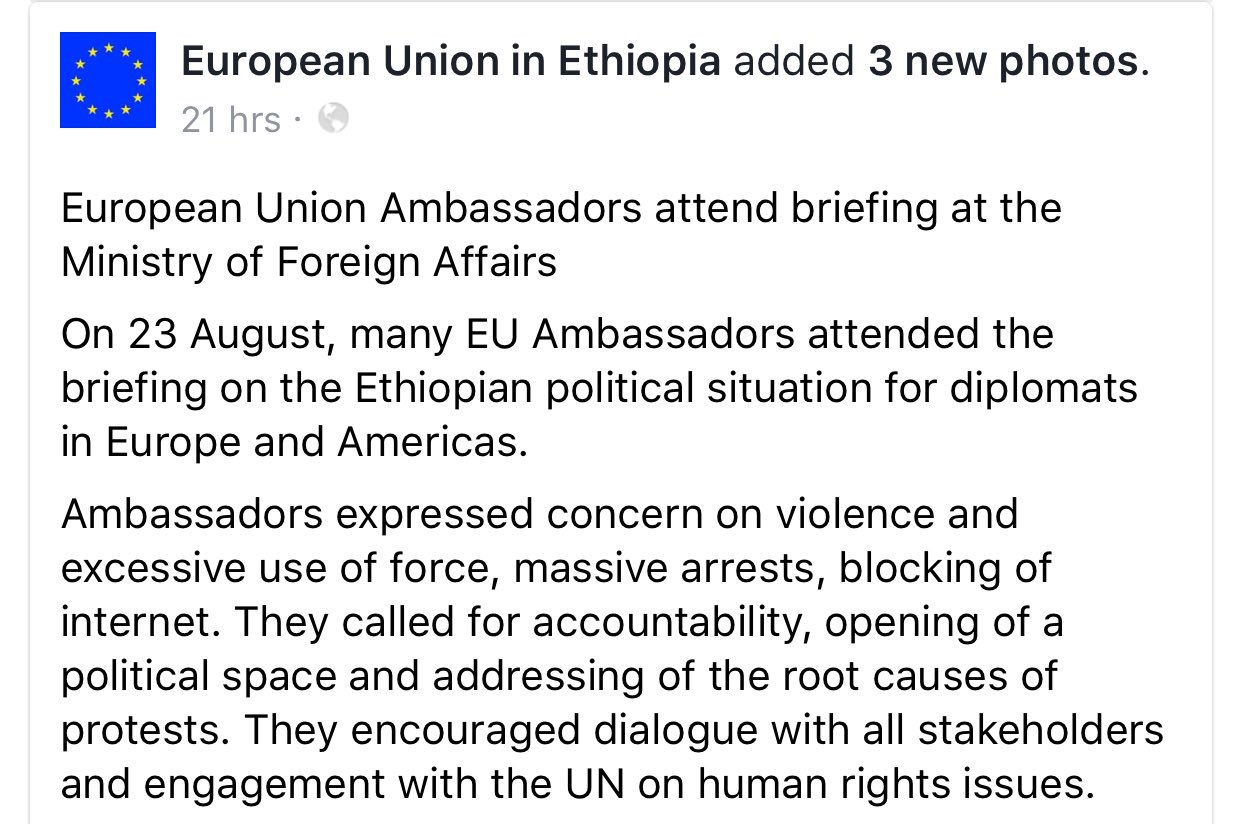
Read more at Pressemitteilung Menschenrechtsbeauftragte zu den Unruhen in Äthiopien
UN calls for probe into Ethiopia protesters killings. #OromoProtests #Africa
UN calls for probe into Ethiopia protesters killings. #OromoProtests #Africa
The Tigran fascism: Its State repression, violence and genocide in Oromia
Fiigicha km 10 Fulbaana bara 2016 biyya Jarmanitti godhame irratti Atileetiin dhalataa Oromoo Fraa’ol Eebbisaa injifate. Innis akkuma atileetota kanii mormii mootummaaa gabroomfataa irratti qabu Addunyaatti agarsiiseera.
Atileet Firaa’ol dorgommii adda addaa irratti yeroo baayyee injifachuun goota Alaabaa keenya dhugaa ol qabaa turedhaa.
Atileet Firaa’ol dorgommii adda addaa irratti yeroo baayyee injifachuun goota Alaabaa keenya dhugaa ol qabaa turedhaa.
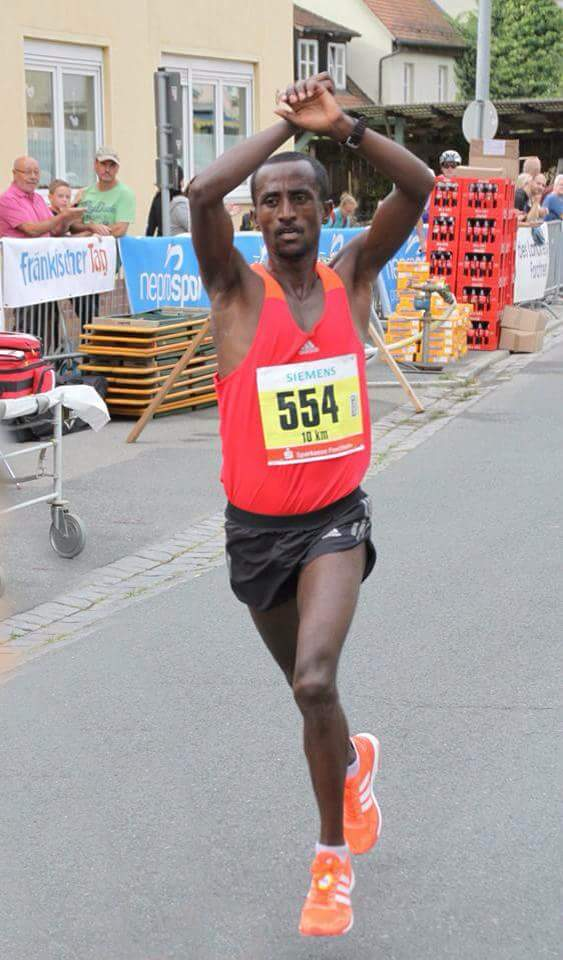

Another Oromo athlete Demissie Tamiru repeats the #OromoProtests gesture at Rio Paralympics on 11 September 2016.

Throwing up the “X” in parliament, Swedish MP Mr. Anders Österberg asked the Sweden Government to break silence on killings of Oromo & Amhara protesters in Ethiopia. 30 September 2016.#OromoProtests
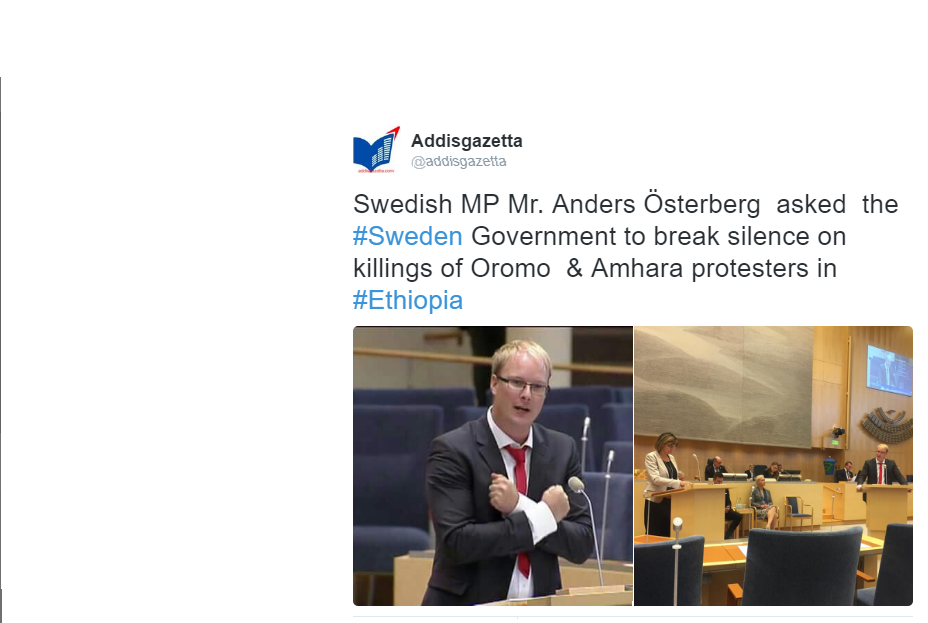
Sean John Combs also known by his stage names Puff Daddy, Puffy, Diddy, and P. Diddy, is an American Hip Hop Recording Artist, Record Producer, Entrepreneur and Actor showing his support for Ethiopian Human Rights Global Movement.
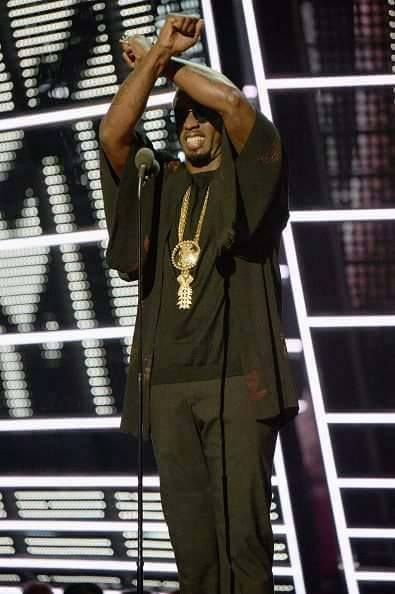
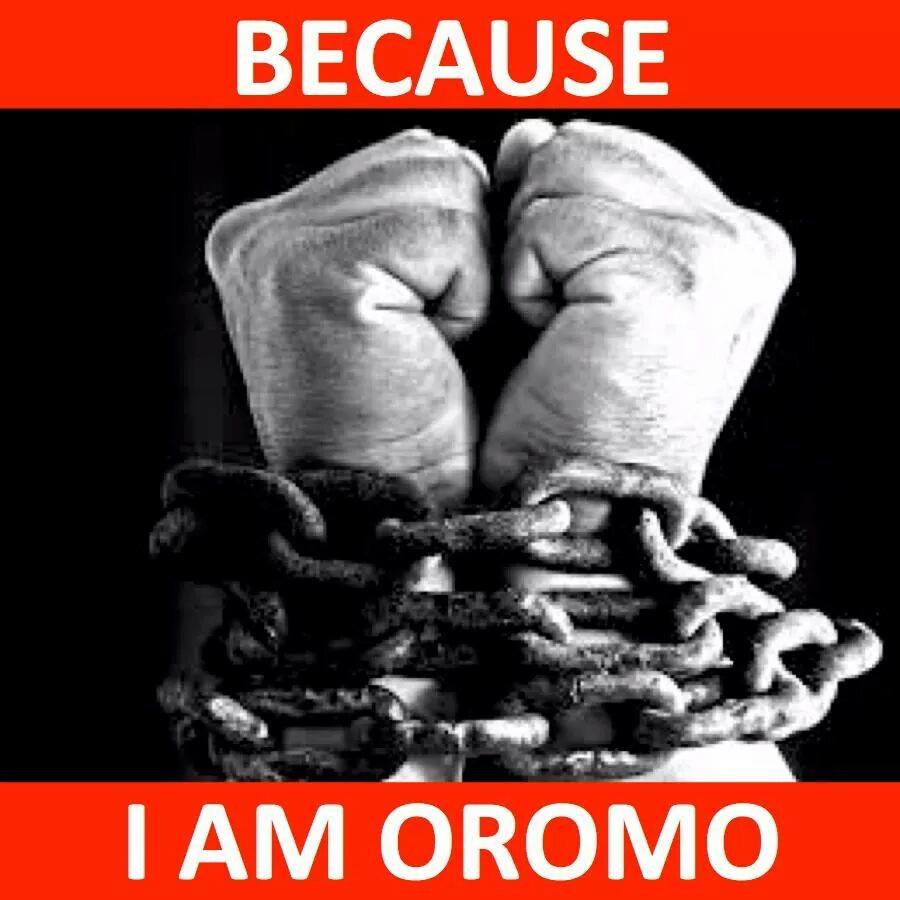 Fulbaana 30,2016 ,Dargaggoota kana hidhaaf kan dabarsee kennee fi waraana Agaazii TPLFn akka qabaman kan taasise kaabinoota OPDO
1 ,Addisuu Saaqqataa kantibaa
2,Waggarii Dhabaa Durata aa gandaa
3,Badhasaa jalduu dhimmanagenyaa kanneen olii sadan kunneen lukkeewwaan Wayyaanee ta’uun dargaggootaaf maatii dargaggootaa hiraarsaa jiru
Poliisota Ijoollee kana qaban Continue reading

Exif_JPEG_420
Fulbaana 30,2016, Odeessi Qeerroo Gaalessaa akka addeessetti ilmaan Oromoo Godina Matakkal Wambaraa gaaffii eenyummaa isaanii dhiyeessaa akka jiran hubachiisuun,Ayyaana Masqalaa irrattis Qeerroon Aanaa Gaalessaa Walleelee Aadaa fi Warraaksaa weellisuun gaaffii eenyummaa isaanii dhiyeessan!
Ergamtootni murna Xinnoo kanaa, Marsariitii Waajjira Komunikeekeeshinii Aanaa Gaalessaa irrattis, Uummati_Shinaashaa_Afaan_Oromootiin sirbuun ayyana masqalaa kabajan jechuun gaaffii eenummaa uummata Matakkal
Gaalessaa haauuf yaalanii jiru. Continue reading
Fulbaana 30,2016,Wanbadeen Murna TPLF guyyaa har’aa hidhamtoota 45 keessaa 17 mana murtii magaalaa Finfinnee Cirqoostti(Golbootti) dhiyeessuun, Onkoloolessa 09,2016tti beellamee jira.Himatamtoonni kun badii tokko mlee,hanga har’aa kan hiraarsamaa jiran yeroo ta’u Hiriira guddicha Oromiyaa Hagayya jahaa irratti qabamuun isaanii ni yaadatama! Continue reading

Gaaromaa B. Waaqasaa Hagayya 30, 2016
Seensa
Barreffamni kun kan xiyyeefate sochii saba Oromoo sababa moottummaan abbaa irree Itoophiyaa “Finfinnee Karoora Guddicha Oromiyaa waliin walitti dabaluu “Addis Ababa – Oromia region integrated master plan” jechuun base mormii bara 2014 baatii Eeblaa keessa eegale irraa kaasee hanga ammaatti sochiiwan bifa adda-addaatiin adeemsifamaa ture fi ammas kan itti jiru irrati dha.
Karoorri magaalaa Finfinnee diriirsuuf moottummaan Itoopiyaatiin bara 2014 keessa labse, magaala Finfinnee fi magaalaalee 36 naannoo Finfinnee jiran walitti dabaluuf kan aggaamame ture. Sababa kanaanis yoo xiqqaate qotate bulaa Oroomoo miliyoona lamaa ol ta’an qee abbaa isaanii irraa buqisuuf kan karoorfame yoo ta’u lammii isaanii gaaga’umsa irraa baraaruuf barattootni Oromoo yuunivarsitii karoora kana gufachiisuuf sochiii mormii eegalani. Sochiin barattoota yuuniversitii Ambootiin eegalame guyyoota yartuu keessatti gara man barnootaa sadarkaa ol’aanaa fi gidduu galeessa akkasumas gara gandoota Oromoo maraatti babal’ate. Kunis ibidda hoongee ta’ee magaalotaa fi baadiyaalee Oromoo waliin gahuun karoorri moottummaan abbaa irree baafate ibdatti shidame . Loltootni moottummaa Itoophiyaa sochii diddaa saba Oromoo kana gara jabinaan tarkaanfiilee irratti fudhate, Oroomota 80 ol ajjeesani, dhiboota madeessani, kumaatama gara mana hidhaatti guurani. Humna waraanaatti dhimma bahuun yeroof dhaamsuu danda’ani. Yeroof human waraanaatiin ukkamsamee ganna tokkoof eega turee booda qophii fi qindoomina guddaadhaan Sadaasa 2015 keessa magaala Gincii keesatti sochiin bifa haarawaan eegalame. Fincilli diddaa saba Oromoo marsaa lammaffaaf magaalaa Gincii keessatti buruqe magaalaalee fi baadiyyaa Oromiyaa guyyoota yartuu keessatti waliin gahee hanga har’aatti itti baatiiwan sagal oliif osoo wal-irraa hin citiin gageeffamaa jira. Bareefamni kunis sochii diddaa saba Oromoo baatilee saglan dabran keessa ademsifamaa ture irratti kan xiyyefate dha. Continue reading
Fulbaana 27,2016,Godina Arsii aanaa Doddotaa magaalaa siree keessatti Qeerron Daandii cufee Wallee warraaqsaa Eebisaa Adunyaatin garmaamaa jira.
Kanuma waliin Arsii aanaa Diksiis Hamdaa magaalaa Diksiis keessatti kaabinootni OPDO ummata dararaa turan ammas gocha isaanii kana kan durii caalatti cichanii dalagaa jiraachuu fi miseensota ABO fi OPDO jechuun addaan baasanii namoota miseensota ABO ti jedhanii shakkan hiisisaa fi reebsisaa jiran maqaan isaanii akka armaan yeroo ta’u maqaan isaanii :-
Gama biroon achuma Godina Arsii lixaa aanaa Shaallaa gandoota ollaa magaalaa Shaallaa keessatti komaandoon ummata isaan dheefa daggalatti gale isintuu shiftaa bosonatti nurratti sooraa jira jechuun reebicha hamaa ummata nagayaa irraan gayaa jiru.ummanni magaalaa Shaallaa fi gandoota baadiyyaa jeeqama hamaa keessa jirra waan.ABO hin deggeriina jechuun kan ummata biyyattii shororkeessaa jiru sirna abbaa irree loltoota TPLF dha.
Arsii lixaa aanaalee Shaashamannee fi Shaallaa jiddutti kan argamu gaara Harree keessatti waraanni Agaazii ummatarraa hidhannoo hiikaa jedhamanii bobbaafaman tarkaanfii ummanni irratti fudhateen waraanni agaazii lama ummataan reebamanii galaafatamuun beekame. Continue reading
#OromoProtests 27 September 2016:
A meeting called by TPLF’s puppets in Oddo Shakkiso district in Guji Zone turns into fierce protest as elders stand up and denounce the regime and vow to fight to death
=========
Godina Gujii aanaa Oddoo Shaakkisoo ganda Magaadoo keessatti walgahiin uummataa mootuummaan waamee gara mormii uummataatti jijjiirameera. Guyyaa kaleessaa Fulbaana 26, 2016 yookiin fulbaana 16, 2009tti, uummanni gaaffiiwwaan ciccima mirgaa abbaa biyyummaafi qabeenyummaa gaafachaa turane. Walgahiin mootummaan yaame kun gara mormiitti jijjiiramuun guutumaa gututti injifannoo ummataatiin xumurameera.
Birraan baranaa kan bilisummaatti. #OromoProtests during Irreechaa season. September 2016
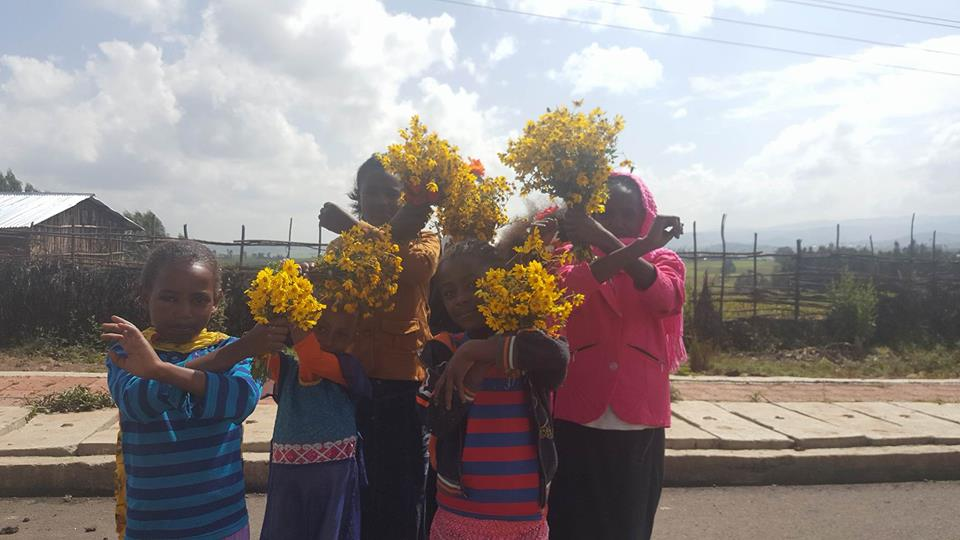
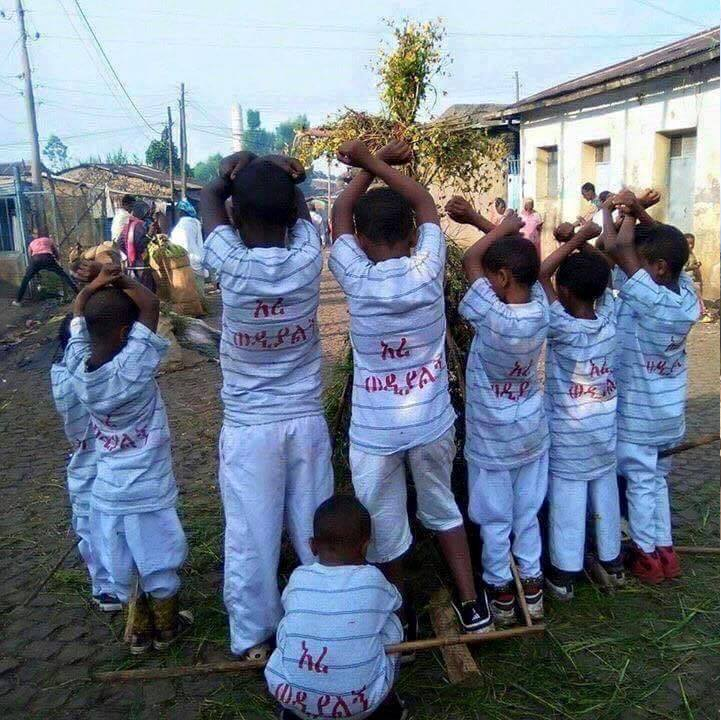
Qabsoonis barannoonis itti fufa. #OromoProtests 27 September 2016
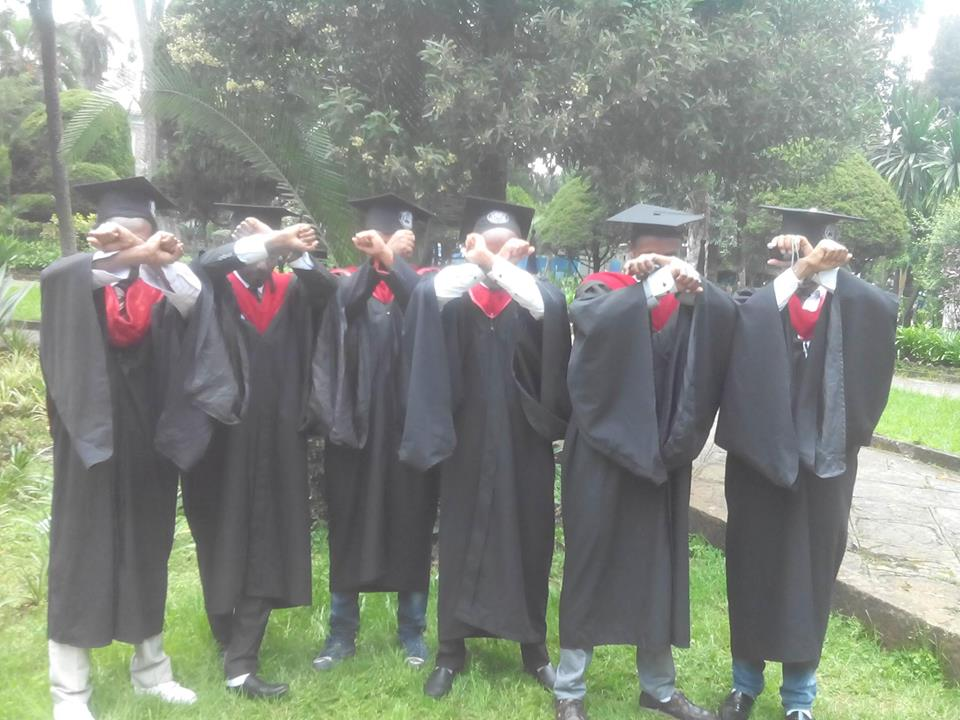
OromoProtests, East Hararghe, Biabbile, 27 September 2016
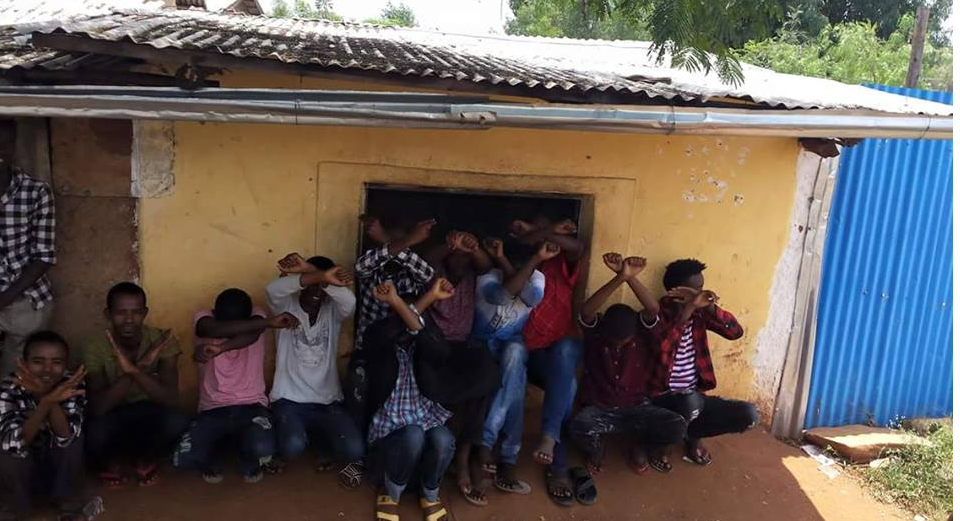
#OromoProtests, in South Korea an Oromo woman stands solidarity with Oromo Protests, 24 September 2016
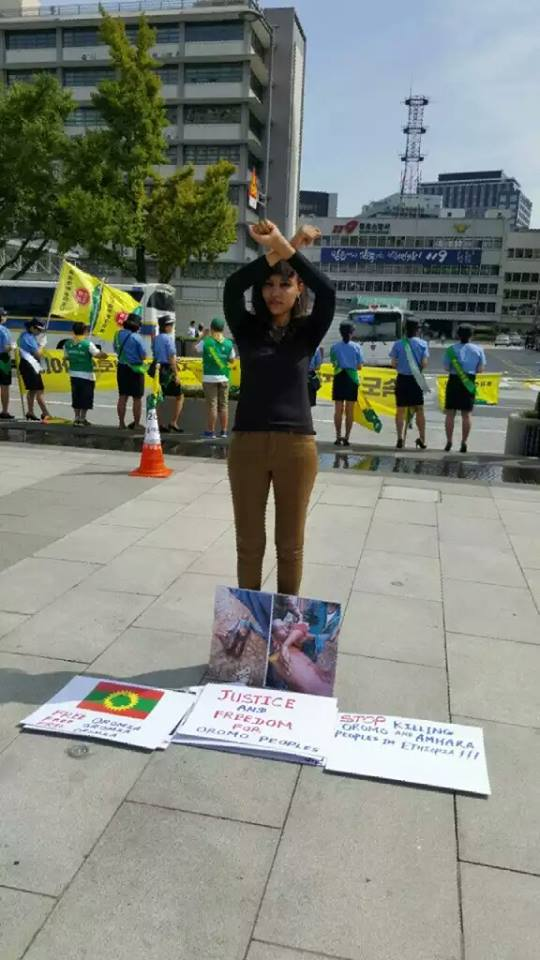
OromoProtests, in Egypt, Cairo, solidarity with Oromo Protests on world Peace Day, 24 September 2016
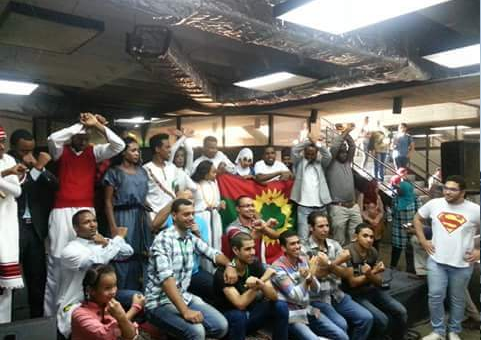
#OromoProtests in Arsi (Dodolaa and Seeru) Oromia, 24 September 2016
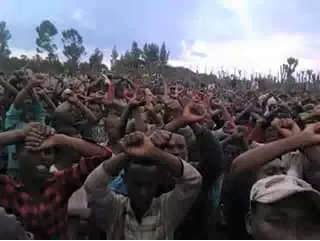
Fulbaana 24,2016
Godina Wallagga bahaa Aanaa Guutoo giddaa Magaalaa Ukkeetti Leenjiin barsiisotaa kan torban lamaaf ture har’a Barsiisonni keenya
injifannoodhaan Xumuraniiru…Guyyaa walga’iin kun eegale irraa kaasuun barsiisonni mana barumsaa ukkee sadarkaa 1ffaa fi 2ffaa
Mootummaa nama nyaata kana hadheeffatanii mormuudhaan Mujula kana hin dubbifnu jechuun harkatti didanii Mormii bifa callisuutiin
Xumuraniiru. Haalli kun waan garaa isaan gubeef Sabboona Barsiisaa Akkawaaq Jalduu kan jedhamuun Gaaffii qabdaa, hindubbattuu jedhanii
gaafannaan Sababan Dubbadheefan Xoollayitti hidhame jedhee deebiseef..
Fulbaana 24,2016/ Warraakasa biyyoolessaa baatii 11 Oliif akka abidda saafaatti finiinaa tureen kan rifate mootummaan garboonffataau murna bicuu Wayyaanee aangoo isaatti fayyadamuun ilmaan oromoo sabboontota ta’aniifi tajaajiltoota wangeelaan maaliif uummataaf kadhattu jechuun magaalaa Naqamtee keessaa jumlaan mana adabaatti guuraa jira.
Haaluma kanaan mootummaan abbaa irree(TPLF) yakka isaa ajeechaa fi doorsisni inni ummaata biyyaatirraan gahaa ture itti xinnaannaan amma immoo abbooti amaantii sabaaf kadhataan akkasumas uummata isaaniif kan quqqamaan yakka tokko malee mana adabaatti guuraa jira.
Hanga ammaattis tajaajiltoonni waldaa guutuu wangeelaa kan magaalaa Naqamtee keessa jiran keessaa namoonni heedduun hidhamaa jiru.
Teessoon waldaa guutuu wangeelichaa kan inni keessatti argamus 07 keessa yemmuu ta’u namni tajaajiltoota wangeelaa kanarratti yakka duguuggaa sanyummaa raawwachaa jirus nama maqaansaa Fiqaaduu Takilee jedhamuudha.
Yakkamaan kun Waldaa guutuu wangeelaa keessaa nama tajaajilamuuf deeme fakkaachuun tajaajiltoota kanaan Yaa waaqayyo mootummaa kana nurraa buqqisi jechuun kadhattan jedhee mana hidhaatti guursisaa akka jirus baramee jira.
Bifuma walfakkaatuunis yakkamaan Fiqaaduu Takilee jedhamu kun tajaajiltoota kanaan maqaa meeshaa waraanaa guutummaa magaalaa naqamtee keessatti dhukaafamaa jiru isintu maallaqa walitti qabee bitaa jira maqaa jedhuun tajaajiltoota kana mana hidhaatti guursisaa jira.
Kanumaan wal qabatees tajaajiltoonni maqaan isaanii kanaa gaditti eerame mana hidhaatti kanneen gidduuma kana qabamanii jiran keessaa:
Fulbaana 21,2016 Godina Wallaggaa Bahaa Magaalaa Qassoo naannawaa mana barnoota sadarkaa lammaffaatti alaabaa Adda Bilisummaa Oromoo erga fannisanii booda, magaalicha guyya gabaa roobii waldaldalaa oolee wajjin ta’uun hanga halkan kanaatti mormii jabaa geggeessaa jiru.
Achuma Magaalaa Aanichaa Magaalaa Moxee irraa humnk waraanaa bakkichatti sochoosamaa fi tarkaanfii fudhachuu akka qaban ajjeechaa
ilmaan Oromoo irratti raawwachuuf tiki aanaa Waamaa Hagaloo Obbo Girmaa Gurmeessaa fi Tasfaayee Bantii akkasumas namni yeroo hedduu
uummatatti roorrisuun beekamu kaabineen tikaa Wayyaanee Takkaalliny Lammaa jedhama irratti walii galanii waraanni dhiiga uummata nagaa
akka lolaasuuf irratti walii galuu isaanii fi konkolaataan dhaqanii akka uummata goolan waajjira keessattiwal dhabuu. isaaniillee odeessi
waajjiricha keessaa ba’e dabalee addeessee jira.
#OromoProtests Fulbaana (September) 21, 2016: Guyyaa har’aa godina Aarsii Lixaa Aanaa Nansabooti magaala Garaambaamooti barsiisoonni wal gahii wayyanee dhiitanii bahaniiru.
“Barsistonni B/M/ Sabbataa leenjii keessan dura xalayyaa daballii mindaa keenyaa fi kan ji’a 3 dura isa ittin nusossobdan maalirra akka jiru nubeesiftan malee mata duree tokko nutti hinkaasiinaa jedhani didda isaani itti fufanii jiru. Akkuma siyaasa keessaniif dhimmitan dhimma keenyaafis xiquma dhama’aa hamma kun jala muramee nutti himamutti waan tokko illee waliin hindubbannu jedhanii addaan bittinanii jiru. Mana barumsaa sad. 2ffaa barattoota 1,000 maatriki kutaa 10ffaa fudhatan keessaa barattoota 86 qofaatu qabxii pp galchu fide jedhanii barsiisonni kun akkamitti ilaallama qormaanni bara kanaa akkamitti ilaalameet kan bara dhufuuf dubbanna jedhani OPDO cinqaa oolan.”
#OromoProtests, SilentProtests, Fulbaana (September) 20 bara 2016:
Barsiisonni YuunvaristiiFinfinnee walga’ii kaleessa eegalan!!
Jalqabuun dura yaada namoonni tokko tokko kennaniin warra walga’ii geggeessu hinqaban jenee harkaa buufne jedhan! Walga’ii eegaluuf jennaan, uummata keenya gochaa gara – jabeenyaan ajjeefamaniif yaadannoo sammuu gochuun yaa eegallu, waan biraa waan goonu hinqabnuu ishima kanallee nurraa yaa argatan jechuun yaadannoo taasifnee akka eegallu ta’ee jira!
Itti fufuun, namoonni hedduun gaaffii barsiisonni gaafatan qofa dhaggeeffachuun ennaa jarri waltajjiirraa deebii kennuu eegalan ka’anii deemu! Waggaa 25 f deebii nuuf deebisaa turtan har’as nutti himaa jirtu! Kuftanii jirtu waan ta’eef hatattamaan aangoo gadi dhiisuu qabdu jechaanii jiru barsiisonni Yunivarsiitii Finfinnee!
Qabsoon itti fufa!!
Jabaadhaa Hayyoota Oromoo!!
Denmark global solidarity rally with OromoProtests, 21 September 2016.
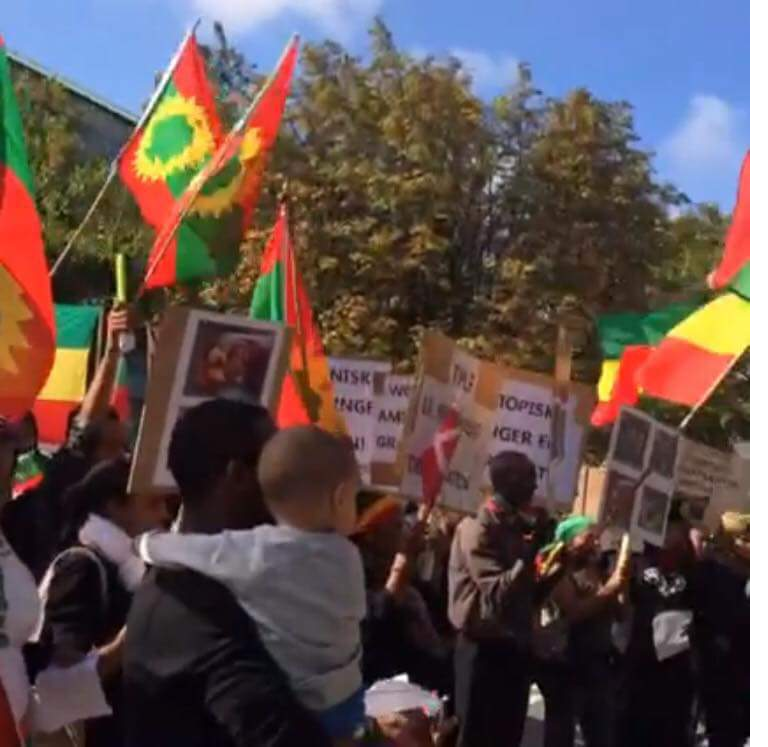
#OromoProtests Fulbaana 20, 2016: Arsii Lixaa Dodolaatti, qeerroon Ganda Qacama Caree guyya har’aa tarkaanif jajjaboo lukkeelee woyyannee irratti fudhannee jirra jedhu.
OPDO is neither the the cause nor solution for the political crisis
Yesterday the regime announced that the top two puppets in Oromia have been removed and replaced by not so new faces. TPLF is either still dumb and numb about the depth of the crisis or chose to continue insulting the intelligence of our people. The cause of conflict between the regime and the Oromo and other peoples of Ethiopia is TPLF’s mission of and obsession with building and maintaining the supremacy of Tigreans. They have successfully built a system whereby power and wealth is monopolized in their hand. They are killing, jailing, exiling and reshuffling to preserve such domination. The puppet parties be it OPDO, ANDM or SEPDM were built and maintained to serve as tools of advancing and protecting this Tigrean supremacy. Hence reshuffling men and women at the head of these puppet parties does not make any difference in the ongoing conflict. They could appoint an OPDO or ANDM as prime minister, and still it won’t solve the problem. Since its created to advance TPLF mission of creating and protecting Tigrean supremacy, the so called EPRDF cannot be reformed through changing of guards or policy fixes –solution will come only when the mission is defeated and the regime is dismantled.
Having said this, why are Lemma Megersa & Workineh Gebeyehu chosen as the new place holders in Oromia? It meant to achieve two tactical objectives; to pacify the growing resentment within OPDO rank and file and the bureaucracy in Oromia, and to further militarize the administration in Oromia.
– Lemma is relatively popular among the younger cadres–hence TPLF believes appointing him will give false hope to the bureaucracy and give them breathing time internally. .
– Workineh is a shrewd politician with keen understanding of the role of the cultural sphere. He has long experience of reaching out to Oromo elders and religious leaders every time the regime faces challenge. They hope he can tap into that to isolate young protesters from the masses through the elders.
-The most important reason however is this. Both men come from the security branch having worked as police and intelligence chiefs. As it anticipates and prepares for further escalation into armed confrontation, TPLF believes these guys will be easier to work with the military and intelligence than Mukar ad Aster whom were very loyal but clueless about dealing with the military generals and spy masters who took over through command post.Well that is TPLF’s calculation. They are still using that very old calculator left behind by Meles. The input, the machine and the output is off the mark. Jawar Mohammed, 21 September 2016
Uummatni Oromoo, Qeerroon Bilisummaa Oromoo, jaarmiyaaleen qabsoo Bilisummaa Oromoo, fi hayyootni fi beektootnı Oromoo sirni abbaa irree hundeen uummata keenyaa fi biyya keenyaarra buqqa’ee uummatni Oromoo bilisummaa isaa gonfachuufi walabummaa isaa deeffachuuf qabsoo hadhooftuu gaggeessee wareegama qaalii kanfalaa jira malee jijjirama haromsa aangoo abbootii irree Wayyaanee OPDOf qabsa’a miti. OPDOn duras hardhas, borus aangoo ittin uummata Oromoo ficisiisuufi ulee harka mirgaa diinati malee uummata Oromoo bakka hin butuu, uummatni Oromoos OPDO jalatti akka bulaa hin jirree alaabaa OPDO gubee, waajji ishee irraatti duuguufi barbadeessuun itti argisiseera, kanaan booda aangawaan OPDO kamuu maqaa uummatan bakka bu’a jettuun Oromıyaa keessa socho’uu dhaabuu qabdi, uummatni Oromoo OPDO of irraa dhaabuuf of irrattii fi dargaggoota Qeerroo isaa irratti abdata.Kanaafuu kanaan booda Oduun OPDOn bifa kamiinuu Odeessituu uummata Oromoo hin ilaallatu, OPDOn kan Uummata Oromoo miti, jijjiramni kabeebsaa fi itti fakkeessii abbootii irreef gurraa hin qabnu!! Diramaan OPDO kan arman gadii kana!!
1.Muktaar Kadir Bakki dhaloota isaa Godina Jimmaa Aanaa Shabee Somboo kan ta’eefi Presidentii OPDO ta’uun Nama Uummata Oromoo irratti Waraanni Yeroo Labsamu, Waraana daa’imman, Dubartii ulfaa, Manguddootaa fi dargaggoota qaroo hawaasaa dhukaasee ajjeesaa jiru mediatti bahee kan galateeffachaa turefi waraana uummata keenyarratti labsuu keessatti qooda guddaa kan qabu OPDO’n Aangoo irraa arii’uun ibsamaa jira!!
2. Asteer Maammoo Bakki dhalootaa GO/I/Abbaa Booraa Aanaa Gachii kan turtee fi hiddi dhaloota ishee Oromoo hin taanee qubattoota irraa kan dhalatte fi Mınisteraa Sivil Servisii fi itti aantuu itti gaafatamtuu OPDO kan taatee fi yakkaa suukkaneessaa uummata Oromoo irraatti rawwatamuu sadarkaa hojjettootaa hanga uummataatti duguugınsa sanyii gaggeeffamaa jiru keessa harka guddaa kan qabduu aangoo OPDO irraa arii’atamte,
3.Lammaa Magarsaa Iafa-yaa’iin Caffee OPDO ergama diinummaa rawwatamaa jiru keessa kanneen qooda guddaa qaban, utuu arganii fi ilaalanii yeroo dubartiin ulfaa duutuu,daa’imni wareegamtu, manguddoon Gannaa 80 olii fi dargaggootni qaroo hawaasaa yeroo wareegaman ijaafi gurra cuqqallaachaa kanneen turanii fi yakkicha keessa warra harka qaban keessa tokko kan ta’ee angawaa Hogganaa OPDO ta’uun OPDOn Muuddattee jirti.
4. Warqinaa Gabayyoo gaafatamaan poolisii Federaalaa duraanii kan turee fi dhalootaan Oromoo kan hin taane fi yakka ulfaataa Uummata Oromoo irratti dalagamaa jiru keessa harka guddaa kan qabuu itti aanaa hoogganaa OPDO godhachuun OPDOn filattee jirti. Garuu uummataa Oromoo biyyaa keessa fi biyyoota garaagaraa jiran bakka hin bu’an. Oromoon waraanaan wal dura dhaabbachaa jira, hanga mirga isaa kabachiifatee bilisummaa isaa fi walabummaa isaa gonfatutti qabsoo isaa finiinsuun wareegamaa caaluu baasee of kabachiisuuf qophiidha!!
Fulbaana 19,2016
Ogeeyyiin fayyaa kun Hospitaalota irraa walitti dhufanii yaada gurmuu qeerroo isaaniif kennaniin, bara 2014 keessa utuu ogeeyyiin ilmaan Oromoo irraa dhalatan hedduu ta’anii jiranii FDG yeroo sana Oromiyaa keessatti ta’een Qeerroon Oromoo diinaan rukutame,yaalii tokko malee guyyoota sadii booda du’uun isaa kan nama gaddisiisu qofa utuu hin taane,hanqinaa gama keenyaan jirudha jedhan!
Yeroo ammaa kanas,murni alagaa ilmaan Oromoo abiddaan gubee gara hospitaala Abeet dame Hospitaala Phaawuloos erga fidee booda,hojjettoonni Hospitaalichaa fi Hospitaalota maraa dhimma hojii tiif gara Hospitaalichaa akka hin seenne taasisuun, kanneen gamoo Hospitaala Abeet irra keessa dhaabbatan kutaa reeffaa kan jala jiru keessatti reeffa namoota abiddaan gubamanii suura kaasuuf yaaltan maqaa jedhuun hojjettoonni hojiirraa arii’aman! Yeroo ammaa kana hojjettoonni kutaa reeffaa keessaa mana callabbeessaa keessatti reeffa ilmaan Oromoo abiddaan gubamanii eegaa jiran dararaa fi sodaachisa tika mootummaa Itoophiyaarraa halkaniif guyyaa boqonnaa dhabuurraan kan ka’e mana isaanii akka gadhiisanii fi kanneen mana qaban immoo mana galanii maatii isaanii wajjin bulaa akka hin jirre dubbataniiru! Continue reading
September 20, 2016
Gochi Wayyaaneen uummata Oromoo irratti raawwachaa jirtu daran daran haadhaa daangaa hin qabne keessa seenee jira. hidhaan adabuun hanqatee qeensa dargaggootaa hanga bubuqqisuuf gara laafina dhabuufiitiin geggeeffamaa jira,darggaggoo Kanneen armaa gadii Magaalaa Ukkee keessatti dararaa guddaa irraan gahaa jiru.
1-Indalkachew kan qeensa irraa buqqisanii reebichaan dararame
2,Takilee…kan maqaa abbaasaa hin baramin
3, Obsa xilahun dafaa….
4- Obbo xilaahun dafaa bulchiinsa magaalaa ukkeeti hojjetaadha. Abbaa obsaati..meeshaa isaani irraa fuudhame kan jiru Continue reading
Fulbaana 18,2016 Godina Arsii keessatti Wayyaanen dargaggoonni ayyaana irreechaa irratti argamuuf akka hin yaanne jechuun maatii dargaggootaa doorsisuu eegaltee jirti.guyyaa har’aa fulbaana 17/2016 Magaalota akka Shaashamannee, Adaabbaa, Ajjee, Waabee, Nageellee, Seeruu, Dheeraa, Itayya, Hamdaa, Siree, Gobeessa fi kofaleen keessatti wal gahiin dhimma ayyaana irreechaa ilaallatu jechuun wayyaanen waamtee manguddoota doorsisaa oolte bakkoota heddutti manguddoonni dheekkamsaan ergamtoota wayyaanee salphisuun.erga yoomii as dargaggoota ayyaana irreechatiif jedhee galmeessuu eegale bakka ilmaan Oromoo itti wal gayanitti argamuuf galmeen maaf barbaachise.ummata oromoo ka lubbuun jiru dhiisaa ka ficcisiiftaniif waan yaadaa jirtan nutti himaa erga biyya bulchaa jirra jettan jechuun gaafilee ciccimoon Afaan qabsiisun addaan bayuun isaanii dhagayame.kuni kanaan osoo jiruu guyyoottan hafanittis maatii dargaggootaa doorsisuuf kaabinoota hanga gandoota baadiyyaatti bobbaasun isii dhagayamee jira.
Gama biraan Magaalaa Naqamtee Halkan kana dirree Waraanaa fakkaatti naannoo Ganda 05 tti dhikaasni dhaga’amaa Jira, qaama hin beekamnen Agaazii haleelaa Jira
Waldaan Christian Oromoo Magaalaa Finfinnee. – Oromo Christian church in Finifinnee, Oromia, in solidarity with #OromoProtests, 11 September 2016. The church held New Year prayer and solidarity with our people.
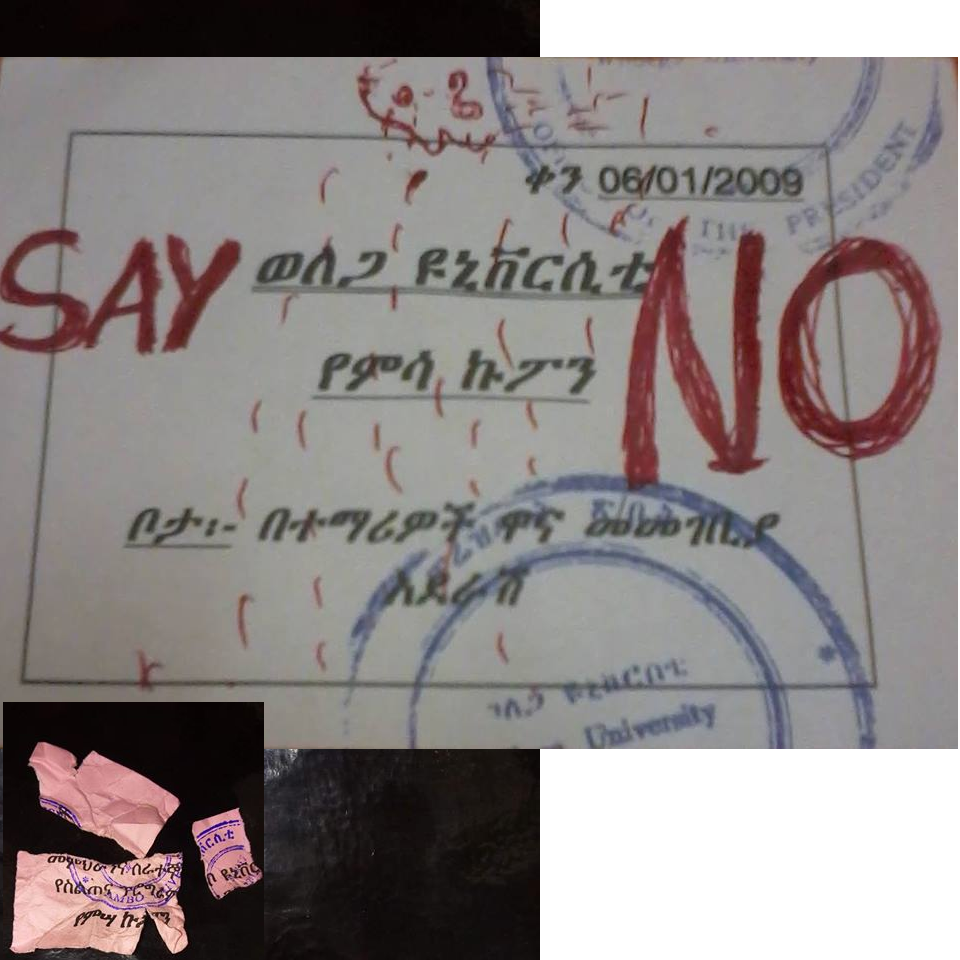
“Yuniavrsitii Wallaggaa Kampasii Shaambutti diddaan barsiisonni caldhisuun godhan itti fufee jira. Nama Dr. Balay Shifara jedhamuu mqaan waamtee dubbisuuf yaallaan waci eegalee achumaan dhiisan. Amma laaqana esheen qopheessites lagannee jirra.” #OromoProtests 15 September 2016
“Leenjii Barsiistota irratti Barsiistonni Kolleejjii Polii Teeknika Bishooftuu fi koolleejjiwwan dhuunfaa magaalichaa bakka yokkotti bakka leenjii koolleejjii poli Teeknika bishoftu keessatti hirmaachiseen Barsiistonni CALLISUUN DIDDAA giyyaa guutuu waan tokko otuu hin dubbatin hafanii waan ajaa’ibaati
Jarri nu teechisan keessaa obbo Caalii Xiiqii, Leggesee, fi itti aanaa diinii koollejjii pooli teeknika bishooftu kan ta’e Sulxaan ciigoo kan jedhaman dubbadhaa , yaada qabduu ……… cicci xumaaxum namni tokko dubbatu dhabamee jennaan kan duursanii warra afaan oromoo dubbatuuf hin dandeenye adda baasaanii otuu jiranuu waan jedhan wallaallan warri afaan hin dandeenye jirtu? Mee kan afaan oromoo dandeechan harka baasaa jechuun, Barssiisyonni afaan oromoo akka danda’an ibsachuuf otuu hin dubbatin harka baasan, eegas jedhan amma warri harka baastan maqaa waamanii dubadhaa jedhanii gara dirqiittis hoofuf jennaan Barsiistonni sagalee wal fakkaatun kolfa guddaa daqiiqaa walakkaaf ta’u kolfuun erga yokko deebisanii callisan guyyaan saa akka habashaatti 04/01/2009.” #OromoProtests 15 September 2016.
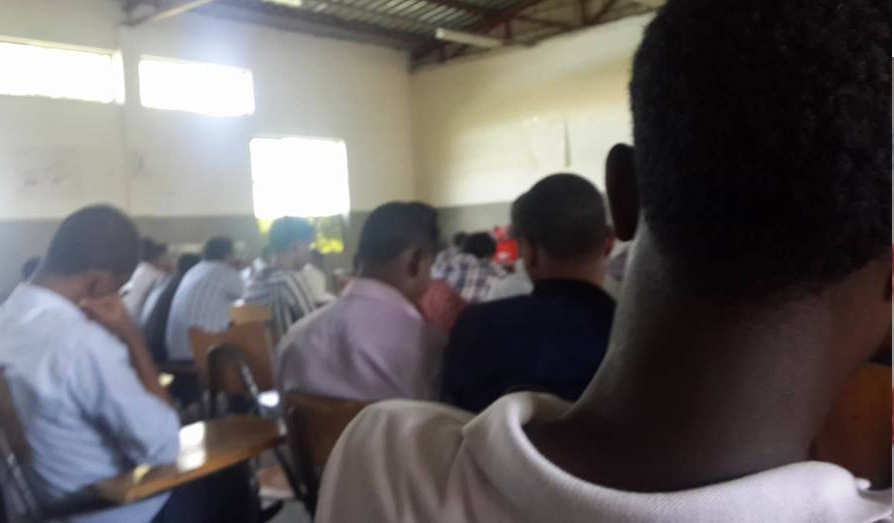
#OromoProtests 16 September 2016, SlentProtests: Dabballoonni Wayyaanee waan cinqii keessa galte fakkaatti.
Har’a Godina Arsii Aanaa Honqooloo Waabeetti, dabballoonni leenjii barsisootaa kennan waliin hasa’aa turan. Kunis barsiisoonni walgahii teechisaan nu jalaa dubbachuu didan jedhanii haasa’u.
☞yaada kennaa jennaan, cicci
☞waraqicha dubbisaa jennaan, cicci
☞gaaffii gaafadhaa jennaan, cicci
☞adeemsa jijjiirruu jennaan, cicci
☞qarshii 50,000 (kuma shantama) isiniif welcome qopheessine akka aanaatti jennaan, cicci
☞Mee anumaa arrabsaatii asii na ari’aa jennaanis, cicci,
cicciin cicumaan dhumte.
Kanaafuu,jarri rakkoo garaadha qabdi jenne, maal wayya? jedhanii mari’achaa jiru.”
“Barsiisonni magaala finfinnee kutaa magaala kirkos keessatti kan argaman keessaa Mana barumsaa qophaa’ina Abiyoot kirsi(jiisee). leenjii eegaluun dura wareegamtootaaf kadhannaa sammuu daqiiqaa tokko gochuudhaan jalqabani.Akkasumas barsiisonni mana barumsaa Misiraaggootti hirmaatani keessaa dareen tokko dhaggeeffachuu didanii rafnaan yookaan hirmaadhaa yookaan immoo gad bahaa jennaan barsiisotni jechoota ulfaataa itti lakkisanii of irraa arii’aniiru hanga ammaatti namni sadii ol itti jijjiiramus yaada kennuu hin dandeenye qondaalota Tplf harkatti fashaleessaniiru kun injifannoo guddaadha galatoomaa nuuf jedhaa.”
“Lenjii barsisota motumman wayyane qophesiite irratii caliisuun barsisoota univeristy science fi technology adama kessattis akkuma itti fufet jira. bayye kan nama aja’iibu yaada kenuu diduu barisoota qoffaa osoo hin ta’iin yeroo waltajii irra ergaamooni dina oddesituu barsisaan dhagefatuu tasuum hin jiruu. barsisoon bayeen walgahii kessa ta’iin mobile issan irra facebook fayyadamuu, gariin immo ni rafuu, gariin immo dabaaramani ta’uu, waluuma galaati walgahiichi bayye qoradha fi barsisooni waan nama gaddaara (taziiya) ta’aan fakkata, malee lenjii hin fakkatu.”
“Yunivarsiitii Wallaggaa campus Gimbiitti, yeroo amma kana qaamni ani OPDO dha jedhu waltajjii geggeessaa jirurratti waa’ee ajjeechaa lammii keenyyarratti raawwate hundee seerummaa itti uuffisuuf(uumuuf) yeroo yaaleetti iyya galma guutuu fi teessuma reebuun akka afaan hin saaqqanne waan beektu hin qabdu callisi dhiisii jechuun afaan qabsiisaniiru!!”
Fascist Ethiopia’s regime is conducting genocide on Konso people. #KonsoProtests#OromoProtests

 Fulbaana 14,2016 Oromiyaa guutuu keessatti daandii cufuun dhaabbataan itti fufeedhuma jira. torban tokko dura gabaa lagannaan oromiyaa guututti kan taasifamee turee fi daandii cufuun haala wal fakkaataadhaan magaalotaa fi godinaale hundatti ammallee yeroodhaa yerootti cufamaa jiran. Haga ammaatti wayyaaneenis banuu kan hin dandeenye daandiin cfuamee kan hafee jiru Magaalaa shaashamanneetti guyoota hedduu lakkoofsisee jira daandii guddaan ,Boojjii Birmajii Biilaa,Qilxuu Kaarraa, Awwadaayi keessatti daandiin hin banamin torban lamaa ol lakkoofsiseera humna banuu hin dandeenye qabaachuun wayyaanees barameera akkasuma hamma ammaatti duulli hojii dhaabuu adeemsifamee itti fufee dhaabbachuus akka hin qabne waggaa kana guutuu duula hojii dhaabuutti hojetootni walii galaa jiraachuunis beekameera. Magaalawwan negellee,daaroo, mechaaraa, adaamaa fi kkf keessa halkan Qeerroon akeekkechiisa hojii dhaabuu gabaa lagachuu,danddii cufuu uummataa kennee jira barruun kunis magaalota kanneen keessatti bittimdfamee jira. Continue reading
Fulbaana 13,2016 Godina Lixa Shaggaar Aanaa Midaa Qanyii Gandaa Haleeluutti Waraanni Wayyaanee Kora Bittinneessaa fi loltootni Liyyuu Hayilii Wayyaanee EPRDF/TPLF/OPDO Yakka Suukkaaneessaa Mana Jireenyaa Abbootii warraa Shani(5) İrratti dhuka’aa dhoosuu fi Ibiddaa itti qabsiisuun Barbadeessan.
Tarkaanfii keessa deebii hin qabne dhiyeenya humni ittisa uummataa miseensa waraanaa fi basaasa Wayyaanee uummata hiraarsaa kan jiru nama maqaan isaa Fedhasaa Ganneetii jedhamuu irratti fudhateen wal qabatee mootummaan waayyaanee humna ittisa uummataa nyaachisaa jirtu , ijoolleen keessaan humna ittisa uummataa waliin hariiroo qabu jechuun uummata nagaa irratti yakki suukkaneessan rawwatamee jira. Continue reading
Fulbaana 14 /2016 Godina Wallagga bahaa magaalaa Naqamtee fi naannoo ishee keessatti formiin itti fufuun, walga’ii guyyaa har’aa kana yuunversiitii Wallaggaa keessatti geggeeffamaa ooleen sabboontonni barsiisonni Yuunversiitichaa guutummaan guutuutti wal ga’ii Wayyaanee kana irratti diddaa garboonffattuu Wayyaaneef qaban haala ajaa’ibsiisaa ta’een warra wal ga’icha geggeessuuf dhaqan afaan qabachiisanii jiru.
Qaamonni walgaicha mariisisuuf deemanis gaafii gaafachuun mirga keessan gaafa jedhanitti barsiisonnis gaaffii gaafachuu fi yaada isaanii kaasuu waan didaniif profeeseriin yuunversiitii wallaggaa kan ta’e dr Eebbaa miijanaa itti waamuudhaan dirqamaan gaaffii akka kaasaniif doorsisaa akka jiraniif doorsisaa akka oolan baramee jira.
Wal ga’icha irrattis barsiisonni tokkoyyuu gaaffii kaasuu waan didaniif mootummaan wayyaanee dirqiidhaan gaaffii akka kaasaniif hiraarsaa akka oole maddeen keenya achirraa nuqaqqaban ifa godhu.


Fulbaana 13,2016 Godina Lixa Shaggar Gidduugaleessaa Oromiyaa Aanaa Adaa’aa Bargaa Mogoritti Warraaqsii biyyoolessaa Oromiyaa FXG daran jabaachuun itti fufe. Mogoor keessatti
1. Sababa sochii duulaa gabaa lagachuu fı uggura dinagdee buusuu torbee tokkoof gaggeeffameen manneen daldalaa fi suuqiiwwaan cufamanii turan banamaa yeroo jirachuun walqabatee waraanni Agaazii Uummata irratti reebicha hamaa gaggeessuun jumlaan mana hidhaatti guuraa jira.
2. Hoojjettootni Warshaa Simintoo DANGOTE hojii guutummaatti dhaabuun diddaa isaanii kan itti fufani jiran yoo ta’uu qondaalotni wayyaanee aangawootni warshichaa fi abbaa qabenyummaa isaa waayila wayyaanee lammii Naajeeriyaa kan ta’ee kasaaraa guddaaf saaxilamee waan jiruuf warshicha banuuf illee fedhii kan hin qabnee ta’uu argisiisee jira Yeroo ammaa kana hojjattootni warshichaa guutummaan mooraa warshichaa keessa dhaabbatanii argamu. Qeerroon Mogoor qindeessıtootnı sochii warraaqsaa FXG’n keenyaa roga hundan hanga wayyaaneen Oromiyaa gadhiiftee baatutti itti fufa jechuun dhaamsa dabarsan!!

 Guyyaa har’aa kana Fulbaana 13,2013 Godina Wallaggaa Magaalaa Naqamtee keessatti dukkaanni(Suuqiin) Sabboontota Oromoo gabaa lagatanii turanii Milishoota Wayyaaneen gutummaan cufamaa jira.
Buufata konkolaataa magaalaa Naqamtees ganama irraa kaasee guutumm aatti cufamee jira.
Taaksiin magaalaa Naqamtee keessa jiranii fi baajaajjonnis diddaa mootummaa garboonfataa Naqamteef qaban ganama irraa kaasuudhaan akkuma itti fufanitti jiru.
Milishooti Wayyaanee ammoo Suuqiilee diddaa gabaa lagachuuf cufaa turan adabuuf jecha irra deemaanii cufaa jiru.
Gama biraan Goototi Barsiisoti Oromoo Aanaa Ginde Beret akka aadaa isaanii gootummaa hojjetan.
Har’aa Fulbaana 13,2016 Barsiisota Aanaa Gindebert mana barnootaa qopha’inaa fi sadarkaa 2ffaa dirqisiisuun walitti qabanii leejii isinii laanna jechuun dabballoonni TPLF siyaasa isaanii osoo hin dubbatiin duratti gootonni barsiisonni Oromoo itti iyyuun isin ummata Oromoo bakka bu’uu hin dandeessan dhaabi keenya ABO dha isin nu hin bulchitan jechuun itti iyyuun qaanessaa jiru.


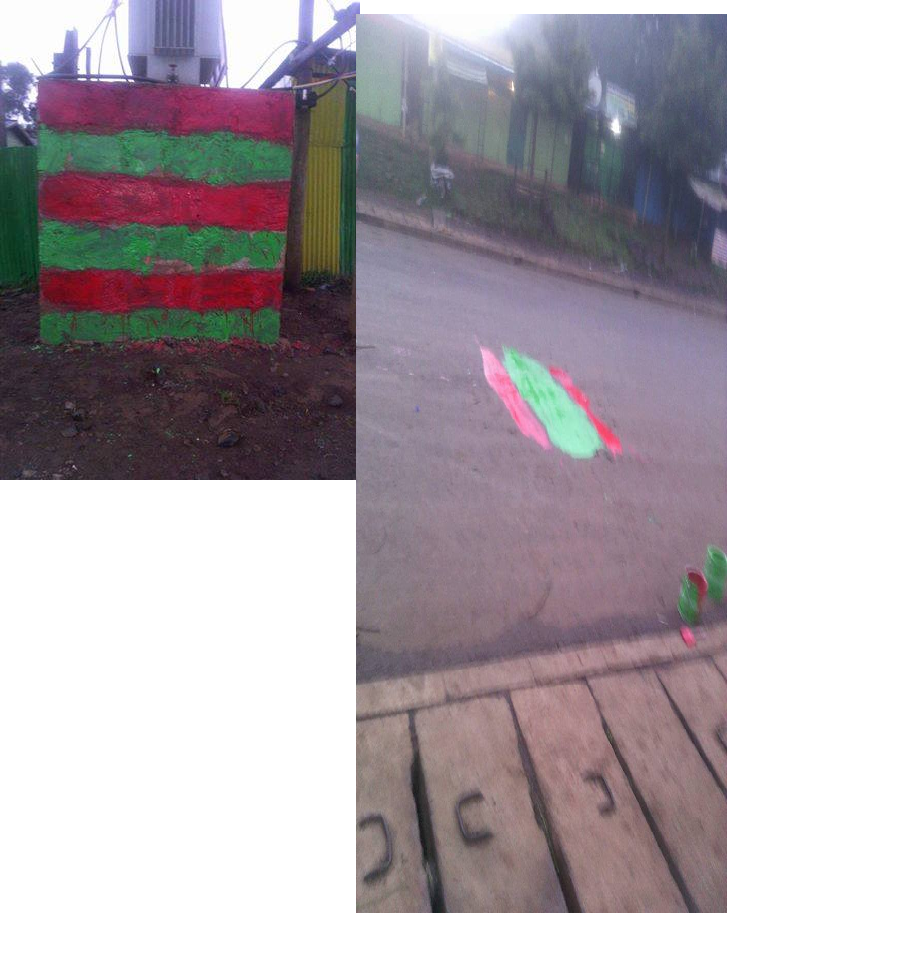
Oromia’s freedom flag everywhere in Oromia. #OromoProtests 11 September 2016
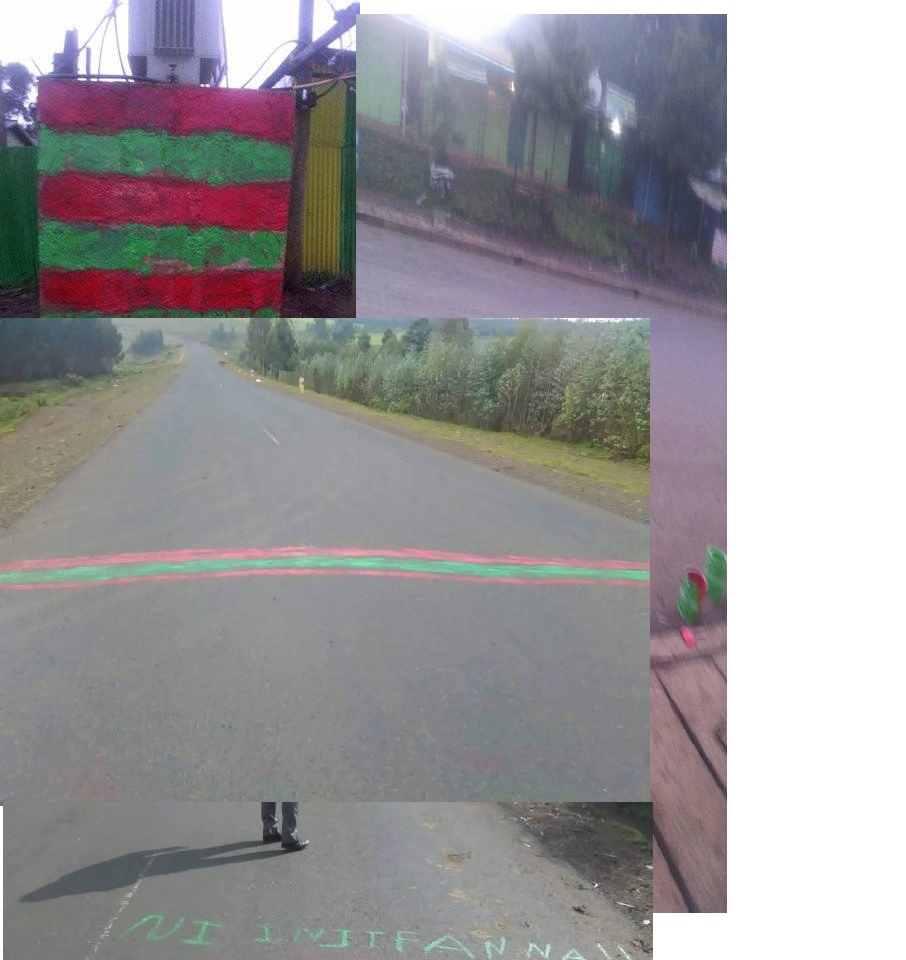
#OromoProtests and Market Boycott continued unabated, September 11 and 12, 2016.
Commercial bank boycott in Arjo ( East Wallaggaa, Oromia). “Kuni hiriira baankii daldala xoophiyaa Arjooti”. #OromoProtests 10 September 2016
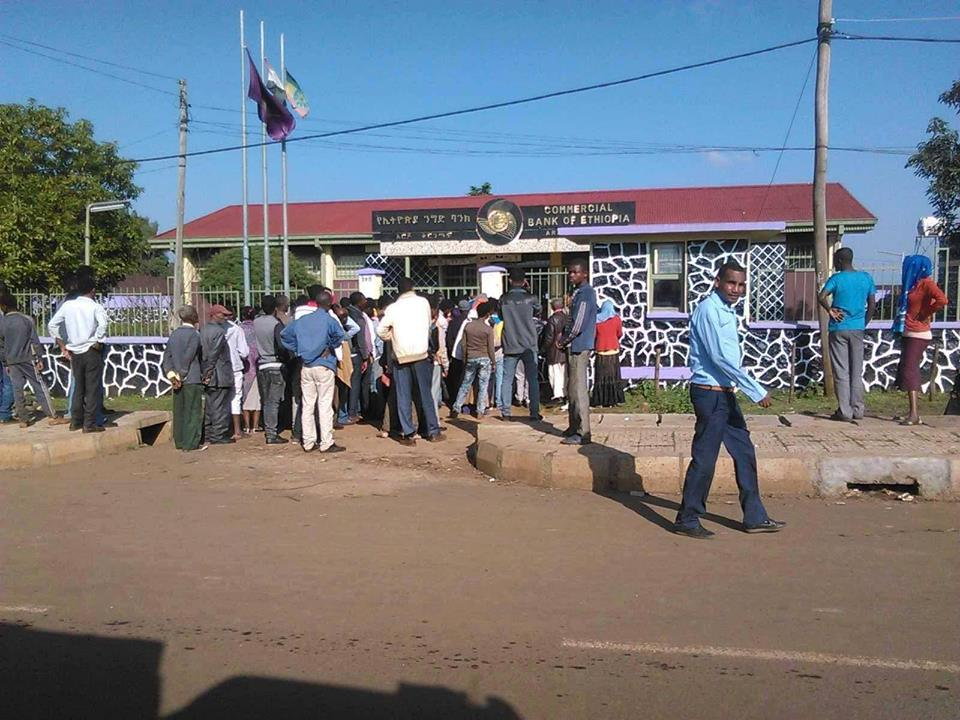
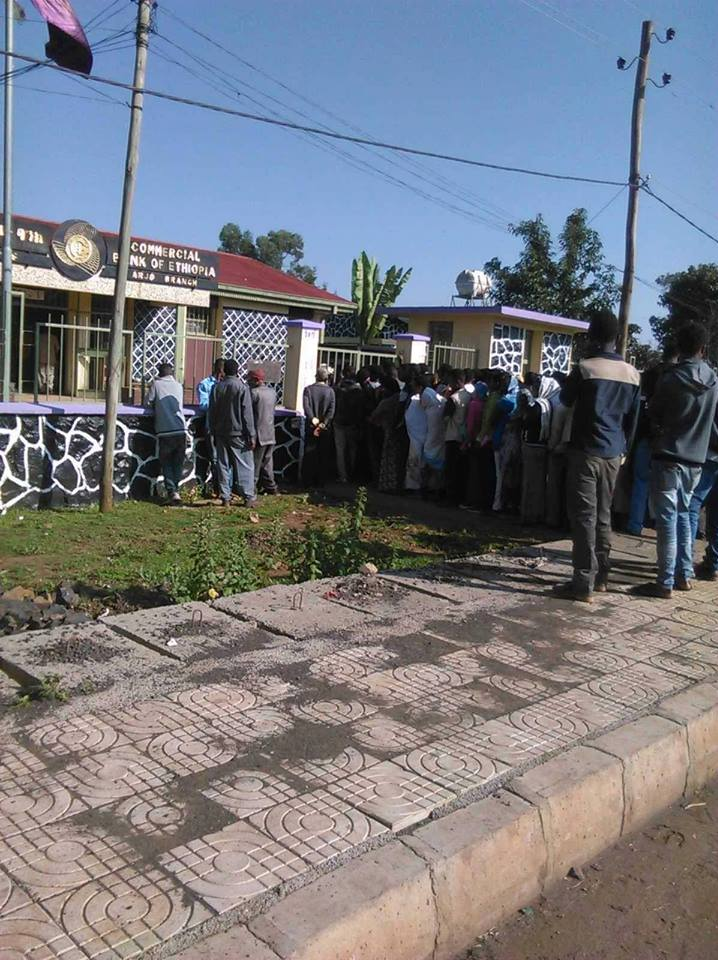
#OromoProtests in Sulultaa, Oromia
 Fulbaana 10,2016 Wayita kana akkuma beekamu haalli ormiyaa keeysa jiru danqaa fi ummanni Oromoos yeroo itti bilisummaa isaa gonfatu fakkaatee jira.
Fooliin Bilisummaa kan urgaa’aa jiruudha. Torban kana sababan dirqama hojif bobbahee tureef caasaan odeesa sochiiwwan Qeerroo fi uummataa kan godinoota hundaa irraa yeroo kana sochiin hubatamu haala jabaa tahuun kan diina abdii kutanna dhumaa fi uummatas kan boonsu tahuun shakkii kan hin qabne tahee mul’ateera.
1. Godina Qellem wallaggaa irraa magaala Dambi Doolloo fi naannowaa ishee guutummaatti FXG dhowee uummanni magaalicha dhuunfatee kan ture Wayyaaneen humna lakkoofsa guuddaa fi meeshaalee gurguddaa bobbaasuun uummata irratti dhukaasni banamee kan jiru guyyoota muraasa asitti haga ammaatti namni 5n wareegamuun beekamee jira. ijoolleen lama magaala DD ganda 07 keessatti yoommuu tahu kaanis baadiyaattii miidha jabaan uummata irra gahaa jiraatuun odeessi dhufe addeessa. Uummanni FXG baadiyaa keessatti finiinsuun daandii cufuu, riqicha addaan kutuu fi kkf irratti hojeta jira. Fulbaana 6 kaasee magaalli Dambi Doolloo humni uummataa waan isaan sodaachiseef uummanni manaa akka gadi hin baane gootee jirti. Humna addaa daangaa irraa dhufe achi buusuudhaan Qeerroo dhabamsiisuuf meeshaa kanneen akka matiriyeesii fi kkf konkolaataa hedduudhaan magaalicha nannawuun uummata doorisaa turaniiru. Sababa kanatti uummanni guyyoota sadan kana mana keessaa gadi bahuu hin dandahu har’a garuu manaa bahuun garuu bittaanii fi gurgurtaan akka hin jirre magaalicha keessa gabaafamaa jira. Inni kun waggaa kana guutuu irratti hojjenna jechuun naggaadoni itti walii galaa jiran. Tajaajila geejjibaas kennuun itti fufiinsaan akka tahu uummanni ammallee waamicha isaa waliif dabarsaa jira. namoni hedduunis hidhaatti guuramaa jiru.
2. Magaala shawaa lixaati hojjettootni baatii tokkoon dura hojii dhaabanii jiru. Godina kana keessatti Amboo, Geeddoo, Gudar, Mugar, fi kkf keessatti duulli hojii dhaabuu milkaawee waan jiruuf Qeerroon caasaa isaa toohachuudhaan kan warraaqsicha butachuuf barbaadanis toohannoo caasaa tolchuudhaan hojii itti fufsiisanii jiru.
Konkolaattotni hedduun barbaadeeffamaniiru. Yeroo kana waraqaan Qeerroodhaan barreeffames ABO fi WBO kan leellesu Shggar lixaatti haalan bittimfamee argama. Inni kun halkan halkan waan hojjetamuuf humni waraana agaazii jedhamu magaalota sana keessa buufatee jira.
hojiin tikoota dina achi keessa buufatanii jiran halkan waraqaa Qeerroo faca’e bulu ganama osoo uummanni hirribaa hin kahin funaanuudha. Haala kanaan uummanni qabamee qabamee gadhiifamaa jira.
3. Wallagga lixaa Gimbii, Najjoo, Mandii, Hoomaa fi kkf keessatti FXG uummataa jabaatee itti fufeetu jira. godinoota kana keessatti haaluma kana wal fakkaataadhaan diddaa gibiraa, gabaa dhiyeessuu, walgahii diduu fi kkf kan wal irraa hin cinneen itti fufeetu jira. akka lixa Oromiyaa waluma gala injifannoo gurguddaatu jira gama FXGtiin gama tarkaanfii uummata keessaa fi humna FXG keessatti ijaaramee socho’u kan of duuba hin deebineen gumaa gootota waregamanii baasaa jiru, kan adaba basaastota diinatti kennaa jiru magaalota oromiyaa garagaraa keessatti haala wal fakkaadhaan itti fufee hojjetamee jira.
4. Naannoo FF fi Shaggar kaabaa dabalatee godinoota addaa keessattis Qeerroon uummanni keenya dhiyeessii garagaraa gara FF dhiyeessu irraa deebisaa jira. waggaa kana akkuma karoora keenyaatti dhiyeessii kutuu ,yeroodhaa yerootti daandii cufuu, tarkaanfii fudhachuu, walgahii diduu, gibira kaffaluu diduu, fi kkf mirkaniidha. Shawaa kaabaa fi naannoo amaaraa kan geessu daandiiwwan bakka hedduutti citanii jiru. Amma mootummaan wayyaanee kufaatii isaa mirkaneeffataa dhufeera. Godinoota biroo oromiyaa keessatti FXG sadarkaa baadiyaatti itti fufee jira waggaa dhufaa jiru kana manneen barnootaa kamuu oromiyaa keessatti akka hin gaggeeffamne akkuma murtii Qeerroo olaanaa irraa darbetti caasaadhan gadi buhee uummanni oromoos FXGf of qopheessaa jira.


Waraqaan kun uummanni magaalaa Naqamtee fi naannoo ishees Ficila Xumura Gabrummaa FXG akka finiinsaniif waraqaan waamichaa godhameefii jira.
Barruulleen warraaksaa dhimma hidhamtoota mana hidhaa Qilinxoo iirrattis haalaan guutummaa magaalaa Naqamtee fi naannoo ishee keessa facaafamaa bulee jira.
Kanneen keessaa:
– Hidhamtoonni balaa abiddaa qilinxootin du’an uummatatti haa mullifaman.
-Hidhamtoonni rasaasa Wayyaanneetiin boqotan uummatatti haa agarsiifaman.
-Biyya isaa irratti abbaan biyyummaa Oromoo haa kabajamu.
-Abbaan biyyaa Oromoodha.
-OPDOn farra qabsoo bilisummaa Oromooti.
-OPDOn diina uummata oromooti jechuudhaan ,dhaadannoolleen kunneen facaafamaa bulanii jiru.
Mootummaan Wayyaanees naasuu keessa seenuun uummata nagaa karaa irra deeman tumanii manatti olseensisaa jiru.
Uummanni magaalaa Naqamtees guyyaa keessaa naannoo sa:a 11 iirraa kaasuun guutummaan guutuutti suuqii cufuun ,taaksiin akkasumas konkolaataan kam iyyuu karaarra akka hin deemneef walii galteedhaan murteessuun jibba mootummaa Wayyaaneef qaban mullisanii jiru.
Mootummaan gabroonffataan Wayyaanees kirkirffannaa keessa seenuun uummata magaalaa Naqamtee namni tokko suuqiis ta’u kaaffeen,manni nyaataa akka hin cufne jechuun doirsisaa jira.
 Godina Arsii magaalaa Waabee Eddootti Qeerron Bilisummaa Oromoo fi ummanni guyyaa har’aa 4/9/2016 Gochaa sanyii duguuggaa wayyaanen mana hidhaa qilinxootti raawwatte sababeeffachuun mormii godhaa oolun daandii magaalattii seenu kallattii hundaanuu cufaa oolaniiru.Karaa biraatin asuma godina arsii magaalaa Boollootti Qeerron basaastuu wayyaanee Taammiraat Hayluu Assaffaa jedhamurratti gaafa3/9/2016 halkan naannoo saa’atii 6:00 irratti mana isaatii gadi baasun tarkaanfii irratti fudhataniin guyyaa har’aa 4/9/2016 wareegamuun isaa himameera.
Kana malees Godina Wallaggaa magaalaa Jaarsoo keessatti Qeerroon Bilisummaa barruulee warraaqsaa ummataaf raabsaa ooluu fi jala deemtota Wayyaanee akeekachiisaa turuun beekame.

 Godina Arsii Aanaa Dodolaa Magaalaa Dodolaatti humnootni abbaan irree Wayyaanee dargaggoo Qeerroo Oromoo Kan maqaan isaa Abdullaxiif Sanbatoo jedhamu 4/9/2016 rasaasan naannoo masgiida fatihii gamoo muniir biratti rasaasa lamaan rukuttee hospitaala Dodolaatti yaalamaa jiruun yaalcha baqaqsanii hodhuutin rasaasni qaama isaa keessaa bahuun himamee jira.Sababuma kanaan ummanni magaalaa Dodolaa guyyaa har’aa hospitaala duratti yaa’un deeggarsa isaaf qaban agarsiisanii jiru jedha gabaasni Qeerroo Dodolaa

Fulbaana 5,2016
Warraaksi biyyoolessaa galgala sa’a 1:30 irraa kaasee guutummaan magaalaa Naqamtee raafamaa jira. Humni federaalaas uummata irratti dhukaasa banuun uummata goolaa jira. Humni kora bittineessaas magaalaa naqamtee keessaa naannoo boordii jedhamutti uummata rebaa jira. kaan immoo konkolaataatti naqanii butanii badaa jiru. Uummanni akka malee reebamaa jira.
Amma galgala kana Magaalaa Naqamtee Naannoo Boordiitti Uummata nagaarratti sodaa boriitiif dhukaasi banamee jira.Namoonni jireenya isaanii fooyyeffachuuf karaarra daldalanii bulanirra balaan Dhaqqabuu mala,ammaaf addan baafannee hin jirru.Qorachaa jirra nu hordofa waan dhalatu hin beekamu.
Boycott business of the Woyane ( fascsit Ethiopia’s regime), September 2016
A letter from Oromo political prisoners in Qilnxoo, #OromoProtests September 2016
Duula Diddaa Bittaa Gurgurtaa ilaalchisee xalayaa hogganoota mana hidhaa Qilinxoo irraa ergame.
DIINAGDEEN QAAMA QABSOO KEENYAATI.
Waggaan baranaa kun yoomiyyuu caalaa ilmaan keenya kan itti dhabane, kumaatamoonni kan itti hidhaman, hedduun as buuteen isaanii kan itti dhabame waan ta’eef lammiilee keenya kanneen yaadachuuf guyyoota gaddaa labsineef deebii ajaa’ibsiisaa kennitanii jirtu.Gocha kanaan diinni na’eera. Nutiifi sabni keenya boonneerra. Quuqamaafi jaalala ummata keessaniif jecha gatii guddaa kafaltanii deebii waamicha keenyaaf laattaniif kabaja isinii qabnuufii galata keenya isinii dhiheessuu barbaada Galatoomaa, ulfaadhaa.
Yoo waldhageenye, walitti birmannee, walbira dhaabbanne salphinni nurra jiru kun nurra hin bubbulu, bubbulus hin qabu. Tokkoon tokkoon qajjiisa funyoo morma keenyatti maramee jiru kukkunnee hanga bilisoomnutti waldhaga’uufii walbira dhaabbachuun keenya itti haa fufuu jechuudhaan waamicha biraa qabannee dhihaachuun dirqama nutti ta’ee jira.
Akkuma beektan har’as ajjeechan nurraa hin dhaabbanne, hidhaan itri fufee jira, Ambulaansonni deessotaaf kadhaan biyyoota alaa irraa argaman dargaggoota keenya akka allaattii butanii fiiguuf gandeen keenya keessa wal maruu itti fufanii jiru. Haati ilma deesse har’aas imimmaan ishee hin qoorre. Maqaan maastar pilaanii yoo ka’uu baateeyyuu har’aas ummata keenya lafa isaa irraa buqqisuun hin raawwanne.
Namoonni ilmaan keenya ajjeesan seeratti nuu haa dhihaatan jennee osoo gaafachaa jirruu dheengadda hagayya 16 Muummichi ministeeraa ifatti badhaafamanii jiru. Manni maree jiddu galeessa ADWUI hagayya 18 – 22 tti yaada yeroo irratti marii gaggeessen waa’ee daangaa Tigraayifii naannoo Amaaraa ilaalchisee hiika itti kennuuf murtii dabarsee jira. Karaa biraa garuu waggaa tokko guutuf nagaya dhabiinsaaf sababa kan ta’eefii wareegama lubbuu hedduu kan gaafate dhimmi maastar pilaanii daangaa waliin kan walitti qabate ta’uusaa osoo beekuu maqaallee osoon dhahin bira darbee jira.
Mata dureen kun osoo hin ka’in hafuunsaa yoo xiqqaate waan sadii nutti garsiisa.
1ffaa, Ajjeechaan ummata keenya irratti raawwate sirrii ta’uu isaafii akka itti fufu murtaa’uu isaa agarsiisa.
2ffaa, ummanni kun humaa fiduu hin danda’u jedhamee tuffatamuu isaa mul’isa.
3ffaa, paartii biyya bitu sana keessa bakka bu’aan ummata oromoo kan hin jirre ta’uusaa agarsiisa. Eeyyee kan nuu falmu hin jiru.
Yeroo ammaa kana bulchitoonni keenyaa fi ergamtoonni isaanii qabeenya nusaamaniin alaa fi mana isaanii guuttatanii waggaa haaraa sirbaafi gammachuun simachuuf qophaawaa jiru.
Nutimmoo akkamiin simachuuf deemna? Waggaan itti deemnu kun waan haaraa nuufidee akka hin dhufne mallattoo isaa argaa jirra.
Uffata haaraa bitannee nyaata gaarii nyaannee dhugaatii gaarii dhugnee ergaa “baga geessee” walii dabarsinee bakka bashannanaa deemnee gammachuun dabarsuuf sababa hin qabnu. Haala kanaan yoo dabarsine fooniifii dhiiga ilmaan keenyaa akka soorannetti lakkaawama. Ummanni bilisummaa hin qabne wantoota akkanaa raawwachuun irraa fokkisa, nituffachiisaas. Tokko tokkoon qarshii harka keenyaa bahu eenyu harka gala? Maaliif oola laata? Naanna’ee naanna’ee rasaasa ilmaan keenya ittiin du’an bita, mana hidhaa isaan itti hidhaman ijaara, abbootii irree aangoo irra tursa, nuun ammoo bilisummaa keenya dheeressa.
Kanaaf diinagdeen qaama qabsoo keenyaa ta’uu qaba. Diinatti ulee kenninee na hin rukutin jennee kadhachuu dhaabuu qabna.
Wanti bilisummaa keenyaf hin taane qarshiin tokkolleen bahuu hin qabu, homaa nugochuu hin dandeessan jedhee mootummaa nutti dhaadatu waa gochuu akka dandeenyu yeroon itti agarsiisan amma ta’uu qaba. Karaa diinagdee malli ittiin mootummaa kanarra dhiibbaa gahan hedduutu jira. Ammatti kanneen armaan gadii hojirra akka oolchitaniif lafee ilmaan oromoo nuuf jecha wareegamaniin waamicha isinii dabarsina.
1, GABAA LAGACHUU.
Jalbultiin ayyaanaa kun yeroo itti ummanni keenya fedha isaaniitin ofsaamsisaniidha. Saamicha kana baroota dheeraaf keessummeessinee jirra amma garuu raawwachuu qaba. Guyyaa ergaan kun isin dhaqqabee kaasee hamma bituu diduufii gurguruu diduudhaan humna harka keessan keessa jiru agarsiisaa. Gurraachonni Ameerikaa konkolaachisaan adiin tokko dubartii gurraattii tokko adiif akka iddoo gadidhiiftu ajajee isheen didnaan morma qabee gadi darbate. Gurraachonni salphina kana fala dhaabbachuuf guyyaa tokkoof otoobus yaabuu lagachuuf murteessanii garuu guyyoota 381ffaa miila isaaniin deemuudhaan ulfina isaanii deeffatan. Nutimmoo salphina kana caalu baannee maalif waan qabnu facaasaa deemna? Gaandiin ummanni Indiyaa uffata warra biritish lagatee jibrii foo’atee, dhahee akka uffatu gochuudhaan saba isaa bilisummaa gonfachiiseera. Nutis midhaan keenya, jimaa keenya, buna keenya, horii keenya, damma keenya, dhadhaa keenya, walumaa galatti oomisha keenya gabaa baasuu dhiisudhaan akkasumas meeshaalee , uffata , nyaataa fi dhugaatii bituu dhiisuudhan badiinsa nutti deemaa jiru haa hir’isnuu.
2, ITIYOO TELEKOOMII LAGACHUU.
Mee guyyatti keessumaa yeroo ayyaanaa, nama dubbisuuf , sirba filachuuf, gaaffii gaafachuuf , gaaffii deebisuuf , marii irratti qooda fudhachuuf , baga geessee namaa dhaamuuf, kkf qarshii meeqa akka baafnu yaadaa. Isaan kun ummata bilisummaa hin qabneef barbaachisoodhaa? Mee isa guyyatti baaftan kana ammoo ummata keenya akkuma kana raawwatan yoo xiqqaate miiliyoona 15 ta’u meeqa akka baasu tilmaamaa. Kun hundi rasaasa ittiin duunu bituuf ykn nama nu’ajjeesu badhaasuf ooluu danda’a. Kana duwwaa miti. Dargaggoota keenya maqaaf mana murtitti deddeebi’aa jiran irratti ragaa ta’ee dhiihaachaa kan jiru ragaa teeleeti. Kanaaf haalli humnaa olii yoo numudate malee teelee lagachuudhaan maallaqa keenya haa qusannuu, bilisummaa keenya haa saffisnuu, adaba irraas haa oolluu.
3, BAANKII DALDALA ITOOPHIYAA LAGACHUU.
Qooda baankii daldala itoophiyaa fayyadamnu baankilee biroo yoo fayyadamne , galii mootummaa hanga tokko xiqqeessuudhaan humna isaa laaffisuu ni dandeenya.
Lammileen keenya biyya alaa jiranis gara biyyaatti maallaqa wayta ergan filannoo birootti akka fayyadamaniif waamicha isaaniif goona.
4, LOOTORII LAGACHUU.
Karaalee mootummaan ittiin maallaqa saamu keessaa tokko lootorii bifaafii maqaa adda addaa qabaniini. Kanaaf lootorii biyyoolessaas ta’ee kanneen achumatti soofanii carraa ofii ilaallatan bituu lagachuudhaan qabsoo karaa diinagdee keessatti qooda fudhadhaa.
5, GEEJJIBA LAGACHUU.
Konkolaattota naannoo tokkoo gara naannoo birootti daangaa qaxxaamuranii deeman kanneen magaalattii gara baadiyyaatti ykn Baadiyyaatii gara Magaalatti Meeshaa fi nama deddeebisan, Baajaajotaa fi Taaksii qaammee 1-5 fayyadamuu dhiisuudhaan mana akka ooltan ykn lukaan deemuudhaan qooda akka fudhattan isin yaadachiisa. Konkolaachiftoonnii fi Abbootiin qabeenya konkolaattotas ummata keessaniif aantummaa akka agarsiiftan kabajaan waamicha isiniif dabarsina.
Akkuma hundumti keessan hubachuu dandeessan malli qabsoo nuti eegalle kun biyya kana keessatti baay’inaan hojirra kan oolee miti. Wareegama xixiqqaas kan nama baasisu ta’ee mul’achuu danda’a. Osoo uffata bitachuu danda’anii isuma duraan qaban qulqulleeffatanii yoo tarsa’es hodhatanii ittiin ayyaana oolun hin beekkamne. Waggaa haaraa ittoo lukkuu, Foon , dhugaatii malee simachuunis hin baratamne. Garuu jalqabamuu qaba. Wanti nurraa barbaadamu waan xiqqoodha, oftoo’achuu, fedhii ofii daangessuu, dhiibbaa aadaa fi ollaa jalaa bahuu, Qabsaa’aa kaayyoo qabu ta’uudha.
Mirga argachuuf wareegama kafaluun haaraa miti. Sabni aarsaa osoo hin baasin abbaa mirgaa ta’e hin jiru. Waggaa kana ummanni keenya tokko ta’ee seenaa hojjatee jira. Ammallee hanga cunqursaan nurraa kufutti malleen biroo heddutti fayyadamnee qabsoo keenya itti haa fufnuu. Har’aas borus diinagdeen qaama qabsoo keenyaa ta’ee itti fufa. Dhimma kana ummata hubachiisuuf dargaggoota irraa hedduutu eegama. Kan bilisummaa keenyaaf hin fayyadne qashii tokkollee hin baasnu!!
Hagayya 24 bara 2008
Qillinxoo
#OromoProtests 10 September 2016: Market Boycott 5th day continues.
#OromoProtests 9 September 2016: Market Boycott 4th day continues.
Godina Wallaggaa Ummanni Magaalaan Naqamtee FXG Diddaa Gabaa Lagachuu Akka Itti Fufanitti Jiru.
Fulbaana 09,2016 diddaan gabaa lagachuu guutummaa magaalaa Naqamtee keessatti kan guyyoota sadan darban irra caaluun akkuma itti fufeetti jira.
Godina Wallagga bahaa magaalaa Naqamtee keessatti diddaan gabaa lagachuu daran jabaachuun itti fufee jira.
Guutummaan magaalattiis callistee jirti. Dunkaanonni magaalaa Naqamtee fi naannoo ishee keessa jiranis hunduu cufamuun gara diddaa gabaa lagachuutti makamuun mootummaa Wayyaanee nagaa dhorkaa jiru.
Konkolaataan kamiyyuu magaalaa Naqamtee keessa oliif gadi socho’aa hin jiru.
Kanneen walii galtee uummataa cabsanii socho’an immoo tarkaanffii Qeerroo Leeqaatiin haleelamaa jiru.
Baankonni magaalaa Naqamtee keessa jiranis baankii daldala Ithiyoopiyaa irraan kan hafe hunduu diddaa gabaa lagachuutti makamuun mootummaa Wayyaaneetti kirkirffannaa guddaa naqanii jiru. Haaluma kanaanis baankonni kanneen akka:
- Baankii internaashinaalii Oromiyaa
- Baankii hojii gamtaa Oromiyaa
- Baankii Awwaash
- Baankii Hibirat
- Baankii konistraakshinii
- Baankii Nib
- Baankii Abiisiiniyaa
- Baankii Bunnaa fi kanneen kana fakkaatan magaalaa Naqamtee fi naannoo ishee keessatti
guutummaan guutuutti cufuudhaan diddaa gabaa lagachuu uummata isaanii waliin ta’uun jibba mootummaa Wayyaaneef qaban mullisaa jiru.
Hanga ammaattis dunkaanonni magaalaa naqamtee keessa jiranis heedduun isaanii fedhii uummataa malee dirqiin samsamaa akka jiran bira ga’amee jira.
Mootummaan Wayyaanees yeroo ammaa kana diddaa uummanni Oromoo isaaf qabuun riffannaa guddaa keessa seenuun sagalee guddiftuu fidhatee magaalaa Naqamtee keessa oliif gadi deemmuun uummata doorsisaa jira. Uummannis diddaa isaas sodaa tokko malee akkuma itti fufetti jira.Magaalaa Awadaay Guyyaa Har’aa
Barattooti Oromoo Boqonnaa Yeroo Gannaaf Yuniversitiilee Irraa Warratti Galan Waraana Agaaziin Qabamee Hidhamaa Jira.
Warraaksa biyyoolessaa guutummaa Oromiyaa keessatti finiinaa jiruun wal qabatee mootummaan gabroonfataan Wayyaanee ilmaan Oromoo sabboontota ta’an mana hidhaatti guuraa jira.
Fulbaana 08,2016 godina Wallaggaa lixaa aanaa Mana Sibuu ganda qonnaan bulaa Beengu’aa jedhaman keessaa dargaggoonni agartuu biyyaa ta’aniif saboontota ta’an gara mana hidhaatti guuramaa jiru.
Haaluma kanaan godina Wallaggaa lixaa aanaa Mana Sibuu ganda qonnaan bulaa Beengu’aa jedhamu keessaa dargagoonni Oromoo ganna kana boqonnaaf gara maatii isaaniitti galanii jiran gara mana hidhaatti guuramaa jiru.
Haaluma kannaan dargagoonni maqaan isaanii fi suuraan isaanii kanaa gaditti argamu magaalaa ganda qotee bulaa Beengu’aa jedhamu keessaa butamanii achi buuteen isaanii dhabamabamee jira..
1,Mitikuu_Indaalu
2,Jaalal_Adunyaa
3,Xilahuun_Asfawuunaan
Amboon Guyyaa Har’aa Kana Fakkaatti
Bishooftuu Keessa Guyyaa Har’aa Wayyaaneen Ummatatti Dhukaasaa Jirti.
Naqamte Guyyaa Har’aa
Godina Wallaggaa Horroo Guduruu Aanaa Abbaay Cooman Finca’aa Qeerroon Karaa Cufee Gabaa Lagachuun FXG Gaggeessaa Jira.
Godina Arsii Bulchaan Aanaa Qoree Namni Maqaan Mi’eessoo Duubee Jedhamu Waraana Agaazii Qabatee Ummata Irratti Ukaasisaa Jira.
Bulchaa Aanaa Qoree
Arsii Aanaa Qoree magaalan Qoree galgala kana 9,2016 dirree waraanaa fakkaattee jirti dhukaasni ummatarratti banamee namoonni hedduun rasaasa Agaazitiin rukutamanii jiru. Namni ummatarratti waraana bansiise bulchaa aanaa Qoree nama maqaan isaa Mi’eessoo Duubee jedhamu yoo ta’uu.Namoota rasaasan rukutaman keessaa kan maqaan isaanii barame
1,Dargaggoo Gammadaa Muddaa Tashitaa
2, Dargaggoo Sayyida Guyyee Galchuu
3, Dargaggoo Jamaal Tibboo kan jedhamaniidha
Kana malees Qoree fi Ashookatti daandin cufamaa jira waraanni konkolaataa jahaan gara qoree deemaa jira.
Gama biraan ummanni magaalaa Shaashamannee kanneen Wayyaanee jala kaachuun gabaa lagannaa didan irratti magaala keessa deemuun adaba barbaachisu kennaa akka jiran beekame.
Magaalaan Naqamtee Waraana Agaazii Wayyaaneen Jeeqamaa Jirti.
Fulbaana 8,2016Warraaksi biyyoolessaa diddaa gabaa lagachuudhaan wal qabatee torbee kana magaalaa Naqamtee fi naannoo ishee keessatti daran jabaatee itti fufuurraan kan ka’e mootummaan gabroonffattuun Wayyaanee rifannaa guddaa keessa seenuudhaan uummata magalaa Naqamtee fi naannoo ishee irratti dhukaasa banaa jira.
Hanga ammaattis dhukaasa mootummaan gabroonffataan Wayyaanee uummata gaaffii mirgaa gaafachaa jiru irratti bansiiseen lubbuun namoota lamaa irbaata rasaasaa ta’e akka jiru bira ga’amee jira.
Kanneen du’an keessaa kan maqaansaanii nu ga’e:
1,Eebbaa waaqjiraa Bakka dhalootaa magaalaa Siree akka ta’es bira ga’amee jira.
Haaluma Kanaan Yeroo ammaa kanas mootummaan Wayyaanee lafa seentu dhabdee oliif gadi waraanashee uummata magaalichaarra naannessuudhaan uummata doorsisaa jirti. Gidduuma kana dargaggoonni magaalaa naqamtee sabboontota ta’anis mana hidhaatti akka darbataman bira ga’amee jira. Kanneen keessaa:
1,Dargaggoo heenok Tananyee 2.dargaggoo muluqan bootee.
3 Dar.Qaaluxee.
4.Dar.Taakuu shitayee
yeroodhaf maqaa abbaa issanii baruu hin dandeenye. Dargagooni kun gidduuma kana poolisota federaalattin marfamanii magaalaa naqamtee keessaa naannoo bakka jaamaa jedhamuu butamanii achi buuteen isaanii dhabamee jira.Guyyaa har’aa Fulbaana 7,2016 FXG Itti Fufee Magaalaan Naqamte Cal-Cal jettee Jirti.
Konkolaataan tokkoyyuu magaalaa Naqamtee keessa oliif gadi imalaa hin jiru. Suuqiinis manni nyaataas hunduu cufamanii jiru.
Mootummaan gabroonffattuu murna bicuu Wayyaanees naasuu guddaan shororkooftee uummata suuqii fi mana nyaataa irra deemuun doorsisaa jirti.
Uummannis sodaa tokko malee diddaa mootummaa Wayyaaneef qabu duula gabaa lagachuutiin mirkaneessaa jira.
#OromoProtests 8 September 2016: Market Boycott 3rd day continues.
#OromoProtests 7 September 2016: Market Boycott 2nd day continues. All shops are closed in Burayyuu, Naqamte, Bishoftu, Robe, Dodola, Ambo, Gudar, Gimbi, Galessa, Adaba, Najjoo, Mugii, Awaday, ……..
#OromoProtests Fulbaana ( September 6 2016): Godina Sh/lixaa, Aanaan Dirree Incinnii guyyaa kibxata har’a gaba gudda ture. Horii gaafa ,hoolota,dhadhaa kkf baayinaan kan dhiyaatu ture.
Hata’uu malee gaba dhisaatii manni jereenyaa yuu cufamee jira.
Namnii bakkee dhaabatullee hin jiru,badiyaadha dogogoree llee kan dhufe hin jiru.
Ummanni sirrumatti walitti daberseera jechuudha.
Stores shut their doors in the busy city of Awaday the Khat capital, Oromia, 6 September 2016. #OromoProtests boycott the woyane.
Bank run in Dambi Doolloo, Oromia, 5 September 2016
Fulbaana 5,2016 Ummanni Magaalaa Dambi Doolloo qabeenya baankii Daldala Ethiopia keessaa qabu guutuutti baafachaa jira.
“Nuti qeerroon magaalaa naqamtee ummata baadiyaa hin dhaga’iin dhufaa jiraniif beeksisa haala kanaan qopheessinee karaa walakkaa dhaabnee jirra. isaanis kana dubbisuudhaan ofirra deebi’anii gara mana isaaniitti galaa jiru.”
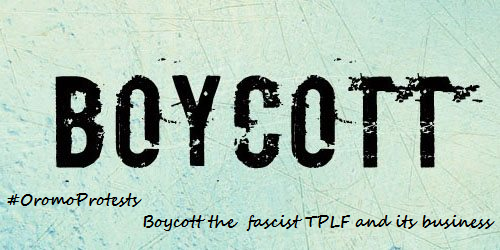
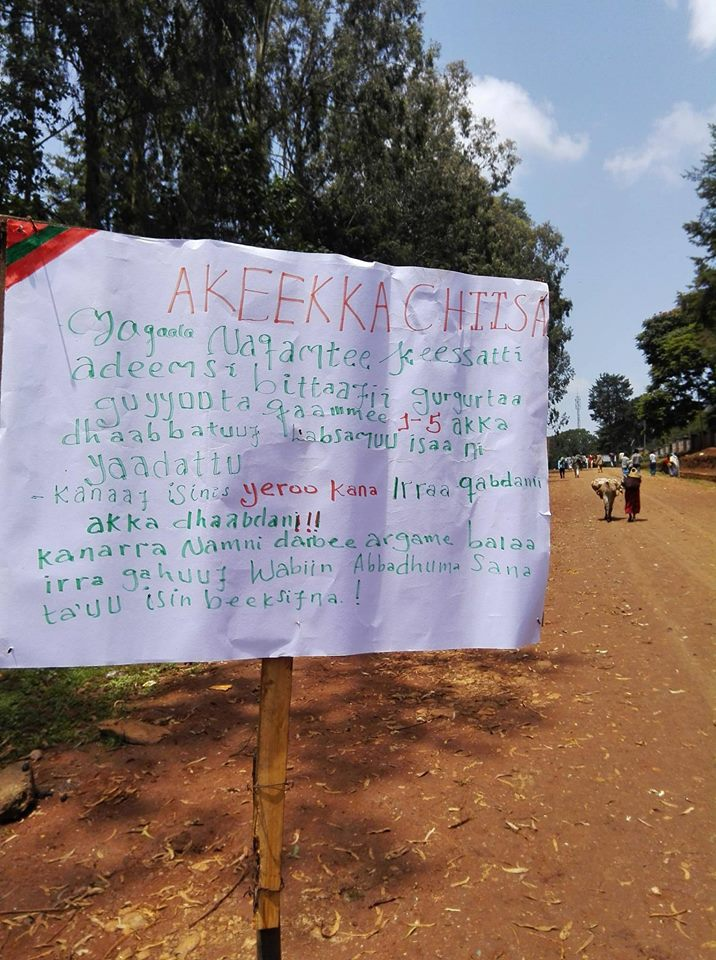
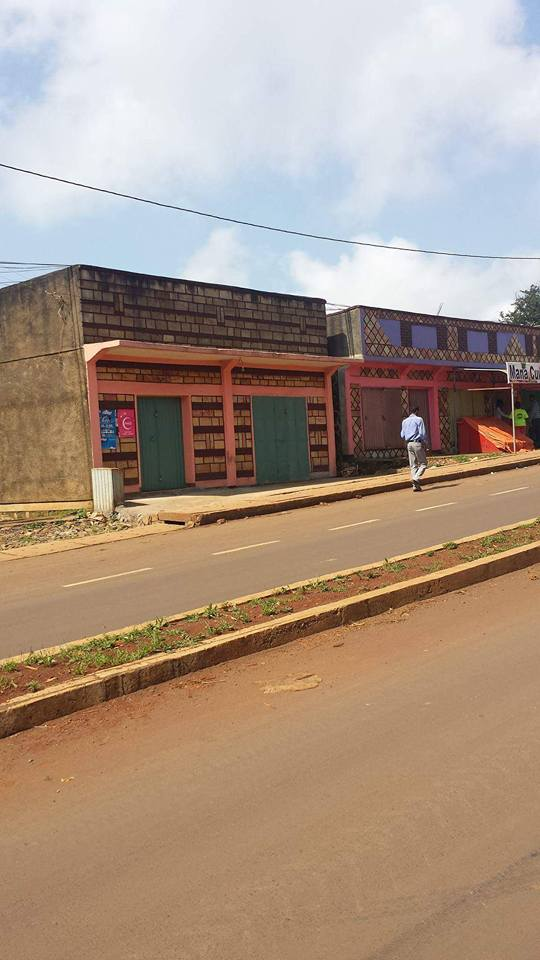


Warraaqsa biyyoolessaa FXG utuu wal irraa hin citiin ji’a sagalii oliif guutummaa Oromiyaa keessatti finiinaa tureen sirni Wayyaanee TPLF naasuu keessa seenuun waan qabdee lakkisu wallaalee uummata goolaa jira.
Guyyaa har’aa Fulbaana 5,2016 Baankiin daldala Ithiopiyaa magaalaa Naqamtee fi naannoo ishee keessa jiru guutummaan guutuutti duwwaa ta’uu irraan kan ka’e sirni Wayyaanee rifaatuu guddaa keessa seenuun uummata magaalaa Naqamtee goolaa jira.
Rifannaa isaa kana irraa ka’uudhaanis baankii keenya rakkoo konneekshiniitu mudate jechuudhaan maallaqa uummataa akka isaan hin fudhanneef dhorkaa jira.
Haaluma kanaan uummanni magaalattiis harki caalu maallaqni isaa waan dhowwatameef baayyee rakkachaa akka jiran bira ga’amee jira.
Uummannis morma keenya laanna malee maallaqa keenya fudhannu malee hin gallu jechuun mormii kaasaa jiraachuun dhaga’amee jira.
TPLF’s Dashen beer destroyed by protesters in Amhara state. 29 August 2016.
Baankiin Daldala Itiyoopiyaa Naqamtee Keessaa Duwwaa Hafaa Jira.
Fulbaana 3,2016
Qabsoon Oromoon mootummaa Waayyaanee hubdeen galagalchaa jiraachuun argamaa jira Qabsoo karaa nagaa Qeerroo idil addunyaatiin hogganamu keessatti sagalee tokkoon yaada walii fudhatee hanga diina isaa rifaasisutti har’aan gahee jira.Kunimmoo hangam uummatichi beekaa ta’uusaa addunyaaf ragaa bahaa jira.
Adeemsa kanaan gidduu kana duula gabaa lagannaa akka gaggeeffamuuf labsii labsamaa jiru waliif dhaga’uun Uummanni magaalaa Naqamtee haalaan hojirraa oolchuuf guyyaa sadii asitti baankii qabeenyummaan isaa kan diinaa ta’e Baankii Daldala Itiyoophiyaa keessaa maallaqa qaban baasaa jiru. Kunimmoo dinagdee mootummaatti kuffisuurra darbee hanga waan sochii diinagdee sochootu dhabdutti gahuuf karaa jabaa saaqa,adeemsi haala beekumsa addunyaa ammaan gaggeeffamaa jiru kun qabsoo biyya Hindii Mataammaa Gaandiin durfamaa turee waliin akkasuma,qabsoo gurrachota Ameerikaa mirga isaaniif duula taaksii lagannaa gaggeessaa turan waliin wal fakkaataadha. Kanarraa walii dhageenyee bakkayyuu dinagdee mootummaa onsuun qabsoo omishaa fi diinagdee mootummaa lagannaa kana akka galmaan geenyu gochi Uummanni Magaalaa Naqamtee hanga baankittiin haguugamtutti maallaqa baafachuun wal sardaa turan ragaa amansiisaa nuuf kenna.Qabsoon nama barateen gaggeeffamu haala kanaan diina mataa jaanjessa.
#OromoProtests 3 September 2016: People are rushing (Bank run) to take out their money from Commercial Bank of Ethiopia. This picture is taken from Kumsa Moroda branch in Naqamte, Oromia.
Dhaamsa FXG Birraa 2 bara 2016:
Maallaqa Keessan Baankii Daldala Itiyoophiyaa keessaa baafadhaa!
Akkuma beekamu bara mootummaan Dargii kufe kanneen maallaqa isaanii baankii mootummaa keessatti qusachaa turan kisaaraa galani hafani. Maallaqa isaanii tokko osoo hin argatin mootummichumaa wajjin bade.
Amma immoo maaltu ta’uuf deema?
Mootummaan wayyaanee mormii guutummaa biyyattii keessatti adeemsifamaa jiru dhaamsuuuf/laamshessuuf maallaqa hedduu akka baasaa jirtu ni argina. Kisaaraa guddaa keessa akka seentee jirtus addunyaa guutuutu dhugaa ba’aa jira. Maallaqi kadhaadhaan alaa galus mootummaa wayyaanee kanatti lubbuu deebisuu hin dandeenye. Mootummaan kun maallaqa uummati keenya baankii mootummichaatti kuufataa jiru fayyadamee ilmaan keenya poolisii Agaaziitiin fixaa jira.
Mootummaan kun bitintiraa jirti. Horsossooftee jirti. Kufaatiin ishee dhiyaateera. Kanaafuu, namoonni baankii daldala Itiyoophiyaatti kuufachaa jirtan hatattamaan utuu maallaqa keessan hin dhabin baankiilee Oromiyaatti dabarfadhaa.Uummati keenya biyya alaa jirtan immoo adaraa gaafa maallaqa firootaa fi maatii keessanii ergitan baankii daldala Itiyoophiyaa hin fayyadaminaa!
Dabalataan maallaqa keessan baankii mootummattii wayyaanee kana keessaa baasuun dinagdee mootummichaas gadi buusee kufaatii ishee saffisiisa.
Kun qabsoo aarsaa osoo hin baasin godhamuudha. Baankii wayyaanee keessaa guuraa qullaatti hambisaa!
Ariitiin kisaaraa of oolchaa! Mootummaa wayaanee immoo kisaaraa keessa galchaa!
Galatoomaa!
Qabsoon itti fufa!
#OromoProtests 2nd September 2016:
“Godina Arsii liixaa Aanaa Dodolaa keessaatti woyyaaneen sodaa irraa kan ka’ee Maal akka gootuufi dhiistuus wolalte jirtii. ummataa sodaachsiuufjechaa meeshaa waraanaa kanaa fakkatuu magalaa keessaa asii achii ariaa ooltii. karoorri uguurtaa daldalaa kan mataa isii dhukubsee mootummaan woyyaanee ummataas waliigahii bahaa jechuudhaan keessaa deemtee kadhaataa jirtii. garuu waan nama ajaaibuu ummaanni keenya sodaa cabsee walii afoo dhabachaa jiraa.”
“Shawaa Bahaa Aanaa Boossat gandoota Rukeechaa Boqoree, Dongorree Nayyee, Dongorree Furdaa,Hurufaa Kukkurfaa, Rukeetti akkasumas Dongorree Callee Araddaa jedhamanitti halkan sadeessoof poolisii Aanaa, Federaala fi jiraattota giddutti lolli adeemaa jira.Haala dhukaasni humnoota nageenyaa fi ummata giddutti baname keessatti hidhattooni gandaafii caasaan nageenyaa ummatattii hindhukaasnu jechaan ummata tumsaa jiru.”
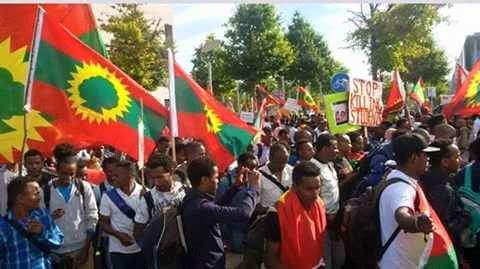
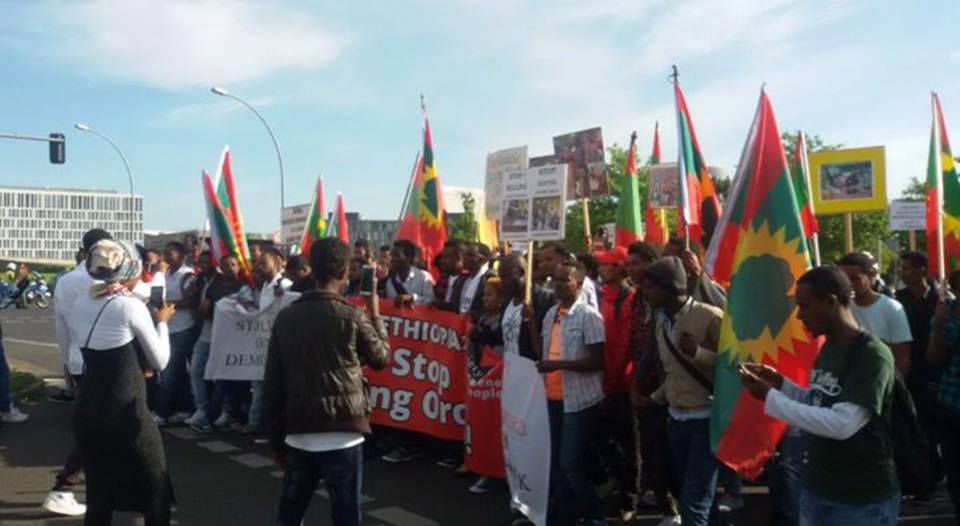
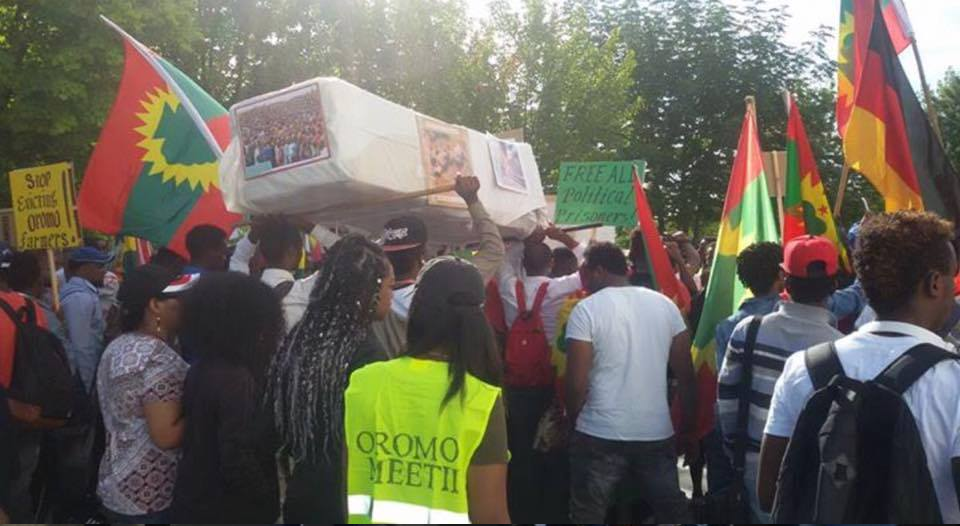
Solidarity with #OromoProtests at European Parliament at the conference/hrearing on crisis in Ethiopia, #OromoProtests, #AmharaProtests and land grabs in Afar state. 2nd September 2016
Hagayya 2 bara 2016 Gamtaan Awurooppaa Paarlaamaa Keessatti walgahii wa’ee yakka dhimma Oromo irraattii TPLF/EPRDF saba Oromoo fi Amahara akkaasumaan sabaa fi sabbonttotaa Ethiopia daballatee duguuggaa sanyii balleessuuf raawwatee fi Saamicha lafa Itoophiyaa keessatti gaggeffamuu keessumattuu Saamicha lafa Affaar irrati TPLF gaggessu irrati Marii guddaan gaggeeffameera.
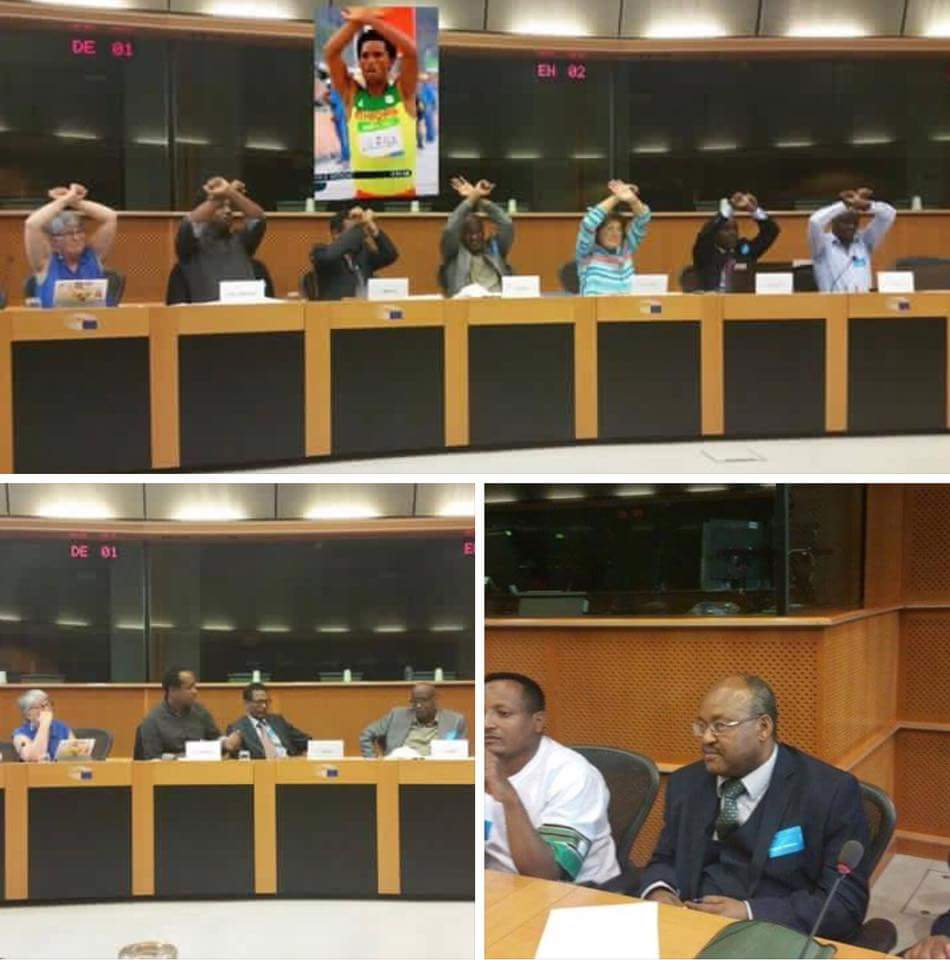
#OromoProtests 31 August 2016: Cruelty of the TPLF
You might recall the report about killing of 15 farmers in West Hararge, masala District Choma village over the last four days. You also remember reading how the military prevented people from burying the dead and helping the wounded. Today they are dressing body of dead civilians in military uniform and video taping it. They want to make fake documentary claiming they killed armed combatants. Jawar Mohammed
Guyyaa hardhaa ilmaan Oromoo 15 Harargee Lixaa Aanaa Masalaa Araddaa Coommaa keessatti ajjeefaman san reeffa isaanii huccuu waraanaa offisuun fiilmii sobaatiif viidiyoo waraabaa jiran. Jawar Mohammed
The TPLF has continue indiscriminately mass killings of the peace loving Oromo people everywhere throughout Oromia.
The following 15 innocent Oromo people were killed by Agazi soldiers (Tigray People’s Libration Front) in Choma village , Masala District, West Hararge on August 27, 2016
1.Hamzaa Abdullaa
2.Mohammadnur Kaliif
3.Asiyaa Abbaas
4.Imaam Jaabir
5.Jaabir Mohammed
6.Feesal Abdallaa
7.Adam Mikaa’il
8.Mikaa’il Aliyyii
9.Kaamilee Mikaa’il
10.Shukrii Umar
11.Kaamil Hassan
12.Muraad Ahmad
13.Jaabir Hassan
14.Ahmad Imaamee
15.Jamaal Aliyyee
Our thoughts are with all the victims relatives and families.
May their soul rest in peace!!

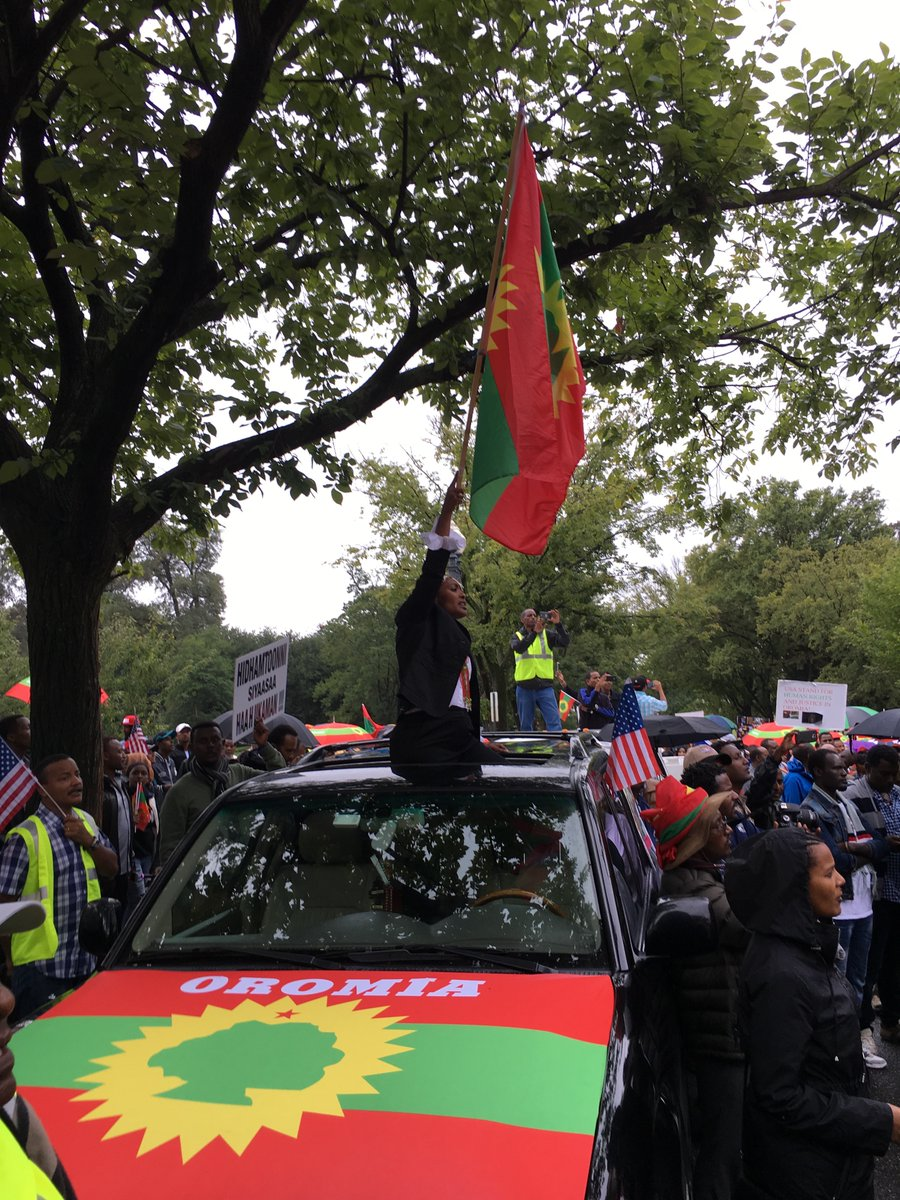
Oakland Institute, 27 September 2016
As months of protest and civil unrest hurl Ethiopia into a severe political crisis, a new report from the Oakland Institute debunks the myth that the country is the new “African Lion.” Miracle or Mirage? Manufacturing Hunger and Poverty in Ethiopia exposes how authoritarian development schemes have perpetuated cycles of poverty, food insecurity, and marginalized the country’s most vulnerable citizens.
A key government objective is to make Ethiopia one of the largest sugar producers in the world. Several sugar expansion plans are underway, including the colossal Kuraz Project in the Lower Omo Valley, which will include up to five sugar factories and 150,000 hectares of sugarcane plantations that rely on Gibe III Dam for irrigation. Studies show that Gibe III could reduce the Omo River flow by as much as 70 percent, threatening the livelihoods of 200,000 Ethiopians and 300,000 Kenyans who depend on the downstream water flow for herding, fishing, and flood-recession agriculture.
Miracle or Mirage? offers lessons from the deadly impact of sugar and cotton plantations in the Awash Valley in the Afar Region, established in the 1950s. The projects drastically reduced land and water availability for people and cattle, undermined food security, destroyed key drought coping mechanisms, and stirred up violent conflicts between different groups over the remaining resources. The establishment of plantations was a critical factor in the 1972-1973 famine, resulting in the deaths of nearly 200,000 Afar people. These findings raise serious questions about the government’s logic behind sugar expansion, with $11.2 billion to be invested by 2020, and much more for irrigation schemes and dams – Gibe III alone cost Ethiopia $1.8 billion.
Using quantitative evidence, the report also details how plantations established in the Awash Valley have been far less profitable than pastoralist livestock production, while carrying massive environmental costs including the depletion of vital water resources.
 Miracle or Mirage? Manufacturing Hunger and Poverty in Ethiopia ethiopia-miracle-miragePress Release miracle-mirage-press-release
The United States is very concerned over the situation in Ethiopia, particularly the instability in the Oromia and Amhara regions.
The United States is very concerned over the situation in Ethiopia, particularly the instability in the Oromia and Amhara regions, Assistant Secretary of State for African Affairs Linda Thomas-Greenfield said in an interview. Speaking in New York on the sidelines of the UN General Assembly meeting, Assistant Secretary Thomas-Greenfield called the response by the government to protests an “intense and somewhat harsh crackdown:”
“We have had discussions with the Ethiopian government encouraging that they have dialogue, and that they open the possibly for press freedom, civil society’s ability to function, and that many of the people who have been put in jail be released.”
In Oromia anti-government protests began in November 2015, and they have also occurred in the northern Amhara region.
Assistant Secretary Thomas-Greenfield said the United States believes that the situation in the country could deteriorate and that the Ethiopian government is aware of that possibility as well.
“We’ve met with Prime Minister Hailemariam [Desalegn] in New York, and we have encouraged him to look at how the government is addressing this situation.”
“We think,” she said, “it could get worse if it’s not addressed – sooner rather than later.”



MOLINE — As Hirut Guangul, of Ethiopia, crossed the Quad Cities Marathon finish line as the first woman overall for the fourth consecutive year, she crossed her arms above her head in an “X”.
Guanhul became the first QCM four-time champion, but the moment became larger than just her athletic achievement on Sunday morning.
“I like this race,” said Guanhul. “Four-time champion. I’m very, very happy.”
After the race, the 24-year-old said the “X” is a way of protesting the human rights abuses that are taking place in Ethiopia. Guanhul’s simple action is a brave and powerful one that bypasses any language barrier.
Hundreds of peaceful Ethiopian protesters have been killed or arrested by the Ethiopian military this year. Protesters have demanded equality for the country’s Oromo people, Ethiopia’s largest ethnic group that has felt marginalized by the government as it pushes them off their land before selling it.
Ethiopian runner Feyisa Lilesa held up an “X” with his arms as he won silver in the marathon at the Rio Olympics. The gesture has been used as a symbol of strength and peaceful resistance.
Lilesa says he likely will not be able to return home after making the gesture of solidarity. The Oromos also have used the “X” as a sign of their protest.
“The Ethiopian government is killing my people, so I stand with all protests anywhere, as Oromo is my tribe,” Lilesa said at an Olympic press conference. “My relatives are in prison, and if they talk about democratic rights they are killed.”
Guangul joined the brave movement as she won the women’s marathon with a time of 2:44.25.
She won her first QC Marathon in 2012, when she set the women’s open course record of 2:35.07. Guangul’s 2016 win earned her $3,000 in prize money.
Guangul says she enjoys the Quad Cities Marathon, and is happy to be back at the race.


The truth is that Ethiopians are revolting in the clearest of terms. One need not look beyond what has evolved in Oromia and Amhara regional states over the last ten months where simple, constitutional and even by the ruling party’s lexicon ‘legitimate’ requests by the people of Ethiopia was turned by the government into unimaginable horror.
For a government that deprived the people of Ethiopia any other means to either humble it or talk back to it, this shouldn’t come as a surprise. It is harvesting what it sowed and the least it can do is admit that its way of being a government is not working. If this means dissolving itself, so be it!
Addis Standard, 26 September 2016
When news of a 100% victory by the ruling EPRDF came out shortly after the May 2015 general elections, everyone scorned the result; it was too stupid to be true. After all, democratic elections in a multinational state home to a near 100 million odd, which Ethiopia is one, were not supposed to be like this. So, the world was right to scorn the results because nowhere in it would similar experiences go down history books unchallenged.
Alas, the ruling party in Ethiopia was not only intoxicated by the victory to see what was in the offing, but it was so sure to get away with it, as it did get away with many lapses of political orders in the last quarter a century.
The reason why the world – not the government in Ethiopia – looked at the results of that fateful election with a sheer horror is because the latter is the author, director and main character of the tragic political drama which eventually dragged Ethiopia to the verge of crisis, yet again. And that election was the straw that broke the Camel’s back. From north to south and left and right Ethiopians are on the streets screaming their ultimate rejection of a government which claimed to have won a 100% of their votes.
Damage from within and outside
There is damage to be sustained when a rebel-turned-government spoils its political capital to become a bullying dictatorship. In all measures, that is what happened in Ethiopia since the advent of May 1991. A federated state tutored by party manifesto; alternative political parties decimated from inside out with their leading members often jailed, harassed and in some cases killed or simply made to disappear from the face of earth; independent media and civil society organizations persecuted in equal terms as terrorists; and academic institutions and religious establishments coerced to dance to the music of the ruling party. Regrettably, that is Ethiopia as we know it since it was declared the ‘democratic republic of Ethiopia,’ although some would discount the first 10 years as a semi-successful democratic experiment.
The result is that military violence has now become the new language in which the government is using to talk back to the people of Ethiopia. Judging by the look of events it wouldn’t be an overstatement to say that Ethiopians are betrayed by their own government which has no misgivings to turn into the military to answer their questions and control their dissenting voices.
But there is also damage to be sustained from outside when western allies of a dictatorship sugarcoat their terms of reference to declare a dictatorship “democratic” and continue to engage with it business as usual. (See story here).
Such blunders by the west are driven by several factors. Leaving aside the cliché, this magazine posits two of the often neglected factors.
The first is the burning ambition by Ethiopia’s western allies to showcase how the aid business turned a once poster child of famine into a successful budding state with a seemingly soaring economy. Calls by rights organizations, and most importantly, the people of Ethiopia for the west to use constructive diplomatic leverages to tame the government often fell on deaf ears. Ethiopia’s western allies repeatedly opted to hold their nose about the smelly human rights record and the government’s unbridled control of both the political and civic spaces in Ethiopia. But at the same time they continued pumping taxpayers’ money in the name of aid and lavish a repressive state with undeserved international legitimacy.
The second is the concept of not wanting to face the task of opening the Pandora’s Box during what’s often a constitutionally limited term in office practiced by most western governments. President Barak Obama is leaving office and he was under no illusion that speaking truth to the world that Ethiopia was going down the nasty way was going to do him more harm than good.
The result is that there remains no discourse and platform where Ethiopia’s western allies can use to discipline a government they themselves enabled to grow out of control.
True, Ethiopia is a sovereign state whose independence should not be tampered with but there are international laws, for example, that Ethiopia itself is a signatory to. Sadly no western ally is daring to speak out loud when Ethiopian officials use and abuse these laws the same way they use and abuse local laws. The recent flagrant dismissal by the government in Ethiopia of the kind reminder by the UN Human Rights Commission of the need to allow access to UN monitors to investigate recent killings and rights abuses in Ethiopia is one classic example.
This means it should now be up to the ruling party to stop playing illusory for the sake of PR consumption by the west and propaganda for Ethiopians and start facing the inevitable. That means the ruling EPRDF should admit that the country is really on the verge of crisis and that it and only it is responsible for it.
The truth is that Ethiopians are revolting in the clearest of terms. One need not look beyond what has evolved in Oromia and Amhara regional states over the last ten months where simple, constitutional and even by the ruling party’s lexicon ‘legitimate’ requests by the people of Ethiopia was turned by the government into unimaginable horror.
For a government that deprived the people of Ethiopia any other means to either humble it or talk back to it, this shouldn’t come as a surprise. It is harvesting what it sowed and the least it can do is admit that its way of being a government is not working. If this means dissolving itself, so be it!



Cultural Survival, 23 September 2016
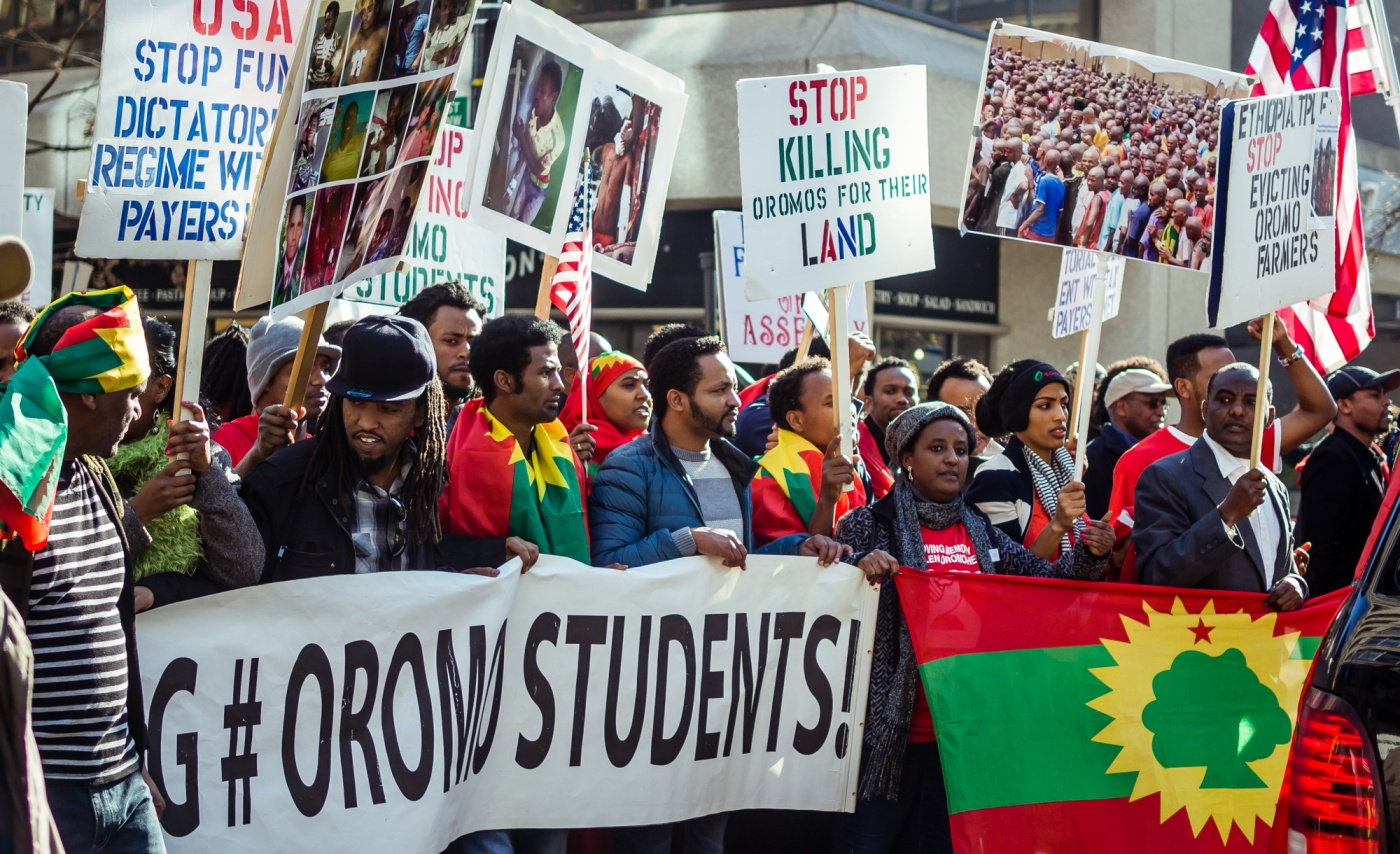
Photo courtesy of: ctj71081/ Flickr
On August 21st, in Brazil, Ethiopian runner Feyisa Lilesa was awarded the silver medal for the Men’s Marathon in the 2016 Rio Olympics. Although this was perhaps one of the greatest sporting achievements of his life, this day will forever be remembered for the political protest he made just before the finish line. While in the global spotlight, Lilesa raised his hands above his head in an ‘X’ formation to stand in solidarity with the Oromo people of Ethiopia, who have suffered a crackdown at the hands of the Ethiopian government.
Lilesa is one of the thousands fighting for the rights of the Oromo people. In August 2016, the United Nations’ High Commissioner for Human Rights, Zeid Raad Al Hussein, called on Ethiopia to allow UN international observers to investigate the excessive use of force by the government’s security forces against peaceful protesters in the Oromo and Amhara regions of the country. There is a strong need for organized international pressure on the Ethiopian government. A credible and independent investigation into this country’s Human Rights offences is long overdue. This will be a huge and very welcome step for the people and the country as a whole.
More on Oromo Abuses Here
Human rights abuses have been prevalent throughout Ethiopia’s history, but for the last nine months, protests have erupted in Oromiya, the homeland of Ethiopia’s largest but historically marginalized ethnic group, the Oromo, of which Feyisa Lilesa belongs. The protests are have now spread north, to a second region, the Amhara.
Although these protesters from Oromo and Amhara have different backgrounds, cultures, and complaints, they share a growing fear and frustration with the rule of a third, minority ethnic group — the Tigrayans. As NPR reported, the Tigrayan elite has a “cartel-like grip on the government, military and the fast-growing economy.” The Tigrayan Peoples Liberation Front (TPLF) forcefully rose to power after the fall of the Soviet Union. Since then, there have been numerous human rights violations, with examples like the 2001 killing of forty Addis Ababa university students for simply demanding the academic freedom to publish a student newspaper, to the Killing of 200 Oromo in 2014, according to the Solidarity Movement for a New Ethiopia (SMNE).
Related: Learn more about the TPLF in Ethiopia here.
The right of peaceful assembly is protected in Ethiopian and International law. Ethiopia’s Constitution states “everyone shall have the freedom, in association with others, to peaceably assemble without arms, engage in public demonstration and the right to petition.” But, after Human Rights Watch interviewed more than 125 witnesses, victims, and government officials, a significant pattern of human rights violations during peaceful Oromo protests was revealed. Examples from late 2015 when the decision of authorities in Ginchi to clear a forest for an investment project triggered protests in at least 400 different locations across all the 17 zones in Oromia, until May 2016, and even into current times, prove there have been massive human rights violations. Numerous reports exposed that in many locations security forces have gone at night, arresting innocent and unsuspecting members of the community such as students and those accommodating students in their homes. Security forces also strategically target those seen as “influential members of the Oromo community, such as musicians, teachers, opposition members and others thought to have the ability to mobilize the community for further protests.” Even more shocking, is that many of those arrested and detained by the security forces were children of eighteen years and younger. Security forces have also been reported to open fire on, and kill peaceful protesters, as well as torture or beat many of the detained Oromo. Many of the females detained have reportedly been raped by security force personnel, while almost none of the detainees have had access to legal counsel, adequate food, or their family members.
An unnamed student said in an interview with HRW on January of 2016, said his friend “was shot in the stomach [at the protest], his intestines were coming out, he said, ‘Please brother, tie my [wound] with your clothes.’ I was scared, I froze and then tried to do that but I was grabbed and arrested by the federal police. Jamal died. They arrested me and took me to Bedeno police station.”
With ongoing events such as these, the people of Ethiopia have appeared to have reached their limit; the brutal force being used by the regime to deter an uprising is starting to backfire, creating new alliances between previously divided groups of Ethiopians such as the Oromo and the Amhara. The regime, struggling to find ways to retain domination, resorts to solutions like the exploitation of Ethiopian resources, land, and opportunities; but this too, is becoming a regime failure.
A press release from The Solidarity Movement for a New Ethiopia (SMNE)notes, this is a regime, accustomed to using tools like manipulation to divide the people by ethnicity or other differences, furthering ethnic hatred, alienation and isolation, leaving a niche for the regime to squeeze into. It has allowed them to repeatedly commit fatal human rights atrocities against these groups with no fear of a united retaliation; but this is suddenly changing. These methods of turning selected ethnic groups against one another, is being scrutinized by Ethiopians; and previously rival groups are now unifying to challenge it. As SMNE said, “more killing, wounding and use of violence against unarmed civilians on the part of the regime’s security forces are strengthening, not weakening, the movement of the people,” but the movement is just beginning.
Ethiopia’s government has rejected the call for UN intervention and promised to launch its own investigation according to Al Jazeera. With the TPLF now facing a crack in the current power structure of the country, the government’s resistance to UN intervention was to be expected. The fearful reality is, however, that the TPLF, power hungry, and corrupt, will continue to use illegal force in an attempt to maintain control. But this lack of legal and transparent investigation of human rights violations in Ethiopia strongly implies that the Ethiopian government’s investigation of the ongoing human rights crisis will not be independent, impartial and transparent, and according to Sarah Jackson, Amnesty International’s Deputy Regional Director for East Africa, the Horn and the Great Lakes. “It is time to step up efforts for an international and independent investigation in Ethiopia.”
For years the government has worked to project a “forward thinking, democratic, and economically progressive image” of Ethiopia to outsiders, while on the inside, achieving the total opposite. For example, laws such as the Charities and Societies Proclamation law (CSO) which is meant to appear as an advocacy network, actually has criminalized human rights and other kinds of advocacy work in Ethiopia, making an equal and civil society impossible to maintain in Ethiopia. This makes the presence of an independent organization like the UN crucial for the protection of the Oromo people, who are practically inhibited from seeking protection themselves.
According to the Press Release from SMNE, “meaningful democratic reforms, restorative justice, and reconciliation for all the people of Ethiopia, including the current ruling party,” are the essential measures which need to be enacted if Ethiopia is to find peace and avoid total disaster. History shows that the government will not cooperate without pressure from key donor nations such as the the United States, the United Kingdom, the European Union, Canada, Norway, Sweden etc., as well as from major international human rights organizations, to provide leverage critical in obtaining substantial changes for the rights of the Oromo people and governmental structure of Ethiopia as a whole.
Since 1972 Cultural Survival has been advocating for Indigenous Peoples’ rights and supporting Indigenous communities’ self-determination, cultures and political resilience.
To read about Cultural Survival’s work around the world, click here. To read more articles on the subject use our Search function and explore 40 years of information on Indigenous issues.
For ways to take action to help Indigenous communities, click here.
We take on governments and multinational corporations—and they always have more resources than we do—but with the help of people like you, we do win. Your contribution is crucial to that effort. Click here to do your part.

Winner of Mississauga CanKen 5K race protests in support of Ethiopia’s Oromo people.
Ethiopia’s Hajin Tola won the inaugural CanKen 5K road race in Mississauga, Ont. on Sunday and performed a political protest by crossing his wrists to form an “X.” (Photo: Happy Films Photography.)
The inaugural CanKen 5K road race was held on Sunday in Mississauga, Ontario, Canada in an effort to strengthen Kenya-Canada relations through sport, business and community. The 5K was dominated by the Toronto Olympic Club as the event attracted some of southern Ontario’s top talent featuring Kenyan and Ethiopian teams.
At the front of the pack, Ethiopian Hajin Tola won in 14:45 and performed a political gesture crossing his wrists above his head in an “X,” done in solidarity with the Oromo people in his home country. The protest is the fourth such notable act by an Ethiopian at a race in the past month.
How the protests got started
Olympic silver medallist Feyisa Lilesa was the first to make headlines in August when he performed the protest in Rio in the men’s marathon. He feared for his life following the race as the protest was directed at the Ethiopian government.
RELATED: Quebec City Marathon winner Ebisa Ejigu replicates Olympic medallist’s political protest.
The protests are being done in response to the government’s displacing of Oromo people outside of Addis Ababa as the municipal boundary of the capital city is extended into neighbouring areas.
Why the “x” gesture?
The anti-government protest is meant to signify being handcuffed at the wrists. The Oromo people, with much of the population living in an area named Oromia, are the largest ethnic group in the Horn of Africa. As many as 500 people have been killed in the protests between November 2015 and June as reported by Human Rights Watch.
RELATED: Paralympic T13 1,500m silver medallist protests Ethiopian government.
Lilesa, the Olympic marathon silver medallist, performed the protest in Rio and said after the race that “If I go back to Ethiopia, I will be killed.” He has since arrived in the United States on a special skills visa and has not returned to East Africa though his family remains in Ethiopia. A GoFundMe page in his name has raised more than US$160,000 for travel and living costs.
RELATED: Ethiopian Feyisa Lilesa lands in the U.S. after staging political protest in Rio.
Also in Sunday’s race was Ebisa Ejigu who won the Quebec City Marathon at the end of August and also protested against the Ethiopian government. Ejigu finished fourth on Sunday in 15:04.
At the Mississauga race, the first three positions were awarded cash prizes of $1,500, $750 and $500 in both the men’s and women’s categories. Jane Murage was the women’s race winner in 17:16. There were a number of notable figures on hand for the inaugural event including Deputy Kenya High Commissioner to Canada Ambassador Jane Onsongo.
The 1K kids dash encouraged the next generation of runners to participate with a medal being awarded to all participants and trophies going to the top three finishers.
The Toronto Olympic Club won the team trophy for fastest average time and Team Umoja won the largest turnout trophy. Team Umoja is mainly drawn from Kenyans living in Canada. Full results can be found here.
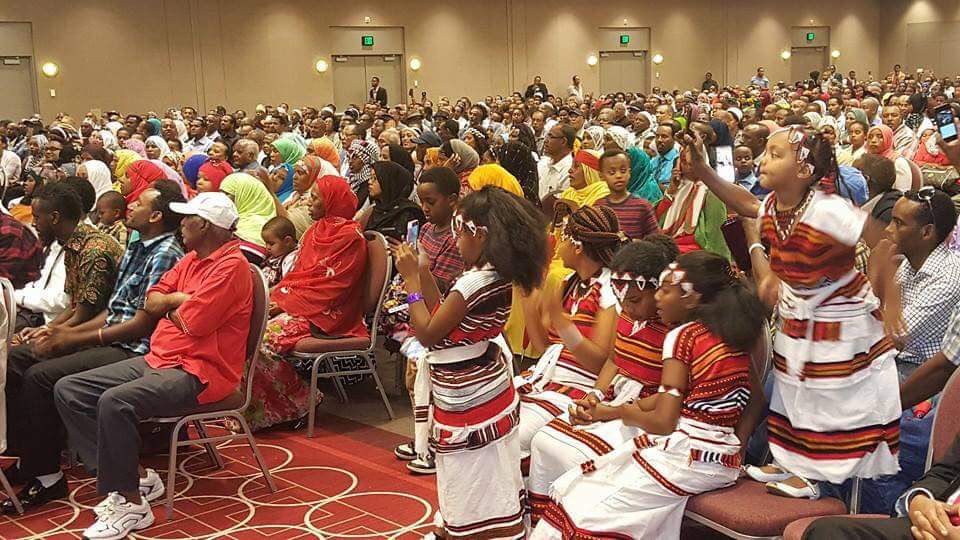
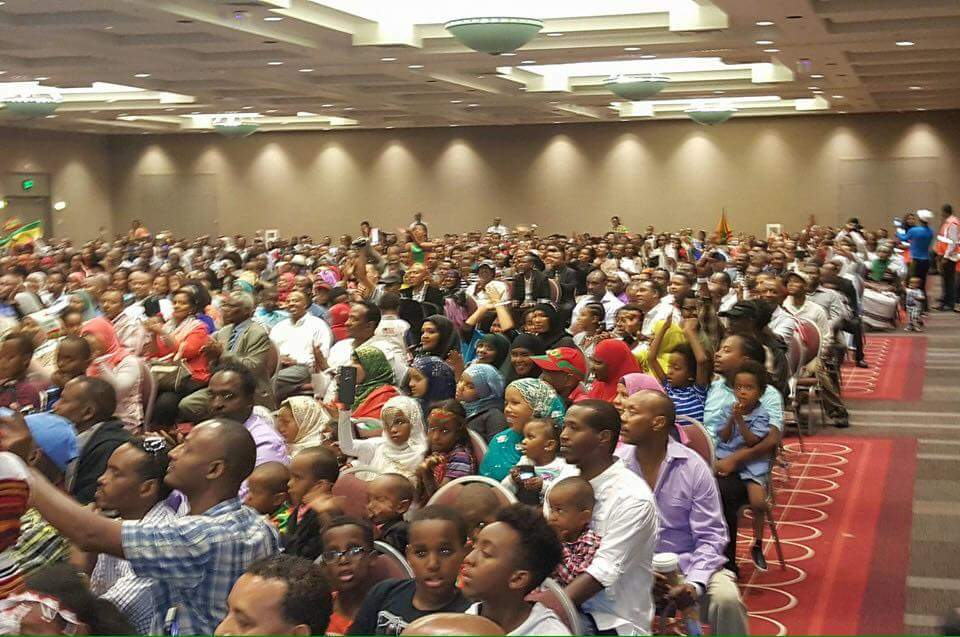
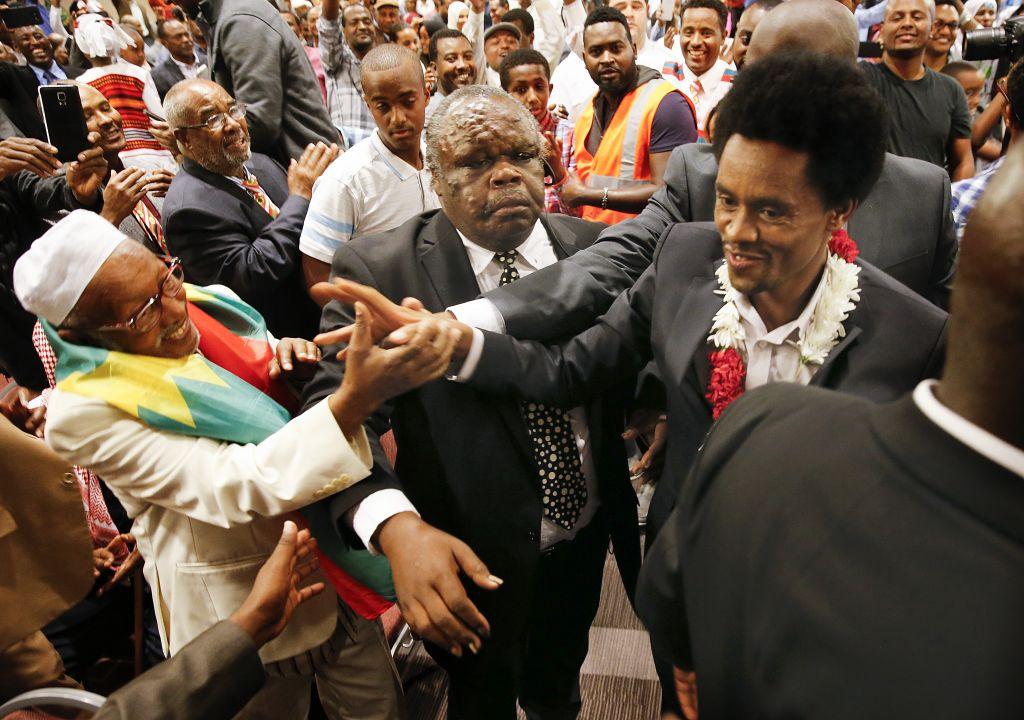
TOM WALLACE, STAR TRIBUNE: Oromo (Ethiopian) Olympian Feyisa Lilesa entered the Minneapolis Convention Center Sunday, Sept 18, 2016 to a crowd of about 1000 well wishers. He won the silver medal in the 2016 Games in Rio and crossed the finish line with his arms crossed in an X, symbolizing the plight of the Oromo in Ethiopia.
Lilesa, 26, became a hero to his people and brought global attention to the plight of the Oromo in Ethiopia when he crossed his arms to form the letter X above his head as he crossed the finish line at the Rio Games.
He did the same as he entered the auditorium Sunday and the crowd erupted in cheers.
The Oromo Community of Minnesota said more than 100 Oromo people were killed in Ethiopia in August alone while peacefully protesting the government’s persecution of the ethnic group.
Lilesa, who faces jail if he returns home, has been granted a special skills visa to the United States so he can train and compete. His wife, 5-year-old son and 3-year-old daughter remain in Ethiopia.
His visit to Minneapolis was sponsored by the Oromo Community of Minnesota, headquartered in St. Paul. The group estimates that up to 40,000 Oromo people are living in Minnesota, but the state demographer’s office puts that number closer to 8,500.
Related:-
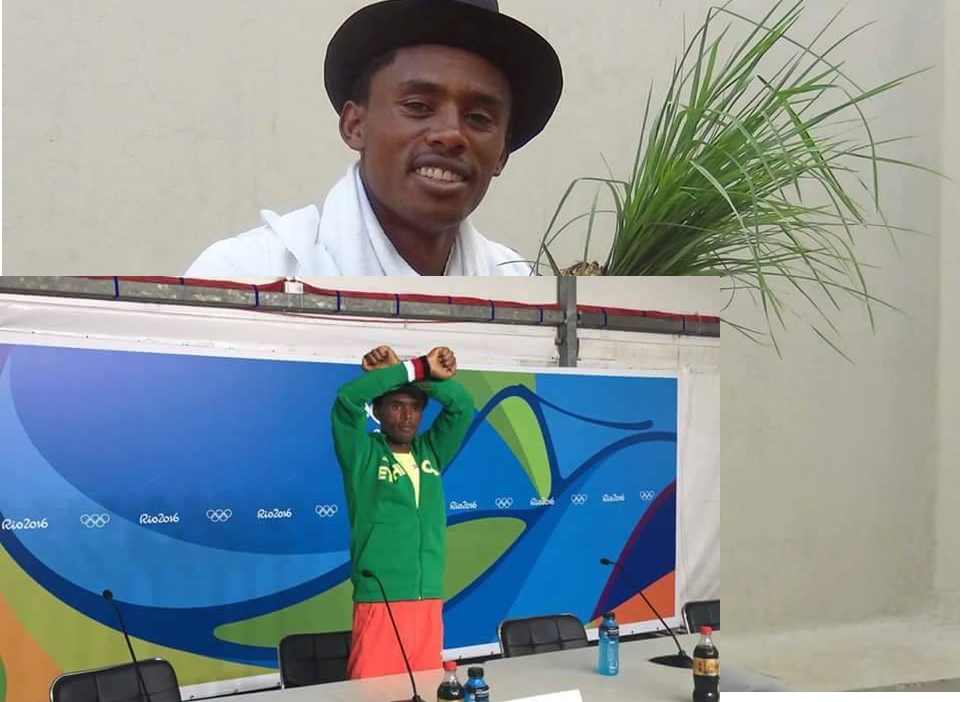
CNN Connect the World: Marathon runner Feyisa Lilesa tells us why it was so important to highlight his people’s suffering at the Rio 2016 Olympics and #OromoProtests

ANALYSIS By Etana Habte, Addis Standard & All Africa, 16 September 2016
In the first part of this series, I explored in historic perspectives (particularly with developments in Oromia regional state) the Ethiopian government’s road to becoming a counter-protest state and the systematic ways in which the regime further bolstered its role as a counter-protest state.
And in the second part I discussed about the surge of popular protests in Ethiopia focusing on the socio-political and party architecture in which the ongoing Oromo protests first took shape. In this third, and last, part I will take a close look at the decades-old simmering tensions between the Oromo nation and successive Ethiopian states, discovering what they reveal about the contemporary politics of the Ethiopian counter-protest state vis a vis its relations with the Oromo protests, which, by several measures, have reached a point of no return.
Decades of simmering tensions
Continuous confrontations and tensions between Oromo protesters and the ruling party manifested in Oromia-wide Oromo protests may not be understood fully unless we look back its history. In order to contextualize the on-going Oromo protests, we must consider decades of relationships between the two confronting parties – the Ethiopian state and the Oromo nation – discovering what they reveal to us about the politics of the Ethiopian counter-protest state, and what they suggest about the future prospects of Ethiopia’s political trajectory.
It is indisputable that this massive movement in Oromia is not simply a political phenomenon whose root is limited to the period between 2006-2015; it goes as far back as the 1960s when modern Oromo political activism was born, and even goes as far back as the formation of the Ethiopian state itself.
Yearning since the 1960s for three overarching questions – language, land, and self-rule – Oromo nationalism has been growing more than ever since the introduction in Ethiopia of the multi-national federalism in the early 1990s. While the Oromo question for land has two parts: the homestead (qee’ee) and the Oromo country (biyya-Oromoo), the issue of language became the foundation of identity question. The third, the Oromo question for self-rule in the course of their national struggle, seemed to have been conceived as an ultimate solution capable of addressing the other two.
These three overarching Oromo questions were aired in the 1960s by the Oromo members of the Ethiopian student movement and the Maccaa-Tuulama Self-help Association, and were later on articulated in the early 1970s in the political program of the Oromo Liberation Front (OLF). These questions have been dealt with piecemeal in the revolutions of 1974 and 1991.
The 1974 revolution succeeded in the promulgation and implementation of a proclamation answering the country’s pressing demand, which was coined through the famous slogan of the student movement – “land to the tiller”; it was able to return plots/homestead to individual peasant households. With the Oromo in view, the 1974 revolution answered the question of qee’ee (homestead) but it had never attempted to deal with the Oromo question of yearning for biyya-Oromoo (Oromo country). Instead it criminalized the demand presenting it as a treasonable crime. The revolution also addressed the Oromo identity claims by allowing some media outlet for Afaan-Oromoo (Oromo language) but the demand to use Latin alphabet (qubee) was made another treasonable crime.
The political change in 1991, however, went far beyond the offers of its predecessor and dealt with more fundamental issues. Demands of Oromo nationalism was legitimized and institutionalized within the state apparatus when the new regime – for the sake of its own legitimacy – decided to offer concessions to decades old national struggles.
Through the federalism arrangement, it created the long sought after Oromo country within Ethiopia in the form of the Oromia National Regional State with its own regional parliament, Caffee Oromiyaa. It also allowed Afaan Oromoo, which had long been criminalized and heavily suppressed under the imperial and socialist Ethiopia, to be recognized as the medium of instruction in schools throughout Oromia.
But as the rule of the TPLF/EPRF began to unfold the problems inherently linked to its system of rule started to unearth. When in 1991 a coalition of rebels overthrew the Derg, the victorious TPLF-led-EPRDF not only took control of the capital city, expanding daily at the expense of Oromo farmers, but also inherited one of Africa’s oldest authoritarian state form, effectively excluding from the country’s politics, economy and cultural manifestation most of the southern peoples (the Oromo included).
As soon as TPLF took control of the center, a dubious, rather feckless Transitional Government of Ethiopia (TGE), where various political groupings, including Oromo parties of which the Oromo Liberation Front (OLF) was prominent, was organized in 1992. Perhaps as part of its concerns to take the OLF on board, the TPLF recognized Addis Abeba as the capital of Oromia and promised that the interests of the Oromo people in the city would be accommodated.
The Transitional Charter that established the TGE (1991-1995) declared, “The special national and political interests of the Oromo are reserved over regions 13 [Harari State] and 14 [Addis Abeba].” In 1995, Oromia’s interest in Addis Abeba was once again recognized by the constitution that created the Federal Democratic Republic of Ethiopia (FDRE). Article 49, sub-article 5 of the constitution states that “The special interest of the State of Oromia in Addis Abeba, regarding the provision of social services or the utilization of natural resources and other similar matters, as well as joint administrative matters arising from the location of Addis Abeba within the State of Oromia, shall be respected.”
However, the whole scheme boiled down into a political manipulation where the TGE gained the support of Oromo parties and the people’s support for the creation of a lasting TPLF-dominated authoritarian regime. When the TPLF dominated EPRDF ensured its control over Oromia, it went on to purge the OLF out of the TGE in June 1992.
In 1995, when the new constitution transformed TGE into the Federal Democratic Republic of Ethiopia (FDRE), the TPLF dominated government began employing ambiguities in the constitution and walked in earnest to take full control of Addis Abeba.
In Article 49, where issues of Addis Abeba have been stipulated, three of its sub-articles (sub articles 2, 3 and 5) present contrary provisions, a state of affairs that made the gate wide open for the ruling party’s looming interests over the city. After appointing a TPLF veteran soldier as the mayor of Addis Abeba in 2000, the regime took a bold decision in 2003 to shift Oromia’s capital from Addis Abeba to Adama, 100km southeast of Addis Abeba. When the office of the Oromia regional parliament, Caffee Oromiyaa, was thrown to Adama it appeared that the hope of the Oromo to have their government in the city they believe is the center of Oromia was dashed.
Following the 2003 government decision to transfer Oromia’s seat to Adama the leadership of Maccaa-Tuulama Association (MTA) and Addis Abeba University students immediately organized a protest, which was met with brutal crackdown.
The organizers were imprisoned and MTA was outlawed and had its office looted and dismantled. The university itself dismissed nearly 400 students whom it believed had taken part in the protest. While it was clear that thousands of farmers were evicted between 1995 and 2003, it was, however, the decision to transfer Oromia’s capital from Addis Abeba to Adama that gave birth to the Oromo struggle for Addis Abeba.
The declaration of the proposed “Master Plan” a decade later would mean dashed hopes and broken promises; it breaks up into two what has been known in the narrative of modern Oromo political activism as biyya-Oromoo (Oromo country), a reference to Oromia. On one hand, it is a broken promise because it sustains the regime’s tradition of deciding on issues relevant to biyya-Oromoo without the consent of the Oromo nation. In fact, many believed the implementation of “the Master Plan” would come close to restoration of the former Shewa governorate-general, which in turn would mean a renewed wave of cultural invasion on the Oromo as much as a territorial break up of Oromia.
Addis Abeba’s expansion in historical times had scored the highest record in eviction of the surrounding farmers in its environs, namely, Tuulama Oromo, but the EPRDF regime took this to a new level previously unmatched in Ethiopia’s history. Most peasant households have been and still are poor in Ethiopia but they live on their land and depend on its produce for their livelihoods, whatever its sufficiency.
Tuulama Oromo in this regard appear the most unfortunate for encountering endless evictions since at least the 18th century. Left in isolation from the Oromia National Regional State, Ethiopians in all walks of life, and undoubtedly the TPLF/EPRDF regime, the Tuulama Oromo have been forced to bear unbearable projects accompanying the regime’s intent (whatever the name attached to it) of expanding the city of Addis Abeba with no regard to their way of being.
Coherently conscious
The Oromo population constitutes nearly 40 per cent of Ethiopia’s estimated population of 100 million. Some are adherents of Islam (being involved in more than one sect); others follow different sects of Christianity, and still others adhere to Waaqeffannaa, the Oromo indigenous belief system. In rural Oromia, their social organizations exhibit diverse historical experiences and regional patterns. These few remarks help us appreciate the internal diversity of Ethiopia’s largest ethno-nation.
So far, a number of scholars have made serious attempts to understand the contemporary political status of this diversity within the Oromo nation. While some treated them as a nation others seriously question that status. This diversity, for example, in the eyes of Gebru Tareke, an Ethiopian scholar, made the Oromo nation “a vastly dispersed people with no history of political unity since the sixteenth century.”
Another scholar, John Markakis, wrote, “From the beginning of their historic [population movement] the Oromo did not forge unity above the tribal level, nor did they ever coordinate their efforts for a common purpose. Each tribe pursued its own destiny entirely independent of the others, and inter-tribal warfare was the rule rather than the exception.” Historian Bahru Zewde on his part says “… the incorporation of the nineteenth century has resulted in the denigration of Oromo culture and identity,” but plainly denies the fact that an Oromo country has ever existed before the twentieth century; he argues against a map of Oromo country – Ormania – made by a German missionary J.L. Krapf based on primary historical data he collected ‘during an eighteen-years residence in eastern Africa’ in mid 19th century.
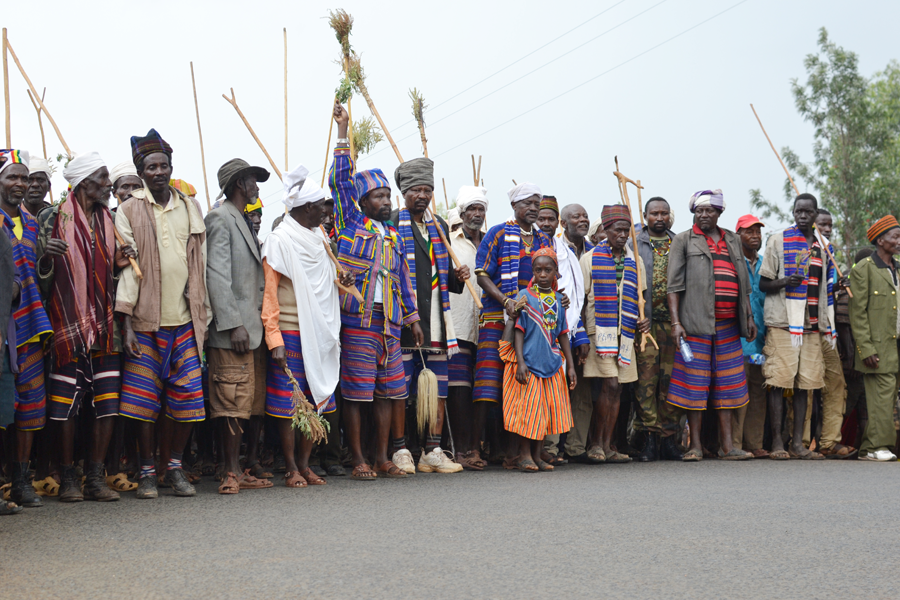
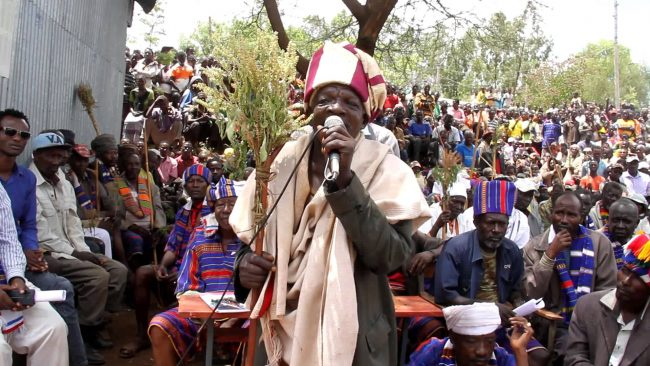
The current fascist Ethiopia’s regime also known as TPLF (Woyane), a criminal group from minority Tigray tribe, in northern Ethiopia is conducting genocidal mass killings against Konso people. TPLF has occupied Konso land, killing the people and burning the entire town and villages. The Konso are one of the very ancient people in East Africa and their historical villages are UNESCO World Heritage.
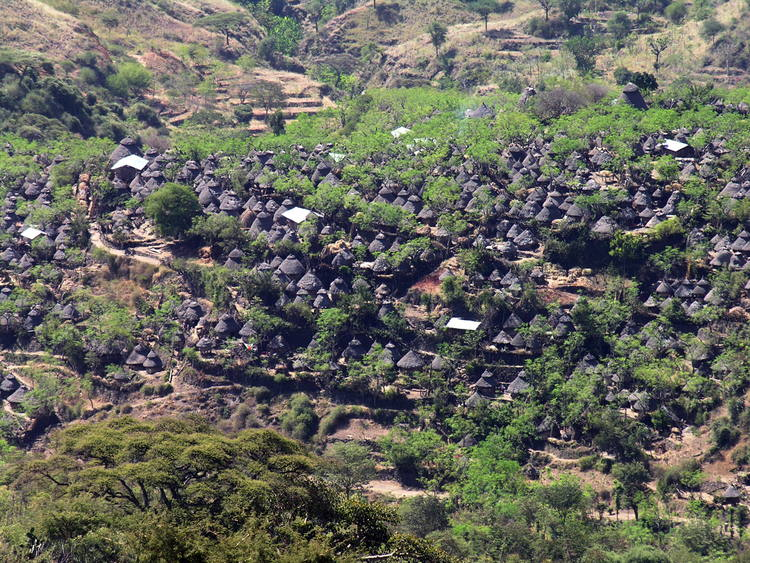
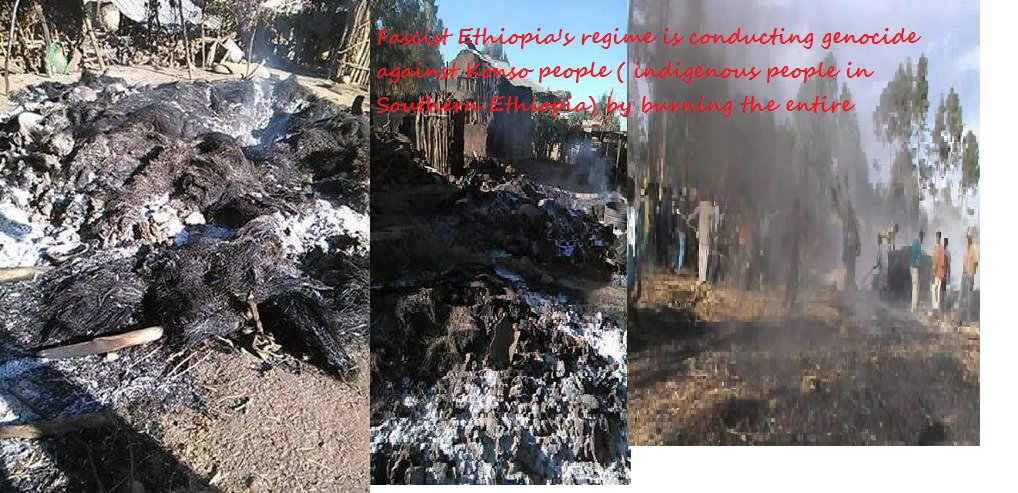
Agazi’s new tactic, burn homes to ground along inhabitants. This was done to Konso people in Aylota-Dokatu & Lulito towns yesterday September 13, 2016. Hundreds homes were destroyed and death is reported. All the Konso people are asking to be granted zonal status which their right enshrined within the constitution. The federation council accepted their appeal last week yet the federal army in burning their homes. Jawar Mohammed
SORRY BUT THE KONSO UNESCO REGISTERED WORLD HERITAGE SITE HAS BEEN BURNT TO ASHES
Xiixaa Buubaa Sardaa• with Darajjee M. BilliiYesterday, we heard (Listen to VOA Amharic & Afaan Oromoo, transmitted on 9/15/2016 17:30-19:00 GMT), over the past 1 month, both the elected local Konso District leaders & leaders of the Regional State of Southern Ethiopian Peoples Nations & Nationalities (SEPNN) are counter-blaming one another for what they call “genocide on the Konso people”. The Konso People speak Afaan Oromo in its other southern Ethiopian Kushites accent/dialects and still retain the ancient Gada Socio-politico-theological System and Qaalluu Ancestral Spirituality. Moreover, they retain the eschatology of preserving in sarcophagus of the Spirits of the dead that we know in Ancient Kemet/Egyptian turned to a battle ground, the Konso District’s UNESCO registered world heritage site was burned into ash by government security forces of Ethiopia. Konso Cultural Landscape is a 55km2 arid property of stone walled terraces and fortified settlements in the Konso highlands of Ethiopia. It constitutes a spectacular example of a living cultural tradition stretching back 21 generations (more than 400 years) adapted to its dry hostile environment. The landscape demonstrates the shared values, social cohesion and engineering knowledge of its communities. Stone steles in the towns express a complex system of marking the passing of generations of leaders.
On April 2016, William Davidson wrote on the guardian as Protests sparked by the arrest of Konso leader Kala Gezahegn underlined growing tensions between Ethiopia’s central govelrnment and many ethnic populations. Now it has been over a period of 7 months since the Konso people has started protesting against the injustice and maladministration by the forcefully established Zone- Segen Area People’s Zone. The Konso people who were formerly administered under a Special District status in SNNPRS, had been unconstitutionally forced to form a zone with other neighboring ethnic groups, dropping from a ‘Special District’ status to a District in the newly formed zone. That sparked complaints from the people but no one gave an ear to the people that time. The zone government then grabbed three Kebeles from Konso to create a new city structure in Sagan town. This was also followed by the deduction of annual budget allocated to Konso District without being approved by the District council representing the people. This gave momentum to the silent and peaceful popular protests in every corner in Konso since then. Despite the loyalty of the people to the constitution of the country, the government in power at all levels has failed to give a constitutional answer to the people appeal for establishing a self-governed Zone as per the law of the country.
Now, the Konso people is under military siege some months ago. No freedom of movement, no education for children… all offices closed. Worst the innocent farmers are being shot to death by security forces. Konso cultural landscapes tell the incremental story of human progression—how regular people have taken the sum total of their knowledge and applied it to living in their natural surroundings. They are another way in which history comes alive through the built environment, and their importance is recognized by UNESCO. Beside their ten months long protests the indigenous people of Konso now lost both their life and heritage. After 400 years of conservation now Konso-world heritage site is destroyed with fire set by security forces of Ethiopian government, world community have to take part in identifying the cause and take measures on guilty body.
Last weekend on the eve of two large celebrations in Ethiopia—the Ethiopian New Year and the beginning of Eid al-Adha festivities—the Ethiopian authorities pardoned approximately 1,000 people, 135 of whom had been charged under the country’s draconian Anti-Terrorism Proclamation. Amongst those released were leaders of theEthiopian Muslim community, who have been in jail since July 2012 when they were detained for protesting against governmental interference in religious affairs.1

While the release of these political prisoners is welcome, we must not be fooled by this supposedly “generous” act. The Ethiopian government frequently issues pardons at times of international scrutiny. Before President Obama’s trip to Ethiopia in July 2015, for instance, numerous high profile political prisoners were released, including Bekele Gerba,2 Reeyot Alemu, and several of the Zone 9 Bloggers. Pardons like these are strategic. They are meant to make the Ethiopian government look reasonable, with the hope that the international community will be pacified and look the other way.
But the abuses continue, and cannot be ignored.
Just two days after the pardons, it was reported that two more Ethiopian opposition members had been arrested. On September 3rd, at least 23 prisoners died “under disputed circumstances” when a fire broke out in Ethiopia’s notorious Kilinto jail. Those jailed at Kilinto include numerous Oromo protesters, former World Bank translator Omot Agwa, and prominent Oromo opposition politician, Bekele Gerba. Local news reports allege that prison guards opened fire on the detained during the fire.
And let us not forget the thousands that remain behind bars, having not been included in what appears to have been an arbitrary set of pardons.
The Ethiopian government has good reason to worry about the growing dissent in the country. The past months have seen increased unity in the courageous fight for democracy and human rights. Community members engaged in the struggle told Oakland Institute staff “there will be no jubilation until all political prisoners, regardless of religious or ethnicity, are released.”
International pressure, too, has mounted. On September 12th, Rep. Chris Smith introduced House Resolution 861, entitled “Supporting human rights and encouraging inclusive governance in Ethiopia.” The bill recounts the many abuses taking place in Ethiopia – from the impact of the villagization program on the Anuak in Gambella, to the numerous unlawful arrests made under the Anti-Terrorism Proclamation; the crackdown on civil society organizations under the Charities and Societies Proclamation to the numerous extrajudicial killings that have taken place during this past year’s protests – and calls for strong action, both by the US and Ethiopian governments. One day later, the United Nations High Commissioner for Human Rights expressed deep concern in his opening remarks before the Human Rights Council regarding the “lethal use of force against protesters, enforced disappearances, and mass detentions” by Ethiopian forces. He reaffirmed his previous calls for an “independent, impartial, and international” investigation.
Solidarity actions are also taking root in the US. On Friday September 16th, the Oromo Renaissance Organization will hold a peaceful rally in Oakland to “denounce the deadly crackdown … on peaceful protesters in Oromia and other regions of the country.”3 Earlier this week, Olympic silver medalist Feyisa Lilesa held a high-profile press conference in Washington DC, bringing significant international media attention to the plight of not just the Oromo people, but those in Amhara and Gambella as well. Lilesa will hold another press conference on September 18th in Minneapolis, hosted by the Oromo Community of Minnesota.4
This is a critical moment for Ethiopia. The US Government, United Nations leaders, and the international media are all paying attention to the abuses taking place, and finally giving these atrocities the attention they deserve. Now, more than ever, the international community needs to follow through on its responsibility. We must not accept the introduction of a bill or the pardoning of 1,000 as enough. Instead, we must continue to call for universal human rights, democracy, and justice across Ethiopia.
The time for change in Ethiopia is now!

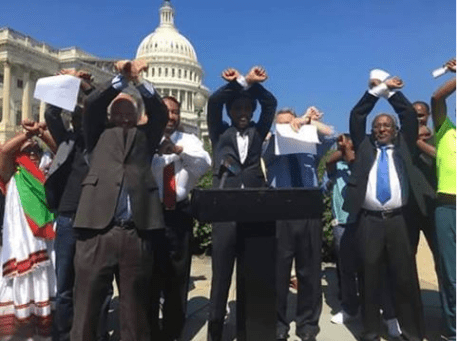
At night, Feyisa Lilesa and his friends hid in the farms to evade the security forces who were arresting people across the country. As a 15-year-old growing up in Oromia region, Lilesa says he was always aware that many of his fellow citizens didn’t approve of the government’s treatment. But the moment of awakening for…
via A life of discrimination and fear led an Ethiopian marathoner to protest on the world stage — Quartz

Press Conference to announce the introduction of a House Resolution “Supporting respect for human rights and encouraging inclusive governance in Ethiopia.” Oromo Olympic marathon runner who won silver in Rio, Feyisa Lelisa was invited to this event to make a remark and meet with U.S. Representatives.
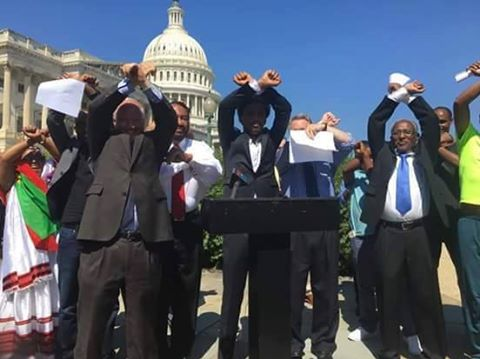
Several dozen members of the Oromo Ethiopian diaspora community expressed support for recently introduced legislation aimed at curbing human rights abuses in that country during a press conference outside the U.S. Capitol on Tuesday. Click here to read more.
Related, Media reporting Fayyisaa Leellisaa:-
The Guardian: Feyisa Lilesa: being an athlete allowed me to be the voice of my people
Mail Online: Olympic runner yearns for peace, fears bloodletting in Ethiopia
Oromo athlete Tamiru Demisse has registered double victory in the Rio 2016 Paralympic as he stands with #OromoProtests on world stage.
Injifannoo dacha dachaa: Gootich Oromoo, Atleet Taammiruu Demisee Paralympic Riyoo irratti injifannoo irratti injifannoo galmeesse. Akkuma Fayyisaa Leellisaa FXG Oromoo Adunyaatti ibse.
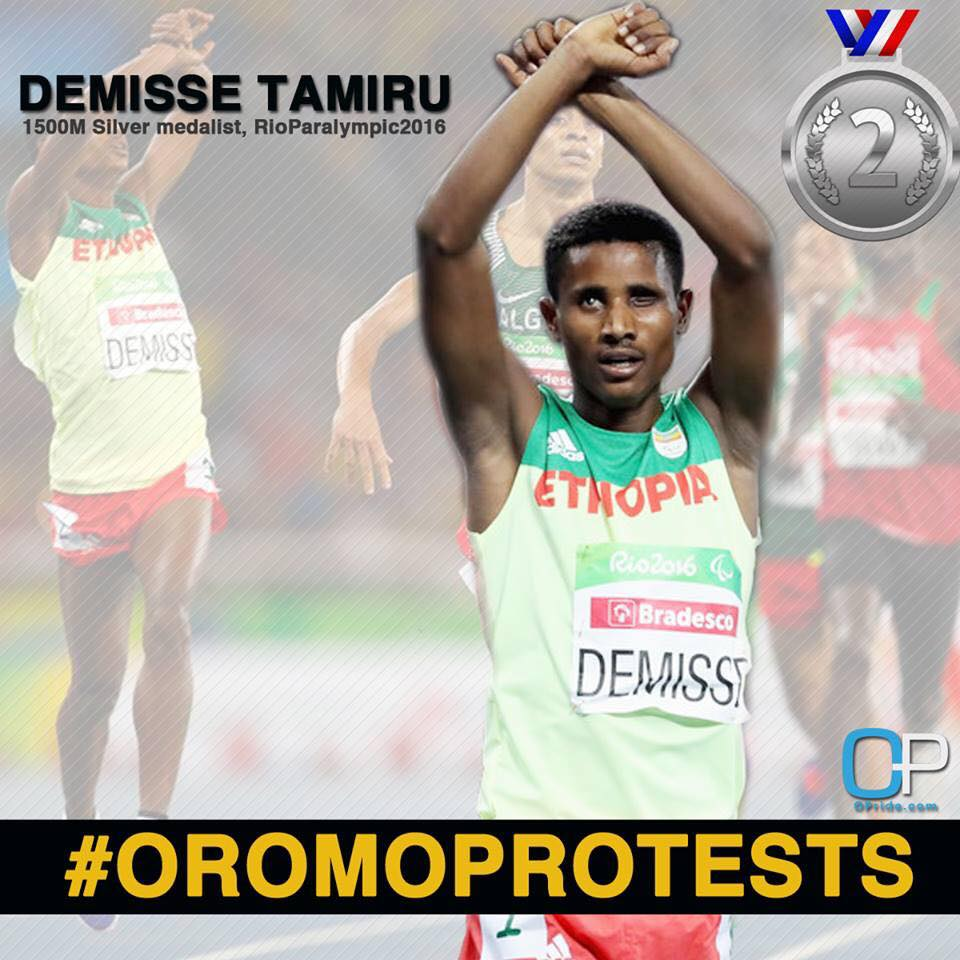
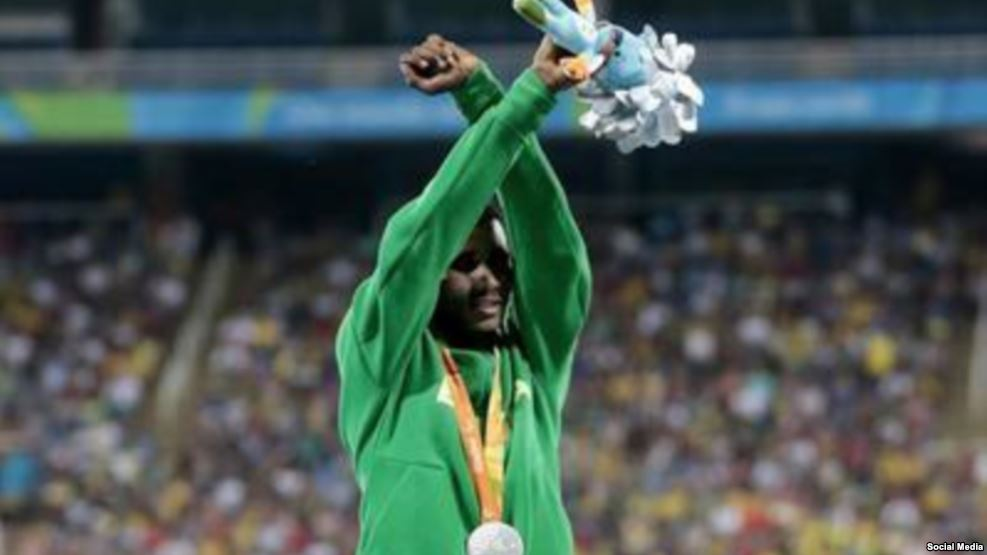
Oromo athlete Tamiru Demisse (Center) shows solidarity in the world stage with #OromoProtests after the final of men’s 1500m of the Rio 2016 Paralympic.He is the silver medal winner at the event. Tamiru Demisse is 22 years old ( Born October 7, 1993).
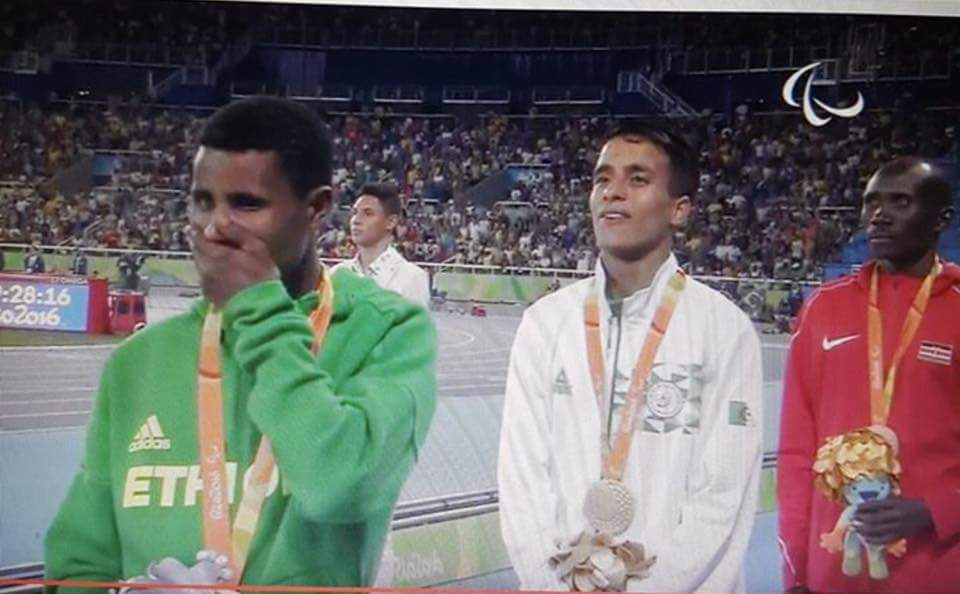
Oromo Oromo athletes Tamiru Demisse (C), Megersa Tasisa (L) and sport journalist Adugna Angasu (R) who are in Rio de Janeiro, Brazil for the Paralympic 2016 show solidarity in a world stage to #OromoProtests, 11 September 2016.

Atleetiin Oromoo Damiseee Taammiruu ‘RioParalympic’ (Oloompikii qaama miidhamtootaa) irratti Fiigicha meetra 1500 irratti sadarkaa 2ffaan injifatee harka isaas waliin qaxxaamursee diddaa wayyaanee mul’isee injifannoo dachaa galmeessee jira.Kana kan raawwate Fulbaana 11 bara 2016 tti. Atleet Damiseen qaama miidhamaa yoo tahu ijji isaa takk0 hin agartu. Gootichi kun garuu addunyaa irratti saba isaa, saba Oromoof injifannoo guddaa fi boonsaa galmeesse jira . Wanti nama ajaa’ibu garuu atileetiin kun 1ffaa bahuu ni danda’a ture. Yoo sarara seenuuf xiqqo hafuuf mallattoo fincila xumura garbummaa Oromoo mul’isuuf jedhee hanga inni harka isaa ol qabu duubaa dhufanii bira dabranii saba isaaf jedhee 2ffaa bahuuf dirqame.
Itti dabaleesi Damisee Taammiruu yoo badhaasa fudhatuus alaabaan Itoophiyaa (wayyanee) akka ol hin baane dhoorkee yoo faaruun alaabaa Itoophiyaa faarfamtuus afaan qabatee jibba qabuuf mul’ise. Akkasumaas wayta baayyee harka isaa ol kaasuun mormii isaa irra deddeebi’ee mul’isaa ture. Atileetiin kun saba isaatiif jedhee wareegama qaalii injifannoo dachaa galmeesse. Innillee Itoophiyatti gale taanaan miidhaa hamaatu isa qunnama. Wayyaaneen aara Fayyisaa mara irratti dabalattee miiti. Kanaaf Oromoon addunyaarra jirtan akkuma inni daandii Fayyisaa Lalisaa baase irra deeme, nutiis daandii Fayyisaaf irra deemne irra haa deemnuuf. Isa waliin ‘RioParalympic’ irra kan turan Atleet magarsaa Taasisaa fi gazexeessaa Adunyaa Angaasuu isa waliin mallattoo fincila xumura garbummaa agarsiisaniiru.
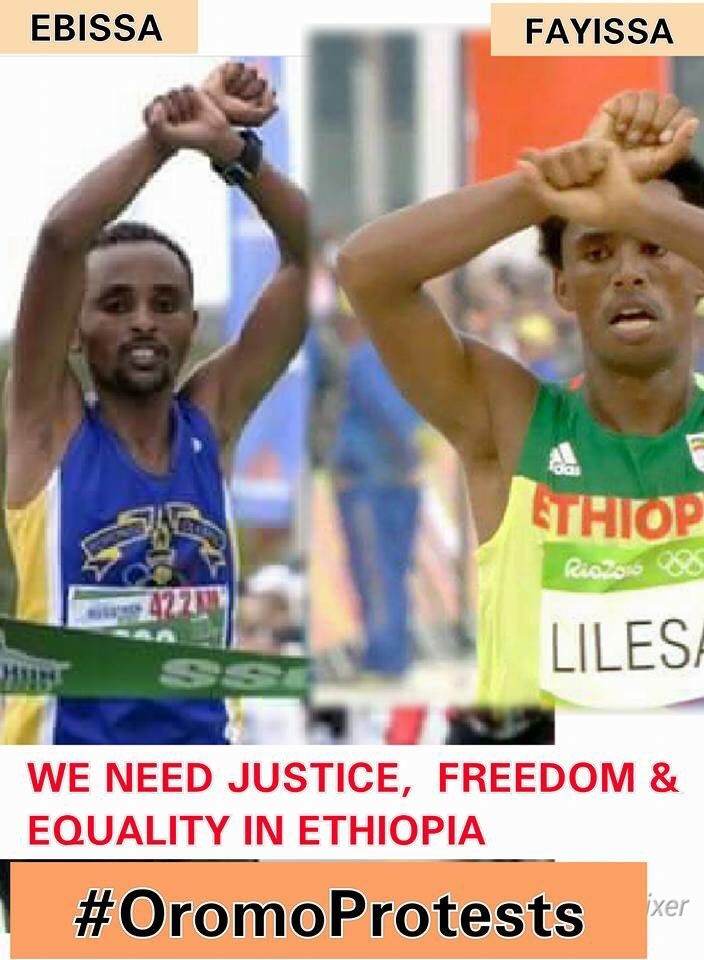
Athlete Fraol Ebissa Won the Germany 10Km race and shows his solidarity with #OromoProtestsSeptember 2016. p2
VOA Afaan Oromoo, WASHINGTON,DC — Hariyaan Furii Kaffiyaaloo jettiin,maqaan isaa,Taammiruu Kaffiyaaloo Damiseeti.Taammiruun nama ganna 23ti.
Bara 2000 keessa fiigicha jalqabee bara 2003 keessa ammoo akka dansaa dorgommii jabeeffate.Eegii sunii asitti metirii 400, 800 fi 1,500 irratti dorgoma. Haga ammaatti medaaliyaa 45 caalaa badhaafame.
Taammiruun nama biyya keessaa fi biyya alaalleetti Paralympic dorgmuun beekama.Paralympic dorgommii namii cabaa-baqaa, naafaa fi qaamii akka akkaa irraa hirdhate ka doktoriin mirkanseef irratti dorgomu.

Atileeti Taammiruu Demissee,Rio Biraazil
Dorgommii Paralympic ta bara, 2016 Fulbaana 7-18,bara 2016 Riyoo,Biraazilitti itti jiran.Atileetota 4000 caalanitti itti jira.
Itoophiyaan dorgommii tanaaf Taammiruu waliin nama shan ergatte.Taammiruun fiigicha metirii 1,500 guyyaa dheengaddaa dorgome irratti lammeessoo bahee mallattoo mormii Oromoo agarsiise.
“Wanta biyya keessatti godhamaa jiru addunyaatti akka beekamu. Dhiiga saba kiyyaatii ka dhangala’a jiru…kan gubachaa jiru saba kiyya waan taheef—namini meeqa akka du’e hin beekna,kanaaf mormii agarsiise,”jedha.
Kanaafuu jedha Taammiruun mallatoon tun mallattoo ummatii “Oromoo hidhamuu isaa, cunqurfamuu isaa agarsiisu waan taheef agarsiise,” jedha.
Atileeti Taammiruun mallattoo mormii Oromo tana yoo dorgommii jalqabe,yoo fixe,yoo badhaasa medaaliyaa fudhate mul’isee dirree keessa fiigaa agarsiisaa ture.Yoo waltajjii irratti alaabaa Itoophiyaa oli baasan afaan qabatee faarsuu dide.
Afaan qabachuun ammoo “ummatii Oromoo osoo waan hedduu qabuu ukkamamuu isaa,osoo wannuma hundaa gochuu dandahuu afaan qabee akka homaa hin dandeennetti ilaalamuu isaa agarsiisaa,” jedha.
Taammiruun mormii tana agarsiisuuf Fayyisaatti na durse malee eegachaa ture jedha.
“Tokkoffaa baheetoo rikordii nan cabsaa tureeyyuu.Oggaa ani harka oli qabu innii gadi jedhee seeneeyyuu.Innii rakkoo hin qabuu.Anaaf rakkoo hin qabu.”
Taammiruun dorgommii jara qaamii miidhamee Paralympic keessatti dorgomaa.Innii diqqeennaan ila tokko dhabee,iltii lammeessoolleen akka dansaa lafa hin agartu.
Taammiruun waltajjii dorgommii addunyaa irratti mallatoo mormii siyaasaa agarsiisuun ‘seera malee’ jedhanii yoo fkn seera sun cabsite jedhanii medaaliyaa sirraa fuudhan maan jetta jennaan “kaan lubbuu itti dhabaa medaaliyaa narraa fuudhuun rakkoo hin qabu,” jedha.
Mormii atileetotii Itoophiyaa dorgommii biyya alaa irratti harka mataa irratti oli qabatanii mallattoo mormii hiriira Oromiyaa agarsiisuu kana, Fayyisaa Leellisaatti jalqabe.
Fayyisaa Biraazilii bahee amma Amerikaa jira.
News Week: Ethiopian Paralympian Tamiru Demisse showed solidarity with Oromia protesters—who have clashed with the country’s government—as he claimed a silver medal, following a protest gesture made by Olympic counterpart Feyisa Lilesa.
Demisse, who competed in the men’s 1,500-meter T13 race for visually impaired runners, claimed a silver medal in the race on Sunday at the Olympic Station in Rio de Janeiro, Brazil. As he crossed the finish line, Demisse crossed his arms above his head.The gesture has become widely adopted among members of the Oromo people, the country’s largest ethnic group. Oromo protesters have clashed with Ethiopian security forces in recent months, with Human Rights Watch claiming the unrest has seen more than 400 people killed.
The protest by Tamiru Demisse, the silver medalist in the men’s 1,500 m in Rio de Janeiro on Sunday, comes after fellow Ethiopian runner Feyisa Lilesa made headlines during the Olympics last month when he made a similar protest as he claimed silver in the men’s marathon.
Daily Mail: The protest by Tamiru Demisse, the silver medalist in the men’s 1,500 m in Rio de Janeiro on Sunday, comes after fellow Ethiopian runner Feyisa Lilesa made headlines during the Olympics last month when he made a similar protest as he claimed silver in the men’s marathon.
The gesture — a sort of X above the head — is a symbol of defiance against the Ethiopian government’s crack-down on anti-government protests that started in the Oromo region in November last year.
Africa News: An Ethiopian Paralympic athlete, Tamiru Demisse, crossed his arms above his head after finishing second in the Men’s 1500m race in Rio. He did same during the medal ceremony.
Tamiru finished behind Algeria’s Abdellatif Baka who took gold in the event. His gesture follows that of fellow athlete Feyisa Lilesa who also won silver in a marathon during the Olympic Games. Kenya’s Henry Kirwa won the bronze medal.
Crossing arms is a sign of protest against Ethiopian government’s treatment of the Oromo people, the largest ethnic group in the Horn of Africa. The protests were sparked after the government began extending the municipal boundary of the country’s capital, threatening parts of Oromia and the people’s land rights.
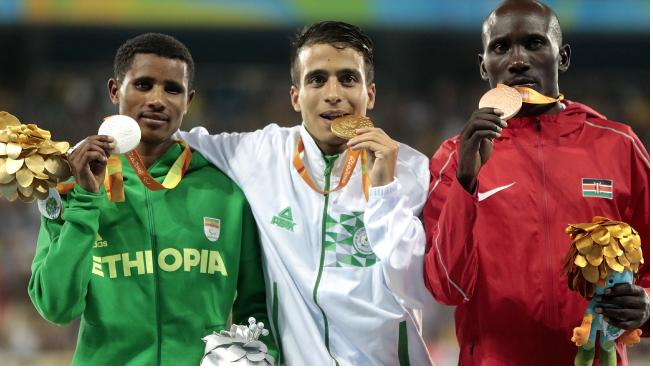
Beneficiaries of this fund are Oromo athletes Tamiru Demisse, Megersa Tasisa and sport journalist Adugna Angasu who are in Rio de Janeiro, Brazil for the Paralympic 2016. Mr. Demisse won a Silver Medal in the T13 1500 meter race and declared his support for pro-democracy movement in Ethiopia by raising his arms above his head X-style which is the symbol of #OromoProtests. Mr. Bayisa, an athlete, and Mr. Angasu, a sport journalist, from Ethiopia are also in Barzil for the Paralympic 2016. The three men fear persecution for supporting #OromoProtests if they go back to Ethiopia and are seeking political asylum. All fund raised will be used to support the beneficiaries. Please donate whatever amount you can. Thank you. Click here to go to the site
Oromo Paralympic Athletes Support Team
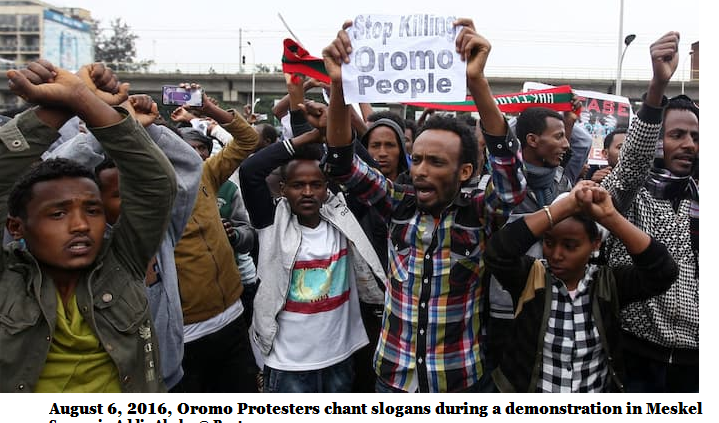
There is every sign that Ethiopia is plunging into a crisis whose scale, intensity, and multiple and interdependent drivers are unprecedented since the founding of the regime in 1991.

The Ethiopian leadership remains in denial. The long meetings of its ruling bodies have culminated in a report on 15 years of national “rebirth”, in which it awards itself good marks, while acknowledging the existence of a few problems here and there.
Nonetheless, the odd warning signal may be heard – though very seldom – in counterpoint to the general complacency. Hailemariam Desalegn, prime minister and chairman of what is essentially the single party, has gone so far as to warn that the issues facing the regime are a matter of “life or death”,[1]and that Ethiopia is “sliding towards ethnic conflict similar to that in neighbouring countries”.[2]
Well, these neighbouring countries include Somalia, epitome of the ‘failed state’, and Sudan, which has split in two and where civil war is raging in the new Southern State. In this, unusually, he is in agreement with Merera Gudina, head of one of the main opposition parties still permitted to operate, whospeaks of the probability of “civil war […] if the government continues to repress”.[3] There is every sign that Ethiopia is plunging into a crisis whose scale, intensity, and multiple and interdependent drivers are unprecedented since the founding of the regime in 1991, although the impossibility of field research precludes any in-depth and conclusive assessment.
The first, very discreet signs of this crisis appeared in the spring of 2014 in a part of the country where they were probably least expected: in Tigray, where the Tigrean People’s Liberation Front (TPLF), pillar of the quadri-ethnic party ruling coalition – the Ethiopian People’s Revolutionary Democratic Front (EPRDF) – seemed both unopposed and unopposable.
Yet the Tigreans loudly and clearly accused “their” Front of neglecting them by only looking after its own interests or, as Hailemariam Desalegn expressed it, of using “public authority for personal gain at all levels”.[4]
The crisis erupted into the open a few weeks later in Oromya, with additional grievances. In the most populous of the nine states and two municipalities that make up federal Ethiopia, a state that is also the country’s economic powerhouse, students took to the streets to protest against the Addis Ababa Master Plan. Their suspicion was that this would inevitably lead to a transfer of sovereignty from the Oromo region to central government and be accompanied by “land grabbing”, the expulsion and dispossession of the local peasant farmers. Protests resumed in November 2015 and continue today at a larger scale that now includes the general population and almost the whole of Oromo State.
The heat was turned up a further notch in mid-July with the advent of protests in the historic heart of Amhara State. Together, Amhara and Oromo account for almost two-thirds of the country’s total population. The diversity of the ways of life that characterizes Oromo – farmers and pastoralists, of its religions – Orthodox Christian, Muslim, Protestant, animist, together with its very loose traditional structures, prompts Merera Gudina to emphasise “the chronic division between Oromo political forces”.[5] By contrast, the homogeneity of the Amhara population – in its vast majority small farmers and Christian Orthodox – fosters unity, while its mobilisation is favoured by its sense of hierarchy and discipline. Finally, the parallel protests by Oromo and Amhara, with largely shared reasons and objectives, breaks with their historical antagonism: the dispossession and subsequent exploitation of the Oromo by an Amhara – and Tigrean – elite from the late nineteenth century onwards, embedded their relations in a system that the Oromo have described as colonial.
The toughest demonstrations that the regime had faced followed the contested elections of 2005. They were essentially confined to Addis Ababa, with the young unemployed playing a major role. In all, they lasted only a few days, in two surges. They came in response to a call from established political forces for a very clear outcome – respect for the verdict of the ballot box. The regime reacted in unison with violent repression – killing almost 200 and arresting tens of thousands – immediately followed by a large-scale strategy of political reconquest through the expansion of the quasi-single party and a rallying of the elites. The protests very quickly died down, and the opposition forces collapsed.
This time, the protests affect the country’s two main states. Despite the repression – hundreds killed, thousands arrested – it has been going on for nine months, with varying degrees of intensity. The attempts at dissuasion through fear have not been enough[6] – at least for the moment – to demobilize the protesters, as evidenced by new forms of protest such as the recent “dead city” operations in the Amhara region[7] and the just launched boycott campaign in Oromya.
This time, a whole generation of young people is in the forefront of the protests – the 15-29 age group represents more than a quarter of the population – starting with, but not confined to, all those who have benefited from mass education, who have carried their elders with them. This time, their anger derives from widespread discontent, focusing on three areas.
First, they are fed up not just with the regime’s authoritarianism, but more so with the way it is exercised: supervision and control that are stifling, intrusive and infantilising, imposed everywhere, all the time, on everyone, by a Party that has swallowed up the State. The second focus is the implementation of a federalism that is in theory equitable, but in reality profoundly unbalanced. Tigray, representing 6% of the population, was the epicentre of the rebellion, which threw out Mengistu Haile Mariam’s military-socialist junta in 1991, the Derg. It was headed by the Tigrean student elite that founded the TPLF. This historical role justified its initial primacy.
Twenty-five years on, however, this elite remains vastly overrepresented at the apex of political power, the army, the security services. In addition, through public and para-public companies, it controls two thirds of the modern economy, excluding traditional agriculture.In the specific Ethiopian case… a tentacular and increasingly voracious and arrogant oligarchy… has ultimately filtered down to village level.
The third focus of discontent is the backlashes of the “developmental state”. This system centralises revenues at the summit of power, which supremely decides on its optimal use for development across the country. This strategy has been decisive in the exceptional economic growth of the last decade – probably around 6% to 7% per year – and in the expansion of education and health services alike. However, the centralisation it entails is evidently incompatible with authentic federalism. Moreover, in the specific Ethiopian case, the fact that the functions of political leadership, economic decision-making and the management of public and para-public enterprises are concentrated in the hands of the same people at the summit of the party-state, free of any control and political counterweight, has led to the creation of a tentacular and increasingly voracious and arrogant oligarchy, which has ultimately filtered down to village level.
These flaws have had a cumulative and mutually reinforcing impact. In Oromya in particular, the implementation of development projects dictated from above and often controlled by nonindigenous oligarchs, has frequently been marked by authoritarianism, spoliation and ethnic favouritism. In the case of “land grabbing”, there are multiple instances of land being brutally appropriated and embezzlement of the compensation owed to evicted farmers. The triggering factor for the protests in Amhara region was the authorities’ refusal to tackle the dispute arising from the incorporation into Tigray of the Wolkait region – a thin strip of land in the north that was part of the imperial province of Amhara – imposed after 1991 without public consultation of any kind, together with the transfer of western areas to Sudan, a process conducted in total secrecy.
The demonstrators’ slogans and targets speak for themselves. They have attacked prisons to free the inmates. They have ransacked public properties, not just offices, vehicles, etc., but also health centres, unemployment offices and cooperatives, places they see as existing more to control the population than to perform their purported functions.They have ransacked public properties… they see as existing more to control the population than to perform their purported functions.
They have gone after local party bosses and their possessions – the lowest layer of the oligarchy – targeting government representatives as much as the despoilers. They have burned businesses owned by national and foreign investors (farms, factories, hotels, etc.) because they symbolise an external stranglehold over Oromya and the Amhara region. “Oromya is not for sale” was one favourite slogan. In short, the demonstrators are targeting both the persons and property of those they see as having obtained position and/or wealth at their expense, through the patronage of the ruling power. “Thief!” is one of the most oft repeated slogans.
In Oromya, the conviction of having remained second-class citizens in a system dominated by a “northist” minority, and in the Amhara region of having become second-class and of feeling permanently “humiliated and marginalized”[8] because a part of the Amhara elite was dominant in the imperial era, is less and less tolerated. The assertion of ethnic identity and the demand for the full rights associated with it are at the heart of the demonstrations. “We want genuine self rule”, cry the Oromo, “We are Amhara”, declare the crowds in the historical capital Gondar, or in Bahir Dar, the new capital. However, these claims are also taking a very worrying turn. In Oromo, demonstrators have gone after Amhara and Tigreans, as well as their properties. Tigreans have been targeted in the Amhara region. However, distortions of every kind in the propaganda war make the reality difficult to grasp. In particular, were the rioters targeting arrivistes more than Tigreans, or vice versa? Anyway, Tigreans are even beginning to leave certain areas, notably in a “mass exodus” from Gondar.[9] Some go so far as to speak of “ethnic cleansing”.
There are pressing calls for these practices to cease, both on social media and from the legal opposition. But as Beyene Petros, one of its leaders, explains:“we’re just watching… people are coming out spontaneously… political parties are bypassed”.[10] By contrast with 2005, this popular protest is largely independent of the legal opposition, and even the illegal opposition groups, such as the Oromo Liberation Front, the oldest and most radical of the Oromo “nationalist movements”, and Ginbot 7, heir to one of the big opposition parties of 2005 and considered a pan-Ethiopian movement.There is no secret central command orchestrating events.
There is no secret central command orchestrating events, although there is no doubt that informal clandestine networks, with links to the diaspora, are contributing to basic coordination and the exchange of information. “These protests are at the level of an intifada”, claims Merera Gudina,[11] or rather at the level of what could be called an “Ethiopian Spring” reminiscent of the “Arab Springs”.
In addressing this situation, the ruling power clings stubbornly to a binary, reductive and simplistic analysis. True, it quickly shelved the Master Plan, an entirely unprecedented turnaround. It also reaffirmed the self-critique that emerged from the congresses of summer 2015: beyond the immense benefits that it has brought – peace and development – its action has been marred by failures and deficiencies, notably with regard to corruption, bad governance, unaccountability and youth unemployment. The narrative is that these are the only failings that the “public” condemns, which makes them “legitimate”. It has undertaken to correct them and “to discuss with the people” in order to tackle them more effectively.
So the legitimacy of these “public” claims is accepted. But those who demand more are supposedly driven by a “destructive agenda” manipulated by “destructive”, “anti-peace”, “anti-development elements”, “bandits”, or even “evil forces” and “terrorist groups”, “extremist Diaspora members who have negotiated their country’s chaos for money”, which are puppets of “foreign actors” or “invaders”, starting with Eritrea. It is they who are “hijacking” peaceful demonstrations and turning them into illegal and violent protests. Websites close to the TPLF, among the few accessible in Ethiopia, are more explicit: according to them, the wave of protest is simply the outcome of an Arab plot, led by Egypt, in which Asmara, the OLF and Ginbot 7 are mere “foot soldiers”. Their real purpose? “To destabilise” Ethiopia, repeats the government, “the total disintegration of Ethiopia as a country”, according to these websites.[12]
To attribute the crisis to external, foreign conspiracy is unjustifiable. Eritrea, still in an on/off state of war with Ethiopia, and Egypt, deeply alarmed by the construction of a colossal dam on the Nile, would undoubtedly welcome a weakening of Ethiopia. It may even be that they are trying to fan the flames. But they do not have the means to light the fire and keep it burning. And the ruling power’s claim that they have been able to do so is itself an admission of weakness: for them to succeed, the regime must already have been resting on weak foundations.
This externalisation also exempts the government from having to consider the grievances at the heart of the protests, going far beyond a few personal failings and deficiencies in implementation. Externalisation is also used to justify repression as the only possible response: there can be no compromise with the enemies of the motherland. It would therefore be pointless to move beyond the use of force and engage in the political sphere, as it did in 2005. Above all, however, the government rejects this option because a political response to the protesters’ demands would require it to question its whole political structure and policy.
The TPLF is a child of the student movement of the end of Haile Selassie’s reign, radically Marxist and above all Leninist. From its creation, it adopted the movement’s analysis of Ethiopian society. The peasantry – still 80% of the population today – backward and illiterate, the working class tiny and in any case ‘trade-unionist’, the ‘national’ bourgeoisie equally small and anyway indecisive, assigned an irreplaceable role to “revolutionary intellectuals”, as Lenin defined them. They are the only ones able to develop the path that would bring Ethiopia progress and well-being, and therefore the only ones with the legitimacy to impose it on Ethiopians, willingly or by force if necessary.[13]
This conviction remains. Just a few years ago, Hailemariam Desalegn explained: “due to poor education and illiteracy, the Ethiopian public is too underdeveloped to make a well reasoned, informed decision”; so the “enlightened leaders” have “to lead the people”.[14] At the other extreme, every local official is convinced that his position places him within the circle of “enlightened leaders” and that he has the right and duty to assume all the authority associated with that role.
This messianic vision creates an unbridgeable divide between a handful of ‘knowers’, an ‘intellocracy’, which alone has the legitimacy and the capacity to exercise power, and all the others, the ‘ignorant’, in other words the people, reified and bound to obey in its own interests, whatever it may think. It justifies a totalising ascendancy in every sphere, exercised through an age-old hierarchy on which the Leninist formula “democratic centralism” confers a modern and revolutionary dimension. Or, in this particular case, “revolutionary elitism” or “elitist centralism”.[15] Of course, the outcome has been exactly the same: centralising excess and denial of democracy, culminating with the installation of a “strong man” at the apex of a pyramid of power. Meles Zenawi, the prime minister until his death in 2012, would become the acknowledged fulfiller of this role, drawing on immense rhetorical skills backed by an exceptional intelligence.
In this binary vision, the political spectrum is inevitably polarised at two extremes. The ruling power is the sole promoter of peace and development. Those who oppose or merely question it are assigned to the “anti-peace”, “anti-development”, “anti-federalist” camp, as “chauvinists” or “narrow nationalists”, threatening the Ethiopian state and the integrity of the country. Although masked in the early days of the TPLF by the collective operation of the leadership, this conception of ruling, monopolistic and exclusive to the point of extreme sectarianism, is in essence undemocratic. It legitimises the use of force whenever those in power deem it appropriate.
However, a growing section of the population is no longer prepared to be stifled, undervalued and marginalised. A new middle class has emerged, essentially in the public sector, in services and – largely unrecognised – in the countryside, where a rump of recently enriched farmers has emerged. 700,000 young people are in university, 500,000 have obtained degrees in the last five years.[16] In a country of close to 100 million inhabitants, the number of mobile phone customers has reached 46 million, internet users 13.6 million,[17] compared respectively with fewer than a million and 30,000 ten years ago. Satellite dishes have sprouted on the roofs wherever electricity is present, breaking the public television monopoly. It is estimated that 4 million Ethiopians live abroad, but still maintain close relations with their native country. Millions of Ethiopians are suddenly connected to the world. More globally, the demands society now places on the regime are commensurate with the upheavals brought about by the development it has driven. In this sense, the regime’s very successes have come back to bite it.
Ethnic faultlines are also imprinted in the regime’s DNA. From the mid-1980s onwards, the TPLF carried its combat against the Derg from the regional to the national level. At least within the country’s two major “nations”, Oromo and Amhara, it thus had to find ethnic political movements to join it. But rather than forming partnerships, which would have entailed power-sharing, it imposed its grip on them. That is the original sin of federalism ‘Ethiopian style’.
Rather than reaching agreement with the spearhead of anti-Derg struggle in Oromya, the OLF, it created the Oromo People’s Democratic Organisation (OPDO), drawn from among its Oromo or simply Oromifa-speaking prisoners. This structure would be confined to the rank of ‘junior partner’, even more than the Amhara National Democratic Movement (ANDM), the Amhara component of the EPRDF, although its initial nucleus had been an autonomous group. The new Oromo and Amhara elites that joined this structure did so more out of opportunism than by conviction, and in general at least without recognising their leaderships as legitimate representatives.
Federalism, which was supposed to achieve a harmonious balance in inter-ethnic relations, has in fact as practised led ultimately to their deterioration. It faced an insurmountable contradiction. On the one hand, it promoted new ethnic elites to political, administrative and economic functions; on the other, it continued to keep them subordinate, while sharpening ethnic identities. Large parts of these elites, and moreover large swathes of their nations, are no longer prepared to tolerate this.
Ultimately, the exclusiveness and top-down approach are having a negative impact on the economy. In the first phase, the party’s control over the State and the modern sector encouraged the mobilisation and effective use of resources. At this time, the ‘developmental state’ proved its worth by delivering remarkable economic growth. It has to continue if the regime wishes to tout it as a pillar of its legitimacy.
However, this model is on the wane. The developmental state has gone off the rails, diverted by the oligarchical dynamic. The onus is on private investors, in particular foreign investors, to take over from public investment to drive structural transformation towards a globalised market economy. However, the governing power’s obsession with maintaining control is stifling those investors.
Finally, the party political discipline imposed on the technocracy smothers its professional capacities and its confidence. This is one of the primary sources of frustration. It also hampers the effective use of the resources essential for growth in an increasingly complex economy. Yet even at its current rate, that growth is unable to absorb the two to two and a half million young people entering the labour market each year, including new graduates, contributing to the anger that is now exploding in the streets.
In light of these contradictions, the fault lines are deepening. The discontent of the Tigreans has triggered the emergence of a ‘reforming’, pragmatic and politicised current inside the TPLF, which wants to rally them by making the Front work for them again. It advocates breaking with the “rule of force”, an immemorial feature of Ethiopian history.
It underlines that the only way to achieve long-term stability, beginning with peaceful changes of government, is through the step-by-step introduction of the “rule of law” by full and integral application of the constitution, notably the separation of powers, the exercise of fundamental liberties and an authentic federalism.[18] It would have to be “consociationalist”. The chief nations would be equally represented, with decisions taken by consensus, so each would possess an effective right of veto. The second “traditionalist” or “conservative” current rejects significant change and argues for continuity. Essentially, it takes the view that Ethiopia is not yet mature enough for democratic move, and still needs to kept under iron control. A website close to the TPLF argues:“the people are not ready yet in every aspect and meaning of the word (democracy). Any attempt to accelerate that process other than its natural course… can only lead to darker places”.[19]
Reflecting the intensity of this division, these websites are full of heated debate between those who show real understanding of the protests and those who utterly condemn them, between those arguing for immediate political openness and those calling first and foremost for the crushing of the unrest. However, they agree on one point: an unprecedentedly virulent condemnation of the leadership of the Front, which is deemed inept and incapable of handling the situation.
This political division has also reached the ranks of the ANDM and OPDO, but here the focus is on federalism. The “ethno-nationalists” reject the asymmetries of the current federal system and are keen to assert their party’s autonomy from the TPLF. Their adversaries are considered too weak to fend for themselves and vitally in need of the TPLF’s support. So, the OPDO base has literally disintegrated. At its summit, there is overt opposition between Abadula Gemeda, who expresses understanding for the claims of protesters and is the only leader who enjoys real popularity, and Muktar Kedir, who is perceived as an insubstantial apparatchik imposed by the TPLF. The same applies to the problematic destiny of Gedu Andergatchew, President of the Amhara region, number two in the ANDM and the Movement’s real heavyweight in terms of popularity, and the official number one, Demeke Mekonnen, a much criticised figure who is nevertheless supported by the TPLF.
This ethnicisation of the political landscape is also apparent in the deterioration of relations between TPLF, ANDM and OPDO. Discussions with their rank and file members and a reading of their websites give an insight into their mutual mistrust.
In the TPLF, there is an iron belief that the “rotten chauvinists” and “revanchist”Amhara, controlled remotely by Ginbot 7, have “hijacked” the ANDM, are intent of restoring their former hegemony by “overtaking the position of TPLF in the Ethiopian politics” and are even once again forcing Tigreans “to defend our existence from extinction”.[20]
In the ANDM, there is a conviction that the TPLF wants to continue to make Amhara pay for the former dominance of some of their elite, to marginalize them and to dispossess them of ancestral lands.[21] For the ordinary OPDO party official, nothing has changed since the nineteenth century conquests: exploitation, oppression, marginalisation, or even quite baldly “genocide”. Hackneyed as it clearly is, the word is widely used, symptomatic of a paranoia that casts doubt on what remains of the unity at least at the base of the EPRDF.
These fractures were born since the initial formation of the ruling power. Meles Zenawi widened them, but succeeded in masking them by maintaining an iron grip over the tensions that they engendered. The present wave of protests has exacerbated them. They are splitting, not to say cracking, the party, from its summit to its 7 million member base, which is torn between loyalty and discipline, the material advantages of membership, and the ever-growing swell of popular aspirations within it.
In Oromya, part of the OPDO pushed behind the scenes for overt opposition to the Master Plan. The regional police were unable to cope or adopt a prudent ‘wait and see’ strategy. Today, they are virtually out of the game, and the federal police and army have had to intervene. The OPDO has essentially been relieved of the government of Oromya, which is under military administration via a “Command Post” based in Addis Ababa and headed by Hailemariam Dessalegn.[22] In the Amhara region, at least the big initial demonstrations were held with the support or tacit approval of part of the ANDM, although officially forbidden. Out of their depth, the Amhara State authorities had to request army intervention. The region has been placed under military command.[23]
The growing number of leaks of documents and recordings of discussions at the highest level of government and the State-Party are testament to the fact that frontline leaders now have one foot in the government camp and one in the protesters’ camp. Villages and entire local areas are taking advantage of the dilution or even disappearance of public authority to set up embryonic forms of self-government. In places, the State-Party’s local structures have placed their organisations at the service of the protesters. Armed men, who can only be village militiamen in principle strictly under local government control, have fired in the air alongside demonstrators. They are necessarily involved in fatal ambushes on soldiers and attacks on military depots. Desertions and overt acts of insubordination are taking place.
By contrast with 2005, when neither the federal nor regional governments lost control, today – at least at certain times and in certain places – they have lost authority over their own agents and even their monopoly on the use of force. Hailemariam Desalegn had to concede: “chaos” has broken out “in parts of Oromia and Amhara states”..[24] There has been a shift from demonstrations to riots, and then from riots to pockets of insurrection. Militiamen and farmers hold hundreds of thousands of weapons. The transition from unrest towards a scattered armed peasant revolt (a “jacquerie”), is a possibility.
The crisis is not only about a change of government, or even regime change. It is systemic, because it is rooted in the form in which contemporary power has been exercised since its bases were laid down in the middle of the nineteenth century. This has been theocratic, authoritarian, centralised, hierarchical, ethnically biased, monopolising the country’s resources.
“Intellocracy” has replaced theocratic feudalism, but other main traits have been more or less transposed in an updated form. The ruling power faces more or less the same demands as those it addressed to Haile Selassie’s regime forty years ago: rule of law; fair use of assets, beginning with land (“land to the tiller”, went the slogan; denunciation of “land grabbing’” now); the “national question”, in other words a balanced relationship between Ethiopia’s 80 “nations, nationalities and peoples”; and, at the crossroads of the land issue and the “national question”, the border conflicts between the states.“They want to rule in the old way, and people are refusing to be ruled in the old way”
“They want to rule in the old way, and people are refusing to be ruled in the old way”, is Merera Gudina’s concise summing up.[25] What the protesters – and indeed the “reformists” – are demanding is huge: the shift from an imposed, exclusive and closed system, to an accepted, inclusive and open system. This would require a total reconstruction, an outcome that the successors of Haile Selassie, then of Mengistu, failed to bring about.
For the moment at least, this goal is well beyond the EPRDF’s capacities. Firstly, it is paralysed by its divisions. These range from personal conflicts to business rivalries, from old ethnic tensions to new political disagreements. Secondly, the Front would risk disintegration if the “reformists” tried to force through their views. Whatever side they are on, its leaders know that a split would be fatal to everyone. They are obliged to maintain unity, with the result that they seem for now condemned to immobility.
The majority of the Front perceives opening up as a leap in the dark and a fatal threat to its positions and its interests.
Opening up to the opponents of the Front would have to go hand-in-hand with an internal opening up. It would inevitably threaten numerous unfairly acquired positions.
Until now, the rule of winner-takes-all has reigned. In the general perception, or at least ‘Abyssinian’ perception, authority is either absolute or moribund: if it accepts concessions, it implicitly acknowledges that its end is imminent. To open up would therefore trigger a sharing of power, which could culminate in total loss of power.
Opening up would also mean a historic shift. For centuries, power has been “northern”, Abyssinian. A fair representation of the different ethnic components is inconceivable without the Oromo, the largest ethnicity, playing a central role, a role moreover that they are demanding.
That would be an even more hazardous leap for the TPLF, abandoning its domination and betting that a genuinely democratic federalism would emerge. In other words, that nations or a coalition of nations much more populous than the Tigreans would not impose majority rule, threatening the preservation of what for the Front is non- negotiable: Tigreans remaining in charge of Tigray.Finally, power and enrichment go together.
Finally, power and enrichment go together. From the summit of the state-party to its most modest ranks, official positions and oligarchical rents are mutually reinforcing. This material dimension is an overwhelming reason to preserve the status quo. In particular, the vast majority of the Front’s members think that it is right that their commitment and obedience should be rewarded with direct or indirect favours.
To open up, but to whom, in what domain, and to what point? Everyone agrees that the protest movement has neither a recognised leadership nor a clear programme, which is its major weakness. Would it consider itself authentically represented by the legal opposition, enfeebled through repression and its own divisions, or by the more radical illegal opposition, whose real representativeness is impossible to assess? Would these very diverse forces agree on a sort of shared programme of demands?
Up to now they have always stumbled over two crucial points: whether to maintain public ownership of land – far and away the primary asset – or to privatise it; and whether to accentuate or to temper federalism. For the moment, the voices making themselves heard cover a very wide spectrum of demands, from the launch of a national dialogue through to the total and immediate overthrow of the EPRDF. And history tells us that in such circumstances the extremists quickly prevail over the moderates.But the word compromise has no direct translation in Amharic…
Yet short of plunging the country into chaos, there exists no credible alternative to the existing authority, except in the long term. Supposing the EPRDF were to decide “to rule in a new way”, it would only do so on condition that it remained in control of a very gradual and therefore very long process of change. Which of its adversaries would accept this? On one side or the other, all-or-nothing politics have so far been the rule. But an inclusive and open system cannot be created unless all the stakeholders, without exception, are ready for compromise, in other words ready to make reciprocal concessions in order to reach an agreement. But the word compromise has no direct translation in Amharic…
So every scenario remains possible, including the worst-case. The regime may decide to continue on the same trajectory, relying on repression and the acceleration of its recovery plan for the state-party. It could be that the machinery of repression will stifle the protest movement. This machinery is extensive and experienced. It is even possible that the army could decide to take matters into its own hands, if it thought that the political leadership was failing. Its effective head, Samora Yunus, has always said that “the army is always vigilant to safeguard the constitutional order”.[26]
But will it be able to, especially if protest intensifies, and in particular if it takes root in the rural areas? From a leaked record of a meeting of army chiefs, it seems that some are uncertain about the physical capacity of the troops to hold firm on multiple fronts, and above all about the risks of insubordination, or even mutiny, resulting from the ethnic divisions in their ranks.[27]“Killing is not an answer to our grievances”
Even supposing that simple repression works, the probability is high that it would only offer the regime a period of respite before, sooner or later, a new – even more devastating – surge of unrest. To prevent this, it has just decided to put on the table the question of Wolkait and the relations between Addis Ababa and the Oromo lands around it, and above all to “sack and reshuffle party and government officials including Ministers” in the coming month, all through wide-ranging discussions “with the people”.[28]
But even the legal opposition judges these reforms to be “cosmetic”.[29] Up to now, these discussions have always consisted in a massive process of self-justification, with no genuine consultation of the people, which is unable – or does not dare – to make itself heard. Moreover, this promise is an old chestnut. The struggle against the dark triad of corruption, bad governance and unaccountability, on the agenda since the early 2000s, has had no impact. The campaign to “purify” the state-party of its black sheep, launched with much fanfare in the autumn of 2015, has been a damp squib. It touched only minor officials, while none of the senior figures – some are notorious for their corrupt practices – was affected, leading the population to conclude that the campaign was nothing but a smokescreen.
This triad of failings extends from top to bottom of the EPRDF. It is hard to see how the Party could put an end to them in response to what it sees as the main demand emanating from the people, without putting itself at high risk.
“Killing is not an answer to our grievances”, cry the demonstrators. For the moment, however, no other genuine answers are to be heard or seen, unless basic common sense, not to mention democratic aspirations, were to prevail in the ruling power.

As Ethiopians ready to celebrate their New Year and the Muslim feast of Sacrifice, shops in the town of Burayu are shuttered and streets strangely empty amid fresh anti-government protests.
With New Year festivities set for Sunday and Eid parties scheduled the following day, in any other year Burayu’s sheep and cattle market would have been at its busiest this weekend.
But after months of on-off trouble in the central Oromo region — home to Ethiopia’s largest ethnic group — this small town close to the capital, Addis Ababa, is in virtual lockdown after a call for a general strike against the government’s stance on Oromo demands.

Closed shops in Burayu town, about ten kilometres from Addis Ababa in Oromia regional state
“I’ve never seen the city like this,” said a grocer manning one of the few market stalls still open.
“The police came and said we have no right to close our shops and if we close, they’ll close us for good.”
But despite incessant police patrols up and down the streets, most of the shops have remained shuttered.
“The whole Oromo region is ruled by the military,” said 26-year-old Abdisa, who vows while chatting with a couple of friends that his family’s small cafe will stay shut until the New Year, as agreed by the shopkeepers.
“This boycott is a way of showing our disagreement with the government,” adds Abdisa, who gave no family name.
The lockdown, he says, is a sign of respect for those killed in the Oromo region since November, which rights groups say number in the hundreds.
With security forces readily using live bullets against demonstrators, there have been fewer protests in recent days.
– ‘People choice is my choice’
“We don’t want to celebrate the New Year with joy … They’re killing people with guns. We need the killings to stop,” said Falmata, a young university graduate unable to find a job.
And when talk focuses on Ethiopia’s last elections in May 2015, when the ruling EPRDF coalition — in power for a quarter of a century — won every parliamentary seat, Falmata’s anger boils over. “This result is totally false,” he says.
It was a government decision a few months later to appropriate Oromo lands for an urban development scheme — a decision now rescinded — that raised fears by Oromo farmers of expropriation, triggering months of deadly trouble.
“The plan brought a lot of blood, and that blood started everything”” said Falmata.
“We don’t want this regime to continue, it’s ruled by a few people dominated by the TPLF,” he added, referring to the Tigray Liberation Front that overthrew Mengistu Haile Mariam’s dictatorial regime in 1991 but is now also accused of monopolising political power.
The unrest, the first such protests in a decade, has spread to the northern Amhara region. In August, simultaneous protests took place for the first time in the two regions that together account for 60 percent of the country’s people.
The protests were violently suppressed by security forces who opened fire on crowds in several places leaving at least 100 dead, according to rights group Amnesty International.
In Burayu, the main bus station is deserted, with activists stopping all traffic to western Oromo, where the protests have been specially violent.
Civil disobedience appears to be growing in the region, with artists now openly joining the protest movement.
“I am on the side of the people,” popular singer Abush Zeleke said on Facebook. “People choice is my choice. I am not going to perform any concert.”
Local media says around 20 artists have decided to boycott New Year celebrations on Sunday.

closed shops in Burayu town, about ten kilometres from Addis Ababa in Oromia regional state.Most traders have closed their shops and called for a general strike against the repression of anti-government movement that affects the Oromo region.

Most traders have closed their shops and called for a general strike against the repression of anti-government movement that affects the Oromo region.


By The Huffington Post, 15 August 2016
Ethiopians cite disputes over land, ethnicity and indiscriminate killings of protestors as the real causes of the Ethiopian “intifada”. But if one believes the Ethiopian spokesman, Mr.Getachew Reda, the protests in Gondar and Oromia are somehow remotely orchestrated and stage managed from Eritrea. Mr. Reda, with his outrageous claims, is increasingly sounding as clownish as the late Saddam’s information minister, comical Ali. He rarely addresses the real causes of the protests: the forceful incorporation of Wolkayt region into Tigray or the daylight land robbery in Oromia― all in the name of “development”. The government spokesman attributes the Oromo, Muslim, and the Wolkayt protests to infiltration from Eritrea, Saudi Arabia or Egypt. This false claim is another example of utter contempt and disrespect for the people by an arrogant government official who is out of touch with the heartbeat of the people.
It is true that there is no love lost between the ruling regimes in Eritrea and Ethiopia but it is absurd to believe that Eritrea, even it so desires can stir up the kind of uprising occurring in Ethiopia. It simply has no such power to do so. The border between the two countries is one of the most militarized borders in the world and one under heavy surveillance. An uprising of this scale cannot be initiated by an outside force. Such a claim is an insult to the pride and intelligence of the Ethiopian people.
The overwhelming narrative in the Western media portrays Ethiopia as a source of stability in a troubled region, as an economic powerhouse with a potential to surpass Kenya and join the club of countries like South Africa as well as a pacifying regional force and a bulwark against terrorism. There is little critical reporting on the country which means international readers have a skewed and partial picture at best. Unless one has the time and the motivation to dig deeper, one would not know that the Tigrean Peoples Liberation Front (TPLF), the dominant group within the ruling coalition, has in fact destabilized the region, rules over a deeply divided and aggrieved populace, which in actual fact is responsible for worsening terrorism in Somalia. The core of the TPLF is an ideological group which behaves like a chameleon depending on the audience and responsible for the atmosphere of tension and the expensive militarization of the region.
The TPLF has carried out egregious human rights violations; the regime has become even more repressive with each year by systematically limiting political space, taking 100% parliamentary seats in the lower house, detaining members, discrimination and harassment of Amharas, Muslims and the Oromo; it has all but blocked legal political participation for these groups.
Ethiopians of all stripes and not just the Oromo, are sick and tired of the regime in Ethiopia and the suffering they must endure challenging it while Ethiopia enjoys impunity and protection from the powers that be. The ongoing protests in different parts of the country are not connected or coordinated and appear to be spontaneous protests. Participants in the protests embody resistance to their increasing marginalization, which are ongoing and spreading. More recently, the protesters in Gondar proclaimed solidarity with the Oromo uprising in the South. For a regime that thrives on divide and rule, this solidarity is a worrisome sign and perhaps signals the beginning of its dissolution.
It also seems the tired scapegoating of Eritrea for its own domestic woes is increasingly ineffective. Imaginary scapegoats and bogeymen had served the regime well but there are now indications that ordinary Ethiopians are beginning to see that Eritreans are not natural enemies of Ethiopians, as the regime has depicted. This is a good sign that the populations are beginning to recognize the essential brotherhood of all the peoples of the region: this could be the leap of faith which was missing due to the influence of intensive propaganda by dictatorial rulers for the last six plus decades. Recent headlines also give hope that the era of impunity may end sooner than later. Headlines like these from major newspapers:
(1) Ethiopia must allow in International observers after Killings
(2) Ethiopia’s regime has killed hundreds. Why is the West still giving it aid?
(3) ‘A Generation Is Protesting’ in Ethiopia, Long a U.S. Ally
(4) America’s complicity in Ethiopia’s horrors
are new. The massacre that occurred over the first weekend of August may have jarred the radar of the international media but their overall failure to register the pattern of it has been the norm for almost as long as the TPLF has been in power. The genocidal policies towards the Anuak in the Gambella region received little international publicity. Rioting Muslims were effectively and brutally silenced. The TPLF marginalized both the legal and the extra-legal opposition arresting prominent leaders like Professor Bekele Gerba, a prominent Oromo intellectual and human rights activist. Professor Bekele Gerba and other prominent leaders are protesting their treatment in detention by staging a hunger strike.
Resentment to TPLF rule extends to the movement’s home base of Tigray, where most of the population feel left out by the TPLF elites interested only in making money and investing it in the capital or abroad.
Despite a dishonest attempt to externalize the issue, Ethiopian Muslims, who number anywhere from 40% to 50% of the population, and the Oromo have historically been marginalized, and the protest is very much homegrown and rooted in a long list of grievances. When it comes to the thugs running Ethiopia today, whatever happened to the doctrine of the Responsibility to Protect? Rewarding the TPLF with a non-permanent membership in both the Security Council and the UN Human Rights Council, despite its dismal human rights record, is cruel and cynical.
This tribalist regime must go and the criminals at the helm must answer for their crimes. A first step is investigation by aindependent observers as recommended by the UN Human Rights Chief Zeid Ra’ad al-Hussein. Predictably and true to character, the TPLF regime is refusing to allow in neutral outside UN observers. The regime has a pattern of ignoring international norms and laws, when it doesn’t suit it.
The Ethiopian people desperately need relief and healing. The region needs to be spared from this dangerous and fanatical warmongers. Ethiopia deserves imaginative leaders who can prevent fragmentation and are cognizant of the complexity of the society, who can see beyond tribe, and discern and appreciate the mosaic of ethnicities that make the country beautiful and rich. The West should stop enabling this murderous thugs. China should stop bailing out this regime and other African dictators and begin to care about the human rights of Africans!
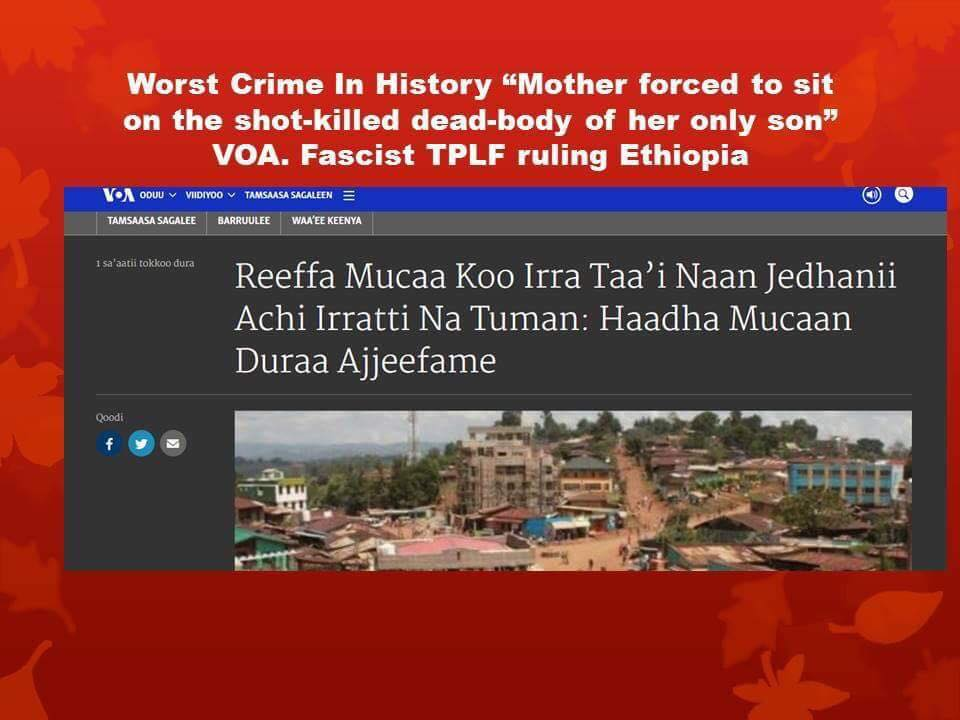
It is an act so savage, so devoid of any norms and values cultural or otherwise, it reflects the psychopathic behavior of forces that do the killings in Ethiopia.
By Alem Mamo, Nazret.com, 9 September 2016

“They killed my son, and they forced me to sit on his dead body while they were beating me.”
If there is any doubt in one’s mind that the regime in Addis Ababa would come to its senses and respect the dignity and sanctity of human life, what happened this week in a western town of Dembi Dolo should put that doubt to rest. An act so cruel, so abhorrent, not just humans, it makes the rocks weep. A mother finds her sixteen-year-old son’s lifeless body covered with blood in the middle of the street, shot by forces loyal to the regime. Arriving at the scene, a mother, as all mothers do, began wailing while holding her son’s body. What followed next was hard to describe and painful to comprehend to any one with a minimum degree of decency. The same forces loyal to the regime ordered the mother to sit on her sixteen-year old son’s dead body as they mercilessly hit her.
It is an act so savage, so devoid of any norms and values cultural or otherwise, it reflects the psychopathic behavior of forces that do the killings in Ethiopia. Ephrem Hailu, the sixteen- year old boy, was simply in his daily routine like any other sixteen-year-old, playing and doing what sixteen-year-olds do. His life was cut short for no apparent reason except the psychopathic killing machines called Agazi have to kill someone to satisfy their addiction of killing.
The regime in Addis Ababa is at war with the Ethiopian people, young and old, men and women are being terrorized and murdered in broad daylight for simply demanding freedom of expression, assembly and respect to the rule of law.
This is the dark and horrifying reality in the four corners of Ethiopia. Mothers are terrified to send their children to school because they have no guarantee they would return home safe. If they escape from the bullets they might not avoid the concentration camps where they are tortured and exposed to malaria infection without any proper medical service. The suffering of the Ethiopian people, particularly the young has reached an intolerable climax. While all peace and freedom loving people in Ethiopia and around the world mourn with Ephrem Hailu’s mother, it is also a reminder that the only way to have safety and security is by ridding the country from a brutal authoritarian rule once and for all.
Recently, I posted a piece titled “Refusing to be adversaries.” In this piece I was given a short poem which was written by a young man who lost his best friend to forces loyal to regime. I was moved by the poem because it describes the sorrow and pain of a mother whose child was gunned down. I have re-posted the same poem (below). It was originally written in Amharic. I translated it to English.
Tears of the moon
Gripped with an overwhelming sorrow
A mother says “I have no tears left
I have cried until I no longer see
I have wailed until I have no voice left
What is sight for, if I cannot see my child?
What is a voice for, if he cannot come to me when I call his name?
Here we have run out of tears.
Instead, our rocks, trees and fields are crying for us,
Here the birds no longer sing,
As they are mourning with us in silence.
The sun, too, weeps as we languish in the burning shadows of oppression,
And the moon sheds tears with us at night, as we hide in our blood stained forest.
When will this end?”
She asks,
“When will we relearn to laugh again?
When will peace reign?
When will the true spirit of humanity return to this land of our ancestors again?
We are collectively tired of oppressionWe are people of an exhausted nation.”
| M | T | W | T | F | S | S |
|---|---|---|---|---|---|---|
| 1 | ||||||
| 2 | 3 | 4 | 5 | 6 | 7 | 8 |
| 9 | 10 | 11 | 12 | 13 | 14 | 15 |
| 16 | 17 | 18 | 19 | 20 | 21 | 22 |
| 23 | 24 | 25 | 26 | 27 | 28 | 29 |
| 30 | 31 | |||||





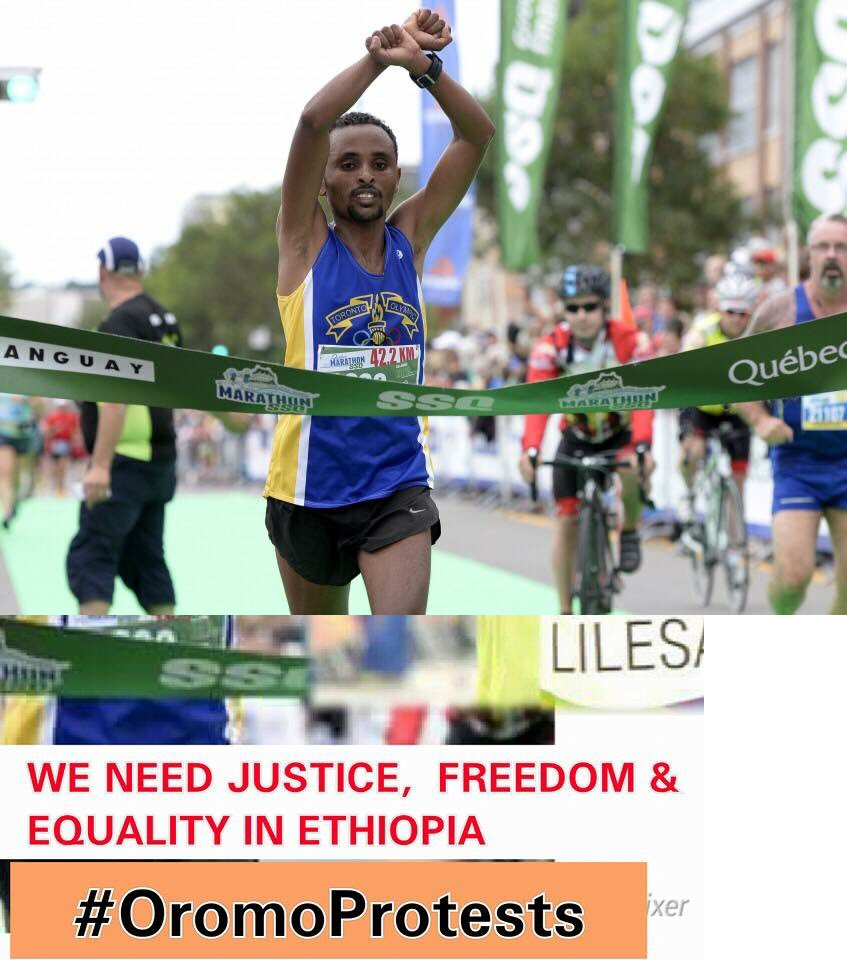


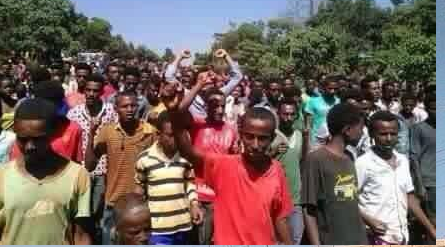


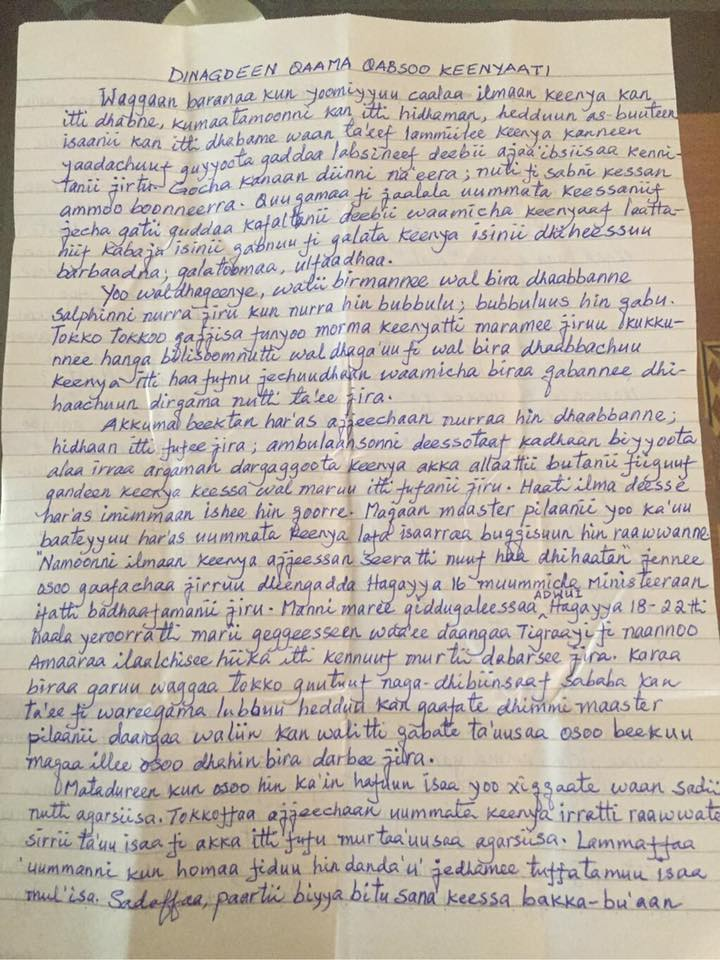
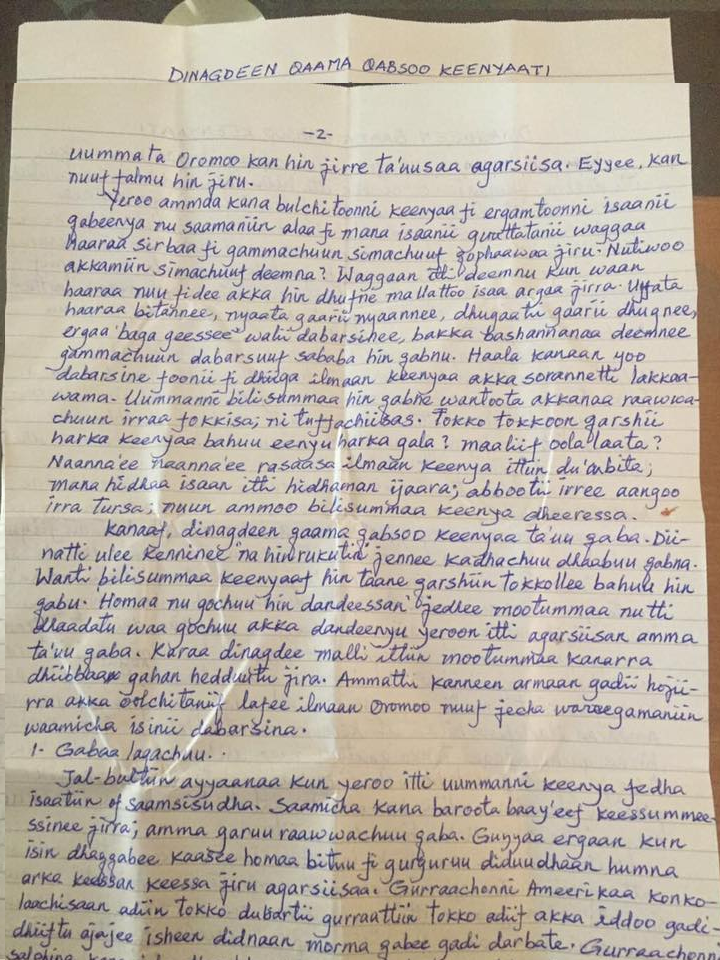
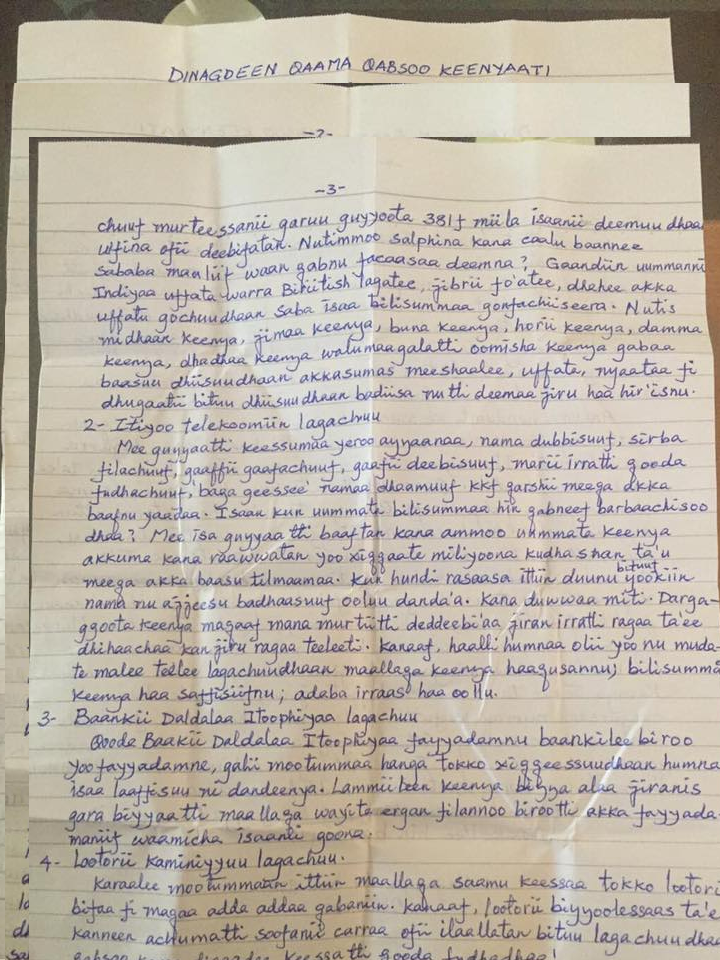
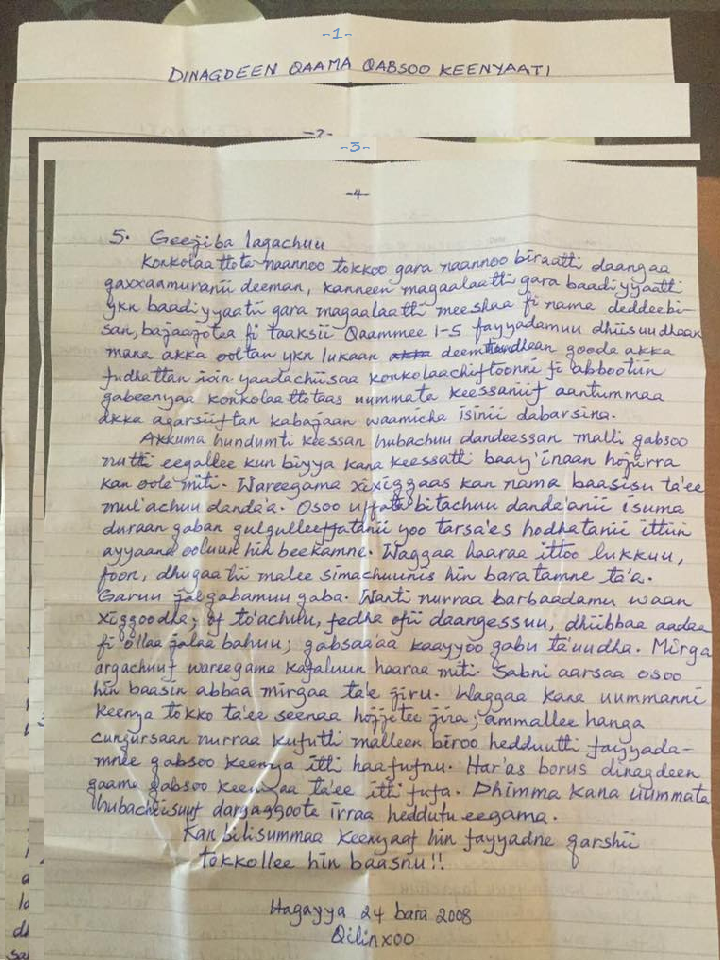


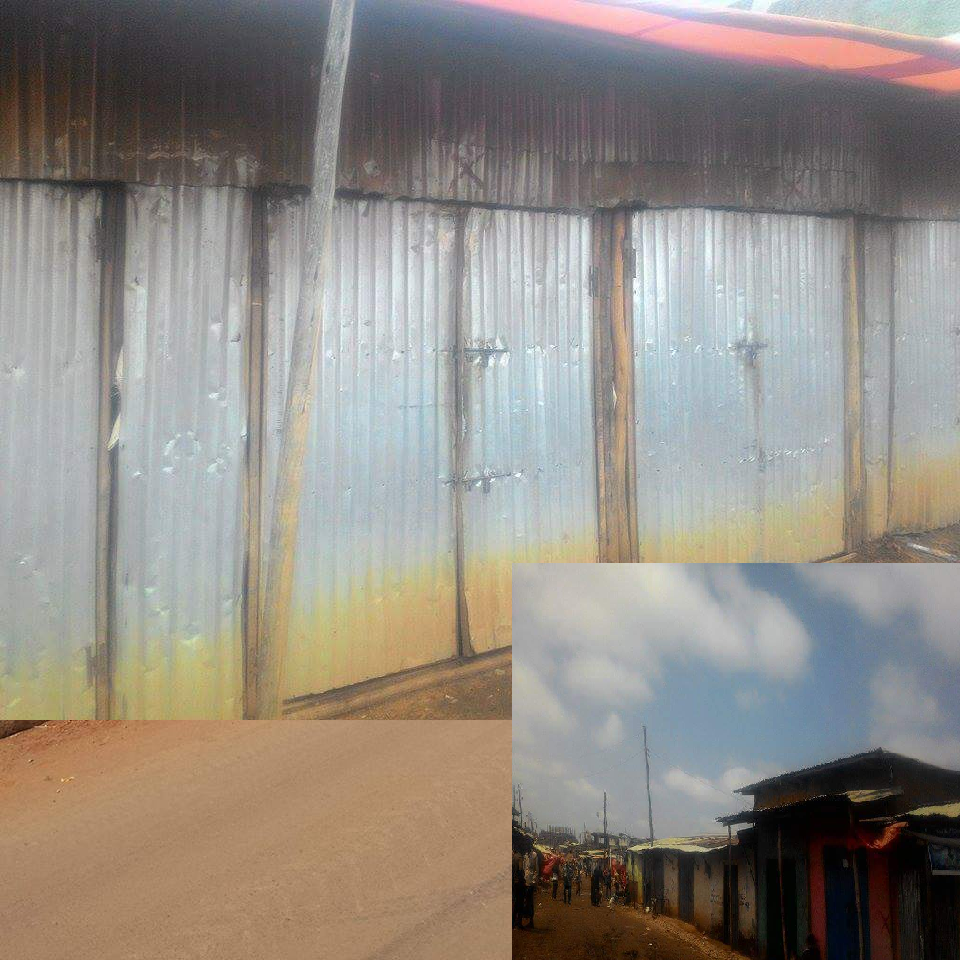


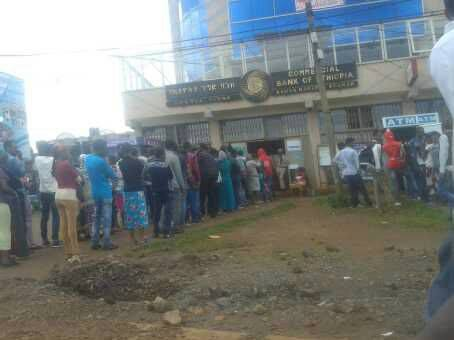
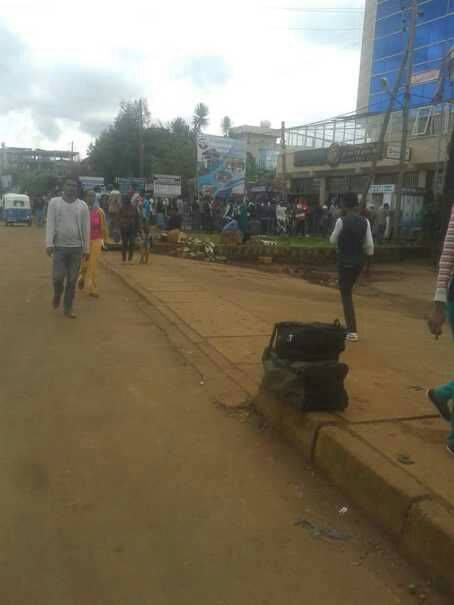
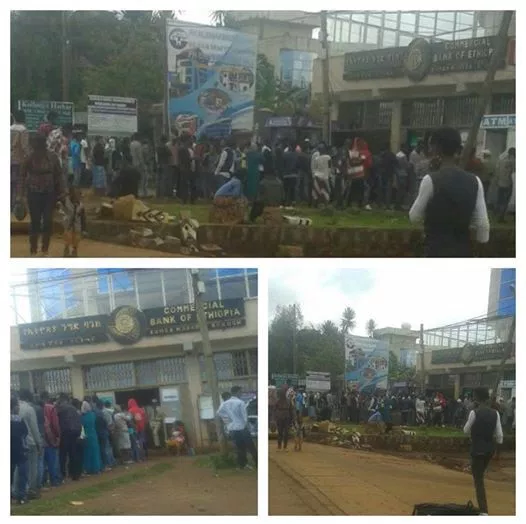

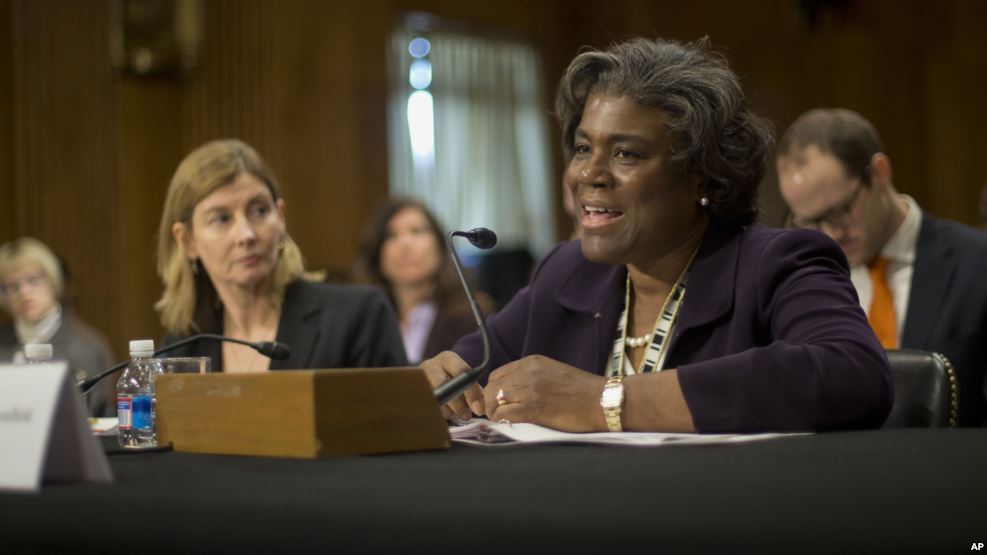


 Oromian Economist