Global Poverty & Development Agendas: Dead Aid, Ethiopia & The West December 17, 2013
Posted by OromianEconomist in Africa, Aid to Africa, Colonizing Structure, Development, Economics: Development Theory and Policy applications, Knowledge and the Colonizing Structure. Africa Heritage. The Genocide Against Oromo Nation, Land Grabs in Africa, Oromia, Oromiyaa, Oromo, Oromo Culture, Oromo Identity, Oromo Nation, Oromo the Largest Nation of Africa. Human Rights violations and Genocide against the Oromo people in Ethiopia, Oromummaa, Self determination, The Colonizing Structure & The Development Problems of Oromia, Theory of Development, Uncategorized.Tags: Africa, African Studies, Dead Aid, Development and Change, Economic and Social Freedom, Genocide against the Oromo, Governance issues, Horn of Africa, Human rights, Human Rights and Liberties, Human rights violations, Land grabbing, National Self Determination, Oromia, Oromiyaa, Oromo, Oromo people, Oromummaa, State and Development, Sub-Saharan Africa, Tyranny, Universal Declaration of Human Rights
add a comment

In excess of 35 million Ethiopians still live in abject poverty subsisting on less that $2 a day while a tiny fraction of the country’s 85 million people has become excessively rich. As more and more ODA is pumped into the country Ethiopia’s HDI rank hasn’t improved (in fact it has gone from 169th in the world to 173rd in the last decade), journalists, academics and opposition figures are still jailed for speaking out against the regime, ethnic minorities such as the Oromo are discriminated against and forced off their lands, corruption and human rights abuses are still rife. Less people may be dying but are ordinary peoples’ lives improving at a rate that warrants the West to turn a blind eye to the crimes of those in power? It may suit certain agendas to do so but it does a massive disservice to ordinary Ethiopians. Read the full text at: http://www.transcend.org/tms/2013/12/global-poverty-and-post-colonial-development-agendas-ethiopia-and-the-west/


http://en.wikipedia.org/wiki/List_of_countries_by_percentage_of_population_living_in_poverty
Related articles
Africa: The Time is not for Currency Unions December 9, 2013
Posted by OromianEconomist in Africa, Aid to Africa, Corruption, Development, Economics, Economics: Development Theory and Policy applications, Knowledge and the Colonizing Structure., Oromia, Oromo the Largest Nation of Africa. Human Rights violations and Genocide against the Oromo people in Ethiopia, Self determination, Uncategorized.Tags: Africa, African Studies, Currency Unions, Developing country, Development, Development and Change, Economic and Social Freedom, Governance issues, National Self Determination, Oromia, Oromo, Social Sciences, Sub-Saharan Africa
comments closed

“If a region as rich as the euro zone has struggled to cope with such pressures, the likelihood that the poorer and less well-governed places hoping to adopt the eco could is tiny.”
‘Under the proposal an initial group of six countries will adopt the eco by 2015 (see map). Five years later the members of the West African Economic and Monetary Union (known as UEMOA, its French acronym), which currently share a currency called the West African CFA franc, are to adopt the eco too, creating a currency union of over 300m people. West African politicians are pushing for further integration because they, like most economists, argue that the single currency for UEMOA has been a qualified success. UEMOA member states are more fiscally disciplined than their neighbours outside the currency zone, says Cécile Couharde of the University of Paris Ouest Nanterre La Défense. The French government currently underwrites the West African CFA franc by guaranteeing to convert it to euros at a ratio of one to 0.0015. That has provided a stability rare in African currencies. Monetary unions also simplify trade: UEMOA has more intraregional trade than any other region in Africa, according to an IMF paper. But the currency union has downsides. UEMOA economies move at different speeds. According to research by Romain Houssa, at the Catholic University of Leuven in Belgium, economic changes are poorly correlated between member states. From 2007 to 2012, the IMF found, the correlation between the business cycle of Senegal, a country with strong trade links outside the zone, and the other countries in UEMOA was almost zero. Consequently, a UEMOA-wide interest rate is not ideal: as in the euro zone, some countries end up with the wrong rate. And an inflexible exchange rate makes economic adjustment difficult. From 2000 to 2012 average annual growth in output in UEMOA countries was about half that of comparable sub-Saharan economies, according to Gianluigi Giorgioni of Liverpool University. Whereas UEMOA’s currency union has drawbacks, the proposed eco zone may have fatal flaws. It would encompass even more economic diversity. Nigeria in particular stands out. Its economy is huge by its neighbours’ standards. UEMOA’s GDP is about $75 billion; Nigeria’s is about $260 billion. The GDP of the next-biggest economy in the region, Ghana, is about $40 billion. And the Nigerian economy is unusual. Unlike most other West African countries it is heavily dependent on oil, which accounts for over a third of output, according to data from the OECD, a club of mostly rich countries. IMF research shows that Nigeria’s balance of trade tends to move in the opposite direction to its neighbours’—they are largely importers of oil. During periods of high oil prices Nigeria may push for interest-rate rises. That would be disastrous for other eco-zone economies, which are likely to be gasping for lower rates. To make matters worse the eco might be vulnerable to speculative attack. France would be unlikely to guarantee it, reckons Mr Giorgioni, as the liabilities would be large and the countries involved are not former French colonies. Without such support, investors would be nervous. Any fiscal laxity would be punished. If a region as rich as the euro zone has struggled to cope with such pressures, the likelihood that the poorer and less well-governed places hoping to adopt the eco could is tiny.’
“In the run-up to achieving a common currency, the East African Community (EAC) nations aim to harmonise monetary and fiscal policies and establish a common central bank. Kenya, Uganda, Tanzania and Rwanda already present their budgets simultaneously every June. The plan by the region of about 135 million people, a new frontier for oil and gas exploration, is also meant to draw foreign investment and wean EAC countries off external aid. “The promise of economic development and prosperity hinges on our integration,” said Kenya’s President Uhuru Kenyatta. “Businesses will find more freedom to trade and invest more widely, and foreign investors will find additional, irresistible reasons to pitch tent in our region,” said Kenyatta, leader of the biggest economy in east Africa.Kenyatta, who is due to face trial at the International Criminal Court on crimes against humanity charges in February, took over the chairmanship of the bloc from Ugandan President Yoweri Museveni, hosting the summit.Kenya has launched a $13.8 billion Chinese-built railway that aims to cut transport costs, part of regional plans that also include building new ports and railways. Landlocked Uganda and Kenya have discovered oil, while Tanzania has vast natural gas reserves, which require improved infrastructure and foreign investment so they can be exploited. Tanzania, where the bloc’s secretariat is based, has complained that it has been sidelined in discussions to plan these projects, but Kenyatta said the EAC was still united. Kenneth Kitariko, chief executive officer at African Alliance Uganda, an investment advisory firm, said the monetary union would boost efficiency in the region’s economy estimated at about $85 billion in combined gross domestic product.”In a monetary union, the absence of currency risk provides a greater incentive to trade,” he said.Kitariko said, however, that achieving a successful monetary union would require convergence of the union’s economies, hinting that some challenges lay ahead.”Adjusting to a single monetary and exchange rate policy is an inescapable feature of monetary union … but this will take time and may be painful for some,” he said, referring to the fact that some countries may struggle to meet agreed benchmarks.” http://www.aljazeera.com/news/africa/2013/11/east-african-nations-agree-monetary-union-20131130175336476127.html
Copyright © OromianEconomist 2013 & Oromia Quarterly 1997-2013, all rights are reserved. Disclaimer.
Death Squad: The Dynamics of Ethiopian State Terror in Oromia December 2, 2013
Posted by OromianEconomist in Colonizing Structure, Economics: Development Theory and Policy applications, Human Rights, Human Traffickings, Uncategorized.Tags: Ethiopia, Ethiopian Empire, Ethnic Cleansing, Ethnocide, Evictions, Genocide, Government, Human rights violations, Land grab, land grab in Africa, Land grabs in Africa, Leo Tolstoy, Liyu Police, Mass killings, Oromia, Oromia Region, Oromo, Oromo people, State terror, TPLF
3 comments

JEL: D2, D6
Death Squad: The Dynamics of State Terror in Oromia
State terror is described as a politically motivated violence, transgression, repression, torture and murder aimed at citizens by authoritarian governments. Jeffrey A. Sluka (2000, p.3) has eloquently defined as:
“State terror refers to the use or the threat of violence by the state or its agents or supporters , particularly against civilian individuals and populations, as a means of political intimidation and control (i.e., a means of repression).”Overwhelming empirical evidence demonstrates state violence has been standard in Abyssinian empire and occupied Oromia in particular.
Researchers have documented that in the end of 19th century alone 5 million Oromos were victims of Abyssinian mass killings. Prominent political leaders, cultural figures, artists, writers and enterpreueners have been murdered. The Oromo sport heroes like Ababba Biqila (during Haile Selassie regime) and Mammo Walde (by Melese regime) were murdered. Who can forget the cold blood murder of singer Ebbisa Adunya by Meles regime killing squad? Who can forget the murder of engineer Tasfahun Camadaa by the same tyrannic state?
Abyssinian rulers has been engaged in state terrorism to maintain the status quo and eliminate the courage and voice for change. Hence, the voice against subjugation has been labelled as terrorism. At present terrorism is a new ideology.
The Oromo society under the Abyssinian system has been regimented by force, fear and intimidiation. There is no recourse to justice. There is no rule of law. The media is wholly controlled by the government, it served to regulate all intellectual, cultural and political activity, and at the same time, to defame the critics and opponents of the ruling regime. There is little room for creative work; the function of art has to be entirely political, the function of a writer no other than that of a partisan. Freedom of Speech, of press, and of association has been systematically curbed. Terror has been employed to enforce obedience. The secret police subjected the dissidents to unscrupulous intimidation and tortures in order to elicit confessions from them. The government is not only annihilated dissidents but also suppressed the opposition within its ruling party. The ruling clique systematically purged the so called anti-peace and narrow nationalists from its rank and file. The Agazi and Liyu Police are conducting systematic mass genocidal killings. Recent research conducted indicates that 0ver 87% of the political prisoners by Ethiopia are Oromo nationals.
https://docs.google.com/file/d/0B-aJwZDI00JQb2RvZmV4Mm5Iamc/edit?pli=1
Reality and Vision: The Way Out
Leo Tolstoy in his masterpiece and one of the greatest novels in any language on the earth, War and Peace put forward the following compelling historical assertions:
‘All historians agree that the external activity of states and nations in their conflicts with one another is expressed in wars and that as a direct result of greater or less success in war the political strength of states and nations increases or decreases. Strange as may be the historical account of how some king or emperor, having quarrelled with another, collects an army, fights his enemy’s army, gains a victory by killing three, five , or ten thousand men, and subjugates a kingdom and an entire nation of several millions, all the facts of history (as far as we know it) confirm the truth of the statement that the greater or lesser success of one army against another is the cause, or at least an essential indication, of an increase or decrease in the strength of a nation – should obliged that whole nation to submit. An army gains a victory, and at once the rights of the conquering nation have increased to the detriment of the defeated. An army has suffered defeat, and at once a people loses its rights in proportion to the severity of the reverse, and if its army suffers a complete defeat the nation is quite subjugated.’
Tolstoy’s logical insight and historical depiction of conquer and conquest well describes the grim realities and experiences of Abyssinian and Oromian saga of 19th and 20th century and also of the present day. As a result of the defeat of the Oromian defence, Oromia has lost its rights and the power of Abyssinia stretched over Oromia to the extent of the destruction of the independent existence of Oromia and its capital Finfinnee.
As a result, the people of Oromia become dehumanised, the conquered and the colonised subject of Abyssinian oppressors. The consequences of this tragedy in development studies are what Wilber (1988) calls ‘convoluted history and convoluted development.’ This can succinctly and elegantly depicted through the Paulo Freire’s (1988) terminology of educational process also known in his world view of the development process of the oppressed as the pedagogy of the oppressed. Development in this framework taken as the recitation, in human history, of the progressive freeing of peoples and nations from the domination of nature, peoples and other nations. Accordingly, in terms of Wilber (1988): ‘Development becomes the means, not the end, for the end is to enhance what people value. Development or growth is desirable only if it is consistence with people’s deepest values.’ Development cum liberation is a means to overcome oppressive and exploitative forces of all kinds. In order to achieve those ‘deepest values’, people who are the subject of the development process have to able to hold these essential key and locus of power of this very process and their density. In the context of Oromia, the lack of holding this essential key kept the country and the people in the present grim nature development process, the underdevelopment or low level development trap.
In Tolstoy’s 19th century trajectory, Russia had to liberate itself from Napoleon (France). In the Trajectory of pedagogy of the oppressed, Freire (1988) : ‘The oppressed, having internalised the image of the oppressor and adopted his guidelines, are fearful of freedom. Freedom would require them to eject this image and replace it with autonomy and responsibility. Freedom is to be acquired by struggle, not by gift. It must be pursued constantly and responsibly. Freedom is not an ideal located outside of man; nor is it an ideal which becomes myth. It is rather indispensable condition for the quest for human completion.’ From both writers, in their evocative delineations of human experiences, we come to understand that the compelling realities of nations like Oromia and its people that they have to empower themselves and do their best to earn their intimate values.
The Critical Minimum Effort: What Role for Oromummaa?
Oromian Freedom Function
Bilisummaa (Freedom) is a positive function of Qabsoo (Struggle) and Tokummaa Oromo (Oromo Unity) (T) and the Spirit of Oromummaa ( here in after the O factor). These three variables together form the minimum critical efforts (MCE) for Bilisummaa. They are not just mere positive factors. Rather they are real causations.
B= f(Q,T,O)
Garbummaa (Subjugation cum slavery), the inverse function of bilisummaa is the positive function of Abyssinian occupation (A), Neo Gobanaa’s factor (N factor) and Lack of Oromo unity(L) and Unoromummaa (U) (lack of the Spirit of Oromummaa). These three variables (ANL) together form the primary factors or causations of Garbummaa.
G= f(A, N, L, U)
Garubummaa (G) is the negation of Bilisummaa (B) and vice versa. The N factor is the negative of the O factor and vice versa.
http://www.unpo.org/article/13167#.TmlG41taQqc.facebook
http://www.gadaa.com/culture.html
Interview with Oromo farmer who was uprooted by TPLF instigated conflict beween Oromos and Ogadenians
‘Waraannii naannoo Soomalii, Oromoo daangaa Soomaletti dhihaattu ammaas weeyrare, namni kumaan lakkaawamu
balaa haarayaaf Saaxilaman. Gabaasaan Mayyu (ona Anniyyaa) irraa nu dhaqqabe akka mirkaneeysutti. Waraannii dhaabbataan
naannoo Soomalii kan Ogaaden fii loltoonni Liyyuu Polis kan Ogaaden keeysatti ummata shoorarkeeysuun beekkame, daangaa naannoo Oromiyaa cabseee, lafa Oromoo Anniyyaa, Mayyuu Muluqee humnaan dhuunfate. Akka gabaasaa tanaatti, torbaan dabre guyyaa
Salaasaa, tuutni loltoota Somalee lamaanuu harka tokko tahanii Oromoorratti waliin bobbahanii jiraattoota Oromoo kanneen naannoo Mayyuuqubatan balaa guddaa irraan gahanii jiran. Gaafa dura humna waraanaatiin dhufanii Oromiyaa dhunfatan, Wayyaaneen Ummata
Oromoo kan amma wayyaba tahe saba xiqqatti deebisuun nidandayama yaada ja’u Mallas dubbatee ture. Sagantaa dabaa, tan ummata Oromoo xiqqeeysuufii lafa isaa dhiphisuu kana hojiirra oolchuuf Wayyaneen, ollaalee Oromiyaa gara hundaan hidhachiiftee Oromoorratti bobbaasaa jirti. Humni Liyyuu Poolis, humna wayyaaneen jaartee hidhachiifte tahuun hubatamaadha. Tarkaanfiin Liyyuu Poolis fii humna waraana Ogaaden kan amma Mayyutti bobbahee kuni Oromoo lafa isarraa buqqisani saba biraa qubsiisuuf sagantaa lafa kaayyame dalagatti
hiikuuf duula walirraa hin cinne tahee jira. Akka kanaan baatii ( ji’a ) jahan dabre baha Oromiyaa kutaa Harar, Oromoota Anniyya, Oromoo Jaarsoo tiifii Oromoo naannoo Mi’eeysoo qubatan lafa isaaniirraa buqqiftee Ogaadenootaafii Issaaf kennanii ummatoota Oromoo fii Soomalee jiddutti xifaa uumani jiran. Baatii April tana keysa, lafa Anniyyaa ona Mayyuu irratti duulli gara Ogaadeniin baname Oromoo kumaatamaan lafa isaa, Mayyurraa buqqisee jira. Oromoon meeshaa,humna waranaatiifii lojistikii (logistics) akka isaanii waan hin qabneef lola itti baname dura dhaabbatuu hin dadeenye. Warri Oromoo Anniyyaa, Jaarsoofii Mieeysoon lolaa jiru kun eenyu faa? 1, Waraana
mootummaa naannoo Soomalii fii,2, waraana addaa ka liyuu police ja’amu, ka wayyaaneen akeeka ykn dalagaa tanaaf qopheeyfatte. Mayyu lafa jidduu Cululiifii laggeen Ereriifii Gobeelle jiddutti argamti. Lafti Mayyu ja’amtu tun hedduu guddoodha. Dheerinni isii kaabaa kibbatti km 350 ni caalti, baharraa dhihatti KM 180 ni caalti. Lola haaraya kanaan Qabeenyi Anniyyarraa a’ame (saamame); Loon 475, Gaala 25 fii Harree 15. Ummanni Oromoo Anniyyaa kan ona isaarraa buqqa’ee Huusetti walitti qabamee jiru 500,000 ni gayan ja’ama. Namoonni taniis ni jira. Lafa qonnaa kani duraan qabaniifii oomisha isaanii akkasumatti dhiisanii biraa baqatan. Ummanni Oromoo qawwee gayaa
hin qaban. Bakka heddutti mootummaanirraa hiiktee jirt. Hanga xiqqaa harkatti hafeef ammoo rasaasa hin qaban. gara geejjibaatiin
akkasumatti ir’ina guddaa qaban. Yeroo kuni tahu Soomalootaafii Wayyaanota hidhannoo fii rasaasni konkolataa, xayyaaraa fii gaalatti
fe’mee jala deema. Karaa biraatiin yoo Oromoon Anniyya humna waraana Soomalee kan ofirraa dhawan OPDOn hidhannoo ni hiikkachiifti.Torbaan dabre yeroo ummanni Oromoo Anniyyaa humna Soomalee ifirraa ittisuuf tattaafate, OPDOn ajaja Wayyaneetiin amoota Oromoo kudhanirraa qawwee hiikanii turan. Balaan ammaa tuni tan Anniyya, Jaarsoo fii Mi’eeyso qofa xiyyeeffattee miti.
Balaan tuni tan Wayyaneedhaan karoorfamte; balaa duguugiinsa shanyiiti. Kanaafuu Oromoon gara hundaan harka walqabatee, duguuginsa
shannyi kan akka ummataatti isaan aaggate kanarraa if eewaluu qaba.’ Source: Oromo social networks, 7th May 2013
“The research and information unit of the Oromo Liberation Front (OLF) has conducted a study on the allegiance that accounted for some political prisoners to be sentenced or otherwise been unjustly detained. The herewith attached partial list of political prisoners has been collected from prisons of Kaliti, Torhailoch (Military Police Prison), Maikelawi and Kilinto. Almost all prisoners are charged for act of terror, violation of territorial integrity, attempts to overthrow the constitutional order by violent means and being suspected member of OLF or any other organizations. These political prisoners are ranging in age from young high school and University students to elderly civic society leaders. Professionally, they are also diverse – from farmers, businessmen, government employees, political leaders, journalists and etc. The overwhelming portions are Oromos and some are also from different nations and nationalities of Ethiopia. Most of these political prisoners already gave prison service for several years; many of them are tortured and subjected to irreversible mental damages, and some of them were shot to death in the course of time. Since the fall of Transitional Government in 1992, Ethiopian authorities continued to severely restrict basic rights of freedom of expression, association, and assembly. Violation of human rights is a daily record of the regime. Instead of solving the root cause of political conflict, it rather declared war on the Oromo people and its vanguard Organisation, the OLF. Consequently, many thousands of Oromos and other nationals were arbitrarily arrested and detained and remain at risk of torture, ill-treatment and extrajudicial killings. Many of them were executed during peaceful demonstrations due to excessive use of force by police or security agents. The TPLF regime promulgated and adopted the restrictive Anti-Terrorism Proclamation in 2009. This regime, which from its very initial, was known for its massive human rights violations is currently using this law to justify all atrocities it conducted. In this attempt to hood wink opinions of the international community, the EPRDF regime is still trying to make others believe that the current problem of the empire is act of terror but not deep rooted political conflict of domination. The OLF vehemently opposes any forms of terrorism and reject the use of terrorism neither as a form of struggle nor also for suppression of dissidents by states. Thus, we denounce the Ethiopian state terrorism that is used to crush any form of struggle and decent. OLF is cognizant of, and appreciate the concern of various human rights advocating organizations and some democratic governments that expressed their concerns about Anti-Terrorism, Press and Civic society laws of Ethiopia on various international forums. In a country like Ethiopia where the government structure is monopolized by a single ethnic group, legalizing the abuse of the universal human rights is a way that leads for the establishment of a totalitarian system which is more sustaining than a simple personal dictatorship. Therefore, OLF alarms that the dangerous political development sustaining over Ethiopia demands more than just a concern but towards a proactive action of the international communities and UN member states. We denounce legalized form of state terrorism and call up on the international community to exert diplomatic pressure on Ethiopian government to release all political prisoners unconditionally and repeal these brutal and repressive laws.”
‘The study confirms that there is clear nexus between authoritarian rule,
man-made famines, and genocide in Ethiopia.’
http://www.codesria.org/IMG/pdf/Mekuria_Bulcha.pdf
Copyright © 2013 & Oromia Quarterly 1997-2013, all rights are reserved. Disclaimer.
Related articles
- A Mafia Paradise – the Ethiopian Empire (odaakoo.wordpress.com)
- Ethiopia: Academic Institutions Are Meant to Teach; Not to Serve As Political Tools (freedomfororomo.wordpress.com)
- Imposing Apartheid Like Segregation in the Name of Development (oromoland.wordpress.com)
- Development and Investment as a Reason for Land Grabbing in Oromia from the Farmers (freedomfororomo.wordpress.com)
- Government Corruption, Exploitation of Indigenous Peoples and Environmental Disasters: The Case of Yayo Oromia Deforestation (oromianeconomist.wordpress.com)
- Oromia: Mass Media Under Arrest – World Press Freedom Day (freedomfororomo.wordpress.com)
- Oromia Mass Media Under Arrest (advocacy4oromia.org)
- Ethiopia: Loss of Lives and Displacement Due to “Border Dispute” in Eastern Ethiopia (freedomfororomo.wordpress.com)
- The Ordeal of Legendary Oromo Artist Fayessa Furi (freedomfororomo.wordpress.com)
- Unsettling Patterns of Genocidal Massacres Against Oromo in Oromia, Ethiopia (advocacy4oromia.org)
WHy The Aid To Africa Has Failed? December 1, 2013
Posted by OromianEconomist in Africa, Aid to Africa, Corruption, Development, Dictatorship, Economics, Economics: Development Theory and Policy applications, Oromia, Oromiyaa, Oromo, Oromo Culture, Oromo Identity, The Colonizing Structure & The Development Problems of Oromia, Uncategorized.Tags: Africa, African Studies, Aid to Africa, Developing country, Development, Development and Change, Economic, Economic growth, Horn of Africa, Human rights, Oromia, Oromo, Oromo people, Sub-Saharan Africa
add a comment
“Never mind that Africa receives roughly $50 billion in aid annually from foreign governments, and perhaps $13 billion more from private philanthropic institutions, according to Penta’s estimate. Never mind that Angola’s oil revenues are around $72 billion, and Nigeria’s $95 billion; that Africa boasts at least 55 verified and somewhat detached billionaires. I can testify that Africa is much worse off than when I first went there 50 years ago to teach English: poorer, sicker, less educated, and more badly governed. It seems that much of the aid has made things worse.”
Here is in the following the renowned author Paul Theroux discusses why Africa’s aid industry is in a mess. For the details and original source please refer to:
‘In its naked reality, Africa, the greenest continent, is still the most beautiful, the least developed, the wildest on earth. Vast plains, big animals, hospitable people, who have been enslaved, sidelined, colonized, and converted willy-nilly either to Christianity or Islam. This receptive amphitheater of goodwill and big game, inspires megalomania among its foreign visitors who strut upon it — it has always done so, for those who seek the singularity of a little excitement and glory. I sometimes think that if the poorer counties of America’s Deep South had rhinos and elephants, instead of raccoons and possums, the philanthropists might direct their attentions to those parts, too.A rich white donor in black Africa is a study in high contrast that puts one in mind of the gallery of role models: Tarzan, Mr. Kurtz, King Leopold, Cecil Rhodes, Livingstone, Mrs. Jellyby, Albert Schweitzer, Hemingway, Henderson the Rain King: the overlords, the opportunists, the exploiters, the visionaries, the hunters, the care-givers, the baptizers, the saviors, all of them preaching the gospel of reform and seeking a kingdom of their own, if not an empire.Henry David Thoreau, the 19th-century American author, believed that all such outgoing people had something discreditable in their past that through giving they aimed to expiate. And all are characterized by the rather touching innocence of a billionaire faced with the brutal truth that the relative simplicity of acquiring wealth is nothing compared to the extreme difficulty of giving money away, for the common good.’
‘The real helpers are not the schemers and grandstanders of the eponymous family foundations or charities; they are nameless ill-paid volunteers who spend years in the bush, learning the language and helping in small-scale manageable projects, digging wells, training mid-wives, teaching villagers that unprotected sex spreads HIV; and among these stalwarts are the long-serving teachers who have liberated Africans by simply teaching them English, and are still doing so, even as they make the local governments lazier. The so-called White Fathers (the Society of Missionaries of Africa) I met in Malawi who ran upcountry clinics used to say, “I guess I’ll be buried here.” No one ever says that now, and significantly none of the people I spoke with for this piece ever expressed a wish to spend any serious length of time in Africa. None speaks an African language. To the detriment of their aims, they are on better terms with the African politicians than the common ruck of African people. Years living simply on the ground in Africa convinced me that there was more for me to learn from Africans than to teach. I saw there were many satisfactions in the lives of people who were apparently poor; many deficits in the lives of the very wealthy. I saw that African families were large and complex and interdependent; that old age was revered, that Africa’s link to the distant past — to the dawn of the world — was something marvelous and still intact in many places. Most of all, I was impressed by the self-sufficiency of ordinary people. Without much in the way of outside help, the people in the countries I knew managed to endure, usually through the simplest traditional means, and finally to prevail. Africa has the schools, the money and the resources to fix its own problems; it’s appalling to think of donors telling them otherwise, of the whole continent terminally indebted and living on handouts.’
‘Never mind that Africa receives roughly $50 billion in aid annually from foreign governments, and perhaps $13 billion more from private philanthropic institutions, according to Penta’s estimate. Never mind that Angola’s oil revenues are around $72 billion, and Nigeria’s $95 billion; that Africa boasts at least 55 verified and somewhat detached billionaires. I can testify that Africa is much worse off than when I first went there 50 years ago to teach English: poorer, sicker, less educated, and more badly governed. It seems that much of the aid has made things worse. I am not alone observing this fact. In his new book, The Great Escape: Health, Wealth, and the Origins of Inequality, economist Angus Deaton questions the usefulness of all aid, and describes how the greater proportion of the world’s poor are found not in Africa but in the booming, yet radically unequal, economies of China and India. Zambian-born economist Dambisa Moyo calls aid a “debilitating drug,” arguing that “real per-capita income [in Africa] today is lower than it was in the 1970s, and more than 50% of the population — over 350 million people — live on less than a dollar a day, a figure that has nearly doubled in two decades.” The Kenyan economist James Shikwati takes this same line on aid, famously telling the German magazine Der Spiegel, “For God’s sake, please stop.” There have, of course, been a few successes. For all his faults, Bill Clinton’s strong-arming of pharmaceutical companies to lower the price of one-a-day AIDS medications, to less than a dollar per pill, has delivered real relief to Africa’s most vulnerable. But we also need to be honest about such grandiose ambitions: Most fail. (For lessons on what to avoid and what to do in order to execute effective philanthropy in Africa, see the box at end of story.) The most recent example of a Westerner running amok in Africa appears to be the celebrity-economist Jeffrey Sachs and his $120 million effort to end extreme poverty there. Nina Munk documents in her book The Idealist (see Penta Sept. 12) how, among other things, Sachs’ Millennium Villages Project poured $2.5 million over three years into a sparsely populated community of nomadic camel herders in Dertu, Kenya, and trumpeted its success. In actual fact, the charity’s paid-for latrines became clogged and overflowing, the dormitories it erected quickly fell into disrepair, and the livestock market it built ignored local nomadic customs and was closed within a few months. An incensed Dertu citizen filed a 15-point written complaint against Sachs’s operation, claiming it “created dependence” and that “the project is supposed to be bottom top approached but it is visa [sic] versa.” ‘
African Philanthropy Done Right
Foundation Source is the philanthropic advisor and partner to over 1,100 family foundations. Penta asked the organization’s chief philanthropic officer, Page Snow, to provide some basic guidelines on how to successfully execute philanthropic projects in Africa. Her advice:
“Beware the panacea. Millions of dollars are wasted on overly ambitious projects claiming to be a ‘killer app.” Projects that employ tried-and-true interventions, narrower in scope, usually have far greater impact. Demand responsible management. Ask tough questions if money is flowing into a charity, but isn’t flowing out to charitable causes. Avoid duplication. Be aware of other efforts already on the ground and make sure that your program isn’t a wasteful repeat but, preferably, leverages off what’s there. Support local, sustainable solutions. Avoid short term fixes by always seeking input from locals; plan for them to run the project on their own in the long-run. Beware of poor infrastructure projects. Make sure wells are dug where they’re actually needed, that the bridges and roads are integrated into existing plans by government or other NGOs.Use technology intelligently. Over 90% of households across sub-Saharan Africa don’t have access to electricity for their everyday needs, let alone power for laptops. Make sure locals have the skills, resources, and necessary tools to keep tech-dependent elements of your philanthropic project running. Be prepared to face corruption. Even when a project has been granted governmental approvals, there’s no guarantee of official cooperation; corruption and regional conflicts pose considerable challenges. Be culturally appropriate. Put on your anthropologist’s hat. Africans have their own process for dealing with grief and loss; Western-style grief counselors following a natural disaster or war aren’t appropriate.”
Copyright © Oromianeconomist 2013 and Oromia Quarterly 1997-2013. All rights reserved . Disclaimer.
Exploitative Investment Opportunities In Naked Africa November 19, 2013
Posted by OromianEconomist in Africa, Colonizing Structure, Corruption, Development, Dictatorship, Economics, Economics: Development Theory and Policy applications, Land Grabs in Africa, Oromia, Oromiyaa, Oromo, The Colonizing Structure & The Development Problems of Oromia, Theory of Development, Tyranny, Uncategorized.Tags: Africa, African Studies, Development and Change, Economic and Social Freedom, Governance issues, Human Rights and Liberties, Land grabbing, Land grabs in Africa, National Self Determination, Oromia, Oromo, Oromo people
add a comment
“Free market works only if there is no asymmetry. For there to be a free market and pure capitalist growth, there must be a powerful judicial system, corruption must be minimal, competition must be protected and preserved and oligopolies, banned. With these pre-conditions being scarcely present, will it be reasonable to promote capitalism in flagrantly corrupt, oppressive and deprivation riddled Africa?” –Dr. Peregrino Brimah
“Typically, narratives about Africa have been shaped by non-Africans and not been particularly complimentary. Whether through images of emaciated children fending off flies from their faces or stories of wild-eyed assault-rifle toting warlords, Africa for many has become synonymous with poverty, helplessness, and hopelessness.But in recent years, these stereotypes have been increasingly challenged by proponents of new narratives, ones that seek to reclaim Africans’ agency and emphasise the continent’s positive trends. Evangelists of these new discourses are often Africans themselves and aim to articulate the visions, histories, philosophies and aspirations of Africans, that have for so long been suppressed and misrepresented on the global stage. …One feature of many African economies which continues to define Africa’s relationship with the global economy is its continuing dependence on foreign aid. While Ethiopia is heralded as one the continent’s rising stars, for example, some estimate that 90% of its annual budget is derived from donor funding. Meanwhile Malawi, another aid darling, gets40% of its national budget from foreign benefactors.” Think Africa Press
The following is interesting and timely debate on issues of Africpitalism and whether free market system is working in African environment of flagrant corruption, absence of rule of law, minimal competition and oppressive politics.
‘Africapitalism sounds exciting, but before capitalism can be approached, there are prerequisites. The United States sells bonds and these are purchased based on “trust”. Trust is key in a successful capitalist society. Can we say that Africa has gotten to a stage where trust exists? Many will disagree. Can there be a free market where there is no middle class? This is the reason why the United States gives monthly employment records. There are two factors that predict the success and viability of capital societies—the employment report, which indicates purchase power; and the tax system.Nigeria was recently reported as the only country in the world where illicit cash flows were more than taxes paid. The rest of Africa shares these parameters. What is the suitability of capitalism in such societies? How does it benefit society and government? With unemployment levels in high double digits in sub-Saharan Africa, is capitalism the next best venture for such economies? Who will buy non essentials? This is where the bordering-on-insensitive reality of today’s Africapitalists features. As, in reality there are no jobs and no middle class, capitalists in Africa focus on investment and maximizing profits in essential utilities and not unessential/luxury items as obtains in Europe and America.“Utilities” like power, water, construction materials-cement, communication and even roads are the sole ventures the Africapitalists have invested in, knowing well that only in these areas can they secure sure sales and tasty returns on investment. It takes a certain amount of innovativeness and skill to develop a “luxury” non-utility product, market it, compete in a free economy, sell it, and to provide customer service and support for it. Africapitalists do not venture there. They simply work with their friends in the government to handle essentials of existence: Transportation, communication, power and construction. They have no marketing skills or plans. They lack innovative skill and intent. Thanks to government enforced monopolies; they have a simple secret of success and market schema—construct or die. Drive or die. Communicate or die. Eat and drink or die. Power your property or die. Their success is enforced by the government in top-down policies, banning all small business and middle men competition. In the Africapitalist expert, Elemelu, CON’s report, he mentions that he believes government should enable private sector growth with equity and transparency, without top-down management. The question to the Guru’s theory is—will he and other Africapitalists venture into any of their recent investments, like cement, mobile communication and power if they were not assured by the government of a dissolute top-down, authority enforced oligopoly to disable competition and enforce purchase at their rather, ridiculously inflated prices? Here we detect possible untruth and hypocrisy. The recent (November 13th, 2013) Afrobarometer report, surveying 51,000 Africans found that over half felt their governments did a shoddy job of controlling corruption. Currently at 54%, this was an increase from 46% 10 years ago. In contrast to the wealthy, poorer status was not surprisingly linked with greater reports of corruption and distrust. Apparently, Africa’s rich are invested, beneficial and insulated partners in the corruption. What will a campaign of ravenous capitalism predict for the future of the people with the present corruption parameters? Is there a safety-net for the poor of the continent?Publishing on a so-called Africapitalism is the bold promotion of a personal interest and brand. This is expected in the interest of self-preservation, but is clearly not honest and reflective of reality and not in the best interest of the continent, at this point in time. What is beautifully branded and offered is get-rich-quick, risky but equally rewarding, exploitative investment opportunities in naked Africa. The growing gap between the rich and poor in Africa only promises to be expanded as capitalist development is culturing underdevelopment in the continent by reinforcing exploitative dependence. The greed and selfishness of capital accumulation and market profit-seeking have been at the root of divisionism, ethnic chauvinism, tribalism and dissension in Africa. With this new Africapitalist push to divert Aid funding and foreign investment, the money that is touted as supporting the continent’s poor, is now being incriminated in financing bloody political divisionist and ethno-fractioning campaigns that the private big business sector is historically credited with in Africa’s struggling and prone democracies. An important question to ask when considering Africapitalism is; where does the Africapitalist want to take Africa to? It is important to define what the expected outcome of Afrocapitalism is, as with any other mantra, venture or policy. This end direction is hard to deduce reading through all the current material on Africapitalism. Is it all about ensuring profit for business? Is the goal the provision of jobs to Africans? Is the goal, the development of Africa?Most perturbedly: Is there a single Africapitalist product, solid and competitive enough that it has/is/can be marketed outside Africa? Is the goal of the Africapitalist, global export or rather a closed exploitative marketing to Africa, like the historic “Robber Barons” of 19th century USA?The Afrocapitalism agenda appears to be marketed toward foreigners, in soliciting foreign investment in Africa, or actually, the diversion of Aid money into African big corp. One must agree it is a great pitch for diverting the foreign Aid money through the cabal. A really super pitch! We must thank Dambisa Moyo’s “Dead Aid” –for rightly criticizing Aid—and the Nigerian “sharper” mind for this latest cabal “hustle.” That Aid money must not be lost, right?Why is democratic Africa suddenly appealingly marketed to foreign investors by its Africapitalists —with evidence— as promising quadruple the return on capital investment and bonds? The answer is simple. It is the result of the “trust,” not of African governments or clime, but of the mutually beneficial, co-dependent relationship between the political leadership and their private sector sponsors. Government radical support for oligopolies and total lack of regulation of private-sector provided utilities creates an atmosphere for frank exploitation of the masses. End utility-essential products are sold at terribly inflated, quadruple global prices to the poor who have no protection and are allowed no alternative.Talking about protection and dependency: If/when we open our doors to foreign Africapitalists, the so-called “philathrocapitalists,” are we going to encourage our farmers to sign-up for the “Golden rice,” and “WEMA,” genetically modified, patented seeds from Monsanto and the Bill Gates foundation, which will make them loan dependent in order to purchase new modified, dangerous seeds every year, eventually further crippling and destroying the farming sector? Haitians burning donated Monsanto seeds despite their post-quake hunger, comes to mind. Will the cabal protect us from hurt and extortion? This has not really been the strong point of Africa’s rich men, has it?We ask earnestly; what system exists for the protection of the masses? Even the United States, the capitalism capital of the world is being shut-down due to capitalisms shortfalls. The Occupy Wall street protests which were brutally quieted, which exhibited 99% protesting against 1% who virtually control 99% of US income, is a pure demonstration of the result of capitalism; and this in a society that has some regulations.In the US, corporate bodies, aka, Wall Street virtually controls the government. The least Africa can do is learn from the tribulations of others, which have led to a global recession that continues to cause massive unemployment, austerity and suffering in European nations , than utilize and advertise Africa as the next and last frontier of capitalist invasion.There is no food on the continent. There is stark corruption. There is poor governance. There is marked inequality. Purely capitalist ventures have been proven to never alleviate these issues, but to only foster greater deprivation, corruption and poverty while in the job-creation regard, they only provide transient slavery-like employment status for a few, while for the majority, they cripple small businesses and lead to greater job insecurity and financial dependence. Are we thinking about environmental economics? Economics of the poor? What is the sense in manufacturing cars, while we import rice? (Both ending up at more expensive prices than if we did it the other way around.)There are different types of economies. There is the China model, which is a manufacturing economy. In China, the government has supported millions of cottage industries which compete freely and are protected by the government and assisted in exportation of their products around the world. China today is one of the strongest economies in the world.A focused Dubai has a thriving trade and tourism economy. The state runs a “centrally-planned free-market capitalism” system, and this government controlled system has fostered growth with only 3% revenue from oil. A responsible government which monitors and ensures a favorable and stable society for foreigners, has sustained Dubai among the UAE states. Dubai did these things in less than 5 years. Can we not likewise develop systems tailored around our competitive and progressive advantages, without selling the people?What is in the best interest of African nations? There is great land, there is great resource, and most of all, there is the invaluable human capital. Is it to maximally exploit the continent in capitalistic ventures? Or to develop the human potential, to exploit the land and resource while ensuring the proper appraisal of Agricultural and mineral produce to promote individual and communal wealth that can now, while protected by the government, foster small-business growth and national growth? Or is it to empower a handful of super-rich Africans and their foreign invited investors to operate “toxic” industrial monopolies which will employ a percent of the population in perpetual bondage, and then maximize profits by government enforced oligopolies—marketing essential utility goods to the large catchment African population? Evidently, Africapitalism should be seriously reconsidered and debated. Before we fight to put Africa’s Aid into the hands of the Cabal and put “capital” and “profiteering” first, how about we put, “eradicating corruption,” “people,” “land,” “small business” and “Innovation” first? Trade was not invented yesterday. Common, we are all businessmen. Yes, the government must support industrialism, but not in discriminatory fashion, with advantage given to the Oilgarchs. My challenge to the Africaptalists: Let us see you produce and successfully market a single non-essential product or service within the environment of a free market to Africa and abroad. Generate power and sell it competitively, without first buying the nations grids and inhibiting state and populace power generation and sale. Manufacture cars and compete in their sale, without first banning the importation of “tokunbo” vehicles. Then we will agree that you are truly and honesty engaged in “powering Africa.” And to us commoners, we can’t sit and keep blaming the Cabal for coming up with these master schemes, each and every time. The Cabal can only think the way they know how. We the people need to rise up fight and challenge and chart our own course. Africa does need its founding fathers to develop its “strategic vision,” but not of these crop. For now, when it comes to a choice between being a slave for a white master—through Aid— or slave for an African Cabal, I think we humbly choose neither. If you want, you can keep the Aid, but please, never use it to empower those that got us and keep us “here,” any further.’
Read the full article from:
http://saharareporters.com/article/africapitalism-good-or-bad-africa-dr-peregrino-brimah
http://en.wordpress.com/read/post/id/56832612/24/
‘According to Dambisa Moyo, Zambian economist and author of Dead Aid: Why aid is not working and how there is a better way for Africa, Africa has received at least $1 trillion of development-related aid from developed countries over the past 60 years, and this has not only flattered prognoses of African development, but fostered dependency and perpetuated poor governance. Although aid may be beneficial in the short-term, so long as African nations are dependent on overseas aid for public services and development, buoyant Africa rising narratives seem premature. Economic growth so heavily bolstered by overseas aid cannot be organic, stable growth. Furthermore, this ongoing dependency perpetuates a global power imbalance between North and South. Too often, African leaders attend international conferences not in the hope of contributing to discussions, but to ask for aid. And as long as external donors have such sway over national budgets, Africa will not be able to stand on an equal footing with the rich world….But Africa’s finances are not only undermined by where they come from, but where they go. With regards to both development aid and finances generated from Africa’s vast minerals resources, money is often illicitly siphoned off to lubricate patronage networks rather than going to the most needy. A study released this May by the African Development Bank and Global Financial Integrity revealed that from 1980-2009, Africa lost up to $1.4 trillion in illicit financial outflows – whether through corruption, tax evasion, bribes or other criminal activities. This figure, as Obadia Ndabapoints out, is more than three times the total amount of foreign aid received over the same period. Nigeria is reported to have lost over $400 billion to oil corruption alone since independence in 1960. These figures are particularly staggering when one considers the majority of sub-Saharan Africa’s population live on around $2/day.’ http://thinkafricapress.com/development/lessons-africa-rising?utm_content=bufferae09b&utm_source=buffer&utm_medium=twitter&utm_campaign=Buffer
Copyright © Oromianeconomist 2013 and Oromia Quarterly 1997-2013. All rights reserved. Disclaimer.
Relaunching Africa: The Call For Pro-Poor Growth November 17, 2013
Posted by OromianEconomist in Africa, Development, Economics, Economics: Development Theory and Policy applications, Oromia, Oromiyaa, Oromo, Oromo Nation, Oromo Social System, Self determination, The Colonizing Structure & The Development Problems of Oromia, The Oromo Governance System, Theory of Development, Uncategorized.Tags: Africa, African Studies, Developing country, Development, Development and Change, Economic and Social Freedom, economics, Governance issues, Leading Issues In African Development, Oromia, Oromiyaa, Oromo, Oromo the ancient African Society, Social Sciences, State and Development, World Bank
1 comment so far

“Policies aimed at enhancing agricultural productivity and increasing food availability, especially when smallholders are targeted, can achieve hunger reduction even where poverty is widespread. When they are combined with social protection and other measures that increase the incomes of poor families, they can have an even more positive effect and spur rural development, by creating vibrant markets and employment opportunities, resulting in equitable economic growth.” F.A.O.
“Poor people feeding their babies better and sending their children to school, while also building a new chicken coop. Let governments ensure that there are teachers there to actually teach the children, and you could be on to a really promising combination. It may look less impressive than a new oil platform or a shiny airport, but it will reduce poverty just the same, if not more!”
The new Deputy Chief Economist for the World Bank in Africa in his call for evidence based debate in pursuit of African development states the following arguments and calls for pro-poor development policies:
In 1990, poverty incidence (with respect to a poverty line of $1.25) was almost exactly the same in sub-Saharan Africa and in East Asia: about 57%. Twenty years on, East Asia has shed 44 percentage points (to 13%) whereas Africa has only lost 8 points (to 49%). And this is not only about China: poverty has also fallen much faster in South Asia than in Africa. These differences in performance are partly explained by differences in growth rates during the 1990s, when emerging Asia was already on the move, and Africa was still in the doldrums. But even in the 2000s, when Africa’s GDP growth picked up to 4.6% or thereabouts, and a number of countries in the region were amongst the fastest-growing nations in the world, still poverty fell more slowly in Africa than in other regions. Why is that? Part of the answer is that Africa’s population growth rates are still very high: 2.7% per year, versus 0.7% in East Asia. So a 4.6% growth rate for GDP translates into a much more modest sounding 1.9% growth in per capita GDP – less than the developing country average in 1999-2012. But an even bigger part is that Africa just seems less efficient at transforming economic growth into poverty reduction. That conversion is measured by what economists call the “growth elasticity of poverty”, a number that tells us by how much poverty falls for each percentage point in economic growth. According to a recent (and as yet unpublished) estimate by my colleagues Luc Christiaensen, Punam Chuhan-Pole and Aly Sanoh, that elasticity was about 2.0 in the developing world as a whole (excluding China) during the 2000s, but only 0.7 in Africa. At this rate, even if countries in Africa continue to grow at the same rates as in the 2000s – a period when the external environment was particularly benign, with rising commodity prices and abundant liquidity – poverty in 2030 would be in the 26%-30% range (assuming constant inequality). Under similar assumptions for other countries, somewhere between 60% – 80% of the world’s poor would live in Africa. Why is growth in Africa apparently less pro-poor than elsewhere? And what can be done about it? At first blush, at least part of the answer (beyond rapid population growth) has to do with both levels and changes in inequality. Inequality is relatively high in Africa: seven of the world’s 10 most unequal countries in the latest data in Povcalnet are in the region – despite the fact that African inequality is almost invariably measured for consumption, rather than income, while the opposite is true in Latin America. In addition, inequality has actually been rising in a number of countries. (Although the truth is that infrequent household surveys and changing methodologies are so common that we actually know relatively little about real changes in inequality in Africa – despite the impression you may get from various sources…)This clearly reflects a growth pattern that is less inclusive than we might like. In our latest Africa’s Pulse and in our recent presentation on the State of the Africa Region to the Annual Meetings of the Bank and the Fund in Washington, we reviewed some of these data, and suggested a four-part strategy for better sharing Africa’s growth in the future:
• First, preserve macroeconomic stability. Africa’s growth success in the 2000s reflects policy improvements, but also a benign external environment. During this period, fiscal deficits and current account deficits grew in most countries (Figure 1). While that is understandable, given plentiful capital flows, the risk is that those capital flows cease – or reverse – precisely at a time when commodity prices have stopped rising and are, in many cases, falling. Countries with large fiscal and current account deficits are inevitably more vulnerable to those risks.
• Second, build more – but mostly better – human and physical capital. Of course, alongside increases in total factor productivity – this is what drives economic growth everywhere. Despite progress, the needs in Africa are enormous, in everything from health and education to transport and energy. Our emphasis here is on quality: there have been real gains in access, but children won’t learn unless the teachers show up at school and, in addition, actually teach! Similarly, the costs of power, water, transport and communications remain excessively high. That is partly due to sheer scarcity, and partly to geographic fragmentation, but not only. The way contracts are designed, the way competition is (or isn’t) promoted, and the way subsidies interact with firm incentives all need looking at as well.
• Third, promote growth in the places and sectors where the poor live and work. For most of Africa, that means in rural areas – both by finding better ways to promote higher yields in agriculture, and by strengthening the off-farm economy. Linkages to small and medium-sized towns seem to be an important ingredient. This suggests that “local investments” – in rural roads and electrification, for example – is likely to be as important as big flagship projects. Even if the political economy tends to favor the latter.
• Fourth, harness the power of growth that takes place elsewhere for investments near – or in – the poor. That is particularly pertinent for (the large and growing group of) countries with large natural resource sectors. Oil and mining are not intensive in unskilled labor and could, if left alone, develop almost as “enclave sectors”. The main policy concern with these resources is to invest as much as possible of the rents they generate into other forms of capital, to replace the natural capital being depleted. But countries should be imaginative and comprehensive in their choice of investment portfolio. The portfolio should obviously include infrastructure, health and education projects, to build physical and human capital. But it may also include foreign assets, to help with the risk of exchange-rate appreciation and “Dutch disease”.
And it should also include some cash transfers made directly to poor people. The prevailing evidence is that poor households tend to use the resources from small cash transfers rather wisely. They buy more and better food. They send their kids to school more often. And they even invest some of it in their own (very) small businesses: they buy chickens in Mexico, or goats in Tanzania.
That’s pro-poor growth for you! Poor people feeding their babies better and sending their children to school, while also building a new chicken coop. Let governments ensure that there are teachers there to actually teach the children, and you could be on to a really promising combination. It may look less impressive than a new oil platform or a shiny airport, but it will reduce poverty just the same, if not more!
For more details refer to: http://blogs.worldbank.org/africacan/sharing-africa-s-growth?cid=EXT_TWBN_D_EXT
Related Articles:
African rule of law declines despite economic gains, Ibrahim index shows
http://ethiofreespeech.blogspot.no/2013/10/african-rule-of-law-declines-despite.html
Global hunger down, but millions still chronically hungry
‘Despite the progress made worldwide, marked differences in hunger reduction persist. Sub-Saharan Africa has made only modest progress in recent years and remains the region with the highest prevalence of undernourishment, with one in four people (24.8 per cent) estimated to be hungry. No recent progress is observed in Western Asia, while Southern Asia and Northern Africa witnessed slow progress. More substantial reductions in both the number of hungry and prevalence of undernourishment have occurred in most countries of East Asia, Southeastern Asia, and in Latin America.’
https://oromianeconomist.wordpress.com/2013/08/30/poverty-deprivation-capability-and-economics/
“Terms like ‘peasant farming’ or ‘traditional farming’ evoke for many people the notion of subsistence agriculture, and peasants living in blissful harmony with nature. The truth is that many peasant farmers struggle, many are poor and ironically constitute the majority of the undernourished in the world. Smallholder farmers need what other businesses need—access to finance, markets, infrastructure, technology, the tools and knowledge to grow their businesses, get their product to market and increase their incomes. That is their route out of poverty. It’s important to avoid black-and-white dichotomies between ‘big ag’ and ‘little ag’, industrial or traditional etc. Agricultural research, for example, can be of benefit to small farms as much as large. Small farmers need new technologies, adapted to their farming circumstances. Smallholder farming needs support; the question remains of who’s going to provide that support. There are critical roles for government, the private sector, development agencies and consumers. Integration of smallholders into higher-value market chains calls for a proactive role by national governments in terms of food safety standards, building infrastructure, and making the policy and legal environment conducive. That includes protecting the rights of small farmers—a large proportion of whom are women who face inequality and barriers to access to land, credit, education and advice. Strong producers’ associations managed and owned by small farmers can make working with small farmers more attractive to the private sector and also help safeguard their interests. And the private sector has to come equipped not only with finance but also with respect for rural people and the local context. To achieve food security, a sustained increase in agricultural productivity is required, with more focus on those small farmers who tend to be the most neglected: youth, women, other disadvantaged social groups and indigenous peoples. ”
http://ifad-un.blogspot.it/2013/10/how-to-feed-world_24.html
‘The continent’s burgeoning middle class has driven much of that discourse. Stories about its growth, increasing wealth and expanding expenditure have contributed to portray an Africa on the ascent. Prospects are so promising that Mthuli Ncube, chief economist of the African Development Bank (AfDB), suggested that we recalibrate our development priorities: [Aid and development strategy] will have to concentrate less on the bottom of the pyramid and move to the middle, which means it has to be supportive of private sector initiatives, which then are the way middle class people conduct their lives.This sentiment is echoed regularly by development institutions. Never mind that the middle class is a precarious and expansive category lumping together people spending $2 to $20 a day. Let’s also ignore that the so-called ‘floating class’ at the bottom end of the spectrum represent almost 40% of said middle class, people who contend with questions like affording school fees and medical treatment on a regular basis. If we cherry pick the middle, what happens to the rest? It is one thing to use the middle class to unpack singular depictions of the continent, it is another to pivot all development policies and priorities towards them. On the continent, despite improvements in national economies, technology, and certain human development indicators, almost 2 Africans out of 3 remain affected by poverty. The number of poor people has doubled since 1980s and among the world’s 10 most unequal countries, six are in Africa. In a recent survey of more than 50,000 people in 34 African countries about current economic conditions, half say they struggle to meet daily needs like food, clear water, and medicine.’ http://naiforum.org/2013/11/against-the-gospel-of-africa-rising/
Copyright © Oromianeconomist 2013 and Oromia Quarterly 1997-2013. All rights reserved. Disclaimer.
Research Validates The Popular Skeptcism About The Africa ‘Rising’ Narrative November 3, 2013
Posted by OromianEconomist in Africa, Corruption, Development, Dictatorship, Economics: Development Theory and Policy applications, Oromia, Oromiyaa, Oromo the Largest Nation of Africa. Human Rights violations and Genocide against the Oromo people in Ethiopia, Self determination, The Colonizing Structure & The Development Problems of Oromia, Theory of Development, Uncategorized.Tags: Africa, Developing country, Development and Change, Economic, Economic and Social Freedom, Economic growth, Governance issues, Horn of Africa, Human rights, Human rights violations, Oromia, Oromo people
add a comment

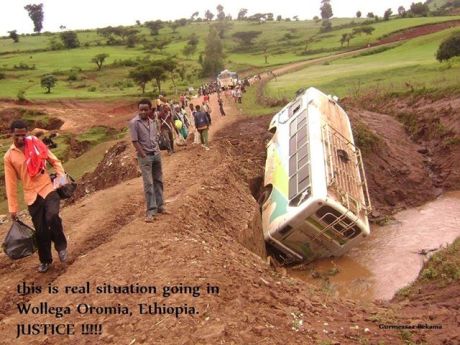
Afrobarometer which is a research project that has been coordinated by institutions in African countries and with partners in thirty-one countries. In its recent survey of public opinion across thirty-four African countries in the continent it validated the popular skepticism about the “Africa Rising” narrative.
In its 1st October 2013 research out come report, Afrobarometer’s data show that 20 percent of Africa’s population often goes without food, clean water, or medical care. More than 50 % of those surveyed think that economic conditions in their country are bad or “very bad.” Some 75% thought their government was doing a bad job in closing the gap between rich and poor. ‘John Allen, writing on AllAfrica.com, suggests that the results indicate that higher benefits of growth are going to a wealthy elite or that official statistics are overstating growth, or possibly both. Morten Jerven, in his recently book Poor Number, has shown the shortcomings of African statistics. In its report on the Nigerian economy, the World Bank observed that Nigeria’s high growth statistics could not be squared by increasing rates of poverty. These, and other inconsistencies, make Allen’s hypothesis on where the majority of Africa’s wealth is directed, look credible.’ For further readings refer to the following original sources:
http://blogs.cfr.org/campbell/2013/10/31/afrobarometer-poll-questions-the-africa-rising-narrative/
Prosperity Index 2013
Ethiopian: 126/142.
75.6% say gov’t is corrupt.
Satisfaction with gov’t efforts to address poverty: 21.2%.
The Governance sub-index dropped two places, to 118th, because of decreases in political rights, political constraints, the rule of law, and regulatory quality.
http://www.prosperity.com/#!/country/ETH
http://nai.diva-portal.org/smash/get/diva2:589071/FULLTEXT03.pdf
It Is Not Only Ethiopia Madagascar crisis Also forces girls into sex work |
Economic hardships prompt girls to take desperate measures with some deciding to sell their bodies. |
The recent and frequent reports on outstanding economic growth in Africa have quickly turned this into mainstream ‘knowledge’, but African economic statistics are very weak. Growing inequality is a key issue that needs to be in focus if all of Africa is to enjoy ‘growth’. Links between social, environmental and economic development are being downplayed. A key issue in today’s discussion on land is that governments consider unfarmed lands to be ‘unowned, vacant, idle and available’, which is completely misleading. Small scale farming in African countries has been persistent, despite efforts to replace it with ‘more efficient’, large scale agriculture.
http://naiforum.org/2013/11/beyond-african-growth/
Another example of the tplf-EFFORT over reach
The Endowment Fund for the Rehabilitation of Tigray (EEFORT) is known for its over reach way beyond its regional government borders and micro managing and being the exclusive beneficiary of the major resources of the empire.
Copyright © Oromianeconomist 2013 and Oromia Quarterly 1997-2013. All rights reserved. Disclaimer.
The Precarious Balance of Economic productutivity and Corrupt Governance: Ethiopia Is Amongst World’s Least Competitive Countries October 29, 2013
Posted by OromianEconomist in Colonizing Structure, Corruption, Development, Dictatorship, Economics, Economics: Development Theory and Policy applications.Tags: Africa, Corruption, Ethiopia, GCI, Global Competitiveness Report, Gross domestic product, Nigeria, Oromia, Oromo, Sub-Saharan Africa, World Economic Forum
3 comments

The Corrupt Empire is uncompetitive: Ethiopia Is Amongst World’s Least Competitive Countries
Despite its damn statistics of massive long term paper growth of TPLF Ethiopia’s economy, the country is still ranked among the worst performing in the Global Competitive Index (GCI) 2013 -2014, recently released by the World Economic Forum. (see page 163 for the detail summary of the report). According to the report, Ethiopia dropped 15 places from last year’s 106th position to 121st among the 144 countries profiled.
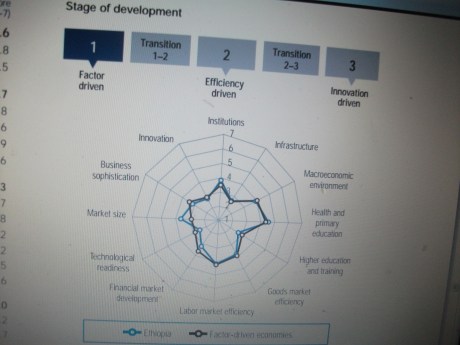
The Global Competitive Index , which was introduced in 2004, measures how the combinations of institutions, policies, and other factors determine the level of productivity of a country. The GCI scores is calculated by putting together the 12 pillars of competitiveness, such as: institutions, infrastructure, macroeconomic environment, health and primary education, higher education and training, goods market efficiency, labour market efficiency, financial market development, technological readiness, market size, business sophistication and innovation.
According to the ranking, Ethiopia is placed in the poorest pool of economic development possible (see, the following graphics). Ethiopia ranked as a “factor driven” economy which includes Nigeria, Liberia, Lao, Mali and Yemen.There are four stages of development with innovation-driven economies being the best pool of economies.

Ethiopian economic productivity is one of the poorest despite clear advantages of its internal market and economies of scale with population over 85 million compared to other African countries. Due to its population, it has a large internal market size (66 position), only next to Nigeria (the largest internal market size in Africa, also performing poor).
GCI has identified weak basic institutional requirements (118) of Ethiopia that account 60% of the index ranking: corruption, poor infrastructure, poor primary education, poor macroeconomic environment, efficiency enhancers and technological readiness.
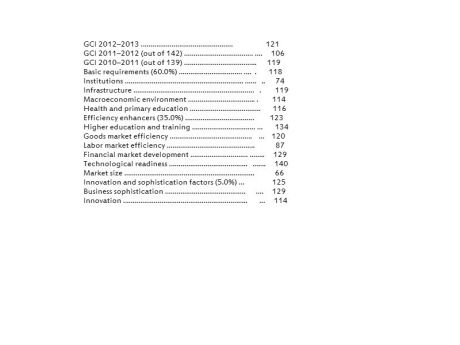
The GCI has noticed with Ethiopia’s economy the following among the most problematic factors for doing business:
Access to finance, corruption, inefficient government bureaucracy, inflation, policy instability, tax regulations and inadequate supply of infrastructure.
Technological readiness is also the worst performance:
Availability of latest technologies (132)
Firm-level technology absorption (139)
FDI and technology transfer (128)
Individuals using Internet, % (142)
Broadband Internet subscriptions/100 pop (131)
Mobile broadband subscriptions/100 pop (120)
Ethiopia with a population of over 85 million only produces $31.7 billion GDP with per capita income of $1 per day.
Key indicators, 2011
Population (millions) ……………………………………….85.1
GDP (US$ billions)* ……………………………….. ………31.7
GDP per capita (US$) ……………………………….. …365.2
GDP (PPP) as share (%) of world total …………..0.12
Sectoral value-added (% GDP), 2011
Agriculture …………………………………………………. ..41.9
Industry ……………………………………………………… .12.6
Services ……………………………………………………. ..45.5
Human Development Index, 2011
Score, (0–1) best ………………………………………. ….0.36
Rank (out of 187 economies) ……………………………174
Sources: IMF; UNFPA; UNDP; World Bank and GCI
The report noted that Mauritius has replaced South Africa (53rd) as the most competitive country in Sub-Saharan Africa. Ranked 45th position the country moved up nine places this year.The country’s best performance has supported by “transparent public institutions (ranked at 39th) with clear property rights and strong judicial independence and an efficient government (29th).”
Switzerland, ranked at number one is the most competitive country in the world. For top ten Sab Saharan African countries See:
http://www3.weforum.org/docs/GCR2013-14/GCR_Infographic_SubSaharanAfrica_2013-2014.jpg
Click to access WEF_Africa_Competitiveness_Report_2013.pdf
Click to access WEF_Africa_Competitiveness_Report_2013.pdf
www3.weforum.org
Prosperity Index 2013
Ethiopian: 126/142.
75.6% say gov’t is corrupt.
Satisfaction with gov’t efforts to address poverty: 21.2%.
The Governance sub-index dropped two places, to 118th, because of decreases in political rights, political constraints, the rule of law, and regulatory quality.
http://www.prosperity.com/#!/country/ETH
Copyright © Oromianeconomist 2013 and Oromia Quarterly 1997-2013. All rights reserved. Disclaimer.
Related articles
- Global Competitiveness Report 2013-2014 (pacific.scoop.co.nz)
- A prisoner of conscience’s call for sanctions against Ethiopia | Eskinder Nega (theguardian.com)
- Tyrannic Ethiopia bans access to student’s critical article (oromianeconomist.wordpress.com)
Is Economics A Science? October 21, 2013
Posted by OromianEconomist in Economics, Economics: Development Theory and Policy applications, Oromia, Oromo Social System, Uncategorized, Wisdom.Tags: Africa, Economic and Social Freedom, Economic development, Economic growth, economics, Oromia, Oromo
add a comment
“Yes, economics is a science”, says Harvard Professor, Raj Chetty.
The point is said Paul Krugman “while Chetty is right that economics can be and sometimes is a scientific field in the sense that theories are testable and there are researchers doing the testing, all too many economists treat their field as a form of theology instead.” and he coined: ” May be economics is a science, but many economists are not scientists.’
Of course, not every science is experiment based. According to Prof. William Easterly of NYU: “Evolution is an example of a non-experimental science; don’t need experiments to defend economics.”
In Chetty’s economics: ‘It is true that the answers to many “big picture” macroeconomic questions — like the causes of recessions or the determinants of growth — remain elusive. But in this respect, the challenges faced by economists are no different from those encountered in medicine and public health. Health researchers have worked for more than a century to understand the “big picture” questions of how diet and lifestyle affect health and aging, yet they still do not have a full scientific understanding of these connections. Some studies tell us to consume more coffee, wine and chocolate; others recommend the opposite. But few people would argue that medicine should not be approached as a science or that doctors should not make decisions based on the best available evidence. As is the case with epidemiologists, the fundamental challenge faced by economists — and a root cause of many disagreements in the field — is our limited ability to run experiments. If we could randomize policy decisions and then observe what happens to the economy and people’s lives, we would be able to get a precise understanding of how the economy works and how to improve policy. But the practical and ethical costs of such experiments preclude this sort of approach. (Surely we don’t want to create more financial crises just to understand how they work.) Nonetheless, economists have recently begun to overcome these challenges by developing tools that approximate scientific experiments to obtain compelling answers to specific policy questions. In previous decades the most prominent economists were typically theorists like Paul Krugman and Janet L. Yellen, whose models continue to guide economic thinking. Today, the most prominent economists are often empiricists like David Card of the University of California, Berkeley, and Esther Duflo of the Massachusetts Institute of Technology, who focus on testing old theories and formulating new ones that fit the evidence. This kind of empirical work in economics might be compared to the “micro” advances in medicine (like research on therapies for heart disease) that have contributed enormously to increasing longevity and quality of life, even as the “macro” questions of the determinants of health remain contested.’ Read the interesting argument on the subject further at:
http://www.project-syndicate.org/commentary/on-whether-he-is-a-scientist-by-robert-j–shiller
Copyright © Oromianeconomist 2013 and Oromia Quarterly 1997-2013. All rights reserved. Disclaimer.
Methodological Individualism as a development Model and its Critics June 27, 2011
Posted by OromianEconomist in Economics: Development Theory and Policy applications, Temesgen M. Erena.Tags: African conditions, African Studies, Applied economics, Developed country, Developing country, Economic, Economic development, Economic models, Economic policy, economics, Economics of development, Neo-Marxism, Neoclassical economics, Oromia, principle of Economics, Social Sciences, Temesgen M. Erena, The Oromo theory of development, Why economists disagree
2 comments

JEL: A11, A23, B13
Methodological Individualism as a development Model and its Critics
Temesgen M. Erena (DPhil), Economist
The orthodox (neoclassical) world view comprises research programmes that are basically concerned with applying the tenets of neoclassical economics to the study of developing economies. From such a perspective, the principles underlying the economics of developing economies are the same as, or can be considered extension of those governing the economics of developed nations. This implies that meaningful epistemological activities within the development economics cannot be conducted without first determining its inextricable intellectual and analytical ties to mainstream economics.
According to Rostow (1960), the critical intention of development has been seen as the achievement of ‘high mass consumption society’ that can be measured by the level of per capita income. In this context, the inherent aim of development seems to materialise a society that reproduce the political economic system of the western Europe and North America, i.e., a competitive private enterprise based on the foundations of free market economy and a representative and democratic political system. Rostow (1960) has detailed this historical process of development in his schema of stages-of- growth model. Charles K. Wilber (1988) argues that the application of this model as centre of assay of the course of development supposes that present day developing countries reckon to the ‘traditional society’ stage or at the ‘preconditions’ stage in relative to the present stages of western developed countries. Like so, the contemporary developed countries were formerly underdeveloped, hence, all countries progress in the course of these stages.
In the extreme, the Orthodox (Neoclassical) strand theorises that since principles of economics are universal, there is but one economics, whose basic tenets are equally valid for both developing and developed economies, David (1986). In other words, it is considered inappropriate to speak about two distinct economics- one for developed countries and the other for developing countries. In this case, the, the dominant interpretive model of thought is based on a ‘universalist’ epistemology or ‘one world’ ideology and ‘aesthetic’, which assumes the existence of a continuous and homogenous world, David (1986). Contextually, knowledge and society are viewed in terms of discrete individual elements that become the continuous and homogenous phenomena of economic and social life through a process of aggregation.
The neoclassical paradigm stands on universalist, rationalist and positivist methodological pillars. In addition to the influence of positivism and other rationalist patterns of reasoning, neoclassical economic thinking also makes heavy use of the concept ‘mechanical equilibrium’, which is explained by the self-regulating operation of equilibrating forces. Such forces, it is argued, not only tend to maintain equilibrium of the economic system but also to restore this equilibrium once it has been disturbed by external forces.
In its evolution, the concept of equilibrium has had to be based on some conception of the economic system. Accordingly, it was thought that the evolution of any logically consistent economic order required some institution of private property as well as a sharp conceptual distinction between the economic system and other aspects of social reality, David (1986). This led to an emphasis on capitalistic, free enterprises ethic based on the principle of individualism. In the conception, individuals are considered to be at liberty to organise their social relationships in accordance their own interests, cole, etal (1991). Society hence, becomes no more a collection of individuals, and an individual behaviour, the goal and standards of moral behaviour.
The neoclassical paradigm is based on individualistic and libertarian philosophy. The philosophy postulates that the ultimate constituents of society are individual people who act appropriately in accordance with their own dispositions. In other words, the argument is that no social tendency exists that theorising about classes and other activities can only be represented by mental constructs, which are abstract models for interpreting certain relations among individuals. One implication is that it is impossible to have laws about society. Another is that the good of individuals is primarily objective of society as opposed to the neo-Marxist which emphasis that of the society as whole, Cole etal (1991).
Economic models, theories, and conceptual systems should be considered as device that merely helps the analysts to remember certain predictive regularities in observed phenomena, David (1986).
A related implication follows from the widespread acceptance of the “science as science” methodology. These are based on the claim that search for knowledge should be governed by scientific objectivity and the commitment to universal values that cut across national frontiers. Adherence to universal epistemological principles implies that there are common standards of scholarship and, as others argued there cannot be Chinese, Nigerian or Egyptian criteria for truth and validity. Commercial farms can be nationalised, criteria for truth cannot.
The universality epistemology finds a foremost representation in the study of resource allocation. The underlying principle that all societies must make decisions about the degree of sacrifice that must be made if resources must be allocated efficiently. This is based on the assumption of the universal scarcity of resources relative to human needs. Given scarce resources, it is impossible to satisfy all of the society’s goals simultaneously. Therefore, if scarce resources are to be efficiently utilised, they must be properly allocated. The possibility of deriving meaningful benefits from the use of these resources is therefore forecasted upon the nature of sacrifice. The problem of economic decision making in conventional economics is therefore coined in terms of a “cost-benefit” calculus. The neo-classical approach to this problem emphasise the need for rational choice in the use of scarce resources. The basis of this approach is that if the alternatives presented to us are not rationally chosen, resource scarcity is likely to increase within the passage of time, hence, impairing current standards of living and decreasing the possibility for future economic growth, David (1986). In this regard, the neo-classical, explanation of economic behaviour tends to rely heavily on competitive equilibrium, which assumes that the behaviour of free markets and prices provides the necessary conditions for individual economic agents to achieve maximum economic welfare and personal liberty, Todaro (1991)|.It is based on the methodological individualism mentioned previously, the implication being that individual economic decision-making units (household), firms, national governments, and so on)| are free and rational actors whose behaviour is guided by harmonious equilibrating force, David (1986)|.
The whole economy is assumed to consist of a large number of interacting markets that have a tendency to clear, that is, reach equilibrium, with the latter defined in terms of equality between demand and supply, and price. (These conditions are assumed to take place for individual markets, that is, partial equilibrium, or in other aspects where there is a set of relative prices for all goods and services, resulting in a simultaneous clearing of all markets that is general equilibrium. Given the quantities of resources of all kinds available to economic agents, consumer tastes and preferences, and production technology, the problem of general equilibrium revolves around the determination of the relative quantities of goods of all kind that will be produced and consumed, the prices at which they will be exchanged and how the earnings derived from resource utilisation will be distributed, Cole et al (1991)|.
Income distribution is thus treated as a special case of the general theory of price relations. The over all argument is that it is possible for self-interested individuals in a market-oriented economy to strive for and receive, their fair share of income and wealth created by the competitive process. In this context, the neo-classical model indicates that the marginal productivity forms the basis for payments to all factors of production. The assumption is that individuals have at their disposal a set of factors endowments and that income merely represents the sum of the product of these factors and their marginal products. The evolution of factor shares and incomes over times thus depends on factor prices and quantities, the elasticity of substitution among factors, changes in demand patterns, and the capital or labour savings bias of technological change.
It is therefore assumed that, given completive conditions and perfect information, resources will be efficiently allocated. Adjustment in factors prices are expected to bring equality in factor shares, with each factor receiving its ‘just’ or equitable reward. Under the circumstances, any attempt to enforce equality in the prevailing pattern of income distribution is considered inimical to economic growth and efficiency. To the extent that inequalities exist, they should be considered necessary for guarantying productivity levels, David (1986)|.
The implications of the marginal productivity theory of income distribution can be further explained by considering the distribution of labour and capital incomes. In the case of returns to the human factor (wage and salaries), the theory suggests that differences in marginal productivities can be explained by differences in both innate and acquired abilities. These differences tend to be particularly acute in those societies, for example, developing economies where highly skilled labour is in short supply relative to the large supply of unskilled labour. The argument, as is that individuals with relatively scarce skills would receive quasi-rents. These rents and other payment differences would disappear as more people acquired skill through education and training, David (1986). Hence, they argue that any attempt to equalise wages and salaries would prove to be inefficient. The implicit assumption is that pay differentials not only reward those with superior natural abilities but also serve as an incentive to those not so blessed to acquire skills to increase their productivity and efficiency, Hunt (1989). Given a set of competitive prices, the actions and reactions of individual economic agents will determine the quantities of goods and services demanded, and these will be matched with the quantities supplied in the various markets of the economy, David (1986). The achievement of such an over all equilibrium requires two sets of conditions. First, these is a subjective one in which the individual pursues the goal of maximum income satisfaction. The second is an objective one in which the market provides for these incomes and wants based on the maximum profit goals of business people. Thus, through the equilibrium between demand and supply, with all markets cleared, the optimum economic position reached by each individual economic agent becomes compatible with that attained by others.
The general equilibrium analysis (Varian, 1990) postulates that, in principle, the set of equilibrium prices tend to provide all the information that each individual economic agent needs to have in order to be able to co-ordinate its activities with those of all other economic agents in the economic system, Cole et al (1991). It is therefore, based on the assumptions of perfect competition and knowledge and foresight, and the absence of uncertainty. This ensures that the essential adjustments would take place of a disequilibrium situation were to arise. Where prices diverge from their equilibrium values, inconsistencies will arise in the plans economic agents, and they will be forced to adjust to an equilibrium situation. The underlying assumption is that the operation of the market is based on a negative feedback mechanism that reduces differences to zero through iterative price adjustment processes are also assumed to be stable. This means that once the system diverges from its equilibrium with a process of automatic readjustment would take place. Full employment is also implicitly assumed. With demand for goods and services equal to their supply, labour market will also clear. Neoclassicals consider this equilibrium to be the most efficient one, and thus the standard against which particular sectors of the economy as a whole should be appraised. The reasoning is that when over all economic agent will have reached an ‘optimal position’, that is, one that it cannot possibly improve by altering its behaviour. This is the ideal state described by Pareto and also known as a Pareto efficient allocation. It is considered to be the most efficient state and implies that any attempt made to improve a given economic agent’s position would have to be at someone else’s expense (David, 1986, Varian, 1990).
The general framework outlined above is also replicated in analysis of international economic relationships. In this case, trade and exchange are considered to be two of the most effective weapons for promoting resources allocation, distribution, and growth. This follows from assumptions of harmony of interests among nation states, patterns of trade based on comparative advantage, an equitable distribution of the gains from trade, and the free international flow of resources. The same normative forces are assumed to operate both nationally and internationally, with the private market considered to be the most effective mechanism for allocating distributing resources in all spheres, Hunt (1989|).
Consequently, the neoclassical (orthodox) school of thought attribute problems of developing economies essentially to the ‘dirigiste dogma’ and the ‘denial of economic principle’ (Lal, 1988); to over extension of the public sector; to economic controls which distorts the market and have unexpected and undesirable side effects; and to an over emphasis on investment in physical capital (spending on lavish prestige projects such as sport facilities, conference centres, brand new capital city, roads leads to nowhere, irrigation schemes that damage soil) compared to human capital. And they have proposed these setbacks to be neutralised to overcome inadequate development, Toye (1987). They took the form of supply side macro-economics and the privatisation of public corporations and call for the dismantling of public ownership, planning, and regulation of economic activities. By permitting free markets to flourish, privatising state owned enterprises, promoting free trade and export expansion, welcoming foreign investors, and eliminating the plethora of government regulations and price distortions in factor, product and financial markets, the neoclassical argue that economic efficiency and economic growth will be stimulated, Wilber (1988). Contrary to the claims of the political economy strands (neo- Marxist world views) which are subjects of subsequent discussions, the neoclassicals (Orthodox) argue that the third world are underdeveloped not because of the predatory activities of first world and the international agencies that it controls, but rather because of the heavy hand of the state and corruption, inefficiency, and lack of economic incentives, Todaro (1991).
It is assumed that development experience of western industrial countries is a model for the developing economies of today and therefore, neoclassical economics is universally applicable. It is held that the international capitalist economy does not discriminate against developing economies, but when conformed to it acts as an engine or motor of growth. What is needed, therefore, is not a reform of the international economic system or restructuring of dualistic developing economies or an increase in foreign aid or attempts to control population growth or amore effective central planning system. Rather, it is simply a matter of promoting free markets and laissez faire economics within the context of permissive government that allow the magic of market forces. And the “invisible hand” of market prices to guide resource allocation and stimulate economic development, Todaro (1991). They are quoting to us the failures of the public interventionist economies of African countries, Toye (1987).
Neoclassical policy is based on faith in the price mechanism to bring about an equilibrium in the economy which maximises welfare and growth, (i.e. development by their terms), “Efficient growth… raises the demand for unskilled workers by getting the prices right… is probably the single most important means of alleviating poverty,” Lal (1983). This process of development raises the standard of living of the poor via the ‘trickle down’ effect. Intervention by the government is unnecessary as a measure to alleviate poverty and would retard growth by distorting the market mechanism, holding up sustainable development. According to Lal, government policies dealing with basic needs, surplus labour, decreasing terms of trade, etc., are misleading and incorrect. He argues that developing countries are following the same economic patterns of development as developed countries. Therefore, the same economic rules and considerations apply. Both he and Bauer criticise ‘dirigistes’ for implying, by their policies, that people of developing countries are not rational that the ‘market decisions’ have to be made for them. That would suggest Toye’s argument- governments fulfilling the desires of frustrating individuals has some validity. Being rational does not necessarily make people able. It is within this context that the planning, growth with equity approach and a social market economy operation have come into considerations. However, such interventionist approach have been criticised by laissez faire economists as a reaction to far a recipe to failure. Lal (1988) points out that inefficient and incompetent bureaucracy as a cause of government failure. Attempts to intervene in imperfect markets serves to make things even further from the equilibrium of maximum efficiency and welfare. This is an over-sight, a generalisation which dismisses all past, present and future government intervention to make influence on disparities in income and accelerate development, as ineffective. This is clearly not the case.
The rapid development of South Korea and Taiwan in both intervening for growth and equity demonstrate this. Government policies concentrated on rural development, export oriented industrialisation were directly and indirectly dealing with inequality and poverty whilst promoting growth. It would be argued that all government intervention is not good. As is clear, some government intervention is and has bee ill advised- for example ‘the white elephants.’
But what is also becoming increasingly apparent is that the neo-liberal (Washington consensus) policies of liberalisation which the IMF and World Bank have made conditions for accepting loans have also created many problems. Not only have they quite often caused increasing inequalities in income distribution, but they have also failed to encourage growth in these countries. In many countries they have led to near chaos and crisis, in the economy as in many African countries, Lawrence (1986). External influences, such as increasing oil prices, MNC transfer pricing, increase in debt burdens, increased protectionism by developed economies, etc, mean that following free market principles lead to decreasing terms of trade and created economic problems within the countries. D. Lal (1983) would say that this is acceptable because it is a step in the right direction towards free market economies. Toye (1987) believes the neoclassical approach neglects the issues and treats and treats the solutions, In a reductionist manner, over looking the complexity of the issues and gives an over simplified solution.” Lack of past successes cannot simply be blamed on government interference with the price mechanism to account for the relatively poor performance of these economies would require a very detailed historical analysis of class forces and class struggle within these countries, of the effects of international strategic and geo-political factors as well as the effects of drought other climatic/ecological disasters, Sender et al (1986).
Neoclassical according to Sender and Smith, have paid too much attention to anti-interventionism- when it would be more beneficial to concentrate on improving what intervention is necessary. It is harmful for economists to adhere to policies which can only be relevant in a hypothetical ‘perfect market’ economy. The post- colonial period has been characterised by an astonishing absence of any coherent, analytical/ideological framework within which to formulate state intervention of an effective and suitable kind,” Sender et al (1986). Neo-classicalists need to address the conclusive historical evidence concerning the role of the state in all late industrialising countries in considering policy formulation.
The laissez faire economists edge on economic growth through the operation of the market mechanism (Adam Smith’s the famous invisible hand) as the key to development. There are also economists who emphasised planning (government intervention) to supplement or supplant the market. As in the former, the latter and economic growth has been taken as the essential of development. Meanwhile, the growth with equity economists contemplate on the distribution of the remunerations of growth to the deprived.
Neo-Marxist and dependency theorist, two main school of thoughts in the Political economy paradigm, are broadly apprehensive of the nature of the progression by which development is attained, Wilber (1988).
Classical Marxism was always, of course, a theory of development, i.e., of capitalism and its development, and transition to socialism. The theory was never adequate, however, in dealing with development problems of third world especially underdevelopment issues. Classical Marxists, after all, consider capitalism as historically progress, in every way an advanced over previous production systems, even if it is to be replaced by socialism one day. “ Imperialism was the means by which techniques, culture, and institutions that had evolved in western Europe over several centuries… sowed their revolutionary seeds in the rest of the world,” Warren (1980).
Seers (1987) argued that Marxism thus arrived at conclusions similar to those of many neoclassical economists, since both derived from Smith and Ricardo and the economics of the 19th century. He further pointed out that both doctrines assume competitive markets and the overriding importance material incentives. They are both basically internationalist and also optimistic, technocratic and economist. In particular, both treat economic growth as development and due primarily to capital accumulation.
According to Hunt (1989), the neo-Marxist paradigm derives from an attempt to develop and adapt classical Marxist theory to the analysis of underdeveloped economies. The paradigm gained widespread influence in the late 1960’s, providing an ideological and analytical framework for radical critiques of contemporary theories. Drawing their inspiration from the ideas of Marx and Lenin, and influenced also by other early Marxists, particularly Rosa Luxemburg, the neo-Marxists set out to investigate a problem that Marx himself had touched on only briefly- the process of economic change in the economies of Asia, Africa and Latin America.
With respect to the third world, the primary concern of the neo-Marxists is with what is happening to national output and to its distribution, and why. Particularly in the 1950s and 1960s there was little concern on the part of leading neo-Marxists to explore the essential nature of the models of production that prevail within the periphery. Instead the emphasis was on the economic and political relations between the ‘centre’ and the ‘periphery.’ In the analysing these issues the neo-Marxists use a terminology for the key concepts in their analytical framework that appears to drive from Marxism with different interpretation to certain concepts.
The neo-Marxist school which is tracing back to the work of Paul Baran, differs from Marx in arguing that capitalism will not be spread from the ‘centre’ to the ‘periphery’ but rather that existing underdevelopment is an active process linked to the development of the centre by the transfer of the surplus, Baran (1957, 1988). As economic surplus was extracted, capital accumulation stopped, and budding industries were killed off by ‘centre’ competition. Development in colonies was forced off its natural course and completely dominated by imperial interests. The colonies stagnated between feudalism and capitalism or the mix of both systems.
For Baran (1957) the real problem in developing economies is not the presence of the vicious circle- a phenomenon whose existence is acknowledged – but the lack of a significant stimulus to development aggravated by the surplus drain. Here again we have a polar view she said, something like a zero-sum game, in which the continuing primitive accumulation by the ‘centre’ implies a simultaneous negative accumulation for the periphery. Surplus then, generate and maintain underdevelopment in the developing economies, a phenomenon whose existence is acknowledged – but the lack of a significant stimulus to development aggravated by the surplus drain. As Frank (1988) (dependency scholar) has called this leads to “the development of underdevelopment.”
Amin, too, adopts Frank’s Motto, but with an altered meaning; for Amin, it means a “dependent development,” that, is, an inappropriate pattern of growth imposed upon the country through its ties with the centre- literally, through its being included in the world capitalist system. This view in turn allows for the possibility of growth aggregate income, an observed fact in many developing economies, Hunt (1989).
The crucial problem of how the available surplus is utilised in developing economies leads the political economy worldview to the examination of local elites. Writers like Baran and Sweezy argue that no local development is to be expected from such elites. On the contrary, the elites are by their very nature a factor contributing to underdevelopment. The analysis is based on the “objective function” in which these elites find themselves. Their economic behaviour- conspicuous consumption, investments in real estate and extreme risk aversion, the export of their savings to be deposited with foreign banks for security, their avoidance of investments in industry- is, from the sand point of private advantage, essentially a rational response to the circumstances in which they find themselves. Their fear of foreign competition where they to invest in more productive activities is seen as fully justified. They argued that most elite members lack the capital retained for the establishment of enterprises able to compete with foreign oligopolies. Also lacking are entrepreneurial skills and attitudes to work and innovation conducive to growth, see Wilber (1988).
Amin offers the view that many members of the developing economies elites profit, too; from foreign activities in their country. What enables Amin to say this is his adoption of Emmanuel’s theory of unequal exchange, in which the level of wages is the major determining factor. That wages are lower in developing economies means that the labour force of these countries carries the burden of exploitation both by its local capitalist class and by the capitalist class at the centre. It is burdened by the “regular” exploitation of the home capitalists and the “primitive accumulation” of the capitalist class at the centre. The higher wages that the centre’s working class enjoys are in turn attributed not solely to its higher productivity; it does not partake of the proceeds of the continuing primitive accumulation, Todaro (1991).
That there is also a disheartening lack of entrepreneurial and administrative talent in the countries of the third world that the neo-Marxists do not deny. But they view those who place this fact at the centre of their explanations of underdevelopment as being eclectic and arbitrary. The claim that entrepreneurial and administrative skills will make their utilisation possible and necessary appears- conditions that cannot exist in an environment of dependence. This problem, they claim, is secondary: It is consequence of the fundamental problem, which is the discouragement and systematic sabotaging (or, for Amin, the guiding into incorrect path), of the local development efforts by the centre, Todaro (1991).
They recognise the existence of a ‘comprador states’ or class and bourgeoisie classes in developing countries but they maintain that their positions are solely dependent on the advantages they give to an imperialist power- not exist in their own right.
So the main consideration for government intervention would be, for neo-Marxists, the ability to make a complete and absolute change “the third world was and is an integral and destined to play a major role in the attempt of capital in the world capitalist economy to stem and reverse the tide of growing economic crisis, “Frank (1981, 1988). This is manifested in increasing repression of the workforce in developing countries, not increasing equality, or alleviating poverty. So in order to achieve sustainable development with equality it would be necessary for a developing country to withdraw from the world capitalist system. The present system only maintains present inequalities due to the interest characteristic of capitalism. They would advocate complete autarky facilitated by a socialist movement.
Generally, the political economy school advocate equity oriented development. The fundamental assumptions of this perspective regarding capitalism and international capitalist economy are essentially opposite to those of neo-classical economists. They not only believe that international capitalist economy discriminates against developing economies, but that is directly responsible for their dire condition. Thus any solution to the poverty predicament requires a fundamental break from the international capitalist economy. A distinction here, more for historical relevance than for the logic of the argument should be made between neo-Marxian and the Marxian of Marx, with (Marx) essentially regarded the capitalist commodity production process as progressive, in that it was required for the realisation of the ultimate inevitable tools of communism. Thus, capitalism for Marx is a necessary phase of societal change. Furthermore, for Marx the capital commodity production process is universally applicable.
The other fundamental disagreement these theorists have with neo-classical school concerns ethics. Equity, for these theorists is an ethical ideal, an end by itself. The logical extreme of this view is that equality must remain the primary objective, even at the cost of efficiency.
It is argued by this perspective that it is contrary to the interests of the international capitalist commodity process, which is essentially and exclusively concerned with maximisation of profit, to redistribute wealth. Instead of a y ‘trickle -dawn’ tendencies, the inner- logic of capitalism with only lead to greater accumulation, and concentrate of wealth. Thus, it is imperative for any comprehensive development effort to break with the internationalist political economy. Since weak political position of the poor prevents them from changing the system, empowering the poor becomes the means to meaningful development. These theorists contend that attacking the symptoms of poverty with basic needs provisions, or welfare laws will not suffice, it is crucial to attack its cause. The answer is the empowerment of the poor.
The general tendency is towards the satisation of the modes of production, at least those sectors of the economy that are essential to the public goods. Thus, only the intervention of a populist state, resulting on the commanding heights of the economy can restructure the relations of production that benefit not a privileged few, but the unprivileged many.
This perspective defining the ‘left’ contours of the continuum in its logical extreme are diametrically contradicts the neo-classical perspectives.The obvious point of departure on the debate on development between the neo-classical and the political economy strands must be a definition of development. This is inescapably a normative exercise, but one that should not be avoided for this the reason. Development, by the very meaning of the word, can only be a process of the ‘becoming’. The argument holds regardless of whether the tendencies are rectilinear, cyclical or both (or neither). According to orthodox school sometimes implicitly and sometimes explicit value judgement in the definition of development has been westernised. This tendency has been challenged by the ‘development of another civilisation in East Asia, that is quickly achieving standard of living comparable to the west. One conclusive inference that can be drawn from the experience of Japan, China and the Asian Tigers is that a protestant ethic or generally a western social arrangement or socialist revolution of neo-Marxist is not a prerequisite for economic development.
http://rodrik.typepad.com/dani_rodriks_weblog/2013/05/what-is-wrong-and-right-in-economics.html
Copyright © Oromianeconomist 2012 and Oromia Quarterly 1997-2012, all rights are reserved. Disclaimer.
Related articles
- Blog Post: TheAlephBlog: Neoclassical vs Austrian Economics (moneyscience.com)
- Neoclassical vs Austrian Economics (wallstreetpit.com)
- Mainstream Economics is a Cult (ritholtz.com)
- JOY IN THE CRISIS: Why Africa needs development models not growth models (environgentia.wordpress.com)
- Philip Pilkington: Why “Free Markets” Accommodate Speculation and Lead to Disequilibrium (nakedcapitalism.com)
- How to end poverty? Unions. (cyclingforprogress.wordpress.com)
- The Social Economics of Thorstein Veblen (trumanfactor.com)
- What is wrong (and right) in economics? (rodrik.typepad.com)
- A Critique of the Methodology of Mises & Rothbard (azizonomics.com)
- ‘Revolutionizing Economics by Evolutionizing it’ (economistsview.typepad.com)
Theorizing Development June 8, 2011
Posted by OromianEconomist in Economics: Development Theory and Policy applications, Temesgen M. Erena, Theory of Development, Uncategorized.Tags: Aid, Developing country, Development Economics, Economic, Economic development, Economic growth, John Stuart Mill, Joseph Stiglitz, Latin America, Social Sciences, Temesgen M. Erena, Theorizing Development
add a comment

JEL: A11, A23, B13, D2, D6, O1, O5
Theorizing Development
Temesgen M. Erena (DPhil), Economist
From historical perspectives, the urgency underlying the contemporary development quest of developing economies has been recognised for the last seven decades. Of course, this should not be considered as that there were no problems of development prior to 1940’s. However, paralleling the increasing for economic self-determination and development of developing economies, there has been a tremendous growth in intellectual activity concerning the development problems.
The past 70 years have also witnessed a gluttony of models, theories, and empirical investigations of the development problem and the possibilities offered for transforming Asia, African, Latin American, and Caribbean nations. This body of knowledge as come to be known in academics and policy circles as development economics.
In these perspectives development is discerned in the context of sustained rise of an entire society and social system towards a better and ‘humane life’. What constitutes a better and humane life is an inquiry as old as humankind. Nevertheless, it must be regularly and systematically revised and answered over again in the unsteady milieu of the human society. Economists have agreed on at least on three universal or core values as a discernible and practical guidelines for understanding the gist of development (see Todaro,1994; Goulet, 1971; Soedjatmoko, 1985; Owens, 1987). These core- values include:
Sustenance:
the ability to meet basic needs: food, shelter, health and protection. A basic function of all economic activity, thus, is to provide a means of overcoming the helplessness and misery emerging from a lack of food, shelter, health and protection. The necessary conditions are improving the quality of life, rising per head income, the elimination of absolute poverty, greater employment opportunity and lessening income inequalities;
self-esteem:
which includes possessing education, technology, authenticity, identity, dignity, recognition, honour, a sense of worth and self respect, of not being used as a tool by others for their own exigency;
Freedom from servitude:
to be able to choose. Human freedom includes emancipation from alienating material conditions of life and from social servitude to other people, nature, ignorance, misery, institutions, and dogmatic beliefs. Freedom includes an extended range of choices for societies and their members and together with a minimization of external restraints in the satiation of some social goals. Human freedom embraces personal security, the rule of law, and freedom of leisure, expression, political participation and equality of opportunity.
Sustained and accelerated increase and change in quantity and quantity of material goods and services (both in absolute and per capita), increase in productive capacity and structural transformation of production system (e.g. from agriculture to industry then to services and presently to knowledge based (new) economy), etc. hereinafter economic growth is a necessary if not a sufficient condition for development.
As elaborated in Hirischman (1981) and Lal (1983), this corpus of thought and knowledge denotes economics with a particular perspective of developing nations and the development process. It has come to shape the beliefs about the economic development of developing countries and policies and strategies that should be followed in this process. While development economics goes beyond the mere application of traditional economic principles to the study of developing economies, it remains an intellectual offspring and sub discipline of the mainstream economics discipline. The growth in economic knowledge and the corresponding intellectual maturation of development thought and policy debate has led to the appearance of various perspectives of thought on the theory and reality of development and underdevelopment within the same discipline of development economics. The two main paradigms are neo-classicals (orthodox), and Political economy (neo-Marxists). There are also eclectics.
Copyright © Oromianeconomist 2011 and Oromia Quarterly 1997-2011. All rights reserved. Disclaimer.


 Oromian Economist
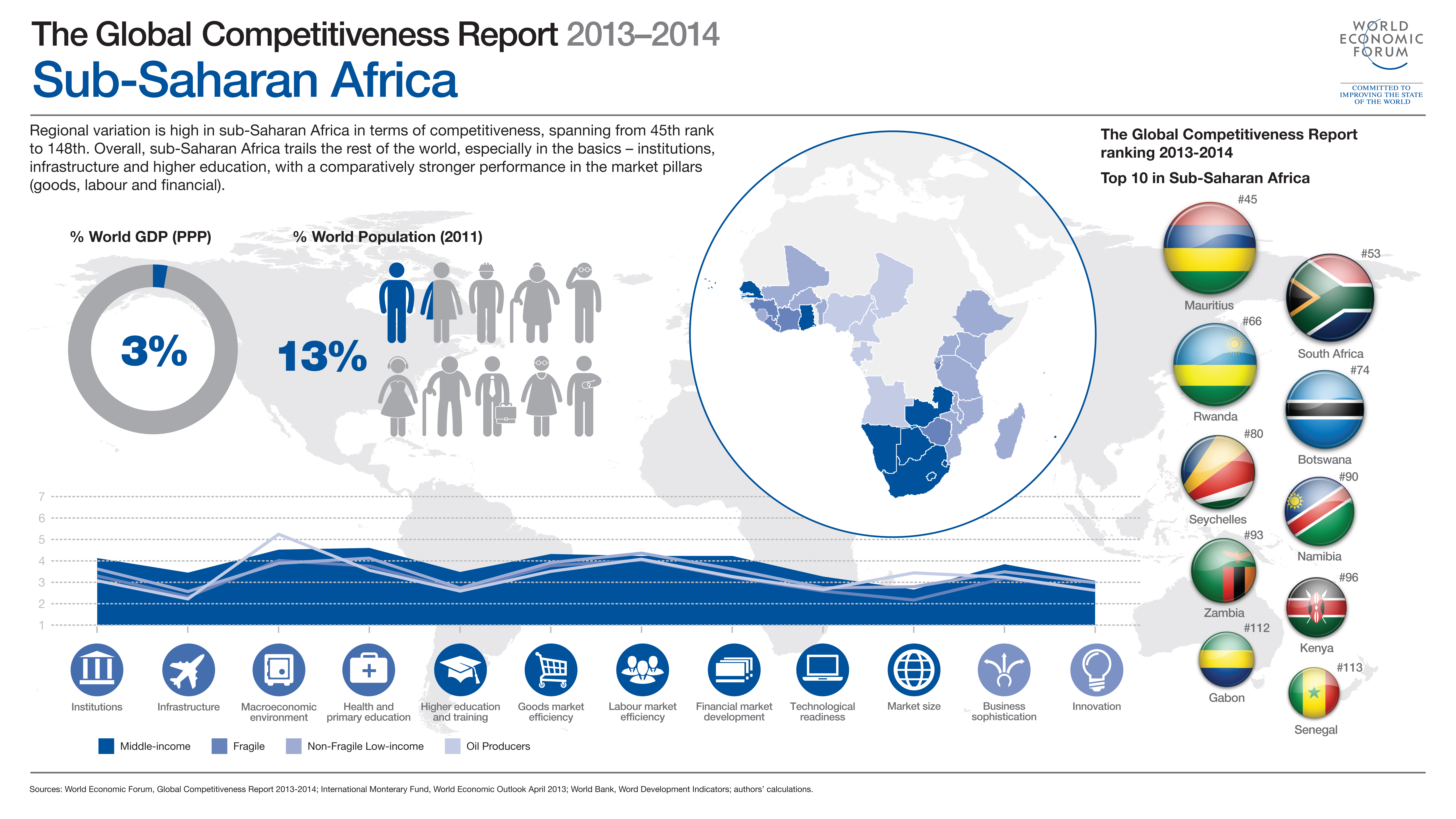
You must be logged in to post a comment.