By Ludovica Iaccino. March 30, 2016
Economic and development analysis: Perspectives on economics, society, development, freedom & social justice. Leading issues in Oromo, Oromia, Africa & world affairs. Oromo News. African News. world News. Views. Formerly Oromia Quarterly


HRLHA Appeal and Request for Immediate Action
Ethiopia: The TPLF Hidden Agenda of Reducing the Oromo Population Must be Stopped
HRLHA Appeal and Request for Immediate Action
For Immediate Release
April 17, 2016
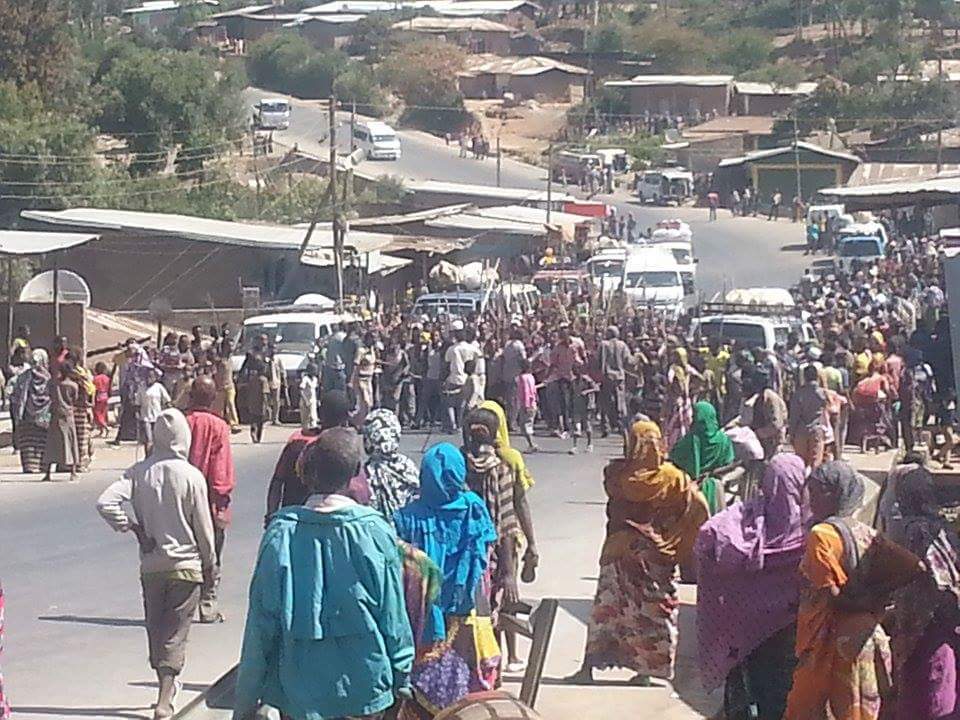
Terrorist and Criminal attacks targeting Oromo youth, and children, and even pregnant women have continued unabated since the peaceful protest for justice and freedom began on 12th November 2015 In Oromia.The peaceful and legitimate protests against the injustices in Oromia, in which Oromo people of all walks of life have participated, had a simple and clear demand at the beginning: ” Stop Addis Ababa”s Integration of the Master Plan, and stop land grabbing in Oromia”.
Instead of responding justly to the protestors’ legitimate grievances and restoring their domestic and international rights, the Ethiopian government has chosen to deploy its special squad “Agiazi” and mercilessly crack down on the peaceful protesters. The ruthless Agiazi force used excessive force, killed many promos, beat and detained thousands to stop the protest, which spread to all corners of Oromia Regional State in a few weeks. Oromia towns and villages were turned into war zones as the special Agiazi force continued its random killings of students, children, men and women. During the first two months of the peaceful protests, more than two hundred (200) Oromos were murdered[1], including infants and pregnant women.
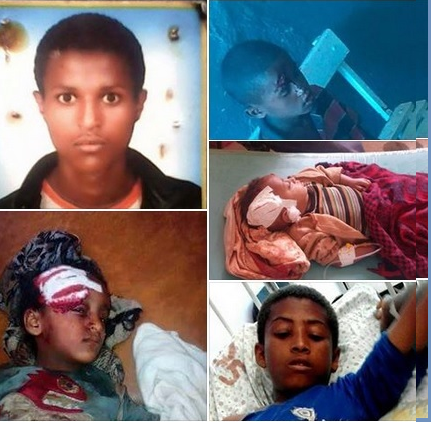
In violation of the “Convention on the Rights of the Child” and other international treaties [2]the current government of Ethiopia ratified on 14th May 1991,(see the other treaties ratified by the current of Ethiopian government from the link)[3] Oromo children, including non-schooled children, have been killed by the Agiazi force. Aliya,15 and her brother Nagassa, 8 (photo on right side) were shot in the leg on March 25, 2016[4] on the streets of Ambo town. Many minors/teenagers were killed and others wounded. by the Agiazi force in different parts of Oromia. Some are listed in the following table.
| No | Name | Sex | Age | Place of Birth |
| 1 | Burte Badhadha Dabal | F | 15 | Jaldu district, West showa, Oromia |
| 2 | Tsegaye Abebe Imana | M | 14 | Jaldu District, West Showa, Oromia |
| 3 | Dereje Gadissa Taye | M | 12 | Chalia,District, East showa, Oromia |
| 4 | Dejene Chala | M | 14 | Gindeberet, West Showa, Oromia |
These cruel and inhumane actions of the Agiazi force against Oromo did not stop the angry protesters from demanding their fundamental rights and freedoms.
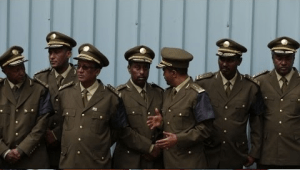
Ethiopia Military Generls
The Oromia Regional State president Muktar Kedir and the TPLF security intelligence officer generals removed the civil administration and declared the unofficial martial law as of February 26, 2016. The Oromia Regional State has been subdivided into eight (8) military zones, each to be led by military generals
The merciless Agiazi force has been allowed officially to quell dissents in Oromia by force. On the day following the martial law declaration, the Agiazi squad started breaking into private homes and savagely started to kill and beat children, men and women, including pregnant women. On February 27, 2016 a seven- months pregnant mother of six, living in the West Arsi zone in Oromia state in Ethiopia, was shot down in her home by security forces who had come to her home looking for her husband. Another six- months pregnant woman Shashitu Mekonen was also killed and thrown into the bush in Horro Guduru Wallega, Oromia.

Schools and universities have served as military camps and battle grounds. The merciless Agiazi force broke into university dormitories, savagely killed, raped, beat and detained students (Wallaga University)
The Agiazi murderers intensified their repressions in all corners of Oromia. Since the November 2015 peaceful protest began, over 400 Oromo nationals have been killed, over fifty thousand (50,000) arrested and placed in different police stations, concentration camps, and military camps. Unknown numbers of students have been confined in the Xolay concentration camp where they are exposed to different diseases because of poor diets and sanitation. No medical attention has been given them and a number of prisoners are dying each day, according to information leaked from Xolay concentration camp. This represents the systematic elimination of the Oromo young generation. The late prime Minister Meles Zenawi, the architect of the current TPLF Empire, in 1992 vowed to destroy those he considered major threats to his rule, particularly the most populous nation in the country, the Oromo. He vowed to reduce Oromos to a minority and take over their natural resources.
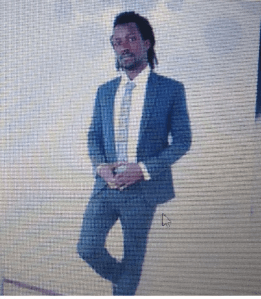
Bedhadha Galchu
The longest protest (in terms of weeks and months) in the history of Ethiopia has been slowed down by the military crackdowns. When protestors returned home from the street, they started facing another form of atrocity. They were forced day and night to stay indoors, in a kind of house arrest. At night, the Agiazi force would walk into individual homes and pick up youth and kill them, leaving their dead bodies in front of their doors. On April 14, 2016, a university engineering department graduate from Gonder University was cold bloodedly murdered in the Oromia Gujii zone in Oddo Shakisso where he used to live with his parents.
Since Oromia is now under martial law, information, coming out of the Regional State of Oromia is restricted. All social media are being monitored by the military administration.
A number of cell phone users were arrested and their phones taken. Gross human rights abuses, killings, arbitrary arrests, torture and other human rights atrocities are happening in Oromia every day and night.
However, the information about these atrocities is not getting out, because the military has monitored almost all information outlets. The Ethiopian people hear only the well- crafted stories about Ethiopia being on the path to democracy. These stories come from the government mass media.
International and domestic human rights organizations have been reporting the atrocities, although their access to information in Ethiopia is very limited due to their researchers being banned from entering the country. But undercover investigative journalists still bring out the news of the genocide and ethnic cleansing committed in the name of development.
The current human rights atrocities in Oromia have been condemned by some western governments and government agencies, notably the EU and the USA, and UN experts/researchers. But still no meaningful action has been taken to stop the atrocities in Oromia.
When the regime has been pressured enough, they do make concessions and acknowledge the legitimacy of the protestors’ grievances. Indeed the Prime Minister, Hailemariam Dessalegn, has been known to apologize to the people. However, all this seems to be political posturing to deceive the world that is becoming increasingly aware of the atrocities. On the ground, there is no sign of the atrocities abating. There have been no gestures of conciliation. The regime’s force has actually stepped up its mass murders, mass incarcerations and mass rapes.
What is puzzling is that after all these tragedies, the world donor countries and organizations are still silent. It seems surreal. How many people must die before the world responds? How many millions must be jailed and tortured, how many must be gang- raped before this deafening silence is broken?
Can’t the world community learns from what happened in the past, in Rwanda in 1994, in Bosnia, in 1998 and what is happening in Syria ever since 2011? The genocidal act of armed force should not continue and must be stoped by someone, somewhere.
HRLHA is deeply concerned that if International Communities fail in responding to the merciless killings presently taking place in Oromia Regional State as soon as possible , this could lead to a genocide comparable to those in Rwanda (1994), in Yugoslavia (1998) and in Darfur, Sudan (2003).
Therefore, the HRLHA respectfully demands that governments of the west, especially who allies with the Ethiopian government to break their silence about the TPLF hidden agenda of promoting systematic genocide against the Oromo and other nations in Ethiopia and act swiftly as possible to halt the atrocity in Ethiopia.
Recommendations:
Copied To:
[1] HRLHA UA, MORE VICTIMS OF EXTRA-JUDICIAL KILLINGS, KIDNAPPINGS, ARRESTS AND DETENTIONS Dec 25, 2015, http://www.humanrightsleague.org/?p=15700
[2] UN, Ratification Status for Ethiopia, http://tbinternet.ohchr.org/_layouts/TreatyBodyExternal/Treaty.aspx?CountryID=59&Lang=EN
[3]UN Ethiopia home page; http://tbinternet.ohchr.org/_layouts/TreatyBodyExternal/Treaty.aspx?CountryID=59&Lang=EN
[4] Al jazeera Report, Feb 25, 2016. Oromo protests continue in Ethiopia amid harsh crackdown, https://www.youtube.com/watch?v=KQDfhk5VIdU

In My Own Words: Reconnecting with a Cousin
Restoring Family Links Blog, 13 April 2016
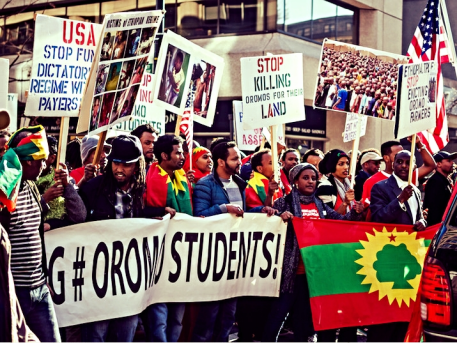
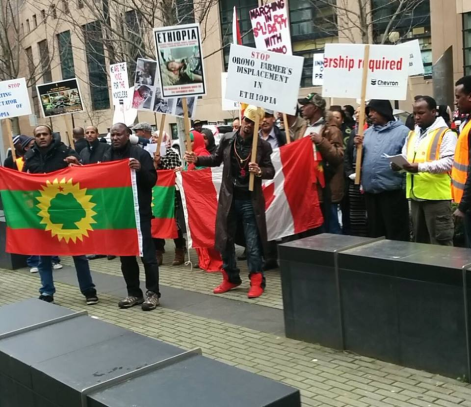
OROMO STUDENTS SOLIDARITY PROTEST IN WASHINGTON, D.C. COURTESY OF CREATIVE COMMONS @CTJ71081.
“My name is Desta Edosa. I am 33 years old, married and a father of two sons. I am originally from Ethiopia, specifically from Oromia. I came to the United States in 2009 through a visa lottery, and I won. In February 2016, Caren Bedsworth from the American Red Cross called me and left me voice message saying I had a message from relative in Ethiopia. Listening to her voice message, I could not believe at first it was true as I did not know Red Cross gave such services. As Caren provided the office’s address, I looked on the internet and verified that the address mentioned was American Red Cross’s address. I called back Caren and asked who the person was. She delivered the letter to my home and I was so excited when I saw his handwritten letter. It had been about seven years since I last saw him.
“The name of my relative is Galataa Bazzaa. Galataa had just graduated from high school when he was captured by Ethiopian security forces and taken to a prison. He was a very outstanding student who was always known among his classmates and teachers as a straight A’s guy in his academics. By the time he was taken to prison, he had just been admitted to Addis Ababa Medical School to pursue his higher education. Only students of high caliber are given an opportunity to study medical sciences in Ethiopia and Galataa was one of the top.
“To understand the case of Galataa and why he was taken to prison, it is very important to know a little about Oromo people in Ethiopia. Oromo are the largest ethnic majority in Ethiopia which comprises about one third of the total population. Even though Oromo are the majority in Ethiopia, they have been marginalized both economically and politically since the establishment of the country. There was even a time when Oromo language was banned from state media and people were forced to change their Oromo name.
“As a result, Oromo people have been protesting this injustice for almost a century. Even at this time, the Ethiopian government has killed more than 400 Oromo people including kids, pregnant woman and elders because people peacefully demonstrated against land grabs and removal of Oromo farmers from their land due to the expansion of the capital city Addis Ababa (for more information on the Oromo protests, please click here or here).
“Galataa’s story is not different from thousands of Oromo students who are unjustifiably languishing in Ethiopian prison. He was just active both in his academic and among his society and communities. That’s the only reason he has been thrown into jail and sentenced to eight years. The Ethiopian government labels students who protest against it as anti-piece, anti-development and even terrorists if it wants to make the punishment sever. It is very common for Oromo students to be taken to prison in Ethiopia even for just speaking of their mind; that was what happened to Galataa.
“It had been about seven years since I heard from Galataa. I have been informed about his wellbeing by his sisters and brothers but never heard a word directly from him. Even though technology brought the world together these days, it’s still hard to be connected with loved one in a prison cell. The American Red Cross has done such excellent job connecting me directly with a person I care about a lot. I appreciate their service and their team a lot for connecting family over the globe when there is no other possible way. I hope they will keep doing such excellent job and help more Oromo families who lost track of their loved ones.”
http://restoringfamilylinksblog.com/blog/in-my-own-words-reconnecting-with-a-cousin


Please join the Tom Lantos Human Rights Commission for a briefing on the current human rights situation in Ethiopia.
Home to the Oromo, Ethiopia’s largest ethnic group, the region of Oromia was witness to mostly peaceful student protests in November of 2015 against the Ethiopian Government’s plan to take over territory to expand the nation’s capital. However, this spontaneous outcry has developed into the country’s longest and most widespread protest movement since the ruling party took power in 1991. The government has since ceased border expansion plans, but the discontent has proven to transcend land rights and to extend beyond any one particular ethnic group. The government’s authoritarian structure and tight controls on the media have led many to feel that they have no voice. Peaceful opposition is frequently met with arrest and detention (using the country’s draconian anti-terrorist law) and police brutality too often results in death. Human Rights Watch has received reports of over 200 people killed and several thousand arrested (including many whose whereabouts are unknown), since protests began. Although the documented turmoil threatens to disrupt Ethiopia’s fragile political stability, Ethiopia’s strategic state partners have been relatively quiet.
This briefing will examine Ethiopia’s current human rights situation in light of the recent events in Oromia. Speakers will provide an overview of the human rights situation and challenges, including how Ethiopia’s anti-terrorism law is misused to stifle dissent, and will make recommendations as to what role the U.S. government can play in promoting stabilization by advancing and protecting human rights.
This briefing will be open to members of Congress, congressional staff, the interested public and the media. For any questions, please contact David Howell (for Rep. McGovern) at 202-225-3599 orDavid.Howell@mail.house.gov or Isaac Six (for Rep. Pitts) at 202-225-2411 orIsaac.Six@mail.house.gov.
Bios [PDF]

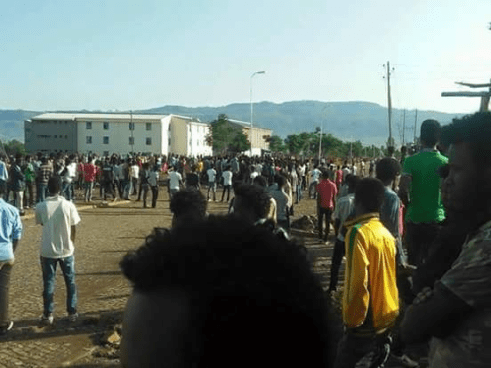
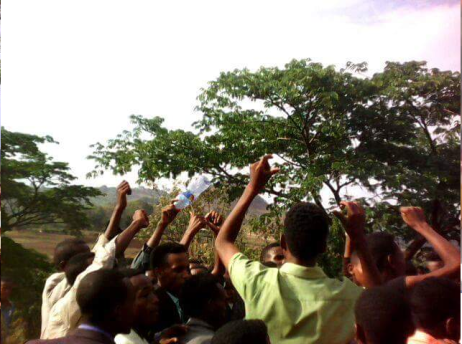
The Ethiopian government is cracking down on journalists and NGOs. Where’s the outrage from the international community?
Since November, state security forces have killed hundreds of protesters and arrested thousands in Oromia, Ethiopia’s largest region. It’s the biggest political crisis to hit the country since the 2005 election but has barely registered internationally. And with the protests now in their fifth month, there is an almost complete information blackout.
A teacher arrested in December told me, “In Oromia the world doesn’t know what happens for months, years or ever. No one ever comes to speak to us, and we don’t know where to find those who will listen to our stories.”
Part of the problem is the government’s draconian restrictions on news reporting, human rights monitoring, and access to information imposed over the past decade. But restrictions have worsened in the last month. Some social media sites have been blocked, and in early March security officials detained two international journalists overnight while they were trying to report on the protests. As one foreign diplomat told me, “It’s like a black hole, we have no idea what is happening. We get very little credible information.”
With difficulty, Human Rights Watch interviewed nearly 100 protesters. They described security forces firing randomly into crowds, children as young as nine being arrested, and Oromo students being tortured in detention. But the Ethiopian media aren’t telling these stories. It’s not their fault. Ethiopian journalists have to choose between self-censorship, prison, or exile. Ethiopia is one of the leading jailers of journalists on the continent. In 2014 at least 30 journalists fled the country and six independent publications closed down. The government intimidates and harasses printers, distributors, and sources.
International journalists also face challenges. Some do not even try to go because of the personal risks for them, their translators, and their sources. And when they do go, many Ethiopians fear speaking out against government policies—there are plenty of cases of people being arrested after being interviewed.
Diaspora-run television stations have helped fill the gap, including the U.S.-based Oromia Media Network (OMN). Many students in Oromia told me that OMN was one way they were able to learn what was happening in other parts of the region during the protests. But since OMN began broadcasting in March 2014 it has been jammed 15 times for varying periods. Radio broadcasts are also jammed–as international broadcasters like Voice of America and Deutsche Welle have experienced intermittently for years.
In December OMN began transmitting on a satellite that is virtually impenetrable to jamming. But security forces then began destroying private satellite dishes on people’s homes. Eventually the government applied pressure on the satellite company to drop OMN, which has now been off the air for over two months.
Social media has partially helped fill the information gap. Photos of injured students and videos of protests have been posted to Facebook, particularly in the early days of the protests. But in some locations the authorities have targeted people who filmed the protests on their phones. At various times in the last month, there have been reports of social media and file-sharing sites being blocked in Oromia, including Facebook, Twitter, and Dropbox. Website-blocking has been documented before – in 2013, at least 37 websites with information from Ethiopia were blocked. Most of the sites were operated by Ethiopians in the diaspora.
Independent non-governmental organizations that might be reporting what is happening face similar restrictions. The government’s Charities and Societies Proclamation of 2009 virtually gutted domestic nongovernmental organizations that work on human rights issues. The independent Human Rights Council released a report on the protests in March. It was a breath of fresh air, but the council released it at great risk. As the first report from Ethiopian civil society on an issue of great political significance, it was a damning indictment of the limits of freedom of expression in Africa’s second-largest country, with a population of 100 million.
The government may believe that by strangling the flow of information coming out of Oromia it can limit international concern and pressure. And so far the response from countries that support Ethiopia’s development has been muted. The deaths of hundreds, including many children, have largely escaped condemnation.
Yet the government’s brutally repressive tactics cannot be contained behind Ethiopia’s information firewall for long. The sooner the government recognizes this and acts to stop the mass arrests and excessive use of force, the better the outlook for the government and the affected communities.
The government—with the assistance of its allies and partners—needs to support an independent investigation of the events in Oromia, commit to accountability and justice for the victims, and start dismantling the legislative and security apparatus that has made Ethiopia one of the most hostile places for free expression on the continent. What’s happening in Oromia has long-term implications for Ethiopia’s stability and economic progress, and Ethiopians and the world need to know what is happening.

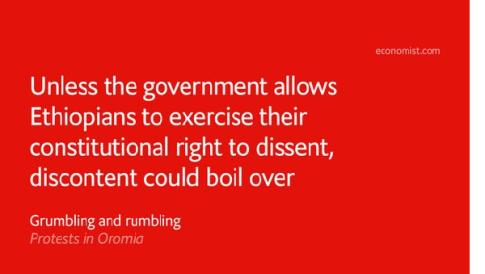
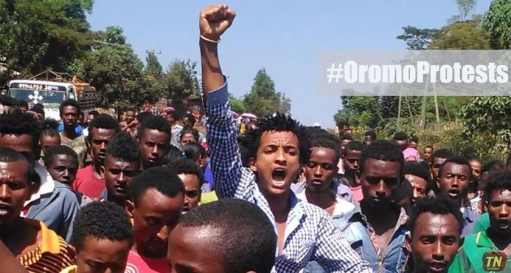
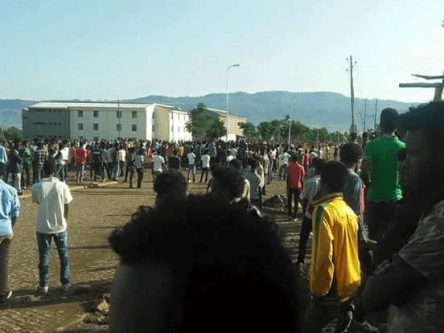
INTERNET messaging applications such as WhatsApp haven’t worked for more than a month in parts of Ethiopia that include Oromia region, which recently suffered fatal protests, according to local users.
Smartphone owners haven’t been able to access services including Facebook Messenger and Twitter on the state-owned monopoly Ethio Telecom’s connection, Seyoum Teshome, a university lecturer, said by phone from Woliso, about 115 kilometers (71.5 miles) southwest of the capital, Addis Ababa.
“All are not working here for more than one month,” said Seyoum, who teaches at Ambo University’s Woliso campus. “The blackout is targeted at mobile data connections.”
A spokesman for Twitter Inc. declined to comment on the issue when e-mailed by Bloomberg on Monday. Facebook Inc., which bought WhatsApp Inc. in 2014, didn’t respond to an e-mailed request for comment.
Protests that began in November in Oromia over perceived economic and political marginalisation of Ethiopia’s most populous ethnic group led to a crackdown in which security forces allegedly shot dead as many as 266 demonstrators, according to a March report by the Kenya-based Ethiopia Human Rights Project.
The government has said that many people died, including security officers, without giving a toll. One social-media activist, U.S.-based Jawar Mohammed, disseminated information and footage from protests to his more than 500,000 followers on Facebook.
No explanation
Restricting access isn’t a policy and may be because of “erratic” connections, according to government spokesman Getachew Reda. “We have not yet found any explanation,” he said by phone from Addis Ababa on Monday.
The government has the technology to “control” the messaging applications, the Addis Ababa-based Capital newspaper reported on April 10, citing Andualem Admassie, Ethio Telecom’s chief executive officer. Andualem didn’t answer two calls to his mobile phone seeking comment.
Hawassa city in Ethiopia’s southern region has suffered similar difficulties in accessing applications for more than a month, said Seyoum Hameso, an economics lecturer at the University of East London. “We couldn’t communicate with relatives,” he said in an e-mailed response to questions on Monday.
http://www.africlandpost.com/twitter-whatsapp-offline-ethiopias-oromia-region/

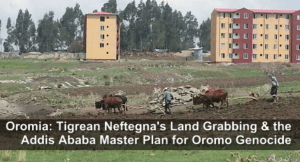
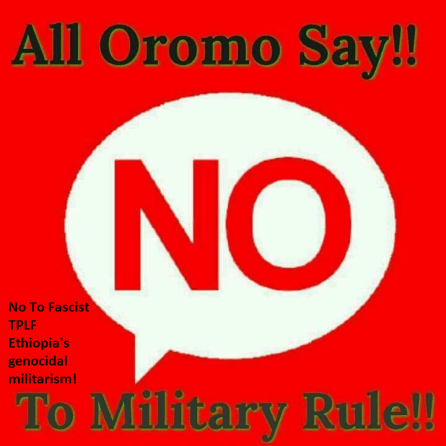
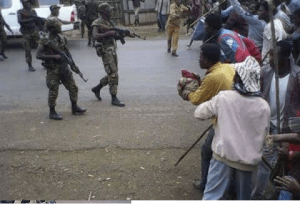
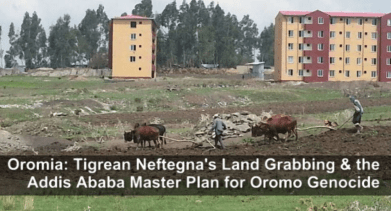
The Ethiopian government’s most serious domestic political crisis in more than a decade began over a scruffy football field appropriated by local officials for development.
After students responded by taking to the streets of Ginchi, a small town 80km from the capital, Addis Ababa, their protest was quickly quelled. But a spark had been lit for what has turned into an outpouring of grievances by the Oromo—Ethiopia’s largest ethnic group, accounting for about a third of the country’s 95 million population.
As protests spread, they ostensibly focused on a plan to expand the Ethiopian capital’s city limits into Oromia—the largest of the federal republic’s nine regional states and two city states—which encircles Addis Ababa.
Land in Ethiopia—all of which is government owned—has become an increasingly contentious issue as Ethiopia has opened up to the world, reflecting a worldwide trend particularly effecting developing countries such as Ethiopia.
Globally, investors are increasingly looking to investments not linked to volatile equities and bonds: other countries’ land. And few have attracted as much attention as Ethiopia, with its lowlands watered by the tributaries of the Blue Nile, a particularly bountiful draw.
The Ethiopian government has been on the front foot and quick to respond to such interest, and since around 2009 has leased about 2.5 million hectares to more than 50 foreign investors, from the likes of India, Turkey, Pakistan, China, Sudan and Saudi Arabia.
The so-called Addis Ababa Integrated Development Master Plan was seen as fitting a disturbing trend by the Oromo—many of whom are smallholder farmers—and they weren’t having any more of it. Ethiopia’s security forces are well equipped to deal with protests and unrest, although such has been the scale of the Oromo protests that security forces have been stretched. But even after the Oromo People’s Democratic Organisation—the regional arm of the Ethiopian government—shelved the plan, a government back down described as historic by many, protests continued.
“The widespread, sustained and recurring protests are clear messages of no confidence by a young and restless segment of the population which is driven by a feeling of marginalization,” stated a February editorial in Addis Ababa-based Fortune newspaper.
Many observers in Ethiopia, local and foreigners alike, note that although protests have taken an ethnic-based identity and focused on land, other deeper issues behind them—corruption, unfair elections, political and socioeconomic marginalisation—are familiar to many disenchanted Ethiopian voters.
Numbers of those killed since November given by international rights organisations, activists and observers range from 80 to 250-plus.
Some Addis Ababa residents suggest such numbers are preferable to even higher numbers if the government lost control of a situation that could, they argue, spiral into anarchy.
For against the narrative of a typically brutal Ethiopian government crackdown that brooks no dissent, there have been reports of looting, and organised armed gangs attacking foreign-owned factories, and private and governmental buildings. Even churches were damaged during a particularly violent flare up in the south in February.
Ethiopian citizens had a right to question the master plan but protests were hijacked by people looking to incite violence, according to Getachew Reda, a government spokesperson.
“You shouldn’t define a largely peaceful movement by this,” says a security analyst who focuses on Ethiopia for an Africa-based research organisation.
Despite February’s trouble in the south, many observers in Ethiopia say the majority of protests were peaceful, involving Oromo from across the demographic spectrum airing widely held grievances.
“It is also about competent government structure,” says Daniel Berhane, a prominent Addis Ababa-based political blogger, covering Ethiopia for the website Horn Affairs. “You have got ministries next door to each other not talking, and at every level—regional, zone or district—governmental staff arguing about who is responsible while criticising each other.”
“People have a perception of lack of competence in governance on the ground,” Daniel adds.
The government heeded the call of the people, according to Getachew, and observers say the government deserves credit for listening about the master plan.
But, more importantly, these same observers add, the government must allow Ethiopians to exercise their constitutional right to protest, and handle events in a way that does not escalate.
Protests have often resulted in deployment of military forces to support federal police, both regularly accused of ruthless suppression, with the perceived unaccountability of Ethiopia’s security forces added to the list of grievances, the analyst says.
There have even been reports of police taking head shots and shooting people in the back. But such alleged actions by police in remote locations, with backup often hundreds of miles away, defy logic as they would result in such a ferocious backlash by the local populace, according to a foreign politico in Addis Ababa.
This individual also suggested that some local militia, ostensibly part of state security but who sided with protestors and turned against federal forces, fired from behind women and children at police. Numbers of state security forces killed haven’t been released.
Nevertheless, shooting at protesters, as well as arbitrary arrests, especially of students—who initially formed the body of protests—have a long track record in Ethiopia, preceding this government back to during the brutal military dictatorship that ruled between 1974 and 1991.
Many who fled that period now compose part of the large Ethiopian diaspora, with the government claiming foreign-based opposition bolstered by US-based social media activists is manipulating the situation to its own ends.
“The diaspora magnifies news of what is happening, yes, but no matter how much it agitates it cannot direct at village level in Ethiopia—this is about dissatisfaction,” says Jawar Mohammed, executive director of US-based broadcaster Oromia Media Network, strongly criticised by the government and some non-government observers for fomenting conflict.
Imprisonment of leaders of the Oromo Federalist Congress party, Oromia’s largest legally registered political party, along with thousands of other Oromo political prisoners, makes negotiating a lasting solution a tall order, Jawar says.
Governance in today’s Federal Democratic Republic of Ethiopia—to use its full title—exhibits an inherent tension.
A decentralised system of ethnic federalism jars with the Ethiopian People’s Revolutionary Democratic Front ruling party’s authoritarian one-party developmental state style of leadership, similar to China’s.
“The political space has increasingly narrowed, becoming uneven, non-competitive and unwelcoming…contrary to the diversity of desires and interests in Ethiopian society,” states the same editorial.
It is a long way from the heady hopeful days of Ethiopia’s new federal constitution after the overthrow of the military dictatorship in 1991.
“The ruling government is a victim of its own success—the constitution it developed made promises and people trusted the EPRDF,” the analyst says. “Now people are demanding those rights and the government is responding with bullets and violence.”
The analyst acknowledges the government deserves credit for creating a constitution that is the best fit for an ethnically diverse country like Ethiopia, and for expanding basic services, infrastructure, respecting different cultural and ethnic identities, and better integrating Ethiopia’s large Muslim population.
But, the analyst adds, this federal constitution espouses a liberal philosophy that the government appears unable to reconcile with its decision-making processes.
The government’s hitherto successful job of holding together this particularly heterogeneous federation is not about to crumble tomorrow, observers note.
But things may get worse before they get better, unless underlying sources of friction and frustration are addressed.
The government has since acknowledged there was insufficient consultation with those likely to be effected by the master plan.
And during his latest six-monthly performance report to Parliament in March, Prime Minister Hailemariam Desalegn apologised to those who lost family members during protests, while the government has suggested there will be investigations into allegations of police brutality.
What is happening in Ethiopia could be a foretaste of what is to come elsewhere, as forces of global markets—including a growing global urban population in more developed nations that eats more than it farms—clash with indigenous desires to protect historical homelands.
“A fundamental tenet of the ruling party at its creation was its social democratic focus on farmers, who still make up 80 per cent of the country,” Daniel says. “It cannot suddenly become capitalist.”


“This government is at least better than previous ones,” remarked a 74-year-old Eritrean man to me last month in the Ethiopian capital of Addis Ababa, his longtime residence.
As it turned out, his assessment of the relative superiority of the current Ethiopian administration was for good reason: two of his children had been killed by a previous ruling outfit, the Derg military junta that took power in 1974 and began eliminating suspected opponents in droves.
Although that particularly bloody epoch came to an end in 1991, many a resident of Ethiopia might nowadays still have cause to complain about homicidal activity by the state.
In the Oromia region surrounding Addis Ababa, for example, there are claims that more than 200 people have been killed by Ethiopian security forces since November 2015, when protests broke out in response to the government’s so-called “Master Plan” to expand the boundaries of the capital by a factor of 20.
As a Newsweek article explains, the Oromo inhabitants of the region viewed the plan as “an attempted land grab that could result in the forced eviction of Oromo farmers and the loss of valuable arable land in a country regularly plagued by drought.”
This was no doubt a valid concern given the government’s established tradition of wantonly displacing Ethiopians in the interest of “development” — that handy euphemism for removing human obstacles to the whims of international and domestic investment capital.
Apparently, torture has also been a difficult habit for security forces to break.
Comprising some 35% of the population, the Oromo are Ethiopia’s largest ethnic group and have regularly decried discrimination by the ruling coalition party, the Ethiopian People’s Revolutionary Democratic Front (EPRDF), which is dominated by ethnic Tigrayan interests.
Politically motivated detention, incarceration, and other abuses have long characterised the landscape in Oromia, and the current protests have seen children as young as eight arrested.
And while the government has opted to shelve the Master Plan for now, protests in Oromia have continued. When I recently visited the town of Woliso, one of many protest sites in the region, residents pointed out that cancelling the plan wouldn’t bring back the dead people.
Events in Oromia have been described as the worst civil unrest in a decade.
Even without the Master Plan, meanwhile, the government is doing a decent job of courting investors. As I travelled west from Addis Ababa toward Woliso – a journey of about two hours — I passed sprawling factory complexes, including one featuring a Turkish flag flying alongside its more indigenous counterparts.
Launched in 2010 with a price tag of US$140 million, the Turkish-owned Ayka Addis factory is said to occupy several hundred thousand square meters of land.
The website of the Ethiopian Investment Commission furthermore lists Ayka Addis as one of “a number of private Industrial Zones” in Ethiopia, described as “success stories.”
Indeed, the EPRDF can point to double-digit economic growth over recent years to justify plowing ahead with its development model. But there’s more to life than GDP – as sizable poverty-stricken sectors of the Ethiopian population can presumably confirm.
About 200,000 people were reportedly in danger of trachoma-induced blindness in Oromia alone.
We might also take a look at the estimated 10.2 million Ethiopians currently “in need of urgent food assistance” — as reported, perhaps ironically, in a March edition of the English-language Ethiopian newspaper Capital, “the paper that promotes free enterprise.”
Additional troublesome statistics are contained in a 2014 BBC dispatch titled “The village where half the people are at risk of blindness.” The village in question is Kuyu, located in the Oromia region; the risk is due to infectious trachoma, “the world’s leading cause of preventable blindness.”
In the end, a lot of people in Oromia and beyond might have greater priorities than, say, income tax immunity for international developers.
[Abridged from TeleSUR English.]
https://www.greenleft.org.au/node/61511

It’s a bright, breezy Saturday in Mount Vernon with little else happening, making it even harder to miss Moussa Ali. Dressed in all-black and wearing a T-shirt that reads “I stand with the Oromo People,” Ali stands in front of the Washington Monument and nods at drivers passing him by on Charles Street. He raises his fist above his head and conducts a one-man demonstration.
“I’m protesting,” Ali, a 56-year-old Charles North resident and BP gas station manager, says, keeping his arm raised the whole time. “I’m standing with the Oromo students back home, which is in Ethiopia. The Oromo people are the majority in Ethiopia. In large numbers they are being killed. All young.”
Ali, who is ethnically Oromo, says a minority tribe, the Tigrayans, has had control of the Ethiopian government for over 20 years and oppress, disenfranchise, and take land from the other tribes, especially the largest tribe, the Oromos. According to Human Rights Watch, “Ethiopian security forces are violently suppressing the largely peaceful protests in the Oromia region that began in November 2015.”
Ali says: “They go to the students dorm, break into their rooms and because of this, the students cannot even go to school right now. Some of the students started escaping out of the country into the sea, trying to immigrate to Europe. And that struggle is still continuing right now! I want freedom for my people… this is part of me.”
Ali came to American from Ethiopia as a student 35 years ago, barely slipping the grip of government forces himself.
“[Back then] they started rounding up the students!” Ali says. “I was one of them marching. I used to go around doing the same thing I’m doing right now. I used to have my slogans, march in the towns, underground. Then they found out. They had their own spies. They give my name away. [My friends] told me, ‘The government’s looking for you! You better leave the country.’ That is how I left the country.”
Ali believes Americans should have an interest in this issue too. He says that American tax money in the form of military assistance is used to crush Oromo protests.Foreignassistance.gov shows that the U.S. Department of Defense has given the Ethiopian military $31 million in aid in 2015 alone. This is in addition to veteran American forces training the Ethiopian military.
“The interest for Obama and the United States is just to go after Al Qaeda in Somalia,” Ali says. “They get… cash. They train them. The Ethiopian government go into Somalia and fight for America.”
He shares the experience of his tribe back home with the hope that Baltimoreans can imagine the kind of freedom for his tribe that we have here: “Look at the freedom I have here. I’m talking to you right now. Nobody’s coming, arresting me, threatening me or going to take me to jail or torture me. No fear!”
He says he is “a representative of Baltimore City” who’s doing his part.
“There is no Oromo news except [what you hear from] the Ethiopian government, they choose it,” Ali says. “All over the globe, Oromos, no matter where they are, we are doing this.”
“It’s happening all over,” he continues. “Oromos are protesting in Sweden, France, Australia, England, Oromos are protesting everywhere. We are a strong community in Washington D.C., [but in Baltimore] communities are not large.”
Though he stands alone, he says he’ll “come back again” and be here this upcoming weekend as well for a couple hours.
“We welcome everybody [to stand with us],” Ali says. “I will provide s [t-shirts] if they’re coming.”
Read more at:-

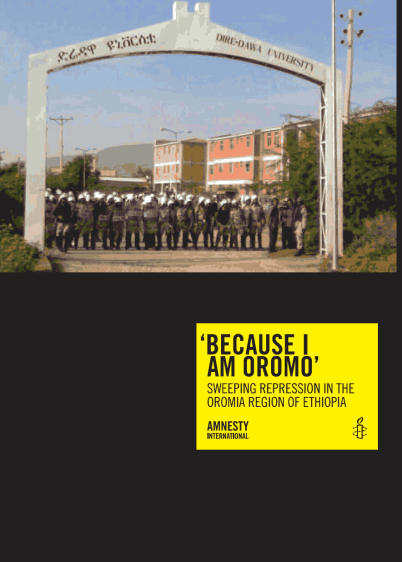
@OSA London Conference @London School of EConomics on Violation of Oromo Human Rights in Ethiopia, by Patricia Bartley, Amnesty International UK, Ethiopia Country Coordinator; 3rd April 2016.
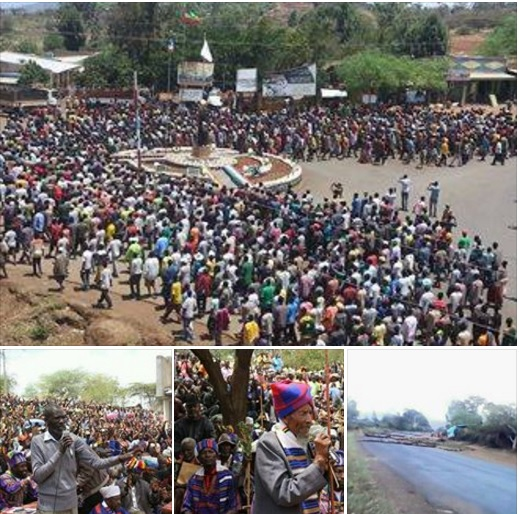
BY William Davison, The Guardian, Global development, 8 April 2016
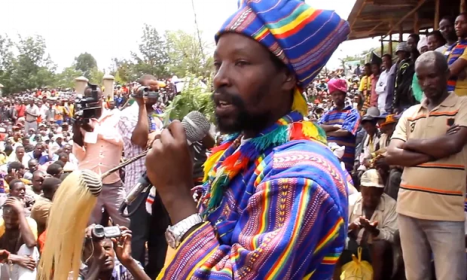
Kala Gezahegn, the traditional leader of Ethiopia’s Konso people.
Kala Gezahegn, the leader of the Konso people, addresses a crowd. His arrest highlighted growing tensions in Ethiopia between state power and ethnic groups’ desire for autonomy. Photograph: Courtesy of Kasaye Soka
Nothing seemed amiss when an Ethiopian government vehicle arrived to collect the traditional leader of the Konso people for a meeting in March. But instead of being taken to discuss his community’s requests for more autonomy, Kala Gezahegn was arrested.
Kala’s detention marked a low point in fraught relations between the Konso in southern Ethiopia and the regional authorities in the state capital, Hawassa. Five years ago, the Konso lost their right to self-govern, and growing tensions since then mirror discontent in other parts of Ethiopia.
The 1995 constitution in Africa’s second most populous country allows different ethnic groups to self-govern and protects their languages and culture under a system called ethnic federalism. The largest ethnicities – such as the approximately 35 million-strong Oromo – have their own regional states, while some smaller groups administer zones within regions, as the Konso effectively used to do.
Many of Ethiopia’s ethnic identities, which number more than 80, were suppressed during the imperial and national-socialist eras that preceded the federal system.
What happened in Konso followed demonstrations and killings by security forces in Oromia, the most populous region. A rights group says 266 people have been killed since mid-November during protests over injustice and marginalisation.
Demonstrations were sparked by a government plan to integrate the development of Addis Ababa and surrounding areas of Oromia. After fierce opposition from the Oromo, that scheme was shelved in January, but protests have continued, fuelled by anger over alleged killings, beatings and arrests.
In Amhara, a large region north of Addis Ababa, there was violence late last year related to the Qemant group’s almost decade-old claim for recognition as a group with constitutional rights. The fact that the Qemant rejected a territorial offer from the authorities, saying it was too small, may have provoked local Amhara people. In December, federal security forces were dispatched to contain escalating communal violence.
In Konso, after Kala and other leaders were locked up, thousands took to the streets to protest. During clashes with police on 13 March, three people were killed, and now the dispute seems entrenched.
Women at Fasha market in Ethiopia’s Konso region. Photograph: Grant Rooney/Alamy
The crux of the issue is a 2011 decision to include the Konso – which is in the multi-ethnic Southern Nations, Nationalities and Peoples’ Region (SNNPR) and has 250,000 people – in the newly created Segen zone, thereby removing their right to self-rule. That decision was taken without consultation and resulted in worsening public services and unresponsive courts, says Kambiro Aylate, a member of a committee chosen to represent the community’s demands.
The budget for Konso’s government was reduced by 15%, says Orkissa Orno, another committee member. “The Konso people used their rights to ask for a different administrative structure,” he says.
In a recent interview, prime minister Hailemariam Desalegn blamed the unrest in Oromia on high youth unemployment and a “lack of good governance”, a line echoed by officials in other regions.
Kifle Gebremariam, the deputy president of the SNNPR, said the Konso leaders were arrested on suspicion of maladministration and corruption, issues “completely different” from the political question.
Kifle added that discussions had been held with residents about the status of the administration. “The regional government, including the president, gave them the right response, but they are not peacefully accepting this.”
Kala’s supporters dispute that account, although there have been signs of compromise, with the traditional leader permitted to take part in recent negotiations.
Concerns over the federal system’s ability to withstand such strains are not new. For example, southern groups such as the Wolayta were involved in violent clashes before they were granted their own zone in 2000.
In 2009, the International Crisis Group wrote in a report (pdf): “Ethnic federalism has not dampened conflict, but rather increased competition among groups that vie over land and natural resources, as well as administrative boundaries and government budgets.”
Officials have argued for decades that the focus on minority rights has been integral to an unprecedented period of peace and development.
Assefa Fiseha, a federalism expert at Addis Ababa University, agrees the system has brought stability to a country threatened with fragmentation in the early 1990s after ethno-nationalist rebellions overthrew a military regime.
But a lack of democratisation and centralised economic decision-making works against local autonomy and exacerbates grievances, according to Assefa.
“The regional states, as agents of the regional people, have to be consulted on whatever development project the federal government wants to undertake,” he says.
In fact, the government appears to have been moving in the opposite direction, as its legitimacy depends on economic growth and improving social services and infrastructure.
National projects – 175,000 hectares (430,000 acres) of state-owned sugar plantations in the ethnically rich south Omo area, for instance – are designed, implemented and owned by federal agencies.
The now scrapped integrated Oromia-Addis Ababa plan is another example, as it was developed without scrutiny by “key stakeholders” in the Oromia government, Addis Ababa city and the federal parliament, Assefa says.
One reason for quick decisions in a devolved federation is that the political positions of Ethiopia’s diverse communities are filtered through a rigid ruling coalition.
Along with allied parties, the Ethiopian Peoples’ Revolutionary Democratic Front won every federal and regional legislative seat in May’s elections, extending its control of all tiers of government.
The EPRDF has held power for 25 years, partly by building a popular base of millions of farmers and demanding strict obedience to party doctrine and policy, but some say this is now changing.
The wave of protests, so soon after the landslide election victory, shows that the “dominant party system is facing problems”, Assefa says.
“Growing ethno-nationalism, centralised policymaking and the failure to provide space for political dissent combined together make a perfect storm for violence.”
Read more at:-
With whom are the European Union, the United States, and the African Union Officials meeting to discuss and end the exclusion and marginalization of the Oromo people in Ethiopia?
By Dr. Birhanemeskel Abebe Segni, 8 April 2016
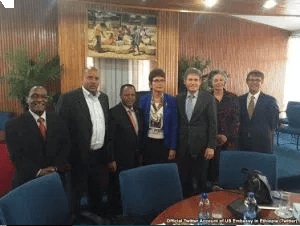
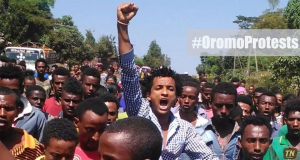
One may think the OPDO, the Oromo wing of the EPRDF– the ruling party in Ethiopia, is representing and speaking for the Oromo people. That is not actually the case. No official from the United States, the European Union or the African Union ever spoke and convened with a single OPDO officials over the last four months.
For instance, no one from the United States delegations that visited Ethiopia in recent months including Ambassador Samantha Power (United States Permanent Representative to the United Nations in New York), Ambassador Linda Thomas-Greenfield (Assistant Secretary of State for African Affairs), Ms. Gayle E. Smith (Administrator of USAID), and Tom Malinowski ( the U.S. Assistant Secretary of State for Democracy, Human Rights, and Labor) convened and talked with a single OPDO officials both at federal and regional levels. They all met with non-Oromo Ethiopian officials with no Oromo present and discussed about the plight of the Oromo people and left, or they told us so.
Similarly, no one from the European Union officials who recently visited Ethiopia to express their concern on the Oromo people’s economic and political marginalization and exclusion and the ongoing bloody crackdown on the #OromoProtests met with a single OPDO official, both at the federal and regional levels.
Some might think these European, African and American officials who visited Addis Ababa over the last four months to express their concern about the systemic exclusion and marginalization of the Oromo people in Ethiopia are meeting and holding consultation with the only legally registered Oromo opposition party, the Oromo Federalist Congress(OFC), officials. That is not the case either.
In early February this year, the Assistant Secretary of State for African Affairs, Ambassador Linda Thomas-Greenfield, who went to Ethiopia to participate on the AU Summit held consultation with the Ethiopian authorities on the Oromo issues. She also said she met with the Oromo community representatives.
It turned out Ambassador Linda Thomas-Greenfield did not meet with anyone from the Oromo wing of the EPRDF, the OPDO, as well as the Oromo Federalist Congress (OFC), the two known groups who claim to represent the Oromo.
Dr. Merera Gudina, the Chairman of the Oromo Federalist Congress, stated on record that no one from OFC met with the delegation of Ambassador Linda Thomas-Greenfield including Ms. Gayle E. Smith, the Administrator of USAID. It is mindboggling who met with Ms. Thomas-Greenfield delegation as there is no known Oromo community in Addis Ababa let alone Oromo community representatives.
Similarly, the African Union spokeswoman stated that African Union is talking with the Ethiopian Authorities behind closed doors on the #OromoProtests. But, who are these proxies with whom these officials are speaking on behalf of the Oromo people?
The representation of the Oromo professionals in the Ethiopian federal government bureaucracy including in the Ethiopian federal security and defense forces are virtually non-existent. One may blame the Amharic only monolingual language policy of the federal government for the total and complete exclusion of Afaan Oromo speakers, but that is just one reason among many written and unwritten exclusionary policies in place.
The critical questions though are, how long could the Ethiopian government keep the Oromo people in obscurity as non-existing majority with no representation?
And how long could the United States, the European Union and the African Union turn blind eyes and deaf ears to the plight of the Oromo people in Ethiopia?
Are violence and war necessary prerequisites for the rights of peaceful people like the Oromo to be respected?
Is investing in peace not less expensive in comparison to investing in war, violence and the resultant humanitarian crisis for the so called development and security partners of Ethiopia, particularly the United States and United Kingdom? #OromoProtests.
http://ethiopia.usembassy.gov/pr_2016_20.html#.Vv2G3uGIVNs.twitter
Read more at: http://www.caboowanci.com/2016/04/08/eu-us-au-officials-meeting/

In past decades, older generations of Africans had to be tolerant of oppressive governments, which were often dictatorships—if only for their own safety. But the younger generation is more vocal, critical and demanding of their leaders, and unwilling to allow their questions to be left unanswered.
Those higher expectations have been voiced on the streets of African cities from Bujumbura to Cape Town in the last year, but increasingly the murmurings of protest and criticism start via social media apps on mobile phones. And Twitter, with its relatively low bandwidth consumption, good for the slower networks and 3G phones of many African consumers, has played a leading role as a platform for raising political awareness on the continent.Data from the latest How Africa Tweets report conducted by Portland shows Twitter continues to provide an important platform for political discourse in Africa. The report analyzed 1.6 billion tweets and 5,000 hashtags from 2015 and found that politics-related tweets in Africa, while behind entertainment and commerce, were very much on the rise, and generally topped the rates of political tweets in the United States and United Kingdom.
http://qz.com/654958/politics-and-activism-are-driving-africas-twitter-conversations-to-new-highs/

(telesurtv) — “This government is at least better than previous ones,” remarked a 74-year-old Eritrean man to me last month in the Ethiopian capital of Addis Ababa, his longtime residence. Clad in a tattered grey suit and speaking to me in Italian, the man was peddling a book of useful Amharic phrases he had compiled for the foreign visitor, proceeds of which would go toward the purchase of a second-hand comforter for his bed.
As it turned out, his assessment of the relative superiority of the current Ethiopian administration was for good reason: two of his children had been killed by a previous ruling outfit, the Derg military junta that took power in 1974 and began eliminating suspected opponents in droves.
Although that particularly bloody epoch came to an end in 1991, many a resident of Ethiopia might nowadays still have cause to complain about homicidal activity by the state. In the Oromia region surrounding Addis Ababa, for example, there are claims that more than 200 people have been killed by Ethiopian security forces since November 2015, when protests broke out in response to the government’s so-called “Master Plan” to expand the boundaries of the capital by a factor of 20.
As a Newsweek article explains, the Oromo inhabitants of the region viewed the plan as “an attempted land grab that could result in the forced eviction of Oromo farmers and the loss of valuable arable land in a country regularly plagued by drought.”
This was no doubt a valid concern given the government’s established tradition of wantonly displacing Ethiopians in the interest of “development”—that handy euphemism for removing human obstacles to the whims of international and domestic investment capital.
Comprising some 35 percent of the population, the Oromo are Ethiopia’s largest ethnic group and have regularly decried discrimination by the ruling coalition party, the Ethiopian People’s Revolutionary Democratic Front (EPRDF), which is dominated by ethnic Tigrayan interests. Politically motivated detention, incarceration, and other abuses have long characterized the landscape in Oromia, and the current protests have seen children as young as eight arrested.
Apparently, torture has also been a difficult habit for security forces to break.
And while the government has opted to shelve the Master Plan for now, protests in Oromia have continued. When I recently visited the town of Woliso, one of many protest sites in the region, residents pointed out that cancelling the plan wouldn’t bring back the dead people.
Events in Oromia have been described as the worst civil unrest in a decade. The United States, never too quick to condemn the excesses of its African ally, helpfully responded by emitting a “security message” for U.S. citizens and restricting the movements in Oromia of its government personnel; the British government, for its part, provided a color-coded map of Ethiopia on which a vast chunk of land around Woliso is designated inadvisable for “all but essential travel.”
Even without the Master Plan, meanwhile, the government is doing a decent job of courting investors. As I traveled west from Addis Ababa toward Woliso — a journey of about two hours — I passed sprawling factory complexes, including one featuring a Turkish flag flying alongside its more indigenous counterparts.
A January report by the Ethiopian News Agency outlines the government’s goal of luring Turkish and other investors to “priority areas” as part of an overall scheme to convert the economy from agriculture- to industry-based. Noting that “about 110 Turkish investment projects have become operational” and that “incentives from the government includ[e] electricity and cheap labor,” the report highlights the exploits of the Ayka Addis textile factory 20 kilometers west of the Ethiopian capital, in the Oromia region.
Launched in 2010 with a price tag of US$140 million, the Turkish factory is said to occupy several hundred thousand square meters of land.
The website of the Ethiopian Investment Commission furthermore lists Ayka Addis as one of “a number of private Industrial Zones” in Ethiopia, described as “success stories.” The site, which advertises thousands of hectares worth of “investment opportunities” in the country, cites perks including exemptions from customs duties for machinery and other equipment as well as certain exemptions from income taxes.
Indeed, the EPRDF can point to double-digit economic growth over recent years to justify plowing ahead with its development model. But there’s more to life than GDP — as sizable poverty-stricken sectors of the Ethiopian population can presumably confirm.
If we want to consider other, less superficial digits, we might take a look at the estimated 10.2 million Ethiopians currently “in need of urgent food assistance”— as reported, perhaps ironically, in a March edition of the English-language Ethiopian newspaper Capital, “the paper that promotes free enterprise.”
Additional troublesome statistics are contained in a 2014 BBC dispatch titled “The village where half the people are at risk of blindness.” The village in question is Kuyu, located in the Oromia region; the risk is due to infectious trachoma, “the world’s leading cause of preventable blindness.”
At the time of the article’s publication, 200,000 people were reportedly in danger of trachoma-induced blindness in Oromia alone. Quoted in the piece is one Simon Bush of the Sightsavers organization, who remarks that trachoma is “a disease of poverty” that is “endemic in areas which have poor access to water and sanitation.”
All of this is merely to point out that, in the end, a lot of people in Oromia and beyond might have greater priorities than, say, income tax immunity for international developers. Because it doesn’t take a functioning eyeball to see that such development models are themselves in need of some serious development.
Belén Fernández is the author of “The Imperial Messenger: Thomas Friedman at Work,” published by Verso. She is a contributing editor at Jacobin magazine.
https://www.issafrica.org/events/view-on-africa-protests-political-instability-and-purge-in-ethiopia

CAIRO (Almonitor, April 5, 2016) — On March 13, nearly 1,000 people of the Oromo ethnic community took part in a big ceremony celebrating the second anniversary of the Oromia Media Network (OMN), which opposes the ruling regime in Ethiopia.
The ceremony was the first event held by the Ethiopian opposition in Cairo since theoutbreak of violence in Ethiopia between the government and the ethnic community in December. The violence arose over Ethiopia’s “master plan” to expand the capital, Addis Ababa, into large parts of Oromo farmlands without any actual compensation.
At that time, Egypt’s Foreign Affairs Ministry contented itself with issuing a press statement on Dec. 21, saying that the incidents “are an internal Ethiopian issue.”
“We are looking forward to stability and the completion of the comprehensive economic and social development programs in Ethiopia,” the ministry said.
Yet local Ethiopian media outlets continued to circulate statements by Ethiopian officials accusing Cairo of supporting the opposition and of being behind these events in order to weaken Ethiopia. These statements were based on the late Ethiopian Prime Minister Meles Zenawi’s remarks in November 2010 that there was irrefutable evidence of Egypt’s support for insurgents in Ethiopia, under the rule of former President Hosni Mubarak.
At the second anniversary ceremony, OMN head Jawar Mohammed spoke of the need for the Oromo uprising to continue against the policies of the Ethiopian government and the ruling Tigrayan People’s Liberation Front (TPLF) party. He accused the government of adopting systematic policies against the Oromo community and of seizing its land.
A government official who coordinates African affairs and spoke to Al-Monitor on condition of anonymity said, “The Egyptian authorities have nothing to do with the ceremony.”
He explained, “A group of Ethiopian activists applied for a security approval for the ceremony, which they obtained, similarly to any other foreign communities wishing to hold activities in Cairo.”
The United Nations High Commissioner for Refugees (UNHCR) fact sheet issued in February said 6,916 Ethiopian asylum seekers are registered with the UNHCR in Cairo.
“Most of the Ethiopians who are registered with the UNHCR are of the Oromo people, whose registration rate has been constant since 2015,” Marwa Hashem, assistant public information officer for the UNHCR in Cairo, told Al-Monitor.
“The UNHCR have provided all political asylum seekers and refugees from Africa with services such as material aid to the most needy, educational grants, health care and psychosocial support.”
Ahmad Badawi, head of the Egyptian Foundation for Refugee Support, told Al-Monitor, “Egypt is committed to its international obligations not to reject asylum seekers when they do not oppose national security, even those who enter illegally.”
The Egyptian government does not provide any special advantages to Ethiopian refugees without providing the same to other foreign nationals, he said. UNHCR is in charge of providing services to all refugees.
The Oromo ethnic community makes up 40% of Ethiopia’s population, followed by the Amhara and Tigrayan communities, which make up 32% — though Tigrayans control the government through the ruling TPLF party. The Oromia Regional State stretches over large areas in central Ethiopia, where the capital is located, and includes most of Ethiopia’s wealth, as it controls the country’s coffee exports, gold mines and the rivers’ headwaters.
Due to the escalating protests, the Ethiopian government canceled the plan to expand the capital. Yet the Oromo revolution has not ended, as the people continue to demand freedom and fair representation in the government and to protest the ruling party’s practices.
“The Oromo community will continue to protest not only against the Ethiopian government’s master plan, which raised problems in the past, but also to preserve the Oromo ethnic community’s land, culture and language, against the ethnic policies of the Tigrayan who control the rule,” Girma Gutema, an Oromo community activist, told Al-Monitor.
“Eritrea and Sudan supported the Oromo struggle. Yet following the Sudanese-Ethiopian rapprochement, many rebels fled to Eritrea,” Gutema said. However, the Egyptians, as well as the international community, don’t know enough about the Oromo community’s problems to be able to offer support.
Such rumors, he said, are propaganda spread by the Ethiopian government due to its historic bickering with Egypt.
Galma Guluma, an Ethiopian political activist and organizer of the ceremony in Cairo, told Al-Monitor that Cairo is the safest place for Oromo people fleeing Ethiopia, particularly sinceSudan changed its policy and is now turning over Ethiopian oppositionists to their government.
“Fleeing to Cairo was not an easy thing to do. Many refugees went through difficult situations and conditions until they reached the Egyptian border,” Guluma said. “Most of the Oromo refugees in Cairo do not have permanent jobs, and some girls are working as domestic servants. Moreover, they receive very little aid from the civil society organizations.”
Guluma added, “We do not have weapons to face the regime in Ethiopia. Our goal is to focus on [getting] the media to speak of the suffering of the Oromo people,” who are oppressed despite the great wealth in their state.
He noted, “Cairo has been a historical place for the Oromo struggle and the idea of the media network and Oromo radio started in Cairo more than 50 years ago with SheikhMohammed Rashad, who studied at the Al-Azhar University in the 1960s and was honored by [former Egyptian President] Gamal Abdel Nasser.”
The Egyptian political administration has said that, while it seeks to build trust and goodwill, its open-door policy for Oromo refugees is part of an international commitment to the refugees’ case and should not be perceived as an attempt to exploit any internal conflicts to weaken the Ethiopian state.
Nevertheless, this issue remains a focus of constant tension in Egyptian-Ethiopian ties, in addition to the historic conflict over Nile water management.


NAIROBI (HAN) March 31. 2016. Public Diplomacy & Regional Security News- “I prefer death to detention at Maekelawi,” prominent opposition leader Bekele Gerba has told a court after enduring appalling conditions in one of the chambers of hell at the notorious Maekelawi Prison in the Ethiopian capital.
The prison cell is sardine-packed: 30 prisoners in a 10×10 meter area. Because it is too crowded, respiration coupled with body heat drips back onto the prisoners from the ceiling. No need to divulge details of the hell-on-earth place called “Maekelawi” prison, where prominent political prisoners from the recent protests in Oromia are being held.
The horrible conditions led Bekele and other top OFC leaders to lauch a hunger strike, and on the fifth day on Sunday, when most of them were in critical health conditions, a small change was introduced: the number of occupants in Bekele’s cell was cut down to 17. Better than before but still brutal.
According to OFC Deputy chairperson, Mulatu Gemechu, prominent Oromo individuals who are at Maekelawi are Bekele Gerba, Dejene Taffa, Desta Dinka, Gurmesa Ayano, Addisu Bulala, Dereje Merga and Alemu Abdisa
This small area was so crowded not only with the human occupants but also personal belongings as well as sanitation goodies for the occupants who are not allowed to get air except very short timeouts at dawn and dusk.
Political prisoners suffer not only for torture or life in extremely appalling prison conditions. They are also handed lengthy appointments so that they would break down psychologically. The court has adjourned the prisoners case for another 28 days.
In another development, Mulatu said an unprecedented crackdown on Oromo people was in full swing throughout Oromia, and the mass arrests came in despite Prime Minister Hailemariam Desalegn’s recent speech sounded promising for the suffering majority. However, on the ground, a brutal massive crackdown is under way as the following list shows:
1. Shashemene, Western Arsi – Close to 1200 people have been taken away as prisoners and no one knows their whereabouts.
2. Chiro, Western Hararghe – Between 800 to 1000 people were hauled away by nine trucks. No one knows their whereabouts.
3. Gujji Zone – 150 people taken away.
4. Ambo, Western Shoa – 103 people taken away
5. Gimbi, Western Wellega – 60 people were arrested and taken to an unknown destination.
6. Qelem, Wellega – 54 people taken away.
7. Horo Gudru, Wellega – 39 people were taken away in one night.
8. Burayu (near Addis) – Two individuals taken away to an unknown destination.
Though Ethiopia is hemmoraging from the political crisis, the government is trying to use the prevalent “drought and famine” as a cover to wipe out dissent in Oromia and beyond.
Read more at: http://geeskaafrika.com/2016/03/31/ethipoia-i-prefer-death-to-detention-at-maeklawi-bekele-gerba/

UK (IBTimes) — Protesters and activists in Oromia, Ethiopia’s largest state, have denied they have self-rule in the region, contrary to a governement’ statement given to IBTimes UK. Abiy Berhane, minister counsellor at the Ethiopian Embassy in London said earlier in March people already rule themselves in Oromia, they use Oromo as the official language, they have their own budget and a regional parliament that rules on all political, economic and social aspects.
Who are the Oromo people?
The Oromo people are Ethiopia’s largest ethnic group and their population amounts to more than 25 million (around 35% of Ethiopia’s total population).
Oromo people speak Afaan Oromoo, as well as Amharic, Tigrinya, Gurange and Omotic languages. They are mainly Christian and Muslim, while only 3% still follow the traditional religion based on the worshipping of the god, Waaq.
In 1973, Ethiopian Oromo created the Oromo Liberation Front (OLF), which stemmed from the discontent over a perceived marginalisation by the government and to fight the hegemony of the Amhara people, another large ethnic group in Ethiopia.
OLF – still active today – also calls for the self-determination of the Oromo people. It has been deemed as a terror organisation that carried out violent acts against people in Ethiopia, Somalia and Kenya. The group has always denied such allegations, claiming its mission is to terminate “a century of oppression” against the Oromos.
However, some Oromo people denied the claims made by the official. Activist, author and PhD candidate at London’s Soas University, Etana Habte, told IBTimes UK there is no self-rule in Oromia, where people do not trust the region’s ruling party coalition, Oromo Peoples’ Democratic Organization (OPDO).
“Opdo is an organisation of ex-war captives established by the TigrayanPeople’s Liberation Front (TPLF) inTigray in 1990, when the latter failed to co-opt the Oromo Liberation Front (OLF),” he alleged.
“Oromia’s regional council, Caffee Oromiyaa, has never had any history of independent decisions, it has been approving what is put on the table byTPLF. If Oromia has no self-rule, no regional council of itself, talking about budget and independent decisions is only a mere waste of time.”
Opdo has not responded to a request for comments on the allegations.
Climate of fear
Oromia has been rocked by the deadly protests that erupted in November 2015 against a government draft plan − later scrapped − that aimed to expand the boundaries of the capital Addis Ababa.
Activists claimed some 400 people, at least 200 according to a report by Human Rights Watch (HRW), have been allegedly killed by security forces. The government denied the allegations of violence and claimed legitimate protestshave been infiltrated by people who aim to destabilise the country.
Although the government scrapped the plan, demonstrations are continuing, with peoplecalling for self-rule, the liberation of political prisoners, the end of what they perceive as “military regime” in the region and the cessation of an alleged crackdown by security forces on “peaceful and unarmed” demonstrators, mainly students and farmers.
“The regime is using new strategies to punish Oromia. Amenities have been cut in most urban centres, the regime has brought down all independent TVs and radio broadcasts from overseas, closed selected websites and social media websites. It is doing this in an attempt to breakdown the nerve centre of the protests,” Habte alleged.
“There is a serious climate of fear in the public and there is no guarantee that any person would come back home safely once they leave. This situation has convinced people that the state targets you simply because you are Oromo. Amnesty International’s report published in October 2014 titled, Because I am Oromo: Sweeping Repression In The Oromia Region Of Ethiopia, is an absolute representation of unfolding realities.”
Habte also denied protesters are seeking secession, although it is a right guaranteed by the constitution. He denied that the government started public consultations, contrary to what Berhane told IBTimes UK.
“People are heard time and again saying: ‘We don’t want to be ruled by a government who has killed our loved and respected ones’. It seems too late, but if the regime wants to solve the current crisis, it has to address it at a national level and with national representation.”
Read more at:- http://www.ibtimes.co.uk/ethiopia-protesters-no-we-dont-have-self-rule-oromia-state-1551225


Das Berliner Missionswerk setzt sich seit den 1970er Jahren für Menschenrechte und Gerechtigkeit in Äthiopien ein. Was sich gegenwärtig in Oromia abspielt, dem Landesteil Äthiopiens, in dem das Missionswerk über langjährige Partner verfügt, wird durch die hiesigen Medien kaum berichtet und ist darum auch nur Wenigen bekannt.
Das hat den Beirat „Horn von Afrika“ der Berliner Mission, Anfang des Jahres dazu veranlasst Briefe an alle im Bundestag vertretenen Parteien zu schreiben. Worauf sie sehr zustimmende Antworten bekommen haben, mit Ausnahme vom Außenministerium und vom Ministerium für wirtschaftliche Zusammenarbeit und Entwicklung.
Als weiteren Schritt wenden Sie sich nun mit einer Petition an die Öffentlichkeit. Die darin enthaltene Erklärung des Europäischen Parlaments lässt an Deutlichkeit nichts zu wünschen übrig und hoffen mit dieser Aktion dazu beizutragen, dass die Resolution in praktische Politik umgesetzt wird.
Die äthiopische Regierung setzt die Armee gegen friedliche Demonstranten ein. Mehr als 250 Menschen, die gegen Enteignungen und Vertreibungen sowie für die Selbstbestimmung Oromias demonstrierten, wurden bereits getötet. Das Parlament der Europäischen Union hat die äthiopische Regierung aufgefordert, die von ihr unterzeichnete UN-Charta der Menschenrechte zu wahren.
Sehr verehrte Frau Bundeskanzlerin Dr. Angela Merkel,
frieren Sie deshalb die Militär- und Budget-Hilfe für Äthiopien ein, bis die äthiopische Regierung die Menschenrechte, vor allem die Meinungs- und Versammlungsfreiheit respektiert.Die äthiopische Regierung hat einen „Masterplan“ vorgelegt, der eine Ausweitung der Bundeshauptstadt Addis Abeba auf Kosten des Bundeslandes Oromia vorsieht. Er hat bereits zur gewaltsamen Vertreibung von Tausenden von Bauern und ihren Familien geführt und hätte bei konsequenter Umsetzung die faktische geographische Teilung Oromias zu Folge. Dieser Plan hat seit November 2015 in Oromia zu zahlreichen Protest-Demonstrationen geführt. Diese wurden von der äthiopischen Regierung unter Einsatz von Bundespolizei und Militär blutig niedergeschlagen. Mehr als 250 Menschen wurden getötet. Hunderte wurden verwundet, Tausende verhaftet – Jugendliche, Aktivisten, Journalisten, Intellektuelle, Oppositionspolitiker. Menschen riskieren ihr Leben, wenn sie gegen Vertreibungen, Enteignungen und gegen die gewaltsame Einschränkung der in der Verfassung verbrieften Versammlungs-, Demonstrations- und Meinungsfreiheit demonstrieren.
Das Europäische Parlament hat am 21. Januar 2016 in einer Resolution zur Lage in Äthiopien (2016/2520 RSP) die äthiopische Regierung dringend und unmissverständlich aufgefordert, die von ihr unterzeichneten Menschenrechtserklärungen und die eigene Verfassung der Demokratischen Bundesrepublik Äthiopien vom 8.Dezember 1994 zu respektieren und zu praktizieren, insbesondere die Grundrechte und Grundfreiheiten, die Menschenrechte und die demokratischen Rechte.
Stattdessen hat die äthiopische Bundesregierung am 24.Februar 2016 alle kommunalen und regionalen Regierungen im Bundesland Oromia abgesetzt und die zivile Verwaltung durch das Militär ersetzt. Die Regierung Oromias ist faktisch machtlos und die föderale Verfassung Äthiopiens vollends außer Kraft gesetzt. Immer mehr, vor allem gut ausgebildete junge Leute verlieren die Hoffnung und verlassen das Land.
Deutschland unterstützt Äthiopien mit Militärhilfe und mit Haushaltszuschüssen. Die deutsche Bundesregierung unterstützt damit direkt die Unterdrückung der Oromo, den Krieg der äthiopischen Regierung gegen das eigene Volk, die Missachtung der Verfassung Äthiopiens und die vollständige Einschränkung der politischen Freiheiten und der Menschenrechte.
Mit dem Einfrieren der Militär- und Budget-Hilfen aus Deutschland und anderen Geberstaaten könnten wir die äthiopische Regierung zum Einlenken bewegen.
Der Beirat des Berliner Missionswerkes für das Horn von Afrika
- Pfr. i.R. Gerd Decke, Vorsitzender
- Pfr. Dr. Reinhard Kees, Geschäftsführer
Die Petition kann hier unterzeichnet werden.
http://www.pressenza.com/de/2016/03/frieren-sie-die-militaerhilfe-fuer-aethiopien-ein/
France 24, March 29, 2016
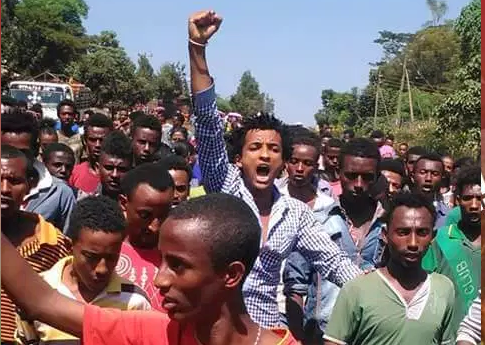
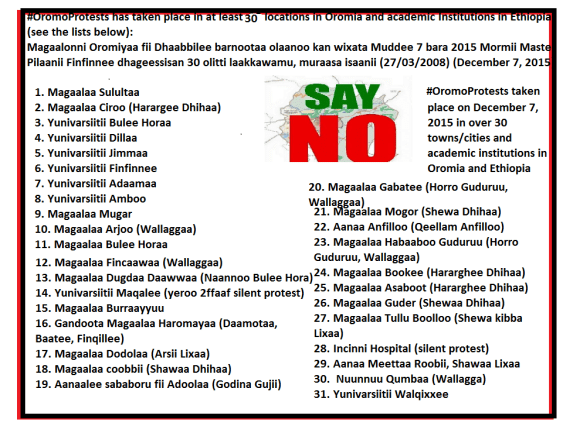
Protesters are calling for equal rights and an end to what they call corruption, land grabs and government oppression. Some Oromo families have been forced off their land, and the government refuses to officially recognise the Oromo language. The government has cracked down on the protests, and activists and human rights groups say over 200 people have been killed. FRANCE 24’s reporter spoke to the families of several victims.
Click on the video player above to watch FRANCE 24’s full report from Ethiopia.

Begna Dugassa Ph.D; Email: begna.dugassa@gmail.com



By Finfinne Tribune | Gadaa.com |Bitootessa/March 28, 2016
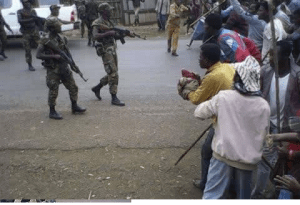
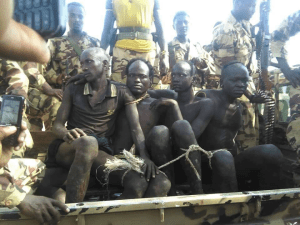
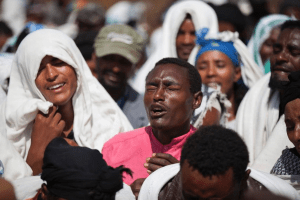
The current round of Oromo protests is a continuation of previous peaceful protests against the government’s illegal land grabbing. The Ethiopian government massacred over 78 university students in Ambo in 2014 but left their questions unanswered. The current protests ask the same unanswered questions but they also raise deeper grievances and longstanding issues of injustice, identity and fundamental human rights. They particularly focus on the brutalities of the last 25 years of totalitarian repression to which the international community has turned a blind eye.
Ethiopia is a darling of both the West and the East of the now unidentifiable Cold War divide. In the West, Ethiopia is praised for being a key ally in the war on terror and for hosting refugees. In the East and the Middle East, she is celebrated for opening up the country for land grabbing.
Both sides applaud Ethiopia for creating the fastest growing economy in Africa and for allowing their banks and companies access to land and investment for economic development.
What is hidden in the praise for hosting refugees is the mind-boggling number of refugees that Ethiopia herself produces by turning the country into a bloodbath for dissidents. What is hidden is that some of those who flee atrocity cannot make it to asylum or resettlement because the Ethiopian regime hunts them down and captures them, because they are eaten by wild animals, or because they drown in oceans and big seas in their desperate attempt to reach safety.
What is hidden in the praise for Ethiopia’s alliance against terrorism is the barbaric terrorism of the Ethiopian state itself. What is hidden is that Ethiopia uses its anti-terrorism proclamation as a weapon for silencing any form of dissent. What is hidden is that many thousands of innocent political opponents, journalists, artist, musicians and peaceful protestors are marked as terrorists and beaten, jailed, tortured, killed, or otherwise exiled.
What is drowned out in the applause of economic development is the staggering human cost of land grabbing and the brute bestiality of Ethiopian state terrorism to snuff out indigenous land claims. The savage massacre of thousands of innocent indigenous peoples in Gambella, Ogaden, Oromia, Tepi, and Wolkayet are only a few examples of genocidal ethnic cleansing and crimes against humanity that the Ethiopian government commits in the name of development.
Ethiopia is an incredibly diverse multinational and multi-faith state of 100 million people. The Ethiopian government is admired for its bold attempt at ethnic federalism in order to address the controversial national question and foster democratic relations among its diverse polity.
What is hidden, however, is that the so-called ethnic federalism is a sham and the incredibly beautiful diversity is eclipsed by the totalitarian repression of a single-party dominated by a handful of elite, namely the Tigray People’s Liberation Front (TPLF), from a minority national group from Tigray.
What is hidden is that this minority clique from Tigray clings on to power by pitting nations against nations, by muzzling free expression, and by jailing, killing and exiling its political opponents. What is hidden is that this repressive clique used iron fist over the last 25 years to entrench its exclusive empire. What is hidden is the extreme greed and lust for power that put a tight absolute control of the country in the hands of a few hand-picked TPLF members.
What is hidden is that Tigray, the nation from which the TPLF clique hails, makes only 6% of Ethiopia’s population but this clique takes exclusive absolute control over the politics, economy, military and media of the entire country. What is hidden is that Oromos constitute 90% of political prisoners while they are only 40% (close to 40 million) of Ethiopia’s population.
What is hidden is that the late Meles Zenawi, the architect of the current TPLF Empire, had vowed to destroy those he considered major threats, particularly the two most populous nations, Oromos and Ahmaras. He vowed to reduce Oromos to a minority because of their numerous population and their crucial demographic, geographic, and geopolitical centrality for the entire Horn of Africa region. As for Amharas, he vowed to break their dominance because he fostered vengeance against them for what he saw as their former ruling-elite chauvinism.
What is deeply hidden is that his policy of destruction is being carried out through the social engineering of mass evictions of people from ancestral lands, mass massacre of those who resist, permanent mass exile of those who manage to escape, mass incarceration and genocidal ethnic cleansing of those who remain. What is hidden is that fertile land from which indigenous peoples are massacred or illegally evicted without compensation is given to TPLF members or leased to foreign investors for some ridiculous 99 years. What is hidden is this silent TPLF take over, TPLF turning itself into a majority though social engineering and political vote-rigging.
What is not so hidden is that the shameless declaration of 100% election victory (read 0% dissent tolerance) in May 2015 by the cliquish ruling party is a suicidal pill at the culmination of its lust for power. What is not so hidden is that this victory is an utter failure incurred through merciless killing, jailing and harassment of people and broad-day robbery of their ballots. What is not hidden is that the 100% victory of 2015 is the grand finale of the 2005 election where this clique massacred over 200 opposition party protestors and robbed them of their election wins.
One thing is deeply troubling: the TPLF clique is committing all the mind-boggling atrocities with utter impunity under the watching eyes of a world that fails to take any meaningful action to stop the carnage. What is troubling is that tyranny is rewarded as good governance, emboldening the regime to continue with its genocide and ethnic cleansing. What is troubling is Ethiopia’s economic development is celebrated even as its most vulnerable children are exposed to famine.
What has become obvious, however, is that all the praised economic development has not spared the cliquish regime from begging food aid for 20 million of its fellow citizens facing starvation. What is so obvious is that, although drought may be the result of El Nino and climate change, food scarcity is the result of the greedy clique gobbling up the wealth of the entire nation.
Impunity or not, the people seem to have discarded the regime. The peace-loving ordinary people of Ethiopia, people renowned for their strong forbearance and unlimited patience, have now run out of patience. These law-abiding people are confronted by a totalitarian clique that refuses to abide by any law, including its own constitution. The people have now said: enough is enough!
The peaceful protest triggered in the largest and most populous nation of Oromia is spreading to the entire country. People are turning its claim of 100% election victory inside out. They are demonstrating their overwhelming rejection.
March 12, 2016 marks exactly four months of the ongoing Oromo peaceful protests which started on November 12, 2015. The protests have rocked every corner of Oromia and they are spreading to other parts of Ethiopia. They started in response to the illegal land grabbing by the government, which left millions of indigenous Oromo farmers landless and homeless. This was in utter violation of their constitutional rights and fundamental human rights.
Primary and high school students, the children of the farmers who felt the pinch, started the peaceful protests which quickly engulfed the entire state of Oromia. Instead of listening to their legitimate grievances, however, the Ethiopian government responded by unleashing its military forces and mercilessly beating and killing unarmed peaceful protestors. Marking an entire nation as terrorist and turning its defence forces against its own citizens, the government dissolved civilian administration and imposed a martial law. The besieged state of Oromia is now ruled by eight of the country’s top war generals under the central command post of the Prime Minister.
Soldiers are now ravaging the Oromo communities. Over 450 peaceful protestors have been massacred, including many children and pregnant women. The death toll continues to rise as bodies are still being discovered in the ditches, forests and rivers. Mothers are killed while protecting their children. Elders as old as 80 are killed alongside children as young as 2. Many thousands are savagely beaten and maimed. Over 12, 000 are jailed and tortured. Mostly young students are being targeted. Soldiers are regularly breaking into university dormitories, beating students and raping young women. They are regularly breaking into private homes, beating men and raping women in front of their families. Girls as young as 12 are gang raped by soldiers.
The carnage continues today, four months into the protests. Ongoing appeals to donor nations resulted in some public condemnations of the atrocities but fell short of taking meaningful action. Sadly, western governments have pushed human rights and justice to the back burner, prioritizing security and the economy.
Please share this information with all who care about human lives and human rights. The claims made here are all documented in the accompanying Info Kit [pdf file] for your reference.
http://gadaa.com/oduu/31687/2016/03/28/ethiopia-oromo-protests-and-ethiopian-repression-overview/


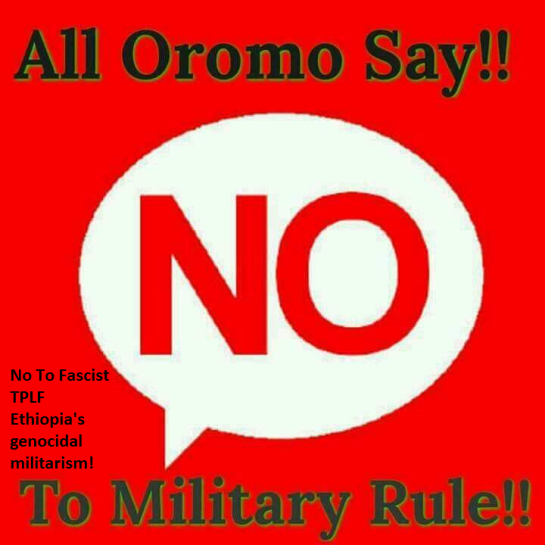
Wolonkomi, Ethiopia – Six-year-old Abi Turi and her nine-year-old brother Dereje have not been attending classes in Wolonkomi.
Their school was closed in January as the Ethiopian government began what its critics call a crackdown on protests by the Oromo, the country’s largest ethnic group.
It is uncertain how many people have died in clashes between security forces and protesters since November, when a series of demonstrations began.
Local estimates put the figure at between 80 and above 200. The New York-based Human Rights Watch has said that more than 200 people may have died in about six months, a figure the government denies.
“With regards to allegations from human rights groups or self-styled human rights protectors, the numbers they come with, the stories they often paint, are mostly plucked out thin air,” Getachew Reda, the information minister, told Al Jazeera.
Abi and Dereje’s mother was among those shot in January. She was hit by a bullet in the neck. Despite receiving medical treatment, she died of her wounds in March.
“The little girl cries and keeps asking where her mother is. We feel her pain,” said the children’s grandfather Kena Turi, a farmer. “The older one cried when his mother was shot and died, but now it seems he understands she’s gone.”
Oromo students began rallying to protest against a government plan they said was intended to expand the boundaries of Addis Ababa, the capital, into Oromia’s farmland.
Oromia is the country’s largest region, and many there believe the government did not want to redevelop services and roads, but that it was engaged in a landgrab.
Though the government shelved its “Integrated Development Master Plan” due to the tension, protests continued as the Oromo called for equal rights.
In February, another anti-government rally turned violent. Nagase Arasa, 15, and her eight-year-old brother Elias say they were shot in their legs while a demonstration happened near their home.
READ MORE: Oromo protests continue amid harsh crackdown
“I was in the back yard walking to the house when I was shot,” Nagase told Al Jazeera.
“My brother was in the house. I couldn’t walk I was bleeding. Then I was hit again when I was on the ground I felt the pain then my brother came to help me and he was shot too.”
Ethiopia has an ethnically-based federal system that gives a degree of self-rule to the Oromo people.
But the Oromo opposition, some of whose members have been detained, says the system has been corrupted by the ruling coalition, the Ethiopian People’s Revolutionary Democratic Front.
Merera Gudina, an Oromo politician, said that members of his community feel marginalised — excluded from cultural activities, discriminated against because of their different language, and not consulted in political or economic decisions.
With double-digit growth over the last decade, Ethiopia has one of the fastest-growing economies in the world, but the majority of the Oromo remain poor.
“Until the Oromo’s get their proper place in this country I don’t think it [dissent] is going to go. The government wants to rule in the old way; people are resisting being ruled in the old way,” Gudina said.
READ MORE: Ethiopia accused on bloody crackdown
Reporting and recording human rights abuses is also risky, activists told Al Jazeera. Local and foreign journalists said attempts were made to intimidate them, with some detained.
Al Jazeera spoke with local reporters who said they were too afraid to even try and cover the issue.
“It’s very dangerous. Everybody is living in fear. They imprison people every day. People have disappeared. Doing this work is like selling my life,” a human rights activist told Al Jazeera, speaking on the condition of anonymity.
Kumlachew Dagne, a human rights lawyer, said there was a need for “public forums and consultation for debates on public policy issues” to allow for different views to be heard. He added that the protesters who were injured or killed had not been armed.
“Many of those people were killed after the protests took place many of the people were shot in the back some were shot in the head, which shows that these people were not armed,” he said.
“They were peaceful demonstrators. That is consistent with reports we had from victims’ families.”
The government rejects such claims as exaggerated or fabricated.
“People, whether they are civilians or security officials who have been involved in an excessive use of force, will be held responsible,” Reda said.
He said the government would consult with the Oromo people and “address the underlying problems”.
Read more at:-

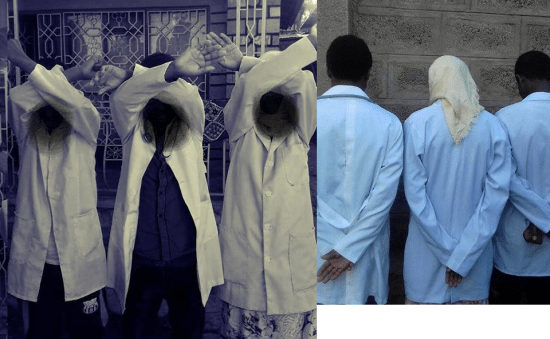
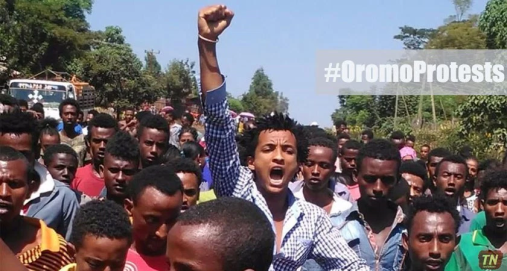
(Oromia Press): EU Raises Concern Over Unrest
The European Union (EU) has once again voiced its concern over unrest that has been occurring in Ethiopia. In a media brief held at Desalegn Hotel on March 16, 2016, the EU expressed the need for dialogue to resolve the issues that escalated in Oromia Region and parts of Amhara Region.“We ask for more transparency – sharing information to know what is exactly happening there,” said Chantal Hebberecht (Amb.), Head of the EU delegation to Ethiopia.
The emerging conflict in Konsso, Southern Ethiopia was also raised. The delegation has already held discussion with the people from this specific area.
The press briefing also touched on the ongoing El Niño induced drought.
Simona Foltyn | 24 Mar 2016 
Addis Ababa, Ethiopia – At first sight, things seem to have returned to normality in the town of Ambo, 120 kilometres west of Ethiopia’s capital Addis Ababa. Few uniformed security forces are visible on the streets. People seem to go about their daily lives as usual.
But speak to almost any resident and a different picture emerges.
“We are living in a violent kind of peace,” says an 18-year-old student, who does not want to reveal his name. Like many people interviewed for this story, he fears he might end up in jail, or worse, for speaking his mind.
Ambo is perhaps best known for two things: being Ethiopia’s most popular mineral water, and its university, often a hot spot for anti-government demonstrations. Such displays of public dissent earned the town a reputation as the bastion of opposition in a country where the ruling party and its allies took all 547 parliament seats in last year’s election.
When people took to the streets in nearby Ginchi in November last year to object about plans to requisition public land for an investment, residents in Ambo soon joined in. Demonstrations spread like wildfire across the vast Oromia region, feeding on decade-long frustrations over political and economic marginalisation.
As the protests intensified, so did accounts of police brutality amid what regime critics describe as a widespread and systematic government crackdown on opponents. Witnesses recount tales of killings, beatings and arbitrary arrests by an array of armed forces deployed to quell what had spiralled into Ethiopia’s worst civil unrest in a decade.
The heavy-handedness of the government has further spurred anger among the Oromo. Earlier in March, students from Addis Ababa University marched in protest towards the US embassy in the capital, demanding the end to police crackdowns.
Details of the crackdowns, mostly reported through social media and by activists, have been difficult to verify. Restrictions on movement have made independent investigations risky for human rights workers and journalists alike. Two foreign journalists and their translator were recently arrested for covering the protests.
The 18-year-old student in Ambo told Al Jazeera that he was shot in his hand when the military opened fire at the protesting crowd. Even though his hand is healing, he hasn’t returned to school in fear of intelligence officers, who are allegedly combing classrooms for those who took part in the protests.
“They are still looking for people and taking them to prison,” he said, trying to conceal the dressing on his hand to avoid attracting the attention of security personnel, who many think are roaming the streets in civilian clothing.
Such testimonies stand in stark contrast from the image the country often presents to the outside world.
Ethiopia’s state-led development plan has resulted in double-digit growth, improvement of key socio-economic indicators and has helped attract billions inaid. The country is also an important security ally for Western governments in the volatile Horn of Africa.
 |
| The family of Girma Ragassa, aged 28, who was reportedly killed by security forces in Ambo. [Al Jazeera] |
It’s uncertain how many people have died in the clashes. Local observers put the figure at between 80 and above 200, while New York-based Human Rights Watch (HRW) estimates that well over 200 people may have lost their lives since November.
READ MORE: Protesters in Ethiopia reject authoritarian development model
More than a dozen police officers have also been killed in the unrest. Protesters stand accused of attacking public buildings and burning the houses of government officials.
The government has dismissed HRW’s death toll as an exaggeration, but has yet to provide its own estimate.
“We are already taking actions, except that we are not in a shouting match with the media or self-appointed human rights activists,” said Getachew Reda, Ethiopia’s minister of Information.
The government has accused radical elements of stoking the unrest but asserts that investigations into the heavy use of force are under way. Yet many Oromo say authorities have failed to take responsibility.
Four families of victims interviewed said no government officials had come to investigate the deaths of their loved ones.
“The only time any government officials come here is to spy on us,” said Worku Bayi, the father of one of the victims killed in the protests, 22-year-old Aschalew Worku.
After his death, authorities reportedly accused Aschalew of being a member of the Oromo Liberation Front, an exiled opposition movement that the ruling party has labelled a terrorist organisation.
Witnesses blame security forces for deliberately obstructing medical care for wounded protesters. Fitale Bulti, a resident of Ambo, watched her nephew bleed to death after he was allegedly shot by security forces.
“The police wouldn’t let us take him to the hospital,” said Bulti. “For over an hour we just stood there, watching his blood run down the street.” Her nephew, Ulfata Bulti, was only 12 years old.
Just across the street, Degeneh Shugi, 36, says he was stopped and beaten by security forces while on his way to work. Accused of participating in the protests, he was then taken to the police station along with 15 others, where he was held for four days. Degeneh’s mother, Derebe Yirga, who is a member of the Oromo Federalist Congress opposition party, reportedly remains in police custody.
Rights groups and opposition leaders allege that thousands have been arrested in the most recent crackdowns, a scale that is reminiscent of mass arrests of opposition members during the turbulent aftermath (PDF) of the 2005 elections.
WATCH: Hailemariam Desalegn – democracy ‘not only an election’
“There are several hundreds that have been detained from our party. But we don’t know for sure, as we have lost a lot of communication,” said Merera Gudina, chairman of the Oromo Federalist Congress opposition party in an interview in Addis Ababa.
Gudina named five members of the party’s top leadership who have been held or placed under house arrests since protests began.
 |
| The expansion of the capital Addis Ababa into the surrounding Oromia region is what sparked protests in November last year [Al Jazeera] |
Al Jazeera contacted several officials in the Oromia regional government for comment, but was denied interviews amid rumours of internal reshuffling. Analysts and observers believe that the handling of the crisis has created a rift between the ruling TPLF, the lead party within the ruling collation, and its allied OPDO party, charged with governing Oromia.
The OPDO’s decision to halt a controversial “master plan” that governs the expansion of the capital into Oromia, which is what initially sparked protests, has failed to put an end to the crisis. Many Oromo demand genuine reforms and justice for those killed.
“The government said it would stop the master plan just to calm the people. But what we need is a lasting solution to this crisis,” said 23-year-old Gudisa Ragassa, the younger brother of another victim killed in Ambo.
“If the government can’t do that, they shouldn’t be in power.”
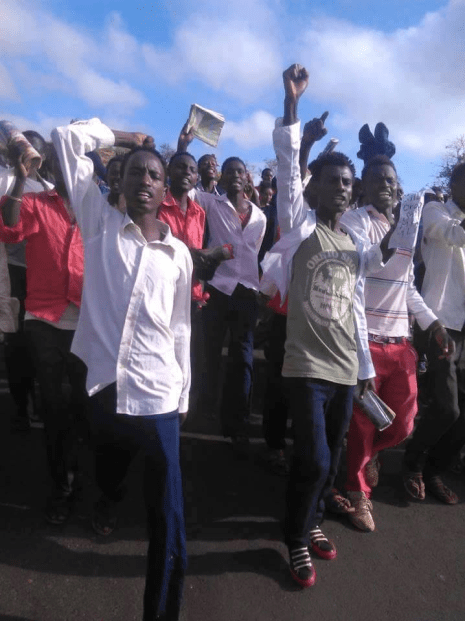
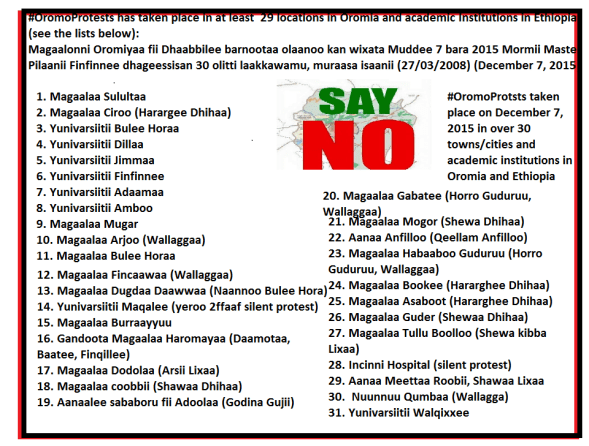
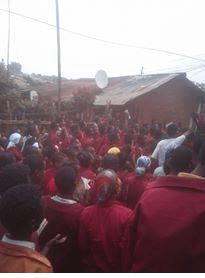
“It is because of the absence of self-rule that you see millions of farmers evicted and their land given to ruling party officials or foreign companies. The regime downplays the scale of questions raised as well as the scale of the lethal forces used.” – Habtamu Dugo, an exiled Oromo journalist and US-based professor
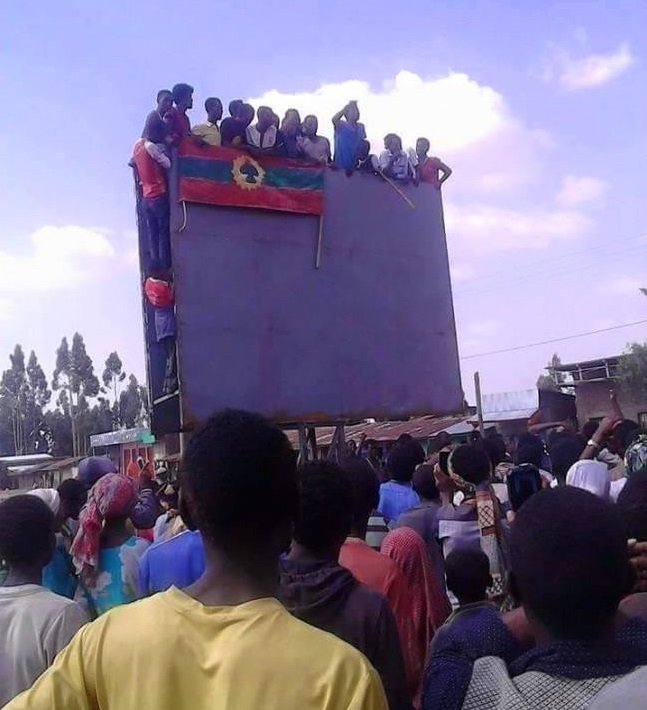
People in Ethiopia’s Oromia state already have self-rule and protesters’ demands are already in place, an Ethiopian official told IBTimes UK. Abiy Berhane, minister counsellor at the Ethiopian embassy in London, made the comment as activists said they are still on the streets of Oromia calling for self-rule, the release of political prisoners and the end of military presence in the region.
Protests in Oromia began in November 2015 against a government draft plan to expand the boundaries of the capital Addis Ababa. Demonstrators, mainly from the Oromo ethnic group, argued the so-called “Addis Ababa master plan” would lead to forced evictions of Oromo farmers from their lands and would undermine the survival of the Oromo culture and language.
Who are the Oromo people?
The Oromo people are Ethiopia’s largest ethnic group and their population amounts to more than 25 million (around 35% of Ethiopia’s total population).
Oromo people speak Afaan Oromoo, as well as Amharic, Tigrinya, Gurange and Omotic languages. They are mainly Christian and Muslim, while only 3% still follow the traditional religion based on the worshipping of the god, Waaq.
In 1973, Ethiopian Oromo created the Oromo Liberation Front (OLF), which stemmed from the discontent over a perceived marginalisation by the government and to fight the hegemony of the Amhara people, another large ethnic group in Ethiopia.
OLF – still active today – also calls for the self-determination of the Oromo people. It has been deemed as a terror organisation that carried out violent acts against people in Ethiopia, Somalia and Kenya. The group has always denied such allegations, claiming its mission is to terminate “a century of oppression” against the Oromos.
The government scrapped the master plan following increasing agitation which activists claimed led to the death of some 400 people, at least 200 according to a report by Human Rights Watch (HRW), released on 21 February.
The government denied the allegations of violence and claimed the death toll was much lower, but did not give a specific figure.
Berhane explained Ethiopian authorities conducted an assessment on the unrest and admitted they took slow steps in addressing people’s legitimate grievances. “Had these demands been addressed quickly and effectively, dissident groups would not have been able to infiltrate peaceful protesters and instigate violence,” he said.
“The government does not want to see any of its people die, even the death of one person is one is one too many. What the country needs first and foremost is peace. Inciting violence, creating division, coming up with horrific stories and posting those stories on social media does not help in any way.”
Earlier in March, Prime Minster Hailemariam Desalegn apologised for the deaths and destruction for which he blamed “anti-peace forces” that infiltrated demonstrations.
Self-rule already in place
Berhane claimed that people are ruling themselves in Oromia, where the official language is Oromo, people have their own regional parliament and run their own budget. “Political problems in Oromia and indeed in any other part of Ethiopia have been for the most part resolved. If there are any that are not resolved, the Constitution provides the mechanism for resolving them so there is no need for violent conflicts,” he said.
However, Oromo activists who spoke to IBTimes UK denied Oromo people have self-rule in the region, claiming that Oromia’s ruling party, Oromo Peoples’ Democratic Organization (OPDO), is an organisation of “ex-war captives” created by the Tigrayan People’s Liberation Front (TPLF), a political party in Ethiopia’s Tigray region.
Activists also denied violent people infiltrated protests, and alleged the government iscracking down on peaceful and unarmed demonstrators, including pregnant women and children. They also claimed the government declared martial law in Oromia, which they say is now divided into eight military divisions controlled by “ethnic Tigrean generals”.
“It is because of the absence of self-rule that you see millions of farmers evicted and their land given to ruling party officials or foreign companies. The regime downplays the scale of questions raised as well as the scale of the lethal forces used,” Habtamu Dugo, an exiled Oromo journalist and US-based professor, said.
“Oromo are not able to elect their leaders in a free and fair election and the ruling party serves the interests of few ruling elites from the Tigray region. Although Afan Oromo is recognized on paper as a regional official language, people are demanding it to be made into one of the federal languages, since it is the most widely spoken language in Ethiopia.”
Dugo, also a member of the Board of Directors of the Oromo Studies Association, added that should alleged killings by security forces continue, Oromo people might start calling for secession, a right guaranteed by the Ethiopian constitution.
An Oromia-based activist who spoke to IBTimes UK on conditions of anoymity, denied the government of Oromia rules on its own budget. The source said: “While Oromia contributes 60% of Ethiopia’s GDP, OPDO has to accept 70% of its recurrent and capital budget from the TPLF-dominated federal governement.”
The source also alleged at least 40,000 Oromo people are currently imprisoned and many of them “had to suffer severe torture”.
Read more at :-
Related:-
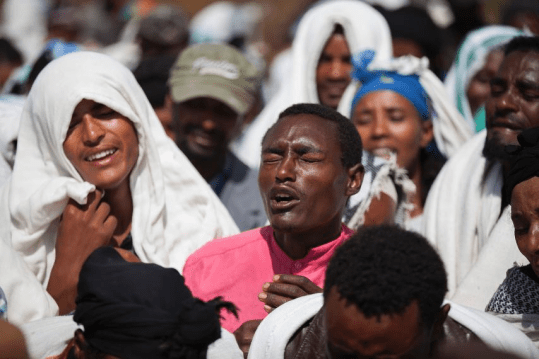
ADAMA, Ethiopia — For those who would speak frankly about politics in this landlocked East African country, the first challenge is to find a safe space.
But on a recent evening in Adama, a city in the heart of a region reeling from the largest protest movement Ethiopia has faced in decades, most people seemed at ease. University students poured out of the city’s main campus, spilling into claustrophobic bars and pool halls. Others crowded around a cluster of aging taxis, jostling for a quick ride home.
Though it is one of the largest cities in Oromia — where members of Ethiopia’s Oromo ethnic group have taken to the streets in recent months in unprecedented numbers to protest their political and economic marginalization — Adama has remained mostly quiet.
Hidden beneath the casual veneer of daily life, however, lurks a deep-seated suspicion of the government, which has built a massive surveillance apparatus and cracked down violently on its opponents
Hidden beneath the casual veneer of daily life, however, lurks a deep-seated suspicion of the government, which has built a massive surveillance apparatus and cracked down violently on its opponents.
Citizens feel they have to watch what they say, and where they say it. At the hangouts where crowds have gathered, a political statement might be overheard. Out on the sidewalks, government spies could be on patrol. Inside the university campus, security officials are on the lookout for suspicious behavior.
In a way, the recent unrest is rooted in Ethiopia’s rapid economic rise. The federal government claims to have notched double-digit GDP growth rates over the past decade, but its rigid, top-down approach to developing industry, and attracting foreign investment, has resulted in mass displacement and disrupted millions of lives. This, in turn, has heightened ethnic tensions that today threaten Ethiopia’s reputation for stability.
All across Oromia, government security forces have been struggling to control the spate of violent protests that erupted in November, partly in response to the government’s so-called master plan to coordinate development in Addis Ababa with nearby towns in Oromia, a sprawling central region that surrounds the capital on all sides. Like much of the country, the vast majority of Oromia is rural, home to small-scale farmers who feel left behind by the dazzling growth of Addis.
When this latest round of protests began last year, demonstrators seized on the master plan as symbolic of broader encroachments on Oromo autonomy. They also accused the government of taking land from Oromo farmers for little or no compensation, suppressing the Oromo language in schools, and unfairly redistributing the region’s natural resources.
In Adama, a 23-year-old engineering student, whose full name has been withheld for his safety, was initially reluctant to speak with this reporter for fear of reprisal. He relaxed only after he and some close friends sat down in a deserted cafe near campus, where a quiet woman brewing coffee over hot coals was the only person listening in.
“There are so many problems facing the Oromo people,” he said. “But those who speak about it are getting arrested. Educated people, farmers, teachers, doctors — the government accuses them all of being part of the protests.”
His caution was warranted. Less than two weeks later, a confrontation erupted at the university, reportedly in response to a small demonstration by students — though the details, as always, are hazy. One witness who asked not be named said he heard gunshots as security forces descended on the campus. Amid the confusion, at least two fires were sparked — one in the school’s backup generator.
“On campus, students already feared the armed forces,” said the witness, who is a student at the university. “Now, no one feels like they have any right to speak at all.”
Government security forces have been accused of exacerbating the crisis in Oromia by violently suppressing the protests. In a recent report, Human Rights Watch said it had “documented security forces firing into crowds of protesters with little or no warning, the arrests of students as young as 8, and the torture of protesters in detention.” The rights group said military and police forces have killed “several hundred peaceful protesters” since November.
Members of the Ethiopian diaspora have been equally vocal, taking to social media to call attention to alleged atrocities. Jawar Mohammed, who is based in Minnesota, is perhaps the most prominent online activist, manning a number of social media feeds featuring bloody photos of dead demonstrators and grainy videos of police brutality that have become hubs for Oromo diaspora members around the world. His Facebook page has amassed nearly a half million followers.
“We have freelancers embedded in pretty much every district across the country,” said Mohammed, who was born in Ethiopia but works abroad as the executive director of the Oromia Media Network, a news broadcaster whose satellite feed here has been repeatedly jammed by the Ethiopian government. “They infiltrate the system from top to bottom,” he said in a Skype interview.
How much of an impact social media activism has had on the actual protest movement is a matter of debate. In a country with limited Internet penetration, and where the sole government-owned telecommunications provider has the power to shut down signals and block opposition websites, online activists like Mohammed are necessarily limited in what they can do. According to the engineering student in Adama, people on the ground are driving the protests, and social media matters “only a little bit.”
Where online activists have succeeded is in channeling video and photographic evidence of abuses to the outside word
Where online activists have succeeded is in channeling video and photographic evidence of abuses to the outside word. But even this evidence is difficult to verify; several journalists, including this correspondent, have been detained by officials for attempting to report in some of the worst-affected areas.
There are also questions about the direction social media activists have steered the debate surrounding the protests. Comments by Mohammed’s passionate social media followers sometimes advocate violence against members of the Tigray People’s Liberation Front (TPLF), a political party from the northern region of Tigray that dominates the government’s security and intelligence agencies. And because he and other online activists are far from the front lines, some argue that their social media posts are ultimately a distraction. The student who witnessed the altercation at the university in Adama, for instance, said he agrees with Mohammed’s political analysis, but is concerned that the Facebook page has become a magnet for a dizzying array of viewpoints — about religion, regional politics, and ethnic strife — that make the movement more controversial than it needs to be.
Still, Mohammed has a clear strategy in mind. When it comes to human life, he advocates nonviolence. But he encourages demonstrators to block trade routes, destroy the property of companies that are seen as operating against Oromo interests, and avoid bringing crops to market in order to raise food prices.
Might such tactics be unethical during the worst drought Ethiopia has witnessed in decades, which has left 10.2 million people in need of emergency food aid? “Morally, yes,” Mohammed said. “Strategically, no.”
Officials have no time for these “activists on the other side of the Atlantic,” said government spokesman Getachew Reda. He claimed that agitators, some of whom have backing from Eritrea, Ethiopia’s archrival, have infiltrated the ranks of the protesters and are responsible for the current violence. The government security forces, by contrast, have generally handled the situation professionally, he said.
“We may have some bad apples,” Reda said. “Otherwise, the security apparatus that we have in this country is very much oriented towards serving the interests of the public.”
Amid this war of words, normal citizens are caught in the middle. In the quiet café in Adama, the engineering student spelled out a set of remarkably prosaic demands: He would like to see more Oromo professors at the university, for instance, and a fairer allocation of resources for the region. But, he said, he stays quiet for fear of Ethiopia’s pervasive security and intelligence apparatus.
“People don’t feel free,” he said. “We are all psychologically impacted.”
After two months of violent demonstrations, the government announced that it was scrapping the master plan. It wasn’t enough. Some protesters said they didn’t believe it had really been canceled. Others were motivated by grievances that run much deeper than any development scheme, citing marginalization stretching all the way back to the late 1800s, when the Ethiopian emperor Menelik II swept in from the north to expand Ethiopia’s borders and establish the capital city in Oromo lands.
On paper, today’s federal system is meant to ensure some measure of autonomy for all of the country’s ethnic groups, including the Oromos. The ruling coalition, the Ethiopian People’s Revolutionary Democratic Front (EPRDF), is made up of four regional parties, including the TPLF and the Oromo People’s Democratic Organization (OPDO). But the government lost some credibility in May, when the EPRDF and allied parties won every parliamentary seat in a national election. Though the OPDO holds more parliamentary seats than any other party, protesters say the party either cannot or will not challenge the dominance of the TPLF — and Oromos remain marginalized as a result.
Officials say they are trying to promote meaningful dialogue. “It is the government’s responsibility to make sure that people’s legitimate grievances are addressed properly,” Reda said. To that end, OPDO officials have convened meetings with concerned citizens across Oromia, and hundreds of low-level officials have been dismissed for corruption.
But the government has continued to lean on its powerful security apparatus, which has both enabled Ethiopia’s impressive, state-led economic development and imperiled it by bringing ethnic tensions to the fore. The ongoing protests in Oromia point to cracks in the facade, where citizens feel left out as the government pursues its uncompromising vision of modernization.
By continuing to crack down on demonstrators instead of listening to their demands, Ethiopia risks compromising the reputation for political stability that fueled its unprecedented decade of growth and foreign investment. In that way, the government may soon erode the very foundation of its own economic ambitions.
OPINION: TAKING OUR VOICE SERIOUSLY
By Hailegabriel Gedecho, Addisstandard, 22nd March 2016
My starting point for this short reflection is my discomfort with friends and acquaintances who question (and dismiss) the morality of supporting (to use their pejorative expression‘mafafam’) Oromo Protests from overseas. As most of these critiques reside in Ethiopia (where public display of solidarity with Oromo Protests is meant risking torture, incarceration, and of course one’s life), the claim of immorality of Ethiopian diaspora showing solidarity with Oromo protesters may be interpreted as either a fear of tyranny or a disguised yearning for an Ethiopia where public display of resistance does not cost one’s freedom or life.
But there seems to be more to this argument than the fear or yearning that I alluded to above. If you push a bit further and ask why they are not themselves doing the support (if the morality of protests overseas is the issue as they claim), they end up telling you ‘order’ must be managed or Oromo Protests must first be reframed as ‘Ethiopia Protests’. So, for them, order (whatever that means) and fetishizing Ethiopia are the litmus tests of the morality of protests against the Ethiopian state. As a corollary, one can legitimately assume these people don’t care if the Ethiopian state kills, dispossess, disempowers, and denigrate Oromos as long as ‘order’ is maintained and fetish Ethiopia is thereby performed. In this piece, I will try to explain why, in many ways, the silence these resident Ethiopians seek from their overseas friends is ethically more troublesome than the solidarity (often expressed through social media outlets such as Facebook) that Ethiopians in overseas show to the victims of state terrorism in Ethiopia.
The participation of Ethiopians overseas in protests has more often involved social media activism. Although the effects of this social media activism cannot be contradicted, it is hardly the cause or the primary instigator of the Oromo Protests on the ground. In a country where internet access is limited to only less than 5% of the total population (the majority being Addis Abebans who are not apparently interested in the protest), the impact of social media activism in fuelling Oromo Protest is negligible, more so in rural Oromiya where we are witnessing the protest. Oromo Protest has its origin within Ethiopia and is related to developments there. The impossibility of the protesters’ demand to be expressed through other less explosive spaces of resistance and the eternally undemocratic and imperial nature of the Ethiopian state and its development model are its major contributors. The social media activism by the diaspora cannot be implicated in this, unless one wants to easily buy into the dull rhetoric of the Ethiopian government blaming every wrong on ‘external forces’.
Instead, complementing the voice of the subaltern in spaces where their participation is marginal (e.g. social media) is morally satisfying. As can be easily noticed, the social media is a space of its own dynamics. Though it can generally be open to all, there is every possibility that sympathisers of the violent Ethiopian state dominate the social media discussion of current affairs in the country. This makes the active complication of the suffocating state-sponsored discourses of developing, democratizing, and modernizing Ethiopia urgent. Those who perform their resistance on social media may at least vindicate the causes of the subaltern (such as the Oromo protesters) by exposing the state’s pretentiousness vis-à-vis its politically and economically marginal communities.
Of course, there is an additional reason why Ethiopians overseas should do the social media activism. Unlike their brothers and sisters at home (who are paying dearly for asking legitimate questions), Ethiopians overseas are removed from the immediate threat of state reprisal for echoing these questions. Although doing the easy thing in a virtual space cannot compensate for the pain suffered by victims of state terrorism, it is at least a blameless (as well as useful) thing than remaining silent about the injustices perpetrated by the Ethiopian state.
Another thing which seems to obsess the silent supporters of injustice relates to vocal diaspora activists and their increasing popularity. It is often argued resistance from afar is cowardice and meaningless. In their eyes, the brave is the one who dare to challenge the government from within. Admittedly, those who do their protest in Ethiopia are brave. But, their bravery cannot and should not be measured against the alleged spiritless-ness of vocal diaspora activists. In fact, numerous foreign-based Oromo protesters know what it means to challenge the Ethiopian state from home. They have experienced the brutality of the Ethiopian state for having done that.Their bodies and souls unalterably inscribe experiences of torture and other inhuman and degrading treatment under the Ethiopian state that rendered them homeless in the first place. Hence, they have every reason to fear the brutality of the evil state, least for having part of their family back at home. This fear is not illegitimate and cannot be ridiculed as cowardice, not least by sympathisers of the violent state who often rationalise their desire for status quo in terms of fear of the unknown post-Oromo protest future.
Interestingly, some admit the Ethiopian state has always (perhaps unsurprisingly) justified its excessive violence in terms of the ‘need to maintain order’. It is unclear how one can ethically and consistently claim the primacy of order (which assumes the sincerity of state’s monopoly of violence to supress any protest) as well as suggest that those who languish in Ethiopian prisons (as a result of their participation in creating ‘disorder’) are morally more righteous than runaways who make the talk from overseas.This is just like saying: ‘come and face the power of the ruthless state or don’t tarnish Ethiopia’s hard won image of stability and development by channelling the legitimate question raised by the people of Oromiya through social media outlets’. Local elites who do not want their privileged life disturbed and their demand for silence from their equally privileged friends abroad may be interpreted as a desire to normalize the violence the majority is living under in Ethiopia. If anything, the diaspora can contribute (as well as it does) in exposing the façade of development and stability that the Ethiopian state and its sympathisers deploy to invisibilize the multidimensional structural violence in the country. There is no wrong in siding with the powerless, even if that would ‘disturb’ the imperial peace of the privileged that charge the diaspora for the continued mess at home.
For me, this is not the time to worry about the good image of Ethiopia or the Oromoness of the protest. Whether the protest is framed as Ethiopian or Oromo protest it is irrelevant as long as what is at stake is an issue of social justice. Those who suspend their support to Oromo Protest because of its framing as “Oromo” cannot be more ethically wrong than this. If they sincerely believe Oromo questions are Ethiopian questions, they should have done the framing themselves and join the struggle under the banner ‘Ethiopia Protests’ instead of demanding the Oromos to reaffirm the primacy of Ethiopia (which they cannot for legitimate reasons) or wanting the likes of me (who is not an Oromo by the way) keeping silent about the plight of the Ethiopian subaltern.
I don’t understand why it is morally right to keep silent about injustices while at the same time complaining about the ‘disturbing voice’ of Ethiopians overseas that rightly believe they are supporting the cause of justice and channelling that voice to those who care to hear. Those who don’t care to hear can continue complaining about the disturbing voice. Should I worry for incidentally disturbing the privileged and the complicit in violence? No. Those who worry much are those who have something to lose (like the ruling EPRDF) or those who want the continuity of violence. And, they are the reasons why I should take my otherwise insignificant but disturbingly resistant voice seriously.
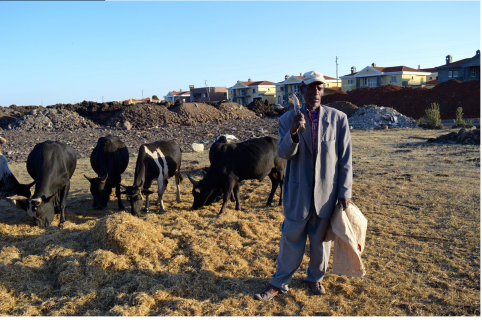
(Bloomberg business) — When Ethiopian farmer Mulugeta Mezemir ceded his land three years ago to property developers on the fringes of the expanding capital, Addis Ababa, he felt he had no choice.
A gated community with white picket fences and mock Roman pillars built by Country Club Developers now occupies the fields he tilled in Legetafo, Oromia region, after the 60-year-old said local government officials convinced him to accept an offer or face expropriation. He took the cash and vacated the land, which in Ethiopia is all state-owned.
“We were sad, but we thought at the time that they were going to take the land for free,” said Mulugeta, a father of 12, while feeding hay to cattle a few meters from foundations for the next phase of housing. “We thought it was better to take whatever they were paying.”
As Ethiopia, which the International Monetary Fund estimates saw 8.7 percent economic growth in the last fiscal year, undergoes a construction boom, complaints over evictions and unfair compensation have fomented the country’s most serious domestic political crisis in a decade.
In protests by the largest ethnic group, the Oromo, that began in November, security forces allegedly shot dead as many as 266 demonstrators, according to the Kenya-based Ethiopian Human Rights Project. The government says many people died, including security officers, without giving a toll. Foreign investors including Dangote Cement Plc had property damaged.
Ethiopian Communication Minister Getachew Reda said protesters were in part angry at “some crooked officials” who have been “lining their pockets by manipulating” land deals around the capital. Property developers CCD followed legal procedures, paid standard rates of compensation and employed many members of farmers’ families, according to Tedros Messele, a member of the company’s management team.
Cases such as Mulugeta’s have been a growing trend on the outskirts of the capital over the past two decades, said Nemera Mamo, an economist at Sussex University in England. No recent, independent studies have been conducted into how many people have been affected.
“The booming construction industry has contributed to Addis Ababa’s rapid expansion that’s dispossessed many poor farmers and turned them into beggars and daily laborers,” Nemera said. “The Oromo protest movement opposes the mass eviction of poor farmers.”
Ethiopia’s state-heavy model seeks to industrialize the impoverished nation within a decade by improving infrastructure and combining investment with cheap labor, land and water to produce higher-value goods. Projects for what the IMF calls African’s fastest-growing economy include the continent’s largest hydropower dam, railways and the building of 700,000 low-cost apartments by 2020.
Construction accounted for more than half of all industry in the fiscal year that ended in July after it grew an annual 37 percent, according to National Bank of Ethiopia data. Industry comprised 15 percent of output.
Investors such as Diageo Plc, the world’s largest liquor maker, and Unilever Plc are tapping into the expansion by building Ethiopian facilities. Citizens of Africa’s second-most populous nation are using money earned there or abroad to build residences, malls and offices.
The ruling party hasn’t kept pace with the boom by improving governance and the ability of domestic manufacturers to supply the industry, said Tsedeke Yihune, who owns Flintstone Engineering, an Ethiopian contractor that’s built upmarket housing and African Union offices.
“Construction has not been used as it was supposed to, as a means of building domestic capacity, building good governance, as well as delivering the government’s development agenda,” Tsedeke said in an interview in the capital.
More than 70 percent of construction materials are imported, including cables, steel, ceramics, locks, furniture and electrical fittings, Tsedeke said. Ethiopia’s trade deficit increased by $3 billion to $14.5 billion last fiscal year.
Addis Ababa-based Orchid Business Group is another recipient of government capital spending, which the IMF says could double to almost $15 billion a year by 2020. Orchid’s projects include one with Italy’s Salini Impregilo SpA building the Grand Ethiopian Renaissance Dam, said Hailealem Worku, the construction and engineering head.
Cement plants built by companies including Dangote have made Ethiopia self-sufficient in the material, while manufacturing incentives means glass, paint and steel factories will play a bigger role soon, Hailealem said.
The government wants to improve regulations and change attitudes so contractors boost their skills and ethics, Construction Minister Ambachew Mekonnen said in an interview. “The construction industry suffers from a lack of good governance,” he said.
In Legetafo, Mulugeta was paid 17 birr ($0.80) a square meter in compensation. Meanwhile, people were bidding as much as 355,555 birr per meter to rent land in Addis Ababa last year. Mulugeta used the 200,000 birr he received for the plot for expenses including renting more farmland. Two of his children now work as CCD cleaners, earning 40 birr a day.
“We are getting deeper into poverty,” he said.
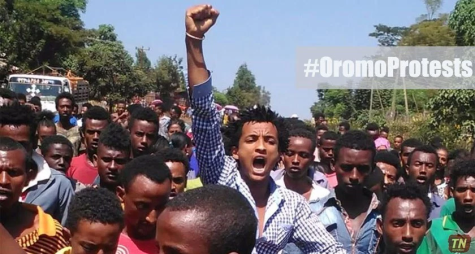
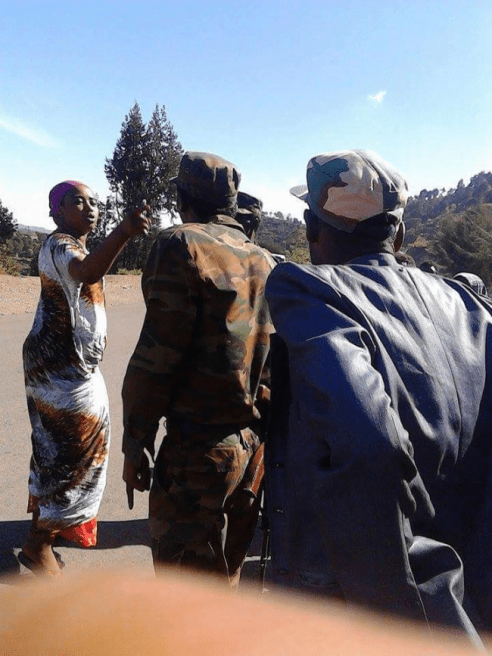


 Partial list of Oromos mainly students that have been killed by Ethiopian regime police, security agents, Special and armed force during peaceful demonstration of last three months (updated stand. March. 2016)
partial-list-of-oromos-mainly-students-that-have-been-killed-by-ethiopian-regime-police
Related report:-
EHRP-OromoProtests-100-Days-of-Public-Protests
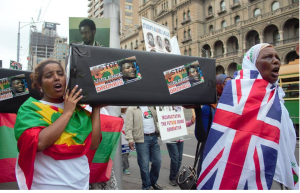
Portland Senators Jeffrey A Merkley & Ron Wyden write letter to Secretary of State John Kerry urging him to ensure resource given to Ethiopia are not just for purposes that undermine US long term interst. The also request the State Dept to provide account of killings, arrest and other human right abuse in response to #OromoProtests, and to identify persons responsible for committing these crimes. We are grateful to the Senators and the Oromo Community of Portland.

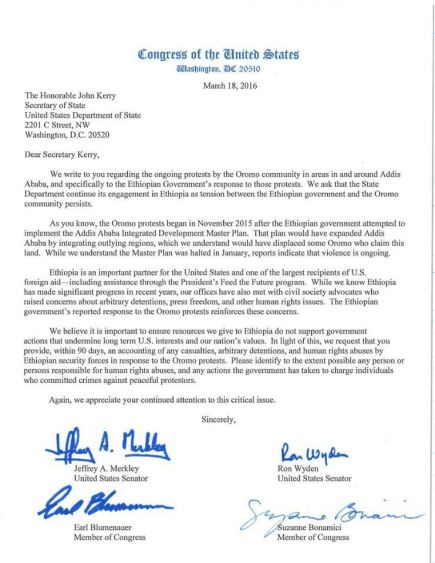


(HRW 15 March 2016) — A human rights crisis is taking place in Ethiopia. It has received little attention internationally but is the biggest political crisis to hit Ethiopia since the 2005 elections.

Protesters in Oromia region, Ethiopia, December 2015.
Since November 12, 2015, protesters across Ethiopia’s Oromia region have been risking their lives and liberty in the face of a brutal—and sometimes lethal–response from security forces. Soldiers and police have used deadly force and killed several hundred peaceful protesters. We understand that thousands of people have been detained in official and secret detention facilities. While there have been some incidents of violent clashes and some members of the security forces have also been killed, the vast majority of the protests have been peaceful.
The protests were triggered by the so-called Addis Ababa Master Plan, which envisioned expansion of Addis Ababa’s municipal boundary 20-fold. Protesters raised concerns that ethnic Oromos living in the area of that boundary expansion would be displaced from their farms. Ethnic Oromos, who make up approximately 35 percent of Ethiopia’s population, have long felt politically marginalized and culturally discriminated against by successive governments.
The government’s cancellation of the master plan in January came weeks too late for many protesters, who have seen too many killed and arbitrarily arrested. Over the four months of the protests, Human Rights Watch has documented security forces firing into crowds of protesters with little or no warning, the arrests of students as young as 8, and the torture of protesters in detention. Security forces have also arrested teachers, artists, political opposition leaders, and other influential Oromos who they believe are mobilizing protesters.
Since 2009, the Ethiopian government has systematically restricted independent media and civil society groups, both domestic and international. As a result, there has been limited reporting on the crackdown and inadequate international attention to this ongoing crisis. These restrictions make it difficult to verify the death toll and scale of the crackdown. It is clear, however, that the crackdown is putting Ethiopia on a very dangerous trajectory that could endanger its long term stability and progress.
Human Rights Watch urges the Council to raise concerns over the serious abuses taking place in Oromia. The Council should call on the Ethiopian government to cease using excessive force against protesters and release everyone arbitrarily detained. The Council should also support an independent investigation into the killings and other abuses. Any investigation should include sufficient levels of international involvement to ensure it is independent, credible, and impartial. Thank you.
https://www.hrw.org/news/2016/03/15/un-human-rights-council-general-debate-under-item-4
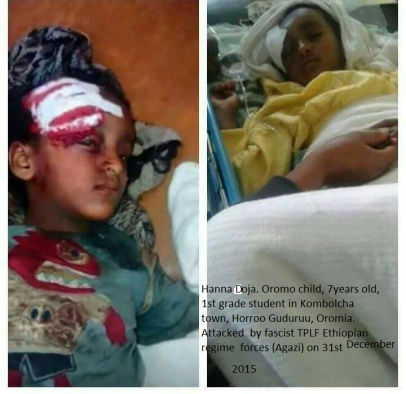
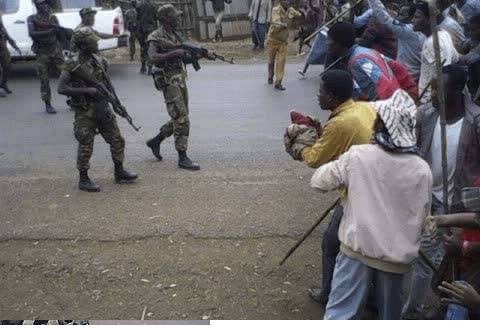
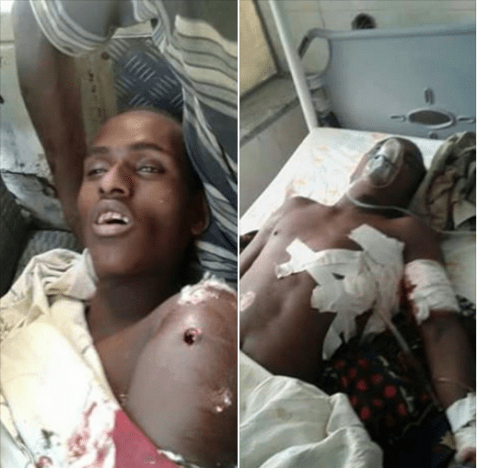

A rights group is accusing Ethiopia’s security forces of carrying out serious rights abuses during recent protests in the country’s Oromia region.
The Ethiopia-based Human Rights Council said Monday that it found evidence of extrajudicial killings, tortures, beatings, illegal detentions, forced disappearances and arson attacks during and after the protests.
In November, protests erupted in the Oromia region over a proposed plan to expand the municipal boundary of the capital, Addis Ababa, which some believed would lead to the displacement of farmers.
Authorities have since abandoned the plan but clashes continue. The Human Right Council said at least 103 people have been killed.
Ethiopian Prime Minister Hailemariam Desalegn recently told lawmakers he is “apologetic for the death and destruction” that happened during the protests.
http://www.robemedia.com/2016/03/14/group-ethiopia-forces-kill-rape-clashes-protesters/
http://www.news24.com/Africa/News/ethiopian-troops-accused-of-executing-protesters-20160314

A group is marching today in downtown Saskatoon to draw attention to violence against the Oromo people in Ethiopia.
Ethiopian government forces killed more than 80 people in protests in the country’s Oromia region.
Ethiopia’s prime minister apologized this week for the deaths resulting from the anti-government protests in the Oromia region but accused the protesters of being responsible.


The group, called the Saskatoon Oromo Self-Help Association Corporation, marched downtown and protested outside of City Hall.
“There has been rampage violence and and reckless mass murder of the Oromo people by the country’s militarily armed police forces and security agents,” the group said in a press release.
The group is “appalled” by the treatment of the Oromo people in Ethiopia.
Associated Press files.
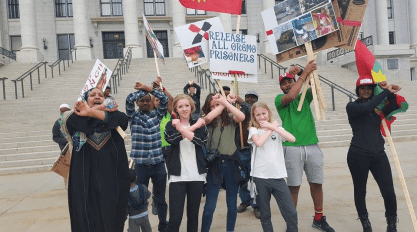
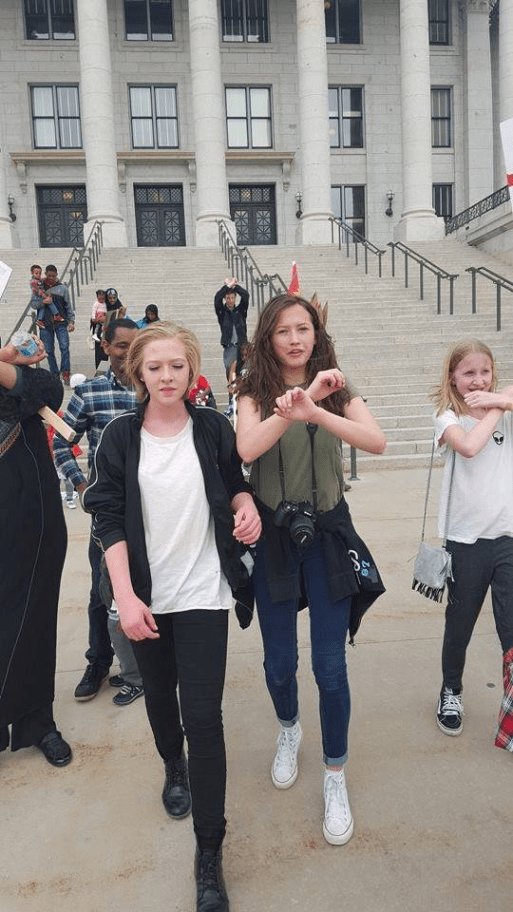

Geleta Fite crosses his arms in protest
as members of Utah’s Oromo community rally for human rights
in Salt Lake City on Friday, March 11, 2016.
SALT LAKE CITY — Holding signs depicting bloodied victims of the violence that has erupted in the Oromia region of Ethiopia over the past several months, Utah’s Oromo community rallied Friday in front of the federal building.
The group is demanding U.S. help in bringing justice to their friends and families living in Ethiopia, where government forces have killed hundreds of peaceful protesters opposing the annexation of the country’s capital Addis Abada into surrounding towns.
“We’re here today to protest the killings taking place in every corner of Oromia and to bring that violation of human rights to the government of the United States so that the United States can make some pressure to stop the killing,” said Geleta Fite, who came to the U.S. in 2013. But his family, he said, remains in Ethiopia.
“We will not sit back until we see some change and we see some justice for the murdered,” he said.
Fite joined several dozen other Oromo community members to deliver letters to Utah’s U.S. senators, demanding that the United States “condemn the brutal acts of the Ethiopian government and ensure these acts stop immediately,” the letter states.
Among its requests, the group urged the U.S. to advise its business community to limit spending in Ethiopia until the violence ends and pressure the Ethiopian government to establish an independent investigation into the killings.
The Human Rights Watch has said that there have been “almost daily accounts of killings and arbitrary arrests” since the beginning of the year as Ethiopian forces have suppressed peaceful protests in a government crackdown.
The Associated Press has reported that the protests were led by students who opposed what they believed to be a government plan to expand the capital, which would ultimately lead to the displacement of thousands of families and farmers. The Ethiopian government has denied the protestors’ claims, saying it only seeks to link Addis Ababa with nearby towns.
In January, after the deadly protests erupted, the AP reported Ethiopian officials canceled plans to integrate the capital with surrounding communities. However, the Human Rights Watch has said the bloody crackdown has continued, after the plan’s cancellation did not halt protests.
“This is genocide,” said Genemo Bedaso, chairman of the Utah Oromo Community. “We appeal for America to stop it. They have the power.”
Bedaso and Fite tried to meet with Sen. Orrin Hatch and Sen. Mike Lee on Friday to deliver their group’s letter. The senators were not available, but staff members accepted the letters. Hatch’s spokeswoman, Heather Barney, said the letter will be relayed to the senator in Washington.
“Sen. Hatch is always responsive to his constituents’ concerns and has directed staff to meet with them,” she said. “He’s very concerned about the problems that they’re sketching out and he’s happy to listen.”
The European Parliament adopted a resolution in January to condemn the peaceful protest killings, call for an investigation of the violence, and demand immediate release of arrested Oromo activists.
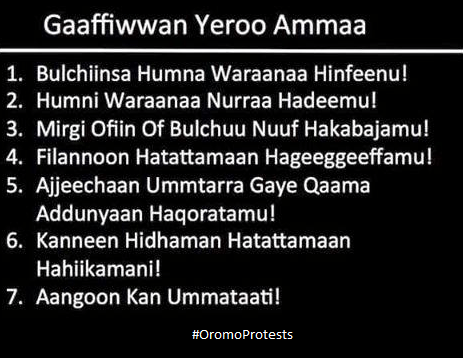
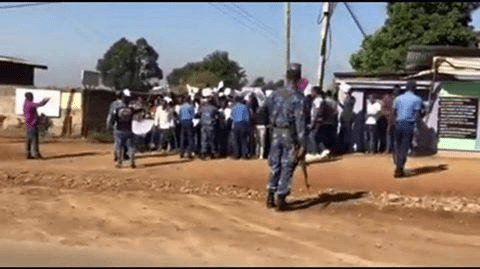
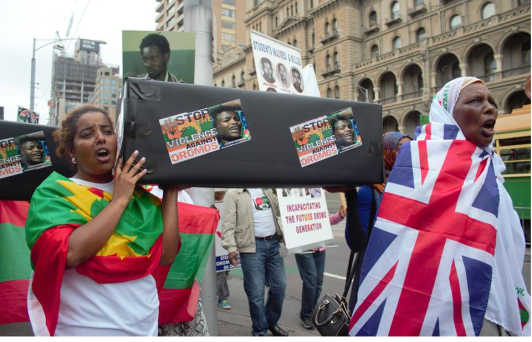
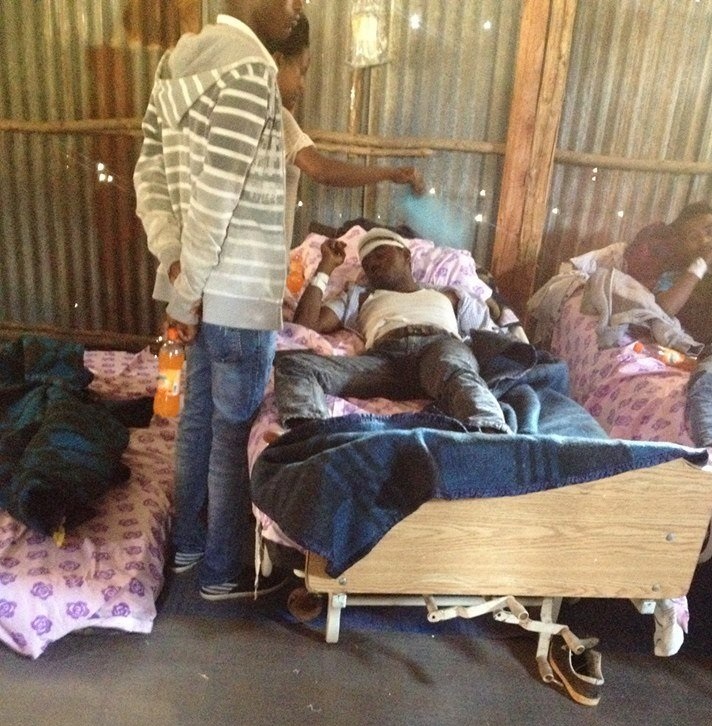
UK (International Business Times) — Hundreds of people from Oromia, Ethiopia’s largest state, are still protesting on the streets calling for self-rule. An activist who spoke to IBTimes UK on condition of anonymity explained that Oromopeople, Ethiopia’s biggest ethnic group, were also protesting against the alleged violence carried out by security forces against demonstrators.
Protesters in Oromia first took to the streets in November 2015 to voice their dissent against a government draft plan that aimed to expand the boundaries of the capital Addis Ababa. They argued the so-called “Addis Ababa master plan” would lead to forced evictions of Oromo farmers who will lose their land and would undermine the survival of the Oromo culture and language.
Who are the Oromo people?
The Oromo people are Ethiopia’s largest ethnic group and their population amounts to more than 25 million (around 35% of Ethiopia’s total population). They originated in the Horn of Africa, where they are believed to have lived for millennia.
Oromo people speak Afaan Oromoo, as well as Amharic, Tigrinya, Gurange and Omotic languages. They are mainly Christian and Muslim, while only 3% still follow the traditional religion based on the worshipping of the god, Waaq.
In 1973, Ethiopian Oromo created the Oromo Liberation Front (OLF), which stemmed from the discontent over a perceived marginalisation by the government and to fight the hegemony of theAmhara people, another large ethnic group in Ethiopia.
OLF – still active today – also calls for the self-determination of the Oromo people. It has been deemed as a terror organisation that carried out violent acts against people in Ethiopia, Somalia and Kenya. The group hasalways denied such allegations, claiming its mission is to terminate “a century of oppression” against the Oromos.
The Ethiopian government scrapped the master plan following increasing agitation which activists claimed led to the death of at least 200 people.
However, Oromo people have continued their protest arguing, among other things, that they did not trust the authorities.
“The issue of the master plan was only an immediate cause,” a source close to the campaigners said. “The root causes are real demands for Oromo self-rule, democracy and rule of law, among others and the government has continued to respond violently.”
The activist also claimed that during student protests which occurred on 8 March, police allegedly arrested more than 50 people and injured many.
“Student protests occurred at some large universities including Addis Ababa University,Jima University and Wallaga University,” the source added.
“AtAddis Ababa , Oromo students demonstrated for the second round in front of the US embassy chanting ‘we are not terrorists, we are Oromo, stop the killings inOromia’. In Wallaga, government forces beat and injured many students. Hospital beds were overflowing with injured students and ambulances were prevented from taking victims to hospitals in other cities around that part of Oromia,” the source alleged.
Government dismisses allegations of violence
The Ethiopian embassy in London has not responded to a request for comment on the fresh allegations.
On 21 February, Human Rights Watch (HRW) released a report warning that at least 200 people had been killed with further arrests of Oromo protesters by security forces, including the military.
However, Ethiopia dismissed the allegations with an official telling IBTimes UK the HRW report was“abysmal propaganda.” The government claimed the death toll was much lower than 200 but did not give a specific figure. Protesters were also accused of trying to secede and create an independentOromia state.
An earlier statement by the Ethiopian embassy sent to IBTimes UK stated that the government engaged in public consultations which resulted in the decision to scrap the master plan. Authorities also launched an investigation to identify people behind “corrupt land acquisition practices”, loss of innocent lives and damage to private and public properties. The investigation has led to a number of arrests.
http://www.ibtimes.co.uk/oromo-protesters-we-are-still-streets-because-we-want-self-rule-1548661

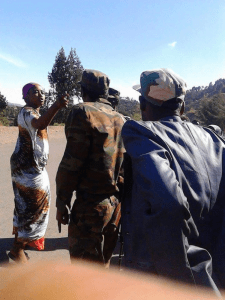

Press freedom in Ethiopia is dwindling in light of recent anti-government protests and the severe drought in the Horn of Africa state, according to a journalists’ association.
Two journalists and a translator were arbitrarily detained for 24 hours on Thursday when reporting on the protests in Oromia, according to a statement issued by the Foreign Correspondents’ Association of East Africa (FCAEA) on Monday. Bloomberg correspondent William Davison and freelance journalist Jacey Fortin, along with their translator, were not given any reason for their detention. Their phones and identification cards were taken during the arrest.
Protests among the Oromos, who constitute Ethiopia’s largest ethnic group, have been ongoing since November 2015 and were originally directed against plans by the federal government to expand the capital Addis Ababa. At least 140 protesters were killed between November 2015 and January, according to Human Rights Watch (HRW). The Addis expansion plans were dropped in January but the protests—which have morphed into a general expression of dissatisfaction with the government among Oromos—have continued and demonstrators are still being subjected to “lethal force,” HRW said on February 22. The Ethiopian government has said that “destructive forces” —including some from neighboring Eritrea—have hijacked the protests and would be dealt with decisively.
The FCAEA said that the detentions marked “a worrying escalation” in Ethiopia, which already has a poor record for allowing journalists to operate freely. Ethiopia was ranked 142nd out of 180 countries in terms of press freedom in 2015 by non-profit organization Reporters Without Borders, which recorded six newspapers closing and more than 30 cases of journalists fleeing abroad in 2014. “Ethiopia is well-known for its tough stance on journalists but this is a worrying spike of arbitrary detention of media workers at a time of increased interest in Ethiopia,” says Ilya Gridneff, chairman of FCAEA. “Journalism is not a crime and those in Ethiopia should not be treated as criminals.”Davison told Newsweek that the risks of reporting on certain topics in Ethiopia is too high because of the threat of detainment. “It was a shock to be held overnight in a prison cell and not be given any explanation of what we were being held for,” says Davison. The “very heavy and militarized response” to the Oromo protests “raises the chance that reporters are going to be obstructed from doing their work,” he says.
Newsweek contacted the Ethiopian Embassy in London but was yet to receive a reply at the time of publication.
Coupled with the Oromo protests, Ethiopia is currently experiencing its worst drought in around 50 years, partly due to the El Nino weather pattern. Up to 15 million people in the country require emergency humanitarian food assistance and the United Nations is appealing for $50 million to help the government cope with the crisis.
http://europe.newsweek.com/ethiopia-detains-journalists-covering-oromo-protests-434307?rm=eu
March 3, 2016
President Jacob Zuma
President of South Africa
Union Buildings
Private Bag X1000, Pretoria 0001
South Africa
Dear Honorable President Zuma:
On behalf of many Oromo refugees in South Africa, Oromo refugees all over the world and Oromos in Ethiopia who are experiencing severe and violent oppression under the Ethiopian People Revolutionary Democratic Front, I congratulate the African National Congress, the People of South Africa and you on the 104th anniversary of the ANC.
Oromo is one of the largest and indigenous African groups on the continent and the largest single ethnic group in Ethiopia. During the nineteenth century, the country of Abyssinia was never colonized by any European power as happened to nations and regions across the rest of Africa. However, at that time, there was a struggle for power in Abyssinia. The King of Shewa (later Emperor Menelik II), in his pursuit of the imperial crown, saw an opportunity to augment his wealth, military power, and territorial domination by expropriating the lands of the Oromo people lying to the south of Abyssinia and directly or indirectly enslaving many Oromo children. He also imposed taxes on all Oromo slaves (almost all children) taken through his kingdom en route to the Arab slave markets across the Red Sea. In this way, Menelik II managed to bring the Oromo people to their knees by breaking their resistance, taking away their land, their livelihoods, and their children. The fall of the Oromo nation paved the way for the conquering of all the southern nations and nationalities including the expropriation of their lands to create the territory defined and known today as Ethiopia.
Since colonization by Menelik II, Oromo have suffered at the hands of successive Ethiopian rulers. A recent historical study has shown that a group of sixty-four liberated Oromo slave children arrived at Lovedale Institution in 1890 where they were cared for and educated. By 1910, one-third had returned home, one-third had died and one-third (23) chose to remain in South Africa. Among these was Bisho Jarsa, the grandmother of the late Dr. Alexander Neville, the renowned intellectual, educationalist, human rights activist and struggle hero.
When Menelik II was succeeded by Emperor Haile Selassie, conditions became even worse for the Oromo people and the other colonized nations and nationalities. It was under this regime that Oromos and others started to organize themselves clandestinely. The first Oromo civil organization called the Macha-Tullama Welfare Association was founded in 1960 by General Tadesse Biru and other Oromo nationals from a different part of the Oromia regions. The objective of the Macha-Tullama Welfare Association was to create awareness and lay the foundation for the Oromo liberation struggle. This civil organization was later banned by the regime of Hailie Selassie and General Tadesse Biru and others were jailed. Many members were killed and others forced to leave the country.
General Tadesse Biru was not only the founder of the Macha-Tullama Welfare Association but was also among the founding members of the Oromo Liberation Front (OLF). When the late President Nelson Mandela arrived in Ethiopia in 1962, General Tadesse Biru personally trained him in guerilla warfare.
The death of Haile Selassie and the rise of Mengistu Haile Mariam failed to bring about desired change, the change that the oppressed people had hoped for. Instead, the Soviet-backed group proved even worse, creating a one-party Communist state in 1975 under the name of Derg.Opposition political parties and civil organizations came under attack. The “red terror” under the Mengistu regime crushed all organizations and people who sought freedom, peace and democracy. Many people were treated in the barbaric and brutal manner (including the jailed General Tadesse Biru). Many Oromo sons and daughters were mercilessly murdered, their bodies tied to cars and dragged on the streets of Addis Ababa and other cities. Parents were forced to buy the bodies of their loved ones bodies in order to bury them.
Under the regime’s program of villagization, Oromo land was once again taken from them and given to settlers from the northern part of the Ethiopian empire, especially to the Amharas and Tigreans. The regime tried to stamp out the identity, language and culture of the Oromo people, replacing these, through a National Literacy Campaign, with the language and culture of the Habesha (the Amhara, Tigray and Gurage people).
After 17 years of iron-fist rule, the Derg regime was overthrown by three organizations namely the Oromo Liberation Front (OLF), the Ethiopian People Revolutionary Democratic Front (ERDF) and the Eritrean People Liberation Front (EPLF).The above mentioned three main organizations formed the Transitional Government of Ethiopia under a Transitional Charter.
There was great of hope for the people of Ethiopia in general and the Oromo nation and other colonized nationalities in particular. The oppressed people of the empire envisaged that they would soon enjoy full democracy and that all human rights would be safe-guarded in terms of the right to self-determination as recognized internationally and enshrined in the UN charter. Article 39 of the Ethiopian Constitution, adopted in 1991, clearly indicates the right of self-determination up to secession: “Every nation, nationality or people in Ethiopia shall have the unrestricted right to self-determination up to secession.”
The EPRDF is presently in power and has enjoyed the support of the USA and western governments since the collapse Mengistu regime. The idea of democracy, the rule of law and constitutionalism never materialized as promised. The Article only worked for Eritreans and Oromo and others again subjected to the same inhuman treatment under this new Abyssinian ruler. The subjugation, marginalization and all kinds of oppression have been perpetuated systematically. The suffering of the oppressed people increased more than ever before. The non-functioning, ethnic-based federal system was instituted to deceive both international communities and people of the country. The EPRDF-TPLF, led by the late Prime Minister Meles Zenawi, dominated political and economic power in the empire. Eventually, the hopes of the oppressed people evaporated and peoples’ organizations like the OLF were forced to abandon their support for the Transitional Charter. With the support of western powers, the EPRDF cemented its domination. OLF members, sympathizers and Oromo people from all walks of life have been jailed, tortured, raped, dehumanized and killed. Even the lives of those who fled, seeking refuge in neighboring countries, were not spared. They have been hunted down by EPRDF agents with the co-operation of Ethiopian embassies in these territories. These embassies have played a huge role in assassinating Oromo refugees, as well as hijacking and secretly (or openly) taken back to Ethiopia. Those who were returned to Ethiopia in this way were either killed, are languishing in jail or have simply disappeared. This happened in Djibouti, Sudan, Somalia and especially Kenya. In Kenya, not only Oromo from Oromia were faced with cruelty but also, the indigenous Kenyan citizens of Oromo origin suffered equally. The co-operation between Ethiopian and Kenya security agencies has been very strong in destroying Oromo opposition and refugees. However, the above-mentioned inhumanities have never deterred the Oromo people from demanding their birth rights. On different occasions, the people have risen against the colonizers and have continued with their resistance.
Besides organized Oromo resistance and political activities among the Oromo in the diaspora, the people residing within the empire have risen against the brutal regime of Ethiopia since the 1995 election. The system imposed at that time was marred by irregularities and the people showed their dissatisfaction and disobedience to the TPLF regime. The Ethiopian security forces and the military responded with brutality in their attempts to crush these popular uprisings.
Elections in Ethiopia are not free and fair; they are held just for formality. Post-election, many have been killed, maimed and jailed. The irregularities of these so-called elections in the empire have raised concern inside and outside the country. Many human right organizations like Human Rights Watch and Amnesty International have voiced their concern but these have only landed on deaf ears in the Ethiopian ruling party and among the international governments. Instead of pressuring the regime to desist from these irregularities, international donors have increased their material aid and support. Western funding has not been used for the purposes the donations were made. Instead of being used to support intended development programs, western aid has been used to crush opposition groups, inside the country and in the diaspora. Mostly, this external funding has been used to equip the regime’s security and military forces. The recent “election,” which reflected 100% support for the EPRDF, was another indication of dictatorship and undemocratic nature of TPLF regime. Currently, there is no one single elected opposition member of the Ethiopian Parliament. Surprisingly, this regime is enjoying legitimacy according to international countries and other African countries in general.
The most powerful tool that the EPRDF regime is using is self-crafted anti-terror law. This law overrides all laws in the country—including all human rights laws. The law is designed to silence all opposition parties, especially the Oromo Liberation Front (OLF) and the Ogaden National Liberation Front (ONLF).
Currently, the Ethiopian regime is busy changing its system of oppression. In the long and arduous struggle for freedom and democracy, Oromos and other colonized nations and nationalities have regained certain rights. These rights include the development of their culture and the right to use their languages, regaining of their geographical boundaries etc. When people try to hang on to the fragments of rights(which are the fruits of many sacrifices and struggling for more to the extent of self-determination), the EPRDF regime, on the contrary, is busy reversing these hard-won rights. This pull and push situation make Ethiopia hell on earth and the situation is worst of all in the Oromia region. Current action by the brutal EPRDF regime in the Oromia region includes:
At this darkest moment, we humbly request you and your government to take timely action to save the Oromo nation and the other colonized nations and nationalities:
We call on you, your South African government, African heads of states and the international community, local and international right organizations that can play positive roles to act before it is too late.
Thank you
Denge Garse (Oromo People Association)
Copies to:
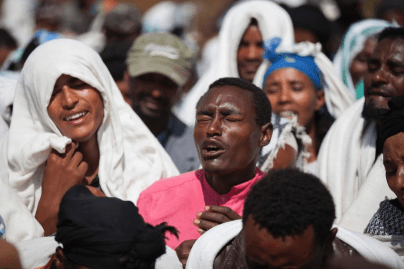
(Newsweek, 26 Feb. 2016) — Since the Ethiopian government announced plans to expand the territory of the capital Addis Ababa in April 2014, the country’s largest region, Oromia, has been racked with protests that have led to hundreds of deaths.
Oromia, which completely surrounds the capital of the Horn of Africa country, is home to the Oromo ethnic group. Oromos constitute the largest ethnic group in Ethiopia, yet members of the community claim to havesuffered systematic discrimination and oppression at the hands of Ethiopia’s federal government.
Newsweek explains who the Oromo are, why they are protesting and how the Ethiopian government is responding.
Who are the Oromos?
More than one in three Ethiopians hails from the Oromo ethnic group: Oromos constituted more than 25 million of the total 74 million population at the last census in 2007 (the population of Ethiopia has since grown to almost 100 million). The Oromo have their own language and culture distinct from the Amharic language, which is employed as Ethiopia’s official dialect.
The Oromo have been subject to human rights violations and discrimination under three successive regimes in Ethiopia, according to a 2009 report by U.S.-based Advocates for Human Rights group: the Abyssinian Empire under Haile Selassie, dissolved in 1974; the Marxist Derg military junta that seized power in 1974 and ruled until 1991; and the Federal Democratic Republic of Ethiopia, established in 1991 and existing until the present.
Oromo language was sidelined and not taught in schools for much of the 20th century and Oromo activists were often tortured or disappeared. A 2009 report by the United Nations Commissioner for Human Rights (OHCHR) stated that 594 extra-judicial killings and 43 disappearances of Oromos were recorded between 2005 and 2008 by an Oromo activist group. The ethnic group have clashed with the ruling Ethiopian People’s Revolutionary Democratic Front (EPRDF), in power since 1991; an Amnesty International report in October 2014 stated that at least 5,000 Oromos were arrested between 2011 and 2014 on the basis of opposition to the government.
Why have Oromos protested against the Addis Ababa master plan?
According to the Ethiopian government, the Addis Ababa Integrated Master Plan proposed to expand the capital’s territory in order to bring better services and greater economic opportunities to the rural areas surrounding Addis. For the Oromos, however, the plan constituted an attempted land grab that could result in the forced eviction of Oromo farmers and the loss of valuable arable land in a country regularly plagued by drought.
Protests began in Oromia immediately after the plan was announced—at least nine students were killed in April and May 2014, according to the government, although eyewitnesses said the total was at least 47. The most recent round of protests began in November 2015 and have spread across the entirety of the vast Oromia region. Human Rights Watch (HRW) reported in January that at least 140 protesters had been killed in demonstrations after heavy-handed crackdowns by security forces.
The Ethiopian government announced later in January that it was abandoning the Addis expansion plans after the Oromo People’s Democratic Organization (OPDO)—the ruling party in Oromia and a member of the governing EPRDF coalition—dropped its support for the scheme. Yet despite that, the crackdown has continued: HRW’s latest update on February 22 cited claims from activists that more than 200 protesters had been killed, with security forces allegedly firing on peaceful protesters and thousands detained without trial.

Ethiopian Prime Minister Hailemariam Desalegn, pictured addressing a U.N. summit in New York, September 25, 2015, has vowed to crack down on “destructive forces” the government says are hijacking Oromo protests.ANDREW KELLY/REUTERS
How have the government responded to Oromo protests?
The EPRDF has come down hard on protesters, claiming that “destructive forces”—including groups designated as terrorist organizations by the Ethiopian government—are hijacking the protests for their own means. Hailemariam Desalegn, the Ethiopian prime minister, said in December 2015 that protesters had burned down government properties and killed security forces, and that “merciless legitimate action” would be taken against those causing disorder.
In a statement sent to Newsweek on February 23, the Ethiopian embassy in London said that the claims made in HRW’s February report were based on “malicious statements, false accusations and unsubstantiated allegations from opposition propaganda materials.” The embassy claimed that the Addis expansion plans were dropped after “extensive public consultations” and an investigation into killings and destruction of property was underway.
Are Oromos seeking secession from Ethiopia?
One of the designated terrorist organizations accused of involvement in the protests by the Ethiopian government is the Oromo Liberation Front (OLF). The group wasestablished in 1973 to campaign for the Oromo’s right to self-determination. The OLF is now based out of Washington, D.C. and any accusations of its involvement in the Oromo protests is a means of “criminalizing protesters,” according to Etana Habte, Ethiopian author and PhD candidate at SOAS University of London. “I don’t believe the OLF has very significant influence on this protest,” says Habte. “[Claims the OLF is involved] have not any relevance or grain of truth within itself. Oromo protests are fundamentally peaceful and it carries a legitimate question.”
Habte claims that what the Oromo are seeking is self-determination, not secession.Article 39 of Ethiopia’s 1994 constitution affords “every nation, nationality or people in Ethiopia” the “unrestricted right to self-determination up to secession.” What the Oromo are asking for, says Habte, is a greater say in how their region is governed. “Oromos understand Oromia as their own territory where they have an absolute and constitutional right to self-rule,” says Habte. “The Oromo protests don’t ask for anything more than [what is provided by] the constitution.”
| M | T | W | T | F | S | S |
|---|---|---|---|---|---|---|
| 1 | 2 | 3 | 4 | 5 | ||
| 6 | 7 | 8 | 9 | 10 | 11 | 12 |
| 13 | 14 | 15 | 16 | 17 | 18 | 19 |
| 20 | 21 | 22 | 23 | 24 | 25 | 26 |
| 27 | 28 | 29 | 30 | |||


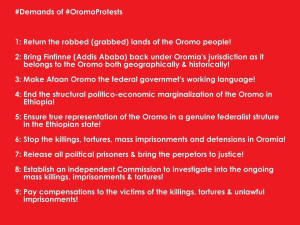
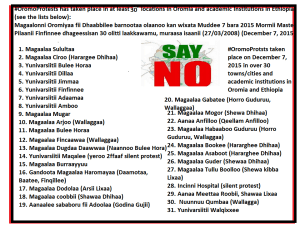


 Oromian Economist
You must be logged in to post a comment.