
Addis Ababa master plan: Oromo protesters claim Liyu police killed 27 after government scraps plan
-
By Ludovica Iaccino, January 20, 2016
Economic and development analysis: Perspectives on economics, society, development, freedom & social justice. Leading issues in Oromo, Oromia, Africa & world affairs. Oromo News. African News. world News. Views. Formerly Oromia Quarterly


By Ellery Roberts Biddle, Global Voices
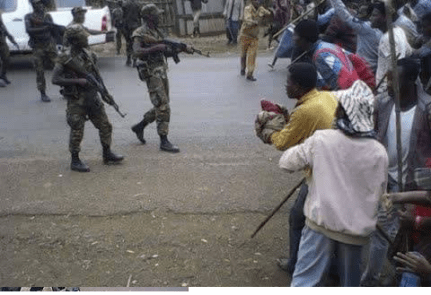
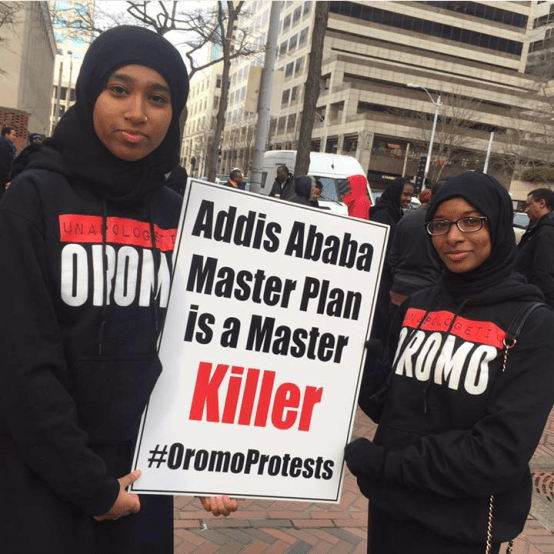
Ethiopian authorities have killed at least 17 children and injured many more involved in peaceful land rights protests since December 2015.
Demonstrations over a plan to expand the capital into the ethnic region of Oromia began in Ethiopia in late November. Since then, there have been 140 confirmed deaths of protesters at the hands of government authorities. Of the 17 minors killed by authorities, most were between the ages of 12 and 17 years old. Citizen media reports also show that many more school children have been injured in the protest movement.
The protesters are speaking out against the so-called “Master Plan” to expand the capital city, Addis Ababa, into Oromia, fearing that the proposed development will result in direct persecution of the Oromo ethnic group, including mass evictions of Oromo farmers from their land. Oromo people, who represent the largest ethnic group in Ethiopia, have experienced systematic marginalization and persecution over the last quarter century. Some estimates put the number of Oromo political prisoners in Ethiopia at 20,000 as of March 2014. The country’s ruling elite, of the EPRDF party, are mostly from the Tigray (only 6% of Ethiopia’s 90 million population ) region, which is located in the northern part of the country.
In parallel with efforts of global organizations such as Human Rights Watch, local activists have worked to document and preserve evidence of these killings since early December. Last week, Ethiopian media scholar Endalk Chala and Oromo activist Abiy Atomssa published a map of confirmed deaths based on a crowdsourced data set comprised of reports from citizens, activists, social media, local media networks and VOA’s Amharic service.
Eighth grader Barihun Shibiru of West Shawa was among a handful of minors who were arrested and executed once in official custody. Shibiru’s funeral was held on December 17.
Citizen videos have also helped document and confirm deaths of minors, including a video that shows students crowding around the body of Lucha Gamachu, a 9th grader at Burqa Wanjo Secondary School. The video was published on Facebook by Jawar Mohammed.
We ask that any person who has evidence of the death or disappearance of protesters please contact us at editor@globalvoicesonline.org.

By J. Bonsa, PhD, Addis Standard,
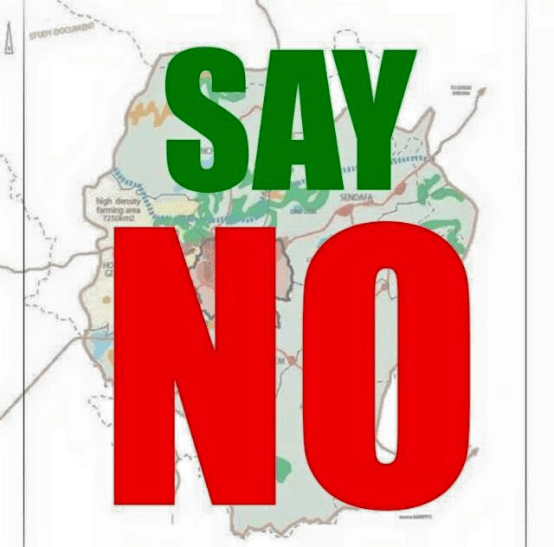
The most commonly held rallying cry of the ongoing Oromo protestin Ethiopia is “Say No to the Master Plan!” There is a consensus among the protesters and the general public that the “Master Plan”, named by some campaigners as the “Master Killer”, has just served as a focal point that ignited the widespread discontent in a range of social, political and economic lives of the Oromo who finally went out en masse to express their outrage.
This piece is concerned with effective messaging of the protest. If framed wisely and clearly,messages and slogans can contribute to effective communication between the wider Oromo society in general and, most importantly, with the rest of the Ethiopian people and the international community.
It should be emphasized that the Oromo protest is a spontaneous outburst of rage among the Oromo youth and the general public at large, who had enough of the relentless and systematic oppression and dispossession by the current EPRDF led government in which the Oromo peopleare not genuinely and meaningfully represented. Since the protest is not centrally organized and coordinated, it is not surprising if the messages are not as sharp as they should.
The “Plan”
The concerns and questions related to the ‘Master Plan’ can be classified into the following sets of issues and regulations: The ‘Master Plan’– The request to scrap the ‘Master Plan’, a technical document that specifies the expansion of Addis Abeba by 20 times its current size, albeit with the ominous prospect of dissecting Oromiya into two parts through a deliberate enlargement of Addis Abeba; and Evictions and Land Grab – This follows from (a) the enlargement of Addis Abeba will inevitably get accomplished by evicting hundreds of thousands of farmers and turning pristine farm lands into a massive urban development spaces; and (b) Urban Development Law– recently passed byCaffee Oromiya, which was rushed through as an urban development law with far reaching implications, essentially obliterating Oromiya’s right on its urban centers.
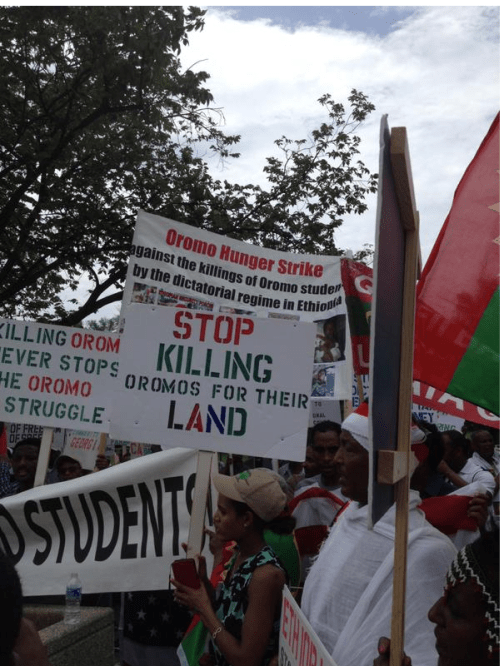
If we count slogans that appeared on placards carried at demonstrations in towns and villages of Oromiya as well as solidarity rallies organized by the Oromo diaspora, then perhaps more than 90% of the cases would refer to the ‘Master Plan’, that is in the sense of (a) above. We witness similar levels of frequent references on social media; for instance, profiles of activists on Facebook often appear with a familiar red-green colored two worded slogan, “Say NO”, a shorthand for “Say No to the Master Plan”. Matters related to land grab are also referred to during chants by protesters but with less frequency than “Say No” type slogans. As far as I am aware, the “urban development law” has received a very marginal attention during the protest rallies and related discourses.
Unintended outcomes
There is an unintended consequence of heavy reference to the ‘Master Plan’ during opposition and solidarity rallies and expert discussions. The presence of the very word ‘Plan’ in ‘Master Plan’ seems to have hugely distorted the message. By definition, ‘plans’ are essentially futuristic. Therefore, any opposition to a planned activity can essentially (and easily) sound as if it is all about opposing something yet to take place. To complicate matters, even in latest press releases by Oromo political groups appear with phrases like “if implemented”; that is to say “if this Master Plan is going to be implemented”.
In rare cases when they report on Oromo protest, the western media often misrepresented Oromo protest as opposition to “development plan”, with negative connotation of portrayal as anti-economic development. The EPRDF ledgovernment has often projected this image portraying itself as pro-development and Oromo activists as obstacles againstits development plans. Even if Oromos put their cases in the best possible way, then I suspect the government would still devise ways to distort it and the Western Media would still be reluctant to provide fair coverage. Such that lack of focus in getting messages right have therefore immensely contributed to the distorted image of Oromo activism, specifically related to opposition to the ‘Master Plan’.
The excessive reference to the ‘Master Plan’ has already caused some misunderstandings and created obstacles to the ongoing Oromo uprising. For instance, government officials have reluctantly indicated their willingness for dialogue. Under pressure they have gone as far as announcing a closure of the Integrated Master Plan Project Office. The US government has provided a lip service to Oromo protest, effectively implying that “what happened is regrettable, but now that the government is willing to talk to you, stop protesting and start engaging with the authorities”. Sadly, the US government has yet again given the moral high ground to the government in Ethiopia, whose security forces have already killed more than 80 peaceful Oromo protesters, including a mother who tried to plead and protect her son.
Sharpening
In my view, what is required is simple and straightforward. The messages can get right by doing two things:
Prioritize:I propose prioritization the messages in the following order: oppositions againstthe general practice of land grab; the Oromiya urban development law; and the ‘Master Plan’ itself. Meanwhile references to the later have to be kept to the minimum. Land grab, the end result of the ‘Master Plan’, has to be brought up front and protesters have to be vocal in their opposition to the ill-designed and deceitful regulation rushed through Caffee Oromiya. References to the fuzzy, vague and broad “plan” have to be relegated to a third category. However, I believe it should still remain on the placards but with less frequency than it currently appears.
Balance: The message gets clearer if opposition to the ‘Master Plan’is unpacked and presented in its time dimension: past, present and future. So far, the misunderstanding emanates from the presence of the word ‘Plan’ in ‘Master Plan’, which gave totally wrong impressions that Oromos are protesting a plan that is not yet implemented. It is a known fact that this is not the spirit in which the Oromo protests have taken place. The fact of the matter is the ‘Addis Master Plan’ has already been implemented. The EPRDF government should therefore be accused and challenged not only for lack of public participation in the preparation of the ‘Master Plan’ but also for declaring a plan for City development activity which has already been substantially implemented without much say from the general public. This would mean reframing the message and challenging primarily the implemented component of the Addis Abeba Master Plan. In other words, the focus of the movement should shift from what is yet to happen to what has already happened. This will save the protest from being labeled as a protest led by “imagination” to opposition against incalculable damages and crimes already perpetrated on the Oromo people.
Focusing
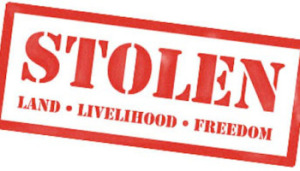
The whole purpose of this analysis is to assist with sharpening the messages and messaging in the ongoing Oromo protest. I will conclude by providing rough sketches of the nature of effective messages I would like to see in future rallies. Although I put “Land Grab” as a primary target for opposition, even this would need to be framed in such a way that the message to be conveyed is a great deal more focused and sharper. In the context of Oromiya, “We Oppose Land Grab” is not good enough. Instead“Lafaa Hattee Deebisi!” or “Return Stolen Properties!” sounds sharper. I will simply outline a few focal points, and leave the task of coining effective slogans out of them. (of course, that is if my concern is shared with others colleagues).
Compensation– peaceful protesters would need to put across messages that target proper compensation for millions of families that have already been evicted over the last two decades. The justification for this is clear and straightforward. Ill-compensated farmers have legitimate cases to legally hold the authorities accountable for their dispossessed properties. There is no such a thing as bygones are bygones in such matters. In this case, the target has to be proper compensations perhaps over a longer period of time. It is possible to imagine the kinds of settlement that can be reached.
This might include establishing an inquiry that will look into the elaborate scams surrounding property development deals, amount of money collected, and then institute public fund for special compensations that will regularly pay evicted farmers and reinstate their dignities as human beings. Inevitably, such compensation funds can be sustained through property taxes, which inin tern force those who unjustly acquired land to pay back in the long run. Such guarantees will save current owners from insecurity in the short term to medium term.
‘Master Plan’– The manner in which protesters oppose part of the ‘Master Plan’yet to be implemented would need to be reframed. The aspect related to inevitable future land grab will remain as in the current rally but it should not be allowed to overshadow other aspects. However, I think it is important to express opposition to the deceitful merger of Addis Abeba with surrounding Oromiya towns in the pretext of development. Peaceful protesters would need to vocally express their opposition to “merger”. The reason is clear; it violates the basic principles of federalism. Something like this would send a strong message: Development Plan Integrations, Yes!; City-Town Mergers, No!.It can never be a difficult task to elaborate the underlying reasons for such slogans. It will also remove the unfortunate image of sounding a protest against “development plans”. Holding this slogan is like hittingtwo birds with one stone – a protest against land grab, gerrymandering, and the urban development proclamation. It also gives confidence for others who plan to settle in Oromiya.


January 25, 2016 12:22 AM
After almost two months of clashes between Oromo protesters and security forces in Ethiopia, authorities have scrapped a “master plan” that would have expanded the boundaries of Addis Ababa and, according to protesters, would have displaced Oromo farmers.
However, observers are divided on the significance of the move by Ethiopia and whether it truly represents a change of policy or just a reaction to negative publicity.
Dr. Awol Allo, a fellow in human rights at the London School of Economics, said he believes the government will find other ways to take land it deems useful.
“I don’t actually believe that the practices of displacement and the eviction and the plunder would cease,” Allo told VOA. “Remember, the expansion of Addis began a very long time ago and it has intensified over the course of the last 10 years because of the influx of investment into the city, both foreign and domestic.”
Compiled by activists
Allo pointed to figures compiled by jailed Oromo activist and opposition leader Bekele Gerba, who said 150,000 Oromo farmers have had their land taken by the government over the past 10 years.
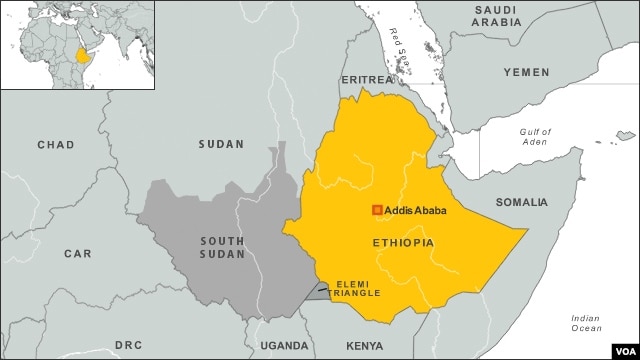
“The practices would continue. They just don’t call them a master plan,” Allo said. “The master plan was basically intended to sort of basically formalize and legalize the processes of annexation and expansion. It may not have that kind of name that gives it a broader mandate, sort of legitimacy and authority, but the practice would nevertheless continue.”
Earlier this week, the European Parliament adopted a 19-point resolution urging Ethiopia to respect the rights of peaceful protestors as well as to cease intimidation and imprisonment of journalists. During a recent visit to Ethiopia, U.S. Ambassador to the United Nations Samantha Power urged the government to engage in dialogue with protesters.
Approximately 140 people were killed during the protests, according activists interviewed by Human Rights Watch.
“What we are urging is that the international community should not turn a blind eye to these gross violations of human rights that have taken place in Ethiopia,” said Mandeep Tiwana, head of policy and research at CIVICUS, a group that works to strengthen civil society and civilian participation in politics.
“They should diplomatically engage with Ethiopia, institute external inquiry into this matter and also bring to court those responsible for excessive force and it appears that security forces have used excessive force against peaceful protesters and in fact there are reports that even children as young as 12 have been killed,” Tiwana said.
Confirmed deaths
The government has confirmed that 13 security forces died in the clashes. VOA made repeated requests for comment from the Ethiopian Embassy in Washington, D.C., but has not yet received an official statement.
The protests come at a particularly difficult time for Ethiopia, as the worst drought to hit the area in 30 years has caused a famine that is particularly affecting the northeast region.
The aid group Save the Children says as many as 10 million people are in need of food aid and calls it one of the two worst humanitarian crises in the world, following only Syria.
But observers hope the desire by the international community to aid those affected by the drought will not prevent them from insisting that Ethiopia respect human rights as it pertains to the Oromo protests.
Muthoni Wanyeki, Amnesty International’s regional director for East Africa, the Horn and the Great Lakes, said her organization and others are calling for three additional measures following the cancellation of the master plan.
Release, investigation
First, they want the unconditional release of the people arrested during the protests. They also want an independent investigation of police conduct, and they are calling for a national dialogue about policing and demonstrations and what is appropriate during protests.
“It is a sign of good faith that the government canceled these immediate plans,” Wanyeki said. “I think the pressure from the community and from all of the people that put aid into Ethiopia’s much wanted development progress need to insist on standards around projects like this.”
Under Ethiopian law, all land belongs to the government and people who are relocated are entitled to compensation.
However, the constitution specifically protects the rights of pastoralists and their right not to be displaced from their land.
Allo said proper compensation and due process has not occurred in the Oromo region around Addis Ababa.
“Their entire livelihood is inextricably tied to the land and land means everything. Their property is a way of living for them so to deprive them of that possibility that prospect of leaving the land that they have known, in the ecologies that they have known, without proper consultation, without appropriate compensation, I think that is a huge injustice,” he said.
By Abdurezack Hussein, Finfinne Tribune, 24 January 2016
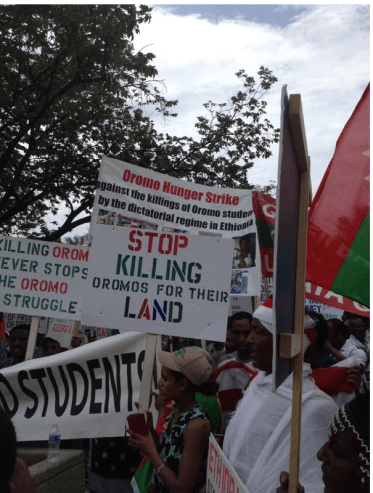
Outrage has engulfed Ethiopia for a couple of months now. Peaceful protests – against a plan, popularly called the Integrated Master Plan, to expand the capital city borders into the surrounding Oromia National Regional State – are being suppressed by lethal force. Beyond affecting the livelihoods and the cultural makeup of the Oromo residents in the affected region, protesters argue, the Plan to snatch an area from one Federal State by another could amount to a blatant annexation. Thanks to the phony federal structure, the Oromia National Regional State, that was supposed to guard its borders and defend the protesters, is regrettably failing on both accounts. According to the Human Rights Watch, at least 140 innocent lives have since been gunned down. Activists on the ground, however, raise the death toll even higher.
The escalation of the crises and protesters’ defiance have unusually forced the government, which had vowed to implement the Plan at any cost, to retract the Plan. For the protesters, though, the government’s latest action is too little to rejoice and too late to embrace. Protesters’ discontent seems to have gone beyond the Master Plan into the working of the Federal State of Oromia itself. The sustained political disenfranchisement and the lack of real representation in the decision-making hierarchy have produced a magma of uneasiness with the system that has waited so long to explode. As the protesters are vowing to continue the protests, and more political actors and the international community are slowly joining and acknowledging their cause, the coming days and weeks will increasingly put the autocratic Ethiopian government in a difficult position.
Had it not been for the lack of democracy in Ethiopia, such opposition to the government’s policies could have been easily defeated either in the court or at the ballot box. The tragic failure of the system to hold the government accountable for its polices in either way has ultimately compelled the public that the responsibility – to safeguard its own rights and claim these hijacked democratic virtues at any cost – rests on the people’s protests.
Doing Development in an Autocratic Way
The incursion into a vast swath of land around the congested capital city will produce more development and modernization, the Ethiopian government contends. It, accordingly, accuses protesters of being traitors and obstacles in the so-called “miraculous double-digit growth.” Under the New Master Plan, the predominantly agrarian adjacent lands are expected to be replaced by alternatives usages that are presumably more valuable in terms of their economic values. It envisages creating new infrastructures, new real estates, new industries and new dwellers. It does not matter whether the Plan causes serious law abridgments, or is hugely unpopular, as far as it is adding to the GDP [Growth and Transformation Plan] and keeps alive the double-digit narrative. Public opinions and laws are, at best, second to development, and at worst, they are completely neglected. This is what is called doing development in an autocratic way.
At the heart of an autocratic way of building an economy, there exists a blatant disregard of accountability. In a working democracy, governments and policymakers are accountable to the law and the public. Any development plan, however economically sound it might be, is prone to cancellation, if it negates any law of the country and its Constitution. Autocrats, on the other hand, keep themselves above the law and dare abridge any verse of the Constitution. Besides, such a regime lacks an independent judiciary to keep the working of the government in check. Dictators, therefore, are in a perfect position to plan and execute any development plan without fearing any intervention by the judiciary.
The Integrated Master Plan is an epitome of an autocratic way of doing development. Despite the fact that it plans to stretch the borders of the capital city into the neighboring Oromia National Regional State’s land, which is potentially tantamount to annexation in a federal arrangement, neither the judiciary nor the House of Federation has toddled to intervene in the matter. It is the land of autocrats where accountability before the law is at its lowest.
Another route to bring accountability within the policymakers’ circles and to governments is via elections. Elections provide mechanisms to reward, or to punish, politicians and their policies. Parties with popular policies are elected into office; economic policies and projects are no exceptions. While in office, incumbent governments plan and execute development plans that are feasible in economic terms, sound in terms of country’s laws and popular in the eyes of their electorates. Free, fair and transparent elections constrain politicians from pursuing risky and unpopular policies. The recurrent massive turnovers among governments that follow austerity measures can be a good example in this respect.
In no-man lands of electoral autocrats, however, elections are, at best, mere periodic anniversaries, or at worst, eves of mass imprisonments of vocal dissidents. The very role of accountability-before-the-public that elections guarantee is impossible in dictatorships. However unpopular the policies they plan and execute might be, they can go away without facing any punishment by the public during elections. When elections cease to serve their natural purpose of voting politicians and their policies, plans – as unpopular as the Integrated Master Plan, can irresponsibly be planed and implemented without any accountability at the ballot box.
Protests as Working Constraints
Political institutions, such as legislature, political parties and elections ,are eminent constraints on governments. The judiciary, with its mighty power, keeps government’s actions in check. These are the virtues of democracy that nations under the auspices of autocracy are devoid of. Ethiopia has never been short of such regimes for very long. The current government has led the country for a quarter of a century with an iron fist. Any opposition to its rule and policies have been met with decisive force and merciless crackdowns.
The absence of democratic virtues like independent judiciary and elections as a mechanism to voice citizens’ approval or rejection of the government and its polices in Ethiopia has expectedly created enormous frustrations. Sustained public protests for the past few years by Ethiopian Muslims and the current Oromo protests are results of such hopelessness in the system and the institutions it has built.
The huge protests all across the Oromia National Regional State against the Master Plan for the past few months has claimed hundreds lives. Injuries and incarcerations are in thousands. Reports of torture and extra-judiciary killings are everyday news. Had the judiciary been to its honor and sound elections were in place, projects as unlawful and unpopular as the Master Plan would have been defeated in the court or at the ballot box. When both institutions fail, sadly, the people have to either chose between eviction and disenfranchisement, or bravely confront the implementation of the Plan with protests. Oromos have preferred the later and have audaciously faced one of the most brutal autocratic states in the world.
The sustained protests have lately compelled the government, which has got away with many actions without any public approval for past twenty five years, to rescind the Master Plan. It has, for now, dissipated the ambitions of the leeching pro-government business elites. What would have been easily defeated in a democratic polity has sucked the blood of many in the autocratic Ethiopia. The fallen and the injured have paid with their blood to reclaim deserved democratic virtues. They have won back what an independent judiciary or a fair election would otherwise have secured at ease. Protests have served as constraints on the government – which has abusively compromised the foremost constraints to its power: the judiciary and periodic elections.
Unfortunate enough, when protesters reclaim their rights after months of defiant protests and force their autocratic rulers to back down on their nightmare, another feature of an autocratic regime could dangerously spoil their jubilation: the question of credibility. In the absence of any institutional mechanism to assure accountability of the government, there is no way one can guarantee the government would not renege on its promises. As Mancur Olson (1991, p. 153) argued “If he (the autocrat) runs the society, there is no one who can force him to keep his commitments.” Repeated experiences in the past, and the very nature of the regime type, further strengthens the prospect of a possible change of mind sometime in the near future. More importantly, the amount of rents the political and business elites would have collected from such massive land grabs will inevitably test their commitment to the rhetorical promise they have lately made.
Both at the Crossroads
It appears that both the protesters and the government are at the crossroads. For the protesters, they have managed to force the government to scrap the Master Plan that has been the immediate cause of the protests. It is now the right time to decide whether to believe the government, which has been the sole architect of the Master Plan, and the subsequent brutality against protesters, on its word, or escalate their struggle to address the lingering deep-rooted sense of Oromo disenfranchisement and confront the beleaguered Ethiopian government to the end. Putting it differently, the struggle to reclaim democratic virtues has to make a shift to reclaiming democracy itself. While it is difficult to sleep safe believing the word of an autocrat, it also requires massive amounts of energy, coordination, solidarity and determination to make the second choice.
For the Ethiopian government, the current protests seem to indicate that the sun is slowly setting in their autocratic empire. History and the nature of the political regime the government is politicking are not on their side in terms of citizens’ confidence on their word. Incumbent politicians have to either go by their promise and give a strong signal to their credibility, or face the consequences of the ensuing protests and the public outrage. The coming days, weeks and months will tell which ways both the protesters and the government will take. Either way, the current protests, and actors involved from both sides, have already made it to the history of a country that has never witnessed a government of the people, for the people and by the people.

Oromo Liberation Front Press Release
 On 21st of January all party Groups of European Parliament debated and passed a resolution on the current political situation in Oromia, Ethiopia. Since mid-November 2015 another round of enormous wave of mass protests that started over respect for the right of Oromo People in general and against the expansion of the capital Finfinnee (Addis Ababa) that triggered more to be demanded on the basic fundamental and democratic rights that have been supressed for the last century and half. Instead of looking for the solution the Tigrean People’s Liberation Front (TPLF/EPRDF) led Ethiopian government declared war on the Oromo people and deployed its terrorizing special force (Agazi), the military and the federal police against peaceful Oromo demonstrators and the public at large. In doing so, it put Oromia under martial law tantamount to declaration of a state of emergency. The deployed forces have wantonly killed more than 180 people and wounded hundreds and detained thousands of Oromo farmers, students, teachers, merchants and government employees, including the medical staff trying to treat the overwhelming numbers of the brutalized mass.
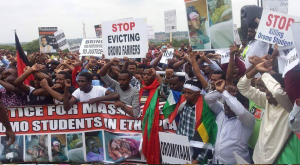
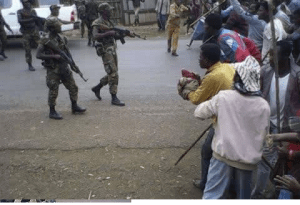

Every week, we bring you one overlooked aspect of stories that made news in recent days. Did you notice the media forgot all about another story’s basic facts? Tweet @TheWorldPost or let us know on our Facebook page.
In Ethiopia, 2016 is off to a violent start. Authorities in the East African nation have killed at least 140 people in a brutal crackdown on protests over the last two-and-a-half months, according to human rights groups, amounting to the worst ethnic violence in years.
The violence has brought renewed attention to the struggle over land rights and political tensions in the country and it has highlighted rights abuses in a nation deemed an important U.S. ally in the fight against terror.
In November 2015, discontent intensified in Ethiopia’s Oromia region over a government plan to expand the borders of the country’s capital, Addis Ababa, into the surrounding rural areas.
Protesters marched to voice their opposition, fearing that the state’s Addis Ababa Integrated Development Master Plan, as the proposal is called, would seize land from the Oromia region’s marginalized Oromo ethnic group, which makes up around 35 percent of Ethiopia’s population. The area of Oromia that the city seeks to incorporate is already home to two million people, according to Human Rights Watch.
The protesters’ fears were informed by years of deep discontent with the ruling Ethiopian Peoples’ Revolutionary Democratic Front. Though the nation’s capital of Addis Ababa is surrounded by the ethnic Oromia region, the city was established by the Amhara people, The Washington Post notes. As the city expanded, there have been clashes over forcible evictions, as well as ethnic and linguistic identity. Furthermore, the authoritarian government has a history of attempting to stamp out dissent, especially among ethnic groups it views as being in opposition to its ruling coalition.
Over 5,000 Oromos have been arrested on charges relating to protests and dissent in the past five years, according to an Amnesty International report. Oromos who were detained were sometimes subject to horrific abuse, including rape, torture and beatings.
 LONELY PLANET/GETTY IMAGES
Demonstrations spread throughout the Oromia region over the course of November, as groups including farmers and students rallied against the government.
Ethiopian authorities responded to the largely peaceful protests with force, seeking to quash the growing dissent. Police used live ammunition to disperse protesters at rallies, activists and rights groups say, killing dozens of people in separate incidents in the areas around Addis Ababa.
As the unrest continued through December, rights groups also reported widespread arrests, beatings and torture at the hands of security services. Even senior members of opposition parties, including Bekele Gerba, a prominent member of the Oromo Federalist Congress — the largest Oromo political party — did not escape the crackdown.
The security forces’ crackdown on demonstrators failed to prevent the protest movement from intensifying — it actually expanded its demands to also call for an end to police brutality. As of the end of December, over 140 people had been killed in the protests, according to Human Rights Watch — and the rising death toll began to attract international criticism.
The United States, which has collaborated with Ethiopia on anti-terror efforts and until last September operated a drone base out of the country, issued a statement of concern and called for the government to allow peaceful protests.
Instead of moving toward reconciliation, however, the government doubled down on its position. Authorities denied protesters’ requests to hold rallies in Addis Ababa and accused the Oromo protesters of committing terrorism in a bid to destabilize the government.
As demonstrations continued, the Ethiopian government finally caved to the months of pressure on Jan. 13, and scrapped its expansion plan.
While the protests met their initial goal of stopping the urban expansion, demonstrators have been invigorated by the crackdown and have continued to rally against the government.
“The complaints of the protesters have now expanded to include the killing of peaceful protesters and decades of marginalization,” Human Rights Watch Horn of Africa researcher Felix Horne told The WorldPost over email.
What began as a protest over land rights is now representative of a number of grievances with the government and ruling EPRDF. Ethiopia has seen a period of rapid economic growth in the past 10 years, but its urban and industrial expansion has also resulted in land disputes, corruption and authoritarian crackdowns on opposition groups.
As demonstrators increasingly demand solutions for Ethiopia’s many social and political problems, rights groups worry that the unrest and violence will continue.
“Human Rights Watch continues to receive reports daily about excessive force being used by security forces in Oromia,” Horne said. “The death toll continues to rise and the arrests continue.”
http://www.huffingtonpost.com/entry/ethiopia-ethnic-violence_us_56a10b1ee4b0404eb8f07c85
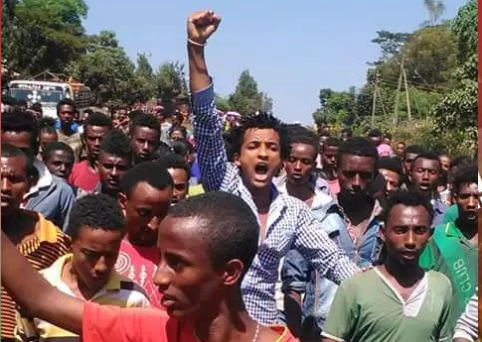
UN experts urge Ethiopia to halt violent crackdown on Oromia protesters, ensure accountability for abuses
GENEVA (21 January 2016) – A group of United Nations human rights experts* today called on the Ethiopian authorities to end the ongoing crackdown on peaceful protests by the country’s security forces, who have reportedly killed more than 140 demonstrators and arrested scores more in the past nine weeks.
“The sheer number of people killed and arrested suggests that the Government of Ethiopia views the citizens as a hindrance, rather than a partner,” the independent experts said, while also expressing deep concern about allegations of enforced disappearances of several protesters.
The current wave of protests began in mid-November, in opposition to the Government’s ‘Addis Ababa Integrated Development Master Plan’ to expand the capital’s municipal boundary. The ‘Master Plan’ could reportedly lead to mass evictions and the seizure of agricultural land in the Oromia region, as well as extensive deforestation.
The UN experts welcomed the Government’s announcement on 12 January 2016 suspending the implementation of the ‘Master Plan’, but were concerned about continuous reports of killings, mass arrests, excessive use of force and other abuses by security forces.
“The Government’s decision is a positive development, but it cannot be seen as a sincere commitment until the security forces stop their crackdown on peaceful protests,” they said. “The role of security forces should be to protect demonstrators and to facilitate peaceful assemblies, not suppress them.”
“We call on the Government to immediately release protesters who seem to have been arrested for exercising their rights to freedom of peaceful assembly and expression, to reveal the whereabouts of those reportedly disappeared and to carry out an independent, transparent investigation into the security forces’ response to the protests,” the experts said.
“Accountability does not erase past abuses, but it is an important step towards rebuilding trust between people and their government,” they stressed. “Impunity, on the other hand, only perpetuates distrust, violence and more oppression.”
The UN independent experts also expressed grave concern over the Ethiopian Government’s application of the Anti-Terrorism Proclamation 652/2009 to arrest and prosecute protesters, labelling them as ‘terrorists’ without substantiated evidence. This law authorises the use of unrestrained force against suspects and pre-trial detention of up to four months.
“Ethiopia’s use of terrorism laws to criminalize peaceful dissent is a disturbing trend, not limited to the current wave of protests,” they experts noted. “The wanton labelling of peaceful activists as terrorists is not only a violation of international human rights law, it also contributes to an erosion of confidence in Ethiopia’s ability to fight real terrorism. This ultimately makes our world a more dangerous place.”
“There are bound to be policy disagreements in any society,” the human rights experts said, “but every Government has the responsibility to give space for people to peacefully express their views and to take these views into account.”
(*) The experts: Mr. Maina Kiai, Special Rapporteur on the rights to freedom of peaceful assembly and of association; Mr. David Kaye, Special Rapporteur on the promotion and protection of the right to freedom of opinion and expression; Mr. Michel Forst, Special Rapporteur on the situation of human rights defenders; Mr. Christof Heyns, Special Rapporteur on extrajudicial, summary or arbitrary executions; and the Working Group on Enforced or Involuntary Disappearances.
The Special Rapporteurs and Working Groups are part of what is known as the Special Procedures of the Human Rights Council. Special Procedures, the largest body of independent experts in the UN Human Rights system, is the general name of the Council’s independent fact-finding and monitoring mechanisms that address either specific country situations or thematic issues in all parts of the world. Special Procedures’ experts work on a voluntary basis; they are not UN staff and do not receive a salary for their work. They are independent from any government or organization and serve in their individual capacity. Learn more, log on to: http://www.ohchr.org/EN/HRBodies/SP/Pages/Welcomepage.aspx
UN Human Rights, Country Page – Ethiopia: http://www.ohchr.org/EN/Countries/AfricaRegion/Pages/ETIndex.aspx
For more information and media requests, please contact Karin Hechenleitner (+41 22 917 96 36 / khechenleitner@ohchr.org)
– See more at: http://www.ohchr.org/EN/NewsEvents/Pages/DisplayNews.aspx?NewsID=16977&LangID=E#sthash.adjSxZFp.KR3g37jZ.dpuf


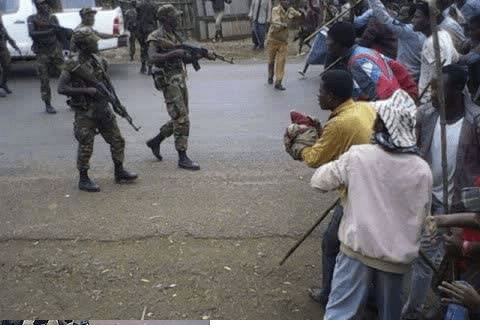
At least 27 protesters from the Oromo community, Ethiopia’s largest ethnic group, have been allegedly killed since the government announced it would scrap a plan to expand the boundaries of the capital Addis Ababa, which triggered mass demonstrations. Protesters in Oromia, one of the nine ethnically-based states of Ethiopia, have continued to demonstrate, arguing they did not trust the statement from the Oromo Peoples’ Democratic Organisation (OPDO) released earlier in January.
A demonstrator told IBTimes UK on conditions of anonymity: “21 peaceful demonstrators were killed yesterday [18 January] and six people are said to have been killed today. It’s really so tragic.”
The number adds to the already more than 140 people allegedly killed by security forces since protests started in November 2015 after the government announced the so-called “Addis Ababa master plan.”
The source alleged that the government deployed special forces, known as Liyu Police, into Oromia towns such as Bedeno and Dire Dawa. Liyu police – formed of Somalian soldiers – was created by the Ethiopian government in 2007 to halt the rise of Ogaden National Liberation Front (ONLF) separatist group. The special forces have been accused of committing crimes including extra-judicial executions.
“They [Liyu Police] have killed about 27 peaceful protesters even after the master plan was said to have been halted,” the source continued.
Ethiopian government’s position
Demonstrators argued that the master plan will lead to forced evictions of Oromo farmers who will lose their lands and become impoverished as a result. They also claimed that forced evictions as well as a perceived marginalisation by the government are already occurring and they threaten the survival of the Oromo’s culture and language.
The Ethiopian government, which has been accused of trying to censor information on the protests, has always denied Oromo people are marginalised and claimed the protests are being orchestrated by some dissidents who aim to destabilise the country. Officials have also refuted the number of deaths given by the activists and opened an investigation to assess the death toll as well as the circumstances of the deaths.
IBTimes UK has contacted the Ethiopian embassy for a comment on the recent death allegations, but has not received a response at the time of publishing.
In a previous interview, Abiy Berhane, minister counsellor at the embassy, told IBTimes UK regarding allegations of violence: “These are just one of the many fabrications that are being circulated by certain opposition groups as part of their propaganda campaign. The unrest cannot be described as a national crisis.
“The disturbances orchestrated by opposition groups have now subsided as the general public understood that the integrated master plan is still at a draft stage and will only be implemented after extensive public consultation in the matter takes place and gains the support of the people.”
European Union condemns “excessive force”
Meanwhile, the European Union has issued a resolution on the ongoing unrest, condemning the “excessive forces by security forces” in Oromia and other Ethiopian regions.
The document reads: “[The EU] calls on the government to carry out a credible, transparent and impartial investigation into the killings of protesters and other alleged human rights violations in connection with the protest movement, and to fairly prosecute those responsible, regardless of rank or position.
“Welcomes the government’s decision to completely halt the Addis Ababa and Oromia special zone master plan, that plans to expand the municipal boundary of Addis Ababa.”
The EU also urged the Ethiopian government to invite a UN rapporteur and human rights experts to investigate and to stop impeding the free flow of information.
More at:-

19.1.2016
With request for inclusion in the agenda for a debate on cases of breaches of human rights, democracy and the rule of law pursuant to Rule 135 of the Rules of Procedure
on the situation in Ethiopia (2016/2520(RSP))
Victor Boştinaru, Knut Fleckenstein, Ana Gomes, Richard Howitt, Josef Weidenholzer, Pier Antonio Panzeri, Eric Andrieu, Nikos Androulakis, Zigmantas Balčytis, Hugues Bayet, Brando Benifei, José Blanco López, Vilija Blinkevičiūtė, Biljana Borzan, Nicola Caputo, Andrea Cozzolino, Andi Cristea, Miriam Dalli, Viorica Dăncilă, Isabella De Monte, Jonás Fernández, Monika Flašíková Beňová, Doru-Claudian Frunzulică, Eider Gardiazabal Rubial, Lidia Joanna Geringer de Oedenberg, Neena Gill, Michela Giuffrida, Maria Grapini, Roberto Gualtieri, Jytte Guteland, Sergio Gutiérrez Prieto, Anna Hedh, Cătălin Sorin Ivan, Liisa Jaakonsaari, Eva Kaili, Jude Kirton-Darling, Jeppe Kofod, Javi López, Olle Ludvigsson, Andrejs Mamikins, Costas Mavrides, Marlene Mizzi, Sorin Moisă, Csaba Molnár, Alessia Maria Mosca, Victor Negrescu, Momchil Nekov, Demetris Papadakis, Vincent Peillon, Tonino Picula, Miroslav Poche, Inmaculada Rodríguez-Piñero Fernández, Daciana Octavia Sârbu, Siôn Simon, Renato Soru, Tibor Szanyi, Claudia Tapardel, Marc Tarabella, Marita Ulvskog, Julie Ward, Flavio Zanonato, Damiano Zoffoli, Carlos Zorrinho on behalf of the S&D Group
| European Parliament resolution on the situation in Ethiopia (2016/2520(RSP)) |
|
||
| The European Parliament,
– having regard its previous resolutions on the situation in Ethiopia
– having regard to the statement by the EEAS spokesperson on recent clashes in Ethiopia, 23 December 2015
– having regard to the joint statement by Federica Mogherini, High Representative for Foreign Affairs and Security Policy/Vice-President of the European Commission, and Minister of Foreign Affairs Tedros Adhanom of the Federal Republic of Ethiopia, 20 October 2015
– having regard to the press release on the meeting between the High Representative/Vice-President Federica Mogherini and the Minister of Foreign Affairs of the Federal Republic of Ethiopia, Tedros Adhanom, 13 January 2016
– having regard to the statement by the EEAS Spokesperson on elections in Ethiopia, 27 May 2015 – having regard to the press release of the UN Office of the High Commissioner for Human Rights, 10 July 2015
– having regard to press briefing note of the UN Office of the High Commissioner for Human Rights, 10 July 2015
– having regard to the universal Declaration of Human Rights
– having regard to the African Union Charter of Human and Peoples’ Rights
– having regard to the UN the International Covenant on Civil and Political Rights,
– having regard to Rule 123(2) its Rules of procedure
A.whereas over the past two months , Ethiopia’s largest region, Oromia, has been hit by a wave of mass protests over the expansion of the municipal boundary of the capital, Addis Ababa which has posed risks for farmers eviction from their land; B.whereas security forces used excessive lethal force and killed at least 140 protesters and injured many more, in what may be the biggest crisis to hit Ethiopia since the 2005 election violence; C.whereas on the 14 January 2016 the government decided to cancel the disputed large scale urban development plan ; whereas if implemented, the plan will expand the city’s boundary by 20 times its current size; whereas Addis Ababa’s enlargement has already displaced millions of Oromo farmers and trapped them in poverty; D.whereas the ethnic Oromos continue to suffer particular discrimination and human rights violations in efforts to suppress potential dissent in the region; E.whereas the Ethiopian authorities arbitrarily arrested a number of peaceful protesters, journalists and opposition party leaders in the context of a brutal crackdown on the protests in the Oromia Region; whereas those arrested are at risk of torture and other ill-treatment; F.whereas the government’s labelled largely peaceful protesters as ‘terrorists’ deploying military forces against them ; G.whereas on December 23, the authorities arrested Bekele Gerba, deputy chairman of the Oromo Federalist Congress (OFC); Oromia’s largest legally registered political party; whereas Mr Gerba was being taken in a prison known for torture and other ill-treatment practices and shortly after he was reportedly hospitalized; whereas his whereabouts are now unknown, raising concerns of an enforced disappearance. H.whereas other senior OFC leaders have been arbitrarily arrested in recent weeks or are said to be under virtual house arrest. I.whereas last December leading activists such as Getachew Shiferaw (Editor-in-Chief: Negere Ethiopia), Yonathan Teressa (an online activist) and Fikadu Mirkana (Oromia Radio and TV) have been arrested arbitrarily though yet to be charged by the Ethiopian authorities. J.whereas the current protests echo the bloody events of April and May 2014, when federal forces fired into groups of largely peaceful Oromo protesters, killing dozens; whereas at least hundreds more students were arrested, and many remain behind bars K.whereas Ethiopia’s government has regularly been accusing people who express even mild criticism of government policy of association with terrorism; whereas dozens of journalists, bloggers, protesters, students and activists have been prosecuted under the country’s draconian 2009 Anti-Terrorism Proclamation. L.whereas Ethiopia’s government imposes pervasive restrictions on independent civil society and media; whereas according to the Committee for the Protection of Journalist’s (CPJs) 2014 prison census found that Ethiopia was the fourth worst jailer of journalists in the world, with at least 17 journalists behind bars, whereas Ethiopia also ranked fourth on CPJ’s 2015 list of the 10 Most Censored Countries M.whereas the Ethiopian authorities have routinely summoned to court the “Zone 9 bloggers” with terrorism charges for their writing over the past 2 years. N.whereas numerous prisoners of conscience, imprisoned in previous years based solely on their peaceful exercise of their freedom of expression and opinion, including journalists and opposition political party members, remained in detention.; whereas these included some convicted in unfair trials, some whose trials continued, and some who continued to be detained without charge, among others Eskinder Nega, Temesghen Desalegn, Solomon Kebede, Yesuf Getachew, Woubshet Taye, Saleh Edris, and Tesfalidet Kidane O.whereas severe restrictions on external funding continue to undermine the work and effectiveness of non-governmental organisations (NGOs) under the 2009 Charities and Societies Proclamation. P.Whereas Ethiopia rejected recommendations to amend the Charities and Societies Proclamation and the Anti-Terrorism Proclamation that several countries made during the examination of its rights record under the Human Rights Council Universal Periodic Review in May 2014. Q.Whereas Andargachew Tsige, a British-Ethiopian citizen and leader of an opposition party living in exile, was arrested in June 2014 while in transit through Yemen’s main airport and forcibly removed to Addis Ababa; whereas Tsige had been condemned to death several years earlier in his absence, and has been in death row practically incommunicado since then; whereas Juan Mendez, the UN special rapporteur on torture, has written to the Ethiopian and UK governments saying he is investigating the treatment of Tsige, following claims that Tsige is being deprived of sleep and held in isolation; R.Whereas the Ethiopian government has de facto imposed a widespread blockade of the Ogaden region in Ethiopia, rich in oil and gas reserves; whereas attempts to work and report from the region by international media and humanitarian groups are seen as criminal acts, punishable under the anti-terrorist proclamation; whereas there are reports of war crimes and severe human rights violations perpetrated by the Army and government paramilitary forces against the Ogaden population; S.whereas The Ethiopian People’s Revolutionary Democratic Front (EPRDF), the ruling party coalition, won all 547 parliamentary seats in the May 2015 elections, due in part to the lack of space for critical or dissenting voices in the election process; whereas May’s federal elections took place in a general atmosphere of intimidation, and concerns over the lack of independence of the National Electoral Board; T.Whereas Ethiopia enjoys political support from western donors and most of its regional neighbours, mostly due to its role as host of the African Union (AU) and its contribution to UN peacekeeping, security and aid partnerships with Western countries; U.whereas Ethiopia receives more aid than any other African country – close to $3bn per year, or about half the national government budget V.whereas for decades the government have been authorizing big development projects to foreign investors, which have been leading to severe land grabbing and millions vulnerable people often forcibly evicted and insensitively resettling; whereas often the government does not offer the local communities any alternative to permanent settlement and had not fully consulted groups before evicting them. W.whereas some donors, including UK’s Department for International Development (DFID) and the World Bank, rechanneled funding from the problematic Protection of Basic Services (PBS) program in 2015 which was associated with the abusive “villagization program,” a government effort to relocate 1.5 million rural people into permanent villages, ostensibly to improve their access to basic services; whereas some of the relocations in the first year of the program in Gambella region in 2011 were accompanied by violence, including beatings and arbitrary arrests, and insufficient consultation and compensation X.whereas Ethiopia is experiencing its worst drought in decades, deepening food insecurity and severe emaciation and unusual livestock deaths; whereas with 640 000 refugees, Ethiopia is the country in Africa with the highest number of refugees; whereas nearly 560 000 people are internally displaced due to floods , violent clashes over scarce resources and drought Y.whereas the current political situation in Ethiopia and the brutal repression of dissent put a serious risk the security, development and stability in the country; 1.Strongly condemns the recent use of excessive force by the security forces in Oromia and in all Ethiopian regions, the increased cases of human rights violations and abuses, including violations of people’s physical integrity, arbitrary arrests and illegal detentions, the use of torture, and violations of the freedom of the press and of expression, as well as the prevalence of impunity; 2.Calls for an immediate end to violence, human rights violations and political intimidation and persecution; 3.Urges for the immediate release of all those jailed for exercising their rights to peaceful assembly and freedom of expression, including students, farmers, opposition politicians, academics, bloggers and journalists ; 4.Calls on the government to carry out a credible, transparent and impartial investigation into the killings of protesters and other alleged human rights violations in connection with the protest movement, and to fairly prosecute those responsible, regardless of rank or position; 5. Welcomes the government’s decision to completely halt the Addis Ababa and Oromia special zone master plan, that plans to expand the municipal boundary of Addis Ababa. Calls for an immediate inclusive and transparent political dialogue, including the government, opposition parties, civil society representatives and the local population preventing any further violence or radicalisation of the population; takes the view that such dialogue, conducing to the democratisation of the country, is not possible under the current political conditions; 6.Calls on the Government of Ethiopia to respect the Universal Declaration of Human Rights and the African Union Charter of Human and Peoples’ Rights, including the right to peaceful assembly, freedom of expression and association; 7.Urges the government to immediately invite the UN Special Rapporteur on the rights to freedom of association and peaceful assembly and other UN human rights experts to visit Ethiopia to report on the situation; 8.Calls on the government to stop suppressing the free flow of information, including by jamming media broadcasts and harassing media, including through intrusive surveillance programs, and facilitate access throughout Ethiopia for independent journalists and human rights monitors; 9. Calls on the government to include local communities in a dialogue on the implementation of any large scale development project and ensure equal distribution of future benefits to the population ; to ensure that farmers and pastoralists are adequately compensated, preventing them from any arbitrary or forced displacement without consultation and adequate compensation. 10. Expresses its concerns on the government’s forced resettlement program, known as “villagization program”. 11.States that respect for human rights and the rule of law are crucial to the EU’s policies to promote development in Ethiopia and throughout the Horn of Africa; 12.Call on the EU to effectively monitor programs and policies to ensure that EU development assistance is not contributing to human rights violations in Ethiopia, particularly programs linked to displacement of farmers and pastoralists, and develop strategies to minimize any negative impact of displacement within EU funded development projects; 13. Further calls on the EU and Member States to react promptly to the escalation of violence and the deterioration of the human rights situation in the country by publicly and privately condemning the use of excessive force by security forces in Oromia and call on the government to exercise restraint in its response against protests and the exercise of basic freedoms by the Ethiopian people; 14. Stresses that financial support to Ethiopia from the EU should be measured attending to the country’s human rights record and the degree to which the Ethiopian government promotes reforms towards democratisation, as the only way to ensure stability and sustainable development; 15.Instructs its President to forward this resolution to the Government and the Parliament of Ethiopia, the European Commission, the Council, the Vice-President of the Commission/High Representative of the Union for Foreign Affairs and Security Policy, the institutions of the African Union and the Secretary-General of the United Nations.
|
|||
| Last updated: 19 January 2016 |

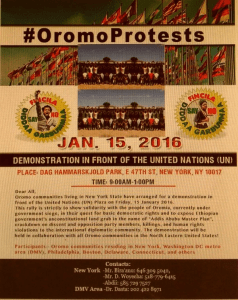
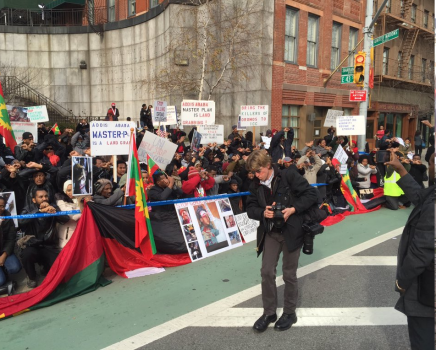
January 14, 2016
Mr. Ban Ki-moon
UN Secretary-General
First Avenue at 46th Street
New York, NY 10017
RE: Continued Massacre in Oromia Regional State by the Tyrannical TPLF Government in Ethiopia
Dear Mr. Secretary General,
We, the Oromo Community of New York, the Oromo Community Organization (OCO) of Washington DC Metropolitan Area and the Oromo Community Association in North America (OCO_NA) write this urgent letter to bring to your attention and express our deepest concerns about the violent crackdown on the peaceful student protesters in Oromia and other regional states of Ethiopia.
The Oromo People constitute 40 percent of the Ethiopian population. But they are subjugated to political oppression, economic exploitation, human rights violation by the dictatorial minority regime of the Tigrian People’s Liberation Front (TPLF) which usurped power in 1991. The regime expropriated the total land of the nation, all economic resources, monopolized political power and subjected the whole nation to tenancy and denied all economic rights. When the degree of oppression and exploitation became unbearable the whole nation has begun to resist the excesses of the government.
In 2014, the Oromo society in general and students at different levels (Elementary, High School, and University) in particular protested the land grab policy. The land grab policy not only displaces millions of Oromo farmers from their ancestral land but also causes loss of Oromo culture, history and identity. The response by the dictatorial bloodthirsty minority government of the TPLF is shooting to kill, beating, imprisoning and torturing of the peaceful protestors .As it is to be recalled, in 2014 more than 70 students were gunned down for peacefully demanding to stop the implementation of the land grab plan. Despite the firm opposition to this plan from all Oromos, internal and external, and many losses of life and causalities, the government moved ahead in 2015 with its proposed plan, which was paused due to people’s resistance to the policy.
As a result during the last two months, Oromo students again came out to express their opposition peacefully to the Addis Ababa master plan and land grab policy implementation of the TPLF regime. However, again More than 150 Oromo nationals were shot dead, thousands wounded, beaten, more than 5000 were rounded up and thrown into jail. As the protests and killings are still on going, more causality is reported every day. Given the history of brutality of the current regime in Ethiopia, those in jail are feared to be tortured or even secretly murdered in the prison cells and others disappeared. Many corps of disappeared students is being recovered in forests, ponds, and rivers, deliberately dumped to hide traces of genocide. Mr. Bekele Gerba, vice chairman of the Oromo Federalist congress Party (OFC) is among the detained, and Mr. Bekele Naga, Secretary General of OFC is under house arrest. In General, a war of Genocide is being waged by the TPLF government against the Oromo people. The Oromia Region is now under military Command Post where all civil rights are violated, the army beats, arrests, tortures, kills at will. The army imposes curfew at any time and place. Normal life has been disrupted. Marshall Law is exercised in Oromia Region now
What is being perpetrated against peaceful demand and protest is the concern of the 40 million Oromos not students only. Accordingly, the Oromo community Organization of NY, the Oromo Community Organization (OCO) of the Washington DC Metropolitan Area and the Oromo Community Association in North America (OCO_NA) are writing this joint appeal letter to Your Excellency to express our deep concern and outrage about the current massacre of the Oromo people all over Oromia by the federal police and army of the TPLF/EPRDF Ethiopian government
The continued massacre of students and civilians is part of the grand scheme to annihilate the Oromo people and expropriate their land and resources. The late Prime Minister Meles Zenawi said a couple of years ago, while he was alive,” the majority will be diminished into a minority.” That remark reflects deep rooted objective of annihilating the Oromo, which the current TPLF leaders are bent to implement. Currently, about 90% of political prisoners in Ethiopia are Oromos. The former Defense minister stated that all prisoners speak Afaan Oromo (Oromo language) after released from prison indicating the huge number of Oromo prisoners. It is puzzling to fathom the strategy of reducing 40% of the Ethiopian population to minority unless one thinks of genocide. Generally, a war of attrition is being waged by the TPLF government against the Oromo people. The trend is dangerous. The Oromo demand deserves timely and appropriate response. Oppression leads to violent response.
Dear Mr. Secretary General,
It is so sad that such heinous crimes are repeatedly happening to the Oromo students and civilians in the 21st century without reaction from international organizations and Western democracies. Even the investigative reporters of big media are silent on the genocidal killings on going in Oromia. It was only the BBC that exposed the genocidal killings of 2014. The Oromo Diaspora has been alerting the world of the crimes of TPLF against the citizens. But nothing has been done. No member of the criminal regime has been brought to court of justice. We are observing criminal governments being brought to ICC from former Yugoslavia, Kenya, Congo Democratic Republic, Rwanda, Liberia and others. We don’t understand why the criminal TPLF government is allowed to move with impunity. Why double standard is applied when it comes to the Ethiopian dictators? Because of unrestrained criminal activity, the government has continued to massacre the Oromo people, grab their lands, plunder resources, harass and imprison. The consequence of the unabated killing of citizens with impunity by tyrannical governments will be regrettable as we can see in many countries facing similar situations today. Stitch in time avoids big crack. Oromo life matters!!
In response to the protests, the Ethiopian government has unleashed its armed forces throughout Oromia on unarmed students and citizens who are protesting peacefully against the Master Plan. Armed forces are firing live ammunition against unarmed people, killing and maiming them. Children as young as 8 year olds, pregnant women and elderly parents are among the murdered victims. Over 140 people have been killed so far and the number of casualties is rising. Thousands are being mercilessly beaten and herded into prisons. Federal armed forces are raiding university dormitories and private homes, and savagely beating and killing unarmed people. The Ethiopian government and its armed and security forces are committing the most heinous crimes against defenseless school children in all parts of Oromia and beyond. The peaceful protests involve elementary, high school and university students. Parents of the students—farmers, workers, elementary and school teachers, and university lecturers have joined youth protesters. The people are facing violent government crackdown every day. The heavy-handed, excessive use of force has resulted in the death of more than 140 victims and critical injuries of thousands of peaceful people. Thousands of students are taken into custody and facing torture and death. Because of the government’s draconian press laws and criminalization of independent media, it is difficult to account for all victims of this brutal crackdown at this moment.
The Oromo, peaceful and generous people—the creators of the gadaa system, a genuinely democratic system of government, a remarkable contribution to humanity—are dying in the hands of a brutal regime. These defenseless people need and deserve the support of the international community. We understand that what happens to the Oromo people in Ethiopia does not make the headline news in anywhere and in UN. But the Oromo are very important people. They occupy the largest region in Ethiopia, both in terms of population size and land mass. Their land is endowed with rich natural and mineral resources and serves as the backbone of the Ethiopian economy. The well-being of the Oromo society guarantees the stability and peace in the Horn of Africa. We humbly warn that there is a substantial risk in ignoring the sufferings of such a large population in the Horn of Africa, and its growing Diaspora communities. The situation in Ethiopia is getting worse every day. Neglecting them and destruction of the Oromo society will definitely contribute to larger political, economic, social and security crises that will threaten regional and global peace. Saving them saving peace in the region.
The TPLF minority regime is hoodwinking the West and international organizations including the UN, by wearing the veil of progress and development. But, the reality is the dirt under the veil. While the TPLF regime is boasting of 12% annual economic growth, 18 million Ethiopians are exposed to hunger as Your Excellency is aware, and yearning for handouts. This shows the growth propaganda is commercial. But they blame climate change. Climate change is not earthquake that happens abruptly and cause hunger and famine. The main cause of the famine is land policy and mal administration. Land is expropriated by the TPLF government which they distribute to the Chinese, Indians, Saudis, Turks, and others freely for hidden quad pro quo. TPLF is sole land lord in the country. We recall the infamous hanger of 1973 which dethroned Emperor Haile Selassie and abolished feudalism. The 2015 hunger also should have consequences.
The regime speaks of democratic process while rigging election and declaring 100% victory. In the absence of freedom of expression, press, gathering, protesting they speak of democratic prevalence. They accuse dissenters of corruption and rent seeking, while they stash billions of dollars in foreign banks by snatching from the hunger stricken Ethiopians. They snatch people’s houses and farmers land in the name of development by paying minimum or no compensation and stash away the market value. There is no guarantee of property ownership. Generally, government accountability is nil. Anger against this government is simmering. The tyrannical activity of the government is leading to volatile vent. They should be denied support unless they respect human rights, democratic principles and show transparency.
Dear Mr. Secretary General,
We earnestly request Your Excellency to use your office influence to urge the Ethiopian government to respect the right of the Oromo people, rule of law and stop killing and arresting Oromo students, implement democratic governance. If the regime doesn’t cooperate we request the UN to stop its support and impose sanctions. We specifically request that the UN:
Sincerely,
Mr. Demisse Wayessa,
Chairman, Oromo Community of NY
http://www.oromocomunityny.org
Desta Yebassa, Ph.D.
Board President, Oromo Community Organization (OCO) of Washington D.C. area
6212 3rd ST NW Washington, DC 20011
Dr. Guluma Gemeda, PhD
Chair, Board of Directors of Oromo Communities’ Association in North America (OCA-NA)
465 Mackubin St N, St. Paul, MN, 55103, USA
ggemeda@umflint.edu
CC:
President Barack Obama
The White House
1600 Pennsylvania Avenue NW
Washington, DC 20500
Tel: (202) 395-2020
Mr. John Kerry
Secretary of State
US Department of State
2201 C St NW Washington, DC 2052;
United Nations High Commissioner for Human Rights (OHCHR)
Palais des Nations
CH-1211 Geneva 10, Switzerland;
The World Bank
1225 Connecticut Avenue NW
Washington, DC 20433 U.S.A.
The International Monetary Fund (IMF)
700 19th Street, N.W., Washington, D.C. 20431
In Ethiopia, anger over corruption and farmland development runs deep
Despite the government ending plans to build on Oromo land around the capital, clashes continue, as lack of transparency and maladministration fuel dissent
William Davison, The Guardian, Global Development, 18 January 2016
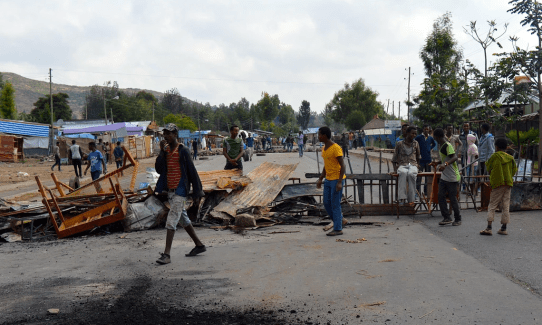
Protesters block the road in Wolenkomi, in the Oromia region of Ethiopia
Protesters block the road in Wolenkomi, in the Oromia region of Ethiopia. All photographs by William Davison
Two years ago, on the edge of Chitu in Ethiopia’s unsettled Oromia region, local officials told Chamara Mamoye his farmland might be developed when the small town expanded. He hasn’t heard anything since.
“Losing the land would be a big problem for me, but if the government forces us, we can’t do anything,” the father-of-five says outside his compound.
Last month, Chamara, 45, saw the bodies of two protesters lying on the road after demonstrations rocked Chito. The dead were among up to 140 people killed by security forces during region-wide protests triggered by claims of injustice and marginalisation from the nation’s largest ethnic group, the Oromo.
Bolstered by US-based social media activists, the protest movement coalesced around opposition to a government plan to integrate the capital, Addis Ababa, with surrounding Oromo towns. After weeks of protests, the ruling coalition in the Oromia region said last week that it was cancelling the planned expansion.
Protests, however, go on, and the roots of popular unease and anger in Oromia run much deeper.
Dissatisfaction with corruption, maladministration and inadequate consultations on investments are fuelling dissent. This patchwork of grievances presents a fundamental challenge to an authoritarian government aiming to rapidly transform Ethiopia from an agrarian society to an industrial powerhouse. And the discontent is a national issue.
Urban expansion is causing clashes across the country as investors, officials and farmers protect their interests, says Seyoum Teshome, a lecturer at Ambo University.
“The villagers who have been asking for basic services and infrastructure rush to sell their farmland at market rate before it is expropriated at low rates of compensation,” he says.
As all land is state-owned in Ethiopia, houses are rapidly built on the edge of towns without official permission, to give plots value, Seyoum says. Investors may bribe corrupt officials to formalise illegal transfers, causing anger among dispossessed farmers, he adds.
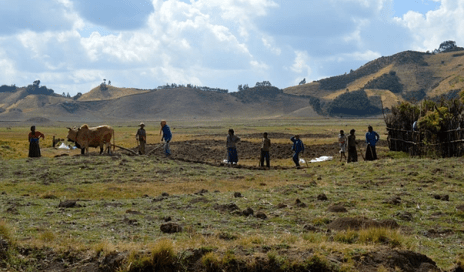
Workers near Chitu in the Oromia region
Chamara was not among the mostly youthful protesters who took to the streets in Chitu, but he shares their concerns about an unresponsive ruling system. He’s frustrated by repeatedly broken official promises to tarmac the main road that runs through Chitu. Although the area has electricity and a mobile-phone signal, he is disappointed with the rate of progress since the government came to power 25 years ago. “There is no big development considering the time they had,” he says.
He is also upset by a lack of information and consultation over land policies, as well as concerned by suspicions of corruption – though officials do not flaunt ill-gotten gains. “The corruption is done in a secret way. It’s a silent killer,” he said.
In elections last May, Ethiopia’s ruling coalition and allied parties won all 547 seats in the federal parliament and 100% of legislative positions in nine regional councils. Despite the result, the government acknowledged widespread dissatisfaction with the quality of public administration and levels of corruption.
“In many areas, personnel said to be involved in massive corruption that led to sudden outbursts of anger are being dismissed,” government spokesman Getachew Reda said in an interview last week.
One of the deadliest incidents last month took place in Woliso town, about113km south-west of Addis Ababa. Six protesters were killed by security forces after thousands of people from surrounding villages took to the streets to protest over planned expansion of the town.
A group of young Oromo, who had gathered next to the Walga river a few miles from Woliso, spoke of community fears of evictions and poor compensation. But nobody seemed to know anything specific about government plans. “The government does not discuss in detail. They do not have consent,” one said.
Ethiopia has long been a darling of the international donor community, which has appeared willing to ignore its poor record on human rights because high growth rates over the past decade have delivered some development goals. But the Oromo protests illustrate the vulnerabilities of this strategy.
To the north of Chitu, at Wenchi, which boasts a spectacular crater lake popular with tourists, grievances are almost tangible. Soldiers are still in town and, as elsewhere, the authorities have arrested people suspected of involvement in the protests. While some seem cowed by the crackdown, Rabuma Terefa is not.
His friend was shot in the leg on the edge of Chitu as he marched with other protesters from Wenchi.
When an elite military unit told elders the protesters must turn back, the group refused, arguing they had a constitutional right to peacefully demonstrate, said Rabuma. Within minutes, soldiers opened fire, killing people, including Birhanu Dinka, who was leading the crowd at that moment.
“They did not say anything, they just pointed the guns at us. We were begging them not to kill us,” Rabuma, 27, says. While abuses may have occurred, security forces are told to protect civilian lives, according to Getachew.
It is not only lives at stake: around the time of the protests in Wenchi, the property of a Dutch agricultural company, Solagrow, was torched by hundreds of people. Rabuma says the investment angered locals as it fenced off 100 hectares of prime communal grazing land, leased by the government. Solagrow says community relations were healthy and the valley was waterlogged until they drained it.
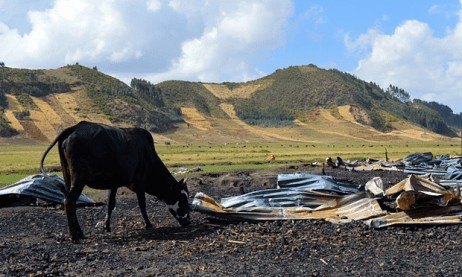
A cow on Solagrow land near property burnt down in a protest in Chitu
The project was collateral damage of the political dispute, according to manager Jan van de Haar. “[The protesters] became angry and they said there was only one way to continue, and that’s our farm, because we’re the only investment in that place,” he says. The attack destroyed $300,000-worth of machinery and potato seeds.
Rabuma had no sympathy for Solagrow, which he says was complicit in the government’s oppression of the Oromo. He is instead focused on the struggle ahead.
In Chitu, Chamara speaks for many Oromo as he implores the government to better manage investments and urban sprawl. “No one is opposing the development of the city, but it should not be at the expense of farmers’ lives,” he says.
This article was amended on 18 January 2016 to correct the spelling of Chitu.
The Addis plan is one instance in which these two objectives came into direct conflict. Protests over the plan, which Oromo viewed as a land grab undertaken by an oppressive and unrepresentative central government, broke out in late 2015. The government responded witha crackdown that killed 140 people, marking perhaps the deadliest outburst of political violence in the country since its civil war ended in 1991.
The Oromo protests are “engendering an intensified ethnic awareness that has also revitalized calls for genuine self-rule in the region,” Smith writes.
Karuturi had taken over land that the Ethiopian state had sold off as part of a controversial program in which the government leased 3.3 million acres of farmland to foreign investors after allegedly displacing some of that land’s original tenants.
It’s the kind of undertaking that would be substantially harder if Ethiopia were a multiparty democracy, rather than one of Africa’s most thoroughgoing dictatorships.
While Karuturi arguably stood to benefit from Ethiopia’s centralized single-party regime, it’s now learned the risk involved in pouring $100 million into an opaque authoritarian state.
One of Africa’s most promising economies is facing a fundamental problem
Armin Rosen, http://uk.businessinsider.com/ 17 January 2017
Ethiopia, which has averaged double-digit GDP growth over the past decade and enjoys a close strategic relationship with the US, is one of Africa’s emerging economic and political powers and an example of a country that’s improved its economic fortunes without opening its political space.
A January 11th Bloomberg News story hints at a huge problem the country might be facing moving forward.
According to Bloomberg, the Ethiopian government canceled a 2010 lease that Karuturi, an India-based agricultural company, had taken out on 100,000 acres of farmland.
Despite making an over $100 million investment in the country’s farming sector, Karuturi was accused of breaking its lease agreement in developing only 1,200 acres thus far. But the company claimed that it had received waivers from the Ethiopian government in the past, and said that it did not recognize the project’s cancellation.
According to Bloomberg, Karuturi had taken over land that the Ethiopian state had sold off as part of a controversial program in which the government leased 3.3 million acres of farmland to foreign investors after allegedly displacing some of that land’s original tenants.
It’s the kind of undertaking that would be substantially harder if Ethiopia were a multiparty democracy, rather than one of Africa’s most thoroughgoing dictatorships.
While Karuturi arguably stood to benefit from Ethiopia’s centralized single-party regime, it’s now learned the risk involved in pouring $100 million into an opaque authoritarian state.
And Ethiopia’s leaders, who want both economic prosperity and total political control, might soon find that these objectives aren’t nearly as mutually reinforcing as they’d hoped.

Tiksa Negeri/ReutersWomen mourn during the funeral ceremony of Dinka Chala, a primary school teacher who family members said was shot dead by military forces during a recent demonstration, in Holonkomi town, in Oromiya region of Ethiopia on December 17, 2015.
Like Karuturi’s disappeared $100 million investment, the Addis Ababa expansion plan embodies the perils and contradictions of the Ethiopian regime’s long-term strategy of securing internal calm through economic growth and strong ties with foreign powers like the US and China.
As in past eras, the Ethiopian capital is being built up as a showpiece of the country’s modernity and development, and as a reflection of Ethiopia’s sense of its unique place in the world. Addis has one of Africa’s first light rails, a Chinese-built, 19.6-mile system that opened last year.
The city and the surrounding area are home to both of the country’s Chinese special economic zones, industrial parks where Chinese companies get tax breaks in exchange for operating in Ethiopia and hiring local employees. The Addis expansion plan would have incorporated neighboring areas into the capital district, enabling more holistic and centralized urban planning for a rapidly growing and economically vital capital city.
But the expansion plan also came at the expense of land in the Oromia Region — and it ended up exposing some of the deepest fractures in Ethiopian society.
The Oromo are Ethiopia’s largest ethnic group but have been historically excluded from centers of power. Because Ethiopia lacks an ethnic majority (and perhaps because it has a 1,500-year history rife with conflict between the country’s centers of power and it geographic and social periphery), the country’s regions are supposed to receive a certain degree of autonomy under Ethiopia’s 1995 Constitution, which actually gives the regions a right to secede under certain circumstances.
In practice, the center still holds all of the power.

Google MapsLocation of Addis Ababa, capital of Ethiopia.
The current Ethiopian government, which is entirely run by the Ethiopian People’s Revolutionary Democratic Front, which is descended from the militia that overthrew the ruling communist state in 1991 after a protracted civil war, is among the most oppressive in Africa.
The EPRDF regime is dominated largely by elites from the Tigrayan and Amharic ethnic groups. But its rule depends on a baseline of inter-communal harmony — just as it depends on the appearance of progress and economic growth.
The Addis plan is one instance in which these two objectives came into direct conflict. Protests over the plan, which Oromo viewed as a land grab undertaken by an oppressive and unrepresentative central government, broke out in late 2015. The government responded witha crackdown that killed 140 people, marking perhaps the deadliest outburst of political violence in the country since its civil war ended in 1991.
Even if the plan has been suspended, the Addis Ababa expansion push is an extension of aggressive growth policies that are fundamental to the regime’s self-image and possibly its survival, policies enabled by strong arm tactics that a country might not accept accept.
But the protests showed that economic growth and authoritarianism can’t paper over a general sense of frustration.
As Jeffrey Smith, head of the RFK Center’s sub-Saharan Africa-related advocacy programs explained to Business Insider, the suspension of the plan will do little to reduce popular discontent towards the regime.
“If the government is trying to head off larger protests and discontent in the country, then it’s much too little and much too late,” Smith wrote in an email. “During the protests, an estimated 140 people were killed and thousands were injured, opposition leaders and journalists were jailed, and the constitution was shredded … there has been no accountability for the deaths of protesters and dissent continues to be criminalized and violently suppressed.”

Tiksa Negeri/ReutersA worker works on the electrified light rail transit construction site in Ethiopia’s capital Addis Ababa, on December 16, 2014.As with Karuturi’s apparent ejection from the country, the contradictions of trying to build a robust economy without genuine political freedom or basic transparency are manifesting themselves. But with the Addis plan, the stakes are much higher for the regime.
The Oromo protests are “engendering an intensified ethnic awareness that has also revitalized calls for genuine self-rule in the region,” Smith writes.
That’s a huge threat to a government that’s itself came to power following an ethnically fractious civil war. “I think leaders in Addis Ababa has gotten much more than they bargained for,” says Smith.
Kana ta’uu isaa kan agarsiisuu fincila diddaa garbummaa irran kan ka’ee lammiin ilamaan Oromoo waamcihaa qoqqoobbii diinagdee warishaalee wayyanee fi kaamphaanii wayyanee irrati fudhatamuu jalqabameen wal fakkaata.
Ammas lammiiwwan Oromoo maallaqaa baankii wayyanee keesa qaban akka hin baafinne dhorkamanii jiru. Sababiin isaa moo maallaqa amma kana sababbii tokko malee sa’aa tokkotti baasuun hin eyyamamu kan jedhamu dha bulchiinsa bankotii kana irra kan kennameefi.
Ha ta’u itti harka lafa jalaatiin abban qabeenyaa axxiyyoonnonii bankolii dhuunfa kanaa maallaqa saamichaan argatan kana ammas amma isaan harka jiru saamanii biyya gad dhiisuudhaaf qopha’anii jiru.
Ka’uumisi naannoo Oromiyaa keessatti ta’a jiru kunii Finfinnee Oromiyaan marfamtee jirtu si’a tokko akka garbaa nu irratti galagalu kan jedhu sodaa ofi keessaa kan qaban ta’uun isaa dhagahamee jira. Dabalataanis bankoliin kun gara fuunduraatii akka tarkaanfachuu hin dandenyee fi kisaara guddaa jala akka seenu danda’an ibisamee jira.
Garuu haala jiru ibisuuf kan yaalanii fi akka sababaati kan ibsani bankinii daldala Itiyyoophiyaa Letter of credit seeran ala waan eyyemaa jiruu fi maammiltoonnii keenya nu dheenisaa jiru jedhani malee akka qoqqobiin ilamaanOromoo irra isaan muuddate hin ibsine.
Alemayehu Tilahun
– See more at: http://www.caboowanci.com/2016/01/17/torbaan-lama-keesatti-birrii-billiiyyoona-5-oltuu/#sthash.1HCenG7A.dpuf

Program Theme
The theme of this extraordinary session of the Oromo Studies Association is Understanding Land Transfers and Political Crisis in Ethiopia. The symposium was prompted by the outbreak of massive protests in the Oromia region against a decision to lease community land in a small town west of the federal capital of Addis Ababa to a private investor. Protests quickly took on a form of resistance against the federal government scheme known as the Addis Ababa Integrated Development Master Plan and the whole program of land lease that allows eviction of farmers. Within days, demonstrators took to the streets in large numbers in cities and towns all over Oromia, voicing slogans that condemned the practice of transferring smallholder arable lands to private investors. Lately, the protestors’ calls have included the reinstatement of genuine self-rule at the local level. Government response was swift and brutal, killing many people, arresting hundreds of protesters, and taking into custody even Oromo political leaders who were not directly involved in the protests. For days, it seemed that the security forces had quieted down the protests. After brief lull, protests emerged in unexpected places as the Oromia enclave in the Amhara region and resumed in the eastern and western parts of Oromia. All told, the protests have now lasted for two months. Both the Master Plan and the protests are unprecedented in Ethiopia. The Master Plan is the most blatant form of state confiscation of arable rural land of indigenous Oromo people arguably since Menelik’s conquests. It is an integral part of the massive land transfers that have been taking place in the Oromia region for quite some time. The reaction it provoked has been demonstrably visceral and sustained in the face of a military force that had no qualms summarily executing child protestors as young as eight years old. The symposium is convened to begin addressing the question of why the Master Plan provoked such profound pan-Oromo reaction. The papers are expected to explore the constitutional, political, economic, cultural and environmental consequences of the Master Plan. They will be substantive, documented and clearly articulated to be accessible to specialists and the lay public. While it is the goal of the symposium to unpack the Master Plan, it would be a mistake to boil down the protest movement to the issue of urban planning. If the Master Plan were the main cause, it would be a technical problem that would be addressed by technocrats. The Master Plan was the trigger, not the ultimate cause. The main issues are structural and the protests reveal a crisis of the state. The papers also attempt to place the Master Plan in the context of a crisis of state which now seems to have entered an advanced stage of decomposition. At this moment, the protestors’ demands now include the end of EPRDF’s stranglehold on the political landscape, ethnic discrimination in allocating national resources, and the rule of violence in Ethiopia.
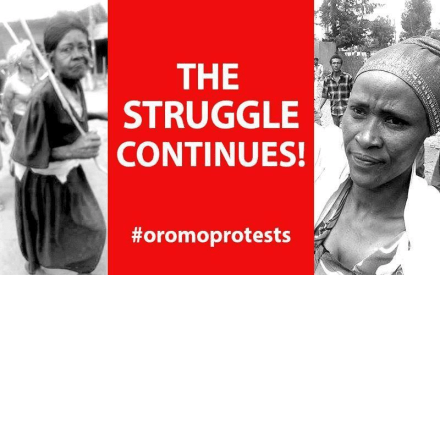
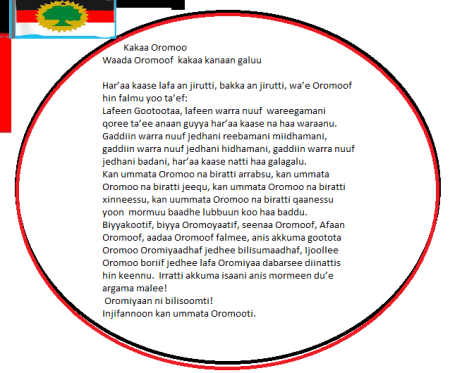
Global Voices, January, 15, 2016
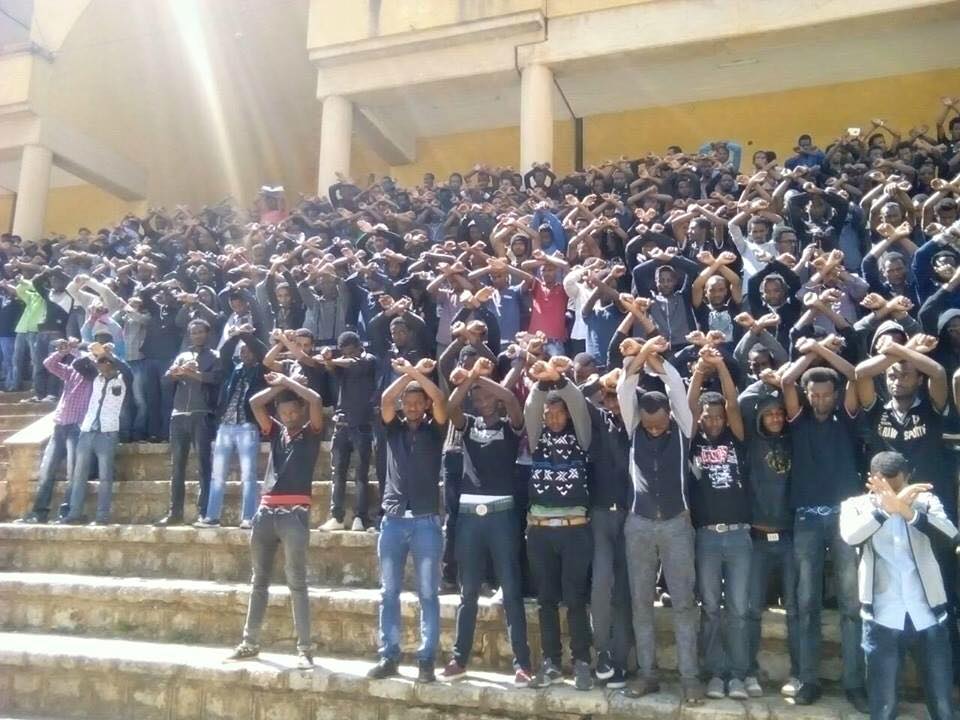
Students mourning at Haromaya University. Photo shared widely on social media.
Students in Ethiopia’s largest administrative region, Oromia, have been braving state-sponsored violence and censorship since November 2015 to protest a government development plan.
Human Rights Watch has reported that at least 140 peaceful protesters have died since the demonstrations began. Those killed include university and secondary school students, farmers and school teachers.
Despite mounting evidence to the contrary, Ethiopian authorities and pro-government commentators say the number of dead is around five people.
The protesters are speaking out against the so-called “Master Plan” to expand the capital city, Addis Ababa, into Oromia, fearing that the proposed development will result in direct persecution of the Oromo ethnic group, including mass evictions of Oromo farmers from their land.
The government claims that the plan is only meant to facilitate the development of infrastructure such as transportation, utilities, and recreation centers.
The oppression of the Oromo people
Oromo people, who represent the largest ethnic group in Ethiopia, have experienced systematic marginalization and persecution over the last quarter century. Some estimates put the number of Oromo political prisoners in Ethiopia at 20,000 as of March 2014.
The country’s ruling elite are mostly from the Tigray region, which is located in the northern part of the country.
The students also demand, among other things, that Oromo, the language of the Oromo people, be made a federal language. Despite being the most widely spoken language in Ethiopia and the fourth largest African language, it is not the working language of the federal government.
This is the second wave of protests against the plan in less than two years. The development project was stalled following protests in May 2014, but also saw at least nine demonstrators killed and hundreds of ethnic Oromo students imprisoned. Officials decided to resume implementation of the project in November 2015, sparking renewed demonstrations.
Social media and satellite TV channels have proven to be critical communication avenues for protesters, despite Ethiopian authorities’ often cutthroat efforts to silence their critics.
Participants have captured photos, audio and video of security forces’ brutal efforts to stop the peaceful protests, including using live ammunition to disperse crowds at universities in Oromia. The material has then frequently been shared on the Facebook pages of prominent activists or uploaded on Ethiopian online platforms such as EthioTube, a video platform run by Ethiopians living abroad.
In response, the government has launched a propaganda campaign against the use of the social media, with state-owned media organizations dedicating multiple programs to the argument that online platforms are being used by so-called “forces of harm” to instigate violence and tarnish Ethiopia’s image.
Given that less than four percent of Ethiopians have access to the Internet, documentation of protests does not exist solely online. Photos and video shared online by demonstrators are regularly picked up by diaspora satellite television news programs (such as ESAT and Oromia Media Network) that broadcast to tens of millions of Ethiopians in Amharic and Afan Oromo, two of Ethiopia’s major languages.
Executives from the two satellite channels have reported that Ethiopian authorities attempted to meddle with their broadcasting services. Citizens have written posts on Facebook indicating that security forces were attempting to remove satellite dish receivers from rooftops in the Oromia region.
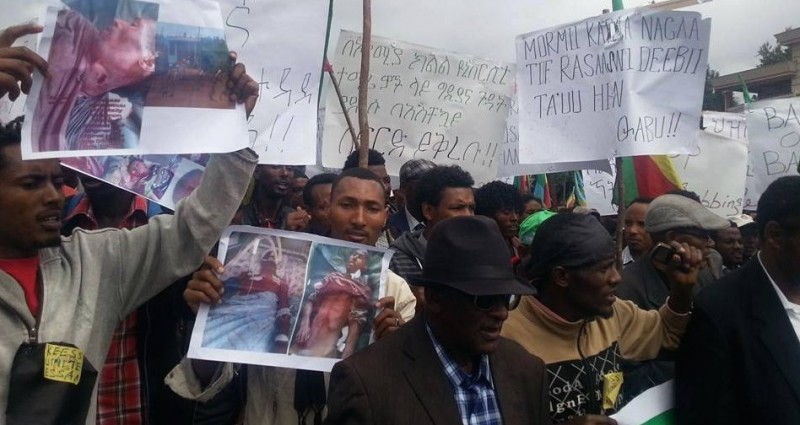
Oromo protesters gather in Addis Ababa in May 2014. Flickr image uploaded by user Gadaa.com. CC BY-ND 2.0
Amid the crackdown, authorities also arrested two opposition politicians, two journalists, and summoned five bloggers from Zone9 collective, who were acquitted of baseless terrorism charges just two months ago.
The government censorship machine has extended to music, as well, with at least 17 Oromo singers being banned from airwaves since December 2015 for lyrics that the Ethiopian Broadcast Authority deemed to show “nationalistic tendencies.”
Ethnic Oromo singer Hawi Tezera was reportedly beaten, arrested, released and then rearrested in the space of just seven days by government security forces in connection with her song about the protests.
Security forces have been ruthless in their attempts to disrupt the protests. Photo and video evidence suggests that most of these killings were done by bullets fired at close range.
At least 10 people died from torture inflicted while they were in prison, according to Oromo rights activists.
Global Voices author Endalk created an interactive map with help from Oromo activist Abiy Atomssa of 111 people who have died during the protests in recent months. We ask that any person who has evidence of the death or disappearance of protesters please contact us at editor@globalvoicesonline.org.
Many of the photos and videos that have circulated online have done so with little to no context included, making it difficult for independent observers to verify the content. There are simple steps that citizen reporters can take in order to remedy this, such as including a recognizable landmark in an image or video and showing a current newspaper with the date clearly displayed. The following guides offer more detail:
Related:-
Killings by security forces & mass arrests continue, particularly of university students.
https://www.hrw.org/news/2016/01/15/dispatches-government-backs-down-will-protests-end-ethiopia
The brutality of fascist Ethiopian regime (TPLF) against Oromo people in 21st century, Jan. 2016 https://youtu.be/G9xe7aC7aIw
In interviews in villages across the Oromo region, young students and aging farmers said the unrest was because of the plan. But there is a deeper vein of dissatisfaction among the Oromo people, who make up some 40 percent of the country’s population of nearly 100 million.
Oromos feel they are treated like second-class citizens and complain that corrupt local officials demand bribes and make money off shady land deals that don’t give farmers enough compensation.

CIVICUS: World Alliance for Citizen Participation, the East and Horn of Africa Human Rights Defenders Project (Defend Defenders) and Amnesty International urge Ethiopia’s development and international partners to address the killing of at least 140 protesters in the Oromia region since December 2015.
On 12 November 2015, peaceful protests started in the Oromia Region, southwest of the capital, Addis Ababa, in response to measures taken to transfer the ownership of a community school and portions of a local forest to private investors. The protests have since expanded in scope and size against wider grievances concerning the expansion of Addis Ababa into the Oromia Region under the government’s Integrated Development Master Plan. They have also turned violent, resulting in the killing of protesters, and arrests of protesters and opposition leaders.
The government announced on 12 January that it was cancelling the Master Plan, but protests continued the next day in parts of Western Hararghe, Ambo and Wellega where the police and the military used live bullets and beat protesters.
“Use of excessive and lethal force against protestors, coupled with mass arrests of peaceful demonstrators and human rights defenders represent a worrying escalation of the government’s on-going campaign to silence any form of dissent in the country,” said Mandeep Tiwana, Head of Policy and Research at CIVICUS. “The international community must take up the issue of accountability for these grave rights violations with the Ethiopian government.”
The police and the military responded with excessive force to the peaceful protests that began on 1 December 2015, including by use of live ammunition against protesters, among them children as young as 12. Estimates confirmed by international and national watchdog groups like Human Rights Watch indicate that at least 140 protesters have already been killed in the protests.
“The government’s labelling of the mostly peaceful protesters as “terrorists” on 15 December 2015 further escalated the response of the police, and the military and resulted in more violations, including killings, beatings and mass arrests of protesters, opposition party leaders and members, and journalists” says Muthoni Wanyeki, Regional Director of Amnesty International East Africa Office.
Scores of those arrested have been denied access to lawyers and family members. They are reportedly being held under the Anti-terrorism Proclamation and remain at risk of torture and other ill-treatment.
Journalists and opposition leaders, including Bekele Gerba (Deputy Chairman, Oromo Federalist Congress), Getachew Shiferaw (Editor-in-Chief of the online newspaper Negere Ethiopia) and Fikadu Mirkana (Oromia Radio and TV), have also been arrested while documenting or participating in the protests.
The violent response to the Oromo protests represents perhaps the most severe crackdown on the right to peaceful assembly since the contested 2005 elections in which nearly 200 protestors were killed in the capital,” said Hassan Shire, Executive Director of DefendDefenders. “The international community’s worrying silence on this matter may further embolden the authorities to crank up their campaign of repression.”
Amnesty International, Human Rights Watch and other organisations have also previously documented similar patterns of excessive use of force, mass arrests, torture and other forms of ill-treatment against demonstrators, political oppositions and activists. On 28 October 2014, Amnesty International published a report entitled “Because I am Oromo”: Sweeping Repression in the Oromia Region of Ethiopia (AFR 25/006/2014).
All those being held solely for exercising their rights to freedom of expression and assembly must be immediately and unconditionally released. The Ethiopian authorities must ensure that victims of human rights violations by law enforcement officials have access to an effective remedy and obtain adequate reparation, including compensation, rehabilitation, satisfaction, and guarantees of non-repetition.
CIVICUS, the East and Horn of Africa Human Rights Defenders Project and Amnesty International appeal to Ethiopia’s development and international partners to encourage the government to:
•immediately stop mass arrests, beatings and killing of protesters, journalists and opposition party leaders and members;
•ensure access to family members, lawyers and review of detention by a court of law for protesters, journalists and opposition party members and leaders in detention; and
•establish an independent inquiry into the use of excessive force during the protests. If the investigation finds that there has been excessive use of force, those responsible must be subject to criminal and disciplinary proceedings as appropriate.
January 11, 2016
The International Oromo Lawyers Association, a non-profit Organization registered in the State of Minnesota with the objective of promoting the prevalence of the rule of law in Ethiopia, is saddened and shocked by the ongoing wanton mass killings and arrests of thousands of Oromo students, supporting parents and teachers in the State of Oromia, Ethiopia. According to information available to us from different sources including Amnesty International, Human Rights Watch and reputable media networks such as the BBC, CNN and Al Jazeera, the Ethiopian government has deployed a special armed unit (known as the death squad – Agazi) to forcefully suppress the ongoing peaceful demonstration of Oromo students who are simply exercising their fundamental and constitutionally guaranteed freedom of expression to oppose the so called Addis Ababa Master Plan. The Plan which is alleged to have been secretly designed by the order of few key Federal government officials is in fragrant violation of the Constitution which stipulates that any change in the affairs of the Regional States should be discussed at the parliament, the government and by the people of the respective Regional States.
We feel it is our duty to share the prevailing frustration because of past experiences, that the above mentioned “Master Plan” is nothing other than being a pretext to forcibly displace native Oromos from their ancestral land without or insignificant compensation whatsoever and to allocate the vacated land to foreign investors all under the name of development. We have already witnessed in the past ten years when the Federal Government forcibly removed ethnic Oromos from their land without any meaningful compensation and leased the vacated land to investors who converted the wheat producing land into massive production of flowers, at a time the country is facing massive food shortage. The result, as expected, did not bring development but misery to the displaced population and environmental degradation in the community. According to experts, the prevailing famine in Ethiopia, which has affected nearly 15 million people, is largely attributed to such facts of involuntary displacement of the farming population from their ancestral lands and detaching them from their traditional farming profession.
Protest against the ‘AA-Oromia Integrated Master Plan’ started within the ruling party in early 2014. When the federal government disregards these concerns, the issue turned out to be the issue of the public at large and resulted in street protest. However, the authorities preferred to subdue the dissent by force and do it quickly rather than engaging stakeholders in a genuine way and addressing the issues comprehensively. As a result, several lives were lost and properties were destroyed.
This round of protest started after the authorities reinitiated the implementation of plan. Still, the government followed similar violent crackdown and we are witnessing the killing of over hundreds of protesters, the arrest of thousands and uncalculated damages to bodily harm and property damages. There is credible evidence that the government is engaged in blank point killing of what it calls “anti-development” students and parents. Thousands of members and leaders of the well-known Oromo Federalist Congress party known for its advocacy for peaceful means of struggle, including its deputy leader Mr. Bekele Gerba, are now arrested and thrown into jails without due process of law and without any charge whatsoever. Mr Bekele was released few months ago after serving four years of politically motivated charges. Basically, the ongoing protest is far bigger than the master plan itself. While the master plan is an immediate cause; while several issue linked to corruption, dispossession, nepotism, selective justice and political marginalization of the Oromo’s under EPRDF government are the main causes.
It is a high time for the international community and key stakeholders in Ethiopia (USA, UK, EU, China, Russia and AU) to utilize their leverage to deter the crippling of the country in to a full blown civil war by the irresponsible move of the Ethiopian government. Specifically we urge you to push the government to:
IOLA will always be more than glad to provide its time and resource to initiate any positive reform, peaceful coexistence, rule of law and help the implementation of the federal constitution in Ethiopia.
The Executive Board of International Oromo Lawyers Association (EB_IOLA)
January 11, 2016
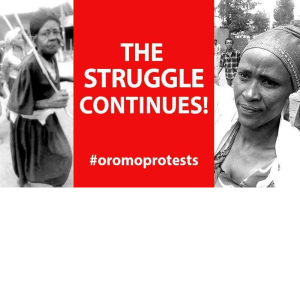
Addis Ababa master plan: Oromo protesters ‘do not trust OPDO statement’
By Ludovica Iaccino, IBTimes UK, January 14, 2016
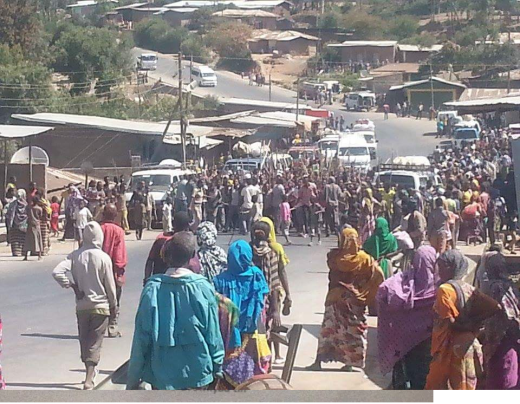
Oromo protesters do not trust a statement by the Ethiopian government claiming it will scrap its plan to expand the capital Addis Ababa, a demonstrator told IBTimes UK. The source, who lives in Oromia – Ethiopia’s largest state – said on condition of anonymity that protests against the expansion plan will continue in spite of the statement released by the Oromo Peoples’ Democratic Organisation (OPDO) on 13 January.
Although OPDO is the party administering Oromia, the source explained it is not regarded as representative of the Oromo people, Ethiopia’s largest group. “The statement isn’t taken seriously among the Oromo people because the party has historically been used by the Tigrayan People’s Liberation Front (TPLF) as an instrument to crackdown on all Oromo legitimate concerns,” he alleged.
The source added that the Oromo Liberation Front (OLF), created in 1973, is regarded as the organisation representing the Oromo people and their interests. “OPDO is perceived as a mere administrative representative of TPLF in Oromia region, but not the political representative of Oromo people,” he said.
More about Oromo people
Addis Ababa master plan: Who are the Oromo people, Ethiopia’s largest ethnic group?
“OLF has massive support, Oromo demonstrators both back home and in the diaspora chant OLF’s slogans and they always say they are our true representatives. The expansion plan issue is just the tip of the iceberg as far as Oromo grievances are concerned in the Ethiopian state.”
Oromo people have been protesting since last November against the so-called “Addis Ababa master plan” as they believe it will lead to forced evictions of Oromo farmers who will lose their lands and become impoverished as a result.
Demonstrators also argued that forced evictions as well as a perceived marginalisation by the government are already occurring and they threaten the survival of their culture and language.
Activists and rights groups have warned at least 140 people have been killed by the army and security forces in recent protests, with the OLF accusing the Ethiopian regime of renewing “a second round of war” against the Oromo in December 2015.
IBTimes UK has contacted the Ethiopian embassy in London for a statement, but has not received a response at the time of publishing. In a previous interview, Abiy Berhane, minister counsellor at the embassy, confirmed to IBTimes UK that an investigation had been launched to establish the exact death toll of people who “fell victim to the violent confrontation with security forces as well as the extent of property damage”.
Regarding the allegations of violence against demonstrators and civilians, he said: “These are just one of the many fabrications that are being circulated by certain opposition groups as part of their propaganda campaign. The unrest cannot be described as a national crisis.
“The disturbances orchestrated by opposition groups have now subsided as the general public understood that the integrated master plan is still at a draft stage and will only be implemented after extensive public consultation in the matter takes place and gains the support of the people.”
In Focus: Addis Ababa master plan threatens Oromos self-determination, IBTimes UK
Read more (video) at the following link:-
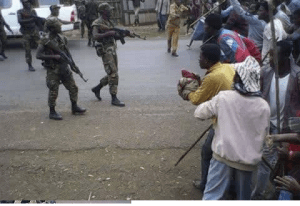
Rights groups claim that Ethiopian security forces have killed at least 140 protesters. The Ethiopian foreign minister is in Brussels to answer questions by members of the European Parliament on the alleged offences.

Human Rights Watch (HRW) last week alleged that Ethiopian security forces had killed at least 140 protesters and injured many more. Opposition parties and activists asserted thousands of Oromo protesters had been arrested and injured since the protests started in mid-November.
In a surprise move on Wednesday (13.01.2016), the Oromo Peoples’ Democratic Organization (OPDO) party, which is part of the ruling coalition, announced that it wanted to halt the so-called “Addis Ababa Masterplan” which is at the root of the ongoing crisis. The plan involves the expansion of the capital into the surrounding Oromia region. Government spokesman Getachew Reda told reporters that the government would respect this decision, but that they would still prosecute those who had participated in the protests.
The plans to expand Addis Ababa were hotly contested by members of Ethiopia’s largest ethnic group. Universities across the country turned into battlefields, with police firing live bullets to disperse the crowds. On social media, Ethiopians united under the hashtag #OromoProtests and Ethiopians of all ethnic backgrounds staged vigils all around the world.
On the eve of the hearing of Foreign Minister Tedros Adhanom in Brussels, rights groups insisted that EU officials “should convey serious concerns about Ethiopian security forces against the Oromo protesters.”
Another topic on the Brussels agenda is the recurrent drought that has hit the country. Estimates say that as many as 15 million people could be threatened by hunger this year.
Donor darling Ethiopia
With Ethiopia ranking fifth on the table of aid recipients globally, raking in some $3.8 billion (3.5 billion euros) in 2014, donor countries have a responsibility to follow up on how the government handles human rights issues, Daniel Bekele, Executive Director with HRW’s Africa Division, told DW.
His concern is echoed by EU advocacy director at HRW, Lotte Leicht, who says “[the] European Union should break its silence and condemn Ethiopia’s brutal use of force to quell the Oromo protests.” Being the single largest donor, the EU “should press the Ethiopian government to respond with talks rather than gunfire to the protesters’ grievances.”
The US State Department earlier urged the Ethiopian government “to permit peaceful protest and commit to a constructive dialogue to address legitimate grievances.”
The Ethiopian government denies the alleged death toll of 140. Government spokesman Reda instead accused the Oromo protesters of “terrorizing civilians.”
Ethiopian legal expert Awol Kassim Allo said he would like to see a space for all Ethiopians to participate in the political arena. “Only with such an approach can there be a possibility of paving a way to move forward,” he told DW. In the last general elections in May 2105, Ethiopia’s ruling coalition, the Ethiopian People’s Revolutionary Democratic Front (EPRDF), won 100 percent of the seats in parliament.
 In Berlin protesters demonstrated in front of the German chancellery in support of the #OromoProtests
‘Cultural genocide’
In a recent debate, Bekele Naga, Secretary General of the opposition Oromo Federalist Congress(OFC), told DW’s Amharic Service that “the constitution of the country proclaims that the land belongs to the people.” He added that the Ethiopian government “has been engaged in land-grabbing, leading to cultural genocide [of the Oromo people].” Another Ethiopian legal expert, Tsegaye Ararsa, complained that no government officials, including Prime Minister Hailemariam Desalegn, have publicly voiced regret over the loss of young protesters’ lives. He believes there should be an independent fact-finding committee to look into the case.


IFEXT 12th January, 2016
Ethiopian security forces have engaged in a violent crackdown against protesters in Ethiopia’s Oromia region, killing scores of protesters and arresting many others. The protests began in mid-November 2015, in response to plans to expand the capital, Addis Ababa, into Oromia farmland, but have expanded in response to other longstanding concerns as well as the crackdown on protesters.
“The European Union should break its silence and condemn Ethiopia’s brutal use of force to quell the Oromo protests,” said Lotte Leicht, EU advocacy director at Human Rights Watch. “The EU, which is among Ethiopia’s biggest donors, should press the Ethiopian government to respond with talks rather than gunfire to the protesters’ grievances.”
The Ethiopian government has frequently used arbitrary arrests and politically motivated prosecutions to silence journalists, bloggers, protesters, and political opponents.
Ethiopia Attacks Freedom of Assembly
http://www.bignewsnetwork.com/news/240197955/eu-should-condemn-ethiopia-crackdown-on-oromo-protests
Dargaaggoo Abdataa Olaansaa kan kanaan dura Magaalaa Amboo keessaa humnoota tikaatiin ukkaamfame waláansa gahaa dhabuun mana hidhaatti boqote.Oduun Finfinnee nu gahe akka adeessutti, dargaggoo Abdataa Olaansaa Adoolessaa bara 2015 keessa magaala Amboo keessaa ukkaamfamee ture.Barbaacha yeroo dheeraa booda maaíkalaawwiitti kan argame, Dargaggoo Abdataa, yeroo maaíkalaawwiitti qorannaan irratti agggeeffamaa ture hedduuu miidhamee ture.Keessayyuu, odeeffannoo humnaan irraa fudhachuufi argachuuf poolisooti wayyaanee reebicha olaanaa irraan gahaa akka turan beekameera.Hiraarsaa fi dararaa dheeraa booda Himatni sobaa kan shororkeessummaa itta banamuun mana hidhaa Qilinxootii gara mana murtii Federala lidataattii deddeebifamaa ture.Haata’u malee, reebichaa mana hidhaa Maakalawwii keessaatii keessumayyuu saamuu isaa irraan gahanin akka miidhame hiriyyoota isaatti himaa ture.Mana hidhaa Qillinxottii erga dabarfamee booda immoo waláansa gahaa otuu hin argatiin ture.Namooti isa waliin turan akka ragaa bahanitti, erga hubamee booda gara hospitaala Paawulosiittii geessamus, miidhamaa fi hubama irra gahaa ture irraa hafuu hindandeenye.Akka oduu nu gahetti hospitaalichaa keessa otuu jiru Amajjii 10 abra 2016 addunyaa kan irraa boqoteera. Abdataan daa’imummaa isaatii kaasee nama jabaa, kan sodaa tokkoo malee gaaffii ummatni Oromoo gaafatu gaafataa ture, gaaffii Oromootiifis deebin qajeelaa akka kennamu nama gootumaman gaafachaa ture.Yeroo barachaa tures, mana barumsaa sadarkaa lammaffaa Ambootti adda duree gumii Afaan Oromoo ta’ee hojjataa kan ture, nama fakkeenya gaariin beekmu ture.Abdataan yeroo addaddaatti manneen hidhaa kannen akka karchalee Amboo fi Alam baqaatti dararamaa ture. Akkasumas ukkaamsamuu isaatiin dura, sirbaa dhimma qabsoo ummata Oromoo irratti xiyyeeffate gaadhisee ture.Lubbuu isaa waaqayyoo nagaan haa boqochisu, maatii isaa fi firottan isaaf jajjabinaa hawwina.Dhiigaa isaa dhigaan debbifna hin shakkinaa.Gumaan isaa lafattii badee gonkumaa hin hafu.
Warning: Interactive map contains graphic and disturbing images.
Since the beginning of November 2015, at least 140 peaceful protesters have been killed in Ethiopia according to Human Rights Watch. Photo and video evidence suggests that most of the people were killed by bullets fired at close range.
There are also reports by Oromo rights activists indicating that at least 10 individuals died from torture inflicted while they were in prisons.
University students, women, farmers and school teachers have all been victims of government violence.
Among the dead, more than 70% are male students. Male farmers account for about 20% of the deaths.
The remainder are women. A seven-month pregnant woman along with her sister-in-law were killed while they were running away to escape arrest.
It was reported their bodies were discovered in scrub-land days after their disappearance.
Below is an interactive map created by this author with help from Oromo activist Abiy Atomssa. The map lists 111 people that have died during the protests in recent months.
We ask anyone who has evidence of the deaths or disappearance of protesters to contact us via editor@globalvoicesonline.org.
Despite all evidence to the contrary, the Ethiopian government and pro-governmentcommentators say the number of dead is around five people.
In a radio interview, the head of a pro-government human rights commission, Addisu Gebregziabher said for the sake of security the government was forced to use violent measures against protesters.
The protests began when the government made plans for the expansion of the capital Addis Ababa into land inhabited by the Oromo ethnic group, which accounts for almost a third of Ethiopia’s population.
The decision compounded poor relations between the Oromo and the government dominated by members of the northern Tigrayan minority.
The culturally distinct Oromo people complain of a lack of economic opportunity in Ethiopia and regular state violence against Oromo communities.


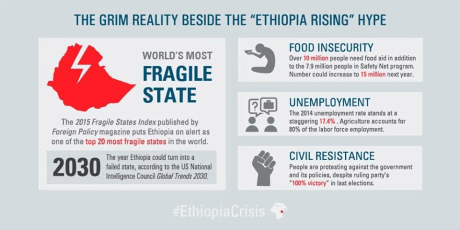
The dying African voices we must resurrect in 2016
By Abiud Onyach, Citizen Digital, 7 January 2016
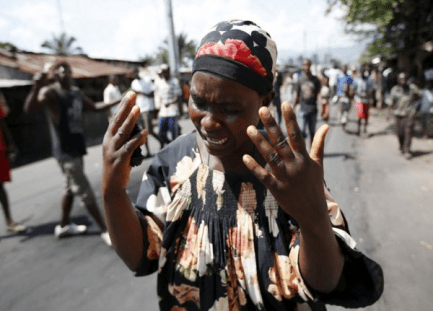
Burundi, 2016
Kenya (Citizen Digital) — We have ushered in a New Year and we are all excited to live up to our New Year resolutions- including those who know they’ll abandon them this month.
This season has a way of renewing hope; sadly the same wind doesn’t blow in some African countries this time of the year.
Indeed there are those who expect little from this year. They lost loved ones, needlessly, in a horrifying fashion from the hands of a government that is supposed to protect them. From Burundi, South Sudan to Ethiopia a mood of distrust between a people and its government hangs in the air.
While the rest of us are grateful for the peace and the promises the New Year brings, we must not forget these voices, lest we lose what makes us Africans, lest we lose our hope for humanity.
As the Kiswahili proverb goes: “When you see your neighbor’s head shaved, pour water on yours.” The trouble in Burundi may not be as far and unrelated from us as we would like to think, and if leaders like Nkurunzinza have their way-they only serve to bolster the resolve of other leaders who are hell bent on violating human rights.
Hiding behind ‘sovereignty’
At no time in the history of independent Africa has the term sovereignty been misused and the non-interference policy used to protect a despot like we’ve seen in 2015.
Sovereignty loosely interpreted is the respect accorded any country as an independent nation capable of self-rule. Under this guise, leaders say that no country is expected to get involved in the internal affairs of another country, even if the said country is bleeding itself to extinction.
Politicians with dictatorial tendencies have thus abused their country’s sovereignty to prevent any form of accountability outside their spheres of influence. On the back bone of non-interference policy, they are denying their citizens basic human rights and brutally dealing with those who oppose them.
In 2015, President Nkurunziza, against popular opinion, insisted on running for a third term despite having already served his two terms as outlined in their constitution.
This selfish leader took advantage of a legal loophole over his first election because he was first elected president by Members of Parliament, who were acting as an electoral college.His argument is that the electorate did not vote in his first term, only in his second term hence the legitimacy of his third term.
Since April last year (2015), at least 400 people have died, scores left injured while 220, 000 people are now refugees in neighboring countries according to the official UN figures.
Already, Nkurunzinza has threatened to fight African Union (AU) peace keepers, following AU’s announcement to send troops to protect civilians.
I cannot wrap my head around the number of innocent children and women affected by this single act of selfishness. Take a moment to think about the lost dreams, the dashed hopes and the bitterness planted in people’s hearts.
This is why we can’t remain silent in 2016. All of us must make our voice heard. We cannot sit mum as another not another genocide takes place in Burundi.
Africa’s youngest failure
South Sudan is another African country with perhaps the most disappointing leaders in African history. After the 2011 secession from Sudan, the country plunged into civil war in 2013 displacing at least 2.2million people.
The great Garang must turn in his grave severally every time we mention Riek Machar or Salva Kirr.
After lengthy stays at luxurious hotels, the two leaders have made numerous peace-pacts in a bloody game they seemingly enjoy to play. One minute they are signing peace agreements, but before the ink dries they’ve already begun showing reservations, at times blatantly dishonoring these pact a mere 48 hours after they have been made,.
Meanwhile, South Sudanese citizens continue to die and with the luckier ones finding their way to refugee camps in other countries.
This too must stop in 2016. We should project the voice of the South Sudanese loud enough to make these two leaders realize South Sudan is bigger than their colossal egos.
The problem with this non-interference policy is that it easily oils the engine of dictatorship and gives license to leaders to kill and plunder their own with little or no consequences.
As we turn a new leaf in 2016, in Ethiopia the Oromo community remains anxious after the government designed an infrastructure development plan that appears malicious and bent on grabbing land from the largest ethnic group in the country.
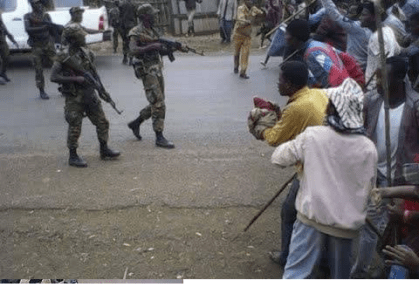
Oromia, 2016
Scores have been killed and a lot others injured and displaced from their land all in the name of development.
While shiny new developments are the crowning jewel of any regime, infrastructural development is useless if humanity is not at the heart of it.
In 2016, we must raise the voice of the Oromo farmers who are driven away from their farmlands into poverty by their government.
In 2016, in addition to all those resolutions we’ve written down and hope to act on, let all Africans, especially, East Africans resolve to stand with the people of Burundi, South Sudan and Ethiopia.
Let us make our voices heard so that 2016 will not be another 2015 where fewer people made life unbearable for the majority over inexcusable selfish interests.
The writer is a Kenyan journalist and communication consultant based in Dar es Salaam.
Share this:
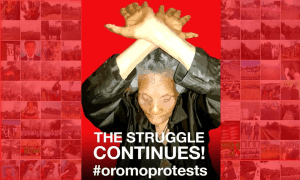
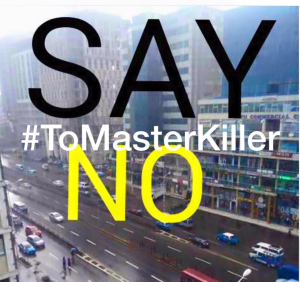
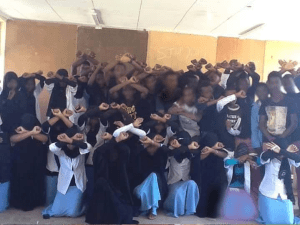
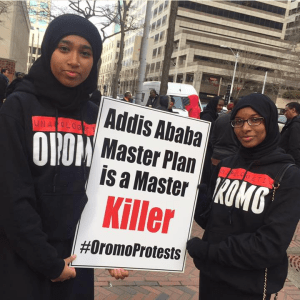
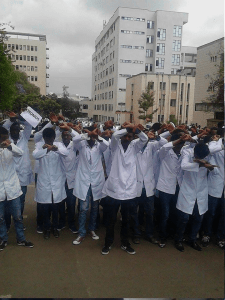
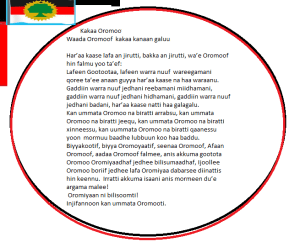
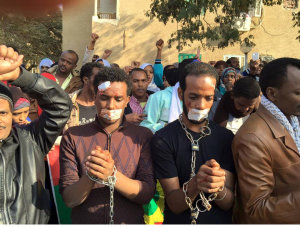
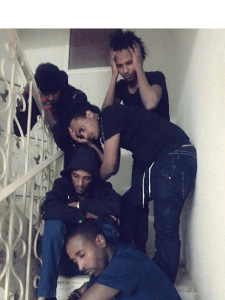

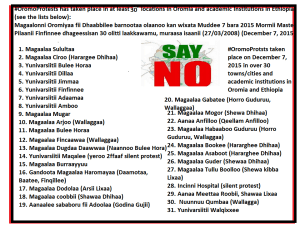
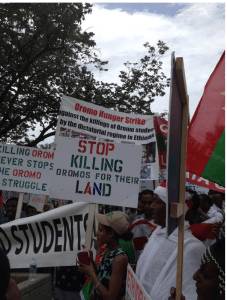
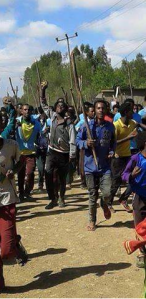
#OromoProtests – Behind the hashtag
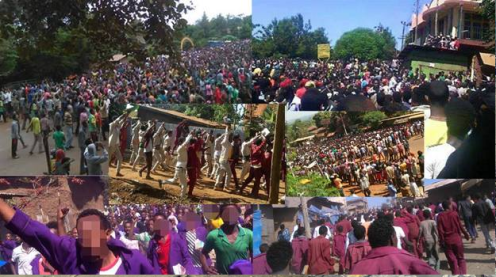
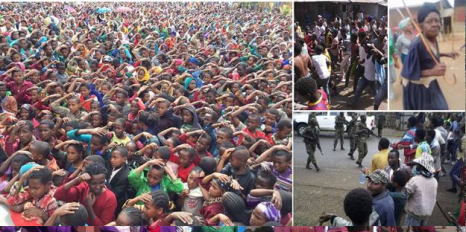
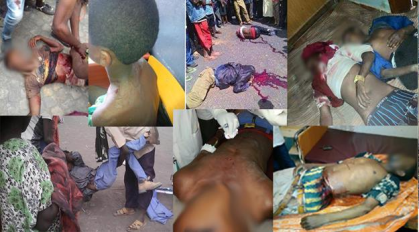
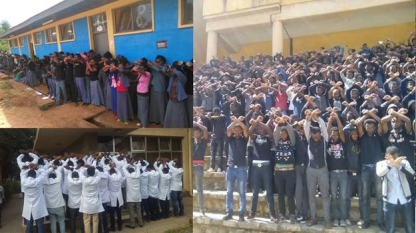
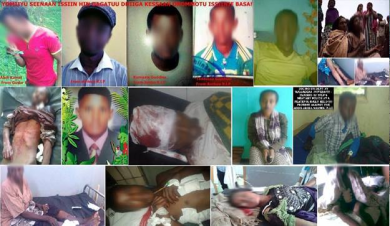
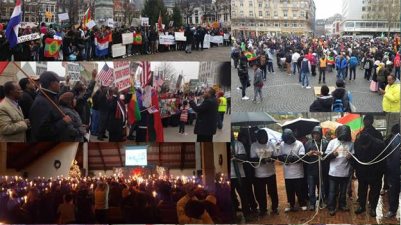
The call by the diaspora community was also echoed by their respective state representatives.
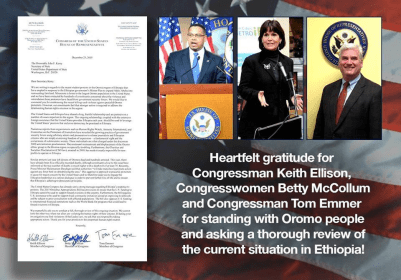
https://www.facebook.com/notes/oromoprotests/oromoprotests-behind-the-hashtag/1214851578542202/

Mail & Guardian Africa, 22 Dec 2015, AFP

People in Wolenkomi, some 60km west of Ethiopia’s capital Addis Ababa stand on December 15, 2015 near the body of a protester from Ethiopia’s Oromo group allegedly shot dead by security forces . (Photo/AFP).
TWO lifeless bodies lay on the ground as the terrified crowd, armed only with sticks against gun-toting Ethiopian security forces, fled the fierce crackdown on protesters.
Blood seeped through a sheet covering one of the bodies on the road outside Wolenkomi, a town just 60 kilometres (37 miles) from the capital Addis Ababa.
“That was my only son,” a woman sobbed. “They have killed me.”
Back at the family home of 20-year-old Kumsa Tafa, his younger sister Ababetch shook as she spoke. “He was a student. No one was violent. I do not understand why he is dead,” she said.
Human Rights Watch says at least 75 people have been killed in a bloody crackdown on protests by the Oromo people, Ethiopia’s largest ethnic group.
Bekele Gerba, deputy president of the Oromo Federal Congress, puts the toll at more than 80 while the government says only five have been killed.
The demonstrations have spread to several towns since November, when students spoke out against plans to expand the capital into Oromia territory—a move the Oromo consider a land grab.
The sight of the protesters on the streets of towns like Wolenkomi—shouting “Stop the killings! This isn’t democracy!”—is rare in a country with little tolerance for expressions of discontent with the government.
Tree trunks and stones are strewn on the asphalt on the road west from Addis to Shewa zone, in Oromia territory, barricading the route for several kilometres.
Chaos broke out on a bus on the road when it emerged that the police were again clashing with demonstrators in Wolenkomi.
“My husband just called me,” said a woman clutching her phone, as others screamed and children burst into tears.
“He’s taking refuge in a church. Police shot at the protesters,” she said.
The man next to her cried in despair: “They’re taking our land, killing our children. Why don’t they just kill everyone now?”
The army raided Wolenkomi again the next day, the rattle of gunfire lasting for more than an hour.
“They grabbed me by the face and they told me, ‘Go home! If you come back here, we’ll kill you’,” said Kafani, a shopkeeper.
Rights groups have repeatedly criticised Ethiopia’s use of anti-terrorism legislation to stifle peaceful dissent.
But Prime Minister Hailemariam Desalegn declared on television that the government would act “without mercy in the fight against forces which are trying to destabilise the region.”
Oromo leaders have vowed to keep up their resistance against proposals to extend Addis, and Human Rights Watch has warned of “a rapidly rising risk of greater bloodshed”.
“The government can continue to send security forces and act with violence—we will never give up,” said Gerba.
Land is at the heart of the problem. Under Ethiopia’s constitution, all land belongs to the state, with owners legally considered tenants—raising fears amongst the Oromo that a wave of dispossession is on its way.
“For farmers in Oromia and elsewhere in the country, their land is everything,” said Felix Horne, a researcher at Human Rights Watch.
“It’s critical for their food supply, for their identity, for their culture,” he said.
“You cannot displace someone from their land with no consultation and then inadequately compensate them and not expect there to be any response,” Horne warned.
Some Oromo have already seen their lands confiscated.
Further west, in the town of Ambo, a woman named Turu was expropriated of her two hectares, receiving only 40,000 birr ($1,900) in compensation.
“We had a good life before,” she said.
Today she struggles to support her four children and her disabled husband with the 30 birr a day ($1.40) she earns working in a factory.
With their own language distinct from Ethiopia’s official Amharic tongue, the 27 million Oromo make up nearly 30% of the country’s population.
“The Oromos are seen as more of a threat by the government in part because they are by far the largest ethnic group,” said Horne.
The proposed expansion of Addis is part of a 25-year development plan to boost the city’s infrastructure and attract new investors.
It sparked demonstrations last year, but on a smaller scale.
| M | T | W | T | F | S | S |
|---|---|---|---|---|---|---|
| 1 | ||||||
| 2 | 3 | 4 | 5 | 6 | 7 | 8 |
| 9 | 10 | 11 | 12 | 13 | 14 | 15 |
| 16 | 17 | 18 | 19 | 20 | 21 | 22 |
| 23 | 24 | 25 | 26 | 27 | 28 | 29 |
| 30 | 31 | |||||


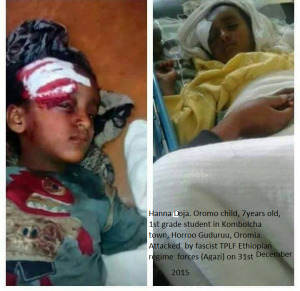
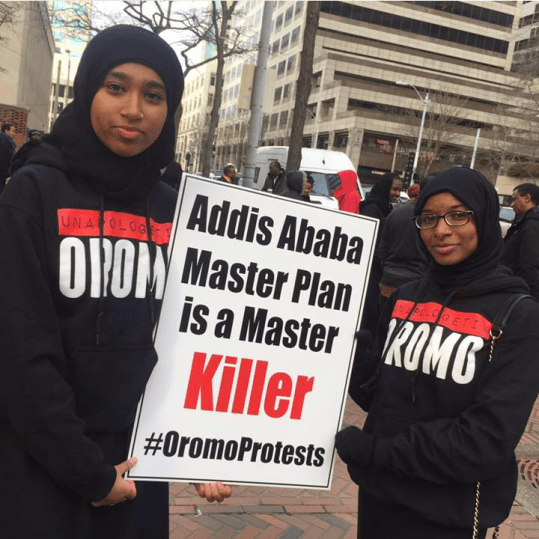
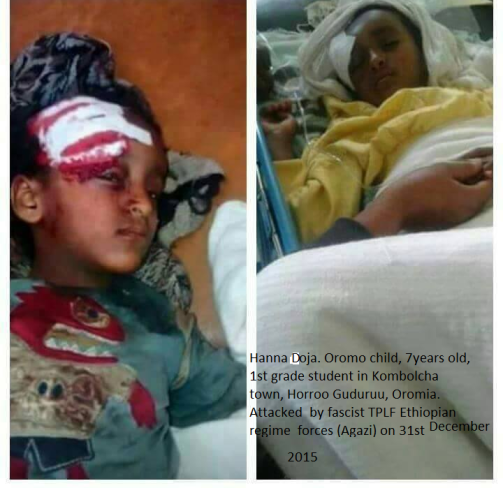


 Oromian Economist
You must be logged in to post a comment.