From Heritage to High Fashion October 6, 2026
Posted by OromianEconomist in Uncategorized.Tags: #Irreecha, art, creative industry, fashion, Hetritage, High fasshion, lifestyle, Oromo fashion design, style, Sustainable Fasshion, TC Press, Temesgen Muleta‑Erena, Travel
add a comment
How Irreecha Inspired a Cultural Design Revolution
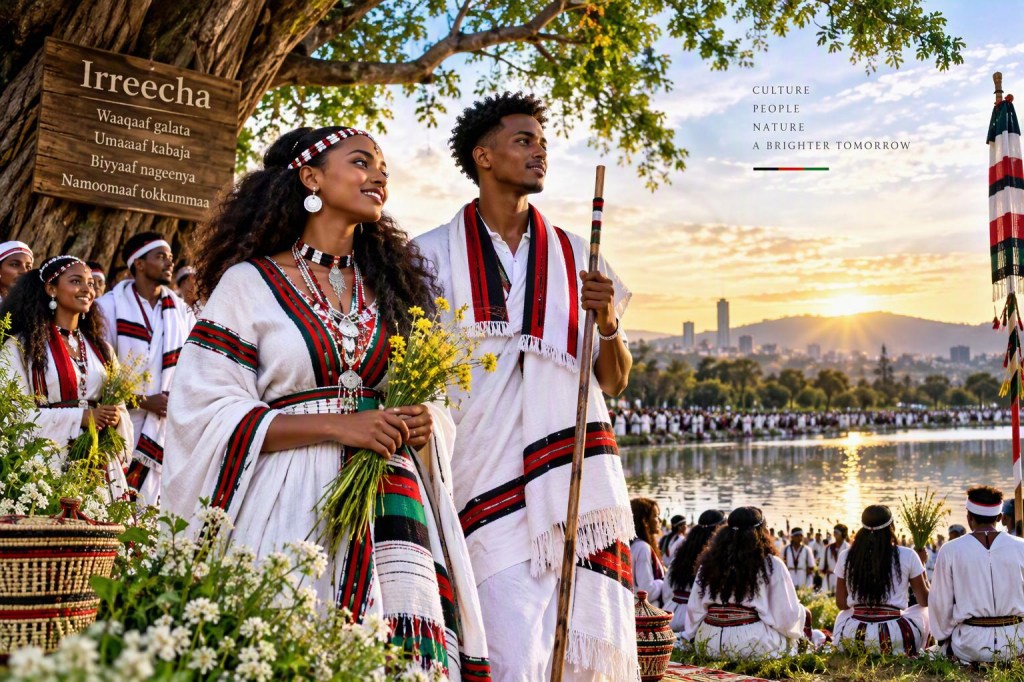
From Heritage to High Fashion
How Irreecha Inspired a Cultural Design Revolution
Every generation inherits something from the past. Some inherit buildings, some inherit languages, and others inherit knowledge. One of the most visible inheritances passed from one generation to another is cultural design.
In Ethiopia, few cultural events have influenced fashion and design as profoundly as Irreecha. While widely known as a celebration of gratitude, community, and cultural identity, Irreecha has also become an unexpected catalyst for creativity, entrepreneurship, and innovation. The celebration has helped transform traditional attire from cultural heritage into a dynamic and evolving design movement.
Today, the influence of Irreecha reaches far beyond the ceremonial field. It can be seen in photography, social media, fashion design, public events, digital art, and contemporary cultural expression.
A Living Design Archive
The success of cultural fashion did not emerge from a vacuum.
Across generations, communities preserved textile traditions, embroidery styles, jewellery designs, colour combinations, and various forms of artistic craftsmanship. These traditions formed a living archive of design knowledge.
Young designers did not need to invent a completely new visual language. Instead, they found inspiration in what already existed.
Traditional attire became a foundation upon which contemporary creativity could flourish.
Rather than looking backward, many designers discovered that cultural heritage provided a pathway forward.
The Irreecha Showcase Effect
Every year, Irreecha creates a unique public stage.
Thousands of people present their finest cultural attire. Photographs circulate widely. Videos are shared across platforms. New designs attract attention. Conversations emerge around colour, tailoring, symbolism, and craftsmanship.
This visibility matters.
For many young creatives, the celebration offers something invaluable: an audience.
A design that might once have been seen only by a small local community can now be viewed by people across continents. Through social media and digital communication, cultural attire has gained a level of visibility unimaginable only a generation ago.
For young graduates entering fashion and design, this creates opportunities that extend far beyond the celebration itself.
Confidence as an Economic Resource
Economists often discuss physical resources, financial capital, and infrastructure. Yet cultural confidence is also a resource.
When people believe their heritage has value, they invest in it.
When they invest in it, new industries emerge.
Designers create new collections.
Photographers build portfolios.
Artisans expand production.
Content creators document and promote cultural stories.
Entrepreneurs discover new markets.
The result is the development of a cultural economy built upon creativity rather than extraction.
This is particularly important because cultural industries often combine economic opportunity with social and educational value.
A Broader Cultural Wave
One of the most interesting outcomes of Irreecha’s success is its wider influence.
As Oromo cultural attire became increasingly visible, other Ethiopian communities also began promoting and celebrating their own traditions more actively.
This demonstrates the power of cultural visibility.
Confidence can be contagious.
When one community successfully presents its heritage with dignity and pride, others are often encouraged to do the same.
The result is not uniformity but diversity.
Different traditions become more visible. Different artistic styles gain recognition. Different communities contribute their own designs and interpretations to a growing cultural landscape.
In this way, cultural expression expands rather than competes.
Beyond Stereotypes
The rise of cultural fashion also challenges outdated assumptions.
Traditional attire is sometimes viewed as something belonging exclusively to ceremonies, museums, or historical memory. Yet contemporary designers increasingly demonstrate that heritage can be modern, elegant, innovative, and internationally relevant.
The growing prominence of cultural attire in public life suggests that indigenous aesthetics are fully capable of participating in global conversations about design, beauty, and creativity.
The question is no longer whether traditional fashion can be contemporary.
The question is how far contemporary cultural design can go.
A Sustainable Creative Future
The future of cultural fashion may be particularly promising because it is rooted in renewable assets.
Knowledge can be shared.
Designs can be refined.
Skills can be taught.
Creativity can multiply.
Unlike finite natural resources, cultural knowledge often grows stronger through use and transmission.
Every new designer contributes to the archive.
Every new interpretation expands the possibilities.
Every new generation adds another layer of creativity.
This makes cultural design both sustainable and adaptive.
Looking Forward
Perhaps the most important lesson of Irreecha’s fashion story is that cultural preservation and innovation are not opposites.
The most successful contemporary designs often emerge from respectful engagement with existing traditions. Heritage provides the foundation. Creativity builds upon it.
As new generations continue to reinterpret cultural attire, they are not simply preserving the past. They are creating the future.
Irreecha demonstrates what becomes possible when tradition is treated not as a constraint but as a source of inspiration.
What began as a celebration of gratitude has also become a platform for artistic excellence, entrepreneurship, and cultural confidence.
In the process, it has helped show that local heritage can have global relevance, and that cultural designs born from community traditions can stand proudly on any stage in the world.
By Temesgen Muleta-Erena
TC Press, London


You must be logged in to post a comment.