Oromia (WBO): Oduu gammachiisaa injifannoo gootichi warraana Oromoo WBOn goonfate August 7, 2016
Posted by OromianEconomist in Uncategorized.Tags: Africa, Oduu Tarkaanfii WBO, Oromia, Oromo, WBO
add a comment

Oduu gammachiisaa injifannoo gootichi warraana Oromoo WBOn goonfate
Gootichi Humni Ittisa Ummataa Godina Horroo Guduruu Wallaggaa Suluula Fincaa’aa Naannoo Warshaa Sukkaaraa Fincaa’aatti Qondaalota waaranaa wayyaanee haleele.
Humni Ittisa Ummataa Godina Horroo Guduruu Suluulaa Fincaa’aa naannawa Warshaa Sukkaaraa Fincaa’aatti tarkaanfii haleellaa Waraana Agaazii Wayyaanee Mana Nyaataa Baamboo Baar jedhamu keessatti argaman irratti tarkaanfii fudhateen hogganoota waraana wayyaanee 7 ol madeessuun miidhaa ulfaataa irraan gahee jira. Manni nyaataa bakka qubannaa fi nyaataa waraana wayyaanee ta’e kunis guutummaatti barbadaa’eera.
Manni nyaataa kun qabeenya dabballee wayyaanee Makonnin jedhamuu fi haadha warraa isaa loltoota diinaa sooruun beekamtu Dinqee jedhamtuu yoo tahu, osoo hogganoota waraana wayyaanee sooraa jirtuu humna ittisa ummataatiin tarkaanfiin irratti fudhatamee madeeffamuun haala hamaa keessa akka jirantu barame.
Humnoonni murna weerartuu guutummaa Oromiyaa keessaa hatattamaan bahuu akka qaban kan akeekkachiise gootichi Humni Ittisa Ummataa, humnoota hidhattootaa diina ummata Oromootti roorrisaa jiranii fi ergamtoota wayyaanee irratti tarkaanfii fudhatu hanga Oromiyaan bilisoomtutti jabeessee akka itti fufu beeksisee jira.
Waraanni Bilisummaa Oromoo godina bahaa tarkaanfii gumaabaas fudhateen Agaazii ummata keenya ajjeessaa jiran keessaa 13 dacheetti dabaleera.
Tarkaanfii gumaabaas WBO kanaan Konbolcha keessatti Agaazii lama; Awaday keeysatti agaaziin tokko, Dirree Dawaa keeysatti Agaaziin lama, Qobboo keesatti Agaaziin lama, Dadaritti Agaaziin sadi, ciritti Agaaziin lama, Baddeeysaatti Agaaziin afur, wataritti Agaaziin sadi, walumaa galatti, waraanni Wayyaanee kan fedelaa kudha sadi ajjeefamanii jiru.
Hagayya 07,2016 Humni Addaa WBO Godina Bahaa Lixa Harargee Ona Odaa Bultum araddaa Koluutti humna goolessituu wayyaanee agaazii irratti dhukaasa bane 4 ajjeesee 2 madeessee jira. Qawwee AK 3 fi bombiin harkaa 2 dhuunfatameera.
Oromia: Grand #OromoProtests Rally August 6, 2016
Posted by OromianEconomist in Uncategorized.Tags: #OromoProtests, Africa, Grand #OromoProtests, Oromia, Oromo
3 comments
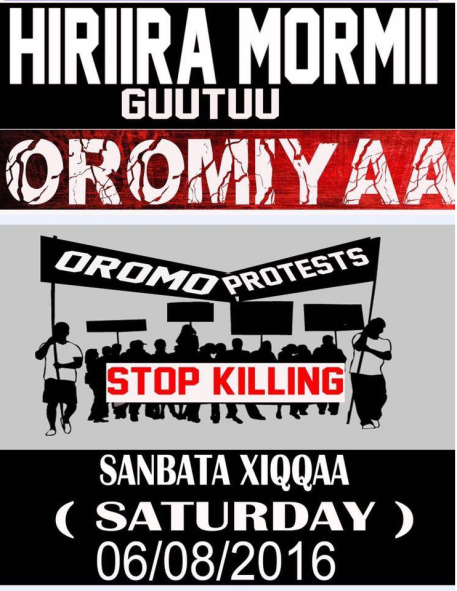
#Grand #OromoProtests 6 August 2016: Massive #OromoProtests rally held all over the State of Oromia including in Finfinnee (Addis Ababa), the capital. Held in more than 200 cities/towns.
Hagayya 6 Bara 2016 OromiyaaGuutuuKeessattiFicilliXumuraGabrummaaSeenaQabeessattiIttiFufee Jira.
Ethiopia’s unprecedented nationwide Oromo protests: who, what, why?http://africanarguments.org/2016/08/06/ethiopias-unprecedented-nationwide-oromo-protests-who-what-why/?utm_content=buffer3ccaf&utm_medium=social&utm_source=twitter.com&utm_campaign=buffer
Oduu Olmayaa Oromiyaa (Hag.06,2016)
https://www.oromiamedia.org/2016/08/06/oduu-olmayaa-oromiyaa-hag-062016/
OMN: Oduu Amma Nu Gahe (Hag. 6, 2016)
https://www.oromiamedia.org/2016/08/06/omn-oduu-amma-nu-gahe-hag-6-2016/
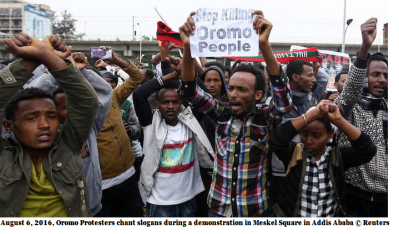
Stop killing Oromo People
https://oromianeconomist.com/…/financial-times-anti-govern…/
Police break up anti-government protest in Ethiopian capital
Hundreds of protesters today clashed with police in Ethiopia’s capital Addis Ababa after campaigners called for nationwide protests due to what they say is an unfair distribution of wealth in the country.
Violence broke out as police tried to stop several hundred chanting protesters from accessing the historic Meskel square.
The demonstrations started as a small-scale student protest over the government’s plan to expand Addis Ababa into adjacent farm lands of Oromiya, Ethiopia’s largest constitutionally autonomous state.
Now they have evolved into a series of large and bloody demonstrations against the government, leaving hundreds dead and thousands jailed.
Yesterday, two people were killed in similar clashes with police in Ethiopia’s ancient city of Gonder.
Grand #OromoProtests in Oromia, 6 August 2016.
Fascist Ethiopia’s regime attacking peaceful Protesters
“Dhiigni Mucaa koo dhangala’ee hin hafu! Oromiyaan ni bilisoomti” Jedhti haati Qabsaawaa Qeerroo guyyaa har’aa Hagayya 6,2016 Wareegame. Godina Wallaggaa magaalaa Gimbii keessatti.
“Dadhabdeetti Jaari Naa Jabaadhu Qeerroo Koo”
FXF Godina Kaaba Shaggar magaalaa Caancoo Hagayya 6,2016
Guyyaa Har’aa Godina Lixa Shaggar Hoolota Keessatti Ficila Xumura Gabrummaa Gaggeeffame


Grand #OromoProtests in Oromia, 6 August 2016.
Gincii
Gootota Qeerroo Bilisummaa Godina Lixa Shaggar Magaalaa Gincii
Godina Baalee Magaalaa Roobee Keessatti Diddaa Gabrummaa Ummati Oromoo Guyyaa Har’aa Bahe.
Wallagga Horroo Guduruu Magaalaa Giddaa Ayyaanaa Keessatti Alaabaan ABO Balal’aa Jira.FXG!


Grand #OromoProtests in Oromia, 6 August 2016.
Qoree town, Arsi
FXG Godina Arsii Magaalaa Qoree Keessatti Guyyaa Har’aa Deemaa Jiru.
“Hattuun nu hin bulchitu” Jedhu Gootonni Oromoo Yuniversitii Haramaaya


Godina Jimmaa magaalaa aanaa Goommaa magaalaa Gebbee keessatti gootonni dargaggoonni Oromoo guyyaa har’aa FXG gaggeessaa jiru.
FXG Magaalaa Finfinnee keessatti guyyaa har’aa deemaa jiru irratti alaabaa ABO magaalaa Finfinnee keessa balaliisuun gaaffii mirgaa gaafataa jiru.
Gootota Qeerroo Godina Wallaggaa Magaalaa Mandii
Naqamtee, Wallaggaa, Western Oromia
Godina Wallaggaa magaalaa Naqamtee keessatti yeroo ammaa kana diddaa deemaa jiru dhaamsuuf dhukaasa hedduu Wayyaanee irraa ummata Oromoo irratti banamee jira,lubbuun nama hedduu darbuu hin oolu,network quunamtii balleessanii jiru.
Magaalaan godina Wallaggaa kan akka Horroo Guduru fi Qeellama Wallaggaa keessaa xurree quunamtii networkii balleessanii jiru.FXG ammoo guutummaatti itti fufee jira.
Godina Baalen magaala Gaasaraa, Haroo, Dumaal, Haroo, dibbee, Gindhiir Barbaree, Maliyyu, Dalloo manna mormii eegalan haala hoo’an itti jirama
Godina Arsii Aana Xannaa magaala xiichoo,seeruu,Ashmiira, Hamdaa, Asaasa, Seerofta,Ajjee Dheeraa,Itayya, Dodola,Adaabbaa, fi Edoonis keessatti mormiin itti fufee jira.
Guutummaa Arsiitti FXGn cimee deemaa jira shaashamanneef Asaasatti dhukkaasas ummatarratti bananiiru jedhamaara magaalota hedduu keessatti networkii bilbilallee ugguran magaala adaamatti namoonni lama rasaasan dhayame tokko du’eera
Gootota Oromoo Godina Harargee Dhihaa Magaalaa Bordoddee
Godina Wallaggaa Magaalaa Dambi Doolloo keessatti Warraaqsa ummataa sa’aa ammaa kanatti deemaa jiru
Gootota ummata Oromoo Baalee Roobee Alaabaa ABO magaala guutuu keessatti balaliisaa dhadhannoo warraaqsaan gaaffii mirgaa gaafataa jiru.


Yeroo Ammaa Kanatti Gootonni Shaggar Lixaa Magaalaa Waliisoo Alaabaa ABO Balaliisaa Mirga Abbaa Biyyummaa Gaafataa Jiru.
“Say No” Jedhu Gootonni Qeerroo Godina Wallaggaa Qeellam Aanaa Jimmaa Horroo keessatti yeroo ammaa kana Finiccilli Diddaa Gabrummaa bifa howwaa ta’een deemsifamaa jira.
Gototi Godina Arsii Asaasaa Alaabaa ABO Qabachuun “Ohh Bilisummaan na Marare” Jechaa Jiru.
Baalee Roobee fi Amboo


Grand #OromoProtests in Oromia, 6 August 2016.
Gimbi, Wallaggaa, Western Oromia.
Gimbii Wallaggaa
Alaabaa ABO Balaliisaa Finfinnee Lagahaar Keessatti FXG Deemsifamaa Jiru.


Grand #OromoProtests in Oromia, 6 August 2016.
Adama
Hiriira Adaamaa fi Dhukaasa Wayyaanee
Godina Hargee Hosptaala Hiywoot Faanaa
Godina Arsii Lixaa Magaalaa Dodolaa
Grand #OromoProtests in Oromia, 6 August 2016. Shebel Town, Wallaggaa.
Diddaan Itti Fufee Godina Wallaggaa Magalaa Shebel


OROMIA: #OROMOPROTESTS: SANBATA DURAA DHUFU GUUTUU OROMIYAATTI HIRIIRI NI GODHAMA. #GrandOromiaMarch on 6 August 2016 August 5, 2016
Posted by OromianEconomist in Uncategorized.Tags: #OromoProtests, Africa, Oromia, Oromo, Stop Genocide, The Grand Oromo March on the 6th of August 2016
2 comments
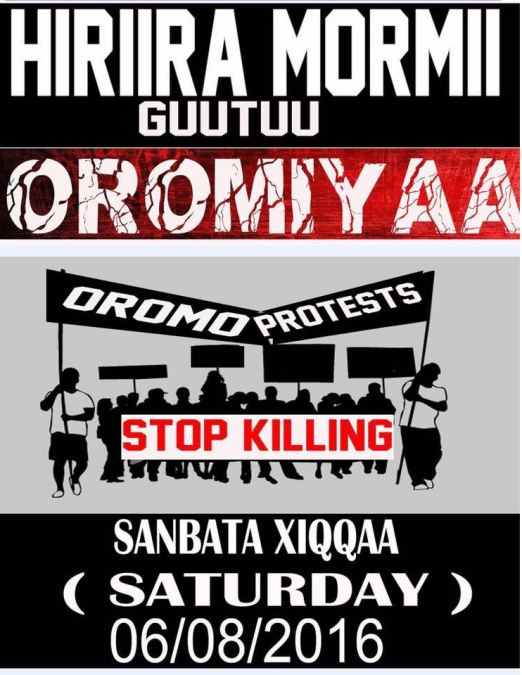
The Grand Oromo March on the 6th of August 2016
Ji’oottan saglan dabraniif ummanni Oromoo gaafii mirgaa haqummaan isaa mootummaanuu amane qabatee haala seeraaf heerri biyyattii eeyyamuun falmachaa jiraachuun isaa ni beekma. Yeroo kana keessatti ilmaan Oromoo 600 ol ta’an loltoota mootummaatin ajjeefamanii, kanneen 5000 ol ta’an madaayanii jiran. Kana jechuunis ji’oottan saglan dabran kana qofa keessatti guyyuma guyyaadhaan ilmaan Oromoo sadi (guyyaatti) Agaaziidhaan ajjeefamaa turan. Hundi isaanii rasaasaan haala garaa jabinna hamaa tokkoon rukutamaniit ajjeefaman. Ajjeechaan suukanneessaa akkanaa kuni amaluma mootummaa abbaa irreeti jedhamee fudhatamaa ture hanga yoonaatitti. Tibbana kana garuu akkaataa mootummaan sun mormii naannoo biraatti ka’e (keessattuu naannoo Amaaraatitti) itti keessummeesse ‘edaa gaafii isaatiif deebin kan rasaasa ta’u Oromoo qofa’ akka jennu nu godhee jira. Oromiyaatti daa’immaniifi manguddoon harka duwwaa gaafii haqaa qabatanii bahan rasaasni itti roobfamee fixaman. Naannoo biraatti garuu ummanni qawwee qabatee magaalaa jidduutti dhukaasaa oolee osoo waa takka hin tuqamin nagayaan manatti deebi’ee gale. Asirratti wanti haalaan hubatamuu qabu, kun ta’aa kan jiru Oromoon lafa kiyya narraa hin saaminaa, qotee-bulaa Oromoo lafa irraatti dhalaterraa hin buqqisinaa waan jedheef qofa yoo ta’u, warri naannoo Amaaraa garuu lafa amma naannoo Tigray keessa jiru gara naannoo Amaaraatitti deebisaa, lafti sun duriin isaa keenya jechuudhaan gaafachaa jiru.
Guyyaa kaleessaatuu Gondoritti ummanni kumaatamaan tilmaamamu, hedduun isaa qawwee hidhatee bahee osoo waa takka hin tuqamin gale. Sa’aatilee muraasa booda Oromiyaa, Harargee Bahaa magaalaa Awwadaay keessatti ummata karaa nagayaatin mirga isaa falmachuuf bahe irratti duula ilaammatanii dhahuutiin (sniper shooting) ilmaan Oromoo 26 rasaasaan madeessuudhaan nama jaha ammoo ajjeesanii jiran. Kanarraa kan hubannu mootummaan sun lammiilee biyya sanii ija gargaraatiin akka laaluudha. Ummata Oromoo akka diina hiree argame maraanuu ajjefamuu qabu, ummata biraa ammoo kan mirgi isaa kunuunfamuufi qabu godheet laala jechuu dha. Haalli kun paartiin Dh.D.U.O kan silaa Oromiyaan bulcha jedhus paartiin ANDM irraa garaagarummaa akka qabus qabatamaan ifa taasisee jira. Naannoo Amaaraatti mormii loltoota ANDM duriitin qindeeffamaa jiru mootummaan naannichaa harka irra qabuu bira darbee ifatti deeggaraa akka jiru agarra. Yeroo miidiyaan mootummaa Oromiyaa olola mormii ummata Oromoo maqaa xureessu hojjatutti, kan naannoo biraa qabsoo isaanii ifatti deeggaruudhaan labsaa jira.
Maarree Oromoon guyyuma guyyaan yoo ajjeefamu, ormi maaliif kabajame?
1. Ummanni Oromoo fedhii gaaga’amni hamaan biyyaafi naannoo isaarratti osoo hin geenye mirga isaa kabachiifachuuf jecha tooftaa qabsoo nagayaa filatee, qawwee qabatee bahuu dhabe. Qawwees qabatee kan hin bahiniif waggoota 25 dabre kana bara baraan qawween irraa hiikkamaa ture. Dabalataanis hoggansi fi hayyoonni Oromoo qawwee qabattanii hokkaratti hin seeninaa jedhanii waan gorsaniifi. Kunis kan ta’eef Oromoon ummata nagaaf nageenya yeroo maraa aadaaf uumaa isaa keessatti leellisu waan ta’eefi. Naamusni kun garuu naatoofi kabajaa uumuufi dhabee saba guddaa kana tuffachiisee jira. Inumaayyuu mootummaan wayyaanee aadaa nagaaf nageenyaa ummata Oromoo kana siyaasaa ishee cunqursaatiif itti fayyadamuuf kutattee kaate fakkaata.
2. Baatilee saglan darban kana ummanni keenya magaalota bilisa baasee too’ate keessatti Ummanni Tigree kan Wayyaanonni irraa dhalatan akka hin tuqamneef wareegama guddaa kafale. Ummanni naannoo biraa garuu ni gobe. Naamusnifi tikni Oromoon godheef kana galateeffachurra akka doofaafi sodaataatti akka laalamu godhee jira.
Walumaagalatti Obsiifi naamusni haga gaba. Aariifi xiiqiin Oromoo amma guutee irraan jiguuf deema. Osoo sun hin taane hireen dhumaa haa laatamuufi. Ummanni Oromiyaa akkuma ummata naannoo biraa lammii kabajaan maltuun akka ta’e mootummaan sun akka mirkaneessuuf, tarkaanfileen armaan gadii ni fudhatamu.
1. Sanbata duraa as adeemu Hagayya 6, 2016 guutuu Oromiyaatti, Dirree Dhawaa dabalatee hiriiri nagayaa kan mormii ni godhama. Mormiin ammas akkuma dura guutuu guututti kan nagayaa ta’a. Gaaffileen keenyaas, ajjeechaan akka nurraa dhaabbatu, hoggatootni keenya kanneen hidhaa keessa jiran haal-duree tokko malee akka hiikaman, Oromiyaa humna Agaaziitiin bulchuun akka hafu, Oromoon mirga ofiin of bulchuun akka kabajamuuf gaafachuufi kkf ta’u.
2. Hiriira kana bahuudhaaf hayyamni hin gaafatamu. Akka heera mootummaatti hiriira qopheessuuf aanga’oota dursanii beeksiisuutu barbaachisa. Barruun kun akka beeksisa sanitti fudhatamuu qaba. (Ummanni Gondoris kanuma godhe, Oromiyaaf seerri addaa jiraachuu hin danda’u)! Dameen nageenyaa Oromiyaas ta’ee humnoonni federaalaa mormii kana dursanii hanqisuufis ta’ee guyya san ummata reebuuf yoo kan socho’an ta’e, gaafasirraa ka’ee sochiin Oromoo tarsiimoofi ergama ( mission and strategy) jijjiirrachuutti tarkaanfata. Gaaga’ama sanitti aansee dhufu hundaaf kan itti gaafatamu hogganoota Wayyaanee, akkasumas Oromoota isaan waliin hiriiruu itti fufan ta’a.
Ummanni keenyas kana beekee gaafa san tokkummaafi murnannoodhaan akka mirga isaatiif bahu waamicha dhiheessina.
BEEKSISA ” dargaggoonni baadiyaa akkaa magalaa hin seennee waan doorguu fedhaanif dargaggooni ammarraa eegalee akkaa magalaa seenaan, yoo kun hin mijoofne gaafasuma gandoota baadiyyaa keessatti lakkoofsaan baay’atanii erga walgahanii booda gamtaan gara magaalaa akka seenan. ”
Leading opposition party, #OFC leaders call for the grand #OromoProtests.
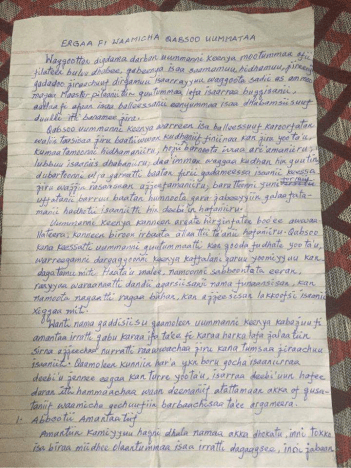
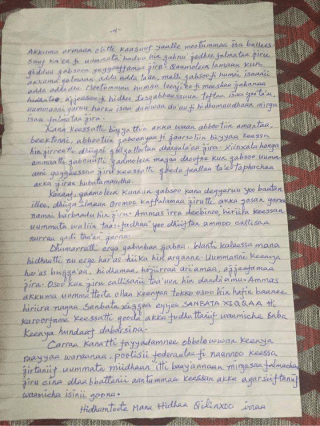
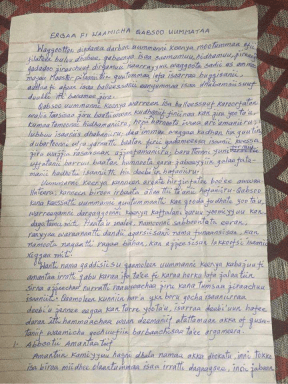
BREAKING: Here is the hand written letter of Bekele Gerba and other political prisoners
Dhaadannoo Slogans)
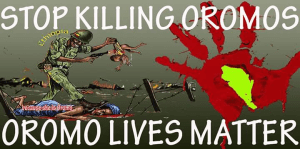
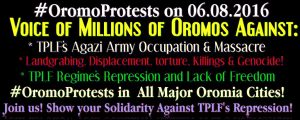
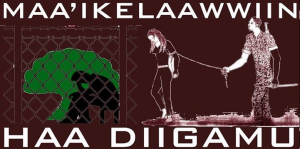
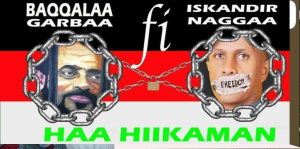
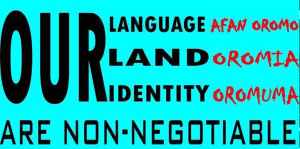

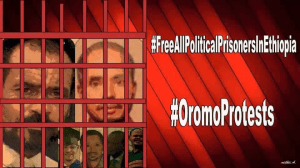
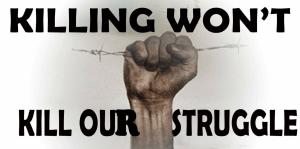
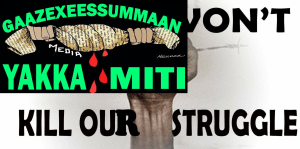

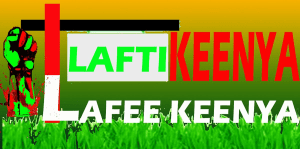
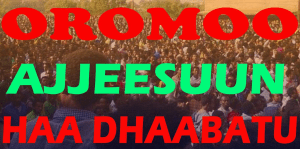
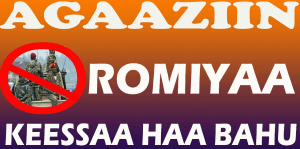

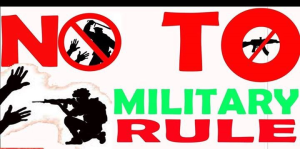
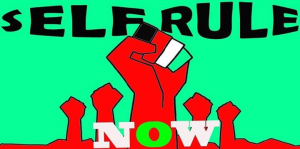
#OROMO PROTEST
#FREE BEKELE GERBA
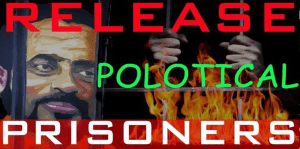
#FREE ALL PLOTICAL PRISONERS WITH OUT ANY PRECONDITIONS
#FREE LIIBAN DABASA GUYO
#FREE COLONEL DEMEKE ZEWDE AND WELKAYITE COMMITEE
#FREE ABUBAKAR AHMED
#FREE YONATAN TERESA REGASA
#OROMIA IS NOT FOR SALE
#WE NEED FREEDOM
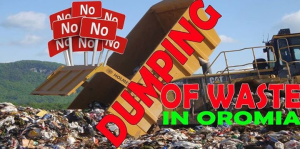
#NO DUMPING WASTE IN OROMIA
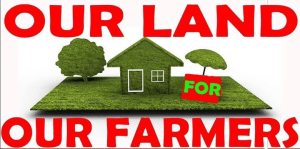
#STOP LAND GRAB IN OROMIA
#STOP EVICTING OROMO FARMERS
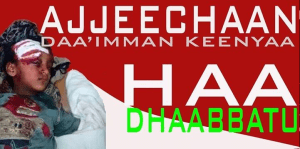
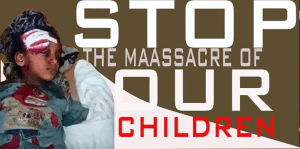
#STOP KILLING OROMO PEOPLE
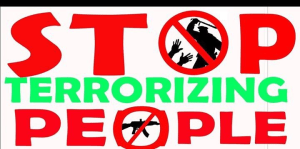
#WE ARE NOT A TERRORIST
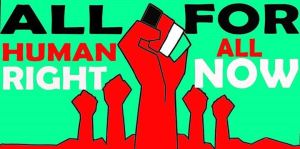
#HUMAN RIGHTS MUST BE RESPECTED
#DOWN TPLF DOWN
#FREE OROMIA FROM MILITARY
#WE STAND WITH WELKAYITE PEOPLE
#STOP KILLING AMAHARA PEOPLE
#STOP KILLING OGADEN PEOPLE
#NO TO MILITARY RULE IN OROMIA
#CHILD KILLERS MUST BE ARRESTED
# ENOUGH IS ENOUGH
#END MILITARY RULE IN OROMIA
#OROMIA SHALL BE FREE
#BRING OROMO PEOPLE KILLERS TO BOOK
#ABAY TSEHAYE TO THE COURT
#SAMORA YUNUS TO THE COURT
#WE NEED EQUALITY
#AFAAN OROMO FOR FEDERAL LANGUAGE
#WE NEED JUSTICE
#FREE MUSLIM COMMITEE
#TPLF MUST GO
#EPRDF MUST GO
#STOP ECONOMIC MONOPOLY OF TIGREANS
#NO WATER NO ELETCRICTY NO NETWORK IN ETHIOPIA
#11%GROWTH IS A LIE
#OROMIA IS BLEEDING
#PEOPLE POWER IS BIGGER THAN THOSE ON POWER
#FREE DHAQABA WARIYOO……..
ETHIOPIA BRACES FOR MASSIVE PROTEST RALLY CALLED BY ONLINE OROMO PROTEST ACTIVISTS
Ethiopia braces for massive protest rally called by online Oromo protest activists
Oromia (WBO): Irree fi Gaachanni Ummataa WBOn Diina galaafate August 4, 2016
Posted by OromianEconomist in Uncategorized.Tags: Africa, Injifannoo, Oduu Tarkaanfii WBO, Oromia, Oromo, Oromo News in Afaan Oromoo, WBO
add a comment

( SBO: Hagayya 03,2016) Irree fi Gaachanni Ummata Oromoo WBOn Godina Dhiha Oromiyaa keessa sossohu waraana wayyaanee ummata keenya hiraarsaa jiru irratti tarkaanfii fudhatu itti fufuun tibbanas injifannoo galmeessee jira.
Dhiha Oromiyaa keessa kan sossohu WBOn waraana wayyaanee ummata Oromoo nagaan mirga isaaf falmataa jiru shororkeessuuf konkolaataan bobbaafamaa ture Lixa Wallaggaa Anfilloo Muggii fi Gambeellaa gidduutti haleeluun kasaaraa guddaa irraan gahee jira.
Haaluma kanaan gootichi WBO Dhiha Oromiyaa Adoolessa 29,2016 barii lafaa sa’aa 4:00 irratti waraana wayyaanee konkolaataa 3n Anfilloo Muggi irraa gara Gambeellaatti deemaa ture bakka SS jedhamutti haxiidhaan haleeluun loltoota wayyaanee 8 battalatti oggaa ajjeesu, hedduu isaanii madeessuu Ajaji WBO Zoonii Qellem beeksiseera.
Lolli kun walakkaa sa’aatiif kan geggeeffame oggaa ta’u, madoon loltoota wayyaanee kun gara Gambeellaatti akka geeffamanis Ajaji WBO Zoonii Qellem dabalee hubachiiseera.
Waraanni wayyaanee haleelame kun humna dabalataa Gambeellaa irraa waammachuun sakattaa jedhee naannoo Anfilloo Garjeedaa fi gammoojjii Waabaa Eebbaa jedhamu keessatti ummata gidirsaa akka jirus hubachuun danda’ameera.
WBOn falmii mirga abbaa biyyummaa fi bilisummaaf ummatni Oromoo Warraaqsa Biyyaalessaa FXG finiinsaa jiru cinaatti, bilisummaa ummata Oromoo fi Walabummaa Oromiyaa mirkaneessuuf qabsoo hadhooftuu taasisaa jiru daran jabeessuun godinoota Oromiyaa adda addaa keessatti tarkaanfilee waraanaa qubattuu wayyaanee fi farreenii fi gufuu QBO fi warraaqsichaa ta’an irratti fudhatu jabeessaa fi babal’isaa jiraachuu hojiin agarsiisaa jira.
#OromoProtests and the future of Oromo struggle:A keynote speech of Dr. Merera Gudina, Chairman of OFC At OSA Annual Conference 2016. August 3, 2016
Posted by OromianEconomist in Uncategorized.Tags: Africa, Genocidal killings against Oromo people, Howard University, Keynote Speech of Dr. Merera Gudina at OSA Annual Conference 2016, Oromia, Oromo, Oromo Studies Association (OSA), OSA Annual Conference 2016
3 comments
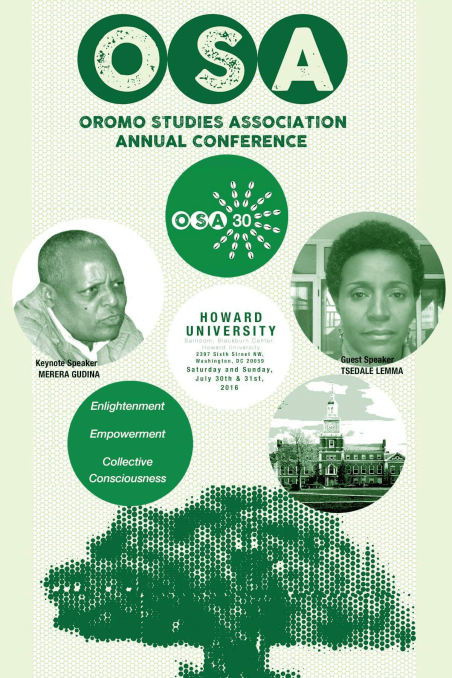
Oromo protests and the future of Oromo struggle
A keynote speech of Dr. Merera Gudina, chairman of the Oromo Federalist Congress (OFC), at the 2016 Oromo Studies Association (OSA) annual conference, Howard University, 30 July 2016.
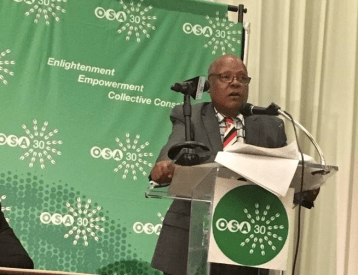
Introduction
I am here today to talk more about ourselves than the regime in power about whom I have been talking for a quarter of a century. I want to share my thoughts with you openly and honestly because I believe we have reached a stage where open, frank and honest discussion are necessary to lead our people towards the ultimate goal of liberation in our long journey to freedom. As we march forward, we should be honest to ourselves and to our people.
Exactly twenty two years ago, I presented a paper on how to democratize multi-ethnic polities like Ethiopia at the International Conference on Ethiopian Studies held at Michigan State University.
I then argued that “Oromos are the best candidate and centrally placed in terms of history, geography and demography to lead the country’s democratization drive. I even further argued that “Oromos can better claim that they are nearer to the Menilek palace at Arat kilo than those who came from Menez yesterday and Adwa today”. Some Oromo nationalists who found my ideas infuriating painted me as if I am playing the role of Gobana of the 19th century. In fact, they accused me of treason against the interest of our people. Undeterred, I continued to do what expected of me as much as I have understood the trends of Oromo politics, Ethiopian politics, African politics and global politics – all of which I had taught at Addis Ababa University for twenty eight years before I was pushed out because of my involvement in national politics.
Over the last quarter century, Oromo activists have grown matured politically. I have also outgrown my views. All of us have transcended our limitations. We find ourselvesin the same boat in the rising tide of Oromo nationalism. Today, Oromo nationalism a rising boat that is able to accommodate all of us. Without going to details many Oromos including Gadaa (Tesfaye) Gebreab have started to write about Merera’s way. It is with this new spirit that I am addressing OSA as a Keynote speaker twenty two years later.
The rise of modern Oromo nationalism
Let me say few things regarding the rise of modern Oromo nationalism and the major turning points thereof. As you might aware, the conjuncture of two episodes: the creation of Matcha and Tulama Association at the centre and the Bale uprising have immensely contributed to the birth of modern Oromo nationalism. They served as the first turning point and/or a great awakening for the Oromos.
To be sure, the Bale uprising has had a major impact not only on the rise of modern Oromo nationalism but also it had an important influence on the Ethiopian Student Movement that brought down Ethiopia’s ancien regime in 1974. I remember in the heydays of the Ethiopian Student Movement abroad: which way to the revolution: the Bale way or the Bole way had been an important question of tactics. The Bale way symbolized the determined militants’ way while the Bole way symbolized the way of softer revolutionaries. EPRP was the best example of the Bale way as it tried to come through Asimba – the replacement for Bale while MEISON represented the softer Bole way. In short the Bale uprising captured the imagination of the militant generation that brought about the 1974 popular revolution.
The second turning point in Oromo nationalism came with the revolution of 1974, which answered the most popular demand of the generation: “land to the tiller” in which Oromos and the rest of the southern peoples benefited most as serfdom and/tenancy was abolished. In fact, without exaggeration the radical land reform of 1975 was what made the Ethiopian revolution a revolution and the single most important victory for the Oromos and the rest of the southern peoples in the last 150 years. In a nutshell, it broke the economic backbone of the Neftegna system –rule by the gun.
Oromo intellectuals of the generation fully supported and implemented the historic “land to the tiller” proclamation. The end of tenancy and Oromos reclaiming of their ancestral land was historic in the sense that it marked the end of the Neftegnasystem – a great leap forward in our people’s march for freedom. It was the answer to the land question, which made the Ethiopian revolution of 1974 a revolution that moved millions of people into making a new history. Sadly, this is the historic gainthat the TPLF is bent on reversing under the guise of development. Under the current drive of land grab – the slogan “land to the tiller” is turned into ‘land to the investors’. That is why the Oromo youth are dying under the slogan “stop the land grab, lafti keenya, lafee keenya”.
Oromo intellectuals of the revolutionary generation failed to use wisely the opportune moment created by the revolution and the land reform. In other words, the second turning point in the history of modern Oromo nationalism had a negative dimension. To be more precise, the division which is still with us today started with the revolution of 1974. The inexperienced Oromo revolutionaries were seriously divided on the way forward. Some opted for socialism, i.e. transformation of Ethiopia as whole while others were attracted to the more radical version of Oromo nationalism and started to fight for the creation of Oromia republic. MEISON symbolized the socialist project while ECHAT – later OLF symbolized the more radical form of Oromo nationalism. Two contradictory slogans subsequently emerged: ‘red Gobena’ ,referring to the Oromo socialists within MEISON and ‘narrow nationalists’, referring to ECHAT and OLF members. The division consigned Oromo revolutionaries of the day into different camps. ECHAT and OLF members had extravagantly used the ‘red Gobana’ tag against the MEISON members while the MEISON members used the same extravagancy in calling ECHAT and OLF members ‘narrow nationalists’. The cost was too high for all of us. Consequently, the cream of that radical generation was decimated in the crisis that followed while some of us who escaped death passed our best years in prison cells – probably more horrible than the present ones.
The third turning point in modern Oromo nationalism came in 1991 when the OLF joined the transitional government controlled by the TPLF and EPRDF. The OLF despite its military weakness was able to mobilize people across Oromia. Millions of people were rallied behind the OLF and it suddenly became a major political force. Moreover, the Oromia region was created and Oromiffa has become a working language in Oromia. In fact, for a brief period of time OLF had become a government within a government in Oromia. And people thought total freedom was around the corner. The TPLF, which was watching the dramatic rise of the OLF very quickly moved to use its OPDO surrogates to crush the OLF. Despite its far less impressive military performance, the OLF has survived the TPLF’s military machine and has become the spirit of Oromo nationalism. I don’t remember how many times the EPRDF regime declared the OLF is dead in the last twenty five years and accuse the next day the OLF is being behind this or that incident and round up many young Oromos as terrorists. In other words, although militarily less effective, the OLF has shown a remarkable capacity to survive.
All along the EPRDF has been using its illegitimate child (Diqala) to rule the Oromia region by the use of sheer force and the consequent confrontation between the OLF and the Ethiopian regime has been too costly for the OLF and the Oromo people at large. However, a good thing here is that the rising tide of Oromo nationalism has persisted with its ups and downs and the regime could not fully suppress it.
In the meantime as Oromo resistance has continued, the Oromo National Congress was created in 1996. It made a good showing in the 2005 elections. Moreover, it has become yet another alternative in the Oromo people’s quest for freedom and democracy. It also opened yet another front in the struggle by using the legal platform created by the regime for donors’ consumption. It also survived the regime’s political surgery following the 2005 elections and five years later merged with another Oromo legal organization – the Oromo Federalist Democratic Movement (OFDM) and formed the Oromo Federalist Congress (OFC). The merger helped the unity of our people and enhanced our capacity to lead the struggle at home. Needless to add the rise of ONC/OFC brought back the Oromo dilemma: which way to the liberation of the Oromos? Needless to add the resolution of this dilemma is extremely important for the future of our people in its quest for freedom & democracy. We are yet to learn how to work with each other and our neighbors for a common national interest.
The Oromo Protest
The fourth turning point in the history of modern Oromo nationalism is the Oromo protest. To be sure, the 2014 Oromo protest in which about 78 people, mostly young people were killed, has been a precursor for the current protest, which is much more strong, wide spread and a mortal threat to the regime. Several factors contributed to the outbreak of the protest. Here, it is important to note that although it is difficult to apportion credits – as most Oromo organizations including the OPDO have contributed at different levels and arguably for different interest.interest. The OMN has done marvelous job in bringing the protest to the world stage. Oromo artists have also been at the forefront of the struggle – people like Haachaaluu Hundeesa, ChalaBultum, MuluBekele, Gelana, JamboJotie, etc. moved millions for the struggle by their appealing songs.
As you all know, the causes of the protests are many: chief of which are the historical marginalization of the Oromos as well as the continued marginalization, the dangerously growing corruption, maladministration and the discrimination thereof, the existence of the OPDO as a wound in Oromo nationalism, youth unemployment, etc; while the extensive land grab and the displacement thereof is a triggering factor. In a nutshell, the Oromo people as a whole and the youth in particular have been fed up with regime that successfully failed to promise them a better future.
Without minimizing the role of other Oromo organizations let me briefly tell you the contribution of the Oromo Federalist Congress to the on-going struggle. Our most important contribution has been the most effective campaign we were able to conduct during the 2015 elections. And thanks to the support of the Oromo Diaspora, we were able to organize a campaign that moved millions across Oromia. We could field more than ten land cruisers armed with loud speakers more for than two months. We were able to conduct street to street campaigns, organize mass rallies as high as 80 – 100,000 and distributed more than 3 million fliers containing clear messages to the youth, the farmers, the OPDOs as well as the security personnel in Oromia. I recall a police man who wept at our rally in Ambo when I said “you were born to an Oromo family, brought up by Oromo’s milk, when you die it is Oromo’s who will give you a decent burial, don’t kill your brothers and sisters to serve the interest of others”.
The inspiring mass rallies we had in Arsi, especially in Shashamane, Dodolla, Karsa and Shalla; the public meetings we had in Adama and Ciro stadiums; the rallies of fearless youth in KarsaMalima, South-west Shewa; the rallies we had in Hollota, Ginchi, Jaldu and Gindeberet, the turnout we got in Ambo, Guder, Gedo, MedaKegn, Bako, Shamboo, Nekempt, Gimhbi and Dembi Dollo, our rally in Bule Hora and finally the horses of Tikur-Inchini were all memorable rallies which taken together moved millions, especially the Oromo youth. In the 3 million fliers we distributed and in the mass rallies we organized our messages were loud and clear: they include “stop land grab, stop robbing the resources of our people, stop repression, stop discrimination, etc.”
We also promised lower taxation, lower fertilizer price and selected seeds and above all equal opportunity for employment and making Oromiffa the national language of the country alongside Amharic. Of course the creation of true federalism and democratic governance –i.e. genuine shared-rule and self-rule were at the centre of our campaign messages. In fact, the OPDOs were carrying bags of money to buy the votes of our people while our strategy was to mobilize people to the maximum of our capacity. By doing so we were able to expose the crimes of the TPLF/EPRDF regime to the full. I think, millions of Oromo youth we moved during the elections have taken their lessons seriously and applied their knowledge in the on-going struggle.
Moreover, after the elections when the OPDO brought back the Master Plan through the back door– we immediately called a public meeting at our office – under the slogan “stop the land grab and/or laftikenya, lafekenya”. And We called all Oromos to oppose the new land grab after the land reform of 1975. In fact, we compared the new land grab to the imperial days of land grab. I think, this immensely contributed to the resistance that followed.
Without exaggeration, the protest not only has become the fourth turning point in modern Oromo nationalism, it helped Oromos to make a great leap forward to the ultimate goal of liberation. Furthermore, it brought respect for Oromos both from their neighbors and the international community. Western diplomats and journalists most of whom might have never heard about Oromos crisscrossed Oromia to gauge the level and depth of Oromo protest. Oromos are suddenly recognized “Ethiopia’s largest ethnic group”. The protest has become the reminiscent of the Gada warriors of the 16th century and Oromos suddenly found new faith in themselves and started to believe that liberation is in their owns hands and within reach. I myself who have seen the revolutionary upheaval of 1974 and the overthrow of the military regime in 1991 was surprised when millions moved into action across the vast land of Oromia in a very short period of time.
As I said earlier, for the first time in Oromo history foreign diplomats, parliamentarians and journalists roamed the Oromo streets to understand the cause and the depth of Oromo protests. I remember what one day a young Dutch scholar asked me. She said to me “I am going to Ginchi and should I take a tablet for malaria?”. I told her “Ginchi is in a high land area and no need for it and asked her what you do there?”. With force she said “I want to see with my own eyes, the birth place of Oromo protest”. In summary, the Oromo youth have shown us the path to liberation with their blood by crossing the organizational divides and acting in unity as a result of which both our neighbors and the international community started to respect us as a people. Furthermore, it has opened a new chapter in the Oromo people’s struggle for freedom and democracy, which is a great leap forward – at that a new turning point. I dare say, Ethiopia will never be the same again. The protest has shown us what a united & determined people can achieve in the face of various challenges.
Every media outlet from American presses to BBC – to French Radio International and Aljazeera talked to us and covered the protests that were taking place even in the remote Oromia villages. Every western diplomat based in Addis talked to us. I remember American. British, Dutch, Swedish, German, Norway as well as the European Union parliamentarians discussing with us regarding the dimension and direction of the Oromo protest. The Oromos, who have been forgotten by the world powers, suddenly become the centre of their attention.
Reasons as to why non-Oromos are not attracted to join the Oromo protest until now may be many, but we can single out two main factors: one is what all of you know – fear of the Oromo separation agenda from many quarters. The other is what many people have not fully grasped – Oromos now have two political forces that have real life among the Oromo people – the OLF and OFC There are no comparable political groups in other regional states. Despite its weakness as an organization, the OLF has always been there to inspire the Oromo youth. Since 2005 the ONC – now the OFC has been using to the extent possible the legal platform.
Thanks to the support of the Diaspora including OMN, OFC was able to move millions of Oromo youth across the vast land of Oromia. In a nutshell, there is no political party that could capture the imagination of the youth in other regions of Ethiopia. To make my points clearer, if they had the capacity to do it, more than the solidarity, they could have joined the struggle with their own demands as they have plenty of them from Walkeit to the sale of land to the Sudan – to political repression and youth unemployment. To me understanding such differences is very important to plan for the future struggle.
The third important difference is that Oromo nationalism has passed the stage where Oromo quislings or traitors could not easily control. Surprisingly, more than three million OPDO members could not resist the rising tide of Oromo nationalism: some quickly gave in; some joined the popular uprising while some die-hards tried to stop the forward march of history. The Amhara youth have not reached that stage and the hodam Amharas still in control of the situation. To be sure, the Amhara mobilization is much stronger in the Diaspora while in the case of the Oromo – mobilization in the home front – especially that of the youth is much more united and stronger than abroad. The fourth difference is – the Diaspora Oromo activists are more connected to the grass root in the home front and hence have got much more influence over the youth at home. For all practical purposes the youth at home look at people like Jawar as their commander in-chief in their war against the regime. I don’t see comparable influence in the case of Amhara youth.
The dilemma over the road map to liberation and Our Chronic Division
The Arab world’s most known journalist, Mohammad Hykal, who had been very angry at the division of the Arab leaders once said “the Arab leaders met, agreed to disagree”. This is what has become the culture of Oromo political leaders for more than a generation. Let us admit that Oromo political parties are yet to learn how to aggregate their interest to work for a win – win situation by developing the art of compromise in our politics. The same applies to the larger Ethiopia. In addition to learning the art of compromise – to reach our ultimate goal, unity of purpose and action should be our guiding principle. We should be able to differentiate between the role of liberation movements and political parties struggling for power in a normal situation. We need to talk to each other, not over each other; we should stop dialogue of the deaf and listen to each other. Especially, we should know the consequences of our actions.
One of the most serious setbacks/we even can call it a disease of Oromo movements and/or political leadership is their failure to handle political differences and easily jumping to character assassinations of all kinds, especially when old friends take different political positions. Far worse, the blind followers easily follow the words of their superiors and jump to attack the new enemy they have created. I think the solution for this is to openly and honestly debate over our differences as well as on the way forward without demonizing each other. I believe internal democracy is necessary to tackle real political differences. Yet another serious problem in Oromo political organizations is lack of political dynamism both in our thinking and actions. And because of fear of each other, it takes years for Oromo political leaders to adopt new policies even when the reality on the ground demand quick action and moving fast.
Frankly speaking, because of our weakness, we could not produce a strong leader like the Eritreans or a collective leadership like the TPLF until Meles pushed aside the rest of his comrades to emerge as a sole dictator. We are also not good at establishing better cooperation with our neighbors and minimize our enemies. We really need to create real alliances that help us to move forward. I hope we understand even the mighty America creates both tactical and strategic alliances across the globe to promote its interests.
Sadly and surprisingly, the war over the internet has continued among Oromo political forces even at a point in time when the Oromo youth is writing a new history with their blood. No less surprising, I heard some even suggesting that there is no need for political organizations and the dispersed movement alone could do the job. To be sure, as much as I have understood both national and global politics – beyond a shadow of doubt, more than any point in time in the history of Oromo people’s struggle, our people need organization/organizations that can lead them across the finishing line to victory. To suggest otherwise is disarming our people and sabotaging their victory. Probably the suggestion may come out of political naiveties or frustration with existing organizations.
Whatever its sources, it is a self-defeating suggestion for which Oromos may pay very dearly. In this regard, all Oromos cannot be policy makers and while we reserve our right to oppose or support any Oromo organization, we should be careful in innocently selling the strategy of the enemy to our people as no people succeeded without leadership in modern history.
In our division, the worst and costly division is which came to us through the OPDOs. Originally the OPDOs were forced to join the wrong side of history as prisoners of war. Later most of them joined the wrong side of history willingly for their stomachs. Surprisingly, when OPDOs recruit members, they never, never, never talk about the cause of the Oromo people as they fully know they are not there to promote the cause of their people. In the Diaspora they always say “come and get the land for free” while at home they say “you get land, employment and/ or become an official to live good life”. Here, let me narrate to you my own experience.
A friend of mine, the elder brother of Hassan Ali (former president of the Oromia region), who then just joined the government asked me to join the OPDO. He told me that the OPDO was ordered to nominate nine Muslims and nine Christians as a quota to high office. I think they could not do that easily as many Oromo intellectuals were then supporters of the OLF. When he understood, I was not attracted to the lucrative high office, he said to me that “manas, makinashinargetajedheni” (i.e. I thought you can get a house, a car). This is the way millions of Oromos have joined the OPDOs and to use the words of Walter Rodney – the West Indies historian – “removed from history”. I think, we have a real challenge to bring them back to history these lost children of Oromia – by liberating them both from their stomachs and their masters.
The good thing is the Oromo protest has shown us is that the more than three million OPDO members – either because of their isolation, confusion or some level of Oromo nationalism retained in them – they could not stop the protest and the government had to send in its Agazi force and the federal police known for their notoriety to suppress the protest by sheer force.
The Challenges to our Intellectuals
Oromo intellectuals have developed a very bad culture of criticizing others by expecting from them miracles than taking practical actions themselves. Far worse, jealously (masanuma) has become a whole mark of our political culture. Oromo youth at home have broken it with their blood and it is high time that Oromo intellectuals and political leaders do the same to move forward. And whatever the source of the problem, this is yet our common disease we should overcome as quickly as possible.
Furthermore, the main challenge to Oromo intellectuals at home and abroad is how to participate in the struggle in a more meaningful way. The decisive moment has come when our intellectuals stop tailing the people’s struggle and start to contribute to the struggle in their brains and resources. Frankly speaking, what I hate to hear from our intellectuals is that they always say we are with you, but do nothing or very little in terms of contribution. I know Oromo intellectuals live in fear at home. I do not know how many of you in the Diaspora fully contributing to the struggle both in your brains and resources. What I generally hear is lamentations after lamentations about the weakness of this or that Oromo political organization. Who else is leading a better way, if our intellectuals are not joining the struggle in numbers and lead Oromo organizations more effectively?
I strongly urge you, if you wish success of the common struggle to join any organization of your choice and improve the quality of leadership for Oromo organizations. Some of you may tell me you are tired of supporting organizations that could not bring quick success. I remind you that success depends on the contribution of all of us to make our organizations and our struggle strong. For instance, intellectuals can better create think tanks for political organizations and help them perform better. Intellectuals can bring in the experiences of other successful nations. They can easily identify problems through empirical study and suggest viable solutions. They can invest their resources in the struggle while the Oromo youth invest their blood. What I am saying is that if we have the will, there are several ways to contribute.
I challenge Oromo intellectuals while the Oromo youth is writing a new history with its blood they should come out to honestly debate on the way forward so as help us to reach a national consensus. And as we fight to make our history, we also should be able to read the reality on the ground – and make hard choices based on facts – not on our wishes. I strongly believe compared to other groups in Ethiopia – Oromos should have very little worry about their future if they know how to play their game. What they should resolve as quickly as possible is their own little dilemma: which way to go forward and overcome the chronic division between Oromo political forces. Now the world has started to know us and understand us, we should do our homework as we claim our future so that we be people worthy of support. We should be able to learn the lessons of the lost opportunities in 1974; 1991 and 2005.
Oromo movements should be informed by current developments in global politics and listen to each other. To be frank with you Oromo artists have made more contribution to the protests than oromo intellectuals. One day – I met an Oromo artist from Ambo and asked him whether he is still around with his fiery songs. He boldly and confidently told me that “should we go to the bush even to sing?”. I haven’t seen comparable courage and confidence in my intellectual colleagues. In fact, what I always get when I meet them is an advice – “ofegi – becareful”.
Furthermore, the younger artists have really replaced the legendary singers: Ali Birra, Tsegaye Dandena, Kemer Yousef, ect; with their moving songs. I really wish Oromo intellectuals have the same courage.
Yet another main challenge to Oromo intellectuals is to go beyond driving expensive cars and buying good houses. I am not opposing doing that, if you are committed intellectuals, you can still have more resources to contribute to the liberation of our people. Honestly speaking I know a lot of Oromo friends in the Diaspora complaining, complaining and complaining about the cost of living in America to contribute for our organization 100 USD, but minutes later when we take more beer start to ask me about investment opportunities in Ethiopia.
Problems related to Resource Mobilization
I don’t know about other Oromo political organizations, the budget of our party is less than 10% of the price of a car a government spy or a TPLF businessman drives. In the 21st century we can only compete with enough resources and technology. We should not expect our organizations to deliver what we want unless we help them to develop the capacity to deliver.
If we know how to do it and the commitment to do it, there are several ways to do it. If the statistics I heard in Mennisota is correct, Oromos in the Diaspora from the America’s to Europe, the Middle East to Australia are more than 100,000. And if we have 100,000 Oromos in the Diaspora and they contribute One-Dollar –A Day as some say, I,.e. pay a tip of one dollar for the cause as you give a tip when you eat, we can raise 100,000 USD per day, 3,000,000 USD per month and 36,500,000 USD per year, i.e nearly one billion Ethiopian Birr. Even if this is less than an annual income of one TPLF businessman, this is a huge money for a political party like ours and we don’t even have to go to the bush to do the job. With that much of resource at our disposal we can become a real force and able to turn Oromo cities and towns to our bush.
Just imagine what can be done if all of you sponsor the struggle back home in the village you were born, woreda or zone. In this regard, even if I am extremely glad our Diaspora brothers and sisters have made a great leap forward in supporting our struggle at home, the older faces I know are still in their old politics. The best example is Minnesota, where almost all the older faces I know, did not show up even when we opened our first office in the western world. It appears, they have continued to be loyal to their old habits of doing things. As the saying goes – you cannot teach old dogs new tricks. They are yet to learn the success of one Oromo organization is the success for others too. I strongly advise them to engage in soul searching to transform themselves before they are discarded by history.
Yet another problem connected to our use of even the meager resources we mobilize is that Oromos are better at giving support for the victims/funerals than supporting political organizations that supposed to lead the struggle. Far worse, very often the money sent home end in the hands of OPDO spies. In this regard, a person I know well told me he gave 160,000 Birr to a spy in Ambo. I don’t know how much resources have been lost and being lost in such a way – which could have been used for the liberation of our people. In other words, we are not mobilizing enough resources for the struggle while which is raised is not properly and effectively used. Be sure that from this side of the planet, you cannot know who is who? Quislings of all sorts can easily get access to resource and divert it. I advise you to double check and recheck resources you send home – as it can be wasted like foreign aid to African dictators. In fact, I don’t know how much money the Diaspora sends that reach the needy. Taken as a whole, the message I want to pass is that we are not properly using even the resources we have mobilized.
Lack of Organizational Skill
One thing we should admit and overcome as quickly as possible is our organizational weakness. Organizations are central for any struggle to succeed. I still remember a slogan most popularized by EshetuChole, one of the most radical intellectuals of our generation at Addis Ababa University. He shouted a slogan:
One organize
Two organize;
Three organize
at the inauguration of the last leadership of the University Students Union of Addis Ababa, the famous USUAA, which was supported by the roaring sound of thousands of university staff and students. In this regard, there is a clear gap we should fill. As to my observation, Oromos never had an organization that matches their numerical strength for the last 500 years – i.e. since the Gada warriors of the 16th century. We need new skills to organize ourselves and back it up with the necessary resources. Our main problem is the failure to understand our potential and use it effectively in a way it makes a real difference. To be sure, the game of the 21st century is that of technology and resources for any organization to succeed.
As I raised above, another serious problem I see regarding Oromo organizations is that everybody is a policy maker. We have a right to oppose or support our leaders but, forty million Oromos cannot make their own individual policies for this or that party. We need leaders to lead us. To me, the best way forward is to build an organization/organizations that can lead the people for liberation and able to negotiate with force when necessary. To be sure, the real gap in our people’s struggle is the failure to build such organizations. Here , we should know a divided elite cannot lead a united nation. Don’t also forget that we succeed as a people and fall as a people. Hence, we should fight for our freedom as a people by overcoming our petty organizational and other differences.
Our People’s Struggle and the Disturbing American Foreign Policy
Let me raise the issue you all know well, American foreign policy troubles us. American diplomats have had the culture of working with the powers that be and winning and dinning with dictators. During the Cold War dictators from Chile’s Pinochet to Africa’s Mobutu – to Mubarak’s Egypt – to Philippines Marcos had wined and dined with successive American presidents. In our own situation, successive American leaders supported Emperor Haile Sellassie until the end came to his rotting regime.
As sometimes history is repeating itself, now they are doing the same for the EPRDF regime and may continue to do until the end. In one of my encounters with American officials after Obama’s shameful speech in Addis Ababa where he delighted his host by saying “you were elected by the people of Ethiopia,” I almost quarreled with the officials. I think the officials came to rebuild Obama’s damaged image. I told the officials “you are propping up the Ethiopian regime and consciously look away from its crimes”. He got angry and said “American foreign policy has three legs: humanitarian aid, development and security” and added “are you questioning our security arrangement with the Ethiopian regime”? I responded “whose security?- the security of the Ethiopian dictators or the security of the Ethiopian people?” A good thing is that about a month later, the Oromo protest, which surprised the Americans came. His lieutenant came back and at least visited Ambo.
Obviously the EPRDF regime is propped up by Western Governments, especially the big brothers. Even after I came here I visited some offices and their usual question is America’s security arrangement with the Ethiopian regime, which has always been at a standby and ready to serve them when they need it for peace keeping across Africa, especially in the Horn of Africa. It is such a story the American Embassy in Ethiopia is telling us. The real challenge to us is to draw a strategy that can move the West to go beyond their myopic security interest that led them to support the minority regime in Ethiopia. Mass rallies in front of the White House or the State Department are good and one of the options in our hands. I support them. But I always say both God and the Americans help those who help themselves.
Therefore, it is far better to build an organization/organizations that can speak to the Western governments and the EPRDF regime at home. Without backing up our diplomacy with force and building giant organizations that can talk and walk their talk, I don’t think we can move far. The real challenge is how to do our homework first before we beg others to help us.
In sum, in the last 20 years, I don’t remember how many times I visited the State Department, talked to senators and the congressmen & women. We could win-over only Donald Paine, who shifted his support to the opposition after the 2005 elections. As far as I can Judge from several of my encounters with American diplomats and my professional experience as a student of political science – you can influence American foreign policy-makers, in one of two ways: when you can become a force and they think you can bring down the regime in power or when the regime in power start to work against their interest like Mugabe of Zimbabwe. Therefore, to win the heart of the American leaders, we should become a force – a force that can speak to the Americans and the Ethiopian dictators. I think, we can do that if we can put aside our petty differences and invest in a real way to build organizations with committed leadership that make a difference. Know that the liberation of our people is in our own hands and while we seek the support of the Americans – we should do our homework as I earlier said, both God and the Americans help those who help themselves.
The Way Forward
Some say the Oromos came to present day Ethiopia in the 16th century while others take back this to the 10th century. Whatever that meant, beyond the shadow of doubt,Oromos constitute the largest nation in Ethiopia and/or the Horn of Africa. That bestows centrality on Oromos in the remaking of Ethiopia along democratic lines. Look for a moment at the history, geography and demography of Ethiopia. If the heart of Ethiopia is out with the Oromos, imagine what would happen to the remaining pieces. In all probability, the country may turn to a house of mad people where everybody throws stones against the other. If the turn to a mad house, because of their resources and their geography, in the end Oromos may be a net-loser.
I think, Oromos have to make a historic choice between assuming a central position in the remaking of Ethiopia or taking all the peoples of that country down together to the unknown world. To be sure, a minority regime cannot sponsor a democratic transformation, except in the South African way. Without claiming a copy right that is why I always say, Oromos should assume their rightful place of the remaking of Ethiopia in the interest of all the peoples of Ethiopia by ensuring a democratic transition that is fair to us and to our neighbors. I believe this is the best strategy to move forward in the re-writing of new history for our common home.
I have argued all along that the best strategy for the Oromos is to struggle for the taking-over of Menilek’s palace by championing democracy and sharing power based on one person-one vote. I still say Oromos should develop both the wisdom and capacity to end minority rule in Ethiopia. To do just that Oromos should able to create meaningful & strong democratic alliances with their neighbors based on trust and a fair game to both of us. If the country’s largest group is not ready to do that, who else is expected to do that can do that?.Oromos should not send fear to their neighbors, a very fact the minority regime has been always exploiting but security guarantees in a new democratic Ethiopia. These are the lessons we should learn from the Oromo protests, which moved millions of Oromos across the vast Oromia land while our neighbors are watching the drama from the side lines without showing any solidarity. Frankly speaking, many non-Oromo saw the Oromo protest as a threat, not as a liberator. This is a dilemma of our neighbors and yet another challenge of ours as we look into the future of our people’s struggle.
We should understand history, but should not be a prisoner of it. We should not forget our history, but not be its prisoners. We should operate dynamically in the fast changing dynamic world without losing ourselves in the game. We should embrace and work with those who want to work with us for a common goal while standing firm against those who aspire to give us the certificate to be Ethiopians. We should not allow the Oromo protest to be repressed by isolating it while the EPRDF regime is working day in and day out to mobilize our neighbors against us.
All of us should be ready to contribute our share by joining the call of history. There is an urgent need to resolve our own dilemma. I have been always arguing in terms of history, geography and demography Oromos are the best candidate to lead the democratization of Ethiopia. We should be aware of the fact that clashes of dreams and visions unless managed well can hurt all of us. In other words, Oromos should contribute to overcome the country’s political dead-end by making their contribution to overcome the clashes of dreams that has led to the political impasse for decades. Attracting our neighbors to a democratic game, i.e. a common middle road is a sine quanon for moving forwardthe country’s politics so as to save us from paying unnecessary cost.
At this historical juncture – we should be able to reassess our failures and successes to revitalize our movement by better strategizing our way of doing things. And as we fight for the freedom of our people, we should be able to use Oromos full potential with hope and confidence to engage our neighbors.
Lastly, let me say few things about OSA:
OSA is celebrating thirty years of its existence. I hope those who know it from birth to maturity can tell better the contours of its development, its ups and downs, i.e. give a better balance sheet. From a perspective of a distance onlooker, let me say the following: OSA has fought a thirty-year war in promoting Oromo nationalism with commitment and endurance in the world of academia. All of us should salute OSA for a good job done. We should encourage it, to take its work more aggressively with commitment and determination. Having said this, I want to raise some points regarding OSA based on my attendance of OSA meetings few times. First is time budgeting. Some programs are given much more time than others. I think, OSA time allocators should be serious in adhering to the original time. Time adjustments should be made if necessary with fairness. Secondly, some critical presentations are pushed to the end after many people are left or tired. I think, OSA would lose its central mission when real political issues that are critical to the survival of our nation arenot well covered or well attended. I understand OSA organizers do that to hold down people from leaving. I myself was not happy, for instance to make a speech in Chicago after the veterans of the Bale movement left or travailing several thousand kilometers to talk for few minutes at that after half of the meeting hall became empty. Thirdly circulation of OSA publications is limited, especially for the young readers at home. Even the universities in Oromia are not getting them. If not legally allowed, it can be done through some scholars. Lastly and more importantly, OSA should be able to find sponsors from Oromo communities and other organizations to enable the participation of more scholars from home as it is very important to create a better human link between the home-based intellectual community and those of you who are here.
Conclusion
Taking this opportunity I call upon all Oromo and Ethiopian political forces to unite and push the same democratic agenda.
I want to call upon the TPLF/EPRDF leaders to stop its repression and negotiate a fair democratic game with the genuine representatives of the various peoples of the country.
I also want to call upon the American government to stop supporting dictators who are terrorizing millions of their citizens in the name of fighting international terrorism.
Finally, let me conclude my presentation by repeating the immortal words of Kwame Nkrumah: Divided we fall, united we stand.
The desperation of Oromo refugees in Cairo August 3, 2016
Posted by OromianEconomist in Uncategorized.Tags: Africa, Oromia, Oromo, Oromo Refugees, Oromo Refugees in Egypt, UNHCR
add a comment
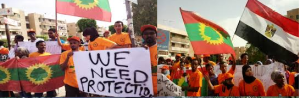
The desperation of Oromo refugees in Cairo
An Oromo asylum seeker died in Cairo last week after attempting to help two men who set themselves on fire during a protest in front of a United Nations office.
The protest outside the UNHCR’s office in 6th of October City called for the UN refugee agency to end its alleged discriminatory treatment of Oromo refugees.
Most Oromo refugees in Egypt come from Ethiopia, where they make up the largest ethnic group. The Ethiopian government responded to Oromo protests with violence late last year, intensifying an ongoing crackdown against them. Human Rights Watch estimated in June that over 400 Oromo have been killed since November 2015, with thousands injured, tens of thousands arrested and hundreds forcibly disappeared.
Mohamed Ademo, a Washington DC-based Oromo journalist, who has been following the case closely, told Mada Masr that Asli Nure was injured while trying to help two men who were later hospitalized, whose identities remain unknown.
Video footage of the incident was shared on social media, showing large amounts of smoke and people screaming.
The UNHCR released a statement saying it, “deeply regrets the tragic passing of an Ethiopian Oromo asylum-seeker on 26 July 2016, following a violent incident outside UNHCR office in Cairo.” The statement made no reference to the protest.
The UNHCR office will be closed until next week. The UN agency’s spokesperson Tarik Argaz told Mada Masr the closure is a temporary measure to guarantee the safety of staff members and asylum seekers coming to the offices.
Argaz says UNHCR security staff helped extinguish the fire and transported the injured to hospital. The office is working closely with hospital staff and the authorities in relation to the incident, he adds.
But Ademo claims the response from the UNHCR was lacking.
“It is even more tragic that the UNHCR’s response to all of this is to close its office. The appropriate course of action should have been to thoroughly investigate protesters’ grievances and what led to this deadly episode,” he says.
When asked about how the UNHCR is addressing Oromo concerns they are being discriminated against, with their applications for refugee status commonly either ignored or denied, Argaz says the agency is in touch with Oromo community figures concerning their grievances, but would not disclose any details.
Argaz and the UNHCR as a whole categorically deny Oromo refugees face any discriminatory treatment. “We process every claim according to UNHCR standard procedures. I want to stress that it’s an individual process and not a group-based approach,” says Argaz.
But Oromo community leaders have been saying for months that they face unfair treatment. Abdul Kadir, the secretary general of Oromo Refugees Egypt, a community organizing center for Oromo refugees, first spoke to Mada Masr in April about Oromo protests at the UNHCR office in Cairo, which continued for a couple of weeks. At the time Kadir and his organization had just begun negotiations with the UNHCR and they have since taken a step back from active protests. But he says palpable anger against the UNHCR remains.
“Many Oromo are rejected. Every week it’s 40 to 50 people who are rejected. More than 99 percent have been rejected, so people are angry, they are not happy with the UNHCR,” he claims.
Kadir says many Oromo refugees in Cairo have been accused by the Ethiopian government of belonging to the Oromo Liberation Front (OLF). The OLF is an armed group that was designated a terrorist organization by Ethiopia’s parliament in 2011. According to HRW, while the group has minimal military capacity, its existence is often used by the Ethiopian government to justify the repression of Oromo.
Many Oromo refugees in Cairo are either connected to the OLF or accused of connections, Kadir says, meaning they are unable to return to Ethiopia amid the ongoing crackdown.
He attributes the large number of rejected applications from Oromo for refugee status to the similar stories they tell, which he says makes UNHCR officials suspicious. However, he adds that many Oromo refugees wait years for a response after their initial status determination interviews with the UNHCR, in comparison to the average 20 months the UNHCR promises.
Feven Basada has been waiting for almost three years for the result of her refugee status interview. She says the stress of not knowing has caused her to become sick and unable to work, and that she is only able to survive because of the support of her church.
Basada left Ethiopia because her family was being targeted by the government. “I don’t know if anyone is alive or not,” she says. “You don’t have anyone. You don’t have a country, you don’t have anything. That’s why I have this sickness,” she adds. Basada lives alone, and often, when she calls the UNHCR office, no one answers. “I want to live like a human being, it is very hard … very difficult for women especially.”
Marwa Hashem, assistant public information officer for the UNHCR in Cairo, told Mada Masr that each refugee application has to be evaluated on an individual basis and the agency works with over 181,000 asylum seekers and refugees, which may explain the long wait. Hashem adds that staff shortages and increasing numbers of asylum seekers have made agency efforts to reduce the wait time difficult.
“Cases of asylum seekers with specific vulnerabilities may be adjudicated faster than others under certain circumstances, based on identified needs in each case,” Hashem explained, adding that the UNHCR does not discriminate against groups of people based on affiliation or ethnicity.
But others who work in the field disagree. A source from an international refugee organization told Mada Masr anonymously that he often sees Syrian refugees take priority over other groups.
“It’s been my experience that pretty much all refugee organizations right now have a dual focus — one for Syrian refugees and one for non-Syrian refugees. People will look at meeting a quota for non-Syrians, and they will dedicate half of their resources to Syrians,” he explains.
He says that the reason for this is a combination of the large influx of Syrian refugees into Egypt and funding priorities. In a world of tight funding, he explains, organizations have to make choices in order to cover their costs.
Whether or not this is the case, Oromo refugees are beginning to feel hopeless, according to Ademo.
“The depth of their frustration and grievance with lengthy procedures that keep ending in rejection is heartbreaking. The desperation has already led dozens to perish in the Mediterranean while attempting to reach Europe,” he says. A boat crossing the Mediterranean Sea from Egypt to Europe capsized in April and at least 400 refugees, largely from Somalia, Eritrea and Ethiopia, drowned.
Ademo says many Oromo still in Cairo feel hopeless and “some have publicly suggested they have nothing left to lose, and may set themselves alight.”
#Oromoprotests: Open Letter regarding the carnage in Oromia and possible next steps August 2, 2016
Posted by OromianEconomist in Uncategorized.Tags: #OromoProtests, #Oromoprotests: Open Letter regarding the carnage in Oromia and possible next steps, Africa, Genocide, Genocide Against Oromo People, Oromia, Oromo, The tyrannic Ethiopia
add a comment

By #OromoProtests
To:
Obbo Abbaa Duulaa Gemeda, Speaker of the House of Representatives, FDRE.
Obbo Muktar Kedir, President of the National Regional State of Oromia
Ibrahim Haji, Commissioner of Oromia Police
All City Councils in charge of Matters pertaining to Public Political meetings and Peaceful Demonstrations
CC.
Obbo Teshome MUlatu, President, FDRE
Ato Hailemariam Desalegn, Prime Minister, FDRE; Chair of the Command Post currently governing Oromia
General Samora Yunus, Chief of Staff of the Armed Forces, FDRE
Ato Asefa Abiyu, Commissioner of the Federal Police
Central Committee of EPRDF
Executive Committee of OPDO
Subject: Open Letter regarding the carnage in Oromia and possible next steps
Dear Sirs,
It is to be recalled that the Oromo people have been expressing their total and complete discontent with the administration over the last eight months and a half. This expression has taken the form of peaceful protest (#Oromoprotests) forcing the government to rethink the Addis Ababa Master Plan, amend the Oromia Urban Development Proclamation, reschedule the Ethiopian School leaving Exam and, more recently, to stop dumping waste in the Sandaafa area. Much to our disappointment and to the disappointment of the entire Oromo nation, this peaceful popular protest has been consistently met with overt violence from the Government’s security forces.
According to our estimates, over 6oo Oromos are killed. (It is to be noted that the Human Rights Watch had reported earlier that over 400 are murdered by government security officers arbitrarily. Even the regime has admitted that there were 173 killings and hundreds of incidents of injury to civilians, arbitrary arrests, and other forms of abuses, and yet there was no attempt on the part of the government to take political and legal responsibility for this.) Targeted killings have been going on even in the absence of any public demonstrations in Shashemene and the towns in the wider W Arsi district. The Government has so far not done its part to investigate the cause and bring the perpetrators to justice. Even as we write this letter today, the killing continues in Awaday. Few weeks ago, several arbitrary killing of children and other civilians was witnessed and burning of a building has also been observed while the local officials were watching the fire to the point of self-entertainment with the sight. Today, we have noticed the killing of protestors by snipers who targeted Oromo lives.
In the last eight months and a half, hundreds of peoples suffered wounds and other forms of bodily injury from shooting. Over 5000 Oromos were shot and injured by the Security Forces, mainly the Agazi. Tens of thousands have been victims of mass arrest and are suffering arbitrary detention and torture in prisons large and small in various parts of the country. Oromo leaders are detained and tortured as political prisoners. Hundreds are reported to be missing and are victims of forced disappearance. All this has been unaccounted for thus far as there was no independent commission of inquiry established to inquire into the matter. Nor has the government invited international investigators such as the UN’s Special Rapporteurs on Arbitrary Execution, Forced Disappearance, or the Committee of Experts.
The dispossession and displacement of Oromo farmers and residents including those in the suburbs of Addis Ababa) continues uninhibited so far. The civil administration of Oromia is still not restored in full. The Oromia National Regional State (ONRS) is still under the military rule that governs through a Task Force from a Command Post. Oromia is virtually under the rule of the Agazi. The fundamental demands of Oromo people remain unaddressed. Discrimination is rife. Economic disempowerment, political marginalization, total loss of voice is patent. Oromos are disproportionately represented in the statistics about the Ethiopian prison population. (It is reported that the prison population has risen from 86% to 95 % within the last nine months.) Oromo political leaders such as Bekele Gerba, Olbana Lelissa, Dejene Tafa, Addisu Bulala, and almost all of the OFC leadership are imprisoned for no legally justified reasons. They are subjected to abuses as political prisoners.
The state of basic social services is deteriorating from day to day. Health, road, and water services infrastructure have all collapsed to the point of crisis. There is virtually no semblance of governance in the region except the terrorizing of the civilian population through a heavy military presence across the region.
All these brutal killings, maimings, forced disappearances, and other forms of abuse were taken to be acts of a repressive dictatorial regime that is hateful of its peoples. Developments in recent days (especially those that transpired in the Amhara region) and the way the regime treated their demands presented a contrast that seemed to suggest to our people that these extraordinarily violent responses are reserved only for Oromos. In Oromia, when school children demonstrated unarmed and peacefully (to present their just demands for their rights), they were massacred in a torrent of bullets that rained on them from the Agazi Forces. Elsewhere, even people that are fully armed with guns stage a protest, present their demands, and come home safely. And that is as it should be. Few hours after the Gonder protest was peacefully concluded, the regime was conducting a campaign of sniper shooting in Awaday town (of West Hararghe Zone of Oromia) where 6 persons were killed and about 26 were shot and wounded. This shows that the regime have different modes of treatment to different peoples of the country. It sends a message that indicates that Oromos, unlike others, are enemies to be eliminated at every opportunity. It also sends the message that there is a difference between the Amhara and Oromo parties (i.e. ANDM and OPDO, which form the coalition of the EPRDF) operating in the respective regions. ANDM openly supports the protest in Amhara region while in contrast the OPDO in Oromia is nowhere to be seen around the people (except as informers and co-killers). The media in Oromia is busy denouncing and demonizing the Oromo Protest whereas in other regions, the media publicly announces its support for the people’s demands.
Consequently, it has become clear even to casual observers that Oromo lives don’t matter in Ethiopia. In this regard, the regime has continued in the tradition of devaluing and undervaluing Oromo lives starting from the days of imperial conquest of the Oromo nation.
We believe that you are acutely aware that this condition is unsustainable. We believe that the only way forward is to arrest the people’s unnecessary suffering and bringing this crisis to a positive end. We believe that the continued perpetuation of misery, targeting the Oromo people as a people, is forcing them to reach for desperate measures that this government can’t eventually manage to control.
We, as concerned children of Oromia, are writing to you to make this last call for you to wake up to this fast changing phase of the Oromo Protest. If the government does not properly respond to the peaceful demands of the people for their rights in a just social order, the Oromo people will be obliged to start taking drastic measures that have serious repercussions both for the regime and for the country.
Our people are asking what brought about this apparently endless tragedy to them, including this recent different valuation of peoples and their rights. The answer seems to be in the following:
1. The Oromo people had so far chosen to conduct their protest peacefully. Oromo political leaders, activists, and intellectuals have all been consistently advising against violence and encouraging people to avoid all forms of violence. This was in line with the principle of primacy of peace and wellbeing (nagaaf nageenya) in the Oromo tradition and their way of being in general. This choice has been viewed as weakness and cowardice. The TPLF regime seems to have chosen to utilize the Oromo commitment to peace as an instrument of perpetuating its repressive politics.
2. In the last nine months, our people have taken extraordinary care not to harm other people living among them, especially those who, being from Tigray, support, benefit from, and collude with the regime. This care seems to be mistaken for naiveté and weakness.
However, it should be clear to all that patience has its limits. Anger and resentment is overflowing among our people. Before patience completely runs out, it has now become necessary for the regime to be given a last chance to change the course of its behaviour. In order to ensure that the regime treats our people with the same respect it accords to other peoples of Ethiopia, it has become necessary to take the following measures:
1. On Saturday, 6 August 2016, there will be a grand protest demonstration across the Oromia region including in Addis Ababa and Dire Dawa. The Protest, like all other preceding protests shall be completely peaceful. Its demands include:
a. STOP KILLING OROMOS;
b. FREE ALL OROMO AND OTHER POLITICAL PRISONERS WITHOUT ANY PRECONDITION;
c. END THE AGAZI RULE IN OROMIA;
d. ALLOW OROMOS COMPLETE SELF-GOVERNANCE
e. And other similar demands.
2. There shall be no request for permit from the government. According to the constitution and the relevant law (Proclamation No 3/1991), people who seek to stage public political meetings and peaceful demonstrations have a mere duty of notification.
This letter shall have served as a letter of notice to the relevant State and Federal institutions.
If Oromia’s and Federal Security Forces try to prevent the protest rallies or to abuse people otherwise during and before the demonstrations, from that moment on, the Oromo Protest will immediately have entered a new phase with new mission and strategy.
It shall start taking measures commensurate to the needs of the times.
TPLF leaders and Oromo collaborators shall take full responsibility for any and all negative consequences.
Desperate times demand desperate measures.
We call upon the regime to end our people’s sufferings immediately.
We also call upon the Ethiopian people to pay attention to this notice, to bear witness, and to stand in solidarity with its Oromo brethren and sisters.
We call upon our people to understand this situation and stand with the usual resolve and determination as they stand in unison to demand their just and God-given rights in their own land.
Kind Regards,
#OromoProtests
In Rio’s Slums, Gangs, Drugs, Murders Carry the Day August 2, 2016
Posted by OromianEconomist in Uncategorized.add a comment

via In Rio’s Slums, Gangs, Drugs, Murders Carry the Day — AP Images Blog
How fast fashion has made some of the richest men on Earth August 2, 2016
Posted by OromianEconomist in Uncategorized.Tags: Business, economics
add a comment

When you think of the industries that allow a person to acquire a massive fortune—the kind that makes them the wealthiest person in a country, or continent—your mind probably goes to fields such as technology, or oil. But clothes, and especially cheap clothes have turned out to be a surprisingly good route for many of…
via Fast fashion has made some of the richest men on Earth — Quartz
Guyyaa fi Bakka Sagantaa Geggeessaa Obboo Tarfaa Dibaabaa August 2, 2016
Posted by OromianEconomist in Uncategorized.Tags: Obbo Tarfaa Dibaabaa, Oromo
add a comment
Obbo Tarfaan, Amajjii 6, 1940, magaalaa Dambidollo, Wallaga, Oromiyaa tti dhalatanii Adoleessa 29, 2016, magalaa Hamburg, Jarmanii, keessati addunya kana irraa dhukubaan boqootan.
Sagantaan geggessaa Obbo Tarfaa Dibaabaa Jimaata Hagayyaa 5, 2016, sa’aa 10:00 akka yeroo biyya Jarmanitti, mana sagadaa Altona Kreuzkirche, Hohenzollernring 78a, 22763 Hamburg, Jarmanii, keesatti erga raawatamee booda bakka Friedhof Bernadottestr. 32, 22763 Hamburg ti sirna awwaalchaatiin xumurama.
Itti aansee sa’aa 14:00 irraa eegalee sagantaan yaadannoo obbo Terfaa Dibaabaa iddooKulturkirche Altona, Bei der Johanniskirche 22 , 22767 Hamburgjedhamu keessatti geggeffama.
Maatii Obbo Tarfaa Dibaabaa
Oromo Sports Federation: OSFNA 2016 20th Anniversary August 2, 2016
Posted by OromianEconomist in Uncategorized.Tags: Africa, Oromia, Oromo Sports, Oromo Sports Federation: OSFNA 2016 20th Anniversary, OSFNA
add a comment



 Oromian Economist
You must be logged in to post a comment.