Who Owns Africa? The Accelerating Large Scale Land Grabs Across the Continent April 16, 2013
Posted by OromianEconomist in Uncategorized.Tags: Africa, Cameroon, Central Africa, Forest Trends, Land grabbing, Non-governmental organization, Oromia, Oromia Region, World Bank
1 comment so far


Satellite image of Africa, showing the ecological break that defines the sub-Saharan area (Photo credit: Wikipedia)
http://www.youtube.com/watch?v=8eK2eKJGmaM&feature=youtu.be
‘Large-scale land acquisitions by foreign governments and investors – a phenomenon termed “land-grabbing” by activists – peaked following the 2008 global food price spikes. Governments and venture capitalists from the Gulf States, Asian tiger economies, EU and US rushed to acquire large terrains in developing countries to grow and secure food supplies for their populations and biofuels for expanding markets. But the practice has been increasing for at least a decade. The Land Matrix Partnership estimates that 227 million hectares of land have been ‘grabbed’ worldwide since 2001. And according to the World Bank, 70% of the current demand for forest and arable land is concentrated in sub-Saharan Africa, with its vast parcels of “cheap” and “unoccupied” terrains. Liberia, for example, has reportedly sold off three-tenths of its territory in five years. “Once seen as marginal, this issue has emerged as one of the development priorities of our different governments”, Cameroon’s Forestry and Wildlife Minister, Philip Ngole Ngwese tells Think Africa Press. Indeed, across West and Central Africa, an escalating number of poverty-stricken men, women and children in rural areas are being chased off ancestral lands they have relied on for generations for farming, grazing and hunting. They are increasingly squatters and low-paid labourers for the incoming foreign investors and local elites. “When the government takes this land and gives it out in a lease for 40, 50 or up to 99 years, the people often lose access to these commons resources”, Michael Richards, Natural Resources Economist with the UK-based Forest Trends, notes. “In some cases, they do allow access for the extraction of certain products. But in other cases, they put great fences which stop communities having access.” Land grabbers also usually obtain unlimited rights to water use, Richards adds, implying curtailed availability for downstream users. Other experts warn of looming threats of hunger, stalled investments and political instability should the land deals continue to be shrouded in secrecy and corruption, lack of accountability and transparency, or negotiated without the informed consent of local communities.On the other side of the argument, advocates of the large-scale land transactions claim they have the potential to improve local infrastructure and services, boost governmental tax revenues, create jobs, and enhance food and energy security. According to them, activists have been exaggerating the negative outcomes of large-scale deals and, by dominating coverage of stories around large-scale land deals, have given a false impression. “There could be a reporting bias in that many of these reports are put together by advocacy groups who want to show the negative effects”, says Richards. However, even if this is the case, it does not explain away instances of human rights violations and the mass displacement of local communities and indigenous peoples. One group at the forefront of a worldwide campaign to reverse recent land grab trends is Rights and Resources Initiative. The organisation has been pressing for government forest land policy reforms that recognise and restore land ownership rights of local communities. RRI warns the tenure crisis is worst in Africa, where only 0.4% of forest land is formally owned by local people, as opposed to around 24% in Asia and Latin America. In 2009, the group summoned stakeholders from across the globe to rethink and propose better tenure rights governance for West and Central Africa at a conclave in Cameroon’s capital Yaoundé. Participating government representatives, related sub-regional institutions, NGOs and civil society organisations declared their commitment to lobby and double forest land areas under community ownership by 2015. “We identified problems of deforestation, lack of respect for human rights and the crisis that was unfolding across the region. The meeting generated a lot of recommendations and governments made a lot of commitments about what to do”, says Andy White, RRI Coordinator. But four years down the road, and only two years before the Objective 2015 deadline, not much has been achieved. Reports presented at a follow-up regional dialogue in Yaoundé in March indicate that only half of the 26 West and Central African countries revisited their tenure systems. And those that did only ceded feeble secondary rights to indigenous people, granting them access and usage privileges, but maintaining tight grips on stronger rights to exclude intruders or transfer ownership to a third party. “There’s been some progress. Some governments in the region have initiated new land reforms, but the laws and policies they’re proposing are really inadequate”, says White. “The crisis has become much greater over the last four years than we expected and there’s been far too little action. [There is a] crisis in terms of loss of life, crisis in terms of the systematic destruction of the culture of the forest peoples like here in Cameroon. It’s just alarming.” New recommendations therefore stipulate fast-tracking the implementation of previous policy reform commitments, embracing the full bundle of rights of local communities in land tenure negotiations, and reinforcing the lobbying power of NGO and civil society organisations. “We are calling on the support of RRI and other partners because we want to build a network of traditional rulers to constitute a lobby to defend our rights”, says HM Bruno Mvondo, bureau member of the Council of Traditional Rulers of Cameroon. “For us traditional rulers, the land belongs to the community. But in front of modern law, our customs don’t have any strength. We’re begging the authorities to take into account our traditional law.” For displaced communities and global activists, the fight goes on and debates regarding who owns Africa’s lands are gathering momentum. But at the same time, fresh findings suggest wealthy nationals and elites are keeping busy too and increasingly joining the rush for land.’ http://thinkafricapress.com/cameroon/who-owns-land-cameroon-large-scale-land-grabs
http://www.oromostudies.org/OSA_Apeal_letter_on_landgrab_2013final.pdf
http://www.youtube.com/watch?v=T1y5fssKiTw&feature=share
What is happening in Omo valley is also happening in Oromia and Gambella.
http://www.youtube.com/watch?v=8eK2eKJGmaM&feature=youtu.be
Copyright © Oromianeconomist 2013 and Oromia Quarterly 1997-2013. All rights reserved. Disclaimer.
Related articles
- Environment: “Green grabs” alienate pastoralists (ionglobaltrends.com)
- Indian Land Grab in Africa: Sputnik Kolambi (kafila.org)
- The G8 and land grabs in Africa (climate-connections.org)
- Land Grabs Spread Throughout Developing World (prn.fm)
- African Land and Natural Resource Grabs Destroy Lives and Futures of Africans (addisuwond.wordpress.com)
- OSA’s Appeal Letter to the Secretary General of the UN on Land-Grabbing in Oromia (freedomfororomo.wordpress.com)
Genocide and the Suffering of beleaguered Communities:Between 1868 and 1900, five million Oromo were killed in Ethiopia and it is still happening with Intensity April 9, 2013
Posted by OromianEconomist in Uncategorized.Tags: Akbar Ahmed, Brookings Institution, Chechnya, Conakry, Gadaa System, Genocide, Genocide against the Oromo, Human rights, Human Rights and Liberties, Human rights violations, Mass killings, Oromia, Oromo, Oromo people, Police state, State terror, Thistle, Waziristan
add a comment
The author’s daughter, Nafees Ahmed, reads at excerpt from “The Thistle and the Drone” at the Brookings Institution in Washington, D.C.
‘It is difficult to read about contemporary instances of genocidal behavior, writes Akbar Ahmed, and not think that they belong to some distant, barbaric past instead of the world of today. But, if anything, these instances are occurring with greater frequency and intensity as far as tribal societies are concerned. And yet, much of the world seems indifferent to this suffering. Acts of genocide not only challenge their victims but all those who must contemplate the consequences of these actions. This was evident in the following letter, sent to me from an anonymous author after reading the op-eds in Al Jazeera written by my team and myself about the suffering of these beleaguered communities: “I felt ashamed to not have known about their struggle for existence. I wonder how these people cannot become terrorists or rebels if faced with such inhumane conditions. The question is how would we react if faced with a situation they are in. I can only pray to Allah to protect all of us from this test. For sure, most of us would fail in this test.” The anonymous writer had raised a pertinent question. Genocide had been taking place in history and was again recurring. It is difficult to believe that these are not chronicles of ancient peoples visited upon by demon barbarians, but rather what is happening today. What is new is the increased frequency and intensity of genocide as far as tribal societies are concerned. If every tribal community is like a bounded world of its own, then the obliteration of literally hundreds of worlds becomes possible. The scale of suffering can be illustrated in numerous examples. In the 1860s, Russia killed 1.5 million Circassians, half of their population, and expelled the other half from their lands. In the 1940s, the Soviet government loaded the entire Chechen population of 400,000 on trains to Kazakhstan, killing half in the process. More than 100,000 were killed in the wars after 1994, or 10% of the entire population. In the first four decades of French colonial rule, two million Algerians, two-thirds of the population, were killed. From 1930 to 1933, the Italians killed 50,000 Cyrenaica tribesmen in Libya and, in total, reduced the population by two-thirds as a result of death and displacement. Genocide has been taking place throughout history. Between 1868 and 1900, some five million Oromo, or half the population, were killed in Ethiopia, with an additional half million killed in the Oromo Bale region in the 1960s. In the 1990s the Sudanese government killed as many as 500,000 Nuba, half of the population, and as many as 400,000 Darfuris in the early 2000s. These figures convey a stark reality: If Muslims are an embattled species in the modern world, Muslim tribesmen are an endangered species in it. Because these staggering statistics involve hundreds of thousands of people, if not millions, they are numbing and difficult to comprehend. Perhaps individual cases will throw the horror of genocide in sharper relief. Consider the two children in Waziristan who saw their father shot in the head during indiscriminate firing by Pakistani security forces when he took the children shopping at a bazaar: “The children were covered in blood and brains of Yaqub Shah, they saw their beloved father, head shattered, lying in a pool of blood with no one to help them. For hours, the terrorized children sat by the dead body of their father, eyes wide open, not able to cry, not able to speak.” Or consider the Fulani Muslims of the Middle Belt region of Nigeria who became victims of cannibalism by Berom tribesmen making matter-of-fact comments on video while police watched passively: “I want the heart” and “Did you put some salt?” Or hear a Russian soldier describing what his fellow soldiers were doing in Chechnya: “One guy pinned a Chechen to the ground with his foot while another pulled off his pants and with two or three hefty slashes severed his scrotum. The serrated blade of the knife snagged the skin and pulled the blood vessels from his body. In half a day the whole village was castrated, then the battalion moved out.”Or listen to Fatoumata, the brave young Fulani woman, who relived her ordeal at the hands of security forces chanting “We are going to exterminate you, Fulani” in the notorious episode at the stadium in Conakry, Guinea. “A police officer, after raping me, decided to urinate in my mouth, as if it was part of their program,” she recounted. “I received streams of urine all over my face. After, they used sticks to rape me again with these objects. Then, finally, one tried to stab me in front, on the private parts.… The blood began to flow and I was so exhausted that I could not scream or cry.” Or hear the courageous Kashmiri woman recalling the night the women of her village were gang raped by the Indian Army: “The army entered our houses at ten in the evening and left at nine in the morning.… There were screams everywhere — from almost every house in the village.” Or contemplate the bodies of dead Baluch men with lettering freshly carved into their chests declaring “Long Live Pakistan.” It is difficult to believe that these are not chronicles and legends of ancient peoples visited by demon barbarians, but rather what is happening today. People on the periphery have been traumatized beyond imagination in recent years. They have been cooked and eaten. Their women have been gang raped in front of them. Their young men, elders, and religious teachers have been humiliated, tortured and killed. Their houses of worship have been destroyed. They have been relocated away from their homes and their lands stolen from them. They face widespread famine and disease and are voiceless and friendless in a hostile world. They have been called “insects,” “snakes” and “reptiles.” They have been robbed of their dignity and honor. They have seen their young men and women transformed into suicide bombers killing women and children, passengers in buses or worshippers in a mosque in a frenzy of anger. Yet the world seems indifferent to their suffering and is barely aware of its scale. This is indeed the dark side of the soul of man. After the grim and relentless litany of woes I have just related, it is hard not to cry with Joseph Conrad: “The horror! The horror!” It should give everyone pause to reflect on the fate of humans and ask: Is this where they were meant to arrive? In the end, will they be defined by little more than their indubitable capacity to breed and kill?’ http://www.theglobalist.com/StoryId.aspx?StoryId=9957
Copyright © Oromianeconomist 2013 and Oromia Quarterly 1997-2013. All rights reserved. Disclaimer.
Related articles
- Testimonies of Genocide; Between 1868 and 1900, five million Oromo, were killed in Ethiopia (bilisummaaa.wordpress.com)
- 21 Century Social and Economic Apartheid: In the TPLF variant of Apartheid System of Ethiopia, the Oromo are making the Majority of the Prisoners (oromianeconomist.wordpress.com)
- American University’s Akbar Ahmed Explains Why Drones Aren’t Winning the War on Terror: The Thistle and the Drone (prweb.com)
- Tplf’s Genocidal Killings Continued on Oromoo in Ethiopia (odaakoo.wordpress.com)
21 Century Social and Economic Apartheid: In the TPLF variant of Apartheid System of Ethiopia, the Oromo are making the Majority of the Prisoners April 6, 2013
Posted by OromianEconomist in Uncategorized.Tags: Abusive power, Aphartheid, Corruption, Development, Dictators, Economic Aphartheid, economic sabotage, economy, Ethiopian People's Revolutionary Democratic Front, Gadaa System, Human rights violations, Meles Zenawi, Oromia, Oromia Region, Oromo, Oromoo, Politics, Poor Goveranance, racial discrimination, Tigray Region, Tigrayan People's Liberation Front, TPLF, Tyranny, Undemocratic System, Underdvelopment
6 comments
From the outset TPLF defines itself as a liberator for one specifically racially defined group. And still after two decades on power, irrespective of its ostensible claim that it is under the umbrella of EPRDF, people of the same origin monopolistically has held the whip-hand; and the whole country has been cash cowed by one specific racial group while the majority is being treated as impediments.
The apartheid nature and characteristics of TPLF’s policies and behavior is as covert as possible to throw the majority into total muddle until it is too late. To put it bluntly, the fledgling apartheid system of TPLF is emerging through a frog boiling tactic.
The TPLF’s apartheid system can be described as a subtle state action designed to secure and maintain the Tigrian domination by furthering their Economic and Political interests through control over the majority Non-Tigrian population.
The following categories make the necessary, sufficient, and defining characteristics of the emerging tender-plant apartheid system in Ethiopia:
1. Economic Interest
Furthering the Tigrean economic dominance is mainly achieved through a threefold economic sabotage: i.e.,
Through the creation of Tigrian tycoons in every facet of the economy;
By building extractive business empire;
Through emasculation of Non-Tigrian business firms.
Let’s see each of the above points in detail.
1.1 The incubation of the Tigrian Racketeers: Unlike the loosely dispersed and individualistic Non-Tigrian business men, the Tigrian racketeers are a highly organized kleptomaniacs that are exclusively nurtured by the under-table action of the government in a way that:
– Favoring to get loan from state-owned banks with least or no collateral;
– Facilitating the bureaucratic process in the Custom office with least search procedure while this government office intentionally delays the items that belonged to the Non-Tigrian business men.
– Government toleration for their criminal act of tax evasion.
– For the Tigrian importers, letter of credit will be processed easily and access to hard currency is almost unlimited; whereas the Non-Tigrians must wait a minimum of 4 to 6 months since their application.
– The government has granted them key business sites under low bid.
– The government conducts special training programs and video conferences to create situational awareness among them and update them with first hand information. At this point, we must not forget that nowadays information is equivalent to money.
On top of that, they have been informed /’’trained’’/ and equipped with the following racketeering tactics.
1. Insider Trading: Obviously all key governmental positions are occupied by the Tigrian; which means any policy or information particularly related with business reaches to the Tigrian racketeers before the crowd gets it so they adjust everything in advance to suit to the new condition. And due to such a prior knowledge they net millions from insider trading.
They also have foreknowledge on every government auction however the Non-Tigrians get it lately from news papers. For insider information equals ‘’money’’ in a modern market economy, it is a great power in the hands of people who are the most cohesive and organized criminal group like the Tigrian racketeers. As a matter of fact, insider information is illegal both from moral and law perspective.
2. Dual Set of Ethics: In fact, the Tigrian racketeers have been informed directly or indirectly to practice a dual set of ethics:
I. An altruistic set of ethics for themselves and
II. A predatory one for the rest of Ethiopian people.
– They don’t compete with one another for a single niche of market;
– They don’t interfere with the monopoly controlled by other Tigrian racketeer;
– They are barred from underbidding fellow Tigrian racketeer.
– They are always cooperate with one another so as “not to lose the money of Tigray”
3. Team Strategy: Before we go to how they act in team, let’s see the psychological set up of the Tigrian racketeers and the Non-Tigrian business men.
The Non-Tigrian have been conditioned to think that everyone must be judged on his or her merits and that it would be immoral to be biased for his own race. The Tigrian racketeers, on the other hand, have been conditioned from early time of TPLF to think in terms of the good of their race.
Keeping this fact in mind, what they are practicing is through “Infect to insolvency and then wait to takeover” approach. For example, if they need to monopolize certain business sector they allocate a calculated sum of money to under bid the price of item which certainly makes the Non-Tigrian competitor unable to fight with irrationally low price then put the competitor company into insolvency and finally buy the company itself with a giveaway price and will apply “the abuse of dominance” once they control the sector.
In general, a cohesive and powerful team effort, dual set of ethics along with insider information consistently amasses collective power to the Tigrian racketeers over a scattered and individualistic Non-Tigrian.
1.2 By Establishing Extractive Trade Empire: An acronym EFFORT stands for the TPLF’s multi-billionaire trade empire called Endowment Fund for the Rehabilitation of Tigray. It was established by expropriating capital equipments from different parts of the country and by the infamous defaulted bank debts. Currently there is no business sector that is free from the involvement of EFFORT. It stretched from production to distribution, from finance to insurance, from wholesale to retail, from real-estate to horticulture, from mining to IT. Peculiarly, this trade empire hasn’t ever been audited by external auditor nor repays the loan it borrowed periodically.
Similar to the Tigrian private companies, EFFORT is also privileged in the following manner:
– It is awarded government auctions of big projects;
– Favored to borrow in billions without collateral and it is not subject to repayment;
– Equipped with insider information;
– Granted fertile land at a giveaway price by displacing tens of thousands of indigenous people from their ancestral land;
– Granted key mining sites without open bid;
– Market opportunity will be arranged for it by forcing regional and federal offices to buy products which haven’t a relevant importance or in an exaggerated quantity.
Surprisingly, almost 99.9% of the employees in these innumerable companies of EFFORT are Tigrian; which means that majority of the economy is occupied by either the Tigrian private companies or by the extractive trade empire called EFFORT; and they primarily privileged job opportunity for Tigrians. As the complete cycle of economic dominance and privileged labor market portrays, we are under a severe economic genocide.
1.3 Stifling of Non-Tigrians’ Business Firms: Obviously the playing ground is not level; and the whole situation is an uphill battle for Non-Tigrians’ business firms to survive all the barriers that they faced from the government bureaucracy and from economic sabotage of the highly privileged EFFORT companies and the cohesive Tigrian racketeers. Consequently, especially after election-2005 we have seen that many Non-Tigrian businesses have been either liquidated or down-sized.
2. Political Interest
The foremost plan of TPLF was to secede the Tigray region from the rest of the country and to establish a sovereign republic, as plainly stated in Manifesto-68 which was formulated by the triumvirate of Abay Tsehaye, Sebhat Nega and Meles Zenawi. However, through time they inferred that a sovereign republic of Tigray would be a weak and failed state. Then they changed their program to live together as a state-within-a state and TPLF’s role as a Quasi-Occupying Force.
Similar to the case for economic dominance, TPLF and Tigrians maintain their political dominance using racial solidarity as weapon against the Non-Tigrian Ethiopians in the following manner:
2.1. Surrogate Colonization /Repopulation/: The TPLF apartheid system has also been featured with Depopulation andPopulation-Transfer. The annexation of arable lands of the Amhara region like Humera, Welkayt, Tsegede, Alamata, Korem and so on, to Tigray province and depopulating the indigenous Amharas from those places and then replacing with Tigrians is a case in point of the surrogate colonization of the TPLF regime. The expansion of Tigrians is also continuing in west and north Gondar to annex the North Mountains after they learned that the North Heights are fields of Gold and other Precious metals.
2.2. Expropriation of Land /Landed Property/ Belonging to A Racial Group: As a matter of the truth, the people of Gambella have been denied its natural right of living on its ancestral land. And clearly we know that more than quarter of arable land of the region has been awarded to land grabbers at a giveaway price by TPLF megalomaniacs. But beside to this, more than 2/3 of the remaining arable land has been expropriated by Tigrian Mechanized-Farm owners in which it left more than 70,000 indigenous people for forcible relocation to the place where the soil is dry with poor quality and with no infrastructure. What worsened the situation was that the deployment of the TPLF mechanized army upon the unprotected civilians to enforce forcible relocation of the indigenous people. As a result, they became victim of genocide, rape and conflagration of their villages by TPLF militias.
2.3. Deliberate Denigration of Living Conditions of Non-Tigrian Racial Groups: This includes:
– Demolishing of business areas under cover story of investment which are mainly occupied by Gurage business men in the capital city of Addis Ababa. Particularly after election-2005, the Gurages have been profiled as “Accomplice of Neftegna” and currently as “Ginbot-7 Sympathizers”; and consequently, they are paying the expensive price ever for the alleged charge.
– Internal deportation and expulsion of hundreds of thousands of the Amhara people from different parts of the country by confiscation of their tenure and property is also one of the cruelest repressions of the racist regime of TPLF in order to break the potential resistance from this group by throwing them into absolute destitution and instability.
2.4. Infliction of Serious Bodily and Mental Harm upon Certain Racial Members: Tens of thousands of political and Conscience prisoners are concentrated in three federal and 120 regional major prisons. They are also found in an unofficial detention centers in military camps including in Dedessa, Bir Sheleqo, Tolay, Hormat, Blate, Tatek, Jijiga, Holeta, and Senqele. Majority of the prisoners are racially Oromo; and their alleged charge is “Sympathizers of OLF”. The number of Amhara, Gambella and Ogadenese political and conscience prisoners are also significant.
The condition of these political prisoners is extremely harsh, overcrowded and life threatening. Besides, the TPLF henchmen often use a series of torture and brutal interrogation to extract confessions including whipping on the soles of feet, over stretching of limbs, slow dripping of water on the head, slandering of their race, pulling out of nails, forcible extraction of teeth, weights suspended on testicles, plunging into spoiled water, solitary confinement in dark cell for long period of time, signing a confession, forced self-incrimination, threatening with injection of HIV infected blood, forcing to denounce others, burning with cigarette, insertion of bottle and hot candle into prisoners’ rectum, drowning into ice cold water for long period of time and beating with rifle butt, stick, whip, belt etc.
2.5. Access: No matter how the Non-Tigrians have the qualification for the high post in the army or the security apparatus or for key government offices, they have already been denied by the unwritten law of TPLF. Access to government-sponsored scholarship at the overseas is also highly secured for Tigrians.
In conclusion, Ethiopia is a country of nations and nationalities. So there must not be room for the socio-political and economic dominance of single race. All the people of Ethiopia must be treated as an empowered citizen. The fledgling Tigrian apartheid system must be nipped in the bud before it sparks the bloody genocide.
As a universal truth, no one ever negotiated successfully from weakness, but from strength. It must be our primary target to be strong. And, I do personally believe that awakening to the truth will make us strong. We are now in the middle of life-or-death struggle; if we fail to break the yoke of TPLF’s apartheid system the future of our people, the continuity of our race and the stability of our country will be at stake.
We have left nothing with TPLF; we have been cornered, humiliated, persecuted, harassed, assaulted, exiled, locked-in jail, tortured, expelled, impoverished by design, confiscated and decimated. We must not have room for the source of all these evil, TPLF, anymore!!! We must fight it by all possible means until we regain our freedom!!! We must struggle desperately until we tear apart the reins of the Quasi-Occupiers!!!
On the other hand, the Tigrians must also do their own homework before they are being treated as:
– Accomplice of Criminally guilty TPLF officials;
– Politically guilty as TPLF Supporters;
– Morally guilty as Tigrians;
– And perhaps, metaphysically guilty as Ethiopians.
Facts about Tigree Domination in the Military
High Ranking Military Officials , see http://ayyaantuu.com/horn-of-africa-news/ethiopia/the-tplf-variant-on-apartheid-majority-of-the-prisoners-are-racially-oromo/
By Dawit Fanta
Copyright © Oromianeconomist 2013 and Oromia Quarterly 1997-2013. All rights reserved. Disclaimer.
Related articles
- Tplf’s Genocidal Killings Continued on Oromoo in Ethiopia (odaakoo.wordpress.com)
- Tigray Economics and Ethiopian Politics: by Teklu Abate (ethioinfo.wordpress.com)
- The Same System, the Same Techniques, and Different Targets by TPLF (bilisummaaa.wordpress.com)
- Graziani and the TPLF, an Ethiopian saga. (yourfreedomvoice.wordpress.com)
The Unravelling of a Colonized Mind by Jana-Rae Yerxa March 24, 2013
Posted by OromianEconomist in Africa, Colonizing Structure, Development, Humanity and Social Civilization, Ideas, Irreecha, Kemetic Ancient African Culture, Knowledge and the Colonizing Structure., Knowledge and the Colonizing Structure. Africa Heritage. The Genocide Against Oromo Nation, Knowledge and the Colonizing Structure. African Heritage. The Genocide Against Oromo Nation, Oromia, Oromiyaa, Oromo, Oromo Culture, Oromo First, Oromo Identity, Oromo Nation, Oromo the Largest Nation of Africa. Human Rights violations and Genocide against the Oromo people in Ethiopia, Oromummaa, Qubee Afaan Oromo, Self determination, Sirna Gadaa, Slavery, Uncategorized.Tags: Anishinaabe, Colonialism, Colony, Couchiching First Nation, Human rights violations, Little Eagle, Oromia, Oromia Region, Oromiyaa, Oromo, Oromo culture, Oromo First, Oromo people, Oromummaa, Self determination, Social work, Sub-Saharan Africa, Tyranny, Universal Declaration of Human Rights, University of Victoria
1 comment so far
The Unravelling of a Colonized Mind by Jana-Rae Yerxa.
Sure everybody struggles. But to be born an Indigenous person, you are born into struggle. My struggle. Your struggle. Our struggle. The colonial struggle. There are many layers to this struggle. For the longest time, I didn’t even know what the true struggle was about yet I couldn’t escape it. It consumed me. Colonialism, as I have been forced to discover, is like a cancer. But instead of the cells in your body betraying itself, the thoughts in your mind work against you and eat you up from the inside out. You’re like the walking dead and you don’t even know it because you are so blinded. You can’t see the truth.
Here are some of the perverted ways colonialism infects the mind:
• With a colonized mind, I hate being Indian.
• With a colonized mind, I accept that I am Indian because that’s who the colonizer told me I am.
• With a colonized mind, I don’t understand that I am Anishinaabe.
• With a colonized mind, I believe I am inferior to the white race.
• With a colonized mind, I wish I was white.
• With a colonized mind, I draw pictures of my family with peach coloured skin, blonde hair and blue eyes because I’ve internalized that this is the ideal, what looks good and what is beautiful.
• With a colonized mind, I keep my feelings of inferiority to white people a secret from others and even from myself.
• With a colonized mind, I try diligently to mirror white people as closely as I possibly can.
• With a colonized mind, I desperately want to be accepted by white people.
• With a colonized mind, to gain the acceptance of white people, I will detach myself from all that does not mirror acceptable “white” standards, whether it is how one dresses, one speaks, or one looks.
• With a colonized mind, I feel as though I am swearing when I say “white people” in front of white people.
• With a colonized mind, I believe there is no racism.
• With a colonized mind, I believe that racism does not impact me.
• With a colonized mind, I deny my heritage and proudly say, “We are all just people.”
• With a colonized mind, when discussing issues pertaining to race, I try desperately not to offend white people.
• With a colonized mind, I do not know who I am.
• With a colonized mind, I believe I know who I am and do not understand that this isn’t so because I’ve become the distorted image of who the colonizer wants me to be and remain unaware of this reality.
• With a colonized mind, I could care less about history and think that our history don’t matter.
• With a colonized mind, I do not understand how the history created the present.
• With a colonized mind, I do not see how I have been brainwashed to be an active participant in my own dehumanization and the dehumanization of my people.
• With a colonized mind, I do not recognize how others dehumanize me and my people.
• With a colonized mind, I devalue the ways of my people- their ways of seeing, their ways of knowing, their ways of living, their ways of being.
• With a colonized mind, I cannot speak the language of my ancestors and do not care that this is so.
• With a colonized mind, I am unaware of how colonization has impacted my ancestors, my community, my family, and myself.
• With a colonized mind, I think that my people are a bunch of lazy, drunk, stupid Indians.
• With a colonized mind, I discredit my own people.
• With a colonized mind, I think that I am better than ‘those Indians’.
• With a colonized mind, I will silently watch my people be victimized.
• With a colonized mind, I will victimize my own people.
• With a colonized mind, I will defend those that perpetrate against my people.
• With a colonized mind, I will hide behind false notions of tradition entrenched with Euro-western shame and shame my own people re-creating more barriers amongst us.
• With a colonized mind, I tolerate our women being raped and beaten.
• With a colonized mind, I tolerate our children being raised without their fathers.
• With a colonized mind, I feel threatened when someone else, who is Anishinaabe, achieves something great because I feel jealous and wish it was me.
• With a colonized mind, when I see an Anishinaabe person working towards bettering their life, because my of my own insecurities, I accuse them of thinking they are ‘so good now’.
• With a colonized mind, I am unaware that I was set up to hate myself.
• With a colonized mind, I do not think critically about the world.
• With a colonized mind, I believe in merit and do not recognize unearned colonial privilege.
• With a colonized mind, I ignorantly believe that my ways of seeing, living and believing were all decided by me when in reality everything was and is decided for me.
• With a colonized mind, I am lost.
• With a colonized mind, I do not care about the land.
• With a colonized mind, I believe that freedom is a gift that can be bestowed upon me by the colonizer.
• With a colonized mind, I believe that I am powerless and act accordingly.
• With a colonized mind, I do not have a true, authentic voice.
• With a colonized mind, I live defeat.
• With a colonized mind, I will remain a victim of history.
• With a colonized mind, I will pass self-hatred on to my children.
• With a colonized mind, I do not understand the term “self-responsibility.”
• With a colonized mind, I do not recognize that I have choice and do not have to fatalistically accept oppressive, colonial realities.
• With a colonized mind, I do not see that I am a person of worth.
• With a colonized mind, I do not know I am powerful.
The colonial struggle, as I said earlier, has many layers. I am no longer being eaten from the inside. Yet it is no less painful. What is different today is that I am connected to a true source of power that was always there. It’s like my friend once said, “I come from a distinguished people whose legacy shines on me like the sun.” I now understand this and it is because of this understanding that my mind and my soul are freer than they have ever been. It is because of that gift- that awakening which came through struggle- that I will proudly continue to struggle for freedom. My freedom. Your freedom. Our freedom.
Jana-Rae Yerxa, is Anishinaabe from Little Eagle and Couchiching First Nation and belongs to the Sturgeon clan. Activist. Social Worker. Former professor. Current student. She is committed to furthering her understanding of Anishinaabe identity and resurgence as well as deconstructing Indigenous/settler relations in the contexts of colonization and decolonization. Jana-Rae is currently enrolled in the Indigenous Governance Program at University of Victoria.
http://lateralloveaustralia.com/2013/03/14/the-unravelling-of-a-colonized-mind-by-jana-rae-yerxa/
Copyright © Oromianeconomist 2014 and Oromia Quarterly 1997-2014. All rights reserved. Disclaimer.
Related articles
- The Unravelling of a Colonized Mind by Jana-Rae Yerxa (lateralloveaustralia.com)
- Colonization And Apartheid (deliberation.info)
- When Things Fall Apart (connexicon.wordpress.com)
- Op Ed: Anti Violence Against Indigenous Women and Resurgence (blackcoffeepoet.com)
Enemies of Human Development: Structural Injustices, the Lack of Social Competence and Human Insecurity March 15, 2013
Posted by OromianEconomist in Uncategorized.Tags: Activism, Cape Town, Development, Development and Change, Economic, Economic and Social Freedom, Economic development, Economic efficiency, empowerment, Horn of Africa, human, Human development Index, Human Rights and Liberties, India, Institution, John Maynard Keynes, Kolkata, micro finance, Multidimensional Poverty Index, Non-governmental organization, Oromia, Oromo, Oromo people, Oromummaa, poverty, Qubee Afaan Oromo, social competence, social development, Social justice, Social safety net, Universal Declaration of Human Rights, World Bank
add a comment

http://en.wikipedia.org/wiki/List_of_countries_by_Human_Development_Index#Africa
‘The political problem of mankind is to combine three things: Economic Efficiency, Social Justice and Individual Liberty.’ John Maynard Keynes
‘The traditional agendas for reducing poverty recognize but inadequately address its structural sources. Contemporary interventions to promote inclusive growth have tended to focus on the outcomes of development through expanding and strengthening social safety nets. While such public initiatives are to be encouraged, they address the symptoms of poverty, not its sources. The results of such restrictive interventions are reduction of income poverty to varying degrees and some improvement in human development. But across much of the South, income inequalities have increased, social disparities have widened and injustice remains pervasive, while the structural sources of poverty remain intact. Any credible agenda to end poverty must correct the structural injustices that perpetuate it. Inequitable access to wealth and knowledge disempowers the excluded from competing in the marketplace. Rural poverty, for example, originates in insufficient access to land and water for less privileged segments of rural society. Land ownership has been not only a source of economic privilege, but also a source of social and political authority. The prevailing structures of land ownership remain inimical to a functioning democratic order. Similarly, lack of access to capital and property perpetuates urban poverty. Unequal participation in the market With the prevailing property structures of society, the resource-poor remain excluded from more-dynamic market sectors. The main agents of production tend to be the urban elite, who own the corporate assets that power faster growing economic sectors. By contrast, the excluded partake only as primary producers and wage earners, at the lowest end of the production and marketing chains, leaving them with little opportunity to share in market economy opportunities for adding value to their labour. Capital markets have failed to provide sufficient credit to the excluded, even though they have demonstrated their creditworthiness through low default rates in the micro credit market. And formal capital markets have not provided financial instruments to attract the savings of the excluded and transform them into investment assets in the faster growing corporate sector.
Unjust governance:This inequitable and unjust social and economic universe can be compounded by unjust governance. Often the excluded remain voiceless in the institutions of governance and thus underserved by public institutions. The institutions of democracy remain unresponsive to the needs of the excluded, both in the design of policy agendas and in the selection of electoral candidates. Representative institutions thus tend to be monopolized by the affluent and socially powerful, who then use office to enhance their wealth and perpetuate their hold over power. Promoting structural change to correct these structural injustices, policy agendas need to be made more inclusive by strengthening the capacity of the excluded to participate on more equitable terms in the market economy and the democratic polity. Such agendas should reposition the excluded within the processes of production, distribution and governance. The production process needs to graduate the excluded from living out their lives exclusively as wage earners and tenant farmers by investing them with the capacity to become owners of productive assets. The distribution process must elevate the excluded beyond their inherited role as primary producers by enabling them to move upmarket through greater opportunities to share in adding value through collective action. Access to assets and markets must be backed by equitable access to quality health care and education, integral to empowering the excluded. The governance process must increase the active participation of the excluded in representative institutions, which is crucial to enhancing their voice in decision making and providing access to the institutions of governance.
Social competencies, human development beyond the individual: Individuals cannot flourish alone; indeed, they cannot function alone. The human development approach, however, has been essentially individualistic, assuming that development is the expansion of individuals’ capabilities or freedoms. Yet there are aspects of societies that affect individuals but cannot be assessed at the individual level because they are based on relationships, such as how well families or communities function, summarized for society as a whole in the ideas of social cohesion and social inclusion. Individuals are bound up with others. Social institutions affect individuals’ identities and choices. Being a member of a healthy society is an essential part of a thriving existence. So one task of the human development approach is to explore the nature of social institutions that are favourable for human flourishing. Development then has to be assessed not only for the short-run impact on individual capabilities, but also for whether society evolves in a way that supports human flourishing. Social conditions affect not only the outcomes of individuals in a particular society today, but also those of future generations. Social institutions are all institutions in which people act collectively (that is, they involve more than one person), other than profit-making market institutions and the state. They include formal non-governmental organizations, informal associations, cooperatives, producer associations, neighbourhood associations, sports clubs, savings associations and many more. They also consist of norms and rules of behaviour affecting human development outcomes. For example, attitudes towards employment affect material well-being, and norms of hierarchy and discrimination affect inequality, discrimination, empowerment, political freedom and so on. To describe what those institutions can be and do, and to understand how they affect individuals, we can use the term social competencies.Central to the human development perspective is that societal norms affect people’s choices and behaviours towards others, thus influencing outcomes in the whole community. Community norms and behaviours can constrain choice in deleterious ways from a human development perspective—for example, ostracizing, or in extreme cases killing, those who make choices that contravene social rules. Families trapped in poverty by informal norms that support early marriage and dowry requirements might reject changes to such entrenched social norms. Social institutions change over time, and those changes may be accompanied by social tension if they hamper the interests of some groups while favouring others. Policy change is the outcome of a political struggle in which different groups (and individuals) support or oppose particular changes. In this struggle, unorganized individuals are generally powerless, but by joining together they can acquire power collectively. Social action favouring human development (such as policies to extend education, progressive taxation and minimum wages) happens not spontaneously, but because of groups that are effective in supporting change, such as producer groups, worker associations, social movements and political parties. These organizations are especially crucial for poorer people, as demonstrated by a group of sex workers in Kolkata, India, and women in a squatter community in Cape Town, South Africa, who improved their conditions and self-respect by joining together and exerting collective pressure. Societies vary widely in the number, functions, effectiveness and consequences of their social competencies. Institutions and norms can be classified as human development–promoting, human development–neutral and human development–undermining. It is fundamental to identify and encourage those that promote valuable capabilities and relationships among and between individuals and institutions. Some social institutions (including norms) can support human development in some respects but not in others: for example, strong family bonds can provide individuals with support during upheavals, but may constrain individual choices and opportunities. Broadly speaking, institutions that promote social cohesion and human development show low levels of disparity across groups (for example, ethnic, religious or gender groups) and high levels of interaction and trust among people and across groups, which results in solidarity and the absence of violent conflict. It is not a coincidence that 5 of the 10 most peaceful countries in the world in 2012, according to the Global Peace Index, are also among the most equal societies as measured by loss in Human Development Index value due to inequality. They are also characterized by the absence of discrimination and low levels of marginalization. In some instances antidiscriminatory measures can ease the burden of marginalization and partially mitigate the worst effects of exclusion. For instance, US law mandating that hospital emergency rooms offer treatment to all patients regardless of their ability to pay partly mitigates the impact of an expensive health care system with limited coverage, while affirmative action in a range of countries (including Brazil, Malaysia, South Africa and the United States) has improved the situation of deprived groups and contributed to social stability. The study of social institutions and social competencies must form an essential part of the human development approach—including the formation of groups; interactions between groups and individuals; incentives and constraints to collective action; the relationship among groups, politics and policy outcomes; the role of norms in influencing behaviours; and how norms are formed and changed.
The 1994 Human Development Report argued that the concept of security must shift from the idea of a militaristic safeguarding of state borders to the reduction of insecurity in people’s daily lives (or human insecurity). In every society, human security is undermined by a variety of threats, including hunger, disease, crime, unemployment, human rights violations and environmental challenges. The intensity of these threats differs across the world, but human security remains a universal quest for freedom from want and fear.Consider economic insecurity. In the countries of the North, millions of young people are now unable to find work. And in the South, millions of farmers have been unable to earn a decent livelihood and forced to migrate, with many adverse effects, particularly for women. Closely related to insecurity in livelihoods is insecurity in food and nutrition. Many developing country households faced with high food prices cannot afford two square meals a day, undermining progress in child nutrition. Another major cause of impoverishment in many countries, rich and poor, is unequal access to affordable health care. Ill health in the household (especially of the head of the household) is one of the most common sources of impoverishment, as earnings are lost and medical expenses are incurred. Perspectives on security need to shift from a misplaced emphasis on military strength to a well rounded, people-centred view. Progress in this shift can be gleaned in part from statistics on crime, particularly homicides, and military spending.’
According to the United Nations Development, despite the much exaggerated recent economic growth data, Ethiopia is still near the bottom of in its Human Development Index 2013.Ethiopia ranks 173 out of 187 countries in the Human Development Index 2013 compiled by UNDP. The Index is part of the Human Development Report that is presented annually and measures life expectancy, income and education in countries around the world. Since 2000, Ethiopia has registered greater gains than all but two other countries in the world – Afghanistan and Sierra Leone. But it still ranks close to the bottom of the Index. Ethiopia is one of the countries that are known in human rights violations, government waging war against its people, marginalizing communities, political and social discrimination and where the system of structural injustices are the norms than exceptions.
Click to access HDR_2013_EN_complete.pdf
Click to access HDR_2013_EN_complete.pdf
hdr.undp.org
Click to access HDR_2013_EN_complete.pdf
http://www.thisisafrica.me/opinion/detail/19841/the-oromo-and-the-ethiopian-
http://thinkafricapress.com/ethiopia/business-usual-after-meles-human-rights-gambella-world-bank
Copyright © Oromianeconomist 2013 and Oromia Quarterly 1997-2013. All rights reserved. Disclaimer.
Related articles
- Capitalism and Poverty: A Socialist Analysis (hearheller.wordpress.com)
- Poverty; our greatest shame. (danieloliech.wordpress.com)
- Institutions and Sustainability (vaibhavgnnugupta.wordpress.com)
- Book Review: Poverty and Insecurity: Life in Low-Pay, No Pay Britain (blogs.lse.ac.uk)
The Myth of Development: Ethiopia’s Land loyalties, Displacement and Government Genocide in Oromia and the Omo region March 2, 2013
Posted by OromianEconomist in Uncategorized.Tags: Ethiopia, Ethiopian People's Revolutionary Democratic Front, Inter Press Service, Omo River, Oromia, Oromia Region, Politics of Ethiopia, United Nations Development Programme, World Heritage Site
add a comment
‘In Ethiopia, land sales are occurring in six key areas. Oromia and Gambella in the south, Amhara, Beneshangul, Gumuz, the Sidaama zone, or SNNP and the Lower Omo Valley – an area of outstanding natural beauty with acclaimed UNESCO World heritage status. The Ethiopian government’s conduct in Omo and Oromia, Genocide Watch (GW) considers “to have already reached stage 7 [of 8], genocidal massacres”. A statement that shocks us all, and casts shame upon the government and indeed slumbering donor nations, who act not, who speak not, but know well the cruel methods, which violate a plethora of human rights laws, employed by the Ethiopian People’s Revolutionary Democratic Front (EPRDF). A regime whose loyalties, it seems, rest firmly with investors, corporations, multi-nationals and the like, and who cares little for the people living upon the land, or indeed in the cities. The government proclaims land sales are part of a strategic, long-term approach to agriculture reforms and economic development, that foreign investment will fund infrastructure projects, create employment opportunities, help to eradicate hunger and poverty and benefit the community, local and national. The term development is itself an interesting one; distorted, linked and commonly limited almost exclusively to economic targets, meaning growth of GDP, established principally by the World Bank, whose policies and practices in relation to land sales, the OI discovered, “have glossed over critical issues such as human rights, food security and human dignity for local populations”, and its philanthropic sister, the International Monetary Fund; market fundamentalism driving the exported (one size fits all) policies, of both ideologically entrenched organisations, that promote models of development that seek to fulfill corporate interests first middle and last. Defined in such limited ways, Ethiopia, having somehow achieved impressive GDP growth figures since 2004, (with a dizzy 9.8%, average, similar to that of India) would seem to be in the premiership of development. Inflation, though, sits at 30% and, whilst unemployment in urban areas has dropped to around 20%, over a quarter of young people aged 18-24 remain out of work; high unemployment in urban areas means young women are often forced into commercial sex work or domestic servitude. Statistics compiled by The United Nations Development Programme (UNDP), provide a broader, less GDP-rosy picture of the country. They place Ethiopia 174th (from 187 nations) on the Human development index (HDI), with average life expectancy of 59 years and 40% of people living in poverty (on less than $1.25 a day). The 2012 Global Hunger Index makes Ethiopia the 5th hungriest country in the world (IFPRI), with between 12 and 15 million people a year relying on food aid to keep them alive. What growth there is benefits the rich, privileged minority. There is a growing divide between the 99.9% and the small number of wealthy Ethiopians – who, coincidentally, are mainly members of the ruling party trickle down, gushing up’, concentrating wealth with the wealthy; as the Inter Press Service (IPS) 22/08/12 reports, “development has yet to reach the vast majority of the country’s population. Instead, much of this wealth – and political power – has been retained by the ruling party and, particularly, by the tiny Tigrayan minority community to which [former Prime Minister] Meles belonged.” Protagonists laying claim to the all-inclusive healing powers of agriculture and agro-industrial projects, contradict, the OI states, “the basic facts and evidence showing growing impoverishment experienced on the ground”. What about the bumper benefits promised, particularly the numerous employment opportunities? It turns out industrialised farming is highly mechanised and offers few jobs; overseas companies are not concerned with providing employment for local people and care little for their well-being, making good bedmates for the ruling party. They bring the workers they need, and are allowed to do so by the Ethiopian government, which places no constraints on their operations. Such shameful indifference contravenes the letter and spirit of the United Nations (UN) “Protect, Respect and Remedy” Framework.’ G. Peebles, http://www.counterpunch.org/2013/03/01/land-loyalties-in-ethiopia/
http://www.nybooks.com/blogs/nyrblog/2013/mar/14/why-are-we-funding-abuse-ethiopia/
Copyright © Oromianeconomist 2013 and Oromia Quarterly 1997-2013. All rights reserved. Disclaimer.
Related articles
- Displacement, intimidation and abuse: Land loyalties in Ethiopia (realisticbird.wordpress.com)
- Land Loyalties in Ethiopia (counterpunch.org)
- Gibe III & Omo | Anti-dam group short on fact, long on fiction again (danielberhane.com)
- The South -South Occupation (oromianeconomist.wordpress.com)
- The Suri Massacre: Genocide commited by the Ethiopian government and Army in Southern Ethiopia (dandi4130.wordpress.com)
- Countries at Risk Report – 2012 – GENOCIDE WATCH (dandi4130.wordpress.com)
- Genocide Warning Ethiopia (dagmawitewodros.com)
Africa: Archaic and colonial boundaries are no longer representative of the peoples living within them March 1, 2013
Posted by OromianEconomist in Uncategorized.Tags: Africa, Archaic colonial boundaries, Balkans, Falkland Islands, Oromia, Oromia Region, Oromo people, Sub-Saharan Africa, Sudan, United Nations, Yugoslav Wars
add a comment
‘The Yugoslav Wars exposed the bitter, entrenched divides between peoples and religions in the Balkans and took almost a decade of continued conflict, numerous international interventions (some more effective than others) and continued UN presence before peace in the region returned. The idea of sub-Saharan Africa ‘Balkanizing’ into nation states is a terrifying thought indeed. The right to self-determination is enshrined in the highest echelons of the United Nations; it is the reason why the Falkland Islands will remain in British hands despite being 8000miles from London; why the Scots will vote in 2014 over dismantling the United Kingdom and why Cataluña are aiming for similar successes in Spain. The Scots and Catalans argue that they are nations distinct and separate from that of the power that rules over them and that they are caught in archaic national boundaries which are no longer representative of the peoples living within them. Africa’s borders remain archaic and colonial; arbitrary lines in the sand sketched by generals and statesmen in London and Paris that serve to divide peoples, communities and nations, forcing them to be ruled by people with whom they share little but who they rely on for everything. Whilst we celebrate separatist movements in Europe we continue to dismiss them in Africa as tribal disputes, or as Jihadist land grabs or anything else that allows other countries to ignore a deep-seated issue. The wholesale redrawing of the African continent along national, ethnic lines is impossible, but if the conflicts of Mali and Sudan can teach us anything it is that the separatist cry across the continent is becoming louder and louder. The further fracturing of the continent seems almost inevitable.’
http://world-outline.com/2013/02/africanborders/
Copyright © Oromianeconomist 2013 and Oromia Quarterly 1997-2013. All rights reserved. Disclaimer.
Related articles
- Colonialism and the Destabilization of Africa (3rdworldliberator.wordpress.com)
- Colonialism11 (slideshare.net)
- Aspiring Africa | Anonymous | Economist | 01 March 2013 (thebrowser.com)
- Graphic: Out of Africa – Did the Colonial Powers ever Really Leave? (news.nationalpost.com)
- Extremely old (237 – 581 kya) root of human Y-chromosome phylogeny (dienekes.blogspot.com)
The South – South Occupation February 25, 2013
Posted by OromianEconomist in Uncategorized.Tags: Africa, Colonialism, Cooperation, Developing country, Development and Change, Human rights, Human rights violations, Land run, Oromia, Oromia Region, poverty, South -south cooperation, State and Development, State and society, The Oromo theory of development, Universal Declaration of Human Rights
2 comments
‘The idea of south-south co-operation evokes a positive image of solidarity between developing countries through the exchange of resources, technology, and knowledge. It’s an attractive proposition, intended to shift the international balance of power and help developing nations break away from aid dependence and achieve true emancipation from former colonial powers. However, the discourse of south-south co-operation has become a cover for human rights violations involving southern governments and companies. A case in point is the land grab by Indian corporations in Ethiopia, facilitated by the governments of both countries, which use development rhetoric while further marginalising the indigenous communities that bear the pain of the resulting social, economic and environmental devastation. It is against this scenario that international solidarity between communities affected by the insanity of a development model that prefers profits over people is reclaiming the principles of south-south co-operation.’http://www.guardian.co.uk/global-development/poverty-matters/2013/feb/25/indian-land-grabs-ethiopia
http://ayyaantuu.com/horn-of-africa-news/ethiopia/indian-land-grabs-in-ethiopia-show-dark-side-of-south-south-co-operation/
Copyright © Oromianeconomist 2013 and Oromia Quarterly 1997-2013. All rights reserved. Disclaimer.
Related articles
- Indian land grabs in Ethiopia show dark side of south-south co-operation (ourcommonfutureblog.wordpress.com)
- Indian land grabs in Ethiopia show dark side of south-south co-operation | Anuradha Mittal (guardian.co.uk)
- How Ethiopians are being pushed off their land: it is not a land-grab, it is a life-grab (dandi4130.wordpress.com)
Recent Popular Reports about Africa’s Explosive Growth are Highly Exaggerated January 4, 2013
Posted by OromianEconomist in Africa, Corruption, Development, Economics, Uncategorized.Tags: Africa, Asia, Economic and Social Freedom, Economic development, Economic growth, Economist, Four Asian Tigers, Gross domestic product, Human rights, Manufacturing industries, Market value added, Oromia, Oromo people, Oromummaa, Sub-Saharan Africa
add a comment
“Recent high growth rates and increased foreign investment in Africa have given rise to the popular idea that the continent may well be on track to become the next global economic powerhouse. This “Africa Rising” narrative has been most prominently presented in recent cover stories by Time Magazine and The Economist. Yet both publications are wrong in their analysis of Africa’s developmental prospects — and the reasons they’re wrong speak volumes about the problematic way national economic development has come to be understood in the age of globalization.Both articles use unhelpful indicators to gauge Africa’s development. They looked to Africa’s recent high GDP growth rates, rising per capita incomes, and the explosive growth of mobile phones and mobile phone banking as evidence that Africa is “developing.” Time referred to the growth in sectors such as tourism, retail, and banking, and also cited countries with new discoveries of oil and gas reserves. The Economist pointed to the growth in the number of African billionaires and the increase in Africa’s trade with the rest of the world. But these indicators only give a partial picture of how well development is going — at least as the term has been understood over the last few centuries. From late 15th century England all the way up to the East Asian Tigers of recent renown, development has generally been taken as a synonym for “industrialization.” Rich countries figured out long ago, if economies are not moving out of dead-end activities that only provide diminishing returns over time (primary agriculture and extractive activities such as mining, logging, and fisheries), and into activities that provide increasing returns over time (manufacturing and services), then you can’t really say they are developing. despite some improvements in a few countries, the bulk of African countries are either stagnating or moving backwards when it comes to industrialization. The share of MVA in Africa’s GDP fell from 12.8 percent in 2000 to 10.5 percent in 2008, while in developing Asia it rose from 22 percent to 35 percent over the same period. There has also been a decline in the importance of manufacturing in Africa’s exports, with the share of manufactures in Africa’s total exports having fallen from 43 percent in 2000 to 39 percent in 2008. In terms of manufacturing growth, while most have stagnated, 23 African countries had negative MVA per capita growth during the period 1990 – 2010, and only five countries achieved an MVA per capita growth above 4 percent.”
http://www.foreignpolicy.com/articles/2013/01/04/the_myth_of_africa_s_rise?page=0,1
http://www.vice.com/read/is-this-the-century-of-africas-rise-1
http://www.wider.unu.edu/publications/newsletter/articles/en_GB/05-09-Szirmai/
http://thinkafricapress.com/development/africa-rising-myth-bring-authoritarian-capitalism-instead
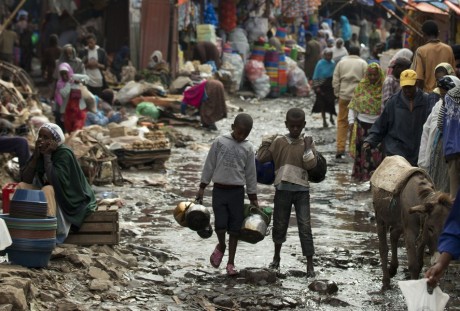
http://www.forbes.com/pictures/mef45jgim/10-saddest-ethiopia/
Copyright © Oromianeconomist 2013 and Oromia Quarterly 1997-2013. All rights reserved. Disclaimer.
Related articles
- The biggest challenges facing Africa have little to do with religion, per se, and less with global terrorism.http://www.foreignpolicy.com/articles/2013/10/02/demography_is_destiny_africa_al_shabab#.Uk3ZTTT2_xA.twitter …
- “Re-Branding Africa” and “Africa Rising”: Whose #Africa? Whose Rise? http://aconerlycoleman.wordpress.com/2013/10/03/re-branding-africa-and-africa-rising-whose-africa-whose-rise/
- Africa is not rising, survey shows that ”the boom” only benefits a narrow elite http://www.theguardian.com/world/2013/oct/02/africa-not-rising-survey?CMP=twt_gu
- A skeptical perspective on African development (marginalrevolution.com)
-
http://transitions.foreignpolicy.com/posts/2013/09/30/the_african_statistics_smackdown_continued
The Economics of Good and Evil December 30, 2012
Posted by OromianEconomist in Uncategorized.Tags: Demand and Supply, Economic goods, Ethics and Economics, Fiscal and monetary Policy, Fiscal cliff
add a comment
The Political Functions of Land grabbing policies of successive regimes of Ethiopia December 9, 2012
Posted by OromianEconomist in Uncategorized.Tags: Development aid, Human rights, Land grabbing, Non-governmental organization, Oromia Region, Tigrayan People's Liberation Front, TPLF
add a comment
“Land grabbing is the major source of military, political, and economic powers of successive regimes of Ethiopia. Each regime distinctively designed land governance system to maintain colonial ownership of land of peoples of Oromia and Southern Ethiopia. After incorporation of South Ethiopia into the Abyssinian (North Ethiopia) empire at end of 19th century the relationship between the Southern and Northern is characterized by inequality, exploitation, and resource extraction by collection of tributes and taxes, and slave and ivory trades (Dereje, 2006 and Donham, 2002). Gebar land tenure system in the South Ethiopia as well as the Rist tenure system of North show some esemblance to the current land tenure system and with some reservations also resemble that of the military regime, with the exceptions that the communal Rist system is replaced by the organs of state, i.e. the peasant associations (Crewett et al. 2008). Power of domestic colonial politics is highly centralized with absolute land ownership right of governance core of Abyssinia to sustain rule of dictatorship through chains of colonial agents at regional, provincial, and local levels. Government of Ethiopia (the TPLF regime) is the owner of land, but the rights of individuals and communities are ‘holding (use) rights’ (Proclamation No. 456/200550). Though ethnic equality is now legally recognized, in practice, emergent regions are still politically marginalized and permitted less autonomy, partly due to the federal development strategy, which requires central control of local land resources and changes in livelihoods (Lavers, 2011). Centralization of Abyssinian land governance politics is manifested by five levels of land use rights: (1) owner-ship, (2) management, (3) sanction, (4) full accessibility right, & (4) limited accessibility right (Table7). Land tenure politics of both imperial and military or TPLF regimes are generally sharing similar political goal, i.e. manipulation of land use rights to maintain monopoly of governance powers. The commercialization of land has served as a political advantage for the state, because it enhances greater concentration of authority in the hands of the governors. A woreda (district) or an urban administration shall have the power to expropriate rural or urban landholdings for public purpose where it believes that it should be used for a better development project to be carried out by public entities, private investors, cooperative societies or other organs, or where such expropriation is decided by the appropriate higher regional or federal government organ for the same purpose (Proclamation No. 455/200558). The TPLF regime is intentionally violating the land accessibility right of rural communities of Oromia and Southern Ethiopia to achieve political goals of suppressing national struggle of colonized peoples. The regime has already institutionalized practices of human right violations through manipulation of constitution. It formulated politically motivated proclamations (1) to limit humanitarian activities of NGOs using charities proclamation and (2) to crash political opponents through manipulation of anti-terrorism law in order to protect its monopolistic ownership of military, political, and economic powers (Mulataa, 2010b). The regime is not hesitated to practice arbitrary arrest, long detention, or extrajudicial killings of tens of thousands, and torturing peoples suspected to be supporters of opposition political organizations to sustain fears in civil societies. As society becomes more fearful, many individuals yearn for the safety and order promised by strong, controlling regime: and that the fears create conditions under which such regime gains control (Alan Hall, 2010). The regime is systematically advancing level of insecurity by aggravating poverty, expanding borders of food insecurity, manipulating conflicts, degrading safety of ecosystem, and advancing violation of human rights in order to produce the poorest of poor peoples. Thus it can easily use victims of poverty as political animal through manipulation of land use right. The regime easily regulates rural communities’ support of opposition political parties by threatening subsistence livelihoods of about 75% of 85 million populations. Therefore the rural communities are directly controlled by the regime and they cannot be free in any means to vote opposition political parties during election. They will loss land use right, if they vote for opposition.
Power of the regime is frequently dependant of external aids. During 1974 – 1991 financial, material, & technical supports of the international donor communities were channeled through political NGOs of the TPLF to areas under its control to support both military and emergency programs (Mulataa, 2010a). The aids were resulted in increase of peasant-based supports, legitimacy expansion among the civilian population, use of aid resources to support organizational structures, and quantitative capability in feeding the armies (URD, 2002). The regime received very huge sum of financial aids since 1991. It has received a sum of US $ 26 billion in development aid as of 2009 (Helen, 2010). Ethiopians remained in the most wretched poverty, despite decades of development policies (The Economist, 2007). The regime is manipulating foreign military and development aids as instrument to suppress peaceful transfer of political power since1991 through marginalization of opposition political parties. The government of Ethiopia used donor-supported programs, salaries, and training opportunities as political weapons to control the population, punish dissent, and undermine political opponents—both real and perceived, that the local officials deny these people (i.e. supporters of opposition parties) to access seeds and fertilizer, agricultural land, credit, food aid, and other resources for development (HRW, 2010). Policies of aggravating poverty through destruction of livelihood of rural communities are systematically implemented by the TPLF regime to sustain political manipulation of aids, because either emergency or development aids are political instrument of the regime to enforce political support. Increasing level of poverty is tactically increasing enforcement of peoples electing the regime. The regime is frequently manipulating food aid distribution to crash supporters of political opponents. It uses food aids as an instrument to achieve political objectives and to protect its governance powers. Land grabbing policy of the regime is systematically intended to increase size of people dependant on food aids in order to secure political support. For example: “Despite being surrounded by other communities which are well fed, a village with a population of about 1700 adults is starving. We were told that in the two weeks prior to our team’s arrival 5 adults and 10 children had died. Lying on the floor, too exhausted to stand, and flanked by her three-year-old son whose stomach is bloated by malnutrition, one woman described how her family had not eaten for four days. Another three-year-old boy lay in his grandmother’s lap, listless and barely moving as he stared into space. The grandmother said, we are just waiting on the crop, if we have one meal a day we will survive until the harvest, beyond that there is no hope for us (BBC, 2011).” The message is clear and simple. It increases climate of insecurity and fear in society that for who depend on food aids they must support the ruling party in order to survive from a threat of systematic assassination. Therefore political loyalty to the state and the ruling party (the TPLF regime) governs the very existence of rural communities of Ethiopia.” Malkamuu Jaatee and Zakaariyaas Mulataa
A final review of land grabbing policies of successive regimes of Ethiopia
Ethiopia: Left to Starve – Zenawi’s Reign of Terror
http://http://www.youtube.com/watch?v=mDD48Wvemw0
http://www.guardian.co.uk/global-development/2013/feb/07/india-investors-forcing-ethiopians-off-land
Related Articles
- UN: ‘Land Grab’ Deals Hurt Local Farmers (ethioinfo.wordpress.com)
- No land grabbing by Indian firms in Africa: Centre (thehindu.com)
- Indian investors are forcing Ethiopians off their land (guardian.co.uk)
- How Ethiopians are being pushed off their land (thehindu.com)
- A Mafia Paradise – the Ethiopian Empire (odaakoo.wordpress.com)
- TPLF’s Hidden Support to Al-Shabab Exposed (ethioandinet.wordpress.com)
- Top 8 Reasons for Ethiopia’s Poverty (freedom4ethiopian.wordpress.com)
- The Never Ending Brutality Dictatorship and Lawless Regime of Ethiopia (ethioinfo.wordpress.com)
- No land grabbing by Indian firms in Africa: Centre (thehindu.com)
- Indian investors are forcing Ethiopians off their land (guardian.co.uk)
- How Ethiopians are being pushed off their land (thehindu.com)
- A Mafia Paradise – the Ethiopian Empire (odaakoo.wordpress.com)
- TPLF’s Hidden Support to Al-Shabab Exposed (ethioandinet.wordpress.com)
- Top 8 Reasons for Ethiopia’s Poverty (freedom4ethiopian.wordpress.com)
Copyright © Oromianeconomist 2012 and Oromia Quarterly 1997-2012. All rights reserved. Disclaimer.
Related articles
- No land grabbing by Indian firms in Africa: Centre (thehindu.com)
- Indian investors are forcing Ethiopians off their land (guardian.co.uk)
- How Ethiopians are being pushed off their land (thehindu.com)
- A Mafia Paradise – the Ethiopian Empire (odaakoo.wordpress.com)
- TPLF’s Hidden Support to Al-Shabab Exposed (ethioandinet.wordpress.com)
- Top 8 Reasons for Ethiopia’s Poverty (freedom4ethiopian.wordpress.com)
Corruption is set to become one of the defining political issues of the 21st century November 13, 2012
Posted by OromianEconomist in Uncategorized.Tags: illegal loggers, Political corruption, Rent-seeking, Transparency International
1 comment so far

The Corruption Pandemic
Corruption has played a pivotal role in determining the current state of the world – from mass poverty in developing countries, to the destruction of natural resources and to the erosion of trust in political parties. Laurence Cockcroft here argues that corruption has to be seen as the result of the interplay between elite ’embedded networks’, greed and organised crime. He shows how the growth of corruption has been facilitated by globalization, the integration of new and expanding markets into the world economy, and by the rapid expansion of ‘offshore’ financial facilities. These facilities provide a home to largely unregulated pools of finance derived from personal fortunes, organised crime and pricing malpractice in international trade. By identifying the main drivers of corruption world-wide and analyzing the current action to control them, this study suggests ways in which the problems caused by corruption can be addressed and ultimately prevented.
“Laurence Cockcroft is worried about global warming. Yes, like many of us, he’s concerned about the implications of rising temperatures. But he’s also aware of another danger that most people have probably overlooked — namely, the link between climate change and corruption. So what could these two things possibly have to do with each other? A lot, it turns out. As Cockcroft points out, many forms of environmental destruction are against the law in the places where they happen, but the perpetrators — illegal loggers, say, in countries like Brazil, Indonesia, or the Congo — often resort to corruption to evade the law.But there’s an even more interesting angle, too. Some of the mechanisms that the international community has put in place to tackle climate change, Cockcroft says, are potentially vulnerable to abuse. Carbon trading has proven notoriously susceptible to fraud. Rich countries are already committing hundreds of billions of dollars to funds that are supposed to compensate poorer nations for the cost of adapting to global warming.The amounts involved, Cockcroft warns, are potentially bigger than all the money currently spent on development aid. So that makes them a tempting target for graft — especially when you consider how much of the money spent on aid projects in the past has been lost to corruption. “If corruption undermines those funds the way it has undermined a lot of aid programs,” he says, “it could prove a big obstacle to restricting temperature rises to less than two degrees before 2050.” One could easily dismiss Cockcroft as just another single-issue advocate cultivating a pet obsession. But I think that would be a big mistake. I believe that he’s entirely right to argue that corruption has become a systemic disease that undermines governance around the world, and that it can cripple the ability of states to function if left unchecked.” Christian Caryl:
http://www.foreignpolicy.com/articles/2012/11/08/the_corruption_pandemic
ethiopia-reflecting-on-corruption-in-ethiopia
rent-seeking-behaviour-of-the-ethiopian-rulers.pdf
Illicit Financial Flows: A Constraint on Poverty Reduction in Africa
Africa Lost 1.6 Trillion in Capital Flight and Odious Debt Over Forty Years
The billion-dollar question: Where is Angola’s oil money?
http://www.huffingtonpost.com/raymond-baker/illicit-financial-flows_b_2427495.html?utm_hp_ref=tw
http://www.aljazeera.com/programmes/africainvestigates/2011/11/20111123131914242861.html
Copyright © Oromianeconomist 2012 and Oromia Quarterly 1997-2012. All rights reserved. Disclaimer.
Related articles
Land grabbing deals in Africa have led to a wild west and intensified food insecurity October 29, 2012
Posted by OromianEconomist in Uncategorized.Tags: Africa, Ban Ki-moon, Committee on World Food Security, FAO, Food and Agriculture Organization, José Graziano da Silva, Olivier De Schutter, Silva
add a comment
Land deals in Africa have led to a wild west that undermined food security – bring on the sheriff, says FAO
“True grit … FAO director general José Graziano da Silva wants major land acquisitions curbed to protect the poor. Amid warnings that land deals are undermining food security, the head of the UN’s Food and Agriculture Organisation (FAO) has compared “land grabs” in Africa to the “wild west”, saying a “sheriff” is needed to restore the rule of law. José Graziano da Silva, conceded it was not possible to stop large investors buying land, but said deals in poor countries needed to be brought under control.” The Guardian
Large land deals have accelerated since the surge in food prices in 2007-08, prompting companies and sovereign wealth funds to take steps to guarantee food supplies. But, four to five years on, in Africa only 10-15% of land is actually being developed, claimed Graziano da Silva. Some of these investments have involved the loss of jobs, as labour intensive farming is replaced by mechanised farming or some degree of loss of tenure rights.
Oxfam said the global land rush is out of control and urged the World Bank to freeze its investments in large-scale land acquisitions to send a strong signal to global investors to stop.“In some areas of Africa – Mozambique and South Africa – there is scope for large farms, but this approach is only valid for some grains, where the entire cycle is mechanical,” he said. “But this is not suitable for fruits, vegetables or many other local products. Cassava has nothing to do with mechanized agriculture and efficiency does not mean big scale. It’s the way you combine crops, the use of water you have available. In Africa today, efficiency means better seeds rather than big tractors. The two models have been there forever in agriculture. Sometimes big-scale will provide exports, but local markets are based on small-scale agriculture.”
Graziano da Silva, who was in charge of Brazil’s widely praised “zero hunger” programme, expressed his frustration at the slow pace of creating a global governance structure to deal with land grabs, food security and similar problems. In 2008, the UN secretary general, Ban Ki-moon, created a high-level task force on food security on which Graziano Da Silva serves as vice-chairman.
In May, the committee on world food security (CFS), a UN-led group that includes governments, business and civil society, laid the groundwork for a governance structure for food by endorsing voluntary guidelines on the responsible governance of tenure of land, fisheries and forests.
Tenure has important implications for development, as it is difficult for poor and vulnerable people to overcome hunger and poverty when they have limited and insecure rights to land and other natural resources. But the guidelines took years to negotiate and lack an effective enforcement mechanism because they are voluntary. The CFS is an unwieldy group but has the virtue of inclusivity.
“It took two years to discuss the voluntary guidelines and now we face another two years of negotiations on the principles for responsible agricultural investments,” said Graziano da Silva. “We need to speed up the decison-making process without losing the inclusivity model.”
The FAO director general said he is doing his best to bring about more co-ordination among the different institutions concerned with food security and suggests the FAO act like an executive arm of the CFS, trying to implement its decisions.
Others share his frustrations. Olivier De Schutter, the UN special rapporteur on the right to food, acknowledges the importance of the CFS voluntary guidelines, but points out the lack of an effective enforcement mechanism. He argues that governments in sub-Sahran Africa or south-east Asia with poor governance, or tainted by corruption, will continue to seek to attract investors at all costs.
“The international community should accept it has a role in monitoring whether the rights of land users, as stipulated in the guidelines, are effectively respected,” De Schutter told the Guardian. “Since there is no ‘sheriff’ at global level to achieve this, at the very least, the home states of investors should exercise due diligence in ensuring that private investors over which they can exercise control fully respect the rights of land users. Export credit agencies, for example, should make their support conditional upon full compliance with the guidelines, and in the future, the rights of investors under investment treaties made conditional upon the investors acting in accordance with the guidelines.”
For Graziano da Silva, the key is the implementation of the voluntary guidelines at country level; he is encouraged by growing public interest and awareness of the issue. He points to Uruguay as an example of a government prepared to stand up to international land investors – “perhaps the best sheriff” on land deals.
“They have very good laws on land acquisitions,” he said, but acknowledged that most countries where land grabbing takes place have little consultation with farmer organisations or have weak or repressive governments.
As for the perennial debate on the respective merits of large and small-scale farming, the FAO boss said Africa had room for both, adding that Brazil had managed it.
http://www.guardian.co.uk/global-development/2012/oct/29/land-deals-africa-wild-west-fao
Related articles and videos
Why poverty:The great land rush in Mali
- FAO, Germany, ECOWAS launch hunger-free initiative for West Africa (ghanabusinessnews.com)
- Land deals in Africa have led to a wild west – bring on the sheriff, says FAO (guardian.co.uk)
- Land deals in Africa have led to a wild west – bring on the sheriff, says FAO (bfreenews.com)
- FAO wants strong global food security governance (ghanabusinessnews.com)
- Cooperatives Cushion the Blows of Hunger (ipsnews.net)
- Global recession halts decades of steady progress in reducing world hunger (independent.co.uk)
- Zero hunger challenge: Is it attainable? (rappler.com)
- High food prices top UN agenda on World Food Day (sfluxe.com)
- Ghana improves food security with prudent agric policies (ghanabusinessnews.com)
- High food prices top UN agenda on World Food Day (rappler.com)
- http://www.oxfam.org/en/grow/pressroom/pressrelease/2013-02-07/poorly-governed-countries-targeted-land-investors
Copyright © Oromianeconomist 2012 and Oromia Quarterly 1997-2012. All rights reserved. Disclaimer.
Ethiopia in the Extreme Food Security Risk Index – Map October 22, 2012
Posted by OromianEconomist in Uncategorized.Tags: Africa, Famine, Food security, Sub-Saharan Africa
add a comment
The food security risk index – map
‘The index has been developed by the risk analysis company Maplecroft for governments, NGOs and business to use as a barometer to identify those countries which may be susceptible to famine and societal unrest stemming from food shortages and price fluctuations. This map shows the results of evaluating the availability, access and stability of food supplies in 197 countries, as well as the nutritional and health status of populations,’ The guardian.
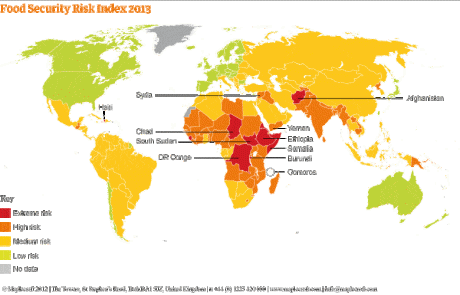
http://www.guardian.co.uk/global-development/graphic/2012/oct/10/food-security-risk-index-map
As Africa is clearly the most afflicted, with six (Ethiopia, Somalia, S.Sudan, Congo, Chad and Eritrea) of the seven states at “extreme risk.” Afghanistan was the only country outside of Africa at extreme risk , Maplecroft inside report. According to FAO’s study, out of Ethiopia’s total Population of 84.7 million the number of undernourished persons are 34.0 million, and prevalence of undernourishment is 40 %.
Related articles
- Africa facing intensified ‘food crisis’ (aljazeera.com)
- Global Food Crisis Risk Is Soaring (beyond2012zeitgeist.com)
- Global Food Crisis Risk Is Soaring (conservativeread.com)
- Corporate giants reap billions from hunger (climateandcapitalism.com)
- Global Food Crisis Risk Is Soaring [MAP] (businessinsider.com)
- Global Food Crisis Risk Is Soaring (fromthetrenchesworldreport.com)
Copyright © Oromianeconomist 2012 and Oromia Quarterly 1997-2012. All rights reserved. Disclaimer.
Development without Big Dams: Grass Roots Solutions on Water and Environment October 13, 2012
Posted by OromianEconomist in Uncategorized.Tags: Africa, Asia, Developing country, Irrigation, Meredith Giordano, Oromia Region, Pump, Water crisis
add a comment
Small is both beautiful and productive
‘Mega-dams and massive government-run irrigation projects are not the key to meeting world’s water needs, a growing number of experts now say. For developing nations, the answer may lie in small-scale measures such as inexpensive water pumps and other readily available equipment. How will the world find the water to feed a growing population in an era of droughts and water shortages? A growing number of water experts are saying, is to forget big government-run irrigation projects with their mega-dams, giant canals, and often corrupt and indolent management. Farmers across the poor world, they say, are solving their water problems far more effectively with cheap Chinese-made pumps and other low-tech and off-the-shelf equipment. Researchers are concluding that small is both beautiful and productive.’ “Cheap pumps and new ways of powering them are transforming farming and boosting income all over Africa and Asia,” Meredith Giordano, lead author of a three-year research project.
http://www.eurekalert.org/pub_releases/2012-08/bc-fis081612.php
Related articles
- Beyond big dams: Turning to grass roots solutions on water (energybulletin.net)
Copyright © Oromianeconomist 2012 and Oromia Quarterly 1997-2012. All rights reserved. Disclaimer.
How an Economy Grows and Why It Doesn’t October 9, 2012
Posted by OromianEconomist in Uncategorized.Tags: Applied economics, Economic and Social Freedom, Economic developm ent, economics
add a comment
Copyright © Oromianeconomist 2012 and Oromia Quarterly 1997-2012. All rights reserved. Disclaimer.
Gadaa Oromo Democracy: Three Approaches to the Study of African Society September 27, 2012
Posted by OromianEconomist in Africa, Ancient African Direct Democracy, Culture, Finfinnee, Gadaa System, Humanity and Social Civilization, Irreecha, Kemetic Ancient African Culture, Oromo, Oromo Culture, Oromo First, Oromo Identity, Oromo Nation, Oromo Social System, Oromummaa, Self determination, Sirna Gadaa, State of Oromia, The Oromo Democratic system, The Oromo Governance System, Uncategorized.Tags: Africa, African culture, African Studies, Ancient African Direct Democracy, Ancient Black People, Ancient Egyptian people, Democracy, Economic and Social Freedom, From, Gadaa System, Governance issues, Horn of Africa, Kemet, Kushitic people, National Self Determination, Oromia, Oromiyaa, Oromo, Oromo culture, Oromo people, Oromummaa, Politics, Siqqee, Siqqee Oromo Women Institution, Sirna Gadaa, Social Sciences, State and Development, Sub-Saharan Africa, United Nations, Universal Declaration of Human Rights, World Bank
3 comments
These closely related books reveal the many creative solutions an African society found for problems that people encounter when they try to establish a democratic system of governing their affairs. In much of what has been written about Africa, the common image is that of people governed by primitive customs and practices, in which only feudal roles of elders, kings, chiefs, sultans, and emirs have been acknowledged by Western observers. Little is ever shown of indigenous African democratic systems, under which there is distribution of authority and responsibility across various strata of society, and where warriors are subordinated to deliberative assemblies, customary laws are revised periodically by a national convention, and elected leaders are limited to a single eight-year terms of office and subjected to public review in the middle of their term. All these ideals and more are enshrined in the five-century old constitution of the Oromo of Ethiopia, which is the subject matter of these books.
In these books, Legesse brings into sharp focus the polycephalous or “multi-headed” system of government of the Oromo, which is based on clearly defined division of labor and checks and balances between different institutions. Revealing the inherent dynamism and sophistication of this indigenous African political system, Legasse also shows in clear and lucid language that the system has had a long and distinguished history, during which the institutions changed by deliberate legislation, and evolved and adapted with time.’ Amazon Books &
Related articles
Introduction
http://oromopress.blogspot.co.uk/2011/12/review-of-oromo-democracy-indigenous.html?m=1
http://www.readperiodicals.com/201203/2672718591.html
- Gadaa: An Oromo Democracy and the Symbol of Oromo Civilization (odaakoo.wordpress.com)
- Contours of the Emergent & Ancient Oromo Nation (oromianeconomist.wordpress.com)
- http://www.iwmi.cgiar.org/publications/CABI_Publications/CA_CABI_Series/Community_Law/protected/Ch%2009.pdf
- Oromia of Dhaqabo Ebba: The Cradle of Mankind Is Also A Home of The Oldest Living person On Earth (oromianeconomist.wordpress.com)
Copyright © Oromianeconomist 2012 and Oromia Quarterly 1997-2012. All rights reserved. Disclaimer.
CONTOURS OF THE EMERGENT & ANCIENT OROMO NATION September 25, 2012
Posted by OromianEconomist in Uncategorized.Tags: African Studies, Ancient time, Berlin Conference, Civilization, Democratic African institution, Democratisation, Developing country, Economic growth, economics, Freedom, Gadaa System, Governance issues, Land grabs in Africa, New Africa, Old Egypt, Oromia, Oromia Region, Oromo people, Oromummaa, Parliament, Social Sciences, State and Development, Tokkummaa Oromo, Universal Declaration of Human Rights
3 comments

This book is an important contribution to the study of identity politics, a subject hotly contested by many Africanists. Bulcha’s discussion the state-centered bias in the much of academic work on Ethiopia and its denial of the history and pre-colonial autonomy of indigenous non-Abyssinian peoples aught to lead to some serious debate. (Kajsa Ekholm Friedman, Professor Emeritus, Lund University, Sweden).
This work by Mekuria Bulcha is the most comprehensive and innovative work on the Oromo of Ethiopia ever to be written. Identity politics, he argues can be a positive challenge to the development of the state. As it has been the case of Southern Sudan states can also evolve, disappear and change. This work outlines the history, the traditions and politics of the Oromo people summarized and critically assessing all scholarly work done previously. It will remain a seminal work for scholars of Africa and the Oromo for many years to come. It is master peace and sets new challenge for all of us researching on the Oromo nation and people. (Mario I. Aguilar, Professor, Chair of Religion and Politics & Director of the Center for the Study of Religion and Politics (CSRP), University of St. Andrew, Scotland, UK).
Based on empirical evidence and relevant theories of nationalism Bulcha convincingly argues that the pre-colonial Oromo were a pre-modern nation. He revisits the representation of the Oromo identity in Ethiopian history and proposes the innovative and stimulating thesis that the 16th century Oromo ‘invasion’ of the Ethiopian highlands was the result of a conscious effort to regain control of a territory that was lost and contended since the 14th century Abyssinian expansion into the region. Mekuria Bulcha’s presentation of new evidence of the Oromo resistance to the 19th century conquest, his description of the international appeals by the Oromo elite in the colonial phase, his analysis of the activities of the Oromo social movements for the cultural and linguistic rights in the 1960s, and his account of the history of rebellion and armed struggle from the 60s, up to the current ethnic federalism are likely to make this book a classic reference for the studies on ethno-nationalism. (Marco Bassi, Ph.D. Research Associate, African Centre, University of Oxford, UK).
In his important and interesting discussions on the Gadaa System Mekurian Bulcha argues that:
The Oromo People created Gadaa, and Gadaa created the Oromo nation (Legesse, 2000 as quoted in Bulcha 2012)
The Gadaa system is the matrix of the Oromo culture and society: in the past it stood for several related ideas and practices encompassing cultural, political, economic and religious elements. Many of the basic elements of traditional Oromo culture that are anchored in the Gadaa system have withstood the exigencies of time and still today influence the values, attitudes, and social practices of Oromo people irrespective of, region, religion and social class. Oromo worldview and way of life was shaped by Gadaa system (Bulcha,, 2012 & Legesse, 2006).
The unity of the Oromos that is crystallized in the Gadaa culture is not a nostalgic memory of a glorious past or illusory of vision of the future paradise. Gadaa is a reality embedded in the Oromo psyche that constitutes what is to be Oromo as an individual and as a nation. Gadaa underpins the cohesive or corporate Oromo history that scholars who have not studied the Oromo fail to recognize (Gebissa, 2008).
The most important organ of the Gadaa system is the federal assembly known as Gumii Gayoo in Borana and Caffee in other places. These assemblies were very large and attended by councillors called hayyuu, drawn from different sections of the society. These assemblies made laws which defined the essence of Oromo democracy. In short, the specificity and similarity of the myriads of norms, rituals and political practices around which it was organized throughout the Oromo country make Gadaa a unique pan- Oromo institution of great historical depth (Bulcha, 2012, Legesse, 2000).
http://www.casas.co.za/Publications.aspx?PID=316
Copyright © Oromianeconomist 2012 and Oromia Quarterly 1997-2012. All rights reserved. Disclaimer.
Cognitive Democracy May 27, 2012
Posted by OromianEconomist in Uncategorized.Tags: Africa, Democracy, Environment, Gadaa, Oromia Region, Oromo people, Politics
add a comment
“Some of the problems that we face in politics are simple ones (not in the sense that solutions are easy, but in the sense that they are simple to analyze). However, the most vexing problems are usually ones without any very obvious solutions. How do we change legal rules and social norms in order to mitigate the problems of global warming? How do we regulate financial markets so as to minimize the risk of new crises emerging, and limit the harm of those that happen? How do we best encourage the spread of human rights internationally?”
“Specifically, we argue that democracy has unique benefits as a form of collective problem solving in that it potentially allows people with highly diverse perspectives to come together in order collectively to solve problems. Democracy can do this better than either markets and hierarchies, because it brings these diverse perceptions into direct contact with each other, allowing forms of learning that are unlikely either through the price mechanism of markets or the hierarchical arrangements of bureaucracy. Furthermore, democracy can, by experimenting, take advantage of novel forms of collective cognition that are facilitated by new media.”
It is interesting to engage in such analysis as this topic directly and indirectly details the role s of democratic institutions such as the Gadaa system of the Oromo can play to advance society.
To read in detail on this topic: Democracy
Copyright © Oromianeconomist 2012 and Oromia Quarterly 1997-2012. All rights reserved. Disclaimer.
Related articles
- H.L. Mencken on elections, politics, government (aei-ideas.org)
- Gadaa: An Oromo Democracy and the Symbol of Oromo Civilization (odaakoo.wordpress.com)
- Gadaa Oromo Democracy: Three Approaches to Study African Society (oromianeconomist.wordpress.com)
In the Global Land Rush the Great Food Robbery Targets Africa May 25, 2012
Posted by OromianEconomist in Uncategorized.Tags: Africa, Agriculture, Green Revolution, Oromia
add a comment


‘Biodiversity can only exist through the small farmers, indigenous people, and pastoralists who maintain that biodiversity. So what threatens them threatens biodiversity. The corporate food system is about taking food production out of their hands. With the structural adjustment programs in the 1980s and 1990s Africa was pushed to move towards export agriculture and “Green Revolution” style projects. Some moved ahead, many of them failed. Now, because of the rise in prices of agricultural commodities, corporations are trying to restructure food systems around the world to move commodities around more, and take more profit. Africa is increasingly being targeted as a centre of production for global markets. The talk now is that Africa is one of the last frontiers because much of Africa is not under the model of export production. Land and water are still in the hands of local communities. So there’s a big push to industrialize agriculture for export. Unfortunately, African governments are colluding with corporations who want to pursue agribusiness in their countries, with the help of the World Bank and bilateral and multilateral donors. …In Ethiopia, you have a government that has stated its policy is to go from 80 percent rural population to 20 percent rural population. Who can imagine what all those people are going to do? What’s the plan there? What jobs are they going to have? You can’t say that this is about people in Africa choosing to move to cities. People are being forced out of their lands through mining projects, land acquisitions, and overall bad policies…So much is at stake in Africa. Whole territories are being targeted and affected by land grabbing. And this time the governments are major conduits for it. How are people going to react? In Ethiopia, where the whole southern part of the country is being handed over, earlier this month you had gunmen attack a farm of Saudi Arabian operations and five people died. It’s heating up. It’s very explosive. Africa is under greater pressure than it’s ever been, at least since colonial times.’
Interview with Devlin Kuyek by Molly Kane http://www.pambazuka.org/en/category/features/82375
http://video.pbs.org/video/2203388630
“…Here’s the truth: we’re never going to end hunger in Africa without upholding the rights of smallholder women farmers who feed the continent and care for its ecosystems.” http://www.nationofchange.org/dont-put-monsanto-charge-ending-hunger-africa-1338125745
“The Ethiopian government, through the Agricultural Investment Support Directorate is at the forefront of this African Land Sale. Crops familiar to the area are often grown, such as maize, sesame, sorghum, in addition to wheat and rice. All let us state clearly, for export to Saudi Arabia, India, China etc, to be sold within the home market, benefitting the people of Ethiopia not.” http://ayyaantuu.com/horn-of-africa-news/ethiopia/the-ethiopian-land-giveaway-oped/#more-7083
“Squeezing Africa dry: behind every land grab is a water grab“
‘Food cannot be grown without water. In Africa, one in three people endure water scarcity and climate change will make things worse. Building on Africa’s highly sophisticated indigenous water management systems could help resolve this growing crisis, but these very systems are being destroyed by large-scale land grabs amidst claimsthat Africa’s water is abundant, under-utilised and ready to be harnessed for export-oriented agriculture. GRAIN looks behind the current scramble for land in Africa to reveal a global struggle for what is increasingly seen as a commodity more precious than gold or oil – water.’
Copyright ©Oromianeconomist 2012 and Oromia Quarterly 1997-2012. All rights reserved. Disclaimer.
Related articles
- Land Grab in Africa Threatens Food Security (voanews.com)
- Land deals in Africa have led to a wild west – bring on the sheriff, says FAO (guardian.co.uk)
- Land deals in Africa have led to a wild west – bring on the sheriff, says FAO (oddonion.com)
Ethiopia: The Last Two Frontiers May 3, 2012
Posted by OromianEconomist in Uncategorized.Tags: Africa, Developing country, Economic, Economic and Social Freedom, Economic development, Ethiopia, Gadaa System, https://oromianeconomist.wordpress.com/wp-admin/post-new.php#, Oromia, Oromo people, Social Sciences, World Bank
add a comment

ISBN-10: 1847010334 | ISBN-13: 978-1847010339
Resources and Conflicts September 12, 2011
Posted by OromianEconomist in Uncategorized.add a comment
Tokkummaa, Oromummaa fi Bilisummaa August 17, 2011
Posted by OromianEconomist in Uncategorized.4 comments
Tokkummaa Oromummaa Bilisummaa
Ummati Oromoo akka saba tokkootti sirna gadaa jalati of ijaaree waggooti dhibba baayyeef diinoota isaa of irraa dhowwee walabummaan jiraachaa ture. Yeero sana Oromiyaa akka biyaatti ijare. Oromiyaan kan dhalate sirna poolitikaa gadaa jalatti ture. Booda yeero sirni gadaa iddo bayyeetti caacabuun, iddo tokko tokkotti sirni mootii dhalate humni pololitikaa Oromoo laafuu …caalqabe. Keessumaa jaaraa kudha sagal keessa sirni mootii Oromiyaa keessaa iddo bayyeeti biqilan sirna gadaa baayyee laffisan. Jaarraa kudha sagal keessa sirni Kaappitaalismii Awurooppaa irraa gara Afrikaatti babalacha ture. Kun Habashootaaf caaraa isaan duraan qabaachaa hin turre kenneef.
Habashooti waggoota dheeraaf humna Oromoo dura dhaabbachuu hin dandeenye qawee, loltootaa fi gorsa faranji irraa argataniin Oromoo dura dhabbatan. Matootii gosaa fi qondaalota Oromoo kan akka Gobanaa Daanciifaa malaan ofitti qabatan. Akka kanaan gara waggaa shantamaa olii Oromoo irratti duulani, Oromiyaa cabsanii biyya Abisiiniyaa kan booda Ethiopia jedhanitti dabalatan. Waggoota shantamman kana keessa Oromoonni miliyoona shanii ol akka dhumaan seenaatu ragaa baha.
Oromiyaa , biyaa Oromoo, diigani bakka baayyeetti qoodanii maqaa adda addaa keenaniif. Shawaa, Haraghee, Wallo, Wallagga, Sidamoo, Arsii, Ilu Abbaboor, Kafaa xaqlaayi gizaati kan jedhuu fi kkf jedhanii moggaasan. Oromoota kaan immoo Gojjaamii fi Tigraayitti kutan. Seenaa, aadaa fi Afaan Oromoo baleessanii ummata tokko iddo adda adaatti hiranii wal lolchiisuu wal jibbisiisuu imaammata godhatan. Har’a illee Oromooti imaammata Habashootaa kanan afaan faajja’an baayyeetu jiru. Yaadaa fi ilaalcha hamaa akkasii amma Oromummaa fi sab-bonummaan bishaatee ijja goodhatutti guutummaatti ballessuun hin salphatu.
Oromooti iddo baayyeeti sirna Habashootaa didanii fincilaa turan. Lolli Rayyaa fi Azabo, Afran Qalloo, Shaggar, Baalee f Arsii, Sibuu, Guduru fi kan biraa fakeenya fudhachuutu danda’ama. Keessumaa lolli Baalee bara jaatamoota keessa turee fi dhalachuun Waldaa Macaa-Tuulama biqiluu sab-bonummaa Oromoof gudina Oromummaaf kara saaqaan. Waldaan Muuziqaa Arfaan Qal’oo kan Dirree Dadhawaatti baruma jaatamoota keessa dhalate gabbina Oromummaaf sab-bonummaf qooda guudda gumaachan. Sochii bara baayyeef iddo adda adaatti deemaa turetu bara torbaatamoota keessa dhalchuu Addi Bilisummaa Oromoof haala aanjesse. Addi Bilisummaa Oromoos karaa ykn boochoo Oromummaaf sab-bonummaan ittiin guddatu babalise.
Egaa warra seenaa kana hin beekne, warra Oromummaa fi sabbonummaa hin qabne dha kan Adda Bilisummaa Oromoo jibbu. Olola hamaa halkanfii fi guyyaa irratti oofu. Jaarmootiin politikaa Oromoo walaba ta’an , kan tokko irraa hafe, hundinuu ABO keessaa bahan. Oromummaa, sab-bonumma fi tokkummaa Oromoo cimsuuf jaarmootiin Oromoo agoobara ULFO jedhamu jalatti of ijaranii jiru. Garuu, jabina isaanii hojiin mul’isuu hin dandeenye. Kanaaf ABOs ana malee isa jedhu dhiisee, jaarmooti Oromoo biraas ABO jibbuu fi abaruu dhiisanii tokkummaa Oromoo jabeessuun diinoota irratti babba’uun dirqama ta’a. Jaarmayaa tokko qofa qabaachuun akkuma abbaa irree (dictatorship) baballisuu danda’u, jaarmootii baayyee qabaachun tokkummaa Oromoo laaffisuu danda’a. Oromoo hunduu kana baree politikaa keenya madala (balance), haqaa, walqixxummaaf dimookrasii irratti ijaruu qabna. Oromummaa, sab-bonummaa, tokkumma fi dimokrasiin hundee poolitika Oromoo ta’uu qaba. Bilisummaan daandi kanaan malee hin dhufu.
Oromummaan Maal?
Oromummaan akka ilaalcha seenaa, aadaa, poolitikaa fi sab-bonummaa Oromootti daandi bilisummaa saaqa. Daandiin bilisummaa kun wanta Oromoon marti wal wajiin qaban irratti ijarama. Oromummaan akka ilaalcha sab-boonummaatti Oromoo humna poolitika taasisuun bilisummaa namummaa (human liberation) goonfachiisuu danad’a jedhamee amanama. Akkasumas akka ummati Oromoo waayee ofi baratee, ummatoota biraa wajjin of madaalee, wanta irra hir’ate guuttatee mirga isaaf garaa guutuun lolatu isa kakaasa.
Oromummaan seenaa, aadaa fi kara bilisumaa Oromoo ti. Kanaafuu seenaa Oromoo isa diinni awwaale mul’isuun, aadaa isaa tuffatame deebisee ijaruun, namummaa Oromoo dhitamee bilisoomisuun, Oromummaa dha. Oromummaan ilaalcha ittiin motummaa fi dhaabbattoota (“institution”) koloneeffattoota Habashaa Oromiyaa keessaa ittin buqqisani dha. Akkasumas ilmaan Oromoo dubartii dhiira, beekaa fi wallaalaa, soreesaa fi deegaa utu hin jeedhin, qomoo fi gosaan laga utuu hin lakaa’in, sirna Oromoo kan gadaa fi “dimokiraasii” haqaan akka ijaaran karaa bana.
Kana gochuuf ummatummaa Oromoo isaa iddo baayyeetti caacabe deebisee ijaara. Poolitikaa Oromoo keessatti gandaa fi laga laka’uun, nyaaphaf meeshaa ta’uun, ummata biraatti of jijjiiruu yaaluun gadi aantummaa ta’uu mulisa. Oromooti wanta akaanaa beekaas ta’e, utuu hin beekin hojjetan waldhaansoo bilisumaaf godhamutti guufu dha. Keessumaa warri poolitika keessa jiran cubbu akkasi irraa of eeggachun dirqama Oromummaa ti.
Orommummaan dhiiga, gandummaa fi laga irratti hin ijaaramu. Kanaafuu biyyummaa, seenaa, aadaa, afaan, bilisummaa fi feedha ummata Oromoo hundaa irratti hunda’aa. Kun hunduu kan ta’uu danda’u yoo Oromoon aka ummata tokkootti of ijaaree jaarmayaa cimaa fi bishaataan geggeefame qofa. Jaarmaa bishaataf cimaan akeeka (policy) ummati Oromoo irratti walii galan baasee ummata irratti hojjeechisa. Jarmoota Oromoo keessaa kana itti dhihoo kan jiru Adda Bilisummaa Oromoo ti.
Ha ta’u malee innis hir’ina tokko tokko qabu irraa kan ka’e bilisummaan Oromoo amma hara’atti bubbule. Wanta hir’ate baruun, waldhaansoo qajeelchuun, dirqama daraggoota Oromoo ti. Tokkummaa Oromoo jabeessuf jaarmootiin Oromoo ULFO keessa jiranis jaarmaa maqaa irra gara jarmaa bishaata fi ciimaatti dafani of geeddaruu qaban. Kana gochuuf Oromummaaf sab-bonummaa hundeefachuu qabu. Addi Bilisummaa Oromoos rakkoo keessa darbeef keessa jiru qoratee, hubatee, dafee of fooyeesuu qaba. Ammaa kaasee akka mootummatti hojjechuu danda’uu qaba.
Oromummaa fi Sab-bonummaa Oromoo
Oromummaan hundee namummaa Oromoo ti. Oromoon akkuma ummata biraa aadaa, seenaa fi afaan ofii qaba. Akkuma ummata kaani aadaa, seena fi afaan isaa eeggachuu fi guddifachuu fedha. Akkasumas ulifina ykn kabajaa isa tikfachuu barbaada. Kana hunda goochuuf yoookis argachuuf beekumsa bilisaa (liberation knowledge) fi jaramayaa Oromoo walaba qabaachuun dirqama. Jaarmayaa walabi kun immoo kan diina cininee madeessuu danda’u ta’uu qaba. Kan hojjidhaan waldhaanssoo Oromoo gara fuula duuratti tarkanfachiisu ta’uu qaba.
Beekumsa iddo lamatti hiruu dandeenya. Tokkoffaan beekumsa ittin nama of wallaalchisan fi gowomsan ittiin bitani dha. Lamaffan beekumsa dhuugaa irratti hunda’ee dha. Beekumsa bilisa malee Oromummaan daagaaguu hin danda’u. Beekumsi bilisa ta’e Oromoon akka ummataatti kaleessa eessa akka ture, hara’a maal keessa akka jiru, bor eessa akka ga’uu danda’u xiinxalee haqaan mulisa. Beekumsi dhuuga ummati Oromoo mootumma gadaa tokoo jalaati aka bula turee, aka gadaan hundee adaa Oromoo fi seena Oromoo ta’ee, aka Oromiyaan iti dhalatee, wayee ilalicha (Oromo world views), wayee “philosophy,” wayee hundee amanti Oromoo siriti nama barsisa. Utu wayee dubbi cicima kana hin barin Oromummaaf sabbonummaa guutu qabachun hin danda’amu.
Aksumas aka mootumman Habashoota faranjoota wajin wali galani ummata Oromooti roorisa turanif, hara’aalee aka iti jiran nuhubachisa. Kana hundumma xinxalani barun Oromummaaf sabbonumma nukeesati dagagasa. Tofta fi tarsimo bishinan walabummaf aka loolanu nugargara; bilisummaa booda Oromiyaa akkami aka ijaru kara nu saqa. Jireenyi halaga jalaa bulu rakisaf xiiphina aka ta’ee nuf mirkaneesa. Biyaa qabachun, bilisummaaf dimookrasi qabachun jireenya guutuf gamachu ta’u nu yadachisa.
Beekumsi bilisa akka Oromooti of tuffachuu jalaa bahani ummatoota biraas fakkaachuus dhiisan gargara. Oromoon ummatoota biraa gadi aka hin taane hubachisa. Ummati Oromoo ummatoota Habashaa fi faranjootaa gadi illee akka hin tane nu barsiisa. Seenaan, aadaa fi amantii Oromoo kan Habashootaa fi kan faranjootaa gadi akka hin tane nuu dhugoomsa. Oromoo Oromummaa guutuu qabu akka nama tokkotti akka of kabaju, ummata isaa ija ulfinaan akka ilaalu nuti mul’isa. Oromummaan dhuugaa jechuun kana ta’usaa nu yaadachisa. “Barchuma ulfinaa abbaatu of jala baata” isa Oromoon jedhu maal akka ta’e nuuf ibsa.
Oromooti Oromummaa hin qabne garuu kabaja ofiifis hin qaban, ummata isaniifis hin qaban. Ummata biraa fakkachuuf halkani guuyaa kaatu. Qarshif jedhanii meeshaa diinaa ta’urraa dubatti hin deebi’an. Kanaaf Oromoon Oromummaa hin qabne biyyaafis ummataafis gatii hin qaban. Kaleessa Oromooti akkasii Amharaa fi Sumalooti ummata Oromoo irrati bobaasaa turan. Har’ a immoo Tigreen maqaa OPDO jedhuun Oromoo keessaa namoota garaaf bulan ijaarrattee kanuma dalagaa jirti. Oromooti akkasi buddeena, horii jedhanii diinaaf ergamuu ykn muuudamuu bira hin darban. Jarri akkasii akka Oromummaan guudachaa, waldhaansoon cimaa adeemun guuyyaan halkan itti ta’a. Boodi isaaniis salphina, badiisa fi rakkina.
Oromoota beekumsa bilisa qabantu Waldaa Macaa-Tuulama bara jaatamoota keessa, bara torbatamaa keessa immoo ABO ijaare. Jaaramayaan bilisa Oromoo aadaan, afaan, seenaan Oromoo awwala keessaa ba’ee akka dagaagu goodha. Namummaa Oromoo isa tufatame deebisee ijaara. Waayee abbaa biyummaa ummata Oromoo barsiisa. Hawaassa Oromoo isa nyaaphi garagar digee garaa fi dudga goodhe akka isan ummata tokko ta’an barisisee, deebisee ijaara. Yoo Oromooti garagar faca’an caalatti akka isaan garbummaaf saaxilaman itti agarsiisa. Seenaa ofii beekuun, afaan ofii dubbachuun, aadaa ofii guuddisuun, tokkummaa ofii namummaa ofii jabeessuun maal akka ta’e ummata Oromoo keessatti hojiin agarsiisa.
Daandii Waldaa Macaa-Tuulama fi Addi Bilisummaa Oromoo baasaniin Afaan Oromoo qubeen bareefamuu calqabe, seenaaf aadaan Oromoo awwalcha keessaa ba’an guddachuu jalqaban, Oromoon baayeen of baranii waayee Oromiyaa fi abba biyumma isanii beekan falmachu jalqaban. Har’a bilisummaa Oromoo dhugoomsuuf barattooti Oromoo waldhaansoo hadha’aa gochaa jiru.
Oromoota lakkbsaan baayyee hin taaneetu Waldaa Macaa-Tuulama fi Adda Bilisummaa Oromoo ijaare. Baayeen issani lubbuu isanii ummata Oromoo bilisoomsuuf dabarsanii keennan. Kan hafan amma illee wadhaansoo hadhawaa kana biyaa keessaa fi alatti itti fuufanii jiru. Jagnoota Oromoo kumaana laka’amantu waldhaansoo bilisummaa Oromoo irratti wareegame. Kanaaf Dargaggooti Oromoo gaheen keenya maal jedhani of gafatanii deebi hatatamaa ofumaan itti keenuun dirqama seenaa isaan irra jiru dha.
Xuumura
Oromummaa f sab-bonummaa qabaachuun fedhii ummata Oromoo eeguun mul’ata. Fedhiin ummata Oromoo maalfa’ii? 1) Nyapha jalaa ummata Oromoo baasuuf of ijaaruu, qabsaa’uu. 2) Tokkumma ummata Oromoo ijaaru, tiksuu. 3) Safuu, namummaa fi kabaja ummata Oromoo tiksuu. 4) Oromiyaa bilisoomsuuf karaa danda’ameen halkanii fi guuyyaa hojjechuu. 4) Ummata Oromoo iddo hundatti dammaqsuu, ijaaru fi akka inni haqa isaf falmatu kakaasuu. 5) Gadaan Oromoo akka inni bifa haaraan ijaaramu gochuu. 6) Waldhaansoon Oromoo walqixxumamaa fi dimookrasii dhugaa irratti akka ammaa kaasee ijaramu carraquu. 7) Rakkina Oromoota gidduu jiru ifatti irratti mari’achuun karaa dhugaan hikuu. 8) Beekumsa bilisa horachun beekumsa cunqursaa hundeen buqqisuu. 9)Afaan, seena fi aadaa Oromoo xiinxaluu, beekuu fi guudisu. 10) ABO fi ULFO karaa maraan gargaaruu.
Fedhi ummata Oromoo dhugoomsuuf, dargaggooti Oromoo of ijaaruuf waldhaansoo ummata isaniif baayee hojjechuutu irraa eegama. Halkani guuyaa barumisatti jabachuun, waayee Oromoo fi biyaa lafaa barachuun dirqama dargaggoota Oromoo ti. Nama waa beekutu biyaaf bu’aa baayee buusuu danda’a. Garuu, barumis Oromummaa fi sab-bonummaa hin qbane oofittummadha. Namootiin tokko tokko maqaaf baratanii har’a meeshaa Tigree ta’an warra Oromummaaf sab-bonummaan sammuu isaani keessa hin jirre dha. Dargaggooti Oromoo yaada yaraa kana akka qomoo, laga, fi amantiin Oromoo hiruu irraa of eeggachuun barbaachisaa dha. Har’a yaadoota salphaa akkasiin kan macha’aan baayeetu jira. Warra akkasii ifatti dura dhaabbachuun dirqama seenaa ti.
Dargaggooti Oromoo jagnooti kuma kumaan laka’aman lubbu isaanii keennuun Oromummaa fi sab-bonummaa akka ijaaran hubachuu qabu. Fakkeenyaaf, jagnoota Oromoo warra akka Haile Mariam Gamada, Mamo Mazamir, Elemo Qilxu, Magarsa Bari, Baro Tumsa, Mohe Abdo, Demise Techane, Nadhi Gamada, Sanbato Lubo, Gamachis/Zakkaariyaas Mulata, Gutama Hawas, Saartu Yusouf, Ibsitu Marga, Aradoola Abdalla, Juukii Bareento, Mohamed Aman, Dr. Temesgen, Lama Warqee, Dagaga Baissa, Ebissaa Adunya, Kasahun Habte, Yoseph A. Batii, Hunduma Kaba, Balcha Tola, Musxafa Idris, Waqo Tola, Terefe Qumbi, Gudisa Anissa, Shamsi Shambo, Zara Shek Bakiri, Sofiya Mohammed, Jaraa Uddessa, Roba Hanale, Bulti Gurmessa, Alamu Kiisii, Mammee Qasim, Kadir Adam, Hassan Rashid, Surur Ismael, Zahari Ali, Chalala Bekele, Tesfaye Nega, Yegazu Edea, Kumala Mirkana, Tesfaye hundessa, Habib Kadir Gobana, Lamessa Boru, Jirenya Ayana, Badhasa Dilgassa fi kan hafan Oromummaaf sab-bonumma dagagasuuf jagnummaan qabsa’anii wareegama seena qabeessa wareegaman.
Egaa dargaggooti Oromoo dhalooti ammaa akeeka isaan wareegamaniif bakkaan gahuuf qabsaa’uun dirqama seenaatu irra jira. Maqaa jagnoota Oromoo hunda asii irratti barreesuuf iddoon hin ga’u. Warra kana fakeenyan kaase. Dhiiga jagnoota kummootaatu har’a Oromummaa fi sab-bonummaan akka lalisu godhe. Oromummaa fi sab-boonummaa bara 1991 keessa ummata Oromoo bira ga’e. Jagnootii baayeetu itti wareegame, hidhame. Tolatti hin argamne. Sammuu Oromoo isa Habashooti laaqan, lasheessan, fi doomisan deebisanii ijaarun salpha hin ture. Har’a illee hojjin kun hin dhumanne. ABOn kana hunda wan hojjeteef uutuba waldhaanssoo Oromoo ta’eera.
Oromoo bilisa baasuf, ABOn dhadhabbii issa baree of fooyeesun dirqama. Dhadhabisa ofii beekee dafee of hin sireesiu taanaan ummata Oromoo bilisa baasuu hin danda’u. Ummati Oromoo marti dhaaba kana ciimisuun, waldhaansoon sireesuun dirqama. Dhaabi kun kan Oromoo maraa ti malee kan namoota geegeessanii qofaa miti. Waldhaansoo keesatti hirmachuun, sirna dimookraasiif seeraan buluun, geeggeessitooti ABO akka Isaayasiif akka Malas ta’urraa ammaa kaafnee dhoowuu qabna. Isaan kabjna, isaan jallanna, garuu akka isan hawa ummata Oromoo maraa irrati hojjeetan mirkaneesun kan keenya.
Seera gadaaf dimookiraasii afaanumaf akka Habashootaa duubbatan hin barbaannu. Amma irraa kaafnee gorsuu fi eeguu qabna. Wanti jennu hunduu hojiin mul’achuu qaba. Seerri hundee Oromummaaf sab-bonumaa ta’uu qaba. Gati seera beekuuf, Oromoon “Seerri ilmoo irra nama marara” jedha. Waldhaansoo keesatti hirmachuun wanta sirrii hin tane qajeelchaa adeemuu qabna. Waldhaansoo ala teenyee komi baayisuun gatii hin qabau. Kana dargagooti Oromoo akka gaaritti hubachuu qabu.
Copyright © Oromianeconomist 2011 and Oromia Quarterly 1997-2011, all rights are reserved. Disclaimer.
Famine in the Horn of Africa: Causes and Responses August 8, 2011
Posted by OromianEconomist in Uncategorized.1 comment so far
Famine in the Horn of Africa: Causes and Responses
http://www.youtube.com/watch?v=jIpkSjwtB74&feature=player_embedded
http://oromiatimes.multiply.com/journal/item/2117/Ethiopia_report_gains_international_attention
http://www.youtube.com/watch?v=IU1-PpxqeZc&feature=share
http://www.worldhunger.org/articles/09/editorials/mariam.htm
http://www.time.com/time/video/player/0,32068,1104881295001_2088119,00.html
Copyright © Oromianeconomist 2011 and Oromia Quarterly 1997-2011, all rights are reserved. Disclaimer.
The Development Effects of Human Rights Abuses and Lacks of Press Freedom in Oromia July 31, 2011
Posted by OromianEconomist in Uncategorized.Tags: Africa, Human rights, Human Rights and Liberties, Oromia, Oromo people
add a comment

The Development Effects of Human Rights Abuses and Lacks of Press Freedom in Oromia
http://ayyaantuu.com/category/human-rights/
http://ayyaantuu.com/horn-of-africa-news/the-unchecked-rape-tale-of-ethiopian-army/
Copyright © Oromianeconomist 2011 and Oromia Quarterly 1997-2011, all rights are reserved. Disclaimer.
Related articles
- Is Regime Troops’ Crackdown on Oromo at Irreecha Festival ‘Ethiopian Apartheid Policy’ or ‘Law Enforcement?’ (bilisummaaa.wordpress.com)
- Call for Protest of all Oromos in and around Washington D.C. against the Ethiopian Regime (bilisummaaa.wordpress.com)
- Misappropriated Foreign Aid Funds Used to Ramp Up Repressions in Oromia, DC-London Demonstrators Said (bilisummaaa.wordpress.com)
- The notorious Somali region “liyu police” invades villages in Eastern Oromia (dandi4130.wordpress.com)
- Protest to Free Oromo Political Prisoners on January 25, 2013 in Washington, DC (ireport.cnn.com)
- Diaspora Oromos Stage Demonstration in Washington, DC and London (dandi4130.wordpress.com)
Oromian Condition: The way forward June 19, 2011
Posted by OromianEconomist in Uncategorized.1 comment so far

DEL:D2, D6
Oromian Condition
The Oromo civilization preceded and might even have given birth to that of Egypt. The upper Nile was peopled by a progressive decent of the Cushite peoples from the region of the Great lakes to the upper and lower Nile were the cradle of humanity. The Nile civilization includes Baro, Gibe, Shebele, Awash and others in the region. Previous studies discounted these and marginalized (limited) the space of history and civilization. There is a limit with oral history and also the classical written history to link Oromo with origin of civilisation. Radical African history also has a limit.
Oromia is the first habitat of man, a garden of Aden. Madda Walabuu was the centre of Cushitic world. The crisis of habitability has been emerged primarily because of Abyssinian tyranny. Oromos were from nowhere and always there and will be there. The Oromos were not newcomers to the region. They were not the expansionist (migrant). Oromo and the other Cushite are native to the region and had occupied more than the present location. Their geographical position has been subjected to contractions rather than expansions. The so-called Oromo migration was not happened in history. There is a limit to oral history and of course distortions of written history on this and other Oromo matters. History on Oromo has been written in vertical approach. Oromo were recorded as people without origin, history and civilization. Archaeological, linguistic and anthropological studies are limited on Oromo.
Because of colonization and other distortions the cradle of mankind has been in a very serious despair. Thus, our study exposes the tragedy caused by history and fable of human reductionism. It also reshapes the spoiled and the injured magnificent black beauty and the gist’s of Oromian history and the entire Cushite generation. The study expresses that Cushites are the origin of humanity and the original home of prime human civilization. Our argument is not an original work by its own but it is the extension of the scholarly studies of Beyene (1992), Diop (1991), Demie (The Cushitic roots of Oromo, in Oromia Quarterly, 1998 &2000) and others.
The history of reductionism has been caused by and also the product of racism, politics of depossesion, impoundment, aggression and transgression of humanity. The catastrophic tragedy was not only in the past but still persists that it has been the root cause and the mother of all conflicts imposed on the Oromians and the entire Cushite people of East Africa today.
Based on the historical condition and their consequences, we have discussed in various ocassions the political conditions prevailing in Oromia under the Abyssinian domination, which are well known. What is still not so well known, and needs to be, is the enormous significance of these conditions for underdevelopment. The Ethiopian colonial elites, in their feudal mentality, view an Oromian economy as a pie of fixed size; hence they can cut for themselves a bigger piece or all of it, but only by taking away a portion or all that originally belonged to the Oromos. They have not even seen the possibility that the size of the pie itself can be increased in fertile and potentially rich Oromia. To achieve this at least as a precondition cluster bombs and the environmental and human consequences of militarism must be eluded. Then, under just social system and efficient system of resource management, with the application of improved industrial and farm technology there can be a way for better humane life. With the just and efficient system, the fertile Oromo fields in the south and west can supply the material needs for better humane life not only for the 90 million people of Ethiopian empire but also for more millions in the entire North-East Africa. The Oromo farm lands and rives banks can play much more role for the Northeast than what the Nile delta and Aswan high dam has played for Egypt. To realize this potential, it needs not colonial control of Oromia but it essentially needs the liberation of this nation of wealth from the looting and misuse of Ethiopian militarism.
Moreover, the Oromo people are the objects of development in every sense. If development means anything at all, it must mean the development of people’s potentialities, but development is not really possible by outsiders who have other conflicting intentions. Furthermore, whenever pursued, development should be participatory. If it is not, it can only be the development of alienation and domination. This is what happened in Oromia. The people who talk most about development and who make and implement ‘development policies’ are alien leaders, their agents and supporters. But these are not the people who understand the development needs of Oromia. Most importantly, the interests of these groups are at odds with those of the subordinate people.
Historians, concerned scholars and humanitarians should work day and night to restore the self-possession power of the people whose identities and history have been not only confiscated but also intentionally manipulated, spoiled and tribulated.
Therefore, the development of Oromia should involve the liberation of Oromos from the conditions of deprivation and suppression. Politics should not only be the cause of underdevelopment but can also be tamed to remedy the problems of development. In this context, the development of Oromia essentially requires freedom as a prerequisite and that freedom involves, firstly, the national freedom, which is the ability of the Oromia citizens to determine their own future, and to govern themselves. Secondly, it is freedom from hunger, from disease and poverty. Thirdly, it involves personal freedoms; namely the right of the individual citizens to live in dignity and equality with others, freedom of speech, freedom to participate in decisions which affect their lives, freedom of making choices, freedom to control their own resources, freedom to education, freedom from servitude, and freedom from arbitrary arrests. Freedom, both at national and personal level are absolute and positive freedom that Oromos enjoy as a people. It should expand in terms of Sen (1985) argument that it makes the ‘ minimum entitlement’ and the ‘minimum capabilities’ that the Oromo people must acquire to live in ways they have reason to value. It should not be measured in relative terms whether in comparison to other individual, society or nation. Thus, the above three conditions are absolute minimum entitlements and capabilities the Oromos need in the process of expansion of their positive freedom, material, technological and social development.
Thus, the people of Oromia should be left free to choose both their political and development destiny. History teaches us imperial conquest and domination whether ‘the scramble for Africa’ or ‘the forward movement’ in South East Asia hardly brought development to its subject people except depriving their liberty, plundering their resources and causing underdevelopment. The Oromia’s reality is the reflection of this historical reality. The Oromos should have their own political rule in order to tackle development problems in their own particular environment. What keeps the Oromos in development crisis is their powerlessness to remove predatory Ethiopian colonial rule.
Oromia is the most centre in the Horn of Africa not only geographically but also politically, social linkage and economically. Militarily one of the most marginal. Economically the wealthiest in the region. Oromia’s political leverage on its and the region’s affairs is the lowest. What are the implications of physically and economically central and politically peripheral? Military weakness was what led to colonization and it sustainability. The question for the future is whether Oromia should pacify the region, forcing democratic transition in the region from pax Abyssinia =Pax Tyranny to Pax democracia. Should Oromia enter the politics of democratic power with strong military presence or remain colonial subject?
At the same time, since political and economic crises are fused, it is futile to solve one without the other. Conceivably, the colonial settlers would not concede freedom and do not promote genuine development. Therefore, political independence is a primary and essential condition for Oromia to make sustainable modern economic growth possible.
Conquest and dominations are social phenomenon as are dying elsewhere will die in Oromia and of course must die.
Copyright © Oromianeconomist 2011 and Oromia Quarterly 1997-2011. All rights reserved. Disclaimer.
Tokkummaa for Development and Freedom June 14, 2011
Posted by OromianEconomist in Uncategorized.Tags: African culture, Oromo cultural fashion show, Oromo culture, Tokkummaa Oromo
add a comment

African Land Grabs Controversy as on CNN and World Media June 14, 2011
Posted by OromianEconomist in Uncategorized.Tags: Land grabs in Africa
add a comment

http://www.cnn.com/2011/WORLD/africa/06/11/africa.land.report/index.html
http://www.inthesetimes.com/article/11784/global_land_grab/#.TmoGri4oCeo.facebook
The International Bill of Human Rights: The Covenants June 14, 2011
Posted by OromianEconomist in Uncategorized.Tags: Economic and Social Freedom, Universal Declaration of Human Rights
add a comment

Freedom is not Negotiable June 11, 2011
Posted by OromianEconomist in Uncategorized.Tags: African dictators, Freedom
add a comment

The concept of Time, Space, Universe and Earth in Oromo from the Ancient Time June 10, 2011
Posted by OromianEconomist in Uncategorized.Tags: Ancient time, Civilization, Gadaa System, Old Egypt, Oromo people, The history of Time
add a comment

http://www.youtube.com/watch?v=oZ4wYXu9kWM&feature=share]
Ó Oromianeconomist 2011
Perverted Development: What role for Institutions June 8, 2011
Posted by OromianEconomist in Uncategorized.Tags: Africa, African Studies, Berlin Conference, Cushitic people, Democratisation, Development and Change, economics, Ethiopia, Foreign Affairs, Gadaa System, Governance issues, New Africa, Oromia, Oromia Region, Oromo First, Oromo music, Oromo people, State and Development, The economist, World Bank
1 comment so far

Perverted Development: What role for Institutions
By Temesgen M. Erena (DPhil), Economist
The ideas of economists and political philosophers, both when they are right and when they are wrong, are more powerful than is commonly understood. Indeed the world is ruled by little else. Practical men, who believe themselves to be quite exempt from any intellectual influence, are usually the slaves of some defunct economist.
Keynes, John Maynard
JEL: B13, D2, D6, O1
Introduction
The force of human reductionism that had assaulted on Oromia’s history, civilisation, politics and economy for many centuries in the last three Christian millenniums and particularly of the last two centuries has continued in the new millennium to enfeeble the endeavours of its people towards progress and development.
Oromia is not the poorest of the nations of the world in resources but it is one of the most underdeveloped, characterized by thwarted advancement, declined progress and cataclysm.
In Oromia today immense agricultural potential, mineral wealth and human capital coexist with some of the lowest standards of living in the world. Part of the problem lies in the nature of the economic change the Abyssinian colonialism fostered in Oromia. The Oromo economy has been distorted to serve the Abyss interest and needs.
Oromos are the most brutalised and humiliated in modern history. The genocidal treatments, which Oromos have received from Abyssinians, have been as gruesome as anything experienced by Jews, Native American and native Australians and the Armenians received from the Nazi, Europeans, white Americans, and the Ottoman Turkey respectively. Oromos have also been humiliated in history in ways that range from the level of slavery, segregation and treated as second-class citizens in part of their own country to the present day in spite of being numerically the majority and geographically the largest territory.
In the early 1990s the old Amhara settler colonialism (Nafxanyaa system) was substituted by Tigrean ‘federal colonialism’ (neo- nafxanyaa system) the facet of exploitation seemed to take on new dimensions. In fact, the pattern of colonisation and domination has remained the same since it instated century ago with the Berlin Conference of 1884-1885, which had approved the scramble for Africa among European colonial powers. It was a time when the cruel Abyssinian Empire was given an ordinance of Christianising and ‘civilizing’ the Oromos; though it is a historic derision how a backward and barbaric empire was to ‘civilize’ the society of prime civilisation, high culture and social structure, the ‘natives’, whose development levels and potentials were diverse and by far advanced.
The very idea of Christianising and civilizing was an external imposition often upheld by external protagonists. In the pre 1974 Ethiopia, this took the form of substantial military and economic aid from the US America and Europe. During the Cold War era, the mission of oppression of the Oromos maintained and supported by fresh military and economic aid from the then Soviet Union scheme of spreading its sphere of dominion and its ideology to Africa. In the contemporary ‘new world disorder’, the support has got new momentum in which the old Christian missionaries are replaced by an army of western neo-classical economists who peddle a ‘free market’ ideology, which they hope, will take care of the imprisoned market agents, in this case the Oromos.
According to the new Gospel, the Tigrean colonizers are given the mandate and the necessary financial backing to pursue ‘economic liberalization’ while keeping strict control that Oromia remains the Abyssinian colony. The liberalization agenda has served as a precursor of the making of Tigrean version of crony capitalism or more appropriately advanced feudalism in the age of economic globalisation. It is alien to Adam Smith’s invisible hand, social justice and the free-market ideals of relying on legal contracts, property rights, impartial regulations and transparency. It is no wonder that the political and economic prescriptions that the Ethiopian colonial rules implemented and or pretend to implement are in line with the advice of the International Monetary Fund and the World Bank and The US administration’s The Horn of Africa Initiative all of which have exacerbated the problem of the Oromo nation. It has also betrayed the ideals of free market, social justice, self-determination and human rights.
The sorrowing fact is that shared interest and solidarity between the West and the Abyssinian colonizers are impoverishing the people. Pretentious and ill-conceived measures are being taken in the name of free market and above all development. Currently, there are a number of regime-sponsored ‘associations’ of this or that ‘Region/State’s Development’ anti-terrorism, poverty alleviation, renewal process, revolutionary democracy, etc. Given this, the people’s last resort is to defend their own interests is the exit option or to retreat from the colonizers. What has become more apparent than ever is the need to rely on the Oromo initiatives to solve the problems of the Oromo. The Oromo poor need to defend themselves from the bogus free market invaders and their phoney local allies. This is necessary, since, in the absence of property rights, social justice, and individual and social freedom and democracy, no free market economic gimmickry is able to reserve the tragedy of the oppressed. It is within this context, that we discuss, how the Ethiopian colonial rules, in collaboration once with international socialism and now with the global capitalism has impoverished and underdeveloped one particular community in Africa, the Oromo nation.
Sclerotic to development: The Abyssinian Colonial Occupation and Its Alliances
Economists are inspired to point out the weight of political factors, captured by the term ‘governance’ and its role in economic development. Concerns about political factors in economic development is revitalized because of the dearth of economic development reform and structural adjustment programs to yield definite success and prosperity, particularly, in Africa. The main problem pointed out is ‘poor governance’ (World Bank, 1989; Moore, 1992). There are three different aspects to the notion of governance that can be identified as:
The form of political regime (independent, colonial government, multi-party democracy, authoritarian, etc.),
The process by which authorities exercised in the management of the country’s economic and social resource; and’
The willingness, the competence and the capacity of the government to design, formulate, and implement genuine development policies, and, in general to discharge development and government functions.
As there is no antithesis concerning the conviction that ‘good’ governance is an important and desirable ingredient of development, scholars are cautious not to attach specific regime type and political reforms to good governance. Broadly, however, good governance is legitimated by developmentalist ideology while poor governance is characterized by ‘state elite enrichment ‘ (Jackson and Rosberg, 1984), the ‘rent seeking society’ (Krueger, 1974) or ‘politics of the belly’ (Bayart, 1993;Tolesa, 1995) such as Ethiopia, Nigeria and Zaire). The latter in fact are characterized by sclerotic behaviours and are obstacles to development.
The Oromia’s underdevelopment (negative development) and its associated problems are never going to be understandable to us, much less contain it, as long as we persist to ponder it as a mere as an economic enigma. What is before us momentarily is in essence an enigma of political colonialism whose economic after-effects are severe.
Not only the problem is basically political and colonial in character. It arose largely from Abyssinian imperial conquest and its associated colonial disposition, which is characterized by reliance on sheer force, state terror, genocide, plunder, authoritarianism and violence.
The story goes back to the days of the Abyssinians crossed the Red Sea and seized the territory and resources of the Cushites ( Bibilical Ethiopia, the present Horn of Africa and Oromia) making concerted aggression on the latter’s history and culture in the name of settlement and civilizing the ‘non-believers.’
As it is discussed above and elsewhere, in the first millennium BC the Abyssinian group crossed the Red Sea from South Arabia (source: the debtras’ records and memories of Abyssinian high school history text book) to the present North East Africa to conquer and resettle the land occupied by endogenous Oromo and the other Cushitic people. Recent research recognises that the Semitic culture of the Abyssinian empire’s northern highlands was built on the Cushitic base for which not genuine credit has been given, and the Axum obelisks which were attributed to the (Sabeans Abyssinians) do not have corresponding existence on the Arabian peninsula while they are abundant in the Nile valley stretching from Egypt to ancient Kush in today’s Sudan. This most probably indicates that the earlier phase of Axum civilization was predating the Sabean infiltration/invasion.
Cleansing as a policy was initiated to conquer the Cushite territories. The territory they conquered was divided among numerous Abyss chiefdoms that were as often at war with each other as with Oromo and the entire Cushite. The population of conquered territories were considered as dangerous thus; Abyssinian cleansing, up rooting, forced labour and killings of the vanquished were conducted as the means of crushing resistance, securing the conquered territories and even to expand their occupation further. Though the Abyssinian gained some territories and resettled in the northern highlands of the Oromo and other Cushitic regions among others Afar, Agau, etc., their expansion was checked for a long time in history by wars of resistance and liberation they encountered by the endogenous people. These wars of resistance led to a decisive victory for Oromo, Afar and Somali nations particularly from 12th to the second half of 19th century. As a result of such a defeat Abyssinians started to wage particularly anti-Oromo propaganda battles to alert themselves and attract foreign support against the Oromo. The derogative name ‘Galla’ and the ‘16 century Oromo migration’ were all the Abyssinian fabrications and to serve the war against Oromo. In fact, the Oromo oral history shows that the 16th century was a massive Abyssinian further southward migration and intensive campaign to entirely control Oromia and other territories. For the Oromo this period was characterized by political and military dynamism and at the same time it was a period of victory, massive dislocations, rehabilitation and displaced communities returning home.
According to M. Bulcha (see Oromo Commentary), it was only during the second part of the 19th century that the Abyssinians ultimately succeeded to make significant in roads into the Oromo territory. Tewodros (also known in different names Hailu, Kassa, Dejazmach, Ras, etc., as other Abyssinian shiftas and present Woynes, is on record for his brutish hostility towards the Oromo nation. He was not the first or the last of his kind. They were many before and after him, for concrete evidence even today, this time and this second. All of them have been gangsters of very abnormal characters and Abyssinian detested figures. The Abyssinians remembered Tewodros and his type not only as the romanticized hero figures but also portrayed them as a modernises. Tewodros the lunatic and bandit declared and conducted a war of extermination against the Oromo. In order to help them to bargain for the western support, he and all his type including Yohannes, Menelik, Haile Sellasie, Mengistu and currently Meles declared anti-Islam and anti-Muslim nations. They mobilized all their resources and the entire Abyssinia (Amhara &Tigre) against the Oromo to achieve their goal. Tewodros made every effort to obtain the European military support claiming his fictions of Christian identity and ideology (the then dominant political ideology though he had not any biblical ethics and values, not at all). Tewodros is a symbol and an element of Abyssinian barbarism that was conducted at particular historical stage (1850-1868). Such barbarism has been conducted since the Axumite period (3000 years) but has never achieved its ultimate goal of elimination of the entire endogenous people of the North-East Africa. But it eliminated millions of and it thwarted the civilisations of Cushite people. They have used all the devastating means the: Christian civilizing ideology, European army, settler colonialism, Soviet Socialism, Stalin collectivisation, Mengistu’s villegisation, and America’s structural adjustment, terrorism, etc. They have always tried to change names after names for the same ugly & old expansionism, feudalism and empire (the legendary land of Sheba, Ethiopia, Ethiopia first, socialist Ethiopia, republic, mother land, federal etc.). The very name Ethiopia is Hellenistic Greece. It was the name used in the ancient Greece occupation (before Romans) of North Africa people and southward expansion. This name was colonialism from the beginning and it has been, it is and it will be. It is not African in origin as the people who invented it. This name was adopted and maintained to conquer the entire Cush and then the entire Africa in the shadow of christianisation. It is a sinister name that has no boundary and ethnic identity. It is not only the conquered people of North-East Africa but also all Africanists that must understand, including its sinister philosophy. It was designed and adopted to deconstruct an endogenous African identity.
One implication of the doctrine of Abyssinian ‘civilizing mission’ was that the Oromos needed to be ruled by Abyssinians and could not responsibly be granted civil liberties. Authoritarian as it has always been, the Abyssinian colonial rule in Oromia whether under Menelik II, Haile Selassie, Mengistu and currently under Meles has been characterized by the ‘politics of the belly.’ The underlying ethos remains self-aggrandizement and those elites are alien to growth whereas corruption, brutality, inefficiency and grotesque incompetence have tainted their politics. Time and again, they siphoned off Oromia’s wealth and indulged in conspicuous consumption and stashing millions of dollars in remote secret accounts in Europe, America and Asia. Scholars understand that development is about the future. However, the Abyssinian elites are living for the present. They came for quick self enrichment. The Oromos have no opportunity to invest in their country. They disowned everything.
While the Abyssinian colonial settlers in Oromia do no want and support policies that promote development, they find military and other forms of support abroad to stay in power. In more than one time, this force of underdevelopment has been strongly reinforced by external forces (Holcomb and Ibssa, 1990). Despite generous foreign assistance, this hardly commanded legitimacy to mobilize the colonized masses behind their rule. To the contrary, people who have waged legitimate struggle to reclaim their freedom, cultures and history has fiercely resisted their rule.
As it has been discussed elsewhere, Oromos have their own political power, which was fully operational before they were colonized and occupied by Abyssinians put under the strict control of Ethiopian empire state. Their political system is based on the Gadaa (Gada) system. The Gadaa system has been the foundation of Oromo civilization, culture and worldview (Jalata, 1996). The Gadaa political practices manifested the idea of real representative democracy with checks and balance, the rule of law, social justice, egalitarianism, local and regional autonomy, the peaceful transfer of democratic power, etc. (Jalata, 1966). The Gadaa political system also facilitated property rights, stability, and the expansion of free trade, commerce, improved farm techniques and permanent settlements, gradual diversification of division of labour. The Gada state was non-taxing state. Military was not the focal point, only defensive which is democratic. It was the opposite of expansionist, imperial, genocide or conquering state, e.g. Roman, Sparta, Abyssinian and Serbia, etc.
One of the distinctive virtues of Gadaa state was the weight of civilian power as compared to military power, military aristocracy was practically absent and in normal times, the army executed only an inconspicuous, if not nonexistent, political function. The military aristocracy was not the focal point of society. War had rather a defensive mission.
Nonetheless, particularly since the last decades of the nineteenth century, the Abyssinian colonial rule and its state disallowed the Gadaa political system and expropriated the Oromo basic means of subsistence, such as land cattle while it established an Ethiopian system of rule over Oromia. The Oromo commerce and industrious activities were not only discouraged but also ridiculed and obtained the lowest social status. Productive relations were imposed through the process of commodity production and extraction between those who control or own the means of production, the state, and those who do not. Those who control the means of coercion had the opportunity to reorganize productive relations through dispossession of the colonized Oromos in order to expedite more product extraction.
The process of dispossession is multi-faceted and far-reaching. As the result of it, the Oromos have been denied power and access to education, cultural, economic and political fields while at the extremes, the Abyssinian colonialism has been practiced through violence, mass killings, mutilations, cultural destruction, enslavement and property confiscation.
Apart from the splendid crop farm and animal husbandry, in his 1896-1898 travels in Oromia Bulatovich (2000, pp 60-61) described the Oromian industrial and commercial economy as the most vibrant with conducive endogenous institution as follows:
“Artisans such as blacksmiths and weavers are found among the [Oromo]. Blacksmiths forge knives and spears from iron, which is mined in the country. Weavers weave rough shammas from local cotton. The loom is set up very simple. … There is also the production of earthenware from unbaked clay. Craftsmen who make excellent morocco; harness makers who make the most intricate riding gear’ artisan who make shields; weavers of straw hats (all [Oromo] know how to weave parasols and baskets), aromers who make steel sabers; weavers who weave delicate shammas, etc.
Bulatovich Observed that commerce in Oromo was both barter and monetary based. The monetary unit was the Austrian taller and salt. The former was rather little in quantity and was concentrated in the hands of merchants. He witnessed that Oromos have great love for commerce and exchange economy. According to Bulatovich (2000, pp, 61-63):
“In each little area there is at least one market place, where they gather once a week, and there is hardly an area which is relatively larger and populated which does not have marketplace strewn throughout. Usually the marketplace is a clearing near a big road in the centre of [Oromo] settlements…. Rarely does any [Oromo] man or women skip market day. They come, even with empty arms or with a handful of barely or peas, with a few coffee beans or little bundles of cotton, in order to chat, to hear news, to visit with neighbours and to smoke a pipe in their company. But besides, this petty bargaining, the main commerce of the country is in the hands of the [Oromo], and they retain it despite the rivalry of the Abyssinians. Almost all the merchants are Mohammedan. They export coffee, gold, musk, ivory, and leather; and they import salt, paper materials, and small manufactured articles. They are very enterprising and have commercial relations with the Sudan, Kaffa, and the Negro tribes.”
The Oromos have also valued both the collective and personal independence and freedom very much. Their peaceful and independent way of life was broken and their freedom lost with the coming of the utterly vicious and sever authority and hard school of surrender and obedience of the Abyssinian conquerors. As Bulatovich (2000, p.65) further described:
“The main character of trait of the [Oromo] is love of complete independence and freedom. Having settled on any piece of land, having built him a hut, the [Oromo] does not want to acknowledge the authority of anyone, except his personal will. Their former government system was the embodiment of this basic trait of their character- a great number of small independent states with figurehead kings or with a republican form of government. Side with such independence, the [Oromo] has preserved a great respect for the head of the family, for the elders of the tribe, and for customs, but only insofar as it does not restrain him too much.”
Jalata (1993) sees the Ethiopian colonial domination as the negation of the historical process of structural and technological transformation. This is the case where the Abyssinian colonial class occupies an intermediate status in the global political economy serving its own interest and that of imperialists. The Oromos have been targeted to provide raw materials for local and foreign markets. Inside the empire, wherever they go, the Abyssinian colonial settlers built garrison towns as their political centres for practicing colonial domination through the monopoly of the means of compulsion and wealth extraction.
The Abyssinian colonial system was more cognated to a tributary system whereby the rulers extract tribute and labour from colonized lands. The Abyssinian peasants supported their households, the state and the church from what they produced. After its colonial expansion, Abyssinians maintained their tributary nature and established colonial political economy in Oromia and in the Southern nations. Although the colonial state intensified land expropriation and produce extraction from colonized peoples, capitalist productive relations did not emerge. Gradually with the further integration of the Ethiopian empire into the capitalist world economy, semi-capitalist farms seemed to emerge by extracting their fruits mainly through tenancy, sharecropping and the use of forced-labour systems.
The colonial exploitation has been maintained under Mengistu’s so-called socialist collectivisation/ villegisation campaigns and in the current Meles’ regime under the mask of structural adjustment and ‘free’ market economic system.
It should also mentioned that in addition to authoritarian and coercive rule, the Ethiopian colonialism depended on an Oromo collaborationist agents that were essential to enforce Ethiopian colonialism. This second rate clique is merely an expandable appendage which devotes most of its energy to the scramble for the spoils of slavery, picking up the leftover in economic and political advantages. The main task of this class is to ensure the continuous supply of products and labour for the settlers. Of course this class was not always loyal to the Ethiopian colonial state (Jalata, 1993). Broadly speaking, the state itself is a battlefield for two exclusive claims to rule and political competition among the Ethiopian colonizers, the Amharas and Tigreans. In effect, this makes the Abyssinian colonizer politics effectively a zero-sum game and the very practice of politics become a negation of politics, i.e. politics are practiced with the inert ending of politics.
The Abyssinian rulers, who have inherited power used to believe that their interests were well served by depoliticising, muting and suppressing the Oromos and the Southern peoples’ quest for national-self determination under the guise of maintaining the unity of the Ethiopian empire. So they convinced themselves and tried to convince others that there were no serious socio-political differences and no basis for political opposition. Apoliticism has been elevated to the level of ideology while the political structures become ever more monolithic and authoritarian.
The political structures and political ideologies, which have been used to effect depoliticization and suppression, are all too familiar. The process entailed political repression, which the Oromos endured and suffered for more than a century. The implication of depoliticization is to deny the existence of differences, to disallow their legitimate expression and, therefore, to deny collective negotiation. Whatever the degree of repression, the process did not remove the differences. The ensuing popular frustration and resistance has led to even more repression. That is how political repression has become the most characteristic feature of the colonial political life and domination as its salient political relationship. All this means that political power becomes particularly important; so the struggle for it gets singularly intense.
In Abyssinian Colonial regime and psyche Seize power is supernatural and a magical axiom and power itself does not mean influence on policies but it means license over their colonial subjects. People have been so frightened and constricted by fear and indoctrination. Besides, they have been overwhelmed by deceptive rhetoric, crude, systematic misinformation, and hypocrisy, which made it virtually impossible to see through the situation and to form an intelligent judgement. The Abyssinian rulers including Tewodros, Menelik, Yohannes, Hailessilassie, Mengistu and Meles in resemble wanted an absolute power both on earth and heaven. All mobilised Abyssinian myth to enhance their cults. Loyalty and submission to them was being shrouded in an illusive appeal to be a good citizen. We heard and observed, childhoods dominated by a miasma of poverty, misery, starvation, with no shoes, slavery, slave soldier, premature and painful deaths. The power of the Abyssinian colonial empire has been not only absolute but also arbitrary, extraordinarily statist and hostile. It tightly controls every aspects of its subject’s economy. In the state where politics is driven by the calculus of power, everyone in arena only focused in the accumulation of power. Politics has been reduced to a singular issue of domination. It has never afloat restraint and dispensation. There have been regime changes within the empire but the new has accustomed to reproduce and reinforce the past. None of the the Ethiopian rulers including the present regime fundamentally had any firm interest in transformation , and all of them were only too alert that they could afford to broaden the social base of the state power. Power has been maintained by politicising and manipulating the Abyssinian myth and chauvinistic nationalism and depoliticisation of the occupied. In doing so, they engaged in weakening. They produced not only fanatical divisions within their own echelon but antagonism and exclusivity in society and . the solidarity of the oppressed at any price. It is so clear that such political condition has been profoundly hostile to development. The struggle for power within itself and to sustain the occupation of the oppressed majority has been so engrossing that everything else, including development must be sacrificed
The oppressed are exposed to all kinds of onslaught by state that is hardly subject to any constitutional or institutional fetters. The colonial power barred Oromos from engaging in their own industrial enterprises, export trade, domestic commercial venture, modern and relatively productive farm, private, free media, education and philanthropy etc. Unlike the Hobbes’s state, it is so backward, uncivil sing, further underdeveloping and essentially a military institution that imposes subordination and maintains colonial condition. In this context, it is more colonial and barbaric by the standard of other colonial experiences observed elsewhere in the Americas, Asia and other parts of Africa.
There are two major aspects in which this situation has severely thwarted Oromia’s development. The first enigma lies in the incompatibility between the pursuit of development and the crusade for survival, reproduction of the existing forms of social control and domination. The deleterious after-effect of this animosity is that it leads to misuse of human resources, inefficiency and corruption. Unquestionably, appointments into the positions of power, even when they are positions, which demand specialized knowledge, tend to be made by political criteria, particularly by regarding these appointments as part of survival strategy. Each time such appointment is being made, the friction between political survivals, economic efficiency and development crops up. The ruination to efficiency and development derives not only from the performance criteria and likely incompetence of the persons so assigned but also from the general demoralization of the technically qualified and competent people purveying under them who are often repressed and frustrated by their subjection to the surveillance and regulations of people who are powerful but inapt. Here lies the role of Ethiopian ministers and parastatals: incompetent personnel used to obstruct productive use of resources. Wasted are also competent people. They lose at both ends. In the midst of waste, the Oromos have been denied basic civil and political rights and the right to development. Alien leaders who channel the meagre resources into unproductive uses imposed the related economic problem, the very rights over which the people are fiercely struggling.
Development projects were initiated for wrong reasons; they may, on account of political considerations, be located in places where they are least beneficial both economically and socially. One could site familiar cases where important contracts and licenses have been given to politically significant people. Higher positions are created and new rule and regulations are established just to benefit people whose political support is considered important. Oromia pays for all these disservice. The Ethio-crats are overpaid and creating demoralizing disparities between reward and effort. That is how; the persistence of Ethiopian imperial and colonial domination is imperilling to the integral tenets of development.
Abyssinian academics and international development agencies offer many factors for the apparent failures and crises of development industry in the Abyssinian empire: lack of capital, lack of technology, entreprenuerial skills, corruption, poor planning and management, socialist system, lack of infrustracture, falling commodity prices, cyclical drought, unfavourable international terms of trade, low level of saving and investment. These factors and the long lists of related factor are undeniably crucial factors in development. However, we have to address the misleading assumption that has commonly been taken that there has been development failures and crises. The Oromia experience exhibits the terrible realites that development has never been on the agenda. The business of the politics of occupation has prevented the pursuit of development and the emergence of relevant and effective development paragims and programs.
The burning question is, can the people of Oromia try to trade, farm, imitate and innovate then develop their economy in this state of siege? The question is vital and congruous; but the answer is doubtful, as it is impractical. Development strategies as such are comprehensive programs of social transformation. They call for a great deal of ingenious management, confidence in the leadership and commitment. They require clarity of purpose for a society at large; they need social consensus especially on the legitimacy of the leadership. Yet these are not common features of an institution, which does not represent the society. Besides, development is about change and that change may not work to the survival of the colonial rulers. In this sense it runs against the instincts of the rulers whose preoccupation is to survive and maintain its dominant position. One of the most amazing things about development discourse in Ethiopian empire is how readily it is assumed that the rulers are interested in development particularly when they profess commitment to development and negotiate with international aid organizations for economic assistance. People making this assumption forget the primacy of maintaining colonial power and its conflict with other social and economic goals.
Why the Ethiopian rulers embark on a course of societal transformation just because it is good for the nations under its empire like Oromos if it is bad for their own survival?
The ideology of development has been adopted to grapping resources from external aid agencies. In the name of development people are forced to obedience and conformity. Billions of dollars was looted by tolitarian regime and its cliques. Structural adjustment, privatisation, liberalisation, investment, rural development, fertiliser for farmers and democratisation have been the slogans of Mele’s regime for the last 20 years. There have not been: appropriate political structure and practices, administrative system, institutional framework to conduct development in Abyssinian empire. There have been also failures by international development agencies that have taken the responsibilities of financing development and transferring resources ignoring the specificity and historicity of the Abyssinian empire. This has also exhibited the mounting anarchy of development studies and development practices that has been based on modernising paragim.
The Abysinian rulers and their elites, especially the Amharas regard the ideal characters of themselves as the end of evolution. The application of this evolutionary schema meant advancement is a matter of assimilating to Abysinian culture. Abyysinians have established the negative view of the Cushite people, institutions and their culture. The colonial regime discourages any belief in the integrity and validity of the Oromo society and have offered the notion that Oromos can find validity only in their total transformation, that is, in their total self-alienation. On practical level , the result has been frustrating.They have assaulted on Oromo governance (Gadaa), Oromo culture, Oromo religion (Waqeffannaa) and Oromo names.They have changed Oromo names to Amharic (e.g. Finfinnee changed to Addis Ababa). They assaulted on the use of Oromo language. They evicted Oromos from cities and towns. They instituted the negative image of the Cushite and the superiority of the Abyssinians. How people in such state of mind, behaviour and attitude pursue development? According to Claude Ake “Development requires changes on a revolutionary scale; it is in every sense a heroic enterprise calling for consummate confidence. It is not for people who do not know who they are and where they are coming from , for such people are unlikely to know where they are going,”(Ake, 1996, p. 16).
When we think of development, it is about society at large and the paradox is that it is often the leader who is not in a position to think of the objective interests of the society. For thinking in this way entails profound democratic commitment, which cannot usually be expected of such leaders. By virtue of their position, colonial rulers suffer the disadvantage of confusing what maintains the existing social order, which they dominate, and they are tendentiously suspicious of change; it is all the more so when it comes to fundamental changes.
Finally, we need to remember some of the implications of development with respect to alien colonial rulers. As it has already been mentioned, they have been more interested in taking advantage of the social order inherited from their predecessors rather than in transforming it. To all appearances, they are colonial rulers. Oromos have been oppressed and humiliated for over a century. The political history of the last hundred years of colonial rule of Oromia has vividly indicted that the Oromos lacked freedom; it means that they did not have control over the products of their labour, it means that their natural resources and environment were tarnished by others; and eventually it means that they witnessed chronic poverty, destitution, killing forces, the forces of abuse & alienation, human misery and less and less of humane life.
In these circumstances, it is not surprising that where development is pursued in Oromia, if at all, it is full of ambiguities and contradictions and it is just a mere posture. Even taking these postures on the face value, in so far as we are critical of development strategies in Oromia, our criticism runs in the direction of their sloppy conception and hence their failure to come to grips with sclerotic of imperial domination. If we raise the question of the contradiction between political survival and social transformation, we commence to behold that it is doubtful and equivocal where development is, or it has ever been, on the colonizers’ list for Oromia.
The other aspect of economic consequences of colonial domination has been militarism, which is but the outcome of over-valuing of political power. Associated with it is the intense struggle to obtain and keep it. Therefore, the politics of the empire is sustained by warfare and force than by consent. In this atmosphere, force is mobilized and deployed: the winners are anxious to take absolute power into their hands while the losers forgo not only power but also lose liberty and even life. As politics relies solely on force, the vocabulary and organization advocates coercion. For that matter, the Ethiopian empire is a political formation of armies in action and this is in itself a serious development problem. In an institution in which the political formations are organized as warring armies, differences are too wide and far, the scope for co-operation too limited; there is too much distrust; and life is too raw to nature commerce and industry in subject nations like Oromia. Currently, the militarism of life in general and politics in particular has reached its logical culmination in Ethiopian military rule and its negative consequences have wider regional implications. This too hinders the course of development not only in Oromia but also in entire North East Africa.
Copyright © Oromianeconomist 2011 and Oromia Quarterly 1997-2011. All rights are reserved. Disclaimer.
Related articles
- We are Oromos First! (freedomfororomo.wordpress.com)
- Petitioning Al Jazeera The Stream/English http://stream.aljazeera.com/ 2Al Jazeera The Stream/English: We Appreciate Al Jazeera for Airing Oromo’s Persecution in Ethiopia (freedomfororomo.wordpress.com)
Corrupt Leaders in Africa June 8, 2011
Posted by OromianEconomist in Uncategorized.Tags: Africa, Political corruption, Transparency International
1 comment so far

Gadaa system June 8, 2011
Posted by OromianEconomist in Uncategorized.Tags: Democratic African institution, Gadaa, Member of Congress, Oromia, Oromo people, Oromummaa, Parliament, political system
add a comment

http://world.pressenza.org/npermalink/ancient-rituals-and-modern-practices
Theorizing Development June 8, 2011
Posted by OromianEconomist in Economics: Development Theory and Policy applications, Temesgen M. Erena, Theory of Development, Uncategorized.Tags: Aid, Developing country, Development Economics, Economic, Economic development, Economic growth, John Stuart Mill, Joseph Stiglitz, Latin America, Social Sciences, Temesgen M. Erena, Theorizing Development
add a comment

JEL: A11, A23, B13, D2, D6, O1, O5
Theorizing Development
Temesgen M. Erena (DPhil), Economist
From historical perspectives, the urgency underlying the contemporary development quest of developing economies has been recognised for the last seven decades. Of course, this should not be considered as that there were no problems of development prior to 1940’s. However, paralleling the increasing for economic self-determination and development of developing economies, there has been a tremendous growth in intellectual activity concerning the development problems.
The past 70 years have also witnessed a gluttony of models, theories, and empirical investigations of the development problem and the possibilities offered for transforming Asia, African, Latin American, and Caribbean nations. This body of knowledge as come to be known in academics and policy circles as development economics.
In these perspectives development is discerned in the context of sustained rise of an entire society and social system towards a better and ‘humane life’. What constitutes a better and humane life is an inquiry as old as humankind. Nevertheless, it must be regularly and systematically revised and answered over again in the unsteady milieu of the human society. Economists have agreed on at least on three universal or core values as a discernible and practical guidelines for understanding the gist of development (see Todaro,1994; Goulet, 1971; Soedjatmoko, 1985; Owens, 1987). These core- values include:
Sustenance:
the ability to meet basic needs: food, shelter, health and protection. A basic function of all economic activity, thus, is to provide a means of overcoming the helplessness and misery emerging from a lack of food, shelter, health and protection. The necessary conditions are improving the quality of life, rising per head income, the elimination of absolute poverty, greater employment opportunity and lessening income inequalities;
self-esteem:
which includes possessing education, technology, authenticity, identity, dignity, recognition, honour, a sense of worth and self respect, of not being used as a tool by others for their own exigency;
Freedom from servitude:
to be able to choose. Human freedom includes emancipation from alienating material conditions of life and from social servitude to other people, nature, ignorance, misery, institutions, and dogmatic beliefs. Freedom includes an extended range of choices for societies and their members and together with a minimization of external restraints in the satiation of some social goals. Human freedom embraces personal security, the rule of law, and freedom of leisure, expression, political participation and equality of opportunity.
Sustained and accelerated increase and change in quantity and quantity of material goods and services (both in absolute and per capita), increase in productive capacity and structural transformation of production system (e.g. from agriculture to industry then to services and presently to knowledge based (new) economy), etc. hereinafter economic growth is a necessary if not a sufficient condition for development.
As elaborated in Hirischman (1981) and Lal (1983), this corpus of thought and knowledge denotes economics with a particular perspective of developing nations and the development process. It has come to shape the beliefs about the economic development of developing countries and policies and strategies that should be followed in this process. While development economics goes beyond the mere application of traditional economic principles to the study of developing economies, it remains an intellectual offspring and sub discipline of the mainstream economics discipline. The growth in economic knowledge and the corresponding intellectual maturation of development thought and policy debate has led to the appearance of various perspectives of thought on the theory and reality of development and underdevelopment within the same discipline of development economics. The two main paradigms are neo-classicals (orthodox), and Political economy (neo-Marxists). There are also eclectics.
Copyright © Oromianeconomist 2011 and Oromia Quarterly 1997-2011. All rights reserved. Disclaimer.


 Oromian Economist
You must be logged in to post a comment.