Relaunching Africa: The Call For Pro-Poor Growth November 17, 2013
Posted by OromianEconomist in Africa, Development, Economics, Economics: Development Theory and Policy applications, Oromia, Oromiyaa, Oromo, Oromo Nation, Oromo Social System, Self determination, The Colonizing Structure & The Development Problems of Oromia, The Oromo Governance System, Theory of Development, Uncategorized.Tags: Africa, African Studies, Developing country, Development, Development and Change, Economic and Social Freedom, economics, Governance issues, Leading Issues In African Development, Oromia, Oromiyaa, Oromo, Oromo the ancient African Society, Social Sciences, State and Development, World Bank
1 comment so far

“Policies aimed at enhancing agricultural productivity and increasing food availability, especially when smallholders are targeted, can achieve hunger reduction even where poverty is widespread. When they are combined with social protection and other measures that increase the incomes of poor families, they can have an even more positive effect and spur rural development, by creating vibrant markets and employment opportunities, resulting in equitable economic growth.” F.A.O.
“Poor people feeding their babies better and sending their children to school, while also building a new chicken coop. Let governments ensure that there are teachers there to actually teach the children, and you could be on to a really promising combination. It may look less impressive than a new oil platform or a shiny airport, but it will reduce poverty just the same, if not more!”
The new Deputy Chief Economist for the World Bank in Africa in his call for evidence based debate in pursuit of African development states the following arguments and calls for pro-poor development policies:
In 1990, poverty incidence (with respect to a poverty line of $1.25) was almost exactly the same in sub-Saharan Africa and in East Asia: about 57%. Twenty years on, East Asia has shed 44 percentage points (to 13%) whereas Africa has only lost 8 points (to 49%). And this is not only about China: poverty has also fallen much faster in South Asia than in Africa. These differences in performance are partly explained by differences in growth rates during the 1990s, when emerging Asia was already on the move, and Africa was still in the doldrums. But even in the 2000s, when Africa’s GDP growth picked up to 4.6% or thereabouts, and a number of countries in the region were amongst the fastest-growing nations in the world, still poverty fell more slowly in Africa than in other regions. Why is that? Part of the answer is that Africa’s population growth rates are still very high: 2.7% per year, versus 0.7% in East Asia. So a 4.6% growth rate for GDP translates into a much more modest sounding 1.9% growth in per capita GDP – less than the developing country average in 1999-2012. But an even bigger part is that Africa just seems less efficient at transforming economic growth into poverty reduction. That conversion is measured by what economists call the “growth elasticity of poverty”, a number that tells us by how much poverty falls for each percentage point in economic growth. According to a recent (and as yet unpublished) estimate by my colleagues Luc Christiaensen, Punam Chuhan-Pole and Aly Sanoh, that elasticity was about 2.0 in the developing world as a whole (excluding China) during the 2000s, but only 0.7 in Africa. At this rate, even if countries in Africa continue to grow at the same rates as in the 2000s – a period when the external environment was particularly benign, with rising commodity prices and abundant liquidity – poverty in 2030 would be in the 26%-30% range (assuming constant inequality). Under similar assumptions for other countries, somewhere between 60% – 80% of the world’s poor would live in Africa. Why is growth in Africa apparently less pro-poor than elsewhere? And what can be done about it? At first blush, at least part of the answer (beyond rapid population growth) has to do with both levels and changes in inequality. Inequality is relatively high in Africa: seven of the world’s 10 most unequal countries in the latest data in Povcalnet are in the region – despite the fact that African inequality is almost invariably measured for consumption, rather than income, while the opposite is true in Latin America. In addition, inequality has actually been rising in a number of countries. (Although the truth is that infrequent household surveys and changing methodologies are so common that we actually know relatively little about real changes in inequality in Africa – despite the impression you may get from various sources…)This clearly reflects a growth pattern that is less inclusive than we might like. In our latest Africa’s Pulse and in our recent presentation on the State of the Africa Region to the Annual Meetings of the Bank and the Fund in Washington, we reviewed some of these data, and suggested a four-part strategy for better sharing Africa’s growth in the future:
• First, preserve macroeconomic stability. Africa’s growth success in the 2000s reflects policy improvements, but also a benign external environment. During this period, fiscal deficits and current account deficits grew in most countries (Figure 1). While that is understandable, given plentiful capital flows, the risk is that those capital flows cease – or reverse – precisely at a time when commodity prices have stopped rising and are, in many cases, falling. Countries with large fiscal and current account deficits are inevitably more vulnerable to those risks.
• Second, build more – but mostly better – human and physical capital. Of course, alongside increases in total factor productivity – this is what drives economic growth everywhere. Despite progress, the needs in Africa are enormous, in everything from health and education to transport and energy. Our emphasis here is on quality: there have been real gains in access, but children won’t learn unless the teachers show up at school and, in addition, actually teach! Similarly, the costs of power, water, transport and communications remain excessively high. That is partly due to sheer scarcity, and partly to geographic fragmentation, but not only. The way contracts are designed, the way competition is (or isn’t) promoted, and the way subsidies interact with firm incentives all need looking at as well.
• Third, promote growth in the places and sectors where the poor live and work. For most of Africa, that means in rural areas – both by finding better ways to promote higher yields in agriculture, and by strengthening the off-farm economy. Linkages to small and medium-sized towns seem to be an important ingredient. This suggests that “local investments” – in rural roads and electrification, for example – is likely to be as important as big flagship projects. Even if the political economy tends to favor the latter.
• Fourth, harness the power of growth that takes place elsewhere for investments near – or in – the poor. That is particularly pertinent for (the large and growing group of) countries with large natural resource sectors. Oil and mining are not intensive in unskilled labor and could, if left alone, develop almost as “enclave sectors”. The main policy concern with these resources is to invest as much as possible of the rents they generate into other forms of capital, to replace the natural capital being depleted. But countries should be imaginative and comprehensive in their choice of investment portfolio. The portfolio should obviously include infrastructure, health and education projects, to build physical and human capital. But it may also include foreign assets, to help with the risk of exchange-rate appreciation and “Dutch disease”.
And it should also include some cash transfers made directly to poor people. The prevailing evidence is that poor households tend to use the resources from small cash transfers rather wisely. They buy more and better food. They send their kids to school more often. And they even invest some of it in their own (very) small businesses: they buy chickens in Mexico, or goats in Tanzania.
That’s pro-poor growth for you! Poor people feeding their babies better and sending their children to school, while also building a new chicken coop. Let governments ensure that there are teachers there to actually teach the children, and you could be on to a really promising combination. It may look less impressive than a new oil platform or a shiny airport, but it will reduce poverty just the same, if not more!
For more details refer to: http://blogs.worldbank.org/africacan/sharing-africa-s-growth?cid=EXT_TWBN_D_EXT
Related Articles:
African rule of law declines despite economic gains, Ibrahim index shows
http://ethiofreespeech.blogspot.no/2013/10/african-rule-of-law-declines-despite.html
Global hunger down, but millions still chronically hungry
‘Despite the progress made worldwide, marked differences in hunger reduction persist. Sub-Saharan Africa has made only modest progress in recent years and remains the region with the highest prevalence of undernourishment, with one in four people (24.8 per cent) estimated to be hungry. No recent progress is observed in Western Asia, while Southern Asia and Northern Africa witnessed slow progress. More substantial reductions in both the number of hungry and prevalence of undernourishment have occurred in most countries of East Asia, Southeastern Asia, and in Latin America.’
https://oromianeconomist.wordpress.com/2013/08/30/poverty-deprivation-capability-and-economics/
“Terms like ‘peasant farming’ or ‘traditional farming’ evoke for many people the notion of subsistence agriculture, and peasants living in blissful harmony with nature. The truth is that many peasant farmers struggle, many are poor and ironically constitute the majority of the undernourished in the world. Smallholder farmers need what other businesses need—access to finance, markets, infrastructure, technology, the tools and knowledge to grow their businesses, get their product to market and increase their incomes. That is their route out of poverty. It’s important to avoid black-and-white dichotomies between ‘big ag’ and ‘little ag’, industrial or traditional etc. Agricultural research, for example, can be of benefit to small farms as much as large. Small farmers need new technologies, adapted to their farming circumstances. Smallholder farming needs support; the question remains of who’s going to provide that support. There are critical roles for government, the private sector, development agencies and consumers. Integration of smallholders into higher-value market chains calls for a proactive role by national governments in terms of food safety standards, building infrastructure, and making the policy and legal environment conducive. That includes protecting the rights of small farmers—a large proportion of whom are women who face inequality and barriers to access to land, credit, education and advice. Strong producers’ associations managed and owned by small farmers can make working with small farmers more attractive to the private sector and also help safeguard their interests. And the private sector has to come equipped not only with finance but also with respect for rural people and the local context. To achieve food security, a sustained increase in agricultural productivity is required, with more focus on those small farmers who tend to be the most neglected: youth, women, other disadvantaged social groups and indigenous peoples. ”
http://ifad-un.blogspot.it/2013/10/how-to-feed-world_24.html
‘The continent’s burgeoning middle class has driven much of that discourse. Stories about its growth, increasing wealth and expanding expenditure have contributed to portray an Africa on the ascent. Prospects are so promising that Mthuli Ncube, chief economist of the African Development Bank (AfDB), suggested that we recalibrate our development priorities: [Aid and development strategy] will have to concentrate less on the bottom of the pyramid and move to the middle, which means it has to be supportive of private sector initiatives, which then are the way middle class people conduct their lives.This sentiment is echoed regularly by development institutions. Never mind that the middle class is a precarious and expansive category lumping together people spending $2 to $20 a day. Let’s also ignore that the so-called ‘floating class’ at the bottom end of the spectrum represent almost 40% of said middle class, people who contend with questions like affording school fees and medical treatment on a regular basis. If we cherry pick the middle, what happens to the rest? It is one thing to use the middle class to unpack singular depictions of the continent, it is another to pivot all development policies and priorities towards them. On the continent, despite improvements in national economies, technology, and certain human development indicators, almost 2 Africans out of 3 remain affected by poverty. The number of poor people has doubled since 1980s and among the world’s 10 most unequal countries, six are in Africa. In a recent survey of more than 50,000 people in 34 African countries about current economic conditions, half say they struggle to meet daily needs like food, clear water, and medicine.’ http://naiforum.org/2013/11/against-the-gospel-of-africa-rising/
Copyright © Oromianeconomist 2013 and Oromia Quarterly 1997-2013. All rights reserved. Disclaimer.
Oromo Are The Single Largest And Indigenous National Group In East Africa November 14, 2013
Posted by OromianEconomist in Human Rights, Humanity and Social Civilization, Kemetic Ancient African Culture, Oromia, Oromiyaa, Oromo, Oromo Culture, Oromo Social System, Oromo the Largest Nation of Africa. Human Rights violations and Genocide against the Oromo people in Ethiopia, The Oromo Democratic system, The Oromo Governance System, Uncategorized.Tags: Africa, African culture, African Studies, Gadaa System, Oromia, Oromo, Oromo people, Seenaa Jimjimo
add a comment


Oromia map (green)
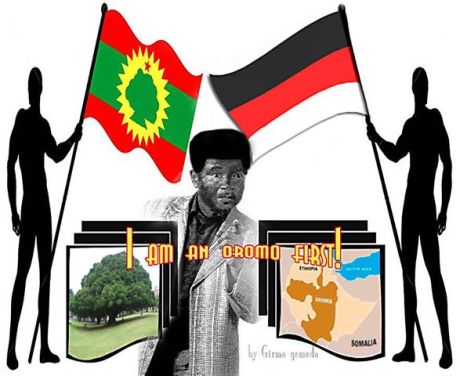
Independent nation before 1887
Mini Documentary by Seenaa Jimjimo
‘The Oromo Community Association in Chicago was featured on Chicago Public Radio’s Worldviewprogram on Wednesday, October 20, 2010. Listen below the full segment of the program on the Oromo people, the Oromo Community Association in Chicago, and the benefit jazz concert that the Association will hold on October 24, 2010.From the Chicago Public Radio: There are an estimated 40 million Oromo in Ethiopia, which makes them the nation’s largest ethnic group. Their numbers extend into Kenya and Somalia as well. Yet, despite their wide influence in the Horn of Africa, many people have never heard of the Oromo. Seenna Jimjimo of Chicago’s Oromo Community Association and Kadiro Elemo talk with Jerome about the Oromo culture, the struggle for independence and the local Oromo community in Chicago.’ Source: Gadaa.com
Listen:
Related references:
From slavery to freedom:the Oromo slave children of Lovedale, prosopography and profiles
Sandra Carolyn Teresa Rowoldt Shell
Student number: RWLSAN002
A dissertation submitted in fulfilment of the requirements for the award of the degree of Doctor of Philosophy in Historical Studies
Faculty of the Humanities
University of Cape Town
2013
https://www.academia.edu/3760219/From_slavery_to_freedom_the_Oromo_slave_children_of_Lovedale_prosopography_and_profiles
https://oromianeconomist.wordpress.com/?s=twisted&searchbutton=go%21
Irreecha: The Oromo National And Cultural Holiday Has Been Celebrated With Over 3 million Oromians In The Blessing Festival October 13, 2013
Posted by OromianEconomist in Africa, Culture, Development, Humanity and Social Civilization, Irreecha, Kemetic Ancient African Culture, Oromia, Oromiyaa, Oromo, Oromo Culture, Oromo Identity, Oromo Nation, Oromo Social System, Oromummaa, Self determination, Sirna Gadaa, The Oromo Democratic system, The Oromo Governance System, Theory of Development, Wisdom.Tags: Africa, African culture, African Studies, Democratic African institution, Development, Development and Change, Gadaa, Gadaa System, Horn of Africa, Irreecha, National Self Determination, Oromia, Oromia Region, Oromiyaa, Oromo, Oromo culture, Oromo Identity, Oromo National Day and Ancient Africa Connections, Oromo people, Oromo Thanksgiving, Oromummaa, Social Sciences
add a comment

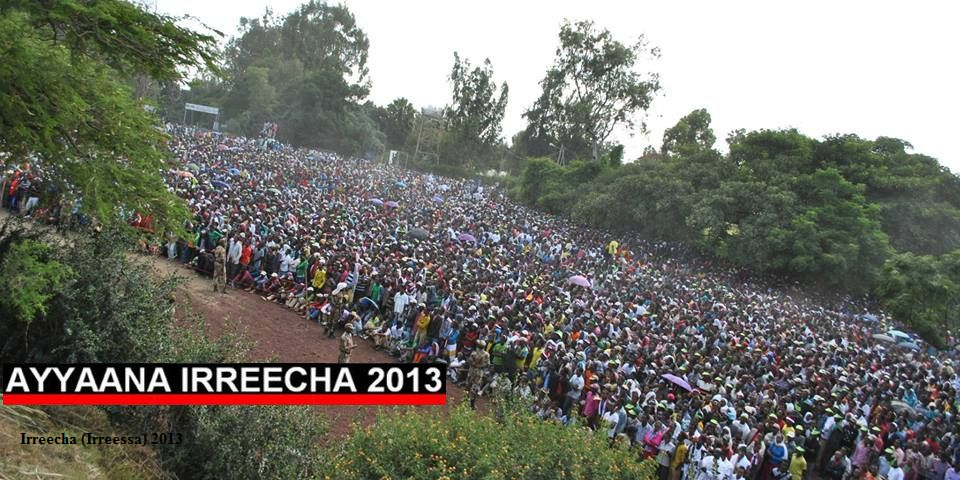
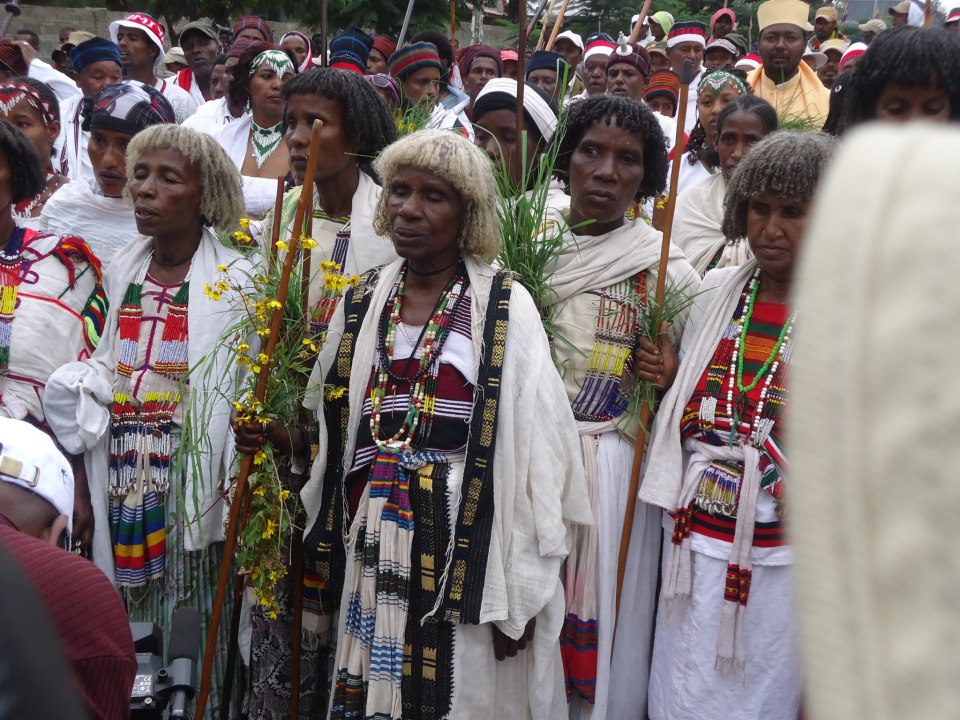
Oromo culture from ancient to present, Irrechaa time
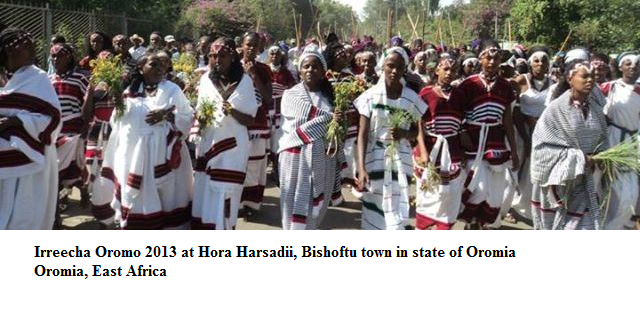
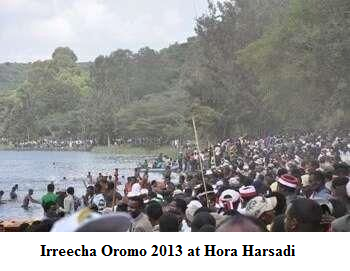

Baga ganna nagaan baatanii booqaa birraa argitan. Good that the rainy season is over for you and that you came to see the spot of the sunny flowering season. The expression signifies the end of one season and the beginning of another season, which incidentally is the beginning of a new year according to Oromo time reckoning. This is not the only expression in Irreecha festival as the event is characterized by vast and varieties of expressions, stories and sequences of cultural displays. Irreecha is the biggest and very beautiful public displays of ancient culture that Africa has performed and continue to perform. Holding the green grass and yellow flower (umama), it is the celebration of the season of blessing and love Oromians experience as Thanksgivings to God (Waaqa) the creator (Uumaa).
Irreecha celebration at Malkaa Ateetee, Burayyuu, Oromia, 6th October 2013
Irreecha is one of the most colorful and beautiful Oromo national cultural events that has been celebrated through out since the last week of August and the entire September and also in October in Oromia and globally where Oromians have been residing (Africa, Australia, Europe and North America). The main Irreecha day was celebrated at Lake Hora Harsadii, Bishoftu, Central Oromia, nearer to the capital Finfinnee on 29th September 2013. According to local news sources from Bishoftuu, over 3 million people attended this year’s Irreecha Malka celebration at Hora Harsadii. “Traditionally, the Oromo practiced Irreecha ritual as a thanksgiving celebration twice a year (in autumn and spring) to praise Waaqa (God) for peace, health, fertility and abundance they were given with regards to the people, livestock, harvest and the entire Oromo land. Irreecha is celebrated as a sign of reciprocating Waaqa in the form of providing praise for what they got in the past, and is also a forum ofprayer for the future. In such rituals, the Oromo gather in places with symbolic meanings, such as hilltops, river side and shades of big sacred trees. …These physical landscapes are chosen for their representations in the Oromo worldview, for example, green is symbolized with fertility, peace, abundance and rain. In Oromia, the core center of Irreecha celebration has been around Hora Arsadi in Bishoftu town, some 25kms to the south of Finfinne, the capital city. Annually, particularly during the Irreecha birraa (the Autumn Irreecha) in September or October, the Oromo from different parts of the country come together and celebrate the ritual. In the past few decades, Irreecha celebrations have been expanded both in content as well as geographical and demographic representations. This short commentary deals with such historical trajectories by contextualizing the changes within political discourses in Ethiopia vis-à-vis Oromo nationalism.”http://gadaa.com/oduu/21320/2013/08/24/irreecha-from-thanksgiving-ritual-to-strong-symbol-of-oromo-identity/ ”
http://gadaa.com/Irreechaa.html
Aadaa fi Duudhaa sirna Waaqeffannaa keessaa inni tokko Ayyaana irreeffannaa ykn irreechati. Sirni Duudhaa irreechaa gosa hedduutti qoodama. Kunis, Irreessa Malkaa, Irreessa Tulluu, Irreessa Galmaa / Gimbii, Irreessa Ujubaa, Irreessa Dakkii, Irreessa Jilaa fi Irreessa Eebbaa ykn Galataa fi kkf. Akkaa fi akkaataan irreeffannaas akkuma sirna isaatti addaa adda. Ammatti kan bal’inaan irraa dubbannu Irreecha yeroo ammaatti biyya keessaa fi alatti beekamee fi kabajamaa jiru, Irreecha Malkaati. Irreechi Malkaa kan kabajamu, ganni yeroon rakkinaa fi dukkanaa dabree birraan yeroo bari’u, sirni Gubaa erga raawwatee booda, ummanni gamtaan Malkaa bu’uun irreeffatee Waaqa galateeffata. Ammaaf Irreecha Malkaa isa biyya keessaa fi alatti bal’inaan beekamaa fi kabajamaa jiru irraa hanga tokko waa addeessuu yaalla. Ayyaanni irreechaa osoo hin gahiin dura waanti raawwataman hedduutu jiran. Kunis seera yayyaba shananii hordofuudhan torban shan dura eegala jechuudha. Ji’a hagayyaa torban sadaffaa keessa birraan bari’uu ykn seenuu isaa kan ibsu, sirna Muka ( korma) dhaabaa kan jedhamutu raawwata. Bakki mukti dhaabaa kun dhaabatu Mijirii jedhama. Mijiriin kun bakka Gubaan itti gubamu ykn bakka ayyaanni ibsaa gubaa raawwatudha. Mukti dhaabbatu 9 ykn 5 ta’an. Kunis hiika mataa ofii qaba. Guyyaa muka dhaabaa irraa eegalee hanga gaafa Gubaatti torban torbaniin waanti godhamu ni jira. Gaafa torban shanaffaa ykn Fulbaana ji’aa dhumaa yeroo ta’u sirna Gubaatu raawwata. Masqala jechuudha. Ayyaana masqalaa kana warri amantii Ortodoksii gara amantii isaaniitti harkisuuf haa yaalan malee gochaa fi seenaan wanti isaan deeggaru hin jiru. aadaa Oromoo fudhatan. Guyyaa gubaa kana ollaan maatii waliin walitti dhufee bakka Mijirii sanatti erga ibsaa gubee dhibaafatee, eebbifateen booda dubartoonni Qunnii (Ingiccaa) guban, dargaggoonni sirba ” Hiyyooko ykn Ya habaab yaa daree ko” jedhamu sirbaa ollaarra naannawanii kennaa fudhatan. Torban isaatti ammoo sirna Ayyaana Irreechaatu raawwata. Gubaan kan dhuunfaa fi ollaati. Irreechi ammoo ayyaana ummanni gamtaan Malkaa bu’ee, dukkana gannaa keessaa gara Booqaa Birraatti nagaan cehuu isaaf kan galateeffatu Guyyaa Galatoo ( Thanksgivings day) jechuudha. Sirni gamtaan Irreeffannaa kun osoo dhiibbaa amantii fi sirna bulchiinsa alagaatiin hin dhorkamiin dura Oromoon naannoo qubatee jiru maratti ni irreeffata ture. Keessumattuu bara mootummaa Dargii sana aadaa ” duubatti hafaa” jedhamee Galma Qaalluu gubuu fi waan Oromoon aadaadhaan raawwatu mara dhorkuun dhabamsiisuuf yaalan. Sababa kanaa fi babal’ina amantii Isilaamaa fi Protestantiin walqabatee bakka hedduutti sirni irreeffannaa fi amantiin Waaqeffannaa ni dhorkame. Dhiibbaa kana irraa damdamtee kan hafe keessaa tokko Ayyaana Irreechaa Hora Arsadii Magaalaa Bishooftuutti kabajamudha. Ayyaanni Irreecha Hora Arsadee qindoominaa fi hirmaannaa ummata bal’aan kabajamuu kan eegale bara 1997 irraa kaaseetu. Isa dura ummatuma naannoo sanaa fi keessattuu warra aadaa Waaqeffannaa hordofaniin ture. Bara 1997 keessa koreen tokko maqaa Guddinaa fi Dagaagina Aadaa Oromoo jedhuun WMT jalatti ijaaramtee Ayyaana Irreecha Bishooftuu kana ummata beeksisuu, barsiisuu fi qindoominaan guyyaa ayyaana kanaa bakka sanatti argamuun qalbii namaa harkisuu jalqabde. Ergasii waggaa waggaan achitti argamuun barumsaa fi dammaqiinsa kennameen sadarkaa har’a ummanni kumaa fi kitilaan kan herreegamu irratti argamee kabaju irraan gahe. Kana malees Oromiyaa gara dhihaatti bakka hedduutti akka kabajamuu fi babal’atuuf karaa saaqe. Baroota hedduu dura jalqabee ammoo biyya alatti walduraa duubaan, USA, Germany, Norway, Canada, Australia, Keenya, Uganda fi Ertriatti kabajamuu jalqabe. Guddinni fi babal’inni kabajaa Ayyaana Irreechaa kun qaama duula Oromoon Aadaa, Eenyumaa fi Oromummaa isaa guddisuuf gochaa jiru keessaa isa tokkoo fi guddicha ta’uu mal’isa. Fuula durallee daran akka guddatuu fi babal’atu Waaqa wajjin abdii qabna.Kabajaa ayyaana irreechaa biyya keessaa fi alatti raawwate ilaalchisee kanaan dura marsaa adda addaatti bahaa turuun ni yaadatama. Dabalataan yaadachiisuu fi bal’inaan kan hin gabaafamiin dabalatee akka armaan gadiitti kan biyyaa keessaa fi biyya alaa bakka adda addaatti kabajamaa ture laalla.”http://waaqeffannaa.org/irreecha/


http://oromoassociationvic.org/2013/10/03/oromians-seek-blessings-and-love-at-annual-oromo-festival/

Irreecha Oromo 2013 Celebration, in Sydney, Australia

Irreecha Oromo, event in London, 12 October 2013
Gubaa fi Irreecha @Galma Calalaqii, Miidaaqenyii

Related references:
https://oromianeconomist.wordpress.com/?s=twisted&searchbutton=go%21
Oromo: The Kushitic People of Africa

| ErechaThe story of Erecha – the celebration of the first harvest of the Ethiopian Spring in September – is a story better told by who else but the late Poet Laureate himself, Blattten Geta Tsegaye G/Medhin.
“….12,000 years ago, ASRA the God of sun and sky of KUSH PHARAOH begotten SETE, the older son ORA the younger of the first and daughter named as ASIS (ATETORADBAR). The older SETE killed his younger brother ORA, and ASIS (ATET OR ADBAR) planted a tree (ODA) for the memorial of her deceased brother ORA at the bank of Nile, Egypt where the murder had taken place, and requested her father who was the god of Sun to make peace among the families of SETE and ORA. Them rain was come and the tree (ODA) got grown. It symbolizes that taken place. Later, at the Stone Age, the tree that had been planted for the memorial of the killed, ORA was substituted by statue of stone that was erected 8000 years ago. This festival has been celebrated in September of every year and when Nile is flow full in NUBLA and BLACK EGYPT. In Ethiopia during the AXUMITE and PRE-AXUMITE period a great festival has been held around the sun’s statue that planted by ASIS (ATET OR ADBAR) the sister of ORA for the memorial of the later, ORA the son of god of sun, who waked up from death (ORA OMO or OR OMO) for the purpost of celebrating the peace made between the two brothers, the great herald, in thanking the good of sun and the sky with CHIBO. Then EYO KA ABEBAYE (the traditional and popular song performed at DEMERA events and new year in Ethiopia) has been started being performed since then. “KA” is the first name of God. The name of God that our KUSH Fathers have inherited to us before the old period, Christianity, and Islam is “KA”. Since then, therefore, especially the OROMO, GURAGIE and the SOUTHERN people of Ethiopia have been calling God as “WAKA or WAQA”. “or WAQA”. WAKA” or WAQA” God When we song EYOKA or EYOHA in New Year, we are praising “KA” of God. “GEDA” or KA ADA” is the law or rule of God. “GEDA” (KA ADA) is the festival by which the laws and orders of God are executed Japan, China, and India are now reached to the current civilization through making the basic traditions and cultures they received from their forefathers (HINDU, SHINTO and MAHIBERATA) be kept and receiving Islam, Christianity, and others especially Democracy and free believes. They are not here through undermining the culture and tradition of their forefathers. Culture is the collection of many CHIBOs or DEMERA. “ERCHA” or “ERESA” one of the part and parcel of GEDA (KA ADA) system is the comer stone and turning point to the new year for which ASIS (ATET OR ADBAR) has put up the dead body of her brother, ORA who was killed by his older brother like ABEL from the place he died at the river bank of NILE on and planted statue“. The Oromo people of beautiful Ethiopia believe in one God since time memorial. Their religion is called “WAKEFENA” which means believing in one God that is the creator of the whole universe. ERECHA means a celebration where people get together and perform their prayers and thanking God. WAKEFENA, the faith being in the GEDA SYSTEM is a religions ceremony that is free from any thing. The fathers of Oromo religion and the people, keeping fresh grass and flowers, perform their prayers and thank their God going to mountains, the sea or a river bank. They move to the top of mountains or bank of seas or rivers not to worship the mountains or rivers and seas; rather to distract themselves from any noise and to worship their God (WAQA) with concentration. And they go to sea and rivers because they believe that green is holy and peaceful where the spirit of God is found. In the Oromo culture, the rainy season is considered as the symbol of darkness. At the beginning of September, the darkness is gone, rivers run shallower and cleaner, and the mud is gone. As sunshine rules the land, the OROMO people of Ethiopia go out to celebrate this great natural cycle with the spirit of worshiping God (WAQA). |
http://www.ethiopians.com/photoessay/Photo_Essay_Eretcha_06.htm
Copyright © Oromianeconomist 2013 and Oromia Quarterly 1997-2013. All rights reserved. Disclaimer.
Gadaa Oromo Democracy: Three Approaches to the Study of African Society September 27, 2012
Posted by OromianEconomist in Africa, Ancient African Direct Democracy, Culture, Finfinnee, Gadaa System, Humanity and Social Civilization, Irreecha, Kemetic Ancient African Culture, Oromo, Oromo Culture, Oromo First, Oromo Identity, Oromo Nation, Oromo Social System, Oromummaa, Self determination, Sirna Gadaa, State of Oromia, The Oromo Democratic system, The Oromo Governance System, Uncategorized.Tags: Africa, African culture, African Studies, Ancient African Direct Democracy, Ancient Black People, Ancient Egyptian people, Democracy, Economic and Social Freedom, From, Gadaa System, Governance issues, Horn of Africa, Kemet, Kushitic people, National Self Determination, Oromia, Oromiyaa, Oromo, Oromo culture, Oromo people, Oromummaa, Politics, Siqqee, Siqqee Oromo Women Institution, Sirna Gadaa, Social Sciences, State and Development, Sub-Saharan Africa, United Nations, Universal Declaration of Human Rights, World Bank
3 comments
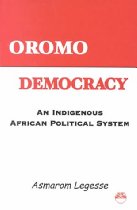
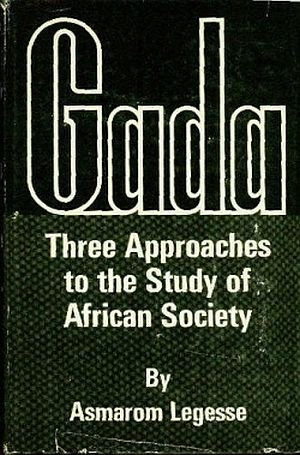
These closely related books reveal the many creative solutions an African society found for problems that people encounter when they try to establish a democratic system of governing their affairs. In much of what has been written about Africa, the common image is that of people governed by primitive customs and practices, in which only feudal roles of elders, kings, chiefs, sultans, and emirs have been acknowledged by Western observers. Little is ever shown of indigenous African democratic systems, under which there is distribution of authority and responsibility across various strata of society, and where warriors are subordinated to deliberative assemblies, customary laws are revised periodically by a national convention, and elected leaders are limited to a single eight-year terms of office and subjected to public review in the middle of their term. All these ideals and more are enshrined in the five-century old constitution of the Oromo of Ethiopia, which is the subject matter of these books.
In these books, Legesse brings into sharp focus the polycephalous or “multi-headed” system of government of the Oromo, which is based on clearly defined division of labor and checks and balances between different institutions. Revealing the inherent dynamism and sophistication of this indigenous African political system, Legasse also shows in clear and lucid language that the system has had a long and distinguished history, during which the institutions changed by deliberate legislation, and evolved and adapted with time.’ Amazon Books &
Related articles
Introduction
http://oromopress.blogspot.co.uk/2011/12/review-of-oromo-democracy-indigenous.html?m=1
http://www.readperiodicals.com/201203/2672718591.html
- Gadaa: An Oromo Democracy and the Symbol of Oromo Civilization (odaakoo.wordpress.com)
- Contours of the Emergent & Ancient Oromo Nation (oromianeconomist.wordpress.com)
- http://www.iwmi.cgiar.org/publications/CABI_Publications/CA_CABI_Series/Community_Law/protected/Ch%2009.pdf
- Oromia of Dhaqabo Ebba: The Cradle of Mankind Is Also A Home of The Oldest Living person On Earth (oromianeconomist.wordpress.com)
Copyright © Oromianeconomist 2012 and Oromia Quarterly 1997-2012. All rights reserved. Disclaimer.
CONTOURS OF THE EMERGENT & ANCIENT OROMO NATION September 25, 2012
Posted by OromianEconomist in Uncategorized.Tags: African Studies, Ancient time, Berlin Conference, Civilization, Democratic African institution, Democratisation, Developing country, Economic growth, economics, Freedom, Gadaa System, Governance issues, Land grabs in Africa, New Africa, Old Egypt, Oromia, Oromia Region, Oromo people, Oromummaa, Parliament, Social Sciences, State and Development, Tokkummaa Oromo, Universal Declaration of Human Rights
3 comments

This book is an important contribution to the study of identity politics, a subject hotly contested by many Africanists. Bulcha’s discussion the state-centered bias in the much of academic work on Ethiopia and its denial of the history and pre-colonial autonomy of indigenous non-Abyssinian peoples aught to lead to some serious debate. (Kajsa Ekholm Friedman, Professor Emeritus, Lund University, Sweden).
This work by Mekuria Bulcha is the most comprehensive and innovative work on the Oromo of Ethiopia ever to be written. Identity politics, he argues can be a positive challenge to the development of the state. As it has been the case of Southern Sudan states can also evolve, disappear and change. This work outlines the history, the traditions and politics of the Oromo people summarized and critically assessing all scholarly work done previously. It will remain a seminal work for scholars of Africa and the Oromo for many years to come. It is master peace and sets new challenge for all of us researching on the Oromo nation and people. (Mario I. Aguilar, Professor, Chair of Religion and Politics & Director of the Center for the Study of Religion and Politics (CSRP), University of St. Andrew, Scotland, UK).
Based on empirical evidence and relevant theories of nationalism Bulcha convincingly argues that the pre-colonial Oromo were a pre-modern nation. He revisits the representation of the Oromo identity in Ethiopian history and proposes the innovative and stimulating thesis that the 16th century Oromo ‘invasion’ of the Ethiopian highlands was the result of a conscious effort to regain control of a territory that was lost and contended since the 14th century Abyssinian expansion into the region. Mekuria Bulcha’s presentation of new evidence of the Oromo resistance to the 19th century conquest, his description of the international appeals by the Oromo elite in the colonial phase, his analysis of the activities of the Oromo social movements for the cultural and linguistic rights in the 1960s, and his account of the history of rebellion and armed struggle from the 60s, up to the current ethnic federalism are likely to make this book a classic reference for the studies on ethno-nationalism. (Marco Bassi, Ph.D. Research Associate, African Centre, University of Oxford, UK).
In his important and interesting discussions on the Gadaa System Mekurian Bulcha argues that:
The Oromo People created Gadaa, and Gadaa created the Oromo nation (Legesse, 2000 as quoted in Bulcha 2012)
The Gadaa system is the matrix of the Oromo culture and society: in the past it stood for several related ideas and practices encompassing cultural, political, economic and religious elements. Many of the basic elements of traditional Oromo culture that are anchored in the Gadaa system have withstood the exigencies of time and still today influence the values, attitudes, and social practices of Oromo people irrespective of, region, religion and social class. Oromo worldview and way of life was shaped by Gadaa system (Bulcha,, 2012 & Legesse, 2006).
The unity of the Oromos that is crystallized in the Gadaa culture is not a nostalgic memory of a glorious past or illusory of vision of the future paradise. Gadaa is a reality embedded in the Oromo psyche that constitutes what is to be Oromo as an individual and as a nation. Gadaa underpins the cohesive or corporate Oromo history that scholars who have not studied the Oromo fail to recognize (Gebissa, 2008).
The most important organ of the Gadaa system is the federal assembly known as Gumii Gayoo in Borana and Caffee in other places. These assemblies were very large and attended by councillors called hayyuu, drawn from different sections of the society. These assemblies made laws which defined the essence of Oromo democracy. In short, the specificity and similarity of the myriads of norms, rituals and political practices around which it was organized throughout the Oromo country make Gadaa a unique pan- Oromo institution of great historical depth (Bulcha, 2012, Legesse, 2000).
http://www.casas.co.za/Publications.aspx?PID=316
Copyright © Oromianeconomist 2012 and Oromia Quarterly 1997-2012. All rights reserved. Disclaimer.
Methodological Individualism as a development Model and its Critics June 27, 2011
Posted by OromianEconomist in Economics: Development Theory and Policy applications, Temesgen M. Erena.Tags: African conditions, African Studies, Applied economics, Developed country, Developing country, Economic, Economic development, Economic models, Economic policy, economics, Economics of development, Neo-Marxism, Neoclassical economics, Oromia, principle of Economics, Social Sciences, Temesgen M. Erena, The Oromo theory of development, Why economists disagree
2 comments

JEL: A11, A23, B13
Methodological Individualism as a development Model and its Critics
Temesgen M. Erena (DPhil), Economist
The orthodox (neoclassical) world view comprises research programmes that are basically concerned with applying the tenets of neoclassical economics to the study of developing economies. From such a perspective, the principles underlying the economics of developing economies are the same as, or can be considered extension of those governing the economics of developed nations. This implies that meaningful epistemological activities within the development economics cannot be conducted without first determining its inextricable intellectual and analytical ties to mainstream economics.
According to Rostow (1960), the critical intention of development has been seen as the achievement of ‘high mass consumption society’ that can be measured by the level of per capita income. In this context, the inherent aim of development seems to materialise a society that reproduce the political economic system of the western Europe and North America, i.e., a competitive private enterprise based on the foundations of free market economy and a representative and democratic political system. Rostow (1960) has detailed this historical process of development in his schema of stages-of- growth model. Charles K. Wilber (1988) argues that the application of this model as centre of assay of the course of development supposes that present day developing countries reckon to the ‘traditional society’ stage or at the ‘preconditions’ stage in relative to the present stages of western developed countries. Like so, the contemporary developed countries were formerly underdeveloped, hence, all countries progress in the course of these stages.
In the extreme, the Orthodox (Neoclassical) strand theorises that since principles of economics are universal, there is but one economics, whose basic tenets are equally valid for both developing and developed economies, David (1986). In other words, it is considered inappropriate to speak about two distinct economics- one for developed countries and the other for developing countries. In this case, the, the dominant interpretive model of thought is based on a ‘universalist’ epistemology or ‘one world’ ideology and ‘aesthetic’, which assumes the existence of a continuous and homogenous world, David (1986). Contextually, knowledge and society are viewed in terms of discrete individual elements that become the continuous and homogenous phenomena of economic and social life through a process of aggregation.
The neoclassical paradigm stands on universalist, rationalist and positivist methodological pillars. In addition to the influence of positivism and other rationalist patterns of reasoning, neoclassical economic thinking also makes heavy use of the concept ‘mechanical equilibrium’, which is explained by the self-regulating operation of equilibrating forces. Such forces, it is argued, not only tend to maintain equilibrium of the economic system but also to restore this equilibrium once it has been disturbed by external forces.
In its evolution, the concept of equilibrium has had to be based on some conception of the economic system. Accordingly, it was thought that the evolution of any logically consistent economic order required some institution of private property as well as a sharp conceptual distinction between the economic system and other aspects of social reality, David (1986). This led to an emphasis on capitalistic, free enterprises ethic based on the principle of individualism. In the conception, individuals are considered to be at liberty to organise their social relationships in accordance their own interests, cole, etal (1991). Society hence, becomes no more a collection of individuals, and an individual behaviour, the goal and standards of moral behaviour.
The neoclassical paradigm is based on individualistic and libertarian philosophy. The philosophy postulates that the ultimate constituents of society are individual people who act appropriately in accordance with their own dispositions. In other words, the argument is that no social tendency exists that theorising about classes and other activities can only be represented by mental constructs, which are abstract models for interpreting certain relations among individuals. One implication is that it is impossible to have laws about society. Another is that the good of individuals is primarily objective of society as opposed to the neo-Marxist which emphasis that of the society as whole, Cole etal (1991).
Economic models, theories, and conceptual systems should be considered as device that merely helps the analysts to remember certain predictive regularities in observed phenomena, David (1986).
A related implication follows from the widespread acceptance of the “science as science” methodology. These are based on the claim that search for knowledge should be governed by scientific objectivity and the commitment to universal values that cut across national frontiers. Adherence to universal epistemological principles implies that there are common standards of scholarship and, as others argued there cannot be Chinese, Nigerian or Egyptian criteria for truth and validity. Commercial farms can be nationalised, criteria for truth cannot.
The universality epistemology finds a foremost representation in the study of resource allocation. The underlying principle that all societies must make decisions about the degree of sacrifice that must be made if resources must be allocated efficiently. This is based on the assumption of the universal scarcity of resources relative to human needs. Given scarce resources, it is impossible to satisfy all of the society’s goals simultaneously. Therefore, if scarce resources are to be efficiently utilised, they must be properly allocated. The possibility of deriving meaningful benefits from the use of these resources is therefore forecasted upon the nature of sacrifice. The problem of economic decision making in conventional economics is therefore coined in terms of a “cost-benefit” calculus. The neo-classical approach to this problem emphasise the need for rational choice in the use of scarce resources. The basis of this approach is that if the alternatives presented to us are not rationally chosen, resource scarcity is likely to increase within the passage of time, hence, impairing current standards of living and decreasing the possibility for future economic growth, David (1986). In this regard, the neo-classical, explanation of economic behaviour tends to rely heavily on competitive equilibrium, which assumes that the behaviour of free markets and prices provides the necessary conditions for individual economic agents to achieve maximum economic welfare and personal liberty, Todaro (1991)|.It is based on the methodological individualism mentioned previously, the implication being that individual economic decision-making units (household), firms, national governments, and so on)| are free and rational actors whose behaviour is guided by harmonious equilibrating force, David (1986)|.
The whole economy is assumed to consist of a large number of interacting markets that have a tendency to clear, that is, reach equilibrium, with the latter defined in terms of equality between demand and supply, and price. (These conditions are assumed to take place for individual markets, that is, partial equilibrium, or in other aspects where there is a set of relative prices for all goods and services, resulting in a simultaneous clearing of all markets that is general equilibrium. Given the quantities of resources of all kinds available to economic agents, consumer tastes and preferences, and production technology, the problem of general equilibrium revolves around the determination of the relative quantities of goods of all kind that will be produced and consumed, the prices at which they will be exchanged and how the earnings derived from resource utilisation will be distributed, Cole et al (1991)|.
Income distribution is thus treated as a special case of the general theory of price relations. The over all argument is that it is possible for self-interested individuals in a market-oriented economy to strive for and receive, their fair share of income and wealth created by the competitive process. In this context, the neo-classical model indicates that the marginal productivity forms the basis for payments to all factors of production. The assumption is that individuals have at their disposal a set of factors endowments and that income merely represents the sum of the product of these factors and their marginal products. The evolution of factor shares and incomes over times thus depends on factor prices and quantities, the elasticity of substitution among factors, changes in demand patterns, and the capital or labour savings bias of technological change.
It is therefore assumed that, given completive conditions and perfect information, resources will be efficiently allocated. Adjustment in factors prices are expected to bring equality in factor shares, with each factor receiving its ‘just’ or equitable reward. Under the circumstances, any attempt to enforce equality in the prevailing pattern of income distribution is considered inimical to economic growth and efficiency. To the extent that inequalities exist, they should be considered necessary for guarantying productivity levels, David (1986)|.
The implications of the marginal productivity theory of income distribution can be further explained by considering the distribution of labour and capital incomes. In the case of returns to the human factor (wage and salaries), the theory suggests that differences in marginal productivities can be explained by differences in both innate and acquired abilities. These differences tend to be particularly acute in those societies, for example, developing economies where highly skilled labour is in short supply relative to the large supply of unskilled labour. The argument, as is that individuals with relatively scarce skills would receive quasi-rents. These rents and other payment differences would disappear as more people acquired skill through education and training, David (1986). Hence, they argue that any attempt to equalise wages and salaries would prove to be inefficient. The implicit assumption is that pay differentials not only reward those with superior natural abilities but also serve as an incentive to those not so blessed to acquire skills to increase their productivity and efficiency, Hunt (1989). Given a set of competitive prices, the actions and reactions of individual economic agents will determine the quantities of goods and services demanded, and these will be matched with the quantities supplied in the various markets of the economy, David (1986). The achievement of such an over all equilibrium requires two sets of conditions. First, these is a subjective one in which the individual pursues the goal of maximum income satisfaction. The second is an objective one in which the market provides for these incomes and wants based on the maximum profit goals of business people. Thus, through the equilibrium between demand and supply, with all markets cleared, the optimum economic position reached by each individual economic agent becomes compatible with that attained by others.
The general equilibrium analysis (Varian, 1990) postulates that, in principle, the set of equilibrium prices tend to provide all the information that each individual economic agent needs to have in order to be able to co-ordinate its activities with those of all other economic agents in the economic system, Cole et al (1991). It is therefore, based on the assumptions of perfect competition and knowledge and foresight, and the absence of uncertainty. This ensures that the essential adjustments would take place of a disequilibrium situation were to arise. Where prices diverge from their equilibrium values, inconsistencies will arise in the plans economic agents, and they will be forced to adjust to an equilibrium situation. The underlying assumption is that the operation of the market is based on a negative feedback mechanism that reduces differences to zero through iterative price adjustment processes are also assumed to be stable. This means that once the system diverges from its equilibrium with a process of automatic readjustment would take place. Full employment is also implicitly assumed. With demand for goods and services equal to their supply, labour market will also clear. Neoclassicals consider this equilibrium to be the most efficient one, and thus the standard against which particular sectors of the economy as a whole should be appraised. The reasoning is that when over all economic agent will have reached an ‘optimal position’, that is, one that it cannot possibly improve by altering its behaviour. This is the ideal state described by Pareto and also known as a Pareto efficient allocation. It is considered to be the most efficient state and implies that any attempt made to improve a given economic agent’s position would have to be at someone else’s expense (David, 1986, Varian, 1990).
The general framework outlined above is also replicated in analysis of international economic relationships. In this case, trade and exchange are considered to be two of the most effective weapons for promoting resources allocation, distribution, and growth. This follows from assumptions of harmony of interests among nation states, patterns of trade based on comparative advantage, an equitable distribution of the gains from trade, and the free international flow of resources. The same normative forces are assumed to operate both nationally and internationally, with the private market considered to be the most effective mechanism for allocating distributing resources in all spheres, Hunt (1989|).
Consequently, the neoclassical (orthodox) school of thought attribute problems of developing economies essentially to the ‘dirigiste dogma’ and the ‘denial of economic principle’ (Lal, 1988); to over extension of the public sector; to economic controls which distorts the market and have unexpected and undesirable side effects; and to an over emphasis on investment in physical capital (spending on lavish prestige projects such as sport facilities, conference centres, brand new capital city, roads leads to nowhere, irrigation schemes that damage soil) compared to human capital. And they have proposed these setbacks to be neutralised to overcome inadequate development, Toye (1987). They took the form of supply side macro-economics and the privatisation of public corporations and call for the dismantling of public ownership, planning, and regulation of economic activities. By permitting free markets to flourish, privatising state owned enterprises, promoting free trade and export expansion, welcoming foreign investors, and eliminating the plethora of government regulations and price distortions in factor, product and financial markets, the neoclassical argue that economic efficiency and economic growth will be stimulated, Wilber (1988). Contrary to the claims of the political economy strands (neo- Marxist world views) which are subjects of subsequent discussions, the neoclassicals (Orthodox) argue that the third world are underdeveloped not because of the predatory activities of first world and the international agencies that it controls, but rather because of the heavy hand of the state and corruption, inefficiency, and lack of economic incentives, Todaro (1991).
It is assumed that development experience of western industrial countries is a model for the developing economies of today and therefore, neoclassical economics is universally applicable. It is held that the international capitalist economy does not discriminate against developing economies, but when conformed to it acts as an engine or motor of growth. What is needed, therefore, is not a reform of the international economic system or restructuring of dualistic developing economies or an increase in foreign aid or attempts to control population growth or amore effective central planning system. Rather, it is simply a matter of promoting free markets and laissez faire economics within the context of permissive government that allow the magic of market forces. And the “invisible hand” of market prices to guide resource allocation and stimulate economic development, Todaro (1991). They are quoting to us the failures of the public interventionist economies of African countries, Toye (1987).
Neoclassical policy is based on faith in the price mechanism to bring about an equilibrium in the economy which maximises welfare and growth, (i.e. development by their terms), “Efficient growth… raises the demand for unskilled workers by getting the prices right… is probably the single most important means of alleviating poverty,” Lal (1983). This process of development raises the standard of living of the poor via the ‘trickle down’ effect. Intervention by the government is unnecessary as a measure to alleviate poverty and would retard growth by distorting the market mechanism, holding up sustainable development. According to Lal, government policies dealing with basic needs, surplus labour, decreasing terms of trade, etc., are misleading and incorrect. He argues that developing countries are following the same economic patterns of development as developed countries. Therefore, the same economic rules and considerations apply. Both he and Bauer criticise ‘dirigistes’ for implying, by their policies, that people of developing countries are not rational that the ‘market decisions’ have to be made for them. That would suggest Toye’s argument- governments fulfilling the desires of frustrating individuals has some validity. Being rational does not necessarily make people able. It is within this context that the planning, growth with equity approach and a social market economy operation have come into considerations. However, such interventionist approach have been criticised by laissez faire economists as a reaction to far a recipe to failure. Lal (1988) points out that inefficient and incompetent bureaucracy as a cause of government failure. Attempts to intervene in imperfect markets serves to make things even further from the equilibrium of maximum efficiency and welfare. This is an over-sight, a generalisation which dismisses all past, present and future government intervention to make influence on disparities in income and accelerate development, as ineffective. This is clearly not the case.
The rapid development of South Korea and Taiwan in both intervening for growth and equity demonstrate this. Government policies concentrated on rural development, export oriented industrialisation were directly and indirectly dealing with inequality and poverty whilst promoting growth. It would be argued that all government intervention is not good. As is clear, some government intervention is and has bee ill advised- for example ‘the white elephants.’
But what is also becoming increasingly apparent is that the neo-liberal (Washington consensus) policies of liberalisation which the IMF and World Bank have made conditions for accepting loans have also created many problems. Not only have they quite often caused increasing inequalities in income distribution, but they have also failed to encourage growth in these countries. In many countries they have led to near chaos and crisis, in the economy as in many African countries, Lawrence (1986). External influences, such as increasing oil prices, MNC transfer pricing, increase in debt burdens, increased protectionism by developed economies, etc, mean that following free market principles lead to decreasing terms of trade and created economic problems within the countries. D. Lal (1983) would say that this is acceptable because it is a step in the right direction towards free market economies. Toye (1987) believes the neoclassical approach neglects the issues and treats and treats the solutions, In a reductionist manner, over looking the complexity of the issues and gives an over simplified solution.” Lack of past successes cannot simply be blamed on government interference with the price mechanism to account for the relatively poor performance of these economies would require a very detailed historical analysis of class forces and class struggle within these countries, of the effects of international strategic and geo-political factors as well as the effects of drought other climatic/ecological disasters, Sender et al (1986).
Neoclassical according to Sender and Smith, have paid too much attention to anti-interventionism- when it would be more beneficial to concentrate on improving what intervention is necessary. It is harmful for economists to adhere to policies which can only be relevant in a hypothetical ‘perfect market’ economy. The post- colonial period has been characterised by an astonishing absence of any coherent, analytical/ideological framework within which to formulate state intervention of an effective and suitable kind,” Sender et al (1986). Neo-classicalists need to address the conclusive historical evidence concerning the role of the state in all late industrialising countries in considering policy formulation.
The laissez faire economists edge on economic growth through the operation of the market mechanism (Adam Smith’s the famous invisible hand) as the key to development. There are also economists who emphasised planning (government intervention) to supplement or supplant the market. As in the former, the latter and economic growth has been taken as the essential of development. Meanwhile, the growth with equity economists contemplate on the distribution of the remunerations of growth to the deprived.
Neo-Marxist and dependency theorist, two main school of thoughts in the Political economy paradigm, are broadly apprehensive of the nature of the progression by which development is attained, Wilber (1988).
Classical Marxism was always, of course, a theory of development, i.e., of capitalism and its development, and transition to socialism. The theory was never adequate, however, in dealing with development problems of third world especially underdevelopment issues. Classical Marxists, after all, consider capitalism as historically progress, in every way an advanced over previous production systems, even if it is to be replaced by socialism one day. “ Imperialism was the means by which techniques, culture, and institutions that had evolved in western Europe over several centuries… sowed their revolutionary seeds in the rest of the world,” Warren (1980).
Seers (1987) argued that Marxism thus arrived at conclusions similar to those of many neoclassical economists, since both derived from Smith and Ricardo and the economics of the 19th century. He further pointed out that both doctrines assume competitive markets and the overriding importance material incentives. They are both basically internationalist and also optimistic, technocratic and economist. In particular, both treat economic growth as development and due primarily to capital accumulation.
According to Hunt (1989), the neo-Marxist paradigm derives from an attempt to develop and adapt classical Marxist theory to the analysis of underdeveloped economies. The paradigm gained widespread influence in the late 1960’s, providing an ideological and analytical framework for radical critiques of contemporary theories. Drawing their inspiration from the ideas of Marx and Lenin, and influenced also by other early Marxists, particularly Rosa Luxemburg, the neo-Marxists set out to investigate a problem that Marx himself had touched on only briefly- the process of economic change in the economies of Asia, Africa and Latin America.
With respect to the third world, the primary concern of the neo-Marxists is with what is happening to national output and to its distribution, and why. Particularly in the 1950s and 1960s there was little concern on the part of leading neo-Marxists to explore the essential nature of the models of production that prevail within the periphery. Instead the emphasis was on the economic and political relations between the ‘centre’ and the ‘periphery.’ In the analysing these issues the neo-Marxists use a terminology for the key concepts in their analytical framework that appears to drive from Marxism with different interpretation to certain concepts.
The neo-Marxist school which is tracing back to the work of Paul Baran, differs from Marx in arguing that capitalism will not be spread from the ‘centre’ to the ‘periphery’ but rather that existing underdevelopment is an active process linked to the development of the centre by the transfer of the surplus, Baran (1957, 1988). As economic surplus was extracted, capital accumulation stopped, and budding industries were killed off by ‘centre’ competition. Development in colonies was forced off its natural course and completely dominated by imperial interests. The colonies stagnated between feudalism and capitalism or the mix of both systems.
For Baran (1957) the real problem in developing economies is not the presence of the vicious circle- a phenomenon whose existence is acknowledged – but the lack of a significant stimulus to development aggravated by the surplus drain. Here again we have a polar view she said, something like a zero-sum game, in which the continuing primitive accumulation by the ‘centre’ implies a simultaneous negative accumulation for the periphery. Surplus then, generate and maintain underdevelopment in the developing economies, a phenomenon whose existence is acknowledged – but the lack of a significant stimulus to development aggravated by the surplus drain. As Frank (1988) (dependency scholar) has called this leads to “the development of underdevelopment.”
Amin, too, adopts Frank’s Motto, but with an altered meaning; for Amin, it means a “dependent development,” that, is, an inappropriate pattern of growth imposed upon the country through its ties with the centre- literally, through its being included in the world capitalist system. This view in turn allows for the possibility of growth aggregate income, an observed fact in many developing economies, Hunt (1989).
The crucial problem of how the available surplus is utilised in developing economies leads the political economy worldview to the examination of local elites. Writers like Baran and Sweezy argue that no local development is to be expected from such elites. On the contrary, the elites are by their very nature a factor contributing to underdevelopment. The analysis is based on the “objective function” in which these elites find themselves. Their economic behaviour- conspicuous consumption, investments in real estate and extreme risk aversion, the export of their savings to be deposited with foreign banks for security, their avoidance of investments in industry- is, from the sand point of private advantage, essentially a rational response to the circumstances in which they find themselves. Their fear of foreign competition where they to invest in more productive activities is seen as fully justified. They argued that most elite members lack the capital retained for the establishment of enterprises able to compete with foreign oligopolies. Also lacking are entrepreneurial skills and attitudes to work and innovation conducive to growth, see Wilber (1988).
Amin offers the view that many members of the developing economies elites profit, too; from foreign activities in their country. What enables Amin to say this is his adoption of Emmanuel’s theory of unequal exchange, in which the level of wages is the major determining factor. That wages are lower in developing economies means that the labour force of these countries carries the burden of exploitation both by its local capitalist class and by the capitalist class at the centre. It is burdened by the “regular” exploitation of the home capitalists and the “primitive accumulation” of the capitalist class at the centre. The higher wages that the centre’s working class enjoys are in turn attributed not solely to its higher productivity; it does not partake of the proceeds of the continuing primitive accumulation, Todaro (1991).
That there is also a disheartening lack of entrepreneurial and administrative talent in the countries of the third world that the neo-Marxists do not deny. But they view those who place this fact at the centre of their explanations of underdevelopment as being eclectic and arbitrary. The claim that entrepreneurial and administrative skills will make their utilisation possible and necessary appears- conditions that cannot exist in an environment of dependence. This problem, they claim, is secondary: It is consequence of the fundamental problem, which is the discouragement and systematic sabotaging (or, for Amin, the guiding into incorrect path), of the local development efforts by the centre, Todaro (1991).
They recognise the existence of a ‘comprador states’ or class and bourgeoisie classes in developing countries but they maintain that their positions are solely dependent on the advantages they give to an imperialist power- not exist in their own right.
So the main consideration for government intervention would be, for neo-Marxists, the ability to make a complete and absolute change “the third world was and is an integral and destined to play a major role in the attempt of capital in the world capitalist economy to stem and reverse the tide of growing economic crisis, “Frank (1981, 1988). This is manifested in increasing repression of the workforce in developing countries, not increasing equality, or alleviating poverty. So in order to achieve sustainable development with equality it would be necessary for a developing country to withdraw from the world capitalist system. The present system only maintains present inequalities due to the interest characteristic of capitalism. They would advocate complete autarky facilitated by a socialist movement.
Generally, the political economy school advocate equity oriented development. The fundamental assumptions of this perspective regarding capitalism and international capitalist economy are essentially opposite to those of neo-classical economists. They not only believe that international capitalist economy discriminates against developing economies, but that is directly responsible for their dire condition. Thus any solution to the poverty predicament requires a fundamental break from the international capitalist economy. A distinction here, more for historical relevance than for the logic of the argument should be made between neo-Marxian and the Marxian of Marx, with (Marx) essentially regarded the capitalist commodity production process as progressive, in that it was required for the realisation of the ultimate inevitable tools of communism. Thus, capitalism for Marx is a necessary phase of societal change. Furthermore, for Marx the capital commodity production process is universally applicable.
The other fundamental disagreement these theorists have with neo-classical school concerns ethics. Equity, for these theorists is an ethical ideal, an end by itself. The logical extreme of this view is that equality must remain the primary objective, even at the cost of efficiency.
It is argued by this perspective that it is contrary to the interests of the international capitalist commodity process, which is essentially and exclusively concerned with maximisation of profit, to redistribute wealth. Instead of a y ‘trickle -dawn’ tendencies, the inner- logic of capitalism with only lead to greater accumulation, and concentrate of wealth. Thus, it is imperative for any comprehensive development effort to break with the internationalist political economy. Since weak political position of the poor prevents them from changing the system, empowering the poor becomes the means to meaningful development. These theorists contend that attacking the symptoms of poverty with basic needs provisions, or welfare laws will not suffice, it is crucial to attack its cause. The answer is the empowerment of the poor.
The general tendency is towards the satisation of the modes of production, at least those sectors of the economy that are essential to the public goods. Thus, only the intervention of a populist state, resulting on the commanding heights of the economy can restructure the relations of production that benefit not a privileged few, but the unprivileged many.
This perspective defining the ‘left’ contours of the continuum in its logical extreme are diametrically contradicts the neo-classical perspectives.The obvious point of departure on the debate on development between the neo-classical and the political economy strands must be a definition of development. This is inescapably a normative exercise, but one that should not be avoided for this the reason. Development, by the very meaning of the word, can only be a process of the ‘becoming’. The argument holds regardless of whether the tendencies are rectilinear, cyclical or both (or neither). According to orthodox school sometimes implicitly and sometimes explicit value judgement in the definition of development has been westernised. This tendency has been challenged by the ‘development of another civilisation in East Asia, that is quickly achieving standard of living comparable to the west. One conclusive inference that can be drawn from the experience of Japan, China and the Asian Tigers is that a protestant ethic or generally a western social arrangement or socialist revolution of neo-Marxist is not a prerequisite for economic development.
http://rodrik.typepad.com/dani_rodriks_weblog/2013/05/what-is-wrong-and-right-in-economics.html
Copyright © Oromianeconomist 2012 and Oromia Quarterly 1997-2012, all rights are reserved. Disclaimer.
Related articles
- Blog Post: TheAlephBlog: Neoclassical vs Austrian Economics (moneyscience.com)
- Neoclassical vs Austrian Economics (wallstreetpit.com)
- Mainstream Economics is a Cult (ritholtz.com)
- JOY IN THE CRISIS: Why Africa needs development models not growth models (environgentia.wordpress.com)
- Philip Pilkington: Why “Free Markets” Accommodate Speculation and Lead to Disequilibrium (nakedcapitalism.com)
- How to end poverty? Unions. (cyclingforprogress.wordpress.com)
- The Social Economics of Thorstein Veblen (trumanfactor.com)
- What is wrong (and right) in economics? (rodrik.typepad.com)
- A Critique of the Methodology of Mises & Rothbard (azizonomics.com)
- ‘Revolutionizing Economics by Evolutionizing it’ (economistsview.typepad.com)
Perverted Development: What role for Institutions June 8, 2011
Posted by OromianEconomist in Uncategorized.Tags: Africa, African Studies, Berlin Conference, Cushitic people, Democratisation, Development and Change, economics, Ethiopia, Foreign Affairs, Gadaa System, Governance issues, New Africa, Oromia, Oromia Region, Oromo First, Oromo music, Oromo people, State and Development, The economist, World Bank
1 comment so far

Perverted Development: What role for Institutions
By Temesgen M. Erena (DPhil), Economist
The ideas of economists and political philosophers, both when they are right and when they are wrong, are more powerful than is commonly understood. Indeed the world is ruled by little else. Practical men, who believe themselves to be quite exempt from any intellectual influence, are usually the slaves of some defunct economist.
Keynes, John Maynard
JEL: B13, D2, D6, O1
Introduction
The force of human reductionism that had assaulted on Oromia’s history, civilisation, politics and economy for many centuries in the last three Christian millenniums and particularly of the last two centuries has continued in the new millennium to enfeeble the endeavours of its people towards progress and development.
Oromia is not the poorest of the nations of the world in resources but it is one of the most underdeveloped, characterized by thwarted advancement, declined progress and cataclysm.
In Oromia today immense agricultural potential, mineral wealth and human capital coexist with some of the lowest standards of living in the world. Part of the problem lies in the nature of the economic change the Abyssinian colonialism fostered in Oromia. The Oromo economy has been distorted to serve the Abyss interest and needs.
Oromos are the most brutalised and humiliated in modern history. The genocidal treatments, which Oromos have received from Abyssinians, have been as gruesome as anything experienced by Jews, Native American and native Australians and the Armenians received from the Nazi, Europeans, white Americans, and the Ottoman Turkey respectively. Oromos have also been humiliated in history in ways that range from the level of slavery, segregation and treated as second-class citizens in part of their own country to the present day in spite of being numerically the majority and geographically the largest territory.
In the early 1990s the old Amhara settler colonialism (Nafxanyaa system) was substituted by Tigrean ‘federal colonialism’ (neo- nafxanyaa system) the facet of exploitation seemed to take on new dimensions. In fact, the pattern of colonisation and domination has remained the same since it instated century ago with the Berlin Conference of 1884-1885, which had approved the scramble for Africa among European colonial powers. It was a time when the cruel Abyssinian Empire was given an ordinance of Christianising and ‘civilizing’ the Oromos; though it is a historic derision how a backward and barbaric empire was to ‘civilize’ the society of prime civilisation, high culture and social structure, the ‘natives’, whose development levels and potentials were diverse and by far advanced.
The very idea of Christianising and civilizing was an external imposition often upheld by external protagonists. In the pre 1974 Ethiopia, this took the form of substantial military and economic aid from the US America and Europe. During the Cold War era, the mission of oppression of the Oromos maintained and supported by fresh military and economic aid from the then Soviet Union scheme of spreading its sphere of dominion and its ideology to Africa. In the contemporary ‘new world disorder’, the support has got new momentum in which the old Christian missionaries are replaced by an army of western neo-classical economists who peddle a ‘free market’ ideology, which they hope, will take care of the imprisoned market agents, in this case the Oromos.
According to the new Gospel, the Tigrean colonizers are given the mandate and the necessary financial backing to pursue ‘economic liberalization’ while keeping strict control that Oromia remains the Abyssinian colony. The liberalization agenda has served as a precursor of the making of Tigrean version of crony capitalism or more appropriately advanced feudalism in the age of economic globalisation. It is alien to Adam Smith’s invisible hand, social justice and the free-market ideals of relying on legal contracts, property rights, impartial regulations and transparency. It is no wonder that the political and economic prescriptions that the Ethiopian colonial rules implemented and or pretend to implement are in line with the advice of the International Monetary Fund and the World Bank and The US administration’s The Horn of Africa Initiative all of which have exacerbated the problem of the Oromo nation. It has also betrayed the ideals of free market, social justice, self-determination and human rights.
The sorrowing fact is that shared interest and solidarity between the West and the Abyssinian colonizers are impoverishing the people. Pretentious and ill-conceived measures are being taken in the name of free market and above all development. Currently, there are a number of regime-sponsored ‘associations’ of this or that ‘Region/State’s Development’ anti-terrorism, poverty alleviation, renewal process, revolutionary democracy, etc. Given this, the people’s last resort is to defend their own interests is the exit option or to retreat from the colonizers. What has become more apparent than ever is the need to rely on the Oromo initiatives to solve the problems of the Oromo. The Oromo poor need to defend themselves from the bogus free market invaders and their phoney local allies. This is necessary, since, in the absence of property rights, social justice, and individual and social freedom and democracy, no free market economic gimmickry is able to reserve the tragedy of the oppressed. It is within this context, that we discuss, how the Ethiopian colonial rules, in collaboration once with international socialism and now with the global capitalism has impoverished and underdeveloped one particular community in Africa, the Oromo nation.
Sclerotic to development: The Abyssinian Colonial Occupation and Its Alliances
Economists are inspired to point out the weight of political factors, captured by the term ‘governance’ and its role in economic development. Concerns about political factors in economic development is revitalized because of the dearth of economic development reform and structural adjustment programs to yield definite success and prosperity, particularly, in Africa. The main problem pointed out is ‘poor governance’ (World Bank, 1989; Moore, 1992). There are three different aspects to the notion of governance that can be identified as:
The form of political regime (independent, colonial government, multi-party democracy, authoritarian, etc.),
The process by which authorities exercised in the management of the country’s economic and social resource; and’
The willingness, the competence and the capacity of the government to design, formulate, and implement genuine development policies, and, in general to discharge development and government functions.
As there is no antithesis concerning the conviction that ‘good’ governance is an important and desirable ingredient of development, scholars are cautious not to attach specific regime type and political reforms to good governance. Broadly, however, good governance is legitimated by developmentalist ideology while poor governance is characterized by ‘state elite enrichment ‘ (Jackson and Rosberg, 1984), the ‘rent seeking society’ (Krueger, 1974) or ‘politics of the belly’ (Bayart, 1993;Tolesa, 1995) such as Ethiopia, Nigeria and Zaire). The latter in fact are characterized by sclerotic behaviours and are obstacles to development.
The Oromia’s underdevelopment (negative development) and its associated problems are never going to be understandable to us, much less contain it, as long as we persist to ponder it as a mere as an economic enigma. What is before us momentarily is in essence an enigma of political colonialism whose economic after-effects are severe.
Not only the problem is basically political and colonial in character. It arose largely from Abyssinian imperial conquest and its associated colonial disposition, which is characterized by reliance on sheer force, state terror, genocide, plunder, authoritarianism and violence.
The story goes back to the days of the Abyssinians crossed the Red Sea and seized the territory and resources of the Cushites ( Bibilical Ethiopia, the present Horn of Africa and Oromia) making concerted aggression on the latter’s history and culture in the name of settlement and civilizing the ‘non-believers.’
As it is discussed above and elsewhere, in the first millennium BC the Abyssinian group crossed the Red Sea from South Arabia (source: the debtras’ records and memories of Abyssinian high school history text book) to the present North East Africa to conquer and resettle the land occupied by endogenous Oromo and the other Cushitic people. Recent research recognises that the Semitic culture of the Abyssinian empire’s northern highlands was built on the Cushitic base for which not genuine credit has been given, and the Axum obelisks which were attributed to the (Sabeans Abyssinians) do not have corresponding existence on the Arabian peninsula while they are abundant in the Nile valley stretching from Egypt to ancient Kush in today’s Sudan. This most probably indicates that the earlier phase of Axum civilization was predating the Sabean infiltration/invasion.
Cleansing as a policy was initiated to conquer the Cushite territories. The territory they conquered was divided among numerous Abyss chiefdoms that were as often at war with each other as with Oromo and the entire Cushite. The population of conquered territories were considered as dangerous thus; Abyssinian cleansing, up rooting, forced labour and killings of the vanquished were conducted as the means of crushing resistance, securing the conquered territories and even to expand their occupation further. Though the Abyssinian gained some territories and resettled in the northern highlands of the Oromo and other Cushitic regions among others Afar, Agau, etc., their expansion was checked for a long time in history by wars of resistance and liberation they encountered by the endogenous people. These wars of resistance led to a decisive victory for Oromo, Afar and Somali nations particularly from 12th to the second half of 19th century. As a result of such a defeat Abyssinians started to wage particularly anti-Oromo propaganda battles to alert themselves and attract foreign support against the Oromo. The derogative name ‘Galla’ and the ‘16 century Oromo migration’ were all the Abyssinian fabrications and to serve the war against Oromo. In fact, the Oromo oral history shows that the 16th century was a massive Abyssinian further southward migration and intensive campaign to entirely control Oromia and other territories. For the Oromo this period was characterized by political and military dynamism and at the same time it was a period of victory, massive dislocations, rehabilitation and displaced communities returning home.
According to M. Bulcha (see Oromo Commentary), it was only during the second part of the 19th century that the Abyssinians ultimately succeeded to make significant in roads into the Oromo territory. Tewodros (also known in different names Hailu, Kassa, Dejazmach, Ras, etc., as other Abyssinian shiftas and present Woynes, is on record for his brutish hostility towards the Oromo nation. He was not the first or the last of his kind. They were many before and after him, for concrete evidence even today, this time and this second. All of them have been gangsters of very abnormal characters and Abyssinian detested figures. The Abyssinians remembered Tewodros and his type not only as the romanticized hero figures but also portrayed them as a modernises. Tewodros the lunatic and bandit declared and conducted a war of extermination against the Oromo. In order to help them to bargain for the western support, he and all his type including Yohannes, Menelik, Haile Sellasie, Mengistu and currently Meles declared anti-Islam and anti-Muslim nations. They mobilized all their resources and the entire Abyssinia (Amhara &Tigre) against the Oromo to achieve their goal. Tewodros made every effort to obtain the European military support claiming his fictions of Christian identity and ideology (the then dominant political ideology though he had not any biblical ethics and values, not at all). Tewodros is a symbol and an element of Abyssinian barbarism that was conducted at particular historical stage (1850-1868). Such barbarism has been conducted since the Axumite period (3000 years) but has never achieved its ultimate goal of elimination of the entire endogenous people of the North-East Africa. But it eliminated millions of and it thwarted the civilisations of Cushite people. They have used all the devastating means the: Christian civilizing ideology, European army, settler colonialism, Soviet Socialism, Stalin collectivisation, Mengistu’s villegisation, and America’s structural adjustment, terrorism, etc. They have always tried to change names after names for the same ugly & old expansionism, feudalism and empire (the legendary land of Sheba, Ethiopia, Ethiopia first, socialist Ethiopia, republic, mother land, federal etc.). The very name Ethiopia is Hellenistic Greece. It was the name used in the ancient Greece occupation (before Romans) of North Africa people and southward expansion. This name was colonialism from the beginning and it has been, it is and it will be. It is not African in origin as the people who invented it. This name was adopted and maintained to conquer the entire Cush and then the entire Africa in the shadow of christianisation. It is a sinister name that has no boundary and ethnic identity. It is not only the conquered people of North-East Africa but also all Africanists that must understand, including its sinister philosophy. It was designed and adopted to deconstruct an endogenous African identity.
One implication of the doctrine of Abyssinian ‘civilizing mission’ was that the Oromos needed to be ruled by Abyssinians and could not responsibly be granted civil liberties. Authoritarian as it has always been, the Abyssinian colonial rule in Oromia whether under Menelik II, Haile Selassie, Mengistu and currently under Meles has been characterized by the ‘politics of the belly.’ The underlying ethos remains self-aggrandizement and those elites are alien to growth whereas corruption, brutality, inefficiency and grotesque incompetence have tainted their politics. Time and again, they siphoned off Oromia’s wealth and indulged in conspicuous consumption and stashing millions of dollars in remote secret accounts in Europe, America and Asia. Scholars understand that development is about the future. However, the Abyssinian elites are living for the present. They came for quick self enrichment. The Oromos have no opportunity to invest in their country. They disowned everything.
While the Abyssinian colonial settlers in Oromia do no want and support policies that promote development, they find military and other forms of support abroad to stay in power. In more than one time, this force of underdevelopment has been strongly reinforced by external forces (Holcomb and Ibssa, 1990). Despite generous foreign assistance, this hardly commanded legitimacy to mobilize the colonized masses behind their rule. To the contrary, people who have waged legitimate struggle to reclaim their freedom, cultures and history has fiercely resisted their rule.
As it has been discussed elsewhere, Oromos have their own political power, which was fully operational before they were colonized and occupied by Abyssinians put under the strict control of Ethiopian empire state. Their political system is based on the Gadaa (Gada) system. The Gadaa system has been the foundation of Oromo civilization, culture and worldview (Jalata, 1996). The Gadaa political practices manifested the idea of real representative democracy with checks and balance, the rule of law, social justice, egalitarianism, local and regional autonomy, the peaceful transfer of democratic power, etc. (Jalata, 1966). The Gadaa political system also facilitated property rights, stability, and the expansion of free trade, commerce, improved farm techniques and permanent settlements, gradual diversification of division of labour. The Gada state was non-taxing state. Military was not the focal point, only defensive which is democratic. It was the opposite of expansionist, imperial, genocide or conquering state, e.g. Roman, Sparta, Abyssinian and Serbia, etc.
One of the distinctive virtues of Gadaa state was the weight of civilian power as compared to military power, military aristocracy was practically absent and in normal times, the army executed only an inconspicuous, if not nonexistent, political function. The military aristocracy was not the focal point of society. War had rather a defensive mission.
Nonetheless, particularly since the last decades of the nineteenth century, the Abyssinian colonial rule and its state disallowed the Gadaa political system and expropriated the Oromo basic means of subsistence, such as land cattle while it established an Ethiopian system of rule over Oromia. The Oromo commerce and industrious activities were not only discouraged but also ridiculed and obtained the lowest social status. Productive relations were imposed through the process of commodity production and extraction between those who control or own the means of production, the state, and those who do not. Those who control the means of coercion had the opportunity to reorganize productive relations through dispossession of the colonized Oromos in order to expedite more product extraction.
The process of dispossession is multi-faceted and far-reaching. As the result of it, the Oromos have been denied power and access to education, cultural, economic and political fields while at the extremes, the Abyssinian colonialism has been practiced through violence, mass killings, mutilations, cultural destruction, enslavement and property confiscation.
Apart from the splendid crop farm and animal husbandry, in his 1896-1898 travels in Oromia Bulatovich (2000, pp 60-61) described the Oromian industrial and commercial economy as the most vibrant with conducive endogenous institution as follows:
“Artisans such as blacksmiths and weavers are found among the [Oromo]. Blacksmiths forge knives and spears from iron, which is mined in the country. Weavers weave rough shammas from local cotton. The loom is set up very simple. … There is also the production of earthenware from unbaked clay. Craftsmen who make excellent morocco; harness makers who make the most intricate riding gear’ artisan who make shields; weavers of straw hats (all [Oromo] know how to weave parasols and baskets), aromers who make steel sabers; weavers who weave delicate shammas, etc.
Bulatovich Observed that commerce in Oromo was both barter and monetary based. The monetary unit was the Austrian taller and salt. The former was rather little in quantity and was concentrated in the hands of merchants. He witnessed that Oromos have great love for commerce and exchange economy. According to Bulatovich (2000, pp, 61-63):
“In each little area there is at least one market place, where they gather once a week, and there is hardly an area which is relatively larger and populated which does not have marketplace strewn throughout. Usually the marketplace is a clearing near a big road in the centre of [Oromo] settlements…. Rarely does any [Oromo] man or women skip market day. They come, even with empty arms or with a handful of barely or peas, with a few coffee beans or little bundles of cotton, in order to chat, to hear news, to visit with neighbours and to smoke a pipe in their company. But besides, this petty bargaining, the main commerce of the country is in the hands of the [Oromo], and they retain it despite the rivalry of the Abyssinians. Almost all the merchants are Mohammedan. They export coffee, gold, musk, ivory, and leather; and they import salt, paper materials, and small manufactured articles. They are very enterprising and have commercial relations with the Sudan, Kaffa, and the Negro tribes.”
The Oromos have also valued both the collective and personal independence and freedom very much. Their peaceful and independent way of life was broken and their freedom lost with the coming of the utterly vicious and sever authority and hard school of surrender and obedience of the Abyssinian conquerors. As Bulatovich (2000, p.65) further described:
“The main character of trait of the [Oromo] is love of complete independence and freedom. Having settled on any piece of land, having built him a hut, the [Oromo] does not want to acknowledge the authority of anyone, except his personal will. Their former government system was the embodiment of this basic trait of their character- a great number of small independent states with figurehead kings or with a republican form of government. Side with such independence, the [Oromo] has preserved a great respect for the head of the family, for the elders of the tribe, and for customs, but only insofar as it does not restrain him too much.”
Jalata (1993) sees the Ethiopian colonial domination as the negation of the historical process of structural and technological transformation. This is the case where the Abyssinian colonial class occupies an intermediate status in the global political economy serving its own interest and that of imperialists. The Oromos have been targeted to provide raw materials for local and foreign markets. Inside the empire, wherever they go, the Abyssinian colonial settlers built garrison towns as their political centres for practicing colonial domination through the monopoly of the means of compulsion and wealth extraction.
The Abyssinian colonial system was more cognated to a tributary system whereby the rulers extract tribute and labour from colonized lands. The Abyssinian peasants supported their households, the state and the church from what they produced. After its colonial expansion, Abyssinians maintained their tributary nature and established colonial political economy in Oromia and in the Southern nations. Although the colonial state intensified land expropriation and produce extraction from colonized peoples, capitalist productive relations did not emerge. Gradually with the further integration of the Ethiopian empire into the capitalist world economy, semi-capitalist farms seemed to emerge by extracting their fruits mainly through tenancy, sharecropping and the use of forced-labour systems.
The colonial exploitation has been maintained under Mengistu’s so-called socialist collectivisation/ villegisation campaigns and in the current Meles’ regime under the mask of structural adjustment and ‘free’ market economic system.
It should also mentioned that in addition to authoritarian and coercive rule, the Ethiopian colonialism depended on an Oromo collaborationist agents that were essential to enforce Ethiopian colonialism. This second rate clique is merely an expandable appendage which devotes most of its energy to the scramble for the spoils of slavery, picking up the leftover in economic and political advantages. The main task of this class is to ensure the continuous supply of products and labour for the settlers. Of course this class was not always loyal to the Ethiopian colonial state (Jalata, 1993). Broadly speaking, the state itself is a battlefield for two exclusive claims to rule and political competition among the Ethiopian colonizers, the Amharas and Tigreans. In effect, this makes the Abyssinian colonizer politics effectively a zero-sum game and the very practice of politics become a negation of politics, i.e. politics are practiced with the inert ending of politics.
The Abyssinian rulers, who have inherited power used to believe that their interests were well served by depoliticising, muting and suppressing the Oromos and the Southern peoples’ quest for national-self determination under the guise of maintaining the unity of the Ethiopian empire. So they convinced themselves and tried to convince others that there were no serious socio-political differences and no basis for political opposition. Apoliticism has been elevated to the level of ideology while the political structures become ever more monolithic and authoritarian.
The political structures and political ideologies, which have been used to effect depoliticization and suppression, are all too familiar. The process entailed political repression, which the Oromos endured and suffered for more than a century. The implication of depoliticization is to deny the existence of differences, to disallow their legitimate expression and, therefore, to deny collective negotiation. Whatever the degree of repression, the process did not remove the differences. The ensuing popular frustration and resistance has led to even more repression. That is how political repression has become the most characteristic feature of the colonial political life and domination as its salient political relationship. All this means that political power becomes particularly important; so the struggle for it gets singularly intense.
In Abyssinian Colonial regime and psyche Seize power is supernatural and a magical axiom and power itself does not mean influence on policies but it means license over their colonial subjects. People have been so frightened and constricted by fear and indoctrination. Besides, they have been overwhelmed by deceptive rhetoric, crude, systematic misinformation, and hypocrisy, which made it virtually impossible to see through the situation and to form an intelligent judgement. The Abyssinian rulers including Tewodros, Menelik, Yohannes, Hailessilassie, Mengistu and Meles in resemble wanted an absolute power both on earth and heaven. All mobilised Abyssinian myth to enhance their cults. Loyalty and submission to them was being shrouded in an illusive appeal to be a good citizen. We heard and observed, childhoods dominated by a miasma of poverty, misery, starvation, with no shoes, slavery, slave soldier, premature and painful deaths. The power of the Abyssinian colonial empire has been not only absolute but also arbitrary, extraordinarily statist and hostile. It tightly controls every aspects of its subject’s economy. In the state where politics is driven by the calculus of power, everyone in arena only focused in the accumulation of power. Politics has been reduced to a singular issue of domination. It has never afloat restraint and dispensation. There have been regime changes within the empire but the new has accustomed to reproduce and reinforce the past. None of the the Ethiopian rulers including the present regime fundamentally had any firm interest in transformation , and all of them were only too alert that they could afford to broaden the social base of the state power. Power has been maintained by politicising and manipulating the Abyssinian myth and chauvinistic nationalism and depoliticisation of the occupied. In doing so, they engaged in weakening. They produced not only fanatical divisions within their own echelon but antagonism and exclusivity in society and . the solidarity of the oppressed at any price. It is so clear that such political condition has been profoundly hostile to development. The struggle for power within itself and to sustain the occupation of the oppressed majority has been so engrossing that everything else, including development must be sacrificed
The oppressed are exposed to all kinds of onslaught by state that is hardly subject to any constitutional or institutional fetters. The colonial power barred Oromos from engaging in their own industrial enterprises, export trade, domestic commercial venture, modern and relatively productive farm, private, free media, education and philanthropy etc. Unlike the Hobbes’s state, it is so backward, uncivil sing, further underdeveloping and essentially a military institution that imposes subordination and maintains colonial condition. In this context, it is more colonial and barbaric by the standard of other colonial experiences observed elsewhere in the Americas, Asia and other parts of Africa.
There are two major aspects in which this situation has severely thwarted Oromia’s development. The first enigma lies in the incompatibility between the pursuit of development and the crusade for survival, reproduction of the existing forms of social control and domination. The deleterious after-effect of this animosity is that it leads to misuse of human resources, inefficiency and corruption. Unquestionably, appointments into the positions of power, even when they are positions, which demand specialized knowledge, tend to be made by political criteria, particularly by regarding these appointments as part of survival strategy. Each time such appointment is being made, the friction between political survivals, economic efficiency and development crops up. The ruination to efficiency and development derives not only from the performance criteria and likely incompetence of the persons so assigned but also from the general demoralization of the technically qualified and competent people purveying under them who are often repressed and frustrated by their subjection to the surveillance and regulations of people who are powerful but inapt. Here lies the role of Ethiopian ministers and parastatals: incompetent personnel used to obstruct productive use of resources. Wasted are also competent people. They lose at both ends. In the midst of waste, the Oromos have been denied basic civil and political rights and the right to development. Alien leaders who channel the meagre resources into unproductive uses imposed the related economic problem, the very rights over which the people are fiercely struggling.
Development projects were initiated for wrong reasons; they may, on account of political considerations, be located in places where they are least beneficial both economically and socially. One could site familiar cases where important contracts and licenses have been given to politically significant people. Higher positions are created and new rule and regulations are established just to benefit people whose political support is considered important. Oromia pays for all these disservice. The Ethio-crats are overpaid and creating demoralizing disparities between reward and effort. That is how; the persistence of Ethiopian imperial and colonial domination is imperilling to the integral tenets of development.
Abyssinian academics and international development agencies offer many factors for the apparent failures and crises of development industry in the Abyssinian empire: lack of capital, lack of technology, entreprenuerial skills, corruption, poor planning and management, socialist system, lack of infrustracture, falling commodity prices, cyclical drought, unfavourable international terms of trade, low level of saving and investment. These factors and the long lists of related factor are undeniably crucial factors in development. However, we have to address the misleading assumption that has commonly been taken that there has been development failures and crises. The Oromia experience exhibits the terrible realites that development has never been on the agenda. The business of the politics of occupation has prevented the pursuit of development and the emergence of relevant and effective development paragims and programs.
The burning question is, can the people of Oromia try to trade, farm, imitate and innovate then develop their economy in this state of siege? The question is vital and congruous; but the answer is doubtful, as it is impractical. Development strategies as such are comprehensive programs of social transformation. They call for a great deal of ingenious management, confidence in the leadership and commitment. They require clarity of purpose for a society at large; they need social consensus especially on the legitimacy of the leadership. Yet these are not common features of an institution, which does not represent the society. Besides, development is about change and that change may not work to the survival of the colonial rulers. In this sense it runs against the instincts of the rulers whose preoccupation is to survive and maintain its dominant position. One of the most amazing things about development discourse in Ethiopian empire is how readily it is assumed that the rulers are interested in development particularly when they profess commitment to development and negotiate with international aid organizations for economic assistance. People making this assumption forget the primacy of maintaining colonial power and its conflict with other social and economic goals.
Why the Ethiopian rulers embark on a course of societal transformation just because it is good for the nations under its empire like Oromos if it is bad for their own survival?
The ideology of development has been adopted to grapping resources from external aid agencies. In the name of development people are forced to obedience and conformity. Billions of dollars was looted by tolitarian regime and its cliques. Structural adjustment, privatisation, liberalisation, investment, rural development, fertiliser for farmers and democratisation have been the slogans of Mele’s regime for the last 20 years. There have not been: appropriate political structure and practices, administrative system, institutional framework to conduct development in Abyssinian empire. There have been also failures by international development agencies that have taken the responsibilities of financing development and transferring resources ignoring the specificity and historicity of the Abyssinian empire. This has also exhibited the mounting anarchy of development studies and development practices that has been based on modernising paragim.
The Abysinian rulers and their elites, especially the Amharas regard the ideal characters of themselves as the end of evolution. The application of this evolutionary schema meant advancement is a matter of assimilating to Abysinian culture. Abyysinians have established the negative view of the Cushite people, institutions and their culture. The colonial regime discourages any belief in the integrity and validity of the Oromo society and have offered the notion that Oromos can find validity only in their total transformation, that is, in their total self-alienation. On practical level , the result has been frustrating.They have assaulted on Oromo governance (Gadaa), Oromo culture, Oromo religion (Waqeffannaa) and Oromo names.They have changed Oromo names to Amharic (e.g. Finfinnee changed to Addis Ababa). They assaulted on the use of Oromo language. They evicted Oromos from cities and towns. They instituted the negative image of the Cushite and the superiority of the Abyssinians. How people in such state of mind, behaviour and attitude pursue development? According to Claude Ake “Development requires changes on a revolutionary scale; it is in every sense a heroic enterprise calling for consummate confidence. It is not for people who do not know who they are and where they are coming from , for such people are unlikely to know where they are going,”(Ake, 1996, p. 16).
When we think of development, it is about society at large and the paradox is that it is often the leader who is not in a position to think of the objective interests of the society. For thinking in this way entails profound democratic commitment, which cannot usually be expected of such leaders. By virtue of their position, colonial rulers suffer the disadvantage of confusing what maintains the existing social order, which they dominate, and they are tendentiously suspicious of change; it is all the more so when it comes to fundamental changes.
Finally, we need to remember some of the implications of development with respect to alien colonial rulers. As it has already been mentioned, they have been more interested in taking advantage of the social order inherited from their predecessors rather than in transforming it. To all appearances, they are colonial rulers. Oromos have been oppressed and humiliated for over a century. The political history of the last hundred years of colonial rule of Oromia has vividly indicted that the Oromos lacked freedom; it means that they did not have control over the products of their labour, it means that their natural resources and environment were tarnished by others; and eventually it means that they witnessed chronic poverty, destitution, killing forces, the forces of abuse & alienation, human misery and less and less of humane life.
In these circumstances, it is not surprising that where development is pursued in Oromia, if at all, it is full of ambiguities and contradictions and it is just a mere posture. Even taking these postures on the face value, in so far as we are critical of development strategies in Oromia, our criticism runs in the direction of their sloppy conception and hence their failure to come to grips with sclerotic of imperial domination. If we raise the question of the contradiction between political survival and social transformation, we commence to behold that it is doubtful and equivocal where development is, or it has ever been, on the colonizers’ list for Oromia.
The other aspect of economic consequences of colonial domination has been militarism, which is but the outcome of over-valuing of political power. Associated with it is the intense struggle to obtain and keep it. Therefore, the politics of the empire is sustained by warfare and force than by consent. In this atmosphere, force is mobilized and deployed: the winners are anxious to take absolute power into their hands while the losers forgo not only power but also lose liberty and even life. As politics relies solely on force, the vocabulary and organization advocates coercion. For that matter, the Ethiopian empire is a political formation of armies in action and this is in itself a serious development problem. In an institution in which the political formations are organized as warring armies, differences are too wide and far, the scope for co-operation too limited; there is too much distrust; and life is too raw to nature commerce and industry in subject nations like Oromia. Currently, the militarism of life in general and politics in particular has reached its logical culmination in Ethiopian military rule and its negative consequences have wider regional implications. This too hinders the course of development not only in Oromia but also in entire North East Africa.
Copyright © Oromianeconomist 2011 and Oromia Quarterly 1997-2011. All rights are reserved. Disclaimer.
Related articles
- We are Oromos First! (freedomfororomo.wordpress.com)
- Petitioning Al Jazeera The Stream/English http://stream.aljazeera.com/ 2Al Jazeera The Stream/English: We Appreciate Al Jazeera for Airing Oromo’s Persecution in Ethiopia (freedomfororomo.wordpress.com)


 Oromian Economist
You must be logged in to post a comment.