South Sudan: Unmasked Wounds December 30, 2013
Posted by OromianEconomist in Africa, Aid to Africa, Colonizing Structure, Corruption, Culture, Development, Dictatorship, Economics, Economics: Development Theory and Policy applications, Human Rights, Humanity and Social Civilization, Kemetic Ancient African Culture, Knowledge and the Colonizing Structure., Knowledge and the Colonizing Structure. Africa Heritage. The Genocide Against Oromo Nation, Land Grabs in Africa, Language and Development, Oromia, Oromiyaa, Oromo, Oromo Culture, Oromo Identity, Oromo the Largest Nation of Africa. Human Rights violations and Genocide against the Oromo people in Ethiopia, Oromummaa, Self determination, Sirna Gadaa, Slavery, The Colonizing Structure & The Development Problems of Oromia, Uncategorized.Tags: Africa, African Studies, Democratisation, Developing country, Development and Change, Economic and Social Freedom, Governance issues, Horn of Africa, Human rights, Oromia, Oromo, Oromo people, Oromummaa, South Sudan, State and Development, Sub-Saharan Africa, Sudan, Universal Declaration of Human Rights
add a comment


“The elites inherited vast natural wealth and boundless international good will following the historic referendum, but they squandered both. They lapsed into a culture of corruption, conspicuous personal consumption and tribalistic political machinations. They have not been serious about democratization, institution-building or even the most basic service delivery, which they have preferred to outsource to foreign relief agencies. African leaders — backed by the United States and United Nations — have taken key steps toward pressuring South Sudan’s leaders to stop the war. But the deeper responsibility for creating a South Sudanese nation at peace with itself lies with the country’s own leaders.” -Abdul Mohammed and Alex de Waal, WP Opinions.
There is an opportunity to halt South Sudan’s slide into war and state failure, but it must be seized within days or it will be lost. This requires the leaders of South Sudan to rise above narrow, tribalistic, zero-sum politics and develop a national program. President Salva Kiir and other members of the country’s political elite — in government and in opposition, inside South Sudan and in the diaspora — must respond to this challenge now or go down in history as having betrayed their people.
Nine years ago, on Jan. 9, 2005, the Sudanese government and the southern-based Sudan People’s Liberation Movement (SPLM) signed a historic peace accord that brought an end to more than 20 years of war between northern and southern Sudan. That agreement culminated in a referendum, held from Jan. 9 to Jan. 15, 2011, in which the southern Sudanese voted overwhelmingly for independence. Africa and the international community welcomed the new Republic of South Sudan, hopeful that it would put this history of strife and suffering behind it.
But the peace agreement and the show of unity around independence masked many unhealed wounds. During those long years of civil war, the South Sudanese weren’t united, and their divisions exploded into a bloody internecine conflict in 1991 after SPLM officers challenged the leadership of Col. John Garang . The strife became a tribal war, mainly between ethnic Dinka and ethnic Nuer , involving massacres of civilians on both sides and mass starvation. The atrocities left deep scars.
For the following decade, leaders of churches and civil society and friends from abroad, including U.S. representatives, undertook a painstaking effort at “people-to-people peace” among South Sudanese communities. This task was incomplete when the 2005 north-south peace agreement was signed. Amid the euphoria of that peace and the work of reconstructing a war-ravaged land, President Kiir, who took over after Garang died in a helicopter crash in July 2005 , neglected to continue the necessary work of reconciliation. Instead, the wait for independence and plentiful oil revenues maintained a semblance of unity.
It is those unhealed wounds that are tearing South Sudan apart today.
Two years after achieving independence, a political dispute between President Kiir and Vice President Riek Machar erupted into the open. Kiir dismissed Machar and most of his cabinet. Two weeks ago, this dispute suddenly mutated from a contest over votes in the ruling bodies of the SPLM into a terrifyingly violent tribal conflict. The speed and vigor of ethnic mobilization not only threatens a widening war but also jeopardizes the very viability of the South Sudanese state.
African and international mediators are in a race against time to stem this tide. Once the political dispute descends completely into a fight for communal survival, foreign leverage disappears. Ethiopia and Kenya, acting on behalf of African nations, took key steps at a summit in Nairobi Friday to try to stop further violence. They called for a cease-fire and for the rights of 11 high-level political leaders arrested by the government to be respected. (Two were released on Saturday.) They affirmed the core African principles: no unconstitutional change in government and South Sudan must build a viable state. President Kiir stays, but he must negotiate.
Stopping the shooting is the immediate priority. But the mediators should not be content with patching together a ruling coalition and returning to business as usual in advance of scheduled elections in 2015. A power-sharing formula could become just another division of the spoils, and elections could become another exercise in ethnic division.
For too long, South Sudan’s leaders evaded their responsibilities by blaming their woes on the war and oppressive policies of the government in Khartoum. Now, having joined the club of nations, they must play by its rules. The United States, having given South Sudan the benefit of many doubts, is threatening to withhold aid if power is seized or held by force. That is quite correct. Any political process must take into account South Sudan’s unique and painful history. The biggest task is an all-inclusive national discussion on what it means to be a nation. The political elites should listen to the wisdom of pastors and civil society leaders, who are insisting that the politicians return to the path of dialogue and healing. The road to a viable state lies in national reconciliation.
The elites inherited vast natural wealth and boundless international good will following the historic referendum, but they squandered both. They lapsed into a culture of corruption, conspicuous personal consumption and tribalistic political machinations. They have not been serious about democratization, institution-building or even the most basic service delivery, which they have preferred to outsource to foreign relief agencies. Read the details in the following site:
Two weeks ago fighting broke out in Juba, the capital of the east African country that won independence from Sudan hardly two years ago. The violence quickly spread across the country, leaving at least 1,000 people dead. More than 100,000 are reportedly displaced, many seeking refuge in UN camps.High winds could slow Toronto’s ice storm recoveryVideo: High winds could slow Toronto’s ice storm recovery Toronto doing its best to restore power: Rob FordVideo: Toronto doing its best to restore power: Rob Ford It has also raised fears of an all-out civil war between the main Dinka and Nuer ethnic groups. “Political issues and tribalism are being used to pit South Sudanese against each other as our leaders fight for power,” Jal says. “Our country’s leadership hangs in the balance and ordinary citizens are paying for it with their lives.” “This is how genocide begins,” he adds.
http://www.thestar.com/news/gta/2013/12/29/torontos_south_sudanese_community_urges_end_to_killing.html
South Sudan on the verge of civil war
- Most South Sudanese interviewed for this project assert that the most obvious impediment to national cohesion is exclusion from the national platform, especially exclusion along ethnic lines. Corruption, nepotism, and exclusion from access to government jobs were also raised as issues that the government will need to address directly for citizens to have pride in their nation.
- There is a widespread sense of worry about the viability of South Sudan as a nation due to insecurity, especially insecurity rooted in the current ethnic conflicts occurring in seven out of the ten states.
- Both political leaders and ordinary citizens recognize the importance of national unity and the equitable display and celebration of cultural diversity as a national asset; representation of all ethnic nationalities and creation of a broad-based government is central to South Sudan’s transition to nationhood. The immediate challenge involves creating programs that promote citizenship in the nation over ethnic citizenship. The opaque climate of the transitional constitutional review process has not earned the government much trust from all sectors of society, and this has made for a bad start toward national consensus.
- As a multiethnic society, South Sudan also is confronted with the question of a language policy. To speed up the process of nation building, the government will need to transform current discussions on language into practical decisions regarding the development of anational language. Identifying five national languages that represent the three greater regions of the country would be one way to approach it.
- Most South Sudanese interviewed for this project assert that the most obvious impediment to national cohesion is exclusion from the national platform, especially exclusion along ethnic lines. Corruption, nepotism, and exclusion from access to government jobs were also raised as issues that the government will need to address directly for citizens to have pride in their nation.
- There is a widespread sense of worry about the viability of South Sudan as a nation due to insecurity, especially insecurity rooted in the current ethnic conflicts occurring in seven out of the ten states.
- Both political leaders and ordinary citizens recognize the importance of national unity and the equitable display and celebration of cultural diversity as a national asset; representation of all ethnic nationalities and creation of a broad-based government is central to South Sudan’s transition to nationhood. The immediate challenge involves creating programs that promote citizenship in the nation over ethnic citizenship. The opaque climate of the transitional constitutional review process has not earned the government much trust from all sectors of society, and this has made for a bad start toward national consensus.
- As a multiethnic society, South Sudan also is confronted with the question of a language policy. To speed up the process of nation building, the government will need to transform current discussions on language into practical decisions regarding the development of anational language. Identifying five national languages that represent the three greater regions of the country would be one way to approach it. http://www.usip.org/publications/diversity-unity-and-nation-building-in-south-sudan
- Copyright © OromianEconomist 2013 & Oromia Quarterly 1997-2013, all rights are reserved. Disclaimer.
Related articles
- Hundreds of S.Sudanese flee to Sudan: UN source (modernghana.com)
- Uganda warns South Sudan rebel leader (news.yahoo.com)
- Inspiring Stories from South Sudan (aidleap.wordpress.com)
- Suspicion threatens IGAD’s role in South Sudan conflict (sudantribune.com)
- Battles rage in South Sudan as cease-fire hopes fade (dailystar.com
Freedom Is Sweet December 27, 2013
Posted by OromianEconomist in Culture, Human Rights, Humanity and Social Civilization, Kemetic Ancient African Culture, Knowledge and the Colonizing Structure. African Heritage. The Genocide Against Oromo Nation, Language and Development, Oromia, Oromiyaa, Oromo, Oromo Culture, Oromo Identity, Oromo Nation, Oromo Social System, Oromo the Largest Nation of Africa. Human Rights violations and Genocide against the Oromo people in Ethiopia, Oromummaa, Self determination, Sirna Gadaa, The Colonizing Structure & The Development Problems of Oromia, The Oromo Democratic system, The Oromo Governance System, The Oromo Library, Theory of Development, Uncategorized.Tags: Africa, African culture, African Studies, Australia, Federation Square, Horn of Africa, Human rights, Human Rights and Liberties, Human rights violations, National Self Determination, Oromia, Oromiyaa, Oromo, Oromo culture, Oromo people, Oromummaa, State and Development, Sub-Saharan Africa, Universal Declaration of Human Rights
add a comment
“Freedom is Sweet” is taken from the speech made by Inga Peulich MLC , Parliamentary Secretary for Education at Oromia @ Federation Square, Melbourne Australia on 22nd of December 2013. The festival aims to bring Oromo people together, irrespective of age, gender and belief, to help promote self-empowerment. It also seek to educate the public on the lifestyle, culture and ethics of members of the Australian Oromo community. Furthermore, it’s a time to celebrate and commemorate the beauty of Australian Oromo culture and to promote both multiculturalism and diversity across Australia.
The celebration of Oromia at Federation Square marks the beginning of yet another exciting year of events that aim to bring the case of the Oromo cause.
Related articles
- Oromo Displacement Past & Present (oromianeconomist.wordpress.com)
- 99% of the prisoners are OROMO political prisoners in Ethiopia!!!!! (danieltadesse.wordpress.com)
- Oromoia Students Movement and the Current Trends of Oromo Youths and Intellectuals (oromedia.net)
- Message from Dr. Ibrahim Amae Elemo on the #BoycottBedele Campaign (freedomfororomo.wordpress.com)
- Let no one Rob you of your Identity (dhaamsaogeetti13.wordpress.com)
The Scramble For Africa, Big Agriculture & The Industrial Farm Land: At What Cost? December 19, 2013
Posted by OromianEconomist in Africa, Colonizing Structure, Corruption, Dhaqaba Ebba, Dictatorship, Oromia, Oromiyaa, Oromo, Oromo Culture, Oromo Identity, Oromo Nation, Oromo the Largest Nation of Africa. Human Rights violations and Genocide against the Oromo people in Ethiopia, Self determination, The Colonizing Structure & The Development Problems of Oromia, Tyranny, Uncategorized.Tags: Africa, African Studies, Developing country, Development, Development and Change, Economic and Social Freedom, Genocide against the Oromo, Horn of Africa, Human rights, Human Rights and Liberties, Human rights violations, Land grabbing, Land grabs in Africa, National Self Determination, Oromia, Oromo, Oromo people, Sub-Saharan Africa, Tyranny, Universal Declaration of Human Rights
comments closed
‘


Picture source : Gadaa.com

Green Rush In Africa
Picture Source: FP

‘There is a gold rush happening in Ethiopia, but it’s not a hunt for the yellow metal. It’s a quest for the green gold of fertile farmland. A nation more associated with periodic famine and acute childhood malnutrition than with agricultural bounty is leasing millions of hectares -an area the size of Belgium – to foreign companies, who want to grow and export food to places like Saudi Arabia, China, India, and Europe. One-third of the fertile Gambella area in western Ethiopia, for example, is being leased for the next 50 years by the Bangalore-based food company Karuturi Global. Forests are being clear-cut, swamps drained, rivers diverted, and whole villages moved to make way for flower farms and palm-oil and rice plantations. “It is very good land. It is quite cheap…. We have no land like this in India,” effused Karuturi’s project manager Karmjeet Shekhon to the Guardian soon after the lease was settled in 2011. The government in Addis Ababa says it needs foreign companies like Karuturi Global to help create jobs, raise Ethiopia’s income from food exports, and develop the agricultural technology and infrastructure that can bring the impoverished country into the mainstream of the global market economy. It has enticed investors with tax breaks alongside rock-bottom lease rates (as little as $1 per hectare per year). But at what cost — to land rights, to human health, to the environment, to national stability?’
– See more at original source: http://www.foreignpolicy.com/articles/2013/12/17/green_rush_industrial_farmland_africa#sthash.lq1Wlefk.dpuf
Copyright © OromianEconomist 2013 & Oromia Quarterly 1997-2013, all rights are reserved. Disclaimer.
Global Poverty & Development Agendas: Dead Aid, Ethiopia & The West December 17, 2013
Posted by OromianEconomist in Africa, Aid to Africa, Colonizing Structure, Development, Economics: Development Theory and Policy applications, Knowledge and the Colonizing Structure. Africa Heritage. The Genocide Against Oromo Nation, Land Grabs in Africa, Oromia, Oromiyaa, Oromo, Oromo Culture, Oromo Identity, Oromo Nation, Oromo the Largest Nation of Africa. Human Rights violations and Genocide against the Oromo people in Ethiopia, Oromummaa, Self determination, The Colonizing Structure & The Development Problems of Oromia, Theory of Development, Uncategorized.Tags: Africa, African Studies, Dead Aid, Development and Change, Economic and Social Freedom, Genocide against the Oromo, Governance issues, Horn of Africa, Human rights, Human Rights and Liberties, Human rights violations, Land grabbing, National Self Determination, Oromia, Oromiyaa, Oromo, Oromo people, Oromummaa, State and Development, Sub-Saharan Africa, Tyranny, Universal Declaration of Human Rights
add a comment
In excess of 35 million Ethiopians still live in abject poverty subsisting on less that $2 a day while a tiny fraction of the country’s 85 million people has become excessively rich. As more and more ODA is pumped into the country Ethiopia’s HDI rank hasn’t improved (in fact it has gone from 169th in the world to 173rd in the last decade), journalists, academics and opposition figures are still jailed for speaking out against the regime, ethnic minorities such as the Oromo are discriminated against and forced off their lands, corruption and human rights abuses are still rife. Less people may be dying but are ordinary peoples’ lives improving at a rate that warrants the West to turn a blind eye to the crimes of those in power? It may suit certain agendas to do so but it does a massive disservice to ordinary Ethiopians. Read the full text at: http://www.transcend.org/tms/2013/12/global-poverty-and-post-colonial-development-agendas-ethiopia-and-the-west/


http://en.wikipedia.org/wiki/List_of_countries_by_percentage_of_population_living_in_poverty
Related articles
Oromo Displacement Past & Present December 12, 2013
Posted by OromianEconomist in Africa, Colonizing Structure, Dictatorship, Domestic Workers, Human Rights, Human Traffickings, Knowledge and the Colonizing Structure., Knowledge and the Colonizing Structure. African Heritage. The Genocide Against Oromo Nation, Oromia, Oromiyaa, Oromo, Oromo Culture, Oromo Identity, Oromo the Largest Nation of Africa. Human Rights violations and Genocide against the Oromo people in Ethiopia, Oromummaa, Qubee Afaan Oromo, The Colonizing Structure & The Development Problems of Oromia, Tyranny, Uncategorized.Tags: Africa, African Studies, Economic and Social Freedom, Horn of Africa, Human rights violations, Oromia, Oromo, Sub-Saharan Africa, Tyranny, Universal Declaration of Human Rights
comments closed

From slavery to freedom:the Oromo slave children of Lovedale, prosopography and profiles
Sandra Carolyn Teresa Rowoldt Shell
Student number: RWLSAN002
A dissertation submitted in fulfilment of the requirements for the award of the degree of Doctor of Philosophy in Historical Studies
Faculty of the Humanities
University of Cape Town
2013
https://www.academia.edu/3760219/From_slavery_to_freedom_the_Oromo_slave_children_of_Lovedale_prosopography_and_profiles
http://www.bbc.co.uk/news/world-africa-14357121?SThisFB

http://oromocommentary.files.wordpress.com/2010/07/machbuba-an-oromo-slave-girl-who-won-the-heart-of-a-german-prince.pdf
Related Articles:
During Ethiopian colonial expansion, Oromia, “the charming Oromo land, [would] be ploughed by the iron and the fire; flooded with blood and the orgy of pillage” (de Salviac, 2005 [1901]: 349). Calling this event as “the theatre of a great massacre,” Martial De Salviac (2005 [1901]: 349) states, “The conduct of Abyssinian armies invading a land is simply barbaric. They contrive a sudden irruption, more often at night. At daybreak, the fire begins; surprised men in the huts or in the fields are three quarter massacred and horribly mutilated; the women and the children and many men are reduced to captivity; the soldiers lead the frightened herds toward the camp, take away the grain and the flour which they load on the shoulders of their prisoners spurred on by blows of the whip, destroy the harvest, then, glutted with booty and intoxicated with blood, go to walk a bit further from the devastation. That is what they call ‘civilizing a land.'” The Oromo oral history also testifies that Ethiopians/Abyssinians destroyed and looted the resources of Oromia, and committed genocide on the Oromo people through massacre, slavery, depopulation, cutting hands, famine, and diseases during and after the colonization of Oromia.
According to Martial de Salviac (2005 [1901]: 350), “With equal arms, the Abyssinia [would] never [conquer] an inch of land. With the power of firearms imported from Europe, Menelik [Abyssinian warlord] began a murderous revenge.” The colonization of Oromia involved human tragedy and destruction: “The Abyssinian, in bloody raids, operated by surprise, mowed down without pity, in the country of the Oromo population, a mournful harvest of slaves for which the Muslims were thirsty and whom they bought at very high price. An Oromo child [boy] would cost up to 800 francs in Cairo; an Oromo girl would well be worth two thousand francs in Constantinople” (de Salviac, 2005 [1901]: 28). The Ethiopian/Abyssinian government massacred half of the Oromo population (five million out of ten million) and their leadership during its colonial expansion (de Salviac, 2005 [1901]: 608, 278; Bulatovich, 2000: 66-68). According to Alexander Bulatovich (2000: 68-69), “The dreadful annihilation of more than half of the population during the conquest took away from the [Oromo] all possibilities of thinking about any sort of uprising . . . Without a doubt, the [Oromo], with their least five million population, occupying the best land, all speaking one language, could represent a tremendous force if united.” The destruction of Oromo lives and institutions…
See the full content of this document
http://law-journals-books.vlex.com/vid/oromo-democracy-classical-civilization-411848362
‘The study confirms that there is clear nexus between authoritarian rule,
man-made famines, and genocide in Ethiopia.’
http://www.codesria.org/IMG/pdf/Mekuria_Bulcha.pdf
Copyright © OromianEconomist 2013 & Oromia Quarterly 1997-2013, all rights are reserved. Disclaimer.
Africa: The Time is not for Currency Unions December 9, 2013
Posted by OromianEconomist in Africa, Aid to Africa, Corruption, Development, Economics, Economics: Development Theory and Policy applications, Knowledge and the Colonizing Structure., Oromia, Oromo the Largest Nation of Africa. Human Rights violations and Genocide against the Oromo people in Ethiopia, Self determination, Uncategorized.Tags: Africa, African Studies, Currency Unions, Developing country, Development, Development and Change, Economic and Social Freedom, Governance issues, National Self Determination, Oromia, Oromo, Social Sciences, Sub-Saharan Africa
comments closed

“If a region as rich as the euro zone has struggled to cope with such pressures, the likelihood that the poorer and less well-governed places hoping to adopt the eco could is tiny.”
‘Under the proposal an initial group of six countries will adopt the eco by 2015 (see map). Five years later the members of the West African Economic and Monetary Union (known as UEMOA, its French acronym), which currently share a currency called the West African CFA franc, are to adopt the eco too, creating a currency union of over 300m people. West African politicians are pushing for further integration because they, like most economists, argue that the single currency for UEMOA has been a qualified success. UEMOA member states are more fiscally disciplined than their neighbours outside the currency zone, says Cécile Couharde of the University of Paris Ouest Nanterre La Défense. The French government currently underwrites the West African CFA franc by guaranteeing to convert it to euros at a ratio of one to 0.0015. That has provided a stability rare in African currencies. Monetary unions also simplify trade: UEMOA has more intraregional trade than any other region in Africa, according to an IMF paper. But the currency union has downsides. UEMOA economies move at different speeds. According to research by Romain Houssa, at the Catholic University of Leuven in Belgium, economic changes are poorly correlated between member states. From 2007 to 2012, the IMF found, the correlation between the business cycle of Senegal, a country with strong trade links outside the zone, and the other countries in UEMOA was almost zero. Consequently, a UEMOA-wide interest rate is not ideal: as in the euro zone, some countries end up with the wrong rate. And an inflexible exchange rate makes economic adjustment difficult. From 2000 to 2012 average annual growth in output in UEMOA countries was about half that of comparable sub-Saharan economies, according to Gianluigi Giorgioni of Liverpool University. Whereas UEMOA’s currency union has drawbacks, the proposed eco zone may have fatal flaws. It would encompass even more economic diversity. Nigeria in particular stands out. Its economy is huge by its neighbours’ standards. UEMOA’s GDP is about $75 billion; Nigeria’s is about $260 billion. The GDP of the next-biggest economy in the region, Ghana, is about $40 billion. And the Nigerian economy is unusual. Unlike most other West African countries it is heavily dependent on oil, which accounts for over a third of output, according to data from the OECD, a club of mostly rich countries. IMF research shows that Nigeria’s balance of trade tends to move in the opposite direction to its neighbours’—they are largely importers of oil. During periods of high oil prices Nigeria may push for interest-rate rises. That would be disastrous for other eco-zone economies, which are likely to be gasping for lower rates. To make matters worse the eco might be vulnerable to speculative attack. France would be unlikely to guarantee it, reckons Mr Giorgioni, as the liabilities would be large and the countries involved are not former French colonies. Without such support, investors would be nervous. Any fiscal laxity would be punished. If a region as rich as the euro zone has struggled to cope with such pressures, the likelihood that the poorer and less well-governed places hoping to adopt the eco could is tiny.’
“In the run-up to achieving a common currency, the East African Community (EAC) nations aim to harmonise monetary and fiscal policies and establish a common central bank. Kenya, Uganda, Tanzania and Rwanda already present their budgets simultaneously every June. The plan by the region of about 135 million people, a new frontier for oil and gas exploration, is also meant to draw foreign investment and wean EAC countries off external aid. “The promise of economic development and prosperity hinges on our integration,” said Kenya’s President Uhuru Kenyatta. “Businesses will find more freedom to trade and invest more widely, and foreign investors will find additional, irresistible reasons to pitch tent in our region,” said Kenyatta, leader of the biggest economy in east Africa.Kenyatta, who is due to face trial at the International Criminal Court on crimes against humanity charges in February, took over the chairmanship of the bloc from Ugandan President Yoweri Museveni, hosting the summit.Kenya has launched a $13.8 billion Chinese-built railway that aims to cut transport costs, part of regional plans that also include building new ports and railways. Landlocked Uganda and Kenya have discovered oil, while Tanzania has vast natural gas reserves, which require improved infrastructure and foreign investment so they can be exploited. Tanzania, where the bloc’s secretariat is based, has complained that it has been sidelined in discussions to plan these projects, but Kenyatta said the EAC was still united. Kenneth Kitariko, chief executive officer at African Alliance Uganda, an investment advisory firm, said the monetary union would boost efficiency in the region’s economy estimated at about $85 billion in combined gross domestic product.”In a monetary union, the absence of currency risk provides a greater incentive to trade,” he said.Kitariko said, however, that achieving a successful monetary union would require convergence of the union’s economies, hinting that some challenges lay ahead.”Adjusting to a single monetary and exchange rate policy is an inescapable feature of monetary union … but this will take time and may be painful for some,” he said, referring to the fact that some countries may struggle to meet agreed benchmarks.” http://www.aljazeera.com/news/africa/2013/11/east-african-nations-agree-monetary-union-20131130175336476127.html
Copyright © OromianEconomist 2013 & Oromia Quarterly 1997-2013, all rights are reserved. Disclaimer.
The Oromo, Gadaa/Siqqee Democracy and The Liberation Of Ethiopia Colonial Subjects December 5, 2013
Posted by OromianEconomist in Africa, Development, Gadaa System, Human Rights, Humanity and Social Civilization, Knowledge and the Colonizing Structure. African Heritage. The Genocide Against Oromo Nation, Oromia, Oromiyaa, Oromo, Oromo Culture, Oromo Identity, Oromo Nation, Oromo Social System, Oromummaa, Self determination, Sirna Gadaa, The Oromo Governance System, Theory of Development, Uncategorized.Tags: Africa, African culture, African Studies, Economic and Social Freedom, Gadaa System, Governance issues, Human Rights and Liberties, Human rights violations, National Self Determination, Oromia, Oromo, Oromo people, Siqqee, Sub-Saharan Africa, Universal Declaration of Human Rights
comments closed

This paper explores the potential role of the Gadaa/Siqqee system of Oromo democracy in the development of a democratic multinational liberation movement of the colonized nations within the Ethiopian Empire in order to dismantle the Tigrayan- led Ethiopian terrorist government and replace it with a sovereign multinational democratic state in the Horn of Africa based on the principles of indigenous democracy. After a brief introduction, this study describes the presence of a democratic, Siqqee/Gadaa administration among the Oromo in the Horn of Africa in the
16th and 17th centuries and the subsequent changes that made them vulnerable to colonization. It further examines the essence and main characteristics of Gadaa/Siqqee, showing that it provides a contrasting political philosophy to the authoritarian rule of the Ethiopian Empire. The study shows that in the face of oppression and exploitation the Oromo people have struggled to preserve and redevelop their indigenous democracy, written records of which go back to the 16th century, long before European nations embraced the principles of democratic governance. It also explains how it can be adapted to the current condition of the colonized nations within the Ethiopian Empire in order to revitalize the quest for national self- determination and democracy and to build a sovereign democratic state in a multinational context. Furthermore, the piece asserts that this struggle is truly a diffi cult one in the 21st century as the process of globalization is intensifi ed and regional and local cultures are being suppressed under the pressure of dominating cultures.
Asafa Jalata, Professor, Department of Sociology, The University of Tennessee, Knoxville, Tennessee
Harwood Schaffer, Research Assistant Professor, Agricultural Policy Analysis Centre, The University of Tennessee
Read the full article from the following:
http://works.bepress.com/cgi/viewcontent.cgi?article=1104&context=asafa_jalata
http://works.bepress.com/asafa_jalata/63/
Copyright © 2013 & Oromia Quarterly 1997-2013, all rights are reserved. Disclaimer.
WHy The Aid To Africa Has Failed? December 1, 2013
Posted by OromianEconomist in Africa, Aid to Africa, Corruption, Development, Dictatorship, Economics, Economics: Development Theory and Policy applications, Oromia, Oromiyaa, Oromo, Oromo Culture, Oromo Identity, The Colonizing Structure & The Development Problems of Oromia, Uncategorized.Tags: Africa, African Studies, Aid to Africa, Developing country, Development, Development and Change, Economic, Economic growth, Horn of Africa, Human rights, Oromia, Oromo, Oromo people, Sub-Saharan Africa
add a comment
“Never mind that Africa receives roughly $50 billion in aid annually from foreign governments, and perhaps $13 billion more from private philanthropic institutions, according to Penta’s estimate. Never mind that Angola’s oil revenues are around $72 billion, and Nigeria’s $95 billion; that Africa boasts at least 55 verified and somewhat detached billionaires. I can testify that Africa is much worse off than when I first went there 50 years ago to teach English: poorer, sicker, less educated, and more badly governed. It seems that much of the aid has made things worse.”
Here is in the following the renowned author Paul Theroux discusses why Africa’s aid industry is in a mess. For the details and original source please refer to:
‘In its naked reality, Africa, the greenest continent, is still the most beautiful, the least developed, the wildest on earth. Vast plains, big animals, hospitable people, who have been enslaved, sidelined, colonized, and converted willy-nilly either to Christianity or Islam. This receptive amphitheater of goodwill and big game, inspires megalomania among its foreign visitors who strut upon it — it has always done so, for those who seek the singularity of a little excitement and glory. I sometimes think that if the poorer counties of America’s Deep South had rhinos and elephants, instead of raccoons and possums, the philanthropists might direct their attentions to those parts, too.A rich white donor in black Africa is a study in high contrast that puts one in mind of the gallery of role models: Tarzan, Mr. Kurtz, King Leopold, Cecil Rhodes, Livingstone, Mrs. Jellyby, Albert Schweitzer, Hemingway, Henderson the Rain King: the overlords, the opportunists, the exploiters, the visionaries, the hunters, the care-givers, the baptizers, the saviors, all of them preaching the gospel of reform and seeking a kingdom of their own, if not an empire.Henry David Thoreau, the 19th-century American author, believed that all such outgoing people had something discreditable in their past that through giving they aimed to expiate. And all are characterized by the rather touching innocence of a billionaire faced with the brutal truth that the relative simplicity of acquiring wealth is nothing compared to the extreme difficulty of giving money away, for the common good.’
‘The real helpers are not the schemers and grandstanders of the eponymous family foundations or charities; they are nameless ill-paid volunteers who spend years in the bush, learning the language and helping in small-scale manageable projects, digging wells, training mid-wives, teaching villagers that unprotected sex spreads HIV; and among these stalwarts are the long-serving teachers who have liberated Africans by simply teaching them English, and are still doing so, even as they make the local governments lazier. The so-called White Fathers (the Society of Missionaries of Africa) I met in Malawi who ran upcountry clinics used to say, “I guess I’ll be buried here.” No one ever says that now, and significantly none of the people I spoke with for this piece ever expressed a wish to spend any serious length of time in Africa. None speaks an African language. To the detriment of their aims, they are on better terms with the African politicians than the common ruck of African people. Years living simply on the ground in Africa convinced me that there was more for me to learn from Africans than to teach. I saw there were many satisfactions in the lives of people who were apparently poor; many deficits in the lives of the very wealthy. I saw that African families were large and complex and interdependent; that old age was revered, that Africa’s link to the distant past — to the dawn of the world — was something marvelous and still intact in many places. Most of all, I was impressed by the self-sufficiency of ordinary people. Without much in the way of outside help, the people in the countries I knew managed to endure, usually through the simplest traditional means, and finally to prevail. Africa has the schools, the money and the resources to fix its own problems; it’s appalling to think of donors telling them otherwise, of the whole continent terminally indebted and living on handouts.’
‘Never mind that Africa receives roughly $50 billion in aid annually from foreign governments, and perhaps $13 billion more from private philanthropic institutions, according to Penta’s estimate. Never mind that Angola’s oil revenues are around $72 billion, and Nigeria’s $95 billion; that Africa boasts at least 55 verified and somewhat detached billionaires. I can testify that Africa is much worse off than when I first went there 50 years ago to teach English: poorer, sicker, less educated, and more badly governed. It seems that much of the aid has made things worse. I am not alone observing this fact. In his new book, The Great Escape: Health, Wealth, and the Origins of Inequality, economist Angus Deaton questions the usefulness of all aid, and describes how the greater proportion of the world’s poor are found not in Africa but in the booming, yet radically unequal, economies of China and India. Zambian-born economist Dambisa Moyo calls aid a “debilitating drug,” arguing that “real per-capita income [in Africa] today is lower than it was in the 1970s, and more than 50% of the population — over 350 million people — live on less than a dollar a day, a figure that has nearly doubled in two decades.” The Kenyan economist James Shikwati takes this same line on aid, famously telling the German magazine Der Spiegel, “For God’s sake, please stop.” There have, of course, been a few successes. For all his faults, Bill Clinton’s strong-arming of pharmaceutical companies to lower the price of one-a-day AIDS medications, to less than a dollar per pill, has delivered real relief to Africa’s most vulnerable. But we also need to be honest about such grandiose ambitions: Most fail. (For lessons on what to avoid and what to do in order to execute effective philanthropy in Africa, see the box at end of story.) The most recent example of a Westerner running amok in Africa appears to be the celebrity-economist Jeffrey Sachs and his $120 million effort to end extreme poverty there. Nina Munk documents in her book The Idealist (see Penta Sept. 12) how, among other things, Sachs’ Millennium Villages Project poured $2.5 million over three years into a sparsely populated community of nomadic camel herders in Dertu, Kenya, and trumpeted its success. In actual fact, the charity’s paid-for latrines became clogged and overflowing, the dormitories it erected quickly fell into disrepair, and the livestock market it built ignored local nomadic customs and was closed within a few months. An incensed Dertu citizen filed a 15-point written complaint against Sachs’s operation, claiming it “created dependence” and that “the project is supposed to be bottom top approached but it is visa [sic] versa.” ‘
African Philanthropy Done Right
Foundation Source is the philanthropic advisor and partner to over 1,100 family foundations. Penta asked the organization’s chief philanthropic officer, Page Snow, to provide some basic guidelines on how to successfully execute philanthropic projects in Africa. Her advice:
“Beware the panacea. Millions of dollars are wasted on overly ambitious projects claiming to be a ‘killer app.” Projects that employ tried-and-true interventions, narrower in scope, usually have far greater impact. Demand responsible management. Ask tough questions if money is flowing into a charity, but isn’t flowing out to charitable causes. Avoid duplication. Be aware of other efforts already on the ground and make sure that your program isn’t a wasteful repeat but, preferably, leverages off what’s there. Support local, sustainable solutions. Avoid short term fixes by always seeking input from locals; plan for them to run the project on their own in the long-run. Beware of poor infrastructure projects. Make sure wells are dug where they’re actually needed, that the bridges and roads are integrated into existing plans by government or other NGOs.Use technology intelligently. Over 90% of households across sub-Saharan Africa don’t have access to electricity for their everyday needs, let alone power for laptops. Make sure locals have the skills, resources, and necessary tools to keep tech-dependent elements of your philanthropic project running. Be prepared to face corruption. Even when a project has been granted governmental approvals, there’s no guarantee of official cooperation; corruption and regional conflicts pose considerable challenges. Be culturally appropriate. Put on your anthropologist’s hat. Africans have their own process for dealing with grief and loss; Western-style grief counselors following a natural disaster or war aren’t appropriate.”
Copyright © Oromianeconomist 2013 and Oromia Quarterly 1997-2013. All rights reserved . Disclaimer.
Culture, Identity and the roles of Women in Oromo Society November 28, 2013
Posted by OromianEconomist in Culture, Humanity and Social Civilization, Kemetic Ancient African Culture, Oromia, Oromiyaa, Oromo, Oromo Culture, Oromo Identity, Oromo Nation, Oromo Social System, Uncategorized.Tags: African culture, African Studies, Ancient time, Democratic African institution, Development and Change, Gadaa System
1 comment so far

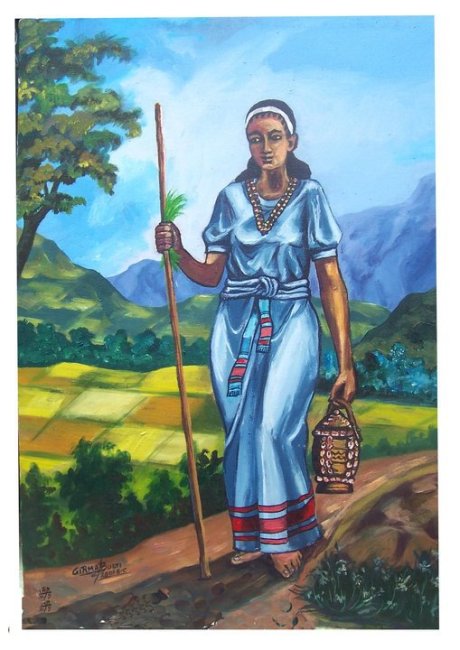
‘Oromo society views women as the dominant creators and assimilators of cultural symbols. At this time, women were independently creating their own material expressions based on the emerging nationalist consciousness sweeping the Oromo countryside, and these practices continue today through the manipulation of new materials in the production of upper torso body art. Oromo women’s dress is most closely associated with the lower body and its association with procreation.’
http://www.creative8studios.com/oromia/
Copyright © Oromianeconomist 2013 and Oromia Quarterly 1997-2013. All rights reserved. Disclaimer.
Exploitative Investment Opportunities In Naked Africa November 19, 2013
Posted by OromianEconomist in Africa, Colonizing Structure, Corruption, Development, Dictatorship, Economics, Economics: Development Theory and Policy applications, Land Grabs in Africa, Oromia, Oromiyaa, Oromo, The Colonizing Structure & The Development Problems of Oromia, Theory of Development, Tyranny, Uncategorized.Tags: Africa, African Studies, Development and Change, Economic and Social Freedom, Governance issues, Human Rights and Liberties, Land grabbing, Land grabs in Africa, National Self Determination, Oromia, Oromo, Oromo people
add a comment
“Free market works only if there is no asymmetry. For there to be a free market and pure capitalist growth, there must be a powerful judicial system, corruption must be minimal, competition must be protected and preserved and oligopolies, banned. With these pre-conditions being scarcely present, will it be reasonable to promote capitalism in flagrantly corrupt, oppressive and deprivation riddled Africa?” –Dr. Peregrino Brimah
“Typically, narratives about Africa have been shaped by non-Africans and not been particularly complimentary. Whether through images of emaciated children fending off flies from their faces or stories of wild-eyed assault-rifle toting warlords, Africa for many has become synonymous with poverty, helplessness, and hopelessness.But in recent years, these stereotypes have been increasingly challenged by proponents of new narratives, ones that seek to reclaim Africans’ agency and emphasise the continent’s positive trends. Evangelists of these new discourses are often Africans themselves and aim to articulate the visions, histories, philosophies and aspirations of Africans, that have for so long been suppressed and misrepresented on the global stage. …One feature of many African economies which continues to define Africa’s relationship with the global economy is its continuing dependence on foreign aid. While Ethiopia is heralded as one the continent’s rising stars, for example, some estimate that 90% of its annual budget is derived from donor funding. Meanwhile Malawi, another aid darling, gets40% of its national budget from foreign benefactors.” Think Africa Press
The following is interesting and timely debate on issues of Africpitalism and whether free market system is working in African environment of flagrant corruption, absence of rule of law, minimal competition and oppressive politics.
‘Africapitalism sounds exciting, but before capitalism can be approached, there are prerequisites. The United States sells bonds and these are purchased based on “trust”. Trust is key in a successful capitalist society. Can we say that Africa has gotten to a stage where trust exists? Many will disagree. Can there be a free market where there is no middle class? This is the reason why the United States gives monthly employment records. There are two factors that predict the success and viability of capital societies—the employment report, which indicates purchase power; and the tax system.Nigeria was recently reported as the only country in the world where illicit cash flows were more than taxes paid. The rest of Africa shares these parameters. What is the suitability of capitalism in such societies? How does it benefit society and government? With unemployment levels in high double digits in sub-Saharan Africa, is capitalism the next best venture for such economies? Who will buy non essentials? This is where the bordering-on-insensitive reality of today’s Africapitalists features. As, in reality there are no jobs and no middle class, capitalists in Africa focus on investment and maximizing profits in essential utilities and not unessential/luxury items as obtains in Europe and America.“Utilities” like power, water, construction materials-cement, communication and even roads are the sole ventures the Africapitalists have invested in, knowing well that only in these areas can they secure sure sales and tasty returns on investment. It takes a certain amount of innovativeness and skill to develop a “luxury” non-utility product, market it, compete in a free economy, sell it, and to provide customer service and support for it. Africapitalists do not venture there. They simply work with their friends in the government to handle essentials of existence: Transportation, communication, power and construction. They have no marketing skills or plans. They lack innovative skill and intent. Thanks to government enforced monopolies; they have a simple secret of success and market schema—construct or die. Drive or die. Communicate or die. Eat and drink or die. Power your property or die. Their success is enforced by the government in top-down policies, banning all small business and middle men competition. In the Africapitalist expert, Elemelu, CON’s report, he mentions that he believes government should enable private sector growth with equity and transparency, without top-down management. The question to the Guru’s theory is—will he and other Africapitalists venture into any of their recent investments, like cement, mobile communication and power if they were not assured by the government of a dissolute top-down, authority enforced oligopoly to disable competition and enforce purchase at their rather, ridiculously inflated prices? Here we detect possible untruth and hypocrisy. The recent (November 13th, 2013) Afrobarometer report, surveying 51,000 Africans found that over half felt their governments did a shoddy job of controlling corruption. Currently at 54%, this was an increase from 46% 10 years ago. In contrast to the wealthy, poorer status was not surprisingly linked with greater reports of corruption and distrust. Apparently, Africa’s rich are invested, beneficial and insulated partners in the corruption. What will a campaign of ravenous capitalism predict for the future of the people with the present corruption parameters? Is there a safety-net for the poor of the continent?Publishing on a so-called Africapitalism is the bold promotion of a personal interest and brand. This is expected in the interest of self-preservation, but is clearly not honest and reflective of reality and not in the best interest of the continent, at this point in time. What is beautifully branded and offered is get-rich-quick, risky but equally rewarding, exploitative investment opportunities in naked Africa. The growing gap between the rich and poor in Africa only promises to be expanded as capitalist development is culturing underdevelopment in the continent by reinforcing exploitative dependence. The greed and selfishness of capital accumulation and market profit-seeking have been at the root of divisionism, ethnic chauvinism, tribalism and dissension in Africa. With this new Africapitalist push to divert Aid funding and foreign investment, the money that is touted as supporting the continent’s poor, is now being incriminated in financing bloody political divisionist and ethno-fractioning campaigns that the private big business sector is historically credited with in Africa’s struggling and prone democracies. An important question to ask when considering Africapitalism is; where does the Africapitalist want to take Africa to? It is important to define what the expected outcome of Afrocapitalism is, as with any other mantra, venture or policy. This end direction is hard to deduce reading through all the current material on Africapitalism. Is it all about ensuring profit for business? Is the goal the provision of jobs to Africans? Is the goal, the development of Africa?Most perturbedly: Is there a single Africapitalist product, solid and competitive enough that it has/is/can be marketed outside Africa? Is the goal of the Africapitalist, global export or rather a closed exploitative marketing to Africa, like the historic “Robber Barons” of 19th century USA?The Afrocapitalism agenda appears to be marketed toward foreigners, in soliciting foreign investment in Africa, or actually, the diversion of Aid money into African big corp. One must agree it is a great pitch for diverting the foreign Aid money through the cabal. A really super pitch! We must thank Dambisa Moyo’s “Dead Aid” –for rightly criticizing Aid—and the Nigerian “sharper” mind for this latest cabal “hustle.” That Aid money must not be lost, right?Why is democratic Africa suddenly appealingly marketed to foreign investors by its Africapitalists —with evidence— as promising quadruple the return on capital investment and bonds? The answer is simple. It is the result of the “trust,” not of African governments or clime, but of the mutually beneficial, co-dependent relationship between the political leadership and their private sector sponsors. Government radical support for oligopolies and total lack of regulation of private-sector provided utilities creates an atmosphere for frank exploitation of the masses. End utility-essential products are sold at terribly inflated, quadruple global prices to the poor who have no protection and are allowed no alternative.Talking about protection and dependency: If/when we open our doors to foreign Africapitalists, the so-called “philathrocapitalists,” are we going to encourage our farmers to sign-up for the “Golden rice,” and “WEMA,” genetically modified, patented seeds from Monsanto and the Bill Gates foundation, which will make them loan dependent in order to purchase new modified, dangerous seeds every year, eventually further crippling and destroying the farming sector? Haitians burning donated Monsanto seeds despite their post-quake hunger, comes to mind. Will the cabal protect us from hurt and extortion? This has not really been the strong point of Africa’s rich men, has it?We ask earnestly; what system exists for the protection of the masses? Even the United States, the capitalism capital of the world is being shut-down due to capitalisms shortfalls. The Occupy Wall street protests which were brutally quieted, which exhibited 99% protesting against 1% who virtually control 99% of US income, is a pure demonstration of the result of capitalism; and this in a society that has some regulations.In the US, corporate bodies, aka, Wall Street virtually controls the government. The least Africa can do is learn from the tribulations of others, which have led to a global recession that continues to cause massive unemployment, austerity and suffering in European nations , than utilize and advertise Africa as the next and last frontier of capitalist invasion.There is no food on the continent. There is stark corruption. There is poor governance. There is marked inequality. Purely capitalist ventures have been proven to never alleviate these issues, but to only foster greater deprivation, corruption and poverty while in the job-creation regard, they only provide transient slavery-like employment status for a few, while for the majority, they cripple small businesses and lead to greater job insecurity and financial dependence. Are we thinking about environmental economics? Economics of the poor? What is the sense in manufacturing cars, while we import rice? (Both ending up at more expensive prices than if we did it the other way around.)There are different types of economies. There is the China model, which is a manufacturing economy. In China, the government has supported millions of cottage industries which compete freely and are protected by the government and assisted in exportation of their products around the world. China today is one of the strongest economies in the world.A focused Dubai has a thriving trade and tourism economy. The state runs a “centrally-planned free-market capitalism” system, and this government controlled system has fostered growth with only 3% revenue from oil. A responsible government which monitors and ensures a favorable and stable society for foreigners, has sustained Dubai among the UAE states. Dubai did these things in less than 5 years. Can we not likewise develop systems tailored around our competitive and progressive advantages, without selling the people?What is in the best interest of African nations? There is great land, there is great resource, and most of all, there is the invaluable human capital. Is it to maximally exploit the continent in capitalistic ventures? Or to develop the human potential, to exploit the land and resource while ensuring the proper appraisal of Agricultural and mineral produce to promote individual and communal wealth that can now, while protected by the government, foster small-business growth and national growth? Or is it to empower a handful of super-rich Africans and their foreign invited investors to operate “toxic” industrial monopolies which will employ a percent of the population in perpetual bondage, and then maximize profits by government enforced oligopolies—marketing essential utility goods to the large catchment African population? Evidently, Africapitalism should be seriously reconsidered and debated. Before we fight to put Africa’s Aid into the hands of the Cabal and put “capital” and “profiteering” first, how about we put, “eradicating corruption,” “people,” “land,” “small business” and “Innovation” first? Trade was not invented yesterday. Common, we are all businessmen. Yes, the government must support industrialism, but not in discriminatory fashion, with advantage given to the Oilgarchs. My challenge to the Africaptalists: Let us see you produce and successfully market a single non-essential product or service within the environment of a free market to Africa and abroad. Generate power and sell it competitively, without first buying the nations grids and inhibiting state and populace power generation and sale. Manufacture cars and compete in their sale, without first banning the importation of “tokunbo” vehicles. Then we will agree that you are truly and honesty engaged in “powering Africa.” And to us commoners, we can’t sit and keep blaming the Cabal for coming up with these master schemes, each and every time. The Cabal can only think the way they know how. We the people need to rise up fight and challenge and chart our own course. Africa does need its founding fathers to develop its “strategic vision,” but not of these crop. For now, when it comes to a choice between being a slave for a white master—through Aid— or slave for an African Cabal, I think we humbly choose neither. If you want, you can keep the Aid, but please, never use it to empower those that got us and keep us “here,” any further.’
Read the full article from:
http://saharareporters.com/article/africapitalism-good-or-bad-africa-dr-peregrino-brimah
http://en.wordpress.com/read/post/id/56832612/24/
‘According to Dambisa Moyo, Zambian economist and author of Dead Aid: Why aid is not working and how there is a better way for Africa, Africa has received at least $1 trillion of development-related aid from developed countries over the past 60 years, and this has not only flattered prognoses of African development, but fostered dependency and perpetuated poor governance. Although aid may be beneficial in the short-term, so long as African nations are dependent on overseas aid for public services and development, buoyant Africa rising narratives seem premature. Economic growth so heavily bolstered by overseas aid cannot be organic, stable growth. Furthermore, this ongoing dependency perpetuates a global power imbalance between North and South. Too often, African leaders attend international conferences not in the hope of contributing to discussions, but to ask for aid. And as long as external donors have such sway over national budgets, Africa will not be able to stand on an equal footing with the rich world….But Africa’s finances are not only undermined by where they come from, but where they go. With regards to both development aid and finances generated from Africa’s vast minerals resources, money is often illicitly siphoned off to lubricate patronage networks rather than going to the most needy. A study released this May by the African Development Bank and Global Financial Integrity revealed that from 1980-2009, Africa lost up to $1.4 trillion in illicit financial outflows – whether through corruption, tax evasion, bribes or other criminal activities. This figure, as Obadia Ndabapoints out, is more than three times the total amount of foreign aid received over the same period. Nigeria is reported to have lost over $400 billion to oil corruption alone since independence in 1960. These figures are particularly staggering when one considers the majority of sub-Saharan Africa’s population live on around $2/day.’ http://thinkafricapress.com/development/lessons-africa-rising?utm_content=bufferae09b&utm_source=buffer&utm_medium=twitter&utm_campaign=Buffer
Copyright © Oromianeconomist 2013 and Oromia Quarterly 1997-2013. All rights reserved. Disclaimer.
Scientific System, Mathematics and Ancient Kemetic Traditions November 17, 2013
Posted by OromianEconomist in Africa, Culture, Development, Gadaa System, Kemetic Ancient African Culture, Language and Development, Oral Historian, Oromia, Oromiyaa, Oromo, Oromo Culture, Oromo Identity, Oromo Social System, Oromummaa, Self determination, Sirna Gadaa, The Oromo Library, Theory of Development, Uncategorized.Tags: Africa, African culture, African Philosophy, African Studies, Ancient Black People, Ancient Egypt, Gadaa System, Kemet, Kemetic, Mathematics in Ancient Africa, Number Theory, Oromia, Oromo, Oromo people
1 comment so far
Number Mysticism
The netert (goddess) Seshat is well described in numerous titles that ascribe two main types of activities to her. She is The Enumerator, Lady of Writing(s), Scribe, Head of the House of the Divine Books (Archives).The other aspect of Seshat and obviously closely related to it is one where she is described as the Lady of Builders.
The divine significance of numbers is personified in Ancient Egyptian traditions by Seshat, The Enumerator.
The Ancient Egyptians had a “scientific and organic system” of observing reality. Modern-day science is based on observing everything as dead (inanimate). Modern physical formulas in our science studies almost always exclude the vital phenomena throughout statistical analyses. For the Ancient Egyptians, the whole universe is animated.
Animism is the concept that all things in the universe are animated (energized) by life forces. This concurs, scientifically, with the kinetic theory, where each minute particle of any matter is in constant motion, i.e., energized with life forces.
In the animated world of Ancient Egypt, numbers did not simply designate quantities but instead were considered to be concrete definitions of energetic formative principles of nature. The Egyptians called these energetic principles neteru (gods).
For Egyptians, numbers were not just odd and even—they were male and female. Every part of the universe was/is a male or a female. There is no neutral (a thing). Unlike in English, where something is he, she, or it, in Egypt there was only he or she.
These animated numbers in Ancient Egypt were referred to by Plutarch, in Moralia Vol V, when he described the Egyptian 3-4-5 Triangle:
The upright, therefore, may be likened to the male, the base to the female, and the hypotenuse to the child of both, and so Ausar [Osiris] may be regarded as the origin, Auset [Isis] as the recipient, and Heru [Horus] as perfected result. Three is the first perfect odd number: four is a square whose side is the even number two; but five is in some ways like to its father, and in some ways like to its mother, being made up of three and two. And panta [all] is a derivative of pente [five], and they speak of counting as “numbering by fives”. Five makes a square of itself.
The vitality and the interactions between these numbers shows how they are male and female, active and passive, vertical and horizontal, …etc.The Ancient Egyptian mode of calculation had a direct relationship with natural processes, as well as metaphysical ones. Even the language employed in the Egyptian papyri serves to promote this sense of vitality, of living interaction. We see this understanding as an example in Item no. 38 of the papyrus known as the Rhind Papyrus, which reads,
I go three times into the hekat (a bushel, unit of volume), a seventh of me is added to me and I return fully satisfied.
Numbers were animated and personified. Likewise, calculations were personal in Ancient Egypt. We are part of the natural process in the universe. Even in our present-day, we hear the genius among us describe how they feel the subject of their excellence. They live their work in order to excel and exhilarate.Egyptians manifested their knowledge of number mysticism and harmonical proportions in all aspects of their lives, such as art and architecture. The evidence that Egypt possessed this knowledge is commanding. As examples:
The heading of the Ancient Egyptian papyrus known as the Rhind (so-called “Mathematical”) Papyrus (1848-1801 BCE) reads,
Rules for enquiring into nature and for knowing all that exists, every mystery, every secret.
The intent is very clear that Ancient Egyptians believed and set the rules for numbers and their interactions (so-called mathematics) as the basis for “all that exists”.The famous Ancient Egyptian hymn of Leiden Papyrus J 350 confirms that number symbolism had been practiced in Egypt, at least since the Old Kingdom (2575–2150 BCE). It is a rare direct piece of evidence of the Egyptian knowledge of the subject. The Leiden Papyrus consists of an extended composition, describing the principle aspects of the ancient creation narratives. The system of numeration, in the Papyrus, identifies the principle/aspect of creation and matches each one with its symbolic number.
This Egyptian papyrus consists of 27 stanzas, numbered from 1 to 9, then from 10 to 90 in tens, then from 100 to 900 in hundreds. Only 21 have been preserved. The first word of each is a sort of pun on the number concerned.The numbering system of this Egyptian Papyrus by itself is significant. The numbers 1 to 9, and then the powers 10, 20, 30, etc., now come to constitute the energetic foundations of physical forms.
All the design elements in Egyptian buildings (dimensions, proportions, numbers, …etc.) were based on the Egyptian number symbolism.
The Ancient Egyptian name for the largest temple in Egypt, namely the Karnak Temple Complex, is Apet-sut, which means Enumerator of the Places. The temple’s name speaks for itself. This temple started in the Middle Kingdom in ca. 1971 BCE, and was added to continuously for the next 1,500 years. The design and enumeration in this temple are consistent with the number symbolism of the physical creation of the universe.
The Egyptian concept of number symbolism was subsequently popularized in the West by and through the Greek Pythagoras (ca. 580–500 BCE). It is a known fact that Pythagoras studied for about 20 years in Egypt, soon after Egypt was open to Greek exploration and immigration (in the 7th century BCE).
Pythagoras and his immediate followers left nothing of their own writing. Yet, Western academia attributed to him and the so-called Pythagoreans, an open-ended list of major achievements. They were issued a blank check by Western academia.
Pythagoras and his followers are said to see numbers as divine concepts, ideas of the God who created a universe of infinite variety, and satisfying order, to a numerical pattern.
The same principles were stated more than 13 centuries before Pythagorus’ birth, in the heading of the Egyptian’s Rhind Papyrus, which promises,
Rules for enquiring into nature and for knowing all that exists, every mystery, every secret.
Moustafa Gadalla
http://www.egypt-tehuti.org/articles/sacred-numerology.html
http://thesevenworlds.wordpress.com/2013/11/17/kemetic-numerology/
http://thesevenworlds.wordpress.com/2013/12/08/kemet-zulu-yoruba-1/


 The Egyptian Sacred Numerology
By Moustafa Gadalla (edited)
Number Mysticism
The netertSeshat is well described in numerous titles that ascribe two main types of activities to her. In Kemet, she wasThe Enumerator, Lady of Writing(s), Scribe, Head of the House of the Divine Books (Archives). The other aspect of Seshat is as the Lady of Builders.
The divine significance of numbers is personified by Seshat, The Enumerator.
Kemet had a “scientific and organic system” of observing reality. Modern-day science is based on observing everything as dead (inanimate). Modern physical formulas in our science studies almost always exclude the vital phenomena throughout statistical analyses. In Kemet, we knew the whole universe was animated.
View original post 839 more words
Relaunching Africa: The Call For Pro-Poor Growth November 17, 2013
Posted by OromianEconomist in Africa, Development, Economics, Economics: Development Theory and Policy applications, Oromia, Oromiyaa, Oromo, Oromo Nation, Oromo Social System, Self determination, The Colonizing Structure & The Development Problems of Oromia, The Oromo Governance System, Theory of Development, Uncategorized.Tags: Africa, African Studies, Developing country, Development, Development and Change, Economic and Social Freedom, economics, Governance issues, Leading Issues In African Development, Oromia, Oromiyaa, Oromo, Oromo the ancient African Society, Social Sciences, State and Development, World Bank
1 comment so far
“Policies aimed at enhancing agricultural productivity and increasing food availability, especially when smallholders are targeted, can achieve hunger reduction even where poverty is widespread. When they are combined with social protection and other measures that increase the incomes of poor families, they can have an even more positive effect and spur rural development, by creating vibrant markets and employment opportunities, resulting in equitable economic growth.” F.A.O.
“Poor people feeding their babies better and sending their children to school, while also building a new chicken coop. Let governments ensure that there are teachers there to actually teach the children, and you could be on to a really promising combination. It may look less impressive than a new oil platform or a shiny airport, but it will reduce poverty just the same, if not more!”
The new Deputy Chief Economist for the World Bank in Africa in his call for evidence based debate in pursuit of African development states the following arguments and calls for pro-poor development policies:
In 1990, poverty incidence (with respect to a poverty line of $1.25) was almost exactly the same in sub-Saharan Africa and in East Asia: about 57%. Twenty years on, East Asia has shed 44 percentage points (to 13%) whereas Africa has only lost 8 points (to 49%). And this is not only about China: poverty has also fallen much faster in South Asia than in Africa. These differences in performance are partly explained by differences in growth rates during the 1990s, when emerging Asia was already on the move, and Africa was still in the doldrums. But even in the 2000s, when Africa’s GDP growth picked up to 4.6% or thereabouts, and a number of countries in the region were amongst the fastest-growing nations in the world, still poverty fell more slowly in Africa than in other regions. Why is that? Part of the answer is that Africa’s population growth rates are still very high: 2.7% per year, versus 0.7% in East Asia. So a 4.6% growth rate for GDP translates into a much more modest sounding 1.9% growth in per capita GDP – less than the developing country average in 1999-2012. But an even bigger part is that Africa just seems less efficient at transforming economic growth into poverty reduction. That conversion is measured by what economists call the “growth elasticity of poverty”, a number that tells us by how much poverty falls for each percentage point in economic growth. According to a recent (and as yet unpublished) estimate by my colleagues Luc Christiaensen, Punam Chuhan-Pole and Aly Sanoh, that elasticity was about 2.0 in the developing world as a whole (excluding China) during the 2000s, but only 0.7 in Africa. At this rate, even if countries in Africa continue to grow at the same rates as in the 2000s – a period when the external environment was particularly benign, with rising commodity prices and abundant liquidity – poverty in 2030 would be in the 26%-30% range (assuming constant inequality). Under similar assumptions for other countries, somewhere between 60% – 80% of the world’s poor would live in Africa. Why is growth in Africa apparently less pro-poor than elsewhere? And what can be done about it? At first blush, at least part of the answer (beyond rapid population growth) has to do with both levels and changes in inequality. Inequality is relatively high in Africa: seven of the world’s 10 most unequal countries in the latest data in Povcalnet are in the region – despite the fact that African inequality is almost invariably measured for consumption, rather than income, while the opposite is true in Latin America. In addition, inequality has actually been rising in a number of countries. (Although the truth is that infrequent household surveys and changing methodologies are so common that we actually know relatively little about real changes in inequality in Africa – despite the impression you may get from various sources…)This clearly reflects a growth pattern that is less inclusive than we might like. In our latest Africa’s Pulse and in our recent presentation on the State of the Africa Region to the Annual Meetings of the Bank and the Fund in Washington, we reviewed some of these data, and suggested a four-part strategy for better sharing Africa’s growth in the future:
• First, preserve macroeconomic stability. Africa’s growth success in the 2000s reflects policy improvements, but also a benign external environment. During this period, fiscal deficits and current account deficits grew in most countries (Figure 1). While that is understandable, given plentiful capital flows, the risk is that those capital flows cease – or reverse – precisely at a time when commodity prices have stopped rising and are, in many cases, falling. Countries with large fiscal and current account deficits are inevitably more vulnerable to those risks.
• Second, build more – but mostly better – human and physical capital. Of course, alongside increases in total factor productivity – this is what drives economic growth everywhere. Despite progress, the needs in Africa are enormous, in everything from health and education to transport and energy. Our emphasis here is on quality: there have been real gains in access, but children won’t learn unless the teachers show up at school and, in addition, actually teach! Similarly, the costs of power, water, transport and communications remain excessively high. That is partly due to sheer scarcity, and partly to geographic fragmentation, but not only. The way contracts are designed, the way competition is (or isn’t) promoted, and the way subsidies interact with firm incentives all need looking at as well.
• Third, promote growth in the places and sectors where the poor live and work. For most of Africa, that means in rural areas – both by finding better ways to promote higher yields in agriculture, and by strengthening the off-farm economy. Linkages to small and medium-sized towns seem to be an important ingredient. This suggests that “local investments” – in rural roads and electrification, for example – is likely to be as important as big flagship projects. Even if the political economy tends to favor the latter.
• Fourth, harness the power of growth that takes place elsewhere for investments near – or in – the poor. That is particularly pertinent for (the large and growing group of) countries with large natural resource sectors. Oil and mining are not intensive in unskilled labor and could, if left alone, develop almost as “enclave sectors”. The main policy concern with these resources is to invest as much as possible of the rents they generate into other forms of capital, to replace the natural capital being depleted. But countries should be imaginative and comprehensive in their choice of investment portfolio. The portfolio should obviously include infrastructure, health and education projects, to build physical and human capital. But it may also include foreign assets, to help with the risk of exchange-rate appreciation and “Dutch disease”.
And it should also include some cash transfers made directly to poor people. The prevailing evidence is that poor households tend to use the resources from small cash transfers rather wisely. They buy more and better food. They send their kids to school more often. And they even invest some of it in their own (very) small businesses: they buy chickens in Mexico, or goats in Tanzania.
That’s pro-poor growth for you! Poor people feeding their babies better and sending their children to school, while also building a new chicken coop. Let governments ensure that there are teachers there to actually teach the children, and you could be on to a really promising combination. It may look less impressive than a new oil platform or a shiny airport, but it will reduce poverty just the same, if not more!
For more details refer to: http://blogs.worldbank.org/africacan/sharing-africa-s-growth?cid=EXT_TWBN_D_EXT
Related Articles:
African rule of law declines despite economic gains, Ibrahim index shows
http://ethiofreespeech.blogspot.no/2013/10/african-rule-of-law-declines-despite.html
Global hunger down, but millions still chronically hungry
‘Despite the progress made worldwide, marked differences in hunger reduction persist. Sub-Saharan Africa has made only modest progress in recent years and remains the region with the highest prevalence of undernourishment, with one in four people (24.8 per cent) estimated to be hungry. No recent progress is observed in Western Asia, while Southern Asia and Northern Africa witnessed slow progress. More substantial reductions in both the number of hungry and prevalence of undernourishment have occurred in most countries of East Asia, Southeastern Asia, and in Latin America.’
https://oromianeconomist.wordpress.com/2013/08/30/poverty-deprivation-capability-and-economics/
“Terms like ‘peasant farming’ or ‘traditional farming’ evoke for many people the notion of subsistence agriculture, and peasants living in blissful harmony with nature. The truth is that many peasant farmers struggle, many are poor and ironically constitute the majority of the undernourished in the world. Smallholder farmers need what other businesses need—access to finance, markets, infrastructure, technology, the tools and knowledge to grow their businesses, get their product to market and increase their incomes. That is their route out of poverty. It’s important to avoid black-and-white dichotomies between ‘big ag’ and ‘little ag’, industrial or traditional etc. Agricultural research, for example, can be of benefit to small farms as much as large. Small farmers need new technologies, adapted to their farming circumstances. Smallholder farming needs support; the question remains of who’s going to provide that support. There are critical roles for government, the private sector, development agencies and consumers. Integration of smallholders into higher-value market chains calls for a proactive role by national governments in terms of food safety standards, building infrastructure, and making the policy and legal environment conducive. That includes protecting the rights of small farmers—a large proportion of whom are women who face inequality and barriers to access to land, credit, education and advice. Strong producers’ associations managed and owned by small farmers can make working with small farmers more attractive to the private sector and also help safeguard their interests. And the private sector has to come equipped not only with finance but also with respect for rural people and the local context. To achieve food security, a sustained increase in agricultural productivity is required, with more focus on those small farmers who tend to be the most neglected: youth, women, other disadvantaged social groups and indigenous peoples. ”
http://ifad-un.blogspot.it/2013/10/how-to-feed-world_24.html
‘The continent’s burgeoning middle class has driven much of that discourse. Stories about its growth, increasing wealth and expanding expenditure have contributed to portray an Africa on the ascent. Prospects are so promising that Mthuli Ncube, chief economist of the African Development Bank (AfDB), suggested that we recalibrate our development priorities: [Aid and development strategy] will have to concentrate less on the bottom of the pyramid and move to the middle, which means it has to be supportive of private sector initiatives, which then are the way middle class people conduct their lives.This sentiment is echoed regularly by development institutions. Never mind that the middle class is a precarious and expansive category lumping together people spending $2 to $20 a day. Let’s also ignore that the so-called ‘floating class’ at the bottom end of the spectrum represent almost 40% of said middle class, people who contend with questions like affording school fees and medical treatment on a regular basis. If we cherry pick the middle, what happens to the rest? It is one thing to use the middle class to unpack singular depictions of the continent, it is another to pivot all development policies and priorities towards them. On the continent, despite improvements in national economies, technology, and certain human development indicators, almost 2 Africans out of 3 remain affected by poverty. The number of poor people has doubled since 1980s and among the world’s 10 most unequal countries, six are in Africa. In a recent survey of more than 50,000 people in 34 African countries about current economic conditions, half say they struggle to meet daily needs like food, clear water, and medicine.’ http://naiforum.org/2013/11/against-the-gospel-of-africa-rising/
Copyright © Oromianeconomist 2013 and Oromia Quarterly 1997-2013. All rights reserved. Disclaimer.
Oromo Are The Single Largest And Indigenous National Group In East Africa November 14, 2013
Posted by OromianEconomist in Human Rights, Humanity and Social Civilization, Kemetic Ancient African Culture, Oromia, Oromiyaa, Oromo, Oromo Culture, Oromo Social System, Oromo the Largest Nation of Africa. Human Rights violations and Genocide against the Oromo people in Ethiopia, The Oromo Democratic system, The Oromo Governance System, Uncategorized.Tags: Africa, African culture, African Studies, Gadaa System, Oromia, Oromo, Oromo people, Seenaa Jimjimo
add a comment

Oromia map (green)
Independent nation before 1887
Mini Documentary by Seenaa Jimjimo
‘The Oromo Community Association in Chicago was featured on Chicago Public Radio’s Worldviewprogram on Wednesday, October 20, 2010. Listen below the full segment of the program on the Oromo people, the Oromo Community Association in Chicago, and the benefit jazz concert that the Association will hold on October 24, 2010.From the Chicago Public Radio: There are an estimated 40 million Oromo in Ethiopia, which makes them the nation’s largest ethnic group. Their numbers extend into Kenya and Somalia as well. Yet, despite their wide influence in the Horn of Africa, many people have never heard of the Oromo. Seenna Jimjimo of Chicago’s Oromo Community Association and Kadiro Elemo talk with Jerome about the Oromo culture, the struggle for independence and the local Oromo community in Chicago.’ Source: Gadaa.com
Listen:
Related references:
From slavery to freedom:the Oromo slave children of Lovedale, prosopography and profiles
Sandra Carolyn Teresa Rowoldt Shell
Student number: RWLSAN002
A dissertation submitted in fulfilment of the requirements for the award of the degree of Doctor of Philosophy in Historical Studies
Faculty of the Humanities
University of Cape Town
2013
https://www.academia.edu/3760219/From_slavery_to_freedom_the_Oromo_slave_children_of_Lovedale_prosopography_and_profiles
https://oromianeconomist.wordpress.com/?s=twisted&searchbutton=go%21
Ethiopia’s Land Grabs And Endangered Communities: The Indigenous People Excluded from ‘Rapid Growth’ November 11, 2013
Posted by OromianEconomist in Africa, Colonizing Structure, Corruption, Culture, Development, Dictatorship, Knowledge and the Colonizing Structure., Knowledge and the Colonizing Structure. Africa Heritage. The Genocide Against Oromo Nation, Land Grabs in Africa, Oromia, Oromiyaa, Oromo, Oromo the Largest Nation of Africa. Human Rights violations and Genocide against the Oromo people in Ethiopia, Oromummaa, Self determination, The Colonizing Structure & The Development Problems of Oromia, Theory of Development, Tyranny.Tags: Africa, African culture, Economic and Social Freedom, economics, Genocide, Genocide against the Oromo, Human rights violations, Indigenous People, Land grabbing, Land grabs in Africa, Mursi, National Self Determination, Omo, Oromia, Oromo, Oromummaa, People of Omo Valley, Universal Declaration of Human Rights
add a comment


The ethnic communities living along Ethiopia’s Omo River and depend on annual flooding to practice flood retreat cultivation for their survival and livelihood. Credit: Ed McKenna/IPS
‘The government already has trouble managing hunger and poverty [among] its citizenry. By taking over land and water resources in the Omo Valley, it is creating a new class of ‘internal refugees’ who will no longer be self-sufficient.’
OMO VALLEY, Ethiopia, Nov 11 2013 (IPS) – As the construction of a major transmission line to export electricity generated from one of Ethiopia’s major hydropower projects gets underway, there are growing concerns that pastoralist communities living in the region are under threat.
The Gibe III dam, which will generate 1,800 megawatts (MW), is being built in southeast Ethiopia on the Omo River at a cost of 1.7 billion dollars. It is expected to earn the government over 400 million dollars annually from power exports. On completion in 2015 it will be the world’s fourth-largest dam.
“We are being told to stop moving with our cattle, to stop wearing our traditional dressand to sell our cattle. Cattle and movement is everything to the Mursi.” — Mursi elder
But the dam is expected to debilitate the lives and livelihoods of hundreds of thousands of indigenous communities in Ethiopia’s Lower Omo Valley and those living around Kenya’s Lake Turkana who depend on the Omo River.
The Bodi, Daasanach, Kara, Mursi, Kwegu and Nyangatom ethnic communities who live along the Omo River depend on its annual flooding to practice flood-retreat cultivation for their survival and livelihoods.
But the semi-nomadic Mursi ethnic community are being resettled as part of the Ethiopian government’s villagisation programme to make room for a large sugar plantation, which will turn roaming pastoralists into sedentary farmers. The hundreds of kilometres of irrigation canals currently being dug to divert the Omo River’s waters to feed these large plantations will make it impossible for the indigenous communities to live as they have always done.
“We are being told that our land is private property. We are very worried about our survival as we are being forced to move where there is no water, grass or crops,” a Mursi community member told IPS.
The Omo Valley is set to become a powerhouse of large commercial farming irrigated by the Gibe III dam. To date 445,000 hectares have been allocated to Malaysian, Indian and other foreign companies to grow sugar, biofuels, cereals and other crops.
“The Gibe III will worsen poverty for the most vulnerable. The government already has trouble managing hunger and poverty [among] its citizenry. By taking over land and water resources in the Omo Valley, it is creating a new class of ‘internal refugees’ who will no longer be self-sufficient,” Lori Pottinger from environmental NGO International Rivers told IPS.
Top global financiers, including the World Bank and the African Development Bank (AfDB), have committed 1.2 billion dollars to a 1,070 km high-voltage line that will run from Wolayta-Sodo in Ethiopia to Suswa, 100 km northwest of the Kenyan capital, Nairobi. The transmission line, powered by Ethiopia’s Gibe III, will connect the country’s electrical grid with Kenya and will have a capacity to carry 2,000 MW between the two countries.
According to the AfDB, it will promote renewable power generation, regional cooperation, and will ensure access to reliable and affordable energy to around 870,000 households by 2018.
According to Prime Minister Hailemariam Desalegn, Ethiopia’s economy is set to maintain a growth rate of 11 percent in 2014. Fully exploiting its massive water resources to generate a hydropower potential of up to 45,000 MW in order to sell surplus electricity to its neighbours is central to Ethiopia’s Growth and Transformation plan, a five-year plan to develop the country’s economy.
The Horn of Africa nation currently generates 2,000 MW from six hydroelectric dams and invests more of its resources in hydropower than any other country in Africa – one third of its total GNP of about 77 billion dollars.
According to a World Bank report published in 2010, only 17 percent of Ethiopia’s 84.7 million people had access to electricity at the time of the report. By 2018, 100 percent of the population will have access to power, according to state power provider Ethiopian Electric Power Corporation (EEPCO).
“We are helping mitigate climate risk of fossil fuel consumption and also reduce rampant deforestation rates in Ethiopia. Hydropower will benefit our development,” Miheret Debebe, chief executive officer of EEPCO, told IPS.
The Ethiopian government insists that the welfare of pastoralist communities being resettled is a priority and that they will benefit from developments in the Omo Valley. “We are working hard to safeguard them and help them to adapt to the changing conditions,” government spokesperson Shimeles Kemal told IPS.
However, there are concerns that ethnic groups like the Mursi are not being consulted about their changing future. “If we resist resettlement we will be arrested,” a Mursi elder told IPS.
“We fear for the future. Our way of life is under threat. We are being told to stop moving with our cattle, to stop wearing our traditional dress and to sell our cattle. Cattle and movement is everything to the Mursi.”
The importance of ensuring that benefits from Ethiopia’s national development projects do not come at a price of endangering the lives of hundreds of thousands pastoralist tribes is critical said Ben Braga, president of the World Water Council. Braga decried governments that failed to compensate communities like the Mursi as displacement of surrounding communities is always an inevitable consequence of major dams that need plenty of advanced planning to avoid emergencies.
“How can we compensate these people so that the majority of the country can benefit from electricity? There is a need for better compensatory mechanisms to ensure that benefits are shared and that all stakeholders are included in consultations prior to construction,” he told IPS.
Read more at the original source:http://www.ipsnews.net/2013/11/ethiopias-indigenous-excluded-from-rapid-growth/?utm_source=ipsnews&utm_medium=twitter
‘Foreign investors are taking as much as they can from an impoverished nation, including its crops, land and the hard work of an Ethiopian population, to serve their own interests above others. According to the Food and Agriculture Organisation (FAO), 14.56 million hectares of Ethiopia’s 100 million hectare land mass is arable land, most of it cultivated by small hold, subsistence farmers. International investors have taken note and are rushing to this country, once synonymous with starvation, to take advantage of the government’s new push to improve its agricultural production capacity. But many fear the government’s sale of arable land to foreign nationals will create a modern form of agricultural colonialism. One such arrangement, launched in 2009 under Saudi Arabia’s King Abdullah initiative and forming part of a $100-million investment scheme in Ethiopian agriculture, had farmers grow teff (a North African cereal grass), white wheat, maize and white sorghum, among other crops, before these were exported back to the Gulf region. The Economist referred to it as an instance of a “powerful but contentious trend sweeping the poor world”, further saying that countries which export capital but import food are outsourcing farm production to countries that need capital but which have land to spare. According to Human Rights Watch, in less than five years Ethiopia has approved more than 800 foreign-financed agricultural projects. The watchdog group further said that from 2008 to 2011, the Ethiopian government leased out no less than 3.8 million hectares to foreign investors, displacing local inhabitants and resulting in tens of thousands of internally displaced persons who are often forced to migrate to urban areas. The majority of land acquisitions occur in government-to-government deals. In the past, Saudi officials and closely tied sovereign wealth funds negotiated with former Prime Minister Meles Zenawi, while presently, such discussions take place with the ruling coalition of his successor, Hailemariam Desalegn Boshe. Supporters argue that such deals increase production efficiency and improve economic outlooks but only if investors are willing to pay a fair price. In 2011, Oxfam reported that Middle Eastern and Far Eastern investors were purchasing plots in developing countries, including Ethiopia, for as little as $1 per hectare. That same year, Saudi Star Agricultural Development Plc leased 10,000 hectares for a bargain price of $9.42 per hectare annually for the next 60 years. (Saudi Star, a food company owned by Ethiopian and Saudi Arabian billionaire Mohammed Al Amoudi, and which forms part of the Derba group, produces sugar, rice and edible oil. The company is based in Addis Ababa, Ethiopia.) Advocacy groups from Spain and the US commented that the government sponsored deal had caused human rights violations as well as the forceful relocation of hundreds of thousands of residents, including the Nuek and Anuak indigenous groups. The government retorted by saying that the resettlement plan was acted out voluntarily on behalf of residents. Saudi Star claims that it acted in good faith and that the benefits of the land deal – including improvements to regional infrastructure – outweighed the consequences, despite scepticism. Fikru Desalegn, former State Minister of Capacity Building in the Ethiopian federal government and current CEO of Saudi Star, played down the negative connotations associated with the controversial foreign investment. He said there was “nobody in the 10,000 hectares” and that the company had “not paid any compensation” but that the possibility of employment opening up would “teach the public it is very useful for them”. In July 2012, the Derba Group announced plans for an additional 300,000-hectare development project in the fertile region of Gambela. While no figures have been released, industry experts suspect that the lease was contracted below cost, generating approximately $923 million per annum for the consortium. The company intends to export the majority of the crops harvested, with 45 percent destined for Jeddah.’ http://www.ventures-africa.com/2013/11/land-grabs-in-africa-a-double-edged-sword/?utm_source=buffer&utm_campaign=Buffer&utm_content=buffer675be&utm_medium=twitter
‘From Senegal in West Africa to Ethiopia in the Horn, and down to Mozambique in the South, land considered idle and available has changed hands, with profound implications for local people and the environment. With estimates ranging from 56 to 227 million hectares globally (with 60-70% of this in Africa), what is clear is a rapid transformation of landholding and agricultural systems has taken place in the past five to 10 years. Underpinning these deals is the longstanding failure of many African states to recognise, in law and practice, the customary land rightsof existing farming households and communities, and the perpetuation of the colonial legal codes that centralise control over such lands in the hands of the state as trustee of all unregistered property. And it’s not just African land and water that are now so desirable for international investors, but also the growing African consumer market. In the face of growing urbanisation and consumer demand in Africa’s cities, the challenge is to scale up production and connect small farmers to markets, lest the benefits of rising food demand in Africa’s cities be netted by importers and foreign supermarkets. The land grab raises questions not only about land rights and transparency in investment, but also what constitutes inclusive agricultural development and how to bring it about.’ Read further @http://www.theguardian.com/global-development-professionals-network/2014/jan/23/land-deals-africa-farming-investment?CMP=twt_gu
Copyright © Oromianeconomist 2013 and Oromia Quarterly 1997-2013. All rights reserved. Disclaimer.
How Africans Traditionally Plant: All Crops In One Field November 9, 2013
Posted by OromianEconomist in Africa, Culture, Development, Economics, Kemetic Ancient African Culture, Oromia.Tags: Africa, Agricultural Economics in Africa, Development, Oromia, Oromo people
add a comment

‘That’s how we plant it, the African way. All crops in one field.’
African Maize Field(Mixed Planting).
http://photoszim.wordpress.com/2013/11/09/african-maize-fieldmixed-planting/
‘The myth of the greater productivity of larger farms stems in part from the confusing use of the term “yield” to measure productivity. Yield is how much of a single crop you can get per unit area — for example, bushels of
soy beans per acre. That’s a measure that’s only relevant to monocultures. A monoculture is when a single crop is grown in a field, rather than the kind of mixtures of crops and animals that small farmers have. When you grow one crop all by itself, you may get a lot of that one crop, but you’re not using the ecological space — the land and water — very efficiently. In monocultures, you have rows of one crop with bare dirt between them. In
ecological terms, that bare dirt is empty niche space. It’s going to be invaded and taken advantage of by some species in the ecosystem, and generally we call those species weeds. So if that bare dirt is invaded, the farmer has to invest labor or spray herbicides or pull a tractor through to deal with those weeds. Large farmers generally have onocultures
because they are easier to fully mechanize.Smaller farmers tend to have crop mixtures. Between the rows of one crop
there will be another crop, or several other crops, so that ecological niche space — that potential — is producing something of use to the farmer rather than requiring an investment of more labor, money or herbicides. What that means is that the smaller farm with the more complex farming system gets more total production per unit area, because they’re using more of the available niche space.’
http://www.organicconsumers.org/Organic/smallfarmsbetter.cfm
Related Articles:
‘Small individual farms in Moldova are more productive and more efficient than large corporate farms.’http://departments.agri.huji.ac.il/economics/en/publications/discussion_papers/2006/lerman-sutton.pdf
Copyright © Oromianeconomist 2013 and Oromia Quarterly 1997-2013. All rights reserved. Disclaimer.
Research Validates The Popular Skeptcism About The Africa ‘Rising’ Narrative November 3, 2013
Posted by OromianEconomist in Africa, Corruption, Development, Dictatorship, Economics: Development Theory and Policy applications, Oromia, Oromiyaa, Oromo the Largest Nation of Africa. Human Rights violations and Genocide against the Oromo people in Ethiopia, Self determination, The Colonizing Structure & The Development Problems of Oromia, Theory of Development, Uncategorized.Tags: Africa, Developing country, Development and Change, Economic, Economic and Social Freedom, Economic growth, Governance issues, Horn of Africa, Human rights, Human rights violations, Oromia, Oromo people
add a comment
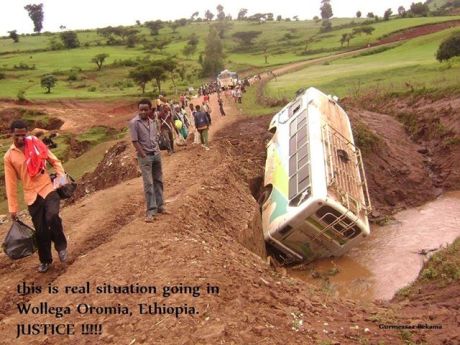
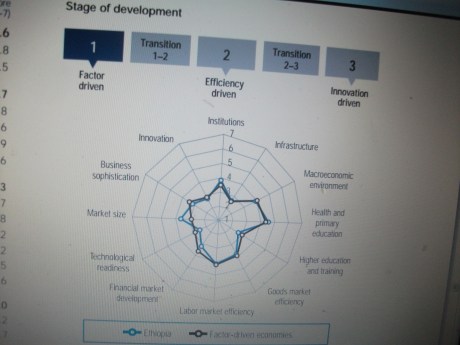
Afrobarometer which is a research project that has been coordinated by institutions in African countries and with partners in thirty-one countries. In its recent survey of public opinion across thirty-four African countries in the continent it validated the popular skepticism about the “Africa Rising” narrative.
In its 1st October 2013 research out come report, Afrobarometer’s data show that 20 percent of Africa’s population often goes without food, clean water, or medical care. More than 50 % of those surveyed think that economic conditions in their country are bad or “very bad.” Some 75% thought their government was doing a bad job in closing the gap between rich and poor. ‘John Allen, writing on AllAfrica.com, suggests that the results indicate that higher benefits of growth are going to a wealthy elite or that official statistics are overstating growth, or possibly both. Morten Jerven, in his recently book Poor Number, has shown the shortcomings of African statistics. In its report on the Nigerian economy, the World Bank observed that Nigeria’s high growth statistics could not be squared by increasing rates of poverty. These, and other inconsistencies, make Allen’s hypothesis on where the majority of Africa’s wealth is directed, look credible.’ For further readings refer to the following original sources:
http://blogs.cfr.org/campbell/2013/10/31/afrobarometer-poll-questions-the-africa-rising-narrative/
Prosperity Index 2013
Ethiopian: 126/142.
75.6% say gov’t is corrupt.
Satisfaction with gov’t efforts to address poverty: 21.2%.
The Governance sub-index dropped two places, to 118th, because of decreases in political rights, political constraints, the rule of law, and regulatory quality.
http://www.prosperity.com/#!/country/ETH
http://nai.diva-portal.org/smash/get/diva2:589071/FULLTEXT03.pdf
It Is Not Only Ethiopia Madagascar crisis Also forces girls into sex work |
Economic hardships prompt girls to take desperate measures with some deciding to sell their bodies. |
The recent and frequent reports on outstanding economic growth in Africa have quickly turned this into mainstream ‘knowledge’, but African economic statistics are very weak. Growing inequality is a key issue that needs to be in focus if all of Africa is to enjoy ‘growth’. Links between social, environmental and economic development are being downplayed. A key issue in today’s discussion on land is that governments consider unfarmed lands to be ‘unowned, vacant, idle and available’, which is completely misleading. Small scale farming in African countries has been persistent, despite efforts to replace it with ‘more efficient’, large scale agriculture.
http://naiforum.org/2013/11/beyond-african-growth/
Another example of the tplf-EFFORT over reach
The Endowment Fund for the Rehabilitation of Tigray (EEFORT) is known for its over reach way beyond its regional government borders and micro managing and being the exclusive beneficiary of the major resources of the empire.
Copyright © Oromianeconomist 2013 and Oromia Quarterly 1997-2013. All rights reserved. Disclaimer.
Is Economics A Science? October 21, 2013
Posted by OromianEconomist in Economics, Economics: Development Theory and Policy applications, Oromia, Oromo Social System, Uncategorized, Wisdom.Tags: Africa, Economic and Social Freedom, Economic development, Economic growth, economics, Oromia, Oromo
add a comment
“Yes, economics is a science”, says Harvard Professor, Raj Chetty.
The point is said Paul Krugman “while Chetty is right that economics can be and sometimes is a scientific field in the sense that theories are testable and there are researchers doing the testing, all too many economists treat their field as a form of theology instead.” and he coined: ” May be economics is a science, but many economists are not scientists.’
Of course, not every science is experiment based. According to Prof. William Easterly of NYU: “Evolution is an example of a non-experimental science; don’t need experiments to defend economics.”
In Chetty’s economics: ‘It is true that the answers to many “big picture” macroeconomic questions — like the causes of recessions or the determinants of growth — remain elusive. But in this respect, the challenges faced by economists are no different from those encountered in medicine and public health. Health researchers have worked for more than a century to understand the “big picture” questions of how diet and lifestyle affect health and aging, yet they still do not have a full scientific understanding of these connections. Some studies tell us to consume more coffee, wine and chocolate; others recommend the opposite. But few people would argue that medicine should not be approached as a science or that doctors should not make decisions based on the best available evidence. As is the case with epidemiologists, the fundamental challenge faced by economists — and a root cause of many disagreements in the field — is our limited ability to run experiments. If we could randomize policy decisions and then observe what happens to the economy and people’s lives, we would be able to get a precise understanding of how the economy works and how to improve policy. But the practical and ethical costs of such experiments preclude this sort of approach. (Surely we don’t want to create more financial crises just to understand how they work.) Nonetheless, economists have recently begun to overcome these challenges by developing tools that approximate scientific experiments to obtain compelling answers to specific policy questions. In previous decades the most prominent economists were typically theorists like Paul Krugman and Janet L. Yellen, whose models continue to guide economic thinking. Today, the most prominent economists are often empiricists like David Card of the University of California, Berkeley, and Esther Duflo of the Massachusetts Institute of Technology, who focus on testing old theories and formulating new ones that fit the evidence. This kind of empirical work in economics might be compared to the “micro” advances in medicine (like research on therapies for heart disease) that have contributed enormously to increasing longevity and quality of life, even as the “macro” questions of the determinants of health remain contested.’ Read the interesting argument on the subject further at:
http://www.project-syndicate.org/commentary/on-whether-he-is-a-scientist-by-robert-j–shiller
Copyright © Oromianeconomist 2013 and Oromia Quarterly 1997-2013. All rights reserved. Disclaimer.
Oromo Political Detainees Tortured: Human Rights Watch’s Latest Document on Ethiopia October 19, 2013
Posted by OromianEconomist in Africa, Colonizing Structure, Corruption, Dictatorship, Human Rights, Oromia, Oromiyaa, Oromo, Oromo the Largest Nation of Africa. Human Rights violations and Genocide against the Oromo people in Ethiopia, The Colonizing Structure & The Development Problems of Oromia, Tyranny, Uncategorized.Tags: Africa, East Africa, Economic and Social Freedom, Genocide, Genocide against the Oromo, Governance issues, Horn of Africa, Human rights, Human rights violations, National Self Determination, Oromiyaa, Oromo, Oromo people, Oromummaa, Tyranny, Universal Declaration of Human Rights
1 comment so far


The report documents human rights abuses, unlawful investigation tactics, and detention conditions in Maekelawi between 2010 and 2013. Human Rights Watch in this latest document reports that Ethiopian authorities have subjected political detainees to torture and other ill-treatment at the main detention center in Finfinnee (Addis Ababa). The report also calls for the Ethiopian government to take urgent steps to curb illegal practices in the Federal Police Crime Investigation Sector, known as Maekelawi, impartially investigate allegations of abuse, and hold those responsible to account.
The 70-page report, “‘They Want a Confession’: Torture and Ill-Treatment in Ethiopia’s Maekelawi Police Station,” documents serious human rights abuses, unlawful interrogation tactics, and poor detention conditions in Maekelawi since 2010. Those detained in Maekelawi include scores of opposition politicians, journalists, protest organizers, and alleged supporters of ethnic insurgencies. Human Rights Watch interviewed more than 35 former Maekelawi detainees and their relatives who described how officials had denied their basic needs, tortured, and otherwise mistreated them to extract information and confessions, and refused them access to legal counsel and their relatives.
“Ethiopian authorities right in the heart of the capital regularly use abuse to gather information,” said Leslie Lefkow, deputy Africa director. “Beatings, torture, and coerced confessions are no way to deal with journalists or the political opposition.”
Since the disputed elections of 2005, Ethiopia has intensified its clampdown on peaceful dissent. Arbitrary arrest and political prosecutions, including under the country’s restrictive anti-terrorism law, have frequently been used against perceived opponents of the government who have been detained and interrogated at Maekelawi.
‘One [police officer] hit me on the back of my head with a long black stick and blindfolded me. They took me to their office. These were interrogators. They slapped me on the cheeks repeatedly…. But these interrogators are not in a position to listen to what I tell them. They beat me again with the black stick and slapped me again. I stayed in that room until midnight. I was exhausted. They took me back to the cell and then took another guy. On the second day of interrogations—the beating was worse. What they want is a confession.’—Journalist held in Maekelawi in mid-2011, Nairobi, April 2012, p. 6.
“Oromo student held in Maekelawi in 2012, said his hand was broken when he was beaten on his hand while being held in this position and that over a year later his hand continues to hurt:’In the interrogation room there was small piece of metal on the wall. They put me on it and locked my left hand to the wall and then my legs didn’t touch the ground. They beat me on my left hand. I think I was there one hour, but I don’t know as I lost my memory,’ ” p. 34.
Read further more from the following sites:
Click to access ethiopia1013_ForUpload.pdf
http://www.hrw.org/news/2013/10/18/ethiopia-political-detainees-tortured
Are Oromos Singled Out and Disproportionately Tortured in Ethiopia?
http://oromopress.blogspot.co.uk/2013/10/are-oromos-singled-out-and.html
Torture in the heart of Finfinnee (Addis), even as leaders gather in gleaming AU building
“Getachew,” a 22-year-old ethnic Oromo, was snatched from his university dorm, driven hundreds of kilometres to Addis Ababa, and locked up for eight months in Maekelawi. His parents were never informed of his whereabouts; he was never charged or given access to a lawyer; and never appeared before court. He was ultimately released on condition that he would work for the government.Like Getachew, many of the people detained in Maekelawi over the past decade are political prisoners — arrested because of their ethnicity, their real or perceived political opinions and actions, or journalism work. Voicing peaceful dissent or criticism of government policy is increasingly risky.
Copy right © Oromianeconomist 2013 and Oromia Quarterly 1997-2013. All rights reserved. Disclaimer.
Irreecha: The Oromo National And Cultural Holiday Has Been Celebrated With Over 3 million Oromians In The Blessing Festival October 13, 2013
Posted by OromianEconomist in Africa, Culture, Development, Humanity and Social Civilization, Irreecha, Kemetic Ancient African Culture, Oromia, Oromiyaa, Oromo, Oromo Culture, Oromo Identity, Oromo Nation, Oromo Social System, Oromummaa, Self determination, Sirna Gadaa, The Oromo Democratic system, The Oromo Governance System, Theory of Development, Wisdom.Tags: Africa, African culture, African Studies, Democratic African institution, Development, Development and Change, Gadaa, Gadaa System, Horn of Africa, Irreecha, National Self Determination, Oromia, Oromia Region, Oromiyaa, Oromo, Oromo culture, Oromo Identity, Oromo National Day and Ancient Africa Connections, Oromo people, Oromo Thanksgiving, Oromummaa, Social Sciences
add a comment

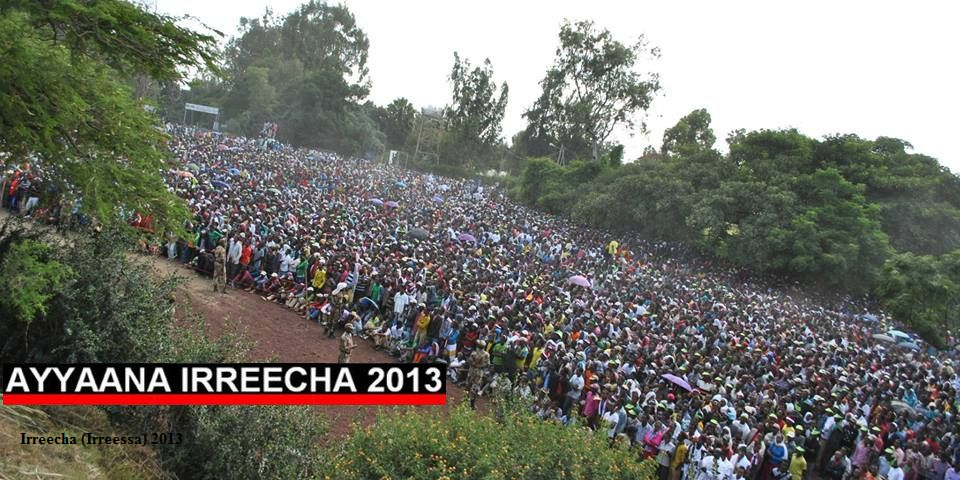
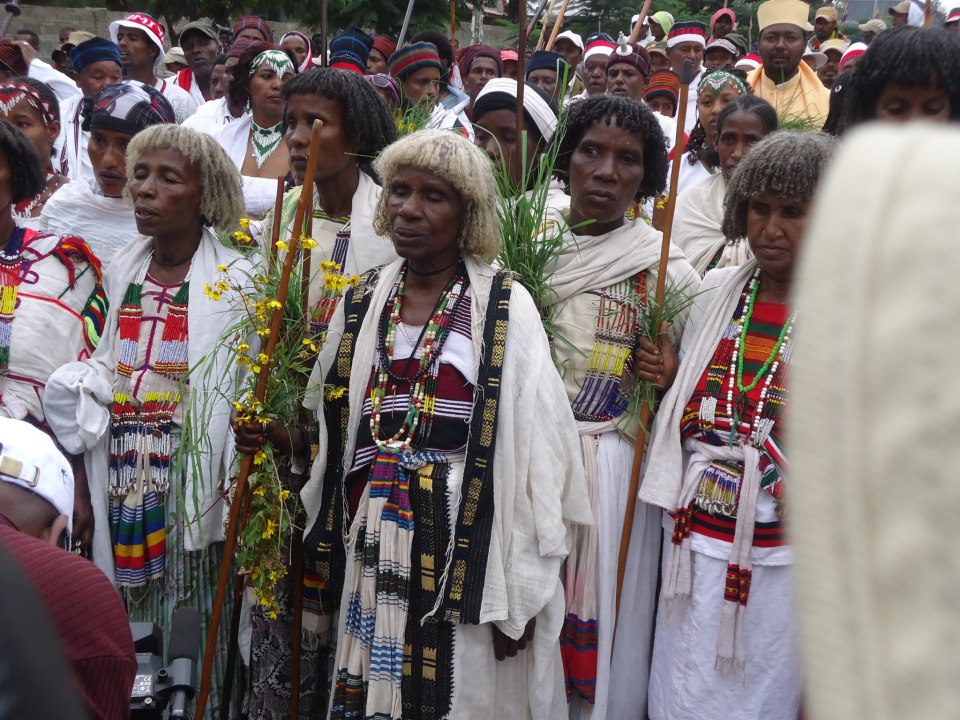
Oromo culture from ancient to present, Irrechaa time
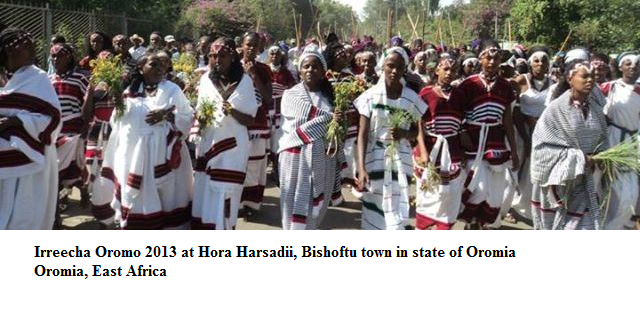

Baga ganna nagaan baatanii booqaa birraa argitan. Good that the rainy season is over for you and that you came to see the spot of the sunny flowering season. The expression signifies the end of one season and the beginning of another season, which incidentally is the beginning of a new year according to Oromo time reckoning. This is not the only expression in Irreecha festival as the event is characterized by vast and varieties of expressions, stories and sequences of cultural displays. Irreecha is the biggest and very beautiful public displays of ancient culture that Africa has performed and continue to perform. Holding the green grass and yellow flower (umama), it is the celebration of the season of blessing and love Oromians experience as Thanksgivings to God (Waaqa) the creator (Uumaa).
Irreecha celebration at Malkaa Ateetee, Burayyuu, Oromia, 6th October 2013
Irreecha is one of the most colorful and beautiful Oromo national cultural events that has been celebrated through out since the last week of August and the entire September and also in October in Oromia and globally where Oromians have been residing (Africa, Australia, Europe and North America). The main Irreecha day was celebrated at Lake Hora Harsadii, Bishoftu, Central Oromia, nearer to the capital Finfinnee on 29th September 2013. According to local news sources from Bishoftuu, over 3 million people attended this year’s Irreecha Malka celebration at Hora Harsadii. “Traditionally, the Oromo practiced Irreecha ritual as a thanksgiving celebration twice a year (in autumn and spring) to praise Waaqa (God) for peace, health, fertility and abundance they were given with regards to the people, livestock, harvest and the entire Oromo land. Irreecha is celebrated as a sign of reciprocating Waaqa in the form of providing praise for what they got in the past, and is also a forum ofprayer for the future. In such rituals, the Oromo gather in places with symbolic meanings, such as hilltops, river side and shades of big sacred trees. …These physical landscapes are chosen for their representations in the Oromo worldview, for example, green is symbolized with fertility, peace, abundance and rain. In Oromia, the core center of Irreecha celebration has been around Hora Arsadi in Bishoftu town, some 25kms to the south of Finfinne, the capital city. Annually, particularly during the Irreecha birraa (the Autumn Irreecha) in September or October, the Oromo from different parts of the country come together and celebrate the ritual. In the past few decades, Irreecha celebrations have been expanded both in content as well as geographical and demographic representations. This short commentary deals with such historical trajectories by contextualizing the changes within political discourses in Ethiopia vis-à-vis Oromo nationalism.”http://gadaa.com/oduu/21320/2013/08/24/irreecha-from-thanksgiving-ritual-to-strong-symbol-of-oromo-identity/ ”
http://gadaa.com/Irreechaa.html
Aadaa fi Duudhaa sirna Waaqeffannaa keessaa inni tokko Ayyaana irreeffannaa ykn irreechati. Sirni Duudhaa irreechaa gosa hedduutti qoodama. Kunis, Irreessa Malkaa, Irreessa Tulluu, Irreessa Galmaa / Gimbii, Irreessa Ujubaa, Irreessa Dakkii, Irreessa Jilaa fi Irreessa Eebbaa ykn Galataa fi kkf. Akkaa fi akkaataan irreeffannaas akkuma sirna isaatti addaa adda. Ammatti kan bal’inaan irraa dubbannu Irreecha yeroo ammaatti biyya keessaa fi alatti beekamee fi kabajamaa jiru, Irreecha Malkaati. Irreechi Malkaa kan kabajamu, ganni yeroon rakkinaa fi dukkanaa dabree birraan yeroo bari’u, sirni Gubaa erga raawwatee booda, ummanni gamtaan Malkaa bu’uun irreeffatee Waaqa galateeffata. Ammaaf Irreecha Malkaa isa biyya keessaa fi alatti bal’inaan beekamaa fi kabajamaa jiru irraa hanga tokko waa addeessuu yaalla. Ayyaanni irreechaa osoo hin gahiin dura waanti raawwataman hedduutu jiran. Kunis seera yayyaba shananii hordofuudhan torban shan dura eegala jechuudha. Ji’a hagayyaa torban sadaffaa keessa birraan bari’uu ykn seenuu isaa kan ibsu, sirna Muka ( korma) dhaabaa kan jedhamutu raawwata. Bakki mukti dhaabaa kun dhaabatu Mijirii jedhama. Mijiriin kun bakka Gubaan itti gubamu ykn bakka ayyaanni ibsaa gubaa raawwatudha. Mukti dhaabbatu 9 ykn 5 ta’an. Kunis hiika mataa ofii qaba. Guyyaa muka dhaabaa irraa eegalee hanga gaafa Gubaatti torban torbaniin waanti godhamu ni jira. Gaafa torban shanaffaa ykn Fulbaana ji’aa dhumaa yeroo ta’u sirna Gubaatu raawwata. Masqala jechuudha. Ayyaana masqalaa kana warri amantii Ortodoksii gara amantii isaaniitti harkisuuf haa yaalan malee gochaa fi seenaan wanti isaan deeggaru hin jiru. aadaa Oromoo fudhatan. Guyyaa gubaa kana ollaan maatii waliin walitti dhufee bakka Mijirii sanatti erga ibsaa gubee dhibaafatee, eebbifateen booda dubartoonni Qunnii (Ingiccaa) guban, dargaggoonni sirba ” Hiyyooko ykn Ya habaab yaa daree ko” jedhamu sirbaa ollaarra naannawanii kennaa fudhatan. Torban isaatti ammoo sirna Ayyaana Irreechaatu raawwata. Gubaan kan dhuunfaa fi ollaati. Irreechi ammoo ayyaana ummanni gamtaan Malkaa bu’ee, dukkana gannaa keessaa gara Booqaa Birraatti nagaan cehuu isaaf kan galateeffatu Guyyaa Galatoo ( Thanksgivings day) jechuudha. Sirni gamtaan Irreeffannaa kun osoo dhiibbaa amantii fi sirna bulchiinsa alagaatiin hin dhorkamiin dura Oromoon naannoo qubatee jiru maratti ni irreeffata ture. Keessumattuu bara mootummaa Dargii sana aadaa ” duubatti hafaa” jedhamee Galma Qaalluu gubuu fi waan Oromoon aadaadhaan raawwatu mara dhorkuun dhabamsiisuuf yaalan. Sababa kanaa fi babal’ina amantii Isilaamaa fi Protestantiin walqabatee bakka hedduutti sirni irreeffannaa fi amantiin Waaqeffannaa ni dhorkame. Dhiibbaa kana irraa damdamtee kan hafe keessaa tokko Ayyaana Irreechaa Hora Arsadii Magaalaa Bishooftuutti kabajamudha. Ayyaanni Irreecha Hora Arsadee qindoominaa fi hirmaannaa ummata bal’aan kabajamuu kan eegale bara 1997 irraa kaaseetu. Isa dura ummatuma naannoo sanaa fi keessattuu warra aadaa Waaqeffannaa hordofaniin ture. Bara 1997 keessa koreen tokko maqaa Guddinaa fi Dagaagina Aadaa Oromoo jedhuun WMT jalatti ijaaramtee Ayyaana Irreecha Bishooftuu kana ummata beeksisuu, barsiisuu fi qindoominaan guyyaa ayyaana kanaa bakka sanatti argamuun qalbii namaa harkisuu jalqabde. Ergasii waggaa waggaan achitti argamuun barumsaa fi dammaqiinsa kennameen sadarkaa har’a ummanni kumaa fi kitilaan kan herreegamu irratti argamee kabaju irraan gahe. Kana malees Oromiyaa gara dhihaatti bakka hedduutti akka kabajamuu fi babal’atuuf karaa saaqe. Baroota hedduu dura jalqabee ammoo biyya alatti walduraa duubaan, USA, Germany, Norway, Canada, Australia, Keenya, Uganda fi Ertriatti kabajamuu jalqabe. Guddinni fi babal’inni kabajaa Ayyaana Irreechaa kun qaama duula Oromoon Aadaa, Eenyumaa fi Oromummaa isaa guddisuuf gochaa jiru keessaa isa tokkoo fi guddicha ta’uu mal’isa. Fuula durallee daran akka guddatuu fi babal’atu Waaqa wajjin abdii qabna.Kabajaa ayyaana irreechaa biyya keessaa fi alatti raawwate ilaalchisee kanaan dura marsaa adda addaatti bahaa turuun ni yaadatama. Dabalataan yaadachiisuu fi bal’inaan kan hin gabaafamiin dabalatee akka armaan gadiitti kan biyyaa keessaa fi biyya alaa bakka adda addaatti kabajamaa ture laalla.”http://waaqeffannaa.org/irreecha/


http://oromoassociationvic.org/2013/10/03/oromians-seek-blessings-and-love-at-annual-oromo-festival/

Irreecha Oromo 2013 Celebration, in Sydney, Australia

Irreecha Oromo, event in London, 12 October 2013
Gubaa fi Irreecha @Galma Calalaqii, Miidaaqenyii

Related references:
https://oromianeconomist.wordpress.com/?s=twisted&searchbutton=go%21
Oromo: The Kushitic People of Africa

| ErechaThe story of Erecha – the celebration of the first harvest of the Ethiopian Spring in September – is a story better told by who else but the late Poet Laureate himself, Blattten Geta Tsegaye G/Medhin.
“….12,000 years ago, ASRA the God of sun and sky of KUSH PHARAOH begotten SETE, the older son ORA the younger of the first and daughter named as ASIS (ATETORADBAR). The older SETE killed his younger brother ORA, and ASIS (ATET OR ADBAR) planted a tree (ODA) for the memorial of her deceased brother ORA at the bank of Nile, Egypt where the murder had taken place, and requested her father who was the god of Sun to make peace among the families of SETE and ORA. Them rain was come and the tree (ODA) got grown. It symbolizes that taken place. Later, at the Stone Age, the tree that had been planted for the memorial of the killed, ORA was substituted by statue of stone that was erected 8000 years ago. This festival has been celebrated in September of every year and when Nile is flow full in NUBLA and BLACK EGYPT. In Ethiopia during the AXUMITE and PRE-AXUMITE period a great festival has been held around the sun’s statue that planted by ASIS (ATET OR ADBAR) the sister of ORA for the memorial of the later, ORA the son of god of sun, who waked up from death (ORA OMO or OR OMO) for the purpost of celebrating the peace made between the two brothers, the great herald, in thanking the good of sun and the sky with CHIBO. Then EYO KA ABEBAYE (the traditional and popular song performed at DEMERA events and new year in Ethiopia) has been started being performed since then. “KA” is the first name of God. The name of God that our KUSH Fathers have inherited to us before the old period, Christianity, and Islam is “KA”. Since then, therefore, especially the OROMO, GURAGIE and the SOUTHERN people of Ethiopia have been calling God as “WAKA or WAQA”. “or WAQA”. WAKA” or WAQA” God When we song EYOKA or EYOHA in New Year, we are praising “KA” of God. “GEDA” or KA ADA” is the law or rule of God. “GEDA” (KA ADA) is the festival by which the laws and orders of God are executed Japan, China, and India are now reached to the current civilization through making the basic traditions and cultures they received from their forefathers (HINDU, SHINTO and MAHIBERATA) be kept and receiving Islam, Christianity, and others especially Democracy and free believes. They are not here through undermining the culture and tradition of their forefathers. Culture is the collection of many CHIBOs or DEMERA. “ERCHA” or “ERESA” one of the part and parcel of GEDA (KA ADA) system is the comer stone and turning point to the new year for which ASIS (ATET OR ADBAR) has put up the dead body of her brother, ORA who was killed by his older brother like ABEL from the place he died at the river bank of NILE on and planted statue“. The Oromo people of beautiful Ethiopia believe in one God since time memorial. Their religion is called “WAKEFENA” which means believing in one God that is the creator of the whole universe. ERECHA means a celebration where people get together and perform their prayers and thanking God. WAKEFENA, the faith being in the GEDA SYSTEM is a religions ceremony that is free from any thing. The fathers of Oromo religion and the people, keeping fresh grass and flowers, perform their prayers and thank their God going to mountains, the sea or a river bank. They move to the top of mountains or bank of seas or rivers not to worship the mountains or rivers and seas; rather to distract themselves from any noise and to worship their God (WAQA) with concentration. And they go to sea and rivers because they believe that green is holy and peaceful where the spirit of God is found. In the Oromo culture, the rainy season is considered as the symbol of darkness. At the beginning of September, the darkness is gone, rivers run shallower and cleaner, and the mud is gone. As sunshine rules the land, the OROMO people of Ethiopia go out to celebrate this great natural cycle with the spirit of worshiping God (WAQA). |
http://www.ethiopians.com/photoessay/Photo_Essay_Eretcha_06.htm
Copyright © Oromianeconomist 2013 and Oromia Quarterly 1997-2013. All rights reserved. Disclaimer.
Tyrannic Ethiopia Bans Access To Student’s Critical Articles And Has Watchers In Class Rooms September 27, 2013
Posted by OromianEconomist in Colonizing Structure, Corruption, Dictatorship, Ideas, Knowledge and the Colonizing Structure. Africa Heritage. The Genocide Against Oromo Nation, Oromia, Oromo, The Colonizing Structure & The Development Problems of Oromia, Tyranny, Uncategorized.Tags: Africa, Ethiopia–United States relations, Human rights, Oromia, Oromo, Politics of Ethiopia, Tyranny, University of Pittsburgh Graduate School of Public and International Affairs
1 comment so far

‘Disguising human rights violations and oppression with positive terminology is not new to Ethiopian legislators, who passed the Freedom of the Mass Media and Access to Information Proclamation No. 590 in 2008. This idealistic-sounding law’s title belies its contents, because it enables the government to bring charges against “any person who is suspected of committing an offence through the mass media.” Such offenses include the publication of statements critical of the legislative, executive or judicial authorities that are deemed false or defamatory. It is up to the attorney general to decide if the accused journalist should be detained on remand.’ http://jurist.org/forum/2011/08/abigail-salisbury-ethiopia-terror.php#
‘Ethiopian education also differs from Western education because, Salisbury said, there could be “watchers” present at any time, in any classroom. Watchers are government representatives on the lookout for those speaking out against the government.’
Cristina Holtzer of Pitt News reports that Abigail Salisbury is an enemy of the state of Ethiopia because of an op-ed column she published online. Salisbury, a student in the Graduate School of Public and International Affairs, spoke about her article to an audience of about 10 in a “Let’s Talk Africa” lecture on Wednesday in 4130 Posvar Hall from 1:30 to 3 p.m. The Ethiopian government blocked her article, titled “Human Rights and the War on Terror in Ethiopia,” one day after she published it online. While in Ethiopia, Salisbury noticed an extreme lack of freedom of speech and press for Ethiopian people and decided to write the piece, which criticizes the Ethiopian government. Salisbury was working as an assistant professor at Mekelle University Law School, a small college outside of Addis Ababa, the capital of Ethiopia, when she published the article. After the university administration discovered her article, Salisbury said the university “basically asked [her] not to work there anymore.”
“I was told that, based on what I wrote, that if I had been an Ethiopian person, I would have been put in prison,” Salisbury said. “I don’t think they want me back.” Ironically enough, Salisbury said, she was in the country teaching international human-rights law, a class required for graduation from law school in Ethiopia. Anna-Maria Karnes, a representative of the Africana studies department, also attended the lecture and interjected throughout. Karnes, whose parents live in Ethiopia, has a thorough grasp of the political climate in the country.
“Skype was outlawed two years ago in Ethiopia,” Karnes said. “There were people jailed for using Skype.” When Karnes first discovered the Skype law, she worried that she would not be able to get in touch with her parents because that was their primary source of communication. But Skype was illegal only for Ethiopians, not for foreigners. “As a Westerner, you are treated differently,” Salisbury said. “Better.”
Ethiopians subscribe to a different race and caste system than many Americans are used to. Salisbury said that when African-Americans traveled to Ethiopia, they were treated the same as whites. Ethiopians believe that everyone else in Africa is black but that they, themselves, are red skinned. Salisbury recounted a story of when someone in the street approached her and asked, “Have you seen any black women today?”
Salisbury said she was surprised by the scale of differences between the learning environments in Ethiopia and the U.S.
Because of the country’s limited resources, students learn to memorize verbatim what professors say in lecture. Salisbury said she’s seen students reproduce a lecture right down to the “ums” and “likes.” Ethiopian education also differs from Western education because, Salisbury said, there could be “watchers” present at any time, in any classroom. Watchers are government representatives on the lookout for those speaking out against the government. “What would creep me out if I were in that class?” Salisbury said. “I don’t know if I would be raising my hand with opinions.” In addition to an extreme lack of freedom of speech, Salisbury said Ethiopians also struggle with tough racial tensions and “ethnic federalism,” or preferential treatment for one ethnic group that is officially recognized by the government. With Ethiopia located in a contentious part of the world, Salisbury said U.S.-Ethiopia relations are crucial. “Ethiopia is really instrumental in the U.S. agenda and the global war on terror that we’re engaged in,” she said. Salisbury and Karnes opened the presentation with an activity about African knowledge. They divided the audience into small groups and asked them to label a map of Africa with the names of as many countries as they could. Even with several African students and faculty in the audience, no one was able to label the entire map. “You can’t know the whole of Africa,” Director of Africana Studies Macrina Lelei said. “That’s part of why we have African studies here at Pitt … to share those experiences.”
http://www.pittnews.com/news/article_090b538c-266a-11e3-8d05-0019bb30f31a.html#.UkV1PQONt0w.facebook
http://www.ethiomedia.com/abai/ethiomedia_interviews_abigail_salisbury.html
http://www.zoominfo.com/p/Abigail-Salisbury/1255943349
Copyright © Oromianeconomist 2013 and Oromia Quarterly 1997-2013. All rights reserved. Disclaimer.
Related articles
- Abigail Salisbury is an enemy of the state of Ethiopia (daniboy8935.wordpress.com)
- Ethiopia bans access to student’s critical article (bilisummaaa.wordpress.com)
-
Ethiopia’s Leaders Misinform the World
- http://ayyaantuu.com/horn-of-africa-news/ethiopia/growing-anxiety-ethiopian-university-students-case-students-twisted-mind/
- The Tyrannic Ethiopian Regime is Accountable for the Death of a Political Prisoner And Prisoner of Conscience, Oromo National, Engineer Tesfahun Chemeda (oromianeconomist.wordpress.com)
- http://dhaamsaogeetti13.wordpress.com/2013/10/03/ethiopia-most-restrictive-sub-sahara-country-freedom-house-reports/
Oromia of Dhaqabo Ebba: The Cradle of Mankind Is Also A Home of The Oldest Living person Known to Humanity September 10, 2013
Posted by OromianEconomist in Africa, Dhaqaba Ebba, Gadaa System, Humanity and Social Civilization, Oral Historian, Oromia, Oromo, The Oldest Living Person Known to Mankind, The Oromo Library, Uncategorized, Wisdom.Tags: Afaan Oromo, Africa, African history, African Philosphy, Dhaqba Ebba, Ebbaa, Finfinnee, Gadaa, Gadaa System, Obbo dhaqabaa Ebbaa, Oldest Living Person, Oldest people, Oldest person, Oral History, Oromia, Oromia Region, Oromiya, Oromiyaa, Oromo Calendar, Oromo elder, oromo farmer, Oromo History, Oromo people, The Oldest Living Person, Time in Gadaa
5 comments


Dahqabo Ebba, Oromo elder, who is over 160 years is the oldest living person known to humanity.
He is a resident of Dodola town, Oromia.
http://www.unpo.org/article/16351
OTV (Oromiyaa TV)
In interviews conducted in his native language Afaan Oromo Obbo Dhaqabo Ebba counts his age based on Oromo Gadaa system calendar. According to traditional Oromo Gadaa system every member of the society goes through the Gadaa time grade. Obbo Dhaqabo Ebba has lived 4 Gadaa cycles. one Gadaa cycle has 5 stages. One stage is for 8 years. One Gadaa cycle is 40 years, (8*5). Obbo Dhaqabo has already completed 4 Gadaa cycles (4*40) which are 160 years. He involved in the Gadaa system in its full functioning time in all its structures and development stages from Dabballe to Jaarsa. He still living after the 4 cycles means he is actually over 160 years. The Journalist of Oromiyaa TV did not yet ask him how many years since his last 4 Gadaa cycles was completed. Gadaa ways of timing is exact to know own birth years and historical events. In his fascinating life that has touched 3 centuries (from middle 19th century to the present 2nd decades of 21st century which has been over 160 years he remembers all major political, social, economic and environmental events and changes. He remembers from a time when the Ethiopian empire still expanded south to Oromia such as 1880’s the time the Abyssinian Menelik start to occupy the Oromo capital Finfinnee (Abyssinians named it Addis Ababa). At this event and the time of first Italian invasion he used to travel to Finfinnee (Addis Ababa) for his livestock trading. He mentioned that he engaged in farming (crops and livestock) but also in commerce. it took eight days on horseback to cover the 150 miles between his village and Finfinnee (Addis Ababa). In 1895 ( at the time of Italian invasion) he was already a married person of two wives and his first son ( over 100 years old with him at interview) was a young boy and able person to look after his livestock. “When Italy invaded the country, I had two wives and my son was old enough to herd cattle,” he said, referring to Italy’s 1895 invasion of his country. “Not even one of my peers is alive today.” He knows and remembers by naming all Abyssinian rulers, Menelik to present who have been in Oromia (Oromo land) since the occupation of Finfinnee in 1880’s.
Mohammed Ademo of Opride said. “Given that the Oromo like many African cultures are an oral society, ‘each time an elder dies, a library is lost.’ Ebba’s is one such library from which much can still be preserved.”
http://www.voaafaanoromoo.com/content/article/1756208.html
As elaborated in the works of “Oromia: an Introduction,” by Gadaa Melbaa ( book published in Khartoum, 1988), the following is a brief description of how the Gadaa system works and the gadaa Grades: “There are two well-defined ways of classifying male members of the society, that is the hiriyya (members of an age-set all born within the period of one Gadaarule of eight years) and Gadaa grade. The Gadaa grades (stages of development through which a Gadaa class passes) differ in number (7-11) and name in different parts of Oromia although the functions are the same.”
The Gadaa grades:-
1. Dabballee (0-8 years of age)
2. Folle or Gamme Titiqaa (8-16 years of age)
3. Qondaala or Gamme Gurgudaa (16-24 years of age)
4. Kuusa (24-32 years of age)
5. Raaba Doorii (32-40 years of age)
6. Gadaa (40-48 years of age)
7. Yuba I (48-56 years of age)
8. Yuba II (56-64 years of age)
9. Yuba III (64-72 years of age)
10. Gadamojjii (72-80 years of age)
11. Jaarsa (80 and above years of age)

http://www.unpo.org/article/16351
http://now.msn.com/dhaqabo-ebba-ethiopian-farmer-is-160-years-old-reporter-claims
Copyright © Oromianeconomist 2013 and Oromia Quarterly 1997-2013. All rights reserved. Disclaimer.
Related articles
- Ethiopian peasant claims to be ‘160-year-old’ (sudantribune.com)
- Oromo farmer from Ethiopia may be the oldest living person (hornaffairs.wordpress.com)
- Reporter Claims Ethiopian Farmer Oldest Man Alive at 160 Years Old (atlantablackstar.com)
- The Oldest Living Person Ever Found in Ethiopia… Aged 160 (muzicupdate.wordpress.com)
- Ethiopian Farmer ‘At Least 160 Years Old,’ Reporter Estimates: Dhaqo Ebba Could Be The World’s Oldest Person (medicaldaily.com)
- The Oldest Living Person Ever Found in Ethiopia (naijaoddstories.wordpress.com)
- Ethiopian Farmer Could Be 160 Years Old, Oldest Man Alive (news.softpedia.com)
- Dhaqqaboo Eebbaa:The Oldest Man,160 Years, from Oromia attracts world media. (advocacy4oromia.org)
- Ethiopian farmer dubbed ‘world’s oldest living man’ after claiming he is 160 years old and has clear memories of Italy invading his country in 1895 (dailymail.co.uk)
- Ethiopian farmer dubbed ‘world’s oldest living man’ after claiming he is 160 years old and has clear memories of Italy invading his country in 1895 (thisismoney.co.uk)
Interview With Oromo Youth President, Iftu Kassim, Africa Media Australia September 7, 2013
Posted by OromianEconomist in Development, Gadaa System, Language and Development, Oromia, Oromo, Oromo Identity, Oromo Nation, The Oromo Governance System, Uncategorized.Tags: Africa Media AUstralia, Amnesty International, Development, empowerment, Freedom, Human rights, Iftu Kassim, Melbourne, Oromia, Oromo culture, Oromo people, Oromo Youth
add a comment

Melbourne Youth Oromo Association’s president Iftu Kassim speaks to AMA about her organisation and a recent event organised in Melbourne
Copyright © Oromianeconomist 2013 and Oromia Quarterly 1997-2013. All rights reserved. Disclaimer.
Related articles
- The Oromo People Need Freedom and Justice:Oromians Gathered in Front of the White House to Protest Against Ethiopia’s Human Rights Violations and Land-Grabbing (oromianeconomist.wordpress.com)
- Irrecha: From Thanksgiving Ritual to Strong Symbol of Oromo Identity (oromoassociationvic.org)
- Letter of gratitude from Oromo Youth Self-help Association (OYSA/WWDO) (oromostruggleforfreedom.wordpress.com)
- We are Oromos First! (freedomfororomo.wordpress.com)
- Oromo farmer from Ethiopia may be the oldest living person (hornaffairs.wordpress.com)
- Al Jazeera The Stream/English: We Appreciate Al Jazeera for Airing Oromo’s Persecution in Ethiopia (orofreedom.wordpress.com)
The Unravelling of a Colonized Mind by Jana-Rae Yerxa March 24, 2013
Posted by OromianEconomist in Africa, Colonizing Structure, Development, Humanity and Social Civilization, Ideas, Irreecha, Kemetic Ancient African Culture, Knowledge and the Colonizing Structure., Knowledge and the Colonizing Structure. Africa Heritage. The Genocide Against Oromo Nation, Knowledge and the Colonizing Structure. African Heritage. The Genocide Against Oromo Nation, Oromia, Oromiyaa, Oromo, Oromo Culture, Oromo First, Oromo Identity, Oromo Nation, Oromo the Largest Nation of Africa. Human Rights violations and Genocide against the Oromo people in Ethiopia, Oromummaa, Qubee Afaan Oromo, Self determination, Sirna Gadaa, Slavery, Uncategorized.Tags: Anishinaabe, Colonialism, Colony, Couchiching First Nation, Human rights violations, Little Eagle, Oromia, Oromia Region, Oromiyaa, Oromo, Oromo culture, Oromo First, Oromo people, Oromummaa, Self determination, Social work, Sub-Saharan Africa, Tyranny, Universal Declaration of Human Rights, University of Victoria
1 comment so far
The Unravelling of a Colonized Mind by Jana-Rae Yerxa.
Sure everybody struggles. But to be born an Indigenous person, you are born into struggle. My struggle. Your struggle. Our struggle. The colonial struggle. There are many layers to this struggle. For the longest time, I didn’t even know what the true struggle was about yet I couldn’t escape it. It consumed me. Colonialism, as I have been forced to discover, is like a cancer. But instead of the cells in your body betraying itself, the thoughts in your mind work against you and eat you up from the inside out. You’re like the walking dead and you don’t even know it because you are so blinded. You can’t see the truth.
Here are some of the perverted ways colonialism infects the mind:
• With a colonized mind, I hate being Indian.
• With a colonized mind, I accept that I am Indian because that’s who the colonizer told me I am.
• With a colonized mind, I don’t understand that I am Anishinaabe.
• With a colonized mind, I believe I am inferior to the white race.
• With a colonized mind, I wish I was white.
• With a colonized mind, I draw pictures of my family with peach coloured skin, blonde hair and blue eyes because I’ve internalized that this is the ideal, what looks good and what is beautiful.
• With a colonized mind, I keep my feelings of inferiority to white people a secret from others and even from myself.
• With a colonized mind, I try diligently to mirror white people as closely as I possibly can.
• With a colonized mind, I desperately want to be accepted by white people.
• With a colonized mind, to gain the acceptance of white people, I will detach myself from all that does not mirror acceptable “white” standards, whether it is how one dresses, one speaks, or one looks.
• With a colonized mind, I feel as though I am swearing when I say “white people” in front of white people.
• With a colonized mind, I believe there is no racism.
• With a colonized mind, I believe that racism does not impact me.
• With a colonized mind, I deny my heritage and proudly say, “We are all just people.”
• With a colonized mind, when discussing issues pertaining to race, I try desperately not to offend white people.
• With a colonized mind, I do not know who I am.
• With a colonized mind, I believe I know who I am and do not understand that this isn’t so because I’ve become the distorted image of who the colonizer wants me to be and remain unaware of this reality.
• With a colonized mind, I could care less about history and think that our history don’t matter.
• With a colonized mind, I do not understand how the history created the present.
• With a colonized mind, I do not see how I have been brainwashed to be an active participant in my own dehumanization and the dehumanization of my people.
• With a colonized mind, I do not recognize how others dehumanize me and my people.
• With a colonized mind, I devalue the ways of my people- their ways of seeing, their ways of knowing, their ways of living, their ways of being.
• With a colonized mind, I cannot speak the language of my ancestors and do not care that this is so.
• With a colonized mind, I am unaware of how colonization has impacted my ancestors, my community, my family, and myself.
• With a colonized mind, I think that my people are a bunch of lazy, drunk, stupid Indians.
• With a colonized mind, I discredit my own people.
• With a colonized mind, I think that I am better than ‘those Indians’.
• With a colonized mind, I will silently watch my people be victimized.
• With a colonized mind, I will victimize my own people.
• With a colonized mind, I will defend those that perpetrate against my people.
• With a colonized mind, I will hide behind false notions of tradition entrenched with Euro-western shame and shame my own people re-creating more barriers amongst us.
• With a colonized mind, I tolerate our women being raped and beaten.
• With a colonized mind, I tolerate our children being raised without their fathers.
• With a colonized mind, I feel threatened when someone else, who is Anishinaabe, achieves something great because I feel jealous and wish it was me.
• With a colonized mind, when I see an Anishinaabe person working towards bettering their life, because my of my own insecurities, I accuse them of thinking they are ‘so good now’.
• With a colonized mind, I am unaware that I was set up to hate myself.
• With a colonized mind, I do not think critically about the world.
• With a colonized mind, I believe in merit and do not recognize unearned colonial privilege.
• With a colonized mind, I ignorantly believe that my ways of seeing, living and believing were all decided by me when in reality everything was and is decided for me.
• With a colonized mind, I am lost.
• With a colonized mind, I do not care about the land.
• With a colonized mind, I believe that freedom is a gift that can be bestowed upon me by the colonizer.
• With a colonized mind, I believe that I am powerless and act accordingly.
• With a colonized mind, I do not have a true, authentic voice.
• With a colonized mind, I live defeat.
• With a colonized mind, I will remain a victim of history.
• With a colonized mind, I will pass self-hatred on to my children.
• With a colonized mind, I do not understand the term “self-responsibility.”
• With a colonized mind, I do not recognize that I have choice and do not have to fatalistically accept oppressive, colonial realities.
• With a colonized mind, I do not see that I am a person of worth.
• With a colonized mind, I do not know I am powerful.
The colonial struggle, as I said earlier, has many layers. I am no longer being eaten from the inside. Yet it is no less painful. What is different today is that I am connected to a true source of power that was always there. It’s like my friend once said, “I come from a distinguished people whose legacy shines on me like the sun.” I now understand this and it is because of this understanding that my mind and my soul are freer than they have ever been. It is because of that gift- that awakening which came through struggle- that I will proudly continue to struggle for freedom. My freedom. Your freedom. Our freedom.
Jana-Rae Yerxa, is Anishinaabe from Little Eagle and Couchiching First Nation and belongs to the Sturgeon clan. Activist. Social Worker. Former professor. Current student. She is committed to furthering her understanding of Anishinaabe identity and resurgence as well as deconstructing Indigenous/settler relations in the contexts of colonization and decolonization. Jana-Rae is currently enrolled in the Indigenous Governance Program at University of Victoria.
http://lateralloveaustralia.com/2013/03/14/the-unravelling-of-a-colonized-mind-by-jana-rae-yerxa/
Copyright © Oromianeconomist 2014 and Oromia Quarterly 1997-2014. All rights reserved. Disclaimer.
Related articles
- The Unravelling of a Colonized Mind by Jana-Rae Yerxa (lateralloveaustralia.com)
- Colonization And Apartheid (deliberation.info)
- When Things Fall Apart (connexicon.wordpress.com)
- Op Ed: Anti Violence Against Indigenous Women and Resurgence (blackcoffeepoet.com)


 Oromian Economist
You must be logged in to post a comment.