jump to navigation

Ethiopian Government committed war crimes says Amnesty international representative. #Oromoprotests December 26, 2015

Posted by OromianEconomist in Uncategorized.
Tags: , , , , ,
add a comment

Odaa OromooAmnesty Internationaloromoprotests-tweet-and-share1


Civil Rights Defenders: Escalation of Human Rights Violations in Ethiopia Must Stop and an independent investigation is Required. #OromoProtests December 26, 2015

Posted by OromianEconomist in Uncategorized.
Tags: , , , , , , ,
add a comment

???????????oromoprotests-tweet-and-share1

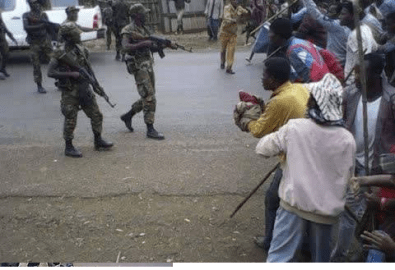
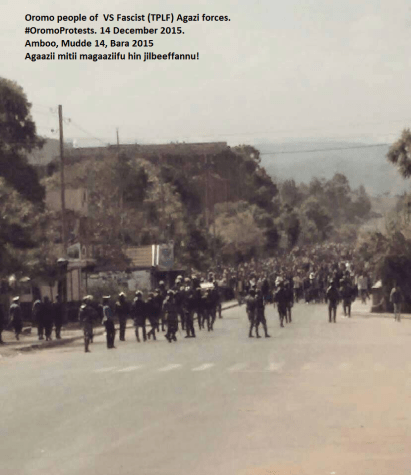
agazi-fascist-tplf-ethiopias-forces-attacking-unarmed-and-peaceful-oromoprotests-in-baabichaa-town-central-oromia-w-shawa-december-10-20151

Escalation of Human Rights Violations in Ethiopia Must Stop and an independent investigation is Required

Ethiopia is once again witnessing another round of mass crackdowns by the authorities as scores of protesters have been killed and hundreds arrested in recent weeks. The government must be held accountable for these murders, provide redress, and most importantly of all allow citizens’ the right to express their grievances and demands.

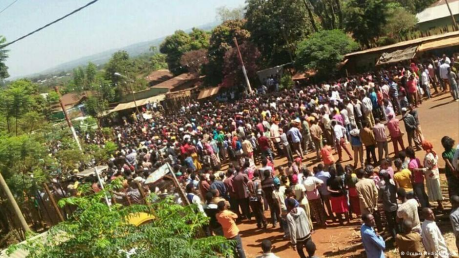
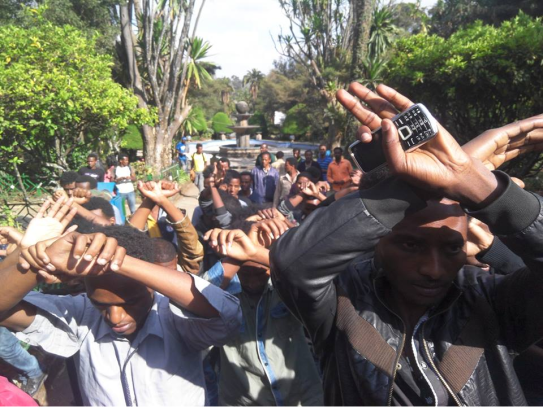
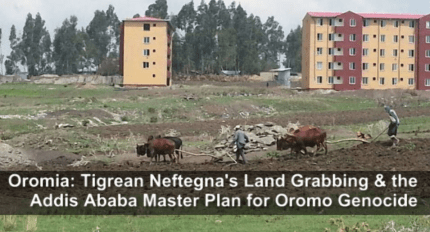
Students and other members of Ethiopia’s largest ethnic group, the Oromos, have been staging protests in many parts of Oromia regional state since mid November 2015. The protests were originally sparked the previous year and resulted in the death and arrest of numerous protestors. The protests arose from a draft plan called the “Addis Ababa and Oromia Special Zone Integrated Master Plan” which protestors insisted would see the displacement of communities and farmers dispossessed them from their lands, without prior consultation and proper compensation.

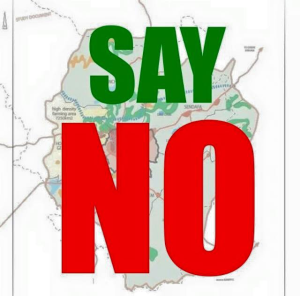
#OromoProtests, healthcare professionals at Bishoftu hospital saying No! to the Master Plan, 14 December 2014

“Land rights are crucial when it comes the realisation of other human rights especially for people whose economic, social and cultural lives are strongly attached and dependent on the land. In light of this, the students’ demand a constructive consultation process and the initiation of an adequate compensation scheme in Ethiopia as a start when it comes to acknowledging basic rights.” said Robert Hårdh, Executive Director at Civil Rights Defenders

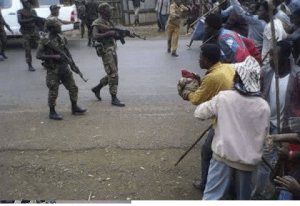
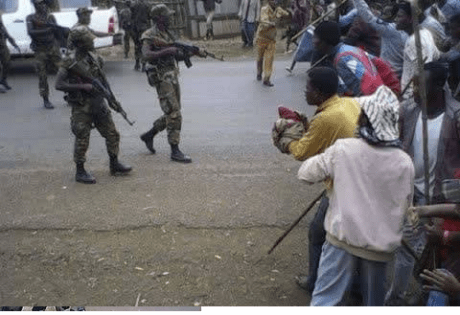
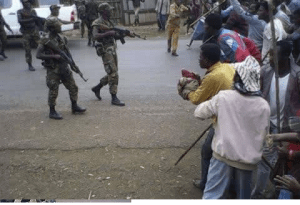
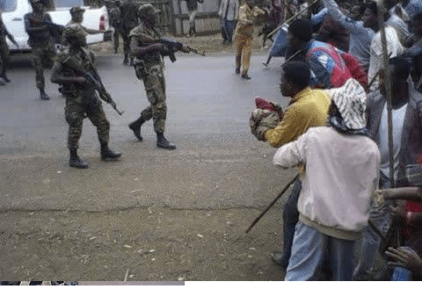
The excessive use of force by armed police and military personnel has inflamed the situation turning the peaceful protests into violent clashes which has subsequently led to death and the destruction of property.

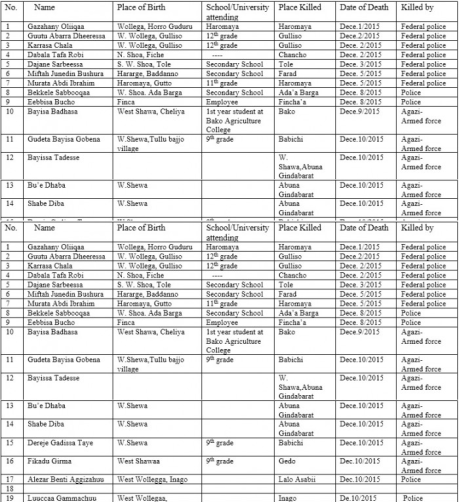
While the main opposition party in the region, the Oromo Federalist Congress (OFC), put the number of people killed at 85, Civil Rights Defenders accessed a list of victims compiled by activists who quoted the numbers at 119. The Government, meanwhile, has vaguely stated the casualties as being “high in numbers.”

Silent protests and sit-ins have continued to materialise in several areas and institutions while house-to-house searches and widespread detentions have taken place throughout the Oromia region, according to local residents. Some students, suspected of taking part in the demonstration, have been reportedly expelled by University administrations although to date this has not been verified by independent sources.

In a late but noteworthy move, the Ethiopian government recently announced that the ‘Master Plan’ would not be implemented without consultation from the public, and even admits that the demonstrators’ have a legitimate right to protest.

Despite this symbolic gesture, senior government officials have also engaged in contradictory provocative rhetoric.

The government is consistently labeling the protestors as having links with “terror groups” with aim of attempting to spark a “revolution.” Prime Minister Hailemariam Desalegn accused the protesters as being misled by “destructive forces” whose aim is to “destabilise the area.”

Another senior official has likened the protesters to genies “let out by OFC (Oromo Federalist Congress), Ginbot 7 and OLF (Oromo Liberation Front)” that should be put back in the bottle. The later two groups are based outside Ethiopia and have been branded as “terrorists” by the parliament.

Allegations such as these echo previous incidents where the Ethiopian authorities have used the “terror label” to silence critics and civil society groups and thus constitute a worrying development.

The killing of peaceful protestors, harassment and mass arrest of those suspected of organising protests will only harm the already shaky human rights record of Ethiopia. The Universal Declaration of Human Rights and the African Charter on Human and Peoples Rights, which Ethiopia is party to, provide that the right to freedom of peaceful assembly includes the right to participate in peaceful assemblies, meetings, protests, strikes, sit-ins and  demonstrations.

In a further act, which has led to the escalation of the crisis, the government has also attempted to limit the flow of information to and from the areas affected by the protests. In some areas government operatives have been seen removing satellite dishes from the rooftops of private residences.

Last week, the head of the nation’s Broadcast Authority told a parliamentary committee that he has warned media houses to pay attention to the content of their reports of the protests coming out of the Oromia region.

A foreign correspondent based in Addis Ababa recently wrote that a translator who had traveled with him to one of the protest areas was subjected to interrogation and mistreatment. A journalist working for the state owned broadcaster, Fikadu Mirkana, was also arrested during the week. Known for persecuting journalists, few independent reports are available about developments in Ethiopia particularly in times such as this. Social media, particularly Facebook, remains the principal source of information and exchange though the country’s Internet penetration rate is among the lowest in the world.

“The flow of independent information can be an influential tool in avoiding public unrest, while acting as a catalyst in exposing human rights abuses especially in times of protests. Furthermore, denying people access to information contravenes Ethiopia’s obligation to respects citizens’ rights regarding access to information,” added Robert Hårdh


http://www.civilrightsdefenders.org/featured/ethiopia-statement-escalation-of-human-rights-violations-must-stop-and-an-independent-investigation-is-required/


Related:-


UMAN RIGHTS

Ethiopian opposition urges scrutiny of industrial plan

http://www.aljazeera.com/news/2015/12/ethiopian-opposition-urges-scrutiny-industrial-plan-151225201737029.html

The international community needs to pressure the Ethiopian government to halt land grabs and respect human rights, an opposition party leader has said after two prominent opposition members were arrested for inciting protests in Oromiya earlier this week.

Oromiya is the largest region in Ethiopia. Groups such as the OLF, accuse the ruling Ethiopian People’s Revolutionary Democratic Front (EPRDF) coalition of marginalising ethnic Oromos.

Bekele Nega, secretary of the Oromo Federalist Congress (OFC), said security forces have killed at least 86 people since protests began earlier this month over government plans to create an investment and industrial zone near the capital, Addis Ababa.

“They have killed 86 and wounded thousands [and are] imprisoning people and political leaders including our vice-chairman Bekele Gerba,” Nega told Al Jazeera.

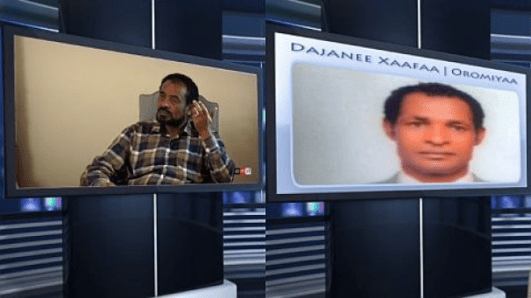
Merara Gudina, OFC chairman, said police detained Gerba on Friday and the party’s assistant secretary, Dejene Tafa, a day earlier.

“They suspect that our party and some of our members are part of the protest movement, that we have been inciting the demonstrations,” he told Reuters news agency, denying that the OFC had incited violence.

 The protests are being described as some of the biggest in Ethiopia in recent times [Reuters]

“We do not know when Bekele and Dejene will be released or be charged for anything.”

Opposition leaders and activists said the “Addis Ababa Integrated Development Master Plan” designed to merge certain rural areas into Addis Ababa will result in land grabs and the displacement of farmers.

Hailemariam Desalegn, Ethiopia’s prime minister, told parliament on Friday that people had a legitimate right to oppose Addis Ababa’s plan, but that the government would take “unflinching measures” against those who incite violence.

Hailemariam said “anti-peace forces” had incited violence by spreading false information about the plan.

The government has accused the secessionist Oromo Liberation Front (OLF) and opposition group Ginbot 7 of involvement in the protests. Both organisations are regarded by the state as terrorist entities.

Amnesty International, the human rights monitor, said earlier in December that protesters have been labelled “terrorists” by Ethiopian authorities “in an attempt to violently suppress protests against potential land seizures”.

The Ethiopian government has neither released an official death toll nor confirmed how many people were arrested since the protests started.

‘Impartial investigation’ 

Betsate Deneke, the head of the the Human Rights Council (HRCO), said his organisation was currently collecting information on how many were killed and would announce their findings next week.

He told Al Jazeera that HRCO demanded an “impartial investigation into the killings of people” takes place.

Earlier this week, the opposition said the government had rejected, for the second time, an application to hold a public demonstration on December 27 to protest against the Addis Ababa Master Plan.

Four out of five Ethiopians still live in rural areas even though the country has witnessed tremendous growth over the past 10 years.

Ethiopia has also faced significant criticism for forcibly removing tens of thousands of people from their homes to make way for large scale commercial ventures, often to the benefit of foreign investors.

Opposition leaders say some 86 people have been killed over the past four weeks at the hands of security forces [Reuters]


http://www.aljazeera.com/news/2015/12/ethiopian-opposition-urges-scrutiny-industrial-plan-151225201737029.html

Oromia: OFC’s letter to the diplomatic community. #OromoProtests December 25, 2015

Posted by OromianEconomist in Uncategorized.
Tags: , , , , ,
add a comment

Odaa OromooOromo Federalist  Congress

oromoprotests-tweet-and-share1

The arrogance of the Ethiopian regime comes partly from the lack of serious pressure from the international community, especially from countries such as the US and the African Union, which watches the senseless drama silently.

The Master Plan is the continuation of the massive land grabbing across the country in such places like Gambella, Beni-Shangul, Afar and Oromia.


OFC’s letter to the diplomatic community


To: Members of the Diplomatic Community:


We, the Executive Committee Members of the Oromo Federalist Congress (OFC), a legally registered political party, make an urgent appeal to members of the diplomatic community on behalf of the Oromo students and the larger Oromo population.

The Ethiopian government is committing an atrocious act of brutality against Oromo students and the larger population, who are peacefully protesting across Oromia for their rights. Consequently, most universities, colleges, high schools as well as elementary sections across Oromia are also closed. Far worse, for the last four weeks, over 85 students and ordinary citizens have been mercilessly killed; thousands have been wounded while several thousands have been detained. Moreover, the government security personnel have targeted our members who were candidates and observers during the 2015 elections. None of the imprisoned persons are charged with any crime and brought to the court of law as the Ethiopian law requires. We think, the arrogance of the Ethiopian regime comes partly from the lack of serious pressure from the international community, especially from countries such as the US and the African Union, which watches the senseless drama silently.
As you might aware, the Oromo youth and the larger Oromo population are demonstrating against the so-called Addis Ababa and the surrounding Oromia towns Integrated Development Plan (Master Plan), which was done without the consultation of the local population whose livelihood, depends on land. Similar opposition to the same plan in 2014 claimed not less than 78 students’lives in Ambo town and other Oromo areas. No one was made accountable for that vicious act.

The Ethiopian government that shelved the plan for one year arrogantly revived it recently, provoking a fresh unrest. During this interregnum, except in few limited areas, at that under a controlled environment, the government did not conduct any discussion with the Oromo population on the Master Plan and its effect on poor Oromo farmers. Furthermore, none of the opposition parties and independent civil organizations was consulted as stakeholders. Sadly, for its brutal killing of students in 2014, the Ethiopian regime did not face any condemnation from the donor governments which prop up the regime except the western-based human right organizations, which did a good job. Thus, encouraged by the silence from the diplomatic corps and their foreign governments, it is now repeating the same act with a new vigor and sense of impunity.

Contrary to the claim of the Ethiopia government, the Oromo students and population are not against development per se. The Oromo students are protesting against massive land grabbing and the displacement of Oromo farmers from their ancestral land under the guise of development in several places. For your information, we have evidence that shows – after the 2005 elections alone more than 150,000 farmers were displaced with their families from the environs of Addis Ababa and nobody knows as to where about of these farmers and their children. Land is not just a material possession for the Oromo. It is intimately tied to their way of life and who they are. Thus, the Oromo students are also protesting against the systematic destruction of their traditions, values, language and other distinct Oromo traits that follow the loss of their ancestral land. Moreover, students are protesting the de facto annexation of Oromian territory that follows the implementation of the Master Plan that envisages encompassing nearly 3 times the current boundaries of the city. This is not only land grab, but also power grab, dismantling of the federal system and an existential threat for the Oromo.

Even before the implementation of the Master Plan, the City of Addis Ababa had exponentially grown horizontally into the peripheral Oromia territory. As a result of this, hundred thousands of farmers have continued to be disposed of their land, the only basis of their livelihoods. As indicated above, thousands who were disposed of their land at a nominal compensation have left their ancestral land and some of them moved to the harsh and unforgiving city life in Addis Ababa where they have become either homeless, daily laborers or beggars. The Master Plan is the continuation of the massive land grabbing across the country in such places like Gambella, Beni-Shangul, Afar and Oromia. Far worse, the corrupt government officials and cadres are recklessly displacing poor farmers for their own personal enrichment.

We strongly believe that looking away from the crimes of the Ethiopian regime and allowing it to terrorize millions of its citizens under the guise of fighting international terrorism is both morally as well as politically wrong. And partnership in fighting international terrorism should not be taken as a license to kill innocent citizens by authoritarian regimes such as that of Ethiopia. As we write this appeal to you, the Oromia region is under a practical state of emergency where the army, the federal police and other armed units of the regime have become the law of the land by themselves. Therefore, we urge you to put an utmost pressure on the Ethiopia government to stop its senseless killings and cease to use excessive force. We further request you to support the legitimate question of the Oromo students and ask the Ethiopian government to immediately stop the implementation of the Master Plan, release imprisoned students and other citizens as well as bring to justice those who have used excessive force against the peaceful demonstrators. As this is also a delayed reaction to the total robbery of the May 2015 elections by the EPRDF regime, we urge you to advise the regime to engage the country’s democratic forces by opening up the political space for all the concerned stakeholders so as to find a durable solution through a national dialogue.

Regards,

For the OFC Executive Committee, Merera Gudina (PhD) & Associate Professor of Political Science and International Relations,
Chairman, Oromo Federalist Congress (OFC)
Vice – Chairman & Head of Foreign Affairs of MEDREK.


Oromia: Seenaa Qeerroo Sabboonaa Oromoo Barataa Qaroo Dajanee Sarbeessaa (1998-2015). Dajanee Sarbeessa: A 17 years old multi genius School student with exceptional ability was murdered by Agazi (TPLF Ethiopia’s fascist forces). December 25, 2015

Posted by OromianEconomist in Uncategorized.
Tags: , , , , , , , , , ,
add a comment


Odaa Oromoooromoprotests-tweet-and-share1

#OromoLivesMatters!


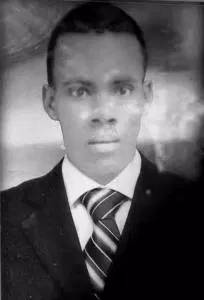
Sabboonaa Oromoo Barataa Dajannee Sarbeessaa

Dajanee Sarbeessaa (1998-2015)

Dajanee Sarbeessaa a bright student  with exceptional ability Killed by Agazi (fascist) Ethiopian regime forces on 4th December 2015

Dajanee Sarbeessaa abbaa isaa obboo Sarbeessa Araddaa fi hadhaa isaa Aaddee Gaaddisee Durreessaa irraa bara 1998 Oromiyaa giddu galaa ganda Abebee Sillaasee fi Gichillaa keessati dhalatee guddate. Dajaneen umuriin isaa hanga barnootaaf ga’uti ganduma dhalate sana  keessatti haadhaa fi abbaa isaa gargaaraa ture. Kana malesi, ganda saanii keessatti taphaa ijoollummaa isaa hirriyita isaa walliin taphachaa dabarse.

Dajaneen akkuma umuriin isaa barnootaaf ga’een bara 2006  waggaa 8’ffaa isaatti gara mana barumsaa ganduma inni keessatti dhallatetti jalqabe. Yeroo sanatti imanaan maatii isaa “Beekaa nuuf ta’ii; harkaa nu qabi; hiyyumaa keessa nu baasi; beekaa lammiif ta’ii!” kan jedhu fudhatee barumsa isa eegale. Akka imaanaa maatii fudhatee qabsoo barnoota isaa eegaleen kutaa 1’ffaa isaa ABC ….fi 123….jechuun eegalun kutaa 1-8 tti qabxii gaarii galmeessisuun itti fufe. Yeroo kana keessattis, daree isaati fi akka waligalati 1’ffa ba’uun qabxii boonsaa galmeessisa ture.

Dandeettii fi Qarummaa

Dajaneen barnoota isaatin cimaa ture. Kana malees, ogummaa waa umuun illee nama gummachaa gaarii mana barumsaa isaa keessati rawwatee ture. Fakkeenyaaf, Dajaneen yeroo kutaa 6’ffa isaa baratu bara 2010tti kallaqoota kanneen akka moodela solarii kan bishaan ho’isuu danda’uu, maykiroskophii fi kitaabaa barattootaf akka yaadaanootti dubbisuuf mijjatu qopheessaa ture. Sababa kanaan dhumaa semistera 2’ffa irraatti badhaasota gosaa ja’aa (6) nama badhaafame ture. Akka kanaan hangaa xummuraa sadarkaa 1’ffaa isaatti badhaasota soddomii lama ol mana baruumsa irraa badhafaame.

Sababa kanaan, Dajaneen kabajaa fi jalaala mana barumsaa qabun qabxii olaana fi ga’uumsa qabun imanaa mana baruumsa fi maatii isaa fudhachuun gara kutaa 9’ffaa bara 2014tti gara mana baruumsa Baantu saddarka lamafaa fi qopha’inatti barrachuu eegale. Achittis semistera 1’ffaa qabxii gaarii ta’ee galmeessun bakka bu’aa mana baruumsa Baantuu ta’uun fillamee gara Adaamaatti dorgomiif dhihaate. Dajaneenis turtii Adaamaa kana torbe tokkof taasisen badhaasa cimiina isaa gonfate;  ergaa debi’ee bodaa immoo qabxii kutaa 9’ffa isaa kan walliigala 1117 Average waliigala 93.5 fiddun akka kutaattis ta’ee akka waliigallatis 1’ffaa ba’uun gara kutaa 10’ffaati bara 2015 darbee barnoota isaa haalaa ho’aan eegale.

Haala kanaan osoo barachaa jiruu dubbiin dhimma master pilani bara 2014 eegale falmii dargaggoo Orommotiin dhorkamee bara kana 2015  ka’uun mormii barattoota Baantu sadarkaa 2’ffa fi qopha’inaa walliin ta’een sagalee isaanii dhageessisaa turan.

Gaafii Barattootaa

Gaaffiin isaanii dhimmii master pilaani nurra haa dhabbatu; lafa keenya irraa hin buqqanu; bara baraan maaliif hidhaan ajjeechan reebichii seerran allaa durrati gaggeefama? jedhaan. Otuu isaan karaa nagaan sagalee isaanii dhaggeesisanu sarroota wayyaanetiin raasasa akka akkayii qammadii xaxaxiisuu irraati roobsan; baratoota baay’een miidhamuun lubbuun isaanii dhaban; Dajaneenis  guyyaa 4 Mudde 2015 lubbuun isaa dabarte.

Qabsa’aan nii du’aa Qabsoon ittii fuffa !

Injifannoon uummata oromoof!

Oromia: Obbo Baqqalaa Garbaa fi Obbo Dajanee Xaafaa To’annaa Jala Oolan. Fascist Ethiopian Regime (TPLF) unlawfully Arrested Baqqalaa Garbaa and Dajanee Tafaa of Oromo Federalist Congress (OFC) December 25, 2015

Posted by OromianEconomist in Uncategorized.
Tags: , , , , , , , ,
add a comment

Odaa OromooBaqqalaa GarbaaBaqqalaa Garbaa and Dajanee Xaafaa of Oromo Federalist CongressFree Bekele Gerba

https://www.oromiamedia.org/2015/12/25/omn-oduu-mud-24-2015/

Obbo Baqqalaa Garbaa , Itti-Aanaa Dura taa’aa KFO/OFC fi Dajanee Xaafaa itti-aanaa barreessaa KFO/OFC guyyaa ardhaa qabamuun Himame. Sochii Uummataatiin kan bararuqe mootummaan Shororkeessaa Woyyaanee hoggantoota gootota ilmaan Oromootaa kana Obboo Baqqalaa Adaammaarraa loltuu Lammii Tigraay qofa 21 qabatee mana marsee qabee gara Maakalaawitti yo geessu Obboo Dajanee Xaafaa ammoo Yuuniverstii Rift Valley bakka inni barsiisurraa qabanii mana geessanii and mana isaa sakatta’anii gara Maakalaawitti geessuun himameera.
Obboo Baqqalaan kanaan durallee woggoota 4 wolakkaa f mana hidhaa kan ture yo ta’u obbo Dajaneenille nama woggaa dheeraaf qabsoo karaa nagaa keessa turee dha. Ob Dajaneen 2005-2010 aanaa callayaarra filatamee paarlaamaa keessa turuun beekkama.

https://www.oromiamedia.org/2015/12/24/omn-oduu-amma-nu-gahe-muddee-242015/


Obbo Baqqalaa Garbaa Deebisanii To’annaa Jala Oolan


Muddee (Dec.) 24, 2015

Kan dhiyeenya mana hidhaa dhaa gad dhiisaman Itti aanaa dura taa’aan kongresa Federaalawaa Oromoo Obbo Baqqalaa Garbaa akka lakkoobsa Itiyoopiyaa har’a galgala naannoo Sa’a 12 mana isaanii Adaamaa jiru irraa hunoota mootummaan qabamuu maatiin isaanii nuu mirkaneessaniiru jechuu dhaan barreessaan dhaabichaa Obbo Baqqalaa Nagaa dubbataniiru.


Bonnie Holcomb: OSA’s Board Chair – message regarding the unlawful arrest of Bekele Gerba of OFC

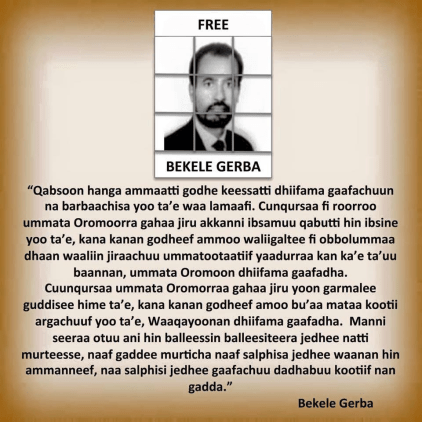
Bekele Gerba was arrested last night 7:30 PM local time in Adama by 14 uniformed and armed Federal Police. They came with a paper callng for the arrest of “Bekele Gerba Tuji.” Bekele was reading at his desk in the company of his wife and son. He responded peacefully that this is not his proper name, that he had broken no law and refused to go with them or allow them to search the house. They brought another two intelligence people in civilian clothing who led a search the house without a stated purpose against his objection that his rights were being violated. He was taken by force without a charge in front of his wife, son and three witnesses who were EPRDF members. He was put into the back of a Federal Police vehicle and taken away. At that point his wife was told not to follow them and that she could visit him at the Makelawi prison after 24 hours.

This is the highly-respected man with a reputation of utmost integrity who translated the speeches of Martin Luther King, Jr into Oromo language while serving and a prisoner of conscience from 2011-2015. He is an official in the legitimate Oromo opposition party in Ethiopia. He delivered the keynote address at the 2015 Oromo Studies Association calling upon Oromo protest peacefully to assert their rights. I personally accompanied him to visit the State Department Ethiopian Desk officer, State Department Democracy Rights and Labor representative who also reported to the African Desk officer. He spoke with members of the Atlantic Council at a session on August 27, with National Endowment for Democracy, RFK Center for Justice and Human Rights, Freedom House, offices of Congressional Representatives from Minnesota and the House Subcommittee on Africa. He was interviewed by NPR and Al Jazeera. At all meetings he spoke clearly about the crisis the Oromo were facing with violation of all rights guaranteed by the Ethiopian constitution, the outright confiscation of land, the closure of all political and social space for expression. He urged support for peaceful demonstration by Oromo in Ethiopia, and received assurances that the United States fully supports democratic expression. Now is the time for all who heard and understood his message to stand in support of Bekele and the Oromo protesters who peacefully demonstrated in response to illegal land seizure and egregious violations of their rights.

http://www.ayyaantuu.net/bonnie-holcomb-osas-board-chair-message-regarding-the-unlawful-arrest-of-bekele-gerba-of-ofc/


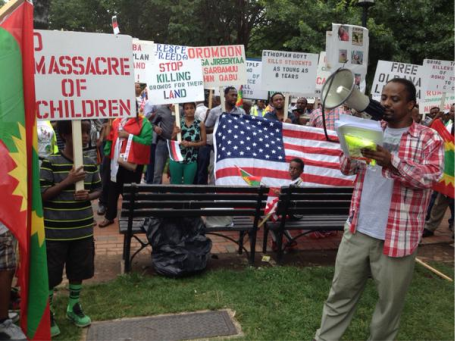
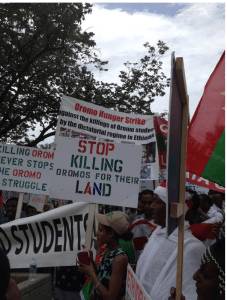
MN Oromos rally to protest student deaths in Ethiopia December 25, 2015

Posted by OromianEconomist in Uncategorized.
Tags: , , , ,
add a comment

Odaa Oromoooromoprotests-tweet-and-share1

MN Oromos rally to protest student deaths in Ethiopia

IssuesMukhtar Ibrahim · · Dec 24, 2015
Demonstrators demanded justice for students killed in Ethiopia at the State Capitol. Mukhtar Ibrahim | MPR News

A Call for the UN Human Rights Council to Create a Commission of Inquiry for Oromia State/Ethiopia December 24, 2015

Posted by OromianEconomist in Uncategorized.
Tags: , , , , , , , , ,
3 comments

Odaa OromooHuman rights League of the Horn of Africa

HRLHA: A Call for the UN Human Rights Council to Create a Commission of Inquiry for Oromia Regional State/Ethiopia


Dec 24, 2015

Shocked and grieved by the unprecedented tyrannical actions and gross human rights violations perpetrated by the Ethiopian Government against the Oromo Nation in the past twenty five years, since the present government came into power in1991;

Condemning the recent deadly violence against Oromo peaceful demonstrators staged against the so called “Addis Ababa Integrated Master Plan”- violence that has already claimed more than 200 lives including, children and senior citizens in December 2015 alone with more than 50,000 imprisoned;

Recalling that the Universal Declaration of Human Rights guarantees the right to life, liberty and security of person, freedom of opinion and expression, freedom of peaceful demonstration and assembly,

Recalling further that the Universal Declaration of Human Rights prohibits torture and cruel, inhuman or degrading treatment or punishment, arbitrary arrest and detention,

The HRLHA calls on the United Nations Human Rights Council:

  • to create an international commission of inquiry to investigate the recent alleged serious violations of international customary law and international human rights law by the Ethiopian Government
  • to request the UN Commissioner of Human Rights to dispatch a mission to Oromia Regional State/Ethiopia immediately to investigate the alleged violations

In the meantime, the HRLHA calls upon the UN Human Rights Council to use its mandate to put pressure on the Ethiopian Government:

  • to immediately bring the “Agazi” paramilitary members who cold-bloodedly attacked the peaceful demonstrators to justice
  • to unconditionally free all  Oromo prisoners of conscience and  others arbitrarily detained, including those held before for no reason and  during the peaceful protests of April-March 2014 and November – December 2015 against the ” Addis Ababa Integrated Master Plan “
  • to refrain from reprisals against Oromos who have taken part in peaceful demonstrations

Background Reports:

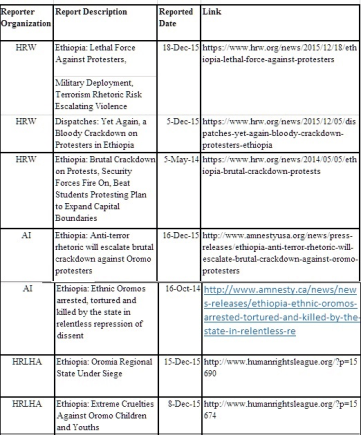
The Ethiopian People Revolutionary Democratic Front (EPRDF) government’s gross human rights abuses against the Oromo Nation in the past 25 years have been widely reported by domestic, regional and international human rights organizations and international media including Human Rights Watch (HRW), Amnesty (AI), the Human Rights League of the Horn of Africa (HRLHA)[1], the British Broadcasting Corporation (BBC) and others.


Human Rights League of the H. O. Africa background report, Human Rights violations against Oromo people in Ethiopia

[1]http://www.humanrightsleague.org/?p=14287
http://www.humanrightsleague.org/?p=14668
http://www.humanrightsleague.org/?p=15430
http://www.humanrightsleague.org/?p=15667

Members of U.S. Congress write to Secretary of State Kerry on #OromoProtests in Ethiopia December 24, 2015

Posted by OromianEconomist in Uncategorized.
Tags: , , , , , ,
add a comment

Odaa OromooRepresenting Minnesotaoromoprotests-tweet-and-share1

Stop killing Oromo StudentsAgazi, fascist TPLF Ethiopia's forces attacking unarmed and peaceful #OromoProtests in Baabichaa town central Oromia (w. Shawa) , December 10, 2015

Members of U.S. Congress write to Secretary of State Kerry on Oromo Protests in Ethiopia

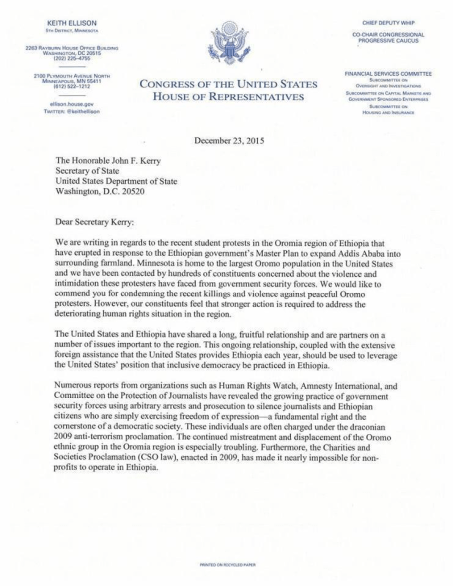
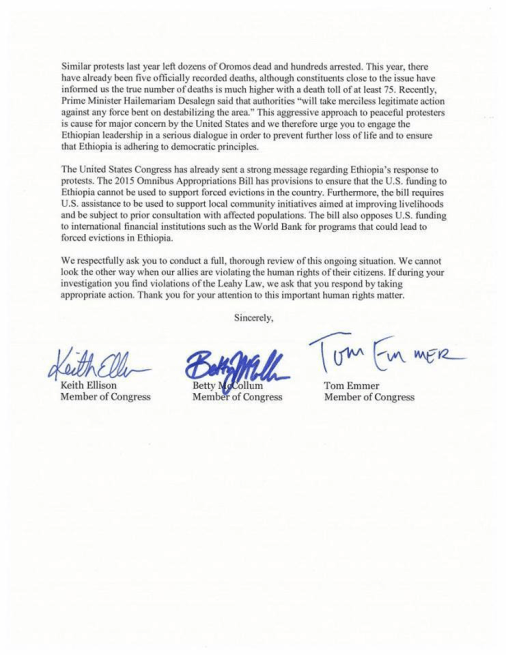
 #‎OromoProtests‬ US Congress Members Keith Ellison, Betty McCollum & Tom Emmer write letter to U.S. Department of State. Page1#‎OromoProtests‬ US Congress Members Keith Ellison, Betty McCollum & Tom Emmer write letter to U.S. Department of State

The following is a letter written by members of the U.S. Congress: Reps. Keith Ellison (MN), Betty McCollum (MN) and Tom Emmer (MN), to U.S. Secretary of State John Kerry.


FOR IMMEDIATE RELEASE
December 24th, 2015

Ellison, McCollum, Emmer Send Letter to Secretary of State Kerry Regarding Protests in Ethiopia

WASHINGTON DC – Reps. Keith Ellison, Betty McCollum, and Tom Emmer sent the following letter to Secretary of State John Kerry regarding the student protests in the Oromia region of Ethiopia calling for stronger action against human rights violations:

December 23, 2015

The Honorable John F. Kerry
Secretary of State
United States Department of State
Washington, D.C. 20520

Dear Secretary Kerry:

We are writing in regards to the recent student protests in the Oromia region of Ethiopia that have erupted in response to the Ethiopian government’s Master Plan to expand Addis Ababa into surrounding farmland. Minnesota is home to the largest Oromo population in the United States and we have been contacted by hundreds of constituents concerned about the violence and intimidation these protesters have faced from government security forces. We would like to commend you for condemning the recent killings and violence against peaceful Oromo protesters. However, our constituents feel that stronger action is required to address the deteriorating human rights situation in the region.

The United States and Ethiopia have shared a long, fruitful relationship and are partners on a number of issues important to the region. This ongoing relationship, coupled with the extensive foreign assistance that the United States provides Ethiopia each year, should be used to leverage the United States’ position that inclusive democracy be practiced in Ethiopia.

Numerous reports from organizations such as Human Rights Watch, Amnesty International, and Committee on the Protection of Journalists have revealed the growing practice of government security forces using arbitrary arrests and prosecution to silence journalists and Ethiopian citizens who are simply exercising freedom of expression—a fundamental right and the cornerstone of a democratic society. These individuals are often charged under the draconian 2009 anti-terrorism proclamation. The continued mistreatment and displacement of the Oromo ethnic group in the Oromia region is especially troubling. Furthermore, the Charities and Societies Proclamation (CSO law), enacted in 2009, has made it nearly impossible for non-profits to operate in Ethiopia.

Similar protests last year left dozens of Oromos dead and hundreds arrested. This year, there have already been five officially recorded deaths, although constituents close to the issue have informed us the true number of deaths is much higher with a death toll of at least 75. Recently, Prime Minister Hailemariam Desalegn said that authorities “will take merciless legitimate action against any force bent on destabilizing the area.” This aggressive approach to peaceful protesters is cause for major concern by the United States and we therefore urge you to engage the Ethiopian leadership in a serious dialogue in order to prevent further loss of life and to ensure that Ethiopia is adhering to democratic principles.

The United States Congress has already sent a strong message regarding Ethiopia’s response to protests. The 2015 Omnibus Appropriations Bill has provisions to ensure that the U.S. funding to Ethiopia cannot be used to support forced evictions in the country. Furthermore, the bill requires U.S. assistance to be used to support local community initiatives aimed at improving livelihoods and be subject to prior consultation with affected populations. The bill also opposes U.S. funding to international financial institutions such as the World Bank for programs that could lead to forced evictions in Ethiopia.

We respectfully ask you to conduct a full, thorough review of this ongoing situation. We cannot look the other way when our allies are violating the human rights of their citizens. If during your investigation you find violations of the Leahy Law, we ask that you respond by taking appropriate action. Thank you for your attention to this important human rights matter.

Sincerely,

Keith Ellison
Member of Congress

Betty McCollum
Member of Congress

Tom Emmer
Member of Congress

Cc: Susan Rice, National Security Advisor, White House
Samantha Power, United States Ambassador to United Nations
Congressman Ed Royce, Chairman of Foreign Affairs Committee, United States House of Representatives
Congressman Elliot Engel, Ranking member of Foreign Affairs Committee, United States House of Representatives

http://ellison.house.gov/media-center/press-releases/ellison-mccollum-emmer-send-letter-to-secretary-of-state-kerry-regarding

Atrocities by the Ethiopian Security forces exasperates in Oromia December 24, 2015

Posted by OromianEconomist in Oromo the Largest Nation of Africa. Human Rights violations and Genocide against the Oromo people in Ethiopia, Uncategorized.
Tags: , , ,
add a comment

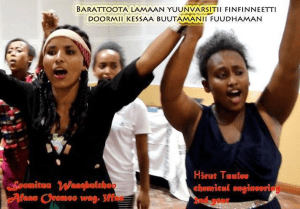
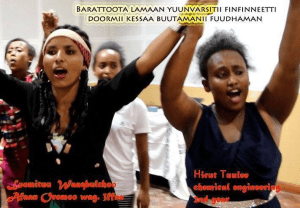
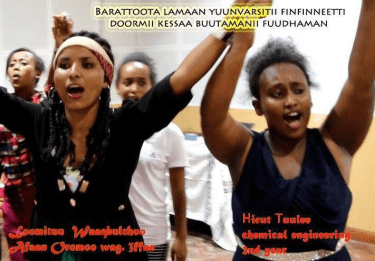
???????????#OromoProtests @Finfinnee (AAU) over kidnapping of two female students. Their name is Lomitu Waqbulcho ( 3rd year Afan Oromo & Hirut Tule (2nd year Chemical Engineering). 18 December 2015#OromoPRotests tweet and share

Hawi Tazara , our sister, our music, our famous Oromo artistAgazi, fascist TPLF Ethiopia's forces attacking unarmed and peaceful #OromoProtests in Baabichaa town central Oromia (w. Shawa) , December 10, 2015

The Ethiopian government security forces atrocities has continued throughout the Oromia region. Now, the whole Oromia region is under the control of the government army. The security forces are raping children and women ; beating, torturing and maiming thousands of people in the region. They are jailing Oromo singers, human right activists and university lecturers .Recently, Hawi Tezera, a renowned Oromo singer was beaten by the federal police and taken to jail for releasing a single album that resists the Master Plan and the killings of Oromo students by the government military forces in Oromia region during the peaceful protests that took place in the region opposing the Addis Abeba and Oromia Special Zone Integrated Master Plan that aims to expand the capital city to areas in the Oromia region.Hailu Adugna, a lecturer at Haramaya University and social media activist was taken by security forces from the class he was teaching and his whereabouts is not still known. He was targeted because he wrote on the social media opposing government forces brutal treatment of the peaceful protesters. Another social media activist detained by the security forces is, Girma Gemedi, who is known among the Oromo youths for boldly writing and speaking against the human right violations of the Oromo people by the Ethiopian government.Thousands of Oromo youths are behind bars for taking part in the peaceful protests that lasted for more than a month in every corner of Oromia region. In an interview on the national television, the Ethiopian prime minister Hailemariam Desalegn vowed to take ‘merciless action’ against the peaceful protesters saying that the protesters are ‘terrorists’. This rethoric by the prime minister shows that the Ethiopian government’s commitment to is use the Anti-Terrorism Law of 2009 to crush the peaceful protesters and silence dissents.

Source: Atrocities by the Ethiopian Security forces exasperates in Oromia

Oromia: Famous Oromo female singer Hawi Tezera feared to be under another torture, activists say. #OromoProtests December 24, 2015

Posted by OromianEconomist in Uncategorized.
Tags: , , , , , , , ,
4 comments

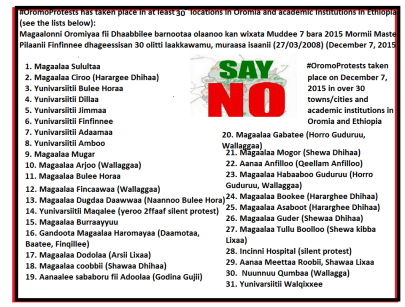
???????????#OromoProtests of 7 December 2015

Stop TortureStop killing Oromo Students

Famous Oromo female singer Hawi Tezera feared to be under another torture, activists say

Release Hawi, our sister, our music, our famous artistHawi Tazara , our sister, our music, our famous Oromo artist

(December 23, 2015, Finfinne Tribune, Gadaa.com ): According to a media report, the famous Oromo female singer Hawi Tezera was detained and tortured last week by the Ethiopian Federal police after releasing an Afan Oromo single music that’s critical of the Ethiopian government’s affairs, i.e. the Master Plan and the killings following the protests against the Master Plan, in the Federal State of Oromia. The single, which was released on December 15, 2015, was produced using the traditional Oromo protest genre called Geerarsa. Photos of the singer’s tortured body, showing the bruised and swollen areas, are shown here.Report shows Hawi Tezera’s bruised and swollen body from last week’s torture; activists fear she could be tortured again.

Upon the intervention of the Oromian State police, the report adds, Hawi was released from her ordeal only to be imprisoned again over the last few days. Activists fear that she could be tortured again; the Ethiopian government has a record of detaining and torturing dissidents (prisoners of conscience) who oppose its policies using peaceful and Constitutional means.

In addition to Hawi, thousands of Oromos, including a journalist, have been imprisoned across Oromia and Ethiopia over the last week – accused of expressing protests against the Addis Ababa Master Plan. According to the protesters, who are using peaceful (nonviolent) means to demonstrate their opposition, millions of Oromo farmers will be evicted from their homesteads, and thousands have already been evicted and have become homeless, through the government’s large-scale land-grab project called the Addis Ababa Master Plan. During the recent wave of arrests, the government has especially targeted Oromo singers and their families/relatives for imprisonment and harassment. It is to be remembered that Oromo male singers Jireenyaa Shifarraa and Bilisummaa Dinquu were reportedly abducted last week by the government forces – after being accused of releasing music that’s critical of the government’s policy in Oromia; photos of Jireenyaa Shifarraa in handcuffs were circulating on social media last week. Read more at:-

http://gadaa.net/FinfinneTribune/2015/12/famous-oromo-female-singer-hawi-tezera-feared-to-be-under-another-torture-activists-say/

DW: Oromia: #OromoProtests set to continue in Ethiopia December 24, 2015

Posted by OromianEconomist in Uncategorized.
Tags: , , , , , ,
2 comments

???????????#OromoPRotests tweet and share

Oromo protests set to continue in Ethiopia

In an interview with DW, a spokesman of the Ethiopian Federal Democratic Unity Forum accused the government of abusing the country’s constitution with its plans to expand the capital Addis Ababa.

OromoProtests set to continue

Violence and chaos gripped Ethiopia this week as thousands of demonstrators took to the streets in protest against government plans to expand the capital Addis Ababa. Human Rights Watch said at least 75 people were killed in a bloody crackdown by heavily armed security forces. The demonstrations have spread to several towns since November, when students spoke out against plans to expand the capital into Oromia territory, a move the Oromo people consider a land grab. DW spoke to Merara Gundina, chairman of the opposition Oromo Federal Congress, in Addis Ababa.

DW: What exactly are you demonstrating against?

Merara Gundina: The Addis Ababa Master Plan is part of a larger land grab by the Ethiopian government around Addis Ababa, which has displaced not less than 200,000 people. Secondly, under federalism all the boundaries are being eroded by the ruling party which is bent on taking the land. People are very angry with the government and people who wanted to see change are frustrated.

Under the Ethiopian constitution all land belongs to the state, with people living there legally considered tenants. Doesn’t this allow the government to carry out any developments that may serve the interests of all Ethiopians?

No, no, the government is misusing it. The constitution says the land belongs to the public so it doesn’t allow the government simply to tell the people “go away” and it takes the land. No, it says there are bonds of state in the name of the people and there are individuals owning the land. It is the ruling party that is misusing the constitution. In fact, the state itself is privatising the country.

We understand you have vowed to continue the demonstrations despite the killings and Prime Minister Hailemariam Desalegn declared on television that the government would act without mercy. Is it not better to solve these issues through talks?

We continue to support the cause of our people. We continue our peaceful struggle. We cannot be intimidated as the government has done. We have popular support, we have millions of people behind us. The government cannot silence us easily. We are following the constitution but we are against the arbitrary misuse of the constitution by the ruling party. Our people will continue.

Is it true that your organization is getting support from outsiders?

The diaspora is far away. It’s school kids, high schools and universities and the government is simply accusing the left and the right. Probably the diaspora is very active in the media because the local media are totally controlled by the government. We have no access to the media and the diaspora have some media outlets and they report what is happening in the country. But a diaspora of a few thousand cannot move millions of people.

http://www.dw.com/en/oromo-protests-set-to-continue-in-ethiopia/a-18937401?maca=en-Twitter-sharing


Related:-


VOA: Ethiopia’s Oromos Tread Warily Amid Anti-government Protests

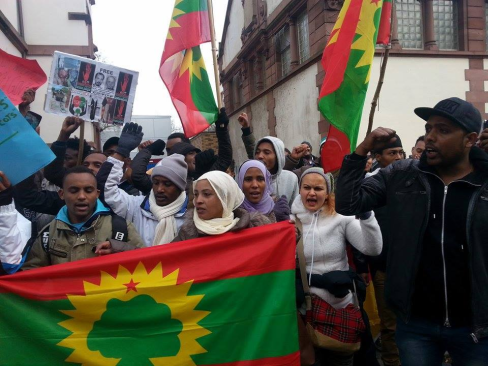
Ethiopian migrants, all members of the Oromo community of Ethiopia living in Malta, protest in Valletta against the Ethiopian regime's plan to evict Oromo farmers to expand Ethiopia's capital, Addis Ababa, Dec. 21, 2015.

Ethiopian migrants, all members of the Oromo community of Ethiopia living in Malta, protest in Valletta against the Ethiopian regime’s plan to evict Oromo farmers to expand Ethiopia’s capital, Addis Ababa, Dec. 21, 2015.

Marthe van der Wolf, December 23, 2015 3:22 PM
Schools are closed, businesses have just reopened after being closed for almost a week, and there is tension in Ginchi, Ethiopia, one of the first towns where the Oromo people began protesting last month against a plan to expand the capital, Addis Ababa.

Police are on the main road in Ginchi, which is about 80 kilometers west of Addis Ababa. Interviews have to be conducted on the basis of anonymity and on the outskirts of the town.

A waitress says that despite the reopening of the cafe where she works, life is not back to normal yet: She says that there is not an official curfew, but that young people risk being randomly detained if they are out in the evening.

The most recent protest in Ginchi was last weekend, after a funeral. Citizens said security forces killed three people before the protest took place.

The Addis Ababa master plan is a blueprint to expand the capital into the Oromiya region. The protesters believe that the expansion will lead to land grabs without proper compensation and a loss of the Oromo culture and language.

A shop owner, who participated in the protests, says those who created the master plan do not understand that life is tough and that people like him will not benefit from the promised development. He says there is no benefit for the people to have outside investors who take their land.

Established in 1991

The Oromiya region was established when the current government came to power in 1991. The federal system was divided along ethnic lines. The Oromos are the largest ethnic group in the country.

Bekele Gerba, leader of the opposition Oromo Federal Congress, lives in Adama, the former capital of the Oromiya region. The city, about 60 kilometers south of Addis Ababa, has also seen protests in recent weeks.

Gerba says Oromos have never been treated like equals by Ethiopia’s leaders, but he believes the current government is the worst.

“The ruling classes, usually, they think that Oromo is a threat,” he said. ” ‘One day they can overwhelm us. Therefore, they have to be treated in such a way so that they won’t have any power.’ Therefore, for example, we don’t have any power in the military. All the military commanders belong to a different ethnic group.”

Gerba’s party says more than 75 people have died since the protests began, and that many of his party members have been detained. Rights organizations such as Human Rights Watch say the government is using “excessive lethal force” on the protesters.

A government spokesman, Getachew Reda, told VOA on Wednesday that security forces had exercised restraint, “even under circumstances where they found themselves overwhelmed.”

http://www.voanews.com/content/ethiopia-oromos-tread-warily-amid-anti-government-protests/3116002.html


FP: Revolt in an African Stasi State


Revolt in an African Stasi State


Daily Mail: Ethiopia opposition: 80 killed in protests against land plan

Read more: http://www.dailymail.co.uk/wires/ap/article-3372090/Ethiopia-opposition-80-killed-protests-against-land-plan.html#ixzz3vCWG0CDp


Ethiopia arrests journalist after channel reports on protests. #OromoProtests December 23, 2015

Posted by OromianEconomist in Uncategorized.
Tags: , , , , ,
add a comment

???????????#OromoPRotests tweet and shareJournalist Fikadu Mirkana, Oromia TV and Radio

Ethiopia arrests journalist after channel reports on protests

(CPJ, Nairobi, December 22, 2015)–The Committee to Protect Journalists calls on authorities in Ethiopia to release news anchor Fikadu Mirkana. Fikadu, who works for the state-run broadcaster Oromia Radio and TV, was arrested at his Addis Ababa home on Saturday morning, according to news reports.

CPJ could not determine the reason for Fikadu’s arrest. It comes as Oromia Radio and TV has, in recent weeks, covered protests against a plan to expand the Ethiopian capital, in a move that campaigners say would displace hundreds of thousands of farmers, according to news reports. Dozens of protesters have been killed during clashes with police during the unrest in the regional state of Oromia, according to a Human Rights Watch report.

“Journalists have a vital role to play in ensuring the flow of information, both from the Ethiopian government and also, critically, from those who will be affected by its decisions,” said CPJ Africa Program Coordinator Sue Valentine in New York. “We call on authorities to release Fikadu Mirkana immediately.”

It is not clear where Fikadu is being held and neither his family nor his lawyers have been allowed access to him, an Addis Ababa-based journalist, who has spoken with Fikadu’s family and who requested anonymity for fear of retribution, told CPJ.

The Ethiopian authorities in Addis Ababa and the Ethiopian embassy in Nairobi did not immediately respond to CPJ’s request for details about Fikadu’s arrest.

In recent weeks, the Ethiopian government has used anti-terror rhetoric against campaigners, with the communications minister, Getachew Reda, branding them “terrorists” and “demonic,” according to a column by Awol Allo, a fellow in human rights at the London School of Economics and Political Science, published Saturday on Al-Jazeera‘s website. This language usually presages a crackdown on dissenters, the column said. Protests in Oromia, a region that stretches across central Ethiopia and is home to a third of the country’s population, have affected at least 30 towns and prompted the arrest of more than 500 people since mid-November, according to news reports.

Ethiopia is the third largest jailer of journalists on the African continent, with at least 10 behind bars on December 1, CPJ’s 2015 prison census shows.

https://cpj.org/2015/12/ethiopia-arrests-journalist-after-channel-reports-.php


Koreen Mirga Gaazexeessitotaa (CPJ) Akka Itoophiyaan Gaazexeessaa Fiqaadu Mirkanaa Hiiktu Gaafatte


Journalist Fikadu Mirkana, Oromia TV and Radio

Gaazexeessaa Fiqaaduu Mirkanaa

Gaazexeessaa Fiqaaduu Mirkanaa dhaaba TV fi Raadiyoo Oromiyaatii hojjata.

Akka gabaasa CPJ baaseetti nama kana Muddee 19,2015 ganama Finfinnee qabanii hidhan.Waan gaazexeessaa kana hidhaniif CPJ ammatti beekuu baatullee dhiyoo tana keessaa mormii master pilaanii Finfinnee gabaase.

Sue Valentine, qindeessituu sagantaa CPJ damee Afrikaati,NY jirti.

“Gaazexeessitotii akka ummatii mootummaa fi waluma irrallee odeeffannoo argatu tolchuuf qooda guddaa qaban,”jetti.”

Tanaafuu Fiqaaduu ariitiin hidhaa bahuu qabaa jetti,Sue.Fiqaaduu eessatti akka hidhan akka CPJ-tti maatii fi abukaatoon isaalleen hin beekan jedha CPJ.

CPJ waahee hidhaa gaazexeessaa kanaa bulchoota Itoophiyaa Finfinnee jiranii fi embaasi Naayroobii jiran irraa saatii barbaadetti deebii argachuu hin dandeennee jedha.

Itoophiyaan gaazexeessitota hidhuun akka CPJ-tti Afrikaa keessaa sadarkaa sadaffaa irra jirti.

http://m.voaafaanoromoo.com/a/journalist-fekadu-mirkana-jailed-oromo-ethiopia/3113884.html

Oromia (Holonkomii): Blood and terror in Ethiopia as protests sweep the streets. #OromoProtests December 22, 2015

Posted by OromianEconomist in Uncategorized.
1 comment so far


Odaa Oromoo#OromoPRotests tweet and shareAgazi, fascist TPLF Ethiopia's forces attacking unarmed and peaceful #OromoProtests in Baabichaa town central Oromia (w. Shawa) , December 10, 2015

Wolenkomi, a town just 60 kilometres (37 miles) from the capital Addis Ababa.

“That was my only son,” a woman sobbed. “They have killed me.”

Back at the family home of 20-year-old Kumsa Tafa, his younger sister Ababetch shook as she spoke. “He was a student. No one was violent. I do not understand why he is dead,” she said.

Human Rights Watch says at least 75 people have been killed in a bloody crackdown on protests by the Oromo people, Ethiopia’s largest ethnic group.

Bekele Gerba, deputy president of the Oromo Federal Congress, puts the toll at more than 80 while the government says only five have been killed.

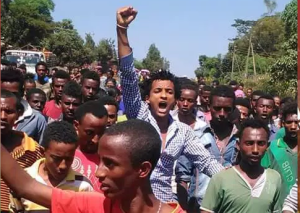
The demonstrations have spread to several towns since November, when students spoke out against plans to expand the capital into Oromia territory — a move the Oromo consider a land grab.

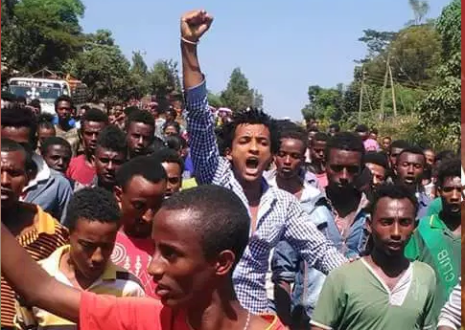
The sight of the protesters on the streets of towns like Wolenkomi — shouting “Stop the killings! This isn’t democracy!” — is rare in a country with little tolerance for expressions of discontent with the government.

Tree trunks and stones are strewn on the asphalt on the road west from Addis to Shewa zone, in Oromia territory, barricading the route for several kilometres.

Chaos broke out on a bus on the road when it emerged that the police were again clashing with demonstrators in Wolenkomi.

“My husband just called me,” said a woman clutching her phone, as others screamed and children burst into tears.

“He’s taking refuge in a church. Police shot at the protesters,” she said.

The man next to her cried in despair: “They’re taking our land, killing our children. Why don’t they just kill everyone now?”

The army raided Wolenkomi again the next day, the rattle of gunfire lasting for more than an hour.

“They grabbed me by the face and they told me, ‘Go home! If you come back here, we’ll kill you’,” said Kafani, a shopkeeper.

Rights groups have repeatedly criticised Ethiopia’s use of anti-terrorism legislation to stifle peaceful dissent, with the US expressing concern over the recent crackdown and urging the government to employ restraint.

But Prime Minister Hailemariam Desalegn declared on television that the government would act “without mercy in the fight against forces which are trying to destabilise the region.”

– ‘Land is everything’ –

Oromo leaders have vowed to keep up their resistance against proposals to extend Addis, and Human Rights Watch has warned of “a rapidly rising risk of greater bloodshed”.

“The government can continue to send security forces and act with violence — we will never give up,” said Gerba.

Land is at the heart of the problem. Under Ethiopia’s constitution, all land belongs to the state, with owners legally considered tenants — raising fears amongst the Oromo that a wave of dispossession is on its way.

“For farmers in Oromia and elsewhere in the country, their land is everything,” said Felix Horne, a researcher at Human Rights Watch.


Source: Blood and terror in Ethiopia as protests sweep the streets

Appeal Letter To US State Department by Five Civic Associations In Washington DC and North America. #OromoProtets December 22, 2015

Posted by OromianEconomist in Uncategorized.
Tags: , , , , , , , , ,
add a comment

???????????#OromoPRotests tweet and shareOromoProtests against genocidal TPLF Ethiopia4. 19 June 2015

Appeal Letter To US State Department by Five Civic Associations In Washington DC and North America.


December 10, 2015
Secretary of State John Kerry
US Department of State
2201 C Street NW
Washington, DC 20520

RE: Continued Massacre in Oromia Regional State by the Tyrannical TPLF Government in Ethiopia

Dear Mr. Secretary,

It has been over a year since the Tyrannical TPLF minority regime unveiled a scheme to expand the city of Addis Ababa into the Oromia Regional State under the guise of development. Their underlying objective is to evict Oromos and settle their Tigrian people. If the scheme is implemented, the current size of the capital increases by 20 folds, from 54, 000 to 1.1 million hectares. It is designed to incorporate 36 Oromian towns into Addis Ababa, such as Dukem, Bishoftu, Adama, Gelan, Legetafo, Sendafa, Sululta, Burayu, Holeta, Sebeta, and Addis Alem among others. More than two million Oromo farmers will be forcefully evicted from their ancestral land by the plan. It is also designed to bring the expanded city under the federal government administration by abolishing the Oromia Regional State jurisdictional right and thereby destroy Oromo identity, Oromia integrity and constitutional right of self-administration

As a matter of fact, Addis Ababa itself is the heartland of Oromia and integral part; and should serve the federal government as headquarters while remaining under the full administration and ownership of Oromia State. Carving out Addis Ababa from Oromia and putting it under the jurisdiction of the federal government is weird and has no contemporary parallelism in the world. Washington, DC or Moscow is not under the jurisdiction of the federal government. The motive of the TPLF government is sinister to deny Oromo ownership and expropriate the city for the benefit of their Tigrian cronies. This scheme leads to permanent conflict and destabilization.

Completely surrounded by Oromia regional state, Addis Ababa city is entirely dependent on Oromia for all services. Today almost all electric power, water supply and other infrastructural raw materials come from Oromia region. In recognition of these, the Ethiopian constitution Article 49 (5) stipulates “the special interest of the state of Oromia will be respected regarding provision of services, the utilization of resources and joint administrative matters.”

Despite these historical, natural, constitutional and economic rights, Oromia regional government is devoid of any decision making process over Addis Ababa administration. Generally, the current so called Integrated Development Master plan violates the Oromia constitutional rights. The ultimate decision is in the hands of the TPLF (Tigre People Liberation Front) leaders whose interest is to exploit the land and resources, loot Oromia and destroy Oromo identity.

The scheme has been rejected by the Oromo nation as a whole. It is an existential question for Oromia and the Oromo people. The unveiling of the scheme ignited public protests in 2014 all over Oromia spearheaded by University, high school, and elementary students. The response by the tyrannical regime is to shoot and kill. More than 70 students were massacred, thousands gravely wounded and tens of thousands were hauled into concentration camps and torture prisons in April and May 2014. Because of the uprising the scheme was paused until it has been reactivated recently again leading to bloody protests in all Oromia Regional State

As different mass media outlets are streaming, the Oromo people in general and students at all levels are currently protesting against the implementation of the plan to expand the city of Addis Ababa into the neighboring Oromo farmers land, which not only displaces millions of Oromo farmers from their ancestral land, but also causes loss of Oromo culture, history and identity. The response by the dictatorial bloodthirsty minority government of the TPLF is shooting to kill, beating, imprisoning and torturing of the peaceful protestors as usual. 8 students were shot dead, thousands wounded, beaten, jailed, disappeared. The tyrannical regime is trying to silence the demand of the people by killing, harassment, imprisonment and torture.

The continued massacre of students and civilians is part of the grand scheme to annihilate the Oromo people and expropriate their land and resources. The late Prime Minister Meles Zenawi said a couple of years ago, while he was alive,” the majority will be diminished into a minority.” That remark reflects deep rooted objective of annihilating Oromo, which the current TPLF leaders are bent to implement. Currently, about 90% of political prisoners in Ethiopia are Oromos. The former Defense minister stated that all prisoners speak Afaan Oromo (Oromo language) after released from prison indicating the huge number of Oromo prisoners. It is puzzling to fathom the strategy of reducing 40% of the Ethiopian population to minority unless one thinks of genocide. Generally, a war of attrition is being waged by the TPLF government against the Oromo people. The trend is dangerous. The Oromo demand deserves timely and appropriate response. Oppression leads to violent response.

Dear Mr. Secretary,

What is being perpetrated against peaceful demand and protest is the concern of the 40 million Oromos not students only. Accordingly, the Oromo Community Organization (OCO) of the Washington Metropolitan Area, the Oromo Youth Self-help Association (OYSA), the International Oromo Women’s Organization (IOWO), the Macha Tulama Association (MTA), the International Qeerroo Support Group(IQSG), and the Oromo Community Association in North America (OCO_NA)are writing this joint appeal letter to you to express our deep concern and outrage about the current massacre of Oromo students all over Oromia by the federal police and army of the TPLF/EPRDF Ethiopian government. While more numbers of fatalities are still coming in and the exact number is hard to be known due to the denial of access by the government for local and international journalists. We have known through our contacts that more and more reports of death are coming every day. Moreover, hundreds are severely wounded by live bullet and other thousands are rounded up and thrown into jail. Given the history of brutality of the current regime in Ethiopia, also those in jail are feared to be tortured or even secretly murdered in their prison cells.

It is so sad that such heinous crimes are repeatedly happening to the Oromo students and civilians. The massacre of more than 70 students on April 30 and May 1, 2014, took place when you were making official visit to Ethiopia. While you were in Addis Ababa, dozens of students were being massacred in Ambo, just 80 miles from your site and yet the Ethiopian government media behaved as if nothing had happened. It was only the BBC that exposed the genocidal killings, and other West media kept silent. This is the government that the U.S. Government is giving financial and economic aid and maintains intelligence and military “cooperation” with. The U.S. military support is used to kill Oromos and others who demand respect for their democratic and human rights.

Last year, we protested against the brutality of the government and submitted letter of appeal to address the problem and we also briefed the State Department staffers by appointment. We showed to the staffers videos of graphic atrocities. But nothing has been done. No member of the criminal regime has been brought to court of justice. We are observing criminal governments brought to ICC from former Yugoslavia, Kenya, Congo Democratic Republic, Rwanda, Liberia and others. We don’t understand why the criminal TPLF government is allowed to move with impunity. Because of unrestrained criminal activity, the government has continued to massacre the Oromo people, grab their lands, plunder resources, harass and imprison. The consequence of the unabated killing of citizens with impunity by tyrannical governments will be regrettable as we can see in many countries facing similar situations today. Stitch in time avoids big crack. Oromo life matters!!

The TPLF minority regime is hoodwinking the West by wearing the veil of progress and development. But the reality is the dirt under the veil. While the TPLF regime is boasting of 12% annual economic growth, 10 million Ethiopians are exposed to hunger and famine according to their appeal to the 2015 World Climate Conference in Paris for food aid. This shows the growth propaganda is commercial. But they blame climate change. Climate change is not earthquake that happens abruptly and cause hunger and famine. The main cause of the famine is land policy and mal administration. Land is expropriated by the TPLF government which they distribute to the Chinese, Indians, Saudis, Turks, and others freely for hidden quad pro quo. TPLF is sole land lord in the country. We recall the infamous hanger of 1973 which dethroned Emperor Haile Selassie and abolished feudalism. The 2015 hunger also should have consequences.

The regime speaks of democratic process while rigging election and declaring 100% victory. In the absence of freedom of expression, press, gathering, protesting they speak of democratic prevalence. They accuse dissenters of corruption and rent seeking, while they stash billions of dollars in foreign banks by snatching from the hunger stricken Ethiopians. They snatch people’s houses and farmers land in the name of development by paying minimum or no compensation and stash away the market value. There is no guarantee of property ownership. Generally, government accountability is nil. Anger against this government is simmering. The tyrannical activity of the government is leading to volatile vent. They should be denied support unless they respect human rights, democratic principles and show transparency.

The current student protest against the master plan is partly the extension of government involvement in extensive land grab which we, the Diaspora Oromo, have been protesting in front
of the US State Department and the White House. The plan is a land grab disguised in development. It is designed to kill the Oromo generation. There is no legal or social justification to include this small cities and provinces under Addis Ababa city administration for development.

To worsen the situation, the government has declared establishment of Urban Development Corporation, which controls all cities and municipalities denying the administrative rights of the Regional States. It is an initiative to abolish the federal system and centralize the country under the Tigrian minority regime. It will be adding fuel to the already burning fire in many parts of the country

The principle of integrated regional development does not infringe on the geopolitical entity of the regions. As we can see here in the United States, integrated development among the District of Colombia-Maryland-Virginia does not in any way, encroach on the entities of the states. We do not see any reason why the model cannot be applied in Ethiopia, unless it is for sinister motive. It is illegal to curve out urban centers and bring under the federal government. It is a big scheme to destroy the remaining faint light of federalism and put the county in chaos. There is no track record where the federal government controls the urban centers exclusively. This dictatorial regime is leading the country to disaster. It should be stopped before long.

We earnestly request the US government to use its influence to urge the Ethiopian government to respect the right of the Oromo people, rule of law and stop killing and arresting Oromo students, otherwise we request the US government to stop its support. We specifically request that the US government:

• Demand an immediate stop to the unlawful so called “Integrated development master plan” implementation and the unlawful eviction of Oromo farmers and the illegal selling of Oromo land under the disguise of such “development”.

• Demand the cancellation of the establishment of centralized Urban Development Commission to be implemented by the federal government.

• Demand that an independent commission be appointed to investigate the mass killing in Oromia regional state and look at the prison demography.

• Demand the unconditional and immediate release of Oromo students who are jailed for exercising their constitutional right and all political prisoners languishing in jail for several years.

• Demand that the regime to commit itself to the respect of human rights and allow freedom of expression and assembly and making a peaceful protest.

• Demand Ethiopian perpetrators of mass killing be brought to ICC similar to criminals in other countries.

• Demand the Oromo plight be given equal weight to that of other nations under the yoke of dictatorial regimes

Sincerely,

Desta Yebassa, Ph.D.
Board President, Oromo Community Organization of Washington D.C. area (OCO)
6212 3rd ST NW Washington, DC 20011 and Protest Organizing Committee Chair
ydesta9@aol.com, info@oneoromo.org
www.oneoromo.org

Abebe Etana
Chairman, Oromo Youth Self-help Association (OYSA)
6212 3rd ST NW Washington, DC 20011
abebe_etana@yahoo.com

Dinknesh D. Kitila
Board Director, International Oromo Women’s Organization (IOWO)
6212 3rd St NW, Washington, DC 20011
iowo@iowo.org.
http://www.iowo.org

Teshome Dime
Board Chairman, International Qeerroo Support Group (IQSG)
Box 55244 Washington DC 20040
tashomatakala@yahoo.com

Dr. Guluma Gemeda, PhD
Chair, Board of Directors of Oromo Communities’ Association in North America (OCA-NA)
465 Mackubin St N, St. Paul, MN, 55103, USA
ggemeda@umflint.edu

Asafa Jalata, PhD
Board Chairman, Macha-Tulama Cooperative and Development Association, USA, Inc.
Oromo Center 811 Upshur St. NW Washington, DC 20011
ajalata@utk.edu, contact@machatulama.org
http://www.machatulama.org

CC
President Barack Obama
The White House
1600 Pennsylvania Avenue NW
Washington, DC 20500
http://www.whitehouse.gov
Tel: (202) 395-2020

Mr. Ban Ki-moon
UN Secretary-General
First Avenue at 46th Street
New York, NY 10017
USA

Oromia: Paying Tribute to Obbo Yishaaq Angoos Gurmu: An Exemplar Educator and Civic Leader December 22, 2015

Posted by OromianEconomist in Uncategorized.
Tags: , , , ,
add a comment

???????????Machaa Tuulamaa in USA


Obbo Yishaaq Angoos Gurmu

1933 – 2015


We were shocked and saddened by the passing away of Obbo Yishaaq Angoos Gurmu on November 19, 2015, in Finfinnee, Oromia. He was the secretary of the Board of Directors of the Macha-Tulama Association in Oromia in the 1990s. Obbo Yishaaq gave outstanding service to his people by rebuilding this association with other leaders and by implementing its cultural, social, and political objectives. Throughout his life, Obbo Yishaaq fulfilled the educational objective of the Macha-Tulama Self-Help Association single-handedly.

His extraordinary service had an immense impact on the education of a generation of Oromos and this had far reaching consequences. As a teacher, director, and an administrator, he served in different parts of Oromia and influenced the education of future Oromo leaders across Oromia who would go on to serve the Oromo people. As the director of the Haile Selassie I Secondary School of Naqamtte, which was later named the Naqamtte Comprehensive High School, Obbo Yishaaq Angoos Gurmu demonstrated his farsightedness, effectiveness and quality of leadership. He recognized the importance of rigorously educating Oromo students so that they would receive the university education they needed to be leaders in science, administration, politics, and other areas. Obbo Yishaaq was a great man who shaped the intellectual careers of thousands of Oromo students and others.

Before he arrived in Naqamttee to serve as the director of the Haile Selassie I Secondary School, students rarely passed the Ethiopian School Leaving Certificate Examination. But ever since his arrival, with his guidance, many students passed this exam and were admitted to colleges and the Haile Selassie I University, later named Addis Ababa University. As a director, he created a positive and constructive educational environment to educate his students effectively. Obbo Yishaaq promoted academic excellence by establishing high standards for teaching and learning.

Obbo Yishaaq was educated in the U.S., where he received his master’s degree. Although he was a highly educated man, Obbo Yishaaq preferred to work in a dusty and impoverished city rather than work in Finfinnee, where he could have been employed with a high paying, prestigious job. Instead, Obbo Yishaaq committed his life to cultivating the minds of young Oromos to prepare them for leadership in education, science, and other areas. As a result of this, some of his students emerged as political leaders, professors, and medical doctors. Obbo Yishaaq was a role model for the Oromo nation. He immensely contributed to the education and enrichment of Oromo society. The Macha-Tulama Cooperative and Development Association, USA, expresses its deepest condolences to his family, friends, his former students, and all members of the association in Oromia and foreign countries.

Sincerely,

Asafa jalata
Asafa Jalata, PhD
President, the Directors of Macha-Tulama Cooperative and Development Association, USA

Oromia/ Ethiopia: What Is Behind the Oromo Rebellion in Ethiopia? #OromoProtests December 21, 2015

Posted by OromianEconomist in Uncategorized.
Tags: , , , , , , , ,
add a comment

???????????#OromoProtests @Finfinnee (AAU) over kidnapping of two female students. Their name is Lomitu Waqbulcho ( 3rd year Afan Oromo & Hirut Tule (2nd year Chemical Engineering). 18 December 2015

#OromoPRotests tweet and shareOromo students Protests, Western Oromia, Mandii, Najjoo, Jaarsoo,....#OromoProtests, Qabosoon itti fufa jedhu aayyoleenAgazi, fascist TPLF Ethiopia's forces attacking unarmed and peaceful #OromoProtests in Baabichaa town central Oromia (w. Shawa) , December 10, 2015OromoProtests @Finfinnee University  Dec. 7, 2015 picture2

The current uprising is a culmination of systematic injustice perpetrated against the Oromo.

As is often the case, oppressors are blind to what they perpetrate on their victims and surprised when the oppressed rise up defiantly.

Even the African Union, with its headquarter in Addis Ababa, while rightly concerned about a potential genocide inBurundi, is conspicuously silent on the massacre taking place against the Oromo right on its doorstep.

http://www.huffingtonpost.com/yohannes-woldemariam/what-is-behind-the-oromo-_b_8849776.html

World Post: What Is Behind the Oromo Rebellion in Ethiopia?


The Ethiopian government is now faced with unprecedented rebellion from the Oromo ethnic group, consisting 35% of the Ethiopia’s population, which it disingenuously claims is inspired by terrorism. The immediate pretext is the Addis Ababa Master Plan encroaching and displacing Oromo farmers, but this masks a deeper grievance which has been brewing for at least two decades under this regime, and for over a century under successive highland Ethiopian rulers. In the following, I will try to provide some context and offer some analysis of the danger Ethiopia and the region are facing.

Background

The late Ethiopian Prime Minster, Meles Zenawi, achieved power in 1991 as “the first among equals” in a ruling coalition. After the 1998-2000 “border war” with Eritrea, he moved to consolidate his power by rewarding loyalists and weakening or imprisoning his rivals. Meles institutionalized one-party rule of the Tigray People’s Liberation Front (TPLF) and his Tigrayan inner circle, with the participation of other co-opted ethnic elites who were brought into the ruling alliance under the Ethiopian People’s Revolutionary Democratic Front (EPRDF).

The EPRDF consists of four groups: the Oromo Peoples’ Democratic Organization (OPDO), the Amhara National Democratic Movement (ANDM), the South Ethiopian Peoples’ Democratic Front (SEPDF) and the Tigrayan Peoples’ Liberation Front (TPLF). The Oromo Liberation Front (OLF) decided to withdraw from the EPRDF coalition in 1992 and was pushed out after unsuccessfully trying to assert its independence from the TPLF within the coalition. The role of OPDO, ANDM and SEPDF is simply to rubber stamp TPLF’s agenda. In North American parlance, one can describe the members of OPDO, ANDM and SEPDF as the uncle Toms of Ethiopian society.

Zenawi’s violent crackdown on the 2005 demonstrations protesting the widely believed rigged election was a clear indication of his determination to hang on to power. In the 2010 elections, the EPRDF won 499 out of 547 parliamentary seats — with all but two others going to EPRDF-allied parties — and all but one of 1,904 council seats in regional elections. Despite the semblance of parliamentary rule, those elected were irrelevant to the governance of the country, since the TPLF and PM Zenawi maintained near absolute control over the country’s politics.

If there was any doubt in 2005, in the 2010 and 2015 elections, it became clear that this was a one-party rule with a vengeance, ensuring the triumph of repression, the squashing of dissenting voices and the shutting down of independent media. Elections in Ethiopia are shenanigans to show complete EPRDF control rather than engagement in democracy. There is a clampdown on internet access, and the arrest and sentencing of political opponents and journalists. Even two Swedish journalistsreporting in the Ogaden were imprisoned on terrorism charges.

Succession Not Transition

There was a speculation that Meles’s passing in august 2012
could touch off an internal power struggle expected to take place within the ranks of his loyalists. But the succession of a new prime minister turned out to be an uneventful affair and at least outwardly peaceful. The number of Tigrayans in the cabinet decreased, but key posts remain in the hands of aging Tigrayan loyalists. The talk of “generational change” over the past few years was simply a charade.

Among the exceptions is the current PM Hailemariam Desalegn, the relatively unknown ex-Deputy Prime Minister. Desalegn’s ethnicity gives a superficial semblance of balance and cover for the Tigrayan oligarchy. Desalegn is a Wolayta, a somewhat marginalized ethnicity in the periphery of Ethiopian society, and a born-again Christian in a country where the dominant church is Ethiopian Orthodox. He never participated in the armed struggle that brought the various factions of the EPRDF to power. His status as an outsider was perceived by many to be an asset that gave him broader legitimacy, insulated him from criticism, and allowed him to present himself as an underdog protected from the historical baggage of the Amhara and Tigrayans.

Yet, in his three years in power, Desalegn has announced few new policies. Some suggest that he is a mere figurehead and that real power is still within a core TPLF group shadowing him. In any case, party leaders seem lost without Zenawi. They govern on autopilot, following the vision and templates he left behind. In effect, Zenawi is ruling from the grave. Yet developments like the Oromo uprising expose the limits of ruling from the grave. Regime officials seem confused. Different officials say different things and contradict each other. They look like deer caught in the headlights. As is often the case, oppressors are blind to what they perpetrate on their victims and surprised when the oppressed rise up defiantly.

Resistance to EPRDF Rule

While opposition and discontent have been growing in Ethiopia, the security apparatus is ever vigilant against them . Rioting Muslims were effectively contained. The TPLF marginalized both the legal and the extra-legal opposition, leaving little option but to protest as in the current Oromo uprising. The few co-opted Oromo elites within the EPRDF have little credibility, and protesters scoff at statements coming from Oromo leaders serving the regime.

Other ethnic groups deeply dissatisfied are the Ogadenis, Gambella and Benishangul-Gumuz. The Ogaden national liberation Front (ONLF) in Ogaden is waging an insurgency exacerbated by forcible relocations to allow oil and gas exploration. Similar insurgency rages in Oromia led by the Oromo Liberation Front (OLF). Oromia was incorporated into the Ethiopian empire in the 1880s by emperor Menelik IIduring the time the European scramble for Africa was underway.

Resentment to TPLF rule extends even among parts of Tigray, where a part of the population feel left out by the TPLF elites interested only in making money and investing it in the capital or abroad. The EPRDF has unsuccessfully lobbied the U.S. government to label the ONLF and the OLF as terrorist organizations. Nevertheless, the controversial use and abuse of the Anti-Terrorism Law is applied with impunity. The government attributes the ongoing Muslim and Oromo protest to infiltration from Saudi Arabia, Eritrea and the opposition Ginbot 7 movement.

Despite a dishonest attempt to externalize the issue, Ethiopian Muslims, who number anywhere from 40% to 50% of the population, and the Oromo have historically been marginalized, and the protest is very much homegrown and rooted in a long list of grievances.

Ethiopia, the U.S. and its Western Allies

Ethiopia is a key strategic ally for the War on Terror, which insulates it from any UScondemnation. Ethiopia receives the largest aid in Africa — an average $3.3 billionper year. The government abuses aid money to the extent that even government-provided seeds and fertilizer is denied to farmers who are not party members. Regarding the current uprising, the United States has issued a statement of concern. However, the regime itself is noticably unconcerned because it knows these statements by the U.S. are accompanied by little or no action. Even the African Union, with its headquarter in Addis Ababa, while rightly concerned about a potential genocide inBurundi, is conspicuously silent on the massacre taking place against the Oromo right on its doorstep.

The late Zenawi had the wit to position himself as an indispensable ally of the West in the fight against “terrorism.” Ethiopia is seen as a bulwark against extremism and the chaos of Somalia. From the U.S. point of view, Ethiopia is a military bridgehead to contain Al Qaida infiltration in Somalia and even across the Red Sea in Yemen.

International aid subsidizes about 50 % of Ethiopia’s national budget. United Kingdom funding of $4.9billion for a brutal resettlement scheme was only withdrawn this year. Germany continues to aid Ethiopia for “strategic” reasons despite voicing concern about human rights violations. The regime has deepened its economic relationship with China (which is tight-lipped on human rights issues) by utilizing its comparative advantage: capitalizing on the availability of plentiful cheap labor and Chinese subsidies for projects encroaching in Oromia.

The Economy

Zenawi engineered Ethiopia’s success in securing aid from the European Union and the U.S.; he was adept at maneuvering and securing money from Western financial institutions that even his detractors acknowledge. He counted among his admirers big names such as Professor Jeffrey Sachs of Harvard as well as Professor Joseph Stiglitz of Columbia University and a recipient of the Nobel Prize in Economics. The country’s rulers have perfected the culture of begging and dependency and are now appealing for a $1.4 billion to feed the 10.2 million drought victims even though they engage in the business of leasing fertile land to foreign investors who export everything they grow. Drought does not have to lead to hunger and famine, if a government plans for it. Poor governments can store grain when there is good harvest in preparation for such emergencies.

Consistent with the notion of state-directed developmentalism espoused by the EPRDF, it aspired to oversee the development of roads, rail, electricity and telecommunications, boasting double-digit growth although the IMF disputes those figures and puts the growth rate at 7.5 per cent . It did succeed in Addis Ababa getting sub-Saharan Africa’s first light-rail network. However, the government’s claim that its socio-economic policies have helped the poor is disputed by critics, who point out that the primary beneficiaries are the political elite and that the gap between the elites and the poor is ever wider. The Oromo uprising is partially resentment over displacement and over environmental damage in the name of development.Corruption is rampant in the country. Theft from state enterprises and participation in the black market, including widespread graft is all too common.

Federalism

Ethiopia under the EPRDF was officially declared a federal state. In states with true federalism, regions enjoy political primacy, as it is they who consciously decide to form the state, unlike centralized states where the constituting units come into being in line with EPRDF administrative requirements from the center. The strong center in Ethiopia never allowed for the true spirit of federalism to emerge. The country could never rid itself of the lingering grievance of the regions, of not getting their share, commensurate with their resources. There is a whole list of such claims, such as, misuse of river waters and cheaply leasing of indigenous land to foreign capitalists, urbanization (as in Addis Ababa’s Master Plan), and increasing Deforestation.

The TPLF military and the future

The Ethiopian military as an institution has acquired unprecedented power. Under any conceivable scenario, the military will continue to be a key and decisive player. Yet, it is not a truly national army; at the officer corps level, it is heavily dominated by Tigreans. Historically, the rank and file soldiers come mostly from the Oromo nation and have been the cannon fodder in the country’s numerous wars under Haile Sellassie, Mengistu Hailemariam, and now under the TPLF dictatorship. There is deep grievance within the army resulting in high profile desertions from the Air Force and other branches.

Control of key economic sectors by the military under the EPRDF have made it difficult to limit its role to a strictly military one. The military’s role has other consequences of spiraling ethnic conflicts which have reached a boiling point in the current uprising. EPRDF rule has engendered profound hatred and resentments among different groups with Ethiopian society and among the former ruling classes of the Amhara ethnic group.

The Ogadenis have a longstanding group grievance that is part and parcel of their indomitable desire for self-determination, which has never been addressed. The current uprising is a culmination of systematic injustice perpetrated against the Oromo. Resistance in Ethiopia in the absence of political space for cross-ethnic alliances is being channeled along ethnic and religious lines, potentially setting the stage for the balkanization of the country. In the 20th century, highland monarchist absolutism, Stalinist dictatorships and today’s make-believe “democratic federalism” may contribute more to fragmentation and dismemberment than nation-building. The legacy of dictatorship, from Menelik II, Haile Selassie, Mengistu Hailemariam to Meles Zenawi has endangered the country.

http://www.huffingtonpost.com/yohannes-woldemariam/what-is-behind-the-oromo-_b_8849776.html

CRIMES THAT MADE THE OROMO YOUTH REVOLT. #OromoProtests December 20, 2015

Posted by OromianEconomist in Uncategorized.
Tags: , , , , , , ,
add a comment

???????????#OromoPRotests tweet and shareTigrean Neftengna's land grabbing and the Addis Ababa Master plan for Oormo genocide

CRIMES THAT MADE THE OROMO YOUTH REVOLT

From the Forest Fires of 2000 to the Conflict over the AAMP in 2014 and Beyond

By Mekuria Bulcha


TPLF ETHIOPIA'S CRIMES THAT MADE THE OROMO YOUTH REVOLT

Introduction

Literature on social movements shows that student activism has been a catalyst in regime change in many countries around the world. In Asia and Latin America it had a significant role in the fall of many regimes. In the West, the anti-establishment student movements of the 1960s had significant effects on both national and global politics. The role of student movements in struggles against colonialism in Africa and Asia is also on record. In Ethiopia, a student movement, in the 1960s and early-1970s, was a catalyst for the revolution that led to the downfall of the Haile Selassie regime in 1974. It is common knowledge that Oromo students from high schools, colleges and universities have been expressing grievances and making peaceful demands on behalf of their people, and that the response of the Ethiopian regime has been violent during the last fifteen years. Although the conflict between them has persisted for more than a decade and half, a holistic picture that shows the complexity of the issues which constitute the demands of the Oromo students and the psychology of domination and fear that underpin the repressive responses of the leaders of the TPLF-led regime to the student demands is lacking.[1] This article attempts to fill the gap.

As indicated in the title of the article, the forest fires of 2000 and the AAMP of 2014 are two of the most conspicuous events in a series of incidents which have instigated the Oromo student protests of the last fifteen years. In the article I will show that the two events did not occur in isolation, but were crucial moments in a trajectory of interconnected episodes that have marked the contentious relationship between the Oromo youth and the Ethiopian regime. The word “beyond” in the title of the article indicates an inevitable continuity of conflict between the Oromo people and the Ethiopian regime. To show the complexity of the conflict over Finfinnee (Addis Ababa) the article describes the vicious circle of the tyrannical characteristics inherent in the political culture and predatory behavior of Abyssinian ruling elites, their psychology of fear, and the impunity of their violence against the Oromo people as the cause of the conflict. Indicating that this vicious circle is deeply rooted in the history of the relations between the Oromo people and the Ethiopian state, the article suggests that the conflict may not find resolution short of achievement of full freedom by the Oromo.  Since the initiators and main actors in the ongoing protests against the policies of the Ethiopian regime have been university and high school students as well as primary school-children the terms “youth” and “students” are used interchangeably throughout the article.

The article has 5 sections. The first two parts take up land-ownership and environmental protection as a locus of contention and tensions between the Oromo youth and the TPLF-led regime. Here, the conflict over resources are discussed on two different levels: environmental protection and the right to a homeland.  Putting the conflict on a concrete, cultural level and in an abstract ethical perspective, the first part will examine the incompatibility of the dominating Abyssinian environmentally hostile values and practices with the environment friendly values and practices of the Oromo people. In part 2, the article examines contradictions between the rights of a conquered people and the interests of conquerors: the right to a homeland and its resources on the one hand, and interest in the exploitation of the human and natural resources of a territory on the other. For the present Oromo youth, this involves a birth right to a homeland and an aspiration of preserving its natural resources, and of passing them over to coming generations. The article shows how, having been instigated first by the forest fires which had destroyed over 150,000 hectares of forestland in 2000, the current uprising of the Oromo youth has developed into a movement over the years. According to the Ethiopian Constitution of 1995, all land in Ethiopia (in this case also all Oromo land) belongs to the state. Therefore, any decision about the exploitation of its resources, its administration including the protection of the eco-system, is the prerogative of the guardians of the property of the state. The guardians are the self-appointed TPLF (Tigrayan People’s Liberation Front) leaders. Based on empirical evidence, the article describes the behavior, and the illegal action and predatory behavior of the leaders of the TPLF, as antithetical to the guardianship role which their own constitution confers on them.

The third part deals with the economic policy of the TPLF-led government in relation to its ongoing conflict with the Oromo students. It starts with the massive student protests of 2002. The protests were triggered by a quest for distributive justice and exacerbated by violence which was used by the regime as a solution. The political economy of ethnic-cleansing, which is reflected lately in the attempted implementation of the so-called Addis Ababa Master Plan (AAMP), is explained here. Parts four and five discuss the stratagem used by the Tigrayan leaders of the current Ethiopian regime to stay in power. It shows how George Orwell’s fiction Nineteen Eighty-Four which was published in 1948[2] becomes a reality that affects concretely the lives of tens of thousands of Oromo youth under the present Ethiopian regime. Part four discusses how the fictitious duties of the Orwellian “Ministry of Truth” of the state of “Oceania” (whose role is manufacturing lies) have been adopted by the TPLF-led regime’s ministries of information, propaganda and justice by converting vice into virtue, misrepresenting dictatorship as democracy, demonizing law-abiding citizens as terrorists, falsifying inhabited land as empty and its indigenous populations as squatters. The part discusses the contradictions between the “democratic rights” (which the Ethiopian Constitution purports to grant its citizens) and the vicious treatment which the Oromo are receiving from the TPLF-led regime. Part four explores the consequences of “thought surveillance” conducted in classrooms, lecture halls and on school and university campuses by the TPLF-led regime’s security police in order to “flush out” and persecute suspected holders of dissenting political opinions. The notoriety of the method used by these security agents is analogous to the modus operandi of the “Thought Police” caricatured in George Orwell’s satirical fiction mentioned above.

In its fifth and last part, the article examines briefly Oromo response to the AAMP at home and in the diaspora. It also discusses a new phase which the Oromo struggle has entered because of the dynamics of the contentious interaction between a new generation of Oromo youth, who are determined to restore what their people have been denied under consecutive Ethiopian regimes, and the impunity of the present regime in suppressing them. It raises the deplorable silence of the diplomatic community and the media over the brutal massacre of Oromo youth by its police and military forces in April 2014 and again now, and examines its implications and consequences. In addition, it explores briefly some of the factors that make the Oromo youth movement a dynamic force in advancing the Oromo struggle for freedom to new levels.

Environmental ethics in Oromo and Ethiopian cultures and politics

The contradictions between the autocratic Abyssinian political culture and the Oromogadaa democratic tradition is well-known among researchers and most of the readers of this article are, to some extent, informed. What is not widely known is the incompatibility of the Abyssinian perception of nature with the environment-friendly Oromo culture. The right to homeland for which the Oromo students have been struggling involves two inter-related rights. The first is right to land as property. It concerns both individual and collective rights to land as a resource. In that sense, their struggle is part of the ongoing Oromo struggle against the exploitation of their resources as well as the dispossession and eviction of Oromo farmers.

The second focus of their contention with the Ethiopian regime is the natural environment. From the very beginning, the protection of the environment per se was the concern of the Oromo students. When they came together the first time and approached the government authorities, the aim of the students was to protect Oromo forests against fire. As will be discussed in the next part of this article, the response they received from the TPLF-led regime was conveyed with a violent crackdown on them. It was that violent response which led to the birth of a movement which I call in this article the Oromo Student Movement (OSM). Today, the same movement is rocking the very foundations of the regime which tried to silence its ever-increasing and maturing members. It must be pointed out from the start that the struggle for the environment is inextricably inter-meshed with every aspect of the Oromo struggle that concerns land, including the eviction of Oromo farmers, be it by land-grabbing commercial farmers or urban “property developers.” Thus, as I will explain in the first two parts of this article, the conflict between the Oromo youth and the Ethiopian regime involves the natural environment. It concerns what I will call an “environmental conflict”, and involves a clash between the environmental values the youth have absorbed from their ancestral traditions and the “development” policy of the present Ethiopian regime which reflects in its implementation values and practices that are harmful to the environment.

In order to demonstrate the differences between the values which the Oromo and the Abyssinians give nature, and the connection they have with the eco-system within which they live, I will cite the observations by European travelers in the nineteenth and the early decades of the twentieth centuries. I will start with the fertility and beauty of the Oromo country which was described by travelers in the past and which in fact is also a reflection of the respect and harmony with which the Oromo co-existed with nature. Describing Oromo “communion” with their natural surroundings, the Dutch traveler Juan Schuver who stayed at the court of Jootee Tullu in the summer months of 1881, wrote

[the Oromo] ought to be one of the merriest and happiest of races, living as they do in one of the most fertile countries, to which the Spanish ideal of a happy land ‘plenty of sun and plenty of water’ can be applied, rare in this part of Africa.[3]

He described the landscape of Qellem as “a charming spectacle of verdant landscape,carefully divided into pasture grounds and different coloured fields strewn with yellow huts and granaries, the whole beautifully studded with dark forest-trees, stretched far away to the distant horizon.” Continuing with his comparison of the Oromo country with European landscapes he stated “the whole scene reminded me of the best part of Bohemia”[4] (emphasis mine). Observations made by other travelers such as the French brothers, the researcher Antoine and soldier Arnauld d’Abbadie (who were both in Abyssinia and in the central-western parts of the Oromo country in the 1840s) reflect a harmonious relationship between the Oromo and nature which were strikingly similar to those made by Schuver. Comparing what he saw during his research sojourns among the Oromo of Guduru and the Gibe region between 1843 and 1844 and in 1846 with what he had observed during his longer stay in Abyssinia, Antoine d’Abbadie wrote that “In crossing the River Abbay [Blue Nile] to enter Oromoland, the traveler is struck not only by the abundance of trees, the change in costume and language, but above all by the dispersion of the houses. That is what we see in Europe in Norway, in Westphalia, and with the Basques.”[5] Noting the value which the Oromo give to nature, his brother Arnauld wrote that “no enemy [would dare] to break the branches or fell the trees the Oromo love so much that they plant them near their dwellings, the greenery and shade delight the eyes all over and give the landscape a richness and variety which make it like a garden without boundary.” Describing Oromo “communion” with the ecosystem, he remarked that “Healthful climate, uniform and temperate, fertility of the soil, beauty of the inhabitants, the security in which their houses seem to be suited, makes one dream of remaining in such a beautiful country.”

Travellers who had visited other parts of Oromoland in the nineteenth century had also described what they saw in similar terms. One of them was the British envoy Major W. C. Harris, who was in the Kingdom of Shawa in 1843. Harris accompanied its ruler, Sahle Selassie, in December 1843 during one of his annual raiding expeditions against the neighbouring Tuulama Oromo and described what he saw in the present site of Finfinnee as “the very picture of peace and plenty.” As he put it, what he saw was a panaroma of “high cultivation and snug [inviting, cozy] hamlets”. Describing the harmony he observed between nature and Oromo culture he wrote,

Meadows of the richest green turf, sparkling clear rivulets leaping down in sequestered cascades, with shady groves of the most magnificent juniper lining the slopes, and waving their moss-grown branches above cheerful groups of circular wigwams [houses, homes], surrounded by implements of agriculture, proclaimed a district which had long escaped the hand of wrath.[6]

The most colorful description of Oromia’s pre-colonial natural environment was penned by Martial de Salviac. In his French Academy Prize wining book Les Galla: Grande Nation Africaine published in 1901 in Paris he describes the homeland of the Oromo as a territory where

Green forests thronged with swarms of bees; thick pastures with giant herbs, where peaceful cows with inflated udders graze, where boisterous horses bounce, lambs frolic by the side of their mothers, short-haired and silken little goats of the Orient shine.[7]

De Salviac mentions meadows “variegated with flowers like French countryside” and valleys which “surround clear streams with banks strewn with white lilies and roses” which in turn thrive “under the protection of the acacia trees loaded with bird nests and intermingled with palm trees.” He noted that “thousands of torrents bounce and sing under the tunnels of entwined branches, crestfallen trunks, one close to the other, or between glacial walls with narrow corridors in the depth of the abyss.” He adds “Myriads of birds with brilliant plumage are the ornaments and the life of this pleasant region.”[8]  De Salviac’s description of the Oromo country was colorful but not over-exaggerated. As will be discussed in the second part of this article, the natural environment De Salviac described more than a century ago was destroyed by a system imposed by Abyssinian kings who conquered the Oromo country at the end of the nineteenth century, to build the Ethiopian Empire.

De Salviac mentions that, referring to their political culture, Antoine d’Abbadie had called the Oromo “African conservatives.” Drawing a parallel and underlining his own view that the Oromo are firm environmentalists, De Salviac states that the Oromo are Africa’s conservatives “also from another point of view. Their land is the one from all of Ethiopia which best preserves the gracefulness of nature. The travelers who only go to Addis Ababa would not realize the splendor of the virgin forests which decorate the land.”[9] (italics mine)

Travellers who had visited Oromoland at the end of the nineteenth and the beginning of the twentieth century made observations similar to the ones mentioned above. Commenting on the understanding and care with which the Oromo interact with nature, a Russian, Alexander Bulatovich, who  followed the armies of the Abyssinian conqueror Menelik and had seen much of Oromoland at the end of nineteenth century, wrote that the Oromo “loves nature, lives with her, and to him, it seems that she likewise is endowed with a soul.”[10]

In his book Indigenous and Modern Environmental Ethics: A Study of Oromo Environmental ethic and Modern Issues of Development, Workneh Kelbessa notes  that “The Oromo atraction to the natural environment and recognition of the right of non-human creatures to exist” suggests Oromo “biophilia.” He defines biophilia as “the innately emotional affiliation of human beings to other living organisms. Innate means hereditary and hence part of the ultimate human nature.”[11]

In the traditional Oromo religion God is omnipresent in the form of ayyaanaa or spirit. As perceived by the Oromo, God’s omnipresence is in every living thing; it does not exist in the air separate from nature. Humans and all living things are edowed with ayyaana or a spirit. For a people to live happily, there should exist a balance not only in social relations (relations among humans) but also between the social and the natural world. The sources or foundation of this balance are the safuu and nagaacodes of conduct which, in Oromo thought, define not only relationships between human beings, but also harmony between humans, nature and God.  These codes of conduct constitute the core of the Oromo environmental ethic. In general, ethics denote principles that inform cultures, shape peoples’ values and guide the behaviors and practices of their societies. In many cultures, ethics concern only social relations. In Oromo culture, ethical principles are holistic: the Oromo see immorality not only in harm done to humans; they also consider the ill-treatment of animals and destruction of trees and forests morally problematic.  It goes against the Oromo sense of safuu, which, in Oromo thought, defines the ethical principle that links humans to the living world around them. In other words, the safuu code of conduct is holistic and connotes a culturally expressed respect for all living things. This all-embracing respect is motivated by a number of interconnected concerns: one is philosophical and religious. In the Oromo worldview, there is an inherent worth in all living things because they are endowed with ayyaana as mentioned above.

The Dutch Catholic priest and cultural anthropologist, Father Joseph Van de Loo notes that safuu relates to the individuals sense for well-tempered inter-relations with fellow humans, with Waaqa, with cattle and the environment. He wrote that mishandling animals and disturbing the ecological balance with acts such as felling large trees without reason are considered violations of the safuu moral code.[12]Therefore, the safuu ethic reflects an attitude of “live and let live.” It prescribes respectful co-existence with nature. The message the attitude seems to convey can be interpreted in two ways. First, it seems to says implicitly: “we do not know why the eco-system is what it is; we are not its creators, hence we do not have the right to be its destroyers. We are part of it and must seek to co-exist with the life world that constitutes it. Furthermore, Mother Earth is not to be conquered or dominated but to be revered, protected and enjoyed.” As expressed in an oral poem often recited by Oromo peasants Faarsuu Dachee (Hymn to MotherEarth), the Oromo see themselves as part of Mother Earth and not as beings who are “above” her. Survival is the second concern of the Oromo environmental ethic. Like many indigenous communities around the world, the Oromo understand that their well-being is dependent on a “healthy relationship” between them and the living world around them. Traditionally, plants and animals are protected in Oromia, not only by the safuu code of conduct, but also by an elaborate legal system. These laws are not only remembered, but still exercised in Borana were the gadaa system is functional to some extent. One can only exploit nature provided that the use is reasonable and respectful. There is no doubt that the “charming spectacle of verdant landscape” and the delightful greenery which made the Guduru landscape look “like a garden without boundary,” described by the d’Abbadie brothers described in the early 1840s,  “the meadows of the richest green turf,” the “sparkling clear rivulets leaping down in sequestered cascades” and the “shady groves of the most magnificent juniper lining the slopes” which Harris saw as he looked at the rich scenery of Finfinnee from standing on a hillside during the same period, reflect the environment-friendly nature of Oromo culture.

Oromo adoration of nature is indicated in the manner which they integrate it in their cultural expressions. A large percent of Oromo parents give their children names which connote positive qualities in nature, or are nature “friendly.” The value the Oromo accord to nature is reflected also in numerous sayings and maxims. One of these says is “Biqilaan ilmoo ofti” (“That which grows is one’s offspring”). The maxim denotes the Oromo sense of connectedness to nature and the care and protection which their culture accords plants. The odaa tree symbolizes not only Oromo gadaademocracy, but also Oromo reverence of nature.

The Oromo respect and revere nature for a variety of reasons. As we know, the Oromo irreechabirraa festival or Thanksgiving is unthinkable without its natural “paraphernalia” and “décor.” It cannot be celebrated in a desert, or a place without green grass, or without flowers and plenty of water. It is a festival in which a living culture and nature are inextricably interlaced. It is conducted to celebrate life and thank God for that. Workneh Kelbessa had identified more than eighty plants in two sites, one in Borana and the other in Ilu Abba Bora, where had carried out field research and concludes that the preservation of forests is extremely important to the Oromo for almost an endless number of utilitarian reasons.[13]

The Oromo have a tradition of planting trees. They planted trees on the graves of family members and relatives. In the past, the Abba Muuda, the high priest of the traditional Oromo religion, Waaqeffannaa, advised the multitudes of pilgrims who visited his galmaa (seat) every eighth year to plant trees when they return home. Such trees were seldom cut down. They grew to immense size and remained standing, not only telling the life histories of their planters, but also symbolizing the pilgrimage they had made to the muuda centre on behalf of their clans. My guess, based on casual observation in many parts of Oromia, is that there were in the late 1960s and the 1970s masses of very large trees that were apparently several hundred years old standing majestically in the middle of farms and pastures in the neighborhood of hamlets.. Many of them had cultural significance and have names. They link nature and culture. Besides the five major odaas (Odaa Nabee, Odaa Bultum, Odaa Bulluq,Odaa Robaa and Odaa Bisil), there are thousands of other trees all over Oromia that bear names of persons. [14]   Such trees are not cut because they symbolize the sacredness of nature, have cultural significance or represent memory. They consistitute an ecological heritage of considerable depth and importance. In addition, Workneh Kelbessa notes that

Various informants indicated that trees have aesthetic value. The Oromo believe that some trees satisfy an aesthetic of the sublime and the beautiful. They say that green nature is required for the health of eyes. Beautiful trees around one’s homestead and in open fields also symbolise individual self-images and aspirations.[15]

In general, it seems that a large proportion of the ancient trees are preserved and protected because of what they represent for the Oromo communities. A small survey I have conducted by telephone about trees, the names of which I knew since childhood in the vicinity of Naqamtee, showed that most of them are still existing. Based on that, one may conclude that a large proportion of ancient trees that, as I have indicated above, thrived decades ago scattered across Oromia could also have  escaped the “hand of wrath.” Unfortunately that is not the case with the pristine forests which once covered much of the Oromo territory. As a subjugated people, the Oromo have not been in a position to protect them.

The dualism of culture and nature in Abyssinian culture

As indicated above, the Abyssinians’ informal set of attitudes and behaviour toward nature are quite different from those of the Oromo. While the Oromo worldview is holistic, Abyssinian perception of nature is dualistic. They believe that humanity and the natural living world belong to separate spheres. Their understanding is that God created humans to dominate and exploit the other creatures. Therefore, the safuucode of ethic which the Oromo extend to the relationships between humans and nature is alien to their thought system. In fact, they deride Oromo respect for nature as primitive paganism.  Reckless exploitation of nature is not a sensitive issue in their culture as it is in Oromo traditions. The marked differences between the environment-friendly attitude of the Oromo described above, and the overtly exploitative attitude and behavior of the Abyssinians toward nature had caught the attention of those who visited the region in the past.

Long before Arnauld d’Abbdie’s implicit comparison of what he saw on both sides of the Blue Nile, the predatory characteristics of Abyssinian contact with natural environment were reflected in observations made by two Europeans, Andrea Corsaly, a Florentine merchant, and Francisco Alvarez, a Portuguese priest, who were in Abyssinia in the sixteenth century.[16] The two men were guests at the nomadic “tent capital” of the Abyssinian king. They were astonished by the destruction the king and his entourage were causing on the environment wherever they went. The image which their descriptions of royal entourage portray brings to mind a swarm of locusts that flocked from one green spot to another, destroying the environment and afflicting the human population. Corsaly reported in 1517 that the retinue of the Abyssinian king Lebna-Dengel consisted of hundreds of thousands,  that he did not stay in one place for more than four months or return to the same place in less than ten years. He noted that those who “took part in the expeditions which [often] turned into military raids did not hesitate to plunder or take prisoners.”[17] Those who were taken captives were enslaved. A similar picture of the Abyssinian king’s entourage was portrayed by the Portuguese envoy, Alvarez who arrived in Abyssinia a few years after Corsaly and stayed at the nomadic court of Lebna Dengel for several years, reported that “The Court cannot move with less than 50,000 mules; usually it uses as many as as 177,000.” A century later, the Portuguese Catholic priest Manuel d’Almeida, who stayed in Abyssinia from 1626 to 1633, described the destruction caused by the roving court wherever it had halted. He wrote that the king had stayed in five or six places in 14 years and the resources of each place were totally depleted and its inhabitants impoverished beyond any hope of immediate recovery making the places unattractive destination for the court in the near future.  He wrote that this “has been the custom of this empire” and when the emperor changes these places one would see nothing in those he left, but a land that is totally devoid of trees. The Abyssinian kings, he commented, “choose primarily a place near which firewood is found in plenty, but as they have no method in cutting down forests and groves, the neighbouring hills and valleys are bare in a few years.”[18] By and large, what Corsaly and d’Almeida described were ravenous hordes of predators and destroyers of the environment who, as pointed out by a historian, were constantly on the move “led by the kings, in search of loot.”[19] The driving force behind the royal expeditions was the search for booty in cattle and products for consumption and captives to be channeled into the slave market of the Middle East.  Court chroniclers and historians have ascribed the task of law and order maintenance to the roving tent courts of the Abyssinian kings. Needless to say, ascribing such an honor to bands who plunder, kill, take captives for enslavement, and destroy the environment beyond recognition, is a travesty.

The comments made by the European visitors in the sixteenth century about the behavior of Abyssinian kings are interesting, not only as anecdotes from the Abyssinian history, but also as descriptions of values and behaviors that have persisted for centuries and, in the longue durée, led to the environmental crisis we see in Ethiopia today.  Thus, the behavior of the Abyssinian settlers in the late nineteenth or early twentieth century in Oromia was, in many ways, similar to that of the medieval roving courts of the Abyssinian kings. In the late 1870s, when Menelik conquered the districts of Gullalee, Finfinnee and Ekka, where he built his capital city (Addis Ababa) in the mid-1880s, the surrounding hills were covered with forests of junipers and other indigenous trees and vegetation. But “[a]fter a decade and a half, Finfinnee and the surrounding mountain ranges were reduced to barren land.”[20]Menelik who had already changed the seat of his government three times (Ankober, Liche, and Dildila on the Entotto ranges), was about to continue with the tradition of his ancestors when “[t]he introduction of eucalyptus trees saved the new capital from an already initiated transfer to Addis Alem, some 60 kilometres away to the west.”[21]The eucalyptus trees may have solved Menelik’s firewood problem partially and saved him the trouble of transfering his capital city to a new site, but did not prevent the destruction of forests by the naftanya he had settled in the newly conquered south. The French Catholic missionary and scholar, Martial de Salviac who had observed the behavior of the naftnya in the early days of the colonial conquest wrote,

The Amhara devastate the forests by pulling from it the laths for their houses and make camp fires or firewood for their dwellings. They do not have the foresight to reforest or respect the root of trees, which would grow new off shoots.[22]

Among those who commented on how the Abyssinian settlers in the south related to nature, Martin de Saliaviac was most critical. He pointed out that the Abyssinians are not only  known as “great destroyers of trees,” but are also accused by some people of “exercising barbarity against the forests for the sole pleasure of ravaging”(italics mine). He adds that “All of highland Ethiopia offers bautiful landscapes, pleasant sites, luxuriant prairies, and vigorous vegetation. But there, where the Abyssinians live, their cultivation and pasture ground are surrounded by bare heights [with] naked flanks … stripped off the magnificence of trees.” He wrote that, by contrast, where or when the Oromo were still in control, “nature springs up with superb and luxurious pride.” [23]  Pointing out the laxity of fire management by the Abyssinians, he wrote

the Ayssinians do not care to stop the progress of the fire at the edge of the forests, and I have seen, broken hearted, many trees burn with hives they carried; gigantic conifers, which, for four hundred years, prospered under the wing of the Oromo generations, carbonized and tumbled down, from 50 meters of height, like the steeples of a cathedral whose base had been sapped by a mine. [24]

As another critical observer who had visited parts of the central and eastern Oromo territory in the beginning of the 1930s stated:“The Abyssinians imposed what was, by nature, a deadly and hopeless system” on the people. He summarized the behavior of the agents of the Ethiopian government as “idle and domineering, burning the timber, devouring the crops, taxing the meagre stream of commerce that seeped from outside, enslaving the people.”[25] Thus, Abyssinian conquest and occupation has been harmful not only to Oromo society and culture, but also to nature in Oromia. The eco-system which was fostered for centuries by an environmentally friendly Oromo culture was destroyed gradually by a system which is hostile to the environment. The Christian clergy who accompanied the forces of conquest interpreted the environmentally benign practices of the Oromo as nature worship and cut down revered trees.  Workneh Qalbessa has, for example, reported that in Borana in southern Oromia, the Abyssinian conquerors tried to convert the people to Christianity. However, as most people opposed the new religion the “Abyssinians cut down Dakkii [sacred] trees, burned Galma [the ceremonial places of Waaqeffannaa],and they threw ritual beads into the river. They cut down trees from traditional graves.”[26]

The destruction of the environment under the previous Ethiopian regimes, if not documented exhaustively, was raised by many observers and examined by scholars. Therefore, it suffices here to note that a large part of the Oromo territory was covered by forests when the Abyssinians conquered it at the end of the nineteenth centurty. The rich and bountiful natural environment which the European travellers and missionaries had observed in the Oromo country was still intact. Destruction of the natural environment and the exploitation of the Oromo people were felt soon after the conquest. However, it was estimated that more than forty percent of the forest cover was still undamaged half a century later in the 1950s.

The deforestation of Oromia and degredation of the environment accelerated with the expansion of commercial farming in the 1960s. The land reform of 1975, which abolished the feudal land holding system, did not contribute to the preservation of the natural environment. Land was nationalized, the regime replaced the naftanyalandlords as de facto owner of all land in the country. It used the land for large-scale state farms and settlements schemes for hundreds of thousands of people from the famine-affected regions in northern Ethiopia. Consequently, as the regime cleared hundreds of thousands of hectares of land for state farms and resettlement programs, the depletion of the forest areas in Oromia and the south-west was exacerbated. It was not only the activities of the regime that had been harmful in this case; the behaviour of the settlers was not environment-friendly either. Describing the behavior of northerners who were settled by the Dergue in Metekel north of the Blue Nile in the 1980s, a researcher noted:

The Gumuz retreated to low lying, remote areas within Metekel and across the Blue Nile, and their society turned even more introverted and xenophobic. They were appalled by the highlanders’ destruction of the forest and the wiping out of wild animals. The settlers, who always carried an axe on their shoulders, were said to cut even the tree ‘under which they sit while defecating.’[27]

An axe for a gun

The land reform of 1975 destroyed the natanya (gun-carrier), who carried a gun as a weapon of domination,and brought settlers who carried an axe as a weapon of deforestion. Not only among the Gumuz, but also the Oromoo, settlers with “an axe on their shoulders” became an expression for reckless contact with nature. The settlers cleared not only bushes and woodlands for farming: they cut down trees or burnt prime forests just to get rid of them. Incompatibility between the settlers’ recklessness and Oromo biophilia was inevitable. In one case, the indigenous Oromo population complained to the authorities but did not get their attention. As settlers continued to cut down trees, including those which were used for bee hives, the local population took their own decision and destroyed crop fields planted by the settlers. In Oromo culture, one cannot just pick up an axe and chop down a tree because one gets the opportunity. One has to follow ethical principles handed from Oromo ancestors. What the settlers did violated these principles. At last, the government was forced to resettle the migrants elsewhere. The incident took place during the 1973-74 famine.

The complaints about “axe-carrying settlers” did not find resolution with the end of the 1973-74 famine. The Dergue resettled hundreds of thousands of people in the south-west following the 1984-85 famine. Regarding settlers in the forest areas in Ilu Abba Bora, Alemneh Dejene wrote that, besides clearing for farmlands, the settlers’ habit of cutting trees not only for fuel, house construction and farm equipment, but also “just to get rid of forests” was accelerating deforestation. He reported that “the sights of ‘integrated settlements’ easily stand out throughout Illubabor because they occupy a bare land, one that is devoid of their natural vegetation, and is in the midst of thick forest”[28] Another researcher, Workneh Kelbessa, also notes that “[t]he settlers indiscriminately destroyed natural forests and [wild] coffee  plantations. Millions of trees were cut down …This has led to local climatic changes and soil ersion.”[29] It is interesting to note here that a research committee set up by the Council of Ministers of the military regime also found that the resettlement program was a great menace to the environment.  According to Alemneh Dejene, the warning conclusion of the committee’s report was that, at the ongoing rate of environmental destruction, the resettlement zones of the south-west will degenerate, in less than a decade, to conditions similar to the northern highlands.[30] It seems that the military regime, to which the report was directed, did not consider the content of the report. It was overthrown three years later in 1991.

Ironically, the TPLF-led regime did not learn from the mistakes of its predecessor. The resettlement started under the Dergue did not cease. According to Workneh Kelbessa “About 2000 household heads from the Amhara region have settled in Illu Abba Bora in 1998. They have controlled 2068 hectares of land and destroyed 367 hectares of forests. About 66,000 peasant farmers from the Amhara Region have moved to Wallaga and settled illegally.”[31] This ‘legal’ and illegal settlement has continued since Workneh made the observation cited here. Combined with the lease of the forest land to coffee planters, miners and logging firms, it has brought the few patches of natural forests which existed twenty years ago, not only in the south-west but also in south and central Oromia, to the verge of total destruction.  Today Ethiopia’s annual rate of deforestation is among the top ten countries in the world. A survey conducted by the UN Food and Agricultural Organization (FAO), noted that Ethiopia’s forest cover decreased from 15.11 million hectares in 1989 to 12.2 million hectares in 2010. That means a decrease by about 20 per cent of the forests that existed when the TPLF came to power in Finfinnee in 1991.  Between 1990 and 2010 Ethiopia lost on average 140,900 hectares of forest  per year meaning around 2,818,000 hectares in total during these ten years. The same source indicates that the rate of deforestation had actually increased to 214,000 hectares per year between 2005 and 2010. Needless to say, the largest part of the destruction had occurred in Oromia, where most of the remaining patches of natural forests exist.

In recent years, the major causes of deforestation in Ethiopia are mentioned by observers as a combination of government development policy, “uncommon” or “mysterious” forest fires, population growth and climate change. A paper presented by Olie Bachie at the 29th Annual Conference of the Oromo Studies Association (OSA) held at the Howard University, Washington D.C. in August 2015, reveals an alarming environmental crisis which is now facing Ethiopia and particularly the Regional State of Oromia. It showed that in Oromia, the hills and mountains which, some decades ago, were covered by lush forests and vegetation, are now deforested and barren. The myriads of cooree (small springs), which sparkled from countless groves and everglades and provided fresh water to myriads of hamlets throughout the highlands of Oromia and mingled forming numerous creeks and rivulets, are gone. Ravines, through which creeks and rivulets cascaded throughout the year, and had been the life-sustaining arteries of the eco-system in the past, are today stretches of dry brown earth and rocks. The river banks which were covered by majestic trees, lush vegetation, often decorated by varieties of flowers and teeming with birds, bees, butterflies and other living things, are now bereft of life. De Salviac has noted that “In Oromo regions, covered with forests, the flow of the rivers is quite constant; but there is nothing irregular and more sudden than the regime of torrents, in the deforested parts of Abyssinia.”[32] Regretably, the rich natural environment which European travelers and missionaries such as De Salviac had observed in Oromia in the past has gone. The main tributaries of the Blue Nile such as the Angar, Gudar, Mugar and Dhidheessa which carried large volumes of water throughout the year in the past and which De Salviac had in mind, are reduced to small creeks, particularly during the dry season, today. Although population growth and global climate change have made their contributions, the TPLF-led regime’s land policy must carry a  large share of the blame in causing the impending disaster.  Workineh Kelbessa notes that some of the informants he interviewed for his study mentioned above told him that “if their ancestors were alive, they would commit suicide for they could not lead a happy life on this degraded environment. They would not want to see the present state of the land.”[33] The statements of these Oromo informants may sound exaggerated, but they are important. They reveal their own feelings about the ongoing destruction to the environment that their ancestors had known and cherished. As peasants, whose lives are being adversely affected by the ongoing destruction, they are extremely unhappy and desperate. The preservation of the forest is extremely important to them, but they are powerless to prevent its destruction.  Their voice is not heard. The Tigrayan ruling elite, who are the de facto owners of the natural resources of Oromia today, are interested in the exploitation of the forests. Ecological protection is not in the priority list of their policy of “development”.

Student concern about forest fires that are ruining Oromia

By and large, the TPLF had a tension-filled relationship with the Oromo people from the very moment its forces crossed the Blue Nile and stepped onto Oromo soil in May 1991. However, tension between the regime and Oromo students started to crystallize first in 1998 in connection with the regime’s forcible recruitment of youth (including high-school students) to fight in the Ethio-Eritrean war. The Oromo youth did not see any reason to fight against the Eritreans, arguing that the war was not an Oromo affair.  Not surprisingly, their position on the war was not without repercussions on their lives. Some ended up in jail and others went into exile.

However, the issue which sparked off the first major conflict between the regime and the Oromo youth was an “uncommon” forest fires which devastated large portions of the existing forestlands Oromia in February and March of 2000. The news about the fires reached the public during the second week of February. Ironically, for more than five weeks, the government did not take any concrete action to stop the fires. The students volunteered to fight the fires which were destroying particularly ancient forests in the highlands of Bale and Borana regions. However, the regime did not allow the students to travel to the sites. Its spokesman told the public that the April rains would put out the fires and that therefore he did not see the reason to worry much about the problem. Unsatisfied by this response, the Oromo students at the Addis Ababa University (AAU) took the first step to fight the fires. Hundreds of students from different colleges of the AAU organized themselves and travelled to the Bale and Borana regions where the fires were threatening to consume ancient forests and to destroy rare plant and animal species that are found only here and nowhere else.[34] The concern over the forest-fires was not confined to university campuses, but was also shared by secondary and elementary schools in many parts of Oromia. The students asked the government to act and to put out the fires, but also stated their own readiness to participate in the action. The government authorities did not listen to them. A Human Rights Watch (HRW) research team noted that on March 9, 2000, high school students in Ambo demonstrated after authorities arrested four students who were sent to express their concern about the spreading forest fires and their desire to travel to the sites and help in extinguishing them. In Naqamtee, they staged a demonstration after their request for a letter of support from local officials to travel to the fire sites and participate in putting it out was rejected.  Overall, ignoring the students’ concern about the environment, the TPLF-led regime used violence to silence their voice. In Ambo, its security forces cracked-down on the demonstrators, beating one student to death and wounding nine others. In the same city, 300 civilians were detained following the event. In Naqamtee, several students were wounded by police fire and dozens of them were arrested, jailed and beaten. In Dembi Dollo in western Oromia, a student was killed in a similar chain of events.[35]  The death of these students did not terrorize and silence the Oromo youth. It strengthened their collective will to defend the environment against the reckless destruction caused by the policies of the present rulers of the Ethiopian state as well as to oppose the eviction of the Oromo from land they had inherited from their ancestors. Since the majority of them came from peasant households, the question of land and the environment was a question of life and death to Oromo students.

Dirribee Jifaar: One of the young students killed in 2000 by the Ethiopian police

while demonstrating for the protection of Oromia’s forests

According to researchers from the UN-Emergencies Unit for Ethiopia (UN-EUE), while the regime’s crackdown on the protesting students went on between January and early April 2000, the fire consumed between 150,000 and 200,000 hectares of forests and killed thousands of livestock and wildlife in Bale and Borana alone.[36] In Bale, unique plant and animal species were also destroyed.  The reactions of the Oromo people and the ruling Tigrayan elite to the forest fires reflected the difference in values they give the environment. The UN-EUE report notes that “The effectiveness of the local fighting response and the communities’ willingness to devote time and effort despite endangering their own lives demonstrates the immense value the Ethiopian [in this case the Oromo] people place on land.”[37] In addition, the report indicated that the forest fires had also revealed that it is the communities who live on the land—those who know it, care for it and have an interest in its conservation—who will fulfill the responsibility of ownership.[38] Be it consciously or not, the UN-EUE researchers underline an irony in their conclusion. Although the Oromo are deprived their rights of ownership to their land and forests, yet they were the initiative-takers, while the TPLF-led regime, which in the name of the state, had usurped ownership of the land, was not only letting the fire burn the forests, but was even preventing the students from putting it out. It is no wonder that the authors of the UN-EUE report had recommended that land ownership be taken from the state and given to local communities. The TPLF leaders and their surrogates, the leaders of the Oromo People’s Democratic Organization (OPDO), did not share the students’ concern and sense of urgency to put out the fire. The UN-EUE researchers reported that “The fires started at the end of January and raged for three months.” The fires were put out during the first week of April. It is not certain whether they were extinguished by the heavy rains of March 24 and 25 which fell in some areas in Bale and on March 29 and 30 in the Borana and Bale zones, or by the contributions of the tens of thousands of local people, or by the input of international fire-fighter teams from South Africa and Germany who had participated in putting out the fires. However, the UN-EUE report pointed out that “Due to the delay in government’s response and the minimal resources available to it, the most effective fire-fighting tools were community members themselves.”[39] A report from the Global Fire Monitoring Center (GFMC) also acknowledged the significance of the input made by the local population in fighting the forest fires. It did not say much about the input made by state authorities and institutions.[40] Ironically, the regime did not apologize for its own inadequacy to fight the fires, or repent the harm its security forces had inflicted on the students. It blamed the cause of the fires on local inhabitants and kept student leaders in detention. The tension between students and the regime was still high when the summer vacation started in June 2000.

The students were not left alone during their vacation. The agents of the regime followed many of them wherever they went and harassed them. Many of them were arrested or abducted from their parents’ homes and jailed or “disappeared.”  Solidarity with imprisoned and abducted students, and the memory of those who were killed, kept the student grievances alive. Consequently, when they returned from vacation, the students took to the streets in September 2000, demanding the release of their compatriots.[41]  Dozens of people were killed or injured, many were imprisoned, or disappeared between March 2000 and early 2001. By then the pattern of impunity with which the regime reacts to peaceful protests was clear to the students.

An aerial view of the forest fires in the Bale Mountains,

Photo: March 4, 2000. Curtesy of Global Fire Monitoring Center (GFMC)

Did the silence ‘speak’ the truth?

Forest fires are common in Ethiopia. But there were many things that made the forest fires of 2000 in Oromia, “mysterious,” “controversial” or “uncommon” as many observers had put it. The first question was, who lit the fires? If human hands were behind the fires, who were the culprits of the crime? Writing about “controversy over the origins of the forest fires” the authors of the UN-EUE report noted that “During this study some key informants, including farmers, gave the impression of not wanting to openly comment on the causes of the 2000 forest fires.”[42] The authors added that they “could not collect any valuable information on this obviously politically very sensitive issue as officials and farmers alike were reluctant to provide any information concerning the forest fires.”[43] Why? Why were they unwilling to speak about the fires? Were they afraid? If so of whom or what? The farmers could fear the local officials, but what was the cause of the local officials’ fear? Why was it “politically sensitive” to speak about the forest fires? Why did the regime react brutally when the students took the initiative to put out the forest fires? Was the regime of Meles Zenawi trying to cover-up the cause of the fires? The UN-EUE report does not give any clue as to what can be an answer to any of these questions.  It is silent. Apparently, the silence indicates the truth as its accusing finger is pointing at the regime itself. 

However, as mentioned above, the regime blamed the local people for setting the forests on fire and arrested 146 men: 70 in Bale and 76 in Borana.[44] This parading of an incredible “army of arsonists” by the regime did not convince the people regarding the identity of the culprits. The allegation was that the fires were lit by the agents of the regime to drive away the Oromo Liberation Front’s (OLF) guerrilla fighters from the area. Consequently, the general conclusion was that the regime was covering its own felonious activities by holding innocent civilians responsible. In addition, its attempts to pose as the keeper of law and order, while killing students who demonstrated peacefully to bring the damages of the forest fires to public attention had also exacerbated Oromo distrust of the regime. Furthermore, the negligence of duty reflected in the regime’s failure to put out the fires and protect resources in the Oromo and other territories in the south put under question the currently dominant Tigrayan elite’s legitimacy to rule the country. Thus, as the report by the UN-EUE researchers aptly suggested, the forest fires “exacerbated social tensions that lay dormant beneath the surface of the daily activities of Ethiopian life.” Indeed, as we will see in the next part of this article, that was what has been happening progressively during the last 15 years.

[1] OPride’s article “OPride’s Oromo Person of the Year 2014: Oromo Student Protesters” published on January 1, 2015 is an excellent contribution in this respect. [Online resource] http://www.opride.com/oromsis/news/3783-opride-s-oromo-person-of-the-year-2014-oromo-student-protesters
[2] George Orwell, Nineteen Eighty-Four: A Novel, first published in London by Secker & Warburg in 1949.
[3] Juan Schuver, Juan Maria Schuver’s Travels in Northeast Africa 1880-1883, translated and edited by Wendy James et al., (London: Hakluyt Society, 1884/1996), pp. 76, 51.
[4] Juan Schuver, ibid.
[5] Cited in Mohammed Hassen, “The Significance of Antoine in Oromo Studies”,Journal of Oromo Studies, Volume 14, No. 1, 2007, p. 150
[6] C. W. Harris, The Highlands of Aethiopia, (London: Longmans, 1844), Vol. 2, p. 192.
[7] Martial de Salviac, Les Galla: Grande Nation Africaine, Un Peuple Antique au Pays de Menelik (Paris: H. Oudin, 1901), p. 111.
[8] Ibid. pp. 111-12
[9] Ibid.
[10] Alexander Bulatovich, EthiopiaThroughRussianEyes:A Country in Transition,1896-1898,  (Lawrenceville, N.J: The Red Sea Press, 2000), p. 61
[11] Workneh Kelbessa, Indigenous and Modern Environmental Ethics: A Study of Oromo Environmental ethic and Modern Issues of Development (Washington, D.C.: Council for Research in Values and Philosophy, 2008). p.123
[12] Joseph Van de Loo, Gujii Oromo Culture in Southern Ethiopia: Religious capabilities in rituals and songs (Berlin: Dietrich Reimer Verlag, 1991).
[13] Kelbessa, Indigenous and Modern Environmental Ethics, p. 131
[14] Some of those I know are Bakkaniisa Robee, Dambii Wandii, Bakkaniisa Qeesee and are found near my birth place.
[15] Workneh Kelbessa, Indigenous and Modern Environmental Ethics, p. 123.
[16] Cited in Y. M. Kobishchanov, “The Gafol Complex in Ethiopian History,” inProceedingsoftheNinthInternationalCongressofEthiopianStudies (Moscow: Nauka Publishers, 1988).
[17] Ibid. p. 103
[18] See Almeida, “The History of High Ethiopia or Abassia”, in SomeRecordsofEthiopia,1593-1646. (Translated and edited by C.F. Beckingham and G.W.B. Huntingford), London: Hakluyt Society. 1954, p. 82
[19] Teshale Tibebu, The making of modern Ethiopia: 1896-1974 (Lawrenceville, NJ: Red Sea Press, 1995), p. 34
[20] Sutuma Waaqo, “Ecological Degradation in Ethiopia”, Oromo Commentary, Vol. IV. No. 1, 1994, p.
[21]  ibid.
[22] De Salviac, ibid. p. 20
[23] Ibid. 20-21
[24] Ibid. p. 120
[25] Evelyn Waugh, Waugh in Abyssinia (London; New York: Longmans, Green, 1936), p. 26.
[26] Workneh Kelbessa, “The Utility of Ethical Dialogue for Marginalized Voices in Africa”, Discussion Paper, 2005, p. 16.
[27] John Markakis, Ethiopia: The Last Two Frontiers, James Curry, 2011, p. 160
[28]  Alemneh Dejene, “Peasants and Environmental Dilemma in Resettlement”, energy and Environmental Policy Center, John F. Kennedy School of Government. Typescript 1989: 7-8
[29] Workneh Kelbessa, ibid. 2011, p. 73
[30] Alemneh Dejene, ibid.
[31] Workneh Kelbessa, ibid.
[32] De Salviac, ibid. p. 122
[33] Workneh Kelbessaa, 2011, ibid.
[34]  Letter from Geresu Tufa to Mekuria, February 2000
[35] Among those who were killed were three high school students, Dirribee Jifaar, a young female student in Dembi Dollo, and Alemu Disaasaa, a teenager from Jimma, were gunned down by government soldiers in April 2000. Another high school student, Getu Dirriba, was beaten to death in a military detention center in Ambo.
[36] In economic terms the damage was estimated by researcher to amount to “The total economic damage caused by the forest fires in Bale and Borana zones of Oromia Region alone amounted to approximately US$ 39 million or 331,179,405 ETB”, Dehassa Lemessa & Mathew Pernault, ibid, pp. 110-111
[37] Ibid. pp. 108-9
[38] Ibid. p. 122.
[39] Ibid. p.108
[40] J. G. Goldmanner, “The Ethiopian Fire Emergency between February and April 2000”, IFFN No. 22, 2000: 2-8.
[41] Oromia Support Group (OSG) Report No. 45
[42] Ibid. p. 98
[43] Ibid. p. 102.
[44] BBC World News, Africa, ”Arrests over Ethiopian forest fires”, February 29, 2000

Bilisuumma:  Oduu Gammachiisaa: Mootummaan Jarmanii %100 Oromoo akka deeggarru Ibse December 20, 2015

Posted by OromianEconomist in Uncategorized.
Tags: , , , ,
add a comment

???????????#OromoPRotests tweet and shareOromians in Germany protested against OPDO Woyane visit 31st january 2015

Viva Oromo Diaspora In Germany. Baga itti milkooftani.

Dubbi himaan mootummaa Jaramanii guyyaa har’aa waan danda’ame hundaan akka Uummata Oromoo deeggaran, akka namoota Jarmanii Itoophiyaa keessa jiran hojii isaanii dhiisanii gara Jarmanii deebi’aniif akka amma booda hariiroo mootummaa Itoophiyaa waliin qaban dhaaban wadaa galaniiru.

Oduu Gammachiisaa: Mootummaan Jarmanii %100 Oromoo akka deeggarru Ibse

(Bilisummaa.com, Muddee 20 bara 2015): Akkam jirtan yaa lammiiwwan kiyya. Akkatti jirru walumaanu beekna natti bareetin isin gaafadhe dhiifama akka itti jirru wallaaleti miti. Hundi keenya mootummaa wayyaanee ilmaaf abbaa ykn haadhaaf ilma walirratti ajjeesaa jiru kana laalaa akkamitti nagaa qabdaani jettanii nu gaafattan badii tiyya ta’uu amaneetin fudhadha. Ani mootummmaa wayyaanee kan osoo AMNEST INTERNATIONAL NAMOOTA 75 Seera malee ajjeefamee jedhee gabaase namoota 5 qofatu ajjeefame jedhee balaaleffattu sanii miti. Mootummaan Wayyaanee waggaa 10 dura bara 2005 deeggartoota paartii QINIJJIT jedhamu 26 ajjeefamuun isaani yeroo himamu lakkoofsa 26 akka lakkoofsa 75 waakkatan kanatti hin waakkanne.

Namootni 26 dhukaasa akka tasaa itti dhukaween lubbuu isaanii akka dhaban kan gazexeessitoota BBC hime ture Ob. Mallasaan namootni 26 ajjeefamani turan sun hundi eega rasaasa akka tasaa dhukaaten ajjeefamanii maaliif hundii isaani addarra nyaara ija isaanii lamaan jidduu rasaasan rukkutamanii ajjeefaman gaafii jedhu kan gareen BBC ‪#‎HardTalk‬ kaasaniif deebii dhabeet ture. Dubbii Qinijjiit bara 2005 kaasee ture kanan kaasu isaan faarsuf ykn qabsoon sun waan cimaa tureef akka qabsoo akkasii gootan isin yaadachiisuf ykn warra Qinijjit wayyaanerratti qabsaawe san balaaleffachuufi miti.

Waanan ani kaasa jiru dogongora Qinijjit bara 2005 hojjeterraa barattani akka of sirreessitan dhaamsa cimaa akka lammii biyyaaf yaadu tokkootti isiniif dhaamu tokkon qaba dhaamsa kiyya kana yoo na tuffattanillee mee yaa lammii Oromoo xinxaala keessa galchuuf yaalaa. Kuni dhaamsan Lubbuu 100 oli ji’a kana keessa wareegamaniitin irbuu isiniif seenu. Baqattootni Oromoo guyyaa sadi osoo manatti hin galin Cabbii keessa oola fi bulaa godhan milkiin xummuramuun isaa guddaa nama gammachiisa.

Dubbi himaan mootummaa Jaramanii guyyaa har’aa waan danda’ame hundaan akka Uummata Oromoo deeggaran, akka namoota Jarmanii Itoophiyaa keessa jiran hojii isaanii dhiisanii gara Jarmanii deebi’aniif akka amma booda hariiroo mootummaa Itoophiyaa waliin qaban dhaaban wadaa galaniiru. ‪#‎VivaGermany‬. Kun Sochii guddaa baqattootni Oromoo Jarmanii keessa jiran godhanirra kan dhufe waan ta’eef‪#‎VivaOromoDiasporaInGermany‬ jennee galateeffachuu qabna.
Gammachuun mootummaan Jarmanirraa arganne haala kanarra osuma jiruu mootummaan hablee qara lamaatin Addunyaarratti rakkoo uumuun beekamu mootummaan Ameerikaa ibsa inni keennaa jiru soonkoof soorgoo ” Yaa ta’u jennaan harree qalle, hin ta’u jennaan harree ganne kan harree ganne sunuu qorichaa fidaa jennaan barbaadnee dhabne ” ciigoo jedhuun wal fakkaatti.

Ibsa Ameerikan kaleessa baase keessatti Waraanni Wayyaanee akka ajjeechaa Oromoo hiriira bahanirratti hirmaateefi akka Oromoonis gochoota sodaachisaarratti hirmaatan ibsaa akka waraanni wayyaanee fi Oromoon waliin haasawani dubbii amma itti jiran kana fixatan dhaamsa dhaamun mootummaan Ameerikaa lubbuun Oromoo dhumaa jiru kana siyaasa adurree kan horsiifne akka hantuuta nurraa fixxuufi dubbii jedhuun wal fakkaata. Yeroo ammaa kanatti uummatni Oromoo Hantuta.

Wayyaaneen adurreedha. Adurreen mirga hantuutaa ni kabajjiif yoo kan jettan taate wayaaneen mirga Oroomoo hin tuqxu jedhaati waan Ameerikaan odeesditu jala deema. Mirga ofii abbumatu kabajjiifata yoo kan jettan ta’e wayyaane, Ameerika, Jarmanii kkf hundarraa walaba taanee of dandeenyee yaa qabsoofnu. Garuu, warra adeemsa qabsoo keenyaa keessatti waan barbaachisaa ta’e nuuf gumaachaa jiran akka galateeffachuu qabnu dagachuu hin qabnuun dhaamsa kooti. Akkuma Nelson Mandeellan General Tadesse Biru “Long Walk To Freedom ” kitaaba jedhee barreesse Keessatti bakka guddaa kenneef Deebiin guyyaa har’aa mootummaa Jarmaniirraa arganne kun kan bakka guddaa qabuu plzzzzz nurraa hin dagatinaa. Ammas beektota keenya‪#‎OromoAnonymousHackers‬ jedhaman kan barattootafi qotee bulaa Oromoo bira dhaabbatani Waraana Wayyaanerraatti duula addaa banan nuuf jajjabeessan isiniin jedha isin hoo maal jettu?

http://www.bilisummaa.com/oduu-gammachiisaa-mootummaan-jarmanii-%100-oromoo-akka-deeggarru-ibse/

Oromia (WBO): Gootichi Humna Addaa WBO Godina Kibba Bahaa Loltoota Wayyaanee Warraaqsa Ummata Oromoo Belbelaa Jiru Dhaamsuuf Daangaa Somaalee Irraa Gara Giddu Galeessa Oromiyaatti Socho’aa Turan Irratti Tarkaanfilee Gara Garaa Fudhateen 91 Ol Hojiin Ala Godhe. December 20, 2015

Posted by OromianEconomist in Uncategorized.
Tags: , , ,
add a comment

???????????

Bilisummaa (Freedom Function)OLF logo


Oduu Tarkaanfii WBO

(SBO – MUDDE 19,2015) Irree fi Gaachanni Ummata Oromoo WBOn Kibba Bahaa Godina Baalee keessa sossohu gartuun Humna Addaa, Mudde 13 fi 16,2015 Baalee Ona Haroo Dibbee keessaa bakkoota gara garaatti tarkaanfii haxxee fi tarkaanfii miinoo (fanjii) farra konkolaataa loltoota wayyaanee konkolaataa ORALiin guutamanii gara giddu galeessa Oromiyaa fi naannicha keessatti bobba’uun ummataa fi barattoota Oromoo warraaqsa bilisummaa finiinsaa jiran irratti yakka waraanaa raawwachuuf sossohaa turan irratti fudhateen loltoota diinaa 91 ol hojiin ala gochuun qawwee AKM. 7 hidhannoo guutuu waliin booji’uu Ajaji WBO Godina Kibba Bahaa beeksiseera.

Haaluma kanaan gartuun Humna Addaa WBO Mudde 13,2015 Godina Baalee Ona Haroo Dibbee bakka Kaarra Jibriitti ganama keessaa sa’aa 8:00 irratti waraana wayyaanee FDG dhaamsuuf bobbahaa ture haxii itti hidhee tarkaanfii irratti fudhateen 7 ajjeesee, 9 ol madeessuu fi qawwee AKM 7 hidhannoo guutuu waliin booji’ee dantaa QBOf oolchuu Ajaji WBO Godina Kibba Bahaa ifa godheera. Lolli kun daqiiqaa 40 oliif akka geggeeffames gabaafameera.

Mudde 16,2015ttis Gartuun Humna Addaa WBO Godina Baalee waraana wayyaanee daangaa Somaalee Doolloo irraa fe’amee Cirrattii keessa qaxxaamuruun gara giddu galeessa Oromiyaatti ummata Oromoo fi ilmaan isaa barattoota irratti ajjechaa raawwachuuf ORALII 4n socho’aa ture akkuma magaalaa Cirrattii irraa km.30 fagaateen bakka Kullaa Kootichaa jedhamutti ganama keessaa sa’aa 9:00 gubbaatti miinoo/fanjii farra konkolaataa kiyyeessuufiin ORALII 2 loltoota diinaa 50 ta’an, hidhannoo qaban waliin guutummaatti daaressuu Ajaji WBO Godina Kibba Bahaa dabalee beeksiseera.

Waytuma kana gartuun Humna Addaa WBO Godina Baalee kun loltoota wayyaanee ORALII 2n boodarraan dhufaa turanitti haxii hidhuudhaan tarkaanfii irratti fudhateen 10 iraa ajjeesuu fi 15 ol ammoo haalaan madeessuu Ajaji WBO Godina Kibba Bahaa dabalee addeesseera. Lolli kunis daqiiqaa 20 oliif akka adeemsifame ibsameera.

Walumaagalatti tarkaanfii Humni Addaa WBO Godina Baalee Mudde 13 fi 16,2015 waraana wayyaanee irratti fudhate kanaan loltootni diinaa 91 ol ta’an du’aa fi madoo ta’anii, ORALIIN 2 guutummaatti oggaa daareffamu, qawween AKMn 7 ammoo hidhannoo guutuu waliin booji’amaniiru.

Oromia:The Oromo students’ defiant protests are a response to decades of systemic and structural marginalization. #OromoProtests December 20, 2015

Posted by OromianEconomist in Uncategorized.
Tags: , , , , ,
add a comment

???????????#OromoPRotests tweet and share

#OromoProtests @Finfinnee (AAU) over kidnapping of two female students. Their name is Lomitu Waqbulcho ( 3rd year Afan Oromo & Hirut Tule (2nd year Chemical Engineering). 18 December 2015Oromo students Protests, Western Oromia, Mandii, Najjoo, Jaarsoo,....

Protesters in Ethiopia reject authoritarian development model

The Oromo students’ defiant protests are a response to decades of systemic and structural marginalization

December 19, 2015

Social media is full of images of dead and injured students from Ethiopia’s Oromia state. At least 50 protesters have been killed, hundreds injured and thousands more arrested in monthlong protests across the region. Tensions escalated sharply this week after authorities accused the demonstrators of terrorism and confirmed deploying military forces.

The government continues to take a hard line. On Dec. 17, Communications Minister Getachew Reda described the protesters as “terrorists” and “demonic.” Prime Minister Hailemariam Desalegn has threatened to take “merciless action against any force bent on destabilizing the area,” echoing pronouncements by the country’s counterterrorism task force, which has promised “legal and proportionate” measures.

This is an old tactic in Ethiopia, where protests and public proclamation of dissent are criminalized. Addis Ababa often dismisses genuine local grievances as evil designs of anti-development elements.  Over the last decade, the government in Addis Ababa used the “war on terrorism” and the rhetoric of development to silence independent voices and curtail democratic debate. The press is effectively muzzled, and independent civic and political organizations face an array of government tactics, including manipulation, co-optation and violent repression.

The immediate trigger for the crisis is the Integrated Regional Development Plan for Addis Ababa and the Surrounding Oromia Region, commonly known as the Master Plan, which aims to expand the Ethiopian capital’s jurisdiction to Oromia. But the movement is a reflection of long-simmering ethnic tensions and deeper historical injustices. The Oromo, who constitute nearly half of Ethiopia’s 100 million people, have long been pushed to the periphery of Ethiopia’s economic, social and political life. The anger and defiance of the last few weeks is a spontaneous response to decades of systemic and structural marginalization of the Oromo.

Despite the government’s claim, the ongoing largely peaceful protests pose no threat to Ethiopia’s economic or national security interests. However, the government’s heavy-handed crackdown on protesters and the implementation of the Master Plan presents a clear and present danger to the well-being of the Oromo.

Why are Oromos protesting?

These protests are not new. In April and May 2014, similar protests broke out when the government unveiled the controversial Master Plan. Dozens of people were killed and many more wounded. Authorities insist that the draft plan will better coordinate development activities and facilitate the delivery of public services to remote areas. The protesters say it is a blueprint for annexation and will displace millions of Oromo farmers.

Addis Ababa, one of the fastest-growing cities in the world, faces a population explosion. The city has sprawled into neighboring Oromo villages, farmlands and forests. In the last 10 years, more than 150,000 Oromo farmers have been evicted from their ancestral lands without adequate compensation and proper relocation. Displaced farmers are becoming daily laborers on lands taken from them. Oromo activists and opposition politicians fear that the Master Plan will lead to a new and unrestrained land grab that could radically alter the region’s demographics and cultural makeup. The protesters say such expansion would cleanse the Oromo people and culture from the area.

Oromo protesters want a human-centered development that places people at the center of government policies and programs and allows everyone to get a fair share of what belongs to all.

Addis Ababa lies in the heart of Oromia. The Ethiopian Constitution recognizes the state’s “special interest” over the city and mandates Parliament to enact laws that would regulate the “provision of social services or the utilization of natural resources” between Oromia and Addis Ababa. However, two decades after the constitution’s adoption, no such laws have been enacted. Meanwhile, Addis Ababa’s expansion into surrounding Oromo towns continues unabated. This advance, which is in part fueled by demand for land by foreign and private investment, has had serious economic and ecological consequences for the area.

Human-centered development

The government has appealed to developmental goals to silence such concerns, but its approach to development is narrow. Ethiopia follows a developmental state model that doesn’t guarantee democratic participation and representative procedures necessary to scrutinize the legality, viability and proportionality of state-led projects. Its five-year Growth and Transformation Plan is mainly funded by foreign aid, including from the United States. The plan envisions the relocation of people from lands slated for infrastructure construction, industrial parks and large-scale agricultural development. These programs are often implemented through intimidation, violence and other repressive tactics.

Ethiopia happens to be a key U.S. ally in the “war on terrorism.” In 2006 the U.S. provided technical and financialsupport for Ethiopia’s invasion of Somalia under the pretext of targeting the Somali armed group Al-Shabab. Since 2011, the U.S. has been flying armed reaper drones from bases in Ethiopia as part of its counterterrorism mission in East Africa. Washington acknowledges the ruling party’s increasingly authoritarian tactics but has consistently ignored human rights concerns. The U.S. State Department on Friday expressed concern about reports of deaths and urged the Ethiopian government “to permit peaceful protest and commit to a constructive dialogue.”

The protesters oppose policies that disregard the will of the people. They are calling for a system grounded in fair processes, driven by equitable outcomes and the effective participation of affected communities in defining the scope of development programs. In short, they want a human-centered development that places people at the center of government policies and programs and allows everyone to get a fair share of what belongs to all.

These protests are unprecedented in many ways. They are broad based and resilient as well as creative. They are using roadblocks, sit-ins, lunch boycotts and striking hand gestures and other symbols of civil disobedience to capture asymmetries of power and governance.

Their nonviolent resistance transcends deep political fault lines and is building interethnic solidarity among Ethiopia’s key political players. Over the last two weeks, several non-Oromo political parties and civic organizations have expressed solidarity with the protesters. This in and of itself is a remarkable achievement in a country sharply divided along ethnic lines.

This movement may not end the subordination of the Oromo people and the displacement of its farmers, but its legacy will endure. It leaves behind traces and reminders that will serve as the seedbed of indignation and frustration, providing inspiration for future struggles for equality and justice in Ethiopia.

Awol Allo is a fellow in human rights at the London School of Economics and Political Science.

http://america.aljazeera.com/opinions/2015/12/protesters-in-ethiopia-reject-authoritarian-development-model.html

DW (Oromia): Human Right Watch asks UN and AU to intervene on the current situation of Ethiopia. #OromoProtests December 20, 2015

Posted by OromianEconomist in Uncategorized.
Tags: , , , , , ,
add a comment

???????????#OromoPRotests tweet and share#OromoLivesMatters!Stop killing Oromo Students

HUMAN RIGHTS :Scores dead in Ethiopian protest crackdown, says rights group

A human rights watchdog has reported that 75 people have been killed protesting a government project in the Oromia region.

 Fatal clashes in Ethiopia

Human Rights Watch (HRW) said on Saturday that at least 75 people had been killed in recent weeks while protesting an urban renewal plan in the Oromo region surrounding the capital, Addis Ababa.

Outcry as Oromo protests in Ethiopia turn violent

Opposition groups say security forces have killed several people during weeks of protests over a government re-zoning plan. Members of Ethiopia’s largest ethnic group view the plan as an infringement on their rights.

“Police and military forces have fired on demonstrations, killing at least 75 protesters and wounding many others, according to activists,” the human rights watchdog said in a statement.

In November, students peacefully demonstrated against government plans to take over territory in several towns across the region.

However, the unrest was met with a severe response, including government forces using firearms against protesters.

‘Dangerous escalation’

“The Ethiopian government’s response to the Oromo protests has resulted in scores dead and a rapidly rising risk of greater bloodshed,” said HRW’s Deputy Africa Director Leslie Lefkow.

“The government’s labeling of largely peaceful protesters as ‘terrorists’ and deploying military forces is a very dangerous escalation of this volatile situation,” Lefkow added.

Government spokesman Getachew Reda said the “peaceful demonstrations” that began in November escalated into violence, blaming the protesters for “terrorizing the civilians.”

He said only five people had died, dismissing the higher toll reported by activists.

Oromo opposition leader Bekele has announced his support for peaceful protests, according to DPA news agency.

“Grievances have accumulated over the years. Over the evictions, but also over the lack of democracy in this country, the human rights abuses and the level of poverty,” Gerba said in a statement.

Activists in Berlin have protested the Ethiopian government's response to the Oromo protestsActivists in Berlin have protested the Ethiopian government’s response to the Oromo protests

International outcry

The US State Department on Saturday expressed concern over the crackdown, urging the government to allow “peaceful protests.”

“The United States is deeply concerned by the recent clashes in the Oromia region of Ethiopia that reportedly have resulted in the deaths of numerous protesters,” the State Department said in a statement.

http://www.dw.com/en/scores-dead-in-ethiopian-protest-crackdown-says-rights-group/a-18929680?maca=en-Facebook-sharing

Oromia:Seenaa Gabaabaa Gooticha Oromoo Barsiisaa Dinqeessaa Caalaa Guutamaa Rasaasa Wayyaaneen Wareegamee(1989-2015) December 19, 2015

Posted by OromianEconomist in Uncategorized.
Tags: , , , , ,
add a comment

???????????#OromoProtests, Qabosoon itti fufa jedhu aayyoleen

Seenaa Gabaabaa Gooticha Oromoo Barsiisaa Dinqeessaa Caalaa Guutamaa Rasaasa Wayyaaneen Wareegamee(1989-2015)


12395529_1007671035960044_1273543748_n


#OromoLivesMatters!

Barsiisaa Dinqeessaa Caalaa Guutamaa kan dhalatee guddatee godina Shaggar Lixaa Aanaa Dandii ti. Barnoota isaas hanga sadarkaa 2ffaa ti achuma Aanaa Dandii magaala Giincitti kan baratee yoo ta’uu sadarkaa Olaanaa Kolleejjii Barsiisota Jimmatti damee saayinsii Hawaasaa (social science) baratee bara 2009 Jimma irraa qabxii Olaanaan eebbifame barsiisaa ta’uun godina Shaggar lixaa aanaa Jibaati fi akkasuma Shaggar lixaa Ejereeti kan barsiisaa ture yoo ta’uu hanga yeroo dhihoo ji’oota muraasa duraa daraara fi dhiibbaan dabballoota wayyaanee itti hammaate dalagaa dhaabuuti. Dinqeessaan ilmaa sabaaf uumame qaroo Qeerroo oromoo addaa dureen dirqama oromummaa isaa raawwata tureedha.

Dinqeessaan sochii diddaa barattoota Oromoo kan 2001,2004 fi 2005 Shaggar Lixaa keessatti ta’aa turee addaa dureen hirmaataa akka ture seenaan ragaa baha. Jimmatti illee miseensa koree Tokkummaa barattoota Oromoo Yuuniversitii fi kolleejjii Jimma keessatti shooraa ijaarsaa fi sabboonummaa Oromoo irratti gahee guddaa taphataa ture. Akkasuma Koree Aadaa fi aartii Oromoo kolleejjii barsiisota Oromoo hanga cufamutti miseensa irraa ka’ee dirqama ooganummaa garaagaraa ti dirqama isaa bahaa ture. Dinqeessaan nama barnoota isaan jabaa fi amala qabeessa fakkeenyaa dargaggoo oromoo ta’eedha. Goota miseensa qeerroo Dinqeessan osoo guyyaa tokko duubatti hin deebi’iin Osoo falmuu gaafa guyyaa 16/12/2015 waraana agaazii wayyaaneen Magaala Ginci ti wareegame. Goonnii kun hiriyaa isaa Jaagamaa Badhaanee ti makamee gumaa koo baasaa jedhe.

http://www.bbc.co.uk/news/world-africa-35137614


Human Rights Watch (Oromia): Ethiopia: Lethal Force Against Protesters. #OromoProtests December 19, 2015

Posted by OromianEconomist in Uncategorized.
Tags: , , , ,
add a comment

Ethiopia: Lethal Force Against Protesters

Military Deployment, Terrorism Rhetoric Risk Escalating Violence

(Nairobi) – Ethiopian security forces have killed dozens of protesters since November 12, 2015, in Oromia regional state, according to reports from the region. The security forces should stop using excessive lethal force against protesters.

Protesters in Oromia region, Ethiopia.

Protesters in Oromia region, Ethiopia, December 2015.

Police and military forces have fired on demonstrations, killing at least 75 protesters and wounding many others, according to activists. Government officials have acknowledged only five deaths and said that an undisclosed number of security force members have also been killed. On December 15, the government announced that protesters had a “direct connection with forces that have taken missions from foreign terrorist groups” and that Ethiopia’s Anti-Terrorism Task Force will lead the response.

“The Ethiopian government’s response to the Oromia protests has resulted in scores dead and a rapidly rising risk of greater bloodshed,” said Leslie Lefkow, deputy Africa director at Human Rights Watch. “The government’s labelling of largely peaceful protesters as ‘terrorists’ and deploying military forces is a very dangerous escalation of this volatile situation.”

Protests by students began in Ginchi, a small town 80 kilometers southwest of Ethiopia’s capital, Addis Ababa, when authorities sought to clear a forest for an investment project. Protests quickly spread throughout the Oromia region, home of Ethiopia’s estimated 35 million Oromo, the country’s largest ethnic group.

They evolved into larger demonstrations against the proposed expansion of the Addis Ababa municipal boundary, known as the “Addis Ababa Integrated Development Master Plan.” Approximately 2 million people live in the area of the proposed boundary expansion and many protesters fear the plan could displace Oromo farmers and residents living near the city.

Since mid-November, the protesting students have been joined by farmers and other residents. Human Rights Watch received credible reports that security forces shot dozens of protesters in Shewa and Wollega zones, west of Addis Ababa, in early December. Several people described seeing security forces in the town of Walliso, 100 kilometers southwest of Addis Ababa, shoot into crowds of protesters in December, leaving bodies lying in the street.
Numerous witnesses told Human Rights Watch that security forces beat and arrested protesters, often directly from their homes at night. Others described several locations as “very tense” with heavy military presence and “many, many arrests.” One student who took part in protests in West Shewa said, “I don’t know where any of my friends are. They have disappeared after the protest. Their families say they were taken by the police.”

Local residents in several areas told Human Rights Watch that protesters took over some local government buildings after government officials abandoned them. Protesters have also set up roadblocks to prevent the movement of military units into communities. Some foreign-owned commercial farms were looted and destroyed near Debre Zeit, 50 kilometers southeast of Addis Ababa, news media reported.
Human Rights Watch has not been able to corroborate the precise death toll and many of the details of individual incidents because of limited independent access and restricted communications with affected areas. There have also been unconfirmed reports of arrests of health workers, teachers, and others who have publicly shown support for the protest movement through photos and messages on social media.

Oromia: Statement of the Oromo Liberation Front Regarding the War that the Ethiopian Government Has declared on the #Oromo People. #OromoProtests December 18, 2015

Posted by OromianEconomist in Uncategorized.
Tags: , , , , , , ,
add a comment

???????????OLF logo#OromoPRotests tweet and share#OromoProtests of 7 December 2015

(OLF-Statment-December-16) — The illegitimate TPLF/EDRDF led Ethiopian regime, who has been jailing, killing and torturing the Oromo people over the last 25 years, has renewed a second round of war on the Oromo people on December 15, 2015 and has empowered its military force on the Oromo people and Oromia for the purpose of suppressing the protest of the people which is being conducted in Oromia peacefully. Although this war of declaration is not new, there is no doubt that it will result in massacre of peaceful civilians.

This futile attempt of this regime, which has been suppressing and exploiting all the peoples of Ethiopia after coming to power through force of arms in order to silence all peaceful resistance against its repressive rule will not produce any solution other than facilitating its demise. Therefore the Oromo Liberation (OLF) would like to reiterate that the current TPLF led Ethiopian government and the international community who are silently watching will be ultimately responsible for any massacre that is to be perpetrated on the Oromo people.

The Oromo peoples have no choice other defending themselves from the renewed war declared on them by the regime and abort the war of aggression using all possible means. It is the inalienable right of the Oromo peoples to defend themselves. Therefore the OLF would like to make the following calls in order to defend this war of aggression.

  1. To all Oromo nationals who have received military training and currently living with the people:
    Organize yourself in your local village and defend your people from this genocidal renewed war declared on them.
  2. To all Oromo nationals who are armed with military weapon:
    This war of aggression declared on the Oromo people is also a war declared on you. Therefore you should save your people from massacre using the weapon you possess. Do not give your weapon to the regime and disarm yourself. You should side with your people during such difficult times. We urge you to give your weapon to fighters of freedom around you who have military training.
  3. To all Oromo nationals in the Diaspora
    The response of the repressive regime to the legitimate question of our people at home has been bullets. Your people at home, including school children, are sacrificing their lives in the mass protests. Stand with us and your people who are struggling to get away with a century of oppression by all means you can. Support those on the frontlines with your money and resources.
  4. To all nations and nationalities Living in Oromia:
    It is easy to imagine that the enemy will use various sabotages in order to silence the popular movement. The regime wishes to extend its rule by making you its allies against the Oromo people by disseminating false propaganda. You should understand that the realization of the right of the Oromo people does not violate the rights of any nationality in Oromia. Therefore, we call up on you to participate in the struggle and get rid of the suppression and exploitation that we all faced together over the last 25 years. You should side with your oppressed brethren by saying “we should not be fooled any more by the enemy”.
  5. To all sons and daughters of nations and nationalities serving in the military, police and special forces of the regime:
    The objective of the struggle of the Oromo people is to realize the alienable right of the Oromo over their forefathers land and is not intended to harm anyone. Therefore, do not see the Oromo people as your enemy being deceived by a false propaganda of the re-gime. The OLF will call upon you to stop arresting, beating and killing the Oromo peo-ple. We would like to reiterate that the time will come when you will be individually responsible for the killings you are committing today.
  6. To the International Community:
    It is well known that the current TPLF-led government is a repressive regime which is contrary to the wish of the peoples of the country; it has demonstrated by the actions it is taking from time to time that it does not respect the democratic right of the people and it has been an obstacle to the freedom of nations and nationalities. The evidence for this is the cruel and brutal action of enmity on peoples of Ethiopia in general and the Oromo people in particular. Today, the situation has been worsened and has grown to a level of genocide. In order to save themselves, it will be mandatory that the Oromo peoples de-fend themselves from a genocidal war declared on them. If the current situation in Ethio-pia is not resolved quickly, it will lead to human catastrophe and massacre such as the one the world has seen in Rwanda. Therefore, it is the responsibility and obligation of all who believe in peace and democracy to prevent such heinous massacre. We would like to reiterate that prevention of such crime is particularly the responsibility of the United Nations.

In conclusion, the OLF asks the international community to exert the necessary and meaningful pressure on the TPLF-led terrorist Ethiopian regime to stop its act of vio-lence on the Oromo and respect the right of the people to peacefully express their griev-ances and present their questions. If not, the international community will bear historical responsibly for the massacre that will follow by the TPLF regime.

Victory to the Oromo People!

Oromo Liberation Front
December 16, 2015

Oromia: Ethiopia security forces kill up to 50 people in crackdown on peaceful protests. #OromoProtests December 18, 2015

Posted by OromianEconomist in Uncategorized.
Tags: , , , , , , , ,
add a comment

???????????The Independent#OromoPRotests tweet and shareAgazi, fascist TPLF Ethiopia's forces attacking unarmed and peaceful #OromoProtests in Baabichaa town central Oromia (w. Shawa) , December 10, 2015

Ethiopia security forces kill up to 50 people in crackdown on peaceful protests

Independent, 17 December 2015

Attempted land grab by Ethiopian government has led to violence against ethnic group

The violence-torn Horn of Africa is seeing a fresh wave of repression as Ethiopian authorities crack down on protests by the country’s largest ethnic minority.

Human rights groups say an attempted land grab by the federal government has seen violence flare in the Oromia region, with up to 50 protesters killed by security forces so far this month.

Campaigners from the Oromo ethnic group say they have been labelled “terrorists” by Ethiopian authorities as they fight the government’s plan to integrate parts of Oromia into the capital Addis Ababa.

Some Oromo protesters fear that they will be forcibly evicted from their land as part of the rapid expansion of the capital, which they call a federal “master plan”.

The government has claimed that the protesters are planning to “destabilise the country” and that some of them have a “direct link with a group that has been collaborating with other proven terrorist parties”.

International observer groups have condemned the violent crackdown on protest movements, however.

“Instead of condemning the unlawful killings by the security forces, which have seen the deaths of more than 40 people in the last three weeks, this statement in effect authorises excessive use of force against peaceful protesters,” said Muthoni Wanyeki, Amnesty International’s regional director for East Africa, the Horn and the Great Lakes.

“The suggestion that these Oromo – protesting against a real threat to their livelihoods – are aligned to terrorists will have a chilling effect on freedom of expression for rights activists,” he said.

The latest round of protests, now in their third week, has seen the federal government mobilise its Special Paramilitary Police units from other states, as well as army units, against the ethnic Oromo people, Ethiopia’s biggest ethnic group of about 25 million people out of a population of approximately 74 million.

http://www.independent.co.uk/news/world/africa/ethiopia-security-forces-kill-up-to-50-people-in-crackdown-on-peaceful-protests-a6777631.html

Related:-

Protests In Ethiopia Leave Scores Dead

http://saharareporters.com/2015/12/16/protests-ethiopia-leave-scores-dead


Ethiopians on Edge as Infrastructure Plan Stirs Protests

Statement of Oromo American National Foundation (OANF) on the Massacre of Oromo Youth by TPLF/EPDRF Regime December 17, 2015

Posted by OromianEconomist in Uncategorized.
Tags: , , , , , , ,
add a comment

???????????#OromoPRotests tweet and shareStop killing Oromo StudentsOromo students Protests, Western Oromia, Mandii, Najjoo, Jaarsoo,....

Statement of Oromo American National Foundation (OANF) on the Massacre of Oromo Youth by TPLF/EPDRF Regime


The monsters in the Tigre ruling goons committed an odious and grisly massacre on Oromo youth who were peacefully demonstrating against the expulsion of Oromo farmers from their ancestral lands. The demonic thugs spilt the blood of courageous Oromo youth who had fortitude and backbone of steel to resist the ravenous land-grabs from Oromo farmers in the vicinities of Finfinnee/Addis Ababa! The bloodbath of our youth and other innocent victims of their crime will not be forgotten or forgiven! The roaring wave of the spilt blood of Oromo youth will drown them and the next generation of our gallant fighters will avenge the dastardly acts of the TPLF henchmen and their Oromo quislings!

These rapacious vultures have sold already millions of acres of Oromo lands to foreign speculators and to their own supporters that have come from their desolate land in Tigre province! They are hoodwinking the international community and other citizens of the Empire that Finfinnee/Addis Ababa is becoming overcrowded and congested due to population influx from the far-flung of the decaying Empire and to rectify the growth of the Capital city, they want to evict Oromo Farmers and confiscate their lands outside of the Capital City limits to build, a modern metropolis! They call their devilish scheme “The Integrated Regional Development Master Plan”

The Oromo Youngsters showed them the courage and lessons in honoring the sacred lands by paying the ultimate sacrifices of dying in the fields of battle against the rodents who came to dig into our sacred Dachee (sacred lands) that for centuries has been the inheritances of the Gulalee, Gaalan, Ekaa,Mettaa and other clans of the Oromo Nation!

The brutality and grotesque acts of these intruders eclipses civilized international standard of crowd control! They used live bullets to quell teenagers whose only weapons were their love of their lands and Oromo farmers who have been forcefully evicted from their farms! Wayannee’s vulgar acts of expelling Oromo peasants from their ancestral lands will be defended to the last drops of our blood! The smoldering anger of the Oromo nation will devour Wayannee thugs and their Oromo collaborators, and the inviolability of our sacred lands will be honored by continuous resistance and sacrifices of a new generation of Oromo youth.

In the depth of their protest lies the beauty of their youth and love of their Nation. They had no fear of death—it was and is an honor for them to fight the barbarians who came to claim Oromo lands under various pretexts! They paid the ultimate martyrdom for their country without the privilege to know that they were beautiful young men and women whose promises were to grow-up and be exemplary citizens as well as to love their lands and Oromummaa. They fought a fearless fight with courage and valor!

Their resistance and martyrdom made them the stars of our Oromia sky, the succeeding generation to this struggle will inherit and defend their dignity in martyrdom and our youthful fallen angels will be honored with badge of courage and reverence to and of heroes! Dry your eyes friends, their souls are soaring because they died for unbound freedom of farmers and all other Oromo citizens. We must draw upon their courage and confront the Tigre leeches and their Oromo collaborators who oppressor our Nation!
Brothers and sisters, the vultures whose decaying Empire is crumbling will not stop their ravenous plunder of our lands, we need to be united and confront the barbarians, the dawn of our freedom will come, and the sun will rise on our struggle against these depraved criminals!

For now, we need to reckon with the supreme sacrifices of our best and brightest youth, shut their gazed eyes of death down, and honor them with grace— to die for ones cause is an honor and privilege!

Oromo-American National Foundation (OANF) condemns the vile and gruesome massacres of Oromo Youth by the TPLF regime, we make an earnest appeal to all international community and other citizens of the Empire for solidarity and express their utter disgust and denounce the Wayannee massacres of Oromo youth!

It’s been said that cowards die a thousand times while a hero dies only once—it is the ignoble coward’s fear of the Oromo nation that will die a thousand times ! The Oromo youth’s valiant courage, to confront the Wayannee’s ghoulish act without fear is a testament to the heroic ethos of Oromo élans who continue to confront the Tigre thugs and their Oromo traitors all-over Oromia undaunted!

The revolting massacre of our youth is our anguish, but in any struggle, lives will be lost. The struggle and its glory, like a diamond will sparkle, and the memory will live in the villages, farm fields, valleys, and mountains of Oromia for generation to come! The best, the brightest and the courageous will continue to be martyred for the dignity of our nation. We inherit our courage to confront the enemy from our forefathers and mothers! Oromia with its brave sons and daughters will be defended with a revolutionary zeal! All the spilled blood of Oromo martyrs will soak the fertile farm soil of Oromia to rise up like the seeds of spring to bloom our farm lands, hills and magnificent valleys of Oromia to urge us to fight-on! The Wayannee lunatics and their Oromo collaborators hoped to kill our nobility and the splendor of our youth. Lunatic may kill an Oromo revolutionary, but they cannot kill the revolutionary idea of free Oromia! The idea of free Oromia will never die! A new generation of gallant Oromo youth will pick-up the torch for the next thousand years or till Oromia becomes a freeland!

Hence the struggle to free Oromia will continue and these new generation of Oromo youngsters are willing to pay any price, confront any foe, engage friends and allies of our cause until the political, cultural and social conditions of our people is emancipated! And so, all the Oromo youth and countless Oromo martyrs, we are proud that in this struggle, your valiant life will be celebrated, your heritage be honored.

Today, it is the Oromo people, once they’ve done with the Oromo, other citizens of the Empire will be next! We appeal for solidarity from all citizens of the Empire in general and to the 2nd largest ethnic group of the Empire—the Amhara citizens in particular.

Pastor Martin Niemöller, a German anti-Nazi theologian/activist during WWII, lamented the following observation regarding the complicity of German protestant churches through their silences about the Nazi atrocities:

In Germany they first came for the communist, and I didn’t speak up because I wasn’t a communist

Then they came for the Jews, I didn’t speak up because I was not a Jew.
Then they came for the trade unionists, I didn’t speak up because I wasn’t a trade unionist.
Then they came for the Catholics, and I didn’t speak up because I was a protestant.
Then they came for me – and by that time no one was left to speak up. !
The Reverend Dr. Martin Luther King Jr. the distinguished African American theologian and civil rights activists of the 1950 and 60’s in the Jim Crow South of the United States, said in his letter from Birmingham Jail, “injustice anywhere is threat to justice everywhere”

William Ernest Henley, an influential British poet of Victorian era wrote an inspirational poem titled “Invictus” or unconquered as testimony to one’s responsibility to one’s destiny and freedom. We dedicate a version of this poem to the Oromo youth who are refusing to be bowed to the Wayannee monstrosity!

Beyond this place of wrath and tears
Looms but the horror of shade,
And yet the menace of the years
Finds, and shall find, me unafraid.
It matters not how strait the gate,
How charged with punishments the scroll,
Under the bludgeoning of chance
My head is bloody, but unbowed
I am the master of my fate
I am the captain of my soul

Oromo-American National Foundation (OANF)

Some version of this statement was issued in May 2014 when the wicked Wayannee slaughtered Oromo Youth.

Oromia (BBC News): Ethiopia: Amnesty warns against ‘brutal crackdown’ on protesters. #OromoProtests December 17, 2015

Posted by OromianEconomist in Uncategorized.
Tags: , , , , , , ,
add a comment

???????????#OromoProtests, Qabosoon itti fufa jedhu aayyoleen‪#‎OromoProtests‬ Global Solidarity, Switzerland, 11 December 2015

Ethiopia: Amnesty warns against ‘brutal crackdown’ on protesters

Ethiopian immigrants from the Oromo region in Djibouti on 5 December 2010Image copyrightAFP
Image captionMany Oromo people flee Ethiopia to take refuge in neighbouring states

Anti-terror rhetoric by Ethiopia’s government could escalate into a brutal crackdown on protesters, human rights group Amnesty International has warned.

A plan to expand the capital’s administrative control into the Oromia region has sparked deadly protests.

The government has accused Oromo protestors of links with terrorist groups and trying to topple the state.

Amnesty says the claims aim to justify repression of those protesting against feared land seizures.

The Oromo make up Ethiopia’s biggest ethnic group, at about 27 million people.

Oromia is the country’s largest region, surrounding the capital Addis Ababa.

Authorities say five people have died in protests so far, but opposition parties and human rights groups say the number is closer to 40.

Protesters also say they fear cultural persecution if what has been dubbed a “master plan” to integrate parts of Oromia into Addis Ababa go ahead.

‘Chilling’

Some have also raised the prospect that they will be forcibly evicted and their land taken amid the rapid expansion of the capital.

“The suggestion that these Oromo – protesting against a real threat to their livelihoods – are aligned to terrorists will have a chilling effect on freedom of expression for rights activists,” said Muthoni Wanyeki, Amnesty’s Regional Director for East Africa, the Horn and the Great Lakes.

In April last year the same plan sparked months of student protests.

The government said at the time that 17 people had died in the violence, but human rights groups said that the number was much higher.

http://www.bbc.co.uk/news/world-africa-35117713?SThisFB


Ethiopia: Anti-terror rhetoric will escalate brutal crackdown against Oromo protesters

(Amnesty International Press Release, 16 December 2015)

http://www.amnestyusa.org/news/press-releases/ethiopia-anti-terror-rhetoric-will-escalate-brutal-crackdown-against-oromo-protesters

Protesters have been labelled ‘terrorists’ by Ethiopian authorities in an attempt to violently suppress protests against potential land seizures, which have already resulted in 40 deaths, said Amnesty International.

A statement issued by state intelligence services today claims that the Oromia protesters were planning to “destabilize the country” and that some of them have a “direct link with a group that has been collaborating with other proven terrorist parties”.

“The suggestion that these Oromo – protesting against a real threat to their livelihoods – are aligned to terrorists will have a chilling effect on freedom of expression for rights activists,” said Muthoni Wanyeki, Amnesty International’s Regional Director for East Africa, the Horn and the Great Lakes.

“Instead of condemning the unlawful killings by the security forces, which have seen the deaths of more than 40 people in the last three weeks, this statement in effect authorizes excessive use of force against peaceful protesters.”

The latest round of protests, now in their third week, are against the government’s master plan to integrate parts of Oromia into the capital Addis Ababa.

Similar protests against the master plan in April 2014 resulted in deaths, injuries and mass arrest of the Oromo protesters.

Ethiopia’s Anti-Terrorism Proclamation 652/2009, permits the government to use unrestrained force against suspected terrorists, including pre-trial detention of up to four months.

People that have been subject to pre-trial detention under the anti-terrorism law have reported widespread use of torture and ill treatment. All claims of torture and ill treatment should be promptly and independently investigated by the authorities.

“The government should desist from using draconian anti-terrorism measures to quell protests and instead protect its citizen’s right to freedom of expression and peaceful assembly,” said Muthoni Wanyeki.


Oromia: Human rights defender says Ethiopian govt’s attacks on Oromo children and youth are cruel, brutal December 16, 2015

Posted by OromianEconomist in Uncategorized.
Tags: , , , , , , , , , , , ,
1 comment so far

???????????Human rights League of the Horn of AfricahrwlogoStop killing Oromo StudentsAgazi, fascist TPLF Ethiopia's forces attacking unarmed and peaceful #OromoProtests in Baabichaa town central Oromia (w. Shawa) , December 10, 2015

Human rights defender says Ethiopian govt’s attacks on Oromo children and youth are cruel, brutal

Muddee/December 16, 2015 · Finfinne Tribune | Gadaa.com

The following is a report by the Human Rights League of the Horn of Africa (HRLHA) …

—–

Ethiopia: Extreme Cruelties and Brutalities against Oromo Children and Youth

HRLHA Urgent Action

For Immediate Release

The Oromo students’ protests(1), which were re-ignited in November 2015, in opposition to the so called “Addis Ababa Integrated Master Plan” – Ethiopian Federal Government’s plan of systematic ethnic cleansing aimed at the Oromo People, and which spread in a few days to almost all schools and universities in the Regional State of Oromia, have already claimed the lives of dozens of Oromo students; and is threatening hundreds of others. Below in the table is the list of nine Oromo students who have been confirmed dead in the past seven days being shot at and killed in cold-blooded by the Ethiopian armed squad of the Agazi Force:

mass killings and arrests in Oromia by fascist TPLF Ethiopia as of December 15, 2015

Four Oromo youth from Fincha, Horro Guduru: Zarihun Raggassa, Wakjira Gaddisa, Meseret Tilahun (female), and Alemu Likkisa were taken to hospital on the 6th of December 2015, with life-threatening wounds and injuries from shots and assaults; and no words regarding their situations since then.

The unarmed and defenseless Oromo students are facing extreme and fatal brutalities (see below) while staging peaceful protests to seek answers to their legitimate questions regarding the expansion of the city of Addis Ababa without the consultations and consents of the local people, which is likely to cause the evictions of millions of Oromo farmers from their livelihoods. Although there are no confirmed fatalities at this point, about 200 children from Sululta High School, Northern Showa, have been rushed to St. Paul Hospital in the Capital, Addis Ababa, on the 6th of December 2015, after being poisoned in a classroom with yet unknown chemical that was sprayed into the air by the security forces.

Innocent children and youth are being shot at and killed, threatened with mass murders with poisonous chemicals just while attempting to exercise their fundamental rights within the limits of the provisions of both the federal and regional constitutions. The biggest of all ironies is that forces like the federal military, the federal and the regional police, who were established and hired to defend the constitutions of all levels are instead engaged in violating and breaking such legal provisions intended to protect the citizens. The Human Rights League of the Horn of Africa is receiving continuous and credible reports from different corners of the Regional State of Oromia in Ethiopia that members of TPLF special squad of the Agazi Force as well as the police are taking such fatal actions and assaults in the open air in daylights in front of the local residents in order to terrorize, intimidate and harass the whole communities.

The Human Rights League of the Horn of Africa (HRLHA) strongly believes that the Ethiopian Government’s cruel actions against humanity, against its own citizens, are purely genocidal. HRLHA would like to express its deep concerns that, given the situations witnessed in the past seven days, more human casualties could take place; and, therefore, calls for unconditional interference by the world communities in order that such extreme brutalities be stopped before inflicting further losses of lives and other human damages.

The HRLHA is a non-political organization that attempts to challenge abuses of human rights of the people of various nations and nationalities in the Horn of Africa. It works to defend fundamental human rights, including freedoms of thought, expression, movement and association. It also works to raise the awareness of individuals about their own basic human rights and those of others. It encourages respect for laws and due process. It promotes the growth and development of free and vigorous civil societies.

– HRLHA

—–
Copied to:

– UNESCO Headquarters
– UNESCO – Africa Department
– UNESCO – Africa Regional Office
– Office of the UN High Commissioner for Human Rights
– Office of the UNHCR
– African Commission on Human and Peoples’ Rights (ACHPR)
– Council of Europe
– U.S. Department of State – Ethiopia Desk

—–

References:

(1) http://www.humanrightsleague.org/?p=14287; http://www.humanrightsleague.org/?p=14668; http://www.humanrightsleague.org/?p=15430; http://www.humanrightsleague.org/?p=15667

—-

Viewer Discretion Advised (Partial List of the Deceased and the Wounded):

http://gadaa.net/FinfinneTribune/2015/12/ethiopia-human-rights-defender-says-attacks-on-oromo-children-youth-are-cruel-and-brutal/

Oromia (WBO): Gootichi Waraanni Bilisummaa Oromoo Muddee 15 bara 2015 tarkaanfii diina saba Oromoo kan taate wayyaanee irratti fudhateen loltuu ishee 12 oli Baha Oromiyaa irratti jiru ala goghuu beeksise December 16, 2015

Posted by OromianEconomist in Uncategorized.
Tags: , ,
add a comment

???????????Bilisummaa (Freedom Function)


Oromia: Adda Bilisummaa Oromoo (ABO): Waamicha Qabsoo December 15, 2015

Posted by OromianEconomist in Uncategorized.
Tags: , , ,
add a comment


???????????OLF logo


Ummatoota Itophiyaa Hundaaf!

Miidhaan Mootummaa kan Sitti Dhaga’amu Lammii Saboota Hundaaf!

Abidda Ollaa Hunda Gubaa Jiru Kana Waliin of Irraa Dhaamsuuf Haa Kaanu!

Ummatni Oromoo sochii barattoota fi dargaggoota isaa qabsiisaniin warraaqsa haaraa Sadaasa 12 irraa eegalee gaggeessuun wareegama lubbuu, madaa’uu fi qaamaa hir’achuu guddaa fi ulfaataa baasaa jira. Ummatni keenya wareegama kana kan baasaa jiruuf mirga uumaan qabu fi mirga lafa isaa irratti abbaa biyya tahuu falmachuuf jedhee ti. Falmaan akkasii sadarkaan isaa wal haa caalu malee gola ummatoota Itophiyaa hundaa keessa jira. Goondar irraa lafatu muramee alagaaf kennamaa jira. Gambeela ummata
abbaa biyyaatu buqqifamee alagaa biyyaa alatti gurguramaa jira. Omoo keessaa ummatootaatuu buqqifamaa jiru. Kan akkasii heddu tarrisuun danda’ama. Kun hundi gaaffi ummatni Oromoo Finfinnee ilaalchisee gaafataa jiruu wajjin tokko. Garaa garummaa hin qabu.

Har’a yeroo ummatni Oromoo ka’ee karaa nagaa mirga isaa falmachaa jiru, moggaa dhaabbatanii qe’ee koo hin geenye jedhani daawwatuun hin tahu. Kan har’a ummata Oromoo irra gahaa jiru bor waan qe’ee keessanitti dhufuuf cal jettanii ilaaluun gaabbii taha. Yeroon kun cunqursaa mootummaan Wayyaanee ummatoota biyya Itophiyaa keessaa jiran irraan gahaa jiru callifnee itti ilaallu miti. Sirnooti Itophiyaa bulchaa turanii fi jiran wal shakkii fi bir’aa ummatoota gidduutti bu’ureessanii jiru. Amma kan ummatoota Itophiyaa irraa barbaadamu bakka jiran hundatti ka’anii mootummaa Wayyaanee/ Ihadeeg of irraa dabruu dha. Kanaaf yaa Ummatoota Itophiyaa!

Dantaa fi Mirga keessan kabajchiisuuf bakka hundaa haa sochoonu!

Sochii ummatni Oromoo godhaa jiru cinaa dhaabbadhaa!

Warreen humna waraanaa, polisaa fi tika Wayyaanee keessa jirtan Oromoo ajjeessuu irraa of qusadhaa. Mootummaan Wayyaanee yeroon isaa dhumatera. Harka walqabannee mootummaa kana kuffisuudhaan bilisummaa, dimokraasii, nagaa fi tasgabbii ummatootni barbaadan argamsiisuuf haa warraaqnu. Manni olla keettii osoo gubatu kiyya nagaa baha jettee hin eegin. Ibiddi mana olla keetitti qabate kees gubuu hin ooluutii.

Injifannoo Ummata Oromoof!
Harka walqabannee mootummaa Wayyaanee haa kaafnu!

WaamichaQabsoo ABO irraa

Yetigil-tirii


Human Rights: Oromia State under Siege December 15, 2015

Posted by OromianEconomist in Uncategorized.
Tags: , , , ,
add a comment

???????????Human rights League of the Horn of Africa


Agazi, fascist TPLF Ethiopia's forces attacking unarmed and peaceful #OromoProtests in Baabichaa town central Oromia (w. Shawa) , December 10, 2015Stop killing Oromo StudentsOromo people of  VS Fascist (TPLF) Agazi forces. #OromoProtests. 14 December 2015.


Ethiopia: Oromia Regional State under Siege

December 15, 2015 Human Rights
HRLHA Urgent Action

FOR IMMEDIATE RELEASE

15 December, 2015

The brutal crackdown against Oromoprotesters by the Agazi Special Squad and Liyu Police (literally special police) continues unabated in different parts of the regional state of Oromia. Reports coming from all around Oromia Regional State indicate that Oromia Regional State is already under Command post.

brutalityAccording to information obtained by HRLHA (today) from its correspondents, the Agazi Special Squad has been deployed in Jaldu district, west Shewa with heavily armed vehicles and security forcesengaged in indiscriminately killing and kidnapping the local people from the streets and throwing them into detention centres in the area.

militaryAlthough the protests against thegovernment’s plan to annex some central small towns of Oromia into the Capital Addis Ababa/Finfinne have involved Oromos from all walks of life, age and gender, the prime targets have been children and youth, farmers, university, college, and high school students in particular.

Amongthe many massacred, the HRLHA has received the following names:
Partial List of killed Oromos since protested on 14, November 2015 to present.

(Note: The names of killed Oromos listed in HRLHA’s UA issued on Dec, 8. 2015 also included in this list)

mass killings and arrests in Oromia by fascist TPLF Ethiopia as of December 15, 2015

Since the protest started in different parts of the regional state of Oromia two weeks ago, more than 10,000 Oromos have been arrested and detained from the following areas:West Shewa:Ambo, Gudar, Bako,Ginci, Gindabarat, Jaldu,Skukutee, Xiqur Incini, Gindo, Kachise, Gedo, Babichi,
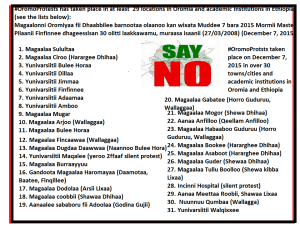
North Shewa: Kuyyuu, Gabra Gurrachaa, Muka Xurii, Salalee

Southwest Shewa:Waliso, Wanci, Roggee, Ammayyaa

West Wallagaa: Najo, Mandi, Manasibu, Gimbii, Ganjii, Inago, Ayra Guliso, Jarso, Laaloo Asaabii,

Qellem Wallagaa: Jimmaa Horro, Sayyoo, Dambi Dolo, Anfillo, Gidaamii, Begii

Horro Guduru: Fincha

Arsi: Dodolaa,

Bale: Robe, Goba

Africa Review: Ethiopia opposition tells government to stop killing protesters. #OromoProtests December 15, 2015

Posted by OromianEconomist in Uncategorized.
Tags: , , , , , ,
add a comment

???????????#OromoPRotests tweet and share

Africa Reviiew logo

Ethiopia opposition tells government to stop killing protesters


From left: Ethiopian opposition Medrek party Vice-Chairman Merera Gudina, Chairman Beyene Petros and Public Relations head Tilahun Endashaw at press conference in Addis Ababa December 15, 2015
By ANDUALEM SISAY | NATION MEDIA GROUP

The Opposition has accused Ethiopian security forces of killing at least 32 people in Oromia in the outskirt of Addis Ababa in the past few weeks.

The dead, claimed the opposition, include the Oromo students who took part in two demonstrations.

Presenting the names, the relatives and the homes of the victims, the Ethiopian Federal Democratic Unity Forum (Medrek), urged the government to stop the killings as they were a violation of the constitution.

Medrek urged the government to respond to the demands of the protesters in a peaceful and civilised manner.
Their brothers

“How could the military shoot and kill children demonstrating against the killings of their brothers and relatives? We keep on recording such crimes of this regime, and will one day bring the people who committed the crimes before an international court to account,” said the Medrek Chairman, Prof Beyene Petros,
Medrek came third in the May General Election in which the ruling party and its allies won with a landslide.

Expansion plan

A 10-year-old boy was among the protesters killed by security forces in Burayu Monday, according Dr Merera Gudina, the Vice-chairman of Medrek.

The Oromo students have been protesting against the Addis Ababa city’s expansion plan, which they claim will encroach on the land owned by smallholder farmers in Oromia.

Dr Merera claimed the government was buying one square meter of land for 4 to 5 birr (a quarter of US dollar) and selling it to the so called investors for 20,000 birr ($1,000) per square metres.
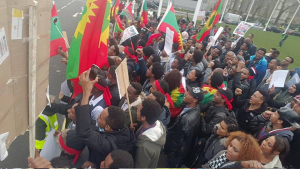
“Where is this money [profit] going? Is it really going to change the lives of the farmers who used to live on that land? Are we doing something that sustains the lives of the farmers, such as helping them to own bank shares that protect them from becoming beggars after finishing the money?” Dr Merera asked.

The death

He claimed that some 150, 000 farmers were evicted from around Addis Ababa following the disputed May 2005 General Election in which 193 demonstrators were killed.

The government maintains that the new Addis Ababa masterplan aimed at benefitting the Oromo people living around the city through better infrastructures, among others.

A week after the protests erupted and the death of some students was reported, the government also indicated in public media that the masterplan was at a draft stage and would not be implemented without consultations with the people.

http://www.africareview.com/News/Ethiopia-opposition-tells-government-to-stop-killing-protesters/-/979180/2997912/-/lb9x2h/-/index.html

Oromia: Oromo Protesters’ funeral processions turn into protest as government carries violence to burial grounds December 15, 2015

Posted by OromianEconomist in Uncategorized.
Tags: , , , , , , , ,
add a comment

???????????Say no to the master killer. Addis Ababa master plan is genocidal plan against Oromo people

#OromoProtests, Qabosoon itti fufa jedhu aayyoleenAgazi, fascist TPLF Ethiopia's forces attacking unarmed and peaceful #OromoProtests in Baabichaa town central Oromia (w. Shawa) , December 10, 2015

Oromo Protesters’ funeral processions turn into protest as government carries violence to burial grounds

(Finfinne Tribune/ Gadaa.com, Muddee/December 15, 2015 ): The Oromo protests have expand in scope and size to stop, what protesters have put as decades-old marginalization, evictions, and politically-motivated killings and imprisonments of Oromos in Oromia, in addition to stopping the Addis Ababa Master Plan. As the Oromo protests grow in depth and size, Oromo students are joined, according to media reports, by Oromo farmers, teachers, factory workers, medical practitioners, athletes and other sectors of the society to wage the Oromo protests. In response to these Oromo civilian protests, the Ethiopian Federal government has mobilized its Special Paramilitary Police forces from other States, such as the Somali State and the Amhara State, in addition to dispatching mechanized army units to protest areas in Oromia. The government’s heavy-handed response to the escalating Oromo protests have led to the deaths of more than 50 Oromo civilians, as per the latest estimates.

While undertaking this paramilitary-police invasion of the State of Oromia, the Ethiopian government’s officials have taken to airwaves on state-owned media outlets to promise that the Master Plan ‘would be brought forward for public deliberations’ – the government has been promising this for the last year and half, but to no avail; rather, some parts of the Master Plan are said to be already underway. According to observers, this has exacerbated the situation since the Ethiopian government’s officials have blatantly continued to dismiss the ongoing peaceful Oromo protests as legitimate voices of the people saying “NO” to the Master Plan; having been given no other channel for protests, Oromo students in particular, and the Oromo public in general, are paying with their lives to say “NO” to the Master Plan. The government’s heavy-handed response emanates from its basic lack of understanding that the Oromo protests are legitimate broad-based people’s demands for rights; when protest movements reach such a point, no amount of military repression can stop them; rather, each death leads to more affected people to join and continue the protests.

According to new reports, the Ethiopian government has carried the violence into burial grounds: disrupting and harassing, and in some cases, shooting to maim and kill, mourners as they weep for and bury their loved ones. For this reason, funeral processions are no longer sober moments only, but moments to stage protests against the Master Plan and against the killings — and against the overall unjust system the Oromo have been subjected to for far too long — funeral processions have become moments to vow to continue the protests of the martyred. When the government refuses to bring forward those responsible for the killings of the unarmed peacefully-protesting Oromos and when the government refuses to take the ongoing Oromo protests as a “NO” say of the people against the Master Plan, justice becomes carrying the torches of the martyred and moving on the Oromo National protests to their final victory.

The following are photos from some of the funeral services held for the recently killed Oromos. The first segment of this topic was presented here (an excerpt is given below).

http://finfinnetribune.com/Gadaa/2015/12/funeral-processions-of-oromo-killed-while-protesting-against-the-master-plan/
Bekele Seboka’s Funeral:
Read more at:-http://gadaa.com/oduu/30725/2015/12/15/oromo-protesters-funeral-processions-turn-into-protest-as-government-carries-violence-to-burial-grounds/

Oromia: OromoProtests: Six Main Demands December 14, 2015

Posted by OromianEconomist in Uncategorized.
Tags: , , , ,
add a comment

???????????#OromoPRotests tweet and shareOromo students, voices of the voicelessStop killing Oromo Students#OromoLivesMatters!Tgiray Nafxanya Abaye Tsehaye Dulacha


Sirna Awaalcha Sabboonaa Qabsaawaa Qeerroo Oromoo Baayyisaa Taaddasaa: Iyyaa Iyyaa Iyyaa #OromoProtests December 14, 2015

Posted by OromianEconomist in Uncategorized.
Tags: , , , , ,
add a comment

???????????Sabboona Oromoo Baayyisaa Taaddasaa

Sirni Awaalcha Sabboonaa  Qabsaawaa Dargaggoo Oromoo Baayyisaa Taaddasaa  Mudde 12. 2015 Naannoo Dhaloota isaa lixa shawati Raawate.

Qabsaawan ni kufa Qabsoon itti fufa!

TVOMT

Young Oromo national murdered by fascist (TPLF Ethiopia) Agazi forces.

Sidama: A Call for a Broader Solidarity with the Oromo Students Protesting against the Plan that will displace the Oromo Farmers December 14, 2015

Posted by OromianEconomist in Uncategorized.
Tags: , , , , , ,
1 comment so far

                                                                                                                                                                             ???????????Oromo people of VS Fascist (TPLF) Agazi forces. #OromoProtests. 14 December 2015.Mass #OromoProtests @Bako, Central Oromia, 14 December 2015#OromoProtests, Qabosoon itti fufa jedhu aayyoleenStop killing Oromo StudentsAgazi, fascist TPLF Ethiopia's forces attacking unarmed and peaceful #OromoProtests in Baabichaa town central Oromia (w. Shawa) , December 10, 2015

A Call for a Broader Solidarity with the Oromo Students Protesting against the Plan that will displace the Oromo Farmers

By Sidama Human Rights ActivistsIn the past three weeks, high school and university students across the Oromia region have staged peaceful protests against the Addis Ababa (Finfine) “Master Plan” that will integrate the city and the surrounding areas in the Oromia region inhabited by the Oromo farmers. The students and the Oromo communities living in the areas adjacent to the city stress that the so-called Master Plan will displace thousands of farmers from their ancestral farm lands thereby undermining their livelihood security and social cohesion. They condemn the ‘Master Plan’ as a pretext for a land grab. They argue that economic development and transformation should benefit people living on the land first, not displace them. Like many other urban centers in Oromia and the south, Finfine is a garrison city built on the ancestral lands of the Oromo people. In such urban centers, the interests of the indigenous inhabitants should be carefully balanced with the need for expansion of the urban space.Peaceful protests by students to voice these legitimate concerns of millions of the Oromo people, have been met with extraordinary violence and brutality by the Ethiopian federal police and paramilitary forces. According to the latest reports, the federal police and paramilitary forces have killed about 20 students in various parts of the Oromia region in the past three weeks. Similar peaceful protests in May 2014 against the same ‘Master Plan’ led to death of about 11 Oromo students (Oromo activists put the death toll at 47).The Oromo people are the single largest nation in Ethiopia accounting for 37% of Ethiopia’s population of about 96 million in 2014. The Oromia region remains the backbone of the Ethiopian economy. Nonetheless, the Oromo people never enjoyed the fruits of their natural resource endowments nor had equitable political representation commensurate to their stature in the country since their land was annexed into the Ethiopian Empire in the late 19th century. Instead, like many other oppressed nations, they remained systematically marginalized and continued to be treated as minorities by the successive Ethiopian regimes. Successive regimes continue to grossly violate human rights of the Oromo and other oppressed peoples. An October 2014 Report by Amnesty International revealed that “at least 5,000 ethnic Oromos have been arrested between 2011 and 2014 based on their actual or suspected peaceful opposition to the government.” The report highlights widespread violations of human rights in the Oromia region and “exposes how Oromos have been regularly subjected to arbitrary arrest, prolonged detention without charge, enforced disappearance, repeated torture and unlawful state killings as part of the government’s incessant attempts to crush dissent.”

Widespread violations of human rights were also observed in Sidama following the Loqqe Massacre of 70 peaceful protestors on 24 May 2002. The Loqqe protest was against the proposal to relocate the Sidama administrative capital from Hawassa city to a district town. In exactly the same manner in which the Addis Ababa ‘Master Plan’ envisages to grab the surrounding lands inhabited by the Oromo farmers, the Hawassa city administration continues to displace thousands of the Sidama farmers living adjacent to the Hawassa city today without commensurate compensation, destroying their livelihood security and plunging them in to destitution.

The demands of the Oromo students therefore echo the suffering not only of the Oromo framers but also of the Sidama farmers, the Somali farmers, the Afar farmers, the Benishangul-Gumuz farmers, the Gambella framers, and the farmers in all oppressed regions of Ethiopia. In light of this, the silence of the high schools and the university students in Sidama, Somali, Afar, Benishangul Gumuz, Gambella, as well as Wolayita, Gamogofa, Kaffa, and everywhere else is unwarranted. We call up on all high school and university students in oppressed lands in Ethiopia to join hands in peaceful solidarity with the Oromo students as a matter of urgency. It is naïve to think that the Oromo problems are not our problems. Injustice against one oppressed people, is injustice against all oppressed peoples! You will never be free unless your neighbor is free.

We have witnessed the Oromo solidarity demonstrations in various cities in North America and Europe. This is emboldening. We call up on all the oppressed peoples in Diaspora to join hands in solidarity with the Oromo protesters in North America and Europe and elsewhere.

We also call up on the United Nations, Amnesty International, Human Rights Watch, the European Union, China, and the African Union to exert pressure on the Ethiopian government to immediately halt the use violence against peaceful students echoing legitimate grievances about the livelihood securities of their people.

Finally, on behalf of the Sidama people, we express our deepest condolences for the tragic losses of the lives of young and aspiring Oromo high school and university students in the past three weeks.

Sidama Human Rights Activists

Hawassa
Sidama
13 December 2015.

Letter from Heart Broken Oromo-American Sister to President Obama: From $840 US aide to Oromo students’ slaughter December 13, 2015

Posted by OromianEconomist in Uncategorized.
Tags: , , , , ,
add a comment
Dear President Obama,
Have you heard the news in Ethiopia? President Obama, have you seen our sorrow? Can you feel our pain? Can you hear our anger? I hope you can! It was not too long ago… that I among thousands of fellow Oromos campaigned for you. I knocked door-to-door, walked miles and made calls throughout the night. Like millions of Americans. I longed for you to win the election. Like all others who lost hope in their governments and discriminated by the system, I prayed and crossed my fingers for you to become the president. In you, I saw my dream and hope. I believed you were the person, the chosen leader that will stand with the people that is left behind for far too long. On a cold Tuesday evening, I waited among thousands others to watch you give the defining speech that moved us so much. You said, “to all those watching tonight from beyond our shores, from parliaments and palaces to those who are huddled around radios in the forgotten corners of our world, our stories are singular, but our destiny is shared…out of many, we are one….”
Since then many things had happed. I watched you transform from candidate to president. As the world leader I watched you take blame for some things that is outside of your controlled. I watched some republican congress trash you simply because they hate to be governed by black person. I saw some conservatives disrespect you in the most painful way I can possible think. Thought you don’t see me, I got burn for you in the inside. Though I am far and irrelevant, I defended you and some of your policies. With all this madness that was and still is going on, I thought you deserved benefit of the doubt like any other human being. You inherited the most dangerous time when America, as we know, was in verge of collapsing internally and externally as well.
However, sometimes I wonder and question some of your judgments. I understand that though you might have enormous pressure to make things right, to prove to the world that your administration and your government has the intelligence to lead our world, president Obama, why do you praise dictators like the Ethiopian that has the thousands of Oromo blood on its hand? Why visit and meet with the Ethiopian prime minister and the party that supposedly won the election by 100% votes? I know you are not naïve to believe the election was legitimate nor do you for a second believe that country was democratic. But, somehow your choice of standing by the dictator and praising his action has only lead to more extreme violence that lead us, not only to question your morality, but also your intentions. And today, so many of our brothers and sisters are paying the price with their lives.
Yesterday, in May of 2014, while your secretary Kerry was giving a speech praising this regime, over 50 university students were murdered in cold blood just less than 70 miles away. Yet, you failed not only to condemn this crime that had happened over and over but failed to denounce the perpetrators. A year later you went there as a first sitting US president praising this very regime. President Obama, you tell me, what happened to change you can believe in? What has happened to those promises on campaign trail? What happened to those promise of yours that said, “Government of the people, by the people, for the people shall not perish?” President Obama, we are hopeless, our sisters and brothers are voiceless that even local reporters turn around and shut their cameras rather than capturing the horrifying images. Perhaps the government restricted them so now international media thinks our lives are less important and not news worthy. Where is the place for people like us, refugees, and political immigrants? Who stands with us, if not you, the president of free world, which is built on the back of African slaves and all immigrants?
President Obama, as one of your biggest fan and supporter who not only campaigned for you but supported you financially, please condemn this violence publicly that is taking place right in front of our eyes. Please stop $840 million aid to the Ethiopian regime that is the perpetrators creating this violence. President Obama, I am hopeless and my heart is in agony. I am also asking you as your fellow American to demand justice for Oromo students that are gunned down each and every day.
For more developing news or story, please check out this links that includes reports from BBCNews,
The Guardian, Aljazeera America and more Amnesty International: https://www.amnesty.nl/nieuwsportaa…
Aljazeera America/International: http://america.aljazeera.com/articl…
BBC Report from last year: http://www.bbc.com/news/world-afric…
Point-by-point on developing issue and more: http://advocacy4oromia.org/articles…
Graphic Images and videos on OMN: https://www.oromiamedia.org/tag/fin…

Oromia: 600 Oromo Farming Families Evicted in Sululta for the Master Plan Just Last Month December 13, 2015

Posted by OromianEconomist in Uncategorized.
Tags: , , , , , , , ,
add a comment

???????????Ethiopian-land-giveaway

Say no to the master killer. Addis Ababa master plan is genocidal plan against Oromo people. Say no.Say no to the master killer. Addis Ababa master plan is genocidal plan against Oromo people

600 Oromo Farming Families Evicted in Sululta for the Master Plan Just Last Month

Muddee/December 12, 2015 · Finfinne Tribune | Gadaa.com |

According to a media report, just last month alone, 600 Oromo farming families were evicted from Sululta, one of the towns in Oromia affected by the Addis Ababa Master Plan of the Ethiopian Federal government. The Master Plan evictions in Sululta came in November 2015, just before the latest escalations of Oromo protests as Oromo students in particular, and the Oromo public in general, engage the Federal government to stop the Addis Ababa Master Plan as well as the overall land-grabbing campaigns being undertaken by the Federal government in the name of “development” across Oromia. The report about the Master Plan evictions of 600 Oromo households in Sululta contradicts the Ethiopian Federal government’s stated position that the Addis Ababa Master Plan is still in its drafting phase awaiting public deliberations. Last year, during the April-May 2014’s #OromoProtests, the government promised to open the Master Plan for public deliberations only to forego that phase of the policy-making altogether. Protesters say the government’s promise of public deliberations are only tricks to buy time to fully implement the Master Plan and other land-grabbing campaigns across Oromia.

Here’s an excerpt from the DW report:

One Oromo farmer from Sululta, a town part of the ‘integrated master plan’ located 26 kilometers (16 miles) to the north of Addis Ababa, spoke to DW on condition of anonymity. He claimed that in late November alone, the government evicted 600 farming families on the grounds that their land was needed for the construction of a factory. When asked if they had received fair compensation and a new home, the farmer told DW that the money given to them was ‘very meager,’ and that the families had so far not been given a place to relocate to.

Read More (DW.com)

http://www.dw.com/en/outcry-as-oromo-protests-in-ethiopia-turn-violent/a-18912721?maca=en-rss-en-all-1573-rdf

http://finfinnetribune.com/Gadaa/2015/12/600-oromo-farming-families-evicted-in-sululta-just-last-month-for-the-master-plan/

Oromia: Join the Call for Justice: #OromoProtests December 13, 2015

Posted by OromianEconomist in Uncategorized.
Tags: , , , , , , ,
add a comment


???????????Say no to the master killer. Addis Ababa master plan is genocidal plan against Oromo people. Say no.Say no to the master killer. Addis Ababa master plan is genocidal plan against Oromo peopleEthiopian-land-giveawayTigrean Neftengna's land grabbing and the Addis Ababa Master plan for Oormo genocide#OromoProtests of 7 December 2015Oromo students Protests, Western Oromia, Mandii, Najjoo, Jaarsoo,....London, Oromo Peaceful rally in solidarity with #OromoProtests in Oromia against TPLF Ethiopian regime's ethnic cleansing (Master plan), December   10, 2015

Seattle Globalist: Seattle Oromos denounce “killer” Ethiopian government, demand investigation December 12, 2015

Posted by OromianEconomist in Uncategorized.
Tags: , , , , ,
add a comment

???????????Say no to the master killer. Addis Ababa master plan is genocidal plan against Oromo people. Say no.Stop killing Oromo StudentsOromoProtests, Naqamtee, Oromia, November 27, 2015

Seattle Oromos denounce “killer” Ethiopian government, demand investigation

by Dec 11, 2015

Mergitu Argo, who helped organize a march on Thursday in support of Oromo student protestors in Ethiopia. (Photo by Goorish Wibneh)

Oromos from the Seattle area gathered downtown yesterday to condemned the Ethiopian government’s lethal response to student protests sparked around the south of the country this week.

The protests of high school and university students were in response to the government’s “master plan” that will integrate the capital and surrounding areas now belonging to the Oromo Region, which protestors say will displace farmers.

I believe people should have the right to protest without feeling like they are gonna be beaten, or killed or jailed.” said Sartu Adem, 18, who was among about 200 solidarity protesters who gathered in front of the Federal Building on 2nd Avenue. “But I feel like the people should have a say whether they want [the development plan] or not — not just the government saying ‘oh we are developing the country!’”

The action was coordinated by Oromo Community Services of Seattle, and began in the rainy noon hour with march from Yesler Community Center.

Despite being the largest ethnic group in Ethiopia, the Oromo people have historically been politically and economically marginalized. In 1991 a federal constitution was instituted to address the issue, but some Oromo elites remain unconvinced that the region or the people are as autonomous as they should be.

Oromia, which physically includes Addis Ababa (knowns as “Finfine” in the Oromo language), is the largest region in Ethiopia.

Muktar Kedir, the administrator of Oromia Regional State, explained in a press conference earlier today that the development plan will not be implemented before public discussions and agreement.

But Abubeker Ali, one of the organizers of the Seattle protest, said displacement is already happening.

“The extent that we know so far is, in Finfine/Addis Ababa area, thousands of people have been displaced already. Homes have been demolished, people have been arrested,” Ali said.

Ali said he opposed the master plan, which he referred to as “master killer.” He called it a “land grab” designed to displace millions of farmers without any compensation.

Demonstrators gathered outside the Federal Building asking the U.S. government to apply diplomatic pressure on Ethiopia to end the crackdown on protests. (Photo by Goorish Wibneh)

There are conflicting accounts of the number of students that were killed.Bloomberg reported 10 Oromo students have been killed by security forces, quoting Bekele Nega a leader of the Oromo Federalist Congress, an opposition party. On Wednesday, Horn Affairs reported it was able to confirm five deaths but officials only acknowledged four fatalities.

The protesters in Seattle also delivered a letter to Senators Murray and Cantwellrequesting that the U.S. urge the Ethiopian government to stop violent responseagainst peaceful student protesters and conduct independent investigation into the deaths.

The U.S. has a longstanding military relationship with Ethiopia to fight terrorism. At the rally protestors could be heard chanting for the U.S. to stop “supporting the Ethiopian government” and “funding a terrorist government.”

The protesters included some ethnic Somalis from the Ogaden region in eastern Ethiopia who were there in solidarity.

While the “master plan” has not been officially implemented yet, Addis Ababa has been fast expanding already for several years.

Naboni Amenu who was at the rally with her husband said the farmers that had already been displaced are now stranded on the streets without resources.

FBC, a media outlet affiliated with the government, reported that Muktar Kedir, the administrator of Oromia, said “the violence had occurred due to limitation to clarify the master plan and this has created uncertainty among the community as well as led the public to raise question[sic].”

According to Ethiopia-based blogger Daniel Berhane, protests around the Oromia region are ongoing, with many businesses and public institutions closed. The situation is still fragile.

“I feel like in Ethiopia people only care about which region they’re from,” Adem said yesterday, decrying the regionalism that she sees hurting the country. “Everyone should care about each other. Everyone should think about ‘Has this person eaten?’ ‘How’s this person living?‘”