Is Economics A Science? October 21, 2013
Posted by OromianEconomist in Economics, Economics: Development Theory and Policy applications, Oromia, Oromo Social System, Uncategorized, Wisdom.Tags: Africa, Economic and Social Freedom, Economic development, Economic growth, economics, Oromia, Oromo
add a comment

“Yes, economics is a science”, says Harvard Professor, Raj Chetty.
The point is said Paul Krugman “while Chetty is right that economics can be and sometimes is a scientific field in the sense that theories are testable and there are researchers doing the testing, all too many economists treat their field as a form of theology instead.” and he coined: ” May be economics is a science, but many economists are not scientists.’
Of course, not every science is experiment based. According to Prof. William Easterly of NYU: “Evolution is an example of a non-experimental science; don’t need experiments to defend economics.”
In Chetty’s economics: ‘It is true that the answers to many “big picture” macroeconomic questions — like the causes of recessions or the determinants of growth — remain elusive. But in this respect, the challenges faced by economists are no different from those encountered in medicine and public health. Health researchers have worked for more than a century to understand the “big picture” questions of how diet and lifestyle affect health and aging, yet they still do not have a full scientific understanding of these connections. Some studies tell us to consume more coffee, wine and chocolate; others recommend the opposite. But few people would argue that medicine should not be approached as a science or that doctors should not make decisions based on the best available evidence. As is the case with epidemiologists, the fundamental challenge faced by economists — and a root cause of many disagreements in the field — is our limited ability to run experiments. If we could randomize policy decisions and then observe what happens to the economy and people’s lives, we would be able to get a precise understanding of how the economy works and how to improve policy. But the practical and ethical costs of such experiments preclude this sort of approach. (Surely we don’t want to create more financial crises just to understand how they work.) Nonetheless, economists have recently begun to overcome these challenges by developing tools that approximate scientific experiments to obtain compelling answers to specific policy questions. In previous decades the most prominent economists were typically theorists like Paul Krugman and Janet L. Yellen, whose models continue to guide economic thinking. Today, the most prominent economists are often empiricists like David Card of the University of California, Berkeley, and Esther Duflo of the Massachusetts Institute of Technology, who focus on testing old theories and formulating new ones that fit the evidence. This kind of empirical work in economics might be compared to the “micro” advances in medicine (like research on therapies for heart disease) that have contributed enormously to increasing longevity and quality of life, even as the “macro” questions of the determinants of health remain contested.’ Read the interesting argument on the subject further at:
http://www.project-syndicate.org/commentary/on-whether-he-is-a-scientist-by-robert-j–shiller
Copyright © Oromianeconomist 2013 and Oromia Quarterly 1997-2013. All rights reserved. Disclaimer.
Oromo Political Detainees Tortured: Human Rights Watch’s Latest Document on Ethiopia October 19, 2013
Posted by OromianEconomist in Africa, Colonizing Structure, Corruption, Dictatorship, Human Rights, Oromia, Oromiyaa, Oromo, Oromo the Largest Nation of Africa. Human Rights violations and Genocide against the Oromo people in Ethiopia, The Colonizing Structure & The Development Problems of Oromia, Tyranny, Uncategorized.Tags: Africa, East Africa, Economic and Social Freedom, Genocide, Genocide against the Oromo, Governance issues, Horn of Africa, Human rights, Human rights violations, National Self Determination, Oromiyaa, Oromo, Oromo people, Oromummaa, Tyranny, Universal Declaration of Human Rights
1 comment so far


The report documents human rights abuses, unlawful investigation tactics, and detention conditions in Maekelawi between 2010 and 2013. Human Rights Watch in this latest document reports that Ethiopian authorities have subjected political detainees to torture and other ill-treatment at the main detention center in Finfinnee (Addis Ababa). The report also calls for the Ethiopian government to take urgent steps to curb illegal practices in the Federal Police Crime Investigation Sector, known as Maekelawi, impartially investigate allegations of abuse, and hold those responsible to account.
The 70-page report, “‘They Want a Confession’: Torture and Ill-Treatment in Ethiopia’s Maekelawi Police Station,” documents serious human rights abuses, unlawful interrogation tactics, and poor detention conditions in Maekelawi since 2010. Those detained in Maekelawi include scores of opposition politicians, journalists, protest organizers, and alleged supporters of ethnic insurgencies. Human Rights Watch interviewed more than 35 former Maekelawi detainees and their relatives who described how officials had denied their basic needs, tortured, and otherwise mistreated them to extract information and confessions, and refused them access to legal counsel and their relatives.
“Ethiopian authorities right in the heart of the capital regularly use abuse to gather information,” said Leslie Lefkow, deputy Africa director. “Beatings, torture, and coerced confessions are no way to deal with journalists or the political opposition.”
Since the disputed elections of 2005, Ethiopia has intensified its clampdown on peaceful dissent. Arbitrary arrest and political prosecutions, including under the country’s restrictive anti-terrorism law, have frequently been used against perceived opponents of the government who have been detained and interrogated at Maekelawi.
‘One [police officer] hit me on the back of my head with a long black stick and blindfolded me. They took me to their office. These were interrogators. They slapped me on the cheeks repeatedly…. But these interrogators are not in a position to listen to what I tell them. They beat me again with the black stick and slapped me again. I stayed in that room until midnight. I was exhausted. They took me back to the cell and then took another guy. On the second day of interrogations—the beating was worse. What they want is a confession.’—Journalist held in Maekelawi in mid-2011, Nairobi, April 2012, p. 6.
“Oromo student held in Maekelawi in 2012, said his hand was broken when he was beaten on his hand while being held in this position and that over a year later his hand continues to hurt:’In the interrogation room there was small piece of metal on the wall. They put me on it and locked my left hand to the wall and then my legs didn’t touch the ground. They beat me on my left hand. I think I was there one hour, but I don’t know as I lost my memory,’ ” p. 34.
Read further more from the following sites:
Click to access ethiopia1013_ForUpload.pdf
http://www.hrw.org/news/2013/10/18/ethiopia-political-detainees-tortured
Are Oromos Singled Out and Disproportionately Tortured in Ethiopia?
http://oromopress.blogspot.co.uk/2013/10/are-oromos-singled-out-and.html
Torture in the heart of Finfinnee (Addis), even as leaders gather in gleaming AU building
“Getachew,” a 22-year-old ethnic Oromo, was snatched from his university dorm, driven hundreds of kilometres to Addis Ababa, and locked up for eight months in Maekelawi. His parents were never informed of his whereabouts; he was never charged or given access to a lawyer ; and never appeared before court. He was ultimately released on condition that he would work for the government.Like Getachew, many of the people detained in Maekelawi over the past decade are political prisoners — arrested because of their ethnicity, their real or perceived political opinions and actions, or journalism work. Voicing peaceful dissent or criticism of government policy is increasingly risky.
Copy right © Oromianeconomist 2013 and Oromia Quarterly 1997-2013. All rights reserved. Disclaimer.
Irreecha: The Oromo National And Cultural Holiday Has Been Celebrated With Over 3 million Oromians In The Blessing Festival October 13, 2013
Posted by OromianEconomist in Africa, Culture, Development, Humanity and Social Civilization, Irreecha, Kemetic Ancient African Culture, Oromia, Oromiyaa, Oromo, Oromo Culture, Oromo Identity, Oromo Nation, Oromo Social System, Oromummaa, Self determination, Sirna Gadaa, The Oromo Democratic system, The Oromo Governance System, Theory of Development, Wisdom.Tags: Africa, African culture, African Studies, Democratic African institution, Development, Development and Change, Gadaa, Gadaa System, Horn of Africa, Irreecha, National Self Determination, Oromia, Oromia Region, Oromiyaa, Oromo, Oromo culture, Oromo Identity, Oromo National Day and Ancient Africa Connections, Oromo people, Oromo Thanksgiving, Oromummaa, Social Sciences
add a comment

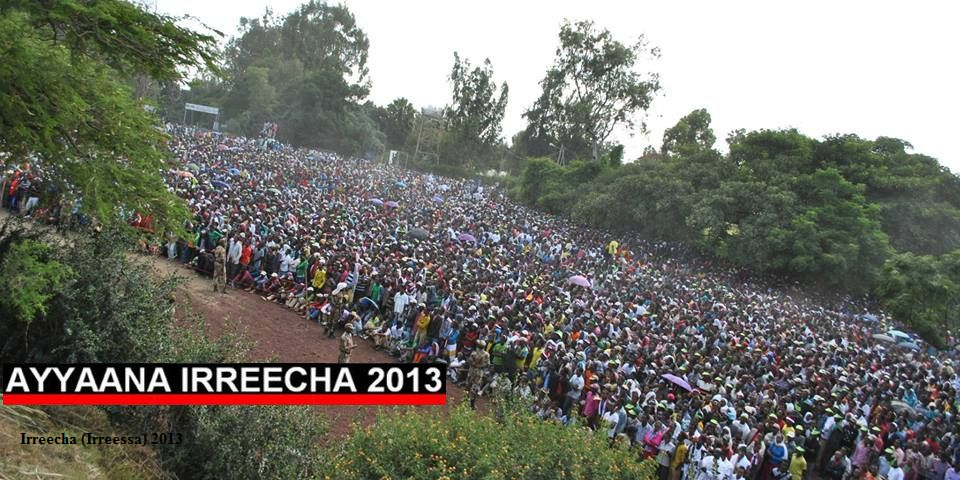
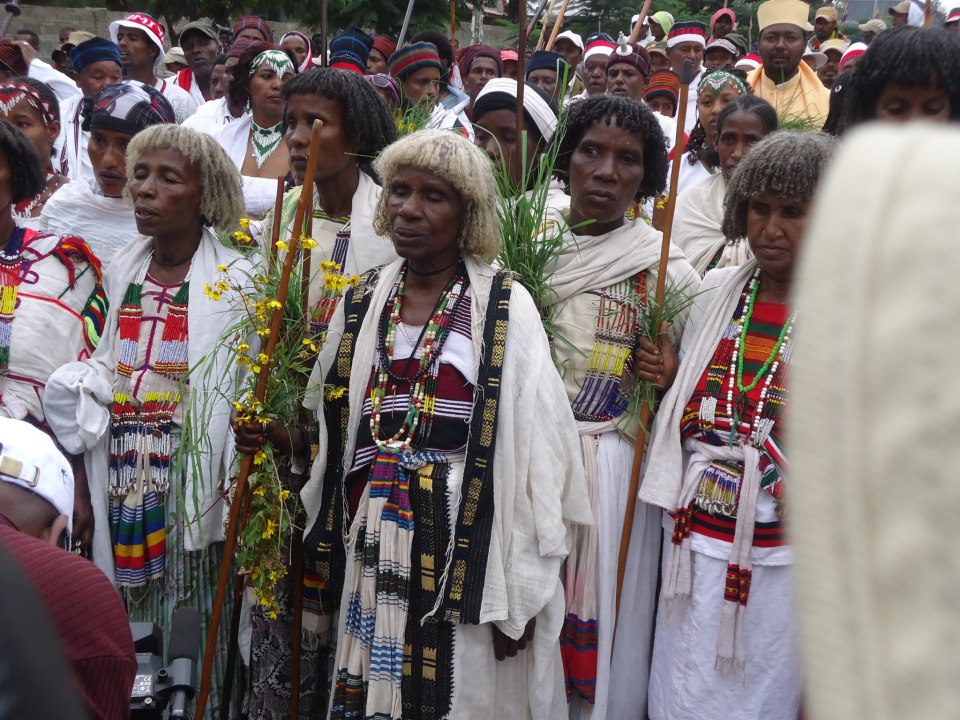
Oromo culture from ancient to present, Irrechaa time
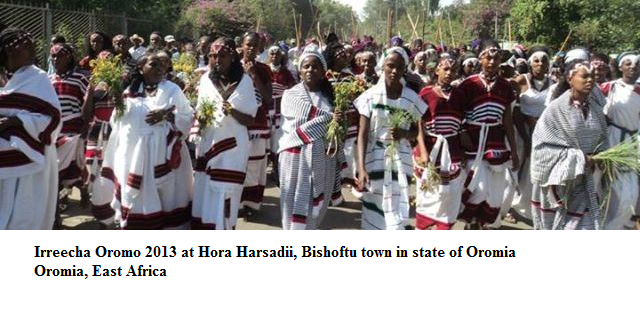

Baga ganna nagaan baatanii booqaa birraa argitan. Good that the rainy season is over for you and that you came to see the spot of the sunny flowering season. The expression signifies the end of one season and the beginning of another season, which incidentally is the beginning of a new year according to Oromo time reckoning. This is not the only expression in Irreecha festival as the event is characterized by vast and varieties of expressions, stories and sequences of cultural displays. Irreecha is the biggest and very beautiful public displays of ancient culture that Africa has performed and continue to perform. Holding the green grass and yellow flower (umama), it is the celebration of the season of blessing and love Oromians experience as Thanksgivings to God (Waaqa) the creator (Uumaa).
Irreecha celebration at Malkaa Ateetee, Burayyuu, Oromia, 6th October 2013
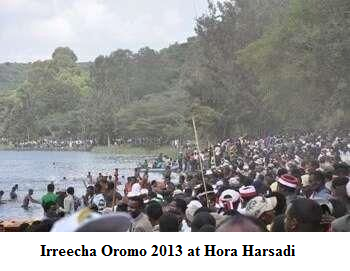
Irreecha is one of the most colorful and beautiful Oromo national cultural events that has been celebrated through out since the last week of August and the entire September and also in October in Oromia and globally where Oromians have been residing (Africa, Australia, Europe and North America). The main Irreecha day was celebrated at Lake Hora Harsadii, Bishoftu, Central Oromia, nearer to the capital Finfinnee on 29th September 2013. According to local news sources from Bishoftuu, over 3 million people attended this year’s Irreecha Malka celebration at Hora Harsadii. “Traditionally, the Oromo practiced Irreecha ritual as a thanksgiving celebration twice a year (in autumn and spring) to praise Waaqa (God) for peace, health, fertility and abundance they were given with regards to the people, livestock, harvest and the entire Oromo land. Irreecha is celebrated as a sign of reciprocating Waaqa in the form of providing praise for what they got in the past, and is also a forum ofprayer for the future. In such rituals, the Oromo gather in places with symbolic meanings, such as hilltops, river side and shades of big sacred trees. …These physical landscapes are chosen for their representations in the Oromo worldview, for example, green is symbolized with fertility, peace, abundance and rain. In Oromia, the core center of Irreecha celebration has been around Hora Arsadi in Bishoftu town, some 25kms to the south of Finfinne, the capital city. Annually, particularly during the Irreecha birraa (the Autumn Irreecha) in September or October, the Oromo from different parts of the country come together and celebrate the ritual. In the past few decades, Irreecha celebrations have been expanded both in content as well as geographical and demographic representations. This short commentary deals with such historical trajectories by contextualizing the changes within political discourses in Ethiopia vis-à-vis Oromo nationalism.”http://gadaa.com/oduu/21320/2013/08/24/irreecha-from-thanksgiving-ritual-to-strong-symbol-of-oromo-identity/ ”
http://gadaa.com/Irreechaa.html
Aadaa fi Duudhaa sirna Waaqeffannaa keessaa inni tokko Ayyaana irreeffannaa ykn irreechati. Sirni Duudhaa irreechaa gosa hedduutti qoodama. Kunis, Irreessa Malkaa, Irreessa Tulluu, Irreessa Galmaa / Gimbii, Irreessa Ujubaa, Irreessa Dakkii, Irreessa Jilaa fi Irreessa Eebbaa ykn Galataa fi kkf. Akkaa fi akkaataan irreeffannaas akkuma sirna isaatti addaa adda. Ammatti kan bal’inaan irraa dubbannu Irreecha yeroo ammaatti biyya keessaa fi alatti beekamee fi kabajamaa jiru, Irreecha Malkaati. Irreechi Malkaa kan kabajamu, ganni yeroon rakkinaa fi dukkanaa dabree birraan yeroo bari’u, sirni Gubaa erga raawwatee booda, ummanni gamtaan Malkaa bu’uun irreeffatee Waaqa galateeffata. Ammaaf Irreecha Malkaa isa biyya keessaa fi alatti bal’inaan beekamaa fi kabajamaa jiru irraa hanga tokko waa addeessuu yaalla. Ayyaanni irreechaa osoo hin gahiin dura waanti raawwataman hedduutu jiran. Kunis seera yayyaba shananii hordofuudhan torban shan dura eegala jechuudha. Ji’a hagayyaa torban sadaffaa keessa birraan bari’uu ykn seenuu isaa kan ibsu, sirna Muka ( korma) dhaabaa kan jedhamutu raawwata. Bakki mukti dhaabaa kun dhaabatu Mijirii jedhama. Mijiriin kun bakka Gubaan itti gubamu ykn bakka ayyaanni ibsaa gubaa raawwatudha. Mukti dhaabbatu 9 ykn 5 ta’an. Kunis hiika mataa ofii qaba. Guyyaa muka dhaabaa irraa eegalee hanga gaafa Gubaatti torban torbaniin waanti godhamu ni jira. Gaafa torban shanaffaa ykn Fulbaana ji’aa dhumaa yeroo ta’u sirna Gubaatu raawwata. Masqala jechuudha. Ayyaana masqalaa kana warri amantii Ortodoksii gara amantii isaaniitti harkisuuf haa yaalan malee gochaa fi seenaan wanti isaan deeggaru hin jiru. aadaa Oromoo fudhatan. Guyyaa gubaa kana ollaan maatii waliin walitti dhufee bakka Mijirii sanatti erga ibsaa gubee dhibaafatee, eebbifateen booda dubartoonni Qunnii (Ingiccaa) guban, dargaggoonni sirba ” Hiyyooko ykn Ya habaab yaa daree ko” jedhamu sirbaa ollaarra naannawanii kennaa fudhatan. Torban isaatti ammoo sirna Ayyaana Irreechaatu raawwata. Gubaan kan dhuunfaa fi ollaati. Irreechi ammoo ayyaana ummanni gamtaan Malkaa bu’ee, dukkana gannaa keessaa gara Booqaa Birraatti nagaan cehuu isaaf kan galateeffatu Guyyaa Galatoo ( Thanksgivings day) jechuudha. Sirni gamtaan Irreeffannaa kun osoo dhiibbaa amantii fi sirna bulchiinsa alagaatiin hin dhorkamiin dura Oromoon naannoo qubatee jiru maratti ni irreeffata ture. Keessumattuu bara mootummaa Dargii sana aadaa ” duubatti hafaa” jedhamee Galma Qaalluu gubuu fi waan Oromoon aadaadhaan raawwatu mara dhorkuun dhabamsiisuuf yaalan. Sababa kanaa fi babal’ina amantii Isilaamaa fi Protestantiin walqabatee bakka hedduutti sirni irreeffannaa fi amantiin Waaqeffannaa ni dhorkame. Dhiibbaa kana irraa damdamtee kan hafe keessaa tokko Ayyaana Irreechaa Hora Arsadii Magaalaa Bishooftuutti kabajamudha. Ayyaanni Irreecha Hora Arsadee qindoominaa fi hirmaannaa ummata bal’aan kabajamuu kan eegale bara 1997 irraa kaaseetu. Isa dura ummatuma naannoo sanaa fi keessattuu warra aadaa Waaqeffannaa hordofaniin ture. Bara 1997 keessa koreen tokko maqaa Guddinaa fi Dagaagina Aadaa Oromoo jedhuun WMT jalatti ijaaramtee Ayyaana Irreecha Bishooftuu kana ummata beeksisuu, barsiisuu fi qindoominaan guyyaa ayyaana kanaa bakka sanatti argamuun qalbii namaa harkisuu jalqabde. Ergasii waggaa waggaan achitti argamuun barumsaa fi dammaqiinsa kennameen sadarkaa har’a ummanni kumaa fi kitilaan kan herreegamu irratti argamee kabaju irraan gahe. Kana malees Oromiyaa gara dhihaatti bakka hedduutti akka kabajamuu fi babal’atuuf karaa saaqe. Baroota hedduu dura jalqabee ammoo biyya alatti walduraa duubaan, USA, Germany, Norway, Canada, Australia, Keenya, Uganda fi Ertriatti kabajamuu jalqabe. Guddinni fi babal’inni kabajaa Ayyaana Irreechaa kun qaama duula Oromoon Aadaa, Eenyumaa fi Oromummaa isaa guddisuuf gochaa jiru keessaa isa tokkoo fi guddicha ta’uu mal’isa. Fuula durallee daran akka guddatuu fi babal’atu Waaqa wajjin abdii qabna.Kabajaa ayyaana irreechaa biyya keessaa fi alatti raawwate ilaalchisee kanaan dura marsaa adda addaatti bahaa turuun ni yaadatama. Dabalataan yaadachiisuu fi bal’inaan kan hin gabaafamiin dabalatee akka armaan gadiitti kan biyyaa keessaa fi biyya alaa bakka adda addaatti kabajamaa ture laalla.”http://waaqeffannaa.org/irreecha/


http://oromoassociationvic.org/2013/10/03/oromians-seek-blessings-and-love-at-annual-oromo-festival/

Irreecha Oromo 2013 Celebration, in Sydney, Australia

Irreecha Oromo, event in London, 12 October 2013
Gubaa fi Irreecha @Galma Calalaqii, Miidaaqenyii

Related references:
https://oromianeconomist.wordpress.com/?s=twisted&searchbutton=go%21
Oromo: The Kushitic People of Africa

| ErechaThe story of Erecha – the celebration of the first harvest of the Ethiopian Spring in September – is a story better told by who else but the late Poet Laureate himself, Blattten Geta Tsegaye G/Medhin.
“….12,000 years ago, ASRA the God of sun and sky of KUSH PHARAOH begotten SETE, the older son ORA the younger of the first and daughter named as ASIS (ATETORADBAR). The older SETE killed his younger brother ORA, and ASIS (ATET OR ADBAR) planted a tree (ODA) for the memorial of her deceased brother ORA at the bank of Nile, Egypt where the murder had taken place, and requested her father who was the god of Sun to make peace among the families of SETE and ORA. Them rain was come and the tree (ODA) got grown. It symbolizes that taken place. Later, at the Stone Age, the tree that had been planted for the memorial of the killed, ORA was substituted by statue of stone that was erected 8000 years ago. This festival has been celebrated in September of every year and when Nile is flow full in NUBLA and BLACK EGYPT. In Ethiopia during the AXUMITE and PRE-AXUMITE period a great festival has been held around the sun’s statue that planted by ASIS (ATET OR ADBAR) the sister of ORA for the memorial of the later, ORA the son of god of sun, who waked up from death (ORA OMO or OR OMO) for the purpost of celebrating the peace made between the two brothers, the great herald, in thanking the good of sun and the sky with CHIBO. Then EYO KA ABEBAYE (the traditional and popular song performed at DEMERA events and new year in Ethiopia) has been started being performed since then. “KA” is the first name of God. The name of God that our KUSH Fathers have inherited to us before the old period, Christianity, and Islam is “KA”. Since then, therefore, especially the OROMO, GURAGIE and the SOUTHERN people of Ethiopia have been calling God as “WAKA or WAQA”. “or WAQA”. WAKA” or WAQA” God When we song EYOKA or EYOHA in New Year, we are praising “KA” of God. “GEDA” or KA ADA” is the law or rule of God. “GEDA” (KA ADA) is the festival by which the laws and orders of God are executed Japan, China, and India are now reached to the current civilization through making the basic traditions and cultures they received from their forefathers (HINDU, SHINTO and MAHIBERATA) be kept and receiving Islam, Christianity, and others especially Democracy and free believes. They are not here through undermining the culture and tradition of their forefathers. Culture is the collection of many CHIBOs or DEMERA. “ERCHA” or “ERESA” one of the part and parcel of GEDA (KA ADA) system is the comer stone and turning point to the new year for which ASIS (ATET OR ADBAR) has put up the dead body of her brother, ORA who was killed by his older brother like ABEL from the place he died at the river bank of NILE on and planted statue“. The Oromo people of beautiful Ethiopia believe in one God since time memorial. Their religion is called “WAKEFENA” which means believing in one God that is the creator of the whole universe. ERECHA means a celebration where people get together and perform their prayers and thanking God. WAKEFENA, the faith being in the GEDA SYSTEM is a religions ceremony that is free from any thing. The fathers of Oromo religion and the people, keeping fresh grass and flowers, perform their prayers and thank their God going to mountains, the sea or a river bank. They move to the top of mountains or bank of seas or rivers not to worship the mountains or rivers and seas; rather to distract themselves from any noise and to worship their God (WAQA) with concentration. And they go to sea and rivers because they believe that green is holy and peaceful where the spirit of God is found. In the Oromo culture, the rainy season is considered as the symbol of darkness. At the beginning of September, the darkness is gone, rivers run shallower and cleaner, and the mud is gone. As sunshine rules the land, the OROMO people of Ethiopia go out to celebrate this great natural cycle with the spirit of worshiping God (WAQA). |
http://www.ethiopians.com/photoessay/Photo_Essay_Eretcha_06.htm
Copyright © Oromianeconomist 2013 and Oromia Quarterly 1997-2013. All rights reserved. Disclaimer.
Tyrannic Ethiopia Bans Access To Student’s Critical Articles And Has Watchers In Class Rooms September 27, 2013
Posted by OromianEconomist in Colonizing Structure, Corruption, Dictatorship, Ideas, Knowledge and the Colonizing Structure. Africa Heritage. The Genocide Against Oromo Nation, Oromia, Oromo, The Colonizing Structure & The Development Problems of Oromia, Tyranny, Uncategorized.Tags: Africa, Ethiopia–United States relations, Human rights, Oromia, Oromo, Politics of Ethiopia, Tyranny, University of Pittsburgh Graduate School of Public and International Affairs
1 comment so far

‘Disguising human rights violations and oppression with positive terminology is not new to Ethiopian legislators, who passed the Freedom of the Mass Media and Access to Information Proclamation No. 590 in 2008. This idealistic-sounding law’s title belies its contents, because it enables the government to bring charges against “any person who is suspected of committing an offence through the mass media.” Such offenses include the publication of statements critical of the legislative, executive or judicial authorities that are deemed false or defamatory. It is up to the attorney general to decide if the accused journalist should be detained on remand.’ http://jurist.org/forum/2011/08/abigail-salisbury-ethiopia-terror.php#
‘Ethiopian education also differs from Western education because, Salisbury said, there could be “watchers” present at any time, in any classroom. Watchers are government representatives on the lookout for those speaking out against the government.’
Cristina Holtzer of Pitt News reports that Abigail Salisbury is an enemy of the state of Ethiopia because of an op-ed column she published online. Salisbury, a student in the Graduate School of Public and International Affairs, spoke about her article to an audience of about 10 in a “Let’s Talk Africa” lecture on Wednesday in 4130 Posvar Hall from 1:30 to 3 p.m. The Ethiopian government blocked her article, titled “Human Rights and the War on Terror in Ethiopia,” one day after she published it online. While in Ethiopia, Salisbury noticed an extreme lack of freedom of speech and press for Ethiopian people and decided to write the piece, which criticizes the Ethiopian government. Salisbury was working as an assistant professor at Mekelle University Law School, a small college outside of Addis Ababa, the capital of Ethiopia, when she published the article. After the university administration discovered her article, Salisbury said the university “basically asked [her] not to work there anymore.”
“I was told that, based on what I wrote, that if I had been an Ethiopian person, I would have been put in prison,” Salisbury said. “I don’t think they want me back.” Ironically enough, Salisbury said, she was in the country teaching international human-rights law, a class required for graduation from law school in Ethiopia. Anna-Maria Karnes, a representative of the Africana studies department, also attended the lecture and interjected throughout. Karnes, whose parents live in Ethiopia, has a thorough grasp of the political climate in the country.
“Skype was outlawed two years ago in Ethiopia,” Karnes said. “There were people jailed for using Skype.” When Karnes first discovered the Skype law, she worried that she would not be able to get in touch with her parents because that was their primary source of communication. But Skype was illegal only for Ethiopians, not for foreigners. “As a Westerner, you are treated differently,” Salisbury said. “Better.”
Ethiopians subscribe to a different race and caste system than many Americans are used to. Salisbury said that when African-Americans traveled to Ethiopia, they were treated the same as whites. Ethiopians believe that everyone else in Africa is black but that they, themselves, are red skinned. Salisbury recounted a story of when someone in the street approached her and asked, “Have you seen any black women today?”
Salisbury said she was surprised by the scale of differences between the learning environments in Ethiopia and the U.S.
Because of the country’s limited resources, students learn to memorize verbatim what professors say in lecture. Salisbury said she’s seen students reproduce a lecture right down to the “ums” and “likes.” Ethiopian education also differs from Western education because, Salisbury said, there could be “watchers” present at any time, in any classroom. Watchers are government representatives on the lookout for those speaking out against the government. “What would creep me out if I were in that class?” Salisbury said. “I don’t know if I would be raising my hand with opinions.” In addition to an extreme lack of freedom of speech, Salisbury said Ethiopians also struggle with tough racial tensions and “ethnic federalism,” or preferential treatment for one ethnic group that is officially recognized by the government. With Ethiopia located in a contentious part of the world, Salisbury said U.S.-Ethiopia relations are crucial. “Ethiopia is really instrumental in the U.S. agenda and the global war on terror that we’re engaged in,” she said. Salisbury and Karnes opened the presentation with an activity about African knowledge. They divided the audience into small groups and asked them to label a map of Africa with the names of as many countries as they could. Even with several African students and faculty in the audience, no one was able to label the entire map. “You can’t know the whole of Africa,” Director of Africana Studies Macrina Lelei said. “That’s part of why we have African studies here at Pitt … to share those experiences.”
http://www.pittnews.com/news/article_090b538c-266a-11e3-8d05-0019bb30f31a.html#.UkV1PQONt0w.facebook
http://www.ethiomedia.com/abai/ethiomedia_interviews_abigail_salisbury.html
http://www.zoominfo.com/p/Abigail-Salisbury/1255943349
Copyright © Oromianeconomist 2013 and Oromia Quarterly 1997-2013. All rights reserved. Disclaimer.
Related articles
- Abigail Salisbury is an enemy of the state of Ethiopia (daniboy8935.wordpress.com)
- Ethiopia bans access to student’s critical article (bilisummaaa.wordpress.com)
-
Ethiopia’s Leaders Misinform the World
- http://ayyaantuu.com/horn-of-africa-news/ethiopia/growing-anxiety-ethiopian-university-students-case-students-twisted-mind/
- The Tyrannic Ethiopian Regime is Accountable for the Death of a Political Prisoner And Prisoner of Conscience, Oromo National, Engineer Tesfahun Chemeda (oromianeconomist.wordpress.com)
- http://dhaamsaogeetti13.wordpress.com/2013/10/03/ethiopia-most-restrictive-sub-sahara-country-freedom-house-reports/
Africa’s Land Grabs: An Opportunity Or A New Form of Colonialism? September 25, 2013
Posted by OromianEconomist in Colonizing Structure, Economics, Land Grabs in Africa, Uncategorized.Tags: Africa, AlJazeera, Development, Land Grabs, Oromia, Oromo
add a comment


‘From hopeless continent to investment darling of the world – are land investments in Africa an answer to worldwide food insecurity or a dangerous new form of colonialism?’ Aljazeera, on its South2North talks to former Mozambican President Joaquim Chissano, Nigerian politician and Oxfam trustee Nkoyo Toyo and Philippe Heilberg, a land investor from the US. Here is the the details of interesting debates and the video:
‘Escalating energy and food prices have triggered a global scramble for Africa’s land and water resources. Eager to feed their growing populations, countries are buying up prime farmland in Africa at rock bottom prices. Land eight times the size of the UK has already been bought up by hungry investors.Redi asks Chissano if this investment is a new scramble for Africa.”‘The scramble for Africa is never good. We have known that since Berlin and we fought against it. But investment is welcomed if it is done in a win-win situation when people benefit from this investment.” Toyo explains that the trend towards buying land in Africa has come from the 2008 spike in food prices, a concern about global food security as well as an impending energy crisis. However, she warns that investments might not be as good as they seem, and that UN records show alarmingly rapid sales of African land.”The problem with this type of investment is not that we do not want to see investment. It’s that we see investments that are increasingly not addressing the needs of the continent. We hear that at least 33 million square hectares of land are lands which have been acquired in just less than 10 years.”Heilberg argues that the statistics from the UN are highly distorted because they are not closed or officialdeals. He says that his own figures have been doubled in some accounts.”Land is cheap in Africa, but there are many reasons why it’s cheap. In many parts of the continent there is little to no infrastructure whatsoever …. The frontier markets offer incredible risk-reward opportunities. Because when the growth happens it’s exponential.” Toyo disagrees that these deals have always been above-board and that they benefit local communities.’
http://www.aljazeera.com/programmes/south2north/2013/09/2013920101434517250.html
http://ecadf1.ecadf.netdna-cdn.com/wp-content/uploads/2013/09/UPR-Submission-Ethiopia.pdf
RelateCopyright © Oromianeconomist 2013 and Oromia Quarterly 1997-2013. All rights reserved. Disclaimer.d articles
- Redi Tlhabi debates the new scramble for Africa (spyghana.com)
- South2North’s Redi Tlhabi debates the new scramble for Africa (sierraexpressmedia.com)
The New Scramble for Africa: Poverty, Guns And The Weapons Market September 15, 2013
Posted by OromianEconomist in Africa, Colonizing Structure, Corruption, Development, Dictatorship, Economics, Knowledge and the Colonizing Structure., Uncategorized.Tags: Africa, Genocide, Gross domestic product, Human development Index, Human rights violations, Oromia, Oromo, Sub-Saharan Africa, Weapon
1 comment so far
The world OutLine states Africa is going to spend over $20bn on defence projects over the coming decade. ‘As the European defence market becomes ever more bereft of big spenders and Asian markets face strong competition from China, Africa’s 54 states will make the last major geopolitical frontier for defence companies.’ It has been reported that whilst for various reasons there is undoubtedly significant demand for the latest weaponry in the region, large-scale arms contracts do raise questions over the future of a continent already stricken with poverty and permanent violence. It is well known Africa is run by dictators and human rights abusers. Defence contractors with out doubt are always looking to maximize profits and increase their trade, however, it is not clear whether ethical considerations will be in place in providing such weapons in the continent run by unaccountable politicians and unelected tyrants engaging in militarism, e.g Ethiopia, Rwanda and Sudan. It is worrying that scarce public money will continue to be diverted from social and economic investment and wasted into arms deals. ‘The UN has warned that 22 of the 24 lowest Human Development Index nations are in Sub-Saharan Africa, and in some instances GDP per capita is less than $200 a year. However, pumping aid into the region is not necessarily the answer. A 2005 report suggested that a staggering proportion of the $500bn of aid sent to Africa over the last forty years has been embezzled through corrupt institutions; the so-called ‘leaky begging bowl’. It would be interesting to know how much of this will fund armaments over the next decade.’ http://theworldoutline.com/2013/09/africa/
Related articles
- Guns amid poverty: the defence industry’s new ‘Scramble for Africa’ (stratrisks.com)
- Guns amid poverty: the defence industry’s new ‘Scramble for Africa’ (phantomreport.com)
- The Not-So-Great Professor: Jeffrey Sachs’ Incredible Failure to Eradicate Poverty in Africa (psmag.com)
- How happy is sub-Saharan Africa? (one.org)
Oromia of Dhaqabo Ebba: The Cradle of Mankind Is Also A Home of The Oldest Living person Known to Humanity September 10, 2013
Posted by OromianEconomist in Africa, Dhaqaba Ebba, Gadaa System, Humanity and Social Civilization, Oral Historian, Oromia, Oromo, The Oldest Living Person Known to Mankind, The Oromo Library, Uncategorized, Wisdom.Tags: Afaan Oromo, Africa, African history, African Philosphy, Dhaqba Ebba, Ebbaa, Finfinnee, Gadaa, Gadaa System, Obbo dhaqabaa Ebbaa, Oldest Living Person, Oldest people, Oldest person, Oral History, Oromia, Oromia Region, Oromiya, Oromiyaa, Oromo Calendar, Oromo elder, oromo farmer, Oromo History, Oromo people, The Oldest Living Person, Time in Gadaa
5 comments


Dahqabo Ebba, Oromo elder, who is over 160 years is the oldest living person known to humanity.
He is a resident of Dodola town, Oromia.
http://www.unpo.org/article/16351
OTV (Oromiyaa TV)
In interviews conducted in his native language Afaan Oromo Obbo Dhaqabo Ebba counts his age based on Oromo Gadaa system calendar. According to traditional Oromo Gadaa system every member of the society goes through the Gadaa time grade. Obbo Dhaqabo Ebba has lived 4 Gadaa cycles. one Gadaa cycle has 5 stages. One stage is for 8 years. One Gadaa cycle is 40 years, (8*5). Obbo Dhaqabo has already completed 4 Gadaa cycles (4*40) which are 160 years. He involved in the Gadaa system in its full functioning time in all its structures and development stages from Dabballe to Jaarsa. He still living after the 4 cycles means he is actually over 160 years. The Journalist of Oromiyaa TV did not yet ask him how many years since his last 4 Gadaa cycles was completed. Gadaa ways of timing is exact to know own birth years and historical events. In his fascinating life that has touched 3 centuries (from middle 19th century to the present 2nd decades of 21st century which has been over 160 years he remembers all major political, social, economic and environmental events and changes. He remembers from a time when the Ethiopian empire still expanded south to Oromia such as 1880’s the time the Abyssinian Menelik start to occupy the Oromo capital Finfinnee (Abyssinians named it Addis Ababa). At this event and the time of first Italian invasion he used to travel to Finfinnee (Addis Ababa) for his livestock trading. He mentioned that he engaged in farming (crops and livestock) but also in commerce. it took eight days on horseback to cover the 150 miles between his village and Finfinnee (Addis Ababa). In 1895 ( at the time of Italian invasion) he was already a married person of two wives and his first son ( over 100 years old with him at interview) was a young boy and able person to look after his livestock. “When Italy invaded the country, I had two wives and my son was old enough to herd cattle,” he said, referring to Italy’s 1895 invasion of his country. “Not even one of my peers is alive today.” He knows and remembers by naming all Abyssinian rulers, Menelik to present who have been in Oromia (Oromo land) since the occupation of Finfinnee in 1880’s.
Mohammed Ademo of Opride said. “Given that the Oromo like many African cultures are an oral society, ‘each time an elder dies, a library is lost.’ Ebba’s is one such library from which much can still be preserved.”
http://www.voaafaanoromoo.com/content/article/1756208.html
As elaborated in the works of “Oromia: an Introduction,” by Gadaa Melbaa ( book published in Khartoum, 1988), the following is a brief description of how the Gadaa system works and the gadaa Grades: “There are two well-defined ways of classifying male members of the society, that is the hiriyya (members of an age-set all born within the period of one Gadaarule of eight years) and Gadaa grade. The Gadaa grades (stages of development through which a Gadaa class passes) differ in number (7-11) and name in different parts of Oromia although the functions are the same.”
The Gadaa grades:-
1. Dabballee (0-8 years of age)
2. Folle or Gamme Titiqaa (8-16 years of age)
3. Qondaala or Gamme Gurgudaa (16-24 years of age)
4. Kuusa (24-32 years of age)
5. Raaba Doorii (32-40 years of age)
6. Gadaa (40-48 years of age)
7. Yuba I (48-56 years of age)
8. Yuba II (56-64 years of age)
9. Yuba III (64-72 years of age)
10. Gadamojjii (72-80 years of age)
11. Jaarsa (80 and above years of age)

http://www.unpo.org/article/16351
http://now.msn.com/dhaqabo-ebba-ethiopian-farmer-is-160-years-old-reporter-claims
Copyright © Oromianeconomist 2013 and Oromia Quarterly 1997-2013. All rights reserved. Disclaimer.
Related articles
- Ethiopian peasant claims to be ‘160-year-old’ (sudantribune.com)
- Oromo farmer from Ethiopia may be the oldest living person (hornaffairs.wordpress.com)
- Reporter Claims Ethiopian Farmer Oldest Man Alive at 160 Years Old (atlantablackstar.com)
- The Oldest Living Person Ever Found in Ethiopia… Aged 160 (muzicupdate.wordpress.com)
- Ethiopian Farmer ‘At Least 160 Years Old,’ Reporter Estimates: Dhaqo Ebba Could Be The World’s Oldest Person (medicaldaily.com)
- The Oldest Living Person Ever Found in Ethiopia (naijaoddstories.wordpress.com)
- Ethiopian Farmer Could Be 160 Years Old, Oldest Man Alive (news.softpedia.com)
- Dhaqqaboo Eebbaa:The Oldest Man,160 Years, from Oromia attracts world media. (advocacy4oromia.org)
- Ethiopian farmer dubbed ‘world’s oldest living man’ after claiming he is 160 years old and has clear memories of Italy invading his country in 1895 (dailymail.co.uk)
- Ethiopian farmer dubbed ‘world’s oldest living man’ after claiming he is 160 years old and has clear memories of Italy invading his country in 1895 (thisismoney.co.uk)
ETHIOPIA: IS TPLF GOVERNING OR EXPANDING IT’S CORRUPTIONS EMPIRE? September 5, 2013
Posted by OromianEconomist in Colonizing Structure, Corruption, Dictatorship, Economics.Tags: Africa, Colonizing Structure, Corruption, Dictator, Ethiopia, Ethiopian Government, Oromia, Oromo, Politics of Ethiopia, Tigrayan People's Liberation Front, Tyranny
2 comments
The tyrannic TPLF group since seized power in 1991 has clearly engaged in massive corruption and unethical business practices without any constraints by national or international business rules. As a ruling force, it not only owns strategic sectors of the economy and engages in commercial and trading activities, it also puts private sectors those are outside its space of armed robbery in a hopeless no-win situation. The muscled economic dominance through such massive scale corruptions and brute forces has also been used as a political weapon to harass, incarcerate, dominate, weaken and control its political opponents to maintain its corruption empire for ever. The TPLF, the core corruption force in the present Ethiopian government, has transformed the economy from State ownership of the pre- 1991 to TPLF & Tigrayan elite private ownership by buying investment assets formerly owned by the government of Ethiopia. ‘At the same time, the TPLF has also started a huge investment program of its own through sham corporate structures.For example, the TPLF controlled Endowment Fund of Rehabilitation of Tygrai (EFFORT) is a conglomerate with an asset estimated well over a billion Ethiopian Birr involved in business investment in all aspect of the Ethiopian economy.’
Related articles
- We All Oromos Need Freedom (oromostruggleforfreedom.wordpress.com)

Firehiwot Guluma | Sept 4, 2013
 Since the dictator TPLF seized power, it has been clearly engaged in massive corruption and unethical business practices by national or international business rules. As a ruling party, it not only owns strategic sectors of the economy and engages in commercial and trading activities, it also puts competing private sectors in a hopeless no-win situation. This preponderant economic dominance is also used as a political weapon to harass, incarcerate, dominate, weaken and control opposition forces in order to stay in power indefinitely.
The TPLF, the core political power of Ethiopian government, has transformed the Ethiopian economy from State ownership to the private ownership by political parties, mainly the TPLF, by buying investment assets formerly owned by the government of Ethiopia, as prescribed by the World Bank Report and political coercion by the United States Government. At the same time, the TPLF has also started…
View original post 51 more words
The Tyrannic Ethiopian Regime is Accountable for the Death of a Political Prisoner And Prisoner of Conscience, Oromo National, Engineer Tesfahun Chemeda August 27, 2013
Posted by OromianEconomist in Uncategorized.Tags: Africa, Barack Obama, Development Problems, Engineer Tesfahum Chemeda, Ethiopia, Fascist system, Genocide, Horn of Africa, Human rights, Human rights violations, Kenya, National Self Determination, Oromia, Oromo, Oromo people, poverty, Racism, The genocide against Oromo People, Tyranny
3 comments


The tyrannic and minority rule of TPLF Ethiopian government has been conducting genocidal killings against the majority (the Oromo people), nations and nationalities in Southern and Eastern Ethiopia. In its policies and strategies of Nazi and Apartheid style, it has mainly targeting the Oromo who make more than 40% of the population of the Horn of Africa. Engineer Tesfahun Chemada Gurmeessaa is the latest victim of TPLF’s planned and systematic genocide going on. Ethiopian empire (Horn of African) is one of the least developed, economically very impoverished and marginalized in the world. It is the most world food aid dependent region. The tyrannic and corrupt regime in its statistical lies and paper growth has reported that it has registered the fastest economic growth in Africa. Practical observation on the ground indicates the opposite (it is poverty alone that is growing). The politically motivated sectarian regime actually destroys the very scarce and rare resources the region holds and the dynamics of the society (Oromo and other non-Tigrayan) that it has put under its genocidal target : engineers, teachers, graduate students, the writers, the farmers, business men and women, the natural forest (the ecosystem) and the ancient human culture of the region.
The followings are republications among the latest petitions initiated and open letters made by concerned citizens and Oromo human rights advocates in the calls for the reversal of the ongoing crime against humanity. For further details and actions please refer to the original sources as they are acknowledged in this page.
Dear President Barack Obama,
The #Oromo People < http://www.oromo.org/enocide-against-the-oromo-people-of-thiopia.html> are the single largest Nation in the Horn of Africa under the brutal rule of successive Ethiopian rulers nearly for a century & half now. At this very moment, the current EPRDF regime, which controls Ethiopia for the last 22 years, has intensified the killing, detaining, displacing, expelling our people from every sectors of our society, from all corners of our country for no tangible reasons, but simply due to politics of fear and an excuse for extension of its ruling terms under various pretext.
Dear Mr. President,
In history, our people have never had such tactical gross abhorrent human rights violations of the highest order in any past Ethiopian successive governments that parallel to the current EPRDF tyrannical regime in part due to the shielding effect of present day Geopolitical dynamics.
Time and again, many peasants, students, skilled professionals, journalists, Artists, prominent nationalists, even Government ministers, and local and International activists have tried to demonstrate, petition and stage worldwide rallies to the Whitehouse and other Government and NGO institutions in various occasions in several countries to demand on Ethiopian Govt. to stop atrocities, but no concrete response was achieved yet.
There is no particular crime that our people have committed to suffer from such purposefully calculated heinous crimes by the ruling party against innocent civilians. Despite out loud preaches of Modern Democracy all over the world, our people are still well silenced and voiceless under gunpoint not to demand or petition their Govt. and no words from independent major world media outlets to expose these crimes and brutalities committed by this regime.Our people have been denied the right to collect and rest the bodies of their family members, relatives or friends who are victims of the Ethiopian Govt. The very recent cases in point among many others, are the refusal by the Govt. of the bodies of victims of Kofale Massacre & that of Engineer Tesfahun Chemeda, who was subjected to refoulement from Kenya to Ethiopia in few years back and killed this August 2013 in the notorious Kaliti Prison. Instead of allowing the family burry their son, the Govt. agents took his sister to jail accusing her of publicising Engineer Chemeda’s news of death at their hands.
Dear Obama,
We hereby so kindly seeking your urgent support in voicing our strongest objection & hold the Ethiopian ruling EPRDF accountable for all its inhuman actions and atrocities being committed under various excuses and urge this regime to respect the rule of law, human rights & Democracy in Ethiopia. There will be no time that our people seek urgent help from USG and International communities than right now! Enough is better than over, justice, peace and democracy for the Oromo & other nationalities in the Horn of Africa shall prevail.
Therefore; we, the undersigned individuals, would like to request your highest Office and all whom this may concern to influence the Ethiopian Govt. to respect the basic human & constitutional rights, stop genocide on peaceful people & obey rule of law to eventually transition itself from absolute Dictatorship to Democratic form of Government.
Thanks for your precious Mr. President,
Thanks everyone for taking your time to sign, share (on social media) & forwarding to friends.
Sincerely,
http://www.thepetitionsite.com/202/786/158/stop-atrocities-in-ethiopia/?taf_id=9925175&cid=fb_na
The HRLHA Statement
The Human Rights League of the Horn of Africa strongly condemns the atrocious torture and inhuman treatment by the Ethiopian government against its citizens and hold it accountable for the death of a political prisoner and prisoner of conscience Engineer Tesfahun Chemeda on August 24, 2013 in Kaliti prison.
HRLHA informants confirmed that Engineer Chemed died in Kaliti Penitentiary due to the severe torture inflicted on him while he was in different detentions centers from 2007 until the day he died. We also protest the fact that he was denied medical treatment by the government.
Engineer Tesfahun Chemeda, an Oromo national, was handed over by Kenyan authorities to Ethiopian Security agents in April 2007 from where he had granted a refugee status from UNHCR in Kenya after he had fled to Kenya to escape persecution by the EPRDF government of Ethiopia.
Engineer Tasfahun Chemeda was one of the 15 Oromo nationals who was sentenced to life in prison in 2010 by the Ethiopian court http://humanrightsleague.com/2010/07/a-call-for-the-reversal-of-the-racial-politically-motivated-and-discriminatory-sentence-by-a-court-in-ethiopia/ for his activism and political beliefs that were different from the ruling EPRDF government of Ethiopia.The Ethiopian Government is accountable for Torturing Mr. Chemeda in prison, thereby violating the 1984 Convention against Torture and Other Cruel, Inhuman or Degrading Treatment or Punishment, an agreement which Ethiopia signed and ratified in 1994 For denying Engineer Tesfahun medical treatment, violating the rights of prisoners which are clearly stated in international law and International covenants on civil and political rights article 10(1) “. All persons deprived of their liberty shall be treated with humanity and with respect for the inherent dignity of the human person”. and Constitution of the Federal Democratic Republic of Ethiopia, the Rights of Persons Held in Custody and Convicted Prisoners article 21 (1) “All persons held in custody and persons imprisoned upon conviction and sentencing have the right to treatments respecting their human dignity”.
By handing over the Oromo refugees and others, the Kenyan Government is also breaching its obligations under international treaties as well as customary laws.
Under the Convention against Torture and Other Cruel, Inhuman or Degrading Treatment or Punishment (1465 U.N.T.S. 185,) the Kenyan Government has the obligation not to return a person to a place where they will face torture or ill-treatment.
Article 3 of the Convention against Torture provides: No state party shall expel, return (“refouler”) or extradite a person to another state where there are substantial grounds to believe that they would be in danger of being subjected to torture.
The Human Rights League of the Horn of Africa calls upon the Ethiopian authorities to immediately carry out an independent investigation into Engineer Tesfahun’s death, including whether torture played a part in his death, and disclose to the public anyone found responsible and bring that person to justice. The HRLHA also calls upon the Western political allies of the TPLF/EPRDF Government of Ethiopia to exert pressures so that it is forced to turn around and start working on the genuine democratization of the country, halting the systematic elimination of citizens who demand basic rights and fundamental freedoms,
Finally we extend our condolences to Tesfahun’s family and friends in their time of grief as well as all Ethiopians who have been falsely accused, illegally detained or wrongly killed at the hands of a brutal and hypocritical regime. Engineer Tesfahun is just one of thousands of victims of the EPRDF government’s campaign of violence, repression and efforts to curtail basic freedoms and fundamental rights of Ethiopians at all costs.
http://ayyaantuu.com/horn-of-africa-news/ethiopia/ethiopia-the-government-is-accountable-for-the-death-of-a-political-prisoner-at-an-ethiopian-jail/
The following is an open letter of the Oromia Support Group in Australia (OSGA) to Hon. Kevin Rudd, Australian PM, on the death in Ethiopian custody of Engineer Tesfahun Chemeda, after refoulement from Kenya.
——————-
Oromia Support Group in Australia
P.O. Box 38
Noble Park, 3174, Vic
E-mail: info@osgaustralia.com
Date: August 26th 2013
Open letter
Death in Ethiopian custody of Engineer Tesfahun Chemeda, after refoulement from Kenya
To: Honourable Kevin Rudd,
Australian Prime Minister
It is with sadness and anger that Oromia Support Australia Inc. OSGA reports the death of a young Oromo in Kaliti prison, Ethiopia, on 24 August, 2013. Tesfahun Chemeda was a student activist in Ethiopia and a political asylum seeker among refugees in Kenya, where he was granted refugee status by UNHCR. He was arrested with a colleague, Mesfin Abebe, by Kenyan ‘anti-terrorist police’ on 2 April 2007.
Although cleared by the anti-terrorist unit and by the FBI, the men were subject to refoulement to Ethiopia at the request of the Ethiopian authorities. UNHCR, the Refugee Consortium of Kenya and the Kenyan Human Rights Commission were told in court, after their application for habeas corpus that the men had been returned to Ethiopia, whereas they remained in custody in Kenya for at least two more days after the court hearing.
Tesfahun and Mesfin disappeared in detention in Ethiopia until charged with terrorist offences in December 2008. They were sentenced to life imprisonment in March 2010. [1] (Mesfin’s death sentence was later commuted.)
Tesfahun was transferred from Zeway prison to Kaliti, where he had been held in solitary confinement for nearly two years before he was killed. [2]
This is not the first time young Oromo men and women have been killed in detention. For example, Alemayehu Garba, partially paralysed with polio, was shot dead with 18 others in Kaliti prison in November 2005. [3]
Refoulement of UNHCR-recognised refugees from Sudan, Djibouti and Somaliland continues. [4]
How long must we wait for Australian Government and other western governments to stop maintaining the Ethiopian People’s Revolutionary Democratic Front (EPRDF) in power? Over one third of Ethiopia’s budget is in foreign aid. Ethiopia receives more aid from the Australia than any other country in the Africa.
It is a shocking state of affairs and an appalling way to spend Australian taxpayers’ money. Oromia Support Group in Australia Inc. tired of hearing from officials that they take every opportunity to engage with representatives of the Ethiopian government at the highest level to express their serious concerns about human rights abuses and lack of democratic progress in Ethiopia.
We have been hearing this for years. When are we going to see an effective response by those who control Ethiopia’s purse strings?
If Australia is so committed to providing aid to Ethiopia, than at least we should insist on it being contingent on real, measurable benchmarks of human rights and democratisation and not the desk-based studies of government-controlled data which support the status quo in Ethiopia.
This should be backed by effective sanctions so that members of the Ethiopian government are prevented from travelling to Australia and other western countries and investing in property and businesses outside of Ethiopia.
Unless meaningful sanctions are applied, growing disaffection with the west, previously noted by former US Ambassador Yamamoto, is likely to mature further. Under the oppression of the Ethiopian regime, opposition voices are becoming more likely to find expression in the very movements which the support of Ethiopia, because of its cooperation in the ‘war on terror’, is meant to avoid.
The authoritarian regime in Ethiopia is a major cause of instability affecting the whole of the Horn of Africa. Supporting it and investing in it is a short-sighted policy.
Yours sincerely,
Marama F. Qufi
Chairperson,Oromia Support Group in Australia Inc.
(For Dr Trevor Trueman, Chair, Oromia Support Group)
——-
[1] http://www.oromo.org/osg/Report_46.pdf, pp.43-44.
[3] http://www.oromo.org/osg/Report_43.pdf, p.22
[4] For example, Badassa Geleta was among 18 refugees returned to Ethiopia from Djibouti on 31 December 2012 and detained in Dire Dawa. He was awaiting resettlement in Canada. Riyana Abdurahman, a 23 year-old teacher, was abducted from Hargeisa on 23 Novermber 2012 and imprisoned in Jigjiga, Somali Region, Ethiopia.
……………………………………………………………………………………………………………………………………………………………………………………………………………………………………………..
Dr. Trueman’s Letter to the British Government
Mark Simmonds MP
Parliamentary Under Secretary of State for Foreign and Commonwealth
Affairs (Africa)
Foreign and Commonwealth Office
King Charles Street
London SW1A 2AH
25 August 2013
Open letter
Death in Ethiopian custody of Tesfahun Chemeda, after refoulement from Kenya
Dear Minister,
It is with sadness and anger that I report the death of a young Oromo in Kaliti prison, Ethiopia, on 24 August, yesterday. Tesfahun Chemeda was a student activist in Ethiopia and a political activist among refugees in Kenya, where he was granted refugee status by UNHCR. He was arrested with a colleague, Mesfin Abebe, by Kenyan anti-terrorist police on 2 April 2007.
Although cleared by the anti-terrorist unit and by the FBI, the men were subject to refoulement to Ethiopia at the request of the
Ethiopian authorities. UNHCR, the Refugee Consortium of Kenya and the KenyanHuman Rights Commission were told in court, after their application for habeas corpus, that the men had been returned to thiopia, whereas they remained in custody in Kenya for at least two more days after the court hearing.
Tesfahun and Mesfin disappeared in detention in Ethiopia until charged with terrorist offences in December 2008. They were sentenced to lifebimprisonment in March 2010. [1] (Mesfin’s death sentence was later
commuted.)
Tesfahun was transferred from Zeway prison to Kaliti, where he had been held in solitary confinement for nearly two years before he was killed.[2]
This is not the first time young Oromo men have been killed in detention. For example, Alemayehu Garba, partially paralysed with
polio, was shot dead with 18 others in Kaliti prison in November 2005.[3] Refoulement of UNHCR-recognised refugees from Djibouti and Somaliland continues.[4]
How long must we wait for Her Majesty’s Government and other western governments to stop maintaining the EPRDF in power? Over one third of Ethiopia’s budget is in foreign aid. Ethiopia receives more aid from the UK than any other country in the world.
It is a shocking state of affairs and an appalling way to spend UK taxpayers’ money. I am tired of hearing from Ministers and officials
that they take every opportunity to engage with representatives of the Ethiopian government at the highest level to express their serious concerns about human rights abuses and lack of democratic progress in Ethiopia.
I have been hearing this for over twenty years. When are we going to see an effective response by those who control Ethiopia’s purse strings?
If the UK is so wedded to providing aid to Ethiopia, than at least we should insist on it being contingent on real, measurable benchmarks of human rights and democratisation and not the desk-based studies of government-controlled data which support the status quo in Ethiopia.
This should be backed by effective sanctions so that members of the Ethiopian government are prevented from travelling to the UK and America and investing in property and businesses outside of Ethiopia.
Unless meaningful sanctions are applied, growing disaffection with the west, previously noted by former US Ambassador Yamamoto, is likely to mature further. Under the oppression of the Ethiopian regime, opposition voices are becoming more likely to find expression in the very movements which the support of Ethiopia, because of its cooperation in the ‘war on terror’, is meant to avoid.
The authoritarian regime in Ethiopia is a major cause of instability affecting the whole of the Horn of Africa. Supporting it and investing in it is a short-sighted policy.
Yours sincerely,
Dr Trevor Trueman, Chair, Oromia Support Group.
1 http://www.oromo.org/osg/Report_46.pdf, pp.43-44.
2 http://www.opride.com/oromsis/news/horn-of-africa/3701-oromo-activist-tesfahun-chemeda-dies-in-prison-while-serving-life-sentence
3 http://www.oromo.org/osg/Report_43.pdf, p.22
4 For example, Badassa Geleta was among 18 refugees returned to Ethiopia from Djibouti on 31 December 2012 and detained in Dire Dawa. He was awaiting resettlement in Canada. Riyana Abdurahman, a 23 year-old teacher, was abducted from Hargeisa on 23 Novermber 2012 and imprisoned in Jigjiga, Somali Region, Ethiopia. Tesfahun-chemeda-dies-in-prison-while-serving-life-sentence
[3] http://www.oromo.org/osg/Report_43.pdf, p.22
[4] For example, Badassa Geleta was among 18 refugees returned to Ethiopia from Djibouti on 31 December 2012 and detained i Dire Dawa. He was awaiting resettlement in Canada. Riyana Abdurahman, a 23 year-old teacher, was abducted from Somali Land. http://qeerroo.org/2013/08/26/death-in-ethiopian-custody-of-tesfahun-chemeda-after-refoulement-from-kenya-open-letter-of-dr-trevor-trueman-of-osg-to-uks-parliamentary-under-secretary-of-state-for-foreign-and-co/
OLF Statement on the death of Engineer Tesfahun Chemeda and His Short Biography
Engineer Tesfahun was born in 1976 from his father Mr. Chemeda Gurmessa and his mother Mrs. Giddinesh Benya at Harbu village, Guduru district, eastern Wallaga, western Oromia. He was lucky enough to get the slim chance of going to school for his likes under the occupation. He completed his school starting at Looyaa, then Fincha’aa and at Shambo in 1996. His remarkably high scoreenabled him to join the university in Finfinne (Addis Abeba) where he graduated with BSc in Civil Engineering in 2001. Subsequently:
1. Sept. 2004–Jan 2005 – he worked as unit manager for the maintenance of Arsi-Bale road project run by Oromia Rural Road Maintenance Authority and Ethio-Italian Company.
2. Worked at Degele-Birbirsa RR50 project in Salle-Nonno District in extreme South-west of Ilu-Abba-Bore Zone
3. Worked on four simultaneous road projects for settlements; Kone-Chawwaqaa, Baddallee-Kolosirri, Gachi-Chate and Yanfa-Ballattii
4. Worked as a project manager for Chawwaqa district head office construction in Ilu-Harari.
5. Oct. 2001–July 2003 site engineer for Siree-Nunu-Arjo Rural Road of Wallaga district.
Because of the policy of persecution andsurveillance imposed on him, like any educated and entrepreneurial Oromo class as per TPLF’s standing policy, he decided to flee to Kenya for his safety. He sought protection from the UNHCR office in Nairobi explaining his position, and got accepted and recognized as a refugee. However, for unknown reasons, he and his colleague in skill and refugee life, Mesfin Abebe Abdisa, were arrested and eventually handed over to the Ethiopian authorities by the Kenyan counterpart on April 27, 2007, due to the agreement between the two countries.
Ethiopia, being a member of the Joint Anti-Terrorism Task Force (JATT), formed under the auspices U.S. that includes Uganda and Kenya as well, continues to abduct Oromo refugees from the neighbouring countries where they sought UN protection, under the pretext of anti-terrorism. The two innocent victims Tesfahun and Mesfin were handed over to the Ethiopian authorities who took them handcuffed and blindfolded at 2:00AM local time on May 12, 2007, purportedly to have them investigated for terrorism at the JATT Main Investigation Branch in Finfinne (Addis Abeba).
From Apr. 27 to May 12, 2007, before handing them over, they were interrogated at the Kenyan National Bureau of Investigation near Tirm Valley by American agents and Kenyan Anti-Terror Police Unit. The Kenyan officer Mr Francis, who led the investigation, concluded the innocence of these two victims and requested the Kenyan authority to immediately let them free. However, another Kenyan CID agent Ms. Lelian, who is suspected of having close connection with the Ethiopian agents, opposed the decision and facilitated the handing over of these two innocent victims.
Once in the hands of the Ethiopian agents, they were taken to the notorious dark Central Investigation compound, known as Ma’ikelawii, where they were interrogated under severe torture for a year and a quarter.
Engineer Tesfahun was then presented before a court of magistrates of all Tigrian nationals in Jul. 2008, who passed the life sentence on him on March 31, 2010. The two were subsequently moved from the maximum security prison to an unknown destination for the pretext of planning to escape. They were taken for further torture in another underground location by a squad directly commanded by the late Prime Minister Meles Zenawi. It was only since last three months that they were returned to Qallitti main prison. The beating was so severe that the engineer repeatedly requested and needed medical treatment which he was of course denied and eventually succumbed to the torture impact yesterday Aug. 24, 2013. He became the latest victim of the vicious systematic genocide against the Oromo.
Regarding the fate of these two engineers, the OLF strongly believes that the way Kenyan authorities have been handing over innocent Oromo refugees to the anti-Oromo Ethiopian criminal regime is against the relevant international conventions. We strongly request the Kenyan government to desist from this practice of the last 22 years of handing over innocent Oromo victims who seek refuge in their country. The Kenyan government cannot avoid sharing the responsibility of such murders of innocent people who they hand over to the notorious regime that is well known for its anti Oromo campaign.
The OLF extends its heartfelt condolence to the family relatives and friends of Engineer Tefahun and calls on the Oromo people to double the struggle for freedom as the only way to be free of such persecutions.
Oromia Times
Godina Dhihaa Oromiyaa bakkotaa gara garaatti sabboontotni ilmaan Oromoo ajjeechaa suukkaaneessaa mootuummaan Wayyaanee EPRDF hayyuu Oromoo Injinner Tasfahun Camadaa irratti raawwatamettii gadda guddaa itti dhaga’amee, ibsachuun
Anotaa gara garaa keessatti Hagaayyaa 25/2013 irraa egaluun reeffaa gooticha Injiner Tasfahun Camadaa eegaa turan. Keessaattuu Magaalaa Amboo, Gudarii , Geedoo fi Hanga Godina Horroo Guduruu Wallaaggaa Anaa Guduruutti sabboontotni Oromoo
reeffaa gootichaa Oromoo walqindeessuun simmannaaf egaa kan turan ta’uu gabaasi Qeerroo naannicha irraa beeksisa.
Awwaalchaa gooticha Oromoo Injineer Tafahun Camadaan walqabatee mootummaan Wayyaanee humna waaraanaa bobbaasuun uummata sodaachisuuf yaaluun, reeffii isaas guyyaa uummataan simatamuuf waan eegamaa tureef mootummaan Wayyaanee ta’e jedhee halkan akka darbuu fi maatii isaan akka dhaqabu taasise.Haalli kunis bakkaa hundatti sammuu uummataa keessaatti hadhaa kana hin jedhamne fi kulkkulfannaa uumee jira.
Sirni gaggeessaa awwaalcha hayyuu fi goota Oromoo Injiiner Tasfaahuu Camadaa Hagayya 26,2014 godina dhalotaa isaa Onaa Guduruu keessaatti ganda Harbuu iddoo jedhamu itti bakkaa hiriyoonnii isaa , sabboontotni Oromoo,Qeerroowwaan,dargaggoonnii Oromoo, Baratootni Oromoo dhaabbiilee barnotaa garaagaraa irraa boqonnaaf galanii jiran bakkoota garaagaraa irraa walitti dhammaachuun sirna awwaalcha gooticha Oromoo Enjineer Tasfahuun Camadaa irraatti argamuun marartoo fi jaalala goota kanaaf qaban agarsiisuun kabajaan aduunyaa kana irraa gaggefame.
Sirna sana irrattis haala sagalee jabaan fi dhadhannoon hangana hin jedhamneen Ummaannii fi sabboontotni dargaggoonnii Oromoo dhadannoowwaan argaman gadii dhageesisan.
1.Tasfaahuun hin dunee ummataa Oromoof jedhetu wareegame,
2. Wareegama hayyuu keenyaan bilisummaan uummataa keenyaa ni mirkana’a!!
3, Qabsoo hayyuun Oromoo Tasfahuun Camadaa irraatti, wareegamee fiixaan ni baafna.
4, Wayyaaneen diinaa uummataa keenyaati!!
5, Gumaan Hayyuu Oromoo Tasfahuun Camadaa irree qeerrootiin ni baafama!!
6, Diinni goota keenyaa qabsaa’aa kuffisuus qabsoon inni egalee hin kufuu itti fufaa kan jedhuu fi Walaloo fi seenaan Hayyuu Oromoo Injiineer Tasfahuun Camadaa uummataaf dubbifamuun haala aja’inbsiisaa ta’een sirni awwaalchaa isaa rawwate.
Walumaa galattii sirna awwaalchaa enjiiner Tasfahuun Camadaa irraatti kutaalee Oromiyaa gara dhihaa fi magaalota Finfinnee Adaamaa dabalatee Uummaannii Oromoo tilmaamaan 10,000 olitti lakkaa’amani tu irraatti kan argamee fi dargaggoonnii hedduun waraanaa Wayyaaneetiin utuu achii hin ga’iin karaattii kan dhorkamuun deebifaman ta’uu odeessii nu qaqqabee jiruu ifaa godhee jira.
Kana malees, Caasaaleen Qeerroo kan Godinotaa Lixaa Shawaa, Jimmaa, Iluu Abbaa Booraa , fi Godina kibbaa lixaa Shawaa erga gootichi Oromoo hayyuun ija uummataa ta’ee kun wareegamuu dhaga’anii gaddaa guddaa isaanitti dhaga’ame ibsachaa guyyaa sirni awwaalcha isaa rawwatamee bakkuma jiranitti maadheewwan walitti dhufuun dungoo qabsiifachuun sirna awwalchaa kana hirmaachuun gadda isaanii waliif ibsuun qabsoo gootni Oromoo kun irraatti wareegamee galmaan ga’uuf waadaa isaanii haaromsan.
Sirna Awwalchaa Gooticha Oromoo Injiineer Tasfahuun Camadaa ilaalchisuun gabaasni Qeerroo Oromiyaa gara gara irraa itti fufa.
Qbasa’an Kufus Qabsoon ittii Fufa!.
VOA Afaan Oromoo News
http://www.voaafaanoromoo.com/audio/audio/319438.html
Copyright © Oromianeconomist 2013 and Oromia Quarterly 1997-2013. All rights reserved. Disclaimer.
Related articles
- Ethiopia: The Government is accountable for the death of a political prisoner at an Ethiopian Jail (daniboy8935.wordpress.com)
- Oromo activist, Tesfahun Chemeda, dies in prison while serving life sentence (ireport.cnn.com)
- Oromo activist, Tesfahun Chemeda, dies in prison while serving life sentence (freedomfororomo.wordpress.com)
- The murder of Engineer Tesfahun Chemeda will not be a solution to the pressing problem of the Ethiopian Empire. (olfsupporterinuk.wordpress.com)
- Death in Ethiopian custody of Tesfahun Chemeda, after refoulement from Kenya (advocacy4oromia.org)
- Oromo rights activist dies in Kaliti jail (daniboy8935.wordpress.com)
- OSA’s Letter to Mr. Ban Ki-moon on the death of Engineer Tesfahun Chemeda (wiirtuuprees.wordpress.com)
- Oromo activist, Tesfahun Chemeda, dies in prison while serving life sentence (oromostruggleforfreedom.wordpress.com)
Ethiopia’s Governance And The Current Situation And Management of Natural Resources August 13, 2013
Posted by OromianEconomist in Uncategorized.Tags: Africa, Colonizing Structure, Development, Ethiopia, Governance issues, Natural resources, Oromia, Oromo, Resource Management
2 comments
“Despite the change of leadership following the death of Mr Meles last August, there are few signs of any shift away from the prevailing state-led development model. Nonetheless, it is possible that the government could be forced into a policy turnaround if it is unable to secure the financing required to support its ambitious and underfunded five-year economic plan. At present, the plan is largely financed by direct central bank financing and by forcing private banks to purchase Treasury bills (T-bills); however, this strategy is both inflationary and unsustainable.”
‘Ethiopia became a de facto one-party state following the May 2010 general election, which more or less wiped out the opposition, after years of determined progress. The ruling alliance has strengthened its grip on power through a steady erosion of political liberties, including the use of controversial anti-terrorism legislation. However, the death in August 2012 of Meles Zenawi—the long-standing prime minister, who did much to hold the ruling coalition together—has taken Ethiopia into uncharted territory. In line with the constitution, the former deputy prime minister and foreign minister, Hailemariam Desalegn, has been endorsed as prime minister following the death of Mr Meles. Nonetheless, if Mr Hailemariam fails to stamp his authority on the coalition, the risk of ethnic and religious tensions will increase. Ethiopia’s population was nearly 85m in 2011 according to World Bank estimates, making it SubSaharan Africa’s second-most populous nation after Nigeria. Its population grew by an average of 2.7% a year in 1990-2011, and is expected to reach 120m by 2025, according to projections by the UN. There are more than 80 different ethnic groups represented in the country. The population is still overwhelmingly rural, with only 17% living in towns. Economic progress—and, in turn, political stability—will be heavily dependent upon Ethiopia’s continued access to foreign aid. In this respect, the government has faced criticism for its hard-line response to any domestic opposition. Indeed, it seems likely that, for the foreseeable future, the regime will continue to protect its hegemony using restrictive legislation and periodic crackdowns by the security services. At the same time, as the largest country in the Horn of Africa, Ethiopia has positioned itself as a bulwark of Western states against Islamist terrorists in the region. This factor is likely to outweigh donor concerns about possible misuse of aid. The impasse with Eritrea over the two countries’ disputed border remains a significant political risk, although a return to all-out conflict (as occurred between 1998 and 2000) is not expected in the near future; Eritrea is unlikely to initiate any hostilities, since it would almost certainly lose, while the Ethiopian authorities are aware of the damage that renewed conflict would do to relations with, and funding from, international donors. The Ethiopian People’s Revolutionary Democratic Front (EPRDF)—an alliance of four main groups—won an overwhelming majority in parliament at the May 2010 election. Following the death of Mr Meles, the 180-member council of the EPRDF gave its unanimous—if belated—endorsement to his deputy, Mr Hailemariam. This suggests that the party wishes the latter to remain in the post, at least until the next elections, due in 2015. However, the longer-term prospects for EPRDF unity are more uncertain. Mr Hailemariam is currently attempting to rebalance the EPRDF—traditionally dominated by the Tigrayan People’s Liberation Front (TPLF).’
Ethiopia’s country profile by The Economist Intelligence Unit, 2013. To read the details on Ethiopia and other 24 African countries click the following links:
http://www.iag-agi.org/spip/The-African-Markets-Managing.html
Copyright © Oromianeconomist 2013 and Oromia Quarterly 1997-2013. All rights reserved. Disclaimer.
The Oromo People Need Freedom and Justice:Oromians Gathered in Front of the White House to Protest Against Ethiopia’s Human Rights Violations and Land-Grabbing August 5, 2013
Posted by OromianEconomist in Uncategorized.Tags: Africa, Amnesty International, Developing country, Development and Change, Economic and Social Freedom, Economic growth, Ethiopia, Ethiopian Government, Gadaa System, Human rights, Human Rights and Liberties, Human rights violations, Land grabbing, Land grabs in Africa, Oromia, Oromia Region, Oromo, Oromo people, Oromummaa, Universal Declaration of Human Rights, World Bank
2 comments

Journalist/Author Abdi Fite Reports for Oromo TV
VOA Afaan Oromo Reports:
Secretary of State of the United States
US Department of State
2201 C Street NW
Washington, DC 20520
Oromo Political Refugees need UNHCR protection
Oromo Political refugees in Egypt who fled tyranny and subjugation in Ethiopia are facing another round of attack and human right abuse from Egyptians, who have been angry at the construction of the renaissance dam on the Nile River by Ethiopia. The UNHCR and Egyptian government couldn’t provide protection to these political refugees per the UN convention. Consequently, on July 6, 2013, one young Oromo was attacked by a knife as he and his friend were looking for dinner. His friend survived the knife attack by running away.
On May 22, 2013 nine Oromo/Ethiopian refugees were arrested in front of the UNHCR Office, Djibouti branch, where they had been for the renewal of their refugee identification cards. The families and friends of those refugees have not been able to see and/or communicate with them since they were arrested and detained. Based on related past experiences and the involvement of Ethiopian security agents in the arrest and detention of those refugees, there is a high level of fear that the government of Djibouti might deport the detained refugees back to Ethiopia exposing them to detention, torture and death. Similar human rights abuses have been reported on Oromo refugees in Yemen.
Pressure Ethiopia to Release Oromo Political Prisoners in Ethiopia
In May 2013 six Oromo civilians and artists were incarcerated by the TPLF security agents from their respective homes and work places. They are Tesfaye Lammuu, Addisu Mengistu/Karrayyu (Artist), Dasse Lamu, Birraa Margaa, Dhaba Abdulqadir, and Shasho Idosa.
On November 1, 2012, two well-respected Oromo opposition politicians, Mr. Bekele Gerba (professor) and Mr. Olbana Lelisa, along with seven other Oromo nationals, Welbeka Lemi, Adem Busa, Hawa Wako, Mohamed Melu, Dereje Ketema, Addisu Mikre and Gelgelo Gufa were convicted and later sentenced to long term imprisonment under the charge of “working underground to secede Oromia from the federal government” and other concocted charges after being kept in jail for more than a year. The two opposition leaders were arrested in August 2011 after speaking with Amnesty International officials.
Dear Honorable Secretary,
Over the past 21 years, the TPLF-led and dominated Ethiopian government, has imprisoned tens of thousands of political opposition and citizens, mainly Oromos. As the result of the government’s repressive policies, thousands of innocent citizens have been languishing in prisons and secret camps, and many have been severely tortured, deformed and/or killed. Others have been abducted and made to disappear. Hundreds have been murdered in broad day-light. Well respected human rights organizations such as Amnesty International, Human Rights Watch and US State Department’s own annual reports have documented rampant arrests, unlawful killings, abductions, tortures and other human rights abuses by the Ethiopian government. These reports are consistent with our own reports and direct experiences. We are frustrated because, despite these glaring facts, Ethiopia’s allies and Western donors are reluctant to restrain the government and halt its flagrant human rights abuses. Some donors even go on record to support the government’s wrong claim that Ethiopia is “on the road to democracy.” It is troubling that despite these well documented human rights abuses, the Ethiopian government continues receiving billions of dollars of aid money every year. Using over one third of its budget from foreign aid, Ethiopia has built one of the biggest and best-equipped armies in Africa, while millions of its citizens seek food aid. In fact, the aid money is used to impose the Tigrayan dictatorship and autocratic regime on Oromos and other peoples in a multinational society.
Observing the painful agony and sufferings of the ordinary people and the political prisoners, we specifically request that you and the US government:
Use your influence and international responsibilities to force the Ethiopian Government to stop the killing of Oromo nationals, bring the violence to end and facilitate the return of the displaced Oromos back to their homes.
Use your influence and international responsibilities to force the minority regime in Ethiopia to stop the politically motivated eviction of Oromo farmers from their ancestral land and illegal selling of Oromo land immediately.
Use your enormous influence to put political, economic and diplomatic pressures upon the Ethiopian government to unconditionally release Mr. Bekele Gerba, Mr. Olbana Lelisa and thousands of Oromo political prisoners.
Influence the Ethiopian government to respect the current Ethiopian constitution and stop the regime’s extrajudicial killings, arbitrary arrests and prolonged detention of innocent people without trial.
Insist on the unconditional release of all political prisoners before providing economic aid to the regime.
Demand that the regime is committed to respecting human rights of the Oromo and other peoples of Ethiopia and allow freedom of expression and assembly.
Demand the repeal of all new laws that violate the fundamental freedom of citizens: particularly the so called Anti-terrorism Law, Press Law, the current law that prevents charitable organizations from freely moving in the country and the most recent law that criminalizes the usage of Skype and other media tools.
Demand that the regime respect freedom of religion and stop interfering in religious affairs.
Finally, we believe that unless international donors, mainly the US government, use their leverage and make meaningful pressure, the Ethiopian government will continue with political repression of the Oromo and other nations and nationalities. Therefore, we humbly request you to exert your energy and diplomatic skills to create conducive political environment for establishment of the rule of law in Ethiopia. We earnestly believe that as America’s top diplomat and principal voice on international issues, you have an extraordinary opportunity to alleviate the incredible human sufferings of the Oromo and other peoples in Ethiopia. We thank you for your interest in the wellbeing of the Oromo and other peoples of Ethiopia.
Sincerely,
Abebe Etana
Chairman, Oromo Youth Self-help Association (OYSA)
6212 3rd Street NW, Washington, DC 20011
http://washington.gaaddisaoromo.com/
Desta Yebassa, Ph.D.
Board President, Oromo Community Organization (OCO) of Washington D.C. Metropolitan area
6212 3rd Street NW, Washington, DC 20011
http://oneoromo.org/
Mosisa Aga, Ph.D.
President, Oromo Studies Association (OSA)
P.O Box 32391, Fridley, MN 55432
http://www.oromostudies.org/
Garoma Wakessa
Director, Human Rights League of the Horn of Africa (HRLHA)
994 Pharmacy Avenue, M1R 2G7, Toronto, ON, Canada
http://humanrightsleague.com/
Dr. Trevor Trueman
Director, Oromia Support Group (OSG)
60 Westminster Rd, Malvern, WR14 4ES, UK
http://www.oromo.org/
CC
Barack Obama
President of the United States
The White House
1600 Pennsylvania Avenue NW Washington, DC 20500
Tel: (202) 395-2020
António Guterres,
United Nations High Commissioner for Refugees
Case Postale 2500
CH-1211 Genève 2 Dépôt
Suisse.
Tele: +41 22 739 8111
[1] ”Ethiopia: Loss of Lives and Displacement Due to Border Dispute in Eastern Ethiopia” http://humanrightsleague.com/2013/05/ethiopia-loss-of-lives-and-displacement-due-to-border-dispute-in-eastern-ethiopia/
[3] http://www.guardian.co.uk/world/2013/jan/10/ethiopia-forces-human-rights-funding?intcmp=239
Related articles
- Joint Appeal Letter of OYSA, OCO, OSA, HRLHA and OSG on Eviction of Oromo Farmers and Human Rights Abuses in Ethiopia (bilisummaaa.wordpress.com)
- Rally to exert pressure on Ethiopia for Oromo rights abuses (dagmaibitew.wordpress.com)
- Rally to exert pressure on Ethiopia for Oromo rights abuses (olfsupporterinuk.wordpress.com)
- Journalist/Author Abdi Fite Reports for Oromo TV: More Than 200 Oromo Activists Gathered on August 2, 2013 In Front of the White House to Protest Against Ethiopia’s Human Rights Violations and Land-Grabbing (autonomousoromia.wordpress.com)
- Olf Immediate Press Release (yasyasre.wordpress.com)
- Ethiopia’s “religious abuse” may cause regional destabilization (behailumengistu.wordpress.com)
We Appreciate Al Jazeera for Airing Oromo’s Persecution in Ethiopia July 7, 2013
Posted by OromianEconomist in Uncategorized.Tags: Africa, Al Jazeera, Economic and Social Freedom, Genocide, Genocide against the Oromo, Human rights, Human rights violations, Oromia, Oromia Region, Oromo, Oromo people, United Nations, Universal Declaration of Human Rights
add a comment
Petitioning Al Jazeera The Stream/English http://stream.aljazeera.com/
Al Jazeera The Stream/English: We Appreciate Al Jazeera for Airing Oromo’s Persecution in Ethiopia
Dawaa Oromoo
Oromo, a single largest [over 40 million population] ethnic group in Ethiopia, is under repression of successive Ethiopian regimes for more than a century. Generally speaking, Ethiopia is a prison of Oromo people. Over the last 130 years, in Ethiopia, the power is under two minority ethnic groups [namely, the Amhara and Tigre]. The Oromo and other southern nations (Ogaden, Gambela, Afar, Sidama, etc) repressed by the northern, better known as Abyssinian [Amhara and Tigre] regimes. The Oromo people are uniquely targeted by consecutive Ethiopian regimes because of its resources, geographic strategy, and fear from its majority in number.
Oromos are languishing countless human right abuses and yet untold stories of persecution. As human right activists, we are advocating for the God’s given right to human being and its dignity as the United Nations identified in its The Universal Declaration of Human Rights :
“Whereas recognition of the inherent dignity and of the equal and inalienable rights of all members of the human family is the foundation of freedom, justice and peace in the world,
Whereas disregard and contempt for human rights have resulted in barbarous acts which have outraged the conscience of mankind, and the advent of a world in which human beings shall enjoy freedom of speech and belief and freedom from fear and want has been proclaimed as the highest aspiration of the common people,
Whereas it is essential, if man is not to be compelled to have recourse, as a last resort, to rebellion against tyranny and oppression, that human rights should be protected by the rule of law,”
We are witnessing the fate of Oromo under the successive Ethiopian regimes since it becomes our crucial concern. True media like Al Jazeera should be appreciated to show the countless untold stories committed against Oromo people. In Ethiopia, there are more than 25,000 political prisoners, of which 90% are Oromo prisoners.
According to Oromo Support Group (OSG), a non-political organization which attempts to raise awareness of human rights abuses in Ethiopia, as of May 2012, it has reported 4,407 extra-judicial killings and 992 disappearances of civilians suspected of supporting groups opposing the government where most of these are Oromo.
The current regime has sold out more than 3 million hectares of fertile land to the foreigner investors after forcedly displacing Oromo farmers from their ancestral land. These grabbing of land ended the indigenous people without shelter and foods. This displacement of the Oromo people accompanied by limitless human right violations set the Oromo to be the vast number of immigrants in the horn of Africa.
Currently, there are situations that engaged in genocidal cleansing in East Hararge zone of Oromia by the armed forces of the Ethiopian regime. In Central Oromia, thousands of people and their livestock died due to the industrial pollution directly released to rivers and lakes. Forests including a UNESCO’s registered and privileged as diversity of living habitat located in Ilu Aba Bora zone of Oromia are dismantled by the TPLF’s company (EFFERT).
Successive Ethiopian regimes developed lofty discriminations that mainly targeted Oromo people. This trend apparently observed among, both the past and current, Ethiopian regimes and affiliates. Since the current regime is reassuring the subjugation, marginalization and repression policy of the old regime, both systems are incorporate and consent among each other on the Oromo cause.
We very appreciated your recently casted story “Oromo Seek Justice in Ethiopia” on June 25th, 2013.
There are countless human right abuses completed against Oromo. We urge all media like Al Jazeera to dig out and show to the world. We believe Al Jazeera Stream will continue to be the voice of voice less people. We thank all the Al Jazeera teams.
Please, click here to sign the petition:
Copyright © Oromianeconomist 2013 and Oromia Quarterly 1997-2013. All rights reserved. Disclaimer.
Related articles
Justice for the people of Oromia: Why is the largest ethnic group (the Oromo) in Ethiopia also one of the most persecuted? June 26, 2013
Posted by OromianEconomist in Oromo the Largest Nation of Africa. Human Rights violations and Genocide against the Oromo people in Ethiopia.Tags: Africa, Al stream, Ancient Africa, Causes of poverty, Collective rights, Democracy, Development, Egypt, Ethiopia, Group rights, Human rights, Injustice, Melbourne, National Self Determination, Oromia, Oromia map, Oromia Region, Oromo Liberation Front, Oromo people, Politics of Ethiopia, Poor governance, Social justice, United Nations, United Nations High Commissioner for Refugees
add a comment

http://stream.aljazeera.com/story/201306250132-0022854
http://www.gadaa.com/aboutOromo.html#.UM5ExOw5PV0.facebook
http://www.gadaa.com/OpeningSpeechHRLHA2013.pdf
Related articles
- Al-Jazeera The Stream: Oromos seek justice in Ethiopia (orofreedom.wordpress.com)
- Unsettling Patterns of Genocidal Massacres Against Oromo in Oromia, Ethiopia (bilisummaaa.wordpress.com)
- Ethiopian Refugees Face Dam Backlash in Egypt (atlantablackstar.com)
- Persecuted ethnic Oromo demand UN protection (advocacy4oromia.org)
- Oromo refugees in Egypt protest Nile dam backlash | OPride (orofreedom.wordpress.com)
- Facts about Oromia (oromocommunityromsdal.wordpress.com)
- Oromia: Untwist the Twisted History (oromoland.wordpress.com)
- The Wonderful Cushitic Oromia: Naming is Identifying (freedomfororomo.wordpress.com)
- Facts about Oromia (oromocommunityromsdal.wordpress.com)
- Oromia: Untwist the Twisted History (oromoland.wordpress.com)
Copyright © Oromianeconomist 2013 and Oromia Quarterly 1997-2013. All rights reserved. Disclaimer.
Helping Africans or Grabbing Their Resources in 21st Century: Just Like 1884 and After June 12, 2013
Posted by OromianEconomist in Uncategorized.Tags: Africa, Berlin Conference, Committee on World Food Security, Ivory Coast, Land grabbing, Mozambique, Oromia
1 comment so far
‘That African farming needs investment and support is indisputable. But does it need land grabbing? Yes, according to the deals these countries have signed. Mozambique, where local farmers have already been evicted from large tracts of land, is now obliged to write new laws promoting what its agreement calls “partnerships” of this kind. Ivory Coast must “facilitate access to land for smallholder farmers and private enterprises” – in practice evicting smallholder farmers for the benefit of private enterprises. Already French, Algerian, Swiss and Singaporean companies have lined up deals across 600,000 hectares or more of this country’s prime arable land. These deals, according to the development group Grain, “will displace tens of thousands of peasant rice farmers and destroy the livelihoods of thousands of small traders”. Ethiopia, where land grabbing has been accompanied by appalling human rights abuses, must assist “agriculture investors (domestic and foreign; small, medium and larger enterprises) to … secure access to land”. ‘
“One of the stated purposes of the Conference of Berlin in 1884 was to save Africans from the slave trade. To discharge this grave responsibility, Europe’s powers discovered, to their undoubted distress, that they would have to extend their control and ownership of large parts of Africa. In doing so, they accidentally encountered the vast riches of that continent, which had not in any way figured in their calculations, and found themselves in astonished possession of land, gold, diamonds and ivory. They also discovered that they were able to enlist the labour of a large number of Africans, who, for humanitarian reasons, were best treated as slaves. One of the stated purposes of the G8 conference, hosted by David Cameron next week, is to save the people of Africa from starvation. To discharge this grave responsibility, the global powers have discovered, to their undoubted distress, that their corporations must extend their control and ownership of large parts of Africa. As a result, they will find themselves in astonished possession of Africa’s land, seed and markets. David Cameron’s purpose at the G8, as he put it last month, is to advance “the good of people around the world”. Or, as Rudyard Kipling expressed it during the previous scramble for Africa: “To seek another’s profit, / And work another’s gain … / Fill full the mouth of Famine / And bid the sickness cease”. Who could doubt that the best means of doing this is to cajole African countries into a new set of agreements that allow foreign companies to grab their land, patent their seeds and monopolise their food markets? The New Alliance for Food Security and Nutrition, which bears only a passing relationship to the agreements arising from the Conference of Berlin, will, according to the US agency promoting it, “lift 50 million people out of poverty over the next 10 years through inclusive and sustained agricultural growth”. This “inclusive and sustained agricultural growth” will no longer be in the hands of the people who are meant to be lifted out of poverty. How you can have one without the other is a mystery that has yet to be decoded. But I’m sure the alliance’s corporate partners – Monsanto, Cargill, Dupont, Syngenta, Nestlé, Unilever, Itochu, Yara International and others – could produce some interesting explanations. The alliance offers African countries public and private money (the UK has pledged £395m of foreign aid) if they strike agreements with G8 countries and the private sector (in many cases multinational companies). Six countries have signed up so far. That African farming needs investment and support is indisputable. But does it need land grabbing? Yes, according to the deals these countries have signed. Mozambique, where local farmers have already been evicted from large tracts of land, is now obliged to write new laws promoting what its agreement calls “partnerships” of this kind. Ivory Coast must “facilitate access to land for smallholder farmers and private enterprises” – in practice evicting smallholder farmers for the benefit of private enterprises. Already French, Algerian, Swiss and Singaporean companies have lined up deals across 600,000 hectares or more of this country’s prime arable land. These deals, according to the development group Grain, “will displace tens of thousands of peasant rice farmers and destroy the livelihoods of thousands of small traders”. Ethiopia, where land grabbing has been accompanied by appalling human rights abuses, must assist “agriculture investors (domestic and foreign; small, medium and larger enterprises) to … secure access to land”. And how about seed grabbing? Yes, that too is essential to the wellbeing of Africa’s people. Mozambique is now obliged to “systematically cease distribution of free and unimproved seeds”, while drawing up new laws granting intellectual property rights in seeds that will “promote private sector investment”. Similar regulations must also be approved in Ghana, Tanzania and Ivory Coast. The countries that have joined the New Alliance will have to remove any market barriers that favour their own farmers. Where farmers comprise between 50% and 90% of the population, and where their livelihoods are dependent on the non-cash economy, these policies – which make perfect sense in the air-conditioned lecture rooms of the Chicago Business School – can be lethal. Strangely missing from New Alliance agreements is any commitment on the part of G8 nations to change their own domestic policies. These could have included farm subsidies in Europe and the US, which undermine the markets for African produce; or biofuel quotas, which promote world hunger by turning food into fuel. Any constraints on the behaviour of corporate investors in Africa (such as the Committee on World Food Security’s guidelines on land tenure) remain voluntary, while the constraints on host nations become compulsory. As in 1884, powerful nations make the rules and weak ones ones abide by them: for their own good, of course. The west, as usual, is able to find leaders in Africa who have more in common with the global elite than with their own people. In some of the countries that have joined the New Alliance, there were wide-ranging consultations on land and farming, whose results have been now ignored in the agreements with the G8. The deals between African governments and private companies were facilitated by the World Economic Forum, and took place behind closed doors. But that’s what you have to do when you’re dealing with “new-caught, sullen peoples, / Half devil and half child”, who perversely try to hang on to their own land, their own seeds and their own markets. Even though David Cameron, Barack Obama and the other G8 leaders know it isn’t good for them.’george Monbiot.” A fully version of this text can be found at:
Monbiot.com and http://www.guardian.co.uk/commentisfree/2013/jun/10/african-hunger-help-g8-grab?CMP=twt_gu
http://www.ipsnews.net/2013/06/u-s-malaysia-lead-worldwide-land-grabs/
Copyright © Oromianeconomist 2013 and Oromia Quarterly 1997-2013. All rights reserved. Disclaimer.
Related articles
- Corporate Carve-Up (monbiot.com)
- Africa, let us help – just like in 1884 | George Monbiot (guardian.co.uk)
- Why the G8 new alliance isn’t the answer (guardian.co.uk)
- ‘Land grab’ database reveals hype (bbc.co.uk)
- U.S., Malaysia Lead Worldwide ‘Land Grabs’ (allanapotashblog.org)
- The G8′s great land-grab (climate-connections.org)
- U.S., Malaysia Lead Worldwide ‘Land Grabs’ (camel4all.wordpress.com)
Who Owns Africa? The Accelerating Large Scale Land Grabs Across the Continent April 16, 2013
Posted by OromianEconomist in Uncategorized.Tags: Africa, Cameroon, Central Africa, Forest Trends, Land grabbing, Non-governmental organization, Oromia, Oromia Region, World Bank
1 comment so far


Satellite image of Africa, showing the ecological break that defines the sub-Saharan area (Photo credit: Wikipedia)
http://www.youtube.com/watch?v=8eK2eKJGmaM&feature=youtu.be
‘Large-scale land acquisitions by foreign governments and investors – a phenomenon termed “land-grabbing” by activists – peaked following the 2008 global food price spikes. Governments and venture capitalists from the Gulf States, Asian tiger economies, EU and US rushed to acquire large terrains in developing countries to grow and secure food supplies for their populations and biofuels for expanding markets. But the practice has been increasing for at least a decade. The Land Matrix Partnership estimates that 227 million hectares of land have been ‘grabbed’ worldwide since 2001. And according to the World Bank, 70% of the current demand for forest and arable land is concentrated in sub-Saharan Africa, with its vast parcels of “cheap” and “unoccupied” terrains. Liberia, for example, has reportedly sold off three-tenths of its territory in five years. “Once seen as marginal, this issue has emerged as one of the development priorities of our different governments”, Cameroon’s Forestry and Wildlife Minister, Philip Ngole Ngwese tells Think Africa Press. Indeed, across West and Central Africa, an escalating number of poverty-stricken men, women and children in rural areas are being chased off ancestral lands they have relied on for generations for farming, grazing and hunting. They are increasingly squatters and low-paid labourers for the incoming foreign investors and local elites. “When the government takes this land and gives it out in a lease for 40, 50 or up to 99 years, the people often lose access to these commons resources”, Michael Richards, Natural Resources Economist with the UK-based Forest Trends, notes. “In some cases, they do allow access for the extraction of certain products. But in other cases, they put great fences which stop communities having access.” Land grabbers also usually obtain unlimited rights to water use, Richards adds, implying curtailed availability for downstream users. Other experts warn of looming threats of hunger, stalled investments and political instability should the land deals continue to be shrouded in secrecy and corruption, lack of accountability and transparency, or negotiated without the informed consent of local communities.On the other side of the argument, advocates of the large-scale land transactions claim they have the potential to improve local infrastructure and services, boost governmental tax revenues, create jobs, and enhance food and energy security. According to them, activists have been exaggerating the negative outcomes of large-scale deals and, by dominating coverage of stories around large-scale land deals, have given a false impression. “There could be a reporting bias in that many of these reports are put together by advocacy groups who want to show the negative effects”, says Richards. However, even if this is the case, it does not explain away instances of human rights violations and the mass displacement of local communities and indigenous peoples. One group at the forefront of a worldwide campaign to reverse recent land grab trends is Rights and Resources Initiative. The organisation has been pressing for government forest land policy reforms that recognise and restore land ownership rights of local communities. RRI warns the tenure crisis is worst in Africa, where only 0.4% of forest land is formally owned by local people, as opposed to around 24% in Asia and Latin America. In 2009, the group summoned stakeholders from across the globe to rethink and propose better tenure rights governance for West and Central Africa at a conclave in Cameroon’s capital Yaoundé. Participating government representatives, related sub-regional institutions, NGOs and civil society organisations declared their commitment to lobby and double forest land areas under community ownership by 2015. “We identified problems of deforestation, lack of respect for human rights and the crisis that was unfolding across the region. The meeting generated a lot of recommendations and governments made a lot of commitments about what to do”, says Andy White, RRI Coordinator. But four years down the road, and only two years before the Objective 2015 deadline, not much has been achieved. Reports presented at a follow-up regional dialogue in Yaoundé in March indicate that only half of the 26 West and Central African countries revisited their tenure systems. And those that did only ceded feeble secondary rights to indigenous people, granting them access and usage privileges, but maintaining tight grips on stronger rights to exclude intruders or transfer ownership to a third party. “There’s been some progress. Some governments in the region have initiated new land reforms, but the laws and policies they’re proposing are really inadequate”, says White. “The crisis has become much greater over the last four years than we expected and there’s been far too little action. [There is a] crisis in terms of loss of life, crisis in terms of the systematic destruction of the culture of the forest peoples like here in Cameroon. It’s just alarming.” New recommendations therefore stipulate fast-tracking the implementation of previous policy reform commitments, embracing the full bundle of rights of local communities in land tenure negotiations, and reinforcing the lobbying power of NGO and civil society organisations. “We are calling on the support of RRI and other partners because we want to build a network of traditional rulers to constitute a lobby to defend our rights”, says HM Bruno Mvondo, bureau member of the Council of Traditional Rulers of Cameroon. “For us traditional rulers, the land belongs to the community. But in front of modern law, our customs don’t have any strength. We’re begging the authorities to take into account our traditional law.” For displaced communities and global activists, the fight goes on and debates regarding who owns Africa’s lands are gathering momentum. But at the same time, fresh findings suggest wealthy nationals and elites are keeping busy too and increasingly joining the rush for land.’ http://thinkafricapress.com/cameroon/who-owns-land-cameroon-large-scale-land-grabs
http://www.oromostudies.org/OSA_Apeal_letter_on_landgrab_2013final.pdf
http://www.youtube.com/watch?v=T1y5fssKiTw&feature=share
What is happening in Omo valley is also happening in Oromia and Gambella.
http://www.youtube.com/watch?v=8eK2eKJGmaM&feature=youtu.be
Copyright © Oromianeconomist 2013 and Oromia Quarterly 1997-2013. All rights reserved. Disclaimer.
Related articles
- Environment: “Green grabs” alienate pastoralists (ionglobaltrends.com)
- Indian Land Grab in Africa: Sputnik Kolambi (kafila.org)
- The G8 and land grabs in Africa (climate-connections.org)
- Land Grabs Spread Throughout Developing World (prn.fm)
- African Land and Natural Resource Grabs Destroy Lives and Futures of Africans (addisuwond.wordpress.com)
- OSA’s Appeal Letter to the Secretary General of the UN on Land-Grabbing in Oromia (freedomfororomo.wordpress.com)
Africa: Archaic and colonial boundaries are no longer representative of the peoples living within them March 1, 2013
Posted by OromianEconomist in Uncategorized.Tags: Africa, Archaic colonial boundaries, Balkans, Falkland Islands, Oromia, Oromia Region, Oromo people, Sub-Saharan Africa, Sudan, United Nations, Yugoslav Wars
add a comment
‘The Yugoslav Wars exposed the bitter, entrenched divides between peoples and religions in the Balkans and took almost a decade of continued conflict, numerous international interventions (some more effective than others) and continued UN presence before peace in the region returned. The idea of sub-Saharan Africa ‘Balkanizing’ into nation states is a terrifying thought indeed. The right to self-determination is enshrined in the highest echelons of the United Nations; it is the reason why the Falkland Islands will remain in British hands despite being 8000miles from London; why the Scots will vote in 2014 over dismantling the United Kingdom and why Cataluña are aiming for similar successes in Spain. The Scots and Catalans argue that they are nations distinct and separate from that of the power that rules over them and that they are caught in archaic national boundaries which are no longer representative of the peoples living within them. Africa’s borders remain archaic and colonial; arbitrary lines in the sand sketched by generals and statesmen in London and Paris that serve to divide peoples, communities and nations, forcing them to be ruled by people with whom they share little but who they rely on for everything. Whilst we celebrate separatist movements in Europe we continue to dismiss them in Africa as tribal disputes, or as Jihadist land grabs or anything else that allows other countries to ignore a deep-seated issue. The wholesale redrawing of the African continent along national, ethnic lines is impossible, but if the conflicts of Mali and Sudan can teach us anything it is that the separatist cry across the continent is becoming louder and louder. The further fracturing of the continent seems almost inevitable.’
http://world-outline.com/2013/02/africanborders/
Copyright © Oromianeconomist 2013 and Oromia Quarterly 1997-2013. All rights reserved. Disclaimer.
Related articles
- Colonialism and the Destabilization of Africa (3rdworldliberator.wordpress.com)
- Colonialism11 (slideshare.net)
- Aspiring Africa | Anonymous | Economist | 01 March 2013 (thebrowser.com)
- Graphic: Out of Africa – Did the Colonial Powers ever Really Leave? (news.nationalpost.com)
- Extremely old (237 – 581 kya) root of human Y-chromosome phylogeny (dienekes.blogspot.com)
The South – South Occupation February 25, 2013
Posted by OromianEconomist in Uncategorized.Tags: Africa, Colonialism, Cooperation, Developing country, Development and Change, Human rights, Human rights violations, Land run, Oromia, Oromia Region, poverty, South -south cooperation, State and Development, State and society, The Oromo theory of development, Universal Declaration of Human Rights
2 comments
‘The idea of south-south co-operation evokes a positive image of solidarity between developing countries through the exchange of resources, technology, and knowledge. It’s an attractive proposition, intended to shift the international balance of power and help developing nations break away from aid dependence and achieve true emancipation from former colonial powers. However, the discourse of south-south co-operation has become a cover for human rights violations involving southern governments and companies. A case in point is the land grab by Indian corporations in Ethiopia, facilitated by the governments of both countries, which use development rhetoric while further marginalising the indigenous communities that bear the pain of the resulting social, economic and environmental devastation. It is against this scenario that international solidarity between communities affected by the insanity of a development model that prefers profits over people is reclaiming the principles of south-south co-operation.’http://www.guardian.co.uk/global-development/poverty-matters/2013/feb/25/indian-land-grabs-ethiopia
http://ayyaantuu.com/horn-of-africa-news/ethiopia/indian-land-grabs-in-ethiopia-show-dark-side-of-south-south-co-operation/
Copyright © Oromianeconomist 2013 and Oromia Quarterly 1997-2013. All rights reserved. Disclaimer.
Related articles
- Indian land grabs in Ethiopia show dark side of south-south co-operation (ourcommonfutureblog.wordpress.com)
- Indian land grabs in Ethiopia show dark side of south-south co-operation | Anuradha Mittal (guardian.co.uk)
- How Ethiopians are being pushed off their land: it is not a land-grab, it is a life-grab (dandi4130.wordpress.com)
Recent Popular Reports about Africa’s Explosive Growth are Highly Exaggerated January 4, 2013
Posted by OromianEconomist in Africa, Corruption, Development, Economics, Uncategorized.Tags: Africa, Asia, Economic and Social Freedom, Economic development, Economic growth, Economist, Four Asian Tigers, Gross domestic product, Human rights, Manufacturing industries, Market value added, Oromia, Oromo people, Oromummaa, Sub-Saharan Africa
add a comment
“Recent high growth rates and increased foreign investment in Africa have given rise to the popular idea that the continent may well be on track to become the next global economic powerhouse. This “Africa Rising” narrative has been most prominently presented in recent cover stories by Time Magazine and The Economist. Yet both publications are wrong in their analysis of Africa’s developmental prospects — and the reasons they’re wrong speak volumes about the problematic way national economic development has come to be understood in the age of globalization.Both articles use unhelpful indicators to gauge Africa’s development. They looked to Africa’s recent high GDP growth rates, rising per capita incomes, and the explosive growth of mobile phones and mobile phone banking as evidence that Africa is “developing.” Time referred to the growth in sectors such as tourism, retail, and banking, and also cited countries with new discoveries of oil and gas reserves. The Economist pointed to the growth in the number of African billionaires and the increase in Africa’s trade with the rest of the world. But these indicators only give a partial picture of how well development is going — at least as the term has been understood over the last few centuries. From late 15th century England all the way up to the East Asian Tigers of recent renown, development has generally been taken as a synonym for “industrialization.” Rich countries figured out long ago, if economies are not moving out of dead-end activities that only provide diminishing returns over time (primary agriculture and extractive activities such as mining, logging, and fisheries), and into activities that provide increasing returns over time (manufacturing and services), then you can’t really say they are developing. despite some improvements in a few countries, the bulk of African countries are either stagnating or moving backwards when it comes to industrialization. The share of MVA in Africa’s GDP fell from 12.8 percent in 2000 to 10.5 percent in 2008, while in developing Asia it rose from 22 percent to 35 percent over the same period. There has also been a decline in the importance of manufacturing in Africa’s exports, with the share of manufactures in Africa’s total exports having fallen from 43 percent in 2000 to 39 percent in 2008. In terms of manufacturing growth, while most have stagnated, 23 African countries had negative MVA per capita growth during the period 1990 – 2010, and only five countries achieved an MVA per capita growth above 4 percent.”
http://www.foreignpolicy.com/articles/2013/01/04/the_myth_of_africa_s_rise?page=0,1
http://www.vice.com/read/is-this-the-century-of-africas-rise-1
http://www.wider.unu.edu/publications/newsletter/articles/en_GB/05-09-Szirmai/
http://thinkafricapress.com/development/africa-rising-myth-bring-authoritarian-capitalism-instead
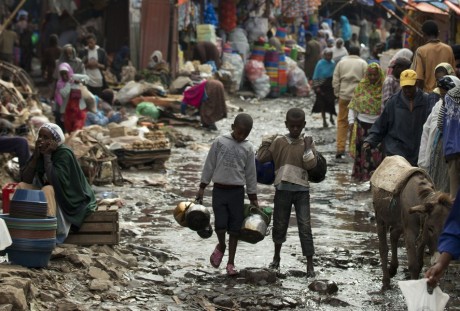
http://www.forbes.com/pictures/mef45jgim/10-saddest-ethiopia/
Copyright © Oromianeconomist 2013 and Oromia Quarterly 1997-2013. All rights reserved. Disclaimer.
Related articles
- The biggest challenges facing Africa have little to do with religion, per se, and less with global terrorism.http://www.foreignpolicy.com/articles/2013/10/02/demography_is_destiny_africa_al_shabab#.Uk3ZTTT2_xA.twitter …
- “Re-Branding Africa” and “Africa Rising”: Whose #Africa? Whose Rise? http://aconerlycoleman.wordpress.com/2013/10/03/re-branding-africa-and-africa-rising-whose-africa-whose-rise/
- Africa is not rising, survey shows that ”the boom” only benefits a narrow elite http://www.theguardian.com/world/2013/oct/02/africa-not-rising-survey?CMP=twt_gu
- A skeptical perspective on African development (marginalrevolution.com)
-
http://transitions.foreignpolicy.com/posts/2013/09/30/the_african_statistics_smackdown_continued
Land grabbing deals in Africa have led to a wild west and intensified food insecurity October 29, 2012
Posted by OromianEconomist in Uncategorized.Tags: Africa, Ban Ki-moon, Committee on World Food Security, FAO, Food and Agriculture Organization, José Graziano da Silva, Olivier De Schutter, Silva
add a comment
Land deals in Africa have led to a wild west that undermined food security – bring on the sheriff, says FAO
“True grit … FAO director general José Graziano da Silva wants major land acquisitions curbed to protect the poor. Amid warnings that land deals are undermining food security, the head of the UN’s Food and Agriculture Organisation (FAO) has compared “land grabs” in Africa to the “wild west”, saying a “sheriff” is needed to restore the rule of law. José Graziano da Silva, conceded it was not possible to stop large investors buying land, but said deals in poor countries needed to be brought under control.” The Guardian
Large land deals have accelerated since the surge in food prices in 2007-08, prompting companies and sovereign wealth funds to take steps to guarantee food supplies. But, four to five years on, in Africa only 10-15% of land is actually being developed, claimed Graziano da Silva. Some of these investments have involved the loss of jobs, as labour intensive farming is replaced by mechanised farming or some degree of loss of tenure rights.
Oxfam said the global land rush is out of control and urged the World Bank to freeze its investments in large-scale land acquisitions to send a strong signal to global investors to stop.“In some areas of Africa – Mozambique and South Africa – there is scope for large farms, but this approach is only valid for some grains, where the entire cycle is mechanical,” he said. “But this is not suitable for fruits, vegetables or many other local products. Cassava has nothing to do with mechanized agriculture and efficiency does not mean big scale. It’s the way you combine crops, the use of water you have available. In Africa today, efficiency means better seeds rather than big tractors. The two models have been there forever in agriculture. Sometimes big-scale will provide exports, but local markets are based on small-scale agriculture.”
Graziano da Silva, who was in charge of Brazil’s widely praised “zero hunger” programme, expressed his frustration at the slow pace of creating a global governance structure to deal with land grabs, food security and similar problems. In 2008, the UN secretary general, Ban Ki-moon, created a high-level task force on food security on which Graziano Da Silva serves as vice-chairman.
In May, the committee on world food security (CFS), a UN-led group that includes governments, business and civil society, laid the groundwork for a governance structure for food by endorsing voluntary guidelines on the responsible governance of tenure of land, fisheries and forests.
Tenure has important implications for development, as it is difficult for poor and vulnerable people to overcome hunger and poverty when they have limited and insecure rights to land and other natural resources. But the guidelines took years to negotiate and lack an effective enforcement mechanism because they are voluntary. The CFS is an unwieldy group but has the virtue of inclusivity.
“It took two years to discuss the voluntary guidelines and now we face another two years of negotiations on the principles for responsible agricultural investments,” said Graziano da Silva. “We need to speed up the decison-making process without losing the inclusivity model.”
The FAO director general said he is doing his best to bring about more co-ordination among the different institutions concerned with food security and suggests the FAO act like an executive arm of the CFS, trying to implement its decisions.
Others share his frustrations. Olivier De Schutter, the UN special rapporteur on the right to food, acknowledges the importance of the CFS voluntary guidelines, but points out the lack of an effective enforcement mechanism. He argues that governments in sub-Sahran Africa or south-east Asia with poor governance, or tainted by corruption, will continue to seek to attract investors at all costs.
“The international community should accept it has a role in monitoring whether the rights of land users, as stipulated in the guidelines, are effectively respected,” De Schutter told the Guardian. “Since there is no ‘sheriff’ at global level to achieve this, at the very least, the home states of investors should exercise due diligence in ensuring that private investors over which they can exercise control fully respect the rights of land users. Export credit agencies, for example, should make their support conditional upon full compliance with the guidelines, and in the future, the rights of investors under investment treaties made conditional upon the investors acting in accordance with the guidelines.”
For Graziano da Silva, the key is the implementation of the voluntary guidelines at country level; he is encouraged by growing public interest and awareness of the issue. He points to Uruguay as an example of a government prepared to stand up to international land investors – “perhaps the best sheriff” on land deals.
“They have very good laws on land acquisitions,” he said, but acknowledged that most countries where land grabbing takes place have little consultation with farmer organisations or have weak or repressive governments.
As for the perennial debate on the respective merits of large and small-scale farming, the FAO boss said Africa had room for both, adding that Brazil had managed it.
http://www.guardian.co.uk/global-development/2012/oct/29/land-deals-africa-wild-west-fao
Related articles and videos
Why poverty:The great land rush in Mali
- FAO, Germany, ECOWAS launch hunger-free initiative for West Africa (ghanabusinessnews.com)
- Land deals in Africa have led to a wild west – bring on the sheriff, says FAO (guardian.co.uk)
- Land deals in Africa have led to a wild west – bring on the sheriff, says FAO (bfreenews.com)
- FAO wants strong global food security governance (ghanabusinessnews.com)
- Cooperatives Cushion the Blows of Hunger (ipsnews.net)
- Global recession halts decades of steady progress in reducing world hunger (independent.co.uk)
- Zero hunger challenge: Is it attainable? (rappler.com)
- High food prices top UN agenda on World Food Day (sfluxe.com)
- Ghana improves food security with prudent agric policies (ghanabusinessnews.com)
- High food prices top UN agenda on World Food Day (rappler.com)
- http://www.oxfam.org/en/grow/pressroom/pressrelease/2013-02-07/poorly-governed-countries-targeted-land-investors
Copyright © Oromianeconomist 2012 and Oromia Quarterly 1997-2012. All rights reserved. Disclaimer.
Ethiopia in the Extreme Food Security Risk Index – Map October 22, 2012
Posted by OromianEconomist in Uncategorized.Tags: Africa, Famine, Food security, Sub-Saharan Africa
add a comment
The food security risk index – map
‘The index has been developed by the risk analysis company Maplecroft for governments, NGOs and business to use as a barometer to identify those countries which may be susceptible to famine and societal unrest stemming from food shortages and price fluctuations. This map shows the results of evaluating the availability, access and stability of food supplies in 197 countries, as well as the nutritional and health status of populations,’ The guardian.
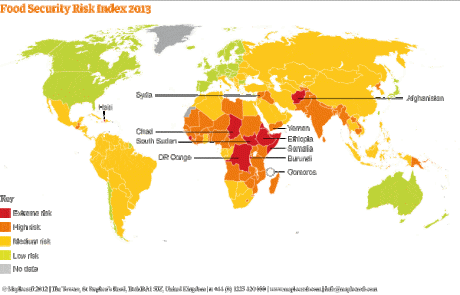
http://www.guardian.co.uk/global-development/graphic/2012/oct/10/food-security-risk-index-map
As Africa is clearly the most afflicted, with six (Ethiopia, Somalia, S.Sudan, Congo, Chad and Eritrea) of the seven states at “extreme risk.” Afghanistan was the only country outside of Africa at extreme risk , Maplecroft inside report. According to FAO’s study, out of Ethiopia’s total Population of 84.7 million the number of undernourished persons are 34.0 million, and prevalence of undernourishment is 40 %.
Related articles
- Africa facing intensified ‘food crisis’ (aljazeera.com)
- Global Food Crisis Risk Is Soaring (beyond2012zeitgeist.com)
- Global Food Crisis Risk Is Soaring (conservativeread.com)
- Corporate giants reap billions from hunger (climateandcapitalism.com)
- Global Food Crisis Risk Is Soaring [MAP] (businessinsider.com)
- Global Food Crisis Risk Is Soaring (fromthetrenchesworldreport.com)
Copyright © Oromianeconomist 2012 and Oromia Quarterly 1997-2012. All rights reserved. Disclaimer.
Development without Big Dams: Grass Roots Solutions on Water and Environment October 13, 2012
Posted by OromianEconomist in Uncategorized.Tags: Africa, Asia, Developing country, Irrigation, Meredith Giordano, Oromia Region, Pump, Water crisis
add a comment
Small is both beautiful and productive
‘Mega-dams and massive government-run irrigation projects are not the key to meeting world’s water needs, a growing number of experts now say. For developing nations, the answer may lie in small-scale measures such as inexpensive water pumps and other readily available equipment. How will the world find the water to feed a growing population in an era of droughts and water shortages? A growing number of water experts are saying, is to forget big government-run irrigation projects with their mega-dams, giant canals, and often corrupt and indolent management. Farmers across the poor world, they say, are solving their water problems far more effectively with cheap Chinese-made pumps and other low-tech and off-the-shelf equipment. Researchers are concluding that small is both beautiful and productive.’ “Cheap pumps and new ways of powering them are transforming farming and boosting income all over Africa and Asia,” Meredith Giordano, lead author of a three-year research project.
http://www.eurekalert.org/pub_releases/2012-08/bc-fis081612.php
Related articles
- Beyond big dams: Turning to grass roots solutions on water (energybulletin.net)
Copyright © Oromianeconomist 2012 and Oromia Quarterly 1997-2012. All rights reserved. Disclaimer.
Gadaa Oromo Democracy: Three Approaches to the Study of African Society September 27, 2012
Posted by OromianEconomist in Africa, Ancient African Direct Democracy, Culture, Finfinnee, Gadaa System, Humanity and Social Civilization, Irreecha, Kemetic Ancient African Culture, Oromo, Oromo Culture, Oromo First, Oromo Identity, Oromo Nation, Oromo Social System, Oromummaa, Self determination, Sirna Gadaa, State of Oromia, The Oromo Democratic system, The Oromo Governance System, Uncategorized.Tags: Africa, African culture, African Studies, Ancient African Direct Democracy, Ancient Black People, Ancient Egyptian people, Democracy, Economic and Social Freedom, From, Gadaa System, Governance issues, Horn of Africa, Kemet, Kushitic people, National Self Determination, Oromia, Oromiyaa, Oromo, Oromo culture, Oromo people, Oromummaa, Politics, Siqqee, Siqqee Oromo Women Institution, Sirna Gadaa, Social Sciences, State and Development, Sub-Saharan Africa, United Nations, Universal Declaration of Human Rights, World Bank
3 comments
These closely related books reveal the many creative solutions an African society found for problems that people encounter when they try to establish a democratic system of governing their affairs. In much of what has been written about Africa, the common image is that of people governed by primitive customs and practices, in which only feudal roles of elders, kings, chiefs, sultans, and emirs have been acknowledged by Western observers. Little is ever shown of indigenous African democratic systems, under which there is distribution of authority and responsibility across various strata of society, and where warriors are subordinated to deliberative assemblies, customary laws are revised periodically by a national convention, and elected leaders are limited to a single eight-year terms of office and subjected to public review in the middle of their term. All these ideals and more are enshrined in the five-century old constitution of the Oromo of Ethiopia, which is the subject matter of these books.
In these books, Legesse brings into sharp focus the polycephalous or “multi-headed” system of government of the Oromo, which is based on clearly defined division of labor and checks and balances between different institutions. Revealing the inherent dynamism and sophistication of this indigenous African political system, Legasse also shows in clear and lucid language that the system has had a long and distinguished history, during which the institutions changed by deliberate legislation, and evolved and adapted with time.’ Amazon Books &
Related articles
Introduction
http://oromopress.blogspot.co.uk/2011/12/review-of-oromo-democracy-indigenous.html?m=1
http://www.readperiodicals.com/201203/2672718591.html
- Gadaa: An Oromo Democracy and the Symbol of Oromo Civilization (odaakoo.wordpress.com)
- Contours of the Emergent & Ancient Oromo Nation (oromianeconomist.wordpress.com)
- http://www.iwmi.cgiar.org/publications/CABI_Publications/CA_CABI_Series/Community_Law/protected/Ch%2009.pdf
- Oromia of Dhaqabo Ebba: The Cradle of Mankind Is Also A Home of The Oldest Living person On Earth (oromianeconomist.wordpress.com)
Copyright © Oromianeconomist 2012 and Oromia Quarterly 1997-2012. All rights reserved. Disclaimer.
Cognitive Democracy May 27, 2012
Posted by OromianEconomist in Uncategorized.Tags: Africa, Democracy, Environment, Gadaa, Oromia Region, Oromo people, Politics
add a comment
“Some of the problems that we face in politics are simple ones (not in the sense that solutions are easy, but in the sense that they are simple to analyze). However, the most vexing problems are usually ones without any very obvious solutions. How do we change legal rules and social norms in order to mitigate the problems of global warming? How do we regulate financial markets so as to minimize the risk of new crises emerging, and limit the harm of those that happen? How do we best encourage the spread of human rights internationally?”
“Specifically, we argue that democracy has unique benefits as a form of collective problem solving in that it potentially allows people with highly diverse perspectives to come together in order collectively to solve problems. Democracy can do this better than either markets and hierarchies, because it brings these diverse perceptions into direct contact with each other, allowing forms of learning that are unlikely either through the price mechanism of markets or the hierarchical arrangements of bureaucracy. Furthermore, democracy can, by experimenting, take advantage of novel forms of collective cognition that are facilitated by new media.”
It is interesting to engage in such analysis as this topic directly and indirectly details the role s of democratic institutions such as the Gadaa system of the Oromo can play to advance society.
To read in detail on this topic: Democracy
Copyright © Oromianeconomist 2012 and Oromia Quarterly 1997-2012. All rights reserved. Disclaimer.
Related articles
- H.L. Mencken on elections, politics, government (aei-ideas.org)
- Gadaa: An Oromo Democracy and the Symbol of Oromo Civilization (odaakoo.wordpress.com)
- Gadaa Oromo Democracy: Three Approaches to Study African Society (oromianeconomist.wordpress.com)
In the Global Land Rush the Great Food Robbery Targets Africa May 25, 2012
Posted by OromianEconomist in Uncategorized.Tags: Africa, Agriculture, Green Revolution, Oromia
add a comment


‘Biodiversity can only exist through the small farmers, indigenous people, and pastoralists who maintain that biodiversity. So what threatens them threatens biodiversity. The corporate food system is about taking food production out of their hands. With the structural adjustment programs in the 1980s and 1990s Africa was pushed to move towards export agriculture and “Green Revolution” style projects. Some moved ahead, many of them failed. Now, because of the rise in prices of agricultural commodities, corporations are trying to restructure food systems around the world to move commodities around more, and take more profit. Africa is increasingly being targeted as a centre of production for global markets. The talk now is that Africa is one of the last frontiers because much of Africa is not under the model of export production. Land and water are still in the hands of local communities. So there’s a big push to industrialize agriculture for export. Unfortunately, African governments are colluding with corporations who want to pursue agribusiness in their countries, with the help of the World Bank and bilateral and multilateral donors. …In Ethiopia, you have a government that has stated its policy is to go from 80 percent rural population to 20 percent rural population. Who can imagine what all those people are going to do? What’s the plan there? What jobs are they going to have? You can’t say that this is about people in Africa choosing to move to cities. People are being forced out of their lands through mining projects, land acquisitions, and overall bad policies…So much is at stake in Africa. Whole territories are being targeted and affected by land grabbing. And this time the governments are major conduits for it. How are people going to react? In Ethiopia, where the whole southern part of the country is being handed over, earlier this month you had gunmen attack a farm of Saudi Arabian operations and five people died. It’s heating up. It’s very explosive. Africa is under greater pressure than it’s ever been, at least since colonial times.’
Interview with Devlin Kuyek by Molly Kane http://www.pambazuka.org/en/category/features/82375
http://video.pbs.org/video/2203388630
“…Here’s the truth: we’re never going to end hunger in Africa without upholding the rights of smallholder women farmers who feed the continent and care for its ecosystems.” http://www.nationofchange.org/dont-put-monsanto-charge-ending-hunger-africa-1338125745
“The Ethiopian government, through the Agricultural Investment Support Directorate is at the forefront of this African Land Sale. Crops familiar to the area are often grown, such as maize, sesame, sorghum, in addition to wheat and rice. All let us state clearly, for export to Saudi Arabia, India, China etc, to be sold within the home market, benefitting the people of Ethiopia not.” http://ayyaantuu.com/horn-of-africa-news/ethiopia/the-ethiopian-land-giveaway-oped/#more-7083
“Squeezing Africa dry: behind every land grab is a water grab“
‘Food cannot be grown without water. In Africa, one in three people endure water scarcity and climate change will make things worse. Building on Africa’s highly sophisticated indigenous water management systems could help resolve this growing crisis, but these very systems are being destroyed by large-scale land grabs amidst claimsthat Africa’s water is abundant, under-utilised and ready to be harnessed for export-oriented agriculture. GRAIN looks behind the current scramble for land in Africa to reveal a global struggle for what is increasingly seen as a commodity more precious than gold or oil – water.’
Copyright ©Oromianeconomist 2012 and Oromia Quarterly 1997-2012. All rights reserved. Disclaimer.
Related articles
- Land Grab in Africa Threatens Food Security (voanews.com)
- Land deals in Africa have led to a wild west – bring on the sheriff, says FAO (guardian.co.uk)
- Land deals in Africa have led to a wild west – bring on the sheriff, says FAO (oddonion.com)
Ethiopia: The Last Two Frontiers May 3, 2012
Posted by OromianEconomist in Uncategorized.Tags: Africa, Developing country, Economic, Economic and Social Freedom, Economic development, Ethiopia, Gadaa System, https://oromianeconomist.wordpress.com/wp-admin/post-new.php#, Oromia, Oromo people, Social Sciences, World Bank
add a comment

ISBN-10: 1847010334 | ISBN-13: 978-1847010339
The Development Effects of Human Rights Abuses and Lacks of Press Freedom in Oromia July 31, 2011
Posted by OromianEconomist in Uncategorized.Tags: Africa, Human rights, Human Rights and Liberties, Oromia, Oromo people
add a comment

The Development Effects of Human Rights Abuses and Lacks of Press Freedom in Oromia
http://ayyaantuu.com/category/human-rights/
http://ayyaantuu.com/horn-of-africa-news/the-unchecked-rape-tale-of-ethiopian-army/
Copyright © Oromianeconomist 2011 and Oromia Quarterly 1997-2011, all rights are reserved. Disclaimer.
Related articles
- Is Regime Troops’ Crackdown on Oromo at Irreecha Festival ‘Ethiopian Apartheid Policy’ or ‘Law Enforcement?’ (bilisummaaa.wordpress.com)
- Call for Protest of all Oromos in and around Washington D.C. against the Ethiopian Regime (bilisummaaa.wordpress.com)
- Misappropriated Foreign Aid Funds Used to Ramp Up Repressions in Oromia, DC-London Demonstrators Said (bilisummaaa.wordpress.com)
- The notorious Somali region “liyu police” invades villages in Eastern Oromia (dandi4130.wordpress.com)
- Protest to Free Oromo Political Prisoners on January 25, 2013 in Washington, DC (ireport.cnn.com)
- Diaspora Oromos Stage Demonstration in Washington, DC and London (dandi4130.wordpress.com)
Perverted Development: What role for Institutions June 8, 2011
Posted by OromianEconomist in Uncategorized.Tags: Africa, African Studies, Berlin Conference, Cushitic people, Democratisation, Development and Change, economics, Ethiopia, Foreign Affairs, Gadaa System, Governance issues, New Africa, Oromia, Oromia Region, Oromo First, Oromo music, Oromo people, State and Development, The economist, World Bank
1 comment so far

Perverted Development: What role for Institutions
By Temesgen M. Erena (DPhil), Economist
The ideas of economists and political philosophers, both when they are right and when they are wrong, are more powerful than is commonly understood. Indeed the world is ruled by little else. Practical men, who believe themselves to be quite exempt from any intellectual influence, are usually the slaves of some defunct economist.
Keynes, John Maynard
JEL: B13, D2, D6, O1
Introduction
The force of human reductionism that had assaulted on Oromia’s history, civilisation, politics and economy for many centuries in the last three Christian millenniums and particularly of the last two centuries has continued in the new millennium to enfeeble the endeavours of its people towards progress and development.
Oromia is not the poorest of the nations of the world in resources but it is one of the most underdeveloped, characterized by thwarted advancement, declined progress and cataclysm.
In Oromia today immense agricultural potential, mineral wealth and human capital coexist with some of the lowest standards of living in the world. Part of the problem lies in the nature of the economic change the Abyssinian colonialism fostered in Oromia. The Oromo economy has been distorted to serve the Abyss interest and needs.
Oromos are the most brutalised and humiliated in modern history. The genocidal treatments, which Oromos have received from Abyssinians, have been as gruesome as anything experienced by Jews, Native American and native Australians and the Armenians received from the Nazi, Europeans, white Americans, and the Ottoman Turkey respectively. Oromos have also been humiliated in history in ways that range from the level of slavery, segregation and treated as second-class citizens in part of their own country to the present day in spite of being numerically the majority and geographically the largest territory.
In the early 1990s the old Amhara settler colonialism (Nafxanyaa system) was substituted by Tigrean ‘federal colonialism’ (neo- nafxanyaa system) the facet of exploitation seemed to take on new dimensions. In fact, the pattern of colonisation and domination has remained the same since it instated century ago with the Berlin Conference of 1884-1885, which had approved the scramble for Africa among European colonial powers. It was a time when the cruel Abyssinian Empire was given an ordinance of Christianising and ‘civilizing’ the Oromos; though it is a historic derision how a backward and barbaric empire was to ‘civilize’ the society of prime civilisation, high culture and social structure, the ‘natives’, whose development levels and potentials were diverse and by far advanced.
The very idea of Christianising and civilizing was an external imposition often upheld by external protagonists. In the pre 1974 Ethiopia, this took the form of substantial military and economic aid from the US America and Europe. During the Cold War era, the mission of oppression of the Oromos maintained and supported by fresh military and economic aid from the then Soviet Union scheme of spreading its sphere of dominion and its ideology to Africa. In the contemporary ‘new world disorder’, the support has got new momentum in which the old Christian missionaries are replaced by an army of western neo-classical economists who peddle a ‘free market’ ideology, which they hope, will take care of the imprisoned market agents, in this case the Oromos.
According to the new Gospel, the Tigrean colonizers are given the mandate and the necessary financial backing to pursue ‘economic liberalization’ while keeping strict control that Oromia remains the Abyssinian colony. The liberalization agenda has served as a precursor of the making of Tigrean version of crony capitalism or more appropriately advanced feudalism in the age of economic globalisation. It is alien to Adam Smith’s invisible hand, social justice and the free-market ideals of relying on legal contracts, property rights, impartial regulations and transparency. It is no wonder that the political and economic prescriptions that the Ethiopian colonial rules implemented and or pretend to implement are in line with the advice of the International Monetary Fund and the World Bank and The US administration’s The Horn of Africa Initiative all of which have exacerbated the problem of the Oromo nation. It has also betrayed the ideals of free market, social justice, self-determination and human rights.
The sorrowing fact is that shared interest and solidarity between the West and the Abyssinian colonizers are impoverishing the people. Pretentious and ill-conceived measures are being taken in the name of free market and above all development. Currently, there are a number of regime-sponsored ‘associations’ of this or that ‘Region/State’s Development’ anti-terrorism, poverty alleviation, renewal process, revolutionary democracy, etc. Given this, the people’s last resort is to defend their own interests is the exit option or to retreat from the colonizers. What has become more apparent than ever is the need to rely on the Oromo initiatives to solve the problems of the Oromo. The Oromo poor need to defend themselves from the bogus free market invaders and their phoney local allies. This is necessary, since, in the absence of property rights, social justice, and individual and social freedom and democracy, no free market economic gimmickry is able to reserve the tragedy of the oppressed. It is within this context, that we discuss, how the Ethiopian colonial rules, in collaboration once with international socialism and now with the global capitalism has impoverished and underdeveloped one particular community in Africa, the Oromo nation.
Sclerotic to development: The Abyssinian Colonial Occupation and Its Alliances
Economists are inspired to point out the weight of political factors, captured by the term ‘governance’ and its role in economic development. Concerns about political factors in economic development is revitalized because of the dearth of economic development reform and structural adjustment programs to yield definite success and prosperity, particularly, in Africa. The main problem pointed out is ‘poor governance’ (World Bank, 1989; Moore, 1992). There are three different aspects to the notion of governance that can be identified as:
The form of political regime (independent, colonial government, multi-party democracy, authoritarian, etc.),
The process by which authorities exercised in the management of the country’s economic and social resource; and’
The willingness, the competence and the capacity of the government to design, formulate, and implement genuine development policies, and, in general to discharge development and government functions.
As there is no antithesis concerning the conviction that ‘good’ governance is an important and desirable ingredient of development, scholars are cautious not to attach specific regime type and political reforms to good governance. Broadly, however, good governance is legitimated by developmentalist ideology while poor governance is characterized by ‘state elite enrichment ‘ (Jackson and Rosberg, 1984), the ‘rent seeking society’ (Krueger, 1974) or ‘politics of the belly’ (Bayart, 1993;Tolesa, 1995) such as Ethiopia, Nigeria and Zaire). The latter in fact are characterized by sclerotic behaviours and are obstacles to development.
The Oromia’s underdevelopment (negative development) and its associated problems are never going to be understandable to us, much less contain it, as long as we persist to ponder it as a mere as an economic enigma. What is before us momentarily is in essence an enigma of political colonialism whose economic after-effects are severe.
Not only the problem is basically political and colonial in character. It arose largely from Abyssinian imperial conquest and its associated colonial disposition, which is characterized by reliance on sheer force, state terror, genocide, plunder, authoritarianism and violence.
The story goes back to the days of the Abyssinians crossed the Red Sea and seized the territory and resources of the Cushites ( Bibilical Ethiopia, the present Horn of Africa and Oromia) making concerted aggression on the latter’s history and culture in the name of settlement and civilizing the ‘non-believers.’
As it is discussed above and elsewhere, in the first millennium BC the Abyssinian group crossed the Red Sea from South Arabia (source: the debtras’ records and memories of Abyssinian high school history text book) to the present North East Africa to conquer and resettle the land occupied by endogenous Oromo and the other Cushitic people. Recent research recognises that the Semitic culture of the Abyssinian empire’s northern highlands was built on the Cushitic base for which not genuine credit has been given, and the Axum obelisks which were attributed to the (Sabeans Abyssinians) do not have corresponding existence on the Arabian peninsula while they are abundant in the Nile valley stretching from Egypt to ancient Kush in today’s Sudan. This most probably indicates that the earlier phase of Axum civilization was predating the Sabean infiltration/invasion.
Cleansing as a policy was initiated to conquer the Cushite territories. The territory they conquered was divided among numerous Abyss chiefdoms that were as often at war with each other as with Oromo and the entire Cushite. The population of conquered territories were considered as dangerous thus; Abyssinian cleansing, up rooting, forced labour and killings of the vanquished were conducted as the means of crushing resistance, securing the conquered territories and even to expand their occupation further. Though the Abyssinian gained some territories and resettled in the northern highlands of the Oromo and other Cushitic regions among others Afar, Agau, etc., their expansion was checked for a long time in history by wars of resistance and liberation they encountered by the endogenous people. These wars of resistance led to a decisive victory for Oromo, Afar and Somali nations particularly from 12th to the second half of 19th century. As a result of such a defeat Abyssinians started to wage particularly anti-Oromo propaganda battles to alert themselves and attract foreign support against the Oromo. The derogative name ‘Galla’ and the ‘16 century Oromo migration’ were all the Abyssinian fabrications and to serve the war against Oromo. In fact, the Oromo oral history shows that the 16th century was a massive Abyssinian further southward migration and intensive campaign to entirely control Oromia and other territories. For the Oromo this period was characterized by political and military dynamism and at the same time it was a period of victory, massive dislocations, rehabilitation and displaced communities returning home.
According to M. Bulcha (see Oromo Commentary), it was only during the second part of the 19th century that the Abyssinians ultimately succeeded to make significant in roads into the Oromo territory. Tewodros (also known in different names Hailu, Kassa, Dejazmach, Ras, etc., as other Abyssinian shiftas and present Woynes, is on record for his brutish hostility towards the Oromo nation. He was not the first or the last of his kind. They were many before and after him, for concrete evidence even today, this time and this second. All of them have been gangsters of very abnormal characters and Abyssinian detested figures. The Abyssinians remembered Tewodros and his type not only as the romanticized hero figures but also portrayed them as a modernises. Tewodros the lunatic and bandit declared and conducted a war of extermination against the Oromo. In order to help them to bargain for the western support, he and all his type including Yohannes, Menelik, Haile Sellasie, Mengistu and currently Meles declared anti-Islam and anti-Muslim nations. They mobilized all their resources and the entire Abyssinia (Amhara &Tigre) against the Oromo to achieve their goal. Tewodros made every effort to obtain the European military support claiming his fictions of Christian identity and ideology (the then dominant political ideology though he had not any biblical ethics and values, not at all). Tewodros is a symbol and an element of Abyssinian barbarism that was conducted at particular historical stage (1850-1868). Such barbarism has been conducted since the Axumite period (3000 years) but has never achieved its ultimate goal of elimination of the entire endogenous people of the North-East Africa. But it eliminated millions of and it thwarted the civilisations of Cushite people. They have used all the devastating means the: Christian civilizing ideology, European army, settler colonialism, Soviet Socialism, Stalin collectivisation, Mengistu’s villegisation, and America’s structural adjustment, terrorism, etc. They have always tried to change names after names for the same ugly & old expansionism, feudalism and empire (the legendary land of Sheba, Ethiopia, Ethiopia first, socialist Ethiopia, republic, mother land, federal etc.). The very name Ethiopia is Hellenistic Greece. It was the name used in the ancient Greece occupation (before Romans) of North Africa people and southward expansion. This name was colonialism from the beginning and it has been, it is and it will be. It is not African in origin as the people who invented it. This name was adopted and maintained to conquer the entire Cush and then the entire Africa in the shadow of christianisation. It is a sinister name that has no boundary and ethnic identity. It is not only the conquered people of North-East Africa but also all Africanists that must understand, including its sinister philosophy. It was designed and adopted to deconstruct an endogenous African identity.
One implication of the doctrine of Abyssinian ‘civilizing mission’ was that the Oromos needed to be ruled by Abyssinians and could not responsibly be granted civil liberties. Authoritarian as it has always been, the Abyssinian colonial rule in Oromia whether under Menelik II, Haile Selassie, Mengistu and currently under Meles has been characterized by the ‘politics of the belly.’ The underlying ethos remains self-aggrandizement and those elites are alien to growth whereas corruption, brutality, inefficiency and grotesque incompetence have tainted their politics. Time and again, they siphoned off Oromia’s wealth and indulged in conspicuous consumption and stashing millions of dollars in remote secret accounts in Europe, America and Asia. Scholars understand that development is about the future. However, the Abyssinian elites are living for the present. They came for quick self enrichment. The Oromos have no opportunity to invest in their country. They disowned everything.
While the Abyssinian colonial settlers in Oromia do no want and support policies that promote development, they find military and other forms of support abroad to stay in power. In more than one time, this force of underdevelopment has been strongly reinforced by external forces (Holcomb and Ibssa, 1990). Despite generous foreign assistance, this hardly commanded legitimacy to mobilize the colonized masses behind their rule. To the contrary, people who have waged legitimate struggle to reclaim their freedom, cultures and history has fiercely resisted their rule.
As it has been discussed elsewhere, Oromos have their own political power, which was fully operational before they were colonized and occupied by Abyssinians put under the strict control of Ethiopian empire state. Their political system is based on the Gadaa (Gada) system. The Gadaa system has been the foundation of Oromo civilization, culture and worldview (Jalata, 1996). The Gadaa political practices manifested the idea of real representative democracy with checks and balance, the rule of law, social justice, egalitarianism, local and regional autonomy, the peaceful transfer of democratic power, etc. (Jalata, 1966). The Gadaa political system also facilitated property rights, stability, and the expansion of free trade, commerce, improved farm techniques and permanent settlements, gradual diversification of division of labour. The Gada state was non-taxing state. Military was not the focal point, only defensive which is democratic. It was the opposite of expansionist, imperial, genocide or conquering state, e.g. Roman, Sparta, Abyssinian and Serbia, etc.
One of the distinctive virtues of Gadaa state was the weight of civilian power as compared to military power, military aristocracy was practically absent and in normal times, the army executed only an inconspicuous, if not nonexistent, political function. The military aristocracy was not the focal point of society. War had rather a defensive mission.
Nonetheless, particularly since the last decades of the nineteenth century, the Abyssinian colonial rule and its state disallowed the Gadaa political system and expropriated the Oromo basic means of subsistence, such as land cattle while it established an Ethiopian system of rule over Oromia. The Oromo commerce and industrious activities were not only discouraged but also ridiculed and obtained the lowest social status. Productive relations were imposed through the process of commodity production and extraction between those who control or own the means of production, the state, and those who do not. Those who control the means of coercion had the opportunity to reorganize productive relations through dispossession of the colonized Oromos in order to expedite more product extraction.
The process of dispossession is multi-faceted and far-reaching. As the result of it, the Oromos have been denied power and access to education, cultural, economic and political fields while at the extremes, the Abyssinian colonialism has been practiced through violence, mass killings, mutilations, cultural destruction, enslavement and property confiscation.
Apart from the splendid crop farm and animal husbandry, in his 1896-1898 travels in Oromia Bulatovich (2000, pp 60-61) described the Oromian industrial and commercial economy as the most vibrant with conducive endogenous institution as follows:
“Artisans such as blacksmiths and weavers are found among the [Oromo]. Blacksmiths forge knives and spears from iron, which is mined in the country. Weavers weave rough shammas from local cotton. The loom is set up very simple. … There is also the production of earthenware from unbaked clay. Craftsmen who make excellent morocco; harness makers who make the most intricate riding gear’ artisan who make shields; weavers of straw hats (all [Oromo] know how to weave parasols and baskets), aromers who make steel sabers; weavers who weave delicate shammas, etc.
Bulatovich Observed that commerce in Oromo was both barter and monetary based. The monetary unit was the Austrian taller and salt. The former was rather little in quantity and was concentrated in the hands of merchants. He witnessed that Oromos have great love for commerce and exchange economy. According to Bulatovich (2000, pp, 61-63):
“In each little area there is at least one market place, where they gather once a week, and there is hardly an area which is relatively larger and populated which does not have marketplace strewn throughout. Usually the marketplace is a clearing near a big road in the centre of [Oromo] settlements…. Rarely does any [Oromo] man or women skip market day. They come, even with empty arms or with a handful of barely or peas, with a few coffee beans or little bundles of cotton, in order to chat, to hear news, to visit with neighbours and to smoke a pipe in their company. But besides, this petty bargaining, the main commerce of the country is in the hands of the [Oromo], and they retain it despite the rivalry of the Abyssinians. Almost all the merchants are Mohammedan. They export coffee, gold, musk, ivory, and leather; and they import salt, paper materials, and small manufactured articles. They are very enterprising and have commercial relations with the Sudan, Kaffa, and the Negro tribes.”
The Oromos have also valued both the collective and personal independence and freedom very much. Their peaceful and independent way of life was broken and their freedom lost with the coming of the utterly vicious and sever authority and hard school of surrender and obedience of the Abyssinian conquerors. As Bulatovich (2000, p.65) further described:
“The main character of trait of the [Oromo] is love of complete independence and freedom. Having settled on any piece of land, having built him a hut, the [Oromo] does not want to acknowledge the authority of anyone, except his personal will. Their former government system was the embodiment of this basic trait of their character- a great number of small independent states with figurehead kings or with a republican form of government. Side with such independence, the [Oromo] has preserved a great respect for the head of the family, for the elders of the tribe, and for customs, but only insofar as it does not restrain him too much.”
Jalata (1993) sees the Ethiopian colonial domination as the negation of the historical process of structural and technological transformation. This is the case where the Abyssinian colonial class occupies an intermediate status in the global political economy serving its own interest and that of imperialists. The Oromos have been targeted to provide raw materials for local and foreign markets. Inside the empire, wherever they go, the Abyssinian colonial settlers built garrison towns as their political centres for practicing colonial domination through the monopoly of the means of compulsion and wealth extraction.
The Abyssinian colonial system was more cognated to a tributary system whereby the rulers extract tribute and labour from colonized lands. The Abyssinian peasants supported their households, the state and the church from what they produced. After its colonial expansion, Abyssinians maintained their tributary nature and established colonial political economy in Oromia and in the Southern nations. Although the colonial state intensified land expropriation and produce extraction from colonized peoples, capitalist productive relations did not emerge. Gradually with the further integration of the Ethiopian empire into the capitalist world economy, semi-capitalist farms seemed to emerge by extracting their fruits mainly through tenancy, sharecropping and the use of forced-labour systems.
The colonial exploitation has been maintained under Mengistu’s so-called socialist collectivisation/ villegisation campaigns and in the current Meles’ regime under the mask of structural adjustment and ‘free’ market economic system.
It should also mentioned that in addition to authoritarian and coercive rule, the Ethiopian colonialism depended on an Oromo collaborationist agents that were essential to enforce Ethiopian colonialism. This second rate clique is merely an expandable appendage which devotes most of its energy to the scramble for the spoils of slavery, picking up the leftover in economic and political advantages. The main task of this class is to ensure the continuous supply of products and labour for the settlers. Of course this class was not always loyal to the Ethiopian colonial state (Jalata, 1993). Broadly speaking, the state itself is a battlefield for two exclusive claims to rule and political competition among the Ethiopian colonizers, the Amharas and Tigreans. In effect, this makes the Abyssinian colonizer politics effectively a zero-sum game and the very practice of politics become a negation of politics, i.e. politics are practiced with the inert ending of politics.
The Abyssinian rulers, who have inherited power used to believe that their interests were well served by depoliticising, muting and suppressing the Oromos and the Southern peoples’ quest for national-self determination under the guise of maintaining the unity of the Ethiopian empire. So they convinced themselves and tried to convince others that there were no serious socio-political differences and no basis for political opposition. Apoliticism has been elevated to the level of ideology while the political structures become ever more monolithic and authoritarian.
The political structures and political ideologies, which have been used to effect depoliticization and suppression, are all too familiar. The process entailed political repression, which the Oromos endured and suffered for more than a century. The implication of depoliticization is to deny the existence of differences, to disallow their legitimate expression and, therefore, to deny collective negotiation. Whatever the degree of repression, the process did not remove the differences. The ensuing popular frustration and resistance has led to even more repression. That is how political repression has become the most characteristic feature of the colonial political life and domination as its salient political relationship. All this means that political power becomes particularly important; so the struggle for it gets singularly intense.
In Abyssinian Colonial regime and psyche Seize power is supernatural and a magical axiom and power itself does not mean influence on policies but it means license over their colonial subjects. People have been so frightened and constricted by fear and indoctrination. Besides, they have been overwhelmed by deceptive rhetoric, crude, systematic misinformation, and hypocrisy, which made it virtually impossible to see through the situation and to form an intelligent judgement. The Abyssinian rulers including Tewodros, Menelik, Yohannes, Hailessilassie, Mengistu and Meles in resemble wanted an absolute power both on earth and heaven. All mobilised Abyssinian myth to enhance their cults. Loyalty and submission to them was being shrouded in an illusive appeal to be a good citizen. We heard and observed, childhoods dominated by a miasma of poverty, misery, starvation, with no shoes, slavery, slave soldier, premature and painful deaths. The power of the Abyssinian colonial empire has been not only absolute but also arbitrary, extraordinarily statist and hostile. It tightly controls every aspects of its subject’s economy. In the state where politics is driven by the calculus of power, everyone in arena only focused in the accumulation of power. Politics has been reduced to a singular issue of domination. It has never afloat restraint and dispensation. There have been regime changes within the empire but the new has accustomed to reproduce and reinforce the past. None of the the Ethiopian rulers including the present regime fundamentally had any firm interest in transformation , and all of them were only too alert that they could afford to broaden the social base of the state power. Power has been maintained by politicising and manipulating the Abyssinian myth and chauvinistic nationalism and depoliticisation of the occupied. In doing so, they engaged in weakening. They produced not only fanatical divisions within their own echelon but antagonism and exclusivity in society and . the solidarity of the oppressed at any price. It is so clear that such political condition has been profoundly hostile to development. The struggle for power within itself and to sustain the occupation of the oppressed majority has been so engrossing that everything else, including development must be sacrificed
The oppressed are exposed to all kinds of onslaught by state that is hardly subject to any constitutional or institutional fetters. The colonial power barred Oromos from engaging in their own industrial enterprises, export trade, domestic commercial venture, modern and relatively productive farm, private, free media, education and philanthropy etc. Unlike the Hobbes’s state, it is so backward, uncivil sing, further underdeveloping and essentially a military institution that imposes subordination and maintains colonial condition. In this context, it is more colonial and barbaric by the standard of other colonial experiences observed elsewhere in the Americas, Asia and other parts of Africa.
There are two major aspects in which this situation has severely thwarted Oromia’s development. The first enigma lies in the incompatibility between the pursuit of development and the crusade for survival, reproduction of the existing forms of social control and domination. The deleterious after-effect of this animosity is that it leads to misuse of human resources, inefficiency and corruption. Unquestionably, appointments into the positions of power, even when they are positions, which demand specialized knowledge, tend to be made by political criteria, particularly by regarding these appointments as part of survival strategy. Each time such appointment is being made, the friction between political survivals, economic efficiency and development crops up. The ruination to efficiency and development derives not only from the performance criteria and likely incompetence of the persons so assigned but also from the general demoralization of the technically qualified and competent people purveying under them who are often repressed and frustrated by their subjection to the surveillance and regulations of people who are powerful but inapt. Here lies the role of Ethiopian ministers and parastatals: incompetent personnel used to obstruct productive use of resources. Wasted are also competent people. They lose at both ends. In the midst of waste, the Oromos have been denied basic civil and political rights and the right to development. Alien leaders who channel the meagre resources into unproductive uses imposed the related economic problem, the very rights over which the people are fiercely struggling.
Development projects were initiated for wrong reasons; they may, on account of political considerations, be located in places where they are least beneficial both economically and socially. One could site familiar cases where important contracts and licenses have been given to politically significant people. Higher positions are created and new rule and regulations are established just to benefit people whose political support is considered important. Oromia pays for all these disservice. The Ethio-crats are overpaid and creating demoralizing disparities between reward and effort. That is how; the persistence of Ethiopian imperial and colonial domination is imperilling to the integral tenets of development.
Abyssinian academics and international development agencies offer many factors for the apparent failures and crises of development industry in the Abyssinian empire: lack of capital, lack of technology, entreprenuerial skills, corruption, poor planning and management, socialist system, lack of infrustracture, falling commodity prices, cyclical drought, unfavourable international terms of trade, low level of saving and investment. These factors and the long lists of related factor are undeniably crucial factors in development. However, we have to address the misleading assumption that has commonly been taken that there has been development failures and crises. The Oromia experience exhibits the terrible realites that development has never been on the agenda. The business of the politics of occupation has prevented the pursuit of development and the emergence of relevant and effective development paragims and programs.
The burning question is, can the people of Oromia try to trade, farm, imitate and innovate then develop their economy in this state of siege? The question is vital and congruous; but the answer is doubtful, as it is impractical. Development strategies as such are comprehensive programs of social transformation. They call for a great deal of ingenious management, confidence in the leadership and commitment. They require clarity of purpose for a society at large; they need social consensus especially on the legitimacy of the leadership. Yet these are not common features of an institution, which does not represent the society. Besides, development is about change and that change may not work to the survival of the colonial rulers. In this sense it runs against the instincts of the rulers whose preoccupation is to survive and maintain its dominant position. One of the most amazing things about development discourse in Ethiopian empire is how readily it is assumed that the rulers are interested in development particularly when they profess commitment to development and negotiate with international aid organizations for economic assistance. People making this assumption forget the primacy of maintaining colonial power and its conflict with other social and economic goals.
Why the Ethiopian rulers embark on a course of societal transformation just because it is good for the nations under its empire like Oromos if it is bad for their own survival?
The ideology of development has been adopted to grapping resources from external aid agencies. In the name of development people are forced to obedience and conformity. Billions of dollars was looted by tolitarian regime and its cliques. Structural adjustment, privatisation, liberalisation, investment, rural development, fertiliser for farmers and democratisation have been the slogans of Mele’s regime for the last 20 years. There have not been: appropriate political structure and practices, administrative system, institutional framework to conduct development in Abyssinian empire. There have been also failures by international development agencies that have taken the responsibilities of financing development and transferring resources ignoring the specificity and historicity of the Abyssinian empire. This has also exhibited the mounting anarchy of development studies and development practices that has been based on modernising paragim.
The Abysinian rulers and their elites, especially the Amharas regard the ideal characters of themselves as the end of evolution. The application of this evolutionary schema meant advancement is a matter of assimilating to Abysinian culture. Abyysinians have established the negative view of the Cushite people, institutions and their culture. The colonial regime discourages any belief in the integrity and validity of the Oromo society and have offered the notion that Oromos can find validity only in their total transformation, that is, in their total self-alienation. On practical level , the result has been frustrating.They have assaulted on Oromo governance (Gadaa), Oromo culture, Oromo religion (Waqeffannaa) and Oromo names.They have changed Oromo names to Amharic (e.g. Finfinnee changed to Addis Ababa). They assaulted on the use of Oromo language. They evicted Oromos from cities and towns. They instituted the negative image of the Cushite and the superiority of the Abyssinians. How people in such state of mind, behaviour and attitude pursue development? According to Claude Ake “Development requires changes on a revolutionary scale; it is in every sense a heroic enterprise calling for consummate confidence. It is not for people who do not know who they are and where they are coming from , for such people are unlikely to know where they are going,”(Ake, 1996, p. 16).
When we think of development, it is about society at large and the paradox is that it is often the leader who is not in a position to think of the objective interests of the society. For thinking in this way entails profound democratic commitment, which cannot usually be expected of such leaders. By virtue of their position, colonial rulers suffer the disadvantage of confusing what maintains the existing social order, which they dominate, and they are tendentiously suspicious of change; it is all the more so when it comes to fundamental changes.
Finally, we need to remember some of the implications of development with respect to alien colonial rulers. As it has already been mentioned, they have been more interested in taking advantage of the social order inherited from their predecessors rather than in transforming it. To all appearances, they are colonial rulers. Oromos have been oppressed and humiliated for over a century. The political history of the last hundred years of colonial rule of Oromia has vividly indicted that the Oromos lacked freedom; it means that they did not have control over the products of their labour, it means that their natural resources and environment were tarnished by others; and eventually it means that they witnessed chronic poverty, destitution, killing forces, the forces of abuse & alienation, human misery and less and less of humane life.
In these circumstances, it is not surprising that where development is pursued in Oromia, if at all, it is full of ambiguities and contradictions and it is just a mere posture. Even taking these postures on the face value, in so far as we are critical of development strategies in Oromia, our criticism runs in the direction of their sloppy conception and hence their failure to come to grips with sclerotic of imperial domination. If we raise the question of the contradiction between political survival and social transformation, we commence to behold that it is doubtful and equivocal where development is, or it has ever been, on the colonizers’ list for Oromia.
The other aspect of economic consequences of colonial domination has been militarism, which is but the outcome of over-valuing of political power. Associated with it is the intense struggle to obtain and keep it. Therefore, the politics of the empire is sustained by warfare and force than by consent. In this atmosphere, force is mobilized and deployed: the winners are anxious to take absolute power into their hands while the losers forgo not only power but also lose liberty and even life. As politics relies solely on force, the vocabulary and organization advocates coercion. For that matter, the Ethiopian empire is a political formation of armies in action and this is in itself a serious development problem. In an institution in which the political formations are organized as warring armies, differences are too wide and far, the scope for co-operation too limited; there is too much distrust; and life is too raw to nature commerce and industry in subject nations like Oromia. Currently, the militarism of life in general and politics in particular has reached its logical culmination in Ethiopian military rule and its negative consequences have wider regional implications. This too hinders the course of development not only in Oromia but also in entire North East Africa.
Copyright © Oromianeconomist 2011 and Oromia Quarterly 1997-2011. All rights are reserved. Disclaimer.
Related articles
- We are Oromos First! (freedomfororomo.wordpress.com)
- Petitioning Al Jazeera The Stream/English http://stream.aljazeera.com/ 2Al Jazeera The Stream/English: We Appreciate Al Jazeera for Airing Oromo’s Persecution in Ethiopia (freedomfororomo.wordpress.com)
Corrupt Leaders in Africa June 8, 2011
Posted by OromianEconomist in Uncategorized.Tags: Africa, Political corruption, Transparency International
1 comment so far



 Oromian Economist
You must be logged in to post a comment.