Indigenous People & Development: Protecting Collective Identities And Rights January 10, 2014
Posted by OromianEconomist in Africa, Colonizing Structure, Development, Economics: Development Theory and Policy applications, Human Rights, Humanity and Social Civilization, Kemetic Ancient African Culture, Nubia, Oromia, Oromiyaa, Oromo, Oromo Culture, Oromo Identity, Oromo Nation, Oromo Social System, Oromummaa, Self determination, Sirna Gadaa, The Colonizing Structure & The Development Problems of Oromia, Uncategorized.Tags: Africa, African culture, African Studies, Collective Identity, Collective rights, Developing country, Development, Development and Change, Economic and Social Freedom, Indigenous People, Oromiyaa, Oromo, Oromo culture, Oromo people, Oromummaa, Sub-Saharan Africa, Universal Declaration of Human Rights
add a comment
“Indigenous representatives insist that the individualistic view of the world is totally alien to the indigenous ideas of the world, their traditions, their past and their present. An exclusive emphasis on individual rights has not and cannot give effective guarantees for indigenous peoples, who require the simultaneous protection as collectivities
in order to survive and flourish as distinct peoples and cultures. Collective rights emphasise the value of protecting indigenous cultures and existence per se and reject assimilation and integration as valid modes of relating to indigenous peoples. Indigenous peoples have stated:
‘The concept of indigenous peoples’ collective rights is of paramount importance. It is the establishment of rights of peoples as groups, and not merely the recognition of individual rights, which is one of the most important purposes of this Declaration. Without this, the Declaration cannot adequately protect our most basic interests. This must not be compromised.’ (UN Sub-Commission, Indigenous Peoples Preparatory Meeting: Comments on the First Revised Text of the Draft Declaration on Rights of Indigenous Peoples, July 1989.) In contrast, some states use liberal theory in order to reject the notion of collective rights. ‘International instruments generally speak of individual not collective rights. … Making clear that the rights guaranteed are those of individuals prevents governments or groups of (sic) violating or interfering with them in the name of the greater good of a group or a state … In certain cases, it is entirely appropriate or necessary to refer to indigenous communities or groups, in order to reinforce their individual civil and political rights on the basis of full equality and non-discrimination. But characterising a right as belonging to a community, or collective, rather than an individual, can be and often is construed to
limit the exercise of that right (since only a group can invoke it), and thus may open the door to the denial of the right to the individual. This approach is consistent with the general view of the US, as developed by its domestic experience, that the rights of all people are best assured when the rights of each person are effectively protected.’
In their historical evolution, human rights have been perceived as the rights of individuals against state power.
Opponents of collective rights base their arguments on cosmopolitanism, a theory which advocates for autonomous
individuals who are free from their cultural tradition and can therefore make autonomous decisions, in contrast to the communitarian theory according to which the self has attachments to the culture he/she has grown up in. Liberals argue that the establishment of collective rights will reflect a totalitarian vision of the society and will raise tribalist or nationalistic attitudes. The extensive philosophising on the need for cultural membership and collective rights is generally perceived by international lawyers as very engaging and very relevant to legal debates on claims for collective rights; yet, sometimes it appears to be lagging behind new developments in international law. If
international law is defined as the system of rules and principles that govern international relations (Martin Dixon, Textbook on International Law, 3rd edn, London: Blackstone Press Ltd, 1996, 2), its normative direction on the issue cannot be ignored. The liberal emphasis on the dichotomy between the individual and the state ignores the existence of any intermediate groups. The rejection of collective rights derives from a notion of ‘monotheism of the state’, namely unlimited sovereignty of the state and the view that the state should be the only source of authority in each political system. However, this model appears to be inconsistent with the existing norms of international law as
well as the international political realities. In the post-national state, although sharing the state’s national identity, citizens have in most cases other loyalties as well. These loyalties may lie in groups smaller than the state, such as families, local communities, ethnic, religious and cultural groups, as well as groups bigger than the state, such as regional organisations (e.g. the European Union) or even the international society. All these groups represent a series of multiple loyalties that the individual has and consequently incorporate various cultures that influence
the individual. International law is in the process of recognising various sub-national groups other than the state. International norms are in the process of expanding the number of entities that enjoy legal personality if only for some purposes. Currently, non-state entities such as inter-governmental organisations, regional organisations, non-self-governing territories, liberation movements and insurgent communities, non-governmental organisations, corporations and autonomous local administrations can act to some extent as agents in the international arena (see Martin Dixon, op cit, 109 110, and lan Brownlie, Principles of Public International Law, 4th edn, Oxford: Clarendon Press, 1992, 58-70). International law goes even further and recognises the importance of groups in the life of the individual. The 1989 UNESCO Recommendation on the Safeguarding of Traditional Culture and Folklore protects the culture of sub-national groups. Also, the Convention on the Rights of the Child states that education must
develop respect for the child’s ‘own cultural identity, language and values’ as well as for ‘the national values of the country in which the child is living’. Although the human rights system gives the central role to the individual, protection is also given to the person as a member of groups, such as the family, ethnic, national, religious and linguistic groups and nations (peoples). Even though most of these provisions establish individual rights or individual rights in collective capacity, their spirit recognises the importance of groups for the individual and prescribes that these groups should be protected. By protecting the various sub-groups that surround the
individual, it appears that international law perceives these groups as forming concentric circles around the person. Apart from having his/her own attributes and choices as an independent agent, the person is also influenced by his/her immediate group (such as the family), peer group (such as the local group), ethnic, religious and cultural group, his/her nation” (peoples), state, continent/region and, finally, loosely by the main culture we all share as citizens of a common world. The closer the circle to the person, the more influence it has on him/her. In order to protect the individual, all the various ‘circles’ loyalties around him/her need to be protected. Thus, international law includes a different set of protection for the individual (by establishing individual rights), but also his/her family, ethnic, cultural or religious group, the society he/she lives in, and finally the culture of his/her continent and the culture of the world itself (by establishing collective rights) (see Ronald Caret, ‘Communality and Existence: The Rights of Groups’, 56 (1993) South California Law Review, 1001 1050). As Waldron argues (in Jeremy Waldron, ‘Minority Cultures and the Cosmopolitan Alternative’ 25 (1995) University of Michigan Journal of Law Reform, 751–793, as reprinted in Will Kymlicka (ed), The Rights of Minority Cultures, Oxford University Press, 1995, 93-119, 103): ‘Just as the allegedly self-made individual needs to be brought to a proper awareness of[h\s/]her dependence on social, communal and cultural structures, so too in the modern world particular cultures and national communities have an obligation to recognise their dependence on the wider social, political, international and civilisational structures that sustain them.’ ”
– Alexandra Xanthaki, Collective Rights: The Case for Indigenous People, 2000.
The full text can be read @http://sas-space.sas.ac.uk/3841/1/1428-1642-1-SM.pdf
‘The concept of collective rights emerged because individual human rights do not guarantee adequate protection forindigenous peoples and other minorities exhibiting collective characteristics. These groups face various threats to their livelihoods, to their environments, to their health and to their security, and their very survival may depend upon the recognition and protection of their collective rights. … Collective rights are intergenerational. Land rights must be understood from this perspective, as present generations have inherited the territory of previous ones, and are obliged to pass it on to future generations. For that reason, indigenous territory should not be classified as property but rather as inheritance or patrimony. In the cosmic vision of many indigenous peoples, territory is not only a physical space but also where productive systems like fishing, hunting, agriculture, extractive activities and so forth are carried out in a self-reliant manner.’
– Friend of The Earth International
http://www.foei.org/en/get-involved/take-action/solidarity-work/collective-rights
http://www.unric.org/en/indigenous-people/27309-individual-vs-collective-rights
http://www.ciemen.org/pdf/ang.PDF
Copyright © Oromianeconomist 2014 and Oromia Quarterly 1997-2014. All rights reserved. Disclaimer.
The People Of South Sudan Deserve Better: Warlords Unfit To Mediate In South Sudan January 7, 2014
Posted by OromianEconomist in Africa, Aid to Africa, Colonizing Structure, Corruption, Development, Dictatorship, Economics: Development Theory and Policy applications, ICC, Knowledge and the Colonizing Structure., Knowledge and the Colonizing Structure. Africa Heritage. The Genocide Against Oromo Nation, Land Grabs in Africa, Oromia, Oromiyaa, Oromo, South Sudan, Uncategorized, Warlords.Tags: Africa, African Studies, Developing country, Development, Development and Change, Economic and Social Freedom, Genocide, Genocide against the Oromo, Governance issues, Horn of Africa, Human rights, Human Rights and Liberties, Human rights violations, ICC, Land grabbing, Land grabs in Africa, National Self Determination, Oromia, Oromiyaa, Oromo, Oromo culture, Oromo people, Oromummaa, Social Sciences, State and Development, Sub-Saharan Africa, Tyranny, Universal Declaration of Human Rights, Warlords, World Bank
add a comment
‘Ethiopia, like Uganda and the CAR, has a government that came to power through the use of military force. For over twenty years Ethiopia’s ruling party has used the army to suppress the political opposition while periodically rigging elections to remain in power.President Museveni and the IGAD leaders are not only supporting President Kiir, they are supporting themselves. The undemocratic way in which President Kiir runs the state and the SPLM is no different from how President Omar al Bashir runs Sudan, President Museveni rules Uganda, President Kabila stumbles along in the DRC and Prime Minister Hailemariam Desalegn controls Ethiopia. They are not the right people to act as mediators.’ -Alex Obote-Odora, Consultant in International Criminal Law and Policy, Stockholm.
…………………………………………………………………………………………………………………………………
The world’s newest nation, lies in a dangerous neighbourhood. It is surrounded by countries with leaders who are warlords, dictators and/or indicted for war crimes by the ICC.
These leaders have regrouped under the regional body IGAD. They blindly support President Kiir without first examining the root causes of the conflict and determining which party is at fault.
South Sudan needs honest brokers from amongst past and present leaders with high moral standing who respect human values—not the current tainted IGAD leaders.
The international community must not allow leaders investigated by the ICC for violations of serious international crimes to pretend to act like peace brokers. The people of South Sudan deserve better.
South Sudan, the world’s newest nation, lies in a dangerous neighbourhood. The ‘old’ Sudan, its most important and strategic neighbour, is headed by General Omar al-Bashir, an indicted war criminal at the International Criminal Court (ICC). He is busy pursuing his brand of peace with President Salva Kiir Mayardit.
South Sudan is one of the few countries he can visit without fear of arrest and transfer to the ICC. The Darfur conflict remains unresolved as women and children continue to be killed by his army and proxy militias.
The Democratic Republic of Congo (DRC) is another unstable neighbour. The state is kept afloat by the United Nations peace-keeping force.
President Kabila faces a plethora of armed opposition groups; he used the ICC to get rid of his political opponents while protecting his soldiers and political allies from investigations and prosecutions. Since 1996, over five millions Congolese are believed killed by his army and by proxy militias of the governments of neighbouring Uganda and Rwanda.
The ICC is currently investigating situations in the DRC. Only a few weeks ago, one of the armed militias attempted, without success, to seize power by force in Kinshasa. In the process, many civilians were killed.
President Museveni, who seized political power in Uganda in 1986, has supervised the slaughter of more than 500,000 civilians in the various wars he has fought from Luwero, through eastern to northern Uganda. Outside Uganda, commanding the Uganda Peoples Defence Force (UPDF), President Museveni is responsible for many more civilians murders carried out by his soldiers and proxy militias in the DRC, South Sudan and the CAR.
Like General Kabila of DRC, General Museveni has also used the ICC to solve some of his political problems while fiercely defending members of the UPDF from investigation and prosecution by the ICC.
South Sudan’s other neighbour, the Central African Republic (CAR), is currently being ‘ruled’ by a war lord who cannot provide security even in the country’s capital, Bangui. The French and AU soldiers are responsible for keeping him in power.
Ethiopia, like Uganda and the CAR, has a government that came to power through the use of military force. For over twenty years Ethiopia’s ruling party has used the army to suppress the political opposition while periodically rigging elections to remain in power.
Like South Sudan, the so-called ‘liberation armies’ in Uganda, DRC and Ethiopia have transformed into ruling political parties without discarding their undemocratic and dictatorial tendencies.
The Kenyan situation is different from the traditional military regimes, but their leaders are currently facing charges of crimes against humanity at the ICC for the mass murders that took place after the 2007 presidential elections.
These leaders have regrouped under the Inter-Government Authority on Development (IGAD), a regional body in Eastern Africa. On 27 December 2013, at a meeting in Nairobi, primarily because of their track record, the IGAD leaders squandered an opportunity to demonstrate neutrality when they blindly supported President Kiir against Dr Riech Machar without first examining the root causes of the conflict and determining which party is at fault.
By issuing threats and taking sides with the principal antagonists, the IGAD leaders demonstrated their common dictatorial credentials and democratic deficit.
There is still a way out of the South Sudan political crisis which unfortunately is being addressed by military means. For a credible and lasting peace in South Sudan, individuals with high moral standing who respect human values from amongst past and present leaders need to be considered for appointment as mediators by the AU or the UN. South Sudan needs honest brokers and not the current tainted IGAD leaders.
One of the persons who enjoys respect from the antagonists is Kenya’s former foreign minister Mr Kilonzo Musyoka. He was a key player in the negotiations leading to the Comprehensive Peace Agreement (CAP) that led to the creation of the Republic of South Sudan. Similarly, General Daniel Opande, another impartial participant at the negotiations leading to the CAP, is neutral and generally respected by the antagonists.
Former OAU Secretary General, Salim A Salim is another suitable candidate He has an excellent track record for tackling difficult problems during his tenure. Ghana’s former President Kuffor is yet another candidate with respectable democratic credentials.
Africa is not short of talented mediators. It is unreasonable for the AU to send war mongers to negotiate peace. What the AU and the UN can do for South Sudan is to look at stable countries with democratic credentials like Botswana, Ghana, Namibia, Senegal or Tanzania and tap mediators from any of those countries.
On the other hand, it is neither shameful nor un-African to go outside the African continent and seek the best peace mediators from any part of the world. There are many competent and credible mediators in the Nordic region with excellent track record. They can provide the much needed neutrality in the Great Lakes Region in peace-making.
Occasionally mistakes are made and it is only natural to correct past mistakes. It was, for example, an error for the UN to request President Museveni to mediate in the South Sudan conflict. Uganda is already too involved in South Sudan going back to the mysterious death of John Garang. Uganda should be kept out of the South Sudan conflict.
President Museveni is neither an honest broker nor does he have democratic credentials. He is simply one of the many war lords on the Africa continent who has used force to achieve and retain political power. Over the years, he has tried to re-brand himself as a statesman but deep down, he remains a war lord.
Both his NRM and the SPLM are ‘liberation’ armies that failed to successfully transition to multi-party politics which accepts the separation of party and state. The NRM and the SPLM have remained undemocratic, dictatorial and has continued to use force, rig elections and retain power.
What Dr Machar demands in South Sudan is similar to demands made by Dr Kizza Besigye in Uganda: seeking reform of the electoral commission, an establishment of an impartial police force and an army with a national outlook. Instead, President Museveni has consistently threatened, arrested, tortured and detained Dr Besigye and other national politicians opposed to his regime. President Kiir is following his many bad examples.
President Museveni and the IGAD leaders are not only supporting President Kiir, they are supporting themselves. The undemocratic way in which President Kiir runs the state and the SPLM is no different from how President Omar al Bashir runs Sudan, President Museveni rules Uganda, President Kabila stumbles along in the DRC and Prime Minister Hailemariam Desalegn controls Ethiopia. They are not the right people to act as mediators.
The international community must not allow leaders from the ‘ICC states’ that is, Uganda, Kenya, DRC, CAR, Sudan—countries that are currently being investigated by the ICC for violations of serious international crimes—to pretend to act like peaceful leaders seeking peace in that troubled country. The people of South Sudan deserve better.
Read more at the original text @ http://naiforum.org/2014/01/warlords-unfit-to-mediate-in-south-sudan/
Copyright © OromianEconomist 2014 & Oromia Quarterly 1997-2014, all rights are reserved. Disclaimer.
Nubia and Oromia January 4, 2014
Posted by OromianEconomist in Africa, Colonizing Structure, Corruption, Culture, Development, Human Rights, Humanity and Social Civilization, Nubia, Oromia, Oromiyaa, Oromo, Oromo Culture, Oromo Identity, Oromo Social System, Oromo the Largest Nation of Africa. Human Rights violations and Genocide against the Oromo people in Ethiopia, Oromummaa, Self determination, The Colonizing Structure & The Development Problems of Oromia, The Oromo Democratic system, Tyranny, Uncategorized.Tags: Africa, African culture, African Studies, Democratic African institution, Developing country, Development, Development and Change, Economic and Social Freedom, Genocide, Genocide against the Oromo, National Self Determination, Nubia, Oromia, Oromia Region, Oromiyaa, Oromo, Oromo culture, Oromo people, Oromummaa, State and Development, Sub-Saharan Africa, Tyranny, Universal Declaration of Human Rights
add a comment
Brownie: Spending an evening with Oromos

Today was such a pleseant day, i was invited to the Oromo community celebration of the beginning of the new Georgian year 2013. Oromo are the Koshian people of the State of Ethiopia. they are part of the Koshian civilization which Nubians belong to. So they are my cousins.
I have been introduced to the Oromo struggle in 2009, through my work in refugees’ issue in Egypt. One of my colleagues is a great man and he is from Oromo. He taught me about the struggle of his people against the central State in Ethiopia, actually they are sharing some problems with us, as Nubians, the suppression, neglection from the central government and cultural war to omit their deep rooted culture.
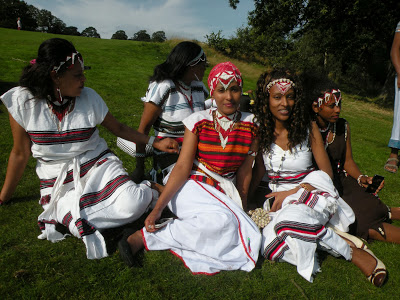
Oromo like many ethincities in Africa suffered specially after the colonization, because the colonizers built a wicked conflict in the African context which is the supremacy of a certain people or culture on the rest of the inhabitants of each country, after drawing unnatural borders.That was the case of Rwanda for example and that what lead to the genocide.
This wicked idea was entrenched through all means, political, social, economic and developmental.
Being in the trench of the unprivileged part means suffering by all means, no education, no health care, no development, complicated economic situation and for sure political prosecution if you dared to talk about your people suffering.
It is very problematic that the newly established states in Africa had hard time with the notion of nationalism, that they tried to embrace just one identity, and by that they completely deviated from the African tradition of respecting multiplicity. Africans suffered from the unnatural borders which cut some ethicities into pieces like the Nubian comminty when British cut Nubia into two part by the line of 22 north, which made some Nubians Sudanese and other Egyptians. even in the same states, some governments adopted very selective attitude in applying the notion of nationality, they made a check list and if you do not fit, you will suffer.
and Oromo do not fit, they are simply different.

That what happened to my Oromo-ian friend, he left the homeland, and he is a refugee here in Egypt, suffering from hardship of being a refugee in unwelcoming state like Egypt. but when you see him talking about his struggle you will only see the pride, that black pride which never vanishes.
Oromo people are struggling hard to be recognized and to have their human rights respected.
the Ethiopian state must stop its suppression to the Oromo people.

Respecting different people is essential, multiculturalism and persevering multiplicity is the pillar of any state.
Finally sometimes it is important to see Adhoc, this is a video showing how Oromo raised their flag in the last African cup for football:
Know more about the Oromo struggle (http://www.oromoliberationfront.org/index.htm)
See the details at original source:
http://atbrownies.blogspot.co.uk/2014/01/spending-evening-with-oromos.html
By Fatma Emam: http://www.blogger.com/profile/17426809504085760083
Copyright © OromianEconomist 2014 & Oromia Quarterly 1997-2014, all rights are reserved. Disclaimer.
Freedom Is Sweet December 27, 2013
Posted by OromianEconomist in Culture, Human Rights, Humanity and Social Civilization, Kemetic Ancient African Culture, Knowledge and the Colonizing Structure. African Heritage. The Genocide Against Oromo Nation, Language and Development, Oromia, Oromiyaa, Oromo, Oromo Culture, Oromo Identity, Oromo Nation, Oromo Social System, Oromo the Largest Nation of Africa. Human Rights violations and Genocide against the Oromo people in Ethiopia, Oromummaa, Self determination, Sirna Gadaa, The Colonizing Structure & The Development Problems of Oromia, The Oromo Democratic system, The Oromo Governance System, The Oromo Library, Theory of Development, Uncategorized.Tags: Africa, African culture, African Studies, Australia, Federation Square, Horn of Africa, Human rights, Human Rights and Liberties, Human rights violations, National Self Determination, Oromia, Oromiyaa, Oromo, Oromo culture, Oromo people, Oromummaa, State and Development, Sub-Saharan Africa, Universal Declaration of Human Rights
add a comment
“Freedom is Sweet” is taken from the speech made by Inga Peulich MLC , Parliamentary Secretary for Education at Oromia @ Federation Square, Melbourne Australia on 22nd of December 2013. The festival aims to bring Oromo people together, irrespective of age, gender and belief, to help promote self-empowerment. It also seek to educate the public on the lifestyle, culture and ethics of members of the Australian Oromo community. Furthermore, it’s a time to celebrate and commemorate the beauty of Australian Oromo culture and to promote both multiculturalism and diversity across Australia.
The celebration of Oromia at Federation Square marks the beginning of yet another exciting year of events that aim to bring the case of the Oromo cause.
Related articles
- Oromo Displacement Past & Present (oromianeconomist.wordpress.com)
- 99% of the prisoners are OROMO political prisoners in Ethiopia!!!!! (danieltadesse.wordpress.com)
- Oromoia Students Movement and the Current Trends of Oromo Youths and Intellectuals (oromedia.net)
- Message from Dr. Ibrahim Amae Elemo on the #BoycottBedele Campaign (freedomfororomo.wordpress.com)
- Let no one Rob you of your Identity (dhaamsaogeetti13.wordpress.com)
Global Poverty & Development Agendas: Dead Aid, Ethiopia & The West December 17, 2013
Posted by OromianEconomist in Africa, Aid to Africa, Colonizing Structure, Development, Economics: Development Theory and Policy applications, Knowledge and the Colonizing Structure. Africa Heritage. The Genocide Against Oromo Nation, Land Grabs in Africa, Oromia, Oromiyaa, Oromo, Oromo Culture, Oromo Identity, Oromo Nation, Oromo the Largest Nation of Africa. Human Rights violations and Genocide against the Oromo people in Ethiopia, Oromummaa, Self determination, The Colonizing Structure & The Development Problems of Oromia, Theory of Development, Uncategorized.Tags: Africa, African Studies, Dead Aid, Development and Change, Economic and Social Freedom, Genocide against the Oromo, Governance issues, Horn of Africa, Human rights, Human Rights and Liberties, Human rights violations, Land grabbing, National Self Determination, Oromia, Oromiyaa, Oromo, Oromo people, Oromummaa, State and Development, Sub-Saharan Africa, Tyranny, Universal Declaration of Human Rights
add a comment
In excess of 35 million Ethiopians still live in abject poverty subsisting on less that $2 a day while a tiny fraction of the country’s 85 million people has become excessively rich. As more and more ODA is pumped into the country Ethiopia’s HDI rank hasn’t improved (in fact it has gone from 169th in the world to 173rd in the last decade), journalists, academics and opposition figures are still jailed for speaking out against the regime, ethnic minorities such as the Oromo are discriminated against and forced off their lands, corruption and human rights abuses are still rife. Less people may be dying but are ordinary peoples’ lives improving at a rate that warrants the West to turn a blind eye to the crimes of those in power? It may suit certain agendas to do so but it does a massive disservice to ordinary Ethiopians. Read the full text at: http://www.transcend.org/tms/2013/12/global-poverty-and-post-colonial-development-agendas-ethiopia-and-the-west/


http://en.wikipedia.org/wiki/List_of_countries_by_percentage_of_population_living_in_poverty
Related articles
Relaunching Africa: The Call For Pro-Poor Growth November 17, 2013
Posted by OromianEconomist in Africa, Development, Economics, Economics: Development Theory and Policy applications, Oromia, Oromiyaa, Oromo, Oromo Nation, Oromo Social System, Self determination, The Colonizing Structure & The Development Problems of Oromia, The Oromo Governance System, Theory of Development, Uncategorized.Tags: Africa, African Studies, Developing country, Development, Development and Change, Economic and Social Freedom, economics, Governance issues, Leading Issues In African Development, Oromia, Oromiyaa, Oromo, Oromo the ancient African Society, Social Sciences, State and Development, World Bank
1 comment so far
“Policies aimed at enhancing agricultural productivity and increasing food availability, especially when smallholders are targeted, can achieve hunger reduction even where poverty is widespread. When they are combined with social protection and other measures that increase the incomes of poor families, they can have an even more positive effect and spur rural development, by creating vibrant markets and employment opportunities, resulting in equitable economic growth.” F.A.O.
“Poor people feeding their babies better and sending their children to school, while also building a new chicken coop. Let governments ensure that there are teachers there to actually teach the children, and you could be on to a really promising combination. It may look less impressive than a new oil platform or a shiny airport, but it will reduce poverty just the same, if not more!”
The new Deputy Chief Economist for the World Bank in Africa in his call for evidence based debate in pursuit of African development states the following arguments and calls for pro-poor development policies:
In 1990, poverty incidence (with respect to a poverty line of $1.25) was almost exactly the same in sub-Saharan Africa and in East Asia: about 57%. Twenty years on, East Asia has shed 44 percentage points (to 13%) whereas Africa has only lost 8 points (to 49%). And this is not only about China: poverty has also fallen much faster in South Asia than in Africa. These differences in performance are partly explained by differences in growth rates during the 1990s, when emerging Asia was already on the move, and Africa was still in the doldrums. But even in the 2000s, when Africa’s GDP growth picked up to 4.6% or thereabouts, and a number of countries in the region were amongst the fastest-growing nations in the world, still poverty fell more slowly in Africa than in other regions. Why is that? Part of the answer is that Africa’s population growth rates are still very high: 2.7% per year, versus 0.7% in East Asia. So a 4.6% growth rate for GDP translates into a much more modest sounding 1.9% growth in per capita GDP – less than the developing country average in 1999-2012. But an even bigger part is that Africa just seems less efficient at transforming economic growth into poverty reduction. That conversion is measured by what economists call the “growth elasticity of poverty”, a number that tells us by how much poverty falls for each percentage point in economic growth. According to a recent (and as yet unpublished) estimate by my colleagues Luc Christiaensen, Punam Chuhan-Pole and Aly Sanoh, that elasticity was about 2.0 in the developing world as a whole (excluding China) during the 2000s, but only 0.7 in Africa. At this rate, even if countries in Africa continue to grow at the same rates as in the 2000s – a period when the external environment was particularly benign, with rising commodity prices and abundant liquidity – poverty in 2030 would be in the 26%-30% range (assuming constant inequality). Under similar assumptions for other countries, somewhere between 60% – 80% of the world’s poor would live in Africa. Why is growth in Africa apparently less pro-poor than elsewhere? And what can be done about it? At first blush, at least part of the answer (beyond rapid population growth) has to do with both levels and changes in inequality. Inequality is relatively high in Africa: seven of the world’s 10 most unequal countries in the latest data in Povcalnet are in the region – despite the fact that African inequality is almost invariably measured for consumption, rather than income, while the opposite is true in Latin America. In addition, inequality has actually been rising in a number of countries. (Although the truth is that infrequent household surveys and changing methodologies are so common that we actually know relatively little about real changes in inequality in Africa – despite the impression you may get from various sources…)This clearly reflects a growth pattern that is less inclusive than we might like. In our latest Africa’s Pulse and in our recent presentation on the State of the Africa Region to the Annual Meetings of the Bank and the Fund in Washington, we reviewed some of these data, and suggested a four-part strategy for better sharing Africa’s growth in the future:
• First, preserve macroeconomic stability. Africa’s growth success in the 2000s reflects policy improvements, but also a benign external environment. During this period, fiscal deficits and current account deficits grew in most countries (Figure 1). While that is understandable, given plentiful capital flows, the risk is that those capital flows cease – or reverse – precisely at a time when commodity prices have stopped rising and are, in many cases, falling. Countries with large fiscal and current account deficits are inevitably more vulnerable to those risks.
• Second, build more – but mostly better – human and physical capital. Of course, alongside increases in total factor productivity – this is what drives economic growth everywhere. Despite progress, the needs in Africa are enormous, in everything from health and education to transport and energy. Our emphasis here is on quality: there have been real gains in access, but children won’t learn unless the teachers show up at school and, in addition, actually teach! Similarly, the costs of power, water, transport and communications remain excessively high. That is partly due to sheer scarcity, and partly to geographic fragmentation, but not only. The way contracts are designed, the way competition is (or isn’t) promoted, and the way subsidies interact with firm incentives all need looking at as well.
• Third, promote growth in the places and sectors where the poor live and work. For most of Africa, that means in rural areas – both by finding better ways to promote higher yields in agriculture, and by strengthening the off-farm economy. Linkages to small and medium-sized towns seem to be an important ingredient. This suggests that “local investments” – in rural roads and electrification, for example – is likely to be as important as big flagship projects. Even if the political economy tends to favor the latter.
• Fourth, harness the power of growth that takes place elsewhere for investments near – or in – the poor. That is particularly pertinent for (the large and growing group of) countries with large natural resource sectors. Oil and mining are not intensive in unskilled labor and could, if left alone, develop almost as “enclave sectors”. The main policy concern with these resources is to invest as much as possible of the rents they generate into other forms of capital, to replace the natural capital being depleted. But countries should be imaginative and comprehensive in their choice of investment portfolio. The portfolio should obviously include infrastructure, health and education projects, to build physical and human capital. But it may also include foreign assets, to help with the risk of exchange-rate appreciation and “Dutch disease”.
And it should also include some cash transfers made directly to poor people. The prevailing evidence is that poor households tend to use the resources from small cash transfers rather wisely. They buy more and better food. They send their kids to school more often. And they even invest some of it in their own (very) small businesses: they buy chickens in Mexico, or goats in Tanzania.
That’s pro-poor growth for you! Poor people feeding their babies better and sending their children to school, while also building a new chicken coop. Let governments ensure that there are teachers there to actually teach the children, and you could be on to a really promising combination. It may look less impressive than a new oil platform or a shiny airport, but it will reduce poverty just the same, if not more!
For more details refer to: http://blogs.worldbank.org/africacan/sharing-africa-s-growth?cid=EXT_TWBN_D_EXT
Related Articles:
African rule of law declines despite economic gains, Ibrahim index shows
http://ethiofreespeech.blogspot.no/2013/10/african-rule-of-law-declines-despite.html
Global hunger down, but millions still chronically hungry
‘Despite the progress made worldwide, marked differences in hunger reduction persist. Sub-Saharan Africa has made only modest progress in recent years and remains the region with the highest prevalence of undernourishment, with one in four people (24.8 per cent) estimated to be hungry. No recent progress is observed in Western Asia, while Southern Asia and Northern Africa witnessed slow progress. More substantial reductions in both the number of hungry and prevalence of undernourishment have occurred in most countries of East Asia, Southeastern Asia, and in Latin America.’
https://oromianeconomist.wordpress.com/2013/08/30/poverty-deprivation-capability-and-economics/
“Terms like ‘peasant farming’ or ‘traditional farming’ evoke for many people the notion of subsistence agriculture, and peasants living in blissful harmony with nature. The truth is that many peasant farmers struggle, many are poor and ironically constitute the majority of the undernourished in the world. Smallholder farmers need what other businesses need—access to finance, markets, infrastructure, technology, the tools and knowledge to grow their businesses, get their product to market and increase their incomes. That is their route out of poverty. It’s important to avoid black-and-white dichotomies between ‘big ag’ and ‘little ag’, industrial or traditional etc. Agricultural research, for example, can be of benefit to small farms as much as large. Small farmers need new technologies, adapted to their farming circumstances. Smallholder farming needs support; the question remains of who’s going to provide that support. There are critical roles for government, the private sector, development agencies and consumers. Integration of smallholders into higher-value market chains calls for a proactive role by national governments in terms of food safety standards, building infrastructure, and making the policy and legal environment conducive. That includes protecting the rights of small farmers—a large proportion of whom are women who face inequality and barriers to access to land, credit, education and advice. Strong producers’ associations managed and owned by small farmers can make working with small farmers more attractive to the private sector and also help safeguard their interests. And the private sector has to come equipped not only with finance but also with respect for rural people and the local context. To achieve food security, a sustained increase in agricultural productivity is required, with more focus on those small farmers who tend to be the most neglected: youth, women, other disadvantaged social groups and indigenous peoples. ”
http://ifad-un.blogspot.it/2013/10/how-to-feed-world_24.html
‘The continent’s burgeoning middle class has driven much of that discourse. Stories about its growth, increasing wealth and expanding expenditure have contributed to portray an Africa on the ascent. Prospects are so promising that Mthuli Ncube, chief economist of the African Development Bank (AfDB), suggested that we recalibrate our development priorities: [Aid and development strategy] will have to concentrate less on the bottom of the pyramid and move to the middle, which means it has to be supportive of private sector initiatives, which then are the way middle class people conduct their lives.This sentiment is echoed regularly by development institutions. Never mind that the middle class is a precarious and expansive category lumping together people spending $2 to $20 a day. Let’s also ignore that the so-called ‘floating class’ at the bottom end of the spectrum represent almost 40% of said middle class, people who contend with questions like affording school fees and medical treatment on a regular basis. If we cherry pick the middle, what happens to the rest? It is one thing to use the middle class to unpack singular depictions of the continent, it is another to pivot all development policies and priorities towards them. On the continent, despite improvements in national economies, technology, and certain human development indicators, almost 2 Africans out of 3 remain affected by poverty. The number of poor people has doubled since 1980s and among the world’s 10 most unequal countries, six are in Africa. In a recent survey of more than 50,000 people in 34 African countries about current economic conditions, half say they struggle to meet daily needs like food, clear water, and medicine.’ http://naiforum.org/2013/11/against-the-gospel-of-africa-rising/
Copyright © Oromianeconomist 2013 and Oromia Quarterly 1997-2013. All rights reserved. Disclaimer.
Oromo Political Detainees Tortured: Human Rights Watch’s Latest Document on Ethiopia October 19, 2013
Posted by OromianEconomist in Africa, Colonizing Structure, Corruption, Dictatorship, Human Rights, Oromia, Oromiyaa, Oromo, Oromo the Largest Nation of Africa. Human Rights violations and Genocide against the Oromo people in Ethiopia, The Colonizing Structure & The Development Problems of Oromia, Tyranny, Uncategorized.Tags: Africa, East Africa, Economic and Social Freedom, Genocide, Genocide against the Oromo, Governance issues, Horn of Africa, Human rights, Human rights violations, National Self Determination, Oromiyaa, Oromo, Oromo people, Oromummaa, Tyranny, Universal Declaration of Human Rights
1 comment so far

The report documents human rights abuses, unlawful investigation tactics, and detention conditions in Maekelawi between 2010 and 2013. Human Rights Watch in this latest document reports that Ethiopian authorities have subjected political detainees to torture and other ill-treatment at the main detention center in Finfinnee (Addis Ababa). The report also calls for the Ethiopian government to take urgent steps to curb illegal practices in the Federal Police Crime Investigation Sector, known as Maekelawi, impartially investigate allegations of abuse, and hold those responsible to account.
The 70-page report, “‘They Want a Confession’: Torture and Ill-Treatment in Ethiopia’s Maekelawi Police Station,” documents serious human rights abuses, unlawful interrogation tactics, and poor detention conditions in Maekelawi since 2010. Those detained in Maekelawi include scores of opposition politicians, journalists, protest organizers, and alleged supporters of ethnic insurgencies. Human Rights Watch interviewed more than 35 former Maekelawi detainees and their relatives who described how officials had denied their basic needs, tortured, and otherwise mistreated them to extract information and confessions, and refused them access to legal counsel and their relatives.
“Ethiopian authorities right in the heart of the capital regularly use abuse to gather information,” said Leslie Lefkow, deputy Africa director. “Beatings, torture, and coerced confessions are no way to deal with journalists or the political opposition.”
Since the disputed elections of 2005, Ethiopia has intensified its clampdown on peaceful dissent. Arbitrary arrest and political prosecutions, including under the country’s restrictive anti-terrorism law, have frequently been used against perceived opponents of the government who have been detained and interrogated at Maekelawi.
‘One [police officer] hit me on the back of my head with a long black stick and blindfolded me. They took me to their office. These were interrogators. They slapped me on the cheeks repeatedly…. But these interrogators are not in a position to listen to what I tell them. They beat me again with the black stick and slapped me again. I stayed in that room until midnight. I was exhausted. They took me back to the cell and then took another guy. On the second day of interrogations—the beating was worse. What they want is a confession.’—Journalist held in Maekelawi in mid-2011, Nairobi, April 2012, p. 6.
“Oromo student held in Maekelawi in 2012, said his hand was broken when he was beaten on his hand while being held in this position and that over a year later his hand continues to hurt:’In the interrogation room there was small piece of metal on the wall. They put me on it and locked my left hand to the wall and then my legs didn’t touch the ground. They beat me on my left hand. I think I was there one hour, but I don’t know as I lost my memory,’ ” p. 34.
Read further more from the following sites:
Click to access ethiopia1013_ForUpload.pdf
http://www.hrw.org/news/2013/10/18/ethiopia-political-detainees-tortured
Are Oromos Singled Out and Disproportionately Tortured in Ethiopia?
http://oromopress.blogspot.co.uk/2013/10/are-oromos-singled-out-and.html
Torture in the heart of Finfinnee (Addis), even as leaders gather in gleaming AU building
“Getachew,” a 22-year-old ethnic Oromo, was snatched from his university dorm, driven hundreds of kilometres to Addis Ababa, and locked up for eight months in Maekelawi. His parents were never informed of his whereabouts; he was never charged or given access to a lawyer ; and never appeared before court. He was ultimately released on condition that he would work for the government.Like Getachew, many of the people detained in Maekelawi over the past decade are political prisoners — arrested because of their ethnicity, their real or perceived political opinions and actions, or journalism work. Voicing peaceful dissent or criticism of government policy is increasingly risky.
Copy right © Oromianeconomist 2013 and Oromia Quarterly 1997-2013. All rights reserved. Disclaimer.
Irreecha: The Oromo National And Cultural Holiday Has Been Celebrated With Over 3 million Oromians In The Blessing Festival October 13, 2013
Posted by OromianEconomist in Africa, Culture, Development, Humanity and Social Civilization, Irreecha, Kemetic Ancient African Culture, Oromia, Oromiyaa, Oromo, Oromo Culture, Oromo Identity, Oromo Nation, Oromo Social System, Oromummaa, Self determination, Sirna Gadaa, The Oromo Democratic system, The Oromo Governance System, Theory of Development, Wisdom.Tags: Africa, African culture, African Studies, Democratic African institution, Development, Development and Change, Gadaa, Gadaa System, Horn of Africa, Irreecha, National Self Determination, Oromia, Oromia Region, Oromiyaa, Oromo, Oromo culture, Oromo Identity, Oromo National Day and Ancient Africa Connections, Oromo people, Oromo Thanksgiving, Oromummaa, Social Sciences
add a comment

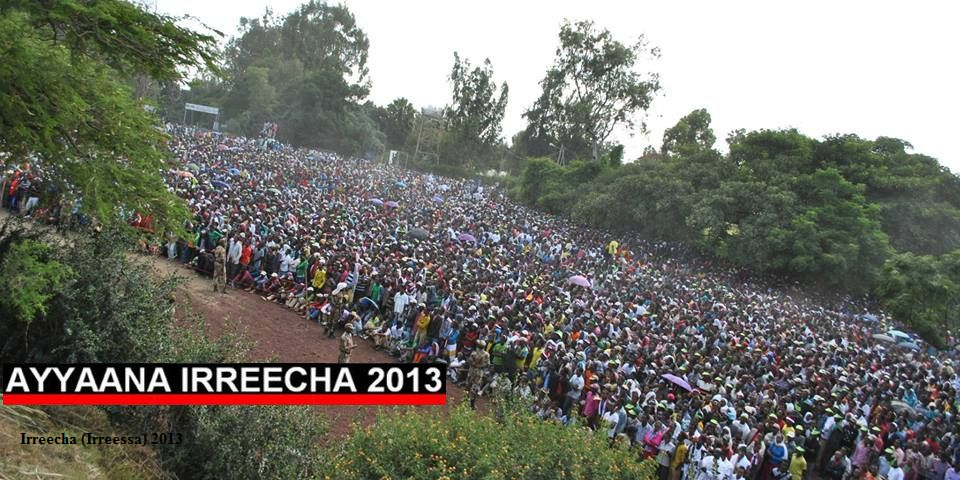
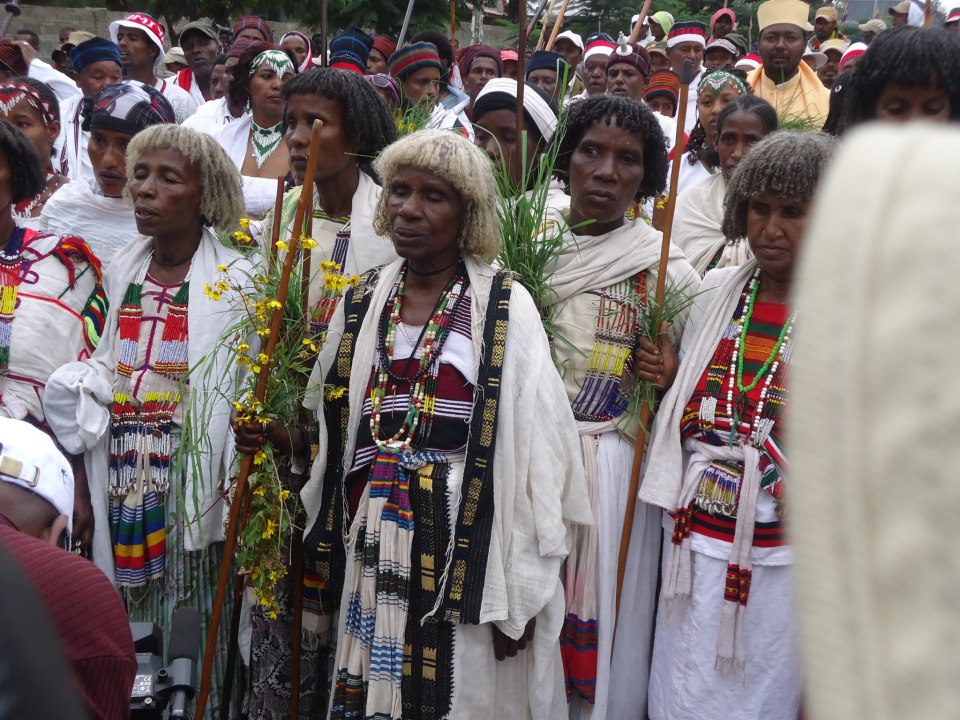
Oromo culture from ancient to present, Irrechaa time
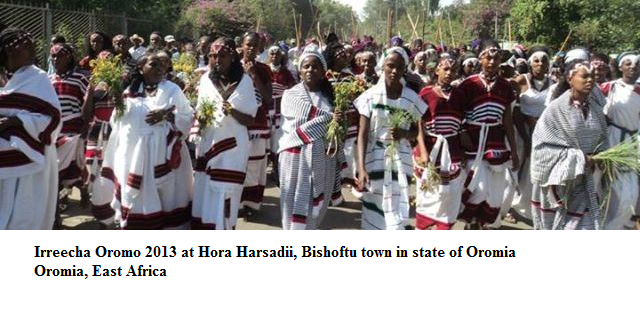

Baga ganna nagaan baatanii booqaa birraa argitan. Good that the rainy season is over for you and that you came to see the spot of the sunny flowering season. The expression signifies the end of one season and the beginning of another season, which incidentally is the beginning of a new year according to Oromo time reckoning. This is not the only expression in Irreecha festival as the event is characterized by vast and varieties of expressions, stories and sequences of cultural displays. Irreecha is the biggest and very beautiful public displays of ancient culture that Africa has performed and continue to perform. Holding the green grass and yellow flower (umama), it is the celebration of the season of blessing and love Oromians experience as Thanksgivings to God (Waaqa) the creator (Uumaa).
Irreecha celebration at Malkaa Ateetee, Burayyuu, Oromia, 6th October 2013
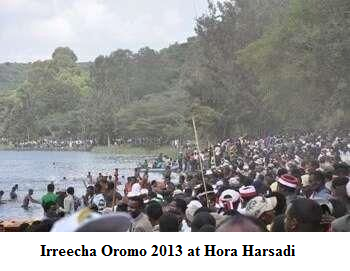
Irreecha is one of the most colorful and beautiful Oromo national cultural events that has been celebrated through out since the last week of August and the entire September and also in October in Oromia and globally where Oromians have been residing (Africa, Australia, Europe and North America). The main Irreecha day was celebrated at Lake Hora Harsadii, Bishoftu, Central Oromia, nearer to the capital Finfinnee on 29th September 2013. According to local news sources from Bishoftuu, over 3 million people attended this year’s Irreecha Malka celebration at Hora Harsadii. “Traditionally, the Oromo practiced Irreecha ritual as a thanksgiving celebration twice a year (in autumn and spring) to praise Waaqa (God) for peace, health, fertility and abundance they were given with regards to the people, livestock, harvest and the entire Oromo land. Irreecha is celebrated as a sign of reciprocating Waaqa in the form of providing praise for what they got in the past, and is also a forum ofprayer for the future. In such rituals, the Oromo gather in places with symbolic meanings, such as hilltops, river side and shades of big sacred trees. …These physical landscapes are chosen for their representations in the Oromo worldview, for example, green is symbolized with fertility, peace, abundance and rain. In Oromia, the core center of Irreecha celebration has been around Hora Arsadi in Bishoftu town, some 25kms to the south of Finfinne, the capital city. Annually, particularly during the Irreecha birraa (the Autumn Irreecha) in September or October, the Oromo from different parts of the country come together and celebrate the ritual. In the past few decades, Irreecha celebrations have been expanded both in content as well as geographical and demographic representations. This short commentary deals with such historical trajectories by contextualizing the changes within political discourses in Ethiopia vis-à-vis Oromo nationalism.”http://gadaa.com/oduu/21320/2013/08/24/irreecha-from-thanksgiving-ritual-to-strong-symbol-of-oromo-identity/ ”
http://gadaa.com/Irreechaa.html
Aadaa fi Duudhaa sirna Waaqeffannaa keessaa inni tokko Ayyaana irreeffannaa ykn irreechati. Sirni Duudhaa irreechaa gosa hedduutti qoodama. Kunis, Irreessa Malkaa, Irreessa Tulluu, Irreessa Galmaa / Gimbii, Irreessa Ujubaa, Irreessa Dakkii, Irreessa Jilaa fi Irreessa Eebbaa ykn Galataa fi kkf. Akkaa fi akkaataan irreeffannaas akkuma sirna isaatti addaa adda. Ammatti kan bal’inaan irraa dubbannu Irreecha yeroo ammaatti biyya keessaa fi alatti beekamee fi kabajamaa jiru, Irreecha Malkaati. Irreechi Malkaa kan kabajamu, ganni yeroon rakkinaa fi dukkanaa dabree birraan yeroo bari’u, sirni Gubaa erga raawwatee booda, ummanni gamtaan Malkaa bu’uun irreeffatee Waaqa galateeffata. Ammaaf Irreecha Malkaa isa biyya keessaa fi alatti bal’inaan beekamaa fi kabajamaa jiru irraa hanga tokko waa addeessuu yaalla. Ayyaanni irreechaa osoo hin gahiin dura waanti raawwataman hedduutu jiran. Kunis seera yayyaba shananii hordofuudhan torban shan dura eegala jechuudha. Ji’a hagayyaa torban sadaffaa keessa birraan bari’uu ykn seenuu isaa kan ibsu, sirna Muka ( korma) dhaabaa kan jedhamutu raawwata. Bakki mukti dhaabaa kun dhaabatu Mijirii jedhama. Mijiriin kun bakka Gubaan itti gubamu ykn bakka ayyaanni ibsaa gubaa raawwatudha. Mukti dhaabbatu 9 ykn 5 ta’an. Kunis hiika mataa ofii qaba. Guyyaa muka dhaabaa irraa eegalee hanga gaafa Gubaatti torban torbaniin waanti godhamu ni jira. Gaafa torban shanaffaa ykn Fulbaana ji’aa dhumaa yeroo ta’u sirna Gubaatu raawwata. Masqala jechuudha. Ayyaana masqalaa kana warri amantii Ortodoksii gara amantii isaaniitti harkisuuf haa yaalan malee gochaa fi seenaan wanti isaan deeggaru hin jiru. aadaa Oromoo fudhatan. Guyyaa gubaa kana ollaan maatii waliin walitti dhufee bakka Mijirii sanatti erga ibsaa gubee dhibaafatee, eebbifateen booda dubartoonni Qunnii (Ingiccaa) guban, dargaggoonni sirba ” Hiyyooko ykn Ya habaab yaa daree ko” jedhamu sirbaa ollaarra naannawanii kennaa fudhatan. Torban isaatti ammoo sirna Ayyaana Irreechaatu raawwata. Gubaan kan dhuunfaa fi ollaati. Irreechi ammoo ayyaana ummanni gamtaan Malkaa bu’ee, dukkana gannaa keessaa gara Booqaa Birraatti nagaan cehuu isaaf kan galateeffatu Guyyaa Galatoo ( Thanksgivings day) jechuudha. Sirni gamtaan Irreeffannaa kun osoo dhiibbaa amantii fi sirna bulchiinsa alagaatiin hin dhorkamiin dura Oromoon naannoo qubatee jiru maratti ni irreeffata ture. Keessumattuu bara mootummaa Dargii sana aadaa ” duubatti hafaa” jedhamee Galma Qaalluu gubuu fi waan Oromoon aadaadhaan raawwatu mara dhorkuun dhabamsiisuuf yaalan. Sababa kanaa fi babal’ina amantii Isilaamaa fi Protestantiin walqabatee bakka hedduutti sirni irreeffannaa fi amantiin Waaqeffannaa ni dhorkame. Dhiibbaa kana irraa damdamtee kan hafe keessaa tokko Ayyaana Irreechaa Hora Arsadii Magaalaa Bishooftuutti kabajamudha. Ayyaanni Irreecha Hora Arsadee qindoominaa fi hirmaannaa ummata bal’aan kabajamuu kan eegale bara 1997 irraa kaaseetu. Isa dura ummatuma naannoo sanaa fi keessattuu warra aadaa Waaqeffannaa hordofaniin ture. Bara 1997 keessa koreen tokko maqaa Guddinaa fi Dagaagina Aadaa Oromoo jedhuun WMT jalatti ijaaramtee Ayyaana Irreecha Bishooftuu kana ummata beeksisuu, barsiisuu fi qindoominaan guyyaa ayyaana kanaa bakka sanatti argamuun qalbii namaa harkisuu jalqabde. Ergasii waggaa waggaan achitti argamuun barumsaa fi dammaqiinsa kennameen sadarkaa har’a ummanni kumaa fi kitilaan kan herreegamu irratti argamee kabaju irraan gahe. Kana malees Oromiyaa gara dhihaatti bakka hedduutti akka kabajamuu fi babal’atuuf karaa saaqe. Baroota hedduu dura jalqabee ammoo biyya alatti walduraa duubaan, USA, Germany, Norway, Canada, Australia, Keenya, Uganda fi Ertriatti kabajamuu jalqabe. Guddinni fi babal’inni kabajaa Ayyaana Irreechaa kun qaama duula Oromoon Aadaa, Eenyumaa fi Oromummaa isaa guddisuuf gochaa jiru keessaa isa tokkoo fi guddicha ta’uu mal’isa. Fuula durallee daran akka guddatuu fi babal’atu Waaqa wajjin abdii qabna.Kabajaa ayyaana irreechaa biyya keessaa fi alatti raawwate ilaalchisee kanaan dura marsaa adda addaatti bahaa turuun ni yaadatama. Dabalataan yaadachiisuu fi bal’inaan kan hin gabaafamiin dabalatee akka armaan gadiitti kan biyyaa keessaa fi biyya alaa bakka adda addaatti kabajamaa ture laalla.”http://waaqeffannaa.org/irreecha/


http://oromoassociationvic.org/2013/10/03/oromians-seek-blessings-and-love-at-annual-oromo-festival/

Irreecha Oromo 2013 Celebration, in Sydney, Australia

Irreecha Oromo, event in London, 12 October 2013
Gubaa fi Irreecha @Galma Calalaqii, Miidaaqenyii

Related references:
https://oromianeconomist.wordpress.com/?s=twisted&searchbutton=go%21
Oromo: The Kushitic People of Africa

| ErechaThe story of Erecha – the celebration of the first harvest of the Ethiopian Spring in September – is a story better told by who else but the late Poet Laureate himself, Blattten Geta Tsegaye G/Medhin.
“….12,000 years ago, ASRA the God of sun and sky of KUSH PHARAOH begotten SETE, the older son ORA the younger of the first and daughter named as ASIS (ATETORADBAR). The older SETE killed his younger brother ORA, and ASIS (ATET OR ADBAR) planted a tree (ODA) for the memorial of her deceased brother ORA at the bank of Nile, Egypt where the murder had taken place, and requested her father who was the god of Sun to make peace among the families of SETE and ORA. Them rain was come and the tree (ODA) got grown. It symbolizes that taken place. Later, at the Stone Age, the tree that had been planted for the memorial of the killed, ORA was substituted by statue of stone that was erected 8000 years ago. This festival has been celebrated in September of every year and when Nile is flow full in NUBLA and BLACK EGYPT. In Ethiopia during the AXUMITE and PRE-AXUMITE period a great festival has been held around the sun’s statue that planted by ASIS (ATET OR ADBAR) the sister of ORA for the memorial of the later, ORA the son of god of sun, who waked up from death (ORA OMO or OR OMO) for the purpost of celebrating the peace made between the two brothers, the great herald, in thanking the good of sun and the sky with CHIBO. Then EYO KA ABEBAYE (the traditional and popular song performed at DEMERA events and new year in Ethiopia) has been started being performed since then. “KA” is the first name of God. The name of God that our KUSH Fathers have inherited to us before the old period, Christianity, and Islam is “KA”. Since then, therefore, especially the OROMO, GURAGIE and the SOUTHERN people of Ethiopia have been calling God as “WAKA or WAQA”. “or WAQA”. WAKA” or WAQA” God When we song EYOKA or EYOHA in New Year, we are praising “KA” of God. “GEDA” or KA ADA” is the law or rule of God. “GEDA” (KA ADA) is the festival by which the laws and orders of God are executed Japan, China, and India are now reached to the current civilization through making the basic traditions and cultures they received from their forefathers (HINDU, SHINTO and MAHIBERATA) be kept and receiving Islam, Christianity, and others especially Democracy and free believes. They are not here through undermining the culture and tradition of their forefathers. Culture is the collection of many CHIBOs or DEMERA. “ERCHA” or “ERESA” one of the part and parcel of GEDA (KA ADA) system is the comer stone and turning point to the new year for which ASIS (ATET OR ADBAR) has put up the dead body of her brother, ORA who was killed by his older brother like ABEL from the place he died at the river bank of NILE on and planted statue“. The Oromo people of beautiful Ethiopia believe in one God since time memorial. Their religion is called “WAKEFENA” which means believing in one God that is the creator of the whole universe. ERECHA means a celebration where people get together and perform their prayers and thanking God. WAKEFENA, the faith being in the GEDA SYSTEM is a religions ceremony that is free from any thing. The fathers of Oromo religion and the people, keeping fresh grass and flowers, perform their prayers and thank their God going to mountains, the sea or a river bank. They move to the top of mountains or bank of seas or rivers not to worship the mountains or rivers and seas; rather to distract themselves from any noise and to worship their God (WAQA) with concentration. And they go to sea and rivers because they believe that green is holy and peaceful where the spirit of God is found. In the Oromo culture, the rainy season is considered as the symbol of darkness. At the beginning of September, the darkness is gone, rivers run shallower and cleaner, and the mud is gone. As sunshine rules the land, the OROMO people of Ethiopia go out to celebrate this great natural cycle with the spirit of worshiping God (WAQA). |
http://www.ethiopians.com/photoessay/Photo_Essay_Eretcha_06.htm
Copyright © Oromianeconomist 2013 and Oromia Quarterly 1997-2013. All rights reserved. Disclaimer.
Oromia of Dhaqabo Ebba: The Cradle of Mankind Is Also A Home of The Oldest Living person Known to Humanity September 10, 2013
Posted by OromianEconomist in Africa, Dhaqaba Ebba, Gadaa System, Humanity and Social Civilization, Oral Historian, Oromia, Oromo, The Oldest Living Person Known to Mankind, The Oromo Library, Uncategorized, Wisdom.Tags: Afaan Oromo, Africa, African history, African Philosphy, Dhaqba Ebba, Ebbaa, Finfinnee, Gadaa, Gadaa System, Obbo dhaqabaa Ebbaa, Oldest Living Person, Oldest people, Oldest person, Oral History, Oromia, Oromia Region, Oromiya, Oromiyaa, Oromo Calendar, Oromo elder, oromo farmer, Oromo History, Oromo people, The Oldest Living Person, Time in Gadaa
5 comments


Dahqabo Ebba, Oromo elder, who is over 160 years is the oldest living person known to humanity.
He is a resident of Dodola town, Oromia.
http://www.unpo.org/article/16351
OTV (Oromiyaa TV)
In interviews conducted in his native language Afaan Oromo Obbo Dhaqabo Ebba counts his age based on Oromo Gadaa system calendar. According to traditional Oromo Gadaa system every member of the society goes through the Gadaa time grade. Obbo Dhaqabo Ebba has lived 4 Gadaa cycles. one Gadaa cycle has 5 stages. One stage is for 8 years. One Gadaa cycle is 40 years, (8*5). Obbo Dhaqabo has already completed 4 Gadaa cycles (4*40) which are 160 years. He involved in the Gadaa system in its full functioning time in all its structures and development stages from Dabballe to Jaarsa. He still living after the 4 cycles means he is actually over 160 years. The Journalist of Oromiyaa TV did not yet ask him how many years since his last 4 Gadaa cycles was completed. Gadaa ways of timing is exact to know own birth years and historical events. In his fascinating life that has touched 3 centuries (from middle 19th century to the present 2nd decades of 21st century which has been over 160 years he remembers all major political, social, economic and environmental events and changes. He remembers from a time when the Ethiopian empire still expanded south to Oromia such as 1880’s the time the Abyssinian Menelik start to occupy the Oromo capital Finfinnee (Abyssinians named it Addis Ababa). At this event and the time of first Italian invasion he used to travel to Finfinnee (Addis Ababa) for his livestock trading. He mentioned that he engaged in farming (crops and livestock) but also in commerce. it took eight days on horseback to cover the 150 miles between his village and Finfinnee (Addis Ababa). In 1895 ( at the time of Italian invasion) he was already a married person of two wives and his first son ( over 100 years old with him at interview) was a young boy and able person to look after his livestock. “When Italy invaded the country, I had two wives and my son was old enough to herd cattle,” he said, referring to Italy’s 1895 invasion of his country. “Not even one of my peers is alive today.” He knows and remembers by naming all Abyssinian rulers, Menelik to present who have been in Oromia (Oromo land) since the occupation of Finfinnee in 1880’s.
Mohammed Ademo of Opride said. “Given that the Oromo like many African cultures are an oral society, ‘each time an elder dies, a library is lost.’ Ebba’s is one such library from which much can still be preserved.”
http://www.voaafaanoromoo.com/content/article/1756208.html
As elaborated in the works of “Oromia: an Introduction,” by Gadaa Melbaa ( book published in Khartoum, 1988), the following is a brief description of how the Gadaa system works and the gadaa Grades: “There are two well-defined ways of classifying male members of the society, that is the hiriyya (members of an age-set all born within the period of one Gadaarule of eight years) and Gadaa grade. The Gadaa grades (stages of development through which a Gadaa class passes) differ in number (7-11) and name in different parts of Oromia although the functions are the same.”
The Gadaa grades:-
1. Dabballee (0-8 years of age)
2. Folle or Gamme Titiqaa (8-16 years of age)
3. Qondaala or Gamme Gurgudaa (16-24 years of age)
4. Kuusa (24-32 years of age)
5. Raaba Doorii (32-40 years of age)
6. Gadaa (40-48 years of age)
7. Yuba I (48-56 years of age)
8. Yuba II (56-64 years of age)
9. Yuba III (64-72 years of age)
10. Gadamojjii (72-80 years of age)
11. Jaarsa (80 and above years of age)

http://www.unpo.org/article/16351
http://now.msn.com/dhaqabo-ebba-ethiopian-farmer-is-160-years-old-reporter-claims
Copyright © Oromianeconomist 2013 and Oromia Quarterly 1997-2013. All rights reserved. Disclaimer.
Related articles
- Ethiopian peasant claims to be ‘160-year-old’ (sudantribune.com)
- Oromo farmer from Ethiopia may be the oldest living person (hornaffairs.wordpress.com)
- Reporter Claims Ethiopian Farmer Oldest Man Alive at 160 Years Old (atlantablackstar.com)
- The Oldest Living Person Ever Found in Ethiopia… Aged 160 (muzicupdate.wordpress.com)
- Ethiopian Farmer ‘At Least 160 Years Old,’ Reporter Estimates: Dhaqo Ebba Could Be The World’s Oldest Person (medicaldaily.com)
- The Oldest Living Person Ever Found in Ethiopia (naijaoddstories.wordpress.com)
- Ethiopian Farmer Could Be 160 Years Old, Oldest Man Alive (news.softpedia.com)
- Dhaqqaboo Eebbaa:The Oldest Man,160 Years, from Oromia attracts world media. (advocacy4oromia.org)
- Ethiopian farmer dubbed ‘world’s oldest living man’ after claiming he is 160 years old and has clear memories of Italy invading his country in 1895 (dailymail.co.uk)
- Ethiopian farmer dubbed ‘world’s oldest living man’ after claiming he is 160 years old and has clear memories of Italy invading his country in 1895 (thisismoney.co.uk)
The Unravelling of a Colonized Mind by Jana-Rae Yerxa March 24, 2013
Posted by OromianEconomist in Africa, Colonizing Structure, Development, Humanity and Social Civilization, Ideas, Irreecha, Kemetic Ancient African Culture, Knowledge and the Colonizing Structure., Knowledge and the Colonizing Structure. Africa Heritage. The Genocide Against Oromo Nation, Knowledge and the Colonizing Structure. African Heritage. The Genocide Against Oromo Nation, Oromia, Oromiyaa, Oromo, Oromo Culture, Oromo First, Oromo Identity, Oromo Nation, Oromo the Largest Nation of Africa. Human Rights violations and Genocide against the Oromo people in Ethiopia, Oromummaa, Qubee Afaan Oromo, Self determination, Sirna Gadaa, Slavery, Uncategorized.Tags: Anishinaabe, Colonialism, Colony, Couchiching First Nation, Human rights violations, Little Eagle, Oromia, Oromia Region, Oromiyaa, Oromo, Oromo culture, Oromo First, Oromo people, Oromummaa, Self determination, Social work, Sub-Saharan Africa, Tyranny, Universal Declaration of Human Rights, University of Victoria
1 comment so far
The Unravelling of a Colonized Mind by Jana-Rae Yerxa.
Sure everybody struggles. But to be born an Indigenous person, you are born into struggle. My struggle. Your struggle. Our struggle. The colonial struggle. There are many layers to this struggle. For the longest time, I didn’t even know what the true struggle was about yet I couldn’t escape it. It consumed me. Colonialism, as I have been forced to discover, is like a cancer. But instead of the cells in your body betraying itself, the thoughts in your mind work against you and eat you up from the inside out. You’re like the walking dead and you don’t even know it because you are so blinded. You can’t see the truth.
Here are some of the perverted ways colonialism infects the mind:
• With a colonized mind, I hate being Indian.
• With a colonized mind, I accept that I am Indian because that’s who the colonizer told me I am.
• With a colonized mind, I don’t understand that I am Anishinaabe.
• With a colonized mind, I believe I am inferior to the white race.
• With a colonized mind, I wish I was white.
• With a colonized mind, I draw pictures of my family with peach coloured skin, blonde hair and blue eyes because I’ve internalized that this is the ideal, what looks good and what is beautiful.
• With a colonized mind, I keep my feelings of inferiority to white people a secret from others and even from myself.
• With a colonized mind, I try diligently to mirror white people as closely as I possibly can.
• With a colonized mind, I desperately want to be accepted by white people.
• With a colonized mind, to gain the acceptance of white people, I will detach myself from all that does not mirror acceptable “white” standards, whether it is how one dresses, one speaks, or one looks.
• With a colonized mind, I feel as though I am swearing when I say “white people” in front of white people.
• With a colonized mind, I believe there is no racism.
• With a colonized mind, I believe that racism does not impact me.
• With a colonized mind, I deny my heritage and proudly say, “We are all just people.”
• With a colonized mind, when discussing issues pertaining to race, I try desperately not to offend white people.
• With a colonized mind, I do not know who I am.
• With a colonized mind, I believe I know who I am and do not understand that this isn’t so because I’ve become the distorted image of who the colonizer wants me to be and remain unaware of this reality.
• With a colonized mind, I could care less about history and think that our history don’t matter.
• With a colonized mind, I do not understand how the history created the present.
• With a colonized mind, I do not see how I have been brainwashed to be an active participant in my own dehumanization and the dehumanization of my people.
• With a colonized mind, I do not recognize how others dehumanize me and my people.
• With a colonized mind, I devalue the ways of my people- their ways of seeing, their ways of knowing, their ways of living, their ways of being.
• With a colonized mind, I cannot speak the language of my ancestors and do not care that this is so.
• With a colonized mind, I am unaware of how colonization has impacted my ancestors, my community, my family, and myself.
• With a colonized mind, I think that my people are a bunch of lazy, drunk, stupid Indians.
• With a colonized mind, I discredit my own people.
• With a colonized mind, I think that I am better than ‘those Indians’.
• With a colonized mind, I will silently watch my people be victimized.
• With a colonized mind, I will victimize my own people.
• With a colonized mind, I will defend those that perpetrate against my people.
• With a colonized mind, I will hide behind false notions of tradition entrenched with Euro-western shame and shame my own people re-creating more barriers amongst us.
• With a colonized mind, I tolerate our women being raped and beaten.
• With a colonized mind, I tolerate our children being raised without their fathers.
• With a colonized mind, I feel threatened when someone else, who is Anishinaabe, achieves something great because I feel jealous and wish it was me.
• With a colonized mind, when I see an Anishinaabe person working towards bettering their life, because my of my own insecurities, I accuse them of thinking they are ‘so good now’.
• With a colonized mind, I am unaware that I was set up to hate myself.
• With a colonized mind, I do not think critically about the world.
• With a colonized mind, I believe in merit and do not recognize unearned colonial privilege.
• With a colonized mind, I ignorantly believe that my ways of seeing, living and believing were all decided by me when in reality everything was and is decided for me.
• With a colonized mind, I am lost.
• With a colonized mind, I do not care about the land.
• With a colonized mind, I believe that freedom is a gift that can be bestowed upon me by the colonizer.
• With a colonized mind, I believe that I am powerless and act accordingly.
• With a colonized mind, I do not have a true, authentic voice.
• With a colonized mind, I live defeat.
• With a colonized mind, I will remain a victim of history.
• With a colonized mind, I will pass self-hatred on to my children.
• With a colonized mind, I do not understand the term “self-responsibility.”
• With a colonized mind, I do not recognize that I have choice and do not have to fatalistically accept oppressive, colonial realities.
• With a colonized mind, I do not see that I am a person of worth.
• With a colonized mind, I do not know I am powerful.
The colonial struggle, as I said earlier, has many layers. I am no longer being eaten from the inside. Yet it is no less painful. What is different today is that I am connected to a true source of power that was always there. It’s like my friend once said, “I come from a distinguished people whose legacy shines on me like the sun.” I now understand this and it is because of this understanding that my mind and my soul are freer than they have ever been. It is because of that gift- that awakening which came through struggle- that I will proudly continue to struggle for freedom. My freedom. Your freedom. Our freedom.
Jana-Rae Yerxa, is Anishinaabe from Little Eagle and Couchiching First Nation and belongs to the Sturgeon clan. Activist. Social Worker. Former professor. Current student. She is committed to furthering her understanding of Anishinaabe identity and resurgence as well as deconstructing Indigenous/settler relations in the contexts of colonization and decolonization. Jana-Rae is currently enrolled in the Indigenous Governance Program at University of Victoria.
http://lateralloveaustralia.com/2013/03/14/the-unravelling-of-a-colonized-mind-by-jana-rae-yerxa/
Copyright © Oromianeconomist 2014 and Oromia Quarterly 1997-2014. All rights reserved. Disclaimer.
Related articles
- The Unravelling of a Colonized Mind by Jana-Rae Yerxa (lateralloveaustralia.com)
- Colonization And Apartheid (deliberation.info)
- When Things Fall Apart (connexicon.wordpress.com)
- Op Ed: Anti Violence Against Indigenous Women and Resurgence (blackcoffeepoet.com)
Gadaa Oromo Democracy: Three Approaches to the Study of African Society September 27, 2012
Posted by OromianEconomist in Africa, Ancient African Direct Democracy, Culture, Finfinnee, Gadaa System, Humanity and Social Civilization, Irreecha, Kemetic Ancient African Culture, Oromo, Oromo Culture, Oromo First, Oromo Identity, Oromo Nation, Oromo Social System, Oromummaa, Self determination, Sirna Gadaa, State of Oromia, The Oromo Democratic system, The Oromo Governance System, Uncategorized.Tags: Africa, African culture, African Studies, Ancient African Direct Democracy, Ancient Black People, Ancient Egyptian people, Democracy, Economic and Social Freedom, From, Gadaa System, Governance issues, Horn of Africa, Kemet, Kushitic people, National Self Determination, Oromia, Oromiyaa, Oromo, Oromo culture, Oromo people, Oromummaa, Politics, Siqqee, Siqqee Oromo Women Institution, Sirna Gadaa, Social Sciences, State and Development, Sub-Saharan Africa, United Nations, Universal Declaration of Human Rights, World Bank
3 comments
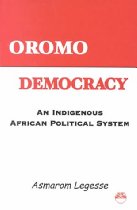
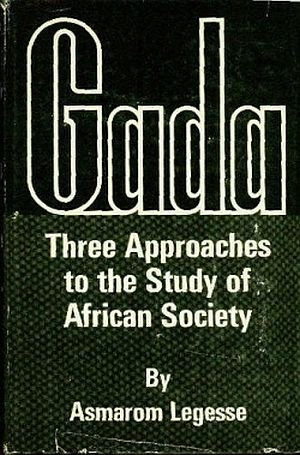
These closely related books reveal the many creative solutions an African society found for problems that people encounter when they try to establish a democratic system of governing their affairs. In much of what has been written about Africa, the common image is that of people governed by primitive customs and practices, in which only feudal roles of elders, kings, chiefs, sultans, and emirs have been acknowledged by Western observers. Little is ever shown of indigenous African democratic systems, under which there is distribution of authority and responsibility across various strata of society, and where warriors are subordinated to deliberative assemblies, customary laws are revised periodically by a national convention, and elected leaders are limited to a single eight-year terms of office and subjected to public review in the middle of their term. All these ideals and more are enshrined in the five-century old constitution of the Oromo of Ethiopia, which is the subject matter of these books.
In these books, Legesse brings into sharp focus the polycephalous or “multi-headed” system of government of the Oromo, which is based on clearly defined division of labor and checks and balances between different institutions. Revealing the inherent dynamism and sophistication of this indigenous African political system, Legasse also shows in clear and lucid language that the system has had a long and distinguished history, during which the institutions changed by deliberate legislation, and evolved and adapted with time.’ Amazon Books &
Related articles
Introduction
http://oromopress.blogspot.co.uk/2011/12/review-of-oromo-democracy-indigenous.html?m=1
http://www.readperiodicals.com/201203/2672718591.html
- Gadaa: An Oromo Democracy and the Symbol of Oromo Civilization (odaakoo.wordpress.com)
- Contours of the Emergent & Ancient Oromo Nation (oromianeconomist.wordpress.com)
- http://www.iwmi.cgiar.org/publications/CABI_Publications/CA_CABI_Series/Community_Law/protected/Ch%2009.pdf
- Oromia of Dhaqabo Ebba: The Cradle of Mankind Is Also A Home of The Oldest Living person On Earth (oromianeconomist.wordpress.com)
Copyright © Oromianeconomist 2012 and Oromia Quarterly 1997-2012. All rights reserved. Disclaimer.


 Oromian Economist
You must be logged in to post a comment.