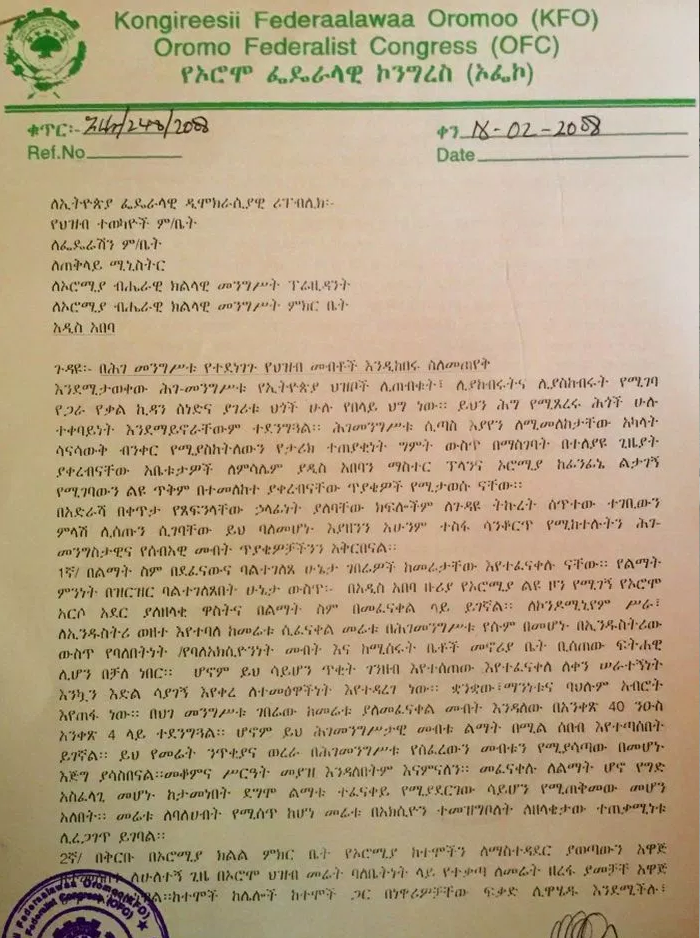
Oromia (Buraayyuu): OFC Urges Ethiopian Govt to Stop the Master Plan of Eviction Against Oromo Farmers, and to Respect Constitutional Rights of the People: OFC Also Calls for Public Meeting in Burraayyuu on Sunday, Nov. 8, 2015: Kongirasiin Federaalaawaa Oromoo (KFO), dhimmaa Maastar Pilaani irratti mari’achiisuuf Sanbata Guddaa (Dilbata) as deemuu ( Sadaasa 8 bara 2015) Magaalaa Burraayyutti walgahii ummataa waamee jira. November 5, 2015
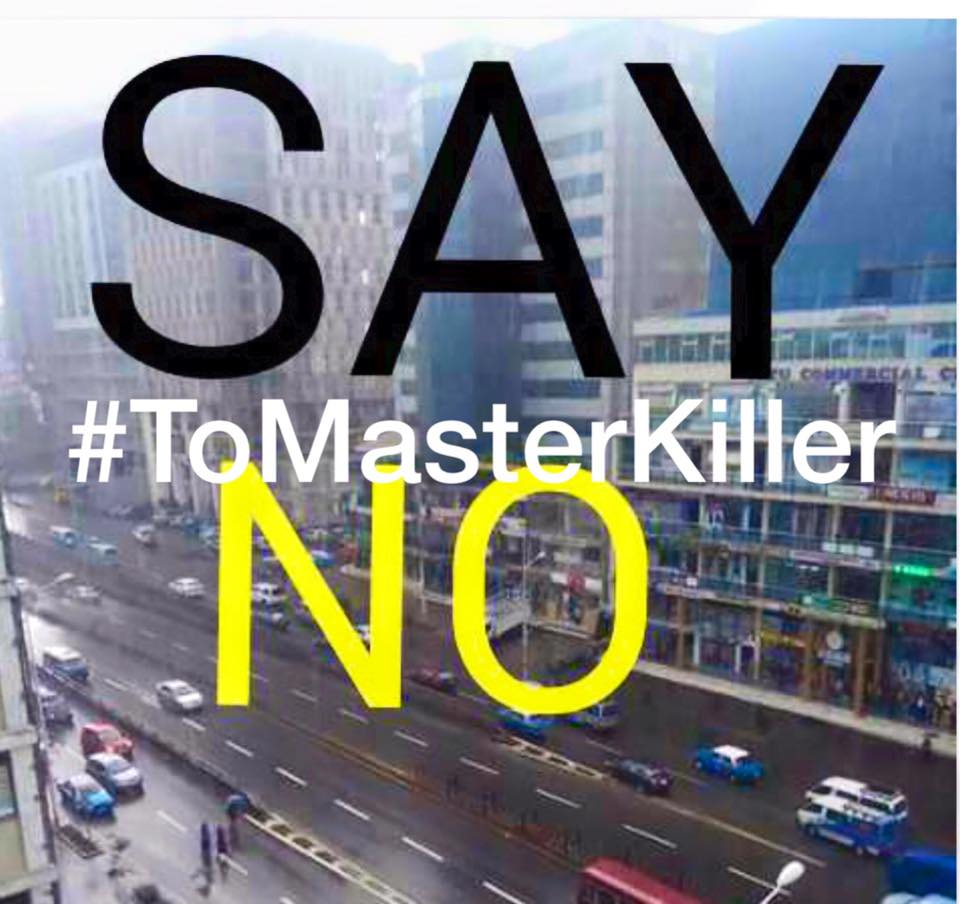
Posted by OromianEconomist in Uncategorized.Tags: #OromoProtests, dhimmaa Maastar Pilaani irratti mari'achiisuuf sanbata guddaa as deemuu ( Saadasa 8 bara 2015) Magaalaa Burraayyutti walgahii ummataa waamee jira., Kongirasiin Federaalaawaa Oromoo (KFO, Master Plan is Master Killer, Nov. 8, OFC Urges Ethiopian Govt to Stop the Master Plan of Eviction Against Oromo Farmers, Oromia (Finfinnee): The public meeting convened by Oromo Federalist Congress (OFC) in Finfinnee, SAY NO
add a comment

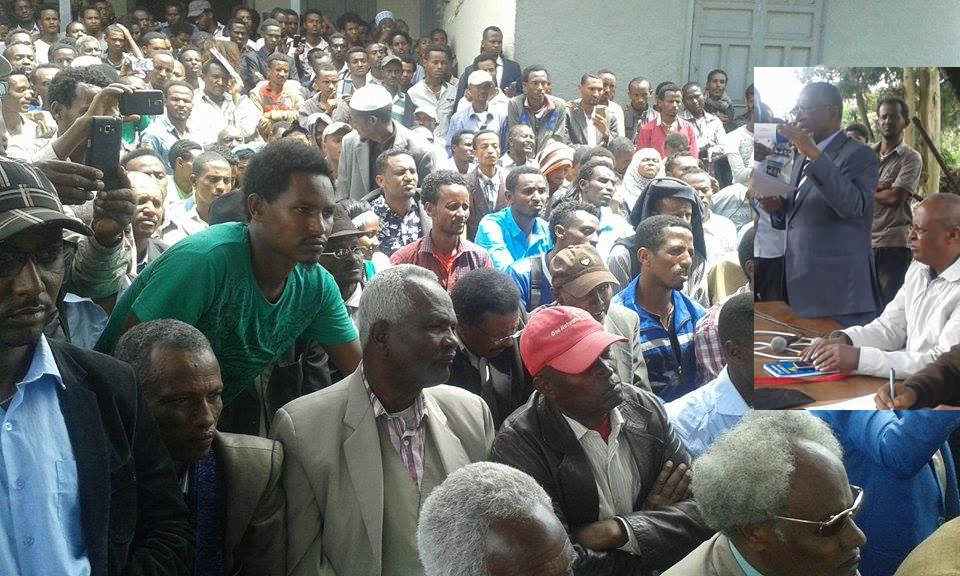
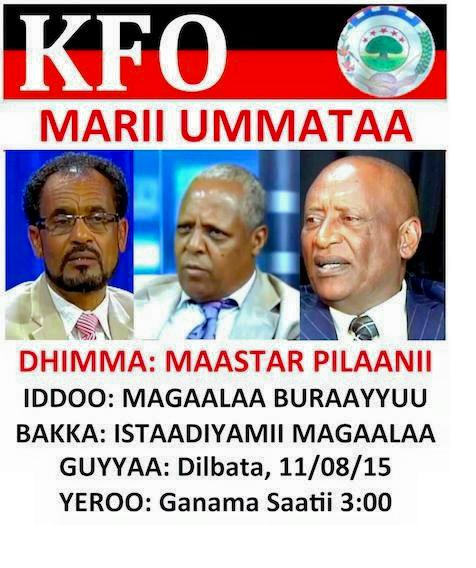
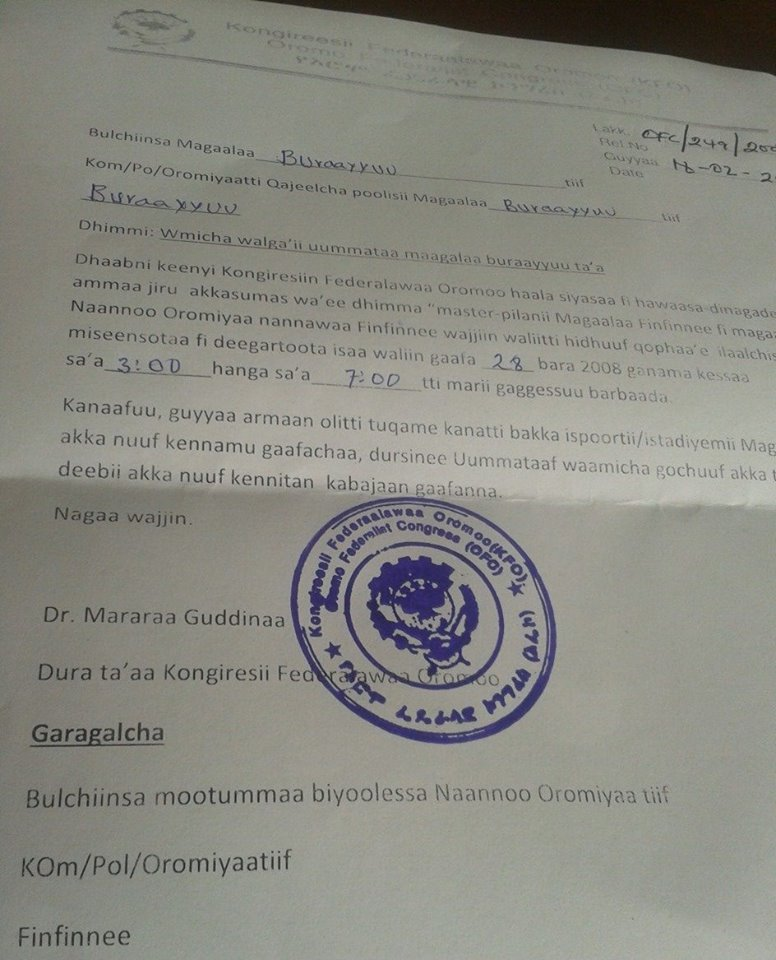
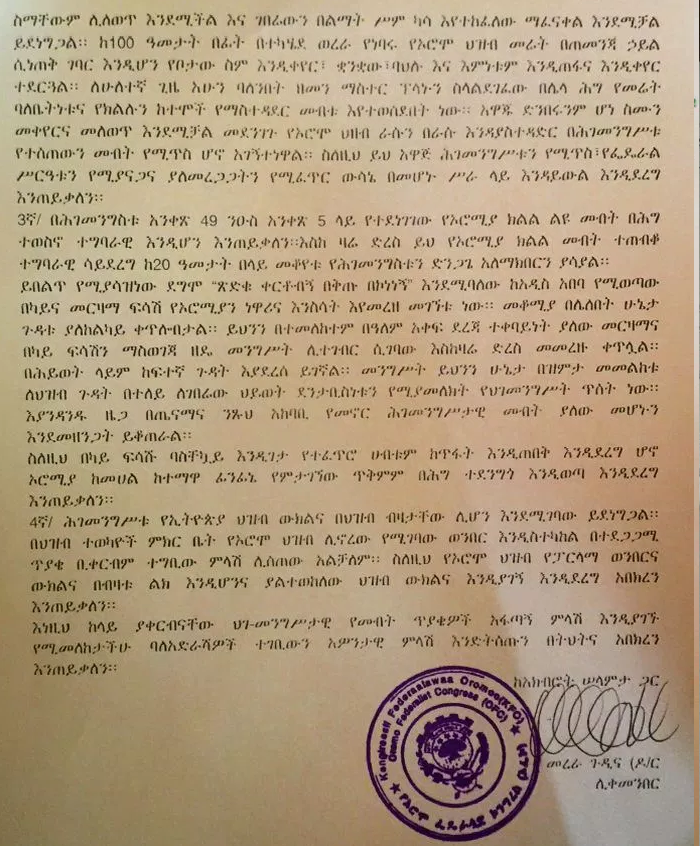
The Oromo Federalist Congress (OFC) has written a letter to the various organs of the Ethiopian government – urging the government to stop the genocidal Finfinnee (Addis Ababa) Master Plan, whose goal is to evict millions of Oromo farmers from their ancestral land in the name of ‘development’ around the city of Finfinne; in the same letter, OFC has also urged the Ethiopian government to respect the constitutional rights of the people, especially Article-49 of the Constitution – which deals with the special interests of the State of Oromia over Finfinnee.
OFC will also hold a public meeting in Burraayyuu town in Oromia at the town’s stadium on Sunday, 8th November 2015 – from 9am to 1pm to discuss with the public about the genocidal Finfinnee (Addis Ababa) Master Plan.
VOA: Maqaa Maastar Pilaaniin Eenyummaa Uummata Oromoo Dhabamsiisuun Haa Dhaabatu Jedhu Momitoonni
OFC PUBLIC DISCUSSION
ON FINFINNEE MASTER PLAN
PLACE: BURAAYYUU, OROMIA
VENUE: CITY STADIUM
DATE: Sunday, 8th November 2015
TIME: 9:00 am
Paartiin Kongirasii Federaalawaa Oromoo, dhimma Maastar Pilaanii Finfinnee ilaalchisee, torban dhufu magaalaa Burraayyutti, marii ummataa geggeessuuf qophaayaa akka jiru beeksisee jira.
================================
Paartiin Kongirasii Federaalawaa Oromoo, dhimma maastar Pilaanii finfinnee ilaalchisee, Hawaasa magaalaa Burraayyuu fi naananwa ishii waliin marii taasisuuf qophaahaa kan jiru yoo ta’u, mariin kunis, Sadaasa 7 bara 2015 tti akka ta’e ibsamee jira.
Marii kanarratti namoonni hundi qoodarraa fudhachuu akka qabanis waamich darbeera.
Karoorri Mastar pilaanii Finfinnee mootummaan hujii irra oolfachuuf karoorfatee jiru kun, magaalota 37 fi aanaalee 17 kan ufi jalaa qabu yoo ta’u, namoota hedduu, lafa qonnaa isaanii irraa kan buqqisu ta’uulleen himamee jira. Bal’inni lafti pilaanii kanaa kan inni ufi jalatti hammatu, hektaara miiliyoona 1.2 yoo ta’u, lafti kun yoo fudhatame, qotee bultoota naannawa san jiraatan hedduu irrattis dhiibbaa hamaa kan qabudha jedhamaa jira.
“Yaa Oromoo yaa lammi koo
Jabeeffadhu irre Oromiyaan hin ciciramtuu nutuu du’a malee ……….” Dr Mararaa Guddinaa
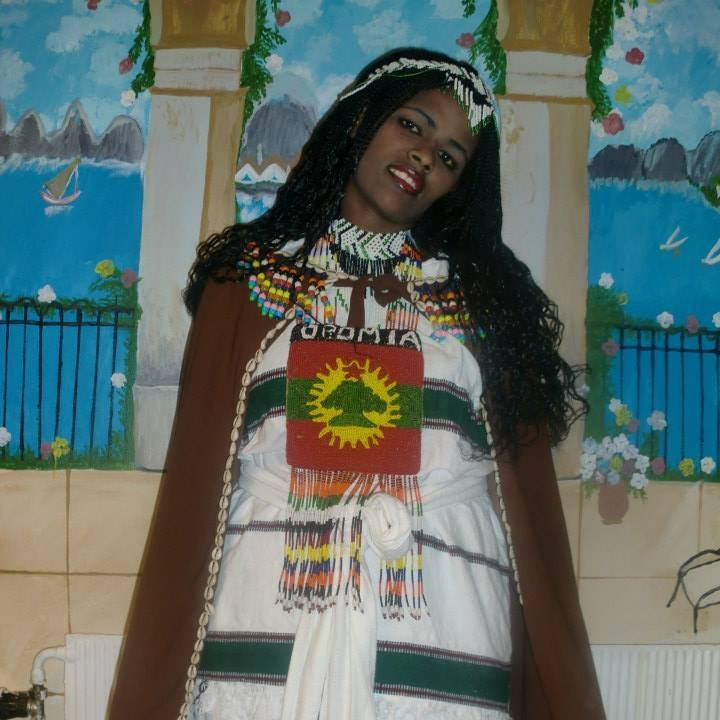
OROMIA: OROMO MUSIC ASAANTII HAJII ´´WAYYAANE´´ October 23, 2015
Posted by OromianEconomist in Uncategorized.Tags: #OromoProtests, Asaantii Hajii Tufaa, Konsertii Bashanana Oromoota Osloo Norway Oct 17, Oromia, Oromo, Oromo music, Oromo music and Oromo identity
add a comment
Finfinnee: A Partnership between France And The World Bank In Gentrification and Inhumane Mission. #Landgrabs. #Oromia #Africa September 20, 2015
Posted by OromianEconomist in No to the Addis Ababa Master Plan, NO to the Evictions of Oromo Nationals from Finfinnee (Central Oromia).Tags: #OromoProtests, Ethiopia: Why the World Bank Should Embrace Human Rights, Genocidal Master Plan, Land and resource rights, land and water grabs in Oromia, Master Plan is Master Killer
1 comment so far

A Partnership between France And The World Bank In Gentrification and Inhumane Mission

ADDIS ABABA, Ethiopia (The Post Post)–France with the help of the World Bank has embarked on missions that destroyed many lives in some African countries. One of those countries in which this duo operates is Ethiopia. Mali, Burkina Faso and Benin are the other victims of the “urbanization for the 21st century,” which mainly advocates building cities around public transportation.
In May 2014, university student protesters of Oromo ethnic origin took to the streets of Ethiopia in opposition to the “Integrated Development Master Plan.” Some student protesters quoted by social media activists dubbed it “a master killer,” because dozens of students and people who protested were gunned down by Ethiopian security forces. Some of them pointed to its “unconstitutionality,” saying it encroaches on Oromia’s land. Ethiopian government security forces effectively silenced the protesters.
However, the real victims of the urbanization projects were the low-income families who lived in Addis Ababa and vicinity. Bekele Feyissa, a farmer in Sebeta, complained to Bloomberg’s reporter in 2014 that he got paid $36 for 1.5 acres of land. Even though the government owns the land, Mr. Feyissa, a father of six has customary rights to the land. He has at least eight people to feed. People like Fayissa are the ones who have gotten the short end of the stick.
It all started with the 1999-2000 urbanization projects. There were multiple moving parts—lender [World Bank Group], contractor [Lyon Town Planning Agency], Addis Ababa city government, French government agencies and German Technical Cooperation Agency (GTZ).
A document detailing the zenith of a 15-year-old mission is buried in the deep web pages of UrbaLyon—The Planning Agency of the Lyon metropolitan area. Coincidentally, “Mission from 19-26 May 2009” is displayed in bold letters under a picture of Addis Ababa on a cloudy day. According to the header, the document was a result of a collaboration of three organizations. They were Addis Ababa City Government, Lyon Town Planning Agency, and Ville de Lyon—city municipal of Lyon—France’s second-largest city after Paris. The page after the agenda for the seven-day mission, splashes a photo of Ethiopian Herald, with a title that reads, “Officials of Ville De Lyon keen to work with Addis.”
Ethiopian Herald’s title was misleading as it implied working with Addis was a new venture. The “technical cooperation” started ten years before, and the May 2009 mission was to transform it into “city to city cooperation.”


In the historical background section, the document emphasizes the cooperation of Addis Ababa city government and the French (Grand Lyon and the French Embassy). It further states the decision by the French to fund the revision of the 2002 master plan was to establish pre-operational project processes, implying they were there to collect the return.
This rich French city also has other contracts with other African cities like Bamako, Ouagadougou, Porto-Novo and Rabat, whose stories are not too far from that of Addis Ababa. Some of those countries were a little generous to their displaced people due to urbanization planned by Lyon Urban Planning Agency, even though the displaced still suffered consequences.
The most significant part of this document shows the involvement of the World Bank, which is not a surprise by any stretch. However, investigative reports showed the organization’s involvement in projects which ruined at least 3.4 million lives worldwide. These contracts Grand Lyon signs with sub-Saharan cities, do not seem to involve financial planning even though it appears they often made sure the World Bank funded the projects. Three World Bank officials were listed in this document among the contacts: Abebaw Alemayehu (senior development specialist), Yoshimichi Kawasumi (senior highway engineer), and Yitbarek Tessema (senior water and sanitation specialist).
Reports by International Consortium of Investigative Journalists, The Huffington Post, and The Investigative Fund found that The World Bank Group repeatedly failed to enforce own rules to protect communities in its projects’ path. One of the stories featured by these reporters includes Ethiopian Anuak family who were beaten, raped, and displaced from their land as a result of The World Bank Group funded Ethiopian government villagization program.
The disconcerting and destructive quote to The World Bank’s mission came from the World Bank’s Ethiopia program director, Greg Toulmin. “We are not in the physical security business,” ICIJ quoted him saying at the time. Despite his dismissive quote towards human rights and his contradicting of the World Bank Group’s mission, Mr. Toulmin is currently the acting Country Director for Ethiopia.
The World Bank, whose private lending arm, International Finance Corporation (IFC) is a defendant in a class action lawsuit filed in District of Columbia, sent a link to a press release in response to The Horn Post’s request for a budget document showing financial compensation for the displaced people in the outskirts of Addis Ababa. In the press release, in March 2015, the World Bank Group President Jim Yong Kim said, “We took a hard look at ourselves on resettlement and what we found caused me deep concern.” He also goes on to acknowledge failures in overseeing projects involving resettlement, implementation and enforcement of own policies.
The World Bank’s Operational Policies (OP 4.12) clearly states involuntary displacement needs special attention in paragraph 2.
“Involuntary resettlement may cause severe long-term hardship, impoverishment, and environmental damage unless appropriate measures are carefully planned and carried out. For these reasons, the overall objectives of the Bank’s policy on involuntary resettlement are the following:
- Involuntary resettlement should be avoided where feasible, or minimized, exploring all viable alternative
- Where it is not feasible to avoid resettlement, resettlement activities should be conceived and executed as sustainable development programs, providing sufficient investment resources to enable the persons displaced by the project to share in project benefits should be meaningfully consulted and should have opportunities to participate in planning and implementing resettlement programs.
- Displaced persons should be assisted in their efforts to improve their livelihoods and standards of living or at least to restore them, in real terms, to pre-displacement levels or to levels prevailing prior to the beginning of project implementation, whichever is higher.”
Perhaps not coincidentally, the press release came after both the ICIJ report and the lawsuit accusing International Finance Corporation of irresponsible and negligent conduct in appraising, financing, advising, supervising and monitoring a coal-fired powered plant in India.
Countries like China and Turkey are operating in Ethiopia, but France takes the lead in displacing the poor with near zero compensation in the outskirts of Addis Ababa.
An email from The Horn Post to Lyon city officials seeking comments regarding Addis Ababa Master plan did not get a response at the time of this publication.
Oromia: Master Plan Finfinnee Ilaalchisee Ibsa Qeerroo Bilisummaa Oromoo September 3, 2015
Posted by OromianEconomist in Genocidal Master plan of Ethiopia.Tags: #OromoProtests, Genocidal Master Plan, Master Plan is Master Killer
1 comment so far
Master Plan Finfinnee Ilaalchisee Ibsa Qeerroo Bilisummaa Oromoo
Mootummaan Abbaa Irree EPRDF/TPLF Master Plan Finfinnee Bara Haarawaa As Adeemu Irraa Eegaluun Hojii Irraa Kan Oluu dha Jechuun Kenne Ilaalchisuun Qeerroon Bilisummaa Oromoo Gadi fageenyaann Balaaleeffachuun Ibsa Qabxii Torba Qabu Uummata Oromoo Hundaaf Dabarse.
Ibsa Qeerroo Bilisummaa Oromoo
Fulbaana 3,2013 Finfinne
Dhimmi Master Plan Finfinnee Uummata Oromoo hunda ilaallata, angawaan Wayyaanee dhiiga ijomaan Oromoo irratti wareegaman dhimma Oromoo lafa irraa dhabamsiisuun yakka duguuginsa Sanyii (Genocide)n wal gitu uummata Oromoo irratti karoorfamedha. Dhimma Qeerroon dargaggootni barattootni Oromoo fi Uummatni Oromoo bara darbe Ebla 11/2014 irraa eegaluun Finfinnee fi Oromiyaa falmachuu fi bilisummaa uummata Oromoo kabachiisuuf wareegama qaalii sochii hadhaawaa gaggeessuun wayyaanee dura dhaabbatan ;mootummaan wayyaanee yakka dugugginsa sanyii uummataa Oromoo irratti rawwachaa jiruuf itti gaafatamuu utuu qabuu ammas dhiiga Oromoo dhangalaasuun Master Plan Finfinnee hojii irra ni olchina jechuun uummata Oromoo bittinneesse, lafaaf qabeenyaa Oromoo irra ilmaan isaa qubsiisuun Oromoon bara baraan gita bitta jalaa akka hin baanee fi Oromiyaa dhabamsiisuuf Uummata Oromootti dhaadachaa jiraachuu ifatti beeksifacha jira.
Akeekaa diinaa balaaleffachuu fi Finfinnee, Oromiyaa fi gaaffii mirga abbaa biyyummaa fi bilisummaa Uummata Oromoo kabachiisuuf wareegamaa hadhaawaa fi qaalii baasuuf Qeerroon bilisummaa Oromoo kutannoo fi murannoodhaan qabsoo gitaa fi FDG ‘n wayyaanee abbaa irree murna EPRDF/TPLF dura kan dhaabbatu ta’uu ibsuun ; UUMMATA OROMOO HUNDAAF Ibsa ejjennoo qabxii torba of keessa qabu dabarse. ibsa-qeerroo-bilisummaa-oromoo-fulbaana-3-2015
Sanatariin Ameerikaa Oromoof dubbatan; Ambaasaaddiriin Itoophiyaa dhiigaan Oromoo immoo warra Oromoo miidhuuf dhaabbatan. Senator Franken headed to Ethiopia to discuss plight of the Oromos and Somali refugees August 22, 2015
Posted by OromianEconomist in Because I am Oromo.Tags: #OromoProtests, 'BECAUSE I AM OROMO’: SWEEPING REPRESSION IN THE OROMIA, Human rights, Ogaden, Oromia, Senator Franken
add a comment
Senator Franken headed to Ethiopia to discuss plight of the Oromos and Somali refugees
http://mshale.com/2015/08/21/senator-franken-headed-ethiopia-discuss-plight-oromos-somali-refugees/

(Oromedia, 22 Hagayya 2015) Senatariin Ameerikaa, Al Franken, gara Itoophiyaa deemuuf jiran; imala isaanii keessatti dhimma dhiitinsa mirga namoomaa Oromoo fi Somaalee irratti aangota Itoophiyaa waliin dubbachuuf karoora qaban.
Gabaasa isaa guutuuf: Oromo TV
Oromia (Buraayyuu): Godina Addaa Oromiyaa Naannoo Burraayyuu Adda Addaa Keessaa Guyyota Arfan Darban Keessa Qonaanan Bultooti 400 Ol Lafa Irraa Buqawuun Diiddaa Jiraatottaa Daran Dabalee Jira.Waraanni Wayyaanees Uummata Adamsee Dararaa Jiraachuu Qeerroon Gabaase. July 23, 2015
Posted by OromianEconomist in Oromo Protests.Tags: #OromoProtests, Buraayyuu, Master Plan is Master Killer
1 comment so far
Adoolessa 23, 2015 Buraayyuu
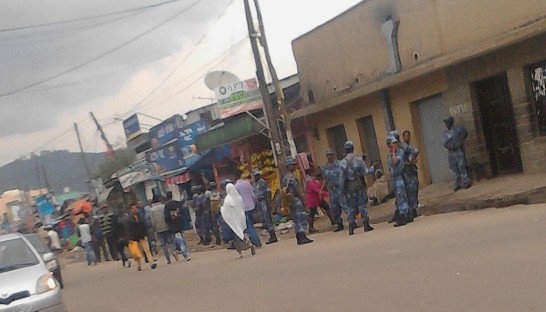
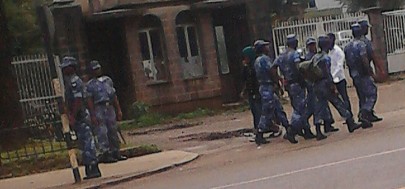 Mootummaan abbaa irree, Wayyaanee jibba uummata Oromoo irraa qabuun hidhaa fi ajjeechaan gahuu dadhabnaan yeroo ammaa uummata nagaa mana isaa keessa jiraatu iyyama koo malee mana ijaartan jechuun humna tikaan fi waraanan mana jireenyaa qonnaan bultoota godina addaa Oromiyaa Buraayyuu bakkeewwan addaa Tsarra Tsiyoon,Gafarsaa Buraayyuu, Annee Diimaa fi kaanis mannen qonnaan bultoota 400 ol tahu diiguun hiraarsaa jira. Haala kanaan kanneen qabeenyaa isaanii kana dura dhaabbatanii falman ammoo hidhaa umurii dheeraa garagaraan itti murteessaa jiraachuu Qeerroon gabaasee jira.
Haaluma kanaan mootummaa Wayyaanee tuffii uummata Oromoo irraa qabuun hanga mana jireenyaatti diigsisuun bakka bultiillee dhowwate kanaan dargaggootni fi barattootni yeroo ammaa magaala Finfinnee fi godina addaa keessa jiraatu duula macna’iinsaa fi diigumsa mana jireenya uummata Oromoo irratti tooftaa jijjiirratee hidhaadhaaf qonnaan bulaa keenya saaxiluuf ka’e dura dhaabbachuuf diddaa kaasaa
jiraachuun beekame.
Miidhaan bifa jijjiirratee uummata oromoo irratti kufaa jiru kun
dhaabbachuu qaba,
Maati isaa irraa yakka malee hidhamee murtii dabaa itti murteeffame amma haqamuu qaba,
Doorsisni waraanaa fi aangoo qabaachuun saaminsi gaggeeffamu haa dhaabbatu.
Kannneen jedhanii fi akeekkachisaa waraqaalee Buraayyuu naannowwan diinni mana
uummataa diigaa jirutti Qeerroon maxxanseen wal qabatee akkasuma barattootni Yuuniversitii Finfinnee mooraa keessatti hafanii fi yeroo gannaa baratanis dhimma kanairratti luuca’uudhaan hatattaman mootummaan kana gochaa jiru itti gaafatamummaa jalaa akka hin baanee fi kunis dhaabbachuu akka qabuu fi sababa kanatti namootni mana isaanis dhabanii mana hidhaattis darbataman hatattaman akka
gadhiifaman barruu akkeekkachiisaa mooraa keessatti darbachuu fi sagalee dhageessisuun halkan edaa kan beekamee waan taheef har’a diddaa fi gaaffii barattootni kun kaasaa jiraniin wal qabsiisee mootumman Wayyaanee waraana isaa tamsaasee kan jiru tahuu Qeerroon suuraa diinni qawwee baatee barattootatti duulaa jifuu fi naannoo
Buraayyuttis waraana buufatee jiruun Qeerroon gabaase. Qabeenyaa fi mana jireenyaa keenya irratti olaantummaa qabna jechuun qonnaan bulaan dhaadatanis poolisoota Wayyaaneen butamanii bakka buuteen dhabamaa akka jirus Qeerroon gabaasee jira.



Finfinnee (Addis Ababa):The city’s creation and expansion in the past has led to forced evictions and displacement of local Oromo residents and protesters of the new master plan fear that ceding Oromo lands to Addis Ababa would lead to more losses in Oromo identity and culture. July 18, 2015
Posted by OromianEconomist in No to land grabs in Oromia, No to the Addis Ababa Master Plan, NO to the Evictions of Oromo Nationals from Finfinnee (Central Oromia), Oromia wide Oromo Universtiy students Protested Addis Ababa Expansion Master Plan.Tags: #OromoProtests, Genocidal Master Plan, Master Plan is Master Killer
add a comment
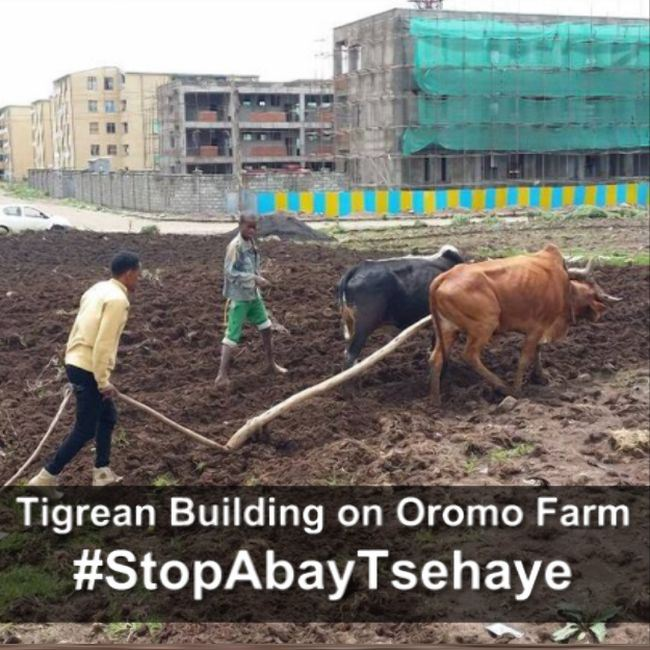
In 2007, the population census put the city’s population at 3.38million. It was expected to grow at a rate of 3.8% per year – which would put the total population today at 4.5million. This may not seem so far-fetched considering there were estimates that said that by 2020 it would have a population of 8 million. But this fast and vast growth has come at a high price. First, it is creating divisions between the government and already marginalised population groups. Addis has always been a sprawling city, from when it originated in 1886 as a military settlement, part of Emperor Menelik II’s campaign in taking over Oromo territory. Throughout its history it continued to sprawl due to its spontaneous and unplanned nature. As the city expanded from 1994 – 2007, research showed that many farmers on the peripheries lost their livelihoods and were forced instead to turn to other forms of casual labour within the city. This spurred the development of the Oromia Special zone that was created in 2008 in order to ease the co-operation and development of the surrounding areas of Addis Ababa and to control the urban sprawl of this city on the lands of the Oromia people.
However, more recently, there were further calls that the government was perpetuating inequality along ethnic lines when it announced a master plan titled “the Addis Ababa and the Surrounding Oromia Integrated Development Plan”. This area structure plan was intended to create special zones surrounding Addis that were divided into industry, service and settlement zones, based on their existing potential, economic base and geography. But it has become a contentious issue, met with opposition by Oromo residents who would lose an additional 36 towns and cities to Addis Ababa. According to researchers, the city’s expansion in the past has led to forced evictions and displacement of local Oromo residents and protesters of this new master plan fear that ceding Oromo lands to Addis Ababa would lead to more losses in Oromo identity and culture. The fast rate of urbanisation has also perpetuated levels of inequality and fragility which are highly visible on some of the streets and areas of Addis and, intentionally or not, this seems to have been moved to specific areas. One example is in the neighbourhood of Mercato – named so because it is home to the largest market areas in the city.
Everything can be found here from steel pipes to spices and kitchenware. It is also where the hidden face of poverty of the city becomes most apparent. Here people are struggling to survive, making a living by whatever means possible – as this is the time of year when the rains come heavy and fast almost every afternoon, there are countless young men taking advantage of it. They will clean shoes, the bottoms of trousers or sit on old buckets fixing broken umbrellas. Government is trying? The government does believe it is trying. In a recent statement it said that more than half a million citizens have benefited from housing schemes over the past 10 years. One of these is the ambitious government-led low-and middle-income housing programme launched in 2005: The Integrated Housing Development Programme (IHDP). The initial goal of the programme was to construct 400,000 condominium units, create 200,000 jobs, promote the development of 10,000 micro – and small – enterprises, enhance the capacity of the construction sector, regenerate inner-city slum areas, and promote homeownership for low-income households. However, this programme may have inadvertently perpetuated inequality. A major challenge has become the affordability of the units for low-income households, with the cost increases in the price of condominium houses deeming them no longer an option for many low-income households. Furthermore, the inability to pay the monthly mortgage and service payments forces many households to move out of their unit and rent it. Also, many of the condominium sites are located on the periphery of the city and do not acknowledge the need for employment opportunities for residents, despite there living up to 10,000 households in some sites. This places further financial strain on beneficiaries in the form of daily transport costs.- Mail and Guardian Africa
Read more at:- http://mgafrica.com/article/2015-07-14-addis-a-city-in-flux#.Vaj9VUg5aMM.twitter
OROMO STUDENT PROTESTORS RELEASED FROM JAIL. Barattooti Oromoo Jaha Hidhaa Hiikaman July 9, 2015
Posted by OromianEconomist in Oromia wide Oromo Universtiy students Protested Addis Ababa Expansion Master Plan, Oromians Protests, Oromo and the call for justice and freedom.Tags: #OromoProtests, #OromoProtests 2014, 'BECAUSE I AM OROMO’: SWEEPING REPRESSION IN THE OROMIA, OROMO STUDENT PROTESTORS RELEASED FROM JAIL. Barattooti Oromoo Jaha Hidhaa Hiikaman
add a comment

(OroMedia, Adoolessa 9 bara 2015) Barattooti Oromoo bara 2014 keessa Yunversiitii garaa garaa irraa walitti guuramanii hidhaatti darbaman keessaa jaha bilisaan gadhiifaman.
Maddi keenya Finfinnee irraa akka gabaasetti abarattooti kunneen rakkooleen uummata Oromoo akka furmaata argatuufi uummanni Oromoo seeraan ala qe’ee isaa irraa akka hin buqqaaneef karaa nagaan gaaffii mirgaa warra dhiyeessan keessaa adda baafamanii kanneen hidhaatti darban ture.
Barattootia hiikaman Yunversiitii Saayinsiif Teknooloojii Adaamaatti Dursaa Gumii GAAO kan ture barataa Addunyaa Keessoo, barataaToofik Rashiid Yunversiitii Dirree Dhaawaa irraa, Barataa Leenjisaa Alamaayyoo, Barataa Abdii Kamaal, Barataa Magarsaa Warquu, Barataa Bilisummaa Daammanaa ta’uun beekameera.
Akka odeessa nu gahetti, abrattooti kunneen adda dureedhaan barattoota qindeessitaniittu jedhamanii kanneen himatamuudhaan Finfinnee Mana Hidhaa garaa garaa keessatti dararamaa turaniidha.

Barattooti kunneen gaafa Waxabajjii 22, 2015 murtii dhumaatiif Mana Murtii Federaalaatti dhiyaatanii sagalee isaanii erga laatanii booda barattoota wagaga tokkoof hiraarsan beenyaa tokko malee gadhiisaniiru.
Barattooti kunneen kanneen adda duree jedhamanii hanga ammaa hidhamanii turanii dha. Barattooti Oromoo hundi Bilisaan akka gadhiifamaniis beekameera.
Akk odeeffannoo nu gaheetti barattoota yeroo darbe badii malee funaanamanii Finfinneetti ukkaamfaman keessaa Alsan Hasan(kan mana hidhaa keessatti reebamee ajjeefame) waliin kijiba boombii darbattan jedhuun kan hidhame barataa Abbabaa Urgeessaa qofti beellami kan biroo qabameefii ammas mana hidhaa Qaallittii keessatti argama.
Barattooti Oromoo amam hiikamanis ta’ee kanneen mana hidhaa keessatti argaman barattoota Qulqulluu fi Falmitoota Haqaa ta’uu isaanii namooti hedduu irratti waliif galaa jiru.
http://oromedia.net/2015/07/09/barattooti-oromoo-jaha-hidhaa-hiikaman/
(Addis Standard, 9 July 2015), At least six Oromo university students were also among three journalists and two bloggers released from Ethiopian prison yesterday, according to various reports.
The freed Oromo university students include Adugna Kesso, Bilisumma Dammana, Lenjisa Alemayo, Abdi Kamal, Magarsa Warqu, and Tofik Rashid. All were students who were arrested by security agents from various universities located in the Oromiya regional states. No charges were brought against many of them in the last year and three months.
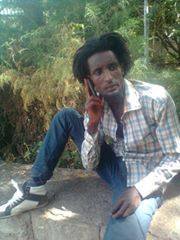 Student Bilisumma Dammana
The arrest of unknown numbers of Oromo University students followed a May 2014 brutal crackdown by the police against university students who protested when a master plan for the expansion of Addis Abeba, the city originally home to the Oromo, was introduced by the federal government.
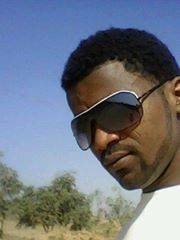 Student Tofik Rashid
The 10th Addis Abeba and Oromia Special Zone Integrated Development Master plan, which was in the making for two years before its introduction to the public, finally came off as ‘Addis Abeba and the Surrounding Oromia Special Zone Integrated Development Plan.’
The government claims the master plan, which will annex localities surrounding Addis Abeba but are under the Oromiya regional state, was aimed at “developing an internationally competitive urban region through an efficient and sustainable spatial organization that enhances and takes advantage of complementarities is the major theme for the preparation of the new plan.”
The students protested against the plan and the federal government’s meddling in the affairs of the Oromiya regional state, which many legal experts also say was against Article 49(5) of the Ethiopian Constitution that clearly states “the special interest of the State of Oromia in Addis Abeba.”
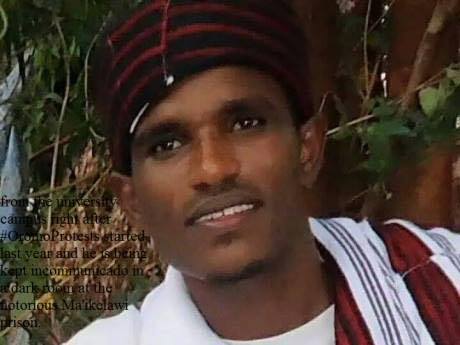
Charges against university student Nimona Chali were dropped without explanation and he was released some two months ago.
Two months ago, student Nimona Chali, one of the detained students, was released from jail without charges. Student Aslan Hassen died in prison in what the government claimed was a suicide. However, many believe he was tortured to death. No independent enquiry was launched to investigate his death.
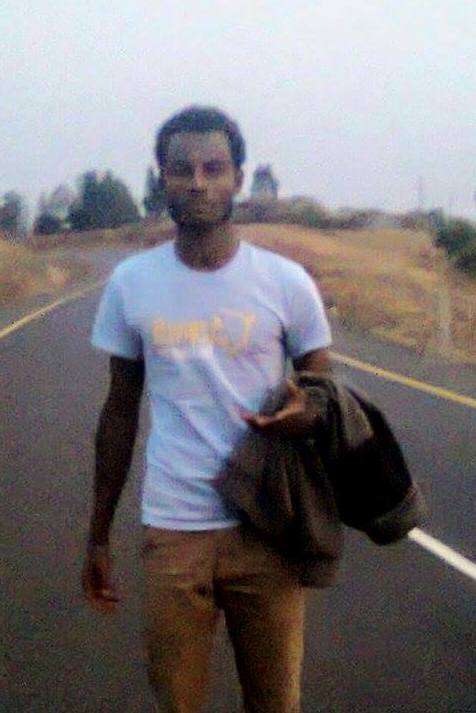
Alsan Hassan died while in police custody. Government says it was a sucide, but many say he died of torture.
By the government’s own account, eleven people were killed during university student demonstrations in many parts of the Oromia regional state. However, several other accounts put the number as high as above 50.
http://addisstandard.com/oromo-student-protestors-released-from-jail/
KENYA: THE PLIGHT OF OROMO REFUGEES June 28, 2015
Posted by OromianEconomist in Oromo Refugees in Kenya.Tags: #OromoProtests, 'BECAUSE I AM OROMO’: SWEEPING REPRESSION IN THE OROMIA, Africa, ETHIOPIA SPYMASTER INFILTRATES KENYA POLICE, Hawaasti Oromo Keenyaa Basaasota Saaxile, Oromo, Oromo community in Kenya
1 comment so far
THE PLIGHT OF OROMO REFUGEES
BY EMILY ONYANGO, SautiYamtaa, 22nd June 2015

The Oromo community met recently in Eastleigh estate to discuss critical issues that for the last month, have been affecting their community.
They believe that there are people who have been sent to kidnap Oromo residents and take them back forcefully to Ethiopia where ethnic Oromo are subject to arbitrary arrest, detentions without access to lawyers, repeated torture and even targeted killings to crush dissidence.

So far, approximately 70 people have been forcefully taken back in this manner.

Many of the respondents said they had been detained in prisons, police stations, where they are subjected to repeated torture.

They listed a myriad human rights problems they faced including arbitrary killings, allegations of torture and mistreatment of detainees by security forces, harsh and at times life-threatening prison conditions, arbitrary arrest and detention, detention without charge, a weak and overburdened judiciary subject to political influence, infringement on citizens’ privacy rights including illegal searches, as well as restrictions on academic freedom and freedom of assembly, association and movement. They also alleged interference in religious affairs, violence and societal discrimination against women, abuse of children, trafficking in persons and societal discrimination against persons with disabilities.

“We are here expressing the problems we Oromo refugees are experiencing here in Kenya. We have fled our home country due to political persecution and execution targeted by the ruling government of Ethiopia, but I feel the Kenyan government are not taking concern of refugees protection seriously. We are being arrested by police and taken back to Ethiopia unlawfully. I believe our rights as refugees are not recognized fully. We have cases of our women being raped and our men taken to Ethiopia,” said Daki Waso.

“ Last Saturday some spies who are believed to come from Ethiopia were taken to the police station but at midnight they were terrorizing the community. Those who reported are not aware which criteria they used to come out from the police station since they are in the country illegally,” said Jabir Sheik-Ismail.
http://www.sautiyamtaa.com/2015/06/22/the-plight-of-oromo-refugees/
Related:
Hawaasti Oromoo Keenyaa Basaasota Saaxile
https://oromianeconomist.wordpress.com/2015/06/22/hawaasti-oromoo-keenyaa-basaasota-saaxile/
Finfinnee: Dhimma jabduu kana quba qabduu laata? June 7, 2015
Posted by OromianEconomist in Finfinnee n Kan Oromoo ti.Tags: #OromoProtests, Africa, African Studies, Finfinnee, Genocidal Master Plan
add a comment
Dhimma jabduu kana quba qabduu laata?
Camsaa 4/2015 Mootummaan Wayyaanee Karoora Maqaa ‘’Master Plan Finfinnee’’ jedhuun qopheeffate uummata Oromoo Qe ’eef qabeenyaa isaa irraa buqqisee Oromoo cabsee bituuf ejjennoo godhatee hojiitti hiikuuf fiigaa jiraachuu fi Mormii guddaan uummataa irra isatti jabaachuun saaxilame.
Mootummaan abbaa irree Wayyaanee EPRDF/TPLF mirga Uummata Oromoo cabsee bara umrii isaa dheereffachaa, akka Uummatni Oromoo mirga abbaa biyyummaa hin qabatne gochaa, qee’ee, qabeenyaa, aadaa, Afaanii fi seenaa uummaticha, Akkasumas geographical location Uummaticha balleessuuf karooraa maqaa ‘’master Plan Finfinne’’ jedhu qopheeffate akkuma fiiguu eegaleen mormii guddaan Qeerroo Barattoota Oromoo fi uummata Oromoo irraa isa mudachuun ifaa dha.
Qeerroon Bilisummaa Oromoo FDG uummatni Oromoo qabeenyaa keenyaa irraa, qee’ee keenya buqqa’uu fi sarbamuu teessuma Oromiyaa kana ilaalchisuun FDG jabeessuun bara 2014 mormii guddaa gaggeessuun wareegama qaalii dachaa itti kanfaluun dura dhaabbachaa jiraachuun beekamaa dha.
Ummatni Oromoos akeekni kun akka waan dhaabbatee fi deebi’ee yoo kan ka’uu ta’ee wareegama kam illee kanfaluuf uummatni qophii ta’uu ibsatan.
Mootummaan abbaa irree erga Filannoo waliin dhahaa fi sobaa
gaaggeessee natu mo’ate jedhuun labsatee booda ‘’ Ajandaa ‘’ isaa kan ‘’Master Plan Finfinnee’’ hojii irra olchuuf fiigaa jiraachuun saaxilameera.
Gochaa fashistummaa fi diinummaa uummata Oromoof qabu
qopheeffate hojii irra olchuuf gidduu kana magaalotaa kanneen akka Burraayyuu, Sabbataa, Holotaa, Suulultaa, Laga Xaafoo Laga Dhaadhii , Duukam, Aqaaqii Qaallittii, jedhaman irratti Walga’ii Caasaa miseensota isaa OPDO fi uummata isaan nu deeggara jedhanii yaadan marii’achiisuuf baajata guddaa ramadachuun sochii cimaa gochaa jiraachuun saaxilame jira.
Ummatnis mormii guddaa irratti kaachisuun sochii Wayyaaneen gochaa jirtu kana haalaan balalleeffachuu fi kan miseensotni caasaa jalee wayyaanee illee fedhii fi amantaa irraa dhabuun diddaan dura dhaabbachuu madden keenyaa ibsan.
Haalaa kanaan Walga’iin Mootummaan Wayyaanee magaalaa Burraayyuu irratti gaggeesse ummatni diddaa guddaa irratti kaachisuun walga’iin wayyaanee bittinaa’uun mormii guddaan wayyaaneen iraatti qabsiifameen Adeemsa wayyaanee dura dhaabbachuu fi yaaddoo guddaa keessa galchuun saaxilamera.
Gootichi WBO Zoonii Kibbaa Mooraa Waraana Wayyaanee Magaalaa Moyyaalee Haleeluun 17 Ol Hojiin Ala Gochuun Injifannoo Galmeesse May 31, 2015
Posted by OromianEconomist in Against Tyranny, OLF WBO, Oromummaa.Tags: #OromoProtests, Africa, Againsty Tyranny, Oromummaa OLF
1 comment so far

BREAKING NEWS | Oduu Amma Nu Gahe | OMN/SBO – Gootichi WBO Zoonii Kibbaa Mooraa Waraana Wayyaanee Magaalaa Moyyaalee Haleeluun 17 Ol Hojiin Ala Gochuun Injifannoo Galmeesse

Tarkaanfii kanaan loltootni Wayyaanee 7 oggaa ajjeefaman, 10 ol ammoo madoo taasifamuu Ajaji WBO Zoonii Kibbaa ifa godheera.
Meeshaaleen adda addaas diina irraa fudhatamuun dantaa QBOf akka oolfaman hubachuun danda’ameera.
Waraanni faashistii mootummaa Wayyaanee akkuma amala isaa tarkaanfii WBOn irratti fudhataa jirutti aare ummata meesha maleeyyiitti roorrisuu fi daangaa biyya ollaa cabsee seenuun maqaa WBOn ummata nagaa ajjeesaa fi goolaa…
View original post 82 more words
A Summary of Oromos Killed, Beaten and Detained by the TPLF Armed Forces during the April 2014 Oromo Protest Against The Addis Ababa (Finfinne) Master Plan Compiled by: National Youth Movement for Freedom and Democracy (NYMFD) aka Qeerroo Bilisummaa April 13, 2015
Posted by OromianEconomist in Oromo Protests, Oromo University students and their national demands.Tags: #OromoProtests, Biqilaa Balaay, Genocide against the Oromo, Oromia, Oromo culture, Oromo people, The Tyranny of Ethiopia
add a comment

A Summary of Oromos Killed, Beaten and Detained by the TPLF Armed Forces during the April 2014 Oromo Protest Against The Addis Ababa (Finfinne) Master Plan
Compiled by: National Youth Movement for Freedom and Democracy (NYMFD) aka Qeerroo Bilisummaa
list-of-oromos-killed-and-detained-compiled-july-05-2014-compiled-by-qeerroo
full-document-in-pdf-47-pages-summary
Oduu Gaddisiisaa fi Seenaa Gabaabaa Gooticha Barataa Biqilaa Balaay Toleeraa
OPride.com’s Oromo Person of the Year 2014: #Oromo Student Protesters. #Oromia #Africa January 1, 2015
Posted by OromianEconomist in Africa, Oromia, Oromians Protests, Oromiyaa, Oromo, Oromo and the call for justice and freedom, Oromo Protests, Oromo Protests in Ambo, Oromo students movement, Oromo students protests, Stop evicting Oromo people from Cities.Tags: #OromoProtests, National Self Determination, Oromia, Oromo, Oromo people, Oromo Students Protests, Oromummaa
add a comment


(OPride) — For energizing and unifying the Oromo public both at home and in the Diaspora, for keeping the beacon of liberty from being extinguished, for selfless sacrifice to advance Oromo rights and for bringing international media attention to the plight of Oromo people, Oromo Student Protesters are OPride’s Oromo Person of the Year.
The Master Plan
In March 2014, the Addis Ababa and Surrounding Oromia Special Zone Integrated Development Plan Project Office organized a workshop for journalists and civil servants in Adama, 90 kms east of Ethiopia’s capital, Addis Ababa. The training, conducted by officials from the Oromia regional state and representatives of the Addis Ababa city administration, continued through mid-April. It was intended to generate momentum before “a joint master plan,” which would ostensibly facilitate efficient resource use, eliminate existing contradictions and link the city’s developmental activities with the Oromia Special Zone, is unveiled.
Established in 2008, the Oromia Special Zone is comprised of eight towns (Dukam, Lagatafo-Lagadadhi, Sandafa Buke, Sululta, Holota, Burayu, Sabata and Galan) and six districts (Walmara, Sabata Hawas, Akaki, Sululta, Mulo and Barak). The zone has a total area of 4,800 square kms and 15 townships.
The special zone was established in response to local concerns over lack of attention and proper planning in the hinterland and the unchecked, horizontal urban sprawl around the capital. The renewed interest in the area, which ironically coincided with rampant land speculation and a chaotic industrial construction boom, was further strengthened by Oromia’s local development plan crafted in 2010.
 Founded in 1886 by emperor Menelik II and his wife Taytu Betul on conquered Oromo land, Addis Ababa, which Oromos call Finfinne, has “complete powers of self- administration” with its own police, city council, budget and other public functions overseen by a mayor (appointed by the ruling party). Regardless of the reasons for the creation of the Oromia special zone, the city’s unique place as both a state capital and federal capital— the constitution granting special interest in the provision of services or the utilization of resources to Oromia — has been at the center of the debate over the city’s horizontal spread over the years.Oromo activists have been calling for clarification of the Ethiopian constitution’s special status clause, as well as language instruction and other services for the city’s Afaan Oromo speakers. In theory, the creation in 2011 of a joint project office tasked with fashioning a joint strategy and a master plan was meant to assuage these grievances.
However, as noted by workshop participants in April, the project office not only took an arrogantly top-down approach in crafting the master plan but also expanded the city’s territorial jurisdiction by a whopping 1.1 million hectares, an area more than 20 times the capital’s current size, according toleaked documents. The proposed plan would put 36 Oromia towns under Addis Ababa’s — thereby federal government’s — direct control.
In a rare report by the state-run Oromiyaa TV (OTV), journalists and officials from the Oromo People’s Democratic Organization (OPDO), the Oromo elements in Ethiopia’s ruling coalition, sounded-off about the lack of public consultation and potential violation of Oromia’s autonomy and territorial integrity, as well as threats to the livelihood of Oromo farmers in the areas covered by the proposed plan. The planning office apparently did not even bother to consult with mayors of the affected municipalities and other regional and Oromia Special Zone officials. Moreover, the state’s rubberstamp legislative chamber, Chaffee Oromia, did not deliberate on it, leaving rank-and-file OPDO members deeply disgruntled.
“The issue of Addis Ababa and surrounding Oromia towns is not a question of towns; it is a question of identity,” one speaker said at the workshop in Adama. “When we speak of identity, there are fundamental steps we ought to take to ensure that the plan would incorporate and develop the surrounding towns while also protecting Oromo’s economic, political and historical rights.”
The speaker added: “we are keenly aware of the city’s past spatial growth. We don’t want a city that pushes out farmers and their children but one that accepts and develops with them…more importantly we don’t want a master plan developed by one party and pushed down to us.”
OTV’s segment on the opposition to the master plan came as a shocker to many. Established in 2006, the network has been serving as an unabashed government mouthpiece, giving only lip service to issues of concern to the Oromo other than scant cultural programming. Within days after OTV’s report, thousands of Oromo students at all regional universities in Oromia took to the streetsopposing the master plan (starting at Jimma University and quickly spreading to Haramaya, Ambo, Wollaga, Matu, Bule Hora, Addis Ababa, Adama and Madawalabu universities). In one instance, on April 29, an estimated 25,000 people partook in a citywide demonstration in the flashpoint town of Ambo, 80 miles west of Finfinne. Federal security forces responded as usual, firing live ammunition at unarmed protesters, killing at least 50 people and injuring many others while hundreds were arrested, according to eyewitness reports.
Authorities saw OTV’s report on the master plan as an indirect rebuke of its campaign to unveil the plan. TVO then went mute, apparently per orders from federal authorities, keeping eerie silence as protests spread across Oromia and received significant coverage in the international press. Shortly thereafter, an indoctrination campaign was organized for the OTV journalists, which according to a number of participants, ended without any breakthrough in the form of agreement.This was followed by mass firing of journalists seen as agent provocateurs, including Bira Lagasse, who presented the April OTV report on the master plan.
Marketed as the megacity of the future — complete with a new railway system courtesy of the Export-Import Bank of China — Ethiopia’s sprawling capital faces increased pressures to meet international standards and ongoing urbanization challenges. Half of Ethiopian population, roughly 67 million, is projected to reside in towns and cities by 2040, up from only 18 percent in 2013. Addis Ababa hopes to lead the charge in urbanization and become one of the top ten tourist destinations in Africa by 2025. Even as they insist that the controversial master plan offers a win-win solution for all stakeholders, Addis Ababa city officials say high economic integration and uniform land use and development strategies with surrounding Oromia towns is key to that effort.
Ethiopia’s GenQ: A lethal threat?
Student protests have been a fixture in the contemporary Oromo history. Students have been demonstrating in Oromia since the mid-1990s. The budding Oromo student activism can be likened to the cactus. You cut it down and it would grow back even more luxuriant as if in vengeance. You depopulate it in one place and it would mushroom elsewhere. It is in no need of a nourishing climate or soil; it thrives in the lowlands, the highlands, and anywhere in between. Seeing it as a lethal threat to its continued grip on power, the ruling party has been cracking down hard. However, the protesters grew more and more strident rather than abate. Resilient as they have been over the years, Oromo students have paid hefty prices for their dissent against the regime in Finfinne. That is why the repression by the authorities could hardly dampen the spirit of an increasingly assertive generation of Oromo youth that is just coming of age.
 To be sure, one of the positive developments under the current regime is the adoption in 1991 of the country’s federalism, which carved Ethiopia into nine federated and theoretically autonomous states. However, for all its promises of maintaining Ethiopia’s territorial integrity, the constitutional guarantees for decentralization of authority have rarely been applied. Final decision-making power still rests with the central government, with supposedly semi-autonomous states enjoying only a semblance of self-rule. Consequently, EPRDF’s failure to abide by its own constitution, frequent top-down changes in education policy, denial of academic freedom and the government’s misguided development policies have been among the most contentious issues for Oromo students over the last two decades.
Dubbed the Qubee generation, today’s college and high school students in Oromia are like a new species of Oromo. Studied in their mother tongue, Afaan Oromo, and keenly aware of their state’s boundaries and the Oromo people’s longstanding misgivings about the Ethiopian state, the average Oromo protester personifies the indomitable spirit of Oromo nationalism and a steely determination to see to it that the injustice against the Oromo becomes a thing of the past. Such open national consciousness was hitherto unthinkable in Ethiopia, which remained a unitary state in large part by harshly suppressing Oromo self-expressions.
Oromo student protests through the years
The heightened Oromo student activism of the late ‘90s and early 2000s coincided with widespreadhuman rights violations and mass expulsions of student leaders from various universities and colleges. Based on available record, from 1999 to 2004 alone, more than 1,000 Oromo students were dismissed from Addis Ababa, Jimma, Adama and Haramaya universities. Tens of students disappeared without trace while hundreds have been forced into exile — some still languishing in refugee camps across neighboring East African countries.
After a brief lull, sustained protests began in early 2000 in response to massive forest fires in Bale and Borana zones of Oromia. Amid apparent neglect and allegations of federal government’s involvement in setting the forests ablaze, students across Oromia took to the streets demanding swift action. Authorities responded by rounding up the students, firing live ammunition at peaceful protesters and detaining those suspected of organizing the protests.
In early 2001, Oromo students at Addis Ababa University began protesting after authorities blocked their efforts to publish a student newspaper and organize a student union. The students also opposed the stationing of uniformed police and undercover security agents on college and university campuses. High school and university students around the country joined the strike calling for academic freedom. Protesters were further angered by the killing in Tigray of Oromo student Simee Tafara by unidentified security agents. More than 3,000 Oromo students were arrested. “Government forces responded to the protests with extreme brutality, killing more than thirty people, wounding some four hundred, and arresting thousands,” the Human Rights Watch reported at the time. “Academic life ground to a halt for one month around the country, and most AAU students who participated in the strike did not return to class for one year. About 250 students fled to Kenya; others went to Djibouti or Sudan.”
Again in early 2002, following sustained Oromo student protests over economic depression and rising cost of fertilizers, the federal Rapid Deployment Forces killed at least 10 students and injured many others in Shambu, Naqamte, Gedo, Ambo, Gimbi, Najo, Dembi Dolo, Guder, Robe and Kofele towns. In May 2002, authorities arrested more than 320 students from various institutions of higher learning in and around Addis Ababa. Tens of students were dismissed from Adama, Haramaya and Addis Ababa universities.
Following a year of tensions, in 2004, Oromo student protests returned in response to the government’s attempt to relocate Oromia’s capital from Finfinne to Adama. More than 350 Oromo students were expelled from Addis Ababa University alone. Hundreds of students, teachers and Oromo intellectuals were arrested throughout Oromia in a move seen as an effort to eliminate educated and politically conscious members of the society. Schools across Oromia were closed for most of the year. “In some places, police used live ammunition to disperse demonstrators, killing several school students,” according to Amnesty International’s report. “Demonstrators were detained for several months; some were beaten and made to do strenuous physical exercises while in custody.” Thousands of protesters, including leaders of the Oromo welfare organization, the Macha Tulama Association, remain in prison or are serving lengthy sentences under trumped up charges.
Oromo students took to the streets once again in 2006 following disputed parliamentary elections. In fact, as UC Berkeley’s Leonardo Arriola rightly noted, while international media reports focused almost exclusively on the opposition protests in Finfinne, post-election “protests in Oromia resulted in more than 15,000 detentions and 80 reported deaths.” The trend continued in the year with yet another killing of innocent Oromo student, Shibiru Demissie, at Mekelle University. While there have been sporadic protests over the last half decade, the 2014 #OromoProtests were a watershed — not just in their size and duration but also in the participation of other sectors of society, urban dwellers, bureaucrats and rural folk, including members of the ruling party.
All in all, since 2000, Ethiopian security and military forces have killed hundreds of peaceful protesters. Despite the recurring and perennial protests the storyline remains the same: Peaceful protesters shot at close ranges; significant numbers injured; hundreds dismissed from high schools and universities and many more fleeing the country to seek safety.
Implications for Ethiopia’s future
The names of some of those indiscriminately gunned down by security forces such as Diribe Jifar, Getu Diriba, Jagama Badhane, Gammachu Hirphaasa, Alsan Hassan and many others or those who died in prison from torture such as Alemayehu Gerba and Tesfahun Chemeda, have become household names, their struggles forever ingrained in the consciousness of the ever vibrant Qubee generation as well as the wider Oromo public. Still, these are but few whose names entered the public domain. Many more perished without due recognition or remain unjustly imprisoned with their fates and future hanging in balance. One thing is certain: Killing, imprisonment and forced exile have thus far failed to discourage or undermine Oromo student activism.
Ethiopia continues to be haunted by an age-old problem: the unaddressed Oromo question. Despite making up close to half of the country’s 96 million population, the Oromo continue to face political repression, social marginalization and social alienation. Instead of addressing Oromo grievances, controlling Oromia’s resources and the suppression of Oromo dissent has been a constant preoccupation for successive Ethiopian rulers.
 It doesn’t take a political scientist to realize that addressing the Oromo question is tantamount to removing the albatross from Ethiopia’s neck. As the Horn of Africa country prepares for yet another sham election in May, calls to democratically address gapping deficits in governance, rule of law and respect for human rights would grow louder. The specter of more student protests and violent suppression would continue to sour state-society relations. Despite the rising risk on Ethiopia’s stability, the authorities lack the will to heed calls for any sensible reform and accommodation of dissent.
The Addis Ababa and Surrounding Oromia Special Zone Integrated Development Plan Project Office is reportedly forging ahead with the controversial master plan. Any attempt to impose a widely unpopular proposal on the Oromo guarantees the return of yet another protest by Oromo students—even before the hundreds and thousands of young students rounded up during the 2014 protests were released from incarceration. But if history is any guide, the threat of arrest, beating, torture and exile alone will not quell the protests.
Ethiopia has recently been named to the top ten leading jailers of journalists in the world. While the media blackout has aided the regime to keep the lid on the plight of Oromo prisoners, in 2015, amid growing social media use inside the country, it would be impossible to suppress another anti-government protest. Even by the government’s own admission, tensions are expected to run high in Ethiopia ahead of the 2015 elections. The ruling party’s standoff with the urban opposition is at its peak. Rural support has all but evaporated. Ethiopia’s stability could be put to a severe test should the various grievance-fueled protests link up across ethnic, political and religious cleavages that have emasculated the potency of challenges to the ruling party.
Buoyed by past success at suppression, the authorities have every reason to underestimate the power of the Oromo Student Protester. With a radical shift in strategic thinking on the part of protest organizers, a new round of protests would not stop at simply re-energizing and unifying the Oromo public. It can become a catalyst for a countrywide pro-democracy movement. The selfless sacrifices of the Oromo Protester cannot forever remain fruitless. It has already drawn international media attention to the plight of Oromo people. The Oromo Student Protester, OPride’s Person of the Year, through sheer determination in the face of mortal and physical danger, through its capacity to rebound, and its irrepressible yearning for freedom is destined to write and right not only Oromia’s but also Ethiopia’s history.
Read more @ http://www.opride.com/oromsis/news/3783-opride-s-oromo-person-of-the-year-2014-oromo-student-protesters
Oromia: TPLF Ethiopia’s genocidal master plan and its resistance #OromoProtests December 1, 2014
Posted by OromianEconomist in Africa, Because I am Oromo, Colonizing Structure, Ethiopia's Colonizing Structure and the Development Problems of People of Oromia, Ethnic Cleansing, Finfinnee is the Capital City of Oromia, Free development vs authoritarian model, No to land grabs in Oromia, No to the Addis Ababa Master Plan, NO to the Evictions of Oromo Nationals from Finfinnee (Central Oromia), Oromia wide Oromo Universtiy students Protested Addis Ababa Expansion Master Plan, Oromians Protests, Oromo, Oromo Protests in Ambo, Oromo students movement, Oromo students protests, Oromo University students and their national demands, State of Oromia, Stop evicting Oromo people from Cities.Tags: #OromoProtests, Africa, African Studies, Because I Am Orormo, Finfinnee, Genocidal Master Plan, Genocide against the Oromo, Human rights violations, Land grabbing, Oromia, Oromo, Oromo people, Tyranny
add a comment

Why Resist the Master Plan? A Constitutional Legal Exploration
Tsegaye R. Ararssa
When the Ethiopian government announced its readiness to implement its “Integrated Regional Development Plan” (the “Master Plan” for short) in the middle of April 2014, it provoked an immediate reaction from university students across the National Regional State of Oromia. Through the instrumentality of its security forces (such as the Federal and State Police, the Army, and the Special Forces), the Ethiopian government responded with brutal repression of the protests. In a series of campus-based and street protests that barely lasted for two weeks, over a hundred innocent Oromos are killed and thousands are jailed. To date, sporadic and spontaneous protest demonstrations continue to erupt in various parts of Oromia. Fuelled by anger triggered by the reckless words and utter disdain expressed in the course of a televised discussion between the Addis Ababa City Administration and the mayors and other executive heads of the surrounding towns over the Master Plan, and informed by history of killing, mutilation, dispossession, and political marginalization (all of which continue unabated), the protests were more a spontaneous reaction than a planned resistance.
Ignored by the state and local government, lied on by the national propaganda machine, neglected by international media and NGOs (with few exceptions), the students continue to resist. Diaspora Oromo communities, in a gesture of solidarity, voiced the plights of the students at home, and they took the occasion to ‘witness’ the violence once more. The non-Oromo Ethio-political elite, which always finds it difficult to speak out on atrocities perpetrated on Oromos, rather characteristically, is still struggling with itself on how to express anger at the mass killings without siding with the cause of the Oromo. (Basking on the nation-wide challenge to the regime as a fertile political moment, they sought to make gestures of solidarity in the hope that they won’t be left out in the event that the tide gets traction thereby leading to the eventual crumbling of the regime.) But very few groups came out in public and condemn this state-orchestrated terror. To be fair, they did well in voicing the plight of the six bloggers and three journalists arrested in the weeks following the start of the unrest. And that is to be appreciated. But the contrast was nothing less than disheartening to those who expected more than gestures of solidarity and had hoped that Oromo lives and rights would be valued as any other lives and rights in Ethiopia.
In this piece, I seek to make a close reading of the constitutional-legal frame within which to situate the master Plan. Accordingly, first, I seek to explore the constitutional-legal context within which the Master Plan should be considered and analysed. Next, I will present a summary of four major constitutional-legal arguments against the Master Plan.
2. Constitutional Context
The point of departure is the assumption that—the important debate about legitimacy aside—the constitution is ‘the supreme law of the land’ against which the validity of all laws, decisions, and practices is measured (art. 9). According to the constitution, the Ethiopian state is federal in structure (arts 1 and 50-52). Ethiopia is a ‘nation of nations’ (Fasil 1997) that can be considered a multinational federation. In the language of the constitution, ‘Nations, Nationalities, and Peoples’ are the locus of sovereignty (art 8) and have the right to self-determination (art-39). As sovereign entities, they are the ‘building blocks’ that have a co-equal share in the founding of the contemporary Ethiopian polity. As subjects with the right to self-determination, they have, inter alia, the right to a ‘full measure of self-government’ (art 39(3)). Accordingly, most of these ‘nations,’ based on the four-fold criteria of settlement pattern, language, identity, and consent of the people concerned’ (art 46(1)), have established the nine states that constitute federal Ethiopia (art. 47), one of which is the state of Oromia (art.47(1)4))).
Addis Ababa (which Oromos call Finfinne) is designated as the “capital city of the federal” government (art 49(1)) whose ethnically diverse people have a right to self-government (art 49(2)) that is ultimately responsible to the federal government (art 49(3)). Being an Oromo city (albeit the constitution talks only about its ‘location’ in Oromia), it is also the capital city of the state of Oromia. This was stated in both the old and revised constitutions of Oromia (i.e. Art 6 of the 1995 constitution and Art 6 of the revised 2001 Constitution as amended in 2005). Owing to its being an Oromo city, the constitution clearly recognizes Oromia’s ‘special interest in Addis Ababa’ particularly in relation to social services, natural resources, and joint administrative matters (art 49(5)).
The articulation of the content of this special interest has been a matter of quiet controversy between the two governments on the one hand and between the Oromia government and the federal government on the other. The law envisaged to come to effect in order to articulate it was never made. Oromia’s request for the law fell on deaf ears. Oromia’s formal request for interpretation from the constitutional interpreter (the House of Federation cum Council of Constitutional Inquiry) was rejected by the latter on the ground that they do not give ‘advisory opinion’ in the absence of ‘case and controversy’. In the meantime, the formal and informal land-grabbing continued to spread into the neighbouring towns and districts. There being no formal institution that regulates inter-governmental relations—and the federal government being indifferent to the concerns of Oromia and the city government virtually absent from the scene since 2005—the matter became increasingly irritating to the Oromia officials. Frustrated, in 2009, the legislature of Oromia, the Caffee, established a ‘Special Zone’ of towns and districts that surround the city of Addis Ababa. This, they hoped, would give them a focused mode of operation in relation to the specific problems of these towns that are hard hit by the spill over effect of Addis Ababa’s problems (such as wanton destruction of the forest, environmental pollution due to emissions from factories and flower farms, illegal constructions and settlements, all of which was buttressed by absence of governance and corruption).
The boundary of the city was long agreed to be the boundary of the city as circumscribed in 1992 (as per Proclamation No.7/1992 which identified the city as one of the 14 Regions). According to the constitution, the boundaries of states is subject to review either through referendum organized in relation to self-determination (art 39), or through a formal constitutional amendment process (art 105(2)). To date, no such referendum was held[1] nor was there any attempt to amend the constitution.[2]
3. Four Legal Arguments against the Master Plan:
The whole thrust of this piece is to argue that the Master Plan is legally indefensible. Contrary to what government lawyers claim (arguing that the plan is part of constitutional mandate to create one ‘economic’ and ‘political’ community),[3] the plan violates the letter and the spirit of the constitution on many levels. In this section, I present four arguments that indicate that the plan is unconstitutional. As I do so, I will touch upon the content, process, and consequence of the plan and its political implications.
3.1. Argument from Federalism
The plan violates the principle of federalism. In particular, it violates the principle of comity and mutual respect (art 50(8)) and the proper mode of managing intergovernmental relations pertaining to cities. This seems to emanate from a fundamental misunderstanding of federalism. In an unending turn of irony, the government is blaming the Oromo public for misunderstanding the ‘true goal’ of federalism. This misunderstanding is also compounded by the belief held among many that Addis Ababa belongs to the federal government. It also stems from mistaking the federation for a decentralized unitary system. Nothing typifies this more than the heavy reliance on the Master Plans of cities in a unitary country, namely Paris and Lyon of France.[4]
As indicated above, the Master Plan also wrongly conceives Addis Ababa as a federal territory when what it actually is, is the seat of the federal government. In other words, it is wrongly thought that Addis Ababa is the territory of the federal government. In reality, Addis Ababa is not a federal capital territory. It is an Oromo city which serves as the capital city of both the federal government and the government of Oromia.[5] That this has not been clearly spelt out in the constitution has caused an immense sense of insecurity and agitation among Oromos for a long time. The fact that the constitution speaks about it in terms of its ‘location in Oromia’ makes the issue of ownership ambiguous thereby reinforcing the sense of insecurity among Oromos. The ambiguity has also caused the confusion as to who the host is and who the guest is.
As a self-governing city ultimately accountable to the federal government, Addis Ababa is governed through its own city charter (which, legally, is expected to be revised every ten years). The city’s charter defines the powers and responsibilities of the different organs of the city government (the council, the Mayor and the Executive (the Cabinet/the Bureau Heads, and the General Managers), and the Municipality Court. It also defines the powers and responsibilities of the sub-cities (alias Kifle-Ketema) and districts (Kebeles). The city’s territorial limit is defined and the competence/jurisdiction of the city government has been clearly established. The boundary of the city ends at the outer limits of the ten Kifle-Ketemas.
As one of the nine constituent states of the Ethiopian federation, it has its own jurisdiction over its own bounded territory, with its own government that operates (ideally) in accordance with its own constitution. The powers of the states (exclusive and shared as concurrent) are clearly defined in the federal constitution (arts 51-52). The Constitution of Oromia is the supreme law of the territory of Oromia (art 9). Caffee Oromia is the legislature and the supreme political organ in the parliamentary system of government that the state has adopted for itself (art. 50(3) of FDRE and art 46 of the Oromia Constitution). As such, theCaffee is responsible for making any decision (legislative, financial, and political) over matters in its territory within its jurisdictional competence. Needless to say, it does not involve in the administration of the city of Addis Ababa—although one expression of its special interest is its involvement in joint administration of the city.[6]
Imposing a Master Plan designed by the Federal Government[7] on the towns of Oromia and incorporating these towns into Addis Ababa violates the principle of federalism. Ideally, if the city seeks to coordinate its development with the adjacent territories and townships, then it initiates a formal intergovernmental coordination of city development. It can invite the government of the State of Oromia to make a similar effort to raise the level of development of the surrounding cities so that necessary linkages are created in accordance with agreed terms of reference and agreed set of logistical and financial responsibilities. A joint inter-governmental body that oversees the legality, political propriety, financial efficiency, and administrative effectiveness of the project is established. This body could be an ad hoc bilateral inter-governmental relations (IGR) body or it could be a permanent and multilateral body that manages the intergovernmental relations under a pre-existing set of principles and rules. In Ethiopia, the latter framework does not exist. The Master Plan under discussion now is prepared entirely by the Addis Ababa City government, to be run by a project team of the city overseen by a Board of senior officials of the two governments. That it is the city officials that train the Oromia officials about the implementation of the plan betrays the truth about who is in charge of the plan. The fact that some of the Oromia mayors raised questions about the need to consult the government and people of Oromia regarding the matter, even at this late stage, is another indication of how the task is an exclusively Addis Ababa business that is conducted at the expense of the excluded Oromia.
The fact that the plan speaks of incorporating 36 towns and 17 Woredas of Oromia to make them part of the Greater Addis Ababa territory is also a blatant attempt at modifying the territory of the state of Oromia unilaterally. This act of altering boundaries cannot normally happen without a formal constitutional amendment or through the self-determination act that is overseen by the house of federation under article 39(1) & (4) cum arts 62 of the Federal Constitution. Moreover, by subsuming these towns and Woredas of Oromia under Addis Ababa administration, the plan submerges and liquidates the long-demanded special interest of Oromia in the city. Instead of answering the question, this plan now makes the special interest irrelevant by further peripheralizing the state of Oromia from matters concerning the city or the wider country.
In short, the Master Plan is constitutionally indefensible because it: a) violates the principle of federal comity (mutual respect of the different orders of government); b) usurps the power/jurisdiction of the state of Oromia; c) alters the boundary of Oromia by incorporating 36 towns and 17 Woredas of the regional state of Oromia into Addis Ababa and subordinating their jurisdiction under the city government; and d) eliminates the special interest of Oromia and makes the question irrelevant.
3.2. The Master Plan violates the Procedure for Constitutional Amendment
In altering the boundaries of the state of Oromia and the city administration of Addis Ababa, the plan delves into measures that necessitate constitutional amendment. According to the constitution (arts 46-47), states are formed on the basis of settlement pattern, language, identity, and consent of the people concerned. In theory, this act of carving the constituent units is completed when the constitution was adopted in 1995. Presumably, it is based on these criteria that the units were established. The imperative of self-determination allows the possibility of forming a new unit in the federation and/or a separate state (outside of the federation). But when that happens, that effects a constitutional amendment. In order to change the boundaries of existing states, like the one that the Master Plan is forcing upon the State of Oromia, however, one needs to initiate a constitutional amendment in which one either changes the criteria of unit formation or just injects a clause that takes note of the boundaries of the concerned states in article 46-47. To do so without such an amendment or through an act of self-determination will challenge the integrity of the constitution. This Master Plan, by incorporating the new towns and woredas into Addis Ababa, alters too much without a formal constitutional amendment and as such is unconstitutional. This by passing of procedures of amendment will ultimately affect the integrity of the constitution and the order thereof. But in an ‘authoritarian constitutional system’ in which the text of the constitution is invoked more to legitimize sinister political goals than to advance just ideals, subverting the constitutional ideals through other laws and/or policies does not come as a surprise.
3.3. The Master Plan Violates Human Rights
More importantly, the Master Plan leads to the violation of individual rights of Oromo farmers, the collective rights of Oromos qua Oromos, and the rights of the State of Oromia. To begin with, the Master Plan violates the rights of Oromo farmers to socio-economic benefits. Accordingly, the Oromo farmers’ “right to obtain land without payment and the protection against eviction from their possession” (under art 40(6)) will be violated by the evictions that this Master Plan entails. Similarly, their right to livelihood, adequate living standard, chosen work, or generally, access to economic facilities (e.g. land) and social opportunities (including mother-tongue education) will be at risk in the event that this master Plan is implemented. All these rights, one notes, are elaborately stated in art 41 of the FDRE constitution. The right of these farmers to participate in the design of development plans (arts 89(6)), is also affected by the master Plan. Moreover, the cultural rights of Oromos under art 41(9) such as preservation of historical and cultural legacies will be compromised in a city that has historically neglected and/or actively denigrated the Oromo culture and identity. Depending on the aim and content of the Master Plan (which is not clear so far in spite of the insistence of the officials to the contrary), the right of Oromo farmers to a “clean and healthy environment” (under art 44(1) cum art 92(1)) may be adversely affected. The right of displaced persons or those “whose livelihoods have been adversely affected as a result of programs” to “commensurate monetary or alternative means of compensation, including relocation with adequate state assistance” will be violated. This is because past experience shows that the state neither paid compensation nor provided relocation funds. The token of ‘compensation’ investors paid was neither adequate nor voluntary. If experience is something to go by, there is hardly a reason for anyone to expect that the displacements that come about because of the implementation of this plan will be any different. The fact that the “right to administrative justice” and the right to remedies is not explicitly recognized in the constitution compounds the problems that might arise in the event that the Master Plan is implemented.[8]
The second category of rights that the Master Plan violates pertains to the collective right of Oromos. If land is jointly owned by the “Nations, Nationalities, and Peoples” and the State (as per art. 40(3) cum 40(6)), the Master Plan defies the right of the Oromos as Oromos to their land. In addition, the right of Oromo communities to development (art 43) and environment (art 44) in their own state will be violated. Moreover, as a matter of state policy objectives, the constitution also considers ‘peoples’ right to participation in policy formulation (art 90(6)) and to “consultation and expression of views” (art 92(3)). The fact that the process so far lacked participation of the public makes it evident that these rights of the Oromo are already violated and/or are exposed to violation. The Master Plan also continues the decades-long neglect of the special interest of the State of Oromia. In fact, it renders it irrelevant.
The principle of direct democracy in art 8 (3) demands that citizens not only engage in consultation but also protest government policies when they disagree with them. The students’ and the peoples’ protest should not have been met with killings, shootings, and arrests and detentions. The junior Oromo officials’ objection to the Master Plan in the training sessions shouldn’t have been met with reprisals. That the protest to resist the implementation of the Master Plan has led to arbitrary killings, injuries, arrests, and detentions implicates it not only in a blatant defiance of peoples’ voices but also in a gross violation of human rights of Oromo citizens.
3.4. The Master Plan Ignores State Duty to ensure Good Governance
Transparency and accountability are the epitome of good governance. The Ethiopian government officials make a frequent use of the term to justify almost any measure they take. In fact, most of their policies are justified in the name of enhancing development and ensuring good governance.[9] Constitutionally speaking, the state has the obligation to conduct its affairs in a transparent and accountable manner. Thus, according to article 12 of (both the FDRE and Oromia) constitution, “the conduct of government shall be transparent (1). Any public official or an elected representative is accountable for any failure in official duties (2).”That is to say that, first, the conduct of government (i.e., its deliberations, decisions, and actions) is done openly before a watching public. Policies, laws, programs, and measures adopted by state are expected to be made available to the public. To ensure accountability, the officials are expected to listen to the peoples’ views, be responsive to the public’s demands, and take responsibility for such policies, laws, programs, and measures (especially if they have adverse consequences for the people).
The Master Plan’s design is shrouded in secrecy. To date, despite all efforts, I could not trace the authoritative version of the Master Plan document that also explains the goals and objectives, the rationales, the enabling/disabling legal environment, etc. Nor could I find a person who is in possession of the document. My attempt to make a close reading of the Master Plan and to make a comprehensive content-context-process analysis is compromised because of the unavailability of the document.[10] The process was thus hardly transparent.
To date, the government did not assume responsibility for the adverse consequences that flew from the Master Plan. After brutal repression of the protest by the security forces, the officials have been trying to persuade the public about the “supreme importance” of the plan and to demand that people should not listen to the distraction by “some external forces seeking to make political gains” out of this unrest, forces that want to disrupt “our development”. The government officials repeatedly suggested that the Oromo public are misinformed and agitated by ‘others’. They are thus conducting a series of meetings “to correct the public’s misunderstanding of the matter.” No measure is taken to bring to justice the security forces that went on a rampage of shooting. Not even a commission of inquiry is instituted. No government official expressed regret[11] or apology for the death of innocent students, children and other protestors. No government official came out to make any statement showing a willingness to rethink the Master Plan. This refusal to take responsibility and to be accountable to the public may exacerbate the tension impacting negatively on the peace and stability of the country in general. While that does not come as a surprise to people constantly living in an overly securitized state, to legal professionals, the absence of any gesture in the direction of ensuring accountability suggests the need for us to consider international tribunals before which the officials should be held accountable personally as individuals and collectively as a government.
4. Conclusion
In this piece, an attempt is made to make a close reading of the constitutional frame within which to analyse the Master Plan fiasco and the deadly consequences that emerged therefrom. By showing how the plan is against the principle of federal comity and by demonstrating its incompatibility with the federal structure of the contemporary state; by showing how the Plan destabilizes the integrity of the constitutional order by neglecting the procedural rules for constitutional amendment; through identifying the human rights (individual and collective) that the Master Plan will put at risk; and by discussing how the design and implementation of the plan is shrouded in secrecy and the consequent defiance of the constitutional principle of transparency and accountability, an attempt is made to present an argument that the plan is constitutionally-legally indefensible. It is important to note that the invocation of development as an overarching goal does not justify the inappropriateness of the plan or the massive violation of the rights of the displaced farmers and of the protestors that held demonstrations to resist the implementation of the master plan. In a ‘constitutional’ order that supposedly recognizes the importance of the voice and votes of the peoples of Ethiopia (let alone in one where they are sovereign), to protest a policy would be a mere exercise of a right, one that helps to overcome the democratic deficits of a representative government, not a condition that will render a citizen an enemy to be eliminated by all means necessary (including murder and torture by Special Forces of the Ethiopian army).
The announcement of the Master Plan has led to another round of killing and arrests of the Oromo youth. Ethiopian jails are beefed up yet more. Oromia is subjected to a continued state terror. Ethiopia is fast becoming a concentration camp of Oromos. But Oromo national resistance is also taking a national scale and continuing to haunt Ethiopia once more. Coming back in resilience, Oromo nationalism refuses to die, defies the repression, and returns to the Ethiopian scene once more.
The protest has brought to light several other questions that were simmering underground. The demand for legal articulation and enforcement of Oromia’s special interest in Addis Ababa was raised. The long-held demand to make Afaan Oromo a co-equal working language of the Federal government was also raised. The call for the demolition of the statue of Emperor Menelik II, the demand to bring Tewodros Kassahun (Tedy Afro) to justice for his controversial claim that Menelik’s war of conquest was “a Holy war made to unite the country”, the demand to see those who denigrated the Oromo people and abused the Oromo athletes in the All-Ethiopian Sports tournament in Bahr Dar brought to justice, and other demands were aired in the course of these protests. The fact that these and other issues are expressed with this intensity and rage should spell out to the government that Ethiopia has yet to adequately respond to “the question of nationalities” especially to the question of the Oromos. As ever, in its response to the protests, Ethiopia demonstrated that it did not know how to handle peoples’ demand politically. Of course it does know how to handle it militarily. But then, one needs to ask: when will these men in the uniform (the soldiers) face and bow to the men in robes (the judges)? When will the men in suits (the politicians) face and bow to the men in robes (the judges)? When will the law (with all its limitations and its embeddedness in politics) take precedence over politics as policing? Only time will tell.
——-
References
* Fasil Nahum, Constitution for a Nation of Nations. Trenton: Red Sea Press, 1997.
* Federal Democratic Republic of Ethiopia (FDRE) Constitution, Negarit Gazetta, Proclamation No. 1/1995,1995.
* The Constitution of the State of Oromia, Magalata Oromiya Labsii Lakk.1/1995.
* The Revised Constitution of the State of Oromia, 2001 (as amended in 2005).
[1] The closest we came was when the Coalition for Unity and Democracy (CUD) was rumoured to want to hold a referendum about the identity of the city (politically aimed to delink it from Oromia) in the wake of its electoral success in 2005.
[2] No constitutional amendment was considered so far save the one (in 2004/5) pertaining to Parliament’s power to postpone the year of census whenever it coincides with election year.
[3] In a televised interview of a lawyer (named Tesfaye Neway) in May 2014, it was argued that the ultimate goal of the federalism is to build one economic and political community. (Seehttp://www.youtube.com/watch?v=CKsseT1KtJw, accessed on 3 June 2014). The preamble of the constitution of the Federal Democratic Republic of Ethiopia (FDRE) indicates, among other things, that the nations, nationalities, and peoples of Ethiopia, exercising their right to self-determination, have agreed to build one political community based on rule of law, peace, democracy and socio-economic development in the context of the right to equality and non-discrimination. Note that self-determination is the organizing principle that is constitutive of the polity and its foundational principles identified above. The Preamble also talks about the need to build ‘one economic community’ that can enhance mutually supportive relations to effect respect for human rights and to pursue collective interest. These provisos of the preamble are conveniently used by government officials to claim that the overarching goal of the federal dispensation is to consolidate political unity and to create one big market that is indifferent to ethno-national diversity and the federal structure that seeks to respond to the challenge of diversity. This is a misreading of the constitution. This is aside from the putative argument one can make by insisting on the cardinal principle of constitutional interpretation: preambles are not part of the constitution. As such, the principles therein cannot be invoked as legally binding rules. At best, they can only serve as a framework of understanding the constitution.
[4] A government power point prepared for training purposes in June 2013 indicates that the foreign experience shows the same trend in Western Europe, in some regions in China (i.e., Hong Kong, Macau, and Hunan) and some cities in Africa such as Greater Lagos, Greater Johannesburg, and Greater Cairo.
[5] From 1991-2003, Addis Ababa was the capital city of Oromia. In 2004, the Federal Government forced the government of Oromia out of Addis Ababa and the government was relocated to Adama. In the wake of the 2005 election, the Federal Government decided that the Oromia Government relocate again to Addis Ababa. From 2005 to date, Addis Ababa serves as the capital city of Oromia. The constitutional provision relating to the capital city of the State of Oromia has been amended twice.
[6] Article 49 (5) of the constitution reads as follows: “The special interest of the State of Oromia in Addis Ababa, regarding the provision of social services or the utilization of natural resources and other similar matters, as well as joint administrative matters arising from the location of Addis Ababa within the state of Oromia, shall be respected. Particulars shall be determined by law.”
[7] Contrary to this, a series of interviews by the political leaders (e.g. Kumaa Dammaqsaa, Abba Dulaa Gammadaa, Muktar Kadir, Abdulaziz Mohammed, etc) and the architect involved in the design, Matheos Asfaw, insist that the Master Plan is a joint project designed by the two governments. Even if that is the case, how can one ignore the asymmetry of power between the two? We should also note that this new raft of interviews was given to quell the unrest and dampen the resistance staged by the Oromo public.
[8] Not, however, that there is the general right of access to justice under Article 37 of the Federal Constitution and its State equivalent.
[9] Even the massive constitutional revisions of the National Regional States between 2001 and 2002 were justified on these two grounds. Of course the political motivation for this is rooted in the splinter that happened within the Tigray Peoples’ Liberation Front (TPLF), during which time the ‘Splinter Group’ exploited the absence of the principle of separation of powers in the State Constitutions to easily bring some of the States Presidents to their sides. Between 1995 and 2001, the State presidents were also chairmen of the State Legislatures. At the time, there was no office of the Speaker. The result was that whoever has managed to woo the presidents to her/his side will have taken the state. And some of the members of the Splinter did in deed manage to woo Presidents Abate Kisho of the SNNPRS and Kumaa Damaqsaa of Oromia to their side.
[10] Even for the purpose of this analysis, I had to depend on a set of Power Point presentations prepared in June 2013 to help facilitate a training conducted on the Master Plan. The slides are available with the author.
[11] Abbaa Duulaa Gammadaa came close to expressing regret in radio interview he gave to the Voice of America (VOA), Amharic service.
Read orginal article @ Gulele Post, June 4, 2014, titled “Why Resist the Master Plan?: A Constitutional Legal Exploration”, authored by Tsegaye Regassa Ararssa (LL.B, LL.M), former lecturer at Ethiopian Civil Service University and Addis Ababa University, is currently a PhD Candidate at the University of Melbourne Law School.
A Summary of Oromos Killed, Beaten and Detained by the TPLF Armed Forces during the 2014 Oromo Protest Against The Addis Ababa (Finfinne) Master Plan July 9, 2014
Posted by OromianEconomist in Aannolee and Calanqo, Africa, Colonizing Structure, Ethnic Cleansing, Finfinne is Oromia's land, Finfinnee, Finfinnee is the Capital City of Oromia, Finfinnee n Kan Oromoo ti, Free development vs authoritarian model, Genocidal Master plan of Ethiopia, Human Rights Watch on Human Rights Violations Against Oromo People by TPLF Ethiopia, Janjaweed Style Liyu Police of Ethiopia, Jen & Josh (Ijoollee Amboo), Land and Water Grabs in Oromia, Land Grabs in Africa, Language and Development, Nimoona Xilahuun Imaanaa, Nimoonaa Tilahun, No to land grabs in Oromia, No to the Addis Ababa Master Plan, NO to the Evictions of Oromo Nationals from Finfinnee (Central Oromia), Oromia Satelite Radio and TV Channels, Oromia wide Oromo Universtiy students Protested Addis Ababa Expansion Master Plan, Oromians Protests, Oromiyaa, Oromo and the call for justice and freedom, Oromo Diaspora, Oromo Identity, Oromo Protests, Oromo students protests, Oromo the Largest Nation of Africa. Human Rights violations and Genocide against the Oromo people in Ethiopia, Oromo University students and their national demands, Stop evicting Oromo people from Cities, The Colonizing Structure & The Development Problems of Oromia, The extents and dimensions of poverty in Ethiopia, The Mass Massacre & Imprisonment of ORA Orphans, The Tyranny of Ethiopia.Tags: #FreeOomoStudents, #OromoProtests, Ambo, Ethnic cleansing Against Oromo People, Finfinnee, Human Rights violations against Oromo People, Master Plan is Master Killer
add a comment

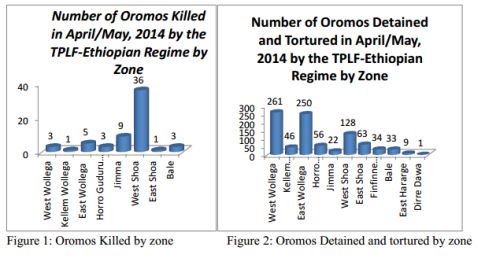
A Summary of Oromos Killed, Beaten and Detained by the TPLF Armed Forces during the 2014 Oromo Protest Against The Addis Ababa (Finfinne) Master Plan
Compiled by: National Youth Movement for Freedom and Democracy (NYMFD) aka Qeerroo Bilisummaa
Compiled by: National Youth Movement for Freedom and Democracy (NYMFD) aka Qeerroo Bilisummaa
July 05, 2014
Background
It is a well-documented and established fact that the Oromo people in general and Oromo students and youth in particular have been in constant and continuous protest ever since the current TPLF led Ethiopian government came to power. The current protest which started late April 2014 on a large scale in all universities and colleges in Oromia and also spread to several high schools and middle schools begun as opposition to the so called “Integrated Developmental Master Plan” or simply “the Master Plan”. The “Master Plan” was a starter of the protest, not a major cause. The major cause of the youth revolt is opposition to the unjust rule of the Ethiopian regime in general. The main issue is that there is no justice, freedom and democracy in the country. The said Master Plan in particular, would expand the current limits of the capital, Addis Ababa, or “Finfinne” as the Oromos prefer to call it, by 20 folds stretching to tens of Oromian towns surrounding the capital. The Plan is set to legalize eviction of an estimated 2 million Oromo farmers from their ancestral land and sell it to national and transnational investors. For the Oromo, an already oppressed and marginalised nation in that country, the incorporation of those Oromian cities into the capital Addis Ababa means once more a complete eradication of their identity, culture, and language. The official language will eventually be changed to Amharic. Essentially, it is a new form of subjugation and colonization. It was the Oromo university students who saw this danger, realized its far-reaching consequences and lit the torch of protest which eventually engulfed the whole Oromia regional state.
For the minority TPLF led Ethiopian regime, who has been already selling large area of land surrounding Addis Ababa even without the existence of the Master Plan, meeting the demands of the protesting Oromo students means losing 1.1 million of hectares of land which the regime planned to sell for a large sum of money. Therefore, the demand of the students and the Oromo people at large is not acceptable to the regime. It has therefore decided to squash the protest with its forces armed to the teeth. The regime ordered its troops to fire live ammunition to defenceless Oromo students at several places: Ambo, Gudar, Robe (Bale), Nekemte, Jimma, Haromaya, Adama, Najjo, Gulliso, Anfillo (Kellem Wollega), Gimbi, Bule Hora (University), to mention a few. Because the government denied access to any independent journalists it is hard to know exactly how many have been killed and how many have been detained and beaten. Simply put, it is too large of a number over a large area of land to enumerate. Children as young as 11 years old have been killed. The number of Oromos killed in Oromia during the current protest is believed to be in hundreds. Tens of thousands have been jailed and an unknown number have been abducted and disappeared. The Human Rights League of the Horn of Africa, who has been constantly reporting the human rights abuses of the regime through informants from several parts of Oromia for over a decade, estimates the number of Oromos detained since April 2014 as high as 50, 000
In this report we present a list of 61 Oromos that are killed and 903 others that are detained and beaten (or beaten and then detained) during and after the Oromo students protest which begun in April 2014 and which we managed to collect and compile. The information we obtain so far indicates those detained are still in jail and still under torture. Figure 1 below shows the number of Oromos killed from different zones of Oromia included in this report. Figure 2 shows the number of Oromos detained and reportedly facing torture. It has to be noted that this number is only a small fraction of the widespread killings and arrest of Oromos carried out by the regime in Oromia regional state since April 2014 to date. Our Data Collection Team is operating in the region under tight and risky security conditions not to consider lack of logistic, financial and man power to carry the data collection over the vast region of Oromia.
Read Full Report@
Oromia:Ethiopia crackdown on student protests taints higher education success May 22, 2014
Posted by OromianEconomist in Aid to Africa, Corruption, Economics: Development Theory and Policy applications, Ethnic Cleansing, Finfinne is Oromia's land, Finfinnee, Finfinnee is the Capital City of Oromia, Finfinnee n Kan Oromoo ti, Free development vs authoritarian model, Genocidal Master plan of Ethiopia, Human Rights Watch on Human Rights Violations Against Oromo People by TPLF Ethiopia, Janjaweed Style Liyu Police of Ethiopia, Knowledge and the Colonizing Structure., Knowledge and the Colonizing Structure. African Heritage. The Genocide Against Oromo Nation, Land and Water Grabs in Oromia, Land Grabs in Africa, No to the Addis Ababa Master Plan, NO to the Evictions of Oromo Nationals from Finfinnee (Central Oromia), Oromia wide Oromo Universtiy students Protested Addis Ababa Expansion Master Plan, Oromian Voices, Oromians Protests, Oromiyaa, Oromo, Oromo Diaspora, Oromo Identity, Oromo Nation, Oromo Protests, Oromo Protests in Ambo, Oromo the Largest Nation of Africa. Human Rights violations and Genocide against the Oromo people in Ethiopia, Oromo University students and their national demands, Say no to the expansions of Addis Ababa, State of Oromia, Stop evicting Oromo people from Cities, The Colonizing Structure & The Development Problems of Oromia, Tyranny.Tags: #OromoProtests, Genocide against the Oromo, Oromo, Oromo people, State and Development, State of Oromia, The tyranny of TPLF Ethiopia, Tyranny
1 comment so far

Any system which crushes its brightest should not be considered a success….The Ethiopian government likes to trumpet its higher education system to its western aid backers as a crowning success of its development policy. As billions in foreign aid are spent annually on Ethiopia, the west must be more cognisant of the fact that this money helps reinforce a government which cuts down those who dare to speak out against it.
Ethiopia crackdown on student protests taints higher education success
Western backers of the Ethiopian education system should not ignore reports of violent clashes on university campuses

Oromia, Ethiopia, where at least three dozen people were reportedly shot dead by security forces during student protests
Over the past 15 years, Ethiopia has become home to one of the world’s fastest-growing higher education systems. Increasing the number of graduates in the country is a key component of the government’s industrialisation strategy and part of its ambitious plan to become a middle-income country by 2025. Since the 1990s, when there were just two public universities, almost 30 new institutions have sprung up.
On the face of it, this is good news for ordinary Ethiopians. But dig a little deeper and tales abound of students required to join one of the three government parties, with reports of restricted curricula, classroom spies and crackdowns on student protests commonplace at universities.The Ethiopian government likes to trumpet its higher education system to its western aid backers as a crowning success of its development policy. As billions in foreign aid are spent annually on Ethiopia, the west must be more cognisant of the fact that this money helps reinforce a government which cuts down those who dare to speak out against it.
Nowhere has this been more evident than in Ambo in Oromia state. On 25 April, protests against government plans to bring parts the town under the administrative jurisdiction of the capital, Addis Ababa, began at Ambo University. By the following Tuesday, as protests spread to the town and other areas of Oromia, dozens of demonstrators had been killed in clashes with government forces, according to witnesses.
As Ethiopia experiences rapid economic expansion, its government plans to grow the capital out rather than up, and this involves annexing parts of the surrounding Oromia state. An official communique from the government absolved it of all responsibility for the clashes, claiming that just eight people had been killed and alleging that the violence had been coordinated by a few rogue anti-peace forces. The government maintains that it is attempting to extend Addis Ababa’s services to Oromia through its expansion of the city limits.
However, Oromia opposition figures tell a different story. On 2 May, the nationalist organisation the Oromo Liberation Front (OLF) issued a press release that condemned the “barbaric and egregious killing of innocent Oromo university students who have peacefully demanded the regime to halt the displacement of Oromo farmers from their ancestral land, and the inclusion of Oromo cities and surrounding localities under Finfinnee [Addis Ababa] administration under the pretext of development”. The Addis Ababa regime dismisses the OLA as a terrorist organisation.
While news of the killing of unarmed protesters has caused great concern among many Ethiopians, there has been little coverage overseas. The government maintains strict control over the domestic media; indeed, it frequently ranks as one of the world’s chief jailers of journalists, and it is not easy to come by independent reporting of events in the country.
Nevertheless, the government’s communique does run contrary to reports by the few international media that did cover the attacks in Ambo, which placed the blame firmly on government forces.
The BBC reported that a witness in Ambo saw more than 20 bodies on the street, while Voice of America (VOA) reported that at least 17 protesters were killed by “elite security forces” on three campuses in Oromia. Local residents maintain that the figure [of those killed] was much higher.
These reports, while difficult to corroborate, have been backed up by Human Rights Watch, which issued a statement saying that “security forces have responded [to the protests] by shooting at and beating peaceful protesters in Ambo, Nekemte, Jimma, and other towns with unconfirmed reports from witnesses of dozens of casualties”. One university lecturer said he had been “rescued from the live ammunition”, and that it was the “vampires – the so-called federal police” who fired on the crowds.
The Ethiopian government likes to trumpet its higher education system to its western aid backers as a crowning success of its development policy. As billions in foreign aid are spent annually on Ethiopia, the west must be more cognisant of the fact that this money helps reinforce a government which cuts down those who dare to speak out against it.
Inevitably, continued support for such an oppressive regime justifies its brutal silencing of dissent. Yes, the higher education system has grown exponentially over the past 15 years but the oppression and killing of innocent students cannot be considered an achievement. Any system which crushes its brightest should not be considered a success.
Paul O’Keeffe is a doctoral fellow at La Sapienza University of Rome, where he focuses on the higher education
system in Ethiopia


 Oromian Economist
You must be logged in to post a comment.