Economic and development analysis: Perspectives on economics, society, development, freedom & social justice. Leading issues in Oromo, Oromia, Africa & world affairs. Oromo News. African News. world News. Views. Formerly Oromia Quarterly
Federal government plans to take over the entire corridor of 25km between Hawasa and Shashamene. Both Sidama Zone or SNNPR and Oromia have not been consulted yet.
Major cities in Oromia are administered in what is termed as “special zone.” Jimma and its surrounding is special zone; Addis Ababa and its surrounding is special zone; Adama and its surrounding is special zone. Now the federal government of Ethiopia is considering to create one for Shashamane because, sources disclose, the city is becoming home for ”nations and nationalities” and economically very significant to be left for the regional government. In fact, the federal government wants to take over the entire corridor of 25km between Hawasa and Shashamene. And both Sidama Zone or SNNPR and Oromia have not been consulted yet. The plan will land on table presumably after 2015 election and EPRDF secures majority in the house that is already decided at the council of ministers in their last successive meetings.
As a tradition, top-down orders from the Government of Ethiopia (GoE), which is mostly controlled and manipulated by the Tigrayan minority group TPLF, would not be questioned by the regional states and the ruling regional “allies.” Any form of divergence from what the GoE says would not be tolerated and often officials are intimidated. The Addis Ababa master plan for example faced stiff resistance and after about months of “mediation,” the GoE via Addis Ababa city administration is bracing for what is thought to be a potential escalation of dispute with Oromia when the plan is once again put for test in January 2015. The exact terms reached between Addis Ababa and Oromia with more arbrating than mediating role of Federal officials will never be known until documents are available for media and public. As to Diriba Kuma himself, he is nervous because he wants to return back to Oromia with his little left reputation. Aafter all Oromia is much formidable place for officials than the federal government, and this master plan is not making things easy for him. Again, he also wants to stay and turn things around, and that would risk him for intimidation by GoE.
The word ‘’federalize’’ is only used in this context to describe the intention of the Federal government. As it is dictated by the constitution and other bylaws, federal government can’t own land. However, the GoE acts as if it owns everything in the empire amplifying the stark reality and difference between what is on paper and what is being practiced. In fact, the creation of special zones can be taken as a strategy of weakening the regional governments by snatching economically viable and productive areas, at the same time, strengthen the much talked about TPLF’s economic empire.
Creating a special zone is not new thing in developing countries. The noble motive of creating such geographic and administrative demarcation is to facilitate development and ensure smooth and dynamic rural-urban divide, and reduce the negative impacts of emerging industries on the the environment and the society. However, the case of Oromia is quite different, or perhaps as the source indicates, disastrous.
In Addis Ababa, rampant mismanagement and corruption of land is source of fortune for few and destitution for most. Although rarely, this has been acknowledged by the city government itself. The last wave of urban land grab was right after the 2005 election. The so called Land Bank was fabricated to ration land to Tigrayans; following that campaign, Ex-Minister Ermisa Legese tells, over 150000 Oromo farmers and their families were displaced in what is now understood as systematic genocide. The second wave of land grab, this time deep into Oromia, is an ongoing project since 2012 right before Mele’s death. And many believe this Adds Ababa master plan legitimizes what has been done under the radar for the last 10 years. We should be afraid that It might take another 15 year but a complete social and economic Abyssinianization of Jimma, Adama and Shashamane is quite possible within this regime unless change is pending.
As smooth as it looks from outside falsely to handle investment and industries, the creation of special zone is an administrative hurdle because it is a redundant procedure. Creating a zone within Zone, society within society, economy within economy, is not sustainable and fair. There are experiences from other federal countries how to develop both social and economic sectors of the population without adversely impacting the livelihood of the people and the ecology. And the best way to do that is not to disconnect the rural surrounding from its urban epicenter.
Special zone model is attentively and particularly geared to be applied in Oromia as neither in Amhara nor in Tigray regions that they have special zones in a way they are in the former. In the later two regions, there are Mekele zone and Bahirdar zone but it is only purely for economic reasons since they have a smooth and consistent social transition from urban to rural settings. Without bold social and economic policy changes, my source thinks, these cities such as Jimma or Adama are administratively would soon be out of Oromia. because of their economic and administrative model and their social mix, which are not according to the interest of the Oromo people, just like Addis Ababa.
Apart from serving as a new hotbed for corruption and mismanagement, the new special zone around Shashamane and its link with Hawasa is intended to create an ‘’atmosphere of cooperation’’ between the two regional states. The increasing hostility between regional states were an intense topic during several federal security meetings. Most of these disputes are over land and border. Tigrayan controlled GoE, heavily influenced by Amhara individuals (not ANDM persei), wants to check and demise the little autonomy of regional state in pretext of ‘’creating one socioeconomic community’’ rhetoric of the constitution thereby pleasing the assimilative and border-phobic motives of some influential Amhara elites to restore their nostalgic interest of the empire and at the same time ensuring the continuous economic hegemony of Tigrayan minority.
Federal government plans to take over the entire corridor of 25km between Hawasa and Shashamene. Both Sidama Zone or SNNPR and Oromia have not been consulted yet
“Dargaggoonni kun Imaanaa guddaatu isin irra jira.Hacuucamuu sodaattanii biyya irraa hin godaaninaa.Jaalala uummataa qabaadhaa. Walii galtee qabaadhaa. Ani amma milli koo tokko gara boollaati. Isin garuu uummata keessan haqaan tajaajiluuf humnaa fi kutannoo cimaa qabaachuu qabdu!!!” Obbo Bulchaa Dammaqsaa
The only pro-democracy Opposition Coalition Party in Ethiopia, Medrek, held a rare rally in Finfinne (Addis Ababa) on Dec. 14, 2014. According to the reports, thousands of rally goers chanted slogans in Afan Oromo, English and Amharic languages demanding the TPLF-led Ethiopian regime free Oromo political prisoners, journalists and other political prisoners. Some of the slogans included: “Free Bekele Gerba!” – “Free Oromo Students!” – “Stop Land-Grabbing” – and “Free Journalists!”
At the rally, senior leaders of Medrek gave rousing speeches; speakers included: Dr. Beyene Petros (the Coalition’s President), Mr. Bulcha Demeksa (Chairman Emeritus of the Oromo Federalist Congress/OFC – one of the political organizations in the pro-democracy Medrek), Mr. Tilahun Endeshaw of the Ethiopian Social Democratic Federal Party/ESDFP, and Mr. Desta Dinka (Leader of the Medrek Youth).
It is not often you hear a Vice President of the World Bank calling for revolution, but Oby Ezekweseli did just that at the Royal African Society’s Annual Lecture last week.
There is an unwritten rule among politicians globally that they do not rubbish their rulers when they are abroad, but Oby – who would not describe herself as a politician – did not hold back.
We should have guessed how fired up she was when the former minister in President Obasanjo’s government in Nigeria and World Bank Vice President set the title: “Africa Rising? What will happen when her citizens arise?” You can watch her presentation here
She traced the lack of participation by the vast majority of Africans in their own development over the past 50 years which has left 70 – 80% of them absolutely poor. She blamed the “parasitic” African elites, not just for looting their countries, but for preventing any of the benefits of economic growth reaching their people. Her own country, Nigeria, is very rich but has some of the worst human development figures in the world.
She also pointed out that external actors, the aid donors, the World Bank and the IMF who drove the structural adjustment economic reforms of the 1990s and 2000s and left African citizens with no part to play in making the national choices for development. These reforms were necessary, she said, but “externals cannot give development to any country or any people… The ownership of the process by African citizens has been the missing link.”
Dismissing the current crop of African rulers, she expressed her pride in the people of Burkina Faso for the uprising that ejected President Blaise Compaoré
, who ruled there for 27 years. The leaders “absolutely don’t care” about their own citizens, she said, but spend their time among the global elite “all of whom have each other’s’ phone numbers”.
The next stage of development, said Oby, can only be done with the participation of the people, “no external force can do that…The change you have been waiting for will not come from the elite class waking up and having an epiphany. The change has to be made by the people. They are the only ones who can.”
And she urged the African diaspora to return to Africa and lead the struggle, a remark that created a moment of awkwardness in the room I noticed.
But I am sure you will agree this was an inspiring, energising message: People of Africa, you are citizens, not slaves. Rise up and demand what is yours and remove the people who have stolen it from you. Could the removal of Compaoré
by mass demonstrations followed by the refusal to accept an interim military ruler be the beginning of an Africa-wide trend as a 21st Century generation comes of age? It is not the usual message that you hear from African ministers or the World Bank.
But there is an anomaly here. If Oby is right then the most democratic countries with the most widespread political participation would be the most prosperous. And the most equal in terms of sharing the national cake. But this is not so.
Put aside the oil and mineral-rich countries in Africa, and, as Oby pointed out, you find that the fastest growers are those with stability and strong institutions such as effective ministries that deliver health and education to their people. In turn these attract aid and investment. These countries are Rwanda, Ethiopia, Uganda, Mozambique and Tanzania.
But what else do they have in common? Ethiopia and Rwanda are top-down dictatorships ruled by parties that fought their way to power and have ruled since 1991 and 1994 respectively. They deliver health and education to their people but they do not allow freedom of speech or association. Their media are tightly controlled. Uganda is a less powerful dictatorship but President Yoweri Museveni also came to power through the barrel of a gun in 1986 and his army has controlled the country ever since. The ‘Walk to Work’ mass movement in 2011, which complained about lack of services and high prices, was brutally suppressed.
Museveni was forced by aid donors to open up politics and he now has to put up with a rumbustious parliament and a moderately free press. A grumpy population, especially in the capital, might vote for someone else if they were sure that someone was allowed to run in a fair election. That is unlikely. At election times the state, including the police and the army, is an extension of the ruling party.
Mozambique and Tanzania are still run by the parties that led those countries at independence. Both will soon become exceedingly rich because of oil and gas; God-given resources that are profoundly anti-democratic. Oil-rich countries do not need to raise taxes from their people, they mainline millions from oil companies straight into the treasury. So whoever is in power when those revenues begin to flow may stay there for decades. There is still some democratic space in these countries and there are real national debates with opposition parties in both of them, although it is unlikely that an opposition party could win without provoking violent reactions from the ruling parties.
So is benign dictatorship the best Africans can hope for? There are certain advantages – stability and consistency. The downside is that it is dangerous to think or speak out so there is no national debate. Meanwhile new generations emerge – especially in Africa where birth rates are high – and dictators become out of touch. If the new generation follow Oby Ezekwesili’s call, Africa will remain exceedingly interesting and exciting and should also become prosperous and powerful.
See more @ http://africanarguments.org/2014/12/11/citizens-of-africa-arise-you-have-nothing-to-lose-but-your-chains-says-oby-ezekwesili-by-richard-dowden/
Is H&M turning a blind eye to land grabs in Ethiopia? TV4 does an investigation into H&M’s cotton sourcing from Ethiopia and discovers the disturbing truth.
The paradox, however, and one of the reasons why despite having so little land, small producers are feeding the planet, is that small farms are often more productive than large ones. If the yields achieved by Kenya’s small farmers were matched by the country’s large-scale operations, the country’s agricultural output would double. In Central America, the region’s food production would triple. If Russia’s big farms were as productive as its small ones, output would increase by a factor of six. Another reason why small farms are the feeding the planet is because they prioritise food production. They tend to focus on local and national markets and their own families. In fact, much of what they produce doesn’t enter into trade statistics – but it does reach those who need it most: the rural and urban poor. If the current processes of land concentration continue, then no matter how hard-working, efficient and productive they are, small farmers will simply not be able to carry on. The data show that the concentration of farmland in fewer and fewer hands is directly related to the increasing number of people going hungry every day. – http://www.grain.org/article/entries/5072-telling-family-farming-fairy-tales
The United Nations declared 2014 as the International Year of Family Farming. As part of the celebrations, the U.N. Food and Agriculture Organisation (FAO) released its annual “State of Food and Agriculture”, which this year is dedicated to family farming. Family farmers, FAO say, manage 70-80 percent of the world’s farmland and produce 80 percent of the world’s food.
But on the ground – whether in Kenya, Brazil, China or Spain – rural people are being marginalised and threatened, displaced, beaten and even killed by a variety of powerful actors who want their land.
Farmer Djeneba Diarra on her farm in Heremakono, Mali (Photo: Joe Penney/Reuters)
A recent comprehensive survey by GRAIN, examining data from around the world, finds that while small farmers feed the world, they are doing so with just 24 percent of the world’s farmland – or 17 percent if you leave out China and India. GRAIN’s report also shows that this meagre share is shrinking fast.How, then, can FAO claim that family farms occupy 70 to 80 percent of the world’s farmland? In the same report, FAO claims that only 1 percent of all farms in the world are larger than 50 hectares, and that these few farms control 65 percent of the world’s farmland, a figure much more in line with GRAIN’s findings.
The confusion stems from the way FAO deal with the concept of family farming, which they roughly define as any farm managed by an individual or a household. (They admit there is no precise definition. Various countries, like Mali, have their own.)
Thus, a huge industrial soya bean farm in rural Argentina, whose family owners live in Buenos Aires, is included in FAO’s count of “family farms”. What about sprawling Hacienda Luisita, owned by the powerful Cojuanco family in the Philippines and epicentre of the country’s battle for agrarian reform since decades. Is that a family farm?
Looking at ownership to determine what is and is not a family farm masks all the inequities, injustices and struggles that peasants and other small scale food producers across the world are mired in.
It allows FAO to paint a rosy picture and conveniently ignore perhaps the most crucial factor affecting the capacity of small farmers to produce food: lack of access to land. Instead, the FAO focuses its message on how family farmers should innovate and be more productive.
Small food producers’ access to land is shrinking due a range of forces. One is that because of population pressure, farms are getting divided up amongst family members. Another is the vertiginous expansion of monoculture plantations.
In the last 50 years, a staggering 140 million hectares – the size of almost all the farmland in India — has been taken over by four industrial crops: soya bean, oil palm, rapeseed and sugar cane. And this trend is accelerating.
In the next few decades, experts predict that the global area planted to oil palm willdouble, while the soybean area will grow by a third.These crops don’t feed people. They are grown to feed the agroindustrial complex.
Other pressures pushing small food producers off their land include the runaway plague of large-scale land grabs by corporate interests. In the last few years alone, according to the World Bank, some 60 million hectares of fertile farmland have been leased, on a long-term basis, to foreign investors and local elites, mostly in the global South.
While some of this is for energy production, a big part of it is to produce food commodities for the global market, instead of family farming.
SMALL WORKS BETTER
The paradox, however, and one of the reasons why despite having so little land, small producers are feeding the planet, is that small farms are often more productive than large ones.
If the yields achieved by Kenya’s small farmers were matched by the country’s large-scale operations, the country’s agricultural output would double. In Central America, the region’s food production would triple. If Russia’s big farms were as productive as its small ones, output would increase by a factor of six.
Another reason why small farms are the feeding the planet is because they prioritise food production. They tend to focus on local and national markets and their own families. In fact, much of what they produce doesn’t enter into trade statistics – but it does reach those who need it most: the rural and urban poor.
If the current processes of land concentration continue, then no matter how hard-working, efficient and productive they are, small farmers will simply not be able to carry on. The data show that the concentration of farmland in fewer and fewer hands is directly related to the increasing number of people going hungry every day.
According to one U.N. study, active policies supporting small producers and agro-ecological farming methods could double global food production in a decade and enable small farmers to continue to produce and utilise biodiversity, maintain ecosystems and local economies, while multiplying and strengthening meaningful work opportunities and social cohesion in rural areas.
Agrarian reforms can and should be the springboard to moving in this direction.
Experts and development agencies are constantly saying that we need to double food production in the coming decades. To achieve that, they usually recommend a combination of trade and investment liberalisation plus new technologies.
But this will only empower corporate interests and create more inequality. The real solution is to turn control and resources over to small producers themselves and enact agricultural policies to support them.
The message is clear. We need to urgently put land back in the hands of small farmers and make the struggle for genuine and comprehensive agrarian reform central to the fight for better food systems worldwide.
FAO’s lip service to family farming just confuses the matter and avoids putting the real issues on the table.
Read more @ http://www.grain.org/article/entries/5072-telling-family-farming-fairy-tales
Secretary General of the Amnesty International
Amnesty International Ltd
Peter Benenson House
1 Easton Street
London WC1X 0DW
United Kingdom
Dr. Shiferaw Teklemariam
Minster of Federal Affairs
P.O. Box 5718
Finfinee (Addis Ababa)
Getachew Ambaye
Minister of Justice
P.O. Box 1370
Finfinee (Addis Ababa)
Ethiopia
November 12, 2014
Subject: In Defense of the Latest Amnesty International (AI) report Repression in the Oromia
Dear the Secretary General & the Minsters of the Ethiopian Federal Government:
I am writing this letter to defend the latest Amnesty International (AI) report BECAUSE I AM OROMO’ Sweeping Repression in the Oromia Region of Ethiopia1 from the attacks and mischaracterizations of the Ethiopian government presented on BBC Radio and other media outlets. I believe I am entitled to do this for four reasons.
The first reason is, I was born and raised in Oromia among the followers of the Oromo indigenous religion– Waqefaata. I have witnessed human violations perpetuated by consecutive Ethiopian regimes. During the Haile Selassie regime, I witnessed my family members giving a quarter of their harvests to the Abyssinians and paying taxation without representation in the government. I witnessed many Oromo family members tried not to allow baptizing their children in the Abyssinian Orthodox Church. In the belief that if someone first goes through the Waqefaata ceremony known as Amachisa, the person will remain Waqefaata, my community members developed strategy to take their children through the indigenous ceremony first. Accordingly, in the Amachisa ceremony I got the name Tolera = things are good. After that, they had me baptized because the Oromo people were forced to baptize their children in the Orthodox Church. In the ceremony of baptism they gave me a name Gebre Giyorgis = the slave of George. I leave it to the readers to compare the differences in meaning between the two names.
I heard many stories about many innocent Oromo persons being charged with the crimes they did not commit. In most cases it was to free the Abyssinians from crimes they had committed. There is a case that I well knew- about an Oromo person being penalized for referring to the Supreme Court judge as (አንች=anchi) ‘you’, a term used in Amharic in reference to women,-instead of (እርስዎ=irswo) ‘you’ used in reference to the higher officials. The person did not use the term አንች (anchi) to undermine the Supreme Court. The reason was that he did not fully understand the Amharic language. This means that the Oromo people’s cultural rights are regularly violated and such violations are legal. As the UN document clearly states “human rights are indivisible, interrelated and interdependent”; the rights of the Oromo people to social, economic, political and cultural rights are being violated and this is clearly demonstrated in this case of a person being penalized for making a grammar mistake.
The recent popular revolution in Burkina Faso and the resignation of President Blaise Compaoré has emerged as a ‘warning alarm’ to African tyrants who are bent on eternalising themselves in power. The political crisis in Burkina Faso could be seen as a ‘call for attention’ to the presidents of Democratic Republic of Congo, Republic of Congo and Rwanda who intend to amend their respective constitutions in order to become eligible for a third mandate.[1]
Presented by some Western states (France and the United States) as an effective mediator in resolving regional crises, Compaoré has just failed to prevent and resolve the political crisis in his own country. The Burkinabe people chose to oust Compaoré during the month of October, just as he ousted President Thomas Sankara in October, 27 years earlier. With the complicity of France, Compaoré took power in 1987 by eliminating a Sankara, a transformational leader. Sankara and thirteen collaborators were killed during the coup.[2] The result was that a committed head of state was replaced by a ruler responsive only to the interests of the former colonial power.
During his rule, Compaoré set up a political system largely unresponsive to people’s needs, wants and aspirations. For almost three decades, the Burkinabe people witnessed a high level of corruption, poverty, injustice, a high unemployment rate and a repressive political system. Civil rights and the freedom of the press were undermined. One of the most gruesome examples of this came on December 13th 1998, when the charred bodies of journalists Norbert Zongo and three of his friends were found in their vehicle 100km south of Ouagadougou.[3] The President’s brother, Francois Compaoré, was a prime suspect. Unequal resource distribution has also been one of the main causes of persistent popular disenchantment. According to World Bank statistics from 2012, 46% of the population still lives below the poverty line.[4]
President Compaoré, like many African Heads of State, was more interested in clinging to power than in the needs of his people. Modifying the constitution to stay in power became the ultimate goal for Compaoré. Article 37 of the constitution of Burkina Faso stipulates that ‘the president of Faso is elected for five years by direct universal suffrage in a secret ballot. He can only be re-elected once’. Elected in 2005 and again in 2010, Blaise Compaoré could not stand for re-election without amending this article. On October 21st 2014, Compaoré announced his intention to hold a referendum which, if it went his way, would give him the power to amend the constitution and stand for a fifth presidential term.[5] A wave of popular disapproval spread throughout the country, incorporating both the opposition party and large sections of civil society.
On 30th October, when the amendment of the constitution was due to be debated in parliament, the Burkinabe people stormed into the parliament building and destroyed it.
The weakening of the regime in Ouagadougou not only came from the discontent of civil society but also from perennial mutinies in the army. In 1999 soldiers protested about the payment of their bonuses. In 2011 there was another mutiny, coinciding with civil unrest. Despite the fact that Compaoré at that time added the role of Minister of Defense to his presidential portfolio, the regime continued to show signs of weakness.[6] The relatively low degree of retaliation by the armed forces with regard to the uprisings of 28-30th October show the persistent discontent within the ranks.
Another problem for Compaoré was his firm belief in protecting his ‘Western friends’ above all else – France and the USA. He thus gave little attention to the famous phrase vox populis, vox Dei (the voice of the people is the voice of God). The victories of popular revolutions over tyrannical regimes across the world provide enough evidence to argue that ultimate power lies in the hands of the people.
As we look towards the future, there are several questions to consider: What kind of political future will Burkina Faso have? Will the country undergo the kind of political controversies witnessed in Tunisia and Egypt after the respective downfalls of Ben Ali and Hosni Mubarak? As the former second in command of Compaoré’s presidential guard, will Lieutenant Colonel Zida ensure a transparent transition? Does the military’s ascendance to the helm of the state undermine the intention of the revolution to free the people from tyranny? Is it not high time for the African Union to actively intervene in favour of a peaceful and consensual transition in Burkina Faso?
It is not easy to find specific answers to these questions since the situation on the ground is evolving all the time. But it is high time for the leaders in Burkina Faso to recognise leadership as a process of interaction between leaders and followers. Leaders must be aware and responsive to societal needs. The structure of the transition should be consensually determined by the Burkinabe people in such a way that all the strata of society are taken into account. In this context, a consensual civilian government would be the appropriate structure for an effective democratic transition. As the main political organisation on the continent, the African Union must effectively encourage a peaceful transition in ‘the land of incorruptible people’, as Sankara once called Burkina Faso, before he was deposed by the eminently corruptible Compaoré.
* Albert Mbiatem is a fellow of the African Leadership Centre, King’s College London. He is currently on attachment at the Institute for Peace and Security Studies (IPSS) in Addis Ababa. He is also a research assistant at the University of Buea in Cameroon. This article was first published on Strife blog.
REFERENCES
Radio France Internationale, Revue de Presse. 31 October, 2014.
[1] Bonkoungou, M. (2007) “Burkina Faso Salutes “Africa’s Che” Thomas Sankara”. Reuters, 17 October 2007. And Radio France Internationale, October 27, 2008.
[2] International Crisis Group “Burkina Faso: With or Without Compaoré, Times of Uncertainty” Africa Report N°205, 22 July 2013.
[3] World Factbook and the World Bank. 2012.
[4] Le Figaro, “Au Burkina Faso, Blaise Compaoré Rêve Encore de Pouvoir”. 22 October 2014.
[5] Crisis Group Interview, International Military Official, Ouagadougou, September 2011.
Read more @ http://www.pambazuka.net/en/category/features/93350
Ethiopia, one of the world’s hungriest countries, is selling off vast chunks of its land to foreign investors who are growing food products for export — and those who get in the government’s way are being killed or silenced, according to a new investigation.
Under the country’s controversial “villagization” scheme, huge populations of farming communities are being moved out of their homes on land eyed for development and into new settlements built by the government. Residents not lured out by promises of better infrastructure and services are often forced to go against their will, and resistance often brings violence or intimidation into acquiescence or exile, US-based rights group the Oakland Institute says in a report due for release on Monday.
Now, for the first time, pictures obtained exclusively by VICE News appear to show evidence of the widespread atrocities and abuses being reported by farming communities and minority groups across the country.
An image of a Suri tribe member said to have been of the alleged February 2012 massacre
The pictures were sent to the Institute in April 2012, and are said to depict a massacre carried out by government officials and members of the ethnic Dizi group on behalf of the Ethiopian state against the Suri, one of Ethiopia’s many ethnic indigenous farming groups, in the market town of Maji in February that year.
Since 2010, it is estimated that the government’s “growth and transformation plan” has relocated 1.5 million people into village settlements, rights groups say. The areas afflicted include the Gambella, Afar, Somali, Lower Omo, and Benishangul-Gumuz regions, where local tribes do not have formal land rights. At the same time, huge tracts of land are being sold to investors for development. So far, it is estimated that the government has sold off the rights to 26 percent of Ethiopia’s farmland.
The Suri people own large amounts of cattle and travel through a rapidly shrinking area in southwestern Ethiopia grazing their animals. The land they traditionally use has been sold to investors operating the Koko plantation, a Malaysia-backed project that exports palm oil and other food and farming products. According to testimonies taken by the Oakland Institute, the dispute that led to the reported massacre stems from an incident when three government officials, policemen from the Dizi ethnic tribe, were killed as they attempted to mark areas within a Suri community into which the Koko plantation was expanding.
A few days later, in an apparent act of retaliation, between 30 and 50 Suri men and women were allegedly killed with machetes and stones at a Saturday market in the town of Maji. The bodies were then dumped in a nearby stream. The Oakland Institute said: “It has not been possible to confirm the precise numbers of dead since no police report was filed.”
The pictures prompted an investigation that is detailed in a report by the Oakland Institute scheduled for publication at 9am PST (5pm GMT) on Monday. The investigators encountered many difficulties, they said, as it was “clear that the Suri fear retaliation for speaking out against the government.”
The Institute said the alleged killings show how the state is exploiting complicated, historic ethnic tensions between the Dizi and Suri by employing men from Dizi communities as policemen and local government officials, and tasking them with clearing the Suri communities off the land they have relied on for 300 years.
Maji market, site of the alleged massacre. Image via Katie Sharp
The interviewees are identified only by their initials as the fear of reprisals is great. Activists say the penalty for smuggling this type of information out of Ethiopia can be death. Rights groups in the UK say their contacts inside the country have been arbitrarily arrested and held in torturous conditions for apparent crimes of “communications.” The electronic war Ethiopia has waged against some of its citizens has been reported by Felix Horn from Human Rights Watch.
Speaking to VICE News, Horn said the scale of intimidation is difficult to overestimate. Gaining access to the areas afflicted is almost impossible and telephone lines are problematically easy to trace.
“When you are permitted access to key areas, individuals are terrified to speak to foreign NGOs or journalists. And rightfully so — many Ethiopians are harassed or detained for doing exactly that. In addition, the CSO Law has decimated the ability of local groups to monitor rights abuses — all of which makes Ethiopia one of the most difficult countries in Africa to do meaningful human rights research.”
The use of the CSO Law as a means of denying fundamental rights, tempering freedoms and jailing journalists has been documented. Reports of massacres, rape and forced relocations have been slowly emerging over the past few years, but pictorial evidence has not existed in a credible form.
Anuradha Mittal, the executive director of the Oakland Institute, said it was clear the government’s villigization scheme was creating new tribal conflicts by exploiting old ones, as communities are being forced to compete for the remaining land and water across the country.
She told VICE News the facts were being ignored by the international community, which funds the Ethiopian regime to the tune of $3.2 billion each year.
An image purporting to show a Suri victim of the alleged Maji massacre
“The donors are well aware of the situation on the ground and have chosen to turn a blind eye to gross human rights abuses by their closest ally in Africa.”
Reports of abuses are widespread, having been documented by Human Rights Watch, Amnesty International, and, most comprehensively, by those behind Monday’s report.
As a result of the growing catalogue of evidence, this year the US Senate included provisions to ensure American aid was diverted away from projects “associated with forced evictions.” Though this admission has been welcomed by campaigners, it remains painfully unclear how this will actually be achieved. Those US and UK citizens who paid their taxes last year gave approximately $600 million and £200 million to the Ethiopian government respectively. Almost 10 percent of funding in Ethiopia comes from aid.
A site on Maji’s outskirts where bodies were found following the alleged massacre. Image via Katie Sharp
There have been other accounts of similar instances of violence by the Ethiopian government against the Suri people. An unverified feature on CNN’s iReport, included pictures purported to be of an alleged December 2012 massacre which claimed the lives of 147 people. The writer described the aftermath of a dispute over land that was said to have been sold to a gold mining company:
“The dead bodies are buried in mass graves deep inside Dibdib forest and some bodies were transported to gold mining holes not far from the Dibdib forest.
Some bodies were left out and eaten by vultures and predators. Most of the children were thrown into Akobo River.
After the massacre, the army sent warnings all around the area that if anyone reports about this, the army will do things to these people who report, and more, even worse, things to the Suri.”
The CNN reported could not be verified by VICE News. The picture evidence does not appear to match the massacre described, according to researchers, and the claims have not been independently corroborated. The person who wrote the report is thought to be still inside the country.
Nyikaw Ochalla, a UK-based activist with Anywaa Survival Organization told VICE News it was important to see the alleged massacre in Maji as part of a wider assault. “I saw the pictures and I think it is the reality of what is taking place in Ethiopia right now. The pastoralists are being denied their livelihood and their land is being leased out to foreign investors without their knowledge or consent.”
An image said to show corpses piled up following the alleged market massacre
He also stressed the risks associated with reporting atrocities, both to him and others outside the country, and, most gravely, to those inside. One of his contacts from Gambella is currently being detained in a prison hundreds of miles away in Addis Ababa. “He was not told why he was detained, but (during his) torture it was revealed it was because he had been communicating with me.”
Ochalla was just one interviewee for this report who said they were concerned their communications were being monitored.
The Ethiopian embassy did not respond to questions from VICE News on the Maji market massacre allegations. A UK government spokesman issued a statement saying they “regularly raise human rights with the relevant authorities, including at the highest level of the Ethiopian government.” They also said they were limited in what they could comment on, as the UK Department for International Development (DFID), which handles aid distribution, is being taken to court by an Ethiopian man from another ethnic tribe who says that he was forced off his land and that his community endured atrocities similar to those depicted here.
The British High Court will hear the case of Mr O, now a refugee living in Kenya, early next year. His lawyer Rosa Curling told VICE News the case will challenge the government’s “ongoing failure to properly asses whether UK aid money has been involved in Ethiopia’s villagization program, a program which had a devastating effect on our client and his family.”
Ngo Hole, a member of the Suri tribe killed in the alleged massacre, who previously appeared in a Spanish reality TV show. Image via Katie Sharp.
Mittal said the pictures show how Mr O’s story is being replicated all over the country, and called on the international community to act in the face of mounting evidence. “It is time for the US government, other donors, and international institutions to take a strong stand to ensure aid in the name of development is not contributing to the ongoing atrocities nor supporting the forced displacement of people. “She stressed the Suri are not the only ones being targeted: “Anuaks, Majang in Gambella, Mursi, Bodis, Nyongtham and several other groups in lower Omo and around the country are equally impacted.”
The plantation whose operations prompted the alleged massacre is now reported to have closed down, earlier this year. It is unclear whether the Suri have been allowed back to their land to grow their food, in a country where almost half of the population is malnourished. The government of Ethiopia appears to have done a remarkable job in suppressing dissent, jailing journalists and preventing those with evidence of abuse from letting the donor community know what their taxes are funding.
It’s been called by some to be a new form of colonialism. Others say it is outright theft. Land grabs in the developing world create a system so unequal that resource-rich countries become resource dependent. In Ethiopia, one of the world’s largest recipients of foreign aid, the problem is particularly acute. In a country where over 30% of the population (pdf) is below the food poverty line, crops are exported abroad—primarily to India, Saudi Arabia and the Gulf Cooperation Council (GCC) states. http://qz.com/275489/in-ethiopia-foreign-investment-is-a-fancy-word-for-stealing-land/
In Ethiopia, foreign investment is a fancy word for stealing land
By Daniel A. Madina
Since 2000, over 37 million hectares of land, mainly in the world’s poorest nations, have been acquired by foreign investors “without the free, prior, and informed consent of communities” in what, according to Oxfam and other organizations, constitutes a “land grab.” It’s a portion of land twice the size of Germany, according to researchers.
More than 60% of crops grown on land bought by foreign investors in developing countries are intended for export, instead of for feeding local communities. Worse still, two-thirds of these agricultural land deals are in countries with serious hunger problems. A report by the University of Virginia in collaboration with the Polytechnic University of Milan says that a third to a fourth (pdf, p. 1) of the global malnourished population, or 300 to 550 million people, could be fed from the global share of land grabs.
Instead, the land is used to grow profitable crops—like sugarcane, palm oil, and soy. The benefits of this food production “go to the investors and to the countries that are receiving the exports, and not to the benefit of local communities,” says Paolo D’Odorico, professor of environmental sciences at the University of Virginia. He attributes the phenomenon to a global “commodification of land” and says the problem will only get worse in the coming years as food prices continue to rise globally.
Land grabs in the developing world create a system so unequal that resource-rich countries become resource dependent.
In Ethiopia, one of the world’s largest recipients of foreign aid, the problem is particularly acute. In a country where over 30% of the population (pdf) is below the food poverty line, crops are exported abroad—primarily to India, Saudi Arabia and the Gulf Cooperation Council (GCC) states.
Multinationals buy up the land from the Ethiopian government for lease and bring in workers to farm it.
Favorable climate conditions and government relief have led Ethiopia to be chosen as a new production site by many flower growers present in Kenya. Bangalore-based Karuturi Global, the world’s largest rose exporter, has rose plantations in the country, and is planning the development of a 300,000-hectare lease in the Gambella area.
Alfredo Bini, an Italian photojournalist, examined Ethiopian land grabs in his recently released photo series, “Land Grabbing.” For the investors, Bini explains, the deals were not “land grabs” but opportunities to get huge returns on investments.
As Birinder Singh, the executive director of Karuturi in Ethiopia, plainly states in his interview with Bini: “When someone calls it ‘land grab,’ we call it ‘land development.’”
“These companies—mostly Saudi and Indian—are signing deals with the Ethiopian government to lease this land… for 25, 30, sometimes 50 years, depriving local populations of the ability to harvest their crops and feed themselves,” Bini told Quartz. “The government says the lands are empty and not being harvested but from what I saw and documented in my reporting this is entirely not the case.”
Farming women walk along a bank to reach their plot in the Agula region of Tigray. The average size of plots cultivated by the local farmers is no more than 0.6 hectares, hardly sufficient to guarantee sustenance for typical, large Ethiopian families.(Alfredo Bini/Cosmos)
Burning forest around the Karuturi facility, in the Gambella region of Ethiopia, to allow access to bulldozers preparing the ground for oil palm and sugar cane plantations. The area is near a national park where the second largest animal migration in Africa occurs. Karuturi claims they have preserved the free movement of animals through corridors of intact forest.(Alfredo Bini/Cosmos)
A school in Arabhara, a village near the Kebena River, between the town of Amibara and the Aledeghi natural reserve. This area is included in the government-owned Metahara Sugar Factory’s 20,000 hectare expansion plan. The native Afar herders have declared they are ready for an armed revolt rather than accepting their villages being moved.(Alfredo Bini/Cosmos)
The planting of sugar cane cuttings in Awash near Amibara and the Aledeghi natural reserve. This area is included in the government-owned Metahara Sugar Factory’s expansion plan, aimed at boosting sugar and biofuel production.(Alfredo Bini/Cosmos)
A rose growing in one of the greenhouses springing up around Holeta. Favorable climate conditions and government relief have led to Holeta being chosen as a new production site by many flower growers present in Kenya, including Karuturi.(Alfredo Bini/Cosmos)
Once cut, the roses are taken to the stocking and shipping area where they are packed and readied for the daily shipments to Holland.(Alfredo Bini/Cosmos)
Executive director Birinder Singh in the Ethiopian offices in Addis Ababa for Bangalore-based Karuturi.(Alfredo Bini/Cosmos)
Read more @http://qz.com/275489/in-ethiopia-foreign-investment-is-a-fancy-word-for-stealing-land/
Triangle between corporations, government and farmers.
LAND GRABBING OR LAND TO INVESTORS ?
By Alfredo Bini*
October 2, 2014 (Farmlandgrab) — In Ethiopia, more than six million people survive because of UN food aid, while agricultural products cultivated on land leased to foreign investors are exported. A paradox. These land use decisions are made far from the land itself, and far from the people whose lives are rooted in it.
The video below explores the phenomenon of land grabs through the eyes of foreign investors, governments and the people on the land. Images from this video also appeared at the Photoville Festival in Brooklyn, NY. There Grassroots International and allies participated in a panel discussion “Land Grabbing: Raising Awareness with Multimedia” on September 21, 2014.
Land Grabbing is not new. Companies from wealthy countries have always sought low-cost land for agricultural production. Today, governments allocate funds to domestic companies that wish to invest in land overseas. Governments did not provide this type of financial support for much of the last century, but are doing so now in manner reminiscent of colonial practices.
In 2007, after the subprime crisis, capital moved to food commodity markets and prices increased. The price rally coincided with a decrease in exports from some food producing countries. Countries that historically have been vulnerable to these fluctuations sought new food security strategies. The Arab states were the first to move, followed closely by others seeking new and profitable business ventures.
The financial risk to the companies involved in Land Grabbing is almost nonexistent. Governments, motivated by food security concerns, allocate the initial funds to be invested overseas. The EU provides funding to other companies that will produce materials overseas that make it possible to comply with EU “green policies” for biofuel production. The World Bank and the IMF also provide companies with funding, and it is possible to purchase insurance against loss that may result from stability issues in the country where the funds are invested.
*Alfredo Bini is a photojournalist and has found his own personal form of expression in reportage photography. His work has been on show in exhibitions and photography festivals worldwide. His reportages won national and international awards and are used as debating material for presentations and conferences in public venues, universities and on TV news programs. He is represented by the Paris based Cosmos Photo agency.
“The Ethiopian government is routinely using access to aid as a weapon to control people and crush dissent,” Rona Peligal, Africa director at Human Rights Watch, was quoted in a 2010 Globe and Mail article as saying: “If you don’t play the ruling party’s game, you get shut out. Yet foreign donors are rewarding this behaviour with ever-larger sums of development aid.”
The New Master Plan for Addis Ababa outlines a development scheme that would yet again push people off their land with the help of donor dollars.
Thousands of ethnic Oromo students in Ethiopia organized non-violent protests this spring, triggering a government reaction that has left an untold number dead and pushed hundreds of students underground.
The protests began in early April in response to The Integrated Development Master Plan, the municipal government’s strategy for the next 25 years of urban growth. Over the following week, the movement spread to eight universities and attracted as many as 25,000 protesters.
The Master Plan is contentious for a number of reasons. Addis Ababa is one of the fastest growing cities in Africa. The new Master Plan facilitates the extension of its boundaries into the Oromo Region, annexing towns that border the capital city. In Ethiopia, regional and administrative divisions are based on ethnic affiliation.; The protesters view this expansion of the Amharic city as a threat to Oromo culture and a precursor to a large-scale eviction of farmers. Some commentators have also noted that through the expansion of Addis Ababa, Oromia Region could itself become Balkanized.
In a country with a history of violent displacements under the auspices of development, the protesters have many grim precedents to justify their concerns. The history of government repression, mass disappearances and killings illustrates that those people willing to risk their lives by protesting understand what is at stake.
Photo courtesy of Erin Byrnes
Oromia Region and the other eight regional entities in Ethiopia were formed after the overthrow of the brutal Mengistu regime, which was responsible for the killing, torture and disappearances of tens of thousands of people, including many students. The transitional government instituted a system of ethnic federalism, creating nine ethnic-based regional states and two federally administered city-states, Addis Ababa and the eastern city of Dire Dawa. While this may have created a space for each group, it did not create the room for the type of dialogue that bridges larger divisions. These decentralization measures have included provisions for some degree of self-government for Addis Ababa. With the expansion of Addis, the historically marginalized Oromo people worry they would see their land and livelihood swallowed by the spread of the capital city.
The reaction to the student protests was swift and severe; Local and international media reported on the killing of unarmed students by government forces and images of the dead, detained, and tortured began to surface through social media platforms.
A government communiqué credits security forces with restoring peace and writes off any legitimate basis for the protests: “the forces behind the chaos were forces that have past violent history and which controlled through media inside and outside the country to manipulate the question of students for their evil purposes.”
In this statement, written in Amharic and linked by Al Jazeera, the government acknowledges that 11 people died and notes that at least 70 people were injured as a result of a bomb blast at one of the universities. However, witnesses reported that many more students had been killed, with one person telling BBC that in the early days of the protest, security forces had already killed 47 people, the majority in one brutal crackdown following a protest in late April.
Dissent can be a capital offense in Ethiopia. When protesters questioned the results of the 2005 election, security forces massacred 193 people and injured 763. The judge who filed the independent report fled to Europe after refusing to change the information and receiving death threats.
Photo courtesy of Erin Byrnes
Access to information and freedom of expression are restricted throughout state-owned and controlled media. In the 2014 World Press Freedom Index, Ethiopia comes in at a pitiful 143, followed closely by the Russian Federation, the Philippines and Iraq. There is systematic intimidation of journalists, a high degree of surveillance and it is not uncommon for those who question or criticize the government to be arrested and silenced. Nine bloggers arrested on April 25, and 26, were charged with terrorism in July.
“Ethiopia is not known to investigate politically motivated killings and torture of its critics carried out by the federal security forces. As such, there has been no official investigation into the killings, torture and unlawful detention of hundreds of Oromo students who were caught in the latest security dragnet,” said Mohammed Ademo, a journalist at Al Jazeera America and founder and editor of Oromo publication, OPride (Interviewed over email July 22, 2014). He said that with the limited access of independent NGOs, there may never be an inquiry into these incidents and that without any deviation from the practice of the past two decades, the federal security forces will continue to enjoy total impunity.
The Ethiopian constitution guarantees freedom of information and peaceful public assembly, but the reality is that anti-terrorism laws subsume any human rights protections and criminalize dissent. Any criticism of the state may be interpreted as an attempt to destabilize the country and a blog or the petty vandalism of government property can lead to terrorism charges which are punishable by death. Without a clear definition of what terrorism is, any dissent could be seen as a direct assault on the state and without restraints on security forces countering this undefined menace, the consequences have been all too predictable.
On May 6, 2014, during the second week of protests, the government of Ethiopia came before the United Nations Office of the High Commissioner for Human Rights (OHCHR) for the Universal Period Review (UPR) of their human rights record. The UPR is a peer-review process where member states can make corrective recommendations to the country under review. 119 governments made statements, many urging Ethiopia to address security forces abuses, the forced resettlement of farmers and pastoralists, restrictions on civil society and disappearances and torture in detention facilities. While it is at the discretion of the government to accept or reject recommendations, civil society groups can lobby for their implementation. The international community can also influence the Ethiopian government through its development aid. Annual revenues in Ethiopia topped $6.7 billion in 2013, but almost half of that came in the form of donor dollars. In 2012, the total official development assistance (ODA) received was 3,261,320,000.
In light of human rights abuses and the apparent politicization of aid, countries that provide development aid are being compelled to assess their own role in supporting Ethiopia. Often these abuses relate to displacement and government brutality. On July 14, the UK High Court ruled that the UK Department for International Development (DFID) was not compliant with its own human rights policy and that the case necessitated a full judicial review. The case originated with a farmer from Western Ethiopia now living as a refugee, who alleges that DFID didn’t properly investigate human rights abuses related to the government’s resettlement program. This version of villagization started in 2010. In 2012, Human Rights Watch released evidence of forced displacements without compensation, arbitrary detentions and mistreatment. International condemnation of Ethiopia, however, is tempered by international commendations. As the seat of the African Union, Addis Ababa is a diplomatic capital, enjoying significant economic growth. Ethiopia’s GDP ranks 24th in the world with 7% real growth, down slightly from 11.4 % in 2011 and 8.5% in 2012. But per capita GDP still remains pitifully low at $1,300 USD in 2013, placing the people of Ethiopia at the other end of the spectrum with a rank of 211. While the divisions of an authoritarian country may be cause for concern among donor countries, Ethiopian’s alliance with the West on security issues may further complicate the willingness of donor governments to criticize Ethiopia’s human rights record .
Photo courtesy of Erin Byrnes
In an Al Jazeera America article, Ademo notes that Ethiopia maintains a somewhat stable presence in a region torn apart by endemic conflicts and serves as “a key ally in the U.S. war on terror,” receiving “more than $400 million in annual bilateral aid from the US.” He goes on to highlight that, while the American State Department has documented atrocious human rights abuses, no measures have been taken by Washington to monitor or encourage human rights practice. The Christian Science Monitor also notes that no American aid cuts or formal censures have resulted from this shoddy record.
Canada is Ethiopia’s third largest bilateral country donor, supplying $207.64 million in 2011-2012 with aims to increase food security, agricultural growth and sustainable economic growth. In regard to development and humanitarian aid, the Canadian government notes, “Interventions also recognize the importance of advancing democracy and human rights to ensure that Ethiopia’s development progress is inclusive and sustainable.”
Ethiopia is also a Canadian Country of Focus, meaning that it made the cut when the development agency narrowed aid spending by selecting countries they decided would most benefit from foreign aid. Considering Ethiopia’s human rights record, some commentators have alleged that Canadian foreign aid to Ethiopia violates the principles of the Official Development Assistance Accountability Act by providing aid that is not “consistent with international human rights standards”. Some would argue that this is consistent with the history of Canadian aid to Ethiopia.
It has been 30 years since the famine that, televised by CBC news cameras, came to epitomize the myth of a continent, besieged by bad luck and in need of philanthropy and pop stars. Now most accounts place the blame not on a drought but on the military and social control policies of the ruling junta. During the reign of the Derg, food aid was channeled to the military to buy food and guns, while the domestic solution, a forced resettlement process, divided donor countries and prominent non-governmental organizations. Canada stood on the wrong side of history, providing support for a program in which as many as 100,000 people were killed in transit or due to disease and starvation in the resettlement camps.
The villagization scheme can be considered a new iteration of that resettlement program, as again researchers have documented that indigenous peoples were being forcibly expelled from their land, severing access to food and health care while subjecting people to security force abuses. The villigization scheme is being undertaken in the interest of leasing the land to foreign investors for large-scale farms. In 2012, Human Rights Watch encouraged Canada and other donor countries to use their influence to encourage Ethiopia to comply with international human rights law.
While the Canadian International Development Agency, now the Department of Foreign Affairs, Trade and Development (DFATD), did demand an inquiry and corrective measures, the Ethiopian Government continues to operate with impunity and maintain donor darling status. Human Rights Watch notes that development schemes, partially funded through foreign assistance, may displace indigenous communities whose consultation is not sought and who receive no compensation.
“The Ethiopian government is routinely using access to aid as a weapon to control people and crush dissent,” Rona Peligal, Africa director at Human Rights Watch, was quoted in a 2010 Globe and Mail article as saying: “If you don’t play the ruling party’s game, you get shut out. Yet foreign donors are rewarding this behaviour with ever-larger sums of development aid.”
The New Master Plan for Addis Ababa outlines a development scheme that would yet again push people off their land with the help of donor dollars. As Ethiopia’s students languish in prisons, as the allegations of torture and extrajudicial killings mount, and as restrictions on information continue to support government impunity, Canadians need to look closely at what counts as development and whether bricks or bullets are being used to achieve it.
*Erin Byrnes is a multimedia journalist based out of East Africa. She has reported from Uganda, Kenya, Tanzania, Ghana, and the Democratic Republic of Congo for publications such as Agence France-Presse, France24, New Internationalist Magazine, The Economist and TechPresident. She has a Masters degree in Journalism from Ryerson University, a B.A. Honours in Cultural Anthropology from Concordia University and a D.E.C. in North South studies. Get in touch via twitter at @mariebyrnes
UN experts urge Ethiopia to stop using anti-terrorism legislation to curb human rights
GENEVA (18 September 2014) – A group of United Nations human rights experts* today urged the Government of Ethiopia to stop misusing anti-terrorism legislation to curb freedoms of expression and association in the country, amid reports that people continue to be detained arbitrarily.
The experts’ call comes on the eve of the consideration by Ethiopia of a series of recommendations made earlier this year by members of the Human Rights Council in a process known as the Universal Periodic Review which applies equally to all 193 UN Members States. These recommendations are aimed at improving the protection and promotion of human rights in the country, including in the context of counter-terrorism measures.
“Two years after we first raised the alarm, we are still receiving numerous reports on how the anti-terrorism law is being used to target journalists, bloggers, human rights defenders and opposition politicians in Ethiopia,” the experts said. “Torture and inhuman treatment in detention are gross violations of fundamental human rights.”
“Confronting terrorism is important, but it has to be done in adherence to international human rights to be effective,” the independent experts stressed. “Anti-terrorism provisions need to be clearly defined in Ethiopian criminal law, and they must not be abused.”
The experts have repeatedly highlighted issues such as unfair trials, with defendants often having no access to a lawyer. “The right to a fair trial, the right to freedom of opinion and expression, and the right to freedom of association continue to be violated by the application of the anti-terrorism law,” they warned.
“We call upon the Government of Ethiopia to free all persons detained arbitrarily under the pretext of countering terrorism,” the experts said. “Let journalists, human rights defenders, political opponents and religious leaders carry out their legitimate work without fear of intimidation and incarceration.”
The human rights experts reiterated their call on the Ethiopian authorities to respect individuals’ fundamental rights and to apply anti-terrorism legislation cautiously and in accordance with Ethiopia’s international human rights obligations.
“We also urge the Government of Ethiopia to respond positively to the outstanding request to visit by the Special Rapporteurs on freedom of peaceful assembly and association, on torture and other cruel, inhuman or degrading treatment or punishment and on the situation of human rights defenders,” they concluded.
ENDS
(*) The experts: Special Rapporteur on the promotion and protection of human rights and fundamental freedoms while countering terrorism, Ben Emmerson; Special Rapporteur on the rights to freedom of peaceful assembly and of association, Maina Kiai; Special Rapporteur on the promotion and protection of the right to freedom of opinion and expression, David Kaye; Special Rapporteur on the situation of human rights defenders, Michel Forst; Special Rapporteur on the Independence of Judges and Lawyers, Gabriela Knaul; Special Rapporteur on torture and other cruel, inhuman or degrading treatment or punishment, Juan Méndez.
Special Procedures is the largest body of independent experts in the United Nations Human Rights system. Special Procedures is the general name of the independent fact-finding and monitoring mechanisms of the Human Rights Council that address either specific country situations or thematic issues in all parts of the world. Currently, there are 38 thematic mandates and 14 mandates related to countries and territories, with 73 mandate holders.
In the context of weak land governance and insecure land tenure (estimates suggest that per cent of rural land in Africa is registered), there is a serious risk that mega-PPPs will lead to the dispossession or expropriation of local communities in the name of investment.
Inequality is already significant in Africa. Measurements such as the Gini-coefficient show that inequality on the continent is second only to Latin America in its severity. Land transfers to investors threaten to worsen this inequality by creating ‘agricultural dualism’ between large and small farms. This process will remove already diminishing plots of land from family farmers; while the co-existence of large and small farms has been shown to drive inequality and conflict in other contexts.Also, equitable agricultural development requires diverse forms of support to account for ‘different rural worlds’, including contract oversight for commercial producers, the development of local markets for poorer farmers, and job-creation and social protection for marginal groups.
Mega-PPP projects are unlikely to deliver this type of agenda, instead focussing on wealthier, more ‘commercially viable’ farmers and bigger, politically well-connected companies.
Not So Mega?
The risky business of large-scale PPPs in African agriculture
By Robin Willoughby, Food and Climate Justice policy adviser at Oxfam GB and leader of Oxfam International’s agricultural investment policy work.
At a large summit on the future of African agriculture last week, the buzzwords were ‘investment opportunities’, ‘transformation’ and ‘public-private partnerships.’
Despite the worthy aims of the hosts ‘A Green Revolution for Africa (AGRA)’, discussion of poverty, rights, gender or inequality was rather absent from the plenary.
The risks of large scale public-private partnership (mega-PPPs) are enormous, particularly in the areas targeted for investment. Huge land transfers are a core component of the mega-PPP agenda.
Mega-PPP projects are focussing less on the needs of poor small-scale farmers and more on wealthier, more ‘commercially viable’ farmers and bigger, politically well-connected companies.
Last week, I attended a large summit on the future of African agriculture in Addis Ababa, hosted by A Green Revolution for Africa (AGRA).
My participation really made me reflect on the problems of ‘groupthink’ within these types of conference, with each of the participants taking it in turns to stand on the podium and agree with one another more and more vociferously. The buzzwords were ‘investment opportunities’, ‘transformation’ and ‘public-private partnerships.’
This narrative is to be expected at a private sector agri-investment conference – but seems confusing when this type of meet-up is designed by philanthropic organisations to address rural poverty and the widespread challenges in African farming. Despite the worthy aims of AGRA, discussion of poverty, rights, gender or inequality was almost entirely absent from the plenary.
As one of the other participants said to me: “if everything is going so well – why are we all here?”
At the summit, I launched an Oxfam Briefing Paper on large-scale public-private partnerships initiatives, which echoes some of these themes.
The report points out that despite the large amount of hype around mega-PPPs such as the New Alliance for Food Security and Nutrition, GROW Africa, and numerous growth corridor initiatives – there is very little robust evidence on the proposed benefits of these arrangements, around who bears the risks or who holds the power in decision making.
So where do the risks and benefits lie?
The paper shows that public-private partnerships can play an important role in supporting farmers. For example, smaller-scale initiatives such as micro-credit, weather-index insurance and attempts to link farmers into markets offer useful examples of PPPs – particularly when they are co-designed with end-users and local communities.
Oxfam’s work with consumer goods company Unilever in a targeted partnership called Project Sunrise shows that well-designed partnerships can also be used for innovation and learning.
But the risks of mega-PPPs are enormous, particularly in the areas targeted for investment.
Threats to land rights Land transfers are a core component of the mega-PPP agenda. The total amount of land pegged for investment within just five countries hosting growth corridor initiatives (Tanzania, Mozambique, Malawi, Ghana and Burkina Faso) stands at over 750,000 km² – the size of a country such as France or Ukraine.
Not all of this land will be leased to investors, but the initial offering in these countries stands at 12,500 km² (over 1.2 million hectares) – the amount of land currently in agricultural production in Senegal or Zambia.
In the context of weak land governance and insecure land tenure (estimates suggest that per cent of rural land in Africa is registered), there is a serious risk that mega-PPPs will lead to the dispossession or expropriation of local communities in the name of investment.
The pricing of land can also be set at extraordinarily low levels. The GROW Africa initiative advertised land for lease in Mozambique for $1 per hectare per annum over 50 years. This is around 2,000 times cheaper than comparable land in Brazil – raising concerns that African governments are seriously undervaluing their core assets.
Worsening inequality Inequality is already significant in Africa. Measurements such as the Gini-coefficient show that inequality on the continent is second only to Latin America in its severity.
Land transfers to investors threaten to worsen this inequality by creating ‘agricultural dualism’ between large and small farms. This process will remove already diminishing plots of land from family farmers; while the co-existence of large and small farms has been shown to drive inequality and conflict in other contexts.
Also, equitable agricultural development requires diverse forms of support to account for ‘different rural worlds’, including contract oversight for commercial producers, the development of local markets for poorer farmers, and job-creation and social protection for marginal groups.
Mega-PPP projects are unlikely to deliver this type of agenda, instead focussing on wealthier, more ‘commercially viable’ farmers and bigger, politically well-connected companies.
Asymmetries of power Finally, for any form of large-scale public-private partnership to be effective, it requires effective governance to ensure a fair sharing of risks and benefits; and regulation to ensure that more powerful players do not use political and economic clout to capture a dominant position in the market.
These conditions of good governance do not exist, on the whole, in most African countries.
The asymmetries of power within these arrangements can be enormous. In the SAGCOT programme (a mega-PPP in Tanzania), four large seed and agrichemical companies involved in the initiative have combined annual revenues of nearly US$100 billion. That is more than triple the size of the Tanzanian economy.
This raises serious concerns that these companies could lobby for policies that are in their interest and squeeze out small- and medium size enterprise from burgeoning domestic markets.
What are the alternatives? Is there an alternative to the mega-PPP vision of agricultural development? I think so:
Public sector investment in research and development, extension services and targeted subsidies for credit can spread the benefits of agricultural investment widely and encourage private sector participation in the sector. Currently, governments in Sub-Saharan Africa only spend 5 per cent of their total annual budget on the sector, which is unforgivably low.
Securing land rights for local communities. This will help to ensure that communities within the target area for these schemes are not dispossessed in the name of investment. Secure land tenure also encourages smallholders to invest for themselves in land and productive activities.
Finally, alternative business models such as the development of producer organisations and the clever use of subsidies to encourage local processing facilities can develop agricultural markets without the need for ‘hub’ plantation farms or growth corridors. These models should be explored in more depth as part of a more inclusive PPP agenda.
With some US$6 billion of donor aid committed to further the aims of the New Alliance and $1.5 billion earmarked for growth corridor initiatives, mega-PPPs lead to a fundamental question. Would this money be better spent on lower risk models of agricultural development that give a greater share of the benefits to the poor?
Land grabbing increased in 2008, when price shocks in the food market alerted the world to the finite limits of food production. From this came a rush to acquire farmland all over the globe and a dramatic increase in the value of arable land. “Land acquisitions,” as they are termed by their proponents, are the latest weapon in the arsenal of conventional development. Although it is claimed that they alleviate poverty and increase technological transfer, employment, and food security, the “grabs” have a range of other motives. Some are politically driven, some provide new markets for corporations, others provide food security for far-off nations. The “grabbers” range from elite businessmen to governments to multinational corporations and are not defined by any one particular demographic.
In Tanzania, the wild Serengeti Desert, home to elephants, lions and a host of other magnificent wildlife, is being carved up as Middle Eastern businessmen purchase huge parcels of land for private hunting rights. The Serengeti is home to the pastoral Masai people, who are now restricted to smaller and smaller territories. As a result they are not only being criminalized for trespassing on their ancestral lands, they are accused of over-grazing and degrading ecosystems as their herds no longer have enough room to graze without impacting grasslands.
In nearby Ethiopia, the government of the Gambela region has enacted a “Villagization” program that promises new schools, wells, medical facilities, and general infrastructure to relocated communities. Unfortunately, these promises have rarely materialized and more often than not the “villagization” process has resembled the violent forcing of communities into state-designated camps, in a process that is clearing the way for foreign agribusiness. Those that stay put in their ancestral homes often find themselves surrounded by new plantations. Two concessions of 25,000 acres and 250,000 acres are currently under development by a Saudi oil billionaire and an Indian flower agribusiness for 60 and 50 years, respectively. The latter, Karuturi Global, is growing oil palm, corn, sorghum, rice, and sugarcane for export back to India, using a labor pool comprised primarily of Indians or Ethiopians from other regions. Karuturi Global pays a measly $2.50 per acre annually – little to none of which is seen by local residents. A few local tribespeople now work for the company, although this is usually because they were left with no choice, their own land having been taken or degraded. These tribespeople used to earn their livelihoods by hunting, fishing, and making honey. When the company began cutting down the forest the bees and the animals vanished; now that the company has started draining the wetlands, the fish will soon be gone too. http://theeconomicsofhappiness.wordpress.com/2014/08/17/land-grabbing-and-the-threat-to-local-land-rights/
Land Grabbing and the Threat to Local Land Rights
By Sophie Weiss*
In recent years, foreign governments and multinational corporations have bought or leased huge tracts of sovereign land in the developing world, converting much of it to industrialized agriculture for export. This “land grabbing” – now widespread across Africa and Asia – is most common in nations with the least secure land tenure systems. Usually the land transfers involve land occupied by indigenous communities; often they are not legally registered as landholders and can be easily evicted. In terms of both ecological and cultural impacts, land grabbing has emerged as one of the most painful manifestations of the globalized economy in the 21stCentury.
Land grabbing increased in 2008, when price shocks in the food market alerted the world to the finite limits of food production. From this came a rush to acquire farmland all over the globe and a dramatic increase in the value of arable land. “Land acquisitions,” as they are termed by their proponents, are the latest weapon in the arsenal of conventional development. Although it is claimed that they alleviate poverty and increase technological transfer, employment, and food security, the “grabs” have a range of other motives. Some are politically driven, some provide new markets for corporations, others provide food security for far-off nations. The “grabbers” range from elite businessmen to governments to multinational corporations and are not defined by any one particular demographic. Many organizations have attempted to estimate how many acres are involved, though there is no central registry and little transparency. The World Bank claimed 120 million acres were transferred in 2010, while Oxfam gave a figure of 560 million acres*.
In Tanzania, the wild Serengeti Desert, home to elephants, lions and a host of other magnificent wildlife, is being carved up as Middle Eastern businessmen purchase huge parcels of land for private hunting rights. The Serengeti is home to the pastoral Masai people, who are now restricted to smaller and smaller territories. As a result they are not only being criminalized for trespassing on their ancestral lands, they are accused of over-grazing and degrading ecosystems as their herds no longer have enough room to graze without impacting grasslands.
In nearby Ethiopia, the government of the Gambela region has enacted a “Villagization” program that promises new schools, wells, medical facilities, and general infrastructure to relocated communities. Unfortunately, these promises have rarely materialized and more often than not the “villagization” process has resembled the violent forcing of communities into state-designated camps, in a process that is clearing the way for foreign agribusiness. Those that stay put in their ancestral homes often find themselves surrounded by new plantations. Two concessions of 25,000 acres and 250,000 acres are currently under development by a Saudi oil billionaire and an Indian flower agribusiness for 60 and 50 years, respectively. The latter, Karuturi Global, is growing oil palm, corn, sorghum, rice, and sugarcane for export back to India, using a labor pool comprised primarily of Indians or Ethiopians from other regions. Karuturi Global pays a measly $2.50 per acre annually – little to none of which is seen by local residents. A few local tribespeople now work for the company, although this is usually because they were left with no choice, their own land having been taken or degraded. These tribespeople used to earn their livelihoods by hunting, fishing, and making honey. When the company began cutting down the forest the bees and the animals vanished; now that the company has started draining the wetlands, the fish will soon be gone too.
In Sri Lanka, instability has given land grabbers the advantage as the country transitions out of a bloody 30-year civil war. During the conflict, the Sinhala Buddhist government claimed several large pieces of land as High Security Zones (HSZ), conveniently located in Tamil territories. In these seizures, local families were evicted from their lands in the name of security. Now that the war is over, the validity of the HSZs has come into question, but instead of returning the land to its original tenders, the government is converting many of the HSZs into Economic Processing Zones and Special Economic Zones, commonly contracting them out to large Chinese and Vietnamese corporations. Meanwhile, hundreds of thousands of Sri Lankan Tamils are relegated to “displaced person camps” with little or no access to resources.
These are only a few of the heart-wrenching examples of land deals across the globe. Large-scale land transfers like these remove all human connection from land management. If the land grabbing trend continues, we could be witnessing the true end of the commons everywhere.
While proponents claim that these land acquisitions provide development to needy regions in the form of technology transfer and employment, these lofty claims require scrutiny. Is this kind of “employment” what is needed or desired among local people? How will technology transfer help them and what kind of technology is needed? In a region thriving on small-scale farming, are large tractors and bulldozers really of any benefit?
First and foremost, what local people need to prosper are secure land rights. Then they can make choices about the technologies they want to adopt, and about how their land can be managed for the benefit of the local communities, economies and ecosystems. To this end, we need an international legal framework that restricts and regulates the ability of foreign businesses to acquire land. Regulations need to limit the size of land deals, ensuring accountability and justice for the communities and ecosystems impacted.
It speaks to the disconnection between governments and indigenous/rural peoples that the land grabbing trend continues to grow; and it speaks to the cruelty of a deregulated global economy that it allows massive industrialized food production for export from the lands of those who are already hungry. Land grabbing may seem a distant problem for those of us outside the regions where it is taking place, but we also have a role to play. Often we don’t know what we are supporting when we buy mass-produced products from global corporations. By keeping our purchases within our local communities, we are keeping our money where we can see it – supporting businesses and communities in our own backyard, rather than enabling corporations to steal someone else’s on the other side of the world. This kind of localization – at the policy and grassroots levels – empowers communities everywhere to defend their relationship to their land, and honors the deep connection and intimate dialogue between cultures and ecosystems. Read more @http://theeconomicsofhappiness.wordpress.com/2014/08/17/land-grabbing-and-the-threat-to-local-land-rights/
____________________
*Sophie Weissis an intern with Local Futures. She graduated with a BA concentration in Geography/International Development Studies from Sarah Lawrence College. She is a printmaker, designer, and critical geography researcher, focusing on indigenous land rights and anti-land grab advocacy for the Oakland Institute, a policy think tank based in Oakland, California.
Africa’s economy may be booming, but this will do little to help unemployment and poverty if growth is jobless and its spoils are limited to the few.
“What we need in Africa is balanced development. Economic success cannot be a replacement for human rights or participation, or democracy … it doesn’t work…it worries us a lot when we don’t see the trickle-through factor, when gain goes to the top 1% or 2%, leaving the rest behind.” – Mo Ibrahim October 15, 2012
It did not come as a surprise to many when, on October 15, the Mo Ibrahim Foundation announced that there was no winner for its annual $5 million African leadership award – for the third time since its inception in 2006. What was surprising, however, was that the foundation’s chair, British-Sudanese billionaire Mo Ibrahim, alsoadmonished the much-celebrated recent economic ‘success’ of the African continent for largely failing to translate into better human rights and social development, and for essentially creating a few elitist winners at the top whilst the rest were left struggling at the very bottom.
Recent reports, forecasts and editorials of influential financial magazines are incredibly optimisticabout Africa – its booming economic growth, its investment opportunities and its growing middle-class. Sub-Saharan African countries are reportedly among the fastest growing in the world with six out of ten world’s fastest growing economies, and recording growth rates averaging 4.9%, higher than the developing country average and much higher than the developed country average.
The Economist’s December 2011 print issue was boldly titled ‘Africa Rises’ and in August 2012, it again boldly proclaimed that ‘A Continent Goes Shopping’, underscoring the voracious purchasing power of the African middle-class to buy consumer and even luxury goods. The current received wisdom in these sleek reports, glossy magazine pages and glass-panelled conference rooms is that sub-Saharan Africa really is the place to be and to invest in, with all its abundant opportunities.
Jobless growth
This much-trumpeted economic success is mostly true, until one looks at the other side. Then questions arise over to what extent growth is spread across sectors of the economy, and whether such economic growth is translating into corresponding improvements in human and social development.
It is common knowledge that this new dawn of booming economic growth is largely the consequence of the recent rise in the global commodity prices of natural resources, chiefly oil, while the vibrancy of other sectors of the economy such as banking, telecommunications and construction trail behind in terms of growth. Many African countries primarily depend on the exportation of natural resources – and industry which is highly capital- (and technology-) intensive, providing few jobs. Only five of Africa’s fifty-four countries are currently not “either producing or looking for oil”.
It is therefore no surprise that many African countries, especially the economic powerhouses of the continent, are bedevilled by high unemployment, particularly amongst young people – hovering at25% in Egypt, 48% in South Africa and 42% in Nigeria. Thus, growth in capital-intensive sectors – such as resource exports, banking, and telecommunications – is barely trickling down to create jobs and economic opportunities for the vast majority of the people – a phenomenon commonly known as ‘jobless growth’.
Many sub-Saharan African countries experiencing record-level economic growth still have low rankings in human development indices, despite marginal improvements in education enrolment and, with countrywide variations, maternal health. This contradiction is further reinforced by the growing inequality that characterises many of such African ‘powerhouses’. Luanda in Angola (thanks to flowing petro-dollars) and N’Djamena in Chad were, respectively, the second and eighth most expensive cities to live as an expatriate in 2012 – ahead of Sydney, London and New York according to Mercer’s Cost of Living Survey. Juba in the newly independent South Sudan is also gaining notoriety for its high cost of living, while the price of select real estate in Abuja and Lagos in Nigeria reportedly rivals that of some Western cities. These expensive cities are in countries grouped within the ‘Low Human Development’ category of the United Nation’s Human Development Index based on indicators such as health, income and education.
A tale of two cities
There has certainly been some improvement – for one, there is now an identifiable middle-class in Africa with money to splash around in the cinemas of Abuja and pricey hotels of Accra, the malls and retail outlets of Johannesburg and the exclusive residential estates of Lagos and Nairobi. However, once you step out of these glitzy inner cities and look to the outskirts, the glaring contrast between the shiny modernity and the urban deprivation in the slums hits you like the searing tropical sun.
The task thus remains for governments to devise sustainable development strategies that are tailored specifically to suit the African context. Such strategies must sustain the momentum of economic growth while ensuring that growth spreads to and strengthens sectors such as mechanised agriculture, light manufacturing and small-scale enterprises, which have a direct impact on the lives and incomes of citizens.
Such transformational policies should ensure that revenue windfalls are utilised wisely towards social and welfare policies, which will empower millions of Africans out of poverty, thereby creating a robust middle-class rather than just enriching an already existing sliver. It also means that such funds can be saved to help with later needs, as with the Sovereign Wealth Fund embarked on by countries such as Angola and the new oil-producer Ghana.
Importantly, the African youth bulge needs to be transformed into a demographic dividend by providing employment and economic opportunities to an increasingly educated African youth and by providing critically needed infrastructure so that abundant innovative ideas, which are capable of transforming lives and societies, can materialise into reality.
Ultimately, these are still governance challenges that Africa has a long way go to overcome, but the marginal improvements in some aspects of governance, especially women’s rights, as the Mo Ibrahim Foundation’s Index has shown, gives room for some cautious optimism. Mo Ibrahim’s admonishment could not have come at a better time.
*Zainab Usman is a Nigerian freelance writer. She is currently a DPhil candidate at the University of Oxford in Governance and Political Economy of Economic Diversification in Sub-Saharan Africa. She has a BSc in International Studies from Ahmadu Bello University Zaria and a Masters in International Political Economy and Development from the University of Birmingham. Zainab is an advocate of good governance, poverty reduction and women and youth empowerment. She regularly blogs atzainabusman.wordpress.com.
Working Group Must Address Trade Misinvoicing and Role of U.S. Business and Government in Facilitating Illicit Finance to Be Truly Effective, Warns GFI
Illicit Financial Flows Drain US$55.6bn Annually from African Continent, Sapping GDP, Undermining Development, and Fueling Crime, Corruption, and Tax Evasion
August 7, 2014, WASHINGTON, DC (GFI) – Global Financial Integrity (GFI) welcomed the announcement from the White House and African leaders today regarding the establishment of a bilateral U.S.-Africa Partnership to Combat Illicit Finance, but the Washington-DC based research and advocacy organization cautioned that any effective partnership must be sure to address deficiencies in both the U.S. and in Africa that facilitate the hemorrhage of illicit capital from Africa.
“We welcome the move by President Obama and certain African leaders to form this partnership on curbing illicit financial flows from African economies,” said GFI President Raymond Baker, who also serves on the UN High Level Panel on Illicit Financial Flows from Africa. “Illicit financial flows are by far the most damaging economic problem facing Africa. By announcing the creation of the U.S.-Africa Partnership to Combat Illicit Finance, President Obama and African leaders have taken the first step towards tackling the most pernicious global development challenge of our time.”
GFI research estimates that illicit financial outflows cost African (both North and Sub-Saharan African) economies US$55.6 billion per year from 2002-2011 (the most recent decade for which comprehensive data is available), fueling crime, corruption, and tax evasion. Indeed, GFI’s latest global analysis found that these illicit outflows sapped 5.7 percent of GDP from Sub-Saharan Africa over the last decade, more than any other region in the developing world. Perhaps most alarmingly, outflows from Sub-Saharan Africa were found to be growing at an average inflation-adjusted rate of more than 20 percent per year, underscoring the urgency with which policymakers should address illicit financial flows.
The problem with illicit outflows from Africa is so severe that a May 2013 joint report from GFI and the African Development Bank found that, after adjusting all recorded flows of money to and from the continent (e.g. debt, investment, exports, imports, foreign aid, remittances, etc.) for illicit financial outflows, between 1980 and 2009, Africa was a net creditor to the rest of the world by up to US$1.4 trillion.
Trade Misinvoicing at the Heart of Illicit Outflows
According to GFI’s research, most of the illicit outflows from Africa—US$35.4 billion of the US$55.6 billion leaving the continent each year—occur through the fraudulent over- and under-invoicing of trade transactions, a trade-based money laundering technique known as “trade misinvoicing.” As GFI noted in a May 2014 study, trade misinvoicing is undermining billions of dollars of investment and domestic resource mobilization in at least a number of African countries. The organization emphasized the importance of ensuring that the new U.S.-Africa partnership prioritizes the curtailment of trade misinvoicing.
“The misinvoicing of ordinary trade transactions is the most widely used method for transferring dirty money across international borders, and it accounts for the vast majority of illicit financial flows from Africa,” said Heather Lowe, GFI’s legal counsel and director of government affairs. “While it is easy to place the blame for this on corrupt officials or transnational crime networks, the truth of the matter is that the bulk of these fraudulent trade transactions are conducted by normal companies, many of them major U.S. and European companies.”
Ms. Lowe continued: “Just yesterday, President Obama announced the Doing Business in Africa Campaign, a U.S. government initiative focused on boosting trade between U.S. and African companies, without a signal mention of the elephant in the room: trade misinvoicing. Increasing trade is important to boosting economic growth across Africa, but only if the trade is done honestly and at fair market values. The single most important step that wealthy nations like the U.S. can take to help African economies curtail illicit flows is to trade legitimately and honestly with Africa. While this topic was not addressed at the U.S.-Africa Business Forum yesterday, it must be on the table as the U.S.-Africa Partnership to Combat Illicit Finance commences its work.”
U.S. Must Clean Up Its Own Backyard
GFI further emphasized the need to address the role of the U.S. financial system as a major facilitator of such outflows.
“For every country losing money illicitly, there is another country absorbing it. Illicit financial outflows are facilitated by financial opacity in tax havens and in major economies like the United States,” said GFI Policy Counsel Joshua Simmons. “Indeed, the United States is the second easiest country in the world—after Kenya—for a criminal, kleptocrat, or terrorist to incorporate an anonymous company to launder their ill-gotten-gains with impunity.
“While governance remains an issue for many African countries, structural deficiencies in the U.S. financial system are just as responsible for driving the outflow of illicit capital. This initiative cannot place the onus entirely on the shoulders of African governments. The burden for curtailing these illicit flows must be shared equally by policymakers in the U.S. and in Africa for this partnership to be effective,” added Mr. Simmons.
By HELEN EPSTEIN, The New York Times, Opinion page, AUG. 1, 2014
A specter is haunting Africa — the specter of impunity. Many countries the United States considers allies are in the grip of corrupt, repressive tyrants; others are mired in endless conflict. As Washington prepares to host the first-ever U.S.-Africa Leaders Summit next week, American policy makers must acknowledge their contributions to this dismal situation. By lavishing billions of dollars in military and development aid on African states while failing to promote justice, democracy and the rule of law, American policies have fostered a culture of abuse and rebellion. This must change before the continent is so steeped in blood that there’s no way back.
The summit seeks to highlight Africa’s development successes and promote trade and investment on a continent rich in oil and natural resources. Justice and the rule of law aren’t on the agenda. But they should be, unless American C.E.O.s want to see their investments evaporate.
Western countries are using aid to Africa as a smokescreen to hide the “sustained looting” of the continent as it loses nearly $60bn a year through tax evasion, climate change mitigation, and the flight of profits earned by foreign multinational companies, a group of NGOs has claimed.
Although sub-Saharan Africa receives $134bn each year in loans, foreign investment and development aid, research released on Tuesday by a group of UK and Africa-based NGOs suggests that $192bn leaves the region, leaving a $58bn shortfall.
It says aid sent in the form of loans serves only to contribute to the continent’s debt crisis, and recommends that donors should use transparent contracts to ensure development assistance grants can be properly scrutinised by the recipient country’s parliament.
“The common understanding is that the UK ‘helps’ Africa through aid, but in reality this serves as a smokescreen for the billions taken out,” said Martin Drewry, director of Health Poverty Action, one of the NGOs behind the report. “Let’s use more accurate language. It’s sustained looting – the opposite of generous giving – and we should recognise that the City of London is at the heart of the global financial system that facilitates this.”
Supporting regulatory reforms would empower African governments “to control the operations of investing foreign companies”, the report says, adding: “Countries must support efforts under way in the United Nations to draw up a binding international agreement on transnational corporations to protect human rights.”
But NGOs must also change, according to Drewry: “We need to move beyond our focus on aid levels and communicate the bigger truth – exposing the real relationship between rich and poor, and holding leaders to account.”
Sarah-Jayne Clifton, director of Jubilee Debt Campaign, said: “Tackling inequality between Africa and the rest of the world means tackling the root causes of its debt dependency, its loss of government revenue by tax dodging, and the other ways the continent is being plundered. Here in the UK we can start with our role as a major global financial centre and network of tax havens, complicit in siphoning money out of Africa.”
A UK government spokesman said: “The UK put tax and transparency at the heart of our G8 presidency last year and we are actively working with the Organisation for Economic Co-operation and Development to ensure companies are paying the tax they should and helping developing countries collect the tax they are owed.” Read @http://www.theguardian.com/global-development/2014/jul/15/aid-africa-west-looting-continent?CMP=fb_ot
A UK High Court ruling allowing judicial review of the UK aid agency’s compliance with its own human rights policies in Ethiopia is an important step toward greater accountability in development assistance.
Ethiopia: UK Aid Should Respect Rights
By Human Rights Watch, 14th July 2014
(London) – A UK High Court ruling allowing judicial review of the UK aid agency’s compliance with its own human rights policies in Ethiopia is an important step toward greater accountability in development assistance.
In its decision of July 14, 2014, the High Court ruled that allegations that the UK Department for International Development (DFID) did not adequately assess evidence of human rights violations in Ethiopia deserve a full judicial review.
“The UK high court ruling is just a first step, but it should be a wake-up call for the government and other donors that they need rigorous monitoring to make sure their development programs are upholding their commitments to human rights,” said Leslie Lefkow, deputy Africa director. “UK development aid to Ethiopia can help reduce poverty, but serious rights abuses should never be ignored.”
The case involves Mr. O (not his real name), a farmer from Gambella in western Ethiopia, who alleges that DFID violated its own human rights policy by failing to properly investigate and respond to human rights violations linked to an Ethiopian government resettlement program known as “villagization.” Mr. O is now a refugee in a neighboring country.
Human Rights Watch has documented serious human rights violations in connection with the first year of the villagization program in Gambella in 2011 and in other regions of Ethiopia in recent years.
A January 2012 Human Rights Watch report based on more than 100 interviews with Gambella residents, including site visits to 16 villages, concluded that villagization had been marked by forced displacement, arbitrary detentions, mistreatment, and inadequate consultation, and that villagers had not been compensated for their losses in the relocation process.
People resettled in new villages often found the land infertile and frequently had to clear the land and build their own huts under military supervision. Services they had been promised, such as schools, clinics, and water pumps, were not in place when they arrived. In many cases villagers had to abandon their crops, and pledges of food aid in the new villages never materialized.
The UK, along with the World Bank and other donors, fund a nationwide development program in Ethiopia called the Promotion of Basic Services program (PBS). The program started after the UK and other donors cut direct budget support to Ethiopia after the country’s controversial 2005 elections.
The PBS program is intended to improve access to education, health care, and other services by providing block grants to regional governments. Donors do not directly fund the villagization program, but through PBS, donors pay a portion of the salaries of government officials who are carrying out the villagization policy.
The UK development agency’s monitoring systems and its response to these serious allegations of abuse have been inadequate and complacent, Human Rights Watch said. While the agency and other donors to the Promotion of Basic Services program have visited Gambella and conducted assessments, villagers told Human Rights Watch that government officials sometimes visited communities in Gambella in advance of donor visits to warn them not to voice complaints over villagization, or threatened them after the visits. The result has been that local people were reluctant to speak out for fear of reprisals.
The UK development agency has apparently made little or no effort to interview villagers from Gambella who have fled the abuses and are now refugees in neighboring countries, where they can speak about their experiences in a more secure environment. The Ethiopian government’s increasing repression of independent media and human rights reporting, and denials of any serious human rights violations, have had a profoundly chilling effect on freedom of speech among rural villagers.
“The UK is providing more than £300 million a year in aid to Ethiopia while the country’s human rights record is steadily deteriorating,” Lefkow said. “If DFID is serious about supporting rights-respecting development, it needs to overhaul its monitoring processes and use its influence and the UK’s to press for an end to serious rights abuses in the villagization program – and elsewhere.” Read @http://www.hrw.org/news/2014/07/14/ethiopia-uk-aid-should-respect-rights
(OPHI) –The Global Multidimensional Poverty Index (MPI), published by Oxford University reveals that Ethiopia ranks the second poorest country in the world and Africa, just ahead of Niger. The study is based on analysis of acute poverty in 108 developing countries around the world. Despite making progress at reducing the percentage of destitute people, Ethiopia is still home to more than 76 million poor people (out of total population of 87 million). 87.3% of Ethiopians are classified as MPI poor, while 58.1% are considered destitute. Oxford University says poverty is not just about a lack of money. It’s also about not having enough food, education, healthcare and shelter, and some poor are much worse off than others.
A person is identified as multidimensionally poor (or ‘MPI poor’) if they are deprived in at least one third of the weighted MPI indicators. The destitute are deprived in at least one-third of the same weighted indicators, The Global MPI uses 10 indicators to measure poverty in three dimensions: education, health and living standards.
In rural Ethiopia 96.3% are poor while in the urban area the percentage of poverty is 46.4%.
The 10 Poorest Countries in the World:
1. Niger
2. Ethiopia
3. Mali
4. Burkina Faso
5. Burundi
6. Somalia
7. Central African Republic
8. Liberia
9. Guinea
10. Sierra Leone
According to Dr. Sabina Alkire — director of the Oxford Poverty and Human Development Initiative, the U.N. Millennium Development Goals – which set targets regarding poverty, hunger, malnutrition, health and other issues – expire at the end of next year. Thus, MPI could help in the creation of a replacement for the MDGs that gives a complete picture of poverty. “We need a replacement that keeps our eyes really focused on human poverty and the pain and suffering that it entails, but also brings in the environment. And our suggestion is really simple. That along side the $1.25 a day measure – or some extreme income poverty measure – that we bring into view these people who are multidimensionally poor. And that we can do so with a measure of destitution and a measure of multidimensional poverty and maybe even a measure of vulnerability that would be more appropriate for middle and high income countries.”
Ethiopia:
MPI Value 0.564
Percentage of Population:
MPI Poor 87.3%
MPI Poor and Destitute 58.1%
$1.25/day Poor 30.65%
Human Development Index (HDI) 0.396
Inequality (Gini Index) 0.336
Income level Low income
Gross National Income (GNI) per capita 380
Survey: DHS Year: 2011
A person is identified as multidimensionally poor (or ‘MPI poor’) if they are deprived in at least one third of the weighted indicators shown above; in other words, the cutoff for poverty (k) is 33.33%.
The proportion of the population that is multidimensionally poor is the incidence of poverty, or headcount ratio (H). The average proportion of indicators in which poor people are deprived is described as the intensity of their poverty (A). The MPI is calculated by multiplying the incidence of poverty by the average intensity of poverty across the poor (MPI = H x A); as a result, it reflects both the share of people in poverty and the degree to which they are deprived.
64.6%
Percentage of Poor People (H)(k = 33.3%)
Average Intensity Across the Poor (A)
58.1% Inequality Among the MPI Poor
Vulnerable toPoverty(k = 20%-33.3%)
In SeverePoverty(k = 50%)
See more @ Oxford and Human Development Initiative (2014). “Ethiopia Country Briefing”, Multidimensional Poverty Index Data Bank. OPHI, University of Oxford. Available at /.
In the last two or three decades, there has been a revolution in thinking about the
explanations of famines. The entitlement’s approach by Amartya Sen brought the issue
of food accessibility to the forefront of the academic debate on famine. Sen noted that,
often enough, there is enough food available in the country during famines but all
people do not have the means to access it. More specifically, famines are explained by
entitlement failures, which in turn can be understood in terms of endowments,
production possibilities, and exchange conditions among others (Sen, 1981).
Ethiopia is a good case in point where, for instance, food was moving out of Wollo
when the people in the region were affected by the 1972-3 famine (Sen, 1981), and even
today some regions in Ethiopia produce surplus, while people in other regions face
famine threats. There are of course infrastructural problems in the country to link the
surplus producing regions to the food-deficit ones. However, the question goes beyond
this simplistic level, as some people simply do not have enough entitlements to have a
share of the food available in the country, a situation which can be described as a case
of direct entitlement failures (Tully 2003: 60)7. Or else, peasants do not find the right
price for their surplus, as in the 2002 Bumper Harvest which ended up in an 80 per cent
price drop, which illustrated a failure in peasants’ exchange entitlements. Alternatively,
the most irrigated land of the country in the Awash River basin, for instance, is used
primarily for cash crop production to be exported to the western world (even when there
is drought) leading the vulnerability of various pastoralist groups to turn into famine or
underpinned by what is known as a crisis in endowments and production possibilities.
In short, while drought and population pressure can partly explain famine threats in
Ethiopia, the entitlements approach provides an explanation from an important but less
visible angle. By shifting the attention from absence of food to lack of financial access
to food, the approach points in the direction of policy failures. That only some classes in
society are affected by famine clearly indicates that policy failures are central to the
understanding of famine. http://portal.svt.ntnu.no/sites/ices16/Proceedings/Volume%203/Alexander%20Attilio%20Vadala%20-%20Understanding%20Famine%20in%20Ethiopia.pdf
In mid-2012 theAddisAbeba City Administration (AACA) has organized a project office called “Addis Ababa City Planning Project Office” and tasked it to prepare a city development plan that it claimed would work for the coming ten years. In the middle of the process, however, the Project Office was givenanadditional mandate of preparing a plan that instead should suit a metropolitan level. It was then that the project expanded its planning boundary toincludethe whole surrounding area ofAddisAbeba – covering as far as 40 to 100 kilometers in an area as big as 1.1 million hectares of land. As these surroundings belong toandare administered by the Oromia National Regional State (ONRS) a supervisory body from theregionwas established to oversee the activities of the project office. It comprised big namesincludingAbdulaziz Mohammed, deputy president oftheONRS andAsterMamo, deputy prime minister in the governance and reform cluster.The Project Office had also brought on board people from the Oromia Urban Planning Institute.Many of the Oromia regional state senior officials were enthusiastic about the idea of organizing a joint metropolitan plan and the project office was re-named ‘Addis Abeba and the Surrounding Oromia Special Zone Integrated Development Plan Project Office’.One of the achievements of Abbaaduula Gammadaa’s tenure as president of ONRS was the amalgamation in 2008 of Addis Abeba/Finfinne surrounding districts and municipalities into a single Special Zone found within 30 kilometers radius of the city of Addis Abeba. Immediately after the establishment of the Special Zone, ONRS commissioned a Regional Plan that was finalized in 2010. The Oromia regional state officials had offered this regional plan to be incorporated with the proposed metropolitan plan commissioned by the AACA.
What went wrong, where and when?
The grand plan that was warmly welcomed by ONRS senior officials failed to attract the same reception from the lower and mid-level political leadership of the Special Zone as well as local governments within the zone. Most of them were skeptical and some viewed it as an effort to annex the Special Zone of Oromia into Addis Abeba. There were few incidents where Oromia regional state officials refused to cooperate with the Project Office in making information necessary for the planning process easily accessible.
The Project Office, too, has done little to establish trust among the Special Zone and ONRS mid and lower level officials. Trust between the two had reached rock-bottom when the Project Office developed what it said was a spatial plan without involving mayors of the municipalities as well as other officials in the metropolitan area and relevant regional and Special Zone officials. In June 2013 the Project Office unveiled a readymade draft metropolitan plan in Adama town, 100km east of Addis Abeba and the capital of the ONRS, that determined, among others, the locations of waste treatment, landfill sites, industrial zones, and transportation corridors. Once again the draft metropolitan plan was welcomed by the top Oromia regional state leadership; but it left the rank and file officials disgruntled. Most of them considered it (perhaps rightly) as a violation of their autonomy. However, since the top leadership has given the grand plan its blessings the Project Office went ahead with it. Things went vividly out of control during a meeting between officials of the Oromia regional state and the Addis Abeba city administration representatives held in Adama town on March 26 and April 12-13.The questions raised in these meetings revealed that the Project Office has failed to build trust on the motive of the Master Plan let alone actively involve the ONRS officials in the planning process.
How not to make a Master Plan
What happened with the preparation of this master plan was an approach that gave strategic planning and political inclusiveness a zero chance. Five fundamental problems highlight the plan.
First, this master planning approach viewed planning as a mere technocratic process and the planner as the chief architect of the spatial area that comes up with a readymade blueprint that everyone is expected to accept.
Strategic spatial planning is as much of a political process as it is professional; it requires the active involvement of political leadership, major urban or regional actors-including the private sector, community organizations and civil society groups. In addition, the planner’s role should mainly be as a facilitator and a negotiator among the diverse actors who have conflicting (and competing) interests.
There was groundbreaking effort to shift urban planning culture to a more strategic and inclusive approach in the 2002-12 City Development Plan of Addis Abeba. In the two year planning process, for example, over 150 workshops and consultative meetings with a wide range of stakeholders, including a city exhibition and public forum, were organized. That is something the current master plan project lacked; it has organized not more than nine consultative workshops.
A grand plan such as this need to be owned as much by politicians and their constituency as by professional urban planners. The only way to do this is if the authorities and the public were involved actively in the planning process. Nevertheless, the Project Office single-handedly decided where to locate the waste treatment, the land fill site or the industrial zone with no formal consent from the respective local government officials who are supposedly the elected representatives of the constituencies in the areas affected by the plan. It was a planning process that gave way to the infamous planning syndrome known as Not in My Backyard (NIMBY). When a planner decides to put a waste treatment in one district, the least s/he needs to do is negotiate with the respective district authorities on how to mitigate the negative externalities. With the new master plan, nothing of this happened, compromising the constitutionally guaranteed autonomy of the Oromia regional state and the Special Zone to make decisions that affect their constituency.
Second,it failed to secure the legitimacy for joint planning. The reason for the suspicion by many low and middle level officials of the ONRS is twofold. The first one is metropolitan planning in Ethiopia is unheard of and Addis Abeba’s administrative boundary has been expanding for the last century, in which the latest one has more than doubled its jurisdiction in 1994. It is, therefore, totally understandable if ONRS officials and concerned citizens fear the encroachment of the Special Zone by the capital city. The second reason is the project office kept most of the process secrete.
Third, amalgamation of municipalities into one gargantuan metropolitan government has lost credence since the late 1980s and new forms of metropolitan cooperation are promoted in lieu of annexation. However, the project office failed in clarifying its intention and mobilizing support from the Oromia region officials and other stakeholders due to its closed door planning process.
Fourth,and the major limitation of the process is the composition of the planning office. As it was mentioned above the project office was initially commissioned by AACA to prepare a city development plan for Addis Abeba. The same planning team was tasked to develop a metropolitan plan with the exception of the recruitment of a handful of former Oromia Urban Planning Institute staff. Less than 10 planners from close to 80 technical staff of the project office cannot ensure Oromia’s interest, the largest and most populous region of the country, in the metropolitan plan. The majorities of the planning team members are born in Addis Abeba or have lived in the city for long or were former staff members of the Addis Abeba city administration, which makes them perfect candidates for sentimental compromise against the interests of the Oromia region.
And finally,the top leadership of ONRS welcomed the draft metropolitan plan regardless of opposition from their subordinates as well as the wider public. The stubbornness of the ruling party, which is seen in other policy arena, was also visible in this planning process. The government, rather than accommodating the reservation of various individuals and groups on the plan or on its motive, chose to label those who complained against the plan as working for the so-called obscure “anti-peace agents”. This was the major reason that led to the widespread protest in many Universities and several towns in Oromia, which claimed the lives of eleven people by the account of the government (other sources put the death as high as 49) and resulted in countless property damages. (Please see A new master plan:Complicated-turned-deadly).
he way out
Many people may believe it may be already too late. But there are things one can do to reverse courses. The first step is to establish a taskforce, which comprises ONRS officials, Special Zone officials, Mayors of the eight municipalities of the Special zone together with the Regional Urban Planning Institute planners or commissioned consultants, to review the draft metropolitan and suggest recommendations that ensure Oromia’s interest. This taskforce in turn needs to consult with the civil society, the private sector, opposition party members, residents of the Special zone, University students and other concerned bodies in its reviewing process. The second and perhaps the most important one, is clarifying the provisions of Art. 49(5) of the country’s constitution by a federal proclamation before signing the metropolitan plan into a law; the metropolitan plan need to be used as an instrument to materialize the constitutional provision of the country. Third, and most sensitive, should be bringing before justice those who ordered the killings of the students who were protesting against the plan as well as those who executed the orders.
The brutal crackdown on the Oromo people is not new. The Ethiopian state itself has been predicated upon the expropriation of Oromo lands and held together through violent assimilationist policies, the destruction of the identity of conquered and resistant people, and economic and political exploitation of groups who are not represented in government. With each changing regime state power has been retained in the hands of minority rulers and the Oromos, who are the largest group living on the richest land, have remained the main targets of Ethiopian state repression, terrorism and discrimination. Over the last two decades alone multiple human rights organizations have released reports documenting the extent of extrajudicial killings, mass imprisonment, and torture on a massive scale, mutilations and disappearances. For instance, as of May 2012, the Oromia Support Group reported 4,407 extra-judicial killings and 992 disappearances of civilians perceived to support the political and even social groups opposing the current regime. Most of these have been Oromo people.
The crisis in Ethiopia is a major international story of mass protest, wholesale dispossession of millions of peasants, and state-sponsored violence. Yet it has gone almost completely ignored in the international media.
There are a number of reasons the story hasn’t grabbed attention around the world—the situation’s complexity, the tight control of information by Ethiopian authorities, and western journalists’ unfamiliarity with Ethiopia’s tense ethnic politics, to name just a few. But the bigger issue has to do with Western media bias.
As long as this bias remains salient, the deaths of hundreds, possibly thousands, will continue to go unreported and unrecognized, and the cause for which so many have sacrificed will remain hidden. -Ayantu Tibeso
Since April 25th, thousands of high school and university students across Ethiopia’s largest region, Oromia, have turned out in peaceful protest against a government land grab that stands to displace millions of indigenous peoples from their ancestral
lands. Even though the country’s constitution theoretically allows for peaceful demonstrations, the student protesters, along with local populations in many cities and towns, have faced a ruthless crackdown from Ethiopian Special Forces, known as the Agazi Commandos. These forces have used excessive violence by indiscriminately shooting into crowds in an attempt to quash the protests. Children as young as eleven years old have been killed, according to statement issued by Amnesty International on May 13, and reports of fatal injuries, torture, imprisonment, disappearances and killings have been coming out of Ethiopia since then.
The Ethiopian government has evicted millions of indigenous peoples from their homelands at gunpoint under the pretext of “development” since it took power. In and around the capital of the country, Addis Ababa, over 200,000 of these residents have been removed from their lands without proper compensation since 2005. The newly-announced Integrated Development Master Plan for Addis Ababa (known simply as the “Master Plan”) seeks to legalize past land grab activities and to consolidate larger areas of territory displacing native peoples from their land. The Master Plan will expand the territory of Addis Ababa city administration to about 25 times its current size and is expected to forcefully remove another four to five million Oromo peasants from their lands within the coming years.
The current Ethiopian government came to power in 1991. It is a government dominated mainly by elites from a single ethnic group, the Tigray, which constitute approximately six percent of the peoples within Ethiopian boundaries. The Oromo, who are targeted by this Master Plan, make up between 40-50 percent of the population. The Ethiopian Agazi special Commando force is almost entirely Tigrayan. The government relies on this ethnic army to stamp out the Oromo protests.
The current crisis cannot be understood apart from the ethnic dynamics at play in the policy of the Master Plan and in its response. In the Ethiopian political, social and economic system, ethnicity and language are the two most important factors which influence policy preferences and choices of different sectors or communities in Ethiopia. It is also along these two dimensions that the Ethiopian state has been structured since the current regime came to power. In recognition of these factors, a formal system of Ethnic Federalism has been instituted and written into law as the centerpiece of the Constitution of the Federal Democratic Republic of Ethiopia. Oromia, where most Oromos reside, is legally recognized as one of the nine members of the Ethiopian Federation.
In practice, however, all the key government positions and institutions are controlled by elites—directly and indirectly—that come from the Tigrayan ethnic group. Key positions in security sectors, including the military, are exclusively under the control of Tigrayan rulers. It is this group of elites that have aggressively pursued policies that have drawn on the military might to remove Oromo peasants involuntarily from their homeland over the last decade or more. The new Master Plan for Addis Ababa should be seen in this context, as the protestors well understand. The Master Plan is one more chapter in implementing a disastrous policy that has already displaced thousands of the native peasants, and now officially aims to displace millions more. This is the policy against which Oromo students have gone out to protest. In keeping with their former legacy of sheer brutality, the Tigrayan ethnic armed force, the Agazi, responded to peaceful gatherings with a rain of bullets.
The brutal crackdown on the Oromo people is not new. The Ethiopian state itself has been predicated upon the expropriation of Oromo lands and held together through violent assimilationist policies, the destruction of the identity of conquered and resistant people, and economic and political exploitation of groups who are not represented in government. With each changing regime state power has been retained in the hands of minority rulers and the Oromos, who are the largest group living on the richest land, have remained the main targets of Ethiopian state repression, terrorism and discrimination. Over the last two decades alone multiple human rights organizations have released reports documenting the extent of extrajudicial killings, mass imprisonment, and torture on a massive scale, mutilations and disappearances. For instance, as of May 2012, the Oromia Support Group reported 4,407 extra-judicial killings and 992 disappearances of civilians perceived to support the political and even social groups opposing the current regime. Most of these have been Oromo people.
It is within this context that the current violent response to Oromo protests should be understood and appreciated. Like it has always been, kidnappings and/or extrajudicial killings, arbitrary arrests and disappearances continue in different parts of Oromia Regional State. Those being imprisoned face an imminent danger of death, torture or disappearance. Yet despite the fact that the situation is quickly deteriorating, it is going largely unreported in the international media. The Ethiopian government is notorious for keeping very tight control over all local and international media in the country. Information is not easily attainable. Independent journalism and human rights monitoring are securitized and criminalized. Major restrictions remain on exchange of information, as the government is known to block almost all websites it regards as forums capable of providing information about the atrocities committed by its security agents. These include all independent websites that are situated both in and outside of Ethiopian territories. Given these circumstances, it has not been possible to determine the exact number of victims of the recent retaliation against Oromo protesters. But thanks to social media and mobile technology, a view of the scale of the crisis is emerging.
Some human rights organizations have managed to get limited information and offer an insight regarding what is taking place as the protests continue. For instance, according to the above-mentioned statement released by Amnesty International, hundreds of those arrested during the protests have been held at different detention centers, including at unauthorized places such as police and military training camps. Detention in these places is almost always arbitrary, with prisoners spending months and years without being formally charged or taken to a courtroom. As the Amnesty International report notes, “military camps in Oromia have regularly been used to detain thousands of actual or perceived government opponents.” These detainees are not allowed access to lawyers or relatives, usually throughout the duration of their detention. In many instances, relatives do not know where their loved ones have been taken upon arrest. Human rights organizations, including Amnesty International have received reports of torture on a massive scale at these unofficial holding places.
In addition to Amnesty International, other human rights organizations have also released statements of concern that recent detainees face imminent risk of torture and abuse, if not death. Human Rights Watch reported that security forces beat and shot at peaceful Oromo protesters in many towns in Oromia Regional State, among others, Ambo, Nekemte, Gimbi and Jimma. The Human Rights League of Horn of Africa has also issued a report citing torture and disappearances in places where student protesters are being held in Naqamte, East Wollega zone. In one instance alone, fifty detainees were taken away by security forces in Naqamte. Their whereabouts remain unknown.
The crisis in Ethiopia is a major international story of mass protest, wholesale dispossession of millions of peasants, and state-sponsored violence. Yet it has gone almost completely ignored in the international media. To be sure, the story has attracted fleeting attention from English-language outlets like the BBC and the Guardian, while Al-Jazeera has curated what little information trickles out of the country from social media users on the ground. But sustained analysis of the causes and context of the government’s plan, the protests in response and the violent government crackdown have been hard to come by.
There are a number of reasons the story hasn’t grabbed attention around the world—the situation’s complexity, the tight control of information by Ethiopian authorities, and western journalists’ unfamiliarity with Ethiopia’s tense ethnic politics, to name just a few. But the bigger issue has to do with Western media bias. Over the years, a considerable amount of attention has rightly been given to bloggers and journalists whose individual rights have been violated by the Ethiopian government. This is not surprising. It is easy to sympathize with those trying to practice their freedom of expression or tell a difficult story in the face of authoritarianism. The repression of media in a given country is an easier account to give, and it is a simpler story to process. The miseries and violence of the other repression—that against the voiceless masses—cannot afford to be get lost in the shuffle, as the situation in Oromia makes clear. As long as this bias remains salient, the deaths of hundreds, possibly thousands, will continue to go unreported and unrecognized, and the cause for which so many have sacrificed will remain hidden.
*Ayantu Tibeso is a researcher and communications consultant based in North America. She can be reached at atibeso@gmail.com or on twitter @diasporiclife.
We are reaching out to you as the Board of officers of the International Oromo Youth Association (IOYA) whose nation is in turmoil back in Oromia, Ethiopia. Recently, Oromo students have been protesting against the new Addis Ababa “Integrated Master Plan” which aims at incorporating smaller towns surrounding Addis Ababa for the convenience of vacating land for investors by displacing millions of Oromo farmers. As a political move, this will essentially result in the displacement of the indigenous peoples and their families. Oromo farmers will be dispossessed of their land and their survival both economic and cultural terms will be threatened. The Oromos strongly believe that this plan will expose their natural environment to risk, threaten their economic means of livelihood (subsistence farming), and violate their constitutional rights.
The Ethiopian government is executing its political agenda of progressive marginalization of the Oromo people from matters that concern them both in the Addis Ababa city and the wider Oromia region. The master plan is an unconstitutional change of the territorial expansion over which the city administration has a jurisdiction. The government justifies the move in the name of enhancing the development of the city and facilitating economic growth. The justification is merely a tactical move masked for the governments continued abuse of human rights of the Oromo people. While the Oromos understand that Addis Ababa itself is an Oromo city that serves as the capital of the federal government, they also consider this move as an encroachment on the jurisdiction and borders of the state of Oromia.
The protesters peacefully demonstrated against this move. University students and residents have been in opposition to the plan, but their struggle has been met by a brutal repression in the hands of the military police (famously known as the Agazi). It has been reported that shootings, arrests, and imprisonments are becoming rampant. It is also reported that the death toll is increasing by the hour. Recently, sources indicate that over 80 people have been shot dead, others severally injured and thousands arrested. In addition, Oromo students have been protesting peacefully for over three weeks now, despite mass killings and arrests by Ethiopian security forces. University and high school students from more than ten universities have been engaging in the Oromo protests. The peaceful rally has now spread across the whole country and is expected to continue until the Ethiopian government refrains from incorporating over 36 surrounding smaller towns into Addis Ababa. It is stated to be displacing an estimate of 6.6 million people and violating constitutional rights of regional states.
As an organization subscribing to broader democratic engagement of the Oromo youth, we oppose the brutal violence that the Ethiopian government is meting out on innocent, unarmed young students who are peacefully protesting. As leaders of the Oromo community, we support and stand in solidarity with Oromo protests in Ethiopia. The human rights violations being carried out by the Ethiopian government against innocent students are unacceptable. Continuous assaults, tortures, and killings of innocent civilians must be stopped. We urge you to join us in denouncing these inhumane and cruel activities carried out by the Ethiopian government. We believe it is imperative that the international community raise its voice and take action to stop the ongoing atrocities that are wreaking havoc to families and communities in the Oromia region.
We urgently request that such actions be taken in an attempt to pressure the Ethiopian government to stop terrorizing and killing peaceful protesters:
The US government and other International organizations should condemn the Ethiopian government’s brutal action taken on unarmed innocent civilians. Furthermore, we demand over 30,000 innocent protesters to be released from prisons, as they will be subjected to torture and ill treatment.
The Ethiopian People’s Revolutionary Democratic Front (EPRDF) is currently terrorizing its own electorates/nation. Under the law of R2P in the UN constitution, the international community is obliged to protect a nation that is being terrorized by its own government and EPRDF should be taken accountable.
We demand Ethiopia to be expelled from any regional and international cooperation including and not limited to AU and UN for its previous and current human rights violations. The International community should stop providing support in the name of AID and development to Ethiopia as it is violating the fundamental and basic needs of its nation.
The Ethiopian government should be stopped on immediate effect; its forceful displacement of the indigenous peoples across Ethiopia is unjust and unconstitutional. We ask the United States, European Union, and the United Nations to stand in solidarity with peaceful student protesters who are condemning such injustice.
The onus is on the international community to act in favor of the innocent and civilian populace that is seeking its fundamental right. Punitive actions towards this government should be taken for cracking down on freedom of expression and other democratic rights being expressed by its citizens.
We believe it is in the interest of our common humanity to take responsibility, to pay attention to this problem, to witness the plight of the voiceless victims, and to raise concerns to the Ethiopian government so it can desist from its brutal acts of repression.
We count on your solidarity to help the Oromo youth be spared from arbitrary arrest, incarceration, and shootings.
Two things happened simultaneously on May 1st, both involving the U.S. State Department and its relation to Ethiopia. Thing one was the State Department’s news program, Voice of America, broadcasting its brief account of Ethiopian security forces firing upon student demonstrations the previous day (April 30) at three universities resulting in 17 dead and many wounded. Thing two was the Secretary of State John Kerry in Ethiopia giving a speech full of praise for Ethiopia’s rapid economic development as well as the U.S.-Ethiopia partnership in addressing the violence against civilians in neighboring Sudan and Somalia. Apparently, Kerry was unaware that the day before, just a two-hour’s drive down the road from where he was speaking, America’s supposed partner, the Ethiopian government, had committed acts of violence against its citizens. In fact, thousands of individuals at universities and in cities across the Oromia region of Ethiopia had been protesting for days, and as the journalist Mohammed Ademo’s article for Think Africa pointed out on Tuesday (August 29), what they were protesting was precisely the consequences of the rapid economic development and foreign direct investment that Kerry praised in his speech – the eviction and displacement of tenant farmers and poor people due to the expansion of the capital city Addis Ababa into the Oromia region.
We might observe a contradiction here within the same State Department. While the State Department’s news program laments an event and clearly points to the root cause, the State Department’s secretary appears ignorant of the event and also strangely unable to discern the causes of ethnic unrest across Africa. An Al Jazeera op-ed responding to Kerry’s speech suggests that the United States fails to see the contradiction in its policy that talks about democracy and human rights but in practice emphasizes security for foreign direct investment (as per the State Department’s own report on such investment in Ethiopia published shortly before Kerry’s visit.) Noticeably, two contradictory ideas are coming out of the State Department simultaneously. What do we make of that contradiction?
Before I answer that question, I might add on to this strange state of affairs by pointing out that Kerry did criticize the Ethiopian government for using repressive tactics against its journalists — the famous Zone 9 bloggers — but what strikes me is that at the very moment that Kerry criticizes the state of journalism in Ethiopia, the mainstream American news outlets such as CNN, National Public Radio, and the NY Times have for a long time neglected to give any serious coverage of the issues within Ethiopia and in fact did not report on the student demonstrations. The only American media mention of the recent student demonstrations and deaths is a very brief Associated Press article that appeared the day after Kerry’s speech (May 2) and that article embarrassingly gets its facts wrong about what happened and why. Such poor journalism is increasingly perceived to be the norm of America’s once celebrated media whose many factual inaccuracies and lack of any genuine will to truth arguably contributed to the Iraq War back in 2003. Curiously, the only news organization in America that did its job (the VOA) is the news organization intended to serve communities outside of America. Moreover, the VOA is part of the very same “department” that Kerry heads. The quality of mainstream American media coverage might seem excusable if it weren’t for the fact that BBC covered these tragic events in Ethiopia reasonably well, first on its radio program immediately after the massacre (May 1st) and then more comprehensively on its website the following day.
Two things happened simultaneously on May 1st, both involving the U.S. State Department and its relation to Ethiopia. Thing one was the State Department’s news program, Voice of America, broadcasting its brief account of Ethiopian security forces firing upon student demonstrations the previous day (April 30) at three universities resulting in 17 dead and many wounded. Thing two was the Secretary of State John Kerry in Ethiopia giving a speech full of praise for Ethiopia’s rapid economic development as well as the U.S.-Ethiopia partnership in addressing the violence against civilians in neighboring Sudan and Somalia. Apparently, Kerry was unaware that the day before, just a two-hour’s drive down the road from where he was speaking, America’s supposed partner, the Ethiopian government, had committed acts of violence against its citizens. In fact, thousands of individuals at universities and in cities across the Oromia region of Ethiopia had been protesting for days, and as the journalist…
Ibsa Ijjannoo Waldaa Qorannoo Oromoo fi Waldaalee Hawaasa Oromoo Ameerikaa Kaabaa: Ijjechaa Barattootaa Oromootiif Ummata Oromoo Ilaalchisee | Statement of Oromo Community Organizations in the U.S. and Oromo Studies Association (OSA)
Posted: Caamsaa/May 3, 2014 · Finfinne Tribune | Gadaa.com
————————-
We, Oromo Community Organizations in USA, and OSA jointly prepared this press statement in Afaan Oromoo to condemn the heinous crimes committed against defenseless and innocent Oromo University students and those who joined their just movements in solidarity. We also expressed our readiness to stand in solidarity with the Oromo University Students and the #OromoProtests. We ask the Ethiopian regime to unconditionally release the hundreds of University Students detained by the Federal Security Forces and bring to justice those who ordered the use of live bullets to put down the protest. We ask the Oromo in Diaspora to protest in all major cities where the Oromo live in large numbers and fund raise money to support the victims of the massacre and affected families by covering some of their medical and miscellaneous expenses. We have formed a National committee to coordinate the fund raising activities during rallies and at prayer places (Mosques, Churches). This is a work in progress and seek your support as we go forward. We strongly believed that the regime can only be defeated through concerted and sustained resistance movements which requires our collective material and intellectual resources. The Oromo must be ready to pay the utmost sacrifices the struggle demands to free our nation and heal the broken hearts of its oppressed masses.
————————-
The orderly village of Agulodiek in Ethiopia‘s western Gambella region stands in stark contrast to Elay, a settlement 5km west of Gambella town, where collapsed straw huts strewn with cracked clay pots lie among a tangle of bushes.
Agulodiek is a patch of land where families gradually gathered of their own accord, while Elay is part of the Ethiopian government’s contentious “villagisation” scheme that ended last year. The plan in Gambella was to relocate almost the entire rural population of the state over three years. Evidence from districts surrounding Gambella town suggest the policy is failing.
Two years ago people from Agulodiek moved to Elay after officials enticed them with promises of land, livestock, clean water, a corn grinder, education and a health clinic. Instead they found dense vegetation they were unable to cultivate. After one year of selling firewood to survive, they walked back home.
“All the promises were empty,” says Apwodho Omot, an ethnic Anuak, sitting in shade at Agulodiek. There is a donor-funded school at the village whose dirt paths are swept clear of debris, and the government built a hand pump in 2004 that still draws water from a borehole. Apwodho’s community says they harvest corn twice a year from fertile land they have cleared. “We don’t know why the government picked Elay,” she says.
Gambella region’s former president Omod Obang Olum reported last year that 35,000 households had voluntarily moved from a target of 45,000. The official objective had been to cluster scattered households to make public service delivery more efficient. Critics such as Human Rights Watch said the underlying reason was to clear the way for agricultural investors, and that forced evictions overseen by soldiers involved rape and murder. The Ethiopian government refute the allegations.
A DfID spokesman said: “We will not comment on ongoing legal action, however, the UK has never funded Ethiopia’s resettlement programmes. Our support to the Protection of Basic Services Programme is only used to provide essential services like healthcare, schooling and clean water.”
Karmi, 10km from Gambella town, is a newly expanded community for those resettled along one of the few tarmac roads. Two teachers scrub clothes in plastic tubs on a sticky afternoon. A herd of goats nibble shrubs as purple and orange lizards edge up tree trunks. There is little activity in the village, which has bare pylons towering over it waiting for high-voltage cables to improve Gambella’s patchy electricity supply.
The teachers work in an impressive school built in 2011 with funds from the UN refugee agency. It has a capacity of 245 students for grades one to five – yet the teachers have only a handful of pupils per class. “This is a new village but the people have left,” says Tigist Megersa.
Kolo Cham grows sorghum and corn near the Baro river, a 30-minute walk from his family home at Karmi. The area saw an influx of about 600 people at the height of villagisation, says Kolo, crouching on a tree stump, surrounded only by a group of children with a puppy. Families left when they got hungry and public services weren’t delivered. “They moved one by one so the government didn’t know the number was decreasing,” he says.
The Anuak at Karmi have reason to fear the authorities, particularly Ethiopia’s military. Several give accounts of beatings and arrests by soldiers as they searched for the perpetrators of a nearby March 2012attack on a bus that killed 19. The insecurity was a key factor in the exodus, according to residents.
As well as the Anuak, who have tended crops near riverbanks in Gambella for more than 200 years, the region is home to cattle-herding Nuer residents, who began migrating from Sudan in the late 19th century. Thousands of settlers from northern Ethiopia also arrived in the 1980s when the highlands suffered a famine. The government blamed the bus attack on Anuak rebels who consider their homeland colonised.
David Pred is the managing director of Inclusive Development International. The charity is representing Gambella residents, who haveaccused the World Bank of violating its own policies by funding the resettlement programme. An involuntary, abusive, poorly planned and inadequately funded scheme was bound to fail, he says. “It requires immense resources, detailed planning and a process that is truly participatory in order for resettlement to lead to positive development outcomes,” he adds.
Most of flood-prone Gambella, one of Ethiopia’s least developed states, is covered with scrub and grasslands. Inhospitable terrain makes it difficult for villagisation to take root in far-flung places such as Akobo, which borders South Sudan. Akobo is one of the three districts selected for resettlement, according to Kok Choul, who represents the district in the regional council.
In 2009, planners earmarked Akobo for four new schools, clinics, vets, flourmills and water schemes, as well as 76km of road. But the community of about 30,000 has seen no change, says 67-year-old Kok, who has 19 children from four wives. “There is no road to Gambella so there is no development,” he says. One well-placed civil servant explains that funds for services across the region were swallowed by items such as daily allowances for government workers.
A senior regional official says the state ran low on funds for resettlement, leading to delivery failures and cost-cutting. For example, substandard corn grinders soon broke and have not been repaired, he says. The government will continue to try to provide planned services in three districts including Akobo this year and next, according to the official.
However, the programme has transformed lives, with some farmers harvesting three times a year, says Ethiopia’s ambassador to the UK, Berhanu Kebede. The government is addressing the “few cases that are not fully successful”, he says. Service provision is ongoing and being monitored and improved upon if required, according to Kebede.
At Elay, Oman Nygwo, a wiry 40-year-old in cut-off jeans, gives a tour of deserted huts and points to a line of mango trees that mark his old home on the banks of the Baro. He is scathing about the implementation of the scheme but remains in Elay as there is less risk of flooding. There was no violence accompanying these resettlements, Oman says, but “there would be problems if the government tried to move us again”.
The U.S House of Representatives and the government of United Kingdom plus EU Parliament and United Nations have recently stepped up a campaign to help Somalis from Ogaden region to realize that their voice has been heard by the International Community after decades of virtually silent.
As UK’s government recently released a report indicating allegations of abuses by the Liyu Police or “Special Police”,which London expressed its concerns,United States House of Representatives and EU Parliament have both sent strong messages to Addis Ababa,which was meant to open the Somali religion of Ogaden to the humanitarian agencies and International media to have free access to avoid further humanitarian crisis.
The U.S Congress issued a message which eventually published on Somalilandsun that reads:
The US House of Representatives has asked Ethiopia to Permit Human Rights and Humanitarian Organizations Access to its Somali region of Ogaden. The House informed (d) ETHIOPIA. “That Funds appropriated by this Act that are available for assistance for Ethiopian military and police forces shall not be made available unless the Secretary of State–
(A) certifies to the Committees on Appropriations that the Government of Ethiopia is implementing policies to–
(i) protect judicial independence; freedom of expression, association, assembly, and religion; the right of political opposition parties, civil society organizations, and journalists to operate without harassment or interference; and due process of law; and (ii) permit access to human rights and humanitarian organizations to the Somali region of Ethiopia; and (B) submits a report to the Committees on Appropriations on the types and amounts of United States training and equipment proposed to be provided to the Ethiopian military and police including steps to ensure that such assistance is not provided to military or police personnel or units that have violated human rights, and steps taken by the Government of Ethiopia to investigate and prosecute members of the Ethiopian military and police who have been credibly alleged to have violated such rights.”http://somalilandsun.com/index.php/world/4945-make-ogaden-accessible-us-house-urges-ethiopia–
The EU’s head of International Unit Party Socialist democrat,Anna Gomes,MEP said “Ethiopia is one of the largest humanitarian and development aid receiver yet these donations are used incorrectly and corruptly. Western governmental Organizations and Western Embassies to Addis Ababa ignored the stolen donations and humanitarian aid that are being used as a political tool by the Ethiopian regime, which is contrary to EU rules on the funding”.http://www.tesfanews.net/eu-holds-discussion-on-ethiopian-human-rights-crisis-in-ogaden-and-kality-prison/
Ulvskog, MEP,in her part when she was speaking about the steps needed to be taken in order to stop the human rights abuses that is being committed against Ethiopian and Ogaden civilians, she said that the EU could use sanctions or words against Ethiopia or follow up documents and information like the one provided by Ogadeni whistle-blower, Abdullahi Hussein,who smuggled out one-hundred-hours filmed footage, to show the reality in the ground.
The UK government’s website said last week that there have been many reports of mistreatment associated with the Special police,including torture and executions of villagers accused of supporting the Ogade n National Liberation Front.
The Rights Groups such as Human Rights Watch,Amnesty International and Genocide Watch have accused of Ethiopia that it has committed war crimes and crimes against humanity in Ogaden region.The ONLF accuses Addis Ababa similar charges of egregious human rights abuses against Somali civilians in the region.
John Holmes, The highest UN Official to visit Somali Region of Ogaden in part of its fact finding mission,since the Ethiopian crackdown (2007) called on a further investigation,a plan to wait its implementation until now.
Somali people of Ogaden Region,who has been deplored the international Community’s inaction and silence,when it comes to human rights violations committed at Ogaden region could now feel that they have been heard as the International Community including U.S,UK,EU and United Nations are ready to take action against those committed war crimes and crimes against humanity yet believe that they can get away with it.
The TPLF Ethiopian government is a government controlled by one person, or a small group of people. In this form of government the power rests entirely in the hands of one person or cliques, and can be obtained by force or inheritance.
The dictator(s) may also take away much of its peoples’ freedom. In contemporary usage, dictatorship refers to an autocratic form of absolute rule by leadership unrestricted by law, constitution, or other social and political factors within the state.
In the 20th century and in this early 21st century hereditary dictatorship remained a relatively common phenomenon.
For some scholars, a dictatorship is a form of government that has the power to govern without consent for those who are being governed (similar to authoritarianism, while totalitarianism describes a state that regulates nearly every aspect of public and private behavour of the people. In other words, dictatorship concerns the source of the governing power (where the power comes from) and totalitarianism concerns the scope of the governing power (what is the government).
In this sense, dictatorship (government without people’s consent) is a contrast to democracy (government whose power comes from people) and totalitarianism (government controls every aspect of people’s life) opposes pluralism.
There for, in the case of Ethiopian’s dictatorial system , not only disappearance of exercising democracy, free speech, free election, free mass media and freedom of demonstrations but also the existence of droughts, poverty and hunger through out the ages of Ethiopian empire.
In fact, Ethiopia today is 123 out of 125 worst fed countries in the world. According to a new Oxfam food database “while the Netherlands ranks number one in the world for having the most plentiful, nutritious, healthy and affordable diet, Chad is last on 125th behind Ethiopia and Angola.”
In the presence of democratic right, according to the International Covenant on Economic, Social, and Cultural Rights:
Here, we’ve got all we need: Article 1, paragraphs 1 and 2 (International Covenant on Civil and Political Rights, which includes the exact same text as the first article) :
All peoples have the right of self-determination. By virtue of that right they freely determine their political status and freely pursue their economic, social and cultural development.
All people may, for their own ends, freely dispose of their natural wealth and resources without prejudice to any obligations arising out of international economic cooperation, based upon the principle of mutual benefit, and international law. In no case may a people be deprived of its own means of subsistence.
On the contrary Ethiopia is facing an ecological catastrophe: deforestation, desertification, soil erosion, overgrazing and population explosion .Tens of thousands of Oromo’s who are sick and dying from drinking the polluted waters of Lake Koka, once a pristine lake, located some 50km south of FINFINNE. Like the people who are dying around Lake Koka, the people who live in the Omo River Basin in South-western Ethiopia are facing an environmental disaster that could push them not only to hunger, starvation, dislocation and conflict, but potentially to extinction through habitat destruction. According to International Rivers, a highly respected environmental and human rights organization committed to protecting rivers and defending the rights of communities that depend on them. Furthermore, in 2004 when the then President of Oromia ( now Refugee) agreed to move Caffe Oromia from Finfinne To Adama, Oromo students peacefully demonstrated to oppose the systematic disposition of Finfinne from Oromia. Hundreds of students dismissed from universities, dozens of Metcha Tulema leaders thrown to prison, the Organization which was functional for over 40 years get closed.
In the last 100 years under various regimes of Abyssinians, Oromo farmers and peasants were systematically displaced from the land they lived on for generations. Under TPLF Wayanes regime, oromos in areas around Finfinne have been snatched off their land and left for destitution and forced to work as a daily laborer on their own land or their whereabout is unknown.
Obviously the present project of displacing Oromo’s by Tigrians and amharas is complete, and the next step is the official take over, that is including these areas under Finfinne. When will these expansions stop? Holota? Ambo? Bushoftu? Who is next? We have stopped fighting for ownership of Finfinne since 2004, and they want to take more!
The rights based response to the problem of land and grabbing article 11:
The States Parties to the present Covenant recognize the right of everyone to an adequate standard of living for himself and his family, including adequate food, clothing and housing, and to the continuous improvement of living conditions. The States Parties will take appropriate steps to ensure the realization of this right, recognizing to this effect the essential importance of international co-operation based on free consent.
The States Parties to the present Covenant, recognizing the fundamental right of everyone to be free from hunger, shall take, individually and through international co-operation, the measures also including specific programmers, which are needed:
To improve methods of production, conservation and distribution of food by making full use of technical and scientific knowledge, by disseminating knowledge of the principles of nutrition and by developing or reforming agrarian systems in such a way as to achieve the most efficient development and utilization of natural resources;
Taking into account the problems of both food-importing and food-exporting countries, to ensure an equitable distribution of world food supplies in relation to need.
In additional, the government has a responsibility to respect his people’s rights!!
The right to life and freedom from torture and degrading treatment. Freedom from slavery and forced labor.
The right to liberty.
The right to a fair trial.
The right not to be punished for something that wasn’t a crime when you did it.
The right to respect for private and family life freedom of thought, conscience and religion, and freedom to express your beliefs freedom of expression freedom of assembly and association.
The right to marry and to start a family.
The right not to be discriminated against the respect of these rights and freedoms.
The right to peaceful enjoyment of your property.
The right to have an education.
The right to participate in free elections.
The right not to be subjected to the death penalty.
“Compare free development in Botswana with authoritarian development in Ethiopia. In Ethiopia in 2010, Human Rights Watch documented how the autocrat Meles Zenawi selectively withheld aid-financed famine relief from everyone except ruling-party members. Meanwhile democratic Botswana, although drought-prone like Ethiopia, has enjoyed decades of success in preventing famine. Government relief directed by local activists goes wherever drought strikes.”- http://time.com/23075/william-easterly-stop-sending-aid-to-dictators/
Traditional foreign aid often props up tyrants more than it helps the poor. It’s time for a new model.
Too much of America’s foreign aid funds what I call authoritarian development. That’s when the international community–experts from the U.N. and other bodies–swoop into third-world countries and offer purely technical assistance to dictatorships like Uganda or Ethiopia on how to solve poverty.
Unfortunately, dictators’ sole motivation is to stay in power. So the development experts may get some roads built, but they are not maintained. Experts may sink boreholes for clean water, but the wells break down. Individuals do not have the political rights to protest disastrous public services, so they never improve. Meanwhile, dictators are left with cash and services to prop themselves up–while punishing their enemies.
But there is another model: free development, in which poor individuals, asserting their political and economic rights, motivate government and private actors to solve their problems or to give them the means to solve their own problems.
Compare free development in Botswana with authoritarian development in Ethiopia. In Ethiopia in 2010, Human Rights Watch documented how the autocrat Meles Zenawi selectively withheld aid-financed famine relief from everyone except ruling-party members. Meanwhile democratic Botswana, although drought-prone like Ethiopia, has enjoyed decades of success in preventing famine. Government relief directed by local activists goes wherever drought strikes. In the postwar period, countries such as Chile, Japan, South Korea and Taiwan have successfully followed the path of free development–often in spite of international aid, not because of it. While foreign policy concerns have often led America to prop up dictatorial regimes, we need a new rule: no democracy, no aid. If we truly want to help the poor, we can’t accept the dictators’ false bargain: ignore our rights abuses, and meet the material needs of those we oppress. Instead, we must advocate that the poor have the same rights as the rich everywhere, so they can aid themselves.
Easterly is the co-director of New York University’s Development Research Institute and author of The Tyranny of Experts: Economists, Dictators, and the Forgotten Rights of the Poor.
As protestors from Kiev to Khartoum to Caracas take to the streets against autocracy, a new book from economist William Easterly reminds us that Western aid is too often on the wrong side of the battle for freedom and democracy. In The Tyranny of Experts: Economists, Dictators, and the Forgotten Rights of the Poor, Easterly slams thedevelopment community for supporting autocrats, not democrats, in the name of helping the world’s poorest. Ignoring human rights abuses and giving aid to oppressive regimes, he maintains, harms those in need and in many ways “un-develops” countries.
The Tyranny of Experts takes on the notion that autocracies deliver stronger economic growth than freer societies. Easterly argues that when economic growth occurs under autocratic regimes, it is more often achieved at the local level in spite of the regime’s efforts. In some instances, growth under autocracies can be attributed to relative increases in freedoms. He points to China as an example of this, attributing the country’s phenomenal growth to its adoption of greater personal and economic freedoms, especially compared to the crippling Maoist policies of the past.
Easterly also rejects the myth that dictators are dependable and that a certain level of oppression should be overlooked for the sake of economic growth and overall prosperity. Most recently, the violence and chaos following the 2011 Arab uprisings has made some nostalgic for the stable, if undemocratic, governments that kept civil unrest in check, allowing for a measure of economic development to take hold. Easterly stresses that instability and tumult in the wake of ousting a dictator is not the fault of an emerging democracy, but instead an understandable result of years of autocratic rule. The answer is not to continue to support autocrats in the name of stability, but rather to start the inevitably messy process of democratization sooner.
Still, the hard questions remain: how to help those without economic and political freedoms? And when should donors walk away from desperately poor people because their government is undemocratic? Easterly argues that the donor community should draw the line with far more scrutiny than it does today – not just at the obvious cases, such as North Korea, but with other undemocratic countries, such as Ethiopia, where human rights abuses are rampant. He debunks the notion that aid can be “apolitical,” arguing that it is inherently political: giving resources to a government allows it to control and allocate (or withhold) resources as it sees fit. The aid community should focus on ways to help oppressed populations without helping their oppressors. For example, scholarship programs, trade, and other people-to-people exchanges can give opportunities to people in need. At the very least, Easterly argues, development actors should not praise oppressive regimes or congratulate them on economic growth they did not create.
Rather than being seduced by “benevolent dictators,” Easterly urges donors to focus their energy on “freedom loving” governments that need help. The Millennium Challenge Corporation is a step in the right direction but, as Easterly pointed out during the CFR meeting, MCC’s approach is undermined by other U.S. aid agencies, such as USAID, that continue to assist countries even when they don’t meet certain good governance and human rights standards.
March 26, 2014 (The Seattle Times) — SOMEHOW — probably my own fault — I have wound up on Bill Gates’ list of the world’s most misguided economists. Gates singled me out by name in his annual 2014 letter to his foundation as an “aid critic” spreading harmful myths about ineffective aid programs.
I actually admire Gates for his generosity and advocacy for the fight againstglobal poverty through the Bill & Melinda Gates Foundation in Seattle. We just disagree about how to end poverty throughout the world.
Gates believes poverty will end by identifying technical solutions. My research shows that the first step is not identifying technical solutions, but ensuring poor people’s rights.
Gates concentrates his foundation’s efforts on finding the right fixes to the problems of the world’s poor, such as bed nets to prevent malarial mosquito bites or drought-tolerant varieties of corn to prevent famine. Along with official aid donors, such as USAID and the World Bank, the foundation works together with local, generally autocratic, governments on these technical solutions.
Last year, Gates cited Ethiopia in a Wall Street Journal guest column as an example, a country where he described the donors and government as setting “clear goals, choosing an approach, measuring results, and then using those measurements to continually refine our approach.”
This approach, Gates said, “helps us to deliver tools and services to everybody who will benefit.” Gates then gives credit for progress to the rulers. When the tragically high death rates of Ethiopian children fell from 2005 to 2010, Gates said this was “in large part thanks to” such a measurement-driven program by Ethiopia’s autocrat Meles Zenawi, who had ruled since 1991. Gates later said Meles’ death in August 2012 was “a great loss for Ethiopia.”
Do autocratic rulers like Meles really deserve the credit?
Gates’ technocratic approach to poverty, combining expert advice and cooperative local rulers, is a view that has appealed for decades to foundations and aid agencies. But if technical solutions to poverty are so straightforward, why had these rulers not already used them?
The technical solutions have been missing for so long in Ethiopia and other poor countries because autocrats are more motivated to stay in power than to fix the problems of poverty. Autocracy itself perpetuates poverty.
Meles violently suppressed demonstrations after rigged elections in 2005. He even manipulated donor-financed famine relief in 2010 to go only to his own ruling party’s supporters. The donors failed to investigate this abuse after its exposure by Human Rights Watch, continuing a long technocratic tradition of silence on poor people’s rights.
Rulers only reliably become benevolent when citizens can force them to be so — when citizens exert their democratic rights.
Our own history in the U.S. shows how we can protest bad government actions and reward good actions with our rights to protest and to vote. We won’t even let New Jersey Gov. Chris Christie get away with a traffic jam on a bridge.
Such democratic rights make technical fixes happen, and produce a far better long-run record onreducing poverty, disease and hunger than autocracies. We saw this first in the now-rich countries, which are often unfairly excluded from the evidence base.
Some developing countries such as Botswana had high economic growth through big increases in democratic rights after independence. Botswana’s democrats prevented famines during droughts, unlike the regular famines during droughts under Ethiopia’s autocrats.
Worldwide, the impressive number of developing countries that have shifted to democracy includes successes such as Brazil, Chile, Ghana, South Korea and Taiwan, as well as former Soviet Bloc countries such as the Czech Republic, Poland and Slovenia.
If the democratic view of development is correct, the lessons for Gates are clear: Don’t give undeserved credit and praise to autocrats. Don’t campaign for more official aid to autocrats. Redirect aid to democrats. If the democratic view is wrong, I do deserve to be on Gates’ list of the world’s most misguided economists.
The UK government is providing financial aid to human rights abusers in Ethiopia through funding training paramilitaries, who perpetrate summary killings, rape and torture in the impoverished African country, local media reported.
Through its foreign aid budget, the UK government provides financial support to an Ethiopian government security force known as the “special police” as part of its “peace and development programme”, which would cost up to £15 million in five years, The Guardian reported.
The Department for International Development warned in a leaked document of the “reputational risks” of working with organizations that are “frequently cited in human rights violationallegations”, according to the report.
The Ethiopian government’s counter-insurgency campaign in Ogaden, a troubled region largely populated by ethnic Somalis is being enforced by the 14,000-strong special police.
This is while police forces are repeatedly accused by Human Rights Watch of serious human rights abuses.
Claire Beston, the Amnesty International’s Ethiopia researcher, said it was highly concerning that Britain was planning to work with the paramilitary force.
The Abyssinian war lord Menelik, also known as African Hitler, cut the right hands and breasts of men and women, respectively, during his conquest of Oromia and the rest of today’s people and lands of Southern Ethiopia in 1880s. During Emperor Hailesellasie and Mengistu Hailemariam’s Dergue time the erection of Aannole memorial monument was not thinkable. The present state of Oromia has spent over a million dollar to build the Aanolee Oromo Martyrs’ memorial monument. Many admirers of the genocidal Menelik have opposed to the erection of memorial center but there is nothing they could do to prevent this inauguration. Aannole observed the largest human gathering on the 6th April 2014 on the event of inauguration of the monument and the historical museum.
The Aannolee Oromo Martyrs’ Memorial Monument was unveiled in Hetosa, Arsi, Oromiyaa, on April 6, 2014 – also inaugurated was the Aannolee Cultural/Historical Museum. The Monument commemorates the Oromo martyrs whose limbs and breasts were cut off atrociously by the invading Abyssinian/Shoan Amhara army of Menelik II in 1886. Known as the harmaf harka muraa Aannolee, the Menelik’s Abyssinian/Shoan Amhara army mutilated an unknown number of Oromo men’s right hands and Oromo women’s breasts for resisting Abyssinia’s conquest of the Oromo land.
According to the recently published book by Prof. Abbas H. Gnamo, “Conquest and Resistance in the Ethiopian Empire, 1880-1974 – The Case of the Arsi Oromo,” the Aannolee Oromo Martyrdom has “become the symbol of Oromo resistance.”
Prof. Gnamo continues:
“Of all the brutalities committed by the Shoan army and its leaders against the Oromo, the worst was the Anole mutilation known as harmaf harka muraa Anole (the mutilation of hands and breasts at Anole) – a tragedy on which Ethiopian sources are silent … … Anole is located about 25km north of Asella, an area where most battles took place and where the Arsi inflicted heavy losses on the Shoan army. Anole seemed to have been chosen to avenge Shoan losses and to teach a lesson to the Arsi who still resisted after their shattering defeat at Azule on September 6, 1886. Arsi strong men and women were assembled under the pretext of concluding peace. All the men and women present, whose exact number was unknown perhaps more than thousand people, were mutilated; their right hands and right breasts were cut off. As a further form of humiliation, fear and terror, the mutilated breasts and hands were tied around the necks of the victims who were then sent back home.” http://gadaa.com/oduu/25205/2014/04/06/in-pictures-the-unveiling-of-the-aannolee-oromo-martyrs-memorial-monument-in-hetosa-oromiyaa/
The deliberate expansion of the amorphous city they call “Addis Ababa” is politically created to divide Oromiyaa into east and west sector. It is not a master plan. It is an evil plan mastered to consummate an evil goal.
When we see the history of Abyssinian political philosophy, from which we have a written record, it is entirely based on the philosophy of depriving the Oromos from having any right to homeland. To convert Oromummaa to Amaarummaa and ultimately to Itiyophiyawwinnet has been the policy in action up to this very day.
What happened to those Oromos who were living in Finfinnee for centuries? Particular mention has to be made about those Tulama Oromo groups of Gullallee, Eekkaa, Galaan, Aabbuu, Jillee. The answer is very simple: They were mercilessly decimated; their villages burnt down, their pasture and arable lands confiscated and shared among the invading Manzian Nagasii families of whom the Dejazmach Mangasha Seifu and the Ras Birru families were the most notorious ones. Thereafter, the Oromo territory occupied by Matcha-Tulama was officially changed to the expanding Kingdom of Showa, a detached enclave from Gonder, Abyssinia. Finfinnee was given a new colonial name “Addis Ababa”, just like Zimbabwe was changed to Rhodesia, Harare to Salisbury. Under this excruciating condition, the conquered Matcha-Tulama region had to lose its historic significance and had to be involuntarily submitted to the colonial name Showa.
Among the major Oromo descent groups, the Matcha-Tulama group has got one of the largest populations, stretching on vast area of land in central and western Oromia. As we are able to learn from our fathers, Matcha and Tulama are Borana brothers, being Tulama angafa (first born) and Matcha qixisuu (second born son). As common to all Oromo ethno-history, the tradition that governs the social role of “angafa and qixisuu”, which begins right from the immediate family unit, has a deep genealogical meaning and social role in re-invigorating the solidarity of the nation. From the earliest time of which we have a tradition hanging down to us,
Matcha-Tulama Oromo has had a supreme legislative organ known as Chaffe. The Chaffe legislates laws which will eventually be adopted as Seera Gadaa
They have a senatorial council known as “Yaa’ii Saglan Booranaa”, in which elected individuals from major clans are represented. The function of Yaa’ii Saglan Booranaa is to deliberate on issues pertaining to regional issues, resolve inter-clan disputes and oversees how interests of each clan in the confederacies are represented; how local resources are fairly shared and wisely utilised according to the law.
These two northern Boorana brothers are historically referred to as Boorana Booroo or Boorana Kaabaa
Among the known five Oromo Odaas, Odaa Nabee and Odaa Bisil are found in Boorana Booroo
However, beginning from the 13th century onward, the Match-Tulama country (Boorana Booroo), adjacent to Abyssinian border, has begun to be ravaged by a group of individuals whose legendary genealogy connects them to a certain King Solomon of non-African origin. They came and settled at a place they call “Manz”.They organised themselves at this place, and started to attack neighbouring villages of Cushitic Oromo family stock of Laaloo, Geeraa and Mammaa. The attacked villages were gradually incorporated into the expanding Manz, which eventually developed to a military outpost known as Showa in the late 18th century. Hereafter, they declared themselves “Ye Negasi Zer, the root of Showa Amhara Dynasty.
After vanquishing Agaw people’s identity and sovereignty on the northern frontier, the Solomonic Negasi Dynasties of Showa intensified their attacks against the Match-Tulama of Borana and the Karrayyu of Barantu Oromos. In such turbulent situation, the rule of yeNegasi Zer entered nineteenth century era, which ushered the era of the Scramble for Africa by European imperialist powers. From Africa, it was only King Minilik of Showa (1866-1889) who was recognised as a partner and invited to attend the Berlin Imperialist Conference of 1884. In this conference, Minilik was represented by his cousin, Ras Mekonnen Tenagneworq Sahile-Sellasie (1852-1906). After completing their mission, King Minilik and the European imperialist powers made concession on border demarcation. After the border demarcation had been completed, a systematic elimination of his prominent general, Ras Goobanaa Daacci (1819-1889), was meticulously carried out. Minilik was so confident to declare himself Emperor of Ethiopia (1889- 1913).This was the Ethiopia, the first time in the history of the region, that brutally annexed and included Oromo, Sidama, Walaita, Kaficho, Beneshangul, Gambella, and others to the expanding of Abyssinia.
The years 1887-89 were the boiling point for Minilik’s declaration of being “Emperor of Ethiopia, yeItiyophiya Nuguse, nägest. Why?
Because, it was the time when he exterminated the Gullallee Oromo from the marshy-hot spring and pasture land of Finfinnee and collectivised the place under a new colonial name Addis Ababa.
Because, it was the time when he built full confidence in himself and built his permanent palace at Dhaqaa Araaraa, a sacred hill, where the evicted Oromos peacefully used to sit together and conduct peaceful deliberation for reconciliation.
It was the time when he annexed three-fourth of southern peoples’ territories, including the Oromo territory, to the expanding Showan Dynasty and put under the iron-fist of his inderases(viceroys).
It was the time when he assured un-shivering confidence of being continued to be assisted and advised by his European colonial partners: militarily, diplomatically and technically.
Here is the question: What happened to those Oromos who were living in Finfinnee for centuries? Particular mention has to be made about those Tulama Oromo groups of Gullallee, Eekkaa, Galaan, Aabbuu, Jillee. The answer is very simple: They were mercilessly decimated; their villages burnt down, their pasture and arable lands confiscated and shared among the invading Manzian Nagasii families of whom the Dejazmach Mangasha Seifu and the Ras Birru families were the most notorious ones. Thereafter, the Oromo territory occupied by Matcha-Tulama was officially changed to the expanding Kingdom of Showa, a detached enclave from Gonder, Abyssinia. Finfinnee was given a new colonial name “Addis Ababa”, just like Zimbabwe was changed to Rhodesia, Harare to Salisbury. Under this excruciating condition, the conquered Matcha-Tulama region had to lose its historic significance and had to be involuntarily submitted to the colonial name Showa.
In addition to the former derogatory term “Galla”, imposed on the conquered Oromos as a whole, the new regional name of Showa is prefixed to the derogatory term Galla.Hence, “ye Showa Galla” came into force as a collective insulting name in addressing the whole Oromo of Matcha-Tulama. This clearly justifies the vertical segregation policy of the conquerors for easy identification of who is who in the newly colonised territory.
Using various forms of oppressive models, Abyssinian colonial tactics and strategies have been going on violently and, now entered into the first half of the 21st century. Since the second half of the 19thcentury in particular, the oppressive models have been amassing massive firearms from European colonialist partners, enjoying diplomatic immunities and profitable political advises.
In the late 19th century, one European writer commented that, if the Abyssinians had not been armed and advised by global colonial powers of the day, notably France and Britain, late alone to defeat the ferocious Oromo forces, they could not have even dared to encroach upon the limits of Oromo borders. He wrote what he witnessed the real situation of the time as follows:
“Against the Galla [Oromo] Menelik has operated with French technicians, French map-makers, French advice on the management of standing army and more French advice as to building captured provinces with permanent garrison of conscripted colonial troops. The French also armed his troops with firearms, and did much else to organize his campaigns. Menelik was at a work on these adventures as King of Shewa during John’s lifetime; adding to his revenues and conscripting the Oromo were thus conquered by the Amhara for the first time in recorded history during the last thirteen years of the nineteenth Century. Without massive European help the Galla [Oromo] would not have been conquered at all.”
The writer further explained what he personally encountered during the campaign in the following unambiguous language:
“A large expedition was sent as far South in Arsi as frontier of Kambata to return with100, 000 head of Cattle. The king’s army fought against tribes who have no other weapons but a lance, a knife and shield, while the Amahras always have in their army several thousand rifles, pistols and often a couple cannon.—-Captive able-bodied males and the elderly were killed. The Severity of the Zamacha [campaign] was aimed at the eradication of all resistance. Whenever the army surged forward, there was the utmost devastation. Houses were burned, crops destroyed, and people executed:”
When we see the history of Abyssinian political philosophy, from which we have a written record, it is entirely based on the philosophy of depriving the Oromos from having any right to homeland. To convert Oromummaa to Amaarummaa and ultimately to Itiyophiyawwinnet has been the policy in action up to this very day. Even though the policy works on all Oromos indiscriminately, the one which has been exercising on the Oromos of Tulama in Finfinnee and surrounding areas has its own unique feature. Some of the unique features are embedded in the formation of “Addis Ababa” itself; as a seat of colonial headquarters with all its oppressive machineries. To have ample space for the settlers, to build army headquarters, to build churches in the name of numerous Saints of Greek and Hebrew origins, to build residences and offices for foreign embassies and missionaries, to build factories and storage houses the crucial demand is land. To fulfil these crucial demands of the customers, helpless Oromo peasants of the area have to be evicted. They have been under routine eviction and land deprivation since the seizure of Burqaa Finfinnee and the establishment of Ethiopian Imperial capital at this place.
It could be incorrect to think of the current TPLF-Arinnet Tigray regime as a detached entity from the whole system of Abyssinian colonial regimes, when we equate what they need against the survival needs of the peoples they generically conquered as “Galla and Shanqilla”. Though since 1991, the Ethiopian imperial system has been overtaken from the Showan Nagasi Dynasty by their junior Tigrean brethren, the life of the colonised Oromo people has been going down from worse to the worst.
What makes TPLF-Arinnet Tigray different from its predecessors is its total monopolisation of resources of the empire, right from the imperial palace to the bottom village levels, from the centre to the periphery. Arable and pasture lands, plain and forest lands, rivers and mining areas are totally under its predatory control. It is routinely evicting peasants from their plots, their only means of existence. They are selling to Chinese, Indians, European, Turkish, Pakistani, Arabians and other companies at the lowest price. In making this huge business, the most preferable area in the empire is Oromoland; of which the land around Finfinee holds rank first.
This politically architected scheme, in the name of investment and development, is daily evicting Oromo peasants around Finfinnee often with meagre or no compensation at all. As a consequence,
some of the evicted families are migrating to cities like Finfinnee and are becoming beggars
Some of them are leaving the country for unknown destination and found being refugees in neighbouring countries like Kenya and Yemen.
Since most of them who have no any alternative, they remain on the sold land and become daily labourers, earning less than half dollar a day.
Farm lands that had been producing sufficient grains of various types are now turned to produce non-edible flowers and toxic chemicals that contaminate rivers and lakes.
The incumbent Ethiopian regime of TPLF-Arinnet Tigray, more than any other imperial regimes of the past, is committed to make the Oromo people an “African Gypsy”. At one time the deceased prime minister of the Empire and EPDRF leader, Meles Zenawi, refers to the Oromos, who are numerically majority ethnic group in the Empire, said, “It is easy to make them a minority”. They are practically showing us the evil mission they vowed to accomplish. When they become rich of the richest in the Empire, the Oromo peasants they are daily uprooting are becoming poor of the poorest, being reduced to beggary and often deprived of burial sites after death. This evil work, as indicated above, has given priorities to sweep off “garbage” around Finfinnee and ultimately to encompass three-fourth of the region of “Showa” as a domain of “non-garbage” dwellers.
As vividly explained above, the Oromo of Tulama, since the onset of colonisation, have begun to be collectively addressed as “ye Showa Galla”. Those who resisted the derogatory name, the eviction, and the slavery system have been inhumanly executed or hanged. Their land and livestock have been confiscated and shared among the well-armed conquering power.
When Minilik invaded the Gullalle Oromo in Finfinnee, for instance, they remarkably resisted to the last minute but finally defeated. Those who remained behind the massacre had no other option except to leave for other regions against their choice. In their new homes, they have been even treated as collaborators of the invading “Showans” by their own kinsmen, calling them “Goobanaa”.Those able-bodied Gullallee, Eekkaa, Galaan, Abbichuu youths were involuntarily conscripted to the colonial army which is typical to all colonial policies. They were forced to go for further campaign to the south, east and west commanded by Showan fitawuraris and dejazmaches
From time to time, all Abyssinian forces, changing forms of their names, swearing in the name of Ethiopian unity and inviolable sovereignty, have never turned down the initial policy of evicting and persecuting the Oromo from their ancestral araddaa. Araddaa Oromoo is the embryonic stage whereOromummaa has begun to radiate from. Hence, by virtue of its original formation, now and then, it could not be integrated into the enforced Abyssinian policy of Itiyophiyawwinnet .
Since the enforced policy has shown no visible success for the past 130 years, this time, it has taken on to shoulder the last option of “sweeping them off” from around what they call “Addis Ababa” as a priority number one. As a consequence, came into being the destruction of Oromo survival relationship with their ancestors’ plot of land. The desecration of their shrines, sacred rivers, sacred mountains and sacred trees of which the case of Odaa and Burqaa Finfinnee, Dhakaa Araaraa and Caffee Tumaa in the vicinity of Finfinnee are quite enough to mention. TPLF’s long range missile policy of destroying Oromos’ relation to their historic araddaa is not the end. It is just the beginning extrapolated to destroy Biyyoo Oromoo.
At this critical time, any concerned Oromo should not be oblivious of the dreadful situation going on in Oromiyaa right now; in Finfinnee and surrounding areas in particular. The deliberate expansion of the amorphous city they call “Addis Ababa” is politically architected to divide Oromiyaa into east and west sector. It is not a master plan. It is an evil plan mastered to consummate an evil goal.
At this critical time, may we believe in the “No life after death”? Rather, may we are for the life right now? Those who are for the life right now are genuinely expected to show discernible power through tangible solidarity to our victimised families at home. Pursuant to our tradition, we have been nurtured learning the wisdom of “Dubbiin haa bultu”. Now, we should redirect this wisdom to “Dubbiin kun hin bultu”,that we ought to swear by great confidence to move in unison against the inhuman act, endless atrocities and perpetual eviction of our families from their ancestral araddaa. Thereof, could we recall the intrinsic wisdom of our fathers’ saying “Tokko dhuufuun namummaadha, lama dhuufuun harrummaadha?”
There are over 870 million people in the world who are hungry right now. I’m not talking about could use a snack before lunch hungry, not even didn’t have time for breakfast hungry, but truly, continually, hungry. Of these 870 million people, it’s been estimated by the World Food Programme that 98% live in developing countries, countries that perversely produce most of the world’s food stocks. So why is this the case?
In Ethiopia an alarming 40.2% of population are undernourished.The 2011 Horn of Africa drought left 4.5 million people in Ethiopia in need of emergency food assistance. Pastoralist areas in southern and south-eastern Ethiopia were most severely affected by the drought. At the same time, cereal markets experienced a supply shock, and food prices rose substantially, resulting in high food insecurity among poor people. By the beginning of 2012, the overall food security situation had stabilized thanks to the start of the Meher harvest after the June-to-September rains resulting in improved market supply — and to sustained humanitarian assistance. While the number of new arrivals in refugee camps has decreased significantly since the height of the Horn of Africa crisis, Ethiopia still continues to receive refugees from Somalia, Sudan and South Sudan. The Humanitarian Requirements Document issued by the government and humanitarian partners in September 2012 estimates that 3.76 million people require relief food assistance from August to December 2012. The total net emergency food and non-food requirement amounts to US$189,433,303. Ethiopia remains one of the world’s least developed countries, ranked 174 out of 187 in the 2011 UNDP Human Development Index.
An Ethiopian farmer has been given legal aid in the UK to sue Britain – because he claims millions of pounds sent by the UK to his country is supporting a brutal regime that has ruined his life.
He says UK taxpayers’ money – £1.3 billion over the five years of the coalition Government – is funding a despotic one-party state in his country that is forcing thousands of villagers such as him from their land using murder, torture and rape.
The landmark case is highly embarrassing for the Government, which has poured vast amounts of extra cash into foreign aid despite belt-tightening austerity measures at home.
Prime Minister David Cameron claims the donations are a mark of Britain’s compassion.
But the farmer – whose case is set to cost tens of thousands of pounds – argues that huge sums handed to Ethiopia are breaching the Department for International Development’s (DFID) own human rights rules.
He accuses the Government of devastating the lives of some of the world’s poorest people rather than fulfilling promises to help them. The case comes amid growing global concern over Western aid propping up corrupt and repressive regimes.
If the farmer is successful, Ministers might have to review major donations to other nations accused of atrocities, such as Pakistan and Rwanda – and it could open up Britain to compensation claims from around the world.
Ethiopia, a key ally in the West’s war on terror, is the biggest recipient of British aid, despite repeated claims from human rights groups that the cash is used to crush opposition.
DFID was served papers last month by lawyers acting on behalf of ‘Mr O’, a 33-year-old forced to abandon his family and flee to a refugee camp in Kenya after being beaten and tortured for trying to protect his farm.
He is not seeking compensation but to challenge the Government’s approach to aid. His name is being withheld to protect his wife and six children who remain in Ethiopia.
‘My client’s life has been shattered by what has happened,’ said Rosa Curling, the lawyer handling the case. ‘It goes entirely against what our aid purports to stand for.’
Human Rights Watch (HRW) in it recent research report exposes that Ethiopia has built up a large monitoring system for controlling citizens’ network and phone usage. According to this report the government has a sole monopoly of telecommunications and network. And there is no right constraints that prevent the government from gaining an overview of who have contact with anyone on the phone, sms and internet. The government also saves phone calls on a large scale. The authoritarian regime is using imported technology to spy on the phones and computers of its perceived opponents. HRW accuses the government of trying to silence dissent, using software and kit sold by European and Chinese firms. The report says the firms may be guilty of colluding in oppression.
“While monitoring of communications can legitimately be used to combat criminal activity, corruption, and terrorism, in Ethiopia there is little in the way of guidelines or directives on surveillance of communications or use of collected information to ensure such practices are not illegal. In different parts of the world, the rapid growth of information and communications technology has provided new opportunities for individuals to communicate in a manner and at a pace like never before, increasing the space for political discourse and facilitating access to information. However, many Ethiopians have not been able to enjoy these opportunities. Instead, information and
communications technology is being used as yet another method through which the government seeks to exercise complete control over the population, stifling the rights to freedom of expression and association, eroding privacy, and limiting access to information—all of which limit opportunities for expressing contrary opinions and engaging in meaningful debate.”
“Human Rights Watch interviews suggest that a significant number of Oromo individuals have been targeted for unlawful surveillance. Those arrested are invariably accused of being members or supporters of the OLF. In some cases, security officials may have a reasonable suspicion of these individuals being involved with OLF. But in the majority of cases, Oromos were under surveillance because they were organizing cultural associations or trade unions, were involved in celebrating Oromo culture (through music, art, etc.) or were involved in registered political parties.
“Like the OLF, the Ogaden National Liberation Front (ONLF) was initially a political party, but began a low-level armed insurgency in Ethiopia’s Somali region in response to what it perceived to be the EPRDF’s failure to respect regional autonomy, and to consider demands for self-determination. In 2007, the ONLF scaled up armed attacks against government targets and oil exploration sites, triggering a harsh crackdown by the government. As with the government’s counterinsurgency response to the OLF, the Ethiopian security forces have routinely committed abuses against individuals of Somali ethnicity, including arbitrary detentions, torture, and extrajudicial killings, based on their ethnicity or perceived support for the ONLF.”
“Internet usage in Ethiopia is still in its infancy with less than 1.5 percent of Ethiopians connected to the Internet and fewer than 27,000 broadband subscribers countrywide. By contrast, neighboring Kenya has close to 40 percent access.The majority of Internet users are located in Addis Ababa. According to the ITU, Ethiopia has some of the most expensive broadband in the world. Given these costs, Ethiopians usually access the Internet through the growing number of cybercafés or from their mobile phones.Internet has been available to mobile phone subscribers since 2009.Increasingly available in many of the more expensive hotels and cafes. Connectivity speeds countrywide are quite low, and are prone to frequent outages.”
“State-owned Ethio Telecom is the only telecommunications service provider in Ethiopia. It controls access to the phone network and to the Internet and all phone and Internet traffic must use Ethio Telecom infrastructure. There is no other service provider available in Ethiopia. Ethio Telecom therefore controls access to the Internet backbone that connects Ethiopia to the international Internet. In addition, Internet cafés must apply for a license and purchase service from Ethio Telecom to operate.”
“As Internet access increases, some governments are adopting or compelling use of technologies like “deep packet inspection” (DPI). Deep packet inspection enables the examination of the content of communications (an email or a website) as it is transmitted over an Internet network. Once examined, the communications can be then copied, analyzed, blocked, or even altered. DPI equipment allows Internet service providers—and by extension, governments—to monitor and analyze Internet communications of potentially millions of users in real time. While DPI does have some commercial applications, DPI is also a powerful tool for Internet filtering and blocking and can enable highly intrusive surveillance. Finally, some governments have begun using intrusion software to infiltrate an individual’s computer or mobile phone. Also known as spyware or malware, such software can allow a government to capture passwords (and other text typed into the device), copy or delete files, and even turn on the microphone or camera of the device to eavesdrop. Such software is often unwittingly downloaded when an individual opens a malicious link or file disguised as a legitimate item of interest to the target.”
“The vast majority of the cases documented by Human Rights Watch involving access to phone recordings involved Oromo defendants organizing Oromos in cultural associations, student associations, and trade unions. No credible evidence was presented that would appear to justify their arrest and detention or the accessing of their private phone records. These interrogations took place not only in Addis Ababa, but in numerous police stations and detention centers throughout Oromia and elsewhere in Ethiopia. As described in other publications, the government has gone to great lengths to prevent Oromos and other ethnicities from organizing groups and associations. While the increasing usefulness of the mobile phone to mobilize large groups of people quickly provides opportunities for young people, in particular, to form their own networks, Ethiopia’s monopoly and control over this technology provides Ethiopia with another tool to suppress the formation of these organizations and restrict freedoms of association and peaceful assembly.”
“Ethiopia was the first sub-Saharan African country to begin blocking Internet sites. The first reports of blocked websites appeared in May 2006 when opposition blogs were unavailable, and blocking has become more regular and pervasive ever since. Human Rights Watch and the University of Toronto’s Citizen Lab conducted testing in-country in July and August of 2013 to assess the availability of 171 different URLs that had a higher likelihood of being blocked, based on past testing, on the Ethio Telecom network. A total of 19 tests were run over seven days to ensure reliability of results.”
‘This is a regime whose character has the potential to confuse even Jeane J. Kirkpatrick, former Reagan foreign policy advisor, who made a distinction between “authoritarian” and “totalitarian” regimes. In her essay “Dictatorship and Double Standards,” she describes authoritarian dictators as “pragmatic rulers who care about their power and wealth and are indifferent toward ideological issues, even if they pay lip service to some big cause”; while, in contrast, totalitarian leaders are “selfless fanatics who believe in their ideology and are ready to put everything at stake for their ideals”.’
This assessment of the reaction to the article I published on this blog: “Silence and Pain,” is interesting for its exploration of the relationship between the Ethiopian government and the media, even though it overestimates any influence I may have.
The Ethiopian Government, through its foreign ministry, responded to Martin Plaut’s article “Silence and Pain: Ethiopia’s human rights record in the Ogaden” with the usual feigned shock and template denial that has long characterized the regime’s political personality. It is the established behavior of aggressive and autocratic regimes to discount well-founded reports of human right violations as propaganda constructs of the ‘enemy’. The response from the Foreign Ministry was thus nothing more than a well memorized and rehearsed Ethiopian way of disregarding documented depravities committed by the regime. As usual…
Africa’s youth will protest to remove self-seeking and repressive elites
“Some examples: authoritarian regimes, as in Ethiopia and Rwanda, are consolidating their positions. In Zambia, Angola and Mozambique, the press, civil society organisations and the opposition are under threat for demanding that the proceeds from raw material exports and billion dollar multinational corporate investments should benefit everyone. ….Short-term greed is, once again, depriving the African populations of the right to share in the continent’s immense riches. No-one can predict the future, but what can be said with certainty is that the possibility of a sustainable long-term and fair development that is currently at hand in Africa is being put at risk. The frustration that is fuelled among populations that are hungry and feel ignored by their rulers will bring about increasingly strident and potentially violent protest. In the near future, this will change the political climate, not least in urban areas. Utilising the internet and their mobile phones, Africa’s youth and forgotten people will mobilise and act together to remove self-seeking and repressive elites. But the situation is not hopeless, on the contrary. Civil society is growing stronger in many places in Africa. The internet makes it possible for people to access and disseminate information in an unprecedented way. However, I get really disappointed when I hear all the ingenuous talk about the possibilities to invest and make quick profits in the ‘New Africa’. What is in reality new in the ‘New Africa’? Today, a worker in a Chinese-owned factory in Ethiopia earns one-tenth of the wage of an employee in China. Unless African governments and investors act more responsibly and ensure long-term sustainable construction for people and the environment ‒ which is currently not the case ‒ we must all ask ourselves if we should not use the consumer power we all possess to exert pressure. There are no excuses for letting African populations and their environment once again pay for the global demand for its raw materials and cheap consumer goods.” – Marika Griehsel, journalist, film-maker and lecturer
“Thousands of people are demonstrating on the streets to protest against low salaries, the highcost of living and an insufficient state safety net. A reaction to austerity measures in Greece? Or a follow-up to the Arab Spring? No, these are protests for greater equality in Sub-Saharan Africa, most recently in Burkina Faso. The widening gap between rich and poor is as troubling in Africa as in the rest of the world. In fact, many Africans believe that inequalities are becoming more marked: A tiny minority is getting richer while the lines of poor people grow out the door. The contrast is all the more striking in Africa since the poverty level has been at a consistently high level for decades, despite the continent’s significant average GDP growth. Some take a plane to get treated for hay fever, while others are pushing up daisies because they can’t afford basic malaria treatment.”
It is now evident that the African ‘lion economies’ have hardly even begun the economic and democratic transformation that is absolutely necessary for the future of the continent.
The largest movement ever in Africa of people from rural to urban areas is now taking place. Lagos, Nigeria, and Nairobi, Kenya, are among the world’s fastest growing cities.
The frustration that is fuelled among populations that are hungry and feel ignored by their rulers will bring about increasingly strident and potentially violent protest.
Soon, this will change the political climate, not least in urban areas. Utilising the internet and their phones, Africa’s youth and forgotten people will mobilise to remove self-seeking and repressive elites.
This piece was written in Namibia, where I was leading a tour around one of Africa’s more stable nations. There are several signs confirming the World Bank’s reclassification of Namibia as a middle-income country, which in turn means that many aid donors, including Sweden, have ended their bilateral cooperation.
I see newly constructed, subsidised single-family homes accessible for low-income families. I drive on good roads and meet many tourists, although this is off-season. I hear about a growing mining sector, new discoveries of natural gas and oil deposits. I read about irregularities committed by people in power, in a reasonably free press whose editors are not thrown into jail. There is free primary level schooling and almost free health care.
Most people I talk to are optimistic. A better future for a majority of Namibians is being envisaged. This is in all probability the result of the country having a small population ‒ just above 2 million ‒ and a functioning infrastructure despite its large area.
In Namibia, economic growth can hopefully be matched by implementing policies for long-term, sustainable social and economic development that will benefit more than the élite.
But Namibia is an exception. Because it is now evident that the African ‘lion economies’ have hardly even begun the economic and democratic transformation that is absolutely necessary for the future of the continent.
Some examples: authoritarian regimes, as in Ethiopia and Rwanda, are consolidating their positions. In Zambia, Angola and Mozambique, the press, civil society organisations and the opposition are under threat for demanding that the proceeds from raw material exports and billion dollar multinational corporate investments should benefit everyone.
The International Monetary Fund, IMF, predicts continued high growth rates across Africa with an average of over 6 per cent in 2014. That is of course good news for the continent. Perhaps the best, from a macroeconomic viewpoint, since the 1960s, when many of the former colonies became independent. This growth is mainly driven by the raw material needs of China, India and Brazil.
Meanwhile, the largest movement ever in Africa of people from rural to urban areas is now taking place. Lagos, Nigeria, and Nairobi, Kenya, are among the world’s fastest growing cities. But, in contrast with China, where the migrants from the rural areas get employment in the manufacturing industry, the urban migrants in Africa end up in the growing slums of the big cities.
In a few places, notably in Ethiopia, manufacturing is beginning to take off. But the wages in the Chinese-owned factories are even lower than in China, while the corporations pay minimal taxes to the Ethiopian state.
Short-term greed is, once again, depriving the African populations of the right to share in the continent’s immense riches. No-one can predict the future, but what can be said with certainty is that the possibility of a sustainable long-term and fair development that is currently at hand in Africa is being put at risk.
The frustration that is fuelled among populations that are hungry and feel ignored by their rulers will bring about increasingly strident and potentially violent protest. In the near future, this will change the political climate, not least in urban areas. Utilising the internet and their mobile phones, Africa’s youth and forgotten people will mobilise and act together to remove self-seeking and repressive elites.
But the situation is not hopeless, on the contrary. Civil society is growing stronger in many places in Africa. The internet makes it possible for people to access and disseminate information in an unprecedented way. However, I get really disappointed when I hear all the ingenuous talk about the possibilities to invest and make quick profits in the ‘New Africa’.
What is in reality new in the ‘New Africa’?
Today, a worker in a Chinese-owned factory in Ethiopia earns one-tenth of the wage of an employee in China. Unless African governments and investors act more responsibly and ensure long-term sustainable construction for people and the environment ‒ which is currently not the case ‒ we must all ask ourselves if we should not use the consumer power we all possess to exert pressure.
There are no excuses for letting African populations and their environment once again pay for the global demand for its raw materials and cheap consumer goods.
Some examples: authoritarian regimes, as in Ethiopia and Rwanda, are consolidating their positions. In Zambia, Angola and Mozambique, the press, civil society organisations and the opposition are under threat for demanding that the proceeds from raw material exports and billion dollar multinational corporate investments should benefit everyone.
Economic growth in Sub-Saharan Africa (SSA) remains strong with growth forecasted to be 4.9% in 2013. Almost a third of countries in the region are growing at 6% and more, and African countries are now routinely among the fastest-growing countries in the world […] [however the report] notes that poverty and inequality remain “unacceptably high and the pace of reduction unacceptably slow.” Almost one out of every two Africans lives in extreme poverty today.
‘Our knowledge of the nature of identity relations in pre-colonial Africa is less than complete. However, there is little doubt that many parts of the continent were torn apart by various wars, during that era. Many of the pre-colonial wars revolved around state formation, empire building, slave raids, and control over resources and trade routs. The slave raiding and looting empires and kingdoms, including those of the 19th century, left behind complex scars in inter-identity relations. It is beyond the scope of this paper to discuss in detail the nature of pre-colonial empires in Africa. The examples of the Abyssinian Empire and the Mahdiyya state in Sudan provide a glimpse of the impacts of pre-colonial empires on the prevailing problems in inter-identity relations. The Abyssinian Empire, for example, is credited for creating the modern Ethiopian state during the second half of the 19th century and defending it from European colonialism. However, it also left behind a deeply divided country where the populations in the newly incorporated southern parts of the country were ravaged by slave raids and lootings and, in many cases, reduced into landless tenants, who tilled the land for northern landlords (Pankhurst, 1968). The Empire also established a hierarchy of cultures where the non-Abyssinian cultures in the newly incorporated territories were placed in a subordinate position. There are claims, for instance, that it was not permissible to publish, preach, teach or broadcast in Oromiya [Afaan Oromo] (language of the Oromo people) in Ethiopia until the end of the reign of Emperor Haile Selassie (Baxter, 1978, 228). It requires a great deal of sensitivity to teach Ethiopian history in the country’s schools, since the empire-builders of the 19th century are heroes to some identities while they are viewed as villains who brought destruction and oppression by others. Similarly, Sudan’s Mahdiyya state, which professed Arab identity and was supported by slave raiding communities, left behind complex scars in inter-identity relations, which still plague the country (Francis Deng, 2010).’ pp 10-12
Diversity Management in Africa: Findings from the African Peer Review Mechanism
and a Framework for Analysis and Policy-Making , 2011.
No Oromo has constitutional or legal protection from the cruelty of the TPLF/EPRDF regime.
A country is not about its leaders but of its people. It goes without saying that the people are the symbolic mirror of their nation. That is exactly why foreigners particularly the development partners assess and evaluate a nation through its people. In other words, a happy people are citizen of not only a peaceful and happy nation but one which accepts the principles of democracy, rule of law and human and people’s right. On the contrast, heartbroken, timid and unhappy people are subjects of dictatorial, callous and brutal regimes. Such people are robbed of their humanity and identity through systematic harassment, intimidation, unlawful detention, extra judicial killing and disappearances by the leaders who transformed themselves into creators of human life or lords. The largest oromo nation in Ethiopia through the 22years of TPLF/EPRDF repressive leadership has turned into a nation sobbing in the dark. One does not need to be a rocket scientist to figure this out. All it takes is a closer look at any Oromos in the face. The story is the same on all the faces: fear, uncertainty, and an unquenchable thirst for freedom. The disturbing melody of the sobs in the dark echo the rhythmic desire to break free from TPLF dictatorial shackles.
The Horn African region of the Ethiopia is home to just 90 million people, it is also home to one of the world’s most ruthless, and eccentric, tyrannical regime .TPLF/EPRDF is ruling the nation particularly the Oromos with an iron fist for the past two decades and yet moving on. Today dissents in Oromia are frequently harassed, arrested, tortured, murdered and put through sham trials, while the people are kept in a constant state of terror through tight media control, as repeatedly reported by several human rights groups. It has been long time since the Woyane government bans most foreign journalists and human rights organizations and NGOs from operating in the country for the aim of hiding its brutal governance from the world. While the people in Ethiopia are being in terrorized by TPLF gangs, the western powers are yet looking at the country as a very strategic place to fight the so called terrorism in horn African region. But In today’s Ethiopia; as an Oromo, No one can speak out against the dictatorship in that country. You can be killed. You can be arrested. You can be kept in prison for a long time. Or you can disappear in thin air. Nobody will help. Intimidations, looting Oromo resources and evicting Oromos from their farm lands have become the order of the day everywhere across Oromia.
No Oromo has constitutional or legal protection from the killing machinery of the TPLF securities. The recent murdering of Tesfahun Chemeda in kallitti prison is a case book of the current Circumstance.
The So called EPRDF constitution, as all Ethiopian constitutions had always been under the previous Ethiopian regimes, is prepared not to give legal protections to the Oromo people, but to be used against the Oromo people. Prisons in the Ethiopia have become the last home to Oromo nationalists, human right activists or political opponent of the regime. Yet the international community is either not interested or have ignored the numerous Human Right abuses in Ethiopia simply because, they think there is stability in the country. Is there no stability in North Korea? I don’t understand why the international community playing double standard with dining and wining with Ethiopian brutal dictators while trying to internationally isolate other dictators. For crying out loud, all dictators are dangerous to humanity and shaking their hands is even taboo much more doing business with them.
Without the support of the USA and EU, major pillars of the regime would have collapsed. Because one reason why TPLF is sustaining in power is through the budgetary support and development funding of the EU, the United States and offered diplomatic validation by the corrupted African Union. Foremost, the US and EU as the largest partners are responsible for funding the regime’s sustainability and its senseless brutality against ordinary citizens. They would have the capacity to disrupt the economic might of this regime without negatively impacting ordinary citizens, and their failure to do so is directly responsible for the loss of many innocent lives, the torture of many and other grievous human rights abuses. Helping dictators while they butcher our people is what I cannot understand. What I want to notify here is, on the way of struggling for freedom it is very essential to call on the western powers to stop the support they are rendering to dictators in the name of fighting the so called terrorism in Horn Africa, otherwise it will remain an obstacle for the struggle.
Holding elections alone does not make a country democratic. Where there is no an independent media, an independent judiciary (for the rule of law), an independent central bank, an independent electoral commission (for a free and fair vote); neutral and professional security forces; and an autonomous (not a rubber stamp) parliament, no one should expect that the pseudo election will remove TPLF from power. The so-called “Ethiopian constitution” is a façade that is not worth the paper which it is written on. It does not impose the rule of law; and does not effectively limit governmental power. No form of dissent is tolerated in the country.
As my understanding and as we have observed for more than two decades, it is unthinkable to remove TPLF regime without a military struggle or without popular Uprisings. They are staying, staying, and staying in power – 10, 20, 22 and may be 30 or 40 years. They have developed the mentality of staying on power as their own family and ethnic property. So that they are grooming their clans, their wives, sons, cats, dogs and even goats to succeed them. They are simply the worst mafia regime and the most politically intolerant in the Africa. It is impossible to remove them electorally because we have been witnessing that the electoral system is fundamentally flawed and indomitably skewed in favor them. Every gesture and every words coming from TPLF gangs in the last several years have confirmed that to remove them by election is nothing but like to dream in daylight.
The late dictator “Meles Zenawi” had once said that TPLF “shall rule for a thousand years”, asserting that elections SHALL NOT remove his government. He also said: “the group who want the power must go the forest and fight to achieve power”. Therefore, taking part in Pseudo election will have no impact on reducing the pain of the oppressed people. Evidently, the opposition and civil societies have been rendered severely impotent, as any form of dissent attracts the ultimate penalty in Ethiopia. Furthermore, we are watching that this regime is intensifying its repression of democracy each day, and ruling strictly through the instrument of paralyzing fear and the practice of brutality against ordinary citizens.
As we are learning from history, Dictators are not in a business of allowing election that could remove them from their thrones. The only way to remove this TPLF dictatorship is through a military force, popular uprising, or a rebel insurgency: Egypt (2011), Ivory Coast (2011), Tunisia (2011), Libya (2011), Rwanda (1994), Somalia (1991), Liberia (1999), etc. A high time to fire up resistance to the TPLF killings and resource plundering in Oromia, is now. To overthrow this brutal TPLF dictatorship and to end the 22 years of our pain, it is a must to begin the resistance with a nationwide show of defiance including distributing postures of resistance against their brutality across Oromia and the country. Once a national campaign of defiance begins, it will be easy to see how the TPLF regime will crumble like a sand castle. Besides, we the Oromo Diaspora need to work on strengthening the struggle by any means we can. It is the responsibility of the Diaspora to advance the Oromo cause, and at the same time to determine how our efforts can be aided by the international community. As well, it is a time for every freedom thirsty Oromo to take part in supporting our organization Oromo liberation Front by any means we can.
These days, TPLF regime is standing on one foot and removing it is easier than it appears. Let all oppressed nations organize for the final push to liberty. The biggest fear of Woyane regime is people being organized and armed with weapons of unity, knowledge, courage, vigilance, and justice. What is needed is a unified, dedicated struggle for justice and sincerity. Oromo’s are tired of the dying, the arrests, the detentions, the torture, the brutality and the forced disappearances. This should come to an end! DEATH FOR TPLF LEADERES ,.long live FOR OROMIYA
_____________________________________
The author, ROBA PAWELOS, can be reached by bora1273@yahoo.com
‘Briefcase bandits’
Africa’s spin doctors (mostly American and European) deliberately choose to represent what the Free Africa Foundation’s George Ayittey so refreshingly describes as “Swiss-bank socialists”, “crocodile liberators”, “quack revolutionaries”, and “briefcase bandits”. Mr Ayittey – a former political prisoner from Ghana – pulls us a lot closer to the truth.
If the mainstream media adopts Mr Ayittey’s language, the free governments of the world would be forced to face the truth and take necessary steps to tie their aid and trade deals to democratic reform for the benefit of Africa’s population. Sunlight is the best disinfectant, and we must combat the work of firms that provide “reputation management” to oppressive states by exposing their role in abetting injustice.
Those firms may want to consider atoning by volunteering for the civil society groups, human rights’ defenders and economic opportunity organisations working to make Africa free and prosperous.’…………………………………………………
A number of African governments accused of human rights abuses have turned to public relations companies to salvage the image of their countries.
The BBC’s Focus on Africa magazine asked two experts whether “reputation management” is mostly a cover-up for bad governance.
NO: Thor Halvorssen is president of the New York-based Human Rights Foundation and founder of the Oslo Freedom Forum.
Thor Halvorssen has published extensively on the subject of lobbying
For Public Relations (PR) companies and their government clients, “reputation management” can be a euphemism of the worst sort. In many cases across Africa, it often means whitewashing the human rights violations of despotic regimes with fluff journalism and, just as easily, serving as personal PR agents for rulers and their corrupt family members.
But they also help governments drown out criticism, often branding dissidents, democratic opponents and critics as criminals, terrorists or extremists.
Today, with the preponderance of social media, anyone with an opinion, a smart phone and a Facebook account can present their views to an audience potentially as large as any major political campaign can attract.
This has raised citizen journalism to a level of influence unknown previously. Yet, this communication revolution has also resulted in despotic governments smearing not just human rights advocates, but individuals with blogs as well as Twitter, YouTube and Facebook accounts. This undermines the power and integrity of social media.
And as PR firms help regimes “astroturf” with fake social media accounts, they do more damage than just muddling legitimate criticism with false comments and tweets linking back to positive content – they also make the general public sceptical about social media.
It is no surprise that ruthless governments that deny their citizens basic freedoms would wish to whitewash their reputations. But PR professionals who spin for them should be exposed as amoral.
It is no surprise that ruthless governments that deny their citizens basic freedoms would wish to whitewash their reputations”
For instance, Qorvis Communications, a PR and lobbying firm in the United States, represents Equatorial Guinea – among other allegedly repressive governments – for a reported $55,000 a month. The firm is said to have amassed more than $100 million by helping their clients with “reputation management”.
By burying opposing public opinions or spinning false, positive stories of stability and economic growth on behalf of President Teodoro Obiang Nguema’s brutal regime, the firm is seriously hampering the progress of human rights in the country.
In response, Qorvis says that customers with troublesome human rights records are a very small part of its client base, and that these governments are using Qorvis as a means to be heard in the “court of public opinion”.
Washington Media Group, another American PR firm, was hired in 2010 by the Tunisian government. The autocracy was subsequently described in various media outlets as a “stable democracy” and a “peaceful, Islamic country with a terrific story to share with the world”. Only after the regime’s snipers began picking off protesters did Washington Media Group end its $420,000 contract.
‘Limited engagement’
When a PR firm spins a dictator’s story, it does not just present a different viewpoint, as the firm might want you to believe; rather, it undermines the resources from which people can draw opinions. If a website or magazine commends the government, how is an average citizen to know for certain if the information is accurate or true?
President Teodoro Obiang Nguema
Teodoro Obiang Nguema is accused of leading a brutal regime in Equatorial Guinea
Many firms that operate, or have done, on behalf of kleptocracies in Africa are based not only in the US but also in the United Kingdom. They include Bell Pottinger (Hosni Mubarak’s Egypt), Brown Lloyd James (Muammar Gaddafi’s Libya) and Hill & Knowlton (Yoweri Museveni’s Uganda).
There are likely many more that continue to do this work under the cover of corporate secrecy. When firms get caught or criticised for their activities many say it is “limited engagement” for only a few months or that the task only involved “tourism” or “economic progress”.
If, for instance, a firm served the questionable government in the Democratic Republic of the Congo they would probably insist they are “consultants” helping to create “economic opportunity” and, no doubt, providing a “guiding hand” to the current president as he improves the lot of the Congolese poor.
Yet the spin doctors most probably ignore the fact that President Joseph Kabila’s security forces killed Floribert Chebeya, arguably the DR Congo’s leading human rights defender, and likely “disappeared” his driver (he is still missing). Only after an international uproar were the policemen directly responsible for the killing brought to justice.
Meanwhile, political opponents routinely disappear, journalists are arrested for criticising the government and any comprehensive human rights report contains appalling anecdotes and painful analysis about a country with little judicial independence and respect for the rule of law.
PR agents do not create “economic opportunities” – they alter reality so that certain deals and foreign aid can flow faster and in larger quantities – all the while being rewarded handsomely.
‘Briefcase bandits’
Africa’s spin doctors (mostly American and European) deliberately choose to represent what the Free Africa Foundation’s George Ayittey so refreshingly describes as “Swiss-bank socialists”, “crocodile liberators”, “quack revolutionaries”, and “briefcase bandits”.
Mr Ayittey – a former political prisoner from Ghana – pulls us a lot closer to the truth.
If the mainstream media adopts Mr Ayittey’s language, the free governments of the world would be forced to face the truth and take necessary steps to tie their aid and trade deals to democratic reform for the benefit of Africa’s population.
Sunlight is the best disinfectant, and we must combat the work of firms that provide “reputation management” to oppressive states by exposing their role in abetting injustice.
Those firms may want to consider atoning by volunteering for the civil society groups, human rights’ defenders and economic opportunity organisations working to make Africa free and prosperous.
The Universal Declaration of Human Rights: What is it? Who uses it? Why was it created?
The Universal Declaration of Human Rights, which was adopted by the UN General Assembly on 10 December 1948, was the result of the experience of the Second World War. With the end of that war, and the creation of the United Nations, the international community vowed never again to allow atrocities like those of that conflict happen again. World leaders decided to complement the UN Charter with a road map to guarantee the rights of every individual everywhere.(http://www.un.org/en/documents/udhr/history.shtml)
How development experts have empowered dictators and helped to trap millions and millions of people in poverty
“Ethiopia, for example, reaps money and plaudits from development giants such as the Gates Foundation while remaining a bastion of authoritarian rule. Economic growth and other positive development outcomes in such states are a mirage, the author argues. His central claim is that no matter how much international aid is poured in, the lives of citizens won’t durably improve without freedom.” -SARAH CHAYES, Book Review, Wall Street Journal
‘The international professionals perpetrate an illusion that poverty is purely a technical problem, distracting attention away from the real cause: the unchecked power of the state against poor people without rights. The dictators whom experts are advising are not the solution — they are the problem. The individual economic and political rights crucial to development include all those we take for granted at home, such as the right to your own property, the right to trade with whomever you wish, the right to protest bad government actions (don’t burn down our houses!), and the right to vote for politicians who do beneficial actions (clean our water!). Technical experts in development sometimes concede some rights and deny others, which disrespects rights for what they are: unalienable. The Uganda story shows the Mubende farmers’ lack of both economic rights (rights to their own property) and political rights (prevented at gunpoint from protesting). The tyranny of experts that neglects rights is first of all a moral tragedy. It reflects a double standard in which we respect rights for the world’s rich — is it conceivable that we would forget these farmers if the story had happened in Ohio? — but not for the poor.
The technocratic approach of dictators advised by experts is also a pragmatic tragedy, because it does not actually work to end poverty. New research by economists on history and modern experience suggest that free individuals with political and economic rights make up remarkably successful problem-solving systems. Such systems based on rights reward a decentralized array of people: Economic entrepreneurs with property rights get to keep the rewards of solving the problems of their consumers. Political entrepreneurs at many government levels and in many departments get rewarded with a longer tenure in office if they solve the citizens’ problems, and they are driven out of office if they don’t. …Focusing on rights yields two perspectives on how development success happens. First, societies that have already attained individual freedom are likely to have already escaped poverty. Economists have gone back deep into our own history to confirm this widely-accepted story for how we in the West escaped our own poverty, but we seem unwilling to consider that the same story could play out in the rest of the world. Second, societies in which there is a positive change in in freedom will likely see a positive change in prosperity (ergo, rapid economic growth and fall in poverty). So what should we do about rights for the poor? Possible starting places for Western policy changes are to not fund dictators, to not support projects that torch farms, to not break promises to investigate rights abuses, and to not let us forget such abuses and missing investigations. But obsessing too much on the “what should we do?” question should not hand the agenda back to the same technical experts who have showed so little interest in the rights of the poor in the first place. The danger of such a tyranny of experts is illustrated by a long history of politicians using technical poverty debates as an excuse to avoid debating rights for the poor. The danger of such a tyranny of experts is illustrated by a long history of politicians using technical poverty debates as an excuse to avoid debating rights for the poor.’ – Read the details and analysis at the original source: http://www.foreignpolicy.com/articles/2014/03/10/the_new_tyranny
Book Review: ‘The Tyranny of Experts: Economists, Dictators, and the Forgotten Rights of the Poor’ by William Easterly
The notion of development assistance was born in a period of unabashed racism.
By SARAH CHAYES
March 7, 2014 (The Wall Street Journal) — Why does poverty persist across so much of the world, despite billions of dollars in international aid and the efforts of armies of development professionals? That is the question that William Easterly explores in “The Tyranny of Experts: Economists, Dictators, and the Forgotten Rights of the Poor.” His answer: a lack of respect for liberty—not just on the part of governments of impoverished countries but also, more provocatively, on the part of the would-be developers themselves.
Mr. Easterly, an economics professor at New York University, joins other students of international aid in decrying the preference for technical fixes when the political structures of recipient states are built to deny political participation and economic opportunity to most of their citizens. “The technocratic illusion,” he writes, “is that poverty results from a shortage of expertise, whereas poverty is really about a shortage of rights.”
Ethiopia, for example, reaps money and plaudits from development giants such as the Gates Foundation while remaining a bastion of authoritarian rule. Economic growth and other positive development outcomes in such states are a mirage, the author argues. His central claim is that no matter how much international aid is poured in, the lives of citizens won’t durably improve without freedom.
Mr. Easterly recalls that the very notion of development assistance was born in a period of unabashed racism, out of a conjunction of two opposing demands. One was the need for late colonial empires to provide a different rationale than racial superiority for their continued domination of the Third World. The other was the desire of Third World leaders to legitimize seizing authoritarian power themselves.
Touting the virtues of development designed by “experts” and delivered by autocrats proved to be a useful strategy for both camps. “Sun Yat-sen,” writes Mr. Easterly of China in 1924, “suggested the idea of technocratic development to resist European imperialism in China, while at the same time in Versailles, the Allies suggested technocratic development to expand European imperialism in Africa.” And, a few decades later, “the new African leaders found state-led technocratic development to be a justification for their own aspirations to unchecked power.”
This marriage of convenience may have sabotaged democracy’s chances of emerging from the rubble of empire, Mr. Easterly suggests, drawing on evidence from China, Colombia and West Africa. The bias in favor of technocratic fixes, and against fundamental political reform, has certainly helped enable autocratic regimes, which, now as then, capture development aid like any other rent. In Yemen, for example, before counterterrorism security cooperation grew to its current scale, aid was a key source of funding for the Ali Abdullah Saleh regime.
Mr. Easterly’s alternative to the autocrat-driven, technocratic model of development is simple: Apply abroad what we know has worked at home—bottom-up solutions, a free flow of ideas leading to innovative experiments and democratic politics. His positive examples aren’t drawn from the international-assistance realm but rather from the organic emergence of economic prosperity in such environments as 12th-century Italian city-states or the Korean auto industry. Hyundai’s rise is presented as an example of an efficient division of labor engineered almost as a matter of course by free-market forces. Unable to farm his infertile land, Chung Ju Yung, who liked tinkering with cars, set up as a mechanic, thereby exchanging “his problem-solving talents . . . for the problem-solving talents of others in producing food for him.” He would go on to found Hyundai.
Mr. Easterly is hardly the first to criticize the international-development community for its avoidance of politics and fixation on technical solutions. But his belabored insistence that freedom and democracy are the only reliable paths to economic prosperity is too general and thus not very helpful for anyone thinking seriously about how to reform development assistance. While he is right to castigate the many aid efforts undertaken in autocratic contexts, few serious Western development professionals today actively promote dictatorship. Indeed, acceptance of much of Mr. Easterly’s reasoning has driven, from the 1990s on, a sharp increase in support for grass-roots development and democratization efforts.
But Mr. Easterly fails to acknowledge such evolutions. And he thereby misses an opportunity to highlight the obstacles that this approach, in turn, has encountered: the tendency of such grass-roots organizations to respond to the desires of donors rather than their own constituencies, their inability to live up to outsize expectations or, when successful, their tendency to suffer repression at the hands of authoritarian states. Nor does Mr. Easterly contend in detail with the fundamental question raised by his book: What explains the persistence of such a “momentous double standard on rights for the West and not for the Rest?”
Some explanations do emerge in passing. Geostrategic priorities, for example, have impelled the U.S. to use foreign aid to reward autocratic allies in the fights against Communism and terrorism. Racism, blatant or otherwise, has made Westerners doubt non-white non-Westerners’ desire for rights and ability to handle them. The desire to self-perpetuate has also been a powerful motive to stick to the status quo for an industry as large as international assistance—a motive Mr. Easterly doesn’t emphasize. Challenging entrenched power structures is a good way to get thrown out of a country, as a number of democracy-promotion organizations recently learned in Egypt.
Apart from these gaps, and the book’s lack of explicit recommendations, its analysis raises some philosophical problems. It draws too sharp an opposition between individualism and collective values. By depicting a global “East” caught in a feedback loop of autocracy and “collectivist values,” Mr. Easterly falls into Samuel Huntingtonesque generalizations. Similarly, he seems to suggest that geography and climate predisposed the Southern Hemisphere to slave-based or extractive economies.
The generalizations, moreover, evade a lot of contrary nuance. The Nordic countries are widely seen as more respectful of community values than the U.S. or Britain. And many of their health and development outcomes outstrip ours. Some might argue that these are smaller, more homogeneous societies, but so are some of the negative examples of “collectivist values” that Mr. Easterly cites, such as the “Maghribi” network, a 10th-century Cairo-based Jewish trading community. And the world economic meltdown of 2008, with devastating development effects for tens of millions, was the result not of excessively collectivist values but the reverse. Poor development outcomes, in other words, aren’t only a matter of rights, as Mr. Easterly argues. At issue is also the distribution of power—justice as well as liberty.
The book’s argument about the power of freedom and democracy to beget development is made by way of a vast historical tableau. From the 12th-century Italian city-states, the narrative winds past the slave trade, expounds the virtues of migration, explores the ideas of Adam Smith and ruminates on the structure of technological innovation. Supporting anecdotes include a Senegalese religious trading community, the Korean automotive industry and an evolving Manhattan neighborhood.
It is hard to trust an author to command such a welter of detail. And indeed, the result is too often haphazard, self-contradictory or erroneous. For example, while the Maghribi traders are said to demonstrate self-sabotaging collectivist values, the Mourides, a modern Somali religious brotherhood that is organized along nearly the same principles, is cited to illustrate the virtues of migration. The Korean auto industry, depicted as embodying “the amazing potentials of specialization and trade,” emerged under an autocratic government applying protectionist laws.
By my count, finally, about 15% of Mr. Easterly’s text recaps what was just said or announces items from later chapters. Subheadings like “Another Key Moment in This Book” suggest an argument that isn’t tight enough to convince on its own merits. And that’s too bad. Mr. Easterly calls for a profound overhaul of the way powerful nations conceive of and implement aid—and, more important, of the broader foreign-policy decision-making of which aid is a component. That change is needed. It’s just not clear this book is crisp or cogent enough to help advance it.
—Ms. Chayes is a senior associate at the Carnegie Endowment for International Peace
“In the early 80′s, Bob Geldof of the band called The Boomtown Rats saw in the news the massive famine engulfing the African country of Ethiopia. He felt guilty because he couldn’t believe that while the Western world was suffering from an abundance of wealth and food, a continent just below them were a people that did not have anything at all. He organized Band Aid, enlisting the help of other stars like Bono, George Michael and Sting, to raise funds for Africa through a song entitled “Do They Know It’s Christmas?” Their counterparts in the United States followed suit, with Michael Jackson and Lionel Richie writing a song called “We are the World.” They then banded together for Live Aid, that added stars like Madonna, Paul McCartney and Elton John in a two-continent concert. Yet, almost three decades after, Africa remains a veritable wasteland. Out of the 20 poorest countries in the world, 17 comes from the continent, including nine out of the top 10. Based on the different countries’ gross domestic product purchasing power parity, here are the 20 poorest countries in the world in 2013.”
‘Ethiopia is one of the poorest countries in the world and has the second largest population in Africa. Poverty means the health system is weak, which means:
The average life expectancy is just 59
Out of every 40 women that go in to labour, one dies
Over a third of children are malnourished
90% of Ethiopians have poor health, a low level of education, and inadequate living conditions
Only 200 doctors are trained per year to serve a country with a population of over 80 million.
Ethiopia has suffered periodic droughts and famines, a long civil conflict in the 20th century, and a border war with Eritrea. This brought millions to the brink of starvation in the 1970s and 1980s.’ http://www.healthpovertyaction.org/where-we-work/africa/ethiopia/
About 29 per cent of the population lives below the national poverty line. Ethiopia ranks 174th out of 187 countries on the United Nations Development Programme’s human development index, and average per capita incomes are less than half the current sub-Saharan average.
Ethiopia has enormous potential for agricultural development. At present only about 25 per cent of its arable land is cultivated, and agriculture is dominated by subsistence rain fed farming, using few inputs and characterized by low productivity. The vast majority of farmers are smallholders. About 12.7 million smallholders produce 95 per cent of agricultural GDP. These farmers are extremely vulnerable to external shocks such as volatile global markets and drought and other natural disasters.
Smallholder farmers form the largest group of poor people in Ethiopia. More than half cultivate plots of 1 hectare or less and struggle to produce enough food to feed their households. A large number of poor households face a prolonged hunger season during the pre-harvest period. Herders, like farmers, are vulnerable to increasingly frequent drought, which can wipe out their livestock and assets and bring on severe poverty.
The persistent lack of rainfall is a major factor in rural poverty. Drought has become more frequent and severe throughout the country over the past decade, and the trend shows signs of worsening. The impact of drought is most severe for vulnerable households living in the pastoral areas of lowlands and the high-density parts of highlands.
In addition to their vulnerability to climatic conditions, poor rural people lack basic social and economic infrastructure such as health and education facilities, veterinary services and access to safe drinking water. Among the more specific causes of rural poverty in Ethiopia are:
• An ineffective and inefficient agricultural marketing system;
• Underdeveloped transport and communications networks;
• Underdeveloped production technologies;
• Limited access of rural households to support services;
• Environmental degradation;
• Lack of participation by rural poor people in decisions that affect their livelihoods.
The intensity of poverty varies at the household level in relation to the land’s size, quality and productivity, climate conditions and production technologies. Households headed by women are particularly vulnerable. Women are much less likely than men to receive an education or health benefits, or to have a voice in decisions affecting their lives. For women, poverty means more infant deaths, undernourished families, lack of education for children and other deprivations.
Ethiopia has an estimated 1.3 million people living with HIV and AIDS. Rural areas have low prevalence rates, but available data suggest that the incidence could increase in these areas. With the support of development partners, the government has embarked on major programmes to combat the spread of HIV and AIDS, and assist poor rural households in coping with the social and economic consequences of living with the disease.- IFAD
‘A Unicef report states that in Ethiopia there are at this moment 4.5 million orphans on a population of some 90 million. The 4.5 million means that 5 percent of the total population is an orphan. Orphans are in Ethiopia defined as children under 18 whose both parents died. They died of AIDS, untreated illnesses, hunger, draught and war.’






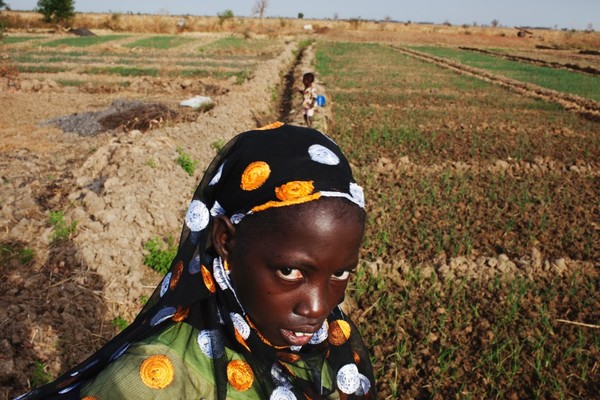 Farmer Djeneba Diarra on her farm in Heremakono, Mali (Photo: Joe Penney/Reuters)

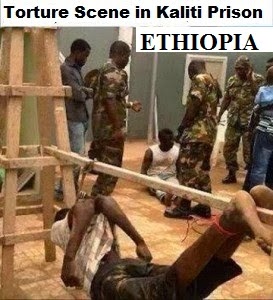







 Working Group Must Address Trade Misinvoicing and Role of U.S. Business and Government in Facilitating Illicit Finance to Be Truly Effective, Warns GFI





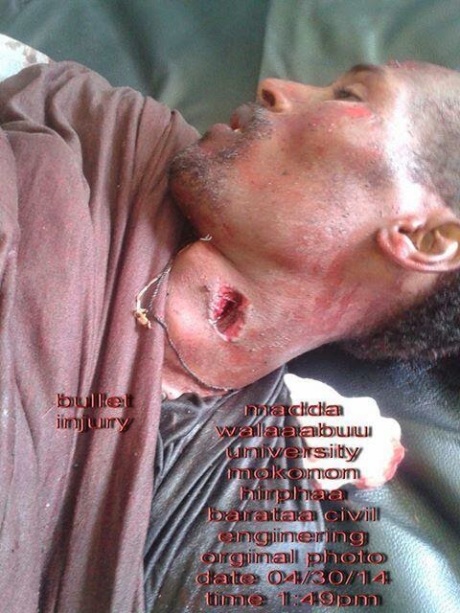




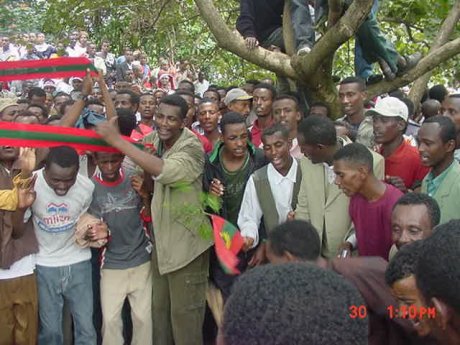





 Oromian Economist
You must be logged in to post a comment.