Freedom Is Sweet December 27, 2013
Posted by OromianEconomist in Culture, Human Rights, Humanity and Social Civilization, Kemetic Ancient African Culture, Knowledge and the Colonizing Structure. African Heritage. The Genocide Against Oromo Nation, Language and Development, Oromia, Oromiyaa, Oromo, Oromo Culture, Oromo Identity, Oromo Nation, Oromo Social System, Oromo the Largest Nation of Africa. Human Rights violations and Genocide against the Oromo people in Ethiopia, Oromummaa, Self determination, Sirna Gadaa, The Colonizing Structure & The Development Problems of Oromia, The Oromo Democratic system, The Oromo Governance System, The Oromo Library, Theory of Development, Uncategorized.Tags: Africa, African culture, African Studies, Australia, Federation Square, Horn of Africa, Human rights, Human Rights and Liberties, Human rights violations, National Self Determination, Oromia, Oromiyaa, Oromo, Oromo culture, Oromo people, Oromummaa, State and Development, Sub-Saharan Africa, Universal Declaration of Human Rights
add a comment
“Freedom is Sweet” is taken from the speech made by Inga Peulich MLC , Parliamentary Secretary for Education at Oromia @ Federation Square, Melbourne Australia on 22nd of December 2013. The festival aims to bring Oromo people together, irrespective of age, gender and belief, to help promote self-empowerment. It also seek to educate the public on the lifestyle, culture and ethics of members of the Australian Oromo community. Furthermore, it’s a time to celebrate and commemorate the beauty of Australian Oromo culture and to promote both multiculturalism and diversity across Australia.
The celebration of Oromia at Federation Square marks the beginning of yet another exciting year of events that aim to bring the case of the Oromo cause.
Related articles
- Oromo Displacement Past & Present (oromianeconomist.wordpress.com)
- 99% of the prisoners are OROMO political prisoners in Ethiopia!!!!! (danieltadesse.wordpress.com)
- Oromoia Students Movement and the Current Trends of Oromo Youths and Intellectuals (oromedia.net)
- Message from Dr. Ibrahim Amae Elemo on the #BoycottBedele Campaign (freedomfororomo.wordpress.com)
- Let no one Rob you of your Identity (dhaamsaogeetti13.wordpress.com)
Global Poverty & Development Agendas: Dead Aid, Ethiopia & The West December 17, 2013
Posted by OromianEconomist in Africa, Aid to Africa, Colonizing Structure, Development, Economics: Development Theory and Policy applications, Knowledge and the Colonizing Structure. Africa Heritage. The Genocide Against Oromo Nation, Land Grabs in Africa, Oromia, Oromiyaa, Oromo, Oromo Culture, Oromo Identity, Oromo Nation, Oromo the Largest Nation of Africa. Human Rights violations and Genocide against the Oromo people in Ethiopia, Oromummaa, Self determination, The Colonizing Structure & The Development Problems of Oromia, Theory of Development, Uncategorized.Tags: Africa, African Studies, Dead Aid, Development and Change, Economic and Social Freedom, Genocide against the Oromo, Governance issues, Horn of Africa, Human rights, Human Rights and Liberties, Human rights violations, Land grabbing, National Self Determination, Oromia, Oromiyaa, Oromo, Oromo people, Oromummaa, State and Development, Sub-Saharan Africa, Tyranny, Universal Declaration of Human Rights
add a comment
In excess of 35 million Ethiopians still live in abject poverty subsisting on less that $2 a day while a tiny fraction of the country’s 85 million people has become excessively rich. As more and more ODA is pumped into the country Ethiopia’s HDI rank hasn’t improved (in fact it has gone from 169th in the world to 173rd in the last decade), journalists, academics and opposition figures are still jailed for speaking out against the regime, ethnic minorities such as the Oromo are discriminated against and forced off their lands, corruption and human rights abuses are still rife. Less people may be dying but are ordinary peoples’ lives improving at a rate that warrants the West to turn a blind eye to the crimes of those in power? It may suit certain agendas to do so but it does a massive disservice to ordinary Ethiopians. Read the full text at: http://www.transcend.org/tms/2013/12/global-poverty-and-post-colonial-development-agendas-ethiopia-and-the-west/


http://en.wikipedia.org/wiki/List_of_countries_by_percentage_of_population_living_in_poverty
Related articles
Ethiopia’s Land Grabs And Endangered Communities: The Indigenous People Excluded from ‘Rapid Growth’ November 11, 2013
Posted by OromianEconomist in Africa, Colonizing Structure, Corruption, Culture, Development, Dictatorship, Knowledge and the Colonizing Structure., Knowledge and the Colonizing Structure. Africa Heritage. The Genocide Against Oromo Nation, Land Grabs in Africa, Oromia, Oromiyaa, Oromo, Oromo the Largest Nation of Africa. Human Rights violations and Genocide against the Oromo people in Ethiopia, Oromummaa, Self determination, The Colonizing Structure & The Development Problems of Oromia, Theory of Development, Tyranny.Tags: Africa, African culture, Economic and Social Freedom, economics, Genocide, Genocide against the Oromo, Human rights violations, Indigenous People, Land grabbing, Land grabs in Africa, Mursi, National Self Determination, Omo, Oromia, Oromo, Oromummaa, People of Omo Valley, Universal Declaration of Human Rights
add a comment

The ethnic communities living along Ethiopia’s Omo River and depend on annual flooding to practice flood retreat cultivation for their survival and livelihood. Credit : Ed McKenna/IPS
‘The government already has trouble managing hunger and poverty [among] its citizenry. By taking over land and water resources in the Omo Valley, it is creating a new class of ‘internal refugees’ who will no longer be self-sufficient.’
OMO VALLEY, Ethiopia, Nov 11 2013 (IPS) – As the construction of a major transmission line to export electricity generated from one of Ethiopia’s major hydropower projects gets underway, there are growing concerns that pastoralist communities living in the region are under threat.
The Gibe III dam, which will generate 1,800 megawatts (MW), is being built in southeast Ethiopia on the Omo River at a cost of 1.7 billion dollars. It is expected to earn the government over 400 million dollars annually from power exports. On completion in 2015 it will be the world’s fourth-largest dam.
“We are being told to stop moving with our cattle, to stop wearing our traditional dressand to sell our cattle. Cattle and movement is everything to the Mursi.” — Mursi elder
But the dam is expected to debilitate the lives and livelihoods of hundreds of thousands of indigenous communities in Ethiopia’s Lower Omo Valley and those living around Kenya’s Lake Turkana who depend on the Omo River.
The Bodi, Daasanach, Kara, Mursi, Kwegu and Nyangatom ethnic communities who live along the Omo River depend on its annual flooding to practice flood-retreat cultivation for their survival and livelihoods.
But the semi-nomadic Mursi ethnic community are being resettled as part of the Ethiopian government’s villagisation programme to make room for a large sugar plantation, which will turn roaming pastoralists into sedentary farmers. The hundreds of kilometres of irrigation canals currently being dug to divert the Omo River’s waters to feed these large plantations will make it impossible for the indigenous communities to live as they have always done.
“We are being told that our land is private property. We are very worried about our survival as we are being forced to move where there is no water, grass or crops,” a Mursi community member told IPS.
The Omo Valley is set to become a powerhouse of large commercial farming irrigated by the Gibe III dam. To date 445,000 hectares have been allocated to Malaysian, Indian and other foreign companies to grow sugar, biofuels, cereals and other crops.
“The Gibe III will worsen poverty for the most vulnerable. The government already has trouble managing hunger and poverty [among] its citizenry. By taking over land and water resources in the Omo Valley, it is creating a new class of ‘internal refugees’ who will no longer be self-sufficient,” Lori Pottinger from environmental NGO International Rivers told IPS.
Top global financiers, including the World Bank and the African Development Bank (AfDB), have committed 1.2 billion dollars to a 1,070 km high-voltage line that will run from Wolayta-Sodo in Ethiopia to Suswa, 100 km northwest of the Kenyan capital, Nairobi. The transmission line, powered by Ethiopia’s Gibe III, will connect the country’s electrical grid with Kenya and will have a capacity to carry 2,000 MW between the two countries.
According to the AfDB, it will promote renewable power generation, regional cooperation, and will ensure access to reliable and affordable energy to around 870,000 households by 2018.
According to Prime Minister Hailemariam Desalegn, Ethiopia’s economy is set to maintain a growth rate of 11 percent in 2014. Fully exploiting its massive water resources to generate a hydropower potential of up to 45,000 MW in order to sell surplus electricity to its neighbours is central to Ethiopia’s Growth and Transformation plan, a five-year plan to develop the country’s economy.
The Horn of Africa nation currently generates 2,000 MW from six hydroelectric dams and invests more of its resources in hydropower than any other country in Africa – one third of its total GNP of about 77 billion dollars.
According to a World Bank report published in 2010, only 17 percent of Ethiopia’s 84.7 million people had access to electricity at the time of the report. By 2018, 100 percent of the population will have access to power, according to state power provider Ethiopian Electric Power Corporation (EEPCO).
“We are helping mitigate climate risk of fossil fuel consumption and also reduce rampant deforestation rates in Ethiopia. Hydropower will benefit our development,” Miheret Debebe, chief executive officer of EEPCO, told IPS.
The Ethiopian government insists that the welfare of pastoralist communities being resettled is a priority and that they will benefit from developments in the Omo Valley. “We are working hard to safeguard them and help them to adapt to the changing conditions,” government spokesperson Shimeles Kemal told IPS.
However, there are concerns that ethnic groups like the Mursi are not being consulted about their changing future. “If we resist resettlement we will be arrested,” a Mursi elder told IPS.
“We fear for the future. Our way of life is under threat. We are being told to stop moving with our cattle, to stop wearing our traditional dress and to sell our cattle. Cattle and movement is everything to the Mursi.”
The importance of ensuring that benefits from Ethiopia’s national development projects do not come at a price of endangering the lives of hundreds of thousands pastoralist tribes is critical said Ben Braga, president of the World Water Council. Braga decried governments that failed to compensate communities like the Mursi as displacement of surrounding communities is always an inevitable consequence of major dams that need plenty of advanced planning to avoid emergencies.
“How can we compensate these people so that the majority of the country can benefit from electricity? There is a need for better compensatory mechanisms to ensure that benefits are shared and that all stakeholders are included in consultations prior to construction,” he told IPS.
Read more at the original source:http://www.ipsnews.net/2013/11/ethiopias-indigenous-excluded-from-rapid-growth/?utm_source=ipsnews&utm_medium=twitter
‘Foreign investors are taking as much as they can from an impoverished nation, including its crops, land and the hard work of an Ethiopian population, to serve their own interests above others. According to the Food and Agriculture Organisation (FAO), 14.56 million hectares of Ethiopia’s 100 million hectare land mass is arable land, most of it cultivated by small hold, subsistence farmers. International investors have taken note and are rushing to this country, once synonymous with starvation, to take advantage of the government’s new push to improve its agricultural production capacity. But many fear the government’s sale of arable land to foreign nationals will create a modern form of agricultural colonialism. One such arrangement, launched in 2009 under Saudi Arabia’s King Abdullah initiative and forming part of a $100-million investment scheme in Ethiopian agriculture, had farmers grow teff (a North African cereal grass), white wheat, maize and white sorghum, among other crops, before these were exported back to the Gulf region. The Economist referred to it as an instance of a “powerful but contentious trend sweeping the poor world”, further saying that countries which export capital but import food are outsourcing farm production to countries that need capital but which have land to spare. According to Human Rights Watch, in less than five years Ethiopia has approved more than 800 foreign-financed agricultural projects. The watchdog group further said that from 2008 to 2011, the Ethiopian government leased out no less than 3.8 million hectares to foreign investors, displacing local inhabitants and resulting in tens of thousands of internally displaced persons who are often forced to migrate to urban areas. The majority of land acquisitions occur in government-to-government deals. In the past, Saudi officials and closely tied sovereign wealth funds negotiated with former Prime Minister Meles Zenawi, while presently, such discussions take place with the ruling coalition of his successor, Hailemariam Desalegn Boshe. Supporters argue that such deals increase production efficiency and improve economic outlooks but only if investors are willing to pay a fair price. In 2011, Oxfam reported that Middle Eastern and Far Eastern investors were purchasing plots in developing countries, including Ethiopia, for as little as $1 per hectare. That same year, Saudi Star Agricultural Development Plc leased 10,000 hectares for a bargain price of $9.42 per hectare annually for the next 60 years. (Saudi Star, a food company owned by Ethiopian and Saudi Arabian billionaire Mohammed Al Amoudi, and which forms part of the Derba group, produces sugar, rice and edible oil. The company is based in Addis Ababa, Ethiopia.) Advocacy groups from Spain and the US commented that the government sponsored deal had caused human rights violations as well as the forceful relocation of hundreds of thousands of residents, including the Nuek and Anuak indigenous groups. The government retorted by saying that the resettlement plan was acted out voluntarily on behalf of residents. Saudi Star claims that it acted in good faith and that the benefits of the land deal – including improvements to regional infrastructure – outweighed the consequences, despite scepticism. Fikru Desalegn, former State Minister of Capacity Building in the Ethiopian federal government and current CEO of Saudi Star, played down the negative connotations associated with the controversial foreign investment. He said there was “nobody in the 10,000 hectares” and that the company had “not paid any compensation” but that the possibility of employment opening up would “teach the public it is very useful for them”. In July 2012, the Derba Group announced plans for an additional 300,000-hectare development project in the fertile region of Gambela. While no figures have been released, industry experts suspect that the lease was contracted below cost, generating approximately $923 million per annum for the consortium. The company intends to export the majority of the crops harvested, with 45 percent destined for Jeddah.’ http://www.ventures-africa.com/2013/11/land-grabs-in-africa-a-double-edged-sword/?utm_source=buffer&utm_campaign=Buffer&utm_content=buffer675be&utm_medium=twitter
‘From Senegal in West Africa to Ethiopia in the Horn, and down to Mozambique in the South, land considered idle and available has changed hands, with profound implications for local people and the environment. With estimates ranging from 56 to 227 million hectares globally (with 60-70% of this in Africa), what is clear is a rapid transformation of landholding and agricultural systems has taken place in the past five to 10 years. Underpinning these deals is the longstanding failure of many African states to recognise, in law and practice, the customary land rightsof existing farming households and communities, and the perpetuation of the colonial legal codes that centralise control over such lands in the hands of the state as trustee of all unregistered property. And it’s not just African land and water that are now so desirable for international investors, but also the growing African consumer market. In the face of growing urbanisation and consumer demand in Africa’s cities, the challenge is to scale up production and connect small farmers to markets, lest the benefits of rising food demand in Africa’s cities be netted by importers and foreign supermarkets. The land grab raises questions not only about land rights and transparency in investment, but also what constitutes inclusive agricultural development and how to bring it about.’ Read further @http://www.theguardian.com/global-development-professionals-network/2014/jan/23/land-deals-africa-farming-investment?CMP=twt_gu
Copyright © Oromianeconomist 2013 and Oromia Quarterly 1997-2013. All rights reserved. Disclaimer.
Oromo Political Detainees Tortured: Human Rights Watch’s Latest Document on Ethiopia October 19, 2013
Posted by OromianEconomist in Africa, Colonizing Structure, Corruption, Dictatorship, Human Rights, Oromia, Oromiyaa, Oromo, Oromo the Largest Nation of Africa. Human Rights violations and Genocide against the Oromo people in Ethiopia, The Colonizing Structure & The Development Problems of Oromia, Tyranny, Uncategorized.Tags: Africa, East Africa, Economic and Social Freedom, Genocide, Genocide against the Oromo, Governance issues, Horn of Africa, Human rights, Human rights violations, National Self Determination, Oromiyaa, Oromo, Oromo people, Oromummaa, Tyranny, Universal Declaration of Human Rights
1 comment so far

The report documents human rights abuses, unlawful investigation tactics, and detention conditions in Maekelawi between 2010 and 2013. Human Rights Watch in this latest document reports that Ethiopian authorities have subjected political detainees to torture and other ill-treatment at the main detention center in Finfinnee (Addis Ababa). The report also calls for the Ethiopian government to take urgent steps to curb illegal practices in the Federal Police Crime Investigation Sector, known as Maekelawi, impartially investigate allegations of abuse, and hold those responsible to account.
The 70-page report, “‘They Want a Confession’: Torture and Ill-Treatment in Ethiopia’s Maekelawi Police Station,” documents serious human rights abuses, unlawful interrogation tactics, and poor detention conditions in Maekelawi since 2010. Those detained in Maekelawi include scores of opposition politicians, journalists, protest organizers, and alleged supporters of ethnic insurgencies. Human Rights Watch interviewed more than 35 former Maekelawi detainees and their relatives who described how officials had denied their basic needs, tortured, and otherwise mistreated them to extract information and confessions, and refused them access to legal counsel and their relatives.
“Ethiopian authorities right in the heart of the capital regularly use abuse to gather information,” said Leslie Lefkow, deputy Africa director. “Beatings, torture, and coerced confessions are no way to deal with journalists or the political opposition.”
Since the disputed elections of 2005, Ethiopia has intensified its clampdown on peaceful dissent. Arbitrary arrest and political prosecutions, including under the country’s restrictive anti-terrorism law, have frequently been used against perceived opponents of the government who have been detained and interrogated at Maekelawi.
‘One [police officer] hit me on the back of my head with a long black stick and blindfolded me. They took me to their office. These were interrogators. They slapped me on the cheeks repeatedly…. But these interrogators are not in a position to listen to what I tell them. They beat me again with the black stick and slapped me again. I stayed in that room until midnight. I was exhausted. They took me back to the cell and then took another guy. On the second day of interrogations—the beating was worse. What they want is a confession.’—Journalist held in Maekelawi in mid-2011, Nairobi, April 2012, p. 6.
“Oromo student held in Maekelawi in 2012, said his hand was broken when he was beaten on his hand while being held in this position and that over a year later his hand continues to hurt:’In the interrogation room there was small piece of metal on the wall. They put me on it and locked my left hand to the wall and then my legs didn’t touch the ground. They beat me on my left hand. I think I was there one hour, but I don’t know as I lost my memory,’ ” p. 34.
Read further more from the following sites:
Click to access ethiopia1013_ForUpload.pdf
http://www.hrw.org/news/2013/10/18/ethiopia-political-detainees-tortured
Are Oromos Singled Out and Disproportionately Tortured in Ethiopia?
http://oromopress.blogspot.co.uk/2013/10/are-oromos-singled-out-and.html
Torture in the heart of Finfinnee (Addis), even as leaders gather in gleaming AU building
“Getachew,” a 22-year-old ethnic Oromo, was snatched from his university dorm, driven hundreds of kilometres to Addis Ababa, and locked up for eight months in Maekelawi. His parents were never informed of his whereabouts; he was never charged or given access to a lawyer; and never appeared before court. He was ultimately released on condition that he would work for the government.Like Getachew, many of the people detained in Maekelawi over the past decade are political prisoners — arrested because of their ethnicity, their real or perceived political opinions and actions, or journalism work. Voicing peaceful dissent or criticism of government policy is increasingly risky.
Copy right © Oromianeconomist 2013 and Oromia Quarterly 1997-2013. All rights reserved. Disclaimer.
Irreecha: The Oromo National And Cultural Holiday Has Been Celebrated With Over 3 million Oromians In The Blessing Festival October 13, 2013
Posted by OromianEconomist in Africa, Culture, Development, Humanity and Social Civilization, Irreecha, Kemetic Ancient African Culture, Oromia, Oromiyaa, Oromo, Oromo Culture, Oromo Identity, Oromo Nation, Oromo Social System, Oromummaa, Self determination, Sirna Gadaa, The Oromo Democratic system, The Oromo Governance System, Theory of Development, Wisdom.Tags: Africa, African culture, African Studies, Democratic African institution, Development, Development and Change, Gadaa, Gadaa System, Horn of Africa, Irreecha, National Self Determination, Oromia, Oromia Region, Oromiyaa, Oromo, Oromo culture, Oromo Identity, Oromo National Day and Ancient Africa Connections, Oromo people, Oromo Thanksgiving, Oromummaa, Social Sciences
add a comment

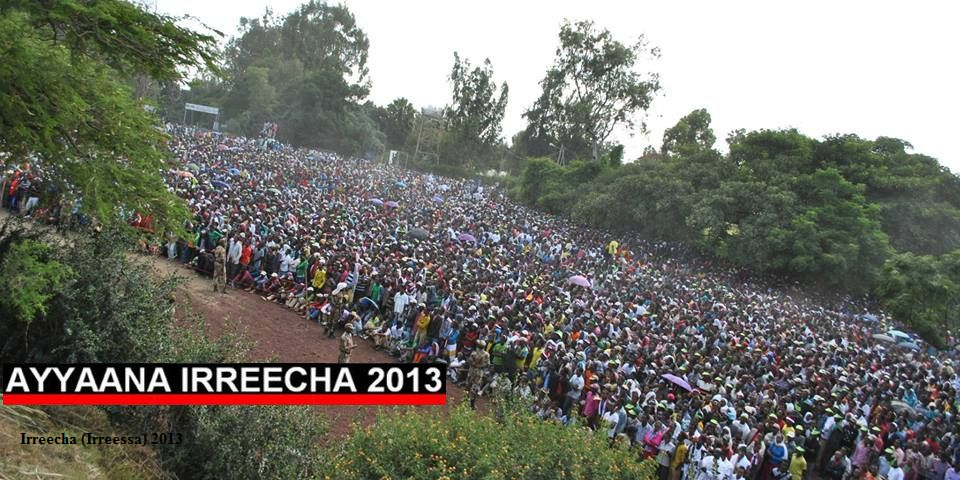
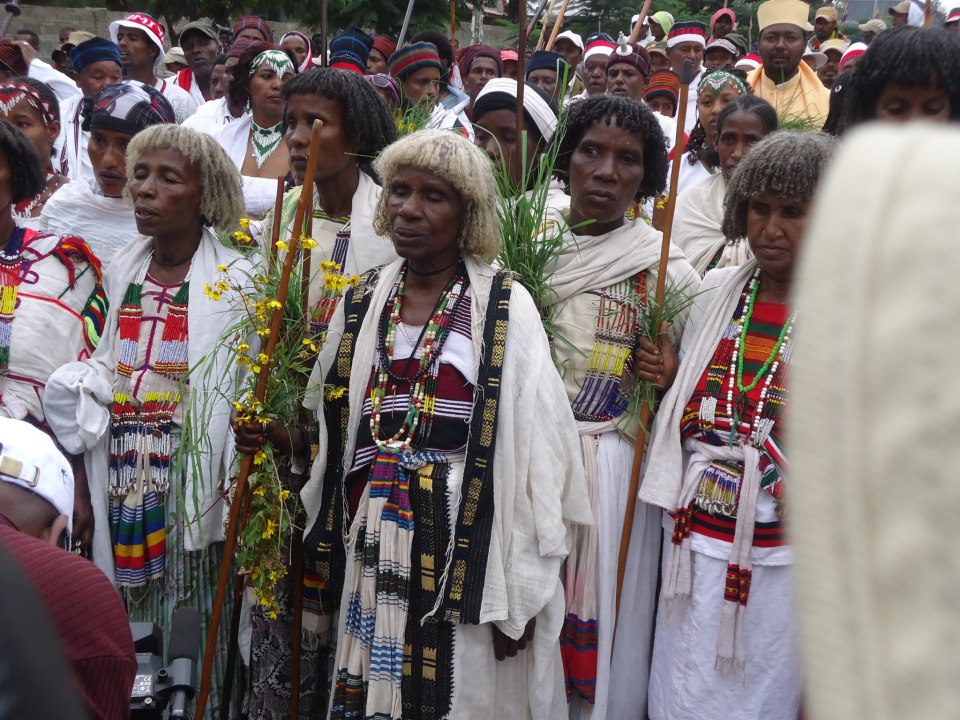
Oromo culture from ancient to present, Irrechaa time
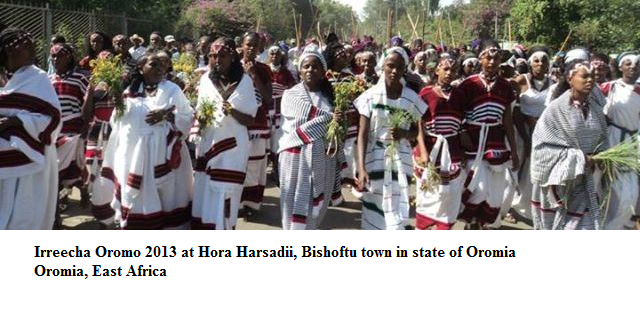

Baga ganna nagaan baatanii booqaa birraa argitan. Good that the rainy season is over for you and that you came to see the spot of the sunny flowering season. The expression signifies the end of one season and the beginning of another season, which incidentally is the beginning of a new year according to Oromo time reckoning. This is not the only expression in Irreecha festival as the event is characterized by vast and varieties of expressions, stories and sequences of cultural displays. Irreecha is the biggest and very beautiful public displays of ancient culture that Africa has performed and continue to perform. Holding the green grass and yellow flower (umama), it is the celebration of the season of blessing and love Oromians experience as Thanksgivings to God (Waaqa) the creator (Uumaa).
Irreecha celebration at Malkaa Ateetee, Burayyuu, Oromia, 6th October 2013
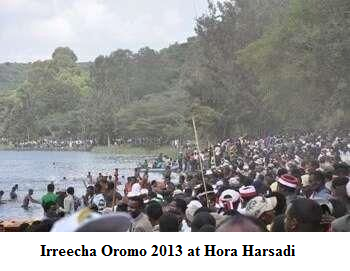
Irreecha is one of the most colorful and beautiful Oromo national cultural events that has been celebrated through out since the last week of August and the entire September and also in October in Oromia and globally where Oromians have been residing (Africa, Australia, Europe and North America). The main Irreecha day was celebrated at Lake Hora Harsadii, Bishoftu, Central Oromia, nearer to the capital Finfinnee on 29th September 2013. According to local news sources from Bishoftuu, over 3 million people attended this year’s Irreecha Malka celebration at Hora Harsadii. “Traditionally, the Oromo practiced Irreecha ritual as a thanksgiving celebration twice a year (in autumn and spring) to praise Waaqa (God) for peace, health, fertility and abundance they were given with regards to the people, livestock, harvest and the entire Oromo land. Irreecha is celebrated as a sign of reciprocating Waaqa in the form of providing praise for what they got in the past, and is also a forum ofprayer for the future. In such rituals, the Oromo gather in places with symbolic meanings, such as hilltops, river side and shades of big sacred trees. …These physical landscapes are chosen for their representations in the Oromo worldview, for example, green is symbolized with fertility, peace, abundance and rain. In Oromia, the core center of Irreecha celebration has been around Hora Arsadi in Bishoftu town, some 25kms to the south of Finfinne, the capital city. Annually, particularly during the Irreecha birraa (the Autumn Irreecha) in September or October, the Oromo from different parts of the country come together and celebrate the ritual. In the past few decades, Irreecha celebrations have been expanded both in content as well as geographical and demographic representations. This short commentary deals with such historical trajectories by contextualizing the changes within political discourses in Ethiopia vis-à-vis Oromo nationalism.”http://gadaa.com/oduu/21320/2013/08/24/irreecha-from-thanksgiving-ritual-to-strong-symbol-of-oromo-identity/ ”
http://gadaa.com/Irreechaa.html
Aadaa fi Duudhaa sirna Waaqeffannaa keessaa inni tokko Ayyaana irreeffannaa ykn irreechati. Sirni Duudhaa irreechaa gosa hedduutti qoodama. Kunis, Irreessa Malkaa, Irreessa Tulluu, Irreessa Galmaa / Gimbii, Irreessa Ujubaa, Irreessa Dakkii, Irreessa Jilaa fi Irreessa Eebbaa ykn Galataa fi kkf. Akkaa fi akkaataan irreeffannaas akkuma sirna isaatti addaa adda. Ammatti kan bal’inaan irraa dubbannu Irreecha yeroo ammaatti biyya keessaa fi alatti beekamee fi kabajamaa jiru, Irreecha Malkaati. Irreechi Malkaa kan kabajamu, ganni yeroon rakkinaa fi dukkanaa dabree birraan yeroo bari’u, sirni Gubaa erga raawwatee booda, ummanni gamtaan Malkaa bu’uun irreeffatee Waaqa galateeffata. Ammaaf Irreecha Malkaa isa biyya keessaa fi alatti bal’inaan beekamaa fi kabajamaa jiru irraa hanga tokko waa addeessuu yaalla. Ayyaanni irreechaa osoo hin gahiin dura waanti raawwataman hedduutu jiran. Kunis seera yayyaba shananii hordofuudhan torban shan dura eegala jechuudha. Ji’a hagayyaa torban sadaffaa keessa birraan bari’uu ykn seenuu isaa kan ibsu, sirna Muka ( korma) dhaabaa kan jedhamutu raawwata. Bakki mukti dhaabaa kun dhaabatu Mijirii jedhama. Mijiriin kun bakka Gubaan itti gubamu ykn bakka ayyaanni ibsaa gubaa raawwatudha. Mukti dhaabbatu 9 ykn 5 ta’an. Kunis hiika mataa ofii qaba. Guyyaa muka dhaabaa irraa eegalee hanga gaafa Gubaatti torban torbaniin waanti godhamu ni jira. Gaafa torban shanaffaa ykn Fulbaana ji’aa dhumaa yeroo ta’u sirna Gubaatu raawwata. Masqala jechuudha. Ayyaana masqalaa kana warri amantii Ortodoksii gara amantii isaaniitti harkisuuf haa yaalan malee gochaa fi seenaan wanti isaan deeggaru hin jiru. aadaa Oromoo fudhatan. Guyyaa gubaa kana ollaan maatii waliin walitti dhufee bakka Mijirii sanatti erga ibsaa gubee dhibaafatee, eebbifateen booda dubartoonni Qunnii (Ingiccaa) guban, dargaggoonni sirba ” Hiyyooko ykn Ya habaab yaa daree ko” jedhamu sirbaa ollaarra naannawanii kennaa fudhatan. Torban isaatti ammoo sirna Ayyaana Irreechaatu raawwata. Gubaan kan dhuunfaa fi ollaati. Irreechi ammoo ayyaana ummanni gamtaan Malkaa bu’ee, dukkana gannaa keessaa gara Booqaa Birraatti nagaan cehuu isaaf kan galateeffatu Guyyaa Galatoo ( Thanksgivings day) jechuudha. Sirni gamtaan Irreeffannaa kun osoo dhiibbaa amantii fi sirna bulchiinsa alagaatiin hin dhorkamiin dura Oromoon naannoo qubatee jiru maratti ni irreeffata ture. Keessumattuu bara mootummaa Dargii sana aadaa ” duubatti hafaa” jedhamee Galma Qaalluu gubuu fi waan Oromoon aadaadhaan raawwatu mara dhorkuun dhabamsiisuuf yaalan. Sababa kanaa fi babal’ina amantii Isilaamaa fi Protestantiin walqabatee bakka hedduutti sirni irreeffannaa fi amantiin Waaqeffannaa ni dhorkame. Dhiibbaa kana irraa damdamtee kan hafe keessaa tokko Ayyaana Irreechaa Hora Arsadii Magaalaa Bishooftuutti kabajamudha. Ayyaanni Irreecha Hora Arsadee qindoominaa fi hirmaannaa ummata bal’aan kabajamuu kan eegale bara 1997 irraa kaaseetu. Isa dura ummatuma naannoo sanaa fi keessattuu warra aadaa Waaqeffannaa hordofaniin ture. Bara 1997 keessa koreen tokko maqaa Guddinaa fi Dagaagina Aadaa Oromoo jedhuun WMT jalatti ijaaramtee Ayyaana Irreecha Bishooftuu kana ummata beeksisuu, barsiisuu fi qindoominaan guyyaa ayyaana kanaa bakka sanatti argamuun qalbii namaa harkisuu jalqabde. Ergasii waggaa waggaan achitti argamuun barumsaa fi dammaqiinsa kennameen sadarkaa har’a ummanni kumaa fi kitilaan kan herreegamu irratti argamee kabaju irraan gahe. Kana malees Oromiyaa gara dhihaatti bakka hedduutti akka kabajamuu fi babal’atuuf karaa saaqe. Baroota hedduu dura jalqabee ammoo biyya alatti walduraa duubaan, USA, Germany, Norway, Canada, Australia, Keenya, Uganda fi Ertriatti kabajamuu jalqabe. Guddinni fi babal’inni kabajaa Ayyaana Irreechaa kun qaama duula Oromoon Aadaa, Eenyumaa fi Oromummaa isaa guddisuuf gochaa jiru keessaa isa tokkoo fi guddicha ta’uu mal’isa. Fuula durallee daran akka guddatuu fi babal’atu Waaqa wajjin abdii qabna.Kabajaa ayyaana irreechaa biyya keessaa fi alatti raawwate ilaalchisee kanaan dura marsaa adda addaatti bahaa turuun ni yaadatama. Dabalataan yaadachiisuu fi bal’inaan kan hin gabaafamiin dabalatee akka armaan gadiitti kan biyyaa keessaa fi biyya alaa bakka adda addaatti kabajamaa ture laalla.”http://waaqeffannaa.org/irreecha/


http://oromoassociationvic.org/2013/10/03/oromians-seek-blessings-and-love-at-annual-oromo-festival/

Irreecha Oromo 2013 Celebration, in Sydney, Australia

Irreecha Oromo, event in London, 12 October 2013
Gubaa fi Irreecha @Galma Calalaqii, Miidaaqenyii

Related references:
https://oromianeconomist.wordpress.com/?s=twisted&searchbutton=go%21
Oromo: The Kushitic People of Africa

| ErechaThe story of Erecha – the celebration of the first harvest of the Ethiopian Spring in September – is a story better told by who else but the late Poet Laureate himself, Blattten Geta Tsegaye G/Medhin.
“….12,000 years ago, ASRA the God of sun and sky of KUSH PHARAOH begotten SETE, the older son ORA the younger of the first and daughter named as ASIS (ATETORADBAR). The older SETE killed his younger brother ORA, and ASIS (ATET OR ADBAR) planted a tree (ODA) for the memorial of her deceased brother ORA at the bank of Nile, Egypt where the murder had taken place, and requested her father who was the god of Sun to make peace among the families of SETE and ORA. Them rain was come and the tree (ODA) got grown. It symbolizes that taken place. Later, at the Stone Age, the tree that had been planted for the memorial of the killed, ORA was substituted by statue of stone that was erected 8000 years ago. This festival has been celebrated in September of every year and when Nile is flow full in NUBLA and BLACK EGYPT. In Ethiopia during the AXUMITE and PRE-AXUMITE period a great festival has been held around the sun’s statue that planted by ASIS (ATET OR ADBAR) the sister of ORA for the memorial of the later, ORA the son of god of sun, who waked up from death (ORA OMO or OR OMO) for the purpost of celebrating the peace made between the two brothers, the great herald, in thanking the good of sun and the sky with CHIBO. Then EYO KA ABEBAYE (the traditional and popular song performed at DEMERA events and new year in Ethiopia) has been started being performed since then. “KA” is the first name of God. The name of God that our KUSH Fathers have inherited to us before the old period, Christianity, and Islam is “KA”. Since then, therefore, especially the OROMO, GURAGIE and the SOUTHERN people of Ethiopia have been calling God as “WAKA or WAQA”. “or WAQA”. WAKA” or WAQA” God When we song EYOKA or EYOHA in New Year, we are praising “KA” of God. “GEDA” or KA ADA” is the law or rule of God. “GEDA” (KA ADA) is the festival by which the laws and orders of God are executed Japan, China, and India are now reached to the current civilization through making the basic traditions and cultures they received from their forefathers (HINDU, SHINTO and MAHIBERATA) be kept and receiving Islam, Christianity, and others especially Democracy and free believes. They are not here through undermining the culture and tradition of their forefathers. Culture is the collection of many CHIBOs or DEMERA. “ERCHA” or “ERESA” one of the part and parcel of GEDA (KA ADA) system is the comer stone and turning point to the new year for which ASIS (ATET OR ADBAR) has put up the dead body of her brother, ORA who was killed by his older brother like ABEL from the place he died at the river bank of NILE on and planted statue“. The Oromo people of beautiful Ethiopia believe in one God since time memorial. Their religion is called “WAKEFENA” which means believing in one God that is the creator of the whole universe. ERECHA means a celebration where people get together and perform their prayers and thanking God. WAKEFENA, the faith being in the GEDA SYSTEM is a religions ceremony that is free from any thing. The fathers of Oromo religion and the people, keeping fresh grass and flowers, perform their prayers and thank their God going to mountains, the sea or a river bank. They move to the top of mountains or bank of seas or rivers not to worship the mountains or rivers and seas; rather to distract themselves from any noise and to worship their God (WAQA) with concentration. And they go to sea and rivers because they believe that green is holy and peaceful where the spirit of God is found. In the Oromo culture, the rainy season is considered as the symbol of darkness. At the beginning of September, the darkness is gone, rivers run shallower and cleaner, and the mud is gone. As sunshine rules the land, the OROMO people of Ethiopia go out to celebrate this great natural cycle with the spirit of worshiping God (WAQA). |
http://www.ethiopians.com/photoessay/Photo_Essay_Eretcha_06.htm
Copyright © Oromianeconomist 2013 and Oromia Quarterly 1997-2013. All rights reserved. Disclaimer.
The Oromo People Need Freedom and Justice:Oromians Gathered in Front of the White House to Protest Against Ethiopia’s Human Rights Violations and Land-Grabbing August 5, 2013
Posted by OromianEconomist in Uncategorized.Tags: Africa, Amnesty International, Developing country, Development and Change, Economic and Social Freedom, Economic growth, Ethiopia, Ethiopian Government, Gadaa System, Human rights, Human Rights and Liberties, Human rights violations, Land grabbing, Land grabs in Africa, Oromia, Oromia Region, Oromo, Oromo people, Oromummaa, Universal Declaration of Human Rights, World Bank
2 comments


Journalist/Author Abdi Fite Reports for Oromo TV
VOA Afaan Oromo Reports:
Secretary of State of the United States
US Department of State
2201 C Street NW
Washington, DC 20520
Oromo Political Refugees need UNHCR protection
Oromo Political refugees in Egypt who fled tyranny and subjugation in Ethiopia are facing another round of attack and human right abuse from Egyptians, who have been angry at the construction of the renaissance dam on the Nile River by Ethiopia. The UNHCR and Egyptian government couldn’t provide protection to these political refugees per the UN convention. Consequently, on July 6, 2013, one young Oromo was attacked by a knife as he and his friend were looking for dinner. His friend survived the knife attack by running away.
On May 22, 2013 nine Oromo/Ethiopian refugees were arrested in front of the UNHCR Office, Djibouti branch, where they had been for the renewal of their refugee identification cards. The families and friends of those refugees have not been able to see and/or communicate with them since they were arrested and detained. Based on related past experiences and the involvement of Ethiopian security agents in the arrest and detention of those refugees, there is a high level of fear that the government of Djibouti might deport the detained refugees back to Ethiopia exposing them to detention, torture and death. Similar human rights abuses have been reported on Oromo refugees in Yemen.
Pressure Ethiopia to Release Oromo Political Prisoners in Ethiopia
In May 2013 six Oromo civilians and artists were incarcerated by the TPLF security agents from their respective homes and work places. They are Tesfaye Lammuu, Addisu Mengistu/Karrayyu (Artist), Dasse Lamu, Birraa Margaa, Dhaba Abdulqadir, and Shasho Idosa.
On November 1, 2012, two well-respected Oromo opposition politicians, Mr. Bekele Gerba (professor) and Mr. Olbana Lelisa, along with seven other Oromo nationals, Welbeka Lemi, Adem Busa, Hawa Wako, Mohamed Melu, Dereje Ketema, Addisu Mikre and Gelgelo Gufa were convicted and later sentenced to long term imprisonment under the charge of “working underground to secede Oromia from the federal government” and other concocted charges after being kept in jail for more than a year. The two opposition leaders were arrested in August 2011 after speaking with Amnesty International officials.
Dear Honorable Secretary,
Over the past 21 years, the TPLF-led and dominated Ethiopian government, has imprisoned tens of thousands of political opposition and citizens, mainly Oromos. As the result of the government’s repressive policies, thousands of innocent citizens have been languishing in prisons and secret camps, and many have been severely tortured, deformed and/or killed. Others have been abducted and made to disappear. Hundreds have been murdered in broad day-light. Well respected human rights organizations such as Amnesty International, Human Rights Watch and US State Department’s own annual reports have documented rampant arrests, unlawful killings, abductions, tortures and other human rights abuses by the Ethiopian government. These reports are consistent with our own reports and direct experiences. We are frustrated because, despite these glaring facts, Ethiopia’s allies and Western donors are reluctant to restrain the government and halt its flagrant human rights abuses. Some donors even go on record to support the government’s wrong claim that Ethiopia is “on the road to democracy.” It is troubling that despite these well documented human rights abuses, the Ethiopian government continues receiving billions of dollars of aid money every year. Using over one third of its budget from foreign aid, Ethiopia has built one of the biggest and best-equipped armies in Africa, while millions of its citizens seek food aid. In fact, the aid money is used to impose the Tigrayan dictatorship and autocratic regime on Oromos and other peoples in a multinational society.
Observing the painful agony and sufferings of the ordinary people and the political prisoners, we specifically request that you and the US government:
Use your influence and international responsibilities to force the Ethiopian Government to stop the killing of Oromo nationals, bring the violence to end and facilitate the return of the displaced Oromos back to their homes.
Use your influence and international responsibilities to force the minority regime in Ethiopia to stop the politically motivated eviction of Oromo farmers from their ancestral land and illegal selling of Oromo land immediately.
Use your enormous influence to put political, economic and diplomatic pressures upon the Ethiopian government to unconditionally release Mr. Bekele Gerba, Mr. Olbana Lelisa and thousands of Oromo political prisoners.
Influence the Ethiopian government to respect the current Ethiopian constitution and stop the regime’s extrajudicial killings, arbitrary arrests and prolonged detention of innocent people without trial.
Insist on the unconditional release of all political prisoners before providing economic aid to the regime.
Demand that the regime is committed to respecting human rights of the Oromo and other peoples of Ethiopia and allow freedom of expression and assembly.
Demand the repeal of all new laws that violate the fundamental freedom of citizens: particularly the so called Anti-terrorism Law, Press Law, the current law that prevents charitable organizations from freely moving in the country and the most recent law that criminalizes the usage of Skype and other media tools.
Demand that the regime respect freedom of religion and stop interfering in religious affairs.
Finally, we believe that unless international donors, mainly the US government, use their leverage and make meaningful pressure, the Ethiopian government will continue with political repression of the Oromo and other nations and nationalities. Therefore, we humbly request you to exert your energy and diplomatic skills to create conducive political environment for establishment of the rule of law in Ethiopia. We earnestly believe that as America’s top diplomat and principal voice on international issues, you have an extraordinary opportunity to alleviate the incredible human sufferings of the Oromo and other peoples in Ethiopia. We thank you for your interest in the wellbeing of the Oromo and other peoples of Ethiopia.
Sincerely,
Abebe Etana
Chairman, Oromo Youth Self-help Association (OYSA)
6212 3rd Street NW, Washington, DC 20011
http://washington.gaaddisaoromo.com/
Desta Yebassa, Ph.D.
Board President, Oromo Community Organization (OCO) of Washington D.C. Metropolitan area
6212 3rd Street NW, Washington, DC 20011
http://oneoromo.org/
Mosisa Aga, Ph.D.
President, Oromo Studies Association (OSA)
P.O Box 32391, Fridley, MN 55432
http://www.oromostudies.org/
Garoma Wakessa
Director, Human Rights League of the Horn of Africa (HRLHA)
994 Pharmacy Avenue, M1R 2G7, Toronto, ON, Canada
http://humanrightsleague.com/
Dr. Trevor Trueman
Director, Oromia Support Group (OSG)
60 Westminster Rd, Malvern, WR14 4ES, UK
http://www.oromo.org/
CC
Barack Obama
President of the United States
The White House
1600 Pennsylvania Avenue NW Washington, DC 20500
Tel: (202) 395-2020
António Guterres,
United Nations High Commissioner for Refugees
Case Postale 2500
CH-1211 Genève 2 Dépôt
Suisse.
Tele: +41 22 739 8111
[1] ”Ethiopia: Loss of Lives and Displacement Due to Border Dispute in Eastern Ethiopia” http://humanrightsleague.com/2013/05/ethiopia-loss-of-lives-and-displacement-due-to-border-dispute-in-eastern-ethiopia/
[3] http://www.guardian.co.uk/world/2013/jan/10/ethiopia-forces-human-rights-funding?intcmp=239
Related articles
- Joint Appeal Letter of OYSA, OCO, OSA, HRLHA and OSG on Eviction of Oromo Farmers and Human Rights Abuses in Ethiopia (bilisummaaa.wordpress.com)
- Rally to exert pressure on Ethiopia for Oromo rights abuses (dagmaibitew.wordpress.com)
- Rally to exert pressure on Ethiopia for Oromo rights abuses (olfsupporterinuk.wordpress.com)
- Journalist/Author Abdi Fite Reports for Oromo TV: More Than 200 Oromo Activists Gathered on August 2, 2013 In Front of the White House to Protest Against Ethiopia’s Human Rights Violations and Land-Grabbing (autonomousoromia.wordpress.com)
- Olf Immediate Press Release (yasyasre.wordpress.com)
- Ethiopia’s “religious abuse” may cause regional destabilization (behailumengistu.wordpress.com)
Language and National Development: A tribute in Honour of Haile Fida’s Contribution to the Development of Oromo Orthography August 1, 2013
Posted by OromianEconomist in Language and Development.Tags: Afaan Oromo, African Diaspora, African Heritage, Ancient languages, Cushitic languages, Democratisation, Developing country, Development and Change, Economic and Social Freedom, France, Haile Fida, Mass killings against Oromo, National Self Determination, Oromia, Oromo, Oromo Heritage, Oromo language, Oromo people, Oromummaa
6 comments


Dr Haile Fida Kuma has made an outstanding contribution to the development of Oromo national orthography. He was one of the pioneers who attempted to shade fresh on the history of the Oromo, the right of the Oromo people to speak, read and write in Afaan Oromo. He initiated Oromo studies in Europe and has made a major contribution both to our knowledge of Afaan Oromo grammar and to the discussion on how the language should be written 1968-1974. His first research paper was published in 1972, on Tatek, theoretical Journal of Ethiopian Studies in Europe entitled ‘Languages in Ethiopia: Latin or Geez for writing Afaan Oromo.’ He further published in 1973 Oromo Grammar book entitled ‘ Hirmaata Dubbi Afaan Oromo’: Haile Fida, et al. (1973). Hirmaata Dubbi Afaan Oromo, Paris and a literature book :‘Barra Birran Barie, paris,’ using his adopted 35 Latin Qubee alphabet. The books were as a result of his long-time study of the Oromo language and problems of Oromo orthography. In this groundbreaking Afaan Oromo grammar book, he adopted the Latin alphabet to the phonology of the Oromo language by modifying some of the shapes of the letters and adding subscript diacritics. He made distinctions between short and long vowels letters by using single vowels letters (i, e, a, o,u) for the former and double (ii, aa, oo, uu) ones for the latter. He presented the finding of his research to the conference of Ethiopian Student Union in Europe in 1972 and this brought a debate on language issues within the Ethiopian and Oromo students movement abroad (see, Dr. Fayisa Demie. 1996. Historical Challenges in the Development of the Oromo language and Some Agendas for Future Research, Journal of Oromo Studies, Vol.3, no.1 &2, pp. 18-27. Oromia Quarterly. Fayisa Demie. 1999. The Father of Qubee Afaan Oromo: A tribute in Honour of Haile Fida’s Contributions to the development of Oromo Orthography, Oromia Quarterly, Vol.. II, no.3. Pp. 1-5.) His knowledge on Oromo language was so encyclopaedic and his contribution to the Oromo studies in Europe was so well known at the time and his contribution was greatly acknowledge by the Oromians who know him very closely. Oromo national Organisations have started to use Qubee Afaan Oromo from 1970s. Oromo national Convention in 1991 endorsed the use of Qubee all over Oromia. Dr. Haile was assassinated by the Dergue Ethiopian regime before seeing this remarkable achievement in the use of Qubee in Oromia which is the greatest milestone in the history of the Oromo people. Dr. Haile Fida completed his initial primary education at Arjo primary school and junior garde 7-8 at then Haile Selassie I Secondary school in Naqamtee followed with secondary education at General Wingate school in Finfinnee and undergraduate at Finfinnee University (Science Faculty, Geology Department). Haile was an outstanding student while he was in General Wingate secondary school and the university. He completed his secondary education with 10A’s and 2B’s and his Undergraduate University with distinction with GPA 4. After graduation from the Department of Geology he was employed as a graduate assistant and became a lecturer in the same department. He left to France to pursue a postgraduate studies. Haile studied MA in sociology and social anthropology and PhD in philosophy at the Le Palais De L’ Academie Paris. While he was in Europe he was an active member of the Ethiopia students Union in Europe and an Honorary secretary of the French Socialist Party. Dr. Haile was married to Mme Marie and survived with two children.
Haile belonged to a group of generation of Oromo nationalist who embarked on arduous struggle to liberate the Oromo nation from Ethiopian oppression in two different strategies . The first Oromo group were convinced the Oromo question is a colonial question and argued the solution to the Oromo question is the liberation of Oromia from Ethiopian Colonialism. Indeed to show the Oromo identity as a colonial people deprived their right to govern themselves democratically and oppressed by Amhara/ Tigrai colonial settlers, they have put forward historical evidence which support the Oromo case. The second group, in which Haile belonged, argued the Oromo question is a national and it is possible to solve the problem through the democratisation of the Ethiopian state. As part of their struggle against national oppression this group of Oromos have attempted to take forward the national question high in the agenda of the Ethiopian student movement and other Ethiopian organisations that were mushroomed since the Ethiopian revolution in 1974. The first members of this generation were born in the early 1940’s and the youngest in the early and mid 1950’s. It was a generation of Oromo activists who came together to struggle against national oppression. Most of them killed while struggling for the Oromo cause or while attempting to change Ethiopia. Indeed Haile was one of the victims who died while attempting to change the environment of national oppression in Ethiopia. He was killed by Ethiopians while struggling against national oppression and for the right of the Oromo people to speak and write in their language. His early death robs Oromia an enthusiastic, hardworking and committed Oromo professional. The inspiration he provided throughout his life continues to influence Oromo scholars and new generations in the field of Oromo studies.
http://oromodictionary.com/afaanOromoLK.php
http://www.oromian.net/OromoRogaland/Afaan/qube.htm
http://www.africa.upenn.edu/Hornet/Afaan_Oromo_19777.html
http://www.omniglot.com/writing/oromo.htm
http://www.ethiomedia.com/14store/2025.html
Confession documents under the notorious Derg Military Dictatorial regime interrogation of Haile Fida Kuma confessional-document-of-dr-haile-fida-kuma
http://www.ethiomedia.com/14store/haile_fida.pdf
Copyright © Oromianeconomist 2013 and Oromia Quarterly 1997-2013. All rights reserved. Disclaimer.
Related articles
- About us (oromoculture.org)
The Hidden Systematic Physical and Cultural Genocide Against the Oromo People: Who Is Responsible? July 22, 2013
Posted by OromianEconomist in Knowledge and the Colonizing Structure. African Heritage. The Genocide Against Oromo Nation.Tags: African Heritage, African history, Aid, Colonialism, cultural genocide, Development, Dr. Gemechu, Ethiopia, Gemechu Megerssa, Genocide, Genocide against the Oromo, Horn of Africa, Minnesota, National Self Determination, Oromia, Oromia Region, Oromo, Oromo Nation, Oromo people, Oromoo, Oromummaa
2 comments
Conversation on Oromo Identity, Knowledge and the Colonizing Structure
On July 4th, Oromians gathered in Minnesota to celebrate the 50th Golden Jubilee of artist Ali Birra. As a lifelong friend and compatriot, Dr. Gemechu Megerssa was in the U.S. to be a part of this celebration. He was also the keynote speaker. Prior to the celebration, Oromians and caught up with Dr. Gemechu and engaged him in a conversation about his work and life. He generously shared with them the wealth of knowledge he has gained as an Anthropologist over the last 40 years. Dr. Gemechu discusses effects of State sponsored violence on indigenous Oromo nation, their cultural heritage, legacy of systematized Abyssinian supremacy, and the historical portrayal of the Oromo in the Ethiopian State. http://www.gulelepost.com/2013/07/19/the-year-of-discovery-and-self-recovery/
Copyright © Oromianeconomist 2013 and Oromia Quarterly 1997-2013. All rights reserved. Disclaimer.
Related articles
- Abbyssinia accused of `cultural genocide’ (advocacy4oromia.org)
- Dr Gemechu Megerssa shared his in-depth knowledge and understanding of Oromummaa (advocacy4oromia.org)
The Unravelling of a Colonized Mind by Jana-Rae Yerxa March 24, 2013
Posted by OromianEconomist in Africa, Colonizing Structure, Development, Humanity and Social Civilization, Ideas, Irreecha, Kemetic Ancient African Culture, Knowledge and the Colonizing Structure., Knowledge and the Colonizing Structure. Africa Heritage. The Genocide Against Oromo Nation, Knowledge and the Colonizing Structure. African Heritage. The Genocide Against Oromo Nation, Oromia, Oromiyaa, Oromo, Oromo Culture, Oromo First, Oromo Identity, Oromo Nation, Oromo the Largest Nation of Africa. Human Rights violations and Genocide against the Oromo people in Ethiopia, Oromummaa, Qubee Afaan Oromo, Self determination, Sirna Gadaa, Slavery, Uncategorized.Tags: Anishinaabe, Colonialism, Colony, Couchiching First Nation, Human rights violations, Little Eagle, Oromia, Oromia Region, Oromiyaa, Oromo, Oromo culture, Oromo First, Oromo people, Oromummaa, Self determination, Social work, Sub-Saharan Africa, Tyranny, Universal Declaration of Human Rights, University of Victoria
1 comment so far
The Unravelling of a Colonized Mind by Jana-Rae Yerxa.
Sure everybody struggles. But to be born an Indigenous person, you are born into struggle. My struggle. Your struggle. Our struggle. The colonial struggle. There are many layers to this struggle. For the longest time, I didn’t even know what the true struggle was about yet I couldn’t escape it. It consumed me. Colonialism, as I have been forced to discover, is like a cancer. But instead of the cells in your body betraying itself, the thoughts in your mind work against you and eat you up from the inside out. You’re like the walking dead and you don’t even know it because you are so blinded. You can’t see the truth.
Here are some of the perverted ways colonialism infects the mind:
• With a colonized mind, I hate being Indian.
• With a colonized mind, I accept that I am Indian because that’s who the colonizer told me I am.
• With a colonized mind, I don’t understand that I am Anishinaabe.
• With a colonized mind, I believe I am inferior to the white race.
• With a colonized mind, I wish I was white.
• With a colonized mind, I draw pictures of my family with peach coloured skin, blonde hair and blue eyes because I’ve internalized that this is the ideal, what looks good and what is beautiful.
• With a colonized mind, I keep my feelings of inferiority to white people a secret from others and even from myself.
• With a colonized mind, I try diligently to mirror white people as closely as I possibly can.
• With a colonized mind, I desperately want to be accepted by white people.
• With a colonized mind, to gain the acceptance of white people, I will detach myself from all that does not mirror acceptable “white” standards, whether it is how one dresses, one speaks, or one looks.
• With a colonized mind, I feel as though I am swearing when I say “white people” in front of white people.
• With a colonized mind, I believe there is no racism.
• With a colonized mind, I believe that racism does not impact me.
• With a colonized mind, I deny my heritage and proudly say, “We are all just people.”
• With a colonized mind, when discussing issues pertaining to race, I try desperately not to offend white people.
• With a colonized mind, I do not know who I am.
• With a colonized mind, I believe I know who I am and do not understand that this isn’t so because I’ve become the distorted image of who the colonizer wants me to be and remain unaware of this reality.
• With a colonized mind, I could care less about history and think that our history don’t matter.
• With a colonized mind, I do not understand how the history created the present.
• With a colonized mind, I do not see how I have been brainwashed to be an active participant in my own dehumanization and the dehumanization of my people.
• With a colonized mind, I do not recognize how others dehumanize me and my people.
• With a colonized mind, I devalue the ways of my people- their ways of seeing, their ways of knowing, their ways of living, their ways of being.
• With a colonized mind, I cannot speak the language of my ancestors and do not care that this is so.
• With a colonized mind, I am unaware of how colonization has impacted my ancestors, my community, my family, and myself.
• With a colonized mind, I think that my people are a bunch of lazy, drunk, stupid Indians.
• With a colonized mind, I discredit my own people.
• With a colonized mind, I think that I am better than ‘those Indians’.
• With a colonized mind, I will silently watch my people be victimized.
• With a colonized mind, I will victimize my own people.
• With a colonized mind, I will defend those that perpetrate against my people.
• With a colonized mind, I will hide behind false notions of tradition entrenched with Euro-western shame and shame my own people re-creating more barriers amongst us.
• With a colonized mind, I tolerate our women being raped and beaten.
• With a colonized mind, I tolerate our children being raised without their fathers.
• With a colonized mind, I feel threatened when someone else, who is Anishinaabe, achieves something great because I feel jealous and wish it was me.
• With a colonized mind, when I see an Anishinaabe person working towards bettering their life, because my of my own insecurities, I accuse them of thinking they are ‘so good now’.
• With a colonized mind, I am unaware that I was set up to hate myself.
• With a colonized mind, I do not think critically about the world.
• With a colonized mind, I believe in merit and do not recognize unearned colonial privilege.
• With a colonized mind, I ignorantly believe that my ways of seeing, living and believing were all decided by me when in reality everything was and is decided for me.
• With a colonized mind, I am lost.
• With a colonized mind, I do not care about the land.
• With a colonized mind, I believe that freedom is a gift that can be bestowed upon me by the colonizer.
• With a colonized mind, I believe that I am powerless and act accordingly.
• With a colonized mind, I do not have a true, authentic voice.
• With a colonized mind, I live defeat.
• With a colonized mind, I will remain a victim of history.
• With a colonized mind, I will pass self-hatred on to my children.
• With a colonized mind, I do not understand the term “self-responsibility.”
• With a colonized mind, I do not recognize that I have choice and do not have to fatalistically accept oppressive, colonial realities.
• With a colonized mind, I do not see that I am a person of worth.
• With a colonized mind, I do not know I am powerful.
The colonial struggle, as I said earlier, has many layers. I am no longer being eaten from the inside. Yet it is no less painful. What is different today is that I am connected to a true source of power that was always there. It’s like my friend once said, “I come from a distinguished people whose legacy shines on me like the sun.” I now understand this and it is because of this understanding that my mind and my soul are freer than they have ever been. It is because of that gift- that awakening which came through struggle- that I will proudly continue to struggle for freedom. My freedom. Your freedom. Our freedom.
Jana-Rae Yerxa, is Anishinaabe from Little Eagle and Couchiching First Nation and belongs to the Sturgeon clan. Activist. Social Worker. Former professor. Current student. She is committed to furthering her understanding of Anishinaabe identity and resurgence as well as deconstructing Indigenous/settler relations in the contexts of colonization and decolonization. Jana-Rae is currently enrolled in the Indigenous Governance Program at University of Victoria.
http://lateralloveaustralia.com/2013/03/14/the-unravelling-of-a-colonized-mind-by-jana-rae-yerxa/
Copyright © Oromianeconomist 2014 and Oromia Quarterly 1997-2014. All rights reserved. Disclaimer.
Related articles
- The Unravelling of a Colonized Mind by Jana-Rae Yerxa (lateralloveaustralia.com)
- Colonization And Apartheid (deliberation.info)
- When Things Fall Apart (connexicon.wordpress.com)
- Op Ed: Anti Violence Against Indigenous Women and Resurgence (blackcoffeepoet.com)
Enemies of Human Development: Structural Injustices, the Lack of Social Competence and Human Insecurity March 15, 2013
Posted by OromianEconomist in Uncategorized.Tags: Activism, Cape Town, Development, Development and Change, Economic, Economic and Social Freedom, Economic development, Economic efficiency, empowerment, Horn of Africa, human, Human development Index, Human Rights and Liberties, India, Institution, John Maynard Keynes, Kolkata, micro finance, Multidimensional Poverty Index, Non-governmental organization, Oromia, Oromo, Oromo people, Oromummaa, poverty, Qubee Afaan Oromo, social competence, social development, Social justice, Social safety net, Universal Declaration of Human Rights, World Bank
add a comment

http://en.wikipedia.org/wiki/List_of_countries_by_Human_Development_Index#Africa
‘The political problem of mankind is to combine three things: Economic Efficiency, Social Justice and Individual Liberty.’ John Maynard Keynes
‘The traditional agendas for reducing poverty recognize but inadequately address its structural sources. Contemporary interventions to promote inclusive growth have tended to focus on the outcomes of development through expanding and strengthening social safety nets. While such public initiatives are to be encouraged, they address the symptoms of poverty, not its sources. The results of such restrictive interventions are reduction of income poverty to varying degrees and some improvement in human development. But across much of the South, income inequalities have increased, social disparities have widened and injustice remains pervasive, while the structural sources of poverty remain intact. Any credible agenda to end poverty must correct the structural injustices that perpetuate it. Inequitable access to wealth and knowledge disempowers the excluded from competing in the marketplace. Rural poverty, for example, originates in insufficient access to land and water for less privileged segments of rural society. Land ownership has been not only a source of economic privilege, but also a source of social and political authority. The prevailing structures of land ownership remain inimical to a functioning democratic order. Similarly, lack of access to capital and property perpetuates urban poverty. Unequal participation in the market With the prevailing property structures of society, the resource-poor remain excluded from more-dynamic market sectors. The main agents of production tend to be the urban elite, who own the corporate assets that power faster growing economic sectors. By contrast, the excluded partake only as primary producers and wage earners, at the lowest end of the production and marketing chains, leaving them with little opportunity to share in market economy opportunities for adding value to their labour. Capital markets have failed to provide sufficient credit to the excluded, even though they have demonstrated their creditworthiness through low default rates in the micro credit market. And formal capital markets have not provided financial instruments to attract the savings of the excluded and transform them into investment assets in the faster growing corporate sector.
Unjust governance:This inequitable and unjust social and economic universe can be compounded by unjust governance. Often the excluded remain voiceless in the institutions of governance and thus underserved by public institutions. The institutions of democracy remain unresponsive to the needs of the excluded, both in the design of policy agendas and in the selection of electoral candidates. Representative institutions thus tend to be monopolized by the affluent and socially powerful, who then use office to enhance their wealth and perpetuate their hold over power. Promoting structural change to correct these structural injustices, policy agendas need to be made more inclusive by strengthening the capacity of the excluded to participate on more equitable terms in the market economy and the democratic polity. Such agendas should reposition the excluded within the processes of production, distribution and governance. The production process needs to graduate the excluded from living out their lives exclusively as wage earners and tenant farmers by investing them with the capacity to become owners of productive assets. The distribution process must elevate the excluded beyond their inherited role as primary producers by enabling them to move upmarket through greater opportunities to share in adding value through collective action. Access to assets and markets must be backed by equitable access to quality health care and education, integral to empowering the excluded. The governance process must increase the active participation of the excluded in representative institutions, which is crucial to enhancing their voice in decision making and providing access to the institutions of governance.
Social competencies, human development beyond the individual: Individuals cannot flourish alone; indeed, they cannot function alone. The human development approach, however, has been essentially individualistic, assuming that development is the expansion of individuals’ capabilities or freedoms. Yet there are aspects of societies that affect individuals but cannot be assessed at the individual level because they are based on relationships, such as how well families or communities function, summarized for society as a whole in the ideas of social cohesion and social inclusion. Individuals are bound up with others. Social institutions affect individuals’ identities and choices. Being a member of a healthy society is an essential part of a thriving existence. So one task of the human development approach is to explore the nature of social institutions that are favourable for human flourishing. Development then has to be assessed not only for the short-run impact on individual capabilities, but also for whether society evolves in a way that supports human flourishing. Social conditions affect not only the outcomes of individuals in a particular society today, but also those of future generations. Social institutions are all institutions in which people act collectively (that is, they involve more than one person), other than profit-making market institutions and the state. They include formal non-governmental organizations, informal associations, cooperatives, producer associations, neighbourhood associations, sports clubs, savings associations and many more. They also consist of norms and rules of behaviour affecting human development outcomes. For example, attitudes towards employment affect material well-being, and norms of hierarchy and discrimination affect inequality, discrimination, empowerment, political freedom and so on. To describe what those institutions can be and do, and to understand how they affect individuals, we can use the term social competencies.Central to the human development perspective is that societal norms affect people’s choices and behaviours towards others, thus influencing outcomes in the whole community. Community norms and behaviours can constrain choice in deleterious ways from a human development perspective—for example, ostracizing, or in extreme cases killing, those who make choices that contravene social rules. Families trapped in poverty by informal norms that support early marriage and dowry requirements might reject changes to such entrenched social norms. Social institutions change over time, and those changes may be accompanied by social tension if they hamper the interests of some groups while favouring others. Policy change is the outcome of a political struggle in which different groups (and individuals) support or oppose particular changes. In this struggle, unorganized individuals are generally powerless, but by joining together they can acquire power collectively. Social action favouring human development (such as policies to extend education, progressive taxation and minimum wages) happens not spontaneously, but because of groups that are effective in supporting change, such as producer groups, worker associations, social movements and political parties. These organizations are especially crucial for poorer people, as demonstrated by a group of sex workers in Kolkata, India, and women in a squatter community in Cape Town, South Africa, who improved their conditions and self-respect by joining together and exerting collective pressure. Societies vary widely in the number, functions, effectiveness and consequences of their social competencies. Institutions and norms can be classified as human development–promoting, human development–neutral and human development–undermining. It is fundamental to identify and encourage those that promote valuable capabilities and relationships among and between individuals and institutions. Some social institutions (including norms) can support human development in some respects but not in others: for example, strong family bonds can provide individuals with support during upheavals, but may constrain individual choices and opportunities. Broadly speaking, institutions that promote social cohesion and human development show low levels of disparity across groups (for example, ethnic, religious or gender groups) and high levels of interaction and trust among people and across groups, which results in solidarity and the absence of violent conflict. It is not a coincidence that 5 of the 10 most peaceful countries in the world in 2012, according to the Global Peace Index, are also among the most equal societies as measured by loss in Human Development Index value due to inequality. They are also characterized by the absence of discrimination and low levels of marginalization. In some instances antidiscriminatory measures can ease the burden of marginalization and partially mitigate the worst effects of exclusion. For instance, US law mandating that hospital emergency rooms offer treatment to all patients regardless of their ability to pay partly mitigates the impact of an expensive health care system with limited coverage, while affirmative action in a range of countries (including Brazil, Malaysia, South Africa and the United States) has improved the situation of deprived groups and contributed to social stability. The study of social institutions and social competencies must form an essential part of the human development approach—including the formation of groups; interactions between groups and individuals; incentives and constraints to collective action; the relationship among groups, politics and policy outcomes; the role of norms in influencing behaviours; and how norms are formed and changed.
The 1994 Human Development Report argued that the concept of security must shift from the idea of a militaristic safeguarding of state borders to the reduction of insecurity in people’s daily lives (or human insecurity). In every society, human security is undermined by a variety of threats, including hunger, disease, crime, unemployment, human rights violations and environmental challenges. The intensity of these threats differs across the world, but human security remains a universal quest for freedom from want and fear.Consider economic insecurity. In the countries of the North, millions of young people are now unable to find work. And in the South, millions of farmers have been unable to earn a decent livelihood and forced to migrate, with many adverse effects, particularly for women. Closely related to insecurity in livelihoods is insecurity in food and nutrition. Many developing country households faced with high food prices cannot afford two square meals a day, undermining progress in child nutrition. Another major cause of impoverishment in many countries, rich and poor, is unequal access to affordable health care. Ill health in the household (especially of the head of the household) is one of the most common sources of impoverishment, as earnings are lost and medical expenses are incurred. Perspectives on security need to shift from a misplaced emphasis on military strength to a well rounded, people-centred view. Progress in this shift can be gleaned in part from statistics on crime, particularly homicides, and military spending.’
According to the United Nations Development, despite the much exaggerated recent economic growth data, Ethiopia is still near the bottom of in its Human Development Index 2013.Ethiopia ranks 173 out of 187 countries in the Human Development Index 2013 compiled by UNDP. The Index is part of the Human Development Report that is presented annually and measures life expectancy, income and education in countries around the world. Since 2000, Ethiopia has registered greater gains than all but two other countries in the world – Afghanistan and Sierra Leone. But it still ranks close to the bottom of the Index. Ethiopia is one of the countries that are known in human rights violations, government waging war against its people, marginalizing communities, political and social discrimination and where the system of structural injustices are the norms than exceptions.
Click to access HDR_2013_EN_complete.pdf
Click to access HDR_2013_EN_complete.pdf
hdr.undp.org
Click to access HDR_2013_EN_complete.pdf
http://www.thisisafrica.me/opinion/detail/19841/the-oromo-and-the-ethiopian-
http://thinkafricapress.com/ethiopia/business-usual-after-meles-human-rights-gambella-world-bank
Copyright © Oromianeconomist 2013 and Oromia Quarterly 1997-2013. All rights reserved. Disclaimer.
Related articles
- Capitalism and Poverty: A Socialist Analysis (hearheller.wordpress.com)
- Poverty; our greatest shame. (danieloliech.wordpress.com)
- Institutions and Sustainability (vaibhavgnnugupta.wordpress.com)
- Book Review: Poverty and Insecurity: Life in Low-Pay, No Pay Britain (blogs.lse.ac.uk)
Recent Popular Reports about Africa’s Explosive Growth are Highly Exaggerated January 4, 2013
Posted by OromianEconomist in Africa, Corruption, Development, Economics, Uncategorized.Tags: Africa, Asia, Economic and Social Freedom, Economic development, Economic growth, Economist, Four Asian Tigers, Gross domestic product, Human rights, Manufacturing industries, Market value added, Oromia, Oromo people, Oromummaa, Sub-Saharan Africa
add a comment
“Recent high growth rates and increased foreign investment in Africa have given rise to the popular idea that the continent may well be on track to become the next global economic powerhouse. This “Africa Rising” narrative has been most prominently presented in recent cover stories by Time Magazine and The Economist. Yet both publications are wrong in their analysis of Africa’s developmental prospects — and the reasons they’re wrong speak volumes about the problematic way national economic development has come to be understood in the age of globalization.Both articles use unhelpful indicators to gauge Africa’s development. They looked to Africa’s recent high GDP growth rates, rising per capita incomes, and the explosive growth of mobile phones and mobile phone banking as evidence that Africa is “developing.” Time referred to the growth in sectors such as tourism, retail, and banking, and also cited countries with new discoveries of oil and gas reserves. The Economist pointed to the growth in the number of African billionaires and the increase in Africa’s trade with the rest of the world. But these indicators only give a partial picture of how well development is going — at least as the term has been understood over the last few centuries. From late 15th century England all the way up to the East Asian Tigers of recent renown, development has generally been taken as a synonym for “industrialization.” Rich countries figured out long ago, if economies are not moving out of dead-end activities that only provide diminishing returns over time (primary agriculture and extractive activities such as mining, logging, and fisheries), and into activities that provide increasing returns over time (manufacturing and services), then you can’t really say they are developing. despite some improvements in a few countries, the bulk of African countries are either stagnating or moving backwards when it comes to industrialization. The share of MVA in Africa’s GDP fell from 12.8 percent in 2000 to 10.5 percent in 2008, while in developing Asia it rose from 22 percent to 35 percent over the same period. There has also been a decline in the importance of manufacturing in Africa’s exports, with the share of manufactures in Africa’s total exports having fallen from 43 percent in 2000 to 39 percent in 2008. In terms of manufacturing growth, while most have stagnated, 23 African countries had negative MVA per capita growth during the period 1990 – 2010, and only five countries achieved an MVA per capita growth above 4 percent.”
http://www.foreignpolicy.com/articles/2013/01/04/the_myth_of_africa_s_rise?page=0,1
http://www.vice.com/read/is-this-the-century-of-africas-rise-1
http://www.wider.unu.edu/publications/newsletter/articles/en_GB/05-09-Szirmai/
http://thinkafricapress.com/development/africa-rising-myth-bring-authoritarian-capitalism-instead
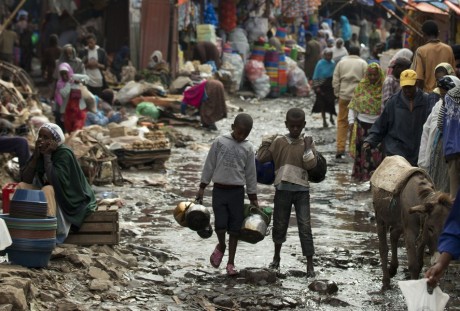
http://www.forbes.com/pictures/mef45jgim/10-saddest-ethiopia/
Copyright © Oromianeconomist 2013 and Oromia Quarterly 1997-2013. All rights reserved. Disclaimer.
Related articles
- The biggest challenges facing Africa have little to do with religion, per se, and less with global terrorism.http://www.foreignpolicy.com/articles/2013/10/02/demography_is_destiny_africa_al_shabab#.Uk3ZTTT2_xA.twitter …
- “Re-Branding Africa” and “Africa Rising”: Whose #Africa? Whose Rise? http://aconerlycoleman.wordpress.com/2013/10/03/re-branding-africa-and-africa-rising-whose-africa-whose-rise/
- Africa is not rising, survey shows that ”the boom” only benefits a narrow elite http://www.theguardian.com/world/2013/oct/02/africa-not-rising-survey?CMP=twt_gu
- A skeptical perspective on African development (marginalrevolution.com)
-
http://transitions.foreignpolicy.com/posts/2013/09/30/the_african_statistics_smackdown_continued
Gadaa Oromo Democracy: Three Approaches to the Study of African Society September 27, 2012
Posted by OromianEconomist in Africa, Ancient African Direct Democracy, Culture, Finfinnee, Gadaa System, Humanity and Social Civilization, Irreecha, Kemetic Ancient African Culture, Oromo, Oromo Culture, Oromo First, Oromo Identity, Oromo Nation, Oromo Social System, Oromummaa, Self determination, Sirna Gadaa, State of Oromia, The Oromo Democratic system, The Oromo Governance System, Uncategorized.Tags: Africa, African culture, African Studies, Ancient African Direct Democracy, Ancient Black People, Ancient Egyptian people, Democracy, Economic and Social Freedom, From, Gadaa System, Governance issues, Horn of Africa, Kemet, Kushitic people, National Self Determination, Oromia, Oromiyaa, Oromo, Oromo culture, Oromo people, Oromummaa, Politics, Siqqee, Siqqee Oromo Women Institution, Sirna Gadaa, Social Sciences, State and Development, Sub-Saharan Africa, United Nations, Universal Declaration of Human Rights, World Bank
3 comments
These closely related books reveal the many creative solutions an African society found for problems that people encounter when they try to establish a democratic system of governing their affairs. In much of what has been written about Africa, the common image is that of people governed by primitive customs and practices, in which only feudal roles of elders, kings, chiefs, sultans, and emirs have been acknowledged by Western observers. Little is ever shown of indigenous African democratic systems, under which there is distribution of authority and responsibility across various strata of society, and where warriors are subordinated to deliberative assemblies, customary laws are revised periodically by a national convention, and elected leaders are limited to a single eight-year terms of office and subjected to public review in the middle of their term. All these ideals and more are enshrined in the five-century old constitution of the Oromo of Ethiopia, which is the subject matter of these books.
In these books, Legesse brings into sharp focus the polycephalous or “multi-headed” system of government of the Oromo, which is based on clearly defined division of labor and checks and balances between different institutions. Revealing the inherent dynamism and sophistication of this indigenous African political system, Legasse also shows in clear and lucid language that the system has had a long and distinguished history, during which the institutions changed by deliberate legislation, and evolved and adapted with time.’ Amazon Books &
Related articles
Introduction
http://oromopress.blogspot.co.uk/2011/12/review-of-oromo-democracy-indigenous.html?m=1
http://www.readperiodicals.com/201203/2672718591.html
- Gadaa: An Oromo Democracy and the Symbol of Oromo Civilization (odaakoo.wordpress.com)
- Contours of the Emergent & Ancient Oromo Nation (oromianeconomist.wordpress.com)
- http://www.iwmi.cgiar.org/publications/CABI_Publications/CA_CABI_Series/Community_Law/protected/Ch%2009.pdf
- Oromia of Dhaqabo Ebba: The Cradle of Mankind Is Also A Home of The Oldest Living person On Earth (oromianeconomist.wordpress.com)
Copyright © Oromianeconomist 2012 and Oromia Quarterly 1997-2012. All rights reserved. Disclaimer.
CONTOURS OF THE EMERGENT & ANCIENT OROMO NATION September 25, 2012
Posted by OromianEconomist in Uncategorized.Tags: African Studies, Ancient time, Berlin Conference, Civilization, Democratic African institution, Democratisation, Developing country, Economic growth, economics, Freedom, Gadaa System, Governance issues, Land grabs in Africa, New Africa, Old Egypt, Oromia, Oromia Region, Oromo people, Oromummaa, Parliament, Social Sciences, State and Development, Tokkummaa Oromo, Universal Declaration of Human Rights
3 comments

This book is an important contribution to the study of identity politics, a subject hotly contested by many Africanists. Bulcha’s discussion the state-centered bias in the much of academic work on Ethiopia and its denial of the history and pre-colonial autonomy of indigenous non-Abyssinian peoples aught to lead to some serious debate. (Kajsa Ekholm Friedman, Professor Emeritus, Lund University, Sweden).
This work by Mekuria Bulcha is the most comprehensive and innovative work on the Oromo of Ethiopia ever to be written. Identity politics, he argues can be a positive challenge to the development of the state. As it has been the case of Southern Sudan states can also evolve, disappear and change. This work outlines the history, the traditions and politics of the Oromo people summarized and critically assessing all scholarly work done previously. It will remain a seminal work for scholars of Africa and the Oromo for many years to come. It is master peace and sets new challenge for all of us researching on the Oromo nation and people. (Mario I. Aguilar, Professor, Chair of Religion and Politics & Director of the Center for the Study of Religion and Politics (CSRP), University of St. Andrew, Scotland, UK).
Based on empirical evidence and relevant theories of nationalism Bulcha convincingly argues that the pre-colonial Oromo were a pre-modern nation. He revisits the representation of the Oromo identity in Ethiopian history and proposes the innovative and stimulating thesis that the 16th century Oromo ‘invasion’ of the Ethiopian highlands was the result of a conscious effort to regain control of a territory that was lost and contended since the 14th century Abyssinian expansion into the region. Mekuria Bulcha’s presentation of new evidence of the Oromo resistance to the 19th century conquest, his description of the international appeals by the Oromo elite in the colonial phase, his analysis of the activities of the Oromo social movements for the cultural and linguistic rights in the 1960s, and his account of the history of rebellion and armed struggle from the 60s, up to the current ethnic federalism are likely to make this book a classic reference for the studies on ethno-nationalism. (Marco Bassi, Ph.D. Research Associate, African Centre, University of Oxford, UK).
In his important and interesting discussions on the Gadaa System Mekurian Bulcha argues that:
The Oromo People created Gadaa, and Gadaa created the Oromo nation (Legesse, 2000 as quoted in Bulcha 2012)
The Gadaa system is the matrix of the Oromo culture and society: in the past it stood for several related ideas and practices encompassing cultural, political, economic and religious elements. Many of the basic elements of traditional Oromo culture that are anchored in the Gadaa system have withstood the exigencies of time and still today influence the values, attitudes, and social practices of Oromo people irrespective of, region, religion and social class. Oromo worldview and way of life was shaped by Gadaa system (Bulcha,, 2012 & Legesse, 2006).
The unity of the Oromos that is crystallized in the Gadaa culture is not a nostalgic memory of a glorious past or illusory of vision of the future paradise. Gadaa is a reality embedded in the Oromo psyche that constitutes what is to be Oromo as an individual and as a nation. Gadaa underpins the cohesive or corporate Oromo history that scholars who have not studied the Oromo fail to recognize (Gebissa, 2008).
The most important organ of the Gadaa system is the federal assembly known as Gumii Gayoo in Borana and Caffee in other places. These assemblies were very large and attended by councillors called hayyuu, drawn from different sections of the society. These assemblies made laws which defined the essence of Oromo democracy. In short, the specificity and similarity of the myriads of norms, rituals and political practices around which it was organized throughout the Oromo country make Gadaa a unique pan- Oromo institution of great historical depth (Bulcha, 2012, Legesse, 2000).
http://www.casas.co.za/Publications.aspx?PID=316
Copyright © Oromianeconomist 2012 and Oromia Quarterly 1997-2012. All rights reserved. Disclaimer.
Gadaa system June 8, 2011
Posted by OromianEconomist in Uncategorized.Tags: Democratic African institution, Gadaa, Member of Congress, Oromia, Oromo people, Oromummaa, Parliament, political system
add a comment
http://world.pressenza.org/npermalink/ancient-rituals-and-modern-practices


 Oromian Economist
You must be logged in to post a comment.