


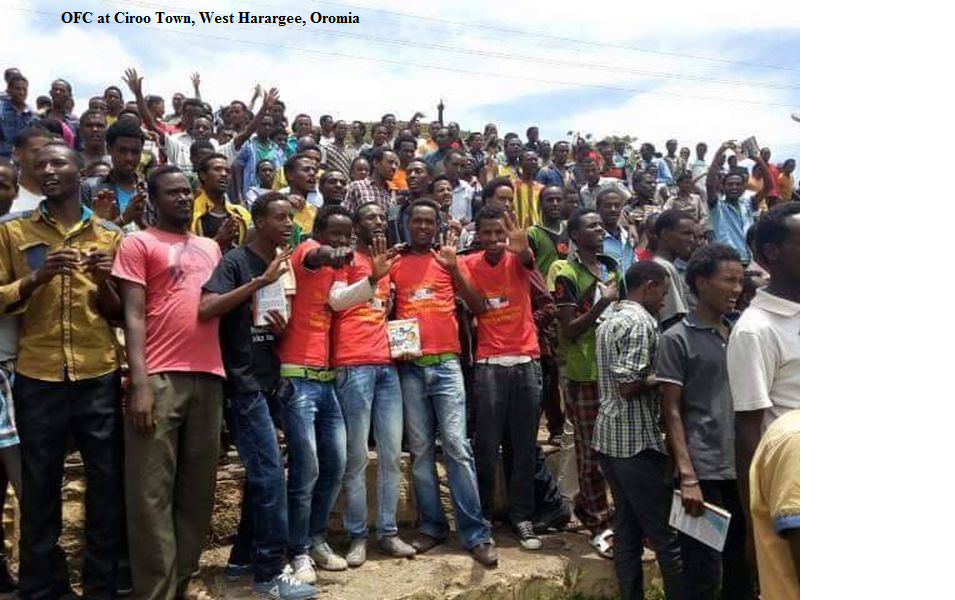
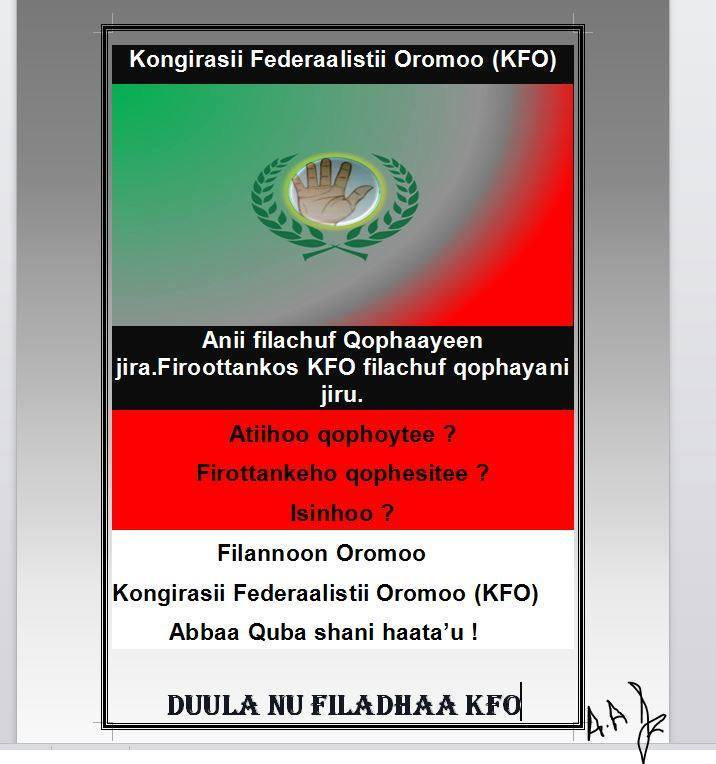
‘OFC/MEDREK’S Election Symbol (“Five Fingers with the Open Palm”/”High Five”) Goes Viral. As Medrek’s campaign for the upcoming General Election (to be held on May 24, 2015) continues in the State of Oromia led by Dr. Merera Gudina’s Oromo Federalist Congress (OFC), and in the Southern State led by Dr. Beyene Petros’ Ethiopian Social Democratic Party (ESDP) – both member parties of the Medrek democratic multinational coalition, the election symbol of Medrek (“five fingers with the open palm,” or shortly the “high five”) has gone viral on the social media as well as on the campaign trails, and “give me high five” has also become a catchphrase to indicate a democratic multinational.’ Gadaa.net/FinfinneTribune
‘Filannoon Wayyaaneen dhandhaaraa jirtu jijjirama qabatamaa homaatuu akka hin finne namuu ni beeka. Garuu ummanni Oromiyaa garayyuu buqqa’ee bahee paartiiOromo Federalist Congress cinaa maaf hiriire? Sababni tokko waliigalatti sabboonummaan Oromoo biyyaafi alattis dadammaqiinsa cimaa agarsiisaa jira. Waltajjiilee dhimma Oromoofi Oromiyaa irratti hirmaannaa hoo’aa agarsiisaa jira. Kan lammataatifi sababni cimaan ammoo, ummanni keenya hiree filannoon sababasame gadi bahuuf argate kanatti fayyadamuun hawwii bilisummaatifi jibba sirna cunqursaa kanaaf qabu agarsiisaa jira. Akkuma yeroo duula filannoo kana fedhiifi jibba isaa agarsiise, sagaleen isaa akka hatamu beekus, yeroo korojoo filannoo san bira gahe sagalee isaa paartii kittilayyoo hoongessee kan qabsaa’otaatif laatun ejjannoo isaa lammata beeksisa jennee abdanna. Wayyaanee sagalee filannootin kuffisuun dadhabamus, sagalee dhoowwachuun sirni sun hammam akka tufame kitallayyoo isaanii agarsiisuun faaydaa qaba.’
Jawar Mohammed
US Gov – Ethiopia Travel Alert. #Oromia. #Africa May 16, 2015
Posted by OromianEconomist in Free development vs authoritarian model, Groups at risk of arbitrary arrest in Oromia: Amnesty International Report, Human Rights Watch on Human Rights Violations Against Oromo People by TPLF Ethiopia, The Tyranny of TPLF Ethiopia.Tags: Africa, African Studies, Because I am Oromo, Human rights violations, The Tyranny of Ethiopia, US Gov – Ethiopia Travel Alert
add a comment


(Oromia Press) US Gov – Ethiopia Travel Alert
The State Department recommends U.S. citizens maintain a high level of security awareness during the electoral period and avoid political rallies, polling centers, demonstrations, and crowds of any kind as instances of unrest can occur. Review your personal security plans; remain aware of your surroundings, including local events; and monitor local news stations for updates. Although there have been no specific incidents of violence targeting U.S. citizens, U.S. citizens are urged to exercise caution and stay current with media coverage of local events. Election results are scheduled to be announced June 22, 2015.
During previous elections, the Ministry of Foreign Affairs (MFA) required all diplomats and international organization staff living in Addis Ababa to receive an official pass from the MFA if they planned to travel outside of Addis Ababa during the election season. While not in effect this election, the U.S. Embassy continues to urge U.S. citizens to be aware of election sensitivities. We especially recommend avoiding public polling stations on the day of the election, including schools and other public buildings. In Addis Ababa alone there will be nearly 1,600 polling stations – roughly one polling station for every kilometer.
We strongly recommend that U.S. citizens traveling to or residing in Ethiopia enroll in the Department of State’s Smart Traveler Enrollment Program (STEP) at travel.state.gov. STEP enrollment gives you the latest security updates, and makes it easier for the U.S. Embassy or nearest U.S. Consulate to contact you in an emergency. If you do not have Internet access, contact the nearest U.S. Embassy or Consulate to enroll directly.
Regularly monitor the State Department’s website, where you can find current Travel Warnings, Travel Alerts, and the Worldwide Caution. Read the Country Specific Information for Ethiopia. For additional information, refer to the “Traveler’s Checklist” on the State Department’s website.
The U.S. Embassy in Addis Ababa is located at Entoto Street, P.O. Box 1014. The Consular Section of the Embassy may be reached by telephone: +251-111-306000 or e-mail at consacs@state.gov, and is open Monday-Thursday, 7:30 a.m.-5:00 p.m. For after-hours emergencies, U.S. citizens should call +251-111-306911 or 011-130-6000 and ask to speak with the duty officer
– See more at: http://www.oromiapress.com/us-gov-ethiopia-travel-alert/#sthash.pL12WAJ2.dpuf
Oromia: Oromo Federalist Congress (OFC/Medrek), KFO/OFC Madrak/Medrek Filadhaa 2015 Campaign May 16, 2015
Posted by OromianEconomist in Africa, Sham elections.Tags: Africa, African Studies, Ethiopia's sham elections, Oromo Federalist Congress (OFC) Criss-crossing Oromia with Huge Turnouts at Campaign Rallies
add a comment
Oromia: Oromo Federalist Congress (OFC/Medrek), KFO/OFC Madrak/Medrek Filadhaa 2015 Campaign Video
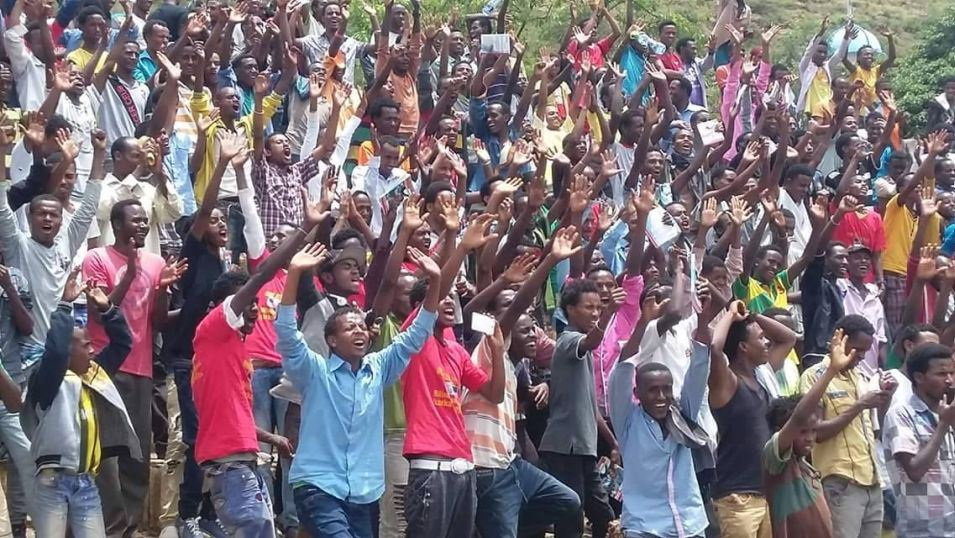
In Pictures: Oromo Federalist Congress (OFC/Medrek) Continues Campaigns in Arsii and Harargee Zones, Oromia
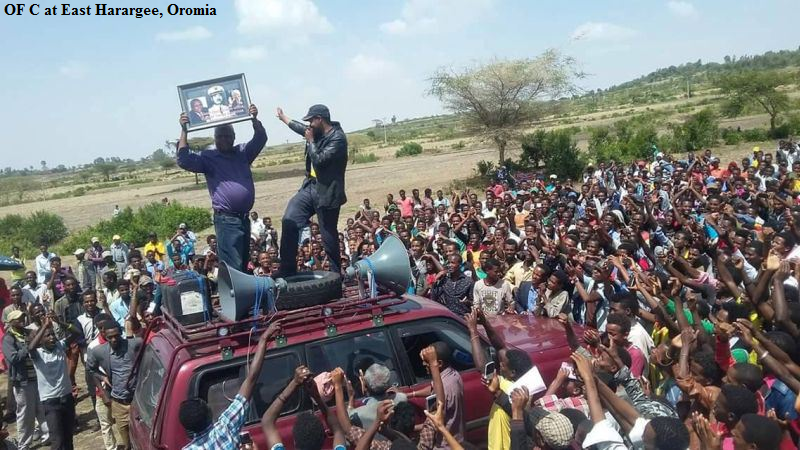
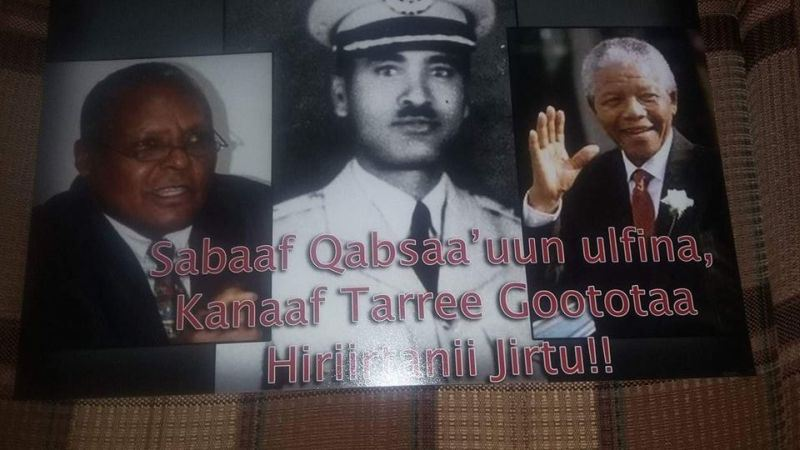
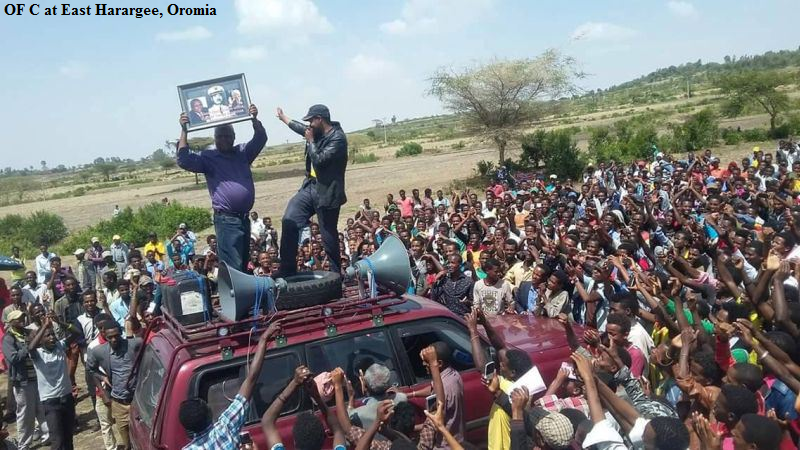
The Oromo Federalist Congress’s (OFC/Medrek) trailblazing campaign tour for the upcoming General Election (to be held on May 24, 2015) has continued in Oromia; over the week, the campaign train has passed through small and big towns in Arsii and Harargee Zones. In East Harargee, Dr. Merera Gudina, chairman of OFC, was presented with a plaque with photos of Mr. Nelson Mandela, Gen. Tadesse Birru and Dr. Merera Gudina (see below).
Here’s also a video of the Naqamtee OFC campaign meeting from last week:
http://http://gadaa.net/wp-content/uploads/2015/05/OFC_Naqamtee2015.mp4?_=1
http://gadaa.net/wp-content/uploads/2015/05/OFC_Naqamtee2015.mp4?_=1
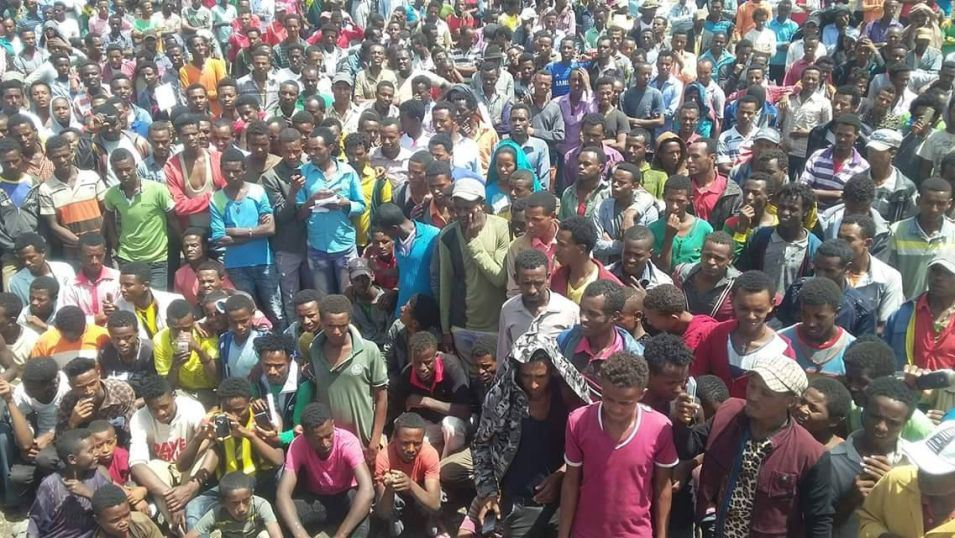
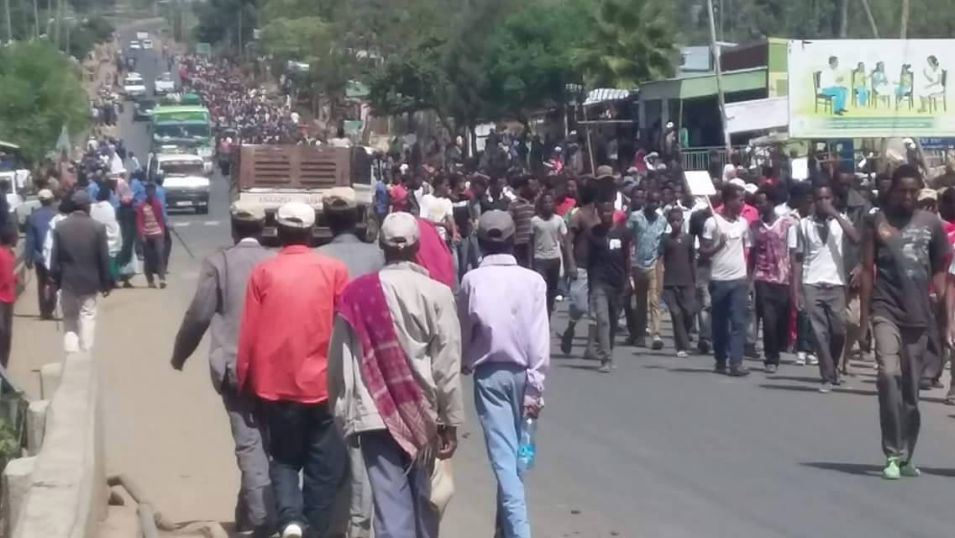
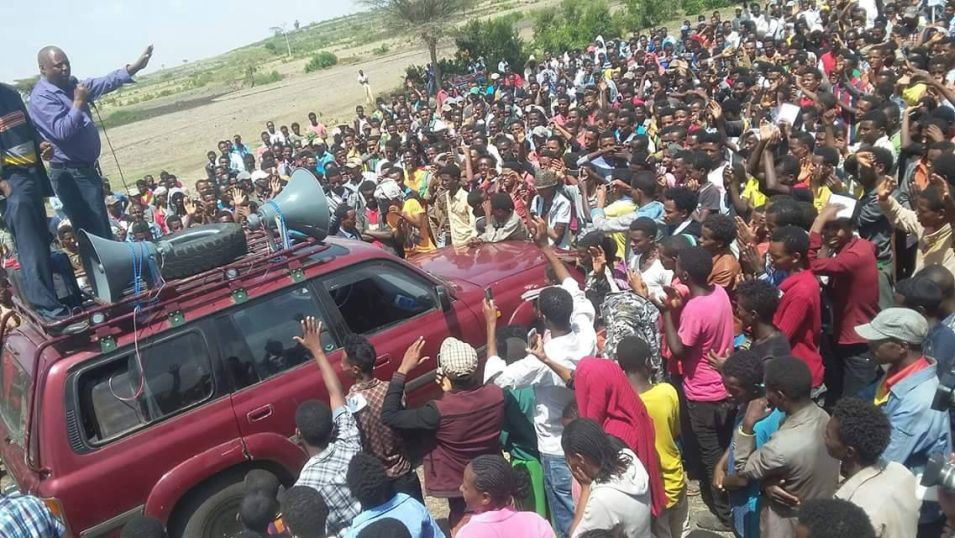
OFC at West Arsi, Oromia:
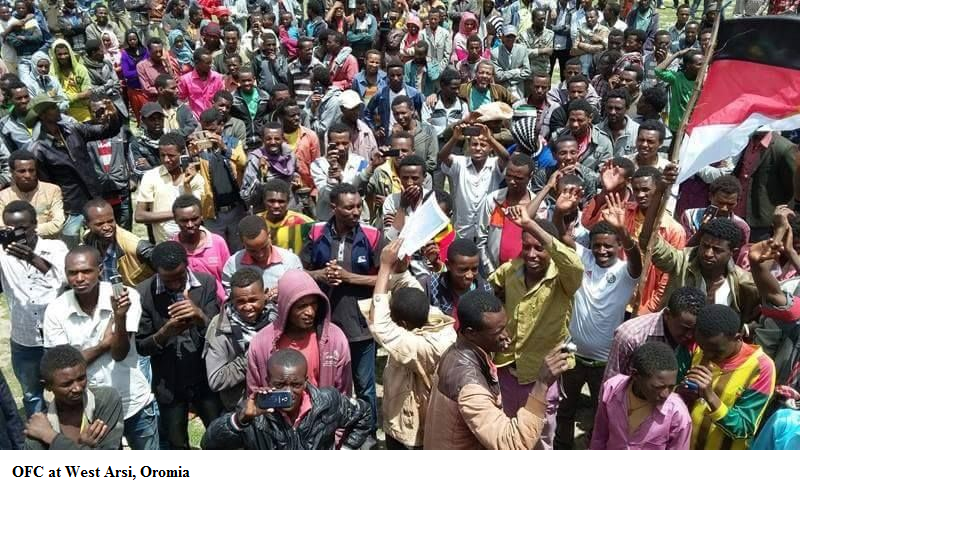
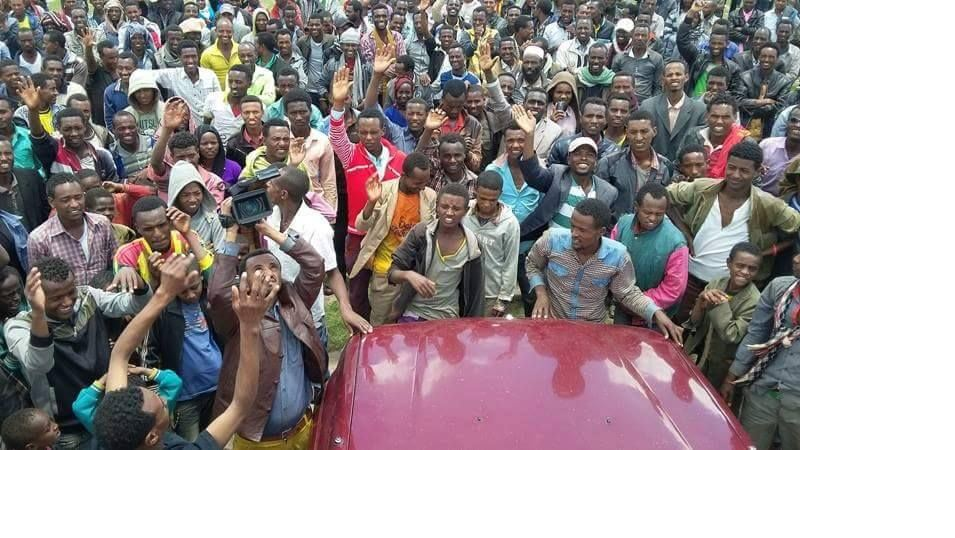
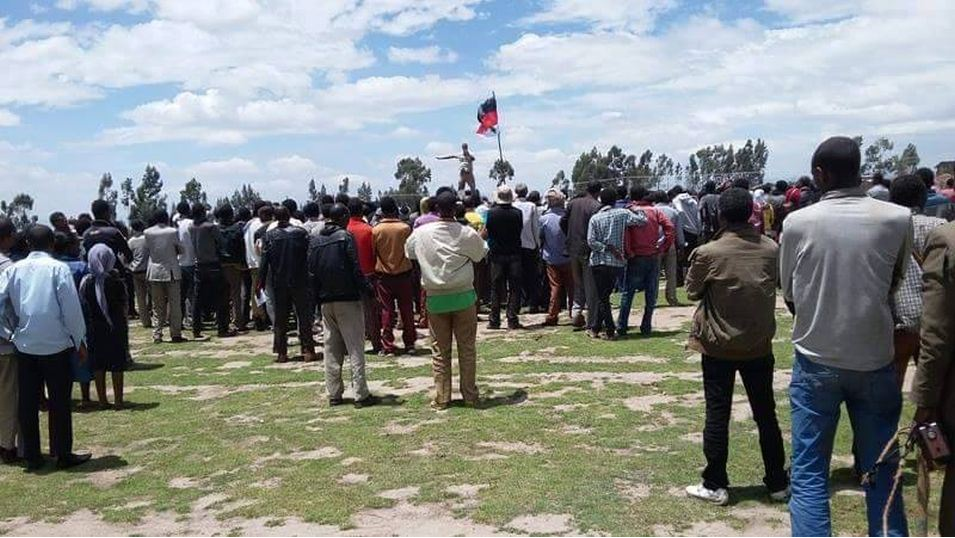
Ciroo Town, West Harargee, Oromia
https://www.oromiamedia.org/2015/05/omn-oduu-caamsaa-14-2015/
ODUU GADDAA: OBBO DHAQQABOO EEBBAA DHALATANII WAGGAA 163 ISAANIITTI LUBBUU DHAN BOQOTAN. Oromo Elder Dhaqqaboo Eebbaa (1853-2015): The oldest man ever to have lived has died at age of 163 May 14, 2015
Posted by OromianEconomist in Dhaqabo Ebba.Tags: Africa, African Studies, Obbo dhaqabaa Ebbaa, Oldest person, The Oldest Living Person, The world's oldest person
1 comment so far
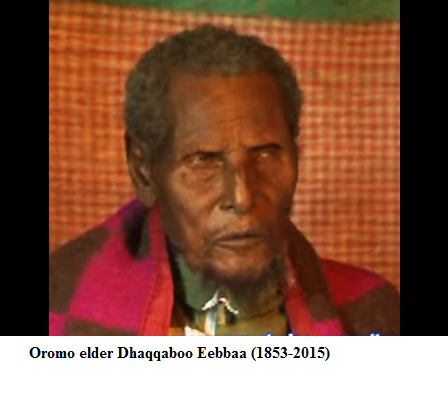 ODUU GADDAA: OBBO DHAQQABOO EEBBAA DHALATANII WAGGAA 163 ISAANIITTI LUBBUN DHAN BOQOTAN. Oromo Elder Dhaqqaboo Eebbaa (1853-2015): The oldest man ever to have lived has died at age of 163. His eldest son Ahmed Dhaqqboo now at age of 128 is the oldest living person on earth.
ELECTIONS IN ETHIOPIA: BEYOND WINNING (AND LOSING) May 12, 2015
Posted by OromianEconomist in Africa, Sham elections.Tags: Africa, African Studies, Ethiopia's sham elections, The Tyranny of Ethiopia
add a comment
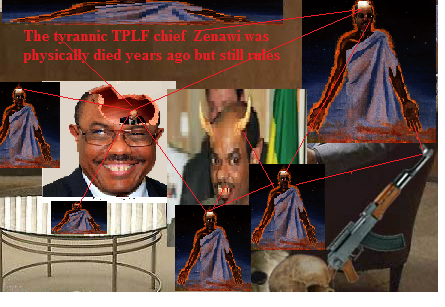
ELECTIONS IN ETHIOPIA: BEYOND WINNING (AND LOSING)
By Tsegaye R Ararssa* in
Part I
1 . Introduction
Election fever is gaining momentum in Ethiopia. It is ‘Election 2015’, the 5th general election since Ethiopia’s formal adoption of the more (or less) liberal constitution of 1995 that ended the hesitant ‘transition’ from the Derg’s military rule to a western-style representative democracy[1]. The projected aim of the transition was to liberalize and pluralize the politics, to reform and resuscitate the economy, to restructure the state (through democratization and decentralization), and to transform the hitherto tenuous state-society relations. Through the constitution, the regime provided itself the legal edifice on which to ensure that transitional project is attained and a liberal democracy (expressed through representative and participatory institutions) is formally instituted. In a gesture of transforming the state, the constitution recognized national diversity, legalized collective rights such as the right to self-determination[2], and institutionalized federal non-centralization. Having ostensibly demilitarized politics [3], electoral contestation became the formal mode of contending for political power. The election fever that is steadily gripping the nation now is the symptom of that contention.
Over the last few weeks, controversy has progressively raged over the politics and the logistics of the upcoming election. Decisions pertaining to recognition by the National Electoral Board of Ethiopia (NEBE) of political parties with the ‘right’ leadership [4], registration of ‘qualified’ candidates [5], and ensuring the proper adherence to the relevant rules of constitutional, electoral, and political party registration laws have provoked a lot of ire among some of the parties seeking to partake in the election. Rulings over who is qualified as a candidate and which party is qualified as a contestant have unleashed a conversation over the process and speculations over the outcome of the election. In the first election debate conducted live on public television, the major ideological fault lines between the three major political parties were outlined. In the same week, we heard that some of the parties (such as the Ethiopian Federal Democratic Unity Forum, alias Medrek in Amharic) were denied access to the state media (Ethiopian Broadcasting Corporation, EBC) on the pretext that the parties’ criticism of the media’s bias towards the incumbent is an attempt to undermine the impartiality of the media. Their petition to the NEBE has not found a response yet. Not entirely unexpectedly, tension has started to build up.
As anyone familiar with Ethiopia and its histories knows, the tension around elections is only symptomatic of deeper issues that have roots in—but never contained by—the political contestations of the past. In this piece, I offer a reflection on what election means to the various sectors of the population in the Ethiopian polity in the light of that past. I will thus reflect on what election means to the incumbent, the opposition political parties, and to the electorate, north and south. Along the way, I will also reflect on the mood in the context of which the election takes place. By drawing historical parallels between 2015 and 1915 (historical moments when two dead leaders—Meles Zenawi and Menelik II, respectively -rule from the grave in spite of the place holders whose genealogies make them unlikely successors, namely Prime Minister Hailemariam Desalegn and Emperor Eyasu II, alias Lij/Abeto Eyasu, respectively), I will point to the continuity in the nature of the State in which the election takes place, irrespective of the appearance of change. Lastly, I will offer my points on what is beyond winning and losing this particular election, and how it affects the nature of the Ethiopian state.
The starting point of this reflection is that election is a language. It is the new language one speaks in order to secure democratic legitimacy. Posited within the confines of liberal constitutionalism, it is a particular language with the idiom and vernacular of modern representative democracy. Whoever is proficient in this language technically ‘wins’ the election. In this piece, in a rather iterative manner, I reflect on the ‘facility’ or ‘proficiency’ of the contestants in this language within the context of Ethiopia in order to imagine what is beyond winning (or losing) this election.
The thrust of my argument is that there is much more work to do about the state than partaking in the motion of election. There is more to Ethiopia than mastering the language of election. I suggest that to EPRDF election is a mode of securing a technical legitimacy. To its adversaries, it is a mode of resistance to hegemonic oppression. Some of its adversaries resist its hegemonic position if only to replace it with their own. Others resist it and the State form it embodies and represents. For this latter group, the election is, more than anything else, a gesture of negating the status quo, it is a talking back to power, an utterance of societal pain long suppressed and contained. It is a way of sustaining a lamentation. It is yet another moment of reminding Ethiopia that all is not well. For the protagonists in this election saga, especially for the ruling EPRDF, the election is merely war by other means. As such, for EPRDF, it is a mode of entrenching its power by eliminating its opponents through the technology of election. Consequently, the election has little to do with the desired transformation of the state-society relations in Ethiopia.
As a result, I argue, there is little the election can do to tackle outstanding political issues that are contained in the unfinished business of state-building. In particular, there is little it can do to expand citizenship to the subject peoples of the wider South. EPRDF’s anti-democratic posture to disallow a political space where deeply political issues can be discussed (by reducing everything down to the technicalities of law and economic governance) is a proclamation of closure of politics by relegating the discussion to the realm of techniques. Election is thus reduced to a mode of enhancing what the French philosopher Michel Foucault calls ‘governmentality’, a technical-ideological apparatus of controlling and regulating the population by eliciting acquiescence in their own control and regulation. EPRDF’s adversaries, especially the north-central ethio-political class, also play their own role in this proclamation and enactment of closure of politics by aestheticizing a heavily contested political issue. As I shall argue in subsequent sections, they engage in exoticizing and aestheticizing an essentially political issue of the past and the future. They engage in a double movement that also politically demonizes – and excludes – the essentially political questions (such as the question of diversity [sameness and difference], historical political violence/injustice, misrecognition, inclusion-in-citizenship, and co-equal (re)founding of the polity. They thus aestheticize the inaugural violence by iconizing the leaders of the past through a raft of artistic products (images and lyrics, pictures and songs, etc) thereby rehabilitating them from the tyranny and oppression they represented, the tyranny and oppression they were once criticized for. At the same time, they demonize what could probably be the most important political question of modern Ethiopia—the question of diversity—by presenting it rather negatively as “politicized ethnicity.”
By so doing, i.e., by removing the important issues from the realm of the political to that of the aesthetic, they do their own bit of closing the political space for discussing the irreducibly political questions politically. The combined effect of these closures (by both groups)—born chiefly out of insecurity of EPRDF as a Government, only symptomatic of the greater insecurity of the ever more fragile Ethiopian State it runs, manages, and embodies—causes our judgement of the process and consequence of the election to be pessimistic. The insecurity of the ‘eternal kingdom’ assumed to have been established by Menelik, Haileselassie, and Mengistu; the insecurity born out of the incomplete nation-building project, prompts EPRDF’s opponents of the Amhara constituency to aspire for similar closure of the political space through aestheticization and exoticization of the infinitely political questions.
2. The Mood: Hope and Anticipation, or Angst and Despair?
Election is time-bound. Its temporality is its essence. The intensity or lack thereof is the function of its being limited in time. As a result, its process, outcome, and significance are dependent on the ‘political ecology’ of the time. It is dependent on what is ‘in the air’, what is troubling the polity, and what is exercising the large majority of the electorate. This is because election needs a particular kind of ‘democratic ambience’, as it were, a (more or less) festive atmosphere imbued with hope and anticipation (the subtext of which is fear and anxiety). Election has its own ‘mood’, sort of a national ‘political labor’. Understanding the mood – capturing the pulse of the polity in the electoral moment – helps us situate the election (the process, the result, and the context) in proper perspective. This underscores the supreme importance of a ‘right’ ‘political ecology’ that can engender hope (of winning) and of security (in the event of losing).
Hope and anxiety attend to all elections, the hope of winning and the angst of losing. However, in as much as possible, it is important that a proper balance is stricken between hope and fear, anticipation and despair. After all, the hope of renewal – the promise of exercising creative agency among the electorate – is an important ingredient of a healthy electoral democracy.
What attends Election 2015 in Ethiopia? Two areas of the public life of Ethiopia must be considered in order to map the electoral mood, namely the civic-political space for active citizens who can engage in politics on the one hand and the ‘nature’ of the state and its relation with the society on the other.
2.1 Civic-Political Space in Decline
The civic-political space has been a subject of controversy, especially since the 2005 election, the election that revealed not only the outer limits of the public sphere but also the foundational cracks in the State form in Ethiopia. In the wake of the 2005 election, the regime started to stiffen the rules of procedure in the parliament thereby limiting the discursive space even within the EPRDF-dominated parliament. That was followed by a raft of legislations on the civic/public space available for dissent, or its discursive and institutional articulation. These legislations constrained freedoms that are instrumental for, and constitutive of, democracy at a time. The Freedom of Mass Media and Access to Information Proclamation (Proclamation N0. 590/2008), the Anti-terrorism Proclamation (Proclamation No. 652/2009), and the Charities and Societies Proclamation (Proclamation No. 621.2009) were the three major legislative acts deployed by the Ethiopian government to (re)occupy the already limited space for political dissent and consequent pluralism. These laws, for all their preambular commitment to expand and implement constitutional right to freedom of expression, press and association rationalized and perfected the pre-existing streak noticed in the regime’s intolerance of expressed dissent. Self-censorship has become a way of being, a way of life, among journalists and other writers as a result. The prohibitive punishment/fines in the media and press laws and the expansion of the anti-terrorism law to press products (art 6 of Proc. 652/2009) [vi] have effectively muted an overt criticism. The extensive use of surveillance [vii], the blocking of several websites (perceived to be in opposition to the regime in power), jamming of other press/media outlets has contributed to the increasing undermining of the expression of robust dissent.
The challenge of financial self-sustenance faced by civil society organizations working on causes related to human rights, democracy, and conflict, among otbers, owing to the prohibition of external funding above the 10 % maximum has not only forced such bodies to close or re-organize themselves as purely humanitarian organizations or relocate themselves as foreign or ‘resident’ NGOs, it also severely limited their voice as an alternative articulation of socio-economic challenges of the people from the perspective of daily lived experience [viii]. The government increasingly became the only source of information on vital socio-economic and political issues of various sectors of the society.
The invocation of the anti-terrorism law for trivial reasons such as having a contact with foreign journalists, international non-governmental human rights organizations (such as Amnesty International and the Human Rights Watch), or foreign diplomats and embassies has effectively smothered people into watching their contacts and relationships. People feel that their relationships and exchanges (physical and electronic) are monitored. The invocation of the anti-terrorism law in relation to the Muslim activists protesting government intervention in religious affairs [ix]and the ‘Zone 9’ [x] bloggers and journalists jailed and currently standing trial has unveiled to us how the law can be strategically deployed against those the government perceives as opponents. This and other cases have shown the extent to which one can freely and peacefully express dissent without harassment, intimidation, and the terror of standing trial under the anti-terrorism law.
The pattern of government denial of the right of assembly and peaceful political demonstrations, especially when organized by political groupings perceived as fierce opponents of the regime (such as the Semayawi Party), selective permission of such meetings to factions of parties the government seeks to weaken (e.g. the faction within Unity for Democracy and Justice, UDJ), denial of meetings even within the premises of private organizations such as hotels to some groups (e.g. UDJ at the Imperial Hotel, 2009), the constant outlawing of meetings and demonstrations by unreasonably exploiting the “notification” duty under the Freedom of Assembly Proclamation (Proclamation No-3/1991) – where the duty to notify the municipality is interpreted as the duty to seek and secure prior permission – have all contributed to the practical stifling of freedom of assembly and peaceful demonstration. Through this strategy – and the rhetoric of averting “street action” and “color revolutions” [xi] – the government has effectively silenced political protest to its decisions, policies, and laws. This in turn has weakened and subverted participatory democracy envisaged in the constitution (art 8(3)). In practice, such violation of the right to assembly and peaceful demonstration has been repeatedly witnessed in the Muslim protest to the government’s unconstitutional intervention in the choice of leadership of, and doctrines for, the Muslim population (since 2011).
Freedom of association of political parties has repeatedly been violated in the process of political party registration by the NEBE. The recent intervention by the NEBE to ‘recognize’ the leadership of factions within the UDJ and the All Ethiopian Unity Party (AEUP) is not only meddling with the internal issues of political parties, but also unconstitutionally limiting the freedom of association of members and their right to a choice of the leaders they deem fit to lead them.
Apart from this, one can say that there is a healthy ‘electoral climate’ only when – in addition to the right to vote and be elected – citizens have the right to administrative justice, i.e., the right of access to justice in a free, fair, and impartial court or tribunal, in the event that these rights are violated or threatened. The voter intimidation historically observed in the process of voter-registration by the kebeles (often suggesting possible deprivation of vital social and public services sought from local offices) are violative of the very basic political rights that are constitutive of the very essence of democratic practice. At times such intimidations tend to forget that their right to elect includes the freedom not to vote. They forget that in Ethiopia, voting is a right, not a duty.
The enhanced developmentalist gestures of the incumbent which views individual civil and political rights as less important in the face of the colossal “war on poverty”; the unabashed emphasis on growth (even in the Growth and Transformation Plan, GTP); its increasing turning away from its ‘original’ (1991) commitment to liberal policies (also charted out in the constitution); its continued neglect, or deliberate weakening, and strategic and manipulative use of democratic institutions (i.e., institutions of representation [House of Peoples’ Representatives, HPR, and House of Federation, HOF], empowerment [NEBE, Ethiopian Human Rights Commission, Ombudsman], and of accountability and monitoring [e.g. the judiciary, Anti-corruption Commission, Auditor General] are not helping to create an environment conducive for a free and fair election. To that extent, there are complaints, grumblings, and disaffection among most of the opposition political actors who have a stake in the election. So, the rules and rulings around the process suggest that the mood is less than ideal. But a more complete account of the mood is revealed only when we examine the contradictions that come from the state form in Ethiopia. In the next sub-section [which will come in the form of a second instalment in this series of reflection around Elections 2015], I will turn to considering these contradictions that emanate from the state form and the constraints they impose on electoral democracy.
Endnote
*Tsegaye R Ararssa is a Constitutional lawyer currently in the process of completing his PhD studies at the University of Melbourne Law School. He can be contacted at tsegayer@gmail.com.
[1] The Transitional Charter of July 1991 starts with recognition of the supreme importance of the UDHR, especially civil and political rights such as freedom of expression, assembly, association. It explicitly made assertions about the need for comprehensive restructuring of the state by ensuring equality and sovereignty of the ‘nations, nationalities, and peoples” of Ethiopia and by foregrounding the right to self-determination as an organizing principle. It was negotiated principally among ethno-national liberation fronts (most centrally TPLF, OLF, EPLF but also others) who referred to themselves as “the peace-loving forces of Ethiopia”. See, Provisional Government of Ethiopia, ‘Transitional Period Charter,’ Negarit Gazetta, Proclamation No. 1/1991.
[2] Art 39 (1-3) entitles every “nation, nationality, and people” to the right to political, cultural, and economic self-determination.
[3] EPRDF was quick to work on disarming the army of the Derg and the fighters of the other liberation fronts that negotiated the Transition with it. It also proclaimed its TPLF fighters to serve as the Ethiopian Defence Force of the transitional period. The demobilization of some of the soldiers came later after the formal inauguration of the FDRE as per the Constitution. It is interesting that the first government-like institution set up everywhere immediately after the arrival of EPRDF on the scene was the “Peace and Stability Committees”. Most meetings it held in its attempt to build rapport with the people was invariably called “Peace and Democracy Conference”. The people who negotiated the Transitional Charter referred to themselves as “the peace Loving Forces of Ethiopia.” There was a rhetoric that privileged peace even in the leaders’ speeches/interviews on why relinquish Ethiopia’s right/interest over Eritrea without a fight. The climactic moment in this series of peace-venerating rhetoric came when a line is inserted even in the preamble of the FDRE Constitution to the effect that the constitution-makers are “determined to consolidate, as a lasting legacy, the peace and the prospect of a democratic order…” This flourish in rhetoric never matched with reality. The fact that TPLF’s army became the State’s national army and substantially remained to be so to date indicates not only the partisan nature of the army but also the fundamentally militarized nature of EPRDF’s politics that keeps a politicized guerilla fighters for a national army. Obviously, the needed separation of politics from (military) force in a democracy is absent in Ethiopia.
[4] The NEBE made a blunder around the election of the leadership of the All Ethiopian Unity p party (AEUP), the Unity for Democracy and Justice (UDJ).
[5] Some candidates of parties such as the UDJ and Semayawi (notably its leader Engineer Getinet Yilikal) were excluded allegedly because of the overcrowding of candidates that are running for elections in one electoral district.
[vi] Art 6 entitled “Encouragement of terrorism” reads as follows: “Whoever publishes or causes the publication of a statement that is likely to be understood by some or all of the members of the public to whom it is published as a direct or indirect encouragement or other inducement to them to the commission or preparation or instigation of an act of terrorism stipulated under article 3 of this proclamation is punishable with rigorous imprisonment from 10 to 20 years.” This article has been almost routinely (ab) used to arrest persons who run photocopy shops both in Addis Ababa and other towns.
[vii] Claire Lauterbach, “Ethiopia expands surveillance capacity with German tech via Lebanon” (23 March 2015). https://www.privacyinternational.org/?q=node%2F546
[viii] The law on Charities and Societies limits the amount of foreign money that goes into the budget of an Ethiopian (activist) NGO to a maximum of 10 % of the total. The reason given is to limit an external influence on the local organization’s agenda of promoting human rights, democracy, peace and security, etc. In principle, the argument goes, these issues of governance are a matter under the sovereign jurisdiction of the government of Ethiopia and are not items to be shaped by financing external forces. In order to get more funding, one should be registered as a ‘resident’ or a foreign/international NGO who, if it seeks to work on issues of political governance (e.g. elections, democracy, human rights, conflict resolution, constitutionalism and rule of law, prisons, access to justice, minorities etc), should get a specific permission from the government. This has made it necessary for many of the NGOs to recast the focus of their work shifting mostly from human rights to humanitarian causes and their approach from human rights based approach (HRBA) to needs-based approach (NBA).
[ix] The Muslim activists have been protesting peacefully against the government’s interference in their religious affairs. They particularly called on the government to desist from assigning teachers and determining the content of the teachings to be delivered in Mosques. They also sought to exercise their right to select their own religious leaders without any influence by the government. After the arrest and indictment of the leaders of these protests (and those government claims are associated with them), the protestors continued to demonstrate demanding the release of their leaders. Their peaceful protest has been met by a series of violence, arrests, and various forms of intimidation by the government’s police and security forces. The arrested leaders have been tried for terrorism since. Their case has gone has been debated before regular and constitutional tribunals (CCI/HOF) and is even presented to the African Commission on Human and Peoples’ Rights. The Muslim protestors relentlessly insisted on a peaceful resistance throughout; when they are unlawfully forced to face trial, they tried to exhaust all the possible legal remedies both national and international with a hope that the government will have no excuse in accusing them of any form of violence let alone terrorism. By so doing, they are in effect putting the entire system on trial.
[x] In March 2014, six bloggers (whose blog is known as Zone 9) and three journalists were suddenly arrested and are now being tried for terrorism.
[xi] The term “Color Revolution” is often mockingly used in Ethiopia to invoke the memory of the Rose Revolution (of Georgia) and Orange Revolution (of Ukraine) and deny their possibility in Ethiopia. It is also used by EPRDF to suggest that, unlike the regimes in Georgia and Ukraine, they are too strong to be unseated by such street actions and unarmed/civilian struggles
http://addisstandard.com/elections-in-ethiopia-beyond-winning-and-losing-2/
The Oromo Federalist Congress (OFC) & Medrek Continue Campaigns in Oromia, the South and Elsewhere Despite Harassment by Ethiopian TPLF Regime May 12, 2015
Posted by OromianEconomist in Africa, Ambo, Oromo News, Oromummaa, Sham elections.Tags: Africa, Africa's cheetahs versus hippo, African Studies, Against Tyranny, Ethiopia's sham elections, Oromo Federalist Congress, Oromo Federalist Congress (OFC) Criss-crossing Oromia with Huge Turnouts at Campaign Rallies, Oromos in Ambo defied TPLF’s ban of Oromo’s freedom of assembly
2 comments
Wayyaaneen Tarkaanfi Abdi Kutannaa itti fuftee
Caamsaa 12 bara 2015 yeroo 2ffaaf kadhimamaa KFO kan ta’e Ob. #Geetuu Dhaadhii kabnoota fi hidhatoota OPDOtin Aanaa Warra Jaarsoo ganda Bobee Liban keessatti odoo duula filannoo gaggeessaa jiru sa’atii 6:30 irratti reebicha sukkaneessaa irratti raawwatamee! Miseensota keenya 1 Ob Salamoon Jimaa 2 Ob Tufaa Hundee kan jedhamanis reebicha cimaa irraan gahaniiru ! Gochaa kana kan qindeesse immoo kaabnee opdo kan ta’e Ob Iyyaasuu Gammadaa ta’un isaa bubatameera ! Akka waliigalatti dulaa filannoo Aanaa kanatti gageessuu hin dandeenyee. Haalumaa wal fakkaatun, Garee KFO kan gara Wollaggaatti bobba’an ilaalchisee humni woraana Woyyaanee tarkaaffii humna irratti fudhachuudhaan midhaa irraan ga’uun himameet ture. Garee gara Wollaggaatti bobba’e kana keessa 1. Ittii aanaa dursaa dura taa’aa (the first vice chairman) Baqqalaa Garbaa 2. Itti-aanaa paartii Ob Mulaatuu Gammachuu 3. Barreessaa Liigii Dargaggootaa Darajjee Margaa fi 4. Gazeexessaa Badhaasaa Hayiluu kan keessatti argaman yeroo Naqamte dhaqqanan a) woraanni woyyaanee fi poolisoonni federaalaa magaala keessatti bobba’uudhaan akka uummanni wolgayii hin baane Daandii cufanis uummanni reebichaa isaanii osoo hin sodaatin cabsee wolgayiirratti baayyinnaan argame. B) uummanni baayyinnaan hirmaachuu barraan ammoo videon akka hin woraabbamne video gazeexessa Badhaasaa Hayiluurraa saamuudhaaf yaalanis kunis hin milkoofneef. KFOn kora ajaa’baa kan uummanni 40,000 ol itti hirmaate jedhamee tilmaamamu gaggeesse. C) jila KFO kanaaf siree akka hin kireessine ajaja dabarsanis barbaasaa yeroo dheeraa booda siree qabataniiran. D) Kanaan milkaawuu dadhabnaan ammoo dargaggoo Darajjee Margaa fi gazeexessaa Badhaasaa Hailuu bakka isaan siree qabatamatti deemuudhaan meeshaa woraanaa qabdu / meeshaa barbaanna sababa jedhuun daree isaan kireeffatan keessaa baasuudhaan sakattaa irratti gaggeessan. Garuu womaa hin arganne. E) Gochi sossodaachisaa Kun sabboontota keenna duubatti hin deebifne. Daran qabsoo DNF finiinsuudhaan Gimbiirrattille kora aja’ibaa gaggeessuun himameera. Wayyaaneen hawaasaa Oromoo ofitti kaakafti malee qabsoo keenyaa duubatti hin deebiftu jedha KFOn. Isin hoo maal jettu? Source: Social media network
https://www.oromiamedia.org/2015/05/omn-oduu-caamsaa-11-2015/
Ummanni Aanaa Midaa Qanyii Godina Lixa Shaggar,Gita Bittuu Mootummaa TPLF Jalatti Hin Bullu Jechuun Gamtaan Diddaa Dahgeessisan,Barattooti Oromoo 7 Ol Ta’anis Mana Hidhaatti Darbamuu Qeerroon Gabaase
Gabaasa Qeerroo Aanaa Midhaa Qanyii
Caamsaa 9,2015 Godina Lixa Shaggar Aanaa Midaa Qanyitti uummatni Oromoo gita bittaa mmootummaa Wayyaanee Abbaa irree EPRDF/TPLF/ jalatti hin bulluu jechuun mormii isa jabeesse, Mootummaan Wayyaanee Qeerroo barattoota Oromoo qabee hidhaatti darbuun dararuu itti fufe.
Goototni barattootni Oromoo Aanaa Midaa Qanyii M/B Baallammii sadarkaa 2ffaa fi qopha’ina Oromummaan yakkamanii wajjiraa Poolisii Aanaa Midaa qanyiitti humna poolisaan qabamanii darbamuun dararama jiraachuun walqabatee diddaan uummata qonnaan bultoota haalan jabachuun dabbaalloota wayyaanee EPRDF/TPLF/OPDO gandoota baadiyaa keessa adeemuun nu filadhaa jechuun maqaa filannoo kijibaan uummata afaan faajjeessuuf walga’ii garaagaraa uummata baasuuf karoorfatan, uummatni mormii guddaan jaladhabbachuun f irraa arii’achaa jira.Uummatni Aanaa Midaa Qanyii ifatti wayyaaneedhaan isin nu hin bulchitan nuti isinitti hin bullu, uummata Oromoos OPDO’n bakka bu’uu hin dandeessuu, nuti bilisummaa fi dimookiraasii dhugaa barbaadna jechuun dabballoota OPDO of irraa arii’ate jira. Ergamtootni Wayyaanee diddaa uummataa nu mudachaa jiru kanaaf sababaan guddaan Qeerroo barattoota Oromooti jechuu barattoota Oromoo dararuu fi hidhatti darbuu itti fufte jiraachuun ibsame.
Haaluma kanaan Qeerroon barattootni Oromoo badii tokko malee yeroo amma kanatti hidhatti darbamuun dararama jiran:
1. Barataa Addunyaa Birhaanuu barataa kutaa 9ffaa
2. Barataa Boruu Badhoo
3. Barataa Fayisaa Badhoo
4. Barataa Guutaa Girshaa
5. Barataa kuubaa Taakkalaa
6. Barataa Taarikuu Gusoo
7. Barataa Haptamuu Haptaamuu Caalchisaakanneen keessatti argaman
yeroo ta’u. Barattooti kuniswajjira poolisii Aanaa Midaa qanyii Baallammiitti hidhamuu madden Qeerroo Baallammii irraa gabaasan. Ummatni Oromoo hidhaa fi ajjeechaa, barnoota irraa arii’atamuu fi Oromummaan yakkamuun dimookiraasii miti, Mootummaan maqaa dimookiraasii jedhuun lafa dimookiraasiin hin jirreetti mirga keenyaa ukkamsaa na filadhaa jechaa jiruu dhaabuun yakka dalagaa jiruuf seeratti nuuf dhiyaachuu qaba jechuun kaabinoota ergamtuu wayyaanee uummata goolaa jirtu gaaffiin mataa hadoochaa jirachuun ibsame jira.
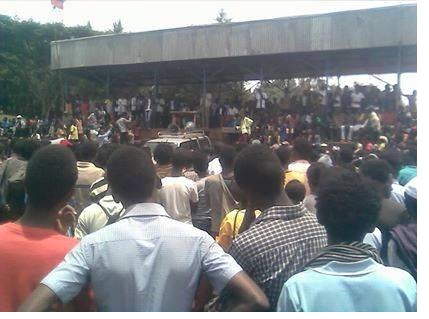
The Oromo Federalist Congress (OFC/Medrek) campaigning: Dambi Doolloo, Oromia, 12 May 2015.
Caamsaa 12 bara 2015, Magaalaani Dambi Dolloo akka waan bakkalchii biliisummaa irrattii bateetti callaqqiftee cululuqaa ooltee. Angaasuu KFO abbaa quba shani waliin. Uummataa kana hundatuu magaala kana keessa jira jechuun namatti ulfaata. Dargaggoo, shamarran, jaarsa jaarti tokkichi manatti hin hafne. Dhadannoofi sirbaan deeggarsa KFOf qaban ibsachuun diina Oromoo afaan qabachiisan. Akkasi ijoollee Dambi!
Viva Dambi Dolloo! Viva KFO!
Aangawoonni Tika Mootummaa Wayyaanee(TPLF) Magaalaa Naqamtee Keessatti Walgahuun Akkaataa Uummata Oromoo Shiraan Miidhan Irratti Marihachuun Isaanii Saaxilame.
Caamsaa 11,2015 Gabaasa Qeerroo Naqamte
 Wayyaaneen filmaata sobaa dhufutti uummati Oromoo narratti ka’a sodaa jedhuun kan baarage guyyaa har’aa Caamsaa 11,2015 sa’aatii saddeetii hanga kudhaniitti barattoonni Yuunivarsiitii Wallaggaa FDG narratti qindeessu sodaa jedhuun deeppoo magaalaa Naqamteetti argamu keessatti wal ga’ii caasaa basaastotaa geggeesse.
Qaamni Qeerroo caasaa mootummaa keessaa fi kan magaalaa Naqamtee icciitii fi ijoo marii tikoota Wayyaanee kana akka saaxiletti, namooti lama man maqaan isaanii Yohaannis Abebee fi Beekkataa fi akkasumas barattoota keessaa basaasaa beekamaan Yuunibarsiitii Wallaggaa nama Tsaggaa Ashaabbir jedhamu ta’anii namooti shan waltajjicha kan geggeessan yeroo ta’u, walgahicha irratti kan akeekamee fi irratti mariyatamee kan murtaaye ukkamsitooti fi humni federaalaa uuffata sivilii uffatee uummata basaasus magaalaa Naqamtee fi Yuuniversitiilee irra akka tamsa’u irratti ta’uu Qeerroon saaxilee jira.
Kanuma waliin kaayyoon ijoon biro naannoo Yuunivarsiitichatti walga’uus barattoota Mootummaa Wayyaanee TPLF irratti FDG kaasan ykn falmaniin akkaataa itti adamsanii uummati Oromoo utuu hin dhaga’in barattoota ukkamsanii fi kanneen jajjaboon hawaasa magaalaatiin qunnamtii qaban hidhamuu qaban,kana malees yaada barattootaa qoranii ilaaluu fi FDG(Gaaffii Mirgaa) yeroo hunda tasgabbeessuu dadhabameef kallatti maddichaa qoranii ilaaluuf akka mariirra turaniif dhumarratti eegumsa guddaa naannoo dhaabbilee barnootaatti akka taasisan irratti waliigaluu waltajji kana Warren hirmaatan ibsaniiru.http://qeerroo.org/2015/05/11/aangawoonni-tika-mootummaa-wayyaaneetplf-magaalaa-naqamtee-keessatti-walgahuun-akkaataa-uummata-oromoo-shiraan-miidhan-irratti-marihachuun-isaanii-saaxilame/
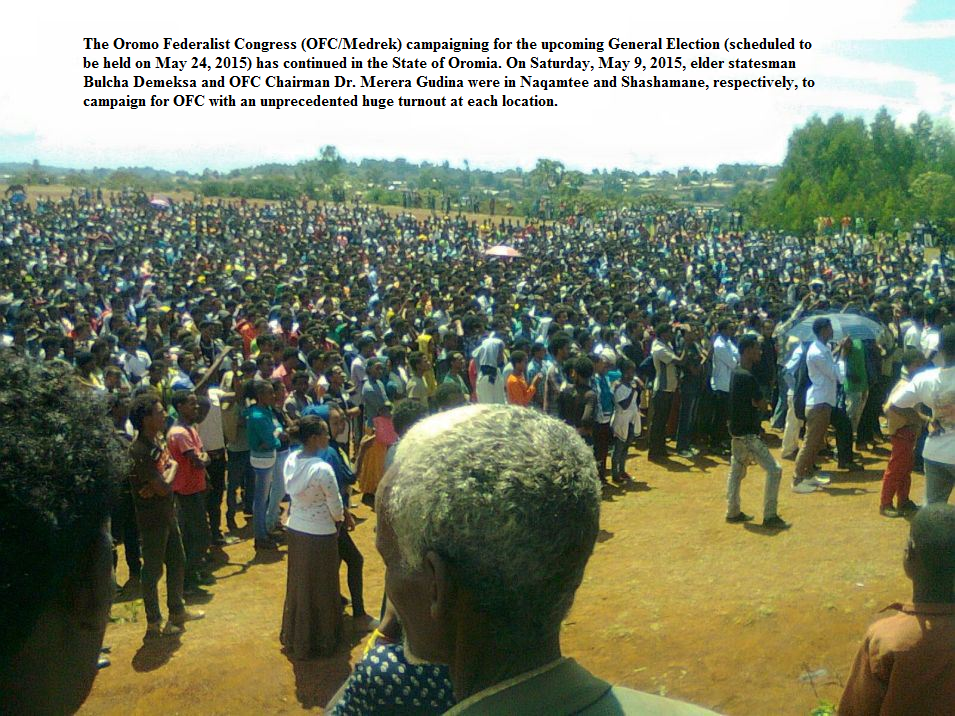
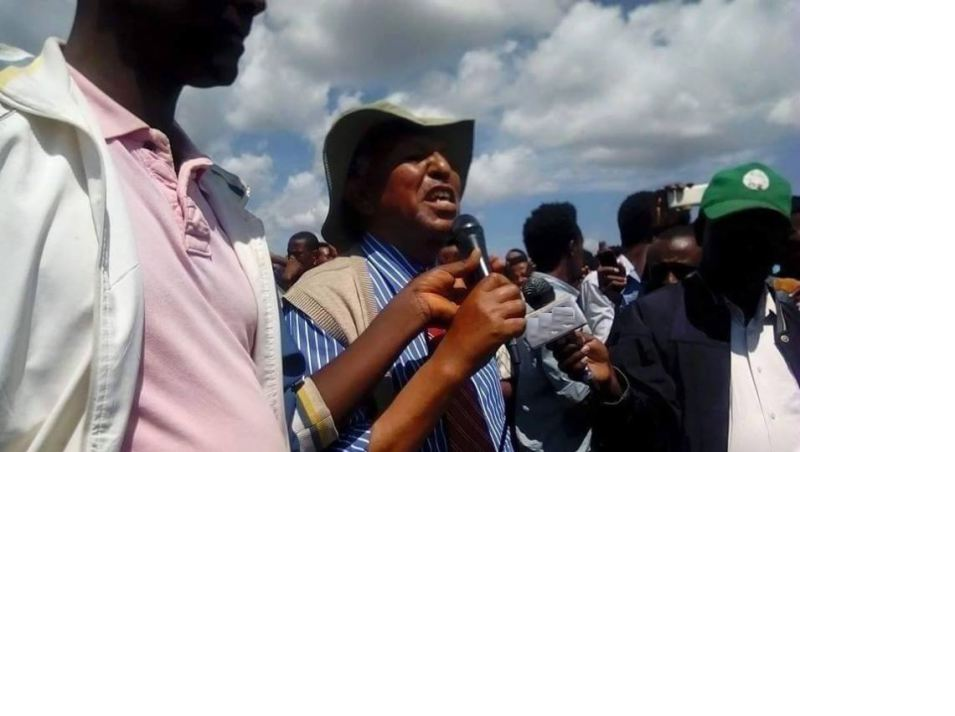
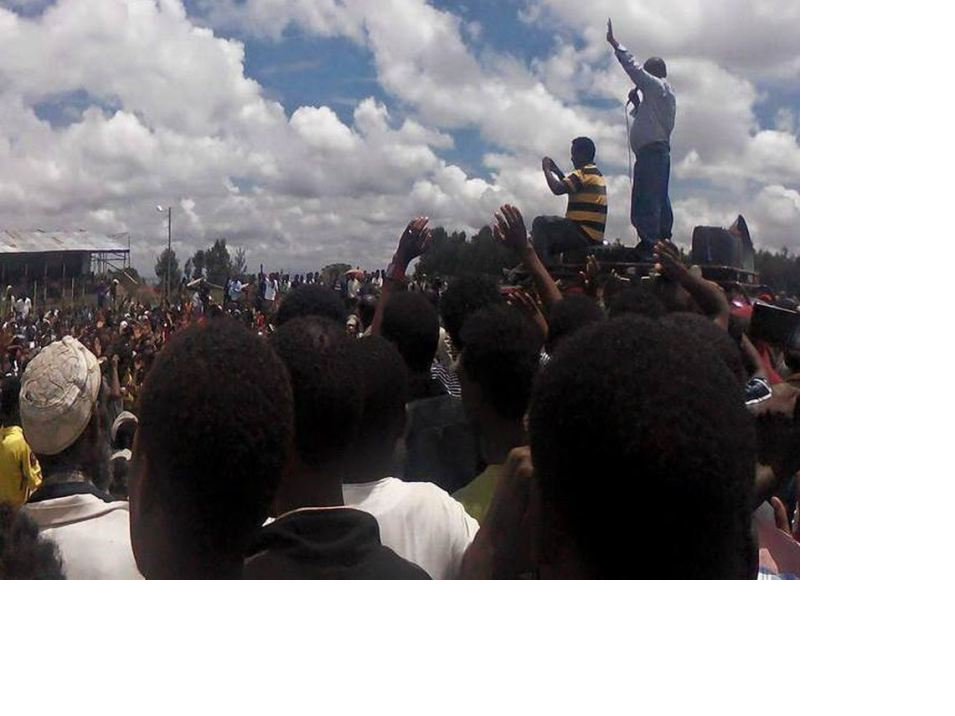
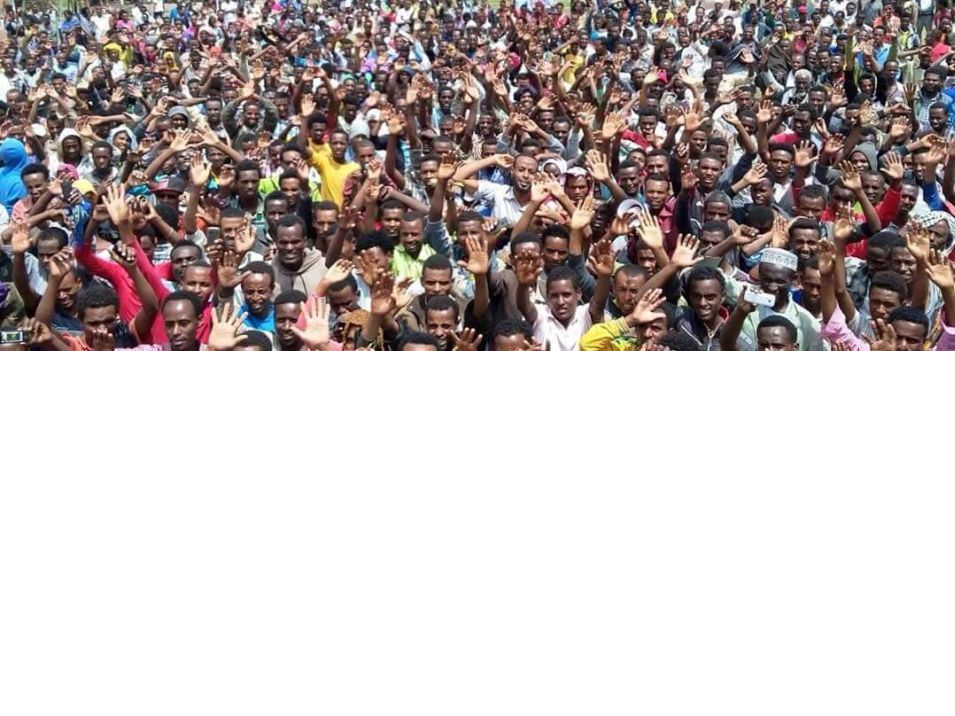
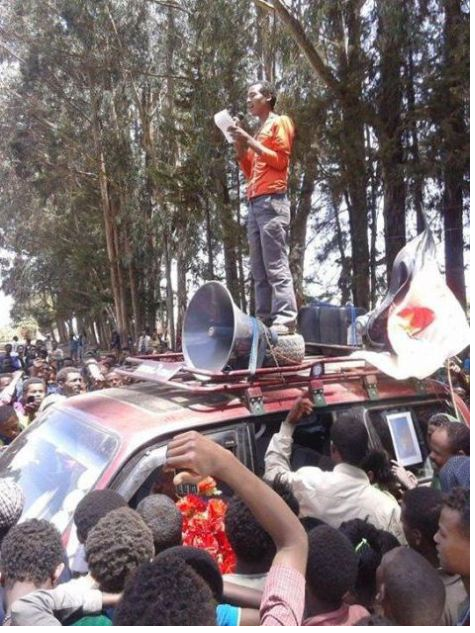
The Oromo Federalist Congress (OFC/Medrek) campaigning for the upcoming General Election (scheduled to be held on May 24, 2015) has continued in the State of Oromia. On Saturday, May 9, 2015, elder statesman Bulcha Demeksa and OFC Chairman Dr. Merera Gudina were in Naqamtee and Shashamane, respectively, to campaign for OFC with an unprecedented huge turnout at each location.
Naqamte Gadaa Otaa
Shashe Town
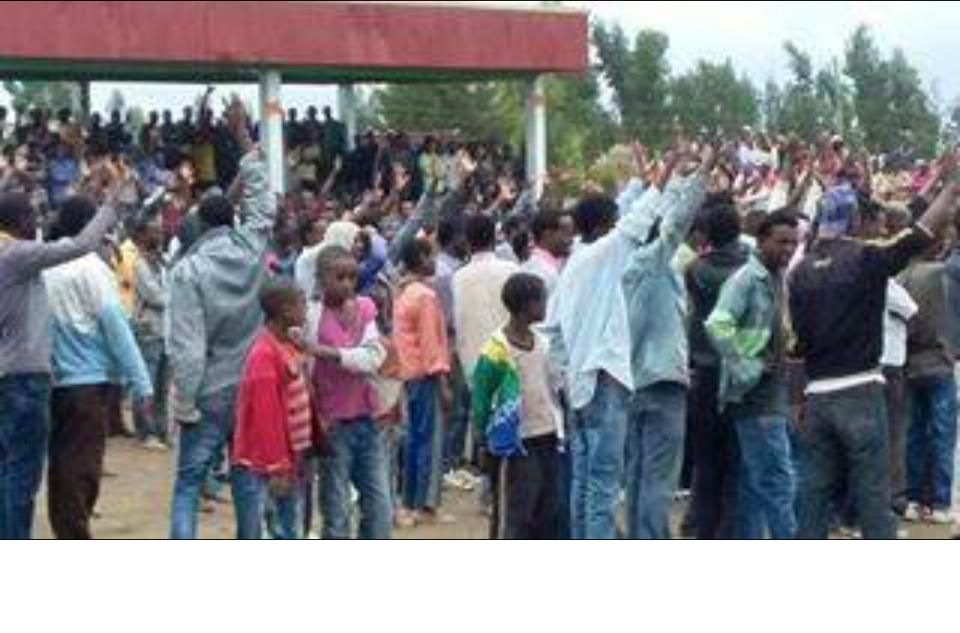
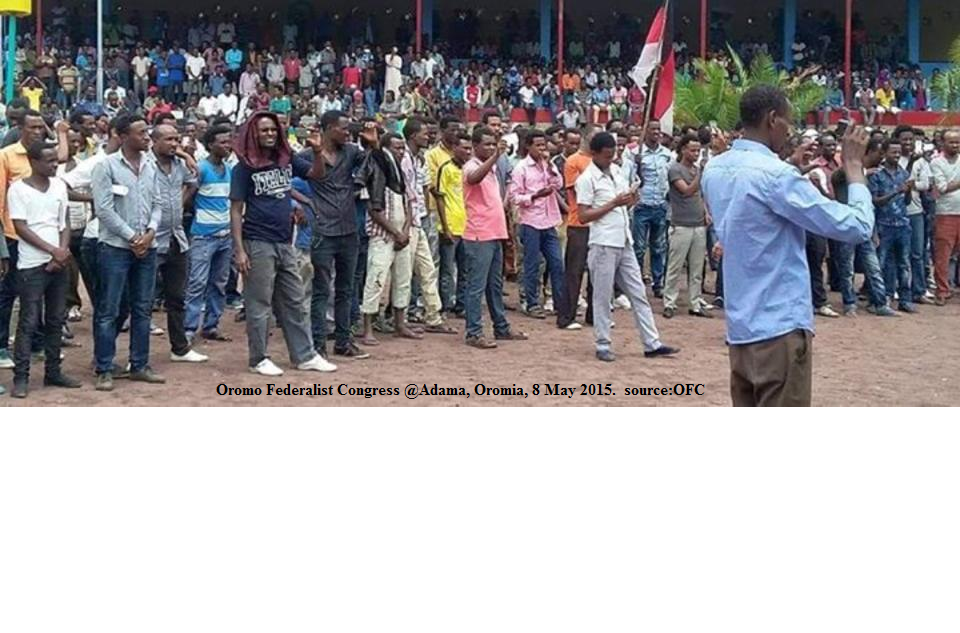
Over the last several weeks, the Oromo Federalist Congress (OFC) has been criss-crossing Oromia to campaign for the upcoming General Election on May 24, 2015; despite intimidation and harassment of voters as well as candidates by the TPLF regime (as reported here: http://wp.me/p4JW8b-3d5), there has been a huge turnout at each campaign rally, including Ambo (as reported here: http://wp.me/p4JW8b-375)
Here are some photos from Adama (dated May 8, 2015), and Ginchi and Gedo from the last week.
UPDATED (May 9, 2015): The Oromo Federalist Congress (OFC/Medrek) campaigning for the upcoming General Election (scheduled to be held on May 24, 2015) has continued in the State of Oromia. On Saturday, May 9, 2015, elder statesman Bulcha Demeksa and OFC Chairman Dr. Merera Gudina were in Naqamtee and Shashamane, respectively, to campaign for OFC with an unprecedented huge turnout at each location.
UPDATED (May 11, 2015): The Oromo Federalist Congress (OFC/Medrek) campaign tour has continued in small and big towns in Oromia. Most recently, the campaign train made a stop at Dodola in central Oromia; yet again, the OFC rally drew a crowd of thousands of potential voters, who braved the constant harassment and intimidation of Ethiopia’s TPLF regime to express their solidarity with OFC/Medrek. It is to be noted that Dr. Beyene Petros of the Ethiopian Social Democratic Party (ESDP/Medrek) revealed once again the ongoing abuses by the TPLF regime on Medrek voters and candidates, as reported by OMN over the weekend: https://www.oromiamedia.org/2015/05/amharic-news-may-9-2015/
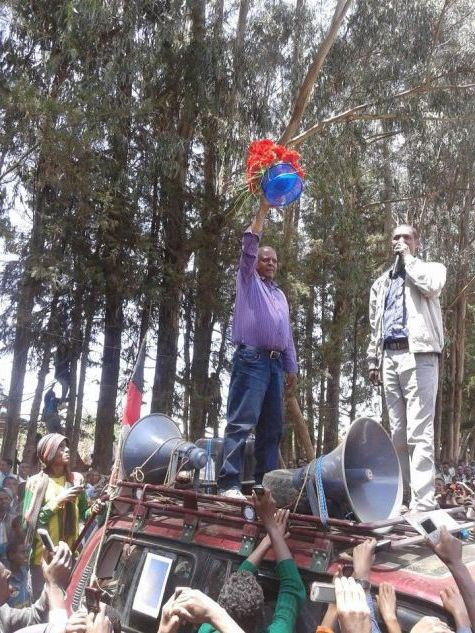
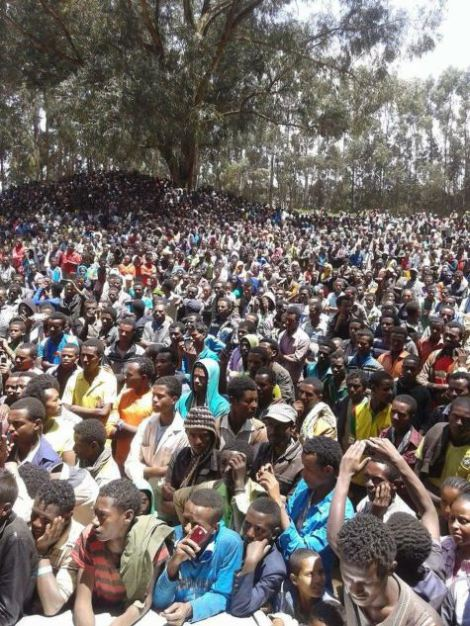
Dr. Beyene Petros of the Ethiopian Social Democratic Party (ESDP)/Medrek speaks about the unprecedented levels of intimidation and harassment his organization’s candidates are facing ahead of the May 2015 General Election (April 2015)
Africa Rising: From Burkina Faso to Burundi, Africa’s Cheetah Generation rises against corrupt and failed rule. #TPLF. #Ethiopia May 12, 2015
Posted by OromianEconomist in Africa, Corruption in Africa, Dictatorship.Tags: Africa, Africa Rising, African Studies, Against Tyranny, Ambo, Burkina Faso, Burundi, George Ayittey, George Ayittey: Africa's cheetahs versus hippo, The Tyranny of Ethiopia
add a comment
The greatest crisis facing Africa is a leadership crisis in all areas of people activity.In terms of natural resources, Africa is the world’s richest continent. It has 50% of the world’s gold, most of the world’s diamonds and chromium, 90% of the cobalt, 40% of the world’s potential hydroelectric power, 65% of the manganese, millions of acres of untilled farmland, as well as other natural resources. Yet, despite this vast resource the bulk of African people live as if they were citzens of deserts. Despite being home to millions of skilled and talented innovators, African leadership struggles to stimulate and retain it strongest resource — the people: They either live in unnecessary frustration, hopelessness and poverty, die of preventable disease, or run to the West to gain appreciation. The greatest crisis in Africa is not due to HIV, religion, or famine, or even war. Because all of those things are tied to leadership in some capacity. The failure to produce an African brand from the billions of tons of raw material Africa exports to the West, is primarily due to the Faustian, myopic, selfish, backward type of non-progressive leaders who are planted as candidates in post-colonial empires. Top traits are either naive, vision-less, proxy implants, opportunistic/parasitic and totally compromised.
– African Holocaust Society
http://www.africanholocaust.net/news_ah/africanleadership.html
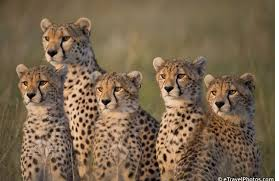
“The Cheetah Generation refers to the new and angry generation of young African graduates and professionals, who look at African issues and problems from a totally different and unique perspective. They are dynamic, intellectually agile, and pragmatic. They may be the ‘restless generation’ but they are Africa’s new hope. They understand and stress transparency, accountability, human rights, and good governance. They also know that many of their current leaders are hopelessly corrupt and that their governments are contumaciously dysfunctional and commit flagitious human rights violations.” George Ayittey, the distingushed Ghanaian economist.http://theafricaneconomist.com/ethiopia-2013-year-of-the-cheetah-generation/#.VVHnoI5Viko

Young people without opportunities are getting angry all over Africa – and there are hundreds of millions of them. (Photo/AFP).
PROTESTS from Burkina Faso to Burundi have been sparked by youthful populations with little hope of employment and by leaders who have in some cases ruled for decades.
The discontent, which began in Burkina Faso in October, spread to the Democratic Republic of Congo (DRC) in January, and has now crossed the continent to Burundi, prompting regional leaders to call an emergency meeting after two weeks of protests and at least 14 deaths. Mass demonstrations in Burkina Faso ended Blaise Compaore’s 27 years in power.
“Underpinning a lot of these protests is anger about stalled development, rising food prices and cutting fuel subsidies,” Clive Gabay, an expert on African politics at the Queen Mary University of London, said. “You have this youthful, unemployed population that has been sidelined.”
While sub-Saharan Africa has grown faster than every region except developing Asia in the past 10 years, there aren’t enough jobs for the 1 billion people on the continent. An extra 450 million jobs need to be created in the next 20 years to match the expansion in the number of working-age people in the region, the International Monetary Fund said last month.
About 40% of people in Africa are under 15 years old, the most of any region, according to the U.S. Census Bureau. The unemployment rate for people 15 to 25 years old living in Burundi’s capital, Bujumbura, is three times higher than the rest of the working population, according to the African Development Bank (AfDB).
Rwanda President Paul Kagame has warned that the violence in neighbouring Burundi threatens stability in East Africa. Youth have led two weeks of protests to prevent President Pierre Nkurunziza from seeking a third term in office next month. The Constitutional Court approved his request, despite the opposition claiming it violates a 15-year-old peace agreement that sets a two-term limit.
Protest risk
The nations that will likely watch closely what happens in Burundi are those with elections scheduled in the next two years, Yolande Bouka, a researcher on conflict prevention at the Institute for Security Studies in Johannesburg, said. Congo, Rwanda and Tanzania and Uganda all have polls during that period.
There is “serious discontent with the type of governance offered by the leaders,” Bouka said. Given the large youth population and unemployment rate “it is not surprising that people take the street to address unresponsive government.”
Burundi ranks eighth-lowest on the United Nations Human Development Index, which measures indicators such as income, child mortality and education. Congo is second-to-last on the 190-member list.
“In many countries it’s a risky thing to go on a protest and you’re not going to risk getting arrested or shot unless there’s something real at stake,” Gabay said. “There’s something else that’s propelling people onto the street and for me they’re economic issues.”
https://magic.piktochart.com/embed/6055699-africa-bombUsing social media like Twitter and Facebook, young activists can mobilise faster than in years gone by and can collaborate across borders. The movements in Congo and Burkina Faso draw inspiration from Senegalese artists, who began protests in 2011 against power outages. The Senegalese movement was key in mobilising youth to vote President Abdoulaye Wade, who had ruled for 12 years, out of power a year later.
Demonstrations erupted in Congo in January when lawmakers tried to change electoral laws in a way that could have delayed elections. That would have extended the 14-year rule of President Joseph Kabila, who took over when his father was assassinated in 2001.
Congolese activists met with artists and musicians from Senegal and Burkina Faso in March. The police arrested them in the Congolese capital and accused them of “promoting violence.” Kabila, who faced criticism from Human Rights Watch, said he will not run for office next year.
Presidents for life
While there are countries in sub-Saharan Africa with leaders who have been in power for more than three decades, including Zimbabwe, Angola and Equatorial Guinea, political opposition there says they are suppressed.
Rwanda’s Kagame, who has been president since 2000, also hasn’t faced popular opposition as he says he is open to staying another term. Parliament is reviewing a petition signed by 2 million people who support changing the constitution to allow for a third term.
“African people are tired of presidents who aren’t delivering to their people and they’re tired of presidents who want to stay for life,” Thierry Vircoulon, Central Africa director for the International Crisis Group, said by phone. “There’s a sort of exasperation because governments aren’t delivering.”
-With assistance from David Malingha Doya in Nairobi and Michael J. Kavanagh in Kinshasa.
Viva Oromia: Oromo Students at St Could State University May 12, 2015
Posted by OromianEconomist in Africa, Meroetic Oromo, Viva Oromia.Tags: Africa, African Studies, Oromo people, Oromo Student at St Could State University, Oromummaa, Viva Oromia
add a comment



Urgent Appeal on Behalf of Oromo Refugees Stranded in Yemen May 11, 2015
Posted by OromianEconomist in Africa, Oromo the Largest Nation of Africa. Human Rights violations and Genocide against the Oromo people in Ethiopia.Tags: Africa, African Studies, Genocide against the Oromo, Macha & Tulama Association, Macha-Tulama-USA: Urgent Letter to UNHCR About Conditions of Refugees, Open letter to UNHCR from the Oromo Community Services of Seattle, Oromo refugees in Yemen
1 comment so far

The following is a statement from the Oromo Community of Minnesota.
The United Nations High Commissioner for Refugees
94 rue de Montbrillant
Geneva, Switzerland
Subject: Urgent Appeal on Behalf of Oromo Refugees Stranded in Yemen
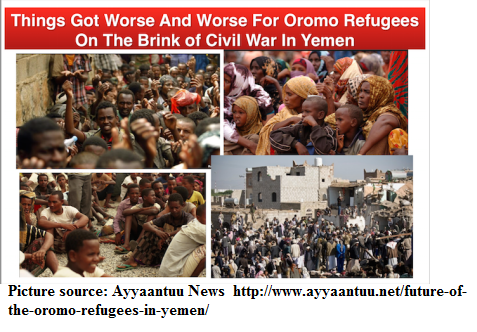
The Oromo Community of Minnesota (OCM) is sending an urgent appeal to all governmental, non-governmental and UN humanitarian agencies, on behalf of Oromo refugees stranded in Yemen due to the ongoing fighting in that country.
The Oromo in Minnesota, the largest Oromo community outside East Africa, is following the plight of refugees in Yemen with great trepidation. Our compatriots make the difficult decision to flee from their beloved homeland due to rampant and persistent persecution by successive Ethiopian regimes. Their choices are either to stay in their country and remain silent over the daily injustices or speak up and get sent to prisons for the simple reason of asserting their inalienable rights; dare to oppose violations of human rights and face disappearance, long incarceration without trial, and extra-judicially killings simply because, to use the words of Amnesty international’s recent report, they are Oromo.
These refugees had to cross through harsh environments to get to the Gulf of Aden and then board overcrowded boats. They took these risky steps to escape more serious dangers at home. As the situation in Yemen deteriorates, most of the Yemenis have moved out to the relative safety of the countryside, while other refugees have left to other countries. The only helpless ones still stranded in urban centers are Oromo refugees. We are gravely concerned for their safety.
Our urgent appeal is for the protection of their critically endangered lives based on humanitarian grounds and their evacuation to a safer country. We humbly request that repatriation to Ethiopia not be an option as they are going to face persecution by the Ethiopian government, which is what drove them to make the excruciating choice of becoming refugees in the first place.
Therefore, the Oromo Community of Minnesota is appealing to all humanitarian agencies and all individuals of goodwill to do all things in their means to assist our brothers and sisters caught up in the present tragic situation in Yemen. Our community is ready and on standby to cooperate with humanitarian agencies in their concerted efforts to save the lives of our people.
Sincerely,
The Oromo Community of Minnesota
CC:
– International Organization for Migration
– International Red Cross and Crescent Societies
– American Refugee Committee
– European Union
– US Department of State Bureau of Population, Refugees, and Migration
– American Red Cross Society
– MN Congressional Delegation
– Minnesota Governor Mark Dayton
Related:
AU urges African leaders to handover power peacefully. #Africa May 10, 2015
Posted by OromianEconomist in Africa, Sham elections.Tags: Africa, African Studies, Ethiopia's sham elections, Governance issues, The Tyranny of Ethiopia
add a comment
Ethiopia’s Elections: May 24 elections will not be free and fair May 10, 2015
Posted by OromianEconomist in Sham elections.Tags: Africa, African Studies, Ethiopia's sham elections
add a comment
‘Dilute the vote’:- Despite the large number of parties registered, the opposition alleges many are allied with the ruling party.
“No more than two to three parties are real opposition parties. The others don’t run to win, their role is to dilute the vote for the opposition,” Merera Gudina, associate professor of political science at Addis Ababa University and a leading opposition figure, told Al Jazeera.
Elections: Development and democracy debate ahead of Ethiopia vote
Opposition critics say May 24 elections will not be free and fair, but the government praises the democratic climate.
If Ethiopians ever possessed a strong desire to express their political views through the ballot, that sentiment seems to have dwindled in the run-up to national elections on May 24.
One 28-year-old student, who requested anonymity fearing reprisals, shrugged at the thought of the upcoming vote.
“To say we have elections, there have to be real alternatives,” he said. “This election is just so we can tell Western governments we are a democratic country,” the finance and accounting master’s degree student told Al Jazeera at Addis Ababa University’s Siddist Kilo campus.
Such views are not uncommon among the electorate and opposition members in the capital, many of whom have dismissed the upcoming vote as a formality.
The results of the 2010 election left the opposition with a single seat in the 547-seat parliament, and afterwards the EU said Ethiopia’s electoral process failed to create “a level playing field for political parties“.
It wasn’t always this way.
In 2005, the then high-school student took part in political rallies in support of the Oromo National Congress Party running under one of the main opposition coalitions, the United Ethiopian Democratic Front.
Back then, he said, the opposition was strong and united, and people thought supporting it would bear fruit.
In the election that year – preceded by a relatively open political climate – the opposition surprised the ruling Ethiopian People’s Revolutionary Democratic Front (EPRDF) by taking 31 percent of parliamentary seats.
 |
| Professor Beyene Beyene Petros [Simona Foltyn/Al Jazeera] |
However, the aftermath of the vote was marked by mass arrests of student protesters and opposition leaders.
The student told Al Jazeera he was detained for months, a fate he shared with thousands of students who took to the streets.
The country’s controversial 2009 anti-terrorism proclamation has been criticised for its broad application to journalists and opposition members in the run-up to this year’s vote, including six “Zone9” bloggers currently on trial for terrorism-related charges.
Registration complaints
According to Ethiopia’s National Electoral Board, 47 parties and 5,819 candidates are contesting the ballot for the national parliament and the regional councils.
The ruling party has fielded 501 candidates for the 547-seat parliament, followed by the Ethiopia Federal Democratic Union Form (MEDREK) and the Blue Party with 270 and 139 candidates, respectively.
Opposition members complain that navigating the political landscape ahead of the election has proven difficult.
“We are more consolidated and better positioned compared to previous elections, but the space is more closed,” Professor Beyene Petros, chair of the centre-left MEDREK, told Al Jazeera.
Both MEDREK and the Blue Party have also cited difficulties registering candidates.
 |
| Blue Party chairman Yilkal Getent [Simona Foltyn/Al Jazeera] |
The Blue Party’s chairman said more than half of the party’s 380 registered candidates were removed from the party list in February on administrative grounds.
“This is politically motivated to hinder Blue Party activities. The electoral board is not independent,” Yilkal Getent told Al Jazeera.
The cancellation of candidates, Getent said, has thwarted the party’s ability to mobilise voters through ongoing political debates aired on state media, as time allocations are determined based on the number of candidates.
The Blue Party considers itself centre-right and wants to appeal to the country’s young electorate, but government officials dismiss it as a far-right movement.
The government also accused the Blue Party of inciting violence last month at a government-organised rally in Addis Ababa following the killing of Ethiopian migrantsin Libya by ISIL – allegations the party’s leaders dismissed.
‘Dilute the vote’:- Despite the large number of parties registered, the opposition alleges many are allied with the ruling party.
“No more than two to three parties are real opposition parties. The others don’t run to win, their role is to dilute the vote for the opposition,” Merera Gudina, associate professor of political science at Addis Ababa University and a leading opposition figure, told Al Jazeera.
 |
| Merera Gudina [Simona Foltyn] |
Some also criticised the voter registration process that ended in February, allegedly covering more than 80 percent of the eligible electorate.
Selam Gebrehiwot, a 19-year-old philosophy student, said the government is pressuring voters by tying registration to government services.
“The officials came to my house to give me the registration card although I didn’t ask for it. I was scared, so I took the card.”
The deputy chairman of the National Election Board, Addisu Gebreigzabhier, denied such allegations.
“We are just doing civic education,” Gebreigzabhier said. “The high voter registration is a result of the electorate’s desire to exercise their democratic rights.”
The pre-election process, he added, has been professionally run according to the country’s electoral laws and has been “to the satisfaction of all parties”.
Development first, democracy later
Yohannis Getachew, a 32-year-old taxi driver in Addis Ababa, has been following the ongoing political debates on the radio. He said the opposition has failed to present a convincing alternative.
“At least the government is building roads and railways. I think that’s good. I don’t know what the opposition would do,” said Getachew.
 |
| Addisu Gebreigzabhier [Simona Foltyn] |
The ruling party’s growth and transformation plan has resulted indouble-digit economic growth over the past five years.
Government officials often cite EPRDF’s economic track record as its main source of voter support.
“It’s very difficult for any party to come up with an idea that can match an 11 percent growth rate,” said Ganenu Asefa, a political adviser at the Government Office for Communication Affairs.
Opposition parties, however, say that growth has benefited only a small elite aligned with the ruling party.
“The so-called growth agenda has been impressing the foreigners, not the citizens,” Professor Gudina, whose Oromo Federalist Congress party runs under MEDREK’s ticket, told Al Jazeera.
“Development without democracy is very difficult to sustain,” he added.
The government Growth and Transformation Plan (GTP) – characterised by state intervention in the economy as well as massive public investments in infrastructure – aims to turn Ethiopia into a middle-income country by 2025.
International institutions have largely praised the EPRDF’s growth agenda.
“The targets they set in the GTP were very ambitious, and even if they achieve 75 percent of those targets, it will be a tremendous achievement for a country coming from such a low base,” said the World Bank’s country director for Ethiopia, Guang Z Chen.
Chen said in order to sustain strong growth going forward, the government will need to make policy adjustments so as to stimulate the industrial sector, which currently contributes only 12 percent to the GDP.
With urbanisation advancing at twice the rate of overall population growth, job creation for Ethiopia’s idle urban youth is another priority. Analysts say although the government has recognised the need for structural reform, corruption and insufficient technical capacity could hamper its ability to manage the process. http://www.aljazeera.com/indepth/features/2015/04/confidence-ethiopia-electoral-process-slumps-150424102856756.html
Oromia Support Group Australia Appeal for Urgent Action Regarding the Kidnapping And Disappearance of Two Oromo civilians By The Ethiopian Security Forces. May 9, 2015
Posted by OromianEconomist in Because I am Oromo, Ethnic Cleansing, Human Rights, Human Rights Watch on Human Rights Violations Against Oromo People by TPLF Ethiopia, Kidnapped and disappearance of Oromo civilians, Oromia Support Group, Oromia Support Group Australia.Tags: Africa, African Studies, Because I am Oromo, Genocide against the Oromo, Human rights, Kidnapped and disappearance of Oromo civilians, Oromia Support Group Australia, Oromia Support Group Australia Appeal for Urgent Action, The Tyranny of Ethiopia
add a comment
Ethiopia: Kidnapped And Disappearance of Oromo Civilians

Oromia Support Group Australia Appeal for Urgent Action:
To: Committee on Enforced Disappearances and Committee against Torture
Human Rights Treaties Division (HRTD)
Office of the United Nations High Commissioner for Human Rights (OHCHR)
Palais Wilson – 52, rue des Pâquis
CH-1201 Geneva (Switzerland)
Ethiopia: Kidnapped and disappearance of Oromo civilians Magarsa Mashsha And Urgessa Damana:
Oromia Support Group Australia Inc. (OSGA) expresses its deep concern regarding the kidnapping a nd disappear an ce of two Oromo civilians by the Ethiopian security forces. Mr Magarsa Mashasha Ayansa was kidnapped and diapere d on April 23rd, 7pm local tim e while Urgessa Damana was on May 4th, 2015. Mr Magarsa, community health worker, a student of Ambo University is the local area resident. He was kidnapped by Ethiopian security forces from the country’s central city Fifinna (Addis Ababa) – Bole area – while he was on a trip for his personal business. In a similar situation, Mr Urgessa Damana a former Rift Valley University Student and resident of Ambo town also captured on 4th of May 2015 by Ethiopian security forces. Since then the whereabouts of theses Oromo civilians remained unknown.
OSGA believes that th e Ethiopian government conduct violated the fundamental rights. The right to freedom from torture and the UN Body of Principles for the Protection of All Per sons under Any Form of Detention and Imprisonment including the UN Standard Minimum Treatment of Prisoners is entirely denied. We are concerned that this pattern will continue to worsen.
We respectfully believe that the Office of the United Nations High Commissioner for Human Rights (OHCHR) – Human Rights Treaties Division (HRTD) has a duty to use its diplomatic relationships with the reciprocal expectation of protecting human rights and legitimate democratic governance. These accusations reveal serious violations of human rights and legal process, and without external accountability, many vulnerable people will suffer in the country.
We, therefore, urge you to:
1. Request the Ethiopian Government to reveal the whereabouts of these two Oromo civilians and immediate and unconditional release of them including all
political prisoners under their captivity.
2. Request to investigate, amongst other things, actions taken by the Ethiopian
Government security forces in the state of Oromia and the suffering of Oromo
civilians in hundreds of official and hidden torture chambers.
3. Raise this case with the international community and other relevant
United Nation bodies. Stress the righ t to remedy, restitution,
compensation, non-repetition, and punishment of the perpetrators, in line
with the UN Guidelines on the right to treat.
We denounce the attacks on peoples who are exercising their fundamental and democratic rights.
Thanks for considering of OSGA appeal
Oromia Support Group Australia
Read More:- osga-appeal-for-urgent-action-on-the-disapperances-of-mr-magarsa-and-urgessa-may-8th-2015-photo-include
More than 50 #Oromo students arrested by Ethiopia’s tyrannic TPLF regime in Ambo, Oromia; 20 being tortured May 9, 2015
Posted by OromianEconomist in Amnesty International's Report: Because I Am Oromo, Human Rights Watch on Human Rights Violations Against Oromo People by TPLF Ethiopia, Janjaweed Style Liyu Police of Ethiopia, Jen & Josh (Ijoollee Amboo).Tags: Africa, African Studies, Ambo, Because I am Oromo, Genocide against the Oromo, Human Rights violations against Oromo People, The Tyranny of Ethiopia
add a comment

More than 50 Oromo students arrested by Ethiopia’s tyrannic TPLF regime in Ambo, Oromia; 20 being tortured
The following is a statement from the Human Rights League of the Horn of Africa (HRLHA).
——-
Ethiopia: The Endless Violence against Oromo Nationals Continues
Fear of Torture | HRLHA Urgent Action
For Immediate Release
May 7, 2015
Harassment and intimidation through arbitrary arrests, kidnappings and disappearances have continued unabated in Ambo and the surrounding areas against Oromo youth and intellectuals since the crackdown of last year (April 2014), when more than 79 Oromos, mostly youth, were killed by members of the federal security force.
According to HRLHA correspondents in Ambo, the major targets of this most recent government-sponsored violence were Ambo University and high schools Oromo students in Ambo town. In this incident, which started on April 20, 2015, more than 50 university and high school students were arrested; more than 20 were severely beaten by the security force and taken to the Ambo General Hospital for treatment.
Although it has been difficult to identify everyone by their names, HRLHA correspondents have confirmed that the following were among the arrestees:


Those who were badly beaten and are being hospitalized in the Ambo General Hospital:
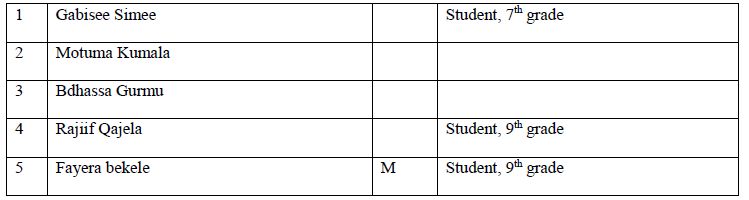
According to HRLHA reporters, the arrests were made to clear out supporters and members of the other political organizations running for the 5th General Election to be held May 24, 2015. The EPRDF, led by the late Meles Zenawi, claimed victory in the General Elections of 1995, 2000, 2005 and 2010. The TPLF/EPRDF government of Ethiopia has started a campaign of intimidation against its opponents. Extrajudicial arrests and imprisonments, particularly in the regional state of Oromia, the most populous region in the country, began late October 2014.
The Human Rights League of the Horn of Africa (HRLHA) expresses its deep concern over the safety and well-being of these Oromo nationals who have been arrested without any court warrant, and are being held at police stations and unknown detention centers. The Ethiopian government has a well documented record of gross and flagrant violations of human rights, including the torturing of its own citizens, who were suspected of supporting, sympathizing with and/or being members of the opposition political organizations. There have been credible reports of physical and psychological abuses committed against individuals in Ethiopia’s official prisons and other secret detention centers.
HRLHA calls upon governments of the West, all local, regional and international human rights agencies to join hands and demand the immediate halt to such extrajudicial actions against one’s own citizens, and the unconditional release of the detainees.
RECOMMENDED ACTION: Please send appeals to the Ethiopian Government and its officials as swiftly as possible, written in English, Ahmaric, or your own language. The following are suggested:
– Indicate your concern about citizens being tortured in different detention centers, including the infamous Ma’ikelawi Central Investigation Office; and calling for their immediate and unconditional release;
– Urge the Ethiopian authorities to ensure that detainees will be treated in accordance with the regional and international standards on the treatment of prisoners, and that their whereabouts be disclosed, and
– Make sure the coming May 24, 2015 election is fair and free
Read full the statement in the following links:
The Endless Violence against Oromo Nationals Continues, HRLHA Report, 7th May 2015
‘My Home, My Land’- Land Grabs and Development Lies. #Africa. #Oromia May 7, 2015
Posted by OromianEconomist in Africa, Land Grabs in Oromia, Omo Valley.Tags: Africa, African Studies, Because I am Oromo, Genocide against the Oromo, land and water grabs in Oromia, Land grabbing, Land grabs in Africa, Omo Valley
add a comment

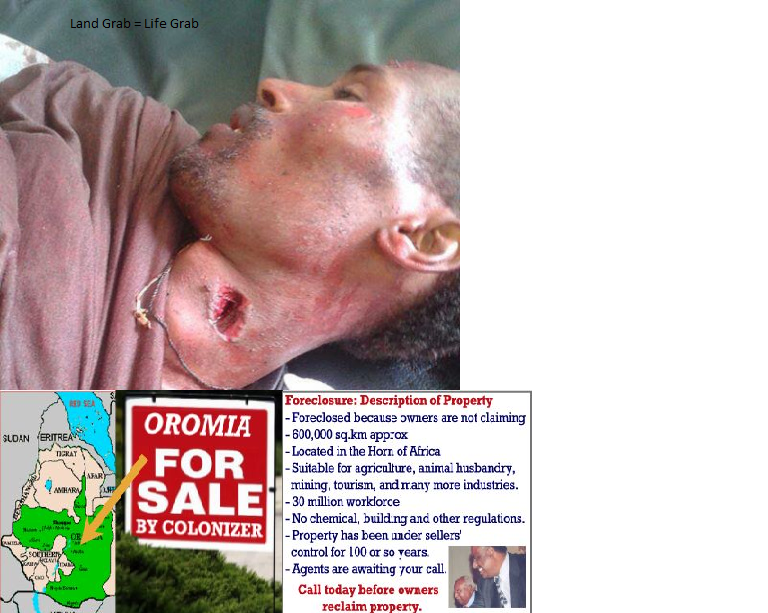
My Home, My Land is a graphic representation of much of the Oakland Institute’s work on land grabs. Illustrated by the Institute’s Intern Scholar, Abner Hauge, this publication dismantles the many myths promoted by so-called donor countries, development agencies, and corporations about the positive effects of foreign direct investments through large-scale land acquisitions.
Over the past seven years, the Oakland Institute has exposed the actual impact of the land grabs on indigenous, pastoralist, and smallholder farming families around the world. The powerful illustrations of My Home, My Land remind us of the beauty and complexity of the world’s ecosystems and indigenous cultures, and call upon us to take action now to stop exploitative land grabs internationally. My Home, My Land
Oromia: Irreecha Oromo Spring Celebrations: Ayyaani Irreecha Arfaasaa Oromoo haala ho’aa fi gammachiisaan Dilabata Ebla 5, bara 2015 kabajamee oole. May 7, 2015
Posted by OromianEconomist in Irreecha (Irreesa) 2014, Irreecha (Irreessa) 2014, Irreecha Arfaasaa, Irreecha Birraa.Tags: Africa, African culture, African Studies, Irreecha Arfaasaa (SPring Celebration) in Oromia, Irreecha Oromo, Spring equinox in Oromo Culture
2 comments
Spring equinox known as Irreecha Arfaasaa in Oromo culture colorfully celebrated in Oromia on 5th April 2015. Dressed in cultural costumes, Oromians revel in the return of spring by visiting the ancient sites including mount Furii in Central Oromia.
Ayyaani Irreecha Arfaasaa Oromoo haala ho’aa fi gammachiisaan Dilabata Ebla 5, bara 2015 Tulluu Furii irraatti kabajamee oole. Tulluun furii Tulluuwwaan Ulfoo Oromoon qabu keessaa ishee tokkodha. Guyyaa kana Waaqeffattoonni fi jiraatonni Magaalaa Finfinnee, Sabbataa fi Naannawaa ishee Irrati argamanii Haala Addaan Kabajameera.
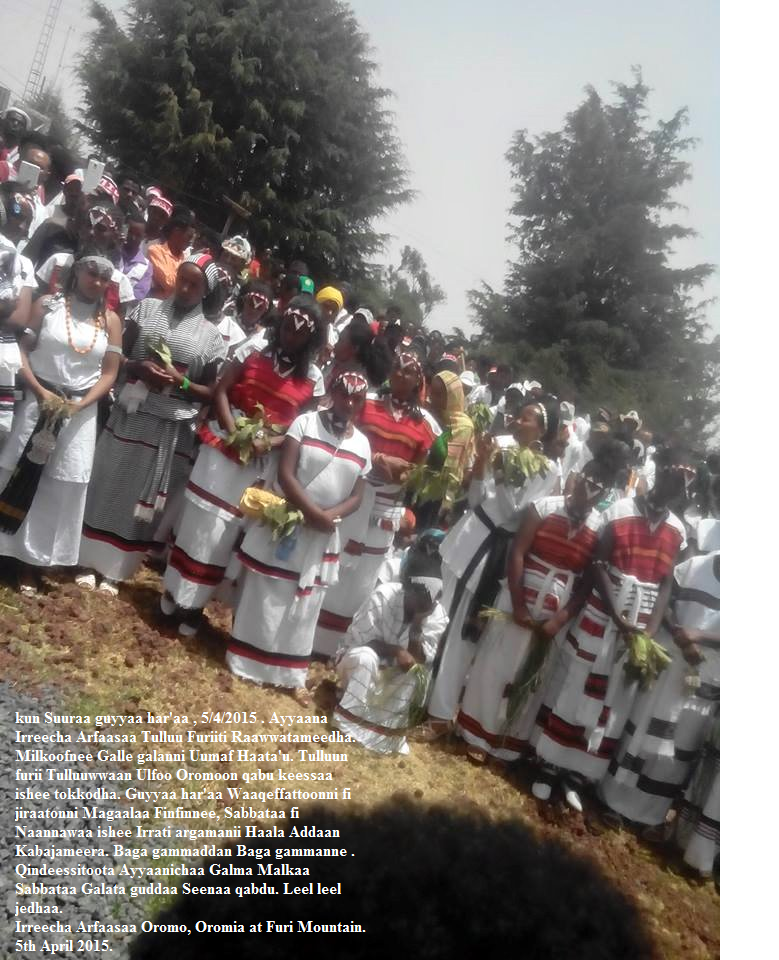
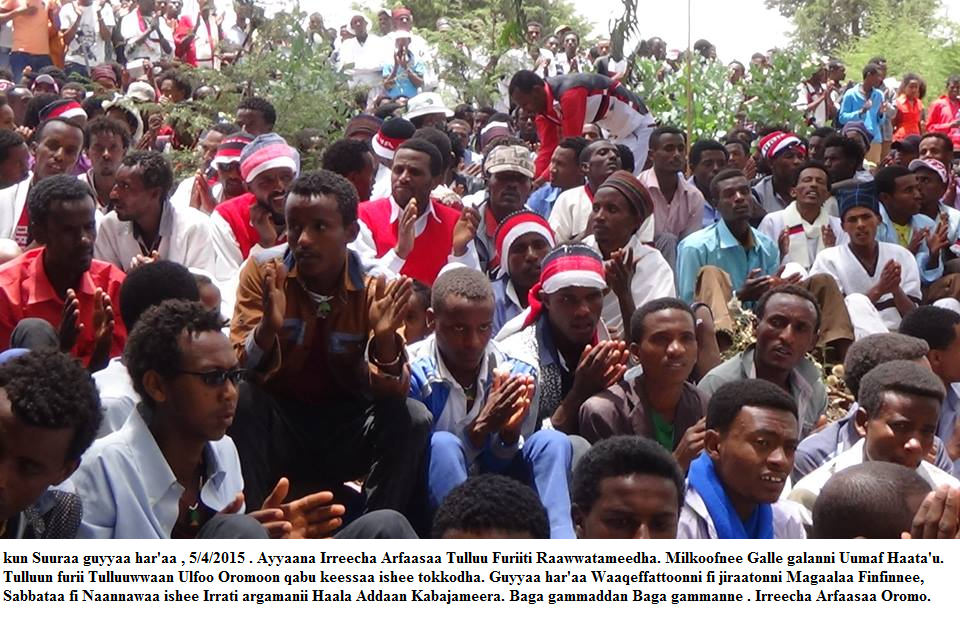

Irreecha Arfaasaa Oromoo, Oromia, 5th April 2015. Spring Celebration. Celebration of Spring equinox in Oromo Culture.


Irreessii Arfaasaa JImmaa fi Naannoo isheen Eebla, 26, Baraa 2015 Tulluu Irreessaa/Beegittii Taasifameeoole. Guyyiichii kan Waaqeffattoonnii dheebuu Eenyummaa Amantaa isaani qaban ittiin ibsataniif ergaawwaan amanticha dhugeeffannaa Uumaa ilaallataan itti darbanii dha. Uumaan Ganna Dukkuna as deema jiru kana jala nagaan akka isaan ulluuqsisuuf kan irreeffatamuu dha. Walumattii, Irreechaa milkii kan namoonnii kumaatamaan lakkaa’amaan irrattii hirmaatanii dha.
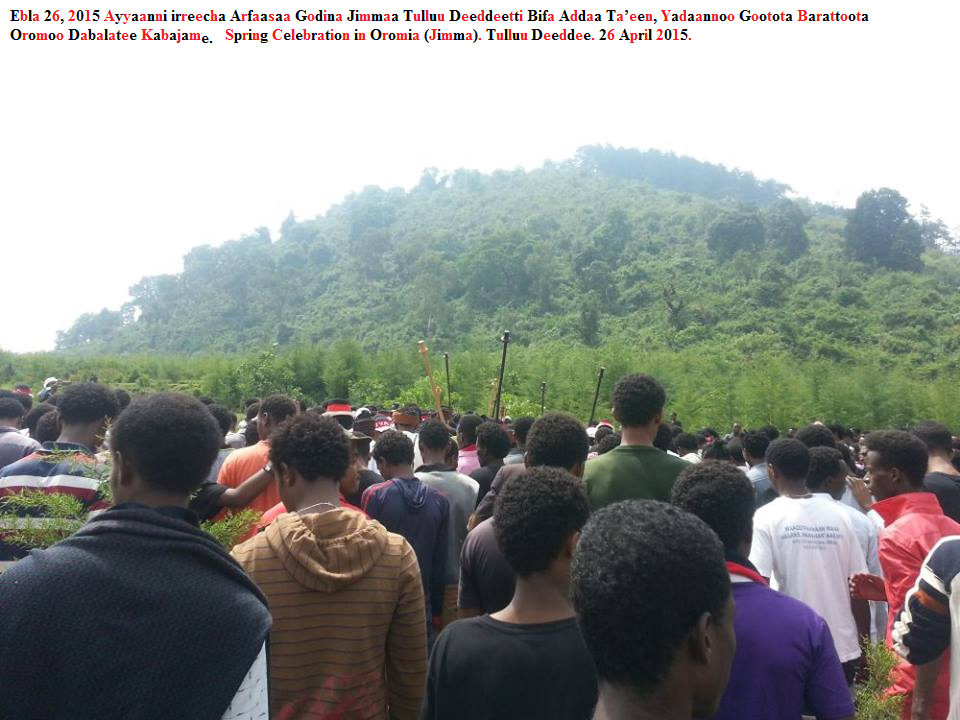
Ebla 26, 2015 Ayyaanni irreecha Arfaasaa Godina Jimmaa Tulluu Deeddeetti Bifa Addaa Ta’een, Yaadannoo Gootota Barattoota Oromoo Dabalatee Kabajamuu Qeerroon Gabaase
Ebla 26/2015 Ayyaanni irreecha Arfaasaa Godina Jimmaa Tulluu Deeddeetti bifa addaa taee fi yaadannoo Gootota Barattoota Oromoo dhabbilee barnoota olaanoo Oromiyaa garaagaraa fi Godinaalee Oromiyaa garaagaraa keessatti bara darbee Ebla 2014 gaaffii mirga abbaa biyyummaa fi Mormii master plan Finfinnee kaachisuun FDG irritti wareegamniif addatti yaadannoon Waggaa 1ffaas bifa hoaa taaeen kabajame.
Ayyaanni Irreecha Arfaasaa Oromoo Godina Jimmaa Tulluu Deeddeetti kan Uummatni Oromoo 6000 olitti lakkamu Dhabbilee barnoota olaanoo gootota barattoota Oromoo Yuunibarsii Jimmaa, fi kolleejjii barsiisota Jimmaa, Sabboontota hojjettootaa fi barsiisotaa Oromoo Yuunibarsiitii Jimmaa fi kolleejjii barsiisota Jimmaa, sabboontota uummata Oromoo magaalaa Jimmaa fi naannoo ishee, Sabboontota uummata Oromoo godinaalee Oromiyaa akka Iluu Abbaa Booraa,Wallagga Bahaa, fi Kibba Lixa shaggar irraa illee kan hirmaachise Ayyaanni Irreecha arfaasaa Jimmatti bifa hoaa fi adda taeen kabajame.
Ayyaanaa Irreecha Arfaasaa kana Irraatti goototni dargaggootni Qeerroon barattootni Oromoo Yuunibarsiitii Jimmaa Mooraalee Yuunibarsiitichaa arfan irraa iyyuu uuffata gaddaa uffachuun gootota dargaggoota barattoota Oromoo fi uummata Oromoo bara darbee gaaffii mirga abbaa biyyummaa karaa naagaa fi dimookiraasii gaafachuun baatii Eblaa 2014 keessa wareegama qaalii kanfalaniif yaadannoo bifa adda taeen gochuun gootota Oromoo fi dargaggoota Oromoo Wareegama qaalii uummata Oromoo bilisoomsuuf baasaa jiran faarfachuun, tokkummaa uummata Oromoo jabeessuuf walleelee warraaqsaa qabsoo bilisummaa Oromoo, fi gootota oromoo faarsuun haala adda taeen ayyaanni Irreechaa Arfaasaa bara 2015 kun bifa haalan qindaaeen kabajamaa olee jira.
May (Caamsaa) 6, 2015 – Adaamaa (Oromia) May (Caamsaa) 5, 2015 – Naqamte (Oromia)
Irreecha Arfaasaa (Oromo Spring Celebration) colorfully celebrated with great joys.
Irreechi Tulluu Shanee Adaamaa qaama mootummaatin dhoorgamuu yaalamus haala gaariin gaggeeffameera mootummaan abbaa irree Irreechi Tulluu akka him bahamne jedhee sodaachisaa tire human isaatii ol taanaan baasastota isaa garage ayyaanichaatti bobbaasuun yaalii maqa balleessii amanttii Waaqeffannaa taasisus hin milkoofne. Waaqeffattoonni iddoo garagaraa jiranis ayyanicharratti argamuun sirnicha dabarsaniiru milkiidhan roobaan galanii kadhatanii argataniiru. Naqamtettis haala wal fakkatuni Caamsaa 5 bara 2015 ayyaaneffatamee oole.
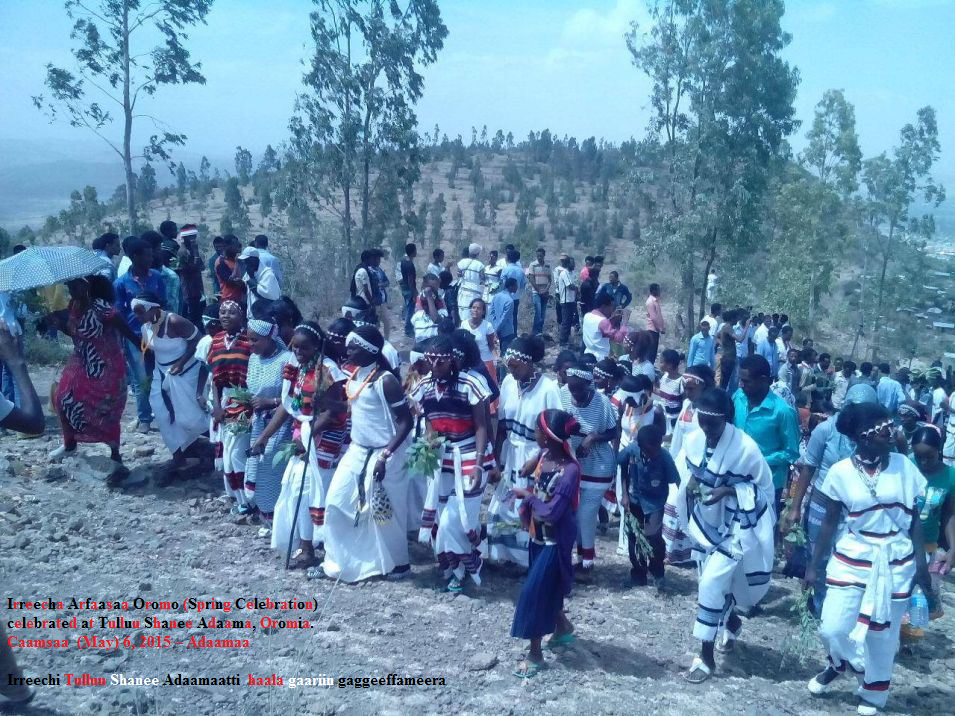
Akka aadaa Oromootti, Irreechaan yeroo bonni dhumatu kabajamu kun nagaan bona keessa darbanii gara gannaatti dhiyaachuuf Waaqa itti galateeffatanii dha.
Abbootiin Gadaas sirna kana irratti eebba gabbinaa namaa fi sa’aaf kan dhiyeessaniiru.
Ayyaanni Irreechaa waggaatti yeroo lama: Irreecha (Irreessa) Birraa fi Irreecha (Irreessa) Arfaasaa jedhamuun Birraa fi Arfaasaa keessa Akabajama.
https://www.oromiamedia.org/2015/04/omn-london-oduu-ebla-26-2015/
Voices: Traveling to Africa? Think twice about using the word ‘tribe’ By McKenzie Powell, Ohio University May 7, 2015
Posted by OromianEconomist in Africa, African American, Ancient African Direct Democracy, Ancient Rock paintings in Oromia, Chiekh Anta Diop, Muscians and the Performance Of Oromo Nationalism, Oromo, Oromo Nation.Tags: Africa, African culture, African Studies, Decolonizing Development, National Self Determination, Oromia, Oromo, Oromo people
add a comment
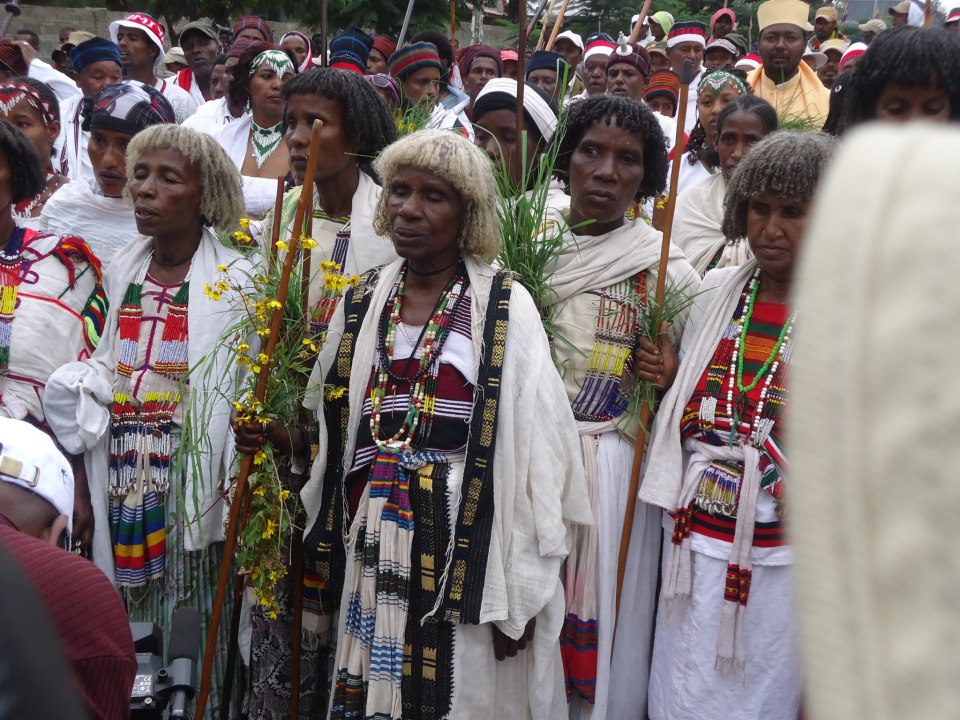
Oromo culture from ancient to present, Irrechaa time


Oromo nation and Gadaa system
Please do not call the Oromo people (the Oromians) a tribe and by extension all African nations and nationalities:
You know Why?
Read the following: What Achebe wrote referring to his Igbo people is equally applicable to the Oromo.
Chinua Achebe the renowned African novelist and poet, the author of Things fall apart, the best known and best selling novel ever in his book Home and exile (Oxford University Press, 2000, pp.3-5) says the following:
“The Igbo people of south eastern Nigeria are more than ten million and must be accounted one of the major peoples of Africa. Conventional practice would call them a tribe, but I no longer follow that convention. I call them a nation. ‘Here we go again!,’ You may be thinking. Well, let me explain. My Pocket Oxford Dictionary defines tribe as follows: ‘group of people (esp. primitive) families or communities linked by social , religious or blood ties and usually having a common culture and dialect and a recognized leader.’ If we apply the different criteria of this definition to Igbo people we will come up with the following results:
a. Igbo people are not primitive; if we were I would not be offering this distinguished lecture, or would I?;
b. Igbo people are not linked by blood ties, although they may share many cultural traits;
c. Igbo people do not speak one dialect; they speak one language which has scores of major and minor dialects;
d. and as for having one recognized leader, Igbo people would regard the absence of such a recognized leader as the very defining principle of their social and political identity.
Therefore, all in all, Igbo people would score very poorly indeed on the Oxford dictionary test for tribe.
My little Oxford dictionary defines nation as, ‘ a community of people of mainly of common descent, history or language, etc, forming a state or inhabiting a territory. This may not be a perfect fit for the Igbo, but it is close. In addition I like it because, unlike the word tribe, which was given to me, nation is not loaded or derogatory, and there is really no good reason to continue answering a derogatory name simply because somebody has given it to you.”
Voices: Traveling to Africa? Think twice about using the word ‘tribe’
We see the word everywhere: throughout news reports of African struggles, in old films and on the latest television shows. You’ve probably even heard it used in a recent class covering topics related to history or anthropology.
“Tribe” has become a well-known, frequently used word to describe a particular group of people, specifically within a non-Western nation. The word seems to predominantly flood media outlets when an African ethnic group is involved in conflict or famine.
According to the Oxford Dictionaries’ newest definition of the word, a tribe is described as, “A social division in a traditional society consisting of families or communities linked by social, economic, religious, or blood ties, with a common culture and dialect, typically having a recognized leader.”
But what exactly are we implying when we use the word “tribe?” In an African context, when did this word originate and what words can we use as alternates?
Assan Sarr, assistant professor of history at Ohio University, says the word tribe first began spreading throughout Africa during the Scramble for Africa, or the period of European colonization of the continent.
“For much of Africa it seems that the word tribe became associated with the continent more during the 19th century, which means that it coincided with European imperialism,” Sarr says. “So, for Africans, the use of the word is really wrapped up in colonialism and that is one of the major reasons why Africans, or scholars who work on Africa, do not prefer the use of the term tribe to describe Africans.”
With a powerful history and past, the word “tribe” reflects social theories of the 19th century regarding stages of evolution and primitivism.
Even today, many negative connotations and falsities have continued with the use of the term to describe certain peoples within continents like Africa. The fallacies provoked by this pejorative language can include visuals of ethnic groups as clusters of half naked, barbarous, uncivilized and uneducated individuals with long feathers in their hair or spears in hand.
Definitions of the word also seem to point toward a society that exists outside of the state, one that is simple, small and static, and without the same structure as that which may be found in other complex societies and civilizations.
Sarr says the discrepancies are easily noticeable when comparing a commonly labeled tribal group, such as the Igbo, with that of Flemings, or the Flemish. The Igbo and Flemings are similarly categorized by their language and culture, and the Igbo are actually drastically greater in size — yet only the Igbo are considered a tribe.
“You don’t hear of the Irish tribe, or the Italian tribe, or the Spanish tribe. It’s always the various Arab tribes, or the Indian tribes, or the African tribes and that, for me, is one of the most potent issues that we need to be aware of. Here we are essentializing these people, we’re making them look distinctive,” Sarr says. “You are using it to refer to a group of people that share a certain historical experience, certain cultural traits, a language. This seems to me to be the perfect definition of an ethnic group, so why use the word tribe?”
Americans and Westerners are not the only people using this term, as some Africans refer to themselves as a part of a tribe. However, Sarr says that Africans do not use this word with the same assumptions and implications as those who brought it to the continent in the 19th century, or as those who may use it today in Westernized states.
In fact, as mentioned in Talking About Tribe by Africa Action, when some Africans are taught English, they are told that the correct, recognizable word to describe their ethnic group is “tribe.” In their own language, such as Zulu, the word used to describe their ethnic group actually translates to “people” or “nation.”
People and nation are two alternatives of tribe that can also be used in English to portray these multifaceted groups. Using the term “ethnic group” is also acceptable, or just simply calling them by their names – the Mende, the Wolof, the Hausa and so on.
“If they call themselves Igbo that means that word itself has a cultural meaning that the people themselves can associate with, rather than this foreign concept, this idea, that is used by others to describe them that does not capture all of their complex sets of ideas and histories and relationships,” Sarr says.
Using words like tribe and continuing to view places such as Africa as one place with one culture and one type of people is common, yet very detrimental. It is vital to be conscious of the history of the language we are using, and what our words may be negatively implying or stereotyping.
“How do we talk about Africa in a more intelligent, culturally sensitive, and helpful way? It’s this idea of unpacking all of the things that one acquired and grew up with,” Sarr says. “You have all these assumptions, these Eurocentric views, but once you start unpacking that and seeing that this is not true, then you begin to see some real interesting facts about the world.”
How to Overcome Creativity Roadblocks May 6, 2015
Posted by OromianEconomist in 10 best Youtube videos, 25 killer Websites that make you cleverer, Africa, Ideas.Tags: 10 best youtube videos, 25 killer Websites that make you cleverer, How to Overcome Creativity Roadblocks, Ideas
add a comment
There’s always going to be space for reading, curating and cheering on others’ work. But there should also be a space for building on it and creating stuff of one’s own. Each of us has something to say, and we have the responsibility and privilege of adding to the discourse. It’s up to us to find and nurture the right balance and feel inspired by—not intimidated by–the work that others do. After all, everything is a remix.
Oromia:Historian Obbo Edao Boru Narrates the Life of Badho Dachaasaa and Muhe Abdo May 6, 2015
Posted by OromianEconomist in Obbo Edao Boru, Oromummaa.Tags: Africa, African Studies, Badhoo Dachaasaa, Muhe Abdo, Obbo Edao Boru, Oromiyaa, Oromo, Oromo people, Oromummaa
add a comment
Oromo historian Obbo Edao Boru narrates the life of Badhoo Dachaasaa and Muhe Abdo. Muhe Abdo was one of Oromo Liberation Front (OLF) senior leaders and founders. It was Muhe Abdo who wrote the first OLF manifesto.
Badho Dachaasaa was the first to join the Oromo Liberation armed struggle lead by Jarraa Abbaa Gadaa, Baaro Tumsaa and Lenchoo Lataa.
Hayyuun seena Obbo Edao Boru akka jedhanitti, Muhe Abdo warra ABO dhaabanii fi calqaba ogganuun nama tajaalilan keesa isa tokko. Labsa ABO calqbaa kan barreesse Muhe Abdo akka ta’e Obbo Edao Boru ibsan. Badhoo Dachaasaa sabboontota Oromoo calqaba WBO seenani qabsoo geggeesan keessa isa tokko.
Macha-Tulama-USA: Urgent Letter to #UNHCR About Conditions of Refugees in Libya, Yemen & South Africa May 5, 2015
Posted by OromianEconomist in Macha & Tulama Association.Tags: Africa, African Studies, Because I am Oromo, Genocide against the Oromo, Macha & Tulama Association, Oromo, Oromo refugees in Yemen, UN, UNHCR
add a comment
May 3, 2015
Mr. António Guterres, UN High Commissioner for Refugees
Case Postale 2500 CH-1211 Genève 2 Dépôt Switzerland
Your Excellency Mr. Guterres,
The Board of Directors of the Macha-Tulama Association, USA, is writing this urgent letter to bring to your attention about the suffering of thousands of Oromo refugees and other nationals in Yemen, South Africa, Libya as well as in the Middle East and Africa. Among these refugees were individuals who were killed or beheaded by terrorists and other criminal elements. Furthermore, the most vulnerable elements of these refugees such as the sick, women, children and elderly are dying every day. At this moment no calling is more urgent and noble and no responsibility greater for the leadership of UNHCR than trying its very best for saving the lives of thousands of Oromo refugees and others who are trapped among warring factions in Yemen and attacked by terrorists in Libya and burned by criminals in South Africa.
The Macha-Tulama Association (MTA) is a non-profit organization legally registered in the United States of America for advancing the objective for which the main MTA was established in Oromia (Ethiopia) in 1963. For your information, the Oromo constitute the single largest national group in Ethiopia. And yet, they are political minority in that country. Consequently, successive Ethiopian governments, including the present one, have banned MTA, the only civic institution of the Oromo people in the Ethiopian Empire. The MTA envisioned mobilizing Oromo citizens for fighting illiteracy, diseases, constructing schools, building roads and clinics, promoting Oromo self-consciousness, and reviving Oromo language, culture and history. It also struggled to restore the human dignity and inalienable rights of the Oromo people that have been suppressed by successive Ethiopian regimes.
Continuing the policies of the previous regimes of Ethiopia, the current minority Ethiopian government has intensified political repression as well as land-grabbing and transferring other economic resources of the Oromo and other peoples to the current government officials, their supporters and foreign corporations. It is the Ethiopian government’s policy of illegal land grabbing and political persecution of the Oromo and others that have forced the young, old, women and children to flee from their fatherland and get exposed to dangerous conditions in foreign lands. Oromo refugees and other nationals who have been forced to leave their homeland by the political and economic repression of the current minority Ethiopian government are exposed to gross human rights violations and terrorism. These refugees have been forced to flee from their homeland in order to seek protection from persecution, arbitrary imprisonment, torture and extra-judicial killings because of their ethno-national and religious identities, political opinions and their economic resources. According to Amnesty International report, entitled ‘Because I am Oromo: Sweeping Repression in the Oromia Region of Ethiopia, between 2011 and 2014 at least 5000 Oromo were arrested, tortured, and faced extra-judicial executions because of being Oromo, and for also peacefully demonstrating against the regime’s land grabbing policies and the so-called Addis Ababa Master Plan that has been intended to evict millions of Oromo farmers from their prime land around Addis Ababa (Finfinnee), the capital city of the Ethiopian Empire.
Unfortunately, global powers and international financial institutions indirectly finance the gross violations of human rights of the Oromo and other people claiming that the current minority Ethiopian government is “democratic” and promotes “development.” For the Oromo and other people who have been terrorized and evicted from their ancestral lands, the claims of democracy and development are just propaganda ploys. In fact, the policies of this dictatorial regime are exposing the Oromo and others to unimaginable misery. When the people have resisted illegal removal from their ancestral lands, the current Ethiopian government’s police force and soldiers have beaten and detained them without trial, and many have been killed. It was for the purpose of saving their lives that thousands of Oromo and others have fled from Ethiopia to foreign lands. However, those who fled to South Africa, Yemen and Libya have faced torture, looting, and burning; they have been also beheaded, raped, tortured and killed by criminal elements and extremists. (Please see the following sites and videos for further information). http://www.ayyaantuu.net/ethiopia-muslim-martyr-among-those-killed-by-isis/; http://www.theguardian.com/commentisfree/2015/apr/20/south-africa-xenophobic-violencemigrant-workers-apartheid; http://www.csmonitor.com/World/Security-Watch/terrorism-security/2015/0420/Islamic-Statemurders-30-African-migrants-in-Libya-while-up-to-700-died-off-coast-video
Particularly, there are thousands Oromo refugees in Yemen alone in areas including Sana, Eden and other refugee camps. The current political crises and turmoil in Yemen has put the lives of these refugees in a very dangerous condition. These refugees are trapped among warring factions without any help from international and regional organizations such as yours. Many of these refugees have been raped, imprisoned, wounded or killed. They are also exposed to terrorists, fundamentalists, slavers and human traffickers. We are gravely concerned about the deteriorating conditions of Oromo and other refugees in Yemen, South Africa and Libya. These refugees are concentrated in camps and other places without adequate food, shelter and medical services. Therefore, we appeal to the UNHCR and your leadership to take the following urgent actions:
• First, we request that the UNHCR demand that the governments in Yemen, Libya and South Africa provide protection for Oromo and other refugees who have sought protection and safety in their countries.
• Second, we request that the UNHCR provide material support urgently for those Oromo refugees and others who are trapped among warring factions, especially in Yemen.
• Third, we appeal to the UNHCR to arrange suitable conditions with other countries for these refugees to have an opportunity for permanent settlement in third countries.
• Fourth, we request that the UNHCR seeks permanent solutions through the United Nations for eliminating political and economic conditions that have produced tens of thousands of Oromo and other refugees from Ethiopia.
• Fifth, we request that the UNHCR persuade big powers and international financial institutions not to finance the Ethiopian government’s policy of land grabbing, which has evicted tens of thousands of Oromo nationals and others from their ancestral lands.
We believe that as the UN High Commissioner for Refugees and the principal voice on refugee issues, you have an extraordinary opportunity to alleviate the incredible human sufferings of the Oromo and other refugees in Yemen, Libya and South Africa and in other countries. We urgently request you to take a concrete measure that will save the lives of Oromo and other refugees who are trapped among warring factions in Yemen. Additionally we request you to urge the government officials of Libya and South Africa to protect Oromo and other nationals in their countries. Finally, we thank you for your interest in the wellbeing of the Oromo and other refugees from Ethiopia and for taking concrete actions to protect them.
Sincerely,
Abera Tefera,
For the Board of Directors of the Macha-Tulama Association, USA
CC:
His Excellency Ban Ki-moon,
U.N. Secretary-General
The United Nations, New York.
NY 10017 Fax: 212-963-7055
E-mail: Inquiries@UN.Org
His Excellency John Kerry
US Secretary of State
Washington, D.C.20520
E-mail: Secretary@state.gov
European Union
Fax: +32-2-285-73 97 / 81
E-mail: public.info@consilium.eu.int
U.S. Committee for Refugees and Immigrants
2231 Crystal Drive, Suite 350 Arlington,
VA 22202-3711
Fax: (703) 769-4241
E-mail: uscri@uscridc.org
Amnesty International International Secretariat
1 Easton Street
London
WC1X0DW,
UK
Fax: +44-207-956-1157
E-mail: contactus@amnesty.org
Human Rights Watch
Rory Mungoven Global Advocacy Director
350 Fifth Avenue,
34th floor New York,
NY 10118-3299
USA Fax: 212-736-130
Elections, Ethiopian style. #Africa. #Oromia May 5, 2015
Posted by OromianEconomist in Africa, Sham elections, The Ethiopian government’s systematic repression of independent media, The Tyranny of TPLF Ethiopia.Tags: Africa, African Studies, Because I am Oromo, Eth, Ethiopia and Internet censorship, Ethiopia's sham elections, The Tyranny of Ethiopia
add a comment
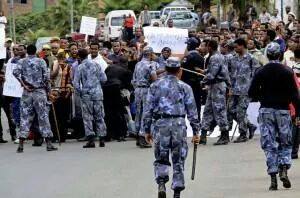
Opinion: Elections, Ethiopian style
By Felix Horne, Horn of Africa researcher at Human Rights Watch.
Since the last election, the ruling party has exerted more control and increased its repression of basic liberties.
Dissent of any type, particularly in rural areas, is dealt with harshly. The long-standing 5:1 system of grassroots surveillance – under which one individual is responsible for monitoring the activities of five households – has let local officials clamp down on dissent before it spreads beyond the household level.
This is what an election campaign looks like in Ethiopia, where the ruling coalition took 99.6 percent of parliamentary seats in the last national elections, in 2010.
Jirata, who asked that his real name not be used, is a 19-year-old student who was campaigning for a legally registered opposition party recently, when security officials arrested him.
They told him that he was working for a “terrorist group” that sought to forcibly bring down the government. He was badly beaten over the course of three nights and released on the condition that he end his involvement in politics. He is still limping from his injuries, and he told me he no longer has any interest in getting involved in politics. He says he will vote for the government party “because life is easier that way”.
Jirata was working for an Oromo party, representing an ethnic group long targeted by the government. But as Ethiopians go to the polls in late May, the prospects for opposition parties to fully and fairly campaign are grim.
Since the last election, the ruling party has only exerted more control and increased its widespread repression of basic liberties, including the rights to free expression, assembly, and association.
The courts provide no justice in cases of political importance. While election day is unpredictable, it’s clear that the avenues by which opposition parties can fully function and citizens can engage on political issues are largely closed.
While there are 75 registered opposition groups, several of the largest parties have talked of boycotting the elections because of flawed electoral processes. Challenges with registering candidates, acquiring the funds they are legally entitled to, mobilising their supporters, and keeping their members out of prison have taken their toll.
| In short, there is limited space for government critics to play a peaceful and constructive role. |
Suppression of non-governmental voices
The Ethiopian media provides little coverage of relevant political issues ahead of the election since what vestiges of independent media existed have largely been eliminated since 2010.
Reporters critical of the government are regularly harassed, threatened and detained. In 2014 alone, over 30 journalists fled Ethiopia and at least six publications were closed down.
Sources providing information to media and human rights groups are regularly targeted. Many diaspora media websites, while heavily politicised, remain blocked in Ethiopia. Journalists must choose between self-censorship, harassment, imprisonment, and exile.
The situation hasn’t been much better for opposition parties that want to organise peaceful protests and rallies ahead of the election. The Semayawi party (Blue Party), for example, is one of the newcomers in Ethiopia’s electoral landscape, and since 2013 has tried to hold regular and peaceful issue-based protests.
Protesters and organisers have frequently been arrested and harassed, their equipment has been confiscated, and permits unfairly denied. One of their leaders is on trial on trumped-up terrorism charges.
The lone opposition parliament member is not running this time due to a split in his party, the Union of Democracy and Justice, in which Ethiopia’s national electoral board played favourites. The net effect is that the government awarded the party name to an offshoot of the party that is more closely aligned to government policies and interests.
No dissent allowed
There are few ways for Ethiopians to peacefully express dissent or to contribute to the national political dialogue. Dissent of any type, particularly in rural areas, is dealt with harshly. The long-standing 5:1 system of grassroots surveillance – under which one individual is responsible for monitoring the activities of five households – has let local officials clamp down on dissent before it spreads beyond the household level.Telephone surveillance is commonplace, and the ongoing trial of a group of bloggers called Zone 9 has resulted in increased self-censorship online.
In short, there is limited space for government critics to play a peaceful and constructive role. The only international observers to the election will be the African Union. The European Union is not sending observers, noting that Ethiopia has not implemented recommendations by previous election observers. As Human Rights Watch documented after the 2010 elections, those who complain about election irregularities risk arrest and harassment.
“If we have an issue with government where do we go?” an Ethiopian who lives in a rural area recently told me, summing it up: “There is no media that will write our story, there are no more organisations that work on issues that the government does not like, if we take to the streets we are arrested, and if we go to their office to question we are called terrorists. If we go to the courts, there is no independence – we go to jail. There are no large opposition parties to vote for in the election, and even if there were, if we vote for them our lives then become very difficult. So what can we do? The elections are just another sign of our repression.”
Felix Horne is a Horn of Africa researcher at Human Rights Watch.
http://www.aljazeera.com/indepth/opinion/2015/04/elections-ethiopian-style-150430084220440.html
The Tigray only and unbalanced discriminatory growth: Severity of poverty increases in Ethiopia, UNDP reveals in its National Human Development Report 2014 which was launched on 1st May 2015. May 3, 2015
Posted by OromianEconomist in Africa, African Poor, Amnesty International's Report: Because I Am Oromo, Ethiopia's Colonizing Structure and the Development Problems of People of Oromia, Free development vs authoritarian model, Poverty, Schools in Oromia, The State of Food Insecurity in Ethiopia.Tags: Africa, Africa Rising, African Studies, Animal Farm and The Ethiopian Empire System, Applied economics, Causes of poverty, Corruption, Dead Aid, Genocide against the Oromo, Human Development Index for Oromia and Ethiopia, Incidence of Poverty in Oromia and Ethiopia, Land grabs in Africa, Land Grabs in Oromia, poverty, The Tyranny of Ethiopia
add a comment
“All animals are equal, but some animals are more equal than others.”
-George Orwell, Animal Farm
“The very common way that the EPRDF and its agents try to shift the public attention from lack of human and democratic rights and the daylight looting of the country’s resources, is by referring to the ‘impressive’ economic development registered in their rule. If they are talking about the only region that they are exclusively devoted to developing, then, they are absolutely right.”
In TPLF /Tigray dominated minority tyrannic regime of Orwellian social and development policy, all nations and nationalities in theory are equal in Ethiopia, but in reality Tigray is more equal than others. This is not a development process.
According to UNDP report, while more than 45% of children in Tigray have achieved Net Lower Secondary Enrollment, the statistics for Oromia is only 16.9%, very huge inequality variations. The report indicated that while Human development Index (HDI) of Tigray is the highest (above national average), states such as Oromia, Afar, Ogaden and Amhara have the lowest HDIs, below the national HDI of 0.461. These are the outcomes of Tigray only, exclusionist, social, economic and development policies of the ruling regime. UNDP is not exposing the Tigray only growth and development strategy but we can read from its data and graphs.
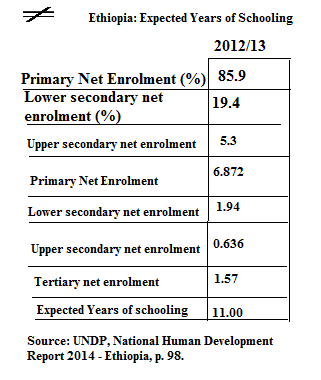
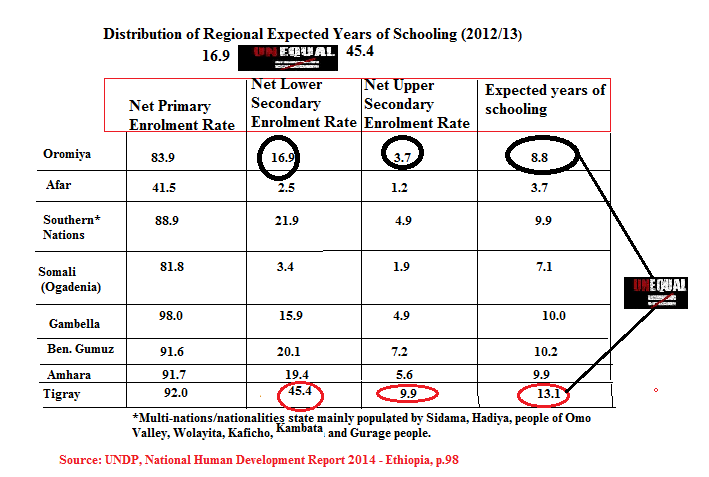
As the TPLF has been engaged (https://oromiaeconomist.wordpress.com/2014/10/30/amnesty-internationals-report-because-i-am-oromo-a-sweeping-repression-in-oromia/) in destabilizing, robbing and massive evictions of people from their ancestral home and land grabs in Oromia, by all sorts of engagement, resource and soil transfers, it has conducting massive subsidized development in its Tigray home. In other studies, BBC Magazine in its 20th April 2015 publication under the title ‘ Turning Ethiopia’s desert green,’reports: ” A generation ago Ethiopia’s Tigray province was stricken by a famine that shocked the world. Today, as Chris Haslam reports, local people are using ancient techniques to turn part of the desert green. In the pink-streaked twilight, a river of humanity is flowing across Tigray’s dusty Hawzien plain. This cracked and desiccated landscape, in Ethiopia’s far north, occupies a dark corner of the global collective memory. Thirty years ago, not far from here, the BBC’s Michael Buerk first alerted us to a biblical famine he described as “the closest thing to hell on earth”. Then Bob Geldof wrote Do They Know It’s Christmas? – a curious question to ask of perhaps the world’s most devoutly Christian people – and thereafter the name Tigray became synonymous with refugees, Western aid and misery. The Tigrayan people were depicted as exemplars of passive suffering, dependent on the goodwill of the rest of the planet just to get through the day without dying. But here, outside the village of Abr’ha Weatsbaha, I’m seeing a different version. From all directions, streams of people are trickling into that human river.” http://www.bbc.co.uk/news/magazine-32348749.
Martin Plaut’s analysis which is based on world banks report is also interesting and important to refer here which is as follows:-
The World Bank has just published an authoritative study of poverty reduction in Ethiopia. The fall in overall poverty has been dramatic and is to be greatly welcomed. But who has really benefited?
This is the basic finding:
In 2000 Ethiopia had one of the highest poverty rates in the world, with 56% of the population living on less than US$1.25 PPP a day. Ethiopian households experienced a decade of remarkable progress in wellbeing since then and by the start of this decade less than 30% of the population was counted as poor.
There are of course many ways of answering the question – “who benefited” – were they men or women, urban or rural people. All these approaches are valid.
The Ethnic Dimension
But in Ethiopia, where Ethic Federalism has been the primary driver of government policy one cannot ignore the ethnic dimension.
Here this graph is particularly telling:
Tigray first
The answer is clear: it is the people of Tigray, whose party, the TPLF led the fight against the Mengistu regime and took power in 1991, who benefited most. What is also striking is that the Oromo (who are the largest ethnic group) hardly benefited at all.
This is what the World Bank says about this: “Poverty reduction has been faster in those regions in which poverty was higher and as a result the proportion of the population living beneath the national poverty line has converged to around one in 3 in all regions in 2011.”
The World Bank does little to explain just why Tigray has done (relatively) so well, but it does point to the importance of infrastructure investment and the building of roads. It also points to this fact: “Poverty rates increase by 7% with every 10 kilometers from a market town. As outlined above, farmers that are more remote are less likely to use agricultural inputs, and are less likely to see poverty reduction from the gains in agricultural growth that are made. The generally positive impact of improvements in infrastructure and access to basic services such as education complements the evidence for Ethiopia that suggests investing in roads reduces poverty.”
Not surprisingly, the TPLF under Prime Minister Meles Zenawi and beyond concentrated their investment on their home region – Tigray. The results are plain to see. https://martinplaut.wordpress.com/2015/01/23/ethiopias-poverty-reduction-who-benefits/
In its 2014 National Human Development Report, which has been written on the theme of “Accelerating Inclusive Growth for Sustainable Human Development in Ethiopia,” UNDP indicates that 25 million Ethiopians currently remain trapped in poverty and vulnerability. This and many Ethiopians just above the poverty line are vulnerable to shocks and food insecurity. Maternal health care has lagged well behind other health statistics and the availability of effective health care is inconsistent across the country. UNDP’s educational indicators suggest ongoing problems with the quality of education, as shown by retention rates and educational performance markers. UNDP says, perhaps most worrying from the standpoint of inclusive growth are the high rates of un- and underemployment in both urban and rural areas, especially as large numbers of productive jobs for the poor and near-poor are needed under current and projected labour market trends. Economic growth over the past decade has generally meant an increase in productivity and output levels in some parts of the economy, but these have been accompanied by increasing severity of poverty. The absolute number of the poor is roughly the same as 15 years ago and a significant proportion of the population hovers just above the poverty line and is vulnerable to shocks. Moreover, the severity of poverty 2 increased from 2.7 per cent in 1999/2000 to 3.1 per cent in 2010/11 (MoFED, 2013b). The prevalence of vulnerabilities and food insecurity are on the rise.
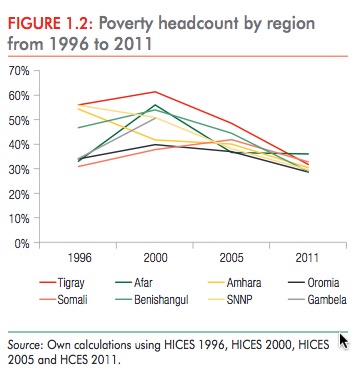
According to UNDP report, during the last three years (2010/11-2012/13), inflation was in double digits. The inflation rate, which was 18 per cent in 2010/11, increased to 33.7 per cent in 2011/12, declined to 13.5 per cent in 2012/13 and fell further to 8.1 per cent in December 2013. Other studies demonstrate that inflation figures have always been in double digits including 2013 and 2014 and at present.
Further, UNDP says with a Human Development Index (HDI) of 0.435 in 2013, the country is still classified as a “low human development” country, based on UNDP’s Human Development Index. Even though Ethiopia is one of the 10 countries globally that has attained the largest absolute gains in its HDI over the last several years, in the most recent Human Development Report (2014) Ethiopia ranks 173rd out of 187 countries. Thus, its Human Development Index (HDI) has not moved appreciably during the past decade, when compared with other developing countries that have registered similar growth rates. Looking at the HDI values of Seychelles, Tunisia and Algeria, which are in the high HDI bracket, and the other 12 African countries, which are in the medium HDI bracket, the major reasons why Ethiopia is still in the low HDI bracket are low education performance (particularly low mean years of schooling) and low GNI per capita. The minimum mean years of schooling and GNI per capita for medium HDI countries were 3.5 years and US$3,000, respectively in contrast to Ethiopia’s mean years of schooling of 2.6 years and GNI per capita of US$1,300. The inequality-adjusted Human Development index (IHDI), which is basically the HDI discounted for inequalities, is also computed for Ethiopia. Between 2005 and 2013, the IHDI increased from 0.349 to 0.459 indicating an average human development loss of 0.5 per cent per annum due to inequalities in health, access to education and income. According to (UNDP 2014), Ethiopia’s IHDI for 2013 was 0.307 in contrast to HDI of 0.435 indicating an overall human development loss of 29.4 per cent.
With regard to regional disparities in HDI values, while Tigray is significantly above national average, the four states of Afar, Somali, Amhara and Oromia have the lowest HDIs, below the national HDI of 0.461.
The outcome of the development strategy of Tigray only when mathematically averaged to the whole regions cannot hide TPLF’s Apartheid policy on Oromia and the rest as it is only the development focus for 5% of the 94 million population. Thus, Tigray is rich but Ethiopia is poor. Ethiopia is rich and fast growing only for development tourists those who lodge in Finfinne and tour to Tigray to take a sample and conclude the result for the whole states.
With regard to regional disparities in HDI values, while Tigray is significantly above national average, the four states of Afar, Somali, Amhara and Oromia have the lowest HDIs, below the national HDI of 0.461.
Another social indicator which demonstrates that Tigray is more equal than others is health services. UNDP’s report confirms that there are wide inequalities in the immunization status of children in Ethiopia. Children of educated women, rich households, and Finfinnee (Addis Ababa) and Tigray State have higher chances of being fully immunized. Children from the richest and middle income households are less likely to have no immunization at all (by 74 per cent and 57 per cent respectively) compared with those from the poorest households. Children from SNNPR, Oromiya and Amhara are 3.82, 7.00 and 3.65 times less likely to be fully immunized compared with those from Tigray, which has the second highest proportion of fully immunized children. According to UNDP, a report by Save the Children (2014) also raises concerns about equity in health services citing how immunization coverage is different among different income groups, and between urban and rural areas. According to the report, children from richest households are twice as likely to be immunized compared to those from the poorest households and children in urban areas are twice as likely to be immunized as those in rural areas. Based on revised data from the National Water Sanitation and Health Inventory, national potable water supply coverage increased from 58 per cent to 68.4 per cent between 2009/10 and 2012/13, reflecting an increase in both rural and urban coverage. Even though many health outcomes have improved significantly over the last decade, Ethiopia is still lagging behind on some measures. For example, Ethiopia has still higher than expected shares of malnutrition compared with countries at the same income level. What is especially striking about Ethiopia’s health data is the exceptionally high level of maternal mortality, given Ethiopia’s income level.
UNDP argues that that development can be inclusive and reduce poverty only if all people contribute to creating opportunities, share the benefits of development and participate in decision making.
Ethiopia at a Glance (UNDP Report Data)
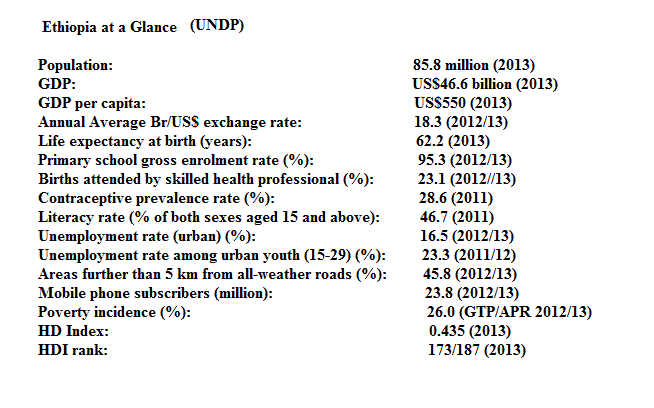
Population: 85.8 million (2013)
GDP: US$46.6 billion (2013)
GDP per capita: US$550 (2013)
Annual Average Br/US$ exchange rate: 18.3 (2012/13)
Life expectancy at birth (years): 62.2 (2013)
Primary school gross enrolment rate (%): 95.3 (2012/13)
Births attended by skilled health professional (%): 23.1 (2012//13)
Contraceptive prevalence rate (%): 28.6 (2011)
Literacy rate (% of both sexes aged 15 and above): 46.7 (2011)
Unemployment rate (urban) (%): 16.5 (2012/13)
Unemployment rate among urban youth (15-29) (%): 23.3 (2011/12)
Areas further than 5 km from all-weather roads (%): 45.8 (2012/13)
Mobile phone subscribers (million): 23.8 (2012/13)
Poverty incidence (%): 26.0 (GTP/APR 2012/13)
HD Index: 0.435 (2013) HDI rank: 173/187 (2013)
Poverty and Underdevelopment in Low Income Countries May 2, 2015
Posted by OromianEconomist in Africa, Economics, Economics: Development Theory and Policy applications, The extents and dimensions of poverty in Ethiopia.Tags: Africa, Africa Rising, African Studies, Causes of poverty, poverty, The extents and dimensions of poverty in Ethiopia
add a comment
Poverty can be an outcome of inefficient use of common resources and a result of exclusive mechanisms. Weak policy environment, inadequate infrastructures, weak access to technology and credits can cause poverty. Poverty can also result from the use of mechanisms by some groups in a society or community to exclude others from participating in democratic and economic development process (Ajakaiye and Adeyeye, 2002). This is defined by Hazell and Haddad ( 2001) as social deprivation…From the different reasons mentioned above in relation to poverty in developing countries, it is clear that strategies to alleviate poverty and help poor people must aim at improving the productivity and the living conditions of smallholder farmers and landless agriculture workers who constitute the majority of poor people. Furthermore, agriculture is seen as central to rural development. It is the major economic driver, the hub of rural activities, and permanent estate (IRG, 2002). The improvement in agriculture productivity is based on agricultural research and improved technologies. In many developing counties government must play an important role in this domain. However poor people may benefit from agriculture productivity only if favorable macroeconomic and trade policies good infrastructure and access to credit, land, and markets is in place.
As far as land is concerned, government in many developing countries must undertake land reform program not only for a better distribution of land but also to create mechanism capable to define and enforce property right. Land reform can promote smallholder entry into the market, reduce inequalities in land distribution, increase efficiency and thus boost output.
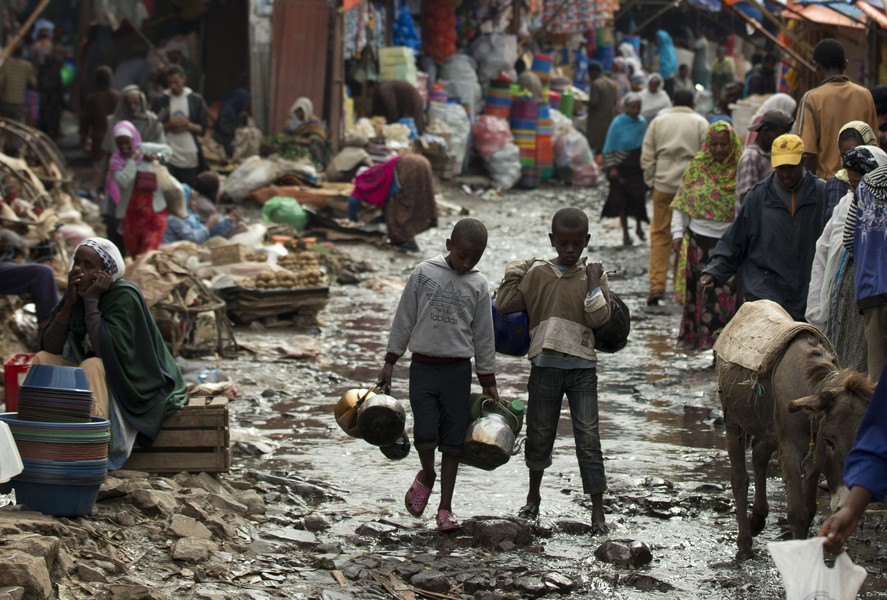

The ubiquitous problem of poverty continues to confound development practitioners, politicians and researchers alike. In spite of countless efforts to eliminate poverty over the past decade, 2.5 billion people live on less than $2 a day and 880 million people still live on less than $1. Most of these depend on agriculture for their livelihoods (World Development Report, 2008). While some progress has been made in some countries, the ambitious goal of halving poverty by the year 2015 appears like it will not be achieved. The objective of this paper is to characterize the problem of poverty and attempt to proffer possible insights on pathways that may jettison the rural poor out of misery into prosperous economic agents with a brighter hope for the future.
An Anatomy of Poverty
Poverty is a multifaceted concept. It affects many aspects of the human conditions, including physical, moral and psychological.  According to Sen…
View original post 2,623 more words


 Oromian Economist
You must be logged in to post a comment.