Economic and development analysis: Perspectives on economics, society, development, freedom & social justice. Leading issues in Oromo, Oromia, Africa & world affairs. Oromo News. African News. world News. Views. Formerly Oromia Quarterly
The government has recently killed and disappeared hundreds of people.
A couple hundred members of Seattle’s Ethiopian immigrant community marched through downtown’s streets Tuesday afternoon in protest against U.S. support for the brutal Ethiopian regime.
“Back in Ethiopia, we have a dictatorial regime which has committed mass crimes against its own people,” said attorney Daniel Ajema, a marcher who identified himself as an organizer. “We’re here in solidarity with the people back home, and would like to support them and show our support.”
He’s not exaggerating. In their “Democracy Index” last year, the Economistgave Ethiopia’s government their lowest classification: an authoritarian regime, with an “Electoral Process and Pluralism” score of zero out of ten. Since November, according to the Human Rights Watch, government forces have killed hundreds of largely peaceful protesters and “disappeared” hundreds more.
Ajema said that the protest was specifically aimed at urging President Obama and philanthropist Bill Gates to try to lean on Ethiopia’s national government to do better on human rights and democracy. “We are here to voice our concern and our anger against the enablers of the regime,” he said. The Gates foundation currently has 150 projects worth more than $500 million in Ethiopia, according to the South African Broadcasting Service. The official U.S. relationship with Ethiopia is a friendly one: Ethiopian troops have battled the terrorist army al-Shabaab in neighboring Somolia, and last year our government sent theirs more than half a billion dollars in aid.
Ajema says both the U.S.’s and Gates Foundation’s money helps finance the regime, and he says both Gates and the president should insist on putting human rights ahead of political expediency.
“They’re not doing a whole lot of checking on good governance and democratic rights,” Ajema said. “They’re just blindly giving money to the government.”
The transaction “utility” (economists’ term for satisfaction) compares the price one thinks is justified (the “reference price”) to the actual price they have to pay. If reference price is less than or equal to the actual price, humans get satisfied.
For free-trade skeptics, buying a relatively varied and less expensive basket of commodities is an alluring development. However, the transaction utility (satisfaction) is severely negative. This is because they are not willing to pay the price of substantial layoffs and unemployment at home (incidents that they perceive chiefly stem from globalisation) in order to get the goods for cheap.
Whether they are right or wrong is another matter, but the heavy moral cost they face because of perceived guilty conscience is too high. This results in a dissatisfaction with the current state of free trade and borderless transactions. In short, they suffer from a negative overall utility.
For the first time in history, the plight of the Oromo people has also received worldwide attention. International media outlets have reported on the peaceful protests and subsequent government repression.
Ethiopia’s volcano: The Oromo are resisting the regime and its bid to grab their land
Largest ethno-national group has been under martial law with citizens killed and subjected to beatings, torture and detention in concentration camps.
Oromo men in their traditional costume
Countrywide demonstrations by the Oromo in Ethiopia have flared up again. Ethiopia’s authorities reacted with heavy force, resulting in the death of 100 civilians. SAMANTHA SPOONER asked Professor Asafa Jalata, a leading scholar on the politics of Oromia, about the countrywide protests
Who are the Oromo people?
The Oromo are the single largest ethno-national group in northeast Africa. In Ethiopia alone they are estimated to be 50-million strong out of a total population of 100-million. There are also Oromo living in Kenya and Somalia.
Ethiopia is said to have about 80 ethno-national groups. The Oromo represent 34.4% and the Amhara 27%. The rest are all less than 7% each.
The Oromo call themselves a nation. They have named their homeland “Oromia”, an area covering 284 538 square kilometres. It is considered to be the richest area of northeast Africa because of its agricultural and natural resources. It is often referred to as the “breadbasket” of the region. Sixty percent of Ethiopian economic resources are generated from Oromia.
The capital city of Ethiopia is located in the heart of Oromia. What the world knows as Addis Ababa is known to the Oromo as Finfinnee. When the Abyssinian warlord Menelik colonised the Oromo during the last decades of the 19th century, he established his main garrison city in Oromia and called it Addis Ababa.
Despite being the largest ethno-national group in Ethiopia, the Oromo consider themselves to be colonial subjects. This is because they have been denied equal access to their country’s political, economic and cultural resources. It all started with their colonisation by, and incorporation into, Abyssinia (the former Ethiopian empire) during the Scramble for Africa.
Today, comprising just 6% of the population, Tigrayans dominate and control the political economy of Ethiopia with the help of the West, particularly the United States. This relationship is strategic to the US, which uses the Tigrayan-led government’s army as their proxy to fight terrorism in the Horn of Africa and beyond.
The Oromo have been demonstrating since November last year. What triggered the protests?
The Oromo demonstrations have been underway for over eight months, first surfacing in Ginchi (about 80km southwest of the capital city) in November last year. It began when elementary and secondary schoolchildren in the small town began protesting the privatisation and confiscation of a small football field and the sale of the nearby Chilimoo forest.
The sentiment quickly spread across Oromia. The entire Oromo community then joined the protests, highlighting other complaints such as the so-called Integrated Addis Ababa Master Plan and associated land grabbing. The master plan was intended to expand Addis Ababa by 1.5-million hectares on to surrounding Oromo land, evicting Oromo farmers.
Last year’s demonstrations were the product of over 25 years of accumulated grievances. These grievances arose as a result of the domination by the minority Tigrayan ethno-national group. Because of this dominance the Oromo people have lost ownership of their land and become both impoverished and aliens in their own country.
What was different about these demonstrations was that, for the first time, all Oromo branches came together in co-ordinated action to fight for their national self-determination and democracy.
Which part of the Oromo is organising the rallies?
It is believed that underground activist networks, known as Qeerroo, are organising the Oromo community. The Qeerroo, also called the Qubee generation, first emerged in 1991 with the participation of the Oromo Liberation Front (OLF) in the transitional government of Ethiopia.
In 1992 the Tigrayan-led minority regime pushed the OLF out of government and the activist networks of Qeerroo gradually blossomed as a form of Oromummaa or Oromo nationalism.
Today the Qeerroo is made up of Oromo youth. These are predominantly students, from elementary school to university, organising collective action through social media. It is not clear what kind of relationship exists between the group and the OLF. But the Qeerroo clearly articulate that the OLF should replace the Tigrayan-led regime and recognise the Front as the origin of Oromo nationalism.
What are their demands?
Their immediate demands are for the Ethiopian government to halt the so-called Addis Ababa Master Plan, land grabbing, corruption and the violation of human rights.
Their extended demands are about achieving self-determination and sovereignty by replacing the Tigrayan-led regime with a multi-ethno-national democratic government. These demands gradually emerged to create solidarity with other ethno-national groups, such as the Amharas, who also have grievances with the regime.
How has the government reacted to the protests?
The government reaction has been violent and suppressive. Despite Oromia being the largest regional state in Ethiopia, it has been under martial law since the protests began. The government has been able to use this law to detain thousands of Oromos, holding them in prisons and concentration camps.
Security structures called tokkoo-shane (one-to-five), garee and gott have also been implemented. Their responsibilities include spying, identifying, exposing, imprisoning, torturing and killing Oromos who are not interested in serving the regime.
There have also been deaths and reports of thousands of Oromos who have been maimed as a result of torture, beatings or during the suppression of protests. For example, during the Oromia-wide day of peaceful protest on July 6, the regime army, known as Agazi, massacred nearly 100 Oromos. According to Amnesty International, 400 Oromos were killed before July 6. But in reality nobody knows exactly how many Oromos have been victims of violence.
What effect have these protests had on the country?
The Oromo protest movement has started to change the political landscape of Ethiopia and shaken the regime’s foundations. Erupting like “a social volcano”, it has sent ripples through the country, and several groups have changed their attitudes to stand in solidarity with the Oromo. The support of the Ahmaras has been particularly significant as they are the second-largest ethno-national group in Ethiopia.
For the first time in history, the plight of the Oromo people has also received worldwide attention. International media outlets have reported on the peaceful protests and subsequent government repression.
This has brought about diplomatic repercussions. In January the European Parliament condemned the Ethiopian government’s violent crackdown. It also called for the establishment of a credible, transparent and independent body to investigate the murdering and imprisonment of thousands of protesters. Similarly, the United Nations human rights experts demanded that Ethiopian authorities stop the violent crackdown.
Not all global actors are taking a strong stance. Some are concerned about maintaining good relations with the incumbent government. For example, the US State Department expressed vague concern about the violence associated with the protest movement. In sharp contrast, they signed a security partnership with the Ethiopian government.
Nevertheless, the momentum of the Oromo movement looks set to continue. The protests, and subsequent support, have seen the further development of activist networks and Oromo leadership, doubling their efforts to build their organisational capacity.
Is this the first time the Oromo have demonstrated their grievances?
No. The Oromo have engaged in scattered instances of resistance since the late 19th century when they were colonised.
In the 1970s the Oromo started to engage in a national movement under the leadership of the OLF. The Front was born out of the Macha-Tulama Self-Help Association, which was banned in the early 1960s, and other forms of resistance such as the Bale Oromo armed resistance of the 1960s. Successive Ethiopian regimes have killed or sent Oromo political and cultural leaders into exile.
How do you believe their grievances can be resolved?
Critics believe the Tigrayan-led minority regime is unlikely to resolve the Oromo grievances. Oromo activists believe that their national struggle for self-determination and egalitarian democracy must intensify.
I am sure that, sooner or later, the regime will be overthrown and replaced with a genuine egalitarian democratic system. This is because of the size of the Oromo population, abundant economic resources, oppression and repression by the Tigrayan-led government, the blossoming of Oromo political consciousness and willingness to pay the necessary sacrifices.
This is an edited version of an article that was originally published on theconversation.com
Grand #OromoProtests (6 August 2016) MUST SEE: Soldiers shooting and killing a peaceful protesters in Robe, Bale. The victim is Abdela Kadir. Video source credited to Jawar Mohammed.
Calls for an international investigation in Ethiopia have surfaced after more than 100 people were killed in demonstrations.It is a conflict that has led to 400 deaths since November, 100 of them in the last week alone, according to human rights groups.The Ethiopian government is cracking down on ethnic Oromos and Amharas, who are calling for political reforms.Human rights groups have called the reponse ruthless. And the United Nations wants to send international observers to investigate.Ethiopia has denied that request, saying it alone is responsible for the security of its citizens. But what can be done to ensure the Ethiopian government respects human rights?Presenter: Folly Bah ThibaultGuests:Getachew Reda – Ethiopian communications affairs minister.Felix Horne – Ethiopia reseracher for Human Rights Watch.Ezekiel Gebissa – Profesor of History and African studies at Kettering University.- Subscribe to our channel: http://aje.io/AJSubscribe– Follow us on Twitter: https://twitter.com/AJEnglish– Find us on Facebook: https://www.facebook.com/aljazeera– Check our website: http://www.aljazeera.com/
As history repeats itself, barefoot Oromo athlete Abbabaa Bqilaa (Abebe Bikila), winner of Rome Olympic Marathon in 1964.
Oromo athlete Etenesh Diro of Oromia, representing Ethiopia in Rio 2016 Olympics competes in the Women’s 3000m Steeplechase heat.
Oromo athlete Etenesh Diro of Oromia, representing Ethiopia in Rio 2016 Olympics competes in the Women’s 3000m Steeplechase heat.
Oromo athlete Etenesh Diro — one of the favourites in the women’s 3000m steeplechase — was sitting comfortably in first place about two-thirds into her heat at the Olympics when disaster struck.
Her heel was clipped by a falling opponent, sending her tumbling to the ground and removing her right shoe.
Etenesh Diro reacts after she competed in the Women’s 3000m Steeplechase. Picture: AFP
The 25-year-old stood and quickly tried to put it back on her foot, but the laces were tied tight and with no time to spare she cast it aside.
Realising she’d have a better chance of running barefoot, her sock went too — and the African set about attempting to fight her way back into a race where only the first three placegetters were guaranteed of progressing to the final.
Oromia’s Etenesh Diro competes in the Women’s 3000m Steeplechase.
To say the crowd at Rio’s Maracana Stadium got behind her was an understatement.
With every step of Diro’s barren hoof the energy went up a notch — and she responded by passing several runners in the final few laps to claim seventh.
After the race Diro dropped to the ground in disappointment as competitors offered their support.
She’d failed to qualify and lost the opportunity to improve on a sixth-placed finish in London. But then something heartwarming happened.
Three teams involved in the race protested.
Etenesh Diro (L) is helped by officials after she competed in the Women’s 3000m Steeplechase heat. Picture: AFP
Diro had been unfairly brought down and along with Jamaica’s Aisha Praught and Ireland’s Sara Treacy — who also fell after being impeded — would be given a place in the final, which expanded to 18 runners.
She will now be the fan favourite in the final, which also features Australian Genevieve LaCaze and starts at 12.15am Tuesday AEST.
How the Ethiopia protests were stifled by a coordinated internet shutdown
Guartz, 14 August 2016
Nearly 100 deaths and thousands of arrests have been reported in Ethiopia over the week, as part of protests against the marginalization and persecution of the Oromos and Amharas, Ethiopia’s two largest ethnic groups. But the attacks and arrests may not have been the only forms of retribution carried out by the Ethiopian government in its crackdown against protesters.
Last weekend, the internet was reportedly shut down in the country.
In an attempt to understand whether the internet was in fact shut down, we looked at some public sources of data that contain information about internet traffic. Such data provides strong indicators that the internet was most likely shut down during the Ethiopian protests last weekend, though it remains unclear if this occurred in all regions and/or on all types of networks across the country.
Ethiopian protests
Ongoing protests have been carried out by Ethiopia’s Oromo people since November, marking one of the most significant political developments in Ethiopia in recent years. These protests were sparked by the introduction of the Addis Ababa City Integrated Master Plan, which aims to expand the territorial limits of the country’s capital into neighboring Oromo towns, threatening to displace millions of Oromo farmers and bring the Oromo-dominated region under the Tigray-led federal government.
The unprecedented wave of protests has resulted in more than 400 deaths since November, according to a recent Human Rights Watch report.
Protesters relied on the internet to plan and mobilize so this may have prompted the Ethiopian government to pull the plug.
More protests sprung up in the Amhara regional state, with protesters requesting political reforms and specifically, the Welkait community demanding that ancestral land currently administered by the Tigray regional state be moved into the neighboring Amhara region.
The new-found unity between the two historically antagonistic communities of the Oromo and Amharas against a common adversary, the TPLF-led government, seems to have raised the tension in the country. The security forces response has been extreme, with observers comparing it to the 2005 post-election violence where nearly 200 people were killed. This time though, at least 30 people were reportedly killed in the Amhara region in one day alone.
Internet shutdown
Protesters relied on the internet to plan, mobilize and coordinate with each other and this may have prompted the Ethiopian government to pull the plug on the internet even before the planned protests started.
But this is not the first time that the Ethiopian government appears to be restricting access to the internet this year.
Last month, the government reportedly blocked social media platforms across the country after university entrance exams were leaked on Facebook by an Oromo activist, as a form of protest against the government.
Public data from last weekend indicates that the internet was shut down in Ethiopia during the heat of the protests, but it remains unclear if this occurred nationwide.
The graphs below illustrate that while internet traffic appeared to be originating from Ethiopia up until Aug. 5, such traffic was suddenly terminated until August 8th, indicating that the internet was probably shut down.
Read more at:-
#OromoProtests Alert! Mass torture and killings are going on against Oromo people in Ethiopia. Oromo children are subjected to torture and mass killings by fascsist Ethiopia’s regime (TPLF/Agazi force.
The New York Times was able to picture in video camera while fascist cruel Ethiopia’s regime (TPLF/Agazi) was attacking peaceful Oromo Protesters in Finfinnee (Addis Ababa), Oromia on 6 August 2016, Grand #OromoProtests.
Genocide is going on against Oromo people. On 6 August 2016 Protests held over 200 towns and cities in Oromia state wide. All over, Oromo demonstrators demanding political change in Ethiopia have been met with violent resistance by the fascist TPLF Ethiopia’s regime.It has been reported that over 283 innocent Oromo have been gunned down by cruel fascist TPLF Ethiopia’s regime ( https://oromianeconomist.com/2016/08/13/oromia-dhiigi-mucaa-kootii-dhangalaee-hin-hafu-oromiyaan-ni-bilisoomti-akeeka-ummatni-oromoo-bakkaan-gahuuf-murteeffate/ ). These are in addition to over 600 people the regime has murdered since November 2015. Since 6 August 2016, over 4000 people are being tortured in Awash Arba concentration camp alone. This figure does not include thousands and thousands in thousands TPLF torture camps.
Fascist Ethiopia’s regime’s detaining and torturing Oromo children. This photo was taken at Iyasu IV prison in Gara Mulata, East Hararge, Oromia. 13 August 2016
This is picture is a photo of martyred birght Oromo teenager school girl Mamiituu Hirphaa who was killed by cruel fascist Ethiopia’s regime Agazi forces in Ambo town, West Shawa, Oromia on 6 August 2016.
Fascist Ethiopia’s regime forces attacking 80 years Oromo elder in Arsi, Oromia state, captured by citizen journalist camera and social media.
A full scale military massacre has-been conducted by ethiopias fascsit regime in Naqamte East Wallaggaa, Oromia. The is picture is a young Oromo gunned down by the regime forces. 6 August 2016. Grand #OromoProtests.
These are tips of the iceberg of genocidal crimes of Fascist (TPLF) Ethiopia’s regime.
A former refugee from Somalia made history this week in Minnesota when she knocked off a long-serving legislator in the state’s primary election. Ilhan Omar, 33, handily defeated incumbent Phyllis Kahn, who had served as a state representative for 44 years, on Tuesday. The historic victory made Omar the first Muslim American woman of Somali descent to ever win a state primary and it puts her on the cusp of becoming the country’s first Somali-American legislator. Omar, a Democrat, is the favorite in the November election, and her opponent is also an immigrant from Somali. “Tonight we made history,” Omar told supporters following her big win on Tuesday night. “Tonight marks the beginning of the future of our district, a new era of representation.” She delivered her victory speech in both English and Somali.
It’s been a long road for Omar, a community activist and mother of three. As a child, her parents fled Somalia and she lived with them for four years in a Kenyan refugee camp. Eventually, the family was granted the opportunity to become U.S. citizens when Omar was 8. After a brief stay in Virginia, the family settled in Minneapolis, Minnesota, where they began a new life. Nowadays, the Somali immigrant population has exploded to the point where her neighborhood is known as Little Mogadishu. Constituents there were largely overjoyed with her ascent. In Minneapolis, Somali immigrants have had recent successes being elected to local government posts, but Omar’s election on November would be a real breakthrough. Her grandfather, she said in her nomination acceptance speech, instilled in her what has become a deep interest in local politics. She also discussed some of the challenges including sexism and misogyny that she encountered through her campaign. Some community leaders, she said, “bought into the narrative of misogyny” and told her it was impossible for a Somali woman to win the nomination for that seat. She was happy to prove those skeptics wrong, she told supporters.
Omar is hopeful in her outlook toward the November election, where the opportunity to make history again awaits. “I hope our story is an inspirational story to many people,” she told The Associated Press in an interview. She went on to list “closing the opportunity gap in our educational system, working on criminal justice reform, taking on policing reform,” as some of her top priorities. Watch her emotional victory speech below.
(Oromedia, 13 Hagayya 2016) ABO fi QBO irratti shirri haaraa xaxamaa jiraachuu saaxile. Haata’uutii, ABO fi Ummatni Oromoo lammata shira akkasii akka hin keessumeessine ABOn gada jabeessee hubachiiseera.
Adda Bilisummaa Oromoo ibsa Hagayya 13 bara 2016 mata duree “Gaaffii fi Galii Siyaasaa Ummata Oromoo Caalaatti Ifa Gochuu” jedhuun baaseen karoorri haaraan qabsoo Oromoo dadhabsiisuuf qopheeffama ajiraachuu ibse.
Karoorri kun akak ABOn ibsetti, akkuma London Conference 1991 irratti godhame marraa lammataaf shira qabsoo Oromoo irratti akeekame, kan mirga hiree murteeffannaa Oromoo hin kabajne ta’uu addeesse.
“Akeekaa fi yaada farrummaa QBO kan mirga hiree murteeffannaa Oromoo hin kabajne kana ABO-Qeerroo fi ummatni Oromoo jabinaan dura dhaabbatu,” jedhee jira ABOn.
Itti dabaluunis, “mirgii fi dantaan ummata Oromoo alagaa fi humnoota alaa irraa kanneen dantaa aangoof bulaniin osoo hin taane ummata Oromoo abbaa dhimmaatiin murteeffamuu qaba,” jechuun ejajnnoo jabaan ibseera.
Reiterating the Oromo political Questions and Ultimate objectives of the Oromo struggle The OLF press release
The aims of the Oromo struggle led by the OLF is to realize the Oromo people’s selfdetermination right; to dismantle colonial system from Oromia and to free Oromo from subjugation and to establish free Oromia state. This can be achieved through the sole decision of the Oromo people who will choose either to establish a free Republic of Oromia or to make new political arrangement with neighboring nationalities based on interest, equality, mutual respect and democratic values and principles. This means that the OLF struggles to make an arrangement for Oromo people for free referendum rights.
The Oromo people has struggled and made huge scarifies to fulfill the aims and objectives of the Oromo struggle set out by the OLF. When the Oromo elites and committed individuals developed the OLF program, the central aim was to solve the fundamental political problem of the Ethiopian empire from its roots. The program was not only based on the interest of Oromo people but also considered the interests of other peoples in the Ethiopian empire who were colonized in a similar way and benefit from this struggle.
Thanks to Oromo heroes and heroines, today the Oromo people liberation struggle has reached the stage where every Oromo has gained a full confidence to achieve its long awaited freedom. Also millions of Oromo heroes and heroines are ready to sacrifice their lives for freedom until
the liberation of Oromia is realized. We have no doubt that with the sacrifices of committed Oromo heroes and heroines, the OLF vision, which is also the vision of vast Oromo people, will be achieved. However, we cannot deny that there are internal and external forces that want to give the Oromo liberation movement a blind eye and want to divert the Oromo genuine questions for their own political agenda and strategic interest.
Funerals are taking place across the country. Locals report a heavy military presence in every town in Oromia and all major towns in the Amhara region. Arrests and disappearances have become daily occurrences. Despite the ongoing crackdown, the protests are expected to return to the streets with more vigor.
The ruling Ethiopian People’s Revolutionary Democratic Front (EPRDF) is in total disarray.
Ethiopia protests at a point of no return
(OPride 12 August 2016) — At least 104 people were killed last weekend as anti-government protests flared across Oromia and Amhara regions. Nearly a week after the bloody carnage in which hundreds of thousands protested the Tigrayan domination in Ethiopia, the regime in Addis Ababa remains tight-lipped.
Ethiopia’s bombastic communications minister Getachew Reda has blamed the diaspora and social media activists for hijacking the protests. Addis Ababa also rebuked a plea for an independent investigation into the killings of protesters by the United Nations Commissioner on Human Rights. Reda on Thursday told Al Jazeera English that international observers are not welcome in Ethiopia.
Funerals are taking place across the country. Locals report a heavy military presence in every town in Oromia and all major towns in the Amhara region. Arrests and disappearances have become daily occurrences. Despite the ongoing crackdown, the protests are expected to return to the streets with more vigor.
We asked a well-placed Addis Ababa-based analyst to get an accurate reading on the latest developments on the ground. Here’s an excerpt of that exchange:
The prevailing situation is similar to the last days before the 1974 revolution which saw the demise of emperor Haile Selassie. How? The regime is busy with self-destruction by focusing excessively on internal bickering and clueless about the storm gathering on the outside;
Expressions of solidarity between the Amhara and Oromo has become the Tigrayan People’s Liberation Front (TPLF)’s greatest anxiety. A dangerous social division is emerging. There have emerged two Ethiopias: one intoxicated by the Ethiopia rising narrative, the new Tigrean elite, and the other resentful of Tigrean excesses. The former has no clue as to why people are protesting and the later is wondering and waiting for the time when the whole country will be rising up to remove the humiliation.
The ruling Ethiopian People’s Revolutionary Democratic Front (EPRDF) is in total disarray. TPLF has become incoherent. The Oromo Peoples’ Democratic Organization (OPDO) and Amhara National Democratic Movement (ANDM) — supposedly the two most influential members of the four-party EPRDF coalition after TPLF — are embittered by their Inability to contribute to resolve the crisis due to TPLF intransigence;
The rank and file of ANDM is bitter against its old guard. They see them as instruments of Tigrean dominance. The lower level Amhara leaders are angry about being continually presented as oppressors when TPLF has been oppressing for 25 years;
The overwhelming view in the country is this: EPRDF is not an organization that is capable of reforming itself and thus headed to its demise.
On the question of why TPLF failed to tackle corruption and bad governance, a high-ranking official responded “how can thieves police themselves?” While the problems are structural in nature, remedies proposed by EPRDF are of administrative and technical nature. A case in point is their flagging of what they call rent-seeking, which is a catch-all category which is as open to different interpretation as vacuous.
Amhara solidarity with Oromo protests is growing and is serious. They are impressed with the discipline and peacefulness of Oromo protests. While the diaspora-based Amhara elite are still mistrustful of #OromoProtests, those at home are at peace with the Oromo desire for self-governance and equitable representation;
The general feeling in the country is that the protests have reached a point of no return. Many had appealed to the Tigrean oligarchy to prevent such a development and they are not coherent to steer country off the cliff;
There is a great deal of fear of further chaos. TPLF will not stop killing. People’s restraint is being exhausted. Disagreement within the army and police, along ethnic lines, is potentially the greatest source of chaos;
Protests in Addis Ababa are increasingly likely. People’s sense of justice has grown steadily strong. People’s hearts are ailing from the abuses Oromo protesters are subjected to and the youth appear ready to resist at all cost.
In short, Ethiopia is at a dangerous crossroads. We have a regime that will not stop killing and not ready for the kind of dialogue that the volatile situation demands. Besides, the EPRDF regime has become increasingly incoherent and unable to come to an approach that will pull the country away from the cliff.
On the other hand are highly enraged and mobilized populations whose patience and restraint against regime violence is fast running out. This is a deadly combination. Ethiopia’s allies can no longer deceive themselves, as they have in the past, that EPRDF-led Ethiopia is a force for regional stability. A destabilized Ethiopia is a nightmarish scenario with regional and continental repercussions. And the instability within Ethiopia’s ruling party and its intransigence to steer away from violent means of dealing with the gathering storm of society-wide dissent and resentment is driving the country toward chaos.
Rio Olympics: Almaz Ayaana becomes the new world record holder in 10,000 meters
Oromo athlete Tirunesh Dibaba, winner of the last two Olympic titles, overtook early leader Alice Aprot of Kenya to get the bronze medal in 29:42.56, a lifetime best that was 14 seconds faster than the previous Olympic record she set in 2008.
An Oromo athlete, Almaz Ayana, becomes the fastest runner ever seen before. She ran the fastest 10 000m race in history in 29:17.45 during the 2016 Summer Olympics beating the previous world record by more than 14 seconds, a record that Wang Junxia had held for 23 years. Junxia had held for 23 years.
Almaz Ayana Eba (born 21 November 1991) competes in the 3000 metres and 5000 metres event. She set a new 10000 metres world record, breaking the old one set in 1993, during the Rio 2016 Summer Olympics.
She won bronze medal in 5000 m event at the 2013 World Championships in Athletics held in Moscow, Russia. In the 2015 IAAF World Championships in Beijing, Almaz won the 5000m course beating Genzebe Dibaba by a long distance.
Almaz won her first senior title over 5000 metres at the 2014 African Championships in Marrakech, defeating favourite Genzebe Dibaba in a championship record time of 15:32.72. One month later in the same stadium, she won the 5000m representing Africa at the 2014 IAAF Continental Cup by over 24 seconds.
Almaz ran a personal best of 14:14.32 over 5000 metres at the IAAF Diamond League meeting in Shanghai in 2015, improving upon her previous record of 14:25.84 which she had set in Paris in 2013. This made her the third fastest female athlete over that distance, behind compatriots Tirunesh Dibaba, the world record holder, and Meseret Defar.
On June 2, 2016 Almaz Ayana ran 5000 metres in 14:12.59 at IAAF Golden Gala in Rome. This made Almaz the second fastest woman ever on 5000 metres, second only to Tirunesh Dibaba, who holds the world record of 14:11.15.
Rio Olympics 2016
The Oromian athlete representing Ethiopia takes 14 seconds off a 23-year-old mark; Molly Huddle breaks the U.S. record.
Last year’s world champion, Vivian Cheruiyot of Kenya, took silver in 29:32.53, just off of the previous world record of 29:31.78, set by Wang Junxia of China in 1993. Oromo athlete Tirunesh Dibaba, winner of the last two Olympic titles, overtook early leader Alice Aprot of Kenya to get the bronze medal in 29:42.56, a lifetime best that was 14 seconds faster than the previous Olympic record she set in 2008.
Molly Huddle of USA finished sixth in 30:13.17, an American record that took 9 seconds off the mark Shalane Flanagan set while winning bronze at the 2008 Games. Emily Infeld finished 11th in 31:26.94, a personal best. The third American, Marielle Hall, finished in 33rd in 32:39.32.
Aprot, who had the world-leading time heading into the race, set a fast pace from the start. She led a group of seven through halfway in 14:46.81, just off of world record pace. Huddle ran with the leaders through the first four kilometers, but then fell off, which is understandable given that the leaders passed 5,000 meters just 4 seconds slower than her U.S. record at the distance.
But even Aprot’s pace was too slow for Ayana, who surged into the lead and broke the pack apart with 12 laps to go. She used the same punishing solo front-running style to break Genzabe Dibaba (Tirunesh’s younger sister) in the 5,000 at the world championships last year. Cheruiyot, who has a strong finishing kick, kept Ayana within a few seconds for several laps, but then couldn’t hang on, leaving only the question of by how much Ayana would break the world record.
Ayana, the second fastest in history at 5,000 meters, is new to the 10,000; her Olympic title and world record was only her second time contesting the distance.
Ethiopia must admit international observers to establish the facts around deadly protests that killed scores of people over the weekend, according to the United Nations human rights chief.
Anti-government protesters took to the streets in several parts of the Horn of Africa country to demonstrate against alleged economic and political marginalization. In the Oromia region—which has seen an unprecedented wave of demonstrations in recent months—protesters marched in the capital Addis Ababa, while rallies were also held in parts of the northwestern Amhara region, including the regional capital Bahir Dar.
Amnesty International claimed that almost 100 people were killed and hundreds injured in the protests as Ethiopian security forces used live bullets on protesters. The worst violence took place in Bahir Dar, where some 30 people were killed in a single day, according to the rights group. The Ethiopian government blamed “nearby and distant foreign enemies and social media activists” for holding the protests, which it said were unauthorized, and that security forces were reacting to violence and vandalism from demonstrators. The authorities also disputed the death toll given by rights groups and opposition politicians.
The U.N. High Commissioner for Human Rights, Zeid Ra’ad al-Hussein, said that the use of live ammunition against protesters “would be a very serious concern for us” and said that information about the protests had been difficult to come by. Press freedom is limited in Ethiopia, with the country ranked 142out of 180 in the 2016 World Press Freedom Index by Reporters Without Borders.
Zeid urged Ethiopian authorities to give international observers access in order to determine whether security forces had used excessive force and “promptly investigate…these allegations,” in an interview with Reuters on Wednesday.
Protests began in the Oromia region—which is home to the country’s largest ethnic group, the Oromo—in November 2015 over government plans to expand the territory of Addis Ababa, which Oromo protesters said would result in forced land seizures and displacement of farmers. The government dropped the plan in January, but protests continued, partially motivated by a brutal crackdown that had seen more than 400 people killed, according to Human Rights Watch (HRW). A spokesman for the Ethiopian Embassy in London, Abiy Berhane, told Newsweek that HRW’s death toll was “exaggerated.”
The other main group protesting the government is the Amhara, Ethiopia’s second-largest ethnic group. The Amharas have a decorated history in the country; all but one of the Ethiopian emperors were Amhara, according to IBTimes UK.
Protesters chant slogans during a demonstration over what they say is unfair distribution of wealth in the country at Meskel Square in Ethiopia’s capital Addis Ababa, August 6. Scores of people were reportedly killed in the protests.TIKSA NEGERI/REUTERS
Dictators are in a constant battle of gaining meaning to their existence by denying meaningful life to others. Through its atrocious actions and inactions, the TPLF/EPRDF has taken the animosity between itself and the people of Ethiopia to another threshold. It has completely lost the shred of legitimacy it had in few quarters when assuming power in 1991.
It is incumbent on us – the people – to struggle for the restoration of our humanity and dignity. Although the primary responsibility to liberate ourselves rests upon us, we should not underestimate the role of the international community in this life-and-death situation. Since November 2015, over 600 people have been killed, thousands wounded, and tens of thousands imprisoned in Oromia, by government forces, while protesting peacefully. Over 100 people have been killed in Oromia and Amhara regions only during the last weekend.
Most of the financial aid is given in the name of development and social services. While the dictators in Ethiopia are busy killing and detaining innocent people across Oromia and Amhara regions – not doing development or running social services – the World Bank is busy processing 1.2 billion USD in new aid for the regime.
It should be noted that, following the bloody 2005 elections during which about 200 people were killed by government forces, the Bank introduced a slightly tightened control system, which it has progressively loosened. Through the Program-for-Results Financing (PforR), it is currently implementing a scheme that is consequentially similar to the direct budget support it used to run before the 2005 elections. The “Results” in the “PforR” is to be confirmed by a mere report by the government, and the World Bank has no verification system of its own. The effect is that the regime will be able to divert the fund away from the intended purposes, including using it for enforcing tyranny.
To aid the government of Ethiopia in this time, when it is perpetrating a brutal crackdown against peaceful protesters, is an antithesis of development/public service and painful for the people suffering under the current regime. Remember, actions become eventful not only in themselves but also in relation to the context in which they take place. On both sides of the actions, there are human beings – those who stand with the authoritarian regime to enforce repression and those who suffer the consequences.
It is unfortunate and outrageous that the international donor community has refused to seriously consider the plight of the oppressed and continued to offer diplomatic, financial, and military aid to the oppressor. By doing so, the donor community supported dictatorship and serious human rights violations and deferred the dawn of freedom against the oppressed. They chose to support an authoritarian, minority regime in contradiction with the values they ostensibly advocate for – hypocrisy can only start to explain this blatant contradiction. It is unfortunate that the people of Ethiopia will have to put up with this agonizing reality.
It has been repeatedly said that dictators do not learn from history and, I add, hypocrites do not learn from history either. Allies of the TPLF/EPRDF regime are in a moral bankruptcy, with alarming consequences. We hold them morally responsible for sustained repression of the people of Ethiopia. Those who continue to directly and indirectly support a regime that kills, maims, and tortures innocent people will be held responsible in the court of public opinion and leave a bloody history for generations to come.
The delay of freedom and justice is very costly to all the oppressed people of Ethiopia, the cohorts of the regime, and the world at large. However, the quest for these virtuous goals will continue and, no matter how long it takes, will ultimately hit its desired destination. Then comes a time when redressing current moral bankruptcy of the international community becomes impossible. Nonetheless, today has offered non-ignorable options for all to consider seriously.
Out of faith in the inner sincerity of human beings and humanity’s united yearning for liberty and justice, I appeal to the citizens and tax payers of Western donor countries to hold their governments accountable and demand an end to financial, diplomatic, and military support to the authoritarian regime of Ethiopia, which is turning the country into war zone. Behold donors and Western allies of the minority regime, the struggle in Ethiopia may soon enter a massively new phase.
Dictators are in a constant battle of gaining meaning to their existence by denying meaningful life to others. Through its atrocious actions and inactions, the TPLF/EPRDF has taken the animosity between itself and the people of Ethiopia to another threshold. It has completely lost the shred of legitimacy it had in few quarters when assuming power in 1991.
It is incumbent on us – the people – to struggle for the restoration of our humanity and dignity. Although the primary responsibility to liberate ourselves rests upon us, we should not underestimate the role of the international community in this life-and-death situation. Since November 2015, over 600 people have been killed, thousands wounded, and tens of thousands imprisoned in Oromia, by government forces, while protesting peacefully. Over 100 people have been killed in Oromia and Amhara regions only during the last weekend.
In Focus: Addis Ababa master plan threatens Oromos self-determinationIBTimes UK
Ethiopia has witnessed a rise in protests in the north-western region of Amhara and in Oromia state, in the country’s south. Reports claim that clashes between police and protesters in both regions have resulted in alleged deaths and dozens of arrests.
Amhara unrest
Anti-government protests erupted in Amhara earlier in August, when thousands took to the streets of Gondar and Bahir Dar to protest over the administration of disputed territories. Members of the Welkait Tegede community are demanding their lands be administered by theAmhara region, instead of the Tigray state.
These territories used to be part of Amhara, until the political coalition known as theEthiopian People’s Revolutionary Democratic Front (EPRDF) introduced a federal system and restructured the region including the areas into the Tigray region.
Protesters, who identify themselves as ethnic Ahmara – Ethiopia’s second largest group – clashed with police during the demonstrations, labelled as the biggest anti-government unrest Ethiopia has witnessed in recent history.
Police fired tear gas and shot in the air to disperse thousands of people who shouted anti-government slogans.Authorities accused protesters of attacking public properties and saidat least seven people died during the unrest, which entered its third day on Sunday (7 August).
However, both witnesses and Amnesty International claimed at least 30 people were killed in Bahir Dar.
People mourn the death of Dinka Chala who was shot dead by Ethiopian forces in Yubdo Village, about 100km from Addis AbabaZACHARIAS ABUBEKER/AFP/Getty Images)
Oromo protests
Oromo activists, opposition members and Amnesty have claimed that at least 67 people were killed across Oromia, Ethiopia’s largest state,during anti-government protests at the weekend (6-7 August). The demonstrations were the culmination of a wave of unrest that has rocked Oromiain recent months.
Deadly protests erupted in November 2015 againsta government draft plan − later scrapped − that aimed to expand the boundaries of the capital Addis Ababa. Oromo people feared the plan would result in the confiscation of land owned by farmers, who would become impoverished as a result.
Demonstrations are still occurring today, although less frequently, with people calling for self-rule, the liberation of political prisoners, the end of what they perceive as “military regime” in the region and the cessation of an alleged crackdown by security forces on “peaceful and unarmed” demonstrators, mainly students and farmers.
Activists and human rights organisation have accused authorities of killing some 400 people since the protest started. The government has always denied the allegations of violence and claimed that legitimate protests had been infiltrated by people who aimed to destabilise the country.
“Having been tired of only counting the dead, Oromo activists called a grand Oromia wide public demonstration, dubbed #GrandOromiaRally, last Saturday, to call on the government to stop the killings and release the thousands it arrested,” an Omoro activist told IBTimes UK.
“The rallies were a great success. People came out in their thousands each in over 200 towns and cities across Oromia including the capital Addis Ababa and other major regional cities like Adama and Dire Dawa,” the activist, who spoke on condition of anonymty, continued.
There is no apparent connection between the two waves of demonstrations, but members of both communities have shown support for each other’s causes.
Reports claimed the government blocked internet access during the demonstrations that occurred at the weekend.
The Ethiopian embassy in London has not responded to a request for comment on the allegations.However, the state-affiliated Fana Broadcasting Corporation (FBC) reported authorities as blaming foreign enemies for the recent unrest anddeemed the recent protests as illegal.
“The government is aware that the ideas and slogans reflected in the demonstrations do not represent the people of Oromo or Gondar,” Prime Minister Hailemariam Desalegn said in a statement.
Oromo protests: Why US must stop enabling Ethiopia
Awol Allo, Special to CNN August 9, 2016
Photos:What’s behind the Oromo protests?
Eidtor’s Note: Awol K. Allo is LSE Fellow in Human Rights at the Centre for the Study of Human Rights. He writes on the issues behind several months of protests by Ethiopia’s largest ethnic group, the Oromos. Around 100 people died following clashes with security forces and demonstrators at the weekend, according to Amnesty International.
The opinions shared below are solely that of the author’s.
LONDON (CNN) —Ethiopia is facing a crisis of unprecedented magnitude, yet its government and Western enablers refuse to acknowledge and recognize the depth of the crisis.
The nationwide protest held on Saturday by the Oromo people, the single largest ethnic group both in Ethiopia and the Horn of Africa, is clear evidence of a crisis that is threatening to degenerate into a full-scale social explosion.
The protests are the most unprecedented and absolutely extraordinary display of defiance by the Oromo people and it is by far the most significant political developments in the country since the death of Prime Minister Meles Zenawi, the strongman who ruled the country for over two decades.
The protests took place in more than 200 towns and villages across Oromia, Ethiopia’s largest region, and were attended by hundreds of thousands of people. According to Oromia media Network, security forces used live bullets against peaceful protestors, killing over 100 protestors.
Annexation
Oromos have been staging protest rallies across the country since April of 2014 against systematic marginalization and persecution of ethnic Oromos. The immediate trigger of the protest was a development plan that sought to expand the territorial limits of Ethiopia’s capital, Addis Ababa, into neighbouring Oromo villages and towns.
Dr. Awol Allo
Oromos saw the proposed master plan as a blueprint for annexation which would further accelerate the eviction of Oromo farmers from their ancestral lands.
When the protest resumed in November of 2015, the government dismissed the protestors as anti-peace elements and accused them of acting in unison with terrorist groups — a common tactic used by the government to crackdown on dissent and opposition.
The government used overwhelming force to crush the protest, killing hundreds of protestors and arresting thousands. In its recent report titled “Such a Brutal Crack Down”, Human Rights Watch criticized the “excessive and lethal force” used by security forces against “largely peaceful protestors” and puts the number of deaths at over 400.
The figure from the activist group is considerably higher.
Historic Injustices
The Oromo make up well over a third of Ethiopia’s 100 million people. Historically, Oromos have been pushed to the margin of the country’s political and social life and rendered unworthy of respect and consideration.
Oromo culture and language have been banned and their identity stigmatized, becoming invisible and unnoticeable within mainstream perspectives.
Ethiopians from Oromo group marching a road after protesters were shot dead by security forces in Wolenkomi, Addis Ababa, December 15, 2015
Oromos saw themselves as parts of no part — those who belong to the country but have no say in it, those who can speak but whose voices are heard as a noise, not a discourse.
When the current government came into power a quarter of a century ago, it pursued a strategy of divide and rule in which the Oromos and Amharas, the two largest ethnic groups in the country, are presented as eternal adversaries.
Oromos are blamed as secessionists to justify the continued monitoring, control, and policing of Oromo intellectuals, politicians, artists and activists.
By depicting Oromo demands for equal representation and autonomy as extremist and exclusionary, it tried to drive a wedge between them and other ethnic groups, particularly the Amharas.
This allowed the ruling Ethiopian People’s Revolutionary Democratic Front and Tigrayan elites to present themselves as the only political movement in the country that could provide the stability and continuity sought by regional and global powers with vested interest in the region.
Although these protests are triggered by more recent events, they are microcosms [of] a more enduring and deeper crisis of political representation and systematic marginalization suffered by the Oromo people.
In its 2015 comprehensive country report titled “Because I am Oromo”, Amnesty International found evidence of systematic and widespread patterns of indiscriminate and disproportionate attack against the Oromo simply because they are Oromos.
US Influence
The United States see the Ethiopian government as a critical partner on the Global War on Terror.
This led administration officials to go out of their way to create fantasy stories which cast Ethiopia as democratic and its leaders as progressive. In 2012, then US Ambassador to the UN, Susan Rice, described Meles Zenawi, the architect of the current system, as “uncommonly wise” and someone “able to see the big picture and the long game, even when others would allow immediate pressures to overwhelm sound judgment.”
In 2015, Undersecretary of State for Political Affairs Wendy Sherman praised Ethiopia as “a democracy that is moving forward in an election that we expect to be free, fair, credible, open and inclusive.” She further added, “”Every time there is an election, it gets better and better.” That election ended with the ruling party winning 100% of the seats in parliament by wiping out the one opposition in the previous parliament.
In 2016, President Obama became the first sitting American president to visit Ethiopia amid widespread opposition by human rights groups. Obama doubled down on previous endorsements by administration officials by describing the government as ‘democratically-elected.”
A police state
However, consistent reports by the US government itself and other human rights organizations depict an image of a police state whose apparatus of surveillance and control permeates the entire society down to household levels.
The US led ‘war on terror’, started by President George Bush, provided the government with a political and legal instrument with which the government justified severe restrictions on freedom of expression, assembly, and association.
The 2009 Anti-Terrorism Proclamation, one of the most draconian pieces of anti-terrorism legislations in the world, enabled the government to stretch its power of prosecution and punishment beyond what is permissible under standard criminal and constitutional law rules.
In recent years, terrorism trials have become the most significant legal instrument frequently used by the authorities to secure and consolidate the prevailing relationship of power between the ruling ethnic Tigrayan elites and other ethnic groups in the country.
Under the pretext of ‘fighting terrorism’, the regime exiled, prosecuted and convicted several opposition leaders, community leaders, journalists, bloggers, and activists; paralyzing criticisms of any type.
In its 2015 report titled Ethiopia’s Anti-Terrorism Law: A Tool to Stifle Dissent, the Oakland Institute details the ways in which Ethiopian authorities systematically appropriate the anti-terrorism law to annihilate dissent and opposition to the policies of the ruling party.
Denial
As of July, the protests have been spreading into the Amhara region, home to the second largest ethnic group in the country.
The Amharas and Oromos, which constitute well over two-third of the country’s population, are seen as ‘historical antagonists’. The ruling party transformed this antagonism between the two ethnic groups into a productive political tool.
According to the governing narrative, Oromos are narrow-minded and exclusionary people who seek to disintegrate Ethiopia into smaller republics while Amharas are chauvinists who seek to restore the old feudal order, leaving the ruling party as the only political force that can rescue Ethiopia from both threats.
These governing narratives are being exposed as the two groups begun to see how these narratives were crafted and are expressing solidarity towards each other as victims of the same system.
The Ethiopian government is in denial and making the same promises of restoring ‘law and order’ through further repression and crackdown.
However, this can only exacerbate the situation and throws the country into chaos in an already volatile region.
The opinions shared below are solely that of the author’s.
(NPR) — The videos trickled out slowly on social media — slowly, because those posting them had to use special software to get around what seemed to be a government-imposed internet block.
This video showed thousands of people in the streets of the northern Ethiopian town of Gondar. The size of the crowd was significant in a country where civil protests are usually banned.
Even more significant? The location o f this anti-government protest.
For the last nine months, protests have erupted further south, in Oromiya, home to Ethiopia’s largest but historically marginalized ethnic group, the Oromo. But now the protests have spread north to a second region, the Amhara.
The different protesters have different grievances, but they share a growing frustration with the rule of a third, minority ethnic group — the Tigrayans. They say the Tigrayan elite has a cartel-like grip on the government, military and the fast-growing economy.
The response by the Ethiopian military to the protesters was swift and brutal. Amnesty International says that nearly 100 people were killed over the weekend when soldiers fired directly on demonstrators.
Even after those weekend confrontations, witness reports were still filtering back to Addis Ababa, the capital. “We’re hearing who’s been wounded, who’s in hospital, who’s been killed, not to mention those who’ve disappeared without a trace,” said Tsedale Lemma, editor in chief of Addis Standard, one of the few Ethiopian magazines that risks open critiques of the government.
She described an Orwellian spectacle on state-run television, with “ferocious PR work” to discredit the protests. “People are being paraded in the TV, being made to denounce the protests. People denouncing even the use of Facebook.”
For years, Ethiopia’s government has warned against a social media-fueled uprising like the one that happened just north, in Egypt, in 2011.
If you watch Ethiopia’s state TV broadcasts, what you’ll be told is that the country’s protests are fueled by ethnic separatists — or even ethnic terrorists.
Tsedale disputes this explanation, saying the protesters’ beef is with the government, not with any particular ethnic group. “I don’t see that people are deliberately orchestrating ethnic violence in the country,” she says. “Of course, the government is eager to identify it as such.”
In Ethiopia, politics is ethnicity, and ethnicity is geography. The country is formally divided into autonomous ethnic states, each with its own ethnic government. It’s a controversial system called “ethnic federalism” that was instituted by the current regime. Political parties are organized along ethnic lines. Thus any critique of the central government will automatically take on ethnic dimensions.
The protesters impugn the Tigrayan elite — the government officials and army generals — who, they say, have a choke-hold on the country. The government accuses the protesters of fomenting ethnic war on all Tigrayans, rich and poor. And in the fragile ethnic balance that is Ethiopia, the battle to claim the narrative is just as important as the battle in the streets.
UN calls for probe into Ethiopia protesters killings
90 deaths in Oromia and Amhara regions must be investigated by international observers, UN human rights chief says.
(Aljazeera) — The UN human rights chief has urged Ethiopia to allow international observers to investigate the killings of 90 protesters in restive regions at the weekend.
Zeid Raad Al Hussein, UN High Commissioner for Human Rights, said on Wednesday that allegations of excessive use of force across the Oromia and Amhara regions must be probed and that his office was in discussions with Ethiopian authorities.
“The use of live ammunition against protesters in Oromia and Amhara, the towns there of course would be a very serious concern for us,” Zeid told the Reuters news agency in an interview in Geneva.
He also said that his office had “not seen any genuine attempt at investigation and accountability” since January when the killings of protesters first began.
Unrest continued in Oromia for several months until early this year over plans to allocate farmland surrounding the regional capital for development.
Authorities in the Horn of Africa state scrapped the scheme in January, but protests flared again over the continued detention of opposition demonstrators.
At the weekend, protesters chanted anti-government slogans and waved dissident flags.
Some demanded the release of jailed opposition politicians. Information on the reported killings has been difficult to obtain, Zeid said.
Zeid said that any detainee, who had been peacefully protesting, should be released promptly.
The state-run Ethiopian News Agency said on Monday that “illegal protests” by “anti-peace forces” had been brought under control. It did not mention casualties.
Ethiopia must allow in observers after killings: U.N. rights boss
United Nations High Commissioner for Human Rights Zeid Ra’ad Al Hussein gestures during an interview with Reuters in Geneva, Switzerland, August 10, 2016. REUTERS/Pierre Albouy
(Reuters) — The U.N. human rights chief urged Ethiopia on Wednesday to allow international observers into restive regions where residents and opposition officials say 90 protesters were shot dead by security forces at the weekend.
In his first comments on the incident, Zeid Ra’ad Al Hussein, U.N. High Commissioner for Human Rights, said that allegations of excessive use of force across the Oromiya and Amhara regions must be investigated and that his office was in discussions with Ethiopian authorities.
Since January, when he said the killings of protesters first began, his office had “not seen seen any genuine attempt at investigation and accountability”.
“The use of live ammunition against protesters in Oromiya and Amhara, the towns there of course would be a very serious concern for us,” Zeid told Reuters in an interview in Geneva.
Unrest flared in Oromiya for several months until early this year over plans to allocate farmland surrounding the regional capital for development. Authorities in the Horn of Africa state scrapped the scheme in January, but protests flared again over the continued detention of opposition demonstrators.
At the weekend, protesters chanted anti-government slogans and waved dissident flags. Some demanded the release of jailed opposition politicians. Information on the reported killings has been difficult to obtain, Zeid said.
“So I do urge the government to allow access for international observers into the Amhara and Oromiya regions so that we can establish what has happened and that the security forces, if it is the case that they have been using excessive force, that they do not do so and promptly investigate of course these allegations.”
Zeid said that any detainee who had been peacefully protesting should be released promptly.
The state-run Ethiopian News Agency said on Monday that “illegal protests” by “anti-peace forces” had been brought under control. It did not mention casualties.
As in the Democratic Republic of the Congo, which Zeid visited last month, it is vital that security forces employ non-lethal means during peaceful protests, he said.
(Reporting by Stephanie Nebehay; editing by Mark Heinrich)
There was also a blanket ban on the internet over the weekend. “At least 97 people were killed and hundreds more injured when Ethiopian security forces fired live bullets at peaceful protesters across Oromia region and in parts of Amhara over the weekend, according to credible sources who spoke to Amnesty International. Thousands of protesters turned out in Oromia and Amhara calling for political reform, justice and the rule of law. The worst bloodshed – which may amount to extrajudicial killings – took place in the northern city of Bahir Dar where at least 30 people were killed in one day. ‘The security forces’ response was heavy-handed, but unsurprising. Ethiopian forces have systematically used excessive force in their mistaken attempts to silence dissenting voices,’ said Michelle Kagari, Amnesty International’s Deputy Regional Director for East Africa, the Horn and the Great Lakes.” (Amnesty http://bit.ly/2b96dcg)
A Somali-American woman is making history, securing the primary election in the State Representative race in Minnesota’s District 60 B.
In the Democratic Primary on Tuesday, Ilhan Omar won 40.95 percent of the vote.
Mohamud Noor secured 29.63 percent and long-time incumbent Phyllis Kahn received 29.42 percent.
If Omar wins the election in November, she becomes the first Somali-American State Representative as well as the first Somali-American woman in the Minnesota legislature.
Abdimalik Askar ran unopposed in the Republican primary. Omar will go up against Askar on the ballot in November
MINNEAPOLIS (KMSP) – A Somali-American woman is making history, securing the primary election in the State Representative race in Minnesota’s District 60 B.
In the Democratic Primary on Tuesday, Ilhan Omar won 40.95 percent of the vote.
Mohamud Noor secured 29.63 percent and long-time incumbent Phyllis Kahn received 29.42 percent.
If Omar wins the election in November, she becomes the first Somali-American State Representative as well as the first Somali-American woman in the Minnesota legislature.
Abdimalik Askar ran unopposed in the Republican primary. Omar will go up against Askar on the ballot in November – Fox9
A year after Obama’s visit, Ethiopia is in turmoil
Protesters’ shoes lie scattered on a sidewalk in Addis Ababa, Ethiopia, on Aug. 6 after demonstrators were arrested and taken away by police. (Paul Schemm/The Washington Post)
By Paul Schemm August 9, 2016
ADDIS ABABA, Ethiopia — The shoes lay scattered on the sidewalk as the detained protesters walked barefoot through the rain, escorted by grim-faced police officers who casually beat them with batons to keep them moving.
In nearby Meskel Square here in the heart of the Ethiopian capital, police kicked around the remnants of protest signs. Just 10 minutes earlier, 500 people had gathered at the site, shouting slogans against the government — before being beaten, rounded up and carted off by police.
In Ethiopia’s countryside, however, it was a bloodier story. Rights groups and opposition figures estimate that dozens were killed in a weekend of protests that shook this key U.S. ally in the Horn of Africa.
The government had switched off the Internet over the weekend, apparently to prevent demonstrators from organizing, so it was only by Monday that word spread of the extent of the violence across the Oromia and Amhara regions.
[Ethiopia confronts its worst violence in years]
Police break up anti-government protest in Ethiopian capital Play Video0:57
Hundreds of protesters on Saturday clashed with police in Ethiopia’s capital Addis Ababa after campaigners called for nationwide protests due to what they say is an unfair distribution of wealth in the country. (Reuters)
Just a year ago, Ethiopia was basking in the world’s spotlight after a visit from President Obama and global accolades for its decade of double-digit growth and enviable stability in a dangerous region.
Since then, however, this country of nearly 100 million has been hit by a widespread drought that has halved growth, and anti-government protests have spread across two of its most populous regions.
The local weekly Addis Standard estimated that at least 50 people were killed over the weekend — based on phone calls to protest hot spots. Amnesty International put the toll at about 100, citing sources across the country.
On Monday, the government announced that the situation was under control and that “the attempted demonstrations were orchestrated by foreign enemies from near and far in partnership with local forces.”
Merera Gudina, chairman of the opposition Oromo Federalist Congress, told The Washington Post that an estimated 50 people died in the Oromia region Saturday and 27 were killed Sunday in Bahir Dar, the capital of the Amhara region and a major tourist destination.
“The government is responding in the same way it has responded to such incidents for the last quarter of the century,” he said by phone from Washington during a visit with the Ethiopian community there. “They want to rule in the old way, and people are refusing to be ruled in the old way.”
[History repeats itself in Ethiopia]
Protests began in November in the Oromia region, a sprawling state the size of Nevada that is home to the Oromos, the largest ethnic group in the country. It is also home to the capital.
As a booming Addis Ababa expanded and Ethiopia brought in foreign investors, more and more land from the surrounding Oromia region was confiscated. People also complained of corrupt administrators and, with little recourse to justice, began to stage demonstrations.
The government response was harsh. Human Rights Watch estimated that at least 400 people were killed in protests over the next several months. The official Ethiopian human rights council put the figure at 173.
In the face of the repression, the protests slowly quieted in Oromia, only to erupt last month in the neighboring region of Amhara, the historical ethnic center of the Ethiopian state and home to spectacular rock-cut churches and medieval castles that attract tourists.
A botched government attempt to arrest activists in the northern city of Gondar in mid-July led to two days of rioting that left 11 members of the security forces and five civilians dead. Two weeks later, tens of thousands held a peaceful demonstration over land issues and government repression.
Protesters in Amhara declared solidarity with the Oromo people and their opposition to the government, which many say is dominated by the minority Tigrayan ethnic group.
Activists abroad then called for demonstrations across the two regions this past weekend — a call to which thousands responded despite the Internet shutdown.
“It is clear Ethiopia has a potentially serious and destabilizing unrest on its hands,” said Rashid Abdi, the Horn of Africa project director at the International Crisis Group. “What started off as isolated and localized protests in the Oromia and Amhara regions has now morphed into a much broader movement covering a large swath of the country.”
He said the government has to move swiftly to defuse the crisis by engaging in talks with the communities and addressing the root causes of the dissatisfaction. Despite Ethiopia’s impressive economic gains, the growth has not been enough to “keep pace with rising social inequality” and unemployment, he said.
Opening these lines of communication, however, may be difficult because of a lack of leadership. Opposition parties have been repressed — the ruling coalition won 100 percent of the parliamentary seats in elections last year — and local officials are often mistrusted or viewed as corrupt.
Seyoum Teshome, a university lecturer in Woliso, a town in Oromia where protests also occurred, said people have taken to the streets because they do not feel they have any other choice.
“They have no other option other than protests to explain their grievances,” he said. “They have nothing.”
Gudina, the opposition leader, said his party has been so curtailed by authorities that it has little control over what has been happening in Oromia. Most of the party’s leadership was imprisoned when the protests began last year.
He said that unless the government eased its repression, the violence would worsen.
“These protests are at the level of an intifada — people in their own ways are resisting the government pressure and demanding their rights,” he said, using an Arabic term that means uprising. “I don’t think it’s going to die down.”
This is one of the modern Industrial Parks, dubbed as Light Industrial City, to be built in Ethiopia as part of the larger plan for industrialization. It is situated at the southern outskirts of Addis Ababa, known as Jamo area. The local farmers were involuntarily removed. Now, it is turned into a Killing Park.
Credible reports indicate that the security forces are detaining a large number of people in large business storehouses affiliated with the regime and factory buildings built by the regime under the guise of “Industrial Park Development Corporation” around the cities of Addis Ababa, Bushoftu, Adama and Dire Dawa.
Reports also indicate that these parks are becoming killing parks where Oromos are killed and buried in mass graves in the compound of these parks.
It is to be noted that the so-called “Industrial Park Development Corporation” is one of the institutions of land grab that is evicting tens of thousands of Oromo farmers from around these cities and many parts of the country.
Similarly, reports indicate that victims of the government brutality are being denied medical assistance in government run healthcare facilities. In Addis Ababa, hundreds of the participants of the Grand #OromoProtests on Saturday, August 6, 2016, who were seriously injured but not detained were denied access to medical services at the order of the regime’s security forces across the city.
In cases where the victims get admitted to hospitals, the regime’s security forces are removing the medical files of the victims, particularly of the dead, from Hospital records in many Hospitals across Addis Ababa in an attempt to hide the identity of the victims and absolve the perpetrators of the crime from future persecution.
Reports coming from Zewditu Memorial Hospital in Addis Ababa indicates that the medical file of an Oromo Protester by the name Tarekegn Deressa who died at the Hospital of brain concussion after being seriously beaten by the security forces in Meskel Square on Saturday, August 6, 2016, was deleted from the hospital computers and hard copy paper files taken from the Hospital records to hide any trace of what happened to this brave man.
Hospital sources indicate that deleting and hiding the medical files of those killed from hospital records are becoming the operating procedure the regime security forces are using to hide the identity of the victims and absolve the perpetrators of these crimes from future persecution.
Ethiopia is in a serious national crisis. It needs a national solution. An alternative political solution must be immediately thought-out. The government must immediately stop this state of terror and the killing sprees across the country by reigning over the security and military forces carrying out this brutality and heinous crimes.
The international community, particularly the United States, the United Kingdom, European Union, Japan, India, China, World Bank and IMF must immediately take concrete measures to halt the bloodshed and prevent the country from descending into further crisis by lending diplomatic, financial and technical supports for an all-inclusive national political solution. #OromoProstes + #AmharaProtests =#EthiopiaProtests!
(ADDIS ABABA, Ethiopia) — Ethiopian security forces shot dead several dozen people in weekend protests across the country as frustration with the government grows, an opposition leader and Amnesty International said Monday, while hundreds staged a rare demonstration in the capital after calls via social media. The government again blocked the internet over the weekend,…
Ethiopian migrants, all members of the Oromo community of Ethiopia living in Malta, protest against the Ethiopian regime in Valletta, 21 December 2015
REUTERS/Darrin Zammit Lupi
This statement was originally published on freedomhouse.org on 8 August 2016.
In response to Ethiopian security forces killing dozens of protesters in the Amhara and Oromia regions during protests on August 6-7, Freedom House issued the following statement:
“The government of Ethiopia should immediately end its murderous violence targeting citizens demanding equitable distribution of resources and open government,” said Vukasin Petrovic, director for Africa programs. “Authorities should respect citizens’ constitutional right to peacefully assemble and express their views, and should meet their demands for greater democracy.”
Background:
Ethiopia security forces have detained thousands of demonstrators and killed hundreds of citizens in the clashes that occurred between November 2015 and July 2016, in response to protests in Oromia that began late last year. In July 2016, the protests spread to the Amhara region, where dozens of protestors have died.
Detailed, independently-verified information remains difficult to obtain due to the government’s suppression of independent media and rights monitoring groups. In recent days, the government blocked social media message applications, including Facebook, Twitter, Viber and WhatsApp.
Ethiopia’s Crackdown on Dissent: Police Attack Oromo Protests
Protesters chant slogans during a demonstration over what they say is unfair distribution of wealth in the country at Meskel Square in Ethiopia’s capital Addis Ababa, Aug. 6, 2016. | Photo: Reuters
The protests have left hundreds dead and thousands jailed.
Hundreds of protesters clashed with police Saturday in Ethiopia’s capital Addis Ababa after campaigners called for nationwide protests due to what they say is an unfair distribution of wealth in the country.
Violence broke out as police tried to stop several hundred chanting protesters from accessing the historic Meskel square.
The demonstrations started as a small-scale student protest over the government’s plan to expand Addis Ababa into adjacent farm lands of Oromiya, Ethiopia’s largest constitutionally autonomous state.
Now they have evolved into a series of large and bloody demonstrations against the government, leaving hundreds dead and thousands jailed.
On Friday, two people were killed in similar clashes with police in Ethiopia’s ancient city of Gonder. The violence broke out when police brought one of the leaders of the land campaign movement to court.
Protestors chanting “Freedom!”
Chief administrator of the Amhara region, Gedu Andargachew, has declared the protests illegal and said security services will take measures against those who take part.
In a country known for cracking down on dissent, the public protests are rare.
But tensions over the status of Wolkayt — a stretch of land that protestors from the region of Amhara say were illegal incorporated in the neighbouring Tigray region — have been embroiling for at least the past 25 years.
The issue first resulted in violence two weeks ago when throngs of people in Gonder protested against an attempt to arrest Wolkayt campaigners.
Oromo: Nationwide Protests Against Continued Marginalization and Suppression
Photo Courtesy of: Awol Allo 2016 @Zehabesha
Already, dozens have been killed and thousands arrested by security forces in what is a new, nation-wide wave of Oromo protest which has swept through Ethiopia. When the protests started in November 2015, the focus was primarily on the central government’s proposed expansion of the capital into Oromo territory. Since then, the protestor’s focus has widened – mainly due to the government’s brutal response – and they now raise broader economic and political grievances which are also shared by other ethnic groups in Ethiopia.
Ethiopia’s largest ethnic group, the Oromo, have staged nationwide rallies today to protest their continued marginalisation and persecution by the government. These are a culmination of ongoing protests by the Oromo people since November 2015 and mark by far the most significant political development in the country since the death of the country’s long-time authoritarian leader, Meles Zenawi, in 2012.
At least hundreds of thousands of protestors reportedly took to the streets in more than 200 towns and cities across Oromia, Ethiopia’s largest regional state, to demonstrate against widespread and systematic persecution. According to local media reports, over 50 individuals have been killed and thousands arrested as police and security forces opened fire on peaceful protestors. These details are likely to change as more information comes in, though the government has severely restricted the internet and social media making communication difficult.
What are now widely referred to as the #Oromoprotests began in November 2015 when the government introduced the Addis Ababa City Integrated Master Plan, effectively expanding the territorial limits of capital Addis Ababa into neighbouring Oromo towns and villages. Oromo political leaders and activists argued that the plan, as designed, would displace millions of Oromo farmers from their ancestral lands and would threaten to eventually cleanse Oromo culture and identity from the area.
The protests were triggered by the announcement of the Master Plan and menacing land-grab policies that have already displaced more than 150, 000 Oromo farmers from the area, but they were also manifestations of a much deeper crisis of massive ethnic-based inequalities and discontentment that have been boiling underground, waiting to erupt.
Since the protests have begun, the government has arrested and jailed many of its vital and outspoken activists and organisers. A recent report by the Human Rights Watch puts the death toll from the first seven months of the protest at over 400 while the figure tallied by activists is significantly higher.
The Oromo are the largest ethnic group both in Ethiopia and East Africa, consisting of more than a third of Ethiopia’s 100 million people. However, the group has been marginalised and discriminated against by subsequent Ethiopian governments. Oromo culture and identity have been stigmatised and pushed into the periphery of country’s national life, while Oromo history has been filtered out of public memory.
Since assuming state power in 1991, the Tigray Peoples Liberation Front (TPLF) has sought to exploit historic disagreements between the Oromos and Amharas, the second largest ethnic group, to sustain the hegemony of ethnic Tigrayan elites. The TPLF framed longstanding Oromo demands for equality and justice as the greatest threat to Ethiopia’s unity and regional stability, and it used historic antagonisms between Oromo and Amhara as a political instrument to legitimise, justify, and consolidate its political and economic hegemony. The “Oromo question” became the quintessential Ethiopian problem.
Within this frame, Oromos are presented as narrow-minded, extremist, and exclusionary, while the Amharas are presented as chauvinist and violent. By producing crisis between the two groups, the current TPLF-led system presented itself both locally and internationally as the only moderate centrist force that can secure Ethiopia’s sovereignty and territorial integrity from the secessionist threat of the Oromos and the perceived far-right extremism of the Amharas.
In the decade since 9/11, Ethiopia refashioned itself as an anchor of stability in an increasingly restless region and began to build a reputation as a regional policing and intelligence powerhouse. As part of this West-facing strategy, it announced its 2006 invasion of Somalia as a war against terrorism, conning the US into sponsoring its proxy war with Eritrea. As the crisis in Somalia deepened, Ethiopia cemented its reputation further, emerging as America’s most reliable partner in the Horn of Africa.
This is not a partnership based on shared values of freedom, liberty, and commitment to democracy, but one based purely on security considerations. Ethiopia served as America’s local ally, and America, in turn, provided enormous financial, technical and diplomatic support. This brought in much-needed resources for the government to build the political and security infrastructure that has as its main aim the policing, control, and surveillance of internal dissent and opposition.
As the US began to define its foreign and human rights policy through the lens of fighting terror − entering a period of post-truth and post-moral politics in which sacrificing people in distant places in return for security became fair game − this emerged as the paradigmatic threat upon which the West’s fears and anxieties were projected. This made its ally Ethiopia completely impervious to criticism, even as the government used its grotesque anti-terrorism law to crush dissent, decimate the opposition, muzzle the media, and shrink civic space to extinction – all the while holding periodic elections.
Just as terrorism in the West is entangled with religion, terrorism in Ethiopia is entangled with ethnicity. And Oromos have been the primary victims of Ethiopia’s cynical appropriation of the cultural referents and resonances of the War on Terror.
Ethnic domination forms the hidden underside of the terrorism-politics nexus in the country. And its anti-terrorism law has provided the government with the most powerful political device to criminalise, police, and prosecute independent expressions and articulations of the Oromo question. Through the magic of this law, even the most basic of demands for human rights or expressions of opposition to government policy can be twisted into an existential threat.
Ethiopia’s persistent turn to its anti-terrorism law to purge critical opposition, activists, journalists, and community leaders is an unqualified disgrace to Ethiopia and its partners on the Global War on Terror.
The #Oromoprotests are a clear response to these and other forms of historic discrimination, and today’s nationwide protests mark a clear break from previous forms of protests in terms of its coordination and mobilisation. In a letter addressed to the government, protestors expressed their rejection of “the regime” and specifically asked the government to stop the violence against the Oromo, to free Oromo and other political prisoners, and to end military rule in Oromia and allow genuine self-rule, among others.
The government’s violent response to peaceful demands has led protestors to demand more radical and systemic change. The #Oromoprotests are no longer a single-issue movement. This is unchartered territory for the country and how the government reacts could go a long way to determining its fate. But today’s protest makes it clear that there can be no more business as usual for Ethiopia’s ruling elites.
Ethiopia: Dozens killed as police use excessive force against peaceful protesters
AImnesty International, 8 August 2016
At least 97 people were killed and hundreds more injured when Ethiopian security forces fired live bullets at peaceful protesters across Oromia region and in parts of Amhara over the weekend, according to credible sources who spoke to Amnesty International.
Thousands of protesters turned out in Oromia and Amhara calling for political reform, justice and the rule of law. The worst bloodshed – which may amount to extrajudicial killings – took place in the northern city of Bahir Dar where at least 30 people were killed in one day.
“The security forces’ response was heavy-handed, but unsurprising. Ethiopian forces have systematically used excessive force in their mistaken attempts to silence dissenting voices,” said Michelle Kagari, Amnesty International’s Deputy Regional Director for East Africa, the Horn and the Great Lakes.
“These crimes must be promptly, impartially and effectively investigated and all those suspected of criminal responsibility must be brought to justice in fair trials before ordinary civilian courts without recourse to death penalty.”
Information obtained by Amnesty International shows that police fired live bullets at protesters in Bahir Dar on 7 August, killing at least 30. Live fire was also used in Gondar on 6 August, claiming at least seven lives.
The security forces’ response was heavy-handed, but unsurprising. Ethiopian forces have systematically used excessive force in their mistaken attempts to silence dissenting voices
No deaths were reported from the Addis Ababa protests, but photos and videos seen by Amnesty International show police beating protesters with batons at Meskel Square, the capital’s main public space.
In Oromia and Amhara, hundreds were arrested and are being held at unofficial detention centres, including police and military training bases.
“We are extremely concerned that the use of unofficial detention facilities may expose victims to further human rights violations including torture and other forms of ill-treatment,” said Michelle Kagari.
“All those arrested during the protests must be immediately and unconditionally released as they are unjustly being held for exercising their right to freedom of opinion.”
Background
The protests in Oromia are a continuation of peaceful demonstrations that began in November 2015 against a government masterplan to integrate parts of Oromia into the capital Addis Ababa. Deaths were reported in multiple towns in the region, including Ambo, Adama, Asassa, Aweday, Gimbi, Haromaya, Neqemte, Robe and Shashemene.
The protests in Amhara began on 12 July 2016 when security forces attempted to arrest Colonel Demeka Zewdu, one of the leaders of the Wolqait Identity and Self-Determination Committee, for alleged terrorism offences.
Wolqait is an administrative district in Tigray Region that was part of Amhara Region before the ruling Ethiopian People’s Revolutionary Democratic Front (EPRDF) came to power 1991. It has been agitating for reintegration into Amhara for the last 25 years.
ADDIS ABABA, Aug 8 (Reuters) – More than 90 people were shot dead by security forces in protests across Ethiopia’s Oromiya and Amhara regions at the weekend, residents and opposition officials said on Monday.
Unrest flared in Oromiya for several months until early this year over plans to allocate farmland surrounding the regional capital for development. Authorities scrapped the scheme in January, but protests flared again over the continued detention of opposition demonstrators.
At the weekend, protesters chanted anti-government slogans and waved dissident flags. Some demanded the release of jailed opposition politicians.
“So far, we have compiled a list of 33 protesters killed by armed security forces that included police and soldiers but I am very sure the list will grow,” Mulatu Gemechu, deputy chairman of the opposition Oromo Federalist Congress, said.
The deaths were in at least 10 towns across Oromiya, he said, including Ambo, Dembi Dolo and Nekemt – areas that saw previous rounds of protest.
“Twenty-six people have been injured, while several have been detained,” Mulatu said, adding three members of his party were also being held.
Government officials were not immediately available for comment. The state-owned Ethiopian News Agency said “illegal protests” by “anti-peace forces” had been brought under control. It did not mention casualties.
DISPUTED TERRITORY
Oromiya is the second region to be hit by unrest in the past few days.
In Amhara, residents said police fired live bullets at demonstrators during protests over disputed territory that continued until early Monday in the city of Bahir Dar.
“Soldiers fired live rounds at protesters. Hospitals have been filled by dead and wounded victims,” one resident said, putting the number killed at 60.
Tensions have been rumbling for two decades over the status of Wolkayt district, a stretch of land that protesters from Amhara say was illegally incorporated into the neighbouring Tigray region to the north.
Nigusu Tilahun, spokesperson for the regional government, told state-affiliated news outlets that seven people died over the weekend.
Amnesty International said the bloodshed in Bahir Dar may amount to “extrajudicial killings” and that at least 30 people were killed in one day.
The United States said it was “deeply concerned” by the violence in both regions.
“We reaffirm our call to respect the constitutionally enshrined rights of all citizens, including those with opposition views, to gather peacefully and to express their opinions,” its embassy in Addis Ababa said in a statement.
Any sign of unrest is closely watched in Ethiopia, a Western ally against Islamist militants in neighbouring Somalia and an economic power seen as a centre of relative stability in a fragile region.
“Ethiopian forces have systematically used excessive force in their mistaken attempts to silence dissenting voices,” Michelle Kagari, Amnesty International’s Deputy Regional Director for East Africa, the Horn and the Great Lakes, said. (Reporting by Aaron Maasho; Editing by George Obulutsa and Janet Lawrence)
The total death toll from 6 & 7 August 2016, Saturday protest and Sundays attacks on funerals have surpassed 150. These are in addition to over 500 Oromo national killed by the same fascist TPLF.- Oromian Economist admin sources
News: Carnage as Ethiopia Forces Conduct Massive Crackdown Against Anti-Government Protesters in Multiple Places
August 8, 2016
(Addis Standard) — Addis Standard has so far received reports of the death of more than 50 Ethiopians in Oromia and Amhara regions of the country following massive anti-government protests over the weekend, during which the government entirely shut down internet connections throughout the country.
According to several tips received by Addis Standard from individuals who want to remain anonymous for fear of repercussions, death tolls were high in West Arsi (in Assasa, Adaba, Shashemene and Kofele cities), West Shewa in the city of Ambo and Ginchi town, east Hararge and east Wolega of the Oromia regional state. Accordingly more than 30 individuals were believed to have been shot dead by security forces on Saturday alone. Hundreds of protesters have also sustained gunshot wounds; hundreds detained by security forces while several people have disappeared without a trace.
A university student in Ambo who is originally from Dambi Dollo in Wolega called Addis Standard on Sundays with information that the police have abducted both his brother and his father “from their home on Saturday night. “
Further tips from northern Ethiopia also indicate that more than 20 individuals were killed on Friday and Saturday during protests in Gondar and Bahir Dar cities, ancient histories city home to thousands of tourists and the capital of the Amhara regional state respectively. It is believed that more than 20 individuals were killed by security forces. According to the government’s own account, seven people were killed in yesterday’s protest rally in Bahir Dar city, while five police officers were hospitalized. However, unconfirmed reports on social media claim the number to exceed 30.
The weekend protests in Bahir Dar followed a previous protest held between July 12th and 14th in which more than a dozen people were killed and a massive peaceful protest in the weekend of 30-31 July in Gonder city.
The protest in Amhara region followed a raid by heavily armed federal security forces, including the Anti-Terrorism special force, targeting members of the Wolkayit community who have been protesting against the federal government’s decision to incorporate the area where the community lives into the Tigray regional state. The Wolkayit community members also reject the idea of them being ethnically considered as Tigrayan and want to identify themselves as Amhara.
More causality feared
The death toll from both regions could reach as high as 80, according to online activists who post pictures of individuals who have died or have sustained severe wounds caused by gun shots.
The weekend region wide anti-government protests in Oromia regional state were called by online activists of the #OromoProtest, a persistent anti-government protest by Ethiopia’s largest ethnic group, the Oromo that lasted for the last nine months.
Accordingly, protests have happened in almost all major cities and small towns across the Oromia regional state, the largest of the nine regional states in Ethiopia home to close to 40 million of Ethiopia’s more than 100 million populations. Here in the capital Addis Abeba, a city originally belonging to the Oromo, police have quickly, and brutally dispersed protesters and have sealed roads leading up to Mesqel Square where online activists called for the protests to happen.
According to a recent report by Human Rights Watch (HRW), more than 400 Oromos were killed by security forces since the ongoing protest first flared up on November 12, 2015 in Ginchi, a small town some 80 Kms South West of the Capital Addis Abeba. In Addition to the report by the HRW, activists are also documenting the death, injuries and forced disappearances of individuals from areas where protests are taking place. Hundreds of University students have also been dismissed from several state universities located in the region.
Related News from other sources:
(Oromia Press, 7 August, 2016): Abduselam Ahmed businessman in Haramaya who was assassinated by TPLF fascist Ethiopia’s regime forces.
Abduselam Ahmed as known as Sheiko a renown businessman in Haramaya who was assassinated by TPLF gunmen. Sheiko a popular former soccer player and successful businessman with 9 kids and 2 grandkids. He was gunned down in his own home.
Ethiopia Protest August 2016: Amid Internet Ban, Rally Against Government Leaves At Least 33 Dead
August 8, 2016
(International Business Times) — The two largest ethnic groups in Ethiopia took part in a massive anti-government protest over the weekend that has claimed dozens of lives. The protesters demonstrated against alleged government discrimination and human rights violations.
In Ethiopia, majority of the general population is made up of the Oromo and Amhara ethnic groups. Protests first began last November when the government had plans to expand the capital into Oromia, which would in turn displace Oromo farmers in the region. After the government dropped their expansion plans, demonstrations continued to spotlight other issues impacting the community.
Dozens of protesters in the nation’s capital, Addis Ababa, were arrested on Saturday, BBC News reported. Things were far more violent in other parts of the country. According to the government, seven protesters died in Bahir Dar, a city located in the Amhara region. Demonstrations in the Oromia region reportedly claimed lives as well, with Oromo activists claiming at least 33 protestors were shot by police.
“So far, we have compiled a list of 33 protesters killed by armed security forces that included police and soldiers but I am very sure the list will grow,” Mulatu Gemechu, deputy chairman of the opposition Oromo Federalist Congress, told Reuters.
In light of the protests, the government has responded by banning unauthorized public demonstrations and blocking social media. Officials claimed online activists were responsible for the outcry. Prime Minister Haile Mariam Dessalegn announced Friday the internet ban stating they, “threaten national unity.”
“It has now become clear that people cannot hold peaceful protests in Ethiopia,” Seyoum Teshome, a blogger following the demonstrations, told The Associated Press. “Regional police forces are being replaced by the army, leaving many areas to be under the military’s control.”
A massive Oromia wide Oromo protest was called by activists in Oromia and those in diaspora to take place on August 6, 2016 and it swept the country with millions of protesters marching through towns and cities including Finfine(Addis Ababa) across Oromia, Ethiopia. The mass rallied waving the Oromo liberation flag which is red green red with sycamore surrounded by sun and a star at the top which is outlawed by the Tigrean People Liberation Front dominated Ethiopian government. The demands included stop killing Oromos, free all political prisoners, stop evicting Oromo farmers, make Afaan Oromo an official federal language, justice for the victims of government force killings, remove military out of Oromia, respect the right to self rule in Oromia to name a few. The demonstration was planned to be peaceful as the coordinators advised the Oromo mass to refrain from violence and to avoid attacking government officials and the police.
However, the government deployed forces violently reacted to the protest by brutally beating the protesters and shooting at point blank killing over 60 in different Oromia cities and towns. Citizens report that several participants were killed cold blooded by ethnic Tigray Agazi forces, and federal forces killing 13 in Asaasaa Arsi zone, 8 in Aawwadaay Hararghe, 5 in Dodolaa Arsi zone, 4 in Addelee East Hararghe, 5 in Haramaya East Hararghe, 4 in Ambo West Shawa, 4 in Naqamte East Wallaga, 2 in Mandi West Wallaga, 1 in Ghimbi West Wallaga, 1 in Shashimanne Arsi, 2 in Eddoo and 1 in Hirna Hararghe. The social media news indicates the government forces have continued to assassinate Oromo business men across different cities alleging them for funding the protests.
Since the government responded to the peaceful protests with violence the citizens and the organizers have finally decided to respond to the violence by the government by arming the civilians and warning that everyone has to be ready for self-defense. Organizers are planning to hold all Oromo organizations meeting in diaspora to chart the future roadmap for the Oromo’s struggle for independence. It is expected that the meeting will be focused on how to empower the Oromo nation for self-defense and to mobilize resources to achieve it.
The Oromo political prisoners including the Oromo Federalist Congress secretary general Beqale Garba have called on the Oromo nation to intensify the struggle. The Oromo Liberation Front chairman Dawud Ibsa also issued a statement calling for an intensified struggle and soliciting more support for OLA.
A massive Oromia wide Oromo protest was called by activists in Oromia and those in diaspora to take place on August 6, 2016 and it swept the country with millions of protesters marching through towns and cities including Finfine(Addis Ababa) across Oromia, Ethiopia. The mass rallied waving the Oromo liberation flag which is red green red with sycamore surrounded by sun and a star at the top which is outlawed by the Tigrean People Liberation Front dominated Ethiopian government. The demands included stop killing Oromos, free all political prisoners, stop evicting Oromo farmers, make Afaan Oromo an official federal language, justice for the victims of government force killings, remove military out of Oromia, respect the right to self rule in Oromia to name a few. The demonstration was planned to be peaceful as the coordinators advised the Oromo mass to refrain from violence and to avoid attacking government officials and the police.However, the government deployed forces violently reacted to the protest by brutally beating the protesters and shooting at point blank killing over 60 in different Oromia cities and towns. Citizens report that several participants were killed cold blooded by ethnic Tigray Agazi forces, and federal forces killing 13 in Asaasaa Arsi zone, 8 in Aawwadaay Hararghe, 5 in Dodolaa Arsi zone, 4 in Addelee East Hararghe, 5 in Haramaya East Hararghe, 4 in Ambo West Shawa, 4 in Naqamte East Wallaga, 2 in Mandi West Wallaga, 1 in Ghimbi West Wallaga, 1 in Shashimanne Arsi, 2 in Eddoo and 1 in Hirna Hararghe. The social media news indicates the government forces have continued to assassinate Oromo business men across different cities alleging them for funding the protests.Since the government responded to the peaceful protests with violence the citizens and the organizers have finally decided to respond to the violence by the government by arming the civilians and warning that everyone has to be ready for self-defense. Organizers are planning to hold all Oromo organizations meeting in diaspora to chart the future roadmap for the Oromo’s struggle for independence. It is expected that the meeting will be focused on how to empower the Oromo nation for self-defense and to mobilize resources to achieve it.The Oromo political prisoners including the Oromo Federalist Congress secretary general Beqale Garba have called on the Oromo nation to intensify the struggle. The Oromo Liberation Front chairman Dawud Ibsa also issued a statement calling for an intensified struggle and soliciting more support for OLA.We will continue to follow up and update as the news unfold back in Oromia.
Gaafin garaa nama hundaa keessa yeroo ammaa jiru kanaan booda ‘maaltu itti aana’ kan jedhu akka ta’e shakkin hin jiru. Yaadni amma booda qabsoon nagayaa hin deemsisuu gara hidhannootti dabruu qabna jedhu jabaatee dhufaa jira. Kun yaada sirriiti. Garuu ummata hanqina hidhannoo qabu, kan tarsiimoofi caasaa waraanaatin hin ijaaraminiin al tokkoon ol ka’aatii mootummaadhaan walwaraanaa jechuun gaaga’ama bu’aa hin qabneef saba saaxiluu ta’a. Kanaafu cehuumsa tarsiimoo hanga ammaa irraa gara kan biraatti godhamuuf akka ka’uumsaatti yaadota armaan gadii kana dhiheessina;
The long Oromo nation’s protest against the TPLF/EPRDF- led dictatorial government, which has been going on for the past eight months, expanded its scope on August 6, 2016 when over 190 Oromia towns including the capital city of Addis Ababa participated in presenting their grievances and demanding their fundamental human rights.
In this region- wide August 6 protest , in which for the first time the residents of the capital city participated, over 70 Oromos were recklessly brutalized and beaten and over 800-1000 Oromos were taken to prison according to the HRLHA informants in Oromia Regional State.
During the eighth round of the protest on August 6, 2016 the most devastated zones of Oromia were Awaday and Haromaya in East Hararge, Asasa in West Arsi , Dodola and Robe in Bale, Ambo and Walso in West Showa,and Naqamte in East Walaga among others.
Since the protest started in November 2015, the government of Ethiopia has mercilessly killed over 670 Oromos and detained over 50,000. Among the dead, the majority are university and high school students, young children, pregnant women, and seniors. The killing squad Agazi force killed people not only on the streets, but in their homes during the night time by breaking down their doors. Many people were taken from their homes and arrested, then taken to police stations, military camps and concentration camps.
The Human Rights League of the Horn of Africa (HRLHA) and other human rights organizations have widely reported on the protests in Oromia in order to make the world community aware of the real scope of the protests.
However, the world communities have chosen to remain silent and a few government agencies have responded to the horrific human rights crisis in Oromia Regional State.
It was in such circumstances and with outcries from human rights organizations that Ethiopia was elected on June 28, 2016[4] to a UN Security Council member seat ” one of the six principal organs of the United Nations, responsible for the maintenance of International Peace”. The HRLHA expressed its disappointment at this election to the president of the UN General Assembly in its appeal on July 4, 2016 “ THE ETHIOPIAN GOVERNMENT SHOULD NOT BE REWARDED FOR MASSACRING ITS PEOPLE”[5]
From 2011 to the present, Ethiopia has been a member of the UN human rights council[6]with the responsibility of protecting and promoting human rights globally.
Backgrounds of the Oromo grievances:
Since the TPLF/EPRDF government came to power in 1991, several documents have been created, including the 1995 Constitution. These documents, however, are designed only for show, to make the government look good to foreign eyes. Here is the truth:
From day one when the TPLF/EPRDF assumed power, the Tigrigna People Liberation Front (TPLF) members have focused on diminishing the political capability of the nations and nationalities of Ethiopia, groups that the government regards as its political opponents.
The TPLF created PDOs (Peoples’ Democratic Organizations) such as Oromo Peoples’ Democratic Organization (OPDO) and present them as the representatives of the people of Ethiopia.
The TPLF, which represents only 5-6% of the total population of Ethiopia, monopolized political and economic power, ignoring the rights of the other 95% of the Ethiopian population.
The OPDO has no power, but serve as messengers and translators for the TPLF to penetrate into Oromia.
TPLF- owned companies such as the Endowment Fund for the Rehabilitation of Tigrai (EFFORT)[7] and Mesfin Engineering took all opportunities to control businesses in Oromia and other regions. This made the TPLF members, including the military commanders, millionaires while the area’s business community members were left powerless
The resources of Oromo, Gambela and Benshangule people have been exploited not only by the TPLF members, but also by TPLF partner foreign government. For example, for Hasen Guleid , the Djibouti president over 1000 hectares of Oromo land from Bale,Dodola has been granted for
Tens of thousands of hectares of Oromo, Gambela and Benshangule lands have been leased to foreign investors at cheap prices without consent and consultations with the land owners. Millions have been evicted from their livelihoods and became homeless, jobless and beggars.
Recommendations:
The UN Security Council member states- of which Ethiopia is one-should hold the Ethiopian government accountable for its arbitrary arrests, killings and tortures of Oromo’s peaceful protesters
The UN Human Rights Council, of which Ethiopia is a member, should hold the Ethiopian government accountable for its arbitrary arrests, killings and tortures of Oromo’s peaceful protesters
Both UN Councils, of which Ethiopia is a member, must ask Ethiopia to immediately allow a neutral body to enter Ethiopia and investigate the crimes against humanity that the Ethiopian Government is committing against Oromo
The HRLHA is a non-political organization that attempts to challenge abuses of human rights of the people of various nations and nationalities in the Horn of Africa. It works to defend fundamental human rights, including freedoms of thought, expression, movement and association. It also works to raise the awareness of individuals about their own basic human rights and those of others. It encourages respect for laws and due process. It promotes the growth and development of free and vigorous civil societies.
Images posted on social media showed huge demonstrations in the capital and other cities. Activists said the protests could mark a possible turning point in the nine month campaign against the government.
“The dynamic had shifted and people are now calling for the downfall of the government,” said Jawar Mohammed, who runs the Oromo Media Network in the US state of Minnesota and said he was in regular contact with protesters in multiple cities. “This is by far the biggest demonstration that Ethiopia has seen in terms of size and co-ordination across Oromia.” FT
(FT) — Scores of people were arrested in Ethiopia on Saturday in a wave of anti-government protests that rocked the capital Addis Ababa and dozens of other towns in the restless region of Oromia.
Images posted on social media showed huge demonstrations in the capital and other cities. Activists said the protests could mark a possible turning point in the nine month campaign against the government.
“The dynamic had shifted and people are now calling for the downfall of the government,” said Jawar Mohammed, who runs the Oromo Media Network in the US state of Minnesota and said he was in regular contact with protesters in multiple cities. “This is by far the biggest demonstration that Ethiopia has seen in terms of size and co-ordination across Oromia.”
Fisseha Tekle, an Amnesty International researcher who is based in Kenya, said the police and the army were using live bullets to disperse the protesters.
The demonstrations were sparked last November in protest against a move to extend the municipal boundaries of Addis Ababa into Oromia, which straddles much of the centre and south of the country and includes the capital. But they have grown in intensity in response to a fierce government crackdown.
The Oromo make up about 40 per cent of Ethiopia’s 90m people but they believe they are marginalised by the Tigrayan ethnic group, which dominates federal institutions despite comprising only about 6 per cent of the population.
In a report released in June, Human Rights Watch said that at least 400 people had been killed and thousands more injured since the protests began.
However, Ethiopia’s communications minister Getachew Reda said that Saturday’s protests were “illegal” and that “scores” of people had been arrested in the restless region.
Mr Reda denied suggestions that security personnel had used live gunfire, but said armed protesters were “trying to arm-twist the security forces into shooting” and “destroying private and public property.”
Independent efforts to reach protesters in Ethiopia were unsuccessful. The Ethiopian government has severely restricted access to the internet and social media in the Oromia region, making it hard to verify reports of protests.
But images showing bloodied bodies of protesters were circulated on social media using the hashtag #oromoprotests.
A massive demonstration was held in Gondar last Sunday, a city in the northern region of Amhara, to express solidarity with the Oromo and to express other grievances. It was the first time a major protest had broken out in another part of the country.


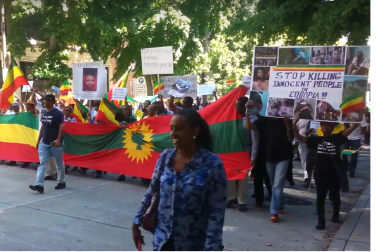
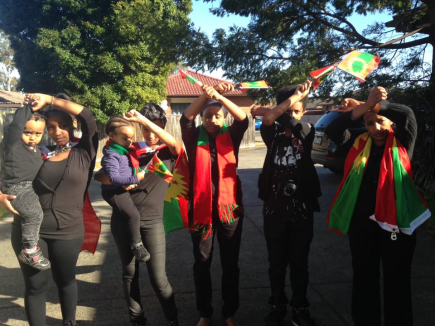
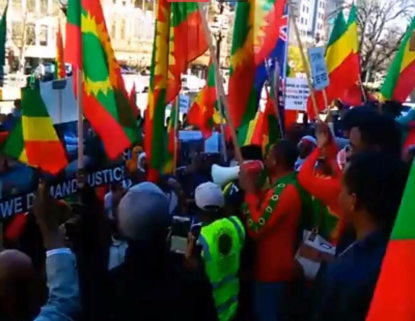
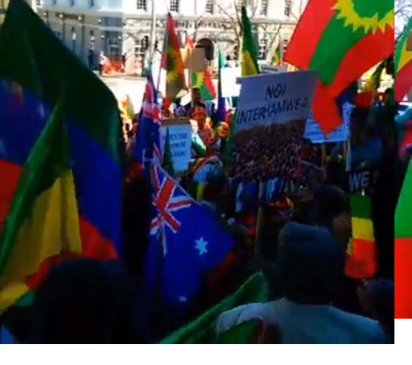

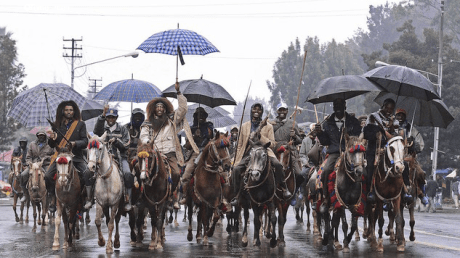



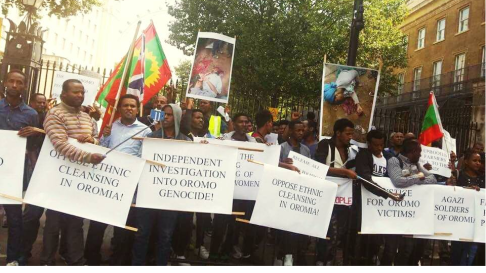
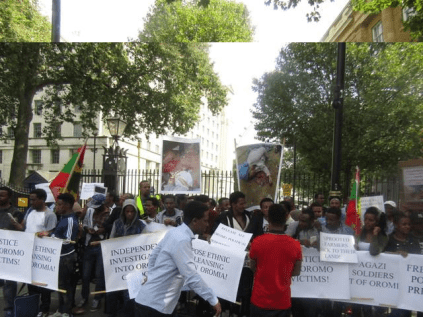
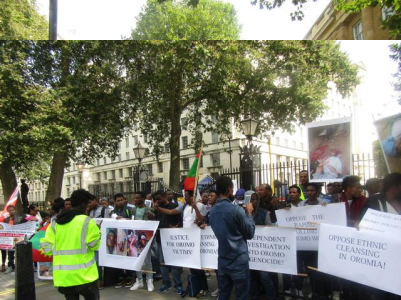
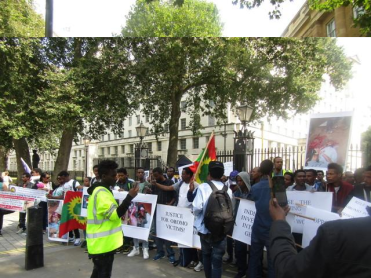
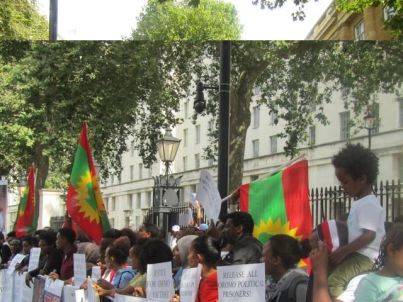
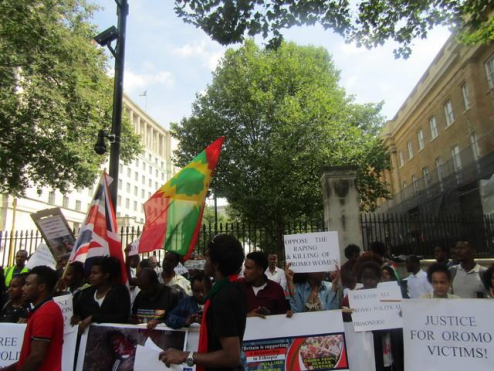
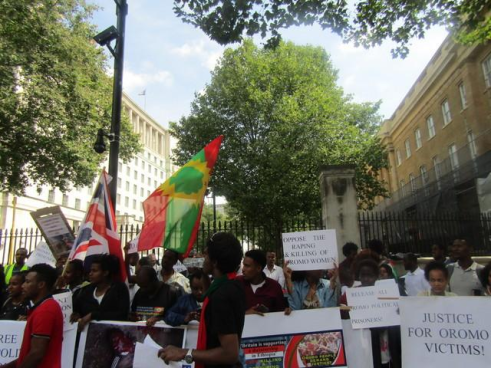
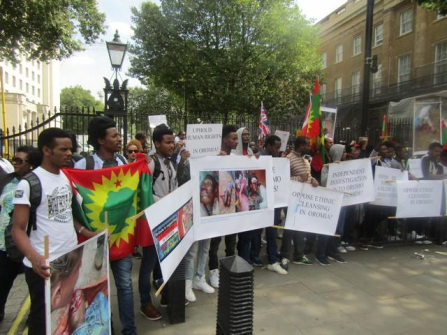
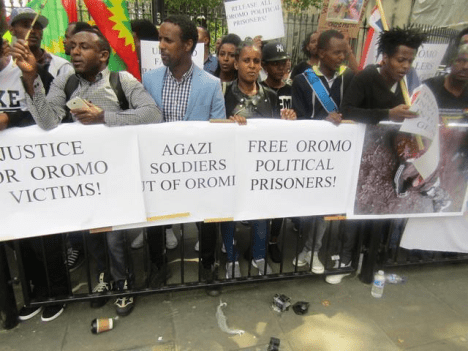
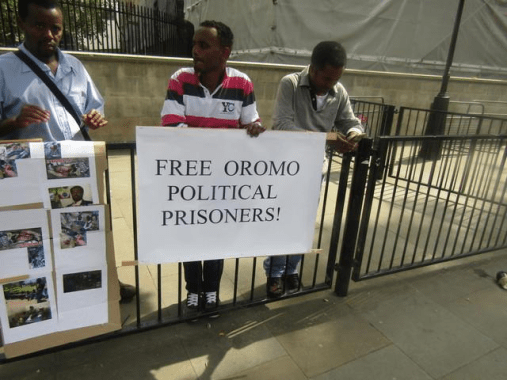
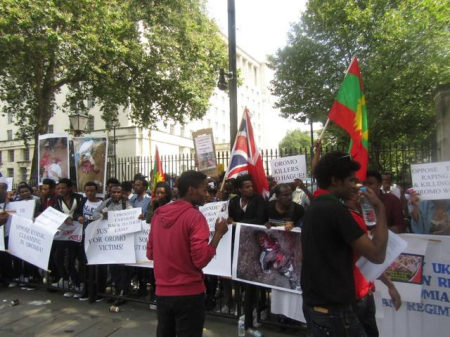
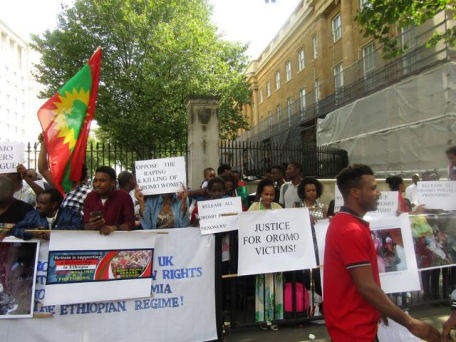
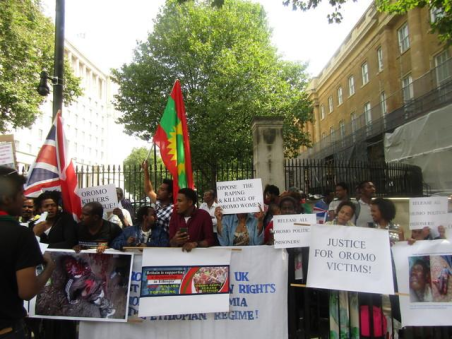
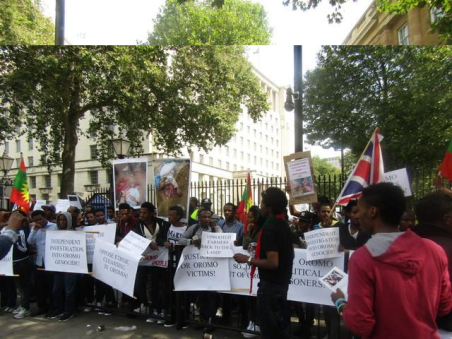
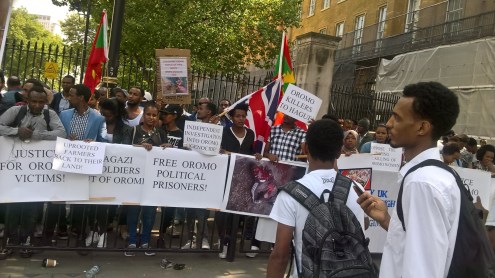
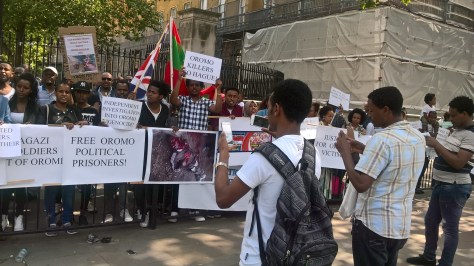
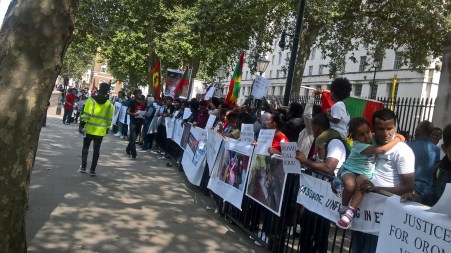
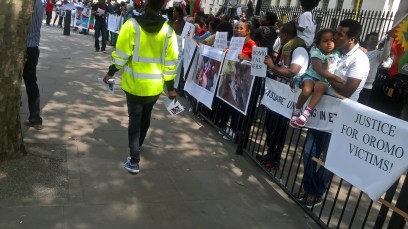
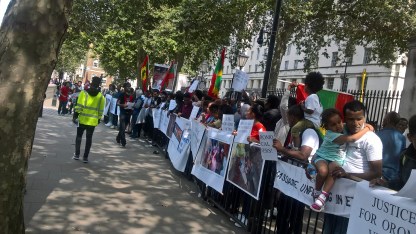

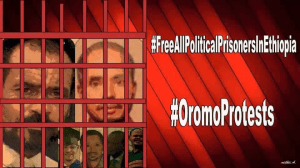

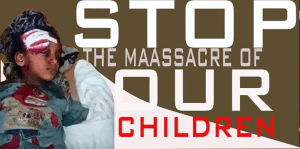

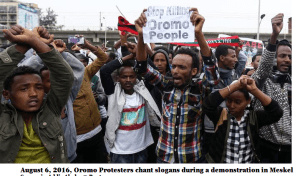





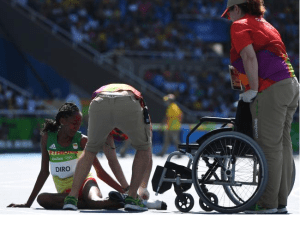
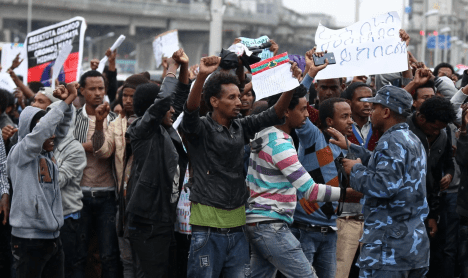
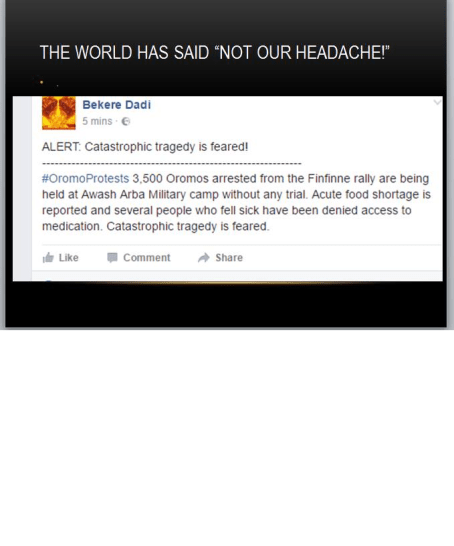

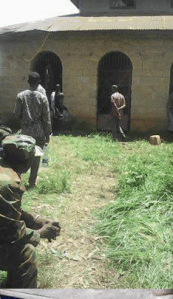
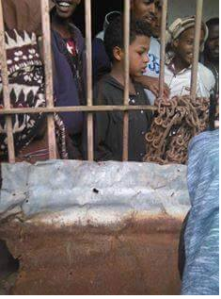
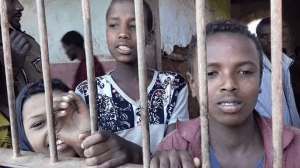
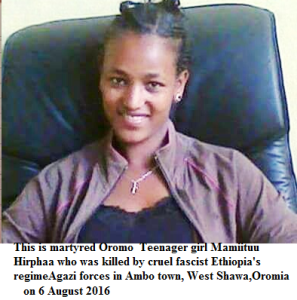
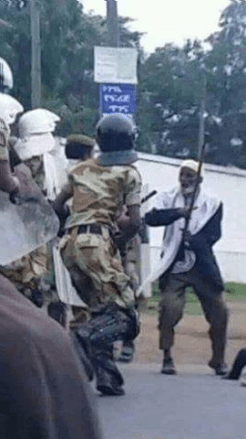
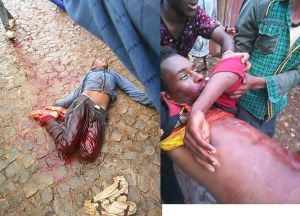



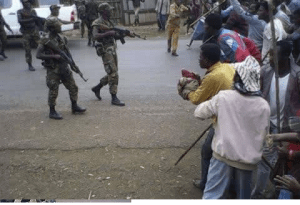
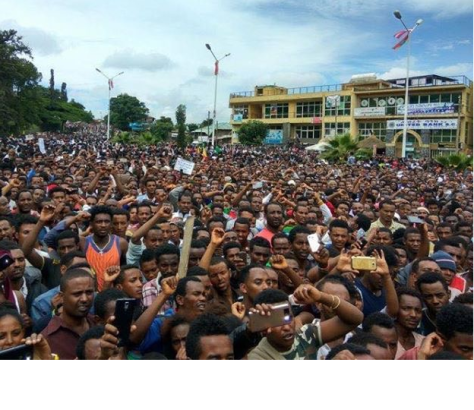





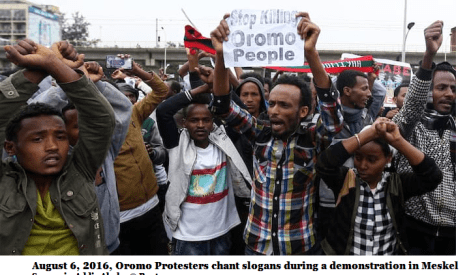
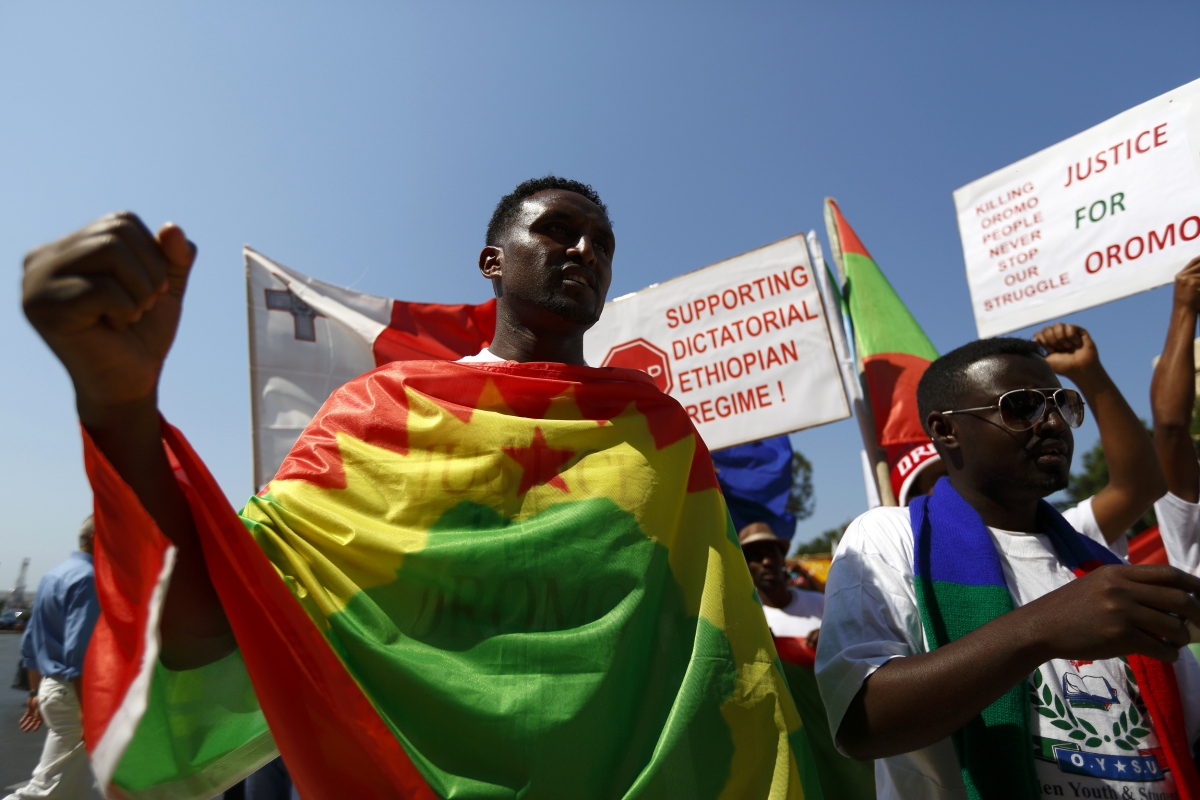
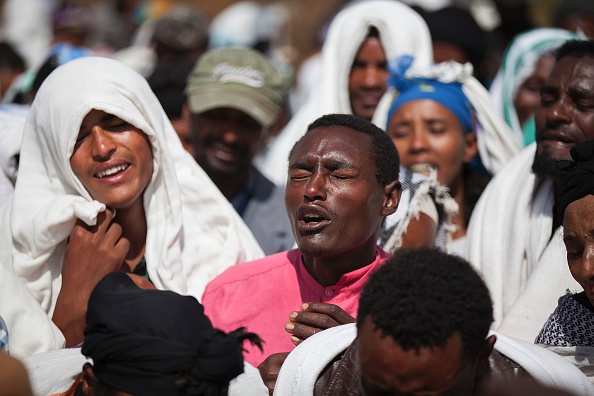
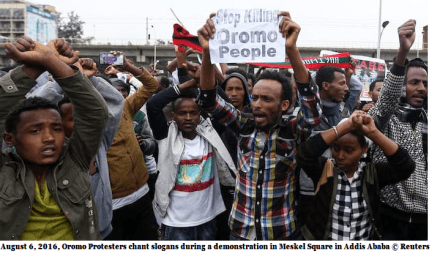


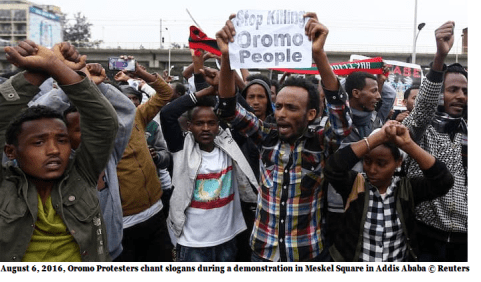
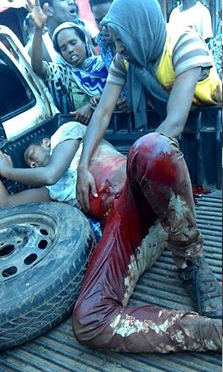
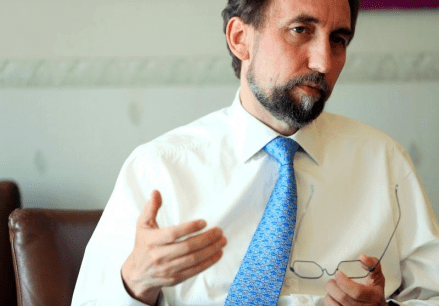


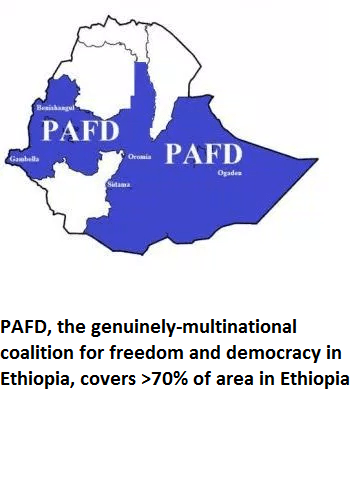
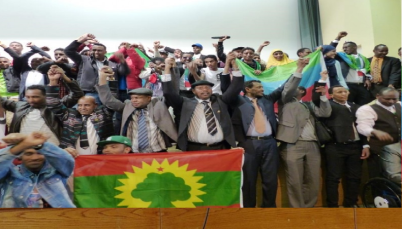


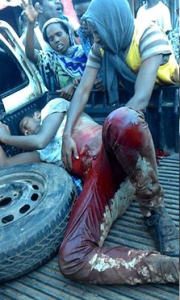
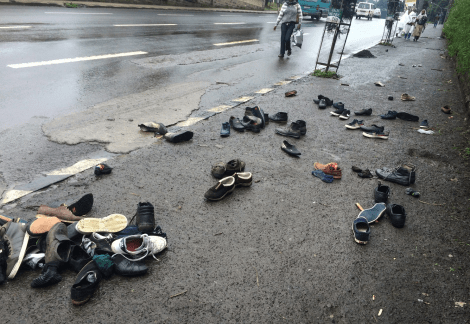
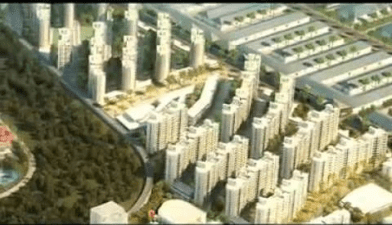

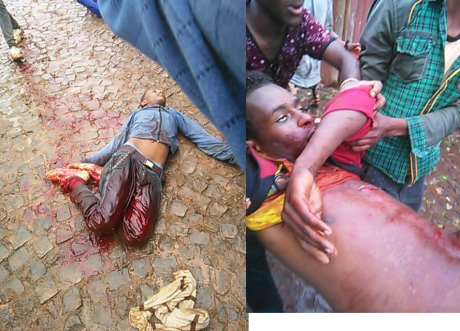
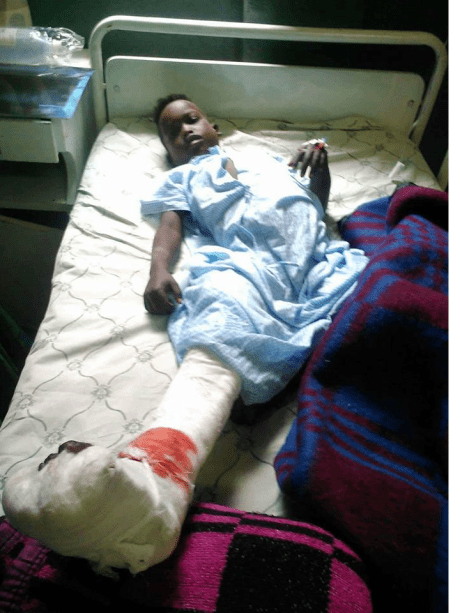




 REUTERS/Darrin Zammit Lupi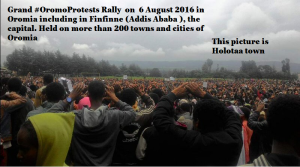



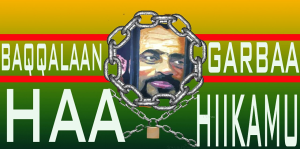

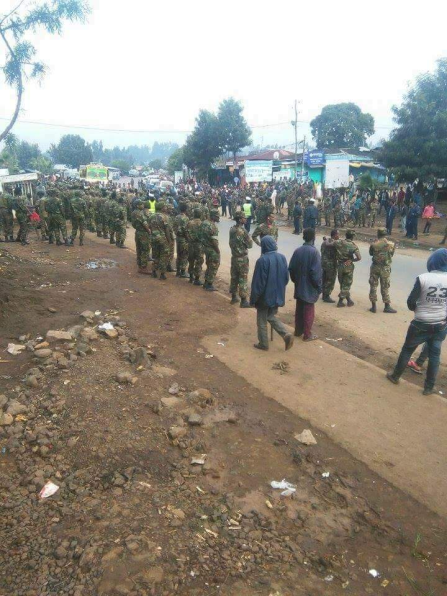

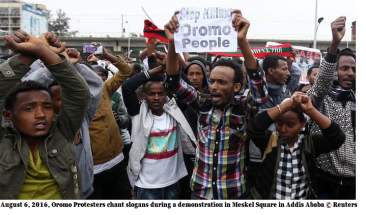
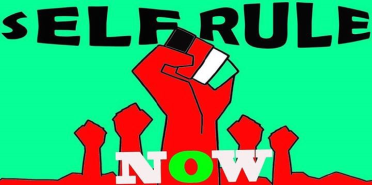
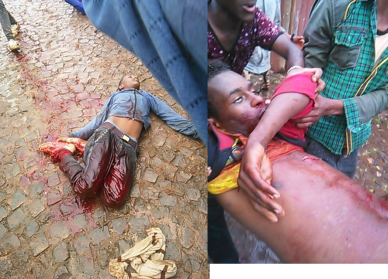

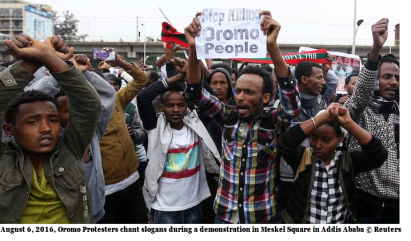
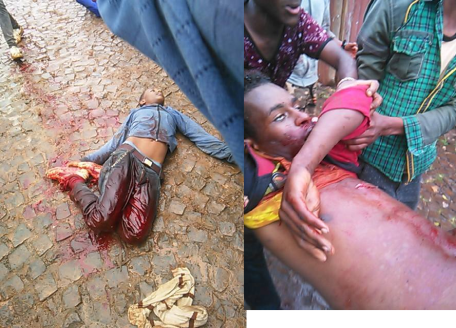
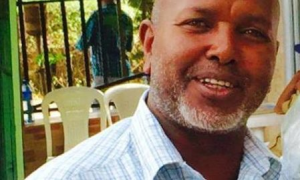
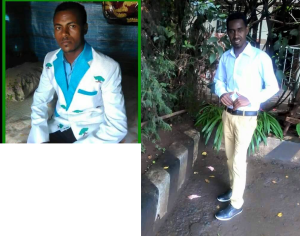
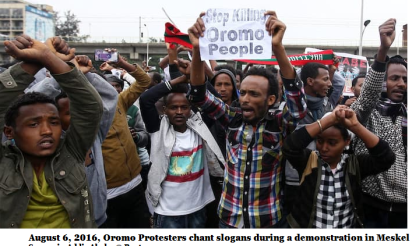

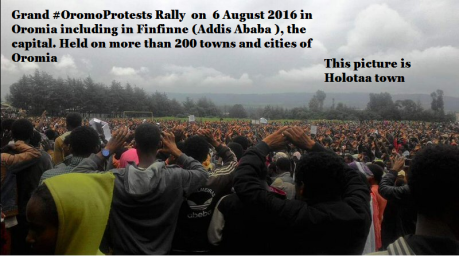

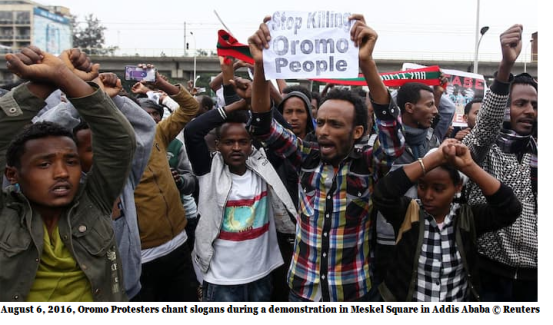


 Oromian Economist
You must be logged in to post a comment.