Economic and development analysis: Perspectives on economics, society, development, freedom & social justice. Leading issues in Oromo, Oromia, Africa & world affairs. Oromo News. African News. world News. Views. Formerly Oromia Quarterly
On 18 May 2017, the European Parliament passed a resolution on Ethiopia, drawing attention to the violent crackdown on civil society in the country and shedding light more particularly on the case of Oromo opposition politician Dr Merera Gudina, still behind bars. The resolution urges the Ethiopian government to end the state of emergency and the restrictions it entails, as well as to stop using anti-terrorism legislation to suppress peaceful opposition. The European Union (EU) High Representative is called to “put pressure on the Ethiopian government” for it to allowan independent investigation into the killings of protesters. The current humanitarian crisis affecting the Ogaden region and beyond is also tackled in the document.
The last eight months have been a synonym of political repression and humanitarian distress for Ethiopia’s most vulnerable peoples and particularly for the inhabitants of Oromia and Ogaden. On 8 October 2016, in response to ongoing protests after the Irrecha massacre of 2 October, during which 600 demonstrators were killed, the Ethiopian government declared a six-month state of emergency for Oromia. In the following week alone, the Ethiopian authorities had already arrested more than 1,600 people, mainly from the Oromia and Amhara regions. At the end of March 2017, the government announced an extension of the state of emergency by four months.
One emblematic case of the violent crackdown on human rights and civil liberties in the country is the arrest, on 1 December 2016, of Dr Merera Gudina, a high-level Oromo opposition politician, shortly after his return to Ethiopia. In his speech from 9 November in the European Parliament, Dr Gudina had roundly condemned the arrests that followed the institution of the state of emergency. On 23 February 2017, Dr Merera Gudina was charged with terrorism by Ethiopian prosecutors and since then he remains in jail, along with other political leaders, journalists and prominent elders.
Along with a dire human rights situation, the people from the region of Ogaden and beyond face a life-threatening crisis involving a devastating wave of deaths due to a cholera epidemic and famine. Due to this, since November 2016, it is estimated that 2,000 people have died in the remote rural areas of Ogaden.
During the debate that preceded the vote, MEPs raised their concerns over the recent events in Oromia and the overall human rights and humanitarian situation in the country. The text was supported by six parliamentary groups and authored by more than 90 MEPs.
A little bit more than a year after the last European Parliament resolution on Ethiopia, UNPO is glad to see that the MEPs are keeping up their efforts to bring up the plights of the Ethiopian peoples in the hemicycle. More than ever, our organization is committed to pursue its work with its Members, partners and decision-makers to urge Ethiopia to guarantee the protection of the human rights of its citizens, especially those who are the most vulnerable.
Demonstrators chant slogans while flashing the Oromo protest gesture during Irreecha, the thanksgiving festival of the Oromo people, in Bishoftu town, Oromia region, Ethiopia, October 2, 2016.
Ethiopia’s government has always rejected outside scrutiny of its horrific rights record, insisting that it can investigate itself. Yet it has conspicuously failed to do so. Past investigations by the Ethiopian Human Rights Commission (EHRC) have not met basic standards of impartiality, including its June 2016 report into abuses during the protests’ first six months. In April 2017, the EHRC acknowledged that 669 people were killed in an oral report to parliament, but found that security forces had used excessive force in just a few situations. This stands in stark contrast to what Human Rights Watch and other organizations have found, drawing on evidence that includes a wealth of video and photographic material. The EHRC hasn’t publicly released a version of their findings, so it’s impossible to assess their methodology or learn how they reached their conclusions.
International experts having access to areas where protests occurred and to people still in detention are important first steps towards meaningful investigations. But there are other obstacles too, like victims and witnesses being too afraid to speak out about government abuses. Thousands of Ethiopians have fled the country since the protests, seeking asylum in bordering countries. They too should be part of investigations into what happened, from locations where they may be more free to speak without fear.
Today’s resolution specifically calls on Federica Mogherini, the EU’s top diplomat, to “mobilise EU Member States” to urgently pursue the setting up of the UN-led international inquiry, and they can take the first step towards this at the upcoming Human Rights Council session next month in Geneva.
It’s hoped that implementing today’s timely resolution can help address the pervasive culture of impunity in Ethiopia. The resolution also reiterates the EU’s recognition of the importance of justice to ensure Ethiopia’s long-term stability. To the many victims of Ethiopia’s brutality, a UN-led inquiry could at least begin to answer pleas for justice that too often have gone unheard.
“The state of emergency was also used as a tool to crackdown on political opponents and media. An estimated 400 people have been killed in clashes with security forces in Oromia alone. The increased pressure in 2017 marks a continuation of a long-term worsening trend for Ethiopia, whose score has increased from 91.9 in 2006 to a high of 101.1 in 2017.” – Clicck here to read more at Fund For Peace: MOST WORSENED COUNTRIES IN 2017
Since the end of an almost two-decades long civil war that began in 1991, the Ethiopian People’s Revolutionary Democratic Front (EPRDF) has provided relative political stability and enabled strong economic development. Though an inter-state conflict with Eritrea over disputed territory flared in 1998-2000, since the ceasefire was declared between the two countries in December 2000, Ethiopia has been on a path of strong fiscal growth and has become an increasingly respected player within the international community. Ethiopia’s Gross Domestic Product (GDP) has risen from US$8.2 billion in 2000, to an impressive US$61.5 billion in 2015 – coinciding with major injections of foreign capital from development partners. Looking past these golden dollar sign headlines, however, there are signals that deep social and political fissures have the potential to set the country back on a path to conflict.
Ethiopia’s overall Fragile States Index (FSI) score has been incrementally worsening over the past decade, moving from 95.3 in 2007, to a score of 101.1 in this year’s 2017 index, with Ethiopia — along with Mexico — being the most-worsened country over the past year.
Some of this can be attributed to External Intervention, with its FSI score moving from 6.7 in 2007 to 8.7 in 2017, making it Ethiopia’s most worsened indicator overall for the decade. In 2000, Ethiopia received US$687.8 million in Official Development Assistance (ODA).1 By 2015, it had risen to over four times this with US$3.23 billion in ODA, mostly from the U.S., World Bank and European partners focused on social infrastructure and humanitarian aid.2 While this suggests low capacity of the state to plan and respond to natural disasters without external aid, arguably this development funding has also been crucial in stimulating the rapid economic trajectory of the country. Ethiopia’s economic indicators have both made improvements over the past decade, with FSI scores for Uneven Economic Development shifting from 8.6 in 2007 to 6.5 in 2017, and Poverty & Economic Decline from 8.0 in 2007 to 7.0 in 2017. While the economic trajectory tells one part of the story, the gap in public services between the urban areas such as bustling Addis Ababa, and rural areas – where 81% of the population still live3 — hint at growing disparities. The country’s Public Services score in the FSI has worsened from 7.0 in 2007 to 8.8 in 2017 – much of this is due to poor access to internet and communications, as well as limited improvements in water and sanitation facilities within the county.4 Health infrastructure also remains weak in many areas, with only 15% of births attended by a skilled health professional, and just 0.02 Doctors per 1,000 people within the populous country.5 The highly centralized nature of the EPRDF means that the nine ethno-linguistic regions of Ethiopia have limited power and resources for provision of public services. The military also plays an active role in reinforcing the centralized development agenda – with much of the county’s development driven via the military-controlled conglomerate Metals, Engineering Corporation (METEC). As a 2016 report by Dutch think tank Clingendael surmised, this increases risks of “corruption, nepotism and inefficient resource allocation,”6 all of which can increase the disconnect between development and rural populations.
Compounding these growing disparities between rural populations and economic growth are complex political and ethnic tensions. The historical influence of the Tigray ethnic group – which accounts for about 6% of the population – has been evident since the Ethiopian empire, and reinforced after the Tigray People’s Liberation Front (TPLF) defeated the Ethiopian government in 1991. The TPLF transitioned into the multi-party EPRDF, though Tigray elites are perceived to still hold significant political power within the essentially one-party state. Military leadership has also been dominated by Tigrayans,7 which makes perceptions of Tigray influence within the state apparatus all the more unpalatable to populations that feel increasingly excluded.
It is amidst this climate that major protests and violence have erupted against the government in Oromia and Amhara regions – home to the two largest ethnic groups in Ethiopia. Beginning in November 2015, Oromians began protesting the government’s planned expansion of the capital Addis Ababa into Oromia. Spiraling into a broader fight for increased political freedoms, representation and economic and land rights, the protests were met with brutal crackdowns by public security forces. Reflecting these dynamic factors, Ethiopia has seen negative spikes in its FSI score from 2016 to 2017 in Group Grievance, Human Rights and Rule of Law and State Legitimacy. Human Rights Watch suggests that more than 500 people have been killed during the government demonstrations in 2016, as well as reported incidents of arbitrary detention, torture, and media repression aided by the government’s State of Emergency declared in October 2016.8
While ethnicity remains a politicized factor within Ethiopia – and salient driver of group grievance for populations who feel excluded – it is useful to remember that conflict and violence operates within a system. Issues related to land tenure, access to resources, and economic exclusion can also be contributing drivers for the current insecurity. This is also complicated by ongoing demographic pressures resulting from floods and drought, and flows of refugees and Internally Displaced Persons (IDP) from natural disasters, the effects of climate change, and neighboring countries’ insecurity. Indeed, the FSI score for Refugees & IDPs has steadily worsened over the past decade from 7.9 in 2007 to 9.3 in 2017.
Ethiopia’s centralized government control has served it well for economic growth and rebuilding after the civil war and conflict with Eritrea – as well as maintaining control of the security apparatus amidst neighboring conflicts and regional instability. However, as worsening FSI scores show through both a longer-term trajectory, and recent 2017 spikes, the country must change course to strengthen internal social and economic resiliency. The recent spate of protests and insecurity in areas such as Oromia and Amhara demonstrate the need for political reform – both in perceptions of ethnic elite power – and in more meaningful political representation of each region. This will help to address the disparities in public service provisions that are adding to group grievance and feelings of exclusion. A less centralized approach will also help build governance capacities at regional and local levels – which will support rural development, and provide a chance for better targeted planning and response for natural disasters. As the fourth largest ODA recipient country in 2015, international partners should also continue to play an encouraging role in Ethiopia’s reform, including expansion of civil liberties which will reduce group grievance and increase the perceived legitimacy of the state.
Through addressing the conflict risks and structural vulnerabilities within the country, Ethiopia has a chance to continue a path of peaceful prosperity and even greater economic growth and development.
US doesn’t need Ethiopia in its war on terror in the Horn of Africa
BY ALEMAYEHU G. MARIAM,THE HILL, 5 MAY 2017
Earlier this month, U.S. Defense Secretary Jim Mattis visited the Middle East and Africa to “reaffirm key U.S. military alliances” and engage with strategic partners.” Mattis only visited the tiny nation of Djibouti in the Horn of Africa where the U.S. maintains its largest military base. Ethiopia was conspicuously absent from the “strategic partner” lineup.
Zeid expressed alarm at the “extremely large number” of arrests and said some charges against those detained “may be misplaced.”He asked that U.N. staffers be allowed to visit the areas of unrest. “We may then perhaps provide a list to the government and ask for specific releases” of people detained, Zeid said. “This requires more attention.”
ADDIS ABABA, Ethiopia (AP) — Ethiopian officials have blocked United Nations access to areas that experienced deadly protests during one of the country’s most violent periods in recent memory, the U.N. human rights chief said Thursday.
Zeid Ra’ad al-Hussein spoke during a three-day visit to the East African nation at the government’s invitation. Ethiopian Prime Minister Hailemariam Desalegn has rejected United Nations and other outside requests to investigate the months of anti-government protests demanding more political freedoms.
The government has said at least 669 people were killed and largely blames the political opposition for the unrest. Opposition figures and human rights groups say security forces killed protesters, while the government has called security forces’ response “proportionate.”
More than 26,000 people were detained amid the protests, and Ethiopia in October declared a state of emergency that recently was extended.
Zeid expressed alarm at the “extremely large number” of arrests and said some charges against those detained “may be misplaced.”
He asked that U.N. staffers be allowed to visit the areas of unrest. “We may then perhaps provide a list to the government and ask for specific releases” of people detained, Zeid said. “This requires more attention.”
The human rights chief also expressed concern about anti-terrorism laws in Ethiopia, saying that “an excessively broad definition of terrorism may be misused against journalists, bloggers and members of opposition parties.”
Earlier Thursday, Zeid addressed the crisis in neighboring South Sudan, saying up to 50,000 civilians in the country’s Upper Nile region are at imminent risk of human rights violations as government troops close in.
Many civilians in Aburoc town, some of whom recently fled a military attack on nearby Kodok town, are ethnic Shilluk and have faced a sharp rise in government attacks as South Sudan’s civil war continues.
Zeid said military commanders on both sides show little regard for protecting civilians.
Separately, the U.N. humanitarian affairs agency said roughly 100,000 civilians have been displaced after a South Sudan government offensive in the Jonglei region.
Army spokesman Santo Domic Chol did not comment on fighting in either location but said government attacks on civilians “didn’t make sense” because civilians are not armed.
Associated Press writer Justin Lynch in Nairobi, Kenya contributed.
Breaking:UN High Commissioner for Human Right "My office unable to corroborate or confirm findings of th #Ethiopian Human Rights Commission" pic.twitter.com/aT2TyFS5iT
At a press conference, Zeid said he was concerned about the mass arrests last year during protests driven by discontent among the country’s two largest ethnic groups, which left hundreds dead.
“The extremely large number of arrests, over 26,000, suggests it is unlikely rule of law guarantees have been observed in every case,” Zeid said.
“I am requesting the government to consider, if possible, the release of a number of individuals whose arrest or conviction appears to have been motivated by fear of criticism rather than evidence of intent to spark violent overthrow,” he said. – More at Daily Mail.
NewsweeK: U.N. Renews Calls to Investigate Deadly Anti-Government Protests in Ethiopia
The U.N. has renewed calls to the Ethiopian government to let human rights officials conduct independent investigations into allegations of abuses by security forces against protesters in the country in 2015 and 2016.
“Tens of millions of hectares of land on the African continent have been grabbed by foreign investors in recent years. This has led to loss of life, land, and livelihoods for millions, and threatened the very survival of entire communities and indigenous groups,” commented Anuradha Mittal, Executive Director of the Oakland Institute. “The World Bank must acknowledge that this is not development. It is not poverty reduction. These are investments for corporate profits that exploit and displace people.”
In Africa, the investigation uncovered 11 projects backed by IFC clients that have transferred approximately 700,000 hectares of land to foreign investors. The projects include agribusiness concessions in the Gambela region of Ethiopia that were cleared of their indigenous inhabitants during a massive forcible population transfer campaign in the area; oil palm plantations in Gabon that have destroyed 19,000 hectares of rainforest and infringed on the customary land rights of local communities; and a gold mine in Guinea that led to the violent forced eviction of 380 families.
“These projects are antithetical to the World Bank’s mission of fighting poverty through sustainable development,” said David Pred, Managing Director of Inclusive Development International.
Oakland, CA—The World Bank Group has indirectly financed some of Africa’s most notorious land grabs, according to a report by a group of international development watchdogs. The World Bank’s private-sector arm, the International Finance Corporation (IFC), is enabling and profiting from these projects by outsourcing its development funds to the financial sector.
“Pouring money into commercial banks that are driven only by profit motivations is not the way to foster sustainable development,” said Marc Ona Essangui, Executive Director of Brainforest and winner of the Goldman environmental prize in 2009. “In Gabon, this development model has instead enabled a massive expansion of industrial palm oil, which threatens our food security and the ecological balance of Congo Basin’s ancient rainforests.”
“Tens of millions of hectares of land on the African continent have been grabbed by foreign investors in recent years. This has led to loss of life, land, and livelihoods for millions, and threatened the very survival of entire communities and indigenous groups,” commented Anuradha Mittal, Executive Director of the Oakland Institute. “The World Bank must acknowledge that this is not development. It is not poverty reduction. These are investments for corporate profits that exploit and displace people.”
The report is based on a yearlong investigation conducted by Inclusive Development International, which found that IFC-supported commercial banks and private equity funds have financed projects across the world that have forcibly displaced hundreds of thousands of people and caused widespread deforestation and environmental damage. In Africa, the investigation uncovered 11 projects backed by IFC clients that have transferred approximately 700,000 hectares of land to foreign investors.
The projects include agribusiness concessions in the Gambela region of Ethiopia that were cleared of their indigenous inhabitants during a massive forcible population transfer campaign in the area; oil palm plantations in Gabon that have destroyed 19,000 hectares of rainforest and infringed on the customary land rights of local communities; and a gold mine in Guinea that led to the violent forced eviction of 380 families.
“These projects are antithetical to the World Bank’s mission of fighting poverty through sustainable development,” said David Pred, Managing Director of Inclusive Development International. “They also make a mockery of the IFC’s social and environmental Performance Standards, which are supposed to be the rules of the road for the private sector activities that the IFC’s intermediaries support.”
Inclusive Development International’s yearlong investigation uncovered 134 harmful or risky projects financed by 29 IFC financial-sector clients. These projects are found in 28 countries and on every continent except Antarctica. A database of the findings can be found here.
In response to the concerns raised in the Outsourcing Development investigation and by the IFC’s Compliance Advisor Ombudsman, IFC Executive Vice President Philippe Le Houérou recently acknowledged the need for the World Bank Group member to re-examine its work with financial institutions. In a blog post from April 10, Le Houérou wrote that the IFC would make “some important additional improvements to the way we work,” by scaling back the IFC’s high-risk investments in financial institutions, increasing its oversight of financial intermediary clients and bringing more transparency to these investments, among other commitments.
The IFC has also exited investments in banks highlighted by the Outsourcing Development investigation, including ICICI and Kotak Mahindra in India and BDO Unibank in the Philippines.
“We welcome the IFC’s new commitments to encourage a more responsible banking system by increasing its oversight and capacity building of financial sector-clients moving forward,” said Pred. “However, rather than simply divest, we want to see the IFC work with its clients to redress the serious harms that communities have suffered as a result of the irresponsible investments that we have brought to light.”
“IFC’s collusion in land-grabbing in Africa is deeply shocking, so its pledge to reduce high risk lending to banks is welcome, said Kate Geary, Forest Campaign Manager for Bank Information Centre Europe. “But how can we be sure when there is no disclosure of where over 90 per cent of IFC’s money invested through third parties ends up? The IFC’s financial sector clients must come clean about projects they are financing so they can be held accountable to their commitments to invest responsibly.”
Financial-sector lending represents a dramatic shift in how the IFC does business. After decades of lending directly to companies and projects, the World Bank Group member now provides the bulk of its funds to for-profit financial institutions, which invest the money as they see fit, with little apparent oversight. Between 2011 and 2015, the IFC provided $40 billion to financial intermediaries such as commercial banks and private equity funds. Other development finance institutions have followed suit.
Unjust Enrichment: How the IFC Profits from Land Grabbing in Africa is available at:
Ethiopia wants companies that make clothes to view it as one of the world’s most hospitable places to operate. Low employee wages and cheap power have led foreign companies to gravitate towards the Horn of Africa nation in recent years. The government recognizes the strategic importance of garment and textile making, and has continued to invest in the sector by constructing large industrial parks like the Hawassa Industrial Park.
But its land and human rights problems could jeopardize that ambition, according to a new report from risk consultancy firm Verisk Maplecroft. Protests over land reform and political participation have rocked the country since 2015, leading to the reported death of hundreds of people and the detention of tens of thousands of others.
“The sector remains exposed to a host of political, social and environmental risks,” says Emma Gordon, a senior Africa analyst with Verisk. And “many of these issues are unlikely to be resolved over the coming five to ten years.”
These concerns could affect the cotton industry, and limit the opportunity to expand sustainable production. The persistence of child labor, water pollution, the exposure of workers to harmful chemicals, and the possibility of resumption of protests also pose a threat.
Ethiopia is one several east African countries—including Kenya, Uganda, and Tanzania—identified as an important center for apparel sourcing. In a 2015 survey by global management company McKinsey, Ethiopia appeared as one of the top countries worldwide where companies wanted to source their garments from in the next five years.
Retail giants such as H&M, Primark, and Tesco have sourced or established textile factories in Ethiopia to diversify from Asian markets like China and Bangladesh. The footwear industry in Ethiopia is also growing, with the Huajian Group, the Chinese manufacturer that produces Ivanka Trump’s shoe brand, talking about plans to move production to Ethiopia.
Industrial parks in Ethiopia (Courtesy/ Verisk Maplecroft)
These operations could be undermined by the political and social protests. The demonstrations began over plans to expand the capital Addis Ababa into neighboring towns and villages populated by members of the Oromo community—the country’s largest ethnic group. Although the Tigray-dominated government canceled the plans, protests escalated.
At the height of the protests in August and September 2016, flower farms and foreign commercial properties worth millions were burnt. The government responded by quashing the protests, shutting down the internet, and instituted a state of emergency in October that has lasted to date.
Gordon says that given that the “underlying drivers” of the protests have not been addressed, it is “highly likely that similar protests will erupt again.”
Land problems are also expected to intensify as drought ravages the country. Last week, the government announced that 7.7 million people were in need of emergency food aid. While the economy depends on agriculture, just 5% of the country’s land is irrigated, according to the United States Agency for International Development. The competition over fertile land as well as the government’s controversial plan to lease large swaths of land to foreign investors and private interests could jeopardize prospects for companies interested in doing business in Ethiopia.
“Investors are likely to become increasingly unpopular in the communities that they rely on for both their security and their workforces,” Gordon said.
Land Grabbing and Violations of Human Rights in Ethiopia
Malkamuu Jaatee, Anywaa Survival Organization
28 January 2016
Introduction
Land grabbing is classically known as the seizing of land by a nation, state or organization, especially illegally or unfairly. It is recently redefined as a large scale acquisition of land through purchases or leases for commercial investment by foreign organizations (6). Both micro and macro scales of land grabbing can result in displacement of indigenous communities and disappearance of their identities over time, because land is not only a fixed asset essential to produce sufficient amount of crop and animal to secure supply of food, but it is the foundation of identities (language, culture, & history) of communities living on the land.
Changes to land use without consultation of traditional owners of the land – mainly by forceful displacement of indigenous peoples, can, in the long-term, result in the disappearance of human communities traditionally identified with that ancestral land. Both expansion of amorphous towns & cities, without meaningful integration of indigenous peoples and large-scale transfers of rural land to investors, are the major political strategies of the current government of Ethiopia under the Tigrayan People’s Liberation Front (TPLF) or the Ethiopian People’s Revolutionary Democratic Front (EPRDF) to achieve the target of the systematic eradication of rural communities living around cities and at vicinity of agro-industries, mainly in Oromia and Southern (Benishangul-Gumuz, Gambella and Omo) regions. Conflicts arising from land grabbing have become very complex wars disturbing the daily lives of the oppressed peoples of Ethiopia, because the peoples are undemocratically represented by the regime.
Conflicts arising from land grabbing have become very complex wars disturbing the daily lives of the oppressed peoples of Ethiopia, because the peoples are undemocratically represented by the regime.
The allocation of farmland to investors has been going on in Ethiopia since at least 1995. The years between 2003 and 2007 were the boom years for cut-flower exportation to Europe. Demand for land by foreign investors began to increase sharply since 2006. More than one-third of the land allocated to investors in the ten years period was given out in 2008. Year 2008 was a mad rush of investors to get access to land with many applicants requesting large tracts measuring more than 10,000 hectares (21). About one million hectares of land was transferred to 500 foreign investors in the period between 2003 and 2009. The largest foreign holding is Karuturi Company of India, which has been given 0.3 million hectares of land in Gambella and 11,000 in Bako district of Oromia (21). In 2009 and 2010, about 0.5 million hectares was allocated to investors. The land transferred to investors between 2004 and 2008 was 1.2 million hectares (27).
The land transferred to large-scale investors, without including land already allocated, has been planned to increase from 0.5 million in 2011 to 2.8 million hectares in 2013, and to 3.3 million hectares in 2015 (15 & 16). Total land transferred to investors will measure about 38% of land currently utilized by smallholders (21). Therefore, at least 7 million hectares of agricultural land was transferred to investors between 1995 and 2016. In addition the long-term plan to expand Addis Ababa city administration at 200 kilometers radius was secretly designed by the regime until the hidden plan has made public in 2014.
The impact of land grabbing in Ethiopia is manifested through five interconnected factors that the regime has designed to sustain its military, political and economic powers in order to protect its brutal and savage governance system for the next quarter or half a century. Analytical evaluation of effect of current land grabbing policy indicates destabilization of livelihood assets of rural communities of Oromia and Southern Ethiopia through the following five factors: aggravation of poverty, increase of food insecurity, intensification of conflicts, degradation of ecosystem quality, and deterioration of human rights conditions (13). This review focuses on the human rights violation and its political implications.
1. Deterioration of conditions for basic human rights in Ethiopia
The TPLF regime is escalating its violations of human rights through the implementation of a very dangerous policy of land grabbing in Oromia and Southern Ethiopia. The regime has killed at least 180 innocent Oromo civilians in the last two months (mid November 2015 to mid January 2016), while the Oromo people peacefully protesting against the unfair land use policy. Thanks to the founders of media technologies, reports of human rights violations are daily circulated around the globe at high intensity and are known to the international communities. The regime is accustomed to kill unarmed civilians since it has illegally controlled the capital city of Oromia, Finfinne (Addis Ababa), on May 28, 1991. Between 1994 and 2010, OSG (the Oromo Support Group, a UK-based human rights organization) has reported 4185 instances of extrajudicial killings, and 944 disappearances of civilians suspected of supporting groups opposing the government, a majority of them from the Oromo people (19). The capacity of human rights organization to access data of extrajudicial killings and disappearances in Ethiopia is at most limited to 10% of data recorded by the OSG, because carrying out politically motivated extrajudicial killings in darkness is common in the security system of the regime. Therefore, the number of civilians murdered by the regime, between 1991 and 2016, can be above 56,000 (fifty six thousands) based on a conservative estimation of the recorded extrajudicial killings in Ethiopia.
The violations of civil rights during the process of land grabbing include both direct and systematic crimes against humanity. Human rights violations directly carried out by the regime include physical mistreatment like beating, raping, detaining, torturing and killing during the forced evictions of rural communities from their ancestral land. Survival’s director, Stephen Corry, said that, “The Ethiopian government and its foreign backers are bent on stealing tribal land and destroying livelihoods: they want to reduce self sufficient rural communities to a state of dependency, throw all who disagree into prison, and pretend this is something to do with progress and development” (24). Systematic violations of human rights mainly involve limitation of accessibility to basic human needs through the destruction of livelihood assets of the people. Outcomes of violations of the legitimate rights of indigenous people to access ancestral land are as follows: increase of population living in extreme poverty; reduction of subsistence crop and animal production; unsafe drinking water and shortage of food; poor health conditions; increase of internal displacements and refugees; financial disability to access basic needs; and reduction to the status of forced manual laborer.
The direct human rights violation practices of the regime in Oromia and Southern (Benishangul-Gumuz, Gambella and Omo) regions of Ethiopia demonstrate atrocities of the land grabbers. For example, human rights violations in the lower Omo valley are characterized by arbitrary arrests and detentions, beatings and mistreatment, governing through fear and intimidation, and violations of economic, social and cultural rights (11). The government and its police force are cracking down, jailing and torturing indigenous people and raping women in the Omo region that the people do not oppose the land grabs and an interviewee said, “Now the people live in fear – they are afraid of the government” (23). In a report based on more than 100 interviewees in May and June 2011, a victim from Gambella said, “My father was beaten for refusing to go along [to the new village] with some other elders, he said, ‘I was born here – my children were born here – I am too old to move so I will stay,’ but he was beaten by the army with sticks and the butt of a gun, he had to be taken to hospital, and he died because of the beating” (10). About 200 Bodi, 28 Mursi and 20 Suri tribes men and women of Omo region are in jail, and the indigenous people now fear that the security forces may start killing people and they said, “The arrests are a show of force, to intimidate us not to oppose the land grabbing policy: ‘we lived here in peace, in the heart of our land, the place where all of our cattle were grazing during both the rainy and dry seasons; but now, in this place there is a plantation owned by a rich Malaysian company who trained 130 soldiers and armed them with 130 machine guns by the government: if our people oppose the land grabbers, the soldiers are ready to kill us” (22). Since mid November 2015, the regime put Oromia under a martial law. The Oromo people of all age (children, youth, and elderly) and all classes (schoolchildren, university students, peasants, teachers, medical staff, engineers and other civilians) are indiscriminately targeted by the brutal and savage governance of the regime. The special military (Agazi) and the federal police forces of the regime have wantonly killed hundreds of Oromo civilians since April 2014. The regime has declared war on the Oromo people in order to maintain its illegal occupation of Oromia.
The then head of the TPLF regime, Prime Minister Meles Zenawi, rejected the critics of land grabbing as ill-informed and he said, “We want to develop our land to feed ourselves rather than admire the beauty of fallow fields while we starve.” Also the head of the government agency responsible for land leasing (Mr. Essayas Kebede) said, “Ethiopia benefits in many ways from land deals that we will receive dollars by exporting food; the farms provide jobs; they import know how; they will help us to boost productivity; and therefore, we will improve food security” (20). However, the institutionalization of corruptions will effectively limit the distribution of investment benefits to the poor people of Ethiopia. For example, between 2000 and 2009, Ethiopia lost US$11.7 billion to illicit financial outflows. The illicit money leaving the economy in 2009 was US$3.26 billion, double of the amount in 2007 and 2008, and greatly exceeds the US$ 2 billion value of total exports of Ethiopia in 2009 (8). Even though the peoples of Ethiopia try, by any means, to fight poverty, the possibility to defeat evil system is full of challenges. The global shadow financial system happily absorbs money that corrupt public officials, tax evaders and abusive multinational corporations siphon away from the peoples of Ethiopia (8). Therefore, the implementation of global land grabbing policies directly limit socio-economic development of the rural communities to access primary human needs – mainly sufficient food, pure & safe water, and adequate house, cloth, & medical services.
Human rights violations directly carried out by the regime include physical mistreatment like beating, raping, detaining, torturing and killing during the forced evictions of rural communities from their ancestral land.
The right to feed households and family is realized in rural areas of Sub-Saharan Africa with the right to access agricultural land to produce sufficient food through crop and animal productions. Failure of African governments to protect & guarantee sustainable use of land & water, to produce food by subsistence peasants, constitutes a violation of the right to food, because assuring long-term supply of food is part of their obligations in relation to the right to food. The right to adequate food exists when every individual, household or family has achieved physical & economic access to adequate food at all times or means for its procurement. Agricultural investment policy of the TPLF regime encourages export oriented crop production. For example, the Saudi Star produces rice in Ethiopia and export to the Middle East. Karuturi marketing & logistics make no secret of the fact that the investment is commercial that the company will sell its agricultural products to those who pay most (20). But, at least 80% peoples of Ethiopia are very poor to access food economically to buy it, if it is available. Agricultural companies mainly focus on production of commercial crops, because investment on agriculture in remote areas is profit oriented. Therefore, the investment on the production of local stable food crop is very marginal. For example, the investment of Indian agro-companies on food crop is less than 10% (25). The violation of land accessibility rights of rural communities has resulted in increase of starvation rate through dramatic reduction of subsistence crop or/and animal productions. Therefore, the land grabbing policy of the TPLF regime will increase food insecurity.
The right of rural communities to access agricultural land is the most important factor to achieve primary standard of living, because agriculture is the foundation of the livelihood assets of rural communities. Access to land is an essential element of the right to an adequate standard of living and the realization of the right to work (art. 11 and art. 6 ICESCR). Land grabbing leads to forced displacements and refugees. The right to adequate housing is the right to live somewhere in security, peace and dignity (3). The right to housing is directly linked to the right to be protected from forced evictions. For example, the forced displacement of 270,000 indigenous peoples from the western Gambella and Omo regions to new villages by the government of Ethiopia details the involuntary nature of the transfers, loss of livelihoods, deteriorating food situations, and ongoing abuses by the armed forces against the affected people: and that many of the areas from which people are being moved are leased by the government for commercial agricultural development (10 & 11). The violation of the rights to live somewhere in peace is defined as the permanent removals of individuals, families, and/or communities from their homes and/or lands that they occupy, on either a permanent or temporary basis, without offering them appropriate measures of protection (4). Rural communities of the Omo Valley of South Ethiopia are neither ‘backward’ nor in need ‘modernization,’ they are as much a part of the 21st century civilization as the multinationals that seek to appropriate their land; but forcing them to become manual laborers will certainly lead to a drastic reduction in quality of their lives, and condemn them to starvation and destitution like many of their fellow countrymen’ (23). Despite some instances of income improvement by export opportunities, the expansion of world agricultural trade has failed to translate into better living conditions for most of workers on farm in the developing world (12).
Governments and private investors assume rural community accessibility to the job market compensates for the loss of land and livelihoods. However, income derived from daily wages never replaces livelihood assets of rural community, which are constantly and directly derived from land use. For example, some peasants were employed as casual laborers (day laborers) by the coffee plantation following eviction from their land and they received about 1$ per day for a fixed amount of work that they have often completed in two days work (1). Large shares of commercial agriculture jobs are characterized with very poor working conditions mainly very low payment, low-skilled daily work, seasonal fluctuation, without health insurance, very high risk of accidental death without insurance, violence, harassment, and employment of underage children. A young boy is digging up weeds kneeling in the middle of a sugar cane field in blistering temperature of 40 C º, while an Indian worker stands over him to make sure he does not miss any and Red is eight years old and earns 73 pence for one day work, i.e. less than the cost of using pesticides (20). Children attending primary school are significantly decreased in areas of land grabbing. Deputy Head of a school (Tigaba Tekle), near the Karuturi farm said that only 5 out of 60 students are sometimes attending a class, because most of them are working at agricultural fields of Karuturi (20). Land commercialization will never establish sustainable and safe employment opportunities for rural peoples of Oromia & Southern regions, because colonial governance system never takes into consideration security and dignity of oppressed peoples. Therefore, unsustainable and unsafe employment conditions can not compensate loss of livelihoods of rural communities forcefully evicted from ancestral land.
2. Political function of land grabbing policy of the TPLF regime
Governance authorities of imperial, military, and TPLF regimes are highly centralized with absolute land ownership right to sustain rule of dictatorship through chains of colonial agents at regional, provincial, and local levels of Ethiopia. Gebar land tenure system in the South as well as the Rist tenure system of North Ethiopia during imperial regime shows some resemblance to the current land tenure system and with some reservations also it resembles that of the military regime, with the exceptions that the communal Rist system is replaced by the organs of state, i.e. the peasant associations. Land grabbing is the major source of military, political, and economic powers of successive regimes of Ethiopia. Government of Ethiopia (the TPLF regime) is owner of the land, but the rights of individuals and communities are ‘holding (use) rights’ (Proclamation No. 456/200550). Though ethnic equality is now legally recognized, in practice, emergent regions are still politically marginalized and permitted less autonomy, partly due to the federal development strategy, which requires central control of local land resources and changes in livelihoods (14).
Centralization of land governance politics of successive regime of Ethiopia is manifested through the following five levels of land use rights: owner-ship, management, sanction, full accessibility right, & limited accessibility right (Table-1). Land tenure politics of both imperial and military or TPLF regimes are generally sharing similar political goal, i.e. manipulation of land use rights to maintain monopoly of governance powers. The commercialization of land has served as a political advantage for the state, because it enhances greater concentration of authority in the hands of the governors. A woreda (district) or an urban administration shall have the power to expropriate rural or urban landholdings for public purpose where it believes that it should be used for a better development project to be carried out by public entities, private investors, cooperative societies or other organs, or where such expropriation is decided by the appropriate higher regional or federal government organ for the same purpose (Proclamation No. 455/200558).
Table 1: Two types of land use rights in Ethiopia since 1889
The TPLF regime is intentionally violating the land accessibility right of rural communities of Oromia and Southern Ethiopia to achieve political goals of maintaining its brutal & savage governance system. The regime has already institutionalized practices of human right violations through manipulation of constitution. It formulated politically motivated proclamations to limit humanitarian activities of Non Governmental Organizations (NGOs) using charities proclamation and to crash political opponents through manipulation of anti-terrorism law in order to protect its monopolistic ownership of military, political, and economic powers (18). The regime is not hesitated to practice arbitrary arrest, long detention, or extrajudicial killings of tens of thousands, and torturing peoples suspected to be supporters of opposition political organizations to sustain fears in civil societies. The regime is systematically escalating the level of insecurity by aggravating poverty, expanding borders of food insecurity, manipulating conflicts, degrading safety of ecosystem, and escalation of violations of human rights in order to produce the poorest of poor peoples mainly in colonized regions of Ethiopia. Thus it is intended to use victims of poverty as political animal through manipulation of land use right. The regime easily regulates support of rural communities for the opposition political parties by threatening subsistence livelihoods of about 80% of 95 million people. The rural communities are directly controlled by the regime and they cannot freely vote opposition political parties during election, because they will be deprived of land use right if they do so.
The regime […] uses food aid as an instrument to achieve political objectives, and to protect its governance powers.
The very existence of governance powers of the regime is possible only with external aids. Foreign aid was essential for birth of the TPLF regime and it is also very essential for growth and expansion of the regime, as oxygen is essential for lung. During the 1974 – 1991 financial, material, & technical supports of the international donor communities were channeled through political NGOs organized by the TPLF to areas under its control to support both military and emergency programs (17). The aids were resulted in increase of peasant-based supports, legitimacy expansion among the civilian population, use of aid resources to support organizational structures, and quantitative capability in feeding the armies (26). Since 1991, the regime received very huge sum of financial aids. It received at least a sum of US $ 50 billion in development aid as of 2015. However, majority of peoples in Ethiopia remained in the most wretched poverty, despite decades of development aids. The regime is manipulating foreign military and development aids as instrument to suppress peaceful transfer of governance powers since 1991 through marginalization of legitimate opposition political parties or fronts. The government of Ethiopia used donor-supported programs, salaries, and training opportunities as political weapons to control the population, punish dissent, and undermine political opponents—both real and perceived, that the local officials deny these people (i.e. supporters of opposition parties) to access seeds and fertilizer, agricultural land, credit, food aid, and other resources for development (9). Policies of aggravating poverty through destruction of livelihoods of rural communities are systematically implemented by the regime to sustain political manipulation of aids, because either emergency or development aids are political instrument of the regime to enforce political support. Therefore, increasing level of poverty is tactical increase of enforcement of peoples electing the regime.
The regime is frequently manipulating food aid distribution to crash supporters of political opponents. It uses food aid as an instrument to achieve political objectives, and to protect its governance powers. Land grabbing policy of the regime is systematically intended to increase size of people dependent on food aids in order to secure political support using food aids. For example: “Despite being surrounded by other communities which are well fed, a village with a population of about 1700 adults is starving. We were told that in the two weeks prior to our team’s arrival 5 adults and 10 children had died. Lying on the floor, too exhausted to stand, and flanked by her three-year-old son whose stomach is bloated by malnutrition, one woman described how her family had not eaten for four days. Another three-year-old boy lay in his grandmother’s lap, listless and barely moving as he stared into space. The grandmother said, we are just waiting on the crop, if we have one meal a day we will survive until the harvest, beyond that there is no hope for us (2).” The affected families were supporters of opposition political party participated in 2010 election in Southern Ethiopia. The regime intentionally increases climate of insecurity and fear in society that for those depend on food aids they must support the ruling party in order to survive threat of systematic assassination. Therefore, political loyalty to the ruling party (the TPLF/EPRDF regime) governs the existence of rural communities of Ethiopia.
3. Conclusion
The review indicates the genocidal plan systematically designed by the TPLF regime using the unfair land use policy as a tool in Oromia and Southern Ethiopia to achieve the political goal of complete ownership of the land through silent eradication of the indigenous communities in the long-term. “Genocide Watch considers Ethiopia to have already reached Stage 7, genocidal massacres, against many of its peoples, including the Anuak, Ogadeni, Oromo, and Omo tribes” (7). The people of Oromia in particular, and all oppressed peoples of Ethiopia in general, are struggling to reverse this policy of systematic genocide waged on them by successive regimes of Ethiopia.
International and local human rights organizations have frequently produced reports of violations of constitutional rights of peoples of Ethiopia… However, the defenders of successive regimes of Ethiopia have not paid attention to any of the independent reports.
The effort of human rights organizations to defend victims of the evil policy of land grabbing in particular, and the politically motivated human rights violations in general, are full of challenges, because the transformation of the global business into unfair economic development is mostly to the advantage of the strongest. Both international and local human rights organizations have frequently produced reports of violations of constitutional rights of peoples of Ethiopia by the TPLF/EPRDF regime since early 1990. However, the international communities and defenders of successive regimes of Ethiopia have not been paid attention to any of the independent reports.
The United Nations in particular, and the international community in general, should actively engage in establishing independent commissions of justice both at regional and global levels to investigate negative effects of unfair land grabs that threaten the existence of indigenous human communities in order to enable victims of land grabbing to access fair justice. I would like to close with a song of King David. “God presides in the great assembly; he gives judgement among the `gods`: How long will you defend the unjust and show partiality to the wicked? Defend the cause of the weak and fatherless, maintain the rights of the poor and oppressed. Rescue the weak and needy; deliver them from the hand of the wicked. They know nothing, they understand nothing. They walk about in darkness; all the foundations of the earth are shaken.” (Psalm 82: 1 – 5)
On Thursday, the Ethiopian government increased its count of the number of people requiring emergency food aid from 5.6 million to 7.7 million, a move that aid agencies say was long overdue. The figure is expected to rise further as southeast Ethiopia confronts another fierce drought.
But with food crises erupting across the continent and the government’s budget strained by last year’s drought, the money isn’t there to fight it. There could eventually be as many people in Ethiopia needing emergency food assistance as in Somalia and South Sudan combined.
There have also been accusations that the government is playing down the severity of the crisis to keep the country from looking bad internationally. During the earlier drought, it was months before the government admitted there was a problem, in part because Ethiopia had gained a reputation as Africa’s rising star and didn’t want to go back to being associated with drought and famine.
The contrast is clear in the bustling capital, Addis Ababa, where rainy skies and a hive of construction projects make it feel thousands of miles away from any drought. While Pizza Hut restaurants are set to soon open in the capital, thousands of children in the arid southeast suffer from acute malnutrition, and cholera is ripping through the relief camps.
World Food Program supplies are distributed in a village in Jijiga district, part of Ethiopia’s Somali region. (Michael Tewelde/World Food Program)
ADDIS ABABA, Ethiopia — The announcement by the United Nations in March that 20 million people in four countries were teetering on the edge of famine stunned the world and rammed home the breadth of the humanitarian crisis faced by so many in 2017.
Yet even as donors struggle to meet the severe needs in the war-torn nations of Nigeria, South Sudan, Somalia and Yemen, another crisis, more environmental in nature, is taking place nearby — nearly unnoticed.
On Thursday, the Ethiopian government increased its count of the number of people requiring emergency food aid from 5.6 million to 7.7 million, a move that aid agencies say was long overdue. The figure is expected to rise further as southeast Ethiopia confronts another fierce drought.
But with food crises erupting across the continent and the government’s budget strained by last year’s drought, the money isn’t there to fight it. There could eventually be as many people in Ethiopia needing emergency food assistance as in Somalia and South Sudan combined.
Ethiopia, long associated with a devastating famine in the 1980s, returned to the headlines last year when it was hit by severe drought in the highland region, affecting 10.2 million people. Food aid poured in, the government spent hundreds of millions of its own money, and famine was averted.
Now it’s the turn of the lowland region, particularly the area bordering Somalia, where a drought brought on by warming temperatures in the Indian Ocean has ravaged the flocks of the herders in the region and left people without food.
With their sheep and goats mostly dead, the nomads are clustered in camps surviving on aid from the government and international agencies — but that food is about to run out.
“This response capacity that is currently holding it at bay is about to be overwhelmed,” said Charlie Mason, humanitarian director of Save the Children, which is particularly active in Ethiopia’s impoverished Somali region. “We’ve spent all the money we’ve got, basically.”
With donors focused on Somalia across the border, little international aid has found its way to the Ethiopian areas hit by that drought. “I think it’s partly because there are other priorities, and they are not signaling loudly enough to donor offices,” Mason said.
According to a document detailing Ethiopian’s humanitarian needs that was drawn up in January by the government and aid agencies, Ethiopia needs nearly $1 billion to confront the crisis, more than half of which it still lacks. That figure also does not take into account the revised estimates in the numbers of people requiring aid.
During last year’s drought, Ethiopia came up with more than $400 million of its own money to fight off famine, but this year, it has been able to commit only $47 million, probably because of an exhausted budget.
There have also been accusations that the government is playing down the severity of the crisis to keep the country from looking bad internationally. During the earlier drought, it was months before the government admitted there was a problem, in part because Ethiopia had gained a reputation as Africa’s rising star and didn’t want to go back to being associated with drought and famine.
The contrast is clear in the bustling capital, Addis Ababa, where rainy skies and a hive of construction projects make it feel thousands of miles away from any drought. While Pizza Hut restaurants are set to soon open in the capital, thousands of children in the arid southeast suffer from acute malnutrition, and cholera is ripping through the relief camps.
The United Nations World Food Program (WFP), which is working in Ethiopia’s drought-hit Somali region, has started cutting its food rations to 80 percent. It is short $121 million for its Ethiopia operation this year, and the money is expected to run out over the summer.
If no new money arrives, the rations could be cut to 420 calories for the whole day — the equivalent of a burger. The government’s food contribution will probably suffer a similar fate.
“It’s stretching the humanitarian community,” WFP regional spokeswoman Challiss McDonough said, referring to the string of crises in the Horn of Africa and elsewhere on the continent. “I don’t think of it as donor fatigue. Quite frankly, the donors have been extremely generous, continuing to be so — but they are overwhelmed.”
There is also the fact that the Horn of Africa has been incredibly unlucky these past few years in terms of weather. Though famine was averted, many parts of the Ethiopian highlands are still recovering from the 2015-2016 drought, which was attributed to the El Niño ocean-warming phenomenon in the Pacific.
The U.N. World Meteorological Organization said Friday that there is a 50 percent to 60 percent chance that the Pacific will see another strong warming trend this year, which means Ethiopia’s highlands will be slammed again at a time when world resources are scarcer than ever.
“The droughts are coming more frequently and more often and they are worse — and that’s climate change. That’s very, very clear,” McDonough said. “You talk to any farmer how are the rains now compared to 20-30 years ago, they see a difference in their lifetimes, particularly the older ones.”
Even while they have one of the smallest carbon footprints on the globe, herders’ fragile existence in the arid climate of the Horn of Africa is probably the most threatened by climate change.
Adding to aid organizations’ concerns is a proposal by the Trump administration to slash U.S. contributions to international aid institutions, including the WFP. The U.S. government is the largest donor to the program. The proposed cuts, part of the president’s 2018 budget blueprint, are likely to face stiff opposition in Congress.
Paul Schemm is the Post’s overnight foreign editor based in Addis Ababa, Ethiopia, joining the paper in 2016. He previously worked for the Associated Press as North Africa chief correspondent based in Morocco and prior to that in Cairo as part of the Middle East regional bureau.
After his dramatic protest at the Rio Olympics, Ethiopian marathoner Feyisa Lilesa didn’t feel safe returning home. But even in his new life in America, he can’t be sure what waits for him around the corner.
by Kurt Streeter, EPSN The Magazine, 1st May 2017.
International Human Rights Day marks the anniversary of the adoption of the Universal Declaration of Human Rights on December 10, 1948. Crafted in the shadow of the horrors of the Holocaust and World War II, the Declaration gave the world the vision it needed to stand up to fear and the blueprint it craved to build a safer and more just world. Its single premise is: “Recognition of the inherent dignity and of the equal and inalienable rights of all members of the human family is the foundation of freedom, justice and peace in the world.”
Human Rights Day Message:United Nations High Commissioner for Human Rights Zeid Ra’ad Al Hussein’s message for Human Rights Day 10 December 2014.
In observing Human Rights Day, its important to highlight the horrific going on in 2014 in our world. The following document is the summary of horrific repression going on against Oromo people by tyrannic Ethiopian regime:
” data-medium-file=”” data-large-file=”” class=”alignleft wp-image-4426″ src=”https://qeerroo.files.wordpress.com/2012/05/hrlha.jpg?w=151&h=151″ alt=”HRLHA” style=”margin: 0px 7px 2px 0px; padding: 4px; border: none; float: left; display: inline;”>February 26, 2017The Ethiopian Somali Liyu Police led by the Ethiopian Federal government’s killing squad have been engaged in a cruel war for the past six months against the Oromo nation in fifteen districts of Oromia. The Oromia districts that have been invaded by the two aforementioned forces are in east and east- west Hararge Zone, Eastern Oromia, Guji, Borana and Bale, South Oromia zones, Southern Oromia of Oromia Regional State.
In his interview with VOA, U.S. Assistant Secretary of State for Democracy, Human Rights, and Labor, Tom Malinowski discussed the current Ethiopian situation and his concerns regarding human right protection. He said, “It’s a very difficult situation. The country is under a state of emergency, and a state of emergency by definition means that certain rights are suspended. Due process is suspended. And however much the government may feel that the state of emergency has brought calm temporarily to the country, it also brings with it certain risks. It risks adding a new layer of grievances to those grievances that initially led people in Oromia and Amhara to come out onto the streets. At first they were concerned about land seizures and lack of jobs and representation, all of which the government has acknowledge to be real and legitimate. But now they’re also upset about the arrests and the violence. And the longer this continues, the more those grievances are likely to build. At the same time, it risks giving greater power to the security apparatus in a way that could delay the introduction of the reforms that the Prime Minister and the government have, to their great credit, said are necessary.” Listen the first part of VOA interview at: http://bit.ly/2h3kmYO https://www.facebook.com/us.emb.addisababa/posts/1372399152802454
An Ethiopian government directive under a state of emergency contains overly broad and vague provisions that risk triggering a human rights crisis, Human Rights Watch said in a legal analysis. The government should promptly repeal or revise all elements of the directive that are contrary to international law. 31 October 2016.
“Internet mobile irrati fayadamuuf mali argameera… akkas agodhani qeeroon Setting..more network….mobile network… access network name…. harka mirgara + kan jedhu tuqu… name kanjedhu … et.wap… APN… et.wap…. proxy…10.204.189.211… port…9028…. authentication… PAP or CHAP kan jedhu guutu… kana booda qeerroon mirgaan galte Mobile jam Tplf irraa hanu… sanan fayadama jira amaan kana.” #OromoRevolution.
For those following the Feyisa Lilesa and #OromoProtests in Ethiopia: Sifan Hassan on his demonstration – “He’s my hero.”
ETHIOPIA: How Long the International Community Should Entreat the Rejection of an Independent Investigation into Human Rights Abuses in Ethiopia
HRLHA Press Release
April 23, 2017
The international community finally realized that the Ethiopian government was using democracy as a facade to dehumanize its citizens. Since the current government of Ethiopia came to power in 1991, six international treaties have been signed and ratified by the government, including the Convention against Torture and Other Cruel, Inhuman or Degrading Treatment or Punishment – at which the Ethiopian government’s security is mostly accused more than any dictator country in the world. This means, from a total of thirteen international treaties, Ethiopia had ratified eight, out of which two were signed during the Military Derg era.
It has not been easy for the international community to accept that a country, such as Ethiopia – which signed and ratified a number of international human rights treaties – has the moral to breach the norms of each treaty and commits massacres against its citizens. The ingenuity of the Ethiopian government has become to be known to the international community very lately, beginning from the land-grab-related human rights violations of the 2010’s in Gambela, Oromia, Benishangul – as reported by human rights organizations, such as HRW, AI and HRLHA and the Oakland Institute … thanks to the outcry of national, regional and international human rights organizations to expose the hidden agenda of the Ethiopian government. Though, reports on Ethiopia’s human rights violations spread all over, Ethiopia was elected as a member of the United Nations Human Rights Council in 2011 for a three-year term. After the completion of the first three-year term, it was also reelected on October 28, 2015 for another three-year term. To be legible for the election, the candidate State’s contributions to the promotion and protection of human rights are considered.
The current Ethiopian government began destabilizing the nations and nationalities in the country as it seized power in 1991. The two biggest nations, the Oromo and the Amhara – were the most targeted. Over the course of the first twenty-three years (1991-2014), hundreds of thousands of prominent citizens, political party leaders, members and supporters, journalists, union leaders and members have been killed, forced to disappear, imprisoned and forced to exile. The undisclosed tragedy in the country for so long has started to attract the international attention only in March 2014 when Oromo university students protested against the “Addis Ababa Integrated Master Plan” – which had continually taken place for over four months at which Oromos of all walks of life participated. During the crackdowns on the protests, over 81 Oromos of age 7-81 had been brutally murdered by Ethiopian government’s murderers. The so-called “Addis Ababa Master Plan” was designed to annex 36 Oromo towns evicting an estimated of over three-million Oromo farmers without consultation and compensation. The “Addis Ababa Integrated Master Plan” dispute reignited in November 2015 throughout Oromia and lasted for almost a year until the October 2, 2016 massacre – the incident which changed the peaceful protests to violent. During the protests – which had taken place for almost a year (November 2015 – October 2016) in Oromia Regional State, over 2000 Oromos had been killed by the Ethiopian government’s killing squad known as the Agazi force.
October 2, 2016 was the Oromo Irreecha/Thanksgiving day in which over four-million Oromos had come to gather from all corners of the Oromia Regional State to celebrate at Bishoftu where the government’s Agazi killing squad massacred peaceful people – at which over 700 people were killed through stampede and gunshots from the ground – and supported by air attack. October 2, 2016 was the game changer in the history of the Oromo struggle for self-determination, democracy and justice. The peaceful protest was changed into violent all over the Oromia Regional State. Several government-owned and government-linked properties were destroyed.
The Prime Minister of Ethiopia Hailemariam Dessalegn gave a permission to its killers – deployed all over the Oromia Regional State – to take all necessary actions against the uprising, and several thousand Oromos were killed, imprisoned and forcefully disappeared. To calm down the violent actions in the region, the government of Ethiopia declared a State of Emergency on October 8, 2016. After the State of Emergency was declared, many expected the situation could improve. However, the government’s killing squads deployed deep into Oromia villages used the opportunity to kill more Oromos at their homes, at their neighborhoods during day and night times, raped women and girls in front of their families, and looted valuable properties.
For example,
(1) Hailu Ephrem , the sixteen-year-old boy and Ibsa Runde, seventeen-year-old boy, had been killed, simply in their daily routine like any other playing in their area. They had been killed for no apparent reason except the psychopathic killing machines called Agazi had to kill Oromos to satisfy their masters’ order. The mother of Hailu Ephrem, Mrs Tadelu Tamama, a mother from Dembidolo, Welega (Oromia region of Ethiopia) told VOA Afaan Oromo service radio, “After the soldiers shot and killed my son in front of me ‘They told me to sit down on my dead son’s body’.”
(2) On November 6, 2016 at 5:00am, three brothers – Marabu Jamalo, Abdissa Jamalo and Tola Jamalo – were shot dead by the TPLF killing squad (Agazi force) in their home in Easter Arsi Zone in Shirka district. Their father Mr. Jamalo Hussein said “my children have been killed by the fascist government killing squad, Agazi, not because they stole or did anything wrong, but only because they are Oromos ” – told to HRLHA reporter in the area.
Such crimes are widespread all over Oromia and Amhara regional states, especially at night, and are being perpetrated on an ever-increasing scale and as part of the State of Emergency policy. There is also evidence of the government targeting special groups, such as youth, educated citizens and journalists in those regions. With such criminal records for over two decades, Ethiopia was elected to the other UN subsidiary organization , UN Security Council, on June 28, 2016. This was a period when the Ethiopian government had massacred several Oromos simply because they expressed their grievances in peaceful protest. Regarding this unfair election, the HRLHA expressed its concerns to the President of the 70th Session of the United Nations General Assembly, H.E. Mr. Mogens Lykketoft in its press release “THE ETHIOPIAN GOVERNMENT SHOULD NOT BE REWARDED FOR MASSACRING ITS PEOPLE.”
Ethiopia, a country with high human rights violations – has been allowed to be elected to both the United Nations Human Rights Council and United Nations Security Council positions, the positions which require respect/protect and promote human rights at the global level, and maintain international peace and security, develop friendly relations among nations and cooperate in solving international problems and in promoting respect for human rights.
In the past two years, non-governmental organizations, government agencies and some government offices requested the Ethiopian government to allow access to independent investigations to assess the human rights violations in the country. Requests for independent investigations of the human rights violations in Ethiopia came from the following agencies:
#
Agencies
Date
Europe an Parliament resolution on Ethiopia (2016/2520(RSP))
However, the Ethiopian government has rejected the call of the international community for independent investigations into Ethiopia human rights crises in the past two years. The Chair of the European Parliament’s Subcommittee on Human Rights (DROI), Elena Valenciano (S&D, ES), who visited Ethiopia recently also released a statement calling for an independent investigation into 2 October 2016 killings that claimed the lives of at least 52 people, according to the government media, or over 700 people, according to HRLHA and other reports.
However, the Ethiopian Prime Minister Hailemariam Dessalegn again rejected the call for external investigations by saying “Ethiopia’s sovereignty should be respected,” according the BBC report on April 18, 2016. PM Hailemariam pointed out that the Ethiopia’s Human Rights Commission is an independent institution in the country with whom his government must relay and could be strengthened. He clearly underlined his government’s position for peace, democracy and fundamental rights of the Ethiopians. In his interview with BBC, the PM of Ethiopia said “Ethiopia does not need independent investigator as far as Ethiopia is an independent country.” The government of Ethiopia is committed to continue suppressing all kinds of freedom and democracy in the country. It is unfortunate that Ethiopians could not detach themselves from dictatorial regimes for over a century, “History repeats itself,” again and again.
Therefore, the HRLHA would like to call upon donor governments and international government agencies to take all necessary and decisive measures against the Ethiopian government to respect international human rights and humanitarian laws, and all human rights treats it signed and ratified.
HRLHA Press Release
April 23, 2017
The international community finally realized that the Ethiopian government was using democracy as a facade to dehumanize its citizens. Since the current government of Ethiopia came to power in 1991, six international treaties have been signed and ratified by the government, including the Convention against Torture and Other Cruel, Inhuman or Degrading Treatment or Punishment – at which the Ethiopian government’s security is mostly accused more than any dictator country in the world. This means, from a total of thirteen international treaties, Ethiopia had ratified eight, out of which two were signed during the Military Derg era.
It has not been easy for the international community to accept that a country, such as Ethiopia – which signed and ratified a number of international human rights treaties – has the moral to breach the norms of each treaty and commits massacres against its citizens. The ingenuity of the Ethiopian government has become to be known to the international community very lately, beginning from the land-grab-related human rights violations of the 2010’s in Gambela, Oromia, Benishangul – as reported by human rights organizations, such as HRW, AI and HRLHA and the Oakland Institute … thanks to the outcry of national, regional and international human rights organizations to expose the hidden agenda of the Ethiopian government. Though, reports on Ethiopia’s human rights violations spread all over, Ethiopia was elected as a member of the United Nations Human Rights Council in 2011 for a three-year term. After the completion of the first three-year term, it was also reelected on October 28, 2015 for another three-year term. To be legible for the election, the candidate State’s contributions to the promotion and protection of human rights are considered.
The current Ethiopian government began destabilizing the nations and nationalities in the country as it seized power in 1991. The two biggest nations, the Oromo and the Amhara – were the most targeted. Over the course of the first twenty-three years (1991-2014), hundreds of thousands of prominent citizens, political party leaders, members and supporters, journalists, union leaders and members have been killed, forced to disappear, imprisoned and forced to exile. The undisclosed tragedy in the country for so long has started to attract the international attention only in March 2014 when Oromo university students protested against the “Addis Ababa Integrated Master Plan” – which had continually taken place for over four months at which Oromos of all walks of life participated. During the crackdowns on the protests, over 81 Oromos of age 7-81 had been brutally murdered by Ethiopian government’s murderers. The so-called “Addis Ababa Master Plan” was designed to annex 36 Oromo towns evicting an estimated of over three-million Oromo farmers without consultation and compensation. The “Addis Ababa Integrated Master Plan” dispute reignited in November 2015 throughout Oromia and lasted for almost a year until the October 2, 2016 massacre – the incident which changed the peaceful protests to violent. During the protests – which had taken place for almost a year (November 2015 – October 2016) in Oromia Regional State, over 2000 Oromos had been killed by the Ethiopian government’s killing squad known as the Agazi force.
October 2, 2016 was the Oromo Irreecha/Thanksgiving day in which over four-million Oromos had come to gather from all corners of the Oromia Regional State to celebrate at Bishoftu where the government’s Agazi killing squad massacred peaceful people – at which over 700 people were killed through stampede and gunshots from the ground – and supported by air attack. October 2, 2016 was the game changer in the history of the Oromo struggle for self-determination, democracy and justice. The peaceful protest was changed into violent all over the Oromia Regional State. Several government-owned and government-linked properties were destroyed.
The Prime Minister of Ethiopia Hailemariam Dessalegn gave a permission to its killers – deployed all over the Oromia Regional State – to take all necessary actions against the uprising, and several thousand Oromos were killed, imprisoned and forcefully disappeared. To calm down the violent actions in the region, the government of Ethiopia declared a State of Emergency on October 8, 2016. After the State of Emergency was declared, many expected the situation could improve. However, the government’s killing squads deployed deep into Oromia villages used the opportunity to kill more Oromos at their homes, at their neighborhoods during day and night times, raped women and girls in front of their families, and looted valuable properties.
For example,
(1) Hailu Ephrem , the sixteen-year-old boy and Ibsa Runde, seventeen-year-old boy, had been killed, simply in their daily routine like any other playing in their area. They had been killed for no apparent reason except the psychopathic killing machines called Agazi had to kill Oromos to satisfy their masters’ order. The mother of Hailu Ephrem, Mrs Tadelu Tamama, a mother from Dembidolo, Welega (Oromia region of Ethiopia) told VOA Afaan Oromo service radio, “After the soldiers shot and killed my son in front of me ‘They told me to sit down on my dead son’s body’.”
(2) On November 6, 2016 at 5:00am, three brothers – Marabu Jamalo, Abdissa Jamalo and Tola Jamalo – were shot dead by the TPLF killing squad (Agazi force) in their home in Easter Arsi Zone in Shirka district. Their father Mr. Jamalo Hussein said “my children have been killed by the fascist government killing squad, Agazi, not because they stole or did anything wrong, but only because they are Oromos ” – told to HRLHA reporter in the area.
Such crimes are widespread all over Oromia and Amhara regional states, especially at night, and are being perpetrated on an ever-increasing scale and as part of the State of Emergency policy. There is also evidence of the government targeting special groups, such as youth, educated citizens and journalists in those regions. With such criminal records for over two decades, Ethiopia was elected to the other UN subsidiary organization , UN Security Council, on June 28, 2016. This was a period when the Ethiopian government had massacred several Oromos simply because they expressed their grievances in peaceful protest. Regarding this unfair election, the HRLHA expressed its concerns to the President of the 70th Session of the United Nations General Assembly, H.E. Mr. Mogens Lykketoft in its press release “THE ETHIOPIAN GOVERNMENT SHOULD NOT BE REWARDED FOR MASSACRING ITS PEOPLE.”
Ethiopia, a country with high human rights violations – has been allowed to be elected to both the United Nations Human Rights Council and United Nations Security Council positions, the positions which require respect/protect and promote human rights at the global level, and maintain international peace and security, develop friendly relations among nations and cooperate in solving international problems and in promoting respect for human rights.
In the past two years, non-governmental organizations, government agencies and some government offices requested the Ethiopian government to allow access to independent investigations to assess the human rights violations in the country. Requests for independent investigations of the human rights violations in Ethiopia came from the following agencies:
#
Agencies
Date
Europe an Parliament resolution on Ethiopia (2016/2520(RSP))
However, the Ethiopian government has rejected the call of the international community for independent investigations into Ethiopia human rights crises in the past two years. The Chair of the European Parliament’s Subcommittee on Human Rights (DROI), Elena Valenciano (S&D, ES), who visited Ethiopia recently also released a statement calling for an independent investigation into 2 October 2016 killings that claimed the lives of at least 52 people, according to the government media, or over 700 people, according to HRLHA and other reports.
However, the Ethiopian Prime Minister Hailemariam Dessalegn again rejected the call for external investigations by saying “Ethiopia’s sovereignty should be respected,” according the BBC report on April 18, 2016. PM Hailemariam pointed out that the Ethiopia’s Human Rights Commission is an independent institution in the country with whom his government must relay and could be strengthened. He clearly underlined his government’s position for peace, democracy and fundamental rights of the Ethiopians. In his interview with BBC, the PM of Ethiopia said “Ethiopia does not need independent investigator as far as Ethiopia is an independent country.” The government of Ethiopia is committed to continue suppressing all kinds of freedom and democracy in the country. It is unfortunate that Ethiopians could not detach themselves from dictatorial regimes for over a century, “History repeats itself,” again and again.
Therefore, the HRLHA would like to call upon donor governments and international government agencies to take all necessary and decisive measures against the Ethiopian government to respect international human rights and humanitarian laws, and all human rights treats it signed and ratified.
THE three-hour bus-ride to Ambo from Addis Ababa, Ethiopia’s capital, offers a glimpse into the country’s future. The road is well paved; irrigation ditches and polytunnels criss-cross commercial farmland; electricity lines leap over forested hills. The signal granting access to mobile internet is clear and constant. As the bus pulls into Ambo, a trading centre in Oromia, the largest and most populous of Ethiopia’s nine ethnically based regions, the street is bustling.
But there are signs, too, that not all is well. An army truck rolls down the main road. Federal police surround the entrance to the local university. Unemployed young men playing snooker in bar point at a building across the road: it used to be a bank, but it was burnt down. Three years ago 17 local boys were shot dead by security guards as they protested on the doorstep, the young men say.
Ambo has a reputation for dissent. It was on these streets that protests against authoritarian rule started in 2014 before sweeping across the country. They culminated in the declaration of a six-month state of emergency on October 9th last year.
Students from Ambo University led the charge in opposing a since-shelved plan to expand the capital city into surrounding farmland. Oromo identity is especially powerful here: locals speak angrily about being pushed aside by ethnic Tigrayans, who they say dominate the government despite making up less than 6% of the population.
The country’s leading opposition politician, Merera Gudina—who was charged with inciting terrorism in February and was scheduled to appear in the dock on April 24th—comes from this area. When the ruling Ethiopian People’s Revolutionary Democratic Front (EPRDF) extended the emergency law for another four months (albeit after watering down its most draconian provisions) on March 30th, it was because of places like Ambo. Hundreds of its citizens have been arrested and subjected to months of “re-education” in military camps. Although stability has more or less returned to Ethiopia there are still young men across Oromia and Amhara, the second-largest region, who talk of protesting once more when the state of emergency is eventually lifted.
Not everyone feels this way. There may have been plenty of raised eyebrows when the prime minister, Hailemariam Desalegn, told Parliament on March 15th that 82% of Ethiopians wanted the state of emergency extended. But few want a return to disorder, and many admit that further emergency rule might not be so bad. Shopkeepers and restaurant owners in particular recall that businesses—as well as schools—were closed for months during the unrest. “Peace and security is more valuable than anything,” says a weary pharmacist.
Yet the challenge of addressing both the frustrations of angry youngsters and the concerns of anxious property owners is one the EPRDF is struggling to solve. Ethiopia’s economy is still growing at a healthy 7% a year, one of the fastest rates in Africa, even though drought has again hit large parts of the country. Foreign investment, which the government is promoting energetically, has held up surprisingly well. But with political freedom now a thing of the past, the government’s legitimacy rests on it delivering the prosperity it has long promised to all its citizens.
Its response to the crisis has, therefore, been primarily an economic one. Its top priority is to reduce youth unemployment, of at least 30% in urban areas. It hopes to do so through promoting industrial parks such as the one in the southern town of Awassa, which opened in 2016. It is Africa’s largest and is expected to provide 60,000 jobs. But even the largest industrial parks are still a drop in an ocean of unemployment. And since most of the jobs they provide are low-skilled, they will do little to help the hundreds of thousands of university graduates entering the job market each year. “I’m a graduate in accounting but I work as a hotel cashier,” laments one exasperated Ambo resident.
Political reform has been much less of a priority. Only one regional president has lost his job, though many ought to shoulder quite a bit of the blame for the unrest because of poor governance. A cabinet reshuffle in November included some high-profile changes: an Oromo controls the foreign ministry for the first time, for instance. But dialogue with opposition parties has made little progress. They must still ask permission to give a press conference or hold a public meeting. And an expansive anti-terrorism law, which has crimped their activities since 2009, will still be in place even when the last of the emergency provisions are lifted. The government has long promised to tackle corruption, which is the cause of much unhappiness. But there have been no high level prosecutions since October, even though tens of thousands of low-level officials have been sacked.
Alexis de Tocqueville, a 19th-century French historian, argued that the most dangerous time for a bad government is when it begins to reform itself. The EPRDF is not the ancien regime of pre-revolutionary France. But it has taken de Tocqueville’s lesson to heart. It views Ethiopia as a house of cards that might easily topple. So the old model persists: development now, democracy later.
In February 2016, an 18-year-old student who I will call Tolessa and two friends took part in their first protest, in Oromia’s East Hararghe zone. As the crowd moved forward, they were met by a line of regional police, federal police and the army. Shortly thereafter and without warning, security forces fired live ammunition into the crowd hitting Tolessa four times. Miraculously he survived. But his two friends were not so lucky.
I first interviewed him in April 2016 for the Human Rights Watch June 2016 report on abuses during the first six months of the Oromo protests. Several days ago, Tolessa got in touch with me again to update me on his condition.
I spoke to him around the time that Ethiopia’s national Human Rights Commission submitted an oral report to parliament on the protests. This was the Commission’s second report to parliament, covering the protests between June and September in parts of Oromia, Amhara, and SNNPR regions. The Commission found that 669 people were killed, including 63 members of the security forces, and concluded – once again – that security forces had taken “proportionate measures in most areas.”
While many will focus on the death toll, the commission’s conclusion that the use of force was mostly proportionate and appropriate is in stark contrast to the descriptions of victims like Tolessa, and at odds with the findings of other independent investigators. At this stage, the grounds for the commission’s conclusion are unclear, since no written report has yet been published.
In its first oral report to parliament, in June, the commission similarly concluded that the level of force used by federal security forces in Oromia was proportionate. The written version of this report was only made public this week, 10 months later. In the 92 page English version [134 pages in Amharic] there is no mention of security forces firing on protesters, mass arrests, torture in detention, or any one of a slew of other abuses that have been widely reported.
Instead, the commission largely describes violence committed by protesters as described to the commission members by local government officials, security forces, and elders. It parrots the government’s narrative, making many references to Oromo Liberation Front (OLF) involvement, but never provides any evidence for this allegation. It references interviews with detainees, but otherwise fails to describe the commission’s methodology, including how many protesters, victims, and witnesses its members interviewed.
It’s quite possible that many protesters and victims of security force abuses would not speak to the commission because of the widespread perception that it has no independence from the government. Independence is crucial for any successful national human rights commission, and the Ethiopian institution has failed to meet this bar for many years. I know first-hand that it is not difficult to find protesters willing to share their experiences.
Armed security officials watch as protesters stage a protest against government during the Irreechaa cultural festival in Bishoftu, Ethiopia on October 02, 2016.
Aside from the commission’s activities, there is no domestic scrutiny of security force abuses. The members of parliament are all from the ruling party and affiliates. The judiciary lacks independence on politically motivated cases. Various courts have consistently refused to investigate mounting allegations of torture from detainees. Harassment, prosecutions, and swathes of restrictions have stifled independent media and nongovernmental organizations. In this situation, the commission and other “independent” institutions like the ombudsmen could play a vital role in scrutinizing abuse by Ethiopia’s security forces, but they too are apparently hamstrung by government influence.
The government consistently tries to frame the protests as the result of lack of “good governance” and youth unemployment. Yet one of the most common slogans heard on the streets of Oromia and Amhara, particularly in the later months of the protests, was a call to respect human rights, stop shooting protesters, and stop imprisoning students. The patterns of abuse documented by several human rights groups in Oromia during various periods, including the 2005 pre-election period and between 2011-2014 are strikingly similar. In each case, the government ignored calls for independent investigations, denied the allegations, and claimed they were politically motivated. These longstanding patterns of abuse against those who challenge the government, committed with complete impunity, are key to understanding the levels of anger fueling protests in the streets of Oromia over the last 18 months. And Oromia isn’t the only place in Ethiopia that has experienced serious rights violations by security forces – sometimes repeatedly – without meaningful investigations.
In Gambella, Human Rights Watch documented possible crimes against humanity by the Ethiopian army in 2003 and 2004, including extrajudicial executions, rape, and torture. In the Somali Regional State (SRS), the Ethiopian military committed war crimes and possibly crimes against humanity between mid-2007 and 2008 during their counterinsurgency campaign against the Ogaden National Liberation Front (ONLF). The government-allied Liyu police have subsequently committed numerous extrajudicial killings, torture, rape, and other attacks on civilians in SRS. Instead of permitting independent investigators to come in, the Ethiopian government consistently shuts the door and insists that Ethiopian institutions, such as the Human Rights Commission, can do the job.
I asked Tolessa his view of the commission. He said it’s “just another arm of the government,” and noted that the its head, Dr Addisu Gebregziabher, was previously chair of the National Electoral Board, another body with questionable independence. While the commission’s lack of independence is hardly newsworthy, it does underscore the need for independent, international scrutiny of Ethiopia’s rights record, especially given the government’s dubious claims that the commission’s investigations are credible. Prime Minister Hailemariam Desalegn reiterated this claim during an April 18 interview with the BBC, rejecting calls for a UN investigation into the protests by stating that Ethiopia is “an independent country that can investigate its own cases.” Yet these repeated refusals beg the question: if the security forces acted appropriately, then what is the government trying to hide?
Ethiopia is currently a member of both the United Nations Security Council and the United Nations Human Rights Council, which requires it to uphold the “highest standards of human rights.” Yet the government repeatedly rejects efforts to hold it to account, refusing entry to all UN special rapporteurs since 2007, except the Special Rapporteur on Eritrea. There are many outstanding requests from these UN monitors – on torture, freedom of opinion and expression, and peaceful assembly, among others. Recent calls by the United Nations top human rights official, the African Commission, the European parliament, and some members of United States Congress, for international investigations have all been dismissed. The government also avoids judicial scrutiny at the highest level as it is not a member of the International Criminal Court (ICC).
Ethiopia is certainly not alone in disliking international scrutiny of its rights record, yet many countries recognize that there are benefits to cooperation, particularly if there is genuine commitment to transparency, accountability, and improving human rights. Ethiopia’s continuous refusals call into question all of these commitments, instead making clear that it is not willing to stop using excessive force against protesters or torturing dissenters into silence.
Human Rights Watch research in many countries has demonstrated that a decision to ignore atrocities and reinforce a culture of impunity carries a high price, and merely encourages future abuses, which should concern investors, diplomats, and others concerned about the long-term stability of Ethiopia following almost 18 months of bloody turmoil. An international investigation would be a first important step in ending Ethiopia’s culture of impunity and would send a powerful and overdue message to the Ethiopian government that its security forces cannot shoot and kill peaceful protesters with impunity. And it would send an important message to victims like Tolessa that their pleas for justice are being heard.
It looked innocuous and many did not even know what it meant. After 26 miles of gruelling competition, Ethiopian Feyisa Lilesa approached the Sambadrome, Rio’s carnival venue and the Olympic marathon finishing line, in second place.
Then he raised his arms and crossed them. And then again, repeating the gesture all the way over the last 100 metres to the finish line. With an Olympic silver medal secured, celebration might have been expected. But as they watched 6,000 miles away back home, his wife and family were fearing the consequences of that simple act.
Unknown to them, Lilesa, 27, one of the favourites for next Sunday’s London Marathon, had been running with a goal which surpassed the individual glory of winning an Olympic medal. He had told nobody of his plan, not even his wife and family.
+4
Ethiopian Feyisa Lilesa made a political statement as he crossed the finishing line in Rio
The crossed arms were a signal of protest about the persecution of his people, the Oromo, in Ethiopia, a country riven by political violence and dispute, where Amnesty International reports at least 800 protesters have been killed. Amnesty has urged the Ethiopian government to end mass arrests and beatings, as well as the unlawful detention of journalists and politicians making the Oromo cause.
‘You can’t even think in your head without feeling suspicious that someone is listening to your thoughts, let alone speaking or telling someone,’ says Lilesa. ‘So I made a decision that I had to keep it to myself. Because if I was to tell someone — even my family — and the word gets out, I would not even be able to go to Rio. So I went there having not told a single person.’
That made his first phone call to his wife, Iftu Mulisa, and children, daughter Soko, five, and son Sora, three, a traumatic affair. While many Oromo people were jubilant their cause was being publicised, his wife was aghast. There was no question in his mind of returning to Ethiopia. However, his family were stuck there.
‘When I first called her I just didn’t have the words to tell her and I didn’t have the words to say to her,’ he says. ‘It was a challenge initially just talking to her and explaining my decision and why I didn’t consult with them.
+4
Lilesa with his wife, daughter Soko, five, and son Sora in their apartment in Arizona
‘But she understood the importance of this. The problem in the country has reached every household. They understand the importance and what it means. Their two main differences were that I did not consult with them when I was planning this and not having a concrete plan for them or the future and what might happen to them.
‘This gesture was started by university students and people knew about it. A lot of people were arrested essentially for showing that gesture. Coincidentally, that same day, the government stopped a rally in Addis Ababa. People went home because the city was engulfed by military forces and they happened to be watching TV.
‘The race was being broadcast on state television when it happened, the first time I showed the gesture. But since I kept repeating it, they quickly cut the live transmission and went back to the studio. People understood why the transmission was cut abruptly.
‘Of course my family was scared and they were shocked because they didn’t know what would happen to me. I had fears for my family. But a lot of people were getting killed. I knew it was just a matter of time before it reached my family. It has touched almost every household.
+4
Lilesa’s wife was aghast that he had publicised the persecution of the Oromo people
‘In fact, my brother-in-law was one of the people arrested and taken away from university and he remains in jail to this day. Young people were being killed, elderly were being killed. My friends were in jail and I had other friends who were being killed. So my family also feared the same fate. I feared they would be affected one day and that they had not was just that it was not their turn.
‘But generally at the time, I didn’t really care much about my life and the consequences this would bring to my family, because I knew the fate other people were going through in that country.’
Lilesa knew he needed a medal for his plan to succeed. ‘If I didn’t win a medal no one would have noticed me. No one would have seen my protest. It would not have had the impact. No one would have actually believed my story and I could have potentially returned to Ethiopia and bad things might have happened to me. So winning the medal was part of my plan.’
He was briefly in no man’s land in Rio de Janiero. Though he says many team-mates and officials supported his protest, he was persona non grata. ‘They don’t even want to see my face, so I don’t expect them to allow me to run for the country,’ he says.
The Ethiopian government have encouraged him to return home, saying he would be welcome. He does not believe them. ‘I didn’t have fears about my life but I did have fears that I might not be able to compete,’ he says. ‘I thought this was the end of my career as an athlete.’
+4
The 27-year-old is one of the favourites for next Sunday’s London Marathon
Fears for his family and career have now been addressed. Ethiopian exiles arranged a flight from Brazil to the US and he is now based in Flagstaff, Arizona, a magnet for top-class distance runners, where he can train properly.
Last month he won the New York Half Marathon in preparation for the London Marathon. More significantly, in February his family were finally permitted to join him in the US.
The reunion was understandably an emotional affair, Soko sprinting into her father’s arms when she finally saw him at the airport. ‘This was very, very important,’ he says. ‘And at least my mind is in one place in the sense that this is one weight lifted off my back. Now that at least I don’t have to worry about the safety of my children.
‘Also, I was living alone and I didn’t have much help. Now that my wife is here she can at least help me with some things I need. But the problem that put me in this position — the problem of my people — remains. My worries and concerns about that remain.’
His protests will continue. He is critical of those icons of Ethiopian athletics, Haile Gebrselassie and Kenenisa Bekele, the latter of whom he will face in London, who he says have benefited from keeping quiet and not criticising the government.
‘I admire Haile as a runner, as champion and as someone who broke a world record,’ says Lilesa. ‘But on the other hand rich people are generally benevolent and they give back to their people and they help the poor. In Ethiopia, the rich people we have are selfish and greedy and they live a parasitic life where they attach themselves to the government.’
A representative of Gebrselassie and Bekele responded by saying that such criticisms did not take account of the complicated and volatile political situation in Ethiopia, where they both still live.
LILESA wants people, especially the British, to know more about the plight of the Oromo in Ethiopia. ‘Our people are being imprisoned, hundreds remain in jail. Others are being killed. Over the past year, people have been dropping like leaves. Others are running away to save their lives — to South Africa — and have died along the way.
‘The Oromo people are the majority in my country. They have a lot resources in terms of the economy. Despite that, we don’t have the political power. They have lost all their freedoms and rights.
‘I want people in England to put pressure on their government because they do provide the biggest amount of aid to the Ethiopian government, to use that leverage not to cosy up to the Ethiopian rulers but to change their behaviour and to allow our people to have their freedom and rights.
‘We don’t hate the people of Ethiopia. Our fight and issues are with the system. What I expressed is based on my experience. I’m speaking about the injustices I saw all my life. The world may not have known… until now.’
The athlete says he could be killed if he goes back home
Exiled Ethiopian runner Feyisa Lilesa has vowed to protest against the government at Sunday’s London Marathon, saying “blood is flowing” in his home country.
Feyisa caught the world’s attention when made a protest gesture in solidarity with the Oromo people while crossing the line in the marathon race at the Rio 2016 Olympics.
In an interview with the BBC’s Sport Today, the silver medalist said he did not regret making the gesture.
How can I regret [it]? I come from the people. My people are dying, still. The blood is flowing.”
He added that would not return to Ethiopia while the current government was in power as he would be “automatically” killed, jailed or barred from leaving the country.
Feyisa refused to go back to Ethiopia after the Olympics, despite the government saying he would be welcomed as a hero.
He is currently living in the US with his wife and children on a temporary visa.
In Rio, Feyisa became the first Ethiopian to finish in the top two of a men’s Olympic marathon since 2000, claiming silver behind Kenya’s Eliud Kipchoge.
As he crossed the line, he lifted his arms to form an X above his head, the same gesture used in protests by the Oromo people, the country’s largest ethnic group, which has suffered a crackdown at the hands of the Ethiopian government.
Getty Images
The ‘X’ sign is used as a symbol of protest in Ethiopia
The state-backed Ethiopia Human Rights Commission said earlier this week that 669 people were killed in protests since November 2015.
The government has blamed the violence on “terrorists”.
A state of emergency has ben in force since last October to curb the unrest.
Freelance journalist based in Addis Ababa and regular contributor to IRIN
DOLO ADO, 19 April 2017
Dead camels rot on the outskirts of informal settlements in Ethiopia’s rain-starved Somali region as their owners, once proudly self-sufficient pastoralists, turn to government aid to stay alive.
Ethiopia is facing a drought so terrible that nomadic herders, the hardiest of survivors, have been pushed to the brink. The lucky ones receive supplies of food and brackish water, but the majority, who have settled in spontaneous camps in the remotest reaches, must look after themselves.
“We call this drought sima,” said 82-year-old Abdu Karim. “It means ‘everyone is affected’. Even when I was a child, no one spoke of a drought like this one.”
Across the Horn of Africa, people are struggling after three successive years of failed rains. In Somalia and Yemen, there is real fear of famine. While Ethiopia’s remote southern region has been spared the warfare that has deepened the crisis confronting its neighbours, the drought has been no less brutal.
“Having lost most of their livestock, they have also spent out the money they had in reserve to try to keep their last few animals alive,” said Charlie Mason, humanitarian director at Save the Children.
“For those who have lost everything, all they can now do is go to a government assistance site for food and water.”
Livestock are the backbone of the region’s economy. Pastoralists here are estimated to have lost in excess of $200 million-worth of cattle, sheep, goats, and camels. That is not only a blow to their wealth, but also deprives them of the meat and milk that is the mainstay of the pastoralist life-support system.
Last year, more than 10 million people were affected by an El Niño-induced drought. The government spent an unprecedented $700 million, while the international community made up the rest of the $1.8 billion needed to meet their needs.
This year, the appeal is for $948 million to help 5.6 million drought-affected people, mainly in the southern and eastern parts of the country. So far, only $23.7 million has been received.
“Last year’s response by the government was pretty remarkable,” said World Vision’s Ethiopia director, Edward Brown. “We dodged a bullet. But now the funding gaps are larger on both sides. The UN’s ability is constrained as it looks for big donors – you’ve already got the US talking of slashing foreign aid.”
Under strain
The government has a well-established safety net programme managed by the World Bank that supports the chronically food insecure, typically with cash-for-work projects.
But it doesn’t pick up those affected by sudden shocks like the current drought. They fall under a new and separate programme, which is struggling to register all those in need.
There are 58 settlements for the internally displaced in the Somali region currently receiving government aid. But that’s only a fraction of the 222 sites containing nearly 400,000 displaced people identified in a survey by the International Organization for Migration.
Forty-four percent of these camps reported no access to food, and only 31 percent had a water source within a 20-minute walk.
“People were surviving from what they could forage to eat or sell but now there is nothing left,” said one senior aid worker who visited a settlement 70 kilometres east of the southern town of Dolo Ado, where 650 displaced pastoralist families weren’t receiving any aid at all.
The only livestock left alive in the camp was one skinny cow, its rib cage undulating through its skin, and her new-born calf. In some shelters people were reported as too weak to move.
James Jeffrey/IRIN
“There’s a logical reason to limiting the number of temporary assistance sites – because otherwise getting assistance to people scattered over such a large area becomes a massive challenge,” said Mason.
“The authorities are doing their best. This is a natural disaster, which has affected a huge number of people over an area larger than the UK or New Zealand, and we’re in a race against the clock to get enough food and clean water to enough people in time.”
But given the security restrictions on travel in the Somali region, and the well-known nervousness aid agencies have over antagonising the government, it is very hard to gauge how many people may have fallen through the cracks and are not receiving assistance.
Refugees vs IDPs
The Ethiopian government is far more open over the refugees it helps. It has maintained an open-door policy and currently shelters an estimated 800,000.
Just outside Dolo Ado, where the Ethiopian border intersects with Kenya and Somalia, are two enormous camps. With rows of corrugated iron roofs glinting in the sun, each houses about 40,000 Somalis escaping their own food crisis and ongoing conflict.
“I came with my family because of drought and fear,” said 51-year-old Hasaam Muhammed Ali. He arrived in Buramino camp in 2012 with his two wives and 17 children. “People have different opinions but I know what is there – I will not go back. Perhaps, if the country gets peace like Ethiopia, I might.”
Refugees complain of headaches and itchy skin due to the pervading heat of 38 – 42 degrees Celsius, and of a recent reduction in their monthly allowance of cereals and grains from 16 to 13.5 kilograms.
However, they are guaranteed that ration, along with water, health and education services – none of which is available to IDPs in a settlement on the outskirts of Dolo Ado.
“We don’t oppose support for refugees – they should be helped as they face bigger problems,” said 70-year-old Abiyu Alsow. “But we are frustrated as we aren’t getting anything from the government or NGOs.”
Abiyu spoke amid a cluster of women, children, and a few old men beside makeshift domed shelters fashioned out of sticks and fabric. Husbands were away either trying to source money from relatives, looking for daily labour in the town, or making charcoal for family use and to sell.
“When people cross borders, the world is more interested,” said Hamidu Jalleh from the UN’s emergency aid coordination office, OCHA. “Especially if they are fleeing conflict, it is a far more captivating issue. But the issue of internally displaced persons doesn’t [generate] the same attention.”
In the Somali region’s northern Siti zone, IDP camps from droughts in 2015 and 2016 are still full. It takes between seven and 10 years for pastoralists to rebuild flocks and herds after losses of more than 40 percent, according to research by the International Livestock Research Institute and the UN’s Food and Agriculture Organization.
“Humanitarian responses around the world are managing to get people through these massive crises to prevent loss of life,” said Mason. “But there’s not enough financial backing to get people back on their feet again.”
And Ethiopia’s crisis is far from over. The main spring Gu/Ganna rains have finally begun in parts of the Somali region, but they were a month late.
The forecast is that they will be below average and won’t regenerate pasture sufficiently for the pastoralists, who have lost so much, to rebuild their lives.
Woman with child in Burundi, the country with the second smallest GNI per capita in the world. Low GNI is an indicator of severe economic inequality and hardships related to poverty.The Gross National Income, or GNI, represents the sum of a nation’s Gross Domestic Product (GDP) plus any other net income received from overseas. Therefore, the gross national income measures both the domestic income of a country and the income it receives from abroad.The GNI per capita measures the average income earned by a person in a given country and is calculated by simply dividing the total GNI of the country by the total size of the population. Generally, GNI per capita is used to compare the state of wealth of a population and the standard of living in a country with those of other nations. GNI per capita is expressed in international dollars, and is based on Purchasing Power Parity (PPP), how far the money will go in buying commonly purchased goods in relation to that money’s ability to do the same elsewhere on the planet. When determining a country’s development status, GNI becomes an important economic factor. Taking into account all the considerations listed above, it becomes quite easy to understand why the countries with the smallest GNIs per capita tend to be developing countries which struggle with poor Infrastructure in terms of social welfare and economic development alike.
Malawi’s Economic Issues
According to World Bank data, the country with the smallest GNI per capita is Malawi, with 250 international dollars of income per person. Although the country enjoys a democratic and stable government, the economy continues to operate within a poor fiscal environment, characterized by the country’s high debt levels. The social environment is characterized by a proliferation of inequality and poverty, with over a half of the population being considered as poor, and one-quarter of it living in extreme poverty. The low agricultural productivity is one of the main obstacles in reducing the poverty, further worsened by increasing erratic weather patterns.
Post-Conflict Poverty in Burundi
Burundi, with a GNI of 270 international dollars, is the country with the second smallest GNI per capita. Even if the country is in the process of transitioning from a post-conflict economy to a stable, peacetime economy, poverty remains at troublingly high levels. The country is focusing on developing its basic social services, modernizing the public finance sector, and upgrading institutions and infrastructure across the board. Though it possesses a modernized industrial establishment, it above all relies on the agricultural sector, energy production, and mining for the majority of its revenues. The growing economy will increasingly offer more employment opportunities, and hopefully improvements in the standard of living will be quick to follow.
Underdeveloped Resources in the Central African Republic
The Central African Republic has the third-smallest GNI per capita value (330 international dollars). While it’s true that the country has recently been devastated by a political crisis, the Central African Republic was among the countries with the highest poverty rates well before the recent tumultuous events. The country possesses abundant natural resources but, unfortunately, they are generally very underdeveloped. Subsistence agriculture represents almost one-third of the gross domestic product. Exports of diamonds and wood, while relatively significant domestically, have clearly not been enough to raise the economy to the level of a major global power.
Liberia’s Epidemic
Liberia’s economy was gravely affected by the Ebola crisis that swept Africa for much of the new millennium. Indeed, the outbreak essentially reversed many of the important gains the country has made in the fights against political and economic insecurity and poverty. The quarantines implemented due to the Ebola epidemic affected the production and exports of rubber as workers were restricted in their daily travels, and contamination from African goods became a global concern. The weak business environment constrains the growth of manufacturing industries, and most of the important sectors suffered production disruptions due to the epidemic. The economy of Liberia definitely needs effective implementation of an economic recovery plan
Other Countries With Low per Capita GNIs
Besides these countries, the Democratic Republic of Congo, Niger, Gambia, Madagascar, Guinea, Guinea-Bissau, and Ethiopia are all struggling with extreme poverty as well. Within them, GNI per capita rates vary from 380 to 550 international dollars. This often becomes even more concerning when considering that income disparities often leave the general population in an even poorer state the already bad numbers would suggest. Collectively, these countries need strong economic reforms to begin to fight poverty and increase the welfare of their citizens and secure stronger standings on the global economic scene.
Over the past 26 years the Ethiopian government has been dominated by the Ethiopian People’s Revolutionary Democratic Front (EPRDF) and its allies. Meles Zenawi served as president of Ethiopia from 1991 to 1995 and then as prime minister from 1995 until his death in August 2012. His successor, Hailemariam Desalegn, has continued to strengthen his party’s power in the parliament.
Protesters call on the Ethiopian government to respect human rights, Washington DC, USA, 23 September 2006.
Over the last four election cycles, the ruling coalition has consolidated its parliamentarian super majority by alienating opposition parties and progressively closing democratic space in Ethiopia. As a result, the coalition won all of parliament’s 547 seats during the 2015 election, which was widely criticized for “voter coercion, intimidation, and barriers to registration.” Leading up to the election, numerous opposition party members were harassed, arrested, and even killed. The government continues to use arbitrary arrests and prosecutions to silence journalists, bloggers, protesters, and supporters of opposition political parties.
In 2009, the government passed a law that bars civil society organizations that work on human rights, governance, and advocacy from receiving more than 10 percent of their funds from foreign sources. Since most organizations heavily rely on international funding, the law effectively eliminated Ethiopia’s once thriving civil society. Media remains under a government stranglehold, with many journalists having to choose between self-censorship, harassment and arrest, or exile. In 2014, dozens of journalists and bloggers fled the country and six private newspapers closed after a protracted campaign of threats and harassment against them. According to the Committee to Protect Journalists, Ethiopia ranks among the top three countries in the world for the number of journalists in exile.
The last two years have been marked by a further crackdown on freedom of association in response to the mass protests in the Oromia and Amhara regions. Protests erupted in 2015, when the ethnic Oromo population, which accounts for nearly a third of Ethiopia’s total population, pushed back on a proposed city expansion plan that threatened their farmland. Over the past quarter century most of the regions, including Oromia and Amhara, have been left out of the country’s decision-making processes. The protests were a larger demonstration of frustration with the government’s discriminatory treatment of the Oromo people and their exclusion from Ethiopia’s political and economic spheres. Since November 2015, more than 600 protestors have been killed during the demonstrations and thousands more detained. Restrictions on human rights monitoring and on independent media make it difficult to ascertain the precise extent of casualties and arrests.
Despite the crackdown, protests continued, and in response, the government issued an eight-month long state of emergency on October 9, 2016, which suspended constitutionally guaranteed rights and gave sweeping powers to the security sector. Leaders of political parties that represent the region, like the Oromo Federalist Congress (OFC), have been arrested and accused of being terrorists. Thousands of detainees were subjected to a “rehabilitation programme” conducted by the military during detention. Before release, detainees were required to wear “Never Again” t-shirts during a graduation ceremony, which stood for their ‘promise’ to not protest against the government in the future. Despite international scrutiny and condemnation for its recent actions, the Ethiopian government has not called off its state of emergency and is moving forward with prosecution of opposition leaders.
In 2010, the UN Committee Against Torture reported it was “deeply concerned” about “numerous, ongoing, and consistent allegations” concerning “the routine use of torture” by police, prison officers, and other members of the security forces against political dissidents and opposition party members. The committee reported such acts frequently occurred with the consent of commanding officers in police stations, jails, military bases, and unofficial or secret places of detention.
In January 2016, the Ethiopian government’s attacks on the right to freedom of assembly and freedom of expression prompted the European Parliament to pass a resolution condemning the violent crackdown. In September 2016, civil society organizations signed on to a joint letter addressed to the United Nations Human Rights Council (UNHRC) urging it to hold Ethiopia accountable for its numerous rights violations. Both the European Union and the UN have also commented on the crackdown in Ethiopia and called upon the government to practice “restraint” with their security forces.
On September 1, 2016, the African Union (AU) also issued a statement expressing concern about the growing political violence Ethiopia. Dr. Nkosazana Dlamini Zuma, then Chairperson of AU Commission, urged “dialogue among all stakeholders in Ethiopia,” and called for “lasting solutions to the social, political and economic issues motivating the protests.” Despite attempts by the international community to persuade Ethiopia to amend its laws through mechanisms such as the Universal Periodic Review, the government has resisted.
Ethnic Oromo students rally together as they demand the end of foreign land grabs marching with placards on the streets of Addis Ababa, Ethiopia in 2014. Image: FlickrCC
(WNN FEATURES) ETHIOPIA, EAST AFRICA: She spoke to me with tears in her eyes describing the calculated execution of her own people.
Even though Atsede Kazachew feels relatively safe as an ethnic Amharic Ethiopian woman living inside the United States, she is grieving for all her fellow ethnic Ethiopians both Amharic and Oromo, who have been mercilessly killed inside her own country.
“There is no one in the United States who understands,” outlined Atsede. “Why? Why?” she asked as her shaking hands were brought close to her face to hide her eyes.
The Irreecha Holy Festival is a hallowed annual celebration for North East Africa’s largest ethnic group, the Oromo people. Bringing together what has been counted as up to two million people, who live near and far away from the city of Bishoftu, the Irreecha Festival is a annual gathering of spiritual, social and religious significance. It is also a time to appreciate life itself as well as a celebration for the upcoming harvest in the rural regions.
Tragically on Sunday October 2, 2016 the event ended in what Ethiopia’s government said was 55 deaths but what locals described as up to .
“For the past seven months, security forces have fired live ammunition into crowds and carried out summary executions…” added Mepham.
So what has the U.S. been doing about the present crisis situation in Ethiopia?
With a long relationship of diplomacy that spans over 100 years beginning in 1903, that builds up the U.S. to consider Ethiopia as an ‘anchor nation’ on the African continent, corrupt politics and long range U.S. investors in the region are an integral part of the problem. All of it works a head in the sand policies that pander to the status of the ‘’quid pro quo’.
Spurred on by what locals described as Ethiopia military members who disrupted the gathering by threatening those who came to attend the holiday event; the then makeshift military threw tear gas and gun shots into the crowd. The voices of many of those who were present described a “massive stampede” ending in numerous deaths.
“This has all been so hard for me to watch,” Atseda outlined as she described what she witnessed on a variety of videos that captured the ongoing government militarization and violence in the region. “And there’s been little to no coverage on this,” she added. “Western media has been ignoring the situation with way too little news stories.”
“Do you think this is also an attempt by the Ethiopian military to commit genocide against the ethnic Oromo people?” I asked.
“Yes,” she answered. The Amharic and the Oromo people have suffered so very much over many years, outlined Atsede. Much of it lately has been about government land grabs, on land that has belonged to the same families for generations, Atsede continued.
The details on the topic of apparent land grabs wasn’t something I knew very much about in the region, even though I’ve been covering international news and land grabs in Asia Pacific and China’s Tibetan Autonomous Region, along with the plight of global women and human rights cases, for over a decade.
One lone woman stands out surrounded by men during her march with Ethiopia’a Oromo Liberation Front (OLF), a national self-determination organization that has worked to stop atrocity against rural ethnics inside Ethiopia beginning as far back as 1973. Today the Ethiopian government continues to classify the OLF as a terrorist organization. In this image the look on this unnamed woman’s face says “a-thousand-words.” Image: Jonathan Alpeyrie/Wikimedia Commons
In spite of destructive crackdowns by the government against rural farming communities, numerous ethnic women living inside Ethiopia today are attempting to work toward peace in both the northern and southern regions of the country.
Under conditions of internal national and border conflict, ethnic Ethiopian women can often face pronounced stress under forced relocation, personal contact with unwanted violence including domestic abuse and rape, and discriminatory conditions for their family and children. These deteriorating conditions can also cause destabilization under food insecurity with greater malnutrition.
Increasing land grabs also play an integral part in high levels of stress for women who normally want to live with their family in peace without struggle. But corruption in leadership levels inside Ethiopia are encouraging land acquisitions that ignores the needs of families who have lived on the same land for centuries.
As Ethiopia’s high level business interests continue to be strongly affected by insider deals, under both local and global politics, the way back to peace is becoming more complex and more difficult.
Even foreign government advocacy agencies like the World Bank, DFID, as well as members of the European Union, have suffered from ongoing accusations of political pandering and corrupt practices with large based business interests inside Ethiopia.
With the new release of the film ‘Dead Donkeys / Fear No Hyenas’, by Swedish film director Joakim Demmer, the global public eye is now beginning to open wide in understanding how land grab corruption works throughout the regions of East Africa. Outlining an excruciating story that took seven years to complete, the film is working to expand its audience with an April 2017 Kickstarter campaign.
“Dead Donkeys / Fear No Hyenas was triggered by a seemingly trivial scene at the airport in Addis Ababa, six years back. Waiting for my flight late at night, I happened to see some tired workers at the tarmac who were loading food products on an airplane destined for Europe. At the same time, another team was busy unloading sacks with food aid from a second plane. It took some time to realize the real meaning of it – that this famine struck country, where millions are dependent on food aid, is actually exporting food to the western world,” outlined film director Demmer.
It’s no wonder that anger has spread among Ethiopia’s ethnic farming region.
“The anger also came over the ignorance, cynicism and sometimes pure stupidity of international societies like the EU, DFID, World Bank etc., whose intentions might mostly be good, but in this case, ends up supporting a dictatorship and a disastrous development with our tax money, instead of helping the people…,” adds Demmer during his recent crowdfunding campaign.
“What I found was that lives were being destroyed,” said Demmer in a March 28, 2017 interview with the Raoul Wallenberg Institute. “I discovered that the World Bank and other development institutions, financed by tax money, were contributing to these developments in the region. I was ashamed, also ashamed that European and American companies were involved in this.”
“Yes. And yes again,” concurred Atsede in her discussion with me as we talked in person together about big money, vested interests and U.S. investors inside Ethiopia, including other interests coming from the UK, China, Canada, and more.
As regional farmers are pushed from generational land against their will, in what has been expressed as “long term and hard to understand foreign leasing agreements,” ongoing street protests have met numerous acts of severe and lethal violence from government sanctioned security officers.
Ironically some U.S. foreign oil investments in the region vamped up their purchasing with land deals as former U.S. State Department Deputy Secretary Antony Blinken showed approval of the Dijbouti-Ethiopia pipeline project during a press meeting in Ethiopia in February 2016.
As anger among the region’s ethnic population expands, Ethiopia leadership has opted to run its government with a four month April 2017 extension announced as a “State of Emergency” by President Mulatu Teshome Wirtu.
“How long can Ethiopia’s State of Emergency keep the lid on anger?” asks a recent headline in the Guardian News. Land rights, land grabs and the growing anger of the Oromo people is not predicted to stop anytime soon.
The ongoing situation could cost additional lives and heightened violence say numerous human rights and land rights experts.
“The government needs to rein in the security forces, free anyone being held wrongfully, and hold accountable soldiers and police who used excessive force,” outlined Human Rights Watch Deputy Regional Africa Director Leslie Lefko in a HRW report on the situation.
“How can you breathe if you aren’t able to say what you want to say,” echoed Atsede Kazachew. “Instead you get killed.”
___________________________________
___________________________________
For over a decade United Nations panelist and human rights journalist Lys Anzia has reported news covering the latest on-the-ground conditions for global women. Her written and editing work has appeared on numerous publications including Truthout, Women’s Media Center, CURRENT TV, ReliefWeb, UNESCO, World Bank Publications, Alternet, UN Women, Vital Voices, Huffington Post World, The Guardian News Development Network and Thomson Reuters Foundation Trustlaw, among others. Anzia is also founder of Women News Network (WNN). To see more about global women and news check out and follow @womenadvocates on Twitter.
It is saddening to witness repetitions of similar tragic events in history. Recurrences of such dreadful events can even sound farcical when they happen in a very short span of both time and space. This is exactly what is currently happening in the Horn of Africa. It is barely over a decade since the height of the Darfur genocide. One would hope that the international community has been well informed to avoid repetition of Darfur like tragedy anywhere in the world. However, it is depressing to observe that the Darfur crisis is in the process of being replicated in Ethiopia.
In this piece, I will explain how the scale of the crisis unfolding in Ethiopia’s Eastern and Southern regions (and those brewing up in other regions) can have a potential to dwarf the Darfur crisis. The Janjaweed militia (in the case of Sudan) and the so-called Liyyu police (in the case of Ethiopia) are the catalysts for the crisis in their respective regions. For this reason, I will focus my analysis on explaining missions and functions of these two proxy militias.
Sudan’s Janjaweed – Devils on Horseback
In order to draw a parallel between the Darfur and Eastern Oromia, it would prove useful to recap the Janjaweed story. Janjaweed literally means devils on horseback presumably because the Janjaweed often arrived riding horses while raiding and wreaking havoc in villages belonging to non-Arab ethnic groups. The origin of Janjaweed is rooted in a long established traditional conflict primarily over natural resources such as grazing rights and water control among the nomadic Arabized and the sedentary non-Arabized ethnic groups in Chad and Sudan. The Janjaweed militia were initially created as a pan-Arab Legion by the late Mohammed Gadafi in 1972 to tilt power balance in favor of the Arabized people of the region. The key point to note here is that the origin of the Janjaweed as well as the conflict between Arabized and non-Arabized people in the region long predates the Darfur crisis which started in 2003.
The beginning of the Darfur crisis signified a confluence of the traditional conflict between ethnic groups with another strand of conflict in the region – the wider conflict between Sudanese national army and regional liberation movements, the Justice and Equality Movement (JEM), and the Sudan Liberation Movement/Army. The latter was still fighting to liberate what has now become South Sudan. In 2003, the government of Sudan encountered setbacks in its military operations against JEM and SPLA. In its desperate attempt to overcome failures in military front and also cover up for its planned ethnic cleansing in Darfur, the Al-Bashir government applied divide and rule tactic, thereby merging the two strands of the conflicts into one. This was accomplished by organizing, training, arming and providing all necessary logistical support to the Janjaweed militia of the Arabized ethnic group in Darfur. This was how Al-Bashir’s government has engineered ethnic cleansing and undertaken genocide in Darfur with a brutal efficiency, using the Janjaweed as a proxy militia group. The number of people killed in Darfur was estimated to range between 178,000 to 462,000. Human rights groups have documented staggering number of rapes and mass evictions and destructions of livelihoods of millions of people in the region.
Ethiopia’s Liyyu Police – Devils on Armored Vehicles
“Liyyu” is an Amharic expression to mean “special”, so Liyyu police denotes a “special police”. If the Janjaweed are devils on horseback, then Liyyu police can be described as demons maneuvering armored vehicles. It is instructive to examine why, where, and when the regime in Addis Abeba has created Liyyu police.
The Liyyu police was created in 2008 in the Somali People’s Regional State of the ethnically constituted federal government of Ethiopia. It is important to note that like any other regional state, the Somali Regional State (SRS henceforth) has a regular police force of its own. But why was a special police required only for SRS?
The key point is to recognize that Liyyu police is nothing but only a variant of the usual proxy politics that has riddled Ethiopia’s political affair during the ruling EPRDF era. This special force has no separate existence and no life of its own as such but it is just a proxy militia purposely created to cover up for human right abuses that was being perpetrated by Ethiopia’s National Defense Force (ENDF) but also planned to be intensified in its battles against the Ogaden National Liberation Front (ONLF).
The armed wing of ONLF, the Ogaden National Liberation Army (ONLA), has been engaged in armed conflict with ENDF for many years. This conflict reached a turning point in April 2007, when the ONLA raided an oil field and killed 74 ENDF soldiers and nine Chinese engineers. This was followed by frequent clashes between ONLA and ENDF. The conflicts have led to gross human rights violations in the region at a scale unheard before. In its report of early 2008, the Human Rights Watch accused the ENDF for committing summary executions, torture, and rape in Ogaden and has called for donors to take necessary measures to stop crimes against humanity.
In an article entitled “Talking Peace in the Ogaden: The search for an end to conflict in the Somali Regional State (SRS) in Ethiopia”, author Tobias Hagmann observes that the creation of Liyyu police is essentially “indigenization of confrontation”. In other words, the government in Ethiopia established Liyyu police to create a façade that human rights violations in Ogaden and its neighboring regional state are “local conflicts”. This was done pretty much in similar fashion with Sudanese government that resorted to countering freedom fighters in Darfur through the Janjaweed militia. However, unlike the Janjaweed which were already in place, the government in Ethiopia had to assemble the Liyyu police from scratch, applying doggy recruitment methods, including giving prisoners the choice between joining Liyyu police or remaining in jail. The founder and leader of Liyyu Police was none other than the current President of SRS, Abdi Mohammed Omar, known as “Abdi Illey”, who was security chief at the time.
The size of Liyyu militia is estimated to have grown considerably over the years, currently standing at approximately around 42,000. However, any debate over the size of Liyyu police is essentially a superfluous argument, given that there is a very blurred line between ENDF and Liyyu police. After all, it requires an expert eye to distinguish between the military fatigues of the two groups. It has been proven time and again that ENDF soldiers often get engaged in military actions disguised as Liyyu police by simply changing their military uniform to that of Liyyu police. In fact, it is a misnomer to consider Liyyu police as a unit separately operating with different military command structure within the Ogaden region. For all intent and purposes, if we ignore niceties, the Liyyu police is a battalion of Ethiopia’s army operating in the region.
Fomenting Inter-Ethnic Conflict
Liyyu police is a special force with a dual purpose. The first purpose has already highlighted Liyyu as a camouflage for atrocities being committed by ENDF in the SRS, to relegate such atrocities to a “local affair”, as if it is internal conflict between Somalis themselves.
Liyyu’s second purpose is to aggravate the already existing traditional conflicts between Somalis and Oromos over pasture and water resources. ONLA in Ogaden and Oromo Liberation Army, OLA (the military wing of the outlawed Oromo Liberation Front – OLF) have frustrated the Ethiopian army for decades. While OLA has had support all over Oromia, it has traditionally been most active in Eastern and Southern Oromia – Oromia’s districts bordering with the SRS.
Therefore, the EPRDF government realized that it could ride on existing traditional conflicts through a proxy militia to fight two liberation fronts. This was carbon copy of how things were done in Darfur, indicating how dictators learn from each other. Except that the EPRDF had to create Liyyu police from scratch, it acted in similar fashion with the way the Bashir government used the Janjaweed militia in Darfur.
Oromo and Somali herdsmen have traditionally clashed over grazing and water resources but such conflicts have always short-lived due to effective conflict resolution mechanisms practiced by local elders on both sides. These conflict resolution systems have evolved over centuries of peaceful coexistence between the two communities. The EPRDF government’s divide and rule strategy has long targeted to change this equilibrium, and exploit the existing conflict to its advantage.
Conflicts have traditionally arisen when herds arrived at water holes, leading to confrontations as to whose cattle get served first, essentially a conflict over “resource use”, rather than “resource ownership”. Conflicts flare up often among the youth but they were immediately put under control by the elders. Besides, each side are equally equipped with simple tools such as traditional sticks or simple ammunitions, so there has always been power equilibrium. But the regime sought an effective means of aggravating these conflicts by transforming them in to a permanent one.
Such manipulation of the situation was done essentially in two ways. First, supplying deadly modern military equipment, training and military logistics to Liyyu police, thereby destabilizing the existing power balance. Second, and critically, by changing the nature of the conflict from “use rights” to “ownership” of the resource itself. The conflicts were engineered to be elevated from clashes between individual members of communities to that between Somali and Oromo people at a higher scale.
The seeds for conflicts were sown in the process of redrawing borders along adjacent districts of the Somali and Oromia regional states. In this process, the number of contested Kebeles, the lowest administrative units in Ethiopia, were made to suddenly proliferate. Over a decade ago, the number of such contested kebeles already escalated to well over 400. In order to resolve disputes between the two regional states, a referendum was held in October 2004 in 420 kebeles along 12 districts or five zones of the Somali Region. The outcome of the referendum was that Oromia won 80% of the disputed kebeles and SRS won the remaining kebeles. Critically, regardless of the outcome, severe damage was already done to durable good-will in community relationships due to purposeful manipulation of the process by the regime in Addis Abeba before, during and after the referendum.
Once the referendum results were known, all the dark forces bent on divide and rule needed to do was to nudge the Somalis to claim that the vote were rigged during the referendum and hence they should aim to get their territory back by other means, that is to say by force and the Liyyu police was created to do the job.
Since it came into existence, Liyyu’s operations have often overlapped but with varying degrees of intensities across its dual-purposes. During its first phase, Liyyu police focused on operations within Somali region. These operations had much less to do with fighting ONLA but raiding villages and drying up popular support base of the ONLF, in the process committing gross human rights violations at a massive scale. Human rights organizations have widely documented arbitrary detentions, extrajudicial executions, rapes, tortures and ill-treatment of detainees in the region.
Over the years, however, Liyyu’s operations have increasingly focused on the second pillar of the proxy militia’s mission – cross border raids into Oromia. However, Liyyu’s frequent raids into Oromia have not received enough attention from human rights organizations and hence atrocities committed by this proxy militia on Oromo communities over a decade or so has not been well documented. The authorities in Addis Abeba, who have purposefully sown seeds of conflict to aggravate traditional clashes, have often deliberately misreported Liyyu Police raids as “the usual fights” between Oromo and Somali herdsmen but nothing could be further from the truth.
In a desperate attempt to gain popular support from the Somali people, the Liyyu police military adventures have been conducted in the name of regaining territory the SRS lost to Oromia during the referendum of 2004. The evidence one could adduce for this is that every time Liyyu Police encroached into Oromia and occupied a village, they would immediately hoist the Somali flag as a sign of declaring that territorial gains. The proxy militia has done so after attacking and killing large number of civilians and displacing thousands of households in numerous districts in Eastern Oromia: Qumbi, Mayu Mulluqe, Goohaa, Seelaa Jaajoo, Miinoo. Liyyu Police overrun the town of Moyale in Southern Oromia resulting in the death of dozens of people and forcing tens of thousands to flee to Kenya. It was reported that during an attack on Moyale town in Southern Oromia “the 4th army division [of ENDF] stationed just two miles outside the town center watched silently as the militia overrun the police station and ransacked the town. Then the militia was allowed safe passage to retreat after looting and burning the town while administrators of the Borana province who protested against the army complacency were thrown to jail.”
Alliances and Counter-Alliances
The Oromo Peaceful protests erupted on 12th November 2015 and then engulfed the nation, spreading to all corners of Oromia like a forest fire. Oromo Protests ignited Amhara resistance, and then ended up with Oromo-Amhara alliance. It became commonplace to see solidarity slogans on placards carried by protestors both in Amhara and Oromia. It should be noted that Oromo and Amhara population constitute well over two-third of Ethiopia’s population. It was historical acrimony and rivalry between these two dominant ethnic groups which provided a fertile ground for the divide and rule strategy so intensely practiced by the current regime which is dominated by the TPLF, the Tigrean People’s Liberation Front. The Tigre ethnic group account for less than 6% of Ethiopia’s population.
The Oromo-Amhara solidarity sent shock waves among the Tigrean ruling elites. The Oromo Protest, Amhara Resistance and other popular protests elsewhere in Ethiopia exposed the fake nature of the coalition in the ruling party, the Ethiopian People’s Revolutionary Front (EPRDF). It has always been an open secret that EPRDF essentially means TPLF (the Tigrean People Liberation Front). The remaining parties, especially the OPDO (Oromo People’s Democratic Party) was cobbled up in haste from prisoners of war when TPLF was approaching Addis Abeba to control power by ousting the military junta back in 1991. However, even the so-called OPDO – lately joined by the Amhara National Democratic Movement (ANDM) – felt empowered by the popular protests in their respective regions sending a clear sign that TPLF was about to be left naked with its garbs removed.
Now that the Tigreans realized that they cannot reply on dividing Oromo and Amhara any more, they resorted to another variant of divide and rule – fostering alliance between minorities to withstand the impending solidarity between the two majority ethnic groups. This strategic shift was elucidated by two most senior TPLF veterans, Abay Tsehaye and Seyoum Mesfin, in their two-part interview conducted (in Amharic) with the government affiliated Fana Broadcasting Corporation. The TPLF-dominated-EPRD’s new strategy was to present the Oromo-Amhara coalition as a threat to the minority ethnic groups, such as Tigre and Somali. The regime has already experimented pitting minority against majority at different scales: Tigreans against the rest of Ethiopians at national scale, Somali against Oromo at regional scale, and many more similar fabricated divisions at regional and local levels in many communities across Ethiopia. What is new is the fact that these two relatively separate strands are explicitly brought together and extensively implemented at national scale.
In addition to the interview cited above, one can adduce more evidences to illustrate the new machination by the Tigre and Somali political and security alliance. For instance, there was an incidence in which Amhara popular uprising caused some ethnic Tigreans to get relocated from the Amhara regional state. What happened next raised eyebrows of many observers: Abdi Mohamoud Omar, SRS President who rules his people with iron fist, declared his cabinet’s endorsement to “donate 10 million birr for displaced innocent Ethiopian people [Tigreans] from Gondar & Bahir Dar cities of the Amhara regional state”.
Further evidence regarding the maneuvering of minority alliance with deadly intent comes from Aigaforum, a TPLF mouthpiece. In an article entitled “Liyyu Police: The Savior”, the website came up with the following jumbled up assertion: “they [Liyyu Police] are from the people and for the people of Somali region; to protect the honor and dignity of their own people and overall Security of the region, and Ethiopia at large. This special force has a mandate primarily to protect the people of [the] region, to secure and stabilize the aged conflict in Somali region of Ethiopia. This Special force is not like a tribal militia from any specific clan or sub-clan in the region, rather they are holistic and governmental arms —who are well screened, registered and recruited from kebeles and woredas and trained [as per the] standards [of] Ethiopian military training package and armed with modern military equipment. Besides being regional state special forces; they are part and parcel of Ethiopian arm[y].”
In an overzealous effort to glorify the devilish proxy militia, aigaforum inadvertently exposes TPLF by admitting that actually Liyyu Police is part and parcel of the national army, a fact the TPLF politicians have never admitted in public.
Towards full-scale atrocity?
The alliance between Tigre elites and Abdi Mohammed Omar’s cabinet got manifested in the transformation of Liyyu police’s mission from sporadic military excursions to full scale invasion of Oromia. This started by deploying Liyyu police in Oromia to attack and disburse peaceful protestors. For instance, based on eye witness accounts Land-info reported that starting from January 2016 Liyu Police was being used against Oromo demonstrators in many locations, including in Dire Dawa and Bededo.
By the third quarter of 2016, popular protests did not only intensify but literally covered most parts of the country. However, protests that were inherently peaceful were transformed into confrontations between the protestors and the security forces because the latter have already mowed down the lives of hundreds of innocent civilians during the previous months. In a desperate attempt to hang onto power, the TPLF dominated regime enacted a State of Emergency (SoE) on October 8, 2016.
An essential component of the SoE is securitization of many regions and transport corridors in Ethiopia. Particularly, Oromia, the birth place of the latest popular protest, was literally converted into a “high security prison” and Oromos were effectively “put under house arrest”. Oromia’s regional government was made redundant, being replaced at all levels by Military Command Posts, a form of local and regional government by a committee of armed officers. This was exactly the way it has been for the most part of the previous two decades except that the SoE signaled a temporary move to direct control by the military, abandoning the all too familiar indirect controls through puppet civilian parties such as OPDO.
Soon after the SoE was enacted, Abdi Illey declared an all-out war and the Liyyu Police was unleashed on all fronts along the Oromia and SRS boundary, stretching over a total of close to 1200 km. According to information from the Oromia Regional State, the 14 districts affected in the latest wave of Liyyu Police invasion are: Qumbi, Cinaksan, Midhaga Tola, Gursum, Mayu Muluqe and Babile in East Hararghe; Bordode in West Hararghe; Dawe Sarar, Sawena, Mada Walabu and Rayitu in Bale; Gumi Eldelo and Liban in Guji; and Moyale in Borana. It is highly significant to note that there is at least 500 km “as the-crow-flies” distance between Qumbi (extreme North East) and Moyale (extreme South West). Therefore, the sheer number of districts affected, the physical distances between them, and the simultaneous attacks at all fronts indicate that Liyyu’s latest invasion of Oromia is a highly sophisticated and coordinated military adventure which can only be understood as planned by the TPLF-dominated regime’s military central command.
The SoE was enacted with explicit intention of laying information blackout all over Ethiopia, particularly in the highly securitized Oromia Regional State. For this reason, it is difficult to obtain reliable estimates on victims of Liyyu’s invasion of Oromia. Human Rights Watch (HRW) has been receiving reports that dozens of casualties have been, including many civilians in Oromia but “[R]estrictions on access have made it difficult to corroborate details.” Locals indicate that Liyyu police have so far killed large numbers of civilians. Oromo civilians have given up with the hope of getting any meaningful protection from ENDF, given that by now it has become an open secret that the latter is complicit in the invasion. Consequently, in a desperate act of survival, Oromos have organized a civilian defense force. Based on incidents of confrontation between Liyyu Police and Oromo civilian defense force around 23rd February 2017 in Southern Oromia, the Human Rights League for Horn of Africa (HRLHA) reported about 500 people were killed, over 200 injured. If so much destruction has happened in a few days and few districts, then it is possible to imagine that wanton destructions must have been happening during several months of Liyyu police’s occupation in all districts across the long stretch along the Oromia-Somali region boundaries. Opride, an online media, reported: “Mothers and young girls have been gang raped, according to one Mayu resident, who spoke to OPride by phone. He said the attacking Liyu Police were fully armed and they moved about in armored vehicles brandishing machine guns and other heavy weapons. They stole cattle, goats, camels and other properties.”
Publicity and Accountability
When it comes to publicity and awareness, Darfur and Eastern Oromia can only be contrasted. Although it did not lead to avoiding large-scale atrocities, the international community got involved in the case of Darfur at much early stage of the crisis. On the contrary, it is well over a decade now since Abdi Illey’s Liyyu police began rampaging in Ogaden as well as Oromia but the international community has chosen to turn a blind eye to the regional crisis, which has gained momentum and now nearly getting out of control.
Perhaps the reason gross human rights violations by Liyyu Police has been ignored or tolerated by the international community lies in the fact that some donors have been directly implicated in financing and supporting the paramilitary group. For instance, the British Press has repeatedly accused DFID for wasting UK tax payer money on providing training to the Somali Liyyu Police. Similarly, there are evidences to suggest that the notorious proxy militia has also been funded by the US government. It is no wonder then that the UK, US, and the rest of the international community have ignored for so long the unruly Liyyu Police’s military adventures in Ogaden and Oromia.
Last week, the HRW released a report entitled Ethiopia: No Justice in Somali Region Killings. This report is timely in raising awareness of the general public as well as drawing the attention of authorities in the UK and the US, who are most directly implicated with financing the militia group. However, I would hasten to add that what has been lacking is the political will to act and curb the activities of Liyuu police. Starting from 2008 the HRW has released numerous similar reports but this did not stop the atrocities the paramilitary group is committing from escalating over the years.
The HRW’s report asserting that “Paramilitary Force Killed 21, Detained Dozens, in June 2016”, indicates that the report is anchored on an incident that happened in SRS about ten months ago. Although the focus of the report was on the particular incident in SRS, it has also highlighted Liyyu Police’s latest atrocities in Oromia. As indicated in the report, the SoE related movement restrictions means the HRW had to release the report on the incidence in SRS with ten months delay. Clearly, HRW and other human rights organizations could not undertake any meaningful independent assessment on the damages caused by the latest invasion into Oromia. The point here is that while HRW has been grabbling with conducting inquiries into a case in which dozens of people were killed or detained in SRS in mid-2016, Liyyu police has killed and abducted hundreds in Oromia since the start of 2017.
The TPLF dominated EPRDF regime in Addis Abeba has long started sowing the seeds of divide and rule strategy coupled with deliberate acts of fomenting conflicts between different communities. The motivation is pretty clear –it is an act of survival, a minority rule can sustain itself only if it turned other ethnic groups against each other. The case of Liyyu Police and its latest invasion of Oromia fits into that scheme.
If not addressed timely and decisively, Liyyu Police’s invasion of Oromia has a potential to turn into a full-blown atrocities that is likely to dwarf what happened in Darfur. Clearly, the tell-tale signs are already in place. Genocide Watch, the international alliance to end genocide, states that “Genocide is always organized, usually by the state, often using militias to provide deniability of state responsibility (the Janjaweed in Darfur.) Sometimes organization is informal (Hindu mobs led by local RSS militants) or decentralized (terrorist groups.) Special army units or militias are often trained and armed. Plans are made for genocidal killings.”
In Ethiopia, this situation on the ground is rapidly changing and it requires an urgent response from the international community.
The Ethiopian government has extended a nationwide state of emergency for four months, hailing it as successful in restoring stability after almost a year of popular protests and crackdowns that cost hundreds of lives.
But while parts of Amhara, one of the hotbeds of the recent unrest, may be calm on the surface, IRIN found that major grievances remain unaddressed and discontent appears to be festering: There are even widespread reports that farmers in the northern region are engaged in a new, armed rebellion.
Human rights organisations and others have voiced concern at months of draconian government measures – some 20,000 people have reportedly been detained under the state of emergency, which also led to curfews, bans on public assembly, and media and internet restrictions.
“The regime has imprisoned, tortured and abused 20,000-plus young people and killed hundreds more in order to restore a semblance of order,” said Alemante Selassie, emeritus law professor at the College of William & Mary in the US state of Virginia. “Repression is the least effective means of creating real order in any society where there is a fundamental breach of trust between people and their rulers.”
The government line is far rosier.
“There’s been no negative effects,” Zadig Abrha, Ethiopia’s state minister for government communication affairs, told IRIN shortly before the measures were extended by four months, on 30 March.
“The state of emergency enabled us to focus on repairing the economic situation, compensating investors, and further democratising the nation… [and] allowed us to normalise the situation to how it was before, by enabling us to better coordinate security and increase its effectiveness.”
Clamping down
On 7 August 2016, in the wake of protests in the neighbouring Oromia region, tens of thousands of people gathered in the centre of Bahir Dar, the capital of Amhara. They had come to express their frustration at perceived marginalisation and the annexation of part of their territory by Tigray – the region from which the dominant force in Ethiopia’s ruling coalition is drawn.
Accounts vary as to what prompted security forces to open fire on the demonstration – some say a protestor tried to replace a federal flag outside a government building with its now-banned precursor – but by the end of the day, 27 people were dead.
That toll climbed to 52 by the end of the week. In all, some 227 civilians died during weeks of unrest in the Amhara region, according to the government. Others claim the real figure is much higher.
A six-month state of emergency was declared nationally on 9 October. Military personnel, under the coordination of a new entity known as the “Command Post”, flooded into cities across the country.
“Someone will come and say they are with the Command Post and just tell you to go with them – you have no option but to obey,” explained Dawit, who works in the tourism industry in the Amhara city of Gondar. “No one has any insurance of life.”
Local people told IRIN that the Command Post also took control of the city’s courts and did away with due process. Everyday life ground to a halt as traders closed shops and businesses in a gesture of passive resistance.
In Bahir Dar and Gondar, both popular historical stop-offs, tourism, an economic mainstay, tanked.
“In 2015, Ethiopia was voted by the likes of The New York Times and National Geographic as one of the best destinations,” said Stefanos, another Gondar resident who works in the tourism sector. “Then this happened and everything collapsed.”
Lingering resentment
Before it was renewed, the state of emergency was modified, officially reinstating the requirement of search warrants and doing away with detention without trial.
Prominent blogger and Ethiopian political analyst Daniel Berhane said the state of emergency extension might maintain calm in Amhara.
It “isn’t just about security,” he said. “There is a political package with it: Since two weeks ago, the government has been conducting meetings across the region at grassroots levels to address people’s economic and administrative grievances, which are what most people are most concerned about.”
But bitterness remains.
“We have no sovereignty. The government took our land,” a bar owner in Gondar who gave his name only as Kidus explained. “That’s why we shouted Amharaneut Akbiru! Respect Amhara-ness!” during the protests, he added.
Others still feel marginalised and are angry at the government’s heavy-handed response.
“If you kill your own people, how are you a soldier? You are a terrorist,” 32-year old Tesfaye, who recently left the Ethiopian army after seven years, a large scar marking his left cheek, told IRIN in Gondar. “I became a soldier to protect my people. This government has forgotten me since I left. I’ve been trying to get a job for five months.”
A tour guide in Gondar, speaking on condition of anonymity, was also critical of the response: “The government has a chance for peace, but they don’t have the mental skills to achieve it. If protests happen again, they will be worse.”
However, some do believe the authorities have to take a tough line.
“This government has kept the country together. If they disappeared, we would be like Somalia,” said Joseph, who is half-Amharan, half-Tigrayan. “All the opposition does is protest, protest. They can’t do anything else.”
Mountain militias
Even as calm has been restored in some areas, a new form of serious opposition to the government has taken shape: Organised militia made up of local Amhara farmers have reportedly been conducting hit-and-run attacks on soldiers in the mountainous countryside.
“The topography around here is tough, but they’ve spent their lives on it and know it,” said Henok, a student nurse who took part in the protests. “They’re like snipers with their guns.”
“The government controls the urban but not the rural areas,” he said. “[The farmers] are hiding in the landscape and forests. No one knows how many there are,” he said, adding that he’d seen “dozens of soldiers at Gondar’s hospital with bullet and knife wounds.”
Young Gondar men like Henok talk passionately of Colonel Demeke Zewudud, who led Amhara activism for the restoration of [the annexed] Wolkite district until his arrest in 2016, and about Gobe Malke, allegedly a leader of the farmers’ armed struggle until his death in February – reportedly at the hands of a cousin on the government’s payroll.
“The farmers are ready to die,” a priest in Gondar told IRIN on condition of anonymity, stressing that the land is very important to them. “They have never been away from here,” he explained.
Without referring specifically to any organisation of armed farmers, Zadig, the government minister, said the state of emergency had been extended because of “agitators” still at large.
“There are still people who took part in the violence that are not in custody, and agitators and masterminds of the violence who need to be brought before the rule of law,” he said. “And there are arms in circulation that need to be controlled, and some armed groups not apprehended.”
Solutions?
Terrence Lyons, a professor at The School for Conflict Analysis and Resolution at George Mason University in the United States, said the government must decentralise power to achieve longer-term stability.
“Grievances haven’t been addressed by the state of emergency or by the government’s commitment to tackle corruption and boost service delivery,” Lyons told IRIN. “There needs to be a reconsideration of the relationship between an ethnic federation and a strong centralised developmental state, involving a process that is participatory and transparent – but we aren’t seeing that under the state of emergency.”
In 1995, Ethiopia adopted a federal system of government, which in theory devolves considerable power to the country’s regions. But in practice, key decisions are still taken in Addis Ababa.
“If the government wants a true and real form of stabilisation, then it should allow for a true representative form of governance so all people have the representation they need and deserve,” said Tewodros Tirfe of the Amhara Association of America.
In a report presented to a US congressional hearing in early March, Tewodros said some 500 members of the security forces had been killed in the recent clashes in the Amhara region. “Deeper resentment and anger at the government is driving young people to the armed struggle,” he told IRIN.
But Zadig and the government insisted: “The public stood by us.”
“They said no to escalating violence. In a country of more than 90 million, if they’d wanted more escalation we couldn’t have stopped them.”
Lyons warns of complacency.
“As long as dissidents and those speaking about alternatives for Ethiopia are dealt with as terrorists, the underlying grievances will remain: governance, participation, and human rights,” he told IRIN.
“The very strength of the [ruling] EPRDF is its weakness. As an ex-insurgency movement, its discipline and top-down governance enabled it to keep a difficult country together for 25 years. Now, the success of its own developmental state means Ethiopia is very different, but the EPRDF is not into consultative dialogue and discussing the merits of policy.”
Ethnic Oromo students rally together as they demand the end of foreign land grabs marching with placards on the streets of Addis Ababa, Ethiopia in 2014. Image: FlickrCC
She spoke to me with tears in her eyes describing the calculated execution of her own people. Even though Atsede Kazachew feels relatively safe as an Ethnic Amharic Ethiopian woman living inside the United States, she is grieving for all her fellow ethnic Ethiopians both Amharic and Omoro who have been mercilessly killed inside her own country.
“There is no one in the United States who understands,” outlined Atsede. “Why? Why?” she asked as her shaking hands were brought close to her face to hide her eyes.
The Irreecha Holy Festival is a hallowed annual celebration for North East Africa’s largest ethnic group, the Oromo people. Bringing together what has been counted as up to two million people, who live near and far away from the city of Bishoftu, the Irreecha Festival is a annual gathering of spiritual, social and religious significance. It is also a time to appreciate life itself as well as a celebration for the upcoming harvest in the rural regions.
Tragically on Sunday October 2, 2016 the event ended in what Ethiopia’s government said was 55 deaths but what locals described as up to 700 deaths and casualties.
“The Ethiopian government is engaged in its bloodiest crackdown in a decade, but the scale of this crisis has barely registered internationally…,” outlined UK Director of Human Rights Watch (HRW) David Mepham in a June 16, 2016 media release published by the International Business Times.
“For the past seven months, security forces have fired live ammunition into crowds and carried out summary executions…” added Mepham.
So what has the U.S. been doing about the present crisis situation in Ethiopia?
With a long relationship of diplomacy that spans over 100 years beginning in 1903, that builds up the U.S. to consider Ethiopia as an ‘anchor nation’ on the African continent, corrupt politics and long range U.S. investors in the region are an integral part of the problem. All of it works a head in the sand policies that pander to the status of the ‘’quid pro quo’.
Spurred on by what locals described as Ethiopia military members who disrupted the gathering by threatening those who came to attend the holiday event; the then makeshift military threw tear gas and gun shots into the crowd. The voices of many of those who were present described a “massive stampede” ending in numerous deaths.
“This has all been so hard for me to watch,” Atseda outlined as she described what she witnessed on a variety of videos that captured the ongoing government militarization and violence in the region. “And there’s been little to no coverage on this,” she added. “Western media has been ignoring the situation with way too little news stories.”
“Do you think this is also an attempt by the Ethiopian military to commit genocide against the ethnic Omoro people?” I asked.
“Yes,” she answered. The Amharic and the Omoro people have suffered so very much over many years, outlined Atsede. Much of it lately has been about government land grabs, on land that has belonged to the same families for generations, Atsede continued.
The details on the topic of apparent land grabs wasn’t something I knew very much about in the region, even though I’ve been covering international news and land grabs in Asia Pacific and China’s Tibetan Autonomous Region along with the plight of global women and human rights cases for over a decade.
JONATHAN ALPEYRIE/WIKIMEDIA COMMONS
One lone woman stands out surrounded by men during her march with Ethiopia’a Oromo Liberation Front (OLF), a national self-determination organization that has worked to stop atrocity against rural ethnics inside Ethiopia beginning as far back as 1973. Today the Ethiopian government continues to classify the OLF as a terrorist organization. In this image the look on this unnamed woman’s face says “a-thousand-words.” Image: Jonathan Alpeyrie/Wikimedia Commons
Numerous ethnic women living inside Ethiopia today in 2017 are attempting to work toward peace in the northern and southern regions of Ethiopia as they continue to witness the destructive crackdown of the government against rural farming communities.
Under conditions of internal national and border conflict, ethnic Ethiopian women can often face increased stress under forced relocation, personal contact with unwanted violence including domestic abuse and rape, and discriminatory conditions for their family and children that can also affect conditions causing food insecurity and loss.
Increasing land grabs play an integral part of high levels of stress for women who normally want to live with their family in peace without struggle. But corruption on the leadership levels inside Ethiopia are encouraging land acquisitions that ignore the needs of families who have lived on the same land for centuries.
As Ethiopia’s high level business interests continue to be strongly affected by insider deals under both local and global politics the way back to peace is becoming more and more difficult.
Even foreign government advocacy agencies like the World Bank, DFID, as well as members of the European Union, have suffered from ongoing accusations of political pandering and corrupt practices with business interests inside Ethiopia.
With the release of the film ‘Dead Donkeys / Fear No Hyenas’ by Swedish film director Joakim Demmer the global public eye is beginning to open widely in understanding how land grab corruption works inside East Africa. With a story that took seven years to complete the film is now working to expand its audience through an April 2017 Kickstarter campaign.
“Dead Donkeys / Fear No Hyenas was triggered by a seemingly trivial scene at the airport in Addis Ababa, six years back. Waiting for my flight late at night, I happened to see some tired workers at the tarmac who were loading food products on an airplane destined for Europe. At the same time, another team was busy unloading sacks with food aid from a second plane. It took some time to realize the real meaning of it – that this famine struck country, where millions are dependent on food aid, is actually exporting food to the western world,” outlined film director Demmer.
It’s no wonder that anger has spread among Ethiopia’s ethnic farming region.
“The anger also came over the ignorance, cynicism and sometimes pure stupidity of international societies like the EU, DFID, World Bank etc., whose intentions might mostly be good, but in this case, ends up supporting a dictatorship and a disastrous development with our tax money, instead of helping the people…,” continued Demmer in his recent Kickstarter campaign.
“What I found was that lives were being destroyed,” added Demmer in another recent March 28, 2017 interview with the Raoul Wallenberg Institute. ”I discovered that the World Bank and other development institutions, financed by tax money, were contributing to these developments in the region. I was ashamed, also ashamed that European and American companies were involved in this.”
“Yes. And yes again,” concurred Atsede in her discussion with me as we talked about big money, vested interests and U.S. investors inside Ethiopia, including other interests coming from the UK, China, Canada and more.
As regional farmers are pushed from generational land against their will, in what has been expressed as “long term and hard to understand foreign leasing agreements”, ongoing street protests have met numerous times with severe and lethal violence from government sanctioned security officers.
Ironically some U.S. foreign oil investments in the region vamped up purchasing as former U.S. State Department Deputy Secretary Antony Blinken showed approval of the Dijbouti-Ethiopia pipeline project during a press meeting in Ethiopia in February 2016.
In April 2017, as anger with the region’s ethnic population expands, Ethiopia has opted to run its government with a four month extension as President Mulatu Teshome Wirtu announced a continuation of the “State of Emergency.”
“How long can Ethiopia’s State of Emergency keep the lid on anger?” asks a recent headline in The Guardian News. Land rights, land grabs and the growing anger of the Oromo people is not predicted to stop anytime soon.
The ongoing situation could cost additional lives and heightened violence say numerous human rights and land rights experts.
“The government needs to rein in the security forces, free anyone being held wrongfully, and hold accountable soldiers and police who used excessive force,” said Human Rights Watch Deputy Regional Africa Director Leslie Lefko.
“How can you breathe if you aren’t able to say what you want to say,” echoed Atsede Kazachew. “Instead you get killed.”
On 30 March 2017, the Ethiopian Parliament voted to extend the state of emergency it had first declared in October 2016. The decision made by the parliament – which is fully controlled by the Ethiopian People’s Revolutionary Democratic front (EPRDF) – paves the way for further state-sponsored oppression of the Oromo people as it empowers the Council of Ministers to “suspend such political and democratic rights guaranteed by the constitution.” The Tigray-dominated government abuses the state of emergency for political purposes, conveniently neglecting the fact that the suspension of political and democratic rights allowed under a state of emergency does not absolve the Ethiopian government from its human rights obligations. Although Oromo protests have virtually disappeared as the region is now a de-facto military state, the Ethiopian government justifies the prolongation of the state of emergency with the alleged necessity to assure a “point of no return” for Oromo protests. This decision illustrates the Ethiopian government’s increasing disrespect for human rights and its abuse of political instruments to quench any form of dissent.
The Ethiopian parliament on March 30, 2017 voted to extend by four months thestate of emergency it declared in October 2016 to suppress the unprecedented Oromo protests that engulfed the country for a year and a half. The Ethiopian People’s Revolutionary Democratic Front (EPRDF) controls every seat in the legislature after claiming 100 percent victory in the May 2015 elections.
Ethiopia adopted the emergency law under the pretext that ‘foreign elements’ are threatening the country’s peace and security. The draconian decree was drawing closer to its sixth month end, when on Thursday, Siraj Fegessa, Ethiopia’s Minister of Defense and Head of the Command Post – a body established to oversee the decree – told lawmakers, despite relative peace and security in the country, a prolongation is required to ensure that the repression of Oromo protests reaches “a point of no return.”
Even before the declaration of the martial law, Ethiopian security forces have summarilykilled over 1,000 peaceful protesters and committed a range of serious human rights violations. By declaring the state of emergency, authorities sought to intensify the crackdown on Oromo uprising. One particular phrase in the constitution’s state of emergency clause ((Art 93(4)(b)) especially appealed to Ethiopia’s authoritarian government. It empowers the Council of Ministers to ‘suspend such political and democratic rights’ guaranteed under the constitution.
Not every disturbance warrants the declaration of an emergency decree. The International Covenant on Civil and Political Rights (ICCPR), which Ethiopia ratified in 1993, stipulates that the “situation must amount to a public emergency which threatens the life of the nation” for member states to proclaim a state of emergency. The treaty emphasizes the paramount importance of human rights safeguards even during the exercise of such “temporary and exceptional” decree.
In other words, the power to ‘suspend political and democratic rights’ does not absolve Ethiopia from its human rights obligations. Yet since the declaration of the state of emergency, the already dismal human rights condition in Oromia took a turn for the worst. The emergency measures empowered the Command Post to conduct arbitrary arrests and searches without a warrant, impose curfews and suspend basic human rights guaranteed both under the 1993 treaty and the Ethiopian constitution.
In fact, the Constitution limits the scope of the Council of Ministers power to suspend rights guaranteed under the law in the same provision that confers such powers on it. Accordingly, the law stipulates that the suspension shall be ‘to the extent necessary to avert the conditions that required the declaration of the state of emergency.’ In addition, ICCPR states that measures taken during the state of emergency should be limited to the extent strictly required by the exigencies of the situation.
The Ethiopian Constitution and other international instruments that Ethiopia ratified, particularly the ICCPR, provide for non-derogable rights that cannot be suspended even during a state of emergency. Notably, the African Charter on Human and Peoples’ Rights has no derogation clause obligating Ethiopia to uphold all the provisions of the Charter even during a state of emergency.
Ethiopia’s constitution explicitly states provisions dealing with the federal state structure and some basic individual and collective human rights as non-derogable rights. As such the government cannot derogate from individual rights against inhuman treatment or punishment, right to equality and nation, nationalities and people’s right to self-determination including the right to secession. The constitutional requirement to interpret the human rights chapter of the Ethiopian constitution in conformity with the ICCPR also makes the Right to Life a non-derogable right. In the absence of a derogation clause, the African Charter goes one step further and obligates Ethiopia to uphold all the rights guaranteed under the Charter.
In declaring a nationwide state of emergency, Ethiopian authorities tried to legitimize the extrajudicial killings and other heinous crimes committed through direct act or omission of its security forces most notably during the grand Oromo protests across Oromia, the Irreechaa massacre, the Qilinto prison fire and killings in Amhara region during protests against the incorporation of Wolkait region into the state of Tigray.
During the last five months, under the cover of the state of emergency, Ethiopia resorted to yet more repression and violent use of government power to crush peaceful Oromo dissent rather than addressing legitimate Oromo demands. Even by government’s own account, authorities detained , hoarding detainees into overcrowded ‘rehabilitation camps’ under terrible conditions.
Ethiopian authorities have now arrested and charged most of the senior leadership of the sole legally registered Oromo political party, the Oromo Federalist Congress (OFC). Prominent advocates of nonviolent struggle, including Bekele Gerba, Dejene Tafa, and other defendants, were charged under the sweeping anti-terrorism proclamation for allegedly inciting the Oromo protests.
The chairman of OFC, Dr. Merera Gudina, was also arrested in December upon his return from testifying before the European Parliament in Brussels by the invitation by EU Parliamentarian, Ana Gomez. In a letter addressed to the Ethiopian Prime Minister, the President of European Parliament, Martin Schultz, raised concerns about Merera’s arrest noting that he took part ‘in meetings in the European Parliament’ which he said is “a House of Democracy where different voices can be heard from foreign governments and representatives of opposition groups.”
On February 23 [2017], prosecutors brought four counts of criminal charges against Merera, alleging that he violated the State of Emergency regulation, the country’s Penal Code and Anti-terrorism proclamation provisions. These politically motivated charges include an attempt to disrupt constitutional order by instigating Oromo protests, meeting individuals designated as ‘terrorists’ during his EU visit and giving interviews critical of the government to the Voice of America radio.
The state of emergency has been used together with the anti-terrorism law to intensify government crackdown on Oromo dissent. Since its adoption in 2009, the Anti-terrorism proclamation has been instrumentalized to clamp down on Oromo dissent. In 2011, the EPRDF controlled parliament proscribed the Oromo Liberation Front (OLF) as a terrorist organization. Since then, Ethiopia has heavily relied on vague and broad provisions of the terrorism law to criminalize what the government deems “encourages or provides moral support’ for the OLF.
Ethiopia uses various mechanisms to restrict and maintain its stranglehold on the free flow of information including censorship, intimidation and arrest of journalists and bloggers. The emergency regulation and a provision of the terrorism law bans reporting on Oromo protests and other events that the government says constitutes providing moral support for the OLF. This has made an already embattled Oromo media even more vulnerable. The chilling effect forced independent publishers, including the Addis Standard, which reported extensively on the Oromo protests, to suspend their print magazines.
Notwithstanding itsobligations under the Constitution and international instruments it ratified, Ethiopia has been trampling over the non-derogable individual and collective rights of the Oromo. As stated in ICCPR General Comment 29, government measures with regard to rights from which these instruments permit derogation were not tailored to the exigencies of the situation for the duration, geographical coverage, and material scope.
On March 15 [2017],the Command Post had lifted some of the emergency restrictions, including arbitrary arrests and search without warrant, curfews, and bans on the media citing the relative calm in Oromia. Fegessa told reporters that “the situation for which the restrictions were imposed could now be treated on a regular law enforcement processes.”
Given the relative calm in Oromia today, the exigencies that authorities cited to declare the state of emergency do not justify its extension. Instead, Ethiopia has now put Oromia under a de facto military rule, leaving little room for nonviolent Oromo dissent. The sustained protests that drew international attention to the plight of the Oromo people shattering the make-believe ‘Ethiopia rising’ narrative were unprecedented but the Oromo quest for freedom and self-determination did not start in 2015. It’s been going on in the background during the entirety of EPRDF’s dictatorial reign, often withstanding persistent crackdown on nonviolent Oromo dissent.
Prior to his arrest, Merera warned that Ethiopia will descend into an armed conflict if EPRDF does not address the demand of the Oromo people. The state of emergency might enable the government to intensify repression in the short term but it certainly will not crush the Oromo dissent to “a point of no return.” On the contrary, continued official repression is hardening public grievances and making the Oromo people ever more skeptical of nonviolent resistance as a way to achieve their freedom.
International Human Rights Day marks the anniversary of the adoption of the Universal Declaration of Human Rights on December 10, 1948. Crafted in the shadow of the horrors of the Holocaust and World War II, the Declaration gave the world the vision it needed to stand up to fear and the blueprint it craved to build a safer and more just world. Its single premise is: “Recognition of the inherent dignity and of the equal and inalienable rights of all members of the human family is the foundation of freedom, justice and peace in the world.”
Human Rights Day Message:United Nations High Commissioner for Human Rights Zeid Ra’ad Al Hussein’s message for Human Rights Day 10 December 2014.
In observing Human Rights Day, its important to highlight the horrific going on in 2014 in our world. The following document is the summary of horrific repression going on against Oromo people by tyrannic Ethiopian regime:
” data-medium-file=”” data-large-file=”” class=”alignleft wp-image-4426″ src=”https://qeerroo.files.wordpress.com/2012/05/hrlha.jpg?w=151&h=151″ alt=”HRLHA” style=”margin: 0px 7px 2px 0px; padding: 4px; border: none; float: left; display: inline;”>February 26, 2017The Ethiopian Somali Liyu Police led by the Ethiopian Federal government’s killing squad have been engaged in a cruel war for the past six months against the Oromo nation in fifteen districts of Oromia. The Oromia districts that have been invaded by the two aforementioned forces are in east and east- west Hararge Zone, Eastern Oromia, Guji, Borana and Bale, South Oromia zones, Southern Oromia of Oromia Regional State.
In his interview with VOA, U.S. Assistant Secretary of State for Democracy, Human Rights, and Labor, Tom Malinowski discussed the current Ethiopian situation and his concerns regarding human right protection. He said, “It’s a very difficult situation. The country is under a state of emergency, and a state of emergency by definition means that certain rights are suspended. Due process is suspended. And however much the government may feel that the state of emergency has brought calm temporarily to the country, it also brings with it certain risks. It risks adding a new layer of grievances to those grievances that initially led people in Oromia and Amhara to come out onto the streets. At first they were concerned about land seizures and lack of jobs and representation, all of which the government has acknowledge to be real and legitimate. But now they’re also upset about the arrests and the violence. And the longer this continues, the more those grievances are likely to build. At the same time, it risks giving greater power to the security apparatus in a way that could delay the introduction of the reforms that the Prime Minister and the government have, to their great credit, said are necessary.” Listen the first part of VOA interview at: http://bit.ly/2h3kmYO https://www.facebook.com/us.emb.addisababa/posts/1372399152802454
An Ethiopian government directive under a state of emergency contains overly broad and vague provisions that risk triggering a human rights crisis, Human Rights Watch said in a legal analysis. The government should promptly repeal or revise all elements of the directive that are contrary to international law. 31 October 2016.
“Internet mobile irrati fayadamuuf mali argameera… akkas agodhani qeeroon Setting..more network….mobile network… access network name…. harka mirgara + kan jedhu tuqu… name kanjedhu … et.wap… APN… et.wap…. proxy…10.204.189.211… port…9028…. authentication… PAP or CHAP kan jedhu guutu… kana booda qeerroon mirgaan galte Mobile jam Tplf irraa hanu… sanan fayadama jira amaan kana.” #OromoRevolution.
For those following the Feyisa Lilesa and #OromoProtests in Ethiopia: Sifan Hassan on his demonstration – “He’s my hero.”
Bush fire is ravaging, since yesterday afternoon, places in the cuqqaalaa mountain ranges of the Liiban Cuqqaalaa district in East Shawa zone, in central Oromia. I did also receive this alert yesterday afternoon from other ground sources -but didn’t post while trying to triangulate grounded evidence. Part on these mountain ranges are ancient monasteries of the orthodox church which are home to some of the most revered medieval period christian collections and documents on a small island turf of the church’s remains. We call up on the local authorities to urgently extend their support to the local community in putting off this bush fire. Via Abbaacabsaa Guutamaa
Qerroo Iluu against TPLF tyranny and its economic corruption. 5 March 2017. #OromoRevolution
Qeerroon Iluu Abbaa Booraa Qabeenya Mahammad Alaamuddiin kan ta’ee fi qonna jirbii Alaamuddiin kan Gambeela keessatti argamu irraa konkolaataa jirbii fe’isa guutuu fe’ee gara Finfinneetti adeemaa ture irratti tarkaanfii fudhatan. konkolaataa qabeenya M. Alaamuddiin kana irratti tarkaanfii kan fudhatame Magaalaa Mattuu keessatti, Bitootessa 4 bara 2017 galgala ture.
Tarkaanfii kanaan, jirbiin fe’amee ture akka hin jirre taasifamee barbadaaweera. Kinkolaatichi garu, birmaannaa hidhattoota diinaa Mattuu qubattee jirtuun, badii irraa hafee jira.
The 3rd anniversary of Oromia Media Network. Mayor of Seattle congratulated the success of OMN. 4 March 2017
Thank you Mayor Ed Murray & City of Seattle for recognizing Oromia Media Network. In democracy the press is celebrated while the tyrants in Ethiopia try to suppress OMN by filing bogus charges.
Extension of the State of Emergency-All is Not Well in Oromia
On October 8, 2016, in the wake of the 2016 October Irrecha Massacre, the Ethiopian government declared a state of emergency for a period of six months. Today, by a unanimous vote, the pseudo-parliament has extended the declaration for 4 months. This is a clear indication that all is not well in Ethiopia.
Following the state of Emergency, most areas of Oromia and some areas in the Amhara state were virtually put under a military rule called a Command Post. Under the rule of the Command Post, the previous serious human rights violations in Oromia were further intensified and caused an alarming and untold misery on the people.
Today, by and large, Oromia is turned into one big prison camp. State structures are overtaken by a military rule, and special paramilitary Agazi force comprising mainly of Tigrean are terrorizing the population. Anybody could be jailed and tortured at any time for just being born an Oromo. Schools, public services, Commerce, farms, and all other trades and vocations were disrupted. People lived in the last six months under a constant fear of imprisonment, torture and execution.
It is this state of affairs that the Ethiopian pseudo parliament today prolonged for six more months. Even before the declaration of the state of emergency, Ethiopia was not by any stretch of imagination a democratic state where the rights of the population were respected. With the introduction of the State of Emergency, however, things just went from bad to worse. Furthermore, the extrajudicial killings and forced disappearances, tortures and imprisonment were simply normalized and legalized.
In today’s Ethiopia, the state of emergency has become the new normal. The prolonging of this perverse repression and torturous situation will have its toll and a long lasting consequence. In order to normalize its brutal repression, the government tries to dismiss the Oromo Protest as triggered by outside forces, and itself as efficient enforcer of law and order. Additionally, it tries to normalize it by portraying the state of emergency as a needed temporary measure.
However much the government tries to justify its brute actions and normalize its violence, the Oromo and other peoples of Ethiopia will not accept this state of affair and live in their own land as animals in a cage. What exists in Ethiopia today is not normal, and it is the moral obligation of everyone to resist and bring an end to it.
Oromo-American Citizens Council (OACC) is a Minnesota non-profit organization established and functioning since 2002. We are made up of Oromo-Americans and others who are concerned about Oromo issues. Among others, we advocate for equal rights of Oromos in Ethiopia, expose human rights violations, and help initiate dialogue and reconciliation among various Ethiopian groups.
Al Jazeera : Ethiopia extends state of emergency by four months
Opposition parties complain that the emergency is being used to clamp down on their members and activities.
The country’s ruling coalition is controlled primarily by the Tigray ethnic group, who accounts for only 6 percent of the population [Tiksa Negeri/Reuters]
The Ethiopian parliament has extended by four months a state of emergency it declared six months ago after almost a year of often violent anti-government demonstrations.
The widely expected extension comes amid reports of continued violence and anti-government activities in some rural areas.
At least 500 people were killed by security forces during the year of protests, according to New York-based Human Rights Watch group – a figure the government later echoed.
“We still have some anti-peace elements that are active and want to capitalise on disputes that arise among regional states in the country,” Ethiopia’s defence minister, Siraj Fegessa, told MPs when he called on them to approve the extension on Thursday.
“In addition, some leaders of the violent acts that we witnessed before are still at large and are disseminating wrong information to incite violence.”
Opposition parties complain that the emergency powers are being used to clamp down on their members and activities, especially in rural regions far from the capital, Addis Ababa.
The state of emergency, declared on October 9, was a reaction to protests that were especially persistent in the Oromia region. Many members of the Oromo ethnic group say they are marginalised and that they do not have access to political power, something the government denies.
A wave of anger was triggered by a development scheme for Addis Ababa, which would have seen its boundaries extended into Oromia. Demonstrators saw it as a land grab that would force farmers off their land.
The protests soon spread to the Amhara region in the north, where locals argued that decades-old federal boundaries had cut off many ethnic Amharas from the region.
Crushed to death
Map of Oromia region in Ethiopia [Al Jazeera]
The Oromo and Amhara ethnic groups together make up about 60 percent of Ethiopia’s population.
The country’s ruling coalition, which has been in power for a quarter of a century, is controlled primarily by the Tigray ethnic group, who make up six percent of the population.
In the following days, rioters torched several mostly foreign-owned factories and other buildings that they claimed were built on seized land.
The government, though, blamed rebel groups and foreign-based dissidents for stoking the violence.
The state of emergency initially included curfews, social media blocks, restrictions on opposition party activity and a ban on diplomats traveling more than 40 kilometres outside the capital without approval.
Some provisions of the state of emergency were relaxed on March 15th, two weeks prior to Thursday’s announced extension. Arrests and searches without court orders were stopped, and restrictions on radio, television and theatre were dropped.
Protesters run from tear gas being fired by police during Irreecha, the religious festival in Bishoftu where at least 52 people died [Tiksa Negeri/Reuters]
Seyoum Teshome is a professor at a university in Ethiopia and writes to fight the spread of fear that has engulfed his country as a result of an increasingly repressive administration. In September 2016, Seyoum was arrested and charged with incitement to violence against the state. In this blog, he describes the treatment of prisoners in one of Ethiopia’s rehabilitation centres, where he was detained further to his arrest. Thousands of Ethiopians like Seyoum have been arrested and tortured in rehabilitation centres since the state of emergency was imposed in October 2016.
It was around 6:30 am on 30 September 2016 when I was rudely awakened by loud knocks on my door and someone shouting out my name. Peeping through the keyhole, I saw around 10 local police officers. Some of them were staring at the door while others were guarding the corridor.
I said to myself, “Yap! At last…here you go, they have come for you!”
One of them asked if I was Mr Seyoum Teshome to which I replied in the affirmative. They said they wanted to talk to me for a moment, so I opened the door. They showed me a court warrant which gave them permission to search my house. The warrant indicated that I had illegal weapons and pamphlets to incite violence against the government.
Accused without evidence
After searching my entire house and despite finding no signs of the said items, they arrested and took me to a local police station. They also carried off my laptop, smartphone, notebooks and some papers. Confident that they hadn’t found the items mentioned in the court warrant, I was certain of my release. However, three hours later, I found myself being interrogated by a local public prosecutor and two police investigators. The interrogation eventually led to the commencement of a legal charge.
I was scheduled to sit a PhD entry exam on 2 October 2017 at Addis Ababa University, something I had been working towards for a very long time. Throughout the interrogation, my pleas for the case to be hastened so that I wouldn’t miss the rare opportunity to pursue a PhD course fell on deaf ears. My colleagues had provided a car and allowance fee for a police officer to go with me to the university so that I could sit the exam. This is a standard procedure. Yet on that day, they were not willing to lend me a hand. I was stuck in pre-trial detention due to Ethiopia’s Anti-Terrorism Proclamation and missed my chance.
Little did I know that, in just 12 hours, I would be the state’s guest for merely expressing my opinion.
The day before my arrest, I had given an interview to Deutche Welle-Amharic radio station about the nation-wide teachers meeting where I commented that, in Ethiopia, expressing one’s own opinion could lead to arrest, exile or possibly death. Little did I know that, in just 12 hours, I would be the state’s guest for merely expressing my opinion.
On 3 October 2016, I was presented in court. I was accused of writing articles and posts on social media sites aiming to incite violence against the government. In addition to the two notebooks and papers they had taken from my house, the investigator had also printed 61 pages of the 58 articles I posted on the Horn Affairs website that year. In total, they brought more than 200 pages of written and printed writings as evidence to support their allegations. I denied all the charges.
Another court session was scheduled in 10 days to allow the police to conclude their investigations. The 10 days lapsed and the police requested an additional seven days to complete their investigations on me while denying me bail.
On 20 October 2016, a jury found there was no evidence to support the police department’s claims. I thought the matter was over but I was immediately accused of contravening the State of Emergency that had been declared on 9 October 2017. A piece of paper with some writing on it was presented as evidence to support the charge.
Barely survived
The Police initially took me to Tolay Military Camp and later transferred me, together with others arrested, to Woliso Woreda Police Station in central Ethiopia, outside Addis Ababa. We were shoved into a 3×5 metres squared detention room where we joined more than 45 other people already there. It was very hard to find a place to sit. I survived suffocation by breathing through a hole beneath the door. After that terrible night, I was taken back to Tolay where I stayed until 21 December, 2016 – 56 days after my arrest.
Access to food in the first 20 days was limited. We were made to walk while crouching with our hands behind our heads. We also walked barefoot to and from the toilet and dining areas. Due to this treatment, three of my fellow detainees suffered cardiac arrest. I don’t know whether or not they survived. I also heard that a woman’s pregnancy was terminated.
Every day, a police officer came to our room and called out the names of detainees to be taken for the so-called “investigation.” When they returned, the detainees had downtrodden faces and horrible wounds on their backs and legs. Waiting for one’s name to be called was agony.
The healing wound on the back of Seyoum’s leg after being beaten with wood and plastic sticks while in detention.
It took eight days before my name was finally called. I sat in front of five investigators flanked on either side by two others. While I was being interrogated, detainees in another room were being beaten. I could hear them crying and begging their torturers to stop.
Moved by what I had witnessed, I decided to secretly gather the detainees’ information. It didn’t take long before I was discovered by the authorities. On a hot afternoon, they came to my room and called my name. A group of investigators ruthlessly began beating me, to the point where I fainted three times. The beatings were unbearable so I finally confessed to collecting information in the camp. The chief investigator was then called in so that I could also confess to him.
Undeterred
By then, I had gained enough strength to renounce my earlier confessions which angered the Chief Investigator very much. He drew a pistol and threatened to kill me for making a fool out of them. I stretched turned around and spread my arms wide. Then, I said, “Fear of death doesn’t make me confess against myself! Go ahead, shoot!”
Amazingly, the commander ordered me to go to my room and take a shower. I didn’t believe it. I still don’t. I quickly ran off. I was released a little over two weeks later.
Though I finally left Tolay, those memories and emotions are still with me. Though I am still afraid of another arbitrary arrest and being sent back to prison, what I fear more is the totalitarian state that complete denies freedom. . While there, I told myself that, if I made it out, I would raise international awareness on the government’s outrageous treatment of prisoners.
Last week on March 22, Ethiopia’s Prime Minister Hailemariam Desalegn, who also chairs the Ethiopian Tourism Transformation Council, officially introduced the Amharic version of Ethiopia’s new tourism logo ‘Ethiopia, Land of Origins’. It is now called Midre Kedemt in Amharic.
The Prime Minister unveiled the Amharic version of the new logo while attending the fourth regular meeting of the Council, which was established three years ago in March 2014 along with the Ethiopian Tourism Organization. Reason? To transform the country’s ailing tourism industry.
A sign of urgency to reboot the country’s tourism industry plagued by, among others, poor tourism infrastructure and absence of meaningful coordination, both the Council and the Organization were established following a regulation issued by the Council of Ministers (CoM) in August 2013.
The ups and downs
Tourism in Ethiopia has been witnessing an increasing- if modest- growth since the country officially opened its doors to foreign tourists in 1963. According to the Ministry of Culture and Tourism (MOCT), the most significant dip in the number of foreigners visiting Ethiopia happened during the 17 years in power of the military Derg regime from 1974 to 1991. Since then, following the coming into power of the incumbent in 1991, the numbers have shown a steady growth from 64,000 to 750,000 during the 2014/15 fiscal year.
That was until November 2015, when anti-government protests that would grip the country throughout 2016 first started, an unexpected turn of an event both the Council and the Organization seemed not prepared to handle.
“That [the time the protests began] was when we started to notice the difference,” says a tour operator who requested anonymity. “More and more clients began asking questions about security as the [protests] got international press coverage. Pretty soon the low season was upon us and the number of tourists plummeted as we [feared]. But we didn’t expect that more than 95% of our bookings for the high season would end up being canceled.”
The high season in Ethiopia typically starts in September, when the main rainy season is over; and it ends around February when it becomes too hot to take tourists to famous destinations such as the Danakil depression.
Encouraged by the steady inflow of tourists before the start of the protests, our source invested in two 4WD cars. “We bought two cars towards the end of the last fiscal year,” he explained. “We borrowed money from a bank and invested some from our own accounts. But there are no tourists now and we can’t even rent the cars to business tourists coming to Addis Abeba. We don’t know what to do. We are just paying rent, maintaining a small staff and hoping for the best at the moment.”
Although order seemed to have returned following the declaration of the current state of emergency in October last year, and “we are getting more requests now than before, it is not enough to maintain our business,” our source worries. “If things continue at this rate, we will be forced to close down. We picked a bad time to expand our business.” He also said most of their clients come from abroad after communicating with them via the internet, which suffered its own share misfortune as the country shut down internet following protests. Walk in and domestic clients account only for less than 2% of their total bookings, he said.
His frustrations are shared by many tour and travel companies that joined the market recently. Not only tour operators but those working in the transport sector were affected as well, according to Getnet Asefa, a freelance driver/guide. Getnet, who used to make an average 500birr (around $21) per day as a freelance guide, says he is now considering a change in career. “Last year at this time, I worked at least 4 days a week,” he says, “Now getting tourism work has become very difficult. Some of my friends have started working as taxi drivers. At this point, we don’t know what is going to happen next and that is scary.”
The effect is also felt among tour and travel agencies that on the surface seemed to be doing well. “We are concerned that the company won’t survive this year,” says Yenealem Getachew, managing director of Horizon Ethiopia Tour and Travel plc. “We don’t expect to be reimbursed for our losses. But we do have many commitments. For example, we have to pay profit tax at the end of the year. Some of us have bank loans. When you have a debt to service, that is the first thing you want to take care of. If you can’t do that, you start to lay off employees.”
Yenealem said his company has asked the government for help but they “still haven’t got a response. I think they are more concerned about companies with physical damage. They don’t seem to grasp that without clients we tour operators get nothing.”
In late Oct. 2016, Ethiopia Ministry of Culture and Tourism, MOCT, has established a command post to assess the damage the industry sustained as well as to ensure the “safety of tourists”. “We went to see the damage caused by the protesters,” Tewedros Derbew, Tourist Services Competence and grading directorate director at the ministry and head of the committee, told Addis Standard. “We called the owners for a meeting to discuss how to help them as well as to offer moral support. We have now sent a report to the investment commission detailing their losses. We have also distributed questionnaires to tour operators but we haven’t received their responses yet.”
Tewedros admits “the industry has been severely affected. There is no question about that.” But contrary to the actors in the industry say, he insists “no tour and travel company was forced or threatened to close down or let go of its employees because of it.”
The opposite of…
In late 2015, around the same time the protests began, MOCT announced that it wanted to “triple the number of foreign visitors, to more than 2.5 million, by 2020”, and make Ethiopia become one of Africa’s top five tourist destinations.
In a stark difference to what the actors in the industry and several reports say in post-protest Ethiopia, in a January 2017 report to the house of people’s representatives, Hirut Woldemariam, the new minister at the ministry of culture and tourism, reported that despite the current state of emergency 300,000 tourists have visited the country during the first quarter of the current fiscal year, generating $872 revenue to the country.
But as in every sector, data for this sector is prepared by the government itself. If one goes by Hirut’s numbers above for example, more tourists have visited Ethiopia during its turbulent year than in its years of peace. In Oct. 2015, one month before the start of the protests, the same ministry said that during the 2014/15 fiscal year, 750,000 tourists have visited Ethiopia, fetching in $2.9 billion income to the county. That figure is close to the $3b the government expected to earn from the industry by the end of its first Growth and Transformation Plan (GTP) in 2015.
Other hurdles
In Oct. 2016, Lonely Planet has rated Ethiopia 10th out of the “Top Ten Countries to visit in 2017.” But, that announcement seemed to contribute little when it comes to shaking off Ethiopia’s image in the aftermath of the widely reported yearlong protests.
“Image is everything for a country’s tourism sector,” one expert says. “We had just managed to overcome decades of bad publicity caused by famines and violent regime changes. [As of late] Ethiopia had been named one of the emerging tourist destinations. The country’s overall infrastructure was getting better. Then this [the protest] happens. It will take a long time to recover from the effects of the unrest. It is difficult to predict just how long.”
Other issues many tour operators cite in relation to the decline in tourism are the substandard services and accommodations, inadequate maintenance given to tourism infrastructure and destinations, and the lack of communication between tour operators and government agencies.
“Take Lalibela for example. It looks exactly the way it did 10 years ago but the entrance fee has increased,” says Yenealem. “Our hotel bookings are dropped with little to no notice when there are big events like Epiphany in Gondar. The local guides monopolize any work to be done on the sites [including] increasing entrance and guide fees at will and they chase away anyone who refuses to have a guide.”
Lots of plans
In addition to the five-year plan by the MOCT, in September 2016, The United Nations Economic Commission for Africa (UNECA) has handed over Ethiopia’s Sustainable Tourism Master Plan (STMP) 2015-2025 to the then minister of tourism and culture, Ayisha Mohammed Mussa. It targets to lift the number of international visitors to five million in the year 2025. The projected income from the industry to increase from ETB14.197 billion in 2012 to ETB180 billion in 2015. The corresponding number of jobs in the tourism sector will increase from 985, 500 to 4.8 million, according to the document.
As part of its several initiatives to revive the industry, as of last week, the Ethiopian Tourism Organization is organizing a series of workshops in several cities in North America including New York, Los Angeles, and Toronto.
ETO has also recently signed, for an undisclosed amount of money, an agreement with New York-based CornerSun, a tourism marketing and public relations firm to “represent and promote Ethiopia” to travel trade and media throughout the United States and Canada. Since it was formed in 2014, the organization, led by an industry veteran Solomon Tadesse, has spent more time and resource to promote Ethiopia by participating in various fairs and exhibitions outside the country.
With all that said and all the inconsistencies considered, however, tour operators worry that the number of tourists visiting Ethiopia will continue falling short than both the five year plan by the ministry and ECA’s STMP have anticipated.
Last week and this week, while Solomon Tadesse, along with a group of hotels as well as tour and travel company owners, is doing a three-city roadshow in the Americas, some tourists who want to take chances to visit Ethiopia signed onto Lonely Planet’s online forums to complain about complicated visa requirements at Ethiopian embassies abroad and a steep rise in domestic flight fare by the state monopoly, Ethiopian Airlines, an indication that beyond the protest-tainted image the industry is facing as of late tourists are also dealing with other problems that are equally urgent; but problems that are less the focus of the endless plans to revive the sector, including a new logo. AS
Fadila Bargicho believes divine intervention saved the life of one of her two sons when a landfill site collapsed near Addis Ababa. The reality is more prosaic
A rescue worker holds a photo of missing children following the fatal landslide at the Reppi rubbish dump on the outskirts of Addis Ababa. Photograph: Tiksa Negeri/Reuters
It was only a misplaced shoe that prevented Fadila Bargicho from losing a second child when an avalanche of rubbish crushed makeshift houses, killing at least 113 people in Addis Ababa earlier this month.
An impatient Ayider Habesha, nine, had left his older brother searching for his footwear. He headed to religious lessons in a hut next to the towering dump. Ayider was buried alive with his six classmates and teacher when a chunk of the open landfill gave way on the evening of 11 March. His body was recovered two days later.
While Bargicho sees divine intervention at play in the incident, the collapse at Reppi landfill was an avoidable, manmade disaster.
In 2011, the French development agency (AFD) gave Addis Ababa’s government 34.6m euros (£17.3m) to close and rehabilitate Reppi and build a new landfill site at Sendafa, about 25 miles outside the capital in Oromia state.
Oromia has been engulfed by violence since November 2015. The unrest has been fuelled by concerns over a masterplan to integrate the development of Addis Ababa – a metropolis of about 5 million people – with surrounding Oromo areas. While federal officials insist the blueprint would mean harmonious progress, activists cast it as another land grab that would mean the eviction of thousands more Oromo farmers as the capital expands.
The AFD funding also covers retraining for the hundreds of people who picked through the waste at Reppi for valuable items, some of whom died in the landslide.
Police and rescue workers watch as excavators dig in search of missing people at the Reppi rubbish dump in Addis Ababa. Photograph: Tiksa Negeri/Reuters
When Reppi was established in the 1960s, it was in the countryside. Now it is surrounded by shops and houses, which have encroached on an expanding rubbish mountain.
Rubbish started being sent to Sendafa, rather than Reppi, in January last year. But operations were suspended seven months later after protests by local farmers, who said the Sendafa site was poisoning water and killing livestock.
The trucks returned to Reppi, where rubbish had been dumped without being treated, compacted or otherwise managed for half a century. Authorities knew Reppi was unstable and over capacity when they resumed operations, according to Nega Fantahun, the head of the city government’s solid waste recycling and disposal project office, the responsible agency.
“One cause is the return to Reppi. It’s not the only reason, but it’s one cause, one reason, it aggravates it,” he says of the landslide.
The government hasn’t given up on Sendafa, a joint initiative of the city and Oromia region. But activity at the fenced-off site is limited to work on buildings and other infrastructure. Black sheeting covers a shallow bulge of rubbish to try to reduce the smell. An eight-metre high net was constructed to prevent waste blowing on to adjacent farmland but, when a gust of wind arrives, several plastic scraps soar into the air and tumble over the fence into the fields.
In rolling farmland next to the landfill, local opposition to the project is fierce. Gemechu Tefera, 40, a farmer, says maggots from the landfill have ruined food, cattle have died from toxic water, and a dog brought a human hand back from the site. Consultation was so inadequate that residents thought the site would become an airport, the group claims. “If they come again they will have to go through us. We will continue protesting. They will have to kill us first,” says Tefera.
The French financing included Sendafa’s construction and the closure of 19 hectares (about 47 acres) of Reppi’s 36 hectares between 2011 and 2013. Eventually, the plan is to transform the toxic site into a park. Seven hectares have been set aside for a separately funded $120m (£96m) waste-to energy plantowned by the state electricity company, which could deal with 75% of the city’s rubbish when it becomes operational later this year.
The AFD is waiting for notification from the city government to begin rehabilitating the remaining section of Reppi. That will only begin once the site is no longer being used for dumping, says Shayan Kassim, project manager at the French agency’s Addis Ababa regional office.
According to Kassim, consultants reported that the performance at Sendafa of the city’s contractor, Vinci Construction Grands Projets, was satisfactory and there were no irregularities in dealing with the impact on the community. Vinci worked with AFD and the authorities on improving Sendafa for a year after completion, and the government is undertaking more work following storms that caused some leakage into the nearby environment, he says.
The local administration responsible for the new landfill’s location supports the farmers’ pollution claims. Shimallis Abbabaa Jimaa took over as head of Bereke district government last year after the protests. He produced an October 2016 report from Oromia’s government that concluded water in a local well was not potable and the cause could be a river polluted by seepage from Sendafa. The area had been earmarked by the region as a productive cropping area and should not have been selected for waste disposal, says Jimaa.
The promised improvements could mean local acceptance of Sendafa but, given the strength of the resistance, that seems unlikely, he says. “No one agreed with the project so they rose in revolt.”
After welcoming speakers and participants from across the globe, the conference’s host, MEP Liliana Rodrigues, opened the event by expressing that the responsibility to stop the atrocities in Ethiopia belongs to us all: “We are here to help break the silence.” Dr Shigut Geleta, of the Oromo Liberation Front (OLF), reminded the audience that large donors, such as the European Union and the United States, continue to provide substantial aid to Ethiopia despite the country’s heinous human rights record. Dr Geleta emphasised that this aid has been crucial in maintaining the ruling coalition’s stranglehold on political power in Ethiopia.
Continuing off of this point, Mr Denboba Natie, an executive committee member of the Sidama National Liberation Front, raised the question of how marginalised communities can make their struggle known when internationally sponsored funds are flowing into the authoritarian regime, contributing to their repression. For a moment of reflection, Mr Natie asked the entire conference to stand in silence to honour the pain and sacrifices of these subjugated peoples and of the women and girls who have been victims of gender-based and sexual trauma in Ethiopia. UNPO Secretary General Marino Busdachin made reference to the array of issues affecting these regions, such as land-grabbing, eviction, poverty and extrajudicial killings, ultimately declaring that “enough is enough.”
To open the first panel, a statement by Graham Peebles, freelance writer and director of The Create Trust, was read by moderator and UNPO Programme Officer Julie Duval. Mr Peebles’ statement drew attention to a number of worrying issues in Ethiopia – the lack of independent media sources, the stifling of any political dissent, the routine sexual abuse and rape of imprisoned women – all of which contribute to the precarious condition of human rights for marginalised populations. Ms Ajo Agwa of the Gambella People’s Liberation Movement and the Gambella Women’s Association gave a poignant overview of the ongoing violence in her region, where public schools and medical clinics are looted, children are abducted and civilians are massacred by assailants clad in military uniforms under the guise of enforcing protection along the border with South Sudan.
The testimony of MsDinknesh Dheressa, Chairwoman of the International Oromo Women’s Organization, highlighted the extreme level of state violence in Oromiya, where government security forces have repeatedly “used live ammunition to disperse protests.”
Mr Garad Mursal, Director of the African Rights Monitor, stated that “civilians in Ogaden, Oromiya, Benishangul-Gumuz, Gambella and Sidama have been subjected to mass murder, torture and rape” by the Ethiopian government and their allies. Mr Mursal explained that due to the famine and the cholera epidemic in the Ogaden region, entire villages of Somalis are being wiped out and yet the Ethiopian government continues to prioritise economic development over fundamental human rights. Following Mr Mursal’s speech, a clip of Mr Peebles’ short documentary entitled Ogaden: Ethiopia’s Hidden Shame was shown in which Somali women give first-hand accounts of the sexual violence and torture they endured at the hands of Ethiopian security forces.
The second panel focussed more exclusively on women’s rights and sexual violence. Mrs Rodrigues reminded the audience that Ethiopia is hardly a unique case when it comes to sexual abuse and rape being used as a weapon of war. She called for accountability measures to be enacted by the Ethiopian government to guarantee that the perpetrators of these crimes are brought to justice, but also to provide physical and psychological care for victims of sexual trauma. Significantly, Mrs Rodrigues emphasised that there must be liability where foreign aid is concerned, and she urged the European Union to put Ethiopia at the top of its agenda.
MEP Julie Ward (S&D) succinctly but powerfully intoned that “The root cause of violence against women and girls is inequality.” In considering the effects of how widespread sexual violence has contributed to the devastation of marginalised communities in Ethiopia, Ms Ward stressed that as a war tactic, mass rape is constitutive of genocide and ethnic cleansing. She further declared it “absolutely wrong that EU aid money should be in any way complicit in these human rights violations and crimes of sexual violence”.
Oromo medical doctor Dr Baro Keno Deressa reiterated Ms Ward’s statements about rape being used as a tool of war in Ethiopia, where sexual violence is used strategically to terrorise and ultimately destroy marginalised communities. He maintained that “it is a violation of human rights when women are not given the right to plan their own families”. Moreover, women from these regions are deliberately excluded from the women’s empowerment programmes touted by the Ethiopian government as a model of their progress. Both Dr Deressa and Ms Mariam Ali, an activist currently studying at the School of Oriental and African Studies in London, asserted that rape has become institutionalised in Ethiopia.
In closing the second panel, Ms Ali provided a summary of facts about the situation in the Ogaden region, including that the Ethiopian army’s blockade has kept independent journalists and medical officials from entering the region. The population is being starved by a “man-made famine”, and Ms Ali affirms that women are subjected to near-constant rape and torture. Ms Ali ended her speech by addressing these brutal human rights violations with a Somali proverb, “Dhiiga kuma dhaqaaqo?” which translates to “Does your blood not move?”
Mrs Rodrigues and Ms Duval gave the final remarks, addressing both the general human rights situation in Ethiopia and the particular burden born by women from marginalised regions. Mrs Rodrigues underlined once again that action must be taken to see that international funds are solely being used in a fashion that supports human rights and ensures women’s rights. Overall, the conference provided a distinct opportunity for representatives of marginalised groups in the regions of Oromiya, Ogaden, Benishangul-Gumuz, Gambella and Sidama to speak directly to Members of the European Parliament and recount their experiences to a wider audience of human rights activists and civil society actors. A fruitful exchange of views following the official programme brought this important event to a close and allowed representatives from the media, academia, political decision-makers, as well as representatives of civil society and diplomatic missions to engage in a lively discussion.
Click here to find the conference declaration and here to find more photos of the event
In this photo taken on 2 October 2016, Ethiopian soldiers try to stop protesters in Bishoftu, Ethiopia
AP Photo
This statement was originally published on africafex.org on 21 March 2017.
A total of 183 deaths were recorded from July to December 2016 following clashes between protestors and security agents in three countries – Ethiopia, Democratic Republic of Congo (DRC) and Mali.
In each of the three countries, security agents used excessive force to disperse protestors who were demonstrating against specific issues in their respective countries. The police brutalities resulted in several deaths. A death toll of 150 was recorded in Ethiopia, 32 in DRC and one in Mali.
To date, not one security agent has been prosecuted for any of the killings in the three countries.
Unfortunately, this is just one of the many violations perpetrated against protestors, journalists and media organisations in Africa as reported in the maiden edition of the Freedom of Expression Situation in Africa report by the African Freedom of Expression Exchange (AFEX) compiled for the period July to December 2016.
The periodic Freedom of Expression Situation in Africa Report is an intervention by AFEX that seeks to monitor and report on FOE violations (including violations against freedom of assembly and association) and other developments in Africa for the timely intervention by appropriate stakeholders.
Over the six-month period, 63 incidents of violation were recorded in 19 countries across the African continent. State security apparatus were the main perpetrators of the violations. Together, they were responsible for 57 percent (36) of the 63 violations.
State security agents were not only responsible for the killing of the 183 protestors in the three countries; they were also the perpetrators of all 19 incidents of arrests and detentions in 10 of the 19 countries covered in the report. in addition, five out of six media organisations were shut down by state security agents.
State officials were also found to be perpetrators of media and FOE rights violations both online and offline. Of the 63 violations, 10 were carried out by/on the orders of state officials. Thus, state actors were generally the main perpetrators of the various violations reported in the Freedom of Expression Situation in Africa report.
Sadly, only seven out of 63 recorded violations received some form of redress actions.
For the full report on the types of violations cited, other perpetrators, the 19 countries monitored and the targets of the violations, click here.
It is time to face up to deep-rooted barriers to development
“In order to advance, we need to examine more closely not just what has been achieved, but also who has been excluded and why.” – Selim Jahan
“By eliminating deep, persistent, discriminatory social norms and laws, and addressing the unequal access to political participation, which have hindered progress for so many, poverty can be eradicated and a peaceful, just, and sustainable development can be achieved for all.” – Helen Clark
Beyond averages—using the family of human development indices
Human development is about improving the life chances of individuals. However, the measures used to monitor progress in human development often cover only countries and not individuals or groups. Disaggregated measures are therefore needed that show who is deprived, where they live and the nature of their deprivations. National, subregional and regional Human Development Reports have identified deprivations by analysing data disaggregated by age, gender, subnational units, ethnicity and other parameters. Disaggregating and analysing the family of human development indices— the Human Development Index (HDI), the Inequality-adjusted Human Development Index (IHDI), the Gender Development Index (GDI), the Gender Inequality Index (GII) and the Multidimensional Poverty Index (MPI)— are early steps towards quantifying the scale of deprivations globally.
Collective capabilities—helping marginalized groups
Human development is not only a matter of promoting the freedoms that individuals have and have reason to choose and value. It is also a matter of promoting the freedoms of groups or collective entities. Individuals are not the only unit of moral concern; structures of living together are, too. The failure to explicitly include them in evaluating the state of affairs leads to the loss of important information.
Ethiopia ranks 174th out of 188 countries in the latest UNDP Human Development Report (published 21st March 2017). Ethiopia’s Human Development Index (HDI) value for 2015 is 0.448, which put the country in the low human development category. According to the report, Ethiopia’s 2015 HDI of 0.448 is below the average of 0.497 for countries in the low human development group and below the average of 0.523 for countries in Sub-Saharan Africa.
Top 10 countries on the Human development index are Norway, Australia, Switzerland, Germany, Denmark, Singapore, Netherlands, Ireland, Iceland and Canada.
Farmers, traders and consumers across East and Southern Africa are feeling the impact of consecutive seasons of drought that have scorched harvests and ruined livelihoods.
Ethiopia:The strongest El Niño phenomenon on record led to an extreme drought in 2016, with 10.2 million in need of food aid. A new drought means 2017 could be just as dire, throwing an additional 5.7 million people into crisis. Farmers and herders found their resilience tested to the limit last year. They have very limited resources left to cope with the current crisis. More at IRIN: Drought in Africa.
2016 was a challenging year for Ethiopia. But 2017 could be equally dire, as the country has been hit by a new drought. As 2.4 million farmers and herders cannot sustainably practice their livelihoods and reinvigorate their already drought-stricken farms, the new drought is throwing an additional 5.7 million people into crisis.
At the launch of the Humanitarian Requirements Document, UN Humanitarian Chief Stephen O’Brien called for US$948 million to meet people’s survival and livelihoods needs in 2017.
“We need to act now before it is too late,” he said. “We have no time to lose. Livestock are already dying, pastoralists and farmers are already fleeing their homes in search of water and pasture, and hunger and malnutrition levels will rise soon if assistance does not arrive on time.”
Source: 2017 Humanitarian Requirements Document
Back-to-back cycles of poor or non-existent rainfall since 2015, coupled with the strongest El Niño on record, led to Ethiopia’s worst drought in decades. The new drought has hit southern and eastern regions, and pastoralists and farmers are fleeing their homes to find water and pasture.
The new drought extends beyond Ethiopia’s borders—in Kenya and Somalia, it has already pushed 1.3 million people and 5 million people into hunger, respectively. Severe water and pasture shortages in Somalia have resulted in livestock deaths, disrupted livelihoods and caused massive food shortages.
1. Col. Gebremedihin Gebre, Shhinelle Zone Coordinator and deputy commander of Somali Special Forces
2 Col. Fiseha, chief of intelligence of somali regional government, specializing particularly in Oromos and Oromia issue, also heads and supervises Fefem zone security
3. Col. Gitet Tesfaye , coordinates and leads disputed borders issue and security
4. Major Desalegn Haddish, Babile front intelligence chief
5 Major Abraha Sisay, heads training of mercenaries and somali recruits at Bobas training center
6 Brigadier General Hadgu Belay, advisor to the president of Somali region on security and organizational affairs on security at regional government level
7 Col. Gebretensae, heads and coordinates Somali militias organization Oromo mercenaries working with the TPLF officials
1. Lieutenant Hassan Ali, former member of defense forces of Ethiopia, now commands a Liyu Police unit consisting 120 members at attacking Erer district( wereda)
2. Captain Mohammed Ibrahim, with a unit of 120 members at Babile front( WEREDA)
3 Sergeant Usman Mohammed, Garalencha district
4 Sergeant Jibril Ahmed spies on Oromo militia in Gursum district, to Fafam direction
5 Sergeant Mohamed Usman, Raqe, Meyu Muluke areas military operations
6 Sergeant Fuad Aliyi, Chinaksen district
* The Liyu Police and Somali region militia are organized in 26 regiment each consisting up to 500 personnel.
Hello dear esteemed managerial staffs, Risk-taking and Committed Journalists and Thoughtful and Truthful Reporters of Global Media Outlets!
Today, I kindly call up on and humanely urge you, to search, research and report on the case of drought weakening and dismantling almost all parts of Eastern Africa. Literature and memories have it that, though the intensity and severity might differ, almost all countries in this part of the world is facing some amount of pressure from drastic factors of Climate Change. Particularly, these regions are suffering from A Very Rapid Desertification locally and irreversible Global Warming universally since the last three decades. It is very sad that, we have multitudes of witnesses and plentiful of testimonies also that the deep-rooted Poverty, ever growing and rampant Corruption and other pertinent problems of Good Governance make the issue under a multidimensional media’s spotlight. This is why, this area is literally dubbed ‘a hell on the face of the planet earth’.
Recently, I, personally, observed the case of Borana, Gabra, Garri, Guji, Gedio, Sidama, Western Arsi and Eastern Shawa communities in Central and Southern Ethiopia, Northern Kenya and South-Western Somalia. More or less, people of these areas lived up experiencing droughts in the past. In these vicinity all in pastoral, agro-pastoral and agricultural settings they saw the taste of desert somehow. I also, personally have seen it. Bitterly faced it. Kept living being affected by it. I admit that I have seen peoples’ livelihood shifted, villages abandoned, children drawn out of schools, old men engaged in hard and unsafe work, pregnant women traveling long journeys in search for a can of drinking water and lives perished in vain and lost in the perching wilderness- all because of severe drought. Nevertheless, unlike the drought we are accustomed to know, this year round it is different completely. There is no place unaffected. No loopholes to take refuge for the herds and shepherds.
For instance, in the case of Borana Zone there has been no rain for the two consecutive normal rainy seasons. No fodder and water for animal consumption in any part of this area let it be Liban, Dirre, Malbe, Golbo, Sakhu or Waso. Now as we speak, in Borana, the drought is so much severe than its former status that let alone livestocks, human lives are at stake and at unredeemable risk if we fail to react as soon as we can. FYI, a rumor is being aired that quite a number of people have been died of hunger in Sakhu (Marsabit) county, around Magado in Dirre Woreda, Chari in Elwaye Woreda and some are on their deathbed around remote parts of the province where trucks can not easily travel and distribute the life’s essentials like water and food. The case of Liban areas, that is the worst case scenario though we need more details to cover much on the matter later on.
Anyway, this challenge has persisted long enough (more than consecutive 8 months now) in this area to render all community members helpless and hopeless; whether they are/were rich or poor, young or old, men or women, educated or non-educated. In these all periods of drought, the urban elites and youth groups from these communities have tried their best in easying the matter. They tried their best. They have raised funds at different levels and tried to help the drought stricken community members. Their vigor and hope is now fading. Therefore, they are pleading with the Global Communities. They say in unison, “We appreciate all efforts done by our fellow humans to help our pastoral community, in standing by our side and restoring the livelihood of rural dwellers which is very worse in comparison to towns’. Not only in the past, but also we have seen many individuals and groups supporting the rural people along with us. However, the drought is still being more severe than any time before. Despite the willingness of many Voluntary Aid Organizations and Emergency Projects to share what they have there is a huge gap in provision. We all know that, the Humanitarian Aids Organizations aim to save the lives and give us supplementary and temporal handouts at least. Unfortunately, most of them could not manage to do that because of the lack of tangible information on the ground. Leaders tend to talk about Resilience and Sustainability than our immediate need right now. We want sustainability as any other nations in the world. But now, our urgent need is food, water and medicine for survival.” They also asserted, “The governments, various social groups and stakeholders shall not keep silent on us because we’re on the brink of death. Mass death!’
For the second time in less than six months, the Ethiopian ruling party EPRDF-dominated parliament has declared a three-day nationwide mourning. This time it is for the victims of a devastating collapse of a mountain of solid waste located 13 km southwest of the capital Addis Abeba on Saturday, March 9.
As late as Wednesday and Thursday more excavators were arriving
The story of the growing numbers of Ethiopians (115 as of yet) who died buried under a pile of Addis Abeba’s solid waste first broke nearly 12 hours after it struck. For such a story about Ethiopia’s “forsaken” [“we are the forsaken; why would anyone care, right?”], it was neither surprising nor unexpected.
In the shadow of death
Officially known as “Reppi” landfill (commonly called by its local name Qoshe in Amharic) the area is a mountain of an open dumpsite where millions of tons of solid waste collected from the sprawling capital, home to some four to five million inhabitants, has simply been disposed off for more than half a century.
Established 54 years ago, and occupying 37ha surface area, Qoshe is not your ideal landfill. For starters, its surroundings on all four sides is home to both plastic makeshift shelters and poorly constructed mud & wood houses that shelter hundreds of people, a figure by far bigger than what the government admits as ‘houses’ with registered title deeds; and unlike repeated media reports that followed the tragic incident, the residents of the plastic makeshift and mud & wood houses are not all rubbish scavengers. “I work at the Ethiopian electric power corporation,” said Alemayehu Teklu, a father of four who, as of this writing, is still looking for his three children and his wife. “Only my first born son survived because he was not at home the night the garbage mountain caved in.”
Alemayehu and his family resettled in the area ten years ago when several shanty towns were demolished in many parts of Addis Abeba city to give way to new high rising buildings. “We had a two bedroom old house near Kazanchis that belonged to the families of my wife. The Kebele administrators had told us we should evacuate in two months but our house was demolished within three weeks after we were served with the notice,” Alemayehu said, “we were paid 70,000 birr [roughly $2, 500 in today’s exchange rate] as value for our house and were told we would be given a plot in one of the outskirts of the city. No one ever responded to our repeated pleas afterward and I settled my family here after buying the plot for 10, 000 birr.” Struggling to contain his tears, Alemayehu said: “we are the forsaken; why would anyone care, right?”
The people living around Qoshe are not only waste pickers who come from the city
The massive scale of decades-old evictions of the poor from the center of the city, which is, by all measures, a corruption-infested practice by city administration officials, means there are countless stories similar to Alemayehu’s. None of the dozen interviewees approached by Addis Standard say they become residents of an area surrounding a mountain of waste by choice. These include Mintiwab Gushe, a mother of four who lived in the area for the last 35 years, gave birth to all her children in the same mud & wood house they now remain buried under. Mintiwab is unable to compose herself to talk. And others, such as Gurmu Kidane and his now missing family of two have come to Qoshe as recently as June 2016, when more than 200 special police task force units have started demolishing houses in Nefas Silk Lafto Kifle Ketema in western Addis Abeba, which city authorities claimed were built illegally since 2005. “My family and I came here after losing our house because my sister who got a new condominium unit and had rented her house here in Qoshe gave it to me so I can shelter my family,” said Gurmu. He owns a cement mixer and lives off renting it to construction sites. His 16 years old daughter and his wife are now among the missing.
But the area surrounding Qoshe is not just home to the 200 or so households known to the city Administration; there are at least “500 households most of which also rent additional quarters to tenants,” said a young man who wants to remain anonymous. Here is where the story of Hadya Hassan, 72, fits. She rented her house to 13 different people who came from different parts of the country in search of labor. They are unregistered anywhere hence unknown to city officials. “We have been submitting requests to be relocated to our respective Kebele officials for years. Today, they came to see us mourn,” Hadiya told Addis Standard.
A sign posted at a tent erected to mourn the victims show the presence of unregistered tenants
Hauntedby collect and dump
Until 2014, Qoshe has consolidated its notoriety as the only open dumpsite that outlived its original purpose. For 54 years, it served as a dumpsite while having no facilities such as fences, drainage systems, odor control, or recycling methods.
“The present method of disposal is crude open dumping: hauling the wastes by truck, spreading and leveling by bulldozer and compacting by compactor or bulldozer,” admitted a research overview paper commissioned by the Addis Abeba City Administration in 2010 and was delivered to the UN Habitat. It also estimated that about 200,000 tons of waste was annually produced in Addis Abeba alone, of which 76% is generated from domestic households.
The ten-years-old commissioned review is an early sign that city authorities have long been haunted by the black mountain of dumpsite they have created half a century ago and have subsequently failed to manage properly. Nor have they been short of policy recommendations from think-tank organizations funded by foreign governments. “Adequate planning of waste management is essential if communities and regions are to successfully address the challenge of a sustainable development, including resource conservation, climate protection, and pollution prevention,” reads one such action brief written in 2010 and was partially funded by the German government’s ministry of education.
The Addis Abeba City Government Cleaning Management Agency, an agency accountable to the city administration, began taking the ensuing disaster at Qoshe a little more seriously around 2009, according to an official in the agency who spoke to Addis Standard but wants to remain anonymous because “now is a sensitive time.”
“At that time, authorities have begun to discuss selecting alternative sites and the closure and eventual transformation into a public park of Qoshe. Project proposals were submitted to several donors to conduct feasibility studies to open a modern dumpsite, which would also be used to generate green energy,” he said. Several donors, including the US, have responded positively and have provided large amounts of grants to the city administration,” he said, without mentioning the exact amount of money. “It was a lot.”
This was followed by a binge of workshops, both by the city administration and donors, research works, study tours to foreign capitals for high-level city officials including the Mayor, Diriba Kuma, and proposals on alternative sites and type of a state-of-the-art dumpsite.
As the spree of talks and workshops began to take shape, in a process the details of which is shrouded in backdoor negotiations, in 2012 the Addis Abeba city administration decided to obtain 136ha land in Sendafa, some 30km northeast of Addis Abeba, and is home to hundreds of farmers. As of now, Addis Standard is not able to verify the availability of documents, if any, detailing the process and eventual decision by the city administration to acquire this plot of land in Sendafa.
Be that as it may, with a US$337 million grant secured from the French government, and a project office assigned to do the job – Addis Abeba Waste Recycling & Disposal Project Office – the city administration looked poised to turn Sendafa Sanitary Landfill become everything Qoshe was not in more than 50 years of its history.
Sendafa Sanitary Landfill had a US$27.6 million initial budget; it is supposedly guided by an elaborated Environmental and Social Impact Assessment report; it had a 40 million birr [roughly US$1.8 million] compensation scheme for the farmers to be displaced by the project; it was benefiting from the rich experience of VINCI Grands Projets, a French construction company (coincidence?); it was to be assisted by four separate waste transfer stations for preliminary treatment of waste; and city officials determined to change the city’s face defiled by the solid waste its residents keep on producing and dumping carelessly. Sendafa Sanitary Landfill had everything to become a modern-day landfill.
Simultaneously, city administration officials have assigned a US$158 million for a project to turn Qoshe into a 50mw waste-to-energy plant and have awarded the contract to the UK-based Cambridge Industries; this was to be followed by yet another ambitious work to turn Qoshe into a green public park. This plan to green Qoshe was receiving institutional guidance, including from the Addis Abeba University (AAU) and the Horn of Africa Regional Environmental Center and Network (HoARE&N).
If the French government came to the financial rescue of the Sendafa Sanitary Landfill, turning Qoshe into a waste-to-energy plant and a green park is enjoying a large sum of donors’ money Ethiopia is receiving in grants as part of its newly designed Climate–Resilient Green Economy (CRGE) planned to last for 20 years at cost of US$150 billion. One of the four pillars stated in this new lucrative project is the government’s wish to expand “electricity generation form renewable energy for domestic and regional markets.” Among the major contributors to this project are the United Nations Development Assistance Frameworks (UNDAFs) and OECD countries.
However, reminiscent of delays the Sendafa Sendafa Sanitary Landfill experienced, the Qoshe waste-to-energy project has already missed its opening deadline several times.
What really went wrong?
Delayed as it may, Sendafa Sanitary Landfill opened in February 2016; Qoshe took its first break in 53 years. But six months into its service, Sendafa Sanitary Landfill imploded, leaving Addis Abeba to explode with its waste.
At the heart of the matter is the US$27.6 worth landfill which looked nowhere close to its plans on paper. “VINCI Grands Projets was paid may be half of the initial amount it won the contract for and even that, it was done in bits and pieces with several delays. The company was also not able to receive the hard currency it needed to import some of the equipment it badly needed” said a project team member at the Addis Abeba Waste Recycling & Disposal Project Office, who also spoke to Addis Standard on conditions that he remains anonymous. “And yet authorities from the city administration have rushed the opening of the landfill before it was fully completed.”
in Less than six months, households in Sendafa were exposed to toxic fluid
Addis Standard is unable to hear from VINCI Grands Projets representatives because its office is nowhere to be found in the addresses it listed was its location: “Sendafa Subcity – Woreda 13 and Yeka Subcity – Woreda 13 (Ayat Village Zone 06) Legetafo road.” And there is no registered telephone line under the company, or at the very least, operators at the state owned telecom giant are not aware of it.
But that doesn’t change the fact that Sendafa Sanitary Landfill was not only incomplete when it started receiving the city’s solid waste, but also none of the four waste transfer stations incorporated in the plan were built. These were sites designed to serve as preliminary waste treatment sites and were planned to be built simultaneously in four separate sites including Akaki sub city and Reppi itself.
“And yet, in Oct. 2016, the Addis Ababa City Government Cleaning Management Agency spent close to US$5 million to purchase 25 compactors and ten road sweepers designed to be given to all sub-cities to boost the existing, old compactors in order to dispose off the city’s waste in an efficient manner at the designated waste transfer sites. This was the second time the agency made such huge investment to buy compactors. Already in 2012, it bought 19 compactors at a cost of US$3.9 million; almost all of them were sitting idle by the time Sendafa Sanitary Landfill was opened,” our source at the Agency said.
Having consumed millions of dollars, but being not much of use in a city that never knew how to sort its garbage, Sendafa was quickly becoming just another Qoshe and the farmers were a storm in wait.
A truck pushing the pile of trash in the new Sendafa Sanitary Landfill
Under-compensated (of the 40 million birr originally assigned as compensations package, an official from the Solid Waste Recycling and Disposal project Office admitted having disbursed only 25 million – but the actual payment is even less than five million birr); dispossessed of their land; lied to as they were told their land was needed for future construction of an airport; and forced to live near a landfill that already started to stink, the Sendafa farmers have refused to accept nothing less than the total closure of the landfill.
And as the yearlong anti-government protests that started in Nov. 2015 continued to gather momentum, questions also began popping up; questions that probe the tumultuous power the city of Addis Abeba exercises over its surrounding villages administratively belonging to the Oromia regional state. Authorities both from the city administration and the Oromia regional state were locked in last minute discussions to avoid the fallout, and find ways to re-open a US$27 million worth new landfill, to no avail.
A city threatned by trash
As the pile of solid waste threatened Addis Abeba in the middle of the summer rainy season, the city administration decided to quietly reopen Qoshe.
Not the old Qoshe anymore
But in the six months since Qoshe was going through its eventual closure, Reppi as an area has completely changed. The real estate market in its surroundings, hyper inflated by the promise of a future public park and the ever increasing land value in Addis Abeba, has boomed. Construction sites near Qoshe have mushroomed, and bulldozing excavators have begun working aggressively for several projects the poor residents of the area know nothing about. “One day before the collapse of the trash, several bulldozers were ploughing the earth for what one of the operators carelessly told us was an ‘important government project’,” said Gebresselasie Mekuria, a resident at the western end of Qoshe landfill. “The smell was getting worse and we have filled our complaints to the Kebele officials asking them to relocate us; they responded to us as if we were mad people; as if living in this hell on earth is our preordained destiny.”
Meanwhile, while the planned constriction of the 50mw waste-to-energy plant is still ongoing, the plan for earlier promises to turn Qoshe into a green public park has stalled. With the collapse of the black mountain, its residents are now left with nothing but unknown numbers of victims.
The new waste-to-energey plant from outside
For the hundreds of these people who lived in the shadow of death, death is a routine exercise; and every time it happens, it leaves in its devastating wake a trail of lives altered forever. That is what happened on Saturday night to Bethlehem Yared, 16, who feels the burden of not been able to save her six years old brother who “decided to hide under the sofa when I ran for my life and asked him to follow me; I had to leave him behind”. Another one, Ayalew Negussie, who survived with his family, is deeply disoriented because “I lost all of my neighbors and friends whom I knew longer than I knew my children”; and Bedria Jibril, who is unable to “think anymore” after losing everything she has in less than 25 minutes. “I only left the house to buy milk for my one-year-old son and when I came back, I couldn’t find where my house was; I lost my husband and my two children all in less than 25 minutes.”
The collapse of this mountain of waste also deprived a means of income to no less than 300 waste pickers who scour it every day. Some of these are residents of the area, but many come from the city in search of something valuable, including food.
Qoshe is not new to life-devouring accidents. In 2015, a flashflood had displaced more than 70 households, many of which are plastic makeshift; in 2014, shortly before the closure of the dumpsite, a small collapse triggered by waste pickers had killed about 13 of them.
But on Saturday March 9, the black mountain of dirt finally decided to end sheltering the people who have taken refuge in it from a city that loathes them but loves their labor. Sadly, their story is not only a story of a waste mountain that collapsed on them, but has a trail of corruption and criminal negligence that left survivors with nothing but counting the bodies of their loved ones. AS
Additional reseach by Selam Ayalew from Addis Abeba University (AAU)
I believe that human rights, and the right to health in particular, should be a top priority of and guiding principle for the next WHO Director-General, whom the world’s health ministers will choose at the World Health Assembly in May. Human rights, after all, encompass the values needed to achieve health for all and health justice, such as equity, non-discrimination, universality, participation, and accountability. They are legally binding precepts. Above all, they embrace human dignity, and the utmost respect for all people in health systems and health-related decisions. They embody the notion of people-centered health services.
This importance demands electing to the post a credible and strong leader on human rights, someone with a history of fighting injustice, of opposing human rights violations, of standing up for the marginalized and oppressed, of resisting political, corporate, or other interests that stand in the way of human rights. This centrality of human rights means electing an individual willing to stand against forces and policies that tolerate or even perpetuate discrimination, or that let political or other concerns override the rights of women, minorities, immigrants, political opponents, or anyone else. It entails appointing a person who views organizations fighting for human rights as partners, even when their own governments may oppose them.
Three candidates remain in the race to be the next WHO Director-General: Tedros Adhanom, David Nabarro, and Sania Nishtar. All candidates should be accountable for their past support of human rights, and outline their plans for furthering human rights around the world if chosen to lead WHO. While it is important for all candidates to do this, one candidate in particular ought to provide a detailed public account of where he stands, and has stood, on human rights. Having spent more than a decade as a cabinet minister in a government that has committed large-scale human rights abuses, Dr. Tedros must make clear his position and intention.
In its World Report 2017, Human Rights Watch calls the media in Ethiopia “under government stranglehold,” with at least 75 journalists fleeing into exile since 2010, and others arrested. A 2009 law “continues to severely curtail the ability of independent nongovernmental organizations.” Security forces “frequently” torture political detainees, of whom there are many. Over the past decade, Ethiopia has denied entry to all UN human rights special rapporteurs, other than on Eritrea.
The Ethiopian government’s repressive ways gained international prominence at the Rio Olympics last summer. As he crossed the finish line, winning the silver medal, Ethiopian marathon runner Feyisa Lilesa crossed his arms as a symbol of protest against the government’s violent response to protests in the Ethiopia’s Oromia region. Two months earlier, Human Rights Watch had released a report detailing the government’s violent response to the protests, the most recent round of which began in November 2015. They broke out in response to the government clearing land for an investment project. This fed into wider fears about farmers being displaced without adequate consultation or compensation as part of a master plan to massively expand the boundaries of Addis Ababa, the capital, into the neighboring Oromia region. Adding fuel to the protests were environmental and other local concerns, and longer-standing grievances among members of Ethiopia’s largest ethnic group, the Oromo, of political, economic, and cultural marginalization. Amnesty International reported that least 800 protesters had been killed by the end of 2016.
Ethiopia’s Ministry of Foreign Affairs posted a blog on its official website in October 2016 (when Dr. Tedros was still Foreign Minister) in response to Human Rights Watch’s reporting on Ethiopia. The piece accuses Human Rights Watch of baseless allegations, intentionally misleading its audience, and propagating “scare stories.” It focuses on the NGO’s response to an October stampede during an anti-government protest at an annual festival in Oromia, though addresses Human Rights Watch’s reporting in Ethiopia more generally. Yet Human Rights Watch is widely recognized to employ a gold standard of research. The above-mentioned report, for example, was based on more than 125 interviews, “court documents, photos, videos and various secondary material, including academic articles and reports from nongovernmental organizations, and information collected by other credible experts and independent human rights investigators.” All material in the report was verified by two or more independent sources.
In light of Ethiopia’s severe human rights abuses and Dr. Tedros’s prominent position within the ruling party and the government, a natural question becomes: What was his role in the country’s systematic abuses of human rights?
I do not know the answer, or the veracity of other charges that Ethiopian diaspora organizations have lodged. In his role in the TPLF and ERPDF power structures, is it possible that he tried to change things from the inside, using his position of power within the government to oppose the government’s repression?
What we do know, though, based on the independent reports of Human Rights Watch, Amnesty International, the U.S. State Department, and others, is that the human rights situation in Ethiopia is dire. And Dr. Tedros has long been an important member of the government.
Dr. Tedros has committed to an open and transparent approach to running WHO. Now is the time for him to demonstrate this commitment, publicly addressing the concerns about human rights during his time in the Ethiopian government, and his role, including as a member of the power structures of the ruling party and coalition. States should evaluate his answers carefully and in light of other evidence.
States should also consider whether regardless of Dr. Tedros’s actions within the government – perhaps unless he vigorously fought against rights-abusive policies from the inside – the mere fact of having served (particularly for a considerable length of time) in a high-level post of a government that perpetuates such severe human rights abuses should be an automatic disqualifier from any international leadership position. Would electing someone put forward by such a government, particularly someone who has long served in that government, in some way represent the international community endorsing, accepting, the legitimacy of that government and its policies, and diminish the importance we ascribe to human rights?
We live in an era where human rights remain under great threat. Especially at such times as these, it is vital that states vote for a candidate whose record and integrity will enable them to lead WHO into a new era of health and human rights.
March 16, 2017 – Scholars at Risk (SAR) is concerned over the arrest and ongoing incommunicado detention of Professor Bekele Gerba, a foreign language professor at Addis Ababa University and the deputy chairman of the Oromo Federalist Congress (OFC), who is facing terrorism-related charges that apparently stem from his peaceful exercise of the rights to freedom of expression and association.
SAR understands that on December 23, 2015, Ethiopian federal security forces arrested Professor Gerba, a prominent Oromo rights activist, after entering and searching his home. His arrest occurred against a backdrop of protests and intensifying clashes between the Ethiopian government and supporters of the rights of the Oromo minority, over the government’s renewed implementation of its “Addis Ababa Integrated Development Master Plan.” Sources suggest that Professor Gerba’s arrest was a reaction to the protests taking place across the Oromia region.
Upon his arrest, Professor Gerba’s family and witnesses were reportedly told that he would be taken to Maekalawi prison, where they could visit him in 24 hours. The day he was scheduled to appear in court, however, Professor Gerba allegedly disappeared and has since been held incommunicado. SAR understands that on April 22, 2016, an Ethiopian court brought terrorism-related charges against Professor Gerba and 21 others in connection with the protests. Prosecutors have since presented as evidence videos of a speech Professor Gerba gave at an August 2015 conference organized by the Oromo Studies Association and a December 2015 interview with a foreign-based, Ethiopian media outlet. SAR further understands that Professor Gerba has reported that he and his co-defendants have suffered ill-treatment during their detention.
SAR calls for emails, letters, and faxes respectfully urging the authorities to release and drop all charges against Professor Gerba; or, pending this, to ensure his well-being while in custody, including access to legal counsel and family, and to ensure that his case proceeds in a manner consistent with Ethiopia’s obligations under international law, in particular internationally recognized standards of due process, fair trial, and free expression.



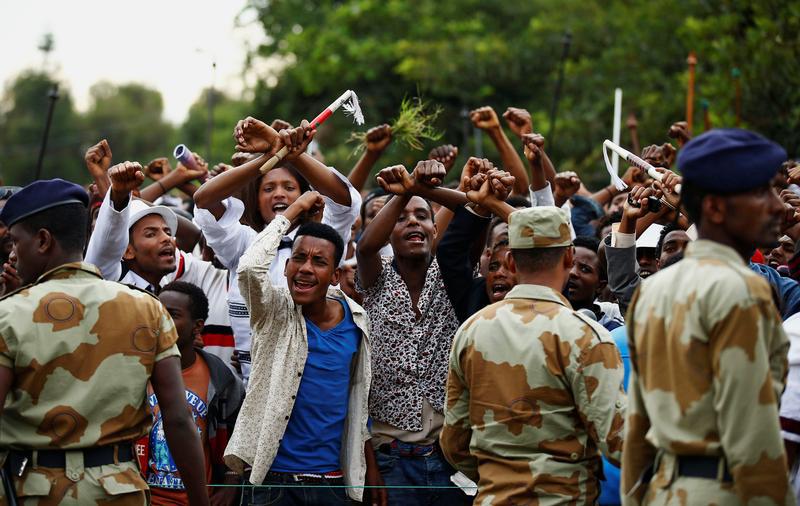


 Some of this can be attributed to External Intervention, with its FSI score moving from 6.7 in 2007 to 8.7 in 2017, making it Ethiopia’s most worsened indicator overall for the decade. In 2000, Ethiopia received US$687.8 million in Official Development Assistance (ODA).1 By 2015, it had risen to over four times this with US$3.23 billion in ODA, mostly from the U.S., World Bank and European partners focused on social infrastructure and humanitarian aid.2 While this suggests low capacity of the state to plan and respond to natural disasters without external aid, arguably this development funding has also been crucial in stimulating the rapid economic trajectory of the country. Ethiopia’s economic indicators have both made improvements over the past decade, with FSI scores for Uneven Economic Development shifting from 8.6 in 2007 to 6.5 in 2017, and Poverty & Economic Decline from 8.0 in 2007 to 7.0 in 2017. While the economic trajectory tells one part of the story, the gap in public services between the urban areas such as bustling Addis Ababa, and rural areas – where 81% of the population still live3 — hint at growing disparities. The country’s Public Services score in the FSI has worsened from 7.0 in 2007 to 8.8 in 2017 – much of this is due to poor access to internet and communications, as well as limited improvements in water and sanitation facilities within the county.4 Health infrastructure also remains weak in many areas, with only 15% of births attended by a skilled health professional, and just 0.02 Doctors per 1,000 people within the populous country.5 The highly centralized nature of the EPRDF means that the nine ethno-linguistic regions of Ethiopia have limited power and resources for provision of public services. The military also plays an active role in reinforcing the centralized development agenda – with much of the county’s development driven via the military-controlled conglomerate Metals, Engineering Corporation (METEC). As a 2016 report by Dutch think tank Clingendael surmised, this increases risks of “corruption, nepotism and inefficient resource allocation,”6 all of which can increase the disconnect between development and rural populations.

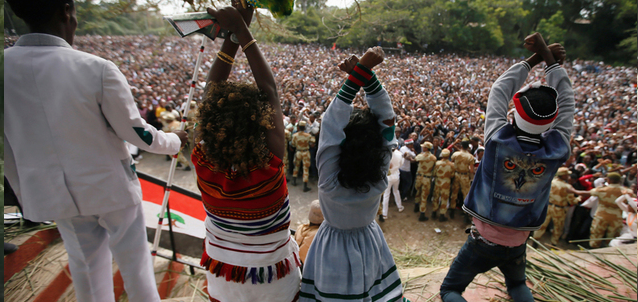


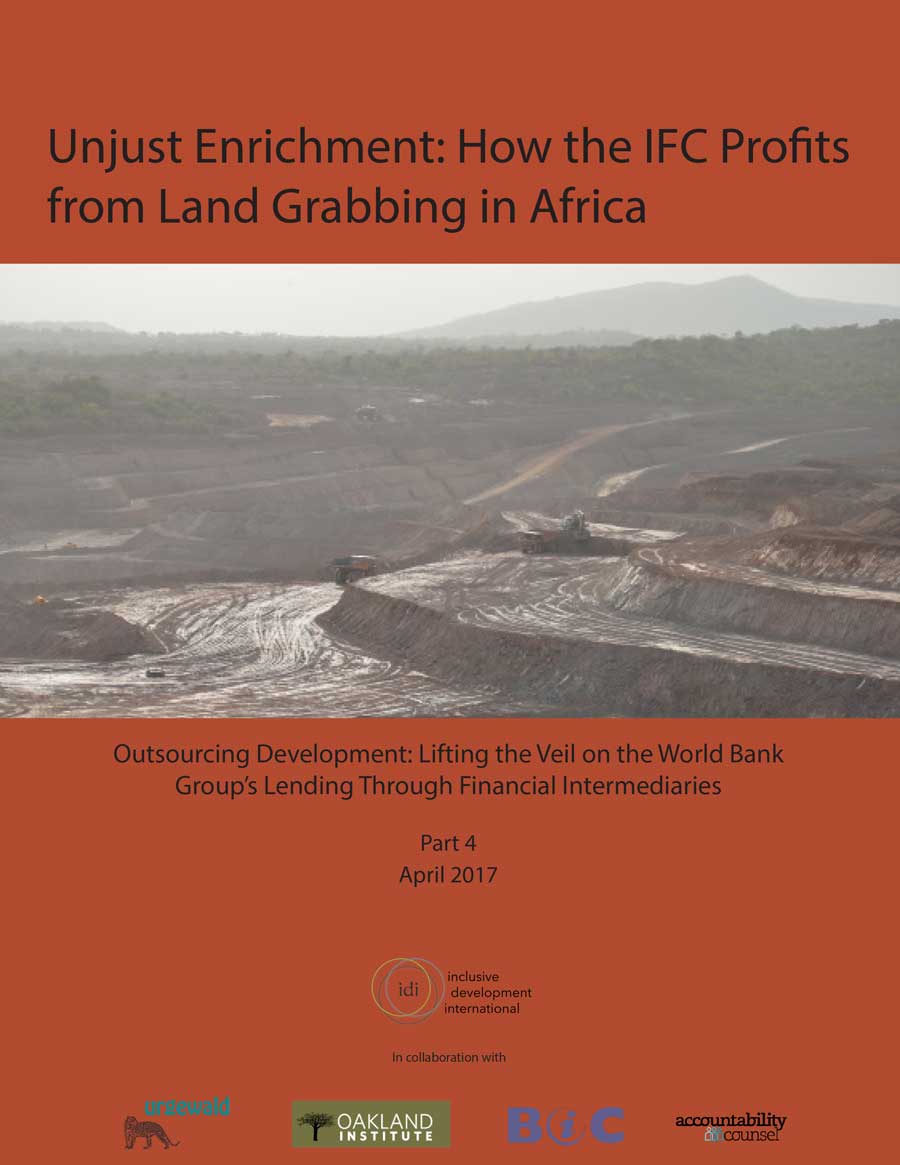





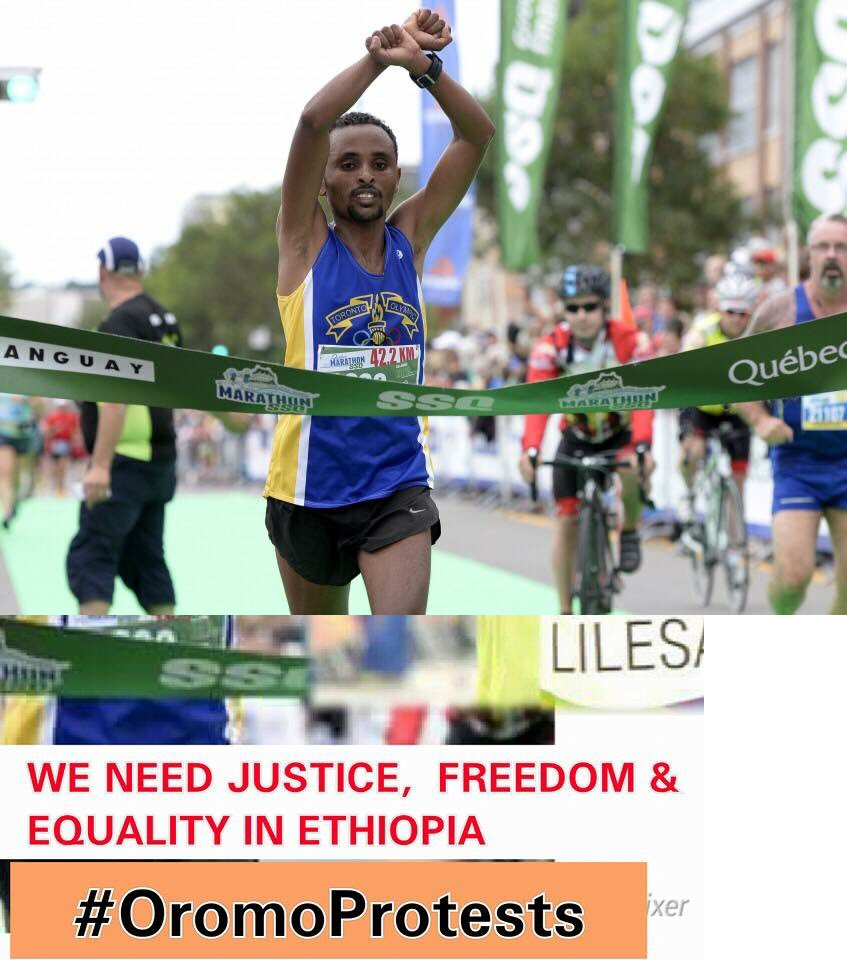


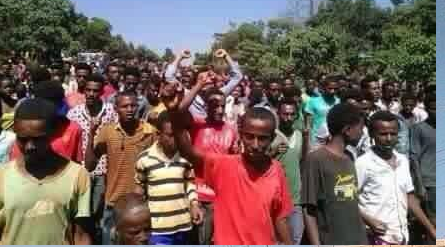





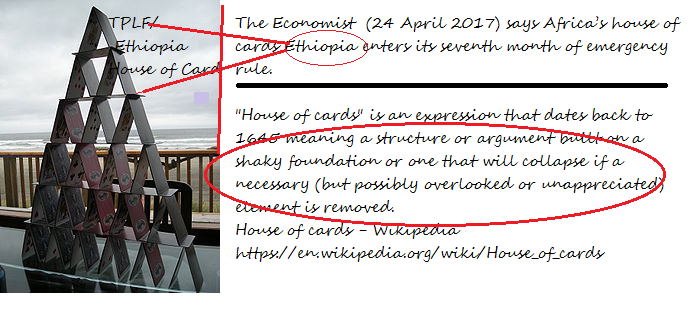



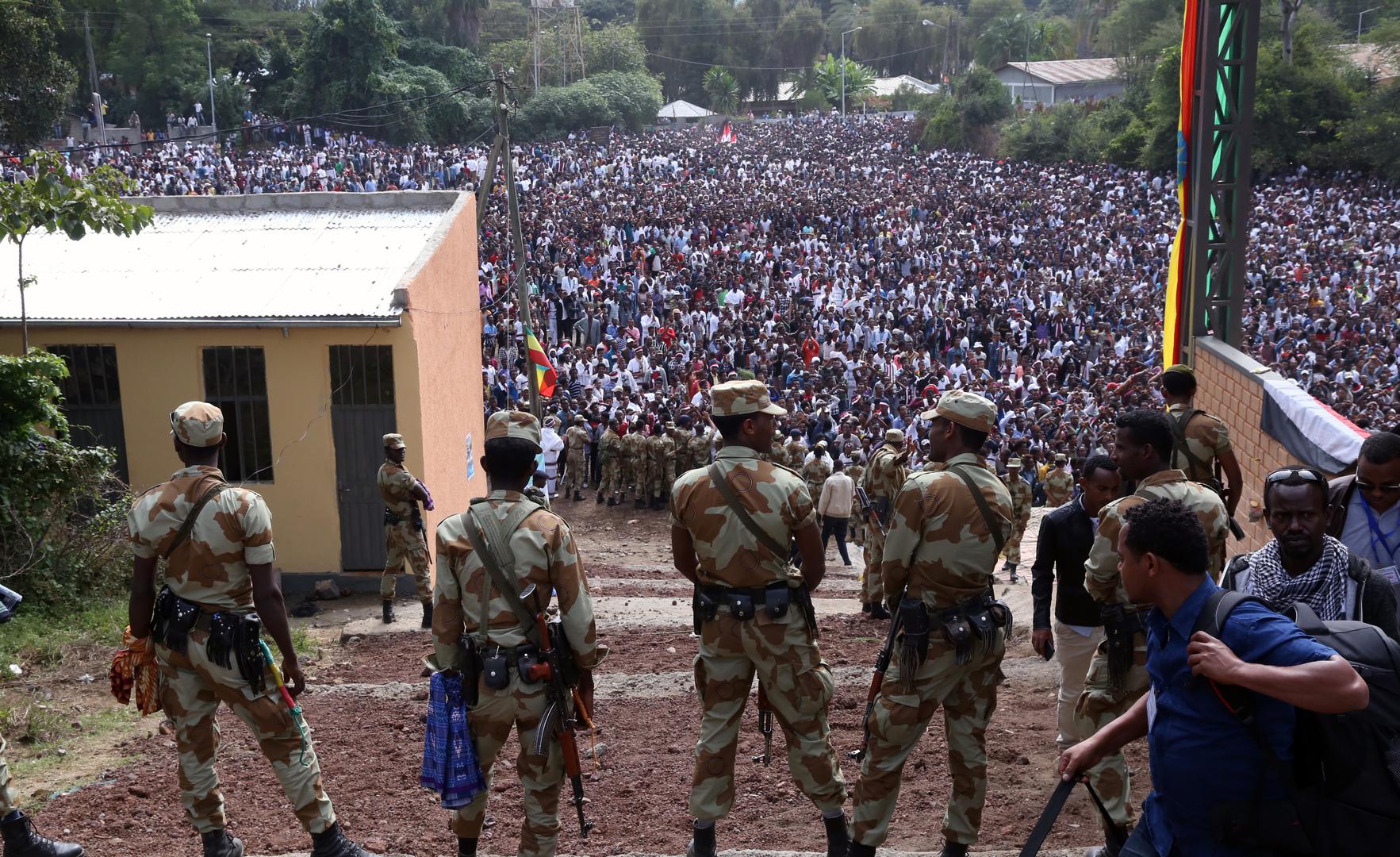







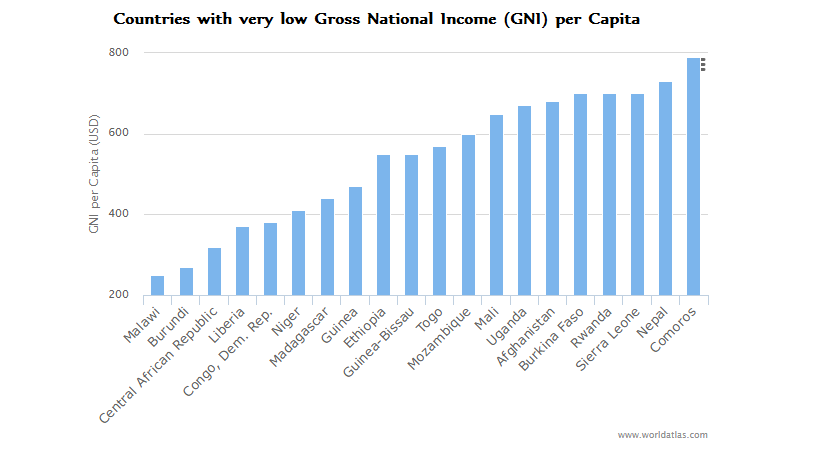


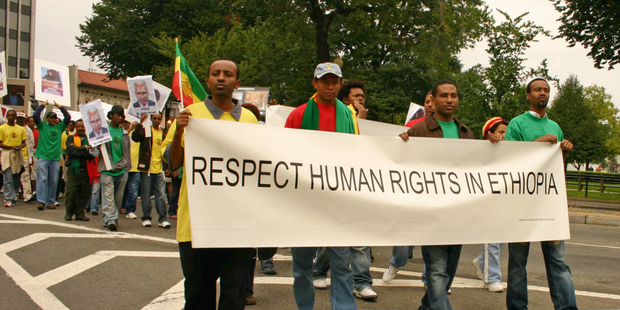


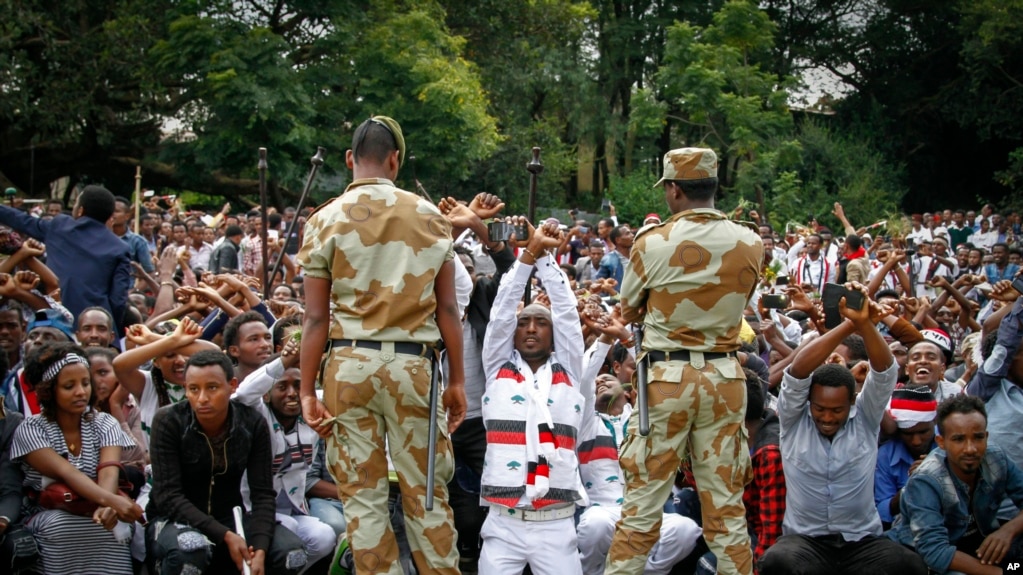


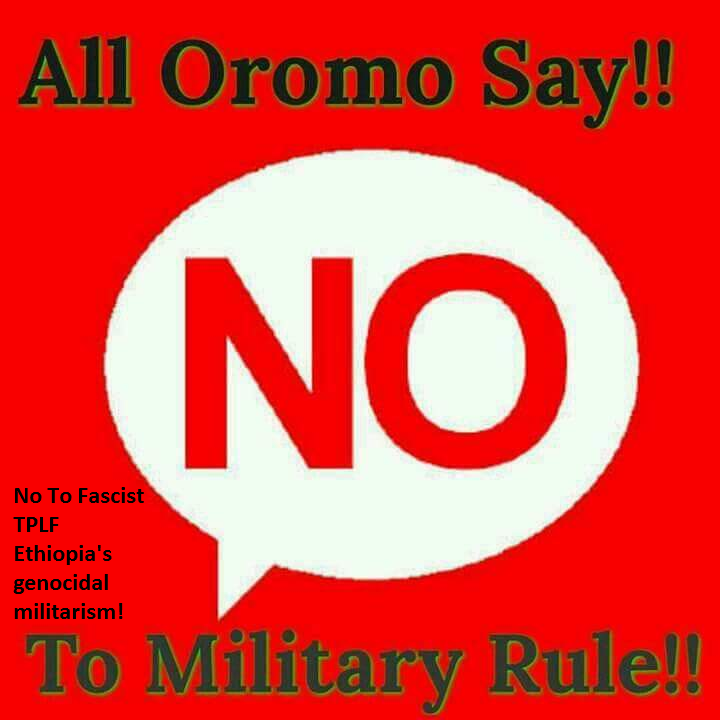


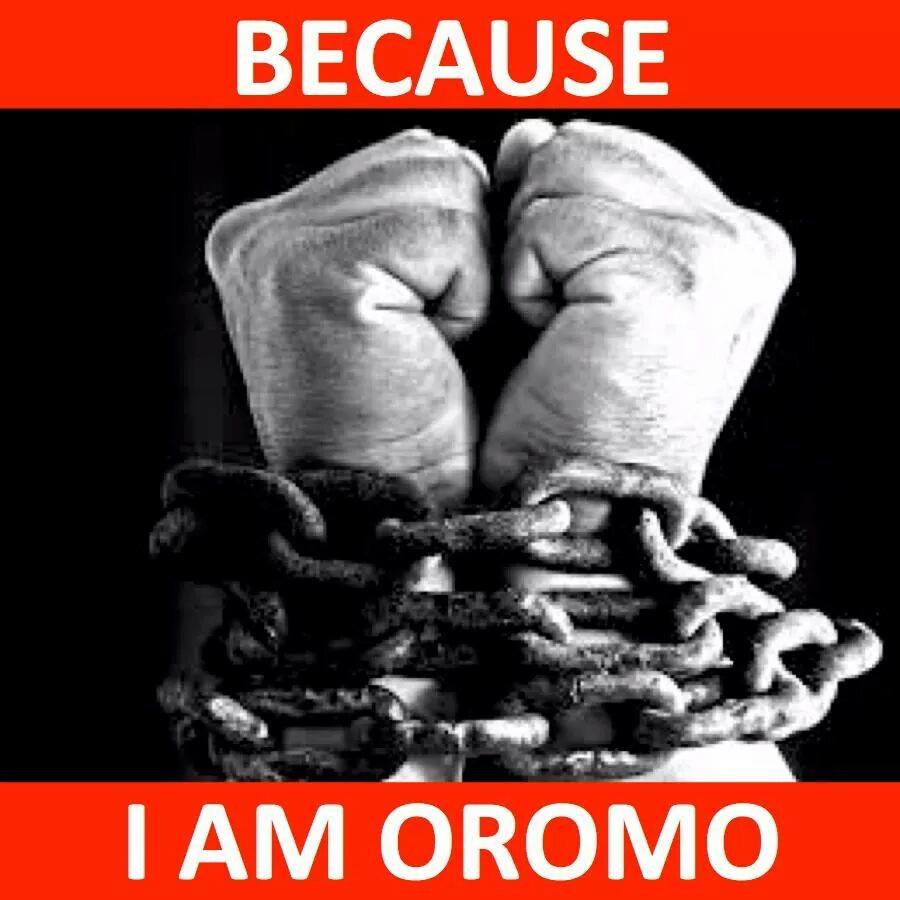

 Bitootessaa 30/2017 AMBOO Gidduugaleessaa Oromiyaa Godina Lixa Shaggar Magaalaa Amboo Keessaatti Warraaqsi Biyyooleessa Oromiyaa FXG Gootota Qeerroo Dargaggootaa Barattoota Oromoon durfamu itti fufe.


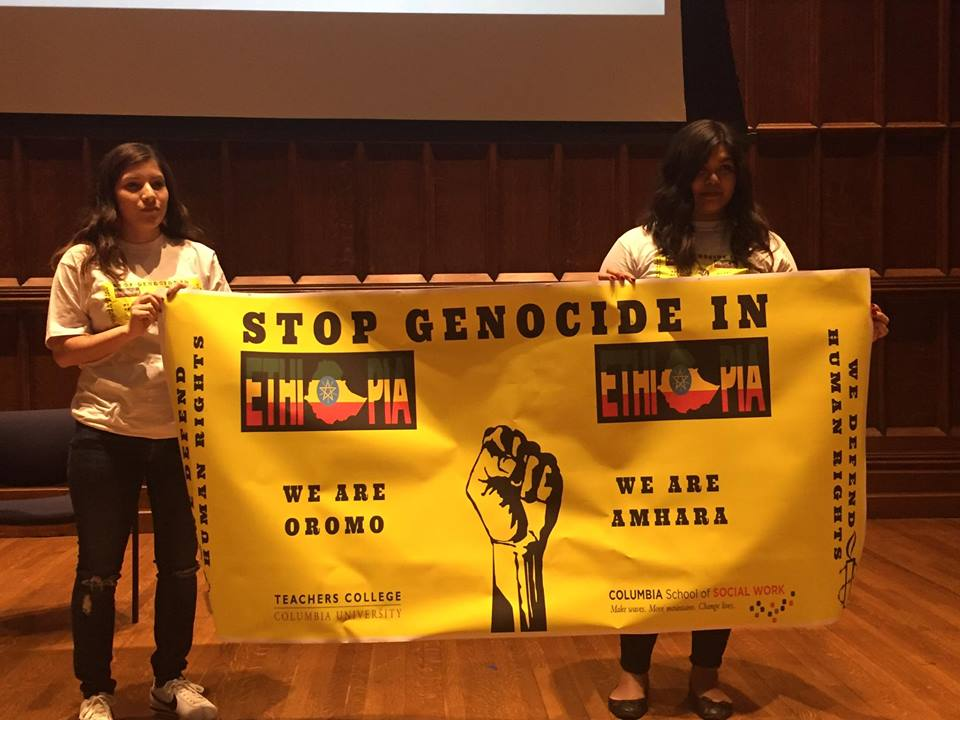
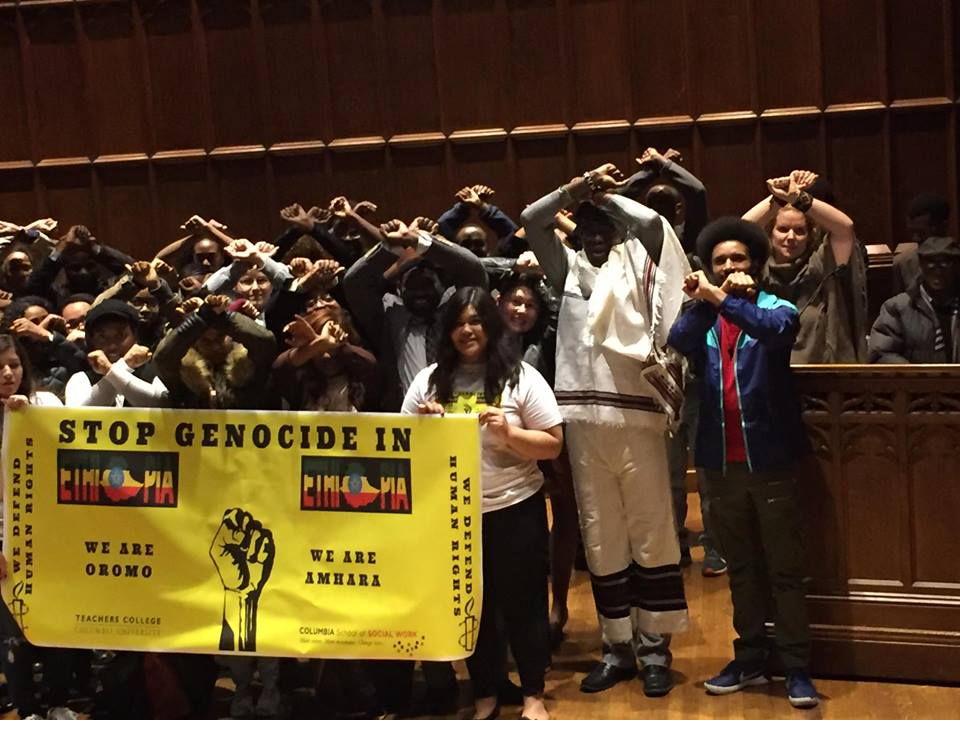



 Bitootessaa 10/2017 Dargaggoo Oromoo Abbaa Seeraa Hayiluu Kifilee Waraanaa Koomandii Poostii Wayyaaneen Ajjeefamee Bosona Iluu Abbaa Booraa naannoo Mattuutti gatamee Bitootessa 9/2017 kan argamee yoo ta’uu, Baatii lama fuuldura Ukkaanfamee eessa buuteen isaa kan dhabamee ture ta’uu maddeen Qeerroo Bilisummaa Oromoo Magaalaa Amboo gabaasan.
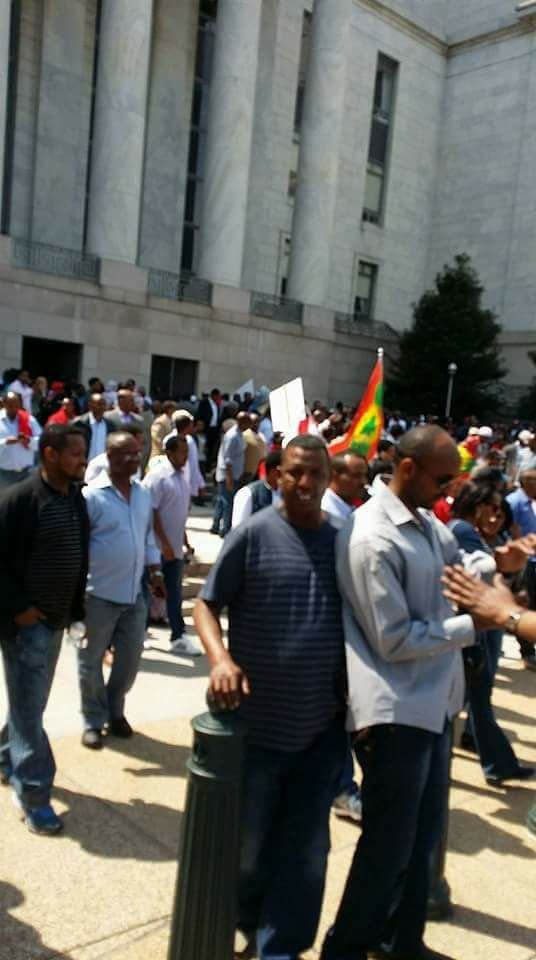

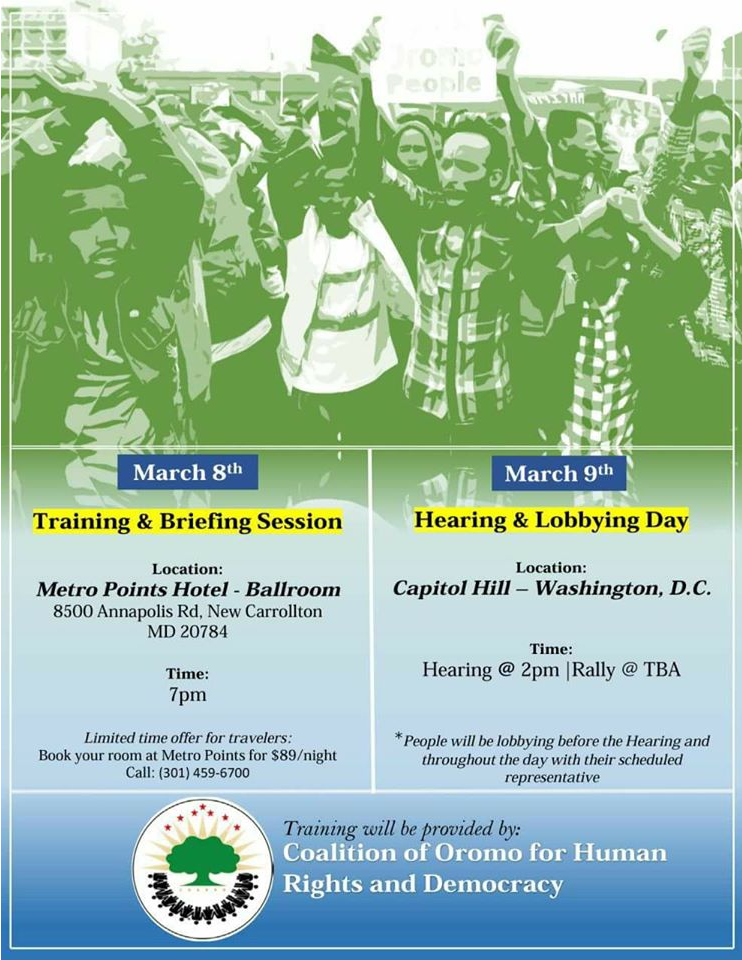


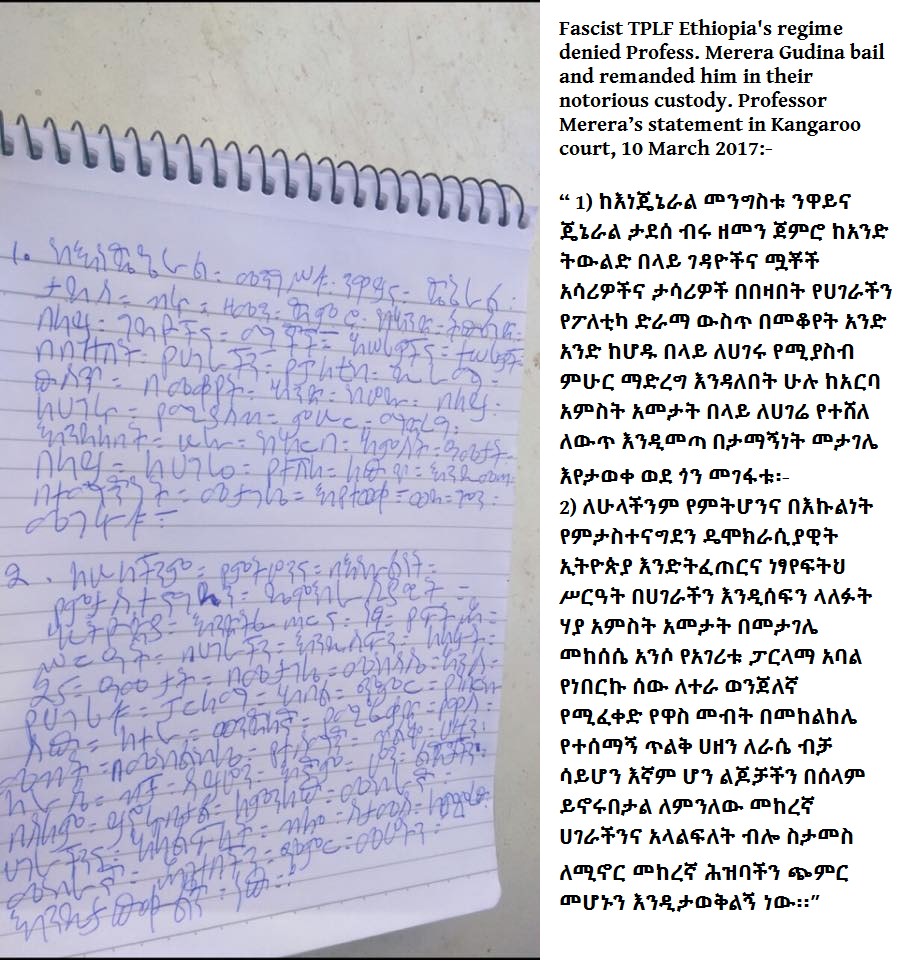

 Bitootessa 7,2017, Godina Wallagga bahaa magaalaa Naqamtee keessaa maqaa malaammaltummaa fi hooromsa jedhuun wal qabatee hojjettoonni waajira teelee magaalaa Naqamtee keessaa heedduminaan ukkaamfamaa akka jiran maddeen Qeerroo Leeqaa gabaasan.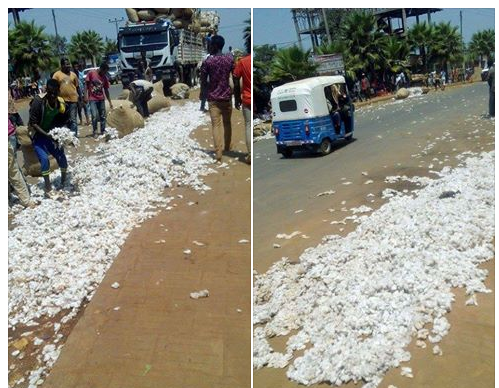
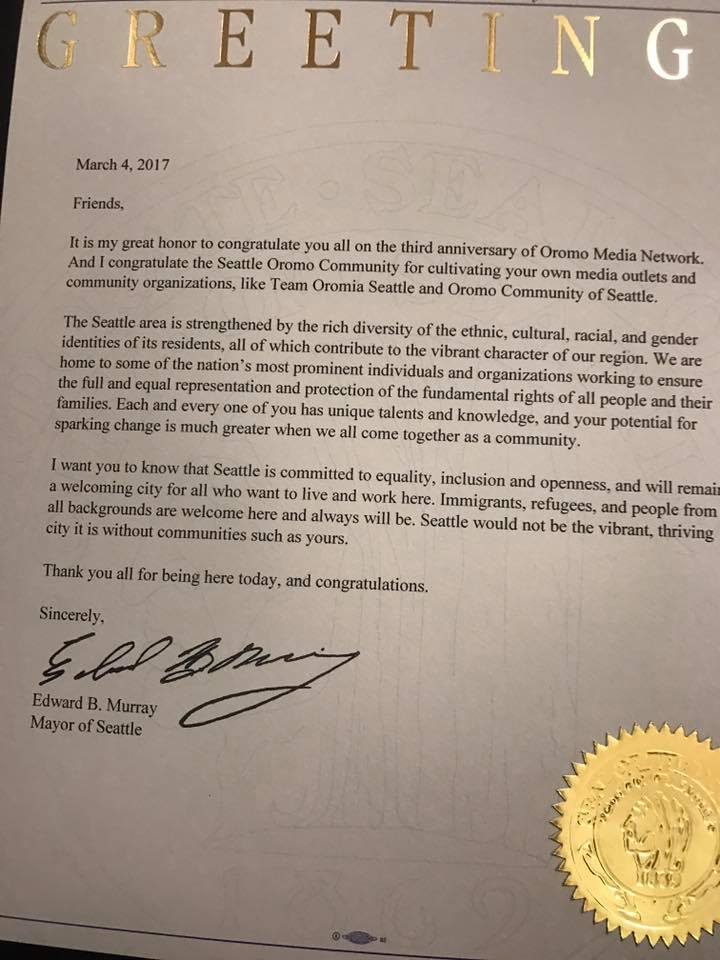



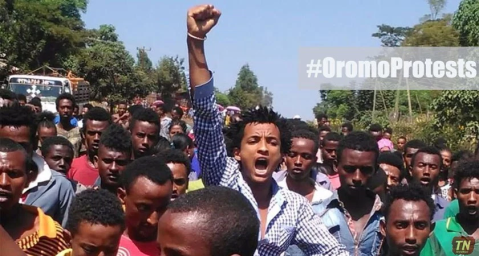

![The country’s ruling coalition is controlled primarily by the Tigray ethnic group, who accounts for only 6 percent of the population [Tiksa Negeri/Reuters]](https://i0.wp.com/www.aljazeera.com/mritems/imagecache/mbdxxlarge/mritems/Images/2017/3/30/2a50297ea6d8467e8ea86235b22d5728_18.jpg "Ethiopia extends state of emergency by four months")


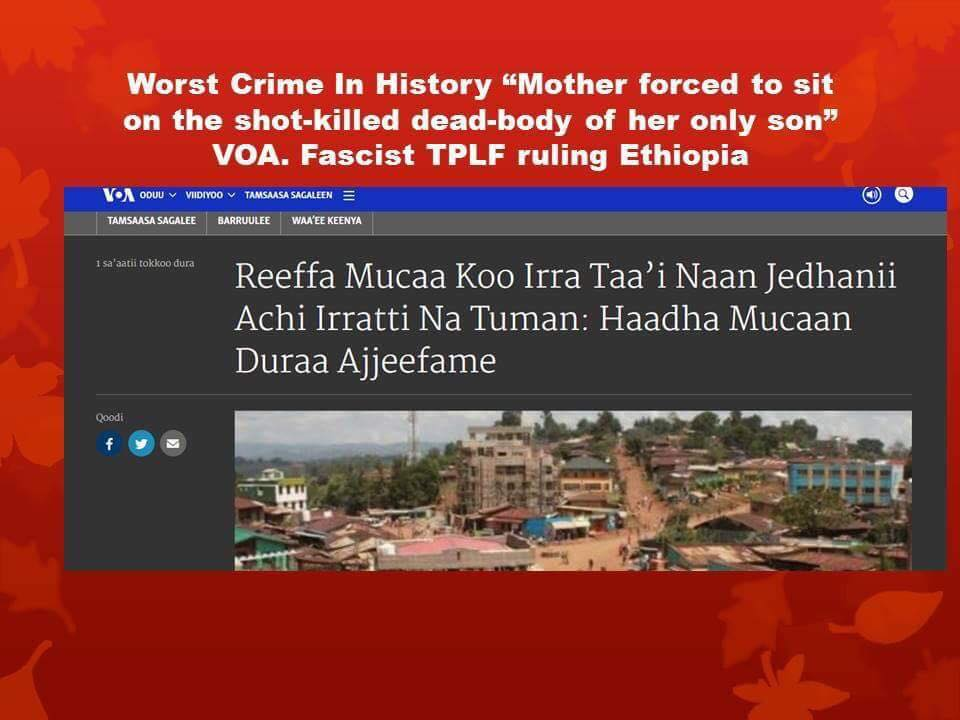


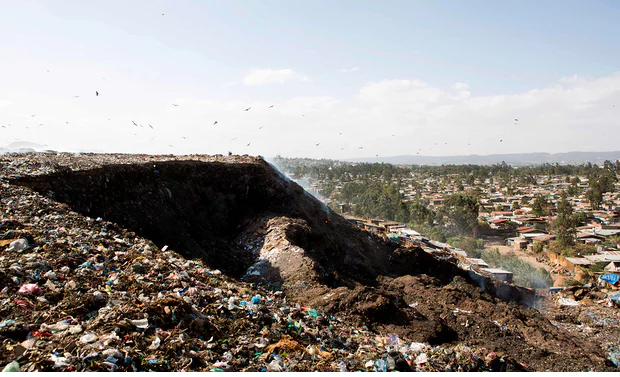
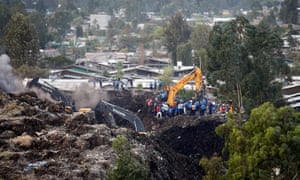


 AP Photo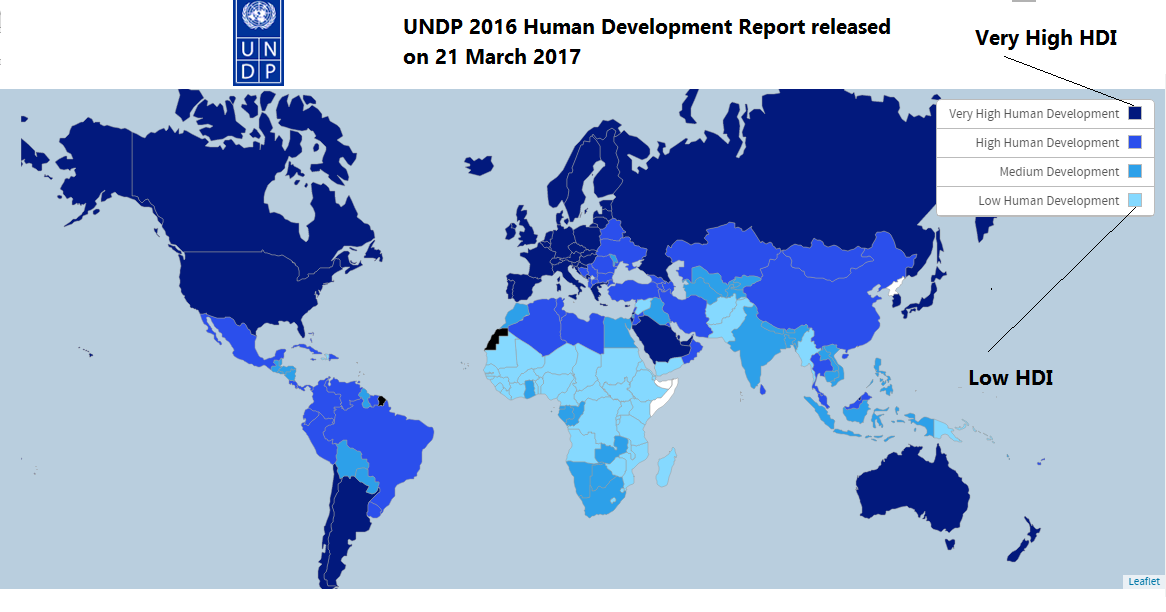
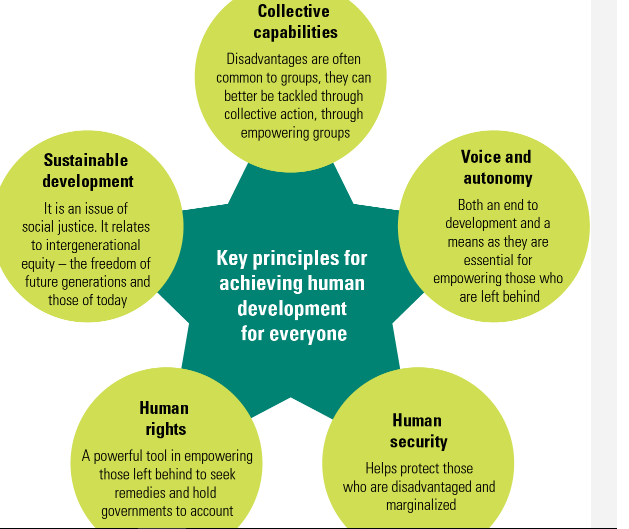
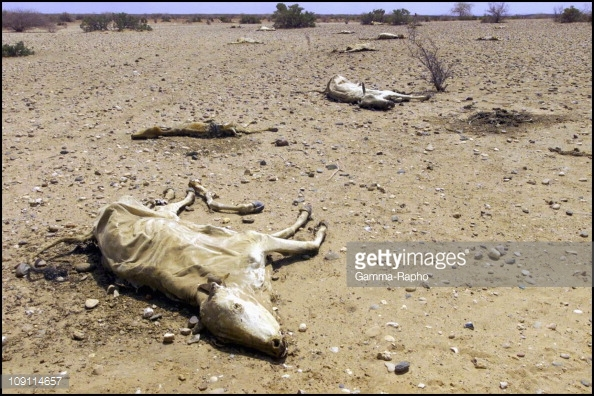

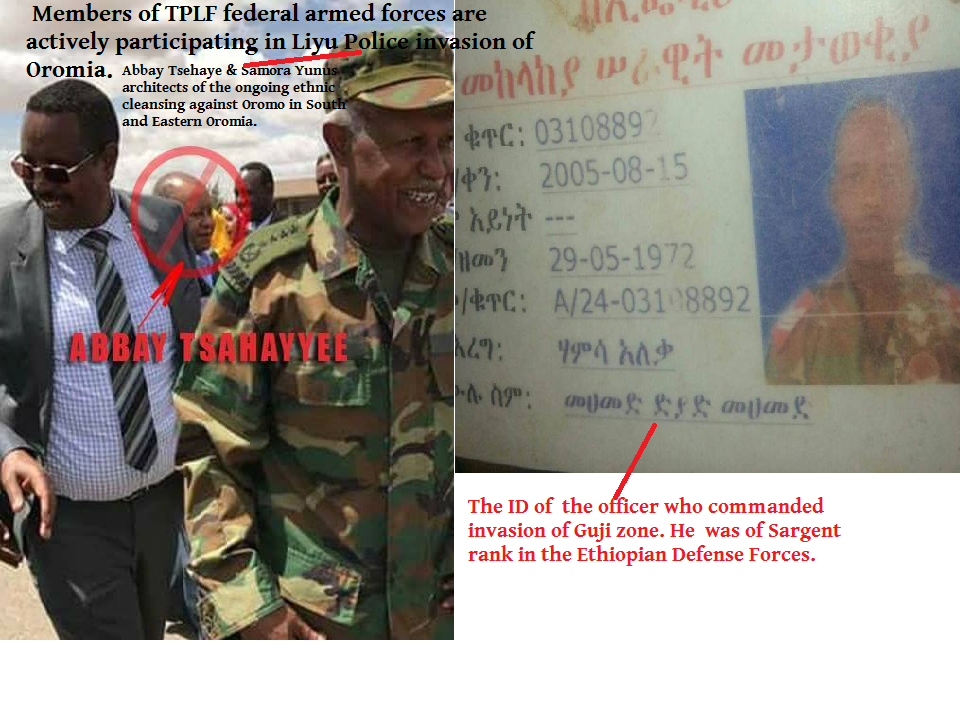


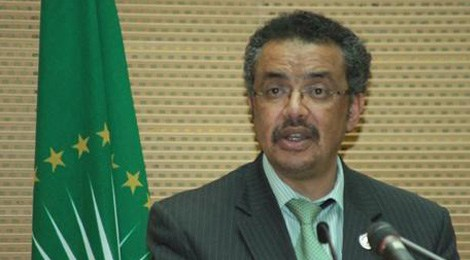




 Oromian Economist

You must be logged in to post a comment.