Economic and development analysis: Perspectives on economics, society, development, freedom & social justice. Leading issues in Oromo, Oromia, Africa & world affairs. Oromo News. African News. world News. Views. Formerly Oromia Quarterly
A Generation, Fearless of Death and Detention, Will Crumble Mountains
By Firehiwot Guluma Tezera*
There is an Ethiopian saying, “one would lose what one has in the hand while reaching for more from the upper shelf.” While this selfish individual tries to get hold of more, what one has already have will be scattered all over the place. Lately, in the Habesha camp, fear has spread, and uneasiness has increased likewise.
Soothing, warnings, rebuking, and many others had been tried. Unfortunately, they try to tell us that the source of their problem is the national struggle of the Oromo people. In reality, the aim and goal of the struggle of the Oromo people is to get rid of authoritarian rulers, and thus, to achieve the right to self-determination for the Oromo people – based on international regulations and laws. The importance of the struggle is not only for the Oromo people, but for all peoples of the empire who are suffering under the colonial rule. So, the Oromo people trust in the united struggle of the oppressed peoples. The Oromo national movement will wedge, and has been wedging, joint struggles with forces of similar aims. In other ways, the Oromo people demonstrate peace in their cultural and administrative structures, and support fair unity. Fair unity helps the weak and stands for the oppressed. A good demonstration is the exemplary unity of the different ethnic groups living in today’s Oromiyaa – despite the numerous attempts by anti-Oromo groups to create rifts between the Oromo people and the other ethnic groups.
As the Oromo people – in their social lives and national struggle – respect the rules of human rights, by any measure, they are not threats to neighboring and same-region peoples; the information, which has been disseminated by groups wanting to re-instate the old system and TPLF jointly and independently, has turned out to be fake and false time and again.
The truth has been illustrated at various times by different individuals. But as long as those Oromo-phobic individuals who could not understand it give in, we must show and teach them theoretically and by action how the Oromo struggle has matured. Accordingly, the Oromo struggle has come a long way and has reached a stage where it cannot be averted; even though they are not going to like it, I would like to demonstrate through credible facts:
• By the sacrifices paid by its dear children, the Oromo Nation has been able to show to the whole world its country’s boundaries and its true history. By blood and bones of her children, our country Oromiyaa will be respected till eternity. This is the reality.
• The language and culture of Oromo people has been developing on solid foundation. Today Afan oromo has its own alphabets. Millions study, teach and do research by it. Medias with International audience broadcast by it. It has become language of literature. As this indicates that the struggle is nearing the end, we must take note.
• The Oromo people’s struggle has arrived at the generation which does not fear death, and which is ready to sacrifice for its dignity and for the sovereignty of Oromiyaa. This confirms all. As this reality has already been seen on the ground, there is no need for further explanations.
• The international community has not only understood, but forced to look for solutions about the arbitrary killings of the Oromo people. This is the fruit of the relentless struggle. Even if you don’t like it, you know the exact gist.
• Today, we have arrived at a historical chapter where the Oromo people have demonstrated that they will not crack by propaganda of anti-Oromo elements, and that they have stood together in unison for a common goal. This cooperation among all segments of the Oromo people has started to shake your power base – giving you high blood pressure as demonstrated by the recent uprising.
• As the Oromo national struggle consists of all options, Oromiyaan mountains, valleys and forests are witnessing strong military preparations. Accordingly, in May 2014 the Oromo Liberation Army has attacked enemy soldiers, and more than 200 soldiers have been put out of action. It has also confiscated a number of military equipment.
Overall, the Oromo people have scored important victories, and are mobilizing their human and material resources to claim the rest of their rights. So, are you trying to stop this visionary generation by imprisonment? Or trying to fool them through rebuke and fake words? To tell you the truth, that era has passed. Let me help you realize the truth. You can’t stop them. This is because you can’t stop a generation with a cause. The better way is to drop the old eyeglasses, which has twisted the truth, and straighten your views and live together. May God help you.
Abstract: Colonialism is a practice of domination, which involves the subjugation of one people to another. The etymology of the term from Latin word colonus, meaning farmer. This root reminds us that the practice of colonialism usually involves the transfer of population to new territory, where the arrivals lived as permanent settlers while maintaining political allegiance to the country of origin. Colonialism is a characteristic of all known civilizations. Books on African history teaches us that Ethiopia and Liberia are the only countries, which were not colonized by West European states, but the paper argues that Ethiopia was created by Abyssinian state colonizing its neighbouring nations during the scramble for Africa. Using comparative colonial history of Africa, the paper tries to show that Abyssinian colonialism is the worst of conquest and colonial rule of all territories in Africa, according to the number of people killed during the conquest war, brutal colonial rule, political oppression, poverty, lack of education, diseases, and contemporary land grabbing only in the colonial territories. In its arguments, the paper discusses why the Oromo were defeated at the end of 19th century whereas we do have full historical documents starting from 13th century in which the Oromo defended their own territory against Abyssinian expansion. Finally the paper will elucidate the development of Oromo national struggle for regaining their lost independence.
The levels of poverty and authoritarianism are higher in the Horn of Africa than anywhere else in the continent. Civil liberties are collateral victims. http://rsf.org/index2014/en-africa.php
World Press Index 2014: Ethiopia ranked 143/ 180
According to related index by freedom House, Ethiopia ranked 176/197
Ethiopia is rated Not Free in Freedom in the World 2014, Freedom of the Press 2014, and Freedom on the Net 2013.
The 2014 World Press Freedom Index spotlights the negative impact of conflicts on freedom of information and its protagonists. The ranking of some countries has also been affected by a tendency to interpret national security needs in an overly broad and abusive manner to the detriment of the right to inform and be informed. This trend constitutes a growing threat worldwide and is even endangering freedom of information in countries regarded as democracies. Finland tops the index for the fourth year running, closely followed by Netherlands and Norway, like last year.
The 2014 index underscores the negative correlation between freedom of information and conflicts, both open conflicts and undeclared ones. In an unstable environment, the media become strategic goals and targets for groups or individuals whose attempts to control news and information violate the guarantees enshrined in international law, in particular, article 19 of the International Covenant on Civil and Political Rights, the 1949 Geneva Conventions and the 1977 Protocols Additional 1 and 2 to the Geneva Conventions. Tyrannic countries such as Ethiopia, Turkmenistan and North Korea where freedom of information is non-existent continue to be news and information black holes and living hells for the journalists who inhabit them.
Post-Zenawi Ethiopia – a missed chance to liberalize
Prime Minister Meles Zenawi’s death in August 2012 and his replacement by Hailemariam Desalegn raised hopes of political and social reforms that would benefit freedom of information. Sadly, these hopes have been dashed. The repressive anti-terrorism law adopted in 2009 is a threat that continues to hang over journalists, forcing them to censor themselves. Media that dare to violate the code of silence, especially as regards government corruption, are systematically intimidated.
Djibouti – unable to hear the voice of those without a voice
Djibouti is a highly strategic regional crossroads. Because of its economic and geopolitical advantages, it is easy to turn a blind eye to the dictatorial methods used by Ismail Omar Guelleh, who has ruled since 1999. Under Guelleh, Djibouti has steadily cut itself off from the outside world and suppressed criticism. The list of journalists who have been jailed and tortured gets longer and longer. Releases are only ever provisional. The journalist and Guelleh opponent Daher Ahmed Farah is a case in point. He has been jailed five times and arrested a dozen times since returning to Djibouti in January 2013.
The concept of independent media is completely alien to Djibouti. The only national broadcaster, Radio-Télévision Djibouti, is the government’s mouthpiece. The few opposition newspapers have disappeared over the years. There is an independent radio station based in Europe – La Voix de Djibouti. Two of its journalists have been jailed in the past 12 months.
There are no longer any privately-owned media, and the state media are subject to such close surveillance that they have to conceal entire swathes of contemporary history such as the Arab Spring. Accessing reliable information is impossible in the absence of satellite and Internet connections. A few independent radio stations, such as Radio Erena, manage to broadcast from abroad.
Somalia – danger and authoritarianism
Those who had seen some improvement in Somalia were quickly disabused. Journalists still trying to provide objective news coverage are targeted by both terrorists and security-driven government officials. In 2013, seven journalists were the victims of terrorist attacks blamed with varying degrees of certainty on the Islamist militia Al-Shabaab. In November, Al-Shabaab deprived an entire region of television by seizing satellite dishes on the grounds they carried images that did not respect Islam. Information is seen as threat.
Unfortunately, the Somali government does not help. On the interior minister’s orders, police evicted Radio Shabelle, winner of the 2010 Reporters Without Borders Press Freedom Prize, from its building and seized its equipment in October 2013 after a series of reports criticizing the upsurge in violence in Mogadishu. It was a double blow because the station also used the building to house its journalists, for whom moving about the city is very dangerous. When the equipment was returned a few weeks later, it was so badly damaged as to be unusable. Not that the station is authorized to broadcast anyway, because the communication ministry refuses to give it a permit.
Working Group Must Address Trade Misinvoicing and Role of U.S. Business and Government in Facilitating Illicit Finance to Be Truly Effective, Warns GFI
Illicit Financial Flows Drain US$55.6bn Annually from African Continent, Sapping GDP, Undermining Development, and Fueling Crime, Corruption, and Tax Evasion
August 7, 2014, WASHINGTON, DC (GFI) – Global Financial Integrity (GFI) welcomed the announcement from the White House and African leaders today regarding the establishment of a bilateral U.S.-Africa Partnership to Combat Illicit Finance, but the Washington-DC based research and advocacy organization cautioned that any effective partnership must be sure to address deficiencies in both the U.S. and in Africa that facilitate the hemorrhage of illicit capital from Africa.
“We welcome the move by President Obama and certain African leaders to form this partnership on curbing illicit financial flows from African economies,” said GFI President Raymond Baker, who also serves on the UN High Level Panel on Illicit Financial Flows from Africa. “Illicit financial flows are by far the most damaging economic problem facing Africa. By announcing the creation of the U.S.-Africa Partnership to Combat Illicit Finance, President Obama and African leaders have taken the first step towards tackling the most pernicious global development challenge of our time.”
GFI research estimates that illicit financial outflows cost African (both North and Sub-Saharan African) economies US$55.6 billion per year from 2002-2011 (the most recent decade for which comprehensive data is available), fueling crime, corruption, and tax evasion. Indeed, GFI’s latest global analysis found that these illicit outflows sapped 5.7 percent of GDP from Sub-Saharan Africa over the last decade, more than any other region in the developing world. Perhaps most alarmingly, outflows from Sub-Saharan Africa were found to be growing at an average inflation-adjusted rate of more than 20 percent per year, underscoring the urgency with which policymakers should address illicit financial flows.
The problem with illicit outflows from Africa is so severe that a May 2013 joint report from GFI and the African Development Bank found that, after adjusting all recorded flows of money to and from the continent (e.g. debt, investment, exports, imports, foreign aid, remittances, etc.) for illicit financial outflows, between 1980 and 2009, Africa was a net creditor to the rest of the world by up to US$1.4 trillion.
Trade Misinvoicing at the Heart of Illicit Outflows
According to GFI’s research, most of the illicit outflows from Africa—US$35.4 billion of the US$55.6 billion leaving the continent each year—occur through the fraudulent over- and under-invoicing of trade transactions, a trade-based money laundering technique known as “trade misinvoicing.” As GFI noted in a May 2014 study, trade misinvoicing is undermining billions of dollars of investment and domestic resource mobilization in at least a number of African countries. The organization emphasized the importance of ensuring that the new U.S.-Africa partnership prioritizes the curtailment of trade misinvoicing.
“The misinvoicing of ordinary trade transactions is the most widely used method for transferring dirty money across international borders, and it accounts for the vast majority of illicit financial flows from Africa,” said Heather Lowe, GFI’s legal counsel and director of government affairs. “While it is easy to place the blame for this on corrupt officials or transnational crime networks, the truth of the matter is that the bulk of these fraudulent trade transactions are conducted by normal companies, many of them major U.S. and European companies.”
Ms. Lowe continued: “Just yesterday, President Obama announced the Doing Business in Africa Campaign, a U.S. government initiative focused on boosting trade between U.S. and African companies, without a signal mention of the elephant in the room: trade misinvoicing. Increasing trade is important to boosting economic growth across Africa, but only if the trade is done honestly and at fair market values. The single most important step that wealthy nations like the U.S. can take to help African economies curtail illicit flows is to trade legitimately and honestly with Africa. While this topic was not addressed at the U.S.-Africa Business Forum yesterday, it must be on the table as the U.S.-Africa Partnership to Combat Illicit Finance commences its work.”
U.S. Must Clean Up Its Own Backyard
GFI further emphasized the need to address the role of the U.S. financial system as a major facilitator of such outflows.
“For every country losing money illicitly, there is another country absorbing it. Illicit financial outflows are facilitated by financial opacity in tax havens and in major economies like the United States,” said GFI Policy Counsel Joshua Simmons. “Indeed, the United States is the second easiest country in the world—after Kenya—for a criminal, kleptocrat, or terrorist to incorporate an anonymous company to launder their ill-gotten-gains with impunity.
“While governance remains an issue for many African countries, structural deficiencies in the U.S. financial system are just as responsible for driving the outflow of illicit capital. This initiative cannot place the onus entirely on the shoulders of African governments. The burden for curtailing these illicit flows must be shared equally by policymakers in the U.S. and in Africa for this partnership to be effective,” added Mr. Simmons.
The truth is that humanity must now confront, not just poverty, but a convergence of mega crises, all of which are deeply interconnected: Government corruption; ecological destabilization; structural debt; and hyper-consumerism established in the west and rapidly expanding worldwide.
Martin Kirk & Joe Brewer
Right now, a long and complicated process is underway to replace the UN Millennium Development Goals (MDGs), which expire in 2015, with new Sustainable Development Goals (SDGs). These will set the parameters for international development for the next 15 years and every government, UN agency, large corporation and NGO, not to mention billions of citizens on the planet have a stake.
Judging by what’s being produced, though, we have a serious problem. The best way to describe it is with an old joke: There’s a man driving through the countryside, trying to find a nearby town. He’s desperately lost and so when he sees a woman by the side of the road he pulls over and asks for directions. The woman scratches her head and says, “Well, I wouldn’t start from here.”
The best evidence of where the SDGs are starting from is the so-called “Zero Draft” document, first released on 3 June and currently undergoing exhaustive consultation.
First things to note are the big differences with the MDGs. Most strikingly, the SDGs suggest an end to poverty is possible in the next 15 years, whereas the MDGs aimed at halving it. The implication is that we’ve made amazing progress and are now on the home stretch. Secondly, the SDGs get serious about climate change. This is a major paradigm shift and, what’s more, they aim squarely at the heart of the problem: patterns of production and consumption. Impressive. Thirdly, reducing inequality “within and between” countries is included, with a goal of its own. This suggests another paradigm shift, and a controversial one because it opens the door, just a crack, to the idea that the extremely rich might be making an undue amount of their money off the backs of the extremely poor.
Of these three goals, it is fairly certain that two will disappear before the process concludes. There is no way the world’s rich governments and corporations will allow a meaningful challenge to production and consumption patterns, or a focus on reducing inequality. This is a given.
However, there is an even more important problem in the Zero Draft document which is that the very starting point of the issue is profoundly misconceived. How do we know? Because of the language. Language is a code that contains a lot more than its literal meaning, and an analysis of semantic frames in the Zero Draft exposes the logic upon which it is built.
Let’s take the opening paragraph:
“Poverty eradication is the greatest global challenge facing the world today and an indispensable requirement for sustainable development. We are therefore committed to freeing humanity from poverty and hunger as a matter of urgency.”
Poverty can be conceptualised in many ways and in this passage it is presented as both a preventable disease (“to be eradicated”) and as a prison (“to free humanity from”). In both, the framing reveals the framers’ view, conscious or otherwise, on causation. Diseases are just part of the natural world, so if poverty is a disease, it suggest that it is something for which no-one is to blame. The logic of a prison meanwhile is that people are in it for committing a crime. The former denies the idea that human actions may be a cause of inequality and poverty; the latter invokes the idea that poverty is the fault – the crime – of the poor.
Also note the phrase: “the greatest global challenge.” This asserts a logic in which there is a hierarchy of individual issues based on relative importance, with poverty at the top. The truth, however, is that humanity must confront a convergence of mega-crises all of which are deeply interconnected. Government corruption, ecological destabilisation, structural debt, hyper-consumerism established in the West and rapidly expanding in the east and south, for example, are all closely linked. But framing poverty as “the greatest global challenge” conceals the web of interconnected systems and removes them from consideration. The result: No systemic solutions can arise from a logic that denies systemic problems.
There is a good reason for this: it protects the status quo. This logic validates the current system and ordering of power by excusing it of blame and says it can, indeed must, continue business as usual. This is the logic of the corporate capitalist system.
There’s no denying that some excellent progress has been made since 1990 – the year the MDGs measure from – but you don’t need to deny that to know there is something fundamentally wrong with a global economy in which, at a time when wealth grew by 66%, the ratio of average incomes of the richest 5% and the poorest 20% rose from 202:1 to 275:1. Or that the reality masked by the ratios is that one third of all deaths since 1990 (432 million) have been poverty-related. Using UN figures, that’s more than double the combined deaths from the Two World Wars, Mao’s Great Leap Forward, Stalin’s purges, and all military and civilian deaths from the wars in Korea, Vietnam, Afghanistan and Iraq. What’s more, even though we are now seeing around 400,000 deaths every year from climate change, we are pumping 61% more greenhouse gasses into the atmosphere annually than we were in 1990.
The point is that, in light of the logic the language exposes – and we have mentioned just two of many possible examples telling the same story – any glorification of the SDGs we hear over the next year must be seen as reinforcing the logic their language contains.
To really tackle poverty, inequality and climate change, we would need to change that logic to one that is built on an acceptance of how much these problems are the result of human actions. And that the fact of living in poverty makes no inherent comment whatsoever on the person or people concerned, other than that they live in poverty. This in turn would make a wholly different type and scale of change feel like common sense. For example, it would feel obvious to work towards taxing carbon emissions at source and putting in place sanctions against those responsible for hoardingat least $26 trillion in tax havens. We would instinctively reach to introduce laws that give local authorities everywhere the right to revoke corporate charters for serious social or environmental misdeeds anywhere. And the big one: money. Ridiculous though it may sound, right now we allow private banks to control the supply of US dollars, euros and other major currencies that surge through the global economy. These banks charge everyone, including governments, interest on every note, thereby guaranteeing that a constant river of money flows into their coffers, along with immense power. But unfortunately, none of these issues will make it into the SDGs because they contradict the current, dominant logic, and what’s more, because they might actually work and redistribute power and wealth more equitably.
We compound our problems when we allow ourselves to be drawn into processes like the SDG-design are turning out to be. Every ounce of credence given to their frames helps weigh down the center of debate far from where it needs to be. Until the UN can use its powers, resources and privileges to promote policies that grow from the logic of its highest ideals, we may help it, the planet and each other best by divesting our attention from it and finding avenues for change that can.
This article was originally published by Common Dreams.
The fact that we are gathered here today to honor the founding of Macha Tulama 50 years ago speaks to the fact that despite all odds, we, as a people are survivors. Ethiopian history is full of attempts to annihilate the Oromo—culturally, politically, socially, economically, in all and every ways possible.Oromos — cast as foreign, aliens to their own lands, have been the targets of the entire infrastructure of the Ethiopian state since their violent incorporation. Our identity, primarily language, religion and belief systems and cultural heritage have been the main targets of wanton destruction. Oromo and its personhood were already demonized, characterized as embodiments of all that is inferior, shameful and subhuman from the beginning. Oromo people were economically and politically exploited, dominated and alienated.
The Mass Massacre & Imprisonment of ORA Orphans – Wallaga 1992-93
By Mekuria Bulcha*
“…. many of us lost our parents and relatives and were cared for by the Oromo Relief Association (ORA) for our survival and wellbeing. With the support of the international community and Oromos abroad, some 1,700 of us have been taken care of in exile in the Blue Nile Province of the Sudan. … The ORA gave us the chance to survive” (from a letter by “Raagaa”, one of the ORA children 1993).
“The life of those of us who did not experience the sweet love of parents, but had known only an organization [ORA] was devastated when the organization collapsed; we were left alone without relations. There are many who shared my misfortune; regrettably the whereabouts of many of them remains a mystery” (from an interview by the author with another former ORA child, Leensaa, March 2014).
“We appeal to you to do all you can to shed light upon the fate of the more than 1,600 children from ORA camp in Kobor. Where are Sagantaa Useen, Tolina Waaqjiraa and Duulaa Tafarra and all others?” (from a letter sent by the teachers and pupils of Heinrich-Goebel-Realschule to Dr. Klaus Kinkel, German Minister of Foreign Affairs, November 2, 1992)
Introduction
The three quotations presented above are from documents used in writing this article and reflect, in one way or another, the fate of about 1,700 Oromo children who were looked after by the Oromo Relief Association (ORA) in the refugee camps of Yabus, Damazin and Bikoree in the late 1980s. The first quote is from a letter written by one of the ORA children to the ORA office in Germany after he escaped from the Dhidheessa concentration camp in 1993. “Ragaa” is a fictive name as the letter writer lives in Ethiopia. The second quote is from an interview with Leensa Getaachoo who was one of the ORA orphans. First incarcerated at the age of ten in 1994, she had been in seven Ethiopian prisons before she fled from Ethiopia in 2000. A brief account of her more than a decade-long odyssey across three continents and her sojourn in six countries in search of a safe haven is included in the last section of this article. The last quotation is from a letter written by students and teachers of a school in Germany appealing to the German Ministry of Foreign Affairs to help them find out the whereabouts of the ORA orphans. Their school supported the ORA project materially and the pupils were pen friends with the ORA children.
The main purpose of this article is to shed light on what happened to the ORA children in western Oromia during the summer months of 1992. Associating them with the Oromo Liberation (OLF), the Tigrayan Liberation Front (TPLF) imprisoned hundreds of them in 1992 and 1993 along with thousands of Oromo civilians and OLF fighters in the Dhidheessa concentration camp. Although I knew that many of the ORA children were imprisoned, I only got a hint of the full magnitude of the crime committed against themlast year when I came across a report written in 1996 by the UK based Oromia Support Group (OSG Press Release No. 13, 1996). The OSG wrote about the flight of the ORA children and their guardians chased by the TPLF forces. The report noted that“After three weeks on the run, with rain, mud, hunger and sleeping rough in the bush, the remaining 600 or so children were attacked in the Gunfi area.…. Local informants claim that the fleeing children were hunted like kurupé, a small antelope which leaps to see its way while fleeing through tall vegetation.” (Emphasis mine) This reminded me of what I read about the now extinct indigenous inhabitants of the island of Tasmania. They were hunted and killed by white settlers just like wild game and were exterminated. It is embarrassing that we have failed to record the story of the ORA children properly during the last twenty-two years. However, I believe that it is our obligation to record their story now and bring it to the attention of particularly the Oromo people. As the first two quotations above indicate, most of the children were parentless; the majority had no families to remember them. It is our duty to remember them by recording their story.
An inquiry into the intention of the crime is another aim of the article. The crime was carried out systematically and over a long period of time. The question is: why? Why did the TPLF forces chase children and adolescents for over three months and capture or kill them, when they knew that they were unarmed youth and that the adults accompanying them were not fighters but their guardians? Based on information gathered through interviews and the description of the manner in which the TPLF security forces have treated them inside and outside the concentration camps, the article will argue that politicide,[1] was perpetrated against the ORA orphans. The TPLF was in an open war with the OLF when the children were massacred in the summer months of 1992. Consequently, it wouldn’t be farfetched to argue, as I will do in this article, that the atrocities committed by the TPLF against the ORA children and their guardians constitute a war crime.
Thirdly, the article will show that the persecution of the ORA children was a springboard for the TPLF policy of liquidating those individuals and groups its makers see as bearers of the seeds of Oromo nationalism, and that this has culminated in the current widespread war against Oromo students. I will describe, albeit briefly, the case of other Oromo children and youth who have been accused of “supporting” the OLF or branded as “terrorists” and treated with incredible cruelty.The many crackdowns on Oromo students during the past fifteen years, including the ongoing war against secondary school and university students throughout Oromia, which I will discuss in another forthcoming article, are guided by the same odious policy which led to the massacre and imprisonment of the ORA orphans. Based on my readings of its cruel treatment of the educated Oromo youth, my assessment of the main objective of the TPLF regime’s policy has been to deprive the Oromo nation of its current and future leaders. In short, what has been going on in Oromia since 1992 is clearly politicide. Oppressive Latin American dictatorships, which were led by military generals such Augusto Pinochet in Chile from 1973 to 1999, and Jorge Rafael Videla, Leopoldo Galtieri and others in Argentina between 1975 and 1983. Although not widely known and acknowledged, the politicide carried out against Oromo intellectuals, businessmen and students—who are often labelled by the TPLF regime as “OLF supporters” or “terrorists”—surpasses in its ferocity that of the Latin American dictators against the so-called communists. Its treatment of its Oromo victims is in many ways “dirtier” than the “Dirty Wars” which the Argentinian military dictators carried out against left wing politicians and others between 1975 and 1983. Politicide takes on genocidal characteristics when carried out against members of an ethnic, linguistic or “racial” community. The policy of the Tigrayan ruling elites against the Oromo displays these characteristics.
Sources of information
The article is based on information collected from both primary and secondary sources. The primary sources comprise
correspondence which I had with a former teacher and head of the ORA children’s project who was also with the children during their flight from the TPLF in western Oromia,
written and telephone interviews with two former ORA children who live in an African country and one who lives in England,
telephone interviews conducted with Oromos who were imprisoned by the Ethiopian regime in the 1990s. These Oromos, who are now scattered across different countries in Africa, North America and Europe and who know what happened to the children during the second half of 1992 or later.
I have consulted reports and documents from the archives of ORA as a secondary source of information. These include a short letter written in Afaan Oromoo by one of the ORA children who were deported to the Dhidheessa concentration camp in June 1992. He escaped from the concentration camp in 1993 and found his way to Finfinnee (Addis Ababa) from where he wrote the letter to the ORA office in Germany. The letter was translated into English by Tarfa Dibaba. The other secondary source of information, an OSG (Oromia Support Group) report, was based on interviews with the surviving children, teachers, guardians and local Oromo population of western Oromia in 1996. The third document used here is a short article based on an interview given in 1994 by a former prisoner of the Dhidheessa concentration camp. The interview was in Afaan Oromoo and was translated to English by Yoseph Taera & Kathrin Schmitt and published as “An EPRDF Prison Camp from Inside” (see Oromo Commentary, Vol. VI (1), 1994). The informant was a detainee at the Dhidheessa concentration camp. Other documents obtained from the ORA archives in Germany include most of the photos used in the article, and a copy of the letter written by the teachers and pupils of Heinrich-Gobel-Realschule of the city of Springe in Germany to the German Minister for Foreign Affairs in November 1992 mentioned above. The article has three short parts including this one. The second part will discuss imprisonment and death in the Dhidheessa concentration camp. The third part consists of short life stories of some of the children, both dead and alive.
The Oromo Relief Association: Its Origins and Objectives
The Oromo Relief Association (ORA) had its origin in a clandestine committee created during the dark days of the so-called Red Terror which was unleashed by the Dergue (the Ethiopian Military Regime) and devoured thousands of the educated youth in Ethiopia in 1977-78. The objective of the committee was to assist families whose breadwinners were jailed, had “disappeared” or had been killed. The committee was known as “Funding-raising Committee”, and functioned mainly in Finfinnee (Addis Ababa). Oromo government employees and businessmen made contributions to assist the work of the clandestine committee. [2]
When it was formally established abroad in 1979, one of the objectives of ORA was to assist in bringing up the children of those Oromos who had died or were imprisoned because of their role in the national struggle for freedom. ORA provided humanitarian assistance to needy people in the OLF-held areas and offered medical and social service for Oromo refugees in the neighboring countries of the Horn of Africa. The Sudan was one of the countries in which the association was established and was recognized by its government.
ORA’s humanitarian activities in the Sudan
I visited the ORA offices in both Khartoum and Damazin in the Sudan for the first time in November 1981. From December 1982 to February 1983 I was again in the Sudan and could see the progress which the association was making in providing crucially needed services to Oromo refugee communities settled in the Blue Nile Province of the Sudan. In all the places I visited in the Sudan, the largest concentration of Oromo refugees was in Yabus, a district located south of Kurmuk town near the Ethiopian border.
Being one of the remotest districts in the Sudan, Yabus lacked not only a clinic and a school, but also all means of communication including roads. In February 1983, I presented a report entitled “Some Notes on the Conditions of Oromo, Berta and other Refugees in the Kurmuk District of the Blue Nile Province, Republic of Sudan” (Bulcha, 1983) to the UNHCR and NGOs in Khartoum, to raise awareness about the problems which were facing Oromo refugees in the remote districts of Sudan’s Blue Nile Province, particularly the health problems and high death rate among children. I also pointed out that the only organization which was assisting the refugees in the province was the ORA, and that it had almost no resources at its disposal to support even its staff. The UNHCR and NGOs responded positively to my short report. The UNHCR sent a staff member to Damazin and followed up the problem. Among NGOs was Médecins Sans Frontières (MSF) or Doctors Without Borders, who participated in providing medical service to Oromo refugees and the ORA children whose stories are given in this article. Researchers from Europe and the US were also in the region and to conduct further studies of the problem facing Oromo refugees.[3] The reportwas also presented during workshops organized by ORA support committees in some European countries.
Through hard work and assistance from Oromo Support Committees in Europe and the US, the ORA was able assist Oromo refugees in the Horn of Africa, particularly in the Sudan. Through its children’s program, the association provided education to young refugees, and took care of parentless children in shelters it had built in the Sudan (see Tarfa Dibaaba’s book: It is a Long Way: A Reflection on the History of the Oromo Relief Association (2011).
The social backgrounds of the ORA children
As described in the first two quotations at the beginning of this article many of the children, who were supported and educated by ORA in its children centers in Yabus, Damazin and Bikoree in the Sudan, were parentless. They lost their parents and relatives during the Dergue period. Most of them were small when they came to the ORA camps. For example, the record shows that of the 244 children who fled Yabus to Damazin, 24 percent were between six and ten years old, 67 percent were between 11 and 15, and 9 percent from 15 to 17 years old (source:ORAdocuments, Berlin, Germany).
Pictures 7a & 7b: Some of the ORA children in Yabus and in Damazin in the late 1980s (Photo: Tarfa Dibaba).
Picture 8a & 8b: Some of the smallest ORA children in Yabus in 1988: In the forefront are the ‘inseparable sisters’ Sadiyyaa and Nuuriyya Tolasaa (see also 8b above, Photo: Tarfa Dibaba). Many of these children were viciously killed, imprisoned and tortured by TPLF’s forces in the 1990s.
The 1989 flight from Yabus
Quoting Amanda Heslop and Rachel Pounds of the London-based agency “Health Unlimited,” who were working as volunteers in Yabus as a teacher and a nurse respectively when it was attacked by the Sudan People’s Liberation Army (SPLA), the New African (April, 1990) wrote “In mid-December 1989, Oromo children started arriving in an Oromo refugee camp in Damazin, Central Sudan in a severe state of malnutrition and shock. The New African added “They were orphaned children who, among 6,000 Oromo refugees, had fled from the South Sudanese town of Yabus”. According to another source (Dhaabaa, November 21, 2013) some of the children were moved to Damazin and the rest were sent to Bikoree when Yabus was attacked by the SPLA. The SPLA was fighting the Sudanese army and was backed by units of the Ethiopian army when it attacked Yabus.
Picture 9:The 244 children who fled from Yabus to Damazin in December 1989 were quartered in tents on their arrival. The tents and other ORA properties including trucks and large amounts of food in store were confiscated by the Sudanese government in 1992 supporting the Tigrayan regime in Finfinnee (Addis Ababa). The tents were donated by the German Ministry for Development Aid. Photo Tarfa Dibaba
The children who were in the ORA children’s camps in the Sudan in the mid-1980s returned home in 1992. According to the ORA, the first batch of its1033 children returned to Oromia from Bikoree in early 1992. They were joined in May 1992 by 691 children from Damazin. In addition to the 1,724 returnees from the Sudan, there were over 300 children in two camps—one in Caanqaa and the other Mummee Dhoqsaa in OLF controlled areas (source: Dhaaba as above).
Following the demise of the Dergue regime, “Those from Bikore, aged 12-18, were moved to Asosa in 1991. Because of the poor security situation there, they were moved to a site near Mendi (Wallaga) for one year. Nearby clashes between the OLF and the TPLF forced them to be moved around April/May 1992 to Kobor, 10-20 km in the direction of Asosa from Begi” town. Soon after, “the 5-15 year olds” from Damazin also arrived in Kobor (OSG Press Release, No. 13, 1996).
“We were all full of joy to be back in our country”
Research on international migration shows that, irrespective of age, sex and profession, a spiritual and physical return to the lands of their ancestors is uppermost in the minds of most of those who find themselves outside of their homeland against their wishes. Indeed, the ORA children must have been very happy to return to their homeland. The parents of many of them had sacrificed their lives fighting for its freedom. In a letter he wrote to ORA-Germany, Raagaa, who escaped from the Dhidheessa concentration camp explained,
When the situation seemed favorable to move back to our country, arrangements were made to take us back to our home areas of western Wallaga. … First, we were taken to Mendi and from there to Begi. We did not see anything of the fighting between the TPLF and the OLF. We did not know anything about the problem. We did not see any armed units on the way. We enjoyed a short-lived peaceful time. We continued our regular lessons under shady trees and in small village schools and spent most of the time outside enjoying the cool climate of our country. We were all full of joy to be back in our country (emphasis mine).
Raagaa belongs to the batch of children who returned from Bikoree in early 1992. The joy he described above did not last long. Those who returned from Damazin in May 1992 did not get a chance to experience even the short-lived peaceful life that the returnees from Bikoree experienced. Their dream of a happy life in a free homeland was shattered by terror perpetrated by enemy forces who occupied their homeland. The children were deprived not only the right to live and grow in freedom and happiness in their ancestral homeland, but many of them were also deprived of the right to life itself.
A walk into a death trap
The return of the ORA children from Damazin to Oromia coincided with the encampment of the OLF forces which was mediated by representatives of the US and Eritrean governments and signed by the OLF and the TPLF, preparing the ground for elections planned to take place in June 1992. But that did not happen. As we all know, following the withdrawal of the OLF from the local elections scheduled for the third week of June, its camps were attacked by the TPLF soldiers, who were not encamped like those of the OLF.
Regrettably, it was not the peace and happiness for which the children were longing, but violence, horror and death that was waiting for them at home in the shape of a new enemy that had occupied it. Ironically, from the relative security in refugee camps in the Sudan, they walked into a death trap laid out by the TPLF-led regime in their homeland. The shelters for the children at Gabaa Jimaata (for those from Bikoree) and at Ganda Qondaala (for those from Damazin)—both near Kobor—were attacked as if they too were OLF camps. So were the smaller shelters at Mummee Dhoqsaa and Caanqaa. The fact that the shelters were both homes and schools for children was known to the public. This was not hidden from the TPLF troops. They would have been informed, not only by their intelligence agents, but were in the area for weeks before they started their murderous attack on the children. In other words, the assaults on the shelters were carried out with the intent of harming the children. At that time of the attack, 1,724 children who returned from the Sudan and 22 who joined them at home (altogether 1,746 children) lived with their 37 caretakers and 35 teachers in the two ORA children centers mentioned above. In addition, the two smaller centers at Caanqaa and Mummee Dhoqsaa run by the OLF, housed and supported about 300 internally displaced, poor or parentless children. All in all the assault targeted over 2000 children. According to Dhaabaa (November 21, 2013), at that time the children were receiving training in different skills in addition to the education given in public schools.
Describing what had happened to the children he had bravely tried to protect from the TPLF killers during their three-month long bewildering flight, Dhaaba (November 21, 2013) wrote,
“The children were denied human rights; they were hunted, shot at, wounded and killed. Those who were captured were dragged into prison in violation of ethics that ought to be respected. That became their fate.”
Picture 10: A classroom in a school ran by ORA for refugee children in Damazin
As reflected in the eager faces of these pupils, children in refugee camps often have an amazing thirst for education. They see in it a better future. Regrettably, the life of these knowledge thirsty ORA children was cut short by the TPLF regime. They lacked protection, parental, organizational and legal. Photo: Tarfa Dibaba, 1988
Picture 11: Obbo Shifarraa was one of the assistant teachers and caretaker of ORA children in the ORA school in Damazin
ORA and the OLF ran schools which taught classes up to grade six. This was also the case in areas under OLF control inside Oromia. It was here that together with the literacy classes that were given to Oromo refugees in different places in the Sudan, Djibouti and Somalia and elsewhere that the qubee based educational system adopted by all school Oromia in 1992 was laid down.
Picture 12: Shows a classroom in Bikoree in 1990. It is difficult to say how many of these lovely kids were killed during the June-July 1992 TPLF onslaught or died in Dhidheessa concentration camp later. (Photo: Tarfa Dibaba)
Through Forests and Marshlands and Over Mountains with Killers on their Heels
Dhaba reported that they, the teachers and caretakers (hereafter the guardians), fled with the children into the Charphaa forest. From there, they sent some of the children away to Gidaami and some of them to Begi to look for relatives or hide among the local population. The TPLF forces arrived after sometime and opened fire on the group. In the shooting that followed some of the children were killed or injured. The children and their guardians fled from Carphaa to the Gaara Arbaa mountain range. Helped with information about the whereabouts of the TPLF forces provided by the sympathetic local population, they had been hitherto ahead of their hunters. However, soon aftertwo days after their arrival in Gaara Arbaa area, they detected that the TPLF fighters were building a ring around the forest wherein they were hiding. The children were forced to rush down the hillsides towardthe Dabus River. As the month of June is part of the season when the rainfalls are the heaviest, the valley had turned into a marshland and was covered with impenetrable tall elephant grass. Fleeing on foot through thewild and impenetrable vegetation was taxing. Blood-thirsty insects swarmed in the tall grass making travel through them immensely difficult and unbearable even to the most experienced adults: they had to fight off biting insects and struggle to walk through the grass at the same time. The children and their guardians found the Dabus was in full flood and unfordable on foot. Fortunately there were canoes owned by the locals. However, they carried only 2 or 3 individuals at a time. Therefore, it took many hours filled with fear and anxiety to take the children to the other side.After ten days, the children and their caretakers came to Mummee Dhoqsaa on the banks of the Dillaa River, a tributary of the Dabus after ten days (Dhaabaa, December 9, 2013).
The Dillaa was also in flood and, as the children were trying to cross under similar stress and circumstances (as when they crossed the Dabus), the TPLF, whose soldiers were still on their heels opened fire on them in the Gunfi area. According the OSG report mentioned above, an unknown number of children were killed or wounded and some were captured by the soldiers. The rest were separated and scattered in different directions. Dhaabaa reported (December 9, 2013) that a clinic in Gunfi (where children who were suffering from malaria and other diseases were getting medication) was surrounded by the TPLF soldiers who opened fire on them. Although caretakers were assigned and had accompanied each group (Dhaabaa, see above) it is difficult to say how many of the children were able to escape the TPLF troops as they continued to chase and capture or kill them for many weeks.
Picture 13: Some of the ORA teenagers in Bikoree, Sudan, having a good time together in 1990. This and the other pictures taken in exile show that that the children were well cared for by ORA. Photo: Tarfa Dibaba
As mentioned above, there is no doubt that the TPLF forces knew that those who were fleeing from them were children, as well as their caretakers and teachers, and not Oromo soldiers or fighters. Although they might have been “carrying out” orders from above, they behaved monstrously as though the children they were chasing and killing were not human beings like themselves. It seems that they captured, persecuted or killed the children as a matter of duty.
Killed by TPLF bullets or taken by floods while fleeing from them
Nobody knows how many of the ORAchildren were killed or captured and imprisoned by the TPLF. Different incidents are mentioned by the sources in which the children incurred casualties at the initial stage of their flight. According Abdalla Suleeman, a former OLF fighter, in one attack at a place called Yaa’a Masaraa near Kobor in Begi district over 30 children were killed when the TPLF forces bombed a building in which the fleeing children took shelter. He also mentions that many children had also drowned when the pursuing forces opened fire on them on the banks of the Dabus River (personal communication, March 2013). One of the eyewitness-accounts of the TPLF assault was given by a 13-year old girl, “Milkii” (fictive name as she is married and lives in Oromia now). Milkii was among the group of children who were sent in the direction of Mendi in the north. Although wounded when her group was attacked on the banks of the Dabus River, she was lucky to escape together with her 11-year brother and many of her companions. Regrettably, it was not all the children in her group who had that luck. She said that between 35 and 40 children in her cohort were killed on the riverbank or drowned while trying to cross to the other side seeking safety.
Since we do not have any other eyewitness of the incident described above, we have to accept Milkii’s account with caution. This, not because I believe she is telling lies, but because of the situation under which she had made the observation. However, it is important to note that other sources also indicate that a number of the ORA children had drowned while crossing the Dabus River or its tributaries.The OSG, for example, mentions that about 20 children had drowned while Dhaabaa mentions only one child who died in such an accident. Since the children were dispersed and fled in different directions, nobody seems to know how many of them had drowned or were killed during the flight. It is also difficult to verify whether the sources are referring to the same or to different incidents. In general, given the information we have, it is impossible to account for the fate of the majority of the 1,724 children who returned home, nor of the 300 who were in the Caanqaa and Mummee Dhoqsaa shelters when the TPLF attacked them in June 1992. However, regarding the number of children killed by the TPLFforces,the OSG (Press Release no. 13, August 1996: 17) wrote that “Between 170 and 200 bodies of children were found.” The OSG indicated that the figures were based on “Interviews with surviving children, teachers and carers, and interviews with residents in Wollega province over the last twelve months”. In short, although wecannot confirm the death statistics given above, there is no doubt that many of the ORA children were killed during their three-month long vicious pursuit and assault by the TPLF forces. Among those who were gunned down by the TPLF forces were the three boys—Tolina Waaqjiraa, Duula Tafarraa and Sagantaa Useen—mentioned in the letter cited at the beginning of the article (Dhaabaa, December 9, 2013). As mentioned above, over 300 children were captured and imprisoned in the Dhidheessa concentration camp. As will be revealed in the next part of this article, many died there from hunger, diseases and torture.
Crime against guardians and sympathetic local Oromo population
Noteworthy aspects of the flight of the ORA children were the courage that their guardians—their teachers and caretakers—had shown in protecting them as well as the support given them by the inhabitants of the districts they traversed. The price which both the guardians and many sympathetic peasants have paid to protect and support the children was high. Some were killed during the flight. It seems many were also caught and imprisoned. Among the children’s guardians who were killed were Abbaa Jambaree and Adabaa Imaanaa. The killing of the physically handicapped Adabaa Imaanaa was carried out with barbaric brutality. Dhabaa wrote (November 21, 2013) that
Adabaa Imaanaa was a guardian of the ORA children starting in Bikoree until the time of the TPLF assault. As he couldn’t walk, I got help from the people who gave us a mule to be used by him during flight from the assaulters. We were followed by the enemy from place to place and arrived in Mummee Dhoksaa on the banks of the Dillaa Gogolaa. After sometime we were surrounded by the enemy. They opened gunfire on us. One of the children’s caretakers, Abba Jambaree was killed. We managed to cross the river by canoes. Since his mule was frightened by the gunfire, panicked and galloped away, we sent away Adaba Imaanaa to limp to his village hiding from the enemy. When I went to his village later and I heard from his neighbors that he had reached his village with difficulty. But the TPLF agents had traced him, surrounded his house, took him out and killed him in late 1992.
However, in spite of the risks involved, the Oromo inhabitants of the districts through which the children passed, sheltered, fed, and directed them to the safest routes, informing them about the whereabouts of the TPLF forces. They had also volunteered to receive and hide those children whom the ORA staff were forced to place in their guardianship. The generosity shown to the fleeing children and their guardians by the inhabitants of the many villages through which theypassed, did not go unpunished by the TPLF. According Dhaabaa (November 21, 2013), the first person to be accused of helping the ORA children was a priest the village of Gabaa Jimaata mentioned above. His name was Abbabaa. He was dragged out of his house by the TPLF soldiers and shot in cold blood. A farmer called GaaddisaaDaaphoo was killed for feeding the children and their guardians in Harrojjii, a village in which they stayed during their flight.
It is difficult to imagine the hate that makes people commit such atrocities. Why did they kill, for example, a physically handicapped old man? Is it because he was an Oromo? What did the Oromo do to them? How can one hate a people amongst whom one lives in such a manner? Some probable answers to these questions will be discussed in the forthcoming part of this article.
[1] Politicide” means “a crime committed with intention on political grounds.” More fully, it is a deliberate killing or physical destruction of a group who form (or whose members share a distinctive characteristic of) a political movement.
[2] I was a contributor for a short time before I left the Ethiopia in September 1977.
[3] See for example, Virginia Lulling, “Oromo Refugees in a Sudanese Town”, Journal of Northeast African Studies, 8(2&3), 1996;
*Mekuria Bulcha, PhD and Professor of Sociology, is an author of widely read books and articles. His most recent book, Contours of the Emergent and Ancient Oromo Nation, is published by CASAS (Centre for Advanced Studies of African Society), Cape Town, South Africa, in 2011. He was also the founder and publisher of The Oromo Commentary (1990-1999).
The Name of the Abominable Crime is Politicide
(Part Two)
Deportation and Death in the Dhidheessa Concentration Camp
By Mekuria Bulcha*
Introduction
In the first part of this article, published on this website on June 22, 2014 under the title “The Name of the Abominable Crime is Politicide: The Mass Massacre and Imprisonment of ORA Orphans – Wallaga 1992-93,” I described the humanitarian activities of the Oromo Relief Association (ORA) among Oromo refugees in the Sudan in the 1980s and discussed the repatriation of some 1700 orphans, who were taken care of by the association, to Oromia in 1992. As I mentioned in the article, the initial TPLF onslaughts on the fleeing ORA children and their guardians took about three months. The different sources that I consulted indicated that between 170 and 200 children were hunted down and killed or drowned in flight. In addition, an unknown number of their guardians—as well as inhabitants of the districts through which they passed who helped during their flight—were killed during the onslaught. At the start of the onslaught about 300 children were captured and sent to the Dhidheessa concentration camp.
Deportation, torture, and political indoctrination
As mentioned before, most of the children were either placed in the care of the people or were sent away to look for relatives before their teachers and caretakers scattered to hide or flee back to the Sudan to seek refuge. However, the TPLF search for ORA children continued for more than a year after the initial onslaught came to an end. Apparently, many of the children who escaped the TPLF-forces’ bullets, and who were not arrested during the onslaught were traced, arrested and sent to jail. One of the survivors H.S. (who lives in a country neighboring with Ethiopia) told me:
I was about eight [years] old when the TPLF attacked us. I fled with the other children and adults in our camp. After sometime, we smaller children, who were unable to keep pace with the rest in the flight, were given to families in different villages along the route. I was placed with a family in a village called Gaara Arbaa. Two of my shelter mates, Kuusaa and Dingata, were also placed in the neighborhood in the same village. However, after a few weeks, the TPLF found and captured us and took us first to Begi town and then to the Dhidheessa prison camp.
Consequently, the number of the ORA children who ended up in the TPLF jails and died whilst kept captive remains unknown. The limited information I could gather confirms that, generally, the children were treated with cruelty in the concentration camp. In his letter to ORA (see the first part of the article), Raagaa mentions the names of some of the friends he left behind in the Dhidheessa concentration camp grieving that,
The fate of those children mentioned in this note, many hundreds of them, is that they were accused by the TPLF that they were brought up by the OLF and as such need to go through “re-education programs” of the TPLF. Can anybody imagine the children would fight the EPRDF/TPLF back? The truth is the children did not understand anything about the war.
Concerning the TPLF “re-education program,” another informant has also reported that “frequently the children are asked about their attitude towards the EPRDF” and that their “hands are fettered behind their backs” during the interrogations and that “the children’s skin was cut and wounded around their wrists from the rope” with which they were tied. To change their “political attitude,” the TPLF forced the children to participate in a “political education.” The OLF was demonized and the participants (prisoners) were instructed about the “crimes it had committed” and were made to shout anti-OLF slogans at the top of their voices.
The so-called political education was forced not only on the ORA children who were detained in the Dhidheessa concentration camp but also on the tens of thousands of Oromo prisoners kept in the numerous open and secret prison camps run by the TPLF regime in the early 1990s. One of the prisoners forced to experience the TPLF “political education” was Jamal. He was imprisoned in the Hurso concentration camp, outside of the eastern Oromo city of Dire Dawa. Jamal escaped from Hurso and fled to Djibouti in 1993.In August 1997, whilst in Djibouti, he met the two Swiss journalists Bruna Bossati and Peter Niggli as well as the late Lydia Namarraa of the ORA (UK) and told them about his own experience of the “political education” that was given by the TPLF cadres to Oromo prisoners as follows:
The lessons [were] given by the OPDO [and] were supervised by armed TPLF soldiers. The prisoners were instructed that the OLF was a criminal organization with a misguided anti-democratic program directed against the people. The teachers measured the success of their efforts by the enthusiasm with which their ‘pupils’ shouted slogans such as: “The OLF kills and slaughters the people” and “We will destroy the OLF.”
Jamal said “Whoever didn’t agree with the slogans was forced to stand up and repeat them at the top of his voice.” Those who showed insufficient enthusiasm were punished. They were beaten. Any resistance, according to Jamal, would have risked death (see Bruna Fossati, Lydia Namarra & Peter Niggli, The New Rulers of Ethiopia and the Persecution of the OromoFrankfurt am Main: Evangelischer Pressedienst, 1996, Nr. 45e , p. 25). The treatment of the imprisoned ORA orphans followed the same pattern. However, reports indicate that there were those among the ORA children imprisoned in Dhidheessa who resisted the intimidation of the TPLF “political educators,” thus risking their lives. Tarfa Dibaba notes that one of the survivors of the Dhidheessa concentration camp whom he met in Khartoum in 1998 told him about one of the ORA children who was hung upside down during one of the sessions of the TPLF political education and was ordered to tell its other participants to “give up” the idea that “Oromia shall be free.” But the boy was not intimidated into following the order. He refused to tell his prison mates anything nor did he repeat anti-OLF slogans. He paid with his life. He was tortured and left hanging upside down and died in the same position in the evening. According to the same source the boy was about 13 years old. An OPDO-TPLF militia participated in his torture. Another report (Dhaabaa, January 7, 2014) indicates a boy called Simeesso was also killed in the circumstances similar to the above. The report also mentions the names of two other ORA children, Soreessaa and Asabo, who were tortured for showing similar resistance. It is reported that these two adolescents were separated from the other children and were taken away. Nobody knows what happened thereafter.
When a prisoner is “taken away” by the security agents of the TPLF regime, it can mean two things: either execution or solitary confinement in another section of the prison camp, or transfer to another prison in another part of the country. As noted by a former prisoner, Magarsaa Dame who escaped from a firing squad in March 1995 (see the Amharic Weekly Urjii Newspaper, March 1995), prisoners were taken out of the Dhidheessa concentration camp, executed and their bodies left in the open to be devoured by wild beasts. According to another former inmate (see Schmitt & Taera, “An EPRDF Prison Camp from Inside”, Oromo Commentary IV (1), 1994), the Dhidheessa camp constituted several prisons, some of which were open for inspection by international human rights organizations such as the Red Cross, while others, such as the so-called Korea Sefer, were secret. He said that some of the ORA children were kept in a secret prison “separate from others.” He reported that,
In December 1992, for instance, about 40 children were locked up in a very narrow dark room [and] those kids, who become ill, physically or psychologically, due to the hot climate of the Dhidheessa lowlands and torture, are not given medical treatment (Taera & Schmitt, as above 1994: 25).
According to the same source, the argument of the camp authorities for denying the children medication was that the children were not ill but that their problems were “related to their political attitude towards the EPRDF” (Taera & Schmitt, as above 1994: 25). “Political attitude” stands here for affiliation with the OLF and animosity toward the EPRDF (TPLF).
In the “Korea Sefer” and the other sections of the camp, untreated wounds caused by torture inflicted by the TPLF thugs and their OPDO prisoners of war, thirst and hunger, and above all, contagious diseases which flourished in the overcrowded filthy prison rooms, also caused the death of many prisoners. In the interview he gave in 1993, a former prisoner from Dhidheessa (as above Taera and Schmitt 1994: 25) explained,
In the so-called Korea Sefer section of concentration camp where the ORA children were kept, the prisoners are not allowed to go out to urinate, they do not get water to drink and are not allowed to wash themselves and their clothing. They are not allowed to go out to get fresh air. On a very narrow space many people are locked up with almost no possibility to move, heavily guarded from outside. As the consequence of the abhorrent sanitary conditions that prevailed in the concentration camp there were cases of typhoid fever. Since there are few facilities for washing, many prisoners are also suffering from lice.
However, there is no information whether the two boys mentioned above were taken to a firing squad or to another prison within or outside of the Dhidheessa concentration camp. Describing (in his letter mentioned in the first part of this article) the barbarisms to which he was exposed in the Dhidheessa concentration camp, Raagaa wrote:
I escaped from one oppressor and fell into the hands of another oppressor. When one oppressor is replaced by another oppressor life begins to be miserable. To adjust oneself from an Amhara military oppressor [the Dergue] to a crueler regime of a Tigre oppressor is not an easy case.
Obviously it was not. It is impossible to expect human being to adjust to the cruel treatment which the ORA children received in the hands of the agents of the current regime. As Raagaa’s description of the prison conditions suggests, it is plausible to assume that many of them might have not survived imprisonment in Dhidheessa.
“Many have pains in their hearts and their feelings …
Some died like insects”
The words in the sub-title, above, are from Raagaa’s letter. The horrendous atrocities which, according Raagaa and the other sources cited here, the ORA children and apparently Oromo prisoners in general were made to endure in the Dhidheessa prison camp, are painful even to imagine. However, no information is available about the exact number of those who died from diseases, hunger and torture in the filthy concentration camp. Malaria, in particular, seems to have taken its toll.In the letter, Raagaa expressed the inhumanity he saw and the pains he felt as follows:
Those of us who were detained were between 10 and 16 years of age. Many of us became ill from malaria and lack of food. Many of us were sick from diseases that affect children. Many have pains in their hearts and in their feelings. The worst sight which I will not forget is when the kids got sick from malaria and became crazy and talked nonsense. When their condition became serious their hands and legs were tied and they were made to lie on bare ground to keep them silent. During these hours nobody attended them and gave them medicine. Some died like insects. I do not know how many. I can only remember few of the names of the children I stayed all those days, weeks and months. I and these children have nothing to do with the political and military problems [of the TPLF and OLF]…. How can they do such things to children? Nobody can imagine this (Translated from Afaan Oromoo by Tarfa Dibaba. Emphasis mine)
Phrases such the “children became insane,” “have pain in their hearts” and “died like insects” indicate the excruciating pain felt and the unspeakable suffering the children experienced in the prison camp. Raagaa mentions with grief Maritu (female), Waanca (female), Burqaa Nagaasaa (male), Guutuu Injigu (male), Iddoosaa Ammayuu (male), Saloome Abdiisa (female), Galaanee Taariku (female), Aster (female), Almash (female) and Mitiku Abdallah (male) as some of the many former friends and playmates he left behind in the Dhidheessa concentration camp in the conditions described above. The camps in which the TPLF regime incarcerated tens of thousands of Oromos, irrespective age, were death camps. According to Susan Pollock (see “Ethiopia: A Tragedy in the Making”, Oromo Commentary, Vol. VI, no.1, 1996), 3000 men, women and children had died in four of the TPLF regime’s concentration camps from malaria, diseases and lack of food. Dhidheessa was one of these camps. A former prisoner from the Dhidheessa concentration camp has described the conditions that resulted in the death of inmates in the following words.
Many prisoners had lost their lives or become mentally ill as a consequence of illness or maltreatment in the camp. Extremely bad is the situation of the OLF fighters who were disabled in the fight against the Dergue and in the conflict with the EPRDF. Among them, there are many who are blind, and some have lost their arms and legs. They are not offered any support although they are in the most terrible conditions in the camp since they are not able to wash themselves or their clothes or to go to the latrine without help of others. They suffer from unimaginable dirt and lice. (Taera & Schmitt, 1994: 25)
The horrific maltreatment described above was not limited to the inmates of the Dhidheessa prison. Similar conditions prevailed in the many hidden and official concentration camps which had been erected all over the Oromo country by the TPLF in 1992 and after.
Rape crime against imprisoned children
In an article published on Gadaa.com on May 28, 2013 I described that rape has been one of the dehumanizing torture-methods that are routinely used against Oromo detainees in the TPLF-run prisons in Oromia. The Dhidheessa concentration camp was no exception. One of my informants, Dhaabaa (December 4, 2013), gives the names of 10 of the ORA female children (the names are withheld here) who became pregnant in Dhidheessa prison after being raped by TPLF prison guards. These, it seems, were only some among the many children who were exposed to this outrageous crime in prison. According to the same source, the father of one of the girls (name withheld) committed suicide on hearing that his child had been raped by guards in the concentration camp.The sources also indicate that some of the adolescent girls were forced to marry TPLF soldiers.
“Where are Sagantaa Useen, Tolina Waaqjiraa and Duulaa Tafarra…?”
As indicated above, nobody knew what exactly had happened to the ORA children and their guardians once they were back in their homeland. Therefore the story described in this article is sad news to everyone who knew them or was involved in helping them. The inquiry “Where are Sagantaa Useen, Tolina Waaqjiraa and Duulaa Tafarra and the others?” which was raised by the teachers and pupils of Heinrich-Gobel-Realschule of city of Springe in Germany in their letter reproduced below was not answered. They were the only people who tried to find out what had happened to the children after they returned to their homeland in the spring months of 1992. They appealed to the German Minister of Foreign Affairs, the German Commission for UNESCO and the UNCHR Branch Office for Germany, to speak for and protect the ORA children. The following is the content of their letter addressed to Dr. Claus Kinkel the German Minister of Foreign Affairs dated November 2, 1992.I have reproduced its content unabridged in order to give the reader a grasp of the concern of the letter writers and the relations that existed between them the children in question.
Dear Dr. Kinkel,
We are deeply concerned about the fate of 1,600 Oromo orphans in Kobor near Begi in West-Wollega/Ethiopia. We have not received any information from the children’s camp there since July of this year, when Ethiopian government troops marched into West Wollega and also Begi. The ‘Oromo Relief Association’ (ORA) in Addis Ababa, which has been looking after and feeding these children for many years, was unable to establish contact to the camp.
In February 1985, our school organised an African Day with the Ethiopian teacher Terfa Dibaba. In this context we got to know about the starvation and civil war in his homeland and about the work of the indigenous refugee relief organisation ‘Oromo Relief Association’ (ORA). Since that time our school has continuously traced the work of ORA for parentless refugee children. We received oral and written reports and photographs regarding the opening of the refugee settlement in Yabus/Sudan, the opening of the children’s camp in Damazin/Sudan in early 1988, the day-to-day, medical and educational care for the orphans by the devoted and unpaid work of the ORA staff. The pupils, their parents and the teaching staff of our school have organised relief shipments with clothing, school material, toys, sports equipment and musical instruments since 1988.
The number of children in Damazin was increasing, and therefore, ORA opened another camp in Bikore/Sudan in 1990. The last time we received photographs, a letter and some children’s drawings was in August 1991. Duula Tafarra, a 12-year-old boy, closed his letter with the words: “Nagaa nu hundaaf haa tahuGARA JERMANII“. It means “To Germany: Peace be with us all” (emphasis mine).
In spring 1992 the children from Damazin and Bikore could return to their homeland Ethiopia. Our last relief shipment included, amongst other things, 200 notebooks, into which our pupils wrote – in view of the return: “I wish you peace and a good future in your homeland.” “Yeroo biyyakeetti galtu, nagaa fi hegeree gaarii akka argattun siifi hawwa”.
In the meantime, we have received information about several incidents of brutal attacks by Ethiopian government troops (EPRDF) against the Oromo population. The election observers, who were assigned to the regional elections in the Oromo regions of Ethiopia by your Ministry in June this year [1992], told us that they had been asked by the parents of arrested children [not ORA’s] to speak up for their release. Now we heard that in July minors from the ORA camp in Kobor have been arrested [also] and deported to the EPRDF camp in Didessa. Is this information correct? Are they 250, as we heard, or are they more?
We appeal to you to do all you can to shed light upon the fate of the more than 1,600 children from the ORA camp in Kobor. Where are Sagantaa Useen, Tolina Waaqjiraa and Duulaa Tafarra and all the others? Please take action to protect these children. Please try to arrange for the 1,600 Oromo orphans to be returned to the care of their previous guardians and teachers and make sure they can be supplied by the relief organisation ORA as before.
Yours faithfully
For the teaching staff of the Heinrich-Goebel-Realschule: J. Brennecke, Headmaster, and [14 signatures of teachers], Representing the pupils of the Heinrich-Goebel-Realschule [5 Signatures]
(The letter is translated from German by Kathrin Taera, November, 2013)
Duulaa and his group returned to Oromia in May 1992 and their camp was attacked in June that year. He wrote the letter (below) on behalf of the ORA children in Damazin.
Date 13-7-1991
From the [ORA] School in Damazin,
To pupils [of Heinrich-Gobel-Realschule, Springe) in Germany,
First of all we send you our greetings. How are you? We are well. We who are greeting you are the Oromo children at the school in Damazin. We will like to inform you that we have received the gifts such as balls and other sport materials you sent us and that we are using them. We are happy with the gifts and thank for your generosity. [We] the Oromo children who fled from [our] country and are in Damazin in the Sudan are given the opportunity to learn [and we are happy about that]
We urge you to write to us. He who wrote this letter is Duulaa Tafara. He is in grade five and is 12 years old. May peace be with all of us!
(The letter is translated from Afaan Oromoo by the author)[1]
Regrettably, Duulaa and his friends were deprived not only the peace which he wished for all, but also of the right to life. As I have mentioned in the first part of this article, Duula and his two school (camp) mates mentioned in the letter by the pupils and teachers of Heinrich-Gobel-Realschule, were among the victims of the TPLF assault on the ORA orphans. Tolina Waaqjiraa was killed on the first day when the TPLF forces opened fire on their camp in June 1992. Duula Tafarra and Saganta Usen were killed by the same force in the Carphaa forest where they took shelter with other children after their camp was attacked (Dhaabaa, December 9, 2013).
Notwithstanding the praiseworthy efforts of the pupils and teachers of the Heinrich-Goebel-Realschule, it seems that, neither the German Ministry of Foreign Affairs, nor the officials of the two UN organizations who had received their appeal letters, took the initiative to confront either the late Mr. Meles Zenawi or his regime to find out the whereabouts of the ORA children in 1992 or after. It is unlikely, therefore, that the authors of the letter were informed about what had happened to the children. To my knowledge, this article is, regrettably, the first response to the enquiries they raised twenty-two years ago.
Photo (Left) This photo is said to be that of Duula Tafarra, Saganta Usen, and Tolina Waaqjiraa. The person (Dhaabaa) who sent it me did not identify who is who in the photo. The only thing he said he knew is that the photo is that of the three boys taken together. I have included the picture here hoping that someone who knew them can help us to identify them.
The case of Duula, Saganta and Tolina reflects not only the fate of many of the ORA children, but also of the numerous other unnamed Oromo children who perished inside and outside the TPLF regime’s concentration camps during the last two decades.
A case of politicide
The sources indicate that the ORA children were very conscious of their identity and were, above all, eager to repatriate and live in their homeland in peace. An Oromo scholar who knew the ORA children in the Sudan (mail communication with Asafa Dibaba, July 4, 2014) wrote,
I lived in Damazin two and half decades ago and together with Nagaasaa [killed in 1992 in a battle with the TPLF] I used to visit the children in Bikoree from time to time. The children were, as far as I remember, between 7 and 15 years and most of them had passed the Gammee age group (0 to 8 years). Their knowledge of Oromo history and culture was beyond expectation. Their knowledge of makmaaksa (folktales), riddles hibboo (riddles) and the flora and fauna of Oromia was also remarkable. The children narrated their family histories and genealogy as if they were growing up in family homes with their parents and grandparents. Although their education was based on a curriculum that followed by schools in Ethiopia, it reflected the cultural and education programs laid down by the OLF. They used to tell me that their hope was to return to an independent and Oromia to grow up and serve their people (freely translated from Afaan Oromoo by the author).
Once they started an open war with the OLF, the TPLF leaders did not want to leave the ORA children in peace. The fact that the said children were brought up by an organization which was associated with the OLF was enough for the TPLF to see them as potential enemies and persecute them. Its argument about “political education” mentioned above indicates that the ORA children were seen as “carriers” of Oromo nationalism, a “problem” which the TPLF leaders associate with the OLF. In his letter to ORA mentioned above Raagaa noted,
We [the ORA children] were accused by the TPLF of being brought up and educated by the OLF. Can anybody imagine the children would fight the EPRDF/TPLF back? The truth is the children did not understand anything about the war.
The three-month long pursuit of the fleeing children by the TPLF troops in the summer of 1992 and the search for children who were entrusted to the local households in western Wallaga by their guardians indicates that the children were, as indicated above, seen as bearers of the seeds of Oromo nationalism and the OLF aspiration of establishing an independent state. Therefore, I will argue that the TPLF believed that their best course of action was to exorcise the ideas and inspirations with which they believed the Oromo children were imbued (through their association with the OLF) before these spread among the Oromo youth at large.The so-called political education was, for example,to brainwash and make them subjects loyal to the TPLF-led regime. Those who were resistant to the process were eliminated physically.
In general, the intention behind the atrocious massacre committed by the TPLF-led regime against the ORA children and the murderous crackdowns which it has been conducting currently against Oromo high school, college and university students during the last fifteen years can been seen as a policy of politicide with the aim of nipping Oromo nationalism in the bud. As the comments which were repeatedly made on many occasions by the late Meles Zenawi reflected, the TPLF saw in any and every socially and politically conscious Oromo, a potential member or sympathizer of the OLF. It is common knowledge that tens of thousands of Oromos who were labelled as such have been in one way or another victimized by the TPLF-led regime. Therefore, its criminal actions against the ORA orphans in the 1990s and against Oromo students during the last fifteen years are hardly surprising.
Children labelled “terrorists” and killed by the TPLF
Associating and killing of Oromo children by the TPLF-led regime did not stop with the assault on the ORA orphans in western Oromia. Many Oromo children were detained and killed in other places for the same reasons. The Oromia Support Group (OSG Press Release No. 13, 1996) notes that in 1996 the government forces killed Usen Kaallu, aged 12, Badiri Shaza, also aged 12, Awal Saani, aged 13 and Awal Idire, aged 16 years old in Tukaana village near the town of Gasera in Bale in the southeast. Their “crime” was tattooing the initials “ABO” (the Oromo version of OLF) on their hands. It seems that, not knowing the consequences, schoolchildren have been tattooing the initials on their bodies or embroidering them on their capsand clothes in many places throughout the Oromo country. The same report indicates, for example, that seven other children between the ages of 12 and 14 years of age were imprisoned, accused of committing similar “crimes” in the nearby Dabool village at the same time. The report gives their names and ages as Muyidin Haj Useen (14), Kaliil Useen (13), Eliyas Haj Abdo (12), Idris Aman (13), Qadiro Useen (12) and Shitta Usman (12). However, the report does not indicate how long they were imprisoned nor any details about what had happened to them in prison or afterwards.
After the al Qaida 9/11 attacks on the World Trade Center in New York in 2001, the TPLF-regime changed the characterization of its “Oromo enemies,” including schoolchildren was changed from members or supporters of the “OLF” to “terrorists.” The Human Rights Watch (HRW, 2005) wrote that “In early 2004, police in Dembi Dollo, arrested a twelve-year-old schoolboy and imprisoned him after discovering that he had tattooed ‘ABO’, the Afaan Oromoo acronym for ‘OLF’, onto his hand.” His father told HRW that
They [the police] said he was a terrorist. They said he was a supporter of the OLF. The child’s family petitioned the local authorities and secured his release after two weeks of detention, but the police continued to follow and harass the boy until the family was forced to send him to live with relatives in Addis Ababa.
The HRW notes that between 2001 and 2005, “At least twenty other children under the age of fifteen have been imprisoned for similar reasons in Dembi Dollo alone” (emphasis mine). Furthermore, a relative of a boy who was arrested in 2003 told a HRW reporter, “I had an eleven-year old relative who wrote ‘ABO’ on the blackboard at school. He was dragged off to the police station and imprisoned there. They released him after several days because there was “too much noise about it” from the local people who were affronted by the imprisonment of an 11-year-old child. However, the HWR writes that the “child also experienced problems with the police after his release and eventually left [home] to live with relatives in Canada.” The TPLF regime did not see the 11 year old boy as a child but as an enemy—a terrorist and a supporter of the OLF.
There are international conventions signed by the UN member-states to prevent genocide and other crimes against humanity of which the 1948 Human Rights Convention was the first. Regrettably, however, the conventions did not end the evil which was the cause for the origins of the convention—the evil which is epitomized by the acts of Adolf Hitler and his cronies.As mentioned in the first part of this article, the telling metaphor “hunted like kurupé” (used by Oromo peasants to describe the predicament of the fleeing children they had witnessed) reveals not only the physical movement called forth by the existential instinct to escape from life-threatening danger, but also the horror and angst the children felt as a consequence of the unconcealed vicious intentions of the armed units who were chasing them from one district to another, shooting at them and wounding or killing them. Notwithstanding the size of the affected population, the cruelty reflected in the assault on the ORA children brings to mind the evil deeds of the Nazis against Jews, and in particular, incidents which Serge Klarsfeld (2010) describes in his book French Children of the Holocaust—a Memorial concerning deportation to death camps. In his descriptions of some of the incidents, Klarsfeld reveals how Jewish children who attempted to escape deportation were callously shot down by the Gestapo as though they were not human beings. Even the TPLF action against the local peasants who helped the fleeing ORA children and their guardians was reminiscent of what Nazi thugs did to those who tried to rescue the European Jews and their children from deportation to the concentration camps. The nature of the evil, the intent to harm their victims with impunity which underpinned the actions of the TPLF forces, reflects a shocking similarity with the murderous behavior of the Nazi criminals. Nothing is as evil as treating human-beings as wild game as the TPLF forces did to the ORA children.
Disturbing silence over crimes against humanity
As noted by the famous physicist Albert Einstein “The world is too dangerous to live in – not because of the people who do evil, but because of the people who stand by and let them” (cited in S. Bruchfeld & P. Levine, Tell Ye Your Children: A Book about the Holocaust in Europe 1933-1945, Revised Edition, 2012, p. 14).
It would not be an exaggeration to construe that today the world has become too dangerous for the Oromo to live in.Whether it is at war or at “peace” with the Oromo and the other oppressed peoples in Ethiopia, the TPLF regime has been committing crimes against them and “against humanity” during the last twenty-three years.
A crime against humanity targets a given group and is carried out as a “widespread and systematic” violation of their human rights. By definition, crime against humanity differs from war crime in that it occurs not only in the context of war, but also in times of peace. Under international law, examples of war crimes include, among others, the persecution and deportation of the civilian population of an occupied territory, and the murder or ill-treatment of prisoners of war. (See for example Gary Solis,The Law of Armed Conflict: International Humanitarian Law in War (2010: 301: 3). By and large, all the crimes mentioned here have been committed against the Oromo children. The crimes which were committed against Oromo prisoners in general (see my articles from May 28 and July 31 in Gadaa.comor Ayyaantuu.com) are acts that appear in the definition of crimes against humanity in the ICC Statute of 1998 and in other international conventions on human rights. In short, one can say that the characteristic elements of war crime and crime against humanity overlap clearly in the persecution of the Oromo children by the TPLF. A war situation prevailed between the OLF and the TPLF forces when the children were attacked and killed. The children were unarmed and non-combatants. However, the TPLF forces chased and killed or captured the children with the intention of harming them. The TPLF associated the children with the OLF and attacked, captured and incarcerated hundreds of them in a concentration camp. Many of them were denied the right to life. The ORA, an internationally known and supported humanitarian organization, was banned, and its properties were confiscated. The foundation it had laid for the physical and intellectual development of the orphans was destroyed. Consequently, as I will describe in the third and last part of this article later, the life chances of those who survived the assault and imprisonment were shattered.
Regrettably, there is an ominous silence, not only over the less known massacre of the ORA children described in this and the first part of this article, but also on the many well recorded crimes committed by the TPLF-led regime against humanity during the last two decades. In August 1943, Fl. Hällzon, editor of the Swedish newspaper Hemmets Vän, frustrated by the continued silence over the holocaust, wrote that
The mass graves of Jews cry out to the world; yes, they scream, and the screams pierce the skies up to God in Heaven. Woe betide Germany and those responsible when the bloody crops are harvested. Woe betide the world, which through its sins has participated in this blood-soaked crime being committed in our days (F. Hällson, Hemmets Vän, August 1943, cited in Bruchfeld & Levine, as above, 2012: 60).
Implicit in Hällson’s frustration was that the silence over the Holocaust was not because of lack of information, but his country’s lack of the will to save the Jews. As reflected in the heroic deeds of Raul Wallenberg between July and December 1944, the Swedes finally acted to save the Jews, but it was too late. By then millions of Jews had been killed. The Nazis were defeated by the allied forces in 1945 and the leading holocaust criminals were also brought to justice.
Whether it could have been possible for the international community to intervene and save more Jews before 1944-45 or not remains a controversial issue. However, the type of problems that could have hindered international intervention against the Nazi onslaught on the European Jews do not exist today. The UN was established to end human rights violations. The purpose of the Universal Declaration of Human Rights which the UN member states signed is to safeguard the right of every human being to life, liberty and security of person. Therefore, the silence of the international organizations over the atrocities committed against the Oromo is as frustrating— if not more so—than that over the fate of the Jews in the early 1940s. I am not saying that the Oromo are being killed on the same scale or at the same speed as the Jews were in the 1940s, but that the plight and fate of the tens of thousands Oromos who were incarcerated in the prison camps bear similarities with that of the millions of Jews who perished in the Nazi concentration camps. The congestion, the lice and the rats, the filth and diseases, the dearth of medical care and the lack of food and water which the Oromo prisoners (including the ORA children) suffered and died of in the outrageous concentration camps run by the TPLF regime bear striking similarities with the conditions associated with the Nazi concentration camps. As the recent excavation by a Turkish construction firm near a previous site of the TPLF concentration camp Hamaressa revealed, mass graves of Oromo victims bear signs of the crimes committed by the present regime. As it was with the Jews in the 1930s and 40s, the Oromo are being persecuted today because of their ethnic identity. The policy of the TPLF regime regarding the Oromo reflects elements of the Nazi policy of destroying a group based on race or nationality. The difference is that the Nazis believed they would solve what they called the Jew problem with the annihilation of the entire population of European Jews while the TPLF leaders intend to solve the Oromo “problem” with elimination of the politically conscious class of the Oromo population. Hitler’s policy was to rule a Europe “free” from Jews. He conducted genocide. The TPLF policy is to destroy current and future Oromo leaders and to become the rulers of the Oromo people. They have been committing politicide. As stated in the Hizbaawi Adera (The People’s Trust), the official quarterly of the ruling party TPLF/EPRDF, their policy is to eliminate Oromo intellectuals and businessmen who are labelled as the “enemy of Revolutionary Democracy.” They argued,
Higher echelon intellectuals and big business people are narrow-minded. Their aspiration is to become a ruling class only to serve their own self-interests. They are so greedy that they want to “eat” alone. As they are desperate, they can be violent. … Unless the narrow nationalists are eliminated, democracy and development cannot be achieved in Ethiopia (see Hizbaawi Adera, Vol. 4, no. 7, 1996, emphasis mine)
Tens of thousands of Oromo intellectuals, journalists, teachers, students, businessmen and their families have been the victims of this policy. One may argue that the crime against the ORA children was committed in a remote part of the country and was unknown. But, in general, the silence over the crimes committed against the Oromo was not due to lack of information. There are numerous, reliable reports by local and international human rights organizations such as the Human RightsLeague of the Horn of Africa (HRLHA), the Oromia Support Group (OSG), Human Rights Watch (HRW) and Amnesty International (AI) which indicate that the TPLF leaders and their security forces have been serial abusers during the last twenty-three years. The crimes which have been committed against the Oromo were systematically conducted and widespread. In other words, we are not talking about sporadic cases of rape, rare cases of mass killings, or occasional disappearances of few individuals, but crimes that have been consistently committed all over the Oromo country for more than two decades. The extra-judicial killings which the TPLF forces carried out in Oromia have involved not just a few men and women, but thousands of individuals. They have been the outcomes of an official policy which has been systematically implemented to terrorize and subjugate the entire Oromo nation of more than thirty-five million members.
Concluding remarks
The atrocities described in this article constitute what the international human rights statutes define both as war crimes and as crimes against humanity. Yet the international organizations and governments of democratic states have continued to conduct business with the TPLF-led regime as usual. I will say more on the role of bystanders regarding the violation of human rights by the TPLF-led regime in the third part of this article. It suffices to note here that, in general, the international organizations’ silence over the crimes committed by the Ethiopian regime is alarming. It is alarming because it makes the UN and its conventions irrelevant in the eyes of millions of people. It is important to note that the silence over the April-May 2014 massacre of Oromo students is particularly shocking to many observers, particularly among the Oromo. This is particularly so because the students were killed while participating in peaceful demonstrations to oppose the government plan to expand the city of Finfinnee (the indigenous Oromo name of Addis Ababa) thereby forcibly displacing hundreds of thousands of Oromo families. In addition, Finfinnee, which serves as the capital city of both Oromia and of the Federal state of Ethiopia, is also the diplomatic headquarters of the continent of Africa. The headquarters of the United Nations’ Economic Commission for Africa (UNECA), the embassies of UN member states, and the headquarters of the African Union (AU) are located in the city. Given the proximity of the “place of crime” to the seats of the representatives of international organization and states, the total silence over the atrocities committed by the Ethiopian regime is both astonishing and offensive to many people worldwide. Regrettably, the Oromo predicament is being repeatedly ignored by the entire diplomatic community their city is hosting.
By and large, the situation created by the recent mass massacre and widespread persecution of Oromo students has led to a new development in current Oromo affairs. The incident has made it clear to every Oromo that the survival of his/her community is under serious threat. This new insight has brought Oromos together everywhere to protest against the anti-Oromo policies of the Ethiopian government. This is a positive sign. It is also encouraging to witness that in some places like Minneapolis in US and in Canberra in Australia, Oromo communities have been able to solicit the support of important politicians and national political institutions to voice their protests against human rights violations in Oromia. These international responses will help considerably and should be stepped up and continued. However, it is not enough by itself to solve the Oromo problem or remove the regime from power. It is a deadly illusion to expect that foreign pressure would bring down the TPLF-led regime. We know that there is no interest among the great powers to do that. The Oromo themselves must do that. Therefore, there is the need for a strong Oromo organization that can strengthen the Oromo struggle for freedom at all levels, both at home and abroad, to ensure the survival of the nation. Needless to say, the recent reunification of the two OLF factions can be seen as a promising development in this regard and it is expected that other Oromo organizations will follow suit.
________________
[1] My gratitude is to the long-time Chairperson of the German ORA Support Committee to Rüdiger Jentsch and Obbo Shorroo Gemechu for sending me copies of this and other documents regarding the ORA children).
*Mekuria Bulcha, PhD and Professor of Sociology, is an author of widely read books and articles. His most recent book, Contours of the Emergent and Ancient Oromo Nation, is published by CASAS (Centre for Advanced Studies of African Society), Cape Town, South Africa, in 2011. He was also the founder and publisher of The Oromo Commentary (1990-1999).
After spending almost three decades as a political prisoner in his own country, Nelson Mandela emerged from his cell and quickly became one of the most revered world leaders. 18th July, Mandel’s Birthday, has been named International Nelson Mandela Day in his honor.
Nelson Mandela was not only a great leader; he was a student of great leadership. As a boy, he was dazzled by stories of African leaders from the 17th and 18th centuries, and he saw himself as part of that grand tradition. He was raised by the Regent of the Tembu tribe, who allowed him to sit in on tribal councils. Mandela once told me that the Regent would never speak until the end, and then he would summarize what had been said and try to form a consensus. When I was working with Mandela on his autobiography, Long Walk to Freedom, I sat in on many meetings with his own senior team. He would almost always wait until the end to speak and then see if he could forge a consensus. To him that was the African way.
Mandela was not only a student of great leadership; he was intent on creating great African leaders. He believed that there was a dearth of great leaders in Africa, and he was keen on motivating a new generation of leadership for the continent.
I was with Mandela during many meetings with South African and international leaders. Afterwards, he would comment on a leader’s particular style or tactics, or even on what he wore. He would note if a leader was polite or deferential. He did not like leaders who were overly emotional or histrionic. If he described you as “measured,” that was a great compliment. He prized directness. He had no tolerance for leaders who were not honest. And he would sometimes smile ruefully if someone was in over his head.
Mandela believed that African leaders needed to be different than Western leaders. As the head of the African National Congress, and as the president of South Africa, he always sought consensus. He once told me that as a boy he had spent many days herding cattle, and that the way you lead cattle is from behind. By that he meant, you must marshal your forces and make sure that your people are ready to go in the direction where you want to lead them. Mandela led from the front and behind, and it is his spirit that is behind the Young African Leadership Initiative. And on Mandela’s 96th birthday, we get ready to welcome to Washington the 500 YALI Fellows who are the brightest of a new generation of great African leaders.
Mandela understood that leaders are made as well as born, and that circumstances bring forth great leaders. He liked the old English expression about leadership: “Cometh the moment, cometh the man – or the woman.” This is the moment for these young African leaders.
“I learned that courage was not the absence of fear, but the triumph over it. The brave man is not he who does not feel afraid, but he who conquers that fear.”
“It always seems impossible until it’s done.”
“Living isn’t just about doing for yourself, but what you do for others as well.
“For to be free is not merely to cast off one’s chains, but to live in a way that respects and enhances the freedom of others.”
“No one is born hating another person because of the color of his skin, or his background, or his religion. People must learn to hate, and if they can learn to hate, they can be taught to love, for love comes more naturally to the human heart than its opposite.”
“After climbing a great hill, one only finds that there are many more hills to climb.”
“The greatest glory in living lies not in never falling, but in rising every time we fall.”
“There is nothing like returning to a place that remains unchanged to find the ways in which you yourself have altered.”
“Education is the most powerful weapon which you can use to change the world.”
Anti-apartheid leader and African National Congress member Nelson Mandela and his wife, Winnie, raise fists upon Mandela’s release from Victor Verster prison on Feb. 11, 1990, in Paarl, South Africa.(ALEXANDER JOE/AFP/Getty Images)
Mandela at a funeral for 12 people who died during township unrest in Soweto, South Africa, Sept. 20, 1990.(ALEXANDER JOE/AFP/Getty Images)
Mandela greets supporters behind the fence in the mining town of Randfontein, west of Johannesburg, Nov. 25, 1993. He toured the area as part of his campaign for the 1994 presidential election.(WALTER DHLADHLA/AFP/Getty Images)
South African President Nelson Mandela takes the oath of office on May 10, 1994, at the Union Building in Pretoria.(WALTER DHLADHLA/AFP/Getty Images)
South African President Nelson Mandela takes the oath of office on May 10, 1994, at the Union Building in Pretoria.(WALTER DHLADHLA/AFP/Getty Images)
President Mandela goes on a walkabout round Trafalgar Square in London on his way to South Africa House, where he made a speech from the balcony.(POOL/AFP/Getty Images),
‘Over the years, Mandela’s initial military training and brief stay in Ethiopia received only a scant media coverage. It has been said that Mandela had come face-to-face with death at many junctures in his long life. But had the alleged 1962 assassination attempt in Addis Ababa, Ethiopia’s capital, succeeded, the world would have been worse off.
In ‘July 1962, Col Fekadu Wakene taught South African political activist Nelson Mandela the tricks of guerrilla warfare – including how to plant explosives before slipping quietly away into the night.’ BBC
Namoota hedduu biratti maandelaan Goota.Nama kaka’uumsa qabu nama jabaa fi mul’ata qabu. Yeroo baayyee nama gad of qabu, nama gaarii, amanamaa, nama warra biraafis yaadu.
Ta’uun beekamu. Nelson Mandelaan Adooleessa 18 bara 1918 dhalatanii naannoo dur gurraachonni Afrikaa kibbaa keessa jiraatan Transkei jedhamtu keessatti guddatan.
Gama kaaniin ammoo dhaabi fiilmii Amerikaa baasu Holly Woodii fi ka Afrikaa Kibbaalleen seenaa Maandellaafaa shugguxi Maandellaa ta baddee fi seenaa Oromoota isa waliin turanii irralleetti wa hojjachuutti jira.
His Excellency Jacob G Zuma
President
Republic of South Africa
Dear Mr. President:
It is with feelings of great sorrow that we in the Oromo Liberation Front and the Oromo people at large learned the passing of Mr. Nelson Mandela, the first elected President of South Africa and a true freedom -fighting icon. On behalf of the Oromo Liberation Front (OLF) and the Oromo people, I wish to convey my deepest condolences and sympathies to you and the people of South Africa during this time of national mourning. The passing of Former President Mandela is a tremendous loss not only to South Africa and Africa alone but to the whole world.
The world and Africa in particular has lost an extraordinary statesman; a true freedom fighter whose moral strength, dedication and determination liberated his people from the evil of apartheid and set a genuine example for the rest of world. This gallant son and leader of Africa, through his unconditional sacrifices and heroism transformed his beloved country, South Africa, into peaceful multiracial nation that continues to serve as an example of a true and genuine national reconciliation in the world.
We, Oromo, have very fond memories of Mr. Mandela’s secret visit to our country in 1962, where he was hosted by General Taddasa Biru, an Oromo hero, founder of the OLF and leader who was murdered by the Ethiopian regime in 1975, while in struggle for the liberation of his own people. General Taddasa Biru trained and prepared Mr. Mandela for armed struggle. Because of this connection in particular, Mr. Nelson Mandela has become a source of inspiration for those of us struggling for freedom, equality, peace and reconciliation. We will greatly miss this freedom icon and giant son of Africa.
History will remember President Nelson Mandela as a great man and hero. Nobel laureate Nelson Mandela’s legacy will live on and inspire generations to come.
At this moment, our prayers are with the people of South Africa and President Mandela’s family in particular and we hope that they will find strength and solace to overcome their sorrow during this period of deep grief.
May his soul rest in eternal peace!
Yours Sincerely,
Dawud Ibsa
Chairman
Oromo Libertion Front– National Council
The Oromo Studies Association (OSA) is profoundly saddened by the death of Nelson Mandela. Mandela was a father, a husband, a statesman, a global hero, an anti-apartheid symbol, an advocate of human rights, and a fearless fighter of discrimination. He fought for the equal right of the black people in Apartheid South Africa, and paid a heavy price for the freedom of his people. He was condemned to a 27-year imprisonment. Despite the prison ordeals, he defended his dignity, civility, discipline, principle, and emerged a better human being. Eventually, he led a pariah state to a new chapter of peace with itself and the world. A passionate and forgiving man, he built a common home for blacks and white races – making animosity between the once sworn enemies a matter of history. Today, the rainbow nation is a model for a racial equality and tolerance. Added to his popularity and grace was his decision to limit his presidency to one term in the continent often incumbents die in the office or removed by coup.
Mr Mandela with His Oromo Trainer, General Tadesse Biru. (Photo: Public Domain)
Mandela was a prisoner of conscience, but he was a free man at last. Today, there are tens of thousands of Oromo prisoners of conscience in Ethiopian prisons. Mandela was once considered a terrorist. Today, the Ethiopian government often labels one who advocates for the rights of the Oromo people as a terrorist. It is against this background that Mandela’s universal message of justice has a strong resonance in the Oromo nation, a nation trying to overcome a century of discrimination, oppression, marginalization, exploitation, and occupation.
The Oromo nation had a historical connection to a man who changed the world through his words and actions. He inspired General Taddasa Birru, a man who ignited the struggle of the Oromo people for freedom and equality. The Oromo nation takes pride in teaching a military science and training Mandela needed to spark the struggle of the people of South Africa. Mandela cut his teeth under General Taddasa Birru and Capt. Fekadu Wakane. The Oromo nation also foiled an assassination attempt against the life of Nelson Mandela. Captain Dinka Guta is still a living witness for that. We are also happy that Dr. Neville Alexander, a son of an Oromo slave, fought for the independence of the people of South Africa, and imprisoned with Mandela at the same prison.
Mandela has left the world for good; yet he has changed the world for good. Today, the world is a better place for humanity because of a meaningful life he lived and a remarkable legacy he left behind. We are grieving his death, but humanity is better off because of his universal message of love, peace, harmony, understanding, human rights, and democracy. Mandela’s struggle against discrimination and oppression will inspire the struggle of the Oromo people and other oppressed peoples around the world. Our prayers and thoughts are with his family and the people of South Africa during this difficult time.
————————— Dr. Ibrahim Elemo, the President of OSA, signing a condolence book at the Consulate General of South Africa, in Chicago, December 6, 2013.
Dr. Ibrahim Elemo, the President of OSA, briefed the staff of the Consulate General of South Africa about the link between the Oromo struggle and the South Africans’ struggle against the Apartheid
—————————
Ibrahim Elemo, M.D, M.P.H
President, the Oromo Studies Association/Waldaa Qorannoo Oromoo
E-mail: ielemo@weisshospital.com
‘May God bless the memory of Nelson Mandela!’ Obama
The Oromo nationals with the Oromo flag at the memorial services for Nelson Mandela in Soweto FNB Stadium, South Africa, 10th December 2013.
Qunu, South Africa—Nelson Mandela, South Africa’s first democratically-elected president and its most beloved leader, was laid to rest Sunday at a state funeral in the lush green hills he roamed barefoot as a child.
About 4,500 mourners gathered in a giant white tent on the Mandela family compound, where 95 candles—one for each year of Mandela’s life—burned behind his South African flag-draped casket. Family, friends and world leaders recalled Nelson Mandela as disciplined but mischievous, courageous yet humble.
The service concluded a 10-day period of national mourning that included a memorial gathering in Soweto, various concerts and Mandela’s body lying in state for three days in Pretoria. Organizers wanted Sunday’s service to wrap up in two-and-half hours, because a man of Mandela’s stature should be buried at noon, “when the sun is at its highest and the shadow at its shortest,” said African National Congress Deputy President Cyril Ramaphosa, who served as master of ceremonies.
“Madala, your abundant reserves of love, simplicity, honesty, service, humility, care, courage, foresight, patience, tolerance, equality and justice continually served as a source of enormous strength to many millions of people in South Africa and the world,” said Ahmed Kathrada, who gave the first eulogy, addressing Mandela with the Xhosa word for elder. “You symbolize today, and always will, qualities of collective leadership, reconciliation, unity and forgiveness.”
Kathrada, who spent 26 years in prison with Mandela, choked up several times during his address. “When Walter [former African National Congress Secretary General Sisulu] died, I lost a father,” he said. “When you died, I lost a brother. Now I don’t know who to turn to.”
Guests included luminaries like Price Charles, Oprah Winfrey and Jesse Jackson and African leaders such as Malawi’s President Joyce Banda, Tanzania’s President Jakaya Kikwete and Zambia’s former President Kenneth Kaunda.
Mandela’s granddaughter, Nandi Mandela, gave a moving tribute that recalled her grandfather’s humble roots. “He grew up from these rolling hills,” she said. “He went to school barefoot yet he rose to the highest office in the land.”
She depicted Mandela as a stern, but fun-loving and mischievous grandfather who loved telling stories.
“People always talk about his achievements, but he was a lot of fun to be around and he was a great storyteller.” She said he particularly liked to poke fun at himself, recounting a tale he told about trying to pick up a piece of chicken with his fork while at dinner with a girl he was trying to impress and her family. “Every time I stabbed the chicken, it jumped,” Nandi Mandela recalled her grandfather saying with a hearty laughter. “We shall miss your voice, we shall miss your laughter.”
Residents of Qunu and surrounding villages and ordinary South Africans who traveled from all over the country were not permitted inside the tent. Instead, hundreds watched Nandi Mandela and the other speakers on a giant screen set up in a distant field overlooking the Mandela compound, and at other public viewing sites around the country.
Draped in yellow and green Mandela t-shirts and scarves, with small South African flags attached to their hats or behind their ears, they sat quietly and intently, but jumped to their feet ululating and cheering when Mandela’s former praise poet, Zolani Mkiva, offered a rousing introduction to President Jacob Zuma.
The boos that greeted Zuma during a memorial service last week in Soweto were absent Sunday. In his speech, Zuma said Mandela offered, “hope in the place of hopelessness” and promised that South Africans would not abandon the principles that defined Mandela’s life.
“We have to continue building the type of society you worked tirelessly to construct,” Zuma said. “We have to take your legacy forward.”
As they watched the service in the field, mourners recalled how Mandela threw Christmas parties for the children of Qunu and surrounding villages, plying them with shoes, uniforms, and bags for school.
“For a big man like this, he was always there for us,” said Masibulele Magqirha, 42, of Qunu. Magqirha said he grew up playing soccer on the fields where Mandela’s house now stands. And he recalled when his entire soccer team decided they’d go ask Mandela to buy them uniforms.
“He said, ‘What are you doing here?’ But nobody wanted to talk,” Magqirha recalled. “’Gentlemen I’m talking to you, what are you coming here for?’” Mandela said, according to Magqirha. Magqirha finally spoke up: “Tata, please we are here to ask you to buy for us a kit. We are out playing soccer but we don’t have a kit.” Mandela told two team leaders to return the next day, Magqirha said. “When we came back, he said, ‘Tell me, what is your story?’ Are you studying? Please, you must go to school.’”
The next day, Magqirha returned, and was told to hop into a military truck, where he was presented with cleats, socks, shorts and shirts for the entire team.
“Where will we get a person like this again?” he asked.
Following Zuma’s speech, mourners walked behind the giant screen and paused in a vast open field. A young woman sat gazing towards the gravesite, crying. Others stood peering through binoculars towards the Mandela compound. Two police officers took a selfie, the funeral tent in the background. A man raised one fist in the air, holding a poster of Mandela in his other hand, gazing into the distance.
Then two busloads of men from neighboring KwaZulu Natal province, wielding spears and shields, offered a tribute in music and dance to Mandela, gyrating through the field.
Ultimately, Ramaphosa, the master of ceremonies, had to plead with the ancestors for extra time, as the ceremony went about an hour longer than expected. A small, private burial service followed at the family gravesite nearby.
Three helicopters carrying South African flags whizzed by, and military jets passed overhead in tribute as mourners sprinted towards them in a futile dash. A 21-canon salute boomed and smoke filled the village air.
At the Mandela family’s request, the national broadcaster cut the live feed to allow for a private burial. As coverage on the big screen ended, a woman seated in the front row wearing an elegant purple dress raised her hand and waved goodbye.
‘Much of Mandela’s belief system came from his youth in the Xhosa tribe and being raised by a local Thembu King after his own father died. As a boy, he lived in a rondavel — a grass hut — with a dirt floor. He learned to be a shepherd. He fetched water from the spring. He excelled at stick fighting with the other boys. He sat at the feet of old men who told him stories of the brave African princes who ruled South Africa before the coming of the white man. The first time he shook the hand of a white man was when he went off to boarding school. Eventually, little Rolihlahla Mandela would become Nelson Mandela and get a proper Methodist education, but for all his worldliness and his legal training, much of his wisdom and common sense — and joy — came from what he had learned as a young boy in the Transkei. Mandela might have been a more sentimental man if so much had not been taken away from him. His freedom. His ability to choose the path of his life. His eldest son. Two great-grandchildren. Nothing in his life was permanent except the oppression he and his people were under. And everything he might have had he sacrificed to achieve the freedom of his people. But all the crude jailers, tiny cells and bumptious white apartheid leaders could not take away his pride, his dignity and his sense of justice. Even when he had to strip and be hosed down when he first entered Robben Island, he stood straight and did not complain. He refused to be intimidated in any circumstance. I remember interviewing Eddie Daniels, a 5-ft. 3-in. mixed-race freedom fighter who was in cell block B with Mandela on the island; Eddie recalled how anytime he felt demoralized, he would just have to see the 6-ft. 2-in. Mandela walking tall through the courtyard and he would feel revived. Eddie wept as he told me how when he fell ill, Mandela — “Nelson Mandela, my leader!” — came into his cell and crouched down to wash out his pail of vomit and blood and excrement. I always thought that in a free and nonracial South Africa, Mandela would have been a small-town lawyer, content to be a local grandee. This great, historic revolutionary was in many ways a natural conservative. He did not believe in change for change’s sake. But one thing turned him into a revolutionary, and that was the pernicious system of racial oppression he experienced as a young man in Johannesburg. When people spat on him in buses, when shopkeepers turned him away, when whites treated him as if he could not read or write, that changed him irrevocably. For deep in his bones was a basic sense of fairness: he simply could not abide injustice. If he, Nelson Mandela, the son of a chief, tall, handsome and educated, could be treated as subhuman, then what about the millions who had nothing like his advantages? “That is not right,” he would sometimes say to me about something as mundane as a plane flight’s being canceled or as large as a world leader’s policies, but that simple phrase — that is not right — underlay everything he did, everything he sacrificed for and everything he accomplished.’
Tigray People’s Liberation Front (TPLF) minority led regime has ruled Ethiopia for 23 years. During the years TPLF has been in power, they have used various methods to control everything in the country. One of these methods was false accusations against individuals or groups of sympathizing with the Oromo Liberation Front although the question of these individuals or groups has been based on the constitution of the country.
At the beginning when they came to power after overthrowing the Derg regime they promised to democratize the country, however they didn’t take time before they started targeting those who didn’t support their ideas as dissenters were subjected to torture and terrible sufferings in mass detention centres across the country. Over the last 23 years they have been in power, they have carried out unimaginable destruction against human life and natural resources in the country particularly in Oromia region. For instance destruction of Oromia forests and other natural resources as well as the killing of Oromo students, farmers and Oromo intellectuals in all parts of the region.
In December 2003 the government security forces massacred more than 400 Anuak Civilians in Gambella region as reported on January 8, 2004 by Genocide Watch, a US based Human Rights group. Police violence in Tepi and Awassa in the Southern Nations-Nationalities, and Peoples (SNNP) regional state, resulted in the death of more than one hundred civilians and the arrest of hundreds. The Human Rights Watch report 14 January 2003 termed it as Collective Punishment.
War Crimes and Crimes against Humanity in the Ogaden area of Ethiopia’s Somali Regional State, June 2008 and 19 October 2006, the Ethiopian police massacred 193 protesters in violence following last year’s disputed elections, an independent report says. These are very few among many such incidents that I have elected to mention as an example of TPLF security forces’ atrocious acts against innocent people in different parts of the country. The victim of these brutal acts range from very young children to the elderly people by age categories. For example, there was a report that an eight years old child was killed by federal police in Gudar in May 2014.
If any individual does not agree and support their agenda, automatically that person is a member of OLF, according to Woyane regime’s definition. For example, Bekele Gerba, who was a lecturer at Addis Ababa University was arrested in 2010 by the TPLF-led regime simply because he clearly depicted the true evil nature and behavior of TPLF and its members. He said the land inOromia is a private property of the ruling party members. If they want they will sell it or they will give it to the people who support them and these are people who got rich in a way that cannot be reasonably explained. Many Oromo prisoners testified about Oromo people suffering in jail after they have been released or escaped from prison. To name some of them, Ashenafi Adugna and Morkaa Hamdee are among the victims who suffered at the hands of Woyane security forces while they were in prison. Many innocent Oromo people sentenced to life term and death without any evidence that shows their involvement in any criminal act. What happened in the Oromia region against Oromo University and high school students by federal police as reported by the BBC and other mass media is evident to mention as an example.
In general, the brutal acts against Oromo people by TPLF security forces have never been witnessed anywhere in the world. This clearly depicts what the TPLF government and its party members stand for and lack of their perception about personal worth, and the contempt they have for a human being. One can be quite sure that oppression cannot continue forever, and the dark time for Oromo people shall be replaced with justice and freedom.
In a democratic country, the people have right to express themselves freely in accordance with the constitution and the laws of the country; but in Oromia, there is no freedom of speech. No one in Oromia can freely express him/herself. In oromia, the will of the people has been replaced by the will of the TPLF regime. What has been unfolding for the last 23 years in Oromia region is that the TPLF regime is busy fabricating false documents that are used by the brutal regime’s security forces to incriminate, intimidate, persecute, harass, arrest, torture and kill the innocent Oromo people. So for Woyane democracy means not to allow people their freedom of expression, intimidating, persecution, harassment, arresting, torture and killing innocents in cold blood.
Generally, woyane is a tyrant regime which uses power oppressively and unjustly in a harsh and cruel manner against Oromo people to keep itself in power as long as they could, but I strongly believe that the crimes woyane carried out against Oromo people as a part of its lust for wealth and power will not keep them in power rather it shall hasten the time the Oromo people will achieve freedom. It would be wrong to say woyane will stay in power while using excessive force of power and committing crimes against innocent Oromo people in horrible and oppressive character. What the government is doing now by the name of development is meaningless and inhuman; how one can bring development while exposing people to suffering and death is beyond anyone’s imagination.
Playing game with human life to gain wealth and acquire luxurious life in modern time by robbing and plundering the Oromo people’s wealth is simply unacceptable. The TPLF regime should have been grateful to the Oromo people instead of making Oromo people live a horrible life; because the better life enjoyed by the TPLF politicians came as a result of Oromia’s natural resources. Instead of displacing Oromo farmers, dismissing, arresting and killing Oromo students and dismissing Oromo workers from their job, would have given more respect and value for all Oromos. The problem is that the TPLF regime and itsSatellites parties like OPDO never understand the importance of Oromo people and Oromia region in Ethiopia. Oromia is bleeding since woyane has come to power, because woyane governed Oromia by using excessive force and violence.
All countries that have diplomatic relationships with Ethiopia have also played a major role in keeping woyane in power, because woyane has received too much money from these developed countries under the name of humanitarian assistance which woyane uses to buy weapons to brutally crackdown Oromo students, farmers and scholars. Under woyane’s political system there is no legal and moral right, in general, no rule of laws and justice.
On May 2, 2014, BBC reported that the security forces of the regime in Ethiopia had massacred at least 47 University and high school students in the town of Ambo in Oromia region. Human rights watch and other Non- governmental organizations also reported how the Ethiopian government abuses its own citizens for the benefit of the ruling party members.
The inhuman acts of TPLF regime against the Oromo students shows that it does not only kill students but also TPLF wants to kill the whole young generation psychologically which is their evil strategy and tactics in fact became in vain as Oromo students have continued their struggle for justice in Oromia region. We, Oromo should stand together to bring the perpetrators of massacre in Ambo town and other Universities to justice. It is true that as long as Woyane keep getting money and other facilities from developed countries; as developed countries also give priority for strategic interest than human right, it will be like climbing the top of a mountain; however, we should not let them to continue their inhuman action. What we have to know is that those students who have been massacred by woyane security forces could have been mine, our relatives or children. These students are hope of their family, Oromo society and the Oromia region in general.
TPLF-led regime in Ethiopia never understand the value of human being, what democracy and freedom of speech means because since they came to power, they have never learned from their mistakes rather than its political system goes from bad to the worst. Atrocities against our people have to continue because of just addressing the human right issue and the question of justice and freedom. So, to change the woyane’s oppressive and horrible political system in Oromia, all people who believe in justice and who know the value of human being should stand with the Oromo people and say no to the fascist and terrorist government of Ethiopia. Killing Oromo University and high school students in April and May 2014, beating and arresting students and local people, when the students and local people protested peacefully against the expansion of Finfinne and the eviction of Oromo farmers from their indigenous land is a proof that the regime in Ethiopia is being the fascist and terrorist regime. Woyane is always looking for a scapegoat for their evil actions and behaviors, but it is only woyane and its members who are responsible and will be held accountable for the crimes they committed against innocent Oromo people.
Fake leadership in Ethiopia have destroyed the Oromo people, and the constitution and the law of the country is always in favour of the TPLF regime, not the Oromo people. The TPLF regime is simply the worst government I have ever seen in the modern era.
At the end of my piece of writing, I challenge all Oromos to unite, as unity is strength and to contribute whatever we can to bring down woyane and its members from power and to bring justice and freedom to Oromia and I challenge and hope developed countries also will stop financial and technical support to terrorist regime in Ethiopia.
Read more@ http://ayyaantuu.com/horn-of-africa-news/oromia/what-does-democracy-mean-for-tplfeprdf/
Pre 2015 Election and The Fate of The Opposition In Ethiopia
By Firehiwot Guluma Tezera
When we talk about election in Ethiopia, the 2005 national election has become foremost as previous elections under both Derg and EPRDF were fake. The national election of 2005 has shown a hint of democracy until election date in Addis Ababa but in regions it was until one month before the voting date. The ruling party has been harassing the opposition and has killed strong opposition candidates. In Addis Ababa the hint of democracy disappeared after the ruling party diverted the election results.
Having no other option than forcefully suppressing the anger of the people caused by its altering of election results, the ruling party intensified the harassment and killing. So the outcome for the opposition was either to go to prison or follow the path given by EPRDF. Election 2005 ended in this manner.
The plan of the ruling party to give a quarter of the 540 parliamentary seats to the opposition and to minimize outside pressure and to restart the flow of foreign aid was unsuccessful. The election has made the party to assess itself. Even though it was widely accepted that EPRDF had altered the outcome of the 2005 election and had not anticipated the outcome, many have expected that the party will correct its mistakes. But the party says it has learnt from its mistakes but it made the following strategies:
Measures taken post 2005 election
To harass print medias and to formulate and implement harassing press legislatures
The government is the main American ally in east Africa in the anti-terrorist campaign. Through this it gets significant military and financial aid. Using this as a pretext the government formulated and implemented anti-terror laws and used it to harass and imprison parties that struggle peacefully. And through this to weaken peacefull struggle.
Labeling jobless youth as dangerous and discriminating against the educated was identified as mistake during the election. To correct it they tried to share benefits by replacement and to appoint to political positions and making them members
Letting jobless youth to organize and allowing them to get loans but making party membership a precondition and to stop youth joining the opposition by means of benefit
To organize the rest of the people in groups of five and to disperse security personnel among the people and make difficult for the opposition to work with the people
To change the roads built by aid organizations by cobble stone by employing unemployed youth. Employing the youth was good but they request exaggerated amount from the people. By doing this they are hitting two birds with one stone, to make its members beneficiaries and increase their numbers.
EPRDF used the above strategies for the preparation of 2010 elections. By implementing the strategies it has succeeded in increasing its members but they were not genuine supporters but they supported for benefits. When such kind of members increase, it becomes difficult to fulfill their benefits and at the end they become corruptionists. And they will become the ultimate enemies of the party.
The strategies mentioned above have enabled the party to claim to be winning 99% of the votes. Thenext day the then prime minister said” the people have given us 5 years contract believing that we have learnt from our past mistakes. This is a big warning for us. If we don’t live to their expectation they will take away their votes.” This was his scorning speech. But both the people and they know how they won and the 2010 election was declared error free.
Itophiyaa waan halle, durooma waa tattaa, human namaa fi surrii saamuu malee hanga yoonaa waan Oromiyaaf buufte hin qabdu. Surrii itt lola’e kan waajjirbulchii Itoophiaa bara dheeraaf jiraachise. Surroota sana isaanii kan fuuloo ta’ee fula saanii xuraawaa dhosseef. Gaaffiin Oromoo gaaffi bilisummaa sabaawaa sammicha seermalee akasii hambisuuf kan dhihaate yoo ta’u kan koloneeffataa olhaantummaa gad jabeessuuf kan dhihate. Yoo qabamsi raawwate malee dhoofsisaaf irraa ka’i waloo hin jiru. Kan golli sadaffaan qayyabachuu dadhabu sana ta’a. Gaaffiin hiree ofii ofiin murteeffachu dhugooffachuu mirkanii jireenya seenaa sabichaa irratt hundaawaa.
Mootummaan amma jiru kana beekuun kan heera saa keessatt mirga kana galche. Sun waan qajeelaa dha. Sobaan dhiheessuun garuu addagummaa dha. Oromomitiin seexaa qaban kan Oromiyaa keessatt dhalatan, jiraatan, yk hojjetan kanneen keesumsiisoo, michuu, nama biyya walii ta’an waan bilisomuu irraa sodaatan kan hin jirreef isaan waliin qabama raawwachiisuuf akka dhaabbatan eegamuu. Kanneen jibba sanyii fi amantee koloneeffamoo hin qabne ummati Oromoo naga qabeessoo fi aada qabeessoo akka tahan beeku. Nama nagaatt roorrisuun uumaa sabichaa keessa waan hin jirre. Garuu Wayyaaneen ofii yakka hamaa tolchee kan biraatt maqachuun amala see waan ta’eef dammaqanii eeggachuu dha.
Koloneeffataa inni eegalaallee yeroo mootii Itophiyaa fi biyya Oromoo ofiin jechuu labse adda addummaa biyyooti lamaan, Itophiyaa fi Oromiyaan qaban beekuufii saa agarsiisa. Oromoon akka wallaaloti tokko tokko xeeban gosa hedduu of keessaa qaba malee ofii gosa miti. Mootummaan ammaa gaaffii bilisummaa Oromoo irra darbama jira. Heera tumuun, Oromoo qabsoo saanii irraa dagachiisee, hamaa dhiiga lolaasu duuba fiduu deemuuf yeroo bitachuu saa ture. Hacuuccaa hagamiittu dhimma bahuun deebii gaaffii akkasiif barbaachisu yeroo hin beekamneef dabarsuun boombii innaa eeggatee dhukahu waan ta’eef irra darbuun hin dandahamu. Kanaaf bu’aa olloototaa fi addunyaa jedhamee ariitiii dandahamuun ilaalamuu qaba.
Ka’ka’i barattoota dhiheenya ta’e qabattee ilaalamu qaban hedduu keessaa tokko qofaa. Kanneen biro akka “Ittissa Haaromaa” (GRD) kan nammi hedduun kuusaa saa jireenyaa gowwoofamee bondi bituun itt dhagalaase; “Samicha lafaa” kan Oromiyaan ummati see buqqifamuun gatii yartuun gurguramte; Afaan Oromoo waajjiraalee fi waabaroota Finfinnee akka hin seene ittifamuu fakkaatan Oromoo waan laalaniif roorroo biraa irratt dabalamuun qabattee morma guddaa kaasuu danda’an keessatt argamu. Lagi Abbayyaa bishaa gara caalu Oromiyaa irraa argata. Yaa’aan saas lafa Oromiyaa guddaa tuqa. Bishaan qajeellaan dhimma itt bahamuu kan mormu hin jiru. Garuu akki inni itt eegalee malbeekiin kan gorsamu mitii, horiin barbaachisu kan hanga dhumaatt baasu miti, yaadi duuba jirus mamsiisaa dha. Wanti sanaan dhufuu kan Oromiyaa hubuu danda’u samicha lafaa gadi hin ta’u.
What can nationals do to help the struggle back home?
By Ibsaa Guutama*
Finfinnee is found in Oromiyaa, and so it is the indisputable part of it. Oromiyaa has been under occupation for over a century. Finfinnee was turned into the headquarters of the occupying force where Oromo was forced to serve with sweat and blood rather than getting benefit out of its formation. After the overthrow of the Darg, the state of Oromiyaa and the interest it has in Finfinnee was formally recognized by the occupying regime and a sort of administrative structure was created for it.
With what seemed a magic wand, the empire was turned into federation. It is assumed that all federal states will have equal contributions in organizing and running it so that no one state should bear a federal burden alone. Therefore, federal state has to lease Finfinnee if Oromiyaa wills or buy land or found a brand new citadel with master plan of its choice. Other than that, trying to expanding Finfinnee will be denying the change in nature of the empire. The alternative is to recant the officially declared federal status, and reestablish it as a colonial empire. Then, the question becomes not federal, but colonial. Be it as it may for an alien force to kill Oromo in their own land for whatsoever reason is unjustifiable, and so is wanton aggression and criminal.
Now the people of Oromiyaa are showing solidarity to defend their rights more than any other time, whatever the cost may be. Students and parents in north, south, west and east Oromiyaa had simultaneously gone out to protest the meddling of the Ethiopian regime in affairs of Oromiyaa. Though they know that the government is not known to respect its own single-handedly crafted Constitution, they gave it benefit of the doubt and went out to test the truth if the Constitution is constitutional. Alas, the government exposed its true self and met them with live bullets and clubs – imported from abroad, and a special force known as “Agaazii.”
Numerous under ages lost their lives, and properties were destroyed. The world has witnessed in clear terms the impossibility of peaceful struggle under such an empire and such anti-people regime. Their laws are only fake instruments. Since people cannot give up on their birth rights, it is lamentable that the alternative available to them is going to remain the violent ones alone.
Ethiopia so far has given nothing to Oromiyaa, but has taken away everything valuable, material wealth, human labor as well as brains from her. It is the brain drained that sustained Ethiopian bureaucracy for a long time. It is those brains that they use as masks to cover their dirty face.
The Oromo question is a question of national liberation to end such undue exploitation, while that of the colonizer is question of domination. There is no common premise for negotiation unless the occupation ends. That is what third parties might fail to understand. The demand for the realization of the right to national self-determination is based on historic fact of life of the people. It was realizing this that the present regime included such right in its constitution. That was the right thing to do. To fake it, is hooliganism. Conscientious non-Oromo who were born, lived or worked in Oromiyaa are expected to stand with their hosts, friends and Oromo compatriots in resisting occupation and have nothing to fear from being free. Those who have no biases against race and creed of the colonized know that the Oromo are the most peaceful and cultured people. To do harm to innocent human beings is not in the nature of the nation. But the possibility of TPLF committing heinous crimes and putting the blame on others must be watched out.
Even the first colonizer recognized the separate status of the two countries Oromiyaa and Ethiopia when he declared himself as emperor of Ethiopia and Oromo country. Oromo is a nation of many tribes not a tribe (gosa) as some ignorant want to refer to it. The present regime has kept on postponing the question of Oromo liberation. Promulgation of the Constitution was only to distract Oromo from their struggle, and buy time for the bloody repression it was going to unleash later. Whatever repressive force it may apply, the response to such questions cannot be avoided indefinitely for it is a time bomb waiting to explode when the appropriate time comes. Therefore, for the benefit of all neighbors and the world, they have to be attained the soonest possible.
Recent student uprising is only one out of several issues of concern. Others like the unsustainable “Great Renaissance Dam” (GRD) in which many are fooled into spending their life’s saving in buying bonds; “Land Grabbing” where Oromiyaa is being sold at the expense of eviction of natives; prohibition of Afan Oromo from schools and offices in Finfinnee also concern Oromo and could possibly be issues provoking public protest in addition to the overall human rights abuses. The Abbayya River gets most of its water from Oromiyaa and its course touches big swath of Oromo land. No one will object to fair use of the water. But, the ways it started is not diplomatically commendable, financially sustainable and the motive is questionable. The consequence affects Oromiyaa no less than the land grab.
Is the “GRD” for momentary individual or group glory or is it really meant for national benefits as stated. Is it meant to manipulate rifts in international relation in favor of one side and has nothing to do with Ethiopia’s interest? From the nature of the regime that is addicted to amassing wealth for small circle of cohorts, it is not to take the project to completion, but to benefit from possible negotiation to modify or end it. Many harnessed rivers of Oromiyaa did not benefit her, but the mother land and foreign business. Abbayya will not be different. As far as the question of land is concerned, land still remains property of the alien government. The owner can dispose of it as it liked. That is why the regime is selling to whoever asks at very cheap price; or give to supporter who amass wealth by selling it or give it to galtuu Oromo whom they could blackmail later with crime of “kiraayi sabsaabii” (rent seeking). It is Oromo land; the Oromo cannot accept the sale of their land or obliged to respect such contracts. It is unlawful contract that did not take peasant farmers’ interest into consideration. As far as the general Oromo question goes, it seems the regime has signed the end to the right of subjects to peacefully express oneself. Therefore, the form of resistance is sure to change, otherwise any peaceful demonstration there will be suicidal.
After the massacre, the most outrageous thing is the putting of words in mouths of the vulnerable by the regime to say things against their dead compatriots and their struggle. The case is Federal. They are also the ones that turned their guns against children. But they were the Neo-Goobanaa that had come out to distort the real causes of the uprising and blame culprits their masters are going to create for it later. The old Goobanaa served the same pacifying role until his dishonorable fall. The Ethiopian peoples have enough experience about allegations. Coined epithets were for the king “foreign hand,” for Darg “CIA hirelings,” and forWayyaanee they are “terrorists and anti-developments.” The Neo-Goobanaa also tried to deny the objective of the Master Plan that is to turn Finfinnee into one metropolitan “Addis Ababa” forgetting the plan is there in black and white.
The Oromo are opposed, of course, to those bodies that are trying to dismantle Oromiyaa in the name of city planning and development that dispossesses them. No amount of malicious propaganda will stop the Oromo struggle for liberation and the integrity of united Oromiyaa. There cannot be a nation called Oromo without integrated free Oromiyaa. For lack of formidable political organization, students are taking the lead as during the emperor’s days. Just like those days, if old OLF is not ready, other organized group will come forward and revitalize the originalKaayyoo of the liberation movement. As long as repression continues, Oromo revolution cannot be stopped. The wisest thing for Oromo activists is not to waste time lamenting about what happened yesterday, but on what should be done henceforth. Yesterday with its best and worst has gone; to make or break, we have today aiming at better tomorrow.
Committing more crimes to silence the Oromo is already in full gears. The tragic events of past weeks cannot be reversed. But it is hoped that all nationals have already started to ponder on how to stop such crime continuing. Domestically, the wheels of resistance have already started rolling. People who are feeling the brunt of alien repression will continue to put up resistance against dismantling Oromiyaa, and evicting the inhabitants from their ancestral grounds where umbilical cords of generations were buried. They may require only to strengthening their movement as to make it difficult for the enemy to control Oromiyaa. The death of young students and innocent nationals is heartbreaking, but there is always price to be paid for freedom. The spy networks of “Goox,”“Garee” and “Aand Laamist” are broken. The enemy has already started to be frantic; keeping the moment could make it entangled with its own follies and forced to negotiate for own survival. Let us raise issues of concern on how nationals and people in the Diaspora help Oromo struggle back home by assessing areas of sustainable cooperation.
Oromo all over the world are organized into communities as well as faith based and professional associations. But all organizations are infested with active and sleeping cells of infiltrators. To be useful for the national cause, they need to cleanse themselves first. What is said of civic entities is also true for political organizations. The functions of a community organization are limited to a surrounding. The Oromo predicament requires global coordination. It needs an in depth assessment of possibilities and thorough understanding of the issue to operate in unison for pan Oromo benefit. Past experiences have lessons to learn from.
Political organization will be effective if they could coordinate their operations. If they fail, it must be known that organizations and leaders can be born out of a situation and make them irrelevant. Those that cannot for reasons take part in joining efforts should take necessary care as not to be obstacle to people’s struggle. Refusing to yield to ideas of majority and stubbornness do not serve under the prevailing situation. The enemy pokes there to trigger conflict. So everyone has to be vigilant not to be caught off guard. On has also to beware of gents of colonialists and expansionists disguised as missionaries of religious establishments to take part in creating obstacles for cultural development and peoples’ struggle for freedom. These are also to be countered by nationals from faiths for they are divisive and anti-peace.
One important thing to remember is that Wayyaanee is using structures created in its embassies and government fund for espionage wherever there is dissidence. Among its objectives are creating conflicts among nationals abroad to paralyze opposition against it and also to gathering information on their movements. Where possible, they also recruit from among their ranks for their PDO’s. For this, they use modern technics as well as human spies, infiltrators who act more radical than true nationalists. This is carried out in accordance with permanent guidelines given to diplomatic missions. That is why tight organization of trusted members is needed. Oromo nationals are either with national organizations or with the enemy. They cannot serve both camps. Liberal attitudes have to stop in such matters. Safuu serves in Oromo context and only with those who have similar values.
There are peoples neighboring Oromiyaa – who had fallen to colonial rule and still face alienation by the same source. Solidarity of struggle with those is indispensable. Those are sovereign peoples with own territory, and deserve unequivocal recognition from all nations, including Oromo, without any precondition. Those who had already joined hands in struggle have to take it to higher level whenever possible. Enemy hand to divide them has to be watched out. Oromo activists have to give benefit of the doubt for such people as not to jeopardize relations by jumping to conclusions on assumptions. Otherwise, it will be walking into enemy trap.
Many Oromo living abroad are citizens of respective countries they live in. These, as ethnic groups, may have civic organizations. There are many arenas open to them to influence decision making of their respective countries. As long as they have the votes, they will have the voice as well. They have always to keep in memory that the people they left behind are crying to be rescued from dictators. Oromiyaa, a historically free and democratic country, should not remain dependent when they are there for her. It has to remain a challenge to their conscience. Therefore, they should take on themselves that they have at least a role to play in the peaceful or diplomatic struggle of their people. Their people need knowledgeable and skilled manpower as well as material support of all sorts. No Oromo group has more exposure to resources than they do.
People back home are not free to gather and discuss matters of common interest. But when oppression pass their limits, fear of being caught fades away. That is the stage where Oromo is reaching. Whether children demonstrate or not, the Wayyaanee will is not stopping incarcerating and killing Oromo. Unless it breaks the morale of the nation, it is afraid that Oromo will demand ownership of the land and resources it is plundering. As far as possible, it will try to gaga it so that it does not utter a word, produce wealth and it remains uninformed. All who believe being Oromo have to help and devise means that this nation can release itself from the alien entanglement. Those who give their lives and freedom to maintain the name high are doing so believing in their rear.
There is nothing worse than living despised and humiliated in own country. For this reason, those who are not living under that scourge have to be strong and dependable rear. Oromummaa demands that. Because when a person is imprisoned or killed, not only the person, but the community and family enter into political, social and economic crisis that is why to support from the rear becomes essential.
Those activists who started with carbon copying and have passed through alcohol and stencil duplicators have now reached the electronic printer age. Messenger and copper wire telephone they used are now replaced by computer communication. Many did not get chance to see it, but they have traveled tortuous road and passed away contributing to our self-consciousness. We may not realize that the older one is the less comfortable one becomes with computers and modern ideas. Therefore, computer suave and better informed younger generation has to be entrusted with that for efficient functioning of the struggle. The old ways have to phase out, be it in communication or administration, for they are becoming obsolete. In other words, the Gadaa principle of rejuvenation of political process has to be adopted in a way fitting changing times. Wisdom acquired through ages has its proper role to play in Oromo tradition. The Oromo have to gear up for the drive towards liberation in memory of their old and recent martyrs. We cannot help being in tears when our hearts bleed remembering the recent atrocities committed against Oromo youth by occupation’s special force sent by TPLF/EPRDF butchers.
Honor and glory for the fallen heroines and heroes; liberty equality and freedom for the living, and nagaa and araaraa for the Ayyaanaa of our fore parents!
A Summary of Oromos Killed, Beaten and Detained by the TPLF Armed Forces during the 2014 Oromo Protest Against The Addis Ababa (Finfinne) Master Plan Compiled by: National Youth Movement for Freedom and Democracy (NYMFD) aka Qeerroo Bilisummaa
July 05, 2014
Background
It is a well-documented and established fact that the Oromo people in general and Oromo students and youth in particular have been in constant and continuous protest ever since the current TPLF led Ethiopian government came to power. The current protest which started late April 2014 on a large scale in all universities and colleges in Oromia and also spread to several high schools and middle schools begun as opposition to the so called “Integrated Developmental Master Plan” or simply “the Master Plan”. The “Master Plan” was a starter of the protest, not a major cause. The major cause of the youth revolt is opposition to the unjust rule of the Ethiopian regime in general. The main issue is that there is no justice, freedom and democracy in the country. The said Master Plan in particular, would expand the current limits of the capital, Addis Ababa, or “Finfinne” as the Oromos prefer to call it, by 20 folds stretching to tens of Oromian towns surrounding the capital. The Plan is set to legalize eviction of an estimated 2 million Oromo farmers from their ancestral land and sell it to national and transnational investors. For the Oromo, an already oppressed and marginalised nation in that country, the incorporation of those Oromian cities into the capital Addis Ababa means once more a complete eradication of their identity, culture, and language. The official language will eventually be changed to Amharic. Essentially, it is a new form of subjugation and colonization. It was the Oromo university students who saw this danger, realized its far-reaching consequences and lit the torch of protest which eventually engulfed the whole Oromia regional state.
For the minority TPLF led Ethiopian regime, who has been already selling large area of land surrounding Addis Ababa even without the existence of the Master Plan, meeting the demands of the protesting Oromo students means losing 1.1 million of hectares of land which the regime planned to sell for a large sum of money. Therefore, the demand of the students and the Oromo people at large is not acceptable to the regime. It has therefore decided to squash the protest with its forces armed to the teeth. The regime ordered its troops to fire live ammunition to defenceless Oromo students at several places: Ambo, Gudar, Robe (Bale), Nekemte, Jimma, Haromaya, Adama, Najjo, Gulliso, Anfillo (Kellem Wollega), Gimbi, Bule Hora (University), to mention a few. Because the government denied access to any independent journalists it is hard to know exactly how many have been killed and how many have been detained and beaten. Simply put, it is too large of a number over a large area of land to enumerate. Children as young as 11 years old have been killed. The number of Oromos killed in Oromia during the current protest is believed to be in hundreds. Tens of thousands have been jailed and an unknown number have been abducted and disappeared. The Human Rights League of the Horn of Africa, who has been constantly reporting the human rights abuses of the regime through informants from several parts of Oromia for over a decade, estimates the number of Oromos detained since April 2014 as high as 50, 000
In this report we present a list of 61 Oromos that are killed and 903 others that are detained and beaten (or beaten and then detained) during and after the Oromo students protest which begun in April 2014 and which we managed to collect and compile. The information we obtain so far indicates those detained are still in jail and still under torture. Figure 1 below shows the number of Oromos killed from different zones of Oromia included in this report. Figure 2 shows the number of Oromos detained and reportedly facing torture. It has to be noted that this number is only a small fraction of the widespread killings and arrest of Oromos carried out by the regime in Oromia regional state since April 2014 to date. Our Data Collection Team is operating in the region under tight and risky security conditions not to consider lack of logistic, financial and man power to carry the data collection over the vast region of Oromia.
In mid-2012 theAddisAbeba City Administration (AACA) has organized a project office called “Addis Ababa City Planning Project Office” and tasked it to prepare a city development plan that it claimed would work for the coming ten years. In the middle of the process, however, the Project Office was givenanadditional mandate of preparing a plan that instead should suit a metropolitan level. It was then that the project expanded its planning boundary toincludethe whole surrounding area ofAddisAbeba – covering as far as 40 to 100 kilometers in an area as big as 1.1 million hectares of land. As these surroundings belong toandare administered by the Oromia National Regional State (ONRS) a supervisory body from theregionwas established to oversee the activities of the project office. It comprised big namesincludingAbdulaziz Mohammed, deputy president oftheONRS andAsterMamo, deputy prime minister in the governance and reform cluster.The Project Office had also brought on board people from the Oromia Urban Planning Institute.Many of the Oromia regional state senior officials were enthusiastic about the idea of organizing a joint metropolitan plan and the project office was re-named ‘Addis Abeba and the Surrounding Oromia Special Zone Integrated Development Plan Project Office’.One of the achievements of Abbaaduula Gammadaa’s tenure as president of ONRS was the amalgamation in 2008 of Addis Abeba/Finfinne surrounding districts and municipalities into a single Special Zone found within 30 kilometers radius of the city of Addis Abeba. Immediately after the establishment of the Special Zone, ONRS commissioned a Regional Plan that was finalized in 2010. The Oromia regional state officials had offered this regional plan to be incorporated with the proposed metropolitan plan commissioned by the AACA.
What went wrong, where and when?
The grand plan that was warmly welcomed by ONRS senior officials failed to attract the same reception from the lower and mid-level political leadership of the Special Zone as well as local governments within the zone. Most of them were skeptical and some viewed it as an effort to annex the Special Zone of Oromia into Addis Abeba. There were few incidents where Oromia regional state officials refused to cooperate with the Project Office in making information necessary for the planning process easily accessible.
The Project Office, too, has done little to establish trust among the Special Zone and ONRS mid and lower level officials. Trust between the two had reached rock-bottom when the Project Office developed what it said was a spatial plan without involving mayors of the municipalities as well as other officials in the metropolitan area and relevant regional and Special Zone officials. In June 2013 the Project Office unveiled a readymade draft metropolitan plan in Adama town, 100km east of Addis Abeba and the capital of the ONRS, that determined, among others, the locations of waste treatment, landfill sites, industrial zones, and transportation corridors. Once again the draft metropolitan plan was welcomed by the top Oromia regional state leadership; but it left the rank and file officials disgruntled. Most of them considered it (perhaps rightly) as a violation of their autonomy. However, since the top leadership has given the grand plan its blessings the Project Office went ahead with it. Things went vividly out of control during a meeting between officials of the Oromia regional state and the Addis Abeba city administration representatives held in Adama town on March 26 and April 12-13.The questions raised in these meetings revealed that the Project Office has failed to build trust on the motive of the Master Plan let alone actively involve the ONRS officials in the planning process.
How not to make a Master Plan
What happened with the preparation of this master plan was an approach that gave strategic planning and political inclusiveness a zero chance. Five fundamental problems highlight the plan.
First, this master planning approach viewed planning as a mere technocratic process and the planner as the chief architect of the spatial area that comes up with a readymade blueprint that everyone is expected to accept.
Strategic spatial planning is as much of a political process as it is professional; it requires the active involvement of political leadership, major urban or regional actors-including the private sector, community organizations and civil society groups. In addition, the planner’s role should mainly be as a facilitator and a negotiator among the diverse actors who have conflicting (and competing) interests.
There was groundbreaking effort to shift urban planning culture to a more strategic and inclusive approach in the 2002-12 City Development Plan of Addis Abeba. In the two year planning process, for example, over 150 workshops and consultative meetings with a wide range of stakeholders, including a city exhibition and public forum, were organized. That is something the current master plan project lacked; it has organized not more than nine consultative workshops.
A grand plan such as this need to be owned as much by politicians and their constituency as by professional urban planners. The only way to do this is if the authorities and the public were involved actively in the planning process. Nevertheless, the Project Office single-handedly decided where to locate the waste treatment, the land fill site or the industrial zone with no formal consent from the respective local government officials who are supposedly the elected representatives of the constituencies in the areas affected by the plan. It was a planning process that gave way to the infamous planning syndrome known as Not in My Backyard (NIMBY). When a planner decides to put a waste treatment in one district, the least s/he needs to do is negotiate with the respective district authorities on how to mitigate the negative externalities. With the new master plan, nothing of this happened, compromising the constitutionally guaranteed autonomy of the Oromia regional state and the Special Zone to make decisions that affect their constituency.
Second,it failed to secure the legitimacy for joint planning. The reason for the suspicion by many low and middle level officials of the ONRS is twofold. The first one is metropolitan planning in Ethiopia is unheard of and Addis Abeba’s administrative boundary has been expanding for the last century, in which the latest one has more than doubled its jurisdiction in 1994. It is, therefore, totally understandable if ONRS officials and concerned citizens fear the encroachment of the Special Zone by the capital city. The second reason is the project office kept most of the process secrete.
Third, amalgamation of municipalities into one gargantuan metropolitan government has lost credence since the late 1980s and new forms of metropolitan cooperation are promoted in lieu of annexation. However, the project office failed in clarifying its intention and mobilizing support from the Oromia region officials and other stakeholders due to its closed door planning process.
Fourth,and the major limitation of the process is the composition of the planning office. As it was mentioned above the project office was initially commissioned by AACA to prepare a city development plan for Addis Abeba. The same planning team was tasked to develop a metropolitan plan with the exception of the recruitment of a handful of former Oromia Urban Planning Institute staff. Less than 10 planners from close to 80 technical staff of the project office cannot ensure Oromia’s interest, the largest and most populous region of the country, in the metropolitan plan. The majorities of the planning team members are born in Addis Abeba or have lived in the city for long or were former staff members of the Addis Abeba city administration, which makes them perfect candidates for sentimental compromise against the interests of the Oromia region.
And finally,the top leadership of ONRS welcomed the draft metropolitan plan regardless of opposition from their subordinates as well as the wider public. The stubbornness of the ruling party, which is seen in other policy arena, was also visible in this planning process. The government, rather than accommodating the reservation of various individuals and groups on the plan or on its motive, chose to label those who complained against the plan as working for the so-called obscure “anti-peace agents”. This was the major reason that led to the widespread protest in many Universities and several towns in Oromia, which claimed the lives of eleven people by the account of the government (other sources put the death as high as 49) and resulted in countless property damages. (Please see A new master plan:Complicated-turned-deadly).
he way out
Many people may believe it may be already too late. But there are things one can do to reverse courses. The first step is to establish a taskforce, which comprises ONRS officials, Special Zone officials, Mayors of the eight municipalities of the Special zone together with the Regional Urban Planning Institute planners or commissioned consultants, to review the draft metropolitan and suggest recommendations that ensure Oromia’s interest. This taskforce in turn needs to consult with the civil society, the private sector, opposition party members, residents of the Special zone, University students and other concerned bodies in its reviewing process. The second and perhaps the most important one, is clarifying the provisions of Art. 49(5) of the country’s constitution by a federal proclamation before signing the metropolitan plan into a law; the metropolitan plan need to be used as an instrument to materialize the constitutional provision of the country. Third, and most sensitive, should be bringing before justice those who ordered the killings of the students who were protesting against the plan as well as those who executed the orders.
The brutal crackdown on the Oromo people is not new. The Ethiopian state itself has been predicated upon the expropriation of Oromo lands and held together through violent assimilationist policies, the destruction of the identity of conquered and resistant people, and economic and political exploitation of groups who are not represented in government. With each changing regime state power has been retained in the hands of minority rulers and the Oromos, who are the largest group living on the richest land, have remained the main targets of Ethiopian state repression, terrorism and discrimination. Over the last two decades alone multiple human rights organizations have released reports documenting the extent of extrajudicial killings, mass imprisonment, and torture on a massive scale, mutilations and disappearances. For instance, as of May 2012, the Oromia Support Group reported 4,407 extra-judicial killings and 992 disappearances of civilians perceived to support the political and even social groups opposing the current regime. Most of these have been Oromo people.
The crisis in Ethiopia is a major international story of mass protest, wholesale dispossession of millions of peasants, and state-sponsored violence. Yet it has gone almost completely ignored in the international media.
There are a number of reasons the story hasn’t grabbed attention around the world—the situation’s complexity, the tight control of information by Ethiopian authorities, and western journalists’ unfamiliarity with Ethiopia’s tense ethnic politics, to name just a few. But the bigger issue has to do with Western media bias.
As long as this bias remains salient, the deaths of hundreds, possibly thousands, will continue to go unreported and unrecognized, and the cause for which so many have sacrificed will remain hidden. -Ayantu Tibeso
Since April 25th, thousands of high school and university students across Ethiopia’s largest region, Oromia, have turned out in peaceful protest against a government land grab that stands to displace millions of indigenous peoples from their ancestral
lands. Even though the country’s constitution theoretically allows for peaceful demonstrations, the student protesters, along with local populations in many cities and towns, have faced a ruthless crackdown from Ethiopian Special Forces, known as the Agazi Commandos. These forces have used excessive violence by indiscriminately shooting into crowds in an attempt to quash the protests. Children as young as eleven years old have been killed, according to statement issued by Amnesty International on May 13, and reports of fatal injuries, torture, imprisonment, disappearances and killings have been coming out of Ethiopia since then.
The Ethiopian government has evicted millions of indigenous peoples from their homelands at gunpoint under the pretext of “development” since it took power. In and around the capital of the country, Addis Ababa, over 200,000 of these residents have been removed from their lands without proper compensation since 2005. The newly-announced Integrated Development Master Plan for Addis Ababa (known simply as the “Master Plan”) seeks to legalize past land grab activities and to consolidate larger areas of territory displacing native peoples from their land. The Master Plan will expand the territory of Addis Ababa city administration to about 25 times its current size and is expected to forcefully remove another four to five million Oromo peasants from their lands within the coming years.
The current Ethiopian government came to power in 1991. It is a government dominated mainly by elites from a single ethnic group, the Tigray, which constitute approximately six percent of the peoples within Ethiopian boundaries. The Oromo, who are targeted by this Master Plan, make up between 40-50 percent of the population. The Ethiopian Agazi special Commando force is almost entirely Tigrayan. The government relies on this ethnic army to stamp out the Oromo protests.
The current crisis cannot be understood apart from the ethnic dynamics at play in the policy of the Master Plan and in its response. In the Ethiopian political, social and economic system, ethnicity and language are the two most important factors which influence policy preferences and choices of different sectors or communities in Ethiopia. It is also along these two dimensions that the Ethiopian state has been structured since the current regime came to power. In recognition of these factors, a formal system of Ethnic Federalism has been instituted and written into law as the centerpiece of the Constitution of the Federal Democratic Republic of Ethiopia. Oromia, where most Oromos reside, is legally recognized as one of the nine members of the Ethiopian Federation.
In practice, however, all the key government positions and institutions are controlled by elites—directly and indirectly—that come from the Tigrayan ethnic group. Key positions in security sectors, including the military, are exclusively under the control of Tigrayan rulers. It is this group of elites that have aggressively pursued policies that have drawn on the military might to remove Oromo peasants involuntarily from their homeland over the last decade or more. The new Master Plan for Addis Ababa should be seen in this context, as the protestors well understand. The Master Plan is one more chapter in implementing a disastrous policy that has already displaced thousands of the native peasants, and now officially aims to displace millions more. This is the policy against which Oromo students have gone out to protest. In keeping with their former legacy of sheer brutality, the Tigrayan ethnic armed force, the Agazi, responded to peaceful gatherings with a rain of bullets.
The brutal crackdown on the Oromo people is not new. The Ethiopian state itself has been predicated upon the expropriation of Oromo lands and held together through violent assimilationist policies, the destruction of the identity of conquered and resistant people, and economic and political exploitation of groups who are not represented in government. With each changing regime state power has been retained in the hands of minority rulers and the Oromos, who are the largest group living on the richest land, have remained the main targets of Ethiopian state repression, terrorism and discrimination. Over the last two decades alone multiple human rights organizations have released reports documenting the extent of extrajudicial killings, mass imprisonment, and torture on a massive scale, mutilations and disappearances. For instance, as of May 2012, the Oromia Support Group reported 4,407 extra-judicial killings and 992 disappearances of civilians perceived to support the political and even social groups opposing the current regime. Most of these have been Oromo people.
It is within this context that the current violent response to Oromo protests should be understood and appreciated. Like it has always been, kidnappings and/or extrajudicial killings, arbitrary arrests and disappearances continue in different parts of Oromia Regional State. Those being imprisoned face an imminent danger of death, torture or disappearance. Yet despite the fact that the situation is quickly deteriorating, it is going largely unreported in the international media. The Ethiopian government is notorious for keeping very tight control over all local and international media in the country. Information is not easily attainable. Independent journalism and human rights monitoring are securitized and criminalized. Major restrictions remain on exchange of information, as the government is known to block almost all websites it regards as forums capable of providing information about the atrocities committed by its security agents. These include all independent websites that are situated both in and outside of Ethiopian territories. Given these circumstances, it has not been possible to determine the exact number of victims of the recent retaliation against Oromo protesters. But thanks to social media and mobile technology, a view of the scale of the crisis is emerging.
Some human rights organizations have managed to get limited information and offer an insight regarding what is taking place as the protests continue. For instance, according to the above-mentioned statement released by Amnesty International, hundreds of those arrested during the protests have been held at different detention centers, including at unauthorized places such as police and military training camps. Detention in these places is almost always arbitrary, with prisoners spending months and years without being formally charged or taken to a courtroom. As the Amnesty International report notes, “military camps in Oromia have regularly been used to detain thousands of actual or perceived government opponents.” These detainees are not allowed access to lawyers or relatives, usually throughout the duration of their detention. In many instances, relatives do not know where their loved ones have been taken upon arrest. Human rights organizations, including Amnesty International have received reports of torture on a massive scale at these unofficial holding places.
In addition to Amnesty International, other human rights organizations have also released statements of concern that recent detainees face imminent risk of torture and abuse, if not death. Human Rights Watch reported that security forces beat and shot at peaceful Oromo protesters in many towns in Oromia Regional State, among others, Ambo, Nekemte, Gimbi and Jimma. The Human Rights League of Horn of Africa has also issued a report citing torture and disappearances in places where student protesters are being held in Naqamte, East Wollega zone. In one instance alone, fifty detainees were taken away by security forces in Naqamte. Their whereabouts remain unknown.
The crisis in Ethiopia is a major international story of mass protest, wholesale dispossession of millions of peasants, and state-sponsored violence. Yet it has gone almost completely ignored in the international media. To be sure, the story has attracted fleeting attention from English-language outlets like the BBC and the Guardian, while Al-Jazeera has curated what little information trickles out of the country from social media users on the ground. But sustained analysis of the causes and context of the government’s plan, the protests in response and the violent government crackdown have been hard to come by.
There are a number of reasons the story hasn’t grabbed attention around the world—the situation’s complexity, the tight control of information by Ethiopian authorities, and western journalists’ unfamiliarity with Ethiopia’s tense ethnic politics, to name just a few. But the bigger issue has to do with Western media bias. Over the years, a considerable amount of attention has rightly been given to bloggers and journalists whose individual rights have been violated by the Ethiopian government. This is not surprising. It is easy to sympathize with those trying to practice their freedom of expression or tell a difficult story in the face of authoritarianism. The repression of media in a given country is an easier account to give, and it is a simpler story to process. The miseries and violence of the other repression—that against the voiceless masses—cannot afford to be get lost in the shuffle, as the situation in Oromia makes clear. As long as this bias remains salient, the deaths of hundreds, possibly thousands, will continue to go unreported and unrecognized, and the cause for which so many have sacrificed will remain hidden.
*Ayantu Tibeso is a researcher and communications consultant based in North America. She can be reached at atibeso@gmail.com or on twitter @diasporiclife.
The scale of foreign agribusiness on African soil could soon change how what we eat is grown, but also what we eat. The livelihoods of small-scale farmers hang in the balance. But a counter movement is forming. Meet three warrior queens battling for Africa’s food future.
Africa is at a tipping point – soon the scale of foreign agribusiness on African soil could change who owns vast tracts of land, how food is grown there and what the average person will consume. The livelihoods of small-scale farmers who work family farms, which still make up 80 per cent of Africa’s farms, hang in the balance.
The major actors in this drama are unsurprising: Monsanto, Unilever, Diageo, Cargill and their peers. All have identified sub-Saharan African, with its fertile lands and budding consumer markets, as a place of great opportunity, rich for the picking – African countries are not referred to as ‘frontier economies’ by the West for nothing. Many African governments have signed up to this agenda. Some buy into the notion that large scale agribusiness will bring food security, others that it will bring their country economic growth, others still are just content with the short-term financial gain that such investment often brings.
(On that concept of ‘food security’, it’s worth pointing out that between 1991 and 2011 sub-Saharan African food production increased 10 per cent per person, yet in the same decade there was a 40 per cent increase in the number of undernourished people…)
So if the political representatives of these countries will not man the barricades, who will? The good news is that, while many of the youth of Africa have joined in the clamour for KFC and Subway and see fast food as a way of belonging to global (or American) culture, others are forming movements to protect and promote real food.
“I ask them do they like beer? Beer is bitter too, but they drink that…”
While in Western economies, the consumption of fast food is often seen as a sign of poverty, and organic, fresh food a sign of middle-class identity, in many African economies it is the other way round. Your ability to stump up the cash for a junk food ‘brand’ is a sign of membership of what is in numerical terms still a small elite, whereas the cash-poor and rural dwellers will tend to a healthier diet of, for example, beans and maizemeal.
Beside the socio-economic picture, there is also the threat of climate change, already being felt clearly in many parts of Africa in the form of flooding, drought and desertification. Large-scale agribusiness with synthetic inputs would likely exacerbate the situation – whereas Africa still has the chance to lead by forward-thinking example. If there is anywhere in the world with the opportunity to combine natural, small-scale food production and distribution with clean technology, it’s this fertile continent.
Three female food warriors taking centre stage in this battle are Kenya’s Professor Mary Abukutsa-Onyango, Tanzania’s Janet Maro and South Africa’s Mariam Mayet. Between them they are teaching the health benefits of Africa’s own indigenous plants, promoting the advantages of organic agriculture, and fighting the incursions of the multinationals into Africa.
Professor Mary Abutukutsa-Onyango is professor of horticulture at Jomo Kenyatta University in Kenya.
Professor Abukutsa-Onyango has been advocating the consumption of indigenous African plants for two decades now. She says Africans have forgotten about some of the local plants that offer the greatest nutrition of all – such as jute mallow, spider plant and amaranthus. These plants offer a health kick that makes spinach look about as nutritious as chips, she explains.
It hasn’t always been easy persuading people to eat up their greens, and for her first decade she faced an uphill battle. But now her work is gaining recognition (she recently won the prestigious Edinburgh Medal for Science and is an Elder of the Order of the Burning Spear in Kenya). She has written recipes so that people can experiment with these plants at home, a commercial seed company is stocking the seeds for the first time, and she’s hoping that these varieties will finally catch on and become mainstream. “People sometimes complain that they are bitter,” she laughs, “but I ask them do they like beer? Beer is bitter too, but they drink that…”
“The truth is that when we were colonised the white folk came with their own foods and we abandoned our own foods, but with time we realised that there was something special about them.”
If she has her way an indigenous food revolution is on its way, and those with green fingers might like to try growing and cooking these plants themselves.
Janet Maro is the founder of Sustainable Agriculture Tanzania.
At 26, Janet Maro may be relatively young but she is making a serious impact. A former agriculture student herself, she identified a need for farmers to be trained in organic agriculture in order for them to be independent and have food sovereignty – choice and control over their own food production. Telling the tale of the first group of farmers that she went to visit in a bid to prevent deforestation and slash-and-burn practices, she sadly jokes that they didn’t believe she was for real, because she hiked to see them rather than turning up in a fancy vehicle.
She runs a residential centre near Morogoro for farmers (and others interested in organic farming) where people can be taught the principles of chemical-free growing, intercropping and more. Like Professor Abukutsa-Onyango she has found several plants in her work with interesting nutritional, medicinal or farming uses.
While her work is positive and rewarding, she’s not afraid to emphasise the negative – for example, the issue of village land that has been used by families for generations being allocated for foreign investment, as formal proof of ownership does not exist in these unsurveyed areas. Kilombero and Ifakara, home of Tanzania’s most famous rice, are cases in point, she says, and she’s concerned that the future of the rice and those who farm it is in jeopardy as much of this land has now been demarcated for investment.
“In most parts of Tanzania, people depend on farming, whether it’s subsistence or they make money from it. If they don’t have land to cultivate and grow food then what else will they do to feed themselves and make some income? Maybe they will have to move to the cities, where there is unemployment because there aren’t enough industries for people to work in, and an investor for sure will come with his tractors and harvesters and planters. These all need skills, but what about a farmer who cannot read or write? Who will give him an opportunity?”
Mariam Mayet is the executive director of the African Centre for Biosafety in South Africa.
Since the late 1990s, Mayet has been campaigning against genetically modified seeds and food, and she set up the African Centre for Biosafety to fight the introduction of GMOs in South Africa as well as monitoring the development of policy elsewhere on the continent.
South Africa, unlike most other African countries, is already far down the line when it comes to the industrialisation of agriculture. “Just a few big boys get to play in the system, giving them a lot of power over what is available on the market at what prices,” says Mayet. What are the solutions? They’re complex, she says, but include access to land and water as a fundamental. There is also a need to help smallholders collectively break the stranglehold of the big supermarket chains. Often persecuted urban street vendors can actually be key to making fresh, local produce available to those who commute or work long hours.
It seems odd that food, such a central part of our lives, and farming, such a core African livelihood, have taken such a low political profile. Where they are talked about, the concept of ‘food security’ is being used as a Trojan horse to persuade many nations to swallow the pill of land takeovers by foreign firms and pressure on small-scale farmers to adopt GM seed and chemical fertilisers to fill the coffers of their makers and IP owners.
Says Mayet: “We see the New Alliance and AGRA as principal ways for large corporations to secure new profits in Africa while laying the burden for infrastructural and institutional development on African states, allowing them to come in and annihilate African-owned agricultural systems virtually risk-free. All in the name of philanthropy.”
Going back to Professor Abukutsa-Onyango, by far the most established of the three, having been honoured in Kenya and won African Union and international prizes, even she is scathing about these developments:
In Western economies, organic food is a sign of middle-class identity; in African economies it is the other way round
“This New Alliance is something we look at with great caution in Africa. These multinationals when they come in… in Africa, agriculture is a livelihood and not just a business. If you deny African farmers the ability to do what they need to do by bringing in multinationals, they will take over their livelihoods. Secondly, if you do not allow the farmers to grow what they want you going to end their food sovereignty – if you give them this crop and tell them to grow it, that’s not what we want, we want diversity… I want African governments not to give leeway to the multinationals.”
But have these corporations won the PR battle in Africa? Says Mayet: “To a large extent they have [won], their story of ‘progress’ and their ‘one-size-fits-all’ quick fix philosophy is very compelling. However they will always come undone at some point because they fail to understand just how differently agriculture works in Africa and that food is not solely a commodity but agriculture is embedded in culture and social cohesion.”
“Their neat plans and intellectual property regimes are going to be severely tested in the reality of African food production. The other issue is that industrial agriculture is capital intensive and the vast majority of farmers will simply never be involved in these projects.” Read more @http://thisisafrica.me/warrior-queens-battle-africas-food-future/
PART ONE: WHY THE OROMO WILL STOP THE AAMP BY ANY MEANS, AT ANY COST: THE STRUGGLE OVER FINFINNEE IS THE STRUGGLE FOR OROMIA
By Mekuria Bulcha, Ph.D.*
The so-called Addis Ababa Master Plan (AAMP[1]) has ignited an Oromia-wide protest involving university and high school students. The TPLF-led Ethiopian regime has responded to the peaceful protests staged by Oromo students against the plan with tanks and live ammunition, killing dozens in the crowds. The protest, which started on April 24, 2014 at Jimma University, is joined, not only by tens of thousands of the students of all the universities in Oromia, but also tens of thousands of high school students and members of the local population in many cities, towns and villages. The voice of this massive Oromo rally against the AAMP cannot be silenced by bullets and tanks as in the past. It concerns, not only the cause of the Oromo farmers in Central Oromia, whose livelihoods will be affected by the AAMP, but also that of all the Oromo farmers and pastoralists throughout Oromia whose farms and pasturelands have already been sold and are targeted to be sold to land grabbers by the present Ethiopian regime. In short, it concerns the survival of the Oromo as a nation.
It is important to note that that conflict over the AAMP is an extension of the conflict which was ignited by the 2003 decision of the TPLF regime to evict Oromo institutions from Finfinnee (Addis Ababa) city and relocate them to Adama, a town about 100km to the southeast. Then, the Oromo attempted to stop the eviction with peaceful protest, but were met with atrocities by the TPLF regime. Leaders of the Maccaa Tuulama Association (MTA) and university students, who organized that protest, were arrested and jailed. The property of the MTA, a self-help organization which was established in 1963, was confiscated outright by the government. More than 300 students were expelled from the Addis Ababa University alone. Regrettably, the struggle over Finfinnee which started 11 years ago is not over. The impunity of the TPLF regime, as reflected in the killings of many students who opposed so-called Addis Ababa Master Plan, has continued.
In this article, I will attempt to explain why the present regime is consistently refusing to pay attention to Oromo claims even when expressed through peaceful means in keeping with the current constitution, such as the present student protest. I will also point out why the opposition started by the students of Jimma University on April 24 against the AAMP has turned into an Oromia-wide movement within a very short time. I will discuss how the uprising will reinvigorate the Oromo struggle for independence. In a speech he made at a demonstration staged to oppose the removal of Oromia’s capital from Finfinnee in 2003, the late Secretary General of the Maccaa Tuulamaa Association, Obbo Bekele Nadhi said that:
“The decision that Finfinnee [the Oromo name for Addis Ababa] is no more the Oromo capital is wrong. Oromo claim over Finfinnee is historical and legal. Therefore, we demand that the decision be revoked. Until the decision is revoked we will continue with our protest. If our protests will not change the situation, we will continue with the next phase of our struggle (Gadaa.com. April, 2014)”
The TPLF regime was forced to halt the eviction of Oromo institutions from the city in 2005 under pressure from both Oromo and non-Oromo opposition. That did not mean that Finfinnee was made to serve the Oromo people. In reality, the regime did not withdraw its decision, and the struggle over Finfinnee was not concluded. For unknown reasons, the Oromia Regional State did not build Oromo institutions in the city during the last two decades. Finfinnee (Addis Ababa), which is constitutionally the capital city of Oromia, is without a single public school that uses the Oromo language as a medium of instruction or a single newspaper which is printed in Afaan Oromoo. All of the newspapers which were started in the early 1990s were banned, and their journalists were in jail or in exile by the end of the decade. To paraphrase what the young Oromo artist Jaafar Yuusuf has expressed with poetic eloquence and for which he was detained and tortured, Finfinnee is the capital city of Oromia and of over 35 million Oromos only in name. Thus, despite their historical and “special constitutional interests,” the Oromo, who number between half a million and eight hundred thousand (or 20% of 4 million inhabitants of the city, UN Habitat, 2007), are marginalized and denied the use of their language. Finfinnee remains an Oromo city under a foreign occupation.
The ‘right of conquest’ versus the Ethiopian Constitution of 1995
Many observers refer to the expansion of Finfinnee city as unconstitutional. They refer particularly to Article 49 (5) of the TPLF Constitution of 1995 which talks about “the special interest of the state of Oromia with respect to supply of services, the utilization of resources and joint administrative matters.” The late Prime Minister Meles Zenawi conceded to Oromia’s claim over Finfinnee city in 1991 to convince the OLF to stay in the Transitional Government. In retrospect, it appears that the concession was made to appease the Oromo only until the Meles regime consolidated its control over opponents rather than a genuine recognition of Oromo rights. The arrangement with OLF was included as a provision in the Ethiopian Constitution of 1995. The TPLF regime, however, did not implement the terms of the agreement it had entered with the Oromo Liberation Front (OLF) over the city of Finfinnee. The agreement was forgotten as soon the OLF left the Transitional Government in June 1992. In fact, the TPLF does not see what it does in Oromia in legal or constitutional terms. It considers its control over Oromo territory and its resources in terms of the traditional colonial notion of “the right of conquest.” [2]
Although the right of conquest was once recognized formally in international law it is no longer, yet the TPLF regime is still exercising it. As the TPLF representative has clearly, and indeed arrogantly, told the OPDO at a televised meeting in Adama recently (ETV April 14, 2013), the regime will implement the AAMP irrespective what the Oromo think (his exact word, in translation were “there is nothing you Oromo can do about it”). This statement was directed at the OPDO party members he was addressing. In plain language, he was saying that the Oromo should keep quiet; they do not have rights to land. What he meant was carried out in practice after a few days. Those who peacefully gathered to protest the AAMP were cut down in Ambo, Naqamtee, Jimma, and Haramaya by bullets, or were beaten and imprisoned. In short, the TPLF leaders were asserting an illegitimate “right of conquest” when they drew up the AAMP without consulting the very OPDO members who are legally entitled to make all decisions that affect Oromia. The leaders of the international community (the UN member states) appear to recognize the TPLF-led regime, not because it has achieved internally legitimacy, but because it exhibits the power to maintain “peace and order” in the country. Regrettably, the definition of “peace,” and the choice of the means used to maintain “peace and order” are left to the discretion of Ethiopian authorities. Oddly, what is being exercised as maintenance of peace and order by the Ethiopian regime is, by and large, accepted by the UN and its member states as “normal.” But, what may seem normal for them from distance is in reality state terrorism from the vantage point of Oromo and other peoples in Ethiopia.
Yet Oromo appeals to the international community or attempts to employ legal discourse, have not managed to stop the Ethiopian regime from pursuing an antiquated “rights of conquest” at all. The Greek historian John Markakis (see his Ethiopia: the Last Two Frontiers, 2011: 284) has reminded the Oromo (particularly the leaders of the OLF) to learn from the past, and give up all expectations for external intervention on behalf of our people. The question of Oromo survival cannot wait for the time when the big powers will prioritize human rights over strategic interests and take action by going beyond the barricades of sovereignty to take action against the regime for its egregious violation of human rights. Neither can the people wait until the international community is finally repulsed by the immorality involved in the persecution of the Oromo and advocate for Oromo rights, pushing for big powers to take action. The present Oromo situation requires immediate action. That means Oromo action. I do not mean that advocates should stop presenting the Oromo cause to the international community, but that it is not enough even to ensure the survival of the Oromo as a people, let alone the achievement of their national emancipation. It is well known among observers that the TPLF leaders have been using or subverting the law to advance their interests, and that they do not respect the same law when it does not serve their purpose. Therefore, it is naïve to argue about the unconstitutionality of the AAMP with them. It is futile to expect the TPLF to honor or work to implement the provisions of their own constitution.
The role of the OPDO: some signs of change in the right direction
The fact that OPDO officials and members were not informed about the Addis Ababa Master Plan until the Oromo students of Jimmaa University started to protest should not surprise us. The TPLF rules Oromia with a decision-making arrangement made of two tiers of which the upper occupied by the Tigrayans and the lower by the native conquered peoples, of which the Oromo is the largest group. The structure is hegemonic and colonial. Those who occupy the upper tier make all of the important economic and political decisions often without consulting those who are in the lower tier. The latter are made to implement the decisions irrespective of the negative impacts they may have on them and “their” Oromo constituency. That is why the few OPDO officials, such as Mr. Kuma Damaksa, the former Mayor of Finfinnee and Mrs. Aster Mammo, the Deputy Prime Minister, who might have known about the AAMP, did not inform other OPDO members until the project was ready for implementation. When the controversy broke out, both of these Oromo officials were praising the “government” as a guarantor of peace, justice and equality on the national TV, while the next day the forces of the same government were using live bullets and killing Oromo students who were peacefully exercising their democratic rights in protest. According to a political scientist from the Addis Ababa University, all the top leaders of the OPDO, including those who have ministerial positions are, in the parlance of the Oromo population, “zabanya Tigree” – “the house keepers of Tigrayans.” That is to say, they are not the protectors of Oromo rights and interests.
It seems that the OPDO’s behaviour described above is changing now. It is encouraging to hear particularly about the resolution of the local Oromo police who, in many places, such as Jimma and Naqamtee, have allowed the students to continue with the peaceful protests against the AAMP – apparently refusing to take orders from the federal authorities to stop the students. It is said that some of the local Oromo police have been disarmed and dismissed from their posts for lack loyalty to the regime. It was to be expected that part of the Oromia regional police force would eventually stop serving as zabanya Tigree while the rights of the Oromo people are blatantly violated by the TPLF regime. However, as reflected in the comment of the TPLF representative at the Adama meeting on the AAMP, the regime does not care about what the OPDO think, but will proceed to implement the project as scheduled.
Ethiopia: the predatory state
The historian Tibebu Teshale (see his The Making of Modern Ethiopia, 1995) has pointed out that the Abyssinian state was “by and large a predatory state” that lived by looting the peasants. When one speaks about a predatory state one refers to the habits and practices of its rulers and their agents. In practice, Abyssinian rulers relate to the Oromo as predators relate to prey. The Ethiopian state has survived for more than 130 years mainly on Oromo resources. To this day, its ruling elites have failed to change the predatory behavior that characterizes their relationship to the Oromo people. They have continued to be as cruel to the Oromo as predator is to prey. Predators do not produce. They hunt, kill and consume. They survive on their prey. Predation and violence are interrelated even among humans. A robber often has to frighten or kill the owner to get his or her property. Conquerors and colonizers must suppress and intimidate the conquered or colonized to exploit their resources. The degree of violence used to exploit the conquered differs from one conqueror to another conqueror, and can vary from persuasive intimidation to violent acts that can cause the feelings of terror. Violent methods have been used by the Ethiopian rulers to control resources that belonged to the Oromo and the other conquered peoples. The TPLF regime has surpassed its predecessor in using extreme forms of violence against the Oromo to expropriate their resources. It has been using summary arrests, concentration camps, torture, extra-judicial killings and “disappearances” to terrorize them. The ongoing killings and imprisonment of students, who have voiced their opposition against the AAMP peacefully, show that the regime will terrorize the people in order to implement its projects.
The leaders and members of the TPLF have benefited enormously from the use violence during the last two decades. It is common knowledge that many of the TPLF leaders and fighters, whose southward march was caused by the great Ethiopian famine of 1984-85, and who came to Oromia with empty pockets in 1991, are extremely rich today. Thousands of them have become owners of luxurious homes in Finfinnee and other cities, expensive cars, fat bank accounts and vast assets in real estate, commercial farms and businesses in record time. They could do this, because, soon after they took power by force in 1991, they expropriated banks, industrial plants, commercial farms, transport firms and travel agencies which belonged to the state (built on the resources of the southern people, primarily the Oromo) under the Dergue. Since they controlled the state, no one could question what they did with the expropriated state properties. Therefore, they had used the assets, sold the state properties to themselves, and had set up a conglomeration called the Endowment Fund for the Rehabilitation of Tigray (EFFORT) in 1995 as a holding company for an expanding group of industrial, financial and service enterprises that came to dominate the entire economy of Ethiopia.
However, the TPLF leaders did not stop after the expropriation of the above mentioned assets. They continued with their predatory activities and became, albeit indirectly, owners of all urban and rural land which was nationalized by the state during the Dergue era, and as eloquently laid out in Bekele Garba’s speech from 2010, have amassed (and are amassing) enormous amounts of assets in real estate and bank deposits (the speech is accessed at Gadaa.com.com., archive, May, 21, 2014). Consequently, they have been evicting the Oromo and the other non-Abyssinian peoples from their homes, and selling their land to domestic and foreign land grabbers during the last fifteen years. By and large, the indigenous people are not consulted about or compensated for the land from which they are evicted. Instead, they are treated as squatters. A case in point is what happened in Bakko in western Oromia when the Karuturi Universal moved in with bulldozers and tractors, and destroyed the pastures of the indigenous people, blocked their access to water and to their farmlands (Vidal, the Guardian, March 21, 2011). In the language of some cynical ‘economists’ this is called ‘development.’
Only a few of the indigenous inhabitants are employed as laborers while the majority are cleared off the land altogether. What is also remarkable is that the majority of domestic commercial farm owners are Tigrayans. According to researchers from the Oakland Institute (OI) in California, USA, “almost all of the domestic agricultural investment lands are held by the Tigrayans” (OI, 2011: 23). Citing a regional government official in Gambella, they wrote that “75 percent of the domestic investors in Gambella were from Tigray” and that many of them “seem to have limited, if any, farming experience”, and were engaged primarily in charcoal production activities, cutting down the trees and leaving the land bare. Although detailed information is lacking, the overall situation in Oromia where the regime has leased land to 899 contractors (OI, 2011: 26) may not differ much from that in Gambella.
Much of the so-called double-digit growth ascribed to the Ethiopian economy in recent years is the phenomenal increase of the assets of TPLF leaders and their supporters; it has little to do with the improvement of the living conditions of the millions famine victims who survive on international food handouts from year to year. The leaders of the TPLF and their agents are clever, not only at creating fear, but also in benefiting enormously from the terror they use, particularly against the Oromo people. The AAMP is essentially an extension of the two-decades-long profitable TPLF undertaking described above. When implemented, it will become one of the biggest sources of income for its leaders and their agents. The huge chunk of territory which the AAMP is designed to cover will be divided between the TPLF leaders, TPLF members and their supporters. It will provide them with an opportunity to invest the financial assets they have been amassing so far in new real estate that will bring them more money and power. They will also sell the land, from which the Oromo farmers are evicted to others in order to make larger amounts of money.
Politically, the AAMP may also profit the TPLF regime. The income from it will, without doubt, enhance its political power. It can buy lobbyists in Washington, London, Brussels, etc. and garner diplomatic support from political leaders and opinion makers. The Amhara elites who have been critical of what they call the TPLF ‘ethnic politics’ (which recognized Oromo identity and allowed them to use the Oromo language officially) will, without doubt, support the implementation of the AAMP, albeit in silence. On the other hand, the regime has underestimated the great risk it is taking by trampling on Oromo national rights so blatantly. It has undermined the survival of the Ethiopian state it will continue to rule. To start with, through the AAMP the TPLF regime has, as its predecessors had done in the past, proved that the interest of the Abyssinian elites and the rights of the Oromo people are irreconcilable. Gains to be made by the Tigrayan leaders and their followers through the expansion of Finfinnee city are costing the Oromo their lives and livelihood. It has made the democratization of Ethiopia, which is the slogan of pro-Ethiopia Oromo parties, an illusion. The attempts by pro-Ethiopia Oromo politicians who tend to overlook the colonial history of Ethiopia and wish to build an Ethiopian state to suit Oromo interest have lost the limited relevance they may have had hitherto among some Oromos. The TPLF policy has alienated those Oromos who were sympathizers of the TPLF regime, including a section within the OPDO. This was reflected in the indignity felt and the opposition voiced by the OPDO who participated in an information meeting on the AAMP in Adama (ETV April 14, 2004).
2014 is not 1878 – the Oromo have rallied to oppose the AAMP
As I have discussed elsewhere (see Bulcha, Contours of the Emergent and Ancient Oromo Nation, 2011), the Gullellee Oromo lost the battle over Finfinnee in 1878 against Amhara forces led by Menelik’s cousin Meshesha Seifu because they lacked firearms. They were not supported by other Oromos. Few Oromos knew what was happening in Finfinnee. Those who knew about it might have not considered what happened in Finfinnee their business, and did not come to rescue them. But 2014 is not 1878. The Oromo have learnt from experience that what affects an Oromo community anywhere affects the Oromo as a whole. Collective memory helps a society to understand both its past, present, and by implication, to imagine its future. It is needless to emphasis here that it is the memory of past injustices and the sinister aim of the TPLF regime against the future of the Oromo nation which stirs the present opposition against the AAMP. The AAMP violates the territorial integrity and identity of Oromo and their aspiration to nationhood to live as a free and sovereign people in their homeland. Therefore, they are rallying in self-defense, not only across Oromia, but also across the globe. Rallies in support of those who are opposing the AAMP at home have been organized simultaneously by Oromo communities in over 40 cities across the world starting from Wellington in New Zealand in the east to Los Angeles in the west, and from Stockholm in the north to Johannesburg in the south. The rallies have brought together men and women, young and old, Christians, Muslims and Waqeefffataa who demand that the AAMP be stopped immediately. More than 90 percent of the tens of thousands of the diaspora Oromo who participated in the rallies are refugees displaced from their homeland by the TPLF regime during the last two decades. For them, as it is for the Oromo at home, the struggle over Finfinnee is a struggle for Oromia. The Gullallee Oromo were alone when they faced the Shawan forces in 1878. It is not the case with the inhabitants of the districts over which the TPLF regime will implement the AAMP. Their cause is the cause of the Oromo people at large.
The AAMP, land grabbing and Oromia’s territorial identity
It is estimated that over the last twenty years more than 150,000 Oromos have been displaced as the city expanded. The AAMP aims to expand the city over an area of more than one million hectares affecting 10 districts and many towns. The majority of the inhabitants of these places cannot avoid eviction. Those who will manage to stay will be marginalized like present Oromo inhabitants of Finfinnee city. In addition, that the so-called Addis Ababa Master Plan is a scheme that will destroy Oromia as a territorial entity seems to be clear to every Oromo. Oromo artists, poets and political commentators described as a dagger pointed at Oromia’s heart. Territorially, the project will cut out the Tuulama highlands – which constitute the heartland of the Oromo territory – and call it Greater Addis Ababa. Figuratively expressed, the AAMP is indeed a dagger pointed at the “heart” of Oromia. The uprising which is triggered by the AAMP among the Oromo at home and in the diaspora concerns, not only the survival of Oromia as a contiguous geographical entity, but also the survival of the Oromo as a nation. It is no wonder that the Oromo youth are ready to make sacrifices and oppose the implementation of the AAMP. The project is an attack on their national identity and their future. Therefore, they are acting in spite of the danger posed to their lives by the ruthless security forces of the TPLF regime. As has been expressed eloquently in poems, songs and articles produced by Oromos at home and in the diaspora during the last three weeks, the Oromo cannot afford to leave the regime alone to implement its anti-Oromo project. To put this analogically, the AAMP has put the Oromo nation in a state which looks like the situation of a person who is threatened with a knife pointed at him or her by an assailant. Such a person must not be paralyzed by fear of death. He or she must defeat fear and fight back in order to survive. That is what the Oromo youth are doing and are also expecting from the rest of the Oromo population. For an oppressed or a colonized people, defeating fear is a crucial initial step toward liberation. It is common knowledge that it is not the first time for the Oromo to make great sacrifices in defense of their human rights, but it can be concluded that the current uprising led by the Oromo youth is the beginning of a new chapter in the struggle for the liberation of the Oromo nation. The situation demands a revolution, and what they have set in motion is a revolution for survival.
The Tigrayan elites who are ruling Ethiopia today are more destructive than the Haile Selassie and the Dergue regimes had been. They are displacing the Oromo from the land of their ancestors and are selling it to outsiders. They are destroying, not only Oromo homes, Oromo communities, and Oromo lives, but also changing the demographic identity of the land the Oromo have inherited from their ancestors. The Haile Selassie regime “Amharized” Oromo place names, such as Bishoftu, Adama, etc. to Amharic names, such as Debre Zeit and Nazret. It tried, but it did not succeed in destroying the Oromo culture and language or Amharize their inhabitants. With its demise in 1974, the Oromo reclaimed their old place names, and Debre Zeit became Bishoftu and Nazret became Adama. The TPLF regime is changing the demographic (hence linguistic and cultural) identity of rural and urban Oromo territories by displacing their indigenous inhabitants. The method used by the TPLF regime is direct and brutal — it uproots and displaces the people; it kills those who oppose its plans. If the AAMP is implemented and the majority of their Oromo inhabitants are displaced, Sululta, Sabbataa, Akaki, etc. may remain as place names without the sociological, cultural and historical content they possess at present. They will lose their Oromo culture, their Oromo language and identity. They will cease to be part of the Oromo territory. By and large, that is what the TPLF regime is doing, and will continue to do by implementing the AAMP and similar projects in other parts of Oromia if the current Oromo uprising fails to stop it once for all.
[1] “Addis Ababa Master Plan” (AAMP) sometimes also known as the “Master Plan” has become the shorthand reference for government-announced Integrated Development Master Plan for Addis Ababa.
[2] The “right of conquest” has a long tradition and was accepted among states in the past. This is because it was believed that the forces of the conquering state, being by definition stronger than those who are lawfully entitled to rule the conquered territory in question, are more likely to secure peace and maintain order. That was particularly the case with European colonies in Africa, Latin America and Asia in the past.
—————-
* Mekuria Bulcha, PhD and Professor of Sociology, is an author of widely read books and articles. His most recent book, Contours of the Emergent and Ancient Oromo Nation, is published by CASAS (Centre for Advanced Studies of African Society), Cape Town, South Africa, in 2011. He was also the founder and publisher of The Oromo Commentary (1990-1999). He is an active member of the OLF and has served in the different branches of the national movement since the 1970s.
PART TWO: PROTEST AGAINST LETHAL CRIMES COMMITTED IN THE NAME OF DEVELOPMENT – THE STRUGGLE OVER FINFINNEE IS THE STRUGGLE FOR OROMIA
By Mekuria Bulcha, Ph.D.*
As I have indicated in Part One of this article, the message in the slogans of the Oromo rallies at home and abroad, among other things, is against evictions caused by land grabbing. The Oromo are evicted from their land which is being leased or sold by the TPLF-led Ethiopian regime to foreign and domestic land grabbers. The so-called “Integrated Development Master Plan for Addis Ababa,” which is generally known as the Addis Ababa Master Plan (AAMP), is part of the same scheme. Whether it is for urban expansion or commercial farming, the eviction of the indigenous landowners is conducted in the name of development. The TPLF regime is accusing the opponents of the AAMP as instruments used by “terrorist” organizations to disturb peace and oppose democracy (BBC, May 2, 2014). Although it is instigated by the AAMP, the present students uprising in Oromia is against the crimes which are being perpetrated by the TPLF regime in the name of development. In addition to the defense of Oromia’s territorial integrity and identity mentioned in the previous part of this article, the protest is against eviction and displacement inflicted upon the Oromo as well as about the environmental destruction caused by urban and rural “development” schemes of the present Ethiopian regime.
As correctly indicated by the Oakland Institute (OI, 2011), land lease or land grab is a “legal” transfer of ownership rights forever. What is being transferred is the right belonging to the indigenous peoples, such as the Oromo and the Anuak. Of the 3.6 million hectares (36,000 sq.km. or one and half times the size of the state of Djibouti) of land which the TPLF regime has transferred to domestic and foreign land grabbers (up to 2011), over 1.3 million hectares (13,000 sq.km.) are located in Oromia (OI, 2011). This does not include the thousands of hectares of land leased to mining companies, such as the British company Nyota Minerals in western, and MIDROC in southern Oromia. It should be noted here that MIDROC’s Laga Dambi gold and tantalum mines and Nyota’s new concessions at Tullu Kapi (read Kaphii) cover thousands of hectares of forest and farm lands. The Addis Ababa Master Plan, which covers 1.1 million hectares of land, constitutes an additional transfer of Oromo ownership rights to others forever. It will, as the farming and mining companies have done, displace tens of thousands of Oromo households from their homes without proper compensation, which often means no compensation.
The commercial farmers and the miners are not only displacing the Oromo from their lands, but are destroying the eco-system that nurtures human life. They destroy the future of the indigenous populations by cutting down forests and polluting rivers, lakes, and underground water. As expressed gleefully by Mr. Karmjeet Sekhon, the manager of the Indian company, Karuturi Global, the land lease program of the TPLF regime has opened an opportunity to foreign and domestic investors to make enormous profits. But, as revealed by reporters (see, for example, John Vidal, “Ethiopia’s land rush: Feeding the world”, March 21, 2011, Video) it has brought disasters upon communities, such as the Oromo and Anuak, who were evicted from their homes as their farm and pasturelands are leased to foreign speculators. The environmental destruction being caused as the consequence of the policy is beyond estimation. Mr. Sekhon told John Vidal, the environment editor of the Guardian, that the destruction of the forests and trees that cover much of the 300,000 hectares of land (about 3,000 sq.km.), which his company is leasing for 50 years in Gambella, is inevitable. The owners of Karuturi Global will stay in Gambella as long as the farms bring profits. They will depart as soon as the profits start to decline leaving behind a desert-like landscape, contaminated soil, polluted sources of water and a local population who are suffering from diseases as the consequence of toxic chemicals they had dumped into the soil and sources of water to make quick profits from the farms.
The disastrous consequences of land grabbing for the Oromo are reflected clearly in the rivers and lakes of the Rift Valley which are polluted by chemicals used in the flower farms and processing plants in central Oromia. Ethiopia is the second largest cut-flower exporter in Africa after Kenya. The availability of fertile land, cheap labor, free ground water and generous tax free holidays has brought hordes of land grabbers to Ethiopia starting the year 2000. In 2008, there were 814 flower plantations covering about 1,400 hectares of land, nearly all of which is located in Oromia in four clusters in the districts of Bishoftu, Sabbata, Managesha and Ziway. The first three clusters of farms are located within a distance of 30 to 50 km from Finfinnee while the Ziway cluster is about 100 km away from it. The implementation of the AAMP will evict the rest. Four in five (83%) of farmers leased land from the government and the rest rented it from private owners (Abiy Tamrat, Flower Industry Threatens Right to Water in Ethiopia, 2011). It is important to note, in connection, how land grabbing (eviction of the indigenous Oromo population) for commercial farming is overlapping with the AAMP here. A large section of the Oromo peasant households in Sabbata, Managasha and Bishoftu districts are already displaced by the flower farms. Moreover, if the AAMP is implemented, it wouldn’t be long before the districts lose their Oromo culture and language.
The flower farmers are accused of intensive chemical and fertilizer application, criticized for lack of skills for waste management, and improper use of water. There is no proper inspection or monitoring by concerned authorities. Pollution is most evident in Lake Koka; and flower plantations are pointed out as its main cause. In February 2009 the Al Jazeera TV produced a documentary titled the Green Lake. The lake was once beautiful, and a source of clear and fresh water. Today, much of it is covered by green algae. A deadly variety of algae known as microcystis produce the green color. The algae release toxins that cause severe health impacts to human beings. Professor Brian Whitton of the Environmental Research Centre of the University of Durham who studied the case concluded that the high level of phosphates found in agricultural runoffs and factory effluents are the causes of the excessive growth of the deadly algae in Lake Koka. His study linked the phosphates to flower farms and factories which are located on the banks of the Awash, and its tributaries the Akaki (read Aqaaqii) and Mojo Rivers, which flow into Lake Koka. More than 17,000 people who live in the villages around the lake use it as source of water for drinking, cleaning, animal watering, recreation, irrigation and fishing. The consequences of the pollution to the human and livestock population of the area have been terrible. The human tragedy is reflected in Amina’s story (Al Jazeera, February 21, 2009) who said,
“I gave birth to nine children. Six of them died: Makida, Hadiri, Tahir, Sultan, Kasim, Kalil. Three survived. My husband also died. I have lost seven members of my family. They were all vomiting and having diarrhea with blood in it. We visited a health center, but we were told the problem was associated with water. I feel sad about my dead children and husband. I wake at night thinking of them, and I now worry if my remaining children will survive. I don’t even know if I will survive. Except for God, we have no hope.”
There are tens thousands of mothers who share Amina’s tragedy throughout Oromia. Her grief and fear are shared by all mothers in Oromia and elsewhere who are victims of similar developments in their rural communities. For the Oromo communities which depend on Lake Koka, the economic consequences of pollution are equally disastrous. According to the Al Jazeera report, most of the fish in the lake are dead. The livestock are also dead. The toxic water not only kills humans, but also livestock. The government does not want to let environmental concerns to slow down its economic exploitation of Oromia. Flower farmers and factory owners are not held accountable for the pollution which their economic activities are causing.
The Al Jazeera report reveals the hopelessness felt by the affected inhabitants. A local farmer whose family drinks the contaminated water tells the reporter that his wife has died, and adds:
“We are all internally ill”. Another local resident says “It is better to die thirsty than to drink this water. We are drinking a disease. We told the local authorities that our cattle and goats died due to this polluted water, but nobody helped. We are just waiting to perish.”A social worker who shares the agony of the local residents told the Al Jazeera reporter that:
“The people here have great potential, but we are losing them, specially the children. I am very upset. If I have the ability to do something, I will do it. But I can’t do anything.”
The medical workers who serve the community say the same thing. They reported thousands of people are sick and that the cause is the polluted water they drink. But the concerned authorities have been criminally negligent. Consequently, the Oromo are left hopeless and helpless against the environmental destruction and water pollution caused by the commercial farms and industries owned mainly by outsiders.
It is important to note here that it is not only those who use the contaminated waters of the Awash, Mojo, Akaki rivers and Lake Koka for drinking and washing that are affected by the flower farms in question. Since proper safeguards are not provided by owners of these businesses, workers who are employed on the farms and in the packing workshops are also victims of various diseases related to the chemicals used in the plantations. In addition, since the wage they earn is far below subsistence level, workers cannot afford the medical expenses for the job-related health problems they often experience. A worker is paid about one US dollar a day which is less than the cost of a single rose in Amsterdam or Stockholm. Yet flower farming is said to be the most profitable industry in Ethiopia. According to the Ethiopian Horticulture Development Agency (EHDA, 2010), Ethiopia exported cut-flowers for US$250 million in 2010.
It is no exaggeration to state that, while the Tigrayan ruling elites and businessmen, and foreign land grabbers are getting rich, the majority of the Oromo people are becoming poorer and hungrier than ever before.Gold, Ethiopia’s second largest export commodity after coffee fetched US$ 578.8 million in 2012-13 (William Davison, Bloomberg News: July 6, 2013). Following the recent discovery of large deposits of gold, particularly in western and southern Oromia, revenues from its export are expected to triple soon. However, the realization of profits and revenues from the extraction of minerals and precious metals by investors and the Ethiopian government does not benefit the Oromo people. For them, the consequence of gold mining has been eviction from their land, irreversible environmental damage and severe health problems so far. Consequently, the country’s largest gold mine at Laga Dambi in southern Oromia has been a source of conflict between the local Oromo population, on the one hand, and MIDROC Company and the Ethiopian state, on the other since 2009. Many students and members of the local population who demanded environmental protection and compensation for the damages caused by the mining companies have been imprisoned and persecuted on several occasions during the last five years (see for example Environmental Allegations generate Protest, Mass Arrest” report by the US Embassy, Addis Ababa, February 22, 2010, released by Weakileaks, August 30, 2011; Gadaa-com, Sept 15, 2011).
In general, it is no exaggeration to state that the Tigrayan ruling elites and businessmen and foreign land grabbers are getting rich while the majority of the Oromo people are becoming poorer and hungrier than ever before. As noted above, public health is deteriorating and Oromia is undergoing an irreversible ecological devastation. One often hears people quoting the late Meles Zenawi who said allegedly that “a majority can be reduced to a minority and that a minority can be made to become a majority.” Whether what he meant was political influence or demographic size was not clear, but it is speculated by observers that his comment was about Oromo demography. In fact, given the intensity and multi-dimensionality of the ongoing persecutions, and the rate of displacement that is making Oromo livelihood difficult and almost impossible, the reduction of the Oromo to a minority is not surprising.A noted scholar has argued that masses of people may not be killed overnight, in a week, or in a month for genocide to occur. Small scale killings, repression, and violence that target a category of people, can develop into large scale killings and then into genocide (see Ervin Staub, The Roots of Evil: The Origins of Genocide and Other Group Violence, 1992). Human history is filled with cases where settler minorities have successfully reduced politically oppressed majorities to minorities. The white settlers in the Americas and Australia were for example settler minorities who overtime reduced indigenous majorities to insignificant minorities. In Ethiopia, the killings I have described in previous articles (see Mekuria Bulcha in Gadaa.com; or Ayyaantuu.com, May and July 2013) are signposts on the road to large scale killings unless we stop the present development in time. Genocide is committed, not only through physical destruction of a community, but also committed by imposing conditions that make the survival of its members impossible.The large scale sale of farm- and pasturelands to domestic and international farming and mining companies which are poisoning the rivers, lakes and ground waters in Oromia, and the disintegration of communities by displacing them from their ancestral homes are part of the ongoing process of destruction which the policy of the TPLF regime is inflicting on the Oromo people. The AAMP is part of the disastrous process of destruction and genocide.
In 1993, John Markakis asked the late Meles Zenawi why the TPLF had abandoned the idea of an independent state of Tigray (which was its objectives in the beginning) and decided to capture political power in Addis Ababa. The TPLF leader’s answer was, “When we reached the borders of Tigray, we looked back and saw nothing there” (Markakis, Ethiopia: The Last Frontier, 2011: 192). Meles was talking about the grinding poverty that had affected Tigrayans and the dearth of natural resources of his native province. The situation is quite different today. Tigray is in no desperate need. As indicated above, the Tigrayan middle which came into being during the last two decades is the most powerful and probably the most prosperous class in Ethiopia today. The experience of the Oromo people is the opposite. They are poorer than ever before and are grossly persecuted. They are pushed to the edges and are dehumanized. As I have indicated above, they are being killed in the manner mad dogs are killed in societies that do not have respect for animal life. The ongoing student protest is an uprising in defense of Oromo humanity. It is a struggle for life worthy of human beings.
A crime with multiple dimensions – a crime of the century
Surprised by what he was told by Mr. Karmjeet Sekhon about the conditions under which his company Karuturi Global Ltd. could lease such a vast area of virgin fertile land in Gambella from the Ethiopian regime, John Vidal (The Guardian, March 21, 2011) exclaimed this is “the deal of the century!” In deed it is. Vidal was talking about not only the give-away price of £150 a week at which the Karuturi Universal Ltd. leased the 3000 sq.km of land for 50 years, but also the freedom the company was given to do what it wants with the land and water. The TPLF land deal is the cheapest in the world. Mr. Sekhon told Vidal that his company was given the land almost for free, and that they grabbed it. As described by Mr. Sai R. Karuturi, CEO of Karuturi Global Ltd., his company’s contract with the Ethiopian government is “mouthwatering” in that it includes tax holidays, hassle-free entry into the industry at very low lease rates, tax holidays, and duty free. Mr. Karuturi, who is not only a shareholder in the vast Gambella farm mentioned above but also owner of 11,700 hectare farm in Bakko and 100 hectare flower plantation in Oromia, said that his firm has no commitment to build infrastructure or services that may benefit the local population. He maintains that “There is nothing in the contract that stipulates anything, but payment in cash. The Ethiopian government expects us to pay in cash and we are doing that.”
In other words, his entry into business is “hassle free” because: it includes no commitment to workers’ safety or worry about environmental protection. In general, water for irrigation, whether it is drawn from underground sources, or the rivers, is free of charge. The terms of the contract signed by Karuturi Global Ltd. with the Ethiopian regime do not limit the amount of water the commercial farms can draw from the rivers and the underground water sources. Aditya Agarwal, director of the Emami Biotech company which has leased 30,000 hectares of land for oil seeds cultivation in Oromia says: “We have chosen Ethiopia for investment because of availability of cheap labour, contiguous land and congenial business environment” (OI, 2010:14).
Regrettably, the policy that makes business engagement “hassle free” or “congenial” for investors in Oromia and other places in Ethiopia has filled the life of the affected people such as the Oromo with untold tragedies. As we have seen above, it has brought death to thousands of families who fetch drinking water from Lake Koka. The same can also be said about the tens of thousands of families who depend on water from the Awash, Akaki and Mojo rivers for human and livestock consumption. Karuturi’s flower farm, which is the biggest flower farm in Ethiopia, is one of the contributors to the pollution of Lake Koka. While the hassle-free and congenial policy of the TPLF regime enables domestic and foreign land grabbers to make huge profits, it denies thousands of families the basic human rights of access to food and clean water. The best fertile land on which Oromo farming communities of Ada’aa Bargaa, Akaki Basaqaa, Galaan, Shanoo, Bachoo, etc. produced food for themselves and for city dwellers in the past is leased by the TPLF regime to commercial farmers who produce cash crops, particularly flowers for export. Farmers who were food producers twenty years ago are starving beggars in town- and city streets today. I am not blaming the lucky businessmen such as Mr. Karuturi, but a regime that has betrayed the people it claims to represent.
There are observers who argue that a rapid “economic growth” is taking place in Ethiopia under the current regime. They admit that it may have some negative effects on some people. But they blame its critics for not seeing what they call the positive side of the ongoing economic development. They tell us not to focus on what might have gone wrong in the process. The philosophy of the Ethiopian regime was summarized by Dr. Towldebirhan Gebregziabher, former head of the Ethiopian Environmental Protection, in an interview he gave to a BBC journalist in March 2009. He said “There is no human impact that is not felt by other species or other people. Even when you walk, you kill insects”. He was commenting the criticism directed against the construction of the Gibe III Dam by the Ethiopian regime. However, according to Terry Hathaway, director of the International Rivers’ Africa Program, “Gibe III is the most destructive dam under construction in Africa. The project will condemn half a million of the region’s most vulnerable people to hunger and conflict” (BBC March 26, 2009). My point is that the Ethiopian regime and its supporters will, as implied in Dr. Towldebirhan’s comment, trivialize the consequences of the Gibe III, as well as of commercial farming described above, for the indigenous populations as “normal”. They have little concern, if at all, about the agony felt by mothers such as Amina (mentioned above) over the loss of their children and worries about the future of their families. They tend to see the predicament of Oromo or Anuak households who are evicted from their land as given and an unavoidable aspect of what they call “development”. They do not recognize the helplessness of Oromo communities who are forced to drink water that is contaminated by toxic pollutants from the commercial farms run by land grabbers. Generally economists use Gross National Product (GNP) or the value of the final goods and services produced by a country per annum as a rough measure of economic growth, and not economic development in terms of the improvement of well-being enjoyed by ordinary men, women and children. Commercial crops that are produced for export and concrete high-rise buildings which stand amid shanty towns in a few of the cities constitute a significant part of the GDP growth reported by the media and are owned largely by the TPLF members and their supporters. It is true that Ethiopia is a veritable Eldorado for the leaders and agents of the TPLF regime and a goldmine for domestic and foreign investors such as the Karuturi Global Ltd. As aptly remarked by Mr. Karuturi, the fertile green stretches of land in Gambella and Oromia which are leased to investors is “green gold” (see, Planet for Sale – The New World Agricultural Order, Documentary produced by KAPA Presse TV, 2011). The consequence of land grabbing is the opposite for the Oromo, the Anuak and other peoples. They are denied their property rights by the Tigrayan ruling elites who have illegally made themselves the owners of all land in the non-Abyssinian regions of the Ethiopian state. It means deprivation, displacement, starvation and death. That is what the protest of the Oromo student movement is about.
In general, the land policy of the Ethiopian regime constitutes a crime of a special character. That is why the Oromo students took to the streets in mass everywhere in Oromia peacefully defying live bullets fired at them by the security forces of the regime. In the context of northeast Africa, and particularly Oromia, what John Vidal has called “the deal of the century” can been seen as “the crime of the century”. What makes it such a crime is the multi-dimensional harm it is causing and will continue to cause. It is harmful to human beings and nature. It is a crime against the environment and wildlife. As mentioned above most of the fish in Lake Koka are dead and the lake itself is dying. That will be the fate of the fish and marine life in Lake Ziway and of the lake itself soon. Lake Ziway, which is 420sq.m in area and is the only large body of freshwater in the Central Rift Valley, is already affected by fertilizers used on a cluster of flower farms in the area owned by domestic and foreign contractors. A high fish mortality which is associated with effluent discharge from a flower farm is reported. Growth of algae blooms similar to that in Lake Koka is observed in the lake (Tamrat, 2011). The sparkling life-giving waters of the Akaki and Mojo rivers of yesteryears are murky poisonous morass today. Let alone drinking from them, it is repulsive and at the same time painful to look at pictures that depict them. The waters of the Awash River which sustain life in the Afar desert will soon have the same qualities unless necessary measures are taken now.
As I have described elsewhere,[1] one of the consequences of the TPLF regime’s policy is the disintegration of the affected Oromo, Anuak and other communities. The process of social disintegration is eloquently articulated by Bekele Garba (Gadaa.com – June 9, 2012, who said that in many places, land which was productive in the past is now fenced and looked after by watchmen until buildings will be erected on it. The guard often is a lonely individual, perhaps an evicted former owner of the land employed by the new owner – a land grabber. The land could be where the homestead of the watchman stood in the past. He is there alone because his family could have been disintegrated, as is often the case, by eviction. The community to which his family belonged does not exist anymore. There are tens of thousands of individuals who share the bitter experience of the dispossessed farmer depicted by Bekele Garba. The former English lecturer at the Addis Ababa University and former Deputy Chairperson of Oromo Federalist Democratic Movement (OFDM), Bekele Garba, was arrested in August 2011 and was sentenced to eight years of imprisonment for speaking the truth. He was charged of “provocation of crimes against the state and collaboration with the OLF.” Today, the regime is killing Oromo students with unimaginable impunity for speaking the same truth.
It should be noted here that the Ethiopian region and the regional state of Oromia in particular, is the “water tower” of the Horn of Africa. The Awash which sustains human and animal life in the Afar region, the Wabe Shabelle, the Ganale on which the Ogaden Somali and the inhabitants of Somalia depend for water, the Baro River which flows through Gambella and drains into the White Nile, and the Mugar, Gudar, Angar, Dhidheessa and Dabus rivers which flow into the Blue Nile contribute more than 70 percent of the water it carries down to Khartoum where it mingles with the White Nile are all from Oromia. In fact, more than 50 percent of Nile water that reaches Egypt comes from Oromia. This should compel us to conclude that the threat posed by the ongoing environmental destruction in Oromia is greater than the threat posed by the controversial Grand Dam.
In general, the extensive land grabbing in Oromia is a threat to the survival of the African peoples who depend on the rivers mentioned above. Therefore, it not an exaggeration to construe that the cause for which Oromo students are conducting peaceful protests all over Oromia, and for which many of them are suffering in Ethiopian prisons or are being killed by the Ethiopian security forces now, is also the cause of most of the peoples of northeast Africa. Regrettably, however, the crime being committed against them by the Ethiopian regime has been treated with indifference by the governments of the countries of northeast Africa. Needless to say that their silence, while the Oromo are being mercilessly murdered en masse, is tantamount to betraying the future of their own citizens.
A regime that commits crimes and tells lies without any sense of guilt
The TPLF regime has many infamous methods to suppress the voice of the people against whom it commits crimes. Deception is its modus operandi. It uses lies as an instrument to create conflict between the Oromo and other peoples in Ethiopia and to advance its divide and strategy. It tells the international community blatant lies to frame the opposition as “terrorists” bent on disrupting peace and democratic development in Ethiopia. Its leaders lack a sense of guilt. They seem to have no feeling of shame in the ordinary sense of the word. They commit crimes and accuse others as the culprits. They displace people forcefully from their land and call it “voluntary eviction” (Vidal, the Guardian March 21, 2011 on Video). In addition, the regime forces the people to participate in public demonstrations that actually contradict their interests and moral values, For example, demonstrations are organized to condemn the victims of the regime’s crimes. Lack of participation in such a “required” demonstration has risks. Those who do not cooperate face strong negative consequences. For public servants it means dismissal from their jobs. For businessmen, it means loss of work permits. For farmers it means denial of seeds and fertilizers, the distributions of which is in the monopoly control of companies owned by the regime. For those who depend on international food aid, absence from such demonstrations means withdrawal of the handouts they need for survival. Having forced the people to participate in fake demonstrations the regime tells the world that the people are supporting its policies and actions against “terrorists,” “criminals” and “secessionists.”
The regime’s notorious but futile strategy is already at work to discredit the Oromo students. It is reported that the very people who are to lose their land to the AAMP were forced to participate in a demonstration on May 17th in support of the AAMP condemning the Oromo students as “anti-peace elements.” According to the report, a similar demonstration was organized in Robe in Bale on the 16th of May. The people are forced to“support” their own destruction. Regrettably, the role of the OPDO should be mentioned here. It is pathetic to hear the same OPDO leaders who did not have courage to press their TPLF bosses to implement what Article 49 of the Ethiopian Constitution promises the Oromo during the last two decades are now coercing the Oromo to support their enemy, the TPLF regime, to implement its AAMP and to condemn their own children who oppose it.
I should add here that there are elements in the Ethiopian diaspora who, in support of the TPLF regime, will label the current protests of Oromo students as hostile against the other ethnic groups who live among them. However, the student uprising is for justice and, as such, benefits not only the Oromo but all the other peoples in Ethiopia. It exposes the lies on which the Ethiopian state is built and survives.
Courage for survival and human dignity — learning from others
In Hindu philosophy the greatest gift for an individual or a nation is courage or the ability to defeat fear. Courage was what Mahatma Gandhi instilled in the psyche of the Indian population to resist the British. Martin Luther King did the same with the African Americans. He persuaded them to defy the pain caused by police batons and the fangs of police dogs and continue their march to freedom. He taught them to face the white police without showing signs of fear. Indeed, the determination of the marching masses he had mobilized did not waver. His inspiring words instilled courage in their hearts and pulled thousands of them to join the historical march on Washington where they listened to the famous speech, “I have a dream” on 28 August 1963. Nelson Mandela’s role in the liberation of South Africa from the evils of apartheid is similar. For 27 years he armed the South Africans with inexhaustible courage to continue with the liberation struggle even from his prison cell on Robben Island.
While Oromo political leaders have much to learn from the great leaders mentioned above, Oromo religious leaders must follow the examples which were set by religious leaders such as Martin Luther King and Desmond Tutu and preach courage from the podia in the churches and mosques. Popular resistance cannot be conducted without courage and sacrifice irrespective of the form—armed or peaceful—in which it is to be conducted. Courage is also what our community leaders must instill in the Oromo everywhere. We need to muster moral and intellectual courage to defend our rights and humanity against the TPLF regime as the Indians, the African Americans and the South Africans were armed with courage to fight colonialism and racism. Gandhi’s peaceful method may not work for us, because the British and the Tigrayans are not the same. Although the British were not happy to give up their jewel colony, India, they did not revert to systematic terror to defend their hold on it. The TPLF are unlikely to change their present position on the Oromo peacefully. The adoptability of Mandela’s approach to our situation is also doubtful for two main reasons. To start with, there were whites who fought against apartheid as members or supporters of the ANC. As bridge-builders, their contribution in making reconciliation between the white and black South Africans possible was not negligible. In the absence of their role Mandela could have not convinced his constituency to settle for a multi-racial democratic South Africa peacefully. He may have not even tried. Those type of bridge builders are not yet born in the Tigrayan-Amhara societies. Secondly, apartheid South Africa used terror to maintain white supremacy over the black population. But it was sensitive to the reaction of the world community. The TPLF leaders do not bother much about international opinion or about the human dignity of the people they oppress. Unfortunately, so far the UN and their foreign supporters do not seem bothered by their horrific human rights records. But that will not make us lose hope. In our present situation what we should adopt from both Gandhi and Mandela is their principled and consistent courage to continue with the ongoing revolution to achieve national freedom from the grip of oppression. We should stand for the truth and for what we believe in. In other words, whatever approach we will use to achieve freedom, we must be equipped with courage that targets the oppressor, and cares about the innocent bystander.
The Oromo struggle concerns freedom from fear
The Oromo will lead a life worthy of human beings. As the Burmese winner of the 1991 Nobel Peace Prize and ex-political prisoner, Aung San Suu Kyi, has stated, among the basic freedoms to which humans aspire to lead a full and unhampered life, freedom from fear stands out. The deadliest weapon which tyrannical regimes use against their subjects is fear; they create fear in the minds of those they oppress. Writing about apartheid and its laws Steve Bantu Biko, the murdered anti-apartheid activist and leader of Black Consciousness Movement (BCM) argued, “No average black man can ever at any moment be absolutely sure that he is not breaking a law. There are so many laws governing the lives and behaviour of black people that sometimes one feels that the police only need to page at random their statute book to be able to get a law under which to charge a victim.” In other words, the laws of apartheid spread among the black population a feeling of uncertainty, fear and powerlessness.The TPLF regime has been doing in Oromia during the last two decades what the apartheid regime did before its demise. The regime made the life of millions of Oromo worse than the life of the black South Africans had been during the darkest days of apartheid. Every aspect of Oromo life is impacted by feelings of fear and uncertainty. The Oromo fear the agents of the Tigrayan rulers who can put them in prison without due process of law or make them “disappear” without trace. It is common knowledge that thousands of Oromos have “disappeared” since the TPLF took power in Finfinnee in 1991. They fear the Oromo underdogs who serve the Tigrayan rulers. Through the system called “one to five” (one person spying on five others), the TPLF has planted its “antennae” in every community, every village and homestead throughout Oromia. For an Oromo, it is difficult to tell which head, among his neighbors, is the “antenna” tuned on him or which pair of eyes that are watching him. Hence no Oromo is sure when the ever-present terror of the TPLF regime will strike him or her.Ethiopia is a country of fitesha (endless search) that turns a person, particularly an Oromo, into a perpetual suspect, a criminal by birth. An Oromo is made to fear his/her neighbours, friends, and even relatives because, forced by poverty, many honest people have joined the TPLF’s pack of informers in order to survive. The sniffing dogs of the regime are everywhere, in street corners, in work places, in schools and university lecture halls, and above all in the kebeles— neighborhoods.
For an Oromo in the diaspora, Ethiopia is a country which he/she visits at the risk of causing danger to his/her relatives. It is a country where an innocent telephone call from a son or a daughter from abroad can send a father or mother to prison. It is a country which makes mothers, fathers, brothers and sisters dread to communicate with a family member who lives abroad. The Oromo struggle is about freedom from the climate of fear created by the Tigrayan regime. Oromo artist need freedom to exercise their profession. He/she needs an audience to develop his/her profession as the audience needs art that makes life enjoyable. Oromo art and scholarship must serve the progress and happiness of the Oromo people and humanity at large. Therefore, for those concerned with the development of Oromo art and culture their right place is within the battle being fought for freedom. Indeed, Oromo artists have taken the front line and are making their contributions with courage. That is also what is expected from Oromo scholars: their studies should contribute to the development of the Oromo society.
The Oromo people need political independence to read what they want to read, and enjoy the music they relish without fear for being accused of narrow nationalism, terrorism or of being arrested put in jail, tortured, raped and killed. Ethiopia is a state in which the Oromo are made to fear to speak their mother tongue. They need political freedom to speak their language without fear or looking back on their shoulders fearing that someone is listening to their conversation and reporting them to the security organs of the regime just because they were “committing the crime” of talking in Afaan Oromoo. The right of speaking one’s mother tongue without worry and harassment is a human right. Needless to say here that it is not the case in Oromia even today. It may not happen at all before Oromia is free land. This may seem banal to pro-Ethiopia Oromos who will argue that this dilemma will be solved through the democratization of the Ethiopian state. In my view, those who would hope to inoculate the Ethiopian state against the hegemonic passions of the Abyssinian ruling elites with a “democratic” constitution and empty talk about justice are fooling themselves.
A revolution in need of coordination
The fact that the Oromo people have lived in fear for a long time is not a result of cowardice, but of a deep sense of powerlessness. Today, one can see that this feeling of powerlessness is rapidly changing into a simmering anger of the Oromo population and the readiness of tens of thousands of Oromo youth to sacrifice their lives for freedom. During the last twenty years, the Oromo have expressed their grievances in poetry and music. Above all Oromo music has been an expression of the popular grievance against injustice. The price paid by Oromo youth for waging the struggle has been mass expulsion from educational institutions, exile, torture and death. Many of them were beaten to death by the security agents of the TPLF as if the victims were not human beings. The list of Oromo artists who were jailed, tortured and murdered by the Tigrayan regime for their songs against injustice is very long.
In short, the Oromo have learnt from experience the need for solidarity to defy terror and powerlessness. They are learning that fear and the sense of powerlessness are defeated when they act together. They have witnessed what common action can do in the so-called Arab Spring. Indeed, signs of common action among the Oromo have been increasing both at home and in the diaspora in recent years. The uprising which the AAMP has ignited is a revolutionary signpost of the trend described above. It is a revolution that needs coordination. The way it is coordinated and the goal it aims to achieve matter. The ability of the Oromo political organizations to use the currents which the uprising has set in motion, mobilize our people for a sustained struggle, and lead our nation to freedom is crucial.The uprising should be given the right direction to be effective and fruitful. It should give dividends which will benefit the Oromo as a nation. It is an opportunity that should not be wasted or misused. It should not be hijacked or exploited by political parties who are biding their time to ride back to Menelik’s palace in Finfinnee. They have nothing against the “Addis Ababa Plan” of the TPLF regime. As we all know, they will implement it with great pleasure if they get the chance.Let no Oromo organization become their Trojan horse or another OPDO. If they are wise enough, there is also an opportunity for the current members of the OPDO to abandon their subservient status under the TPLF, and join the national struggle for freedom not only to defend the right of the nation to which they belong, but even to regain the of respect of their countrymen and women. This is the time for every Oromo to get up and be counted on the side of justice and freedom.
————
[1] See for example Mekuria Bulcha, “Landownership, Land Grabbing and Human Rights in Ethiopia: The Indigenous Peoples’ Perspective and Experience”, paper presented at the OSA Mid-Year Conference, 7-8 April 2012 Kennedy School of Government, Harvard University, Cambridge, Massachusetts
———————-
* Mekuria Bulcha, PhD and Professor of Sociology, is an author of widely read books and articles. His most recent book, Contours of the Emergent and Ancient Oromo Nation, was published by CASAS (Centre for Advanced Studies of African Society), Cape Town, South Africa, in 2011. He was also the founder and publisher of The Oromo Commentary (1990-1999). He is an active member of the OLF and has served in the different branches of the national movement since the 1970s.
The Africa Rising illusion: continent needs more than just growth – By K.Y. Amoako @ The African Arguments
We hear a lot these days about “Africa Rising” – and with good reason. … Enabled by reforms in macroeconomic management, by high commodity prices, and by increasing exports of extractives, this growth has created a spirit of optimism, encouraged foreign investment, and provided an incentive for young Africans to return home after being educated abroad. Increasing earnings among some sectors of society have supported the emergence of an African middle class, with promising purchasing power. But beneath the surface it’s not that simple. The rate of African growth may have increased, but the structure of most Sub-Saharan economies has not changed much over the past 40 years. African economies are still narrowly based on the production and export of unprocessed agricultural products, minerals, and crude oil. There is little manufacturing— indeed, in many countries the share of manufacturing in GDP is lower now than in the 1970s. Competitiveness on global markets – apart from crude extractive products – is low due to poor productivity and underdeveloped technology. And in most countries, more than 80% of the labor force is employed in low-yield agriculture or informal activities in towns and cities. Thus the headline statistics disguise both residual problems and inherent vulnerabilities. Recent economic growth has not eliminated inequalities between or within countries, and has done little to reduce hunger. While the proportion of Africa’s population living in extreme poverty is falling, the total number of extremely poor people rose by more than 20 million between 2002 and 2012. Youth unemployment threatens instability, and while access to education has improved significantly, standards are still low. This is not the first time that the continent has experienced growth of an unequal or unstable nature. Indeed, in the years after independence, the region’s economy was booming. But growth faltered in the mid-1970s following the first oil price shock, and the 1980s and the first half of the 1990s saw incomes fall and poverty increase. How can we prevent this pattern repeating itself? – Read more @http://africanarguments.org/2014/05/29/the-africa-rising-illusion-continent-needs-more-than-just-growth-by-k-y-amoako/
The silent recolonisation of Africa is happening on a mass scale.
Tragically, a silent recolonisation on a mass scale is happening through further dispossession in areas where the original colonisation had not been complete. The new colonisation is dressed in the language of economic development and fighting poverty but its interest is the satisfaction of the needs of multinational companies for markets and land to grow food for export – to satisfy the food needs of their primary market while depriving Africans the satisfaction of their needs.- Read more @
We are reaching out to you as the Board of officers of the International Oromo Youth Association (IOYA) whose nation is in turmoil back in Oromia, Ethiopia. Recently, Oromo students have been protesting against the new Addis Ababa “Integrated Master Plan” which aims at incorporating smaller towns surrounding Addis Ababa for the convenience of vacating land for investors by displacing millions of Oromo farmers. As a political move, this will essentially result in the displacement of the indigenous peoples and their families. Oromo farmers will be dispossessed of their land and their survival both economic and cultural terms will be threatened. The Oromos strongly believe that this plan will expose their natural environment to risk, threaten their economic means of livelihood (subsistence farming), and violate their constitutional rights.
The Ethiopian government is executing its political agenda of progressive marginalization of the Oromo people from matters that concern them both in the Addis Ababa city and the wider Oromia region. The master plan is an unconstitutional change of the territorial expansion over which the city administration has a jurisdiction. The government justifies the move in the name of enhancing the development of the city and facilitating economic growth. The justification is merely a tactical move masked for the governments continued abuse of human rights of the Oromo people. While the Oromos understand that Addis Ababa itself is an Oromo city that serves as the capital of the federal government, they also consider this move as an encroachment on the jurisdiction and borders of the state of Oromia.
The protesters peacefully demonstrated against this move. University students and residents have been in opposition to the plan, but their struggle has been met by a brutal repression in the hands of the military police (famously known as the Agazi). It has been reported that shootings, arrests, and imprisonments are becoming rampant. It is also reported that the death toll is increasing by the hour. Recently, sources indicate that over 80 people have been shot dead, others severally injured and thousands arrested. In addition, Oromo students have been protesting peacefully for over three weeks now, despite mass killings and arrests by Ethiopian security forces. University and high school students from more than ten universities have been engaging in the Oromo protests. The peaceful rally has now spread across the whole country and is expected to continue until the Ethiopian government refrains from incorporating over 36 surrounding smaller towns into Addis Ababa. It is stated to be displacing an estimate of 6.6 million people and violating constitutional rights of regional states.
As an organization subscribing to broader democratic engagement of the Oromo youth, we oppose the brutal violence that the Ethiopian government is meting out on innocent, unarmed young students who are peacefully protesting. As leaders of the Oromo community, we support and stand in solidarity with Oromo protests in Ethiopia. The human rights violations being carried out by the Ethiopian government against innocent students are unacceptable. Continuous assaults, tortures, and killings of innocent civilians must be stopped. We urge you to join us in denouncing these inhumane and cruel activities carried out by the Ethiopian government. We believe it is imperative that the international community raise its voice and take action to stop the ongoing atrocities that are wreaking havoc to families and communities in the Oromia region.
We urgently request that such actions be taken in an attempt to pressure the Ethiopian government to stop terrorizing and killing peaceful protesters:
The US government and other International organizations should condemn the Ethiopian government’s brutal action taken on unarmed innocent civilians. Furthermore, we demand over 30,000 innocent protesters to be released from prisons, as they will be subjected to torture and ill treatment.
The Ethiopian People’s Revolutionary Democratic Front (EPRDF) is currently terrorizing its own electorates/nation. Under the law of R2P in the UN constitution, the international community is obliged to protect a nation that is being terrorized by its own government and EPRDF should be taken accountable.
We demand Ethiopia to be expelled from any regional and international cooperation including and not limited to AU and UN for its previous and current human rights violations. The International community should stop providing support in the name of AID and development to Ethiopia as it is violating the fundamental and basic needs of its nation.
The Ethiopian government should be stopped on immediate effect; its forceful displacement of the indigenous peoples across Ethiopia is unjust and unconstitutional. We ask the United States, European Union, and the United Nations to stand in solidarity with peaceful student protesters who are condemning such injustice.
The onus is on the international community to act in favor of the innocent and civilian populace that is seeking its fundamental right. Punitive actions towards this government should be taken for cracking down on freedom of expression and other democratic rights being expressed by its citizens.
We believe it is in the interest of our common humanity to take responsibility, to pay attention to this problem, to witness the plight of the voiceless victims, and to raise concerns to the Ethiopian government so it can desist from its brutal acts of repression.
We count on your solidarity to help the Oromo youth be spared from arbitrary arrest, incarceration, and shootings.
Two things happened simultaneously on May 1st, both involving the U.S. State Department and its relation to Ethiopia. Thing one was the State Department’s news program, Voice of America, broadcasting its brief account of Ethiopian security forces firing upon student demonstrations the previous day (April 30) at three universities resulting in 17 dead and many wounded. Thing two was the Secretary of State John Kerry in Ethiopia giving a speech full of praise for Ethiopia’s rapid economic development as well as the U.S.-Ethiopia partnership in addressing the violence against civilians in neighboring Sudan and Somalia. Apparently, Kerry was unaware that the day before, just a two-hour’s drive down the road from where he was speaking, America’s supposed partner, the Ethiopian government, had committed acts of violence against its citizens. In fact, thousands of individuals at universities and in cities across the Oromia region of Ethiopia had been protesting for days, and as the journalist Mohammed Ademo’s article for Think Africa pointed out on Tuesday (August 29), what they were protesting was precisely the consequences of the rapid economic development and foreign direct investment that Kerry praised in his speech – the eviction and displacement of tenant farmers and poor people due to the expansion of the capital city Addis Ababa into the Oromia region.
We might observe a contradiction here within the same State Department. While the State Department’s news program laments an event and clearly points to the root cause, the State Department’s secretary appears ignorant of the event and also strangely unable to discern the causes of ethnic unrest across Africa. An Al Jazeera op-ed responding to Kerry’s speech suggests that the United States fails to see the contradiction in its policy that talks about democracy and human rights but in practice emphasizes security for foreign direct investment (as per the State Department’s own report on such investment in Ethiopia published shortly before Kerry’s visit.) Noticeably, two contradictory ideas are coming out of the State Department simultaneously. What do we make of that contradiction?
Before I answer that question, I might add on to this strange state of affairs by pointing out that Kerry did criticize the Ethiopian government for using repressive tactics against its journalists — the famous Zone 9 bloggers — but what strikes me is that at the very moment that Kerry criticizes the state of journalism in Ethiopia, the mainstream American news outlets such as CNN, National Public Radio, and the NY Times have for a long time neglected to give any serious coverage of the issues within Ethiopia and in fact did not report on the student demonstrations. The only American media mention of the recent student demonstrations and deaths is a very brief Associated Press article that appeared the day after Kerry’s speech (May 2) and that article embarrassingly gets its facts wrong about what happened and why. Such poor journalism is increasingly perceived to be the norm of America’s once celebrated media whose many factual inaccuracies and lack of any genuine will to truth arguably contributed to the Iraq War back in 2003. Curiously, the only news organization in America that did its job (the VOA) is the news organization intended to serve communities outside of America. Moreover, the VOA is part of the very same “department” that Kerry heads. The quality of mainstream American media coverage might seem excusable if it weren’t for the fact that BBC covered these tragic events in Ethiopia reasonably well, first on its radio program immediately after the massacre (May 1st) and then more comprehensively on its website the following day.
Two things happened simultaneously on May 1st, both involving the U.S. State Department and its relation to Ethiopia. Thing one was the State Department’s news program, Voice of America, broadcasting its brief account of Ethiopian security forces firing upon student demonstrations the previous day (April 30) at three universities resulting in 17 dead and many wounded. Thing two was the Secretary of State John Kerry in Ethiopia giving a speech full of praise for Ethiopia’s rapid economic development as well as the U.S.-Ethiopia partnership in addressing the violence against civilians in neighboring Sudan and Somalia. Apparently, Kerry was unaware that the day before, just a two-hour’s drive down the road from where he was speaking, America’s supposed partner, the Ethiopian government, had committed acts of violence against its citizens. In fact, thousands of individuals at universities and in cities across the Oromia region of Ethiopia had been protesting for days, and as the journalist…
The orderly village of Agulodiek in Ethiopia‘s western Gambella region stands in stark contrast to Elay, a settlement 5km west of Gambella town, where collapsed straw huts strewn with cracked clay pots lie among a tangle of bushes.
Agulodiek is a patch of land where families gradually gathered of their own accord, while Elay is part of the Ethiopian government’s contentious “villagisation” scheme that ended last year. The plan in Gambella was to relocate almost the entire rural population of the state over three years. Evidence from districts surrounding Gambella town suggest the policy is failing.
Two years ago people from Agulodiek moved to Elay after officials enticed them with promises of land, livestock, clean water, a corn grinder, education and a health clinic. Instead they found dense vegetation they were unable to cultivate. After one year of selling firewood to survive, they walked back home.
“All the promises were empty,” says Apwodho Omot, an ethnic Anuak, sitting in shade at Agulodiek. There is a donor-funded school at the village whose dirt paths are swept clear of debris, and the government built a hand pump in 2004 that still draws water from a borehole. Apwodho’s community says they harvest corn twice a year from fertile land they have cleared. “We don’t know why the government picked Elay,” she says.
Gambella region’s former president Omod Obang Olum reported last year that 35,000 households had voluntarily moved from a target of 45,000. The official objective had been to cluster scattered households to make public service delivery more efficient. Critics such as Human Rights Watch said the underlying reason was to clear the way for agricultural investors, and that forced evictions overseen by soldiers involved rape and murder. The Ethiopian government refute the allegations.
A DfID spokesman said: “We will not comment on ongoing legal action, however, the UK has never funded Ethiopia’s resettlement programmes. Our support to the Protection of Basic Services Programme is only used to provide essential services like healthcare, schooling and clean water.”
Karmi, 10km from Gambella town, is a newly expanded community for those resettled along one of the few tarmac roads. Two teachers scrub clothes in plastic tubs on a sticky afternoon. A herd of goats nibble shrubs as purple and orange lizards edge up tree trunks. There is little activity in the village, which has bare pylons towering over it waiting for high-voltage cables to improve Gambella’s patchy electricity supply.
The teachers work in an impressive school built in 2011 with funds from the UN refugee agency. It has a capacity of 245 students for grades one to five – yet the teachers have only a handful of pupils per class. “This is a new village but the people have left,” says Tigist Megersa.
Kolo Cham grows sorghum and corn near the Baro river, a 30-minute walk from his family home at Karmi. The area saw an influx of about 600 people at the height of villagisation, says Kolo, crouching on a tree stump, surrounded only by a group of children with a puppy. Families left when they got hungry and public services weren’t delivered. “They moved one by one so the government didn’t know the number was decreasing,” he says.
The Anuak at Karmi have reason to fear the authorities, particularly Ethiopia’s military. Several give accounts of beatings and arrests by soldiers as they searched for the perpetrators of a nearby March 2012attack on a bus that killed 19. The insecurity was a key factor in the exodus, according to residents.
As well as the Anuak, who have tended crops near riverbanks in Gambella for more than 200 years, the region is home to cattle-herding Nuer residents, who began migrating from Sudan in the late 19th century. Thousands of settlers from northern Ethiopia also arrived in the 1980s when the highlands suffered a famine. The government blamed the bus attack on Anuak rebels who consider their homeland colonised.
David Pred is the managing director of Inclusive Development International. The charity is representing Gambella residents, who haveaccused the World Bank of violating its own policies by funding the resettlement programme. An involuntary, abusive, poorly planned and inadequately funded scheme was bound to fail, he says. “It requires immense resources, detailed planning and a process that is truly participatory in order for resettlement to lead to positive development outcomes,” he adds.
Most of flood-prone Gambella, one of Ethiopia’s least developed states, is covered with scrub and grasslands. Inhospitable terrain makes it difficult for villagisation to take root in far-flung places such as Akobo, which borders South Sudan. Akobo is one of the three districts selected for resettlement, according to Kok Choul, who represents the district in the regional council.
In 2009, planners earmarked Akobo for four new schools, clinics, vets, flourmills and water schemes, as well as 76km of road. But the community of about 30,000 has seen no change, says 67-year-old Kok, who has 19 children from four wives. “There is no road to Gambella so there is no development,” he says. One well-placed civil servant explains that funds for services across the region were swallowed by items such as daily allowances for government workers.
A senior regional official says the state ran low on funds for resettlement, leading to delivery failures and cost-cutting. For example, substandard corn grinders soon broke and have not been repaired, he says. The government will continue to try to provide planned services in three districts including Akobo this year and next, according to the official.
However, the programme has transformed lives, with some farmers harvesting three times a year, says Ethiopia’s ambassador to the UK, Berhanu Kebede. The government is addressing the “few cases that are not fully successful”, he says. Service provision is ongoing and being monitored and improved upon if required, according to Kebede.
At Elay, Oman Nygwo, a wiry 40-year-old in cut-off jeans, gives a tour of deserted huts and points to a line of mango trees that mark his old home on the banks of the Baro. He is scathing about the implementation of the scheme but remains in Elay as there is less risk of flooding. There was no violence accompanying these resettlements, Oman says, but “there would be problems if the government tried to move us again”.
The U.S House of Representatives and the government of United Kingdom plus EU Parliament and United Nations have recently stepped up a campaign to help Somalis from Ogaden region to realize that their voice has been heard by the International Community after decades of virtually silent.
As UK’s government recently released a report indicating allegations of abuses by the Liyu Police or “Special Police”,which London expressed its concerns,United States House of Representatives and EU Parliament have both sent strong messages to Addis Ababa,which was meant to open the Somali religion of Ogaden to the humanitarian agencies and International media to have free access to avoid further humanitarian crisis.
The U.S Congress issued a message which eventually published on Somalilandsun that reads:
The US House of Representatives has asked Ethiopia to Permit Human Rights and Humanitarian Organizations Access to its Somali region of Ogaden. The House informed (d) ETHIOPIA. “That Funds appropriated by this Act that are available for assistance for Ethiopian military and police forces shall not be made available unless the Secretary of State–
(A) certifies to the Committees on Appropriations that the Government of Ethiopia is implementing policies to–
(i) protect judicial independence; freedom of expression, association, assembly, and religion; the right of political opposition parties, civil society organizations, and journalists to operate without harassment or interference; and due process of law; and (ii) permit access to human rights and humanitarian organizations to the Somali region of Ethiopia; and (B) submits a report to the Committees on Appropriations on the types and amounts of United States training and equipment proposed to be provided to the Ethiopian military and police including steps to ensure that such assistance is not provided to military or police personnel or units that have violated human rights, and steps taken by the Government of Ethiopia to investigate and prosecute members of the Ethiopian military and police who have been credibly alleged to have violated such rights.”http://somalilandsun.com/index.php/world/4945-make-ogaden-accessible-us-house-urges-ethiopia–
The EU’s head of International Unit Party Socialist democrat,Anna Gomes,MEP said “Ethiopia is one of the largest humanitarian and development aid receiver yet these donations are used incorrectly and corruptly. Western governmental Organizations and Western Embassies to Addis Ababa ignored the stolen donations and humanitarian aid that are being used as a political tool by the Ethiopian regime, which is contrary to EU rules on the funding”.http://www.tesfanews.net/eu-holds-discussion-on-ethiopian-human-rights-crisis-in-ogaden-and-kality-prison/
Ulvskog, MEP,in her part when she was speaking about the steps needed to be taken in order to stop the human rights abuses that is being committed against Ethiopian and Ogaden civilians, she said that the EU could use sanctions or words against Ethiopia or follow up documents and information like the one provided by Ogadeni whistle-blower, Abdullahi Hussein,who smuggled out one-hundred-hours filmed footage, to show the reality in the ground.
The UK government’s website said last week that there have been many reports of mistreatment associated with the Special police,including torture and executions of villagers accused of supporting the Ogade n National Liberation Front.
The Rights Groups such as Human Rights Watch,Amnesty International and Genocide Watch have accused of Ethiopia that it has committed war crimes and crimes against humanity in Ogaden region.The ONLF accuses Addis Ababa similar charges of egregious human rights abuses against Somali civilians in the region.
John Holmes, The highest UN Official to visit Somali Region of Ogaden in part of its fact finding mission,since the Ethiopian crackdown (2007) called on a further investigation,a plan to wait its implementation until now.
Somali people of Ogaden Region,who has been deplored the international Community’s inaction and silence,when it comes to human rights violations committed at Ogaden region could now feel that they have been heard as the International Community including U.S,UK,EU and United Nations are ready to take action against those committed war crimes and crimes against humanity yet believe that they can get away with it.
The TPLF Ethiopian government is a government controlled by one person, or a small group of people. In this form of government the power rests entirely in the hands of one person or cliques, and can be obtained by force or inheritance.
The dictator(s) may also take away much of its peoples’ freedom. In contemporary usage, dictatorship refers to an autocratic form of absolute rule by leadership unrestricted by law, constitution, or other social and political factors within the state.
In the 20th century and in this early 21st century hereditary dictatorship remained a relatively common phenomenon.
For some scholars, a dictatorship is a form of government that has the power to govern without consent for those who are being governed (similar to authoritarianism, while totalitarianism describes a state that regulates nearly every aspect of public and private behavour of the people. In other words, dictatorship concerns the source of the governing power (where the power comes from) and totalitarianism concerns the scope of the governing power (what is the government).
In this sense, dictatorship (government without people’s consent) is a contrast to democracy (government whose power comes from people) and totalitarianism (government controls every aspect of people’s life) opposes pluralism.
There for, in the case of Ethiopian’s dictatorial system , not only disappearance of exercising democracy, free speech, free election, free mass media and freedom of demonstrations but also the existence of droughts, poverty and hunger through out the ages of Ethiopian empire.
In fact, Ethiopia today is 123 out of 125 worst fed countries in the world. According to a new Oxfam food database “while the Netherlands ranks number one in the world for having the most plentiful, nutritious, healthy and affordable diet, Chad is last on 125th behind Ethiopia and Angola.”
In the presence of democratic right, according to the International Covenant on Economic, Social, and Cultural Rights:
Here, we’ve got all we need: Article 1, paragraphs 1 and 2 (International Covenant on Civil and Political Rights, which includes the exact same text as the first article) :
All peoples have the right of self-determination. By virtue of that right they freely determine their political status and freely pursue their economic, social and cultural development.
All people may, for their own ends, freely dispose of their natural wealth and resources without prejudice to any obligations arising out of international economic cooperation, based upon the principle of mutual benefit, and international law. In no case may a people be deprived of its own means of subsistence.
On the contrary Ethiopia is facing an ecological catastrophe: deforestation, desertification, soil erosion, overgrazing and population explosion .Tens of thousands of Oromo’s who are sick and dying from drinking the polluted waters of Lake Koka, once a pristine lake, located some 50km south of FINFINNE. Like the people who are dying around Lake Koka, the people who live in the Omo River Basin in South-western Ethiopia are facing an environmental disaster that could push them not only to hunger, starvation, dislocation and conflict, but potentially to extinction through habitat destruction. According to International Rivers, a highly respected environmental and human rights organization committed to protecting rivers and defending the rights of communities that depend on them. Furthermore, in 2004 when the then President of Oromia ( now Refugee) agreed to move Caffe Oromia from Finfinne To Adama, Oromo students peacefully demonstrated to oppose the systematic disposition of Finfinne from Oromia. Hundreds of students dismissed from universities, dozens of Metcha Tulema leaders thrown to prison, the Organization which was functional for over 40 years get closed.
In the last 100 years under various regimes of Abyssinians, Oromo farmers and peasants were systematically displaced from the land they lived on for generations. Under TPLF Wayanes regime, oromos in areas around Finfinne have been snatched off their land and left for destitution and forced to work as a daily laborer on their own land or their whereabout is unknown.
Obviously the present project of displacing Oromo’s by Tigrians and amharas is complete, and the next step is the official take over, that is including these areas under Finfinne. When will these expansions stop? Holota? Ambo? Bushoftu? Who is next? We have stopped fighting for ownership of Finfinne since 2004, and they want to take more!
The rights based response to the problem of land and grabbing article 11:
The States Parties to the present Covenant recognize the right of everyone to an adequate standard of living for himself and his family, including adequate food, clothing and housing, and to the continuous improvement of living conditions. The States Parties will take appropriate steps to ensure the realization of this right, recognizing to this effect the essential importance of international co-operation based on free consent.
The States Parties to the present Covenant, recognizing the fundamental right of everyone to be free from hunger, shall take, individually and through international co-operation, the measures also including specific programmers, which are needed:
To improve methods of production, conservation and distribution of food by making full use of technical and scientific knowledge, by disseminating knowledge of the principles of nutrition and by developing or reforming agrarian systems in such a way as to achieve the most efficient development and utilization of natural resources;
Taking into account the problems of both food-importing and food-exporting countries, to ensure an equitable distribution of world food supplies in relation to need.
In additional, the government has a responsibility to respect his people’s rights!!
The right to life and freedom from torture and degrading treatment. Freedom from slavery and forced labor.
The right to liberty.
The right to a fair trial.
The right not to be punished for something that wasn’t a crime when you did it.
The right to respect for private and family life freedom of thought, conscience and religion, and freedom to express your beliefs freedom of expression freedom of assembly and association.
The right to marry and to start a family.
The right not to be discriminated against the respect of these rights and freedoms.
The right to peaceful enjoyment of your property.
The right to have an education.
The right to participate in free elections.
The right not to be subjected to the death penalty.
“Compare free development in Botswana with authoritarian development in Ethiopia. In Ethiopia in 2010, Human Rights Watch documented how the autocrat Meles Zenawi selectively withheld aid-financed famine relief from everyone except ruling-party members. Meanwhile democratic Botswana, although drought-prone like Ethiopia, has enjoyed decades of success in preventing famine. Government relief directed by local activists goes wherever drought strikes.”- http://time.com/23075/william-easterly-stop-sending-aid-to-dictators/
Traditional foreign aid often props up tyrants more than it helps the poor. It’s time for a new model.
Too much of America’s foreign aid funds what I call authoritarian development. That’s when the international community–experts from the U.N. and other bodies–swoop into third-world countries and offer purely technical assistance to dictatorships like Uganda or Ethiopia on how to solve poverty.
Unfortunately, dictators’ sole motivation is to stay in power. So the development experts may get some roads built, but they are not maintained. Experts may sink boreholes for clean water, but the wells break down. Individuals do not have the political rights to protest disastrous public services, so they never improve. Meanwhile, dictators are left with cash and services to prop themselves up–while punishing their enemies.
But there is another model: free development, in which poor individuals, asserting their political and economic rights, motivate government and private actors to solve their problems or to give them the means to solve their own problems.
Compare free development in Botswana with authoritarian development in Ethiopia. In Ethiopia in 2010, Human Rights Watch documented how the autocrat Meles Zenawi selectively withheld aid-financed famine relief from everyone except ruling-party members. Meanwhile democratic Botswana, although drought-prone like Ethiopia, has enjoyed decades of success in preventing famine. Government relief directed by local activists goes wherever drought strikes. In the postwar period, countries such as Chile, Japan, South Korea and Taiwan have successfully followed the path of free development–often in spite of international aid, not because of it. While foreign policy concerns have often led America to prop up dictatorial regimes, we need a new rule: no democracy, no aid. If we truly want to help the poor, we can’t accept the dictators’ false bargain: ignore our rights abuses, and meet the material needs of those we oppress. Instead, we must advocate that the poor have the same rights as the rich everywhere, so they can aid themselves.
Easterly is the co-director of New York University’s Development Research Institute and author of The Tyranny of Experts: Economists, Dictators, and the Forgotten Rights of the Poor.
As protestors from Kiev to Khartoum to Caracas take to the streets against autocracy, a new book from economist William Easterly reminds us that Western aid is too often on the wrong side of the battle for freedom and democracy. In The Tyranny of Experts: Economists, Dictators, and the Forgotten Rights of the Poor, Easterly slams thedevelopment community for supporting autocrats, not democrats, in the name of helping the world’s poorest. Ignoring human rights abuses and giving aid to oppressive regimes, he maintains, harms those in need and in many ways “un-develops” countries.
The Tyranny of Experts takes on the notion that autocracies deliver stronger economic growth than freer societies. Easterly argues that when economic growth occurs under autocratic regimes, it is more often achieved at the local level in spite of the regime’s efforts. In some instances, growth under autocracies can be attributed to relative increases in freedoms. He points to China as an example of this, attributing the country’s phenomenal growth to its adoption of greater personal and economic freedoms, especially compared to the crippling Maoist policies of the past.
Easterly also rejects the myth that dictators are dependable and that a certain level of oppression should be overlooked for the sake of economic growth and overall prosperity. Most recently, the violence and chaos following the 2011 Arab uprisings has made some nostalgic for the stable, if undemocratic, governments that kept civil unrest in check, allowing for a measure of economic development to take hold. Easterly stresses that instability and tumult in the wake of ousting a dictator is not the fault of an emerging democracy, but instead an understandable result of years of autocratic rule. The answer is not to continue to support autocrats in the name of stability, but rather to start the inevitably messy process of democratization sooner.
Still, the hard questions remain: how to help those without economic and political freedoms? And when should donors walk away from desperately poor people because their government is undemocratic? Easterly argues that the donor community should draw the line with far more scrutiny than it does today – not just at the obvious cases, such as North Korea, but with other undemocratic countries, such as Ethiopia, where human rights abuses are rampant. He debunks the notion that aid can be “apolitical,” arguing that it is inherently political: giving resources to a government allows it to control and allocate (or withhold) resources as it sees fit. The aid community should focus on ways to help oppressed populations without helping their oppressors. For example, scholarship programs, trade, and other people-to-people exchanges can give opportunities to people in need. At the very least, Easterly argues, development actors should not praise oppressive regimes or congratulate them on economic growth they did not create.
Rather than being seduced by “benevolent dictators,” Easterly urges donors to focus their energy on “freedom loving” governments that need help. The Millennium Challenge Corporation is a step in the right direction but, as Easterly pointed out during the CFR meeting, MCC’s approach is undermined by other U.S. aid agencies, such as USAID, that continue to assist countries even when they don’t meet certain good governance and human rights standards.
March 26, 2014 (The Seattle Times) — SOMEHOW — probably my own fault — I have wound up on Bill Gates’ list of the world’s most misguided economists. Gates singled me out by name in his annual 2014 letter to his foundation as an “aid critic” spreading harmful myths about ineffective aid programs.
I actually admire Gates for his generosity and advocacy for the fight againstglobal poverty through the Bill & Melinda Gates Foundation in Seattle. We just disagree about how to end poverty throughout the world.
Gates believes poverty will end by identifying technical solutions. My research shows that the first step is not identifying technical solutions, but ensuring poor people’s rights.
Gates concentrates his foundation’s efforts on finding the right fixes to the problems of the world’s poor, such as bed nets to prevent malarial mosquito bites or drought-tolerant varieties of corn to prevent famine. Along with official aid donors, such as USAID and the World Bank, the foundation works together with local, generally autocratic, governments on these technical solutions.
Last year, Gates cited Ethiopia in a Wall Street Journal guest column as an example, a country where he described the donors and government as setting “clear goals, choosing an approach, measuring results, and then using those measurements to continually refine our approach.”
This approach, Gates said, “helps us to deliver tools and services to everybody who will benefit.” Gates then gives credit for progress to the rulers. When the tragically high death rates of Ethiopian children fell from 2005 to 2010, Gates said this was “in large part thanks to” such a measurement-driven program by Ethiopia’s autocrat Meles Zenawi, who had ruled since 1991. Gates later said Meles’ death in August 2012 was “a great loss for Ethiopia.”
Do autocratic rulers like Meles really deserve the credit?
Gates’ technocratic approach to poverty, combining expert advice and cooperative local rulers, is a view that has appealed for decades to foundations and aid agencies. But if technical solutions to poverty are so straightforward, why had these rulers not already used them?
The technical solutions have been missing for so long in Ethiopia and other poor countries because autocrats are more motivated to stay in power than to fix the problems of poverty. Autocracy itself perpetuates poverty.
Meles violently suppressed demonstrations after rigged elections in 2005. He even manipulated donor-financed famine relief in 2010 to go only to his own ruling party’s supporters. The donors failed to investigate this abuse after its exposure by Human Rights Watch, continuing a long technocratic tradition of silence on poor people’s rights.
Rulers only reliably become benevolent when citizens can force them to be so — when citizens exert their democratic rights.
Our own history in the U.S. shows how we can protest bad government actions and reward good actions with our rights to protest and to vote. We won’t even let New Jersey Gov. Chris Christie get away with a traffic jam on a bridge.
Such democratic rights make technical fixes happen, and produce a far better long-run record onreducing poverty, disease and hunger than autocracies. We saw this first in the now-rich countries, which are often unfairly excluded from the evidence base.
Some developing countries such as Botswana had high economic growth through big increases in democratic rights after independence. Botswana’s democrats prevented famines during droughts, unlike the regular famines during droughts under Ethiopia’s autocrats.
Worldwide, the impressive number of developing countries that have shifted to democracy includes successes such as Brazil, Chile, Ghana, South Korea and Taiwan, as well as former Soviet Bloc countries such as the Czech Republic, Poland and Slovenia.
If the democratic view of development is correct, the lessons for Gates are clear: Don’t give undeserved credit and praise to autocrats. Don’t campaign for more official aid to autocrats. Redirect aid to democrats. If the democratic view is wrong, I do deserve to be on Gates’ list of the world’s most misguided economists.
The UK government is providing financial aid to human rights abusers in Ethiopia through funding training paramilitaries, who perpetrate summary killings, rape and torture in the impoverished African country, local media reported.
Through its foreign aid budget, the UK government provides financial support to an Ethiopian government security force known as the “special police” as part of its “peace and development programme”, which would cost up to £15 million in five years, The Guardian reported.
The Department for International Development warned in a leaked document of the “reputational risks” of working with organizations that are “frequently cited in human rights violationallegations”, according to the report.
The Ethiopian government’s counter-insurgency campaign in Ogaden, a troubled region largely populated by ethnic Somalis is being enforced by the 14,000-strong special police.
This is while police forces are repeatedly accused by Human Rights Watch of serious human rights abuses.
Claire Beston, the Amnesty International’s Ethiopia researcher, said it was highly concerning that Britain was planning to work with the paramilitary force.
The deliberate expansion of the amorphous city they call “Addis Ababa” is politically created to divide Oromiyaa into east and west sector. It is not a master plan. It is an evil plan mastered to consummate an evil goal.
When we see the history of Abyssinian political philosophy, from which we have a written record, it is entirely based on the philosophy of depriving the Oromos from having any right to homeland. To convert Oromummaa to Amaarummaa and ultimately to Itiyophiyawwinnet has been the policy in action up to this very day.
What happened to those Oromos who were living in Finfinnee for centuries? Particular mention has to be made about those Tulama Oromo groups of Gullallee, Eekkaa, Galaan, Aabbuu, Jillee. The answer is very simple: They were mercilessly decimated; their villages burnt down, their pasture and arable lands confiscated and shared among the invading Manzian Nagasii families of whom the Dejazmach Mangasha Seifu and the Ras Birru families were the most notorious ones. Thereafter, the Oromo territory occupied by Matcha-Tulama was officially changed to the expanding Kingdom of Showa, a detached enclave from Gonder, Abyssinia. Finfinnee was given a new colonial name “Addis Ababa”, just like Zimbabwe was changed to Rhodesia, Harare to Salisbury. Under this excruciating condition, the conquered Matcha-Tulama region had to lose its historic significance and had to be involuntarily submitted to the colonial name Showa.
Among the major Oromo descent groups, the Matcha-Tulama group has got one of the largest populations, stretching on vast area of land in central and western Oromia. As we are able to learn from our fathers, Matcha and Tulama are Borana brothers, being Tulama angafa (first born) and Matcha qixisuu (second born son). As common to all Oromo ethno-history, the tradition that governs the social role of “angafa and qixisuu”, which begins right from the immediate family unit, has a deep genealogical meaning and social role in re-invigorating the solidarity of the nation. From the earliest time of which we have a tradition hanging down to us,
Matcha-Tulama Oromo has had a supreme legislative organ known as Chaffe. The Chaffe legislates laws which will eventually be adopted as Seera Gadaa
They have a senatorial council known as “Yaa’ii Saglan Booranaa”, in which elected individuals from major clans are represented. The function of Yaa’ii Saglan Booranaa is to deliberate on issues pertaining to regional issues, resolve inter-clan disputes and oversees how interests of each clan in the confederacies are represented; how local resources are fairly shared and wisely utilised according to the law.
These two northern Boorana brothers are historically referred to as Boorana Booroo or Boorana Kaabaa
Among the known five Oromo Odaas, Odaa Nabee and Odaa Bisil are found in Boorana Booroo
However, beginning from the 13th century onward, the Match-Tulama country (Boorana Booroo), adjacent to Abyssinian border, has begun to be ravaged by a group of individuals whose legendary genealogy connects them to a certain King Solomon of non-African origin. They came and settled at a place they call “Manz”.They organised themselves at this place, and started to attack neighbouring villages of Cushitic Oromo family stock of Laaloo, Geeraa and Mammaa. The attacked villages were gradually incorporated into the expanding Manz, which eventually developed to a military outpost known as Showa in the late 18th century. Hereafter, they declared themselves “Ye Negasi Zer, the root of Showa Amhara Dynasty.
After vanquishing Agaw people’s identity and sovereignty on the northern frontier, the Solomonic Negasi Dynasties of Showa intensified their attacks against the Match-Tulama of Borana and the Karrayyu of Barantu Oromos. In such turbulent situation, the rule of yeNegasi Zer entered nineteenth century era, which ushered the era of the Scramble for Africa by European imperialist powers. From Africa, it was only King Minilik of Showa (1866-1889) who was recognised as a partner and invited to attend the Berlin Imperialist Conference of 1884. In this conference, Minilik was represented by his cousin, Ras Mekonnen Tenagneworq Sahile-Sellasie (1852-1906). After completing their mission, King Minilik and the European imperialist powers made concession on border demarcation. After the border demarcation had been completed, a systematic elimination of his prominent general, Ras Goobanaa Daacci (1819-1889), was meticulously carried out. Minilik was so confident to declare himself Emperor of Ethiopia (1889- 1913).This was the Ethiopia, the first time in the history of the region, that brutally annexed and included Oromo, Sidama, Walaita, Kaficho, Beneshangul, Gambella, and others to the expanding of Abyssinia.
The years 1887-89 were the boiling point for Minilik’s declaration of being “Emperor of Ethiopia, yeItiyophiya Nuguse, nägest. Why?
Because, it was the time when he exterminated the Gullallee Oromo from the marshy-hot spring and pasture land of Finfinnee and collectivised the place under a new colonial name Addis Ababa.
Because, it was the time when he built full confidence in himself and built his permanent palace at Dhaqaa Araaraa, a sacred hill, where the evicted Oromos peacefully used to sit together and conduct peaceful deliberation for reconciliation.
It was the time when he annexed three-fourth of southern peoples’ territories, including the Oromo territory, to the expanding Showan Dynasty and put under the iron-fist of his inderases(viceroys).
It was the time when he assured un-shivering confidence of being continued to be assisted and advised by his European colonial partners: militarily, diplomatically and technically.
Here is the question: What happened to those Oromos who were living in Finfinnee for centuries? Particular mention has to be made about those Tulama Oromo groups of Gullallee, Eekkaa, Galaan, Aabbuu, Jillee. The answer is very simple: They were mercilessly decimated; their villages burnt down, their pasture and arable lands confiscated and shared among the invading Manzian Nagasii families of whom the Dejazmach Mangasha Seifu and the Ras Birru families were the most notorious ones. Thereafter, the Oromo territory occupied by Matcha-Tulama was officially changed to the expanding Kingdom of Showa, a detached enclave from Gonder, Abyssinia. Finfinnee was given a new colonial name “Addis Ababa”, just like Zimbabwe was changed to Rhodesia, Harare to Salisbury. Under this excruciating condition, the conquered Matcha-Tulama region had to lose its historic significance and had to be involuntarily submitted to the colonial name Showa.
In addition to the former derogatory term “Galla”, imposed on the conquered Oromos as a whole, the new regional name of Showa is prefixed to the derogatory term Galla.Hence, “ye Showa Galla” came into force as a collective insulting name in addressing the whole Oromo of Matcha-Tulama. This clearly justifies the vertical segregation policy of the conquerors for easy identification of who is who in the newly colonised territory.
Using various forms of oppressive models, Abyssinian colonial tactics and strategies have been going on violently and, now entered into the first half of the 21st century. Since the second half of the 19thcentury in particular, the oppressive models have been amassing massive firearms from European colonialist partners, enjoying diplomatic immunities and profitable political advises.
In the late 19th century, one European writer commented that, if the Abyssinians had not been armed and advised by global colonial powers of the day, notably France and Britain, late alone to defeat the ferocious Oromo forces, they could not have even dared to encroach upon the limits of Oromo borders. He wrote what he witnessed the real situation of the time as follows:
“Against the Galla [Oromo] Menelik has operated with French technicians, French map-makers, French advice on the management of standing army and more French advice as to building captured provinces with permanent garrison of conscripted colonial troops. The French also armed his troops with firearms, and did much else to organize his campaigns. Menelik was at a work on these adventures as King of Shewa during John’s lifetime; adding to his revenues and conscripting the Oromo were thus conquered by the Amhara for the first time in recorded history during the last thirteen years of the nineteenth Century. Without massive European help the Galla [Oromo] would not have been conquered at all.”
The writer further explained what he personally encountered during the campaign in the following unambiguous language:
“A large expedition was sent as far South in Arsi as frontier of Kambata to return with100, 000 head of Cattle. The king’s army fought against tribes who have no other weapons but a lance, a knife and shield, while the Amahras always have in their army several thousand rifles, pistols and often a couple cannon.—-Captive able-bodied males and the elderly were killed. The Severity of the Zamacha [campaign] was aimed at the eradication of all resistance. Whenever the army surged forward, there was the utmost devastation. Houses were burned, crops destroyed, and people executed:”
When we see the history of Abyssinian political philosophy, from which we have a written record, it is entirely based on the philosophy of depriving the Oromos from having any right to homeland. To convert Oromummaa to Amaarummaa and ultimately to Itiyophiyawwinnet has been the policy in action up to this very day. Even though the policy works on all Oromos indiscriminately, the one which has been exercising on the Oromos of Tulama in Finfinnee and surrounding areas has its own unique feature. Some of the unique features are embedded in the formation of “Addis Ababa” itself; as a seat of colonial headquarters with all its oppressive machineries. To have ample space for the settlers, to build army headquarters, to build churches in the name of numerous Saints of Greek and Hebrew origins, to build residences and offices for foreign embassies and missionaries, to build factories and storage houses the crucial demand is land. To fulfil these crucial demands of the customers, helpless Oromo peasants of the area have to be evicted. They have been under routine eviction and land deprivation since the seizure of Burqaa Finfinnee and the establishment of Ethiopian Imperial capital at this place.
It could be incorrect to think of the current TPLF-Arinnet Tigray regime as a detached entity from the whole system of Abyssinian colonial regimes, when we equate what they need against the survival needs of the peoples they generically conquered as “Galla and Shanqilla”. Though since 1991, the Ethiopian imperial system has been overtaken from the Showan Nagasi Dynasty by their junior Tigrean brethren, the life of the colonised Oromo people has been going down from worse to the worst.
What makes TPLF-Arinnet Tigray different from its predecessors is its total monopolisation of resources of the empire, right from the imperial palace to the bottom village levels, from the centre to the periphery. Arable and pasture lands, plain and forest lands, rivers and mining areas are totally under its predatory control. It is routinely evicting peasants from their plots, their only means of existence. They are selling to Chinese, Indians, European, Turkish, Pakistani, Arabians and other companies at the lowest price. In making this huge business, the most preferable area in the empire is Oromoland; of which the land around Finfinee holds rank first.
This politically architected scheme, in the name of investment and development, is daily evicting Oromo peasants around Finfinnee often with meagre or no compensation at all. As a consequence,
some of the evicted families are migrating to cities like Finfinnee and are becoming beggars
Some of them are leaving the country for unknown destination and found being refugees in neighbouring countries like Kenya and Yemen.
Since most of them who have no any alternative, they remain on the sold land and become daily labourers, earning less than half dollar a day.
Farm lands that had been producing sufficient grains of various types are now turned to produce non-edible flowers and toxic chemicals that contaminate rivers and lakes.
The incumbent Ethiopian regime of TPLF-Arinnet Tigray, more than any other imperial regimes of the past, is committed to make the Oromo people an “African Gypsy”. At one time the deceased prime minister of the Empire and EPDRF leader, Meles Zenawi, refers to the Oromos, who are numerically majority ethnic group in the Empire, said, “It is easy to make them a minority”. They are practically showing us the evil mission they vowed to accomplish. When they become rich of the richest in the Empire, the Oromo peasants they are daily uprooting are becoming poor of the poorest, being reduced to beggary and often deprived of burial sites after death. This evil work, as indicated above, has given priorities to sweep off “garbage” around Finfinnee and ultimately to encompass three-fourth of the region of “Showa” as a domain of “non-garbage” dwellers.
As vividly explained above, the Oromo of Tulama, since the onset of colonisation, have begun to be collectively addressed as “ye Showa Galla”. Those who resisted the derogatory name, the eviction, and the slavery system have been inhumanly executed or hanged. Their land and livestock have been confiscated and shared among the well-armed conquering power.
When Minilik invaded the Gullalle Oromo in Finfinnee, for instance, they remarkably resisted to the last minute but finally defeated. Those who remained behind the massacre had no other option except to leave for other regions against their choice. In their new homes, they have been even treated as collaborators of the invading “Showans” by their own kinsmen, calling them “Goobanaa”.Those able-bodied Gullallee, Eekkaa, Galaan, Abbichuu youths were involuntarily conscripted to the colonial army which is typical to all colonial policies. They were forced to go for further campaign to the south, east and west commanded by Showan fitawuraris and dejazmaches
From time to time, all Abyssinian forces, changing forms of their names, swearing in the name of Ethiopian unity and inviolable sovereignty, have never turned down the initial policy of evicting and persecuting the Oromo from their ancestral araddaa. Araddaa Oromoo is the embryonic stage whereOromummaa has begun to radiate from. Hence, by virtue of its original formation, now and then, it could not be integrated into the enforced Abyssinian policy of Itiyophiyawwinnet .
Since the enforced policy has shown no visible success for the past 130 years, this time, it has taken on to shoulder the last option of “sweeping them off” from around what they call “Addis Ababa” as a priority number one. As a consequence, came into being the destruction of Oromo survival relationship with their ancestors’ plot of land. The desecration of their shrines, sacred rivers, sacred mountains and sacred trees of which the case of Odaa and Burqaa Finfinnee, Dhakaa Araaraa and Caffee Tumaa in the vicinity of Finfinnee are quite enough to mention. TPLF’s long range missile policy of destroying Oromos’ relation to their historic araddaa is not the end. It is just the beginning extrapolated to destroy Biyyoo Oromoo.
At this critical time, any concerned Oromo should not be oblivious of the dreadful situation going on in Oromiyaa right now; in Finfinnee and surrounding areas in particular. The deliberate expansion of the amorphous city they call “Addis Ababa” is politically architected to divide Oromiyaa into east and west sector. It is not a master plan. It is an evil plan mastered to consummate an evil goal.
At this critical time, may we believe in the “No life after death”? Rather, may we are for the life right now? Those who are for the life right now are genuinely expected to show discernible power through tangible solidarity to our victimised families at home. Pursuant to our tradition, we have been nurtured learning the wisdom of “Dubbiin haa bultu”. Now, we should redirect this wisdom to “Dubbiin kun hin bultu”,that we ought to swear by great confidence to move in unison against the inhuman act, endless atrocities and perpetual eviction of our families from their ancestral araddaa. Thereof, could we recall the intrinsic wisdom of our fathers’ saying “Tokko dhuufuun namummaadha, lama dhuufuun harrummaadha?”
Since urban areas and cities are primarily populated by Ethiopian colonial settlers and their collaborators, they are the ones who have access to the limited public facilities such as schools and hospitals. Oromo urbanites like the rural counter parts have been exposed to massive and absolute poverty and have been denied fundamental human rights and needs that Ron Shiffman (1995, 6-8) calls subsistence, protection, affection, and understanding. Most Oromos in urban and rural areas have low levels of subsistence because they lack adequate income, enough food, and livable homes. they do not have protection from disease because they are denied adequate access to health and medical services.They do not have protection from political violence because the Ethiopian state engages in massive human rights violations and state terrorism ( Jalata 2000). Oromos have been ruled by successive authoritarian-terrorist regimes which have exploited and impoverished them by expropriating their resources. ….The Oromos have been prevented from developing autonomous institutions, organizations, culture, and language, and have been subordinated to the
institutions and organizations of the Habasha colonial settlers in their own cities, towns, and homeland.
This study critically discuses the “Africa rising” story and the sub-narratives it carries, including the rise of the African woman, the rise of the African middle class and the power of innovation. The articles included inform that, in too many cases, it is not the wider population but small segments and interested parties, such as the local political elite and foreign investors, who are benefiting from economic growth and resource wealth. Social cohesion, political freedom and environmental protection carry little importance in the comforting world of impressive growth statistics. The glamorous images of Africa’s prominent women and rising middle class produced and re-produced in the media prevent the less attractive and more complex stories about ordinary people’s daily struggles from being heard.
GDP tells us nothing about health of an economy, let alone its sustainability and the overall impact on GDP is simply a measure of market consumption, which has been improperly adopted to assess economic performance. Rebuilding Libya after the civil war has been a blessing for its GDP. But does that mean that Libya is on an enviable growth path? When there is only one brick left in a country devastated by war or other disasters, then just making another brick means doubling the economy (100 percent growth). Another problem is the reliability of GDP statistics in Africa. Economic growth figures for most African countries are incomplete, thus undermining any generalisation about overall economic performance in the continent. Besides statistical problems, there are important structural reasons why one should be suspicious of the ‘Africa rising’ mantra. Most fast- growing Africa economies are heavily dependent on exports of commodities.
Human Rights Watch (HRW) in it recent research report exposes that Ethiopia has built up a large monitoring system for controlling citizens’ network and phone usage. According to this report the government has a sole monopoly of telecommunications and network. And there is no right constraints that prevent the government from gaining an overview of who have contact with anyone on the phone, sms and internet. The government also saves phone calls on a large scale. The authoritarian regime is using imported technology to spy on the phones and computers of its perceived opponents. HRW accuses the government of trying to silence dissent, using software and kit sold by European and Chinese firms. The report says the firms may be guilty of colluding in oppression.
“While monitoring of communications can legitimately be used to combat criminal activity, corruption, and terrorism, in Ethiopia there is little in the way of guidelines or directives on surveillance of communications or use of collected information to ensure such practices are not illegal. In different parts of the world, the rapid growth of information and communications technology has provided new opportunities for individuals to communicate in a manner and at a pace like never before, increasing the space for political discourse and facilitating access to information. However, many Ethiopians have not been able to enjoy these opportunities. Instead, information and
communications technology is being used as yet another method through which the government seeks to exercise complete control over the population, stifling the rights to freedom of expression and association, eroding privacy, and limiting access to information—all of which limit opportunities for expressing contrary opinions and engaging in meaningful debate.”
“Human Rights Watch interviews suggest that a significant number of Oromo individuals have been targeted for unlawful surveillance. Those arrested are invariably accused of being members or supporters of the OLF. In some cases, security officials may have a reasonable suspicion of these individuals being involved with OLF. But in the majority of cases, Oromos were under surveillance because they were organizing cultural associations or trade unions, were involved in celebrating Oromo culture (through music, art, etc.) or were involved in registered political parties.
“Like the OLF, the Ogaden National Liberation Front (ONLF) was initially a political party, but began a low-level armed insurgency in Ethiopia’s Somali region in response to what it perceived to be the EPRDF’s failure to respect regional autonomy, and to consider demands for self-determination. In 2007, the ONLF scaled up armed attacks against government targets and oil exploration sites, triggering a harsh crackdown by the government. As with the government’s counterinsurgency response to the OLF, the Ethiopian security forces have routinely committed abuses against individuals of Somali ethnicity, including arbitrary detentions, torture, and extrajudicial killings, based on their ethnicity or perceived support for the ONLF.”
“Internet usage in Ethiopia is still in its infancy with less than 1.5 percent of Ethiopians connected to the Internet and fewer than 27,000 broadband subscribers countrywide. By contrast, neighboring Kenya has close to 40 percent access.The majority of Internet users are located in Addis Ababa. According to the ITU, Ethiopia has some of the most expensive broadband in the world. Given these costs, Ethiopians usually access the Internet through the growing number of cybercafés or from their mobile phones.Internet has been available to mobile phone subscribers since 2009.Increasingly available in many of the more expensive hotels and cafes. Connectivity speeds countrywide are quite low, and are prone to frequent outages.”
“State-owned Ethio Telecom is the only telecommunications service provider in Ethiopia. It controls access to the phone network and to the Internet and all phone and Internet traffic must use Ethio Telecom infrastructure. There is no other service provider available in Ethiopia. Ethio Telecom therefore controls access to the Internet backbone that connects Ethiopia to the international Internet. In addition, Internet cafés must apply for a license and purchase service from Ethio Telecom to operate.”
“As Internet access increases, some governments are adopting or compelling use of technologies like “deep packet inspection” (DPI). Deep packet inspection enables the examination of the content of communications (an email or a website) as it is transmitted over an Internet network. Once examined, the communications can be then copied, analyzed, blocked, or even altered. DPI equipment allows Internet service providers—and by extension, governments—to monitor and analyze Internet communications of potentially millions of users in real time. While DPI does have some commercial applications, DPI is also a powerful tool for Internet filtering and blocking and can enable highly intrusive surveillance. Finally, some governments have begun using intrusion software to infiltrate an individual’s computer or mobile phone. Also known as spyware or malware, such software can allow a government to capture passwords (and other text typed into the device), copy or delete files, and even turn on the microphone or camera of the device to eavesdrop. Such software is often unwittingly downloaded when an individual opens a malicious link or file disguised as a legitimate item of interest to the target.”
“The vast majority of the cases documented by Human Rights Watch involving access to phone recordings involved Oromo defendants organizing Oromos in cultural associations, student associations, and trade unions. No credible evidence was presented that would appear to justify their arrest and detention or the accessing of their private phone records. These interrogations took place not only in Addis Ababa, but in numerous police stations and detention centers throughout Oromia and elsewhere in Ethiopia. As described in other publications, the government has gone to great lengths to prevent Oromos and other ethnicities from organizing groups and associations. While the increasing usefulness of the mobile phone to mobilize large groups of people quickly provides opportunities for young people, in particular, to form their own networks, Ethiopia’s monopoly and control over this technology provides Ethiopia with another tool to suppress the formation of these organizations and restrict freedoms of association and peaceful assembly.”
“Ethiopia was the first sub-Saharan African country to begin blocking Internet sites. The first reports of blocked websites appeared in May 2006 when opposition blogs were unavailable, and blocking has become more regular and pervasive ever since. Human Rights Watch and the University of Toronto’s Citizen Lab conducted testing in-country in July and August of 2013 to assess the availability of 171 different URLs that had a higher likelihood of being blocked, based on past testing, on the Ethio Telecom network. A total of 19 tests were run over seven days to ensure reliability of results.”
‘This is a regime whose character has the potential to confuse even Jeane J. Kirkpatrick, former Reagan foreign policy advisor, who made a distinction between “authoritarian” and “totalitarian” regimes. In her essay “Dictatorship and Double Standards,” she describes authoritarian dictators as “pragmatic rulers who care about their power and wealth and are indifferent toward ideological issues, even if they pay lip service to some big cause”; while, in contrast, totalitarian leaders are “selfless fanatics who believe in their ideology and are ready to put everything at stake for their ideals”.’
This assessment of the reaction to the article I published on this blog: “Silence and Pain,” is interesting for its exploration of the relationship between the Ethiopian government and the media, even though it overestimates any influence I may have.
The Ethiopian Government, through its foreign ministry, responded to Martin Plaut’s article “Silence and Pain: Ethiopia’s human rights record in the Ogaden” with the usual feigned shock and template denial that has long characterized the regime’s political personality. It is the established behavior of aggressive and autocratic regimes to discount well-founded reports of human right violations as propaganda constructs of the ‘enemy’. The response from the Foreign Ministry was thus nothing more than a well memorized and rehearsed Ethiopian way of disregarding documented depravities committed by the regime. As usual…
In one area the Cold War comparison may be apt: a mutual lack of comprehension and trust. The Ukraine crisis has revealed that Russia and the West remain far apart — not just politically and diplomatically, but culturally and temperamentally. Putin has stoked a brand of macho nationalism increasingly at odds with liberal Europeans….”Attempts to isolate Russia further may boost support for Putin — whose poll ratings have soared due to his tough stance on Ukraine — and make rapprochement harder. But historians see fundamental differences. “Two things characterized the Cold War. First of all there was an ideological divide which was kind of black and white — ‘You’re either with us or against us,'” said Margot Light, professor emeritus of international relations at the London School of Economics. “That really doesn’t exist anymore. “And the Cold War started off as European, but it became global. And again, this isn’t it. I think neither Russia nor the United States have that kind of global reach any longer.” http://bostonherald.com/news_opinion/international/europe/2014/03/east_vs_west_ukraine_conflict_not_a_new_cold_war
NATO planes monitor Ukraine’s border. East and West fight for influence and trade angry warnings. Russian troops conduct massive war games as tensions rise.
With its brinksmanship, bellicose rhetoric, threats and counter-threats, the crisis over Moscow’s takeover of Ukraine’s Crimean Peninsula seems to have whisked the world back to the Cold War, when the United States and the Soviet Union squared off in a high-stakes standoff that divided the world into two opposing camps.
But this is not Cold War 2.0.
Communism has long ceased to be the feared enemy. The ideological certainties of that era are gone. And Russia and the West are locked in economic interdependency.
Here is a look at how the Ukraine crisis may have turned into an East-West standoff — but not a Cold War.
ENTWINED ECONOMIES
The West’s economic and diplomatic pressure may harken back to an age of isolated blocs. And measures such as visa bans, financial sanctions and threats to boycott the G-8 summit that Russia is slated to host all certainly seem intended to isolate Moscow.
But the economies of Russia and the West have become entwined since the Berlin Wall fell 25 years ago — meaning it would be hard to go back to the hermetic “us-versus-them” world of the Cold War.
U.S. brands including McDonald’s and Pepsi have a big presence in Russia, and the European Union does far more trade with the country than the U.S. The Europeans are less eager than Washington to take punitive economic measures, in part because European companies from German engineering firm Siemens to British oil giant BP have major Russian investments. And Russia supplies almost a third of Europe’s natural gas.
But economic rupture could hurt Russia even more. Russia relies heavily on income from oil and gas, which make up more than two-thirds of the country’s exports. Around half of Russia’s exports, mainly natural gas, oil and other raw materials, heads to the EU.
And rich Russians rely on places like London for a place to stash their cash in homes, businesses and discreet, stable banks — so much so that some British people refer to their capital as “Londongrad.”
“London is more important to Russians than Russians are to London,” said Yolande Barnes, head of global research at real estate agent Savills. She says Russians buy about 2.5 percent of prime London properties. “If Russians disappeared, I think London would barely blink.”
MILITARY LIMITS
Rhetoric such as “dangerous escalation” and “brink of disaster” — as well as talk of boosting military defenses in Europe — echo Cold War tensions.
But Western leaders show little appetite for a military response.
NATO did deploy two surveillance planes to fly over Poland and Romania on Wednesday to monitor Ukraine, and the U.S. sent additional fighter jets to Lithuania and Poland to boost air patrols. Russia is in military control of Crimea but has not moved into other areas of Ukraine, aside from seizing a gas distribution facility just outside of Crimea’s border.
The crisis could still escalate. Adrian Basora, a former U.S. ambassador to the Czech Republic, said that if Russia sent troops into eastern Ukraine, it could trigger an escalation that might pull NATO troops into eastern Europe. He acknowledged that would be “an extremely dangerous situation.”
But even that is unlikely to turn into a global confrontation.
Crucially, China — the rising global power of the 21st century — has shown no desire to take sides. Chinese President Xi Jinping, who has discussed the crisis with U.S. President Barack Obama, has merely urged calm and restraint.
It is true that Putin has launched a huge military modernization program. And Russia’s defense minister said last month that it was seeking to expand its worldwide presence by seeking permission for navy ships to use ports in Algeria, Cyprus, Nicaragua, Venezuela, Cuba, Seychelles, Vietnam and Singapore.
Still, Matthew Clements, editor of Jane’s Intelligence Review, said Russia’s “ability to undertake operations across the globe is fairly limited.”
“This is not a reformation of the Soviet Red Army,” he said.
CLASH OF CULTURES
In one area the Cold War comparison may be apt: a mutual lack of comprehension and trust.
The Ukraine crisis has revealed that Russia and the West remain far apart — not just politically and diplomatically, but culturally and temperamentally. Read more @http://bostonherald.com/news_opinion/international/europe/2014/03/east_vs_west_ukraine_conflict_not_a_new_cold_war
The Oromo Studies Association’s Tribute to the Late Dr. Paul Baxter (1925-2014)
It is with great sadness that the Oromo Studies Association (OSA) informs the Oromo and friends of Oromo about the passing away of Dr. Paul Baxter on March 2, 2014. He was 89. Dr. Paul Baxter was a distinguished British anthropologist who devoted his life to Oromo studies. He is one of the finest human being, who contributed immensely to the development of Oromo studies at the time when the scholarship on the Oromo people was extremely discouraged in Ethiopia. His death is a significant loss for his family, all those who knew and were touched by his humanity and kindness, and for the students of Oromo studies. Dr. Paul Baxter is survived by his wife, Pat Baxter, his son, Adam Baxter, and his three grandsons and their children.
Born on January 30, 1925 in England, Paul Trevor William Baxter, popularly known as Paul Baxter or P.T.W. Baxter, earned his BA degree from Cambridge University. Influenced by famous scholars such as Bronisław Kasper Malinowski, Charles Gabriel Seligman, and Evans Pritchard, Paul Baxter had a solid affection for social anthropology. He went to the famous Oxford University to study social anthropology.
It was at the zenith of the Amharization project of Emperor Haile Selassie that he developed a strong interest to study the social organization of the Oromo people. In fact, in 1952, he wanted to go to Ethiopia to study the Oromo Gada system. Let alone tolerating this type of research, Ethiopia was in the middle of the massive project to eradicate the memory of the Oromo from their historic and indigenous territories. The Assimilation policy was in the full swing. Little spared from an attempt was made to change everything Oromo into Amharic. Even the Oromo names of urban centers were rechristened into Amharic names. It is no wonder that Ethiopia was reluctant to welcome a researcher like Baxter who was looking for the soul of the Oromo culture in the homogenizing Ethiopian Empire. Nonetheless, the challenge did not bother the young and exuberant Baxter to pursue his studies. He was determined more than ever to study the social fabric of the Oromo nation. Failed to get permission to do research among the Oromo in Ethiopia, he went to the British Colony Kenya to study the Borana Oromo social organization in northern Kenya. He spent two years (1952 and 1953) among them, which resulted in his PhD dissertation: ‘The Social Organization of the Oromo of Northern Kenya’, in 1954. This research became a foundation for more of his researches to come and a reference for the students of Oromo studies. Besides, the research disqualified many of the myths and pseudo facts that assume the Oromos were a people without civilization, culture, and history. Dr. Paul Baxter did not stop here. He continued with his studies and spent several decades studying different aspects of the Oromo society. It was through his extended research among the Oromos that he deconstructed some of the myths that portrayed the Oromo people as a “warlike” or “barbarian” nation. The title of essays in his honor, in 1994, “A River of Blessings” speaks to his perception and reality of the Oromo as a peace-loving nation. In his article, “Ethiopia’s Unacknowledged Problem: The Oromo,” he highlighted some of the Oromophobic and barbaric manners of the Ethiopian Empire, and he suggested that peace with the Oromo nation was the only lasting panacea to the Ethiopian political sickening.
In his long academic and research career, he studied the Oromo from northern Kenya to Wallo and Arsi to Guji and so on. He edited a number of books on Oromo studies and published many other articles and book chapters in the field of social anthropology. He participated several times on OSA annual conferences. During the 1960s and 1970s, Dr. Paul Baxter was known as the finest living social anthropologist in the United Kingdom. Besides his impressive scholarship on the Oromo society, Dr. Paul Baxter’s lasting legacy is that he educated so many scholars who have studied Oromo culture both in Kenya and Ethiopia. Dr. Paul Baxter’s passion and determination will inspire the generation of students of the Oromo studies. Our prayers and thoughts are with his family, friends, and Oromos and friends of Oromo studies during this difficult time.
Ibrahim Elemo, M.D., M.P.H
President, the Oromo Studies Association
Mohammed Hassen, Ph.D.
Board Chairman, the Oromo Studies Association
———————-
A partial list of his scholarly works on the Oromo includes the followings:
1. “The Social Organization of the [Oromo] of Northern Kenya,” Ph.D. Dissertation, Oxford University, 1954.
2. “Repetition in Certain Boran Ceremonies” In African Systems of Thought, ed. M. Fortes and G. Dieterlin, (London: Oxford University Press for International African Institute, 1960), 64-78.
3. “Acceptance and Rejection of Islam among the Boran of the Northern Frontier District of Kenya” In Islam in Tropical Africa, edited by I.O. Lewis (London: Oxford University Press, 1966), 233-250.
4. “Stock Management and the Diffusion of Property Rights among the Boran” In Proceedings of the Third International Conference of Ethiopian Studies, (Addis Ababa: Institute of Ethiopian Studies, Haile Selassie I University, 1966), 116-127.
5. “Some Preliminary Observations on a type of Arssi Song” In Proceedings of the Third International Congress of Ethiopian Studies, ed. E. Cerulli (Rome: 1972).
6. “Boran Age-Sets and Generation-set: Gada, a Puzzle or a maze?” In Age Generation and time: Some Features of East African Age Oroganisations, ed. P.T.W. Baxter and U. Almagor, ( London: C. Hurst, 1978), 151-182.
7. “Ethiopia’s Unacknowledged Problem: The Oromo”, African Affairs, Volume 77, Number 208 (1978): 283-296.
8. “Atete: A Congregation of Arssi Women” North East African Studies, Volume I (1979), 1-22.
9. Boran Age-Sets and Warfare”, in Warfare among East African Herders, ed. D. Turton and K. Fukui, Senri Ethnological Studies, Number 3, Osaka: National Museum of Ethnology( 1979), 69-95.
10. “Always on the outside looking in: A view of the 1969 Ethiopian elections from a rural constituency” Ethnos, Number 45(1980): 39-59.
11. “The Problem of the Oromo or the Problem for the Oromo” in Nationalism and Self-Determination in the Horn of Africa, ed. I.M. Lewis, (London: Ithaca Press, 1983), 129-150.
12. “Butter for Barley and Barley for Cash: Petty Transactions and small Transformations in an Arssi Market” In Proceedings of Seventh Congress of Ethiopian Studies (Lund: 1984), 459-472.
13. “The Present State of Oromo Studies: a Resume,” Bulletin des Etudes africaine de l’ Inalco, Vol. VI, Number 11(1986): 53-82.
14. “Giraffes and Poetry: Some Observations on Giraffe Hunting among the Boran” Paiduma: Mitteilungen fur Kulturkunde Volume 32 (1986), 103-115.
15. “Some Observations on the short Hymns sung in Praise of Shaikh Nur Hussein of Bale” In The Diversity of the Muslim Community, ed. Ahmed el –Shahi, (London: Ithaca Press, 1987), 139-152.
16. “L’impact de la revolution chez les Oromo: Commentl’ont-ils percu, comment ont-ils reagi?” In La Revolution ethiopienne comme phenomene de societe, edited by Joseph Tubiana, (Paris: l’Harmattan, Bibliotheque Peiresc, 1990), 75-92.
17. “Big men and cattle licks in Oromoland” Social change and Applied Anthropology; Essays in Honor of David David W. Brokensha, edited by Miriam Chaiken & Anne K. Fleuret,( Boulder: Westview Press, 1990), 246-261.
18. “Oromo Blessings and Greetings” In The Creative Communion, edited by Anita Jacoson-Widding & W. Van Beek (Uppsala, Uppsala Studies in Cultural Anthropology , 1990), 235-250.
19. “Introduction “In Guji Oromo Culture in Southern Ethiopia by J. Van de Loo, ( Berli: ReinMer, 1991).
20. “Ethnic Boundaries and Development: Speculations on the Oromo Case” In Inventions and Boundaries: Historical and Anthropological Approaches to the Study of Ethnicity & Nationalism, edited by Kaarsholm Preben & Jan Hultin, (Denmark: Roskilde University, 1994): 247-260.
21. “The Creation & Constitution of Oromo Nationality” In Ethnicity & Conflict in the Horn of Africa, edited by Fukui Katsuyoshi & John Markarkis, (London: James Currey, 1994): 166-86.
22. “Towards a Comparative Ethnography of the Oromo” In Being and Becoming Oromo: Historical & Anthropological Enquiries, edited by Paul Baxter et al, (Uppsala: Nordiska Afikanistitutet, 1996): 178-189.
“…The efflorescence of feelings of common nationhood and of aspirations of self-determination among the the cluster of peoples who speak Oromo has not been much commented upon. Yet the problem of the Oromo people has been a major and central one in the Ethiopian Empire ever since it was created by Menelik in the last two decades of the nineteenth century. If the Oromo people only obtain a portion of the freedoms which they seek the balance of political power will be completely altered. If the Oromo act with unity they must necessarily constitute a powerful force. … If the Ogaden and Eritrea were detached Ethiopia would merely be diminished, but if the Oromo were to detach themselves, then it is not just that the centre could not hold, the centre would be part of the detached Oromo land. The Empire, which Menelik stuck together and Haile Selassie held together, would just fall apart. The Amhara would then forced back to their barren and remote hills. … The slogan of the Oromo Liberation Front is ‘Let Oromo freedom flower today! (addi bilisumma Oromo Ha’dararuu!).This may be a very over-optimistic hope but, if not today, the time of flowering and fruiting cannot be delayed forever.”
Professor Paul Baxter, Manchester University, in his article
Ethiopia’s Unacknowledged Problem: The Oromo
African Affairs 1978 Volume LXXVII (pp. 283-296) Published for Royal African Society by Oxford University Press.
My friend, the social anthropologist PTW (Paul) Baxter, who has died aged 89, made a significant contribution to western understanding of the Oromo peoples of northern Kenya and Ethiopia and championed their culture, which was frequently denigrated by colonial and local elites.
His work on the plight of the Ethiopian Oromo became a standard text in Oromo studies and a rallying point for the Oromo cause. Paul was not always comfortable with the praise he received as a result, and was often self-deprecating, describing himself as the world’s most unpublished anthropologist. That was a harsh judgment, since a complete list of his output is respectably long. He also made a wider contribution by editing the journal Africa and sitting on the Royal African Society board.
Born in Leamington Spa – his father was a primary school headteacher in the town – Paul attended Warwick school. Academic ambitions were put aside when he joined the commandos in 1943, serving in the Netherlands and occupied Germany. He married Pat, whom he had met at school, in 1944, and after the war went to Downing College, Cambridge, studying English under FR Leavis before switching to anthropology.
On graduation he moved to Oxford, where anthropology under EE Evans-Pritchard was flourishing. Field research on the pastoral Borana people in northern Kenya followed for two years, accompanied by Pat and their son, Timothy. He gained his DPhil in 1954 and more fieldwork followed among the Kiga of Uganda.
With UK jobs scarce, he took a position at the University College of Ghana. This was a happy time for the family, who found Ghana delightful. Returning to the UK in 1960, he was offered a one-year lectureship at the University of Manchester by the sociology and social anthropology head, Max Gluckman, after a recommendation by Evans-Pritchard. He then spent two years at the University College of Swansea (now Swansea University) before returning permanently to the University of Manchester. Over the next 26 years Paul contributed significantly to anthropological studies and to Oromo research, spending 12 months among the Arssi Oromo of Ethiopia before retiring in 1989.
Paul was never interested in winning academic prizes; instead his focus was on helping people. Generations of students, both at home and overseas, benefited from friendship and, often, a warm welcome in his home.
Paul’s life was touched by sadness, particularly Timothy’s death from multiple sclerosis in 2005, but he took great pleasure in his family. He is survived by Pat, their son Adam, four grandchildren and three great-grandchildren.
Oromo nationals in UK paid their last respect to Dr. Paul Baxter at the final emotional farewell service held on the 18th March 2014, Stockport, Bramhall Baptist church.
Owwaalchi Prof. Paul Baxter sirna ho’aan Bitootessa 18, 2014 raawwate. Sirni owwaalchaa kun kan raawwate bakka dhaloota Prof. Baxter magaalaa Stockport jedhamu keessatti yommuu ta’u maatii fi firoota isaanii dabalatee namoonni hedduun irratti argamaniiru. Sirna kana irratti ‘London’ fi ‘Manchester’ keessa kan jiraatan Oromoonni hedduunis argamuun gadda isaanii ibsan.
Magaalaa ‘Stockport’ keessa waldaa ‘Bramhall Baptist church’ jedhamu keessatti tajaajila yaadannoo isaaniitiif gaggeeffame irratti namoota haasaa godhan keessaa tokko Obbo Xahaa Abdii turan. Obbo Xahaan uummata Oromoo bakka bu’uun yeroo kanatti yommuu dubbatan Prof. Paul Baxter fira jabaa uummata Oromoo akka turan ibsan. Obbo Xahaan itti fufuun yommuu dubbatan kanneen biroo seenaa, aadaa fi eenyummaan Oromoo akka owwaalamuuf tattaaffi cimaa yommuu godhaa turan keessa bara 1954 Prof Baxter waan gaarii Oromoon qabu ifa baasuun barreessuu isaanii himan. Paul Baxter waa’ee Oromoo irratti akka qorannoo hin gaggeessineef yeroo sirni mootummaa biyya Itoophiyaa hayyama isaan dhorku karaa biyya ‘Kenya’ seenuun Boorana keessatti hojjechuu isaanii dubbatan. Ethiopia: the Unacknowledged problem: The Oromo:’ ka jedhu caaffata maxxansuu isaaniis Obbo Xahaan ifa godhan. Prof Baxter dhimma Oromoo ilaalchisuun waraqaa adda addaa barreessuun, akkasumas Oromoota barnoota isaanii xumuruuf qorannoo gaggeessanii fi warra hojii barbaadaniifis gorsa barbaachisuun cina dhaabbachaa akka turan dabalanii ibsan. Obbo Xahaan dhuma irrattis haadhawarraa Prof. Baxter ka turan Aadde Pat, ijoolee isaanii fi ijoolleen ijoollee isaanii gadda irraa akka if jabeessan dubbachuun Prof Baxteriif ammoo boqonnaa gaarii akka ta’uuf hawwii isaanii ibsan.
Akkasumas dhalootaan Boorana ‘Kenya’ ka ta’e dargaggoon Oromoo Kevin Waldie jedhamu hojii Paul Baxter Oromoof hojjetan ilaalchisee Obbo Xahaatti aanuun dubbate. Prof Baxter hujii gaarii Oromoof hojjetan yoom iyyuu taanaan irraanfatamuu akka hindandeenye Kevin ibse.
bakka sana turan akka na qajeelchan abdachaa haati warraa Prof Baxter ” There is the Oromoo promise. Please get in touch with me” sagalee jedhu waan dhageessisaa turan natti fakkaata. Waan kana itti
Africa’s youth will protest to remove self-seeking and repressive elites
“Some examples: authoritarian regimes, as in Ethiopia and Rwanda, are consolidating their positions. In Zambia, Angola and Mozambique, the press, civil society organisations and the opposition are under threat for demanding that the proceeds from raw material exports and billion dollar multinational corporate investments should benefit everyone. ….Short-term greed is, once again, depriving the African populations of the right to share in the continent’s immense riches. No-one can predict the future, but what can be said with certainty is that the possibility of a sustainable long-term and fair development that is currently at hand in Africa is being put at risk. The frustration that is fuelled among populations that are hungry and feel ignored by their rulers will bring about increasingly strident and potentially violent protest. In the near future, this will change the political climate, not least in urban areas. Utilising the internet and their mobile phones, Africa’s youth and forgotten people will mobilise and act together to remove self-seeking and repressive elites. But the situation is not hopeless, on the contrary. Civil society is growing stronger in many places in Africa. The internet makes it possible for people to access and disseminate information in an unprecedented way. However, I get really disappointed when I hear all the ingenuous talk about the possibilities to invest and make quick profits in the ‘New Africa’. What is in reality new in the ‘New Africa’? Today, a worker in a Chinese-owned factory in Ethiopia earns one-tenth of the wage of an employee in China. Unless African governments and investors act more responsibly and ensure long-term sustainable construction for people and the environment ‒ which is currently not the case ‒ we must all ask ourselves if we should not use the consumer power we all possess to exert pressure. There are no excuses for letting African populations and their environment once again pay for the global demand for its raw materials and cheap consumer goods.” – Marika Griehsel, journalist, film-maker and lecturer
“Thousands of people are demonstrating on the streets to protest against low salaries, the highcost of living and an insufficient state safety net. A reaction to austerity measures in Greece? Or a follow-up to the Arab Spring? No, these are protests for greater equality in Sub-Saharan Africa, most recently in Burkina Faso. The widening gap between rich and poor is as troubling in Africa as in the rest of the world. In fact, many Africans believe that inequalities are becoming more marked: A tiny minority is getting richer while the lines of poor people grow out the door. The contrast is all the more striking in Africa since the poverty level has been at a consistently high level for decades, despite the continent’s significant average GDP growth. Some take a plane to get treated for hay fever, while others are pushing up daisies because they can’t afford basic malaria treatment.”
It is now evident that the African ‘lion economies’ have hardly even begun the economic and democratic transformation that is absolutely necessary for the future of the continent.
The largest movement ever in Africa of people from rural to urban areas is now taking place. Lagos, Nigeria, and Nairobi, Kenya, are among the world’s fastest growing cities.
The frustration that is fuelled among populations that are hungry and feel ignored by their rulers will bring about increasingly strident and potentially violent protest.
Soon, this will change the political climate, not least in urban areas. Utilising the internet and their phones, Africa’s youth and forgotten people will mobilise to remove self-seeking and repressive elites.
This piece was written in Namibia, where I was leading a tour around one of Africa’s more stable nations. There are several signs confirming the World Bank’s reclassification of Namibia as a middle-income country, which in turn means that many aid donors, including Sweden, have ended their bilateral cooperation.
I see newly constructed, subsidised single-family homes accessible for low-income families. I drive on good roads and meet many tourists, although this is off-season. I hear about a growing mining sector, new discoveries of natural gas and oil deposits. I read about irregularities committed by people in power, in a reasonably free press whose editors are not thrown into jail. There is free primary level schooling and almost free health care.
Most people I talk to are optimistic. A better future for a majority of Namibians is being envisaged. This is in all probability the result of the country having a small population ‒ just above 2 million ‒ and a functioning infrastructure despite its large area.
In Namibia, economic growth can hopefully be matched by implementing policies for long-term, sustainable social and economic development that will benefit more than the élite.
But Namibia is an exception. Because it is now evident that the African ‘lion economies’ have hardly even begun the economic and democratic transformation that is absolutely necessary for the future of the continent.
Some examples: authoritarian regimes, as in Ethiopia and Rwanda, are consolidating their positions. In Zambia, Angola and Mozambique, the press, civil society organisations and the opposition are under threat for demanding that the proceeds from raw material exports and billion dollar multinational corporate investments should benefit everyone.
The International Monetary Fund, IMF, predicts continued high growth rates across Africa with an average of over 6 per cent in 2014. That is of course good news for the continent. Perhaps the best, from a macroeconomic viewpoint, since the 1960s, when many of the former colonies became independent. This growth is mainly driven by the raw material needs of China, India and Brazil.
Meanwhile, the largest movement ever in Africa of people from rural to urban areas is now taking place. Lagos, Nigeria, and Nairobi, Kenya, are among the world’s fastest growing cities. But, in contrast with China, where the migrants from the rural areas get employment in the manufacturing industry, the urban migrants in Africa end up in the growing slums of the big cities.
In a few places, notably in Ethiopia, manufacturing is beginning to take off. But the wages in the Chinese-owned factories are even lower than in China, while the corporations pay minimal taxes to the Ethiopian state.
Short-term greed is, once again, depriving the African populations of the right to share in the continent’s immense riches. No-one can predict the future, but what can be said with certainty is that the possibility of a sustainable long-term and fair development that is currently at hand in Africa is being put at risk.
The frustration that is fuelled among populations that are hungry and feel ignored by their rulers will bring about increasingly strident and potentially violent protest. In the near future, this will change the political climate, not least in urban areas. Utilising the internet and their mobile phones, Africa’s youth and forgotten people will mobilise and act together to remove self-seeking and repressive elites.
But the situation is not hopeless, on the contrary. Civil society is growing stronger in many places in Africa. The internet makes it possible for people to access and disseminate information in an unprecedented way. However, I get really disappointed when I hear all the ingenuous talk about the possibilities to invest and make quick profits in the ‘New Africa’.
What is in reality new in the ‘New Africa’?
Today, a worker in a Chinese-owned factory in Ethiopia earns one-tenth of the wage of an employee in China. Unless African governments and investors act more responsibly and ensure long-term sustainable construction for people and the environment ‒ which is currently not the case ‒ we must all ask ourselves if we should not use the consumer power we all possess to exert pressure.
There are no excuses for letting African populations and their environment once again pay for the global demand for its raw materials and cheap consumer goods.
Some examples: authoritarian regimes, as in Ethiopia and Rwanda, are consolidating their positions. In Zambia, Angola and Mozambique, the press, civil society organisations and the opposition are under threat for demanding that the proceeds from raw material exports and billion dollar multinational corporate investments should benefit everyone.
Economic growth in Sub-Saharan Africa (SSA) remains strong with growth forecasted to be 4.9% in 2013. Almost a third of countries in the region are growing at 6% and more, and African countries are now routinely among the fastest-growing countries in the world […] [however the report] notes that poverty and inequality remain “unacceptably high and the pace of reduction unacceptably slow.” Almost one out of every two Africans lives in extreme poverty today.
‘Our knowledge of the nature of identity relations in pre-colonial Africa is less than complete. However, there is little doubt that many parts of the continent were torn apart by various wars, during that era. Many of the pre-colonial wars revolved around state formation, empire building, slave raids, and control over resources and trade routs. The slave raiding and looting empires and kingdoms, including those of the 19th century, left behind complex scars in inter-identity relations. It is beyond the scope of this paper to discuss in detail the nature of pre-colonial empires in Africa. The examples of the Abyssinian Empire and the Mahdiyya state in Sudan provide a glimpse of the impacts of pre-colonial empires on the prevailing problems in inter-identity relations. The Abyssinian Empire, for example, is credited for creating the modern Ethiopian state during the second half of the 19th century and defending it from European colonialism. However, it also left behind a deeply divided country where the populations in the newly incorporated southern parts of the country were ravaged by slave raids and lootings and, in many cases, reduced into landless tenants, who tilled the land for northern landlords (Pankhurst, 1968). The Empire also established a hierarchy of cultures where the non-Abyssinian cultures in the newly incorporated territories were placed in a subordinate position. There are claims, for instance, that it was not permissible to publish, preach, teach or broadcast in Oromiya [Afaan Oromo] (language of the Oromo people) in Ethiopia until the end of the reign of Emperor Haile Selassie (Baxter, 1978, 228). It requires a great deal of sensitivity to teach Ethiopian history in the country’s schools, since the empire-builders of the 19th century are heroes to some identities while they are viewed as villains who brought destruction and oppression by others. Similarly, Sudan’s Mahdiyya state, which professed Arab identity and was supported by slave raiding communities, left behind complex scars in inter-identity relations, which still plague the country (Francis Deng, 2010).’ pp 10-12
Diversity Management in Africa: Findings from the African Peer Review Mechanism
and a Framework for Analysis and Policy-Making , 2011.
No Oromo has constitutional or legal protection from the cruelty of the TPLF/EPRDF regime.
A country is not about its leaders but of its people. It goes without saying that the people are the symbolic mirror of their nation. That is exactly why foreigners particularly the development partners assess and evaluate a nation through its people. In other words, a happy people are citizen of not only a peaceful and happy nation but one which accepts the principles of democracy, rule of law and human and people’s right. On the contrast, heartbroken, timid and unhappy people are subjects of dictatorial, callous and brutal regimes. Such people are robbed of their humanity and identity through systematic harassment, intimidation, unlawful detention, extra judicial killing and disappearances by the leaders who transformed themselves into creators of human life or lords. The largest oromo nation in Ethiopia through the 22years of TPLF/EPRDF repressive leadership has turned into a nation sobbing in the dark. One does not need to be a rocket scientist to figure this out. All it takes is a closer look at any Oromos in the face. The story is the same on all the faces: fear, uncertainty, and an unquenchable thirst for freedom. The disturbing melody of the sobs in the dark echo the rhythmic desire to break free from TPLF dictatorial shackles.
The Horn African region of the Ethiopia is home to just 90 million people, it is also home to one of the world’s most ruthless, and eccentric, tyrannical regime .TPLF/EPRDF is ruling the nation particularly the Oromos with an iron fist for the past two decades and yet moving on. Today dissents in Oromia are frequently harassed, arrested, tortured, murdered and put through sham trials, while the people are kept in a constant state of terror through tight media control, as repeatedly reported by several human rights groups. It has been long time since the Woyane government bans most foreign journalists and human rights organizations and NGOs from operating in the country for the aim of hiding its brutal governance from the world. While the people in Ethiopia are being in terrorized by TPLF gangs, the western powers are yet looking at the country as a very strategic place to fight the so called terrorism in horn African region. But In today’s Ethiopia; as an Oromo, No one can speak out against the dictatorship in that country. You can be killed. You can be arrested. You can be kept in prison for a long time. Or you can disappear in thin air. Nobody will help. Intimidations, looting Oromo resources and evicting Oromos from their farm lands have become the order of the day everywhere across Oromia.
No Oromo has constitutional or legal protection from the killing machinery of the TPLF securities. The recent murdering of Tesfahun Chemeda in kallitti prison is a case book of the current Circumstance.
The So called EPRDF constitution, as all Ethiopian constitutions had always been under the previous Ethiopian regimes, is prepared not to give legal protections to the Oromo people, but to be used against the Oromo people. Prisons in the Ethiopia have become the last home to Oromo nationalists, human right activists or political opponent of the regime. Yet the international community is either not interested or have ignored the numerous Human Right abuses in Ethiopia simply because, they think there is stability in the country. Is there no stability in North Korea? I don’t understand why the international community playing double standard with dining and wining with Ethiopian brutal dictators while trying to internationally isolate other dictators. For crying out loud, all dictators are dangerous to humanity and shaking their hands is even taboo much more doing business with them.
Without the support of the USA and EU, major pillars of the regime would have collapsed. Because one reason why TPLF is sustaining in power is through the budgetary support and development funding of the EU, the United States and offered diplomatic validation by the corrupted African Union. Foremost, the US and EU as the largest partners are responsible for funding the regime’s sustainability and its senseless brutality against ordinary citizens. They would have the capacity to disrupt the economic might of this regime without negatively impacting ordinary citizens, and their failure to do so is directly responsible for the loss of many innocent lives, the torture of many and other grievous human rights abuses. Helping dictators while they butcher our people is what I cannot understand. What I want to notify here is, on the way of struggling for freedom it is very essential to call on the western powers to stop the support they are rendering to dictators in the name of fighting the so called terrorism in Horn Africa, otherwise it will remain an obstacle for the struggle.
Holding elections alone does not make a country democratic. Where there is no an independent media, an independent judiciary (for the rule of law), an independent central bank, an independent electoral commission (for a free and fair vote); neutral and professional security forces; and an autonomous (not a rubber stamp) parliament, no one should expect that the pseudo election will remove TPLF from power. The so-called “Ethiopian constitution” is a façade that is not worth the paper which it is written on. It does not impose the rule of law; and does not effectively limit governmental power. No form of dissent is tolerated in the country.
As my understanding and as we have observed for more than two decades, it is unthinkable to remove TPLF regime without a military struggle or without popular Uprisings. They are staying, staying, and staying in power – 10, 20, 22 and may be 30 or 40 years. They have developed the mentality of staying on power as their own family and ethnic property. So that they are grooming their clans, their wives, sons, cats, dogs and even goats to succeed them. They are simply the worst mafia regime and the most politically intolerant in the Africa. It is impossible to remove them electorally because we have been witnessing that the electoral system is fundamentally flawed and indomitably skewed in favor them. Every gesture and every words coming from TPLF gangs in the last several years have confirmed that to remove them by election is nothing but like to dream in daylight.
The late dictator “Meles Zenawi” had once said that TPLF “shall rule for a thousand years”, asserting that elections SHALL NOT remove his government. He also said: “the group who want the power must go the forest and fight to achieve power”. Therefore, taking part in Pseudo election will have no impact on reducing the pain of the oppressed people. Evidently, the opposition and civil societies have been rendered severely impotent, as any form of dissent attracts the ultimate penalty in Ethiopia. Furthermore, we are watching that this regime is intensifying its repression of democracy each day, and ruling strictly through the instrument of paralyzing fear and the practice of brutality against ordinary citizens.
As we are learning from history, Dictators are not in a business of allowing election that could remove them from their thrones. The only way to remove this TPLF dictatorship is through a military force, popular uprising, or a rebel insurgency: Egypt (2011), Ivory Coast (2011), Tunisia (2011), Libya (2011), Rwanda (1994), Somalia (1991), Liberia (1999), etc. A high time to fire up resistance to the TPLF killings and resource plundering in Oromia, is now. To overthrow this brutal TPLF dictatorship and to end the 22 years of our pain, it is a must to begin the resistance with a nationwide show of defiance including distributing postures of resistance against their brutality across Oromia and the country. Once a national campaign of defiance begins, it will be easy to see how the TPLF regime will crumble like a sand castle. Besides, we the Oromo Diaspora need to work on strengthening the struggle by any means we can. It is the responsibility of the Diaspora to advance the Oromo cause, and at the same time to determine how our efforts can be aided by the international community. As well, it is a time for every freedom thirsty Oromo to take part in supporting our organization Oromo liberation Front by any means we can.
These days, TPLF regime is standing on one foot and removing it is easier than it appears. Let all oppressed nations organize for the final push to liberty. The biggest fear of Woyane regime is people being organized and armed with weapons of unity, knowledge, courage, vigilance, and justice. What is needed is a unified, dedicated struggle for justice and sincerity. Oromo’s are tired of the dying, the arrests, the detentions, the torture, the brutality and the forced disappearances. This should come to an end! DEATH FOR TPLF LEADERES ,.long live FOR OROMIYA
_____________________________________
The author, ROBA PAWELOS, can be reached by bora1273@yahoo.com
‘Briefcase bandits’
Africa’s spin doctors (mostly American and European) deliberately choose to represent what the Free Africa Foundation’s George Ayittey so refreshingly describes as “Swiss-bank socialists”, “crocodile liberators”, “quack revolutionaries”, and “briefcase bandits”. Mr Ayittey – a former political prisoner from Ghana – pulls us a lot closer to the truth.
If the mainstream media adopts Mr Ayittey’s language, the free governments of the world would be forced to face the truth and take necessary steps to tie their aid and trade deals to democratic reform for the benefit of Africa’s population. Sunlight is the best disinfectant, and we must combat the work of firms that provide “reputation management” to oppressive states by exposing their role in abetting injustice.
Those firms may want to consider atoning by volunteering for the civil society groups, human rights’ defenders and economic opportunity organisations working to make Africa free and prosperous.’…………………………………………………
A number of African governments accused of human rights abuses have turned to public relations companies to salvage the image of their countries.
The BBC’s Focus on Africa magazine asked two experts whether “reputation management” is mostly a cover-up for bad governance.
NO: Thor Halvorssen is president of the New York-based Human Rights Foundation and founder of the Oslo Freedom Forum.
Thor Halvorssen has published extensively on the subject of lobbying
For Public Relations (PR) companies and their government clients, “reputation management” can be a euphemism of the worst sort. In many cases across Africa, it often means whitewashing the human rights violations of despotic regimes with fluff journalism and, just as easily, serving as personal PR agents for rulers and their corrupt family members.
But they also help governments drown out criticism, often branding dissidents, democratic opponents and critics as criminals, terrorists or extremists.
Today, with the preponderance of social media, anyone with an opinion, a smart phone and a Facebook account can present their views to an audience potentially as large as any major political campaign can attract.
This has raised citizen journalism to a level of influence unknown previously. Yet, this communication revolution has also resulted in despotic governments smearing not just human rights advocates, but individuals with blogs as well as Twitter, YouTube and Facebook accounts. This undermines the power and integrity of social media.
And as PR firms help regimes “astroturf” with fake social media accounts, they do more damage than just muddling legitimate criticism with false comments and tweets linking back to positive content – they also make the general public sceptical about social media.
It is no surprise that ruthless governments that deny their citizens basic freedoms would wish to whitewash their reputations. But PR professionals who spin for them should be exposed as amoral.
It is no surprise that ruthless governments that deny their citizens basic freedoms would wish to whitewash their reputations”
For instance, Qorvis Communications, a PR and lobbying firm in the United States, represents Equatorial Guinea – among other allegedly repressive governments – for a reported $55,000 a month. The firm is said to have amassed more than $100 million by helping their clients with “reputation management”.
By burying opposing public opinions or spinning false, positive stories of stability and economic growth on behalf of President Teodoro Obiang Nguema’s brutal regime, the firm is seriously hampering the progress of human rights in the country.
In response, Qorvis says that customers with troublesome human rights records are a very small part of its client base, and that these governments are using Qorvis as a means to be heard in the “court of public opinion”.
Washington Media Group, another American PR firm, was hired in 2010 by the Tunisian government. The autocracy was subsequently described in various media outlets as a “stable democracy” and a “peaceful, Islamic country with a terrific story to share with the world”. Only after the regime’s snipers began picking off protesters did Washington Media Group end its $420,000 contract.
‘Limited engagement’
When a PR firm spins a dictator’s story, it does not just present a different viewpoint, as the firm might want you to believe; rather, it undermines the resources from which people can draw opinions. If a website or magazine commends the government, how is an average citizen to know for certain if the information is accurate or true?
President Teodoro Obiang Nguema
Teodoro Obiang Nguema is accused of leading a brutal regime in Equatorial Guinea
Many firms that operate, or have done, on behalf of kleptocracies in Africa are based not only in the US but also in the United Kingdom. They include Bell Pottinger (Hosni Mubarak’s Egypt), Brown Lloyd James (Muammar Gaddafi’s Libya) and Hill & Knowlton (Yoweri Museveni’s Uganda).
There are likely many more that continue to do this work under the cover of corporate secrecy. When firms get caught or criticised for their activities many say it is “limited engagement” for only a few months or that the task only involved “tourism” or “economic progress”.
If, for instance, a firm served the questionable government in the Democratic Republic of the Congo they would probably insist they are “consultants” helping to create “economic opportunity” and, no doubt, providing a “guiding hand” to the current president as he improves the lot of the Congolese poor.
Yet the spin doctors most probably ignore the fact that President Joseph Kabila’s security forces killed Floribert Chebeya, arguably the DR Congo’s leading human rights defender, and likely “disappeared” his driver (he is still missing). Only after an international uproar were the policemen directly responsible for the killing brought to justice.
Meanwhile, political opponents routinely disappear, journalists are arrested for criticising the government and any comprehensive human rights report contains appalling anecdotes and painful analysis about a country with little judicial independence and respect for the rule of law.
PR agents do not create “economic opportunities” – they alter reality so that certain deals and foreign aid can flow faster and in larger quantities – all the while being rewarded handsomely.
‘Briefcase bandits’
Africa’s spin doctors (mostly American and European) deliberately choose to represent what the Free Africa Foundation’s George Ayittey so refreshingly describes as “Swiss-bank socialists”, “crocodile liberators”, “quack revolutionaries”, and “briefcase bandits”.
Mr Ayittey – a former political prisoner from Ghana – pulls us a lot closer to the truth.
If the mainstream media adopts Mr Ayittey’s language, the free governments of the world would be forced to face the truth and take necessary steps to tie their aid and trade deals to democratic reform for the benefit of Africa’s population.
Sunlight is the best disinfectant, and we must combat the work of firms that provide “reputation management” to oppressive states by exposing their role in abetting injustice.
Those firms may want to consider atoning by volunteering for the civil society groups, human rights’ defenders and economic opportunity organisations working to make Africa free and prosperous.
“Barely anyone — one to two percent of the population — could read in ancient Rome and nobody thought more people should. Now we recognize that literacy is a human right; that being able to read and write is personally empowering and, in a world that relies more and more on technology, simply necessary.”Kristina Chew
The study by The African Economist demonstrates that the top 5 literate countries in Africa are: Zimbabwe, Equatorial Guinea, South Africa, Kenya and Namibia.
Ethiopian is among the lowest literate 11. It is 42nd (with 42.7% literacy rate) of the 52. Burkina Faso is the 52nd. An other robust research shows that Ethiopia is one of the 1o countries in the world with worst literacy rates (with literacy rate of 39%). This study informs that 54 of the 76 million illiterate young women come from nine countries, most in south and west Asia and Sub-Saharan Africa and not necessarily those with high rates of adult illiteracy: India (where almost 30 million young women are illiterate), Pakistan, Nigeria, Ethiopia, Bangladesh, the Democratic Republic of Congo, the United Republic of Tanzania, Egypt and Burkina Faso. http://www.care2.com/causes/10-countries-with-the-worst-literacy-rates-in-the-world.html#ixzz2vhIgCozN
The African Economist’s analysis:
‘Information on literacy, while not a perfect measure of educational results, is probably the most easily available and valid for international comparisons. It is impossible to overstate the importance of education especially in Africa. Low levels of literacy, and education in general, can impede the economic development of a country in the current rapidly changing, technology-driven world. … This entry includes a definition of literacy and Census Bureau percentages for the total population, males, and females. There are no universal definitions and standards of literacy. Unless otherwise specified, all rates are based on the most common definition – the ability to read and write at a specified age (15 and above). Detailing the standards that individual countries use to assess the ability to read and write is beyond the scope of this article.’
Below is the ranking of African countries by the literacy rate:
Country Literacy Rate
1. Zimbabwe 90.70
2. Equatorial Guinea 87.00
3.South Africa 86.40
4.Kenya 85.10
5.Namibia 85.00
6.Sao Tome and Principe 84.90
7. Lesotho 84.80
8.Mauritius 84.40
9.Congo, Republic of the 83.80
10. Libya 82.60
11.Swaziland 81.60
12. Botswana 81.20
13.Zambia 80.60
14.Cape Verde 76.60
15. Tunisia 74.30
16. Egypt 71.40
17. Rwanda 70.40
18. Algeria 69.90
19. Tanzania 69.40
20. Madagascar 68.90
21. Nigeria 68.00
22. Cameroon 67.90
23. Djibouti 67.90
24. Angola 67.40
25.Congo, Democratic Republic of the 67.20
26. Uganda 66.80
27. Gabon 63.20
28. Malawi 62.70
29.Sudan 61.10
30. Togo 60.90
31. Burundi 59.30
32.Eritrea 58.60
33.Ghana 57.90
34.Liberia 57.50
35. Comoros 56.50
36. Morocco 52.30
37. Mauritania 51.20
38. Cote d’Ivoire 48.70
39. Central African Republic 48.60
40. Mozambique 47.80
41.Mali 46.40
42. Ethiopia 42.70
43. Guinea-Bissau 42.40
44. Gambia, The 40.10
45. Senegal 39.30
46. Somalia 37.80
47. Sierra Leone 35.10
48. Benin 34.70
49. Guinea 29.50
50. Niger 28.70
51. Chad 25.70
52. Burkina Faso 21.80
10 Countries With the Worst Literacy Rates in the World
Barely anyone – one to two percent of the population — could read in ancient Rome and nobody thought more people should. Now we recognize that literacy is a human right; that being able to read and write is personally empowering and, in a world that relies more and more on technology, simply necessary.
Nonetheless, millions of children, the majority of whom are girls, still never learn to read and write today (pdf). This Sunday, September 8, is International Literacy Day, an event that Unesco has been observing for more than 40 years to highlight how essential literacy is to learning and also “for eradicating poverty, reducing child mortality, curbing population growth, achieving gender equality and ensuring sustainable development, peace and democracy.”
774 million people aged 15 and older are illiterate, an infographic (pdf) from Unesco details. 52 percent (pdf) live in south and west Asia and 22 percent in sub-Saharan Africa. The latter region is where most of the countries with the lowest literacy rates in the world are located, according to data from the C.I.A.:
1. Burkina Faso: 21.8 percent of the adults in this West African country are literate.
2. South Sudan: This country in east Africa, which became an independent state in 2011, has a literary rate of 27 percent.
3 Afghanistan: 28.1 percent of this country’s population are literate with a far higher percentage of men (43.1 percent) than women (12.6 percent) able to read.
4. Niger: The ratio of men to women in this landlocked western African country is also lopsided: the literacy rate is 42.9 percent for men, 15.1 percent for women and 28.7 percent overall.
5. Mali: Niger’s neighbor on the west, the literacy rate in Mali is 33.4 percent. 43.1 percent of the adult male population can read and 24.6 percent of the country’s women.
6. Chad: This west African country is Niger’s neighbor on its eastern border; 34.5 percent of its population is literate.
7. Somalia: Long beset by civil war and famine, 37.8 of Somalia’s population is literate. 49.7 percent of the adult male population is literate but only 25.8 percent of adult females.
8. Ethiopia: Somalia’s neighbor to the north, the literacy rate in Ethiopia is 39 percent.
9. Guinea: 41 percent of this west African country’s population is literate. More than half (52 percent) of adult males are literature and only 30 percent of women.
10. Benin: 42.4 percent of Benin in West Africa are literate.
Around the world, two-thirds of adults who are illiterate are female, meaning that there are 493 women unable to read and write.
54 of the 76 million illiterate young women come from nine countries, most in south and west Asia and Sub-Saharan Africa and not necessarily those with high rates of adult illiteracy: India (where almost 30 million young women are illiterate), Pakistan, Nigeria, Ethiopia, Bangladesh, the Democratic Republic of Congo, the United Republic of Tanzania, Egypt and Burkina Faso.
Why Literacy Is a Human Right
Those who cannot read and write are “destined to be on the social and economic margins of our world,” Unesco reminds us. Being able to read and write has profound benefits not only on a person’s educational opportunities but also for their health, economic prospects and their children.
My late grandmother, who emigrated from southern China to Oakland in the early 20th century, never learned to read or write anything beyond her first and last name. She relied completely on her children or grandchildren to read the instructions on a bottle of medicine, to open her mail and pay her bills. Once when she was in her 90s and still living alone in Oakland Chinatown, a strange man knocked on her door, showed her some official-looking documents and insisted that he had to enter her house. She shut the door in his face and immediately called my dad.
Had my grandmother been able to read the papers the man had in his hand, she could have known what he was up to. As a girl in rural China at the start of the previous century, no one gave a thought to teaching her to read or write. She worked for most of her life (she was still sewing piecework for clothing manufacturers into her 90s). Like many older adults, she simply never had time to devote her energies to learn to read and write.
In 2010, the literacy rate was higher for young people (89.6 percent) than for adults (84.1 percent), according to a report from Unesco (pdf). It’s essential that as many children as possible go to school, learn to read and write and acquire the numeracy skills necessary to thrive in our technology-drive world. This year’s International Literacy Day is specifically dedicated to “literacies for the 21st century,” in recognition that we not only need to need to provide “basic literacy skills for all” but also “equip everyone with more advanced literacy skills as part of lifelong learning.”
“In the early 80′s, Bob Geldof of the band called The Boomtown Rats saw in the news the massive famine engulfing the African country of Ethiopia. He felt guilty because he couldn’t believe that while the Western world was suffering from an abundance of wealth and food, a continent just below them were a people that did not have anything at all. He organized Band Aid, enlisting the help of other stars like Bono, George Michael and Sting, to raise funds for Africa through a song entitled “Do They Know It’s Christmas?” Their counterparts in the United States followed suit, with Michael Jackson and Lionel Richie writing a song called “We are the World.” They then banded together for Live Aid, that added stars like Madonna, Paul McCartney and Elton John in a two-continent concert. Yet, almost three decades after, Africa remains a veritable wasteland. Out of the 20 poorest countries in the world, 17 comes from the continent, including nine out of the top 10. Based on the different countries’ gross domestic product purchasing power parity, here are the 20 poorest countries in the world in 2013.”
‘Ethiopia is one of the poorest countries in the world and has the second largest population in Africa. Poverty means the health system is weak, which means:
The average life expectancy is just 59
Out of every 40 women that go in to labour, one dies
Over a third of children are malnourished
90% of Ethiopians have poor health, a low level of education, and inadequate living conditions
Only 200 doctors are trained per year to serve a country with a population of over 80 million.
Ethiopia has suffered periodic droughts and famines, a long civil conflict in the 20th century, and a border war with Eritrea. This brought millions to the brink of starvation in the 1970s and 1980s.’ http://www.healthpovertyaction.org/where-we-work/africa/ethiopia/
About 29 per cent of the population lives below the national poverty line. Ethiopia ranks 174th out of 187 countries on the United Nations Development Programme’s human development index, and average per capita incomes are less than half the current sub-Saharan average.
Ethiopia has enormous potential for agricultural development. At present only about 25 per cent of its arable land is cultivated, and agriculture is dominated by subsistence rain fed farming, using few inputs and characterized by low productivity. The vast majority of farmers are smallholders. About 12.7 million smallholders produce 95 per cent of agricultural GDP. These farmers are extremely vulnerable to external shocks such as volatile global markets and drought and other natural disasters.
Smallholder farmers form the largest group of poor people in Ethiopia. More than half cultivate plots of 1 hectare or less and struggle to produce enough food to feed their households. A large number of poor households face a prolonged hunger season during the pre-harvest period. Herders, like farmers, are vulnerable to increasingly frequent drought, which can wipe out their livestock and assets and bring on severe poverty.
The persistent lack of rainfall is a major factor in rural poverty. Drought has become more frequent and severe throughout the country over the past decade, and the trend shows signs of worsening. The impact of drought is most severe for vulnerable households living in the pastoral areas of lowlands and the high-density parts of highlands.
In addition to their vulnerability to climatic conditions, poor rural people lack basic social and economic infrastructure such as health and education facilities, veterinary services and access to safe drinking water. Among the more specific causes of rural poverty in Ethiopia are:
• An ineffective and inefficient agricultural marketing system;
• Underdeveloped transport and communications networks;
• Underdeveloped production technologies;
• Limited access of rural households to support services;
• Environmental degradation;
• Lack of participation by rural poor people in decisions that affect their livelihoods.
The intensity of poverty varies at the household level in relation to the land’s size, quality and productivity, climate conditions and production technologies. Households headed by women are particularly vulnerable. Women are much less likely than men to receive an education or health benefits, or to have a voice in decisions affecting their lives. For women, poverty means more infant deaths, undernourished families, lack of education for children and other deprivations.
Ethiopia has an estimated 1.3 million people living with HIV and AIDS. Rural areas have low prevalence rates, but available data suggest that the incidence could increase in these areas. With the support of development partners, the government has embarked on major programmes to combat the spread of HIV and AIDS, and assist poor rural households in coping with the social and economic consequences of living with the disease.- IFAD
‘A Unicef report states that in Ethiopia there are at this moment 4.5 million orphans on a population of some 90 million. The 4.5 million means that 5 percent of the total population is an orphan. Orphans are in Ethiopia defined as children under 18 whose both parents died. They died of AIDS, untreated illnesses, hunger, draught and war.’
Ethiopia:2013 Country Reports on Human Rights Practices
By US Bureau of Democracy, Human Rights and Labor
27 February 2014
The most significant human rights problems included: restrictions on freedom of expression and association, including through arrests; detention; politically motivated trials; harassment; and intimidation of opposition members and journalists, as well as continued restrictions on print media.
Other human rights problems included arbitrary killings; allegations of torture, beating, abuse, and mistreatment of detainees by security forces; reports of harsh and, at times, life-threatening prison conditions; arbitrary arrest and detention; detention without charge and lengthy pretrial detention; a weak, overburdened judiciary subject to political influence; infringement on citizens’ privacy rights, including illegal searches; allegations of abuses in the implementation of the government’s “villagization” program; restrictions on academic freedom; restrictions on freedom of assembly, association, and movement; alleged interference in religious affairs; limits on citizens’ ability to change their government; police, administrative, and judicial corruption; violence and societal discrimination against women and abuse of children; female genital mutilation/cutting (FGM/C); trafficking in persons; societal discrimination against persons with disabilities; clashes between ethnic minorities; discrimination against persons based on their sexual orientation and against persons with HIV/AIDS; limits on worker rights; forced labor; and child labor, including forced child labor.
Impunity was a problem. The government, with some reported exceptions, usually did not take steps to prosecute or otherwise punish officials who committed abuses other than corruption.
Members of the security forces reportedly committed killings. On August 8, security forces in Addis Ababa detained more than one thousand Muslims participating in Eid al-Fitr celebrations. Authorities released most of the detainees shortly thereafter, but there were credible allegations some of the detainees died while in detention. There continued to be reports of abuses, including killings, by the Somali Region Special Police.
A few domestic human rights groups operated, but with significant government restrictions. The government was generally distrustful and wary of domestic human rights groups and international observers. State-controlled media were critical of international human rights groups such as Human Rights Watch.
The CSO law prohibits charities, societies, and associations (NGOs or CSOs) that receive more than 10 percent of their funding from foreign sources from engaging in activities that advance human and democratic rights or promote equality of nations, nationalities, peoples, genders, and religions; the rights of children and persons with disabilities; conflict resolution or reconciliation; or the efficiency of justice and law enforcement services. The implementation of the law continued to result in the severe curtailment of NGO activities related to human rights. In July 2012 the UN high commissioner for human rights expressed concern that civil society space “has rapidly shrunk” since the CSO law’s enactment.
The country has more than 80 ethnic groups, of which the Oromo, at approximately 35 percent of the population, is the largest. The federal system drew boundaries roughly along major ethnic group lines. Most political parties remained primarily ethnically based.
Clashes between ethnic groups during the year resulted in injury and death. In January ethnic clashes broke out at Addis Ababa University reportedly due to anti-Oromo graffiti. The clashes resulted in injury to as many as 20 persons.
The government, controlled by the ruling EPRDF, restricted media freedom and arrested opposition members. Constituent parties of the EPRDF conferred advantages upon their members; the parties directly owned many businesses and were broadly perceived to award jobs and business contracts to loyal supporters. Several opposition political parties reported difficulty in renting homes or buildings in which to open offices, citing visits by EPRDF members to the landlords to persuade or threaten them not to rent property to these parties. There were reports authorities had terminated the employment of teachers and other government workers if they belonged to opposition political parties.
According to sources, the ruling party via the Ministry of Education continued to give preference to students loyal to the party in assignments to postgraduate programs. Some university staff members commented that priority for employment after graduation in all fields was given to students who joined the party. Authorities limited teachers’ ability to deviate from official lesson plans. Numerous anecdotal reports suggested non-EPRDF members were more likely to be transferred to undesirable posts and bypassed for promotions. There were unspecified reports of teachers not affiliated with the EPRDF being summarily dismissed for failure to attend unscheduled meetings. There continued to be a lack of transparency in academic staffing decisions, with numerous complaints from individuals in the academic community alleging bias based on party membership, ethnicity, or religion. According to multiple credible sources, teachers and high school students in grade 10 and above were required to attend training on the concepts of revolutionary democracy and EPRDF party ideology.
The state-owned Ethio Telecom was the only internet service provider in the country. The government restricted access to the internet and blocked several websites, including blogs; opposition websites; and websites of Ginbot 7, the OLF, and the ONLF. The government also temporarily blocked news sites such as al-Jazeera. Websites such as Facebook, Twitter, and Yahoo! were temporarily inaccessible at times. Several news blogs and websites run by opposition diaspora groups were not accessible. These included Addis Neger, Nazret, Ethiopian Review, CyberEthiopia, Quatero Amharic Magazine, Tensae Ethiopia, and the Ethiopian Media Forum. Authorities took steps to block access to Virtual Private Network providers that let users circumvent government screening of internet browsing and e-mail. According to the International Telecommunication Union, approximately 1.5 percent of individuals used the internet in 2012. In March, Citizen Lab, a Canadian research center at the University of Toronto, identified 25 countries, including Ethiopia, that host servers linked to FinFisher surveillance software. According to the report, “FinFisher has gained notoriety because it has been used in targeted attacks against human rights campaigners and opposition activists in countries with questionable human rights records.”
Estimates by human rights groups and diplomatic missions regarding the number of political prisoners varied. The government did not permit access by international human rights organizations.
All of the Ethiopian journalists, opposition members, and activists previously convicted and jailed under the antiterrorism proclamation remained in prison.
On January 8, the Federal Court of Cassation denied journalist Reyot Alemu’s appeal of her conviction on the charge of participating in the promotion or communication of a terrorist act. She was serving a five-year prison sentence.
On May 2, the Federal Supreme Court upheld the sentences of journalist and blogger Eskinder Nega and vice chairman of the opposition front Medrek Andualem Arage for terrorism and treason. In September 2012 the government announced it asked the Federal High Court to freeze the assets of Eskinder and Andualem while investigating whether their assets were used in conjunction with the commission of the crimes for which they were convicted. The court had not issued a decision by year’s end.
The Federal Supreme Court upheld the 2012 convictions under the criminal code of Bekele Gerba and Olbana Lelisa, two well-known political opposition figures from the Oromo ethnic group, for conspiracy to overthrow the government and conspiracy to incite unrest. The Supreme Court subsequently determined the Federal High Court did not consider mitigating circumstances and reduced Bekele’s sentence from eight years to three years and seven months. The Supreme Court also reduced Olbana’s sentenced from 13 to 11 years. Courts convicted 69 members of Oromo political opposition parties, charged separately in 2011 under the criminal code with “attacking the political or territorial integrity of the state.”
Ethiopia is a federal republic. The ruling Ethiopian Peoples’ Revolutionary Democratic Front (EPRDF), a coalition of four ethnically based parties, controls the government. In September 2012, following the death of former Prime Minister Meles Zenawi, parliament elected Hailemariam Desalegn as prime minister. In national parliamentary elections in 2010, the EPRDF and affiliated parties won 545 of 547 seats to remain in power for a fourth consecutive five-year term. Although the relatively few international officials allowed to observe the elections concluded that technical aspects of the vote were handled competently, some also noted that an environment conducive to free and fair elections was not in place prior to the election. Authorities generally maintained control over the security forces, although Somali Region Special Police and local militias sometimes acted independently. Security forces committed human rights abuses.
The most significant human rights problems included: restrictions on freedom of expression and association, including through arrests; detention; politically motivated trials; harassment; and intimidation of opposition members and journalists, as well as continued restrictions on print media. On August 8, during Eid al-Fitr celebrations, security forces temporarily detained more than one thousand persons in Addis Ababa. The government continued restrictions on activities of civil society and nongovernmental organizations (NGOs) imposed by the Charities and Societies Proclamation (the CSO law).
Other human rights problems included arbitrary killings; allegations of torture, beating, abuse, and mistreatment of detainees by security forces; reports of harsh and, at times, life-threatening prison conditions; arbitrary arrest and detention; detention without charge and lengthy pretrial detention; a weak, overburdened judiciary subject to political influence; infringement on citizens’ privacy rights, including illegal searches; allegations of abuses in the implementation of the government’s “villagization” program; restrictions on academic freedom; restrictions on freedom of assembly, association, and movement; alleged interference in religious affairs; limits on citizens’ ability to change their government; police, administrative, and judicial corruption; violence and societal discrimination against women and abuse of children; female genital mutilation/cutting (FGM/C); trafficking in persons; societal discrimination against persons with disabilities; clashes between ethnic minorities; discrimination against persons based on their sexual orientation and against persons with HIV/AIDS; limits on worker rights; forced labor; and child labor, including forced child labor.
Impunity was a problem. The government, with some reported exceptions, usually did not take steps to prosecute or otherwise punish officials who committed abuses other than corruption.
Factions of the Ogaden National Liberation Front (ONLF), an ethnically based, violent, and fragmented separatist group operating in the Somali Region, were responsible for abuses.
SECTION 1. RESPECT FOR THE INTEGRITY OF THE PERSON, INCLUDING FREEDOM FROM:
a. Arbitrary or Unlawful Deprivation of Life
Members of the security forces reportedly committed killings.
On August 8, security forces in Addis Ababa detained more than one thousand Muslims participating in Eid al-Fitr celebrations. Authorities released most of the detainees shortly thereafter, but there were credible allegations some of the detainees died while in detention.
There continued to be reports of abuses, including killings, by the Somali Region Special Police.
Scattered fighting continued between government forces – primarily regional government-backed militias – and elements of the ONLF. Clashes between ethnic groups resulted in injury and death.
b. Disappearance
There were several reported cases of disappearances of civilians after clashes between security forces and rebel groups.
Security forces detained at least 12 residents of Alamata town in the northern Tigray Region in January following protests against government plans to demolish illegal housing units. The whereabouts of the detainees remained unknown at year’s end.
c. Torture and Other Cruel, Inhuman, or Degrading Treatment or Punishment
The constitution and law prohibit such practices; however, there were reports security officials tortured and otherwise abused detainees.
Authorities reportedly tortured Solomon Kebede, a columnist with Muslim Affairs magazine (see section 2.a.).
Sources widely believed police investigators often used physical abuse to extract confessions in Maekelawi, the central police investigation headquarters in Addis Ababa. Human Rights Watch reported abuses, including torture, occurred at Maekelawi. In an October report the NGO described beatings, stress positions, the hanging of detainees by their wrists from the ceiling, prolonged handcuffing, the pouring of water over detainees, verbal threats, and solitary confinement at the facility. Authorities continued to restrict access by diplomats and NGOs to Maekelawi.
In 2010 the UN Committee Against Torture reported it was “deeply concerned” about “numerous, ongoing, and consistent allegations” concerning “the routine use of torture” by police, prison officers, and other members of the security forces – including the military – against political dissidents and opposition party members, students, alleged terrorists, and alleged supporters of violent separatist groups like the ONLF and the Oromo Liberation Front (OLF). The committee reported that such acts frequently occurred with the participation of, at the instigation of, or with the consent of commanding officers in police stations, detention centers, federal prisons, military bases, and unofficial or secret places of detention. Some reports of such abuses continued during the year.
Prison and Detention Center Conditions
Prison and pretrial detention center conditions remained harsh and, in some cases, life threatening. There were numerous reports that authorities beat prisoners. Medical attention following beatings reportedly was insufficient in some cases.
Physical Conditions: As of September 2012 there were 70,000-80,000 persons in prison, of whom approximately 2,500 were women and nearly 600 were children incarcerated with their mothers. Authorities sometimes incarcerated juveniles with adults and sometimes incarcerated small children with their mothers. Male and female prisoners generally were separated.
Severe overcrowding was common, especially in prison sleeping quarters. The government provided approximately eight birr ($0.42) per prisoner per day for food, water, and health care. Many prisoners supplemented this amount with daily food deliveries from family members or by purchasing food from local vendors, although there were unspecified reports officials prevented some prisoners from receiving supplemental food from their families. Medical care was unreliable in federal prisons and almost nonexistent in regional prisons. Prisoners had limited access to potable water, as did many in the country. Also water shortages caused unhygienic conditions, and most prisons lacked appropriate sanitary facilities. Many prisoners had serious health problems in detention but received little treatment. Information released by the Ministry of Health in 2012 reportedly stated that nearly 62 percent of inmates in various jails across the country suffered from mental health problems as a result of solitary confinement, overcrowding, and lack of adequate health care facilities and services.
The country had six federal and 120 regional prisons. The Ethiopian NGO Justice For All-Prison Fellowship Ethiopia (JFA-PFE) ran model prisons in Adama and Mekele, with significantly better conditions than those found in other prisons. There also were many unofficial detention centers throughout the country, including in Dedessa, Bir Sheleko, Tolay, Hormat, Blate, Tatek, Jijiga, Holeta, and Senkele. Most were located at military camps.
Pretrial detention often occurred in police station detention facilities, where the conditions varied widely. Reports regarding pretrial detention in police stations indicated poor hygiene and police abuse of detainees.
Administration: It was difficult to determine if recordkeeping was adequate due to the lack of transparency regarding incarceration. Authorities did not employ alternative sentencing for nonviolent offenders. Prisons did not have ombudspersons to respond to complaints. Legal aid clinics existed in some prisons for the benefit of prisoners. Authorities allowed the submission by detainees of complaints to judicial authorities without censorship. Courts sometimes declined to hear such complaints. The Ethiopian Human Rights Commission (EHRC) and the Federal Police Commission sometimes investigated allegations of abuse, although there were reports that detainees’ discussions with them were not done in private, which could limit their ability to speak freely.
Authorities generally permitted prisoners to have visitors, although some police stations did not allow pretrial detainees access to visitors (including family members and legal counsel). In some cases authorities restricted family visits to prisoners to a few per year. Family members of prisoners charged with terrorist activity alleged instances of blocked access to the prisoners. There were also reports authorities denied those charged with terrorist activity visits with their lawyers, or with representatives of the political parties to which they belonged. In June prison authorities temporarily granted full visitation privileges to imprisoned journalist/blogger Eskinder Nega; previously, Eskinder was been permitted visits by a select group of individuals. Prison officials limited the number of individuals permitted to visit journalist Reyot Alemu.
Prisoners generally were permitted religious observance, but this varied by prison, and even by section within a prison, at the discretion of prison management. There were some allegations that while in custody authorities denied detainees adequate locations in which to pray. Prisoners were permitted to voice complaints about prison conditions or treatment to the presiding judge during their trials.
Independent Monitoring: During the year the International Committee of the Red Cross visited regional prisons throughout the country.
Regional authorities allowed government and NGO representatives to meet regularly with prisoners without third parties present. The government-established EHRC, which is funded by parliament and subject to parliamentary review, monitored federal and regional detention centers and interviewed prison officials and prisoners in response to allegations of widespread human rights abuses. The JFA-PFE was granted access to various prison and detention facilities.
Improvements: The government and prison authorities generally cooperated with efforts of the JFA-PFE to improve prison conditions. Reports indicated prison conditions, including the treatment of prisoners, improved upon the completion of a local legal aid clinic, although specific data was not available.
d. Arbitrary Arrest or Detention
Although the constitution and law prohibit arbitrary arrest and detention, the government often ignored these provisions. There were multiple reports of arbitrary arrest and detention by police and security forces throughout the country.
Civilians, international NGOs, and other aid organizations operating in the Somali Region reported government security forces, local militias, and the ONLF committed abuses such as arbitrary arrest.
ROLE OF THE POLICE AND SECURITY APPARATUS
The Federal Police reports to the Ministry of Federal Affairs, which is subject to parliamentary oversight. The oversight was loose. Each of the country’s nine regions has a state or special police force that reports to the regional civilian authorities. Local militias operated across the country in loose coordination with regional and federal police and the military, with the degree of coordination varying by region. In many cases these militias functioned as extensions of local EPRDF political bosses.
Security forces were effective, but impunity remained a serious problem. The mechanisms used to investigate abuses by the federal police were not known. There continued to be reports of abuse, including killings, by the Somali Region Special Police. The government rarely publicly disclosed the results of investigations into abuses by local security forces, such as arbitrary detention and beatings of civilians.
The government continued its efforts to provide human rights training for police and army recruits. The EHRC trained more than 100 police officers and prison officials during the year and in 2012 on basic human rights concepts and prisoner treatment. The government continued to accept assistance from the JFA-PFE and the EHRC to improve and professionalize its human rights training and curriculum by including more material on the constitution and international human rights treaties and conventions.
ARREST PROCEDURES AND TREATMENT OF DETAINEES
Although the constitution and law require that detainees be brought to court and charged within 48 hours of arrest, authorities did not always respect this requirement. With court approval, persons suspected of serious offenses may be detained for 14 days without being charged and for additional 14-day periods if an investigation continues. Under the antiterrorism proclamation, police may request to hold persons without charge for 28-day periods, up to a maximum of four months, while an investigation is conducted. The law prohibits detention in any facility other than an official detention center; however, local militias and other formal and informal law enforcement entities used dozens of unofficial local detention centers.
A functioning bail system was in place. Bail was not available for persons charged with murder, treason, and corruption. In most cases authorities set bail between 500 and 10,000 birr ($26 and $530), which most citizens could not afford. The government provided public defenders for detainees unable to afford private legal counsel, but only when their cases went to court. While detainees were in pretrial detention, authorities sometimes allowed them little or no contact with legal counsel, did not provide full information on their health status, and did not provide for family visits.
Arbitrary Arrest: Authorities regularly detained persons without warrants.
On May 24, in the western state of Benishangul-Gumuz, local police detained Muluken Tesfaw, a journalist for the Ethio-Mihdar newspaper, who was investigating allegations that local officials unlawfully evicted ethnic Amhara residents from their homes. The journalist reportedly was not carrying his press credentials. On May 31, authorities released Muluken without charge.
Pretrial Detention: Some detainees reported being held for several years without being charged and without trial. Information on the percentage of detainee population in pretrial detention and the average length of time held was not available. Trial delays were most often caused by lengthy legal procedures, the large numbers of detainees, judicial inefficiency, and staffing shortages.
Amnesty: On September 11, in keeping with a long-standing tradition of issuing pardons at the Ethiopian new year, the federal government pardoned 498 prisoners. Regional governments also pardoned persons during the year. For example, the Southern Nations, Nationalities, and People’s Region (SNNPR) regional government pardoned 1,984 prisoners, the Oromia regional government pardoned 2,604 prisoners, and the Amhara regional government pardoned 2,084 prisoners.
e. Denial of Fair Public Trial
The law provides for an independent judiciary. Although the civil courts operated with a large degree of independence, the criminal courts remained weak, overburdened, and subject to political influence. The constitution recognizes both religious and traditional or customary courts.
TRIAL PROCEDURES
By law accused persons have the right to a fair public trial by a court of law within a “reasonable time,” a presumption of innocence, the right to be represented by legal counsel of their choice, and the right to appeal. The law provides defendants the right against self-incrimination. The law gives defendants the right to present witnesses and evidence in their defense, cross-examine prosecution witnesses, and access government-held evidence. The government did not always allow defendants the right of access to evidence it held. The court system does not use jury trials. Judicial inefficiency and lack of qualified staff often resulted in serious delays in trial proceedings and made the application of the law unpredictable. The government continued to train lower court judges and prosecutors and made effective judicial administration the primary focus of this training. Defendants were often unaware of the specific charges against them until the commencement of the trial; this also caused defense attorneys to be unprepared to provide an adequate defense.
The Public Defender’s Office provided legal counsel to indigent defendants, although its scope and quality of service remained limited due to the shortage of attorneys. Numerous free legal aid clinics around the country, based primarily at universities, provided advice to clients. In certain areas of the country the law allows volunteers, such as law students and professors, to represent clients in court on a pro bono basis.
On January 22, citing national security concerns, the Federal High Court closed the trial of 28 Muslims identified with July 2012 protests and one Muslim accused of accepting funds illegally from a foreign embassy. On December 12, the Federal High Court dismissed charges against 10 of the defendants and reduced charges against 18 others. Although the Federal High Court also closed the trial of 28 additional Muslims the government alleged to have links to al-Qaida and al-Shabaab, the court reopened the trial to the public on October 29. Both trials continued at year’s end.
Many citizens residing in rural areas generally had little access to formal judicial systems and relied on traditional mechanisms of resolving conflict. By law all parties to a dispute must agree to use a traditional or religious court before such a court may hear a case, and either party may appeal to a regular court at any time. Sharia (Islamic law) courts may hear religious and family cases involving Muslims. Sharia courts received some funding from the government and adjudicated the majority of cases in the Somali and Afar regions, which are predominantly Muslim. In addition other traditional systems of justice, such as councils of elders, continued to function. Some women stated they lacked access to free and fair hearings in the traditional justice system because they were excluded by custom from participation in councils of elders and because there was strong gender discrimination in rural areas.
POLITICAL PRISONERS AND DETAINEES
Estimates by human rights groups and diplomatic missions regarding the number of political prisoners varied. The government did not permit access by international human rights organizations.
All of the Ethiopian journalists, opposition members, and activists previously convicted and jailed under the antiterrorism proclamation remained in prison.
On January 8, the Federal Court of Cassation denied journalist Reyot Alemu’s appeal of her conviction on the charge of participating in the promotion or communication of a terrorist act. She was serving a five-year prison sentence.
On May 2, the Federal Supreme Court upheld the sentences of journalist and blogger Eskinder Nega and vice chairman of the opposition front Medrek Andualem Arage for terrorism and treason. In September 2012 the government announced it asked the Federal High Court to freeze the assets of Eskinder and Andualem while investigating whether their assets were used in conjunction with the commission of the crimes for which they were convicted. The court had not issued a decision by year’s end.
The Federal Supreme Court upheld the 2012 convictions under the criminal code of Bekele Gerba and Olbana Lelisa, two well-known political opposition figures from the Oromo ethnic group, for conspiracy to overthrow the government and conspiracy to incite unrest. The Supreme Court subsequently determined the Federal High Court did not consider mitigating circumstances and reduced Bekele’s sentence from eight years to three years and seven months. The Supreme Court also reduced Olbana’s sentenced from 13 to 11 years. Courts convicted 69 members of Oromo political opposition parties, charged separately in 2011 under the criminal code with “attacking the political or territorial integrity of the state.”
CIVIL JUDICIAL PROCEDURES AND REMEDIES
The law provides citizens the right to appeal human rights violations in civil court. No such cases were filed during the year.
f. Arbitrary Interference with Privacy, Family, Home, or Correspondence
The law requires authorities to obtain judicial warrants to search private property; police often ignored the law, and there were no records of courts excluding evidence found without warrants.
There were periodic reports throughout the year police carried out nighttime raids of Muslims’ homes in Addis Ababa to collect evidence against persons they alleged to be terrorists. The government claimed the police had warrants.
Opposition political party leaders reported suspicions of telephone tapping and other electronic eavesdropping, and alleged government agents attempted to lure them into illegal acts by calling and pretending to be representatives of groups – designated by the country’s parliament as terrorist organizations – interested in making financial donations.
The government reportedly used a widespread system of paid informants to report on the activities of particular individuals. During the year opposition members reported ruling party operatives and militia members made intimidating and unwelcome visits to their homes and offices.
Security forces continued to detain family members of persons sought for questioning by the government. There were reports unemployed youths who were not affiliated with the ruling coalition sometimes had trouble receiving the “support letters” from their kebeles (neighborhoods or wards) necessary to get jobs.
The national government and regional governments continued to put in place “villagization” plans in the Afar, Benishangul-Gumuz, Gambella, SNNPR, and Somali regions. These plans involved the relocation by regional governments of scattered rural populations from arid or semiarid lands vulnerable to recurring droughts into designated clusters. The stated purposes of villagization were to improve the provision of government services (i.e., health care, education, and clean water), protect vulnerable communities from natural disasters and attacks, and change environmentally destructive patterns of shifting cultivation. Some observers stated the purpose was to enable the large-scale leasing of land for commercial agriculture. The government described the villagization program as strictly voluntary.
International donors reported that assessments from more than 16 visits to villagization sites since 2011 did not corroborate allegations of systematic human rights violations in this program. They did find problems such as delays in establishing promised infrastructure from rushed program implementation. Communities and individual families appeared to have agreed to move based on assurances from authorities of food aid, services, and land, although in some instances communities moved before adequate basic services and shelter were in place in the new locations. International human rights organizations, however, continued to express concern regarding the villagization process. A report by the Oakland Institute in February stated that the military forcibly relocated communities and committed human rights violations in the Omo Valley. A report by the Oakland Institute in July asserted that, during a January 2012 assessment in the Lower Omo Valley, donor representatives heard testimony from community members regarding human rights violations.
SECTION 2. RESPECT FOR CIVIL LIBERTIES, INCLUDING:
a. Freedom of Speech and Press
The constitution and law provide for freedom of speech and press; however, authorities arrested, detained, and prosecuted journalists and other persons whom they perceived as critical of the government.
Freedom of Speech: Authorities arrested and harassed persons for criticizing the government. The government attempted to impede criticism through various forms of intimidation, including detention of journalists and opposition activists and monitoring and interference in the activities of political opposition groups. Some persons feared authorities would retaliate against them for discussing security force abuses.
Press Freedoms: The government continued to take actions to close independent newspapers. Regulators revoked the operating licenses of Addis Times magazine and Li-Elina newspaper in February and March, respectively, after independent editor Temesgen Dessalegn acquired them. The remaining 14 newspapers had a combined weekly circulation in Addis Ababa of more than 140,000. Most newspapers were printed on a weekly or biweekly basis, with the exception of the state-owned Amharic and English dailies.
The government controlled the only television station that broadcast nationally, which, along with radio, was the primary source of news for much of the population. Four private FM radio stations broadcast in the capital city, one private radio station broadcast in the northern Tigray Region, and at least 16 community radio stations broadcast in the regions. State-run Ethiopian Radio had the largest reach in the country, followed by Fana Radio, which was affiliated with the ruling party.
Government-controlled media closely reflected the views of the government and the ruling EPRDF. The government periodically jammed foreign broadcasts. The law prohibits political and religious organizations and foreigners from owning broadcast stations.
Violence and Harassment: The government continued to arrest, harass, and prosecute journalists. This included the prosecution of three persons associated with the defunct Muslim Affairs magazine under the antiterrorism proclamation.
On January 17, authorities arrested Solomon Kebede, columnist and managing editor of Muslim Affairs. They charged him along with 27 other Muslims in April under the antiterrorism proclamation.
The case against Temesgen Dessalegn, editor in chief of the defunct Feteh newspaper, continued. Charges against him included inciting and agitating the country’s youth to engage in violence, defamation of the government, and destabilizing the public by spreading false reports. Mastewal Berhanu, former publisher and managing director of Feteh, reportedly left the country due to government harassment.
Censorship or Content Restrictions: Government harassment caused journalists to avoid reporting on sensitive topics. Many private newspapers reported informal editorial control by the government through article placement requests and calls from government officials concerning articles perceived as critical of the government. Private sector and government journalists routinely practiced self-censorship.
Libel Laws/National Security: The government used the antiterrorism proclamation to suppress criticism. Journalists feared covering five groups designated by parliament in 2011 as terrorist organizations (Ginbot 7, the ONLF, the OLF, al-Qaida, and al-Shabaab), citing ambiguity on whether reporting on these groups might be punishable under the law. Several journalists, both local and foreign correspondents, reported an increase in self-censorship.
The government used libel laws during the year to suppress criticism.
On May 15, police in Addis Ababa questioned Ferew Abebe, editor in chief of the Sendek newspaper, about 2012 articles that alleged the widow of former prime minister Meles Zenawi refused to vacate the prime minister’s official residence after the death of her husband. Police requested that Ferew reveal his sources to them and would not disclose who initiated the libel claim against Ferew. Ferew posted bail and was released; authorities did not file formal charges by year’s end.
INTERNET FREEDOM
The state-owned Ethio Telecom was the only internet service provider in the country. The government restricted access to the internet and blocked several websites, including blogs; opposition websites; and websites of Ginbot 7, the OLF, and the ONLF. The government also temporarily blocked news sites such as al-Jazeera. Websites such as Facebook, Twitter, and Yahoo! were temporarily inaccessible at times. Several news blogs and websites run by opposition diaspora groups were not accessible. These included Addis Neger, Nazret, Ethiopian Review, CyberEthiopia, Quatero Amharic Magazine, Tensae Ethiopia, and the Ethiopian Media Forum. Authorities took steps to block access to Virtual Private Network providers that let users circumvent government screening of internet browsing and e-mail. According to the International Telecommunication Union, approximately 1.5 percent of individuals used the internet in 2012.
In March, Citizen Lab, a Canadian research center at the University of Toronto, identified 25 countries, including Ethiopia, that host servers linked to FinFisher surveillance software. According to the report, “FinFisher has gained notoriety because it has been used in targeted attacks against human rights campaigners and opposition activists in countries with questionable human rights records.” A “FinSpy” campaign in the country allegedly “used pictures of Ginbot 7, an Ethiopian opposition group, as bait to infect users.”
In March police arrested university student Manyazewal Eshetu, for posting allegations of government corruption on Facebook. Authorities later released Manyazewal without charge.
ACADEMIC FREEDOM AND CULTURAL EVENTS
The government restricted academic freedom, including through decisions on student enrollment, teachers’ appointments, and the curriculum. Authorities frequently restricted speech, expression, and assembly on university and high school campuses.
According to sources, the ruling party via the Ministry of Education continued to give preference to students loyal to the party in assignments to postgraduate programs. Some university staff members commented that priority for employment after graduation in all fields was given to students who joined the party.
Authorities limited teachers’ ability to deviate from official lesson plans. Numerous anecdotal reports suggested non-EPRDF members were more likely to be transferred to undesirable posts and bypassed for promotions. There were unspecified reports of teachers not affiliated with the EPRDF being summarily dismissed for failure to attend unscheduled meetings. There continued to be a lack of transparency in academic staffing decisions, with numerous complaints from individuals in the academic community alleging bias based on party membership, ethnicity, or religion.
According to multiple credible sources, teachers and high school students in grade 10 and above were required to attend training on the concepts of revolutionary democracy and EPRDF party ideology.
A Ministry of Education directive prohibits private universities from offering degree programs in law and teacher education. The directive also requires public universities to align their curriculum offerings with the ministry’s policy of a 70-to-30 ratio between science and social science academic programs. As a result the number of students studying social sciences and the humanities at public institutions continued to decrease, and private universities focused heavily on the social sciences.
b. Freedom of Peaceful Assembly and Association
FREEDOM OF ASSEMBLY
The constitution and law provide for freedom of assembly; however, the government did not respect this right. Organizers of large public meetings or demonstrations must notify the government 48 hours in advance and obtain a permit. Authorities may not refuse to grant a permit but may require that the event be held at a different time or place for reasons of public safety or freedom of movement. If authorities determine an event should be held at another time or place, the law requires that organizers be notified in writing within 12 hours of the time of submission of their request.
The government denied some requests by the Semayawi (Blue) Party and Medrek, the largest opposition coalition, to hold protests in Addis Ababa, although the government officially permitted a June 2 Semayawi Party demonstration. The march was widely reported as the first mass outpouring of discontent permitted by the government since protests in 2005. The government subsequently allowed additional protests to take place in Addis Ababa and several other cities, although organizers in most cases alleged government interference, and authorities required several of the protests to move to different dates or locations from those the organizers requested. Protest organizers alleged the government’s claims of needing to move the protests based on public safety concerns were not credible.
Local government officials, almost all of whom were affiliated with the EPRDF, controlled access to municipal halls, and there were many complaints from opposition parties that local officials denied or otherwise obstructed the scheduling of opposition parties’ use of halls for lawful political rallies. There were numerous credible reports that owners of hotels and other large facilities cited unspecified internal rules forbidding political parties from utilizing their space for gatherings.
Regional governments, including the Addis Ababa regional administration, were reluctant to grant permits or provide security for large meetings.
The government arrested persons in relation to opposition demonstrations. This included a March 17 protest and a planned August 31 protest by the Semayawi Party. Authorities also arrested Unity for Democracy and Justice Party members before and after a July 17 protest.
On August 31, security forces raided the headquarters of the Semayawi Party to prevent a demonstration planned for the following day. Authorities reportedly temporarily detained 60 to 90 persons and beat some of them. The demonstration would have coincided with a mass public rally promoting interfaith tolerance organized by the government.
Beginning in late 2011 and continuing throughout the year, some members of the Muslim community held peaceful protests following Friday prayers at several of Addis Ababa’s largest mosques, the Aweliya Islamic Center in Addis Ababa, and at other locations throughout the country. Most demonstrations occurred without incident, although police met some with arrests and alleged use of unnecessary force. For example, on August 8, security forces in Addis Ababa detained more than one thousand Muslims participating in Eid al-Fitr celebrations.
FREEDOM OF ASSOCIATION
Although the law provides for freedom of association and the right to engage in unrestricted peaceful political activity, the government limited this right.
A report of the UN Special Rapporteur on the Rights to Freedom of Peaceful Assembly and Association stated, “The enforcement of these [the CSO law] provisions has a devastating impact on individuals’ ability to form and operate associations effectively.”
The CSO law bans anonymous donations to NGOs. All potential donors were therefore aware their names would be public knowledge. The same was true concerning all donations made to political parties.
International NGOs seeking to operate in the country had to submit an application via Ethiopian embassies abroad, which was then submitted by the Ministry of Foreign Affairs to the Charities and Societies Agency.
d. Freedom of Movement, Internally Displaced Persons, Protection of Refugees, and Stateless Persons
Although the law provides for freedom of internal movement, foreign travel, emigration, and repatriation, the government restricted some of these rights.
The government cooperated with the Office of the UN High Commissioner for Refugees (UNHCR) and other humanitarian organizations in providing protection and assistance to internally displaced persons (IDPs), refugees, returning refugees, asylum seekers, stateless persons, and other persons of concern; however, at times authorities, armed groups and the situation of insecurity limited the ability of humanitarian organizations to operate.
According to the UN, humanitarian organizations reported 36 incidents that impeded humanitarian work in the first six months of the year compared with 34 during the same period in 2012; 32 of these cases were in the Somali Region. The incidents included violence and hostility against humanitarian personnel, theft of assets, interference with the implementation of humanitarian programs, and restrictions on importation of personnel and goods into the country for humanitarian work. This data referred broadly to humanitarian work and were not limited to activities focusing on IDPs or refugees.
Although the Somali regional government granted several organizations access to Nogob (formerly Fik) to start humanitarian operations, access to areas in the Somali Region remained challenging due to continuing clashes between government forces and the ONLF, as well as reports of al-Shabaab elements operating in and around Somali refugee camps in Dolo Ado. Cases were noted in which NGOs were denied access to areas of operation despite agreements with regional officials. In numerous cases NGOs deferred travel to program activity sites due to insecurity. On June 13, suspected ONLF gunmen fired on a mobile health and nutrition team supported by the UN Children’s Fund in Korahe zone and seriously injured one person.
In-country Movement: The government continued to relax but did not completely remove restrictions on the movement of persons into and within the Somali Region, continuing to argue the ONLF posed a security threat (see section 2.d., Internally Displaced Persons). Security concerns forced a temporary halt of deliveries of food and medicine in the limited areas affected by fighting.
The government continued a policy that allowed refugees to live outside of a camp. According to the Administration for Returnees and Refugee Affairs (ARRA), which managed the out-of-camp program, 3,412 refugees lived outside of the camps in 2012, compared with 1,294 in 2011. Prior to this policy the government gave such permission primarily to attend higher education institutions, undergo medical treatment, or avoid security threats at the camps.
Foreign Travel: On October 23, the government enacted a temporary ban on citizens travelling to the Middle East for employment. The ban did not affect citizens travelling for investment or business reasons. The government stated it issued the ban to prevent harassment, intimidation, and trauma suffered by those working abroad as domestic employees.
Exile: Several citizens sought political asylum in other countries or remained abroad in self-imposed exile.
INTERNALLY DISPLACED PERSONS (IDPS)
The International Organization for Migration (IOM) estimated the total number of IDPs in the country as of June to be 363,141, an increase of 71,487 from the period January through March. The increase was mostly due to conflict and flooding in the Somali and Gambella regions. Drought also caused displacements during the year.
In January conflict between ethnic Oromos and Somalis over border demarcation and land ownership displaced approximately 55,000 persons from Gursum, Meyu, Kimbi, and Chinaksen districts in Oromia Region. Insecurity resulted in the delay of humanitarian assistance. The impacted population remained displaced at year’s end.
Heavy rainfall in the Somali Region from late March to early April resulted in severe flooding in Faafan, Jerer, Korahe, Nogob, and Shebele zones, destroying homes and displacing thousands. Joint assessments by the United Nations, NGOs, and the government reported the floods affected 500 households in Kebredihar and 5,756 in the Mustahil, Ferfer, and Kelafo districts of Shebelle zone. Flooding from April to June displaced an additional 36,792 individuals in Ferfer, Kelafo, and Mustahil, and 6,657 individuals in the Kebrediar and Dobowein districts of Korahe zone.
During the year drought caused the displacement of more than 22,000 persons in Afar.
According to the IOM, an estimated 80 percent of all IDPs were considered “protracted” IDPs, for whom durable solutions (return to home areas, local integration, and resettlement in other parts of the country) were not possible at the time. This was due to lack of resolution of the conflict, lack of political decision or resources to support local integration, or undesirability of resettlement to other areas of the country.
The government, through the Disaster Risk Management Food Security Sector (DRMFSS) and regional and district administrations, encouraged humanitarian responses to internal displacement and facilitated assessments to determine humanitarian needs. Humanitarian organizations usually provided assistance received by IDPs. For example, both the DRMFSS and the local government helped to coordinate the humanitarian response following conflict between ethnic Somali and Oromo residents of East Hararghe zone, Oromia Region.
PROTECTION OF REFUGEES
Access to Asylum: The law provides for the granting of asylum or refugee status, and the government has established a system for providing protection to refugees.
According to the UNHCR, the country hosted 423,851 refugees as of September. The majority of refugees were from Somalia (242,588), with others coming from Sudan (31,951), South Sudan (67,958), Eritrea (77,083), and other countries particularly Kenya (4,271).
The UNHCR, the ARRA, and humanitarian agencies continued to care for Sudanese arrivals fleeing from conflict in Sudan’s Blue Nile State. The government also extended support to South Sudanese asylum seekers from South Sudan’s Jonglei State; 5,776 of these asylum seekers crossed into the country by July, raising the total of South Sudanese asylum seekers to more than 67,000.
Eritrean asylum seekers continued to arrive in the country. This included a large number of unaccompanied minors. Many Eritreans who arrived in the country regularly departed for secondary migration through Egypt and Sudan to go to Israel, Europe, and other final destinations.
Employment: The government did not grant refugees work permits.
Access to Basic Services: The UNHCR and ARRA, with support from NGOs, provided refugees in camps with basic services such as health, education, water, sanitation, and hygiene. For those outside of camps, there were no reports of discrimination in access to public services.
Durable Solutions: The government granted refugee status to asylum seekers from Eritrea, Somalia, South Sudan, and Sudan. The government welcomed refugees to settle permanently in the country but did not offer a path to citizenship or facilitate integration. It permitted Eritrean refugees to live outside refugee camps provided they sustained themselves financially. The government provided some support for Eritreans who were pursuing higher education. During the first half of the year, approximately 2,600 refugees departed the country for resettlement.
SECTION 3. RESPECT FOR POLITICAL RIGHTS: THE RIGHT OF CITIZENS TO CHANGE THEIR GOVERNMENT
The constitution and law provide citizens the right to change their government peacefully. The ruling party’s electoral advantages limited this right.
Elections and Political Participation
Recent Elections: In August 2012, following the death of Prime Minister Meles Zenawi, the ruling EPRDF elected Hailemariam Desalegn to take Meles’s place as chairman of the party and subsequently nominated him for the post of prime minister. In September 2012 parliament elected Hailemariam as prime minister.
In the 2010 national parliamentary elections, the EPRDF and affiliated parties won 545 of 547 seats to remain in power for a fourth consecutive five-year term. Government restrictions severely limited independent observation of the vote. Although the relatively few international officials allowed to observe the elections concluded technical aspects of the vote were handled competently, some also noted the lack of an environment conducive to free and fair elections prior to election day. Several laws, regulations, and procedures implemented since the 2005 national elections created a clear advantage for the EPRDF throughout the electoral process. There was ample evidence that unfair government tactics, including intimidation of opposition candidates and supporters, influenced the extent of the EPRDF victory. In addition, voter education was limited to information about technical voting procedures and was done only by the National Electoral Board just days before voting began.
The African Union, whose observers arrived one week before the vote, deemed the elections to be free and fair. The EU, some of whose observers arrived a few months before the vote, concluded the elections fell short of international standards for transparency and failed to provide a level playing field for opposition parties. The EU observed a “climate of apprehension and insecurity,” noting that the volume and consistency of complaints of harassment and intimidation by opposition parties was “a matter of concern” and had to be taken into consideration “in the overall assessment of the electoral process.”
The EPRDF’s continued dominance was demonstrated in nationwide elections to local and city council positions held in April. EPRDF-affiliated parties won all but five of 3.6 million seats; 33 opposition parties boycotted the elections.
Political Parties: Political parties were predominantly ethnically based. The government, controlled by the ruling EPRDF, restricted media freedom and arrested opposition members. Constituent parties of the EPRDF conferred advantages upon their members; the parties directly owned many businesses and were broadly perceived to award jobs and business contracts to loyal supporters. Several opposition political parties reported difficulty in renting homes or buildings in which to open offices, citing visits by EPRDF members to the landlords to persuade or threaten them not to rent property to these parties.
There were reports authorities had terminated the employment of teachers and other government workers if they belonged to opposition political parties. According to Oromo opposition groups, the Oromia regional government continued to threaten to dismiss opposition party members, particularly teachers, from their jobs. Government officials alleged that many members of legitimate Oromo opposition political parties were secretly OLF members and more broadly that members of many opposition parties had ties to Ginbot 7. At the university level members of Medrek and its constituent parties were able to teach.
Registered political parties must receive permission from regional governments to open and occupy local offices.
Participation of Women and Minorities: No laws or cultural or traditional practices prevented women or minorities from voting or participating in political life on the same basis as men or nonminority citizens, although women were significantly underrepresented in both elected and appointed positions. The Tigray Regional Council held the highest proportion of women nationwide, at 48.5 percent.
The government’s policy of ethnic federalism led to the creation of individual constituencies to provide for representation of all major ethnic groups in the House of People’s Representatives. There were more than 80 ethnic groups, and small groups lacked representation in the legislature. There were 24 nationality groups in six regional states (Tigray, Amhara, Beneshangul-Gumuz, the SNNPR, Gambella, and Harar) that did not have a sufficient population to qualify for constituency seats based on the 2007 census; however, in the 2010 elections, individuals from these nationality groups competed for 24 special seats in the House of People’s Representatives. Additionally these 24 nationality groups have one seat each in the House of Federation.
Women held three federal government ministerial positions and 152 of 547 seats in the national parliament.
SECTION 4. CORRUPTION AND LACK OF TRANSPARENCY IN GOVERNMENT
The law provides criminal penalties for corruption by officials. Despite the government’s prosecution of numerous officials for corruption, some officials continued to engage in corrupt practices. Corruption, especially the solicitation of bribes, remained a problem among low-level bureaucrats. Police and judicial corruption also continued to be problems. Some government officials appeared to manipulate the privatization process, and state- and party-owned businesses received preferential access to land leases and credit.
Corruption: The Ministry of Justice has primary responsibility for combating corruption, largely through the Federal Ethics and Anticorruption Commission (FEACC).
During the year the FEACC initiated criminal proceedings against the director general of the Ethiopian Revenues and Customs Authority, his deputy, and as many as 60 other government officials and private business leaders for alleged corrupt practices. Most trials continued at year’s end, although some cases were dropped due to lack of evidence.
Whistleblower Protection: The law provides protection to public and private employees for making internal disclosures or lawful public disclosures of evidence of illegality, such as the solicitation of bribes or other corrupt acts, gross waste or fraud, gross mismanagement, abuse of power, or substantial and specific dangers to public health and safety. The law also specifically bars appointed or elected officials and public servants from making direct or indirect reprisals against whistleblowers.
Financial Disclosure: The law requires all government officials and employees officially register their wealth and personal property. The president and prime minister registered their assets. By the end of 2012, a total of 32,297 federal government officials registered their assets, according to the FEACC. The FEACC held financial disclosure records. According to the law, any person seeking access to these records may do so by making a request in writing, although access to information on family assets may be restricted unless the FEACC deems the disclosure necessary. The law includes financial and criminal sanctions for noncompliance.
Public Access to Information: The law provides for public access to government information, but access was largely restricted. The law includes a sufficiently narrow list of exceptions outlining the grounds for nondisclosure. Responses generally must be made within 30 days of a written request, and fees may not exceed the actual cost of responding to the request. The law includes mechanisms for punishing officials for noncompliance, as well as appeal mechanisms for review of disclosure denials. Information on the number of disclosures or denials during the year was not available.
The government publishes its laws and regulations in the national gazette prior to their taking effect. The Government Communications Affairs Office managed contacts between the government, the press, and the public; the private press reported the government rarely responded to its queries.
SECTION 5. GOVERNMENTAL ATTITUDE REGARDING INTERNATIONAL AND NONGOVERNMENTAL INVESTIGATION OF ALLEGED VIOLATIONS OF HUMAN RIGHTS
A few domestic human rights groups operated, but with significant government restrictions. The government was generally distrustful and wary of domestic human rights groups and international observers. State-controlled media were critical of international human rights groups such as Human Rights Watch.
The CSO law prohibits charities, societies, and associations (NGOs or CSOs) that receive more than 10 percent of their funding from foreign sources from engaging in activities that advance human and democratic rights or promote equality of nations, nationalities, peoples, genders, and religions; the rights of children and persons with disabilities; conflict resolution or reconciliation; or the efficiency of justice and law enforcement services. The implementation of the law continued to result in the severe curtailment of NGO activities related to human rights. In July 2012 the UN high commissioner for human rights expressed concern that civil society space “has rapidly shrunk” since the CSO law’s enactment.
Some human rights defender organizations continued to register either as local charities, meaning they could not raise more than 10 percent of their funds from foreign donors but could act in the specified areas, or as resident charities, which allowed foreign donations above 10 percent but prohibited activities in those areas.
One of several sets of the law’s implementing regulations, commonly known as the 70/30 rule, caps administrative spending at 30 percent of an organization’s operating budget. The regulations define training of teachers, agricultural and health extension workers, and other government officials as an “administrative” cost, contending the training does not directly affect beneficiaries, thus limiting the number of training programs that can be provided by development assistance partners who prefer to employ train-the-trainer models to reach more persons. The government addressed application of this regulation on a case-by-case basis. A Civil Society Sector Working Group cochaired by the Ministry of Federal Affairs and a representative of the donor community convened periodically to monitor and discuss challenges that arose as the law was implemented.
The government denied most NGOs access to federal prisons, police stations, and political prisoners. The government permitted the JFA-PFE, one of four organizations granted an exemption enabling them to raise unlimited funds from foreign sources and to engage in human rights advocacy, to visit prisoners. The JFA-PFE played a positive role in improving prisoners’ chances for clemency.
Authorities limited the access of human rights organizations, the media, humanitarian agencies, and diplomatic missions to conflict-affected areas, although it eased such restrictions. Humanitarian access in the Somali Region improved in particular. The government lacked a clear policy on NGO access to sensitive areas, leading regional government officials and military officials frequently to refer requests for access to the federal government. Officials required journalists to register before entering conflict regions. There were isolated reports of regional police or local militias blocking NGOs’ access to particular locations on particular days, citing security concerns. Some agencies limited project activities for security reasons.
Some persons feared authorities would retaliate against them if they met with NGOs and foreign government officials who were investigating allegations of abuse.
UN and Other International Bodies: Requests to visit the country from the UN special rapporteur on torture and other cruel, inhuman, or degrading treatment or punishment remained outstanding.
Government Human Rights Bodies: The EHRC investigated human rights complaints and produced annual and thematic reports. The commission operated 112 legal aid centers in collaboration with 17 universities and two civil society organizations, the Ethiopian Women Lawyers’ Association and the Ethiopian Christian Lawyers Fellowship. The commission also completed the preparatory measures to sign collaborative agreements with two additional universities. The EHRC reported its Addis Ababa headquarters resolved 90 percent of the 952 complaints submitted to it during 2012.
The Office of the Ombudsman has authority to receive and investigate complaints with respect to administrative mismanagement by executive branch offices. From September 2011 to September 2012, the office received 2,094 complaints. Of these, the ombudsman opened investigations into 784, and the office reported it resolved the remaining cases through alternative means. The majority of complaints dealt with social security, labor, housing, and property disputes. The Office of the Ombudsman did not compile nationwide statistics.
SECTION 6. DISCRIMINATION, SOCIETAL ABUSES, AND TRAFFICKING IN PERSONS
The constitution provides all persons equal protection without discrimination based on race, nation, nationality or other social origin, color, gender, language, religion, political or other opinion, property, birth, or status, but the government did not fully promote and protect these rights. The constitution does not address discrimination based on disability, sexual orientation, or gender identity.
Women
Rape and Domestic Violence: The law criminalizes rape and provides for penalties of five to 20 years’ imprisonment, depending on the severity of the case; the law does not expressly address spousal rape. The government did not fully enforce the law, partially due to widespread underreporting. Recent statistics on the number of abusers prosecuted, convicted, or punished were not available. Anecdotal evidence suggested reporting of rapes had increased since the 2004 revision of the criminal code but the justice system was unable to keep up with the number of cases.
Domestic violence, including spousal abuse, was a pervasive social problem.
Although women had recourse to the police and the courts, societal norms and limited infrastructure prevented many women from seeking legal redress, particularly in rural areas. The government prosecuted offenders on a limited scale. Domestic violence is illegal, but government enforcement of laws against rape and domestic violence was inconsistent. Depending on the severity of damage inflicted, legal penalties range from small fines to imprisonment for up to 10 to 15 years.
Domestic violence and rape cases often were delayed significantly and given low priority. In the context of gender-based violence, significant gender gaps in the justice system remained, due to poor documentation and inadequate investigation. “Child friendly” benches hear cases involving violence against children and women. Police officers were required to receive domestic violence training from domestic NGOs and the Ministry of Women, Children, and Youth Affairs. There was a commissioner for women and children’s affairs in the EHRC.
Women and girls experienced gender-based violence, but it was underreported due to cultural acceptance, shame, fear, or a victim’s ignorance of legal protections.
Harmful Traditional Practices: The most prevalent harmful traditional practices were FGM/C, uvula cutting, tonsil scraping and milk tooth extraction, early marriage, and marriage by abduction.
Marriage by abduction is illegal, although it continued in some regions despite the government’s attempts to combat the practice. A 2009 Population Council study of seven regions found that 2.6 percent of married female youth reported their marriage occurred through abduction. The study found the rate to be 12.9 percent in the SNNPR, 4.4 percent in Oromia, 3 percent in Afar, and less than 1percent in Beneshangul Gumuz. The study did not include the Gambella or Somali regions. Forced sexual relationships accompanied most marriages by abduction, and women often experienced physical abuse during the abduction. Abductions led to conflicts among families, communities, and ethnic groups. In cases of marriage by abduction, the perpetrator did not face punishment if the victim agreed to marry the perpetrator.
Female Genital Mutilation/Cutting (FGM/C): FGM/C is illegal, but the government did not actively enforce this prohibition or punish those who practiced it.
Sexual Harassment: Sexual harassment was widespread. The penal code prescribes penalties of 18 to 24 months’ imprisonment, but authorities generally did not enforce harassment laws.
Reproductive Rights: Individuals and couples have the right to decide freely and responsibly the number, spacing, and timing of children and to have the information and means to do so free from discrimination, coercion, and violence. The 2011 Demographic and Health Survey (DHS) indicated a modern contraceptive prevalence of 27 percent nationwide among married women, a twofold increase from the survey done six years earlier. The survey found 25.3 percent of married girls and women ages 15 to 49 had unmet family planning needs. The 2011 DHS indicated the maternal mortality rate was 676 deaths per 100,000 live births as compared with 673 per 100,000 reported in the 2005 DHS. The immediate causes of maternal mortality included excessive bleeding, infection, hypertensive complications, and obstructed labor, with the underlying cause being the prevalence of home births and lack of access to emergency obstetric care. Only 9 percent of women reported delivering in a health facility or with a skilled birth attendant.
Discrimination: Discrimination against women was a problem and was most acute in rural areas, where an estimated 85 percent of the population lived. The law contains discriminatory regulations, such as the recognition of the husband as the legal head of the family and the sole guardian of children more than five years old. Courts generally did not consider domestic violence by itself a justification for granting a divorce. Irrespective of the number of years the marriage existed, the number of children raised, and joint property, the law entitled women to only three months’ financial support if a relationship ended. There was limited legal recognition of common-law marriage. A common-law husband had no obligation to provide financial assistance to his family, and as a result, women and children sometimes faced abandonment. Traditional courts continued to apply customary law in economic and social relationships.
According to the constitution all land belongs to the government. Both men and women have land-use rights, which they may pass on as an inheritance. Land law varies among regions. All federal and regional land laws empower women to access government land. Inheritance laws also enable widowed women to inherit joint property they acquired during marriage.
In urban areas women had fewer employment opportunities than men, and the jobs available did not provide equal pay for equal work. Women’s access to gainful employment, credit, and the opportunity to own or manage a business was further limited by their generally lower level of education and training and by traditional attitudes.
The Ministry of Education reported female participation in undergraduate and postgraduate programs increased to 144,286 during the 2011-12 academic year, compared with 123,706 in 2010-11, continuing the trend of increasing female participation in higher education.
Children
Birth registration: Citizenship is derived from one’s parents. The law requires all children to be registered at birth. Children born in hospitals were registered while most children born outside of hospitals were not. The overwhelming majority of children, particularly in rural areas, were born at home.
Education: As a policy, primary education was universal and tuition-free; however, there were not enough schools to accommodate the country’s youth, particularly in rural areas. The cost of school supplies was prohibitive for many families, and there was no legislation to enforce compulsory primary education. The number of students enrolled in schools expanded faster than trained teachers could be deployed.
Child Abuse: Child abuse was widespread. A 2009 study conducted by the African Child Policy Forum revealed prosecuting offenders for sexual violence against children was difficult due to inconsistent interpretation of laws among legal bodies and the offender’s right to bail, which often resulted in the offender fleeing or coercing the victim or the victim’s family to drop the charges. “Child friendly” benches heard cases involving violence against children and women. During the year the Federal Court of First Instance announced that tribunals hearing cases relating to families and children would keep extended hours to accommodate children’s school schedules. There was a commissioner for women and children’s affairs in the EHRC.
Forced or Early Marriage: The law sets the legal marriage age for girls and boys at 18; however, authorities did not enforce this law uniformly, and rural families sometimes were unaware of this provision. In several regions it was customary for older men to marry young girls, although this traditional practice continued to face greater scrutiny and criticism.
According to the 2011 DHS, the median age of first marriage among women surveyed between the ages of 20 and 49 was 17.1 years. The age of first marriage appeared to be rising. In 2005 the median age of marriage for women surveyed between 20 and 24 was 16.5 years, and while 39 percent of women between 45 and 49 reported being married by age 15, only 8 percent of young women between 15 and 19 years of age reported being or having been married.
In the Amhara and Tigray regions, girls were married routinely as early as age seven. Child marriage was most prevalent in the Amhara Region, where the median first marriage age was 15.1 years, according to the 2011 DHS, compared with 14.7 years in 2005. Regional governments in Amhara and, to a lesser extent, Tigray offered programs to educate young women on problems associated with early marriage.
Harmful Traditional Practices: Societal abuse of young girls continued to be a problem. Harmful practices included FGM/C, early marriage, marriage by abduction, and food and work prohibitions.
The majority of girls in the country have undergone some form of FGM/C, although the results of the 2009 Population Council survey suggested its prevalence had declined. Sixty-six percent of female respondents ages 21 to 24 reported they were subjected to FGM/C compared with 56 percent of those ages 15 to 17. Of the seven regions surveyed, the study found the rates to be highest in Afar (90.3 percent), Oromia (77.4 percent), and the SNNPR (74.6 percent).
FGM/C was much less common in urban areas, where only 15 percent of the population lived. Girls typically experienced clitoridectomies seven days after birth (consisting of an excision of the clitoris, often with partial labial excision) and infibulation (the most extreme and dangerous form of FGM/C) at the onset of puberty. The penal code criminalizes practitioners of clitoridectomy, with imprisonment of at least three months or a fine of at least 500 birr ($26). Infibulation of the genitals is punishable with imprisonment of five to 10 years. No criminal charges have ever been brought for FGM/C. The government discouraged the practice of FGM/C through education in public schools, the Health Extension Program, and broader mass media campaigns.
Sexual Exploitation of Children: The minimum age for consensual sex is 18 years, but authorities did not enforce this law. The law provides for three to 15 years in prison for sexual intercourse with a minor. The law provides for one year in prison and a fine of 10,000 birr ($530) for trafficking in indecent material displaying sexual intercourse by minors. The law prohibits profiting from the prostitution of minors and inducing minors to engage in prostitution; however, commercial sexual exploitation of children continued, particularly in urban areas. Girls as young as age 11 reportedly were recruited to work in brothels. Customers often sought these girls because they believed them to be free of sexually transmitted diseases. Young girls were trafficked from rural to urban areas. They also were exploited as prostitutes in hotels, bars, resort towns, and rural truck stops. Reports indicated family members forced some young girls into prostitution.
Infanticide or Infanticide of Children with Disabilities: Ritual and superstition-based infanticide continued in remote tribal areas, particularly South Omo. Local governments worked to educate communities against the practice.
Displaced Children: According to a 2010 report by the Ministry of Labor and Social Affairs, approximately 150,000 children lived on the streets, of whom 60,000 were in the capital. The ministry’s report stated families’ inability to support children due to parental illness or insufficient household income exacerbated the problem. These children begged, sometimes as part of a gang, or worked in the informal sector.
A 2010 Population Council Young Adult Survey found that 82.3 percent of boys who lived or worked on the streets had been to or had enrolled in school, 26.4 percent had lost one parent, and 47.2 percent had lost both parents. Among these boys, 72 percent worked for pay at some point in their lives. Government and privately run orphanages were unable to handle the number of street children.
Institutionalized Children: There were an estimated 5.4 million orphans in the country, according to a 2010 report by the Central Statistics Authority. The vast majority lived with extended family members. Government orphanages were overcrowded, and conditions were often unsanitary. Due to severe resource constraints, hospitals and orphanages often overlooked or neglected abandoned infants. Institutionalized children did not receive adequate health care.
International Child Abductions: The country is not a party to the 1980 Hague Convention on the Civil Aspects of International Child Abduction.
Anti-Semitism
The Jewish community numbered approximately 2,000 persons. There were no reports of anti-Semitic acts.
Trafficking in Persons
See the Department of State’s Trafficking in Persons Report at http://www.state.gov/j/tip/.
Persons with Disabilities
The constitution does not mandate equal rights for persons with disabilities. The law prohibits discrimination against persons with physical and mental disabilities in employment and mandates access to buildings. It is illegal for deaf persons to drive.
The law prohibits employment discrimination based on disability. It also makes employers responsible for providing appropriate working or training conditions and materials to persons with disabilities. The law specifically recognizes the additional burden on women with disabilities. The government took limited measures to enforce the law, for example, by assigning interpreters for hearing-impaired civil service employees.
The law mandates building accessibility and accessible toilet facilities for persons with physical disabilities, although specific regulations that define the accessibility standards were not adopted. Buildings and toilet facilities were usually not accessible. Landlords are required to give persons with disabilities preference for ground-floor apartments, and this was respected.
Women with disabilities were more disadvantaged than men with disabilities in education and employment. An Addis Ababa University study from 2008 showed that female students with disabilities were subjected to a heavier burden of domestic work than their male peers. The 2010 Population Council Young Adult Survey found young persons with disabilities were less likely to have ever attended school than young persons without disabilities. The survey indicated girls with disabilities were less likely than boys with disabilities to be in school; 23 percent of girls with disabilities were in school, compared to 48 percent of girls without disabilities and 55 percent of boys without disabilities. Overall, 47.8 percent of young persons with disabilities surveyed reported not going to school due to their disability. Girls with disabilities also were much more likely to suffer physical and sexual abuse than girls without disabilities. Of sexually experienced girls with disabilities, 33 percent reported having experienced forced sex. According to the same survey, some 6 percent of boys with disabilities had been beaten in the three months prior to the survey, compared with 2 percent of boys without disabilities.
There were several schools for hearing and visually impaired persons and several training centers for children and young persons with intellectual disabilities. There was a network of prosthetic and orthopedic centers in five of the nine regional states.
The Ministry of Labor and Social Affairs worked on disability-related problems. The CSO law continued to affect negatively several domestic associations, such as the Ethiopian National Association of the Blind, the Ethiopian National Association of the Deaf, and the Ethiopian National Association of the Physically Handicapped, like other civil society organizations.
National/Racial/Ethnic Minorities
The country has more than 80 ethnic groups, of which the Oromo, at approximately 35 percent of the population, is the largest. The federal system drew boundaries roughly along major ethnic group lines. Most political parties remained primarily ethnically based.
Clashes between ethnic groups during the year resulted in injury and death. In January ethnic clashes broke out at Addis Ababa University reportedly due to anti-Oromo graffiti. The clashes resulted in injury to as many as 20 persons. In February clashes between members of the Afar, Somali, and Oromo ethnic groups in the eastern town of Awash Arba reportedly resulted in the deaths of more than 20 persons.
Authorities in the western region of Benishangul-Gumuz forcibly evicted as many as 8,000 ethnic Amhara residents from their homes; some of those evicted alleged police beat and harassed them because of their ethnicity. The regional president publically stated the evictions were a mistake and called on the evictees to return. Government officials also stated that victims would be compensated for lost property and any injuries sustained. Authorities dismissed several local officials from their government positions because of their alleged involvement in the evictions, and charged some of these officials with criminal offenses.
Societal Abuses, Discrimination, and Acts of Violence Based on Sexual Orientation and Gender Identity
Consensual same-sex sexual activity is illegal and punishable by imprisonment under the law. There is no law prohibiting discrimination against lesbian, gay, bisexual, and transgender (LGBT) individuals. There were some reports of violence against LGBT individuals; reporting was limited due to fear of retribution, discrimination, or stigmatization. There are no hate crime laws or other criminal justice mechanisms to aid in the investigation of abuses against LGBT persons. Persons did not identify themselves as LGBT persons due to severe societal stigma and the illegality of consensual same-sex sexual activity. Activists in the LGBT community stated they were followed and at times feared for their safety. There were periodic detentions of some in the LGBT community, combined with interrogation and alleged physical abuse.
The AIDS Resource Center in Addis Ababa reported the majority of self-identified gay and lesbian callers, most of whom were male, requested assistance in changing their behavior to avoid discrimination. Many gay men reported anxiety, confusion, identity crises, depression, self-ostracism, religious conflict, and suicide attempts.
Other Societal Violence or Discrimination
Societal stigma and discrimination against persons living with or affected by HIV/AIDS continued in the areas of education, employment, and community integration. Persons living with or affected by HIV/AIDS reported difficulty accessing services. Despite the abundance of anecdotal information, there were no statistics on the scale of the problem.
SECTION 7. WORKER RIGHTS
a. Freedom of Association and the Right to Collective Bargaining
The constitution and the law provide workers, except for certain categories of workers primarily in the public sector, with the right to form and join unions, conduct legal strikes, and bargain collectively, although other laws severely restrict or excessively regulate these rights. The law specifically prohibits managerial employees, teachers, health care workers, and civil servants (including judges, prosecutors, and security service workers) from organizing unions. Other workers specifically excluded by law from unionizing include domestic workers and seasonal and part-time agricultural workers.
A minimum of 10 workers is required to form a union. While the law provides all unions with the right to register, the government may refuse to register trade unions that do not meet its registration requirements. The law stipulates a trade union organization may not act in an overtly political manner. The law allows administrative authorities to appeal to the courts to cancel union registration for engaging in prohibited activities, such as political action. While the law prohibits antiunion discrimination by employers and provides for reinstatement for workers fired for union activity, it does not prevent an employer from creating or supporting a workers’ organization for the purpose of controlling it.
Other laws and regulations that explicitly or potentially infringe upon workers’ rights to associate freely and to organize include: the CSO law; Council of Ministers Regulation No. 168/2009 on Charities and Societies to reinforce the CSO law; Proclamation No. 652/2009 on Antiterrorism. During the year the International Labor Organization (ILO) Committee of Experts on the Application of Conventions and Recommendations noted the CSO law gives the government power to interfere in the right of workers to organize, including through the registration, internal administration, and dissolution of organizations, and that the Antiterrorism Proclamation could become a means of punishing the peaceful exercise of freedom of expression and the right to organize.
While the law recognizes the right of collective bargaining, this right was severely restricted. Negotiations aimed at amending or replacing a collective agreement must be completed within three months of its expiration, or the provisions on wages and other benefits cease to apply. Civil servants, including public school teachers, have the right to establish and join professional associations, but are not allowed to negotiate for better wages or working conditions. Furthermore, the arbitration procedures in the public sector are more restrictive than those in the private sector.
Although the constitution and law provide workers with the right to strike to protect their interests, the law contains detailed provisions prescribing excessively complex and time-consuming formalities that make legal strike actions difficult to carry out. The law requires aggrieved workers to attempt reconciliation with employers before striking and includes a lengthy dispute settlement process. These provisions applied equally to an employer’s right to lock workers out. Two-thirds of the workers involved must support a strike for it to occur. If a case has not already been referred to a court or labor relations board, workers retain the right to strike without resorting to either of these options, provided they give at least 10 days’ notice to the other party and the Ministry of Labor and Social Affairs and make efforts at reconciliation.
The law also prohibits strikes by workers who provide essential services, including air transport and urban bus service workers, electric power suppliers, gas station personnel, hospital and pharmacy personnel, firefighters, telecommunications personnel, and urban sanitary workers. The list of essential services exceeds the ILO definition of essential services. The law prohibits retribution against strikers, but also provides for excessive civil or penal sanctions against unions and workers involved in unauthorized strike actions. Unions may be dissolved for carrying out strikes in “essential services.”
The informal labor sector, including domestic workers, is not unionized and is not protected by labor laws. Lack of adequate staffing prevented the government from effectively enforcing applicable laws during the year. Court procedures were subject to lengthy delays and appeals.
Freedom of association and the right to collective bargaining were not respected. Although the government permits unions, the government established and controlled the major trade unions. As it had for more than four years, the government continued to use its authority to refuse to register the National Teachers’ Association (NTA) on the grounds that a national teacher association already existed, and that the NTA’s registration application was not submitted in accordance with the CSO law. According to the Education International report to the ILO in 2011, government security agents subjected members of the NTA to surveillance and harassment, with the goal of intimidating teachers to abandon the NTA and forcing them to give up their long-standing demand for the formation of an independent union. In November 2012 the ILO’s Committee on Freedom of Association expressed its concern with regard to serious violations of the NTA’s trade union rights, including continuous interference in its internal organization that prevented it from functioning normally, as well as interference by way of threats, dismissals, arrest, detention, and mistreatment of NTA members. The committee urged the government to register the NTA without delay; to ensure the CSO law was not applicable to workers’ and employers’ organizations; and to undertake civil service reform to fully protect the right of civil servants to establish and join organizations of their own choosing.
While the government allowed citizens to exercise the right of collective bargaining freely, representatives negotiated wages only at the plant level. It was common for employers to refuse to bargain. Unions in the formal industrial sector made some efforts to enforce labor regulations.
Despite the law prohibiting antiunion discrimination, unions reported employers fired union activists. There were reports most Chinese employers generally did not allow workers to form unions and often transferred or fired union leaders, and intimidated and pressured members to leave unions. Lawsuits alleging unlawful dismissal often take years to resolve because of case backlogs in the courts. Employers found guilty of antiunion discrimination were required to reinstate workers fired for union activities and generally did so. While the law prohibits retribution against strikers, most workers were not convinced the government would enforce this protection. Labor officials reported that, due to high unemployment and long delays in the hearing of labor cases, some workers were afraid to participate in strikes or other labor actions. Antiunion activities occurred but were rarely reported.
b. Prohibition of Forced or Compulsory Labor
The law prohibits most forms of forced or compulsory labor, including by children, but it also permits courts to order forced labor as a punitive measure. The government did not effectively enforce the forced labor prohibition, and forced labor occurred. Both adults and children were forced to engage in street vending, begging, traditional weaving, or agricultural work. Children also worked in forced domestic labor. Situations of debt bondage also occurred in traditional weaving, pottery, cattle herding, and other agricultural activities, mostly in rural areas.
c. Prohibition of Child Labor and Minimum Age for Employment
By law the minimum age for wage or salary employment is 14 years. The minimum age provisions, however, only apply to contractual labor and do not apply to self-employed children or children who perform unpaid work. Special provisions cover children between the ages of 14 and 18, including the prohibition of hazardous or night work. The law defines hazardous work as work in factories or involving machinery with moving parts or any work that could jeopardize a child’s health. Prohibited work sectors include passenger transport, electric generation plants, underground work, street cleaning, and many other sectors. The law expressly excludes children under age 16 attending vocational schools from legal protection with regard to the prohibition on young workers performing hazardous work. The law does not permit children between the ages of 14 and 18 to work more than seven hours per day, between 10 p.m. and 6 a.m., on public holidays or rest days, or on overtime.
The government did not effectively enforce these laws. The lack of labor inspectors and controls prevented the government from enforcing the law. The resources for inspections and the implementation of penalties were extremely limited. Despite the introduction of labor inspector training at Gondar University in 2011, insufficient numbers of labor inspectors and inspections resulted in lax enforcement of occupational safety and health measures and in increased numbers of children working in prohibited work sectors, particularly construction. The National Action Plan to Eliminate the Worst Forms of Child Labor was signed at the end of 2012.
While primary education is free, it is not compulsory, and net school enrollment was low, particularly in rural areas. To underscore the importance of attending school, joint NGO and government-led community-based awareness raising activities targeted communities where children were heavily engaged in agricultural work. During the year the government invested in modernizing agricultural practices and constructing schools to combat the problem of child labor in agricultural sectors.
Child labor remained a serious problem. In both rural and urban areas, children often began working at young ages. Child labor was particularly pervasive in subsistence agricultural production, traditional weaving, fishing, and domestic work. A growing number of children worked in construction. Children in rural areas, especially boys, engaged in activities such as cattle herding, petty trading, plowing, harvesting, and weeding, while other children, mostly girls, collected firewood and fetched water. Children worked in the production of gold. In small-scale gold mining, they dug their own mining pits and carried heavy loads of water. Children in urban areas, including orphans, worked in domestic service, often working long hours, which prevented many from attending school regularly. They also worked in manufacturing, shining shoes, making clothes, as porters, directing customers to taxis, parking, public transport, petty trading, and occasionally herding animals. Some children worked long hours in dangerous environments for little or no wages and without occupational safety protection. Child laborers often faced physical, sexual, and emotional abuse at the hands of their employers.
d. Acceptable Conditions of Work
There is no national minimum wage. Some government institutions and public enterprises set their own minimum wages. Public sector employees, the largest group of wage earners, earned a monthly minimum wage of approximately 420 birr ($22). The official estimate for the poverty income level was approximately 315 birr ($16) per month.
Only a small percentage of the population, concentrated in urban areas, was involved in wage-labor employment. Wages in the informal sector generally were below subsistence levels.
The law provides for a 48-hour maximum legal workweek with a 24-hour rest period, premium pay for overtime, and prohibition of excessive compulsory overtime. The country has 13 paid public holidays per year. The law entitles employees in public enterprise and government financial institutions to overtime pay; civil servants receive compensatory time for overtime work. The government, industries, and unions negotiated occupational safety and health standards. Workers specifically excluded by law from unionizing, including domestic workers and seasonal and part-time agricultural workers, generally did not benefit from health and safety regulations in the workplace.
The Ministry of Labor and Social Affairs’ inspection department was responsible for enforcement of workplace standards. The country had 380 labor inspectors, but due to lack of resources, the labor inspectors did not enforce standards effectively. The ministry’s severely limited administrative capacity; lack of an effective mechanism for receiving, investigating, and tracking allegations of violations; and lack of detailed, sector-specific health and safety guidelines hampered effective enforcement of these standards. In addition penalties were not sufficient to deter violations.
Compensation, benefits, and working conditions of seasonal agricultural workers were far below those of unionized permanent agricultural employees. The government did little to enforce the law. Most employees in the formal sector worked a 39-hour workweek. Many foreign, migrant, and informal sector workers worked more than 48 hours per week.
Workers have the right to remove themselves from dangerous situations without jeopardizing their employment. Despite this law most workers feared losing their jobs if they were to do so. Hazardous working conditions existed in the agricultural sector, which was the primary base of the country’s economy. There were also reports of hazardous and exploitative working conditions in the construction and fledgling industrial sectors.
(OPride) — The United States in a scathing report on Thursday accused Ethiopia of curtailing freedom of expression and association, using politically motivated trials, harassment and intimidation of activists and journalists.
Ethiopia holds estimated 70,000-80,000 persons, including some 2,500 women and nearly 600 children incarcerated with their mothers, in severely overcrowded six federal and 120 regional prisons, the U.S. said in its voluminous 2013 Human Rights Reportreleased by Secretary of State John Kerry. “There also were many unofficial detention centers throughout the country, including in Dedessa, Bir Sheleko, Tolay, Hormat, Blate, Tatek, Jijiga, Holeta, and Senkele,” the report said.
While it said pretrial detention in local police stations were marred with poor hygiene and police abuse, the report also highlighted impunity for security forces who often commit politically-motivated killings against dissidents and opposition party members as “a serious problem.” The Ethiopian government rarely, if ever, took actions “to prosecute or otherwise punish officials who committed abuses other than corruption,” the report added.
The report named some of the well-known political prisoners and journalists including Eskinder Nega, Bekele Gerba, Olbana Lelisa, Reeyot Alemu and Woubeshet Taye.“Federal Supreme Court upheld the 2012 convictions under the criminal code of Bekele Gerba and Olbana Lelisa, two well-known political opposition figures from the Oromo ethnic group, for conspiracy to overthrow the government and conspiracy to incite unrest,” the report noted.
“The Supreme Court subsequently determined the Federal High Court did not consider mitigating circumstances and reduced Bekele’s sentence from eight years to three years and seven months. The Supreme Court also reduced Olbana’s sentenced from 13 to 11 years. Courts convicted 69 members of Oromo political opposition parties, charged separately in 2011 under the criminal code with “attacking the political or territorial integrity of the state.”
Lelisa is a longtime Oromo rights activist with Oromo Peoples Congress (OPC), who rose through the ranks of the organization from a sole member to top leadership. He competed in the last three elections representing the Caliya district in West Shewa. He was elected to the Oromia regional parliament in 2005. He was subsequently arrested on concocted charges of plotting to overthrow government by working with the Oromo Liberation Front (OLF), recruiting youth for armed rebellion and for inciting the frequent youth revolt in Ambo and West Shewa.
Lelisa, who has so far served three years of the 11 years sentence, reports being mistreated while in prison. He has repeatedly been beaten by unidentified men at Kaliti prison with orders from security services. He has sustained serious wounds from the beatings by government agents who pose as prisoners, according to OPride sources. Lelisa, who is terminally ill and said to be on a long-term medication for undisclosed condition, had repeatedly appealed to the higher court about his mistreatment but received no response to date.
The list includes names of individuals, their gender, and ethnic backgrounds. Underscoring the disproportionate repression of the Oromo, of the 528 individuals who were sentenced to death or life imprisonment by the Ethiopian courts, 459 are Oromo nationals followed by 52 Amhara nationals. “This list clearly indicates that the minority regime in Ethiopia is using its kangaroo courts for destroying Oromo and Amhara nationals who are viewed as potential threat to the regimes hold on to power,” one informant, who asked not to be named, told OPride.
As documented by various international human rights organizations, today, it is a serious crime, under the Tigrean dominated Ethiopian government to support any independent Oromo organization. Thousands of Oromos have been imprisoned, tortured and killed extra-judicially for no apparent reason other than expressing Oromo national feeling and for their support of Oromo organizations such as the OLF.
The selective and systematic targeting of Oromo in Ethiopia by the current began in 1992 when the OLF which jointly ruled Ethiopia from 1991-1992 with the Tigrayan Liberation Front (TPLF) was banned and its members and supporters jailed for years and hundreds executed without due process of law. Although Oromia, the Oromo regional state in Ethiopia, is autonomous in name, the Oromo do not have any meaningful voice in the affairs of their own state, which is totally controlled by the TPLF.
The later represents no more than seven percent of the population of Ethiopia, while the Oromo, who constitute the single largest national group in Ethiopia and the third largest national group in the whole of Africa. The Oromo are denied the basic democratic rights to organize freely and legally and express their political opinions. There is no single independent newspaper or media outlet catering to the Oromo populace in their native tongue.
The TPLF fears the Oromo numerical strength deliberately characterizes all independent Oromo organizations, which it does not control as the “terror wing” of the OLF. The goal for such characterization is to persecute peaceful supporters of the OLF behind the façade of fighting against a “ terrorist organization.” Under the anti-terror law of the current Ethiopian regime, anyone who is suspected of peacefully supporting the OLF, could be sentenced to life imprisonment or executed. The above mentioned 459 Oromo nationals who were sentenced to death or life imprisonment are all suspected OLF supporters.
Destroying the lives of 528 innocent human beings on political ground is a crime against humanity, which must be condemned by all civilized nations. The tearless cry of the U.S. AnnuaL Human Rights report notwithstanding, at this moment no calling is more urgent and more noble and no responsibility greater for those who believe in human rights than raising their voice for pressuring the government of Ethiopia to free the 528 innocent individuals who were sentenced to death and life imprisonment on purely political grounds.
In the last year alone, two Oromo activists have died in prison under mysterious circumnances. Last year, OPride reported about the death in prison of former UNHCR recognized refugee, engineer Tesfahun Chemeda. Last month, a former parliamentary candidate from Chalenqo in Western Hararghe, Ahmed Nejash died in prison. According to an OPC source, Nejash successfully run and challenegd Sufian Ahmed, Ethiopia’s Minister of Finance and Development, during the 2010 elections. He was subsequently arrested in 2011 alleged of being an OLF activist. Although his death recieved scant media coverage even within the Oromo community, a close relative of the late Jarra Abba Gadaa, Nejash is one of the veterans of Oromo people’s struggle. “He was sentenced to seven years, which was also upheld by the higher court,” the OPC told OPride source said. “He was in Zuway with Bekele and Olbana and he was healthy the last time I saw him in 2013.”
“Compare that with the mean wealth of a South African at $11,310, Libyan ($11,040) and Namibian ($10,500). While the average Ethiopian has his asset base standing at a mere $260 despite years of economic growth and foreign investment – wealth has not filtered through to the people. With this kind of glaring inequality between and within countries, the “Africa Rising” narrative risks masking the realities of millions of Africans struggling to get by in continent said to be on the move.” http://www.africareview.com//Blogs/Africa-is-rising-but-not-everywhere/-/979192/2219854/-/12at0a8/-/index.html?relative=true
“Africa Rising” is now a very popular story – a near-universal belief that the continent is the next investment frontier after more than a decade of sustained high growth rates and increased foreign direct investment.
We even now have memes for this new narrative.
But some people have their doubts about this whole “Afro-optimism” talk – they say Africa isn’t really rising.
They argue that Africa’s low levels of manufacturing and industrialisation discredit the continent’s “growth miracle”. Its share of world trade is remains very small compared to Asia.
Well, Africa cannot be reduced to a single narrative. We have been victims of this before – for hundreds of years the continent has always been seen in a kind of Hobbesian way – where life is poor, nasty, brutish and short.
Now, there is a minority global elite working round the clock trying to turn this long-held view of a continent.
While I do not begrudge them for their PR efforts – we cannot mask the glaring inequality in Africa by developing a new optimist narrative about the continent.
There are many stories about Africa. Not just one.
Genocide
While the sun shines bright in Namibia, not the same can be said of Malawi where the government is bankrupt or the Central African Republic (CAR) where sectarian violence is increasingly becoming genocidal.
Pretty much everyone else in the world seems accustomed to the living hell that is Somalia.
But we have also come to a consensus that Botswana and Ghana are the model countries in Africa.
South Africa is a member of the BRICS. While the petro-dollars are changing the fortunes of Angola – it has grown its wealth per capita by 527 per cent since the end of the civil war in 2002.
Not much can be said of South Sudan. Oil has not done anything despite pronouncements by the liberation leaders that independence holds much promise for the young nation’s prosperity.
The country imploded barely three years into into its independence.
This is the problem of a single narrative – it is indifferent to the growing and glaring inequality in Africa and its various political contexts.
Many Africans still have no access to the basic necessities of life. Millions go to bed without food and die from preventable diseases.
Others live in war-ravaged countries in constant fear for their lives. You can bet the last thing on their mind is not a blanket “rising” narrative about Africa and the promise it holds. That is not their Africa, its someone else’s.
Yes. “Africa Rising” may be real. But only to a small minority.
Wealth distribution
A report by New World Wealth highlights the variations in wealth distribution across the continent’s 19 wealthiest countries.
Africa’s total wealth stood at $2.7 trillion last year down from $3 trillion in 2007 after taking a hit from the global financial crisis.
These 19 countries control 76 per cent while the remaining 35 scrape over $648 billion. And most of this wealth is concentrated in northern and southern Africa.
The western, central and eastern regions have some of the poorest individuals on the continent with the highest per capita wealth from this group – with the exception of Angola – coming from Nigeria at $1,350.
Compare that with the mean wealth of a South African at $11,310, Libyan ($11,040) and Namibian ($10,500).
While the average Ethiopian has his asset base standing at a mere $260 despite years of economic growth and foreign investment – wealth has not filtered through to the people.
With this kind of glaring inequality between and within countries, the “Africa Rising” narrative risks masking the realities of millions of Africans struggling to get by in continent said to be on the move.
The sun may be shining bright in Africa – but only in favoured parts of it.
“Nations fail economically because of extractive institutions. These institutions keep poor countries poor and prevent them from embarking on a path to economic growth. This is true today in Africa, in South America, in Asia, in the Middle East and in some ex-Soviet Union nations. While having very different histories, languages and cultures, poor countries in these regions have similar extractive institutions designed by their elites for enriching themselves and perpetuating their power at the expense of the vast majority of the people on those societies. No meaningful change can be expected in those places until the exclusive extractive institutions, causing the problems in the first place, will become more inclusive.” http://otrazhenie.wordpress.com/2014/02/16/how-to-end-poverty/#
“If we are to build grassroots respect for the institutions and processes that constitute democracy,” Mo Ibrahim writes for Project Syndicate, “the state must treat its citizens as real citizens, rather than as subjects. We cannot expect loyalty to an unjust regime. The state and its elites must be subject, in theory and in practice, to the same laws that its poorest citizens are.” http://www.huffingtonpost.com/dr-mo-ibrahim/africa-needs-rule-of-law_b_4810286.html?utm_hp_ref=tw
I was always wondering about the most effective way to help move billions of people from the rut of poverty to prosperity. More philanthropy from the wealthy nations of the West? As J.W. Smith points it, with the record of corruption within impoverished countries, people will question giving them money as such ‘donations’ rarely ‘reach the target’. Building industries instead? While that approach seems to provide better results (see few examples described by Ray Avery in his book ‘Rabel with a cause‘), it still did not provide a silver bullet solution, as it does not address the roots of poverty and prosperity.
In their book ‘Why nations fail?‘, that examines the origin of poverty and prosperity, Daron Acemoglu and James Robinson conclusively show that it is man-made political and economic institutions that underlie economic success (or the lack of it). Therefore only the development of inclusive…
It wasn’t always like this. Before nationalism, empires frequently ruled territory that contained many diverse peoples. The Habsburg family once ruled over the Spanish, Dutch and Austrian nations, along with many of the nations of Latin America. The Romans ruled hundreds of peoples great and small, from Greeks to Gauls to Britons to Iberians to Gallicians to Egyptians to Thracians to Illyrians to Carthaginians to Numidians and on and on. Before nationalism, peoples would rather submit to foreign conquerors than risk the loss of life and limb, and as a result conquerors rarely engaged in genocide except as a means of exacting vengeance on foreign rulers who defied them (as the Mongols and Assyrians were wont to do). Empires often took some of the vanquished as slaves, but rarely did empires kill thousands or millions of defenseless people deliberately and systematically for the sole purpose of decimating another nation. Instead, empires often brought conquered peoples into their trade networks, recruited them into their armies, and, eventually, even granted them citizenship rights. By treating conquered people well, they could in time acquire their loyalty.
Nationalism changed all of that. By placing lexical priority on independence and self-determination, all foreign occupiers become villains regardless of whether they are benign or malevolent in their treatment of the occupied nation. In this day and age, even members of a nation like the Scots, which enjoys spectacularly generous subsidies and full voting rights from the British government in Westminster, desire independence purely on the basis that some Scots are nationalists and believe that nothing less than full self-determination does their nation justice. If good treatment doesn’t buy loyalty, occupiers quickly find that they are without incentives to treat subject peoples well or to attempt to integrate them into their states. Nationalism becomes a self-fulfilling prophecy–if occupiers have nothing to gain by offering fair terms of cooperation, they will not offer them, and the subjugation nationalists fear becomes reality precisely because they fear it and refuse to cooperate with the occupier.
The occupier is left with two choices:
Get Out.
Kill Them All.
Often times, occupiers choose to abandon whatever ambitions they might have had and leave in defeat and disgrace. But this doesn’t always happen–some leaders correctly reason that if they could just replace the existing population with their own people, they could pacify the territory and keep the resources it provides. If those leaders have the stomach for it, they will do the following:
Systematically murder the resisting nation.
Colonize the extinct nation’s territory with their own citizens.
Profit.
If we want to prevent genocide, we need to prevent occupiers from having to choose between defeat and genocide.
Omo River, Lake Turkana at Risk from Dams and Plantations
http://www.huffingtonpost.com/lori-pottinger/ethiopia-pushes-river-bas_b_4811584.html
Dams and irrigated plantations being built in Ethiopia will bring major changes to the flow of the Lower Omo River, which in turn will harm ecosystem functions and local livelihoods all the way to the river’s terminus at Lake Turkana in Kenya. More dams are planned for the basin that would compound the damages.
Here we outline some of the basic changes that can be expected as a result of these developments, and include resources on where to get more information.
The Gibe III reservoir is expected to start filling at the beginning of the next Kiremt rainy season (approximately May 2014); filling the reservoir will take up to three years. During this time, the river’s yearly flow will drop as much as 70%.
The Gibe III will provide stable flows year-round that will enable the growth of large commercial agricultural plantations in the Lower Omo. The Kuraz sugar plantation and additional areas identified for cultivation could eventually take almost half of the Omo River inflow to Lake Turkana.
These projects will cause a decrease in river flow and the size, length, and number of floods, which will be disastrous for downstream users. This is the first year in which runoff from the Kiremt season, which is vital for flood-recession agriculture, restoration of grazing areas, and fisheries production, will be almost completely blocked.
Changes to the flooding regime will disrupt fish spawning cues and decrease productive habitat for fish in Lake Turkana and the river. Lake fish catches may decrease.
Because the Omo River contributes almost all of Lake Turkana’s inflows each year, these developments could cause a big drop in lake water levels. Lake Turkana is projected to drop by about two meters during the initial filling of the dam. If current plans to create new plantations move forward, the lake could drop from 16 to 22 meters. The average depth of the lake is just 31 meters.
Climate change could worsen the water situation in the Omo. More extreme droughts and unpredictable precipitation patterns, combined with higher temperatures (which increase evaporation), could cause further stress to a region that already experiences extreme precipitation variability. There is evidence that there will be a drying trend and warmer temperatures.
The Gibe III and associated irrigation projects will limit people’s mobility and ability to practice diverse livelihoods, which are important ways people in the region have adapted to climate variability in the past.
The primary means of livelihood for about 500,000 people will be dismantled by the Gibe III and large-scale commercial agriculture. Conflicts over scarce resources are expected to increase. http://www.internationalrivers.org/resources/omo-river-lake-turkana-at-risk-from-dams-and-plantations-8199
“Agribusiness feeds the rich; small farmers feed the rest. Yet we have a strong interest in feeding the world and are concerned that food conferences dominated by agribusiness directly threaten our ability to produce affordable, healthy, local food.Solving world hunger is not about industrial agriculture producing more food – our global experience of the green revolution has shown that the drive towards this industrial model has only increased the gap between the rich and the poor. Feeding the world is about increasing access to resources like land and water, so that people have the means to feed themselves, their families and their communities. Small family farms produce the majority of food on the planet – 70% of the world’s food supply! If conferences, like this one, exclude the voice of small farmers, then the debate about feeding the world is dominated by the rich and the solutions proposed will only feed their profits.”
A farming revolution is under way in Africa, pushed by giant corporations and the UK’s aid budget. It will surely be good for the global economy, writes Sophie Morlin-Yron, but will Africa’s small farmers see the benefit?
Many millions of small farmers that were once merely poor, will be propelled into destitution, the chaff of a neoliberal market revolution as pitiless as it is powerful.
World leaders in agriculture and development gathered in London last week at the The Economist’s ‘Feeding the World Summit’ to discuss global solutions to tackling Africa’s food security crisis.
At the event, which cost between £700 and £1,000 to attend, industry leaders spoke of new innovations and initiatives which would help fight poverty, world hunger and malnutrition, and transform the lives of millions of farmers worldwide.
Just one farmer
But there was only one farmer among the speakers, Rose Adongo, with barely a handful more in the audience. A Ugandan beef and honey farmer, Adongo was unimpressed by the technical solutions offered by the corporate speakers.
For her, the main issue was land ownership for farmers – and desperately needed changes in Ugandan law, under which women have no right to land ownership even though 80% of the country’s farmers are women, and they produce 60% of the food.
If only a woman could own land – currently passed down from father to son “she can produce more food”. Besides that she wanted cheaper fertilisers and an end to the desperate toil of hand working in the fields. Much of the land is currently plowed by hand which “can take weeks to do”.
Among the excluded …
But many were excluded from the event – and desperately wanted their voices to be heard. Among them was Jyoti Fernandes, from The Landworkers’ Alliance (member of La Via Campesina), a producer-led organisation representing small-scale agroecological producers in the UK.
“Agribusiness feeds the rich; small farmers feed the rest”, she said. “None of our members could afford to attend the Feeding the World Summit.
“Yet we have a strong interest in feeding the world and are concerned that food conferences dominated by agribusiness directly threaten our ability to produce affordable, healthy, local food.
Solving world hunger, she insisted, “is not about industrial agriculture producing more food – our global experience of the green revolution has shown that the drive towards this industrial model has only increased the gap between the rich and the poor.”
Improving access to land and water
“Feeding the world is about increasing access to resources like land and water, so that people have the means to feed themselves, their families and their communities.
“Small family farms produce the majority of food on the planet – 70% of the world’s food supply! If conferences, like this one, exclude the voice of small farmers, then the debate about feeding the world is dominated by the rich and the solutions proposed will only feed their profits.”
As Graciela Romero of War on Want commented in The Ecologist last week, it is that small farmers are feeding the world – not corporations:
“Millions of small-scale farmers produce 70% of the world’s food. Yet they remain excluded and forgotten from exchanges which affect their livelihoods or concern how to end world hunger.”
Private investment
Among the 27 speakers at the event were Nestlé Head of Agriculture Hans Joehr, Monsanto CEO Hugh Grant, Cargill Vice-Chairman Paul Conway, UN Secretary General for Food Security and Nutrition David Nabarro, and representatives from the World Food Program and World Vision.
And despite the involvement of some NGOs, academics UN officials, the main topic of discussion was private sector investment in agriculture.
Lynne Featherstone, a junior UK minister for International Development, said the way forward is newly developed efficient fertilisers, pest tolerant crops and private sector investment:
“There is substantial room for improvement, and helping farmers increase productivity while consuming fewer inputs is a priority. With partners such as CGIAR we have developed more efficient fertilisers and pest tolerant crop varieties.”
UK spending £280m to support private sector engagement
She also outlined the Government plans to invest £280m from its aid budget funding in businesses and organisations under the Alliance for Food Security and Nutrition (AFNC).
This private sector initiative – which has also involves 14 Governments – ostensibly aims to lift 50 million people in Africa out of poverty by 2022, by attracting more private investment in agriculture. Featherstone explained the rationale:
“Economic growth in these countries is best achieved through agricultural growth, which has the power of raising incomes and getting people out of poverty. And the private sector can catalyse that agricultural growth with sustainable agricultural investment.”
But is it really about land grabs?
But critics fear that is has rather more to do with getting governments on-side so corporations can carry out land grabs – taking the best watered and most fertile land away from African farmers and delivering it up to investors to plant cash crops across the continent, while turning once independent small farmers into a a proletarian underclass of landless plantation workers and rootless urban workers.
Paulus Verschuren, Special Envoy on Food and Nutrition Security, Ministry of Foreign Affairs, The Netherlands attempted to strike a balance:
“We are not going to fix the zero-hunger challenge without involving the private sector, but we need to set the criteria for these transformational partnerships. They need to have a business outcome and a development outcome.”
Corporations keen to help small farmers …
Representatives of major food corporations also insisted that they wanted to work with small farmers and help them to produce their crops efficiently while meeting development objectives.
Nestlé’s Corporate Head of Agriculture, Hans Jöhr, claimed to be willing to work with small farmers as well as large to fulfil development objectives and improving resource efficiency:
“The issue of feeding the world has to been seen in perspective of rural development, and not only technology”, he said. “And it’s definitely not about talking small versus big farmers, I think that was really the yesterday talk. It’s about people, individuals, it’s about farmers.
We cannot go on polluting and destroying
“So in this meeting about farmers, when we are talking about farmers, we are going back to what we have listened to, the restrictions we all face in business is natural resources, natural capital. It’s not only about the land, it’s mainly about water.
“This leads us to looking into production systems and methods and understanding that we cannot continue to go on with polluting destroying and depleting natural resources and with wasting them.
“Farmers who don’t know how to farm waste a tremendous amount of natural resources and agricultural materials because they don’t know how to store, and are not linked to an outlet to markets. That means that we have to help them better understand the production systems.”
Productivity must be raised
Vice Chairman of Cargill, Paul Conway, emphasised the importance of secure land ownership: “The number one thing here isn’t technology, it isn’t finance, it’s security of tenure of the land, which is absolutely critical.”
And Monsanto’s CEO Hugh Grant played down the importance of genetic modification in improving crop yields in Africa, from 20 bushels of grain per hectare to India’s typical level of 100 bushels.
“There is no reason Africa shouldn’t be close to India, it’s all small-holder agriculture. Why is it 20 today and not 90? Now forget biotech, that’s eminently achievable with some sensible husbandry and land reform ownership, the tools are in hand today.”
“We have set goals to double yields in the next 30 years with a third less water, agriculture gets through an enormous amount of water. The first 70 per cent of which goes to agriculture, the next 30 per cent goes to Coke, Pepsi, swimming pools and everything you drink and all of industry, and that isn’t sustainable.
We believe our sole focus on agriculture is vital as the world looks to produce enough nutritious food to feed a growing population while conserving, or even decreasing, the use of precious natural inputs such as land, water and energy.”
Farmers ‘invisible and irrelevant’
But Mariam Mayet, Director of African Safety for Biosafety – which campaigns against genetic engineering, privatisation, industrialisation and private sector control of African agriculture – was not convinced.
To the constellation of famous speakers and corporate representatives, she said, small farmers were a simple obstruction to progress:
“We know that all of African farmers are invisible and irrelevant to those at this summit. These producers are seen as inefficient and backwards, and if they have any role at all, it is to be forced out of agriculture to becoming mere passive consumers of industrial food products.
“Africa is seen as a possible new frontier to make profits, with an eye on land, food and biofuels in particular.
“The recent investment wave must be understood in the context of consolidation of a global food regime dominated by large corporations in input supply such as seed and agrochemicals especially, but also increasingly in processing, storage, trading and distribution.
“Currently African food security rests fundamentally on small-scale and localised production. The majority of the African population continue to rely on agriculture as an important, if not the main, source of income and livelihoods.”
Can the chasm be bridged?
If we take the sentiments expressed by corporate bosses at face value – and why not? – then we do not see any overt determination to destroy Africa’s small farmers. On the contrary, they want to help them to farm better, more productively and efficiently, and more profitably.
And perhaps we should not be surprised. After all that suits their interests, to have a growing and prosperous farming sector in Africa that can both buy their products and produce reliable surpluses for sale on global food markets.
The rather harder question is, what about those farmers who lack the technical or entrepreneurial ability, the education, the desire, the extent of land, the security of land tenure, to join that profitable export-oriented sector? And who simply want to carry on as mainly subsistence farmers, supporting their families, producing only small surpluses for local sale?
The small subsistence farmer has no place
Stop and think about it, and the answer is obvious. They have no place in the new vision of agriculture that is sweeping across the continent, with the generous support of British aid money.
Their role in this process is to be forced off their land – whether expelled by force or by market forces – and deliver it up to their more successful neighbour, the corporation, the urban agricultural entrepreneur, to farm it at profit for the market.
And then, either to leave their village homes and join the displaced masses in Africa’s growing cities, or to stay on as landless workers, serving their new masters.
This all represents ‘economic progress’ and increases in net production. But look behind the warm words – and many millions of small farmers that were once merely poor, will be propelled into destitution, the chaff of a neoliberal market revolution as pitiless as it is powerful.
Is this really how the UK’s aid funds should be invested?
A landmark G8 initiative to boost agriculture and relieve poverty has been damned as a new form of colonialism after African governments agreed to change seed, land and tax laws to favour private investors over small farmers.
Ten countries made more than 200 policy commitments, including changes to laws and regulations after giant agribusinesses were granted unprecedented access to decision-makers over the past two years.
The pledges will make it easier for companies to do business in Africathrough the easing of export controls and tax laws, and through governments ringfencing huge chunks of land for investment.
The Ethiopian government has said it will “refine” its land law to encourage long-term land leases and strengthen the enforcement of commercial farm contracts. In Malawi, the government has promised to set aside 200,000 hectares of prime land for commercial investors by 2015, and in Ghana, 10,000 hectares will be made available for investment by the end of next year. In Nigeria, promises include the privatisation of power companies.
A Guardian analysis of companies’ plans under the initiative suggests dozens of investments are for non-food crops, including cotton, biofuels and rubber, or for projects explicitly targeting export markets.
But small farmers, who are supposed to be the main beneficiaries of the programme, have been shut out of the negotiations.
Olivier de Schutter, the UN special rapporteur on the right to food, said governments had been making promises to investors “completely behind the screen”, with “no long-term view about the future of smallholder farmers” and without their participation.
He described Africa as the last frontier for large-scale commercialfarming. “There’s a struggle for land, for investment, for seed systems, and first and foremost there’s a struggle for political influence,” he said.
Zitto Kabwe, the chairman of the Tanzanian parliament’s public accountscommittee, said he was “completely against” the commitments his government has made to bolster private investment in seeds.
“By introducing this market, farmers will have to depend on imported seeds. This will definitely affect small farmers. It will also kill innovation at the local level. We have seen this with manufacturing,” he said.
“It will be like colonialism. Farmers will not be able to farm until they import, linking farmers to [the] vulnerability of international prices. Big companies will benefit. We should not allow that.”
Tanzania’s tax commitments would also benefit companies rather than small farmers, he said, adding that the changes proposed would have to go through parliament. “The executive cannot just commit to these changes. These are sensitive issues. There has to be enough debate,” he said.
Million Belay, the head of the Alliance for Food Sovereignty in Africa (AFSA), said the initiative could spell disaster for small farmers in Africa. “It clearly puts seed production and distribution in the hands of companies,” he said.
“The trend is for companies to say they cannot invest in Africa without new laws … Yes, agriculture needs investment, but that shouldn’t be used as an excuse to bring greater control over farmers’ lives.
“More than any other time in history, the African food production system is being challenged. More than any other time in history outside forces are deciding the future of our farming systems.”



 Working Group Must Address Trade Misinvoicing and Role of U.S. Business and Government in Facilitating Illicit Finance to Be Truly Effective, Warns GFI
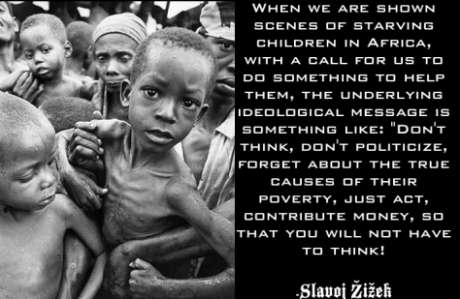



 Picture 9: The 244 children who fled from Yabus to Damazin in December 1989 were quartered in tents on their arrival. The tents and other ORA properties including trucks and large amounts of food in store were confiscated by the Sudanese government in 1992 supporting the Tigrayan regime in Finfinnee (Addis Ababa). The tents were donated by the German Ministry for Development Aid. Photo Tarfa Dibaba


 Picture 13: Some of the ORA teenagers in Bikoree, Sudan, having a good time together in 1990. This and the other pictures taken in exile show that that the children were well cared for by ORA. Photo: Tarfa Dibaba
 Photo (Left) This photo is said to be that of Duula Tafarra, Saganta Usen, and Tolina Waaqjiraa. The person (Dhaabaa) who sent it me did not identify who is who in the photo. The only thing he said he knew is that the photo is that of the three boys taken together. I have included the picture here hoping that someone who knew them can help us to identify them.


 A man who single-handedly saved Mandela has recently come forward with his story. Captain Guta Dinka, 78, was one of the two guards assigned to protect the future icon of peace during his training’ in Finfinnee. Read more at
 Nelesen Maandeellaa


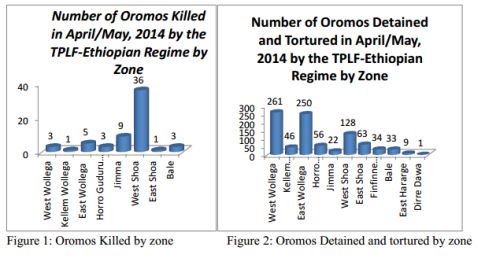

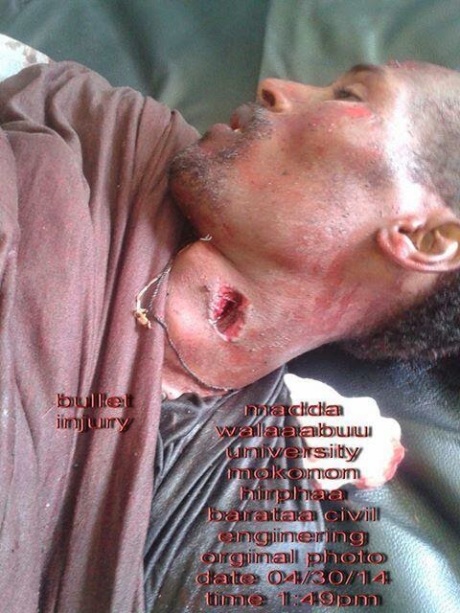





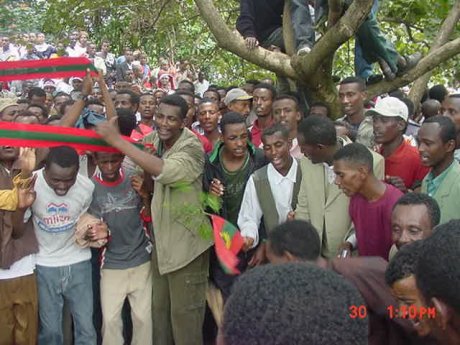


 “Barely




 Oromian Economist