jump to navigation

Oromia: Athletc Nation Report: Oromo athlete Genzebe Dibaba clocks second fastest indoor 1500m of all-time to top five world leads in Karlsruhe February 5, 2018

Posted by OromianEconomist in Athletic nation, Uncategorized.
Tags: , , , , , , , , , ,
add a comment

Living up to her meeting poster girl billing, Genzebe Dibaba powered to the second fastest indoor 1500m of all time to highlight the Indoor Meeting Karlsruhe on Saturday (3), the opening leg of the 2018 IAAF World Indoor Tour.

The Ethiopian’s sensational 3:57.45 run was one of five world leading performances to play out before a vociferous sell-out crowd of 4,500 at the Messe Halle Karlsruhe, but the only one likely to remain atop the world lists, unless Dibaba herself decides to attack it later this season.

Clearly, Dibaba likes to race in Karlsruhe. The Ethiopian set the 3:55.17 world indoor record at this meeting four years ago on the nearby Europahalle track. She clocked 4:00.13 two years prior to that, which is, after this evening, the 10th fastest run of all-time.

On this return engagement, she looked like the Dibaba of 2014, attacking her world standard from the gun. She looked eager early on, testing her patience behind the pacesetter Nelly Jepkosgei, who opened with a 1:01.16 opening 400m. That was well inside the 62.5 in Dibaba’s world record run, but too quick for Jepkosgei, who struggled in the waning stages of her 800-metre assignment. The tempo not to her liking, Dibaba forged ahead to go it alone, passing the 800m mark in 2:07.52, a second-and-a-half faster than four years ago.

Unrelenting, her record assault intentions, mere whispers prior to the race, were clear by 1100m. Here the clock read 3:10.57, almost identical to the 3:10.5 en route to her record. Forging on, she finally ran out of steam midway through the final bend, but still managed to finish well under the formidable indoor four-minute barrier for the third time. No other woman can claim that achievement.

While Dibaba went for broke from the outset, the race for second was a contest of patience. Kenyans Beatrice Chepkoech and Winny Chebet tried to maintain for the first 800 metres, but quick paid for those ambitions, both falling back over the next two laps. That played well into the hands of Konstanze Klosterhalfen, who often prefers to run alone. Passing the Kenyan duo, the German, who will celebrate her 21st birthday on 18 February, pushed on to eventually reach the line in 4:04.00, a personal best.

Chepkoech was third in 4:08.33 and Chebet fourth clocking 4:09.45.

NELVIS IMPROVES TO 7.80

While Dibaba was the meeting’s main global attraction, that role’s national counterpart was played by Pamela Dutkiewicz, whose star has risen considerably since she took world 100m hurdles bronze last summer in London. But Sharika Nelvis of the US rained on that parade after she emerged victorious in a blanket finish in the 60m hurdles, clocking 7.80, another world lead and nabbing ten World Indoor Tour points.

IAAF


Activists pushed for passage of Ethiopian Human Rights bill in the US Congress February 5, 2018

Posted by OromianEconomist in Human Rights, Uncategorized.
Tags: , , , , , , ,
add a comment

Odaa Oromoooromianeconomist

Bekele Gerba, a university Professor & one of the prominent political prisoners is in a critical condition denied of medical care in #Ethiopia. #MedicalCare4BekeleGerba #FreeBekeleGerba #OromoProtests @ScholarsAtRisk February 1, 2018

Posted by OromianEconomist in Uncategorized.
Tags: , , , , , , , ,
3 comments

Odaa Oromoooromianeconomist

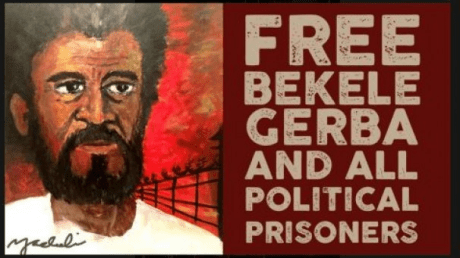
Free Bekele Gerba and all political prisonners in Ethiopia


Bekele Gerba, a university Professor & one of the prominent political prisoners is in a critical condition denied of medical care in Ethiopia. #MedicalCare4BekeleGerba #FreeBekeleGerba #OromoProtests @ScholarsAtRisk

NEWS: IMPRISONED OPPOSITION LEADER BEKELE GERBA RISKS LOSING LEFT EYE VISION, HIS DISTRAUGHT DAUGHTER SAYS    

Obbo Baqqalaa Garbaa Wal’ansa Fayyaa Dhabuun Nu Gaddisiisa: Maatii, VOA Afaan Oromoo

አቶ በቀለ ገርባ ግራ ዐይናቸው መጎዳቱን ልጃቸው ቦንቱ በቀለ ገለፀች. VOA


#MedicalCare4BekeleGerba: Activists launch online campaign amid jailed leader’s deteriorating health,  OPride 


Ethiopian activists on Thursday launched an online campaign demanding the release of and immediate medical treatment for jailed Oromo opposition leader, Bekele Gerba. The campaign is themed, “Bekele Gerba’s eye is our eye. He won’t lose his sight while we watch idly.”

Bekele, the deputy chairperson of the opposition Oromo Federalist Congress (OFC), is at risk of losing his eyesight due to hypertension and other health issues. The Qilinto prison administration, where he has been held since December 2015 accused, among other things, of inciting the #OromoProtests, have refused to allow Bekele to seek medical treatment at a local private clinic despite a referral from government hospital in the capital, Addis Ababa.

Bekele, a champion of nonviolent movement and who during previous prison term translated Martin Luther King’s speeches to Afaan Oromo, was widely expected to be released as part of government amnesty announced last month. However, so far, authorities have remained tight-lipped about whether his release and the release of other prominent political prisoners is forthcoming. Merera Gudina, the chairperson of OFC, was released 12 days ago.

“The doctors told us Bekele needs specialized doctors to treat his retinal blood vessels which are severely damaged due to a high blood pressure he has been experiencing since his detention, which has not been treated,” his distraught daughter, Bontu, told Addis Standard on Thursday. “We don’t know what is going to happen, my father’s left eye vision is completely blurred and he is in pain.”

At the last check-up, Bekele’s blood pressure reportedly came in at 190/110, which according to Addis Standard, “is considered hypertensive crisis or an emergency.” 

A quick timeline of Bekele’s ordeal:

  • Bekele was detained in December 2015 for allegedly inciting the popular Oromo protests.
  • Bekele was charged in April 2016 along with 21 defendants that included defendants Dejene Fita Geleta, Secretary General of OFC, and Gurmesa Ayano, another senior member, with various articles of the country’s sweeping Anti-Terrorism Proclamation.
  • A federal high court in July acquitted five of the 22 defendants, and reduced the terrorism charge against Bekele to crime charges under article 257/A of the 2004 Criminal Code.
  • In August, a panel of three judges at the Federal High Court denied Bekele’s request for bail.
  • On Oct. 30, 2017, the  Supreme Court overruled the high court decision and granted Bekele bail on appeal.
  • The court ordered Bekele’s release pursuant the posting of bail bond for 30, 000 birr (about $1, 000.)
  • On Oct. 31, the Qilinto prison administration refused to release Bekele claiming that the file number was incorrect.
  • On Nov. 1, the high instance court, also known as cassaction bench, suspended the bail. Bekele was asked to file a response.


Ethiopia is following the path of failed states in the Horn of Africa, North Africa and the Middle East January 31, 2018

Posted by OromianEconomist in Uncategorized.
Tags: , , , , , , ,
add a comment
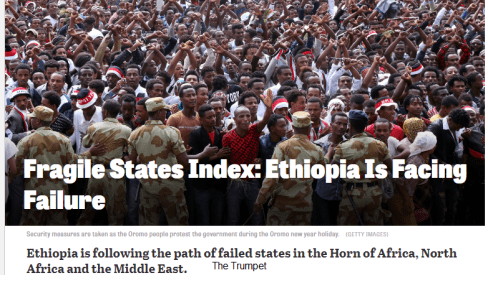
Ethiopia is following the path of failed states in the Horn of Africa, North Africa and the Middle East.

Ethiopia faces a high risk of failure due to continued political and social instability in the country, the Fund for Peace reported in its Fragile States Index Annual Report 2017.

Over the past few years, months, weeks and days, security officers have killed anti-government protesters, resulting in more anti-government protests. The latest point in this vicious cycle occurred on January 20 when Ethiopian security forces shot and killed at least seven protesters. According to news reports, the protesters were celebrating a religious festival. Then they started chanting anti-government slogans and hurling stones at security officers, who responded by firing bullets.

Reports say the weekend clash was followed by a week of more violent clashes, which resulted in the death of at least 20 civilians.

Much of this bloodshed in Ethiopia is based on ethnic differences and territorial disputes between ethnic regions within the nation.

“Limited attention has been given to outbreaks of violence in Ethiopia, as anti-government protests, particularly in the Amhara and Oromia regions, led to a declaration of a [10-month] state of emergency in October 2016,” the Fund for Peace wrote in its report. “The state of emergency was also used as a tool to crack down on political opponents and media.”

Activists say that more than 700 Oromia residents were killed when security officers clashed with people from the Oromo ethnic group during a thanksgiving festival in October 2016. A similar incident happened in October last year when security forces killed about 10 people who were protesting food shortages. In December, military officials reportedly killed 15 protesters in Oromia.

“Ethiopia’s overall Fragile States Index (fsi) score has been incrementally worsening over the past decade, moving from 95.3 in 2007, to a score of 101.1 in [last] year’s 2017 index, with Ethiopia—along with Mexico—being the most-worsened country over [2016],” wrote the Fund for Peace. Foreign Policy wrote on January 11 that “Ethiopia Is Falling Apart.”  Click here to read more….


Why GDP growth is totally wrong as a measure of economic and social success January 28, 2018

Posted by OromianEconomist in Uncategorized.
Tags: , ,
add a comment

Odaa Oromoooromianeconomist


5 ways GDP gets it totally wrong as a measure of our success,  by  David Pilling, World Economic Forum 

GDP is flummoxed by the Internet. Wikipedia provides all human knowledge free of charge, but in GDP terms, it is worth zilch

GDP is flummoxed by the Internet. Wikipedia provides all human knowledge free of charge, but in GDP terms, it is worth zilch

Image: REUTERS/Gary Cameron


The beauty of gross domestic product is its single figure. It squishes all of human activity into a couple of digits, like a frog jammed into a matchbox. As this image of an unfortunate amphibian suggests, this condensing is also GDP’s flaw. How can the sum total of everything we do as human beings be so compacted? How can our activity be conflated with something as complex, nuanced and contested as our wellbeing?

GDP’s inventor Simon Kuznets was adamant that his measure had nothing to do with wellbeing. But too often we confuse the two. For seven decades, gross domestic product has been the global elite’s go-to number. Fast growth, as measured by GDP, has been considered a mark of success in its own right, rather than as a means to an end, no matter how the fruits of that growth are invested or shared. If something has to be sacrificed to get GDP growth moving, whether it be clean air, public services, or equality of opportunity, then so be it.

GDP is how we rank countries and judge their performance. It is the denominator of choice. It determines how much a country can borrow and at what rate. But GDP is well past its sell-by date, as people are starting to realise. However brilliant the concept, a measure that was invented in the manufacturing age as a means of fighting the Depression is becoming less and less capable of imparting sensible signals about complex modern economies.

Pointing out the defects of GDP and even tentatively suggesting alternatives is no longer controversial. Former French President Nicolas Sarkozy commissioned a panel led by Joseph Stiglitz, a Nobel economist, to examine the issue. It was creating a dangerous “gulf of incomprehension”, Sarkozy said, between experts sure of their knowledge and citizens “whose experience of life is completely out of sync with the story told by the data”.

What is so gross about gross domestic product?

GDP is a gross number. It is the sum total of everything we produce over a given period. It includes cars built, Beethoven symphonies played and broadband connections made. But it also counts plastic waste bobbing in the ocean, burglar alarms and petrol consumed while stuck in traffic.

Kuznets was uneasy about a measure that treated all production equally. He wanted to subtract, rather than add, things he considered detrimental to human wellbeing, such as arms, financial speculation and advertising. You may disagree with his priorities. The point is that GDP makes no distinction. From the perspective of global GDP, Kim Jong-un’s nuclear warheads do just as well as hospital beds or apple pie.

Is that all that’s wrong with GDP, then?

No. Don’t get me started. In a short article like this, there’s not enough time to go into everything. But here are a few points, all of which are covered in much greater detail in my book, The Growth Delusion: Wealth, Poverty and the Well-Being of Nations.

GDP is born of the manufacturing age. It measures “things you can drop on your foot”. Yet in advanced economies such as the US, up to 80% of production is in the service industry. GDP doesn’t do services – at least not very well. It is good at quantity, but lousy at quality. If the food or service improves in your local restaurant, GDP will not notice. Ditto, if an airline’s safety record improves. In fact, GDP might prefer a plane crash – so that it can build a new plane.

GDP is flummoxed by the Internet. If I buy my own cheap airline ticket, check myself in online and pick my own aisle seat, my convenience has gone up. But GDP has gone down. I am my own travel agent, a job that would once have been performed by a fully paid-up GDP-producing employee. Wikipedia provides all human knowledge free of charge. In GDP terms, it is worth zilch.

GDP deals in aggregates; GDP per capita in averages. In an age where a huge cause of social dislocation is inequality, GDP has nothing to say about distribution. Averages are misleading. Medians are better than means. A rise in average GDP could actually be retrograde, if it leaves 99% of people resentful at how the 1% is making good.

From GDP’s perspective, bigger is always better. In the real world, that is not always so. When the financial sector got bigger and bigger, it ended in financial crisis. When the US health service gets bigger and bigger, it means costs are out of control.

In general, GDP measures only cash transactions. In Europe that includes heroin and prostitution. However, volunteer work, housework or looking after an ageing relative count for nothing. GDP has skewed priorities.

In poor countries, the informal sector is practically invisible to GDP. Yet in much of the world, the informal economy counts for most. Monitoring economic activity from space, through satellite images of nightlights, might be more accurate than on-the-ground GDP, academic studies have found.

Is GDP really such a bad measure of wealth?

GDP is not a measure of “wealth” at all. It is a measure of income. It is a backward-looking “flow” measure that tells you the value of goods and services produced in a given period in the past. It tells you nothing about whether you can produce the same amount again next year. For that, you need a balance sheet – a measure of wealth. Companies have balance sheets as well as income statements. Nations don’t.

When Nigeria was busy selling high-priced oil to the world before the price crash, its GDP was soaring. But its wealth was falling. Oil deposits were used up, but cash was not reinvested in human, physical and technological capacities to ensure future income. Only wealth accounts could have drawn attention to that.

In January, the World Bank will release a groundbreaking study of comprehensive wealth for 141 countries between 1994 and 2014. It is well worth a read.

Should GDP be dethroned?

Yes. GDP is an ingenious measure. It tells us something. It should definitely not be scrapped – it is still far too valuable a policy tool for that. And GDP growth can provide the wherewithal for the other things we want in life: health, education, security, opportunity, goods.

But we need to pay more attention to other measures to complete the picture, some of which already exist and some of which we may have to invent. Measures of wealth, equality, leisure, wellbeing and net domestic product, adjusted for negatives like pollution, are places to start.

Everyone will have their favourite data point. One of mine is hours of sleep, which might be a proxy for work-life balance or stress. The number of hours of sleep in the US has been steadily declining from about eight hours in 1940 to 6.8 hours today. Now that’s a statistic I know how to act on.

Oromia: Ambo People gives Professor Merera Gudina Hero’s Welcome. Ambotti Simannaa Prof. Mararaaf Godhame January 28, 2018

Posted by OromianEconomist in Uncategorized.
Tags: , , , , , ,
5 comments


Odaa OromoooromianeconomistDistinguished Political Science Professor Dr. Merera Gudina, renowed Oromo Scholar and Human rRights Advocator


PICTORIAL: AMBO CROWD GIVES DR. MERERA GUDINA A HERO’S WELCOME

January 28/2018

Today hundreds of thousands of people from Ambo, a city 125 km west of Addis Abeba, and its environs came to welcome veteran opposition party leader Dr. Merera Gudina. 

 Dr. Merera, chairman of the Oromo Federalist Congress (OFC)  was released from prison last week after spending more than a year a prison. 

Since then, he has been busy receiving jubilant supporters from all walks of life.


But today, he went to his birth place, where he enjoys a massive support

 His supporters came in droves from every vicinity of the city of Ambo

The program at the Ambo stadium lasted only few minutes

And Dr. Merera used the time to thank the people and the police for peacefully coordinating the massive turnout to welcome him


Related article: Ethiopia’s Oromo leader meets German envoy over political developments, click here to read at African News

Fascist Ethiopia’s regime (TPLF) forces suppressing new protests in Amhara: gunfire, deaths reported January 25, 2018

Posted by OromianEconomist in Uncategorized.
Tags: , , , , ,
6 comments

Ethiopia army suppressing new protests in Amhara: gunfire, deaths reported

ETHIOPIA

Local media portals are reporting violent protests in Ethiopia’s northern Amhara region. The protest in the town of Kobo is against an earlier deadly crackdown that killed seven people in the town of Woldiya last Sunday.

The Addis Standard and Addis Gazetta portals report that the clashes started on Wednesday leading to the burning of government offices and other public properties.

The heavy military presence in the region and the sound of gunshots suggest that live bullets are being discharged. There are no official casualties reported from the incident even though journalists said three people have been killed.

Public protest and deadly crackdown undergoing in Kobbo, north east of Amhara, undergoing. Reports are coming out that Fed forces are using live ammunition against unarmed protestors.

The earlier protest which resulted in the Kobo round of protests was in Woldiya during the Epiphany celebrations, according to the United Nations human rights office, the military fired live bullets to prevent young people from chanting anti-government slogans.

Seven people are said to have died whiles dozens got injured in the ensuing clashes. Kobo is located about 50 km from Woldiya.

-Some reports indicate that there have been civilian deaths during protests that began yesterday in town, northern Wollo zone of the regional state. The incident follows the weekend killing of civilians in , 50 km from Kobo. pic.twitter.com/tLbpq7ZlPN

This pictures were posted on @addisgazetta and reportedly show the aftermath of the protests in , denouncing the killing . Also, according to journalist @Belay_Ma, “government offices were burnt”, “shops [are] closed” and “gunfire [can[ still be heard in the town.” pic.twitter.com/2uQoVW2WB0

View image on TwitterView image on TwitterView image on Twitter

Amhara along with Oromia region were the main centers of anti-government protest that shook the country in 2015 and through the better part of 2016.

To quell the violent protests, Addis Ababa imposed a nationwide state-of-emergency in October 2016. The measure was lifted in August 2017. Parts of the country have been rocked by deadly protests since the measure was lifted.


Related from Oromian Economist sources:-

Uprising in Kobo, regime forces are using military helicopters


BBC: ስማቸው እንዲጠቀስ ያልፈለጉ የቆቦ ከተማ ቀበሌ 01 ነዋሪ፤ ከትናንት ጀምሮ በነበረው ግጭት አንድ ታዳጊን ጨምሮ በርካቶች መገደላቸውን ለቢቢሲ ተናግረዋል።

የሟቾችን ቁጥር በተመለከተ ያገኘናቸው መረጃዎች የተለያዩ ሲሆኑ ከሆስፒታል ምንጮች ለማረጋገጥ ያደረግነው ጥረት አልተሳካም።

እንደ ነዋሪዎች ከሆነ ግን ቢያንስ ሶስት እና ከዚያ በላይ ሰዎች ተገድለዋል። በጸጥታ ኃይል አባላት ላይም ጉዳት መድረሱን ነዋሪዎች ጨምረው ተናግረዋል።

ያነጋገርናቸው ሌላኛው የቆቦ ነዋሪ የግጭቱን መነሻ ሲያስረዱ፤ ”በወልዲያ ከተማ የተፈጸመው ግድያ ቆቦ ውስጥ ከፍተኛ ውጥረትን ፈጥሮ ነበር። ይህ በእንዲህ እያለ ንብረታችን ሊዘረፍ ወይም ሊወድምብን ይችላል ብለው የሰጉ ሰዎች ንግድ ቤቶቻቸውን በመዝጋት ንብረት ለማሸሽ ሞክረው ነበር። አንዳንድ ወጣቶችም ‘እዚህ ምንም ሳይፈጠር እንዴት ይህን ታደርጋላችሁ’ ብለው መጠየቃቸውን ተከትሎ ግርግር ተፈጠረ ከዚያም ወደ ግጭት አመራ” ሲሉ ያስረዳሉ።

በከተማዋ ተቃውሞ የተጀመረው ትናንት ከቀኑ 8 ሰዓት ጀምሮ እንደነበር እና ተቃውሞው ወደ ግጭት ተሸጋግሮ የንግድ ቤቶችን እና የመንግሥት መስሪያ ቤቶችን ማቃጠል የተጀመረው ግን 10 ሰዓት አካባቢ መሆኑን ከከተማዋ ነዋሪዎች መረዳት ችለናል።

ዛሬ ሐሙስ እሰከ ጠዋቱ 3 ሰዓት ድረስ ከተማዋ ምንም እንኳን ውጥረት ውስጥ ብትቆይም ግጭት አልነበረም የሚሉት ሌላው ነዋሪ ”ከ3 ሰዓት በኋላ ግን በርካታ ወጣቶች ዘለቀ እርሻ ልማት ወደሚባል ድርጅት በመሄድ በድርጅቱ ቅጥር ግቢ ውስጥ የነበሩ ትራክተሮችንና የእርሻ መሳሪያዎችን አወደሙ። ከዚህ በተጨማሪም የድረጅቱ ህንጻ ላይም ጉዳት ደርሷል” ሲሉ ያስረዳሉ።

እንደ ነዋሪዎቹ አባባል የእርሻ ድርጅቱ የጥቃቱ ኢላማ የሆነው ”ከአርሶ አደሩ በርካታ ሄክታር መሬት ተነጥቆ ለዘለቀ እርሻ ልማት ድርጅት ተሰጥቷል የሚል ቅሬታ በመኖሩ ነው” ሲሉ ተናግረዋል።

ከዘለቀ እርሻ ልማት ድርጅት በተጨማሪ ኪወ የእርሻ ልማት እና ባለቤትነቱ የሆላንዳውያን የሆነ ሌላ የእርሻ ልማት ድርጅቶች ላይ ጉዳት መድረሱን የኪወ እርሻ ልማት ባለቤት ለቢቢሲ ተናግረዋል


BBC:  ”ወንድሜን በአምስት ጥይት በሳስተው ነው የገደሉት”

በወልዲያ ከተማ በጥምቀት በዓል ማግስት የተከሰተውን ተቃውሞ ተከትሎ የፀጥታ ኃይሎች በወሰዱት እርምጃ በርካቶች ህይወታቸውን ማጣታቸው ይታወቃል።

መንግሥት የሟቾች ቁጥር ሰባት ነው ቢልም ያነጋገርናቸው የከተማዋ ነዋሪዎች ግን የሟቾችን እና የቁስለኞችን ቁጥር ከፍ ያደርጉታል።

ከከተማዋ ነዋሪዎች እንደሰማነው ከሟቾቹ መካከል አዛውንቶች እና እድሚያቸው በአስራዎቹ መጀመሪያ ላይ የሚገኙ ሁለት ታዳጊዎች ይገኙበታል።

ESAT: One of the thirteen people shot and killed by TPLF security forces on Epiphany day religious festival in Woldia, a town on a major transportation route in Northern Ethiopia, was shot five times.


VOA: በሞያሌ መከላከያ ፖሊስ አንድ ሰው ገድሎ ሦስት ማቁሰሉን የከተማው አስተዳደር አስታወቀ


UNPO: Ethiopia: HRLHA Calls for Genuine Solution to Crisis in Ethiopia January 25, 2018

Posted by OromianEconomist in Uncategorized.
Tags: , , , ,
add a comment
Odaa OromoooromianeconomistUNPOHuman rights League of the Horn of Africa
 

Ethiopia: HRLHA Calls for Genuine Solution to Crisis in Ethiopia


Photo Courtesy of Andrew Heavens@Flickr

By  UNPO, Jan 23, 2018

On 21 January 2018, the Human Rights League of the Horn of Africa (HRLHA) released an urgent action statement calling for more disclosure and action from Ethiopia’s government, in light of the recent release of political prisoners. Although praising the release of 115 federal inmates, including OFC Leader Dr. Merera Gudina, HRLHA views this as ‘picking a few individual grains out of a ton’. The government declared the release was to create a national consensus and widen the political space however, HRLHA states that this is not a likely result unless other more concrete measures are implemented. 

The Ethiopian People’s Revolutionary Democratic Front (EPRDF) has continued to deny the holding of political prisoners and the use of torture in centres such as Maikelawi detention centre, known as Ethiopia’s Guantanamo.

The situation is particularly severe in the Oromia Regional State, where political uprising has been met with military action and the region is under the complete control of the Federal Military Force ‘National Security Council’. Since this military takeover, many youth have been detained due to their participation in protests, an action that contradicts the government’s efforts to ‘create a national consensus’.

The HRLHA made a series of recommendations in this release calling for the government of Ethiopia to take steps towards full disclosure and transparency of the number of forcibly disappeared and political prisoners held in federal prisons, military camps and underground prisons. A recommendation for the government to invite all stakeholders to genuine and inclusive dialogue to promote a national consensus among Ethiopian citizens.


Read the urgent action statement from HRLHA here.

The entire document is also available in PDF format here: The Chronic, Political, Economical and Social Crisis in Ethiopia Needs A Genuine Solution


Ethiopia: Detention of Indigenous Leaders Continues January 25, 2018

Posted by OromianEconomist in Uncategorized.
Tags: , , , , , ,
1 comment so far

Odaa OromoooromianeconomistOakland Institute

The Release of Ethiopian Political Prisoners: Stifled Voices amidst False Promises

  • “We must always remember the people outside of Addis, from marginalized communities, who are in jail for standing up and resisting government programs that took away their land.”

  • “Those who have been forgotten, whose voices are not being heard, and who are behind bars for speaking out on behalf of their people. People in Gambella, Benishangul-Gumuz, the Lower Omo Valley, and other places, who still remain invisible.”

For years, the Ethiopian government has denied that there are political prisoners in the country. This is despite its consistent use of the draconian Anti-Terrorism Proclamation to stifle dissent and detain thousands of politicians, journalists, religious and indigenous leaders, and students.

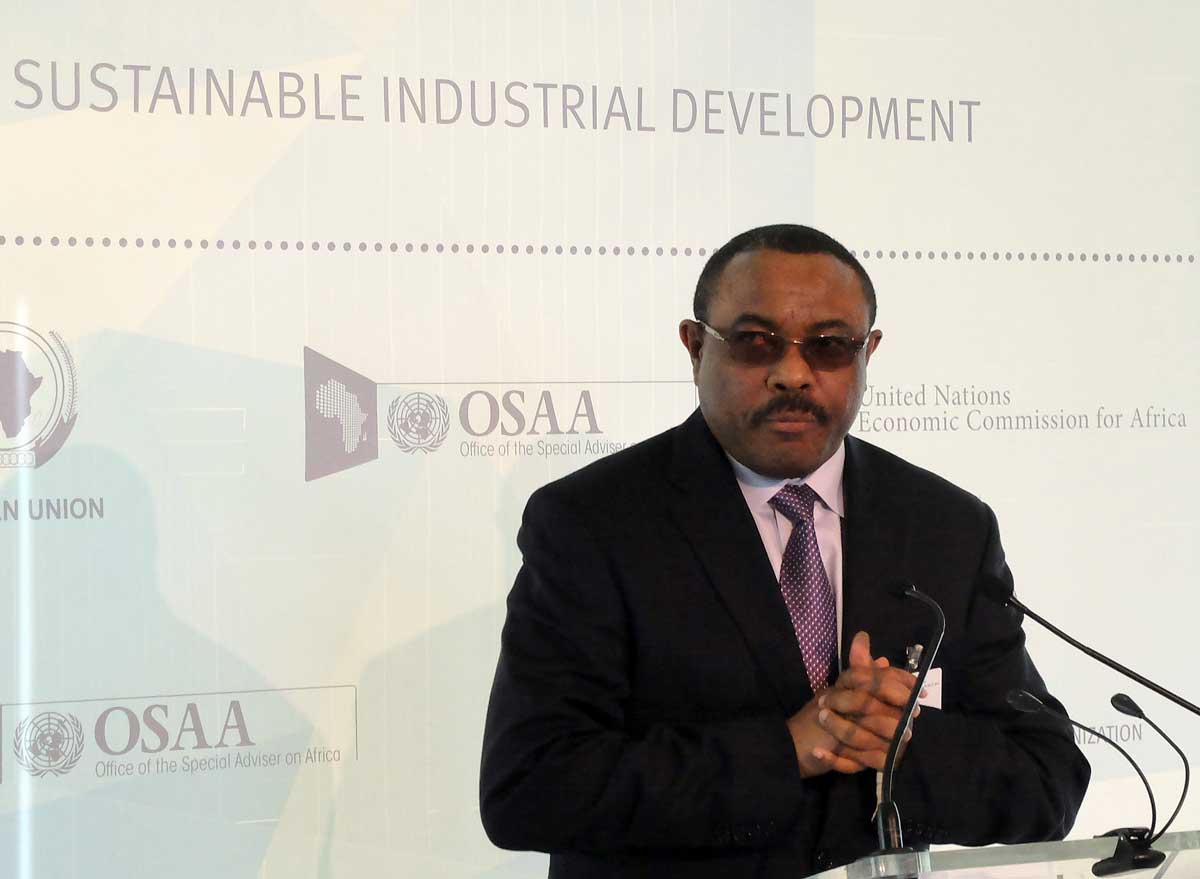
“2015—Ethiopia Prime Minister Hailemariam Desalegn at NY event on industrialization in Africa.”. On January 3, 2018 Prime Minister Desalegn announced that the government would release all Ethiopian political prisoners and close the notorious Maekelawi police station. Credit: UNIDO (CC BY-ND 2.0)
“2015—Ethiopia Prime Minister Hailemariam Desalegn at NY event on industrialization in Africa.” On January 3, 2018 Prime Minister Desalegn announced that the government would release all Ethiopian political prisoners and close the notorious Maekelawi police station. Credit: UNIDO (CC BY-ND 2.0)

Thus, Prime Minister Hailemariam Desalegn’s recent announcement that some political prisoners would be released, sparked a mixture of relief and confusion: relief that the government was finally acknowledging and releasing political prisoners in the country; and confusion over who would be freed, and what the announcement really meant.

Uncertainty Continues after Prime Minister Desalegn’s Announcement

“The government says it will close Maekelawi, but this closure doesn’t stop the current government from torturing people.”

This uncertainty has continued. A week after the announcement, prominent Ethiopian political prisoner Bekele Gerba was sentenced to an additional six months in jail for singing a protest song during his court proceedings. Gerba, the Deputy Chairman of the Oromo Federalist Congress, was arrested in his home in December 2015, just months after spending four years in prison for meeting with Amnesty International researchers. Gerba was granted bail in October 30, 2017, but it was revoked two days later.

Then on January 15, it was announced that charges against 528 persons currently in detention would be dropped. Most of them, including prominent political prisoner Merera Gudina, appear to have been released on January 17.

Detention of Indigenous Leaders Continues

  • “The government says it will close Maekelawi, but this closure doesn’t stop the current government from torturing people. The torture that has taken place there was not only during the Derg, it’s under this regime too.”

However, this is not the time to celebrate given that thousands of others remain in jail. Ethiopia’s anti-terrorism law and other draconian legislation like its civil society proclamation are still in place and widely used to intimidate and repress.

Most importantly, the repressive system is not just about barring political freedom; to a large extent, it is about ensuring the control of a minority over the resources of the country and the benefits of the economic development. Many political prisoners in Ethiopia are not just members of opposition political parties but ordinary citizens who oppose the grabbing of their land and natural resources by the government.

Many are members of indigenous communities such as the Anuak, Bodi, Mursi, and other marginalized groups who spoke up against land grabbing and for the rights of their people to decent livelihoods and life with dignity. Thousands are still being held by the regime in facilities across the country though the actual number is unknown given the general opacity surrounding such matters.

Closure of Maekelawi Prison Doesn’t Guarantee End of Torture

  • “There has been public resistance in Ethiopia, and I think this pressure made them release this statement. They want people to calm down. But what the people of Ethiopia need is freedom and absolute change in the political arena. They need something practical – not just theory and words. They need democracy, they need to have the right to use their land, they need their voices to be heard.”

“I hope they release my father, and that my family, and all the other families affected by this government, can finally come together again. I hope this will help heal the wounds of Ethiopia.”

We must also scrutinize the Prime Minister’s announcement to close the notorious Maekelawi police station. The government said this closure is because Maekelawi was used as a place of torture under the previous Derg regime, insinuating that torture no longer takes place there. But, as numerous studies have documented, torture is rampant at Maekelawi and prisons across Ethiopia and, as stated below by those who have suffered at the hands of this government, its closure does nothing to guarantee that these abuses will halt.

In the course of the Oakland Institute’s work on land rights and development issues in Ethiopia, we have met or come to know many of the victims of this repressive system. We reached out to several current and past Ethiopian political prisoners and their families to hear their perspectives on the recent announcements made by the government. We share and amplify their voices here, and echo their calls for justice. Given the ongoing threats to themselves and their families, names have been withheld to protect their identities.


Ethiopia: Human Rights Watch (HRW) World Report 2018 January 21, 2018

Posted by OromianEconomist in Human Rights, Uncategorized.
Tags: , , , , , , ,
add a comment

 Odaa Oromoooromianeconomist

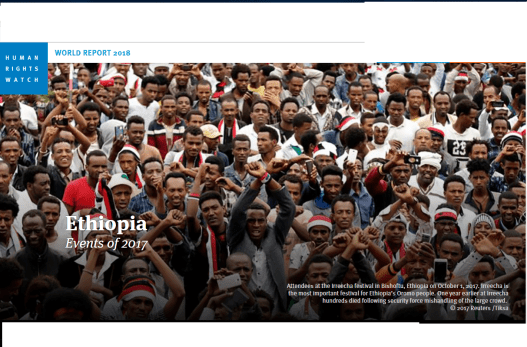
Attendees of Irreecha 2017 in Bishoftu, HRW 2018 world report.png

Attendees at the Irreecha festival in Bishoftu, Ethiopia on October 1, 2017. Irreecha is the most important festival for Ethiopia’s Oromo people. One year earlier at Irreecha hundreds died following security force mishandling of the large crowd. © 2017 Reuters /Tiksa

Ethiopia made little progress in 2017 on much-needed human rights reforms. Instead, it used a prolonged state of emergency, security force abuses, and repressive laws to continue suppressing basic rights and freedoms.

The 10-month state of emergency, first declared in October 2016, brought mass arrests, mistreatment in detention, and unreasonable limitations on freedom of assembly, expression, and association. While abusive and overly broad, the state of emergency gave the government a period of relative calm that it could have used to address grievances raised repeatedly by protesters.

However, the government did not address the human rights concerns that protesters raised, including the closing of political space, brutality of security forces, and forced displacement. Instead, authorities in late 2016 and 2017 announced anti- corruption reforms, cabinet reshuffles, a dialogue with what was left of opposition political parties, youth job creation, and commitments to entrench “good governance.”

Ethiopia continues to have a closed political space. The ruling coalition has 100 percent of federal and regional parliamentary seats. Broad restrictions on civil society and independent media, decimation of independent political parties, harassment and arbitrary detention of those who do not actively support the government, severely limited space for dissenting voices.

Despite repeated promises to investigate abuses, the government has not credibly done so, underscoring the need for international investigations. The government-affiliated Human Rights Commission is not sufficiently independent and its investigations consistently lack credibility.

Ethiopian government and security officials should act with restraint and take concrete steps to prevent injuries and deaths at this year’s Irreecha festival on October 1, 2017.

State of Emergency

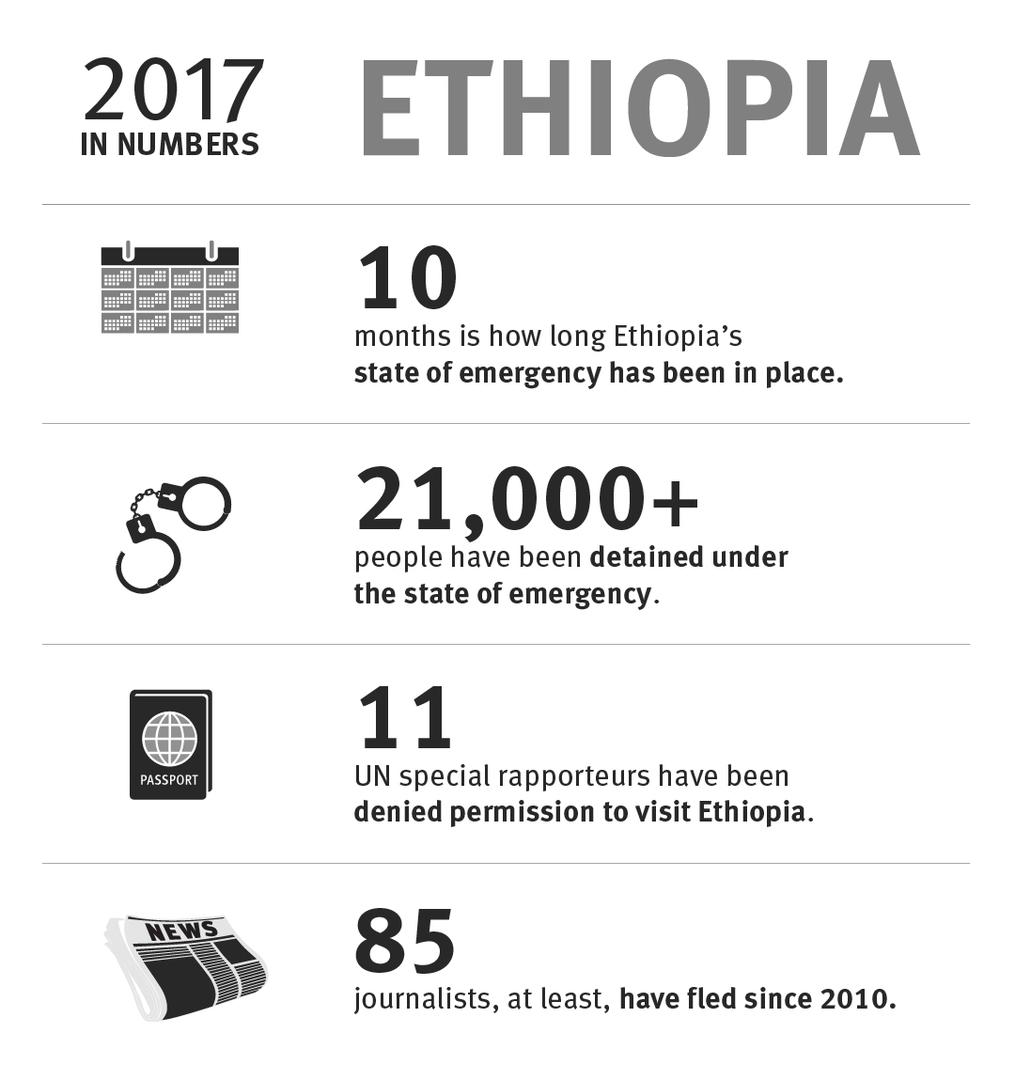
Ethiopia spent much of 2017 under a state of emergency first imposed in October 2016 following a year of popular protests, renewed for four months in March, and lifted on August 4. Security forces responded to the protests with lethal force, killing over 1,ooo protesters and detaining tens of thousands more.

The state of emergency’s implementing directive prescribed draconian and overly broad restrictions on freedom of expression, association, and assembly across the country, and signaled an increasingly militarized response to the situation. The directive banned all protests without government permission and permitted arrest without court order in “a place assigned by the command post until the end of the state of emergency” and permitted “rehabilitation”—a euphemism for short-term detention that often involves forced physical exercise.

During the state of emergency military were deployed in much larger numbers across Oromia and Amhara regions, and security forces arbitrarily detained over 21,000 people in these “rehabilitation camps” according to government figures. Detainees reported harsh physical punishment and indoctrination in government policies. Places of detention included prisons, military camps, and other makeshift facilities. Some reported torture. Artists, politicians, and journalists were tried on politically motivated charges.

Dr. Merera Gudina, the chair of the Oromo Federalist Congress (OFC), a legally registered political opposition party, was charged with “outrages against the constitution” in March. He joins many other major OFC members on trial on politically motivated charges, including deputy chairman Bekele Gerba. At time of writing, at least 8,000 people arrested during the state of emergency remain in detention, according to government figures.

Freedom of Expression and Association

The state tightly controls the media landscape, a reality exacerbated during the state of emergency, making it challenging for Ethiopians to access information that is independent of government perspectives. Many journalists are forced to choose between self-censorship, harassment and arrest, or exile. At least 85 journalists have fled into exile since 2010, including at least six in 2017.

Ethiopia: 2017 in numbers

Scores of journalists, including Eskinder Nega and Woubshet Taye, remain jailed under Ethiopia’s anti- terrorism law.

In addition to threats against journalists, tactics used to restrict independent media include harassing advertisers, printing presses, and distributors.

Absent a vibrant independent domestic media, social media and diaspora television stations continue to play key roles in disseminating information. The government increased its efforts to restrict access to social media and diaspora media in 2017, banning the watching of diaspora television under the state of emergency, jamming radio and television broadcasts, targeting sources and family members of diaspora journalists. In April, two of the main diaspora television stations—Ethiopian Satellite Television (ESAT) and the Oromia Media Network (OMN)—were charged under the repressive anti-terrorism law. Executive director of OMN, Jawar Mohammed, was also charged under the criminal code in April.

The government regularly restricts access to social media apps and some websites with content that challenges the government’s narrative on key issues. During particularly sensitive times, such as during June’s national exams when the government feared an exam leak, the government blocked access to the internet completely.

The 2009 Charities and Societies Proclamation (CSO law) continues to severely curtail the ability of independent nongovernmental organizations. The law bars work on human rights, governance, conflict resolution and advocacy on the rights of women, children, and people with disabilities by organizations that receive more than 10 percent of their funds from foreign sources.

Torture and Arbitrary Detention

Arbitrary detention and torture continue to be major problems in Ethiopia. Ethiopian security personnel, including plainclothes security and intelligence officials, federal police, special police, and military, frequently tortured and otherwise ill-treated political detainees held in official and secret detention centers, to coerce confessions or the provision of information.

Many of those arrested since the 2015/2016 protests or during the 2017 state of emergency said they were tortured in detention, including in military camps. Several women alleged that security forces raped or sexually assaulted them while they were in detention. There is little indication that security personnel are being investigated or punished for any serious abuses. Former security personnel, including military, have described using torture as a technique to extract information.

There are serious due process concerns and concerns about the independence of the judiciary on politically sensitive cases. Outside Addis Ababa, many detainees are not charged and are rarely taken to court.

Individuals peacefully expressing dissent are often charged under the repressive anti-terrorism law and accused of belonging to one of three domestic groups that the government has designated as terrorist organizations. The charges carry punishments up to life in prison. Acquittals are rare, and courts frequently ignore complaints of torture by detainees. Hundreds of individuals, including opposition politicians, protesters, journalists and artists, are presently on trial under the anti-terrorism law.

The government has not permitted the United Nation’s Working Group on Arbitrary Detention to investigate allegations despite requests from the UN body in 2005, 2007, 2009, 2011, and 2015.

Somali Region Security Force Abuses

Serious abuses continue to be committed by the Somali Region’s notoriously abusive Liyu police. Throughout 2017, communities in the neighboring Oromia regional state reported frequent armed attacks on their homes by individuals believed to be from the Somali Region’s Liyu police. Residents reported killings, assaults, looting of property, and displacement. Several Somali communities reported reprisal attacks carried out by unknown Oromo individuals. Human Rights Watch is not aware of any efforts by the federal government to stop these incursions. Several hundred thousand people have been internally displaced as a result of the ongoing conflict.

The Liyu police were formed in 2008 and have a murky legal mandate but in practice report to Abdi Mahmoud Omar (also known as “Abdi Illey”) the president of the Somali Regional State, and have been implicated in numerous alleged extrajudicial killings as well as incidents of torture, rape, and attacks on civilians accused of proving support to the Ogaden National Liberation Front (ONLF). No meaningful investigations have been undertaken into any of these alleged abuses in the Somali Regional State.

Abdi Illey’s intolerance for dissent extends beyond Ethiopia, and family members of Ethiopian Somalis living outside of the country are frequently targeted in the Somali Region. Family members of diaspora have been arbitrarily detained, harassed, and had their property confiscated after their relatives in the diaspora attended protests or were critical of Abdi Illey in social media posts.

Key International Actors

Despite its deteriorating human rights record, Ethiopia continues to enjoy strong support from foreign donors and most of its regional neighbors, due to its role as host of the African Union and as a strategic regional player, its contributions to UN peacekeeping, regional counterterrorism efforts, its migration partnerships with Western countries, and its stated progress on development indicators. Ethiopia is also a country of origin, transit, and host for large numbers of migrants and refugees.

Both the European Parliament and US Senate and House of Representatives have denounced Ethiopia’s human rights record. The European Parliament urged the establishment of a UN-led mechanism to investigate the killings of protesters since 2015 and to release all political prisoners. In April, European Union Special Representative (EUSR) for Human Rights Stavros Lambrinidis visited Ethiopia, underscoring EU concern over Ethiopia’s human rights situation. Other donors, including the World Bank, have continued business as usual without publicly raising concerns.

Ethiopia is a member of both the UN Security Council and the UN Human Rights Council. Despite these roles, Ethiopia has a history of non-cooperation with UN special mechanisms. Other than the UN special rapporteur on Eritrea, no special rapporteur has been permitted to visit since 2006. The rapporteurs on torture, freedom of opinion and expression, and peaceful assembly, among others, all have outstanding requests to visit the country.


Attendees of Irreecha 2017 in Bishoftu, HRW 2018 world reportHirmaattota Ayyaana Irreechaa Onkoloolessa 1, 2017 Bishooftuu, Itoophiyaa. Ayyaanni Irreecha uummata Oromoo Itoophiyaatif ayyaana addaati. Ayyaana Irreecha waggaa tokko dura kabajame irraatti humnootni tikaa tuutaa uummata jeequurran kan ka’e namootni dhibbootan lakkayaman du’anii ture.

© 2017 Reuters /Tiksa


Qabinsa mirga namoomaaf haaromsa haalaan barbaachisu gochuu irratti Itoophiyaan bara 2017 keessa waa xinnoo dalagde. Inumayyuu mirgoota bu’uuraafi bilisummmaa laammiileeshii humnaan ukkaamsuu itti fufuuf jecha labsi yeroo muddamaa, haleellaa humnoota tikaafi seerota ukkaamsoo fayyadamaa turte.

Labsiin yeroo muddamaa ji’oota 10f turefi baatii Onkoloolessa 2016 keessa labsame hidhaa jumlaafi mana hidhaatti dararamuu fidee ture.  Mirgoota akka hiriira nagaa bayuu, mirga yaada ofii bilisaan ibsachuufi mirga ijaaramuu irrattis dhorkaaa hin barbaachisne kaayee ture.  Labsiin muddamaa sun gar-malee baldhaafi sirna malee kan dhimmi itti bayame ta’us mootummaa biyya bulchuuf yeroo tasgabbii silaa komii mormitootni kaasaa turan itti furu kenneefii ture.

Haata’u malee mootummaan Itoophiyaa gaaffilee mormitootaa kan akka cufinsa dirree siyaasaa, haleellaa gara jabeenyaa humnoota tikaafi humnaan qeyee ofiirraa buqqa’uufaa hin furre. Gaaffilee mormitootaa kana deebisuurra aangawoonni mootummaa jijjiirraa farra-malaammaltummaa, jijjiirraa kaabineefii haasawaa paartilee mormituu hafan wajjiin gochuuf, carraa hojii dargaggootaaf uumuufii ‘’bulchiinsa gaarii’’ fiduuf kutannoon akka hojjatan dhuma 2016 fi 2017ti beeksisanii turan.

Itoophiyaan ammas dirree siyaasaa akkuma cuftetti jirti. Walta’insi paartii biyya bulchuu teessoo mana maree bakka bu’oota uummataa naannoofi federaalaa 100% dhuunffatee jira. Dhorkaan guddaan dhaabbilee siviilii fi midiyaarra kaayame, dhabbilee mormituu ofiin dhaabbatan dadhabsiisuun, hidhaafi dararaan namoota mootummaa deeggaruu didan irra gahu dirree sagalee mormii garmalee dhiphisee/cufee jira.

Yeroo heddu yakkoota kana qorachuuf waadaa galus, mootummaan qorannoo amanamaa gochuu dhabuun ammas barbaachisummaa qorannoo idil-adunyaa cimsee agarsiisa.  Komishiniin mirga namoomaa Itoophiyaa hirkattummaa mootummaarraa bilisa waan hin taaneef qarannoon dhaabni kun godhu amanamummaa qabaatee hin beeku.

Labsii yeroo muddamaa

Harka caalaa bara 2017 Itoophiyaan labsii muddama jalatti dabarsite. Labsiin kun Onkoloolessa 2016 yeroo mormiin guddaan turetti labsamee ture. Labsichi Bitootessaa 2017 ji’a afuriif itti dabalamee haaromfamee, Hagayya 4, 2017 kaafame. Humnootni tikaa humna garmalee fayyadamuun namoota kuma tokkoo (1000) ol ajjeesaniiru. Namoota kuma kurnaniin lakkaayaman ammo hidhaatti guuraniiru.

Seerri labsi muddamaa hojiirra oolchuuf itti dabalamee baye biyyattii guutuu keessatti mirgoota akka yaada ofii bilisaan ibsachuu, hiriira nagaa bayuufi ijaaramuu irratti dhorkaafi ukkaamsaa garmalee baldhaa kaayee. Tarkaanfiin kunimmoo rakkinoota mudatan humna waraanaan furuuf kallattii mootummaan kaayame agarsiisa. Seerichi hanga labsiin kun ka’utti mormii heeyyama mootumma hin arganne mara dhorkuun iddoolee labsiin kun murteesseetti ajaja mana murtii malee namoota hidhuus heeyyamee ture. Itti dabaluunis ‘’haaromsa’’- hidhaa yeroo gabaaba kan hojii humnaa dirqiin hojjachuu of-keessaa qabu heeyyame.

Yeroo labsii muddamaa sanitti humnootni waraanaa baayyinaan naannolee Oromiyaafi Amaaraa keessatti bobbaafamuun akka istaatistiksii mootummichaatti namoota kuma digdamii tokkoo (21,000) ol seeraan ala kaampiiwwaan haaromsa garaagaraatti hidhanii turan. Hidhamtoonni hedduun adabbii qaamaa hamaaf saaxilamuu isaaniifi imaammata mootummaa fudhachuuf waadaa galuun dirqii ta’uu dubbataniiru. Iddooleen namoonni kun itti hidhaman: kaampii waraanaa, maneen hidhaafi maneen yeroo gabaabaaf ijaaraman keessatti ture. Hidhamtoonni dararaafi reebichi hamaan mana hidhatti nurra gayeera jedhanis muraasa miti.  Aartistoonni, hoggantoonni paartilee mormituufi gaazexeessitoonni yakka siyaasa bu’uura godhateen himataman.

Dr Mararaa Guddinaa, dura taa’aan paartii kongiresii federaalistii Oromoo- Paartii seeraan galmayee,’’baatii Bitootessaa keessa sirna heeraa mootummaa cabsuutiin himatame. Inni hoggantoota paartii koongiresii federelaastii Oromoo kan akka itti aanaa paartichaa Obbo Baqqalaa Garbaafaatti dabalamuun himanni siyaasaa bu’uureffate irratti baname. Yeroo gabaasni kun barraayetti, akka istaatistiksii mootummaatti namoota yeroo labsii muddama qabamannii hidhaman keessaa 8000 ammayyu mana hidhaa jiru.

Mirga yaada ofii bilisaan ibsachuufi mirga ijaaramuu

Miidiyaan marti to’annoo mootumma jalatti kufaniiru. Towannoon kun yeroo labsii muddamaattimmo garmalee jabaate. Sababa kanaaf lammiileen biyyattii odeeffannoo piroopaagaandaa mootummaarra bilisa ta’e argachuuf garmalee rakkisaa ture. Filannoon gaazexeessitoonni hedduun qaban yookan ofiin of-laguu ykn hojjatanii reebamuufi hidhamuu ykn ammo biyyaa bayuu qofa ture. Bara 2010 as qofa gaazexeessitoonni 85 Itoophiyaarra baqatanii bayaniiru. Kana keessaa yooxiqqaate gaazexeessitoonni 6 bara 2017 baqatanii bayan.  Gaazeexeessitoonni danuun kan akka Iskindir Naggaaffi Wubishat Tayyeefaa hanga ammaatti labsii farra shorrorkeessumman yakkamanii mana hidhaa tursiifamaniiru. Gazexeessitoota dararuun alattis dhaabilee beeksisaa, maxxansaafi raabsaa doorsisuun tooftaalee dhaabbilee miidiyaale bilisaaratti dhiibbaan godhamuudha. Dhabamsiifamuu dhaabbilee miidiyaa biyya keessaa irraa kan ka’e miidiyaan hawaasaafi dhaabileen televiziyoonaa diyaaspooraa odeeffanno daddabarsuu keessatti shoora ol-aanaa taphataniiru. Motummaan yaalii towannoo dhabbilee televiziyoona diyaaspooraafi midiyaalee hawaasa 2017 keessa jabeessuun, yeroo labsii muddamaatti televiziyoonota diyaaspora ilaalu dhorkee ture. Dabalataanis raadiyoofi televiziyoonota diyaaspooraa ugguruun akkasumas maatii gaazexeessitoota fi madden odeeffannoo doorsisaa ture.  Ebla, 2017 dhaabbileen televiziyoonotaa diyaaspoora lamaan- Oromiya miidiyaa Netwoorki (OMN) fi ESAT, labsii ukkaamsa farra shorrerkussummaatiin himatamaniiru. Daarektarrii OMN, Jawaar Mohaammedis ji’a Eblaa, 2017 keessa seera yakkaatiin himatameera.

Mootummaan yeruma mara qaqqabinsa aappii miidiyaalee hawaasaafi marsariitota ilaalcha mootumiichaa faalleessan ugguraa ture. Yeroolee murteessoo akka yeroo qorumsa biyyoleessaafaa miliqee bayuu qorumsaa sodaachuun mootummaan intarneeta guutumatti uggureera.

Labsiin dhaabilee arjoominaafi siiviiki bara 2009 baye (CSO) ammayyu humna dhaabbilee miti mootummaa bilisa ta’anii hudhee qabee jira. Labsichi hojiiwwaan akka mirga namoomaa, bulchiinsa gaarii, walitti bu’insa furuufi dhaabblee mirga dubartootaa, daa’iimmaniifi qaama miidhamtootaaf bajata 10% ol biyya alaati argatanii dhorkee jira.

Reebichaafi dararaa mana hidhaa keessatti

Hidhaan seeraan alaafi reebichi mana hidhaa keessaati godhamu ammayyu rakkoo guddaa Itoophiyaati. Humnootni tikaa mootummaa, poolisiin federaalaa, humnootni basaastuu wayyaa siviilii uffatan dabalatee, poolisiin addaa fi raayyaan ittisa biyyaa hidhamtoota siyaasa mana hidhaa ifaa fi dhoksaa keessaatti yeroo heddu reebuun odeeffannoo humnaan irraa fuudhaniiru.

Namoonni baayyeen hiriira mormii bara 2015/2016 manneen hidhaafi kaampilee waraanaa garaagaraatti hidhaman akkasumas kanneen yeroo labsii muddamaa 2017 hidhaman maneen hidhaa keessaatti reebichiifi dararaan irra gayuu dubbatu. Dubartoonni heddu maneen hidhaa kessaatti humnoota tikaatiin gudeedamuufi reebamuu himatu. Humnootni tikaa yakka akkana raawwatan seeratti dhiyaachuu isaanii ragaan muldhatu hin jiru. Namoonni dur humna tikaa keessa hojjatan manneen hidhaa keessatti reebichaafi dararaan ragaa funaanaa turuu isaanii raga bayaniiru.

Dhiimmootaa siyaasaa hamoo irratti walabummaan mana murtiifii adeemsi seeraa baayyee yaaddessaadha. Manneen sirreessaa Finfinneen alaa jiran keessaati hidhamtoonni hin himataman, mana murtiittis hin dhiyaatan. Namonni karaa nagaa sagalee mormii dhiyeessan yeroo heddu labsii farra shorreerkeessummaan yakkamu. Miseensa dhaabbilee mootummaan shorreerkeessitoota jedhee labseeti jechuunis ni himatamu.  Murtiin adabbii himannaa akkanaa irratti darbu hanga hidhaa umurii guutuutti. Himannaa addaan kutuun hin baramne. Hidhamtoonni yakki reebichaa mana hidhaa keessatti nurra gayeera jedhanii yeroo himatan manni murti irra deddeebiin gurra duuchatee bira darbaa jira. Namoonni dhibbootaan lakkayaman, hoggantoonni paartilee mormituu, hirmaattoonni hiriira nagaa, aartitstoonniifi gaazexeessitoonni labsi farra shorrorkeessummaan yakkamanii mana hidhaatti dararamaa jiru.

Qaamnii mootummoota gamtoomanii hidhaa seeraan alaa qoratu bara 2005, 2007, 2009, 2011 fi 2015 irra deddeebiin himannaa kanarratti qorannoo gaaggeessuuf gaafatus mootummaan dhorkee jira.

Dhiittaa mirgaa Poolisiin Addaa Somaalee raawwatu

Poolisiin naannoo Somaalee dhiittaan mirgaa garmaleen beekamu ammas yakkoota hamaa dalaguu akkuma itti fufetti jira. Hawasni naannoo Oromiyaa daangaa naannoo Somaaleerra jiraatan irra deddeebiin humnoota poolisii addaa naannoo Somaleeti jedhamaniin haleelamuu himaniiru. Hawaasni daangaarra jiratan kun ajjeechana, lollii, saamichi qabeenyaafi qeyeerraa buqqayuun akka irra gaye himatu. Hawaasni Somaalees haleellaan haaloo bayumsaa humnoota Oromoo hin beekamneen irratti fudhatamu dubbatu. Hiyumaan raayitswoch yaalii mootummaan federaala haleellaa daangaarra kana dhaabuuf godhe homaayyu hin agarre. Namootni kuma dhibbootaan lakkaayaman sababa walitti bu’insa daangaarraatti deemaa jiruu kanaan qe’eefi qabeenya isaanirraa buqqayaniiru.

Poolisiin addaa naannoo Somaalee kun bara 2008 kan hundeeffame yoo ta’u itti gaafatama seeraa ifa hin taaneen socho’u. Garuummoo qabatamaan pirezideentii mootummaa naannoo Somaalee kan ta’e Abdi Mohamud Omariif abboomamu. Humnootni poolisii addaa kun yeroo garaagaraatti ajjeechaa seeraan alaa, reebichaafi dubartoota gudeeduun akkasumas uummata nagaa humna waraanaa Ogaaden deggaruun shakkaman rukutuun himatamu. Yakkoota gurguddoo humnootni kun naannoo Somaalee keessatti raawwatan jedhamanii himataman qorachuuf yaaliin hiika qabeessi godhame tokkoyyuu hin jiru.

Fedhiin Abdi Illeeyn mormitoota isaa ukkamsuuf qabu daangaa Itoophiyaa qofa keessatti kan daangeffame miti. Lammileen Somalee Itoophiyaa biyya alaa jiraataniis hiriira nagaa erga bayanii ykn barreeffamoota Abdi Illeey qeeqan miidiyaa hawaasa irratti yoo barreessan maatiin isaanii naanno Somalee jiraatan seeraan ala hidhamaniiru, reebamaniiru, qabeenyi isaaniis saaamameera.

Qooda dhaabbilee Idil-Adunyaa murteessoo

Qabinsi mirga namoomaa Itoophiya baayye badaa ta’ullee biyyattiin gargaarsa arjoota biyya alaafi gargaarsa biyyoota ollaa guddaa argachaa jirti. Saababiin gargaarsi kun itti fufee keessa muraasni: biyyattiin teessoo gamtaa Afrikaa ta’uusheefi taarsimoo naannawaa saniitti shoora murteessa waan taphattuuf, qaama nagaa eegsistuu mootummoota gamtoomanii waan taateef, waraanna farra-shorrorkeessitoota naannoo gaanfa Afrikaa keessatti sababa hirmaattuuf, dhimma baqattootaa irratti mootummoota dhiyaa faana michuummaan waan hojjattuufi guddina misooma gaalmeessite jedhamuufi. Itoophiyaan madda, karaafi buufata baqattoota hedduutis.

Paarlaamaan Awurooppaa, manni maree bakka bu’oota fi seenetiin Ameerikaa qabinsa mirga namoomaa Itoophiyaa balaaleffataniiru. Paarlaamaan Awuroppaa ajeechaa mormitoota bara 2015 eegale rawwate irratti qorannoon qaama mootummoota gamtoomaniin durfamuun akka godhamuuf hidhamtoonni siyaasa marti akka hiikaman waamicha godhee ture. Baatii Eblaa keessa bakka bu’aan dame mirga namoomaa gamtaa Awuroppaa addaa Istaavros Lambridinis Itoophiyaa deemee daawwachuun yaaddoo gamtaan Awurooppaa qabinsa mirga namoomaa Itoophiya irratti qabu mirkaneesseera. Dhaabbilen idil-adunyaa kanneen akka Baankii Adunyaa dhiittaa mirga namooma biyyattii irratti ifaan ifatti yaaddoo tokkollee otoo hin ibsiin hojii isaanii idilee itti fufanii jiru.

Itoophiyaan miseensa mana maree nageenyaafi mirga namoomaa Mootummoota gamtoomaniiti. Ta’ullee adeemsa addaa mootummoota gamtoomanii waliin hojjachuu akka diddeetti jirti. Erga raappoortarri addaa Eertiraa 2006 biyyattii seenee as gareen addaa mootummoota gamtoomanii tokkollee Itoophiyaa seenee qorachuuf heeyyama mootummaa hin arganne. Raapportaroonni reebichaa, mirga yaada ofii bilisaan ibsachuufi hiriira nagaa gaggeessuu biyyatti daawwachuuf yeroo garaa garaatti akka fedhan gaafatanii jiru.


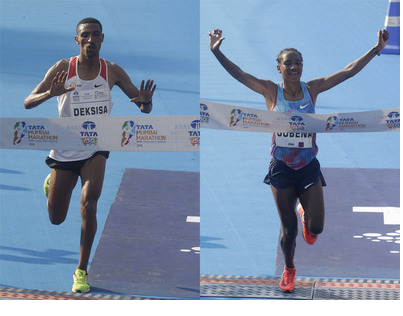
Oromia: Athletic Nation Report: Double victory for Oromo athletes at the Tata Mumbai Marathon as Amane Gobena and Solomon Deksisa won both the women’s and men’s races. Gulume Tollesa successfully defended her title at the Standard Chartered Hong Kong Marathon with a course record of 2:29:37 January 21, 2018

Posted by OromianEconomist in Athletic nation, Marathon, Uncategorized.
Tags: , , , , , , , , ,
add a comment

Odaa OromoooromianeconomistOromo athletes Solomon Deksisa and Amane Gobena won Mumbai Marathon, 21 January 2017.png


Double triumph for Oromo Marathon athletes at the Tata Mumbai Marathon as Amane Gobena and Solomon Deksisa won at the IAAF Silver Label road race in 2:25:49 and 2:09:34 respectively on Sunday, 21st January 2018. They represent Ethiopia in the competition.

Meanwhile  Gulume Tollesa successfully defended her title at the Standard Chartered Hong Kong Marathon with a course record of 2:29:37.

Twenty-two-year-old Deksisa broke away from the rest of the field at the 35-km mark and kept his nose ahead for the reminder of the 42.195-km men’s event to lead a 1-2 finish for Ethiopia ahead of 29-year-old compatriot Shumet Akalnaw. Deksisa clocked 2 hours, 9 minutes, 34 secs, off the course record of 2:08:35, while his compatriot Shumet crossed the finish line in 2:10:00 after being in hot pursuit of the lead runner over the last seven kms without being able to catch up.

Kenyan Joshua Kipkorir, second last year, ended up third this year in 2:10:30. Oromo Athlete Shumi Dechasa for Bahrain  (2:12:24) is 4th.

Gobena won the women’s race  by a comfortable margin  in 2:25:49 ahead of defending champion Bornes Kitur of Kenya who registered  2:28:48. In third place was another Oromo athlete, Shumo Genemo (2:29:41). The overall winners of both full marathons reap $42,000 each. Birke Debele  (2:29:45) and  Kuftu Tahir (2:35:01) completed 4th and 5th respectively.

Deksisa, running his sixth marathon with a personal best of 2:06:22 that he had registered while finishing second in the Rooterdam Marathon in April 2016.


More  read at Indian Express: Mumbai Marathon: Solomon Deksisa, Amane Gobena make it double

More read at IAAF: GOBENA AND DEKSISA SECURE ETHIOPIAN DOUBLE IN MUMBAI


Leaked Documents Show That Fascist TPLF Ethiopia’s Ruling Elites Are Hiring Social Media Trolls (And Watching Porn) January 21, 2018

Posted by OromianEconomist in Uncategorized.
Tags: , , , , , , , ,
add a comment

Odaa Oromoooromianeconomist

Leaked Documents Show That Ethiopia’s Ruling Elites Are Hiring Social Media Trolls (And Watching Porn)

Over the past two months, a series of leaked documents from Ethiopia’s powerful political elites have been circulating online.

Among other revelations, the leaks show that the Ethiopian government has been paying online commenters to influence social media conversations in the ruling party’s favor. The documents include hundreds of pages of chat logs and email correspondence of Ethiopia’s top government officials, multiple government planning documents and top-secret meeting records.

The leaks have come at what may be a turning point in Ethiopia’s recent political crisis. Since mid-2015, thousands across Ethiopia rose up, demanding more political freedoms and social equality and a stop to government land grabs in the Oromia region, which represents Ethiopia’s largest ethnic group. The government responsewas brutal: Hundreds have been killed, thousands have been arrested, and critical voices — both on and offline — have been systematically silenced.

Among the recent leaks, which began to circulate on Facebook in November 2017, one of the most revealing documents is a list of individuals who appear to have been paid to promote the ruling coalition on social media. The list shows the names of the so-called “social media commentators” along with their job titles and a precise amount of money that they apparently received for their online postings. Most of the people listed are government employees.

The list corroborates previous evidence that the Ethiopian government has been hiring online commenters to promote its agenda and harass its opponents.

Online communities in Ethiopia have been calling these paid commenters “cocas”, a colloquialism in Amharic (the most widely spoken language in the country) that can be translated as “contemptible cadres.” In Amharic, this term typically refers to people who sell themselves for easy money. But in this case, most of the commenters listed in the leaked directory are already on the government payroll.

Who is responsible for the leaks?

The origin of the leaks has been rumored and contested at several levels. The documents were originally sent to diaspora activists from the at least two Facebook accounts, both of which belong to government employees, in November 2017.

The first known leak, of the “coca” list, came from the Facebook account of Gebremichael Melles Gebremariam, an employee of the communications affairs office of the Tigray state. Gebremariam first denied sending the documents, claiming his account was hacked. But he then backtracked on this claim. It is now rumored that he has been dismissed from his job.

Soon after the initial leak, more documents began arriving in the inboxes of diaspora activists, this time coming from the Facebook account of the Director of the Federal Communications Affairs office, Haddush Kassu. Shortly thereafter, Haddush began to publicly shame those government officials who are implicated in the leaks. On January 18, he denigrated Deputy PM Debretsion Gebremichael in a public Facebook post.

It is unclear whether Haddush sent the documents himself have been hacked.

Social media ‘cocas’ push pro-government discourse

The revelations of political and state officials paying “cocas” to promote the ruling party agenda online correspond with a recent rise in polarization and hate speech on social media, alongside increased online persecution of independent journalists.

The leaked “coca” list reveals that at least thirteen commentators were each paid at least USD $300 (a large sum in Ethiopia, where average GDP per capita was USD $660 in 2016) for blog posts or Facebook messages that they wrote at the behest of the ruling coalition.

Among individuals named on the list are Daniel Berahane and Dawit Kebede, publishers of two Ethiopian internet news site HornAffairs and Awaramba Timesrespectively. The two journalists have long been accused of cheer-leading a pro-government information campaign especially during a heightened political tension.

In recent years, independent Ethiopian journalists reporting on government affairs, corruption and human rights have been arrested or exiled en masse. The resulting gap in news coverage has thus been filled by opposition activists and protesters who often work with diaspora-based media outlets to draw global attention to the brutal military crackdown on protesters that has killed more than 1200 people and has led to several mass arrests since mid-2015.

On the heels of the list came a separate leak of what appears to be a proposal to counter opposition groups using social media platforms. The Amharic-language document from the office of Ethiopia’s longtime governing coalition, the Ethiopian People’s Revolutionary Democratic Front’s (EPRDF), enumerates solutions and strategies to curtail the influence of online diaspora-based activists.

The document also describes how officials have ordered paid commenters to attack people who call for democracy and to praise the ideologies of ruling coalition. The document encourages its members to post comments on the internet as if they were regular citizens.

Other documents show that Ethiopia’s spy agency, the Information Network Security Agency, known to surveil and censor journalists and political dissidents, issued a money order of USD $12,000 to send two of their employees to China for special training. The documents do not specify what kind of training the two employees were meant to receive, but this information has begun to come to light with the release of subsequent chat logs.

Five weeks after the list was leaked, another document surfaced showing a written exchange over Facebook Messenger between two high-level public servants —  Haddush Kassu and a high-level operative of Ethiopia’s spy agency, Zeray Hailemariam — who were furious about the leaks, and the disclosure of the paid commentators.

One said the leaks are threats to their security and pledged to seek help from  Information Network Security Agency to investigate the source of the leaks. The other blamed a “disgruntled regional communication officer” for leaking the names to diaspora-based political rivals.

At one point in the exchange, the operative of Ethiopia’s spy agency suggested that they should encourage a “brave solider” like Daniel Berahane “who is fighting every extremists”. In response, the official from government communications affairs confirmed their support for him and wrote back “we pay him 33,000 [about USD $1200] for two articles.”

The exchange between the two top government officials also sheds light on the power struggle at the helm of Ethiopian ruling party, where infighting has led leaders to hire figures like Daniel and Dawit to undermine political opponents or curry favor with diplomats and foreign organizations in Addis Ababa. Daniel and Dawit have been leading voices in the pro-government media backlash against opposition activists and diaspora media.

And what is the Minister of Communication and Information Technology up to?

Other revelations have pointed to the online habit of Ethiopia’s former Deputy Prime Minister and Minister of Communication and Information Technology Dr. Debretsion Gebremicheal.

On December 16, 2017 member of the inner circle of the ruling party dumped screenshots of ten years browsing history of Dr. Debretsion Gebremicheal on his Facebook page. The details only lasted for about two days. It was removed sometime on December 18, 2017 without any explanation.

ደብረጽየን ለራሱም ለሴቶችም ክብር የሌለው ሰው ነው። ደሞ ገብረሚካኤል ሃክ ተደረገ በሉ። ሰው አስሬ ሃክ ይደረጋል እንዴ? ዋይ https://www.facebook.com/media/set/?set=a.104275863701078.1073741825.100023559936070&type=1&l=a3df88c983 

Debretsion does not have a respect for woman as well as for himself. Okay, you can go ahead say my account was compromised. Does a person has to be hacked ten times? Hell no!

For Dr. Debretsion this looks especially bad because he could not even clean his browsing history or encrypt his online communications, which means it was much easier than usual for the hackers to steal his browsing history. It’s quite amateurish mistake for a person who brands himself as one of the country’s top ‘intelligence’ personnel.

Abebe Gelaw, a prominent diaspora based journalist pieced together a revealing fifteen-page expose after he scrutinized over two hundred pages of Dr. Debretsion’s embarrassing and salacious browsing history.

But one of the most interesting aspects of the story itself was the sourcing of the revelations. The documents are said to originate from various sources, some say disgruntled insiders leaked them, others say hackers are responsible. But from an incoherent drip of leaks a common outlook emerges that there is unprecedented power struggle happening among Ethiopia’s ruling elite.

Ethiopia: Oromia: The leader of the Oromo Federalist Congress Professor Merera Gudina has been released. #OromoProtests January 17, 2018

Posted by OromianEconomist in #OromoProtests, Uncategorized.
Tags: , , , , , ,
1 comment so far

Odaa Oromoooromianeconomist

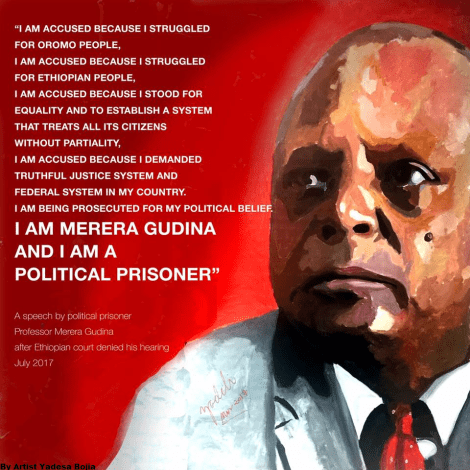
Professor Merera Gudina's speech after the court of Ethiopia denied him hearing. #OromoProtests

OMN: Dura Taa’aan KFO Dr. Mararaan Hidhaa Bahan (LIVE) Amajjii 17, 2018

Click here for Photos: Oromia erupts as Ethiopia govt frees Merera Gudina, Africa News.


Ethiopia releases opposition leader Merera Gudina | Africanews

Ethiopian opposition leader Merera Gudina has been freed after more than a year in detention.

Merera becomes the first ‘political prisoner’ to be released since Prime Minister Hailemariam Desalegn announced on 3 January that the government will pardon several convicted politicians and those with cases in court in a bid to foster national cohesion.

Prison authorities told his family that he was released on Wednesday morning and allowed to go back home.

Merera, the leader of the Oromo Federalist Congress, has been in prison since December 2016 and was facing multiple charges, including association with terrorist groups. He denied the charges.

Free at last! Jailed opposition leader in Dr Merera Gudina freed after more than a year in detention.

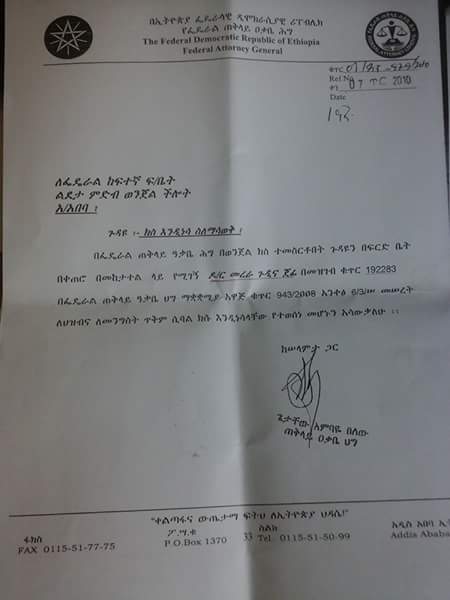
Influential media portal, Addis Standard tweeted a letter (issued in Amharic) which stated that the charges had been dropped ‘for the benefit of the public and the government’.

A letter announcing to discontinue the multiple criminal charges brought by federal prosecutors against Dr. has been issued by the attorney general Getachew Ambaye. It stated charges were dropped “for the benefit of the public and the government.” cc: @Belay_Ma

Earlier this month, the government said it would pardon and drop the cases against more than 500 prisoners.

The announcement followed more than two years of anti-government protests that have rocked the country, with demonstrators calling for political and economic reforms and an end to state corruption and human rights abuses.

Ethiopia had always denied that there were any political prisoners in the country, as alleged by human rights and opposition groups.


Prominent Ethiopian opposition leader Merera Gudina has been released from prison after more than a year in detention. more at  aljazeera.com


Ethiopie, Merera Goudina libéré de prison


BBC: Merera Gudina, Ethiopia opposition leader, freed

Ethio
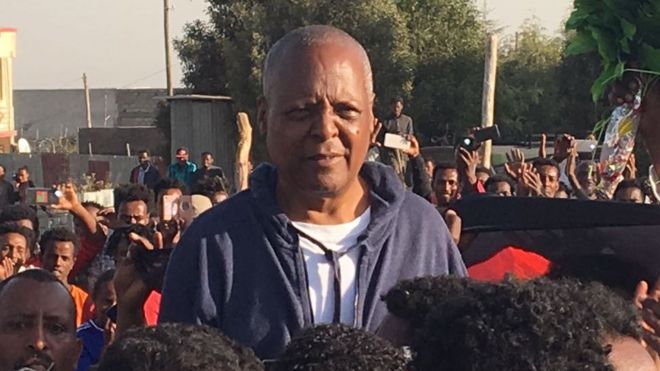
Image captionHuge crowds welcomed Mr Merera home

Jailed Ethiopian opposition leader Merera Gudina has been freed after more than a year in detention.

The leader of the Oromo Federalist Congress was released on Wednesday morning and allowed to go home, where he was welcomed by thousands of people.

He has been in prison since December 2016 and was facing charges, including association with terrorist groups.

The Ethiopian government announced on Monday that it would drop charges against more than 500 suspects.

Human rights groups have long accused Ethiopia of refusing to allow opposition groups to operate freely.

The government has denied holding any political prisoners but says the releases will foster national debate and “widen the political sphere”.

Those being freed will first undergo two days of “rehabilitation training”, the government says.

At the beginning of January, Prime Minster Hailemariam Desalegn announced the government would close Maekelawi – a detention facility in the capital, Addis Ababa, allegedly used as a torture chamber.

Why was Mr Merera arrested?

Mr Merera was arrested in November 2016 at the airport in the capital, Addis Ababa, after he flew in from Brussels.

He had violated Ethiopia’s state of emergency by having contact with “terrorist” and “anti-peace” groups, state-linked media reported at the time.

That month, Mr Merera had criticised the state of emergency in an address to the European parliament.

The government imposed it in October 2016 to end an unprecedented wave of protests against its 25-year rule.

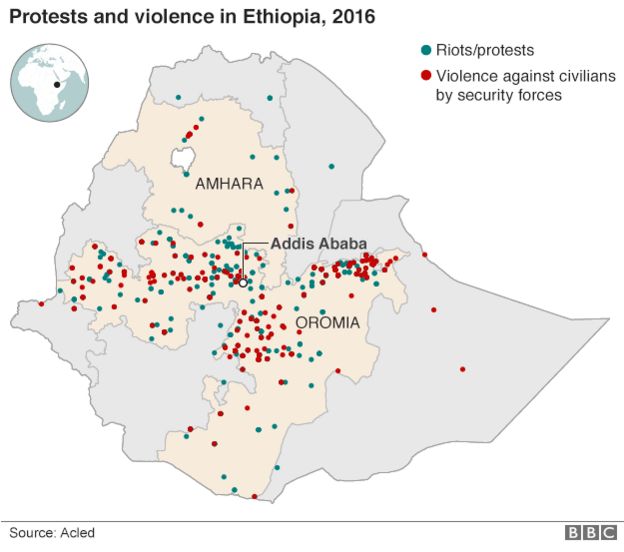
Map of protests and violence in Ethiopia in 2016

More than 11,000 people were arrested, mostly in the Oromia and Amhara regions, which were at the forefront of anti-government protests.

Many in the two regions complain of political and economic marginalisation.

Who else will be freed?

It is still not clear which other politicians will be released.

Ethiopia says it will not free anyone convicted of using force to overthrow the government, destroying infrastructure, murder or causing physical disability.

However, it says it will pardon some of those convicted under the anti-terrorism law.

Critics and human rights groups have accused the government in the past of labelling its opponents, and some journalists, as terrorists.

Rights group Amnesty International says the release of Mr Merera and other prisoners should not be the last.

“Hundreds of prisoners of conscience continue to languish in jail, accused or prosecuted for legitimate exercise of their freedom of expression or simply for standing up for human rights,” Amnesty’s Netsanet Belay said.

Presentational grey line

Five more high-profile Ethiopian prisoners:

Bekele Gerbadeputy chairman of the OFC – arrested together with Dejene Fita Geleta, secretary-general of OFC, and 20 others in connection with the 2015 Oromo protests that resulted in the death of hundreds of protesters.

Andargachew Tsegeleader of Ginbot 7 (designated a terrorist group by Ethiopia) – arrested in 2014 while on transit in Yemen and taken to Ethiopia, where he faces the death penalty after being convicted in absentia. A British national, human rights groups have been pushing for his release.

Andualem Aragievice-president of the Unity for Democracy and Justice party – imprisoned since 2011, and now serving a life sentence on terrorism charges.

Eskinder Negajournalist and blogger – imprisoned since 2011 after criticising the use of anti-terror laws to silence the press. He was subsequently sentenced to 18 years in jail.

Woubshet Taye, journalist and editor – imprisoned since 2011 and sentenced the next year to 14 years in prison for terror-related offences.


Ethiopia govt had no business arresting Oromo leader Merera Gudina – E.U. MP

ETHIOPIA

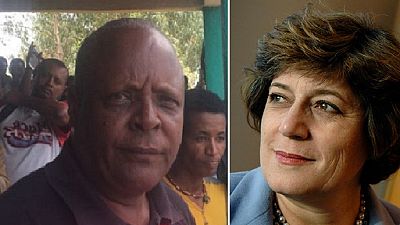
A member of the European Parliament, Ana Gomes, has reacted to the the move by the Ethiopian government to drop charges against leading Oromo politician, Merera Gudina.

According to Gomes, who frequently comments on political ongoings in Ethiopia, Gudina “should never have been jailed.”

The university don who is leader of the Oromo Liberation Front (OLF) has been under detention for a little over a year. He was arrested in December 2016 after returning from an European trip during which time he addressed the E.U. parliament on the political situation back home.

Upon his arrest, the government said he was picked in connection with having flouted an October 2016 state of emergency imposed to quell spreading anti-government protests predominantly in the Oromia and Amhara regions.

He was eventually charged with terrorism but the offense was later downgraded to multiple criminal charges. The case like that of other political elements has been traveling at a slow pace with prosecutors seeking extensions and introducing fresh evidence.

The MEP also commented on Eskinder Nega, an Ethiopian journalist currently in jail. Eskinder Nega is a brave man, paying for freedom and justice for his country. He is still a political prisoner in Ethiopia. He must be liberated! She said in a tweet.

Nega and a Venezuelan writer and journalist Milagros Socorro have recently been honored by Oxam Novib (PEN Awards 2018). “Eskinder couldn’t receive the award because he is in jail for his journalism works,” blogger Befeqadu Hailu wrote.


Ethiopia has released a handful of prisoners – but nothing else has changed,  Mail & Guardian Africa

WHO: Tedros Adhanom raised eyebrows with his appointment of Robert Mugabe and new recruitment policies. But the real shocker was his choice of a Russian to head up agency’s tuberculosis fight. January 17, 2018

Posted by OromianEconomist in Uncategorized.
Tags: , , , , , , ,
add a comment

The Mugabe appointment “was stupid, but this is a disaster,” said Mark Harrington, executive director of Treatment Action Group. Ahead of the appointment, TAG led an open letter from more than 40 civil society groups asking Tedros to use a transparent, competitive process to choose the next director of the Global TB Program, tasked with fighting the top infectious killer worldwide.

 #NoTedros4WHO

World’s doctor gives WHO a headache


Tedros Adhanom Ghebreyesus raised eyebrows with his appointment of Robert Mugabe and new recruitment policies. But the real shocker was his choice of a Russian to head up agency’s tuberculosis fight.


Illustration by Eva Bee for POLITICO


Seven months into his tenure, the early moves of the WHO’s first African chief are stoking a backlash.

His supporters say Tedros Adhanom Ghebreyesus promised to shake the institution up. The critics, increasingly emboldened, say he’s undermining the World Health Organization’s effectiveness and putting its funding at risk.

The former Ethiopian health minister turned heads with his appointment of Zimbabwean dictator Robert Mugabe as a goodwill ambassador in October. Meanwhile, behind the scenes, Tedros — as he prefers to be called by Ethiopian tradition — was eschewing the normal hiring process for U.N. agencies, looking to increase gender and geographical diversity as quickly as possible. That’s unsettled some in the Geneva headquarters and the constellation of activists and researchers who work with WHO, who fear an overly political approach is bringing a culture change at the cost of credibility.

The latest disruptive move is his appointment of a little-known Russian official to run the WHO’s tuberculosis program, using a fast-track process, one month after meeting with President Vladimir Putin at a major gathering on the topic in Moscow.

The Mugabe appointment “was stupid, but this is a disaster,” said Mark Harrington, executive director of Treatment Action Group. Ahead of the appointment, TAG led an open letter from more than 40 civil society groups asking Tedros to use a transparent, competitive process to choose the next director of the Global TB Program, tasked with fighting the top infectious killer worldwide.

Reward for being retrograde

The December nomination of Tereza Kasaeva (an official at the Russian health ministry) prompted an editorial in the medical journal the Lancet, which described it as triggering a “potentially disabling controversy.”

“The domestic situation there is horrible. It’s probably one of the worst outside of Africa on TB infections” — Eduardo Gómez, King’s College London

“Russia has a poor record on TB and HIV,” write the editors of the journal, which is widely seen as the voice of the global health establishment. “Her appointment may be regarded as rewarding a country that does not deserve to be rewarded … WHO’s reputation — indeed, its political leverage — depends on the agency’s technical credibility.”

Russia is widely regarded as retrograde in its approach to treating the infectious disease, having developed a raging outbreak after the breakdown of the Soviet Union. Since 2000 or so, overall incidences are down and survival rates are up, but Russia is still a world leader on the proportion of infections that don’t respond to antibiotics; a recent study predicted one in three cases would be antibiotic resistant by 2040.

Kasaeva replaces Mario Raviglione, a leading TB expert with more than 25 years of experience fighting the bacterial infection.

Tedros says he’s just keeping a campaign promise to overhaul the agency in the wake of its high-profile failure to respond quickly to the 2014 Ebola crisis in West Africa. He is the first African to run the WHO — and the first director general chosen with a vote open to all member countries in May, overcoming what he called a “colonial mindset” among backers of his British rival.

Tedros’ advisers have defended his decision to name Mugabe a goodwill ambassador for noncommunicable diseases less than four months into the job as just a misguided effort to build bridges with a regional giant who, despite human rights violations and a long embrace of the tobacco industry, recently expressed openness to new commitments on health.

The offer was quickly retracted, but not before it triggered international condemnation. An opinion piece in the Washington Post even speculated that it was payback to Mugabe for securing the African Union’s support in the WHO election, or to China for its backing.

Tedros’ first appointments have already transformed the gender and geographic balance within the top ranks, even as they have raised concerns about a closed selection that downplays conventional expertise.

Of eight new directors chosen largely through a fast-track process, including Kasaeva, all but one are women.

Tedros is trying change the recruitment system to eliminate “unconscious biases that make it unfavorable for women to get the positions,” a top Tedros adviser, Senait Fisseha, said in an email. Until that can be accomplished, she said, he had made “limited appointments of diverse and highly qualified women” to move his vision forward.

That’s music to the ears of those who see an endless game of musical chairs that circulates people from one U.N. or international development agency to another. Often that means wealthy Western countries dictating to poorer countries how to deal with their problems in order to receive aid.

Vlad in Geneva

Diversity is a worthy goal, said Global Coalition of TB Activists CEO Blessina Kumar. But it shouldn’t come “at the cost of effectiveness and competency. You can’t trade one for the other,” she said.

“Merit was the first criteria for all appointments, while secondary consideration was given to gender and geographical diversity,” WHO spokesman Gregory Hartl said. “Dr. Tedros also sought to appoint qualified people with country-level experience, as a vital complement to the technical expertise that already exists within WHO. This will help to accelerate progress at the country level.”

Kasaeva’s appointment has proved politically volatile both for Russia’s speckled track record in combatting TB, and because it’s seen as playing into Putin’s hands, helping the Russian president project power on the global health stage while he neglects patients back home.

“The domestic situation there is horrible. It’s probably one of the worst outside of Africa on TB infections,” said King’s College London’s Eduardo Gómez, the author of “Geopolitics in Health: Confronting Obesity, AIDS, and Tuberculosis in the Emerging BRICS Economies.”

In 2012, Russia rejected a $127 million grant from the Global Fund to Fight AIDS, Tuberculosis and Malaria, stifling many of the groups on the ground. On top of that, the federal government cut domestic TB funding in recent years, according to Gómez.

Nonetheless, in mid-November, Russia pledged $15 million toward fighting TB worldwide during a major U.N. TB conference in Moscow. The foreign aid is a typical Putin move, said Gomez. “This is an opportunity to reassert Russia’s dominance in global health.”

Putin addressed the gathering and met with Tedros. A month later, on December 15, Tedros announced Kasaeva’s appointment in an internal WHO email.

“I can’t see what the upside is other than political payback,” Harrington said.

Backlash on Tedros

Defenders say Russia’s TB program is improving — driven in part by Kasaeva — and that she may be the best hope for getting the country to change.

Vadim Testov, a former WHO official now working on Russia’s TB program, said he’s seen the government’s commitment increase over time, and that it’s “ready to provide” financing to make Russia’s domestic TB fight successful. He noted that new regulations from Kasaeva’s team have led to a sharper decrease in TB cases over the last five years.

Kasaeva “will have influence on Russian officials” in her WHO position, Testov predicted.

Many aren’t sold on Tedros’ new approach and fear that global health will suffer — especially if the WHO’s biggest donors get spooked.

The backlash shows the risks from Tedros’ effort to upend the status quo. Defenders say the same-old same-old at the U.N. hasn’t served patients on Ebola, TB or a range of other issues.

“Whatever we’ve been doing for the last quarter century isn’t working that well,” said Salmaan Keshavjee, a Harvard TB expert who has worked on the ground in Russia with Partners in Health.

He argued that WHO recommendations have in the past been ill-suited to Russia’s circumstances and that homegrown experts from emerging, populous economies may be in a better position to solve their own problems and bring a new perspective to the global effort.

“If you want to hold the BRICS countries’ feet to the fire, they have to be involved in health architecture,” Keshavjee said.

Budget strings

But many aren’t sold on Tedros’ new approach and fear that global health will suffer — especially if the WHO’s biggest donors get spooked.

Though ultimately blocked, U.S. President Donald Trump’s proposal to cut back on foreign aid — announced on May 23, the same day Tedros was elected to lead the WHO — has alarmed many in the organization. The recent controversies drive some worry that other large donors like the U.K. or Germany might be tempted to draw the purse strings tighter.

The U.S. contributes almost a quarter of the WHO’s $4 billion-plus annual budget.

Tedros’ doctorate is in community health, and he served as Ethiopia’s health minister for seven years — winning wide praise for strides in expanding contraception, fighting malaria and, yes, controlling TB.

But it may be his experience as Ethiopia’s top diplomat from 2012 to 2016 that seems most apposite now. During that period, he kept his country in the West’s good graces (and the aid money flowing) despite growing concerns about the regime’s human rights violations, by stressing Ethiopia’s position as a stable, strategic partner in the war on terror.

Tedros’ team includes plenty of conventional choices; Jane Ellison, a Brit, served as something of an olive branch to the WHO’s No. 2 state donor after the U.K. strongly backed its own candidate in a campaign that turned nasty. Tedros also named a German to a long-sought top post after Berlin stepped up donations and raised Tedros’ profile by inviting him to the G20 summit.

A Moment Of Significance And Opportunity For Ethiopia January 15, 2018

Posted by OromianEconomist in #OromoProtests, Uncategorized.
Tags: , , , , ,
add a comment

Odaa Oromoooromianeconomist

A Moment Of Significance And Opportunity For Ethiopia – OpEd

Graham Peebles, Eurasia Review,  14 January 2018


Since November 2015 unprecedented protests have been taking place in Ethiopia: angry and frustrated at the widespread abuse of human rights and the centralization of power in the hands of the Tigrayan People’s Liberation Front (TPLF) tens of thousands have taken to the streets. The ruling party’s response to this democratic outpouring has been consistently violent; hundreds have been killed and beaten by security forces, tens of thousands arrested and imprisoned.

In an attempt to gag the people, a highly repressive State of Emergency was imposed in August 2016. It failed, the protests continued, the movement strengthened. The regime then tried to inflame ancient ethnic differences amongst various groups by staging attacks using plain-clothed security personnel. In the border region of Oromo and the Ogaden Tesfaye Robela of the Ethiopian Parliament claims that over 10,000 people have been killed. ESAT News (the sole Ethiopian independent broadcaster) quotes the findings of a parliamentary report into the ethnic clashes, which concluded that: “based on interviews with victims of the violence, squarely puts the blame on Somali Region Special Police, local police and militia for perpetrating the killings.” The Liyu Police is controlled by the Ethiopian military.

Despite these attempts to extinguish the movement for change, the people of Ethiopia are continuing to demand freedom, justice and democracy; this time they will not be silenced. The minority powers within the ruling EPRDF coalition – The Oromo Peoples’ Democratic Organization (OPDO) and the Amhara National Democratic Movement (ANDM) have been empowered by the popular uprising and there are signs that they are at last standing up to the majority TPLF members. Under pressure from the OPDO and ASDM and in a further attempt to distract attention from the protests and undermine the protestors’ claims, on 3rd January the government put out a convoluted statement relating to political prisoners.

The Prime-Minister Hailemariam Desalegn said that the regime would release “some political prisoners”, prisoners that for the last 27 years they have denied even existed. ESAT News (which is based in Europe and America) reports he went on to announce that, “members of political parties and other individuals would be released to widen the political and democratic space” and that “the government would review the cases of certain individuals affiliated with political parties, including party leaders, [and] in some cases, charges would be dropped or people would be released or pardoned, depending on investigation results.”

His words, which have been widely reported in mainstream media, were not only disingenuous they were ambiguous and inconclusive. He failed to acknowledge that those imprisoned for expressing political dissent had been falsely incarcerated; repeatedly stating they were behind bars because they were guilty of breaking the law.

Whilst the release of any political prisoners at all would be a move in the right direction, in its present form the policy, if indeed it is a policy and not simply a public relations exercise aimed at international benefactors, is an insult to the thousands languishing in prison for no other reason than they disagree with the ruling TPLF. The statement is inadequate and needs clarification: who will be considered for release and when? Does it include opposition politicians charged with fictitious terrorist offences under the universally condemned Anti-Terrorist Proclamation of 2009? Will this long-overdue gesture mean that politicians who have been forced to live in exile for fear of arrest and imprisonment can safely return home?

These and other pressing questions need to be raised by opposition groups and human rights organizations, and indeed Ethiopia’s major donors — America, Britain and the European Parliament, all of which have allowed the TPLF to trample on human rights and the people for decades. Intense pressure must be applied on the government to articulate its intentions and, for once in their tyrannical reign, do the right thing and release all political prisoners, including journalists, bloggers, protestors and activists of all kinds.

It was also announced by the PM that Maekelewi prison in Addis Ababa, which has been used as a torture chamber by the TPLF for years, will be closed down, and rather bizarrely, turned into a modern museum, unless common sense prevails and it is demolished. This is a positive development but is again short on detail, there has been no mention of what will happen to the inmates. All political prisoners held there should be released unconditionally, and an independent international monitoring group established to oversee the release and or transfer of all other detainees.

The current of change

Despite being enshrined as rights within Ethiopia’s liberally worded constitution, for over two decades all forms of freedom of speech and political dissent have been virtually outlawed. Anyone who openly disagrees with or questions the ruling party is seen as a threat, and persecuted, arrested, imprisoned and, commonly, tortured. The Anti-Terrorism Act, together with The Charities and Societies Proclamation (CSP), both passed in 2009, are the primary tools of suppression within the regime’s Arsenal of Control.

Both laws have been widely criticized by Human Rights groups; responding to the CSP in 2012 Amnesty International said that, “The law has had a devastating impact on human rights work, both in terms of the practical obstacles it creates for human rights defenders, and in exacerbating the climate of fear in which they operate.” This is of course precisely what it was intended to do. Commenting on the Anti-Terrorist Proclamation when it was drafted, Human Rights Watch (HRW) stated that it provided “the Ethiopian government with a potent instrument to crack down on political dissent, including peaceful political demonstrations…It would permit [indeed has facilitated] long-term imprisonment and even the death penalty for ‘crimes’ that bear no resemblance, under any credible definition, to terrorism.”

For 27 years the TPLF group within the coalition have dominated all life in the country and like all such tyrannical regimes they have ruled through violence and fear. But we are living in new times; the days of tyrannical regimes is all but over, those that persist are sustained by the polluted energies of the past and are on their death bed. The people of Ethiopia sense that this is their time, that change is not only possible, but is coming.

The government’s half-baked move to release a few political leaders will not appease anyone, but should embolden many. It reveals a crack in the democratic facade presented by the regime, which must be split open under the force of sustained political activism, civil disobedience and public protest.

The minority members of the coalition — the OPDO and ANDM — now have an opportunity, indeed a responsibility to act boldly, to stand up and take a lead. As representatives of the two largest ethnic groups in the country they are in a position to do a number of things: demand The Anti-Terrorism Act, and The Charities and Societies Proclamation be immediately repealed, compile a comprehensive list of all political prisoners (working in cooperation with Amnesty International or The Ethiopia Human Rights Project), and vigorously press for their immediate release. Then, providing opposition politicians are released and political groups outside the country — including Ginbot 7 — are allowed to operate freely, work vigorously to campaign for fair and open elections (such a thing has never taken place in Ethiopia) to be held sometime in late 2019. This is a moment of significance in the country. There is an unstoppable force for justice and freedom sweeping across the world and Ethiopia is firmly within that current of change.


IRIN: Feature: Ethiopian Oromo refugees face bribes, harassment in Kenya January 12, 2018

Posted by OromianEconomist in Uncategorized.
Tags: , , , , , , ,
add a comment
 NAIROBI, 12 January 2018


A freelance journalist, focusing on humanitarian and development issues

Ethiopian Oromo refugees fleeing to Kenya to escape persecution say they are finding life on the streets of Nairobi no better than the insecurity they left behind, as they are targeted by bribes and harassment and forced into vast camps with few prospects or protections.

The Oromo are Ethiopia’s largest ethnic group but have long complained of political and economic marginalisation at the hands of the country’s ruling party, which is dominated by a minority ethnic group, the Tigrayans.

Following 2016 protests demanding political reform, which resulted in a state of emergency and the deaths of more than 600 in the security crackdown, thousands of Oromo made their way to neighbouring Kenya seeking asylum and refuge.

But they did not escape the Ethiopian authorities. Human Rights Watch has reported “numerous cases of harassment and threats” against Oromo asylum seekers in Kenya by Ethiopian government officials.

The rights group has also documented “confessions” by Kenyan police officers in which they admit to being offered bribes by the Ethiopian embassy to detain and intimidate Oromo refugees.

“When I came to Kenya I thought that I would be protected and would be able to start a new life,” said former Oromo politician “Tolessa”, who requested his identity be protected.

“[But] what I’m facing here is no different from what I was facing at home,” he told IRIN. “My future here isn’t very bright.”

Full of “spies”

Oromo refugees also reported attempts by Ethiopian officials to recruit them as informants in Nairobi’s Oromo community, promising land, protection, money, and even resettlement to the United States or elsewhere, Human Rights Watch noted.

“There are a lot of Ethiopian spies here in Nairobi,” one refugee, a former Ethiopian intelligence officer, alias “Demiksa”, told IRIN.

Now a senior dissident, “Demiksa” related what had happened to him back in Ethiopia.

He said that after refusing orders to torture prisoners held in Addis Ababa’s infamous Maekelawi prison, he was accused of being an opposition collaborator, detained, and then tortured himself.

“They tied my hands up and hung me up on the wall with nails and beat me with electric cables around my ankles and on my back,” he told IRIN, fighting tears. “I couldn’t walk for three months,” he added.

“Demiksa” said he was spared capital punishment on one condition: kill or be killed. Handed photographs of two prominent Oromo activists, he was given a loaded gun and told to get into a car.

He accepted the mission – “I had no choice,” he told IRIN – but was able to escape en route to the hit, and then fled Ethiopia.

When he arrived in Nairobi, “Demiksa” was told to register at the Kakuma refugee camp in northern Kenya like all other Ethiopian exiles.

The long arm of Ethiopian security

But Oromo who fear being stalked by Ethiopian intelligence believe even Kakuma is not safe.

“Threats from Ethiopian security officials – working together with local [Kenyan] police – also extend to the refugee camps [in Kenya],” Human Rights Watch researcher Felix Horne told IRIN.

Horne said Oromo activists who have come from cities in Ethiopia fear camp life because of the lack of employment opportunities, the heat, and Kakuma’s physical proximity to Ethiopia.

But they have darker fears too.

Oromo refugees have reportedly been kidnapped from Kenya and taken back to Ethiopia, and there have been similar reports from Sudan, Djibouti, Uganda, and Somaliland.

“This is not unique to Kenya,” Horne said. “The patterns of pervasive Ethiopian security presence utilising local security officials is similar in other countries where Ethiopians flee to.”

Tariku Debela, a political refugee living in Kampala who fled Kenya in April 2016, still remains a target for Ethiopian security forces. He told IRIN that his scars bear witness both to the torture he received in Ethiopia and an attempt on his life in Uganda.

“Some people came to my hotel room, drugged me, and then beat me up,” he explained to IRIN over the phone. “People living nearby heard what was happening and came to my rescue. One of [the attackers] was arrested.”

A Ugandan police investigation revealed “that the men who attacked me were sent from Ethiopia to kill me,” he added.

After imploring the UN refugee agency several times to offer him protection, Debela now stays in a UNHCR safe house, but doesn’t get much else in the way of assistance.

“UNHCR haven’t even tried to help me process my case for resettlement,” he told IRIN. “Since I am a political refugee, I shouldn’t have to stay here for the rest of my life.”

UNHCR has a mandate to provide protection to refugees, including political figures like “Demiksa” and Debela.

“The documentation issued to them by the government and UNHCR gives them the right to reside legally in Kenya and protects them from deportation to their country of origin or expulsion from Kenya,” Yvonne Ndege, senior communications officer at UNHCR, told IRIN.“There are some high-profile cases, such as the Oromo; sometimes their cases are expedited through the registration process,” she added.

But some say this policy exists only in theory.

“In practice, there is very little protection afforded to Oromo refugees,” Horne told IRIN.  “Individuals with serious security issues – some of whom are high-profile individuals – often receive no practical protection whatsoever from these agencies.”

Bribes, harassment, and detention

Kenya has an encampment policy – refugees are supposed to stay in one of two vast refugee camps that house 489,000 people: Dadaab and Kakuma. That means those found in urban centres without proper documentation are vulnerable to extortion and intimidation by the police.

Refugees IRIN spoke to in Nairobi mentioned regularly having to pay bribes to avoid harassment. The going rate is up to $200 for a permit to avoid being sent to Kakuma.

Life for those who can’t afford to pay is bleak. “Because I don’t have my papers I stay at home so that I can be safe from police,” teenager Fozia told IRIN.

Fozia fled Ethiopia following a brutal crackdown on students in her hometown in Oromia. After student protesters dispersed, she says police followed her home, then raped and beat her. She decided to flee.

Despite coming to Kenya as an unaccompanied minor, Fozia hasn’t been helped by the authorities. Without the ability to bribe registration officers at Nairobi’s government-run refugee registration centre, Shauri Moyo, she can’t officially register with UNHCR for refugee status determination.

“I was given a movement pass to Kakuma, but I feared going there, especially as a young girl,” she explained.

Neither can Fozia afford to bribe officials to gain an all-important exemption permit that would allow her to legally avoid going to Kakuma.

“Without that, I’m told by UNHCR to either go to Kakuma or register for exemption at Shauri Moyo,” she said.

Many other refugees face the same hurdles.

“I still haven’t received exemption,” another former Oromo politician and victim of torture in Maekelawi who preferred to remain anonymous, told IRIN.

“I’ve been ordered to bribe officers with $200 to gain exemption from camp,” the former politician said. “I don’t have that sort of money. I also stay indoors to avoid having to pay police officers that harass me.”

Following registration with Shauri Moyo, refugees can then apply for a government of Kenya “alien card” for asylum recognition. But several refugees told IRIN that this process also entails under the table payments – ranging from $300 to $485.

Such allegations of corruption and extortion are denied by Kenya’s Refugee Affairs Secretariat, known as RAS.

UNHCR “concerned”

Once refugees are able to access asylum, their cases are referred to UNHCR for refugee status determination, which is necessary for official recognition as a refugee.

But many refugees are having to wait years to even get an interview.

“I was supposed to have an appointment in March this year,” one woman complained. “You just turn up to their office [UNHCR], stand in line, and wait for your turn. Then they tell you that they can’t see you that day.”

She went on to explain how they typically just give you another appointment letter with a different date and year and tell you to wait.

“They didn’t even give me another appointment date last time – they just told me that they would call me,” she said. “I still haven’t heard anything yet [since her March appointment].”

Recognising these concerns, the UN refugee agency insisted it is committed to improving the registration system.

“UNHCR is concerned about the time being taken for asylum seekers and refugees to receive proper documentation,” UNHCR’s Ndege told IRIN, adding that it was working to streamline its registration processes.

But Horne from Human Rights Watch said neither UNHCR nor RAS are doing enough right now to protect vulnerable Oromo.

“Country guidelines on Ethiopia that officers use to assess asylum claims should be updated as they are over 10 years old and do not remotely reflect the current situation in Ethiopia,” he said.

Oromo opposition to rulers in Addis Ababa stretches back centuries. The current ruling party, the EPRDF, has used federalism to dilute that dissent, but it has persisted.

Charlie Ensor/IRIN
An Oromo activist in Nairobi, crosses his arms in an Oromo symbol of solidarity

In the unrest in 2016 and 2017, the Oromo were joined by the second largest ethnic group, the Amharas, in the demand for political reform – posing a significant challenge to the government.

Reform at last?

In a surprise announcement at the beginning of the month, Ethiopian Prime Minister Hailemariam Desalegn announced that his government would close Maekelawi prison and release political prisoners in a move he said would advance political dialogue with opposition groups.

“The regime realises that the political landscape is shifting rapidly and that they have to find a way forward to deal with ethnic tension and communal violence,” Ahmed Soliman, associate researcher at Chatham House, told IRIN.

But this all depends on how sincere the government is on reforming and its willingness to admit the violations it has committed – including in neighbouring countries.

As Amnesty International researcher Fisseha Tekele put it after Desalegn’s announcement: “A new chapter for human rights will only be possible if all allegations of torture and other ill-treatment are effectively investigated and those responsible brought to justice.”

(TOP PHOTO: Eastleigh, Nairobi. Home to Nairobi’s refugees. CREDIT: Charlie Ensor/IRIN)

ce/oa/as/ag



Ethiopia’s decision on ‘political prisoners’ in context January 11, 2018

Posted by OromianEconomist in #OromoProtests.
Tags: , , , , , , ,
1 comment so far

Ethiopia’s decision on ‘political prisoners’ in context

By , Al Jazeera, 10 January 2018

Demonstrators chant slogans while flashing the Oromo protest gesture during Irreecha, the thanksgiving festival of the Oromo people, in Bishoftu town, Oromia region, Ethiopia [Tiksa Negeri/Reuters]

Demonstrators chant slogans while flashing the Oromo protest gesture during Irreecha, the thanksgiving festival of the Oromo people, in Bishoftu town, Oromia region, Ethiopia [Tiksa Negeri/Reuters]


On January 3, the Ethiopian Prime Minister Hailemariam Desalegn made two major announcements: his government will release political prisoners and close down a notorious detention centre at the heart of Ethiopia’s capital,widely known as a torture chamber for dissidents and government opponents. Desalegn announced the decision as part of a wider package of reforms aimed at fostering national reconciliation and widening the democratic space.

Rights groups welcomed the announcement as “an important step toward ending long-standing political repression and human rights abuse in the country” while others saw the move as a significant concession to the relentless protests of the last two years by the Oromos and Amharas – the two largest ethnic groups in the country.

As local and international media began to scrutinise the rationale, implications and consequences of the announcement, most of the commentary focused on Ethiopia’s perceived admission that there are political prisoners in the country. US House Foreign Affairs Committee Chairman Ed Royce even issued a statement praising Ethiopia for “finally acknowledg[ing] that it holds political prisoners.”

Shortly after the announcement, however, the government distanced itself from this interpretation by emphasising the fact that the prime minister never used the term “political prisoners” in his initial statement.

Indeed, Desalegn only referred to “political leaders and individuals whose crimes have resulted in court convictions or have resulted in their ongoing prosecution under the country’s law,” in his statement and never gave a clear indication as to which prisoners will be eligible for release.

Ethiopia’s political prisoners

The Ethiopian government has always denied consistent and widespread reports by human rights groups that it holds political prisoners. Like his predecessor, the late Meles Zenawi, who adamantly denied politicising the legal system to stifle dissent and opposition, Desalegn has also repeatedly dismissed the suggestion that Ethiopia is holding political prisoners.

Shortly after he took power in 2012, Al Jazeera’s Jane Dutton asked Desalegn if he intends to “confront” the legacy of political repression he inherited from Zenawi and take steps to release the “thousands of [political opposition] languishing in jail”. Desalegn said, “There are no political opposition that are languishing in prison.”

In May 2015, shortly before the country’s national election in which the ruling party won 100 percent of seats both at the national and regional levels, Al Jazeera’s Martine Dennisasked Desalegn about the imprisonment of “record number of journalists” to which he replied “these are not journalists …The moment you join a terrorist group, you become a blogger”.

There can be no justification to hold some political prisoners or journalists, bloggers and scholars while releasing high-profile leaders of political parties.

No sitting government would publicly admit to holding political prisoners, and – even after last week’s announcement – Ethiopian government still appears to be refusing to do so. But evidence suggests that very few governments in the world today hold more political prisoners than Ethiopia.

Since assuming power, the government frequently used the legal system to lock up members and leaders of the opposition. Indeed, the courts served as potent instruments of repression and power consolidation second only to the military-security apparatus.

Since the early days of the regime and particularly following the adoption of the country’s notorious anti-terrorism law in 2009, there has been a frightening politicisation of the legal system and the administration of justice. With or without disguise, Ethiopia used its courts and other institutions of justice to harass, intimidate, and eliminate political opposition from the political space.

In the early days of the regime, several members of opposition parties have been held in detention centres throughout the country without charges, particularly in the Oromia regional state. Actual or suspected members of the Oromo Liberation Front have been arrested in mass and detained without charges. More than two decades later, the whereabouts of several individuals including prominent Oromo politicians such as Nadhi Gamada and Bekele Dawano are still unknown.

Following the contested election in 2005, the government rounded up leaders of the Coalition for Unity and Democracy (CUD) who made significant electoral gains that denied the incumbent its majority. Since the government adopted its notorious anti-terror legislation, more than 1,000 people including opposition political leaders, journalists, bloggers, activists, scholars, and religious figures, have been charged with terror-related crimes. It is estimated that tens of thousands of individuals are currently in jail because of the government’s intolerance to dissenting views.

What makes these individuals political prisoners is not their innocence or guilt but the fact that their arrest, prosecution, and conviction were purely motivated by political ambitions as opposed to normative concerns with the rule of law and justice. In other words, the legal process is set in motion not for the determination of guilt and innocence but for political expedience, to pursue the dual goal of delegitimising political foes and physically eliminating them from the political space.

While the Ethiopian government still appears to be refusing the mere existence of thousands of political prisoners in the country, last week’s announcement, however incomplete, is a step in the right direction.

The closure of the infamous torture chamber commonly known as Maikalawi is another welcome development that signals a departure from the repressive practices of the past. But it needs to be noted that the prime minister did not admit that his government used the prison as a torture centre. He instead noted that the prison will be closed and turned in to a museum as result of its role in past atrocities.

Yet there are many credible reports (pdf) showing that opposition politicians, protest organisers, journalists, suspected dissenters and other voices critical of the government are taken to Maikalawi and subjected to torture or other forms of inhuman and degrading treatment under the rule of the current regime.

The real reasons behind the announcement

The decision to release political prisoners and close down the detention centre is a compromise between the four political parties that make up the ruling Ethiopian People’s Revolutionary Democratic Front (EPRDF) coalition. But understanding the political considerations behind the announcement requires a proper understanding and appreciation of the two central issues: the constitutive and operational logic of the EPRDF and the nature of the crisis destabilising the country for well over two years.

EPRDF is the brainchild of the Tigrayan People’s Liberation Front (TPLF), a Marxist-Leninist movement that fought to liberate the Tigray ethnic group, which comprise six percent of Ethiopia’s more than 100 million people. In the final days of Ethiopia’s civil war, the TPLF orchestrated the creation of three satellite parties – Oromo People’s Democratic Organization (OPDO), the Amhara National Democratic Movement (ANDM), and the Southern Ethiopian People’s Democratic Movement (SEPDM) – that ostensibly represent their respective ethnic groups.

The TPLF assembled these puppet organisations to consolidate its grip on power. They helped broaden TPLF’s appeal beyond Tigray and bolster its political legitimacy while also enabling it to smother real opposition from autonomous parties such as the Oromo Liberation Front (OLF) and the All Amhara Peoples Organization (AAPO).

For 26 years, TPLF used this vassal configuration to dominate all aspects of the country’s political life, while mercilessly muzzling dissenting voices both from within and outside the party. The discontent and suffering that have been simmering underground for decades exploded into the open in November of 2015 when Oromos, the largest ethnic group in the country, took to the streets in protest.

In July of 2016, the Amharas, the second-largest ethnic group in the country, joined the protest, creating a nationwide protest movement that reconfigured the political landscape and brought the government to its knees.

The protests not only exposed the structural anomalies at the heart of Ethiopia’s political system, but also brought about a significant reconfiguration of the asymmetric relationship between the four parties that make up the EPRDF. TPLF lost its absolute power within the coalition as its junior partners began to reinvent themselves and side with their respective people.

This is particularly evident in Oromia, where the new leadership of the region refused to play second fiddle. OPDO began to flex its muscles, knowing full well that as the party with the most seats in parliament, and the largest population, it can cripple the government. In a major break, the new leaders of OPDO began protesting the disproportionate and indiscriminate policing, harassment, imprisonment, and torture of Oromos by security forces.

In a joint press statement of the four parties that make up the ruling coalition, Lemma Megersa, the leader of OPDO and the president of Oromia regional state, characterised Maikalawi as “a site in which our citizens have been castrated for years“. Megersa, a transformational figure with a distinct ability to appeal to people across competing nationalist narratives and fault lines that divide Ethiopian politics, went on to argue that “while it is one thing to close it down, it is important that we look at the justice sector more broadly, from investigation to prosecution, trial, and sentencing.”

While the proposed package of reforms are in the interests of the OPDO and ANDM, it is not clear to what extent the other parties, particularly the TPLF, which still controls the intelligence, the military and the federal police, is genuinely committed to enforcing measures, which, if fully implemented, would ultimately reduce its influence within the coalition, the government and the state more generally.

TPLF’s hegemonic status depends on fostering hostility and division, not national reconciliation and democratisation. Indeed, just three days after the announcement, the Federal Police announced a “deep investigation” into “Qeerroo Oromo” (Oromo youth) movement, a decision which collides head-on with the party’s stated goals of national reconciliation and democratisation.

The government acknowledges the unprecedented nature of the crisis facing the country and rightly identifies national reconciliation and widening the democratic space as two of the most significant policy objectives necessary to save the country from plunging into the abyss. However, the government cannot pursue these goals while at the same time proposing measures in conflict with these imperatives.

The government must come to terms with the transformations of the last two years and open up the political process for all voices that seek a hearing and bodies that seek visibility. This means adopting the broadest possible definition of political prisoners and releasing all those whose arrest, detention, prosecution, and conviction have been driven by political considerations.

There can be no justification to hold some political prisoners or journalists, bloggers and scholars while releasing high-profile leaders of political parties. If there is any lesson the government can learn from the protests of the last two years, it is that more repression will only escalate the crisis, not contain or avert it.

The views expressed in this article are the author’s own and do not necessarily reflect Al Jazeera’s editorial policy.

What's fuelling protests in Ethiopia?

INSIDE STORY

What’s fuelling protests in Ethiopia?


ABOUT THE AUTHOR

Geneva press Club: Fear of State Collapse and Prospect of Democratic Transition in Ethiopia January 11, 2018

Posted by OromianEconomist in Uncategorized.
Tags: , , , , , , , ,
add a comment

Odaa Oromoooromianeconomist


https://201tube.com/video/Qq5hMa2jroc


Mohammed Al-Amoudi transferred to maximum security prison January 11, 2018

Posted by OromianEconomist in Uncategorized.
Tags: , , , , , ,
add a comment

Odaa Oromoooromianeconomist

Al Amoudi


Mohammed Al-Amoudi transferred to maximum security prison

Tesfa News ESAT News, January 10, 2018

The Ethiopian born Saudi tycoon, Mohammed Hussein Al-Amoudi and all the remaining detainees that were held at the Ritz-Carlton hotel have been transferred to Al-Ha’ir prison, a maximum security prison south of Riyadh.

The Middle East Monitor quoted the Arabic Al-Araby Al-Jadeed news site as saying authorities have transferred the remaining detainees being held at the Ritz-Carlton hotel to Al-Ha’ir prison because they have refused to pay large payments, 70% of their wealth, to secure their freedom.

The report said nearly 60 detainees were transferred to the most high security prison in the Kingdom. The prisoners include Prince Al-Waleed Bin Talal as Prince Turki Bin Abdullah and a number of government officials who refused to make the large financial payments for their release.

Among those transferred to the maximum security prison is Mohammed Hussein Al-Amoudi whose worth is 10.6 Billion dollars and owns businesses in hundreds of millions of dollars in Ethiopia. He works works closely with the TPLF oligarchy that granted him thousands of hectares of agricultural land and several prime plots in the capital Addis Ababa. He hit jackpot with gold in Ethiopia and has been mining gold for over two decades. His agricultural and construction projects stretch all across the country.

Early in November Crown Prince Mohammed Bin Salman ordered the arrest of about 200 princes and businessman accused of high level corruption.

But the purge was also seen as a move to raise money for the cash strapped Kingdom’s treasury. Authorities aimed at raising 100 billion dollars in return for the release of the suspects.

Prince Miteb bin Abdullah had been released after paying more than $1 billion for his release. And a few others had reportedly reached settlement for their freedom.

The Ritz-Carlton hotel is now available for booking starting next month, according to its website.


How to bring down a dictator | The Economist Film January 10, 2018

Posted by OromianEconomist in Uncategorized.
Tags: ,
add a comment

Odaa OromoooromianeconomistThe Economist on #OromoProtests

“Foreign government don’t have friends, only interests.”

“Democracy is like love you need to make it everyday.”


FT: Ethiopia regime caught between will to survive and call for change January 9, 2018

Posted by OromianEconomist in Uncategorized.
Tags: , , , , , ,
add a comment

Odaa Oromoooromianeconomist

Ethiopia regime caught between will to survive and call for change


Real reform unlikely as it would mean self-destruction for government, critics say

#OromoProtests at a point of no returns

After anti-government protests erupted two years ago, Ethiopia’s government adopted its traditional approach to dealing with dissent: hundreds of people were killed in clashes with security forces, tens of thousands were detained and a state of emergency was imposed. But the unrest continued to fester and has escalated in the five months since emergency rule was lifted, once more threatening the stability of the nation and the prospects of one of Africa’s best-performing economies. Now the rattled government is trying a different tactic — making conciliatory gestures to those who oppose its autocratic rule.  Hailemariam Desalegn, the prime minister, announced last week that the government would release political prisoners and close a notorious prison as the first steps in a process to “foster national reconciliation”.  Analysts say the highly unusual measure was prompted by a belated realisation in the Ethiopian People’s Revolutionary Democratic Front that the unrest posed a serious threat to its 26-year hold on power. But the way the crisis has been handled also exposes unprecedented cracks in the unity of the four-party ruling coalition. “[While] on the one hand . . . the situation of our country is delightful, the conflicts . . . pose serious danger to our national survival Regime executive committee press release “The EPRDF has always had divisions but it’s been very insular and everything has been contained,” says Ahmed Salim, an analyst at Teneo Intelligence. “For the first time we’re seeing some of these machinations play out publicly because of the anti-government protests.” The decision to release prisoners, which has yet to be implemented, was taken by the EPRDF’s 36-member executive committee at a 17-day retreat last month. In a rare bout of self-criticism, the executive committee blamed the crisis on poor leadership at all levels of the coalition and a lack of democracy. The EPRDF controls all the seats in parliament and all the main opposition parties have been outlawed or emasculated, the country has few independent civil society organisations and the media is muzzled. The committee concluded that while “on the one hand . . . the situation of our country is delightful”, according to an official translation of a press release, “the conflicts being ensued in different parts of the country . . . posed serious danger to our national survival”. The “conflicts” erupted in 2015 over opposition to government plans to expand the capital, Addis Ababa. They escalated into a more general anti-government movement as discontent rose, particularly in the Oromia and Amhara regions, where people complain about decades of marginalisation by the ruling Tigrayan elite. Ethiopia’s prime minister Hailemariam Desalegn said the move to free prisoners would ‘foster national reconciliation’.

More recently, the protests have centred on clashes between people in Oromia and the Somali federal state, prompting fears among analysts that the unrest could become increasingly ethnic. “It’s a realisation by the [EPRDF], perhaps a little too late, that they need to shift course in their approach to the growing anti-government sentiment,” Mr Salim says. “It’s a tacit acceptance they’ve got it all wrong.” After its meeting, the EPRDF committee expressed “its earnest remorse for putting the ongoing quarter century [of] development in jeopardy”. Over the past decade, Ethiopia, an impoverished nation of 100m, has recorded average economic growth of more than 8 per cent, while attracting billions of dollars in foreign investment as it positioned itself as a centre of low-cost manufacturing. Awol Allo, an Ethiopian political analyst at Keele University in the UK, describes the prisoner announcement as a “major step in the right direction for the EPRDF”. However, activists’ long-held scepticism of the regime’s reform promises would remain until there was tangible progress, he says. Arguably the greater threat to the coalition’s survival comes not from the streets but from within its ranks, he says, particularly the Oromo Peoples’ Democratic Organisation and Amhara National Democratic Movement parties. “These parties are becoming increasingly vocal and demanding greater democracy,” he says.   The Oromo and Amhara ethnic groups account for more than 60 per cent of the population, but the EPRDF is dominated by the Tigrayan People’s Liberation Front. Tigrayans comprise only 6 per cent of the population but the TPLF led the armed struggle that in 1991 toppled Mengistu Haile Mariam’s dictatorship.  The fourth party in the EPRDF is the Southern Ethiopian People’s Democratic Movement, which is led by Mr Hailemariam, the prime minister Mr Salim says the EPRDF is “clearly not united” but that it is premature to predict what will happen. “Complete collapse is the most unlikely scenario but they’re experiencing threats that are existential,” he says.  The coalition’s challenge is to find a balance between survival and satisfying demands for change, says Befeqadu Hailu, a prominent Ethiopian blogger. “If the EPRDF does real reform and introduces proper democracy it will perish, because it’s reated so many grievances in every citizen’s head it will either split or be voted out,” he says. “But if it doesn’t do reform, the crisis will get worse.”


Oromia: Crackdowns on Qeerroo? Good Luck Intimidating the Tiger! #OromoProtests #OromoRevolution January 8, 2018

Posted by OromianEconomist in Uncategorized.
Tags: , , , , , ,
4 comments

Odaa Oromoooromianeconomist

#OromoProtests, Oromo students movement for freedom


Click here to read more: Crackdowns on Qeerroo? Good Luck Intimidating the Tiger! 

Qeerroo: Hawwii Tazarraa New Oromo Music 2018 January 6, 2018

Posted by OromianEconomist in Uncategorized.
Tags: , , , , , , ,
add a comment

Odaa OromooOromianEconomist


hawi-tazara-our-sister-our-music-our-famous-oromo-artist1

Ethiopian Government’s Promise to Release Political Prisoners & Close Notorious Jail Meaningless Without Political Freedoms January 5, 2018

Posted by OromianEconomist in Uncategorized.
Tags: , , , , , , , , , , ,
2 comments

“For years, while donor countries like the US have turned a blind eye, thousands of Ethiopians have languished behind bars simply for speaking up against so-called development policies and related human rights abuses, all perpetrated by the Ethiopian regime. The acknowledgement of these political prisoners, their release, and the closure of the horrific Maekelawi police station, if actually carried through, are all long overdue, but not enough.”

Ethiopian Government’s Promise to Release Political Prisoners & Close Notorious Jail Meaningless Without Political Freedoms

The Oakland Institute, January 4, 2018

Kibish, Ethiopia. Credit: The Oakland Institute.

Media Contact: Anuradha Mittal
amittal@oaklandinstitute.org
+1 510-469-5228

Oakland, CA—Until yesterday, the Ethiopian government refused to even acknowledge the presence of scores of political prisoners in the country. Then on January 3, 2018, the government announced that it would release all of its political prisoners and close the notorious Maekelawi police station. The surprise announcement came after years of political suppression that saw the deaths of over 1,000 people and the arrest of over 26,000 in 2016-2017 alone, as well as the imposition of a 10-month state of emergency.

According to Anuradha Mittal, Executive Director of the Oakland Institute, “For years, while donor countries like the US have turned a blind eye, thousands of Ethiopians have languished behind bars simply for speaking up against so-called development policies and related human rights abuses, all perpetrated by the Ethiopian regime. The acknowledgement of these political prisoners, their release, and the closure of the horrific Maekelawi police station, if actually carried through, are all long overdue, but not enough.”

The Oakland Institute has exposed human rights abuses linked to land grabs and failed development policies across Ethiopia for over a decade. This has included forced displacement, unlawful arrest, the stifling of basic human rights, and more. Journalists, opposition party members, religious and indigenous leaders, students, and land rights defenders have been imprisoned simply for speaking out against injustice in the country. The Institute has been closely involved in the cases of various land rights defenders and political prisoners, and has campaigned against Ethiopia’s draconian Anti-Terrorism Proclamation.

“For years, the Ethiopian government has used its anti-terrorism law to criminalize basic human rights, stifle dissent, and lock up anyone who critiques its policies and actions,” explained Lewis Gordon, Executive Director of the Environmental Defender Law Center and editor of a joint report with the Oakland Institute about the law. “While today’s announcement has the potential to be a positive step forward for many in Ethiopia, it is also imperative that the government repeal the use of this repressive piece of legislation.”

While yesterday’s news has been heralded by many, questions remain about how the government intends to enact these sweeping changes.

“Who is considered a political prisoner? How and when will these releases take place and under what conditions? Going forward, what kinds of political freedoms will be allowed? The right to peaceful assembly, freedom of speech and expression, freedom of the media? How will the perpetrators of crimes that have been committed against Ethiopian citizens be held accountable? These are all details that have not yet been released,” Mittal stated. “In the absence of these details, we remain cautious about this announcement.  We will remain vigilant in the days and weeks to come, and hold the Ethiopian government accountable to swiftly and fully follow through on its promises.”

###

Learn more about Ethiopia’s Anti-Terrorism Proclamation in our report: Ethiopia’s Anti-Terrorism Law: A Tool to Stifle Dissent.

Financial Times coverage of Mr. Okello’s sentence (registration required).

Obok’s letter to the Financial Times in response to their report.


Related (Oromian Economist sources):-

BBC: Ethiopia PM ‘misquoted’ over prisoners

Foreign Affairs Committee: Chairman Royce Statement on Ethiopia Political Prisoners Announcement,Press Release

The New York Times: Ethiopia Says It Will Close Notorious Prison and Free Some Inmates 

BBC Afaan Oromoo: ‘Nama malee manni nama hin dararu’ – Maa’ikalaawii

OPride: Ethiopia needs deeper reforms beyond release of jailed politicians and closure of Maekelawi

OPride: Here is what Ethiopian Prime Minister Hailemariam Desalegn said and what he didn’t say


QZ: Ethiopia will have to do a lot more than release political prisoners to end repression

OP-ED: RACE TO THE BOTTOM: ETHIOPIA’S ACCELERATING CRISIS January 2, 2018

Posted by OromianEconomist in Uncategorized.
Tags: , , , , ,
add a comment


An economy in free fall, ever-deepening repression, a deteriorating security, inter-ethnic violence, and a vicious infighting within the ruling party – Ethiopia is on the cusp of political explosion.


Addis Abeba, December 31/2017 – The Executive Committee of the ruling Ethiopian People’s Revolutionary Democratic Front (EPRDF) just concluded a high stakes meeting widely expected to offer a pathway out of the current crisis. The press release put out by the party after the 18-days long meeting is full of invectives, outrageous falsehoods, and deliberate reversal of historical facts designed to give an appearance of coherence and solidity to a regime in complete shambles.

Ethiopia has largely been seen in Western capitals as “an Island of stability in a troubled region”.  The inability and unwillingness of the government to address the popular demands of the protests of the last three years degenerated into a far more complex and dangerous turmoil, morphing into a wholesale political crisis.

According to the 2017 Fragile States Index by the US think thank Fund for Peace, Ethiopia is the 15th most fragile state in the world, down from 24th in 2016. And also according to the forthcoming 2018 Bertelsmann Stiftung’s Transformation Index (BTI), which evaluates and analyses the political, economic, and governance transformations of 129 developing countries, Ethiopia is on a downward trend. It ranks 113th on the state of political and economic transformation, down from 111th in 2016. The country is teetering on the brink of a bottomless abyss. But what are the key reasons and how can this sharp increase in the vulnerability of the state to collapse reversed?

Since the sudden demise of its all too powerful Prime Minister, Meles Zenawi, in 2012, the country has been in tumult, unable to deal with the political crisis generated by escalating levels of ethnic discontent, violent political repression, and crippling economic conditions. A strategic thinker known for being duplicitous, savage, and decisive, Meles was a master manipulator with an absolute grip on the country’s political and economic policies. His successor, Prime Minister Hailemariam Desalegn, had neither the adept strategic maneuver nor the far-reaching control Meles had over the party, the state, as well as the military and security apparatus.

Rupture in the Ruling Coalition

The ruling party, EPRDF, a coalition of four unequal ethnic based parties, is on the brink of unraveling. Alarmed by the pace of changes sweeping the political landscape and the central government’s increasing strategic and tactical incompetence, some of its members are beginning to publicly contradict each other, a rupture that marked a make or break moment for the party and the government. EPRDF is a vassal configuration held together through ideological machinations and a range of repressive tactics. Its members are: The Tigray People’s Liberation Front (TPLF), The Oromo People’s Democratic Organization (OPDO), The Amhara National Democratic Movement, and The Southern Ethiopian People’s Democratic Movement.

The most dominant mother party, TPLF, used the vassals to bolster its legitimacy and squelch opposition from autonomous parties. While the vassal parties were allowed a measure of autonomy on internal matters, the mother party ensured the durability of the vassal configuration by ensuring that vassal parties do not build a social capital and internal party infrastructure that will one day allow it to free itself from this titular arrangement.

Since the death of Meles Zenawi, the vassal configuration has been in tatters, as former vassals began to assert themselves and demand a fair and equal distribution of political power within the party and the state. This is particularly evident within the Oromia regional state, where the region’s governing party, the OPDO, has been publicly expressing its disenchantment with the status quo.

The Violence on the Eastern Front

Elements within the TPLF who saw the OPDO as the greatest threat to their power turned to sabotage to reassert control of the vassal that is abandoning them to side with their sizable constituency. According to several sources, the violence along the border between Oromia and Ethiopian Somali regional state, while executed by Liyu Police, a paramilitary force with a dubious mandate, was indeed, instigated by TPLF generals. The border conflict has claimed the lives of hundreds and displaced more than half a million people.

For over a decade now, the government has been hiding behind the rhetoric of national security and narrative of development to shut down critical conversations of considerable political significance. These narratives have run out of steam and no longer provide the cement capable of holding together the crumbling social and political fabric in the country.

Nation-wide protests

As years of pain and suffering turned into rage, Ethiopians poured into the streets to demand that the government respects its own Constitution, and political repression. The Muslim community began protesting in December 2011 demanding religious freedom and an end to the government’s intervention in the affairs of their religion. In November 2015, the Oromos, the largest ethnic group in the country who make up around a third of the population, started one of the most consequential protests, essentially redefining the terms of engagement between the state and society. In July 2016, the Amharas, the second largest ethnic group in the country, joined the protest, intensifying the pressure against the government.

Although the nature of the grievances and the demands of these protest movements are not exactly the same, these protests were essentially reflections of decades of humiliation and hopelessness by their respective communities, exacerbated by the government’s contempt to long overdue questions of representation, autonomy, equality, and justice.

The government’s brutal response – complete with a show of force – was to securitize the demands and denigrate protesters as terrorists and anti-peace elements – a common tactic used by the Ethiopian government to justify violent suppression of peaceful opposition. As a consequence the tone and substance of the conversations on the Ethiopian streets suddenly shifted, with protesters demanding a radical transformation of the system. The ruling party has become the symbol of national decay and bankrupt hopes. Shaken to its core, it declared a state of emergency on October 8, 2016, to reassert control. By the time the emergency was lifted, in August 2017, hundreds of people were killed and tens of thousands were detained.

The Executive Committee Meeting

The highly anticipated Executive Committee meeting was widely expected to pass major decisions on the future direction of the party and the country by offering credible and tangible pathways for democratizing the party and the state. If the press statement is to be taken as an accurate reflection of what has been agreed in the meeting and where the party is headed, the status quo seems to have won the day.  The substance and tone of the statement is in direct contradiction to the expressed will of the Ethiopian people who have staged relentless protests for more than three years and paid a considerable price.

The country is on the verge of explosion and the government has now reached a turning point. It faces a choice between opening up the political process and tumbling into the abyss.

The West also faces a choice between supporting an all-inclusive transition or the complete unraveling of a geopolitically significant state with a colossal repercussion for its people and the region. Indeed, some diplomats with extensive experience of the country and the region have been moving away from the morally and politically questionable position they supported and defended for over two decades. Ambassador Herman J. Cohen, former US Assistant Secretary of States, who played a key part in the last political transition in Ethiopia, recently called on the government to “seriously consider requesting US Government mediation to organize a conference among all parties that will produce new democratic dispensation – before law and order collapse completely”.

Western governments who have been criticizing the government in private and behind closed-doors must take their criticisms a step further and demand concrete action. Most of all, they must demand that the government stops instigating inter-ethnic violence, release all political prisoners, listen to the plight of its people, and take radical steps to halt the race to the bottom.


ED’s Note: Awol Allo, is Lecturer in Law at Keele University, Great Britain. He tweets at @awol_allo and can be reached at a.k.allo@keele.ac.uk


DW: Ethiopia: Crisis in the land of the economic miracle January 1, 2018

Posted by OromianEconomist in Uncategorized.
Tags: , , ,
add a comment

Odaa OromooOromianEconomist

While a small number of government-connected oligarchs are accumulating more and more wealth, most Ethiopians are not experiencing the so-called economic miracle, with nearly six million people dependent on food aid.

Ethiopia: Crisis in the land of the economic miracle

Unrest has plagued Ethiopia for the past two years. So what’s going on? The reasons are complicated.

Dire Dawa town in Äthiopien (Hailegzi Mehari)

Journalist Martin Plaut considers this to be the beginning of the problems facing modern Ethiopia. “The TPLF and Meles Zenawi were never prepared to allow democracy and real federalism,” he told DW. But the focus on ethnic differences in the constitution has not been without consequence:“As soon as you increase the focus on ethnicity and make ethnicity the basis of the state, you basically stoke up ethnic tensions,” said Plaut.

Ethiopia's Abay new motor show in Addis Ababa (Getty Images/AFP/J. Cendon)Ethiopia’s economy is booming with car assemblies like this one (pictured above) but many still live below the poverty line

Unequal distribution of economic resources

For some observers, the deadly clashes over the past few weeks would appear to be harbingers of an ethnically-motivated civil war. It seems like ethnic tensions are being expressed with increasing intensity. But the causes are complex.

Over the past few years, one issue in particular has repeatedly exacerbated the ethnic tensions in Ethiopia: the side effects of rapid economic growth. Since 2000, gross domestic product has increased almost tenfold, raising questions over who actually benefits from this increase in prosperity.

For example, the violent expropriation of many Oromo people following the spread of the economic boom in the capital Addis Ababa is considered one of the triggers for the ongoing unrest. While a small number of government-connected oligarchs are accumulating more and more wealth, most Ethiopians are not experiencing the so-called economic miracle, with nearly six million people dependent on food aid.

Read more:‘Ethiopia needs to open up civic space’, UN rights chief:

Although the economic boom has led to the emergence of a small, but growing, middle class, this hardly diffuses the situation. On the contrary, economic success and access to better education only increase the desire for political participation, which so far has been denied to those who wish to work their way up in the authoritarian system.

The consequence of these upheavals is conflict at all levels: civil society pushes back against the authoritarianism of national, regional and local rulers; regional populations want more independence from Addis Ababa and at the center of power, reformers fight against those who wish to defend the status quo. The military and regional police forces are becoming increasingly involved in political decisions.

Germany Berlin - Ethiopians demonstrate againt human rights abuse (DW/Y. Hailemichael)At the peak of protests, Ethiopians world over including those living in Germany called for political reforms back home

Pursing federalism as a solution

Is Ethiopia at risk of state collapse? Plaut thinks this kind of speculation is premature, because there is a clear solution available: “There is a way of solving it, which would be to genuinely allow a federal state.” For this to occur, however, the TPLF must be willing to give up their absolute hold on power and make way for a true multi-party system.

The vice-chairman of the Medrek coalition, Beyene Petros, also doesn’t think Ethiopia is likely to fall apart any time soon. “I am fully confident that Ethiopia will remain intact; this is by the desire and choice of the Ethiopian population,” he told DW. What is needed, however, is an overhaul of the political system: “The EPRDF regime is simply not compatible with the cultural and political situation in Ethiopia.”

What Ethiopia needs at this stage is a national conference involving all political parties and civil society. If so, the bad news coming out of the country could come to an end.


DW RECOMMENDS


Ethiopia’s remarkable education statistics mask a system in crisis December 28, 2017

Posted by OromianEconomist in Uncategorized.
Tags: , , , , , ,
add a comment

Odaa OromooOromianEconomist

Ethiopia’s remarkable education statistics mask a system in crisis

By Tom Gardner, QZ Africa


Thomas Yilma didn’t last a day as a teacher in an Ethiopian government school. After graduating from university he was packed off to a small village in a remote corner of the Ethiopian highlands with scant electricity or phone signal, let alone internet connection, where he was to begin his career. “I felt like I was being abandoned in the middle of nowhere,” he says now. After one restless night he turned around and headed back to the Ethiopian capital, Addis Ababa, leaving the country’s state education sector behind him.

Thomas’s story—extreme though it is—sheds some light on the troubles plaguing Ethiopia’s rapidly expanding school system. Though he eventually found a job in an American-owned private school, this too proved only temporary. After six years he did what many of his colleagues—and thousands of teachers across Ethiopia—so often end up doing, and quit the profession entirely. “I never had any desire to become a teacher,” he says. “You could guess what their lives were like. I wanted to be a doctor or an engineer—like everybody else.”

 Few governments in Africa spend as much of their revenues on education as that of Ethiopia. At first sight this is surprising. Education in Ethiopia over the past decade is in some senses a success story. Government statistics are not wholly reliable—the ruling party does a good job of steering clear of most international surveys, making regional comparison difficult—but many of the headline figures are impressive regardless. Few governments in Africa—or elsewhere, for that matter—spend as much of their revenues on education as that of Ethiopia. In a continent which today directs a higher proportion of government expenditure towards the sector than any other—18.4%—Ethiopia has consistently been in the top rank for the past decade. Between 2000 and 2013 it almost doubled the share of its budget allocated to education, from 15% to 27%.

Measured in terms of access to primary education (which is now free), the results are striking. Ethiopia now has one of the highest enrollment rates in Africa, up from the nadir in the early 1990s when it had one of the world’s lowest. The number of primary schools almost tripled from 1996 to 2015, while student enrollment grew from less than 3 million to over 18 million within the same period—almost universalYouth literacy meanwhile jumped from 34% in 2000 to 52% in 2011.

According to the UN’s Education For All Development Index, which provides a snapshot of the overall progress of national education systems, Ethiopia came second only to Mozambique in terms of size of the improvement over the previous decade, and made fastest progress in terms of expanding universal primary enrolment. Between 2001 and 2008, the number of out-of-school children fell by more than 60%.Compare this to Nigeria, which at the same moment experienced a lost decade: the percentage of children out of school showed no improvement whatsoever by the end of it.

Teacher status

But all this masks a deep-seated malaise. According to the government’s own figures, for every 1,000 children who begin school, around one-half will pass uninterrupted to Grade 5 and only one-fifth to completion of Grade 8. Soaring enrolment at secondary level in Addis Ababa—statistical quirks mean the figure here is actually over 100%—contrasts with less than a tenth in the sparsely populated, largely pastoralist region of Afar, which stretches eastwards towards Eritrea and Djibouti.

Those who do manage to stick it out struggle, consistently under-performing what the curriculum expects of them. According to Belay Hagos, director of educational research at Addis Ababa University, students at various grades are learning on average only 40% of the material they are supposed to master. National Learning Assessments, conducted every four years, reveal a stubborn lack of progress. The average score for a Grade 4 student, for instance, dipped from 41% to 40% between 2010 and 2014, and remains stuck below 50% in all regions except Addis Ababa. Comparing 15-year-old children who correctly answered comparable maths questions in 2009 and 2016, Young Lives, a British charity, also found no overall improvement. “I think the education system is in crisis,” says Alula Pankhurst, the charity’s country director.

Why? Part of the answer lies in Thomas’s story. Ethiopia’s brightest and best don’t want to be teachers, and those that do rarely last long. The country’s teachers were once high status: in the northern region of Tigray, the word itself is a title, used to indicate social respect. But this respect has “declined over time,” says Hagos. The profession has been progressively been de-professionalized, ever since the days of the Marxist regime known as the Derg, during which teachers were either co-opted or purged.

Today, teachers are mostly selected from poor-performing students: those who graduate Grade 10 in the top 30% or so go on to Grade 11; those in the tier below join the police; the rest who pass can go to teacher training college. “This is not a good strategy,” says Hagos. “They can’t be good teachers because weren’t good students in the first place.” His latest research has uncovered what he calls a “professional identity crisis”. 70% of those surveyed reported feeling bad about the profession, while 98% said the pay was too low. “They are teachers but they don’t want to be called teachers,” he says. “They are ashamed of it.”

Language problem

Other problems specific to Ethiopia—beyond the obvious lack of financial resources—are compounding its teaching troubles. An especially tricky one is the country’s federal constitution, which devolves a great deal of education policy to the nine regional governments, in particular language of instruction.

 “The transition to English in some regions can be a very, very steep curve.” Even at university level standards can be shockingly poor. Regions tend to choose to educate their children at primary level in the local language, but after that instruction suddenly switches to English—a treacherous passage that few sail through easily. “It’s very worrying,” says Pankhurst. “The transition to English in some regions can be a very, very steep curve.” Even at university level standards can be shockingly poor.

The government knows it has itself in a bind: expanding educational access at such a fast pace was always bound to lead to a dilution in standards. “Ethiopia judiciously picked one route, which was students in rooms and bums on seats,” says Ravi Shankar of Accelerated, a company based in Addis Ababa that is working to improve teaching standards in Ethiopia and elsewhere on the continent. Now the government is making efforts to correct this: teachers wages, for instance, were increased sharply last year, and it has embarked on a large-scale program of skills training for teachers.

But whether it can ever follow in the footsteps of a country like Vietnam—whose single-minded focus on education the government has long sought to emulate—is uncertain. And what if it fails? “A crisis of expectation is a recipe for unrest,” says Pankhurst, noting that the anti-government protests which have swept across much of the country since 2014 were led by students with few prospects and even less hope.


OCHA Ethiopia Humanitarian Bulletin Issue 43 -11 – 24 Dec 2017 December 27, 2017

Posted by OromianEconomist in Uncategorized.
Tags: , , , ,
add a comment

Odaa OromooOromianEconomist

Ethiopia Humanitarian Bulletin Issue 43 -11 – 24 Dec 2017


HIGHLIGHTS

• OCHA Director of Operations, Mr. John Ging, visited Ethiopia to review the status of the Government-led international humanitarian response to drought and conflictaffected communities, including internally displaced people.

• Humanitarian operators receive emergency logistics induction training to equip national emergency management authorities, staff from different agencies and humanitarian actors, with emergency logistics skills to ensure timely and efficient humanitarian response.

• Regional reports of the November-December national humanitarian needs assessment are currently being compiled. The humanitarian requirements for Ethiopia in 2018 will be determined once the compilation of all the regional reports is completed.

• Ethiopia continues to receive undocumented Ethiopian migrants repatriated from the Kingdom of Saudi Arabia

OCHA Director of Operations visited Ethiopia

On 12-14 December 2017, Mr. John Ging, OCHA Director of Operations, visited Ethiopia to first-hand review the status of the Government-led international humanitarian response to drought and conflict-affected communities, including internally displaced people. The director met and discussed with the federal and regional Government of Ethiopia, donors, humanitarian agencies and communities affected by drought and conflict. Mr.Ging acknowledged the strong partnership the Government of Ethiopia has established over the years with the Humanitarian Country Team. He said that his visit is “a reflection of the importance of that partnership.”

The director visited Hamaressa IDP camp with over 4,000 people internally displaced by the Oromo-Somali inter-communal disputes. Following a briefing by the East Hararge zone administration about the scale of the crisis, Mr.Ging reassured authorities that he is committed to advocating for appropriate response to the crisis. The zonal authorities requested for urgent food and non-food assistance to IDPs East Hararge zone.

Internally displaced Oromo People at Hamaressa camp, East Hararghe, Oromia State

Meanwhile subsequent intercommunal clashes were reported in West Hararge zone of Oromia region on the 12, 15 and 16 December resulting in more than 60 deaths. OCHA will continue to work with Government to verify access conditions and impact on humanitarian operations. Conflict has left close to 857,000 people displaced throughout the country.

Visit to Somali region

During the meeting with the Somali Regional Government authorities, the region requested Mr.Ging’s advocacy support to scale up the ongoing response, particularly amidst the growing IDP needs and called for development investment in durable solutions for predictable pastoralist needs. The region also asked for the speedy implementation of cashbased assistance in all targeted woredas/districts. Mr. Ging and the Somali regional authorities discussed the need to improve accountability mechanisms, including quality needs assessment and information management.


WHAT DOES UNREST IN OROMIA SIGNIFY? – IDA, Africa Watch December 25, 2017

Posted by OromianEconomist in Uncategorized.
Tags: , , , , , , , , , , , , , , , , , , , , , ,
add a comment


WHAT DOES UNREST IN OROMIA SIGNIFY?
By Dr. Stephanie M. Burchard*, The Institute for Defense Analyses , Africa Watch


In mid-December, a series of violent clashes between ethnic Oromo and ethnic Somalis in the Oromia region of Ethiopia resulted in at least 61 fatalities. This outbreak of violence followed the deaths
of 16 protesters who were shot by state security forces on December 12 in Chelenko, located east of Mulu in [Eastern] Oromia. Ethiopia was previously under a state of emergency from October 2016 to August
2017 in response to waves of protest that originated in Oromia and swept the country beginning in 2014. What is driving the recent spate of violence in Oromia, and is it indicative of potential larger unrest?

Origins of Unrest

Despite commonalities in language, religion, and culture, Oromo and ethnic Somalis have experienced
intermittent conflict for at least the past 25 years. Their two regional states, Oromia and Somali, share a border that is poorly demarcated. Much of the conflict between the Oromo and Somali groups has historically centered on access to resources and land.
Both ethnic groups complain about being marginalized by the Ethiopian government, which has been
dominated by the Tigray ethnic group. Ethiopia is ethnically heterogeneous, with more than 80 recognized ethnic groups. The Tigray are one of Ethiopia’s smaller ethnic groups, representing about 6 percent of the total population.
The members of the country’s largest ethnic group, the Oromo, which comprises an estimated 35 percent to 40 percent of the population, feel particularly underrepresented by the ruling Ethiopian People’s Revolutionary Democratic Front.
Although tensions between the Oromo and ethnic Somalis are long-standing, the most recent conflict needs to be contextualized against the backdrop of previous unrest in Oromia that began in 2014. After the announcement of a development scheme in 2014 (detailed in the August 25, 2016, issue of Africa Watch) that would have enabled the government to incorporate parts of Oromia into the capital city, Addis Ababa, protests broke out across Oromia.
During the initial phases of the project, Oromo leaders accused the government of taking over land and forcibly evicting families. Protests continued and the grievances expanded to include concerns over human rights abuses, political representation, and limitations placed on freedom of expression. The government ultimately abandoned its expansion plan in January 2016 in response to the unrest, but anti-government protests continued to spread to the Amhara community, Ethiopia’s second largest ethnic group, and the capital. The government imposed a state of emergency in October 2016.
Current Conflict Details are sparse about the most recent clashes, but reports indicate that members from the Oromo ethnic group were killed first, which then triggered reprisal killings of ethnic Somalis. The clashes are alleged to involve the Somali Special Police, the Liyu. The Liyu are a paramilitary group created by the government in the mid-2000s to deal with a previous secessionist group located in the Somali region, the Ogaden National Liberation Front. The Liyu have been accused of using excessive force and engaging in extrajudicial killings. Coincidentally, in October, government forces
were accused of killing four people in Oromia who were protesting the delivery of a shipment of arms to the Liyu.
While some are attempting to define the recent clashes as primarily ethnic in nature, activists in Oromia claim that the involvement of the Liyu indicates that it is actually state-sponsored violence.
The opinions expressed in these commentaries are those of the authors and should not be viewed
as representing the official position of the Institute for Defense Analyses or its sponsors.
Links to web sites are for informational purposes only and not an endorsement.
The December 2017 clashes appear to be part of an escalation of violence and protest in the region. From
October 1 to November 30, around 118 violent events took place in Oromia, almost 50 percent of which were protests.
An estimated 200 fatalities occurred and tens of thousands are believed to have been displaced. This increase in violence follows a lull from April to July. Roughly 30 percent of all conflict activity in 2017 has involved the Liyu in some capacity; almost 50 percent has involved state security forces
(military or police).

Government Response to Unrest

The Ethiopian government responded to the 2014 Oromia security situation with a heavy hand. Ethiopian police were responsible for hundreds of deaths during protests from 2014 to 2016. In 2016, at the height of the conflict, more than 1,000 fatalities were reported in Oromia. The government arrested protesters en masse and attempted to control the flow of information into and out of Oromia. During the state of emergency, at least 29,000 persons were arrested, many of whom are still awaiting trial. The government arrested scores of journalists and frequently jammed nonstate news sources to prevent them from broadcasting. According to Human Rights Watch, the government also routinely cut cell phone service in areas where the military was deployed, presumably to prevent information about the military’s actions from being publicized widely.

Conclusion

The Ethiopian government announced in August 2017 that it was lifting the state of emergency due to an
improved security situation, but recent events suggest a resurgence of violence and protest in Oromia. The uptick in violence may signal the beginning of renewed unrest in Ethiopia. This should serve as a reminder that the core issues underlying the previous unrest, namely state repression and political representation, were never adequately addressed.

Click here to read more in PDF: WHAT DOES UNREST IN OROMIA SIGNIFY? Africa Watch, December-21-2017-vol17 (1)


*Dr. Stephanie M. Burchard is a Research Staff Member in the Africa Program at the Institute for Defense Analyses.


Genocide in plain sight: TPLF’s (mass-) red-terror against the Oromo people. #Prevent #Genocide December 25, 2017

Posted by OromianEconomist in Uncategorized.
Tags: , , , , , , , , , , , , , ,
add a comment

Genocide in plain sight: TPLF’s (mass-) red-terror against the Oromo people

 By Aba Orma

The Ethiopian Somali state liyuu police force well trained by TPLF to kill Ogaden and Oromo civilians

The TPLF/EPRDF government has orchestrated genocide against the Oromo people with the help of TPLF’s Janjaweed, the Somali para-commando known as the “Liyu Police”. Even the ruling party admitted to that. Then why is the world community silent and allowed the regime to commit genocide after genocide against the peoples in Ethiopia?  Are they afraid that declaring such will collapse the TPLF/EPRDF government and that in turn will bring chaos to the country like that of South Sudan? America is once again knowingly or unknowingly failing to stop genocide in Ethiopia. The alternative to America’s inaction is even much costly in human lives and stability of the Horn of Africa. Whether they like it or not, it is paramount to address and redress the Oromo quest for self-determination to bring peace and stability in the region.

TPLF spokpersons and representatives always represented the Oromo killings and genocide in simplistic terms as ethnic/border conflicts whereas the truth is they are the instigators. Under normal circumstances, governments spin and twist facts to fit their narratives. Medias and observers seek facts and correct spins toward justice. In the Oromo case, the TPLF government spins and the West accepts that as facts and spread it further and provides financial and military supports.

“Genocide is the deliberate and systematic extermination of a national, racial, political, or cultural group”. The violence in Oromia meets the criteria of genocide because it is racially based. The Liyu Police that TPLF generals trained, armed and advised from Somali ethnic group massacred, burned houses, confiscated properties, and displaced more than 700,000 Oromos from their homes in an ethnic cleansing. The West has spoken for much less scale of displacement and massacre as genocide.

The Oromos should not expect Colin Powel of South Sudan to rise for them or actor George Cooney to speak up on behalf of Oromos. They have only themselves and heroes like athlete Feyisa Lelisa and artist Hachalu Megersa amongst us who are willing to risk everything and speak up heroes.

If the Oromo activism we see today had started five years ago, it would have matured, crystalized and would have made a larger impact today. But we are where we are and the time is short. Without any more delay the Oromo activists put aside their difference must come together and have a unified voice to speak up for their brothers and sisters in peril.

The Oromo people had had enough and are rising up in Unisom from all corners of Oromia. From East Oromia to West Oromia, from South Oromia to North Oromia to central Oromia to change this rotten system and replace it with a bright, tolerant, and democratic system.   The OPDO seems to have discovered its voice and forced by people’s fundamental human rights question started to challenge the TPLF supremacy. We should all applaud for the courage they have shown us so far and at the same time make it clear to them that the relative support they are getting from their people is not here to stay if they don’t continue to stand up for the people and stop the genocide against their people, stop the exploitation of Oromia to build and rebuild Tigray, and restore the fundamental rights of the Oromo people: the right to self-determination.

The usual TPLF machination is not acceptable. Any cosmetics changes are not acceptable to the Oromo people. Expelling and courting few corrupted TPLF members in the name of reform is not acceptable. The acceptable outcome is a total and complete accountability for each and every innocent life taken away under their command, complete and total surrender of Oromia to the Oromo people.

Any short-hand settlement with the TPLF group will not solve the problem except exposes the inferiority of OPDO to the minority Tigray group with super-size power over the Federal government. It will ignite intensified resistance to the regime and OPDO. The rank-and-file of OPDO who witnessed the horror against their people closely are echoing the Oromo people’s question. Lemma and his young team of leaders have only one choice, to stand with their people to the end. Capitulating to this group with the push of the old guards that spoiled TPLF brats and got them to where they are today is a gigantic mistake of historical proportion.

The Oromo people expect to the minimum, in order of importance, the following condition to be met before any kind of arrangement or agreement with the TPLF group:

  1. Prime Minster H/Mariam Desalegne is incompetent and no more viable to lead the federal government and must resign from his post immediately. He failed the Oromo people when he intentionally chose to ignore the genocide against them and choose to speak selectively on the wrongful death of 31 Somali. The Parliament appoints a new prime minster with its full power.
  2. Every non-Oromo TPLF/Agazi army should leave Oromia and the internal security must be left to the Oromia police. The Oromo members of the army are organized under the command of Oromo generals. Agazi and its TPLF generals led genocide against the Oromo people.
  3. Immediate resettlement of the more than 700,000 Oromos displaced by the “Liyu Police”.
  4. Oromia state government must form an independent commission to investigate and bring to justice the people responsible for the Irreechaa Massacre, the Cheelenko Massacre, and TPLF’s Janjaweed, the Liyu Police.
  5. The composition of the country’s army and its leaders must be proportional to the population
  6. All illegally appropriated lands in the name of investment back to the people.
  7. All political prisoners must be released without any precondition
  8. The Oromia state must take charge of all prisons in Oromia. No Oromo should go to prison outside Oromia.

Any machination and hand twisting will only expose the true power of OPDO as a representative of the largest people in the country and consolidates the struggle in one and only one direction. The independence of Oromia!

Ethiopia’s ruling coalition sweats over insecurity as Oromo, Amhara MPs protest. TPLF’s Finfinnee Card Disqualified. December 22, 2017

Posted by OromianEconomist in #OromoProtests.
Tags: , , , , , , , , , ,
add a comment


Kaardiin Finfinnee Woyyaanee harkatti gubate

Itoophiyaa keessatti wanti Oromoon afoo dhaabate kamuu hin milkaayu.

Woyyaaneen tibbana Oromoo kallattii fi xiyyeeffannaa dhabsiisuuf ni hojjata, hariiroo Oromoo fi Amaaraa jiddutti uumamaa dhufe booressuudhaaf furmaata jettee kan yaadde kaardii Finfinnee qabattee gadi baate. Kaardiin isii kuni guyyaa haraa harkatti gubateera, garuu. Kunis kan ta’e siyaasa bilchina qabu, isa fageessuu yaadu Oromoon geggeessuu isaatiin. Kaardiin Finfinnee kan harkatti gubate, wolhubannaan OroMara kan abshaalummaa isii harkaa fudhate, sa’aa kanatti  Woyyaaneen taasiyaa irra jirti.
Barana Woyyaaneen hedduu rakkatte.  Hallayyaa siyaasa hamatti dhidhimte. Qilee itti badde keessaa harkisee nama baasa jettee waan ol’kaayatte keessaa inni tokko kaardii Finfinnee ture. Dhimmi Finfinnee dhimmi miira Oromoo tuqu akka ta’e beekti. Dhimmi Finfinnee saboota (keessatuu Amaara) birattis bifa addaan ilaalama. Yeroo irreen Oromoo fi Amaaraa hudhee isii qabe kanatti abdiin Woyyaanee dhimmi Finfinnee Oromoo fi Amaara wolnyaachisa, haariiroo amma isaan lamaan jiddutti uumame ni balleessa, qilleensa wolhubannaa biyyaa fi biyyaan alattis mul’ataa jiru ni summeessa jettee amanti ture. Kan ta’e faallaa waan silaa isiin ni ta’a jettee eegaa turteedha. Kaardiin isii himtuu mardoo malee funyoo gaafa rakkoo isiif ta’uu hin dandeenne.
Woyyaaneen ummanni bakkuma durii (diina woloo dhiisanii wolitti wocuu fi wolitti qoxxisuu) jira jettee yaaddi. Woyyaanetu bakka dhaabattetti gogee hafe malee ummanni, sakallaanis ta’u, hedduu tankaarfateera. Woyyaaneen akkanatti yaadaa, siyaasa biyyattii bifa kanaan hubataa yoomuu ariitee ummata kana kan dhaqqabdu hin fakkaatu; hanga ummanni dhaabatee hin eeginitti. Ummanni foollii bilisummaa argu eegale kana booda wolqabatee yoo hedduu funduratti saffise malee carraan wolsakaaluu jira hin fakkaatu. Woyyaanee fi kittillayyoonni isii #Oromaaraa hin dhaqqabdanii abdii kutadhaa.


በስብሰባው ላይ የተገኙትና የመጀመሪያውን የተቃውሞ ደምጵ ያሰሙት የኦሮምያ ኮምኒኬሽን ጵ/ ቤት ሀላፊ አቶ አዲሱ አረጋ ባደረጉት ንግግር ከ600 ሺህ በላይ ህዝባችን በኦሮምያና ሶማሌ ግጭት በተፈናቀለበትና በየቦታው ግጭቶች በቀጠሉበት፣ ረቂቅ አዋጁም ህዝባችን ባልተወያየበት ሁኔታ ይህ ስብሰባ መጠራት እንደሌለበት በመጥቀስ ለሌላ ግዜ እንዲተላለፍ ጠይቀዋል። ይህን የአቶ አዲሱ ንግግር አብዛኛው የኦህዴድ የፓርላማ አባላት በጭብጨባ ድጋፍ ሰጥተዋል።


Ethiopia's ruling coalition sweats over insecurity as Oromo, Amhara MPs protest

The Ethiopian People’s Revolutionary Defence Front (EPRDF), the country’s ruling coalition is facing an internal crisis which has led to Members of Parliament (MPs) belonging to two main blocs – the Amhara and Oromia, boycotting parliament, the BBC Africa Live page has reported.

The coalition in a statement released on Wednesday admitted that it was facing gradual ‘mistrust and suspicion’ among the four main blocs. OPDOANDMTPLFand SEPDM.

Twenty four later, members of the Oromo People’s Democratic Organization (OPDO) and the Amhara National Democratic Movement (ANDM) boycotted parliament calling for Prime Minister Hailemariam Desalegn to give an explanation on escalation in recent deadly violence.

The statement according to local media sources went on to assert that a weakness of the executive arm was responsible for the current state of affairs. It said the ‘weakness of the executive’ had contributed significantly to the deteriorating security across the country.

The other two EPRDF parties are the Tigrayan People’s Liberation Front (TPLF) and the Southern Ethiopian People’s Democratic Movement (SEPDM). The coalition holds 100% seats of the parliament.

Ethiopia speaker of parliament quits over govt handling of recent clashes http://bit.ly/2wESpfi 

Ethiopia speaker of parliament quits over govt handling of recent clashes

The government deployed Federal security forces to bring the deadly situation under control, a decision that is said to have led to Gemeda’s …

africanews.com

Ethiopia’s three-pronged security crisis

The security situation in Ethiopia is a mix of anti-government sentiment on one hand, ethnic clashes affecting two major regions and a deadly turn of events across some universities in the Horn of Africa country.

Most universities affected by serial deaths of students have closed down due to a lack of conducive atmosphere for studies. The government has said that the deaths were politically inclined and that it was doing everything possible to remedy the situation.

Then last week, sixteen people were reportedly shot in the town of Chelenko in the Oromia region. The regional communications chief blamed it on federal security forces who opened fire on protesters unhappy about the killing of a resident. The government says it has opened a probe.

Then there is the border tensions between the Oromia and Ethiopia-Somali regional states. An escalation in the age-long tension late last week led to the deaths of 61 people on both sides. Scores were also reported to have been injured, houses burnt and hundreds internally displaced.

ONLF and OLF Holds the Ethiopian government and its ruling Coalition Parties as solely responsible for the mass killings of Oromo and Somali peoples December 22, 2017

Posted by OromianEconomist in Uncategorized.
Tags: , , , , , , , , , ,
add a comment

ONLF and OLF Holds the Ethiopian government and its ruling Coalition Parties as solely responsible for the mass killings of Oromo and Somali peoples

Joint Statement by Oromo Liberation Front (OLF) and Ogaden National Liberation Front (ONLF)

December 21, 2017

The Ethiopian government has been systematically instigating conflict between and within nations in Ethiopia to divert the attention of the stakeholders from its failing rule for the last two years. Although, the Ethiopian government has continually employed divide-and-rule tactics across the country by systematically instigating and promoting civil war among the nations; such war is specifically orchestrated between the Ogaden Somali and the Oromo nations, under the stage management of both Federal government security apparatus, and agents of both regional states.

Such Machiavellian policies of the ruling regime and its regional collaborators has costed both communities, countless lives, and it is affecting not only Oromo people and Somali people in Ethiopia, but also spreading across borders in the Horn of Africa, from Djibouti to Somalia and Kenya. Today, the situation is rapidly deteriorating as hundreds of civilians are massacred. Left unaddressed, the conflict will undoubtedly lead the two fraternal communities to a horrific civil war. Furthermore, if the
Ethiopian regime is left to succeed, such a war inevitably will cost millions of lives with dire consequences for both communities and the communities of wider Horn of Africa.

Cognizant of the fact that, the unfolding tragedies are meticulously masterminded and implemented under the leadership of the regime with the objective of staying in power, employing divide and rule methods as means of governance; the ONLF and OLF holds the Ethiopian regime and the ruling EPRDF party as solely responsible for the crimes committed against both peoples and the wider peoples of Ethiopia. Therefore, we urge the regime to unconditionally and immediately stop such criminal practices.

Furthermore, both fronts request the AU, EU the UN and the international community to urgently start an independent international investigation into the unfolding tragic and continuous massacres of civilians in both sides; that is to date worsening in the entire Somali-Oromia borders including, the other parts of Ethiopia; to be able to bring those responsible for such abhorring crimes to an international tribunal.

The OLF and ONLF call upon the Somali and Oromo people, to stop being used as agents of EPRDF regime to aide it to commit crimes against each other. ONLF and OLF further call upon the traditional elders, civil society, religious leaders, political organisations and intellectuals of both communities to come together and fight this menace against the wellbeing of both nations. ONLF and OLF also call upon all organisations, civil societies and communities in Ethiopia to condemn the current barbarous acts and desist from talking part in it.

OLF and ONLF also call upon media sources to both locally and internationally to expose this heinous crime and avoid fanning the conflict further and report responsibly.
The Oromo, Somalis and the other nations of the Horn of Africa will always remain neighbours; hence those who want to destroy the centuries old fraternal relationships between all communities in the Horn of Africa and Ethiopia are doomed to fail.

Finally, instigating ghastly killings and decapitation of the Civilians in Ogaden Somali and Oromia will never compromise our fraternity and never deviate us from our struggle for Freedom and Self-Determination.

Peace shall prevail!
Issued by The OLF and ONLF on December 21, 2017


Related:-

OLF logo

Ethiopian government’s attempt to blame the victims (the Oromo people) unravels TPLF’s war plans on Oromo people


It has now been more than a year since the Ethiopian government, controlled by the Tigrai People Liberation Front (TPLF), clearly and openly declared a war on Oromo people. In addition, the TPLF government has also promoted conflict between the Oromo people and its neighbors, which have lived together in peace, love and mutual respect for decades.

This TPLF orchestrated conflicts has caused a huge crisis on the life, property and overall wellbeing of hundreds-of-thousandth of Oromo people. In fact, the Ethiopian military generals and leaders have planned, trained and deployed the Somali special forces (aka Liyu Police) to carry-out the killings of the Oromo people and destruction of their homes. As a result of this war, hundredthof-thousandth of Oromos were either killed, wounded, their homes and properties were completely destroyed or displaced. While these all heinous acts have been taking place on Oromo farmers, the TPLF government has never had any saying.

The war currently declared on the Oromo people by TPLF and the Somali regional government is a well-researched and planned war for a long time. To make sure that their plans are being executed, first, they disarmed the Oromo farmers and made them defenseless. After they disarmed the Oromo farmers, TPLF ordered their well-trained and armed Liyu police to carry-out the killings, including kids and women, destroying their homes and confiscating their properties.

As one might recall that Oromo Liberation Front (OLF) has exposed the secret plan of TPLF to open war on Oromos from Eastern to all the way to the Southern Oromia border, which covers a
distance of over 1000km. Not only OLF exposed TPLF’s plan, it has also warned those who were playing political games to stop their evil act before it resulted in such a tremendous crisis. We have also pre-informed the secret plan of TPLF to the world community as well as to the Ethiopian people.

The main purpose of TPLF’s current war is to weaken the Oromo, stop the Oromo Youth-led movement for freedom and overall the Oromo people’s struggle for Freedom and justice. In addition, this is a strategy to divert the real demand of the people and maintain their power and continue their exploitation. Therefore, TPLF and their agents are the main actors of these conflicts. Nonetheless, TPLF’s strategy of promoting conflict between the regions will neither bring a shortterm nor a long-term peace to the country as well as to the region.

While conflicts were taking place in the Eastern, South Eastern and Southern Oromia for over a year, the Ethiopian government has never taken any action to resolve the issue. Contrary to this, TPLF government has trained, armed and deployed the Somali region special forces to perpetrate havoc on the Oromo farmers along the border. Though the Oromo People living along the border have requested the government to secure their peace and defend them against the perpetrators, the Ethiopian government instead continues to support Liyu police with military equipment as well as logistics. As a result, over 700,000 Oromos were displaced from their lands and their homes were burned down. The Ethiopian government did not offer any support to these displaced people.

Perhaps, the burden was left to the Oromo people themselves. Similarly, when many Oromo were massacred at Calanqo, Daaroo Labuu at a place called Hawwii Guddinaa and in many more places, we haven’t heard any press release or any condemnation of the perpetrators from the Ethiopian government, further confirming that the life of the Oromo people worth nothing for the Ethiopian government.

Contrary to these war crimes taking place on Oromo people, we have observed when the Ethiopian prime minister, Hailemariya Dessalegn in his December 17, 2017 press statement, trying to make the Oromo people accountable for the crimes that their military force and Liyu police have done. The Prime minister’s attempt to blame the victims here instead of the killer, Liyu police and military forces, is rather disgraceful. The prime minister would have asked himself, before reading his shameful statement, questions such as who started this war? Where was the war started and why? and try to get the answers.

As head of a state, the prime minister should have rather admitted the crisis and assure the people that the perpetrators will be brought to justice. At the same time, he should have also assured the Oromo people that his government will maintain their peace. But the prime minister’s statement was completely the opposite, trying hard to make the Oromo people accountable for the heinous crime done by the Liyu Police. Such Ethiopian government’s betrayal of the Oromo people has been observed on multiple occasions and thus, we should expect neither any justice nor any support from the Ethiopian government.

Therefore; The Oromo people must understand that it is their right to defend themselves from the war currently declared on them from multiple fronts by TPLF government and its agents. While admiring the generous support that the Oromo mass was giving to its fellow citizens, OLF wants to stress that there is no one for Oromo other than Oromo and nothing is more evident for this than what is currently happening in Oromia. Therefore, such support for our people must be strengthened and continue.

OLF also call upon all Oromo in diaspora to feel the pains and the crisis that the Oromo people are going through in Oromia and work hard to expose the evil acts of TPLF to the international community, and also continue to support our people. It is equally important to make sure that the support that you contribute is in fact reaches the people in need.

The Oromo people and the Somali people have lived together for so long without any issues. However, now the Liyu police and the TPLFgovernment are orchestrating a conflict between these people. We want to renew our call to our brotherly Somali people to let work together to thwart the TPLF’s evil plan.

Lastly, trying to blame the Oromo people, victims of the Liyu police, instead of the perpetrators will never solve the problems. Furthermore, the heinous killings and displacement taking place on Oromo people will not stop by simply blaming on the so-called corruption and illegal trading (contraband) that is taking place in the country. These excuses will never let the Ethiopian government be free from accountability. OLF strongly condemns those who are involved in planning, organizing, and commanding the military and Liyu police forces to open war on Oromo people, those who involved in the killings and displacement of peaceful Oromo and the Somali people. 

In addition, the international community should know that ethnic cleaning is taking place in Oromia by the Ethiopian government and its surrogate Somali National government. Keeping silent, in another term, is giving a license for the Ethiopian government to continue killing and displacement of the Oromo people. Thus, OLF call upon the international community to immediately take appropriate action to stop the ethnic cleaning, establish independent enquiry to the killings and attacks that is taking place right now in Oromia-Ethiopia before it is too late.

Victory to the Oromo People

Oromo Liberation Front

December , 2017


EU: INDEPENDENT INVESTIGATIONS INTO THE RECENT VIOLENCE IN ETHIOPIA ESSENTIAL December 20, 2017

Posted by OromianEconomist in Uncategorized.
Tags: , , , , , , , , , , , , ,
add a comment

In a statement by spokesperson released this afternoon regarding the current situation in Ethiopia, the European Union (EU) said it was “essential that independent investigations on all acts of violence are conducted.”

The statement from the EU came in  the wake of increasing numbers of violence, including ethnic-based in nature, seen in various parts of Ethiopia as a result of which at least eighty people were killed in just one week

At least 61 people Ethiopian Somalis and Oromos were killed in the latest spate of violence in eastern Ethiopia, Oromia regional state. More than 800 houses were also burned and 14, 000 people were internally displaced.

In the previous week sixteen civilians were killed by  the federal army in Chelenko, eastern Hararghe zone of the Oromia regional state in eastern Ethiopia, bringing the death toll higher.

Residents of Nekemte, western Ethiopia, staging peaceful protest against the Killing in Chelenko last week.

“Recurring reports of violence in several universities and clashes in different parts of Ethiopia are deeply worrying” said the statement, adding, “in particular as regards their increasingly ethnic nature. This includes the recent incidents in Oromia-Somali regions, causing many casualties and the destruction of properties. The European Union extends its condolences to the families of the victims.”

Teaching learning processes in many universities have been disrupted following ethnic clashes in universities located in Oromia, Amhara and Tigrai regional states in which at least a dozen students were killed. Some universities are gearing up to open while other remain closed.

According to a local newspaper, Ethiopian ruling party dominated  members of parliament have requested PM Hailemariam Desalegn to appear in parliament to give explanations on current pressing issues related to ethnic based violence & growing political crisis. Representatives of OPDO & ANDM, the two parties representing Oromia and Amhara regional states and are members of the ruling EPRDF were at the forefront of the request, according to the report.

“The setting up by Ethiopian Prime Minister Hailemariam Desalegne of a task force to investigate the most recent killings is a welcome step. All sides, including regional and federal police forces, should show restraint to ensure full protection and safety of all citizens,” the EU said in the statement.

It also said that the conflict resolution mechanisms enshrined in the Constitution “should be activated swiftly in order to allow for a peaceful settlement of the issues” and called for inclusive political dialogue. “We remain convinced that only an inclusive political dialogue with all stakeholders will address the grievances of the population in a peaceful and constructive manner.”

Protests have continued in various places as residents and students keep taking to the streets denouncing these killings. AS


Photo credit : Social media

ETHIOPIA MAKES AMONG THE WORST 11 COUNTRIES IN 2017 WORLD HEALTH SYSTEM RANKINGS, WORLD HEALTH ORGANIZATION December 19, 2017

Posted by OromianEconomist in Uncategorized.
Tags: , , , , , , ,
add a comment

Odaa OromooOromianEconomist

ETHIOPIA MAKES AMONG THE WORST 11 COUNTRIES IN 2017 WORLD HEALTH SYSTEM RANKINGS, WORLD HEALTH ORGANIZATION:

180 Ethiopia
181 Angola
182 Zambia
183 Lesotho
184 Mozambique
185 Malawi
186 Liberia
187 Nigeria
188 Democratic Republic of the Congo
189 Central African Republic
190 Myanmar

ETHIOPIA MAKES AMONG THE WORST 11 COUNTRIES IN 2017 WORLD HEALTH SYSTEM RANKINGS, WORLD HEALTH ORGANIZATION

World’s excellence in health care delivery:

1 France
2 Italy
3 San Marino
4 Andorra
5 Malta
6 Singapore
7 Spain
8 Oman
9 Austria
10 Japan
11 Norway

On Ethiopia: The political leaders of the Ethiopian Government have a policy of killing all opponents who take to the streets to demonstrate against them December 19, 2017

Posted by OromianEconomist in Uncategorized.
Tags: , , , , , ,
add a comment

Odaa OromooOromianEconomist

Hank Cohen’s Africa Blog   On Ethiopia


The political leaders of the Ethiopian Government have a policy of killing all opponents who take to the streets to demonstrate against them. Other opponents who do not demonstrate but make public statements instead, are sent to jail for long periods.

I fail to understand why the Ethiopian regime feels it necessary to exercise such extreme control to the point of committing murder periodically against their own citizens.  The government is receiving good marks from the international community for its investments in infrastructure and agriculture.  If it could relax and loosen up its controls, it could become popular.

For example, the Ethiopian constitution establishes a federal system with “independent” states.  Indeed, the constitution allows the individual states to secede from the federation if the population so desires.  If the government would allow the people of the individual states to govern themselves, I am sure that none of them would vote to secede. At the same time, their self-government would attract the investments of their own business communities.  At the same time, the current regime could continue to rule at the federal level.

With decentralized power, the requirement for the Ethiopian government to kill citizens in order to remain in power at the Federal level would disappear.

My message to the Government of Ethiopia is, “relax and loosen up. Let the people govern themselves at the state level. The more citizens you kill for no reason, the more difficult it will be for you to govern in peace.”

#OromoProtests: Ethiopia: Oromia continues with protests against fascist TPLF regimes’s mass killings and demanding immediate withdrawal of armed forces December 18, 2017

Posted by OromianEconomist in #OromoProtests, Uncategorized.
Tags: , , , , , , , , ,
add a comment

Odaa OromooOromianEconomistCalanqoo Massacre, fascist TPLF conducted mass killings on Oromo people in Calanqoo, Eastern Oromia on 11 December 2017#OromoProtests continues with protests against fascist TPLF regimes’s mass killings and demanding immediate withdrawal of armed forces.

#OromoProtests: Political Uncertainty as Protests Spread in Ethiopia

Africa News: [Photos] Ethiopia students stage peaceful protest over Oromia deaths

[Photos] Ethiopia students stage peaceful protest over Oromia deaths

ETHIOPIA

An influential news portal in Ethiopia, Addis Standard, has shared photos of students in Oromia region’s town of Nekemte, staging what has been described as “a mass mourning” and silent protest over recent civilian deaths.

Students in Nekemte lead mourning procession for victims of Chalanko Massacre

The nature of the protest which took place late last week, was of the students marching with their hands up, photos showed then also kneeling with their heads bowed and at a point sitting on streets of the town of Nekemte located in western Ethiopia.

Addis Standard said that the protest was directly linked to the deaths in Chelenko located in the country’s East Hararghe zone. Federal security forces are said to have opened fire on protesters leading to about 16 deaths.

Oromia region communications Bureau chief, Addisu Arega Kitessa, said members of the the national defense force were responsible for the deaths, adding that a probe was underway to ascertain how peaceful civilians had been killed.

Adissu Arega said people in the region’s east Hararghe zone had hit the streets to protest the killing of an individual leading to the latest clashes that have claimed more lives.

The Oromia region was the heartbeat of anti-government protests that hit Ethiopia in late 2015 through the better part of 2016. The protests spread to the Amhara region leading to deaths after a violent security crackdown.

The widening protests led to the imposition of a six-month state of emergency in October 2016. It, however, lasted 10 months after the parliament voted an extension after the initial expiration in April this year. It was eventually lifted in August 2017.


#OromoProtests (students and the public) in Haawaa Galan, Malkaa Roobii town, Oromia, 18 December 2017. Aanaa Haawwaa Galaan magaalaa gabaa roobii hiriira guyyaa har’aa barattootaaf uummata.

#OromoProtests (students and the public) in Haawaa Galan, Malkaa Roobii town, Oromia, 18 December 2017.png

#OromoProtests (students and the public) in Haawaa Galan, Malkaa Roobii town, Oromia, 18th December 2017.png

Ethiopia: The TPLF regime’s military in addition to being killers they are also looters! December 18, 2017

Posted by OromianEconomist in Uncategorized.
Tags: , , , , , ,
add a comment


The TPLF regime’s military in addition to being killers they are also looters!


The TPLF regime’s military in addition to being killers they are also looters!
They are looting the entire country in especial Oromia, which is the richest and largest region of Ethiopia.


“Magaalaa Bishooftuu keessatti gaafa guyyaa 9/04/2010 ganamarra konkolaataan makalakayaa ooralin lakk.gabatee isaa 05935 kan ta’e kasala konkolaata guutu osoo lafa dhoksaatti gurguraa jiru tumsa qeerroo fi poolisii Oromiyaan to’annaa jala oolera.”

View image on TwitterView image on Twitter

TPLF’s military is deeply involved in contraband trades of wood charcoal, particularly in Oromia. They use military vehicles to transport charcoal. This military is responsible for the deforestation and environmental degradation in . This was apprehended in Adama today.


Oduu hattuu
Namtichi dhalataa Tigree ta’e tokko kan maqaan isaa Kassete Ababe jedhamu magaalaa Mattuu keessatti qarshii milliona 2.3 dabalatee cheekii baankii adda addaa kan namoota irra wolitti qaberuuf meeshaalee gaatii guddaa baasaan faaya adda addaa kanneen akka worqiif kanneen biroo qabatee osoo miliquuf yaaluu hirmaana qeerroof poolisiin Oromiyaa taasisaniin too’anna jala olee jira.Essa akka fideef essa akka geessuuf deemaa jiru dhimmi isaa qoratamaa jira.

Via QM

 Muddee 09/2010
Kontiroobandistoota saaxiluun ammayyuu cimee itti fufeera.
Godina Iluu Abbaa Boor Aanaa Bureetti Konkolaachisaan Miseensa Raayyaa Ittisa Biyyaa ta’e Zayita Seeraan alaa Mootummaa Naannoo Gambeellaarraa fe’uun otoo Gara Magaalaa Goreetti imaluu eeruu hawaasni Magaalaa Buree Poolisiif kenneen to’annoo jala oole hidhaa fi addabbii maallaqaan adabame.
Zayitichis hawaasa Aaanichatti gurguramee Galiin isaa Lammiilee keenya qe’ee fi qabeenya isaaniirraa buqqa’aniif akka oolu Manni Murtii Aanichaa murtee dabarseera.
Himatamaan kun Ajajaa Dhibbaa Melkineeh Haayiluu Konkolaachisaa Raayyaa Ittisa biyyaa yoo ta’u seeraan ala Konkolaataa Raayyaa Ittisaa lakkoofsi Gabatee isaa መ.ከ 04817 ta’een Zayita seeraan alaa baay’inni isaa jaarikaana 320/Liitirii 6400 ta’uu Magaalaa Gambeellaa irraa fe’uun Gara magaalaa Goree geessee faayidaa hin malle argachuudhaaf (qarshii 20,000 fudhachuuf) wayita imalaa jirutti Aanaa Buree iddoo addaa kellaa jedhamutti hirmannaa hawaasaa taasifameen Poolisii fi Korri bittinneessaa waliin ta’uun gaafa 06/04/2010 halkan keessaa naannoo tilmaama sa’a 5:20 ta’utti to’annaa jala olchaniiru.
Manni Murtii Aanaa Burees galmee RTD/Murtoo ariifachiisaa jedhamuun beekamuun dhaddacha gaafa 07/04/2010 ooleen dhimmicha irratti raga bitaa fi mirgaa ilaaluun himatamaan himanni itti dhiyaate waakkii tokko malee waan amaneef hidhaa waggaa lamaa fi baatii lamaa fi qarshii kuma digdamaan adabeera.
Zayitni qabame tilmama qarsshii 153,600 kan baasu wayita ta’u,Zayitichi Hawaasa Aanaa Bureetti gurguramee qarshiin isaa Lammiilee keenya Soomaleerraa qe’ee fi qabeenya isaaniirraa buqqa’aniif akka oolu Manni murtii Aaanichaa murteesseera.
viidiyoo kunis zayitii qabame agarsiisa
https://www.facebook.com/permalink.php?story_fbid=559869431015286&id=100009767028655

#OromoProtests: Political Uncertainty as Protests Spread in Ethiopia December 16, 2017

Posted by OromianEconomist in #OromoProtests, Uncategorized.
Tags: , , , , , , , , ,
1 comment so far

Odaa OromooOromianEconomist


Political Uncertainty as Protests Spread in Ethiopia

At least 15 people were killed on December 11, 2017, when members of the Ethiopian Defense Force fired on peaceful protesters. The demonstration was prompted by the killing of an individual by members of security forces of Ethiopia’s Somali Region, in the latest chapter of a longstanding border dispute between Ethiopia’s two largest states — Oromia and Ethiopian Somali in Eastern Ethiopia.

According to reports from local authorities, one person died after being transferred to the hospital following the attack, and more than 12 were injured in the violence which began in Chelenko, a district town in eastern Oromia:

As journalists managed to get more details, this news from the BBC Afaan Oromoo says five people of the same family were among the  victims in east Hararghe of  region who were shot dead by members of the national defense forces on Monday http://www.bbc.com/afaanoromoo/42348773 

Reports on social media said that members of the Ethiopian Defense Force fired live bullets on peaceful demonstrators. The Ethiopian government has released a belated statement on the incident, but in an unusual move, the party governing Oromia — the Oromo People Democratic Organization (OPDO), a member of Ethiopia’s governing coalition, the Ethiopian People Revolutionary Democratic Front (EPRDF) — released a strong statement accusing members of the Ethiopian Defense Force of violating the Ethiopian Constitution and vowing to investigate the killing of peaceful protesters:

https://www.facebook.com/plugins/video.php?href=https%3A%2F%2Fwww.facebook.com%2F465768770425415%2Fvideos%2F559624191039872%2F&show_text=0&width=560

In a single presser, Oromia regional communication bureau slams PM Hailemariam and defense force for causing Chelenqo massacre. The bureau has called the Oromia region’s security forces to prepare for any kind of sacrifice. 

Some suggested that the statement is merely a symbolic initiative. Others considered it as a signal of the power struggle raging within the multi-ethnic governing coalition, the EPRDF, which comprises four ethnic-based parties: the Tigrayan People Liberation Front (TPLF), the Oromo People Democratic Organization (OPDO), the Amhara National Democratic Movement (ANDM) and the Southern Ethiopian People’s Democratic Movement (SEPDM):

TPLF’s sham coalition EPRDF in disarray—OPDO walked out of the CC meeting, ANDM also followed today. This TPLF machination has certainly run out of steam. TPLF must go! The country needs orderly transition before it’s too late.  

The power struggle involving the four EPRDF parties has been simmering since last summer. The row between the Oromo People’s Democratic Organization (OPDO) and the Tigrayan People’s Liberation Front (TPLF), was exposed when Abdula, the speaker of the Ethiopian Parliament and a prominent member of the OPDO, resigned from his position in October:

The TPLF apartheid like regime propagandist redefines the English definition of a ‘minority’. To misquote the famous saying, “two things are infinite: the universe and TPLF’S stupidity; and I’m not sure about the universe.”

Power is heavily concentrated among members of the TPLF. However, there is some fear that if the OPDO continues down this road, it will be looking to defend itself using weapons, which could plunge Ethiopia into a civil war that will make the current conflict seem like just fisticuffs:

‘s TPLF leadership should seriously consider requesting US Government mediation to organize a conference among all parties that will produce new democratic dispensation – before law and order collapse completely.

Despite the fact that the Oromo and Somali people who live along the border of Oromia and the Ethiopian Somali regions share close familial, religious and cultural ties, tensions are high along most of the disputed 1,000 km border. A brutal crackdown on the Oromo community living in Ethiopia’s Somali region has triggered a massive humanitarian catastrophe in eastern Ethiopia. By now, roughly 50,000 Oromos have fled into Ethiopia’s historical town, Harar, since last August.

Protests raged elsewhere in Ethiopia as well. A clash between followers of two football clubs from Ethiopia’s northern states, Amhara and Tigray, led to the death of a football fan from Tigray, which in turn caused episodes of violence in three universities located in the Amhara, Oromia and Tigray regional states. Last week saw one particularly violent night at Adigrat University (situated in the Tigray region), where a student from the Amhara region was killed. Gruesome images of the victim subsequently went viral on social media:

Political uncertainty in  as fresh  spread in response to state-sponsored killings of civilians in Oromia and student clashes in parts of the Amhara state. https://twitter.com/i/moments/940570435296604160 

Embedded image permalink

Political uncertainty in #Ethiopia amid fresh Amhara, #OromoProtests

 Mohammed Ademo  @OPride

Over a dozen civilians, including a 10-year-old boy, and a father and son, killed by Ethiopian Defense Forces and many wounded across Oromia and in parts of Amhara state. Renewed protests reportedly…

Moments

In what appears to be reprisals, two students from Tigray were reportedly killed at Welega University, located in the Oromia region. The number of incidents and casualties, as well as the number of people involved and the ethnic tone of the conflict over the past few days, has raised the prospect of even greater violence in Ethiopia, according to analysts. The Ethiopian government grudgingly characterizes the recent unrest as ethnic conflict, but also points the finger at diaspora-based activists and social media. However, opposition groups argue that Tigrayan politicians instigatedthe violence as a tool to maintain the status quo:

He also said that the national security council will be investigating the killings and “appropriate measures will be taken.” The public should also not reflect on such incidents emotionally. He added that legal measures will be taken based on the findings of the security council pic.twitter.com/TuYYYJ3xvJ

Commenting on the recent clashes inside univ. campuses he said they were different from previous demands of univ students that were attended to by the gov. The recent clashes have taken a clear ethnic dynamics & have resulted in the killings of students, Dr. Negeri further said. pic.twitter.com/GCtAeQiNJs

On December 13, mobile internet services and social media services were cut off in most parts of the country in an attempt to avert the deepening crisis.

The TPLF army continues to cause death and destruction in Oromia December 16, 2017

Posted by OromianEconomist in Uncategorized.
Tags: , , , , , , , ,
2 comments

Odaa OromooOromianEconomist


‘The TPLF is playing with the souls of Oromo and Somali civilians to ensure its grip onto power. Killing of civilians by any force must be condemned in the strongest of terms possible. As TPLF has pulled its last card of instigating a civil war among different ethnic groups, authorities in all regional states’ in Ethiopia must beef of their internal security to protect all communities. Oromia regional government in particularly must step up protecting of the diverse communities under its jurisdiction. It must continue to set an example by investigating, apprehending and punishing any and all who are involved in instigating and attacking civilians of any background.’

The TPLF army continues to cause death and destruction in Oromia,  

 #CalanqooMassacre, Calii Calanqoo 2ffaa

ኦሮሚያ ዛሬ ግድያና የተቃውሞ ሰልፍ ማስተናገዷን ነዋሪዎችና የክልል ባለሥልጣናት ተናገሩ

በምዕራብ ሐረርጌ ዞን በሐዊ ጉዲና ወረዳ በሁለት ቀበሌዎች ውስጥ የሶማሌ ክልል የታጠቁ ኃይሎች ገብተው ከ80 በላይ የአርሶ አደር ቤቶች ማቃጠላቸውንና እስካሁን ቦታውን ተቆጣጥረው መያዛቸውን የዞኑ የኮሙዩኒኬሽን ጉዳዮች ጽ/ቤት ኃላፊ ተናገሩ። በሌላ በኩል ጋዱሎ በተባለ ቀበሌ ላይ በዚህ የተበሳጩ የሟች ቤተሰቦች የኢትዮጵያ ሶማሌዎችን ማጥቃታቸውን መረጃ እንደደረሳቸው ተናግረዋል።

Political Uncertainty as Protests Spread in Ethiopia

abdisasite's avatarFreedom.Democracy.blog

The TPLF army continues to cause death and destruction in Oromia

A few weeks ago, a contingent of the TPLF military were deployed in Hawi Gudina District of West Hararge without the knowledge of the local administration or providing an explanation on the purpose of the deployment to any of the local authorities. Upon their arrival clashes erupted between the Oromo and Somali armed local militia along the border villages of the Hawi Gudina district. The newly deployed military then arrested several officials of the local administration and businessmen. They also forced the Oromia police contingent stationed there to leave the district. They then gathered Somali residents of Gadulo town ( district capital) and instructed them that they were in danger and forcefully placed them in a warehouse facility.

Two days ago, the newly deployed army members have left unannounced, leaving the Somali civilians in the warehouse where they instructed…

View original post 488 more words

Ethiopia: Due to shortage of hard currency the government defaults to settle millions of dollars international payments. Airlines flying to Ethiopia are facing difficulty in repatriating their sales to their countries. December 16, 2017

Posted by OromianEconomist in Uncategorized.
Tags: , , , , , , , ,
add a comment

Odaa OromooOromianEconomist

Forex crunch compels gov. to delay payments

The dearth of foreign currency is compelling the Ethiopian government to delay payments that should be made to international companies in US dollars.

The Reporter has learnt that the government has been unable to settle payments to oil companies that delivered petroleum products to the country in 2015-2017 according to schedule. Vitol Oil supplied diesel and gasoline to the Ethiopian Petroleum Supply Enterprise in 2015 and 2016 after winning the international tenders put up by the enterprise in two consecutive years. Vitol Oil’s second contract was terminated in December 2016.

Reliable sources told The Reporter that EPSE now owes Vitol Oil 20 million US dollars. “Though the company’s petroleum supply contract expired on December 2016 EPSE is unable to settle the remaining 20 million dollars due to foreign currency shortage. The National Bank of Ethiopia has not been able to provide dollars to settle the payment,” sources said.

Similarly the government is unable to settle a 170 million US dollars payment that was supposed to be made to Petro China, the Chinese oil company which has been supplying petroleum products to the country since January 2017. Petro China won the international bid floated by the EPSE in September 2016 and won the tender to supply diesel and gasoline for the 2017 fiscal year. Petro China’s contract will expire on December31, 2017.

Sources told The Reporter that the government now owes Petro China 170 million dollars for the petroleum products it supplied in the fiscal year. Usually payments should be settled within 90 days after the petroleum products have been delivered. According sources, the payment arears are now more than one year old.

Meanwhile international airlines flying to Addis Ababa are facing difficulty in repatriating their sales to their countries. Foreign carriers sell their tickets in the local currency Birr and repatriate their sales revenue in US dollars to their respective countries.

The International Air Transport Association (IATA) told The Reporter that Ethiopia has joined the list of African nations where international airlines face difficulties in repatriating their funds. According to IATA, Ethiopia owes foreign carriers 22 million dollars.

In an interview in his office in Geneva, Switzerland Alexander de Juniac, director general and CEO of IATA, said that nine African countries have a total of 1.1 billion dollars in airlines’ blocked funds. Angola has the largest airlines blocked fund-507 million USD, Algeria-146 million, Sudan-125 million, Nigeria-121 million, Eritrea-64 million, Zimbabwe-52 million, Mozambique-33 million, Ethiopia 22 million and Libya 20 million.

Juniac told The Reporter that most of the countries faced shortage of foreign currency due to the drop in oil price while others have their own economic challenges. “We have been working with African governments to get the airlines blocked funds released and we are successful in releasing most of the funds in Egypt and Nigeria,” Juniac said.

The Ethiopian government officials explain that the country is facing the foreign currency crunch due to the commodity price decline in the international market stunting the foreign currency earnings. The increasing fuel imports and hefty expenditures on mega infrastructure projects are among the long list of contributing factors to the foreign currency shortage. The government is taking various measures to stimulate the weakened export. 


https://twitter.com/addisstandard/status/941946147412873216

ESAT, 7 December 2017: According to a well-placed source, the foreign currency reserve in the coffers is only about 700 million dollars that could only run for three weeks.

Several mega projects have already been put on hold. Prominent among the projects is the 550 kms gas pipeline that stretches from the port of Djibouti to well inside Ethiopia.

The import of petroleum and medicines were seriously affected and businesses engaged in export trade had to wait upto a year to obtain foreign currency from banks.

The Ethiopian Shipping and Logistics Services Enterprise was unable to withdraw the 100 million dollars deposit it has with National Bank of Ethiopia.

The source also revealed that about 2000 containers were on hold at the port of Djibouti due to unpaid port fees.

The country’s annual debt payment has reached 2 million dollars of which a significant amount is due to be paid to the Chinese import export bank, China EximBank.

Meanwhile, the managing director of the International Monetary Fund Christine Lagarde is due to visit the country and is expected to talk on possible loans to help the country ease the shortage of hard currency. But the IMF, according to the source, demands the regime to halt the progress of mega projects. The IMF also requires the country privatize state-owned enterprises like Ethio-Telecom, according to the source.

A recent effort by regime officials to rekindle relationships with Qatar in hopes of getting some hard currency from the oil rich country has resulted in unintended and bad consequences. Irate over the developments, the United Arab Emirates, one of the gulf states that loves to hate Qatar, had demanded Ethiopia to pay 400 million dollars for petroleum that it had bought in loan. The UAE has for a long time been lenient on requiring Ethiopia pay the loan, the source said.