Economic and development analysis: Perspectives on economics, society, development, freedom & social justice. Leading issues in Oromo, Oromia, Africa & world affairs. Oromo News. African News. world News. Views. Formerly Oromia Quarterly
How the Ethiopia protests were stifled by a coordinated internet shutdown
Guartz, 14 August 2016
Nearly 100 deaths and thousands of arrests have been reported in Ethiopia over the week, as part of protests against the marginalization and persecution of the Oromos and Amharas, Ethiopia’s two largest ethnic groups. But the attacks and arrests may not have been the only forms of retribution carried out by the Ethiopian government in its crackdown against protesters.
Last weekend, the internet was reportedly shut down in the country.
In an attempt to understand whether the internet was in fact shut down, we looked at some public sources of data that contain information about internet traffic. Such data provides strong indicators that the internet was most likely shut down during the Ethiopian protests last weekend, though it remains unclear if this occurred in all regions and/or on all types of networks across the country.
Ethiopian protests
Ongoing protests have been carried out by Ethiopia’s Oromo people since November, marking one of the most significant political developments in Ethiopia in recent years. These protests were sparked by the introduction of the Addis Ababa City Integrated Master Plan, which aims to expand the territorial limits of the country’s capital into neighboring Oromo towns, threatening to displace millions of Oromo farmers and bring the Oromo-dominated region under the Tigray-led federal government.
The unprecedented wave of protests has resulted in more than 400 deaths since November, according to a recent Human Rights Watch report.
Protesters relied on the internet to plan and mobilize so this may have prompted the Ethiopian government to pull the plug.
More protests sprung up in the Amhara regional state, with protesters requesting political reforms and specifically, the Welkait community demanding that ancestral land currently administered by the Tigray regional state be moved into the neighboring Amhara region.
The new-found unity between the two historically antagonistic communities of the Oromo and Amharas against a common adversary, the TPLF-led government, seems to have raised the tension in the country. The security forces response has been extreme, with observers comparing it to the 2005 post-election violence where nearly 200 people were killed. This time though, at least 30 people were reportedly killed in the Amhara region in one day alone.
Internet shutdown
Protesters relied on the internet to plan, mobilize and coordinate with each other and this may have prompted the Ethiopian government to pull the plug on the internet even before the planned protests started.
But this is not the first time that the Ethiopian government appears to be restricting access to the internet this year.
Last month, the government reportedly blocked social media platforms across the country after university entrance exams were leaked on Facebook by an Oromo activist, as a form of protest against the government.
Public data from last weekend indicates that the internet was shut down in Ethiopia during the heat of the protests, but it remains unclear if this occurred nationwide.
The graphs below illustrate that while internet traffic appeared to be originating from Ethiopia up until Aug. 5, such traffic was suddenly terminated until August 8th, indicating that the internet was probably shut down.
Read more at:-
#OromoProtests Alert! Mass torture and killings are going on against Oromo people in Ethiopia. Oromo children are subjected to torture and mass killings by fascsist Ethiopia’s regime (TPLF/Agazi force.
The New York Times was able to picture in video camera while fascist cruel Ethiopia’s regime (TPLF/Agazi) was attacking peaceful Oromo Protesters in Finfinnee (Addis Ababa), Oromia on 6 August 2016, Grand #OromoProtests.
Genocide is going on against Oromo people. On 6 August 2016 Protests held over 200 towns and cities in Oromia state wide. All over, Oromo demonstrators demanding political change in Ethiopia have been met with violent resistance by the fascist TPLF Ethiopia’s regime.It has been reported that over 283 innocent Oromo have been gunned down by cruel fascist TPLF Ethiopia’s regime ( https://oromianeconomist.com/2016/08/13/oromia-dhiigi-mucaa-kootii-dhangalaee-hin-hafu-oromiyaan-ni-bilisoomti-akeeka-ummatni-oromoo-bakkaan-gahuuf-murteeffate/ ). These are in addition to over 600 people the regime has murdered since November 2015. Since 6 August 2016, over 4000 people are being tortured in Awash Arba concentration camp alone. This figure does not include thousands and thousands in thousands TPLF torture camps.
Fascist Ethiopia’s regime’s detaining and torturing Oromo children. This photo was taken at Iyasu IV prison in Gara Mulata, East Hararge, Oromia. 13 August 2016
This is picture is a photo of martyred birght Oromo teenager school girl Mamiituu Hirphaa who was killed by cruel fascist Ethiopia’s regime Agazi forces in Ambo town, West Shawa, Oromia on 6 August 2016.
Fascist Ethiopia’s regime forces attacking 80 years Oromo elder in Arsi, Oromia state, captured by citizen journalist camera and social media.
A full scale military massacre has-been conducted by ethiopias fascsit regime in Naqamte East Wallaggaa, Oromia. The is picture is a young Oromo gunned down by the regime forces. 6 August 2016. Grand #OromoProtests.
These are tips of the iceberg of genocidal crimes of Fascist (TPLF) Ethiopia’s regime.
(Oromedia, 13 Hagayya 2016) ABO fi QBO irratti shirri haaraa xaxamaa jiraachuu saaxile. Haata’uutii, ABO fi Ummatni Oromoo lammata shira akkasii akka hin keessumeessine ABOn gada jabeessee hubachiiseera.
Adda Bilisummaa Oromoo ibsa Hagayya 13 bara 2016 mata duree “Gaaffii fi Galii Siyaasaa Ummata Oromoo Caalaatti Ifa Gochuu” jedhuun baaseen karoorri haaraan qabsoo Oromoo dadhabsiisuuf qopheeffama ajiraachuu ibse.
Karoorri kun akak ABOn ibsetti, akkuma London Conference 1991 irratti godhame marraa lammataaf shira qabsoo Oromoo irratti akeekame, kan mirga hiree murteeffannaa Oromoo hin kabajne ta’uu addeesse.
“Akeekaa fi yaada farrummaa QBO kan mirga hiree murteeffannaa Oromoo hin kabajne kana ABO-Qeerroo fi ummatni Oromoo jabinaan dura dhaabbatu,” jedhee jira ABOn.
Itti dabaluunis, “mirgii fi dantaan ummata Oromoo alagaa fi humnoota alaa irraa kanneen dantaa aangoof bulaniin osoo hin taane ummata Oromoo abbaa dhimmaatiin murteeffamuu qaba,” jechuun ejajnnoo jabaan ibseera.
Reiterating the Oromo political Questions and Ultimate objectives of the Oromo struggle The OLF press release
The aims of the Oromo struggle led by the OLF is to realize the Oromo people’s selfdetermination right; to dismantle colonial system from Oromia and to free Oromo from subjugation and to establish free Oromia state. This can be achieved through the sole decision of the Oromo people who will choose either to establish a free Republic of Oromia or to make new political arrangement with neighboring nationalities based on interest, equality, mutual respect and democratic values and principles. This means that the OLF struggles to make an arrangement for Oromo people for free referendum rights.
The Oromo people has struggled and made huge scarifies to fulfill the aims and objectives of the Oromo struggle set out by the OLF. When the Oromo elites and committed individuals developed the OLF program, the central aim was to solve the fundamental political problem of the Ethiopian empire from its roots. The program was not only based on the interest of Oromo people but also considered the interests of other peoples in the Ethiopian empire who were colonized in a similar way and benefit from this struggle.
Thanks to Oromo heroes and heroines, today the Oromo people liberation struggle has reached the stage where every Oromo has gained a full confidence to achieve its long awaited freedom. Also millions of Oromo heroes and heroines are ready to sacrifice their lives for freedom until
the liberation of Oromia is realized. We have no doubt that with the sacrifices of committed Oromo heroes and heroines, the OLF vision, which is also the vision of vast Oromo people, will be achieved. However, we cannot deny that there are internal and external forces that want to give the Oromo liberation movement a blind eye and want to divert the Oromo genuine questions for their own political agenda and strategic interest.
Rio Olympics: Almaz Ayaana becomes the new world record holder in 10,000 meters
Oromo athlete Tirunesh Dibaba, winner of the last two Olympic titles, overtook early leader Alice Aprot of Kenya to get the bronze medal in 29:42.56, a lifetime best that was 14 seconds faster than the previous Olympic record she set in 2008.
An Oromo athlete, Almaz Ayana, becomes the fastest runner ever seen before. She ran the fastest 10 000m race in history in 29:17.45 during the 2016 Summer Olympics beating the previous world record by more than 14 seconds, a record that Wang Junxia had held for 23 years. Junxia had held for 23 years.
Almaz Ayana Eba (born 21 November 1991) competes in the 3000 metres and 5000 metres event. She set a new 10000 metres world record, breaking the old one set in 1993, during the Rio 2016 Summer Olympics.
She won bronze medal in 5000 m event at the 2013 World Championships in Athletics held in Moscow, Russia. In the 2015 IAAF World Championships in Beijing, Almaz won the 5000m course beating Genzebe Dibaba by a long distance.
Almaz won her first senior title over 5000 metres at the 2014 African Championships in Marrakech, defeating favourite Genzebe Dibaba in a championship record time of 15:32.72. One month later in the same stadium, she won the 5000m representing Africa at the 2014 IAAF Continental Cup by over 24 seconds.
Almaz ran a personal best of 14:14.32 over 5000 metres at the IAAF Diamond League meeting in Shanghai in 2015, improving upon her previous record of 14:25.84 which she had set in Paris in 2013. This made her the third fastest female athlete over that distance, behind compatriots Tirunesh Dibaba, the world record holder, and Meseret Defar.
On June 2, 2016 Almaz Ayana ran 5000 metres in 14:12.59 at IAAF Golden Gala in Rome. This made Almaz the second fastest woman ever on 5000 metres, second only to Tirunesh Dibaba, who holds the world record of 14:11.15.
Rio Olympics 2016
The Oromian athlete representing Ethiopia takes 14 seconds off a 23-year-old mark; Molly Huddle breaks the U.S. record.
Last year’s world champion, Vivian Cheruiyot of Kenya, took silver in 29:32.53, just off of the previous world record of 29:31.78, set by Wang Junxia of China in 1993. Oromo athlete Tirunesh Dibaba, winner of the last two Olympic titles, overtook early leader Alice Aprot of Kenya to get the bronze medal in 29:42.56, a lifetime best that was 14 seconds faster than the previous Olympic record she set in 2008.
Molly Huddle of USA finished sixth in 30:13.17, an American record that took 9 seconds off the mark Shalane Flanagan set while winning bronze at the 2008 Games. Emily Infeld finished 11th in 31:26.94, a personal best. The third American, Marielle Hall, finished in 33rd in 32:39.32.
Aprot, who had the world-leading time heading into the race, set a fast pace from the start. She led a group of seven through halfway in 14:46.81, just off of world record pace. Huddle ran with the leaders through the first four kilometers, but then fell off, which is understandable given that the leaders passed 5,000 meters just 4 seconds slower than her U.S. record at the distance.
But even Aprot’s pace was too slow for Ayana, who surged into the lead and broke the pack apart with 12 laps to go. She used the same punishing solo front-running style to break Genzabe Dibaba (Tirunesh’s younger sister) in the 5,000 at the world championships last year. Cheruiyot, who has a strong finishing kick, kept Ayana within a few seconds for several laps, but then couldn’t hang on, leaving only the question of by how much Ayana would break the world record.
Ayana, the second fastest in history at 5,000 meters, is new to the 10,000; her Olympic title and world record was only her second time contesting the distance.
Ethiopia must admit international observers to establish the facts around deadly protests that killed scores of people over the weekend, according to the United Nations human rights chief.
Anti-government protesters took to the streets in several parts of the Horn of Africa country to demonstrate against alleged economic and political marginalization. In the Oromia region—which has seen an unprecedented wave of demonstrations in recent months—protesters marched in the capital Addis Ababa, while rallies were also held in parts of the northwestern Amhara region, including the regional capital Bahir Dar.
Amnesty International claimed that almost 100 people were killed and hundreds injured in the protests as Ethiopian security forces used live bullets on protesters. The worst violence took place in Bahir Dar, where some 30 people were killed in a single day, according to the rights group. The Ethiopian government blamed “nearby and distant foreign enemies and social media activists” for holding the protests, which it said were unauthorized, and that security forces were reacting to violence and vandalism from demonstrators. The authorities also disputed the death toll given by rights groups and opposition politicians.
The U.N. High Commissioner for Human Rights, Zeid Ra’ad al-Hussein, said that the use of live ammunition against protesters “would be a very serious concern for us” and said that information about the protests had been difficult to come by. Press freedom is limited in Ethiopia, with the country ranked 142out of 180 in the 2016 World Press Freedom Index by Reporters Without Borders.
Zeid urged Ethiopian authorities to give international observers access in order to determine whether security forces had used excessive force and “promptly investigate…these allegations,” in an interview with Reuters on Wednesday.
Protests began in the Oromia region—which is home to the country’s largest ethnic group, the Oromo—in November 2015 over government plans to expand the territory of Addis Ababa, which Oromo protesters said would result in forced land seizures and displacement of farmers. The government dropped the plan in January, but protests continued, partially motivated by a brutal crackdown that had seen more than 400 people killed, according to Human Rights Watch (HRW). A spokesman for the Ethiopian Embassy in London, Abiy Berhane, told Newsweek that HRW’s death toll was “exaggerated.”
The other main group protesting the government is the Amhara, Ethiopia’s second-largest ethnic group. The Amharas have a decorated history in the country; all but one of the Ethiopian emperors were Amhara, according to IBTimes UK.
Protesters chant slogans during a demonstration over what they say is unfair distribution of wealth in the country at Meskel Square in Ethiopia’s capital Addis Ababa, August 6. Scores of people were reportedly killed in the protests.TIKSA NEGERI/REUTERS
Dictators are in a constant battle of gaining meaning to their existence by denying meaningful life to others. Through its atrocious actions and inactions, the TPLF/EPRDF has taken the animosity between itself and the people of Ethiopia to another threshold. It has completely lost the shred of legitimacy it had in few quarters when assuming power in 1991.
It is incumbent on us – the people – to struggle for the restoration of our humanity and dignity. Although the primary responsibility to liberate ourselves rests upon us, we should not underestimate the role of the international community in this life-and-death situation. Since November 2015, over 600 people have been killed, thousands wounded, and tens of thousands imprisoned in Oromia, by government forces, while protesting peacefully. Over 100 people have been killed in Oromia and Amhara regions only during the last weekend.
Most of the financial aid is given in the name of development and social services. While the dictators in Ethiopia are busy killing and detaining innocent people across Oromia and Amhara regions – not doing development or running social services – the World Bank is busy processing 1.2 billion USD in new aid for the regime.
It should be noted that, following the bloody 2005 elections during which about 200 people were killed by government forces, the Bank introduced a slightly tightened control system, which it has progressively loosened. Through the Program-for-Results Financing (PforR), it is currently implementing a scheme that is consequentially similar to the direct budget support it used to run before the 2005 elections. The “Results” in the “PforR” is to be confirmed by a mere report by the government, and the World Bank has no verification system of its own. The effect is that the regime will be able to divert the fund away from the intended purposes, including using it for enforcing tyranny.
To aid the government of Ethiopia in this time, when it is perpetrating a brutal crackdown against peaceful protesters, is an antithesis of development/public service and painful for the people suffering under the current regime. Remember, actions become eventful not only in themselves but also in relation to the context in which they take place. On both sides of the actions, there are human beings – those who stand with the authoritarian regime to enforce repression and those who suffer the consequences.
It is unfortunate and outrageous that the international donor community has refused to seriously consider the plight of the oppressed and continued to offer diplomatic, financial, and military aid to the oppressor. By doing so, the donor community supported dictatorship and serious human rights violations and deferred the dawn of freedom against the oppressed. They chose to support an authoritarian, minority regime in contradiction with the values they ostensibly advocate for – hypocrisy can only start to explain this blatant contradiction. It is unfortunate that the people of Ethiopia will have to put up with this agonizing reality.
It has been repeatedly said that dictators do not learn from history and, I add, hypocrites do not learn from history either. Allies of the TPLF/EPRDF regime are in a moral bankruptcy, with alarming consequences. We hold them morally responsible for sustained repression of the people of Ethiopia. Those who continue to directly and indirectly support a regime that kills, maims, and tortures innocent people will be held responsible in the court of public opinion and leave a bloody history for generations to come.
The delay of freedom and justice is very costly to all the oppressed people of Ethiopia, the cohorts of the regime, and the world at large. However, the quest for these virtuous goals will continue and, no matter how long it takes, will ultimately hit its desired destination. Then comes a time when redressing current moral bankruptcy of the international community becomes impossible. Nonetheless, today has offered non-ignorable options for all to consider seriously.
Out of faith in the inner sincerity of human beings and humanity’s united yearning for liberty and justice, I appeal to the citizens and tax payers of Western donor countries to hold their governments accountable and demand an end to financial, diplomatic, and military support to the authoritarian regime of Ethiopia, which is turning the country into war zone. Behold donors and Western allies of the minority regime, the struggle in Ethiopia may soon enter a massively new phase.
Dictators are in a constant battle of gaining meaning to their existence by denying meaningful life to others. Through its atrocious actions and inactions, the TPLF/EPRDF has taken the animosity between itself and the people of Ethiopia to another threshold. It has completely lost the shred of legitimacy it had in few quarters when assuming power in 1991.
It is incumbent on us – the people – to struggle for the restoration of our humanity and dignity. Although the primary responsibility to liberate ourselves rests upon us, we should not underestimate the role of the international community in this life-and-death situation. Since November 2015, over 600 people have been killed, thousands wounded, and tens of thousands imprisoned in Oromia, by government forces, while protesting peacefully. Over 100 people have been killed in Oromia and Amhara regions only during the last weekend.
In Focus: Addis Ababa master plan threatens Oromos self-determinationIBTimes UK
Ethiopia has witnessed a rise in protests in the north-western region of Amhara and in Oromia state, in the country’s south. Reports claim that clashes between police and protesters in both regions have resulted in alleged deaths and dozens of arrests.
Amhara unrest
Anti-government protests erupted in Amhara earlier in August, when thousands took to the streets of Gondar and Bahir Dar to protest over the administration of disputed territories. Members of the Welkait Tegede community are demanding their lands be administered by theAmhara region, instead of the Tigray state.
These territories used to be part of Amhara, until the political coalition known as theEthiopian People’s Revolutionary Democratic Front (EPRDF) introduced a federal system and restructured the region including the areas into the Tigray region.
Protesters, who identify themselves as ethnic Ahmara – Ethiopia’s second largest group – clashed with police during the demonstrations, labelled as the biggest anti-government unrest Ethiopia has witnessed in recent history.
Police fired tear gas and shot in the air to disperse thousands of people who shouted anti-government slogans.Authorities accused protesters of attacking public properties and saidat least seven people died during the unrest, which entered its third day on Sunday (7 August).
However, both witnesses and Amnesty International claimed at least 30 people were killed in Bahir Dar.
People mourn the death of Dinka Chala who was shot dead by Ethiopian forces in Yubdo Village, about 100km from Addis AbabaZACHARIAS ABUBEKER/AFP/Getty Images)
Oromo protests
Oromo activists, opposition members and Amnesty have claimed that at least 67 people were killed across Oromia, Ethiopia’s largest state,during anti-government protests at the weekend (6-7 August). The demonstrations were the culmination of a wave of unrest that has rocked Oromiain recent months.
Deadly protests erupted in November 2015 againsta government draft plan − later scrapped − that aimed to expand the boundaries of the capital Addis Ababa. Oromo people feared the plan would result in the confiscation of land owned by farmers, who would become impoverished as a result.
Demonstrations are still occurring today, although less frequently, with people calling for self-rule, the liberation of political prisoners, the end of what they perceive as “military regime” in the region and the cessation of an alleged crackdown by security forces on “peaceful and unarmed” demonstrators, mainly students and farmers.
Activists and human rights organisation have accused authorities of killing some 400 people since the protest started. The government has always denied the allegations of violence and claimed that legitimate protests had been infiltrated by people who aimed to destabilise the country.
“Having been tired of only counting the dead, Oromo activists called a grand Oromia wide public demonstration, dubbed #GrandOromiaRally, last Saturday, to call on the government to stop the killings and release the thousands it arrested,” an Omoro activist told IBTimes UK.
“The rallies were a great success. People came out in their thousands each in over 200 towns and cities across Oromia including the capital Addis Ababa and other major regional cities like Adama and Dire Dawa,” the activist, who spoke on condition of anonymty, continued.
There is no apparent connection between the two waves of demonstrations, but members of both communities have shown support for each other’s causes.
Reports claimed the government blocked internet access during the demonstrations that occurred at the weekend.
The Ethiopian embassy in London has not responded to a request for comment on the allegations.However, the state-affiliated Fana Broadcasting Corporation (FBC) reported authorities as blaming foreign enemies for the recent unrest anddeemed the recent protests as illegal.
“The government is aware that the ideas and slogans reflected in the demonstrations do not represent the people of Oromo or Gondar,” Prime Minister Hailemariam Desalegn said in a statement.
(NPR) — The videos trickled out slowly on social media — slowly, because those posting them had to use special software to get around what seemed to be a government-imposed internet block.
This video showed thousands of people in the streets of the northern Ethiopian town of Gondar. The size of the crowd was significant in a country where civil protests are usually banned.
Even more significant? The location o f this anti-government protest.
For the last nine months, protests have erupted further south, in Oromiya, home to Ethiopia’s largest but historically marginalized ethnic group, the Oromo. But now the protests have spread north to a second region, the Amhara.
The different protesters have different grievances, but they share a growing frustration with the rule of a third, minority ethnic group — the Tigrayans. They say the Tigrayan elite has a cartel-like grip on the government, military and the fast-growing economy.
The response by the Ethiopian military to the protesters was swift and brutal. Amnesty International says that nearly 100 people were killed over the weekend when soldiers fired directly on demonstrators.
Even after those weekend confrontations, witness reports were still filtering back to Addis Ababa, the capital. “We’re hearing who’s been wounded, who’s in hospital, who’s been killed, not to mention those who’ve disappeared without a trace,” said Tsedale Lemma, editor in chief of Addis Standard, one of the few Ethiopian magazines that risks open critiques of the government.
She described an Orwellian spectacle on state-run television, with “ferocious PR work” to discredit the protests. “People are being paraded in the TV, being made to denounce the protests. People denouncing even the use of Facebook.”
For years, Ethiopia’s government has warned against a social media-fueled uprising like the one that happened just north, in Egypt, in 2011.
If you watch Ethiopia’s state TV broadcasts, what you’ll be told is that the country’s protests are fueled by ethnic separatists — or even ethnic terrorists.
Tsedale disputes this explanation, saying the protesters’ beef is with the government, not with any particular ethnic group. “I don’t see that people are deliberately orchestrating ethnic violence in the country,” she says. “Of course, the government is eager to identify it as such.”
In Ethiopia, politics is ethnicity, and ethnicity is geography. The country is formally divided into autonomous ethnic states, each with its own ethnic government. It’s a controversial system called “ethnic federalism” that was instituted by the current regime. Political parties are organized along ethnic lines. Thus any critique of the central government will automatically take on ethnic dimensions.
The protesters impugn the Tigrayan elite — the government officials and army generals — who, they say, have a choke-hold on the country. The government accuses the protesters of fomenting ethnic war on all Tigrayans, rich and poor. And in the fragile ethnic balance that is Ethiopia, the battle to claim the narrative is just as important as the battle in the streets.
UN calls for probe into Ethiopia protesters killings
90 deaths in Oromia and Amhara regions must be investigated by international observers, UN human rights chief says.
(Aljazeera) — The UN human rights chief has urged Ethiopia to allow international observers to investigate the killings of 90 protesters in restive regions at the weekend.
Zeid Raad Al Hussein, UN High Commissioner for Human Rights, said on Wednesday that allegations of excessive use of force across the Oromia and Amhara regions must be probed and that his office was in discussions with Ethiopian authorities.
“The use of live ammunition against protesters in Oromia and Amhara, the towns there of course would be a very serious concern for us,” Zeid told the Reuters news agency in an interview in Geneva.
He also said that his office had “not seen any genuine attempt at investigation and accountability” since January when the killings of protesters first began.
Unrest continued in Oromia for several months until early this year over plans to allocate farmland surrounding the regional capital for development.
Authorities in the Horn of Africa state scrapped the scheme in January, but protests flared again over the continued detention of opposition demonstrators.
At the weekend, protesters chanted anti-government slogans and waved dissident flags.
Some demanded the release of jailed opposition politicians. Information on the reported killings has been difficult to obtain, Zeid said.
Zeid said that any detainee, who had been peacefully protesting, should be released promptly.
The state-run Ethiopian News Agency said on Monday that “illegal protests” by “anti-peace forces” had been brought under control. It did not mention casualties.
Ethiopia must allow in observers after killings: U.N. rights boss
United Nations High Commissioner for Human Rights Zeid Ra’ad Al Hussein gestures during an interview with Reuters in Geneva, Switzerland, August 10, 2016. REUTERS/Pierre Albouy
(Reuters) — The U.N. human rights chief urged Ethiopia on Wednesday to allow international observers into restive regions where residents and opposition officials say 90 protesters were shot dead by security forces at the weekend.
In his first comments on the incident, Zeid Ra’ad Al Hussein, U.N. High Commissioner for Human Rights, said that allegations of excessive use of force across the Oromiya and Amhara regions must be investigated and that his office was in discussions with Ethiopian authorities.
Since January, when he said the killings of protesters first began, his office had “not seen seen any genuine attempt at investigation and accountability”.
“The use of live ammunition against protesters in Oromiya and Amhara, the towns there of course would be a very serious concern for us,” Zeid told Reuters in an interview in Geneva.
Unrest flared in Oromiya for several months until early this year over plans to allocate farmland surrounding the regional capital for development. Authorities in the Horn of Africa state scrapped the scheme in January, but protests flared again over the continued detention of opposition demonstrators.
At the weekend, protesters chanted anti-government slogans and waved dissident flags. Some demanded the release of jailed opposition politicians. Information on the reported killings has been difficult to obtain, Zeid said.
“So I do urge the government to allow access for international observers into the Amhara and Oromiya regions so that we can establish what has happened and that the security forces, if it is the case that they have been using excessive force, that they do not do so and promptly investigate of course these allegations.”
Zeid said that any detainee who had been peacefully protesting should be released promptly.
The state-run Ethiopian News Agency said on Monday that “illegal protests” by “anti-peace forces” had been brought under control. It did not mention casualties.
As in the Democratic Republic of the Congo, which Zeid visited last month, it is vital that security forces employ non-lethal means during peaceful protests, he said.
(Reporting by Stephanie Nebehay; editing by Mark Heinrich)
There was also a blanket ban on the internet over the weekend. “At least 97 people were killed and hundreds more injured when Ethiopian security forces fired live bullets at peaceful protesters across Oromia region and in parts of Amhara over the weekend, according to credible sources who spoke to Amnesty International. Thousands of protesters turned out in Oromia and Amhara calling for political reform, justice and the rule of law. The worst bloodshed – which may amount to extrajudicial killings – took place in the northern city of Bahir Dar where at least 30 people were killed in one day. ‘The security forces’ response was heavy-handed, but unsurprising. Ethiopian forces have systematically used excessive force in their mistaken attempts to silence dissenting voices,’ said Michelle Kagari, Amnesty International’s Deputy Regional Director for East Africa, the Horn and the Great Lakes.” (Amnesty http://bit.ly/2b96dcg)
A year after Obama’s visit, Ethiopia is in turmoil
Protesters’ shoes lie scattered on a sidewalk in Addis Ababa, Ethiopia, on Aug. 6 after demonstrators were arrested and taken away by police. (Paul Schemm/The Washington Post)
By Paul Schemm August 9, 2016
ADDIS ABABA, Ethiopia — The shoes lay scattered on the sidewalk as the detained protesters walked barefoot through the rain, escorted by grim-faced police officers who casually beat them with batons to keep them moving.
In nearby Meskel Square here in the heart of the Ethiopian capital, police kicked around the remnants of protest signs. Just 10 minutes earlier, 500 people had gathered at the site, shouting slogans against the government — before being beaten, rounded up and carted off by police.
In Ethiopia’s countryside, however, it was a bloodier story. Rights groups and opposition figures estimate that dozens were killed in a weekend of protests that shook this key U.S. ally in the Horn of Africa.
The government had switched off the Internet over the weekend, apparently to prevent demonstrators from organizing, so it was only by Monday that word spread of the extent of the violence across the Oromia and Amhara regions.
[Ethiopia confronts its worst violence in years]
Police break up anti-government protest in Ethiopian capital Play Video0:57
Hundreds of protesters on Saturday clashed with police in Ethiopia’s capital Addis Ababa after campaigners called for nationwide protests due to what they say is an unfair distribution of wealth in the country. (Reuters)
Just a year ago, Ethiopia was basking in the world’s spotlight after a visit from President Obama and global accolades for its decade of double-digit growth and enviable stability in a dangerous region.
Since then, however, this country of nearly 100 million has been hit by a widespread drought that has halved growth, and anti-government protests have spread across two of its most populous regions.
The local weekly Addis Standard estimated that at least 50 people were killed over the weekend — based on phone calls to protest hot spots. Amnesty International put the toll at about 100, citing sources across the country.
On Monday, the government announced that the situation was under control and that “the attempted demonstrations were orchestrated by foreign enemies from near and far in partnership with local forces.”
Merera Gudina, chairman of the opposition Oromo Federalist Congress, told The Washington Post that an estimated 50 people died in the Oromia region Saturday and 27 were killed Sunday in Bahir Dar, the capital of the Amhara region and a major tourist destination.
“The government is responding in the same way it has responded to such incidents for the last quarter of the century,” he said by phone from Washington during a visit with the Ethiopian community there. “They want to rule in the old way, and people are refusing to be ruled in the old way.”
[History repeats itself in Ethiopia]
Protests began in November in the Oromia region, a sprawling state the size of Nevada that is home to the Oromos, the largest ethnic group in the country. It is also home to the capital.
As a booming Addis Ababa expanded and Ethiopia brought in foreign investors, more and more land from the surrounding Oromia region was confiscated. People also complained of corrupt administrators and, with little recourse to justice, began to stage demonstrations.
The government response was harsh. Human Rights Watch estimated that at least 400 people were killed in protests over the next several months. The official Ethiopian human rights council put the figure at 173.
In the face of the repression, the protests slowly quieted in Oromia, only to erupt last month in the neighboring region of Amhara, the historical ethnic center of the Ethiopian state and home to spectacular rock-cut churches and medieval castles that attract tourists.
A botched government attempt to arrest activists in the northern city of Gondar in mid-July led to two days of rioting that left 11 members of the security forces and five civilians dead. Two weeks later, tens of thousands held a peaceful demonstration over land issues and government repression.
Protesters in Amhara declared solidarity with the Oromo people and their opposition to the government, which many say is dominated by the minority Tigrayan ethnic group.
Activists abroad then called for demonstrations across the two regions this past weekend — a call to which thousands responded despite the Internet shutdown.
“It is clear Ethiopia has a potentially serious and destabilizing unrest on its hands,” said Rashid Abdi, the Horn of Africa project director at the International Crisis Group. “What started off as isolated and localized protests in the Oromia and Amhara regions has now morphed into a much broader movement covering a large swath of the country.”
He said the government has to move swiftly to defuse the crisis by engaging in talks with the communities and addressing the root causes of the dissatisfaction. Despite Ethiopia’s impressive economic gains, the growth has not been enough to “keep pace with rising social inequality” and unemployment, he said.
Opening these lines of communication, however, may be difficult because of a lack of leadership. Opposition parties have been repressed — the ruling coalition won 100 percent of the parliamentary seats in elections last year — and local officials are often mistrusted or viewed as corrupt.
Seyoum Teshome, a university lecturer in Woliso, a town in Oromia where protests also occurred, said people have taken to the streets because they do not feel they have any other choice.
“They have no other option other than protests to explain their grievances,” he said. “They have nothing.”
Gudina, the opposition leader, said his party has been so curtailed by authorities that it has little control over what has been happening in Oromia. Most of the party’s leadership was imprisoned when the protests began last year.
He said that unless the government eased its repression, the violence would worsen.
“These protests are at the level of an intifada — people in their own ways are resisting the government pressure and demanding their rights,” he said, using an Arabic term that means uprising. “I don’t think it’s going to die down.”
This is one of the modern Industrial Parks, dubbed as Light Industrial City, to be built in Ethiopia as part of the larger plan for industrialization. It is situated at the southern outskirts of Addis Ababa, known as Jamo area. The local farmers were involuntarily removed. Now, it is turned into a Killing Park.
Credible reports indicate that the security forces are detaining a large number of people in large business storehouses affiliated with the regime and factory buildings built by the regime under the guise of “Industrial Park Development Corporation” around the cities of Addis Ababa, Bushoftu, Adama and Dire Dawa.
Reports also indicate that these parks are becoming killing parks where Oromos are killed and buried in mass graves in the compound of these parks.
It is to be noted that the so-called “Industrial Park Development Corporation” is one of the institutions of land grab that is evicting tens of thousands of Oromo farmers from around these cities and many parts of the country.
Similarly, reports indicate that victims of the government brutality are being denied medical assistance in government run healthcare facilities. In Addis Ababa, hundreds of the participants of the Grand #OromoProtests on Saturday, August 6, 2016, who were seriously injured but not detained were denied access to medical services at the order of the regime’s security forces across the city.
In cases where the victims get admitted to hospitals, the regime’s security forces are removing the medical files of the victims, particularly of the dead, from Hospital records in many Hospitals across Addis Ababa in an attempt to hide the identity of the victims and absolve the perpetrators of the crime from future persecution.
Reports coming from Zewditu Memorial Hospital in Addis Ababa indicates that the medical file of an Oromo Protester by the name Tarekegn Deressa who died at the Hospital of brain concussion after being seriously beaten by the security forces in Meskel Square on Saturday, August 6, 2016, was deleted from the hospital computers and hard copy paper files taken from the Hospital records to hide any trace of what happened to this brave man.
Hospital sources indicate that deleting and hiding the medical files of those killed from hospital records are becoming the operating procedure the regime security forces are using to hide the identity of the victims and absolve the perpetrators of these crimes from future persecution.
Ethiopia is in a serious national crisis. It needs a national solution. An alternative political solution must be immediately thought-out. The government must immediately stop this state of terror and the killing sprees across the country by reigning over the security and military forces carrying out this brutality and heinous crimes.
The international community, particularly the United States, the United Kingdom, European Union, Japan, India, China, World Bank and IMF must immediately take concrete measures to halt the bloodshed and prevent the country from descending into further crisis by lending diplomatic, financial and technical supports for an all-inclusive national political solution. #OromoProstes + #AmharaProtests =#EthiopiaProtests!
(ADDIS ABABA, Ethiopia) — Ethiopian security forces shot dead several dozen people in weekend protests across the country as frustration with the government grows, an opposition leader and Amnesty International said Monday, while hundreds staged a rare demonstration in the capital after calls via social media. The government again blocked the internet over the weekend,…
Ethiopia’s Crackdown on Dissent: Police Attack Oromo Protests
Protesters chant slogans during a demonstration over what they say is unfair distribution of wealth in the country at Meskel Square in Ethiopia’s capital Addis Ababa, Aug. 6, 2016. | Photo: Reuters
The protests have left hundreds dead and thousands jailed.
Hundreds of protesters clashed with police Saturday in Ethiopia’s capital Addis Ababa after campaigners called for nationwide protests due to what they say is an unfair distribution of wealth in the country.
Violence broke out as police tried to stop several hundred chanting protesters from accessing the historic Meskel square.
The demonstrations started as a small-scale student protest over the government’s plan to expand Addis Ababa into adjacent farm lands of Oromiya, Ethiopia’s largest constitutionally autonomous state.
Now they have evolved into a series of large and bloody demonstrations against the government, leaving hundreds dead and thousands jailed.
On Friday, two people were killed in similar clashes with police in Ethiopia’s ancient city of Gonder. The violence broke out when police brought one of the leaders of the land campaign movement to court.
Protestors chanting “Freedom!”
Chief administrator of the Amhara region, Gedu Andargachew, has declared the protests illegal and said security services will take measures against those who take part.
In a country known for cracking down on dissent, the public protests are rare.
But tensions over the status of Wolkayt — a stretch of land that protestors from the region of Amhara say were illegal incorporated in the neighbouring Tigray region — have been embroiling for at least the past 25 years.
The issue first resulted in violence two weeks ago when throngs of people in Gonder protested against an attempt to arrest Wolkayt campaigners.
Oromo: Nationwide Protests Against Continued Marginalization and Suppression
Photo Courtesy of: Awol Allo 2016 @Zehabesha
Already, dozens have been killed and thousands arrested by security forces in what is a new, nation-wide wave of Oromo protest which has swept through Ethiopia. When the protests started in November 2015, the focus was primarily on the central government’s proposed expansion of the capital into Oromo territory. Since then, the protestor’s focus has widened – mainly due to the government’s brutal response – and they now raise broader economic and political grievances which are also shared by other ethnic groups in Ethiopia.
Ethiopia’s largest ethnic group, the Oromo, have staged nationwide rallies today to protest their continued marginalisation and persecution by the government. These are a culmination of ongoing protests by the Oromo people since November 2015 and mark by far the most significant political development in the country since the death of the country’s long-time authoritarian leader, Meles Zenawi, in 2012.
At least hundreds of thousands of protestors reportedly took to the streets in more than 200 towns and cities across Oromia, Ethiopia’s largest regional state, to demonstrate against widespread and systematic persecution. According to local media reports, over 50 individuals have been killed and thousands arrested as police and security forces opened fire on peaceful protestors. These details are likely to change as more information comes in, though the government has severely restricted the internet and social media making communication difficult.
What are now widely referred to as the #Oromoprotests began in November 2015 when the government introduced the Addis Ababa City Integrated Master Plan, effectively expanding the territorial limits of capital Addis Ababa into neighbouring Oromo towns and villages. Oromo political leaders and activists argued that the plan, as designed, would displace millions of Oromo farmers from their ancestral lands and would threaten to eventually cleanse Oromo culture and identity from the area.
The protests were triggered by the announcement of the Master Plan and menacing land-grab policies that have already displaced more than 150, 000 Oromo farmers from the area, but they were also manifestations of a much deeper crisis of massive ethnic-based inequalities and discontentment that have been boiling underground, waiting to erupt.
Since the protests have begun, the government has arrested and jailed many of its vital and outspoken activists and organisers. A recent report by the Human Rights Watch puts the death toll from the first seven months of the protest at over 400 while the figure tallied by activists is significantly higher.
The Oromo are the largest ethnic group both in Ethiopia and East Africa, consisting of more than a third of Ethiopia’s 100 million people. However, the group has been marginalised and discriminated against by subsequent Ethiopian governments. Oromo culture and identity have been stigmatised and pushed into the periphery of country’s national life, while Oromo history has been filtered out of public memory.
Since assuming state power in 1991, the Tigray Peoples Liberation Front (TPLF) has sought to exploit historic disagreements between the Oromos and Amharas, the second largest ethnic group, to sustain the hegemony of ethnic Tigrayan elites. The TPLF framed longstanding Oromo demands for equality and justice as the greatest threat to Ethiopia’s unity and regional stability, and it used historic antagonisms between Oromo and Amhara as a political instrument to legitimise, justify, and consolidate its political and economic hegemony. The “Oromo question” became the quintessential Ethiopian problem.
Within this frame, Oromos are presented as narrow-minded, extremist, and exclusionary, while the Amharas are presented as chauvinist and violent. By producing crisis between the two groups, the current TPLF-led system presented itself both locally and internationally as the only moderate centrist force that can secure Ethiopia’s sovereignty and territorial integrity from the secessionist threat of the Oromos and the perceived far-right extremism of the Amharas.
In the decade since 9/11, Ethiopia refashioned itself as an anchor of stability in an increasingly restless region and began to build a reputation as a regional policing and intelligence powerhouse. As part of this West-facing strategy, it announced its 2006 invasion of Somalia as a war against terrorism, conning the US into sponsoring its proxy war with Eritrea. As the crisis in Somalia deepened, Ethiopia cemented its reputation further, emerging as America’s most reliable partner in the Horn of Africa.
This is not a partnership based on shared values of freedom, liberty, and commitment to democracy, but one based purely on security considerations. Ethiopia served as America’s local ally, and America, in turn, provided enormous financial, technical and diplomatic support. This brought in much-needed resources for the government to build the political and security infrastructure that has as its main aim the policing, control, and surveillance of internal dissent and opposition.
As the US began to define its foreign and human rights policy through the lens of fighting terror − entering a period of post-truth and post-moral politics in which sacrificing people in distant places in return for security became fair game − this emerged as the paradigmatic threat upon which the West’s fears and anxieties were projected. This made its ally Ethiopia completely impervious to criticism, even as the government used its grotesque anti-terrorism law to crush dissent, decimate the opposition, muzzle the media, and shrink civic space to extinction – all the while holding periodic elections.
Just as terrorism in the West is entangled with religion, terrorism in Ethiopia is entangled with ethnicity. And Oromos have been the primary victims of Ethiopia’s cynical appropriation of the cultural referents and resonances of the War on Terror.
Ethnic domination forms the hidden underside of the terrorism-politics nexus in the country. And its anti-terrorism law has provided the government with the most powerful political device to criminalise, police, and prosecute independent expressions and articulations of the Oromo question. Through the magic of this law, even the most basic of demands for human rights or expressions of opposition to government policy can be twisted into an existential threat.
Ethiopia’s persistent turn to its anti-terrorism law to purge critical opposition, activists, journalists, and community leaders is an unqualified disgrace to Ethiopia and its partners on the Global War on Terror.
The #Oromoprotests are a clear response to these and other forms of historic discrimination, and today’s nationwide protests mark a clear break from previous forms of protests in terms of its coordination and mobilisation. In a letter addressed to the government, protestors expressed their rejection of “the regime” and specifically asked the government to stop the violence against the Oromo, to free Oromo and other political prisoners, and to end military rule in Oromia and allow genuine self-rule, among others.
The government’s violent response to peaceful demands has led protestors to demand more radical and systemic change. The #Oromoprotests are no longer a single-issue movement. This is unchartered territory for the country and how the government reacts could go a long way to determining its fate. But today’s protest makes it clear that there can be no more business as usual for Ethiopia’s ruling elites.
Ethiopia: Dozens killed as police use excessive force against peaceful protesters
AImnesty International, 8 August 2016
At least 97 people were killed and hundreds more injured when Ethiopian security forces fired live bullets at peaceful protesters across Oromia region and in parts of Amhara over the weekend, according to credible sources who spoke to Amnesty International.
Thousands of protesters turned out in Oromia and Amhara calling for political reform, justice and the rule of law. The worst bloodshed – which may amount to extrajudicial killings – took place in the northern city of Bahir Dar where at least 30 people were killed in one day.
“The security forces’ response was heavy-handed, but unsurprising. Ethiopian forces have systematically used excessive force in their mistaken attempts to silence dissenting voices,” said Michelle Kagari, Amnesty International’s Deputy Regional Director for East Africa, the Horn and the Great Lakes.
“These crimes must be promptly, impartially and effectively investigated and all those suspected of criminal responsibility must be brought to justice in fair trials before ordinary civilian courts without recourse to death penalty.”
Information obtained by Amnesty International shows that police fired live bullets at protesters in Bahir Dar on 7 August, killing at least 30. Live fire was also used in Gondar on 6 August, claiming at least seven lives.
The security forces’ response was heavy-handed, but unsurprising. Ethiopian forces have systematically used excessive force in their mistaken attempts to silence dissenting voices
No deaths were reported from the Addis Ababa protests, but photos and videos seen by Amnesty International show police beating protesters with batons at Meskel Square, the capital’s main public space.
In Oromia and Amhara, hundreds were arrested and are being held at unofficial detention centres, including police and military training bases.
“We are extremely concerned that the use of unofficial detention facilities may expose victims to further human rights violations including torture and other forms of ill-treatment,” said Michelle Kagari.
“All those arrested during the protests must be immediately and unconditionally released as they are unjustly being held for exercising their right to freedom of opinion.”
Background
The protests in Oromia are a continuation of peaceful demonstrations that began in November 2015 against a government masterplan to integrate parts of Oromia into the capital Addis Ababa. Deaths were reported in multiple towns in the region, including Ambo, Adama, Asassa, Aweday, Gimbi, Haromaya, Neqemte, Robe and Shashemene.
The protests in Amhara began on 12 July 2016 when security forces attempted to arrest Colonel Demeka Zewdu, one of the leaders of the Wolqait Identity and Self-Determination Committee, for alleged terrorism offences.
Wolqait is an administrative district in Tigray Region that was part of Amhara Region before the ruling Ethiopian People’s Revolutionary Democratic Front (EPRDF) came to power 1991. It has been agitating for reintegration into Amhara for the last 25 years.
ADDIS ABABA, Aug 8 (Reuters) – More than 90 people were shot dead by security forces in protests across Ethiopia’s Oromiya and Amhara regions at the weekend, residents and opposition officials said on Monday.
Unrest flared in Oromiya for several months until early this year over plans to allocate farmland surrounding the regional capital for development. Authorities scrapped the scheme in January, but protests flared again over the continued detention of opposition demonstrators.
At the weekend, protesters chanted anti-government slogans and waved dissident flags. Some demanded the release of jailed opposition politicians.
“So far, we have compiled a list of 33 protesters killed by armed security forces that included police and soldiers but I am very sure the list will grow,” Mulatu Gemechu, deputy chairman of the opposition Oromo Federalist Congress, said.
The deaths were in at least 10 towns across Oromiya, he said, including Ambo, Dembi Dolo and Nekemt – areas that saw previous rounds of protest.
“Twenty-six people have been injured, while several have been detained,” Mulatu said, adding three members of his party were also being held.
Government officials were not immediately available for comment. The state-owned Ethiopian News Agency said “illegal protests” by “anti-peace forces” had been brought under control. It did not mention casualties.
DISPUTED TERRITORY
Oromiya is the second region to be hit by unrest in the past few days.
In Amhara, residents said police fired live bullets at demonstrators during protests over disputed territory that continued until early Monday in the city of Bahir Dar.
“Soldiers fired live rounds at protesters. Hospitals have been filled by dead and wounded victims,” one resident said, putting the number killed at 60.
Tensions have been rumbling for two decades over the status of Wolkayt district, a stretch of land that protesters from Amhara say was illegally incorporated into the neighbouring Tigray region to the north.
Nigusu Tilahun, spokesperson for the regional government, told state-affiliated news outlets that seven people died over the weekend.
Amnesty International said the bloodshed in Bahir Dar may amount to “extrajudicial killings” and that at least 30 people were killed in one day.
The United States said it was “deeply concerned” by the violence in both regions.
“We reaffirm our call to respect the constitutionally enshrined rights of all citizens, including those with opposition views, to gather peacefully and to express their opinions,” its embassy in Addis Ababa said in a statement.
Any sign of unrest is closely watched in Ethiopia, a Western ally against Islamist militants in neighbouring Somalia and an economic power seen as a centre of relative stability in a fragile region.
“Ethiopian forces have systematically used excessive force in their mistaken attempts to silence dissenting voices,” Michelle Kagari, Amnesty International’s Deputy Regional Director for East Africa, the Horn and the Great Lakes, said. (Reporting by Aaron Maasho; Editing by George Obulutsa and Janet Lawrence)
The total death toll from 6 & 7 August 2016, Saturday protest and Sundays attacks on funerals have surpassed 150. These are in addition to over 500 Oromo national killed by the same fascist TPLF.- Oromian Economist admin sources
News: Carnage as Ethiopia Forces Conduct Massive Crackdown Against Anti-Government Protesters in Multiple Places
August 8, 2016
(Addis Standard) — Addis Standard has so far received reports of the death of more than 50 Ethiopians in Oromia and Amhara regions of the country following massive anti-government protests over the weekend, during which the government entirely shut down internet connections throughout the country.
According to several tips received by Addis Standard from individuals who want to remain anonymous for fear of repercussions, death tolls were high in West Arsi (in Assasa, Adaba, Shashemene and Kofele cities), West Shewa in the city of Ambo and Ginchi town, east Hararge and east Wolega of the Oromia regional state. Accordingly more than 30 individuals were believed to have been shot dead by security forces on Saturday alone. Hundreds of protesters have also sustained gunshot wounds; hundreds detained by security forces while several people have disappeared without a trace.
A university student in Ambo who is originally from Dambi Dollo in Wolega called Addis Standard on Sundays with information that the police have abducted both his brother and his father “from their home on Saturday night. “
Further tips from northern Ethiopia also indicate that more than 20 individuals were killed on Friday and Saturday during protests in Gondar and Bahir Dar cities, ancient histories city home to thousands of tourists and the capital of the Amhara regional state respectively. It is believed that more than 20 individuals were killed by security forces. According to the government’s own account, seven people were killed in yesterday’s protest rally in Bahir Dar city, while five police officers were hospitalized. However, unconfirmed reports on social media claim the number to exceed 30.
The weekend protests in Bahir Dar followed a previous protest held between July 12th and 14th in which more than a dozen people were killed and a massive peaceful protest in the weekend of 30-31 July in Gonder city.
The protest in Amhara region followed a raid by heavily armed federal security forces, including the Anti-Terrorism special force, targeting members of the Wolkayit community who have been protesting against the federal government’s decision to incorporate the area where the community lives into the Tigray regional state. The Wolkayit community members also reject the idea of them being ethnically considered as Tigrayan and want to identify themselves as Amhara.
More causality feared
The death toll from both regions could reach as high as 80, according to online activists who post pictures of individuals who have died or have sustained severe wounds caused by gun shots.
The weekend region wide anti-government protests in Oromia regional state were called by online activists of the #OromoProtest, a persistent anti-government protest by Ethiopia’s largest ethnic group, the Oromo that lasted for the last nine months.
Accordingly, protests have happened in almost all major cities and small towns across the Oromia regional state, the largest of the nine regional states in Ethiopia home to close to 40 million of Ethiopia’s more than 100 million populations. Here in the capital Addis Abeba, a city originally belonging to the Oromo, police have quickly, and brutally dispersed protesters and have sealed roads leading up to Mesqel Square where online activists called for the protests to happen.
According to a recent report by Human Rights Watch (HRW), more than 400 Oromos were killed by security forces since the ongoing protest first flared up on November 12, 2015 in Ginchi, a small town some 80 Kms South West of the Capital Addis Abeba. In Addition to the report by the HRW, activists are also documenting the death, injuries and forced disappearances of individuals from areas where protests are taking place. Hundreds of University students have also been dismissed from several state universities located in the region.
Related News from other sources:
(Oromia Press, 7 August, 2016): Abduselam Ahmed businessman in Haramaya who was assassinated by TPLF fascist Ethiopia’s regime forces.
Abduselam Ahmed as known as Sheiko a renown businessman in Haramaya who was assassinated by TPLF gunmen. Sheiko a popular former soccer player and successful businessman with 9 kids and 2 grandkids. He was gunned down in his own home.
Ethiopia Protest August 2016: Amid Internet Ban, Rally Against Government Leaves At Least 33 Dead
August 8, 2016
(International Business Times) — The two largest ethnic groups in Ethiopia took part in a massive anti-government protest over the weekend that has claimed dozens of lives. The protesters demonstrated against alleged government discrimination and human rights violations.
In Ethiopia, majority of the general population is made up of the Oromo and Amhara ethnic groups. Protests first began last November when the government had plans to expand the capital into Oromia, which would in turn displace Oromo farmers in the region. After the government dropped their expansion plans, demonstrations continued to spotlight other issues impacting the community.
Dozens of protesters in the nation’s capital, Addis Ababa, were arrested on Saturday, BBC News reported. Things were far more violent in other parts of the country. According to the government, seven protesters died in Bahir Dar, a city located in the Amhara region. Demonstrations in the Oromia region reportedly claimed lives as well, with Oromo activists claiming at least 33 protestors were shot by police.
“So far, we have compiled a list of 33 protesters killed by armed security forces that included police and soldiers but I am very sure the list will grow,” Mulatu Gemechu, deputy chairman of the opposition Oromo Federalist Congress, told Reuters.
In light of the protests, the government has responded by banning unauthorized public demonstrations and blocking social media. Officials claimed online activists were responsible for the outcry. Prime Minister Haile Mariam Dessalegn announced Friday the internet ban stating they, “threaten national unity.”
“It has now become clear that people cannot hold peaceful protests in Ethiopia,” Seyoum Teshome, a blogger following the demonstrations, told The Associated Press. “Regional police forces are being replaced by the army, leaving many areas to be under the military’s control.”
A massive Oromia wide Oromo protest was called by activists in Oromia and those in diaspora to take place on August 6, 2016 and it swept the country with millions of protesters marching through towns and cities including Finfine(Addis Ababa) across Oromia, Ethiopia. The mass rallied waving the Oromo liberation flag which is red green red with sycamore surrounded by sun and a star at the top which is outlawed by the Tigrean People Liberation Front dominated Ethiopian government. The demands included stop killing Oromos, free all political prisoners, stop evicting Oromo farmers, make Afaan Oromo an official federal language, justice for the victims of government force killings, remove military out of Oromia, respect the right to self rule in Oromia to name a few. The demonstration was planned to be peaceful as the coordinators advised the Oromo mass to refrain from violence and to avoid attacking government officials and the police.
However, the government deployed forces violently reacted to the protest by brutally beating the protesters and shooting at point blank killing over 60 in different Oromia cities and towns. Citizens report that several participants were killed cold blooded by ethnic Tigray Agazi forces, and federal forces killing 13 in Asaasaa Arsi zone, 8 in Aawwadaay Hararghe, 5 in Dodolaa Arsi zone, 4 in Addelee East Hararghe, 5 in Haramaya East Hararghe, 4 in Ambo West Shawa, 4 in Naqamte East Wallaga, 2 in Mandi West Wallaga, 1 in Ghimbi West Wallaga, 1 in Shashimanne Arsi, 2 in Eddoo and 1 in Hirna Hararghe. The social media news indicates the government forces have continued to assassinate Oromo business men across different cities alleging them for funding the protests.
Since the government responded to the peaceful protests with violence the citizens and the organizers have finally decided to respond to the violence by the government by arming the civilians and warning that everyone has to be ready for self-defense. Organizers are planning to hold all Oromo organizations meeting in diaspora to chart the future roadmap for the Oromo’s struggle for independence. It is expected that the meeting will be focused on how to empower the Oromo nation for self-defense and to mobilize resources to achieve it.
The Oromo political prisoners including the Oromo Federalist Congress secretary general Beqale Garba have called on the Oromo nation to intensify the struggle. The Oromo Liberation Front chairman Dawud Ibsa also issued a statement calling for an intensified struggle and soliciting more support for OLA.
A massive Oromia wide Oromo protest was called by activists in Oromia and those in diaspora to take place on August 6, 2016 and it swept the country with millions of protesters marching through towns and cities including Finfine(Addis Ababa) across Oromia, Ethiopia. The mass rallied waving the Oromo liberation flag which is red green red with sycamore surrounded by sun and a star at the top which is outlawed by the Tigrean People Liberation Front dominated Ethiopian government. The demands included stop killing Oromos, free all political prisoners, stop evicting Oromo farmers, make Afaan Oromo an official federal language, justice for the victims of government force killings, remove military out of Oromia, respect the right to self rule in Oromia to name a few. The demonstration was planned to be peaceful as the coordinators advised the Oromo mass to refrain from violence and to avoid attacking government officials and the police.However, the government deployed forces violently reacted to the protest by brutally beating the protesters and shooting at point blank killing over 60 in different Oromia cities and towns. Citizens report that several participants were killed cold blooded by ethnic Tigray Agazi forces, and federal forces killing 13 in Asaasaa Arsi zone, 8 in Aawwadaay Hararghe, 5 in Dodolaa Arsi zone, 4 in Addelee East Hararghe, 5 in Haramaya East Hararghe, 4 in Ambo West Shawa, 4 in Naqamte East Wallaga, 2 in Mandi West Wallaga, 1 in Ghimbi West Wallaga, 1 in Shashimanne Arsi, 2 in Eddoo and 1 in Hirna Hararghe. The social media news indicates the government forces have continued to assassinate Oromo business men across different cities alleging them for funding the protests.Since the government responded to the peaceful protests with violence the citizens and the organizers have finally decided to respond to the violence by the government by arming the civilians and warning that everyone has to be ready for self-defense. Organizers are planning to hold all Oromo organizations meeting in diaspora to chart the future roadmap for the Oromo’s struggle for independence. It is expected that the meeting will be focused on how to empower the Oromo nation for self-defense and to mobilize resources to achieve it.The Oromo political prisoners including the Oromo Federalist Congress secretary general Beqale Garba have called on the Oromo nation to intensify the struggle. The Oromo Liberation Front chairman Dawud Ibsa also issued a statement calling for an intensified struggle and soliciting more support for OLA.We will continue to follow up and update as the news unfold back in Oromia.
Gaafin garaa nama hundaa keessa yeroo ammaa jiru kanaan booda ‘maaltu itti aana’ kan jedhu akka ta’e shakkin hin jiru. Yaadni amma booda qabsoon nagayaa hin deemsisuu gara hidhannootti dabruu qabna jedhu jabaatee dhufaa jira. Kun yaada sirriiti. Garuu ummata hanqina hidhannoo qabu, kan tarsiimoofi caasaa waraanaatin hin ijaaraminiin al tokkoon ol ka’aatii mootummaadhaan walwaraanaa jechuun gaaga’ama bu’aa hin qabneef saba saaxiluu ta’a. Kanaafu cehuumsa tarsiimoo hanga ammaa irraa gara kan biraatti godhamuuf akka ka’uumsaatti yaadota armaan gadii kana dhiheessina;
The long Oromo nation’s protest against the TPLF/EPRDF- led dictatorial government, which has been going on for the past eight months, expanded its scope on August 6, 2016 when over 190 Oromia towns including the capital city of Addis Ababa participated in presenting their grievances and demanding their fundamental human rights.
In this region- wide August 6 protest , in which for the first time the residents of the capital city participated, over 70 Oromos were recklessly brutalized and beaten and over 800-1000 Oromos were taken to prison according to the HRLHA informants in Oromia Regional State.
During the eighth round of the protest on August 6, 2016 the most devastated zones of Oromia were Awaday and Haromaya in East Hararge, Asasa in West Arsi , Dodola and Robe in Bale, Ambo and Walso in West Showa,and Naqamte in East Walaga among others.
Since the protest started in November 2015, the government of Ethiopia has mercilessly killed over 670 Oromos and detained over 50,000. Among the dead, the majority are university and high school students, young children, pregnant women, and seniors. The killing squad Agazi force killed people not only on the streets, but in their homes during the night time by breaking down their doors. Many people were taken from their homes and arrested, then taken to police stations, military camps and concentration camps.
The Human Rights League of the Horn of Africa (HRLHA) and other human rights organizations have widely reported on the protests in Oromia in order to make the world community aware of the real scope of the protests.
However, the world communities have chosen to remain silent and a few government agencies have responded to the horrific human rights crisis in Oromia Regional State.
It was in such circumstances and with outcries from human rights organizations that Ethiopia was elected on June 28, 2016[4] to a UN Security Council member seat ” one of the six principal organs of the United Nations, responsible for the maintenance of International Peace”. The HRLHA expressed its disappointment at this election to the president of the UN General Assembly in its appeal on July 4, 2016 “ THE ETHIOPIAN GOVERNMENT SHOULD NOT BE REWARDED FOR MASSACRING ITS PEOPLE”[5]
From 2011 to the present, Ethiopia has been a member of the UN human rights council[6]with the responsibility of protecting and promoting human rights globally.
Backgrounds of the Oromo grievances:
Since the TPLF/EPRDF government came to power in 1991, several documents have been created, including the 1995 Constitution. These documents, however, are designed only for show, to make the government look good to foreign eyes. Here is the truth:
From day one when the TPLF/EPRDF assumed power, the Tigrigna People Liberation Front (TPLF) members have focused on diminishing the political capability of the nations and nationalities of Ethiopia, groups that the government regards as its political opponents.
The TPLF created PDOs (Peoples’ Democratic Organizations) such as Oromo Peoples’ Democratic Organization (OPDO) and present them as the representatives of the people of Ethiopia.
The TPLF, which represents only 5-6% of the total population of Ethiopia, monopolized political and economic power, ignoring the rights of the other 95% of the Ethiopian population.
The OPDO has no power, but serve as messengers and translators for the TPLF to penetrate into Oromia.
TPLF- owned companies such as the Endowment Fund for the Rehabilitation of Tigrai (EFFORT)[7] and Mesfin Engineering took all opportunities to control businesses in Oromia and other regions. This made the TPLF members, including the military commanders, millionaires while the area’s business community members were left powerless
The resources of Oromo, Gambela and Benshangule people have been exploited not only by the TPLF members, but also by TPLF partner foreign government. For example, for Hasen Guleid , the Djibouti president over 1000 hectares of Oromo land from Bale,Dodola has been granted for
Tens of thousands of hectares of Oromo, Gambela and Benshangule lands have been leased to foreign investors at cheap prices without consent and consultations with the land owners. Millions have been evicted from their livelihoods and became homeless, jobless and beggars.
Recommendations:
The UN Security Council member states- of which Ethiopia is one-should hold the Ethiopian government accountable for its arbitrary arrests, killings and tortures of Oromo’s peaceful protesters
The UN Human Rights Council, of which Ethiopia is a member, should hold the Ethiopian government accountable for its arbitrary arrests, killings and tortures of Oromo’s peaceful protesters
Both UN Councils, of which Ethiopia is a member, must ask Ethiopia to immediately allow a neutral body to enter Ethiopia and investigate the crimes against humanity that the Ethiopian Government is committing against Oromo
The HRLHA is a non-political organization that attempts to challenge abuses of human rights of the people of various nations and nationalities in the Horn of Africa. It works to defend fundamental human rights, including freedoms of thought, expression, movement and association. It also works to raise the awareness of individuals about their own basic human rights and those of others. It encourages respect for laws and due process. It promotes the growth and development of free and vigorous civil societies.
Images posted on social media showed huge demonstrations in the capital and other cities. Activists said the protests could mark a possible turning point in the nine month campaign against the government.
“The dynamic had shifted and people are now calling for the downfall of the government,” said Jawar Mohammed, who runs the Oromo Media Network in the US state of Minnesota and said he was in regular contact with protesters in multiple cities. “This is by far the biggest demonstration that Ethiopia has seen in terms of size and co-ordination across Oromia.” FT
(FT) — Scores of people were arrested in Ethiopia on Saturday in a wave of anti-government protests that rocked the capital Addis Ababa and dozens of other towns in the restless region of Oromia.
Images posted on social media showed huge demonstrations in the capital and other cities. Activists said the protests could mark a possible turning point in the nine month campaign against the government.
“The dynamic had shifted and people are now calling for the downfall of the government,” said Jawar Mohammed, who runs the Oromo Media Network in the US state of Minnesota and said he was in regular contact with protesters in multiple cities. “This is by far the biggest demonstration that Ethiopia has seen in terms of size and co-ordination across Oromia.”
Fisseha Tekle, an Amnesty International researcher who is based in Kenya, said the police and the army were using live bullets to disperse the protesters.
The demonstrations were sparked last November in protest against a move to extend the municipal boundaries of Addis Ababa into Oromia, which straddles much of the centre and south of the country and includes the capital. But they have grown in intensity in response to a fierce government crackdown.
The Oromo make up about 40 per cent of Ethiopia’s 90m people but they believe they are marginalised by the Tigrayan ethnic group, which dominates federal institutions despite comprising only about 6 per cent of the population.
In a report released in June, Human Rights Watch said that at least 400 people had been killed and thousands more injured since the protests began.
However, Ethiopia’s communications minister Getachew Reda said that Saturday’s protests were “illegal” and that “scores” of people had been arrested in the restless region.
Mr Reda denied suggestions that security personnel had used live gunfire, but said armed protesters were “trying to arm-twist the security forces into shooting” and “destroying private and public property.”
Independent efforts to reach protesters in Ethiopia were unsuccessful. The Ethiopian government has severely restricted access to the internet and social media in the Oromia region, making it hard to verify reports of protests.
But images showing bloodied bodies of protesters were circulated on social media using the hashtag #oromoprotests.
A massive demonstration was held in Gondar last Sunday, a city in the northern region of Amhara, to express solidarity with the Oromo and to express other grievances. It was the first time a major protest had broken out in another part of the country.
#Grand #OromoProtests 6 August 2016: Massive #OromoProtests rally held all over the State of Oromia including in Finfinnee (Addis Ababa), the capital. Held in more than 200 cities/towns.
Hagayya 6 Bara 2016 OromiyaaGuutuuKeessattiFicilliXumuraGabrummaaSeenaQabeessattiIttiFufee Jira.
Police break up anti-government protest in Ethiopian capital
Hundreds of protesters today clashed with police in Ethiopia’s capital Addis Ababa after campaigners called for nationwide protests due to what they say is an unfair distribution of wealth in the country.
Violence broke out as police tried to stop several hundred chanting protesters from accessing the historic Meskel square.
The demonstrations started as a small-scale student protest over the government’s plan to expand Addis Ababa into adjacent farm lands of Oromiya, Ethiopia’s largest constitutionally autonomous state.
Now they have evolved into a series of large and bloody demonstrations against the government, leaving hundreds dead and thousands jailed.
Yesterday, two people were killed in similar clashes with police in Ethiopia’s ancient city of Gonder.
Leading opposition party, #OFC leaders call for the grand #OromoProtests.
BREAKING: Here is the hand written letter of Bekele Gerba and other political prisoners
Dhaadannoo Slogans)
#OROMO PROTEST #FREE BEKELE GERBA
#FREE ALL PLOTICAL PRISONERS WITH OUT ANY PRECONDITIONS
#FREE LIIBAN DABASA GUYO
#FREE COLONEL DEMEKE ZEWDE AND WELKAYITE COMMITEE
#FREE ABUBAKAR AHMED
#FREE YONATAN TERESA REGASA #OROMIA IS NOT FOR SALE #WE NEED FREEDOM #NO DUMPING WASTE IN OROMIA #STOP LAND GRAB IN OROMIA
#STOP EVICTING OROMO FARMERS
#STOP KILLING OROMO PEOPLE
#WE ARE NOT A TERRORIST #HUMAN RIGHTS MUST BE RESPECTED #DOWN TPLF DOWN
#FREE OROMIA FROM MILITARY
#WE STAND WITH WELKAYITE PEOPLE
#STOP KILLING AMAHARA PEOPLE
#STOP KILLING OGADEN PEOPLE
#NO TO MILITARY RULE IN OROMIA #CHILD KILLERS MUST BE ARRESTED # ENOUGH IS ENOUGH
#END MILITARY RULE IN OROMIA
#OROMIA SHALL BE FREE #BRING OROMO PEOPLE KILLERS TO BOOK #ABAY TSEHAYE TO THE COURT #SAMORA YUNUS TO THE COURT
#WE NEED EQUALITY
#AFAAN OROMO FOR FEDERAL LANGUAGE
#WE NEED JUSTICE
#FREE MUSLIM COMMITEE
#TPLF MUST GO
#EPRDF MUST GO
#STOP ECONOMIC MONOPOLY OF TIGREANS
#NO WATER NO ELETCRICTY NO NETWORK IN ETHIOPIA
#11%GROWTH IS A LIE
#OROMIA IS BLEEDING
#PEOPLE POWER IS BIGGER THAN THOSE ON POWER
#FREE DHAQABA WARIYOO……..
ETHIOPIA BRACES FOR MASSIVE PROTEST RALLY CALLED BY ONLINE OROMO PROTEST ACTIVISTS
A keynote speech of Dr. Merera Gudina, chairman of the Oromo Federalist Congress (OFC), at the 2016 Oromo Studies Association (OSA) annual conference, Howard University, 30 July 2016.
Introduction
I am here today to talk more about ourselves than the regime in power about whom I have been talking for a quarter of a century. I want to share my thoughts with you openly and honestly because I believe we have reached a stage where open, frank and honest discussion are necessary to lead our people towards the ultimate goal of liberation in our long journey to freedom. As we march forward, we should be honest to ourselves and to our people.
Exactly twenty two years ago, I presented a paper on how to democratize multi-ethnic polities like Ethiopia at the International Conference on Ethiopian Studies held at Michigan State University.
I then argued that “Oromos are the best candidate and centrally placed in terms of history, geography and demography to lead the country’s democratization drive. I even further argued that “Oromos can better claim that they are nearer to the Menilek palace at Arat kilo than those who came from Menez yesterday and Adwa today”. Some Oromo nationalists who found my ideas infuriating painted me as if I am playing the role of Gobana of the 19th century. In fact, they accused me of treason against the interest of our people. Undeterred, I continued to do what expected of me as much as I have understood the trends of Oromo politics, Ethiopian politics, African politics and global politics – all of which I had taught at Addis Ababa University for twenty eight years before I was pushed out because of my involvement in national politics.
Over the last quarter century, Oromo activists have grown matured politically. I have also outgrown my views. All of us have transcended our limitations. We find ourselvesin the same boat in the rising tide of Oromo nationalism. Today, Oromo nationalism a rising boat that is able to accommodate all of us. Without going to details many Oromos including Gadaa (Tesfaye) Gebreab have started to write about Merera’s way. It is with this new spirit that I am addressing OSA as a Keynote speaker twenty two years later.
The rise of modern Oromo nationalism
Let me say few things regarding the rise of modern Oromo nationalism and the major turning points thereof. As you might aware, the conjuncture of two episodes: the creation of Matcha and Tulama Association at the centre and the Bale uprising have immensely contributed to the birth of modern Oromo nationalism. They served as the first turning point and/or a great awakening for the Oromos.
To be sure, the Bale uprising has had a major impact not only on the rise of modern Oromo nationalism but also it had an important influence on the Ethiopian Student Movement that brought down Ethiopia’s ancien regime in 1974. I remember in the heydays of the Ethiopian Student Movement abroad: which way to the revolution: the Bale way or the Bole way had been an important question of tactics. The Bale way symbolized the determined militants’ way while the Bole way symbolized the way of softer revolutionaries. EPRP was the best example of the Bale way as it tried to come through Asimba – the replacement for Bale while MEISON represented the softer Bole way. In short the Bale uprising captured the imagination of the militant generation that brought about the 1974 popular revolution.
The second turning point in Oromo nationalism came with the revolution of 1974, which answered the most popular demand of the generation: “land to the tiller” in which Oromos and the rest of the southern peoples benefited most as serfdom and/tenancy was abolished. In fact, without exaggeration the radical land reform of 1975 was what made the Ethiopian revolution a revolution and the single most important victory for the Oromos and the rest of the southern peoples in the last 150 years. In a nutshell, it broke the economic backbone of the Neftegna system –rule by the gun.
Oromo intellectuals of the generation fully supported and implemented the historic “land to the tiller” proclamation. The end of tenancy and Oromos reclaiming of their ancestral land was historic in the sense that it marked the end of the Neftegnasystem – a great leap forward in our people’s march for freedom. It was the answer to the land question, which made the Ethiopian revolution of 1974 a revolution that moved millions of people into making a new history. Sadly, this is the historic gainthat the TPLF is bent on reversing under the guise of development. Under the current drive of land grab – the slogan “land to the tiller” is turned into ‘land to the investors’. That is why the Oromo youth are dying under the slogan “stop the land grab, lafti keenya, lafee keenya”.
Oromo intellectuals of the revolutionary generation failed to use wisely the opportune moment created by the revolution and the land reform. In other words, the second turning point in the history of modern Oromo nationalism had a negative dimension. To be more precise, the division which is still with us today started with the revolution of 1974. The inexperienced Oromo revolutionaries were seriously divided on the way forward. Some opted for socialism, i.e. transformation of Ethiopia as whole while others were attracted to the more radical version of Oromo nationalism and started to fight for the creation of Oromia republic. MEISON symbolized the socialist project while ECHAT – later OLF symbolized the more radical form of Oromo nationalism. Two contradictory slogans subsequently emerged: ‘red Gobena’ ,referring to the Oromo socialists within MEISON and ‘narrow nationalists’, referring to ECHAT and OLF members. The division consigned Oromo revolutionaries of the day into different camps. ECHAT and OLF members had extravagantly used the ‘red Gobana’ tag against the MEISON members while the MEISON members used the same extravagancy in calling ECHAT and OLF members ‘narrow nationalists’. The cost was too high for all of us. Consequently, the cream of that radical generation was decimated in the crisis that followed while some of us who escaped death passed our best years in prison cells – probably more horrible than the present ones.
The third turning point in modern Oromo nationalism came in 1991 when the OLF joined the transitional government controlled by the TPLF and EPRDF. The OLF despite its military weakness was able to mobilize people across Oromia. Millions of people were rallied behind the OLF and it suddenly became a major political force. Moreover, the Oromia region was created and Oromiffa has become a working language in Oromia. In fact, for a brief period of time OLF had become a government within a government in Oromia. And people thought total freedom was around the corner. The TPLF, which was watching the dramatic rise of the OLF very quickly moved to use its OPDO surrogates to crush the OLF. Despite its far less impressive military performance, the OLF has survived the TPLF’s military machine and has become the spirit of Oromo nationalism. I don’t remember how many times the EPRDF regime declared the OLF is dead in the last twenty five years and accuse the next day the OLF is being behind this or that incident and round up many young Oromos as terrorists. In other words, although militarily less effective, the OLF has shown a remarkable capacity to survive.
All along the EPRDF has been using its illegitimate child (Diqala) to rule the Oromia region by the use of sheer force and the consequent confrontation between the OLF and the Ethiopian regime has been too costly for the OLF and the Oromo people at large. However, a good thing here is that the rising tide of Oromo nationalism has persisted with its ups and downs and the regime could not fully suppress it.
In the meantime as Oromo resistance has continued, the Oromo National Congress was created in 1996. It made a good showing in the 2005 elections. Moreover, it has become yet another alternative in the Oromo people’s quest for freedom and democracy. It also opened yet another front in the struggle by using the legal platform created by the regime for donors’ consumption. It also survived the regime’s political surgery following the 2005 elections and five years later merged with another Oromo legal organization – the Oromo Federalist Democratic Movement (OFDM) and formed the Oromo Federalist Congress (OFC). The merger helped the unity of our people and enhanced our capacity to lead the struggle at home. Needless to add the rise of ONC/OFC brought back the Oromo dilemma: which way to the liberation of the Oromos? Needless to add the resolution of this dilemma is extremely important for the future of our people in its quest for freedom & democracy. We are yet to learn how to work with each other and our neighbors for a common national interest.
The Oromo Protest
The fourth turning point in the history of modern Oromo nationalism is the Oromo protest. To be sure, the 2014 Oromo protest in which about 78 people, mostly young people were killed, has been a precursor for the current protest, which is much more strong, wide spread and a mortal threat to the regime. Several factors contributed to the outbreak of the protest. Here, it is important to note that although it is difficult to apportion credits – as most Oromo organizations including the OPDO have contributed at different levels and arguably for different interest.interest. The OMN has done marvelous job in bringing the protest to the world stage. Oromo artists have also been at the forefront of the struggle – people like Haachaaluu Hundeesa, ChalaBultum, MuluBekele, Gelana, JamboJotie, etc. moved millions for the struggle by their appealing songs.
As you all know, the causes of the protests are many: chief of which are the historical marginalization of the Oromos as well as the continued marginalization, the dangerously growing corruption, maladministration and the discrimination thereof, the existence of the OPDO as a wound in Oromo nationalism, youth unemployment, etc; while the extensive land grab and the displacement thereof is a triggering factor. In a nutshell, the Oromo people as a whole and the youth in particular have been fed up with regime that successfully failed to promise them a better future.
Without minimizing the role of other Oromo organizations let me briefly tell you the contribution of the Oromo Federalist Congress to the on-going struggle. Our most important contribution has been the most effective campaign we were able to conduct during the 2015 elections. And thanks to the support of the Oromo Diaspora, we were able to organize a campaign that moved millions across Oromia. We could field more than ten land cruisers armed with loud speakers more for than two months. We were able to conduct street to street campaigns, organize mass rallies as high as 80 – 100,000 and distributed more than 3 million fliers containing clear messages to the youth, the farmers, the OPDOs as well as the security personnel in Oromia. I recall a police man who wept at our rally in Ambo when I said “you were born to an Oromo family, brought up by Oromo’s milk, when you die it is Oromo’s who will give you a decent burial, don’t kill your brothers and sisters to serve the interest of others”.
The inspiring mass rallies we had in Arsi, especially in Shashamane, Dodolla, Karsa and Shalla; the public meetings we had in Adama and Ciro stadiums; the rallies of fearless youth in KarsaMalima, South-west Shewa; the rallies we had in Hollota, Ginchi, Jaldu and Gindeberet, the turnout we got in Ambo, Guder, Gedo, MedaKegn, Bako, Shamboo, Nekempt, Gimhbi and Dembi Dollo, our rally in Bule Hora and finally the horses of Tikur-Inchini were all memorable rallies which taken together moved millions, especially the Oromo youth. In the 3 million fliers we distributed and in the mass rallies we organized our messages were loud and clear: they include “stop land grab, stop robbing the resources of our people, stop repression, stop discrimination, etc.”
We also promised lower taxation, lower fertilizer price and selected seeds and above all equal opportunity for employment and making Oromiffa the national language of the country alongside Amharic. Of course the creation of true federalism and democratic governance –i.e. genuine shared-rule and self-rule were at the centre of our campaign messages. In fact, the OPDOs were carrying bags of money to buy the votes of our people while our strategy was to mobilize people to the maximum of our capacity. By doing so we were able to expose the crimes of the TPLF/EPRDF regime to the full. I think, millions of Oromo youth we moved during the elections have taken their lessons seriously and applied their knowledge in the on-going struggle.
Moreover, after the elections when the OPDO brought back the Master Plan through the back door– we immediately called a public meeting at our office – under the slogan “stop the land grab and/or laftikenya, lafekenya”. And We called all Oromos to oppose the new land grab after the land reform of 1975. In fact, we compared the new land grab to the imperial days of land grab. I think, this immensely contributed to the resistance that followed.
Without exaggeration, the protest not only has become the fourth turning point in modern Oromo nationalism, it helped Oromos to make a great leap forward to the ultimate goal of liberation. Furthermore, it brought respect for Oromos both from their neighbors and the international community. Western diplomats and journalists most of whom might have never heard about Oromos crisscrossed Oromia to gauge the level and depth of Oromo protest. Oromos are suddenly recognized “Ethiopia’s largest ethnic group”. The protest has become the reminiscent of the Gada warriors of the 16th century and Oromos suddenly found new faith in themselves and started to believe that liberation is in their owns hands and within reach. I myself who have seen the revolutionary upheaval of 1974 and the overthrow of the military regime in 1991 was surprised when millions moved into action across the vast land of Oromia in a very short period of time.
As I said earlier, for the first time in Oromo history foreign diplomats, parliamentarians and journalists roamed the Oromo streets to understand the cause and the depth of Oromo protests. I remember what one day a young Dutch scholar asked me. She said to me “I am going to Ginchi and should I take a tablet for malaria?”. I told her “Ginchi is in a high land area and no need for it and asked her what you do there?”. With force she said “I want to see with my own eyes, the birth place of Oromo protest”. In summary, the Oromo youth have shown us the path to liberation with their blood by crossing the organizational divides and acting in unity as a result of which both our neighbors and the international community started to respect us as a people. Furthermore, it has opened a new chapter in the Oromo people’s struggle for freedom and democracy, which is a great leap forward – at that a new turning point. I dare say, Ethiopia will never be the same again. The protest has shown us what a united & determined people can achieve in the face of various challenges.
Every media outlet from American presses to BBC – to French Radio International and Aljazeera talked to us and covered the protests that were taking place even in the remote Oromia villages. Every western diplomat based in Addis talked to us. I remember American. British, Dutch, Swedish, German, Norway as well as the European Union parliamentarians discussing with us regarding the dimension and direction of the Oromo protest. The Oromos, who have been forgotten by the world powers, suddenly become the centre of their attention.
Reasons as to why non-Oromos are not attracted to join the Oromo protest until now may be many, but we can single out two main factors: one is what all of you know – fear of the Oromo separation agenda from many quarters. The other is what many people have not fully grasped – Oromos now have two political forces that have real life among the Oromo people – the OLF and OFC There are no comparable political groups in other regional states. Despite its weakness as an organization, the OLF has always been there to inspire the Oromo youth. Since 2005 the ONC – now the OFC has been using to the extent possible the legal platform.
Thanks to the support of the Diaspora including OMN, OFC was able to move millions of Oromo youth across the vast land of Oromia. In a nutshell, there is no political party that could capture the imagination of the youth in other regions of Ethiopia. To make my points clearer, if they had the capacity to do it, more than the solidarity, they could have joined the struggle with their own demands as they have plenty of them from Walkeit to the sale of land to the Sudan – to political repression and youth unemployment. To me understanding such differences is very important to plan for the future struggle.
The third important difference is that Oromo nationalism has passed the stage where Oromo quislings or traitors could not easily control. Surprisingly, more than three million OPDO members could not resist the rising tide of Oromo nationalism: some quickly gave in; some joined the popular uprising while some die-hards tried to stop the forward march of history. The Amhara youth have not reached that stage and the hodam Amharas still in control of the situation. To be sure, the Amhara mobilization is much stronger in the Diaspora while in the case of the Oromo – mobilization in the home front – especially that of the youth is much more united and stronger than abroad. The fourth difference is – the Diaspora Oromo activists are more connected to the grass root in the home front and hence have got much more influence over the youth at home. For all practical purposes the youth at home look at people like Jawar as their commander in-chief in their war against the regime. I don’t see comparable influence in the case of Amhara youth.
The dilemma over the road map to liberation and Our Chronic Division
The Arab world’s most known journalist, Mohammad Hykal, who had been very angry at the division of the Arab leaders once said “the Arab leaders met, agreed to disagree”. This is what has become the culture of Oromo political leaders for more than a generation. Let us admit that Oromo political parties are yet to learn how to aggregate their interest to work for a win – win situation by developing the art of compromise in our politics. The same applies to the larger Ethiopia. In addition to learning the art of compromise – to reach our ultimate goal, unity of purpose and action should be our guiding principle. We should be able to differentiate between the role of liberation movements and political parties struggling for power in a normal situation. We need to talk to each other, not over each other; we should stop dialogue of the deaf and listen to each other. Especially, we should know the consequences of our actions.
One of the most serious setbacks/we even can call it a disease of Oromo movements and/or political leadership is their failure to handle political differences and easily jumping to character assassinations of all kinds, especially when old friends take different political positions. Far worse, the blind followers easily follow the words of their superiors and jump to attack the new enemy they have created. I think the solution for this is to openly and honestly debate over our differences as well as on the way forward without demonizing each other. I believe internal democracy is necessary to tackle real political differences. Yet another serious problem in Oromo political organizations is lack of political dynamism both in our thinking and actions. And because of fear of each other, it takes years for Oromo political leaders to adopt new policies even when the reality on the ground demand quick action and moving fast.
Frankly speaking, because of our weakness, we could not produce a strong leader like the Eritreans or a collective leadership like the TPLF until Meles pushed aside the rest of his comrades to emerge as a sole dictator. We are also not good at establishing better cooperation with our neighbors and minimize our enemies. We really need to create real alliances that help us to move forward. I hope we understand even the mighty America creates both tactical and strategic alliances across the globe to promote its interests.
Sadly and surprisingly, the war over the internet has continued among Oromo political forces even at a point in time when the Oromo youth is writing a new history with their blood. No less surprising, I heard some even suggesting that there is no need for political organizations and the dispersed movement alone could do the job. To be sure, as much as I have understood both national and global politics – beyond a shadow of doubt, more than any point in time in the history of Oromo people’s struggle, our people need organization/organizations that can lead them across the finishing line to victory. To suggest otherwise is disarming our people and sabotaging their victory. Probably the suggestion may come out of political naiveties or frustration with existing organizations.
Whatever its sources, it is a self-defeating suggestion for which Oromos may pay very dearly. In this regard, all Oromos cannot be policy makers and while we reserve our right to oppose or support any Oromo organization, we should be careful in innocently selling the strategy of the enemy to our people as no people succeeded without leadership in modern history.
In our division, the worst and costly division is which came to us through the OPDOs. Originally the OPDOs were forced to join the wrong side of history as prisoners of war. Later most of them joined the wrong side of history willingly for their stomachs. Surprisingly, when OPDOs recruit members, they never, never, never talk about the cause of the Oromo people as they fully know they are not there to promote the cause of their people. In the Diaspora they always say “come and get the land for free” while at home they say “you get land, employment and/ or become an official to live good life”. Here, let me narrate to you my own experience.
A friend of mine, the elder brother of Hassan Ali (former president of the Oromia region), who then just joined the government asked me to join the OPDO. He told me that the OPDO was ordered to nominate nine Muslims and nine Christians as a quota to high office. I think they could not do that easily as many Oromo intellectuals were then supporters of the OLF. When he understood, I was not attracted to the lucrative high office, he said to me that “manas, makinashinargetajedheni” (i.e. I thought you can get a house, a car). This is the way millions of Oromos have joined the OPDOs and to use the words of Walter Rodney – the West Indies historian – “removed from history”. I think, we have a real challenge to bring them back to history these lost children of Oromia – by liberating them both from their stomachs and their masters.
The good thing is the Oromo protest has shown us is that the more than three million OPDO members – either because of their isolation, confusion or some level of Oromo nationalism retained in them – they could not stop the protest and the government had to send in its Agazi force and the federal police known for their notoriety to suppress the protest by sheer force.
The Challenges to our Intellectuals
Oromo intellectuals have developed a very bad culture of criticizing others by expecting from them miracles than taking practical actions themselves. Far worse, jealously (masanuma) has become a whole mark of our political culture. Oromo youth at home have broken it with their blood and it is high time that Oromo intellectuals and political leaders do the same to move forward. And whatever the source of the problem, this is yet our common disease we should overcome as quickly as possible.
Furthermore, the main challenge to Oromo intellectuals at home and abroad is how to participate in the struggle in a more meaningful way. The decisive moment has come when our intellectuals stop tailing the people’s struggle and start to contribute to the struggle in their brains and resources. Frankly speaking, what I hate to hear from our intellectuals is that they always say we are with you, but do nothing or very little in terms of contribution. I know Oromo intellectuals live in fear at home. I do not know how many of you in the Diaspora fully contributing to the struggle both in your brains and resources. What I generally hear is lamentations after lamentations about the weakness of this or that Oromo political organization. Who else is leading a better way, if our intellectuals are not joining the struggle in numbers and lead Oromo organizations more effectively?
I strongly urge you, if you wish success of the common struggle to join any organization of your choice and improve the quality of leadership for Oromo organizations. Some of you may tell me you are tired of supporting organizations that could not bring quick success. I remind you that success depends on the contribution of all of us to make our organizations and our struggle strong. For instance, intellectuals can better create think tanks for political organizations and help them perform better. Intellectuals can bring in the experiences of other successful nations. They can easily identify problems through empirical study and suggest viable solutions. They can invest their resources in the struggle while the Oromo youth invest their blood. What I am saying is that if we have the will, there are several ways to contribute.
I challenge Oromo intellectuals while the Oromo youth is writing a new history with its blood they should come out to honestly debate on the way forward so as help us to reach a national consensus. And as we fight to make our history, we also should be able to read the reality on the ground – and make hard choices based on facts – not on our wishes. I strongly believe compared to other groups in Ethiopia – Oromos should have very little worry about their future if they know how to play their game. What they should resolve as quickly as possible is their own little dilemma: which way to go forward and overcome the chronic division between Oromo political forces. Now the world has started to know us and understand us, we should do our homework as we claim our future so that we be people worthy of support. We should be able to learn the lessons of the lost opportunities in 1974; 1991 and 2005.
Oromo movements should be informed by current developments in global politics and listen to each other. To be frank with you Oromo artists have made more contribution to the protests than oromo intellectuals. One day – I met an Oromo artist from Ambo and asked him whether he is still around with his fiery songs. He boldly and confidently told me that “should we go to the bush even to sing?”. I haven’t seen comparable courage and confidence in my intellectual colleagues. In fact, what I always get when I meet them is an advice – “ofegi – becareful”.
Furthermore, the younger artists have really replaced the legendary singers: Ali Birra, Tsegaye Dandena, Kemer Yousef, ect; with their moving songs. I really wish Oromo intellectuals have the same courage.
Yet another main challenge to Oromo intellectuals is to go beyond driving expensive cars and buying good houses. I am not opposing doing that, if you are committed intellectuals, you can still have more resources to contribute to the liberation of our people. Honestly speaking I know a lot of Oromo friends in the Diaspora complaining, complaining and complaining about the cost of living in America to contribute for our organization 100 USD, but minutes later when we take more beer start to ask me about investment opportunities in Ethiopia.
Problems related to Resource Mobilization
I don’t know about other Oromo political organizations, the budget of our party is less than 10% of the price of a car a government spy or a TPLF businessman drives. In the 21st century we can only compete with enough resources and technology. We should not expect our organizations to deliver what we want unless we help them to develop the capacity to deliver.
If we know how to do it and the commitment to do it, there are several ways to do it. If the statistics I heard in Mennisota is correct, Oromos in the Diaspora from the America’s to Europe, the Middle East to Australia are more than 100,000. And if we have 100,000 Oromos in the Diaspora and they contribute One-Dollar –A Day as some say, I,.e. pay a tip of one dollar for the cause as you give a tip when you eat, we can raise 100,000 USD per day, 3,000,000 USD per month and 36,500,000 USD per year, i.e nearly one billion Ethiopian Birr. Even if this is less than an annual income of one TPLF businessman, this is a huge money for a political party like ours and we don’t even have to go to the bush to do the job. With that much of resource at our disposal we can become a real force and able to turn Oromo cities and towns to our bush.
Just imagine what can be done if all of you sponsor the struggle back home in the village you were born, woreda or zone. In this regard, even if I am extremely glad our Diaspora brothers and sisters have made a great leap forward in supporting our struggle at home, the older faces I know are still in their old politics. The best example is Minnesota, where almost all the older faces I know, did not show up even when we opened our first office in the western world. It appears, they have continued to be loyal to their old habits of doing things. As the saying goes – you cannot teach old dogs new tricks. They are yet to learn the success of one Oromo organization is the success for others too. I strongly advise them to engage in soul searching to transform themselves before they are discarded by history.
Yet another problem connected to our use of even the meager resources we mobilize is that Oromos are better at giving support for the victims/funerals than supporting political organizations that supposed to lead the struggle. Far worse, very often the money sent home end in the hands of OPDO spies. In this regard, a person I know well told me he gave 160,000 Birr to a spy in Ambo. I don’t know how much resources have been lost and being lost in such a way – which could have been used for the liberation of our people. In other words, we are not mobilizing enough resources for the struggle while which is raised is not properly and effectively used. Be sure that from this side of the planet, you cannot know who is who? Quislings of all sorts can easily get access to resource and divert it. I advise you to double check and recheck resources you send home – as it can be wasted like foreign aid to African dictators. In fact, I don’t know how much money the Diaspora sends that reach the needy. Taken as a whole, the message I want to pass is that we are not properly using even the resources we have mobilized.
Lack of Organizational Skill
One thing we should admit and overcome as quickly as possible is our organizational weakness. Organizations are central for any struggle to succeed. I still remember a slogan most popularized by EshetuChole, one of the most radical intellectuals of our generation at Addis Ababa University. He shouted a slogan:
One organize
Two organize;
Three organize
at the inauguration of the last leadership of the University Students Union of Addis Ababa, the famous USUAA, which was supported by the roaring sound of thousands of university staff and students. In this regard, there is a clear gap we should fill. As to my observation, Oromos never had an organization that matches their numerical strength for the last 500 years – i.e. since the Gada warriors of the 16th century. We need new skills to organize ourselves and back it up with the necessary resources. Our main problem is the failure to understand our potential and use it effectively in a way it makes a real difference. To be sure, the game of the 21st century is that of technology and resources for any organization to succeed.
As I raised above, another serious problem I see regarding Oromo organizations is that everybody is a policy maker. We have a right to oppose or support our leaders but, forty million Oromos cannot make their own individual policies for this or that party. We need leaders to lead us. To me, the best way forward is to build an organization/organizations that can lead the people for liberation and able to negotiate with force when necessary. To be sure, the real gap in our people’s struggle is the failure to build such organizations. Here , we should know a divided elite cannot lead a united nation. Don’t also forget that we succeed as a people and fall as a people. Hence, we should fight for our freedom as a people by overcoming our petty organizational and other differences.
Our People’s Struggle and the Disturbing American Foreign Policy
Let me raise the issue you all know well, American foreign policy troubles us. American diplomats have had the culture of working with the powers that be and winning and dinning with dictators. During the Cold War dictators from Chile’s Pinochet to Africa’s Mobutu – to Mubarak’s Egypt – to Philippines Marcos had wined and dined with successive American presidents. In our own situation, successive American leaders supported Emperor Haile Sellassie until the end came to his rotting regime.
As sometimes history is repeating itself, now they are doing the same for the EPRDF regime and may continue to do until the end. In one of my encounters with American officials after Obama’s shameful speech in Addis Ababa where he delighted his host by saying “you were elected by the people of Ethiopia,” I almost quarreled with the officials. I think the officials came to rebuild Obama’s damaged image. I told the officials “you are propping up the Ethiopian regime and consciously look away from its crimes”. He got angry and said “American foreign policy has three legs: humanitarian aid, development and security” and added “are you questioning our security arrangement with the Ethiopian regime”? I responded “whose security?- the security of the Ethiopian dictators or the security of the Ethiopian people?” A good thing is that about a month later, the Oromo protest, which surprised the Americans came. His lieutenant came back and at least visited Ambo.
Obviously the EPRDF regime is propped up by Western Governments, especially the big brothers. Even after I came here I visited some offices and their usual question is America’s security arrangement with the Ethiopian regime, which has always been at a standby and ready to serve them when they need it for peace keeping across Africa, especially in the Horn of Africa. It is such a story the American Embassy in Ethiopia is telling us. The real challenge to us is to draw a strategy that can move the West to go beyond their myopic security interest that led them to support the minority regime in Ethiopia. Mass rallies in front of the White House or the State Department are good and one of the options in our hands. I support them. But I always say both God and the Americans help those who help themselves.
Therefore, it is far better to build an organization/organizations that can speak to the Western governments and the EPRDF regime at home. Without backing up our diplomacy with force and building giant organizations that can talk and walk their talk, I don’t think we can move far. The real challenge is how to do our homework first before we beg others to help us.
In sum, in the last 20 years, I don’t remember how many times I visited the State Department, talked to senators and the congressmen & women. We could win-over only Donald Paine, who shifted his support to the opposition after the 2005 elections. As far as I can Judge from several of my encounters with American diplomats and my professional experience as a student of political science – you can influence American foreign policy-makers, in one of two ways: when you can become a force and they think you can bring down the regime in power or when the regime in power start to work against their interest like Mugabe of Zimbabwe. Therefore, to win the heart of the American leaders, we should become a force – a force that can speak to the Americans and the Ethiopian dictators. I think, we can do that if we can put aside our petty differences and invest in a real way to build organizations with committed leadership that make a difference. Know that the liberation of our people is in our own hands and while we seek the support of the Americans – we should do our homework as I earlier said, both God and the Americans help those who help themselves.
The Way Forward
Some say the Oromos came to present day Ethiopia in the 16th century while others take back this to the 10th century. Whatever that meant, beyond the shadow of doubt,Oromos constitute the largest nation in Ethiopia and/or the Horn of Africa. That bestows centrality on Oromos in the remaking of Ethiopia along democratic lines. Look for a moment at the history, geography and demography of Ethiopia. If the heart of Ethiopia is out with the Oromos, imagine what would happen to the remaining pieces. In all probability, the country may turn to a house of mad people where everybody throws stones against the other. If the turn to a mad house, because of their resources and their geography, in the end Oromos may be a net-loser.
I think, Oromos have to make a historic choice between assuming a central position in the remaking of Ethiopia or taking all the peoples of that country down together to the unknown world. To be sure, a minority regime cannot sponsor a democratic transformation, except in the South African way. Without claiming a copy right that is why I always say, Oromos should assume their rightful place of the remaking of Ethiopia in the interest of all the peoples of Ethiopia by ensuring a democratic transition that is fair to us and to our neighbors. I believe this is the best strategy to move forward in the re-writing of new history for our common home.
I have argued all along that the best strategy for the Oromos is to struggle for the taking-over of Menilek’s palace by championing democracy and sharing power based on one person-one vote. I still say Oromos should develop both the wisdom and capacity to end minority rule in Ethiopia. To do just that Oromos should able to create meaningful & strong democratic alliances with their neighbors based on trust and a fair game to both of us. If the country’s largest group is not ready to do that, who else is expected to do that can do that?.Oromos should not send fear to their neighbors, a very fact the minority regime has been always exploiting but security guarantees in a new democratic Ethiopia. These are the lessons we should learn from the Oromo protests, which moved millions of Oromos across the vast Oromia land while our neighbors are watching the drama from the side lines without showing any solidarity. Frankly speaking, many non-Oromo saw the Oromo protest as a threat, not as a liberator. This is a dilemma of our neighbors and yet another challenge of ours as we look into the future of our people’s struggle.
We should understand history, but should not be a prisoner of it. We should not forget our history, but not be its prisoners. We should operate dynamically in the fast changing dynamic world without losing ourselves in the game. We should embrace and work with those who want to work with us for a common goal while standing firm against those who aspire to give us the certificate to be Ethiopians. We should not allow the Oromo protest to be repressed by isolating it while the EPRDF regime is working day in and day out to mobilize our neighbors against us.
All of us should be ready to contribute our share by joining the call of history. There is an urgent need to resolve our own dilemma. I have been always arguing in terms of history, geography and demography Oromos are the best candidate to lead the democratization of Ethiopia. We should be aware of the fact that clashes of dreams and visions unless managed well can hurt all of us. In other words, Oromos should contribute to overcome the country’s political dead-end by making their contribution to overcome the clashes of dreams that has led to the political impasse for decades. Attracting our neighbors to a democratic game, i.e. a common middle road is a sine quanon for moving forwardthe country’s politics so as to save us from paying unnecessary cost.
At this historical juncture – we should be able to reassess our failures and successes to revitalize our movement by better strategizing our way of doing things. And as we fight for the freedom of our people, we should be able to use Oromos full potential with hope and confidence to engage our neighbors.
Lastly, let me say few things about OSA:
OSA is celebrating thirty years of its existence. I hope those who know it from birth to maturity can tell better the contours of its development, its ups and downs, i.e. give a better balance sheet. From a perspective of a distance onlooker, let me say the following: OSA has fought a thirty-year war in promoting Oromo nationalism with commitment and endurance in the world of academia. All of us should salute OSA for a good job done. We should encourage it, to take its work more aggressively with commitment and determination. Having said this, I want to raise some points regarding OSA based on my attendance of OSA meetings few times. First is time budgeting. Some programs are given much more time than others. I think, OSA time allocators should be serious in adhering to the original time. Time adjustments should be made if necessary with fairness. Secondly, some critical presentations are pushed to the end after many people are left or tired. I think, OSA would lose its central mission when real political issues that are critical to the survival of our nation arenot well covered or well attended. I understand OSA organizers do that to hold down people from leaving. I myself was not happy, for instance to make a speech in Chicago after the veterans of the Bale movement left or travailing several thousand kilometers to talk for few minutes at that after half of the meeting hall became empty. Thirdly circulation of OSA publications is limited, especially for the young readers at home. Even the universities in Oromia are not getting them. If not legally allowed, it can be done through some scholars. Lastly and more importantly, OSA should be able to find sponsors from Oromo communities and other organizations to enable the participation of more scholars from home as it is very important to create a better human link between the home-based intellectual community and those of you who are here.
Conclusion
Taking this opportunity I call upon all Oromo and Ethiopian political forces to unite and push the same democratic agenda.
I want to call upon the TPLF/EPRDF leaders to stop its repression and negotiate a fair democratic game with the genuine representatives of the various peoples of the country.
I also want to call upon the American government to stop supporting dictators who are terrorizing millions of their citizens in the name of fighting international terrorism.
Finally, let me conclude my presentation by repeating the immortal words of Kwame Nkrumah: Divided we fall, united we stand.
An Oromo asylum seeker died in Cairo last week after attempting to help two men who set themselves on fire during a protest in front of a United Nations office.
The protest outside the UNHCR’s office in 6th of October City called for the UN refugee agency to end its alleged discriminatory treatment of Oromo refugees.
Most Oromo refugees in Egypt come from Ethiopia, where they make up the largest ethnic group. The Ethiopian government responded to Oromo protests with violence late last year, intensifying an ongoing crackdown against them. Human Rights Watch estimated in June that over 400 Oromo have been killed since November 2015, with thousands injured, tens of thousands arrested and hundreds forcibly disappeared.
Mohamed Ademo, a Washington DC-based Oromo journalist, who has been following the case closely, told Mada Masr that Asli Nure was injured while trying to help two men who were later hospitalized, whose identities remain unknown.
Video footage of the incident was shared on social media, showing large amounts of smoke and people screaming.
The UNHCR released a statement saying it, “deeply regrets the tragic passing of an Ethiopian Oromo asylum-seeker on 26 July 2016, following a violent incident outside UNHCR office in Cairo.” The statement made no reference to the protest.
The UNHCR office will be closed until next week. The UN agency’s spokesperson Tarik Argaz told Mada Masr the closure is a temporary measure to guarantee the safety of staff members and asylum seekers coming to the offices.
Argaz says UNHCR security staff helped extinguish the fire and transported the injured to hospital. The office is working closely with hospital staff and the authorities in relation to the incident, he adds.
But Ademo claims the response from the UNHCR was lacking.
“It is even more tragic that the UNHCR’s response to all of this is to close its office. The appropriate course of action should have been to thoroughly investigate protesters’ grievances and what led to this deadly episode,” he says.
When asked about how the UNHCR is addressing Oromo concerns they are being discriminated against, with their applications for refugee status commonly either ignored or denied, Argaz says the agency is in touch with Oromo community figures concerning their grievances, but would not disclose any details.
Argaz and the UNHCR as a whole categorically deny Oromo refugees face any discriminatory treatment. “We process every claim according to UNHCR standard procedures. I want to stress that it’s an individual process and not a group-based approach,” says Argaz.
But Oromo community leaders have been saying for months that they face unfair treatment. Abdul Kadir, the secretary general of Oromo Refugees Egypt, a community organizing center for Oromo refugees, first spoke to Mada Masr in April about Oromo protests at the UNHCR office in Cairo, which continued for a couple of weeks. At the time Kadir and his organization had just begun negotiations with the UNHCR and they have since taken a step back from active protests. But he says palpable anger against the UNHCR remains.
“Many Oromo are rejected. Every week it’s 40 to 50 people who are rejected. More than 99 percent have been rejected, so people are angry, they are not happy with the UNHCR,” he claims.
Kadir says many Oromo refugees in Cairo have been accused by the Ethiopian government of belonging to the Oromo Liberation Front (OLF). The OLF is an armed group that was designated a terrorist organization by Ethiopia’s parliament in 2011. According to HRW, while the group has minimal military capacity, its existence is often used by the Ethiopian government to justify the repression of Oromo.
Many Oromo refugees in Cairo are either connected to the OLF or accused of connections, Kadir says, meaning they are unable to return to Ethiopia amid the ongoing crackdown.
He attributes the large number of rejected applications from Oromo for refugee status to the similar stories they tell, which he says makes UNHCR officials suspicious. However, he adds that many Oromo refugees wait years for a response after their initial status determination interviews with the UNHCR, in comparison to the average 20 months the UNHCR promises.
Feven Basada has been waiting for almost three years for the result of her refugee status interview. She says the stress of not knowing has caused her to become sick and unable to work, and that she is only able to survive because of the support of her church.
Basada left Ethiopia because her family was being targeted by the government. “I don’t know if anyone is alive or not,” she says. “You don’t have anyone. You don’t have a country, you don’t have anything. That’s why I have this sickness,” she adds. Basada lives alone, and often, when she calls the UNHCR office, no one answers. “I want to live like a human being, it is very hard … very difficult for women especially.”
Marwa Hashem, assistant public information officer for the UNHCR in Cairo, told Mada Masr that each refugee application has to be evaluated on an individual basis and the agency works with over 181,000 asylum seekers and refugees, which may explain the long wait. Hashem adds that staff shortages and increasing numbers of asylum seekers have made agency efforts to reduce the wait time difficult.
“Cases of asylum seekers with specific vulnerabilities may be adjudicated faster than others under certain circumstances, based on identified needs in each case,” Hashem explained, adding that the UNHCR does not discriminate against groups of people based on affiliation or ethnicity.
But others who work in the field disagree. A source from an international refugee organization told Mada Masr anonymously that he often sees Syrian refugees take priority over other groups.
“It’s been my experience that pretty much all refugee organizations right now have a dual focus — one for Syrian refugees and one for non-Syrian refugees. People will look at meeting a quota for non-Syrians, and they will dedicate half of their resources to Syrians,” he explains.
He says that the reason for this is a combination of the large influx of Syrian refugees into Egypt and funding priorities. In a world of tight funding, he explains, organizations have to make choices in order to cover their costs.
Whether or not this is the case, Oromo refugees are beginning to feel hopeless, according to Ademo.
“The depth of their frustration and grievance with lengthy procedures that keep ending in rejection is heartbreaking. The desperation has already led dozens to perish in the Mediterranean while attempting to reach Europe,” he says. A boat crossing the Mediterranean Sea from Egypt to Europe capsized in April and at least 400 refugees, largely from Somalia, Eritrea and Ethiopia, drowned.
Ademo says many Oromo still in Cairo feel hopeless and “some have publicly suggested they have nothing left to lose, and may set themselves alight.”
To:
Obbo Abbaa Duulaa Gemeda, Speaker of the House of Representatives, FDRE.
Obbo Muktar Kedir, President of the National Regional State of Oromia
Ibrahim Haji, Commissioner of Oromia Police
All City Councils in charge of Matters pertaining to Public Political meetings and Peaceful Demonstrations
CC.
Obbo Teshome MUlatu, President, FDRE
Ato Hailemariam Desalegn, Prime Minister, FDRE; Chair of the Command Post currently governing Oromia
General Samora Yunus, Chief of Staff of the Armed Forces, FDRE
Ato Asefa Abiyu, Commissioner of the Federal Police
Central Committee of EPRDF
Executive Committee of OPDO
Subject: Open Letter regarding the carnage in Oromia and possible next steps
Dear Sirs,
It is to be recalled that the Oromo people have been expressing their total and complete discontent with the administration over the last eight months and a half. This expression has taken the form of peaceful protest (#Oromoprotests) forcing the government to rethink the Addis Ababa Master Plan, amend the Oromia Urban Development Proclamation, reschedule the Ethiopian School leaving Exam and, more recently, to stop dumping waste in the Sandaafa area. Much to our disappointment and to the disappointment of the entire Oromo nation, this peaceful popular protest has been consistently met with overt violence from the Government’s security forces.
According to our estimates, over 6oo Oromos are killed. (It is to be noted that the Human Rights Watch had reported earlier that over 400 are murdered by government security officers arbitrarily. Even the regime has admitted that there were 173 killings and hundreds of incidents of injury to civilians, arbitrary arrests, and other forms of abuses, and yet there was no attempt on the part of the government to take political and legal responsibility for this.) Targeted killings have been going on even in the absence of any public demonstrations in Shashemene and the towns in the wider W Arsi district. The Government has so far not done its part to investigate the cause and bring the perpetrators to justice. Even as we write this letter today, the killing continues in Awaday. Few weeks ago, several arbitrary killing of children and other civilians was witnessed and burning of a building has also been observed while the local officials were watching the fire to the point of self-entertainment with the sight. Today, we have noticed the killing of protestors by snipers who targeted Oromo lives.
In the last eight months and a half, hundreds of peoples suffered wounds and other forms of bodily injury from shooting. Over 5000 Oromos were shot and injured by the Security Forces, mainly the Agazi. Tens of thousands have been victims of mass arrest and are suffering arbitrary detention and torture in prisons large and small in various parts of the country. Oromo leaders are detained and tortured as political prisoners. Hundreds are reported to be missing and are victims of forced disappearance. All this has been unaccounted for thus far as there was no independent commission of inquiry established to inquire into the matter. Nor has the government invited international investigators such as the UN’s Special Rapporteurs on Arbitrary Execution, Forced Disappearance, or the Committee of Experts.
The dispossession and displacement of Oromo farmers and residents including those in the suburbs of Addis Ababa) continues uninhibited so far. The civil administration of Oromia is still not restored in full. The Oromia National Regional State (ONRS) is still under the military rule that governs through a Task Force from a Command Post. Oromia is virtually under the rule of the Agazi. The fundamental demands of Oromo people remain unaddressed. Discrimination is rife. Economic disempowerment, political marginalization, total loss of voice is patent. Oromos are disproportionately represented in the statistics about the Ethiopian prison population. (It is reported that the prison population has risen from 86% to 95 % within the last nine months.) Oromo political leaders such as Bekele Gerba, Olbana Lelissa, Dejene Tafa, Addisu Bulala, and almost all of the OFC leadership are imprisoned for no legally justified reasons. They are subjected to abuses as political prisoners.
The state of basic social services is deteriorating from day to day. Health, road, and water services infrastructure have all collapsed to the point of crisis. There is virtually no semblance of governance in the region except the terrorizing of the civilian population through a heavy military presence across the region.
All these brutal killings, maimings, forced disappearances, and other forms of abuse were taken to be acts of a repressive dictatorial regime that is hateful of its peoples. Developments in recent days (especially those that transpired in the Amhara region) and the way the regime treated their demands presented a contrast that seemed to suggest to our people that these extraordinarily violent responses are reserved only for Oromos. In Oromia, when school children demonstrated unarmed and peacefully (to present their just demands for their rights), they were massacred in a torrent of bullets that rained on them from the Agazi Forces. Elsewhere, even people that are fully armed with guns stage a protest, present their demands, and come home safely. And that is as it should be. Few hours after the Gonder protest was peacefully concluded, the regime was conducting a campaign of sniper shooting in Awaday town (of West Hararghe Zone of Oromia) where 6 persons were killed and about 26 were shot and wounded. This shows that the regime have different modes of treatment to different peoples of the country. It sends a message that indicates that Oromos, unlike others, are enemies to be eliminated at every opportunity. It also sends the message that there is a difference between the Amhara and Oromo parties (i.e. ANDM and OPDO, which form the coalition of the EPRDF) operating in the respective regions. ANDM openly supports the protest in Amhara region while in contrast the OPDO in Oromia is nowhere to be seen around the people (except as informers and co-killers). The media in Oromia is busy denouncing and demonizing the Oromo Protest whereas in other regions, the media publicly announces its support for the people’s demands.
Consequently, it has become clear even to casual observers that Oromo lives don’t matter in Ethiopia. In this regard, the regime has continued in the tradition of devaluing and undervaluing Oromo lives starting from the days of imperial conquest of the Oromo nation.
We believe that you are acutely aware that this condition is unsustainable. We believe that the only way forward is to arrest the people’s unnecessary suffering and bringing this crisis to a positive end. We believe that the continued perpetuation of misery, targeting the Oromo people as a people, is forcing them to reach for desperate measures that this government can’t eventually manage to control.
We, as concerned children of Oromia, are writing to you to make this last call for you to wake up to this fast changing phase of the Oromo Protest. If the government does not properly respond to the peaceful demands of the people for their rights in a just social order, the Oromo people will be obliged to start taking drastic measures that have serious repercussions both for the regime and for the country.
Our people are asking what brought about this apparently endless tragedy to them, including this recent different valuation of peoples and their rights. The answer seems to be in the following:
1. The Oromo people had so far chosen to conduct their protest peacefully. Oromo political leaders, activists, and intellectuals have all been consistently advising against violence and encouraging people to avoid all forms of violence. This was in line with the principle of primacy of peace and wellbeing (nagaaf nageenya) in the Oromo tradition and their way of being in general. This choice has been viewed as weakness and cowardice. The TPLF regime seems to have chosen to utilize the Oromo commitment to peace as an instrument of perpetuating its repressive politics.
2. In the last nine months, our people have taken extraordinary care not to harm other people living among them, especially those who, being from Tigray, support, benefit from, and collude with the regime. This care seems to be mistaken for naiveté and weakness.
However, it should be clear to all that patience has its limits. Anger and resentment is overflowing among our people. Before patience completely runs out, it has now become necessary for the regime to be given a last chance to change the course of its behaviour. In order to ensure that the regime treats our people with the same respect it accords to other peoples of Ethiopia, it has become necessary to take the following measures:
1. On Saturday, 6 August 2016, there will be a grand protest demonstration across the Oromia region including in Addis Ababa and Dire Dawa. The Protest, like all other preceding protests shall be completely peaceful. Its demands include:
a. STOP KILLING OROMOS;
b. FREE ALL OROMO AND OTHER POLITICAL PRISONERS WITHOUT ANY PRECONDITION;
c. END THE AGAZI RULE IN OROMIA;
d. ALLOW OROMOS COMPLETE SELF-GOVERNANCE
e. And other similar demands.
2. There shall be no request for permit from the government. According to the constitution and the relevant law (Proclamation No 3/1991), people who seek to stage public political meetings and peaceful demonstrations have a mere duty of notification.
This letter shall have served as a letter of notice to the relevant State and Federal institutions.
If Oromia’s and Federal Security Forces try to prevent the protest rallies or to abuse people otherwise during and before the demonstrations, from that moment on, the Oromo Protest will immediately have entered a new phase with new mission and strategy.
It shall start taking measures commensurate to the needs of the times.
TPLF leaders and Oromo collaborators shall take full responsibility for any and all negative consequences.
Desperate times demand desperate measures.
We call upon the regime to end our people’s sufferings immediately.
We also call upon the Ethiopian people to pay attention to this notice, to bear witness, and to stand in solidarity with its Oromo brethren and sisters.
We call upon our people to understand this situation and stand with the usual resolve and determination as they stand in unison to demand their just and God-given rights in their own land.
Kind Regards,
#OromoProtests
Oromo youth Muaz Abdulhamid, killed by fascist Ethiopia’s regime in Awaday, 31 July 2016.
#OromoProtests 31 July 2016: The city of Awaday in East Hararge, Oromia has erupted in renewed protest. The main road from Addis Ababa to Hararr and Jigjiga is closed.
FXG Hadoolessa 30 bara 2016: Awwadaay keessatti hiriirri mormii haarayani dhoohee jira. Daandiin kara Harariifi Jigjigaa demu cufameera.
Farmers in Gurawa district, East Hararge burbed down a house owned by a militia who killed two people two days go.
Dhiyoo kana Harargee Bahaa Aanaa Gurawaa magaalaa Dogutti ergamtoonni Wayyaanee dhukaasa banuun ilmaan Oromoo 5 madeessani lama ajjeesuun ni yaadatama. Kaleessaa galgala dargaggoonnifi ummanni Araddaa Dursituu mana milishaa Bishrii Mohammed Qallii jedhamu kan joollee san gaafas rasaasaan dhahee gubuudhaan tumaalessa re’ee 4 jalaa qalatanii jiran.
https://youtu.be/64FC80rfqQ0
#OromoProtests July 30, 2016: intense protest underway in two towns of West Arsi, Edo Waqantera and Xiyo. People have kicked out the military from the town. Witnesses saw more reinfrocement arriving and regrouping outside the town. Three people have been shot and wounded so far.
#Oromoprotets july 30/31, 2016: In the mean time protesters in Tijo-Waqantera town in Gadab Asasa district, West Arsi destroyed every fascist (TPLF) Ethiopia’s regime local they could find. They also burned down homes of government officials including that of Dawano Kadir, State Minister for Foreign Affairs.
#OromoProtests 30 July 2016, Jamal Kadirwas wounded in Tijo-Waqantera town yesterday. One Agazi soldier was reportedly killed and another was injured.
#AmharaProtests in Gondar in solidarity with #OromoProtests, 31 July 2016
Ethiopia, a country where has ruled by ethnic-apartheid soldiers. But it is taken as democratic country by Western for their interests around East Africa. We Ethiopians know our country more than what Obama is telling us.
Itoophiyaan, biyya loltoonni saba tokkoo saboota biraa cunqursuun bulaa jiruudha. Garuu Itoophiyaan tun, biyyoota Lixaa biratti fedhii faranjoonni Baha Afrikaa irraa qabaniif jecha biyya dimookiraasiin keessatti guddatee jiruufi biyya guddataa jirtu fakkeessaneeran. Nuuti biyya teenna faranjii caalaa beekna.
ኢትዮጵያ፣ የአንድ ብሄር ወታደሮች ሌሎችን እየጨቆኑና እየረገጡ በወታደር የሚትተዳደር ሀገር ናት። ፈረንጆቹ በምስራቅ አፍርካ አከባብ ላላቸው ልዩ ጥቅም ሲባል ይህች ኢትዮጵያ ዲሞክራሲ የሰፈነባትና ያደገች አስመሰሉት እንጂ እኛ ፈረንጅ ከምነግረን በላይ ሀገራችንን እናዉቃታለን! Comments from social media
As the regime fears renewed protest across Oromia, more reinforcement of Ethiopia’s regime fascist ( Agazi) soldiers arrived in Begi, West Walaga, Oromia, 29 July 2016.
You might recall the report about incarceration of Dekeba Wario, a renown elder from Shashemene. Today they arrested his daughter, Bontu. 28 July 2016.
Baatii lama dura manguddoo beekkamaa Dhaqqaboo Waariyoo naannoo Shaashamanneetii qabanii maa’ikalaawitti hiraarsaa akka jiran gabaafamuun ni yaadatama. Guyyaa har’aa ammoo intala isaa Boontu qabanii hidhan. Jawar Mohammed
#OromoProtests: Respond to their demands and STOP the hunger strike NOW!!
#OromoProtests 27 July 2016: It has been 8 days since Bekele Gerba and other political prisoners held at Qilinto prison began hunger strike in protest against violation of their rights by prison officials. Instead of addressing their legitimate demands to stop the strike, the prison officials have prevented their families and lawyers from seeing and speaking to them.
We call on the Ethiopian government to immediate and positively respond o their demands and stop the hunger strike. If the regime refuses this call, The Oromo people will be forced to take nonviolent direct action against all prisons and jails in Oromia in order to exert pressure on the system as way of saves the lives of these leaders.
#OromoProtests 27 July 2016: Fascist Ethiopia regimes is continue killing peacefull Oromo protesters in Oromia. This video is in Borana, Miyo District, Boku Luboma town. At the time of this report, 3 people were injured and in critical condition. One is died.
#OromoProtests 27 July 2016: Captured on camera while soldiers are firing on peaceful protesters in Boku Luboma town, Miyo District, Borana Province, Oromia state. Three people have been critically wounded and one person died.
Fascist Ethiopia’s regime forces shot and killed Oromo youth QAAMAR QARBATOO in Bokku Lubom, Borana, 27 July 2016, #OromoProtests.
Goodinaa booranaa magalaa bokkuluboomatti waranni wayyanee hirirtoota ajjeessa jira.uummatni soda tokko malee duraa dhabbacha jira. Ethiopia military is killing peace protests in borana zoni bokuluboma town
Namoota rasasaan rukkutaman sadi(3) yoo ta’an isaan keessa dargaggeessi QAMAAR QARBATOO jedhamuu ajjeefamee jira agaziidhan. 1:Fatuma waqoo fi 2:Sora Halake Haala badaa keessa jiruu
Suura kun hiirara magalaa Bokkuu Luboma keessatti kan ajjeefama DARGAGGOOTA QAAMAR QARBATOOTTI
#OromoProtests 27 July 2016, Miyo District, Boku Luboma, Borana, Oromia.
#OromoProtests on 26 July 2016, the road from Robe Gerjeda town to Bokoji and Hasasa has been closed, Arsi, Oromia.
#OromoProtests, Raising the Resistance Flag Robe-Gerjeda, Arsi, Oromia July 26, 2016
#OromoProtests 26 July 2016: Oromo child Lencho Abdi Abdulkarim is , one of the 6 people shot in Dogu town, Gurawa District, East Hararge when fascistTPLF’s soldiers opened fire on wedding party on 25 July 2016. The irony is his father, Abdi Abdulkarim is serving in TLF’s army stationed in Badme ( Eritrean border).
Body of Rihaanaa Ahmad, Kombolcha College student, Oromia, shot and killed by fascist Ethiopia’s regime force on 25 July 2016
Kun reeffa Rihaanaa Ahmad, barattuu Koollejji Kombolchaa, kan Adoolessa 25 bara 2016 Aanaa Gurawaa Magaalaa Doguu keessatti ajjeefamteeti. Reeffi isii yeroo ammaa gara iddoo dhaloota ishii Aanaa Haramaayaa geeffamaa jira.
#OromoProtests 26 July 2016: Update on Oromo Prisoners in Kalitti and Makelawi
The revolution is underway in Oromia, Ethiopia. The fact that the Oromo non-violent leader, a man of peace, human rights defender BEKELE Gerba and his comrades fainted in their 5th day of hunger strike made the #OromoProtests intensified fiercely and more protests is going to happen through out Oromia. The where about of BEKELE and his comrades is not known according to family members. They were taken out of the prison and are not in hospitals. (At least not in police or major hospitals).
In another news, Oromo Prisoners in Makelawi started a hunger strike demanding end to human right violations committed to them and seeking justice today. You all may know that more than 95% of prisoners in Makelawi are Oromo prisoners of conscience.
Dubbistanii waliif daddabarsuu hindagatinaa!
Guyyaa har’aa waaree duraa kaasee ummanni Oromoo ma’akalawwiitti sababa ati shororkeessaadha jedhamanii hidhaman hundi nyaata isaaniis ta’ee kan maatiin isaanii geessaniif didanii dhaabanii jiru! Sababni isaa ifatti beekkamuu baatus akka odeeffannoo dhagahetti, Nuti badii tokko malee askeessatti hindararamnu! Mirgi wabii ta’ee mirgi keenya nu eegamuu qaba! Nuti himata fi gaaffii tokko malee ji’oota afurii ol sarbamuun keenyaaf itti gaafatamaan mootummaadha kan jedhuudha! Rabbi isin waliin haata’u! Kaayyoon keessan galma haageessu jennaan! Hidhaa fi ajjeechaan ummata Oromoo duubatti hin deebisu! Nageessaa Oddoo Duubee irraa.
#OromoProtests Adoolessa (July) 26, 2016: Harargee Lixaa Magaalaa Baddeessatti poolisoonni dargaggota lama kan Jaafar Mahammadsani fi Abaadir Mahammad jedhaman yoo qabuuf dhufanitti ummanni akka jirutti bahee harkaa buusee jira.
#OromoProtests 26 July 2016, Hiddi Lolaa, Borana, Oromia.
OMN:Oduu Amma Nu Gahe Harargee Irraa (Adoolessa (July). 26, 2016).#OromoProtests continues in Eastern Oromia.
As #OromoProtests continued in Arsi, Oromia, 25 July 2016, track load of fascist TPLF Ethiopia’s regime forces were deployed from Shashemene to Dodola to terrorize and attack the people.
Bashir Nure is one of the victims of TPLF fascist forces, from Dodola. #OromoProtests 25 July 2016,Arsi, Oromia.
#Oromoprotests Adoolessa (July) 24, 2016: HUBADHAA! Oromiyaa aanaalee hedduu keessatti kaabineen aanaafi gandaa ummataan qawwee dhuunfaa hiikkadhaa jechuu eegaltee jirti. Kun seeraa ala ta’uu qofa osoo hin taane yakka saba kana gaaga’ama guddaaf saaxiluuf godhamuudha. Yeroon ammaa kan qawwee harkaa qaban hiikkatan osoo hin taane kan kufanii caphanii harkatti galfatani. Kan maallaqa qabu bitattee kan humna qabu diinarraa hiikkatee awwaalachuu feesisa malee kaabinee gowwaa kara biyti itti deemaa jirtu hin agarretti itti kennanni miti. Irran deebi’a. Yeroo ammaa kanatti qawwee dhiisaati shimalawuu hiikkachurra du’uu wayya. Kaabinee aanaafi gandaa ajaja ‘dahininatii’ Wayyaaneetiin ummatarraa qawwee hiikuu yaaltuuf, rabbi ija keessan haa banu, banadhaa laalaa jennaan. Ummataan ammoo irra deebi’ee gara hundaanuu qawwee caphxuus taatu harkatti galfadhaa jenna.
#OromoProtests 22 July 2016: Bekele Gerba & Other Oromo Political prisoners are on the 3rd day of their latest hunger strike. They are too weakened to even converse with their lawyer. Below is a status update from one of their attorney’s Abduljebar Hussien:-
“It is my first visit after the court ruling. Before getting my clients the prison administration has given me orientation (the dos and undos ).I have been with my clients Bekele Gerba, Dejene Tafa, Gurmesa Ayano Adisu Bulala in Qilinto prison an hour and half minutes ago. They told me that they are on hunger strike for third day. They have no enough energy to discuss with me as usual. with the little energy they have we tried to discuss on the next step to be taken on the court ruling on our petition. They also told me why and how long they will continue the hunger strike. I will let you know sooner because am on the way to Adama.”
#OromoProtests Adoolessa (July) 22 bara 2016: Aanna Masalaa araddaa Coomaa injiifannoo galmesaaniin wal qabatee marii isaanii xumuranii yeroo galan.
#OromoProtests 22 July 2016: youth marching in Choma Village, Masala District, West Hararghe, Oromia.
#Oromoprotest 20 July 2016: Bekele Gerba and his colleagues are at hunger strike. They were very disappointed by the decision of the court on their appeal on bad treatment by prison administration and against the violations of their human rights. They started the strike yesterday according to the sources.
#OromoProtests Adoolessa (July) 20 bara 2016: Godina Booranaa magaalaa yaa’aballootti barattonnii fi uummannii hiriira nagaa ba’anii gocha mootummaa wayyannee balalleffachaa oolan.
Adoolessa 18,2016/ Magaalaa Adaamaattis mormiin konkolaachiftootaa eegaluun konkolachiftoonni gara Finfinnee fi gara Arsii bahaa dalagan dalagaa dhaabuun mormii sirna Wayyaanee eegalanii jiru.
Kana maleess galgala kana ammoo waraanni Wayyaanee humni guddaan gara magaalaa Itayyaa fi magaalaa Shaashamannee konkolaataan yaa’aa jiraachun himame. Har’a galgala keessa Saa’atii 5:30wb Naannoo Asallaatti dhukaasi meeshaa dhagahamaa jira. Waraanni Wayyaanees galgala kana baay’innaan magaalattii guutee jiraachuu gabaasi Qeerroo addeessa.
Fascist Ethiopia’s (TPLF) regime has lost all the people legitimacy and is not governing the country but terrorizing the people of Ethiopia.18 July 2016
#OromoProtests, road closure in action in Shukute, West Shawa, Oromia, July 18, 2016
Adoolessa 18 bara 2016 gootonni Oromoo Shukkutee bifa kanaan daandii mara cufuun waraanni gara Goojjoo deemu akka hin dabarre danqan.
#OromoProtests 18 July 2016: Jaldu and shukutee are in intense situations. Fascist Ethiopia’s agazi forces were shooting on people indiscriminately and several people were injured.
An Agazi military camp located in Muka Oda village, Ada Barga District of West Shawa has been destroyed when grenades hit it setting fire to the building. The Agazi commandos were station there for the last months now forced to leave the area.
#OromoProtests July 14, 2016: after completing their 12th grade exam students at Asasa Preparatory school marched to town chanting ‘ We want Freedom Today.’
#OromoProtests 14 July 2016: Interesting form nonviolent resistance in Arsi. Here is the story. A government soldier shot two young boys who were caring for cattle. In response women from the village drove their cattle and sheep to the town closing all roads for hours demanding justice. Creative resistance at its best!!
Fascist Ethiopia’ regime (TPLF/ Liyu Police) has continued its genocidal mass killings and land grabs against Oromo people in East Hararghe, Oromia. As of 11 July 2016, 16 Oromo nationals were reorted killed and several injured. ODUU
Wayta gara garaatti milishoonni mootummaa Itiyyophiyaatiin gargaaraman kun daangaa godina Harargee bahaa seenuun duula jabaa geggeessaa kan turan yoo ta’u, inni ammaa kun haalaan yaadessaa ta’uullee jiraattonni himanii jiru.
#OromoProtests 13 July 2016: Funeral Ceremony for Haji Guye Dula, a respected elder who died yesterday as a result of the injuries he suffered during the protest in Adaba 6 months ago.
Sirna awwaalchaa haji Guyyee Duulaa magaalaa Adaabbaa keessatti bifa kanaan raaw’atamee jira. haji Guyyeen manguddoo biyyaa kan ji’a jaha dura gaafa mormii magaalaa Adaabbaa miidhamanii kaleessa boqotan.
#OromoProtests 12 July 2016: Mormii ummata godina Arsii aanaa Xiyyoo konkolaataa madaabaraa (daappii) fe’ee gara baalee deemu akka hindeemne dhoorkanii nuuf ta’a malee jedhan.
In Arsi Zone, Xiyyoo district, OromoProtesters block a road and stop trucks carrying fertilizer demand they must be given before it passes to other parts of the country.
Adoolessa 11/2016 Irraa Eegaluun Qormaatni Kutaa 12ffaa Seensa Yuunibarsiitii Qormaatni qulqullina hin qabnee fi shiraan guutame Oromiyaa keessatti Waraanaa Wayyaanee Komand Post dhaan Kennamuu Eegale.
Akka Guutummaa Oromiyaatti Qormaatni kutaa 12ffaa kun Waraana Wayyaanee Agaazii Komand Poostiin hooganamaa jiruun eegamaa fi kennamaa kan jiruu yoo ta’uu, Barsiisootni dabbaallootni Olaanoo Wayyaanee fi kanneen dhalootaan Oromoo hinta’iin Manneen barnootaa Oromiyaa keessa jiruu irratti Sadarkaa Supervisor mallaqni guddaan kanfalameefii kanneen ramadamani qorumsicha kennaa jiran addatti namoota dhalootaan Amaraa fi Tigree fi Oromoo hin taaneetti akka baay’atan saaxilamee jira. Supervisor dabballootni wayyaanee kunis waraanaa agaazii Komand Post hogganamuun kanneen eegamaa jiran ta’uun mirkanaa’era.
Mootummaan Wayyaanee Sochiin Qeerroo Dargaggootaa barattoota Oromoo fi uummata oromoo keessaa duubaan hudhee kan isaa qabee, sodaa guddaa sochii warraaqsaa Biyyooleessa Oromiyaa FXG irraa qabuu fi Qorumsa kanarrattis Warraaqsii kun daran natti cimaa jira jechuun Hoomaa waraanaa isaa Godinaalee oromiyaa Gidduugaleessaa Oromiyaa fi Godina Lixa Shaggar amboo fi Naannoo ishee, Godina Horroo Guduruu Fincaa’aa fi naannoo ishee, godina wallaaggaa bahaa Naqemtee fi Naannoo ishee, Godina Wallaagga Lixaa Gimbii, Godinaa Qeellaam Wallaggaa Danbii Doolloo fi Naannoo ishee, Godina Kibbaa Lixa Shawaa Walisoo fi Naannoo Ishee fi Godinaalee Bahaa Oromiyaa Harargee Bahaa fi lixaa fi Godina arsii Lixaa irraa Waraanaa hedduminaan Qubsiisaa jiraachuun hubatamee jira.
Adeemsii Mootummaan Wayyaanee Waraanaan sochii biuyyoolessaa Oromiyaa ukkamsuuf Bulchiinsa Oromiyaa Zoonii Waraanaa 8 jala galchuun Hooggansa Waraanaa komand Post jedhuun uummata Oromoo irratti yakka waraanaa rawwachaa jiruu kufaatii mootummaa wayyaanee kan saffisiisuu malee Sochii warraaqsaa Biyyooleessaa Oromiyaa kan Bilisummaa Uummata Oromoo fi walabummaa Oromiyaa kan dhaabuu hin dandeenyee ta’uu; Hoggansii warraaqsaa Biyyooleessa Oromiyaa FXG Dhaamsaa diinaa abdii kutachiisuu gadi jabeessuun dabarsee jira.
Injifannoon Uummata Oromoof!!
#AmharaProtests, 12 July 2016: Amhara people of Gondar protests fascist TPLF Ethiopia’s regime, 12 July 2016. Tigray Peoples Liberation Front declared war on Amhara people in Gondar. Residents of Gonder block roads, burn TPLF’s Selam Bus and torch other TPLF’s vehicles.
#OromoProtests reports 11, July 2016: Case settled. 12th grade students just took the English exam in Oromia/ Ethiopia, 11 July 2016. The booklet ( code 18) that was reported as leaked and circulated was the wrong one. I am glad to have trusted the assessment of our teachers and university students who reviewed the booklet and concluded it to be fake. They made the right call for the second time. They have helped our students avoid distraction based on uncorroborated report.
Good luck to all students on the rest of the exams!!
Hadoolessa keesa qorumsi hatamee bahe hin jiru. Kan hatame jedhame soba wayyaanee ta’u mirakanaa’ee jira. Hadoolessa 11 Bara 2016.
TPLF land grab has continued in Buraayyuu, Oromia. Evidence, 11 July 2016.
NEWS (11 July 2016) FROM METEKEL OROMO!!!
Recently in the District of Dangab or Dibati the Oromo of Metekel established the Wakefana Association at a place called Galessa or Chancho with the recognition of Federal and Benshangul Gumuz Regional state govermment agencies. And then they got a strong support from thier own people and thier neighbours.The reason was as part of this religion association they inplaced the original structure of Gada system and the Oromo people saw their every cases before the nine representatives of Aba Gada who were represented from different clans of Metekel Oromo.This brought unity and trust among the Oromos and the nearby people.on the other hand it brought strong suspection from government and put in prison the following members of Galessa or Chancho Wakefana Association.
1.Debelo Hika
2.Abdisa Dhuguma
3.Kusa Tolera
4.Oljira Amante
5.Abebe Gobana
Title of their accusation:
1.”Doing magic”
2.Establishing an association with out the knowledge of government
3. Strong mischief
Let’s all stand together with the Oromo of Metekel.
(SBO/VOL – Adoolessa 11,2016) Guyyaa har’aa kan jalqabe qormaatni kutaa 12ffaa barattootni humna waraanaatiin marfamanii fudhachaa jiru. Akkasumas namootni qoran garmalee to’annaa waan itti cimsaniif barattoonni bilisa ta’anii hojjechuu hin dandeenye. Namootni qormaata kana qoranis nama muraasarraan kan hafe Tigiroota waan ta’aniif barattootni si’a qormaata jalqabaa ykn kan ganama kenname fudhatanii yeroo bahanitti dhaadannoo jechuudhaan wayyaaneen nu hin qortu jedhanii akkasumas sirba Caalaa Bultumee sirbaa yeroo deemanitti humni waraanaa bittinneesseera. Haalli kun Dhiha Oromiyaa keessatti mul’ateera.
#OromoProtests 11 July 2016: Guyyaa har’aa, Hadoolessa 11 bara 2016 Alaaban ABO/Alaaban Oromoo Godina shawaa lixaa aanaa Gincii magaalaa Gaalessaa keessaattii bifa kanaan balalli’aa jira.
#OromoProtests, Mass rally at Eshetu Worku Moroda’s funeral service in Gincii, West Shewa, Oromia, 10 July 2016. Eshetu was a 9th grade Oromo student when he was murdered by the fascist Ethiopia’s regime Federal Police Force.
#Oromo Protests continues. The Oromo people’s demands remain the same: stop the killing of our youth and stop stealing away their lives and futures other; stop the arbitrary mass arrest and incarceration; stop the eviction from ancestral lands; bring perpetrators to justice; remove the army from the region; compensate or otherwise restate the farmers; restore peace; restore legality and order to communities; stop using the fascist state apparatus to terrorize the people; restore civil administration to Oromia; people have clearly rejected the tyrannic regime, and so take steps to organize election to enable the people to form a legitimate government; and take steps to address all contemporary and historic demands of justice and human rights of the people.
July 6, 2016 #OromoProtestshas been continued in Awadaay, Oromia. Fascist TPLF Ethiopia’s regime forces (Agazi) murdered Seyfuddiin Abdallaa, 9 year old Oromo child.
Oromo national Lachiisaa Beenyaa was kidnapped by fascist TPLF Ethiopia’s regime forces on July 6, 2016 from his residence in Naqamtee city, Oromia and his where about is not yet unknown.
Godina Arsii bahaa magaalaa Seeruu Habee,Saddiiqa fi Arsii lixaa magaalaa Kofalee keessatti ummanni haala qindaayeen FXG gaggeessaa jira.
July 6, 2016 #OromoProtests in Seeruu Habee, Saddiiqa and Kofalee towns, Arsi, Oromia.
Barattootni Boqonnaaf Gara Maatii Galan Humna Waraana TPLFn Ukkaamfamaa Jiru.
July 6, 2016
Adoolessa 5,2016 Wayyaaneen barattootni gara maatii isaaniitti boqonnaaf galan ergama Qeerroo fi ABO fudhatanii galan jechuun barattoota baadiyaalee fi magaalota Oromiyaa keessaa hidhaa jirti.
Akka odeessi Qeerroo nu gahaa jiru ibsutti barattootni bara kana manneen barnootaa irraa boqonnaaf galan godina shawaa lixaa aanaalee hedduu irraa addatti ona Gindabarat irraa barattootni gara qe’eetti galaa jiran hedduun mana hidhaatti darbamaa jiru. Guutummaan dargaggootaa ona kana keessatti dhalatee guddatee Qeerroo fi ABO dha jechuun gaaffii tokko malee dhaabbilee barnootaa olanoo irraa kan gara qe’eetti galan yeroon boqonnaa isaanii amma mana hidhaa wayyaanee tahaa jira. bakka kana qofa miti ona fi godina hedduutti kun mul’ataa jira.
Qellem, Jimmaa Horrootti miseensa WBO jechuunis Qeerroon ona Jimma Horroo keessa jiratus duuchaatti hidhaatti guuramuu fi qabamaa akkasuma reebichi suukkanneessan irra gahaa jiraatuunis himame. Kana malees shamarran hedduunis humnaan waraana wayyaaneen gudeedamaa jiraatuunis odeessi achi nu gahe addeessa.
Barattootni yeroo ammaa boqonnaaf gara maatii galaa jiran dabalatee kan bara kana eebbifamanis yeroon kun wayyaaneef dhumaatii waan taheef hidhaa gaaffii malee kanaan dura akka itti barattoota argatuu dhabee amma akkaataa ittiin barattoota kana qabu maatii biraa tikoota isaatiin waan qabataa jiruuf of eeggannoo taasifamuu qabu waliin socho’uudhaan FXG itti fufuu Qeerroon asumaan gadi jabeessee dhaama.
#OromoProtests 5 July 2016:Agazi soldiers, all in red hat, deployed throughout Shashamanne city today, according to reports coming in. Tensions running high between them and the general public. The soldiers trying to terrorize the youth, whom they target if seen in groups of two or more. What’s going on in Shashanmane indeed needs to be closely observed and monitored.“Magaalli Shaashamannee guyyaa har’aa yeroo kamiiyyuu caalaa Agaazii warra qoobii Diimaatiin weeraramtee jirti. Ummanni Garuu yaalii mootummaan isa shororkeessuuf taasisaa turee fi jiruuf utuu bakka hin kennin sodaa tokko malee socho’aa jira. dargaggoonni lamaa fi sanaa ol. ta’anii yoo deeman doorsisni cimaan wayta halkanii agaazota irraa isaan mudataa jira. Ajjeechaan duguuggaa sanyii kan mootummaan qindaahe erga oromoota magaalattii irratti raawwatamee booda ummanni xiiqiidhaan mootummaa irratti ilkaan ciniinnatee gaarrifataa kan jiru ta’uusaa waan bareef murni tplf kan Abbaay Tsahaayyeetiin durfamu ummata shaashamannee irratti xiyyeeffatee hojjataa jira. kuni ajjeechaa oromoota irratti torban darbe raawwate kan qindeesses kan durses mootummaa ta’uusaa ifaan ifatti kan mul’isuudha.https://youtu.be/mjuXxYUtaAsODUU
Harmeen Obbo Dajanee Xaafaa akka Ilma isaanii hingaafanne dhorkaman.
Haati Warraa Obbo Dajanee Xaafaa// Biyya ajaji Manni Murtii hin kabajamne Keessatti Maaliif akka Hidhamtoota gara Mana Murtiitti deddeebisaniif nuuf hin galuu jedhan.
Tibba Darbe abukaattoon Himatamtootaa dhittaa Mirga namoomaa Mana Hidhaa Qilinxoo keesatti Maamiloottan Isaanirra ga’aa jiru barreeffamaan erga Mana Murtiitti dhiheessaniin booda, Manni Murtii akka bulchinsi Mana adabaa deebii itti laatuuf kaleessatti beellamee ture.
Torbanuma darbe – Obbo Dajanee Xaafaa Himatamtoota galmee tokko jalatti himataman bakka bu’uun rakkoo Mana dukkanaa sana keessati isaanirra ga’aa jiru erga abbaa Murtiif himanii booda, Harmeen koo namni ganna 85 Mana Hidhaa seentee na dubbisuu hin dandeenyee, Karaa fagoo deemtee na ilaaluu dhuftee otuu na hin argin deemuun baayyee na gaddisiiseeraa jechuun abbaa Murti duratti himatani turan. Akkasumas Maatiin keenya dhaddacha seenanii Adeemsa Seeraa hordofuufillee isaani hayyamamaa hin jiru jechuun Mana Murti sanas ta’e, Bulchinsa Mana adabaa himatanii turan. Beellamni kaleessa tures, Manni adabaa sun akka isa kanaaf deebii laatuuf ture kan beellamame.
Bulchiinsi Mana Adabaa Qilinxoo Kaleessa isa kanatti deebii laatee Jira akka Aadde Assallafach Mulaatuu Jedhanitti. Mana Adabaa Qilinxoo keessa manni Dukkanaa hin jiruu. Dhiittaan Mirgaa isaan irratti raawataa jirus hin jiru jechuun barreeffamaan bulchinsi Mana Adabaa sub Obbo Abrahaan Mana Murtiif deebii deebisanii jedhan aadde Assallafach Mulaatuu. Manni Murtii akka Haati obbo Dajanee Xaafaa Waraqaa Eenyummaa Soorama ittin fudhataniin seenanii Ilma isaanii dubbisaniif ajaja dabarsee, bulchinsi Mana adabaa sunis ajaja sana erga fudhantaniin booda Har’a garuu Ilma koon arga jedhanii gammachuun Yoo walii wajjin Mana adabaa Deemnu Seerri nuun nu ajaju hin jiru jedhanii ol seensisuu didanii jedhu.
Dajaneen erga Hidhamee baatii Torba. Baatii kana guutuu keessatti si’a tokko Qofa Maa’ikelaawiitti dhaqanii ijaan arganii jedhu aadde Assallafach. Umuriin Isaanii deemeera. Ganna 85. Manni Murtiis kan ajaja dabarse fageenya isaan irraa dhufaniif Umurii isaani ilaalcha keessa galcheetu akka Aadde Assallafach Mulaatuu nuu himanitti. Hata’uutii garuu, Manni Adabaa ajaja Mana Murtiitiin geggeeffamaa akka hin jirre qofaa osoo hintaane, manuma Murtii sanayyuu kan achi ol ajaju Mana Adabaa sana hanga nutti fakkaatutti Itiyoophiyaa keessa ol aantummaan seeraa bakka dhabeeraa jedhan.
Mootummaan Itiyoophiyaa keessa seerri jira haa jedhu Malee Paartii aangoorra jiru sana Seerri bulchu hin jiruu jedhu aadda Assallafach. Achuma mana Adabaa sana keessatti Murtoo barbaadan itti murteessuu otuu danda’anii Maalif akka Hidhamtoota kana Mana Murtiitti deddeebisaa jiraniyyuu nuuf ifa mitii jedhu.
Murtiin Abbaa seeraa waan biraa dha. Gocha nuti Mana Adabaa Yoo geenyu arginu ammoo kan biraadha. Yoo balbala Mana Adabaa sana geenyu akka namaatti kan nu hin ilaalanii jedhan.
Nama gaaffii gaafannu hinqabnu.
Akka isaan jedhanitti qaamni walaba ta’e biyyatti keessa otuu jiraatee haala qabiyyee Mana Hidhaa sanaa seenanii daawwachuu danda’u. Garuu Hin jiru. Ol aantummaan Seeraa Jiraatee bakki itti himatanis hin jiru. Namooti kun harka isaanii keessa jiru waan ta’eef dararaa barbaadan irraan ga’anii mana Murtii duratti haaluu jedhu aadde Asallafach.
Akka Isaan Jedhanitti – Abaan Murtiiyyuu – Abbaa Alangaa Mootummaas ta’e, bulchinsa Mana adabaa Sana Sodaarraan kan ka’e ija jabaatee ol jedhee Ija keesa isaan hin ilaalu. Abbootiin murtii suniyyuu hidhaa keessa waan jiraniif isaaniinuu bilisummaa feesisaa jedhan.
Odeessi Qeerroo yuunibarsiitii wallaggaa akka addeessetti yuunibarsiitichi barattoota erga eebbifamanii waraqaa dhowwatee jira.Barattooti kun afaan qawwee jalaa hafanii kan eebbifaman yeroo ta’u, guyyaa eebba isaanii maatiin isaanii fi hawaasi eebba barattootaa kanarratti argame reebamuun kan yaadatamudha!
Yeroo ammaa kana barattooti kun waan nyaataniifi bakka bulanis dhabuun rakkachaa akka jiran beekameera!
#OromoProtests 1 July 2016: Godina Harargee Bahaa Magaalaa Aawwadaay keessatti fincila ganama kana Adoolessa 1, 2016 taasifameen namoonni 4 kan ajjeefaman yoo tahu namoonni madaawanis hedduudha
Namoota du’an keessa daa’imni waggaa 7 akka jiru beekame.
Fascist Ethiopia ‘s regime has been conducting mass killings in Awaday, Oromia. Fascist Ethiopia’s regime forces killed several Oromo children in Awaday, Oromia, 1 July 2016.
We are deeply saddened by the news of Obbo Tarfaa Dibabaa passing, the father of ORA whose life long dedication saved thousands of Oromo refugees in the Horn of Africa. May our beloved hero rest in peace!
Obbo Tarfaan abbaa manaa Adde Arfaasee Gammadaa, abbaa Yared, Benjamin fi Talile, fi akaakayyuu Gilcha, Galan Hirtz-Dibaba, Hawani Yonas and Yadani Yonas turan. Maatii fi firootin isaanii jaalala fi kabaja guddaanisaan yaadatu.
Sirna, bakka fi yeroo awwaalcha isaanii yeroo dhihooti beeksisna.
Maatii Oboo Tarfaa Dibaabaa
Sad News
Our family is deeply saddened to inform every one of the passing of our beloved Obbo Tarfaa Dibaaba, on July 29, 2016 in Hamburg, Germany. Obbo Tarfaa was born on January 6, 1940 in Dambidollo town, Wallaga, Oromia.
Obb Tarfaa is survived by his dear wife Adde Arfaasee Gammadaa, his loving adult children Yared, Benjamin and Talile, and his beloved grandchildren Gilcha, Galan Hirtz-Dibaba, Hawani Yonas and Yadani Yonas. He will be missed terribly and remembered fondly by his family and friends.
Obbo Tarfa’s funeral arrangements will be announced soon.
Obbo Tarfa’s Family
A reflection on history of ORA by Obbo Tarfaa Dibaaba
The 2016 annual conference of Oromo Studies Association in Washington D.C. July 30-31, 2016 Blackburn Center Ballroom, Howard University 2397 Sixth Street NW, Washington, DC 20059
#OSA30 30th Annual Conference theme: Knowledge, Collective Consciousness & Transformation of Oromo Politics:Peace, Governance & Dev’t in the Horn of Africa
This conference offers a unique opportunity to reflect on and celebrate the 30th anniversary of the Oromo Studies Association (OSA). For three decades, OSA has successfully engaged in knowledge production and dissemination about the Oromo people. It has been instrumental in deconstructing exclusionary Ethiopianist narratives that justified the suppression of the Oromo and other southern nations, many of which were overtly antagonistic to people’s identity, politics, language and history. At this stage in its history, OSA is pleased that it continues to provide a discursive platform for generating new discussions concerning a broad range of issues that affect the Oromo, non-Oromo Ethiopians and other peoples in the Horn of Africa. As OSA celebrates its 30th anniversary, we recognize we are at a conjuncture in the Oromo nation’s history. OSA is marking its achievements as the Oromo nation is undergoing epochal transformation in the wake of the Oromo protests of 2014-16. In light of three decades of scholarship and advocacy and in the wake of the transformative events of the Oromo protests, it is an apt time for OSA to take stock. This year’s conference will highlight the trajectories of change as the Oromo and other marginalized peoples in Ethiopia continue their inexorable movement from the political periphery to the center. OSA’s annual conference has proven to be a productive platform for lively exchange among scholars on what is required to imagine and design innovative/alternative frameworks for understanding and shaping events and processes that bring about sustainable change for the Horn of Africa region. Oromo scholarship since OSA’s founding has effectively refuted the distortions and misrepresentations of the past. Anthropologists, sociologists, historians and other scientists have presented descriptions and analyses of demographic dynamism, theories of economic growth, democratic political culture, cultural and religious expressions, and indigenous views on cosmology, time-reckoning systems and moral traditions. Oromo literature is flourishing, creative arts are thriving and various other genres of Oromo aesthetic heritage are prospering. To date, there has been a dialectical relationship between Oromo scholarship and rising Oromo collective consciousness. In the next decades, we trust that these symbioses will continue with greater determination, purpose and confidence.
RE: Political prisoners in Ethiopia, Bekele Gerba, et.al on tenth day of hunger strike
Dear Mr. Secretary:
On behalf of the Oromo Studies Association, the Board of Directors, Executive Committee and the membership of our scholarly organization, we are sending this urgent request that the U.S. Department of State, under your able leadership, use its significant influence with the government of Ethiopia to save the lives of Bekele Gerba, Deputy Chairman of Oromo Federalist Congress (OFC), other senior members of that organization and their fellow prisoners at Qilinto prison near Addis Ababa. These are entering the tenth day of a hunger strike joined to bring to light the deplorable conditions at the prison and the excruciating injustice inflicted upon the prisoners. Several of them including Bekele Gerba collapsed into unconsciousness on July 26, 2016. Today it is reported that those political prisoners, who were already in a very fragile condition are dangerously weak and deteriorating.
We ask that you use the good offices of the US State Department to gain access to Bekele and the others directly or through the Red Cross, to investigate the prisoners’ condition, interview them and to witness the conditions that have driven them to take this compelling coordinated action.
Bekele Gerba himself is highly respected and greatly loved among the Oromo and Ethiopian peoples as a humble man of courage and devotion to the plight of the oppressed. He is deeply committed to nonviolence and has translated the speeches of Martin Luther King, Jr. into the Oromo language. As keynote speaker at the last OSA conference, held at Howard University, August 1-2, 2015, Bekele Gerba left a lasting impression on our members with an inspiring and memorable message. A focus of the conference were the ongoing forms of resistance emerging in direct response to the ruling party’s policy of removing millions of Oromo farmers from their ancestral lands without their participation, agreement or compensation. Bekele Gerba urged the Oromo people to follow a course of nonviolence in response to the injustices they experience at the hands of the Ethiopian authorities. This address was the highlight of that event.
His presence and his message concerning the paths to peaceful democratic change in Ethiopia had an impact beyond our expectation and provided a historic and lasting contribution to our scholarly organization. We remain committed to find ways to sustain the development of knowledge that makes it possible to create understanding and ensure the wellbeing of the Oromo and other peoples in Ethiopia and the Horn of Africa. Bekele Gerba upheld his commitment to nonviolent peaceful protest and worked with members to open doors of cooperation between groups fully devoted to developing forms of mutual support in the region.
Upon the completion of the conference Bekele Gerba traveled to several US cities at the invitation of members of the Oromo and other Ethiopian diaspora and American communities. He inspired his audiences with a consistent message of nonviolent struggle for promoting respect for human rights and democratic governance in Ethiopia. He gave interviews in a wide range of media – in English, Amharic and Oromo languages. His interviews (including to Michele Keleman of National Public Radio and Periscope program of Al Jazeera American TV) stressed the importance of consolidating democratic governance in Ethiopia. It became clear that Bekele is loved and respected by millions of Oromo and other Ethiopians around the world as a man of vision, integrity and courage.
Many of us who admire Bekele Gerba’s leadership in advocating nonviolence in Ethiopia are deeply concerned about his well-being and the fate of others who are imprisoned there. OSA members are apprehensive about whether Bekele Gerba and his colleagues will receive adequate care either in prison or in a hospital, and horrified at the thought that harm might befall him and his colleagues.
Under the circumstance, we request you to take the following practical measures to spare the lives of political prisoners who have been on this hunger strike for ten days now.
· We request that the United States urge the leaders of the Ethiopia government to provide immediate relief for the conditions that drive them to this point and offer life-saving medical care for Bekele Gerba, his colleagues and the other prisoners at Qilinto.
· We ask that the U.S. Department of State under your leadership apply its enormous political, economic and diplomatic influence on Ethiopia to effect the release Bekele Gerba and his colleagues.
· We request that the State Department urge Ethiopian government leaders to respects their own constitution, release all political prisons currently in detention and bring an immediate halt to extrajudicial killings and arbitrary arrests of innocent people who face prolonged detention without trial.
Finally, we appeal to the US State Department to employ its considerable influence and diplomatic prowess to encourage a political environment conducive to respect for of the rule of law and inclusive government in Ethiopia. We earnestly believe that as America’s top diplomat and principal voice on international issues, you have an extraordinary opportunity to encourage policies that alleviate the incredible suffering of the Oromo and other people in Ethiopia in the long term. In the current moment, the most effective action to that end is to highlight the plight of Bekele Gerba, man of peace whose life and legacy is precious to us, and the plight of his fellow prisoners, and to intervene on their behalf with those who hold Bekele in custody. We appreciate your interest in their well-being.
Sincerely,
Henok Gabisa, President Bonnie Holcomb, Chair, Board of Directors
WBOn qabsoo of irratti hirkannoon falmaa hadhawaa gama hidhannoon geggeessu jabeessuu fi babal’isuuf kan of booda hin deebinee fi hin boqonne, wareegamni kamuu kan sochii isaa irraa duuba isa hin deebisne, falmaan haga bilisummaan ummata Oromoo fi Oromiyaa mirkanaa’utti kan itti fufu ta’uus ABOn beeksiseera.
The Tigran fascism: Its State repression, violence and genocide in Oromiyaa
By Leenjiso Horo, July 29, 2016
Oromia: Under the brutal regime’s rule
Make the male lines like trees that have had their roots cut;
Make the female lines like rooks that have dried up in winter;
Make the children and grandchildren like eggs smashed against rooks;
Make the servants and followers like heaps of grass consumed by fire; ….
In short, annihilate any traces of them, even their names.
–The Fifth Dalai Lama’s instruction to repress Tibetan rebels in 1660.
The Tigran genocidal extremist political elites have learned the methods of committing genocide from the above instruction. This instruction has become for the Tigran political elites a political religious faith book. It adopted this instruction to implement in Oromiyaa against the Oromo people. One need to understand, the nature of Tigran culture from their successive political leaders like Ras Mikael Sehul, Emperor Yohannes IV and Meles Zenawi and his political collogues.
Tigran fascism has a long history. Its history of fascism extends back to Ras Mikael Sehul of the 18th century and Emperor Yohannes IV of the 19th century. Both men sowed seeds of fascism to which Meles Zenawi and his TPLF are the heirs. Indeed, todays Tigran genocidal elites are the products of their history. It is for this, the current Tigran elites have been continuously following the legacies of Ras Mikael Sehul and Emperor Yohannes IV.Ras Mikael Sehul was said to have killed Oromo and Amhara prisoners of war and then peeled their skins off; made the skins into sacks; then he filled those sacks with straws and displayed in public in Gondar to be seen. Emperor Yohannes IV was said to have used “force, fire, and sword” to eliminate Oromo Muslims and Waqeftaa in Wollo who were refused to be converted to Christianity. He mutilated the limbs of those who refused. That is, he cutoff the breasts of women and hands, ears, and tongues of men. It has been said he pulled out one eye from each of his victims. The purpose was to force them into accepting the religion of his choice and at the same time to teach the others the consequence of refusal to accept. Similarly, in 1991, Meles Zenawi, upon entering Finfinnee/Addis Ababa, ordered his army to set on fire Military depot (storage of chemical weapons) in the city. The explosion of the storage of chemical weapons terrorized residents, killed many of them and destroyed many homes. The toxic chemical that released into the air and water is still today causing serious harm to the residents of the city and its vicinities. With this, the brutality of TPLF accelerated with murder, violence, and terror, and the seeds of its plan for the extermination of the Oromo implemented Oromiyaa wide. And, the Oromo people are exposed to the ruthless slaughter. This consistent pattern of crime shows time and again that the Tigrans have inherently greater cultural propensity for hatred, violence and cruelty. Hence, it is clear that the Tigrans political elites have an insatiable propensity to commit crimes of genocide, ethnic cleansing, and crime against humanity.
Since 1991 to date, the Tigran political elites-led regime, its state, and its military and security forces have been committing genocide against the Oromo people. These genocidal fascist elites have already exterminated hundreds of thousands of the Oromo men, women and including pregnant women, children and elderly for no reasons than being Oromo. Not on this, millions have been evicted from their lands. Being an Oromo in and of itself is seen by the Tigran political elites as their enemy. Since Oromiyaa is placed under the administration of military Command Post, marshal law is declared. With this, mass murder, kidnapping, torture, and disappearances without trace have been carried out both in towns, villages, and rural areas. The Tigran army’s and security forces’ savagery, barbarism and ruthless cruelty in rural areas include the killing of the infants grabbing by the leg from mothers’ arms and dashing head on the ground and then shooting the mothers to death are common occurrence. In Oromiyaa, kidnappings, forced disappearances, eviction from homes and lands, arrest, torture and killings have been institutionalized. In addition to the annihilation of men, women, children and elderly, it has also targeted the Oromo political leaders, religious leaders, academics and intellectuals and business and communal leaders and journalists at all levels for annihilation. Its centrally planned, centrally organized and state-sponsored violence, killings and evictions of people from their land and homes have touch all nations and nationalities in Ethiopia. This annihilation is and has been undertaken by the centrally organized and government-directed forces.
The TPLF’s target of killing is not just only Oromo men who might organize themselves to fight back in order to defend their people and country, but it also targeted women and children. It targeted women because they are the bears of the next generation and the children are targeted because they are the next generation. The purpose of killing women and children is to destroying a nation “root and branch” of a targeted population. In this case, the targeted population is the Oromo people and the aim is to destroy the “root and branch” of the Oromo nation. This is a policy of exterminating current generation and the future generation of the Oromo nation. Furthermore, today the fascist TPLF’s murderous political repression, violence, genocide, ethnic cleansing and crime against humanity have plagued Ethiopian empire state. Hence, the nations and nationalities in Ethiopia are under the extremist genocidal elites’ state-organized physical extermination. No one is spared from this except the Tigran ethnic group. Particularly, the annihilation of the Oromo people has become the state policy in the Tigran extremist led Ethiopian state. As it is clear to all, State violence has been institutionalized in Oromiyaa. Genocide has become the ultimate expression of the Tigran led state’s aim to annihilate the Oromo population. This policy of repression, violence and genocide is not spontaneous but it is the outgrowth of the decisions made by the Tigran powerful political and economic elites who have access to the significant state resources-the judiciary, the army, the police force, the security, intelligence and the economy. In order to implement this policy, the institution of violence- the notorious Agazi Special Force has been created; military and concentration camps have been expanded; technique of torture have been refined and organizational criminal intelligence networks and killing squads have been established throughout the country whose purpose are to destroy nations and nationalities in Ethiopia.
Genocide, ethnic cleansing, crimes against humanity and war crime Genocide
The general framework for analysis on the question of genocide in Ethiopia is the following based on the UN Convention on Prevention and Punishment of crime of genocide Article II of 1948. It is oftentimes referred as crime of crimes. It states “genocide means any of the following acts Committed with intent to destroy, in whole or in part, a national, ethnical, racial or religious group, as such:
Killing members of the group;
Causing serious bodily or mental harm to members of the group;
Deliberately inflicting on the group conditions of life calculated to bring about its physical destruction in whole or in part;
Imposing measures intended to prevent births within the group;
Forcibly transferring children of the group to another group.”
On basis of this article, the two fundamental elements of the crime are the first is intention, and the second is the act committed include at least one of the five criteria cited above. Based on the Article II the UN Convention on the Prevention and Punishment of crimes of genocide, under the TPLF, the Oromo people have been intentionally killed (Article II a); the regime’s inhumane treatment of a serious bodily and mental harm have been inflicted upon the Oromo, Sidama, Somali, Gambella, Amhara and etc. (Article II b). Furthermore, this Tigran perpetrator regime has been subjecting the Oromo, Anuak and the Amhara to a systematic expulsion, eviction and forced removal from their homes and farmlands and subsequently settling its nationals on those lands. It has undertaken deprivation of means of livelihood by confiscating property, destruction of homes, looting and denial of housing that are tantamount to a deliberate act to inflict on the group conditions of life calculated to bring about its physical destruction (Article II c). Furthermore, land is the life of the people. Hence, expulsion of the people from their land is a deliberately inflicting on the people, conditions of life calculated to bring about their physical destruction in whole, or in part (Article II c). It is therefore clear according to Article II a, b, and c, genocide is clearly committed by the TPLF led-regime of Ethiopia.
Here it is important to understand the basic difference between crime against humanity, genocide and ethnic cleansing and crimes of war. Genocide is understood to be the state-organized, state-sponsored systematic mass murder of innocent and helpless men, women, and children with the purpose of eradicating a group from a territory and subsequently populating that territory by the nationals of the perpetrators. For this, it commonly describes campaigns of mass extermination. It is a form of annihilation. It includes physical disappearance (the body destruction) and symbolic disappearance (the destruction of the memory of their existence). For these, it is oftentimes said that the main objective of genocidal destruction is the transformation of the victims into “nothing” and the survival into “nobodies.”
Ethnic cleansing
Ethnic cleansing is defined as forcible removal, unlawful displacement, relocation, deportation, forced transfer and expulsion of an ethnic group from a given territory. It is a forced permanent removal of one group of people by another from a region or territory and the subsequent occupation of that territory by ethnic group of the perpetrator as though the target group had never existed there. It includes the removal of all physical reminders of the targeted group through the destruction of historical sites such as shrines, monuments, cemeteries, and houses of worship. With ethnic cleansing, the group’s attachment to the land and its environment will be destroyed through destruction of the group’s homes, social service centers, farms, institutions and the societal infrastructures. Methods for carrying out ethnic cleansing among other things include, such as:
forced expulsion, or voluntary evacuation through violence, intimidation, fear and genocide;
Murder;
Torture;
Arbitrary arrest and detention;
Extra‐judicial executions;
Rape and sexual assaults’ as well as deportation and military assaults against civilians and etc.
Ethnic cleansing is related to genocide. It is a form of genocide. If so, one may ask a question as to what makes genocide distinct from ethnic cleansing. One distinctive difference is ethnic cleansing is focused more closely than genocide on territory and on forced removal of ethnic groups from specific areas. The purpose is to create ethnically homogeneous geographic areas belonging to perpetrator ethnic group. Another difference between the two is the intent of genocide is to destroy the group, whereas the intent of ethnic cleansing is to displace the group. Hence, intent to displace is not intent to destroy. However, the overlap between ethnic cleansing and genocide takes place when forced removal of population leads to a group’s physical and symbolic destruction. In this case, ethnic cleansing becomes genocide. Genocide is the ultimate form of permanent removal.
Again another similarity is ethnic cleansing takes on extermination. At this stage mass killings begin. Killing becomes sport. At this time, the perpetrators dig up the mass graves, burn the bodies, cover up evidence, and intimidate witnesses. Leaders of the guilty regimes block investigations of crimes, and often remain free from punishment of their crimes. The question one may raise is as to causes for ethnic cleansing. The primary objective for ethnic cleansing are ethnic difference, pursuit of land-grab, economic goal and political power. It is the function of unchecked political power-the power that commits crime of ethnic cleansing to achieve its objective of land-grabbing, of capturing natural resources, economic wealth and consolidate its political power base. Not only these, the TPLF’s ethnic cleansing also based on its hate, prejudice, intolerance for other ethnic groups and on its complete disregard for the sanctity of human life. These are what the Tigran political elites have been doing in against the nations and nationalities in the Ethiopian empire state
Crime against humanity
Crime against humanity means atrocities and offences committed against any civilian population. It constitutes mass killings of large number of individuals. It is a crime committed as a part of a widespread or systematic attack directed against any civilian population. Methods of committing crime against humanity include:
Torture;
Murder;
Extermination;
mass systematic rape;
Enslavement;
enforced disappearance of persons;
Forcible transfer of population;
Persecution against collectivity on racial, national, ethnic, cultural, gender, religion, political
or other grounds;
Imprisonment or other severe deprivation of physical liberty and etc.
Arbitrary arrest and detention;
Extra‐judicial executions; and etc.
Here one may raise question as to what makes genocide distinct from crimes against humanity. The answer is this, contrary to the crime against humanity, genocide has different focus. It focuses not on killing of individuals, but on the physical destruction of the groups. This means the intent of genocide is to destroy, to annihilate the group. That is to deny a particular group of people the right to exist. Thus, the victims of genocide is the group, not individual. For instance, a single isolated act could be qualified as a genocide (e.g. Sidama massacre at Loque in 2002), whereas a single isolated act against a civilian does not qualify as a crime against humanity because the crime against humanity must be committed within the context of a widespread or systematic attack on any population. Sometimes, persecution is combined and intertwined with genocide. For instance, a charge with crime against humanity is attached to the individual who is charged. Whereas a charge with genocide is attached not only to that person who is charged but to his or her ethnic group as well. The legal definitional criteria for genocide is intent. That is, intent is what distinguishes genocide from crimes against humanity. For example, the late PM Meles Zenawi’s statement of the “Majority can be made minority” is the statement of intent to destroy the majority in whole, or in part. This statement was made in reference to the Oromo people. It is the intent to commit crimes of genocide to reduce the majority to a minority status. On the basis of this, his regime has been committing genocide against the Oromo people since 1991 to-date. It must, therefore, be clear that a charge of the Tigran political elites with genocide not only attaches with the elites themselves, but also to their ethnic group as well.
War crimes
War crimes are the wilful violations of the laws or customs of war, including:
Atrocities or offences against persons or property;
Murder, ill treatment of the civilian population in occupied territory;
Murder or ill treatment of prisoners of war;
killing of hostages;
Torture or inhumane treatment, including biological experiments;
maiming;
plunder of public or private property;
Wanton destruction of cities, towns or villages; and etc.
With the understanding of the fundamental distinctions between the types of these crimes, the question then remains as to under which type of crime the TPLF, its associates and allies be charged with upon the fall and demise of the TPLF fascist regime. Here, the associates include-among others, accomplices, aider and abettors, conspirators, crime facilitators, accessories, land-grabbers and etc. These are individuals with the actual and full knowledge of genocide, ethnic cleansing, crime against humanity and war crimes committed against Oromo and other peoples and yet choose to benefit or profit from such crimes. The fact is, such are individuals who have been involved in committing crimes against their own people in alliance or in association with the fascist TPLF colonial regime. For instance, if diaspora based individuals’ bought a piece of Oromo land or properties or received the land or property from the TPLF led fascist regime in the name of “investor”, they will be charged with either genocide, or ethnic cleansing or crime against humanity or with war crime depending upon the type of the crime committed. The fact is this, these individuals have been and are willingly and voluntarily engaged in the Oromo land-grab for selfish reasons with actual and full knowledge of crime being committed against the Oromo people. Consequently, these land-grabbers deprived our people life, liberty, land, and homes. These benefits or profits are made on the blood of the Oromo people. Under this condition, one thing must be clear that upon the demise of the TPLF led fascist regime, the people who were evicted from their lands or properties were taken from have full right to retake their lands or properties back.
The failure of International Community
The international community has a responsibility to use appropriate means to prevent genocide, ethnic cleansing, crimes against humanity and war crimes in Ethiopia. However, it has failed to stop the Tigran fascism. It knew the early warning for these crimes. It knew, the Tigrans are a minority that constitutes four and half percent of 102 million population. Despite this, this minority totally controls the government. Hundred percent of the leadership is concentrated in the hands of Tigran minority ethnic group with hostility toward other ethnic groups. This minority has a complete monopoly over the Army, police forces and security and intelligence. Furthermore, the parliament is hundred percent its party, no opposition. Judicial system services the state. The Foreign Service are populated with the Tigran ethnic group. This minority ethnic group has also a total control over the economy and finance. At the same time, there is no free press. In the light of all these, the international community has overlooked the factors that should have drawn its attention about the likelihood of genocide, ethnic cleaning, crimes against humanity and war crimes in Ethiopia. This failure of international community has encourage, the TPLF led-regime to commit crimes of genocide, ethnic cleansing, crimes against humanity and war crimes against the peoples in the Ethiopian empire.
In sum, the TPLF is a megamurder regime. It is a radical bloodthirsty regime. Since it militarily seized power in 1991, it has been committing genocide, crimes against humanity, ethnic cleansing and war crimes against the people. The cruelty, savagery and intensity of its crimes against the peoples are unparalleled in the history of Ethiopian state. Hence, it is not a mischaracterization to call it, the regime of death and destruction the Ethiopian empire has ever seen. As it is stated in the above paragraphs, genocide has been perpetrated by the Tigran genocidal elites against the Oromo people. It has planned, coordinated and executed a policy of violence, terror, and annihilation of the Oromo and other peoples, their supporters, and their sympathizers. Such crimes have been carried out both domestically and beyond national borders. It has failed to comply with the UN Convention on the Prevention and Punishment of the crime of genocide, crimes against humanity and other crimes to which the Ethiopian state is a signatory. At the same time, the Ethiopian judicial system is at the service of national security state. Consequently, it has also failed in Ethiopia with regard to human rights violations and crimes against humanity. Moreover, the international community is also not willing to confront the Tigran led-regime for its crimes against humanity, ethnic cleansing and genocide. This means it turned a blind eye and a deaf ear to the crimes that the Tigran fascist regime is and has been committing against the peoples. Consequently, it too has failed to defend the people against genocide, ethnic cleansing and crimes against humanity in the case of Ethiopia. The only way of bringing justice to the people of Ethiopian empire state regarding the crimes of genocide and crimes against humanity is through the establishment of Special International Tribunals. It is, therefore, time for the international community to confront head on and stop this genocidal violence against the people before it reaches catastrophic proportions.
However, one thing must be clear. No one will come to stop the genocide, crime against humanity and ethnic cleansing against the Oromo and other peoples. As history has shown time and again, no a nation ever came to save the Armenians from the Ottoman Empire committed genocide as one and half million were destroyed in three years; no a nation came to save the Jews from German committed genocide until after six million were perished; and no a nation came to save Tutsi from Hutu committed genocide until after one million were perished in three months. So, it is to be naive to expect the world community to come to the Oromo’s aid to stop genocide that the genocidal fascist Tigran elites are being committing against them. The genocide committed against the Jews, the Armenians and Tutsi were committed by the majority, whereas today the genocide against the Oromo people is being committed by the minority regime. The TPLF’s genocide against the Oromo people can only be stopped by the Oromo people alone. This demands organization, leadership, and a political will to act. For this, the Oromo people must be organized and armed in order to fight and removal this enemy and its horror of genocide from Oromiyaa. At the same time, it is incumbent upon the peoples of the Ethiopian empire state to join together in the fighting against this barbarous common enemy, to remove its horror of genocide, its crime against humanity and its ethnic cleansing and to bring it to justice. Here one has to be realistic that there is no help coming from external powers to stop the TPLF genocide against the Oromo and other peoples. Hence, it is time to take ones destiny into one’s own hands in order defend oneself, to fight and defeat this dangerous enemy-the TPLF. For this, it is time to organize, mobilize and army the population to fight in order to dismantle the TPLF led genocidal fascist regime, to remove its horror of genocide, ethnic cleansing and crimes against humanity, its laws and its institutions.
(Human Rights Watch) — It has been nine days since prominent Ethiopian opposition leader Bekele Gerba and several other senior members of the Oromo Federalist Congress (OFC) went on a hunger strike to protest their treatment in detention. Bekele, who is the deputy chairman of the OFC, and his colleagues are currently being held in Kilinto prison near Addis Ababa on terrorism charges. Their health has reportedly deteriorated significantly in recent days.
Bekele and his associates were detained on December 23, 2015 and latercharged under Ethiopia’s terrorism law for allegedly belonging to the banned Oromo Liberation Front (OLF) – a charge that is regularly used to silence ethnic Oromos who are critical of the government. They were first taken to the notorious Maekalawi prison, where torture and other ill-treatment are routine. Since moving to Kilinto, Bekele and his colleagues have repeatedly petitioned the courts to investigate their mistreatment in detention, to allow their families visiting rights, and to provide them with proper medication.
Bekele is a staunch advocate of non-violence and is one of tens of thousands who were detained during the mostly peaceful proteststhat have swept through Oromia since November. Many of those who have since been released reported being tortured in custody.
Since the protests began, the security forces have killed over 400 people, most of them students. Yet, there has been no meaningful investigation into the killings and no effort to hold security forces accountable. Instead, the state-affiliated Human Rights Commission in an oral report to parliament in June concluded that the level of force used by security forces was proportionate to the risk the forces faced, sending an ominous message to Ethiopians that security force members can shoot unarmed protesters with impunity.
As it is clear that the Ethiopian government is either not willing or not able to conduct a credible investigation into the conduct of its security forces, there is increasing need for international involvement in any investigation.
Unfortunately, the authorities’ failure to treat Bekele and his colleagues with the most basic respect for their rights is indicative of a government that shows little willingness to right the wrongs it has committed. Their continued detention sends a message to young Ethiopians that the government equates peaceful protest with terrorism, putting Ethiopia on a dangerous trajectory.
Africa: #oromoprotests – the “Oromo Street” and Africa’s Counter-Protest State – Part II
OPINION By Etana Habte, Special to Addis Standard
In the first part of this series, I explored in historic perspectives (particularly with developments in Oromia regional state) the Ethiopian government’s road to becoming a counter-protest state, and proceeded to discuss the systematic ways in which the regime further bolstered its role as a counter-protest state in Oromia. Taking the recent #OromoProtests as a point of departure, in this part of the series I discuss a more recent surge of popular protests, and the socio-political and party architecture in which #OromoProtests first took shape.
The EPRDF-led regime’s ‘decentralization of power’ down the hierarchical administrative structures of the regional states discussed in the first part was also the beginning of how the so called rural, previously isolated communities, experienced the heavy handedness of a central repressive government (the falsification of ‘nation’, and its clearly underlying failures). It is an expression of failures because this type of response is a mark of states that ignore an alternative to their texts of national dialogue and whose intents exemplify regional and ethnic primacies.
The “Oromo Street”: A force derailing Africa’s counter-protest state
By going beyond economic and development topics – which remain very important – this section explores concepts that better explain the roots and trends of these protests, it then outlines dimensions of confrontations between protesters and the Ethiopian counter-protest state.
The importance of looking inward at the course of modern Oromo political activism and its relations with the Ethiopian state cannot be underestimated: tounderstand the roots of Oromo protests we must focus on specific demands in the process and progress of modern Oromo political activism. There are society-state relations toreflectupon that reveal some of the underlying patterns that have made up and shapedthismovement.
Three closely associated features underlying Ethiopia’s society-state relations take form mainly during the incumbent’s rule of the last 25 years: growth of coherent consciousness,decades of simmering tensions,and ’emergence of the Oromo street,’. In an attempt to look inside the Oromo nation at various levels it is important to analyze salient factors in decades of ‘constructions’ that led up to the recent Oromia wide protests.
The modern shaping of ‘the Oromo Street’
Worldwide, the upsurge in popular protest became a powerful tool of global political movements. People throughout the world have been taking to the streets, giving new life to a form of political movement ‘often thought of as a historical relic in today’s era of expanding security states and the apparent triumph of global elites.’ Given recent global protest movements mentioned in the first part of this series, Ethiopia by any standard is not alone in encountering an upsurge in popular movement.
All the major waves of protests in Africa have been by and large limited to urban centers, and when they involve rural areas it has been termed as ‘isolated’ movements. The same is true with the 2005 post election protests in Ethiopia. Oromo protests however have created in Ethiopia a unique ‘street of protests,’ which I refer to as “the Oromo Street.”
The Oromo Street brought together rural and urban protests – those on the ground and online via social media. Areas previously believed to have been ‘isolated and disparate’ have found themselves at the centerof the protest because of the combination of the ground and online (new media technologies and platforms, such as Facebook, Twitter and Instagram). (Daniel Miller’s, Tales From Facebook expands upon the concept of individuals as networking sites, and examines in detail how Facebook transforms the lives of particular individuals).
Merely seven months after Ethiopia’s ruling party declared a 100 per cent landslide victory in the national election, Oromia, the country’s largest federal state, was placed under full military ‘control’ as protesters swept through the streets in an unprecedented opposition against the ruling EPRDF.
Ignited on 12 November 2015 at Gincii Senior secondary School in central Oromia, the peaceful protests quickly spread as far west asOromia’s outer margins neighboring the Sudan. It then turned north and took the Tuulama Oromo on the train. Whilst continued unabated in the west and north, protests swiftly engulfed eastern Oromo provinces before they reached southern Oromia. Waves of protests quickly engulfed the whole region in merely three weeks between 12 November and 5 December. As rural Oromia and higher education institutions became the scene of Oromo protests, elementary school children and secondary school students also joined the protests – rare in Ethiopian history. In the following weeksthe movement captured, in a rather unusual fashion, federal universities beyond Oromia – Dilla and Hawassa Universities in Ethiopia’s south. Much like federal universities in Oromia, junior colleges, technical and agricultural colleges in Oromia also joined, forming the first and most important “Oromo Street.”
After taking all of Oromia student protests instead took the shape of a well-organized Oromo national movement. This illustrates a distinction from all of its precedents in another feature — it enjoyed a considerable size of support from the Oromo public. Peasants, merchants, unemployed urban youth and some government employees were seen rallying behind student protesters.
That the protests were triggered by a scheme that the Horn of African state called “the Addis Abeba Integrated Development Master Plan,” commonly known as ‘the Master Plan,’ is now exhausted and need not be repeated here. Rural Oromia, and of course urban centers become another productive dimension of the ‘Oromo Street.’
In less than four weeks what the Oromo people regarded as a serious threat to their national identity caused a massive popular movement that engulfed the whole of Oromia. On this occasion no political party made a call; no underground national leadership seem to exist either. The only Oromo opposition party, OFC, live under a constant threat from the state. All but two or three of its national leadership were imprisoned in the waves of arbitrary arrests the regime launched following the start of the movement. Almost all of its members, supporters and sympathizers throughout Oromia have also been jailed, exiled or at the worst killed.
In the course of this popular Oromo movement we heard of OFC’s voice only rarely for understandable reasons. There is no readily available institution to have caused such a regime shaking popular movement. This geographical spread suggests that Oromo protests, despite many precedents in Ethiopia, and Africa at large, are not limited to urban centers; it is at the same time a phenomenon in the rural areas. Even goingbeyond these locations Oromo protest movement gave birth to another productive dimension to its ‘Street’: supporters from the country and an Oromo diaspora connected on social media.
But there is another equally important “Oromo Street.” When modern Oromo political activism was denied a space and every element it possessed began to be systematically criminalized by the same state which legitimized and fostered its growth, it found another informal space as the ruling party opened its door widely for Oromo nationalists to join it as OPDO members.
Ignore at own peril
Between 2006 and 2010 in particular, stifling voices of dissent came to a systematic twist when OPDO invitedthe Oromo youth to become its party members and undertook appointments of middle level cadres from the so called new generation. Given such compelling circumstances however OPDO’s inflated membership turned out to be an instrument of economic, social and political mobility than agenuine political loyalty.
It is at this point that the architecture of repression the regime has built over the last decade under the name of ‘development’ unequivocally met its match: Oromo nationalism.Young nationalist Oromo civil servants, intellectuals and bureaucrats who, before 2006, were sought after, detained and persecuted on allegations of being “OLF members,” “anti-development,” or “anti-peace” were given an opportunity to join the rank and file of OPDO. In doing so, the ruling party believed that it could afford to use- within its structures and leadership – active and politically conscious Oromo nationalists to speak on its behalf and in the process restrain Oromo nationalism. Alas, as events gradually unfolded, this perception of the ruling party rather tended to be counterproductive.
When the EPRDF recently commended its national membership having reached seven million, it failed to realize that hundreds of thousands of Oromo nationalists who wished to work in earnest – and even openly through #OromoProtests – towards the interests and narratives of an Oromo national construct and against the regime, make up a significant portion of that number. When the regime took for granted that it had successfully silenced dissenting voices (particularly in Oromia), it felt safe and relaxed as an electoral authoritarian regime in declaring landslide victories in two consecutive national elections (2010 and 2015). In contrast, modern Oromo political activism was now brewing in its own turf than it has been among the opposition. When the protests broke out in November 2015 and engulfed the whole of Oromia in early December, there was little surprise that one of its immediate achievements was the dismantling of the sub-kebele institutions (gooxii and garee), the main vehicles of control and repression.
While the regime’s policy of claiming Oromo nationalists by recruiting theminto the rank and file as well as into middle level leadership of the OPDO went unabated, in practice it became a creation of formal forum where unconscious and semi-conscious Oromos meet politically conscious and articulate Oromo nationalists. The result was that the OPDO rank and file from kebele levels to the regional bureaus over the last ten years became heavily politicized and very much indoctrinated with the narratives of Oromo nationalism.
Although aware of what was going on within the OPDO, the TPLF dominated EPRDF and the state intelligence structure appear to have perceived it as insignificant; after all, all were de factomembers of the ruling party which had ‘their hands tied and their mouth muzzled’ with party rules and regulation. Besides, since party bylaws allow a process of free discussions, debates and arguments within party members at all levels there has not been any unified method with which the ruling EPRDF can tackle or even hinder these processes. A participant in the processes who was once an OPDO cell leader at one of Oromia’s regional bureaus tells me his experience:
Using the forums set aside for lower level political cadres, ideas raised by participating members, friction of thoughts as well as deficiencies and mistakes of EPRDF were widely reflected upon; the structure allowed for the members to [openly] argue that the overall objective of their party has been wrong. This gave them more opportunity to see internal deficiencies of the party more closely than when they had been outsiders. When they saw that the party has been unresponsive to the demands of their people and more importantly their suggestions many, in the years after 2005, seem to be convinced that the Oromo people need to look for alternative [forums]. I personally know the fact that many young party members became aware of the complex internal problems of the party- both horizontal and vertical (OPDO-TPLF) – has no solution at all. More importantly, participation in the party by the new generation of [politically conscious] Oromo youth called into question political opinions of senior politicians regarded as founders of the party. It is safe to say that most of pre-2005 OPDO members were people of very low education; many of them do not question legality and validity of existing principles and directives under which they serve. Those who joined the party after 2005 were the same students who had been in various schools and universities protesting against the government on behalf of their people and some of them were even leaders of such movements. Since the new members perceive themselves more as part of the society than the party itself, the political debate and arguments they injected into the party structures through the same forums of discussion the party offers at various levels made many members to squeeze their own regime with serious questions. This I believe contributed to the growth of political consciousness within the party and more broadly within the Oromo people, and can safely be stated as having contributed to the on-going Oromo protests.
These circumstances suggest that narratives of the Oromo national struggle centred on Oromummaa/Oromoness (Oromo national identity) have become nurtured through state resources. Clear evidence of this is how in April 2014, the OPDO party structure along with the Oromia regional state bureaucracy made the region’s TV to quickly televise a highly contested debate by OPDO officials openly rejecting, on behalf of Oromo national interests, the state proposed-turned-controversial “Master Plan.”
That Oromo nationalism has raised enough political consciousness not only within the masses of Oromo youth – especially college and university students – but also within the OPDO rank and file. This was demonstrated when an OPDO member who was the mayor of Sulultaa, north of the capital Addis Abeba, boldly aired his objection in a televised meeting allegedly convened to launch “training of trainers” on “the Master Plan.” He openly and eloquently spoke against the proposed “Master Plan” saying: “The question of [how to handle] Addis Abeba city and the surrounding towns [of Oromia] is not an issue of urban matter, it is a matter of identity. When we raise about identity we have to pursue a fundamentally necessary route in which the development of Addis Abeba and the surrounding towns can be addressed in a way that the rights of the Oromo nation can be protected and where the identity politics and history cannot be ignored… “
The way the mayor conceptualized issues surrounding “the Master Plan,” and expressed his fierce opposition to it, has exactly been the same way Oromo protesters spoke against it throughout Oromia. As thesemiddle level cadres strongly tied the subject to some looming danger on the Oromo identity in its entirety, the federalgovernment resorted to reject all concerns underlining that “the Master Plan” would be implemented regardless of what OPDO or the Oromo public may think. This proved the public discourse that “the Master Plan” is a deliberate attempt to dissect Oromia and was perceived throughout the region as a blunt offensive on Oromo identity by the regime. In fact, this time the protest against “the Master Plan” in its finest form began within the EPRDF, not among the Oromo students at various colleges and Universities. Indeed, the first round of the April-May 2014 Oromo protests against “the Master Plan” began in Ambo, 120kms west of the capital, and spread to other parts of Oromia immediately after this fierce debate between OPDO party members against the plan was first televised.
There is very little doubt that Oromo nationalist members of OPDO, now the larger part of its rank and file, were able to manipulate the inner circles of the party for that meeting to be quickly televised. This is so partly because the discipline and mechanisms of control required to advance this kind of argument and debate are very much linked to the interests of the de facto ruling party which will not allow such objections to last long; and partly becausethe act carries sizeable risk for few OPDO officials. Given the fact that the state intelligence, federal police and many other powerful state structures were and are under TPLF control, some of those who spoke against “the Master Plan” in public could have risked death and disappearance. To throw it to an Oromo pubic packed with grievances was, therefore, a safe political bet and a powerful instrument to fight againstthe ever growing manipulative political asymmetry within the EPRDF.
The Adama meeting of April 2014 was a typical manifestation of deep-seated tensions between the Oromo people and the regime in power. While OPDO officials who sided with demands of the Oromo people used the country’s constitution as “weapon of the weak,” only to ask for previously suspended right of Oromia’s self-rule, senior members of the central government used thinly veiled language to express their right of rule over the whole country. The course of the current #Oromoprotests movement to win over the proposed “Master Plan” became a manifestation of growth in coherent consciousness mobilized under the shade of Oromo national identity. By November 2015 there is little surprise that the situation throughout Oromia was ripe for a fully-fledged uprising.
In the third and final part of this series, I will take a close look at the decades old simmering tensions between parties, discovering what they reveal about the politics of the Ethiopian counter-protest state.
Ed’s Note: Etana Habte is a PhD Candidate at the Department of History, SOAS, University of London. He can be reached at:ittaanaa@gmail.com


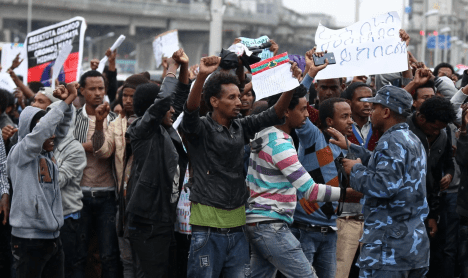
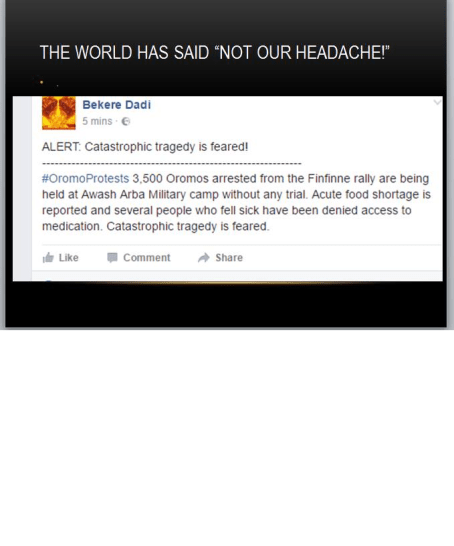


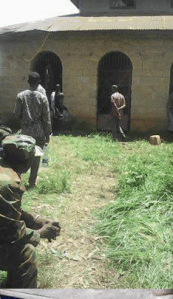
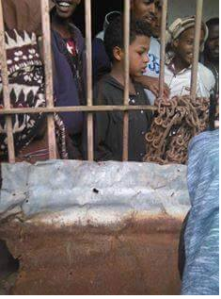
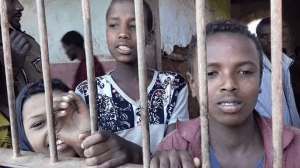
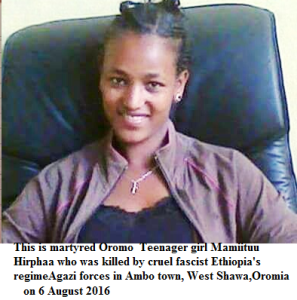
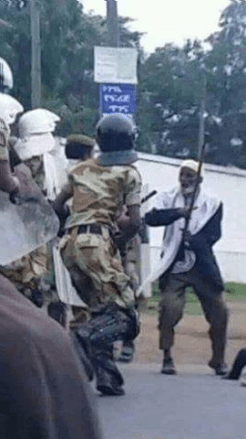
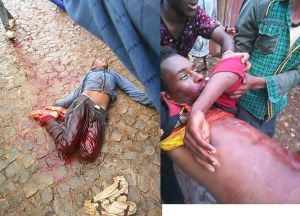






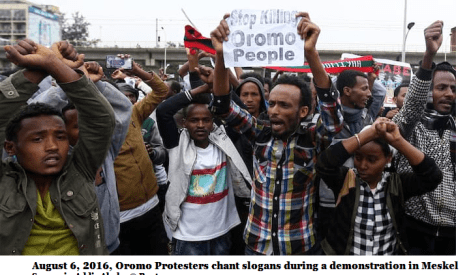
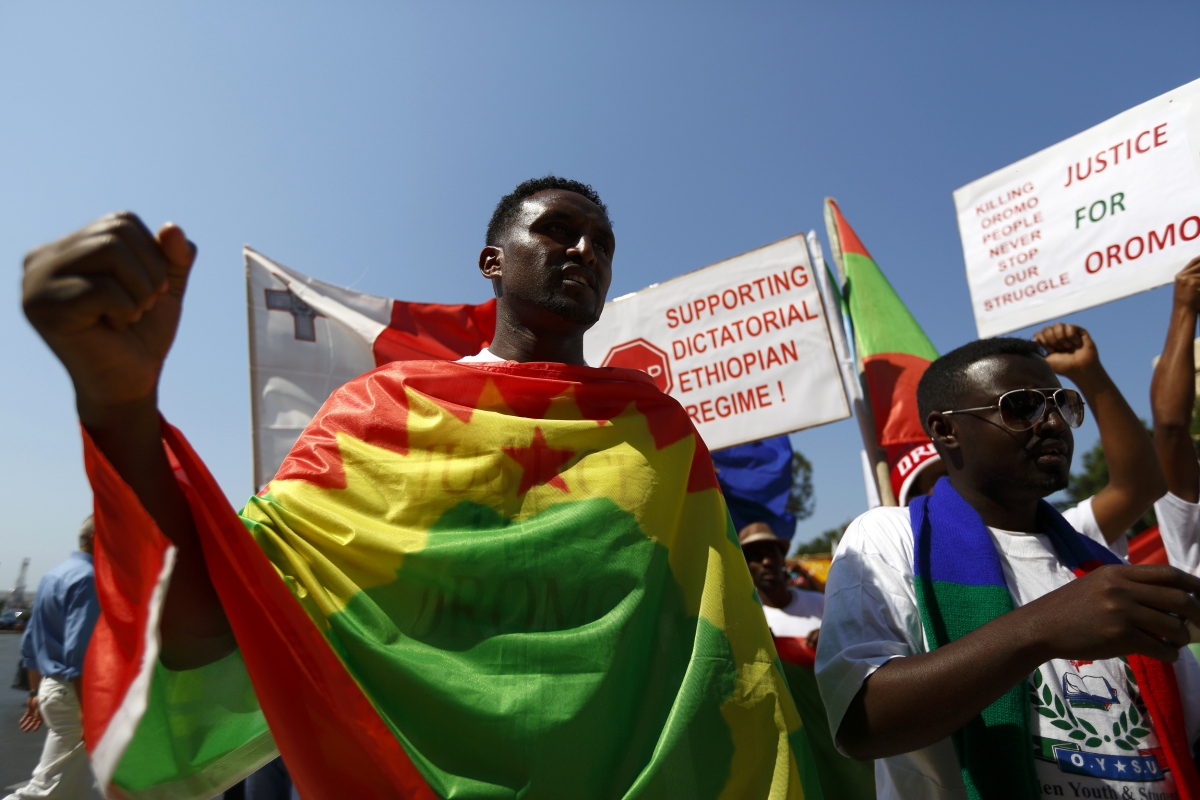
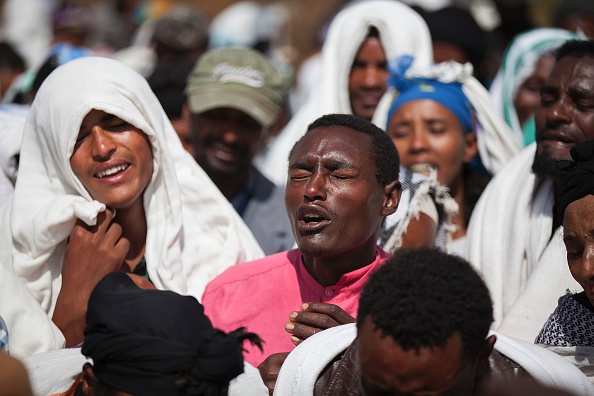


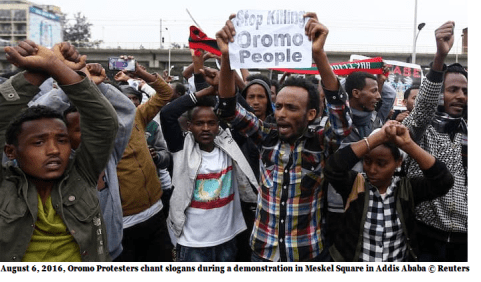
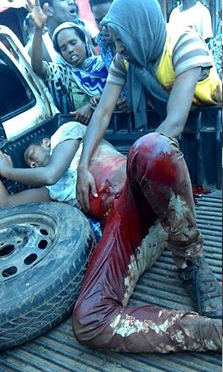
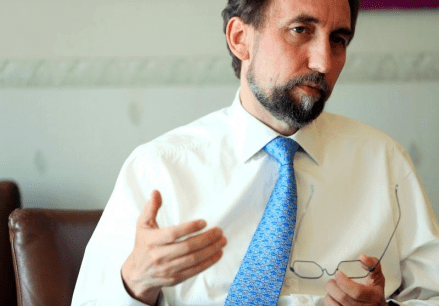


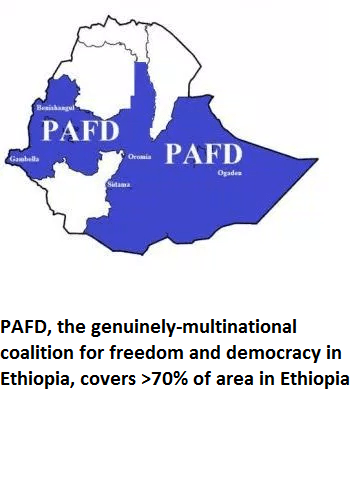
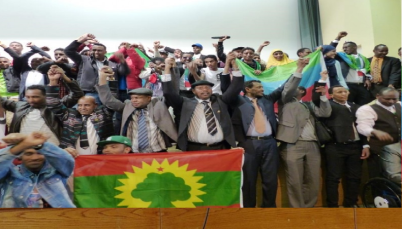
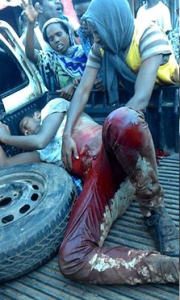
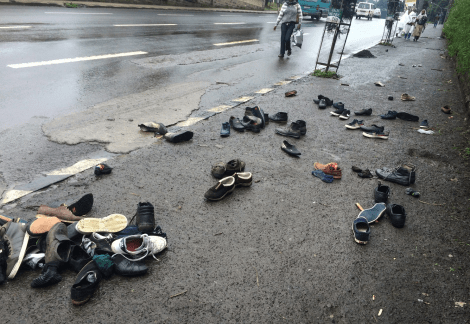
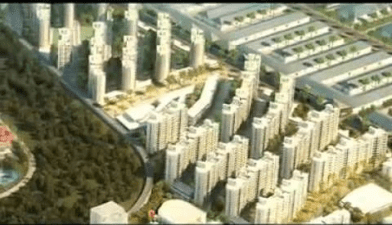

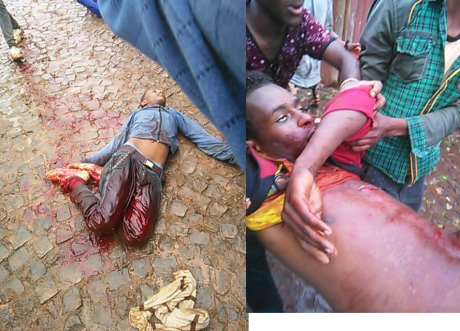
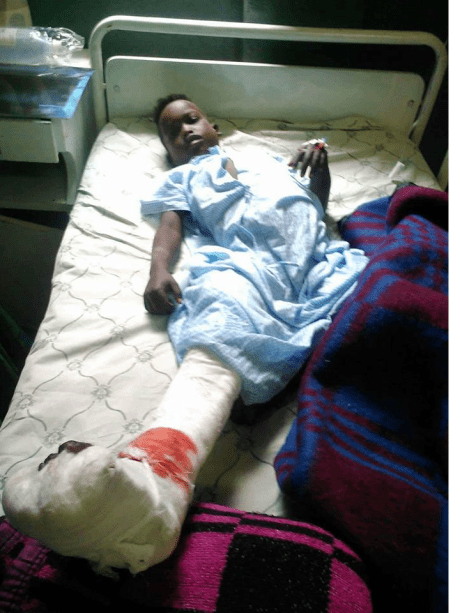

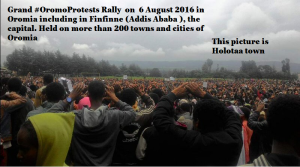
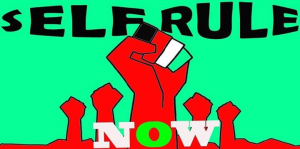


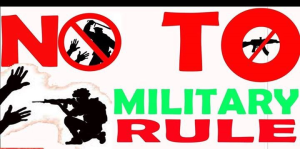



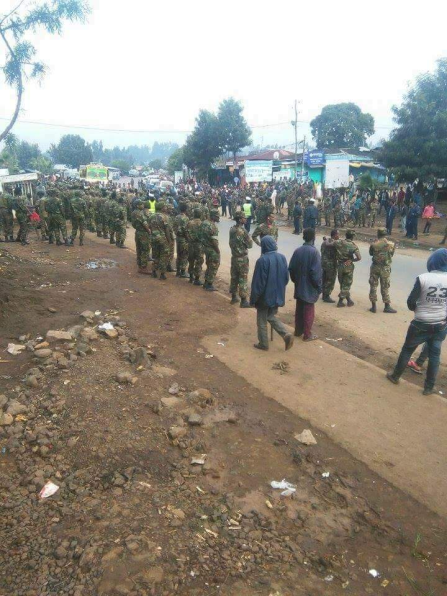

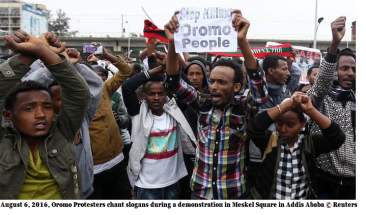
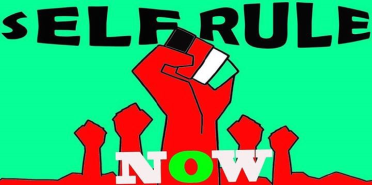
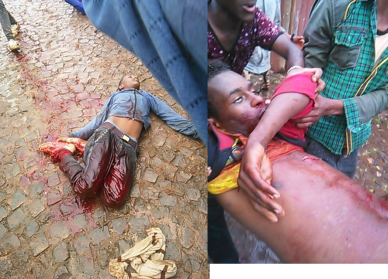

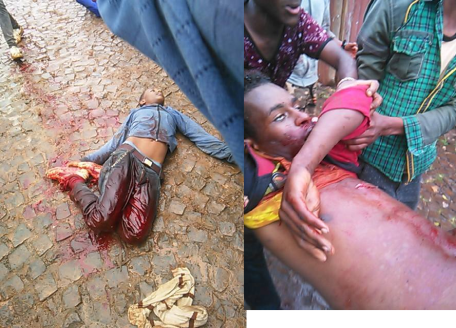
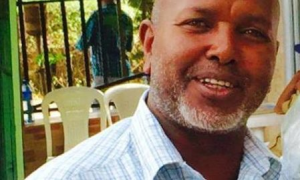
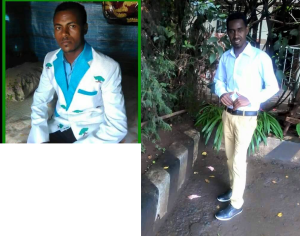
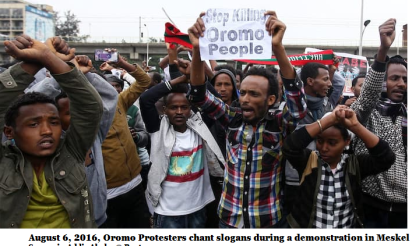


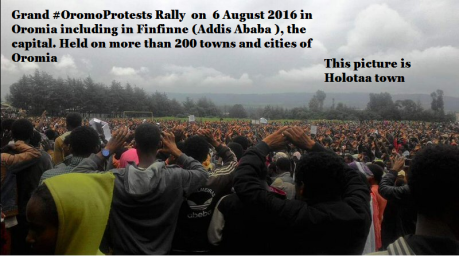

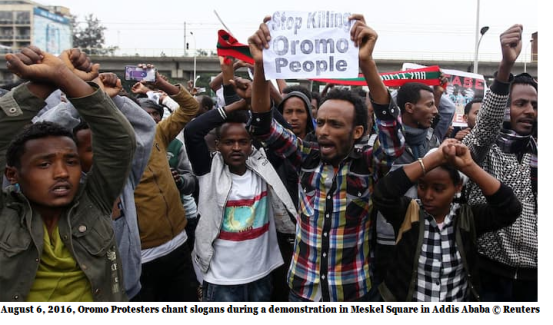
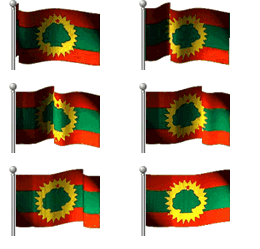
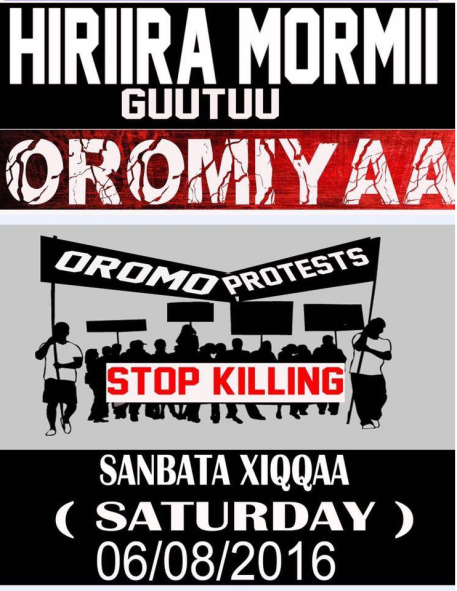
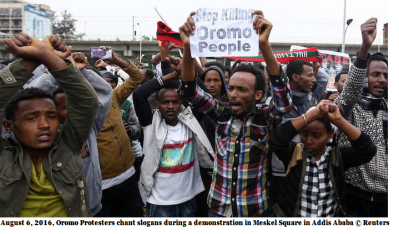


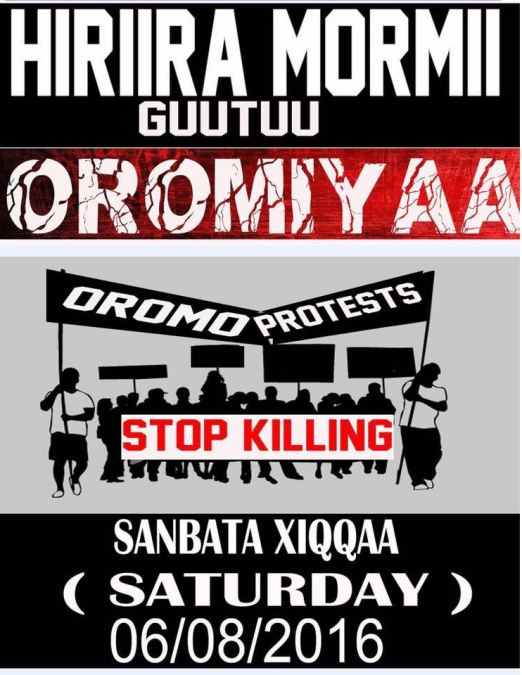
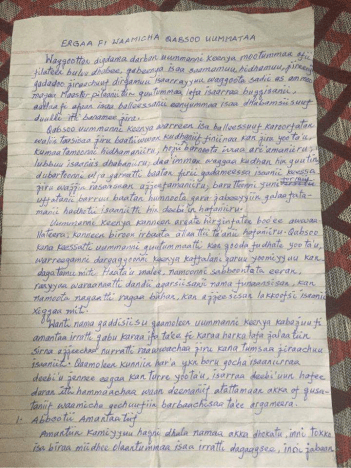
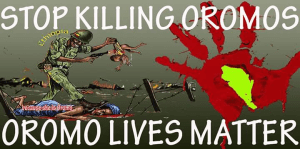
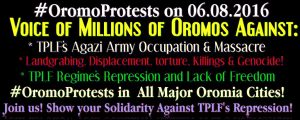
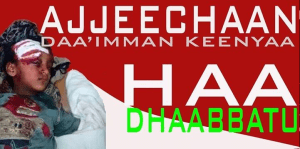

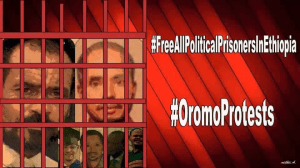


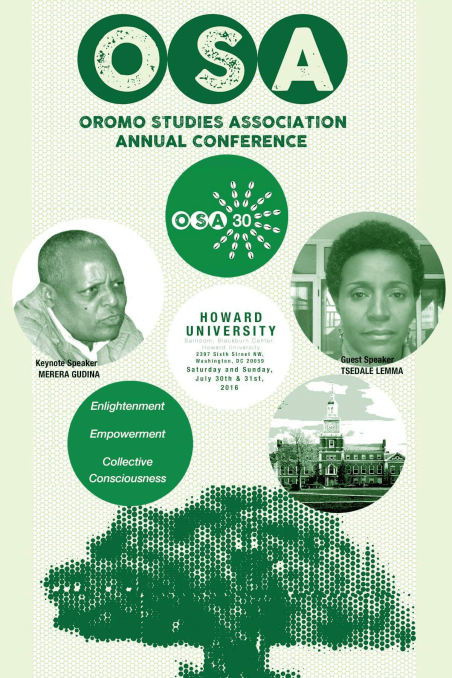
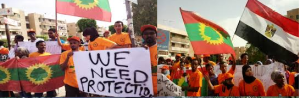




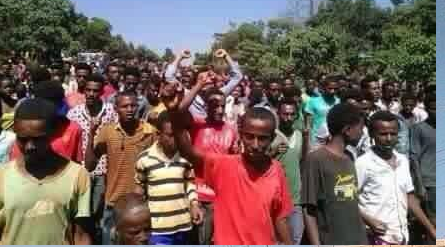



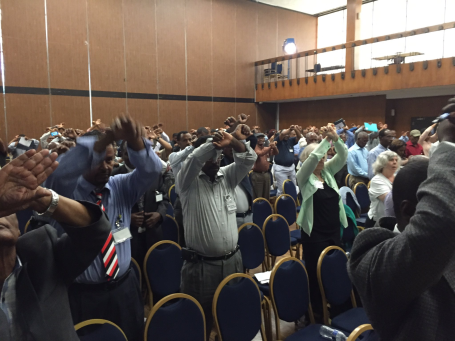
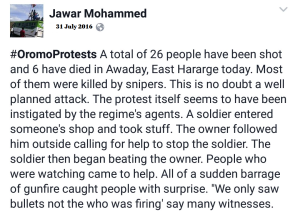

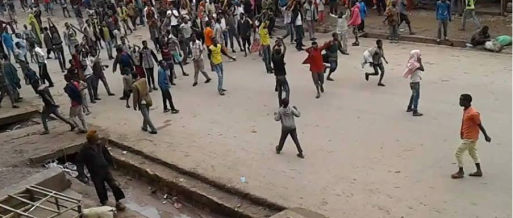
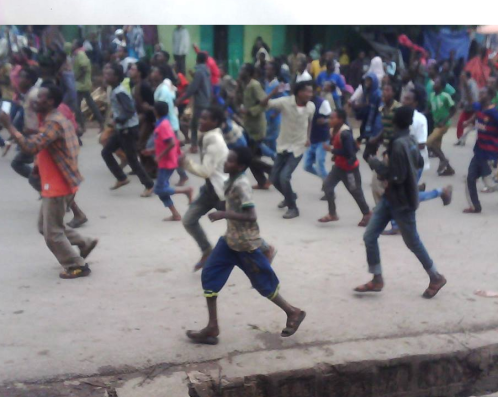
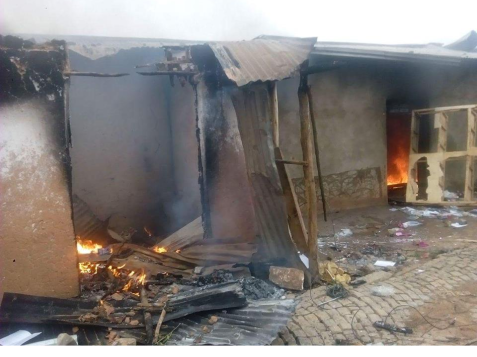
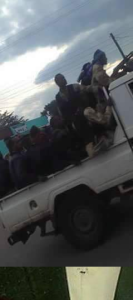
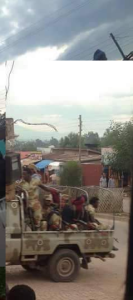
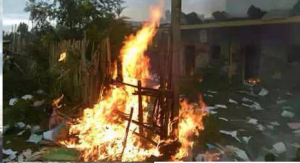

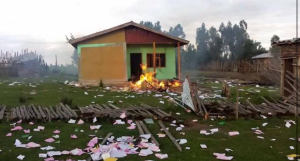
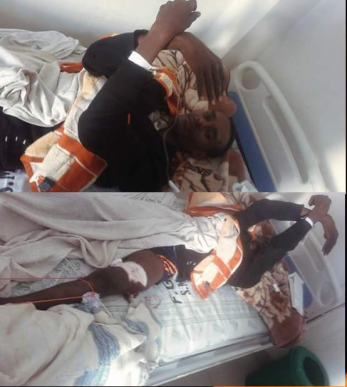
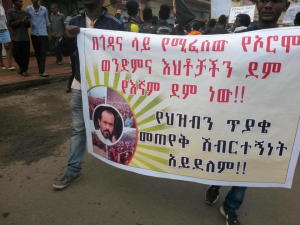

 Qabsoon Ummanni Oromoo mirga abbaa biyyummaa, Bilisummaa fi Walabummaa isaatiif gaggeessaa jiru gulantaa murteessaa irra gahuu, haalli Oromiyaa keessaa sirriitti agarsiisa. Sochiin warraaqsaa ummanni Oromoo gaggeessaa jiru gootummaa, bilchina jaarmayaa fi tooftaan akkasumas Impaayerattii keessattis tahe naannawa Gaanfa Afrikaatti fakkeenya murteessaa tahuu ummata Oromoo dirreetti baasee agarsiiseera. Keessumaa dhaloonni haaraan Gabrummaan Nu irratti Xumura Argachuu Qaba jechuun gootummaa fi murannoon bilisummaa Oromoo mirkaneessuuf muxannoo qabsoo fi jaarmayaa hunda sochoosaa agarsiisaa jiran lammiif abdii, mootummaa gabroomfataaf ammoo naasuu akka malee itti ta’e.Wayta ammaa kana goleen Oromiyaa fincilaa fi mormii hin keessummeessine hin jiru jechuun ni danda’ama. Magaalotaa fi baadiyyaalee Oromiyaa keessaa sagalee fedhii bilisummaa fi mormii gabrummaatu dhaga’ama. Alaabaa ABO waggoottan kudhanoota dabran goototni kumaatamni hedduun irratti wareegamanii asiin gahan tan faajjii bilisummaa taate qabatanii hiriira bahuu fi bakkoota addaa addaatti fannisanii balaliisuun, alaabaa Impaayerattii mallattoo gabrummaa taate irra ol kaasanii aduun gabroomsaa dhihuu, bilisummaan Oromoo dhiyaatuu labsaa jiru. Walumaagalatti warraaqsa gabrummaatti xumura gochuu akeekkatetu wareegama ilmaan oromoo qaqqaaliidhaan guutuu Oromiyaatti gaggeeffamaa jira.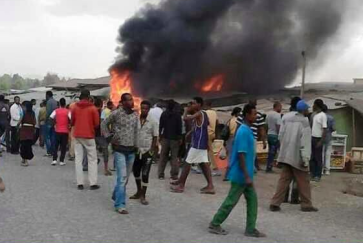


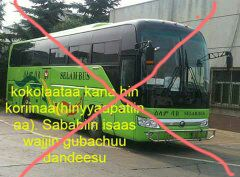
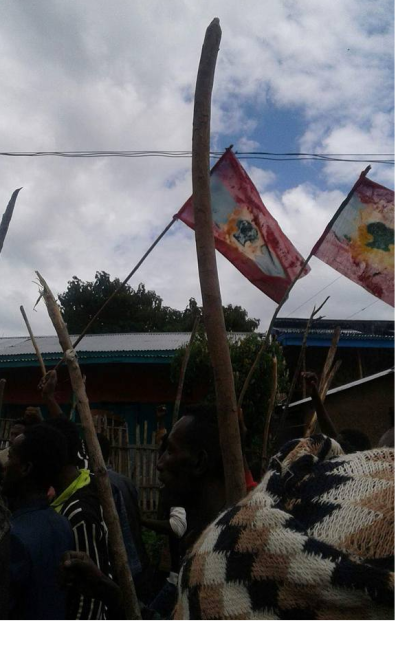
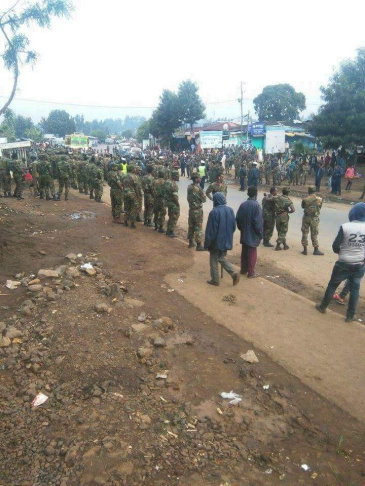
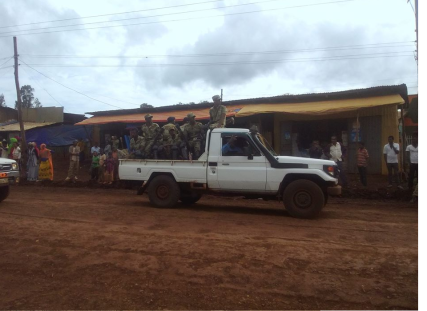
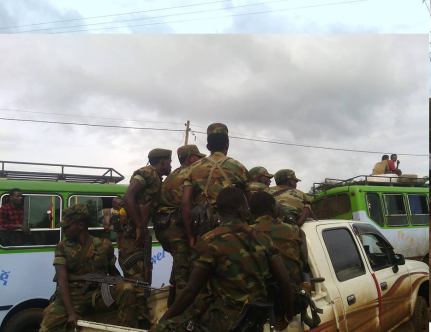

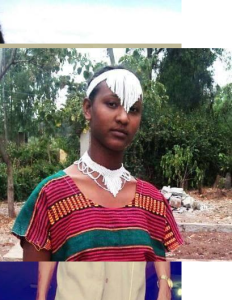
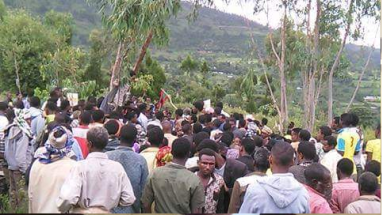
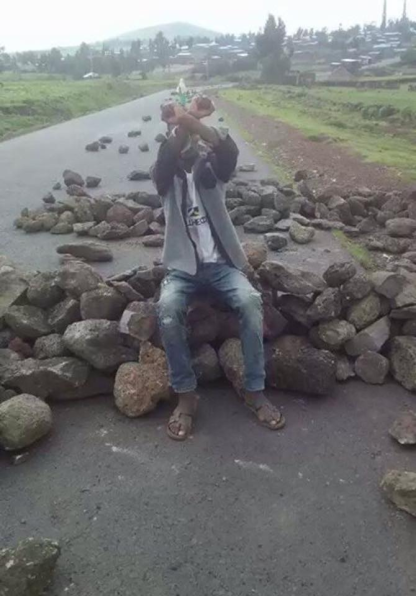
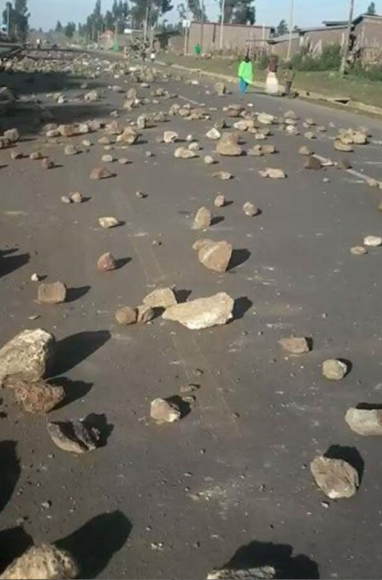
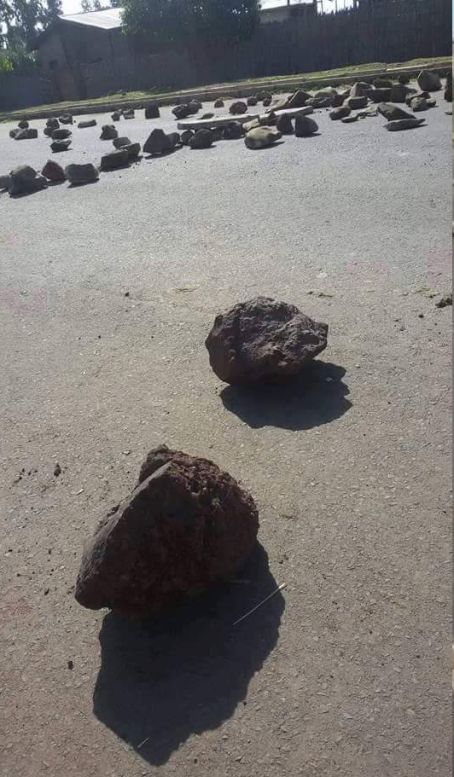

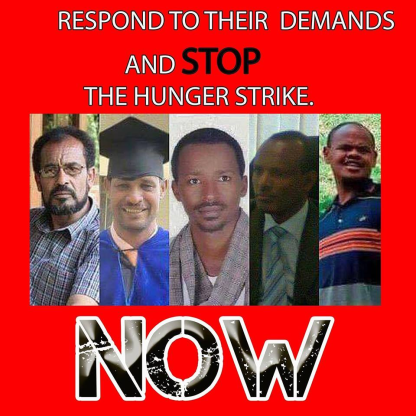
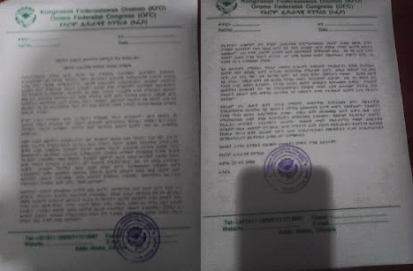


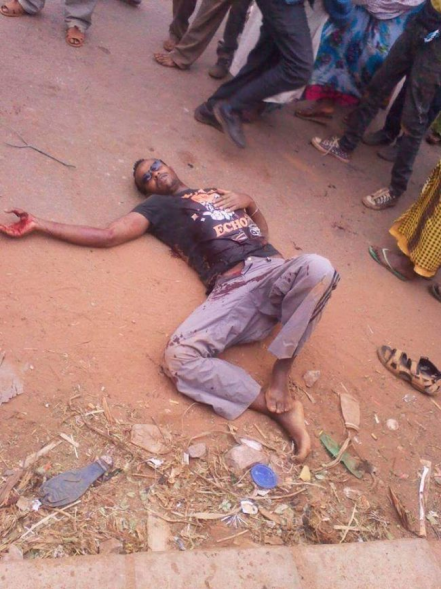

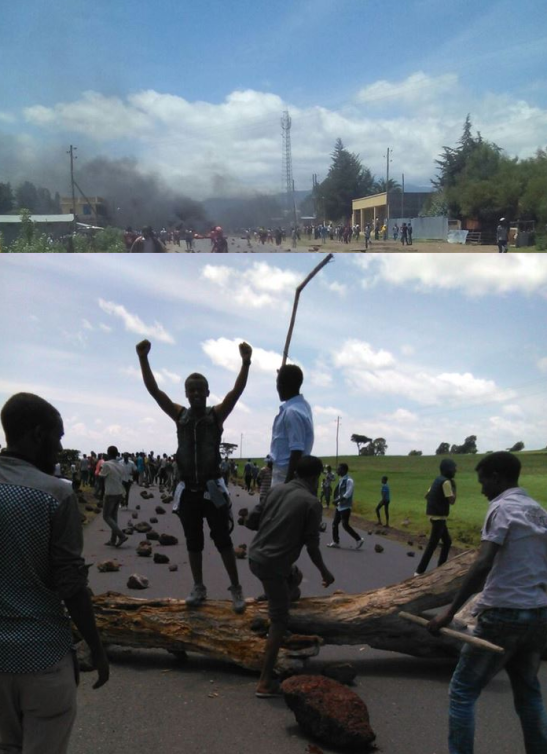
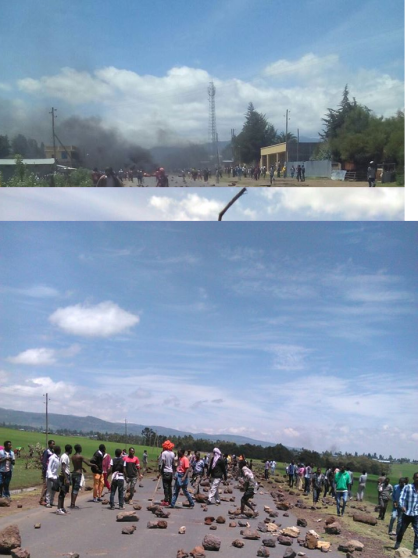
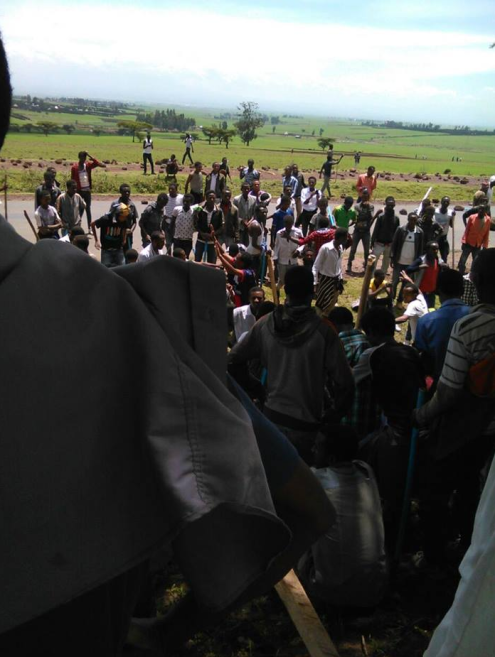
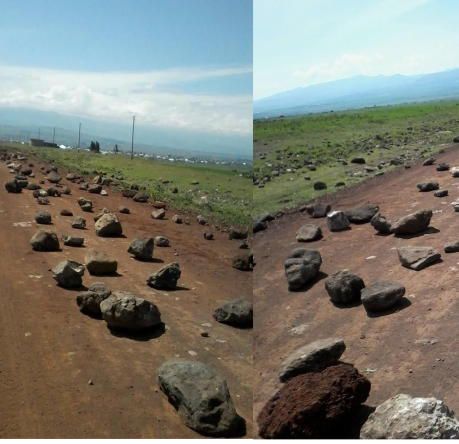

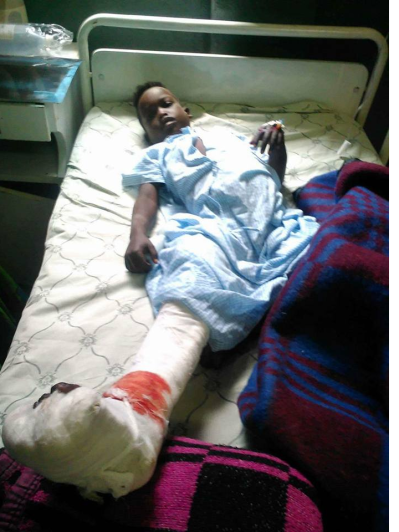
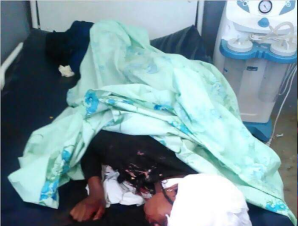
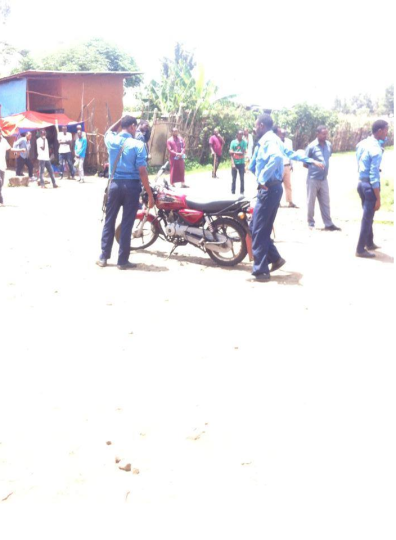
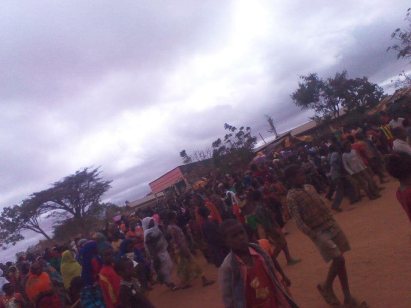

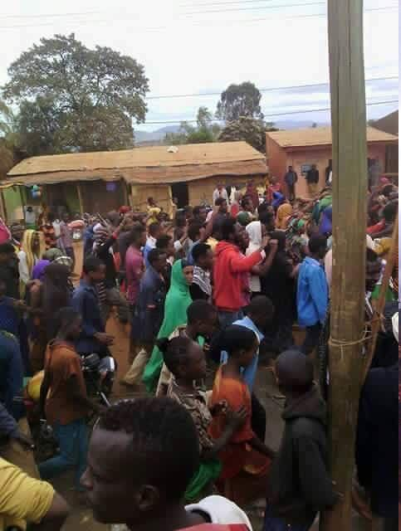


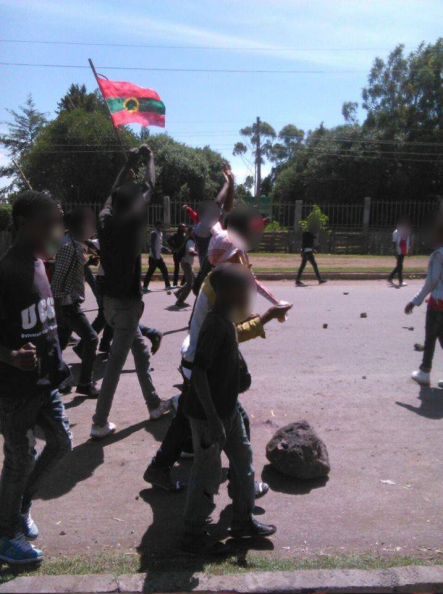
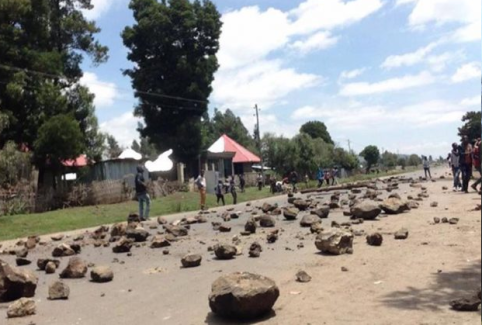


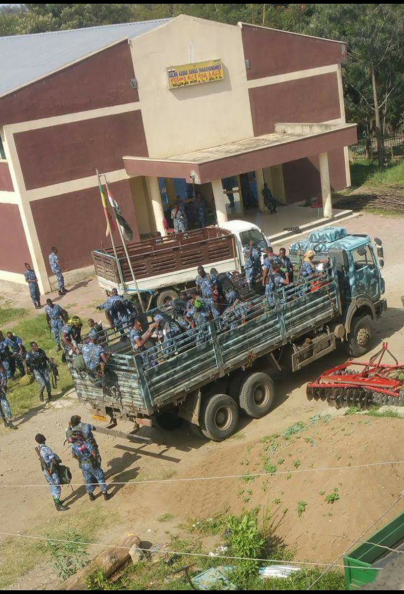

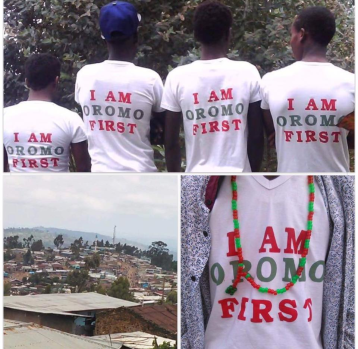
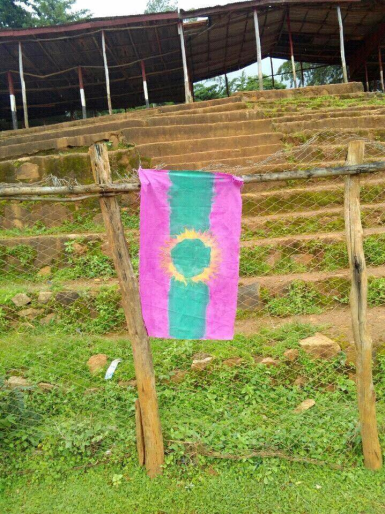

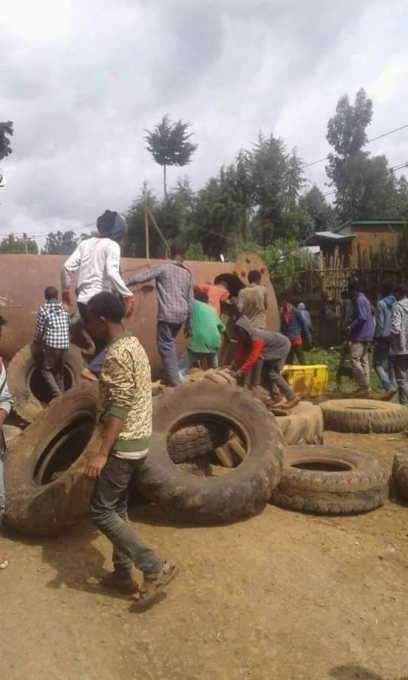

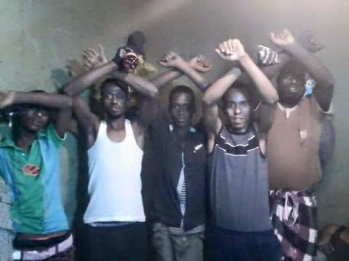
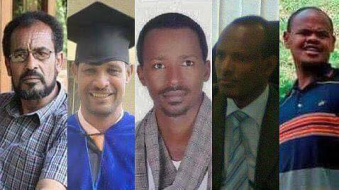
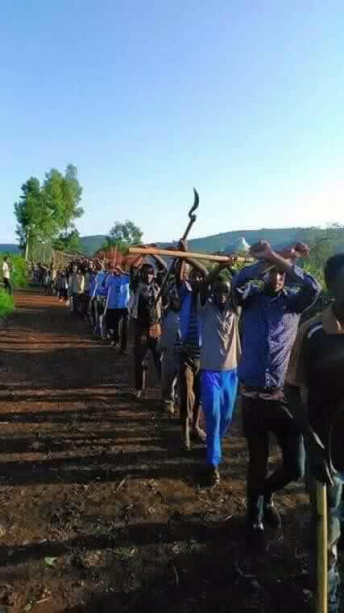




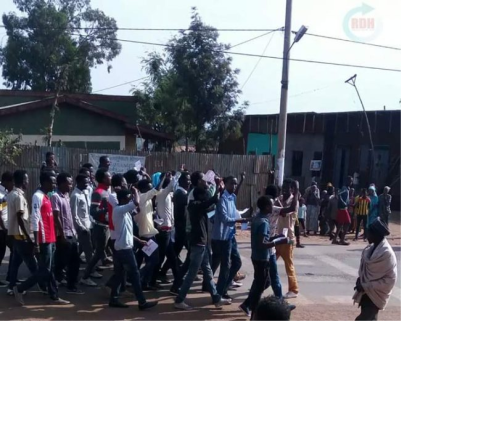
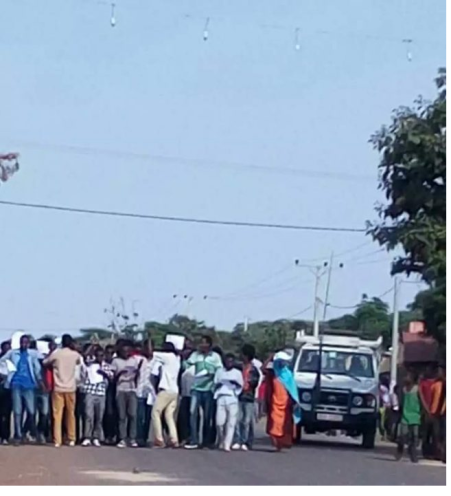

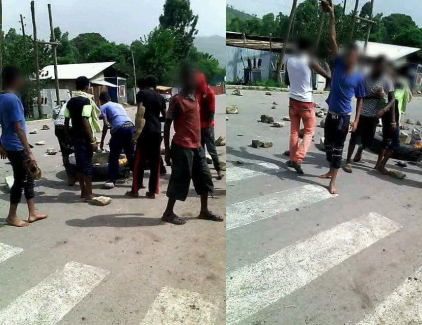


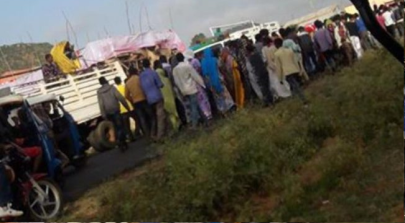
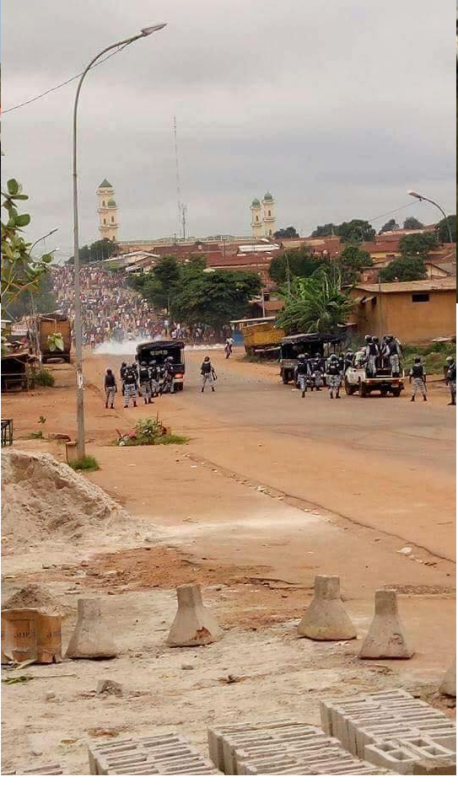




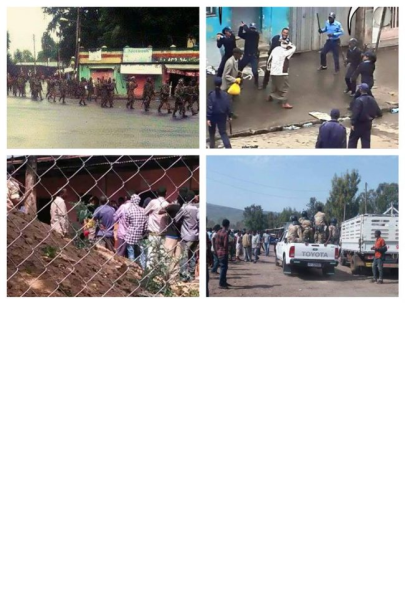
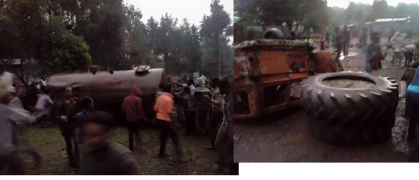

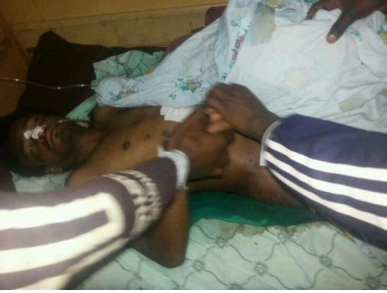
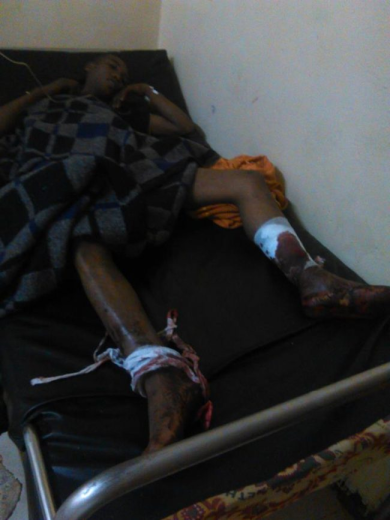
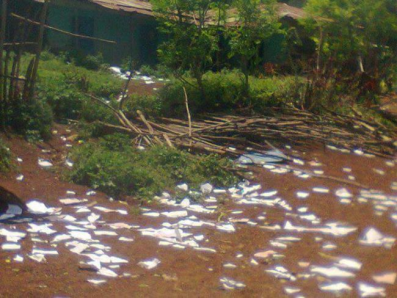
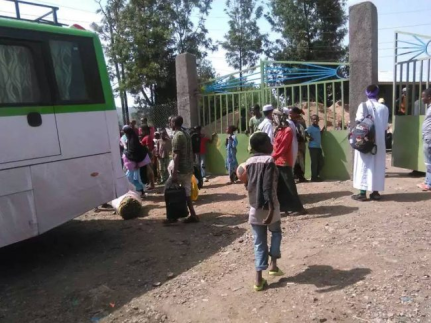

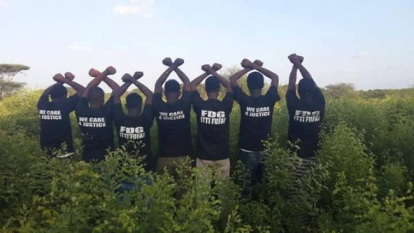

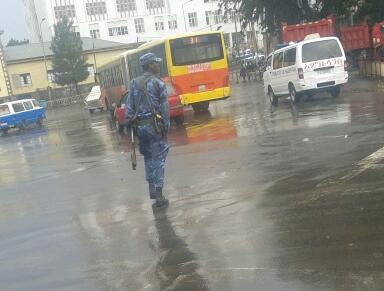

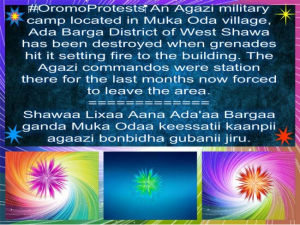
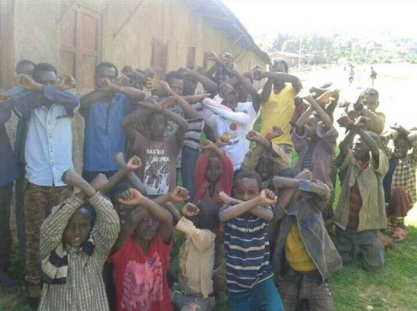
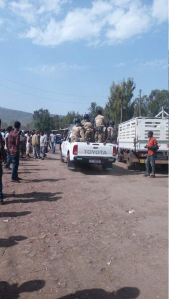
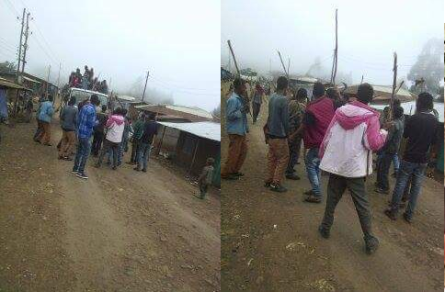
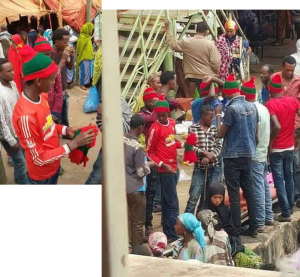



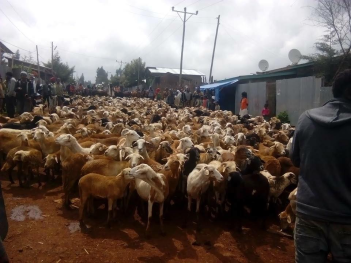

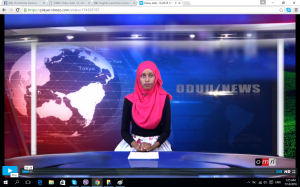

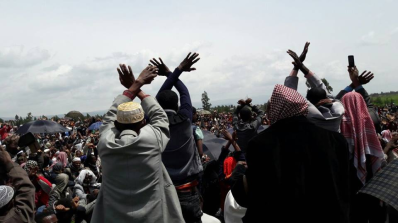
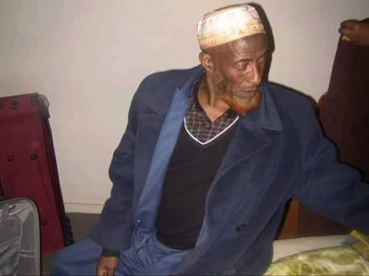
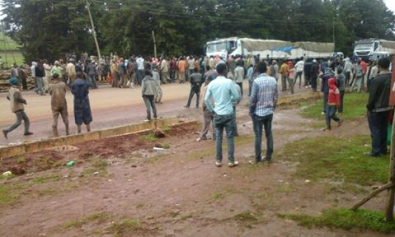
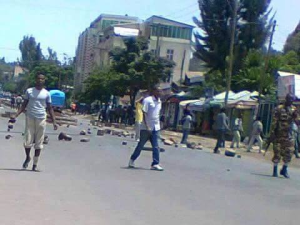
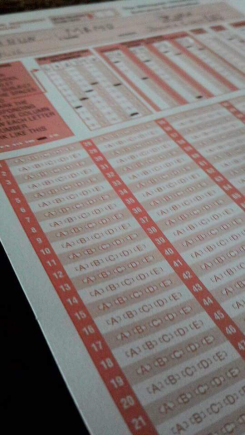
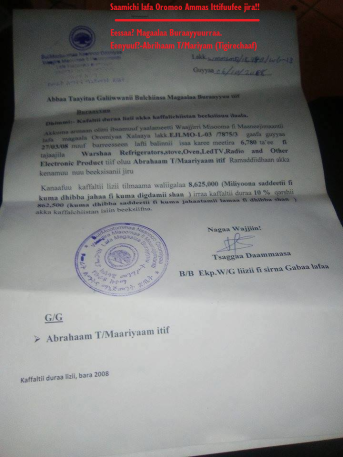
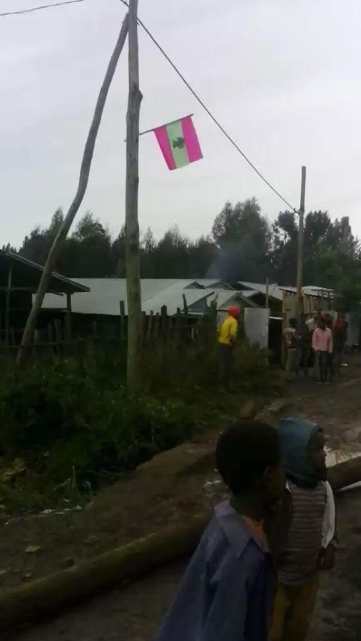





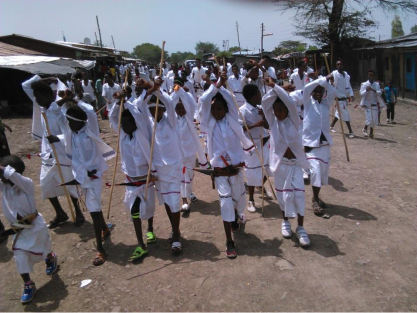
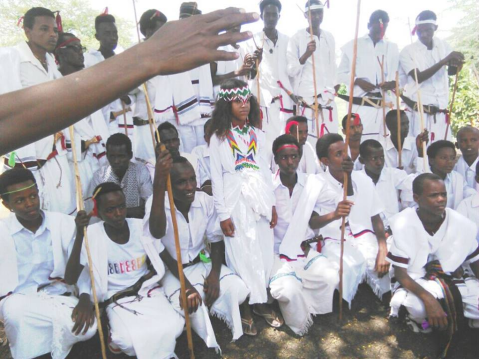
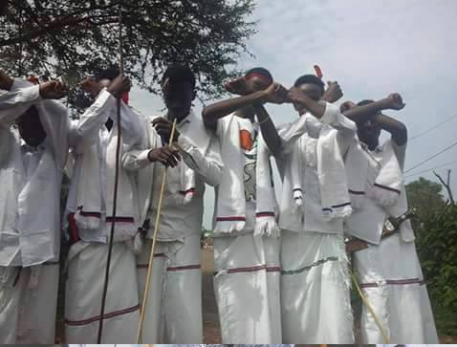




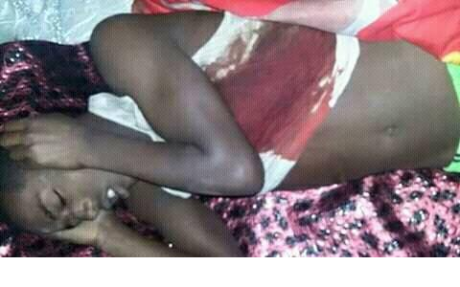
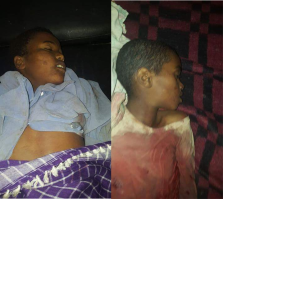
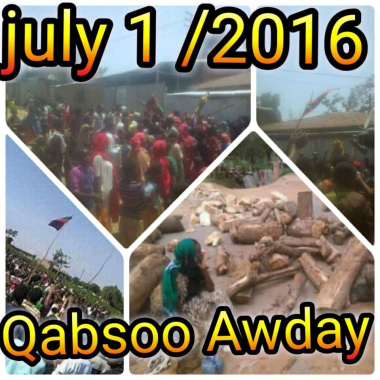
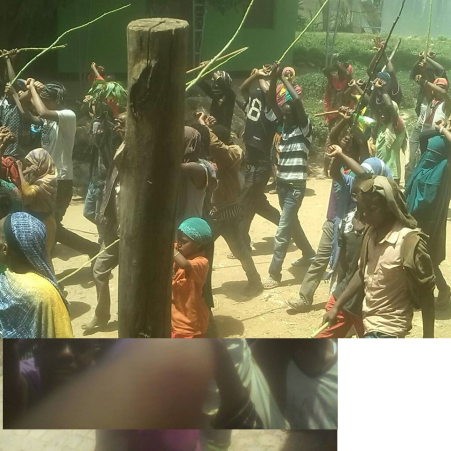
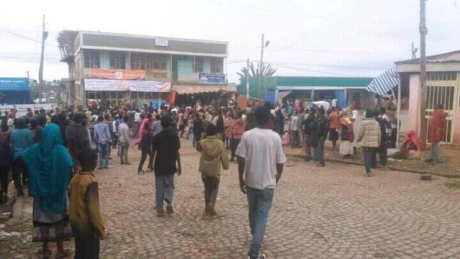
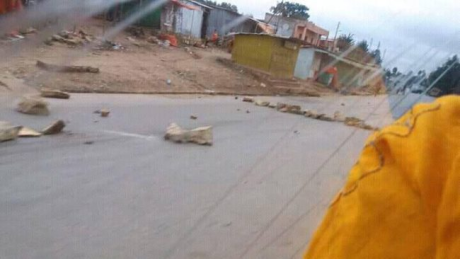





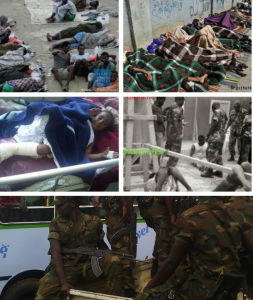
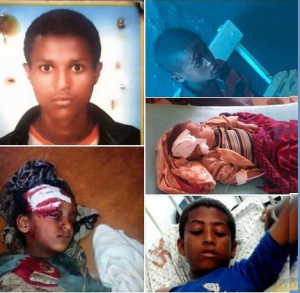

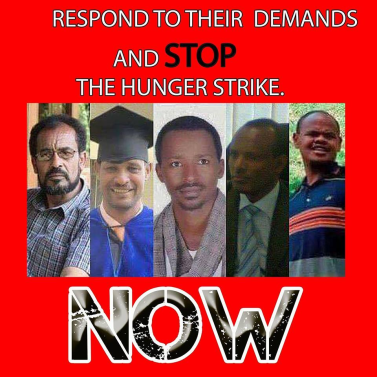


 Oromian Economist
You must be logged in to post a comment.