jump to navigation

The Human Rights League of the Horn of Africa: The Ethiopia’s regime Crimes Against Humanity in Oromia Needs Urgent World Community Action. #Prevent #Genocide December 13, 2017

Posted by OromianEconomist in Uncategorized.
Tags: , , , , , , , ,
1 comment so far


Ethiopia: Crimes Against Humanity in Oromia Needs Urgent World Community Action

HRLHA  Urgent Action

Dec 13, 2017

For Immediate Release


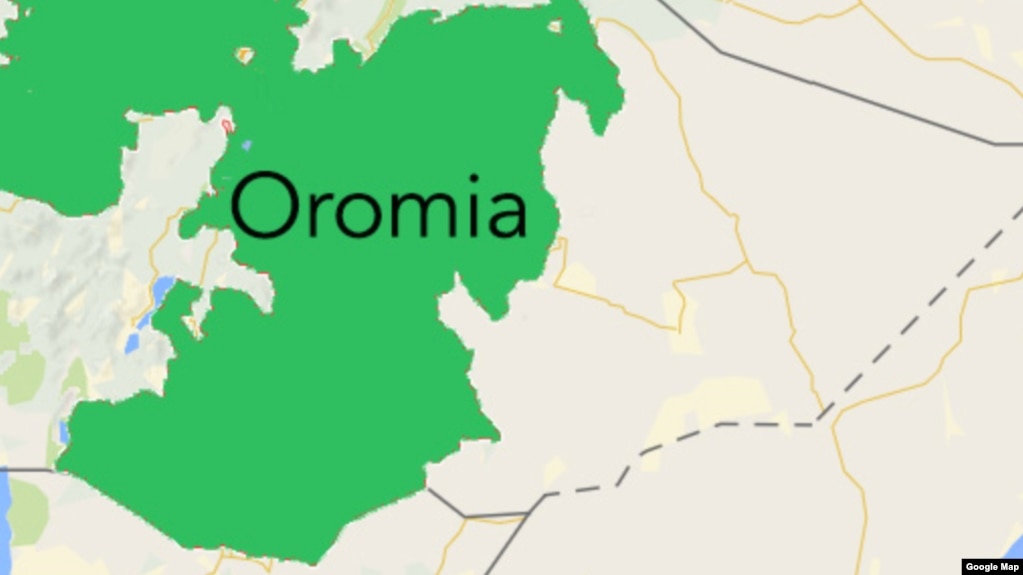
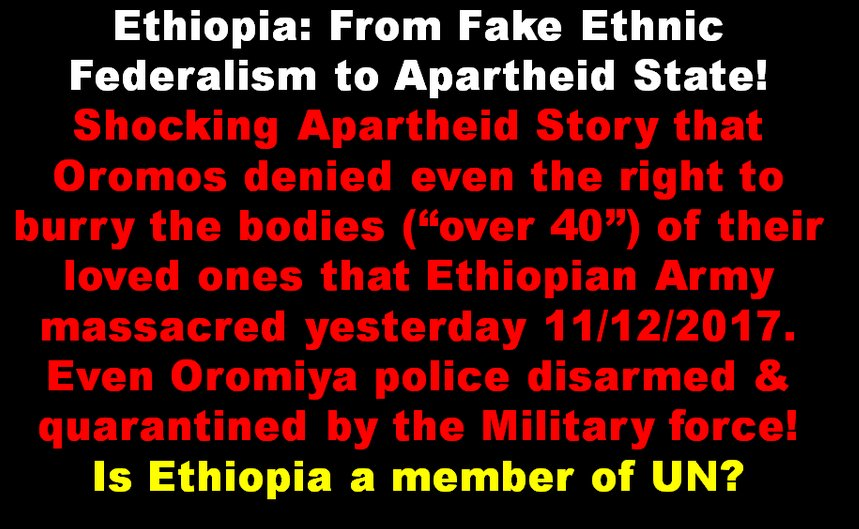
The Human Rights League of the Horn of Africa (HRLHA) strongly condemns the brutality of the Tigray People’s Liberation Front / Ethiopian People’s Revolutionary Democratic Front (TPLF/EPRDF) Government’s military force who massacred 15 Oromo farmers who were harvesting their crops on 10 Dec, 2017 in Chalanko district, EasternHararge zone. This comes after two weeks of the TPLF/EPRDF  commanders restarting fresh attacks on Oromos living in border areas near Somali State in which over sixty Oromos were killed  in two weeks- since the last week of Nov 2017 to the present- in Arero district (Borana zone), Cinakseen (Easter Hararge zone) ,and Bordode(Western Hararge zone).  Currently the TPLF/EPRDF led Ethiopian government has deployed thousands of heavily armed military forces all over Oromia regional, state zones and committed extrajudicial killings, and detentions in Kelem and HoroGuduru, western Oromia zone, in Bale, Arsi, Guji and Borana in southern Oromia zones and in Ambo, Walisso,  and Yaya Gullale Central Oromia, Shewa zones.

Among the recent Victimsof  theTPLF/EPRDF military forces:

# Name Zone/District Date of Attack Status
1 TajuYasy East Hararge/Chalanko Dec 10, 2017 Killed
2 AbdiSaliIbro Hararge/Chalanko Dec 10, 2017 Killed
3 Mhamed Abdela Hararge/Chalanko Dec 10, 2017 Killed
4 SaniYuya Hararge/Chalanko Dec 10, 2017 Killed
5 AbdelaYisak Hararge/Chalanko Dec 10, 2017 Killed
6 Abdumalik Uso Hararge/Chalanko Dec 10, 2017 Killed
7 Haru Hasen Hararge/Chalanko Dec 10, 2017 Killed
8 Fesal Yisak Hararge/Chalanko Dec 10, 2017 Killed
9 Michael Abdo Hararge/Chalanko Dec 10, 2017 Killed
10 Mumeadam Hasen Hararge/Chalanko Dec 10, 2017 Killed
11 Tofik Abdo Hararge/Chalanko Dec 10, 2017 Killed
12 Sali Hasen Hararge/Chalanko Dec 10, 2017 Killed
13 Sabaoy Haji Sani, (7th grde student) West Harage/ Hawigudina district Dec 7, 2017 Killed
14 Jamal Hasan  (Milicia) West Harage/ Hawigudina district Dec 7, 2017 Killed
15 three people, no names Borana/Moyale Dec 7, 2017 Killed
16 Hasan Basaa Guji/BuleHora Dec 6, 2017 Killed
17 Kadiro Geda Guji/BuleHora Killed
18 13 people Borana/Arero Nov. 24, 2017 Killed
19 Dejen Belachew Shewa/Yayagullale Nov, 23, 2017 Killed
20 Dirriba Hailu Shewa/YayaGullale Nov, 23, 2017 Killed
21 Girma Shifera Shewa/Yayagullale Nov, 23, 2017 Injured
22 Adane Tibabu Shewa/Yayaullale Nov, 23, 2017 Injured
23 Insa Megersa Shewa/Yayagullale Nov, 23, 2017 Injured

HRLHA has expressed its concerns several times to the world community in general, to Western donor governments (the USA, the UK, Canada, Norway, Sweden), governmental agencies (UN, EU & AU) in particular regarding the  systematic and planned killings targeting educated  Oromo men and women, outstanding university students, Oromo nationalists by the Ethiopian government killing squad, Agazi force which has been deployed by the government deep into community villages  of Oromia.

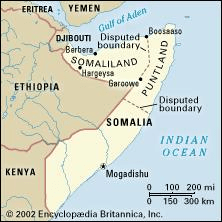
Advancing its plan of systematic killings of Oromos, the TPLF/EPRDF  government trained another group of killers,  the Liyu Police in Somali Regional State, Eastern neighbor state of Oromia  and deployed them along the border between Oromia and Somali State where they have killed thousands of innocent Oromo  farmers-since 2011 to the present- invading the border Oromo areas. The well trained and armed Liyu Police led by TPLF/EPRDF commanders entered into the OromiaState territory from East and West  Hararge, Bale, Borana, Guji Zones and killed, evicted, abducted Oromos and occupied some areas in Bale, Hararge, Borana and Guji areas permanently. Oromos and Somali are, respectively, the two largest regions in the country by area size, sharing a border of over 1,400 km (870 miles). The attacks of the Liyu Police on Oromos took place not only across the border, they also killed many Oromos living in Somali Regional State towns of Jigjiga, Wuchale, Gode, forcefully disappeared over two hundred Oromo business men and women and displaced over seven hundred  thousand (700,000) others including women, children and seniors.

The  700,000 evicted Oromos from the Somali Regional Statepushed out by the government of Somali state have been deported to Oromiaand are currently suffering in different concentration camps, including in Hamaressain Harar town, Dirredawa and other areas. They are mostly without shelter, and food and are in poor health.

Sadly enough, these displaced Oromos did not get the attention of the TPLF/EPRDF government and did not  receive any humanitarian aid from the federal government of Ethiopia and other sister federal states or from international donor governments and organizations in the past over six months. They depended only on their fellow Oromo brothers and sisters. The Federal Government of Ethiopia which highly depends on Oromia resources (about 70%) for its annual income has failed to provide even emergency  funding to Oromos who have been displaced and chased from Somali Regional State leaving behind their all belongings. The TPLF/EPRDF government and the Oromo People’s Democratic Organization (OPDO),  the  member  of ruling party, the EPRDF deliberately hides the suffering of 700,000 displaced Oromos from the world society, a move equal to genocide.

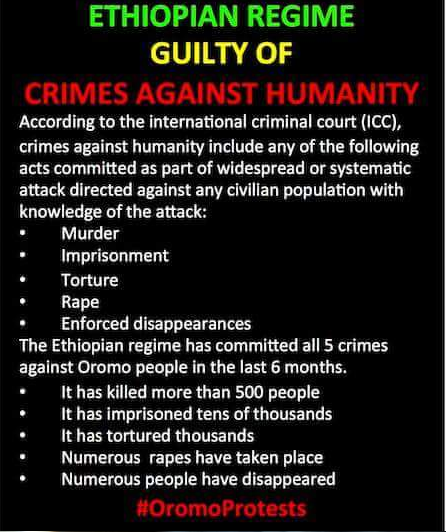
Based on the violations against the Oromo nation by the Ethiopian government  over the past twenty-five tears, the HRLHAhas found that the serious gross human rights violations committed by the Ethiopia Government against the Oromo nation since 1991 to the present constitute  crimes against humanity under international law. Crimes against humanity are certain acts that are deliberately committed as part of a widespread or systematic attack or individual attacks directed against any civilian or an identifiable part of a civilian population. The crimes against humanity act include: a) forced population transfers and deportation, b) murder, c) rape and other sexual violence, and d) persecution as defined by the Rome Statute  article 7 of the International Criminal Court (ICC) and the ad hoc international criminal courts.

Background:

The World community has witnessed in the past four or more years, since the Oromo mass movement had begun in 2014 to the present,that the Ethiopian people in general and the Oromo people in particular have suffered or are still suffering  under the EPRDF government:

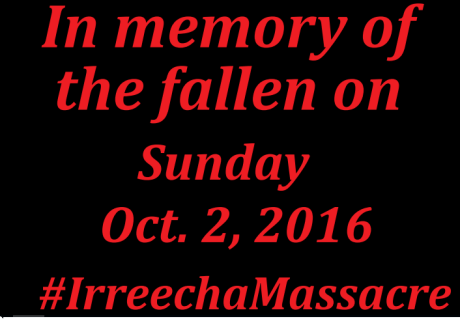
  1. Over4500 Oromos, from young to old, have been brutalized, tens of thousands have been incarcerated and other thousands have been forcefully disappeared during the Oromo protests and over 700 hundred were massacred on October 2, 2016 at the Irrecha Oromo thanksgiving Festival
  2. For the past 26 years, the world has seen that this Ethiopian government does not believe in finding peaceful and sustainable solutions through negotiations with opposition political organizations or in finding solutions for the grievances of the people.
  3. The EPRDF government pretends in front of the world community it is practicing democracy, while the facts on the ground show that the Ethiopian government is committing a crime, a systematic campaign against Oromos that causes human suffering, or death on a large scale-a crime against humanity.

Therefore, the HRLHA urges the international community to act collectively in a timely and decisive manner – through the UN Security Council and in accordance with the UN charter on a case-by – case basis to stop the human tragedy in Oromia, Ethiopia.

The international communities and agencies (AU, EU & UN) can play a decisive role by doing the following:

  • Provide humanitarian aid to the displaced 700,000Oromos immediately to save the life of the people before it is too late
  • Put pressure on the TPLF/EPRDF government to allow neutral investigators to probe into the human rights crisis in the country as a precursor to international community intervention
  • Put pressure on the Ethiopian government to release all political prisoners in the country
  • Intervene to stop crimes against humanity by the Ethiopian military force using the principles of R2P adopted in 2005 by the UN General Assembly
  • Demand thatthe Ethiopian government return its military forces back to their camps from Oromia villages and towns

Copied To:

  • UN Human Rights Council
    OHCHR address: 
    Office of the United Nations High Commissioner for Human Rights (OHCHR)
    Palais Wilson
    52 rue des Pâquis
    CH-1201 Geneva, Switzerland.
  • Africa Union (AU)
    African Union Headquarters
    P.O. Box 3243 | Roosevelt Street (Old Airport Area) | W21K19 | Addis Ababa, Ethiopia
    Tel: (251) 11 551 77 00 | Fax: (251) 11 551 78 44Webmaster: webmaster@africa-union.org
  • The US Department of State
    WASHINGTON, D.C. HEADQUARTERS
    (202) 895-3500
    OFMInfo@state.gov
    Office of Foreign Missions
    2201 C Street NW
    Room 2236
    Washington, D.C. 20520
    Customer Service Center
    3507 International Place NW
    Washington, D.C. 20522-3303
  • UK Secretary of State for Foreign and Commonwealth Affairs
    Parliamentary
    House of Commons, London, SW1A 0AA
    Tel: 020 7219 4055
    Fax: 020 7219 5851
    Email: hammondp@parliament.ukDepartmentalStreet,(DepartmentalStreet???)
    London, SW1A 2AH
    Tel: 020 7008 1500
    Email: fcocorrespondence@fco.gov.uk
  • Minister of Foreign Affairs (Norway)
    His Excellency BørgeBrende
    Ministry of Foreign Affairs
    E-mail: post@mfa.no
    Phone: + 47 23 95 00 00
    Address: 7. juniplassen 1, N-0032 Oslo


    Related articles (Oromian Economist Sources):


Oromia: #CalanqooMassacre, Calii Calanqoo 2ffaa: The number of  civilians killed by fascist Ethiopia’s (TPLF) security forces in Calanqoo (Chelenko) town, Meettaa district in east Haraghe zone of Oromia state has risen to 20;  more than a dozen were also wounded, many of whom are in critical condition

Democracy Now: Reports: Ethiopian Forces Crack Down on Oromo Protests, Killing up to 15

Opride: Ethiopia: Oromia hit by fresh #OromoProtests in response to state-sponsored killings

Ethiopia faces social media blackout after new ethnic unrest

U.S. Embassy Statement Following Deaths at Chelenko and Universities


Oromia: #CalanqooMassacre, Calii Calanqoo 2ffaa: The number of  civilians killed by fascist Ethiopia’s (TPLF) security forces in Calanqoo (Chelenko) town, Meettaa district in east Haraghe zone of Oromia state has risen to 20;  more than a dozen were also wounded, many of whom are in critical condition December 12, 2017

Posted by OromianEconomist in Uncategorized.
Tags: , , , , , , , , , , , , , , ,
7 comments

Two students were also killed last night at Shambu campus of Wolega university as student protests continued in several universities  

By Addis Standard staffs

December 12/2017 – The number of  civilians killed by security forces in Chelenko town, Meta woreda in east Haraghe zone of the oromia regional state has risen to 15;  more than a dozen were also wounded, many of whom are in critical condition.

According to Addisu Arega Kitessa, head of the Oromia region communication bureau, authorities at the highest level in Oromia region were investigating why and how these killings were “taken against peaceful civilians”. Addisu implicated the role of members of the national defense force but the locals say the killings were also committed by members of the Liyu Police operating in Ethio-Somali regional state and is accused of committing perpetual violence against civilians. According to Abdulatif, a nurse in Dire Dawa hospital who only wanted to be identified by his first name, many of the wounded who are currently being treated at the hospital have “are being treated for gun shots, some of which were from a close range,” he told Addis Standard by phone.

According to Addisu Arega, the protesters in the city have went out to the streets yesterday to denounce the killing of an individual called Ahimaddinnn Ahimad Asaasaa, by members of the Liyu Police.  Ahimaddinnn died on the way to a hospital, which led the town’s people to come out to the streets to protest.

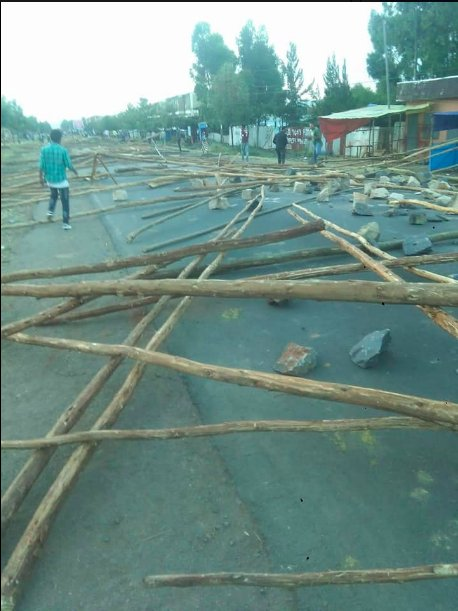
Abdulatif told Addis Standard quoting “some of” the family members of the victims that the “protests were happening with the people of the town chanting ‘enough with the killings by [the] Liyu police’ when all of a sudden shots began to be fired.” According to him, protesters in other parts of the city have then begun blocking roads “to prevent the security forces access to protest areas, but the security forces have dismantled the road blocks using heavy military vehicles while at the same time shooting at the protesting civilians.”

Six people killed on the spot yesterday, according to Addisu. But that number has now risen to fifteen. Abdulatif said  many of the wounded admitted at the hospital “may not survive due to the severity of their wounds.”  Among them were women and children. Abdulatif couldn’t tell the exact number of civilians admitted to the hospital, but Addisu said yesterday that 14 people were wounded, six of whom seriously. On December 09/2017 residents of Babile and Moyale towns in east Hararghe and southern Ethiopia respectively have told the VOA Amharic that there were everyday killings committed by members of the Liyu police. Several pictures showing wounds of gun shots and dead bodies are circulating in Ethiopia’s social media space.

The burial of those who were killed yesterday is expected to take place today and security in the area remain tense.

University students protesting 

Meanwhile, two university students were killed last night at Shambu campus of the Wolega University, 305 km west of Addis Abeba, following “fights between the students,” according to Addisu Arega. He said several suspects were detained and were under investigation. Addisu provided no further detail but said he would release further information is due course.

The news comes as students in universities of Gonder & Woldiya in Amhara regional state and Ambo and Haremaya in Oromia regional state began protesting since yesterday in the wake of the killing of a student in Adigrat University in Tigrai regional state over the past weekend as a result of a fight between two students. Officials have not released adequate information surrounding the clear circumstances of the killing of student Habtamu Yalew Sinashaw, a second year management student who was from West Gojam Zone, Dega Damot Woreda, Dikul Kana Kebele of the Amhara regional state. But the news has stirred ethnic tensions in several university campuses. Protesting students also claim that the number of casualties is more than what is admitted by authorities.  A video allegedly showing the protest by Gonder university students has also surfaced.

The protests have continued until today and security forces are being dispatched to the university campuses.


https://twitter.com/addisgazetta/status/940404398538350592


Related:


Jiraattonni hedduun immoo haleellaa kanaan madaa’anii gara Hospitaala adda addaatti geeffamuu ibsamee jira.Kanneen daangaa irratti wal waraanaa jiraniif raashinni ykn nyaati haa ergamuu jechuun waajiira bulchiinsaa duratti hiriirree ituu jirru haleellaan kun nu irratti gaggeefamee jedhu Jiraattonni.

Bulchiinsi Godinaa Harargee Bahaa Obbo Jamaal Ahmadee walitti bu’iinsi kun uummauu mirkaneessee jiran.Walitti bu’iinsa kana dura daangaa anaa meettaa araddaa Sarkamaa irratti guyyoota darban lamaa fi sadiif Oromiyaa fi Naannoo Somaalee giddutti walitti bu’iinsa tureen gam lameen irraa namnii tokko tokko ajjefamuu ibsan.

Dargaggonnis ajjechaa Oromoo irratti gaggeeffamuun mufannaa qabaniin daandilee dhagaan cufanii yeroo hiriiranti raayyaan ittisaa daandii bansisuuf yaalii godheen walitti bu’iinsa ka’een namonin ajjefaman akkasumas mada’an akka jiran dubbatan.

Garu lakkoofsa isaanii hin qulqulleeffanne jedhan.Haala jiru adda baafatanii deebii akka nu kennan Obbo Jamaal Ahmedee waadaa nu seenanii jiru.

Gaaffii fi deebii gaggeeffame Caqasaa


https://twitter.com/addisgazetta/status/940591792591949825

Mass unrest in state of Oromia, federal forces blamed for killings, for more click here to  read at Africa news.

https://twitter.com/addisgazetta/status/940601339851223040

https://twitter.com/addisgazetta/status/940580151687073792

NEWSWEEK: DID ETHIOPIA ‘SPY ON OROMO DISSIDENTS’ LIVING IN THE UK? December 11, 2017

Posted by OromianEconomist in #OromoProtests.
Tags: , , , , , , , , , , ,
add a comment

“The solution for Ethiopia is not in spying over political dissenters like us, it is in listening to the people and meeting their demands” Habte said.

DID ETHIOPIA ‘SPY ON OROMO DISSIDENTS’ LIVING IN THE UK?

The Ethiopian government has allegedly carried out a spyware campaign targeting dissidents living abroad, including in the U.K., a report has claimed.

Canada-based research group Citizen Lab alleged that Ethiopian dissidents were targeted with emails containing “sophisticated commercial spyware posing as Adobe Flash updates and PDF plugins”.

The report further claimed that Ethiopia used a commercial spyware product manufactured by Israel-based Elbit Systems Ltd to spy on dissidents.

Those targeted included dissidents from the Oromo community, one of Ethiopia’s largest ethnic groups, the U.S.-based media outlet Oromo Media Network as well as one of the researchers conducting the investigation.

Etana Habte, an Oromo activist and PhD candidate and Senior Teaching Fellow at SOAS, University of London, was also targeted.

He believes the government allegedly targeted him to identify people behind protests in Ethiopia’s Oromia state, which was rocked by months-long demonstrations, some of which turned deadly.

“By spying over us they mainly want to identify a wide circle of people who communicate with us on the movement at home,” he told Newsweek.

“They wanted to break into our privacy, collect information from our communications with one another, because they believe the leadership of Oromo Protests communicates with us.

“The solution for Ethiopia is not in spying over political dissenters like us, it is in listening to the people and meeting their demands” Habte said.

The Ethiopian embassy in London has not responded to a request for a comment on the allegations.

Ethiopian Communications Minister Negeri Lencho declined to comment on the report, according to Reuters.

Researchers said their findings raised questions on Elbit’s human rights due diligence practices.

The company said in a statement: “The intelligence and defenses agencies that purchase these products are obligated to use them in accordance with the applicable law.” It added that it only sell products to defense, intelligence, national security and law enforcement agencies approved by the Israeli government.

Deadly protests explained

Oromia protests
People mourn the death of Dinka Chala who was shot by Ethiopian forces in the Yubdo Village, about 100 kilometers from Addis Ababa in the Oromia region, on December 17, 2015. Dinka Chala was accused of protesting, but his family says he was not involved. Oromia was rocked by months-long protests, some of which turned deadly.ZACHARIAS ABUBEKER/AFP/GETTY IMAGES

Demonstrations started in Oromia in late 2015, where people initially protested over government plans to expand the territory of the capital Addis Ababa, with farmers raising concerns that increasing the size of the city would lead to forced evictions and loss of farming land.

The government later scrapped the plans, but protests continued. Oromo people argued for a greater inclusion in the political process and the release of political prisoners.

The protests, labelled as the biggest anti-government unrest the country has witnessed in recent history, later spread to Amhara and the Southern Nations, Nationalities, and Peoples’ Region (SNNPR) region.

The unrest continued throughout 2016.

Last October, the government implemented a six-month-long state of emergency, which was further extended by four months in March, to tackle the unrest.

Critics of the state of emergency claimed the government was trying to quell protests by, among other things, restricting freedoms and banning certain media outlets, including the Oromia Media Network. The government denied the allegations.

Rights groups have criticizied Ethiopia for the way it handled protests, accusing the military and the police of using excessive force to quell demonstrations.

The response to the unrest resulted in the death of at least 669 people, a figure the government confirmed in a report released in April.

While the country’s Human Rights Commission recommended prosecution of some police officers, it maintained that the overall response by security forces was adequate.


Oromia (Finfinnee): Konsarti Lammiin Lammif. Fundraising Concert for humanitarian assistance for over 700,000 Oromo nationals displaced by Ethiopia’s TPLF forces (Liyu Police) December 10, 2017

Posted by OromianEconomist in Uncategorized.
Tags: , , ,
2 comments

Odaa OromooOromianEconomistThe UN is silent as over 45 million Oromo people are subjected to genocide

Click here to read Oromian Economist article: #Prevent #Genocide! 

Click here to read OSA’s statement on displaced Oromos.


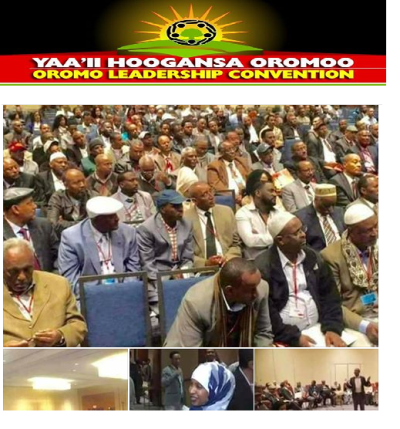
THE THIRD OROMO LEADERSHIP CONVENTION, DECEMBER 1-3, 2017 December 7, 2017

Posted by OromianEconomist in Uncategorized.
Tags: , , , , , ,
add a comment

Odaa OromooOromianEconomistOromo Leadership Convention 10-12 March 2017


THE HOUSTON STATEMENT OF THE THIRD OROMO LEADERSHIP CONVENTION

ON THE CRISES IN ETHIOPIA

The Third Oromo Leadership Convention was held in the City of Houston, Texas December 1-3, 2017.  The delegates participated in extensive discussions concerning the situation in Ethiopia based on analyses presented by several scholars. The delegates established that the Oromo Protest that started in 2014 has opened new possibilities for transformative change in Ethiopia.  They also recognized that, because of the protests, the historic Oromo struggle has advanced from resistance against oppression to reconstruction in preparation for the imminent political transition in Ethiopia.

The country is in throes of deepening multidimensional crises.  This is the conclusion of an assessment jointly prepared by Ethiopian intelligence and defence officials otherwise known as the National Security Council.  There is a historic opportunity for transition to a genuinely participatory democracy that emerges from below. There is also the danger that the opportunity could be squandered. To protect the gains made and to soldier on towards ultimate victory, we urge all Oromo nationalists to do their part to deny the forces of reaction the chance to launch a counterrevolutionary offensive against the Oromo struggle.

We issue this statement as the consensus of the delegates to the Third Oromo Leadership Convention calling on all those who support the longstanding goals of the Oromo national movement to facilitate a peaceful transition to a new political dispensation of a participatory democracy.

IMMEDIATE MEASURES

Immediate steps need to be taken to reverse the deepening crisis by asserting the legitimacy of any existing constitutional body. A peaceful and democratic transition addresses the current crisis of legitimacy and sets the stage for the restoration of democratic-constitutional state.  The following can be taken as steps for action.

Legislative Authority

  1. Reasserting authority. The Tigray People’s Liberation Front (TPLF), the core of the governing party, now admits that it is responsible for the deepening political and economic crises in Ethiopia. Because of its culpability in precipitating the crisis, the TPLF incapable of addressing the profound problem of lacking of a visible, authoritative, and widely acceptable leadership that has paralyzed the country for some time must be addressed. The federal legislature is the only body where the voices of all constituencies are said to be represented on a proportional basis. It must reassert its authority to prevent harmful laws from passing.  This would constitute a major step towards a smooth transition to a genuine participatory democracy.
  2. Transparent Debate:  Responding to demands of the people should be the focus of the elected representatives of the people. Parliament should debate the ongoing crisis and take steps to restore order based on the wishes of all constituencies. The parliamentary deliberations should be done publicly in order to win the support to all constituencies.
  3. Critical First Steps: The federal parliament can institute the following confidence-building measures to give chance to an orderly transition.a.       Repeal unconstitutional laws: The Anti-Terrorist Law, the Press Law and the Civil Society and Charities Law are designed expressly to prevent citizens from exercising the human rights enshrined in the constitution. They are unconstitutional and should be repealed. The law for registration of political parties, the electoral law and the various regulations and directives issued under it, and the law on public political meeting and peaceful demonstration must be revisited with a view to allowing the people maximum freedom to associate, organize, assemble, demonstrate, and express their political views, interests, and petition for their rights within the ambit of their constitutional human rights.

    b.       Release all political prisoners: Opposition leaders who now languish in prison are victims of these unconstitutional laws. With the repeal of these laws, it then follows that they should be released unconditionally.

    c.        Reform the System: The instruments of “dominant-party rule” are: a justice system that is subservient to the will of the ruling party; a security system that operates to eliminate opposition and resistance; and a national election commission whose reason for existence is to declare the ruling party’s election victories without counting the votes. Parliament must engage in a genuine and sustained justice sector reforms, security sector reforms, electoral system reform, reform of all democratic institutions of representation (House People’s Representatives), inclusion (House of Federation), human rights (Ethiopian Human Rights Commission and  the Institute of the Ombudsman), and accountability (Auditor general and Anti-corruption Commission).

  4. Outlawing Illegitimate Authority: There is widespread perception that there is a private source of power behind the public institutions. Decisions are first hammered out in private and then forwarded to the public legislature for enactment. Rendering the parliament functional can obviate the dangers that the private centres of power are likely to pose to protect their ill-gained power and privilege.

Executive Authority

There is only one way out of the present crises: the legislature should act as the true and supreme source of power [as per art 50(3) cum 54(4) of the Constitution] and stop waiting for somebody to give it direction. The incumbent executive entity has no credibility or legitimacy.  Parliament must institute a governing structure that observes the rule of law.

  1. Reformed Executive: Parliament must do everything to resuscitate the civilian governing bodies and end rule by the security organs of the state. To do this, Parliament must form a new, more inclusive, more credible, more functional, and more representative government in such a way that expresses the wishes of the people as manifested in the protests.
  2. Marshall Support: Following the adoption of this process of peaceful and systematic transition, the legislatures of the regional states should pass resolutions in support of the reform agenda. And the residents of these administrations should be mobilized to support the actions of their legislatures.
  3. Re-establish Security: There is increasing reliance on coercive means and institutions, which is eroding the effectiveness and legitimacy of civilian institutions. We believe the Ethiopian Defence Force (EDF) is responsible for the deteriorating security situation characterized by a “breakdown of the rule law,” “apparent lawlessness” and “episodic conflicts” and it at least complicit in the death and mayhem that is still creating havoc throughout Oromia. The legislature must assert civilian control over the EDF and arrest the deepening political and economic crises.
  4. Internally Displaced Persons:  We condemn the massive displacement of Oromo from the Somali regional state.  The deliberate act of organizing the eviction of a group of people because of their identity is crime that must be investigated and the perpetrators of the crime brought to justice. The president of the Somali regional state, Abid Mohammed Omer aka Abdi Illey, should be brought to justice for the crime against humanity his forces committed against innocent Oromos. Parliament must immediately conduct inquiry into the source of funding and the legal basis for its operation. Parliament should also work towards disarming and disbanding this unruly paramilitary forces such as the Liyu Police that the regional president uses to advance his egregious agenda of ethnic cleansing and replace it with a properly recruited and trained State Police.
  5. Reassuring stakeholders: Interested foreign powers need to be reassured that their interests would not be negatively affected. In particular, legitimate foreign investors should be reassured that their outlay is safe. It should be made abundantly clear to these parties that a sort of internal stability drawing on democratic legitimacy would render it a better guarantor of regional stability than an order that is internally challenged.  This should in fact make the donor countries evaluate their uncritical support for the regime and push for a transition to a democratic order.

OROMO POLITICAL COMMUNITY

We affirm our ultimate national objective is belief stated in the OLC Charter, An Oromo Covenant, that the Oromo people shall always draw inspiration from their gadaa democratic heritage and shall remain a self-governing, participatory democracy founded on respect for fundamental human rights.

In this Convention, we concluded that a true democratic transition in Ethiopia can only be viable if it addresses the long standing demands of the Oromo national movement as expressed in our time by the Oromo protests. While they are expressed in multiple ways, the Oromo demands are captured in the all-encompassing expression, abbaa biyyummaa, which is the demand for sovereignty over the governance, the resources and the ownership of our homesteads, land and country.

As we anticipate ushering in this new political dispensation, we urge all Oromo political parties to deliberate on the current situation carefully and systematically and offer a clear roadmap for what will be implemented in the wake of the inevitable collapse of the regime in power.

CIVIL SOCIETY FORCES

The revival of the Abba Gadaa institutions is evidence of Oromo cultural renaissance and revitalization of Oromo indigenous political heritage. The Abba Gadaa councils are a genuine Oromo institution that must be strengthened. In this respect, we support the councils’ work and express our wishes for the following.

  1. The Union of the Oromo Gadaa Council is urged to call the Oromia gadaa assembly to consider national issues once a year.
  2. The different regional gadaa councils established at the many former gadaa assemblies should begin to legislate rules that will strengthen the functions of the gadaa institutions.
  3. The regional gadaa councils should take measures to create institutions that take account of their adaptability to the present generation’s needs and demands.
  4. The councils must continue to build civil society institutions, particularly the inclusion of women into gadaa structures.
  5. Oromo communities and other peoples find the indigenous institutions of conflict resolution more expeditious and judicious than the lengthy litigation handled by formal institutions. We urge the regional gadaa councils to begin to take measures to relaunch alternative dispute resolution processes and institutions to complement the functions of formal institutions.


DONE IN HOUSTON, TEXAS, ON THIS 3rd DAY DECEMBER 2017.


 BACKGROUND


The first Oromo Leadership Convention (OCL) held in Atlanta, Georgia, November 11 – 13, 2016, took place at a time of heightened risks for the Oromo protests. There was pent-up anger in the country over the Ireecha Massacre and deep apprehension concerning the just declared state of emergency in Ethiopia. The second was held in an atmosphere profound uncertainty with many Oromos wondering whether the protests movement had atrophied. There was concern that Command Post, the military unit in charge of the state of emergency had succeeded in arresting the momentum of change the Oromo protests had unleashed.

OLC_3rd_convention.jpg

The situation today is very different. We can be more confident that the struggle has moved on to a more hopeful stage. We are on the cusp of becoming free but that outcome is not assured. It is a critical period in the history of our nation and out longstanding struggle. At this stage, the OLC needs to aim to address current challenges continue to assist the struggle at home and complete the struggle with triumph.

To contribute our part to the current phase of the Oromo national movement, the OLC Coordinating Committee to affirm the decision that was made at the Washington Convention and announce that the third convention will be held in the City of Houston from December 1-3, 2017.

AGENDA

We believe that the Oromo national movement has entered a decisive, if uncertain, stage. The OLC was organized to nudge the Oromo struggle forward, affirm the unity of the nation and organize its national politics. At this stage of the struggle, we maintain that Oromo nationalism has moved from a defensive posture to an assertive model. The delegates will evaluate the road we have traveled and chart course for the future of our nation.

1.      Envisioning a Pluralistic Society: Oromo is a unified nation with a social organization that recognizes differences of age, kinship, gender, religion and region. Historically, these differences have served the purpose of organizing the society into unity. In our time, we must begin to recognize that the unified Oromo nation contains diverse groupings and must take steps to begin to live as a free, open and pluralistic society and practice a cultural of pluralism which contains the values of diversity, tolerance, commitment and communication. The Houston Convention envisages kicking off a national convention on pluralism in the Oromo context.

2.      Forging of political solidarity: At this stage, the Oromo movement has overcome the distractive political divisions within the Oromo society while deepening a culture of pluralism. The Oromo movement needs to overcome divisions that obstruct cooperation and strengthen solidarity with other groups. OLC will invite Oromo scholars to discuss ways of strengthening internal diversity and external solidarity with non-Oromo groups.

3.      Recognize the contribution of artists: Throughout the Oromo struggle, artists have helped inform the larger Oromo society about social issues, harmonize social activists within the movement; informed the movement ideals and goals to people outside the movement; dramatized movement goals directly to historicize, tell and retell the history of the Oromo movement.  The OLC will highlight these contributions and encourage artistic expressions to advance the struggle across the finish line.

OUTCOME

The Houston convention will issue a manifesto that will reaffirm that Oromo unity is built around gadaa principles and Oromo aspirations are shaped by gadaa values; declares the principle of living together in a pluralistic society; and underscores the importance of solidarity calling for cooperation based on common purpose and common interest and establishing ways of resolving differences.


VENUE

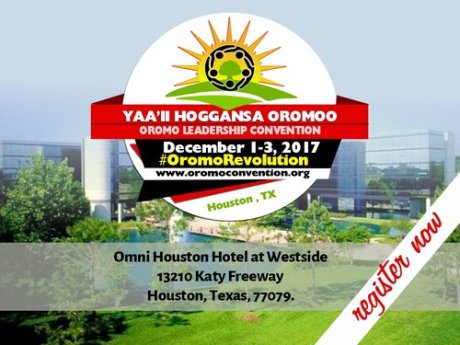
The leadership convention will take place in Houston, Texas, December 1-3, 2017 at the Omni Houston Hotel at Westside, 13210 Katy Freeway, Houston, Texas, 77079. Click here to Book your Hotel : https://www.omnihotels.com/hotels/houston-westside/meetings/olc-2017-oromo-leadership-convention                            

Click Here to register  https://www.eventbrite.com/e/the-third-oromo-leadership-convention-tickets-39790792331

CONVENER

The Oromo Leadership Convention Coordinating Committee

OFFICIAL DOCUMENT


“We Have Wounded the Beast, and That Isn’t Enough” (Lemma Megersa). December 5, 2017

Posted by OromianEconomist in Uncategorized.
Tags: , , , , , ,
add a comment

Odaa OromooOromianEconomist

It is clear who has been orchestrating and and abusing the land and resource of Oromia so far. It has been done in the name of investment, development corners and mining, all being incepted out of ignoble and greedy motives of the thieves and robbers.
Obbo Lemma Megersa also asserts that after his administration has started against this illegal land grab and illicit trades that drained the land resources of Oromia, “those thieves and robbers launched war against Oromia and and his administration.

via “We Have Wounded the Beast, and That Isn’t Enough” (Lemma Megersa).

COMMENTARY: WAS/IS THERE ETHNIC CONFLICT/ VIOLENCE IN ETHIOPIA? November 29, 2017

Posted by OromianEconomist in Colonizing Structure, Ethiopia's Colonizing Structure and the Development Problems of People of Oromia, Afar, Ogaden, Sidama, Southern Ethiopia and the Omo Valley, Uncategorized.
Tags: , , , , , , , , , , , ,
add a comment

Odaa OromooOromianEconomist

In this regard, two particularly serious events require investigation by an independent international body. The recent displacement of more than 150,000 and the killings of hundreds of members of the Oromo community might fall within the international legal definition of ethnic cleansing.[1] The other one is the extended displacement, population engineering and death of thousands of members of the Amhara community of Wolqait. This has all the traits and features of slow motion genocide.[2] These two, perhaps among many others, cannot be ignored by the international community as the usual ‘ethnic conflict’; they are atypical in scale, precision, latitude and nature of execution. To discount them is not only to implicitly condone these heinous acts, but also to buoy others to act with impunity. As all justice loving people applauded the recent conviction of the “the butcher of Srebrenica,” Ratko Mladić, former Bosnian Serb general, by the International Criminal Court (ICC) for his role in the Bosnian genocide, war crimes and crimes against humanity, the international community must also track other Mladic’s in various parts of the world and bring them to justice.


 Even though more than eighty ethnic groups make-up the country’s hundred million population, key structural, administrative and command and control positions are overwhelmingly reserved for members of the Tigray Peopele’s Liberation Front (TPLF), that claims to represent less than 6% of the country’s multi-ethnic population. This lack of national character and national allegiance within the military and security apparatus lends itself to a conclusion that these institutions are subordinates of and only loyal to the minority ruling elites.


COMMENTARY: WAS/IS THERE ETHNIC CONFLICT/ VIOLENCE IN ETHIOPIA?

By Alem Mamo, for Addis Standard November 27,  2017


Conceivably, if there is a single most important question that requires in depth interrogation in the present political atmosphere of Ethiopia it is this one: was/is there ethnic conflict in Ethiopia? Though it seems straightforward enough, it is an enormous research question that necessitates proper scrutiny and systemic analysis. Moreover, to provide an honest and somehow adequate answer to this crucial question it is important that both the past and the present be examined without indulging in sensationalism and one-dimensional political melodrama. But why ask this question now? Expressly, it is now more than two decades since the current federal political configuration has ‘commendably resolved’ all the lingering issues associated with ‘nations and nationalities.’ Well, the concise answer is contrary to this claim of ‘achievement.’ There is a persistent political revolt across the country rebuffing the government’s assertion that the ‘ethnic question’ has been ‘put to rest’ through the federal constitution and delineation of boundaries on linguistic as well as ethnic lines.

Furthermore, in recent instances some senior government officials, both at a national and regional levels, political groups, media outlets and individual commentators are chillingly pronouncing the current political and security environment in the country as an apocalypse of ‘ethnic conflict,’ ‘ethnic cleansing’ and even ‘genocide.’ This message is communicated sometimes with implicit and other times explicit countenance of mass ethnic violence that has taken place. Often these terms are used interchangeably, as if they are one and the same.  Indeed, these three different classifications of conflict and violence demand careful conflict analysis methods before reaching a conclusion as to whether or not they have occurred. Most importantly, those who claim they have occurred should know the seriousness of the matter and at least endeavor to present qualitative and quantitative evidence that supports their assertion. Additionally, if in fact these claims are true, they must be put in the right context and their dynamics and nature (who, when, what and where) should be mapped and considered judiciously.

What is more disconcerting is the casual and banal use of theses terms without providing any background analysis or supporting data. This is particularly troubling because it is emanating from those who should be more responsible, cautious and disciplined in their evaluation, deliberation and communication with the public. Unfortunately, they are evoking these words in a way one would comment on spectator sports matches. The misuse, misinterpretation and exploitation of terms such as ‘ethnic conflict’, ‘ethnic cleansing’ and ‘genocide’ for the purpose of inverted victim-hood narrative is repugnant and should not be tolerated. This reality reflects grave moral and ethical decay among the political class.

Meanwhile a different form of quandary lurks within academic circles in the study of ethnic conflict, ethnic violence and related inquiry. This is deeply ingrained assumption among academia, ‘experts’ and policy makers is the hypothesis that state ethnic groups are primordial entities who are inherently bound for conflict, animosity and violence against each other rather than coexistence and congruence. This presupposition remains entrenched within ethnic and ethnic conflict studies programs across universities and college campuses. This is not to say, however, that there are no conflicts and violence between and among different ethnic groups. Indeed, they occur on different scales and magnitude, sometimes with a devastating effect, other times with a mild skirmishes and sporadic confrontations.

The problem is the mindset and pre-concluded notion of the inevitability of ethnic groups engaging in ‘old rivalry,’ which finds its roots in the legacy of colonialism slavery and apartheid. Furthermore, there are more ethnic studies and ethnic conflict studies programs in the West (focused on Africa and the “third world”) than in the regions where the ‘problem’ exists. In fact, in the Western academic institutions these programs have exploded over the last twenty or so years. This has led to a ‘confirmation bias,’ which is the tendency to search for, interpret, favor, and evoke information in a way that validates one’s pre-existing beliefs or hypotheses while offering unreasonably less consideration to evidence that challenges or contradicts it. This is perhaps the most persistent mistake conflict studies professionals make during a conflict analysis process.

In an academic sense there are four school of thoughts in understanding of ethnic identity and its potential for conflict. The primordial school of thought explicates ethnicity as a fixed characteristic of individuals and communities. Additionally, for primordialists, ethnicity is embedded in inherited biological attributes, a long history of practicing cultural differences, or both. Ethnic identity is unique in its intensity and strength and as an existential feature defining individual self-identification and communal distinctiveness. The psychocultural orientation of ethnicity offers deep cultural and psychological roots which shape the groups’ shared world views. Hence, ethnic identity cannot be changed, only made more tolerant and open-minded. Promoters of a different school of thought, called as social constructivism, emphasize the social nature of ethnic identity. In their assessment, ethnicity is neither immovable nor entirely open. Thus, ethnic identity is created by social exchanges between individuals and groups and stays beyond a person’s choice. For instrumentalists, ethnicity is a product of personal choice and mostly neutral from the situational circumstances or the existence of cultural and biological traits.

The most potent ingredient in a politically motivated ethnic violence is the construction and promotion of hateful narratives against an ethnic group or more than one ethnic group. Stories, songs, literature mixed with myth, and history serve as a mobilizing propaganda campaign strategy as well as dehumanizing the ‘other’ to the point that justifies killing or harming. In the same way these stories of dehumanization are transmitted intergenerationally to keep the hate message alive. There are groups and individuals at the highest leadership positions involved in such a dangerous and divisive campaign against more than one ethnic group. In fact, this reckless venture continues to be employed as a political tactic and strategy to retain hold on power.

In this regard, two particularly serious events require investigation by an independent international body. The recent displacement of more than 150,000 and the killings of hundreds of members of the Oromo community might fall within the international legal definition of ethnic cleansing.[1] The other one is the extended displacement, population engineering and death of thousands of members of the Amhara community of Wolqait. This has all the traits and features of slow motion genocide.[2] These two, perhaps among many others, cannot be ignored by the international community as the usual ‘ethnic conflict’; they are atypical in scale, precision, latitude and nature of execution. To discount them is not only to implicitly condone these heinous acts, but also to buoy others to act with impunity. As all justice loving people applauded the recent conviction of the “the butcher of Srebrenica,” Ratko Mladić, former Bosnian Serb general, by the International Criminal Court (ICC) for his role in the Bosnian genocide, war crimes and crimes against humanity, the international community must also track other Mladic’s in various parts of the world and bring them to justice.

When analyzing the conflict and violence dynamics in Ethiopia, we encounter one incontrovertible detail which gives credence to the ‘ethnic conflict’ argument. That is the militarization of ethnicity and the ethnicization of the military. This is particularly factual for the ethnic party directly associated with the ruling elite. Reminiscence of the guerrilla years, all units of the army and security reflect ethnic hegemony. This way of structuring the military is the most troubling feature of the political dynamic in the country. Even though more than eighty ethnic groups make-up the country’s hundred million population, key structural, administrative and command and control positions are overwhelmingly reserved for members of the Tigray Peopele’s Liberation Front (TPLF), that claims to represent less than 6% of the country’s multi-ethnic population. This lack of national character and national allegiance within the military and security apparatus lends itself to a conclusion that these institutions are subordinates of and only loyal to the minority ruling elites.

In addition, the presence and involvement of federal and regional paramilitary groups with a sworn loyalty to their ethnic parties in quashing popular uprisings and revolts demanding change appears to be an affirmation that government backed institutional ethnic violence is taking place. Since these groups are organized by and report to their ethnic military and political power command, it is safe to say the violence contains an ethnic element. The conventional rationale for such violence is often the fear of a minority that the majority will abuse power to the disadvantage of the minority in the political arrangement. While this analysis is true for much of ethnic conflict/violence in various parts of the world, the minority-majority dynamics is set up in reverse in Ethiopia. In other words, the minority group controls the political and economic power, while the majority is marginalized.

As of late, non-conformist and independent leadership within the political landscape of the country is making an appearance. Inter-ethnic collaboration inside the country and within the diaspora both at a community and political party levels is gathering momentum. All in all, despite the weight of injustice and the pain of oppression, there is some modest wind of hope and optimism blowing on the majestic mountains, valleys and farmlands. Hope and optimism, the unbreakable spirit of the people that broke the back of European fascism, is  once again ready to fight for its freedom, be it against external threat or homegrown transgressions.

It is clear that regional ethnic parties that make up the ruling EPRDF do suffer from authenticity and credibility deficits due to the original nature of their creations. Both the Oromo People’s Democratic Organization (OPDO) and the Amhara National Democratic Movement (ANDM) didn’t come to being through an organic process. They were formed by the Tigray People’s Liberation Front (TPLF) during the civil war. In recent months, these two groups have shown a very practical as well as psychological (symbolic) demonstration of unity and leadership to their constituencies and the entire country. Given the fact that trust between authority and citizenry is often absent in Ethiopian governance structure, ANDM and OPDO must travel a great length before they gain the full trust and support of the people. In return, the people of Ethiopia must offer them the benefit of the doubt and give them sometime to prove themselves.

Justifiably, the majority of the Ethiopian public views the military, the police and security apparatus as a threat rather than a protection. In addition, the lack of unifying symbols and expressions, such as a national flag or national anthem, have resulted in the use of competing symbols rather than commonly shared ones, further dividing the society not only on a substantive level but also at a symbolic level.

In an apparently leaked document entitled ‘Security situation analysis,’ a little-known body called the National Security Council derided that the country’s political, social and economic order is unraveling and inter-ethnic violence including genocide is “threatening” the country’s very existence. Unfortunately, this rather alarming assessment doesn’t substantiate, quantify or offer any background analysis about this gloomy situation. The reports claim that “genocide has taken place in the eastern part of the country” is obviously startling, but lack of further investigation by an independent international body is equally disturbing.

In contextualizing and analyzing the current dynamics in Ethiopia, it is safe to say that there is no mass inter-ethnic violence. However, there is unambiguous evidence that federal and state level institutions, such as the military, special units and regional police forces with an ethnic administrative and structural commands have been used to target ethnic groups.  This should make the identification, investigation and prosecution of the responsible individuals much easier than mass ethnic conflict.

History’s pitfalls and blood stains are not unique to Ethiopia. They are the tragic scars and contours that mark the nation. Some of the terrains of our past show the blood-stained footprints of our ancestors. However, the prejudice and injustice of our past must not serve to engineer the suffering of our present. Thus, the study and honest interrogation of the past will obviously bring discomfort and pain. We must look at them, touch them, and feel them. This, all of us to face and do by unlocking our hearts and making it our collective tragedy. Most importantly these experiences, however painful, are sacred pages of our history and they should be treated as such. Any meditative calculation to use them as political stock to build division between groups and sustain a grip on power is not only dangerous, it also falls outside the moral decency and cultural norms of the people of this land. The seeds of division and hate, in spite of how deep they were planted and how loud they were propagated, they failed to sow permanent discord between communities with shared history and experience. For that we as people should be proud.

Despite the uncomfortable and at times painful chapters of the country’s history, people across this land have kept their decency and sanity. Never in this country’s history has an ethnic group mobilized to wage a war or terrorized another ethnic group. Yes, state armies and groups manipulated by elites past and present have executed the desire and agenda of the ruling class. But there was no deep rooted, hate-filled animosity that indented neighbor against neighbor, village against village or community against community. Not for lack of trying by the elites, but by people’s rejection of hate and division. Ultimately, the people must join together to build a shared future.


ED’s Note: The writer can be reached at Alem6711@gmail.com. 

Disclaimer: The views and opinions expressed in this article are that of the writer’s and do not necessarily reflect the editorial of Addis Standard.


[1] A United Nations Commission of Experts mandated to look into violations of international humanitarian law committed in the former Yugoslavia defined ethnic cleansing in its interim report as “… rendering an area ethnically homogeneous by using force or intimidation to remove persons of given groups from the area.” In its final report, the same Commission described ethnic cleansing as “… a purposeful policy designed by one ethnic or religious group to remove by violent and terror-inspiring means the civilian population of another ethnic or religious group from certain geographic areas.”

[2] See United Nations definition of genocide: http://www.un.org/en/genocideprevention/genocide.html.

Oromia: Borana zone leaders letter of complaint against Ethiopia’s Defence Forces members. #OromoProtests #Prevent #Genocide November 28, 2017

Posted by OromianEconomist in #OromoProtests, Uncategorized.
Tags: , , , , , ,
add a comment

Odaa OromooOromianEconomistThe UN is silent as over 45 million Oromo people are subjected to genocide

የቦረና ዞን አስተዳዳሪ በመከላከያ ሰራዊት አባላት ላይ ያቀረቡት የክስ ማመልከቻ (ደብዳቤ)click here to read the  letter’s full text

Related article:- https://oromianeconomist.com/2017/11/25/prevent-genocide-the-un-is-silent-on-the-ethiopias-regimes-continuation-with-genocidal-mass-killings-displacements-mass-arrests-and-torturing-of-oromo-people/


Oromia: Irreecha Birraa Bara 2017 Malkaa Soorii fi Malkaa Caffee Bookaatti irreeffatame. Oromians in Western Oromia peacefully and colorful celebrated Irreecha at Malka Soori in Iluu Abbabora and at Malkaa Caffee Bookaa in Horroo Guduruu Wallagaa. November 27, 2017

Posted by OromianEconomist in Uncategorized.
Tags: , , , , , , ,
add a comment

Odaa OromooOromianEconomist

Irreecha Birraa 2017 irreeffachuun itti fufee jira. Akkuma kanaan Sadaasa 26 Bara 2017 Malkaa Soorii, Koodoo, Mattuu fii  Malkaa Caffee Bookaatti haala miidhagaan irreeffatamee oole.

Irreechi Malkaa Soorii, Iluu Abbaa Booraa, Lixa Oromiyaatti haala ho’aan bakka namni kumaataman irratti qooda fudhaterratti nagaan irreeffatameera.

Haaluma walffakkaatuun guyyuma kana Irreechi Malkaa Caffee Bookaa, Aanaa Abee Dongoroo,  Horroo Guguruu Wallaggatti kabajameera.


Suuraalee (Irreecha Malkaa Soorii)

irreecha Malkaa Soorii, Iluu Abbaa Booraa, Oromia,  November 2017 with the Abbaa Gadaa Oromoo.png


Irreecha Birraa  Malkaa Soorii, Oromia,  November (sadaasa) 2017.png

irreecha Malkaa Soorii, Iluu Abbaa Booraa, Oromia,  November 2017.png

Irreecha Malkaa Soorii, Oromia,  November 2017.png

Irreecha Birraa  Malkaa Soorii, Oromia,  November 2017.png

irreecha Malkaa Soorii, November 2017.png

Irreecha birraa 2017, Malkaa Soorii, Iluu, Oromia,  November 2017..png

Irreecha birraa 2017, Malkaa Soorii, Iluu, Oromia,  November 2017 p2.png

irreecha Malkaa Soorii, Iluu Abbaa Booraa, Oromia,  in November 2017.png


Irreecha Birraa 2017  Malkaa Soorii, Oromia  celebrated  in November.png

Irreecha Birraa  Oromoo Malkaa Soorii, Oromia,  November 2017.png

Irreecha Birraa  Malkaa Caffee Bookaa

Irreecha Birraa  Malkaa Caffee Bookaa,  Horroo Guduruu Wallaggaa, Oromia, November 2017.png

Irreecha Birraa Oromoo,  Malkaa Caffee Bookaa, Oromia, November 2017.png

Irreecha Birraa Oromoo, Malkaa Caffee Bookaa, Oromia, November 2017

Irreecha Malkaa Baraa 2017,  Caffee Bookaa, Oromia, Africa.png

Irreecha Birraa  Malkaa Caffee Bookaa, Oromia, November 2017.png


Irreecha Birraa  Malkaa Caffee Bookaa,  November 2017.png

Irreecha Birraa  Malkaa Caffee Bookaa,  Horroo Guduruu Wallaggaa, Oromia, November 2017.png

Dabalataaf as tuqaa illaalaa, Irreecha 2017, Horroo Guduruu Wallaggaa, Aanaa Abee Dongoroo, Malkaa Caffee Bookaa.

OSA’S STATEMENT ON DISPLACED OROMOS: AN URGENT CALL TO THWART THE ESCALATING HUMANITARIAN CRISIS IN ETHIOPIA November 26, 2017

Posted by OromianEconomist in Uncategorized.
Tags: , , , , , , ,
3 comments

Odaa OromooOromianEconomist

OSA’S STATEMENT ON DISPLACED OROMOS: AN URGENT CALL TO THWART THE ESCALATING HUMANITARIAN CRISIS IN ETHIOPIA

OSA

Oromo Studies Association (OSA) | November 26, 2017

The Oromo Studies Association – a multi-disciplinary academic organization established to foster scholarly studies in all fields pertaining to the Oromo people – would like to bring to the attention of prominent political leaders and influential policy makers, the building humanitarian crisis in the Horn of Africa; with the so-called Liyu Police of the Somali region – a paramilitary force that has been organized, trained and armed by the Ethiopian government – waging an undeclared war against Oromo communities in eastern, southeastern and southern Ethiopia. While these undeclared wars have subjected the Oromo to crimes comparable in magnitude to the one the Rohingya of Myanmar are currently facing (the offensives have already claimed the lives of thousands, and caused the displacement of hundreds of thousands of Oromo civilians) ; they are not gaining the attention they deserve in the global centers of power and among the international media for reasons that are neither convincing nor clear.

But, for the social norms of tolerance and coexistence built over centuries of largely positive interactions, interdependence and intermingling among the brotherly peoples in Ethiopia , these aggressions could have conceivably plunged the country into chaos and bloodletting that would have surpassed the Rwandan genocide. There is no guarantee that these norms will hold indefinitely with the Somali regional government continuing to unleash its unaccountable force against Oromo communities in the border areas; committing all sorts of appalling crimes, likely with the intention of uprooting them from their ancestral lands (Qe’ee). OSA is deeply concerned that this will end in humanitarian catastrophe of epic proportions unless extreme interventions are undertaken immediately to stop these unprovoked and deadly aggressions.

Some are erroneously reporting these outrageous attacks by one side as inter-ethnic conflicts between Oromo and Somali forces , based on a glib observation that the former are naturally fighting back to defend themselves and their Qe’ee. The fact of the matter is that these conflicts are taking place with encouragement from, and an active participation of, the powerful group that currently dominates the Ethiopian government, aka the Tigray People’s Liberation Front (TPLF). Indeed, credible evidences suggest that these assaults are instigated by Ethiopian generals working in close concert with the enigmatic character Abdi Iley (the president of the Somali regional government) and his criminal enterprise known as the Liyu Police.

The Liyu Police – a Janjaweed-like paramilitary group – was instituted by the Ethiopian military in 2008 as a counter insurgency force against the Ogaden National Liberation Front(ONLF), an outfit that has been fighting for the rights to self-determination of the Somali people in Ethiopia. Even though this paramilitary group has been implicated in mass killings, kidnappings, rape, and other disturbing human rights abuses documented by respectable human rights organizations , it has never been held to account, largely because it is doing the dirty work of the Ethiopian central government. It should be noted here that numerous calls for independent investigations into the troubling activities of this group have always been rejected by the regime in Addis Ababa, with media organizations affiliated with the TPLF becoming reliable defenders of the Liyu Police. The deal is that Abdi Illey executes – through his clan-based militia – TPLF’s pernicious schemes, in return for being allowed to wield absolute political power over his captive population, while being protected by powerful forces in Addis and beyond.

Unable to stop the ever widening #Oromo Protests even after deploying its vicious army unit known as the Agazi (recall the Irreechaa Massacre of October 2, 2016 and the subsequent declaration of a state of emergency that lasted for ten months ), the TPLF appears to have chosen waging a proxy war with the Oromo people using the Liyu Police, with a hasty calculus that the strategy might weaken its arch-enemy, the Qeerroo Bilisummaa Oromo (QBO) – the youth group behind the ongoing #Oromo Protests. It is to be recalled that the QBO had forced the TPLF to abandon its secretly-hatched major policy initiative – the inaptly named ‘the Addis Ababa and the Nearby Oromia Towns Integrated Master Plan’ – a ploy that was meant to empower a few fat cats in Addis Ababa at the expense of millions of farmers in central Oromia.

Finding itself in unfamiliar territory because of #Oromo Protests – and quickly losing its carefully-crafted image of a ‘strong developmental-state’ capable of ‘delivering the goods’ and policing not just Ethiopia but the entire Horn-of-Africa – the TPLF appears to be in a desperate bid to regain some of its mojo, by activating the deadly Somali-region militia and unleashing it on innocent Oromo citizens. As some have pointed out, the key rationale behind this reckless and deadly move was to goad the Oromo to start fighting with the brotherly Somali people, with the aim of deflecting their attention from (and weakening their resolve of resisting) the tyrants in Addis Ababa. The TPLF has perfected this approach in its nearly three-decades-old rule, effectively using it to exploit the pre-existing fault-lines between the elites of the two major ethno-national groups in the country, the Oromo and the Amhara. With leaders from the two groups showing signs of rapprochement, the TPLF appears to be on a fishing expedition of orchestrating conflicts between the Oromo and the Somali populations to prolong its oppressive rule in the country.

As of yet, the Oromo have refused to take the bait, by and large keeping their focus on the real enemy that has been the cause of much of their misery. Despite being subjected, essentially because of their identity, to a myriad of atrocities by the heavily-armed tag team of the Ethiopian army and the Liyu Police, the Oromo have not taken any kind of retaliatory measures against innocent Somali citizens living in Oromia; instead, they are marshalling their limited resources in trying to rehabilitate the hundreds of thousands of their compatriots that were evicted from the Somali region and the border areas, practically keeping the situation from devolving into inter-ethnic conflicts that could have devastating implications in the region and beyond.

The question responsible people should ask under these circumstances ought to be: is this a sustainable state-of-affairs? Should leaders with a stake in World peace continue to count on the goodwill and the essential comity of the Oromo people and ordinary Ethiopians to justify their lack of focus and serious interest in the looming disaster in the Horn of Africa? OSA scholars – most of whom are serving in Western universities with distinction – believe that the call for liberty and justice in Oromia in particular and Ethiopia in general can no longer be muzzled by sheer force; nor can it be twisted with any amount of political machination. Therefore, we call upon influential and responsible political leaders and policy makers in the West to find creative ways (there are plenty, as they hold the purse strings) that will force the Ethiopian government to: 1) disband the Liyu Police, bringing to justice the principal players in the violence that uprooted close to half a million Oromo civilians from their homes and livelihood; 2) rehabilitate the displaced population, making sure they are properly compensated; 3) make a complete U-turn in how it deals with the predominantly peaceful #Oromo Protests; and, 4) address – without any delay – the legitimate political, economic and cultural demands of the Oromo people and the other ethno-national groups in the country. OSA believes strongly that the cost of doing nothing will be orders of magnitude higher than the cost of measures that may have to be taken immediately to induce the TPLF to change its behaviour.

Respectfully,

Teferi Mergo, PhD
President, Oromo Studies Association

Cc:
Donald Trump, President

The United States of America

Angela Merkel, Chancellor
Bundesrepublik Deutschland

Theresa May, Prime Minister
The United Kingdom

Justin Trudeau, Prime Minister
Canada

Emmanuel Macron, President
République Française

Xi Jinping, President
中华人民共和国

Paolo Gentloni, Prime Minister
Repubblica Italiana

Malcolm Turnbull, Prime Minister
The Commonwealth of Australia

Shinzō Abe, Prime Minister
大日本帝國

António Guterres, Secretary General
The United Nations

Donald Tusk, President
The European Union

Idriss Déby, Chairperson
The African Union


“ማስተር ፕላኑ ተመልሶ መጣ!” – ረቂቅ አዋጁ ለፌዴሬሽን ምክር ቤት ተመርቷል November 26, 2017

Posted by OromianEconomist in Uncategorized.
Tags: , , , , ,
add a comment

Odaa OromooOromianEconomist

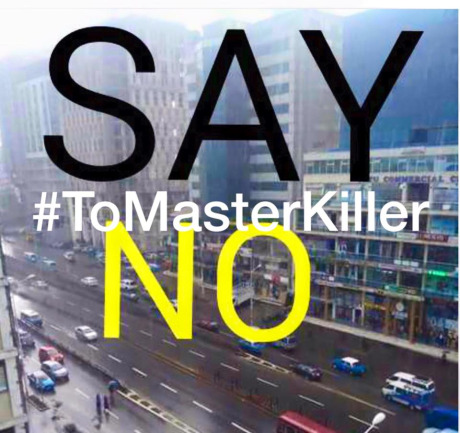
Say no to the master killer. Addis Ababa master plan is genocidal plan against Oromo people

via “ማስተር ፕላኑ ተመልሶ መጣ!” – ረቂቅ አዋጁ ለፌዴሬሽን ምክር ቤት ተመርቷል

#Prevent #Genocide! The UN is silent on the Ethiopia’s regime’s continuation with genocidal mass killings, displacements, mass arrests and torturing of Oromo people. November 25, 2017

Posted by OromianEconomist in Horn of Africa Affairs, Knowledge and the Colonizing Structure. African Heritage. The Genocide Against Oromo Nation, Uncategorized.
Tags: , , , , , , , , , , ,
5 comments

Odaa OromooOromianEconomist

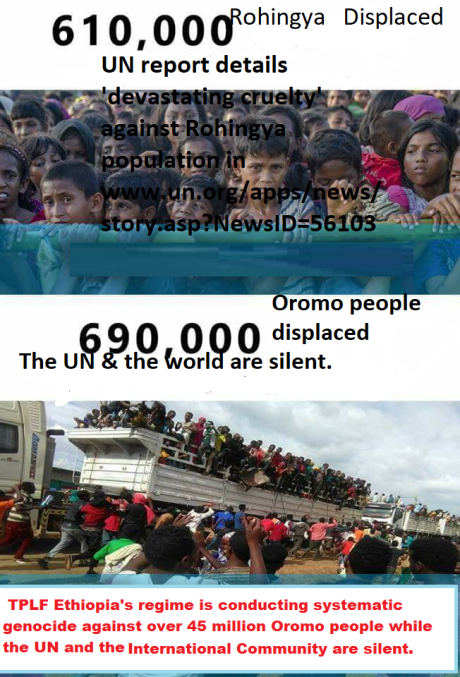
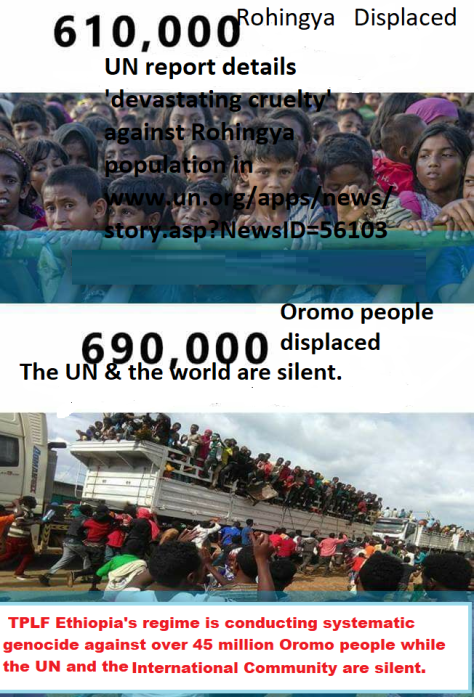
As over 610,000 Rohingya people have been displaced, the UN report details ‘devastating cruelty’ against Rohingya population http://www.un.org/apps/news/story.asp?NewsID=56103. While   over  690,000 Oromo people have been displaced from Eastern Ethiopia  by the coordinated TPLF Ethiopia’s regime’s cruel forces, the UN and the International Community are silent.  Millions  of Oromo people, children, women, elders, young and adults have been evicted from their homes through systematic land grabs, ethnic cleansing and direct wars declared on them. Thousands killed and over a quarter million are in Ethiopia’s regime’s torture camps. The genocide war against Oromo people is in its full swing and unstopped on daily basis.

The UN is silent as over 45 million Oromo people are subjected to genocide

The internally displaced Oromo people are suffering  without food and shelter.


(OPride) — Emails between senior Ethiopian government officials, obtained exclusively by OPride, shed new lights on the state-run Ethio Telecom’s abrupt decision to halt the text-to-give campaign launched by Oromia State in September. The disclosures also pinpoint the key government officials behind the action.

“Help rehabilitate our people displaced from the Ethiopian Somali region by texting “O” to 700 to give 5 birr,” Addisu Arega, the spokesperson for Oromia State, announced on Sep. 28, 2017 via Facebook and Twitter. “We thank Ethio Telecom for their huge support in setting up the campaign free of charge.”

However, the campaign that was meant to raise relief funds for the more than half a million Oromos displaced from the Somali Regional State lasted a mere five hours.


የተባበሩት መንግሥታት ከኢትዮ ሱማሌ በግፍ ለተፈናቀሉት ህዝቦችን መርዳት እንደለበት ዶ/ር ነጋሶ ጊዳዳ ጠየቁ።


በኢትዮጵያ ታሪክ ታይቶ በማይታወቅ ሁኔታ ከግማሽ ሚሊየን ህዝብ በላይ ተፋናቅሎ ከራሱ መንግሥት ጭምር በቂ እርዳታ ሳያገኝ መቅረቱ በጣም አሳዘኝ ብቻም ሳይሆን አሳፋሪም ነው። ኦሮሚያ ክልል የኢትዮጵያ አካል እንዳልሆነ ነገር ፌዴራል መንግሥት ዝምታ ከመምረጥ አልፎ በቴሌ በኩል የተጀመረው የsms እንዲቋረጥ አድርጎዋል።
ኢትዮጵያ የጎረቤት ሀገር ስደተኞችን ተቀብላ በማስተናገድ ቀዳሚ ነኝ እያለች በምትገልጽበት ወቅት ላይ የራሷ ዜጎች እንዲህ ትኩረት መነፈጋቸው ትርፉ ትዝብት ነው። ለኦሮሞና ለኦሮሚያ መንግስት ትልቅ መልዕክት አስተላልፏል። የፖለቲካ የበላይነት ከሌለህ ዋጋ እንደሌለ።
ዶ.ር ነጋሶ ግዳዳ UN እስካሁን ምንም እርዳታ አለማድረጉን ጠቅሶ የሚመለከተው አካል ግፊት ማድረግ አንደለበት አሳስቧል። በመሆኑም በሀገር ውስጥና በውጭ የሚኖሩ ኢትዮጵያዊያን በሰላማዊ ሰልፍ በደብዳቤና በተለያዩ ማህበራዊ ሚዲያ ግፊት ማድረግ አለባቸው።


on 23 December 2017 the fascist TPLF forces attacked Oromo residence in Borana, Southern Oromia and killed 13 and wounded over 23 Oromo nationals.

VOA Afaan Oromoo akka gabaasetti: Boorana, Aanaa Areeroo Keessatti Liyyu Poolisii fi Humna Federaalaatiin Halellaa Geggeessame Jedhameen Namoonni Garii Du’anii Kaan Madaawan

Fascist TPLF Ethiopia’s regime Agazi forces continue with mass killings in Oromia (Ethiopia): At least 10 killed and 20 wounded in Ambo. #OromoProtests, read in Oromian EconomistOctober 28, 2017

Oromo group decries ‘ongoing genocide’ in Ethiopia

Ethiopia: The Never Ending Horror Against the Oromo Nation

The peaceful street protests in Oromia that shook Ethopia for over one year (November 2015-October 2016) turned violent after the reckless action by the government when its military attacked civilians and murdered over 700 at the Oromo Irrecha Festival  on October 2, 2016.

The  fascistic action of the Ethiopian government turned a peaceful protest into a violent one  in which many people were killed and government property was destroyed by the angry protesters.

The TPLF/EPRDF government declared a six- month state of emergency- later extended to ten months- on October 8, 2016 with the pretext of calming the violence in Oromia. During the  State of Emergency, the government killing squad members were deployed in all villages of the Oromia Regional state where they committed killings, kidnappings, and arrests during the ten months of the State of Emergency.


Under the State of Emergency, the TPLF/ EPRDF government- trained  Liyu Police led by the killing  Squad Agazi  were deployed  along  the long border  between Somali and Oromia regional states and occupied 32 districts of Oromo land from the  south Borana zone to the northeast  Hararge zone; many people were killed from both sides. During the six- month war between the federal government force backed Liyu Police and Oromo farmers  over 500 people have been killed, and many other Oromos have been forcefully kidnapped  and taken to Somali Region.


Ethiopia: Government-Fuelled Conflict & the Need for Unity

Despite the governments claims to the contrary, Ethiopia is essentially a one-party state in which power is monopolized by the EPRDF, which despite claiming to be a democratic coalition, is in fact a dictatorship ruled by men from Tigray under the TPLF banner. It is an illegitimate government supported by the West, – America, Britain and the European Union (EU) being the largest benefactors – politically and economically. With the exception of the EU, these powers not only remain silent in the face of State Terrorism, but also spread Ethiopian propaganda through the mainstream media and act in collusion with the EPRDF in relation for example, to the arrest of opposition party leaders. Instead of supporting the ruling party, donors should be applying pressure on it to respect human rights and adhere to the democratic principles laid out in the country’s constitution. Their silence and dishonesty makes them complicit in the crimes of the government, which are heinous and widespread.

Successive Ethiopian regimes have never displayed humanity or respect for Oromo and denied opportunities to build their social, economic, political, cultural and organizational infrastructures. In all spheres of life, discrimination, subjugation, repression and exploitation of all forms were applied. Everything possible was done to destroy Oromo identity – culture, language, custom, tradition, name and origin. In short, the leaders of Ethiopian empire maintained the general policy of genocide against the Oromo people.

Current state terrorism (by TPLF junta):

Reduction project of TPLF is on track with multiple fronts. Here is the TPLF slogan: We, TPLF or Tigrean sons and daughters, will reduce the number of Oromo from 40 million to the minority group without their awareness and knowledge of the world.”

  • Through Massacre and Displacement example recent action in Eastern Oromia, thousands of silent death across Oromia in the night, in detention camp and special torture branch in Meqelle (Tigrai).
  • Through targeted shootout on the street, by kidnapping and mutagenic process
  • Through indirect actions (denying well-functioning health care system and inhibiting economic empowerment).

Humiliation project of TPLF: Here is the TPLF Motto: We, TPLF- or Tigrean sons and daughters, have to show to the Ethiopian empire nations that we are unbeatable masters.

  • Through imprisoning and torturing
  • Through land grab
  • Through culturing puppets, traitors, servants and opportunistic individual

Powerless unity project of TPLF: Here is the TPLF plan: Especially to deny Oromo people the powerful unity and strong organization we TPLF-staff or Tigrean sons and daughters have to work tirelessly.  Source: Ethiopian Empire Policies are Fecal Occult Blood, While Their Actions are Considerably Hemorrhagic, by Dr. B. K. Deressa in Kichuu inf


The regime’s officials and armed forces engaged in systematic looting of Oromo resources, economic corruption, black markets in commodities and foreign exchanges.  click here to  read THE SOUR TASTE OF SUGAR IN ETHIOPIA

Click here to read the case of  TPLF Ethiopia’s Regime Money Laundering Activities & Its Networks 


Oromia: #OromoProtests: Thousands marched in protests against Al AMoudi’s gold exploitation and land grabs in Aagaa Waayyuu, Guji zone, Southern Oromia November 22, 2017

Posted by OromianEconomist in #OromoProtests, Uncategorized.
Tags: , , , , , , , ,
add a comment

(VOA Afaan Oromoo, Saadasa 21 Bara 2017): Godinaa Gujii Bahaa, aanaa Sabbaa-Boruu, ganda Qanxichaa keessatti uummatni kumaa hedduutti lakkaawamu har’a, gara magaalaalaa Qanxichaatti yaa’uudhaan hiriira mormii guddaa geggeesse. Rakkoolee baroota hedduuf nu irra bubbulan – jedhu, keessumaa kan qabeenyaa mootummaa tahe – warshaa Dhaabbata Taantaalemii Qonxichaa irraa uummatni naannoo faayidaa isaaf mal otuu hin argatiin waggoota 26f ture – jedhan balaaleffachaa turan – hiriirtonni. Sababaa warshaa kanaa fi warshaalee ka biroo naannoo sanaatiif summaa’uu qilleensaaf saaxilamuu isaanii illee himatan.

Rakkolee sababaa warshaalee fi qotinsa albudaatiin uumaman malees rakkoo du’aa fi jireenyaa tu akka Oromootti nu mudataa jira – jedhan. Bulchiinsi aanaa Sabbaa-booruus iyyannaan uummata har’a hiriira bahee himannaa haqaa tahuu dubbata.

Gabaasaa guutuu dhaggeedhaa

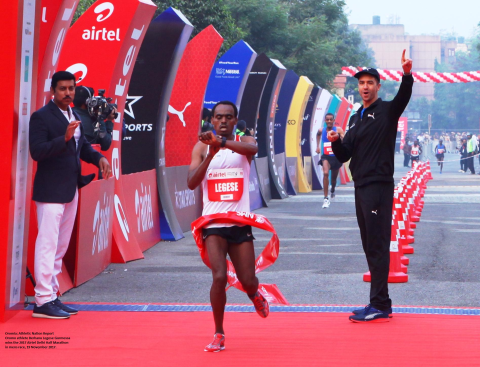
Oromia: Athletic Nation Report: Oromo athletes Almaz Ayana Ebba (f) and Berhanu Legese Gurmessa (m) clinched victor in the 2017 Airtel Delhi Half Marathon November 20, 2017

Posted by OromianEconomist in Athleteics, Athletic nation, Uncategorized.
Tags: , , , , , , , , , , , ,
add a comment

Odaa Oromoooromianeconomist


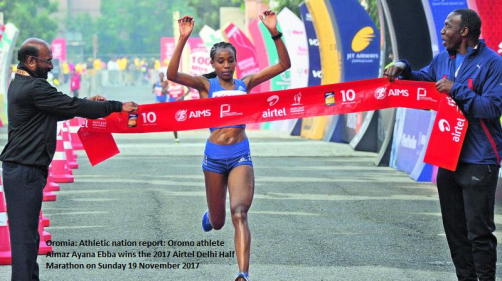
Oromo athletes Almaz Ayaanaa Eebba (f) and Berhanu Legese Gurmessa (m) win 2017 Airtel Delhi Half Marathon on Sunday 19 November 2017.

Oromo athlete  Berhanu  Almaz Ayana Ebba wins the  2017 Airtel Delhi Half Marathon  on 19th November 2017.png

Oromo athlete  Berhanu Legese Gurmessa wins win 2017 Airtel Delhi Half Marathon on 19th November 2017.png

For more details read the following from Punjab News Express:

Berhanu Legese and Almaz Ayana win 2017 Airtel Delhi Half Marathon


By Balbir Singh, Punjab New Express,  NEW DELHI,  November 20, 2017 

Berhanu Legese and Almaz Ayana won the 2017 edition of the Airtel Delhi Half Marathon which lived up to its legacy of being the World’s most prestigious half marathon, with Procam International announcing and delivering a slew of initiatives to be able to provide athletes with a better running environment.

The race turned out to be a bag full of surprises as favourites made way for new champions. The Indians had a fabulous race with Indian elites Nitendra Singh Rawat and L Suriya smashing the course records in their respective categories.

Winner of 2015 Airtel Delhi Half Marathon Berhanu Legese repeated his feat on Sunday winning the Men’s Elite Category in 59:46. Making her half marathon debut, reigning 10,000m world champion and world record holder Almaz Ayana beat the women’s field with 1:07:11.

Legese led Ethiopia’s 1-2 placing with compatriot Andamlak Belihu coming in five seconds later on his debut over the distance and American Leonard Korir came third clocking 59:52. 2017 IAAF World Championships Marathon gold medalist Geoffrey Kirui finished a disappointing sixth with a timing of1:00:04.

Delighted at his repeat feat, Legese said the weather conditions were perfect to go for the kill. “The weather was great, there was no issue at all. In fact the weather was favourable for a run like this. I would love to come back to Delhi to participate in the event again,” said Legese, who clocked 59:20 to win the 2015 Airtel Delhi Half Marathon.

Minister of State (IC) – Youth Affairs and Sports Col (Retd.) Rajyavardhan Singh Rathore flagged off the race. Airtel Delhi Half Marathon International Event Ambassador Anthony Ervin, PUMA legend Anthony Ervin and Honourable Minister of State in the Ministry of Parliamentary Affairs and Ministry of Statistics and Programme Implementation Vijay Goel were present at the event.

Nitendra Singh Rawat took home the Indian Elite Men’s title beating defending champion G Lakshmanan in a thrilling photo finish (1:03:53). Rawat and Lakshmanan were neck-to-neck through the entire course. It was the last 100 metres when the real battle started as Lakshmanan and Rawat sprinted to the finish line. In what looked like Lakshmanan would go on and defend his title, Rawat pipped him at the post as his foot touched the finishing line before the defending champions. Avinash Sable came third with 1:03:58.

Heading to the podium, Rawat, Lakshmanan and Sable also beat the course record set by Deepchand Saharan in 2009 of 1:04:00. Rawat said he had a point to prove by winning the race here. “I wanted to prove myself by winning this race so my strategy was to not take lead but keep going on until end. This win will prove that I belong to the national camp,” said Rawat while speaking to media.

Reigning world 10,000m champion Ayana was making her debut over the half marathon distance but hardly looked like a novice as she led home an Ethiopian clean sweep of the podium positions in the women’s race.

The outcome was decided in the final kilometre as she pulled away from her rivals. Ababel Yeshaneh was second again, as she was in 2016, and set a personal best for the second consecutive year as well, crossing the line in 1:07:19 to slice 33 seconds from her personal best. Completing the all-Ethiopian top three, Netsanet Gudeta also set a personal best of 1:07:24 to improve her best by seven seconds.

Asked how she felt to win on her half marathon debut, Ayana said, “There were not many good track competitions so I decided to participate in this event. I always run to win, and this race too wasn’t different,” said Ayana. When asked if she would come back to Delhi after making a winning debut, “Yes, I will come back next year,” Ayana said at her post race interview.

The Indian Elite Women’s category saw L Suriya clinching the top spot. “My coach Surendra sir told me to run my own race and maintain the pace throughout. I just did that but this wasn’t my best honestly,” said Suriya, who won the race by a minute. In the process, the 27-year old from Tamil Nadu set a course record with 1:10:31, beating Lalita Babar’s 2015 record at the event of 1:10:52. Her performance should be good enough to secure her a place on the start line of the IAAF World Half Marathon Championships in the Spanish city of Valencia next March, which would be her first global championship outing.

Veteran Sudha Singh came second with 1:11:30 followed by Parul Chaudhary at 1:13:09.

The winners got richer by US$27000 while runners-up got US$20000 and third-placed runners earned US$13000. First placed Indian Elite athletes earned Rs. 3,00,000 with runners up getting Rs. 2,50,000 and third placed runners winning Rs. 1,75,000.

A course record jackpot of Rs. 2,00,000 will be shared amongst all three Indian Elite Men’s winners Rawat, Lakshmanan and Sable while L Suriya will have the entire sum to herself.

The mega event with a participation of over 34,000 would not have been possible without complete coordination and cooperation with the authorities.

Results:

Overall Athlete Men:

Berhanu Legese (ETH) 00:59:46; Andamlak Belihu (ETH) 00:59:51; Leonard Korir (US) 00:59:52; Asefa Negewo (ETH) 00:59:54; Jorum Okumbo (KEN) 00:59:58; Geoffrey Kirui (KEN) 01:00:04; Edwin Kiptoo (KEN) 01:00:06; Abadi Hadis (ETH) 01:00:25; John Langat (KEN) 01:00:41; Nitendra Singh Rawat (IND) 01:03:53

Overall Athlete Women:

Almaz Ayana (ETH) 01:07:11; Ababel Yeshaneh (ETH) 01:07:19; Netsanet Gudeta (ETH) 01:07:24; Helah Kiprop (KEN) 01:08:07; Worknesh Degefa (ETH) 01:08:09; Paskalia Chepkorir (KEN) 01:08:46; Veronica Nyaruai (KEN) 01:09:02; L Suriya (IND) 01:10:29; Daria Maslova (KYR) 01:11:28 Sudha Singh (IND) 01:11:28.


Oromia (Odaa Bisil): Seera Gadaa Oromoo Maccaa Wiirtuu Odaa Bisilitti kan Tumame November 20, 2017

Posted by OromianEconomist in Uncategorized.
Tags: , , , , , , , , , , ,
2 comments


Seera Gadaa Oromoo Maccaa  Kan Sadaasa 2017 Wiirtuu Odaa Bisilitti Haaromsamee Tumame


Gadaan Maccaa bara kana haaromsaaf godaanee akka ture namnuu quba qaba. Godaansa sanarratti seerri bulmaataa tumaamee jira. Seerri kun keeyyattoota gurguddaa 8’fi xixiqqoo 53 kan ofkeessaa qabu yommuu ta’u, wixineen seerichaa qorattoota yuunvarsiitii Jimmaafi Wallaggarraa dhufaniin qophaa’e. Abbootiin Gadaas alangaa quwaasuun seericha tumuun mirkaneessan. Gadaanis hojii jalqabee jira. Waan hundaafuu, dookmentiin seera tumamee kunootii dubbisaa!

Hub. Maxxansi kun heyyama Abbaa Gadaa Taakkalaa Dhiinsaatiin Ummata Oromoo bira akka ga’u ta’e.

Qooduuf kaaniif dabarsaa, tokko jedhanii lamatti taruu!

Gadaan Quufaa Gabbina!
Fedhasaa Taaddasaa’tii


The Oromo Alternative: Freedom, Equality, Justice and Dignity in a Participatory Democracy November 19, 2017

Posted by OromianEconomist in Ethiopia's Colonizing Structure and the Development Problems of People of Oromia, Ethiopia's Colonizing Structure and the Development Problems of People of Oromia, Afar, Ogaden, Sidama, Southern Ethiopia and the Omo Valley, Horn of Africa Affairs, Uncategorized.
Tags: , , , , , , , ,
add a comment

Odaa OromooOromianEconomist

The Oromo Alternative: Freedom, Equality, Justice and Dignity in a Participatory Democracy

By Ezekiel Gebissa & Jawar Mohammed, Horn Arguments,  November 17, 2017


The Oromo Protest, approaching its fourth year, is now an established historical fact as an Oromia-wide, yearlong resistance movement involving the entire Oromo population. Despite frustrating obstacles to the attainment of its broad goals, the resistance has had many successes. It has rocked an entrenched authoritarian political system to its roots, nibbling down the Ethiopian federal government to paralysis and compelling the Oromia regional government to embrace the demands of the Oromo people. It has exposed the inequities of an economic system purported to be on an inexorable trajectory of growth and broad-based benefits for all citizens. The Ethiopian military, the third largest in Africa, deployed extensively to put down the resistance, was shown to be impotent against unarmed but determined protestors. In sum, the Oromo Protest, an epochal event in Ethiopia’s history, has occasioned the rise of an emergent Oromo nation and a resurgent Oromo nationalism.

In the last half century, the goals of Oromo nationalists have always been the same as the political demands of other Ethiopians. But when the Oromo raise them, they invariably evoke a rhetorical question: “What do the Oromo really want?” This is not an honest query but a mischievous scheme designed to marginalize the Oromo nation, disparage Oromo political demands, and criminalize the Oromo nationalist movement. It is a ploy employed by Ethiopia’s powerholders to make the Oromo the perpetual outsider and cast the Oromo national movement into a subversive nationalism.

Within the framework of this ploy, Oromo nationalism is consistently labeled as a separatist movement that injects discord into domestic politics and threatens the stability of the existing state system in the Horn. In scholarly literature, Oromo nationalists are depicted as disciples of Eritrean secessionists whose objective is the dismemberment of the Ethiopian state. In Ethiopian popular consciousness, Oromo nationalists came to represent a relic of the era of liberation movements who, unlike the levelheaded “democrats” of our time, want to tear down the state, subvert democracy, thwart development and disrupt peace. Simply put, Oromo nationalism was rendered a genie that should be kept inside the bottle.

The eminent British anthropologist Paul Baxter observed this phenomenon nearly forty years ago. In a definitive article published 1978, “Ethiopia’s Unacknowledged Problem: The Oromo,” he wrote:

The efflorescence of feelings of common nationhood and of aspirations for self-determination among the Oromo has not been much commented upon. Yet the problem of the Oromo people has been a major and central one in the Ethiopian Empire ever since it was created by Minilik in the last two decades of the nineteenth century.  If the Oromo people only obtain a portion of the freedoms which they seek then the balance of political power in Ethiopia will be completely altered. If the Oromo act with unity they must necessarily constitute a powerful force.

For the next four decades, even though both the Oromo nation and Oromo nationalism continued to play a critical role in matters of war and peace, in the formation and fall of regimes, and in the quest for equality and justice, the Oromo question remained Ethiopia’s unacknowledged problem that must be confined the periphery of Ethiopian politics.

Ethiopia’s Unacknowledged Problem

The contemporary Oromo struggle emerged during the revolutionary fervor of the late 1960s as a movement against national and class oppression. During this time, the impoverished, overtaxed and landless Oromo peasants Bale presented their grievances in an armed rebellion, the Bale Rebellion, which lasted several years. Oromo elite who served in the imperial regime as civilian and military officials, realizing that their place was always subordinate to the dominant Amhara, started to join the nationalist camp. In 1963, their dissatisfaction coalesced into an organized movement with the establishment of the Mecha Tulama Self-help Association (MTA).

By the late 1960s, the Bale rebellion had been quelled and the MTA had been outlawed by the imperial government. In response, Oromo nationalists founded a political organization named the Ethiopian National Liberation Front (ENLF) in 1971.  Led by Hajji Hussien Sorra, one of the leaders of Bale rebellion, the ENLF’s declared objective was to overthrow Haile Sellassi’s “feudal regime” and to create a “progressive republic” based on a decentralized union comprised of autonomous regions. Specifically, it supported land distribution to peasants, freedom of the press, release of political prisoners and the right to organize political parties and professional associations. Put succinctly, the focus of the Oromo nationalists during this period was on the restoration of human dignity for an Oromo and respect for the identity of the nation.

In the 1970s, the Ethiopian Student Movement (ESM) became the locus of opposition political activities against the imperial government. Oromo nationalists were not just members of the ESM unions but also served in various leadership roles. In these capacities, they participated in the articulation of the two major political questions, encapsulated in the motto of “land to the tiller” and “the question of nationalities,” that have since shaped Ethiopian politics. These same political demands that animated the ESM also galvanized Oromo nationalists.

The twin questions of land and identity culminated in the Ethiopian Revolution of 1974. During the early phases of the revolution, Oromo nationalists gave critical support to the Derg government for issuing the Land Nationalization Proclamation of 1975 and introducing various measures to allow cultural expressions of the various nationalities of Ethiopia. Many Oromo nationalists became leaders of the various political parties of the time including the All Ethiopia Socialist Union or Me’ison (Haile Fida) and the Revolutionary Struggle of Ethiopia’s Oppressed or Eche’at (Baro Tumsa) and the League of the Proletariat or Wez Liig (Senay Likki). Once the Derg consolidated its power, it made any talk of the nationalities question a treasonable crime. Oromo nationalists in urban centers were subsequently imprisoned, tortured and killed. Oromo farmers in the eastern region were labelled collaborators of the Said Barre regime, rounded up indiscriminately and summarily executed.

In the aftermath of this unparalleled brutality, some Oromo nationalists joined the armed struggle in the Chercher highlands in the East. At the same time, Oromo nationalist intellectuals framed Oromo nationalist goals in terms of freedom from the Amhara nafxanya class who had oppressed and persecuted Oromo peasants and from the descendants of the nafxanya in urban areas who kept Oromo professionals in perpetual second class status. As Leenco Lata, a leading leader of the Oromo Liberation Front (OLF) put it in a recent interview on ESAT, “framing the Oromo national question as a colonial question was necessary because Oromoness itself was threatened with extinction by the assimilationist policies of the imperial regime.”  The political program that was sketched in the context of a worldview shaped by the prevailing realities of the time culminated in the regime change of 1991.

In the 1990s, the Oromo struggle began to move away from the guerilla movement posture it had for decade to a mass movement on Ethiopia’s national political stage. Within the framework of the language-based federal structure, the use of the Oromo language as the working language in Oromia and the use of Latin script in writing in Afaan Oromo, the Oromo people gradually overcame the cultural domination of the era of assimilation and came to realize that they have a common destiny as a unified nation. This sense of unity was reinforced by protest songs, resistance literature, cultural performances and a public display of new symbols of national pride. The annual Irreecha festival, celebrated in Bishoftu from the early 1990s onwards, became a manifestation an Oromo cultural renaissance and a nationalist struggle that had entered a more mature stage of political evolution.

By 2000, Oromo cultural consciousness, resulting from cultural renaissance and mounting deprivation caused by the barefaced exploitation of the Woyyane era, began to coalesce as an organized collective action. The forest fire of 2000 in Bale and opposition to the relocation of the capital of Oromia from Addis Ababa to Adama in 2003 prefigured a more powerful and resilient civic action that erupted a decade later in 2014. This was the university student-led protests opposing the planned implementation of the now infamous Addis Ababa and Surrounding Oromia Special Region Integrated Development Master Plan.

Since 2014, despite ebbs and flows, the Oromo protest has continued to this day. Even though this epochal phenomenon has yet to achieve its goals, it has incontrovertibly changed the face of Ethiopian politics permanently. With the Oromo People’s Democratic Organization (OPDO) ending its quarter century long drama of dissimulation and promoting the longstanding agenda of Oromo nationalist movement, Oromo nationalism become the leitmotif of politics in Oromia and in Ethiopia. As such, the fate of the Ethiopian polity is now inextricably linked with answering the Oromo demands for freedom, equality and justice. Ethiopia’s unacknowledged problem has been acknowledged as Ethiopia’s political problem that can no longer be externalized or pushed to the periphery.

Oromo Protest, an Oromo Renaissance

The Oromo Protest, the current stage of the long Oromo struggle, is characterized by fast, aggressive, sharp-paced resistance actions that took advantage of technology, artistic expressions and the ingenuity of organizers. Tech-savvy activists creatively employed new communication technologies—especially social media via the Internet—for the mobilization of collective action and the subsequent creation, organization, and implementation of tactical moves in pursuit of strategic goals. They were able to use the Internet to initiate and organize a broad spectrum of activities, including consumer boycotts, public protests, stay-at-home strikes, and demonstrations.

In addition to organizing and implementing collective actions on the ground in Oromia, social media technologies were used to coordinate transnational actions between activists in the diaspora and their counterparts at home. The technologies were used in promoting a sense of community and collective identity among Oromo society, creating less-confined political spaces, establishing connections with other social movements, and publicizing the Oromo cause to gain support from the global community.

One of the internal characteristics of the Oromo protests is the activists’ devotion to planning and execution of sophisticated civil actions. The activists created symbols, notably the crossed hands over the head, and employed new methods, tactics and actions which were quickly adopted by protestors in major cities, towns and villages across Oromia. Though Oromia-wide in scope, the network of activists who organized and led the protests remained invisible to the regime’s security apparatus. Unable to pin-down the organization and leadership of the protests, the regime resorted to a dragnet approach which landed leading Oromo political leaders in jail and hundreds of thousands of ordinary Oromo in concentration camps. Thousands more were forced into exile while thousands more were summarily executed by security forces acting with impunity.

Their sacrifices are not in vain. The Oromo Protest has ended the era of secretly-conceived, elite-directed and vertically-implemented bad policies. Confronting the regime with waves of demonstrations and insisting to have a voice in their government, the protestors have impressed on the current and future powerholders the true meaning of the principle of popular sovereignty. Streaming into the streets for nearly a year in the face of a heavily armed military that has no qualms raining bullets on unarmed citizens, the Oromo protesters have shown the futility of the use of brute force against a conscious and determined citizenry. Demanding respect for the constitution, the federal arrangement, and the rule of law, the protestors have defended the gains of the Oromo national movement.

Until the Oromo Protest, the Tigray People’s Liberation Front (TPLF) managed to remain in power by dividing the Oromo people into supporters of the “good” OPDO who are pro-peace, pro-democracy and pro-development “patriots” and of the “evil” OLF who are anti-peace, anti-democracy and anti-development “terrorists.” These dichotomies have now dissolved. The political rhetoric of the current OPDO leaders is indistinguishable from those of an OLF nationalist whom they have despised for a quarter century. Oromia government officials and diaspora-based activists now speak with one voice about the future. This signifies the convergence of Oromo interests and an emerging consensus in addressing the longstanding and current demands the Oromo people.

The apparent unity purpose among Oromo political forces is one of the enduring legacies of the Oromo Protest. Oromo demands are no longer the pawn of the competing positions enunciated in political programs. Through the slogans, chants, placards, speeches, songs and other forms of expression, the Oromo protestors have re-articulated the longstanding Oromo quest for self-determination. At this stage of the struggle, the Oromo people demand positive liberty, the freedom to exercise democratic rights, constitutional rule, respect for human rights and the right to live in peace. They also demand negative liberty or freedom from violence, authoritarian rule, deprivation, arbitrary detention, torture and murder by security forces.

Rearticulated as such it is clear that the longstanding demands of the Oromo people for self-determination are not antagonistic to the demands of all peoples in Ethiopia. They are not only the same demands as other peoples of Ethiopia but also consistent with the rights that are enumerated in the Ethiopian constitution and in notable international human rights declarations and convents such as the Universal Declaration of Human Rights (UDHR), the International Covenants on Civil and Political Rights (ICCPR) and the International Covenant on Economic, Social, and Cultural Rights (ICESCR). By expressing Oromo demands so clearly and unambiguously, the Oromo protestors have rendered ineffective the TPLF’s tactic of presenting Oromo demands as a plot designed to dismember and destroy the Ethiopian state.

The Oromo Protest’s immediate impact is on the Oromia government leaders. At least three cases exemplify the new leaders’ transformation. First, when Lemma Megersa, President of the Oromia region, decided to stay away from the Irreecha celebrations of 2017, he showed a rare political acumen of exercising leadership by refraining from acting impulsively. Second, during the celebrations at Lake Arsadi, Burayuu and in other places all over Oromia, the Oromia police acted in the best police tradition that the force’s mission is “to protect and serve.” Third, after the Liyu Police of the Somali region engineered the forced displacement of hundreds of thousands of Oromo from the Somali region, the regional government quickly organized a relief effort to attend to the needs of the displaced. The senior leader of the OPDO, Abba Duulaa Gammada, realizing that his seat of power wasn’t matched by the authority to effect change, resigned in protest. In recent weeks, the new leaders have foiled the plot to instigate conflict between the Amhara and Oromo people and helped diffuse public fear of an impending inter-ethnic conflict by holding a solidarity conference in with the people of the people of the Amhara region.

It is true that the current OPDO leaders were forced by the resilience and determination of the Oromo Protest to respond to popular demands. Regardless, they made the right decision in choosing to heed the people’s voice, embrace the protestors’ vision and desist from doing more harm. Beyond these overall adjustments, the specific actions they made since the Ireecha festival of 2017 are important not just in resolving existing problems but also in terms of their implications for the future. A leader avoiding an opportunity to bask in limelight is a first in Ethiopia. A police force exercising restraint not to shoot at protestors sets a precedent that will be a model of police behavior in the future. A high level official giving up power rather than continue to be a hatchet man presages a new era in Ethiopian politics. The ‘reformed’ OPDO is an unmistakable example of the institutionalization Oromo nationalism.

The Oromo Protest has also reshaped Oromo nationalism forcing its intellectual leaders to reckon the many lost opportunities, strategic blunders, and self-destructive initiatives that have obviated progress toward self-determination. There is now an emerging Oromo nationalism that is pragmatic and is oriented towards solving the problems of everyday life. It is nationalism that is not and cannot be depicted as destructive, dystopian and iconoclastic. It is nationalism that is rational and has a responsible approach to nation-building. No longer the pariah in Ethiopian politics, the new generation of Oromo nationalists is now a positive force for desirable change and for devising workable solutions for Ethiopia’s future.

The Oromo Protest has shown that the force that poses a threat to the unity of Ethiopians is not the Oromo demand for self-determination, which in fact is the ultimate exercise of democratic rights, but a government that is committed to perpetuating a single group’s domination of the state by pitting against each other the various nations and nationalities in the country. The solution to the country’s ills cannot be achieved by denying the right to choose one’s ethnonational identity. The future of unity lies in the construction of a genuine multinational federation based on equality, justice, human dignity and constitutional rule. This is the Oromo alternative vision to a workable social contract for a future of peace and prosperity.

The Oromo Alternative

Nearly forty years after Paul Baxter bemoaned Oromo political marginalization and lack of unity among them, in 2012, the eminent University of Chicago sociologist, the late Donald Levine, expressed optimism about the role of the Oromo in Ethiopia in an article entitled “the Oromo vision could electrify Ethiopia.” He writes:

Oromo leaders could promote wider understanding of the democratic ethos of the remarkable political Gada system and invite themselves more robustly into the Ethiopian center, with a vigorous campaign to reform democratic procedures, protect human rights, and guarantee civil liberties for ALL Ethiopians. Such a role would be in keeping with the expansive project of the Oromo people and their most salient traditional virtues.”

The Oromo vision that Levine proposed for Ethiopia is precisely the vision that the Oromo Protest has put forth. It is a vision of a freedom, equality, justice and dignity in a participatory democracy. What makes it so compelling is that it is shaped by Oromo indigenous knowledge traditions rather by transplanted ideologies or borrowed experiences that have thus far proven to produce only failed experiments and false starts for positive change. The Oromo vision reaffirms Oromo democratic ethos, notions of inclusive economic development, principles of peace-maintenance and respect for human rights rather than by opposition to the now defunct Ethiopian colonialism. As such, it offers a refreshing alternative to the current one-party dictatorship and holds out a realistic hope for attaining a peaceful, prosperous and democratic Ethiopia.

In addition, Oromo nationalism is no longer an urban-centered movement led by a handful of elites but a broad-based social movement involving Oromos from all walks of life. Protests occurred in all of the twenty-one zones of Oromia and in over 200 cities and numerous villages. The absence of a distinct class of elite leaders did not result in chaos and the reign of unruliness in Oromia during the protests. Despite the effort to fan inter-ethnic suspicion and instigate conflict, the protest exercised great restraint not to let emotions run high and create a circumstance where non-Oromo citizens in Oromia could be harmed. By acting responsibly, the protestors have shown that Oromo nationalism isn’t a negative nationalism that poses a threat to non-Oromo or to Ethiopia’s unity but a movement rooted in the Oromo tradition of social inclusiveness, tolerance and willingness to relate to non-Oromo on the basis of common humanity.

These are positive reasons as to why non-Oromo Ethiopians should find a more reliable, stable, and enduring partner in Oromo leaders to create people-based solidarity against domination. Because of the new realities in Ethiopia, solidarity is now possible on the basis of broadly shared democratic, cultural and geographic values. The majority of Ethiopians are members of a national community of the badly governed. The risk of not having solidarity is too grave and the penalty of refusing to forge one too high. That imposes the moral imperative of seeking solidarity based not on ill-defined uniformity or uncritical acceptance of the other but on common ground and common purpose, and mutual acceptance of each other’s differences, and a willingness to tolerate each other’s excesses. It is solidarity for a more positive future which envisions a shared commitment to the ideals of democracy, human rights, government accountability and transparency and other ideas of both positive and negative freedoms.

Even governments who have interest in the Horn of Africa region should find in the Oromo a more credible and better alternative to the incumbent regime to stabilize the region. This is not to suggest that the Oromo cause should be subservient to the needs of the rest of the world, but a simple statement that the Oromo peoples’ quest for fundamental human rights, rooted in its own heritage and traditional values, is not antithetical to international principles that have avoided conflict and sustained peace in the world. Oromo nationalist leaders realize that the Oromo cause is more attainable if it is aligned with the needs of the international community.

OROMIA: BAKKA QABSOON GEESSEE FI SHOORA BARATTOOTA YUNIVARSITII November 18, 2017

Posted by OromianEconomist in Uncategorized.
Tags: , , , , , , , , , ,
add a comment

Odaa OromooOromianEconomist

BAKKA QABSOON GEESSEE FI SHOORA BARATTOOTA YUNIVARSITII

Jawar Mohammed irraa


Dhalachuu qabsoo bilisummaa Oromootirraa kaasee hamma ammaatti gaheen barattootni Dhaabbilee Ol’aanoo qaanqee qabsoo qabsiisurraa kaasee hamma ammaatti qaban baay’ee ol’aanaa ta’uun isaa ni beekama.

Barootuma as kaluu kanaahuu yoo ilaalle gubachuu bosonaa Baaleetirraa kaasee hamma #OromoProtests tti mormiilee turaniif qaanqee kan ta’e barattootaafi mooraa Yuunivarsitiidhaati. Qabsoo kanaafis kibiriita bifa lamaan ta’aa turan. Tokkoffaa mooraa keessatti wal gurmeessuudhaan mormii qabsiisanii qaanqee mormii sanii uummatatti facaasuudhaani. Kan lammataa yeroo boqonnaa isaanii qe’eetti galuun uummata dadammaqsuufi qindeessuudhaani.

Yeroo ammaa kana ibiddi qaanqeen sun qabsiifte Oromiyaa hunda walgahee masaraa warra gita bittuu keessayyuu seenee jira. Kana jechuun garuu sila qabsoon sadarkaa kana gaheef barattootni qaanqee qabsoo ta’anii itti fufuu isaanii haa dhaaban jechuu miti. Yeroo uummanni hundi dammaqee falmachaa jiru kanatti shoorrii barattootaafi mooraalee barnoota ol’aanaa tarkaanfii takkaa lama dursee deemuun qaanqee bifa haarayaa ta’ee mul’achuu waan qabuuf shoorri isaaniis jijjiramaa deemuu qaba. Kanas bifa armaan gadiin osoo godhamee qabsoof faayidaa qaba natti fakkaata.

Akkuma yeroo adda addaa jechaa turre, qabsoon teenya gara goolabbiitti dhihaattee jirti. Qabsoo tana bifa nuuf taatuun goolabuuf bakka sirni nama nyaataan kun kufetti sirna kaayyoo qabsoo teenya bakkaan gahu ijaaruuf yeroo ammaa kanatti hojii sammuu guddaa gaafata. Sirna karkarsine kana akkamiin akka nurratti hin jigne ofirraa qabnee kara nuuf ta’utti lafaan dhoofna? Sirna dullacha kanarraa haaraatti dabruuf tooftaa cehumsaa ( transitional) akkamii dhaabuu qabna? Erga kufee hoo bakka isaatti sirna akkamii yoo dhaabne bilisummaan, nageenyifi misoomni sabni keenya dheebote sun dhugoomuun mala? Imaammata diinagdee, hawaasummaa, nageenya ( security), barnootaafi kkf akkamiitu nu baasa? yeroo ammaatti Wayyaaneen saboota hundaan walitti nu buusuu barbaaddi. Kana ammoo madaa amma dura tureefi walshakkii jiranitti fayyadamti. Shira ishii kana fashaleessuufi hariiroo ummatoota kana gara fuulduraatiif utubaa jabaa dhaabuuf shoorri dhaabbilee barnoota ol’aanaa guddaadha. Hariiroon Oromoofi saba biraa jidduu jiru maal ta’uu qaba? saboonni biyyattii aangoo siyaasaafi diinaagdee akkamiin hirachuu qabu?

Gaaffilee kana hundaaf deebii har’a qopheessuu qabna. Kanaaf ammoo hayyoonni keenya roga hundaan qorannaa gochuu qabu. Qorannoon isaanii kun ammoo mariidhaan bilchaachuu qaba. Qorannoo kana kan mariidhaan gabbisuu danda’uufi qabu ammoo hawaasa barattoota dhaabbilee ol’aanoo keessaati. Sababni isaas yaadrimee hayyoonni dhiheessan ta’ee dhugaa (reality) hawaasa keessa jiru kan wal biratti madaalee wal simsiisuu danda’u isaan waan ta’aniifi. Yaadonni qorannoo kun hayyootaan dhiyaatanii barattoota Yuunivarsitiitiin erga bilchaatanii booda uummatatti dhiyaachuu qabu.

Kanaafuu, miirri qabsoo mooraalee Yuunivarsitiilee keessa jiru kun ummata bal’aa dura akka tarkaanfatu gochuun barbaachisaadha. Waltajjiileen marii dhimmoota ijoo kanneen irratti xiyyeffatan gaggeessuunis murteessaadha. Dhaabbileen barnootaa, miidiyaaleenif qaamni mootummaa waltajjii qindeessuufi haala barbaachisaa hunda mijeessuu qabu.

Hubadhaa! wayyaaneen bakka gaaffii uummatootaa deebiftu bira dabartee jirti. Yeroo ammaa kanatti gaaffii saba biroo deebisuu dhiisaa gaaffiidhuma miseensota ishii jidduu ka’aa jiru furuu dadhabdee jaanjoftee jirti. Gaaffii uummata keenyaatiif amma booda deebiin isaa harkuma hayyootaafi hoogganoota isaa jira. Deebii kana ammoo qorannoo gochuufi gabbisuudhaan deebisuutu barbaachisa. Dhimmi hariiroo Oromoofi saboota biroos qorannoofi marii isaan waliin goonuun bilchaataa deema. Walumaagalatti hireen Oromoofi saboota waliin jiraannu amma bodaa jechaafi gocha Oromoofi Oromiyaa irratti hundaa’a. Oromoo keessaa ammoo qaama barate, keessattuu kan dhaabbilee barnoota ol’aanaa keessa jiran irratti kufee jira. Dirqama kana bahuuf hayyoonniifi barattootni keenya tasgabbiifi waldhagahuudhaan deemuu qabdan.Jeequmsis ta’ee mooraalee barnootaa dhiisanii deemuun dirqama kana bahuuf hiree jiru of duraa cufuudha. Yeroo ammatti barattoonni Oromoo ofii isaaniitiif mooraa jeequu dhiisii kan jeeqameeyyuu tasgabbeessuu qabu. Mooraa dhiisanii deemuu dhiisii yoo bahaa jedhamaniiyyuu didanii turuu qabu. Maaliif? Mooraa keessa turuun dirqama qabsoon yeroo ammaatti qaama hawaasaa sanirraa eegdu bahuuf mooraa turuniifi barnoota itti fufuun baay’ee barbaachisaa waan ta’eef. Dabalataanis barattootni saba biraa akka olola diinaatiin hin jeeqamneefi mooraa dhiisanii hin deemne qabatamaan amansiisuu qabdan.

Kanaafuu barattotni dhaabbilee barnootaa ol’aanaa akkuma qaanqee ta’uun qabsoo kanaaf daandii irratti ibsaa asiin geessan ammas xurree ce’uumsaafi sirna haarayaa uummata keenyatti akeekuuf dirqama isinirra jiru bahuuf hiree hundatti akka fayyadamtan isiif dhaama.

HAADHA GOOTAA: GEERARSA, NEW OROMO MUSIC 2017 BY ARTIST BILISEE GAADDISAA November 17, 2017

Posted by OromianEconomist in Music, Musicians and the Performance of Oromo Nationalism, Oromo Nation, Uncategorized.
Tags: , , , , , , , ,
add a comment


Odaa Oromoooromianeconomist


Internet access and usage in African world November 16, 2017

Posted by OromianEconomist in Uncategorized.
Tags: , , , , , , , , ,
add a comment

The special edition  of  The Journal of Pan African Studies   focuses on Internet access and usage in the African world. It discusses the future of the Internet, uproar over Internet shutdowns in Africa, WhatsApp political broadcast messages in the 2015 presidential election in Nigeria, new media appropriation via New Media and Oromo Protests in Ethiopia, Internet access to Caribbean government information on homeschooling in Barbados, African-centered internet literacy, information seeking behavior, a section on women in information technology innovation in Africa. 

CURRENT ISSUE


Volume 10 • Number 9 • November 2017


● Internet Access and Usage in the African World: Articulating a Progressive African Centered Digital Ecosystem
[ view PDF ]


● The 2016 Internet Society Report: Areas of Impact and Concern for the Future of the Internet
an editorial by Itibari M. Zulu
[ view PDF ]


● Uproar Over Internet Shutdowns: Governments Cite Incitements to Violence, Exam Cheating and Hate Speech
a guest editorial by Tonderayi Mukeredzi
[ view PDF ]


● Internet Diffusion and Government Intervention: The Parody of Sustainable Development in Africa
by Badmus Bidemi G
[ view PDF ]


● Appraisal Resources in Select WhatsApp Political Broadcast Messages in the 2015 Presidential Election Campaign in Nigeria
by Oluwabunmi O. Oyebode and Adeyemi Adegoju
[ view PDF ]


● The Powers and Limits of New Media Appropriation in Authoritarian Contexts: A Comparative Case Study of Oromo Protests in Ethiopia
by Habtamu Dugo
[ view PDF ]


● Internet Access to Caribbean Government Information on Homeschooling: A Preliminary Case Study of Barbados
by Mark-Shane Scale
[ view PDF ]


● African-Centered Internet Literacy: An Ubuntugogy Metadata Approach
by Abdul Karim Bangura
[ view PDF ]


● Social Media: Towards the Realisation of A Global Stance for the African Voice
by Bassey Nsa Ekpe
[ view PDF ]


● Teaching Afrocentricity Through E-Clustering
by Abdul Karim Bangura
[ view PDF ]


● Information Seeking Behavior Among Undergraduates Students Engaged in Twitter
by Musa D. Hassan
[ view PDF ]


● Internet Access in Nigeria: Mobile Phones, Issues, and Millennials 
by Mercy Kolawole
[ view PDF ]


● Women in Information Technology Innovation in Africa
[ view PDF ]


Relevant Books

[ view PDF ]


Announcement

● Fixed and Mobile Broadband in Africa: An Executive Summary
[ view PDF ]


Fascist Ethiopia’s regime (TPLF)’s another genocide plan (state terrorism). Wal-gahiin Mana-maree nageenya biyyoolessaatiin taa’ame shoroorka’u TPLF mul’isa. November 13, 2017

Posted by OromianEconomist in Ethiopia's Colonizing Structure and the Development Problems of People of Oromia, Afar, Ogaden, Sidama, Southern Ethiopia and the Omo Valley, Ethnic Cleansing, Horn of Africa Affairs, Uncategorized.
Tags: , , , , , , , ,
add a comment

Odaa Oromoooromianeconomist

TPLF Ethiopia regime federal security officers conduct mass torture in Kilinto and Maikelawi jails.png

AS EXCLUSIVE: DOCUMENT PRESENTED AT THE NATIONAL SECURITY COUNCIL MEETING REVEALS ETHIOPIA FACING ALARMING MULTI-FRONT CRISIS

Addis Standard, 12 November 2017

Major points discussed in the document include:

  • The country’s federal system is facing imminent threat
  • Security breakdown contributing to rising public anxiety
  • Immeasurable human and material cost caused by recent conflicts
  • Absence of rule of law prevalent
  • Security crisis negatively impacting the economy
  • Diminishing foreign aid due to human rights related concerns
  • Crippling effect on the tourism industry as well as hurting the country’s image
  • Security crisis curtailing the ability of the security establishment to discharge its constitutional 

Although It Mentions Egypt And Eritrea As Two Foreign Agitators, The Document Squarely Blames The Crisis On The “Internal Vulnerability” Of Current Leadership

It proposes the establishment of a joint command post/joint committee between the federal and regional security establishment 


Addis Abeba, November 12/2017 – A document assessing the current security and political situation in Ethiopia and was presented at the National Security Council meeting, held on Friday Oct. 10/2017, revealed in detail that Ethiopia was currently confronted with alarming level of multi-front crisis.

The meeting was held at the office of PM Hailemariam Desalegn and was attended by Siraj Fegessa, minister of defense & head of the National Security Council, General Samora Yenus, chief of staff of the Ethiopian National Defense Forces and other high level federal intelligence and defense officials, presidents of regional states and their security officials, as well as federal and regional state senior members of the police and the militia.

The document, which was jointly prepared by the country’s intelligence and defense officials, and was viewed exclusively by Addis Standard, reveals that the current security crisis, which was exacerbated by the prevalent of “absence of rule law”, was the most serious of all threats the country was facing as of late. It blames that”lawlessness” and “dissent” were alarmingly taking national forms by expanding throughout the country, threatening the federal system. Such incidents, according to the document, were fueling public anxiety and loss of confidence in the government.

“Genocide” 

But the most disturbing detail in the document was the part in which it discussed the recent violence in several towns and villages within the Ethio-Somali and Oromia regional states, which resulted in the death of unknown numbers of civilians and displacement of hundreds of thousands of Oromos from the Ethio-Somali regional state as well as hundreds of Ethio-Somalis from towns in Oromia regional state.

The document described the situation as having “resulted in genocide and mass displacement of people; witnessed inhuman and atrocious killings of civilians; and created a moral and psychological scar among the victims.”  It further said that this incident revealed the presence and prevalence of an “unnamed terrorist organization which “has not taken responsibility” for the crimes committed. “The people have lost trust in their constitutional right to move freely and live peacefully.”

The document also mentioned the proliferation of arms within the country and its nature in changing hands among various ‘agent provocateurs’.  The combined effect of this was crippling the country’s security apparatus to discharge its constitutional duty because it was engaged in “putting conflicts sprouting in several places under control”.

Economy & tourism 

The economy is severely hurting, according the document, and the flow of foreign currency was drying. Foreign aid, too, was diminishing due to conditions attached to human rights abuses, and the country’s tourism was significantly affected and its image tainted. But most alarmingly, the document admitted that domestic investment was facing heavy challenges and unprecedented level of capital flight by those who have already invested in the country was seen recently. The economy was also affected by stockpiling of commodities as well as the proliferation of money laundering by increasing numbers of individuals; and it admitted that the country’s taxation system was unable to collect due taxes to help the economy, which was also hit by “illegal export of prohibited commodities” through organized illegal traders.

Blame on leadership

The document mentions Eritrea and Egypt as well as the presence of a coordinated cyber propaganda as fueling tensions within the country; but at the same time it puts the blame on the vulnerability of  the political leadership and its inability to address public grievances in the last two and half years. It also points fingers at the direct involvement of the leadership in recent conflicts. Instead of guiding the public and the youth to productive ways of live, it says, the leadership was involved in guiding them to dissent and destruction, immersing itself in a zero sum game. “The problem is political”, it says, and “it can only be solved politically.”

Joint command post/joint committee

But its recommendation is an establishment of a joint command post (sometimes referred in the document as mere “joint committee”) between the federal and regional security establishments.

The immediate aim of this joint command post/joint committee was highlighted in eight different points. This include the work that needed to be done to secure the free movement of people from places to places; securing major roads throughout the country on 24 hour bases of patrolling; bringing to justice those who were involved in recent conflicts; prohibiting of illegal rallies; rehabilitation of displaced Ethiopians back to their homes; strict control of anti-public armed forces; control of the movement of illegal arms, human trafficking as well as contraband trades; as well as strengthening of the security apparatus at every level.

This joint command post/joint committee, would be organizing a monthly joint meeting between federal and regional security establishment after/on the second week of every month; and it would be submitting its reports directly to the Prime Minister’s office.

Speaking at a press conference after the meeting, which last for several hours, Siraj Fegessa said that a consensus  between federal and regional states was reached to coordinate the security establishment of both to tackle the growing security crisis. “We have evaluated the security risk in the country which has been recurring since last year and we have prepared a detailed plan to control the situation,” Siraj was quoted by a local newspaper as saying . “We met with the stakeholders since we have to work together.”

Addis Standard received further information that there would be additional similar meetings to hammer out more details on the document, which was distributed as a working paper to everyone who participated in the meeting held at the PM’s office on Friday.

AS


Click here to read related article from OE sources: Ethiopia: Government-Fuelled Conflict & the Need for Unity


Wal-gahiin Mana-maree nageenya biyyoolessaatiin taa’ame shoroorka’u TPLF mul’isa.

Awash Post, Sadaasa, 12, Bara 2017


Manni-Maree nageenyaa biyyoolessaa jeeqamuu, nagaa fi tasgabbii dhabuu biyyattii irratti marii taasisee jira. Keessattu haala naannoo Oromiyaa keesssa jiru irratti mariin kan xiyyeeffate. Mariin kunis kan gaggeeffame waajjira Minstera Muummee Haayilamaariyaam Dassaalanyitti ture. Walitti qabaan mana mari nageenyaa Muummichi Ministera HD fi Ministerri Ittisaa biyyaa fi hogganaa Mana-maree Nageenyaa obbo Siiraaj Fageessaatin gaggeeffameera. Humnoonni nageenyaa federaalaa fi naannoo, pireezdaantonni naannolee, koomishinaroonni poolisii fi ajajoonni Raayyaa Ittisaa biyyaa marii kana irraa qooda fudhataniiru.

Marii ol’aantummaa isaani kabjsiisuu fi qor-qalbii isaani tasgabbeessu raawwachuu irraa woyyaanonni takkaa duubatti hin jenne. Barbaachisummaan marii kanaas nagaa fi tasgabbiin Oromiyatti qixa barbaadamuun argamuu dhabuu fi karoora nageenyaa kallattii funduraa irratti kaayuudha. Ajandaan dhoksaa marichaas sochii fi gaaffi ummanni Oromoo dhimma abbaa biyyummaa fi dimokraasii irratti kaasaa jiru humnaan danquuf kan kiyyeeffameedha. Qaamolee nageenya federaalaa fi naannoo diriirsuun sagalee ummataa ukkaamsuudha. Qor-qalbii qeerroo fi dhageetti bulchiinsa haaraa OPDO’s cabsuu ni barbaadu.
Haa ta’uu malee ummanni Oromoo sodaa marii nageenyaati miti; labsiin hatattamaa fi ajajni garee komaandi postitiin baati 10f kennamaa ture gaafi fi fedhii ummataa dhaabuu akka hin dandeenye ifa. Hidhaa, tumaa fi dhiigni balbala Oromoo hundatti dhangala’aa ture qabsoo cimse malee tasuma hin gufachiifne. Marii fi konfiransii nageenyaa jechuun qabeenya ummataa fi mootummaa qisaasuu irra gaafi fi yaada ummataa dhaga’uun furmaata waaraa ture. Kana gochuuf woyyaaneen ijaa fi gurra hin arganne. Tuffiin cimaanis keessaa isaaniti belbela. BMNO fi hawaasa bal’aa wajjiin dhimma furmaata ta’uu malu: hidhamaa hiikuu, kan ajjeefamani, qe’ee fi qabeenya irraa buqqa’aniif beenyaa barbaachisu kaffaluu irratti ifaan mari’achuu male. Gochaan hammeenyummaa fi gar-jabeenyaa poolisii federaalaa, Agaazii fi woraanna ittisa biyyaatin ummata Oromoo irratti raawwataa turanif ummataa fi bulchiinsa naannootiin kabaja woyyaaneen barbaaddu mulqamuunis mata dhukkubbi cimaa itti ta’eera.

Qaamolee nageenya naannoo fi federaalaatiin rukutamuu, butamuu fi ajjeefamuun ummata Oromoo haaraa hin turre. Sirna bulchiinsa woyyaanee keessatti Oromoon kanuma keessumeessaa, argaa fi dhaga’aa as gahe. Mariin Manni-maree Nageenyaa biyyaalessaa kaleessa gaggeesse kan calqabaatis miti. Erga labsiin mana marii nageenya biyyoolessa hundeessuu lakk.257/2001 bahee amata 16 ta’eera. Labsichi duras kallattii fi al-kallattiin hojima irra ture. Yeroo rakkoo fi nagaatis dhimmuma itti bahaa turan. Kanaaf maqaa wal-gahii, marii fi konfaransitin shirri qabsoo Oromoo danquuf taasifamu hundi nageenyaa fi tasgabbi biyyaas hin fidu; falmii fi qabsoo ummata Oromootis tasuma gufachiisuu hin danda’u.

It is a mistake to ignore the emancipatory potential of the Oromo movement November 11, 2017

Posted by OromianEconomist in Ethiopia's Colonizing Structure and the Development Problems of People of Oromia, Afar, Ogaden, Sidama, Southern Ethiopia and the Omo Valley, Horn of Africa Affairs, Human Rights, Oromian Affairs, Oromian Voices, Oromians Protests, Uncategorized.
Tags: , , , , , ,
add a comment
A post written by someone named Wond Wossen about what’s currently transpiring in Ethiopia has been circulating on my social media sphere (find the link to his post at the bottom of this page). Upon seeing it I could not help but write another perspective because the points raised by Wond Wossen are not only problematic but also commonly expressed. I find many problems with his analysis.
Let me just mention a few:
Like most political analyses on Ethiopia, Wond Wossen makes the grave mistake of centering elites at the expense of ordinary people’s movement for justice. He frames what’s happening in Ethiopia today as a simple struggle between two factions of the same ruling elite. In doing so, he has completely erased the struggle that the Oromo people have been waging for decades. For the past 50 years, Oromos have been articulating and demanding for a transformation of Ethiopia’s political, social and economic and cultural space. More recently, the Oromo protests from 2014 onwards has brought to the fore the most pressing issues not only in Oromia but across Ethiopia—issues of land grab, unjust imprisonment, economic marginalization, denial of civil liberties, repression of all sorts, lack of political representation, nepotism and corruption and so on. For three consecutive years, Oromo people have been demonstrating against a violent regime and forcing it to contend with their demands. Remember, the cancellation of the Master plan?
Wond Wossen, like so many Ethiopian analysts, fails to recognize the emancipatory potential the Oromo movement has not only for the region but also for Ethiopia at large. Not only does he completely dismiss the just Oromo movement, he also reduces the Oromo public to mere cheerleaders for power. He seems to suggest that the only thing the wider Oromo public—whether in the diaspora or in Ethiopia — are interested in is to see some Oromo faces in what he considers to be “powerful positions” in the federal government. He could not be more wrong. Oromo people have not been dying en masse so that some Oromo person will hold an important position within the current system. They continue to risk their lives to transform the social, political and economic culture of Ethiopia. They have been risking their lives to end economic, political and social marginalization. He does not seem to know much about the historical relationship between OPDO and the Oromo public. In so far as Oromo people are rallying behind the new OPDO leadership, it is cautiously, as artist Jambo Jote told top ranking members of OPDO at a gathering last week. Unlike what Wond Wossen suggests, the Oromo public is not going to settle for mere cosmetic changes. They have not been dying on the streets to see some OPDO faces in power while they are ripped from their lands, their family, friends and comrades languishing in prison and their political life reduced to rubber stamping 100% wins for EPRDF. Whatever new rhetoric and project OPDO has developed it can be understood only in the context of the Oromo movement. OPDO leaders did not wake up one morning and thought, “today, we have to challenge the TPLF for federal power”.
Sadly, Wond Wossen is not alone in erasing the potential of Oromo movements to transform Ethiopia’s long-standing authoritarian political culture and establishment. This is actually part and parcel of the problem Oromo people have with the Ethiopian state infrastructure—which dismisses Oromo aspirations, contributions, values, institutions, and political traditions. What is even sadder is this erasure is happening at a time when the Oromo people’s movement, and others that for now go unnoticed, may well be in the process of transforming the country right before our eyes.
Many analysts on Ethiopia seem to think that these lofty principles such as democracy, equality and justice will come about when supposed political parties from Ethiopia and the diaspora get together and “negotiate” on how to put the country “on the path of democracy and stability.” Wond Wossen mistakenly assumes that democracy is a top down process, arrived at after a meeting or series of meetings in American or European capitals. Isn’t that exactly how we got into the mess we are in right now? Democracy is not something that is given from above; it is the product of a balance of social forces and comes about in a given society through particular processes. Democracy, contrary to what Wond Wossen suggests, doesn’t come about because TPLF or OPDO gathers a crowd and tells them they are now free. Or because TPLF sits down with OLF and G7 and whoever else and decides to share a piece of the pie.
Wond Wossen also completely misses the fact that competition between various elites has the potential to open up space for democratic processes to emerge. The best example is when the OPDO started standing up for itself; it opened up all sorts of spaces and possibilities. Make no mistake; this is not because the OPDO has overnight transformed itself into a beacon of democracy and justice. For example, the relationship between Oromia Police and the citizens have changed dramatically. Whereas the police used to unleash violence on protesters, now they take pictures with them and there is an expectation that they will protect protesters, not shoot at them. This is something unheard of in the entirety of the EPRDF rule. Wond Wossen suggests that the Oromia Regional government returned grabbed land to its rightful owners to score points against the TPLF. In reality, one of the major demands of the Oromo protests was the issue of land grab. If OPDO is returning stolen land back to the people, it is because that is what the people have been demanding. If he thinks this is all about scoring a point, he should ask himself why the regional government could not return land in 2006 or 2012. In the same vein, he also misconstrues the actions the regional government is taking against the vast network of contraband trades in the region as mere retaliation against TPLF. However, the heart of the matter is that the contraband trade is the manifestation of the economic marginalization the people are fighting in the region. For example, Oromo Khat farmers have been impoverished while there is a flourishing multimillion-dollar Khat trade in the region. Same thing can be said about Coffee and other commodities. So, targeting the contraband trade is ensuring that the region’s people benefit from their labor. Whether or not OPDO also manages to score a point against TPLF is secondary. The point here is that political elites don’t do things out of the kindness of their hearts; they take decisive actions when there is a demand from below requiring them to act. Political situations create conditions for particular kinds of policies or actions to be taken. In doing so, they determine what is politically advantageous for them in the changing context and what is not.
Another very good example of what I am talking about can be seen in the arena of freedom of expression. On OBN, the regional State controlled media; viewers are now consuming content that would have been considered taboo just a year ago. The Oromo Federalist Congress recently held a press conference on OBN; the network is creating space for Oromo intellectuals and activists to hold hours long discussions on the most sensitive political questions. In an unprecedented gathering with top OPDO officials, some of the most critical Oromo artists expressed their opinions freely on the draconian censorship of their art. In response, Lemma Megerssa declared that the era of censorship of Oromo art has come to an end. Within days, songs that were hitherto banned from the regional TV network were on air to the delight of millions. The point here is not that certain songs were played or that interviews were held and etc. I am also not here to glorify the regional government. I am merely trying to underscore the fact that certain political conditions create space for democracy and freedom of expression among other things. This is not a gift the ‘elite’ give to the people. To think so is a huge mistake. We must see these things in light of the protests and the demands that the Oromo people continue to place upon the system. We also have to appreciate the domino effect and emancipatory potential that this will have for the rest of Ethiopia.
Needless to say, to reduce the entirety of what is happening in Ethiopia today, as a struggle between TPLF and OPDO is not only to miss the point but also to be incredibly shortsighted and miss major developments that are happening right below the surface. Unfortunately, for people who are used to viewing political change only coming from Addis and radiating to the “periphery” it must be unfathomable that Oromos, and others in the margins are transforming Ethiopia from the ‘regions’.
Here’s Wond Wossen’s post https://www.facebook.com/wondwosenn…


Remembering the Heroes of Revolt Against Subjugation of the Oromo Students on November 9, 2015. #OromoProtests November 9, 2017

Posted by OromianEconomist in #OromoProtests, Uncategorized.
Tags: , , , , , , , ,
add a comment

Odaa Oromoooromianeconomist

#OromoProtests, 2nd August 2016 and continues

Remembering the Heroes of Revolt Against Subjugation of the Oromo Students on November 9, 2015

By Yunus Abdellah Ali, ayyantuu.net

timthumbNovember 9 is the day we remember Oromo student martyrs for just cause of the Oromo people. In 2005 OLF made a call for revolt against the dictatorial government of Ethiopia and on 9th November 2005, the Oromo students began the revolt in response to the call. Since that day the struggle continued to this date.

In April 2011 Qerroo stretched the struggle for freedom of the Oromo people into every part of Oromia. The struggle which is ongoing with full support of youth and students of Oromia embraces the causes of the people of Oromia.

The well coordinated revolt of last year against the dictator Wayyane government on the issue of land ownership is still continuing in a more aggressive way. In this ongoing struggle many precious lives have been sacrified. Those fallen heroes let their blood to flow like a flood, but left their bones to be broken into pieces just for the freedom of the Oromo people. So every year the history of Oromo people will remember it.

November 9, is the memorial day of the struggle against subjugation and it will be held in different parts of Oromia and all over the world by Oromo communities and the friends of Oromos. On this special day, the Oromo youth who sacrified their life for their goal, their heroic hard word for freedom, and their painful journey they had been through will be remembered and honored. By doing so we show our respect and love that we have for our heroes and it is also our responsibility as a citizen of Oromia.

On this day we also remember the Oromo political prisoners who are in torture and we also make a way of struggle that can bring the freedom of our political prisoners and how we can apply it in to practice.

If Oromos united and revolt with one voice, we can over throw the dictator wayyane government from its root with in just one night. And then we can have our free independent state of Oromia. All we need is a focused struggle with unity and aggressive revolt with any weapon we have. The last year revolt is our positive sign to understand how impactfull our united struggle was.

So that by using our experiences and our achievements of revolt against subjugation and the struggle of Oromo liberation , we can launch stronger and more intensive struggle that will remove the dictator TPLF government painfully from our land Oromia.

On this day ,the Oromo youths, the freedom fighters, the heroes and other Oromos who have been sacrified on the struggle of Oromo people will be remembered!
We will fulfil the dream of our heroes which they sacrified for!

November 9 every year, we will remember the day of Revolt Against Subjugation of Oromo Students.

Victory For Oromo People!!!
Yunus Abdellah Ali

Oromia: Irreecha 2017: The blessing season celebrated in Arjo at Odaa Arjo in Caffee Arjoo November 6, 2017

Posted by OromianEconomist in Uncategorized.
Tags: , , , , , , , , ,
add a comment


A week after a colorful event in Naqamtee, the Oromo national and cultural season, Irreecha (Irreesaa) Birraa 2017  successfully celebrated on 5 November 2017 at Odaa Arjoo in Caffee Arjoo, Jimmaa Arjoo, East Wallaggaa, Oromia.

Sadaasa 5 bara 2017 Irreechi Malkaa kan Baraa kanaa Odaa Arjoo, Caffee Arjoottii haala ho’aa fi nagaan Kabajamee oole.

Here are some of the pictures on social media. Suurrawwan Irreecha Odaa Arjoo hammi tookoo kan armaa gaditti argamanidha.


U.S. Representative Mike Coffman (R-CO) urges his colleagues to vote on H.Res. 128 to address human rights abuses in Ethiopia on the House of Representatives floor November 3, 2017

Posted by OromianEconomist in Uncategorized.
Tags: , , , , , , , ,
1 comment so far


U.S. Representative Mike Coffman (R-CO) urges his colleagues to vote on H.Res. 128 to address human rights abuses in Ethiopia on the House of Representatives floor on 1st November 2017.


https://twitter.com/addisstandard/status/926071114190721024


U.S. legislator: Ethiopia’s lobbying must not stop human rights measure

By AT editor – 2 November 2017
U.S. legislator: Ethiopia’s lobbying must not stop human rights measure


A United States legislator is again pressing for a vote on House Resolution 128, a measure calling for human rights protections and inclusive governance in Ethiopia that was supposed to be up for a vote last month. It was postponed by what supporters say is suppression by the Ethiopian government.

“It has been brought to my attention that the Ethiopian government has threatened to cut off security cooperation with the United States should we proceed with House Resolution 128,” said Representative Mike Coffman, R-CO, from the floor on Wednesday. “I am particularly dismayed that rather than solving their problems and moving towards becoming a more democratic country, the Ethiopian government has chosen instead to hire a D.C. lobbying firm at a cost of $150,000 a month.”

Coffman’s appeal follows a Human Rights Watch letter, signed by other human rights organizations, that was sent last month to U.S. House Speaker Paul Ryan and key elected representatives.

“The Ethiopian government vigorously fought all previous attempts to hold it accountable for abuses of human rights and democratic norms, and it has opposed the current measure from its inception,” said Yoseph Badwaza, a senior program officer for Africa at Freedom House. “In January 2017, it hired a Washington-based lobbying firm in an effort to kill H. Res. 128 and its companion resolution in the Senate.”

Coffman said the resolution “calls on the Government of Ethiopia to take clear decisive steps towards becoming more inclusive, more democratic and more respectful of the basic human rights of its own people.”

Specifically, it condemns the excessive use of force by Ethiopian security forces and the killing of peaceful protesters; the arrest and detention of journalists, students, activists and political leaders, and the Ethiopian government’s abuse of the anti-terrorism proclamation to stifle political and civil dissent. Coffman’s comments came as Ethiopia again denied the release of Oromo leader Bekele Gerba, despite a court ruling Monday that he was to be freed on bond.

The U.S. resolution also calls on Ethiopia to admit U.N. human rights observers and includes language to support targeted sanctions against Ethiopians responsible for gross human rights violations.

Coffman said that if the Ethiopian government wants to correct any negative perceptions about the country in the U.S., the solution isn’t a public affairs campaign but rather an end to the repression of the Ethiopian people.


HRW: joint letter from 9 organizations urging US Congress to vote HR 128 & show respect for human rights in #Ethiopia


News Item: Smith Resolution on Ethiopian Human Rights Advances From Committee, 27 July 2017

Oromia: The Spirit of Oromummaa in the Blessing Season: Irreecha Malkaa 2017 in Naqamtee colorfully and peacefully celebrated at Malka Adii Yaa’a with Massive tournout. And also at Malkaa Qicuu, in Cobii town, Jalduu, West Shawwaa. October 29, 2017

Posted by OromianEconomist in Irreecha, Irreecha Birraa, Irreecha Oromo, Irreessa.
Tags: , , , , , , , , , , , ,
1 comment so far


A week after Irreecha 2017 at Malkaa Booyyee in Jimmaa, Oromians in the city of Naqamtee and East Wallaggaa (Western Oromia) and in Jalduu, Cobii town (West Shawwaa, Central Oromia) on 29 October 2017 celebrated their national and cultural season  peacefully and successfully.   The colorful festival was taken place  in Naqamtee at Malkaa Adii Yaa’a while in Jaldu it was celebrated at Malkaa Qicuu.

Onkoloolessa 29 bara 2017  (6411 ALO) ayyaanni Irreecha Malkaa maqaalaa Naqamtee Haroo Adii Yaa’atti haalaa bareedaa fi nageenya qabuun bakka namni miliyoona tokkoo ol argamanitti irreeffatamee oolera. Haaluuma wal fakkatuun Aanaa Jalduu magaalaa Cobii Malkaa Qicuuttisi irreeffatameera.  #Irreecha2017


Some of the pictures and videos  (credited to social media) at Malkaa Adii Yaa’a


Irreecha 2017 celebrated at Malkaa Hadiyyaa in city of Naqamtee, E. Wallaggaa, Oromia, 29 October 2017 with peaceful Oromia Police and TPLF mass killer Agazi was not at the event.png

Irreecha 2017 celebrated at Malkaa Hadiyyaa in city of Naqamtee, E. Wallaggaa, Oromia, 29 October 2017 with peaceful Oromia Police and there were no TPLF mass killers, no Agazi at the event.


“ABOn Naqameen Galee” Jedhu Qeerroon guyyaa har’aa Irreecha Wallagga Naqamteetti ta’e irratti.


Irreecha 2017 at Malkaa Qicuu, Cobii town, Jaldu, Oromia, 29 ) October 2017

Fascist TPLF Ethiopia’s regime Agazi forces continue with mass killings in Oromia (Ethiopia): At least 10 killed and 20 wounded in Ambo. #OromoProtests October 28, 2017

Posted by OromianEconomist in Uncategorized.
Tags: , , , , , , , , ,
3 comments


Click here for In Pictures: Candlelight vigil held in Oromia for Ambo’s slain Oromos /October 27, 2017 by  Finfinne Tribune | Gadaa.com


 Students in Oromia held a candlelight vigil in remembrance of the Oromos slain in Ambo on October 26, 2017. The killings of at least 10 Oromos came after the Ethiopia’s Woyane military invaded Ambo over an incident involving the fair distribution of sugar in Ambo and the surrounding region. Here are some photos from the event; we’ll bring you more photos of similar events in the future.

 https://www.facebook.com/Amanshafo/posts/1571497892896466

What can Ambo learn from India’s 1919 Amritsar; reflection on Woyane’s weakness, its use of military

10 killed as Ethiopia forces clash with protesters in Oromia | Africanews

 https://www.facebook.com/tsegaye.ararssa/posts/842149935946015

Bedelle Oromos help rebuild Oromian Amhara’s houses burned by Woyane (TPLF) October 26, 2017

Posted by OromianEconomist in Uncategorized.
Tags: , , , , , , , ,
add a comment

Odaa Oromoooromianeconomist

Photo: Bedelle Oromos help rebuild Oromian Amhara’s houses burned by Woyane


Finfinne Tribune | Gadaa.com | Onkoloolessa/October 25, 2017 


Photo of the Day: Last week, Woyane burned down houses of members of the Amhara community residing around Bedelle in the Oromia National Regional State of Ethiopia. Through its media outlet, ENN, Woyane broadcast that these houses were being burned down by Oromos to incite Oromians of different ethnic backgrounds against each other. To back up this false information, ENN and Woyane used a photo from a gas explosion incident in New Zealand*. Contrary to Woyane’s evil wishes, Oromos of the region have come out in “debo” (“collective partnership”) to rebuild the houses of the Amhara community in Bedelle this week.

This news of “debo” of love in Bedelle, Oromia, comes on the heels of the press conference by Woyane’s chief of state media. The very upset Zerai Asgedom, or the Director of the Ethiopian Broadcasting Authority, militantly rebuked state media outlets (OBN, EBC, Addis-TV, Amhara-TV, Walta, and others) for not carrying reports similar to ENN. The video of this press conference is attached below.


Woyane’s state media chief Zerai Asgedom’s militant rebuke of other media outlets for not reporting like ENN:


* Link: ENN’s news photo about Bedelle came from a gas explosion incident in New Zealand


Related (Oromian Economist sources):-


OE: At least Eight Oromos, Three Amharas killed in western Oromia in communal violence instigated by Woyane (TPLF), the fascist Ethiopia’s regimeOctober 22, 2017


Open Democracy: “Ethnic clashes” in Ethiopia: setting the record straight October 24, 2017

Posted by OromianEconomist in Horn of Africa Affairs, Human Rights, Uncategorized.
Tags: , , , , , , , , , ,
add a comment
Odaa Oromoooromianeconomist


“Ethnic clashes” in Ethiopia: setting the record straight

First there are the undisputed events. Then there are the media reactions, and these – apart from a few rare exceptions, among them some of Ethiopia’s private media – have been perplexing.

Prime Minister Hailemariam Desalegn at a ress conference in Addis Ababa, October 2016. Michael Kappeler/Press Association. All rights reserved.

In their intensity, scale and duration, the big demonstrations of 2015 and 2016 in the country’s most populous states (or regions), Oromya and Amhara, showed the level of rejection of the ruling power. After a respite attributable to the declaration of the state of emergency, they have recently flared up again in Oromya. Furthermore, the so-called “ethnic clashes” in Oromya and in the Somali Regional State suggest that the same ruling power is now coming apart.

Let us briefly recapitulate from the beginning:

– The population of the border zone between the two federal states of Oromya and Somali has long been mixed, with recurrent conflicts over resources, in particular between pastoralists for access to grazing land and water. Sometimes violent, these disputes were generally settled by traditional mechanisms of mediation.

– In 2004, a referendum was held in 420 municipalities (kebele) of this border zone, to decide which region they should belong to. 80% voted to be part of Oromya. However, this preference was never enacted on the ground.

– In 2007, the ONLF (Ogaden National Liberation Front), a secessionist movement that is the embodiment of Somali irredentism in Ethiopia, attacked an oilfield and killed 74 people, seven of them Chinese.

– The government then decided, as it were, to subcontract the struggle against the ONLF by setting up, training and equipping the only regional armed force in the whole federal state of Ethiopia, the Liyu Police. According to sources, this force now consists of between 25,000 and 45,000 men, as compared with the federal army’s slightly over 200,000.

– Gradually, the Liyu Police extended its field of action to the fight against Al Shabaab in Somalia, supporting the regular Ethiopian army that had been operating there since late 2006.

– International organisations have regularly denounced the multiple and serious human rights violations committed by the Liyu Police in its counterinsurgency actions.

– A few years earlier, Abdi Mohamoud Omar, better known as Abdi Illey, a former electrician turned minor security service officer in the region, had begun a lightning rise through the political ranks: Member of Parliament, head of the regional security services and, in 2010, President of the Region, all with the decisive support of local top brass.

– Shortly before his death in 2012, the country’s all-powerful premier Meles Zenawi seems to have realised his mistake. He considered dismissing Abdi Illey and bringing the force that had become his praetorian guard, the Liyu Police, back into line. It is not known whether in the end he was unwilling or unable to achieve this.

– In October 2015, Prime Minister Hailemariam Dessalegn was planning the same move, but was forced to backpedal within just a few days. In explanation, he cited the force’s fundamental role in the fight against the ONLF. In reality, however, the pressure from Abdi Illey’s military backers in particular was too great, and he also made it clear that if he was dismissed, the Liyu Police would continue to obey him and him alone.

– In October 2016, the government justified its declaration of the state of emergency by the need to end protest in Oromya and Amhara state. The task of implementing the measure was assigned to a “Command Post” that was de facto under the control of the heads of the army and the security services. In reality, the country’s entire administration was “militarised”. In particular, authority over all the armed structures of each of the country’s nine states (regional police, security, militias, etc.), shifted from their governments to the Command Post and therefore – at least on paper – to the Liyu Police as well.

– Two months later, i.e. while the state of emergency was in full swing, the Liyu Police carried out its first significant raid in Oromya, and such raids proliferated in the months that followed. Hundreds were killed. According to the Oromo government spokesman, Adissu Arega, “overall, some 416,807 Oromo have been displaced this year alone in a series of attacks by the Somali region’s Special Police Force” (Associated Press, 17/09/2017) – it is not clear whether the year in question refers to the western or Ethiopian calendar (the period between 10 September 2016 and 2017). The International Federation of Red Cross and Red Crescent Societies stated (30/09/2017) that the  ethnic clashes have led to the displacement of more than 45,000 households (225,000 people)”, though without specifying the period concerned. In any case, it is the largest forced population displacement since the one that followed the end of the war with Eritrea (1998-2000).

– For a long time, the Oromo government spokesman remained vague about the perpetrators of these raids, describing them simply as “armed men”, which can mean anyone in an area where carrying a weapon is common. He claimed that their objective is twofold: plunder and at least symbolic annexation, since they raise the Somali flag in place of the Oromo flag (Addis Standard, 14/09/2017).

– The tension escalated after the arrest by the Liyu Police and subsequent murder of two Oromo officials (denied by the Somali government spokesman) followed, perhaps in direct response, by a massacre of 18 to 32 people (depending on the sources), the large majority of them Somali, in Awaday in Oromya. Ethnic cleansing was unleashed, essentially in Oromya since, according to the federal government spokesman, 70,000 Oromos and 392 Somalis have been “displaced”, once again with no clear identification of the period involved (The Reporter, 7/10/2017)

– Interviews with “displaced” Oromos confirm that their departure was mostly forced by Somali officials: Liyu Police, Somali militias, local authorities. Some even report that their Somali neighbours tried their best to protect them. On the other hand, there is no reliable information on what role, if any, their Oromo counterparts may have played in the expulsion of Somalis from Oromya.

– On either side, the Somali and Oromo spokesmen are engaged in a war of words, but the leaders of the two states remain silent. On the Somali side, there are claims of “mass killings and torching of villages” by members of the Oromo Liberation Front (OLF, a long-standing armed secessionist movement, described as “terrorist” by Addis-Abeba) “in coordination with officials of the Oromo regional state”, the latter having “direct links” with the former (Voice of America, 12/09/17). But no proof has been forthcoming. On the Oromo side, the finger was eventually pointed directly at the Liyu Police and the Somali militia, but the Somali authorities are never implicated (Associated Press, 14/09/2017).

“Border disputes”

In response to these indisputably documented events, the media reactions – apart from a few rare exceptions, among them some of Ethiopia’s private media – have been perplexing. First, a long absence of information. Then a one sentence summary: “the events triggering the recent violence between Oromo and Somali remain unclear” (Africa News, 7/10/2017). Overall, these events are presented as a resurgence of ordinary “clashes”, as “tribal border conflict”, “fighting between two ethnic groups”, “interethnic violence”, motivated by a long tradition of “territorial competition which often leads to disputes and conflicts over resources, including wells and grazing land” (BBC, 18/09/2017), in short just another revival of the old conflicts typical of border zones.

As if, one fine morning, for no particular reason, a few overexcited Oromos had decided to turn on their Somali neighbours, and vice versa, to act out an ancient and unresolved “ethnic conflict”.  This account of things has one essential outcome: these events are attributed to ancestral tribal urges, responsibility for them to unstable locals, and the regional or federal authorities are ultimately exonerated from all responsibility other than their failure to contain the violence. And though the role of the Liyu Police in the raids and expulsions is sometimes mentioned, nobody points out the obvious: they can only act on the orders of the Somali authorities, and therefore of Abdi Illey in person.

However, the Ethiopian authorities have adopted precisely the same position. First, months of deafening silence. Then, at the end of April, news of the signature of an agreement between Oromya President Lemma Megersa and Abdi Illey, “to bring an end to the hostilities stemmed from the recent border disputes” (Ethiopian Herald, 21/04/2017), hostilities to which no high-ranking official had previously referred. Lemma’s declaration on this occasion – “it is unacceptable to fuel unrest in the pretext of border dispute” – can be interpreted as a veiled criticism of the Somali authorities. Abdi Illey denied all direct responsibility, likewise turning it back on “those who instigate violence in these two states”. We know what became of this agreement.

It was not until 16 September, by which time the “displaced” could be counted in tens – and even hundreds – of thousands, and the dead in hundreds, that a leading political figure took a position on the events. Given the gravity of the situation, it was expected that the Prime Minister, Hailemariam Desalegn, would prove energetic and lay down the law. In fact, his words were vague, timorous and sounded like a confession of impotence. At “a meeting with community elders, tribal and religious leaders” of the two states concerned, in other words without their respective leaders, he began by refraining from a precise assessment of the crisis, despite the fact that he should undoubtedly be familiar with all its ins and outs. He couldn’t do differently: this deliberate omission was his only way to avoid recognising that the situation had moved beyond his control.

According to agency reports (Africa News and Fana, 17-18/09/2017), he stuck to the story that a “boundary dispute arose between the regional states”, resulting in “clashes” between “feuding parties”. At no point would any member of the government say anything more explicit. In his speech to Parliament on 9 October, President of the Republic Mulatu Teshome again spoke of “rabble-rousers who have triggered violence in both regions” (Walta, 9/10/17). Even Lemma Megersa would reduce the “conflict” to the “criminal activities of some individuals” (Walta, 18/09/2017).

“Organized groups”

Sole slim exception: government spokesman Negeri Lencho’s acknowledgement that those “displaced” from the Somali region had not been driven out by the Somali people, but by “some organized groups” (The Reporter, 7/10/2017). For his part, the Oromo government spokesman implicated only the Liyu Police, never the Somali authorities, let alone Abdi Illey.

True, Hailemariam announced that the government would send federal police to patrol the main roads, “the deployment of the Ethiopian Human Rights Commission to investigate rights violation in the conflict” and humanitarian aid for “displaced persons”. He added that he would do everything to “disarm weapons in the area of the conflict” and that “security forces of both regional states will withdraw from the conflict areas”, thereby equating the Somali region’s seasoned military force with Oromya’s simple regional police force. However, the essence of the message sounded like a cry for help addressed to “civil society”: “the Premier called on all stakeholders to assist the government’s efforts to resolve the boundary dispute” (Fana, 18/09/2017). In short, the federal authority, at least in public, exonerated the main instigator and actor of this unprecedented crisis – the Somali authorities – and assigned responsibility equally to unspecified Oromo and Somali actors.

Except when the Somali spokesman went a step too far, just three days after Hailemariam, this time in the presence of the Presidents of both regions, had declared that “the ongoing efforts to fully stop the border conflict need to be further consolidated” (Walta, 5/10/2017). Speaking on behalf of the “regional state” and the “traditional leaders”, the spokesman wrote, under the headline “Oromo People’s War on Ethiopian Somalis”, that  “Oromo is going forcibly for land expansion and creating relationship to neighboring sea ports such as Somaliland and Somalia for importing heavy weapons for federal government destruction which Somali region become the only existing barrier confronted”. He continued: “Ethiopian Somalis opposed Oromo illegal upraising and re-establishing cruel Derg regime and also violating federal system and the supremacy of constitution. This illegal upraising was aimed to collapse current federal government”.[1] The government responded that “the statement violates the federal government’s direction” and threatens the  “sustainable peace and security of the nation” (Addis Standard, 8/10/2017). Ultimately, according to a recent story in The Reporter (07/10/2017), “Somali-Oromya conflict persists”.

Ethno-nationalism

To understand why, two factors need to be highlighted. The first, to put it succinctly, is that ethno-nationalism is intensifying to the point of detonation, triggering centrifugal forces in the federal system of power. Like it or not, the regional authorities are increasingly asserting their autonomy vis-à-vis the federal centre – Addis Ababa – where the Tigrayan elite has long played a disproportionate role and kept them too long under its control.

As a result, this federal centre is disintegrating. [2] Not only is emancipation supported by numerous Oromos and Amharas, as well as others, but many want to go much further. It is no accident that the slogan that dominated their protests in 2015-16, and again this year, is “Down Woyane!”, a Tigrinya word that has come to refer to Tigrayan power.

This ethno-nationalism is particularly strong in Oromya. The region was subjugated by force, then quasi colonised, in the last era of Ethiopian feudalism. The ethnic Oromo party, the Oromo People’s Democratic Organization (OPDO), was for a long time swallowed up by the TPLF (Tigrayan People’s Liberation Front), to the point that it was not until 2015 that it was able to elect its own leaders without external pressure. Finally, the top-down, authoritarian mode of development has gone down particularly badly here. As Ethiopia’s richest region, Oromya has been heavily affected by the brutal eviction of small farmers, with derisory compensation, to make way for investors (“land grabbing”).

Within this general context, the Somali state has followed the same trajectory, but with its own characteristics and objectives. No other state has seen anything like the rise of Abdi Illey and the Liyu Police: none of them is led by such an all-powerful figure, supported by this kind of regional armed force. It was a development that faced opposition from the federal authority, but in vain since the latter was overmatched, as events have shown: the support of part of the military top brass, especially within the command responsible for Somalian operations and at the head of the military security service – at daggers drawn with its civilian counterpart – and probably also the support of part of the TPLF.

Three factors are at work. First, Abdi Illey and the Liyu Police have become irreplaceable in the overcoming of any armed dissidence  – the ONLF is now only a shadow of its former self – and in the war against Al Shabab in Somalia itself. It is equally indispensable in the iron grip it maintains over the Somali state: not a hint of protest is tolerated there. Irreplaceable, but also a threat: Abdi Illey makes no secret of the fact that the Liyu Police answers to him and him alone, and that its destiny is indissociably bound up with his own.

Next, the business links between the leading clans and this military group are as profitable as they are interwoven, entailing above all the smuggling of khat, technology products such as mobile phones or household electric appliances, arms, and even basic food products. And finally, they are now coupled with a shared political goal.

The Somali authority justifies itself by claiming to be “the only existing barrier” against those who, “violating federal system and the supremacy of constitution”,seek “to collapse current federal government”. The first target here is obviously the Oromo authority: overtaken by “narrow nationalism” and ultimately in sympathy with the OLF, it is claimed to seek nothing less than “federal government destruction”.

Flawed federal system

By posing as the keeper of the flame, Abdi Illey gains the support of anyone opposed to reform of the federal system. The flaws of the federal system have been at the heart of the protests that have been raging for three years, in particular among the Oromos and Amharas. To redress them is deemed inevitable and urgent by the reformist section of the leadership, even within the TPLF. Opposition to reform, Abdi Illey’s support, comes first from the military group mentioned above, essentially Tigrayan, unlike moderately or unequivocally reformist senior officers, including army chief Samora Yunus and head of the civilian security services Getachew Assefa, both pillars of Tigrayan power.  However, this support probably also encompasses a fringe of the Tigrayan ruling elite, which is ready to fight – by force if necessary – for the status quo, i.e. the reestablishment of a highly centralised authority de factounder Tigrayan dominance.

Numerous websites that say out loud what is being said in private in certain TPLF circles call for this approach. They claim that the protests are being surreptitiously stage-managed by foreign countries – headed by Egypt and Eritrea – who want “Ethiopia to break up into fiefdoms”. They argue, for example, that “the state of emergency should have been kept for a few more years”. “Unless the government in Ethiopia makes a major policy change towards domestic security, things will get worst and the integrity of Ethiopia will be in danger.”[3] The proliferation of gestures of friendship made by the Somali authorities to the Tigrayan population is obviously no coincidence.

This state of affairs explains why Abdi Illey retains a sufficiently free hand to advance his own pawns, including his pursuit of the ancestral goal of Somali expansionism. In so doing, he serves the aspirations of his supporters, who do not shy away from worst-case political scenarios. Weakening the new Oromo leadership, markedly more nationalist and therefore autonomous than its predecessors, by showing that it is unable to protect its population. Proving that the federal authority is incapable of containing protest and, beyond this, maintaining law and order. With the implication that law and order must be reinstated at any price, and the subtext that if the government does not do it, others will have to do it in their place.

However, the attempt to discredit the Oromo leadership seems to be coming back to bite its promoters. According to reports, chants of “Lemma Megersa is our president!” were heard at the most recent demonstrations in Oromya, though this has not been confirmed. In any case, the slogan “Down Woyane!” continues to dominate.

In the eyes of the demonstrators or Oromo’s “displaced persons”, there is no doubt that behind the Somali authorities and the Liyu Police, it is the TPLF that is pulling the strings (Le Monde, 13/10/17). In this view, the manoeuvre is yet another version of the so-called “triangulation” operations the Front uses to set the Oromo against the Somali, in order to defuse the tension between itself and the Oromo. Oromo opposition websites have always advanced this thesis: Abdi Illey and the Liyu Police are TPLF creations, toeing the TPLF line to the letter; the leadership of the Liyu Police includes numerous Tigrayan officers.

The reality is more complex. First “the” TPLF no longer exists as a homogeneous organisation: Tigrayan domination within the EPRDF has eroded, the military and security command has become more independent of political authority, and is moreover deeply divided. Abdi Illey has a hold over the federal authority and the military and security apparatus because his armed support is irreplaceable and answerable only to him. Reciprocally, those forces, including the group closest to him, have a hold over him, because the Liyu Police could not operate without the support, at least material, they provide. Neither is subordinate to the other. They are bound together by a convergence of political, military and material interests, and reciprocal support.

The most powerful wave of protests since its instatement (the demonstrations of 2015-16 in Oromya and the Amhara Region) threw the ruling power into disarray for months. However, it eventually found the necessary inner resources to respond, albeit after months of internal prevarications and rifts, and albeit by largely handing over control to the military and security forces.

But the state of emergency would seem to have brought no more than a respite: after a marked reduction in the intensity and scale of protest, it has just resumed on a large scale, as evidenced by the wave of demonstrations in Oromya since 10 October. More significant still: “Local officials and police officers either joined the protests or were submerged by it.”[4] And while a consultation process was undertaken with the opposition, its scope is unknown and its outcomes so far unseen.

In response to an “ethnic conflict” which, in reality, is nothing less than armed aggression by one federation state within another, triggering ethnic cleansing on an unprecedented scale, the federal authority initially remained silent. When it finally took a stance, it was so far from reality that it was little more than an admission of its powerlessness to play one of its fundamental roles: to impose a minimum of respect for the constitution on one of the federal states, at least by preventing its aggression.

Why? The federal government executes the decisions of the Executive Committee of the EPRDF, where the four major ethnic parties – Oromo, Amhara, South, Tigrayan – have equal representation. It is hard to believe that a majority of the Executive Committee wouldn’t be aware of the danger and wouldn’t like to bring Abdi Illey back into line. The most plausible explanation is that even if it has the will, it no longer has the means, because it has had to give way to at least a part of the military and security apparatus that opposes such a move.

Power shifts

It was known that the power balance between the politicians and the military/security apparatus had shifted in favour of the latter, in particular with the declaration of the state of emergency. There were questions about whether ethnic nationalism had also penetrated the ranks of the military/security forces and hence undermined their cohesion. There is now reason to wonder not only about their degree of autonomy and ethnic cohesion but also the scale of their divisions, and even their internal conflicts over how to respond to the many-sided crisis that Ethiopia faces. In these circumstances, can the regime still count on the use of force as the ultimate guarantor of its survival?

Behind an appearance of normality, based on the continuing day-to-day operation of the state apparatus, there lurks a question: are the political and executive federal institutions simply in a deep slumber, or already plunged in an irreversible coma?

The more the four major ethnic parties that form the dominant coalition play their own cards, the emptier the shared pot becomes, and the greater the fragmentation of the federal authority responsible for supranational interests.

The OPDO is looking at the possibility of the resignation of some of its senior officials after its strongman, Abadula Gemeda, stood down from his post of Speaker of the House of Representatives, on the grounds that “my peoples and party were disrespected” (AFP, 14/10/2017). If he doesn’t go back on his protest gesture, with almost no precedent in the recent Ethiopian history, this bluntly means: the leading coalition being incapable of fulfilling the legitimate aspirations of the Oromo, to the point that Oromya’s elementary right to be protected is flouted, why continue to support this impotent structure by remaining one of its key figures? But taking into account the very role of the Speaker, this gesture is more symbolic than consequential. From what is known, Abadula remains a member of OPDO’s Central Committee, so de facto its bigwig.

But if the OPDO were to formally distance itself by the resignation of some top officials from key posts, as internally discussed, what would remain of the coalition’s legitimacy if a nation that accounts for more than a third of the country’s total population were no longer represented?

In these circumstances, the Amhara party, the Amhara National Democratic Movement (ANDM), could be a key player. Amid the multiple faultlines that divide both the EPRDF and each of its components, three clusters can be identified: OPDO, ANDM, and an alliance of the “peripheries”, i.e. TPLF and the South, which are attempting to win over other peripheral nations. Historically, there has been a longstanding rivalry between Amhara and Tigrayans, but – as fellow Abyssinians sharing the same culture and Coptic religion – they would bury the hatchet when they perceived an Oromo threat. Will this alliance continue, or will ANDM join forces with OPDO? And if so, at what price?

Four scenarios

At least four scenarios merit consideration. The EPRDF is in the midst of preparations for its next Congress, set for March 2018. The first possibility is that it reaches an agreement on a way out of the crisis that is sufficiently substantive, credible, innovative and unifying to defuse at least the most radical opposition and to rally the various ethnic governing elites. Its primary focus will need to be a response to the eternal “national question”, or rather the “nationalities question”.

To this end, the only road to success is for the ANDM and OPDO to join forces, acquire allies among Tigrayans and Southerners in the upper levels of the EPRDF, perhaps also take advantage of their majority in the Parliament, and begin to establish a remodelled federal system consistent with the spirit and the letter of the constitution.

To do so, they could capitalize on two strengths. First, the unprecedented size and scale of the popular protest. Second, even the most activist of the younger generation have at least until now largely proved their non-violence and that they are not lured with a call to arms like the revolutionaries of the 70’s and 80’s, while they could have plenty of reasons and opportunities to do so.

If this were to fail, even leading lights of the EPRDF have been predicting for years where the country might be headed: towards a Yugoslavian scenario. That’s the second scenario.

However, a third scenario is possible, arising from a relative balance of forces: none of the elements in place – the civil opposition or the regime as a whole, the federal centre or the centrifugal ethnic forces, the “reformists” or the “hardliners” – would be strong or determined enough to get the upper hand. The power system would continue to stumble along, the country would more or less hold together, and thus the key problems would remain if not deepen.

Unless – fourth scenario – the military decided that it could and should take responsibility for countering the remodelling of the federal system, the risk of a Yugoslavian outcome, or the decay of the regime. Which raises another question: the military as a whole, or one of its factions?


[1] https://www.facebook.com/idi.s.osman/posts/1587956397936631

[2] See for example R. Lefort, Ethiopia’s crisis. Things fall apart: will the centre hold? 19 November 2016, https://www.opendemocracy.net/ren-lefort/ethiopia-s-crisis

[3] http://www.tigraionline.com/articles/oromo-demo-ethiopia-1017.html

[4]https://www.facebook.com/danielberhane.ethiopia/posts/10155967606239880

 

Oromia: The Blessing Season: #Irreecha2017: Oromians continued with the celebrations of their national & the common ancient culture in Malkaa Booyyee (Jimma), Qar Sadee (Abuunaa, Gindabarat) and Basaqaa (Fantaallee). The events were colorful, peaceful and successful with massive turnouts October 23, 2017

Posted by OromianEconomist in Irreecha, Irreecha Birraa, Irreecha Oromo, Irreessa, Uncategorized.
Tags: , , , , , , , , , , , , , ,
4 comments

Odaa OromooOromianEconomist


Three weeks after Horaa Harsadi, two weeks after Malkaa Ateetee and a week after Malkaa Ogiyyoo,  Malkaa Raachaa, Jalduu and more, Oromians celebrated the Irreecha Birraa 2017 season (6411, According Oromoo Gadaa Calendar) in Malkaa Booyyee (Jimma Abba Jifar), Malkaa Qar Sadee (Abuunaa Gindabarat) and Malkaa Basaqaa (Fantaallee). As of  the last 3 weeks major events, the Sunday, October 22nd, 2017 events were  with massive people of all walks of life in attendance.  They were very bright and colorful events with Oromo social styles, cultural costumes, Abbaa Gadaa’s, Siiqqee, the Qeerroo, cultural songs and #OromoProtests. The people and the Oromia State Police made the events peaceful and successful.  Irreecha is part of the Oromo Gadaa System UNESCO World Heritage. 

Irreechi bara kanaa (6411)  kan Malkaa Booyyee, Malkaa Qar Sadee fi kan Malkaa Basaqaa akkuma kan iddoowan biroo darbanii, Dilbata (Sanbata) Onkoloolessa 22 Bara 2017 (6411 ALOtti) haala ho’aa fi bareedan kabajaamee oole. Irreefannaa kana irratti namoonni heddummaan kan irratti argaman yoo ta’u, sabnii fi Polisiin Oromiyaa wal ta’uun diina irraa wal irraa ittisuun nagaan, gammachuu fi sirbaan ayyaanefatame oole.

#Irreecha2017      #Irreecha2017


Here are some of the videos and pictures  from the events:-

Irreecha Birraa (Malkaa) 2017 at Malkaa Booyyee, Jimmaa Abba Jifar, State of Oromia. 22nd October 2017


The eve of Irreecha Oromoo 2017 at Malkaa Deeddee, the eve (jala bultii) of Malkaa Booyyee, 21 October 2017

Irreecha Birraa 2017 at Malkaa Booyyee, Jimmaa Abba Jifar, Oromia on 22nd October 2017 (6411 ALO)

Irreecha Birraa 2017 at Malkaa Booyyee, Jimmaa Abba Jifar, Oromia on 22nd October 2017


Irreecha Birraa 2017 at Malkaa Booyyee, Jimmaa Abba Jifar, Oromia on 22nd October 2017 (6411 ALO).

Irreecha  Birraa  2017,   Malkaa Booyyee, Jimmaa  Abba Jifar, Oromia on 22nd October 2017 (6411 ALO).png

Irreecha Birraa 2017 at Malkaa Booyyee, Jimmaa Abba Jifar, Oromia, 22 October 2017 (6411 ALO)

Irreecha Birraa 2017 at Malkaa Booyyee, Jimmaa, Oromia on 22nd October 2017 (6411 ALO)


Irreecha Birraa 2017 at Malkaa Booyyee, Jimmaa Abba Jifar, Oromia, 22nd October 2017 (6411 ALO)

Malkaa Basaqaa, Fantallee, Oromia

Irreecha Birraa bara 6411 (ALO), Irreecha Birraa Oromoo 2017, on 8th October 2017 colorfully celebrated in Fantalle, Malkaa Basaqaa, in the state of Oromia

Irreecha Birraa bara 6411 (ALO), Irreecha Birraa Oromoo 2017, on 8th October 2017 colorfully celebrated in Fantalle, Malkaa Basaqaa, Oromia

Irreecha Birraa Oromo 2017, Malkaa Basaqaa, Fantallee, Oromia, 8 October 2017.png


Irreecha 2017 Malkaa Qar Sadee, Abunaa, Gindabarat, Oromia

Irreecha  2017, Malkaa Qar Sadee  Abuunaa,  Gindabarat,  Oromia 22 October 2017 (6411 ALO).png

Irreecha  2017  at Malkaa Qar Sadee  Abuunaa,  Gindabarat,  Oromia 22 October 2017 (6411 ALO).png

Irreecha 2017 at Malkaa Qar Sadee Abuunaa, Gindabarat, Oromia 22nd October 2017 (6411 ALO)

At least Eight Oromos, Three Amharas killed in western Oromia in communal violence instigated by Woyane (TPLF), the fascist Ethiopia’s regime October 22, 2017

Posted by OromianEconomist in Uncategorized.
Tags: , , , , , , , ,
1 comment so far

At least Eight Oromos, Three Amharas killed in western Oromia in communal violence instigated by Woyane

 Finfinne Tribune | Gadaa.com  Onkoloolessa/October 22, 2017

The following story is via Addis Standard; in related story, Oromo activists say the reason the Woyane government is creating such violence and instabilities in the Oromia National Regional State is to declare another State of Emergency, or dissolve the federal structure and take over Oromia for direct-rule by TPLF/Woyane military.


NEWS: SEVERAL PEOPLE KILLED IN ANOTHER COMMUNAL VIOLENCE IN WESTERN ETHIOPIA

Addis Abeba, Oct. 22/2017 – Several people were killed, many of them hacked to death, in yet another communal violence, this time in Illu Aba Bora (Illubabor) zone of the Oromia regional state in western Ethiopia, according to two sources who spoke to Addis Standard by phone. The news has been confirmed this morning by Addisu Arega Kitessa, head of the Oromia regional state communication affairs bureau.

According to one of the two sources who spoke to Addis Standard, violence began in Dega and Chora woredas in Buno Bedele zone as well as in Illu Aba Bora zone, about 330 kms west of the capital Addis Abeba, on Friday October 20/2017. It started as an anti-government protest called “via cell phone messages sent out to many receivers calling for a protest against the recent displacement of Oromos from the Somali regional state,” said one of our sources on conditions of anonymity. “The protest quickly degenerated into fighting, then some young people started to go around killing people and burning houses,” he said, adding that “many of those who were killed and whose houses were burned down were ethnic Amharas.”
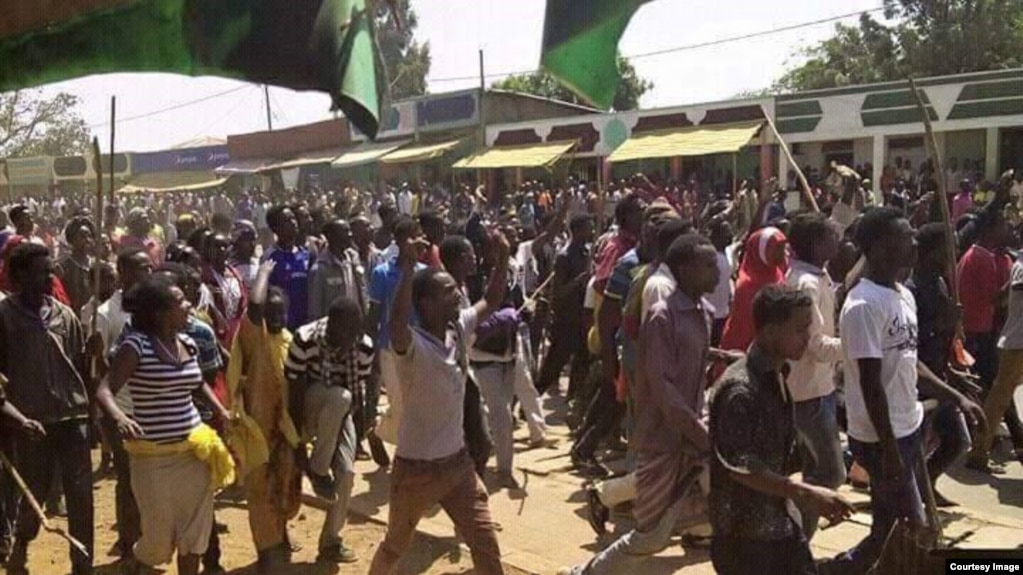
However, in his message on Facebook, which was written in Amharic, Addisu said that “eight Oromos and three Amharas” were killed in Dega and Chora woredas in Buno Bedele zone as a result of a “deliberate attempt by some people who wanted to instigate ethnic violence between Amharas and Oromos.” Addisu also blamed the violence on forces “who want to destabilize the regional government.” Without giving further details, Addisu also said those responsible were placed under police custody.

Click here for the Full Story (via AddisStandard.com)

Related added from Oromian Economist sources:-

https://www.facebook.com/birhanemeskel.abebe/posts/2141253249435634 http://www.radionz.co.nz/news/national/334400/huge-explosion-led-to-auckland-house-fire

https://www.facebook.com/naftanan.gadullo.5/posts/489889421392503

Ethiopia’s Fascist TPLF Regime uses non-Oromo agents to burn Oromia

BBC Afaan Oromoo: OFC: Mootummaan Itoophiyaas ta’ee paartiin biyyattii bulchaa jiru gaaffilee uummataaf deebii kennaa akka hin jirre paartiin Koongirasii Federaalistii Oromoo ibsan October 22, 2017

Posted by OromianEconomist in Uncategorized.
Tags: , , , , ,
add a comment

OFC Press Release

Biyya qabna jechuun nu yaaddesseera – KFO

20 Onkololeessa/ October  2017
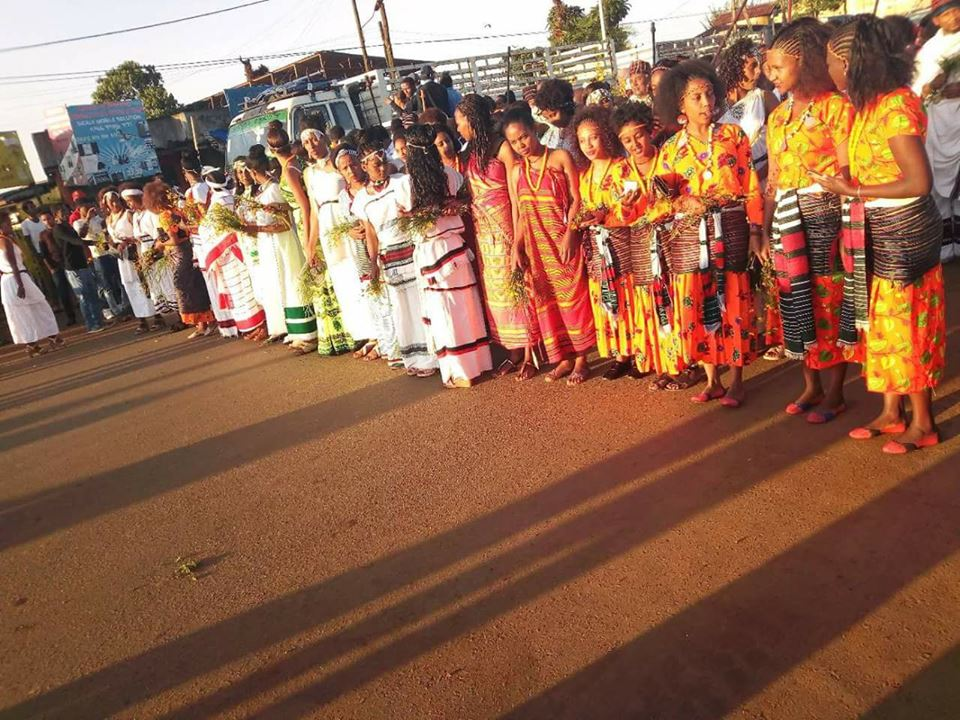

Obbo Mulaatuu Gammachuu miidiyaaleef ibsa yoo kennan

Goodayyaa suuraaBiyya qabna jechuun nu yaaddesseera, Kongirasii Federaalistii Oromoo

Mootummaan Itoophiyaas ta’ee paartiin biyyattii bulchaa jiru gaaffilee uummataaf deebii kennaa akka hin jirre paartiin Koongirasii Federaalistii Oromoo ibsa har’a miidiyaaleef kenneen beeksiseera.

Hirriirawwan tibbana adeemsifaman irratti lubbuun namaa darbuunsaa fi qabeenyi manca’uunsaa na yaaddeeseera kan jedhe paartichi mootummaan gaaffilee uummataaf xiyyeeffannaa kennuu qaba jedheera.

Akkaatuma hiriira irratti gaafatamaa tureenis, mootummaan hidhamtoota siyaasaa mara akka hiiku, buqqa’iinsi uummataa akka dhaabbatu fi kanneen dararaan irra gahee qe’ee isaanii irraa buqqaafamanis hattatamaan iddoo irraa buqqa’anitti deebi’anii akka dhaabbatan paartichi gaafateera.

Aangawoota mootummaa dabalatee shakkamtoonni ajjeechaa raawwatan seeratti dhiyaachu qabus jedha ibsi paarticha.

Hiriirawwan tibbanaa irratti namootni aasxaa yookan alaabaa paartii koongirasii Oromoo qabatanii bahuusaanii fi taatichi fedhii KFO akka hin taane dura taa’aa itti aanaan paartichaa Obbo Mulaatuu Gammachuu himaniiru.

Paartichi namootni asxaa/alaabaa Koongirasii Federaalistii Oromoo qabatanii hiriirawwan kunneen keessatti hirmaataa turanis malaammaltoota viidiyoo waraabuun fiilmii dokimantarii hojjechuu karoorfatan ta’uusaanii ragaalee argadheeras jedheera.

Rakkoon naannoolee daangaa Oromiyaa fi Somaalee gidduutti uummames “mala mootummaan gafilee uummata ukkamsuuf itti fayyadamedha” kan jedhe partichi “dhimmichi walitti bu’iinsa uummataa osoo hin taanee haleellaa humni mootummaa hidhate uummatarraan gahe dha,” jedheera.

Humnoota hidhataniin uummata irraan miidhaa geessisan kanneen gama dhaabsisuutinis mootummaan gahee isa irraa eegamu akkan hin baane fi mirga uummataa kabachiisuu dadhabuusaa himan dura taa’aan itti aanaa paartichaa Obbo Mulaatuun.

Taateewwan uummatni mootummaarraa abdii akka hin qabaanne taasisan uumamaa jiran biyya qabna jechuuf nu yaaddesseeras jedhaniiru.

Dhumarattis uummatni sabaaf sab-lammiilee biroo naannoo Oromiyaa keessa jiraniif eegumsa akka godhan paartichi waamicha dhiyeeseera.


The Oromo Federalist Congress Press Release
Oct 20, 2017
Finfinnee (Addis Ababa), Oromia, Ethiopia


Jirra Jirraa: Oromia music video premiere 2017 by Oromo music star, Hacaaluu Hundeessaa October 22, 2017

Posted by OromianEconomist in Oromo, Uncategorized.
Tags: , , , , , ,
add a comment

Odaa Oromoooromianeconomist

Jirra.png


Oromia: Haala Fincila Xumura Gabrummaa (FXG) Deemaa Jiru Ilaalchisuun Ibsa Qeerroo Bilisummaa Oromoo October 22, 2017

Posted by OromianEconomist in Oromian Affairs, Oromians Protests, Oromiyaa, Oromo, Uncategorized.
Tags: , , , , , , , ,
add a comment

Haala Fincila Xumura Gabrummaa (FXG) Deemaa Jiru Ilaalchisuun Ibsa Qeerroo Bilisummaa Oromoo

Haala Fincila Xumura Gabrummaa (FXG) Deemaa Jiru Ilaalchisuun

Ibsa Qeerroo Bilisummaa Oromoo

Qeerroon Bilisummaa Oromoo haala waliigalaa ummanni Oromoo keessa jiru ilaalchisuun: duula mootummaan Wayyaanee kittillayyoota EPRDF jalatti ijaaratte waggaa 25 nu ajjeesaa fi samaa bahe qabatee daangaa Oromiyaatti kallattii hundarra bane dhumaatii suukaneessaa lammii keenyarraan gahaa jiru, qabeenya saamamee fi barbaadaawe, duula baname kanaan buqqa’uu lammiilee keenya 150,000 caalanii ilaalcha keessa galchuun; hidhamtoonni Oromoo murtii haqaa waakkatamanii bara-baraan hidhaa keessatti galaafatamuu fi gidirfamuun itti fufuurraa, walumaagalatti haallan kanneenii fi biroos ummanni Oromoo bulchiinsa suukanneessaa TPLF/EPRDF jalatti mudataa jiru mormuu fi ummata keenyaa fi addunyaa beeksisuuf akkasumas gaaffii mirgaa dhiyeeffatuuf Onkoloolessa 11,2017 (Onkoloolessa 11 bara 2010) hiriira nagaa waamuun keenya ni yaadatama.

Hiriira kanas gaafa waamame (Onkoloolessa 11, 2017) irraa kaasee magaalaalee Oromiyaa xixiqqoo hanga gurguddootti, gandeen baadiyyaa golee Oromiyaa hunda osoo hin hafne ummanni Oromoo guutummaa Oromiyaa keessaa waliin ka’ee,  birmatee gaaffi isaa kan mirga abbaa biyyummaa fi birmadummaa mootummaa dhaa fi addunyaattis itti fufiinsaan dhageessifatee jira. Kunis injifannoo ol’aanaa xumura sirna gabrummaa irratti jalqaba bara kanaatti goonfatamee tahuun hundaaf labsina. Kanneen QBOf wareegamaa jirtanii fi ummata keenyas injifatnoo ol aanaa kanatti milkaawuu keenyaaf gammachuu keenya ibsina. Ummmata keenyattis boonnaa.

Qeerroon Bilisummaa Oromoo milkii fi injifannoo guddaa argame kana keessatti hirmaannaa sabboontota OPDO keessaa kumaan lakkaawamanii kana hirmmaannaa isaanii guddoo dinqisiifatu ibsaa, akkasuma aantummaa Poolisootni Oromiyaa bakkoota hedduutti agarsiisan, ummata keenya ittisuu fi hiriira kanarratti nageenya hiriirichaa jeequurraa bal’inaan of qusatuu isaaniif dinqisiifannaa qabnuss ibsanna. Hireen keenya tokko tahuu hubatuudhaan warraaqsa biyyoolessaa gaggeessa jirrutti xumura gochuun mirga abbaa biyyummaa harkatti galfatuuf akka waliin sochoons waamicha keenyaa haaressinee hundaaf dhiyeessina.

Hiriira nagaa haala kanaan nagaan gaggeeffamaa ture mootummaan Wayyaanee akkuma amala isaa humnoota waraanaa itti duulchisuun Shaashamannee, Iluu Abbaa Booraa, Kaaba Shaggari fi Baha Oromiyaa dabalatee bakkoota hedduutti lammiilee hiriira nagaa gageessan irratti dhukaasa roobsuun lubbuu namoota galaafatuu isaa guddisnee balaaleffanna. Hiriira kana jeequufis Naqamte, Shashamannee, Waliso, Kaaba Shawaa fi bakkoota adda addatti tikoota isaa bobbaasee balaa geessisuu yaalee fi geessises balaaleffatna. Fuula duratti Qeerroon bilisummaa fi ummatni keenya shira garaa jabinaa tikni Wayyaanee bara baraan gaggeessuu kana of irraa tohatee maseensuu irratti akka dammaqinsaan hojjatu hubachiifna.

Qeerroon Bilisummaa Oromoo hiriirri gaaffii mirgaa dhiyeeffatuuf karaa nagaa guutummaa Oromiyaa keessatti bal’inaan deemaa ture haala aanjaa argatuu fi yeroo barbaachisetti  daran bal’atee akka itti fufu dhaamaa, naannolee humnoonni hidhattootaa mootummaa jiranitti wal dura dhaabbannoo taasisuurraa akka of qusatamu hubachiisna. Sochiin mirga abbaa biyyummaa fi bilisummaa Oromoo dhugoomsuuf Qeerroon Bilisummaa Oromoo wareegama qaalii baasee gaggeessaa jiru ammallee bifa itti fufiinsa qabuun finiinuu akka itti fufuu fi murna samtotaa TPLF-tti xumura gochuuf akka irree guutuun dhaabbataan sossoonu dhaamsa dabarsina. Kanuma waliin sochii itti fufinsaan godhamu kana keessatti ummatni keenya lubbuu fi qabeenya sivilii kamiifuu eegumsa akka godhu walumaan hubachiifna.

Maayiirratti mootummaan faashistiin kun haala nagaatiin:

  • Hidhamtoonni Oromoo hundi hatattamaan akka hiikaman
  • Kanneen bara-baraan ummata keenyarratti yakka dalaganii fi dalagsiisan seeratti akka dhiyaatan;
  • Humnoonni waraanaa fi poolisa federaalaa waggoota dabran hunda nurratti lola labsaa jiran kun akka nurraa ka’an;
  • Ajjeechaa, hidhaa fi saamichi akkasuma buqqa’iinsi ummata Oromoorra geessifamaa jiru daddaffiin akka dhaabbatu;
  • Gaaffiin mirgaa karaa nagaa dhiyeessie deebisaa akka argatu irra deddeebinee gaafannus deebisaa waakkatamuu keenya hubachiisaa,

Ummanni keenya ajaja amma irraa kaasee caasaa mootummaa gabroomfataa diriirsee waanjoo gabrummaan hidhee jiru kana of irraa caccabsuu irratti akka hojjatu waamciha gadi jabeessinee dabarsina. Kanaaf bifa kamiinuu ajaja mootummaa irraa kennamu akka hin fudhannee fi hojiirras hin oolchine, hariiroon bifa kamuu caasaa mootummaa waliin akka dhaabbatu gadi jabeessinee dhaamatna.

 Gadaan Gadaa Xumura Gabrummaa ti!

Injifannoo Ummata Oromoof!

Qeerroo Bilisummaa Oromoo

Finfinnee.

Onkololessa 20, 2017


Ethiopia’s Fascist TPLF Regime uses non-Oromo agents to burn Oromia October 19, 2017

Posted by OromianEconomist in Horn of Africa Affairs, Human Rights, Oromians Protests, Uncategorized.
Tags: , , , , , ,
1 comment so far

  Odaa Oromoooromianeconomist

Media, Oromo activists say TPLF’s govt uses non-Oromo agents to burn Oromia

Finfinne Tribune | Gadaa.com |Onkoloolessa/ October 19, 2017


#OromoProtests activists have denounced the violence that the TPLF/Woyane government has unleashed on Oromia through its agent-provocateurs and paid non-Oromo agents. In order to tarnish the nonviolent (peaceful) Oromo movement, the TPLF/Woyane government has resorted into manufacturing violence through its agents to burn Oromia. Some of these agents have been apprehended by the Oromia Police, according to media reports. Here are some of the comments and reports on social media about the ongoing violence in Oromia.

TPLF’s security agents organizing protests & turning them violent attacking properties belonging to non-Oromo civilians in .

Police in  detaining individuals suspected of instigating the ongoing protests in several towns in the region, head of communication https://twitter.com/addisu_arega/status/921024232016044038 

 uses its positions as  member, VP of , &  Director, AU host to prevent investigations into genocide in Oromia @UN


Related:-


Africa News: Ethiopia: U.S. Embassy speaks on recent protest deaths, lauds security restraint


Restoring Oromummaa: Irreecha Malkaa 2017 celebrated in Mandii, Mana Sibuu, Wallagga, Oromia after 88 years October 16, 2017

Posted by OromianEconomist in Irreecha, Irreecha Birraa, Irreecha Oromo, Irreessa, Uncategorized.
Tags: , , , , , , , , , , ,
2 comments


Odaa Oromoooromianeconomist

Kabajin ayyaana Irreecha Birraa kan bara 2017 (6411 ALO) Oromiyaa bakka adda addaatti itti fufee jira. Haaluma kanaan Mandii, Mana Sibuu, Wallaggaa dhihaatti  haala bareedan Onkoloolessa 15 bara 2017 kabajamee oolera.  Iddii bara 1929tii barana deebi’ee Malkaa Ogiyyootti irreeffatame. #Irreecha2017


Irreecha Birraa Oromoo 2017 at Mandii, Mana Sibuu district, Oromia, on 15 October 2017


Irreecha Birraa 2017 Celebrated in Mandi, Wallaggaa, W. Oromia, 15th October 2017 after 88 years

Irreecha Birraa (Malkaa) Oromoo 2017 ( 6411 ALO) Colorfully Celebrated in Mandii, West Wallaggaa, Oromia, 15th October 2017.png

Irreecha Birraa 2017 Celebrated in Mandi, Wallaggaa, Oromia, 15th October 2017.png


Irreecha Birraa Oromoo 2017 at Mandii, Wallaggaa Oromia, on 15 October 2017.png

Irreecha Birraa Oromoo 2017 at Mandii, Mana Sibuu, Wallaggaa Oromia, on 15 October 2017

Irreecha Birraa Oromoo 2017 at Mandii, Mana Sibuu district, Wallaggaa Oromia, on 15 October 2017.png

Irreecha Birraa Oromoo 2017 at Mandii, in Mana Sibuu district, Oromia, on 15 October 2017.pngIrreecha Birraa Oromoo 2017 at Mandii, Mana Sibuu district, Oromia, on 15 October 2017.png

Onkoloolessa 15 Bara 2017 Malkaa Raachaa, Jalduutti  haala gaarii irreenfatamee oole.


Dabalataan kana caqasaa Kan Makkoo Bilii

Akkasumasi Irreechi Haraa Basqaatti kbajameerra.

Irreecha 2017 also celebrated in Nairobi, Kenya. https://www.facebook.com/Dhabassa/posts/10213042531129674

Suuran gadii kun kan  Odaa Bulluq

Human Rights League: The Somaliland Government Must Respect International Human Rights Treaties and International Law October 15, 2017

Posted by OromianEconomist in Horn of Africa Affairs, Uncategorized.
Tags: , , , , , , ,
add a comment

Odaa Oromoooromianeconomist

The Somaliland Government Must Respect International  Human Rights Treaties and International Law

republic of Somali Land

HRLHA’s Appeal

—————————————————————-
October 14, 2017
Appeal To: The President of Somaliland
The Honorable Ahmed M. Mohamoud Silanyo
Tel: +252 252 0913
E-mail: mopa@somalilandgov.com

Your Excellency,

First of all, the Human Rights League of the Horn of Africa (HRLHA) would like to express its appreciation to the people of the Republic of Somaliland and to its government for their hospitality and kindness towards thousands of Oromo  refugees and asylum seekers who have fled their homes to escape government persecutions in Ethiopia. Since the TPLF Government came to power, thousands of Oromo nationals have run away from arbitrary detentions, degrading tortures and violent killings in Oromia to save their lives by seeking refuge in Somaliland and other neighbouring countries.

However, HRLHA recently received a worrisome and disheartening report that the Somaliland Government security and police forces opened a wide ranging campaign against Oromos living in Hargeeysa, a move meant to expel all Oromo refugees and asylum seekers from Somaliland. According to the Oromo asylum seekers that HRLHA interviewed, the Oromo nationals who lived peacefully in Hargeeysa for many years are under  police and security attacks and over 4000 young men and women Oromos have been picked up from their homes and loaded on trucks and sent to the border of Somalia and Ethiopia, near Wichale. In addition, the Oromo asylum seekers also said that there is  a wide- ranging hate campaign going on, undertaken against Oromos by the Somali people, which  was deliberately instigated by the government and which had resulted in the loss of Oromo lives- two men were killed by police and three children have been burned in their home in Hargeeysa  town at  a place called Sheeda 23. This deliberate crime was committed against the family of Ahammed Suleyman Musa; his three children, Nuredin Ahammed Suleyman age 6, Salmaa Ahammed Suleyman, age 4, and Imraan Ahammed Suleyman, age 2  were set on fire in their home and burned to death on October 5, 2017 at 9:45 am.

Your Excellency,

I am sure that your government is well aware of the current political crisis in Ethiopia in general and in Oromia in particular. The regime in Ethiopia has particularly targeted the Oromo nation simply because they have demanded their fundamental rights, and have been expressing their grievances for the past 26 years. In the past four years (2014 to present) of continuous peaceful protest against the authoritarian regime in Ethiopia, the Oromo nation has lost over 3500 brilliant sons and girls at the hand of the killing squads Agazi force- among them, about 700 were murdered in only one to two hrs at the Irrecha Festival on October 2, 2016, tens of thousands have been jailed and other hundreds have been forcefully abducted by the security forces and have essentially disappeared.

HRLHA would also like to bring to your attention that these events have already attracted international attention, including that of Ethiopia’s Western allies. For example, in its 2016 Country Report on Ethiopia, the U.S. Department of State’s Bureau of Democracy, Human Rights, and Labor acknowledged that:

Ethiopian Security forces used excessive force against protesters throughout the year, killing hundreds and injuring many more. The protests were mainly in Oromia and Amhara regions. At year’s end more than 10,000 persons were believed still to be detained. This included persons detained under the government-declared state of emergency, effective October 8. Many were never brought before a court, provided access to legal counsel, or formally charged with a crime. On June 10, the government-established Ethiopian Human Rights Commission (EHRC) reported and presented to parliament a summary of its report. The EHRC counted 173 deaths in Oromia, including 28 of security force members and officials, and asserted that security forces used appropriate( appropriate or inappropriate?) force there. The EHRC also asserted Amhara regional state special security had used excessive force against the Kemant community in Amhara Region. On August 13, the international NGO Human Rights Watch (HRW) reported an estimate that security forces killed more than 500 protesters. In October the prime minister stated the deaths in Oromia Region alone “could be more than 500.” The UN High Commissioner for Human Rights requested access to Oromia and Amhara regions, which the government refused. Following dozens of deaths at a religious festival in Bishoftu on October 2, groups committed property damage. On November 9, international NGO Amnesty International reported more than 800 persons were killed since November 2015

The Ethiopian government’s crimes against the Oromo nation were also condemned around the world by governments and government agencies (UN, EU) and human rights organizations. Among those recent reports are:

Human Rights Watch (HRW)

Amnesty International (AI)

Human Rights League of the Horn of Africa (HRLHA)

USA: Stand Up for Ethiopians as Government Stifles Protests, Jails Journalists  (March 9, 2017)

February 9, 2016, John Kirby, spokesperson Daily Press Briefing, Washington, DC on 140 Oromo peaceful protestors killed by Ethiopian Government Security force

21-01-2016, EU Parliament resolution in connection with the killing of 140 Oromo peaceful protesters

21-01-2016, UN experts press release urging Ethiopia to halt a violent crackdown on Oromia protesters, ensure accountability for abuses

Your excellency,

Historically, Oromo  and Somali nations have a lot in common. They share history, tradition, and language (in some degree), respect each other, and have lived together as nations for over a century. There are thousands of Somaliland- born Somalis live in Oromia right now without fear, especially in the eastern part of Oromia including the capital city Addis Ababa. The Oromo people and Oromia State government embrace them and they live peacefully with their Oromo brothers and sisters. So why is your government targeting the Oromos who came to your country seeking desperate help from your government, looking to be safe from prosecution by the Ethiopian regime?

By killing, deporting and harassing the Oromo refugees and asylum- seekers residing in Somaliland your government is collaborating with the Ethiopian authoritarian regime which is responsible for massacring thousands of Oromos, forcefully disappearing many and jailing others. By collaborating with the Ethiopian regime in killing, deporting and abusing Oromos in Somaliland, your government is violating:

  1. The constitution of Somaliland approved by referendum on 31 May 2001, Foreign Relations article 10 (#1-5) which describes the commitment of Somaliland foreign relations based on the local and international laws.
  2. Universal Declaration of Human Rights (UDHR); article 14 (1), Everyone has the right to seek and to enjoy in other countries asylum from persecution.
  1. The Convention against Torture and Other Cruel, Inhuman or Degrading Treatment or Punishment (1465 U.N.T.S. 185) Somaliland has an obligation not to return a person to a place where they face torture or ill-treatment. Article 3 of the Convention against Torture provides:

3.1. No state party shall expel, return (“refouler”) or extradite a person to another state where there       are substantial grounds to believe that they would be in danger of being subjected to torture.

3.2. For the purpose of determining whether there are such grounds, the competent authorities shall       take into account all relevant considerations including, where applicable, the existence in the state     concerned of a consistent pattern of gross, flagrant or mass violations of human rights.

Your excellency,

Despite the fact that Somaliland declared its independence in 1991, the HRLHA is fully aware that Somaliland is not yet a signatory to international human rights treaties.  Even though Somaliland declared its independence in 1991,   it  has not yet been recognized by the world community as a country separate from Somalia yet.  Even though the request of your government for recognition by the World community is still on hold, the Somaliland government  still  has a duty to respect at least the above mentioned core human rights treaties and international law. Violating them could badly damage the reputation of Somalilad as a state  seeking a recognition from the World Community. The HRLHA strongly urges the Government of Somaliland to respect these international human rights treaty obligations  and international human rights law for the just-mentioned reasons.

The HRLHA therefore calls  upon  the international community to act collectively in a timely  and decisive manner – through the UN member states- to put pressure on the Somaliland government to abide by the core international human rights, obligations and international law halt the expulsion, return (“refouler”) or extradition of  Oromo  asylum seekers and refugees to Ethiopia where they could face all sorts of human rights violations , including prison and torture.

RECOMMENDED ACTION: Please telephone, send an email or airmail letters in English, Somali language  or your own language:

– Expressing serious concern about the Oromo and other asylum seekers and refugees, and the human rights violation in Somaliland;
– Demanding assurances that the Oromo and other refugees and asylum seekers will not be returned to the country where their lives will be endangered.

APPEALS TO:

The HRLHA is a non-political organization that attempts to challenge abuses of human rights of the people of various nations and nationalities in the Horn of Africa. It works to defend fundamental human rights, including freedoms of thought, expression, movement and association. It also works to raise the awareness of individuals about their own basic human rights and those of others. It encourages respect for laws and due process. It promotes the growth and development of a free and vigorous civil society.

Copied To:

HRW: joint letter from 9 organizations urging US Congress to vote HR 128 & show respect for human rights in #Ethiopia October 14, 2017

Posted by OromianEconomist in Horn of Africa Affairs, Human Rights, Uncategorized.
Tags: , , , , , , , ,
1 comment so far

Odaa OromoooromianeconomistHRW

US Congress: Vote on H.Res 128

Support Respect for Human Rights in Ethiopia

UNPO: Oromo: Protests Leave 8 Dead October 13, 2017

Posted by OromianEconomist in Oromo Protests, Uncategorized.
Tags: , , , , , , , ,
add a comment
Odaa Oromoooromianeconomist
Oct 13, 2017

Oromo: Protests Leave 8 Dead


Photo Courtesy of Quartz

Protests this week in Oromia have raised concerns, with one on Wednesday 11 October 2017 killing 8 people. Sections of the Oromo diaspora accused the Tigrayan People’s Liberation Front (TPLF) of having orchestrated these deadly demonstrations, since they were organized unlike the others.

Below is an article published by OPride:

At least 8 people were killed and more than 30 others injured on October 11, 2017 in renewed protests across Ethiopia’s restive Oromia state. Peaceful protests were reported again on Thursday in several Oromia towns, including Woliso in West Shawa, where locals reported a peaceful rally of more than 15,000 people.

Yesterday’s deadly protests appear to have been organized unlike previous ones, which were usually, although not always, preceded by media announcements from abroad. In fact, some diaspora-based activists denounced yesterday’s demonstrations as the work of spoilers and agents of the ruling Tigrayan People’s Liberation Front (TPLF). Officials from the Oromia regional state also said the protests were planned by forces that want to weaken Oromo unity.

The protests went ahead despite calls for their cancellation. Demonstrators took to the streets in large numbers in more than dozen towns in West Arsi, West Shawa, Wallaga, and Hararge zones. The protests in the latter have been ongoing and largely in response to continued incursions by the Liyu Police of the adjoining Somali Regional State of Ethiopia.

For days, several Oromo activists warned protesters not to join the protests called by unknown individuals under the banner of “waamicha harmee” – meaning Oromia’s call – out of concern that protests lacking clear political goals were fruitless. Although the organizers were unknown, the slogans were nothing unusual: Down down Wayane, release opposition leaders from prison, and no to fake federalism.

What does this mean? Does it mean diaspora activists are being left in the cold by home-based groups who have their own agenda other than waiting on a hollow promise of change to be midwifed by Oromo Peoples’ Democratic Organization (OPDO) at some future date? Does it mean the OPDO has lost control of the streets? Does it indicate the lack of coordination and clear chain of command within the grassroots movement? Was this the inevitable instance of social media being weaponized by state actors? Were there targeted and geotagged campaigns within Ethiopia by TPLF agents and social media consultants?

Prior to yesterday’s protests, senior OPDO leaders held massive town hall meetings in flashpoint towns, including Ambo, and it appeared they were connecting with the public. But the widespread protests upended it all. In three-years of protests, the prelude to Irreechaa 2017 was the only time protest leaders across the Atlantic were seen to be on different pages. The peaceful conclusion of this year’s thanksgiving festival signaled that the fences were all mended. Then came the Malka Atete celebrations in Sabata and Burayu towns in central Oromia. The latter events differed from Irreecha by the unusually large display of Oromo resistance flags.

The sheer size of flags at the event came as a surprise because leaders of the Oromo Gadaa council had called on all attendees not to bring any flags and partisan emblems. This led to spirited debates among Oromo activists for several days. Others speculated that the unusually large display of the flags must be the work of some organized group, perhaps even the regime with the aim of using it as a pretext for violent crackdown and justification for another Oromia-wide state of emergency.

The development was significant enough that even pro-TPLF bloggers weighed in. For example, Horn Affairs editor Daniel Berhane noted that when people hoist that flag and mention the name Oromo Liberation Front (OLF), they are not referring to the OLF faction in Asmara but the nation’s spirit of resistance against oppression. This focus on the flag and OLF prompted the Asmara-based group to aggressively pushback on social media, even appearing to suggest it was behind the protests.

From what we know, OLF and its affiliated Qeerroo Bilisummaa did not publicly call Wednesday’s protests and its reach doesn’t extend as widely as the protests were. They simply lack the kind of grassroots organizational capacity necessary to pull off demonstrations of this size. Besides, the group calls its protests Fincila Xumura Gabrummaa (FXG), the final push to end Oromo subjugation, and no calls for protests under this slogan went out. Most importantly, it would have formally claimed responsibility for the massive turnout if it was behind it. Besides, some of the slogans, for example about making the federation meaningful, are contrary to the demands of the Asmara group.

Regardless, #OromoProtests is entering a new critical phase. Many hope that this week’s deadly protests were but a one-off instance of breakdown in communications and leaders of the grassroots movement will move swiftly to assert control. A repeat of a similarly uncoordinated protest would be seen as a sign of rupture within the protest movement. If past trends are any indication, the grassroots movement has been so resilient that it overcame its shortcomings after each hiccup.

Revolutions are slow-cooking. However, prolonged revolutions tend to self-destruct and atrophy. The culprit is usually the appearance on the stage of dark forces that may not necessarily be in line with the overall objective of the movement other than disrupting the status quo. Without the decisive battles that mark watershed moments and make whatever gains are made irreversible, revolutions are still in uncertain waters.

So far the gains made as a result of the huge sacrifices incurred over the past three years are largely symbolic and rhetorical…with the possible exception of the change of attitude by Oromia police as well as the Oromia regional administration. It had once appeared as if the latter is in charge. Yesterday’s mass protests requires a rethink of all calculations by the OPDO and diaspora activists and all responsible forces.

That said, OPDO leaders should not and could not rest on their laurels. The youth protesters have great sympathy for their plight and dreams of autonomy from the domineering Center. Arresting suspects in the killing of protesters yesterday is a remarkable departure from the past and could only increase sympathy towards the regional government. However, sympathy is far from loyalty. Besides, the organization is only recently baptized as part of the Oromo struggle for freedom rather than a Trojan horse for the TPLF, which was the prevailing view among the Oromo public until 2014, when nation-wide protests broke out, and more incontestably after October 2016 when Lemma Megersa and his nationalist wing of young Turks took the helm at the organization. Protesters will garner confidence only after seeing concrete change at the federal level. The changes in Oromia state level are encouraging. The state-run media outfit is putting out critical reports and airs documentaries critical of the federal authorities that have refused to heed the demands of the Oromo people and instead ordered not only killing of peaceful protesters but also displacements of thousands from their ancestral homes using a proxy army, the Somali regions Liyu Police. But that is far from enough.

Labeling it as the work of the enemy harkens back to the dark days of the past when Oromo against Oromo rivalries undermined a united struggle against oppression and marginalization.  Rather than the work of an enemy or http://www.satenaw.com/breaking-news-least-eight-killed-dozens-wounded-protests-across-oromia/internal saboteurs, the protests could also signal a renewed push towards taking the struggle into a new stage aimed at changing the TPLF regime.


Related:-

#OromoProtests

Satenaw:Breaking News…… At least eight killed, dozens wounded in protests across Oromia

Protests in different Oromia towns, Ethiopia, continued on Wednesday and Thursday; at least six people were killed and more than 30 wounded during protests. –  By Solomon Abate, Salem Solomon, Tizita Belachew (VOA) |


Fox News:  6 dead as protests surge again in Ethiopia: Official

Tesfa News:Protests flared up in Oromia, scores killed


https://twitter.com/addisgazetta/status/918830134802690049

Ten Point Plan to Ease the Current Crises in Ethiopia October 12, 2017

Posted by OromianEconomist in Horn of Africa Affairs, Human Rights, Oromian Voices, Oromo and the call for justice and freedom, Uncategorized.
Tags: , , , , , , ,
add a comment

Odaa Oromoooromianeconomistoromoprotests-image-from-financial-times

Ten Point Plan to Ease the Current Crises in Ethiopia 

By Dr. Birhanemeskel Abebe Segni


I was listening to the slogans and songs of the Oromo people who were protesting again throughout Oromia region in their tens of thousands in each localities. The following ten points are the essence of the demands of the people as expressed through their slogans and songs.

Based on the the slogans and songs of the protesters, I recommend the TPLF/EPRDF government to immediately carryout the following policy reforms to meet the demands of the Oromo people and calm the situation:

1. End all forms of TPLF/EPRDF interference and indirect rule in the Oromia Region through the federal police, federal security, and federal military and federal justice structures of the federal government that denied the Oromo people direct self-rule.

2. Make Afaan Oromo Federal Working language on equal footing with Amharic.

3. Restore the status of Addis Ababa as an Oromia City.

4. Release all political prisoners including Dr. Merera and Mr. Bekele Gerba.

5. Dismantle the Somali Janjaweed Militia locally known as Liyu Police. Remove all the federal military and security officers who organized and lead the aggression and invasion of Eastern and Southern Oromia by the Somali Janjaweed Militia and caused the displacement of over 600,000 Oromo civilians. Resettle back all the displaced on their land, and compensate them for their Janjaweed looted property. Bring to justice the killers of our people.

6. Increase the number of Oromo federal workforce both in the military, security and civil service sectors from the current 10% to at least 40 to 50% in proportion to the population size and economic contribution of the Oromia region.

7. Restructure the power balance within EPRDF based on the population size of EPRDF member parties or dismantle it all together to establish a new coalition government.

8. Repeal and end all land grab policies, compensate and resettle the Oromo farmers evicted from their ancestral lands.

9. Make all companies in all regions to pay tax to the coffers of the respective regional governments to increase the economic benefits of the region’s population instead of the current monopoly by the federal government.

10. Develop clear economic policy that will end the marginalization and exclusion of the Oromo people from the Ethiopian economy including restoring the ownership of the Oromo people on their natural resources, produces, goods and services.


Related:-

IB Times Exclusive interview with executive director of Oromia Media Network

By IB Times

Ethiopia has been suffering from a super centralized TPLF autocratic, barbaric and terroristic rule.

Dagalee Media: Memorial for Irreecha 2016 and fundraising for Eastern Oromia held in Pennsylvania October 11, 2017

Posted by OromianEconomist in Uncategorized.
Tags: , , , , , ,
add a comment

Odaa Oromoooromianeconomistremember-irreechamassacre