Economic and development analysis: Perspectives on economics, society, development, freedom & social justice. Leading issues in Oromo, Oromia, Africa & world affairs. Oromo News. African News. world News. Views. Formerly Oromia Quarterly
Torture survivor inspired by Elie Wiesel’s ‘Night’
By Feyera Negera Sobokssa*
February 10, 2015 (Washington Jewish Week) — I am a torture survivor who was persecuted by the government of Ethiopia because I was advocating for the Oromo ethnic group in the country. I suffered so much between 1991 and 1996; even now I feel the severe trauma of what I experienced at the hands of torturers. I was trying to search for the right vocabulary to explain what happened to me.
After traveling to the United States in 2000, I came across a book called Night by Holocaust survivor Elie Wiesel. This book helped me describe the human brutality and the need to speak out for others who did not have the same opportunity.
This paragraph in Night (p. viii) helped inspire me to become a voice for other victims of torture. Wiesel wrote about the importance of becoming:
“a witness who believes he has a moral obligation to try to prevent the enemy from enjoying one last victory by allowing his crimes to be erased from human memory.”
When I was a young boy in the 1950s and 60s, I witnessed how the government treated my people, the Oromos. The Oromos are the largest ethnic group in Ethiopia, more than one-third of the population. They have their own culture and traditions; our language, Afan Oromo, was banned in schools, government offices and the courts. As a child, I remember seeing Oromo boys beaten if they spoke the language. Even today, the ruling elites in Ethiopia still use the term “galla” to refer to Oromos. “Galla” is a horrible, derogatory word used to dehumanize Oromos and to keep them in a low position.
I was distributing a book called “History of the Galla” in 1991 the first time government agents arrested me. They grabbed me by the arms and took me to a military camp. They forced me to drink something, probably a hallucinogenic drug, and made me dance in front of the soldiers. They wanted to know what types of books I was reading, besides “History of the Galla,” I told them Exodus by Leon Uris was one of my favorite books.
My worst torture experience was in a military camp in 1995. Soldiers inflicted a terrible kind of torture called “Code Number Eight.” They tied my elbows together, causing terrible pain in my chest and damaging my ligaments and muscles. Then they suspended me on a metal object and kept me like that for long hours for two nights. It was so horrible I remember asking the security forces to kill me. They said “We don’t want you to die, we want you to suffer.”
I finally escaped Ethiopia in the year 2000, leaving my children behind. My wife was in a special refugee camp in Germany which used to be a Nazi concentration camp. I immediately was granted political asylum. Shortly after that I discovered the Torture Abolition and Survivors Support Coalition (TASSC). TASSC is a place that helps survivors give meaning to their lives. They assigned me a case manager who talked to me about PTSD, she listened and cared about me. She also helped my family by writing a recommendation to bring my daughter from Ethiopia to Washington. Today, TASSC provides counseling, housing, health care and pro bono legal services to survivors in the Washington area. It also has an advocacy program where survivors meet congressional staff to create awareness about the impact of torture on victims and their families.
I have always thought the Oromos and the Jewish people have a lot in common because Oromos were persecuted just like the Jews. I realized this a long time ago after readingExodus and visiting the Holocaust museum. It was unbelievable to read about the gas chambers and what happened in Auschwitz and other concentration camps. But Exodus also gave me hope. People who were persecuted can rise from the depths of despair to be free. That made me think that one day Oromos can be free too.
Last April, TASSC organized a Passover Seder that focused on the universal desire for freedom by honoring survivors and their journey from persecution to freedom. The Bible teaches us the story of Moses, Pharaoh and the Exodus. I brought Night to the seder and shared what the book means to me with the Jews and the other survivors. The Seder was a wonderful connection for survivors because it helped us transform our pain into strength.
Ultra-nationalistic totalitarian movements brought Nazism and Fascism to Germany and Italy, creating hatred for minorities. Many people do not know that we also have a totalitarian regime in Ethiopia controlled by a small ethnic group who are oppressing the Oromos and other ethnic groups. We have to fight these kinds of movements everywhere in the world. According to the human rights group Genocide Watch, Ethiopia has already committed “genocidal massacres against many of its peoples.”
Elie Wiesel was right when he said “Silence helps the perpetrators, not the victims.” For this reason, over the last ten years, I have become a TASSC “truth speaker,” going to schools, universities and churches to speak about torture and create awareness about the persecution of the Oromo people. If given the chance, I would welcome the opportunity to connect with the Jewish community in Washington by visiting synagogues and Jewish groups.
*Feyera Sobokssa is a torture survivor from Ethiopia who received political asylum in 2001. He began his political activities as a young man employed as an accountant by Ethiopian Airlines, helping to distribute publications about the Oromo ethnic group and their history of persecution by the Ethiopian government. Feyera is now a spokesman against torture with the Torture Abolition and Survivors Support Coalition (TASSC). He is a strong advocate for human rights and for raising awareness about the plight of the Oromos in Ethiopia.
ETHIOPIA: Flagrant Human Rights Abuse against Oromo Nationals Continues
HRLHA Urgent Action
Feb 01, 2015
For immediate Release
It is cruel, brutal and inhumane to hang any person for any wrongdoing particularly in Ethiopia, a country that claims democracy is its core principle of governance. The execution of Ketama Wubetu and his friend by Ethiopian solders- by hanging on a fence- on December 09, 2014 in Salale zone of Dera District in the regional State of Oromia was barbaric. If the hanged men were members of an opposition group fighting against the government, once they were captured they should have been brought to justice.
Sadly enough, the government soldiers shamelessly displayed the bodies of these two Oromo nationals to the public- including children. This kind of inhuman and fascistic action will not solve the political crisis in the country. Rather, it will complicate and escalate it to another level. The fascistic action committed against the two Oromo nationals by the government army clearly shows that justice in the country is dysfunctional and symbolic.
By doing this the Ethiopian Government has blatantly violated international humanitarian law and international human rights law principles including international human rights standards.
The Human Rights League of the Horn of Africa highly condemns the federal armed force, as well the Oromia regional state militia, for their fascistic acts against these two individuals and calls upon the Ethiopian government to bring the killers to justice. The Government of Ethiopia should also explain the situation to the world community particularly to the UN Human Rights Council that it is a member of.
The HRLHA calls upon regional and international donors, UN member states and Organizations to take measurable steps against the Ethiopian TPLF/EPRDF government for its persistent brutal, dictatorial, and suppressive actions against civilians. It also urges all national, regional and international diplomats, donor countries and organizations and human rights groups to join hands in putting pressure on the Ethiopian government so that it invites immediately neutral body to investigate the human rights situation in the country.
BACKGROUNDS:
The Human Rights League of the Horn of Africa (HRLHA) has reported (May 1st and 13th, 2014, urgent actions, www.humanrightleague.org) on the heavy-handed crackdown of the Ethiopian Federal Government’s Agazi Special Squad and the resultant extra-judicial killings of 34 (thirty-four) Oromo nationals, and the arrests and detentions of hundreds of others. Amnesty International in its most recent report on Ethiopia – “Because I am Oromo – Sweeping repression in the Oromia region of Ethiopia” – has exposed how Oromo nationals have been regularly subjected to arbitrary arrest, prolonged detention without charge, enforced disappearance, repeated torture and unlawful state killings as part of the government’s incessant attempts to crush dissent.
RECOMMENDED ACTION: Please send appeals to the Ethiopian Government and its concerned officials as swiftly as possible, in English, Amharic, or your own language expressing:
explanation for its brutal and fascistic action against citizens and invite immediately nutria body for investigation
the Ethiopian authorities to ensure that the killers are brought to justice immediately
Send Your Concerns to:
His Excellency: Mr. Haila Mariam Dessalegn – Prime Minister of Ethiopia
Office of the UN High Commissioner for Human Rights
United Nations Office at Geneva 1211 Geneva 10, Switzerland Fax: + 41 22 917 9022 (particularly for urgent matters) E-mail: tb-petitions@ohchr
Human Rights Treaties Division (HRTD)
Office of the United Nations High Commissioner for Human Rights (OHCHR)
Palais Wilson – 52, rue des Pâquis
CH-1201 Geneva (Switzerland)
: +41 22 917 97 06
Fax: +41 22 917 90 08
E-mail: cat@ohchr.org
Secretariat contact details
Secretariat of the Subcommittee on Prevention of Torture
Office of the United Nations High Commissioner for Human Rights (OHCHR)
Palais Wilson – 52, rue des Pâquis
CH-1201 Geneva (Switzerland)
Committee on Enforced Disappearance (CED)
Human Rights Treaties Division (HRTD)
Office of the United Nations High Commissioner for Human Rights (OHCHR)
Palais Wilson – 52, rue des Pâquis
CH-1201 Geneva (Switzerland)
African Commission on Human and Peoples‘ Rights (ACHPR)
48 Kairaba Avenue, P.O.Box 673, Banjul, The Gambia.
Tel: (220) 4392 962 , 4372070, 4377721 – 23 Fax: (220) 4390 764
E-mail: achpr@achpr.org
Office of the Commissioner for Human Rights
Being and Becoming A Global Nation: The Oromo of East Africa
By Dorii Abbaa Fugug,
ayyaantuu.com
Globalization is a phenomenon that has been metamorphosing from negative imperialistic connotation background to more positive, progressive and cherished representation. However, it is still suffering from cynicism and prejudice as some group of nations continuously prospering on the expense of others mortification. Long before the existence of the term globalization and when the concept of globalization is not as comprehensive as today people were fighting over the dominance and some of them with the only rudimentary awareness of the glob and aspired to dominate the world mainly to maximize their sphere of influence or revenues. Others had mainly focused in strongly defending their territory and live in peace and tranquility for many centuries. The Oromo people were among those strong, democratic and peaceful nations in the region.
However, their unshakeable power in the region for many centuries prior to European conquest was deranged; and with help of colonizers’ superior armaments; the once dying Abyssinian enclave happened to control the mighty Oromo nation. Thus with extraordinary weaponry supplies and unrelenting advice of their masters, this “dependent colony” strived and maintained its power over the Great Nation for over a century.
During this time, the Abyssinians tried their best not only to completely eradicate the Oromo identities (language, cultural, etc.), but they had also committed ethnic cleansing in which the Oromo population was reduced in half. They prohibited the Afaan Oromo from spoken in public or in offices and further worked hard to make the Oromo totally ignorant of the world around them. In other words they destroyed all traditional relationships with their neighbors and effectively blocked their interaction with them and the entire world at large.
For instance, until the Italian period in 1935-41, the Oromo males were not allowed to go to market (magalaa/gaba’aa/ katama) as they were killed by Naftangas as “cursed and unruly enemies”. On the other hand, the Oromo were also neither surrendered their dignity easily or stopped fighting them during this time. Patriotic Oromos like Muce Ahmed Muce was remembered by countless banana trees he planted on the graves of Naftanyas he killed. He is also remembered by eating Minelik’s commander, waldegebriel Aba Seyxan’e ear. I am very sure many Oromos from different corners of the Country have similar stories to tell.
During the emperor period and afterwards, the Oromo were discouraged to have any access to outside world be it in terms of business, education or any travels. They were geven, derogatory mistrusting nomenclatures like Aligaza bay “galla” (unruly “gella”) during Menilek; Banda(collaborators) during Hailesillasie; sargogab ( infiltrators) during Mengistu and OLF during Melles Zenawi (wayyane) regime only for the purpose of justifying the killing or robbing of the innocent Oromos. Yet, the Oromo continued to abjure such Abyssinian aspersion and illegally trekked to the neighbouring Somalia, Yemen, Sudan and other Arab countries.
These assiduous and risky defiant encounters resulted in creating Oromo heroes like Waqo Gutu, Jarra Abba Gada, Elemo Qilxu and many, many others who were the key for the formation of Oromo Liberation Army. History also witnesses thousands of Oromo who were captured and massacred by Abyssinian militias while crossing the border. Some of them were even followed and killed in neighboring countries. People like Ayyub Abubake, Jahatani Gurmu, Mullis Ababa Gada, etc, are the case in point. It was in this defiant and antipathy of Abyssinian anathema that the most precious Oromo freedom fighters, the eleven members the top OLF leaders, perished in the hands of hostile Ogadenian bandits, while travelling to Somalia for diplomatic purposes.
However, with EPRDF policy of killing some Oromos and expelling other from the country, thousands of Oromians took flight out of the country, all for the purpose of defending the Oromo nation right for self-determination and to become one of free world nation. In a nut shell, the Oromo have paid ultimate sacrifice for their independence not less than Algerians or Eritreans in any standards which most of us should be proud of. As I tried to mention above I don’t mean in anyways that globalization is a trend or a phenomenon that Africans have benefited from and as a result we cherish it. No, not at all. My point is that While becoming a victim of globalization, in general, is a bad thing, yet being deprived of your national identity, as Oromo, in the globalized world, is the worst thing ever and the opposite is true.
My other point here is that although the Oromo as a nation with its own national boundary and sovereign rule is in waiting, our diaspora efforts are already making Oromians a global citizen/nation in short cut. Today the Oromo have very strong community organization, vibrant civic and political organizations in Diaspora. Most importantly the majority of the Oromo have long been mentally liberated and completely forgotten Ethipiawinet.
Now that, we have seen how the Oromo were defiantly absconding the country sadistically since the beginning of the Abyssinian colonialization of Oromia and particularly during the 1950s and 1960s of Jarra Abba Gada-Waqoo Guutuu generations, which brought about the Oromo freedom fighting that continued to swelter like conflagration .
On the other hand, unprecedented new fashion of defiant flees or mass exodus of Oromo happened after 1991-2 Revolution. While few OLF left the country through Bole many thousands had flocked to the different corners of the countries’ border. As it goes, if we cannot succeed through Bole we will be making it through Bale became a motto. Anyway, most of these people destined to refugee in neighboring countries only to seek eventual resettlement to the third countries (to western world). As a result most of these refugees succeeded in resettling in countries like Australia, Germany, Denmark, Finland, Norway, Sweden, the Netherland, the UK, The United States and Canada. Although the trauma of refugee camps and establishing in new counties are not simple matter, many of these refugees are quickly established themselves and involved in the doing Oromummaa projects.
Although deserting the country especially by few top OLF leader during the crisis was seen as an abhorrent historical disaster for the Oromo struggle for independence, there are people who believe that leaving the countries enabled the Oromo people to be free of oppressive government and work for the Oromo struggle from outside of the country. Leaving the former for history, we are witnessing the latter becoming the reality.
That doesn’t mean however every Oromo in Diaspora is working for the benefit of Oromians, there is a group of Diaspora Oromo that chose to seek yet another Ethiopiawinet citizenship. How on earth someone can seek a new citizenship in the country where he was born and where the citizenship right in the county is already by birth.
On the contrary, however, those who left the country for the genuine pursuit of Bilisumaa continued working on a plethora of Oromummaa projects here in Diaspora. For example, all the proliferated Oromo free Medias, strong community organizations and other civic organization like OSA, OSG, ORA, HRLHA, Mada Walabu, IOYA, Barnoota and many other organizations are only the tip of the iceberg. These actives are undoubtedly becoming the reliable means for the Oromo to being and becoming the global nation. Furthermore, these are the outcomes of the Oromo defiance against the Abyssinians policy of concealment, camouflaging and containment. It is also a remarkable confirmation of the total failure of Abyssinian century old struggle against the Oromo or the demise of Ethipiawinet for good.
Thus, the assiduous process of reintroducing or reconnection of the Oromo nation to the world community as independent entity, of course, has reached the stage where no one can relapse it. We can see a multifaceted movement in continuums. The diaspora Oromo Students Organizations, Oromo community associations, the OLF and OSA and Oromo Medias are the leading champions of these developments.
The OMN which is envisioned by young Oromo student Obbo Jawar Mohammed and his friends started its role as a giant media outlet. They mobilized the diaspora Oromo behind the mission and the OMN has successfully been launched in March 2014. The OMN not only informs about what is going on in the world concerning the Oromo and the Horn of Africa’s natios but is also instilled the moral and spiritual connection of the Oromians all over the world as well as demonstrated that the Oromo can do so many great things when worked together. It also showed the Oromo that for every problem they are suffering from now, the solutions are always right in their hand.
The other promising Oromo project of our time in diaspora is Toltus Tufa’s’ Education project(Afaan). Toltu Tufa is an outstanding Australian born Oromo girl who envisions the greatness of educating her people in diaspora. Started with small project in Melbourn, Adde Tultu expanded the horizon of her vision to reach all the Oromo children in every corner of the globe. Currently she is touring around the world to distribute the children books she authored.
Totlu project is so crucial for the Oromo people in diaspora for several reasons: First, Oromiffaa/Afaan Oromoo is one of the few languages that survived the language genocide. Please refer to the UN Genocide Convention definitions,( Art. 2b & 2e), which clearly stipulates what the linguistic genocide means, and how it occures. So Toltu’s project of teaching Afaan Oromoo is not only helps us to survive our languages from the threatening foreign media and scholastic language genocide in diaspora; but it makes our children be active future leader and inheritors of our struggle for independence. Secondly, it preserves Oromo identity as intact as it was. Toltu, herself, is a role model and charismatic leading light for our young foreign born Oromians.
There are many other emerging young talented Oromo leaders of Qube Generation like Toltu and Jawar whose achievements in the field of Oromumma are yet to be witnessed. As they are marching on natural course of actions( for a just cause), these young leaders are always successful to the detriment of those time-worn old gantuus Oromos who are derailed from the right trajectory.
The other acclaimed successful diaspora Oromo achievements are the naming of Minneapolis Oromo Street and the Melbourne Oromo community, hosting Oromo flag (right beside the Australian National flag) on Melbourne Street only to represent the Oromo nation as a distinct entity. These are shining Oromo community achievements in diaspora which shows the being and becoming of global nation. The OLF participation on “world stateless nations” conference in last year was nothing more than a confirmation for the world community that we are the nation without the state. Indirectly that means we are a state in exile or Oromia is the state in waiting.
Generally the Oromo in diaspora do actually know the fact that strengthening their organizational capacities and becoming viable global citizen enables them to revive and reconnect to their age older brotherly relationship with East African nations to work hard for the demise of the crumbling Ethiopian Empire. Many neighbouring nations have already joined hand in hand against tyrannical Ethiopian regime. Thus the disintegration of Ethiopia Empire will definitely paves the way for the integration and re-alliance of eastern African loving nations.
Mind you, while the Abyssinian in Washington reaffirmed their deep-rooted hatred to the Oromo her in the USA, the Somali and Oromo in Minneapolis demonstrated their Cushitic ties by working to together to make their dream of enshrining their names on the street of Minnesota. This trend of working together with brotherly spirit for the revitalization of old Cushitic bonds should continue with other East African communities.
Finally, we must be well aware of the multiple opportunities ahead of us to make difference in making the great Oromo Nation more known to the world communities and for the ultimate of Bilisummaa Oromoo. Each Oromo community association in diaspora has to bear the responsibility of doing at least one thing in their cities that make Oromo lined up among free nations. We become one of the independent World nations in our own rights!!!!
The majority of the 500,000-strong Borana tribe live in Kenya but some also live in Ethiopia and Somalia
Women use clarified butter (ghee) to keep their hair in perfect condition and wear it in elaborate plaits
Girls have the crown of their heads shaved, with the hair only allowed to grow after they marry
Other beliefs include the fear that having your photo taken removes some blood and steals your shadow
They also believe in a single god named Wak, although more are converting to Christianity and Islam
By Ruth Styles for MailOnline
January 24, 2015 (TKG News) Split between Kenya, Ethiopia and Somalia, the 500,000-strong Borana tribe might be numerous but their fascinating customs and religious beliefs are entirely unique.
A nomadic people, their lives revolve around finding good grazing for their herds of camels and cattle, which combined, provide everything they need to survive in the striking semi-arid scrub land they inhabit.
But while men dominate village life and are in charge of the herds, women play a vital role and are in sole charge of building Borana homes and performing the elaborate dances that signal the birth of a baby.
Dressed in her best: A Borana woman wearing traditional garb made from goat skins. The expensive dresses are now kept only for best
Rules: Many of the Borana’s rules apply to children, including a prohibition on addressing anyone older than themselves by their first name
With so little water to be had, their beauty routine is an unusual one and involves anointing their locks with ghee (clarified butter) to keep hair smooth and shiny.
Girls are given the most striking hairdos and wear the crown of their heads shaved until they marry, at which point the hair is allowed to grow back while the rest is plaited into elaborate designs.
But hair isn’t the only part of life governed by the Borana’s centuries-old laws. The majority of rules apply to children who, for instance, aren’t allowed to call anyone older than themselves by their first names.
Those names are also governed by tribal law and are inspired by the time of day they were born. ‘Boys born in broad daylight are always called Guyo,’ explains photographer Eric Lafforgue who took these incredible pictures.
‘Some are named after a major event, a ceremony (Jil), a rainy season (Rob) or a dry season (Bon). Others are named after weekdays while a few get odd names such as Jaldes (ape), Funnan (nose), Gufu (tree stump) and Luke (lanky long legs).’
Whatever their parents decide to call them, all children are given a place in the social pecking order at birth – and once done, it is rare for it to be changed.
Welcome: The birth of a baby of either gender is marked by a traditional women-only dance which welcomes the infant into the world
Hard work: Women are in sole charge of building Borana homes and since they move four times a year, have to work extremely hard
Elaborate: A woman carries milk in an engraved gourd and shows off a bead ring (left). Right: The chief’s wife is given special jewellery
Shaved: Girls such as this one have the crowns of their heads shaved until marriage. Afterwards, hair grows back and is plaited
Changing times: Traditionally, the Borana believed in a single god called Wak. Now Islam and Christianity are beginning to make inroads
Moving: Many of the young people are leaving the tribe behind for jobs in town, among them this trio who send money home to their families
Screened: Borana women are not allowed to come face-to-face with their son-in-laws. If they do, both must immediately cover their faces
The luckiest are the sons of village chiefs who are placed in the top grade, daballe, at birth and show their status with long locks that make them resemble girls.
As future chiefs themselves, no one is allowed to punish them, even when they misbehave, while their mothers gain an honoured place in society and are frequently asked to bless well-wishers.
These women are also given special jewellery to wear usually made from colourfully beaded leather, enlivened on occasion with recycled Coca-Cola caps.
Those who aren’t married to a chief, although often forced to share a husband, do get some special benefits including being in sole charge of who can and cannot enter their homes – spouses included.
‘A wife always decides who will enter in the house,’ explains Lafforgue. ‘If her husband comes back and finds another man’s spear stuck into the ground outside her house, he cannot go in.’
Women are also in sole charge of raising their daughters and usually insist that they become excellent housewives. Men, when they come to choose a wife, will often judge the girl by her mother, which makes getting it right all the more important.
Older women are honoured as the keepers of tribal lore, although not all of it makes sense to Western ears. ‘Old people are afraid of having their picture taken,’ says Lafforgue. ‘They believe that when you take their photo, you remove their blood and steal their shadow.’
New religion: An increasing number of Borana are becoming Muslim and have adopted Islamic customs such as the headscarf
Respected: Older women are honoured as keepers of village lore while this boy (right) is the son of a chief and can never be punished
Important man: This man is the overseer of one of the Borana’s network of wells. It is taboo to fight over water
Chief: The Borana elect a leader every eight years. The ‘father of the village’ wears a special headdress called a kalacha
Home: Women have the final say on who can enter their homes. If a man finds another man’s spear outside his wife’s hut, he can’t go in
Laborious: Women are tasked with building all the houses, as well as dismantling and rebuilding them when the village moves on
Livelihood: The Borana’s cattle and camels are their most precious possessions and are nearly always cared for by men
Oromo athletes: Lemi Berhanu surprises while Aselefech Mergia makes magnificent Marathon Comeback in the 2015 Dubai Marathon
Note: 90% of Athletes in the ranking positions are Oromo athletes from Oromia
January 23, 2015 (IAAF) — Ethiopia’s Lemi Berhanu emerged as the unexpected champion at the 2015 Standard Chartered Dubai Marathon, crossing the line at the IAAF Gold Label Road Race in a world-leading time and big personal best of 2:05:28 on Friday (23)
It was not a debutants’ triumph as has been the case for the past three years but it was definitely surprise as the 21-year-old Ethiopian – wearing a bib with his extended family name of Hayle on it – left behind some of the biggest names in long-distance running.
Lelisa Desisa, the 2013 Dubai and Boston Marathon champion, took second in 2:05:52 while Deribe Robi completed the all-Ethiopian podium with a time of 2:06:06.
Fourth was Ethiopia’s Feyisa Lilesa in 2:06:35 followed by two more Ethiopians, Sisay Lemma in a personal best of 2:07:06 and Bazu Worku in 2:07:09. Indeed, the top 12 men were all Ethiopian runners.
Split times of 14:39 for 5km and 29:22 for 10km initially pointed towards a sub-2:04 finishing time.
However, the pacemakers could not sustain the pace and when a group of 15 runners reached the 25km mark in 1:13:57, none of them was left in the race.
Five more runners lost contact during the next five kilometres, among them Kenenisa Bekele.
It was Desisa who surged ahead at the 30km refreshment station to take his bottle. The Ethiopian kept going and five countrymen went with him: Robi, Lemma, Lelisa, Girmay Birhanu and Lemi Berhanu.
Five kilometres from the finish a duel between Desisa, who was also second in New York last November, and Lemi Berhanu developed and the latter was able to drop the much more experienced Desisa with about one kilometre to go.
Dream come true in Dubai
“I would never have thought that I could win this race,” said Berhanu, who had won his debut race in Zurich last year with 2:10:40. “It was my dream to do this in Dubai one day, but not this year! With around one kilometre to go, I sensed that I could succeed.”
He has now improved by more than five minutes and is unbeaten in two races.
“If my federation selects me then I would really like to run the marathon in the World Championships in the summer,” added Berhanu, who said he had no idea what to do with the first prize cheque of US$200,000. “I never thought about the money. I really don’t know what I will do with it.”
By contrast, Dubai proved a tough and disappointing marathon experience for Bekele.
Ethiopia’s superstar, in his third marathon, dropped out just beyond the 30km mark, appearing to suffer from a leg injury. He had been in the leading group up to the 28km mark.
“Kenenisa suffered hamstring problems in both legs,” explained his coach Renato Canova.
“But I think the real problem is in his right achilles tendon. At the end of November, he had to reduce training because of this but then it got better and, actually, his final training sessions looked encouraging. A world record was never a realistic target, but a 2:04 time seemed realistic.
“However, when I saw him running today he did not look relaxed, he looked tight. I think this is the reason why he developed hamstring problems. Something must have happened in the final few days before the race,” added the Italian coach. “We now have to solve this tendon problem but for his future marathon career I remain very confident. I think he will do really well.”
Mergia a motivated mother
Making it a marvellous day for Ethiopian runners, other than Bekele, Aselefech Mergia produced a perfect comeback in the women’s race.
Having taken an extensive break from competition to have a baby, the 2011 and 2012 Dubai champion returned to run a marathon for the first time since her disappointing 42nd place at the 2012 Olympics and won in 2:20:02, just 31 seconds outside her course record from three years ago.
In a thrilling battle right to the line, Kenya’s world half marathon champion Gladys Cherono was beaten by just one second in what was the third-fastest marathon debut.
Another Kenyan, Lucy Kabuu, was third in 2:20:21 in a race which saw 10 women run faster than 2:24.
Ethiopia’s Tigist Tufa broke clear shortly after the start and maintained a daunting pace, leading a talented chasing group by a minute at 20km, which was reached in 1:05:23 and suggested a 2:18 finishing time.
However, Tufa paid the price in the end and was caught at 34km by a five-woman group consisting of Mergia, fellow Ethiopians Aberu Kebede and Shure Demissie, Kabuu and Cherono.
The group was reduced to three with just over three kilometres remaining after Kebede and Demissie were dropped, before Mergia eventually proved the strongest in the final kilometre.
“I told myself after having my daughter that I could win a marathon again,” said Mergia, who was watched by her husband and baby daughter. “We used the prize money from my first two wins in Dubai to begin building a hotel back home, now we’ll be able to complete the job.”
Ethiopian runners took the next four places. Fourth was teenager Demissie in a world junior best of 2:20:59, and the fifth fastest debut on record; with Kebede in 2:21:17, 2014 Dubai champion Mulu Seboka in 2:21:56 and then Alemu Bekele in 2:22:51 the next three women across the line.
Men’s results:
Women’s results:
Source: IAAF
Read more at: http://ayyaantuu.com/sport/lemi-berhanu-surprises-while-aselefech-mergia-makes-magnificent-marathon-comeback-in-dubai/
(EBIL, Iraq) — As you walk around the streets of this city of 500,000, you could be forgiven for thinking you’re in the capital of a small but up-and-coming Middle Eastern country. Police officers and soldiers sport the national flag on their uniforms — the same flag that flies proudly on public buildings, and, in a giant version, from a towering pole in the center of town. There’s a national anthem, which you might hear on the national evening TV news, broadcast solely in the local language. You’ll also notice imposing buildings for parliament and the prime minister, as well as thediplomatic missions of a number of foreign states, some of them offering visas.
Yet appearances deceive: This is not an independent state.
Yet appearances deceive: This is not an independent state. You’re in Iraq — more precisely, the part of northern Iraq known officially as the Kurdistan Regional Government (KRG). You’ll be reminded of this fact when you open your wallet to pay for something: the local currency is still the Iraqi dinar (though the U.S. dollar circulates widely). Nor do any of the foreign governments that maintain consulates in Erbil recognize Kurdish statehood; nor, for that matter, does the government of the KRG itself. For the time being, Iraqi Kurdistan is still under Baghdad’s writ.
Emphasis on “for the time being.” In July of last year, KRG President Massoud Barzani asked his parliament to start preparing for a referendum on independence. It was a suitably dramatic response to the stunning disintegration of the Iraqi state under then-Prime Minister Nouri al-Maliki. Earlier, in January 2014, Maliki’s government had cut off financial transfers to the Kurds as part of a fight over control of oil resources, enraging Erbil even as his repressive policies toward Iraq’s Sunni Arabs were fueling the dramatic rise of the Islamic State (IS). Last summer, after IS forces shocked the world by seizing control of Mosul, Iraq’s second-largest city, the jihadists pushed from there deep into Kurdish territory, at one point getting within 25 miles of Erbil.
Buoyed by U.S.-led airstrikes on IS positions, the Kurdish army, the Peshmerga, soon rallied, forcing the Islamic State to retreat. But the Kurds didn’t stop there. The collapse of the demoralized Iraqi Army in large swathes of northern Iraq had created a vacuum that Kurdish troops were only too happy to fill. Almost by accident, KRG leaders abruptly found themselves ruling 40 percent more territory than at the start of the conflict.
This expansionbrought a particularly important prize: Kirkuk, the city long hailed by Iraqi Kurdish nationalists as “our Jerusalem,” the spiritual and political focus of a future state.
This expansion brought a particularly important prize: Kirkuk, the city long hailed by Iraqi Kurdish nationalists as “our Jerusalem,” the spiritual and political focus of a future state. It also helps that Kirkuk sits at the center of one of Iraq’s biggest oil fields, and that gives the Kurds a lucrative source of income that could help to sustain the economy of a new country. Iraq’s Kurds, Arabs, and Turkmen have long squabbledover control of the city; in the 1980s, Saddam Hussein poured huge resources into an “Arabization” campaign that used forced population transfers to undermine Kurdish influence there. In June 2014, by contrast, the government in Baghdad could only look on helplessly as Peshmerga forces supplanted fleeing Iraqi troops and took over the city.
The 30 million Kurds of the Middle East don’t only live in Iraq, of course. But all of them are feeling the tremors of change. Iran, which has a significant Kurdish minority of its own, is strengthening its ties with the KRG, which it views as a vital ally in the fight against IS. In Syria, the civil war has enabled Kurds to set up wide-ranging self-administration in the northeast of the country — thus eroding the border between Syrian and Iraqi Kurds, who now travel back and forth across the line without visas. And in Turkey, home to the region’s largest Kurdish minority, the government of President Recep Tayyip Erdogan has abandoned long-held policies aimed at the suppression of a distinct Kurdish identity and is conducting peace talks with the Kurdish Workers’ Party (PKK), responsible for a decade-long insurgency in eastern Turkey.
All of this means that the Kurds, who enjoy the unenviable status of the world’s largest nation without a state, now find themselves on the verge of establishing their first viable national homeland — nearly a century after the Great Powers carved up the post-World War I Ottoman Empire into the countries of today’s Middle East, ultimately leaving the Kurds out in the cold. (The Soviet Union sponsored the creation of a Kurdish republic in Iran in 1946, but it quickly collapsed when the Soviets withdrew their support.)
“An independent Kurdistan is something that all Kurds dream of,” retiree Ramzi Maaroof, 65, told me as we chatted in the Erbil bazaar. “I’ve been waiting all my life to see it.”
“An independent Kurdistan is something that all Kurds dream of,” retiree Ramzi Maaroof, 65, told me as we chatted in the Erbil bazaar. “I’ve been waiting all my life to see it.”
If the dream finally becomes a reality, there is one nation in particular that the Kurds will have to thank for it: the United States. Even though U.S. policy toward the Kurds has often been subordinated to the same spirit of realpolitik that defines so many of Washington’s policies in the region, today’s Iraqi Kurdistan traces its origins to two key events: the establishment of a no-fly zone over the region after the Allied victory over Saddam in 1991, and the overthrow of the Iraqi dictator in the U.S.-led invasion in 2003. As a result, Kurds tend to be overwhelmingly pro-American — to an extent that comes as quite a jolt to anyone who’s spent time in other parts of the Middle East.
And yet President Obama and his predecessors in the White House have all been notably reluctant to give their blessing to Kurdish statehood — out of the not entirely unreasonable fear that creating a new player in such a volatile neighborhood could invite serious instability. To name but one possible risk: a declaration of secession by Iraqi Kurdistan could prompt the final collapse of rump Iraq into separate Sunni and Shiite statelets, intensifying sectarian conflict throughout the region.
This climate of uncertainty helps to explain why Kurdish leaders respond to questions about their timetable for statehood with perceptible caution. “The path is full of obstacles,” says Fuad Hussein, President Barzani’s chief of staff. Iraqi Kurds, he says, are still a long way from standing on their own feet economically. Kirkuk may give them a promising source of petroleum, but since they have no access to the sea, they’re dependent on the goodwill of Baghdad or their neighbors to ship their oil to world markets. And even if matters have improved in recent years, Hussein notes, that goodwill is far from given. Over the past century all the governments that harbor big Kurdish minorities have embarked on brutal efforts to tamp down any hint of Kurdish self-determination — and Kurds haven’t forgotten. More urgently, Iraqi Kurds still face a major existential threat from the new Islamic State stretching along a 600-mile border to the south. Andcollapsing oil prices certainly don’t help.
Far from wholeheartedly embracing President Barzani’s announcement of the independence referendum, most Kurdish officials now hasten to downplay it. “There will come a time when Kurdistan will become an independent state,” Deputy Prime Minister Qubad Talabani told me. “Whether now is the right time is not clear.” For his part, Hussein stressed that the Kurds are intent on giving Iraq another chance — especially now that the troublesome Maliki, who resigned in September, has given way to the much more congenial Prime Minister Haider al-Abadi, who recently signed a deal with the Kurds ensuring them a 17 percent share of Iraqi oil revenues as well as funding for the Kurdish military. (Indeed, Barzani’s referendum announcement may have been aimed partly at pressuring Baghdad to get serious about negotiations.)
“We want to give Iraq a chance to be a democratic state,” Hussein assured me.
“We want to give Iraq a chance to be a democratic state,” Hussein assured me. He didn’t have to add that the Kurds have been waiting for just such an outcome for more than a decade now, and that they can’t be expected to wait forever.
But they’ll still need to proceed carefully. Given the vulnerabilities of their position, the Kurds can’t afford to be seen as the ones responsible for the final demise of Iraq. If Iraqi Kurdistan really does decide to grab the ring of independence, it will need to make sure that Baghdad, its own neighbors, and, perhaps, most importantly, the United States, are all more or less reconciled with the move. Hussein compares the birth of a Kurdish state to a newborn baby: “We don’t want to have a child that has many illnesses, and that will pass away after a few months. A child must have a good environment, and parents that will take care of it.” If Kurdistan is to be born, he says, “it must be a part of stability in this area.” Of course, even the healthiest babies have sometimes been known to give fits to the neighbors. The Kurds may yet pull it off. But don’t bet on it anytime soon.
CONTESTED TERRAINS:
CONFLICTS BETWEEN STATE AND LOCAL COMMUNITIES OVER THE MANAGEMENT AND
UTILIZATION OF NECH SAR NATIONAL PARK, SOUTHERN ETHIOPIA
Asebe Regassa Debelo
Bayreuth International Graduate School of African Studies, Bayreuth, Germany
Journal of Sustainable Development in Africa (Volume 13, No.5, 2011)
ISSN: 1520-5509. Clarion University of Pennsylvania, Clarion, Pennsylvania
ABSTRACT In Ethiopia, development models have been borrowed from different countries since the mid 19th century. Despite their difference in discourses over political and economic ideologies, successive regimes in the country shared similarities in their relationship with the society. The Ethiopian state has been perceived as predatory state for its exploitative nature and because of its reliance on the poor in extracting revenue. In 1991, Ethiopia experienced a new political order that ostensibly promised the society with rights of self-government, decentralization of power and local development through empowerment of local institutions. Nevertheless, the top-down and centrist approach in the planning and management of development schemes have been the features of the current regime. Taking the case of Nech Sar national park as a case study, this paper argues that the official narratives of development and conservation contradict local conceptions and ultimately fail to ensure both conservation and development missions it intends to achieve. Rather, state intervention threatens the livelihood of local communities and sustainability of biodiversity in the park.
Keywords: Development, Conservation, Local communities, Conceptions of nature INTRODUCTION
In Ethiopian history, the territories in the southern part of the country have been represented as a natural space ‘unspoiled’ by human activities where as the people are portrayed as ‘close to nature’. In a close investigation of the north-south dichotomies in Ethiopia, an analogy can be drawn with Europeans’ perception of Africa during the colonial conquest. In other words, the north has been represented as ‘historical’ while the south is viewed as ‘natural’ or ‘wilderness’. David Turton (2009) argues that the Ethiopian state used the ‘wilderness’ notion in peripheral south as a mechanism of state building, control of the people and territories, and for building legitimacy through so called development and conservation schemes. Following the incorporation of the south into the Ethiopian empire in the late
19th century through military conquest, the state-society relationship has been paternalistic in which the state is perceived as predatory because of its policies of suppression and exploitation.
A new political landscape was introduced in 1991 following the institutionalization of ethnic federalism and its policy instruments of decentralization, self-government and local autonomy (Clapham 2002). Ostensibly, the new political order was thought to redress past injustices and inequalities. In principle, ethnic federalism grants ethnic based self-government to different ethnic groups and presumably ensures decentralization of power as vehicle of local development. According to Mohammed Salih and John Markakis (1998), the Ethiopian experiment of ethnic federalism envisions development
harnessing ethnicity as a vehicle. They contend that; Decentralization in Ethiopia is not seen merely as device for the satisfaction of ethnic political demands, but also as the path leading to democratization through devolution of decision making in a manner that enables more people to influence the political process. Furthermore, since decentralization and democratization are regarded as requisite to development, the empowerment of ethnicity is intended to harness ethnicity to the purposes of
development (Mohammed and Markakis, 1998, p. 8, emphasis added).
Although institutionalization of ethnic federalism is supposed to ensure self-government of the constituent nations and nationalities in Ethiopia, different critiques have been outlined by scholars, particularly regarding its practical implementation. For instance, as Dereje (2006) contends in his study of the Gambela case, despite a promising start (formal and symbolic empowerment) ‘the political blessing’ has turned out to be a curse for the majority of ordinary men and women who experienced the federal experiment as escalation of conflict. The message implicated in the argument indicates persistence of disparities between the national discourse of the experiment and its actual realities at local levels.
Likewise, based on his fieldwork analysis among the Siltie in South Ethiopia, Zerihun (2004) contends the presence of hierarchical structures in state-peasant relationship in development programs despite the rhetoric of participatory development advanced by the government. He further argues that the concept, “development”, itself is perceived and being practiced by elites and ethnic entrepreneurs as a technocratic process to be administered and planned by the state rather than negotiated with, and contested by, the peasants (Zerihun, 2004). In line with this concern, Mohammed and
Markakis critically point out that it is crucially important to note that the success of this unfinished altruistic project depends on “whether the formal i.e. constitutional provisions of decentralization and democratization are realized in practice” (1998, p.8).
More specifically, the Ethiopian experiment of ethnic federalism and its policy instruments of decentralization and selfgovernment failed to move beyond rhetoric. Centralized and top-down administrative systems are still in place while local communities’ participation in decision making processes is far from practical. In this article, the national discourse of ethnic federalism that ostensibly promotes decentralized governance and local development through empowerment of
local administrative units will be analyzed by taking the management of Nech Sar National Park as a case study. By so doing, it probes whether the envisioned and highly applauded ethnic federalism has been translated into practice. THE NECH SAR NATIONAL PARK: A CONTESTED TERRAIN
Unlike in other African states where national parks and game reserves were established following the commencement of colonial conquest in the late 19th century, Ethiopia entered into international environmental politics (with reference to Protected Areas) in 1960s (Abiyot, 2009). The country began collaborating with international institutions such as UNESCO in early 1960s as a step towards adopting western conservation practices. The first partnership was established when a team of Ethiopian delegation participated in a conference organized by UNESCO in 1962 in Paris that deliberated
on “Economic Development and Conservation of Natural Resources: Flora and Fauna”. The Ethiopian team requested UNESCO Director-General to provide the country with necessary support for the survey of potential areas to be reserved as national parks. To this end, UNESCO sent a team that surveyed and recommended three areas: Semein Mountain, Awash and Omo Valleys in 1965. Later on, a British Biologist added Nech-Sar to be established as national park in 1967 that came into effect in 1974 as game reserve (Abiyot, 2009; Tewasen, 2003). It was this partnership that later enabled Ethiopia to adopt the ‘conventional’ or classical conservation approach as implemented elsewhere in colonial Africa. 51
Source: http://www.southtourism.gov.et/Home/Nature/NationalParks/NNPBigMap.html
The major initiative for the establishment of the park was “for preservation of the endemic Swayne’s Hartebeest and for its scenic beauty” (Dessalegn, 2004) but later because of its richness in biodiversity, other objectives were included. The park is endowed with over 800 species of higher plants, 91 species of Mammals, 351 species of birds, and others such as insects. The park features a great diversity of animal population with the dominant ones including Burchell’s Zebra, Grant’s gazelle, the endemic Swayne’s hartebeest, Nile crocodile in Lake Chamo, Lesser Kudu, lion, wild dog and other animals (APF Annual Report, 2007). Moreover, the landscape that constitutes underground water forests and the ‘Forty
Springs’ add to its scenic beauty. As a result, the park was established with the aim of preserving immense natural resources and generating economic benefits from tourism for the country (Dessalegn, 2004; APF Annual Report, 2007).
Before the establishment of the park, the territory was used by the Guji Oromo agro-pastoral community as a wet season grazing land whereas the fertile eastern escarpment has been extensively utilized by both the Koore and Guji communities for agriculture (Tadesse, 2004; Getachew, 2007). Before the state intervention through conservation program, the Guji lived with the wildlife in mutually complementary manner. However, adopting the western approach that presumes wildlife and people as incompatible mixes, the park management has taken fierce measures against local communities throughout the three regimes. The local Guji and Koore communities were evicted from the park in two phases. The first was in 1982 under the military regime while the second was in 2004/5 under the EPRDF (Ethiopian
Peoples’ Revolutionary Democratic Front) that is on power since 1991. Following the eviction of the local people from the park, wildlife, particularly the herbivorous, were reported to have migrated with the people. Perhaps, this experience is against the ‘conventional’ conservationist thought that presumes local people as threats to wildlife in and around protected areas. This scenario raises a fundamental question on what implicit relationships exist between the people and the animals. Thus, this paper attempts to investigate different conceptions of nature and the implications that such disparities invoke on conservation practices in and around Nech Sar national park. It also probes into human-wildlife 52
relations in and around the park. As points of departure, this paper raises questions which include: How do the Guji conceptualize/perceive their environment? What are the basis of relationship between human and non-human ‘worlds’ in Guji’s cosmological scheme? What approaches has been followed by the park administration in Nech Sar national park?
What conservation implication does the different conception of nature entail? With a total size of 514 km2 (official figure during its establishment), the park adjoins Arba Minch town in the west,
Amaro Mountains in the East, Lakes Abaya and Chamo in the north and south respectively. In fact, parts of the two lakes are included into the park territory in 1990s. It should be noted that following change in administrative systems at national levels, the park was also reported to have undergone changes in size. Local communities and some academic sources indicate that the official figure is far less than the actual park size (Tadesse, 2004). It is rather estimated to be over 1000km2 . In terms of interaction with human population, in the west Arba Minch town dwellers and in the east Guji and Koore communities heavily rely on resources in the park for different livelihood purposes. While urban dwellers
exploit forest resources for charcoal, firewood, timber, and construction materials, the Koore extensively use the eastern border of the park (sometimes inside the park territory) for agriculture. Similarly, the Guji agro-pastoral communities graze their cattle in and around the park while cultivating crops such as maize, coffee, banana, sweet potato and avocado in a contested lowland area that adjoins the park and the Koore people. It has been claimed that the whole territory now designated as national park was Guji’s dry season grazing land since 16th century (Getachew, 2007).
From its establishment till the downfall of the military regime, the park management was typically state-centered, topdown, exclusionary and coercive against local people. In a similar approach to the classical protectionist conservation approach, it used ‘fences and fines’ and considered local people as hostile to nature, particularly to the wildlife. Oral narratives of the communities (particularly Guji’s and Koore’s) indicate that the park management strictly controlled any access to the park by establishing police stations and taking coercive measures against the people who are found utilizing resources in and around the park territories. For instance, at present if a person is caught hunting or grazing his cattle in
the park, he would be jailed for six months and would pay fifty Ethiopian Birr (about three dollars) per head of cattle. In short, customary rights were criminalized whereas indigenous knowledge of resource management was denigrated. To make the matter worse, the military regime forcefully evicted over 2000 Koore and Guji communities in 1982 (Dessalegn, 2004). During the eviction, houses, crops, and properties were burnt to ashes. Many cattle died in shortage of water and pasture en-route to new settlement areas. Since the state did not prepare any resettlement areas for the displaced people, they were prompted to compete over resources with other neighboring communities such as the Konso
and Burji. This led to protracted inter-ethnic conflict that further destabilized the region and impoverished the people.
Following the regime change in 1991 and the subsequent legal and political vacuum created for a while, both communities returned to their previous settlement areas. But the people’s attitude towards the park and their relationship with the wildlife was changed to hostility. Informants from both communities recall memories of how people reacted against wildlife and resources of the park. Some further pointed out that “people began to associate the animals with the state because it was for those animals that the state evicted the people” (informant, Shanxara Halake, May 2011). As a result, both groups began massive killing of animals for food and commerce. Moreover, the Guji started grazing their cattle far inside the centre of the park while hundreds of Koore community moved down to the Sermale basin for
agricultural activities. On the western side where it adjoins Arba Minch town, massive destruction of forests for timber, charcoal, firewood, and construction materials were reported to have been taken place (APF Annual Report, 2007). Informants from Arba Minch town bitterly recall that the period was a time when people destroyed resources as if it were enemy’s property. Although some sorts of administrative decentralization have been put in place in post 1991 period (the park was administered by SNNPR – Southern Nations, Nationalities and Peoples Region – from 1991 to 2004 and then was given to African Parks Foundation), the conservation philosophy was not changed across the three regimes. The fundamental protectionist approach of the pre-1970s that advocates complete isolation of protected areas from human interaction and perceives local people as foes to the ‘wilderness’ continued to date. As a result, since late 1990s, resettlement programs were proposed as the only strategies to ‘sustainably’ manage the park and its resources. In a preparation to transfer the management of the park to The Netherlands-based Multinational Company (African Parks Foundation – APF), the resettlement process of the Guji and Koore communities became an inevitable option. While over thousand Koore
households were resettled to Abulo and Alfacho villages (some 50km to the south bordering Konso and Burji ethnic groups) in 2004/5, the Guji community initially refused to move. Finally, the SNNPR government deployed a police force gainst the Guji and pushed them away from the Nech-Sar plains at gunpoint. Reports from oral informants and other sources indicate that 463 Guji houses were burnt during the eviction while about 5000 people were evicted (Dowie, 2009).
The justification on the side of the park and government, particularly SNNPR, for the resettlement program is that local communities have continuously been encroaching into the park territory for pasture, water, agriculture and poaching. Therefore, it is claimed that increased competition between livestock and wildlife would threaten the survival of the latter and by implication affects the economic gain to be earned through tourism. It is also argued that further agricultural expansion into the park territory threatens homes of wildlife while hunting actually risks the life of the animals.
In contrast to what community-based conservation advocates propose, the actions of Ethiopian government and the APF in the early years of the new Millennium clearly fit into the classical conservation discourses that used to promote strict isolationist approach. According to Zube and Busch (1990), for sustainable environmental management, involvement of local peoples becomes uncompromised. The authors emphasize that sustainable community based conservation strategies
in protected areas include four possibilities: 1) a condition where local people are involved in managing the park and/or reside in the park, 2) park management delivers services for people residing outside the park, 3) maintenance of traditional uses inside the park (from outside) 4) local people’s involvement in tourism related activities (Zube and Busch, 1990, p. 117-126). As it has been noted above, this view itself does not address the dichotomous perceptions on human-non-human relations. It rather tries to seek a rights-based solution to local communities. As it was clearly stipulated in the agreement between the government and APF, the Ethiopian government took the mandate and responsibility to resettle the local people so that the company would proceed in fencing the park to deter any human and
livestock entrance into the territories designated for the park (APF Annual Report, 2007). In this regard, the resettlement program would detach the local people from their customary land because the sites selected for the resettlement were located at a minimum of 50km to the south of the park. It had also economic consequences as it dislocates the communities from the fertile lowland area called Tsalke, which is drained by Sermale River. The fertile Sermale basin provides year round opportunity for agriculture through irrigation. Currently, the people produce mango, avocado, coffee, banana, enset, maize, and root crops. For the Guji and few Koore communities who still live adjacent to the park,
the Sermale valley provides a means of survival that cannot be compromised.
The agro-pastoralist Guji community has had long history of interaction with the wildlife. Therefore, an insight into their cosmologies, perceptions on development and conservation approaches gives us a clear understanding of the implication of difference between national and local discourses on development and conservation. Since the Guji are one of the major local actors who influence the dynamics in the park, this paper focuses on different levels of confrontation between the Guji and the state over the park. GUJI COSMOLOGIES
The Guji people belong to the larger Oromo nation and inhabit southern part of Ethiopia. Currently, they live in Oromia regional state in Borana and Guji zones with few members of the community included in NSSP (Southern Nations, Nationalities and Peoples) regional state in Sidama and Gedeo zones. The Guji community perceives the advent of park administration as an intervention into their historical harmonious relationship with the wildlife. The historical conservation practices among the Guji were entwined with their cosmological schemes and embedded in their culture, beliefs and norms. The Guji are among a few of Oromo nation who have strong cultural connection with their environments (Van De Loo, 1991). For the Guji, culture, peace and supernatural power, Waaqa (God) are strongly
entwined. Baxter (1991, p. 9) explains that “Guji, like other Oromo society, are keenly aware that the maintenance of their culture depends on the maintenance of Nagea: Peace, that is amongst them considered as a community and between them and God. But this peace is not a free gift; its maintenance requires continuous, earnest application, and is never sure or certain”. According to Baxter, the duty of maintaining peace rests on the shoulder of elders and requires them to provide continuous rituals, prayers, sacrifices, blessings and obeying the rules of Waaqa (Baxter 1991). The Guji elders
provide rituals and prayers to Waaqa on behalf of all people, cattle and their environment at large. The Guji believe that failure to maintain harmony with Waaqa may inflict by withholding the rain on which all animals and humans absolutely depend. The author remarks that “For fertility to continue and for all people and things to grow and mature, the Earth, the cattle and the women must all be moist” (Baxter, 1991, p. 10). Among the Guji community, cattle herding and possession of large herd of cattle are associated with cultural pride, economic values (wealth), sense of Guji identity and provides social privilege in marriage arrangement and inter-societal relationships. Tadesse (2006, p. 209) describes that though the Guji practise mixed economy of animal husbandry and crop cultivation, “their real wealth consists of cattle, sheep, goats and horses. Emotions and pride are centred on stock.
People who do not own cattle are not considered to be proper Guji”. In Guji culture, beyond the economic values, cattle are used for rituals, transition rites, gift, bride price, compensation during reconciliations, and as a symbol of social prestige. Therefore, the Guji count not in terms heads of cattle but of moona (kraal) that ranges from seventy to hundreds.
(However, the stock – source of wealth and reflection of Guji identity – is currently under serious depletion because restriction to pasture land and change in climatic conditions in the horn of Africa.) Their strong attachment to the stock provides the Guji with knowledge about their environment. As Van De Loo (1991) indicates, the Guji possess deep knowledge of the anatomy, disease and remedies that they acquired through religious practices and experiences. Despite owning large number of livestock, the Guji have traditionally no meat feeding culture. In most cases, their food constitutes barley, maize, and milk products. Meat is eaten only on special occasions such as festivals, reception of a special guest, weddings and so on. Traditionally, it was culturally prohibited among the Guji to eat the meat of wild
animals. While the reason for low meat consumption culture in reference to livestock is related to the value they give to cattle; the Guji claim that traditionally they do not eat meat of wild animals for many reasons. This prohibition was associated to religious belief, social implications and health factors.
The first one is closely related to their cosmological scheme in that they have an oath to safeguard the animals under the protection of the supernatural power, Waaqa/God. For the Guji, their relationship with wildlife is part and parcel of their connection to the supernatural power, Waaqa. Guji’s worldview puts the biophysical, the human and the supernatural in one integral component of the environment. They argue that the relationship between the three is based on reciprocity.
They state that;
Waaqa created us with cattle so that we look after them, care for them and use them for our needs. But these animals [wild animals] do not have shepherd except God Himself. Waaqa gave us the responsibility to care for the animals on his behalf and he cares for our cattle, people and generally nagaa Gujii [peace of the Guji land]. Therefore, if one kills the one that God looks after, he will inflict through famine, drought, disease and instability that destroys livestock and people. But, when we care for the animals, Waaqa reciprocates us with fertility, abundance, rain, and peace. Therefore, from our forefathers until today, we lived with these animals in peace and harmony. They are also peaceful to us (Group discussion, Ergansa, April 2011).
Through a reciprocal relationship, they expect Waaqa to bless them with fertility, peace, abundance, and health which they would get only by doing something good to the environment, especially caring for animals. In Guji worldview, all living and non-living things in their environment were created by a supernatural power, Waaqa. They believe that Waaqa created them with their cattle and gave them water and pasture to nurture their animals. It is their inherent conviction that they were born pastoralists, to look after cattle. At same time, they are conscious about the presence of other ‘cattle’ whose shepherd is Waaqa himself. These are what other people call wildlife. The Guji do not categorize “wild” and
“domesticated” in a strict sense of the words. The dichotomy prevails only when it comes to place of residence and ownership.
The Guji maintain a balance of food chain by safeguarding the prey wildlife, particularly herbivorous animals who seek refuge close to their homesteads in fear of big predators. A Guji elder said that “we care for the animals by providing grass and water, for example if we come across an animal in process of delivery or attacked by a predator. We do this because we want to save the life of the animals. Its owner loves them as we love our cattle” (interview with Danbala Badacha, May 2011). This also goes to what Tim Ingold (2000) explains as trust and reciprocity in human-non-human relations. According to the people, the preys developed trust upon the people and approach them seeking protection.
Another restriction is related to culture. Among the Qaalluu clan (a clan from where Qaalluu religious leaders are hereditarily elected), there are restrictions on many food items. Qaalluu institution is a religious institution that regulates the relationship of people with Waaqa. The leaders are seen as intermediaries between the two. The restriction includes poultry items, cabbage, meat from all wild animals, and some cereals such as millet, teff and sorghum. Many of the Guji around Nech Sar national park are from Alabdu clan – the clan known among the Guji as Qaalluu clan. Therefore, in traditional context, they were prohibited from eating the flesh of wild animals. Social taboos contribute to biodiversity conservation by imposing different levels of restrictions on members of a social group. Colding and Folke (2001) identified six types of social taboos exercised by indigenous peoples in different parts of the world. These include segment, temporal, method, life history, specific-species and habitat taboos (see Colding and Folke, 2001 for details on each category). In the context of Qaalluu regulation, a specific-species taboo applies to Guji’s restriction on consumption of specific animals. However, in traditional context, Guji’s prohibition of the killing of all wildlife, except those used for
cultural pride, can be related to general social taboo regardless of species specificity. Colding and Folke argue that such restrictions are mainly associated with beliefs in that “in some traditional societies taboos are enforced through beliefs that spirits will sanction violators by invoking illness upon people” (2001, p. 589). Likewise, the Guji believe that violation of the ancestral oath with Waaqa would invoke disasters on their livestock, people and the environment by causing drought that would lead to famine, the spread diseases and the disruption of peace. Moreover, avoidance of specific food items, including wild animals is meant to maintain their legitimacy as religious leaders.
Restriction to bush meat is also related to social implications it perpetuates. A person who kills wild animals for food is categorized among the poor because killing wildlife for food is perceived as derived from poverty. Poverty implies low social prestige, which in turn is reflected in marriage arrangement and other interpersonal relations. An elder from the Ergansa village recalled the tradition that “if a person is once labeled as killing animals for food, people would not give him their daughters for marriage. They would label the person saying he is from those who eat bush meat but now everyone abandoned the safuu (norms)”. Moreover, the Guji link the prohibition of bush meat with health conditions.
They claim that eating bush meat spoils one’s mouth and destroys teeth. It is also explained that it causes diseases (Getachew, 2007).
But it should be noted that there are exceptions in Guji’s prohibitions of the killing of wild animals. The first is when they need the meat for medicinal purposes. Even in the past, the people used to selectively kill some animals for medicine but once they kill a single animal, its meat can be kept for long period of time. The second exception is killing big game animals out of motives related to cultural honor. The Guji kill also big game animals for midda (honor). The killing of animals such as lion, buffalo, elephants and rhino give the killer a prestige of midda (Tadesse, 1994). The Guji claim that they were given midda culture by Waaqa. It is a culture through which they reveal their pride, greatness, bravery and thus the Guji believe that all these are given to them from Waaqa. However, today, it is only lion that exists
in and around the park.
As indicated above, institutions of resource governance and ethics pertaining to the utilization and access to resources among the Guji have been entwined with their cosmological schemes. Their attachment to their environment as part of their connection to Waaqa, religious institutions such as the Qaalluu institution, the socio-political system called the Gadaa system and other social norms and values are important local frameworks that guide the nature of resource management among the group. It is also worth mentioning that the livelihood engagement of the people, that is, pastoral activity prompts the people to systematically utilize the resources (pasture and water) in order to cope up to local climate
variability. Among the Guji, access to resource is decided by clan elders in which all members of the clan are eligible to common pasture and water grounds. However, granting water sources and pasture to members of other clan or ethnic group(s) is considered as future investment during times of scarcity or in cases of drought. There are also other social networks such as marriage and trade that necessitate sharing resources. The Guji say that letting livestock to die by blocking access to water and pasture is considered as transgressing Guji’s oath with Waaqa. Such act is believed to bring infliction by the Waaqa who would hold back rain or causes diseases. For the Guji, conservation and development are understood from cultural point of view. For instance, while caring for the environment is part of their cosmological schemes of local knowledge and belief, what they consider appropriate development scheme is something that is compatible to local values, customs and livelihood traditions. Although they
have expectations to get schools for their children, road connecting to the nearest markets, health centre, mill machine and access to pure water, any ‘development’ program that disrupts their traditional livelihood system – pastoralism – is not acceptable to the ordinary men and women. As stated earlier in this paper, livestock signifies beyond mere economic purpose among the Guji. Thus, state’s development conception that gives emphasis to settled agriculture and ecotourism project in the area is seen by the Guji as a challenge to their livelihood and a restriction on their customary rights of
resource utilization. THE NATIONAL DISCOURSE: THE STATE’S CONCEPTION OF DEVELOPMENT AND CONSERVATION
Following the birth of the modern Ethiopian state in the late 19th century through military conquest of the then autonomous states in the south, the state was noted for ethnic-based political dominations, economic exploitation and socio-cultural marginalization upon the subjected people (Vaughan, 2003). During those periods, peasants were restricted from their customary land rights while pastoral communities were highly marginalized from access to any social services (Hagmann and Mulugeta, 2008). Thus, because of its exploitative nature, the Ethiopian state remained predatory over the
people, particularly in the south. As Donald Donham (1986, p. 24) remarks on exploitation of the subjected peoples of the south, “By the early twentieth century, extractions from northern peasants lightened, just as those from southern peoples were made more heavy”. Donham bemoans that the Ethiopian state comprised a dual system in which the political economy of the north was sustained by massive transfer of wealth from the southern regions and that the peoples of the south were, notwithstanding their region’s contribution to the national economy, denied access to political power,
economic resources, and cultural autonomy.
Despite their contribution to the national economy, the peoples in the subjugated regions of the south were not given equal opportunities in the national economic, political and social affairs of the country not least their representation as ‘backward’ and ‘close to nature’ as portrayed in the legend of ‘Great Tradition’ (Donham, 1986; Levin 2000; Turton 2009). Such history of domination continued for over half a century until mid 20th century. In the 1960s, the pervasiveness of Amhara domination provoked a reaction from the subject peoples. Grievances that they were being economically-exploited, administratively-oppressed, socially-marginalized and culturally-stigmatized by the few Amhara
elites operating within ethnic-based oppressive system fomented a sense of ethnic self-awareness among the subjugated peoples. People who shared the historical experiences of oppression began to witness their dichotomized existence of privilege and deprivation based on ethnic distinctiveness. They harnessed on a repertoire of traditional values and deployed them as a fortification against the Amhara/Ethiopian ethnic hegemony (Bassi 1996; Seyoum 2001). Gradually, ethnic consciousness – a sense of awareness of being oppressed, exploited and marginalized on ethnic basis by elites of a 58
particular ethnic group – grew up into sense of ethnic nationalism, mainly among the educated segments of the oppressed ethnic groups who later contributed to the rise in ethnic self-representations and sense of identity among their respective groups.
Among possible factors that transformed ethnic grievances into consciousness and later into ethnic nationalism, the role of education was significant. In the post 1941 period, the expansion of modern education, specifically the opening of a university and colleges, brought a particular group of students close to the centre of political activity. Born in rural conditions, this group of students had direct experiences of the depredations of the ethnic-based oppressive system. The opportunity of higher education enabled them to conceptualize Amhara hegemony within Ethiopia in a broader
international dimension of colonial oppression. This cohort played a pivotal role in articulating ethnic grievances as ethnic consciousness and transforming the latter into ethnic nationalism, thereby in generating support for ethnonationalist liberation movements who included issues of ethnicity in their political agenda.
In effect, ethnic nationalism was articulated by the Ethiopian Student Movement (ESM) in the 1960s. This opened a new chapter for ethnic politics in the country where talking about ethnic diversity was condemned as a threat to national unity.
The ESM was first organized by Hailesillasie I University (now Addis Ababa University) students as a protest against the exploitative class relations under the imperial regime, which had impoverished the rural life. After mid 1960s, the movement added ‘the nationality question’ into the list of political agenda (Balsvik, 1985).
For the activists of the ESM, Marxist-Leninist philosophy was initially their inspiration for setting their political agenda. The solution they prescribed as a cure of the problem of national oppression – right to self-determination of nations and nationalities including secession – was brought to public attention in 1969 by an article written by Wallelign Mekonnen, one of the leaders of the student movement who was killed in 1972 during an attempted hijack of (Balsvik, 1985; Merera, 2003).The article sparked a political bombshell to the regime by explicitly addressing ethnicity and exposing the Amhara dominance and oppression to the public. A portion of his article reads as follows:
Is it [Ethiopian national identity] not simply Amhara and to a certain extent Amhara-Tigre supremacy? Ask anybody what Ethiopian culture is? Ask anybody what Ethiopian language is? Ask anybody what Ethiopian religion is? Ask anybody what is the national dress? It is either Amhara or Amhara-Tigray!! To be a ‘genuine Ethiopian’ one has to speak Amharic, to listen to Amharic music, to accept the Amhara-Tigre religion, Orthodox Christianity, and to wear the Amhara-Tigre shama in international conferences. In some cases to be an ‘Ethiopian’, you will even have to change your name. In short, to be an Ethiopian, you will have to wear an Amhara mask (Quoted in Balsvik 1985, 277).
Wallelign’s article broke the ice of silence on the issue of ethnicity among Ethiopian students. His was a strong condemnation of the century long illusion of the success of the imperial regime’s ‘nation-building’ project. Thus, the political, historical, economic and social realities of the country expressed in the form of ethnic-based oppression became the basis for the rise of ethno-nationalist movements devoted to a struggle for liberation from the century long ‘colonial experience’ or ‘national oppression’ (Merera, 2003). In short, ethnicity became an aspect of the call for political change of the major liberation fronts such as the Tigray People’s Liberation Front (TPLF) and OLF (Oromo Liberation Front) and many others since the 1960s. In the process, the last feudal regime was toppled in the 1974 revolution that brought a military junta to the political scene. Although some signs of recognition to issues of diversity were seen during the early years of the military regime, it could not move beyond rhetoric (Clapham, 2009). Clapham argues that the early promises of the military regime (i.e. the derg) that attracted popular support became a nightmare to most of the Ethiopian masses as the centralist policy
undermined local autonomies of those who contested the structure of the state itself (ibid). By the end of 1980s TPLF managed to organize other ethnic-based movements and formed Ethiopian Peoples’ Revolutionary Democratic Front/EPRDF. In part because of its failure to address the nationalities questions, the military junta was ousted by the combined forces of different liberation movements. With EPRDF’s seizure of state power in 1991, ethnicity has been formally institutionalized as the foundation of ethnic federalism as a new political arrangement (Clapham, 2002; Turton 2006).
As a brainchild of the student movement, TPLF/EPRDF emphasized on rights of nations, nationalities and peoples to ‘self-determination’ (Clapham, 2009). In contrast to its predecessor, the military regime, which attempted to resolve the country’s most difficult issue – ethnic question vis-à-vis unity – through class struggle, the TPLF/EPRDF sought resolution to the issue through ‘voluntary’ federalism based on ethnic based autonomous units in a pursuit for forging national unity (Clapham, 2009). In this manner, the federal arrangement was conceived in the Transitional Charter of 1991 but was enacted by the 1994 constitution that came into effect a year later. The Ethiopian Constitution of 1995 can be described as comprehensive for embracing essential democratic values and declaring Ethiopia to be a party to all major international treaties on human rights and public law (Abbink, 2009). Article
39 of the Constitution, with its reference to rights of nations, nationalities and peoples, reveals the centrality of ethnicity as the organizing principle of the new political system:
Every Nation, Nationality and People in Ethiopia has an unconditional right to self-determination, including the right to secession…Every Nation, Nationality and People in Ethiopia has the right to speak, to write and to develop its own language; to express, to develop and to promote its culture; and to preserve its history…Every Nation, Nationality and People in Ethiopia has the right to a full measure of self-government which includes the right to establish institutions of government in the territory that it inhabits and to equitable representation in state and Federal governments (Art. 39:3 of FDRE Constitution, 1995). Besides the envisioned promises of the political order in granting opportunities of self-government to nations and nationalities, it was also highly applauded by many scholars as a vehicle to harness local development through economic decentralization and empowerment of local institutions (Mohamed and Markakis, 1998; Kidane, 1997). However, as Asefa Fiseha (2006) contends, the Ethiopian ‘experiment’ of ethnic federalism suffers from rifts between rhetoric and practice lacking genuine devolution of power and precarious regional and local administrative units with strong
intervention from federal state. Although over twenty years have elapsed since the implementation of the political model, its success is still contested among scholars (Dereje, 2010). Apart from the view of detractors who skeptically see the experiment from a political dimension, the practice of ethnic federalism is still far behind the rhetorical promises (ibid). Although it opened some degree of political spaces and granted freedom of expression free before 2005, the new political order is at weakest point as far as genuine decentralization and local empowerment are concerned (Clapham,
2009; Dereje, 2010). Therefore, the success of the political order should be assessed on the basis of whether the discourse is translated into practice. The contestations and claims between different actors over Nech Sar national park illustrate how local conceptions of development and conservation confront with the national discourses. CONFRONTATIONS BETWEEN LOCAL AND NATIONAL DISCOURSES OF DEVELOPMENT AND CONSERVATION IN NECH SAR NATIONAL PARK
An analysis of the existing conditions in and around Nech Sar national park can be posited within the contexts of local claims of entitlement (claims of customary rights, recognition of local knowledge, local livelihood conditions and questions of benefit sharing and participation), inter-regional conflicts of interests, issues related to self-government (the constitutional provisions versus the practice on the ground) and differences in conceptions of development and resource governance. In this section, I analyze how these conflicting views are contested, negotiated and acted upon. By so doing,
the implications of such contestations on development and conservation in and around the park will be elaborated by drawing on whether the national discourses are translated into practice.
The Guji challenge the state intervention into what they consider as their customary right drawing on historical claims and cosmological schemes. Historically, they argue that their ancestors were prior settlers in the area since the 16th century (Getachew, 2007). According to this claim, all the territories located to the east of Arbaminch town (including the town itself) were traditional Guji lands. Place names such as Siqala, Secha, Bishaan Hare, Haro Rophi, Bonke and many others were all Afan Oromo names – the language the Guji speak as all other Oromo groups. It was following the establishment of the town of Arbaminch and the national park in 1974 respectively that the Guji were pushed out to the
eastern part of the park. Besides reliance on history of settlement, the Guji seem to have systematically used the law (the constitution) to defend their rights to the land. According to Article 43 (2) of the FDRE (1995), Nationals have the right to participate in national development and, in particular, to be consulted with respect to policies and projects affecting their community”. However, in 2004/05 when the government agreed to transfer the management of the park to APF and took the responsibility of resettling the Guji and Koore communities who reside in and around the ‘park territories’, the
local communities were reported that they have been removed from their land at gun point without consent (Dawie, 2009). This contradicts with the official narratives of participatory development and decentralized government that advocate empowerment of local institutions in decision-making processes.
From cosmological dimension, the Guji challenge the ‘modernist’ approach espoused by the state contending that while the state institutions present conservation from isolationist perspective, the local people have inherent wisdom and belief that holistically treat human and non-human nature because of their connection to the supernatural power. A view of a Guji elder substantiates this argument in that:
If we or our ancestors didn’t care for the animals, wouldn’t it be that they would have been perished long time ago? Who cared for them before the coming of the state? Who cared for them 50 years ago? It was our grandparents, our parents and ourselves. But, these people [the park authorities] came yesterday [recently] and began telling us what to do and what not to do. We rather know how to live with the animals. We care for the animals as we do for our livestock not because of their order but because of orders we received from our Waaqaa through our ancestors. We care for them so that our cattle would multiply (interview with Gaga, April 2011). The Guji challenge state’s paternalistic approaches in which it imposes what to do and what not to do. In development spheres as well, successive Ethiopian regimes had similar views on pastoralist communities. For instance, pastoralist areas were noted as threats to the national security as a result of their trans-border movements and infiltration of small arms. As a result, they faced heavy forces of suppression in the hands of the central state. On the contrary, the country
heavily depends on pastoral communities for its export items like hides. Since 1991, the federal arrangement produced more of sedentary lifestyle based on more permanent and less flexible boundaries (Hagmann and Mulugeta, 2008). Such differential treatment of livelihood engagements that represents some activities as more preferred than others prompts one to ask whether the constitutional provisions are really translated into practice. As evidenced in 2004/05, after the Guji refused to move to the proposed resettlement site, the police force of the SNNP regional state forcefully displaced
them burning their huts and confiscating their properties. Ironically, Ethiopia’s federal constitution determines that “Ethiopian pastoralists have the right to free land for grazing and cultivation as well as the right not to be displaced from their own lands” (FDRE 1995, Art. 40).
In the process of transferring the management of the park to APF in 2004/05, the SNNP regional state government convened several meetings with representatives from Gamo Gofa zone, Amaro district, park authorities and regional bureau of agriculture. However, except in one meeting, no representatives from Oromia regional state were availed. To make the rhetoric of participation more questionable, there was no genuine involvement of local communities in the planning of resettlement program not least in the management of the park. Informants from both Guji and Koore communities argue that they were informed about the resettlement through local government authorities as inevitable government policy of development. One Guji informant remarks that; We don’t know if this government is really a government of the people or government of animals. Animals were better treated than our children, our livestock and ourselves in the past. We thought this government [EPRDF] would improve our conditions but still no change. They came and told us to go to Abulo Alfacho or elsewhere in Oromia. But we have nowhere to go. This is out ancestral land (interview with Danbala Badacha, May 2011).
Besides their discontent on exclusion in terms of participation in decision making, members of local communities expressed their dissatisfaction on the failed promise related to benefit sharing. Although involvement in ecotourism is not the primary motive of the people, particularly the elders and women, they still question that there is no benefit trickled down from this sector. In the Guji village in Ergansa – a village bordering the park on eastern side, children were observed attending primary school in huts made of wood and grass, were sitting on stones. There is no road connecting the village to the nearest market. The local people had to travel three to four days when they want to take their livestock
and other goods to the market. Besides the challenges this invokes in connection to time and energy of the people, it also reduces the price of livestock to be sold as the animals lose weight along the way without enough food and water. The other risky option for the local Guji people to get access to market is traveling on Lake Abaya by the traditional boat. The passengers risk their lives by crocodile and waves that sink the boat. Although the park authorities and other government officials used to tell the people that the income from the park through ecotourism will be used to provide social services to the local people, such promise remained unrealistic. Rather, the park authority sees the local people as threats to the park and works its level best to denounce all their activities labeling them as poachers and criminals.
At this junction, it is imperative to note that the official narratives of development and conservation that has been ‘emulated’ by successive regimes in Ethiopia contrast with local practical contexts (Clapham, 2006). As Clapham argues, the attempts of emulating foreign development discourses failed in Ethiopia mainly because it lacked harmonization with local contexts and by and large has been exclusionary of local traditions, customs and practices (2006). In this line, I would argue that the state version of development and conservation in the case of ‘ecotourism’ scheme in Nech Sar national park confronts with local conceptions and in the process brings different levels of contestation, negotiation and
display of power positions between different actors involved – the state and its agencies on the one hand and local actors on the other. However, it is worthy to single out the heterogeneity of actors in each category. Among the state category for example, Oromia regional state persistently demonstrated its positions supporting the local Guji claims for entitlement. In 2004/05, the regional government was given a responsibility to facilitate the resettlement of Guji Oromo into Oromia region. However, according to claims from SNNP regional state authorities, particularly officials in Amaro
district and Gamo Gofa zone – the two major actors in park affairs – the resettlement was delayed by reluctance of Oromia regional state. The views from Oromia questions the territorial reconfiguration of the park itself claiming that it was supposed to be administered under the region building its claim on Guji’s historical settlement in the area. This poses inter-regional conflict of interests on the governance of the park and the people surrounding it. Because of lack of institutional set-up to solve such inter-regional conflicts, except the Ministry of Federal Affairs, the federal arrangement seems to function through strong intervention of the federal government. That is why the park management has been
swinging between private company, SNNPR government and lastly the Ethiopian Wildlife Conservation Authority.
Office turnover and shifting conditions of management structures have obstructed consistency in management approach and produced mistrust on the part of the local people on whom to account for in cases of breaches in formal or informal agreements.
Another important aspect of the confrontation is its resultant consequence in changing local people’s attitude towards the park and prompting them to seek alternative mechanisms of securing their rights. According to James Scott (1990), the powerless would opt to hidden transcripts or hidden forms of resistance under conditions of domination. Likewise, as the domination of state apparatus continues to be stronger and stronger deploying coercive forces, the local people switch differently in covert and overt contexts. For example, they talk the words of the state (development and conservation) in
public spaces or with a researcher before rapport establishment. Their defiance of the state programs is evinced through acts of breaking park laws and discussions among members of the group. As signs of contesting the park boundaries, cattle trespass, hunting in the park and collecting forest resources are a few of acts conducted at night. More importantly, scouts employed from local communities also switch between the state and their members contextually. They are paid their salary by the government but they have also strong social networks with the local communities. Besides their connection through kinship and marriage, they depend on the people for much of their livelihood. Depending on government salary does not sustain the scouts and their family. As a result, they keep considerable number of livestock
with their kin who live close to the park. As a result, the scouts find themselves in dilemma in the confrontation between the state/park authorities and the local people. As one scout mentioned on conditions of anonymity, they conform to both state and local obligations differently. For instance, when they encounter hunters or cattle trespassers in the park territory, they chase the ‘intruders’ but report to the officials that the locals escaped the attempts of capture.
Elders from the local people argue that government intervention through so-called development and conservation schemes by evicting the people from their customary had changed the way local people; particularly the youth relate themselves with the park. Unlike in the past when the people considered the wildlife as part of their environment to be cared for, the distinction created by the state between the park and the people has brought a reconstruction of identity among the youth in which they identify the park and wildlife as foes. It can, therefore, be argued that any development program that excludes local values, norms and practices risks its missions. The ‘ecotourism’ project in Nech Sar national
park has has not only excluded the local people from their land by criminalizing their customary rights but it created a new hostile relationship between the people and the park. The ultimate effect of such top-down and non-participatory development and conservation program is destructive both to the people and the park resources. CONCLUSION
In Ethiopia development and conservation models have been ‘emulated’ from more developed countries with the presumption that similar models would be replicated as they functioned in the host countries. Although adopting development models is not a cause of failure by itself, as it transformed Japan’s development to the expected end since the late 19th century for example, the politics of ‘emulation’ demands consideration of local contexts at best (Clapham, 2006). In the Nech Sar national park case, there are contesting views on conceptions of development and conservation.
The Ethiopian state has adopted the western approaches of nature conservation and development through ‘ecotourism’ that was derived from the protectionist perspectives of colonial period in Africa. This perspective not only excludes local people from their customary land rights, but it denigrates local knowledge of resource governance, management and conservation practices. As a result, the state ‘development’ and ‘conservation’ programs have created a hostile relationship between the people and the park and threatens the lives of the people and sustainability of the resources in
the park, particularly the wildlife for the protection of which the park was initially established.
Acknowledgement The fieldwork for this research has been done as part of my PhD project at the University of Bayreuth, Germany. While the travel expenses from Germany to Ethiopia were covered by the German Academic Exchange Service (DAAD), all other fieldwork costs have been supported by Bayreuth International Graduate School of African Studies (BIGSAS).
Read more at: http://www.jsd-africa.com/Jsda/Vol13No5_Fall2011_A/PDF/Contested%20terrains.pdf
“…The sustained and bloody campaign of Minilik resulted in the cutting of limps of men of all ages, breasts of women of the Arssi Oromos, which many Oromo Anthropologists, historians and the elderly equate it to the genocide committed against the Armenians by the Ottman Turks Empire during the First World War, in which over a million Armenians were killed.”
The Ethiopian Empire Formation And Its consequences On The Oromo And Beyond
By Bakkalcho Barii
With the help of the then three colonial powers, Minilik, the Abyssinian king managed to break and conquer the Oromo Country and beyond in the last two decades of the nineteenth century. Following this war of conquest, the invading Abyssinian colonial army not only committed genocide on the entire Oromo, Walita, Sidama, and other people, but also, committed cultural, historical, social,and economic genocides in this new frontiers by imposing Abyssinian culture, language, way of life, administrations, and religion. These crimes were committed by presenting anything Abyssinian as superior to the languages, cultures, system of governance of the new colonies, as Europeans did practice when they conquered vast territories in Africa, Asia, and Latin America.
Thanks to their heroes and heroines, the Oromo and the Southern people begun the journey of re-claiming what istheirs and re-writing their own history. Like other Empires in history, the Ethiopian Empire shall collapse by the subjected people, on which it has been built on, and that processes of de-colonization and the wheel of freedom is marching forward with full gear so that those subject nations shall claim their due place among the free nations of the world. The late P.T.W Baxter spent much of his time studying mainly the Boran and the Arssi Oromos. Paul Baxter documented and wrote many research books and articles on the Oromo way of life, their Gada system of governance and their experiences under the Ethiopian empire after the Minlik colonial army managed to conquer much of the Oromo land and the Southern nations by default and with the help of the then European Colonial powers, the French, the British and the Italians.
In his research article titled “Ethiopia’s Unacknowledged Problem: The Oromo” (July 1978) wrote the following; “Each of the Oromo peoples has a distinctive history but all shared comparable experiences; ……….perhaps I may select a few observed by myself in Arssi to illustrate some common types of Oromo experience under Abyssinian rule. …… The Arssi and the Oromo Country beyond were finally subjugated by Shoan gun power in 1887 after six different annual campaigns which R.H Kofi Darkwa, the Ghanaian historian of Menilek reign, summarizes as “perhaps the most sustained and the most bloody war which Menilek undertook.”
The above description of the sustained and bloody campaign of Minilik resulted in the cutting of limps of men of all ages, breasts of women of the Arssi Oromos, which many Oromo Anthropologists, historians and the elderly equate it to the genocide committed against the Armenians by the Ottman Turks Empire during the First World War, in which over a million Armenians were killed.
Paul Baxter and John Hinnant, who both studied the Arssi, the Boran and the Guji Oromos in the 1960s, summarized the experiences of those Oromos under conquest as the following: “The Arssi described their conquest by Abyssinians as the commencement of an era of miseries, since which life has not run as God intended it but out of true”. “The Boran likewise divided their history into two eras, before and after, the first of which was good and the second bad” to describe what colonization has brought upon them.
Similarly, John Hinnant described the experiences of the Guji Oromos as tending “to blame all social problems on their incorporation into the Ethiopian empire.” The above feelings and humiliation expressed and felt by the Boran, the Arssi and the Guji Oromos are the same as the feelings and humiliation felt by the Oromos of the Wollo, the Rayya, the Karayu, the Ittu, the Leqa, the Mecha, and the Tulama.
One would always ask how successive Abyssinians regimes managed to rule over the Southern nations, including the Oromo’s (currently known as the subjects or colonies), who constitute more than two-third of the entire populations of the Ethiopian Empire for so long?
The precise answer to the above question was given by Paul Baxter in his article “Ethiopia’s Unacknowledged Problem: The Oromo, in which he says “ The absolute political domination and cultural dominance of the Amhara ( now the Tigres), has resulted in the public presentation of Ethiopia as a state with a much more unitary culture than , in fact, it has. Even scholars have come to accept Ethiopia at the evaluation of its own sophisticated and charming elite.”
The current Tigrian elites copied their Amhara elite’s, their predecessors, in presenting their Empire as a unitary and at peace with itself while waging unprecedented war of genocide on the Oromo people and other nations. They (both the Amhara & Tigre elites) hired foreign PR companies, influential individuals, and lobbyists in Western capitals and political corridors to maintain their marginalization of the Oromos and the Southern people, and present their Empire at peace with itself at the expense and misery of the subject people.
Of all the Abyssinian regimes, the current TPLF regime can only be equated with that of Minilik rule because TPLF rulers, like Minilik openly declared the entire Oromo people as the enemy of the state, and placed them in open concentration camps, in parallel with what the Nazi Germany inflicted on the Jewish communities of Europe during the Second World War.
The question many Oromos and friends of Oromos raise is Why is it the current rulers of the Empire (the TPLF), and their unprecedented scale of human rights violations and abuses on the Oromos is different from the past three regimes of the Empire rulers?
Unlike the past three regimes, who rose from the Amahric speaking Abyssinians, the TPLF originates from a minority Tigre region, which comprises only about five percent of the current Ethiopian Empire population, and was junior partners or foot-soldiers with the invading Minilik army during a war of conquest and expansion of the Abyssinian Empire towards the south.
Secondly, the TPLF rose from a century old power struggle with its close kin, the Amharas, who defeated the Tigre king Yohannes IV. In other words, the TPLF came to power not only to rule over the Empire but also to avenge their century old wounds against their kin, the Amharas. Thirdly, TPLF’s cleverly learnt the shortcomings of the Amaharas rulers over the colonies and, for the first time in the history of the Empire forcefully accepted the existence of independent nations like the Oromo’s, and allowed some form of self-rule and the use of their languages in office and schools.
However, when it comes to responding to the democratic and justice demands of the Oromo for total liberation from alien rulers, TPLF created satellite organizations who speak the languages of the indigenous population and used them as a Trojan horses to kidnap, harass, kill, displace and jail thousands of innocent Oromo for only demanding their country Oromia be free, and it is only the Oromos as owners and custodians of their Country Oromia, who shall decide their future relationships with neighbouring countries, including the Abyssinian themselves. According to official reports by Amnesty International, Oromia Support Group and other local human rights bodies, currently there are close to 45,000 innocent Oromo prisoners of conscience in different TPLF concentration camps.
Finally, the event of the September the 11th, 2001, in which thousands of innocent American lives were lost by a global terrorist organization called Al-Qaida. This horrific incident played well in the hands of TPLF rulers and exploited to receive billions of dollars and military aid in the name of fighting Islamic extremism in the region, but in actual facts to crash its opponents by bullying and invading neighbouring countries of the region with the tacit support of the Western powers.
The late TPLF ruler, Meles Zenawi loudly and clearly declared on many occasions that, TPLF conquered the Empire’s power by the barrel of guns, and, therefore, it can only be forced out of power by those who can use the same tactics. This reminded me of that famous saying “Power never gives up by will” but only by force.
The current minority regime of the TPLF hell-bent on not only committing unprecedented human rights atrocities against the Oromos and other nations in the South, its determinations to displace millions of Oromo from their ancestral land and selling those lands at the lowest bid to its foreign backers, destroy their forests by clearing in the name of development, and expose current and future generations of Oromos and the southern nations to environmental genocide shall have huge implications for the years to come.
The challenge for the Oromos and the people of the South is that the old guards, who conquered and built the Ethiopian Empire are so desperate and furious for losing the Empire to their junior partners, and making everything they can to re-claim their lost glory in the name of united Ethiopia, one vote and individual democratic rights slogans. These old guards of the Empire are barking and pulling their hair inside and outside of the country to undo the symbolic self-rule that is currently in-place that successive Oromo generations earned by much blood and sacrifice.
As one of my favourite young broadcaster, journalist and poet Abdi Fixe recently put on his comment regarding the fire that destroyed the Taitu Hotel in Finfinnee, “ where were these people who were so enraged by the burning of a hotel, for which the cause of the fire is not known yet, and silent when the TPLF Agazi militia murdered over seventy Oromo University students at Ambo and other Universities across Oromia for peacefully demonstrating against the expansion of Finfinnee? Where were these people when TPLF Agazi army carried out mass murder on the people of the Gambella, Sidama? Where were these people when TPLF deliberately burned Forests across all over Oromia?
In fact, they were cheering and clapping from the side when and every time TPLF carries-out their dirty work and some of them even could not hide their hatred towards the Oromos, the Gambellas, the Sidamas, and went on air and different social Medias in support of TPLF’s dirty deeds against the Oromo and the South. For Oromo and Southern compatriots in the Diasporas, keep it up the pressure on TPLF’s backers not to fund and support this in-humane and autocratic regime by coordinating your resources and hiring PR groups, lobbyists on behalf of your people back in the Empire, by collecting facts and figures of human rights violations that were committed and going to be committed, and expose them to governments and agencies in the West not to support this brutal regime diplomatically, financially and militarily.
Describing why the Oromo demand for statehood has not received news coverage in the West, despite the problem of the Oromo has been a major and central one in the Ethiopian Empire ever since it was created by Minilk in the last two decades of the 19th Century, Paul Baxter attributes the failings of the Western media for failing to cover this major issue due to two major factors: The first factor was all “the difficulties the Ethiopian Empire has been enduring were the conflicts in the north and eastern frontiers ( with Eritrea and Somalia), which were fairly reported due to their accessibility to foreign reporters, coupled with the interests of the Great Powers and their satellites have been involved”. “The second factor for the under-coverage or total absence of covering the Oromo and the Ethiopian Empire conflicts was the absolute political domination and cultural dominance of the Amhara has resulted in the public presentation of Ethiopia as a state with a much more unitary culture than, in fact, it has. Even some Western and “African Scholars” have come to accept Ethiopia at the evaluation of its own sophisticated and charming elite.” There is one last myth or propaganda both the Abyssinian camps are using as a last resort to foil the total liberation of Oromos and the Southern people, including the Ogadenian Somali brothers, who have similar aspirations being free from Abyssinian domination. This last myth or propaganda currently waged and used by both Abyssinian camps are puffing out “is if Oromia shall become independent, their neighbouring Nations such as Sidama, Walita, Kambata, Hadiya, Harari & Somali will be dominated or even cease to exist as a people.
This is a complete myth used as a last resort to delay the inevitable liberation of Oromia and other nations indicated above. We Oromos, have lived peacefully and protected these nations to maintain their way of life, languages, culture, religious practices, and we have been living with these nations for thousands of years. Imagine if these nations were bordering either the Amhara or Tigre Abyssinians? Their fate would have very similar to the Wollo Oromos who were forced to be Amharized and the Rayya Oromos, who were forced to abandon their language and history to be Tigre speaking people. Above all, we Oromos share common way of life and share closer kinship with our neighbours unlike what the Empire rulers try to portray.
One last message to my Oromo and the Southern compatriots to support their political and media organizations to shed lights and expose the chronic human rights violations perpetrated by successive Abyssinian regimes, so that their people back home shall rise and get rid-off them once and for all for peace to reign in that part of Africa. Strengthening and empowering Oromo Media Organizations will fill this void and the under-reporting of Oromo and the southern people conflicts with the Ethiopian Empire.
Let me quote the late P.T.W. Baxter and conclude my message:
“……But the efflorescence of feelings of common nationhood and aspirations for self-determination among the cluster of peoples who speak Oromo has not been much commented upon. Yet the problem of the Oromo people as has been a major and central one in the Ethiopian Empire ever since it was created by Minilik in the last two decades of the nineteenth century. If the Oromo people only obtain a portion of the freedoms which they seek then the balance of political power in Ethiopia will be completely altered. If the Oromo act with unity they must necessarily constitute a powerful force. ………..If an honest and free election was held ( an Unlikely event) and the people voted by ethnic blocks, as experience of elections elsewhere in Africa suggests that they well might do, then around half the votes would be cast by Oromo for the Oromo…”
May Waqaa Bless our forefathers, fathers, mothers, brothers and sisters who paid the ultimate price for the dignity of the Oromo People and the southern nations.
Bakkalcho Barii
This article is originally published in ayyaantuu.com
Fulbaana/September 17, 2014 · Finfinne Tribune http://gadaa.net/FinfinneTribune/2014/09/ibsa-ejjannoo-hirmaattota-kora-38ffaa-tbojuosg/ Date: 14-09-2014 TBOJ (UOSG) Tel: 01745994312 E-Mail: tboj.uosg@gmail.com Kora 38ffaa Tokkummaa Barattoota Oromoo Jarmanii (TBOJ) Fulbaana 14 bara 2014 Sa’a booda saatii 12:15 irraa egalee waaree booda amma saatii 18:30 magaalaa Frankfurt, galma Universitii Joon Volfigaang kessatti geggefame. Kaayyoon waliga’ii:- 1ffaa haala qabsoo bilisummaa Oromoo (QBO) yeroo ammaa irratti mariiyatuun hubannoo siyasaa argatuu fi 2ffaa raawii hojii TBOJ/UOSG Caayaa ABO Onkoololeessa 6 bara 2012 amma Fulbaana 14, 2014 gamaagamun booda Koree Hojii Geggesitu (KHG) gadaa ittii aanuu filachuudha. Walga’iin ergaa Eeebbaa Manguddoo Oromoottin tahe boode, faaruu Alaabaa Oromiyaan akkasumas Jaallan QBO irrati otto falmanuu kufaniif yaadannoo godhun banamee. Hogganaa olaanaa ABO mata duree bara 1990 asi “QBO” ABOn gageefamu maal akka fakkaatu fi maal keessa akka darbe fi amma hoo ABO maal akka gochaa jiru akkasumas WBOn maal gochaa akka jiru irratti Ibsaa balaa Miseensoota TBOJ/UOSG kennaniruu. Mata duree kana irratti gaaffii fi deebiin akkasumas Yaada Ijaaroo tahan balinaan kennaniruu. Itti-aansuun gabaasaan raawii hojii Onkoololeessa bara 2012 haga Fulbaana 14, 2014 KHG TBOJ fi KHG damilee TBOJ irraa hirmaatota waliga’iif dhiyaate. Gabaasaa gamaagamuu fi raggaasisun booda KHG gadaa ittii aanuu filachuu fi ibsa Ijjannoo baafatun sagantaan koraa 38ffaa TBOJ milkiin xumurameera. Ibsa Ejjannoo Nuti miseensotiin TBOJ walga’ii kana hirmaannee turre haala siyaasaa QBO irratti ergi mariyanneen booda, ummata Oromoo fi Oromiyaa sirna gabiromfannaa (kolonii) bara ammaa motummaa Habashaa, gartuu wayaaneen (TPLFn) hogganamaa jiru, jalatti gidirfamaa jiru bilisomsuuf qabsoo hadhooftuu hogganummaa jaarmaa ABOn geggefamaa jiru gutummaan tumsaa, gumaata nu irraa barbaadamu gama maraan kennuuf qophii ta’uu kenya ni mirkaneessina! 1. QBO hirmannaa ummata Oromoo fi hogganummaa ABOn geggefamaa jiruu ni deggerra! 2. Qabsoo hidhannoo, siyasaa, fi dipilomasii ABO geggessaa jiru diinagideen ni utubna! 3. Qabsoo fincila diddaa gabirummaa karaa qeerroo Oromiyaa, barattotaa, fi ummata Oromoo geggefamaa jiru waan nu irraa barbaachisu maraan ni tumsina! 4. Sagalee QBO haala hundaa kessatti firotaa fi dinoota ni dhageessifina! 5. Saamichaa Lafa fi Qabeenya Oromoof Oromiyaa akkasumas shororkaa ummata Oromoo irratti dinoti fi farreen QBO raawataa jiraatan injifachuuf hubannoo fi kutannoon sagantaa QBO milkomsuuf heera jaarmaa ni tiksina! 6. Araaraa ABO QC fi ABO giduuti tahe labsamee ni deggerra! 7. Yakkoota dhittaa mirga-namomaa ummata Oromoo irratti karaa motummaa gabironfataa TPLF (Wayaanee) raawatamaa jiru ni balaaleffanna! 8. Hogganummaa motummaa wayaaneen yakkoota dhiittaa mirga namaa ummata Oromoo irratti raawatamaa jiru hambisuuf akka hawaasoti Addunyaa dhibbaa godhan ni gaafanna! 9. Lammii Oromiyaa kanneen meeshaa motummaa TPLF ta’uun yakkoota hiriyaa hin qabne ummata Oromoo irratti raawachisuun sirna motummaa Habashootaa tiksuuf boojiyamtan akka gara moraa QBO makamuun mirga abbaa biyyummaa ummata Oromoo kabachisuuf qabsooftan waamicha ilaalcha Oromummaa hundeefate isiniif erginerra! 10.Master Plan –> Master killer dha! Kana cimsinee morminaa! Injifatnnoon ummata Oromoof! Hirmaattota Kora 38ffaa TBOJ (Jarmanii, Frankfurt – Fulbaana 14, 2014) KHG TBOJ/UOSG Tokkummaa Bartoota Oromoo Biyya Awurooppaa, Damee Jarmanii Union of Oromo Students in Europe, German Branch Postfach 510610 • 13366 Berlin Tel: + 49 (0)151 63727696 e-Mail: tboj.uosg@gmail.com embed]http://https://www.youtube.com/watch?v=YUQxnvRrm5Q[/embed]
The Oromo Gadaa System Lecture Tour: By Abbaa Gadaa Bayyanaa Sanbatoo of Caffee Tulama at the OSA Workshop on “Gadaa Research and Renaissance”
Reported Fulbaana/September 4, 2014 By Finfinne Tribune | Gadaa.com
The following is a statement from the President of the Oromo Studies Association (OSA), Ob. Jawar Mohammed. ———————————————————————– SUBJECT: Abbaa Gadaa Bayyanaa Sanbatoo’s Visit to North America You might recall that Abbaa Gadaa Bayyanaa Sanbatoo, due to issues related to his visa, was unable to arrive on time to speak and participate as a distinguished guest at OSA’s 28th Annual Conference that took place at Howard University in Washington, DC on August 2-3, 2014, with the theme, “Gadaa and Oromo Democracy: Celebrating Forty Years of Research and Renaissance.” We are pleased to inform you that he was finally able come to the United States. OSA has extended its theme focusing on the Gadaa democracy through the end of the year, and Abbaa Gadaa Bayyanaa will speak at a series of OSA-organized workshops in various cities in the United States from September 6-27, 2014 – focusing on the ongoing work of reviving the Gadaa system.
He will also participate as a Guest of Honor at several Irreecha celebrations organized by the Oromo in the Diaspora.We invite all who are interested in the Gadaa democratic system, and Oromo culture in general, to attend these workshops and participate in the spectacular Irreecha celebrations to be held throughout September and October 2014.We would like to extend our appreciation to local individuals and institutions – who participated in preparing these events. We are also grateful to the United States Consular Service for the assistance they provided in issuing Abbaa Gadaa Bayyanaa’s travel documents.The attached flyer contains general information about dates and cities where Abbaa GadaaBayyanaa will be speaking.Jawar Mohammed President, Oromo Studies Association
Little Oromia (aka Minnesota) Agust 2014:The Year’s Biggest Diaspora Festival of Oromummaa
http://www.osfna.org/ The Oromo Gadaa Democracy meets the American Congress Democracy. Abbaa Gadaa (Rt.) Aagaa Xanxanoo and Abbaa Gadaa (Rt.) Moonaa Godaanaa meet Senator Al Franken (from the State of Minnesota). (July 20, 2014 (Gadaa) — Minnesota’s Twin Cities, also known as “Little Oromia” for being the home of the largest Oromo population outside of the Horn of Africa, will be the venue for the 2014 OSFNA Sports Tournaments. Less than two weeks are left before this year’s 19th Annual OSFNA Soccer Tournament kickoff on August 2, 2014. First started in 1996, the OSFNA (Oromo Sports Federation of North America) organizes an annual soccer tournament among teams drawn from majorNorth American cities with sizable Oromo expat populations, and the venue for each year’s tournament has been rotating among the participating cities over the last 19 years. Unlike previous years, the 2014 OSFNA Sports Tournaments will include basketball, women’s volleyball and the Abebe Bikila Legacy Two-Mile Race in addition to the soccer tournament, according to information posted on OSFNA.org. What’s more, this year’s Soccer Tournament will also include gameparticipants from Australia. OMN (Oromia Media Network) has also partnered with OSFNA to broadcast the 2014 OSFNA Soccer Tournaments live.
Lasting for a week (August 2, 2014 to August 9, 2014) known as the OROMO WEEK, sports is only one of the activities in Little Oromia. The OROMO WEEK is also a time of heritage (Oromummaa) celebration for the Oromo expats in Little Oromia and those visiting Little Oromia from all over the world. A number of music concerts with Oromo recording artists, the Bakakkaa Oromo
Music Awards (debuting this year), the Mr. and Miss Oromo North America Pageant Show, and community and civic conferences are among the non-sports activities during this year’s OROMO WEEK. In addition, heritage products (such as music CD’s, drama/music DVD’s, drama/music VCD’s, cultural clothes, food, etc.) will be available for purchase at stalls located at/near the event arenas. The following is a mini-schedule of the activities during the 2014 OROMO WEEK in Little Oromia; this section will be updated regularly as new information becomes available.August 2, 2014 – August 9, 2014: OSFNA Sports Tournaments For full content, visit Gadaahttp://ayyaantuu.com/horn-of-africa-news/oromia/little-oromia-aka-minnesota-gears-up-for-the-years-biggest-diaspora-festival-of-oromummaa/
OSA2014: Remarks by Former Abbaa Gadaa Aagaa Xanxano, and Gadaa Scholar Prof. Asmarom Legesse
July 14, 2014 (ONLF Press Release)The Ethiopian security has assassinated three Kenyan civilians and gravely wounded another one in Garissa, Kenya during the last week of June and the first week of July. The latest victim, Mr. Asad Yusuf was shot and killed in the evening of July 9, 2014. He was a Kenyan Somali civilian and was killed because he was assisting refugee from the Ogaden. He was a businessman and had a large family. A week ago another young man was also killed for the same reason and two weeks ago one man was killed and another wounded. Assassin Abdirahman Hajir who was a member of the Liyu Police, the killing squads in the Ogaden, funded and trained by the Ethiopian regime, was apprehended and has confessed that he carried out the last two killings. He also confessed that the Ethiopian security has trained and sent him and a team of 19 assassins and support staff to create chaos in Kenya. They were assembled in Addis Ababa and came through Moyale town. Furthermore, he stated “others were also dispatched to Somali and the Neighbouring countries to assassinate opponents to the regime, including Somali officers in Somalia and Ethiopian opposition figures”. The Ethiopian regime has taken a policy of coercion, extermination and mass execution against the Ogaden People in Ethiopia, so they fled to the neighbouring countries. Many of these refugee sought asylum in Kenya which has been a safe haven for the refugees in the Horn and central Africa, because of their hospitality and for their respect of International and African laws of Refugees. Therefore, since 2009, the Ethiopian government decided to routinely abduct and commit extrajudicial executions, including politically motivated killings in Kenya and so far the action taken by the Kenyan government to protect the refugees it gave asylum was not enough to stop such criminal acts. After failing to deter Somalis from Ogaden to keep seeking refugee in Kenya, despite all these inhumane acts, the Ethiopian regime has now decided to punish the local Somali Kenyans for supporting the refugees and in order to create Chaos and destabilize the North-East Provence of Kenya. Furthermore, the Ethiopian regime is getting bolder in flaunting International law and human rights laws by extending its criminal acts against its victims across international borders and is violating the Human Rights of those who seek asylum from its heinous acts in Ethiopia. The policy of the Ethiopian regime is to create chaos and endanger the stability of the Horn of Africa. If this continues unchecked it will lead to dangerous consequences for all concerned. ONLF condemns the Ethiopian regime and call upon the UNHCR and the Kenyan government to take seriously their responsibility to protect its civilians and the refugees that are under its care. (ONLF)
The following is a press release from the Australian Oromo Community in Victoria, Australia. Ebla/April 22, 2014Australian Oromo Community Association in Victoria Inc. A.B.N. 52 554 165204Press ReleaseSUBJECT: Safeguarding the Rights of Oromo Refugees and Asylum SeekersThe Australian Oromo Community in Victoria Australia (AOCAV), a non- profitable organisation established in 1984 to facilitate community development, preservation of Oromo culture, and promoting cross cultural awareness and harmony between the Australian-Oromo and mainstream Australians, and to serve as voice of the Oromo people, is concerned about the ongoing swoops targeting refugees and asylum seekers in various urban centres in Kenya.Reports from different media indicate that over 6000 refugees and asylum seekers have been arrested in these crackdowns. According to AOCAV’s informant, more than two thousand asylum seekers and refugees have been detained in the Kasarani Stadium in the Capital, as a temporary police station, while some are being held at the Pangani, Kasarani and other police stations. More than 400 Oromos and other Ethiopian immigrants have been arrested in these crackdowns.AOCAV applauds the Government of Kenya for hosting nearly 400,000 refugees from nine African countries, which is an enormous task. We also appreciate the continuing efforts to strengthen security for all persons living in Kenya. While we appreciate these efforts, our concern is that innocent Oromo refugees and asylum seekers have been arrested during the security operation. AOCAV does not support refugees and asylum seekers who engage in criminal activities, but maintains that any such persons should be subjected to proper judicial procedures by the government with due respect to their vulnerability and human rights.We understand that the government’s duty to maintain national security cannot be disputed, however, it is imperative for the State to guarantee the safety and protection of all registered refugees and asylum seekers residing in Kenya. According to the Refugees Act of 2006, the government of Kenya has an obligation to protect the rights of refugees and asylum seekers – which includes the right to seek asylum. Kenya is party to various international and regional conventions governing protection of refugees and asylum seekers, and therefore, it has a duty to protect such persons.AOCAV urges the government to uphold and safeguard the rights of Oromo refugees and asylum seekers in Kenya even as it continues its security operations. It is our stand that recent government’s actions should not negate the gains made by the state towards the protection of refugees and asylum seekers in Kenya. We call upon the leaders of the government of Kenya to guard against making remarks and actions which may jeopardize the protection of Oromo refugees and asylum seekers. AOCAV also requests the governments of the Western countries as well as international organizations to continue interfering in this matter so that the safety and security of the arrested Oromo refugees and asylum seekers in Kenya could be ensured.Sincerely,Yadata SabaPresident, Australian Oromo Community in Victoria Australia120 Race course Rd Flemington, VIC 3031P.O.BOX 2123 Footscray VIC 3011Tel + 61 412 795 909 Tel +61 422 869 709Email: ocaustralia@gmail.com Website: www.oromocommunity.org.au
Gadaa.com: Oromo & Oromia » Safeguarding the Rights of Oromo Refugees and Asylum Seekers in Kenya
Below is an article in a Norwegian newspaper covering the human rights crimes committed against innocent Oromo by the TPLF/Tigrean government. The scanned version of the article (and the text format of the article) are also presented below (language: Norwegian).
Scanned version:
Full Text:
————————
Fordi jeg er oromo
Oromoere den største etniske urfolkegruppen i Øst-Afrika med en befolkning på rundt 40 millioner i området fra Etiopia til Kenya og deler av Somalia og Egypt. Oromoere er Etiopias største etniske gruppe, og deres språk er den fjerde mest talte i Afrika (etter arabisk, hausa, og swahili). Oromo snakkes over et geografisk stort område. De andre navnene på språket inkluderer afaan oromo, oromiffa og oromo. Men språket og dets brukere utsettes for i marginalisering og diskriminering av den etiopiske regjeringen.
Oromoerne i Etiopia har blitt kuet av de etiopiske herskere siden forrige kvartal av det 19. århundre. Oromo ble da utestengt for bruk i undervisning, massemedia og det offentlige liv. Afaan oromo ble forbudt først under keiser Haile Selassies regime. Den gang ble oromotalende privat og offentlig latterliggjort. Regjeringen gjorde alt i sin makt for å sikre dominans av abyssiner-språk og -kulturer på bekostning av oromo. Dette fortsatte senere under kommunistregimet som fulgte etter keiserens fall. I 1992 ble forbudet opphevet, og språket brukes i Oromia-områder med visse restriksjoner.
Alle de påfølgende etiopiske regimer, inkludert dagens, har drevet bevisste og systematiske kampanjer av feilinformasjon om oromoere og deres språk og kultur for å opprettholde undertrykkelsen av folkegruppen.
Hvorfor har de etiopiske herskere undertrykt Oromo?
Det tigrinja-ledede regimet har i hovedsak valgt seg ut oromoere grunn av deres økonomiske ressurser og politiske motstand. Oromia-støttegruppen uttaler: “Fordi Oromo spenner over Etiopias rikeste områder og utgjør halvparten av befolkningen i Etiopia, blir de sett på som den største trusselen mot den nåværende tigrinja-ledede regjeringen. I ettertid har flere Oromo-organisasjoner, inkludert Oromo Relief Association, blitt nedlagt og undertrykt av regjeringen. Den hyppigst anvendte begrunnelsen for å anholde oromoere er at de er mistenkt for å støtte OLF.”
Human Right Watch, Amnesty International og andre internasjonale organisasjoner retter jevnlig søkelys mot statens hensynsløse forfølgelse av oromoere, basert utelukkende på deres oppfattede opposisjon til regjeringen. Det nevnes hvordan oromoere stadig utsettes for vilkårlig arrest, langvarig fengsling uten rettssak, tvungen forsvinning, gjentatt tortur og ulovlige statlige drap som eksempler på regjeringens uopphørlige forsøk på å knuse dissens.
“Den etiopiske regjeringens ubøyelige aksjon mot reell eller innbilt dissens blant oromoere er sweeping in its scale og ofte sjokkerende i sin brutalitet,” sa Clair Beston, Amnesty Internationals Etiopia-forsker. “Dette er tydeligvis gjort for å advare, kontrollere eller bringe til taushet alle tegn på politisk ulydighet i regionen.” Ifølge rapporter fra Amnesty International har 5000 etniske oromoere blitt arrestert mellom 2011 og 2014 basert på deres faktiske eller mistenkte fredelige opposisjon til regjeringen.
Disse inkluderer fredelige demonstranter, studenter, medlemmer av opposisjonspolitiske partier og mennesker som gir uttrykk for sin oromo-kulturarv. I tillegg til disse blir folk fra alle samfunnslag, som bønder, lærere, helsepersonell, tjenestemenn, sangere, forretningsfolk og utallige andre jevnlig arrestert i Oromia basert kun på mistanke om at de ikke støtter regjeringen. Mange er anklaget for å ha ”oppildnet andre mot regjeringen”. Familiemedlemmer av mistenkte har også vært forfulgt kun basert på mistanke om at de deler et familiemedlems syn eller har arvet sine meninger, eller de er arrestert i stedet for deres savnede slektning.
Mange av de arresterte har sittet fengslet uten grunn i måneder eller år og blitt utsatt for gjentatt tortur. I hele regionen er hundrevis av mennesker arrestert i uoffisiell forvaring i militærleire. Mange blir nektet kontakt med advokater og familiemedlemmer. Dusinvis av de faktiske eller mistenkte dissentere har blitt drept. Majoriteten av dem er anklaget for å støtte Oromo Liberation Front (OLF), den væpnede gruppen i regionen.
Under Tigrinyan People’s Liberation Fronts brutale styre har rettssaler vært viktige arenaer for undertrykkelse. Siden TPLF tok makten i 1991 har mennesker blitt myrdet, torturert og uskyldig fengslet under grunnløse og falske, fabrikerte anklager om at de støtter Oromo Liberation Front.
Kilder: Amnesty Internationals rapport publisert 28. oktober 2014
Oromia støtte-gruppe
BBC NEWS 28. oktober 2014
UCLA Language Materials Project
Featuring Raya Wollo (Raya Oromo) People: Northernmost Cushitic Oromo People
January 8, 2014 (kwekudee trip down memory lane) — Celebrating our African historical personalities,discoveries, achievements and eras as proud people with rich culture, traditions and enlightenment spanning many years.
The Raya Wollo people, sometimes called Raya Oromo are agricultural and music-loving Cushitic Oromo people but now mixed with small amalgamated Tigre and Amhara bloodlines living in the Debubawi Zone of the current Tigray Regional State at the eastern edge of the Ethiopian highlands in Ethiopia.
Historically, the Raya Wollo (Raya Oromo), with the Yejju Oromo, are the northernmost groups of the Oromo people and are a part of the Wollo Oromo Tribe. Their women especially are known by their distinctive hair-braiding styles and facial tattoos.
The Wollo Oromo (particularly the Raya Oromo and Yejju Oromo) were early Oromo holders of power among the increasingly mixed Ethiopian state. The later north-to-south movement of central power in Ethiopia led to Oromos in Shewa holding power in Ethiopia together with the Shewan Amhara. “In terms of descent, the group that became politically dominant in Shewa – and Subsequently in Ethiopia – was a mixture of Amhara and Oromo; in terms of language, religion and cultural practices, it was Amhara.
Currently, Debubawi Zone/Raya-Azebo woreda (county) is bordered on the south by Alamata, on the southwest by Ofla, on the northwest by Endamehoni, on the north by Hintalo Wajirat, and on the east by the Afar Region. The administrative center of this woreda (county) is Mersa; other town in Raya-Azebo includes Weyra Wuha.
Despite their historic resistance against dominance (read any literature on Ethiopian history, the Raya Oromo revolt given below is mentioned as the first revolt against the Teferi government as early as the late 1920′s and as the predecessor of the Bale Oromo revolt), Raya’s ties with the rest of Oromia have weakened due to years of wars in that part of the region. Today, the challenge should be given to Oromo artists to produce music of the Raya in Afan Oromo; music serves as a cultural ambassador as well as a path to reconnect to one’s historic past (heritage). It’s also paramount that the Oromo Studies Association (OSA) set up a session during its annual meeting to deliberate on the history of Raya Oromo and on ways to bring about the renaissance of Oromummaa in Raya.
Why the name Raya Wollo?
Wollo was an historical region and province in the northeastern part of Ethiopia, with its capital city at Dessie. The province was named after the Wollo Oromo, who settled in this part of Ethiopia in the 17th century. An older name for Wollo is Lakomelza.
Following the invasion by Britain that toppled Italian colonial authority in 1941, the provinces of Amhara Sayint, Azabo, Lasta, Raya Province, Wag, and Yejju were added to Wollo. A number of peasant rebellions rocked Wollo, which included the Woyane rebellion in 1943, and revolts of the Yejju Oromo in 1948 and 1970. With the adoption of the new constitution in 1995, Wollo was divided between the Afar Region, which absorbed the part of the province that extended into the Afar Depression; the Tigray Region, which annexed the northwestern corner; and the Amhara Region, which absorbed the remainder of the province in the Ethiopian highlands.
Northern Marginalization under Shewan Rule
The northern provinces of Gonder, Gojjam, Wollo and Tigray are the heartland of the “core” culture of Ethiopia — the Ethiopian Orthodox church, the Amharic language and script, plow-based agriculture, and many elements of the social system of the country derive from this historic region. Most of the Emperors also came from here.
At the end of the 19th century, the center of power in Ethiopia decisively shifted from the north to Shewa, with the assumption of the title of Emperor by Menelik, King of Shewa. Menelik was an Amhara, from the dynasty that ruled Manz, at the northern tip of the modern province of Shewa. The majority of the inhabitants of the rest of Shewa were Oromo — as is the case today. In terms of descent, the group that became politically dominant in Shewa (and subsequently in Ethiopia) was a mixture of Amhara and Oromo; in terms of language, religion and cultural practices, it was Amhara. The northern Amhara regarded the Shewans as “Galla” (the pejorative term for Oromo), and together with the Tigrayans and some of the Agau and Oromo people in Wollo, resisted the new Shewan domination, which led to their economic and political marginalization.
Revolt in Wollo
Between 1928 and 1930 there was a rebellion — or a series of rebellions — in northern Wollo against Shewan domination. The specific political cause was support for Ras Gugsa Wale, a northern Amhara lord with a strong claim on the throne, against the Shewan Ras Teferi (who crowned himself the Emperor Haile Selassie after defeating the revolt). The government suppression of the revolt led to quartering soldiers with local people, interrupting the salt trade, and involved massive looting and confiscation of cattle. Combined with drought and locusts, the result was famine. Haile Selassie ordered the importation of grain from India to supply Addis Ababa, but there was no relief for north Wollo. Political measures were taken after the revolt, including the replacement of much of the administration, which formerly had local roots, with appointees from Shewa; and the joining of the rebellious districts to the province of southern Wollo, which was ruled with harshness and venality by the crown prince. These helped to contribute to the further marginalization of the area, and the series of famines which plagued the area up to the fall of the Emperor.
The cumulative impact of imperial misrule and the petty tyrannies of local landlords created an atmosphere in which development was extremely difficult, as described by two consultants investigating the possibility of starting livestock projects:
Wollo is virtually impossible … there is such an obscuring weight of disbelief, suspected innuendo and antagonisms; such a mess of mis-government at petty levels, and such a
lading of landlords that there is almost nothing to start with and nowhere to start that
will not go wrong or sour … [there is] the smothering welter of the weeds of an
entrenched and stagnant society.
The Weyane in Tigray
Following the restoration of Haile Selassie after the defeat of the Italians in 1941, there was a revolt in Tigray. Known as the Weyane, this was the most serious internal threat that Haile Selassie faced. An alliance of the Oromo semi-pastoralists of Raya Azebo, disgruntled peasants, and some local feudal lords, under the military leadership of a famous shifta, Haile Mariam Redda, the rebels nearly succeeded in overrunning the whole province.4 British aircraft had to be called in from Aden in order to bomb the rebels to ensure their defeat. While some of the aristocratic leaders, such as Ras Seyoum Mengesha, were treated gently and ultimately allowed to return and administer the recalcitrant province, there were reprisals against the ordinary people. Most notably, the Raya and Azebo Oromo were subjected to wholesale land alienation, and much of their territory was transferred to the province of Wollo. This area was badly hit in subsequent famines, partly as a consequence.
Tax Revolts in Gojjam
Gojjam treasured its independence for centuries, and did not submit willingly to Shewan rule. The issue around which opposition repeatedly coalesced was any attempt by the central government to measure land and tax it. Taxation was not only resented as the imposition of unjust exertions by government, but was feared as the means whereby the traditional land tenure system would be undermined, and the farmers’ independence destroyed.
In the 1940s and ’50s there was a series of attempts to measure land in Gojjam, prior to taxation. In the face of peasant resistance, including violence, all attempts failed. In the early 1960s, only 0.1 per cent of the land had been measured, and Gojjam, one of the richest and most populous provinces, paid less land tax than the poor and thinly populated province of Bale. In 1950/1 there was armed resistance, including a plot to assassinate Haile Selassie. However the most serious revolt occurred in 1968, in response to the most systematic attempt to levy an agricultural income tax to date.
In February 1968, in reaction to the arrival of parties of government officials accompanied by armed police, the peasants of Mota and Bichena districts resorted to armed resistance. After months of stalemate while much of the province remained out of government control, Haile Selassie sent troops to Gojjam in July and August. The air force bombed several villages; it burned houses but its main task was probably intimidating the resistance. Several hundred people died, according to contemporary accounts, but the Gojjamis remained defiant.
Finally, in December, Haile Selassie backed down. He visited Gojjam in 1969, cancelled all tax
arrears, and made no serious attempt to collect the new taxes.
Famines in Wollo and Tigray
In 1974, the Emperor Haile Selassie became notorious for his attempts to conceal the existence of the famine of 1972-3 in Wollo. This, however, was only one in a succession of such incidents. Prof. Mesfin Wolde Mariam of Addis Ababa University has documented how the famines of 1958 and 1966 in Tigray and Wollo were treated with official indifference, bordering on hostility towards the peasants who were considered sufficiently ungrateful for the divinely-sanctioned rule of Haile Selassie as to allow themselves to defame his reputation by dying of famine.
There was severe famine in Tigray in 1958 which went without significant government relief. In 1965/6, reports of famine from Were Ilu awraja in Wollo arrived at the Ministry of the Interior in November 1965, one month after the situation became clear to the local police, but no action was taken. The information took a further 302 days to reach the Emperor, who then requested the Ministry of the Interior to act — which it did by asking officials in Wollo to send a list of the names of the people who had died.6 A small relief distribution was then authorized.
The only consistent response to famine was to regard it as a security problem — famine created destitute migrants, who needed to be prevented from entering towns, particularly Addis Ababa.
Both the 1958 and 1965/6 famines killed tens of thousands of people.
The famine that struck Wollo during 1972-3 played a crucial role in Ethiopian history:
“the revelation of that famine by the British television journalist Jonathan Dimbleby played a key
role in precipitating the downfall of the rule of Haile Selassie. Between 40,000 and 80,000
people died.” The famine also led directly to the creation of the Relief and Rehabilitation
Commission (RRC), the powerful government department mandated to prevent and ameliorate
future famines, and to coordinate international assistance. The 1972-3 famine was the last one
in which there were no functioning mechanisms for the delivery of large-scale humanitarian
relief.
The Wollo famine was popularly blamed on drought, a backward and impoverished
social system, and the cover-up attempted by the imperial government. These factors were all
important — though it must be remembered that specific actions by the government, especially
after the Ras Gugsa and Weyane revolts, were instrumental in creating the absence of
development. In addition, forcible alienation of resources and violence also played an important
role.
The group that suffered most from the famine were the Afar pastoral nomads of the
Danakil desert. Famine had already gripped them in early 1972. The Afar inhabit an arid semi-
wilderness, utilizing pastures over a large area to support their herds. In times of drought, they
are forced to move to areas which they do not normally exploit. Traditional drought reserves
included the Tcheffa Valley, on the rift valley escarpment, and pastures along the inland delta of
the Awash river where the waters dissipate into the desert. In the 1960s the Tcheffa Valley
became the location of commercial sorghum farms, and small farmers from nearby also began
to use much of the land. Meanwhile, large cotton plantations were developed along the Awash.
By 1972, 50,000 hectares of irrigated land had displaced 20,000 Afar pastoralists.
During the years of good rainfall, the loss of the drought reserves was not noticed by the
Afar, but when repeated drought struck, they found that a necessary resource they had utilized
sporadically for generations had been alienated, without compensation. Famine among the Afar
was certainly caused by drought — but by drought acting on a society that had been deprived of
the means of responding to that threat.
Official indifference to the plight of the Afar is illustrated by an incident in 1974, when
the flood waters of the Awash river were directed to the Dubti valley in order to irrigate cotton
plantations. The resident Afar population was not informed, and 3,000 lost their homes, while
100 were “missing.”
Mobility is crucial to survival among the Afar. Nomadic in normal times, the ability to
move freely over large distances becomes a vital concern when resources are short. In the early
1970s, the Afar’s mobility was further restricted by the flow of weaponry to their nomadic
neighbors and competitors, the Issa (who are ethnic Somali). The Issa themselves were
suffering from the alienation of much of their pasture and restrictions on their movement. The
result was an attempt by the Afar to appropriate wells formerly used by the Issa. This led to
widespread armed clashes, especially in 1972. One Afar reported “Many people die. Disease is
the first cause but the Issa are the second.” Meanwhile, a survey done among the Issa reported
that homicide by the Afar was a major cause of death. The famine also resulted in large-scale
armed clashes between the Afar and their Oromo neighbors in Wollo.
The second group which suffered severely from the famine included farmers in a narrow
strip of middle-altitude areas of northern and central Wollo. Those who suffered most were
tenants. The Raya and Azebo Oromo had been reduced to that state by massive land alienation
after they participated in the Weyane revolt against Haile Selassie in 1943. Others were forced
to mortgage or sell their land by the stresses of repeated harvest failures in the early 1970s.
Landlords took advantage of their tenants’ penury by insisting on the payment of large rents,
often in kind. This demand could be backed up by force, as most influential landlords had a
retinue of armed guards. The enforcement of crippling tenancy contracts in time of shortage had
the effect of taking food from the hungry. Thus, during 1973, the famine area exported grain to
the provincial capital, Dessie, and to Addis Ababa.
The famine was much less severe in Tigray province, despite the drought affecting both
provinces. The difference can be largely accounted for by the different modes of land tenure —
in Tigray, most farmers owned their own land; in middle-land Wollo, most were tenants.
Finally, the Emperor Haile Selassie considered that the peasants and nomads of Wollo
were shaming His reputation by starving, and resolved to ignore them. Reports of famine were
consistently ignored or denied. In response to a report by UNICEF documenting famine
conditions in July 1973, the Vice-Minister of Planning retorted: “If we have to describe the
situation in the way you have in order to generate international assistance, then we don’t want
that assistance. The embarrassment to the government isn’t worth it. Is that perfectly clear?”
Though the governor of Wollo, Crown Prince Asfa Wossen, was both greedy and
incompetent (at the time of the famine he forced the closure of commercial sorghum farms in
the Tcheffa Valley by engaging in litigation, claiming their ownership), Haile Selassie was
never in ignorance of the conditions in Wollo. A UN official visited him in early 1973 and
found him well-informed — his attitude was that peasants always starve and nothing can be
done, and that in any case it was not the Shewan Amhara who were dying. On belatedly
visiting the province in November 1973, his one remedial action was to announce that all who
had sold or mortgaged their land in the previous year could return and plow it during the coming
season, only leaving it to their creditors afterwards. Even this minimal and tardy gesture was
not enforced.
The 1975 Northern Rebellions
The Wollo famine contributed to the downfall of Haile Selassie, not because the hungry
peasants and nomads revolted and forced him out, but because the issue gained political
currency among the students and middle classes of Addis Ababa. However, that is not to say
that the famine, and more generally the eight decades of political marginalization and economic
stagnation that preceded it, did not have serious consequences at the time of the 1974 revolution
and the years following.
In the early 1970s, “peasant risings in various provinces [were] an even more closely
guarded secret than the famine”. These revolts intensified in during the revolution, with a
series of rebellions led by feudal leaders in each of the northern provinces. In Wollo, there was
a revolt by a feudal lord, Dejazmatch Berhane Maskal. In March 1975, he destroyed an
Ethiopian airlines DC3 at Lalibella. In October, he rallied supporters after a spree of killings of
former landlords by peasants and government security officers. Dej. Berhane’s ill-armed force
of 5,000 was defeated by government militia and air force attacks near Woldiya in December
1975, but he continued to cause problems for the government for years. Another feudal leader,
Gugsa Ambow, had brief military successes in northern Wollo, before the army foiled an
attempt to capture Korem in mid-1976, reportedly causing 1,200 fatalities among Gugsa’s
peasant army and local villagers.18 Other smaller revolts occurred in Gojjam and Shewa.
The most significant rebellion started in Tigray. This was an insurrection led by the
former governor, Ras Mengesha Seyoum (son of the governor at the time of the 1943 Weyane).
Ras Mengesha fled to the hills with about 600 followers in November 1984, when the Dergue
executed 60 officials of the previous regime. Ras Mengesha combined with other members of
the aristocracy, notably General Negga Tegegne (former governor of Gonder) and formed the
Ethiopian Democratic Union (EDU) in 1976. They obtained encouragement from western
countries. With Sudanese military assistance, the EDU occupied the towns of Metema, Humera
and Dabat (all in Gonder province) between February and April 1977,19 but was defeated by the
militia force sent to the province in June-July.
The EDU remained active in Tigray, where two other rebel groups were also
operational. The Tigrayan People’s Liberation Front (TPLF) was set up in February 1975 by a
group of left-wing students and peasants, incorporating the Tigray National Organization,
created three years earlier. Prominent among its early leaders was Berihu Aregawi; later the
front was headed by Meles Zenawi. In 1978, the TPLF set up the Relief Society of Tigray
(REST), headed by Abadi Zemo. It espoused a mix of Tigrayan nationalism and socialist
transformation. The Ethiopian People’s Revolutionary Party (EPRP), after defeat in the urban
Red Terror (see chapter 6), retreated to a base in rural eastern Tigray in mid-1977.
The EDU was rent by divisions between its leaders, and its aristocratic leaders failed to
gain popular support among their erstwhile tenants. Crucially, it suffered defeat at the hands of
the TPLF.20 The EPRP was also defeated by the TPLF and driven into Gonder, creating lasting
bitterness between the two organization.
After the ill-fated Peasants’ March of 1976, the government launched a series of five military offensives in Tigray: November 1976, June 1978, October-November 1978, March-
April 1979 and May-June 1979. Small towns such as Abi Adi changed hands several times. By
1979, REST estimated that 50,000 people in Tigray were displaced on account of war.
Refugees from Tigray and Gonder began to arrive in Sudan in early 1975. By May there were
34,000; by 1978 there were 70,000. In February 1979, the Ethiopian army invaded Sudanese
territory at Jebel Ludgi, forcing the evacuation of the nearby refugee camp of Wad el Hileui.
Dates and Event of Raya Wollo (Raya Oromo) people
1929: Oromo peasants and nomads in Yejju, Raya or Wajerat districts of present southern Tigray and northern Wallo revolted against the rule of Haile Selassie and refused to pay the heavy taxes imposed on them. The government dispatched troops to put down the revolt. The peasants with few arms they possessed were able to defeat the troops and capture a large quantity of arms and ammunition. Additional arms were obtained by the nomads from the Red Sea coast in Tajura.
1929: The Oromo fighters of the revolt in Yejju and Raya controlled a large part of their area and closed the trade route that connected Dasee, the capital of Wallo, to the south. In a battle with the government forces in October 1929, the Oromo fighters captured 2,000 rifles and 12,000 cartridges.
1930: Tafari Makonnen, throne name Haile Sellassie I, Conquering Lion of the Tribe of Judah, Elect of God and Emperor of Ethiopia, succeeded Zawditu to the throne.
1930: A large government force, led by the war minister, Mulugeta, arrived in Yejju and Raya regions. The Oromo fighters put up stiff resistance. The Oromo resistance was finally put down, although temporarily, mainly by the use of airplanes. It was the first time airplanes were ever used in a war in the Empire.
1931: The first constitution of Ethiopia was introduced. In this document the term “Abyssinia” was dropped in favor of “Ethiopia,” thereby defining Abyssinians and all the colonized peoples as “Ethiopians.”
1935/1936: Oromo of Raya and Qobbo were fighting Haile Selassie’s army. At one point, on April 3, 1936 near Ashange Lake, they almost trapped Haile Selassie himself fleeing from the Italians. He never put his feet in this area again after that. During the same period, the Oromo guerrillas attacked the retreating Ethiopian army led by Ras Mulugeta and inflicted heavy casualties. They revenged his earlier (1930) aerial attack on them by killing his son; he himself narrowly escaped. One of the reasons for the attack was, the Ethiopian army on its way to the war had looted the property of the Oromo communities.
1943: The Oromo uprising in Raya was temporarily suppressed with the assistance of the British Royal Air Force stationed in Aden. Many of the leaders of the Oromo movement were also implicated in the Woyane revolt in Tigray in 1943.
1947/1948: The Raya Oromo rose up in arms again. Again after they had liberated a large area of their land, the movement was stopped when the British Royal Air Force in Aden, at the request of the Ethiopian regime, bombed the Oromo guerrilla positions
Read more @ original source: http://ayyaantuu.com/horn-of-africa-news/oromia/featuring-raya-wollo-raya-oromo-people-northernmost-cushitic-oromo-people/
The Human Rights League of the Horn of Africa released an appeal that describes the crackdown on the Oromo community, which has been particularly significant in the last 10 months, after the protests, held in March and April 2014, against the annexation of some Oromo towns to the territory of Addis Ababa. The organization highlighted in particular, the situation of a group of 26 prisoners, who have been illegally detained, beaten, tortured and deprived of their few belongings.
Below is the Appeal from the Human Rights League of the Horn of Africa, also available in .pdf format:
Since the March-April 2014 crackdowns against the peaceful Oromo protesters who have protested against the Ethiopian Federal Government’s plan of annexation of 36 small Oromia towns to the capital city of Addis Ababa under the pretext of the “Addis Ababa Integrated Plan”, thousands of Oromo nationals from all walks of life from all corners of Oromia regional state including Wollo Oromo’s in Amhara regional state have been detained or imprisoned. Some have disappeared and many have been murdered by a special commando group called “the Agiazi force”. The “The Agiazi” force is still chasing down and arresting Oromo nationals who participated in the March-April, 2014 peaceful protests. Fearing the persecution of the Ethiopian government, hundreds of students did not return to the universities, colleges and high schools; most of them have left for the neighboring states of Somaliland and Puntiland of Somalia where they remain at high risk for their safety. Wollo Oromos who are living in Ahmara regional state of Oromia special Zone are also among the victims of the EPRDF government. Hundreds of Wollo Oromos have been detained because of their connection with the peaceful protests of March-April 2014. The EPRDF government has detained many Oromo nationals in Wollo Oromia special Zone under the pretext of being members or supporters of the Oromo Liberation Front (OLF), as prisoners’ voices from Dessie/Wollo prison have revealed.
From among the many Oromos who were picked from different districts and places from Wollo Oromia special Zone in Amhara regional state in April 2014, the HRLHA reporter in the area has received a document which shows that 26 Oromo prisoners pleaded to the South Wollo High Court that they were illegally detained first in Kamise town military camp for 36 days, Kombolcha town Police Station for 27 Days, and Dessie city higher 5 Police Station for 10 days- places where they were severely tortured and then transferred to Dessie Prison in July 2014. According to the document, they were picked up from three different districts and different places by federal police and severely beaten and tortured at different military camps and police stations and their belongings including cash and mobile telephones were taken by their torturers. In their appeal letter to the South Wollo high court they demanded
1. Justice and release from the prison because they had been arrested without court warrant and didn’t appear in front of the court for more than eight months- which violates the Ethiopian constitution.
2. The return of their belongings, including 1000 – 5000 Eth Birr and their mobile phones. […]
The Ethiopian Government for the past 23 years has continually breached:
1. the 1995 Constitution of Ethiopia Articles 14-19 by arresting citizens without court warrant, used torture and inhumane degrading treatments and deprived citizens of their livelihoods and generally discriminated against Oromo nationals
2. international treaties it has signed and ratified
2.1. CAT –Convention against Torture and other Cruel, Inhumane or Degrading Treatments or Punishment (1994)
2.2. CCPR – International Covenant on Civil and Political Rights (1991)
2.3. CESCR – International Covenants on Economic, Social and Cultural Rights (1991) and
2.4. CERD – International Convention on the Elimination of All Forms of Racial Discrimination (1976)
The Human Rights League of the Horn of Africa (HRLHA) strongly condemns the irresponsible actions of the Ethiopian Government and its agents for their inhumane treatments of citizens. The government should be held accountable for failing its duty and responsibility to protect and promote human rights in its territory.
The HRLHA calls upon regional and international donor States and Organizations to take measurable steps against the Ethiopian TPLF/EPRDF government for its persistent brutal, dictatorial, and suppressive actions against innocent and unarmed civilians.
RECOMMENDED ACTION: Please send appeals to the Ethiopian Government and its concerned officials as swiftly as possible, in English, Amharic, or your own language expressing:
– for the immediate and unconditional release of prisoners illegally detained and pay compensation
– urging the Ethiopian authorities to ensure that these detainees would be treated in accordance with the regional and international standards on the treatment of prisoners,
For further information on the detainees and on where to address the concerns, please see the attachedfile.
Decolonising Development:The Political and Cultural Locations of Nationalism and National Self-determination (the Case of Oromia)
Several scholars have argued that national self-determination is a claim for cultural independence and that nationalism in general is based on the right to cultural autonomy, right to a culture. In the Oromo context, national self-determination is about the representation of collective identity and dignity. It is the demand of the Oromo people to govern themselves. Practically, this can be interpreted as let us be governed by people who are like us, people of our nationality or people who accept and respect our value system. For the last hundred years and so, the Oromo nation has suffered from Abyssinian expansionism, social, ecological and economic destruction and continuous and intensive cultural and physical genocide. The Abyssinians and Oromians connections have been the coloniser (refers to the former) and the colonised (refers to the latter) relationships. Contrary to the Ethiopianist discourse, they have not developed a common unifying identity, social and political system. While the Abyssinians feel a sense of glory of their kings, warlords and dictators, the Oromians feel victimisation to these rulers, so they have not emerged a common ancestry, culture and collective memory, which can result in common ‘Ethiopian’ identity. From the perspective of Oromo social construction, the present Ethiopian domination over Oromia is a continuation of what pervious generations of Oromo nation had experienced. Thus, the Oromo people, sees the present political arrangement as illegitimate because it is a rule by the people who have engaged in destroying them. So, they claim not only cultural but also political independence. Oromo nationalism is also very democratic. It follows the UN principles of self-determination for the citizens of Oromia, claiming independence from the tyranny of Ethiopian Empire. The latter has been constructed based on Amhara-Tigre nationalism. The Oromo nationalism also offers democratic solutions to the ethnic minorities in the Ethiopian Empire. Scholars of Oromo studies claim that there is fundamental behavioural, linguistic, ethnic and cultural differences between the Abyssinians (northern) and their subjects (Southern). The Oromo, Sidama, Afar and the Ogaden (Ogaden Somalians) nations, beyond their common Cushitic progeny, they have common experiences of victimisation and illegitimately absorbed by Abyssinian southward expansion. Their collective memory of past experiences and present victimisation are making common identity. This identity is a key to understand politics there and to work together for self-determination, to recover their lost humanity.
For the early version of this article, see Temesgen M. Erena, The Political and Cultural Locations National Self – Determination, Oromia Quarterly, Vol. II, No.2, March 1999; Temesgen, M. Erena, Oromia: The Nation and the Politics of National Self – Determination, Oromia Quarterly, Vol. I, No.2, December 1997, ISSN 1460-1346.
Man knows himself only insofar as he knows the world, and becomes aware of the world only in himself, and of himself only in it. Every new object, well observed, opens a new organ in ourselves.
-Goethe, Maximen und Reflexionen, VI Build therefore your own world. -Ralph Waldo Emerson, Nature
Introduction
The passions of national freedom and national interest are probably the strongest in the whole political spectrum that characterises the present world. Kellas (1998) holds that it is stronger than the passions aroused by religion, class, individual or group interest. This passion is not all futile, either. In Gellener’s (1983) understanding, nationalism has been considered as essential to the establishment of a modern industrial society. According to Smith (1991), it is ‘the sole vision and rationale of political solidarity.’ For Kellas (1998), it provides legitimacy to the state, and inspires its citizens to feel an emotional attachment towards it. It can be a source of creativity in the arts, and enterprise in the economy. Its power to mobilise political engagement is unrivalled, particularly in the vital activity of nation building. It is intimately linked with the operation of popular democracy. Indeed, the global pattern is a mosaic of political drives, economic interests, linguistic pride, cultural imperatives, psychological needs and nations seeking identity. These factors are manifesting as a powerful staying power in a modern Africa, either. As European colonialism and socialism melted away, the perpetual existence of the backlash against ‘neo-colonial’ colony colonialism and the reviving of national selfdom become more and more significant in social and political dynamics of contemporary multi-ethno-nation African societies. The African experience is motivated by the same aspirations as that of elsewhere. At its root is a need for freedom, dignity, for the right of people of distinct social communities to function freely and independently. In this regard, Oromia represents the case of rejuvenating claim for national freedom and the struggle against more than a century old Abyssinian Empire colonialism in Africa. Oromia is a homeland for an Oromo nation, a group of people with a common culture and value system (seera fi aadaa), language ( Afaan Oromo), political institutions (Gadaa), and historical memories and experiences. Oromia is the single largest, homogeneous and endogenous nation in Africa with a population of 40 to 45 million. Both in terms of territorial and population size, more than two-third’s today’s sovereign states that are making members of UN (United Nations) are smaller than Oromia. The Cushite (see Demie, 1998) Oromo people have inhibited their homeland, Oromia, since pre-history and in antiquity were the agents of humanity’s documented Cushitic civilisation in terms of science, technology, art, political and moral philosophy. The links between the Oromo and the ancient civilisations of Babylon, Cush and Egypt has been discussed in Asfaw Beyene (1992) and John Sorenson (1998) scholarly works. Utilising prodigious evidence from history, philosophy, archaeology and linguistics, Diop (1974 and 1991) confirms that the Cushite Egyptian civilisation was emerged from the Cushite civilisations of North East Africa, particularly, the present day Western Sudan and upper Nile Oromia (also known as Cush or Punt). Indeed, except the name of places, saints and prophets, many of the Old Testament and the Holy Koran moral texts are copies of the Oromo moral codes. The formers are written documents while the latter are orally transmitted. Since the late 1880s the Oromo people have disowned their sovereignty. They disowned their autonomous institutions of governance, culture, education, creativity, business, commerce, etc. Thus, they have been claiming for national self-determination, national-self government and the right to their own state and resist the Abyssinian Empire saver (supremacist’s) nationalism. The Oromians are not only against the quality of Ethiopian Empire governance but also against the philosophy on which it is based: domination, dehumanisation, inequality, double standard, hypocrisy, deceit, exclusion, chauvinism, war institution, rent-seeking, extractive state, conservatism, feudalism, Aste fundamentalism (Aste Tewodros, Aste Yohannis, Aste Menelik, Aste Haile Sellasie), etc. The political goal of national self-determination (national self-government) is asserted in the outlook and attitudes of the Oromo political and social organisations. Of course, the Oromo nationalism, which supports the interests and identity of the Oromo people, is a more subtle, complex and widespread phenomenon than common understanding and observation. It is within this context that we are going to discuss the Oromos’ politics of national self-determination and the search for the national homeland, the demand for reinventing a state of their own in the following sections.
Defining Nation, Nationalism and Self- determination
To define nation and nationalism is as Benjamin Akzin (1964, pp. 7-10) discussed five decades ago, to enter into a terminological jungle in which one easily gets lost. Different scholarly disciplines have their own more or less established and more or less peculiar ways of dealing with nation and nationalism. Ideally, our definition of nation and nationalism should be induced of elements of nationalist ideology. Getting at such a definition has confirmed phenomenally strenuous. Hugh Seton-Watson, an authority in this domain, has deduced that ‘no scientific definition’ of a nation can be concocted. All that we can find to say is that a nation exists when significant number of people in a community consider themselves to form a nation, or behave as if they formed one (Seton-Watson, 1982, p.5).Van den Berghe (1981) defines a nation as a politically conscious ethnic group. Several attempts have been made at making a cardinalist definition of the term, pointing out one or more key cultural variables as defining variables. Among those tried are language, religion, common history/descent, ethnicity/race, statehood and common territory (homeland). For a group of people to be termed a nation, its members typically have to share several of these characteristics, although historically, one criterion may have been predominant (for example, language in Germany, or culture and history in France). In the case of Oromo, common language (Afaan Oromo), common territory (Biyya Oromo, dangaa Oromiyaa or Oromia), common historical experiences (victimisation to Ethiopian Empire rules or Abyssinocracy) are particularly very significant. Stalin made his undertaking in 1913. His definition includes four criteria: the members of a nation live under the same economic conditions, on the same territory, speak the same language, and have similar culture and national character (Seton-Watson, 1982, p.14). Neither Ernest Gellner nor Eric Hobsbawn, two influencials, gave definite definitions of the nation in their major achievements. Indeed, they are very hostile towards what they define as nationalism. ‘…For ever single nationalism which has so far raised its ugly head…’ (Gellner, 1983, p.45), this is a Gellner’s conception and sees the world as naturally divided into nations, each with its own individuality. This implies an acceptance of the nationalist self-perception. There are also other conceptualisations. A social anthropologist, Thomas Hylland Eriksen (1992, p. 220) says ‘a nation is an ethnic group whose leaders have either achieved, or aspire to achieve, a state where its cultural group is hegemonic’, Anthony H. Birch (1989, p.6) considers that a nation is best defined as ‘a society which either governs itself today, or has done so in the past, or has a credible claim to do so in the not-too- distant future. Kellas (1998) defines the nation as a group of people who feel themselves to be a community bound together by ties of history, culture and common ancestry. Nations have ‘objective’ characteristics, which may include a territory, a language, a religion, or common descent, and ‘subjective’ characteristics, essentially a people’s awareness of its nationality and affection for it. In the last resort it is ‘the supreme loyalty’ for people who are prepared to die for their nation. The definition of ‘nation’ which we will make use of in the following is one suggested by Anthony D. Smith (1983,pp. 27-109, 1991, p. 14; 1995); a definition mastering well the ‘sounding board’ dimension. Smith here defines a nation as ‘a named human population sharing a historic territory, common myths and historical memories, a mass, public culture, a common economy and common legal rights and duties for all members. A recent definition of Smith holds nationalism, one manifestation of national-self-determination, as ‘an ideological movement for attaining and maintaining autonomy, unity and identity on behalf of a population deemed by some of its members to constitute an actual or potential ‘nation’ (Smith, 1991, p. 73; 1995). For Smith nationalism has a deep ethnic roots and rejuvenates itself in response to global and domestic impulses. While the phenomenon of globalisation and technocratic culture are there, nationalism is an eternal nature and nourishes and propels itself on technocratic innovations. In this context, national self-determination may be defined as many part aspirations of a nation: To be free to freely determine one’s own national identity, culture, including language, education, religion, and form of government, to be free of rule by another ‘nation’, that is to overcome social and political systems of domination and exclusion in which nations other than one’s own wield predominant power. To be free to select its own form of government; and those governed within it have the right of unflagging consent.
Culture and the Politics of Self-determination
Nation, nationalism and national self-determination are commanding attentions. One of the perennial issues within nationalism is whether national self-determination can stand alone, or whether it requires a ‘qualifier’ from within cultural or political ideas or both to clarify its precise cultural and political location. Several scholars have argued that national self-determination is a claim for cultural independence and that nationalism in general is based on the right to cultural independence and that nationalism is based on the right to a culture. Nielson, for example, peers a nation as groups of people whom ‘perceive themselves as having a distinct culture and traditions’, and Tamir presents that a nation is a community in which individuals develop their culture, and they therefore regard their place within a nation as membership in a cultural group. Indeed, she argues that ‘the right to national-self determination stakes a cultural rather than a political claim, namely, it is the right to preserve the existence of a nation as a distinct cultural entity.’ Will the people who demand national self-determination be satisfied with such an arrangement? Tamir gives credence to that the idea of basing the right to self-determination on the right to a culture is the one that has best conformity with a liberal internationalist viewpoint. That is thinkable, but international liberalism is incompetent on this particular matter. A nationalism, which is based on culture and cultural distinctions, was not very long a go. It is a concept that characteristic the thesis of right wing, or romantic theorists such as Herder. Indeed, Herder’s nationalism was not political, and it distrusted a state as something external, mechanical, not emerging spontaneously from the life of the people. Nevertheless, in the Oromo context the claim for national self-determination is a political rather than a cultural one. If we look at the distinction between the two, it would seem that the claim for national self-determination involves more than a demand to be tolerated while the cultural question is. For example, the Catalan’s and Quebecois’ culture and identity have been tolerated and respected to some extent, and yet many of them thought that this did not reflect a situation of self-determination. Indeed, meeting their claim would involve legislation and redefinition of institutions within the state, and perhaps even a new state. In the Oromo case the demand is actually the claim to have control over their lives. This does not mean over every individual’s private life, but over the public aspect of one’s existence, i.e. the system of mutual relationships, which reflect and sustain one’s membership of a certain collective. Here the self is conceptualised within the context of community, but one that has to be real, actual, and functioning and performing. Otherwise these communal ties are too abstract, which makes it impossible for the self to be defined by them. The statement of Cohen has to be recalled: ‘A person does not only need to develop and enjoy his powers. He needs to know who he is, and how his identity connects him with particular others. He must… find something outside himself which he did not create… He must be able to identify himself with some part of objective social reality’ (Cohen, 1988). Moreover, self-realisation, however, cannot be merely a mental situation; thus this community cannot be only cultural. It must be a political situation at least so that, in order for the Oromo people to realise themselves, they must not be dependent on the goodwill of a second party. They then must be certain that their self-realisation in all spheres of life will not be prevented by the Abyssinian government, the TPLF, the Orthodox Church, and so forth. They should therefore be politically active and watch such institutions carefully. In addition, they must participate in politics in order to decide collectively upon public matters, which influence their self-realisation. So the Oromos claim for national-self determination is about the realisation of their potential status, ability and collective character, which may be achieved only through participation in autonomous political institutions. But for more than a century Oromos have been denied access to these institutions, either officially or in practice. In other words, if Oromos as a nation achieve self-determination they will better able to participate, better represented, better able to deliberate, gain much more control over their life than formerly and more autonomous. The Oromos demand for national self-determination thus, aims at establishing those institutions, which are needed for the realisation of the self-determination. When an Oromo demands national self-determination, he/she is not asserting that he/she would like to control his/her private life, e.g. his/her job, his/her shopping activities, his/her love affairs. Many Oromos do not control these aspects of their lives and yet nevertheless demand national self-determination. But the same principle also applies to cultural life. The Oromos may be allowed more-or-less to use their language, have their own newspapers and theatre, and the freedom of worship, etc. which are making cultural freedom. Actually, these rights are hardly exist at present. But when they claim national self-determination they are not only referring to these aspects of life, as political community: they want to be able to form and choose among and vote for the Oromo political parties, to observe the Oromo constitutional laws, to pay taxes to an Oromo authority, and to have a history (and indeed, myth) of independent Oromo state, from which their identity and self-determination can derive. Thus, the Oromo’s Declaration for Independence will emphasise parliamentary participation and the need to form a constitution, rather than cultural activities. In general the Oromos demand for national self-determination entails that the individuals in this nation should be citizens, engaged in politics as members of a community committed to the realisation of certain (their own) common goods, rather than participating as individuals who seek their self-interests, as it is implied by the right- to- culture school of thought and Liberal Internationalists. Perhaps for this reason Margalit and Halbertal revise the right-to- culture argument, arguing that the right is to a certain culture rather than to culture. A certain culture, then, becomes a common good. And yet, this is not enough, because they still regard the common good in cultural rather than political terms: ‘shared values and symbols… are meant to serve as the focus for citizens’ identification with the state, as well as the sources of their willingness to defend it even at the risk of their lives (Margalit and Halbertal, 1994). Why, then, do theories adhere to the culture discourse? Of course, for most of the Western theorists, the term national self-determination is affiliated to the strive to become part of humanity, to regain the human condition of autonomy; it is adjoined to the struggle to be part of the free world, of the more progressive forces; it is seen as decolonisation, as civilisation, as an attempt made to become part of the world of liberty, rights, and justice. But, it is seen as part of centrifugal forces, from the centre to the global, universalism or what Lane (1974) calls as ‘total situation’ or citizenship based on individual freedom and social justice. These theorists, therefore, universalise the notion of national self-determination: they make it part of liberalism. The liberals’ universal approach tends to be uniformist. This makes a society rootless and a citizen far removed from those who control his/her destiny. On the other hand, the notion as it is put forward and used by the Oromos that the demand for national self-determination is also centripetal, from the global and the greater units to the smaller ones. These groups demand the disengagement from the ‘other’, the global, the colonist, even from other humanity, by asserting that ‘we are not merely the essential equal and part of humanity, but rather we are also different and distinct: we have our own political identity, which we want to preserve, sustain, and establish institutionally, like the Scottish vision in multi-nation state Europe. This is the language of liberation from colonisation. It is also the language of particularisation within the universal or the global, and it seems that the uniformist approach is not sensitive enough to the real Oromos problems. Thus, the Oromos quest for self-determination involves the ultimate goal of particularism (its own unique space), reinventing the Oromia State, owning the national homeland. Of course, in a heterogeneous society of the Ethiopian Empire, though uniformity may simplify system of control, social justice will not be attained in one vast monolithic block of oppressed by colonial legislation, bureaucrats and its armies. An important work of Professor Asafa Jalata, an authority in the study of Oromo nationalism kindly quoted as’ The Oromo question involves both colonialism and ethno nationalism. Ethiopian colonialism has been imposed by global capitalism on the Oromo nation. Ethiopians, both Amharas and Tigrayans, through establishing settler colonialism in Oromia, have systematically killed millions of Oromo and expropriated their lands and other resources from the last decades of the nineteenth century until today. Ethiopian colonialists already destroyed the people called Agaw by taking their lands, systematically killing them, and assimilating the survivors. They attempt to do the same thing to the Oromo by destroying the Oromo national movement, confiscating Oromo lands, and forcing the remaining Oromo into ‘settlement villages’ or (reservations). Many times, some Oromo organisations attempted to democratize Ethiopia so that the Oromo would achieve equal citizenship rights and maintain their ethno cultural identity. Determined to maintain their colonial domination and to destroy the Oromo cultural personality through ethnocide or assimilation, Ethiopian colonialists destroyed or suppressed those Oromo political forces that attempted to transform Ethiopia into a multinational democratic society. Therefore, most Oromos are convinced that their rights and freedom cannot be obtained and respected without creating their own state, or state that they can create as equal partners with other ethno national groups interested in forming a multinational democratic society to promote ethno cultural diversity and human freedom. Hence, Oromo nationalism is an ideology of the subjugated Oromo who seek human rights, freedom, justice, and democracy’ (Jalata, 1997). In fact social justice can be attained when and only when the oppressed majority able to rule its homeland. The Oromos work for national self-determination is the great humanist and historical task in terms of Freire (1993) argument ‘To liberate themselves and their oppressors as well. The oppressors, who oppress, exploit, and rape by virtue of their power, cannot find in this power the strength to liberate either the oppressed or themselves. Only power that springs from the weakness of the oppressed will be sufficiently strong to free both. Any ‘attempt to soften the power of the oppressor in difference to the weakness of the oppressed almost always manifest itself in the form of false generosity; indeed, the attempt never goes beyond this.’ In this context, for Oromos in order to have the continued opportunity to express their ‘generosity,’ the Habasha colonist must perpetuate injustice, too. Tyranny is the permanent fount of this ‘generosity,’ that sustains at the price of death, dehumanisation, despair and poverty. ‘True generosity consists precisely in fighting to destroy the causes which nourish false charity.’ (Freire, 1993). For further discussions on Oromo nationalism, universalism, globalism, Ethiopianist discourses and Oromo Nationalism, see Sorenson (1998) and Sisai Ibssa (1998).
Concluding Thoughts
Man as a social animal always seeks his own territory and belongings to a social group in which his identity and sense of community is observed and respected. In the defence of the cause for social justice and social ecology, these are basic tenets to backlash against the danger of the rhetoric of universalism, polyarchy and false perspectives of social uniformity, which appear to appreciate the social problems from a single privileged point. Georg Hegel, The Phenomenology of Mind ( New York, 1967 edition), in his famous philosophical discussion of the relationship between ‘lordship and bondage’ maintained that a single consciousness could know itself only through another, even in a condition of totally unequal power relationship. According to this philosophical model, the lord (the oppressor) is lord only through the relationship with a bondservant (the oppressed, the one whose humanity is stolen). In the relationship, however, the other is annulled. The self of the mastery, the lord, derives from the conquest and negation of the servant, the bond. Only recognition of the selfhood of the other permits for its annulations. Thus, lordship covertly recognises the separate identity of the dominated. They are normally equal selves locked into unequal hierarchy. Metaphorically, Hegel’s dialectics of lordship and bondage is very important to understand the Ethiopian domination over Oromia. However, in the Ethiopianist discourse, the essential equality of the selves has been escaped totally. Rather, the persisting hierarchy has taken for granted. According to Sorenson (1998), Ethiopianist scholars like Clapham, Sven Rubenson and Levine because of their attachment to one version of the Ethiopian past and present make them either or unwilling to engage with the full complexity of the problem. From this point of view, to accept the unchanging polarity of Ethiopia and Oromia in the lordship-bondage relationship is to succumb to a structure of Ethiopian aggression and colonialism. The Oromians demand for national self-determination is, however, the civilised step out of the polarity upon which the coercive hierarchy relies, it is the collective political demand, as its main purpose is to achieve the good of the social whole, humanisation, the essential liberation of the Oromo national identity, dignity and the reinvention of Oromia as a sovereign state. The Abyssinian occupation of Oromia, the existence of the Abyssinian Rule, war-lordism and their armies in Oromia and the making of Finfinnee their garrison station, the centre of their crowds is not only an act of conquest, aggression and colonialism but also, from Oromo perspective, such elements are symbols of bondage and slavery that negate the Oromo selfhood as equal essential. For the last over hundred years, the Oromo nation has disowned selfhood, its own state or administration, and lived as a bondage of Abyssinia. The Abyssinian administration which has undermined the Oromo national traditions, exploited it economically, and maintained order through mechanical and repressive means- such a nation actually must seek national self-determination to foster within its politics, to bring dignity, justice, freedom and democracy and to survival as essential equal, as a nation and as part of humanity and its civilisation. It is necessary for Oromians to build the world of their own, a world which make them capable to sustain as a group of human people. They must able to liberate themselves and the violent, the oppressor too. In this context, the Oromo issue is a test case to the deceptive ‘democracy world-wide’ which is being advocated in the USA foreign policy and manipulated by the neo-nafxanyas (see Ibssa, 1998). It is a challenge to contemporary theories of democracy and polyarchy (Robinson, 1997) and actors of post cold war Ethiopian politics who simply take for granted that the boundaries and powers of political community in the ‘Horn’ have already been settled. Thanks to the dedicated works of human rights activists, particularly the OSG (the Oromia Support Group) and its UK based publication, Sagalee Haaraa, we have been well informed on plights of human population and their environment in the entire region. We are interested to recommend this publication to all actors of the region. In this context, we are confident to say that Ethiopian democracy rhetoric or federalism sham politics is nothing more than a fig leaf, covering up the continuation of an extraction of the ‘politics of the belly’, in terms of Bayart (1993) from ‘prudish eye of the West.’ Its democratic rhetoric is a new type of rent seeking (extracting economic rent). By making believe, it enables the collection of international aid that includes diplomatic, military and humanitarian. It enables the seizure of the resources of the modern economy for the benefit of the Tigrayan elites. The situation is not in democracy’s favour, rather it is a situation that the Tyranny is retaining control over the security forces, economic rents and the support of the West. Such manipulation is not new for Africa. Menilik, Haile sellassie, Mengistu, Mobutu, Biya, Senghor and Diouf did the same thing either in Ethiopia or elsewhere in the continent at one time or another. The Quote from Bayart’s (1993) African analyis comes to our mind ‘…The support of western powers and multilateral institutions of Bretton Woods and the Vatcan, who despite having waved the flag of democratic conditionality and respect for human rights, have not dared to pursue such sentiments to their logical conclusion and have continued to think in terms of ‘Mobutu or Chaos’ where Gorbachev given up saying ‘Ceaucescu or chaos’…’. Indeed, very recently, we have read the deceptive descriptions to neo-Mobutu, neo-Mengistu, etc.: democratic, new generation, confident and pragmatic, etc. Sadly, everything changes so that everything stays the same. Nevertheless, the oppressed Oromos are not passive objects, either. They have not allowed themselves to be ‘captured’, as in the past they have demonstrated their historical ability to resist dehumanisation, despair and poverty, and predictably will continue to resist until the justice will come to them. An everyday Oromo coins the following: ‘Victory to the Oromo people! Oromia shall be free!’ We feel moral and social responsibility to support the just cause of fellow humanity.
Listen to Oromo Voice Radio (OVR) Broadcast Afaan Oromo interviews with Dr. Almayayyoo Birru on topic of Self-determination:
‘External self-determination, in particular, seems to carry dual meaning. On the one hand it is taken to mean full independent statehood, while on the other hand it is taken to mean external recognition by other states within the
international community.’
(OPride) — For energizing and unifying the Oromo public both at home and in the Diaspora, for keeping the beacon of liberty from being extinguished, for selfless sacrifice to advance Oromo rights and for bringing international media attention to the plight of Oromo people, Oromo Student Protesters are OPride’s Oromo Person of the Year.
The Master Plan
In March 2014, the Addis Ababa and Surrounding Oromia Special Zone Integrated Development Plan Project Office organized a workshop for journalists and civil servants in Adama, 90 kms east of Ethiopia’s capital, Addis Ababa. The training, conducted by officials from the Oromia regional state and representatives of the Addis Ababa city administration, continued through mid-April. It was intended to generate momentum before “a joint master plan,” which would ostensibly facilitate efficient resource use, eliminate existing contradictions and link the city’s developmental activities with the Oromia Special Zone, is unveiled.
Established in 2008, the Oromia Special Zone is comprised of eight towns (Dukam, Lagatafo-Lagadadhi, Sandafa Buke, Sululta, Holota, Burayu, Sabata and Galan) and six districts (Walmara, Sabata Hawas, Akaki, Sululta, Mulo and Barak). The zone has a total area of 4,800 square kms and 15 townships.
The special zone was established in response to local concerns over lack of attention and proper planning in the hinterland and the unchecked, horizontal urban sprawl around the capital. The renewed interest in the area, which ironically coincided with rampant land speculation and a chaotic industrial construction boom, was further strengthened by Oromia’s local development plan crafted in 2010.
Founded in 1886 by emperor Menelik II and his wife Taytu Betul on conquered Oromo land, Addis Ababa, which Oromos call Finfinne, has “complete powers of self- administration” with its own police, city council, budget and other public functions overseen by a mayor (appointed by the ruling party). Regardless of the reasons for the creation of the Oromia special zone, the city’s unique place as both a state capital and federal capital— the constitution granting special interest in the provision of services or the utilization of resources to Oromia — has been at the center of the debate over the city’s horizontal spread over the years.Oromo activists have been calling for clarification of the Ethiopian constitution’s special status clause, as well as language instruction and other services for the city’s Afaan Oromo speakers. In theory, the creation in 2011 of a joint project office tasked with fashioning a joint strategy and a master plan was meant to assuage these grievances.
However, as noted by workshop participants in April, the project office not only took an arrogantly top-down approach in crafting the master plan but also expanded the city’s territorial jurisdiction by a whopping 1.1 million hectares, an area more than 20 times the capital’s current size, according toleaked documents. The proposed plan would put 36 Oromia towns under Addis Ababa’s — thereby federal government’s — direct control.
In a rare report by the state-run Oromiyaa TV (OTV), journalists and officials from the Oromo People’s Democratic Organization (OPDO), the Oromo elements in Ethiopia’s ruling coalition, sounded-off about the lack of public consultation and potential violation of Oromia’s autonomy and territorial integrity, as well as threats to the livelihood of Oromo farmers in the areas covered by the proposed plan. The planning office apparently did not even bother to consult with mayors of the affected municipalities and other regional and Oromia Special Zone officials. Moreover, the state’s rubberstamp legislative chamber, Chaffee Oromia, did not deliberate on it, leaving rank-and-file OPDO members deeply disgruntled.
“The issue of Addis Ababa and surrounding Oromia towns is not a question of towns; it is a question of identity,” one speaker said at the workshop in Adama. “When we speak of identity, there are fundamental steps we ought to take to ensure that the plan would incorporate and develop the surrounding towns while also protecting Oromo’s economic, political and historical rights.”
The speaker added: “we are keenly aware of the city’s past spatial growth. We don’t want a city that pushes out farmers and their children but one that accepts and develops with them…more importantly we don’t want a master plan developed by one party and pushed down to us.”
OTV’s segment on the opposition to the master plan came as a shocker to many. Established in 2006, the network has been serving as an unabashed government mouthpiece, giving only lip service to issues of concern to the Oromo other than scant cultural programming. Within days after OTV’s report, thousands of Oromo students at all regional universities in Oromia took to the streetsopposing the master plan (starting at Jimma University and quickly spreading to Haramaya, Ambo, Wollaga, Matu, Bule Hora, Addis Ababa, Adama and Madawalabu universities). In one instance, on April 29, an estimated 25,000 people partook in a citywide demonstration in the flashpoint town of Ambo, 80 miles west of Finfinne. Federal security forces responded as usual, firing live ammunition at unarmed protesters, killing at least 50 people and injuring many others while hundreds were arrested, according to eyewitness reports.
Authorities saw OTV’s report on the master plan as an indirect rebuke of its campaign to unveil the plan. TVO then went mute, apparently per orders from federal authorities, keeping eerie silence as protests spread across Oromia and received significant coverage in the international press. Shortly thereafter, an indoctrination campaign was organized for the OTV journalists, which according to a number of participants, ended without any breakthrough in the form of agreement.This was followed by mass firing of journalists seen as agent provocateurs, including Bira Lagasse, who presented the April OTV report on the master plan.
Marketed as the megacity of the future — complete with a new railway system courtesy of the Export-Import Bank of China — Ethiopia’s sprawling capital faces increased pressures to meet international standards and ongoing urbanization challenges. Half of Ethiopian population, roughly 67 million, is projected to reside in towns and cities by 2040, up from only 18 percent in 2013. Addis Ababa hopes to lead the charge in urbanization and become one of the top ten tourist destinations in Africa by 2025. Even as they insist that the controversial master plan offers a win-win solution for all stakeholders, Addis Ababa city officials say high economic integration and uniform land use and development strategies with surrounding Oromia towns is key to that effort.
Ethiopia’s GenQ: A lethal threat?
Student protests have been a fixture in the contemporary Oromo history. Students have been demonstrating in Oromia since the mid-1990s. The budding Oromo student activism can be likened to the cactus. You cut it down and it would grow back even more luxuriant as if in vengeance. You depopulate it in one place and it would mushroom elsewhere. It is in no need of a nourishing climate or soil; it thrives in the lowlands, the highlands, and anywhere in between. Seeing it as a lethal threat to its continued grip on power, the ruling party has been cracking down hard. However, the protesters grew more and more strident rather than abate. Resilient as they have been over the years, Oromo students have paid hefty prices for their dissent against the regime in Finfinne. That is why the repression by the authorities could hardly dampen the spirit of an increasingly assertive generation of Oromo youth that is just coming of age.
To be sure, one of the positive developments under the current regime is the adoption in 1991 of the country’s federalism, which carved Ethiopia into nine federated and theoretically autonomous states. However, for all its promises of maintaining Ethiopia’s territorial integrity, the constitutional guarantees for decentralization of authority have rarely been applied. Final decision-making power still rests with the central government, with supposedly semi-autonomous states enjoying only a semblance of self-rule. Consequently, EPRDF’s failure to abide by its own constitution, frequent top-down changes in education policy, denial of academic freedom and the government’s misguided development policies have been among the most contentious issues for Oromo students over the last two decades.
Dubbed the Qubee generation, today’s college and high school students in Oromia are like a new species of Oromo. Studied in their mother tongue, Afaan Oromo, and keenly aware of their state’s boundaries and the Oromo people’s longstanding misgivings about the Ethiopian state, the average Oromo protester personifies the indomitable spirit of Oromo nationalism and a steely determination to see to it that the injustice against the Oromo becomes a thing of the past. Such open national consciousness was hitherto unthinkable in Ethiopia, which remained a unitary state in large part by harshly suppressing Oromo self-expressions.
Oromo student protests through the years
The heightened Oromo student activism of the late ‘90s and early 2000s coincided with widespreadhuman rights violations and mass expulsions of student leaders from various universities and colleges. Based on available record, from 1999 to 2004 alone, more than 1,000 Oromo students were dismissed from Addis Ababa, Jimma, Adama and Haramaya universities. Tens of students disappeared without trace while hundreds have been forced into exile — some still languishing in refugee camps across neighboring East African countries.
After a brief lull, sustained protests began in early 2000 in response to massive forest fires in Bale and Borana zones of Oromia. Amid apparent neglect and allegations of federal government’s involvement in setting the forests ablaze, students across Oromia took to the streets demanding swift action. Authorities responded by rounding up the students, firing live ammunition at peaceful protesters and detaining those suspected of organizing the protests.
In early 2001, Oromo students at Addis Ababa University began protesting after authorities blocked their efforts to publish a student newspaper and organize a student union. The students also opposed the stationing of uniformed police and undercover security agents on college and university campuses. High school and university students around the country joined the strike calling for academic freedom. Protesters were further angered by the killing in Tigray of Oromo student Simee Tafara by unidentified security agents. More than 3,000 Oromo students were arrested. “Government forces responded to the protests with extreme brutality, killing more than thirty people, wounding some four hundred, and arresting thousands,” the Human Rights Watch reported at the time. “Academic life ground to a halt for one month around the country, and most AAU students who participated in the strike did not return to class for one year. About 250 students fled to Kenya; others went to Djibouti or Sudan.”
Again in early 2002, following sustained Oromo student protests over economic depression and rising cost of fertilizers, the federal Rapid Deployment Forces killed at least 10 students and injured many others in Shambu, Naqamte, Gedo, Ambo, Gimbi, Najo, Dembi Dolo, Guder, Robe and Kofele towns. In May 2002, authorities arrested more than 320 students from various institutions of higher learning in and around Addis Ababa. Tens of students were dismissed from Adama, Haramaya and Addis Ababa universities.
Following a year of tensions, in 2004, Oromo student protests returned in response to the government’s attempt to relocate Oromia’s capital from Finfinne to Adama. More than 350 Oromo students were expelled from Addis Ababa University alone. Hundreds of students, teachers and Oromo intellectuals were arrested throughout Oromia in a move seen as an effort to eliminate educated and politically conscious members of the society. Schools across Oromia were closed for most of the year. “In some places, police used live ammunition to disperse demonstrators, killing several school students,” according to Amnesty International’s report. “Demonstrators were detained for several months; some were beaten and made to do strenuous physical exercises while in custody.” Thousands of protesters, including leaders of the Oromo welfare organization, the Macha Tulama Association, remain in prison or are serving lengthy sentences under trumped up charges.
Oromo students took to the streets once again in 2006 following disputed parliamentary elections. In fact, as UC Berkeley’s Leonardo Arriola rightly noted, while international media reports focused almost exclusively on the opposition protests in Finfinne, post-election “protests in Oromia resulted in more than 15,000 detentions and 80 reported deaths.” The trend continued in the year with yet another killing of innocent Oromo student, Shibiru Demissie, at Mekelle University. While there have been sporadic protests over the last half decade, the 2014 #OromoProtests were a watershed — not just in their size and duration but also in the participation of other sectors of society, urban dwellers, bureaucrats and rural folk, including members of the ruling party.
All in all, since 2000, Ethiopian security and military forces have killed hundreds of peaceful protesters. Despite the recurring and perennial protests the storyline remains the same: Peaceful protesters shot at close ranges; significant numbers injured; hundreds dismissed from high schools and universities and many more fleeing the country to seek safety.
Implications for Ethiopia’s future
The names of some of those indiscriminately gunned down by security forces such as Diribe Jifar, Getu Diriba, Jagama Badhane, Gammachu Hirphaasa, Alsan Hassan and many others or those who died in prison from torture such as Alemayehu Gerba and Tesfahun Chemeda, have become household names, their struggles forever ingrained in the consciousness of the ever vibrant Qubee generation as well as the wider Oromo public. Still, these are but few whose names entered the public domain. Many more perished without due recognition or remain unjustly imprisoned with their fates and future hanging in balance. One thing is certain: Killing, imprisonment and forced exile have thus far failed to discourage or undermine Oromo student activism.
Ethiopia continues to be haunted by an age-old problem: the unaddressed Oromo question. Despite making up close to half of the country’s 96 million population, the Oromo continue to face political repression, social marginalization and social alienation. Instead of addressing Oromo grievances, controlling Oromia’s resources and the suppression of Oromo dissent has been a constant preoccupation for successive Ethiopian rulers.
It doesn’t take a political scientist to realize that addressing the Oromo question is tantamount to removing the albatross from Ethiopia’s neck. As the Horn of Africa country prepares for yet another sham election in May, calls to democratically address gapping deficits in governance, rule of law and respect for human rights would grow louder. The specter of more student protests and violent suppression would continue to sour state-society relations. Despite the rising risk on Ethiopia’s stability, the authorities lack the will to heed calls for any sensible reform and accommodation of dissent.
The Addis Ababa and Surrounding Oromia Special Zone Integrated Development Plan Project Office is reportedly forging ahead with the controversial master plan. Any attempt to impose a widely unpopular proposal on the Oromo guarantees the return of yet another protest by Oromo students—even before the hundreds and thousands of young students rounded up during the 2014 protests were released from incarceration. But if history is any guide, the threat of arrest, beating, torture and exile alone will not quell the protests.
Ethiopia has recently been named to the top ten leading jailers of journalists in the world. While the media blackout has aided the regime to keep the lid on the plight of Oromo prisoners, in 2015, amid growing social media use inside the country, it would be impossible to suppress another anti-government protest. Even by the government’s own admission, tensions are expected to run high in Ethiopia ahead of the 2015 elections. The ruling party’s standoff with the urban opposition is at its peak. Rural support has all but evaporated. Ethiopia’s stability could be put to a severe test should the various grievance-fueled protests link up across ethnic, political and religious cleavages that have emasculated the potency of challenges to the ruling party.
Buoyed by past success at suppression, the authorities have every reason to underestimate the power of the Oromo Student Protester. With a radical shift in strategic thinking on the part of protest organizers, a new round of protests would not stop at simply re-energizing and unifying the Oromo public. It can become a catalyst for a countrywide pro-democracy movement. The selfless sacrifices of the Oromo Protester cannot forever remain fruitless. It has already drawn international media attention to the plight of Oromo people. The Oromo Student Protester, OPride’s Person of the Year, through sheer determination in the face of mortal and physical danger, through its capacity to rebound, and its irrepressible yearning for freedom is destined to write and right not only Oromia’s but also Ethiopia’s history.
Read more @ http://www.opride.com/oromsis/news/3783-opride-s-oromo-person-of-the-year-2014-oromo-student-protesters
The WordPress.com stats helper monkeys prepared a 2014 annual report for this blog.
Here’s an excerpt:
The concert hall at the Sydney Opera House holds 2,700 people. This blog was viewed about 42,000 times in 2014. If it were a concert at Sydney Opera House, it would take about 16 sold-out performances for that many people to see it.
Sof Umar Wall, Bale Oromia (Ancient and magnificent past and present)
Parts of ancient kemetic (Kushitic), Egyptian, material culture (fashion accessories), courtesy of British Museum sources
Traditionally, Oromo women wear necklaces with telsum amulets, triangular and crescent shaped pendants protect from the evil eye and attract the power of the moon or to improve fertility.
Oromia: The continuity of farming in Oromo society from ancient Kemetic (Kushitic) to present Oromia
Ancient Oromo culture, Irreechaa from the time before the Pyramid
As some indeed suspect, that the science which we see at the dawn of recorded history, was not science at its dawn, but represents the remnants of the science of some great and as yet untraced civilisation. Where, however, is the seat of that civilisation to be located? (J. W. S. Sewell, 1942)
Conquest and dominations are social phenomenon as are dying elsewhere will die in Oromia (Author’s Remark).
JEL: O5, D2
Oromia: Untwist the Twisted History
The topic is about Oromia’s location in space and allocation in humanity and society. It is concerned with Oromia’s physical position in terms of geography and relational to issues of economic conditions, social justices, cultural values, political history and destiny. Civilisation, Colonisation and Underdevelopment are presented in historical and geo-political perspectives. They capture both the space and time perceptions. They are also representing the economic and social conditions and positions. The portrayal we procure the present of the Oromo nation, the core of the Cush (Cushite/ Kemet)/Ham (Hamite), the children of Noah, in North & East Africa in past age from the phantom of the Solomonic dynasty, the history thought in Abyssinian high schools, their text books and elsewhere in the invaders’ literature, abusive literary and oral discourses is that they were savages and that, though Abyssinians and Europeans overrun their lands and have made mere subjects of them, they have been in a way, bestowing a great favour on them, since they have brought to them the benisons of Christian Enlightenment. With objective analysis, however, this paper obliterates and unmakes that inaccurate illustration, wanton falsifications, immorality, intellectual swindle, sham, mischievous tales, the bent and the parable of human reductionism. Hence, it is the step to delineate an authentic portrait of a human heritage, which is infinitely rich, beautiful, colourful, and varied in the retrograde of orthodox misconceptions. The paper is not only a disinclination itself but also a call for and a provocation of the new generation of historians to critically scrutinise and reinvestigate the orthodox approaches to the Oromo history and then to expose a large number of abusive scholarship authorities on the Oromo and Cushitic studies and it detects that they do not really know the intensity and profoundness of the history of these black African people and nations and the performance these Africans registered in the process of creating, making and shaping the prime civilisations of human societies. The study acknowledges and advances a strict contest to an orthodox scholarship’s rendition of Egypt as a white civilisation, which arose during the nineteenth century to fortify and intensify European imperialism and racism. Depending on massive evidences from concerned intellectual works from linguistic to archaeology, from history to philosophy, the study authenticates that Egypt was a Cushitic civilisation and that Cushite civilisation was the authentic offspring of the splendid Upper Nile/ Oromian legacy. The Greek civilisation, which has been long unveiled as the birthplace of Western philosophy and thought, owes its roots to the Cushites thoughts and achievements. The original works of Asfaw Beyene (1992) and F. Demie (inOromia Quarterly, 1998 & 2000) are giving motivations and also greatly acknowledged. The study also expresses that radical thinkers and multi-genius African historians such as Diop (1991) have not given due attention to the epic centre of Cushitic civilisation, Oromia, the land after and Eastern and South Eastern to Nubia, pre-Aksum central Cush, Aksumite Cush and Cushites civilisation southern to Aksum, etc. The method of enquiry is qualitative and the eclectics of formal and the informal sources, rigorous, casual and careful scholarship argument. Oral history and written documents on history, economy, sociology, archaeology, geography, cosmology and anthropology are based on as references. The paper studies the Oromo history and civilisation in horizontal approach and challenges the reductionist and Ethiopianist (colonialist, racist) vertical approach (topsy-turvy, cookkoo). It goes beyond the Oromo Oral sources (burqaa mit-katabbii) and Africanist recorded studies and western civilisational studies. The approach is to magnify, illuminate and clarify the originality of humanity and civilisation to this magnificent Cushitic (African) beauty. The Origin of Humanity When and where did human life first surface on our cosmos? Who contrived the original and prime human culture and civilisation? Ancient Egyptians contended that it was in their homeland, the oldest in the world, the God modelled the first of all human beings out of a handful of ooze soddened by the vivacity of the life giving sanctified and blessed water, the Nile (see, Jackson, 1995). “The ancient Egyptians called the river Ar or Aur (Coptic: Iaro), “Black,” in allusion to the colour of the sediments carried by the river when it is in flood. Nile mud is black enough to have given the land itself its oldest name, Kem or Kemi, which also means “black” and signifies darkness. In The Odyssey, the epic poem written by the Greek poet Homer (7th century bce), Aigyptos is the name of the Nile (masculine) as well as the country of Egypt (feminine) through which it flows. The Nile in Egypt and Sudan is now called Al-Nīl, Al-Baḥr, and Baḥr Al-Nīl or Nahr Al-Nīl.”http://www.britannica.com/EBchecked/topic/415347/Nile-RiverAr or Aur (Coptic: Iaro) is Booruu in modern Afaan Oromo which means turbid in English translations. Lagdi Nayili jedhamee amma waamamu maqaan kun kan akkanatti moggaasameefi, bowwaa jechuudha. Warri kushii, warri biyyaa, waarri durii laga isaanii Aur (Ooruu) jedhanii waamu. Afaan Oromoo amma uni dubbannuutti booruu jechuudha. Booruu (turbid) jechuuni gurri’aacha (Kami) jechuu miti. Booruu (Ooruu, Aur) jechuun kan taliila hin taane kan hin calaliini jechuudha. Dameen laga kanaa kan Moromor (dhidheessa) irraa maddu galaana biroo itti burqan dabalatee biyyoo loolan haramaniin waan booraweef. kaartumitti yoo damee isa (isa taliila) garba Viktooriyaati karaa Ugaanda dhufutti makamu kanasi booressee misiriitti godaana. Dameen Garba Viktooriyaati dhufu iyyuu adii (white) jedhamee mogga’uuni irra hin turre. Bishaani adiini hin jiru. Bishaani hin boora’iini bishaan taliila. Bishaani taliilatu bishaan guri’aacha. Inni ‘Blue’ jedhanisi ‘Blue’ mitti. Bishaan taliilatu, gurri’aacha ‘Blue’ dha. ‘Blue Nile’ jechuu irra ‘Brown’ Nile (Mormor Booruu, Ar, Aur) yoo jedhani ille itti dhiyaata.
The word (Africa) Afrika itself derived from kemetic (Oromo) language. In Oromo, one of the ancient black people (kemet), Afur means four. Ka (Qa, Waqa) means god. Afrika Means the four children of god. It describes the four sub groups of kemet people. Such type of naming system is very common in Oromo even today such as Afran Qallo, Shanan Gibee, Salgan Boorana, Macca Shan, Jimma Afur, Sadan Soddoo, etc. For other theories in this topic please refer to http://atlantablackstar.com/2014/09/23/9-theories-africa-got-name/
One of the oldest Cushites histories to account for the origin and early development of man and his culture survives in a Greek version of the thesis advanced by the ancient Cushites, Oromians and the rest. This marvellous people paraded in golden times in the region called Kush (Punt) in the Hebrew Scriptures and stamped on the present-day upper Nile Oromia (see, Jackson, 1995). Diodorus Siculus, wrote that the Cushites were of the opinion that their country was not only the birthplace of human race and the cradle land of the world’s earliest civilisation, but, indeed, the primal Eden where living things first appeared on Earth, as reported by the Scriptures. Thus, Diodorus was the first European to focus attention on the Cushites asseveration that Upper Nile (Oromia) is the cradle land of world’s earliest civilisation, the original Eden of the human race. Whether by almighty (God) or nature/ evolution (Darwin’s natural selection and survival of the fittest), Oromia was not only the birth place of man himself (e.g., Lucy) but also for many hundred years thereafter is in the vanguard of all world progress (see Diop, 1991 in his African Civilisation; Martin Bernal, 1987). These are also authenticated by the present archaeological inferences in Oromo tropical fields and rivers valleys. The original natives of Egypt, both in old and in the latter ages of development, were Cushite and there is every raison d’être for the discourse that the earliest settlers came from upper Nile Oromia. The original homeland of the Oromians and other Cushites including Chadic, Berber, Egyptian, Beja, Central Cushitic, East Cushitic, South Cushitic, Omotic and Nilotic was the present day upper Nile Oromia. It was from the original Oromo (Madda Walaabu) that the rest of humanity descended diffused to other parts of the world. This can be understood in the analogue of the diffusion of two Oromo families (Borana and Barentuma). While those who expanded to other regions latter taken new family names like Macha, Tulama, Karayyu, etc and those who stayed in original place kept the original name such as Borana. In terms of linguistic, like most scholars, we believe that it is impossible to judge between the theories of monogenesis and polygenesis for human, though the inclination is towards the former. On the other hand, recent work by a small but increasing number of scholars has convinced us that there is a genetic relationship between European, Asian, and African and Cushite languages. A language family originates from a single dialect, proto Cushitic/ Oromo. From such language and culture that must have broken up into Africa, Asiatic, and European and within them a very long time a go. Professor Bernal (1987, in Black Athena, p. 11) confirmed that the unchallenged originality of Oromians and other Cushites nativity to the region and put forward that the latest possibility for initial language break up would be the Mousterian period, 50- 30,000 years Before the Present (BP), however, it may well have much earlier. He further observed that the expansion and proliferation of Cushitic and other Afroasiatic as the promulgation of a culture long pioneered in the East African Rift valley (South Eastern Oromian) at the end of the last Ice Age in the 10th and 9th millennia BC. According to Bernal (1987, p.11) the polar ice caps caged the water within itself, which was during the Ice ages, thus water was significantly less than it is nowadays. He reports that the Sahara and Arabian deserts were even bigger and more inhospitable then than they are presently. In the centuries that ensued, with the rise of heat and increase in the rainfall, greatly the regions became savannah, into which adjoining peoples voyaged. The most successful of these were, the speakers of Proto-Afroasiatic from upper Nile Oromia. Bernal further confirmed that these people not only possessed flourishing and effective skills and techniques of hippopotamus hunting with harpoons but also had domesticated cattle and food crops. The following is quoted from Black Athena: ‘Going through the savannah, the Chadic speakers renched lake Chad, the Berbers, the Maghreb, and the Proto-Egyptians, upper Egypt…. With long-term desiccation of the Sahara during the 7th and 6th millennia BC, there were movements into the Egyptian Nile Valley from the west and east as well as from the Sudan. … A similar migration took place from the Arabian savannah into lower Mesopotamia ‘(Bernal, pp.11-12).
The Origin of Civilisation
There are many things in the manners and customs and religions of the historic Egyptians that suggest that the original home of their human ancestors was in the Upper Nile region and the biblical land of Punt/ Kush (Cush) Or Oromia which include the present day of Cushitic North and East of Africa. Hence, historical records showed that the antiquity of upper Nile Cushitic Oromian civilisation had a direct link with the civilisation of ancient Egypt, Babylonian and Greece. Hence, the Egyptian and Babylonian civilisations are part and parcel of the entire Cushite civilisation. As it is described above, there is wide understanding that Cushites = Egyptians + Babylon + Oromo+ Agau + Somalis + Afars + Sidama + Neolithic Cush + other Cush. There is also an understanding that all the Cushites are branched out (descended) from their original father Oromo which can be described as Oromo = Noah=Ham= Cush= Egyptian + Bablyon+ Agau + Somali + Afar + Sidama + Neolithic Cush + other Cush. Boran and Barentuma, the two senior children and brothers were not the only children of the Oromo. Sidama, Somali, Agau, Afar and the others were children of the big family. Wolayita and the Nilotics were among the extended family and generations of the Cushite. As a hydro-tower of Africa, the present Oromia is naturally gifted and the source of Great African rivers and hosts the bank and valleys of the greatest and oldest civilisations such as Nile (Abbaya), Baro (Sobat), Gibe, Wabe, Dhidhesa, Ganale, Wabi-shebele, Omo, and Awash among others. Oromian tropical land, equatorial forest and Savannah have been the most hospitable ecology on the earth and conducive environment to life and all forms of human economic and social practices. According to Clarke (1995), many of the leading antiquarians of the time, based largely on the strength of what the classical authors, particularly Diodorus Siculus and Stephanus of Nabatea (Byzantium after Roman colonisation and Christianisation), had to say on the matter, were exponents of the vista that the Cushite, the ancient race in Africa, the Near East and the Middle East, or at any rate, the black people of remote antiquity were the earliest of all civilised peoples and that the first civilised inhabitants of ancient Egypt were members of what is referred to as the black, Cushite race who had entered the land as they expanded in their geographical space from the their birthplace in upper Nile Oromia, the surrounding Cushite river valleys and tropical fields. It was among these ancient people of Africa and Asia that classical technology advanced, old world science and cosmology originated, international trade and commerce was first developed, which was the by-product of international contacts, exchange of ideas and cultural practices that laid the foundations of the prime civilisations of the ancient world. Cushite Africa and also of the Middle East and West Asia was the key and most responsible to ancient civilisations and African history. It must also be known that there were no such geographical names, demarcations and continental classification at that time. As a whole, Cushite occupied this region; there was the kernel and the centre of the globe, the planet earth, and the universe. African history is out of stratum until ancient Cushites looked up on as a distinct African/ Asian nations. The Nile river, it tributes, Awash, Baro and Shebele or Juba, etc., played a major role in the relationship of Cushite to the nations in North, South and East Africa. The outer land Savannah, Nile, other Oromian rivers with it Adenian ecology were great cultural highways on which elements of civilisation came into and out of inner North East Africa. After expansions, there was also an offshoot, a graft, differentiation, branching out, internal separation, semi-independence and again interactions, interdependence and co-existence of the common folks. Cushites from the original home made their relationships with the people of their descendants in the South, the North, East and the West, which was as both good, and bad, depending on the period and the regime in power they formed and put in place in the autonomous regions. Cushite Egypt first became an organised autonomous nation in about 6000 B.C. In the Third Dynasty (5345-5307 B.C.) when Egypt had an earnest pharaoh named Zoser and Zoser, in turn, had for his chief counsellor and minister, an effulgent grand named Imhotep (whose name means ‘he who cometh in peace”). Imhotep constructed the famous step pyramid of Sakkarah near Memphis. The building techniques used in the facilitation of this pyramid revolutionised the architecture of the ancient world (Clarke, 1995). Of course, Independent Egypt was not the original home of these ancient technology. However, it was an extension, expansion, advancement and the technological cycle of the Upper Nile Oromia, Nubia, Beja, Agau and other Cushites. Ideas, systems, technologies and products were invented, tested and proved in upper Nile then expanded and adopted elsewhere in the entire Cush regions and beyond. . Bernal (1987, pp. 14-15) has identified strict cultural and linguistic similarities among all the people around the Mediterranean. He further attests that it was south of the Mediterranean and west to the Red Sea’s classical civilisation that give way to the respective north and east. Cushite African agriculture of the upper Nile expanded in the 9th and 8th century millennia BC and pioneering the 8th and 7th of the Indo-Hittite. Egyptian civilisation is Cushite and is clearly based on the rich pre-dynastic cultures of Upper Egypt, Nubia and upper Nile, whose Cushite African and Oromian origin is uncontested and obvious. Of course, Cushite Egypt gave the world some of the greatest personalities in the history of mankind. In this regard, Imhotep was extraordinary discernible. In ancient history of Egypt, no individual left a downright and deeper indentation than Imhotep. He was possibly the world’s first mult-genuis. He was the real originator of new medicine at the time. He revolutionised an architect of the stone building, after which the Pyramids were modelled. He became a deity and later a universal God of Medicine, whose images charmed the Temple of Imhotep, humanity’s earliest hospital. To it came sufferers from the entire world for prayer, peace, and restorative. Imhotep lived and established his eminence as a curative at the court of King Zoser of the Third Dynasty about 5345-5307 B.C. (Duncan, 1932). When the Cushite civilisation through Egypt afar crossed the Mediterranean to become the foundation of what we think of as Greek culture, the teachings of Imhotep were absorbed along with the axioms of other great Cushite African teachers. When Greek civilisation became consequential in the Mediterranean area, the Greeks coveted the world to ponder they were the originators of everything in its totality. They terminated to acknowledge their liability to Imhotep and other great Cushites. Imhotep was forgotten for thousands of years, and Hippocrates, a mythical posture of two thousand years latter, became known as the father of medicine. Regarding to Imhotep’s influence in Rome, Gerald Massey, noted poet, archaeologist, and philologist, says that the early Christians cherished him as one with Christ (Massey, 1907). It should be understood that, while the achievements of Cushite Egypt were one of the best, these are not the only achievements that Cushite Africans can claim. The Nubians, upper Nile, central and eastern Cushites (the Oromo, Agau, Somalia, Afar, etc) were continue to develop many aspects of civilisation independent of Cushite Egyptian interactions. These nations and states gave as much to Egypt as Egypt give to them in terms of trade, ideas and technology as well. There was also a considerable Cushite dominion on what later became Europe in the period preceding Christian era. Cushites played a major role in formative development of both Christianity and Islam. Both the Holly Bible and the Holly Quran moral texts are originated from the Oromo and other Cushite oral and moral principles, beliefs, creeds and teachings. There is a common believe and understanding that Abraham, a seminal prophet, believer and recipient of a single and eternal God was from Central Cush of present Upper Nile Oromia. The Oromos believed in a single and eternal God, Black God (Waaqa Guri’acha) also Blue God according to some scholars who translated the oral history. Waaqa also Ka. While the Oromian faith, social structure and policies were the prime and the origins of all, Judaism, Christianity, and Islam were all the derivatives and originated from the Black God. Waaqayyoo in Oromo is the original, the single, the omnipotent, the prime and the greatest of all the great religions. All aspects of the present day Christian churches were developed in Cushites. One of the more notable of Cushite contributions to the early church was monasticism. Monasticism, in essence, is organised life in common, especially for religious purposes. The home of a monastic society is called a monastery or a convent. Christian monasticism probably began with the hermits of Cushite Egypt and Palestine about the time when Christianity was established as a licit religion (Clarke, 1995). Oral tradition and Arabian records confirm that Bilal, a tall, gaunt, black, bushy-haired, Oromo, was the first High Priest and treasurer of the Mohammedan empire. After Mohamet himself, the great religion, which today numbers upwards of half a billion souls, may be said to have began with Bilal. He was honoured to be the Prophet’s first neophyte. Bilal was one of the many Cushites who concurred in the founding of Islam and later made proud names for themselves in the Islamic nations and expansions. Europe was sluggishing in her Dark Ages at a time when Cushite Africa and Asia were relishing a Golden Age. In this non-European world of Africa and Asian, Cushites built and enjoyed an age of advancement in technology before a period of internal withdrawal and isolation that favoured the Europeans to move a head of them. For more than a thousand years the Cushites were in the ‘Age of Grandeur’ but the second rise of Europe, internal strife, slave trade and colonialism brought the age of catastrophic tragedy, abase and declivity. The early Cushites made spears to hunt with, stone knives to cut with, the bola, with which to catch birds and animals, the blow-gun, the hammer, the stone axe, canoes and paddles, bags and buckets, poles for carrying things, bows and arrows. The bola, stone knives, paddles, spears, harpoons, bows and arrows, bow-guns, the hammer and the axe- all of them invented first by Cushites – were the start of man’s use of power. The present’s cannon, long-range missiles, ship propellers, automatic hammers, gas engines, and even meat cleavers and upholstery tack hammers have the roots of their development in the early Cushite use of (Clarke, 1995). Cushite offered humans the earliest machine. It was the fire stick. With it, man could have fire any time. With it, a campfire could be set up almost any place. With it, the early Africans could roast food. Every time we light a match, every time we take a bath in water heated by gas, every time we cook a meal in a gas-heated oven, our use of fire simply continues a process started by early Cushites: the control of fire. Of course, those early Cushite was the first to invent how to make a thatched hut. They had to be the first because for hundreds of thousand of years they were the only people on earth. They discovered coarse basket making and weaving and how to make a watertight pot of clay hardened in a fire. In the cold weather, they found that the skins of beasts they had killed would keep them warm. They even skin covers for their feet. It was from their first effort much later clothing and shoes developed. Humanity owes the early Cushites much and even much more (Clarke, 1995). The Cushites dociled animals. They used digging sticks to obtain plant roots that could be consumed. They discovered grain as a food, how to store it and prepare it. They learnt about the fermentation of certain foods and liquids left in containers. Thus, all mankind owes to Cushites including the dog that gives companionship and protection, the cereals we eat at break-fast-time, the fermented liquids that many people drink, the woven articles of clothing we wear and the blankets that keep us warm at night, the pottery in which we bake or boil food, and even the very process (now so simple) of boiling water- a process we use every time we boil an egg, or make spaghetti, or cook corned beef. Canoes made it possible for man to travel further and farther from his early home. Over many centuries, canoes went down Baro, the Nile and the Congo and up many smaller rivers and streams. It was in this pattern that the early Cushite civilisation was advanced. From the blowgun of antiquated Cushite, there come next, in later ages, many gadget based on its standard. Some of these are: the bellows, bamboo air pumps, the rifle, the pistol, the revolver, the automatic, the machine gun- and even those industrial guns that puff grains. Modern Scientists certain that by about 3000 B.C., the Cushite farmers in the Nile Valley were growing wheat and barely, cultivating millet, sorghum, and yams. Around 1500 B.C. new crops farming were developed: – banana, sugar cane, and coconut trees and later coffee. The cultivation of bananas and coffees in particular spread rapidly which are suited to tropical forest conditions. Cushites had also domesticated pigs, donkeys, horses, chickens, ducks, and geese, etc. (Greenblatt, 1992). The agricultural revolution brought about a gradual increase in population. Then another development helped expand population still more. The technique of smelting iron innovated by Cushites. Iron working start and then advanced in the Nile valley and then started to spread to other parts of Africa and from who, by way of Egypt and Asian Minor, this art made its way into Europe and the rest of Old World. Iron greatly improved the efficiency of tools and weapons. Iron tools and weapons are much stronger and last longer than those made of stone or wood. Iron axes made it easier to chop tropical trees and clear land for farming. Iron sickles made harvest easier. Iron hoes and other farm tools helped farmers cultivate land more easily. Iron-tipped spears meant more meat. The new technologies boosted the Cushite economy; they increased food production that enabled more people to survive. In addition, iron objects became valuable items in Cushite trade and commercial activities. With his simple bellows and a charcoal fire the Cushite blacksmith reduced the ore that is found in many parts of the region and forged implements of great usefulness and beauty. In general, the Iron technology was instrumental in auguring the rise and expansion of Cushite civilisation (Greenblatt, 1992). Cushite hunters many times cut up game. There still exists for evidences, drawings of animal bones, hearts and other organs. Those early drawings as a part of man’s early beginnings in the field of Anatomy. The family, the clan, the tribe, the nation, the kingdom, the state, humanity and charity all developed first in this region of the cradle of mankind. The family relationships, which we have today, were fully developed and understood then. The clan and the tribe gave group unity and strength. The nation, the common whole was first developed here. It was by this people that early religious life, beliefs, and the belief in one God, the almighty started and expanded. The first formal education of arts, science, astronomy, times and numbers (mathematics) were visual, oral and spoken tradition given in the family, during social and religious ceremonies. Parents, Medicine men, religious leaders, etc were the education heads. Ceremonial Cushite ritual dances laid the basis for many later forms of the dance. Music existed in early Cushite Among instruments used were: reed pipes, single-stringed instruments, drum, goured rattles, blocks of wood and hollow logs. Many very good Cushite artists brought paintings and sculpture into the common culture. The early Cushites made a careful study of animal life and plant life. From knowledge of animals, mankind was able to take a long step forward to cattle rising. From the knowledge of plants and how they propagate, it was possible to take a still longer step forward to agriculture. Today, science has ways of dating events of long a go. The new methods indicate that mankind has lived in Cushite Africa over two million years. In that long, long time, Cushites and people of their descent settled in other parts of Africa and the rest. Direct descents of early Cushites went Asia Minor, Arabia, India, China, Japan and East Indies. Cushites and people of Cushite descents went to Turkey, Palestine, Greece and other countries in Europe. From Gibraltar, they went into Spain, Portugal, France, England, Wales and Ireland (Clarke, 1995). Considering this information, the pre-Colombian presence of Cushite African mariners and merchants in the New World is highly conceivable and somewhat sounds. In this context, the first Africans to be brought to the New World were not in servitude and slavery, which contrary to popular creed. Tormenting references in the Spanish chronicles and other growing body of historical studies advocate that Cushites were the founders, the pioneers and first permanent settlers of America. Commanding authentication as in Bennett (1993, p. 85) cited by Leo Veiner in his work Africa and the discovery of America suggests that African traders founded Mexico long before Columbus. Hence, the Africans influences were extended from Canada in the North to the Maya, Aztec, and Inca civilisation in the South America. The Cushite civilisation is therefore the basis of Indian civilisation. Unlike the western Sudan and in Egypt, the people and nations of upper Nile had lost written records of their ancient times and medieval history. These were destroyed and burned during war of conquests. The early travellers to these areas are also mostly not yet known. Notable kingdoms, republics and states did rise in this part of Africa and did achieve a high degree of civilisation of their time. Scholarly undertakings show that Cushite Africans such as Oromos were the first in human history to invent and implement democratic institutions (e.g. Gada system or Gadaa system), democratic forms of government, elections and unwritten constitution. Democracy was first invented in upper Nile Oromia then to Athens, Greek and to the rest. It was not the other way round. Gada, an accomplishment of Oromian social genius in socio-political organisation is one of the most complex, the world wonder and by far superior to so far other humanity’s social and political imagination and civilisation. Gada in its vector of values constitutes, political institution, the power structure, governing constitution, the ideology, the religion, the moral authority, the economic and the whole way of life of the public, the collective, the social and the private individual. Gada is the social civilization of the Oromo in the Nile civilization. Gada is an atonishing and complex social evolution in human social transformation and an Oromo social perfection. In old Egyptian (Cushite, oromo) dialect it means Ka Adaa. Ka means God. Adaa (law). It means the law of God, the law of waaqa (God). It also symbolizes the dawn of not only civilization but also human freedom as civilazation. ‘Gadaa bilisummaa saaqaa.’ Orthodox historians and some archaeologists believe that the civilisation of Egypt is the oldest in the world, while others give that priority to western Asia or India. It has also been suggested that, since all these cultures possess certain points of similarity, all of them may evolve from an older common civilisation. Men of eminent scholarship have acknowledged this possibility. In this regard, Sir E.A. Wallis Budge (1934) indicated: “It would be wrong to say that the Egyptians borrowed from the Sumerians or Sumerians from Egyptians, but it may be submitted that the literati of both peoples borrowed their theological systems from common but exceedingly ancient source… This similarity between the two companies of gods is too close to being accidental.” A pioneer American Egyptologist, Breasted (1936) advanced the following views: “In both Babylonian and Egypt the convenient and basic number (360), of fundamental importance in the division of the circle, and therefore in geography, astronomy and time-measurement, had its origin in the number of days in the year in the earliest known form of the calendar. While its use seems to be older in Egypt than in Babylonian, there is no way to determine with certainty that we owe it exclusively to either of these two countries. A common origin older than either of is possible.” Sewell (1942) said that the science, which we see at the dawn of recorded history, was not science at its dawn, but represents the remnants of the science of some great and as yet untraced civilisation. Where, however, is the seat of that civilisation to be located?” A number of scholars, both ancient and modern, have come to the conclusion that the world’s first civilisation was created by the people known as Cushite (Oromian) and also known by Greeks as Punt (Burnt Faces). The Greeks argued that these people developed their dark colouration since they were adjacent to the sun than were the fairer natives of Europe. In terms of the sources of well-informed modern authority, Herodotus describes the Cushites as in Lugard (1964) as: “ The tallest, most beautiful and long-lived of the human races,’ and before Herodotus, Homer, in even more flattering language, described them as ‘ the most just of men; the favourites of gods.’ The annals of all the great early nations of Asia Minor are full of them. The Mosaic records allude to them frequently; but while they are described as the most powerful, the most just, and the most beautiful of the human race, they are constantly spoken of as black, and there seems to be no other conclusion to be drawn, than that remote period of history the leading race of the western world was the black race.” Alexander Bulatovich (2000, p.53) of Russia in his 1896-1898 travels in Oromia described the Oromo, which is akin to Herodotus’s description as fallows: “The [Oromo] physical type is very beautiful. The men are very tall, with statuesque, lean, with oblong face and a somewhat flattened skull. The features of the face are regular and beautiful…. The mouth is moderate. The lips are not thick. They have excellent even teeth; large and in some cases oblong eyes and curly hair. Their arm bones are of moderate length, shorter than the bones of Europeans, but longer than among the Amhara tribes. The feet are moderate and not turned in. The women are shorter than the men and very beautifully built. In general, they are stouter than the men, and not as lean as they. Among them one sometimes encounters very beautiful women. And their beauty does not fade as among the Abyssinians. The skin color of both men and women ranges from dark to light brown. I did not see any completely black [Oromo].” According to Homer and Herodotus, the Cushites were inhabited in the Sudan, Egypt, Arabia, Palestine, present Ethiopia, Western Asia and India. In his essay of historical analysis of ancient East Africa and ancient Middle East, roughly in the years between 500BC and 500AD. Jesse Benjamin (2001), brought to our attention that the importance of research focus on global formations, multi- and bi-directional and cultural relations, geopolitical associations, archaeology, linguistics, sociology, cosmology, production, commerce and consumption patterns of these regions. Benjamin (2001) indicates that historiographers have acknowledged and documented that the adored spices, cinnamon (qarafaa in modern Afaan Oromo) and cassia of the Mediterranean sphere produced and come from ‘Cinnamon land.’ The latter is also known in different names as ‘ The other Barbaria,’‘Trogodytica,’Cush, Kush,Upper Nile. or ‘Punt’ but persistently representing the whole environs identified nowadays as the ‘Horn of African’ or that part of Oromia. These show the presence of production, consumption and commercial interactions in the regions. In line with Miller (1969), Wilding (1988), Benjamin (2001) included the Oromian pastoralism, pottery, cosmology and culture in the antiquity and old world civilisation. The identification of the Cushite Oromian civilisation with the present Abyssinia Amhara-Tigre under the name of Ethiopia made by the post civilisation Abyssinian priests translators of the Abyssinian version of the Bible in the 5th and 6th century or some other time, has been a cheating and misrepresentation of true human history. Those Abyssinians who were stealing the history were relatively recent migrant (conquerors) of the region. They occupied the present day Northern Ethiopia (central Cushitic of Agau and Oromo) long after the first human civilisation already originated and advanced in the area and spread to the rest of the world including to Arabia and Mediterranean Europe. The native residents of the region are the Cushite African people (Oromo, Agau, Somali, Sidama, Afar, Beja, Saho, etc). Ethiopian Jews (Falashas) are also Cushite Oromo and Agau who accepted Jews religion. Abyssinian tribes have fabricated their own myth and false history to claim legitimacy to the region and then established a regime truth through continuos fable story, phantom, indoctrination and falsification of the real Cushite history. Semitic immigrants did not found Aksum but the Abyssinians resettled among the Cushites cities and commercial centres in which Aksum was one and latter dominated the ruling power in this very centre of the civilisation of the central Cush. Ge’ez was invented as a language of the centre and latter used as the official language of the church and the colonising Abyssinian ruling class. Ge’ez was initially developed from the mixture of Cushitic and Greek elements that was facilitated by the Cushite trade links to the Greek world. There was also Greek resettlement in Aksum and the surrounding central Cush commercial towns with primary contacts with endogenous Cushite. The earlier rulers of Aksum and Christian converts including Ezana were Cushites. Though Ezana was the first convert from the above (the ruling class) to Christianity, he did not give up his belief in one God (Waqa) (Cushite/ black God). He was also not the first Cushite to be a Christian. In their linkages with a wider world, it is also highly likely and very logical and possible that there were Christians among the civilian Cushite trading communities who had already disseminated their new faith, as so many Oromo merchants were to do latter in the expansion of Islam. The splendid Stella, towers of solid masonry, with non-functional doors and windows at Aksum was not the earliest materialisation but it was the continuity in the manifestation of major indigenous Cushite tradition of monumental architecture in stone, which also later found expression in the rock-hewn churches of the Cushite Agau kings (see also Isichei, 1997 for some of the opinions). Abyssinians were the rulers. They were not the engineers and the builders of the stone monuments. It was the original product and brainchild of Cushite technologist. Of course, their advancement was thwarted with the unfortunate coming of the Abyssinians. Almost all of the original studies of the origin of Cushite civilisation could not penetrate far deep into regions south east to Nubia (Mereo) and could not dig out the other side of the twin, the close link and vast primary sources in present day Oromia. Though the British Museum has collected vast sources on Nubian, it has not kept on or linked any to the sister and more or less identical to the civilisation of the Oromo. For me, as native Oromo with knowledge of oral history and culture, as I observed the Nubian collection in British Museum, what they say Nubian collection is almost identical to Oromia, but in a less variety and quantity. I can say that Nubian and other Cushite civilisations were extensions (grafts) of the vast products of Oromo. I may also be enthused to the inference that the people whose manners and customs have been so thoroughly capitulated by Herodotus, Diodorus, Strabo Pliny and other were not Abyssinians and other Black people at all, but the natives of Upper Nile, Oromos, Agau, Somalis, Afar and the rest of Cushitic people of the present Horn of Africa. Sir Henry Rawlinson in his essay on the early History of Babylonian describes Oromos as the purest modern specimens of the Kushite. Thus, Oromo is Kush and Kush is Oromo. Seignobos (1910), in his scholarly works on the history of Ancient Civilisation reasoned that the first civilised natives of the Nile and Tigiris-Euphrates Valleys were a dark skinned people with short hair and prominent lips, they were called Cushites by some scholars and Hamites by others. So Cushite (Hamite) is generally recognised as the original home of human civilisation and culture both beyond and across the Red Sea. They are the original source of both the African and Asiatic (Cushitic Arabian) civilisation. Higgins in 1965 scholarly undertaking discusses: “I shall, in the course of this work, produce a number of extraordinary facts, which will be quite sufficient to prove, that a black race, in a very early times, had more influence of the affairs of the world than has been lately suspected; and I think I shall show, by some very striking circumstances yet existing, that the effects of this influence have not entirely passed away.” Baldwin in his 1869 study of Arab history expressed in his own words the following: “At the present time Arabia is inhabited by two distinct races, namely descendants of the old Adite, Kushite, …known under various appellations, and dwelling chiefly at the south, the east, and in the central parts of the country, but formerly supreme throughout the whole peninsula, and the Semitic Arabians- Mahomete’s race- found chiefly in the Hejaz and at the north. In some districts of the country these races are more or less mixed, and since the rise of Mahometanism the language of Semites, known as to us Arabic, has almost wholly suppressed the old … Kushite tongue; but the two races are very unlike in many respects, and the distinction has always been recognised by writers on Arabian ethnology. To the Kushite race belongs the purest Arabian blood, and also that great and very ancient civilisation whose ruins abound in almost every district of the country.” Poole (in Haddon, 1934) says, “Assyrians themselves are shown to have been of a very pure type of Semites, but in the Babylonians there is a sign of Kushite blood. … There is one portrait of an Elmite king on a vase found at Susa; he is painted black and thus belongs to the Kushite race.” The myths, legends, and traditions of the Sumerians point to the African Cushite as the original home of these people (see. Perry, 1923, pp. 60-61). They were also the makers of the first great civilisation in the Indus valley. Hincks, Oppert, unearthed the first Sumerian remains and Rawlinson called these people Kushites. Rawlinson in his essay on the early history of Babylonian presents that without pretending to trace up these early Babylonians to their original ethnic sources, there are certainly strong reasons for supposing them to have passed from Cushite Africa to the valley of the Euphrates shortly before the opening of the historic period: He is based on the following strong points: The system of writing, which they brought up with them, has the closest semblance with that of Egypt; in many cases in deed the two alphabets are absolutely identical. In the Biblical genealogies, while Kush and Mizrain (Egypt) are brothers, from Kush Nimrod (Babylonian) sprang. With respect to the language of ancient Babylonians, the vocabulary is absolutely Kushite, belonging to that stock of tongues, which in postscript were everywhere more or less, mixed up with Semitic languages, but of which we have with doubtless the purest existing specimens in the Mahra of Southern Arabia and the Oromo.
The Greek alphabet, the script of English today, is based on the Kemetic alphabet of Ancient Egypt/Kemet and the Upper Nile Valley of Ancient Africa. Ancient Egyptians called their words MDW NTR, or ‘Metu Neter,” which means divine speech. The Greeks called it, ‘hieroglyphics”- a Greek word. The etymology of hieroglyphics is sacred (hieros) carvings (glyph). The Oromos (the Kemet of modern age) called it Qubee.
“Chaltu as Helen”, which is based on a novelized story of Chaltu Midhaksa, a young Oromo girl from Ada’aa Barga district, also in central Oromia.
Born to a farming family in Koftu, a small village south of Addis Ababa near Akaki, Chaltu led an exuberant childhood. Raised by her grandmother’s sister Gode, a traditional storyteller who lived over 100 years, the impressionable Chaltu mastered the history and tradition of Tulama Oromos at a very young age.
Chaltu’s captivating and fairytale like story, as retold by Tesfaye, begins when she was awarded a horse named Gurraacha as a prize for winning a Tulama history contest. Though she maybe the first and only female contestant, Chaltu won the competition by resoundingly answering eleven of the twelve questions she was asked.
Guraacha, her pride and constant companion, became Chaltu’s best friend and she took a good care of him. Gurraacha was a strong horse; his jumps were high, and Chaltu understood his pace and style.
A masterful rider and an envy to even her male contemporaries, Chaltu soon distinguished herself as bold, confident, outspoken, assertive, and courageous. For this, she quickly became a household name among the Oromo from Wajitu to Walmara, Sera to Dawara, Bacho to Cuqala, and Dire to Gimbichu, according to Tesfaye.
Chaltu traces her lineage to the Galan, one of the six clans of Tulama Oromo tribe. At the height of her fame, admirers – young and old – addressed her out of respect as “Caaltuu Warra Galaan!” – Chaltu of the Galan, and “Caaltuu Haadha Gurraacha!” – Chaltu the mother of Gurraacha.
Chaltu’s disarming beauty, elegance, charisma, and intelligence coupled with her witty personality added to her popularity. Chaltu’s tattoos from her chin to her chest, easily noticeable from her light skin, made her look like of a “Red Indian descent” (Tesfaye’s words).
As per Tesfaye’s account, there wasn’t a parent among the well-to-do Oromos of the area who did not wish Chaltu betrothed to their son. At 14, Chaltu escaped a bride-kidnapping attempt by outracing her abductors.
Chaltu’s grandfather Banti Daamo, a well-known warrior and respected elder, had a big family. Growing up in Koftu, Chaltu enjoyed being surrounded by a large network of extended family, although she was the only child for her parents.
Recognizing Chaltu’s potential, her relatives suggested that she goes to school, which was not available in the area at the time. However, fearing that she would be abducted, Chaltu’s father arranged her marriage to a man of Ada’aa family from Dire when she turned 15.
Locals likened Chaltu’s mannerism to her grandfather Banti Daamo, earning her yet another nickname as “Caaltuu warra Bantii Daamo” – Chaltu of Banti Daamo. She embraced the namesake because many saw her as an heir to Banti Daamo’s legacy, a role usually preserved for the oldest male in the family. Well-wishers blessed her: prosper like your grandparents. She embraced and proudly boasted about continuing her grandfather’s heritage calling herself Chaltu Banti Daamo.
Others began to call her Akkoo [sic] Xinnoo, drawing a comparison between Chaltu and a legendary Karrayu Oromo woman leader after whom Ankobar was named.
Chaltu’s eccentric life took on a different trajectory soon after her marriage. She could not be a good wife as the local tradition and custom demanded; she could not get along with an alcoholic husband who came home drunk and abused her.
When Chaltu threatened to dissolve the marriage, as per Oromo culture, elders intervened and advised her to tolerate and reconcile with her husband. Rebellious and nonconformist by nature, Chaltu, who’s known for challenging old biases and practices, protested “an alcoholic cannot be a husband for Banti Daamo’s daughter!”
Soon she left her husband and moved to Addis Ababa, Ethiopia’s capital, to attend formal education and start a new chapter in life.
Trouble ensues.
In Addis Ababa, her aunt Mulumebet’s family welcomed Chaltu. Like Chaltu, Mulumebet grew up in Koftu but later moved to Addis Ababa, and changed her given name from Gadise in order to ‘fit’ into the city life.
Subsequently, Mulumebet sat down with Chaltu to provide guidance and advice on urban [Amhara] ways.
“Learning the Amharic language is mandatory for your future life,” Mulumebet told Chaltu. “If you want to go to school, first you have to speak the language; in order to learn Amharic, you must stop speaking Afaan Oromo immediately; besides, your name Chaltu Midhaksa doesn’t match your beauty and elegance.”
“I wish they did not mess you up with these tattoos,” Mulumebet continued, “but there is nothing I could do about that…however, we have to give you a new name.”
Just like that, on her second day in Addis, Caaltuu warra Galaan became Helen Getachew.
Chaltu understood little of the dramatic twists in her life. She wished the conversation with her aunt were a dream. First, her name Chaltu means the better one, her tattoos beauty marks.
She quietly wondered, “what is wrong with my name and my tattoos? How can I be better off with a new name that I don’t even know what it means?”
Of course she had no answers for these perennial questions. Most of all, her new last name Getachew discomforted her. But she was given no option.
The indomitable Chaltu had a lot to learn.
A new name, new language, new family, and a whole new way of life, the way of civilized Amhara people. Chaltu mastered Amharic in a matter of weeks. Learning math was no problem either, because Chaltu grew up solving math problems through oral Oromo folktale and children’s games like Takkeen Takkitumaa.
Chaltu’s quick mastery amazed Dr. Getachew, Mulumebet’s husband. This also made her aunt proud and she decided to enroll Chaltu in an evening school. The school matched Chaltu, who’s never set foot in school, for fourth grade. In a year, she skipped a grade and was placed in sixth grade. That year Chaltu passed the national exit exam, given to all sixth graders in the country, with distinction.
But her achievements in school were clouded by a life filled with disappointments, questions, and loss of identity. Much of her troubles came from Mulumebet packaged as life advice.
“Helen darling, all our neighbors love and admire you a lot,” Mulumebet told Chaltu one Sunday morning as they made their way into the local Orthodox Church. “There is not a single person on this block who is not mesmerized by your beauty…you have a bright future ahead of you as long as you work on your Amharic and get rid of your Oromo accent…once you do that, we will find you a rich and educated husband.”
Chaltu knew Mulumebet had her best interest at heart. And as a result never questioned her counsel. But her unsolicited advises centered mostly on erasing Chaltu’s fond childhood memories and making her lose touch with Oromummaa – and essentially become an Amhara.
Chaltu spent most of her free time babysitting Mulumebet’s children, aged 6 and 8. She took care of them and the kids loved her. One day, while the parents were away, lost in her own thoughts, Chaltu repeatedly sang her favorite Atetee – Oromo women’s song of fertility – in front of the kids.
That night, to Chaltu’s wild surprise, the boys performed the song for their parents at the dinner table. Stunned by the revelation, Mulumebet went ballistic and shouted, “Are you teaching my children witchcraft?”
Mulumebet continued, “Don’t you ever dare do such a thing in this house again. I told you to forget everything you do not need. Helen, let me tell you for the last time, everything you knew from Koftu is now erased…forget it all! No Irreechaa, no Waaree, no Okolee, no Ibsaa, No Atetee, and no Wadaajaa.”
Amused by his wife’s dramatic reaction, Getachew inquired, “what does the song mean, Helen?” Chaltu told him she could not explain it in Amharic. He added, “If it is indeed about witchcraft, we do not need a devil in this house…Helen, praise Jesus and his mother, Mary, from now on.”
“Wait,” Getachew continued, “did you ever go to church when you were in Koftu? What do they teach you there?”
Chaltu acknowledged that she’s been to a church but never understood the sermons, conducted in Amharic, a language foreign to her until now. “Getachew couldn’t believe his ears,” writes Tesfaye. But Getachew maintained his cool and assured Chaltu that her mistake would be forgiven.
Chaltu knew Atetee was not a witchcraft but a women’s spiritual song of fertility and safety. All Oromo women had their own Atetee.
Now in her third year since moving to Addis, Chaltu spoke fluent Amharic. But at school, in the market, and around the neighborhood, children bullied her daily. It was as if they were all given the same course on how to disgrace, intimidate, and humiliate her.
“You would have been beautiful if your name was not Chaltu,” strangers and classmates, even those who knew her only as Helen, would tell her. Others would say to Chaltu, as if in compliment, “if you were not Geja (an Amharic for uncivilized), you would actually win a beauty pageant…they messed you up with these tattoos, damn Gallas!”
Her adopted name and mastery of Amharic did not save Chaltu from discrimination, blatant racism, hate speech, and ethnic slurs. As if the loss of self was not enough, seventh grade was painfully challenging for Chaltu. One day when the students returned from recess to their assigned classes, to her classmate’s collective amusement, there was a drawing of a girl with long tattooed neck on the blackboard with a caption: Helen Nikise Gala – Helen, the tattooed Gala. Gala is a disparaging term akin to a Nigger used in reference to Oromos. As Chaltu sobbed quietly, their English teacher Tsige walked in and the students’ laughter came to a sudden halt. Tsige asked the classroom monitor to identity the insulting graffiti’s artist. No one answered. He turned to Chaltu and asked, “Helen, tell me who drew this picture?”
She replied, “I don’t know teacher, but Samson always called me Nikise Gala.”
Tsige was furious. Samson initially denied but eventually admitted fearing corporal punishment. Tsige gave Samson a lesson of a lifetime: “Helen speaks two language: her native Afaan Oromo and your language Amharic, and of course she is learning the third one. She is one of the top three students in the class. You speak one language and you ranked 41 out of 53 students. I have to speak to your parents tomorrow.”
Athletic and well-mannered, Chaltu was one of the best students in the entire school. But she could not fathom why people gossiped about her and hurled insults at her.
Banned from speaking Afaan Oromo, Chaltu could not fully express feelings like sorrow, regrets, fear and happiness in Amharic. To the extent that Mulumebet wished Chaltu would stop thinking in Oromo, in one instance, she asked Chaltu to go into her bedroom to lament the death of a relative by singing honorific praise as per Oromo custom. Chaltu’s break came one afternoon when the sport teacher began speaking to her in Afaan Oromo, for the first time in three years. She sobbed from a deep sense of loss as she uttered the words: “I am from Koftu, the daughter of Banti Daamo.” Saying those words alone, which were once a source of her pride, filled Chaltu with joy, even if for that moment.
Chaltu anxiously looked forward to her summer vacation and a much-needed visit to Koftu. But before she left, Mulumebet warned Chaltu not to speak Afaan Oromo during her stay in Koftu. Mulumebet told Chaltu, “Tell them that you forgot how to speak Afaan Oromo. If they talk to you in Oromo, respond only in Amharic. Also, tell them that you are no longer Chaltu. Your name is Helen.”
Getachew disagreed with his wife. But Chaltu knew she has to oblige. On her way to Koftu, Chaltu thought about her once golden life; the time she won Gurracha in what was only a boys’ competition, and how the entire village of Koftu sang her praises.
Her short stay in Koftu was dismal. Gurraacha was sold for 700 birr and she did not get to see him again. Chaltu’s parents were dismayed that her name was changed and that she no longer spoke their language.
A disgruntled and traumatized Chaltu returns to Addis Ababa and enrolls in 9th grade. She then marries a government official and move away from her aunt’s protective shield. The marriage ends shortly thereafter when Chaltu’s husband got caught up in a political crosshair following Derg’s downfall in 1991. Chaltu was in financial crisis. She refused an advice from acquintances to work as a prostitute.
At 24, the once vibrant Chaltu looked frail and exhausted. The regime change brought some welcome news. Chaltu was fascinated and surprised to watch TV programs in Afaan Oromo or hear concepts like “Oromo people’s liberation, the right to speak one’s own language, and that Amharas were feudalists.”
Chaltu did not fully grasp the systematic violence for which was very much a victim. She detested how she lost her values and ways. She despised Helen and what it was meant to represent. But it was also too late to get back to being Chaltu. She felt empty. She was neither Helen nor Chaltu.
She eventually left Addis for Koftu and asked her parents for forgiveness. She lived a few months hiding in her parent’s home. She avoided going to the market and public squares.
In a rare sign of recovery from her trauma, Chaltu briefly dated a college student who was in Koftu for a winter vacation. When he left, Chaltu lapsed back into her self-imposed loneliness and state of depression. She barely ate and refused interacting with or talking to anyone except her mother.
One afternoon, the once celebrated Chaltu warra Galaan took a nap after a coffee break and never woke up. She was 25.
The bottom line: Fictionalized or not, Chaltu’s is a truly Oromo story. Chaltu is a single character in Tesfaye’s book but lest we forget, in imperial Ethiopia, generations of Chaltu’s had to change their names and identity in order to fit in and be “genuine Ethiopians.” Until recently, one has to wear an Amhara mask in order to be beautiful, or gain access to educational and employment opportunities.
Likewise, in the Ethiopia of today’s “freedom of expression advocates” – who allegedly sought to censor Tesfaye – it appears that a story, even a work of fiction, is fit to print only when it conforms to the much-romanticized Ethiopianist storyline.
So much has changed since Chaltu’s tragic death a little over a decade ago, yet, clearly, much remains the same in Ethiopia. Honor and glory to Oromo martyrs, whose selfless sacrifices had allowed for me to transcribe this story, the Oromo today – a whole generation of Caaltuus – are ready to own, reclaim, and tell their stories.
Try, as they might, the ever-vibrant Qubee generation will never be silenced, again.
Origins of the Afro Comb: 6,000 years of culture, politics and identity
Even today, a significant number of mainstream Egyptologists, anthropologists, historians and Hollywood moviemakers continue to deny African people’s role in humankind’s first and greatest civilization in ancient Egypt. This whitewashing of history negatively impacts Black people and our image in the world. There remains a vital need to correct the misinformation of our achievements in antiquity.
Senegalese scholar Dr. Cheikh Anta Diop (1923-1986) dedicated his life to scientifically challenging Eurocentric and Arab-centric views of precolonial African culture, specifically those that suggested the ancient civilization of Egypt did not have its origins in Black Africa.
Since some people continue to ignore the overwhelming evidence that indicates ancient Egypt was built, ruled, and populated by dark-skinned African people, Atlanta Blackstar will highlight 10 of the ways Diop proved the ancient Egyptians were Black.
Physical Anthropology Evidence
Based on his review of scientific literature, Diop concluded that most of the skeletons and skulls of the ancient Egyptians clearly indicate they were Negroid people with features very similar to those of modern Black Nubians and other people of the Upper Nile and East Africa. He called attention to studies that included examinations of skulls from the predynastic period (6000 B.C.) that showed a greater percentage of Black characteristics than any other type.
From this information, Diop reasoned that a Black race existed in Egypt at that time and did not migrate at a later stage as some previous theories had suggested.
Self-determination “denotes the legal right of people to decide their own destiny in the international order,” the Legal Information Institute.
This right was enshrined in international law with its inclusion in the UN Charter in 1945. Article 1 of the Charter states that one of the purposes of the United Nations is: “to develop friendly relations among nations based on respect for the principle of equal rights and self-determination of peoples.”
In the International Covenant on Civil and Political Rights and the International Covenant on Economic, Social and Cultural Rights, this was made even more explicit: “All peoples have the right of self-determination. By virtue of that right they freely determine their political status and freely pursue their economic, social and cultural development.”
For people deprived of equal rights and political participation, self-determination could take many forms: independence, assimilation, sovereign association, or another form they choose for themselves. But no one has a right to self-determination at the expense of someone else.
“It is well known that any attempt to deny a human group its self-determination only intensifies its demand for sovereignty and enhances its collective identity,” writes Shlomo Sand in The Invention of the Jewish People. “This does not, of course, give a particular group that sees itself as a people the right to dispossess another group of its land in order to achieve its self-determination.
Self-determination is not just a utopian ideal. It is a legal right. The contents of the UN Charter and the Covenant on Civil and Political Rights.
There is an name for ruling over people while preventing them from being part of the political process that governs their lives. It’s called colonialism, In international law, it is a crime against humanity.
see more @ https://alethonews.wordpress.com/…/the-persistent-u-s-oppo…/
Self determination (international law)
Self-determination denotes the legal right of people to decide their own destiny in the international order. Self-determination is a core principle of international law, arising from customary international law, but also recognized as a general principle of law, and enshrined in a number of international treaties. For instance, self-determination is protected in the United Nations Charter and the International Covenant on Civil and Political Rights as a right of “all peoples.”
The scope and purpose of the principle of self-determination has evolved significantly in the 20th century. In the early 1900’s, international support grew for the right of all people to self-determination. This led to successful secessionist movements during and after WWI, WWII and laid the groundwork for decolonization in the 1960s.
Contemporary notions of self-determination usually distinguish between “internal” and “external” self-determination, suggesting that “self-determination” exists on a spectrum. Internal self-determination may refer to various political and social rights; by contrast, external self-determination refers to full legal independence/secession for the given ‘people’ from the larger politico-legal state.
See, e.g.:
Independence of Kosovo (from Serbia), advisory proceedings currently pending before the ICJ.
Independence of Abhkazia (from Georgia).
See also:
uti possidetis juris, requiring the maintenance of the territorial status quo to preserve stability, order and traditional legal boundaries (and hence possibly conflicting with principle of self-determination) (Burkina Faso/Mali, ¶¶25-26, pp.16-17 (“At first sight this principle [UPJ] conflicts outright with another one, the right of peoples to self-determination.”)
Maaram is believed to be the divinity of women. Maaram was created by Waaqa and addressed as haadha boor (the mother of ocean). I think this is to indicate that Maaram came to the Oromo from outside. The Oromo believe that Mooram is the mother of a child. The Oromo women perform traditional ceremonies in respect of Maaram. It is believed that Maaram will help barren women to beget a child, and help pregnant women to give birth to a child. When a woman gives birth to a child Oromo women will gather and ululate (say ilili ilili). They also prepare porridge, and splash butter. It is normal for the Oromo to sacrifice an animal during this ceremony. Moreover, Maaram is worshipped for the health of the environment, animals, human beings and crops. The Oromo Qoolluu leaders pray to Maaram every two weeks for the continuation of offspring of humans. Maaram has her own ritual house. Ritual goods include Jaaloo (earthen caldron), and Qoloo (traditional shirt). It has also madabii (raised platform of Earth). The dancing ceremony is performed on Tuesdays, Thursdays,. and Saturdays.
Some writers have explained the nature of Ateetee and Maaram. Knutsson states that the names Ateetee and Maaram are used interchangeably for the same kind of being (Kmitsson 1967,55). Daniel states that the various songs of Ateetee imply that “[a]teete is a ceremony prepared for Ayyolee, Maaram and Waaqa as thanksgiving by those who have children and a lamentation by the barren women” (Daniel 1984, 111). Bartels, however, questioned this assertion. To the Oromo of Western Matcha, Ateetee is the name of the ritual in which Maaram is invoked (Bartels 1983). Baxter (1979) had similar observation concerning the belief of the Arsi Oromo. For Cerulli, Ateetee is conceived as the goddess of fecundity (Cerulli 1922,127; Harris 1968,50).
In the traditional Oromo society, women played distinct roles through an institution called the Siiqqee (a symbolic decorated stick given to all women by their mothers upon marriage). This is an exclusively women’s solidarity institution sanctioned by tradition and respected by society. It is a sort of sorority that provides women with channels to participate in village councils, and a cultural vehicle to mobilize en masse against violence and abuse. Infringement of certain rights that women enjoy is regarded as an attack on human rights. In the event of violation of their rights, women take out the Siiqqee and mobilize to fight for the respect of rights, and for any perpetrator of abuse to be tried by society. The use of Siiqqee draws an enormous religious, ritual and moral authority and in the pursuit of peace and social tranquility. According to tradition peace is not merely the absence of war, but a constant state of unity and cooperation among the people as well as harmony with God and nature, with the power to bless or curse. Historically, women as a sector of society were designated as strangers and excluded from the Gadaa structures and rituals, but, they stuck together through the Siiqqee counting on one another within this common sorority. –http://oromowomensinternationalconferenceonline.com/general-information.html
In Oromo mythology, the divinity for motherhood and fecundity is Ateetee or Maaram. Maaram or Ateetee is invoked and praised on birth-rituals. In addition, women prepare a feast and invoke Her, praise Her kindness so that they could be fertile, healthy, prosperous, and happy (Bartles, 1990,124; Cerulli 1917, 127, Tilahun Gamta, 2004,101)
Get-together, for today is Maaram
Let us rejoice, throw away the boredom!
O Maaram, O dear Maaram,
Reconcile, with us who lack wisdom.
Maaram with beautiful eyes, O Maaram,
Have a sit, in front of me, please come!
When in pain, the mattress one clutches
When in labour, the wall one clutches
After delivery, a baby one snatches!
In return for your labour pain
Here, the little one is your gain.
O prolific woman, your clothes smell bad,
But Maaram has adorned your backyard,
The husband laughs from the front yard.
O sterile woman, with beautiful dress
Your husband furiously grumbles,
For your backyard, Maaram avoids.
If I were Balas,
That Balas of Boongaa,
To a bad-shooter his trophies I give;
So he could boast about it with relief.
If I were Maaram,
Our great lady Maaram,
A son I would give to the sterile woman,
So she could intimidate her man.
O Maaram, my dear Maaram
Be merciful to the childless.
O Maaram, with beauty and grace
You have revered blood in your face
O Maaram, you are my commuter [between me and God]
My parturifacient mother.
Two kinds of mothers are there
One is far across the river [The biological one]
The other one is the one here. [Maaram]
I know a rider’s thought and will
He gallops down the hill
I know a husband’s thought
He loves the prolific wife the most;
He equates me to a mule, dry and bare
and makes me carry his ploughshare.
O Maaram every women’s’ queen
Resolve this problem for me
Either grant me a baby boy
I call him “he the wise”
Either grant me a baby girl
I call her “she the wise”
Or either give me death
So I could get done with my worries.
Yaa dhabduu masoo dhirsa
Dhirsatu dhaanu hawwee.
Yaa saree eegee dabbasaa
Kan quufee Waaqiin darbata
Kan Maaram namaa gootu
Haati ofii namaa hingootu.
Sibiila mutaa gootee
Kan djiiga mucaa gootee.
Baddaan qullubbii hinqabu
Muree laga dhaabbata
Kan kee dhukkubbii hinqabu
Turtee nama yaadattaa.
Araarfanne yaa maaram
Sirraa deenyee.
Gadi jedheen xaafii haamaa
Ol jedheen Waaqiin waama
An old horse’s rise from the stable,
I wonder if dogs have seen it and been able?
To have eaten it, and then did settle?
Cry of a baby-longing childles
Lament of a health-longing patient
A trophy-longing hunter’s plight
I wonder if Maaree have seen?
If She has seen and granted!
Ululation for Waaqa is a must
I ululate and beseech Waaqa;
Market of the taxing tanner
I am Waaqa’s earnest prayer!
The Loomee firewood of the street
When do you think we could meet?
Tomorrow, around mid-day
We will meet slipping away.
A handful of barley
That a widow parched and eat
the sterile prospered with it
the prolific counted it. [To equally divide.]
You know what the prolific said?
“Do not see my baby.” she said
“Do not enter my inner-room” she said.
What if I enter her inner-room?
What if I see her baby?
To her baby, I give a gift
To my stomach, porridge I eat.
No calf is kept in her inner-room,
She thinks I pine her child, I presume.
What a pity for the sterile lady
She could not get pregnant and eat a hunk of meat
She could not deliver and have showers of gift.
Abundance of rock and escarpment
Is hanging and piling up
The sterile did not hate giving birth
It is Maaram that un equalizes.
The prolific with smelly skirt
Her backyard is full of spirit.
But, the childless in a pretty skirt
Her backyard is devoid of spirit.
The sterile, the husband’s name-sake
The husband wishes to punish her.
O dog with a hairy tail
The over-fed hurls at Waaqa
The favour Maaram does for one
One’s own mother would not do.
She turned iron to needles
She turned blood to a baby that toddles.
The high land does not have onion
They cut and plant in the valley;
Your delay is not offensive
for you compensate gradually.
Reconciliation with you, O Maaram
You gave us deliverance.
I bow down and harvest xaafi [food plant]
I rise up and invoke Waaqi
This article is for those who did not have the opportunity to know how democracy evolved in human society. Democracy is only one type of government supposedly based on the will of the masses. There had been other types of government like monarchy or aristocracy, dictatorship or autocracy and totalitarian. One can find overlapping characters in all these. So what ever form we may talk about we have to expect element of one in the other. For much, democracy is an ideal type of government but not all proclaimed democracies are fully pro-people. Here the writer is trying to introduce the essence of both Western and Oromo democracy in an easy way. For those who are well versed in theory and practice of democracy this is an opportunity to enrich this work for the benefit of the youth. In particular the young generation that is showing pride in its historic past from oral tradition if armed with the facts may show more interest and start to inquire about it. To prepare the following information in addition to oral tradition and experience this writer was exposed to, the books: Gadaa and Oromo Demokrasii by Asmirom Laggasaa, The Oromo by De Salviac as translated by Qannoon, Folk Litrature by Ceruuli, Aadaa Booranaa by Ton Leus, Ethiopia through Russian Eyes by Bulatovich and Wikiipedia from internet were refered to.
Short note on Western Democracy
Democracy is a term frequently heard from lips of everyone to express equality, justice and liberty in one word. There are no governments that do not claim to follow democratic principles in their governance. Even totalitarian states call themselves “democratic republics” (probably with exception of fascism) in spite of flagrant violation of their subjects’ rights. Just like true democrats they talk about the inviolability of people’s and human rights and respect for the rule of law and fair and free election. They claim that it is to protect these rights on behalf of the masses when they take what are inhuman actions for others. Their founding documents are full of borrowed phrases from ideal democracies. Democratic governmental structures are adopted minus their functions from different countries.
Democratic models many emulate are American governmental structure with its system of separation of powers. The functions of legislature, executive and judiciary are separated into three branches in such a way that one can check on excesses of the other to maintain the balance of power. The executive or President and the legislative or members of Congress are elected directly by the people. Members of the Supreme Court are nominated by the president and endorsed by the legislature for life. The other models are Parliamentary Democracy where the executive is elected by the legislature. Those can be its members or non elected persons that are answerable to it. Britain and European governments fall under this. They have mainly different styles of organization. Still others are traditional rulers blended with modern jargons.
All these claim their objective to be safeguarding peoples’ democratic interests. The term democracy is a legacy of ancient Greek city state, Athens. It is derived from Greek demokratia which means government of the people (“demos”, people, and “kratos”, power). In this aspect “people” for Athens includes only male citizens above 20 years of age. That does not include women, children under 20, those not born in the city state and slaves.
In the city state all those qualified had the right to be present at meetings and participate in deliberations directly. That is why it is now referred to as direct democracy. After many modifications it has reached the present level of modern Western democracy. Here people elect representatives that participate in deliberations on its behalf. The two methods of electing representatives are plurality and proportional voting systems. In the first one with the highest vote is elected even if one represents minority of voters. The second shares votes in proportion of the votes parties got in overall election. Those are the features of modern indirect democracy. In both not all electorates are represented.
Now in most cases men and women above certain age have the right to vote depending on the law of each democratic country. The right to vote for women was achieved, for example, for Switzerland in 1971 on federal level and 1990 at Canton levels. It took a long time and a relentless struggle to attain universal suffrage. Though all accept these basics of democracy the structure and function of elected offices are not yet standardized and methods of elections fall short of including every voter’s voices. For example if hundred people vote for three persons and two of them got thirty votes each and the third one gets forty he/she wins the whole thing. That leaves 60 persons unrepresented. Proportional representation may improve this but cannot totally correct it. Here seats are divided in proportion to votes parties got overall.
For African countries democracy was imposed on them by departing colonial masters that keep on insisting to this day not to abandon it even if it was a fake one. Africans did not participate to construct a government relevant to their culture and tradition. Even those who later wanted to introduce amendments tried to mix the various world systems instead of looking into their own history and tradition and make it reflect national personality or psyche. As copy and eclectic as it is, it is understood only by elites who themselves are copies of colonial culture.
They rule the way they wanted, constitutions are only window dressings. On the other hand the West had modified the concept of democracy in such a way that it fits their particular national needs not as it was practiced by Athenians or any other pioneer democracies. Therefore there is no one common blueprint for it.
Had it not excluded a segment of the population Athenian democracy could have been an ideal one where the concern of every member is taken care of. Much has been tried to approximate that but the world did not yet achieve flawless democracy. Abraham Lincoln’s famous Gettysburg Address “Government of the people, by the people for the people shall not perish from the earth.” reflects that aspiration. The question to be answered is who are the people that influence decisions, are they really the people or oligarchs? Though the ideal is not yet achieved there are those that had come nearer and worth emulating. Had Oromo democracy been able to answer that question?
Be as it may there are certain basics that underlie every governance of those that claim to be democratic. Principles like equality, freedom, fair and free election; rule of law and respect for people’s and individual rights run through all of them. Even dictators and totalitarian government claim to apply these principles in their own way. Thus these are universally accepted principles of governance though malpractice is rampant in so many countries. Ethiopian rulers had tried to adopt constitutionalism under pressure against their established tradition. The emperor had instituted a semblance of Westminster parliament without political parties. His successor (Darg) had one party state. The next (Wayyaanee) is a pseudo multiparty system but only its party is destined to win.
Be him the last emperor or the two dictators after him used democratic phraseology to cover up their core authoritarian values. Their inherited autocratic practices could not go away. The Habashaa in most part of their own history were ruled by forces that come through coup d’états violently or outlaws overthrowing the preceding government. That was so before they formed the empire and remained so even after it. All the three came to power overthrowing their predecessors. The first two staged coup d’états the third was an outlaw.
It was not consensus but brut force that kept that highland kingdom together under one crown. Democracy assumes one man one vote in a fair and free election that should be carried out periodically. Democracy is the rule of majority. Who ever gets most of the votes comes to power. In numbers they are the minority in the empire and are scared of others outnumbering them at the ballot box. They have no confidence of winning an election by strength of their platform and performance. Therefore they believe that many opportunities would be at stake if they really change from the old ways bowing down for democratic principles. The situation makes the rulers greedy, self centered, chauvinistic and paranoid that they believe only in their own ways and wisdom and are not permeable to new possibilities. They do not believe that even their own people would elect them in a democratic election. That is why human right abuse became their trade mark.
Brief note on Gadaa Democracy
When one discusses Gadaa it would be preposterous to claim understanding its depth and breadth. It was a highly complicated and sophisticated societal system to be attributed only to few generations. That it has a background of ancient civilizations can be deduced from organization of society, its legal system and patterns of knowledge it emanates. For this reason what this article presents is only a simplistic superficial aspect of it, which yet could give a clue to its democratic legacy. Leaving aside procedures, rituals and the regalia what interests us here is the legal and democratic principles enshrined in it. To discover the truth of it much effort is needed from nationals that so far considered it to be just one among the age grade initiation systems found in so many societies. They have to erase all they learned about the Oromo in colonial schools and start unraveling the truth about this so far neglected great African nation.
Gadaa was an all encompassing national system where by every male of all ages had roles to play in groups based on peerage. Accordinglly all institutions in society were managed by elected bodies that decide in counsel. Though all activities in general fall under the Gadaa system, it was more visible in its political aspect. Major divisions to be considered are the temporal and the spiritual institutions and within the temporal one the social and the political functions. Gadaa is temporal while Qaalluu is spiritual. It is said that the Qaalluu office used to assist in Gadaa operations like elections. But sovereignty is vested in Gadaa Assembly. Therefore Qaalluu as an institution does not interfere in running political affairs of the country. That means Gadaa was secular. Here we are more interested in Gadaa secular democracy. The social and political aspect of the spiritual institution may worth following for its historical and academic significance. There are several Oromoo that follow traditional religion to this day.
Gadaa was practiced by the Oromo people from time immemorial. In social aspect male members of society are grouped into age grade “hiriyaa” (peer) system. To simplify, these were Dabbalee from 1-8 years, Foollee or Gaammee 9-24 and Qondaala or Kuusaa 25-33, Raaba didiqqaa 30-38, Raaba Doorii, 38-46 Luba 46-54 and Yuba 55-78 and gadamoojjii or jaarsa above 78 (taken from different regions practice for convenience). Each member of a society had rites to pass through. At each grade there were roles to be played and training to go through.
Activity of a hiriyaa group starts from cradle to calf herding, to different hurdles of fitness that include military training to ruling and counseling the country. It is from these hiriyaa groups that members of national leadership evolve and gradually become Luba, members of the Gadaa ruling group. These leaders in most cases had been leaders of hiriyaa group from the beginning. Women, non naturalized aliens (kan luba hin bahin) and artisans were not included in Gadaa power sharing process.
One Gadaa period is eight years. At the end of that period there used to be great feast. That ceremonial feast was called “Buttaa”. Buttaa also served as measurement of time. To know someone’s age one asks “how many Buttaa did you eat?” All those who were born during the eight years tell the same age, one, two, three etc. Buttaa. From that a wise man could tell to which hiriyaa group or Gadaa party one belonged. Five buttaa are slain in one Gadaa cycle of forty years. Those born into each Gadaa are hiriyaa (peers) irrespective of up to eight years possible differences. A boy born at the beginning of the eight years and one born on Buttaa day after eight years are considered to have eaten one Buttaa.
On the political side society is divided into Gadaa of five parties. Members in each Gadaa party were recruited from their own generational age grades. Each Gadaa has a role to play in the political life of the nation depending on the time and level in the Gadaa tier. The oldest group is the Yuba. It is composed of person whose members were in power in previous times. Next is Luba, the ruling party. Below that is the Itmakoo or Raba Doorii (these may have other names with different tribes) juniors that lead in defense and nation building. The next group follows the foot steps of their seniors and engages in different aspects of society appropriate for their ages. Each hiriyaa group maintains close relationship and prepare themselves for the next stage of partisan responsibility. They all elect their leaders. Those at the bottom of the ladder are the dabbalee to whose raising society gives much attention. It is there that the basis of Oromummaa is laid down and hunting for generational leaders start.
At any one period there are three Gadaa levels that engage is serious party work and has conventions or yaa’a. The bottom one is Raabaa Doorii a group that is preparing to take power after eight years (from), the middle one is the Gadaa in power Luba and the last one is the one that leaves office, Yuba. Each Gadaa comes to power after a cycle of forty years. Since there is a party in waiting to replace the other no party can stay in power for more than eight years. No crisis can be obstacle to transfer Baallii for there is a ready made leadership. To transfer Baallii means to transfer authority. As symbol of authority the old Abbaa Gada hands over to the incoming ostrich feather that was in his custody. Each Gadaa proclaims its own constitution and laws. Therefore there is no stagnation in waiting for cumbersome methods of amendments. Even if there is no article to be changed the past law is formally made null and void and proclaimed again as new. The five Gadaa had set names or are called after their leaders.
The highest Assembly of the nation is Caffee or Gumii. The Caffee sits under shade of an Odaa tree. The General Assembly includes all members of the ruling party and any such persons that want to attend it. In this way it is a representative indirect democracy with some elements of direct democracy. Living Abbaa Gadaas and the Yuba can also participate in the assembly. Abbaa Gadaa or Abbaa Bokkuu is the head of the Caffee and the chief executive as well. There is a case where their were two heads of Caffee, one ritual head called Abbaa Bokkuu and another elected head, Abbaa Gadaa. The Luba usually consults “raagaa” wise man or philosopher on the future or consequences of certain decisions. But the raagaa has no power to avert a decision.
In addition to mentioned institutions there are several others that should not escape our attention. For example the institution of clan elders which are hereditary have no place in the Gadaa structure but has important role in organizing and guiding the tribe. Members of Gadaa were recruited (nominated) from tribes they lead. They have ritual symbols and roles to play in cursing and blessing. When Gadaa is the national leadership these ones are tribal ones. It was from among these ones that the colonizers embraced and recruited as agents for all their grassroots activities. In tribal protocol the eldest of the clans is called or seated first. Since tribal structures have already been rendered obsolete it has no nationwide political relevance in modern setting. There is also the Siiqqee institution that gives women social and political authority to some degree. In principle this can be integrated into any modern adaptations.
For the Oromo rights like equality, freedom, fair and free election; rule of law and respect for people’s and individual rights, respect and protection for environment and wild life are inbuilt qualities of Gadaa democracy. All human beings are equal; no one is above the law; discrimination because of origin, color or economic status etc is unjust. Respect for human rights, freedom of expression that are not safuu or morally repulsive, freedom of movement and association are protected by law. Elected officials are loved and respected as long as they serve the people whole heartedly and with the highest morale standard. An incompetent and corrupt official can be removed from office by the assembly before the expiry of his term of office. In meetings it was preferred if decisions were reached by consensus. Each member of a meeting or assembly has the right of veto to halt a discussion. Once decisions were reached all are required to acclaim and the law becomes sacred.
Gadaa Assembly combines executive, legislative and judiciary powers. Gadaa here is to mean the ruling class as well as the eight years of their rule. Leaders of current Gadaa are called Luba. The outgoing Gadaa which participates as advisors and judges are called Yuba. The Yuba group includes two previous Yuba. Though all powers and responsibility lie with the Luba, Yuba and all living Abbaa Gadaas had also roles to play in matters of law and checking on excesses of Luba and had great influence on all political matters. Full retirement comes three Gadaa after they leave office. From thence they are called gadamoojjii or jarsaa. Another hiriyaa group that is active during a Gadaa period is the Itmakoo or Raaba Doorii with defense as their major activity with their eye on the bokkuu when the time comes.
In Oromo society there was a tendency of the weak to form alliance against the strong. For example grandparents and grandchildren ally against parents. In the same way it is logical for Raabaa Doorii to ally against the strongest institution of the land, Luba. In that way power of Luba can be checked before it gets corrupted and become abusive.
The chief Luba is the Abbaa Bokkuu or Abbaa Gadaa (Hayyuu Fiixee). In places he has two deputies one having greater power than the other. The executive power is held by Salgee, the top nine Luba or six in some places. Those were elites elected by the people for eight years with Abbaa Gadaa as their leader. Committees were usually formed at different levels for different functions. Prerogatives of decision making at each level is known. There will always be consultation before decisions are taken. They were it is believed, those frequent meetings to make seera (law, legislation) that gave rise to Amaara legal term “seeraa” to mean conspiracy.
Abbaa Bokkuu implements what is decided by Salgee. Abbaa Bokkuu’s role as a chief is defined by law. Thus he has internal constraint imposed on him by peers and external ones by Yuba and Raaba Doorii and Caffee periodic assembly that is chaired by Abbaa Seera who is a well respected past Abbaa Gadaa. The limitation of office term of only eight years for a party is by it self a reason not to get corrupted lest face humiliation with no chance of reelection. Thus Gadaa democratic system was a well balanced system with inbuilt checks and balance mechanism. The Abbaa Gadaa and Luba had assistances called makala (Makkala). Makala kan be compulsory service to Gadaa offices.
Military functions are assigned to Raaba Doorii by law and tradition. But Abbaa Gadaa was commander in chief and only Caffee can declare war. Commanders are appointed by Abbaa Gadaa for each engagement. After a campaign is over the person went back to his normal duties.
But lack of efficient communication and contingent law enforcement mechanism had given rise for Abbaa Duulaas to defy tradition starting in the course of the 16th century.
Some cardinal points of Gadaa system
Gadaa is equal: There should be no one to be denied passing through Gadaa process, elect and be elected when ones turn comes. There should not be partiality or discrimination in services and protections Gadaa provides. Every member has the right to directly or through elected representative be heard in all affairs that affect people’s life; to be equally treated in matters of administration of justice. No one is above the law. No one may be prohibited to attend Gadaa deliberations.
Odaa is equal: Odaa is a national symbol for people’s government, demokratia. It represents freedom of speech and expression, freedom of assembly, equality of all participants that meet there, freedom of worship, peace and araaraa (reconciliation) and liberty to rest for persons and animals under its shade without worry of being disturbed.
Malkaa is equal: Ford or river crossing (confluence) is open to all for crossing; perform rituals; using water for drinking, washing etc for humans and animals. No one for any one reason can bar any one from using it. Malkaa is a symbol of transiting from status quo to something new.
Market is equal: every one has equal rights to take ones produce to the market and exchange with goods and services that it provides. Every one is free to participate in such exchanges and any trade of ones liking that the market provides
Road is equal: every one is entitled to the right of way; no one can be denied an access from his home to outer world or restricted from using of existing roads like all others; there will not be restriction to the right of travel; no one has the right to close an existing road for own use.
Is there any point that modern society discard from these? So far we have tried simplistic approach to uncover old Gadaa practice. Gadaa was more inclusive in its membership than Greek City state democracy. It involves every member of society to equally participate in all activity of the nation according to generations. All male nationals are grouped into generational hiriyaa and play roles society assigned for them. For this reason the Gadaa system involves all in the process of managing a society. Each division stays in the age grade for eight years before it is initiated into the next level. Probably except kids under nine all elect their leaders through electoral process. Gadaa was a representative democracy with some elements of direct democracy. Anyone that can travel to Caffee Assembly can participate in its deliberations and express ones opinion. That gives it semblance of direct democracy. Gadaa was practiced when Qaalluu institution had significant role in Oromo society and the nation was at a different level of economic and technological development than the present. Taking these variations into account let us see if there are principles that we could salvage for new democratic Oromiyaa.
Societal development takes place on two lines. One is the social age grade system and the other is the party system. One follows the gradual mental and physical development of a child, while the other handles its political development. At stage of adult hood both overlap. In the political aspect society is grouped into five hiriyaa category and a party name is attached to them. Each party takes turn in governing every eight years. A party has to wait for forty years to reign again. All five parties exist at the same time with different roles to play.
In Gadaa executive and legislative functions are combined. Bokkuu and Caffee (Gumii) are the highest authority of the land. Sovereignty lies with the people but expressed through Caffee and Bokkuu.
Decisions are reached by consensus how ever long it may take. That means minority opinion is never neglected.
Abbaa Bokkuu is the commander in chief of the fighting force. Caffee is the only power that can declare war. People love and respect the leaders because of their valor and uprightness not out of fear and threat.
Yuba is the highest advisory body and also heads the supreme court of the land. Its head is the most respected among the living retired Abbaa Gadaas and usually taken as the Supreme Judge (Chief Justice).
Itmakoo/Raaba Doorii is a power in waiting to replace the incumbent Luba. It is responsible for recruiting, training military personnel and conducting war.
Qaalluu is the spiritual leader with some functions concerning elections but never interferes in secular affairs of the Gadaa. Gadaa was a temporal institution.
Women were recognized as subjects of rights through Siiqqee institution. There were also rituals that cannot be performed without them. But full equality was not guaranteed.
The top Gadaa counselors were nine ( Salgee) or Six
The Luba are assisted by unelected official called makala (Aide de camp)
Each Gadaa general assembly convenes at the beginning of its term to declare laws. Then it will assemble in its mid term to make progress report. Then members can be criticized, condemned or uprooted for wrong doings if any. That means electors had the right to recall their representatives for corruptions and abuses. Caffee meetings are open for citizens that can attend.
Raagaa is a wise usually old man or philosopher that can advise on the future
Hayyuu were notables (elites) that can give decisions and counseling on several issues. They were knowledgeable members of the society without any flaw in character.
To summarize, the people are sovereign; representative system mixed with direct democracy were practiced; rulers were elected for a limited term of only eight years; citizens had the right to elect and be elected according to their ages; no one was above the law; people can recall their representative; humans, animals and nature are protected by law; the welfare of children was concern of all members of society; their was majority rule but by making decision by consensus minority views were protected; all human being were equal, ill treatment was abhorred; right to assemble and freedom of expression were protected; right to engage in any trade was protected; right to travel were granted; right to worship was recognized and discrimination based on race, age, gender and economic status are forbidden. There was inbuilt check and balance system in the political process but not so spelled out.
Now, that we have seen a brief introduction to western and ancient Oromo Gadaa democracy, let us try if we can come out with a fitting system for reorganizing modern Oromiya. The system of dividing and managing society into generations is not different from modern world school systems. Children learn what is assigned them according to peerage, “preschool, kindergarten, primary, secondary, college”. This is not far from what they call “dabbalee, Foollee, Gaammee, Raaba etc.” Existing political parties recruit members from this school system. But the Oromo as different as they are, had something to add and their own outlook. Oromo see the system in interrelation with all other societal activities. To pass from one stage to the other are rights of all citizens not of particular classes.
Probably it would be essential to revise certain things and see how they may serve modern society better. Instead of collectively saying Oromo youth association if one says association of Foollee, Gaammee, Raaba etc it will help to mobilize in unison generation that under stand each other better. It may also give better opportunity to develop future leadership for society. In the past stages in the Gadaa were seen from fathers’ point. For this reason the age at which one has to produce a child was determined. If one is born before that it was bad omen. Now all children should be treated equally and age has to be considered from childrens point. So, age should not be calculated by butta and father’s Gadaa grade, but the exact date of a child’s birth. All those excluded to participate in gadaa activities and elections must now be included to make true that all humanbeing are eqal. This is only the skeleton otherwise social functions require deeper research. During the period of Abbaa Gadaa there was only one Qaalluu, now they are numerous (in addition to those of other religions). In the past we go for pilgrimage only to Abbaa Muudaa now we crossed the sea and added Mecca and Jerusalem etc. After all, what do you think? This is a big challenge for Oromoo intellectuals. It may require liberating ones mind from the shackles of foreign influences to appreciate what we had. Gadaa is never obsolete but may need refurbishing. Go and make research before responding.
Let us get prepared to be ourselves and show the world that Gadaa still dwells in our minds and body. This will not be difficult for one who has pride in Oromummaa.
Honor and glory for the fallen heroines and heroes; liberty equality and freedom for the living and nagaa and araaraa for the Ayyaanaa of our fore parents!
Ibsaa Guutama
July 2011
…The presence of the aged, both men and women who attired in traditional costumes, and carrying ritual sticks—bokkuu and siiqqee—the symbols of power and justice of the gadaa system decorated the march which reflected the authentic Oromo tradition. This authenticity is articulated not only in the words spoken by the elders and sung by the artists but also expressed in the peacefulness of the gathering of millions of people. Oromo nationalism is reviving and thriving in the fertile soil of rich symbolic cultural resources that have come to the open since the 1990s. The array of national symbols such as the odaa tree which decorate the costumes worn by men, women and children, the siiqqee, the bokkuu and other pre-colonial pan-Oromo symbols carried by men and women at the festival represent and reinforce the pride of the nation and unite the multitude gathered for the festival through a common imagery of shared memories, myths and values—in other words the shared structures of feeling.
is the principle of deep moral honor and accountability that was fostered by Waaqayyo fearing people of Oromia. “Yoon maqe, Waaqni na arga” is the principle rooted in each Oromo proven to be worthy of wholesomeness, to have virtue, and love other. These type of people have a desire to understand and live by traditional values.
Young Oromo children often spoke about the fundamental principle that telling the truth, respecting nature, being trustworthy, and standing for the right thing is natural to human beings. As an Oromo, we were taught these values and it made us women and men of such noble character.
Not only our characters were shaped by Safuu Oromo, even the process of Seera tumu (law making) was inspired by this principle and the Gadaa system was framed on the basis of Safuu. Basically then, Safuu is the principle of restoration of human dignity in a significant way. Because of Safuu, Birmadummaa and honesty is expected from each Oromo so that we all can live virtuous life of divine purposes.
When the Oromo people lived according to the Gadaa system, they dominated the horn of Africa and established their republic, and the Oromoo Foollee turned into statesmen and defended the norm of Gadaa governance. Because they believed in being honest, true, benevolent and virtuous in doing good to humanity, they demanded no money for their work and time. They worked on their farms but served their country as abbaa Seeraa, abbaa Alangaa, abbaa Caffee, abbaa Bokku and as Hadha sinqee etc..
Because of Safuu, the Oromos are inspired to respect nature and committed to deal justly with humankind! That’s why we are indebted to freedom-loving individuals everywhere who had the integrity necessary to build the foundations of human societies upon safuu’s fundamental moral values. Only in an atmosphere of freedom and trust could values like honesty and integrity truly flourish.
Safuu Oromo therefore is an expectation that people must rise above self-interest and act in the public interest with wisdom and courage both on the national and the local political scene.
One reason for the decline of Safuu in Oromia to day is that people invented new standards that constantly changes and undependable moral conduct. As a result, individuals define good and evil as being adjustable according to each situation but doing so is in direct contrast to the Safuu standard.
The vast majority of so called educated Oromos speak or think based on this mindset where right and wrong are calculated to either remain neutral or to be liked by others at the expenses of own value, the Safuu. In the process, our people lost their ancestral knowledge of what is right and what is wrong and went astray by longings for luxury and leisure that they think will be found in the western world style of living and thinking.
The devastation that comes from such fraudulent life style and self misrepresentation is immeasurable. It leads to a false belief that they can worship anything they want following the rules they set for themselves.
However, the continued survival of a free and open society is dependent upon a high degree of divinely inspired values and moral conduct (safuu), as stated by the Oromo Ayaantus. People must have trust in their institutions and in their leaders. Hence, a great need today is for leadership that exemplifies truth, honesty, and decency in both public and private life.
Honesty is not only the best policy, it is the only policy according to Safuu Oromo.
There are several things we can do to develop SAFUU.
Desire It (Fedhii Safuu horadhu)
Live honest life (hin Maqin)
Be Humble (Fayaalessa ta’i)
Study (Qu’adhu)
Search and ponder on ideas (Yaada xiinxali)
Love nature ( Umaa jaaladhu)
The Obama administration seems finally to have found its voice again in speaking about ongoing genocide in the Darfur region of Sudan. More than a decade after rebellion and conflict began, some three million people are internally displaced or refugees in neighboring Chad. More than 800,000 have been displaced in the past two years; some 2 million human beings have been newly displaced since the disastrously conceived and badly failing UN/African Union Mission in Darfur (UNAMID) took up its civilian protection mandate in January 2008. The death toll from the direct and indirect consequences of violence now exceeds 500,000—and mortality looks to be poised to rise steeply given reduced humanitarian capacity.
After seven years of distinguishing itself only by being…
His Excellency Mr Ban Ki-Moon
United Nations Secretary-General
Office of the Secretary General of United Nations
885 Second Avenue
United Nations Headquarters
Room DHL-1B-154
New York, NY 10017
Fax +1 212-963-4879
Your Excellency
I write on behalf of the Oromo Liberation Front (OLF) to bring to your kind attention the plight of the Oromo people and to ask you to request the Security Council of the United Nations to treat the matter as a priority, to condemn the lawless atrocities by the Ethiopian regime, adopt appropriate actions to bring perpetrators to account, and safeguard the wellbeing of the Oromo and other peoples in Ethiopia.
In the land of their birth, the Oromo, who constitute the single largest national group in Ethiopia, are denied the most basic democratic right to organize freely and legally and express their political opinion. We do not know any country in the world, expect Ethiopia, where 35 million Oromo people are denied the right to have their own newspapers, to elect their own leaders and support an organization of their choice. Today, it is a serious crime, even punishable by death, to support independent Oromo organizations, such as the Oromo Liberation Front (OLF), internationally recognized organization, which jointly ruled Ethiopia with the TPLF in 1991/92. Supporters of the OLF and other independent organizations are harassed, detained for years without charge and their property confiscated without due process. Your Excellency, there is no doubt that the OLF enjoys support from the majority of the Oromo population. The current Ethiopian regime is dominated and controlled by the ruling Tigrayan People’s Liberation Front (TPLF). The TPLF represents less than seven percent of the population of Ethiopia. The TPLF, which fears the Oromo numerical voting power in any free and fair election, has directed multi-faceted attack on the Oromo political organizations, cultural institutions, educational establishments, the press and the killings of Oromo men and women, young and old, truly reaching a very dangerous proportion. This has to stop before it is too late. Today in Ethiopia all independent Oromo organizations are crippled and our people’s legal newspapers and magazines closed down. Even the Matcha and Tulama Association, a civic association, which was established in 1963 was closed down, its leaders detained and its property confiscated. We believe the TPLF dominated Ethiopian government deliberately targets the Oromo for persecution. This has been well documented by several human rights organizations, including the Ethiopian Human Rights League, European Parliament, Human Rights Watch/Africa, and Human Rights League of the Horn of Africa, Oromia Support Group and the State Department Annual Human Rights Report. The very recent 156 page Amnesty International October 2014 report clearly demonstrates that the TPLF dominated Ethiopian regime deliberately targets the Oromo population for persecution. This attack on the Oromo must be stopped before it is too late.
The Amnesty International, AI, report contains graphic accounts of arassment, intimidation, arbitrary and indefinite detention in formal and secret detention centres, extra-judicial killings and disappearances of innocent civilians on mere suspicion of individuals for sympathies with the Oromo Liberation Front. Collective punishment sometimes punishing entire neighbourhoods and penalising a close relative in place of a suspect, and mutilation and rape in detention are also common place in Oromia.
Peaceful demonstrators are wantonly beaten, tortured and mutilated, and many suspects indefinitely disappeared. The AI report is thoroughly detailed and it is based on information gathered in real time from real victims past and present, and from close family and friends of victims and from observers on the ground. The report provides specific cases that constitute crimes against humanity and violation of international law against arbitrary and cruel punishment. Whilst the report brings forth the regime’s
arbitrary and lawless behaviour, it must be said that it only scratches the surface, as the reality is even much worse.
There is no question that details unearthed by AI constitute extra-judicial killings and violations of international law. If disputed, the facts can be verified but the regime has to agree and guarantee another neutral investigation. The fact remains that the Oromo people and indeed all the different population groups in Ethiopia are undergoing a harrowing experience under abject misrule with no respite. What is happening in Ethiopia that AI report brought forth is a denial of basic freedoms including freedom to organise, freedom of expression, freedom to life and personal security, the freedom to be judged and the freedom to take part in decisions over ones affairs. As experience somewhere showed such lawlessness by governing elites lead to complete breakdowns and increased violence leading to even worse mass suffering and deaths and engulfing ever wider areas within the country and beyond. On experience of similar tragedies elsewhere including Somalia, Liberia, Sierra Leone, Afghanistan, Iraq and Syria, the behaviour of the current Ethiopian regime constitute a clear and present threat to international peace and security, which should not be ignored.
Your Excellency, my people were brought under Ethiopian domination through violent conquest during the Scramble for Africa and made part of the expanded Empire of Ethiopia. My organisation was forced to resort to armed resistance to regain Oromo people’s national rights only after the previous imperial regime adopted violent repression to Oromo attempts at peaceful processes to regain their basic human and democratic rights. The military dictatorship that replaced the imperial regime in 1974 initially raised hopes for a democratic alternative but soon snuffed the life out of any such hopes by instituting an intolerant one party dictatorship that respected no law, trampled elementary democratic practices and denied our people’s right to determine its destiny. The violation of basic human rights by that regime was also well documented by AI and many other human rights organisations.
My organization the OLF and the core of the present regime the Tigrean People’s Liberation Front, TPLF, were during the Marxist military regime on the same side opposing and exposing the lawlessness and excesses of that regime, and they solemnly committed themselves to institute a democratic future for all the oppressed peoples in Ethiopia. They also agreed to recognise their respective peoples’ rights to decide their own affairs and to freely determine their future destiny. They were partners also in organising a transitional programme enshrined in a charter which guaranteed basic liberties for the individual and self-determination of peoples including the Oromo.
According to the transitional programme, all peoples in Ethiopia would govern their affairs and participate in central government on equal basis. The process meant to guarantee equality and a level playing field for all parties with stake in the process. Unfortunately, within less than two years of the transitional exercise, the TPLF and its stalking-horse the Ethiopian Peoples’ Revolutionary Democratic Front, EPRDF, systematically drove all autonomous organisations out of the transitional process and ever since running a one party dictatorship. While opposition parties are registered in name, in an echo of practices in eastern European countries during the Cold War, their members face constant intimidation, harassment and repression and their political activities severely curbed. Similarly, the regime in Ethiopia does not tolerate any criticism of its arbitrary actions, not even a peaceful demonstration by the affected people. The peaceful protests in Oromia at the beginning of the current year 2014 was triggered by the regime’s arbitrary plans to extend the city limits of Addis Ababa against the wishes of the Oromo people, when, as witnessed, the regime unleashing severe repression firing live ammunition on peaceful demonstrators killing many, and detention, torture and disappearance of many more.
Your Excellency, there are undeniable changes from the era of the imperial rule and the Marxist military regime when the very name Oromo and Oromia were outlawed. However, mere facade of federal framework on paper that the current regime boasts does not amount to a real change. The trampling of basic human and democratic rights and the denial of our people’s right to decide their own affairs is fraught with further resentment and resistance. As the saying goes, a stitch in time saves nine. That is why we call on Your Excellency to bring the ever deteriorating situation in Ethiopia to the attention of the Security Council asking them to adopt measures that impress on the TPLF/EPRDF regime to uphold basic freedoms including freedom of expression, organisation, peaceful demonstration, and respect for the national rights of the Oromo people.
It will be recalled that the regime in Ethiopia has on several occasions during the past two decades organised sham elections to justify its misrule. However, far from giving it legitimacy, the charade has only deepened the mistrust and scorn of the Oromo and all other peoples and political players in Ethiopia. Regardless, the regime is again busy to run a similar election in 2015. The result is of course simple to predict. In view of the total obliteration of any meaningful competitors, the TPLF/EPRDF will retain power and the status quo will be maintained. This is an opportunity for the Security Council to
act to prevent maintenance of the status quo, which would speed a slide down the treacherous trail trekked in the past by similar tyrannical regimes in Sierra Leone, Somalia, Liberia and Syria with ruinous consequences. Your kind and swift action is much appreciated.
More @ https://oromianeconomist.com/wp-content/uploads/2014/12/appeal-letteer-to-un-general-secretary-mr-ban-ki-moon-12-11-2014.pdf
Federal government plans to take over the entire corridor of 25km between Hawasa and Shashamene. Both Sidama Zone or SNNPR and Oromia have not been consulted yet.
Major cities in Oromia are administered in what is termed as “special zone.” Jimma and its surrounding is special zone; Addis Ababa and its surrounding is special zone; Adama and its surrounding is special zone. Now the federal government of Ethiopia is considering to create one for Shashamane because, sources disclose, the city is becoming home for ”nations and nationalities” and economically very significant to be left for the regional government. In fact, the federal government wants to take over the entire corridor of 25km between Hawasa and Shashamene. And both Sidama Zone or SNNPR and Oromia have not been consulted yet. The plan will land on table presumably after 2015 election and EPRDF secures majority in the house that is already decided at the council of ministers in their last successive meetings.
As a tradition, top-down orders from the Government of Ethiopia (GoE), which is mostly controlled and manipulated by the Tigrayan minority group TPLF, would not be questioned by the regional states and the ruling regional “allies.” Any form of divergence from what the GoE says would not be tolerated and often officials are intimidated. The Addis Ababa master plan for example faced stiff resistance and after about months of “mediation,” the GoE via Addis Ababa city administration is bracing for what is thought to be a potential escalation of dispute with Oromia when the plan is once again put for test in January 2015. The exact terms reached between Addis Ababa and Oromia with more arbrating than mediating role of Federal officials will never be known until documents are available for media and public. As to Diriba Kuma himself, he is nervous because he wants to return back to Oromia with his little left reputation. Aafter all Oromia is much formidable place for officials than the federal government, and this master plan is not making things easy for him. Again, he also wants to stay and turn things around, and that would risk him for intimidation by GoE.
The word ‘’federalize’’ is only used in this context to describe the intention of the Federal government. As it is dictated by the constitution and other bylaws, federal government can’t own land. However, the GoE acts as if it owns everything in the empire amplifying the stark reality and difference between what is on paper and what is being practiced. In fact, the creation of special zones can be taken as a strategy of weakening the regional governments by snatching economically viable and productive areas, at the same time, strengthen the much talked about TPLF’s economic empire.
Creating a special zone is not new thing in developing countries. The noble motive of creating such geographic and administrative demarcation is to facilitate development and ensure smooth and dynamic rural-urban divide, and reduce the negative impacts of emerging industries on the the environment and the society. However, the case of Oromia is quite different, or perhaps as the source indicates, disastrous.
In Addis Ababa, rampant mismanagement and corruption of land is source of fortune for few and destitution for most. Although rarely, this has been acknowledged by the city government itself. The last wave of urban land grab was right after the 2005 election. The so called Land Bank was fabricated to ration land to Tigrayans; following that campaign, Ex-Minister Ermisa Legese tells, over 150000 Oromo farmers and their families were displaced in what is now understood as systematic genocide. The second wave of land grab, this time deep into Oromia, is an ongoing project since 2012 right before Mele’s death. And many believe this Adds Ababa master plan legitimizes what has been done under the radar for the last 10 years. We should be afraid that It might take another 15 year but a complete social and economic Abyssinianization of Jimma, Adama and Shashamane is quite possible within this regime unless change is pending.
As smooth as it looks from outside falsely to handle investment and industries, the creation of special zone is an administrative hurdle because it is a redundant procedure. Creating a zone within Zone, society within society, economy within economy, is not sustainable and fair. There are experiences from other federal countries how to develop both social and economic sectors of the population without adversely impacting the livelihood of the people and the ecology. And the best way to do that is not to disconnect the rural surrounding from its urban epicenter.
Special zone model is attentively and particularly geared to be applied in Oromia as neither in Amhara nor in Tigray regions that they have special zones in a way they are in the former. In the later two regions, there are Mekele zone and Bahirdar zone but it is only purely for economic reasons since they have a smooth and consistent social transition from urban to rural settings. Without bold social and economic policy changes, my source thinks, these cities such as Jimma or Adama are administratively would soon be out of Oromia. because of their economic and administrative model and their social mix, which are not according to the interest of the Oromo people, just like Addis Ababa.
Apart from serving as a new hotbed for corruption and mismanagement, the new special zone around Shashamane and its link with Hawasa is intended to create an ‘’atmosphere of cooperation’’ between the two regional states. The increasing hostility between regional states were an intense topic during several federal security meetings. Most of these disputes are over land and border. Tigrayan controlled GoE, heavily influenced by Amhara individuals (not ANDM persei), wants to check and demise the little autonomy of regional state in pretext of ‘’creating one socioeconomic community’’ rhetoric of the constitution thereby pleasing the assimilative and border-phobic motives of some influential Amhara elites to restore their nostalgic interest of the empire and at the same time ensuring the continuous economic hegemony of Tigrayan minority.
Federal government plans to take over the entire corridor of 25km between Hawasa and Shashamene. Both Sidama Zone or SNNPR and Oromia have not been consulted yet
“Dargaggoonni kun Imaanaa guddaatu isin irra jira.Hacuucamuu sodaattanii biyya irraa hin godaaninaa.Jaalala uummataa qabaadhaa. Walii galtee qabaadhaa. Ani amma milli koo tokko gara boollaati. Isin garuu uummata keessan haqaan tajaajiluuf humnaa fi kutannoo cimaa qabaachuu qabdu!!!” Obbo Bulchaa Dammaqsaa
The only pro-democracy Opposition Coalition Party in Ethiopia, Medrek, held a rare rally in Finfinne (Addis Ababa) on Dec. 14, 2014. According to the reports, thousands of rally goers chanted slogans in Afan Oromo, English and Amharic languages demanding the TPLF-led Ethiopian regime free Oromo political prisoners, journalists and other political prisoners. Some of the slogans included: “Free Bekele Gerba!” – “Free Oromo Students!” – “Stop Land-Grabbing” – and “Free Journalists!”
At the rally, senior leaders of Medrek gave rousing speeches; speakers included: Dr. Beyene Petros (the Coalition’s President), Mr. Bulcha Demeksa (Chairman Emeritus of the Oromo Federalist Congress/OFC – one of the political organizations in the pro-democracy Medrek), Mr. Tilahun Endeshaw of the Ethiopian Social Democratic Federal Party/ESDFP, and Mr. Desta Dinka (Leader of the Medrek Youth).
ETHIOPIA: Outbreak of Deadly Disease in Jail, Denial of Graduation of University Students
HRLHA – URGENT ACTION
December 10, 2014
The Human Rights League of the Horn of Africa (HRLHA) would like to express its deep concern over the outbreak of a deadly disease at Gimbi Jail in Western Wollega, as a result of which one inmate has already died and sixty (60) others infected. HRLHA strongly believes that the very poor sanitation in the jail, absence of basic necessities, and denial of treatment after catching the illness have contributed to Mr. Yaikob Nigaru’s death. HRLHA fears that those who have already caught the disease might be facing the same fate. It is well documented that particularly inmates deemed “political prisoners” are deliberately subjected to unfriendly and unhealthy environments and, after getting sick as a result, are not allowed access to treatment until they approach or reach the stage of coma, which is when recoveries are very unlikely. HRLHA considers it one way of the systematic eliminations of alleged and/or perceived political dissidents.
Mr. Ya’kob Nigatu was one of the 224 Oromo Nationals (139 from Gimbi in Western Wollaga, 80 from Ambo, and 5 from Ma’ikellawi in Addis Ababa/Finfinne) who were charged by the Federal Government on the 10th of November, 2014 for allegedly committing acts of terrorism in relation to the April/May, 2014 peaceful protests by Oromo students in different parts of the regional state of Oromia. HRLHA has learnt that five of the 224 Oromo defendants, who were held at the infamous Ma’ikelawi Criminal Investigation for about six months, were subjected to harassments and intimidations through isolations and confinements, with no visitations by relatives and friends, no access to a lawyer, and no open court appearance until when they were eventually taken to court to be given the charges. Those five Oromo nationals, who were transferred to Kilinto Jail right after receiving the alleged terrorism charges, were:
Ababe Urgessa Fakkansa (a student from Haromaya University),
Magarsa Warqu Fayyisa (a student from Haromaya University),
Addunya Kesso (a student from Adama University),
Bilisumma Dammana (a student from Adama University),
Tashale Baqala Garba (a student from Jimma University), and
Lejjisa Alamayyo Soressa (a student from Jimma University).
Besides the outbreak of a deadly disease witnessed at Gimbi Jail, and the likelihood of the same situations to occur particularly at highly populated and crowded jails, Kilinto is known to be one of the very notorious substandard prisons in the country. Such facts taken into consideration, HRLHA would like to express its deep concern over the safety of those young Oromo prisoners.
HRLHA has also received reports that 29 Oromo nationals, who have been attending the Addis Ababa/Finfinne University, have been denied proofs of graduations (degrees and/or diplomas) and, as a result, prevented from graduating after completing their studies for allegedly taking part in the April/May peaceful protests of Oromo students and other nationals against the newly drafted and introduced Finfinne Master Plan. The 29 Oromo students were first detained along with 23 other Oromo students of the same university, following the protests, and released on bails ranging between $1000.00 and $4000.00 Birr. Upon re-admission back to the University, they were all (52 of them) forced to appear before the disciplinary committee of the University, where they were asked to confess that their involvement in the peaceful demonstrations was wrong and that they should apologize to the Government and the public. According to reports from HRLHA’s correspondents, it was the students’ refusal to confess and apologize that has resulted in their prevention from graduating, despite their fulfillment of all the academic requirements. HRLHA describes the University’s becoming a political weapon as shameful, and the restrictions imposed on Oromo students as a pure act of racism aimed at partisan political gains. Of the 29 Oromo students who have become victims of the University’s non-academic action, HRLHA has obtained names of the following nine students:
Jirra Birhanu
Jilo Kemee
Mangistu Daadhii
Taddasaa Gonfaa
Lammeessa Mararaa
Ganna Jamal
Nuguse Gammadaa
Dajanee Daggafaa
Gaddisaa Dabaree
BACKGROUNDS:
The human rights League of the Horn of Africa (HRLHA) has reported (May 1st and 13th, 2014, urgent actions, www.humanrightleague.org) on the heavy-handed crackdown of the Ethiopian Federal Government’s Agazi Special Squad and the resultant extra-judicial killings of 34 (thirty-four) Oromo nationals; and the arrests and detentions of hundreds of others. Besides, Amnesty International in its most recent report on Ethiopia – “Because I am Oromo – Sweeping repression in the Oromia region of Ethiopia” – has exposed how Oromo nationals have been regularly subjected to arbitrary arrest, prolonged detention without charge, enforced disappearance, repeated torture and unlawful state killings as part of the government’s incessant attempts to crush dissent.
Also, the provisions in Ethiopia’s anti-terrorism law have been criticized by local, regional, and international human rights agencies such as Human Rights Watch and Amnesty International as violating most of the fundamental rights guaranteed in the Ethiopian Constitution, other legal documents and international human rights standards that the Country has ratified. Given Ethiopia’s proven track record of mistreating and/or torturing suspected members and supporters of opposition political organizations, HRLHA calls upon the world communities, human rights, humanitarian, and diplomatic agencies so that they monitor using all means available how those young prisoners are treated in Ethiopian jails.
Please direct your concerns to:
His Excellency, Mr. Haila Mariam Dessalegn, Prime Minister of Ethiopia
P.O.Box – 1031 Addis Ababa
Telephone – +251 155 20 44; +251 111 32 41
Fax – +251 155 20 30 , +251 15520
Office of the President of Oromia Regional State
Telephone – 0115510455
Office of the Ministry of Justice of Ethiopia
PO Box 1370,
Addis Ababa,
Ethiopia
Fax: +251 11 5517775; +251 11 5520874
Email: ministry-justice@telecom.net.et
UNESCO Headquarters, Paris.
7 place de Fontenoy 75352 Paris 07 SP France
1 rue Miollis 75732 Paris Cedex 15 France
General phone: +33 (0)1 45 68 10 00 www.unesco.org
United Nations Educational, Scientific and Cultural Organisation (UNESCO)- Africa Department
7 place Fontenoy,75352
Paris 07 SP
France
General phone: +33 (0)1 45 68 10 00
Website: http://www.unesco.org/new/en/africa-department/
UNESCO AFRICA RIGIONAL OFFICE
MR. JOSEPH NGU
Director, UNESCO Office in Abuja
Mail: j.ngu@unesco.org
Tel: +251 11 5445284
Fax: +251 11 5514936
Office of the UN High Commissioner for Human Rights
United Nations Office at Geneva – 1211 Geneva 10, Switzerland
Fax: + 41 22 917 9022 (particularly for urgent matters)
E-mail: tb-petitions@ohchr.org (this e-mail address is being protected from spambots. You need JavaScript enabled to view it.)
Office of the UNHCR
Telephone: 41 22 739 8111
Fax: 41 22 739 7377
Po Box: 2500
Geneva, Switzerland.
African Commission on Human and Peoples‘ Rights (ACHPR)
48 Kairaba Avenue, P.O.Box 673, Banjul, The Gambia.
Tel: (220) 4392 962 , 4372070, 4377721 – 23 Fax: (220) 4390 764
E-mail: achpr@achpr.org
Council of Europe, Commissioner for Human Rights,
F-67075 Strasbourg Cedex, FRANCE
+ 33 (0)3 88 41 34 21, + 33 (0)3 90 21 50 53
Email (C/O): pressunit@coe.int
U.S. Department of State
Laura Hruby, Ethiopia Desk Officer
U.S. State Department
Email: HrubyLP@state.gov
Tel: (202) 647-6473
Amnesty International – London
Claire Beston, Claire Beston”
Claire.Beston@amnesty.org
Human Rights Watch
Felix Horne, “Felix Horne” hornef@hrw.org.
In June more protests erupted just outside Addis Ababa in opposition to what is considered a discriminatory plan by the city council to expand the capital and displace many of the ethnic Oromos who live at its edges. The government often makes blanket accusations against critics based on their ethnicity. At least 5,000 ethnic Oromos have been arrested between 2011 and 2014 based on their actual or suspected opposition to the government, according to an October 2014 Amnesty International report.
The EPRDF has portrayed itself as a vanguard party, charged with a sacred duty to articulate the “developmental state”. Its dictum is “You are either with or against us.” It has evolved a rich rhetoric for those who oppose it by labelling them “anti-development” or “neoliberal”. In the meantime, the state’s command economy depends on dollars from “neoliberal” donors. It took $3 billion in external assistance in 2012, according to the World Bank, more than any other country in Africa.
In the run-up to the May 2015 general election, will the EPRDF allow the opposition to compete? Will the opposition participate or boycott the polls? Such queries are beside the point: the struggle for democracy in Ethiopia was lost long ago. The next election will be another EPRDF landslide, in keeping with the history of the current ruling party and its revolutionary roots. http://unpo.org/article/17759
Oromo: Only One Opposition MP Left in Ethiopian Parliament
In the Ethiopian Parliament, out of 548 MPs, only one is not part of the government coalition. Many other opposition party members, including leaders of the Oromo People’s Congress Party and of the Unity for Democracy and Justice Party, have been imprisoned, joining over 30,000 political prisoners in the country. The ruling party has progressively eliminated any opposition through abuse of anti-terror laws and banning NGOs, which are mainly funded from abroad.
Few political rights exist in Ethiopia and even fewer voices criticise the government.
The right to remain silent is one liberty not denied to critics of the Ethiopian government. Most other political entitlements have vanished. This explains the puzzle of Ethiopia’s invisible political opposition: it is so battered and brutalised, tattered and torn, that what is left of its pieces may never fit together again.
The current government is mostly to blame. It came to power in 1991 after it toppled the communist military junta led by despot Mengistu Haile Mariam. The victorious coalition of ethnic militias promised a new dispensation, based on the concept of “ethnic federalism”.
But nearly a quarter of a century later, Ethiopia remains a de facto one-party state. As countless analysts have noted, including successive European Union election observation missions, there is no separation between the government bureaucracy and the ruling Ethiopian Peoples Revolutionary Democratic Front (EPRDF). No political space is allowed to dissenting voices.
Most critics are behind bars, the first and main reason for the absence of a political opposition in Africa’s oldest independent nation.
Of the 547 members of Parliament (MPs), only one is from an opposition party. Girma Seif Maru of the Unity for Democracy and Justice party (UDJ) is the lonely MP–window dressing whom the government allowed to win a seat in the last general election in 2010. But large swathes of the UDJ are in prison.
Other opposition party members, including Bekele Gerba, a leader of the Oromo Federalist Democratic Movement, and Olbana Lelisa of the Oromo People’s Congress Party, were imprisoned days after meeting with representatives from Amnesty International in 2011.
Andualem Arage, the UDJ’s vice-chairman, and another UDJ leader, Natnael Mekonnen, were put behind bars for debating the 2011 Arab spring rebellions. So was outspoken journalist Eskinder Nega, who posed questions about the possibility of a similar Ethiopian movement in his online pieces. In June 2012 Mr Andualem was sentenced to 75 years in prison, while Messrs Eskinder and Natnael got off lighter with 18 each.
They are just three of the thousands of government critics silenced in the slammer. Barely a month goes by without news of fresh arrests and detentions. In July, four more leaders of the UDJ, Arena Tigray and Semayawi (“Blue”) opposition parties were detained. In addition, Andargachew Tsige, an Ethiopian opposition leader and British citizen, was arrested in Yemen and extradited to Addis Ababa, the capital, in July. He is facing the death penalty for allegedly plotting a coup in 2009.
In July 2013, thousands of people took to the streets of Addis Ababa demanding the release of some of Ethiopia’s estimated 30,000-40,000 political prisoners, according to Amnesty International and Human Rights Watch. The protestors also called for the repeal of a draconian anti-terror law that has been exploited to target legitimate opposition members. Crackdowns and arrests followed, including the detention of 40 UDJ activists who had distributed flyers encouraging people to protest.
The second reason for the opposition’s muffled voice is fear: a decade or more of repression has taken its toll. The government spies on dissidents in the diaspora and uses its control of food aid to literally starve the opposition at home, according to Human Rights Watch. Yet, Ethiopia’s citizens seem to passively accept each new transgression of their rights. They are just too scared to fight back.
A brief emancipatory moment swept Ethiopia in 2005. The ruling EPRDF, under the leadership of the late Meles Zenawi, allowed the forerunner of the UDJ, the Coalition for Unity and Democracy (CUD), a degree of freedom to campaign in the general elections that year. In polls that appeared relatively free, 174 opposition MPs were elected.
But the CUD disputed the results and protests erupted in the capital. Police killed nearly 200 unarmed protestors and arrested 40,000 CUD members and sympathisers in a nationwide clampdown, according to media reports. The memory of that brutality still casts a long shadow. Since then, the government has given no quarter.
This is the third factor explaining Ethiopia’s invisible opposition: the government controls every aspect of daily life. In 2010 Human Rights Watch documented the strategic use of food aid, agricultural inputs such as seeds and fertilisers, access to microcredit, teacher training and even university admissions to encourage support for the ruling party.
It worked. In the 2008 local election the ruling party won 99% of the votes and 3m local government seats. In the 2010 general election, the debacle of 2005 was avoided and voting was peaceful. The EPRDF took 99.6% of the parliamentary slots, leaving the UDJ with the one decorative seat.
The final squeeze on the political opposition and any form of dissent has been the use of repressive laws. The 2009 anti-terror law has a sweeping definition of terrorism. Another 2009 law bans NGOs that engage in human rights or advocacy activities from receiving more than 10% of their funds from abroad. It also requires all NGOs to re-register with a new government agency. This legislation closed down Ethiopia’s critical organisations and made hundreds of activists redundant.
As long-time Ethiopia observer, René Lefort, commented in July in an article on the Open Democracy website: “When the political space is impermeable, the inevitable internal conflicts can only overflow into the ethnic and/or religious sphere.”
They have. The government has been jostling for the last two years with the Muslim community that objected to government attempts to interfere in the appointments of the Islamic council. Every Friday, peaceful protests are held at mosques in Addis Ababa. Every Friday security forces shut them down and jail religious leaders, as reported in the media and acknowledged implicitly by government statements.
In June more protests erupted just outside Addis Ababa in opposition to what is considered a discriminatory plan by the city council to expand the capital and displace many of the ethnic Oromos who live at its edges. The government often makes blanket accusations against critics based on their ethnicity. At least 5,000 ethnic Oromos have been arrested between 2011 and 2014 based on their actual or suspected opposition to the government, according to an October 2014 Amnesty International report.
The EPRDF has portrayed itself as a vanguard party, charged with a sacred duty to articulate the “developmental state”. Its dictum is “You are either with or against us.” It has evolved a rich rhetoric for those who oppose it by labelling them “anti-development” or “neoliberal”. In the meantime, the state’s command economy depends on dollars from “neoliberal” donors. It took $3 billion in external assistance in 2012, according to the World Bank, more than any other country in Africa.
In the run-up to the May 2015 general election, will the EPRDF allow the opposition to compete? Will the opposition participate or boycott the polls? Such queries are beside the point: the struggle for democracy in Ethiopia was lost long ago. The next election will be another EPRDF landslide, in keeping with the history of the current ruling party and its revolutionary roots.
Why Resist the Master Plan? A Constitutional Legal Exploration
Tsegaye R. Ararssa
When the Ethiopian government announced its readiness to implement its “Integrated Regional Development Plan” (the “Master Plan” for short) in the middle of April 2014, it provoked an immediate reaction from university students across the National Regional State of Oromia. Through the instrumentality of its security forces (such as the Federal and State Police, the Army, and the Special Forces), the Ethiopian government responded with brutal repression of the protests. In a series of campus-based and street protests that barely lasted for two weeks, over a hundred innocent Oromos are killed and thousands are jailed. To date, sporadic and spontaneous protest demonstrations continue to erupt in various parts of Oromia. Fuelled by anger triggered by the reckless words and utter disdain expressed in the course of a televised discussion between the Addis Ababa City Administration and the mayors and other executive heads of the surrounding towns over the Master Plan, and informed by history of killing, mutilation, dispossession, and political marginalization (all of which continue unabated), the protests were more a spontaneous reaction than a planned resistance.
Ignored by the state and local government, lied on by the national propaganda machine, neglected by international media and NGOs (with few exceptions), the students continue to resist. Diaspora Oromo communities, in a gesture of solidarity, voiced the plights of the students at home, and they took the occasion to ‘witness’ the violence once more. The non-Oromo Ethio-political elite, which always finds it difficult to speak out on atrocities perpetrated on Oromos, rather characteristically, is still struggling with itself on how to express anger at the mass killings without siding with the cause of the Oromo. (Basking on the nation-wide challenge to the regime as a fertile political moment, they sought to make gestures of solidarity in the hope that they won’t be left out in the event that the tide gets traction thereby leading to the eventual crumbling of the regime.) But very few groups came out in public and condemn this state-orchestrated terror. To be fair, they did well in voicing the plight of the six bloggers and three journalists arrested in the weeks following the start of the unrest. And that is to be appreciated. But the contrast was nothing less than disheartening to those who expected more than gestures of solidarity and had hoped that Oromo lives and rights would be valued as any other lives and rights in Ethiopia.
In this piece, I seek to make a close reading of the constitutional-legal frame within which to situate the master Plan. Accordingly, first, I seek to explore the constitutional-legal context within which the Master Plan should be considered and analysed. Next, I will present a summary of four major constitutional-legal arguments against the Master Plan.
2. Constitutional Context
The point of departure is the assumption that—the important debate about legitimacy aside—the constitution is ‘the supreme law of the land’ against which the validity of all laws, decisions, and practices is measured (art. 9). According to the constitution, the Ethiopian state is federal in structure (arts 1 and 50-52). Ethiopia is a ‘nation of nations’ (Fasil 1997) that can be considered a multinational federation. In the language of the constitution, ‘Nations, Nationalities, and Peoples’ are the locus of sovereignty (art 8) and have the right to self-determination (art-39). As sovereign entities, they are the ‘building blocks’ that have a co-equal share in the founding of the contemporary Ethiopian polity. As subjects with the right to self-determination, they have, inter alia, the right to a ‘full measure of self-government’ (art 39(3)). Accordingly, most of these ‘nations,’ based on the four-fold criteria of settlement pattern, language, identity, and consent of the people concerned’ (art 46(1)), have established the nine states that constitute federal Ethiopia (art. 47), one of which is the state of Oromia (art.47(1)4))).
Addis Ababa (which Oromos call Finfinne) is designated as the “capital city of the federal” government (art 49(1)) whose ethnically diverse people have a right to self-government (art 49(2)) that is ultimately responsible to the federal government (art 49(3)). Being an Oromo city (albeit the constitution talks only about its ‘location’ in Oromia), it is also the capital city of the state of Oromia. This was stated in both the old and revised constitutions of Oromia (i.e. Art 6 of the 1995 constitution and Art 6 of the revised 2001 Constitution as amended in 2005). Owing to its being an Oromo city, the constitution clearly recognizes Oromia’s ‘special interest in Addis Ababa’ particularly in relation to social services, natural resources, and joint administrative matters (art 49(5)).
The articulation of the content of this special interest has been a matter of quiet controversy between the two governments on the one hand and between the Oromia government and the federal government on the other. The law envisaged to come to effect in order to articulate it was never made. Oromia’s request for the law fell on deaf ears. Oromia’s formal request for interpretation from the constitutional interpreter (the House of Federation cum Council of Constitutional Inquiry) was rejected by the latter on the ground that they do not give ‘advisory opinion’ in the absence of ‘case and controversy’. In the meantime, the formal and informal land-grabbing continued to spread into the neighbouring towns and districts. There being no formal institution that regulates inter-governmental relations—and the federal government being indifferent to the concerns of Oromia and the city government virtually absent from the scene since 2005—the matter became increasingly irritating to the Oromia officials. Frustrated, in 2009, the legislature of Oromia, the Caffee, established a ‘Special Zone’ of towns and districts that surround the city of Addis Ababa. This, they hoped, would give them a focused mode of operation in relation to the specific problems of these towns that are hard hit by the spill over effect of Addis Ababa’s problems (such as wanton destruction of the forest, environmental pollution due to emissions from factories and flower farms, illegal constructions and settlements, all of which was buttressed by absence of governance and corruption).
The boundary of the city was long agreed to be the boundary of the city as circumscribed in 1992 (as per Proclamation No.7/1992 which identified the city as one of the 14 Regions). According to the constitution, the boundaries of states is subject to review either through referendum organized in relation to self-determination (art 39), or through a formal constitutional amendment process (art 105(2)). To date, no such referendum was held[1] nor was there any attempt to amend the constitution.[2]
3. Four Legal Arguments against the Master Plan:
The whole thrust of this piece is to argue that the Master Plan is legally indefensible. Contrary to what government lawyers claim (arguing that the plan is part of constitutional mandate to create one ‘economic’ and ‘political’ community),[3] the plan violates the letter and the spirit of the constitution on many levels. In this section, I present four arguments that indicate that the plan is unconstitutional. As I do so, I will touch upon the content, process, and consequence of the plan and its political implications.
3.1. Argument from Federalism
The plan violates the principle of federalism. In particular, it violates the principle of comity and mutual respect (art 50(8)) and the proper mode of managing intergovernmental relations pertaining to cities. This seems to emanate from a fundamental misunderstanding of federalism. In an unending turn of irony, the government is blaming the Oromo public for misunderstanding the ‘true goal’ of federalism. This misunderstanding is also compounded by the belief held among many that Addis Ababa belongs to the federal government. It also stems from mistaking the federation for a decentralized unitary system. Nothing typifies this more than the heavy reliance on the Master Plans of cities in a unitary country, namely Paris and Lyon of France.[4]
As indicated above, the Master Plan also wrongly conceives Addis Ababa as a federal territory when what it actually is, is the seat of the federal government. In other words, it is wrongly thought that Addis Ababa is the territory of the federal government. In reality, Addis Ababa is not a federal capital territory. It is an Oromo city which serves as the capital city of both the federal government and the government of Oromia.[5] That this has not been clearly spelt out in the constitution has caused an immense sense of insecurity and agitation among Oromos for a long time. The fact that the constitution speaks about it in terms of its ‘location in Oromia’ makes the issue of ownership ambiguous thereby reinforcing the sense of insecurity among Oromos. The ambiguity has also caused the confusion as to who the host is and who the guest is.
As a self-governing city ultimately accountable to the federal government, Addis Ababa is governed through its own city charter (which, legally, is expected to be revised every ten years). The city’s charter defines the powers and responsibilities of the different organs of the city government (the council, the Mayor and the Executive (the Cabinet/the Bureau Heads, and the General Managers), and the Municipality Court. It also defines the powers and responsibilities of the sub-cities (alias Kifle-Ketema) and districts (Kebeles). The city’s territorial limit is defined and the competence/jurisdiction of the city government has been clearly established. The boundary of the city ends at the outer limits of the ten Kifle-Ketemas.
As one of the nine constituent states of the Ethiopian federation, it has its own jurisdiction over its own bounded territory, with its own government that operates (ideally) in accordance with its own constitution. The powers of the states (exclusive and shared as concurrent) are clearly defined in the federal constitution (arts 51-52). The Constitution of Oromia is the supreme law of the territory of Oromia (art 9). Caffee Oromia is the legislature and the supreme political organ in the parliamentary system of government that the state has adopted for itself (art. 50(3) of FDRE and art 46 of the Oromia Constitution). As such, theCaffee is responsible for making any decision (legislative, financial, and political) over matters in its territory within its jurisdictional competence. Needless to say, it does not involve in the administration of the city of Addis Ababa—although one expression of its special interest is its involvement in joint administration of the city.[6]
Imposing a Master Plan designed by the Federal Government[7] on the towns of Oromia and incorporating these towns into Addis Ababa violates the principle of federalism. Ideally, if the city seeks to coordinate its development with the adjacent territories and townships, then it initiates a formal intergovernmental coordination of city development. It can invite the government of the State of Oromia to make a similar effort to raise the level of development of the surrounding cities so that necessary linkages are created in accordance with agreed terms of reference and agreed set of logistical and financial responsibilities. A joint inter-governmental body that oversees the legality, political propriety, financial efficiency, and administrative effectiveness of the project is established. This body could be an ad hoc bilateral inter-governmental relations (IGR) body or it could be a permanent and multilateral body that manages the intergovernmental relations under a pre-existing set of principles and rules. In Ethiopia, the latter framework does not exist. The Master Plan under discussion now is prepared entirely by the Addis Ababa City government, to be run by a project team of the city overseen by a Board of senior officials of the two governments. That it is the city officials that train the Oromia officials about the implementation of the plan betrays the truth about who is in charge of the plan. The fact that some of the Oromia mayors raised questions about the need to consult the government and people of Oromia regarding the matter, even at this late stage, is another indication of how the task is an exclusively Addis Ababa business that is conducted at the expense of the excluded Oromia.
The fact that the plan speaks of incorporating 36 towns and 17 Woredas of Oromia to make them part of the Greater Addis Ababa territory is also a blatant attempt at modifying the territory of the state of Oromia unilaterally. This act of altering boundaries cannot normally happen without a formal constitutional amendment or through the self-determination act that is overseen by the house of federation under article 39(1) & (4) cum arts 62 of the Federal Constitution. Moreover, by subsuming these towns and Woredas of Oromia under Addis Ababa administration, the plan submerges and liquidates the long-demanded special interest of Oromia in the city. Instead of answering the question, this plan now makes the special interest irrelevant by further peripheralizing the state of Oromia from matters concerning the city or the wider country.
In short, the Master Plan is constitutionally indefensible because it: a) violates the principle of federal comity (mutual respect of the different orders of government); b) usurps the power/jurisdiction of the state of Oromia; c) alters the boundary of Oromia by incorporating 36 towns and 17 Woredas of the regional state of Oromia into Addis Ababa and subordinating their jurisdiction under the city government; and d) eliminates the special interest of Oromia and makes the question irrelevant.
3.2. The Master Plan violates the Procedure for Constitutional Amendment
In altering the boundaries of the state of Oromia and the city administration of Addis Ababa, the plan delves into measures that necessitate constitutional amendment. According to the constitution (arts 46-47), states are formed on the basis of settlement pattern, language, identity, and consent of the people concerned. In theory, this act of carving the constituent units is completed when the constitution was adopted in 1995. Presumably, it is based on these criteria that the units were established. The imperative of self-determination allows the possibility of forming a new unit in the federation and/or a separate state (outside of the federation). But when that happens, that effects a constitutional amendment. In order to change the boundaries of existing states, like the one that the Master Plan is forcing upon the State of Oromia, however, one needs to initiate a constitutional amendment in which one either changes the criteria of unit formation or just injects a clause that takes note of the boundaries of the concerned states in article 46-47. To do so without such an amendment or through an act of self-determination will challenge the integrity of the constitution. This Master Plan, by incorporating the new towns and woredas into Addis Ababa, alters too much without a formal constitutional amendment and as such is unconstitutional. This by passing of procedures of amendment will ultimately affect the integrity of the constitution and the order thereof. But in an ‘authoritarian constitutional system’ in which the text of the constitution is invoked more to legitimize sinister political goals than to advance just ideals, subverting the constitutional ideals through other laws and/or policies does not come as a surprise.
3.3. The Master Plan Violates Human Rights
More importantly, the Master Plan leads to the violation of individual rights of Oromo farmers, the collective rights of Oromos qua Oromos, and the rights of the State of Oromia. To begin with, the Master Plan violates the rights of Oromo farmers to socio-economic benefits. Accordingly, the Oromo farmers’ “right to obtain land without payment and the protection against eviction from their possession” (under art 40(6)) will be violated by the evictions that this Master Plan entails. Similarly, their right to livelihood, adequate living standard, chosen work, or generally, access to economic facilities (e.g. land) and social opportunities (including mother-tongue education) will be at risk in the event that this master Plan is implemented. All these rights, one notes, are elaborately stated in art 41 of the FDRE constitution. The right of these farmers to participate in the design of development plans (arts 89(6)), is also affected by the master Plan. Moreover, the cultural rights of Oromos under art 41(9) such as preservation of historical and cultural legacies will be compromised in a city that has historically neglected and/or actively denigrated the Oromo culture and identity. Depending on the aim and content of the Master Plan (which is not clear so far in spite of the insistence of the officials to the contrary), the right of Oromo farmers to a “clean and healthy environment” (under art 44(1) cum art 92(1)) may be adversely affected. The right of displaced persons or those “whose livelihoods have been adversely affected as a result of programs” to “commensurate monetary or alternative means of compensation, including relocation with adequate state assistance” will be violated. This is because past experience shows that the state neither paid compensation nor provided relocation funds. The token of ‘compensation’ investors paid was neither adequate nor voluntary. If experience is something to go by, there is hardly a reason for anyone to expect that the displacements that come about because of the implementation of this plan will be any different. The fact that the “right to administrative justice” and the right to remedies is not explicitly recognized in the constitution compounds the problems that might arise in the event that the Master Plan is implemented.[8]
The second category of rights that the Master Plan violates pertains to the collective right of Oromos. If land is jointly owned by the “Nations, Nationalities, and Peoples” and the State (as per art. 40(3) cum 40(6)), the Master Plan defies the right of the Oromos as Oromos to their land. In addition, the right of Oromo communities to development (art 43) and environment (art 44) in their own state will be violated. Moreover, as a matter of state policy objectives, the constitution also considers ‘peoples’ right to participation in policy formulation (art 90(6)) and to “consultation and expression of views” (art 92(3)). The fact that the process so far lacked participation of the public makes it evident that these rights of the Oromo are already violated and/or are exposed to violation. The Master Plan also continues the decades-long neglect of the special interest of the State of Oromia. In fact, it renders it irrelevant.
The principle of direct democracy in art 8 (3) demands that citizens not only engage in consultation but also protest government policies when they disagree with them. The students’ and the peoples’ protest should not have been met with killings, shootings, and arrests and detentions. The junior Oromo officials’ objection to the Master Plan in the training sessions shouldn’t have been met with reprisals. That the protest to resist the implementation of the Master Plan has led to arbitrary killings, injuries, arrests, and detentions implicates it not only in a blatant defiance of peoples’ voices but also in a gross violation of human rights of Oromo citizens.
3.4. The Master Plan Ignores State Duty to ensure Good Governance
Transparency and accountability are the epitome of good governance. The Ethiopian government officials make a frequent use of the term to justify almost any measure they take. In fact, most of their policies are justified in the name of enhancing development and ensuring good governance.[9] Constitutionally speaking, the state has the obligation to conduct its affairs in a transparent and accountable manner. Thus, according to article 12 of (both the FDRE and Oromia) constitution, “the conduct of government shall be transparent (1). Any public official or an elected representative is accountable for any failure in official duties (2).”That is to say that, first, the conduct of government (i.e., its deliberations, decisions, and actions) is done openly before a watching public. Policies, laws, programs, and measures adopted by state are expected to be made available to the public. To ensure accountability, the officials are expected to listen to the peoples’ views, be responsive to the public’s demands, and take responsibility for such policies, laws, programs, and measures (especially if they have adverse consequences for the people).
The Master Plan’s design is shrouded in secrecy. To date, despite all efforts, I could not trace the authoritative version of the Master Plan document that also explains the goals and objectives, the rationales, the enabling/disabling legal environment, etc. Nor could I find a person who is in possession of the document. My attempt to make a close reading of the Master Plan and to make a comprehensive content-context-process analysis is compromised because of the unavailability of the document.[10] The process was thus hardly transparent.
To date, the government did not assume responsibility for the adverse consequences that flew from the Master Plan. After brutal repression of the protest by the security forces, the officials have been trying to persuade the public about the “supreme importance” of the plan and to demand that people should not listen to the distraction by “some external forces seeking to make political gains” out of this unrest, forces that want to disrupt “our development”. The government officials repeatedly suggested that the Oromo public are misinformed and agitated by ‘others’. They are thus conducting a series of meetings “to correct the public’s misunderstanding of the matter.” No measure is taken to bring to justice the security forces that went on a rampage of shooting. Not even a commission of inquiry is instituted. No government official expressed regret[11] or apology for the death of innocent students, children and other protestors. No government official came out to make any statement showing a willingness to rethink the Master Plan. This refusal to take responsibility and to be accountable to the public may exacerbate the tension impacting negatively on the peace and stability of the country in general. While that does not come as a surprise to people constantly living in an overly securitized state, to legal professionals, the absence of any gesture in the direction of ensuring accountability suggests the need for us to consider international tribunals before which the officials should be held accountable personally as individuals and collectively as a government.
4. Conclusion
In this piece, an attempt is made to make a close reading of the constitutional frame within which to analyse the Master Plan fiasco and the deadly consequences that emerged therefrom. By showing how the plan is against the principle of federal comity and by demonstrating its incompatibility with the federal structure of the contemporary state; by showing how the Plan destabilizes the integrity of the constitutional order by neglecting the procedural rules for constitutional amendment; through identifying the human rights (individual and collective) that the Master Plan will put at risk; and by discussing how the design and implementation of the plan is shrouded in secrecy and the consequent defiance of the constitutional principle of transparency and accountability, an attempt is made to present an argument that the plan is constitutionally-legally indefensible. It is important to note that the invocation of development as an overarching goal does not justify the inappropriateness of the plan or the massive violation of the rights of the displaced farmers and of the protestors that held demonstrations to resist the implementation of the master plan. In a ‘constitutional’ order that supposedly recognizes the importance of the voice and votes of the peoples of Ethiopia (let alone in one where they are sovereign), to protest a policy would be a mere exercise of a right, one that helps to overcome the democratic deficits of a representative government, not a condition that will render a citizen an enemy to be eliminated by all means necessary (including murder and torture by Special Forces of the Ethiopian army).
The announcement of the Master Plan has led to another round of killing and arrests of the Oromo youth. Ethiopian jails are beefed up yet more. Oromia is subjected to a continued state terror. Ethiopia is fast becoming a concentration camp of Oromos. But Oromo national resistance is also taking a national scale and continuing to haunt Ethiopia once more. Coming back in resilience, Oromo nationalism refuses to die, defies the repression, and returns to the Ethiopian scene once more.
The protest has brought to light several other questions that were simmering underground. The demand for legal articulation and enforcement of Oromia’s special interest in Addis Ababa was raised. The long-held demand to make Afaan Oromo a co-equal working language of the Federal government was also raised. The call for the demolition of the statue of Emperor Menelik II, the demand to bring Tewodros Kassahun (Tedy Afro) to justice for his controversial claim that Menelik’s war of conquest was “a Holy war made to unite the country”, the demand to see those who denigrated the Oromo people and abused the Oromo athletes in the All-Ethiopian Sports tournament in Bahr Dar brought to justice, and other demands were aired in the course of these protests. The fact that these and other issues are expressed with this intensity and rage should spell out to the government that Ethiopia has yet to adequately respond to “the question of nationalities” especially to the question of the Oromos. As ever, in its response to the protests, Ethiopia demonstrated that it did not know how to handle peoples’ demand politically. Of course it does know how to handle it militarily. But then, one needs to ask: when will these men in the uniform (the soldiers) face and bow to the men in robes (the judges)? When will the men in suits (the politicians) face and bow to the men in robes (the judges)? When will the law (with all its limitations and its embeddedness in politics) take precedence over politics as policing? Only time will tell.
——-
References
* Fasil Nahum, Constitution for a Nation of Nations. Trenton: Red Sea Press, 1997.
* Federal Democratic Republic of Ethiopia (FDRE) Constitution, Negarit Gazetta, Proclamation No. 1/1995,1995.
* The Constitution of the State of Oromia, Magalata Oromiya Labsii Lakk.1/1995.
* The Revised Constitution of the State of Oromia, 2001 (as amended in 2005).
[1] The closest we came was when the Coalition for Unity and Democracy (CUD) was rumoured to want to hold a referendum about the identity of the city (politically aimed to delink it from Oromia) in the wake of its electoral success in 2005.
[2] No constitutional amendment was considered so far save the one (in 2004/5) pertaining to Parliament’s power to postpone the year of census whenever it coincides with election year.
[3] In a televised interview of a lawyer (named Tesfaye Neway) in May 2014, it was argued that the ultimate goal of the federalism is to build one economic and political community. (Seehttp://www.youtube.com/watch?v=CKsseT1KtJw, accessed on 3 June 2014). The preamble of the constitution of the Federal Democratic Republic of Ethiopia (FDRE) indicates, among other things, that the nations, nationalities, and peoples of Ethiopia, exercising their right to self-determination, have agreed to build one political community based on rule of law, peace, democracy and socio-economic development in the context of the right to equality and non-discrimination. Note that self-determination is the organizing principle that is constitutive of the polity and its foundational principles identified above. The Preamble also talks about the need to build ‘one economic community’ that can enhance mutually supportive relations to effect respect for human rights and to pursue collective interest. These provisos of the preamble are conveniently used by government officials to claim that the overarching goal of the federal dispensation is to consolidate political unity and to create one big market that is indifferent to ethno-national diversity and the federal structure that seeks to respond to the challenge of diversity. This is a misreading of the constitution. This is aside from the putative argument one can make by insisting on the cardinal principle of constitutional interpretation: preambles are not part of the constitution. As such, the principles therein cannot be invoked as legally binding rules. At best, they can only serve as a framework of understanding the constitution.
[4] A government power point prepared for training purposes in June 2013 indicates that the foreign experience shows the same trend in Western Europe, in some regions in China (i.e., Hong Kong, Macau, and Hunan) and some cities in Africa such as Greater Lagos, Greater Johannesburg, and Greater Cairo.
[5] From 1991-2003, Addis Ababa was the capital city of Oromia. In 2004, the Federal Government forced the government of Oromia out of Addis Ababa and the government was relocated to Adama. In the wake of the 2005 election, the Federal Government decided that the Oromia Government relocate again to Addis Ababa. From 2005 to date, Addis Ababa serves as the capital city of Oromia. The constitutional provision relating to the capital city of the State of Oromia has been amended twice.
[6] Article 49 (5) of the constitution reads as follows: “The special interest of the State of Oromia in Addis Ababa, regarding the provision of social services or the utilization of natural resources and other similar matters, as well as joint administrative matters arising from the location of Addis Ababa within the state of Oromia, shall be respected. Particulars shall be determined by law.”
[7] Contrary to this, a series of interviews by the political leaders (e.g. Kumaa Dammaqsaa, Abba Dulaa Gammadaa, Muktar Kadir, Abdulaziz Mohammed, etc) and the architect involved in the design, Matheos Asfaw, insist that the Master Plan is a joint project designed by the two governments. Even if that is the case, how can one ignore the asymmetry of power between the two? We should also note that this new raft of interviews was given to quell the unrest and dampen the resistance staged by the Oromo public.
[8] Not, however, that there is the general right of access to justice under Article 37 of the Federal Constitution and its State equivalent.
[9] Even the massive constitutional revisions of the National Regional States between 2001 and 2002 were justified on these two grounds. Of course the political motivation for this is rooted in the splinter that happened within the Tigray Peoples’ Liberation Front (TPLF), during which time the ‘Splinter Group’ exploited the absence of the principle of separation of powers in the State Constitutions to easily bring some of the States Presidents to their sides. Between 1995 and 2001, the State presidents were also chairmen of the State Legislatures. At the time, there was no office of the Speaker. The result was that whoever has managed to woo the presidents to her/his side will have taken the state. And some of the members of the Splinter did in deed manage to woo Presidents Abate Kisho of the SNNPRS and Kumaa Damaqsaa of Oromia to their side.
[10] Even for the purpose of this analysis, I had to depend on a set of Power Point presentations prepared in June 2013 to help facilitate a training conducted on the Master Plan. The slides are available with the author.
[11] Abbaa Duulaa Gammadaa came close to expressing regret in radio interview he gave to the Voice of America (VOA), Amharic service.
Read orginal article @ Gulele Post, June 4, 2014, titled “Why Resist the Master Plan?: A Constitutional Legal Exploration”, authored by Tsegaye Regassa Ararssa (LL.B, LL.M), former lecturer at Ethiopian Civil Service University and Addis Ababa University, is currently a PhD Candidate at the University of Melbourne Law School.
UNPO Publishes Report on Ogaden persecution in Ethiopia
In recent years the Ogaden people in Eastern Ethiopia have increasingly suffered various human rights abuses as the Ethiopian State continues its mission of ethnic oppression.
These violations of human rights often compound the current humanitarian crisis that is developing in the region; with foreign aid funds supporting a state that actively deters humanitarian organisations from operating in the Ogaden region.
To help increase awareness about the worsening situation for the Ogaden people, UNPO has published abackground report outlining some of the major human rights that currently exist.
This report focuses on many of the Ogaden people’s civil and political rights that have been violated by the Ethiopian Government, and puts them into the broader context of the general state of human rights compliance throughout the whole country.
Cause for serious concern continues to be the suppression of the free media and freedom of expression within Ethiopia. Silencing the voices of those willing voice concerns of state suppression means that the outside world is never likely to know the full scale of rights violations that are taking place within the country.
Of further concern to international law is the occurrence of extra-territorial activity of the Ethiopian State in both targeting political opposition and persecuting the Ogaden people. The fact that these actions have now begun to span borders makes it even harder to encourage transparency on the issues.
Irreecha (Irreessa) Birraa Oromoo kan Bara 2014 ((akka lakkoobsa Oromootti kan Bara 6408) akka gaariitti karooreffatamee, haala oo’aa fi bareedan kabajame. Here are some of live pictures, videos and reports refer to Irreecha Oromo Thanksgiving 2014 (6408 in Oromo Calendar) Season Global Events Planning and Celebration. The blessing event that started in mid August and celebrated successfully and colorfully through Birraa (September- October). Millions attended Hora Harsadi (Bishoftuu, Oromia) and Malkaa Ateetee (Buraayyuu, Oromia).
Irreecha (Oromo Thanksgiving) 2014: Colorfully celebrated in East Wallaggaa, Western Oromia, Naqamtee City, 16 November. This month’s Irreecha also known as Irreecha Yaadanno. Remembrance Irreechaa.
Irreecha (Oromo Thanksgiving) 2014: Colorfully celebrated at Burraayyuu, Malkaa Ateetee, Oromia with millions of Oromians in attendance. 9th October 2014.
Irreecha (Oromo Thanksgiving) 2014: Colorfully celebrated at Bishoftu Oromia, Hora Harsadii with over 4 million in attendance. 5th October 2014.
Irreecha (Oromo Thanksgiving) 2014: Colorfully celebrated at Bishoftu Oromia, Hora Harsadii with over 4 million in attendance. 5th October 2014
OromoPress Report:- Irreecha: Oromo’s Largest African Festival Celebrated by Millions at Hora Arsadi, Bishoftu
(OromoPress) – On Sunday October 5, 2014 an estimated 4 million people attended the annual Irreecha Festival at Hora Arasdi (lake) in Bishoftu town, located 47.9 kilometers southeast of the Oromo nation’s capital Finfinne (aka Addis Ababa). Although not conceptually, historically and purposively equivalent, people sometimes superficially use the word from the American holiday “Thanksgiving” to describe Irreecha Festival to expatriates. Oromo and friends of Oromo from across all religions and backgrounds converged to celebrate the transition from a gloomy (dukkana) rainy season to a bright (booqaa) Birraa (Spring season). The rainy season that runs for 3 months–June to August– is considered a harsh winter and is associated with darkness and separation from friends and families because of rivers swelling, (and also because of the lack of electricity). In contrast, Spring is considered a more pleasant season of festivity. Honestly, the tropical rainy season is not as a harsh a season as Winter as we know it in the northern hemisphere if you have the skills to swim and walk in and on waters.To say that Irreecha is a celebration of escaping a bad season, would be a gross oversimplification given the long and complex history of the Oromo indigenous African holiday practiced for thousands of years before the arrival of Abrahamic faiths in Oromia, Ethiopia and the Horn of Africa. Read more @http://oromopress.blogspot.co.uk/2014/10/irreecha-oromos-largest-african.html
Irreecha (Oromo thanksgiving) 2014: Colorfully celebration in Tel Aviv, Israel, (Middle East)
Irreecha (Oromo thanksgiving) 2014: Colorfully celebration in Uganda (East Africa)
5th October 2014.
The Oromo people, the largest nation in Ethiopia, celebrate Irreecha, a festival of thanksgiving. Oromo communities spread out across the world perform rituals on this day around water sources to thank God for enduring the rainy season and ushering in the Spring season. The Oromo Community in Uganda held their celebrations at the Kabaka’s Lake in Lubaga on October 5, 2014. http://finfinnetribune.com/Gadaa/2014/10/ntv-uganda-report-oromo-community-in-uganda-celebrate-irreecha-festival/
NTV Uganda
A Beautiful Irreecha Celebration in Groton, Connecticut (It Takes One Family to Start Building a Community)
Irreecha Celebration in Perth (Australia) – Oct. 5, 2014
Irreecha (Oromo thanksgiving) 2014: Colorfully celebration in South Africa.
5th October 2014.
Irreecha (Oromo thanksgiving) 2014: Colorfully celebration in Melbourne, Australia
Irreecha (Oromo thanksgiving) 2014: Colorfully celebration in Cairo, Egypt
5th September 2014.
Irreecha (Oromo Thanksgiving) 2014: Colorfully celebration in Atlanta, Georgia, USA
4th October 2014
Irreecha (Oromo Thanksgiving) 2014: Colorfully celebration in Holland.
4th October 2014
Irreecha (Oromo Thanksgiving) 2014: Colorfully celebration in Boston, MA, USA
28 September 2014
Irreecha (Oromo thanksgiving) 2014: Colorfully celebration in Los Angeles, California
27 September 2014
Hawaasni Oromoo Magaalaa Los angeles fi San Diego Ayyaanaa Biyyoolessa Oromoo, IRREECHA, Birraa 27, 2014 haala hoo’an kabajaanni oolan. Sirni ayyaaneeffanaa sa’aa 11:00WD qabee hanga sa’aa 6:00WB gageeffame kun seeraan banamee, eebbaa manguddootiin itti fufee, aadaa irreechaatiin Waaqaa faarffachaa fi gammachuudhaan sirbaa iddoo haroo adeemudhaan erga irreeffatamee booddaa haaluma walfakkaataan iddoo qophiitti deebi’ame sirbaa fi mariin xumurameera. ‘Barrii baranaa kan hegereetiin Isin ha gahu!’
Irreecha (Oromo Thanksgiving) Festival Celebrated in Bay Area, California
4th October 2014
Irreecha (Oromo thanksgiving) 2014: Colorfully celebration in Leeds, UK.
27 September 2014
Irreecha (Oromo thanksgiving) 2014: Colorfully celebration in Ohio.
28th September 2014.
Irreecha( Oromo thanksgiving) 2014: Colorfully celebration in Seattle with Oromiya and Caffee Tuulamaa Abbaa Gadaa- Bayanaa Sanbatoo, 28th September 2014
Irreecha: Colorfully Celebrated
inWashington DC, USA.
27th September 2014
At the Hururssaa, Name-Recognizing or Name-Giving Ceremony, held in conjunction with the 2014 Washington-DC’s Irreecha celebration, author Tasfaayee Gabra-aab has become “Gadaa” Gabra-aab; watch the ceremony below (video by OPride.com). Hururssaa is one of the rich traditions of the Oromo nation.
Minnesota, Little Oromia in the Presence of A/G Bayyanaa Sanbatoo & Ob. Laggasaa Deettii, Former Leader of Macha-Tulama Association
Ayyaana irreechaa Fulbaana 27 bara 2014 magaalaa Bergen,Norway
Irreecha Colorfully Celebrated in Oslo, Norway, on Saturday, Sept. 27, 2014
Seife Nebelbal Radio: Special Program on the Irreecha Festival in Dallas, TX (With Abbaa Gadaa Bayyanaa Sanbatoo)
Irreecha Birraa 2014 Celebration @ Las Vegas, Sunset Park
25 Fuulbana ( September ) 2014.
The 2014 Irreecha Celebration in Adelaide, South Australia
Ayyaana Irreecha Birraa Oromoo kan bara 2014 Kanaadaa (Canada) Calgaryti Birraa 20 Bara 2014 haala O’ooan kabajamee Ooole. Irreecha celebrated in Calgary, Canada on 20th September 2014. See picture below.
Irreecha Oromoo kan Bara 2014 Baga Ittiini Isin Gahe! Aadaa Oromoo Maraa Irreechi Hundee Keenya Irree Keenya!!!
Happy the 2014 Oromo Irreecha Thanks Giving, Cultural and National Day!!!!
Felice 2014 Oromo Irreecha Thanks Giving, Culturali e Giornata Nazionale !!!!
Glückliche 2014 die Oromo Irreecha Thanks Giving, kulturellen und nationalen Tag !!!!
Glad de 2014 Oromo Irreecha Thanks Giving, kulturelle og National Day !!!!
Bonne 2014 Oromo Irreecha Merci Donnant, la culture et la Journée nationale !!!!
Gelukkig 2014 Oromo Irreecha Thanks Giving, culturele en nationale Dag !!!!
Shona 2014 Oromo Irreecha Go raibh maith agat a thabhairt, Cultúrtha agus Lá Náisiúnta !!!!
Irreechi Faajjii Keenya
Irreecha @Buraayyuu, 2013
Oromians in Sweden Celebrated Irreecha in Stockholm on 13th September 2014
Ayyaanni Irreessa/irreecha Sweden magaalaa Stockholmitti Fulbaana 13, 2014 ayyaaneffatame (suuraa kanaan olii ilaalaa, see the above pictures of Irreecha celebration in Stockholm )
Ayyaanni Irreessaa/irreechaa Sweden magaalaa Stockholmitti Fulbaana 13, 2014 ayyaaneffatame
Ayyaanni Irreessaa/irreechaa Sweden magaalaa Stockholmitti Fulbaana 13, 2014 ayyaaneffatame ( Suuraa kanaa olii ilaalaa, Irreecha celebration @ Stockholm pictures).
Irreecha celebration: Toronto,Canada 31 August 2014
We are pleased to inform you that he is finally able come to the United States. OSA has extended its theme focusing on Gada democracy through the end of the year and Abba Gada Bayana speak at a series of OSA-organized workshops in various cities in Unite Stated from September 6-27, focusing on the ongoing work of reviving the Gadaa system.
He will also participate as a guest of honor at several Irreecha celebrations organized by Oromo in the Diaspora.
We invite all who are interested in the Gadaa democratic system and Oromo culture in general to attend these workshops and participate in spectacular Irrechaa celebrations to be held throughout September and October 2014.
We would like to extend our appreciation to local individuals and institutions who participated in preparing these events. We are also grateful to the United States Consular Service for the assistance they provided in issuing Abbaa Gadaa Bayana’s travel documents.
The attached flyer contains general information about dates and cities where Abbaa Gadaa Bayana will be speaking.
Jawar Mohammed
President, Oromo Studies Association
Welcoming the New Season; Announcing the Season’s First Irreecha Celebration (Toronto, Canada – August 31, 2014)
According to the Oromo culture writer, Ob. Anga’a Dhugumaa, the preparation for the spring Oromo holiday of Irreecha/Gubaa, which celebrates the transition from the rainy season to the bright season by giving Thanks to Waaqa, begins in mid-August, and mid-August is only a couple of weeks away from today; the mid-August celebration is calledTaaboree or Muka Dhaabaa.
Here is a quote from Ob. Anga’a Dhugumaa article on Gubaa/Irreecha:
“In the middle of August, a tall olive tree (Ejersa – Olea Africana) is cut, and all its branches removed except at its top. It is then erected (horduu, dhaabuu) on ground as a pole. The species of this tree has to be olive. Olive trees (Ejersa) are considered as holy trees among the Oromo. Its smoke is very sweet. Erecting such a tree at the peak of the rainy season symbolizes a wish for the Earth to get firm. It is a peak time for the ground to get wet or saturated with rainwater, and is too weak to stand heavy rain. This day, which is called Taaboreeor Muka Dhaabaa, is observed by the youth only.
“The final gigantic celebration takes place exactly five weeks later from this day. The five weeks are refereed to as the ‘five-finger rules’. One finger is equivalent to one week.” (Read more here: http://goo.gl/kGdVBD)
With that, Toronto is once again ready to hold the first Irreecha celebration, which will be held in Whitby, Canada, on August 31, 2014.
Ayyaana Irreecha | Oromo Thanksgiving in Sydney, Australia – Sept. 27, 2014
Ayyaana Irreecha Bara 2014 | Oromo Thanksgiving in Los Angeles on Sept. 27, 2014
Ayyaanni Irreecha bara 2014 Fulbaana 27 magaala Los Anjeles keessatti kabajaamuuf qophiin itti fufeera. Lammiiwwan Oromoo fi firoonni Oromiyaa Kaaliforniyaa fi Godina Ollaa keessa jiratan hundinuu koottaa waliin haa Irreeffannuu!
Qophiin sa’aa 11:00 WD jalqaba.
Bakkeen Qophii:
Kenneth Hahn State Recreation Area
4100 S. La Cienega Blvd
Los Angeles, CA – 90056
———————
The Oromo Thanksgiving Day will be celebrated on September 27, 2014. All Oromo citizens and friends of the Oromo nation cordially invited. Please join us on our highly celebrated Holiday.
Program begins at 11:00am
Location:
Kenneth Hahn State Recreation Area
Los Angeles, CA – 90056
Ayyaana Irreecha | Oromo Thanksgiving in Helsinki, Finland – on October 4, 2014
Event Details:
Date: 4th of October 2014
Time: from 12:00 to 5:00
Place: Kivikonkaari 11, Kivenkolo, Helsinki, Finland
Transport: Take Metro from Helsinki Railway Station to Kontula; From Kontula, take Bus 78. It is about 5 minutes.
Irreecha Bara 2014 | Kan Biyya Jarmaniitti | Fulbaana/Sept. 20, 2014
Waamicha Kabajaa Ayyaana Irreecha kan Bara 2014 Biyya Jarmanii keessatti qophaa’ee: Koree Qindeesitu Ayyaana Irreeschaa irraa Ilmaan Oromoo Biyya Jarmanii keessa jiraatan Maraaf – Frankfurt am Main, Germany
Kabajammo Ilmaan Oromoo,
hundaa duraan dursee nagaan rabii isin haagahu. Ashamaa ilmaan Oromoo kann biyya Jarmanii keessa jiraattan; obboleewwan keenya dhiira fi dubartiin, baga ayyaana Irreecha bara haaraa 2014 walumaan jala geenye. Ayaanni Irreecha jila (festival) waga/bara haaraatti cee’uumsaatti.
Ayyaanni Irreecha kan bara haaraa 2014 biyya Jarmaniitti kutaa magaalaa Frankfurt am Main “Bockenheim” (im Stadtteil Bockenheim) jedhamu keessatti Fulbaana (September) 20, 2014 kabajamuuf qophiin Koree Qindeessituu Ayyaana Irreescha xumuramee jira. Kanaaf Oromoon biyya Jarmanii keessa jiraatan kabajaa ayyaana Ireechaa kan bara 2014 irratti argamtannii waliin akka kabajnu ulfina guddaan isin afeerra.
Ayyaanni Irreecha kan bara haaraa 2014 Fullbaana (September) 20, 2014, guyya sambata xiqqaa(Saturday), sa’a 12:30 WB (PM) irra eegalee hanga (hama) sa’attii 18:00 WB (PM) Paarkii (iddoo namni itti haara galfatu) “Rebstockpark” jedhamu keessatti cinaa (bukkee) haroo (Weiher im Rebstockpark = Pond in Rebstockpark) ti kabajama.
Ayyaanni Irreecha guyyaa ilmaan Oromoo akka sabaatti heddomminaan walarganii dhimma har’a itti jiran waliif himan, waan hegeree immoo waliin qindeeffaatan, guyyaa waloomaa (day of joint action) Oromoo ti. Heddomminaan bahanii ayyaana Irreecha irratti aadaa fi duudhaa/jifuu (culture and tradition) ofii agarsisuunis mallattoo sabboonummaa saba Oromoo ti. Aadaa kana guddisuu fi muldhisuun eenyummaa Oromoo guddisuudha.
Ayyaanni Irreecha kan bara 2013 kan yeroo kamuu caala biyya keessaa fi alatti sirna ho’aa fi hamilee guddaan akka kabajame, odeeffannoo fi gabaasa bakka gara garaa irraa argaa fi dhagahaa jirra. Kun kan muldhisu, ayyaanni Irreecha guddina aadaa fi duudhaa/jifuu, akkasumas eenyummaa fi tokkummaa saba Oromoof utubaa ta’uu nu hubachiisa.
Daandi (kara)/Street: Am Römerhof, Max‐Pruss‐Straße Geejiba/Transport: Baabura (tram) lakoofsa 17 (Straßenbahnlinie 17 vom Hauptbahnhof Frankfurt am Main bis zur Endehaltestelle “Rebstockbad”)
Ayyaana Irreecha Kan Bara 2014 | Oromo Thanksgiving in Columbus, Ohio – Sept. 28, 2014
Address: 213 Camrose Court, Gahanna, OH
UPDATED (Seattle): Workshop on Gadaa with A/G Bayyanaa Sanbatoo following Irreecha: Seattle, Washington (NW U.S. & British Columbia) – Fulb./Sept. 28, 2014
Ayyaana Irreecha Kan Bara 2014 | Oromo Thanksgiving in Columbus, Ohio – Sept. 28, 2014
Address: 213 Camrose Court, Gahanna, OH
Ayyaana Irreecha | Oromo Thanksgiving in Leeds, the UK (Fulbaana/Sept. 27, 2014)
Mark your calendar; this year’s Irreecha celebration will be held in the city of Leeds, the UK, on Sept. 27, 2014. All Oromos and friends of the Oromo in the UK are invited.
Plan of Event: Ayyaana Irreecha , Oromo Thanksgiving on Onkoloolessa/October4, 2014- Perth, Australia
Baga bacaqii Gannaa nagaan baatanii Booqaa Birraa argitan jechaa, Eenyummaa fi Aadaa ofii yoo abbaan duukaa bu’ee hin kununisifatiin alagaan ishuma hafte iyyuu balleessuuf duubatti hin jedhu waan ta’eef IRREECHA bara kanaa / 2014 sirnna hoo’aan kabajachuuf Oromoonni dhuunfaan sagantaa kana irratti hojjataa jiru. Ammoo dhimma kana fiixaan baasuuf hirmannaan Hawaasa Oromoo Magaalaa Perth murteessaa dha.
Waan kana ta’eef jecha Oromoonni Magaalaa Perth jirraattan hundi ayyaana IRREECHAA kana irratti hafeeramtaniirtu.
Koottaa / dhyaadhaa waliin gammannaa!
Yoom:-
Gaafa 05/10/2014
Guyyaa Dilbataa
Bakka:- Burswood Park, Burswood
Yeroo:- Sa’aatii 11:00 AM irraa eegalee
Hubachiisa:-
Wamicha Guyyaa Irreecha bara 2014 | London: Fulb./Sept. 27, 2014
Oromoo fi Firottan Oromoo UK Maraaf,
Hawaasni Oromoo UK kessa jiraatu guyyaa Irreecha galata kennan bara 2014 Fulbaana 27, 2014 Magaala Londonitti ayyaneffata. Kanaf, guyyaa Oromon tokkummadhan uumaa galata galchatu kana irratti argamtani akka gammaddan Hawaasni Oromoo UK kabajaan isin aferra. Nyatnii fi dhugaatin gatii bayyessan ni jira.
Kottaa aadaa fi muziqaa Oromoo dhandhamadhaa!
Sagantaa:
A. Sagantaa Irreffachuu: 11:00wd-2:00
Bakka: Hampsted Heath Park Staff Yard, Parliament Hill Fields, High-gate Road, London NW5 1QR
Gejjiba: Atobusii: C2, C11, 214
Baabura: Bufata baaburaa Gospel Oak
Konkolaataa dhabuf sa’ati 2f £2.50 basisa
B. Yeroo gammachuu fi hawaasessuu – 3.00wb-10.30gg
Bakka: Whittington Park Community Centre, Yerbury Road, London N19 4RS
Gejjiba: Atobusii C11 gara bufata baaburaa Archway, 17, 43, 263, 271 (gara bufata baaburaa Upper Holloway Road)
Baabura: Bufata baaburaa Archway
Bufata baaburaa: Upper Holloway Road
Irreecha (Irreessa) Birraa Oromoo kan Bara 2014 ((akka lakkoobsa Oromootti kan Bara 6408) akka gaariitti karooreffatamee, haala oo’aa fi bareedan kabajame. Here are some of live pictures, videos and reports refer to Irreecha Oromo Thanksgiving 2014 (6408 in Oromo Calendar) Season Global Events Planning and Celebration . The blessing event that started in mid August and celebrated successfully and colorfully through Birraa (September- October). Millions attended Hora Harsadi (Bishoftuu, Oromia) and Malkaa Ateetee (Buraayyuu, Oromia).
Irreecha Oromoo kan Bara 2014 Baga Ittiini Isin Gahe! Aadaa Oromoo Maraa Irreechi Hundee Keenya Irree Keenya!!! Happy the 2014 Oromo Irreecha Thanks Giving, Cultural and National Day!!!! Felice 2014 Oromo Irreecha Thanks Giving, Culturali e Giornata Nazionale !!!! Glückliche 2014 die Oromo Irreecha Thanks Giving, kulturellen und nationalen Tag !!!! Glad de 2014 Oromo Irreecha Thanks Giving, kulturelle og National Day !!!!
Bonne 2014 Oromo Irreecha Merci Donnant, la culture et la Journée nationale !!!!
Gelukkig 2014 Oromo Irreecha Thanks Giving, culturele en nationale Dag !!!!
Shona 2014 Oromo Irreecha Go raibh maith agat a thabhairt, Cultúrtha agus Lá Náisiúnta !!!!
سعيدة 2014 أورومو Irreecha تقديم الشكر والثقافة واليوم الوطني !!!!
Irreecha Buraayyuu irrattii yoo kabajamu. Suraan kun kan bara 2013 bara kan maxxanfame.
Oromo woman celebrating Irreecha (Irreessa) Thanksgiving at Burayyuu, Central Oromia, near the capital Finfinnee, September 2013.
Irreecha (Oromo Thanksgiving) 2014: Colorfully celebrated in East Wallaggaa, Western Oromia, Naqamtee City, 16 November. This month’s Irreecha also known as Irreecha Yaadannoo. Remembrance Irreechaa.
Irreecha (Oromo Thanksgiving) 2014: Colorfully celebrated at Burraayyuu, Malkaa Ateetee, Oromia with millions of Oromians in attendance. 9th October 2014.
OromoPress Report:- Irreecha: Oromo’s Largest African Festival Celebrated by Millions at Hora Arsadi, Bishoftu
(OromoPress) – On Sunday October 5, 2014 an estimated 4 million people attended the annual Irreecha Festival at Hora Arasdi (lake) in Bishoftu town, located 47.9 kilometers southeast of the Oromo nation’s capital Finfinne (aka Addis Ababa). Although not conceptually, historically and purposively equivalent, people sometimes superficially use the word from the American holiday “Thanksgiving” to describe Irreecha Festival to expatriates. Oromo and friends of Oromo from across all religions and backgrounds converged to celebrate the transition from a gloomy (dukkana) rainy season to a bright (booqaa) Birraa (Spring season). The rainy season that runs for 3 months–June to August– is considered a harsh winter and is associated with darkness and separation from friends and families because of rivers swelling, (and also because of the lack of electricity). In contrast, Spring is considered a more pleasant season of festivity. Honestly, the tropical rainy season is not as a harsh a season as Winter as we know it in the northern hemisphere if you have the skills to swim and walk in and on waters.To say that Irreecha is a celebration of escaping a bad season, would be a gross oversimplification given the long and complex history of the Oromo indigenous African holiday practiced for thousands of years before the arrival of Abrahamic faiths in Oromia, Ethiopia and the Horn of Africa. Read more @http://oromopress.blogspot.co.uk/2014/10/irreecha-oromos-largest-african.html
Irreecha (Oromo thanksgiving) 2014: Colorfully celebration in Tel Aviv, Israel, (Middle East)
Irreecha (Oromo thanksgiving) 2014: Colorfully celebration in Uganda (East Africa)
5th October 2014.
The Oromo people, the largest nation in Ethiopia, celebrate Irreecha, a festival of thanksgiving. Oromo communities spread out across the world perform rituals on this day around water sources to thank God for enduring the rainy season and ushering in the Spring season. The Oromo Community in Uganda held their celebrations at the Kabaka’s Lake in Lubaga on October 5, 2014. http://finfinnetribune.com/Gadaa/2014/10/ntv-uganda-report-oromo-community-in-uganda-celebrate-irreecha-festival/
NTV Uganda
A Beautiful Irreecha Celebration in Groton, Connecticut (It Takes One Family to Start Building a Community)
Irreecha (Oromo Thanksgiving) 2014: Colorfully celebration in Holland.
4th October 2014
Irreecha (Oromo thanksgiving) 2014: Colorfully celebration in Boston, MA, USA
28 September 2014
Irreecha (Oromo thanksgiving) 2014: Colorfully celebration in Los Angeles, California
27 September 2014
Hawaasni Oromoo Magaalaa Los angeles fi San Diego Ayyaanaa Biyyoolessa Oromoo, IRREECHA, Birraa 27, 2014 haala hoo’an kabajaanni oolan. Sirni ayyaaneeffanaa sa’aa 11:00WD qabee hanga sa’aa 6:00WB gageeffame kun seeraan banamee, eebbaa manguddootiin itti fufee, aadaa irreechaatiin Waaqaa faarffachaa fi gammachuudhaan sirbaa iddoo haroo adeemudhaan erga irreeffatamee booddaa haaluma walfakkaataan iddoo qophiitti deebi’ame sirbaa fi mariin xumurameera. ‘Barrii baranaa kan hegereetiin Isin ha gahu!’
Irreecha (Oromo Thanksgiving) Festival Celebrated in Bay Area, California
4th October 2014
Irreecha (Oromo thanksgiving) 2014: Colorfully celebration in Leeds, UK.
27 September 2014
Irreecha (Oromo thanksgiving) 2014: Colorfully celebration in Ohio, USA.
28th September 2014.
Irreecha( Oromo thanksgiving) 2014: Colorfully celebration in Seattle with Oromiya and Caffee Tuulamaa Abbaa Gadaa- Bayanaa Sanbatoo, 28th September 2014
Irreecha: Colorfully Celebrated
inWashington DC, USA.
27th September 2014
At the Hururssaa, Name-Recognizing or Name-Giving Ceremony, held in conjunction with the 2014 Washington-DC’s Irreecha celebration, author Tasfaayee Gabra-aab has become “Gadaa” Gabra-aab; watch the ceremony below (video by OPride.com). Hururssaa is one of the rich traditions of the Oromo nation.
Irreecha: Colorfully Celebrated in Minneapolis, Minnesota, Little Oromia in the Presence of A/G Bayyanaa Sanbatoo & Ob. Laggasaa Deettii, Former Leader of Macha-Tulama Association
Ayyaana irreechaa Fulbaana 27 bara 2014 magaalaa Bergen,Norway
Irreecha Colorfully Celebrated in Oslo, Norway, on Saturday, Sept. 27, 2014
Seife Nebelbal Radio: Special Program on the Irreecha Festival in Dallas, TX (With Abbaa Gadaa Bayyanaa Sanbatoo)
Irreecha Birraa 2014 Celebration @ Las Vegas, Sunset Park, Nevada
25 Fuulbana ( September ) 2014.
The 2014 Irreecha Celebration in Adelaide, South Australia
Ayyaana Irreecha Birraa Oromoo kan bara 2014 Kanaadaa (Canada) Calgaryti Birraa 20 Bara 2014 haala O’ooan kabajamee Ooole. Irreecha celebrated in Calgary, Canada on 20th September 2014. See picture below.
Ayyaanni Irreessa/irreecha Sweden magaalaa Stockholmitti Fulbaana 13, 2014 ayyaaneffatame (suuraa kanaan olii ilaalaa, see the above pictures of Irreecha celebration in Stockholm )
Ayyaanni Irreessaa/irreechiaa Sweden magaalaa Stockholmitti Fulbaana 13, 2014 ayyaaneffatame
Ayyaanni Irreessaa/irreechaa Sweden magaalaa Stockholmitti Fulbaana 13, 2014 ayyaaneffatame (Suuraa kanaa olii ilaalaa, Sweden Irreecha celebration pictures above).
Ayyaana Irreecha Birraa Bara 2014. Hargaya (August) 31 colourfully Celebrated in Toronto, Canada. Oromo Thanksgiving Celebration 2014, Toronto Canada. See the pictures below.
Ayyaana Irreecha Birraa Bara 2014. Hargaya (August) 31 as Celebrated in Toronto, Canada.
Oromo Thanksgiving Celebration 2014, Toronto Canada
Ayyaana Irreecha Birraa Bara 2014. Hargaya (August) 31 as Celebrated in Toronto, Canada.
Oromo Thanksgiving Celebration 2014, Toronto Canada
We are pleased to inform you that he is finally able come to the United States. OSA has extended its theme focusing on Gada democracy through the end of the year and Abba Gada Bayana speak at a series of OSA-organized workshops in various cities in Unite Stated from September 6-27, focusing on the ongoing work of reviving the Gadaa system.
He will also participate as a guest of honor at several Irreecha celebrations organized by Oromo in the Diaspora.
We invite all who are interested in the Gadaa democratic system and Oromo culture in general to attend these workshops and participate in spectacular Irrechaa celebrations to be held throughout September and October 2014.
We would like to extend our appreciation to local individuals and institutions who participated in preparing these events. We are also grateful to the United States Consular Service for the assistance they provided in issuing Abbaa Gadaa Bayana’s travel documents.
The attached flyer contains general information about dates and cities where Abbaa Gadaa Bayana will be speaking.
Jawar Mohammed
President, Oromo Studies Association
Plan of Event: Ayyaana Irreecha , Oromo Thanksgiving on Onkoloolessa/October4, 2014- Perth, Australia
Baga bacaqii Gannaa nagaan baatanii Booqaa Birraa argitan jechaa, Eenyummaa fi Aadaa ofii yoo abbaan duukaa bu’ee hin kununisifatiin alagaan ishuma hafte iyyuu balleessuuf duubatti hin jedhu waan ta’eef IRREECHA bara kanaa / 2014 sirnna hoo’aan kabajachuuf Oromoonni dhuunfaan sagantaa kana irratti hojjataa jiru. Ammoo dhimma kana fiixaan baasuuf hirmannaan Hawaasa Oromoo Magaalaa Perth murteessaa dha.
Waan kana ta’eef jecha Oromoonni Magaalaa Perth jirraattan hundi ayyaana IRREECHAA kana irratti hafeeramtaniirtu.
Koottaa / dhyaadhaa waliin gammannaa!
Yoom:-
Gaafa 05/10/2014
Guyyaa Dilbataa
Bakka:- Burswood Park, Burswood
Yeroo:- Sa’aatii 11:00 AM irraa eegalee
Hubachiisa:-
– Hanga danda’ametti Uffannaa Aadaan midhaganii argamuun heddu feesisa.
– BBQ fi waanni dhugan nama maraaf tola.
– warra hin dhageenyeef dabarssaa.
Qopheessituu IRREECHA Magaalaa Western Australia (Perth) bara 2014
Plan of Event: Ayyaana Irreecha , Oromo Thanksgiving in Cairo, Egypt – on October 5, 2014
Ayyaana Irreecha | Oromo Thanksgiving in Boston/Cambridge, MA
Akkam jirtu Oromoo Boston?
ODA Boston waggaa waggaadhaan laga Charles River, Cambridge kessatti argaamu irrati guyyaa Irreecha kabajaa turuun isaa ni yadatama. Haaluma Kanaan bara kanas gaafa guyyaa Fulbaana ykn September 28/2014 sa’ati 12:00pm irrati kabajuuf qophii irra jiraachu isaa gamachuudhan isin beekisisaa, akka irrati argamtan kabajaan isiin hafeerra.
Galatoomaa!
Koree ODA Boston
Ayyaana Irreecha | Oromo Thanksgiving in Helsinki, Finland – on October 4, 2014
Posted: Fulbaana/September 28, 2014 · Finfinne Tribune | Gadaa.com
Event Details:
Date: 4th of October 2014
Time: from 12:00 to 5:00
Place: Kivikonkaari 11, Kivenkolo, Helsinki, Finland
Transport: Take Metro from Helsinki Railway Station to Kontula; From Kontula, take Bus 78. It is about 5 minutes.
BEEKSISA:
Oromoota magaalaa Nairobi fi naannawa isii jiraatan maraaf
DHIMMA: Ayyaana Irreechaa fi Hulluuqqoo, 2014
Ilmaan Oromoo hundi baga ganna bacaqii irraa gara booqaa birraatti nagayaan ceetan jechaa, ayyaanni Irreechaa fi Hulluuqqoo magaalaa Nairobitti Fulbaana 28, 2014 waan kabajamuuf, maatii fi hiriyyoota keessan wajjiin akka irratti hirmaattan kabajaan isin affeerra.
Bakka (Venue): Nairobi City Park
Yeroo: Ganama 8:00AM – 2:00PM
Ayyaana Irreechaa fi Hulluuqqoo sababeeffachuun barnootni:
~ aadaa fi argaa-dhageettii,
~ maalummaa Irreechaa fi Hulluuqqoo,
~ Seenaa fi amantii Oromoo ni kennama. Kana malees sagantaa nyaata aadaa Oromoo fi qophii bashannanaa waan qabnuuf ammas irra deebinee dhiyaadhaa isiniin jenna.
Odeeffannoo dabalataaf ammo karuma fuula facebook’n nu qunnamaa!
Koree Aadaa fi Argaa Dhageettii Oromoo, Nairobi
Irreecha Bara 2014 | Kan Biyya Jarmaniitti | Fulbaana/Sept. 20, 2014
Waamicha Kabajaa Ayyaana Irreecha kan Bara 2014 Biyya Jarmanii keessatti qophaa’ee: Koree Qindeesitu Ayyaana Irreeschaa irraa Ilmaan Oromoo Biyya Jarmanii keessa jiraatan Maraaf – Frankfurt am Main, Germany
Kabajammo Ilmaan Oromoo,
hundaa duraan dursee nagaan rabii isin haagahu. Ashamaa ilmaan Oromoo kann biyya Jarmanii keessa jiraattan; obboleewwan keenya dhiira fi dubartiin, baga ayyaana Irreecha bara haaraa 2014 walumaan jala geenye. Ayaanni Irreecha jila (festival) waga/bara haaraatti cee’uumsaatti.
Ayyaanni Irreecha kan bara haaraa 2014 biyya Jarmaniitti kutaa magaalaa Frankfurt am Main “Bockenheim” (im Stadtteil Bockenheim) jedhamu keessatti Fulbaana (September) 20, 2014 kabajamuuf qophiin Koree Qindeessituu Ayyaana Irreescha xumuramee jira. Kanaaf Oromoon biyya Jarmanii keessa jiraatan kabajaa ayyaana Ireechaa kan bara 2014 irratti argamtannii waliin akka kabajnu ulfina guddaan isin afeerra.
Ayyaanni Irreecha kan bara haaraa 2014 Fullbaana (September) 20, 2014, guyya sambata xiqqaa(Saturday), sa’a 12:30 WB (PM) irra eegalee hanga (hama) sa’attii 18:00 WB (PM) Paarkii (iddoo namni itti haara galfatu) “Rebstockpark” jedhamu keessatti cinaa (bukkee) haroo (Weiher im Rebstockpark = Pond in Rebstockpark) ti kabajama.
Ayyaanni Irreecha guyyaa ilmaan Oromoo akka sabaatti heddomminaan walarganii dhimma har’a itti jiran waliif himan, waan hegeree immoo waliin qindeeffaatan, guyyaa waloomaa (day of joint action) Oromoo ti. Heddomminaan bahanii ayyaana Irreecha irratti aadaa fi duudhaa/jifuu (culture and tradition) ofii agarsisuunis mallattoo sabboonummaa saba Oromoo ti. Aadaa kana guddisuu fi muldhisuun eenyummaa Oromoo guddisuudha.
Ayyaanni Irreecha kan bara 2013 kan yeroo kamuu caala biyya keessaa fi alatti sirna ho’aa fi hamilee guddaan akka kabajame, odeeffannoo fi gabaasa bakka gara garaa irraa argaa fi dhagahaa jirra. Kun kan muldhisu, ayyaanni Irreecha guddina aadaa fi duudhaa/jifuu, akkasumas eenyummaa fi tokkummaa saba Oromoof utubaa ta’uu nu hubachiisa.
Daandi (kara)/Street: Am Römerhof, Max‐Pruss‐Straße Geejiba/Transport: Baabura (tram) lakoofsa 17 (Straßenbahnlinie 17 vom Hauptbahnhof Frankfurt am Main bis zur Endehaltestelle “Rebstockbad”)
UPDATED (Seattle): Workshop on Gadaa with A/G Bayyanaa Sanbatoo following Irreecha: Seattle, Washington (NW U.S. & British Columbia) – Fulb./Sept. 28, 2014
Ayyaana Irreecha | Oromo Thanksgiving in Sydney, Australia – Sept. 27, 2014
Ayyaana Irreecha Bara 2014 | Oromo Thanksgiving in Los Angeles on Sept. 27, 2014
Ayyaanni Irreecha bara 2014 Fulbaana 27 magaala Los Anjeles keessatti kabajaamuuf qophiin itti fufeera. Lammiiwwan Oromoo fi firoonni Oromiyaa Kaaliforniyaa fi Godina Ollaa keessa jiratan hundinuu koottaa waliin haa Irreeffannuu!
Qophiin sa’aa 11:00 WD jalqaba.
Bakkeen Qophii:
Kenneth Hahn State Recreation Area
4100 S. La Cienega Blvd
Los Angeles, CA – 90056
———————
The Oromo Thanksgiving Day will be celebrated on September 27, 2014. All Oromo citizens and friends of the Oromo nation cordially invited. Please join us on our highly celebrated Holiday.
Program begins at 11:00am
Location:
Kenneth Hahn State Recreation Area
Los Angeles, CA – 90056
Ayyaana Irreecha Kan Bara 2014 | Oromo Thanksgiving in Columbus, Ohio – Sept. 28, 2014
Address: 213 Camrose Court, Gahanna, OH
Ayyaana Irreecha | Oromo Thanksgiving in Leeds, the UK (Fulbaana/Sept. 27, 2014)
Mark your calendar; this year’s Irreecha celebration will be held in the city of Leeds, the UK, on Sept. 27, 2014. All Oromos and friends of the Oromo in the UK are invited.
Wamicha Guyyaa Irreecha bara 2014 | London: Fulb./Sept. 27, 2014
Hawaasni Oromoo UK kessa jiraatu guyyaa Irreecha galata kennan bara 2014 Fulbaana 27, 2014 Magaala Londonitti ayyaneffata. Kanaf, guyyaa Oromon tokkummadhan uumaa galata galchatu kana irratti argamtani akka gammaddan Hawaasni Oromoo UK kabajaan isin aferra. Nyatnii fi dhugaatin gatii bayyessan ni jira.
Kottaa aadaa fi muziqaa Oromoo dhandhamadhaa!
Sagantaa:
A. Sagantaa Irreffachuu: 11:00wd-2:00
Bakka: Hampsted Heath Park Staff Yard, Parliament Hill Fields, High-gate Road, London NW5 1QR
Gejjiba: Atobusii: C2, C11, 214
Baabura: Bufata baaburaa Gospel Oak
Konkolaataa dhabuf sa’ati 2f £2.50 basisa
B. Yeroo gammachuu fi hawaasessuu – 3.00wb-10.30gg
Bakka: Whittington Park Community Centre, Yerbury Road, London N19 4RS
Gejjiba: Atobusii C11 gara bufata baaburaa Archway, 17, 43, 263, 271 (gara bufata baaburaa Upper Holloway Road)
Baabura: Bufata baaburaa Archway
Bufata baaburaa: Upper Holloway Road
Koree Hojii Geggessituu Hawaasa Oromoo UK
Hawaasni Oromoo UK kessa jiraatu guyyaa Irreecha galata kennan bara 2014 Fulbaana 27, 2014 Magaala Londonitti ayyaneffata. Kanaf, guyyaa Oromon tokkummadhan uumaa galata galchatu kana irratti argamtani akka gammaddan Hawaasni Oromoo UK kabajaan isin aferra. Nyatnii fi dhugaatin gatii bayyessan ni jira.
Kottaa aadaa fi muziqaa Oromoo dhandhamadhaa!
Sagantaa:
A. Sagantaa Irreffachuu: 11:00wd-2:00
Bakka: Hampsted Heath Park Staff Yard, Parliament Hill Fields, High-gate Road, London NW5 1QR
Gejjiba: Atobusii: C2, C11, 214
Baabura: Bufata baaburaa Gospel Oak
Konkolaataa dhabuf sa’ati 2f £2.50 basisa
B. Yeroo gammachuu fi hawaasessuu – 3.00wb-10.30gg
Bakka: Whittington Park Community Centre, Yerbury Road, London N19 4RS
Gejjiba: Atobusii C11 gara bufata baaburaa Archway, 17, 43, 263, 271 (gara bufata baaburaa Upper Holloway Road)
Baabura: Bufata baaburaa Archway
Bufata baaburaa: Upper Holloway Road
Koree Hojii Geggessituu Hawaasa Oromoo UK
Ayyaanna Irreecha/ Oromo Thanksgiving in Calgary, Canada with Live Concert/ Sept./Fuul. 20, 2014
Welcoming the New Season; Announcing the Season’s First Irreecha Celebration (Toronto, Canada – August 31, 2014)
According to the Oromo culture writer, Ob. Anga’a Dhugumaa, the preparation for the spring Oromo holiday of Irreecha/Gubaa, which celebrates the transition from the rainy season to the bright season by giving Thanks to Waaqa, begins in mid-August, and mid-August is only a couple of weeks away from today; the mid-August celebration is calledTaaboree or Muka Dhaabaa.
Here is a quote from Ob. Anga’a Dhugumaa article on Gubaa/Irreecha:
“In the middle of August, a tall olive tree (Ejersa – Olea Africana) is cut, and all its branches removed except at its top. It is then erected (horduu, dhaabuu) on ground as a pole. The species of this tree has to be olive. Olive trees (Ejersa) are considered as holy trees among the Oromo. Its smoke is very sweet. Erecting such a tree at the peak of the rainy season symbolizes a wish for the Earth to get firm. It is a peak time for the ground to get wet or saturated with rainwater, and is too weak to stand heavy rain. This day, which is called Taaboreeor Muka Dhaabaa, is observed by the youth only.
“The final gigantic celebration takes place exactly five weeks later from this day. The five weeks are refereed to as the ‘five-finger rules’. One finger is equivalent to one week.” (Read more here: http://goo.gl/kGdVBD)
With that, Toronto is once again ready to hold the first Irreecha celebration, which will be held in Whitby, Canada, on August 31, 2014.
Secretary General of the Amnesty International
Amnesty International Ltd
Peter Benenson House
1 Easton Street
London WC1X 0DW
United Kingdom
Dr. Shiferaw Teklemariam
Minster of Federal Affairs
P.O. Box 5718
Finfinee (Addis Ababa)
Getachew Ambaye
Minister of Justice
P.O. Box 1370
Finfinee (Addis Ababa)
Ethiopia
November 12, 2014
Subject: In Defense of the Latest Amnesty International (AI) report Repression in the Oromia
Dear the Secretary General & the Minsters of the Ethiopian Federal Government:
I am writing this letter to defend the latest Amnesty International (AI) report BECAUSE I AM OROMO’ Sweeping Repression in the Oromia Region of Ethiopia1 from the attacks and mischaracterizations of the Ethiopian government presented on BBC Radio and other media outlets. I believe I am entitled to do this for four reasons.
The first reason is, I was born and raised in Oromia among the followers of the Oromo indigenous religion– Waqefaata. I have witnessed human violations perpetuated by consecutive Ethiopian regimes. During the Haile Selassie regime, I witnessed my family members giving a quarter of their harvests to the Abyssinians and paying taxation without representation in the government. I witnessed many Oromo family members tried not to allow baptizing their children in the Abyssinian Orthodox Church. In the belief that if someone first goes through the Waqefaata ceremony known as Amachisa, the person will remain Waqefaata, my community members developed strategy to take their children through the indigenous ceremony first. Accordingly, in the Amachisa ceremony I got the name Tolera = things are good. After that, they had me baptized because the Oromo people were forced to baptize their children in the Orthodox Church. In the ceremony of baptism they gave me a name Gebre Giyorgis = the slave of George. I leave it to the readers to compare the differences in meaning between the two names.
I heard many stories about many innocent Oromo persons being charged with the crimes they did not commit. In most cases it was to free the Abyssinians from crimes they had committed. There is a case that I well knew- about an Oromo person being penalized for referring to the Supreme Court judge as (አንች=anchi) ‘you’, a term used in Amharic in reference to women,-instead of (እርስዎ=irswo) ‘you’ used in reference to the higher officials. The person did not use the term አንች (anchi) to undermine the Supreme Court. The reason was that he did not fully understand the Amharic language. This means that the Oromo people’s cultural rights are regularly violated and such violations are legal. As the UN document clearly states “human rights are indivisible, interrelated and interdependent”; the rights of the Oromo people to social, economic, political and cultural rights are being violated and this is clearly demonstrated in this case of a person being penalized for making a grammar mistake.
SUMMARY: REPRESSION OF DISSENT IN OROMIA “I was arrested for about eight months. Some school students had been arrested, so their classmates had a demonstration to ask where they were and for them to be released. I was accused of organising the demonstration because the government said my father supported the OLF so I did too and therefore I must be the one who is organising the students.” Young man from Dodola Woreda, Bale Zone1
The anticipation and repression of dissent in Oromia manifests in many ways. The below are some of the numerous and varied individual stories contained in this report: A student told Amnesty International how he was detained and tortured in Maikelawi Federal Police detention centre because a business plan he had prepared for a competition was alleged to be underpinned by political motivations. A singer told how he had been detained, tortured and forced to agree to only sing in praise of the government in the future. A school girl told Amnesty International how she was detained because she refused to give false testimony against someone else. A former teacher showed Amnesty International where he had been stabbed and blinded in one eye with a bayonet during torture in detention because he had refused to ‘teach’ his students propaganda about the achievements of the ruling political party as he had been ordered to do. A midwife was arrested for delivering the baby of a woman who was married to an alleged member of the Oromo Liberation Front. A young girl told Amnesty International how she had successively lost both parents and four brothers through death in detention, arrest or disappearance until, aged 16, she was left alone caring for two young siblings. An agricultural expert employed by the government told how he was arrested on the accusation he had incited a series of demonstrations staged by hundreds of farmers in his area, because his job involved presenting the grievances of the farmers to the government.
In April and May 2014, protests broke out across Oromia against a proposed ‘Integrated Master Plan’ to expand the capital, Addis Ababa, into Oromia regional territory. The protests were led by students, though many other people participated. Security services, comprised of federal police and the military special forces, responded to the protests with unnecessary and excessive force, firing live ammunition on peaceful protestors in a number of locations and beating hundreds of peaceful protestors and bystanders, resulting in dozens of deaths and scores of injuries. In the wake of the protests, thousands of people were arrested. These incidents were far from being unprecedented in Oromia. They were the latest and bloodiest in a long pattern of the suppression – sometimes pre-emptive and often brutal – of even suggestions of dissent in the region. The Government of Ethiopia is hostile to dissent, wherever and however it manifests, and also shows hostility to influential individuals or groups not affiliated to the ruling Ethiopian Peoples’ Revolutionary Democratic Front (EPRDF) political party. The government has used arbitrary arrest and detention, often without charge, to suppress suggestions of dissent in many parts of the country. But this hostility, and the resulting acts of suppression, have manifested often and at scale in Oromia. A number of former detainees, as well as former officials, have observed that Oromos make up a high proportion of the prison population in federal prisons and in the Federal Police Crime Investigation and Forensic Sector, commonly known as Maikelawi, in Addis Ababa, where prisoners of conscience and others subject to politically-motivated detention are often detained when first arrested. Oromos also constitute a high proportion of Ethiopian refugees. According to a 2012 Inter-Censal Population Survey, the Oromo constituted 35.3% of Ethiopia’s population. However, this numerical size alone does not account for the high proportion of Oromos in the country’s prisons, or the proportion of Oromos among Ethiopians fleeing the country. Oromia and the Oromo have long been subject to repression based on a widespread imputed opposition to the EPRDF which, in conjunction with the size of the population, is taken as posing a potential political threat to the government. Between 2011 and 2014, at least 5,000 Oromos have been arrested as a result of their actual or suspected peaceful opposition to the government, based on their manifestation of dissenting opinions, exercise of freedom of expression or their imputed political opinion. These included thousands of peaceful protestors and hundreds of political opposition members, but also hundreds of other individuals from all walks of life – students, pharmacists, civil servants, singers, business people and people expressing their Oromo cultural heritage – arrested based on the expression of dissenting opinions or their suspected opposition to the government. Due to restrictions on human rights reporting, independent journalism and information exchange in Ethiopia, as well as a lack of transparency on detention practices, it is possible there are many additional cases that have not been reported or documented. In the cases known to Amnesty International, the majority of those arrested were detained without charge or trial for some or all of their detention, for weeks, months or years – a system apparently intended to warn, punish punish or silence them, from which justice is often absent. Openly dissenting individuals have been arrested in large numbers. Thousands of Oromos have been arrested for participating in peaceful protests on a range of issues. Large-scale arrests were seen during the protests against the ‘Master Plan’ in 2014 and during a series of protests staged in 2012-13 by the Muslim community in Oromia and other parts of the country against alleged government interference in Islamic affairs. In addition, Oromos have been arrested for participation in peaceful protests over job opportunities, forced evictions, the price of fertilizer, students’ rights, the teaching of the Oromo language and the arrest or extra-judicial executions of farmers, students, children and others targeted for expressing dissent, participation in peaceful protests or based on their imputed political opinion. Between 2011 and 2014, peaceful protests have witnessed several incidents of the alleged use of unnecessary and excessive force by security services against unarmed protestors. Hundreds of members of legally-registered opposition political parties have also been arrested in large sweeps that took place in 2011 and in 2014, as well as in individual incidents.
In addition to targeting openly dissenting groups, the government also anticipates dissent amongst certain groups and individuals, and interprets certain actions as signs of dissent. Students in Oromia report that there are high levels of surveillance for signs of dissent or political activity among the student body in schools and universities. Students have been arrested based on their actual or suspected political opinion, for refusing to join the ruling party or their participation in student societies, which are treated with hostility on the suspicion that they are underpinned by political motivations. Hundreds of students have also been arrested for participation in peaceful protests.
Expressions of Oromo culture and heritage have been interpreted as manifestations of dissent, and the government has also shown signs of fearing cultural expression as a potential catalyst for opposition to the government. Oromo singers, writers and poets have been arrested for allegedly criticising the government and/or inciting people through their work. People wearing traditional Oromo clothing have been arrested on the accusation that this demonstrated a political agenda. Hundreds of people have been arrested at Oromo traditional festivals.
Members of these groups – opposition political parties, student groups, peaceful protestors, people promoting Oromo culture and people in positions the government believes could have influence on their communities – are treated with hostility not only due to their own actual or perceived dissenting behaviour, but also due to their perceived potential to act as a conduit or catalyst for further dissent. A number of people arrested for actual or suspected dissent told Amnesty International they were accused of the ‘incitement’ of others to oppose the government.
The majority of actual or suspected dissenters who had been arrested in Oromia interviewed by Amnesty International were accused of supporting the Oromo Liberation Front (OLF) – the armed group that has fought a long-term low-level insurgency in the region, which was proscribed as a terrorist organization by the Ethiopian parliament in June 2011. The accusation of OLF support has often been used as a pretext to silence individuals openly exercising dissenting behaviour such as membership of an opposition political party or participation in a peaceful protest. However, in addition to targeting demonstrators, students, members of opposition political parties and people celebrating Oromo culture based on their actual or imputed political opinion, the government frequently demonstrates that it anticipates dissenting political opinion widely among the population of Oromia. People from all walks of life are regularly arrested based only on their suspected political opinion – on the accusation they support the OLF. Amnesty International interviewed medical professionals, business owners, farmers, teachers, employees of international NGOs and many others who had been arrested based on this accusation in recent years. These arrests were often based on suspicion alone, with little or no supporting evidence.
Certain behaviour arouses suspicion, such as refusal to join the ruling political party or movement around or in and out of the region. Some people ‘inherit’ suspicion from their parents or other family members. Expressions of dissenting opinions within the Oromo party in the ruling coalition – the Oromo People’s Democratic Organization (OPDO) – have also been responded to with the accusation that the dissenter supports the OLF. Family members have also been arrested in lieu of somebody else wanted for actual or suspected dissenting behaviour, a form of collective punishment illegal under international law.
In some of these cases too, the accusation of OLF support and arrest on that basis appears to be a pretext used to warn, control or punish signs of ‘political disobedience’ and people who have influence over others and are not members of the ruling political party. But the constant repetition of the allegation suggests the government continues to anticipate a level of sympathy for the OLF amongst the Oromo population writ large. Further, the government appears to also believe that the OLF is behind many signs of peaceful dissent in the region.
However, in numerous cases, the accusation of supporting the OLF and the resulting arrest do not ever translate into a criminal charge. The majority of all people interviewed by Amnesty International who had been arrested for their actual or suspected dissenting behaviour or political opinion said that they were detained without being charged, tried or going to court to review the legality of their detention, in some cases for months or years. Frequently, therefore, the alleged support for the OLF remains unsubstantiated and unproven. Often, it is merely an informal allegation made during the course of interrogation. Further, questions asked of actual or suspected dissenters by interrogators in detention also suggest that the exercise of certain legal rights –for example, participation in a peaceful protest – is taken as evidence of OLF support. A number of people interviewed by Amnesty International had been subjected to repeated arrest on the same allegation of of being anti-government or of OLF support, without ever being charged.
Amnesty International interviewed around 150 Oromos who were targeted for actual or suspected dissent. Of those who were arrested on these bases, the majority said they were subjected to arbitrary detention without judicial review, charge or trial, for some or all of the period of their detention, for periods ranging from several days to several years. In the majority of those cases, the individual said they were arbitrarily detained for the entire duration of their detention. In fewer cases, though still reported by a notable number of interviewees, the detainee was held arbitrarily – without charge or being brought before a court – during an initial period that again ranged from a number of weeks to a number of years, before the detainee was eventually brought before a court.
A high proportion of people interviewed by Amnesty International were also held incommunicado – denied access to legal representation and family members and contact with the outside world – for some or all of their period of detention. In many of these cases, the detention amounted to enforced disappearance, such as where lack of access to legal counsel and family members and lack of information on the detainee’s fate or whereabouts placed a detainee outside the protection of the law. them again. The family continued to be ignorant of their fate and did not know whether they were alive or dead.Many people reported to Amnesty International that, after their family members had been arrested, they had never heard from.
Arrests of actual or suspected dissenters in Oromia reported to Amnesty International were made by local and federal police, the federal military and intelligence officers, often without a warrant. Detainees were held in Kebele, Woreda and Zonal3 detention centres, police stations, regional and federal prisons. However, a large proportion of former detainees interviewed by Amnesty International were detained in unofficial places of detention, mostly in military camps throughout the region. In some cases apparently considered more serious, detainees were transferred to Maikelawi in Addis Ababa. Arbitrary detention without charge or trial was reported in all of these places of detention.
Almost all people interviewed by Amnesty International who had been detained in military camps or other unofficial places of detention said their detention was not subject to any form of judicial review. All detainees in military camps in Oromia nterviewed by Amnesty International experienced some violations of the rights and protections of due process and a high proportion of all interviewees who had been detained in a military camp reported torture, including rape, and other ill-treatment. Actual or suspected dissenters have been subjected to torture in federal and regional detention centres and prisons, police stations, including Maikelawi, military camps and other unofficial places of detention. The majority of former detainees interviewed by Amnesty International, arrested based on their actual or imputed political opinion, reported that they had been subjected to treatment amounting to torture and other cruel, inhuman or degrading treatment, in most cases repeatedly, while in detention or had been subjected to treatment that amounts to torture or ill-treatment in and around their homes. Frequently reported methods of torture were beating, particularly with fists, rubber batons, wooden or metal sticks or gun butts, kicking, tying in contorted stress positions often in conjunction with beating on the soles of the feet, electric shocks, mock execution or death threats involving a gun, beating with electric wire, burning, including with heated metal or molten plastic, chaining or tying hands or ankles together for extended periods (up to several months), rape, including gang rape, and extended solitary confinement. Former detainees repeatedly said that they were coerced, in many cases under torture or the threat of torture, to provide a statement or confession or incriminating evidence against others. Accounts of former detainees interviewed by Amnesty International consistently demonstrate that conditions in detention in regional and federal police stations, regional and federal prisons, military camps and other unofficial places of detention, violate international law and national and international standards. Cases of death in detention were reported to Amnesty International by former fellow detainees or family members of detainees. These deaths were reported to result from torture, poor detention conditions and lack of medical assistance. Some of these cases may amount to extra-judicial executions, where the detainees died as a result of torture or the intentional deprivation of food or medical assistance.
There is no transparency or oversight of this system of arbitrary detention, and no independent investigation of allegations of torture and other violations in detention. No independent human rights organizations that monitor and publically document violations have access to detention centres in Ethiopia.
In numerous cases, former detainees interviewed by Amnesty International also said their release from arbitrary detention was premised on their agreement to a set of arbitrary conditions unlawfully imposed by their captors rather than by any judicial procedure, and many of which entailed foregoing the exercise of other human rights, such as those to the freedoms of expression, association and movement. Failure to uphold the conditions, detainees were told, could lead to re-arrest or worse. Regularly cited conditions included: not participating in demonstrations or other gatherings, political meetings or student activities; not meeting with more than two or three individuals at one time; not having any contact with certain people, including spouses or family members wanted by the authorities for alleged dissenting behaviour; or not leaving the area where they lived without seeking permission from local authorities. For a number of people interviewed by Amnesty International, it was the difficulty of complying with these conditions and the restricting impact they had on their lives, or fear of the consequences if they failed to comply, intentionally or unintentionally, that caused them to flee the country. The testimonies of people interviewed by Amnesty International, as well as information received from a number of other sources and legal documents seen by the organization, indicate a number of fair trial rights are regularly violated in cases of actual or suspected Oromo dissenters that have gone to court, including the rights to a public hearing, to not be compelled to incriminate oneself, to be tried without undue delay and the right to presumption of innocence. Amnesty International has also documented cases in which the lawful exercise of the right to freedom of expression, or other protected human rights, is cited as evidence of illegal support for the OLF in trials. Amnesty International also received dozens of reports of actual or suspected dissenters being killed by security services, in the context of security services’ response to protests, during the arrests of actual or suspected dissidents, and while in detention. Some of these killings may amount to extra-judicial executions. A multiplicity of both regional and federal actors are involved in committing human rights violations against actual or suspected dissenters in Oromia, including civilian administrative officials, local police, federal police, local militia, federal military and intelligence services, with cooperation between the different entities, including between the regional and federal levels. Because of the many restrictions on human rights organizations and on the freedoms of association and expression in Ethiopia, arrests and detentions are under-reported and almost no sources exist to assist detainees and their families in accessing justice and pressing for remedies and accountability for human rights violations.
The violations documented in this report take place in an environment of almost complete impunity for the perpetrators. Interviewees regularly told Amnesty International that it was either not possible or that there was no point in trying to complain, seek answers or seek justice in cases of enforced disappearance, torture, possible extra-judicial execution or other violations. Many feared repercussions for asking. Some were arrested when they did ask about a relative’s fate or whereabouts. As Ethiopia heads towards general elections in 2015, it is likely that the government’s efforts to suppress dissent, including through the use of arbitrary arrest and detention and other violations, will continue unabated and may even increase. The Ethiopian government must take a number of urgent and substantial measures to ensure no-one is arrested, detained, charged, tried, convicted or sentenced on account of the peaceful exercise of their rights to the freedoms of expression, association and assembly, including the right to peacefully assemble to protest, or based on their imputed political opinion; to end unlawful practices of arbitrary detention without charge or trial, incommunicado detention without access to the outside world, detention in unofficial detention centres, and enforced disappearance; and to address the prevalence of torture and other ill-treatment in Ethiopia’s detention centres. All allegations of torture, incidents involving allegations of the unnecessary or excessive use of force by security services against peaceful protestors, and all suspected cases of extra-judicial executions must be urgently and properly investigated. Access to all prisons and other places of detention and to all prisoners should be extended to appropriate independent, non-governmental bodies, including international human rights bodies. Donors with existing funding programmes working with federal and regional police, with the military or with the prison system, should carry out thorough and impartial investigations into allegations of human rights violations within those institutions, to ensure their funding is not contributing to the commission of human rights violations. Further, the international community should accord the situation in Ethiopia the highest possible level of scrutiny. Existing domestic investigative and accountability mechanisms have proved not capable of carrying out investigations that are independent, adequate, prompt, open to public scrutiny and which sufficiently involve victims. Therefore, due to the apparent existence of an entrenched pattern of violations in Ethiopia and due to concerns over the impartiality of established domestic investigative procedures, there is a substantial and urgent need for intervention by regional and international human rights bodies to conduct independent investigations into allegations of widespread human rights violations in Oromia, as well as the rest of Ethiopia. Investigations should be pursued through the establishment of an independent commission of inquiry, fact-finding mission or comparable procedure, comprised of independent international experts, under the auspices of the United Nations Human Rights Council or the African Commission on Human and Peoples’ Rights.
Ethiopia, one of the world’s hungriest countries, is selling off vast chunks of its land to foreign investors who are growing food products for export — and those who get in the government’s way are being killed or silenced, according to a new investigation.
Under the country’s controversial “villagization” scheme, huge populations of farming communities are being moved out of their homes on land eyed for development and into new settlements built by the government. Residents not lured out by promises of better infrastructure and services are often forced to go against their will, and resistance often brings violence or intimidation into acquiescence or exile, US-based rights group the Oakland Institute says in a report due for release on Monday.
Now, for the first time, pictures obtained exclusively by VICE News appear to show evidence of the widespread atrocities and abuses being reported by farming communities and minority groups across the country.
An image of a Suri tribe member said to have been of the alleged February 2012 massacre
The pictures were sent to the Institute in April 2012, and are said to depict a massacre carried out by government officials and members of the ethnic Dizi group on behalf of the Ethiopian state against the Suri, one of Ethiopia’s many ethnic indigenous farming groups, in the market town of Maji in February that year.
Since 2010, it is estimated that the government’s “growth and transformation plan” has relocated 1.5 million people into village settlements, rights groups say. The areas afflicted include the Gambella, Afar, Somali, Lower Omo, and Benishangul-Gumuz regions, where local tribes do not have formal land rights. At the same time, huge tracts of land are being sold to investors for development. So far, it is estimated that the government has sold off the rights to 26 percent of Ethiopia’s farmland.
The Suri people own large amounts of cattle and travel through a rapidly shrinking area in southwestern Ethiopia grazing their animals. The land they traditionally use has been sold to investors operating the Koko plantation, a Malaysia-backed project that exports palm oil and other food and farming products. According to testimonies taken by the Oakland Institute, the dispute that led to the reported massacre stems from an incident when three government officials, policemen from the Dizi ethnic tribe, were killed as they attempted to mark areas within a Suri community into which the Koko plantation was expanding.
A few days later, in an apparent act of retaliation, between 30 and 50 Suri men and women were allegedly killed with machetes and stones at a Saturday market in the town of Maji. The bodies were then dumped in a nearby stream. The Oakland Institute said: “It has not been possible to confirm the precise numbers of dead since no police report was filed.”
The pictures prompted an investigation that is detailed in a report by the Oakland Institute scheduled for publication at 9am PST (5pm GMT) on Monday. The investigators encountered many difficulties, they said, as it was “clear that the Suri fear retaliation for speaking out against the government.”
The Institute said the alleged killings show how the state is exploiting complicated, historic ethnic tensions between the Dizi and Suri by employing men from Dizi communities as policemen and local government officials, and tasking them with clearing the Suri communities off the land they have relied on for 300 years.
Maji market, site of the alleged massacre. Image via Katie Sharp
The interviewees are identified only by their initials as the fear of reprisals is great. Activists say the penalty for smuggling this type of information out of Ethiopia can be death. Rights groups in the UK say their contacts inside the country have been arbitrarily arrested and held in torturous conditions for apparent crimes of “communications.” The electronic war Ethiopia has waged against some of its citizens has been reported by Felix Horn from Human Rights Watch.
Speaking to VICE News, Horn said the scale of intimidation is difficult to overestimate. Gaining access to the areas afflicted is almost impossible and telephone lines are problematically easy to trace.
“When you are permitted access to key areas, individuals are terrified to speak to foreign NGOs or journalists. And rightfully so — many Ethiopians are harassed or detained for doing exactly that. In addition, the CSO Law has decimated the ability of local groups to monitor rights abuses — all of which makes Ethiopia one of the most difficult countries in Africa to do meaningful human rights research.”
The use of the CSO Law as a means of denying fundamental rights, tempering freedoms and jailing journalists has been documented. Reports of massacres, rape and forced relocations have been slowly emerging over the past few years, but pictorial evidence has not existed in a credible form.
Anuradha Mittal, the executive director of the Oakland Institute, said it was clear the government’s villigization scheme was creating new tribal conflicts by exploiting old ones, as communities are being forced to compete for the remaining land and water across the country.
She told VICE News the facts were being ignored by the international community, which funds the Ethiopian regime to the tune of $3.2 billion each year.
An image purporting to show a Suri victim of the alleged Maji massacre
“The donors are well aware of the situation on the ground and have chosen to turn a blind eye to gross human rights abuses by their closest ally in Africa.”
Reports of abuses are widespread, having been documented by Human Rights Watch, Amnesty International, and, most comprehensively, by those behind Monday’s report.
As a result of the growing catalogue of evidence, this year the US Senate included provisions to ensure American aid was diverted away from projects “associated with forced evictions.” Though this admission has been welcomed by campaigners, it remains painfully unclear how this will actually be achieved. Those US and UK citizens who paid their taxes last year gave approximately $600 million and £200 million to the Ethiopian government respectively. Almost 10 percent of funding in Ethiopia comes from aid.
A site on Maji’s outskirts where bodies were found following the alleged massacre. Image via Katie Sharp
There have been other accounts of similar instances of violence by the Ethiopian government against the Suri people. An unverified feature on CNN’s iReport, included pictures purported to be of an alleged December 2012 massacre which claimed the lives of 147 people. The writer described the aftermath of a dispute over land that was said to have been sold to a gold mining company:
“The dead bodies are buried in mass graves deep inside Dibdib forest and some bodies were transported to gold mining holes not far from the Dibdib forest.
Some bodies were left out and eaten by vultures and predators. Most of the children were thrown into Akobo River.
After the massacre, the army sent warnings all around the area that if anyone reports about this, the army will do things to these people who report, and more, even worse, things to the Suri.”
The CNN reported could not be verified by VICE News. The picture evidence does not appear to match the massacre described, according to researchers, and the claims have not been independently corroborated. The person who wrote the report is thought to be still inside the country.
Nyikaw Ochalla, a UK-based activist with Anywaa Survival Organization told VICE News it was important to see the alleged massacre in Maji as part of a wider assault. “I saw the pictures and I think it is the reality of what is taking place in Ethiopia right now. The pastoralists are being denied their livelihood and their land is being leased out to foreign investors without their knowledge or consent.”
An image said to show corpses piled up following the alleged market massacre
He also stressed the risks associated with reporting atrocities, both to him and others outside the country, and, most gravely, to those inside. One of his contacts from Gambella is currently being detained in a prison hundreds of miles away in Addis Ababa. “He was not told why he was detained, but (during his) torture it was revealed it was because he had been communicating with me.”
Ochalla was just one interviewee for this report who said they were concerned their communications were being monitored.
The Ethiopian embassy did not respond to questions from VICE News on the Maji market massacre allegations. A UK government spokesman issued a statement saying they “regularly raise human rights with the relevant authorities, including at the highest level of the Ethiopian government.” They also said they were limited in what they could comment on, as the UK Department for International Development (DFID), which handles aid distribution, is being taken to court by an Ethiopian man from another ethnic tribe who says that he was forced off his land and that his community endured atrocities similar to those depicted here.
The British High Court will hear the case of Mr O, now a refugee living in Kenya, early next year. His lawyer Rosa Curling told VICE News the case will challenge the government’s “ongoing failure to properly asses whether UK aid money has been involved in Ethiopia’s villagization program, a program which had a devastating effect on our client and his family.”
Ngo Hole, a member of the Suri tribe killed in the alleged massacre, who previously appeared in a Spanish reality TV show. Image via Katie Sharp.
Mittal said the pictures show how Mr O’s story is being replicated all over the country, and called on the international community to act in the face of mounting evidence. “It is time for the US government, other donors, and international institutions to take a strong stand to ensure aid in the name of development is not contributing to the ongoing atrocities nor supporting the forced displacement of people. “She stressed the Suri are not the only ones being targeted: “Anuaks, Majang in Gambella, Mursi, Bodis, Nyongtham and several other groups in lower Omo and around the country are equally impacted.”
The plantation whose operations prompted the alleged massacre is now reported to have closed down, earlier this year. It is unclear whether the Suri have been allowed back to their land to grow their food, in a country where almost half of the population is malnourished. The government of Ethiopia appears to have done a remarkable job in suppressing dissent, jailing journalists and preventing those with evidence of abuse from letting the donor community know what their taxes are funding.
About 1.6 million people in Spain’s northeastern region of Catalonia have voted in favor of breaking away from the country and carving out a new nation in a symbolic independence poll, according to partial official results.
Results released early on Monday with 88 percent of votes counted showed that over two million people voted and 1.6 million favored forming a new nation.
More than five million were eligible to vote, meaning many did not bother to participate amid worries about the vote’s lack of legal guarantees and its non-binding status.
Catalan lawmakers opted for the watered-down poll after plans to hold an official referendum on independence were suspended by Spain’s Constitutional Court amid the central government’s challenge that the referendum was unconstitutional. The court then suspended the mock vote on the same grounds.
Spanish state prosecutors said they were continuing an investigation to determine if by holding the informal vote the Catalan government had broken the law.
Justice Minister Rafael Catala called the vote “an act of propaganda organized by pro-independence forces and lacking any democratic validity.”
The regional government defied the suspension, manning polling stations with 40,000 volunteers.
“Despite the enormous impediments, we have been able to get out the ballot boxes and vote,” Catalan president Artur Mas said after casting his ballot at a school in Barcelona.
Polls in recent years say the majority of Catalonia’s 7.5 million inhabitants want an official vote on independence, while around half support cutting centuries-old ties with Spain. It came two months after the Scots voted to remain in the United Kingdom.
Sunday’s symbolic vote was the latest massive pro-independence demonstration in the wealthy region fiercely proud of its own traditions and language.
“I voted for independence because I’ve always felt very Catalan,” said Nuria Silvestre, a 44-year-old teacher. “Maybe I wasn’t so radical before, but the fact that they are prohibiting (the vote) from Madrid has made me.”
Mas has said the vote was only symbolic. It likely will lead to regional elections that would stand in for a referendum on independence, unless the Spanish government relents. http://america.aljazeera.com/articles/2014/11/9/catalonia-symbolicvotefavorsindependence.html




 HRLHA Urgent Action
 By doing this the Ethiopian Government has blatantly violated international humanitarian law and international human rights law principles including international human rights standards.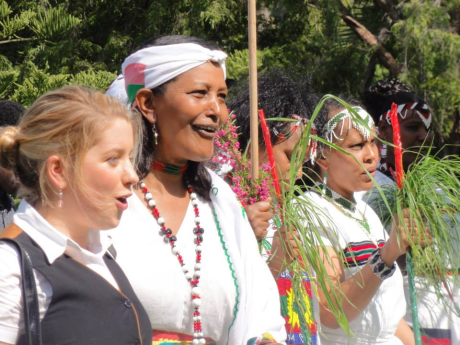

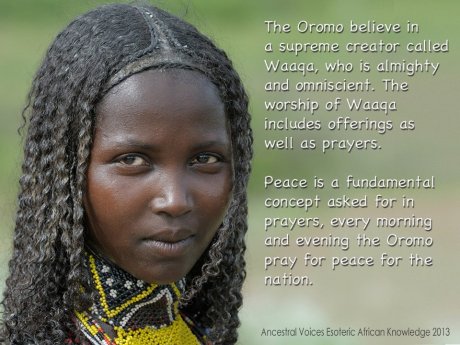


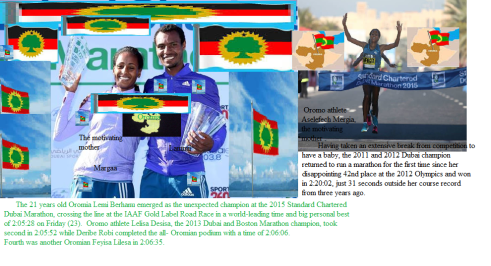


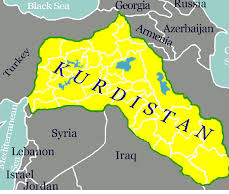



 He will also participate as a Guest of Honor at several Irreecha celebrations organized by the Oromo in the Diaspora.We invite all who are interested in the Gadaa democratic system, and Oromo culture in general, to attend these workshops and participate in the spectacular Irreecha celebrations to be held throughout September and October 2014.We would like to extend our appreciation to local individuals and institutions – who participated in preparing these events. We are also grateful to the United States Consular Service for the assistance they provided in issuing Abbaa Gadaa Bayyanaa’s travel documents.The attached flyer contains general information about dates and cities where Abbaa GadaaBayyanaa will be speaking.Jawar Mohammed President, Oromo Studies Association


 Annual Oromo Sports Event in UK, 23rd August 2014 held in Leeds, England.


 The Oromo Gadaa Democracy meets the American Congress Democracy. Abbaa Gadaa (Rt.) Aagaa Xanxanoo and Abbaa Gadaa (Rt.) Moonaa Godaanaa meet Senator Al Franken (from the State of Minnesota).


 (July 20, 2014 (Gadaa) — Minnesota’s Twin Cities, also known as “Little Oromia” for being the home of the largest Oromo population outside of the Horn of Africa, will be the venue for the 2014

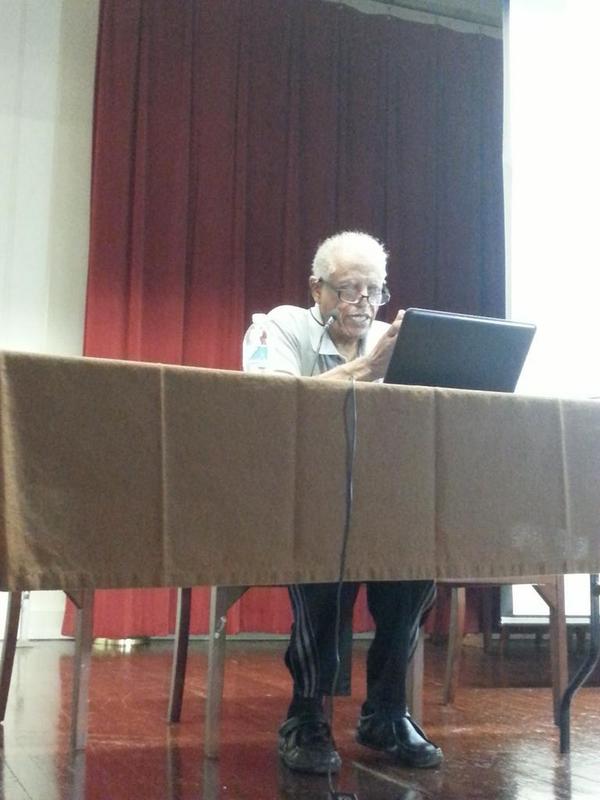
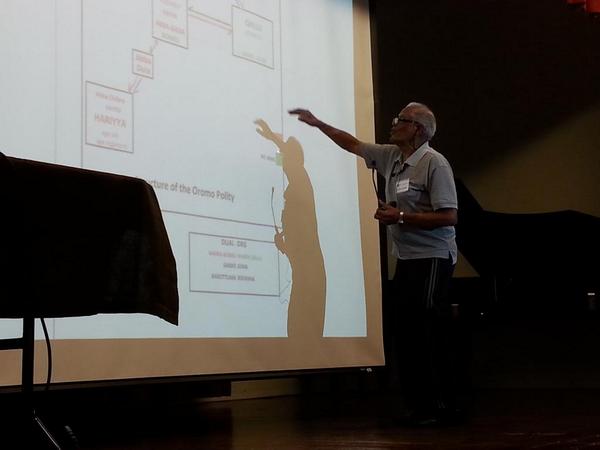 Prof. Asmerom Leggese, Lecturing Gadaa System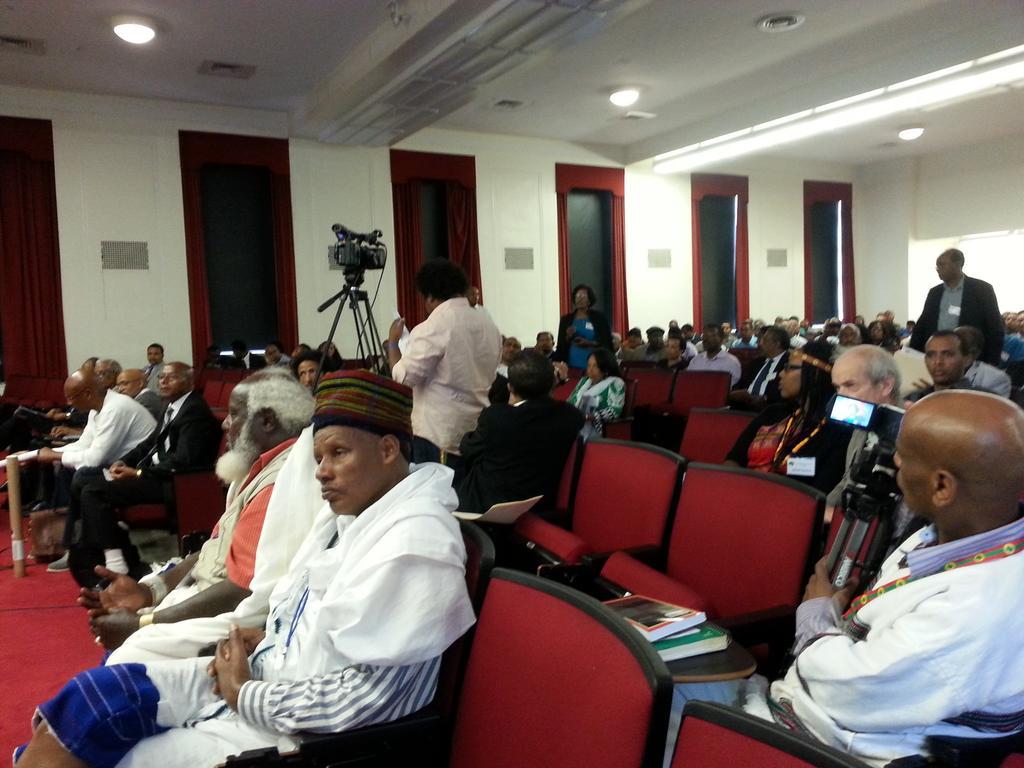
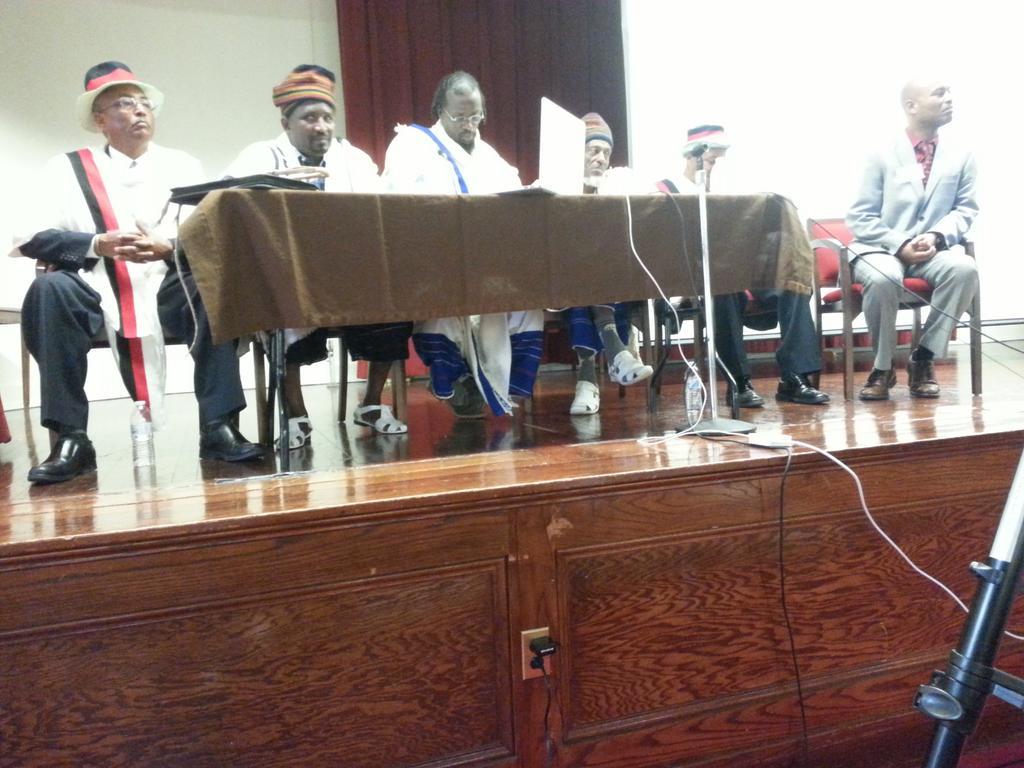


 The Oromo Abbaa Gadaa -Abbaa Gadaa of Tuulama Oromo, two Yubas (EX-AbbaGadaas-Aagaa Xinxanoo and Moonaa Godaanaa) with other Gadaa leaders arrived in DC on 30 July 2014 to attend the OSA Conference


 Below is Bakkalcha TV’s 2-part interview with Oromo recording artist Lencho Abdishakur. Also, check out Lencho Abdishakur’s new album, titled


 Historically, the Raya Wollo (Raya Oromo), with the Yejju Oromo, are the northernmost groups of the Oromo people and are a part of the Wollo Oromo Tribe. Their women especially are known by their distinctive hair-braiding styles and facial tattoos.


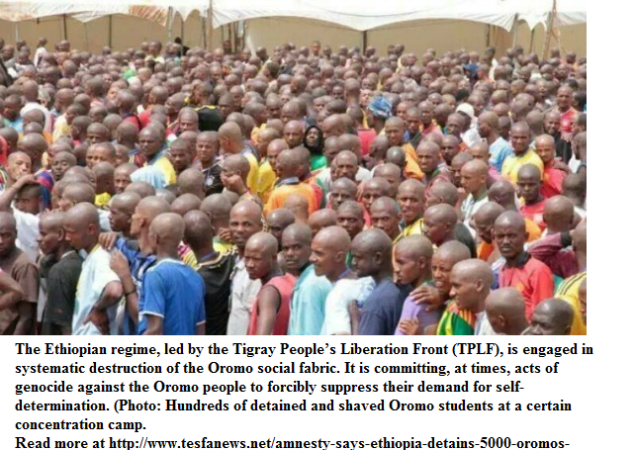





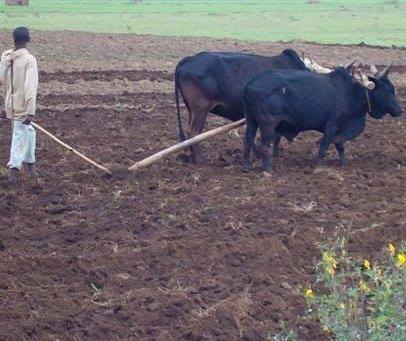
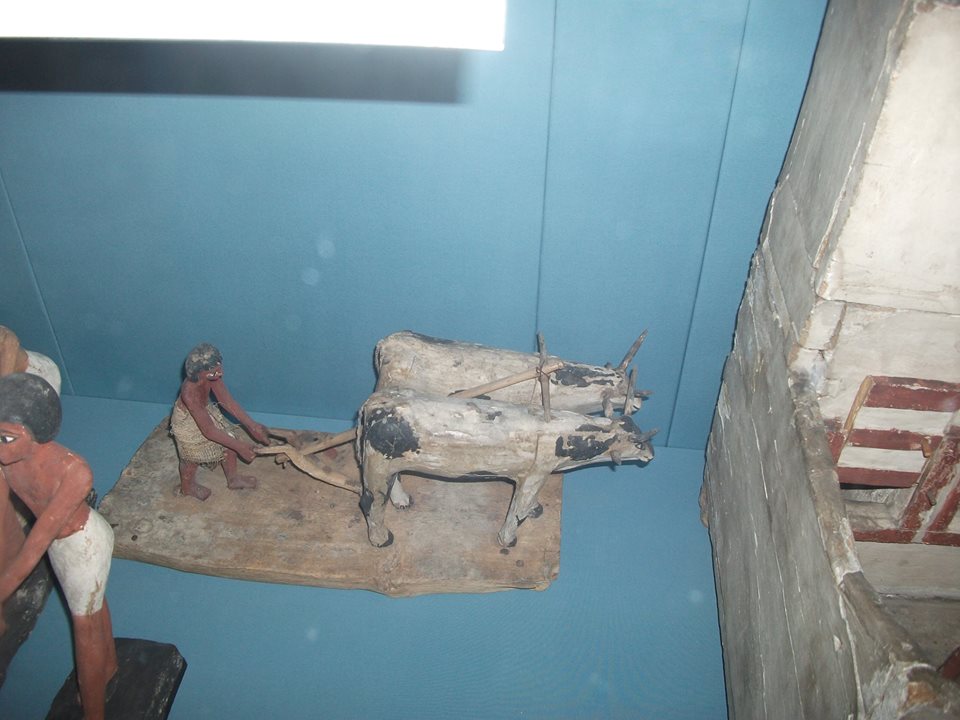


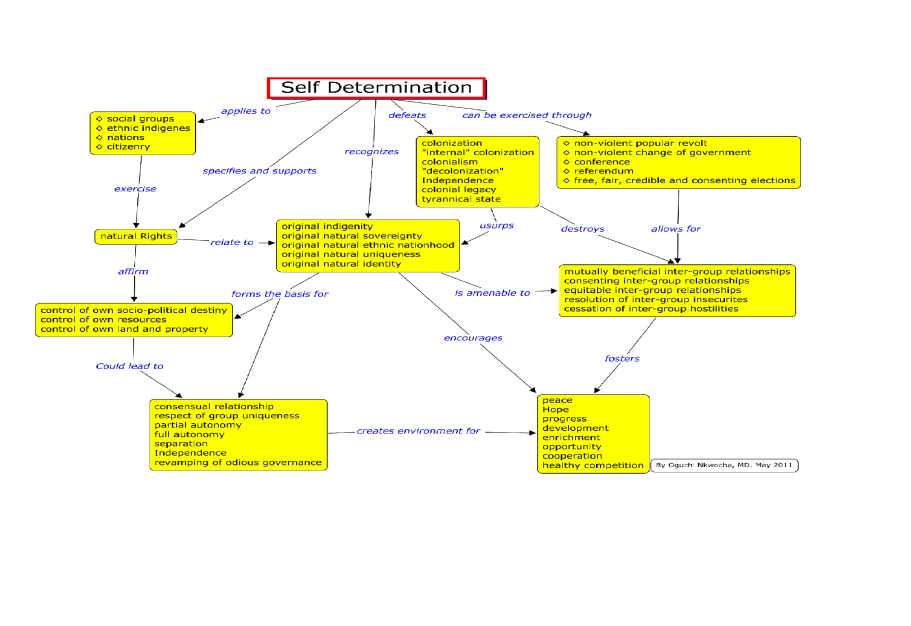


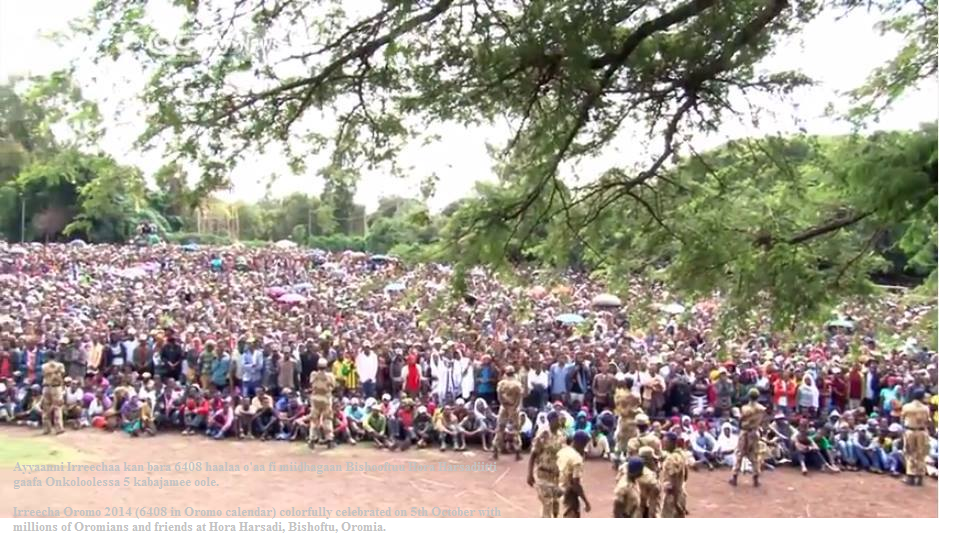


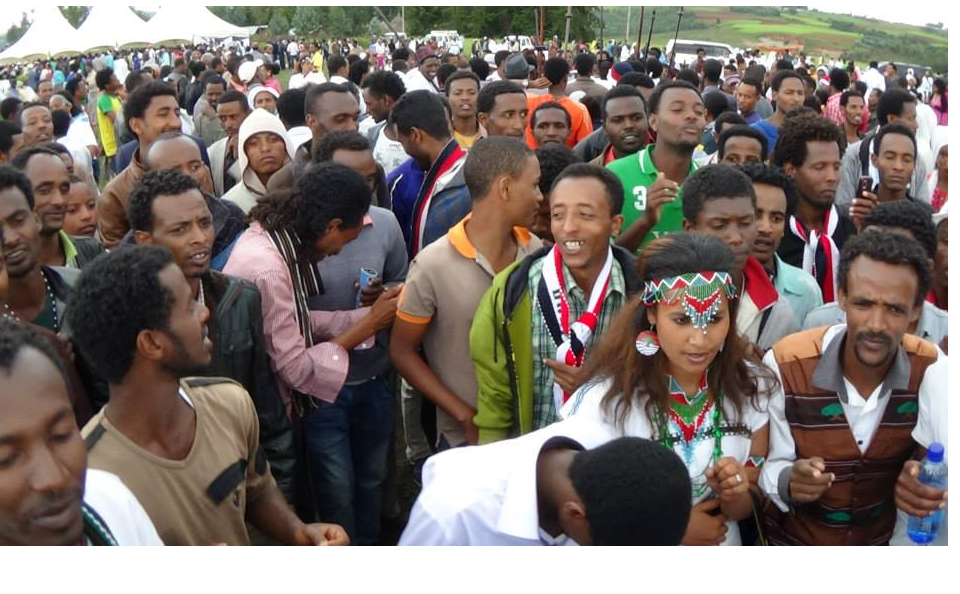

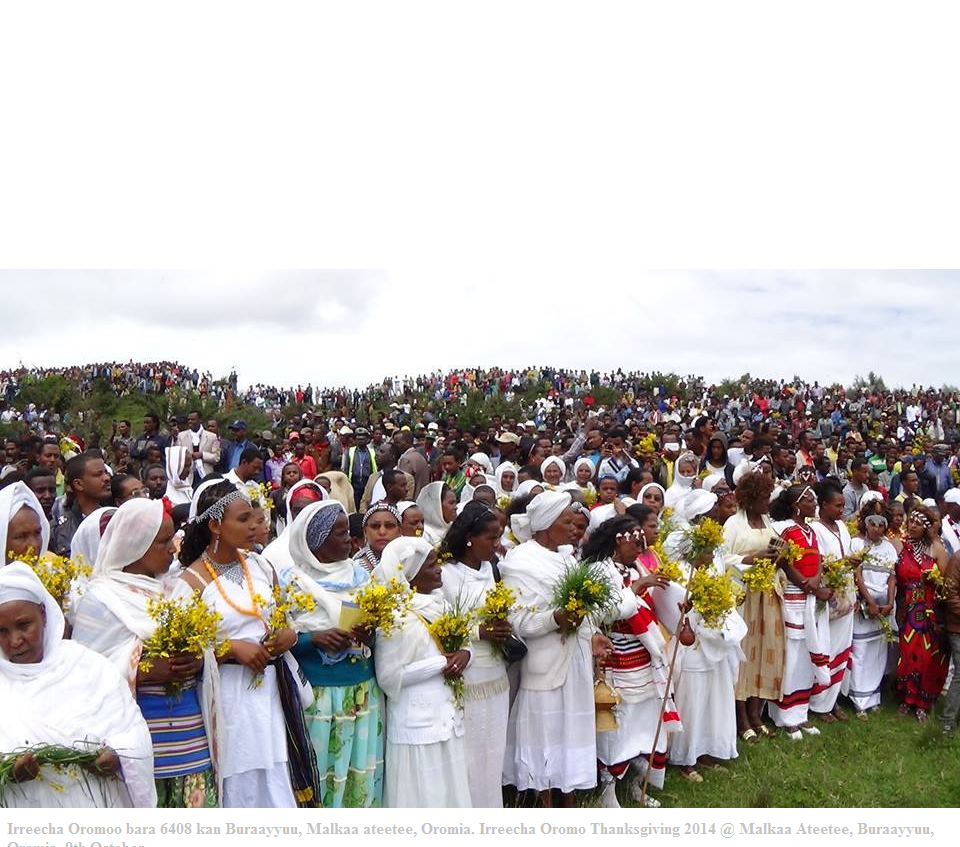
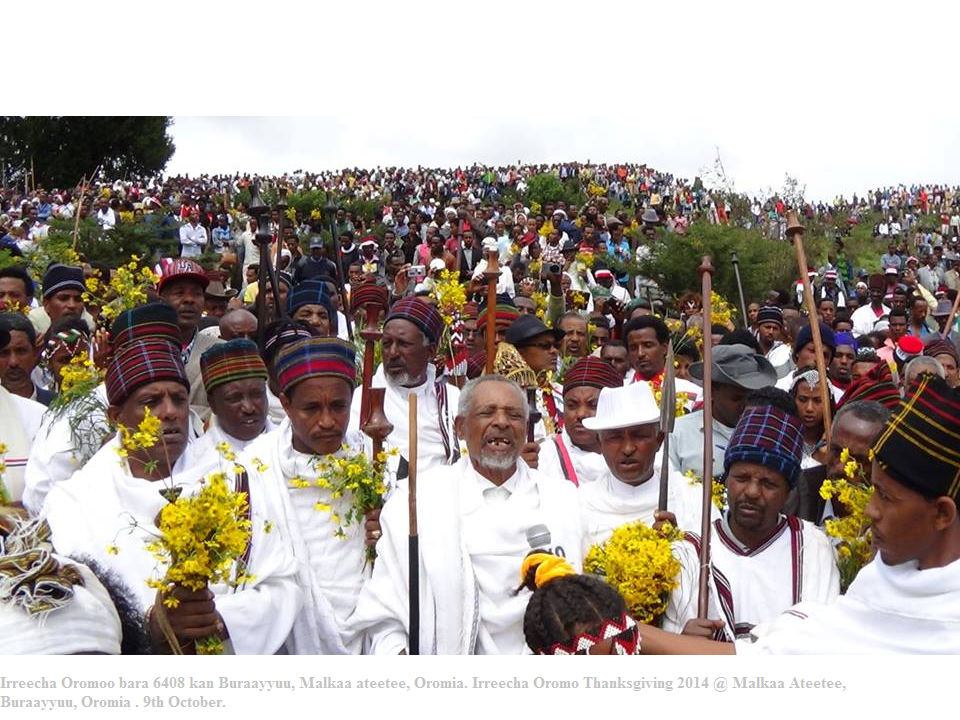

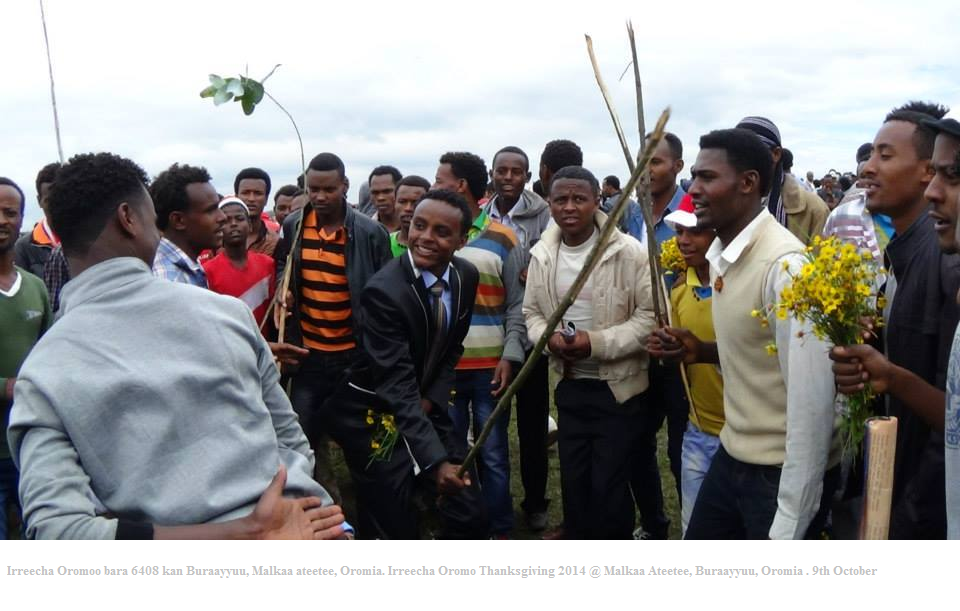

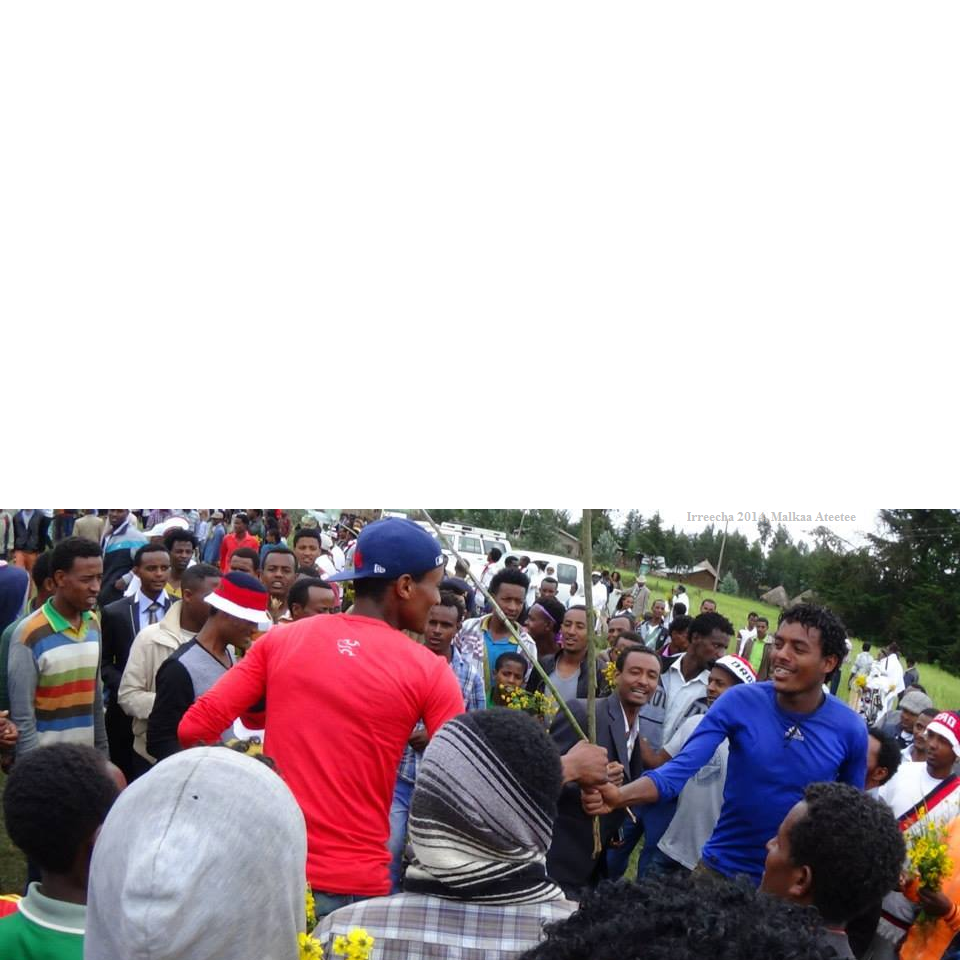
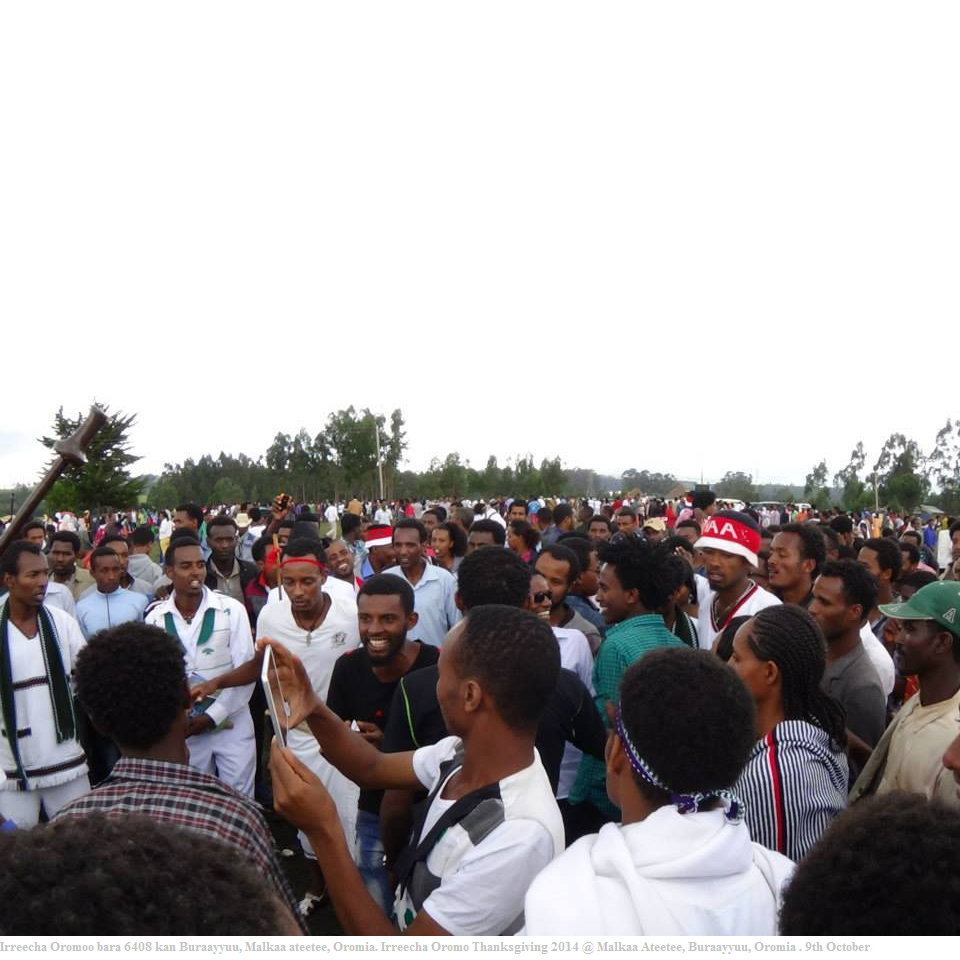


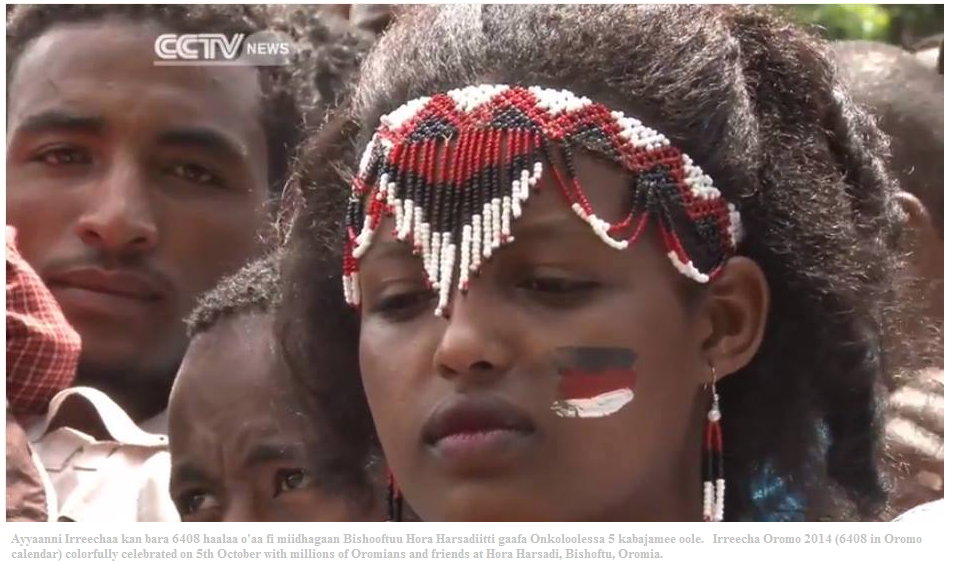

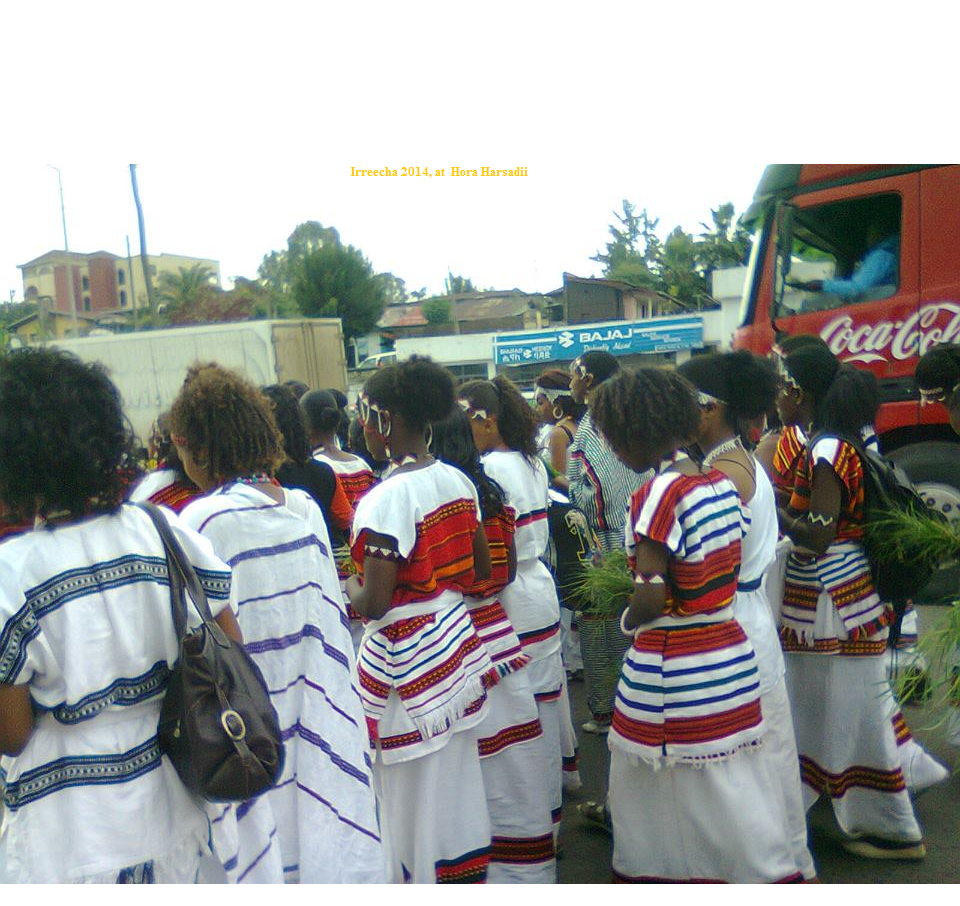
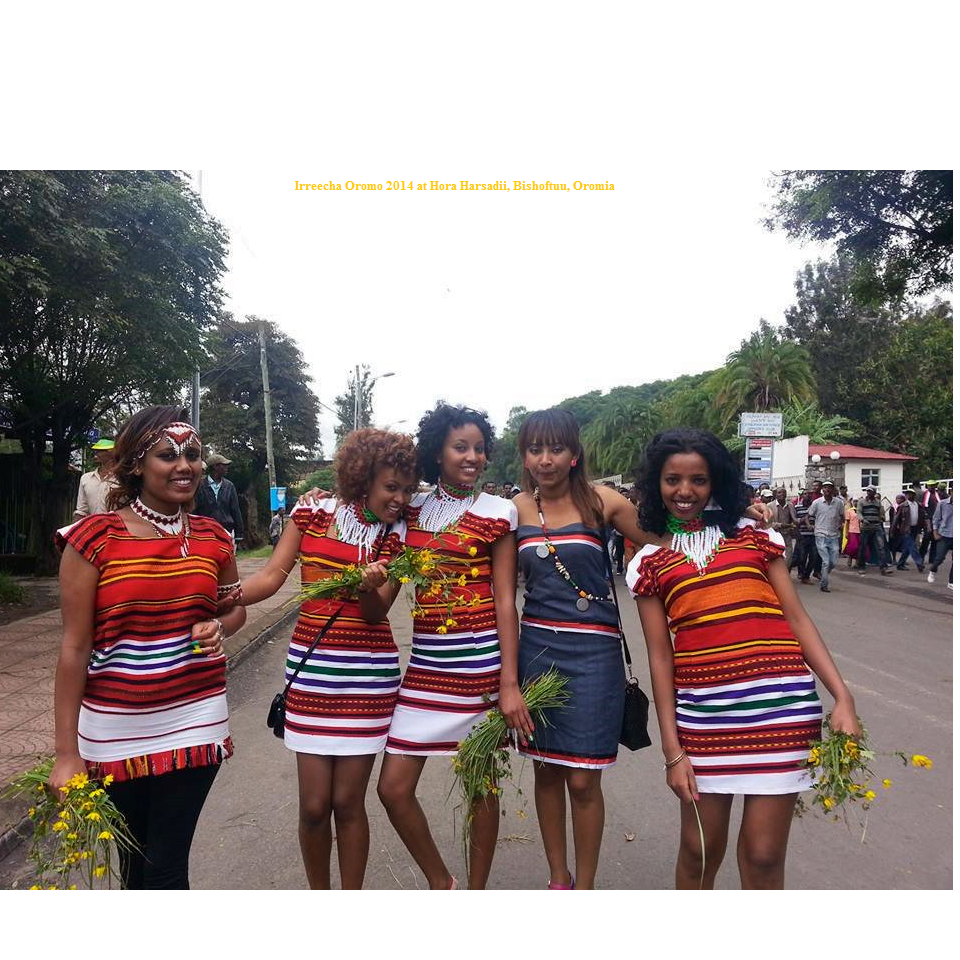
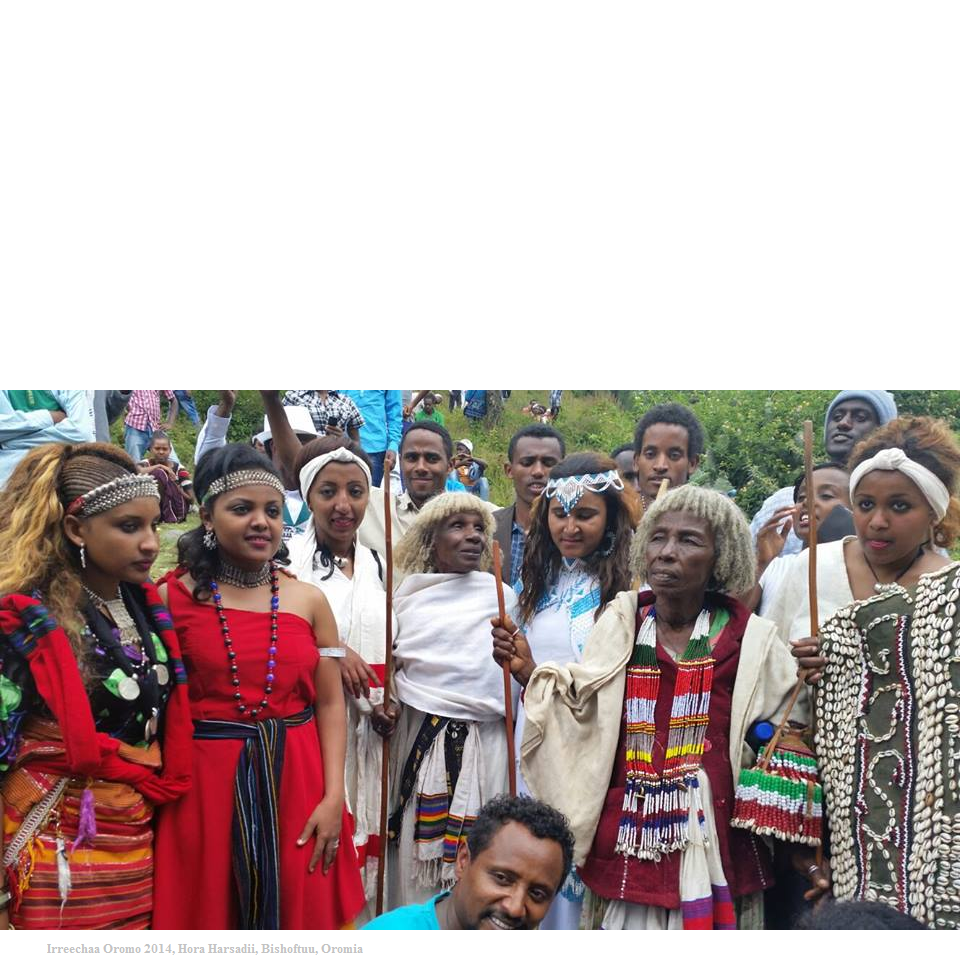


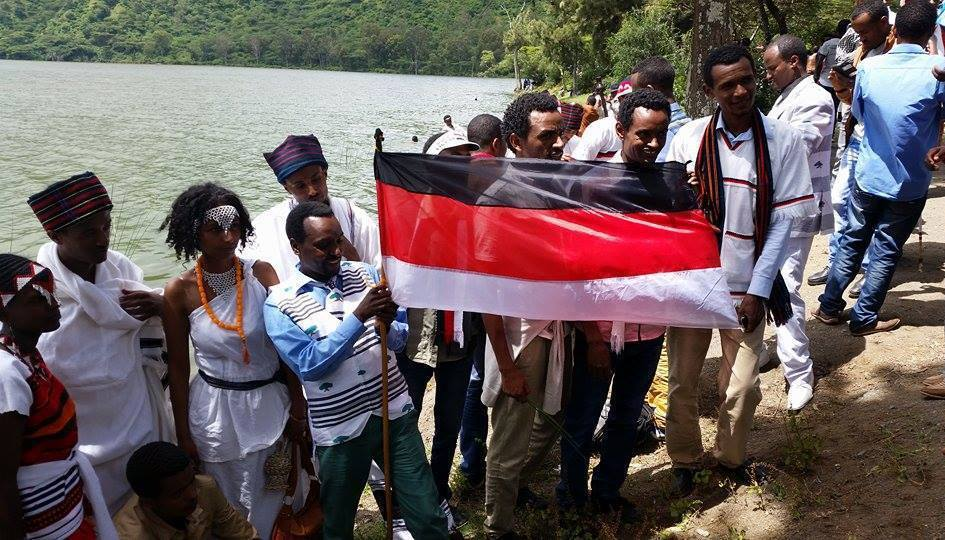

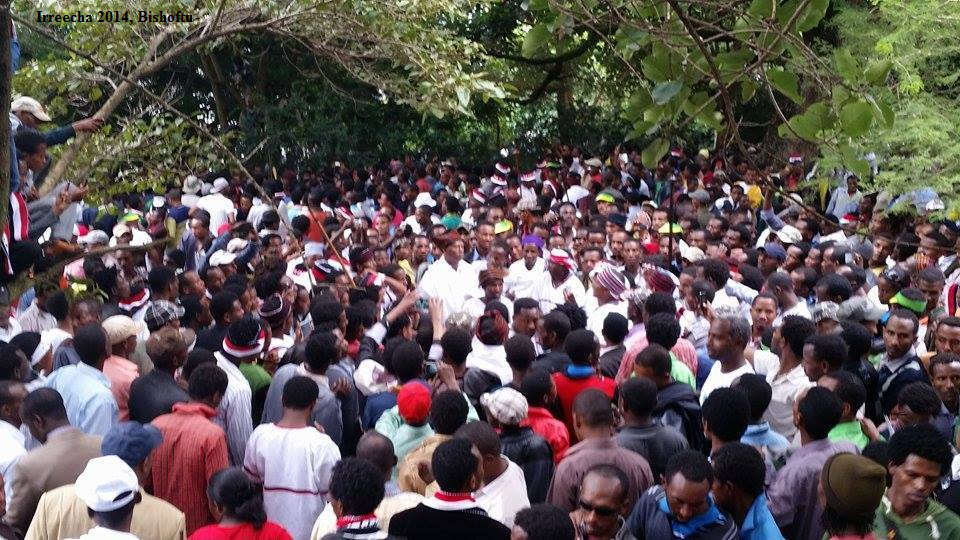
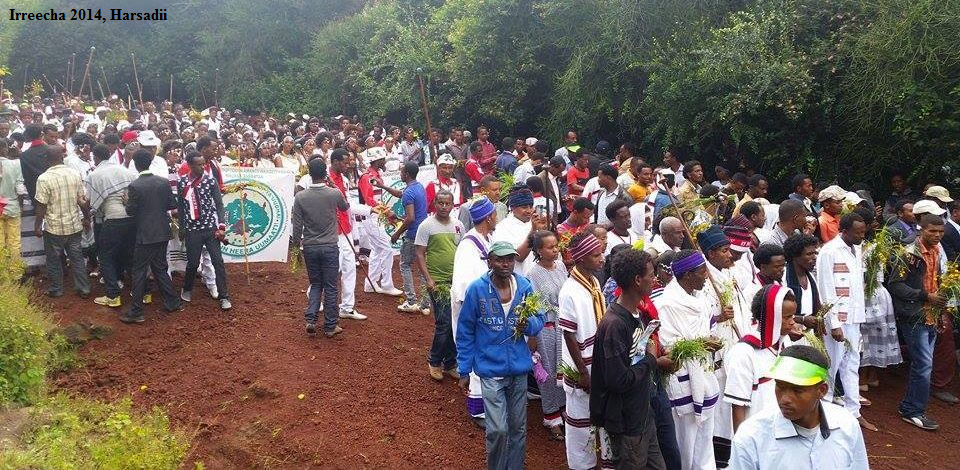

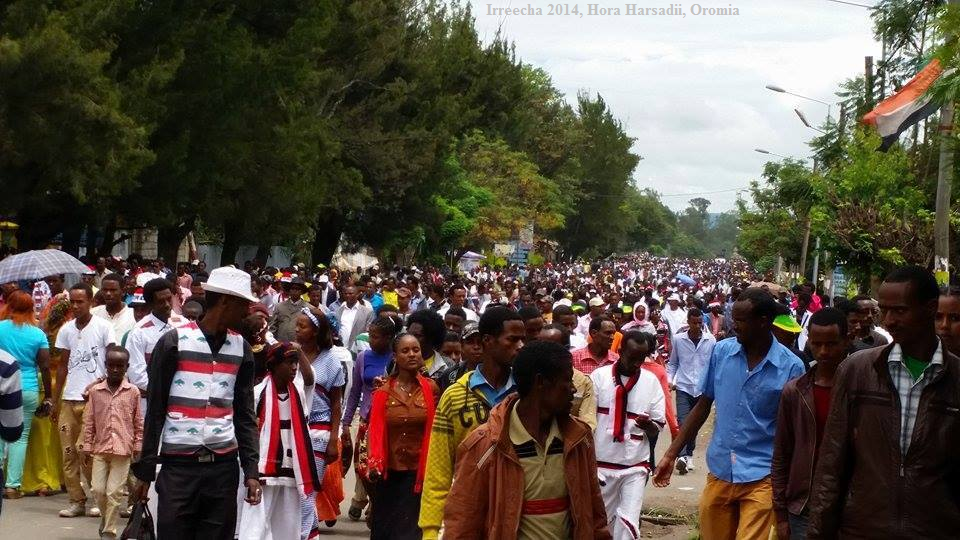
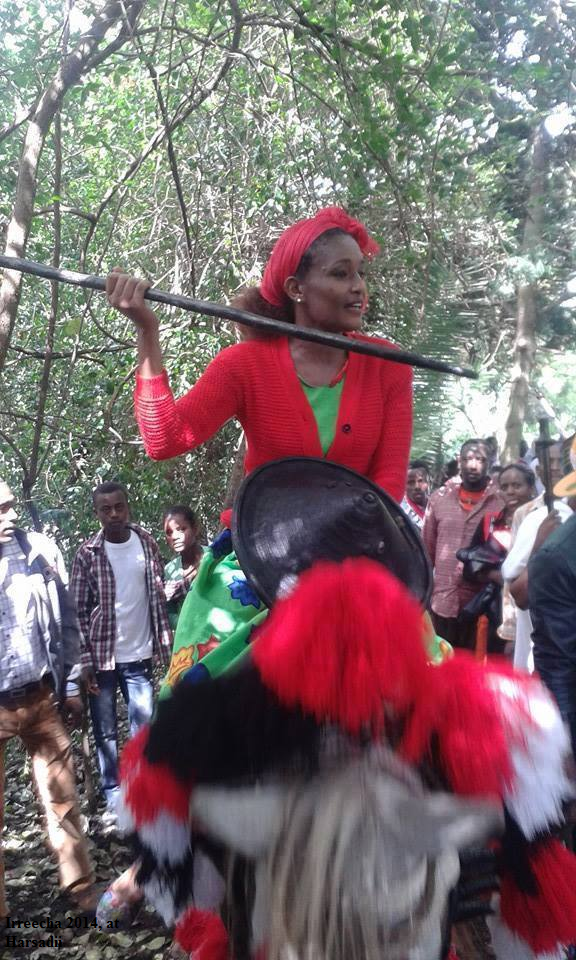
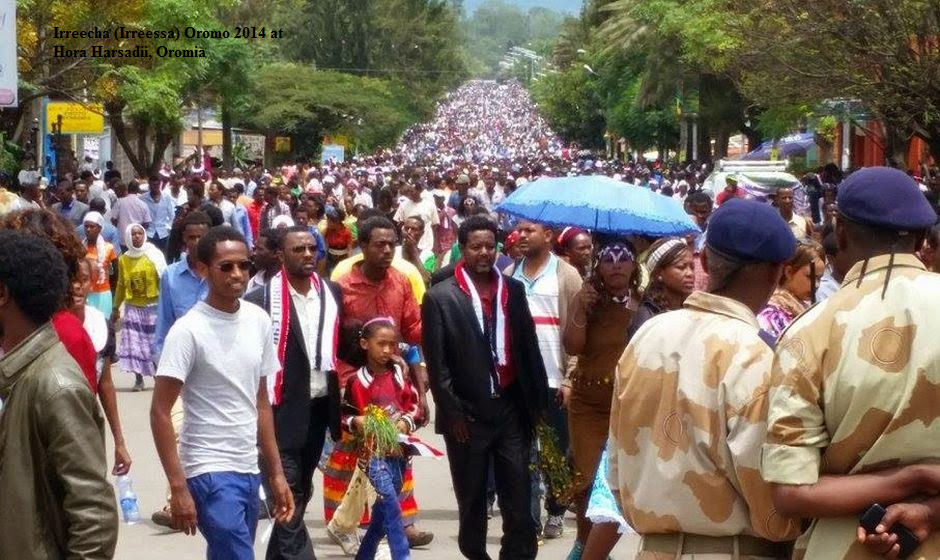
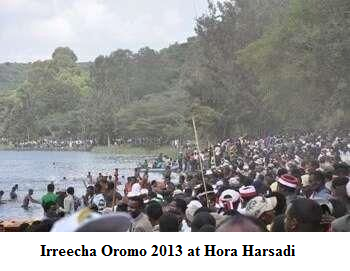
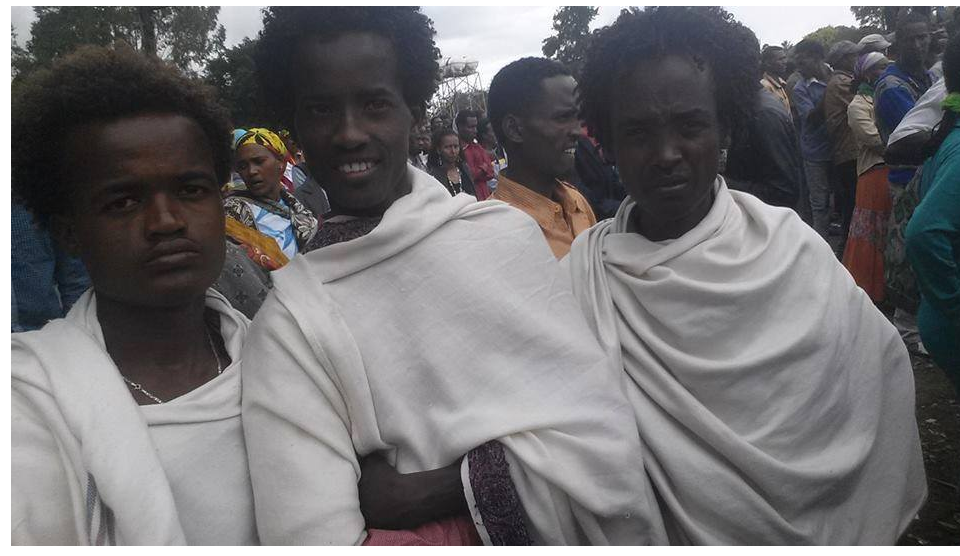
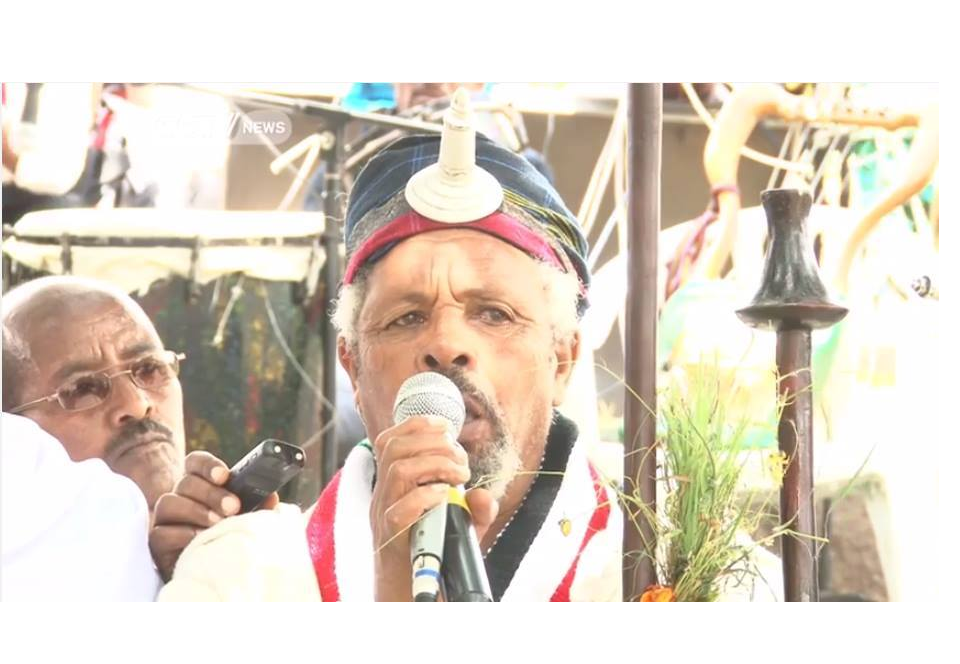


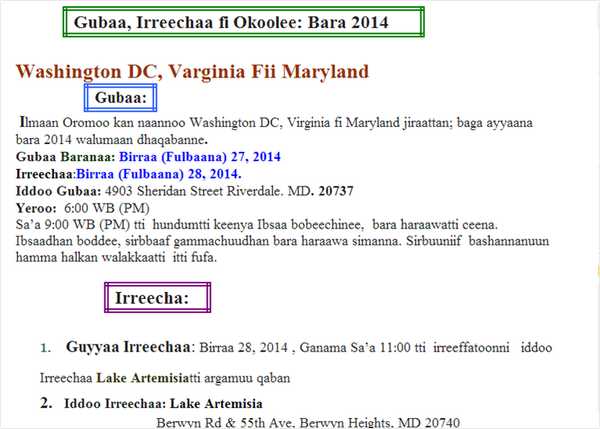


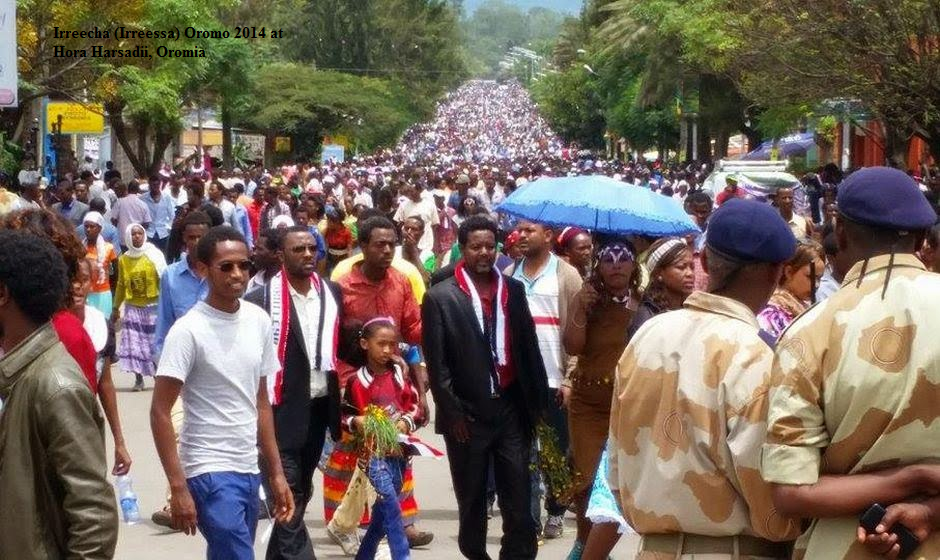


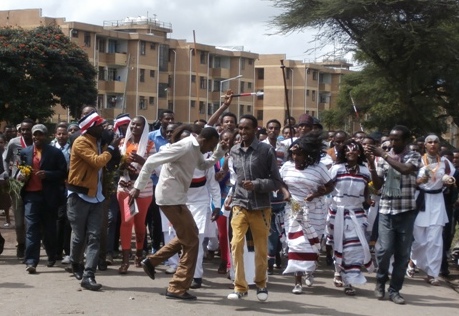


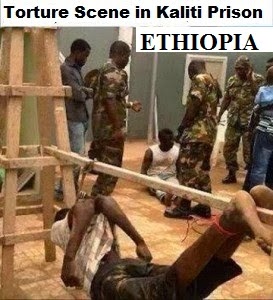

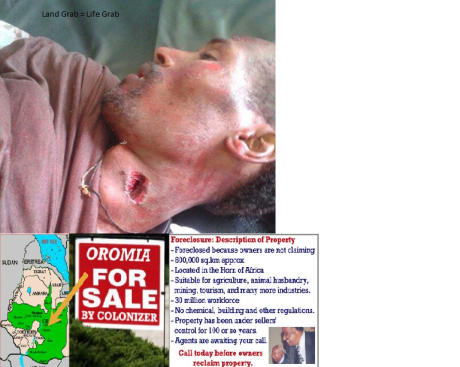


 Oromian Economist
You must be logged in to post a comment.