Economic and development analysis: Perspectives on economics, society, development, freedom & social justice. Leading issues in Oromo, Oromia, Africa & world affairs. Oromo News. African News. world News. Views. Formerly Oromia Quarterly
TPLF regime has created deadly conflict between Somali and Oromo nations in Ethiopia. Hundreds of innocent civilians have been reported dead and many others have been displaced.
The cause of the conflict is not about land dispute as the regime and its puppet administrations claim.
The TPLF regime in Addis Ababa has been working to instigate violence and hostility between the two fraternal nations by using the puppet administrations in Somali and Oromo regions. The purpose of this action is to weaken the struggle of these nations and to divert them from their strategic goals.
The regime in Addis Ababa is well known for creating conflicts and hostilities between nations in order to redirect the attacks from freedom and democratic organisations and diminish the effects of the countrywide people’s uprising against the minority TPLF regime.
Somali and Oromo nations are under TPLF rule and they fight for their rights, they have a long history of cooperation and coexistence. Therefore, both nations are reminded to understand that this violence has been instigated by the TPLF regime to thwart their struggles to achieve their goals and thus, to sabotage the popular uprising in many parts of Ethiopia.
Therefore, ONLF calls upon Somali and Oromo nations to stop immediately this hostility between them and to respect each other and live peacefully side by side as they used to be for centuries.
ONLF also calls upon political organisations, civil society organisations and intellectuals of both nations which are against the divide and rule policy of TPLF to work hard toward easing of the fighting and the hostility.
ONLF strongly condemns the Ethiopian government for creating hostility between neighbourly nations and calls upon the international community to make the TPLF regime accountable for war crimes and the crimes against humanity.
Relief support for people affected in ongoing conflicts in the border areas between the Oromia and Somali Regions of Ethiopia., which has caused the death of many people, and the displacement of thousands in east, south and South East Ethiopia.
Your donation will help the displaced and those who lives were adversely affected by the death of income earners of a family, through HIRPHA International.
HIRPHA International is Oromo humanitarian organization incorporated in the Sate of Minneapolis, Minnesota.
Thousands of Oromo are displaced from their homes in eastern Ethiopia
Liyat Fekade
Addis Abeba, September 13/2017 – Increasing numbers of civilian casualties due to military actions in parts of east, south and south east Ethiopia over the last weeks has now led to fresh protests, more deaths and displacements in several places in eastern Ethiopia.
On the other hand, federal and regional authorities have gone from denial to pointing fingers at one another to explain the root cause of what is visibly becoming an alarming breach of peace and stability in many areas bordering the Oromia and Somali regional states.
In the past few months, Addis Standard has been reporting on several incidents of raids by armed men who casually cross from the Somali regional state to villages and towns under the administrative jurisdiction of the Oromia regional state.
Addis Standard interviewed local residents in several towns and villages, including Chinakson, Mieso, Deder and Gursum in east and west Hararghe; Moyale, Liben and Gumii Edelo in Guji Zone in southern Ethiopia; as well as in Sewena, Meda Wolabu and Dawe Serer woredas (district zones) in Bale, south east Ethiopia, on several occasions since March 2017. Almost all the people interviewed say armed men who are members of the “Liyu police” force were often the culprits of cross border raids that ends in the death of civilians.
Contentious border issues
The boundary between the two neighboring regional states has been a hotly contested affair since Ethiopia became a federal state in 1995. In Oct. 2004 the two regions have conducted a border referendum, which was held to determine the residents’ choice for administrative status of villages and towns located adjacent the two regional states.
The referendum was conducted in 420 Kebeles located in 12 different Woredas across five zones of the Somali Regional state. According to the official results of the referendum, residents in close to 80% of the disputed areas have voted to be under the administration of the Oromia regional state. But claims alleging voting irregularities persist. And subsequent ethnic conflicts have led to the displacement in late 2004 and early 2005 of more than 80,000 people on both sides.
Although clashes of various degrees, particularly between the Borana Oromo and the Garii communities (often triggered by meager resources, such as shortage of water and pasture where available,) have remained the hallmark between the two communities in Moyale and its environs, locals in various places claim cross border raids by armed men became much more frequent and have contributed in fueling these conflicts, especially after the establishment of the “Liyu Police” in April 2007.
In March 2017, as attacks against civilians intensified and were solely blamed on border disputes, Addisu Arega Kitessa, head of the Oromia government communication affairs office, said the result of the referendum were “final” and will not be altered. Addisu also blamed the “raids by armed men” as economic in nature. “After attacking the areas, these armed militiamen engage in looting of properties.”
And in April 2017 Abdi Mohamud Omar, a.k.a, Abdi Illey, and Lemma Megerssa, presidents of Somali and Oromia regional states respectively, have signed an agreement to end “border hostilities”. Three months later on August 19, the Oromia regional state said that as part of that agreement, of the 68 contested towns and villages between the two regions, 48 were returned to be under the administration of the Oromia regional state. And that “border issues were resolved and peace was restored.”
Recent escalation
As of late however, the somewhat sporadic military raids due to border and economic issues and have not only intensified but took a different shape.
Usman Omar, one of the eight local elders who traveled to Addis Abeba from East Hararghe Zone, Gursum Woreda to file complaints at the federal house of federation warned in an exclusive interview with Addis Standard that “the situation in the region [was] very bad…we have been under the Oromia Regional state since the 2004 border referendum [because] we [chose] to but we are forced to pay a heavy sacrifice for that.” By the time the elders were in Addis Abeba looking for answers, an attack by armed men has left seven civilians dead in Chinakson in east Hararghe and its environs. Chinakson has always been under the Oromia regional state and local residents do not believe the attack was motivated by a “non-existing border conflict.”
Blames, more deaths, displacement and protests
Residents in all these areas who either contacted or were interviewed by Addis Standard speak in unison and anger regarding the role of the “Liyu police” in fueling the conflict. However, despite growing pressures both from the residents and online Oromo activists, officials from the Oromia regional state have refrained from pointing fingers at this paramilitary elite force, until Tuesday September 12 that is.
On Monday September 11, Selama Mohammed, Gursum woreda administrator, and Mohammed Abdurahman, former security affairs deputy head of Deder town in east Hararghe, as well as a Tajudin Jamal, a member of the Oromia police in Harar, were taken from their car while en route to Harar from Jijiga, the capital of the Somali regional state. According to the locals, they were taken to a police station by members of the Somali police force together with “Liyu police”. Selama Mohammed and Tajudin Jamal were found dead in Bombas, half way between Harar and Jijiga, while Mohammed Abdurahman got hurt while escaping. He is now admitted to Dil Chora referral hospital in Dire Dawa.
The incident triggered mass protests in several cities on Tuesday, the sternest being in Deder and Gursum, the later where Selama Mohammed and Tajudin Jamal were known by the locals as “men of the people”, according to Abdi Dulee Mohammad, a resident of the town who spoke to Addis Standard by phone. Protesters were chanting “down, down Woyane,” the Tigriyna term used to refer to TPLF, the all too powerful member of Ethiopia’s ruling party EPRDF. “The young people who went out to the streets to protest know that “Liyu Police” is the creation of TPLF as a gift to Abdi Illey. We all know that,” Abdi Dulee said.
According to Abdi Dulee, the locals have increasingly become resentful of the extrajudicial stretch by members of the “Liyu Police.” “Sometimes girls as young as 12 are taken by these men even in peace times,” he said, “there is a lot of anger and no peace will come unless they are removed.”
The “Liyu police” was created in 2008 to operate in the Somali Regional State (SRS) which had its own regular police force of its own. Its creation preceded an attack in 2007 by the Ogaden National Liberation Army (ONLA), the armed wing of the Ogaden National Liberation Front (ONLF) in a Chinese oil field that killed 74 members of the federal army and nine Chinese engineers.
(ED’s Note: For more on the dynamics involving the role of “Liyu Police”, please read this analysis published on Addis Standard as part of our continuous coverage).
But, the role of the “Liyu police” came to another twist when online activists posted an ID card of a captured armed man called Shune Kherow Abdi, who is described on the ID as a member of the National Army of the neighboring Republic of Somalia. The information was later on confirmed by Addisu Arega Kitessa, head of the Oromia government communication affairs office, who posted the ID with short note saying that the person is indeed a member of the Somalia National Army.
“This incident not only complicates matters but also calls for a careful reading of the dynamics of the conflict in the area that involves more than 1000 km shared border between the two regional states in Ethiopia,” said a political science professor at the Addis Abeba University (AAU), who wants to remain anonymous. According to him, the creation of “Liyu Police” has “outlived its purpose, if there were any. It is time the federal government revisits the presence of such police force in the region not only because members of the “Liyu Police” are repeatedly accused of rights violations previously in Ogaden and now in Oromia, but also because of the regional dynamics and Ethiopia’s relationship with the neighboring Somalia.”
Blames and counter blames
Officials from the Somali regional state do not only loath allowing access to mainstream media but also maintain a habit of selectively granting access to pro-government journalists, bloggers and commentators to disseminate choreographed information. Our repeated attempt to get interviews in the past two weeks bore no result so far.
But on Tuesday Sep. 12, the VOA Amharic held a rare interview with Edris Ismael Abdi, head of the Somali regional state Communication Bureau. What he said during the interview gave many a chill.
Edris Ismael Abdi was not only willing to provide adequate response to the questions, but threw alarming accusations of mass killings and torching of villages orchestrated by what he claimed were members of the Oromo Liberation Front (OLF) in coordination with officials of the Oromia regional state and Oromo online activists, particularly Jawar Mohammed. Edris also personally criticized Addisu Arega Kitessa of partnering with OLF and Jawar to “destabilize Ethiopia”. He also accused Addisu of “forging evidence” in reference to the ID card; and went on to accuse the Oromia regional state of being staffed by “officials who sympathize with OLF’s ideology.”
However, Edris’s tirade fell flat when asked if he was willing to provide solid evidence. “I don’t have it compiled at the moment,” he said, but insisted “their deeds bear witness.” He also said he can provide evidence of captured rebels who were held under police custody.
Addisu on his part countered the statement from Edris and spoke about the “negative role” being played by members of the “Liyu Police.” This was the first time Addisu spoke of the involvement by the “Liyu police”. “What is happening is not what Edris said was happening. Members of the “Liyu police” are crossing over to villages under the administration of the Oromia regional state and are attacking civilians. The people are witnesses for this.” He also denied that there were areas where the OLF was active. “We are conducting investigations and are compiling a detailed report which will be released in the near future.”
Addisu further explained about the progress of redrawing contested areas, which were the sources of previous conflicts. Later on, he wrote on his Facebook page with a link to the VOA interview and said: “It’s surprising to hear my friend Edris Ismael Abdi…is trying to defend Shune Kherow Abdi, a soldier from Somalia Republic captured in Moyale while killing innocent people. I hope this irresponsible statement is not an official statement from Somali National Regional State Government. It rather seems Edris Ismael’s personal opinion.”
But on Wednesday September 13, the Somali Regional state communication affairs bureau proved Addisu wrong when they posted on their official Facebook page a contemptuous statement accusing the Oromia regional state of having direct links with the OLF, an organization labeled by the federal government as a terrorist organization.
“This is a troubling turn of event”, said our interviewee from the AAU, who has written several academic papers on the fault lines of Ethiopia’s federalism. “Whoever did that knows that this is an accusation the federal government will not take lightly given past experiences. They know that every Oromo dissenting voice within the country has been dealt a severe blow in the pretext of membership to OLF. So, if you are not concerned by this turn of event so far, you should now.”
Today afternoon, Addisu issued his response in his personal Facebook page in which he expressed his frustrations about, among others, the use of poor and inflammatory language in the statement from the Somali regional state, which “helps nothing but further fuel the situation.”
More death and displacement
Protests have taken place in several cities in eastern Hararghe yesterday and to a lesser extent today. Although reports indicate of heavy causalities, the exact numbers are hard to come by. According to Addisu, 18 people – 12 from Somali and 6 from the Oromo ethnic groups – were killed in just one day yesterday during a protest by angry local residents in Awoday, a commercial city in eastern Hararghe. The protesters took to the street after news of the killing of Selama Mohammed and Tajudin Jamal came out, according to Addisu. Some 200 suspects were placed under police custody.
On Friday September 01 residents of Mieso town, west Hararghe zone, took matters into their own hands and engaged in a daylong fighting with members of the “Liyu Police”. The clash left “more than 30 people”, including “more than a dozen army members”, dead and several others injured. “We couldn’t take the killings our men, the raping of our girls and the lootings of our cattle by bandits openly supported by the Liyu Police,” wrote Abdulatif Kererro, a resident of the town in a message sent to Addis Standard.
As chain of similar events followed, a fighting between local residents and what they continued insisting were members of the “Liyu police” quickly spread to the south and south eastern Ethiopia and has claimed unknown numbers of lives.
The youth in Moyale town of Guji zone, 795 km south of Addis Abeba, have come out en mass to fight against the taking of “our holy sites,” according to one resident. “For example, Gofa and Ia’ee are among our nine Tulas (deep wells) taken by the Garee community – a Somali pastoralist clan.” According to him, the taking over of these areas were not entirely driven by the Garee, “who lived alongside us for generations and, who, despite occasional competition for resource, never touched our sacred places,” rather, he says, it was “orchestrated and supported by the “Liyu police” and members of militia belonging to the Somali regional state for sheer reason of capitalizing on chaos.” Relative calm has returned since the last “three days,” he said.
But one cannot say the same about eastern Ethiopia. Yesterday, around 600 ethnic Oromo residents of Tog Wajale (Wachale) in eastern Ethiopia towards the border with the Republic of Somalia, as well as hundreds from Jijiga town, the capital of the Somali regional state, were forced to flee their homes. Some have made it to Harar while others are arriving in several places such as Gursum in east Hararghe to take refugee.
The displacement has continued throughout today with some of the displaced telling disturbing stories of mutilation and killing of a woman and detention of men, according to DW Amharic.
The federal government has deployed members of the federal army in parts of eastern and western Hararghe as well as Jijiga. But the displacement has continued with thousands more said to have already been on the road.
Our interviewee from the AAU concurs with the decision by the federal government to send federal army members, but he is critical of the “root cause of the problem, which is the presence of a special force in a fragile region and the hope that it will serve as checks and balances – it is delusional. You cannot maintain peace and stability by a proxy force which operates in impunity.”
Other Ethiopians have taken to Facebook to denounce the special elite force. “The Ethiopian government can no longer justify the continued existence of the paramilitary force called ‘Liyu Police,’” wrote Awol Kassim Allo, a lecturer of law at Keele University. “There can be no legitimate reason for a country that plays an active part in regional and global peacekeeping operations to keep its own peace with a notorious paramilitary force known for its lethal ferocity.”
Although many, including Abdi Dulee and the professor from AAU, agree that removing the “Liyu Polcie’ may be the solution, other critiques are skeptical of the federal government’s willingness to do just that. “The federal government instigated the conflict to compromise Lemma [Megerssa], divert attention and consolidate the minority coalition,” wrote one such critique in a message. “The escalation would legitimize the federal government’s intervention in the person of Samora Yenus, [the federal army chief]. This would discredit OPDO, emboldens the military and equates Oromia, the biggest and largest national state with an aspiration to be a mainstream political force with Ethiopian Somali state, Ethiopia’s Chechnya.” He said he believed the federal government was “behind the escalation and the calculated neglect of the crisis.”
On Friday September 08, during a New Year press conference, Dr. Negeri Lencho, head of the federal communication affairs bureau, admitted that “there were other forces” operating in some parts within the two regional states. “We have information that recently lives were lost in some areas due to fresh conflicts. These fresh conflicts have nothing to do with border issues between the two regional states. Our information is that officials from both regional states are working on implementing to resolve the border issues. However, there are some instigation by some forces assigned by unknown actors,” Dr. Negeri said. He also said the federal government has placed the situation “under control.” But events in eastern Ethiopia until the publishing of this article prove him wrong. AS
Liyu police-a paramilitary force trainer with British tax payers money waging war on civilians and creating turmoil in Ethiopia. @BBCAfricapic.twitter.com/1aNG65Bz9Y
The Dictatorial and Predatory Ethiopian TPLF Regime Will Never Succeed in Instigating Conflicts Between The Sisterly Oromo And Sidama Nations!
SNLF Press Release, 12 September 2017
The predatory Tigre Ethiopian Empire is crumbling from within and without. It is destroying itself from endemic economic and political corruption from within. The demise of the brutal regime is precipitated from without by the mass uprising of the majority Oromo nation who are demanding an end to the over a century of political and economic marginalization, and restoration of freedom, justice and self-rule in their vast Oromia land. The Oromo uprising has been continuing since 2015.
Instead of answering the legitimate question of the Oromo nation by granting them their inalienable democratic rights to self-determination, the TPLF regime embarked on desperate measures to cling onto illegitimate political power. It has also monopolised the economic aspects of the entire country. The political aspects in Oromia alone included, brutal massacre of over 1,500 peaceful Oromo protesters since 2015; mass imprisonment of over 60,000 Oromo civilians; imprisonments of the entire leadership of the Oromo Federalist Congress including the renowned Professor of Political Science, Marara Gudina and prominent politician, Bekele Gerba, as well as a dozen Sidama political activists including a prominent business person, Solomon Naayu, and Dawassa Daaka, most of whom are languishing in Qilinxo prison today.
When the regime realized its genocidal measures were insufficient to quell the mass uprising engulfing the entire country, it resorted to yet other barbaric measures of divide and rule among the sisterly oppressed nations. First, the TPLF trained, armed, aided and abetted the Somali militia to attack the innocent Oromo civilians causing death of hundreds of our Oromo brothers and sisters and destruction of properties since 2016. Using a mercenary puppet Ogadeni Somali regional renegade leader, the TPLF regime continues to relentlessly instigate conflicts between the two sisterly Ogadeni Somali and the Oromo nations as we speak. The TPLF regime is also perpetrating similar crime by mobilising a similarly downtrodden Gambella civilians to fight the Oromo nation.
Moreover, having failed to stir conflict between the Sidama and Oromo nations, the TPLF recently attempted to ignite instability in the border between the Sidama and Wolayita nations. The regime attempted to sow discord between the two nations over the 6 disputed villages (Kebeles) where the Sidama people lived for hundreds of years in peace with their Wolayita neighbours. The people on both sides understood and rejected the relentless attempt by the TPLF rogue empire to sow seeds of hatred and conflict among the two nations that lived side by side in peace for millennia.
The desperate and crumbling Tigre Ethiopian Empire seems to neither give in to the popular demands nor give up its genocidal acts of stirring conflicts among the various oppressed nations of the south. We also understand that the TPLF regime is instigating such conflicts in northern part of Ethiopia. In the past two months, the TPLF went deep into the eastern Sidama land where the people have lived together with their Oromo neighbours in peace and harmony for generations and attempted to ignite conflicts between the two peoples. TPLF’s attempts to ignite such conflicts between the Sidama and Oromo cousins have been foiled time and again, with wise and sensitive management of these attempts by the elders of both nations. Both nations have time and again rejected the plots of the TPLF regime as they wholly denounce its interference in their affairs.
However, in the past two months, the TPLF managed to cause unnecessary deaths and damage to the properties of the Sidama residents in eastern Sidama by aiding and abetting its local surrogates in Oromia as well as Sidama region to commit crimes against the will of the two sisterly peoples. Dozens of the Sidama citizens have been displaced from their homes.
The primary objective of the TPLF’s primitive divide and rule measures are sustaining the crumbling Tigre Empire by undermining the unity among the oppressed nations of the south. Therefore, the Sidama National Liberation Front (SNLF) understands that these measures are, further aimed specifically at weakening the Peoples’ Alliance for Freedom and Democracy (PAFD), the political movement that encompasses the Oromo, Sidama, Ogadeni Somali, Gambella and Banishangul and Gumuz nations that accounts for over 60% of the population and 70% of land mass of the empire. However, we assure the TPLF regime that the unity among the oppressed nations of the south is rock solid, thus will never be dented by its primitive tactics of divide and rule.
Finally, the SNLF unconditionally condemns in the strongest possible terms the barbaric and relentless attempts by the Ethiopian TPLF regime to aid and abet genocide among the oppressed nations of the south. The sisterly Sidama and the Oromo nations will conquer once again any attempt to divide them. Our wise elders will ensure peace, stability and harmony not only between the sisterly Sidama and Oromo nations but among all Cushitic and other oppressed nations of the south and work hand in hand to hasten the demise of the predatory TPLF regime that has been plundering their resources and massacring their peoples for far too long.
The peaceful street protests in Oromia that shook Ethopia for over one year (November 2015-October 2016) turned violent after the reckless action by the government when its military attacked civilians and murdered over 700 at the Oromo Irrecha Festival on October 2, 2016.
The fascistic action of the Ethiopian government turned a peaceful protest into a violent one in which many people were killed and government property was destroyed by the angry protesters.
The TPLF/EPRDF government declared a six- month state of emergency- later extended to ten months- on October 8, 2016 with the pretext of calming the violence in Oromia. During the State of Emergency, the government killing squad members were deployed in all villages of the Oromia Regional state where they committed killings, kidnappings, and arrests during the ten months of the State of Emergency.
Under the State of Emergency, the TPLF/ EPRDF government- trained Liyu Police led by the killing Squad Agazi were deployed along the long border between Somali and Oromia regional states and occupied 32 districts of Oromo land from the south Borana zone to the northeast Hararge zone; many people were killed from both sides. During the six- month war between the federal government force backed Liyu Police and Oromo farmers over 500 people have been killed, and many other Oromos have been forcefully kidnapped and taken to Somali Region.
The border crisis between Somali and Oromia regional states was settled as a result of negotiations between the Oromia and Somali state authorities by annexing 15 Oromia villages into the Somali regional state.
However, two months after the signing of the agreement between the two sides, the pre-planned and unprecedented war against the Oromo nation was re-aggravated along the borders of all sides of Oromia by the Ethiopian Federal government- sponsored regional militias. As a result, intense fighting has occurred from mid- August 2017 until this report was compiled in the Eastern Oromia, Gursum, East Hararge, Rayitu and Saweena, Bale zone, Chamug Borana zone, Wachile and Moyale Gujji zones- over 56 people have already been killed from both sides.
The HRLHA informant has also reported similar war is happening on the border of Benshangul in the west, Gambela in the southwest, Afar in the North. As a result, the Oromo people are currently essentially at war with the Federal government-backed regional militias in all directions.
The current Oromia Regional State Authorities could not protect their people from the aggression of neighbor states backed by the Federal Killing squads.
The Ethiopian Federal government, which in theory has a state duty and a responsibility to bring peace and harmony among the nations and nationalities in the country, actually instigated the conflict between Oromia and all its neighboring states. The TPLF/EPRDF government’s killing squad Agazi force collaborated with the invaders and continued its ruthless repression which will probably drive the country into a full-fledged civil war.The Oromo farmers, who were disarmed by the Oromo People’s Democratic Organization (OPDO) during the State of emergency, have no option other than to confront the attacks perpetrated against them from all directions.
To reverse the shadow of the looming civil war which could result in human tragedy, and atrocity in Ethiopia, the donor governments such as the USA, the UK, Canada, Swedin, Norway and government agencies like the UN, AU and EU and subsidiary organizations (African Commission on Human and Peoples’ Rights, EU Human Rights Commission and UN human rights council) have to express their concerns to the government of Ethiopia to stop backing small groups from fighting against the largest ethnic group- the Oromos- and instead act responsibly to stabilize the country.
This is a cosmopolitan ideal of protecting people inside states against mass atrocities as a matter of common obligation. The Responsibility to Protect (R2P), coined in 2001 under the leadership of the Canadian government and adopted by 150 heads of states and governments in 2005, obliges the international community to intervene to stop atrocities.
As a matter of principle, a state shoulders the primary responsibility to prevent and protect its own citizens against horrific acts, but if it is unable or unwilling to prevent and protect its population from genocide, war crimes, ethnic cleansing and crimes against humanity, the responsibility is thus shifted to the international community. The R2P states, “ when a state is unable or unwilling to protect its population from genocide, war crimes, crimes against humanity and ethnic cleansing, the international community has the responsibility to intervene”.
The UN Charter’s first and most essential aim is to “maintain international peace and security”. However, when the UN was first created, it was an enormous undertaking based on hope.
Today, one critical question on everyone’s lips is whether the United Nations is living up to its mandate, more particularly, of maintaining international peace and security. Amid ongoing human rights crises in Ethiopia it is hard to figure out what exactly the UN & AU have done to uphold their responsibilities. Nevertheless, it is not too late to act today.
Recommendation:
The international communities and agencies can play a decisive role to stop the looming civil war in Oromia/Ethiopia by::
Major donor governments, including the USA, the UK & Canada, Sweden, Norway and Australia should stop funding the authoritarian TPLF/EPRDF government
Putting pressure on the government of Ethiopia to respect the principle of R2P, and shoulder its primary responsibility to prevent and protect its own citizens against horrific acts
Putting pressure on the TPLF/EPRDF government to allow neutral investigators to probe into the political crisis in the country as the precursor to international community intervention
The HRLHA therefore calls, yet again, upon the international community to act collectively in a timely and decisive manner – through the UN Security Council and in accordance with the UN charter on a case-by – case basis to stop the looming Civil War in Oromia/Ethiopia
Copied To:
UN Security Council
Office of the Ombudsperson
Room DC2 2206
United Nations
New York, NY 10017
United States of America
Tel: +1 212 963 2671
E-mail: ombudsperson@un.org
UN Human Rights Council OHCHR address: Office of the United Nations High Commissioner for Human Rights (OHCHR)
Palais Wilson
52 rue des Pâquis
CH-1201 Geneva, Switzerland.
Africa Union (AU)
African Union Headquarters
P.O. Box 3243 | Roosevelt Street (Old Airport Area) | W21K19 | Addis Ababa, Ethiopia
Tel: (251) 11 551 77 00 | Fax: (251) 11 551 78 44Webmaster: webmaster@africa-union.org
The US Department of State WASHINGTON, D.C. HEADQUARTERS
(202) 895-3500
OFMInfo@state.gov
Office of Foreign Missions
2201 C Street NW
Room 2236
Washington, D.C. 20520
Customer Service Center
3507 International Place NW
Washington, D.C. 20522-3303
UK Secretary of State for Foreign and Commonwealth Affairs
Parliamentary
House of Commons, London, SW1A 0AA
Tel: 020 7219 4055
Fax: 020 7219 5851
Email: hammondp@parliament.uk
Departmental
Street,
London, SW1A 2AH
Tel: 020 7008 1500
Email: fcocorrespondence@fco.gov.uk
Minister of Foreign Affairs (Canada) Write to:
Enquiries Service (BCI)
Global Affairs Canada
125 Sussex Drive
Ottawa, ON
K1A 0G2
Email: Enquiry Service – On line form
Canada
Minister for Foreign Affairs (Sweden)
Her Excellency Margot Wallström
Switchboard: +46 8 405 10 00
Street address: Rosenbad 4
Postal address: SE 103 33 Stockhol
Minister of Foreign Affairs (Normway)
His Excellency BørgeBrende
Ministry of Foreign Affairs
E-mail: post@mfa.no
Phone: + 47 23 95 00 00
Address: 7. juniplassen 1, N-0032 Oslo
“Even though my imprisonment was limited to the radius of the prison compound – Ethiopia itself was a giant cell.”
Martha Kuwee Kumsais an Oromo born in Ethiopia where she worked as a young journalist in the later half of the 70’s. She was separated from her three young toddlers, tortured and thrown in jail where she remained incarcerated without charge or trial for the ten years of the 80’s. She was released and brought to Canada through the intervention of Amnesty International and PEN International. She has chosen social work as her mid life career change and now teaches Social Work at Wilfred Laurier University.
(Jun 17, 2006)
Martha Kuwee Kumsa is standing in front of her social work students at Wilfrid Laurier University in Waterloo. Out of the corner of one eye, the Ethiopian-born woman catches sight of a man in uniform lingering in the hall. She continues her lecture, but her heart beats faster and her breathing becomes heavier. Then she gets a clear view of the man — and it’s a university security officer, not a soldier come to drag her away. She relaxes.
“It’s amazing how the brain works and the body responds,” the soft-spoken Kumsa says of the triggers she has learned to cope with over the years.
Martha Kuwee Kumsa of Kitchener is at home in Canada, but still has strong feelings about her native Ethiopia. For years she had long dreadlocks, but two months ago she cut them off in a symbolic gesture.
Terror, struggle, pain and grief have all been part of a long journey in which she lost her husband, her home and sense of security.
Two months ago, in an act symbolic of those losses, she lifted her dreadlocks and cut them off.
Kumsa, 51, who now lives in Kitchener, had let her hair grow since moving to Canada and starting work on her PhD. This spring, however, she decided a woman her age shouldn’t have hair down to her buttocks.
Kumsa knows now, however, that there was more to the haircut than that. In Ethiopia, women who cut their hair are often in mourning.
Martha Kumsa was born in Dembi Dollo, a small town 800 kilometres southwest of the Ethiopian capital, Addis Ababa, near the border of Sudan.
The youngest daughter of a Presbyterian minister, she was named Martha after the Christian nurse who delivered her. The name she holds close to her heart is her middle name, Kuwee, the name of a heroine in Oromo history. But Kumsa wasn’t allowed to go by Kuwee in Ethiopia, where the Oromo people, the largest ethnic group in the country, are still struggling for equality.
Addis Abeba, September 08/2017 – Residents of Ethiopia’s Moyale town, 795 km south of Addis Abeba, in Guji zone, Borena, say both local and regional government officials have “failed us repeatedly” in the face of renewed border incursions followed by attacks by what they described were members of the “Liyu Police”, a special paramilitary force operating within the Ethiopian Somali regional state.
The complaint from residents who talked to Addis Standard came following yesterday’s bloody fighting between the locals and what Addisu Arega, head of communications affairs bureau of the Oromia regional state, said were “armed men who crossed over to the border from the Ethiopian Somali regional state”.
Several people were reported to have been killed during the daylong fighting in Chamuqi woreda in the town of Moyale and its environs. Addisu told DW Amharic that yesterday’s fighting was a “serious conflict” and that causalities were reported, but he said the regional state was not able to verify the number of causalities and the extent of the damage as of yet due to the “ongoing conflict”.
Dube Qajelcha, a resident of Moyale town, told Addis Standard that several accounts from the people around put the number of causalities both from the members of the “Liyu Police” and the locals to more than 30. “Most of the causalities are from the members of the “Liyu police” who were met with resistance from the locals when they crossed to the Chamuqi village,” Dube said.
According to Addisu, the Somali regional state administration had in the past began a project in Chamuqi woreda, which is under the administrative boundaries of the Oromia regional state, but had to stop following negotiations. But armed men from the Somali regional state returned back and tried to waive the Somali regional state’s flag.
Dube Qajelcha said the local youth have taken matters into their own hands and “went to fight against members of the “Liyu Police” who then stared to indiscriminately fire at the locals.” “Officials of the Oromia regional government knew about this repeated incident in the past but have chosen to ignore it,” he said “they have failed us.”
Another resident of the town who wanted to remain anonymous expressed his anger at the “OPDO leadership who, just a few months ago, were seen shaking hands with officials from the Somali regional state pretending that the problems were resolved. We all know that the real problem is not a border issue. The real problem is the use of the “Liyu Polcie” by the Somali regional government to loot our cattle, rape our women and kill our men,” he said, “the Oromia regional state know this. We have been telling them since ten years now, but they are unable to deal with our plights.”
Several bodies of dead military men and civilians have littered Oromo social media activists throughout yesterday. And in late afternoon similar conflict erupted in Rayitu Gelbi woreda of Bale zone, south east Ethiopia. According to DW Amharic at least four people were killed in yesterday fighting and the federal army reserve from Ginir, Bale, were seen mobilizing toward the area, DW said quoting eye witnesses. However, reports indicate the conflict is still ongoing.
The incident is not an isolated one; it is an extension of a growing tension related to border and resource issues between the two regional states but one that is exacerbated by the persistent raid by the members of the “Liyu Police” into towns and villages of areas under the administrative border of the Oromia regional state.
The “Liyu police” is a special police force established in April 2007 following an attack by the Ogaden National Liberation Front (ONLF) rebel group on a Chinese oil exploration that killed 74 Ethiopians and nine Chinese workers. However, since its establishment the paramilitary force is repeatedly accused of committing atrocious crimes against civilians with pure impunity.
On Tuesday this week, Addisu Arega reported that four children were hurt when a hand grenade went off in in Mieso town eastern Ethiopia. He posted another report on the same day saying armed men who crossed from the Somali regional state have opened fire against civilians in the same town and have wounded two people. On Friday last week another intense fighting between the Ethiopian Somali and the Oromo ethnic groups in the same town and its environs has left “more than 30 people”, including “more than a dozen army members”, dead and several others injured, Addis Standard reported.
The elders who traveled from East Hararghe Zone
In August, a group of elders who traveled from East Hararghe Zone, Gursum Woreda of the Oromia Regional State to the capital Addis Abeba have called for an end to the “Liyu police anarchy” in areas bordering the Oromia and Somali regional states; and in march 2017 weeks-long cross border incursions by armed militiamen that local say were members of “Liyu Police” into many localities in eastern and southern part of the Oromia regional state, (bordering the Ethiopian Somali regional state in eastern and south eastern Ethiopia) had left more than 100 civilians dead. AS
The Ethiopian Government Proxy war Retaliation against Oromo: Boarder Attacks
BY Najat Hamza
The Ethiopian Government Proxy war Retaliation against Oromo: Boarder Attacks
It is very hard to shed light on a human suffering when the world is bombarded with one tragic human history after another. The world has become a show case for various forms of violence, famine, indifference, greed and pure hate. It seems like mother nature has joined the destructive trends by unleashing the worst weather disasters known to us in recent years with more devastation to come. However, all of us come from a home, a place, people we call our own, my own place is Oromia. Oromia is a country fighting to survive. My people, Oromo have been fighting to restore their dignity and self-worth for generations under various Ethiopian regimes. The last 25 years under the Tigrean People’s Liberation Front is no different. We have fought to advance our right to life, to equality, to justice and to democracy on our own land and the fight still rages on.
In recent years Oromo people have resisted the dictatorial regime of Ethiopian in every way they can and still up in arms with it. People have taken it to the streets, they have boycotted government programs, markets, public meetings and tax hikes to show their dissent. The Ethiopian government answered their legitimate demands with more death, torture, disappearances, incarcerations, displacements and denial of necessities. These measures are taken against the Oromo people as an attempt to salience us once and for all. It is hard to care about one issue, in the world filled with nothing but chaos, nonetheless it is about unnecessary human suffering.
The complacency of Western government in this validated violence against the Oromo people and other ethnic groups all over Ethiopia will not be overlooked. The western enablers of a rotten regime unleashing unimaginable suffering on its own people is perplexing to say the least. It raises questions like, what is the geopolitical gain of the West for the complacency of this violence against innocent people? What does each Western country gain for turning a blind eye in this ethnic cleansing? How could one advocate for human rights and democracy and enable such a regime all at the same time? And many more questions that are even more harder to understand.
The boarder attack wages all over Oromia particularly East and West Hararge region is the result of retaliation against people who simply asked for their right to be respected. They are paying with their lives, limbs, incarcerations, rapes, displacements and hunger simply because they dared to ask for their God given rights. How can any of us show indifference to our brothers and sisters along the Oromian boarders while bullets rain on them daily? What would take for Oromo people to say we are in this together, we have to stand together, we must fight together and we will win together? Do we sit and wait for the bullets to come to each of our door steps to care? The suffering of one Oromo person is not enough to sound an alarm for those of us near and far? Why are Oromos on the boarder dying? You know why? Because they spoke for all of us, for Oromia, for each acre of land that makes Oromia a country that it is, that is why they are being sprayed with bullets.
The political differences between us about how to get to the mountain top should not be a hindering force for our progress nor should it be a catalyst for indifference. The current artificial bickering among us, character assassinations, name callings, and all destructive agendas will not allow us to serve the ultimate goal. The goal is to see a country we all call home from vultures of every kind past, present and the future. The goal is secure our home, so that generations that come after us will not be prosecuted simply for who they are. You can disagree, debate, and even walk away from ideas but what you should not do is turn it into smear campaign. It helps no one, particularly those we suppose to assist. Those who are standing in front of fire with their bodies to die for the same ideas we cannot even agree on.
The confusion of diaspora politics is having some effect in the way we respond to tragedies as they unfold. We suppose to help with, funds, advocacy and being moral supporters for the real heroes back home fighting for their survival. What are we doing we cannot contribute the bare minimum? What the use of our elaborate ideas if can turn to something practical that could help our people? Who is the hero? Who is dying? Why are they dying? What is our call? How do we serve the purpose? In what way can we serve the purpose? These are the questions we should ask ourselves, we are fortunate enough to be in someone else’s country, enjoying peace. We can use this advantage to help our people in an impactful way.
Oromia does not need leadership, a mouthpiece, or self-serving individuals from diaspora. What they need is a support system from us. A support system that can deliver financial, moral and political on the ground. They need a ground to stand on, to fight their own fight. We can be their ground, we can be their support, as soon as we understand it is never about us. It has always been about those who refuse to run from their country and fight try to make it better. It is about the Oromo people in Oromia. What are you going to do about that?
Najat Hamza speaking to Aljazera about the state sponsored political crackdown or Severe measure on peaceful protesters in ETHIOPIA , On Oromo people and many others ,We thank you for an amazing explanation of the crackdown by Ethiopian government within very short time!
The arrest and charge of seven artists in Ethiopia with terrorism in June 2017 constitutes yet another example of the Ethiopian government’s disregard for freedom of expression. Especially members of the Oromo community and artists criticising the government such as singer Teddy Afro have systematically been the victims of harassment by Ethiopian authorities, including being prevented from performing or even being arrested. The UNPO condemns these actions and calls for the charges against the seven artists currently held in custody to be dropped.
Ethiopian authorities charged seven artists – musicians and dancers – with terrorism in late June 2017 for producing and uploading “inciting” political songs and videos, according to media reports. Freemuse is concerned about the charges and the continued erosion of freedom of expression in Ethiopia, especially of the Oromo people, the largest ethnic group in the country.
Freemuse is also alarmed by the wide latitudes Ethiopian authorities have taken during the recently lifted ten-month-long state of emergency put in place in response to protests stemming from the government’s plan, announced in 2014, to expand capital city Addis Ababa into farm lands in the Oromia region, the country’s largest region and home to the Oromo people.
“What is happening in Ethiopia is not a spin off from the recent protests and uprising, but rather is about a government clampdown on the artistic community in general and of Oromo artists in particular. We call on national authorities to drop the charges on the seven artists and protect all peoples’ right to freedom of expression, including expressions critical of governments,” Freemuse Executive Director Dr Srirak Plipat said.
The seven artists – Seenaa Solomon, Elias Kiflu, Gemechis Abera, Oliyad Bekele, Ifa Gemechu, Tamiru Keneni and Moebul Misganu – were arrested in December 2016 and held in Maekelawi Prison, which Global Voices reports is notorious for its torture practices. Misganu had been arrested before in 2014 in connection to student protests in Oromia and was released in 2016.
More recently, the BBC reported that Ethiopian police stopped the formal launch of singer Tewodros Kassahun’s, who performs as Teddy Afro, latest album without any official reason, preventing event organisers from entering the venue and demanding a permit. His new album, released in May, has become Ethiopia’s fastest selling album and topped Billboard’s world album chart.
Additionally, his Ethiopian New Year’s Eve concert scheduled for 11 September this year was cancelled for the third consecutive year, according to non-profit Music in Africa Foundation.
Teddy Afro is no stranger to controversy as he first drew negative attention from authorities in 2005 when he released his third album which contained songs critical of the government that became anthems for protest movements.
In 2008, he was imprisoned for a hit-and-run accident in a case that he claims was politically motivated and was released in 2009, after serving 18 months of a two-year sentence.
Freemuse has registered over the years several attacks and forms of harassment on Oromo artists, including the imprisonment, beatings and forced exile of artists, as well as the banning of music and shutdown of studios.
Families of the deceased were offered just 15,000 Birr (about US$640) as compensation while the injured have received medical treatments only
Samuel Bogale
Addis Abeba, September 5/2017 – A fire that engulfed workers’ dormitory at the construction site of Adey Abeba Stadium, the biggest stadium Ethiopia is constructing, has claimed the lives of seven people so far while almost a dozen were burned severely, the survivors told Addis Standard.
Around 20 day laborers who came from various parts of the country in search of jobs were believed to have been inside their dormitory when the fire broke out on Saturday August 08/2017. Some of them were readying to sleep and others were preparing dinner when a gas cylinder exploded at about 8:00 PM local time.
Officials from the Chinese State Engineering Corporation Ltd (CSCEC), which is constructing the stadium in the capital Addis Abeba (near the Bob Marley Square), have refused to speak about the accident to the press, an silence that led the victims to believe is a deliberate silence to protect the company’s interest and its image.
Desta Zeleke is currently receiving treatment at Menelik II Hospital
Addis Standard has confirmed the incident by visiting Desta Zeleke, one of the dozen badly injured worker who is currently receiving medical treatment at Menelik II Hospital and several other victims who were already discharged from hospitals.
Wondosen Demeke, Omer Abdela and Yalew Tsehaye, who had their legs and hands burned but had already left hospital, told Addis Standard that five of the deceased: Gutema Meshu, Shuferi Abdurahman, Aliye Mohammed, Kediro Midaso and Dita Geleto had come from Torban Hansawe Woreda in Shashemene, 250 km south of Addis Abeba; while two of them: Berihun Belay and Mengistu Dibash, came from Wolo, 508 km north east of Addis Abeba. Their bodies have all been sent to their families.
Wondosen Demeke, Omer Abdela &Yalew Tsehaye are discharged fromthe clinic and they want to go back to their birth places
Alemnew, another laborer who wanted to be identified by his first name only, also confirmed the accident and said it was caused by an explosion from a gas cylinder. He survived unscathed because he “was outside the dormitory” he told Addis Standard. Another victim who was badly injured by the fire is Getachew who left the city and “went to his family,” according to Alemnew. No one knew Getachew’s current location.
Chen, who is the site manager of CSCEC, but only wanted to give his first name, admitted to Addis Standard that the accident has indeed happened but refused to show the place or give more details of the accident. When asked if he was willing to show Addis Standard the scene of the accident, he said it was already “demolished and not safe [to visit].”
The victims were first taken to Haya Hulet health center, a government clinic, but later on they were transferred to various government hospitals. There was also a time lapse, as there were not enough ambulances to take the victims to hospitals.
“It was beyond our capacity to handle so we took many of the victims to Zewditu Memorial Hospital and a few of them to Yekatit 12 and Addis Hiwot Hospitals in a [crowded] ambulance, putting one victim on top of another,” said one of the nurses at the clinic in Haya Hult. The ones admitted to Zewuditu Memorial Hospital were subsequently referred to Menelik II, Dejazmach Balcha Hospitals, and Addis Abeba Burn, Emergency and Trauma (AaBET) Hospital, which is under the administration of St. Paul Hospital.
The seven were pronounced dead in these three different hospitals on various dates. Addis Standard’s several attempts to reach out to the families of the victims were not successful as of the publishing of this story.
Berihun Belay came from South Wollo. He is one of the seven victims. He was only 19
Meager or no compensations
According to the information from some of the victims, the families of the deceased who came all the way from Shashemene and Wollo were promised 15,000 Birr (about US$640) each as compensations package to “avoid controversy and potential lawsuits”, but they declined to accept. In addition to that, they were also offered 4,000 Birr (about US$170) for burial costs, which was what they were paid so far. They used it to cover the cost of transporting the bodies of their loved ones to their respective places of birth.
Chen of CSCEC claims that his company has “given money” to the families of the deceased and is taking care of those who are in hospital and who were already discharged from hospitals after treatment, “even though it is not the responsibility of the company”; but he did not want to disclose the exact amount of money the company paid.
Saturday, September 2, 2017, was the last day of the medical treatment Wendosen, Omer and Yalew were receiving at the Haya Hulet clinic, where Addis Standard met them. They were joined by three of their colleagues who were discharged earlier from Yekatit 12 Hospital. They complained that they were discharged from Yekatit 12 Hospital to return back to their dormitories while the burns on their bodies were still hurting.
Wendosen, Omer and Yalew wanted to leave Addis Abeba on Monday, September 04, 2017 to their birth places after receiving their salaries, but that was not made available to them, Addis Standard has learned. They were told they would get a fixed payment of just 3,000 birr (about US$127) including compensations for their properties lost in the fire.
Work place abuses
According to the victims Addis Standard talked to, currently there are around 800 Ethiopians and close to 200 Chinese construction workers at the site. Among the Ethiopians, around half were living in the compound in 19 dormitories. Each dormitory, about the size of 90m² and is built from corrugated iron, houses 20 people on average. The workers also said that there was no fire distinguisher in and around the dormitories and parts of the dormitories were covered with plastic canvas, which has likely exacerbated the fire.
The dormitories for Chinese workers are by far better and safe
The story is different for the dormitories accommodating their Chinese co-workers; there, one dormitory hosts a maximum of four Chinese workers and is equipped with fire distinguishers and other safety equipment.
Following the fire accident, many of the dormitories where Ethiopian laborers lived were dismantled without replacements, forcing the laborers to live outside, but with no additional pay to compensate their housing expenses. Their Chinese colleagues were allowed to remain.
The salary of the employees at the construction site ranges from 80 -120 Birr (US$3-5) per day. Alemnew complains of labor exploitation and says Ethiopian laborers “work the same job [with their Chinese co-workers] every day,” but get paid “way too less.” Other laborers spoke of disputes and other trivial cases for which their salaries are often deducted as punishment.
The Ethiopian laborers are not also provided with construction safety equipment such as proper clothes, shoes and hand gloves. According to the nurse at Haya Hulet clinic, the clinic often treats laborers from the site for injuries both big and small sustained at their work places.
Chen, the project manager, denies that. According to him, the company provides all safety equipment except for “shoes”. The company pays 200 birr (about $US8.5) to each laborer to buy safety shoes for themselves, Chen claims. But many laborers deny receiving neither the money nor the safety shoes. “We only have helmets (and use to get a pair of gloves once a month) but it has been more than two months since we received the last pair of gloves,” said Alemnew.
Adey Abeba Stadium is the biggest stadium Ethiopia is building among a number of other stadiums both in Addis Abeba and in regional cities. Its design has been approved by FIFA standards. In January 2015, a deal was signed between Redwan Hussien, then Ethiopia’s Youths and Sport Minster and Song Sudong, Director of CSCEC, for the later to begin the construction of the stadium in two phases. The first phase of the construction is estimated to consume around 2.4b. Birr. When completed Adey Abeba Stadium is expected to hold up to 60,000 people. It will also contain other sport facilities such as basketball and volleyball fields as well as an Olympic size swimming pool.
CSCEC has done other big constructions in Ethiopia, including the new AU Headquarters, which was entirely funded by the Chinese government, and the 20-storey building for the headquarters of the National Oil Company (NOC). Currently it is also building the new 46-storey headquarters of the state owned Commercial Bank of Ethiopia (CBE). AS
Addis Abeba, September 01/2017 – Intense fighting between the Ethiopian Somali and the Oromo ethnic groups in the eastern Ethiopia has left “more than 30 people”, including “more than a dozen army members”, dead and several others injured, Addis Standard learned.
According to three residents of Mieso town, west Hararghe zone, who contacted Addis Standard late this evening, today’s fighting in and around the town was between several members of local residents and heavily armed members of the “Liyu Police”. “We couldn’t take the killings our men, the raping of our girls and the lootings of our cattle by bandits openly supported by the Liyu Police,” wrote Abdulatif Kererro, a resident of the town in his message. A similar attack has left seven civilians dead last week in Chinakson in east Hararghe and its environs.
The conflict has been going on for several months now. The local say it is aggravated by the presence of members of Ethiopia’s notorious police force, “Liyu Police,” a special paramilitary elite force accused of its close connection to Abdi Mohamoud Omar, president of the Somali regional state in eastern Ethiopia. Members of the “Liyu Police” are often accused of looting, rape and extrajudicial killings of civilians ever since their establishment in April 2007.
Last week, a group of elders who traveled from East Hararghe Zone, Gursum Woreda of the Oromia Regional State to the capital Addis Abeba have called for an end to the “Liyu police anarchy”.
In march 2017 weeks-long cross border incursions by armed militiamen that local say were members of “Liyu Police” into many localities in eastern and southern part of the Oromia regional state, (bordering the Ethiopian Somali regional state in eastern and south eastern Ethiopia) had left more than 100 civilians dead.
It is not clear what trigged the latest conflict. But the Oromia regional state bureau head Addisu blamed the reasons for March’s conflict as “border expansion” and “economic” in nature. The clashes happened after incursions by “armed men” from the Somali regional state into towns and villages administratively under the Oromia regional state.
In April 2017, following several attacks by Liyu police, Abdi Mohamud Omar and Lemma Megerssa, presidents of Somali and Oromia regional states respectively, have signed an agreement to end “border hostilities”. On August 19, the Oromia regional state said that as part of that agreement, of the 68 contested villages between the two regions, 48 have been returned to be under the administration of the Oromia regional state. But the deal doesn’t not seem to hold water.
Today’s heavy clash subsided late this afternoon after the “members of the federal army arrived in the scene”, according to Abdulatif, “but we are not going sit back and see this happen again,” he wrote. AS
Related:-
Oromian EConomist: Six Major National and Regional Unintended Policy Consequences of the Invasion of the Eastern and Southern Oromia by the Somali Liyu Police, i.e., the Somali Janjaweed Militia
On 23 August 2017, a Somali refugee from the Ogaden region, having been living in Mogadishu, Somalia, for three years, was arrested by the regional security of the Galkacyo, Galmudug regional state in central Somalia. Mr Abdikarin Sheikh Muse, also an executive committee member of UNPO Member Ogaden National Liberation Front, was then transferred to Mogadishu and held by the Somali National Security for a few days before being refouled to Ethiopia. This refoulement constitutes a violation of the principles laid out in the 1951 United Nations Convention relating to the Status of Refugees, to which Somalia acceded on 10 October 1978. Ethiopia is known to use torture and intimidation, including by harming members of the family, against its opponents: the transfer of a political refugee by Somalia to Ethiopia therefore disregards his rights to life and freedom and constitutes yet another attempt by Ethiopia to threaten the most vulnerable within its population. The UNPO stands by the ONLF in calling upon the international community to put pressure on Ethiopia to fully respect the rights of Mr Sheikh Muse.
Below is a press release published by the Ogaden National Liberation Front:
The regional security of the Galkacyo, Galmudug regional state in central Somalia detained on August 23, 2017 Mr Abdikarin Sheikh Muse, an Executive committee member of ONLF, who was residing in Mogadishu for the last three years. Mr Abdikarin Sh Muse whole family were wantonly killed by the TPLF led regime of Ethiopia. He went to Galkacyo to bring back his young niece to Mogadishu for medical treatment where he was apprehended and then transferred to Mogadishu and held by NISA, the Somali National Security for few days. The Somali government refused to let relatives of Abdikarin Sh Muse to visit him while claiming that they will release him soon.
After much effort by high level Somali Officers to secure the release Mr Sh. Muse, sources close to the Somali cabinet has informed us that the Somali government has ignored their pleas, and has forcefully handed over Mr Abdikarin Sheikh Muse without his consent to Ethiopia in violation of the principle of non-refoulement laid out in 1951 UN-Convention relating to the Status of Refugees, which, in Article 33(1) provides that:
“No Contracting State shall expel or return (‘refouler’) a refugee in any manner whatsoever to the frontiers of territories where his life or freedom would be threatened on account of his race, religion, nationality, membership of a particular social group or political opinion.”
The Somali government and the current president also violated the Somali constitution which recognises the rights of all Somalis to have the right of abode regardless of which part of the Somali nation they originate.
Thus the Somali government has forcefully transferred a political refuge to Ethiopia which is known to torture and humiliate its opponents.
The direct involvement of both the Somali president and prime minister has been confirmed. It has also been intimated that Mr Abdikarin was sacrificed to Ethiopia in order to get political support from Ethiopia. The Ethiopian ambassador to Somalia who is a close relative of the prime minster and in law to the Somali president played a key role in brokering the deal.
Furthermore, in order to hide their cowardly and immoral act, the Somali regime and the Ethiopian regime resorted to cheap propaganda stunt by claiming that Mr Abdikarin Sh. Muse has an Ethiopian passport and was negotiating with the Ethiopian government by fabricating a false passport from the Ethiopian embassy in Mogadishu and claiming that he was going on his free will to Ethiopia. In addition, stories about Mr Abdikarin’s involvement with Al-shabab was also fabricated in order to get support from external forces. ONLF is a national liberation organisation that struggles for the rights of the Somali people in Ogaden and has no involvement what-so-ever in Somalia’s multifaceted conflict at all.
The current president of Somalia, Mohamed Abdullahi “Farmajo, and his accomplices, the Prime Minister Mr Hassan Ali Khayre, The National security advisor, Gen. Bashir Mohamed Jamac-Goobe, the Head of NISA Mr. Abdullahi Mohamed Ali “Sanbalolshe” have committed a national crime against the Somali nation and as such will bear the full political and moral consequences of their cowardly act. Mr. Mohamed Abdullahi Farmajo has set a new black record and vile precedence in the history of the Somali nation by becoming the first president of Somalia to hand over a fellow Somalis to the enemy of the Somali nation- the TPLF regime in Ethiopia. This happening shows that Somalia is still not fully sovereign and is under the suzerainty of the TPLF. TPLF is also the enemy to all the peoples in Ethiopia and the source of instability in Horn of Africa!
ONLF members and the Somali people from Ogaden are not a commodity for sale to the TPLF regime in Ethiopia and Somali patriots in all parts of the Somali nation will make sure that all those involved in this case will be made accountable. ONLF will use all available legitimate means at its disposal to protect its rights and its people.
ONLF thanks and commends the progressive forces in Somali who are busy to regain the respect of the Somali nation and the Republic and encourage them to pursue their noble endeavour
ONLF calls upon:
1. All the Somali people in the Horn of Africa to stand by the side of their brethren and hold accountable all that participated in this heinous act intended to damage the sanctity of the unity of Somali nation;
2. The Somalia parliament to take appropriate action against the failed regime of Mr Farmajo and his accomplices who have violated the trust of the Somali people;
3. The UNHRC, ICRC, HRW and the international community to secure the safety and well-being of Mr Abdi-Karin Sh. Muse and pressure Ethiopia to fully respect his human rights as stated in human rights charter and Geneva conventions;
4. All progressive peoples and organisations in the Horn of Africa and the world to condemn this heinous act.
ONLF thanks and commends the progressive forces in Somalia who are actively engaged in regaining the sovereignty of the Somali Republic and encourage them to continue to pursue their noble endeavour.
ONLF will never be deterred by such a cowardly act and will continue to struggle for the right of the Somali people in Ogaden.
The days of TPLF is numbered and those who ally with them are doomed to fail with them.
Capital Flight? Bank account records of the 56 corruption suspects who run multi-million dollar projects in Ethiopia shows only a balance of few hundreds of dollars.
Bank accounts of corruption suspects who run multi-million dollar projects in Ethiopia shows only few thousands of dollars in balances, according to a source, who said the money might have been sent offshore.
The Ethiopian Satellite Television ESAT learnt that the largest money available in the balances of the over 50 suspects was about 15,000 dollars.
The assets and bank accounts of the suspects have been frozen by the authorities when the crackdown against them began last month.
Fifty six businessmen and government officials have so far been put behind bars accused of squandering and pocketing millions of dollars.
Balances on the bank accounts of Aser Construction shows only about 4,500 dollars. Aser is a share company established by a group of engineers, with the main shareholder being Arkebe Oqubay, a member of the inner circle of the TPLF, who, as a board member of the Ethiopian Airlines, has allegedly awarded Aser millions of dollars contracts for the construction of condominiums and other airport constructions.
The accounts of DMC Construction and Yemane Girmay Construction show about 6,500 dollars. DMC Construction, owned by Daniel Mamo, is allegedly a business partner of Prime Minister Hailemariam Desalegn, who ESAT’s source said has helped Daniel Mamao get the awards of several construction contracts.
The largest balance was on the accounts of Gemshu Beyene Construction, which also owns the Elilly International Hotel in Kazanchis, a company associated with Abadula Gemeda, the Speaker of the House and Sufian Ahmed, the former minister of finance.
Last week a travel ban was imposed on high level TPLF officials, family members and accomplices suspected of embezzlement, according to ESAT’s sources.
The campaign against corruption did not lay a finger on higher officials of the TPLF who are widely accused of pocketing millions of dollars, casting doubt if the regime is really serious about wiping out corruption. Some believe it was just a show while others say it was an indication of the internal crisis within the TPLF.
Transparency International in its recent report says illicit financial flows continues in 2016 and money from corruption could make it even higher. According to Global financial Integrity, Ethiopia lost US$11.7 Billion in Illegal Capital Flight from 2000 through 2009.
Recent studies by Transparency International also show that Ethiopia is among the top ten African countries by cumulative illicit financial flows related to trade mispricing.
Six Major National and Regional Unintended Policy Consequences of the Invasion of the Eastern and Southern Oromia by the Somali Liyu Police, i.e., the Somali Janjaweed Militia
1. The TPLF/EPRDF government’s arming and creation of well trained and well-armed local militias for smaller ethnic minorities groups like Afar, Somali, Benishangul and few others with the sole purpose of attacking the Oromo and the Amhara; and the disarming of the two major ethnic groups, the Oromo and the Amhara, will have lasting peace and security implication for Ethiopia and the rest of Horn of Africa. The TPLF/EPRDF government will come out of this war as weak, cunning, untrusted and very hated by all Ethiopians.
2. The invasion of Eastern and Southern Oromia by the Somali Liyu Police and the politically calculated passivity by other Ethiopians mainly in Addis Ababa and the Amhara region will send strong signal to the Oromo people that the Ethiopian nationalism and patriotism is dead and the country is on the verge of dismemberment; and the Oromo people will be unlikely to participate in any national self-defense effort under the Ethiopian umbrella from now on be it on the Eritrean front or the Sudan front or even invasion by country’s like Egypt.
3. The Somali Liyu Police invasion of Eastern and Southern Oromia orchestrated and aided by the TPLF/EPRDF and the so called Ethiopian defense force will lead to the breakup of the Ethiopian Defense force along ethnic lines or regiments that will not trust and coordinate with each other. No young Oromo who observe the present actions of those now leading the Ethiopian National Defense Force will ever trust and be loyal to the command structure of the Ethiopian Defense Force since it will be perceived as not having the best interests, mainly the peace and security, of the Oromo people.
4. The Somali Liyu Police invasion of in Eastern and Southern Oromia and its attack on unarmed civilians will lead to regional arms race within Ethiopia where every ethnic group will race to arm itself and establish its own popular self-defense forces against any potential attacks similar to the attack and invasion the Somali militias are conducting daily in Oromia.
5. The Somali Liyu Police invasion and the failure of the Ethiopian Federal government to do anything to defend the unarmed Oromo civilians from attack will send strong signal to the international businesses, development and security partners of Ethiopia that the country is unstable, ripe for sudden ethnic conflicts and civil war which will make it very high-risk country to do business in.
6. The creation of Somali Liyu Police in Ethiopia certainly will trigger Horn of Africa wide regional instability by encouraging the creation of similar armed Somali militia groups in Kenya and Djibouti with similar objectives to accomplish the greater Somalia agenda by seceding the Somali speaking part of Kenya and Djibouti.
Strikes and protests in volatile Oromia state reflect widespread anger over business tax rises as the government tries to reduce its reliance on aid
A vegetable seller at Dessie market in northern Ethiopia. About 80% of the country’s workforce is employed in smallholder agriculture. Photograph: Ivoha/Alamy
Tuesday 29 August 2017 13.33 BSTLast modified on Tuesday 29 August 2017 13.36 BST
In the dense cobblestone streets of Burayu town, outside Addis Ababa, Melaku Abdella* and his family had been making a living selling basic items such as vegetables, cooking oil and soft drinks at competitive prices from their kiosk. But after the Ethiopian government stung him with a more than 300% tax increase last month, Abdella says he was left with no option but to close the business.
Like many low-income traders in the country’s Oromia region, the family didn’t keep accounts, meaning the authorities based their annual tax demand of 7,000 Ethiopian birr (£231) on an estimate of income. “It’s beyond my capacity to pay. I will have to hand in my business licence,” Abdella says.
The hikes on grocers, barbers and cafes were met with widespread anger and protests in parts of the volatile state, which has endured unrest and fatal clashes during the last two years.
The situation creates a dilemma for a government that is desperate to increase income tax and reduce its reliance on aid, but is also wary of further instability. Ethiopia’s parliament only lifted a 10-month state of emergency earlier this month following protests over land disputes and alleged political marginalisation. The unrest since November 2015 involved security forces killing at least 600 demonstrators and tens of thousands being jailed, according to the government.
Although still one of world’s least developed countries, Ethiopia’s economy has grown rapidly in the last decade, as the government used loans, aid and tax revenue to build clinics, universities, roads, railways and hydropower dams. Its budget has increased roughly in line with gross domestic product. Ethiopia’s tax revenue is around 14% of output, according to the International Monetary Fund, which is lower than the sub-Saharan African average. This financial year, almost a third of the federal budget of 321bn birr (£10.6bn) is projected to come from aid and loans.
Ethiopia’s ruling coalition has been credited for overseeing growth and improving infant mortality and life expectancy, but it is also blamed for suppressing democratic rights, maladministration, increasing corruption and, now, the draconian tax swoop.
The root of the dispute is a sizeable semi-formal economic sector – around 80% of the workforce is still employed in smallholder agriculture – entrenched mistrust between the state and traders, and an estimation system for small businesses.
Girls on their way to school, in Goba, Oromia. Photograph: Fis/imagebroker/Rex/Shutterstock
Enterprises with an annual turnover of less than 500,000 birr are not required to produce audited accounts. Instead, officials visit each premise to make an income assessment. That has set up a game of cat-and-mouse with many vendors running down stock in anticipation of the visits. The result has been a large discrepancy between what traders say they earn and what their assessments are based on, even if they made an accurate verbal declaration. “What most people tell the government is too low, so the officials don’t believe anybody. Honesty does not work,” says one Burayu business owner, who also requested anonymity.
Advertisement
Oromia revenue officers take the estimation and multiply it either by 300 days for goods retailers or 360 days for services to produce a turnover estimate. Profits are calculated by applying a standard margin for each type of business, which is then taxed at marginal rates from 0% for profits of less than 7,200 birr to 35% for those earning more than 130,800 birr.
“The assessment has basic technical problems. From the selection of people to assess, to the criteria used for assessment, it does not fit into any objective presumptive tax assessment methodology. It’s just an ad hoc categorisation of taxpayers,” says business consultant Getachew Teklemariam.
At Burayu town revenue department, deputy head Samuel Tadesse explains that business owners were shocked at the new evaluations because the government hadn’t carried out an assessment for seven years.
Annual inflation shot up to 40% in 2011, but has been hovering near 10% recently. Also, last year, the tax thresholds increased. For example, the tax-exempt portion rose from 1,800 birr to 7,000, while the upper margin was previously 60,000. “They are confused because for six years they paid a similar amount,” Tadesse says.
By Lake Hora in Bishoftu town, about 50km south-east of Addis Ababa, a man in a bright yellow T-shirt and matching sunglasses repairs a door with a soldering iron and angle grinder amid a shower of sparks. He’s given up on his business after a 13,000-birr tax bill that he believes was four times what it should have been, and is using a friend’s workshop. “It’s better to be mobile, going here and there. That is better than being licensed,” he says.
Ethiopian craftsmen shut their shops to protest against tax regulations in Holeta, Oromia, in July 2017. Photograph: Anadolu Agency/Getty Images
Others in the area say the levies on small businesses are another example that the system only works for the rich, who receive favours and tax breaks. Another small business owner believes access to jobs, land and controlled commodities such as sugar requires loyalty to the ruling party. The welder thinks the government wants the extra revenue to buy weapons – one of a number of conspiracy theories about the tax policy, testament to the extent of Oromo discontent, and the difficulty the authorities will have implementing unpopular policies. Protests over the tax, which closed businesses in July, have merged with other grievances and led to widespread strikes in Oromia last week.
Back in Burayu,rather than risk an unaffordable tax demand next year, Abdella says he will try to support his family by working in the construction industry. He has no faith that the ruling coalition will change its ways to make life easier for small businesses. “I don’t think there will be a solution if this government stays,” he says.
Ethiopia’s Somali Region: Political Marketplace for Tigray Military Commanders
By Karamarda Group
Crime against humanity suspect, President of Ethiopian Somali Regional State Abdi Mohamud Omar
Alex De Waal, in his book titled, The Real Politics of the Horn of Africa, Money, War and the Business of Power describes; political market place is a contemporary system of government in which politics is conducted as the exchange of political services or loyalty for payment or license. The Horn of Africa is advanced and militarized political market place, characterized by pervasive rent-seeking and monetized patronage, with violence routinely used as a tool for extracting rent. This is absolutely true none other than the Somali region of Ethiopia.
Today, The Somali Region of Ethiopia is profitable market place for military commanders of the Ethiopian defense Force. Though, the monopoly of the Somali region political and economy was in the making for quite some time, yet the different branches of the federal government offices such as the federal affair’s, the Federal intelligence and ministry of defense used to compete to seek rent in the Somali Region. However, since the death of Meles, no one has absolute authority as Meles did to manage the day-to-day operations. Hence, various military and civilian Tigrai powerful political individuals have bargained and created a competitive political structure to govern different Regions. The prime minster, an otherwise a decent man is merely a symbolic figure put there to create the image of a non Tigrayan figurehead for political consumption. As such the Ethiopian defense forces under the leadership of General Samora has come out as a winner to seek rent and be a caretaker for the Somali Region. The General has mandated, the commander in Chief of the 4th Brigade, Let. General Abraha to be the de facto ruler of the Somali Region. General Abraha has in return supporting Abdi Mohamud Omer to serve as the political manager for the Somali Region.
Abdi Mohamud Omer is neither a Somali nationalist who bargain in the interest of the Somali people in the so-called ethnic federal system of Ethiopia nor a unionist with a vison of prompting centralized united Ethiopian ideology. He is an opportunist who is obsessed with reading and understanding the psyche and mood of the Tigrai military commanders and act upon what he considers will gain him sympathy and loyalty. He is also a ruthless paranoid and a cruel administrator who will do anything to get the coerced adulation of the entire Somali population in the region and beyond. In doing so, he managed to create a one-man state; he has absolute arbitrary power to kill, jail, invades any community or region and has offered in return for loyalty the entire Somali Region budget in the Ethiopian political market place.
The hallmark of Abdi Mohamed administration is to terrorize the Somali People; creating one of the biggest mass incarcerations in the Somali Region called “Jail Ogaden”. Killing thousands of innocent man, women and children in the name of supporting the rebels, forced an educated mass to migrated and abandon their homes, mascaraed family remembers of those who opposed him from far and could directly retaliate against them.
Abdi Mohamed Omer have auctioned out a number of policy gains by previous Somali region leaders and politicians that had huge sentimental value for the Somali people, though these changes did not made any difference for Tigrai military leader’s political capital, he used it to attest his allegiance, For example, he made a change to resemble the Somali region flag to that of Tigrai Region by totally removing the Somali identity, he changed Thursday and Friday being the holidays for the Somali region people, denying the Somali ordinary citizens to spent time with their families and opportunity to attend Friday prayers. Yet He traded the Somali people lands to Afar region without any due process as long as it is prolonging his tenure. However, the main and most significant plunder by Tigrai leaders under Abdi tutelage is the visible and hidden financial robbery of the Somali Region budget and revenue. The looting is well-designed scheme undertaking for quite some time to create a centralization economy and power. To illuminate this system that permitted the monopoly of power and economy, (one man –state), one has to look at how Abdi is tasked to cleverly organize the different administrative structures to make sure they serve him and his patronage.
Administration: Abdi Mohamed administration by design operates under strict kin (blood) and mirage arrangements. He has fired or jailed every Somali person with conscious and dignity and replaced them with his family members, the inexperienced youth and aficionado members of the society. He has recruited his clan and immediate family members from diaspora and the region to run the day today activities. Here is the list of family members in key positions;
* His First wife, Safiya Mohamed Mohamud is a Member of the federal Parliament from Jarar Zone
* Khadar Abdi , brother of the second wife and Abdi Ilay brother in-low, Minster of Trade and head of the Party ,the most powerful man next to Abdi
* Iliyas Abdi, brother of the second wife and Abdi Ilay brother in-low. Vice- minister of Water resources
* Sucad Ahmed, Vice president, Minster of natural resources and Chairman of ESDA board, Married to Abdi Ilay cousin and commander of Presidential security
* Yasiin Omer, minster of the revenue
* Deeq Labagole, an MP from Mersin and Minster of Labor
* Yasiin Abdiwaris an MP from Kabridahar and Minster of security
* Farhan Mahamud Minster of Information
* Nasradin Anab, Head of the design enterprise
* Mohamed Shugri head of the finance for Liyu police
* Mohamed Maki, Purchasing enterprise for the Liyu police
* Lubi Kariye head of PSNP
* Bashir Waal head of the Diaspora office
The Liyu police: is the pillar of Abdi’s administration and the most brutal and vicious force ever operated in the Somali Region. Initially, the TPLF formed the Liyu police as a counter insurgency force against the Ogaden National Liberation Front (ONLF), a group fighting for self-determination for the Somali region. These force estimated to be around 40, 000 have been terrorizing the civilian population in the Somali region and Somali Border towns without impunity since 2008.
As any Somali leader, he used the clan card to recruit and mobilize the force. Initially, the Liyu police leaders were hired from close and trusted other sub clans to makeup the gap and implement the project; currently all of the former leaders of Liyu police are in jail Ogaden replaced by his close family members. Some of the current Leaders of the force are ex-members of ONLF and family members of Abdi Ilay who shifted alliance when he came to power. The Liyu police are more than a militia force;
* It is an entry point for Abdi Ilay administration. Currently, all administrative and judicial leaders at all level (sub- district, district and zonal) are from Liyu police.
* A revenue collectors; income and asset tax is collected by Liyu police all over the Somali region.
* A business enterprise; the Liyu police have a number of enterprise organization that are contracting to build roads, houses and other services.
* Housing Development agency
* Water work construction Enterprise
* Construction & Procurement special police Enterprise
In the past two years, the Liyu police have extended their rent seeking violence in the Somali Republic regions of Puntland, Somaliland, Galmudug and now in the Oromo region to gain loyalty, payment and license to continue killing innocent people. ……… Here are the top Liyu police militia leaders that are close family members of Abdi;
* General Abdiraham Labagole , Commander in Chief of the Liyu Police
* General Abdi Adan Waris, second in Command of the Liyu police
* Colonel Deeq Bujo
* Colonel Sh Mukhtar Subane
* Colonel Nasradin Canab
* Colonel Sanyare
* Colonel farahmahad
* Colonel Deeg Jeri
* Colonel Yasiin Abdiwaris
* Colonel Nasra Hassan
Elder’s council: Elders in the Somali community play a crucial role in managing public affairs, perceptions and providing support and legitimacy for leaders and institutions. They are highly respected and viewed as guardians of peace, resources and Welfare of their perspective communities. In the Somali Region, there has always been established traditional elders leaders and council in every clan and sub clan. Yet, Abdi Mohamed had created his own elders council (known by locals as the Liyu police elders council) sidelining those traditional elders who are not in agreement with his way of doing things. This tension is very noticeable particularly in Jigjiga zone where Garad Kulmiye Gard Mohamed Gard Dool, suldan Abdirahman suldan Bade, Garad Abdimaalik (Janan) Garad Osman, in Shinle zone Ugaas Mustafa Mohamed and many others are homebound and nonfunctional. This new elder council is led by his uncle and counselor colonel Ciro.
Media: in Somali region, there is no independent media what so ever, print, radio or TV. The only Media enterprise is Abdi Ilay’s TV, Radio and website managed by Ilay’s cousin, the information minister. It is another important instrument in creating the one man state and the Abdi’s utopia propaganda. More often, his media is also used to convey messages of intimidation for diaspora decedents. In the midst of extreme and severe drought in the region, with cost of millions of Birr, the media enterprise in 2016 has summoned a huge number of Somali musicians from diaspora to stay for almost a year in Jigjiga and sing songs of prosperity, Abdi’s talent and leadership and security and safety of the Somali Region.
Economic and financial monopoly:
He also altered the entire revenue collection, budgetary planning and finical system to benefit him and the Tigrai military leaders. Currently, the budget is planned purely based on estimated amount of revenue collection. For example, when the budget is put together, the administration in Jigjiga without any consideration of resources or ability of a district to pay will assign a figure. Then the district administration will coerce the elders, small business and the handful government employees to contribute. If the district could not meet the revenue request, elders will gather their clan and sub-clan to collect, sheep, goat, camel etc. just like they are paying blood or dia. If the district could not meet the request, they will not receive the allocated food aid. Furthermore, for the first time in the history of Somali region routine tax is collected in rural area from owning livestock. For example, if of someone has a 100 camel, he will be required to pay random amount as tax without any documentation or knowledge how often the tax will be collected. All of the many collected as tax are used to bribe military commanders so that he stays in power.
Contracts and business Licenses: in order to be able to do a business in the Somali Region whether by acquiring license or to set up a company to bid in the contracts, one has to be able to be part of an association. These associations have to be approved by the administration and often managed by assigned individuals based on the value and importance of the association. Abdi and his family members are involved in every big business in the Somali region, to mention a few;
* The Oil Factory, Jigjiga
* The Meat Factory in Dhagxle
* Cement Factory in DiriDawa
* The Khat export, taken away from Zuhura
* The soft drink import, taken away from Zuhara and others
* The contract to build the new Kabri-Dahar airport
* The contract to build the new presidential Palace
Conclusions
The risk of empowering Abdi Mohamed without any checks and balances in the Somali region and beyond worries not only the Somali population, but also the bordering regions of Oromia, Somalia and the Ethiopian central intelligence. The increase in number and operations of the Liyu police beyond its original intent creates uneasiness within the intelligence community. As the Liyu police increase in number, their role in rent seeking in Somalia and now in Oromo region expands, Abdi Mohamed believes his bargaining power increases as well. He has positioned himself as indispensable and the intelligence community knows that the one clan militia with such a large amount of resources and weapons could instantly join the rebel group if Abdi feels threatened or they want to clampdown the power of his militia.
In the absence of strong Somali government, and the new and fragile South Sudan, the TPLF military commanders found themselves not only in international peacekeeping but also in high yield rent seeking operations and are making fortunes. Yet, for those commanders who did not join in the highly paid UN blue helmet, such as General Abarah and others, they expanded their share of rent seeking in the peripheral lands of Somali, Binshangul and Gambela. The income inequality, the Tigray domination of every sector, nepotism and lack of press and freedom of speech will lead to the escalation of the Oromo and Amara protests and shows signs of spreading to Somali and other regions.
Ali Abdi
Karamarda Group
Executive Committee
The Karamarda Group is a group of Somali Regional State citizens who are interested in promoting Democracy and Good Governance in the Somali Region of Ethiopia and could be reached at karamardagroup@gmail.com
“… We express America’s values from the State Department. We represent the American people. We represent America’s values, our commitment to freedom, our commitment to equal treatment of people the world over, and that message has never changed… I don’t believe anyone doubts the American people’s values or the commitment of the American Government or the government’s agencies to advancing those values and defending those values…. I’ve made my own comments as to our values as well in a speech I gave to the State Department this past week…. The President speaks for himself [regarding] his values.” U.S. Secretary of State Rex Tillerson, August 27, 2017.
“… Nowhere is [hate speech] an American value. We do honor, protect, and defend freedom of speech, First Amendment rights. It’s what sets us apart from every other government regime in the world, in allowing people a right to expression. These are good things. But we do not honor, nor do we promote or accept hate speech in any form. And those who embrace it poison our public discourse and they damage the very country that they claim to love. So we condemn racism, bigotry in all its forms. Racism is evil; it is antithetical to America’s values. It’s antithetical to the American idea.” U.S. Secretary of State Rex Tillerson, August 18, 2017.
Author’s Note:“Just Say No to U.S. Aid to African Dictators!”
In my February 2017 commentary, “Join Me in My Letter to President Trump”, I urged the Trump administration to “just say no U.S. aid to African dictators.”
Lo and behold, U.S. Secretary of State Rex Tillerson last week just did that!
Tillerson notified Egypt that the U.S. will withhold $95.7 million in military and economic aid, and would only release $195 million in additional military aid after it makes progress in its human rights record.”
These words are music to my ears.
But Tillerson did much more than that. He stood up for real American values such as free speech and against hate speech calculated to incite violence. He unreservedly condemned “racism [and] bigotry in all its forms. Racism is evil; it is antithetical to America’s values. It’s antithetical to the American idea.”
I have been a voice in the wilderness preaching every Monday for over a decade that U.S. aid must be linked to human rights improvements in Africa, particularly Ethiopia.
Obama turned a deaf ear to my pleas to align American aid with American values. He lip-synced my song of human rights to his empty lyrics of the “right side of history” while wining and dining those African dictators on the wrong side of history at the White House.
President Donald Trump likes to talk about “fake news” propagated in the U.S. by the “establishment” media. Is there such a thing as “fake diplomacy”?
Since 9/11, the U.S. has conducted fake diplomacy in Africa in the name of counterterrorism and national security.
The Obama and Bush administrations embraced and coddled the most ruthless African dictators who not only massacred, jailed and tortured their citizens but also engaged in widespread waste, fraud and abuse of U.S. aid. Barack Obama displayed shameless pandering to African dictators when he declared the Thugtatorship of the Tigrean People’s Liberation Front (T-TPLF) “democratically elected” even though the T-TPLF “won” one hundred percent of the seats in “parliament”.
By his statement, Obama effectively gave a green light to all of Africa’s dictators to steal elections in broad daylight by 100 percent and guaranteed them full support of the U.S.
Is Trump pulling the curtain on Obama’s fake diplomacy of coddling African dictators and thugtators in the name of counterterrorism and national security?
The scaremongering foreign policy experts, professionals, consultants drinking at the U.S. aid trough along with the has-been diplomats have been predicting the sky will fall on Africa under the Trump Administration. They condemned Trump for his ignorance and for ignoring Africa. They said Trump will flip-flop in his Africa policy and cut back on aid causing millions of Africans to die.
I was one of the doubting Thomases who made audacious claims that Trump will continue in Obama’s footsteps and ignore human rights in Africa. I was simply resigned to the fact that there will be no policy change under Trump. I even said half-jokingly that I would “eat crow” if the Trump administration made any changes to Obama’s “see no evil, say no evil and hear no evil” about African dictators policy.
I began seriously thinking about eating crow (vegan style, of course) with a side of humble pie after I pondered over the questionnaire the Trump’s transition team presented to the State Department. Truth be told, I was stunned by the four questions because those were the same exact questions I have been asking week after week for 11 years.
I could not get over the irony of the twist of fate. The man I opposed so vigorously as a presidential candidate was asking the same questions I have been asking about Africa for over a decade.
I believe asking the right questions almost always yields the right answers. It is clear now the Trump administration has the right human rights answer: “No human rights improvements in Egypt (by implication in all of Africa), no U.S. aid.”
I must confess that some have complained to me privately that I stick out like a sore thumb writing approvingly of Trump’s Africa policy. Truth be told, some privately wondered if I had lost my marbles in suggesting that human rights issues will likely figure prominently in the Trump administration. Others snickered.
As I have previously noted, I do not care about the motives of those in power when they do the right thing. I rarely question when the right thing is done for the wrong reason. It is never too late to do the right thing; but there is never a right time to do the wrong thing. The Trump administration is doing the right thing by insisting on human rights improvements as a condition for receiving U.S. aid. What could possibly be wrong with that?
But I remained steadfast in my claim of a likely new day for human rights in Africa in the Trump administration.
No human rights, no U.S. aid?: Should “America First” mean “human rights first” in Africa?
“May you live in interesting times,” goes the old saying.
No time in living memory has been as “interesting” as living in America today.
Of course, the operative word is “interesting”. Does it mean amusing? Fascinating? Dangerous? Uncertain? Unpredictable? Desperate?
Last week, Egypt cancelled “a meeting with Jared Kushner, President Trump’s envoy and son-in-law, after the State Department decided to withhold and withdraw millions of dollars in aid over human rights concerns.”
The Washington Post reported that “Secretary of State Rex Tillerson notified Egypt it would not give Egypt $95.7 million in military and economic aid, and would only release $195 million in additional military aid after it makes progress in its human rights record.” The U.S. has “for a long time made a point of mentioning their concerns about human rights abuses in Egypt.” A U.S. official explained, “We have serious concerns regarding human rights and governance in Egypt. At the same time, strengthened security cooperation is important to US national security.”
In June, a bipartisan group of senators sent President Donald Trump an official letter over the “unprecedented repression” of civil society in Egypt and called for an end to “politically motivated” prosecutions of dissidents. The senators wrote:
Under the leadership of President el-Sisi, the Egyptian government has systematically cracked down on civil society groups and independent media, jailed tens of thousands of political prisoners, and used violence and intimidation against individuals critical of the government.
End of fake U.S. diplomacy in Africa?Trump Administration’s single human rights action in Egypt speaks louder than all of Obama’s words on Africa in 8 years
Now that the first shoe on human rights has dropped on Egypt, is Ethiopia next?
For years, I have been urging the Obama administration to guide U.S. Africa policy by cherished American values. Obama shamelessly scorned American values when he declared a dictatorial regime in Africa that claimed to have won 100 percent of the seats in parliament, “democratically elected”.
In his book “The Audacity of Hope”, Obama wrote:
We hang on to our values, even if they seem at times tarnished and worn; even if, as a nation and in our own lives, we have betrayed them more often that we care to remember. What else is there to guide us?… [Our values] have proven to be both surprisingly durable and surprisingly constant across classes, and races, and faiths, and generations. We can make claims on their behalf, so long as we understand that our values must be tested against fact and experience, so long as we recall that they demand deeds and not just words.
The man who wrote these words betrayed American values in Africa when he declared a thug regime “democratically elected.”
What are America’s values? Equality? Individual liberty? Privacy from unreasonable government intrusion? Rule of law? Free enterprise? Constitutional supremacy? Popular sovereignty? Open society? Volunteerism? Competitiveness on a level playing field?
Is stealing elections an American value? Is stealing American taxpayer provided aid an American value? Is massacring, jailing and torturing innocent citizens an American value? Should American taxpayers support gross violations of human rights in the name of counterterrorism?
Obama was asked point blank during his 2015 Ethiopia visit:
For all the incredible things that are happening here in Ethiopia… there is still a perception, sir, that human rights abuses are tolerated here…?
Obama’s response:
… [Human rights] was a significant topic of conversation. We are very mindful of Ethiopia’s history — the hardships that this country has gone through. It has been relatively recently in which the constitution that was formed and the elections put forward a democratically elected government.”
That democratically elected government “won” 100 percent of the seats in “parliament”.
Obama’s National Security Advisor Susan Rice laughed uncontrollably when she said with a straight face that the regime in Ethiopia which claimed to have won 100 percent of the seats in the 2015 election was “democratically elected.”
U.S. Under Secretary of State Wendy Sherman excused the human rights abuses of the T-TPLF by declaring it a “young democracy”. The Washington Post condemned Sherman for her make-believe statements.
Gail Smith, USAID Administrator, completely exonerated the ruling regime from responsibility when she claimed famine and starvation in Ethiopia is solely attributable to “drought”. Smith used to be a TPLF employee in the early 1980s. Smith did a great “inside job” for the T-TPLF for decades.
Elections in Ethiopia were a laughing matter for Rice. A lying matter for Obama. A semantic game for Gail Smith and Wendy Sherman.
Human rights made for interesting cocktail hour chit-chat for Obama, Rice, Smith and Sherman.
So sad! So pitiful!
In my May 7 commentary, “Glimpses of Trump’s Foreign (Human Rights) Policy in Africa”, I reflected on Secretary Tillerson’s May 2nd speech to State Department employees on the direction of “America first” foreign policy. Tillerson’s message was refreshing, unambiguous and encouraging. Secretary Tillerson unabashedly declared in his speech that U.S. policy will be driven by “our fundamental values around freedom, human dignity, and the way people are treated.”
While I take no credit whatsoever for the apparently breathtaking changes in U.S. Africa policy as evidenced with Egypt, “the world’s second largest recipient of U.S. aid at about $1.3 billion annually”, I am supremely gratified to know that so many issues I have been passionately writing and lecturing about week after week for nearly 11 years are now resonating deeply and catching the attention of the Trump Administration.
As I tried to peer into the future through Secretary Tillerson’s speech, it became clear to me that Tillerson was sending a message to the old guard of Chicken Littles at the State Department, their parasitical consultants and experts who drink at the trough of U.S. aid and African dictators that their days of ripping of the American taxpayer are numbered. That did not stop them from issuing their magisterial proclamation: Trump’s “America First”-driven foreign policy will mean the end of times in Africa. But they were only talking about their own end. They knew a change was gonna come despite the millions of dollars they diverted from famine relief to lobbying in Washington, D.C.
Change has come. “No human rights improvement in Africa, no U.S. aid.”
When Secretary Tillerson laid out the foundations of the Trump Administration’s
“America first” foreign policy, few paid much attention. Instead, the drumbeat of condemnation continued. Some accused Trump of “downgrading concern for human rights in favor of a narrower conception of U.S. interests.” Others charged he was selectively blind to human rights violations. Still others claimed, “Trump [has] drop[ped] ‘human rights’ from top White House job.”
Tillerson’s speech foretold what he was planning to do in the area of human rights within the framework of the “America first” creed. “Translated” in practical terms, Tillerson said “America first” means three things.
First, The U.S. will “enforce the protection of our freedoms with a strong military”, and America’s military allies must carry their own weight and will not get an easy ride on the backs of American taxpayers.
Second, U.S. trade and economic relations with the rest of the world, particularly China, must be “brought back into balance”. This could require renegotiation of trade deals which give undue advantage to other countries.
Third, U.S. foreign policy will be propelled by “our fundamental values: our values around freedom, human dignity, and the way people are treated.” Tillerson emphatically asserted, “policies change, our values never change.” Those who do not like or share our values should not come to the U.S. with cupped hands and panhandles for handouts. In a speech of 6511 words, Tillerson devoted a stunning 1,057 words talking about American values and their role in the future of American foreign policy.
Tillerson rhetorically asked, “How do we represent our values?”
He offered a realistic answer. If “we condition our national security efforts on someone adopting our values, we probably can’t achieve our national security goals or our national security interests. If we condition too heavily that others must adopt this value that we’ve come to over a long history of our own, it really creates obstacles to our ability to advance our national security interests, our economic interests.” He insisted, “we should and do condition our policy engagements on people adopting certain actions as to how they treat people” and act consistent with our values.
In developing an “overarching strategic approach” for the “execution” of foreign policy, Tillerson said the salient question will be, “where are our allies?” The U.S. will determine its allies and partners on a county-by-country and region-by-region basis and their willingness to share in American values.
Tillerson warned that many governments do not like the American values-based foreign policy song he is singing. “And I hear from government leaders all over the world: You just can’t demand that of us, we can’t move that quickly, we can’t adapt that quickly, okay?”
For 26, years that has been the song and dance of the T-TPLF. “We are a young democracy. You just can’t demand human rights improvements. We can’t move that quickly, we can’t adapt that quickly, okay?”
When Obama visited Ethiopia in July 2015, he became the T-TPLF’s head cheerleader.
So we discussed steps that Ethiopia can take to show progress on promoting good governance, protecting human rights, fundamental freedoms, and strengthening democracy. And this is an area where we intend to deepen our conversations and consultation, because we strongly believe in Ethiopia’s promise and its people.
From what we have seen in Egypt, Trump don’t play and don’t talk about “steps”. Trump says, “No improvements on human rights, no U.S. aid.” If that’s how “America first” foreign policy is translated in Africa, I ain’t got no problems whatsoever. I say, “Let’s git her done!”
For the T-TPLF, 26 years in power is more than enough time to make changes.
But the T-TPLF, instead of making changes, imposed a “state of emergency decree” and jailed and massacred thousands of citizens without due process of law.
Tillerson’s message to Egypt, the T-TPLF and their brethren in Africa is. “We mean what we say and say what we mean when we say, ‘No human rights improvements, no U.S. aid’.”
Tillerson mentioned Africa 15 times in his speech. U.S. policy in Africa in the Obama administration “really boils down to” effective counterterrorism actions to defeat ISIS and depriving it a haven in Africa.
The question for the Trump Administration is, “How do we develop policies and bring regional players together to address these threats of ISIS and counterterrorism?” How can the U.S. stop the cancerous terrorist networks from spreading in Africa?
Tillerson stated in his speech that U.S. policy will principally focus on preventing Africa from becoming a terrorist haven and to safeguard African nations by “disrupting” “terrorist networks that weave their way through Africa”. He said, “The continent of Africa is so important from a national security view [that] we cannot let Africa become the next breeding ground for a re-emergence of a caliphate for ISIS.” The U.S. will continue “looking at Africa for potential economic and trading opportunities” and pursue “health initiatives, because Africa still struggles with huge health challenges.”
The withholding of aid to Egypt clearly shows that the Trump administration does not see counterterrorism and human rights as mutually exclusive. Indeed, they view them as mutually reinforcing. Denial of human rights is often the fountainhead of terrorism.
Is the T-TPLF next on Tillerson’s agenda?
In his speech, Tillerson reminded his employees that “it’s important to [] remember that guiding all of our foreign policy actions are our fundamental values: our values around freedom, human dignity, and the way people are treated.” He also talked about “how [we] [can] translate ‘America first’ into our foreign policy.” I believe Tillerson just translated it for Egypt. Writ large for Africa, “America First” in Africa should translate into “Human rights first in Africa.”
That is what “America First” means to me too: Freedom, human dignity and fair and equal treatment for all people.
“What is good for the goose is good for the gander,” goes the old saying.
If the U.S. can tell Egypt, “the world’s second largest recipient of U.S. aid” to clean up its human rights act or no aid, it can certainly tell Ethiopia, the “second largest recipient of U.S. aid in Africa” to do the same.
Another old saying goes, “The proof of the pudding is in the eating.”
The proof of Trump’s human rights policy is what we are witnessing in Egypt. Tillerson gave Egypt’s el-Sisi the right pudding to eat: “No human rights, no U.S. aid.”
I shall urge Secretary Tillerson to continue with his policy of “No human rights, no U.S. aid.”
I ask all my readers to publicly and vigorously support the Trump administration’s human rights policy of “No human rights improvements, no U.S. aid.”
No doubt, what the Trump administration did in Egypt will reverberate throughout Africa and represent a teachable moment for African dictators. Today, African dictators should be on notice that the Trump administration is serious about human rights in Africa and will put its aid money where its mouth is.
Henry Kissinger reportedly said, “America has no permanent friends or enemies, only interests.”
I could say the same thing about Ethiopia!
Take Barack Obama, for instance. Obama ain’t no friend of Ethiopians. No doubt, he is a bosom friend of the TPLF thugs.
By the same token, Donald Trump who has said and done nothing to harm Ethiopia is no enemy of Ethiopia, or Africa. We should be careful not to conflate unrelated issues.
I believe the Trump administration’s policy of linking U.S. aid to human rights improvements is absolutely the right policy. The administration’s questions about U.S. aid accountability and corruption, use of counterterrorism cooperation as a meal ticket for dictatorial African regimes, bogus trade deals and the double standard benefiting Chinese businesses are absolutely on point.
The T-TPLF will no longer be allowed to milk (bleed) the American taxpayer cash cow. For eleven years, the T-TPLF and the African Union have bled American taxpayers of hundreds of millions of dollars in the name of fighting Al-Shabab in Somalia. At its peak, Al Shabab was estimated to have a ragtag army of 7-9000 poorly-equipped and –trained fighters.
The number of African Union Mission in Somalia (AMISOM) uniformed personnel is 22, 126. Ethiopia reportedly had some 60 thousand troops at one time in Somalia. Both the AMISOM and Ethiopian forces brimming with modern heavy weapons have been unable to defeat a ragtag group of terrorists.
Why?
That is exactly what the Trump transition team asked: “We’ve been fighting al-Shabaab for a decade, why haven’t we won?”
The answer is simple. Al-Shabab is a meal ticket for the African Union and the regime in Ethiopia. Both the African Union and the regime in Ethiopia want to keep the war against Al-Shabab going because that way they can milk the American taxpayer year after year. Counterterrorism is a very profitable business of the AU and the regime in Ethiopia.
(Note well: Did you know that African dictators corruptly withheld salaries and allowances (because of “accounting issues”) from African Union troops for six months in 2016 as those brave soldiers put their lives on the line fighting terrorists?)
But the T-TPLF has not only sucked at the teats of the American taxpayer cash cow, it has also sucked dry the poor people of Ethiopia. As Global Financial Integrity observed, “The people of Ethiopia are being bled dry. No matter how hard they try to fight their way out of absolute destitution and poverty, they will be swimming upstream against the current of illicit capital leakage.”
The T-TPLF bosses and lackeys only have one choice. Pack up and leave and enjoy the blood money they have bled from the poor people of Ethiopia and American taxpayers. I wish them all the happy and pleasant life of junta leader Mengistu Hailemariam.
Let’s be fair. Let’s give credit where it’s due. Kudos to Tillerson!
The Trump administration did the right thing in withholding U.S. aid to Egypt over the deteriorating human rights situation in that country. This unprecedented policy is a far cry from Obama’s double standard where human rights violators who grossly violate human rights but pledge partnership on counterterrorism are given a free pass, get-out-of-jail card, and others who are simply defiant are condemned. A case in point is what Obama did days before he left office in January. Obama extended sanctions on Zimbabwe, whose senile president remains in office in his 90s. With the same pen, Obama lifted a 25-year sanction on Sudan whose president is a fugitive from justice at the International Criminal Court in The Hague.
Measured against Obama’s hypocritical and duplicitous double-standard, doesn’t the Trump administration deserve some, I say a boatload, of credit for what it has done in Egypt and for the notice it sends to Africa’s panhandling criminal dictators?
So far, I like what I see and hear about Trump’s human rights policy in Africa.
As a lawyer, I could do no different. To paraphrase David Hume, I “proportion my belief to the evidence.” The evidence is , “No human rights improvement, no U.S. aid!”
What could be more fair than that?!
Oyez, oyez, oyez, African dictators!
Alas! I have read many a verse from antiquity to the present. But a poet I am not. But I offer the following words of counsel in free verse to Africa’s dictators:
Oyez, oyez, oyez, African dictators!
No human rights, no U.S. aid.
Stop terrorizing your people in the name of counterterrorism!
“For human rights invented America.”
Human rights made America great.
Hear ye! Hear ye!
“America First” means human rights first in Africa!
Ethiopia- Oromia : police apprehended a man traveling with US$541,671
#Ethiopia– Oromia region pr head posted video saying region's police apprehended a man traveling with US$541,671 in Bordede, east Hararghe pic.twitter.com/IUvVXuK7yX
further more, @addisu_arega posted a picture of a man called Habanee Arabnuur and said he was traveling with a car having AA plate No. pic.twitter.com/olq8vngyS5
A substantial sum of money has been illegally flowing out of Ethiopia during the last decade. What is even more worrying is not just that the levels of out flows are high but also the sizes of illicit capital outflows have been rising at alarming rates. This rather unique pattern has attracted the attention of the general public as well as those of bilateral and multilateral donor agencies.
I will also attempt to put some flesh on the bones of facts presented in the GFI database. I will do so by shedding some light on the political economy context of the illicit capital outflow (IFFs) from Ethiopia.
Stolen money trails
The natural starting point is to get a sense of magnitude on the levels and trends. The GFI data is summarized and plotted in Fig. 1. For the time being we focus on the total flows, that is the heights of each bar denoting sizes of annual illicit money outflows. The sum of the blue and red colors gives total amount of money illegally moved aboard from Ethiopia during that year. This ranged from USD $0.4 billion in 2004 to USD $5.6 billion in 2010.
The average annual outflow was $2.6 billion during 2004 and 2013. This is a sizeable sum of money by any standard. For instance, according to estimates reported by the World Bank, the amount of official development assistant (ODA) Ethiopia received in 2010 was $4 billion but total amount of IFFs during that year was $5.6 billion.
This means in 2010 alone Ethiopia’s IFFs exceeded the ODA it received that year by $1.6 billion. In other words, Ethiopia’s IFFs amounted to diverting the entire aid money of 2010 to foreign banks and then still transfer abroad an additional sum of money.
During the entire period (2004 to 2013) the total amount of money that Ethiopia lost due to IFF was $26 billion. This amounts to stealing nearly $300 per citizen. Alternatively, the size of stolen money was about 11 times the total the amount of emergency aid being sought from donors in the current year to buy cereals from abroad and feed the drought victims.
Potential culprits
One may wonder – who are the culprits responsible for Ethiopia’seconomic fraud at such massive scale? The GFI categorizes possible perpetrators into three groups: (a) financial institutions; (b) complicit business counterparts, mainly importers and exporters; and (c) government officials.
In the Ethiopian case, it is reasonable to exclude financial institutions because there is no foreign bank operating in Ethiopia, and the domestic private banks are extremely tightly controlled. Ethiopia’s most influential banks, the Commercial Bank of Ethiopia (CBE) and the National Bank of Ethiopia (NBE), are owned and run by the government. Therefore, in the context of Ethiopia it is safe to include (a) under (c).
That is to say Ethiopia’s IFF can only be undertaken by importers, exporters or government officials. One would hasten to add that there is a huge extent of overlaps between government officials and big businesses in Ethiopia, since big businesses are highly interconnected with the government and/or they are directly or indirectly owned and run by government officials.
Money diversion channels
Now we can shift our attention back to fig. 1 and consider the breakdowns of the IFFs, the individual component denoted by the blue and red sections in each bar. The GFI applies a methodological framework that accounts for two types of illegal movements of money from one country to another.
The first one is export or import trade misinvoicing. This is measured by using a methodology called Gross Excluding Reversals (GER). This simply mirrors exports by one country with imports of another country and vice versa. For instance, items of imports recorded by Ethiopia should agree with records of exporters to Ethiopia in all aspects – value, quantity and quality.
The second one is various leakages in the balance of payments, measured by using the “hot money narrow” (HMN) approach.The latter one is often referred to as “net errors and omissions” in the balance of payment jargon. For instance, if a donor agency or country recorded $1 million grants to Ethiopia but this does not appear in the records by the authorities in Ethiopia, then the GFI records this as a leakage from Ethiopia’s balance of payment.
It is clear from Fig. 1 that the bulk of illicit money transfer from Ethiopia has taken place using trade misinvoicing, denoted by the blue component of the bar. In 2004, trade misinvoicing constituted only 14% of the total IFFs. In 2013, however, this proportion has grown to 100%, the entire IFFs began to be accounted for more and more by trade misinvoicing. For the entire period under discussion, $19.7 billion (or 76% of the total IFFs) was conducted through trade misinvoicing. The year 2010 is an exception – diversion of “hot money” dominated in that year; it constituted 55% of the total IFFs.
False invoices
Trade misinvoicing can take place in one of the following four ways: over invoicing exports, under invoicing exports, over invoicing imports and under invoicing imports. In Ethiopia’s case, the GFI report indicated import over-invoicing is by far the most important method of transferring money abroad. During the period under analysis, about $19.7 billion was transferred abroad through import over-invoicing.
It is critical to understand how import misinvoicing hurts the Ethiopian economy. This is important in the context of huge public construction projects with substantially large components of imports of machinery and other equipment. For instance, an acquisition of a set of machinery whose real value is $1 million is recorded with inflated invoice of $1.5 million.
The importer allocates project budget at the inflated import value, pays the real value to the supplier and then siphons-off the difference (in this case $0.5 million) and deposits it in a foreign bank account. The real damage to the economy happens in terms of inflated capital expenditure. Perhaps the opportunity large capital projects provide for corrupt officials could be the ulterior motive for the uncontrollable urge to attach such a high priority to large capital projects in economic development strategies.
However, it should be noted that public capital projects are often financed through commercial loans that should be paid back with cumulative interests in years to come. The economic return to capital project would partly depend on the cost consideration at project implementation stage.
The GFI also finds some export trade misinvoicing in Ethiopia’s foreign trade, over-invoicing by $6.5 billion as well as $3 million under-invoicing. In trade based money laundering, the most common types of misinvoicing are import over-invoicing and export under-invoicing. As noted above, the case of import invoicing has no complications – so much over invoicing has taken place and it explains the bulk of trade based money laundering in Ethiopia. However, the case of export over-invoicing is uncommon.
Export over-invoicing do happen although they are rare, e.g. China’s trade with Hong-Kong. Export over-invoicing is required when there is a need to plough back money from abroad and report it as inflated foreign direct investment. This is likely the case with Ethiopia where the authorities have been desperate to report higher foreign investments particularly in the first half of the period under analysis.
Ethiopia’s capital flights dwarfs rest of developing countries
It would prove useful to know how bad Ethiopia’s IFFs is relative to other countries. Fig. 2 below compares Ethiopia with its neighbors, the rest of Sub-Saharan Africa (SSA) as well as the average of developing countries (DCs). The comparison was done by expressing total illicit money outflowas percentage of GDP. The years are grouped into three intervals. For reasons discussed further below, it would prove useful to contrast pre- and post-2005. Accordingly, I have isolated 2004 and then divided the remaining years into two equal intervals.
This revealed astonishing patterns of illicit money outflow from Ethiopia which starkly contrasted with those for other countries. First, throughout the years Ethiopia’s records considerably exceeded those for its two immediate neighbors, Kenya and Tanzania. Second, a comparison of 2004 across the countries shows that Ethiopia’s illicit money outflow was way below the Uganda, SSA, and the DCs averages.
Third, the situation changed dramatically from 2005 onwards. Ethiopia outstripped Uganda, and then closed the gap with the SSA average. Fourth, Ethiopia’s average annual money outflows between 2010 and 2013 reached 11% of the country’s GDP, considerably exceeding the corresponding figures for the other countries – SSA (5%), DCs (4%), Uganda and Tanzania (2%) and Kenya (0.013%). Fifth, it is important to note that illicit money transfers abroad constituted smaller and smaller percentages of GDP for most countries over the years, implying substantial improvements in transparency in their economic management. The situation in Ethiopia sharply contrasts with this reality – illicit money outflow becoming a larger and larger percentage of Ethiopia’s GDP. This indicates transparency in Ethiopia’s economic management has gone from bad to worse over the years.
The Department of State warns U.S. citizens of the risks of travel to Ethiopia due to the potential for civil unrest and arbitrary detention. There continue to be reports of unrest, particularly in the Gondar region and Bahir Dar in Amhara State, and parts of Oromia State. This replaces the Travel Warning of June 13, 2017.
The Government of Ethiopia has demonstrated its ability and willingness to restrict or shut down internet, cellular data, and phone services, impeding the U.S. Embassy’s ability to communicate with U.S. citizens in Ethiopia and limiting the Embassy’s ability to provide consular services. Additionally, the Government of Ethiopia does not inform the U.S. Embassy of detentions or arrests of U.S. citizens in Ethiopia.
Avoid demonstrations and large gatherings, continuously assess your surroundings, and evaluate your personal level of safety. Be aware that the government may use force and live fire in response to demonstrations, and that even gatherings intended to be peaceful can be met with a violent response or turn violent without warning. U.S. citizens in Ethiopia should monitor their security situation and have contingency plans in place in case you need to depart suddenly.
Given the unpredictable security situation, U.S. citizens in Ethiopia should have alternate communication plans in place, and let family and friends know that communication may be limited while you are in Ethiopia. The Department of State strongly advises U.S. citizens to register your mobile number with the U.S. Embassy to receive security information via text or SMS, in addition to enrolling in the Smart Traveler Enrollment Program (STEP).
Contact the U.S. Embassy in Addis Ababa, located at Entoto Street, P.O. Box 1014, by email at AddisACS@state.gov, or at +251-11-130-6000 Monday-Thursday, 7:30 a.m.-5:00 p.m. For after-hours emergencies, U.S. citizens should call +251-11-130-6911 or 011-130-6000 and ask to speak with the duty officer.
Call 1-888-407-4747 toll-free in the United States and Canada or 1-202-501-4444 from other countries from 8:00 a.m. to 8:00 p.m. Eastern Standard Time, Monday through Friday (except U.S. federal holidays).
Nation wide Boycott and Sit-in is underway in the Ethiopia’s largest state, Oromia.
What is this boycott about?
••• Demanding unconditional release of OFC leaders and all political prisoners in Ethiopia.
•••Demanding lifting of heavy taxes
••• demanding the government to stop the Somali regin’s #Liyupolice cross boarder attack and active genocide.
•••Demands the government to address all those demands raised are under#OromoProtests#OromoRevolution#Ethiopia
The protest is successful in planning and successful in action.
#Breaking: Harar and its surroundings under strike; no trade and transport activities observed. Some damaged vehicles were also spotted. pic.twitter.com/YmyOSIt2Tk
Many people have stayed at home and business owners have closed their doors in parts of Oromia region. Most shops, hotels and restaurants in south-eastern towns of Miesso, Chiro, Hirina and Aweday towns have been shut after strikes were called on Wednesday. The latest protest is said to be a continuation of the nation wide strike that started in July to protest against the government over the imposition of a revised tax law. Taxi service from the outskirts of Addis Ababa, Asko to Burayu has been disrupted. In the town of Ambo 130 kilometres west of Addis Ababa almost all shops, hotels and restaurants have been shut. In nearby Woliso and Ginchi retail businesses were also closed. There were similar strikes in some towns of Arsi and Bale zones including Shashemene, despite reports that police and security forces were threatening to revoke the licenses of those who joined the strikes.
While most protests are peaceful and the towns are quiet, in some parts damages on public transports and farms are reported. A minibus carrying passengers on the road from Harar to Dire Dawa has been attacked by stone throwers. A long distance bus, Selam heading to Harar from Addis Ababa made a half turn at Adama town this morning, sources told Ethiopia Observer. Selam bus, as it is owned by the ruling regime, has been a frequent target of attack in the past.
The latest protest is one of the biggest stay-away actions, since the state of emergency has been lifted in early August. Emergency law imposed in October, after more than a year of violent protests in the region led to the arrests of more than 21,000 people. Click here to read more at Ethiopian Observer
Liyu police incursion into Oromia is the manifestation of TPLF proxy war on Oromia. It has nothing to do with the brotherly Somali ppl. pic.twitter.com/iAc0YWiV47
2. Extreme Nationalism (Nepotism): The belief by TPLF that its Tigray more than anything else.
3. Propoganda (Monopolistic control of the state and the mass media) : Using newspapers, magazines, radio, speeches, movies, lobbyists to give people and the world a one sided message.
4. Economic Control: The TPLF decides (owns) who/what/where to be made and sold.
5. Charisma: Creates imaginary quality about a leader that makes people eager to follow him. still Melese Zenawi is on tv although dead.
6. Indoctrination: To teach people to accept a system of beliefs without questioning.
7. One Party Rule: Only TPLF (EPRDF) that made up of minority Tigray ethnic is allowed to exist. it has complete power though has no mandate of 95% (96 milliion of) the population.
8. Censorship: The removal of anything objectionable to or critical of the TPLF.
Guyyaa Arba’aa/Roobii/ Dhufurraa jalqabee Guyyaa Shaniif (5) Walitti aansee Waan Godhamuuf Jimaan Haqaaran Takka Harargerraa Gara Awaash, Adaamaa Fi Finfinnee Kan hin seenne Tahuu Dursinee isin Beeksifna.
Dubbii kana Salphiftanii/Tuffattanii Bira Darbuun Hojirra Hin Olchitan Taanan, Rakkoo Isin Mudatuuf Qeerroo fi Ummatni keenya Kan itti Hin Gaafatamne Tahuu Beekaa.
Mootummaa Abbaa Irree Dhiiga Saba Keenyaa Qulqulluu Dhangalaasutti Hin Gurguurru!!!!
Tokkummaan Ummata Oromoo ha dagaagu
Murteessan Hegeree Oromiyaa Oromoodha
Injifannoon kan Ummata Oromooti
“Godinaa Jimma Aanaa Nonnoo Beenjaa Magaalaa Algaa Kessatti Guyyaa Har’aa Hagayyaa 13/12/2009
{19/08/2017
Mormiin Qeerroo Haala Ho’aan Itti Fufe Jira
Sababni Isaa Yeroo Mormii Gabaa Lagaanaa Marsaa 2ffaa darbee irraatti polisonii uummataa yeroo dorsisuuf yaalanitti uummanii nu hin dorsistaan mootummaadha nu samaa jiru hayyootaa keenyaa mana hidhaatti dararamaa jiru jechuun uummanii hiriraa bahun sagalee isaanii dhageessifacha turan kanaan wal qabaate polisoonii uummataa dorsisaa turan sun yeroof miliqaani turun guyyaa har’aa mormii marsaa 3ffaa fashaalessuf har’aas yeroo uummataa dorsisuu jalqabaniitti qeerroon algaa tokkummaan ka’un mana polisii tokko irratti tarkanfii fudhatani turan .kanaaf yeroo ama kana magaalaan algaa muuddamsaa cima kessa jirti.”
(Reuters, London) The Olympic champion began pulling away from the field after 10 laps, sweeping past back markers who were made to look sluggish in comparison.
She finished in 30:16.32 seconds, well outside the world record she set when she won in Rio last year but still enough to win by an astonishing 46.37 seconds, by far the biggest margin in championship history.
Ayana’s compatriot Tirunesh Dibaba, the former world and Olympic champion, added to her impressive collection of medals when he took the silver with Kenya’s Agnes Tirop in third.
(IAAF, 5 August 2017, London) While the Olympic final last year went out at close to world record pace from the get-go, the first three kilometres were covered in a cumbersome nick but with the clock showing a fraction inside ten minutes after the first three kilometres, Ayana cut loose and put on a display second only to her world record performance at the Olympics last year.
Only Turkey’s Yasemin Can tried to follow Ayana’s break but the reigning European champion – finding this field a step up in calibre to the continent fields she has dominated in recent seasons – soon paid for trying to cling onto the leader’s coat-tails, eventually fading back to 11th in 31:35.48 and getting lapped in the process.
Ayana covered the tenth and eleventh laps in 67.41 and 67.89 respectively before reaching halfway in 15:51.38 with a seven second advantage on Can, who was dropping back into the chasing pack which included the Kenyan triumvirate headed by Alice Aprot and Tirunesh Dibaba.
Arguably the greatest track runner in history with eight major titles to her name across a decade-long timespan from 2003, Dibaba admitted she wasn’t in shape on this occasion to match Ayana after an abbreviated build-up following a spring road racing season culminating with an Ethiopian record of 2:17:56 in the London Marathon.
“If I had followed her [Ayana], I wouldn’t have won a medal. I know my capacity these days because my training for this race was very short,” said Dibaba, who only began her build-up to this race as recently as two months’ ago.
But even Dibaba at her most imperious might have struggled to stick with Ayana, who was consistently lapping at under 70-second pace per lap. Her fifth kilometre – covered in 2:49.18 – even represented world record pace for the 5000m, let alone for the 10,000m.
Aside from Dibaba and Aprot, the second group included the last two world cross country champions – Irene Cheptai and Agnes Tirop – but for all of their titles and credentials, they were losing nearly 10 seconds with each kilometre. Ayana was within sight at halfway but by the eight kilometre mark (24:30.03), the long-time leader – who covered that section in 8:38.65 – led by 36.70, representing more than half-a-lap in terms of distance on the track.
Having made a herculean mid-race effort, Ayana’s lap times were beginning to drift outside 70-second pace over the last five laps – putting Berhane Adere’s championship record of 30:04.18 just out of view – but Ayana still crossed the finish-line in 30:16.32, the second fastest winning time in championship history.
A whole gamut of stats and numbers emerged once Ayana’s scintillating performance was dissected but the most noteworthy one was her second half split of 14:24.95 – a time which would have ranked ninth in its own right on the world all-time lists.
In the race for the minor medals, Cheptai was the first of the contingent to crack – followed by Aprot – and while Dibaba might lack the pace which has taken her to so many titles over the years, Dibaba moved past Tirop at the bell and held her off on the last lap, 31:02.69 to Tirop’s 31:03.50.
After finishing fourth at the Olympics last year, Aprot just missed out on the medals again in 31:11.86 with Cheptai fading to seventh in 31:21.11, passed by the Netherlands’ Susan Krumins (31:20.24) and 2015 bronze medallist Emily Infeld (31:20.45) in the run-in to the finish.
Ayana answered any questions about her form in the most decisive manner possible but despite her barnstorming display in tonight’s 10,000m, it might be presumptuous to say that she is a shoo-in for the 5000m title.
One year ago, Ayana was a dead-cert to follow up her Olympic 10,000m title with a second gold medal but a stomach ailment left her weakened for her third race of the championships and she had to settle for bronze behind Kenyans Vivian Cheruiyot and Hellen Obiri, the latter hungry to claim her first global outdoor title.
Oromo athlete Tamirat Tola (silver medalist) finish 2nd to Geoffrey Kirui of Kenya.
Tola, the Olympic 10,000m bronze medallist and fastest in the field thanks to the 2:04:11 he recorded in winning this year’s Dubai Marathon, required medical treatment after struggling home in 2:09:49, just two seconds ahead of Tanzania’s Alphonce Simbu, who clocked 2:09:41.
Congratulations to All!!! The final of #iaafworldchampionships2017 in women’s 5000M: Helen Obiri of Kenya (Gold) Oromo athletes Alamaz Ayana (Silver), Sifan Hassan for Netherlands (Bronze) & Senbere Teferi Sora is 4th.
Muktar Idris wins Gold in men’s 5000m and Yomifkejelcha is 4th.
The medals tally Oromo athletes (athletes of Oromia origin) win at IAAF World Championships London 2017 makes Oromia the top 6th country in the world, on the par with the host country, UK and next to China. Wthout Oromia Ethiopia just does not exist. in the spirit of Ayyaanaa and Ethics of Gadaa Oromia can stand and go alone.
Military helicopters circled above a crowd of thousands during a festival in Ethiopia’s Oromia region in October last. “Down, down TPLF!” one of those who assembled at Bishoftu town in Oromia shouted into a microphone, referring to the Tigrayan People’s Liberation Front, the dominant wing of Ethiopia’s ruling party. Oromia has seen violent protests, which began two years ago after complaints about evictions of farmers to make way for development projects and a lack of autonomy in an authoritarian system. Security forces fired tear gas at the crowd, triggering a stampede in which scores were crushed. Some drowned in a lake. Prime Minister Hailemariam Desalegn declared emergency rule less than a week later. The same day, defence forces shot a 28-year-old Oromo farmer. Witnesses cited in a report by Ethiopia’s only rights NGO, Human Rights Council, said the farmer was shot because he protested. An Opposition party leader was arrested after he addressed the European Parliament.
Ten-months later, the ruling party has unexpectedly lifted the emergency. Most of the over 20,000 people arrested were released after “renewal training”, while over 7,000 are on trial, Defence Minister Siraj Fegessa told Parliament earlier this month. But Oromia is far from being calm. The U.S. Embassy in Addis Ababa has recommended avoiding an area where Oromia and Ethiopia’s Somali regions meet, where intense fighting is going on. Weeks earlier, Information Minister Negeri Lencho, an Oromo, told this reporter that almost 70,000 retailers lodged complaints over a new regional income tax law. “Most of the shops are closed where I live to protest” overvalued tax payments, said a resident of an Oromo town, 20 km from the capital.
‘Torture and murder’
The Human Rights Council published its 49-page report online, in Amharic, on May 29. A day later, the state telecom monopoly turned off internet access for almost a week. It documents 22,525 arrests, testimony from 28 former prisoners, six cases of “torture, beatings, and injuries” and 19 murders. Ex-inmates of a prison in the Amhara region, to where the protests spread, testified that prisoners were dunked in a cesspit full of urine; 250 youths were held without charge or trial; up to 100 prisoners were forced to sleep in a room of 10X4 meters; water was given only weekly; and contaminated water exposed them to contagious diseases.
In November, a 12-year-old girl from Ethiopia’s south was beaten and then taken from her house by government forces to a makeshift prison, her father testified. A heavy presence of government forces prevented the Council’s staff from moving freely, people were afraid to testify, and state organs, including police stations and federal prisons, remained deaf to the Council’s efforts at official corroboration, the report says.
The Council says what it documented violates the right to life contained in Ethiopia’s Constitution, as well as the UN’s International Covenant on Civil and Political Rights and Convention against Torture, to which Ethiopia has acceded. The report assumes the scope and types of violations are “more than presented. It asks the ruling party to give the UN permission to investigate without restriction. Addis Ababa, however, rejects this, citing “an issue of sovereignty”. Zadig Abraha, deputy government spokesperson, said the report is “politically-motivated”. He pointed to a government-sanctioned inquiry which found that security forces took “proportionate measures in most areas”, saying 669 people were killed last year alone. The government can investigate itself, he added.
Nizar Manek is a reporter based in Addis Ababa, covering African affairs
The most severe drought in decades has struck parts of Ethiopia, exacerbated by a particularly strong El Niño effect. This has led to successive failed harvests and widespread livestock deaths in some areas, and humanitarian needs have tripled since the beginning of 2015.
Drought has devastated herders’ livelihoods as it exhausted pastures and water sources, the United Nations agriculture agency said today, stressing that supporting them to get back on their feet and prevent further livestock losses are crucial in the Horn of Africa country, where hunger has been on the rise this year.
The drought has led to a significant number of animals dying or falling ill, particularly in the southern and south-eastern regions of the country, as other areas recover from previous seasons’ El Niño-induced drought,” warned the Food and Agriculture Organization of the (FAO).
FAO pointed out that drought-hit pastoralists face reduced milk production, rising malnutrition, and have limited income-earning capacity and severely constrained access to food.
“Some 8.5 million people – one in 12 people – are now suffering from hunger; of these, 3.3 million people live in Somali Region,” said the UN agriculture agency.
The current food and nutrition crisis is significantly aggravated by the severe blow to pastoral livelihoods. For livestock-dependent families, the animals can literally mean the difference between life and death – especially for children, pregnant and nursing mothers, for whom milk is a crucial source of nutrition.
With up to two million animals lost so far, FAO is focusing on providing emergency livestock support to the most vulnerable pastoralist communities through animal vaccination and treatment, supplementary feed and water, rehabilitating water points, and supporting fodder and feed production.
“It is crucial to provide this support between now and October – when rains are due – to begin the recovery process and prevent further losses of animals. If we don’t act now, hunger and malnutrition will only get worse among pastoral communities,” said Abdoul Karim Bah, FAO Deputy Representative in Ethiopia.
By providing supplementary feed and water for livestock, while simultaneously supporting fodder production, FAO seeks to protect core breeding animals and enable drought-hit families to rebuild their livelihoods.
In addition to FAO-supported destocking and cash-for-work programmes to provide cash for families, animal health campaigns will be reinforced to protect animals, particularly before the rain sets in – when they are at their weakest and more susceptible to parasites or infectious diseases.
Funding appeal
FAO urgently requires $20 million between August and December to come to the aid of Ethiopia’s farmers and herders.
FAO has already assisted almost 500,000 drought-hit people in 2017 through a mix of livestock feed provision, destocking and animal health interventions, thanks to the support of the Ethiopia Humanitarian Fund, Switzerland, Spain, Sweden through FAO’s Special Fund for Emergency and Rehabilitation Activities, the United Nations Central Emergency Response Fund, as well as FAO’s own Early Warning Early Action fund and Technical Cooperation Programme.
Today, the T-TPLF slicksters are trying to kill three birds with one stone: Rack up some PR credits to demonstrate good governance during the “state of emergency” and drum up popular support. They also believe they could divert and distract attention from their atrocious human rights record, including the Irreecha Massacres of October 2016, by showcasing their “anti-corruption” campaign. Last but not least, the cash-strapped T-TPLF bosses are hoping to squeeze American taxpayers for a few billion dollars (fat chance under Trump) by talking the talk of anti-corruption while walking and swimming in corruption.
Author’s Note: If I assembled all of the commentaries I wrote on the T-TPLF’s corruption, it would comprise of at least two solid volumes. Back in 2013, I commented extensively on the range of T-TPLF corrupt practices in a number of sectors of the Ethiopian economy and society based on the World Bank’s 448-page report, “Diagnosing Corruption in Ethiopia”. (See my commentaries in 2013 at almariam.com.) I even coined a word to discuss T-TPLF corruption. It is “horruption”. Horrible corruption.
Every now and then, the T-TPLF bosses put on corruption show trials to distract the population, panhandle the loaner and donors and draw attention away from their criminality. They have done it again in July 2017.
Here we go again! The corruption prosecution con game of the T-TPLF
In May 2013, I wrote a commentary entitled, “The Corruption Game” of the T-TPLF.
That commentary dealt with the arrest of some two dozen “high and medium ranking officials of the Ethiopian Revenues & Customs Authority (ERCA) and prominent businessmen”. Among them were ERCA “director general” with the “rank of minister”, his deputies and “chief prosecutor” along with other customs officials. “Ethiopia’s top anti-corruption official” Ali Sulaiman told the Voice of America Amharic “the suspects had been under surveillance for over two years.”
At the time, T-TPLF bosses were in the middle of their recurrent internal power struggles in the aftermath of the passing of their thugmaster Meles Zenawi.
The recent arrests are part of the ongoing “civil war” within the T-TPLF. It is intended to send a message to others who may think about opposing the current faction of the T-TPLF that the sledgehammer of corruption prosecution will also be visited upon their heads if they want to try anything.
Simply stated, the current dominant T-TPLF faction is simply “killing the chicken to warn the monkeys”, to use a Chinese idiom.
Today, the T-TPLF slicksters are trying to kill three birds with one stone: Rack up some PR credits to demonstrate good governance during the “state of emergency” and drum up popular support. They also believe they could divert and distract attention from their atrocious human rights record, including the Irreecha Massacres of October 2016, by showcasing their “anti-corruption” campaign. Last but not least, the cash-strapped T-TPLF bosses are hoping to squeeze American taxpayers for a few billion dollars (fat chance under Trump) by talking the talk of anti-corruption while walking and swimming in corruption.
Belatedly, T-TPLF puppet prime minister (PPM) Hailemariam Desalegn is also trying to prove that, despite his repeated public cathartic confessions that he is the handmaiden of Meles, he is Mr. Clean, not Mr. Clone (of Meles). Desalegn is still trying to prove to the loaners and donors that he is a different breed from his thugmaster Meles. He wants to perpetuate an image of Mr. Clean cleaning the “House of Meles”. Oh! Behold in 2017 the “Dirty 3 Dozen” he bagged!
2017: Sleazy investigating greasy and cheesy for corruption
Over the past couple of weeks, the T-TPLF has been rolling out the rogue’s gallery of alleged corruption suspects. Among them are “high level government officials” and sundry other businessmen.
They even allegedly jailed the “wife” of one of the founders of the T-TPLF, Abay Tsehay.
The “wife” was arrested “while she was attending her son’s wedding family reunion ceremony.” Tsehay was at the wedding but not arrested.
Obviously, the wife was “arrested” to send a clear message to Tsehay.
But if allegations of corruption are to be thrown around, Tsehay should be at the very top of guilty-as-sin suspects.
Tsehay was Board chairman of the “Commercial Bank of Ethiopia”, the largest and oldest bank in the country, even though he had absolutely no financial background whatsoever! During Tsehay’s tenure, the Commercial Bank lost hundreds of millions of dollars.
Shouldn’t Tsehay be held accountable for that loss?
He was replaced by another T-TPLF ignoramus named Bereket Simon in 2011. Such was the height of T-TPLF nepotism and corruption.
It was clear to me in April that Tsehay was toast. Done. Finished.
As I indicated in my April 30 commentary, “The Good Kops/Bad Kops T-TPLF Con Game (Over) in Ethiopia”, I knew Tsehay was in deep doo-doo when PPT Desalegn dismissed a “study” done by Tsehay and his henchmen. “I don’t know [anything] about the study. It does not concern me. The study does not offer a correct analysis,” said Desalegn offhandedly.
I concluded that Desalegn would not have been emboldened to dismiss a report by a founding member of the T-TPLF unless that founding member was on his way out to pasture or something even worse. Alternatively, I reasoned that there is definitely a gang within the T-TPLF gunning for Tsehay. Either way, it was clear to me that Tsehay was history.
Curiously, Tsehay, a charlatan at best, must have been trying to reinvent himself as some sort of respectable academic or scholarly analyst when he put together a ragtag crew of “researchers” to issue a report. I suspected the T-TPLF gangsters ganging against Tsehay must have been offended by his bold report or considered it an effort by him to ingratiate himself with the public and gain ascendancy and tactically undercut them. After all, Tsehay practically called the T-TPLF “lawmakers” a bunch of morons who sit around rubberstamping whatever is sent to them by the “executive branch”.
What has happened to Tsehay is a clear indication to me that there is a “creeping civil war” among various T-TPLF factions today. The only reason the “civil war” has not broken out in public is because they are all tangled up in the same web and morass corruption and criminality.
The T-TPLF criminals know all too well that they must hang together or hang separately, to quote Ben Franklin.
Anyway, Tsehay’s cannibalistic T-TPLF friends threw him under the bus, just as he ganged up with them to throw so many others before. That is karmic poetic justice!
It must feel like hell to feel so disposable!
Back to the current corruption prosecution con game.
Just to maintain the suspense, the T-TPLF has been announcing arrests almost daily. Just yesterday, they announced the arrest of Alemayehu Gujo, T-TPLF “minister of finance” and the highest-ranking official in the roundup and Zayed Woldegabriel, Director General of the Ethiopian Roads Authority.
The “anti-corruption” prosecutors have completely avoided charging any of the top T-TPLF leaders despite mountains of evidence of all types of corruption and criminal wrongdoing. They have gone after the small fish and left the big sharks, the capo di tutti cappi (boss of all bosses) alone.
The fact of the matter is that the whole T-TPLF corruption prosecution is a bunch of horse manure!
For the T-TPLF to accuse its disfavored members, ministers and lackeys of corruption and criminal wrongdoing is exactly like Tweedledee accusing Tweedledum of taking his rattle (toy).
/‘Tweedledum and Tweedledee/ Agreed to have a battle;/For Tweedledum said Tweedledee/ Had spoiled his nice new rattle./Just then flew down a monstrous crow, As black as a tar-barrel;/Which frightened both the heroes so,/They quite forgot their quarrel./
Simply stated, the T-TPLF is just having an internal battle in their corruption nonsense over their 26-year-old rattle. They are quarreling over who should steal, cheat and rob the most.
That is exactly what the T-TPLF corruption prosecution con game we see played out today is all about. One gang of T-TPLFers quarreling with and battling against another gang of T-TPLFers about who should ripoff the most of their 26-year-old rattle (toy) called Ethiopia.
There is nothing new in the current corruption prosecution con game.
The T-TPLF bosses have been playing their corruption prosecution game to knock each other out from day 1.
The T-TPLF canned its first prime minster Tamrat Layne on corruption charges in 1996.
That cunning and ruthless thugmaster Meles Zenawi forced Layne, under threat of penalty of death, to admit corruption and abuse of power before the rubberstamp parliament.
Of course, Layne did nothing that every top T-TPLF leader did not do. If Layne could be convicted for corruption, then each and every T-TPLF member beginning with the thugmaster himself are all guilty as sin of corruption. But the corruption prosecution was a tactic used to neutralize and sideline Layne.
In 2002, Seeye Abraha, T-TPLF defense minister and chairman of the board and CEO of Endowment Fund for the Rehabilitation of Tigray (a T-TPLF rabbit hole of high corruption, money laundering, conspiracy and sundry other criminality) was also jacked up on corruption charges and jailed for six years. Following the Ethio-Eritrean war in the late 1990s, the T-TPLF had split into two groups, one headed by Meles, the other by Seeye. Meles tactically outplayed and outfoxed Seeye and consolidated power. If Abraha could be convicted for corruption, then each and every T-TPLF member beginning with the thugmaster himself are all guilty as sin of corruption. But the corruption prosecution was a tactic used to neutralize and sideline Abraha.
In 2007 when Ethiopia’s auditor general, Lema Aregaw, reported that Birr 600 million of state funds were missing from the regional coffers, Zenawi fired Lema and publicly defended the regional administrations’ “right to burn money.”
In 2009, Meles publicly stated that 10,000 tons of coffee earmarked for exports had simply vanished from the warehouses. He called a meeting of commodities traders and in a videotaped statement told them that he will forgive them this time because “we all have our hands in the disappearance of the coffee”. He threatened to “cut off their hands” if they should steal coffee in the future.
Barely eight months ago in December 2016, the T-TPLF announced it had arrested 130 unnamed individuals on corruption charges. An additional 130 were said to be under investigation.
Just yesterday, to add suspense to excitement, the T-TPLF called an “emergency meeting” of its rubberstamp parliament without a public explanation for the meeting. Apparently, it had partly to do “with lifting the state of emergency order”, but the “parliament” removed “immunity” from two members at the ministerial and high administrative positions and jailed them. (More on that comedic drama in another commentary.)
All the T-TPLF corruption prosecution crap is nothing more than a con game, an attempt to distract and divert attention from the fact that the T-TPLF is on life support, on its last legs.
But the T-TPLF is playing the same old con game. Corruption prosecution is the oldest trick in the book of dictators.
In any power struggle in dictatorships, it is very common for one group of power players to accuse members of an opposing group of corruption and neutralize them. It is less costly and uncertain than conducting coups. Corruption show trials are a powerful weapon in the arsenal of dictators who seek to neutralize their opponents.
Back during the Derg (military rule) days, the favorite charge to neutralize opponents was to accuse them of being a “counter-revolutionary” and jail them or worse.
To be blunt, it is the same _ _ _t, just different flies.
In China, Bo Xilai, once touted to be the successor to President Hu Jintao in China, Liu Zhijun and many other high level Chinese communist party leaders were prosecuted for accepting bribes, corruption and abuses of power. They were all neutralized and sidelined.
Yet in 2016 the campaign against corruption came to a grinding halt as “President Xi Jinping’s high-profile ahead of a period of change for the Chinese Communist party’s leadership.” Jinping became president in 2012 and cleaned house using corruption prosecutions to eliminate his opponents.
Putin jailed Mikhail Khodorkovsky (once considered the “wealthiest man in Russia”) on trumped up charges of “corruption” and gave him a long prison sentence.
In Russia, Vladimir Putin has used corruption prosecutions to neutralize his opposition and unfriendly power contenders. Putin’s favorite tactic to control his opponents is prosecution for money laundering. A few months ago, Putin arrested his foremost critic and anti-corruption champion Aleksei Navalny during an anti-corruption protest in Moscow and had him barred from a presidential run.
Putin jailed Sergei Magnitsky, a Russian lawyer, who accused Russian officials of massive tax fraud. He was beaten to death in prison. The U.S. passed the Magnitsky Act barring entry of officials involved in Magnitsky’s murder.
Tip of the T-TPLF iceberg of corruption
Corruption in Africa, and particularly Ethiopia, is a proven means of accessing and clinging to power. It is the grease that lubricates the patronage system where supporters are rewarded with the spoils of controlling power.
The core business of the T-TPLF is corruption.
The T-TPLF warlords who seized political power in Ethiopia in 1991 have always operated in secrecy like a racketeering criminal organization. Their principal aim for more than a quarter of a century has been the looting of the national treasury which they have accomplished by illicit capital transfers and by plunging the country into a bottomless pit of foreign debt.
Corruption prosecutions in Ethiopia have been driven not by any unusual or extreme corrupt behavior, since all T-TPLF bosses are deeply mired in corruption, but because of the recurrent divisions and struggles in T-TPLF power circles.
Anyone who believes the T-TPLF is engaged in corruption prosecution to improve good governance is simply delusional. The T-TPLF’s only reason for existence is clinging to power to conduct the business of corruption, not good governance or stamping out corruption. The only reason the T-TPLF is in power is because corruption courses in their bloodstream and the bloodstream of their body politics. Corruption is the hemoglobin that delivers life-sustaining oxygen to their anatomical and organizational nerve centers.
Without corruption, the T-TPLF will simply wither away, or implode.
The anti-corruption organizations and prosecutorial and investigative bodies are created and stage-managed by the top political leaders. The members of these bodies are hand selected by the top leaders. They intervene in corruption investigations when it gets close to them. The whole anti-corruption campaign is set up to make sure that the grandmasters of corruption and their minions at the top are immune from investigation and prosecution.
As I argued in my commentary “Africorruption, Inc.”, corruption under the T-TPLF regime is widespread and endemic. It includes outright theft and embezzlement of public funds, misuse and misappropriation of state property, nepotism, bribery, abuse of public authority and position to exact corrupt payments. The anecdotal stories of corruption in Ethiopia are shocking to the conscience. Businessmen complain that they are unable to get permits and licenses without paying huge bribes or taking officials as silent partners. They must pay huge bribes or kickbacks to participate in public contracting and procurement.
Publicly-owned assets are acquired by regime-supporters or officials through illegal transactions and fraud. Banks loan millions of dollars to front enterprises owned by regime officials or their supporters without sufficient or proper collateral. T-TPLF officials and supporters do not have to repay millions of dollars in “loans” borrowed from the state banks and their debts are overlooked or forgiven. Those involved in the import/export business complain of shakedowns by corrupt customs officials. The judiciary is thoroughly corrupted through political interference and manipulation as evidenced in the various high profile political prosecutions. Even Diaspora Ethiopians on holiday visits driving about town complain of shakedowns by police thugs on the streets. In 2009, the U.S. State Department pledged to investigate allegations that “$850 million in food and anti-poverty aid from the U.S. is being distributed on the basis of political favoritism by the current prime minister’s party.”
The fact of the matter is that the culture of corruption is the modus operandi of the T-TPLF regime. Former president Dr. Negasso Gidada declared in 2001 that “corruption has riddled state enterprises to the core,” adding that the government would show “an iron fist against corruption and graft as the illicit practices had now become endemic”.
Corruption today is not only endemic in Ethiopia; it is a terminal condition
The “holy cows” and “minnows” (fish bait) of corruption
Corruption in Ethiopia can no longer be viewed as a simple criminal matter of prosecuting a few dozen petty government officials and others for bribery, extortion, fraud and embezzlement,
The so-called “corruption investigations and prosecutions” today are no different from previous ones. They scapegoat the minnows, small fish while leaving the untouchable holy cows untouched.
Tradition has it that on the day of atonement, a goat would be selected by the high priest and loaded with the sins of the community and driven out into the wilderness as an affirmative act of symbolic cleansing. In ancient times, it made the people feel purged of evil and guiltless.
The individuals accused of corruption are low-level bureaucrats, ministers-in-name only and other officials-with-titles-only, suspected disloyal members and handmaidens of the regime. They all humbly and obediently served the T-TPLF bosses for years. Now the T-TPLF bosses want to make them out to be loathsome villains. The sins and crimes of the untouchable T-TPLF holy cows are placed upon their heads and railroaded them to prison.
The T-TPLF high priests want to show the public they have been cleansed and the nation is free from the evil of corruption. In this narrative, the corrupt T-TPLF bosses want to appear as “anti-corruption warriors”, the white knights in shining armor.
From 4 to 6 August 2017, the 22nd annual conference of the Ogaden communities from around the world took place in Frankfurt Germany. The conference, organised by the Ogaden diaspora of Germany invited delegations from Somalia, Oromo, Amhara and Eritrea. Representatives from UNPO Members Ogaden National Liberation Front, Oromo Liberation Front and the People’s Alliance for Freedom and Democracy (PAFD) took part in the three-day conference. The conference saw traditional performances and fruitful discussions on the Ogadeni diaspora’s role in the future of their region and peoples and what concrete steps must be taken to advocate for the most fundamental rights of the people of Ogaden to be respected.
The annual 22nd conference of Ogaden Somali communities Worldwide was held from 4 to 6 August 2017 in Frankfurt, Germany.
The three-day conference was organized by the Ogaden community in Germany was attended by delegates representing Ogaden Communities from all five continents and invited guests from Somalia, Oromo, Amhara, and Eritrean communities. In Addition, dignitaries Ogaden National Liberation Front, Oromo Liberation Front, the Peoples’ Alliance for Freedom and Democracy (PAFD) and Patriotic Ginbot 7 also attended the conference.
Throughout the three day event, the renowned Hilac Band constantly raised the tempo of the meeting by performing Epic Traditional Somali folklore dances moving patriotic songs that moved the participants. Moreover, Nina Simone’s moving song “I AINT GOT NO LIFE” was played to highlight the suffering of the Somali people in Ogaden.
Due to the Ethiopian government’s total disregard for the democratic rights of life, peace, choice, assembly, freedom of speech and other basic human rights in Ogaden and Ethiopia, the Ogaden Diaspora plays a crucial role in highlighting by providing evidence of the alarming humanitarian rights situation in Ogaden and the systematic human rights violations the Ethiopian regime is perpetrating in Ogaden which include extrajudicial killings, sexual violence as a weapon of war, mass arbitrary detentions and the use of torture.
During the conference, the attendees extensively discussed the dire situation in Ogaden, Ethiopia and the Horn of Africa and how to remedy the calamity in Ogaden and Ethiopia. After deliberating on all relevant issues that affect the Ogaden people in Ogaden, the Horn of African and the Diaspora and considering worsening situation in Ethiopia and the hysterical knee jerk reactions the regime to increasing resistance of the masses against its autocratic and genocidal policies and the possibility of sudden implosion of the regime from within, the participants resolved to :
Continue to
1. Strengthen the education of Ogaden Youth in the diaspora and refugee camps;
2. promote the Somali culture and language to the younger general in the diaspora;
3. streamline the activities of the Ogaden Communities Abroad and enhance advocacy and interaction with Human Rights and humanitarian rights institutions
4. increase the material and moral support to Ogaden Refugees, orphans, and victims of Ethiopian government atrocities
5. strengthen the relationships and interaction with host countries, communities and institutions and combat any acts that can create disharmony between Ogaden Somalis and host communities.
6. Maintain and develop relationships with all oppressed communities from Ethiopia, the Horn of African and the world
Support
1. The just struggle of the Somali people in Ogaden to exercise their right to self-determination and life
2. The peaceful resistance of all peoples in Ethiopia against the current undemocratic regime of Ethiopia led by EPRDF_TPLF
3. All democratic forces and institutions that believe in the rights of all peoples to self-determination, democracy and the rule of law in Ethiopia and the rest of the world
4. The noble effort of the Somali people in Somalia to re-establish their sovereignty, governance and rule of law
Condemns
1. The Ethiopian regime for its deliberate and systemic policies and practices of annihilation of the Somali people in Ogaden, by committing rampant human rights violations, blockading trade, and aid, while hampering the ability of the people to engage in economic activities that could sustain them, specially during draughts and other natural disasters
2. The Ethiopian regime for killing innocent civilians in Ogaden Oromia, Amhara, Gambella, Sidama, Afar, Omo, Konso and other parts of Ethiopia
3. The regime’s use of lethal force against peaceful demonstrators in Oromia and Amhara states and the general abuse of human rights of all peoples in Ethiopia
4. Those who support the Ethiopian regime, politically, diplomatically and economically while being fully aware of it crimes against humanity and war crimes in Ogaden, Oromia, Amhara, Sidama and Gambella and other parts of Ethiopia
5. Multinational corporations and banks that bankroll the mega-projects in Ogaden, OMO, Gambella, Benishangul and other parts of Ethiopia that forcefully displace the rural communities and destroy the livelihood of millions in Ethiopia
6. Condemns the use of local militias by the Ethiopian regime in order to suppress popular resistance and create civil wars among the neighborly communities, specially between the Somali and Oromo peoples.
7. Condemns certain regional administrations in Somalia in collaborating with Ethiopian regime security to forcefully rendition asylum seeker from Ogaden to the Ethiopian regime.
Calls Upon
1. The UN to seek security council resolution forcing the Ethiopian regime to allow independent UN commission to investigate human rights violations in Ethiopia, in particular in Somali, Oromia, and Amhara regional states and take appropriate measures to stop ongoing violations.
2. The USA and the EU as providers of the greatest aid to the regime to stop blindly supporting the current regime and instead support the rights of the peoples in instead of a decadent, undemocratic and callous regime that violates its own constitution and rule of law
3. The AU to stop acting as dump, paper tiger organization that always supports dictators in Africa and instead start acting on its charters and stand for the rights of African peoples. To date, the AU is silent about the atrocities perpetrated by the Ethiopian regimes against the Somali people in Ogaden and other parts of Ethiopia while thousands are massacred just across the AU headquarters!
Finally, the Conference calls upon the Somali people in Ogaden and all peoples in Ethiopia to unite and support each other against the vile and callous regime in Ethiopia.
From November 2015, Ethiopia has experienced an unprecedented wave of popular mobilisation. The protests took place mainly in the Oromia region, spanning nearly 300 locations. They are generally seen as part of a movement that began in April-May 2014, when students across several locations in the region protested a plan to expand the boundary of the capital, Addis Ababa (hereafter, the Addis Ababa Master Plan). The 2014 protests, led by university students, were comparatively small and situated in the Western part of Oromia (see Figure 1). From November 2015, the demonstrations quickly gained momentum, and farmers, workers and other citizens soon joined the students in collective marches, boycotts and strikes (seeACLED, June 2017 for a more detailed background on the roots and dynamics of the protests).
Despite the government’s suspension of the Addis Ababa Master Plan in January 2016, the protests continued and expanded to other regions, such as Amhara and the SNNPR. The Amhara community joined the Oromo protests in August 2016, after a fatal clash between security forces and Amhara residents over the Wolkayt district’s identity issue ignited regionalist grievances (African Arguments, 27 September 2016). The continuation of the protests revealed widespread suspicion of the Ethiopian regime and enduring grievances among different ethnic groups, particularly in the way federalism is implemented, and in the way power and resources are shared. The Ethiopian government’s unrelenting use of lethal force against largely peaceful protesters since November 2015 has played a major role in bolstering a shared sense of oppression among the Oromo and other ethnic groups. Available data collected from international and local media since November 2015 points to more than 1,200 people reported killed during the protests. Approximately 660 fatalities are due to state violence against peaceful protesters, 250 fatalities from state engagement against rioters, and more than 380 people killed by security forces following the declaration of the state of emergency on 8 October 2016.
The state of emergency was declared after government violence at the Irecha festival in Oromia led to a “week of rage” among the opposition. The move cemented the government’s commitment to repression rather than dialogue (The Guardian, 20 October 2016; Amnesty, 18 October 2016). The state of emergency imposed tight restrictions that have since successfully curbed the protests. However significant developments have occurred in parallel, pointing to persisting discontent in Ethiopia.
First, the significant reduction in riots and protests accompanied an increase in battles involving security forces and foreign-based rebel groups, and in political and ethnic militia activity. Though the link between the protesters and the various armed groups remains unclear, these trends point to an escalation from peaceful unrest to an armed struggle taken up by local armed militias and rebel movements united in their aim to remove the government.
The ACLED dataset shows that rebel activity in 2016 was at its third highest since 1997 (see Figure 2). Rebellion reached unprecedented levels in Oromia and Tigray, led by the OLF and the AGUDM forces respectively; and in Amhara, rebellion led by the AGUDM forces resurged after two years of inactivity. So far in 2017, AGUDM has represented the most active rebel front in the country. The group significantly stepped up its attacks in June 2017, confronting government forces on several fronts in the Amhara region’s Gonder zone, and claiming a rare attack in Addis Ababa on a government ammunition depot. The movement’s leader recently announced that AGUDM’s attacks would not subside. Other rebel fronts, however, have been relatively inactive in 2017. As of end June, no attack had been claimed yet in 2017 by the OLF for instance.
In parallel, militant activity has significantly increased in Oromia and Amhara in 2017 (see Figure 3). Since January 2017, large numbers of the Oromo community have risen up against a marked increase in attacks and human rights violations in Oromia by state and paramilitary forces, such as the Liyu police. Data collected shows nearly 40 clashes between the two parties along the border with the Somali and Afar regions between 1 January-8 July 2017, resulting in around 170 fatalities. This compares to only six clashes between Oromo militias and state forces during the protest period. The Oromo community identifies the increased activity by the Liyu police as a way for the government to usurp Oromo lands and further quash dissent (Opride, 5 March 2017). The assignment of federal soldiers to all members of the Oromia regional police in May after suspecting some of them of supporting Oromo militias in the recent clashes, revealed the government’s continued control of the country’s security apparatus. In Amhara, unidentified armed groups also engaged in various clashes with state forces and executed no less than 14 bomb and grenade attacks, mainly targeting state officials, between 1 January-8 July 2017.
Secondly, the ruling party’s continued domination since the declaration of the state of emergency and failure to engage in a dialogue with the protesters underlines its lack of interest in addressing the grievances that motivated the protests in the first place. This suggests that there is a strong possibility of demonstrations resuming once the state of emergency is lifted at the end of July 2017.
Several developments since the declaration of the state of emergency have reinforced the perception of government oppression among the protesters. Chief among them is the implementation of the state of emergency’s tight restrictions, which has led to hundreds of new fatalities and arrests, as well as to a pervasive state control of Internet access and use. Many people have been arrested on the basis social media posts perceived as inciting violence for instance, while the government imposed prolonged periods of nationwide Internet blackouts to control students during national examinations (Tadias Magazine, 13 June 2017;Africa News, 11 June 2017). The ruling party’s refusal to allow an independent probe into the protests has also fuelled a loss of hope among the protesters for a better form of government, which respects peoples’ basic rights. This is despite the many international calls for the establishment of a fair accountability process, including by the UN and by members of the European Parliament (IPS, 17 April 2017; Africa News, 11 July 2017).
Other oppressive state practices in 2017 have also led to several punctual protests, most of which were severely repressed. In Oromia, people protested in March 2017 against violence by the Liyu police. Students also protested in Ambo in June 2017, after the Ethiopian education authority revealed a plan to re-arrange the Oromo alphabet. Police arrested 50 students, including two whom died from severe beatings received during their transfer to prison facilities. In Amhara, people protested in April 2017 against the planned demolition of thousands of houses by the government, and were fired on by federal military troops (ESAT, 23 March 2017). Finally, at various international sporting events in early 2017, several Ethiopian athletes have protested the ruling party’s inability to embrace ethnic and religious diversity, by refusing to wave the current starred Ethiopian flag to celebrate their victories (African Arguments, 6 March 2017).
Politically, the several changes introduced to the Prime Minister’s Cabinet and to the leadership of the party representing the Oromos within the ruling coalition in the course of 2016 suggested only minimal ideological repositioning and thus did not convince the protesters. The government’s introduction in July 2017 of a draft bill to review the status of Addis Ababa represents the first attempt at credibly addressing the Oromo protesters’ grievances politically, by giving concrete meaning to Oromia’s constitutionally-enshrined “special interest” in the capital. However, there is still a possibility of future unrest if dissensions are not solved with its detractors, particularly among the Oromo nationalists (QZ, 6 July 2017;Global Voices, 7 July 2017). A recent plan to establish an oil venture in Oromia has also been seen by the ruling party as a way to address the protesters’ economic grievances (Bloomberg, 21 June 2017). Building on these overtures could lead to advancements in negotiations between the protesters and the government, and reduce the likelihood of future disruptions.
The Ethiopian prevailed in the competition with a time of 1 hour 4 minutes and 30 seconds.
Feyisa Lilesa, winner of the Bogota Half Marathon 2017.
Photo: Abel Cárdenas / CEET
By: SPORTS,July 30, 2017
This year, the Bogotá Half Marathon celebrated its 18th edition, the race counted with the participation of more than 43,350 athletes, in addition to a general bag in prizes that exceeded 200 million pesos.
The Bogota Half Marathon, in the elite category, proclaimed Feyisa Lilesa, from Ethiopia, who prevailed with a time of 1 hour 4 minutes and 30 seconds. In the second box the podium is the Kenyan Peter Kirui, who arrived 10 seconds after the leader. In the third box, the Ethiopian Shura Kitata.
In the category of ladies, Brigid Jepchirchir Kosgei of Kenya prevailed with a time of 1 hour 12 minutes 20 seconds. Veorincah Wanjiru, also from Kenya, concluded Monday and Ruth Chepngetich, who was third.
The best Colombian athletes in the competition, were of the team Porvenir: Miguel Amador, who got tenth, with a time of 1 hour 7 minutes and 32 seconds; Angie Orjuela that was seventh in its category, with a time of 1 hour 17 minutes and 57 seconds.
Top ten (elite)
Male Open Category 1. Feyisa Lilesa
2. Peter Cheruiyot
3. Shura Kitata
4. Stanley Kpileting
5. Kimutai Kiplimo
6. El Hassan El Abbassi
7. Afewerki Berhane
8. Motoloka Clement
9. Yerson Orellana 10. Miguel Amador
The full USA’s House Foreign Affairs Committee voted to advance a resolution, authored by Rep. Chris Smith (R-NJ), highlighting the human rights violations of the Ethiopian government, and offering a blueprint to create a government better designed to serve the interests of the Ethiopian people.
The resolution, which passed without objection, also calls on the U.S. government to implement Magnitsky Act sanctions, targeting the individuals within the Ethiopian government who are the cause of the horrific abuses.
New York Times journalist says Ethiopia faces dangers due to oppression of majority http://www.thethiopianmedia.com/article_read.php?a=121
New York Times journalist, who worked as the paper’s East Africa Bureau chief for a decade, says the oppression that the majority, especially Amharas and Oromos, suffer under the minority government is a danger for the future of the country.
Jeffrey Gettleman, who won the most coveted journalism award, the Pulitzer Prize in 2011 for his work focusing on East Africa, said in an exclusive interview with ESAT that building infrastructure is important but not an excuse to kill, jail and torture innocent civilians.
“Infrastructure is really important in Africa right now. But if you are very repressive you are jeopardizing everything because you are creating this anger and resentment and volatility. We have seen that in the last couple of years, more volatility, violence and political upheaval in Ethiopia than there has been since the 1990s,” he said.
News Item: Smith Resolution on Ethiopian Human Rights Advances From Committee
27 July 2017
Today, the full House Foreign Affairs Committee voted to advance a resolution, authored by Rep. Chris Smith (R-NJ), highlighting the human rights violations of the Ethiopian government, and offering a blueprint to create a government better designed to serve the interests of the Ethiopian people.
The resolution, which passed without objection, also calls on the U.S. government to implement Magnitsky Act sanctions, targeting the individuals within the Ethiopian government who are the cause of the horrific abuses.
The State Department’s current human rights report on Ethiopia notes, “[t]he most significant human rights problems were security forces’ use of excessive force and arbitrary arrest in response to the protests, politically motivated prosecutions, and continued restrictions on activities of civil society and NGOs.”
“H. Res. 128, is like a mirror held up to the Government of Ethiopia on how others see them, and it is intended to encourage them to move on the reforms they agree they need to enact,” said Smith, Chair of the House panel on Africa. “For the past 12 years, my staff and I have visited Ethiopia, spoken with Ethiopian officials, talked to a wide variety of members of the Ethiopia Diaspora and discussed the situation in Ethiopia with advocates and victims of government human rights violations. Our efforts are not a response merely to government critics, but rather a realistic assessment of the urgent need to end very damaging and in some cases inexcusable actions by the government or those who act as their agents.”
end the use of excessive force by security forces;
investigate the killings and excessive use of force that took place as a result of protests in the Oromia and Amhara regions;
release dissidents, activists, and journalists who have been imprisoned for exercising constitutional rights;
respect the right to peaceful assembly and guarantee freedom of the press;
engage in open consultations with citizens regarding its development strategy;
allow a United Nations rapporteur to conduct an independent examination of the state of human rights in Ethiopia;
address the grievances brought forward by representatives of registered opposition parties;
hold accountable those responsible for killing, torturing and detaining innocent civilians who exercised their constitutional rights; and
investigate and report on the circumstances surrounding the September 3, 2016, shootings and fire at Qilinto Prison, the deaths of persons in attendance at the annual Irreecha festivities at Lake Hora near Bishoftu on October 2, 2016, and the ongoing killings of civilians over several years in the Somali Regional State by police.
“It is important to note that this resolution does not call for sanctions on the Government of Ethiopia, but it does call for the use of existing mechanisms to sanction individuals who torture or otherwise deny their countrymen their human and civil rights,” said Smith.
Pasar Minggu Baru is a quiet, leafy neighborhood for refugees and asylum seekers, whose paths to there have been long and fraught, South Jakarta, Indonesia, July 26, 2017. (K. Varagur)
Ranna, 24, an Oromo Ethiopian woman, is not only a third-generation refugee, but also a two-time refugee. Indonesia, which is home now, is the second place to which she has been displaced in her young life.
She was born in Saudi Arabia because her mother, the daughter of a prominent dissident, fled Ethiopia before her birth. But that country did not recognize asylum-seekers and she was officially stateless. After a brief interlude in Ethiopia, where she was deported to at age 16 and where she earned a bachelor’s degree, she was again forced to flee during a government crackdown on Oromo activists in 2015.
After a harrowing interlude in Djibouti, where she says Oromo asylum-seekers were being rounded up and deported because of an agreement with the Ethiopian government, Ranna’s smuggler booked her, her mother and her brother on a flight to Indonesia. It was a country where they knew no one and did not speak the language.
Pasar Minggu Baru abuts a commuter rail line, South Jakarta, Indonesia, July 26, 2017. (K. Varagur)
They were granted refugee status within a year and able to make a home in Pasar Minggu Baru, a South Jakarta neighborhood that abuts a commuter train line and station. Over the last three years, the neighborhood has come to house an enclave of East African refugees and asylum-seekers, some of whom arrived, like Ranna, through unscrupulous smugglers. Others got stuck in transit when Australia blocked maritime refugee arrivals in 2014.
East African asylum seekers face years-long wait times to even be granted refugee status in Indonesia, according to Trish Cameron, an independent refugee lawyer based in Jakarta. And if that happens, they face even longer wait times for resettlement out of Indonesia — if they are resettled at all, which is not a given, especially as developed countries have closed their doors in recent years.
“There’s not really anywhere to go right now,” said Ranna.
Pasar Minggu Baru community
There are about 200 Oromo refugees in Jakarta, according to Cameron, and “hundreds” of East African refugees in Pasar Minggu Baru. Ranna said she finds it quite safe.
An alleyway in Pasar Minggu Baur, which is home to many East African refugees, South Jakarta, Indonesia, July 26, 2017. (K. Varagur)
“They don’t make you feel like a stranger, maybe because refugees have been hosted here for a long time,” said Ranna. There also is a small Arab market nearby, a happy coincidence because her family speaks Arabic from their time in Saudi Arabia.
Although Ranna has been a Muslim her whole life, she began wearing a headscarf only when she moved to Jakarta, out of respect, she said, for her neighbors.
About 16 percent of the 14,093 refugees and asylum-seekers registered with UNHCR Indonesia are from East Africa, said Mitra Salima Suryono, a spokesperson for the agency. Most are from Somalia, Ethiopia and Sudan, plus a handful from Eritrea, Uganda and Mozambique.
Today, Ranna volunteers intensively as a translator — she is fluent in Oromo, Arabic, Amharic and English, and is now conversational in Bahasa Indonesia — to help asylum-seekers in her community prepare for their interviews.
Oromo unrest
The Oromo people are the largest ethnic group in Ethiopia, split about evenly between Muslims and Christians [Ethiopian Orthodox and Protestant], and account for about one-third of the country’s population.
The protests that began in 2015 grew out of a grass-roots movement led by students in the Oromia region. There also is a history of armed struggle for self-determination, however, led by the Oromo Liberation Front, an opposition group formed in 1973 after a military coup. The government has outlawed the OLF as a terrorist organization and blames anti-government protests on OLF and other groups that it labels “anti-peace elements.”
Ranna’s grandfather was a member of OLF and was the earliest family member to flee Ethiopia as a refugee. Although Ranna came to her homeland only as a young adult, she quickly picked up the nationalist energy that ran through her family. She became a prominent student activist and public health official, and was in her first year of medical school when she had to leave for Indonesia.
“There is grief inside me whenever I think about our people,” said Ranna. “Even in my short time there I could see how wrong it was.”
She spent a night in jail (“it felt like a year”) for her activism, but her middle brother suffered a worse fate before he could flee: He simply disappeared.
Human Rights Watch says more than 800 protesters have been killed since the unrest began in November 2015 and thousands more people have been arrested.
In December 2016, the Ethiopian government announced it would release nearly 10,000 people detained for “rehabilitation.”
Ranna’s youngest brother had just finished 10th grade when they fled, and in him, she sees signs of the aimless boredom that is now typical of the refugee experience in Indonesia, where refugees cannot legally work or attend school. Her mother has diabetes, and is in and out of hospitals.
She still manages to make spongy injera bread in their makeshift house. Ranna herself has acute anxiety and trouble sleeping at night, bearing, as she does, the weight of her family and community, and extant fears about the Ethiopian state.
Ranna doesn’t regret her activism, even as she and her family prepare for an indefinite stay in Indonesia. “I couldn’t see people dying in front of me and do nothing,” she said. “I could not.”
Qallačča and Bokkuu: Themes in the ancient Qaallu institution and rock paintings of Hararqee— implications for social semiosis and history of Ethiopia
In Journal of Sociology and Anthropology
Vol. 1(4), pp. xxx – xxx, July 2013 DOWNLOADED
By Dereje Birbirso (PhD)
School of Foreign Language, College of Social Science and Humanities, Haramaya University
Little or none is known about the social origin and meaning of the ancient rock paintings of Ethiopiaand Horn of Africa. This article critically analyzed some of the ancient rock paintings of Hararqee (Eastern Ethiopia) with the intention to understand the social semiotical and rhetorical structures that underlie beneath these social ‘texts’. It did so through using the ancient Qaallu Institution of the Oromo of East and Horn of Africa as analytical device. Multi-disciplinary approach that combined concepts
from various disciples was adopted as a guiding theoretical framework, while the Eurocentric approach that mystifies and de-Ethiopinizes them was rejected. Field data was collected from various sites besides archival data. Informants expert with the local’s social epistemology or wisdom were selected and used as ‘critical friends’. The results revealed both substantive and methodological insights.
Substantively, it suggests that the Oromo Qaallu Institution and its sub-themes such as the preChristian belief in Black Sky-God, line of descent and identity, kingdomization, pastoral festival, and bovine symbolism crosscutting all of these. Methodologically, the unique Oromo social semiosis which can be referred to as ‘metaplasmic witticism’ appeared as the underlying rhetorical structure.
Key words: Oromo, Qaallu institution, Horn of Africa, Ethiopia, ancient rock paintings, language, social semiosis, Laga Oda.
Demonstrators chant slogans while flashing the Oromo protest gesture in October. (Reuters/Tiksa Negeri)
A new tax levied by authorities on small businesses and vendors has reportedly led to protests in Ethiopia’s Oromia region with the military and police deployed to bring the situation under control. The tax hike is being imposed on businesses with an annual turnover of up to 100,000 birr ($4,300), as part of a new government proposal to boost the tax base and raise much-needed government revenue.
Residents in Ambo city in Oromia damaged two state-owned vehicles, according to Addis Standard newspaper, while businesses in Woliso town shut their businesses in protest. The paper also quoted state officials saying that even though the situation was currently under control, there were plans for region-wide protests.
Like many sub Saharan Africa countries, tax collection in Ethiopia is still a low share of GDP when compared with the average for OECD countries of around 34%. Just 15.2% of Ethiopia GDP was generated by tax revenue as of 2015, according to the World Bank. Last year, a World Bank survey also showed that 54% of businesses thought the process of complying with taxation was more burdensome than the amount of due tax itself.
The new reports from Oromia are significant given that it was the genesis of anti-government protests that hit the country in Nov. 2015. The demonstrations initially began in response to the government’s master plan which sought to expand the capital Addis Ababa into neighboring towns and villages inhabited by the Oromo, the country’s largest ethnic group. The Oromo said the plan would displace farmers and stymie the growth of their culture and identity.
For Oromos, who make up at least a third of the population, they believe the federal capital, which they call Finfinne, belongs to Oromia. They recount a long history of grievance which casts Oromos as colonial subjects violently displaced from their land and alienated from their culture.
The Ethiopian government reacted with force to the protests, leading to the death of 669 protesters, according to a government-mandated investigation. Last October, the government also declared a still-ongoing state of emergency, shut down the mobile internet, and banned the use of social media networks to document the unrest.


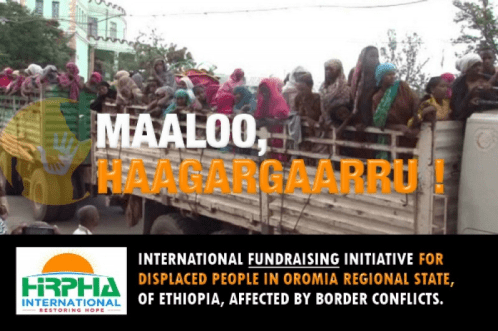
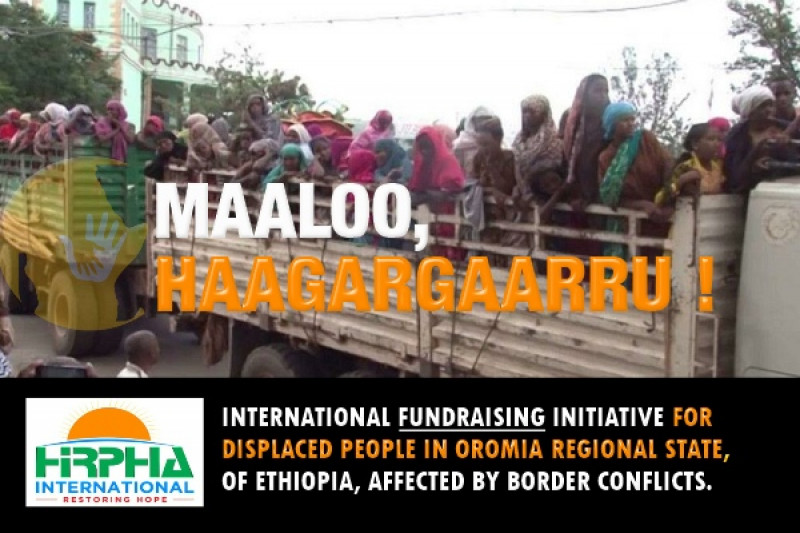


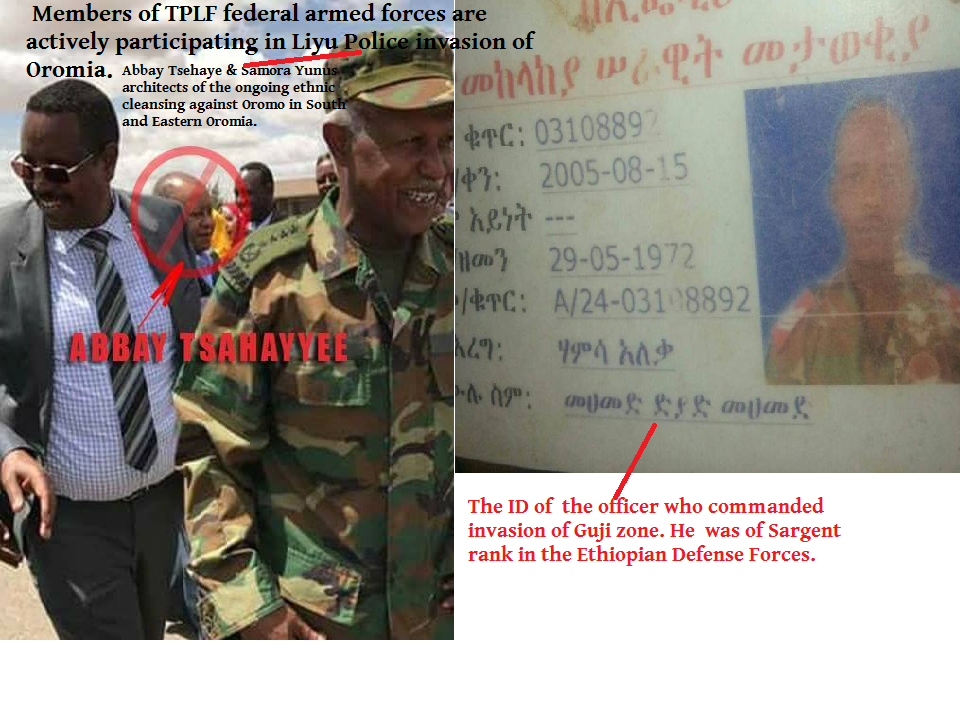



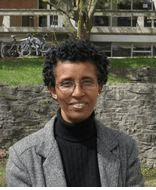

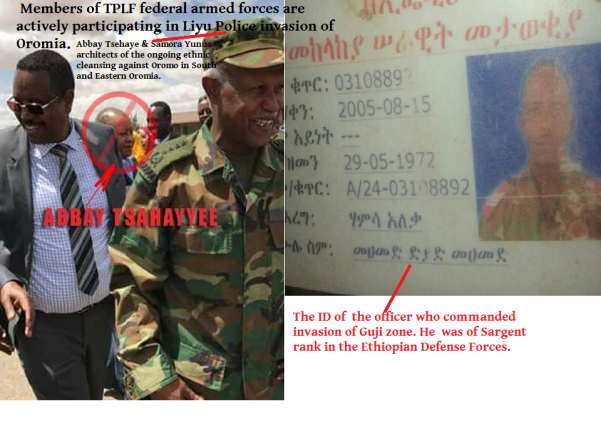


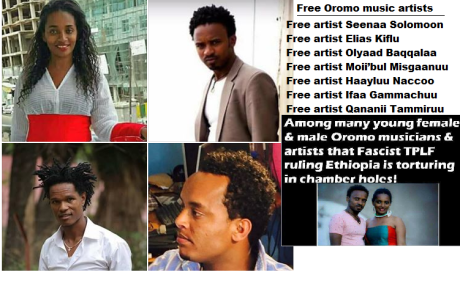
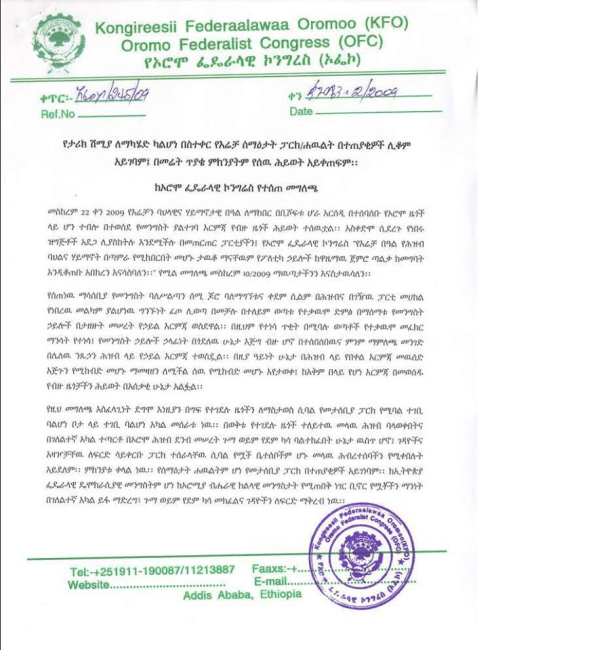


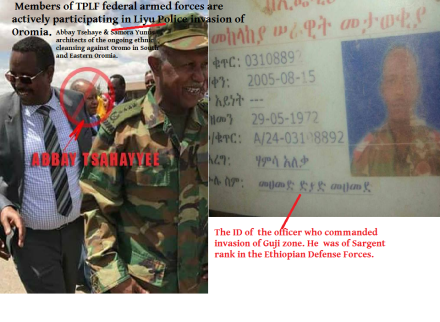




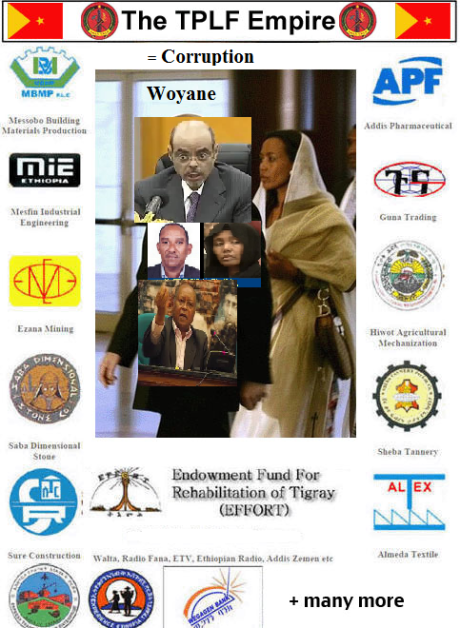






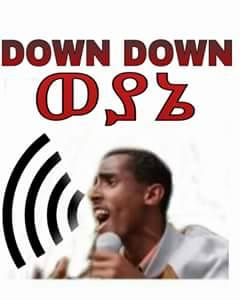

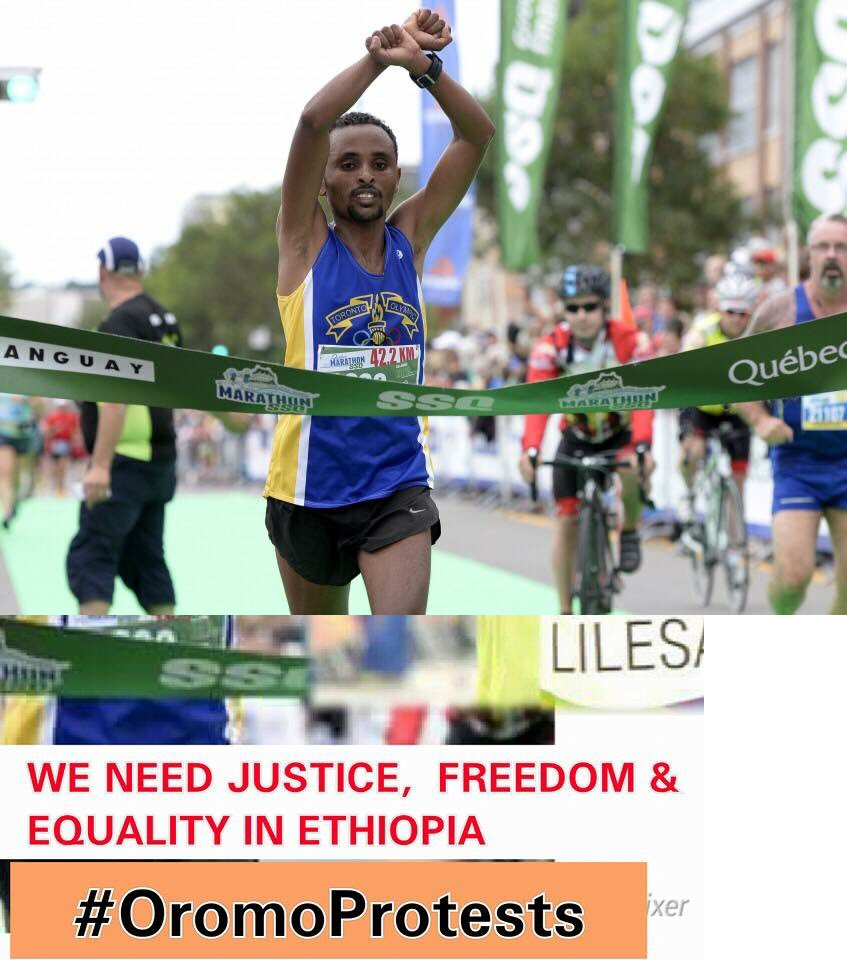


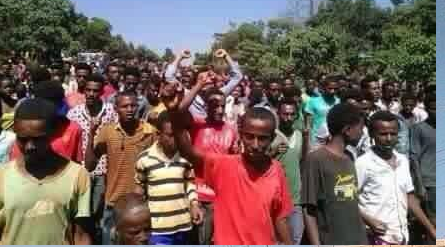


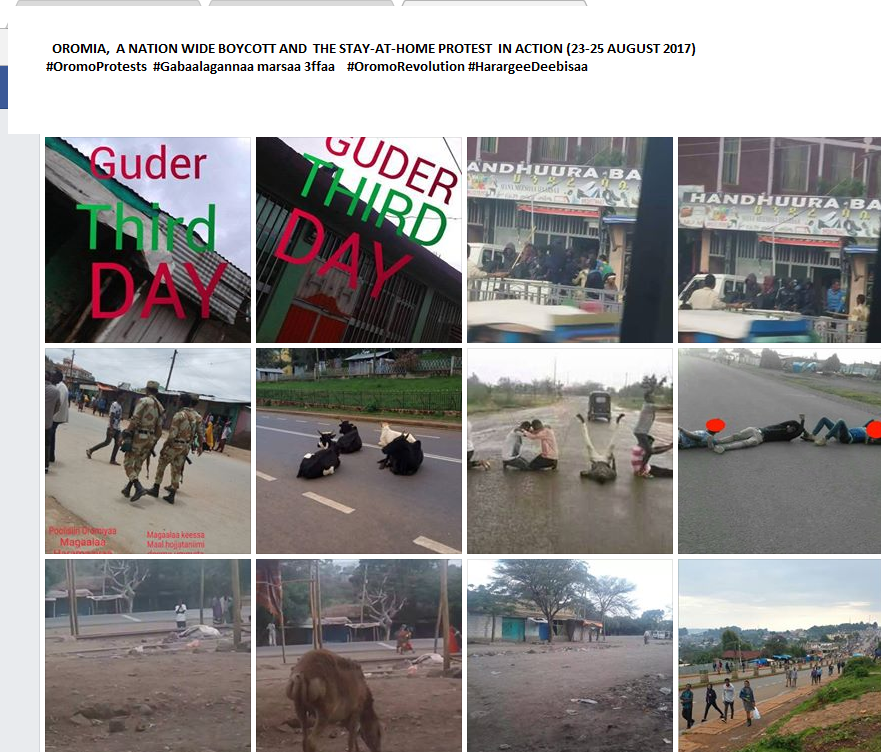
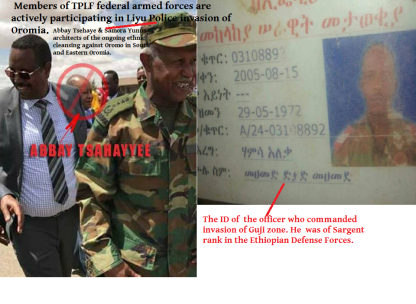
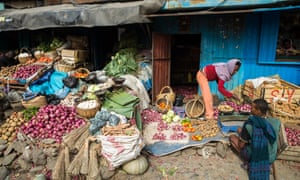
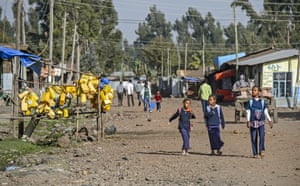


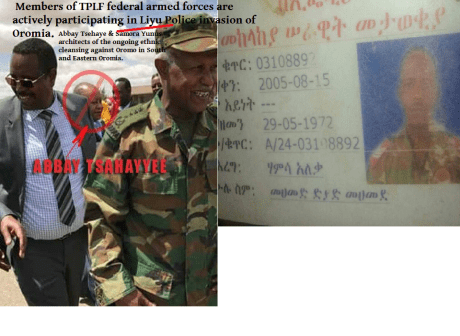


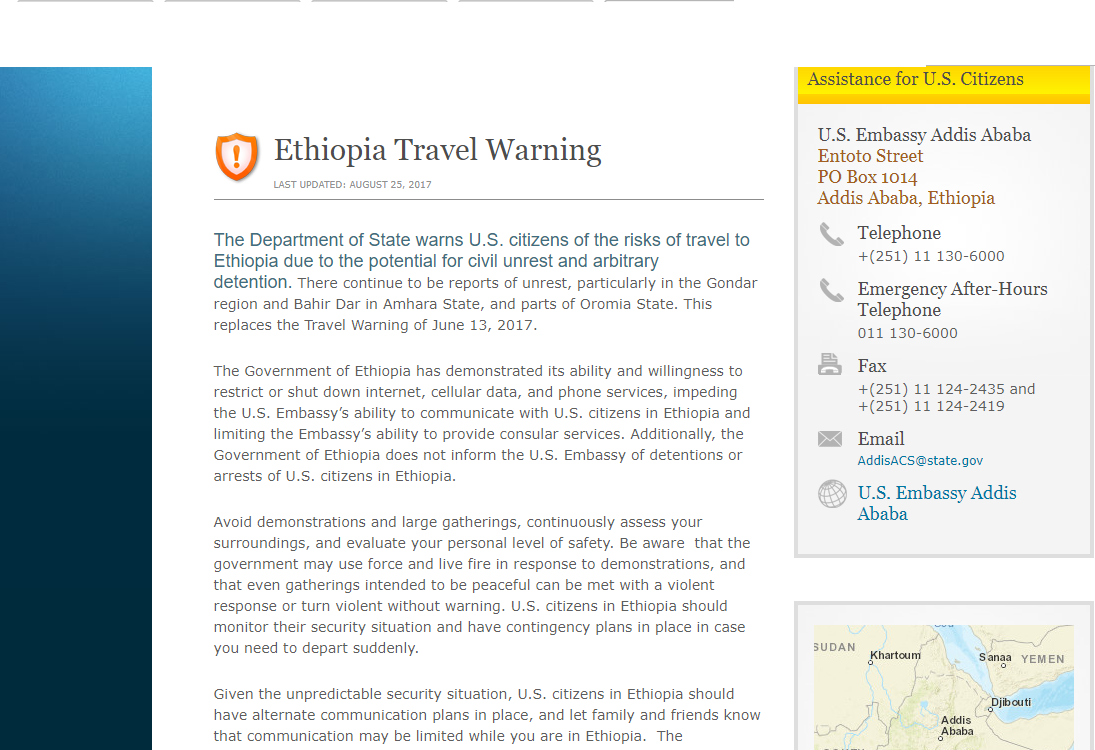
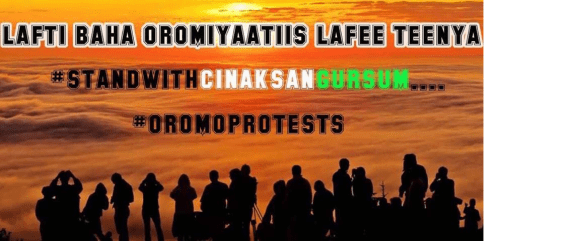


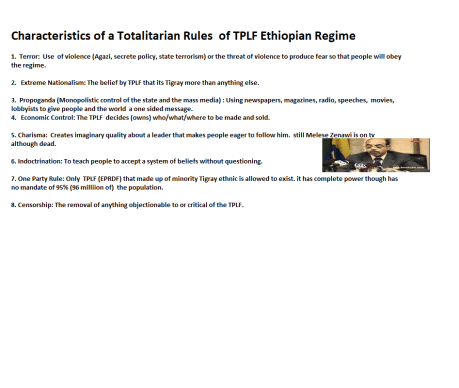
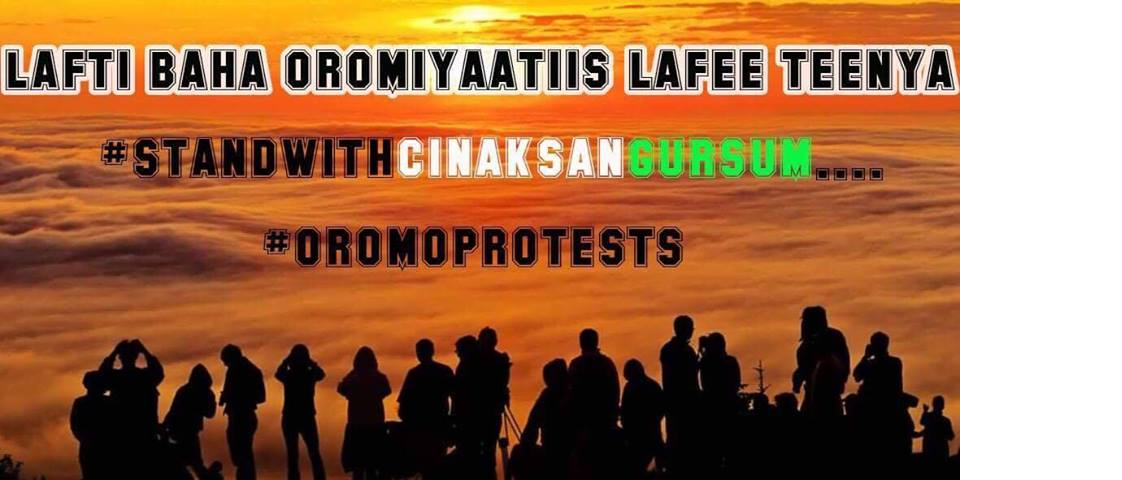

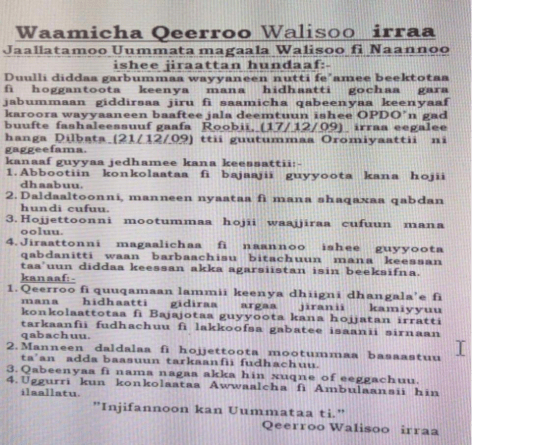


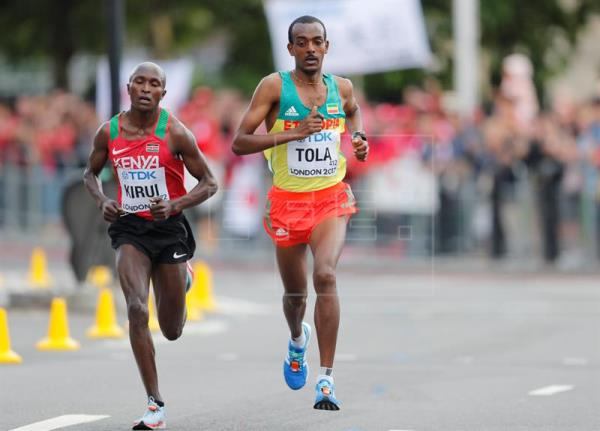
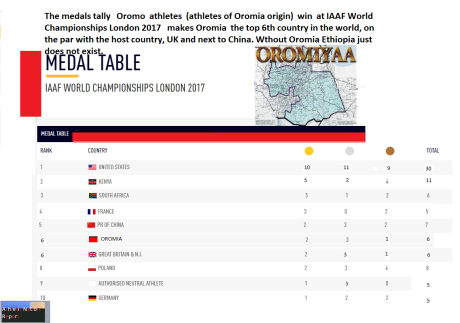


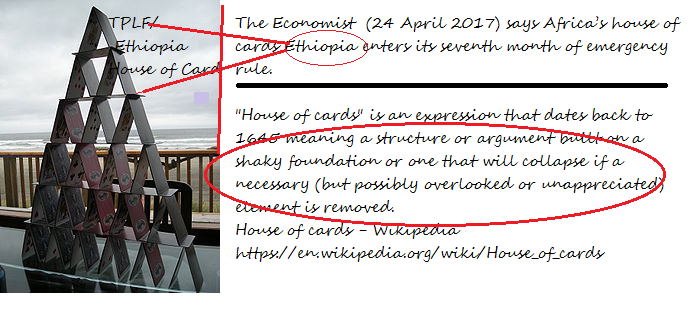














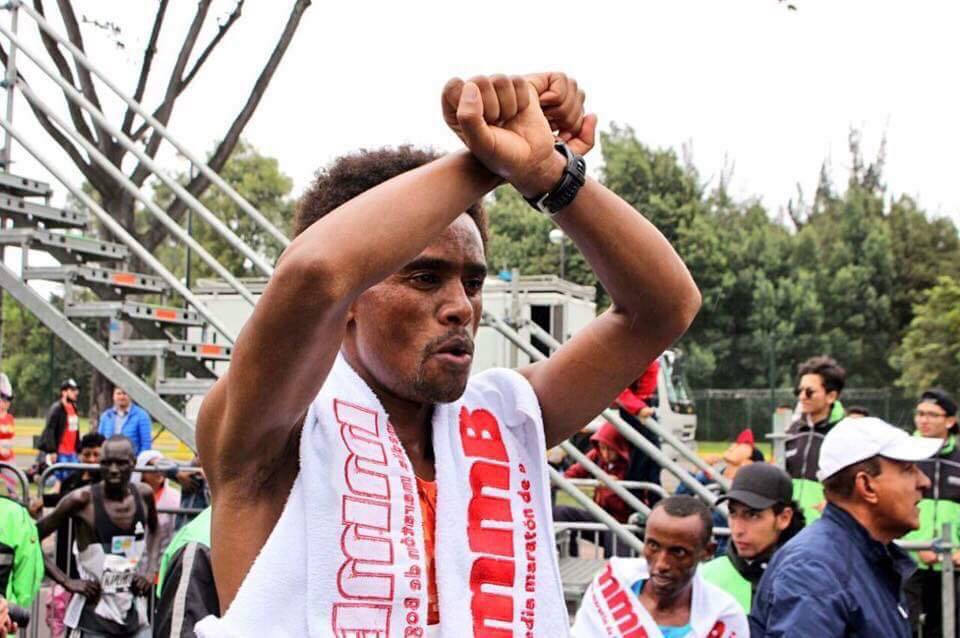

 Godina Wallagaa aanaa Gudayyaa Biilaa irraa,ummaanni gudayyaa biilaa sababa lukkeelee Sirna nama nyaataa mootummaan wayyaanee mirga hiree namummaa fi qabeenya uunfaa ofiitti fayyadamu sarbamnee murtoo balleessanii baduurra geenyeerra jedha qeerroon gudayyaa Biilaa.
 jalatti Argaman keessatti lagannaan gabayaa itti fufeeti jira Qobbootti Lagannaan gabaa roga hundaan godhamaa kan jiru yoo ta’uu wayyaanen daldaltoota walitti qabdee dirqamaan gara hojii keessanii akka deebitan jettee doorsisaa jirti.daldaltoonnis gibirri humnaa ol nutti fe’ame kan doorsisa kamuu kan nu sodaachisuu miti.nuti waan waggaa kudhanitti dalagannee hin arganne waggaa tokkotti mootummaadhaaf kaffaluu maaltu fide osoo hin hojjanne jiraachuu ni dandeenya jechuun ergamtoota wayyaanee ufirraa oofaniiti jiru.


 Godina Arsii.
 Adooleessa 18,2017/Godina Arsii Aanota hedduu keessatti guyyoota lamaan har’aaf kaleessa lagannaan gabaa kan taasifame yoo ta’uu Suuqonni daldalaa magaalota akka Seeruu,Balee, Geersaa, Shaashamannee,Adaabbaa, Dodola,Roobe,Saddiiqa, Waabee, Eddoo, Kofalee, Nageellee, Ajjee keessatti Gibira Wayyaanen Ummatarratti feete mormuun gabaa lagatanii jiru. Tajaajilli Geejjibaas dhaabbateera Konkolaachiftoonni fi Abbootin qabeenyaa sabaan Oromoo hin ta’in muraasni isaanii dalagaa isaanii didanii kan itti fufan yoo ta’uu. Diddaa kanatti akka makaman karaa adda addaatin Qeerron ergeefii kan jiru yoo ta’uu gaaffii isaanif dhiyeessine kana fudhachuun gara ummataa hin goran yoo ta’e Qeerron tarkaanfii Qabeenya isaanii irratti akka fudhatus hubachiisee jira. jedhu Gabaasaalen Qeerroo magaalota adda addaa irraa nu gahaa juru.
 Adoolessaa 18/2017 Godina Lixa Shaggar Aanaa Adaa’aa Bargaa Magaalaa Incinnii Keessatti Qeerroon Dargaggootni Oromoo Sochii Warraaqsaa Biyyoolessa Oromiyaa FXG daran jabeessuun finniinsaa jiruu, Warraaqsii kun yeroo amma sagalee dhaadannoo jabaa dhageesisuun itti fufani jiru.
  Adoolessa 16/2017 Galgala keessaa sa’a 2:50 irraa eegalee Magaalaa Amboo Keessatti Dhukaasni cimaan kan waraana wayyaanee irraa uummatatti baname , gara naannoo Mooraa Yuunibarsiitii Amboottii Waraanni Wayyaanee dhukaasaa guddaa uummata sivilii irratti banuun dargaggoota Oromoo Lama Wareeguun Ibsame jira, Kanneen madeeffaman hanga gabasni kun nu gaheetti adda kan hin baanee ta’uu maddeen Qeerroo Magaalaa Amboo addeessaan. Magaalaan Amboo galgala kana caalaatti gara dirree waraanaatti waan jijjiiramte fakkaatti , gabaasaa dabalataan walitti deebina.
  Adoolessa 16,2017/ Uummanni Shaggar lixaa rakkoo guddaa keessa jiraachuu Qeerroon naannoo Sana’a addeessan.akka gabaasa qeerroo naannoo sanaatti rakkoowwaan jireenyaa ilma namaaf barbaachisan kan akka,tajaajila Daandiin, Ibsaa,Bishaan fi kkf guutummaatti surni nama nyaataa mootummaa wayyaanee ummatarraa kuteera uummanni rakkoo guddaa keessatti argama.
 Adoolessa 15,2017. Godina Arsii Aanaa Siree keessatti Guyyaa har’aa Suuqonni cufaa oolanii jiru. Tilmaama gatii kan galii gibiraa jechuun waajjirri Galii Aanichaa maxxanseen wal qabatee daldaltoonni hojii dhaabanii jiru Waraanni wayyasnees magaalicha keessa deemee ummanni dirqamaan akka suuqii daldalaa isaanii banan furqamsiisuf tattaafachaa jiraachuu maddeen keenya magaalaa Siree gabaasanij jiru.
  Gidduugaleessaa Oromiyaa Godina Lixa Shaggar Magaalaa Ambootti Sochiin Warraaqsaa Biyyoolessa Oromiyaa FXG Kanfaltiin gibiraa dachaa guddaan Uummatarratti dabalamuu waliin walqabatee daran jabaachuun Mormii Guddaan Qeerroo Dargaggoota Oromoo, Daldaltoota fi Uummata Hundaa kan Hirmaachise Warraaqsii Finiinaa jira.


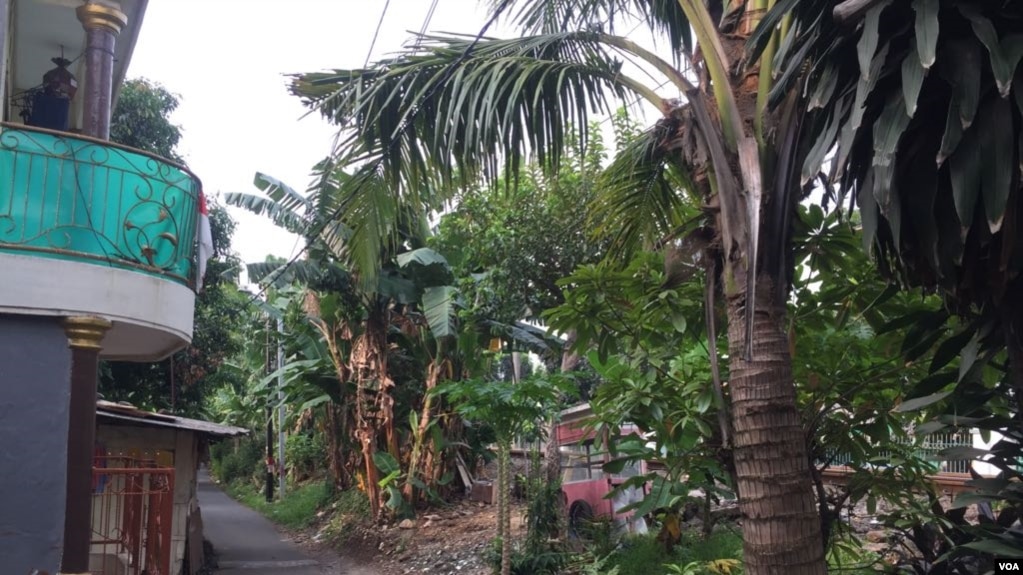
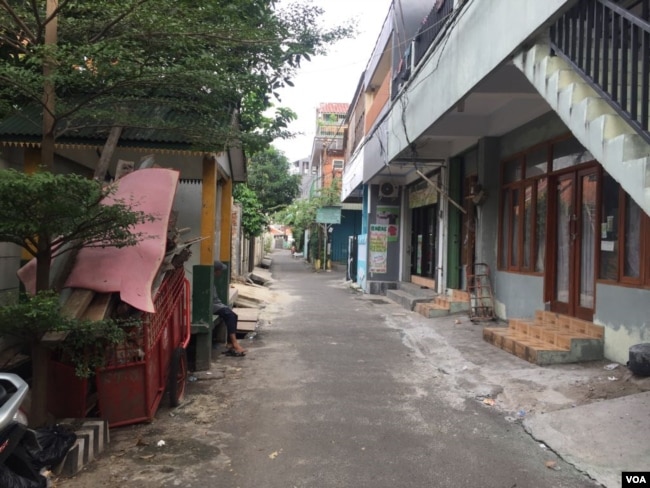
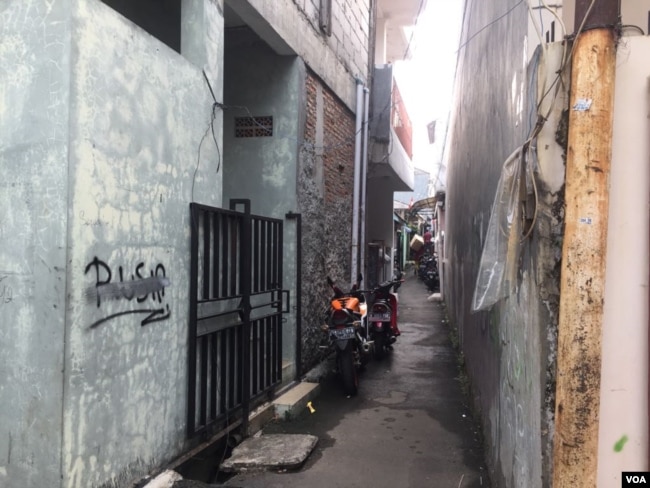


 Oromian Economist
You must be logged in to post a comment.