Economic and development analysis: Perspectives on economics, society, development, freedom & social justice. Leading issues in Oromo, Oromia, Africa & world affairs. Oromo News. African News. world News. Views. Formerly Oromia Quarterly
In Ethiopia, this year’s Irreecha festival brought peaceful but powerful protest as the Oromo people marked the anniversary of last year’s massacre at Bishoftu.
More than 1.5 million people were expected to attend the annual thanksgiving celebration. Despite the rainy skies, they came; once there, the crowds chanted anti-government slogans with the now-familiar crossed arms symbol of protest against Ethiopian authorities they say have long persecuted them – and who, in 2016, opened fire as the scene at Bishoftu deteriorated into chaos.
“May the almighty avenge those that are killing our people,” said the traditional Oromo Gadaa leader as he delivered a blessing. “May the almighty avenge those who killed our people here last year. May the almighty avenge the unavenged. May the almighty end our national ordeals.”
The Ethiopian Human Rights Commission denied the military used lethal force in an official report on unrest in Oromia released in April. The EHRC said 669 people had died in ethnic clashes overall, including 465 Oromo civilians, while blaming the Oromo Media Network (OMN), other diaspora sources, and Oromo political opposition groups for escalating the crisis while defending all national security measures as appropriate.
The report results were questioned by international governments and human rights organizations who say they are consistently denied the access needed for an independent investigation. Many of the thousands who were arrested during a 10-month state of emergency remain detained, including key Oromo political opposition leaders.
Security remained tight for this year’s Irreecha celebration, as Ethiopian authorities banned weapons and set up security checkpoints while promising that armed forceswould remain on the perimeter of the event but not venture inside.
Thousands of internally displaced Oromos from the recent conflict in eastern Ethiopia remain in temporary shelters
Addis Abeba, September 27/2017 – Ethiopia is fast descending into turmoil as the result of incessant state-sanctioned violence and repression. Popular demands that precipitated a three year-long protest, which started in Oromia in 2014and then spread to the Amhara and other regions, remain unaddressed. The discontent in the two most populous regional states, Oromia and Amhara, home to two-thirds of the country’s population of over 100 million, is deep and widespread. The resulting anxiety, expressed by serious Ethiopia watchers, is confirmed by the country’s leader, Prime Minister Hailemariam Desalegn, who once warned that the continued protests could push Ethiopia into a situation similar to what has prevailed in neighboring Somalia for the last 26 years: state collapse.
The popular protests signaled a regime in crisis. After ruling for a quarter century, the ruling coalition, the Ethiopian People’s Revolutionary Democratic Front (EPRDF), began to exhibit signs of decomposition. Nowhere is this well archived than the reporting by this magazine over the last six years. The economy, once touted as the envy of the world, started experiencing a downward spiral. Tensions emerged at the highest echelons of the security apparatus with the civilian and military intelligence at loggerheads over the direction of the regime’s response to the protests. Beginning in December 2016, two months into the state of emergency that was declared to suppress the protests, the situation got further complicated with rising tensions between regional states – first between the Amhara and Tigray regions and currently between the Oromia and Somali regional states.
Escalating Tensions
For years, Oromo residents near the regional frontiers have complained of an aggressive attempt by the Somali Regional State to forcefully dispossess their land. Until recently their grievances fell on deaf ears. The conflicts escalated in February and March 2017 as incursions and raids conducted by the Somali Special Police (the Liyu Police), also known as the Liyu Hayil, and militia intensified along the border between the two regional states stretching from Chinaksan in the East (near the border with Somaliland) and Moyale (near the border with Kenya).
Cross-border raids and fighting increased in frequency and intensity in early August and tensions boiled over in mid-September in Oromia’s East Hararghe Zone, where at least 60 people were killed, according to locals. In addition to its assault on Oromo civilians in Oromia, members and sympathizers of the Liyu Police are currently attacking and expelling Oromo residents and merchants from the Somali region. As a result, hundreds of Oromos have been killed and tens of thousands displaced from their homes in the Somali region. Authorities in the Oromia region have begun sounding alarm about an all-out war of aggression by the notorious Somali Special Police.
In a more ominous development, officials from the two states are engaged in an unprecedented war of words, particularly on social media. Their tangling is not limited to words. The security organs of the two states have been battling each other over the territories along the common border.
All of this is happening under the watchful eyes of the federal army and security forces, which are now ordered by the Prime Minister to man the common border between the two states and all major roads in Oromia. Oromo residents in the affected areas question the neutrality of the federal army, particularly the impartiality of Tigrean kingmakers in the ruling EPRDF coalition, and not a few accuse them of abetting and enabling the still-ongoing Liyu Police incursions into undisputed Oromo territories.
Critics contend that Tigrayan generals and intelligence officials, the current de facto rulers of Ethiopia, have two overarching objectives for empowering and enabling the Liyu Police and leaders of the Somali region: to cripple the three-year-long Oromo resistance against the EPRDF government, and to undermine, weaken and control the new leaders of the Oromia regional state, who have recently shown some signs of autonomy from the overbearing center. The development risks provoking a total breakdown of law and order on the peripheries, which can gradually creep toward the center—leading to state collapse.
Many observers in and outside Ethiopia, including current and former Ethiopian officials, have offered a bleak prognosis about the country’s fate. For example, last year the former Chief of Staff of Ethiopian Defense Forces, General Tsadikan G/Tensae, warned that the mass protests in Oromia and Amhara regions in particular and EPRDF’s failure to contain them augurs the onset of a full-fledged political crisis. His colleague, Gen. Abebe Teklehaimanot also expressed similar concern about the country’s prospects for stability unless significant reforms are implemented.
Similarly, a string of international media headlines and expert analyses warn of a growing political crisis. Articles appearing in Open Democracy, Foreign Policy Journal, Foreign Affairs, and the Guardian, just to mention a few, have joined the chorus about an impending collapse. Perhaps acting out of this fear, Ethiopia declared a state of emergency in October 2016, which lasted for nearly ten months. The declaration was a stunning reversal for Ethiopia’s rulers, who had some success portraying Ethiopia as an island of stability in a troubled region and propagating a myth of “Ethiopia rising.”
Several trend indices point to Ethiopia’s growing state fragility. According to the Fragile State Index, for example, Ethiopia’s fragility has been rising steadily since 2006. The Index of State Weakness designates Ethiopia as one of the world’s critically weak states. Noting the complete lack of political rights, Freedom House has consistently rated Ethiopia as Not Free — with a score of only 14 out of 100 in its 2017 report.
And all states that collapsed had one thing in common: a violent dictatorship locked into a win-lose conflict with a populace determined to untangle the incumbent regime from the reins of power. The breakdown of state-society relations marks a milestone in a trajectory towards state collapse. Other credible risk assessments underscore this same bleak picture for Ethiopia.
Recently, Christopher Clapham, a long-time Africa watcher, noted that Ethiopia is both the anchor and the main source of the perennial instability that has haunted the Horn of Africa region for decades. Should the Ethiopian state implode, as all indicators point toward, the whole region, where a quarter of a billion souls eke out an already precarious existence, would go down with it.
This is not an implausible scenario. Ethiopia is situated in a region harboring two already collapsed states (Somalia and South Sudan), two failing states (Sudan and Eritrea), and yet another fragile state (Kenya). It also abuts the world’s most volatile region, the Middle East. All of these factors about Ethiopia’s increasing fragility ought to have set off alarm bells in Washington, Brussels, London, and Addis Ababa itself, seat of the African Union.
To be sure, the EPRDF is not the sole culprit for all of Ethiopia’s ills. There are factors beyond its control that contribute to the ongoing political convulsion. One such factor is soaring population growth. Ethiopia’s population has doubled since EPRDF came to power, putting unbearable pressure on the environment and natural resources in a country where backward agriculture is the dominant means of agricultural production. In addition, there are a number of quite contentious issues hampering any consensus among the political class.
Divided elites
Ethiopia’s political class is beholden to deeply divergent diagnoses and remedies to tackle the mounting problems. It doesn’t agree even on such uncomplicated issues as the bases of the country’s statehood. EPRDF is convinced that Ethiopia is a nation of nations. Structuring Ethiopia as a federation of nations, nationalities, and peoples stemmed from this conviction.
The elites of the Oromo and other marginalized groups hold the view that the structuring of Ethiopia as a multinational federation was a positive step but dismiss EPRDF’s federation as bogus. Indeed federalism without democracy is an oxymoron. Their fear is that an undemocratic federation of nations could produce a repeat of the former Soviet Union and Yugoslavia’s disastrous fates. Members of these groups insist that only democratizing the present federation can avert such eventuality.
Another vocal group, hailing predominantly from the previous ruling elite, rejects the emphasis on Ethiopia’s multinational nature and aspires to forge the country’s numerous ethnic groups into a single Amharic-speaking nation—resurrecting the policies and memories of successive feudal and military regimes that stoked decades of armed conflicts and brought the state at different junctures to the brink of collapse. Since neither of these groups is willing to heed the fears, pains, and perspective of the other, a debate of the deaf has been going on among them for the last three decades.
These contrasting positions come with the dangerous implication of pulling the country in opposite directions. The concern that this configuration of political stands could culminate in ripping Ethiopia apart should not be underestimated.
A successful mobilization by multiple rival groups against a resented centralized power is a harbinger of regime collapse. All indications are that mobilization by both the Oromo and the Amhara, even within the EPRDF, is gathering momentum, thereby exacerbating the regime’s incoherence. To date the protests among the Oromo and Amhara have largely remained peaceful. However, increased repression has made the breakout of armed insurrection all but certain. Most disconcertingly, regime collapse could easily morph into state collapse in Ethiopia as the regime has intricately tied its fate to the survival of the state.
Precipitating factors
The second most threatening factor is the refusal of the ruling party to institute the reforms demanded by the protesters. When the ruled refuse to live under the old order and rulers are unable to carry on in the old way, breaking out of the impasse could be achieved only by instituting significant reforms. And this is just what the EPRDF has been utterly unable and unwilling to do. Without reforms, the specter of a revolutionary breakdown looms around the horizon.
The excessive securitization of the Ethiopian state to stifle growing dissent is also having two unintended consequences. First, it is making rising dissent inevitable. Second, ballooning costs of securing the regime could easily bankrupt it. The recent tax-hike, which resulted in one of the first successful attempts at a general strike in decades, presages what is to come.
The main obstacle to instituting any kind of reform is the lack of democracy and honest conversation within the ruling party. The EPRDF is composed of four entities: (1) The Tigrayan People’s Liberation Front (TPLF), (2) The Amhara National Democratic Movement (ANDM), (3) The Oromo People’s Democratic Organization (OPDO) and (4) The Southern Ethiopian People’s Democratic Movement (SEPDM). Of all of these, the TPLF, speaking for the least populous constituency, plays a dominant role, thereby standing the EPRDF pyramid on its apex. The inherent instability of this setup accounts for much of Ethiopia’s fragility than anything else.
Growing fragility
States become susceptible to failure when two factors come into play. The first occurs when rulers lose their mandate to govern and their administration of the affairs of the state becomes illegitimate in the eyes and hearts of a growing sector of the concerned populace. The three-year-long protests in Oromia and Amhara regions bespeak the loss of mandate to govern. The second happens when the rulers’ capacity to keep the governed in tow is exhausted. The failure of the state of emergency to quell the popular appetite for resistance against the system attests to this fact. And there seems to be a dialectical relationship between soliciting legitimacy and seeking domination. As coercion is deployed more frequently, the consent of the ruled plummets, and rulers would be forced to increasingly resort to naked coercion, which further diminishes their legitimacy and necessitates the application of even more coercion. For the EPRDF regime, more repression is not yielding the anticipated results.
This vicious cycle has characterized EPRDF’s rule ever since it came to power in 1991. It started with a questionable legitimacy, which steadily diminished with each passing decade. In order to make up for this falling legitimacy, EPRDF bolstered and fine-tuned its instruments of coercion and control. The crude application of these tools in the absence of an astute political leadership creates more security problems than it solves. To make matters worse, since the death in 2012 of its strongman, Meles Zenawi, the EPRDF has shown signs of atrophy, discord, and unraveling. In place of the centralized rule that characterized earlier decades, multiple sources of authority are currently vying for influence—at times violently.
Political fragmentation
Within the EPRDF, inter and intra-party relations have broken down. Both ANDM, ruling the Amhara region, and OPDO, ruling Oromia, are pressing for more autonomy from the TPLF-dominated center in a bid to respond to the growing popular chorus to end Tigrean domination of the country’s politics, economy, and security apparatus. The gap between the official rhetoric of the devolution of power and the reality of continuing centralization has undermined the resilience normally accruing to a federal arrangement. At the moment, the system is more brittle than it has ever been. The failure to stop armed incursions into Oromia from the Somali region, which has led to the killing of innocent people and mass expulsion of Oromo civilians from the Somali region, is a worrisome sign of the breakdown of central control.
The Oromo protests happened despite the long running process of extending party control over the populace, which culminated in 1 out of 5 Ethiopians (i.e., 20 million) being harnessed into an elaborate state surveillance system. This level of regime penetration of society is unprecedented in Ethiopian history and quite likely in the entire African Continent. This panoptic surveillance structure, however, proved totally useless in averting mass uprising particularly by the Oromo and the Amhara.
That is why authorities resorted to a state of emergency as part of the regime’s increasing reliance on force and coercion to stay in power. Yet even after martial law was imposed, the rebellious societies remain restive and will likely rise up again. It had to be lifted because it had become ineffectual and a burden. This begs a very important question: What would EPRDF do that it has not done to date in order to contain the imminent mass upsurge?
The incumbent regime shows no indication of heeding and addressing the protesters’ grievances. The regime’s effort to placate the people, including through declarations of war on rampant corruption, abuse of power, problems of good governance, cabinet reshuffles, and promises of “deep renewal” have come to naught. And the kneejerk reaction of violently putting down resistance protests has not worked so far and is unlikely to work in the future. This is what makes state failure in Ethiopia a real possibility.
In addition to the mounting political crisis, Ethiopia also faces a looming humanitarian catastrophe. Drought and famine are back in the headlines: See, for example, the Telegraph, BBC, DW, Washington Post, Euro News, Save the Children, Oxfam, World Food Program, CBC, and IRC, just to mention a few. According to the United Nations, 20 million are suffering from acute food shortages, and in many places the situation has already developed into a famine. This time the crisis is not affecting the traditional famine-prone regions of northern Ethiopia, but the Eastern and Southern regions.
Call for action
The escalating conflict along the vast border between the Somali and the Oromia states indicates that Ethiopia’s political crisis is showing no sign of abating. Instead, it is deepening. It is almost universally believed among the Oromo that the conflict is not between the two brotherly populations, the Oromo and the Somali. Rather, it is a proxy war waged by the Tigreyan military brass, which practically rules the country, to intimidate the Oromo as well as the new OPDO leaders, who are increasingly asserting their autonomy from the TPLF under whose hegemony they grudgingly toiled the last 26 years. The Liyu Police happened to be another handy element in its toolbox of the strategy of “divide and conquer.”
The conflict between two large states of the Ethiopian federation has worsened the growing fear of state fragility. Ethiopia’s implosion would have catastrophic reverberations not only in the strife-ridden Horn of Africa but for the entire continent and beyond. The combined effect of these crises is bound to affect neighboring states and could reach as far as Europe, where the flood of refugees from the Middle East has already led to the rise of nativist and populist far-right-extremists. Until now, the EPRDF regime has been given the benefit of the doubt by its Western and other backers despite its gross abuse of power and persistent violations of human rights.
What would further destabilization of the Horn, home to a quarter of a billion, do? Africa and the rest of the world cannot afford Ethiopia, with a population of over 100 million, disintegrating into chaos. The EPRDF regime has laid the groundwork for this eventuality by design or default, and its continued hold on state power would only worsen the crisis. This should not be lost on anyone harboring the least goodwill toward Ethiopia, the troubled Horn region and its suffering population.
The international community has a stark choice: either it wakes up to the dangers and saves Ethiopia from collapse, or faces the consequences. Only an orderly transition toward a legitimate and accountable political order could avert the imminent danger of collapse. It is the best way out for the regime. And the international community needs to step up efforts to come face to face with the ensuing reality. The alternative is being swept away by a tidal wave of popular anger that has been building up for 26 years under a brutal, corrupt, and unyielding dictatorship.
The international community can no longer hope that the regime can muddle through these crises as it has always done. This time around the gravity of Ethiopia’s collapse is qualitatively different from previous situations, not to mention deadly serious. The writing is on the wall: state collapse is on the horizon. AS
The Dictatorial and Predatory Ethiopian TPLF Regime Will Never Succeed in Instigating Conflicts Between The Sisterly Oromo And Sidama Nations!
SNLF Press Release, 12 September 2017
The predatory Tigre Ethiopian Empire is crumbling from within and without. It is destroying itself from endemic economic and political corruption from within. The demise of the brutal regime is precipitated from without by the mass uprising of the majority Oromo nation who are demanding an end to the over a century of political and economic marginalization, and restoration of freedom, justice and self-rule in their vast Oromia land. The Oromo uprising has been continuing since 2015.
Instead of answering the legitimate question of the Oromo nation by granting them their inalienable democratic rights to self-determination, the TPLF regime embarked on desperate measures to cling onto illegitimate political power. It has also monopolised the economic aspects of the entire country. The political aspects in Oromia alone included, brutal massacre of over 1,500 peaceful Oromo protesters since 2015; mass imprisonment of over 60,000 Oromo civilians; imprisonments of the entire leadership of the Oromo Federalist Congress including the renowned Professor of Political Science, Marara Gudina and prominent politician, Bekele Gerba, as well as a dozen Sidama political activists including a prominent business person, Solomon Naayu, and Dawassa Daaka, most of whom are languishing in Qilinxo prison today.
When the regime realized its genocidal measures were insufficient to quell the mass uprising engulfing the entire country, it resorted to yet other barbaric measures of divide and rule among the sisterly oppressed nations. First, the TPLF trained, armed, aided and abetted the Somali militia to attack the innocent Oromo civilians causing death of hundreds of our Oromo brothers and sisters and destruction of properties since 2016. Using a mercenary puppet Ogadeni Somali regional renegade leader, the TPLF regime continues to relentlessly instigate conflicts between the two sisterly Ogadeni Somali and the Oromo nations as we speak. The TPLF regime is also perpetrating similar crime by mobilising a similarly downtrodden Gambella civilians to fight the Oromo nation.
Moreover, having failed to stir conflict between the Sidama and Oromo nations, the TPLF recently attempted to ignite instability in the border between the Sidama and Wolayita nations. The regime attempted to sow discord between the two nations over the 6 disputed villages (Kebeles) where the Sidama people lived for hundreds of years in peace with their Wolayita neighbours. The people on both sides understood and rejected the relentless attempt by the TPLF rogue empire to sow seeds of hatred and conflict among the two nations that lived side by side in peace for millennia.
The desperate and crumbling Tigre Ethiopian Empire seems to neither give in to the popular demands nor give up its genocidal acts of stirring conflicts among the various oppressed nations of the south. We also understand that the TPLF regime is instigating such conflicts in northern part of Ethiopia. In the past two months, the TPLF went deep into the eastern Sidama land where the people have lived together with their Oromo neighbours in peace and harmony for generations and attempted to ignite conflicts between the two peoples. TPLF’s attempts to ignite such conflicts between the Sidama and Oromo cousins have been foiled time and again, with wise and sensitive management of these attempts by the elders of both nations. Both nations have time and again rejected the plots of the TPLF regime as they wholly denounce its interference in their affairs.
However, in the past two months, the TPLF managed to cause unnecessary deaths and damage to the properties of the Sidama residents in eastern Sidama by aiding and abetting its local surrogates in Oromia as well as Sidama region to commit crimes against the will of the two sisterly peoples. Dozens of the Sidama citizens have been displaced from their homes.
The primary objective of the TPLF’s primitive divide and rule measures are sustaining the crumbling Tigre Empire by undermining the unity among the oppressed nations of the south. Therefore, the Sidama National Liberation Front (SNLF) understands that these measures are, further aimed specifically at weakening the Peoples’ Alliance for Freedom and Democracy (PAFD), the political movement that encompasses the Oromo, Sidama, Ogadeni Somali, Gambella and Banishangul and Gumuz nations that accounts for over 60% of the population and 70% of land mass of the empire. However, we assure the TPLF regime that the unity among the oppressed nations of the south is rock solid, thus will never be dented by its primitive tactics of divide and rule.
Finally, the SNLF unconditionally condemns in the strongest possible terms the barbaric and relentless attempts by the Ethiopian TPLF regime to aid and abet genocide among the oppressed nations of the south. The sisterly Sidama and the Oromo nations will conquer once again any attempt to divide them. Our wise elders will ensure peace, stability and harmony not only between the sisterly Sidama and Oromo nations but among all Cushitic and other oppressed nations of the south and work hand in hand to hasten the demise of the predatory TPLF regime that has been plundering their resources and massacring their peoples for far too long.
Olympian and the global icon of #OromoProtests Feyisal Lilesa finishes 3rd in his the Great North Run Debut on 10 September 2017. Sir Mo Farah 1st and Jake Robertson was 2nd.
The Oromia-wide economic boycott and stay-at-home campaign announced by Oromo activists, popularly known as Qeeroo Oromoo, commenced throughout Oromia as scheduled on August 23, 2017. The campaign completed its third day and is expected to remain in place as planned until August 27, 2017.
As planned, the campaign started on the scheduled day throughout Oromia. In some areas, it actually commenced at dusk on the eve of the scheduled days. For three days, businesses in large and small towns, daily markets in rural villages and inter-city transactions remained closed. Transport services leading to Finfinne, the main arteries of economic activities and supply lines to the center were discontinued. City buses and transport within cities and between cities were not in service. In short, the Oromia region came to a standstill soon after the boycott commenced and remain in effect for three days throughout Oromia.
The campaign was launched following the lifting of the state of emergency that was introduced in October 2016. Contrary to the regime’s claim that the state of emergency succeeded in suppressing the Oromo protests, we made a conscious decision to use time to regroup and strategize the next phase of the struggle after an arduous year of sustained resistance against a brutal totalitarian regime. At the end of the state of emergency, we deemed it necessary to counter the regime’s claims and demonstrate the protests have resumed in a different form.
The campaign was launched to achieve measurable objectives. First, it was meant to send an unmistakable message to the regime that the Oromo protest cannot be suppressed and that the struggle will continue until its longstanding demand for self-determination is achieved. Second, it was designed to deny the regime its undeserved claim to legitimacy on the basis of economic performance by slowing down economic activities without severely damaging people’s livelihoods. Third, it was intended to affirm the unity Oromo nation and the popular base of Oromo nationalism by showing that the Oromo people can rise in unison and act in concert at a time of their own choosing. Forth, it was planned to demonstrate that the Oromo struggle has shifted from resistance mode to a focused struggle for victory.
At the end of the third day, we have determined that these objectives have been fully achieved. The economic effect of the boycotts was felt in the major cities of the neighboring countries. The success of the campaign is so complete and comprehensive that a reassessment was deemed necessary. Having determined that the campaign has achieved its goals in record time and that the campaign has proven the Oromo qeerroo’s capacity to strike at the strength of the regime, we have decided to declare victory and call off the campaign at the end of the third day. This means, the boycott campaign and stay-at-home campaign will end at 6 PM Finfinne time on August 25, 2017.
As we end this campaign, we want our adversaries to know that this generation of Oromo nationalists will respond in way that its commensurate to the enemy’s egregious actions. We are satisfied that the campaign has driven home a message that we will not rest until the longstanding goals the Oromo national movement have been achieved. We want the adversary to know that we were deeply outraged at the public humiliation of our respected and august political leaders, Dr. Merera Gudina and Bekele Gerba and we will not accept further humiliation our leaders and our nation. Second, we will not tolerate the dismemberment of Oromia. The government has been given sufficient warning that the arming of mercenaries to murder Oromo residents of Oromia and carving out of Oromo lands under any circumstances, whether that land is around Finfinne or in eastern and southeastern Oromia or southern Oromia. Third, we will not accept the attempt to drive Oromo businesses into bankruptcy and Oromo street side peddlers and vendors out of existence.
Finally, we want the Oromo people to consider this campaign as an instance of rededication to the longstanding Oromo demands. The Oromo struggle will continue until the Oromo people have established full control over their governance, the resources of Oromia and their individual and collective identity. Oromo protesters didn’t die in the thousands so that the surrogates of the Tigray People’s Liberation Front can become the legitimate champions Oromo nationalism and reformers who would return civil administration to Oromia. The Oromo struggle will not be completed until genuine self-rule has been established in Oromia and all of Ethiopia. The Oromo struggle will not complete its journey until its representatives have achieved full control over Oromia’s resources, including Finfinne. Investors must know that their investments are welcome on condition that they are legal, incorruptible and undisruptive of indigenous livelihoods. The Oromo struggle was not waged to witness tampering with the main achievement of this generation: the use of qubee alphabet in written afaan Oromo. The Oromo resistance will continue with determination and dedication.
Nation wide Boycott and Sit-in is underway in the Ethiopia’s largest state, Oromia.
What is this boycott about?
••• Demanding unconditional release of OFC leaders and all political prisoners in Ethiopia.
•••Demanding lifting of heavy taxes
••• demanding the government to stop the Somali regin’s #Liyupolice cross boarder attack and active genocide.
•••Demands the government to address all those demands raised are under#OromoProtests#OromoRevolution#Ethiopia
The protest is successful in planning and successful in action.
#Breaking: Harar and its surroundings under strike; no trade and transport activities observed. Some damaged vehicles were also spotted. pic.twitter.com/YmyOSIt2Tk
Many people have stayed at home and business owners have closed their doors in parts of Oromia region. Most shops, hotels and restaurants in south-eastern towns of Miesso, Chiro, Hirina and Aweday towns have been shut after strikes were called on Wednesday. The latest protest is said to be a continuation of the nation wide strike that started in July to protest against the government over the imposition of a revised tax law. Taxi service from the outskirts of Addis Ababa, Asko to Burayu has been disrupted. In the town of Ambo 130 kilometres west of Addis Ababa almost all shops, hotels and restaurants have been shut. In nearby Woliso and Ginchi retail businesses were also closed. There were similar strikes in some towns of Arsi and Bale zones including Shashemene, despite reports that police and security forces were threatening to revoke the licenses of those who joined the strikes.
While most protests are peaceful and the towns are quiet, in some parts damages on public transports and farms are reported. A minibus carrying passengers on the road from Harar to Dire Dawa has been attacked by stone throwers. A long distance bus, Selam heading to Harar from Addis Ababa made a half turn at Adama town this morning, sources told Ethiopia Observer. Selam bus, as it is owned by the ruling regime, has been a frequent target of attack in the past.
The latest protest is one of the biggest stay-away actions, since the state of emergency has been lifted in early August. Emergency law imposed in October, after more than a year of violent protests in the region led to the arrests of more than 21,000 people. Click here to read more at Ethiopian Observer
Liyu police incursion into Oromia is the manifestation of TPLF proxy war on Oromia. It has nothing to do with the brotherly Somali ppl. pic.twitter.com/iAc0YWiV47
Guyyaa Arba’aa/Roobii/ Dhufurraa jalqabee Guyyaa Shaniif (5) Walitti aansee Waan Godhamuuf Jimaan Haqaaran Takka Harargerraa Gara Awaash, Adaamaa Fi Finfinnee Kan hin seenne Tahuu Dursinee isin Beeksifna.
Dubbii kana Salphiftanii/Tuffattanii Bira Darbuun Hojirra Hin Olchitan Taanan, Rakkoo Isin Mudatuuf Qeerroo fi Ummatni keenya Kan itti Hin Gaafatamne Tahuu Beekaa.
Mootummaa Abbaa Irree Dhiiga Saba Keenyaa Qulqulluu Dhangalaasutti Hin Gurguurru!!!!
Tokkummaan Ummata Oromoo ha dagaagu
Murteessan Hegeree Oromiyaa Oromoodha
Injifannoon kan Ummata Oromooti
“Godinaa Jimma Aanaa Nonnoo Beenjaa Magaalaa Algaa Kessatti Guyyaa Har’aa Hagayyaa 13/12/2009
{19/08/2017
Mormiin Qeerroo Haala Ho’aan Itti Fufe Jira
Sababni Isaa Yeroo Mormii Gabaa Lagaanaa Marsaa 2ffaa darbee irraatti polisonii uummataa yeroo dorsisuuf yaalanitti uummanii nu hin dorsistaan mootummaadha nu samaa jiru hayyootaa keenyaa mana hidhaatti dararamaa jiru jechuun uummanii hiriraa bahun sagalee isaanii dhageessifacha turan kanaan wal qabaate polisoonii uummataa dorsisaa turan sun yeroof miliqaani turun guyyaa har’aa mormii marsaa 3ffaa fashaalessuf har’aas yeroo uummataa dorsisuu jalqabaniitti qeerroon algaa tokkummaan ka’un mana polisii tokko irratti tarkanfii fudhatani turan .kanaaf yeroo ama kana magaalaan algaa muuddamsaa cima kessa jirti.”
Among the thousands facing criminal charges in the wake of the SoE are these group of women in Assela town.
Liyat Fekade
Addis Abeba, August 22/2017 – On Friday August 04, members of the Ethiopian parliament have reconvened after having been called off their summer recess. Of the three topics they reconvened to discuss was the lifting of the ten month old State of Emergency (SoE), first declared on Oct. 08 2016.
Briefing the members of parliament (MPs) on the need to lift the SoE, Defense Minister Siraj Fegessa, who is also the secretariat of the command post established to oversee the implementations of the SoE, said that the country was experiencing a return to normalcy as compared to the months and days prior to the declaration of the emergency decree, hence the need to lift the SoE.
However, almost as news besides the lifting of the SoE, Siraj Fegessa told the lawmakers that there were 7, 737 individuals who were facing legal actions in different courts in the country after having been charged with criminal offenses. According to Siraj, 4, 136 of these people were from the Oromia regional state, the epicenter of the 2016 yearlong anti-government protests; 1, 888 from the Amhara regional state, which followed suit six months into the protests in Oromia; 1, 166 from the less publicized protest-hit areas in the Southern Nations Nationalities and People’s Regional state (SNNPR); and 547 from the capital Addis Abeba.
It was a déjà vu
Ethiopians are acutely familiar with the government’s intuitive response of mass detention that quickly follows popular anti-government protests. Tens of thousands of Ethiopians from all walks of life had ended up in the country’s military camps, prisons wards and temporary detention facilities in the post 2005 general elections, in which close to 200 protesters were also gunned down in the streets of the capital by fully armed security forces.
These detainees include students, mothers and in some instances, government employees
Reminiscent of that recent past, 24,799 Ethiopians were detained in two rounds during in the first few weeks into the October SoE, according to the government’s own account. However, countless others were already detained in the lead up to October 2016, which brought the number of those detained to over 27, 000.
Grieving in Ethiopia’s politicized court rooms
It is worth mentioning here that the 7, 737 people who are now facing charges of serious criminal offenses, including but not limited to outrage against the constitutional order, is a number three times higher than the 2, 449 individuals that Siraj Fegessa said would be brought to face justice on Dec. 17, 2016.
In what could safely be considered as politically motivated act, the federal Supreme Court has “placed considerable pressures on courts and prisons authorities in Oromia, Amhara and Southern Nations, Nationalities and People’s regional states to bring thousands of detainees to Addis Abeba for them to be tried with terrorism offenses,” a senior judge in Adama, 100 km south of Addis Abeba, told Addis Standard.
A somewhat similar incident in post-2005 elections played a significant role in forcing the then president of the Oromia Regional State Supreme court, Teshale Aberra, into exile.
Judge Teshale Abera is now living in exile
Speaking from his exile in the UK, Teshale told Addis Standard that in 2005, the rift between him and the federal Supreme Court widened when the later requested him to facilitate the trials of some 18,000 detainees who were transported to several detention facilities in Oromia regional state after having been detained in the capital Addis Abeba. “Because the case concerned protesters who supported the opposition CUD, which won all the 23 seats allocated to the city of Addis Abeba in the federal parliament, and because many of the judges who were presiding in the federal courts in the capital were ethnic Amharas, authorities at the federal Supreme Court believed that the trial would lack judicial impartiality from the judges,” Teshale said. “This was a clear case of politically motivated decision, which I refused to accept.”
Teshale’s experience in 2005 remained a perpetual stain in judicial procedures in Ethiopia, leaving the fate of hundreds of Ethiopians detained during protest-crackdowns and subsequently prosecuted hanging in the country’s politicized court rooms.
For starters, detainees are often brought to the capital from all corners of the country to face terrorism charges. This practice often exposes detainees to extrajudicial brutalities, including torture, inside prison facilities in the capital, especially the notorious Ma’ekelawi prison, where hundreds are forced to spend months on end without any due legal process. It also leaves detainees isolated from family members, thereby denying them of adequate legal representations.
A data available on newly established tracking website documents the number of people brought from different parts of the country and are facing terrorism charges in the capital, which shows a recent sharp increase since Ethiopia first introduced the Anti-Terrorism Proclamation (ATP) in 2009.
The iconic picture of activist Nigist Yirga wearing a t-shirt with a text “The People of Amhara are not terrorists”
Of the close to 900 cases of terrorism (most of which is related to people who were brought from different parts of the country), a particular case in point is the case of six detainees who were brought to the capital after having been arrested in north Gonder and Bahir Dar of the Amhara Regional state. Activist Nigist Yirga, known by her iconic protest picture captured during last year’s protests in Amhara regional state with a text “The People of Amhara are not terrorists”, is facing terrorism charges along with Alemneh Wase Gebre Mariam, Tewdros Telay, Awoke Abate, Belayneh Alemneh, & Yared Girma in the federal high court 4th criminal bench here in the capital. A recent short animation video produced by the Ethiopia Human Rights Project (EHRP) sheds light on the disturbing abuse Nigist Yirga sustained while she was held in Ma’ekelawi.
However, Nigist’s case – neither her arrest nor the prison abuses she is subjected to – is by no means an isolated one. On July 25/2017, the families of Ayele Beyene, who died while in police custody at Qilinto prison, a maximum prison facility on the southern outskirt of Addis Abeba, have received and buried his body in his home town in Gidami, east Wallaga zone of western Ethiopia. After having spent months at Ma’ekelawi following their arrest in October 2016, Ayele and seven others with him were charged on May 10 with terror related as well as criminal offenses.
Ayele Beyene died while in police custody. He was detained in Oct. 2016 and was only charged in May 2017.
Delegation of federal courts jurisdiction
Perhaps beyond and above this disturbing practice is the constitutional legality of transferring detainees from other parts of the country to face terrorism charges in the capital Addis Abeba. The federal Constitution and the criminal justice policy (adopted in 2011) highly centralize criminal law, i.e. investigation and prosecution of crimes, under the federal government. It is a legal practice which relegates regional states in a federated Ethiopia to depend on the federal government concerning criminal matters that are political in nature, in particular terrorism related offenses.
Currently, there are two tiered courts both at the federal and state levels in Ethiopia: the Federal Supreme Court, (Federal High and First Instance Courts), and the State Supreme Court, (State High and First-Instance Courts). Article 80 of the federal constitution clearly stipulates that State Supreme Courts have the highest and final judicial power over State matters. Quote: “They shall also exercise the Jurisdiction of the Federal High Court [by delegation]. State High Courts shall, in addition to State jurisdiction, exercise the jurisdiction of the Federal First-Instance Court.” In other words, although the legislative criminal power has been centralized by the Federal Government in Ethiopia and has been ferociously applied to punish dissenting , it is, at the same time, decentralized in terms of its execution and adjudication by doctrine of delegation, at least on paper.
According to Yohannes Bekele (name changed), a former public prosecutor who is currently an attorney and counselor at law, there are two arguments to be made on the issue of criminal jurisdiction. The first is that all cases arising from the Federal Criminal Code should be the exclusive jurisdiction of the Federal Courts in line with Art. 3(1) of the Federal Court Proclamation No. 25/96. “This is the common argument the federal government criminal investigation and prosecution organs use when they want to investigate a crime of their interest”, Yohannes told Addis Standard.
The second argument is that the Regional State courts are empowered to hear cases other than the ones exhaustively reckoned under Article 4 of Federal Courts Proclamation. These are cases related to, among others, offenses against the constitutional order or against the internal security of the state; offenses against foreign states, against the law of nations, against the fiscal and economic interests of the Federal Government, as well as offenses regarding counterfeit currency, and forgery of instruments of the Federal Government.
Teshale on his part believes that if regional courts can take up cases as grave as these ones, “there should be no question about their ability to preside over terrorism cases.”
Terrorism related offenses
Despite the constitution however, Article 31 of the 2009 Anti-Terrorism Proclamation solely sanctioned the Federal High Court and the Federal Supreme Courts to have jurisdictions over terrorism related offenses. This proclamation does not incorporate a delegation clause to regional courts, giving federal courts the exclusive mandate to preside over terrorism cases brought against defendants who come from all parts of the country.
This, in and of itself, raises several concerns. The most alarming is the issues of access to justice. “Many of the suspects, especially those from Oromia and the southern regional state, do not have translation facilities during interrogations while in prison and during the hearing procedures,” said the senior judge in Adama, who wants to remain anonymous.
The issue of access to justice was one of the many concerns Addis Standard raised in its extensive coverage on Ma’ekelawi prison ward. To quote one of the interviewees then: “The fact that detainees come from afar disconnects them from their family and their support system thereof. But more importantly such distance from one’s place of residence becomes a barrier to access to justice. Physical distance, cultural distance, and linguistic distance are the three major barriers to access to justice.”
In a 2014 research paper submitted to the Addis Abeba University (AAU) titled Criminal Jurisdiction of State Court under FDRE Constitution, Abdi Gurmessa, a law graduate, stated that the current trend of centralization of criminal law and policy in the federal government is not effective when tested in light of the guiding principles of the distribution of powers, the principle of subsidiarity and the experiences of other federations. Centralized criminal law, according to Abdi, has an “adverse effect on the regional autonomy of the states”, and prohibits regional states from exercising the right to self-determination in the context of criminal laws.
This judicial overreach by the federal court was raised during a preliminary objection in one of the high profile terrorism charges in recent history of the country involving the Federal Attorney General vs. Gurmessa Ayano et al (including prominent politician Bekele Gerba). In a debate the later have since lost to the former, the defense team have argued on lack of jurisdiction of the federal court and said that the case could be tried by the Oromia Regional State Supreme court through delegation pursuant to the constitution. Their objection was dismissed by the federal court citing Article 31 of the Anti-Terrorism Proclamation; the case continued to be tried at the federal high court 4th criminal bench where it reached a curious stage.
‘Sharp departure’
However, in what is seen by many as a ‘sharp departure’ from what was expected, a complaint was lodged by the executive of the Oromia regional state sometime between November and December 2016 at the federal Supreme Court to block possible additional terrorism indictments against hundreds of individuals detained in the wake of the 2016 protest. (Gurmessa Ayano et.al were detained in the beginning of the protests in Dec. 2015, as are several others).
Subsequently, the federal Supreme Court has granted a rare delegation to the Oromia Supreme court to look into the cases involving the 4, 136 people who are now facing criminal charges in eleven different courts within the regional state, according to the judge in Adama. “It was a chance for these people to avoid terrorism indictments,” he said, “we are now working even in weekends to facilitate speedy trials.” Some of these courts where the hearings are taking place include courts in Dambi Dollo and Gimbi in western Ethiopia, Asella and Adama in south east, Batu (Ziway) and Shashemene in west Arsi, as well as Bale Robe and Yabello in south eastern Ethiopia, according to him.
Copy of a letter exclusively received by Addis Standard showing the federal Supreme court’s delegation
Too little too late?
Despite this positive turn of event, however, the lingering detention and trial not only of the 4, 136 in Oromia, but also the rest in Amhara, SNNPR and Addis Abeba after the state of emergency was declared over defies constitutionalism.
The federal constitution under Article 22 provides protection under “Non-Retroactivity of Criminal Law.’ Art.22/1: “No one shall be held guilty of any criminal offense on account of any act or omission which did not constitute a criminal offense at the time when it was committed. Nor shall a heavier penalty be imposed on any person than the one that was applicable at the time when the criminal offense was committed.” Art.22/2: “Notwithstanding the provisions of sub-Article 1 of this Article, a law promulgated subsequent to the commission of the offense shall apply if it is advantageous to the accused or convicted person.”
“If the newly enacted law [that ostensibly repealed the SoE] is advantageous to those people who are accused of violating a repealed law, the new law will be implemented,” wrote Zelalem Kibret, a lecturer of law before he was dismissed by the Ambo University following his arrest as part of the Zone9 blogging collective, from which he was later on acquitted. In a series of twitter post shortly after the SoE was declared over, Zelalem wrote, “The State of Emergency decree criminalizes many trivial things that thousands were convicted of [or] are currently accused of. However, the State lifted the [SoE] by another proclamation, hence since the subsequent repeal is obviously advantageous to the incarcerated, it [would] get precedence in its application. As a result, all the cases invoking the SoE decree must be dropped and all awaiting and convicted prisoners must be released,” Zelalem said.
It is an optimism that Nigist Yirga, 24, and her co-defendants, as well as hundreds of others facing similar fate, could use following the lifting of the SoE on Aug. 04. But Ethiopians know that it may be too little too late. On August 18th, the Federal High Court 4th criminal bench has once again, and after several protracted hearings, failed to deliver a key a verdict on whether Nigist Yirga et.al have a case to defend; like several other cases, the court adjourned the next hearing to October 31/2017 after its summer recess. AS
Ed’s Note: Kiya Tsegaye, Addis Standard’s legal affairs researcher, contributed to this story
Military helicopters circled above a crowd of thousands during a festival in Ethiopia’s Oromia region in October last. “Down, down TPLF!” one of those who assembled at Bishoftu town in Oromia shouted into a microphone, referring to the Tigrayan People’s Liberation Front, the dominant wing of Ethiopia’s ruling party. Oromia has seen violent protests, which began two years ago after complaints about evictions of farmers to make way for development projects and a lack of autonomy in an authoritarian system. Security forces fired tear gas at the crowd, triggering a stampede in which scores were crushed. Some drowned in a lake. Prime Minister Hailemariam Desalegn declared emergency rule less than a week later. The same day, defence forces shot a 28-year-old Oromo farmer. Witnesses cited in a report by Ethiopia’s only rights NGO, Human Rights Council, said the farmer was shot because he protested. An Opposition party leader was arrested after he addressed the European Parliament.
Ten-months later, the ruling party has unexpectedly lifted the emergency. Most of the over 20,000 people arrested were released after “renewal training”, while over 7,000 are on trial, Defence Minister Siraj Fegessa told Parliament earlier this month. But Oromia is far from being calm. The U.S. Embassy in Addis Ababa has recommended avoiding an area where Oromia and Ethiopia’s Somali regions meet, where intense fighting is going on. Weeks earlier, Information Minister Negeri Lencho, an Oromo, told this reporter that almost 70,000 retailers lodged complaints over a new regional income tax law. “Most of the shops are closed where I live to protest” overvalued tax payments, said a resident of an Oromo town, 20 km from the capital.
‘Torture and murder’
The Human Rights Council published its 49-page report online, in Amharic, on May 29. A day later, the state telecom monopoly turned off internet access for almost a week. It documents 22,525 arrests, testimony from 28 former prisoners, six cases of “torture, beatings, and injuries” and 19 murders. Ex-inmates of a prison in the Amhara region, to where the protests spread, testified that prisoners were dunked in a cesspit full of urine; 250 youths were held without charge or trial; up to 100 prisoners were forced to sleep in a room of 10X4 meters; water was given only weekly; and contaminated water exposed them to contagious diseases.
In November, a 12-year-old girl from Ethiopia’s south was beaten and then taken from her house by government forces to a makeshift prison, her father testified. A heavy presence of government forces prevented the Council’s staff from moving freely, people were afraid to testify, and state organs, including police stations and federal prisons, remained deaf to the Council’s efforts at official corroboration, the report says.
The Council says what it documented violates the right to life contained in Ethiopia’s Constitution, as well as the UN’s International Covenant on Civil and Political Rights and Convention against Torture, to which Ethiopia has acceded. The report assumes the scope and types of violations are “more than presented. It asks the ruling party to give the UN permission to investigate without restriction. Addis Ababa, however, rejects this, citing “an issue of sovereignty”. Zadig Abraha, deputy government spokesperson, said the report is “politically-motivated”. He pointed to a government-sanctioned inquiry which found that security forces took “proportionate measures in most areas”, saying 669 people were killed last year alone. The government can investigate itself, he added.
Nizar Manek is a reporter based in Addis Ababa, covering African affairs
Cc: -The Global Fund Secretariat
– Global Fund’s Office of the Inspector General
Geneva, Switzerland
Greetings!
Global Fund, as the 21st century partnership-based financing organization designed to accelerate the end of HIV/AIDS, tuberculosis and malaria as epidemics, is indeed contributing its fair share for the global health and wellbeing of millions of people.
As Ethiopia is one of the top recipients of support from the Global Fund, there is no doubt that many poor patients have benefited irrespective of the level of corruption and misappropriation of funds on the part of the ruling regime.
The country has received over $2 billion from 2002 to 2016, as per the report of the Global Fund itself. But the regime in power misused and misappropriated much of this money by manipulating and taking advantage of Global Fund’s good-intentioned principle called ‘Country ownership’ — at the heart of which is the golden idea that people determine their own solutions in fighting the diseases affecting their health, and take full responsibility for them.
However, the regime in Ethiopia has effectively manipulated this principle to use global fund resources for its own political end goals. The 2015 audit report of the office of the general inspector of the Global Fund itself briefly touched up on these problems.
For the malaria grant for example, the report rightly identified the following problems:
• Inadequate Monitoring and Evaluation and Poor Data Quality;
• Theft or Diversion of Non-Financial Resources;
• Poor Financial Reporting;
• Treatment Disruption;
• Substandard Quality of Health Products;
• Inadequate Principal Recipient Reporting and Compliance.
To illustrate the report’s important point on diversion of resources for wrong purposes, there is no better example than drawing your kind attention to a recent case in the city of Ambo, where the regime deployed its brutal security forces using the vehicles obtained by the Ministry of Health using foreign funding such to crack down on anti-government protesters who were on the streets protesting a newly introduced tax hike.
As a result, the protesters have torched one of the vehicles in mid-June but the regime continued using these vehicles to transport its security agents. Several evidences show that these vehicles which the tyrant regime in Ethiopia is using to transport its security forces to kill protesters, were procured by the Global Fund grants.
The Global Fund secretariat should therefore reconsider and submit to rigorous scrutiny its partnership with the corrupt and repressive regime of Ethiopia.
Financial supports from the Global Fund should not be used to enable the repressive security structures of the regime that kills its own citizens but to help the needy people of the country. To this end, the Global Fund has not only the moral responsibility but also the legal duty to make sure that all its financial supports to the regime are used solely for their intended purposes.
We are therefore kindly requesting the Board Directors of the Global Fund to undertake the necessary investigations on the misuse, misappropriation and diversion of resources that the regime in Ethiopia receives as grants from the Global Fund.
From November 2015, Ethiopia has experienced an unprecedented wave of popular mobilisation. The protests took place mainly in the Oromia region, spanning nearly 300 locations. They are generally seen as part of a movement that began in April-May 2014, when students across several locations in the region protested a plan to expand the boundary of the capital, Addis Ababa (hereafter, the Addis Ababa Master Plan). The 2014 protests, led by university students, were comparatively small and situated in the Western part of Oromia (see Figure 1). From November 2015, the demonstrations quickly gained momentum, and farmers, workers and other citizens soon joined the students in collective marches, boycotts and strikes (seeACLED, June 2017 for a more detailed background on the roots and dynamics of the protests).
Despite the government’s suspension of the Addis Ababa Master Plan in January 2016, the protests continued and expanded to other regions, such as Amhara and the SNNPR. The Amhara community joined the Oromo protests in August 2016, after a fatal clash between security forces and Amhara residents over the Wolkayt district’s identity issue ignited regionalist grievances (African Arguments, 27 September 2016). The continuation of the protests revealed widespread suspicion of the Ethiopian regime and enduring grievances among different ethnic groups, particularly in the way federalism is implemented, and in the way power and resources are shared. The Ethiopian government’s unrelenting use of lethal force against largely peaceful protesters since November 2015 has played a major role in bolstering a shared sense of oppression among the Oromo and other ethnic groups. Available data collected from international and local media since November 2015 points to more than 1,200 people reported killed during the protests. Approximately 660 fatalities are due to state violence against peaceful protesters, 250 fatalities from state engagement against rioters, and more than 380 people killed by security forces following the declaration of the state of emergency on 8 October 2016.
The state of emergency was declared after government violence at the Irecha festival in Oromia led to a “week of rage” among the opposition. The move cemented the government’s commitment to repression rather than dialogue (The Guardian, 20 October 2016; Amnesty, 18 October 2016). The state of emergency imposed tight restrictions that have since successfully curbed the protests. However significant developments have occurred in parallel, pointing to persisting discontent in Ethiopia.
First, the significant reduction in riots and protests accompanied an increase in battles involving security forces and foreign-based rebel groups, and in political and ethnic militia activity. Though the link between the protesters and the various armed groups remains unclear, these trends point to an escalation from peaceful unrest to an armed struggle taken up by local armed militias and rebel movements united in their aim to remove the government.
The ACLED dataset shows that rebel activity in 2016 was at its third highest since 1997 (see Figure 2). Rebellion reached unprecedented levels in Oromia and Tigray, led by the OLF and the AGUDM forces respectively; and in Amhara, rebellion led by the AGUDM forces resurged after two years of inactivity. So far in 2017, AGUDM has represented the most active rebel front in the country. The group significantly stepped up its attacks in June 2017, confronting government forces on several fronts in the Amhara region’s Gonder zone, and claiming a rare attack in Addis Ababa on a government ammunition depot. The movement’s leader recently announced that AGUDM’s attacks would not subside. Other rebel fronts, however, have been relatively inactive in 2017. As of end June, no attack had been claimed yet in 2017 by the OLF for instance.
In parallel, militant activity has significantly increased in Oromia and Amhara in 2017 (see Figure 3). Since January 2017, large numbers of the Oromo community have risen up against a marked increase in attacks and human rights violations in Oromia by state and paramilitary forces, such as the Liyu police. Data collected shows nearly 40 clashes between the two parties along the border with the Somali and Afar regions between 1 January-8 July 2017, resulting in around 170 fatalities. This compares to only six clashes between Oromo militias and state forces during the protest period. The Oromo community identifies the increased activity by the Liyu police as a way for the government to usurp Oromo lands and further quash dissent (Opride, 5 March 2017). The assignment of federal soldiers to all members of the Oromia regional police in May after suspecting some of them of supporting Oromo militias in the recent clashes, revealed the government’s continued control of the country’s security apparatus. In Amhara, unidentified armed groups also engaged in various clashes with state forces and executed no less than 14 bomb and grenade attacks, mainly targeting state officials, between 1 January-8 July 2017.
Secondly, the ruling party’s continued domination since the declaration of the state of emergency and failure to engage in a dialogue with the protesters underlines its lack of interest in addressing the grievances that motivated the protests in the first place. This suggests that there is a strong possibility of demonstrations resuming once the state of emergency is lifted at the end of July 2017.
Several developments since the declaration of the state of emergency have reinforced the perception of government oppression among the protesters. Chief among them is the implementation of the state of emergency’s tight restrictions, which has led to hundreds of new fatalities and arrests, as well as to a pervasive state control of Internet access and use. Many people have been arrested on the basis social media posts perceived as inciting violence for instance, while the government imposed prolonged periods of nationwide Internet blackouts to control students during national examinations (Tadias Magazine, 13 June 2017;Africa News, 11 June 2017). The ruling party’s refusal to allow an independent probe into the protests has also fuelled a loss of hope among the protesters for a better form of government, which respects peoples’ basic rights. This is despite the many international calls for the establishment of a fair accountability process, including by the UN and by members of the European Parliament (IPS, 17 April 2017; Africa News, 11 July 2017).
Other oppressive state practices in 2017 have also led to several punctual protests, most of which were severely repressed. In Oromia, people protested in March 2017 against violence by the Liyu police. Students also protested in Ambo in June 2017, after the Ethiopian education authority revealed a plan to re-arrange the Oromo alphabet. Police arrested 50 students, including two whom died from severe beatings received during their transfer to prison facilities. In Amhara, people protested in April 2017 against the planned demolition of thousands of houses by the government, and were fired on by federal military troops (ESAT, 23 March 2017). Finally, at various international sporting events in early 2017, several Ethiopian athletes have protested the ruling party’s inability to embrace ethnic and religious diversity, by refusing to wave the current starred Ethiopian flag to celebrate their victories (African Arguments, 6 March 2017).
Politically, the several changes introduced to the Prime Minister’s Cabinet and to the leadership of the party representing the Oromos within the ruling coalition in the course of 2016 suggested only minimal ideological repositioning and thus did not convince the protesters. The government’s introduction in July 2017 of a draft bill to review the status of Addis Ababa represents the first attempt at credibly addressing the Oromo protesters’ grievances politically, by giving concrete meaning to Oromia’s constitutionally-enshrined “special interest” in the capital. However, there is still a possibility of future unrest if dissensions are not solved with its detractors, particularly among the Oromo nationalists (QZ, 6 July 2017;Global Voices, 7 July 2017). A recent plan to establish an oil venture in Oromia has also been seen by the ruling party as a way to address the protesters’ economic grievances (Bloomberg, 21 June 2017). Building on these overtures could lead to advancements in negotiations between the protesters and the government, and reduce the likelihood of future disruptions.
The Ethiopian prevailed in the competition with a time of 1 hour 4 minutes and 30 seconds.
Feyisa Lilesa, winner of the Bogota Half Marathon 2017.
Photo: Abel Cárdenas / CEET
By: SPORTS,July 30, 2017
This year, the Bogotá Half Marathon celebrated its 18th edition, the race counted with the participation of more than 43,350 athletes, in addition to a general bag in prizes that exceeded 200 million pesos.
The Bogota Half Marathon, in the elite category, proclaimed Feyisa Lilesa, from Ethiopia, who prevailed with a time of 1 hour 4 minutes and 30 seconds. In the second box the podium is the Kenyan Peter Kirui, who arrived 10 seconds after the leader. In the third box, the Ethiopian Shura Kitata.
In the category of ladies, Brigid Jepchirchir Kosgei of Kenya prevailed with a time of 1 hour 12 minutes 20 seconds. Veorincah Wanjiru, also from Kenya, concluded Monday and Ruth Chepngetich, who was third.
The best Colombian athletes in the competition, were of the team Porvenir: Miguel Amador, who got tenth, with a time of 1 hour 7 minutes and 32 seconds; Angie Orjuela that was seventh in its category, with a time of 1 hour 17 minutes and 57 seconds.
Top ten (elite)
Male Open Category 1. Feyisa Lilesa
2. Peter Cheruiyot
3. Shura Kitata
4. Stanley Kpileting
5. Kimutai Kiplimo
6. El Hassan El Abbassi
7. Afewerki Berhane
8. Motoloka Clement
9. Yerson Orellana 10. Miguel Amador
The full USA’s House Foreign Affairs Committee voted to advance a resolution, authored by Rep. Chris Smith (R-NJ), highlighting the human rights violations of the Ethiopian government, and offering a blueprint to create a government better designed to serve the interests of the Ethiopian people.
The resolution, which passed without objection, also calls on the U.S. government to implement Magnitsky Act sanctions, targeting the individuals within the Ethiopian government who are the cause of the horrific abuses.
New York Times journalist says Ethiopia faces dangers due to oppression of majority http://www.thethiopianmedia.com/article_read.php?a=121
New York Times journalist, who worked as the paper’s East Africa Bureau chief for a decade, says the oppression that the majority, especially Amharas and Oromos, suffer under the minority government is a danger for the future of the country.
Jeffrey Gettleman, who won the most coveted journalism award, the Pulitzer Prize in 2011 for his work focusing on East Africa, said in an exclusive interview with ESAT that building infrastructure is important but not an excuse to kill, jail and torture innocent civilians.
“Infrastructure is really important in Africa right now. But if you are very repressive you are jeopardizing everything because you are creating this anger and resentment and volatility. We have seen that in the last couple of years, more volatility, violence and political upheaval in Ethiopia than there has been since the 1990s,” he said.
News Item: Smith Resolution on Ethiopian Human Rights Advances From Committee
27 July 2017
Today, the full House Foreign Affairs Committee voted to advance a resolution, authored by Rep. Chris Smith (R-NJ), highlighting the human rights violations of the Ethiopian government, and offering a blueprint to create a government better designed to serve the interests of the Ethiopian people.
The resolution, which passed without objection, also calls on the U.S. government to implement Magnitsky Act sanctions, targeting the individuals within the Ethiopian government who are the cause of the horrific abuses.
The State Department’s current human rights report on Ethiopia notes, “[t]he most significant human rights problems were security forces’ use of excessive force and arbitrary arrest in response to the protests, politically motivated prosecutions, and continued restrictions on activities of civil society and NGOs.”
“H. Res. 128, is like a mirror held up to the Government of Ethiopia on how others see them, and it is intended to encourage them to move on the reforms they agree they need to enact,” said Smith, Chair of the House panel on Africa. “For the past 12 years, my staff and I have visited Ethiopia, spoken with Ethiopian officials, talked to a wide variety of members of the Ethiopia Diaspora and discussed the situation in Ethiopia with advocates and victims of government human rights violations. Our efforts are not a response merely to government critics, but rather a realistic assessment of the urgent need to end very damaging and in some cases inexcusable actions by the government or those who act as their agents.”
end the use of excessive force by security forces;
investigate the killings and excessive use of force that took place as a result of protests in the Oromia and Amhara regions;
release dissidents, activists, and journalists who have been imprisoned for exercising constitutional rights;
respect the right to peaceful assembly and guarantee freedom of the press;
engage in open consultations with citizens regarding its development strategy;
allow a United Nations rapporteur to conduct an independent examination of the state of human rights in Ethiopia;
address the grievances brought forward by representatives of registered opposition parties;
hold accountable those responsible for killing, torturing and detaining innocent civilians who exercised their constitutional rights; and
investigate and report on the circumstances surrounding the September 3, 2016, shootings and fire at Qilinto Prison, the deaths of persons in attendance at the annual Irreecha festivities at Lake Hora near Bishoftu on October 2, 2016, and the ongoing killings of civilians over several years in the Somali Regional State by police.
“It is important to note that this resolution does not call for sanctions on the Government of Ethiopia, but it does call for the use of existing mechanisms to sanction individuals who torture or otherwise deny their countrymen their human and civil rights,” said Smith.
Pasar Minggu Baru is a quiet, leafy neighborhood for refugees and asylum seekers, whose paths to there have been long and fraught, South Jakarta, Indonesia, July 26, 2017. (K. Varagur)
Ranna, 24, an Oromo Ethiopian woman, is not only a third-generation refugee, but also a two-time refugee. Indonesia, which is home now, is the second place to which she has been displaced in her young life.
She was born in Saudi Arabia because her mother, the daughter of a prominent dissident, fled Ethiopia before her birth. But that country did not recognize asylum-seekers and she was officially stateless. After a brief interlude in Ethiopia, where she was deported to at age 16 and where she earned a bachelor’s degree, she was again forced to flee during a government crackdown on Oromo activists in 2015.
After a harrowing interlude in Djibouti, where she says Oromo asylum-seekers were being rounded up and deported because of an agreement with the Ethiopian government, Ranna’s smuggler booked her, her mother and her brother on a flight to Indonesia. It was a country where they knew no one and did not speak the language.
Pasar Minggu Baru abuts a commuter rail line, South Jakarta, Indonesia, July 26, 2017. (K. Varagur)
They were granted refugee status within a year and able to make a home in Pasar Minggu Baru, a South Jakarta neighborhood that abuts a commuter train line and station. Over the last three years, the neighborhood has come to house an enclave of East African refugees and asylum-seekers, some of whom arrived, like Ranna, through unscrupulous smugglers. Others got stuck in transit when Australia blocked maritime refugee arrivals in 2014.
East African asylum seekers face years-long wait times to even be granted refugee status in Indonesia, according to Trish Cameron, an independent refugee lawyer based in Jakarta. And if that happens, they face even longer wait times for resettlement out of Indonesia — if they are resettled at all, which is not a given, especially as developed countries have closed their doors in recent years.
“There’s not really anywhere to go right now,” said Ranna.
Pasar Minggu Baru community
There are about 200 Oromo refugees in Jakarta, according to Cameron, and “hundreds” of East African refugees in Pasar Minggu Baru. Ranna said she finds it quite safe.
An alleyway in Pasar Minggu Baur, which is home to many East African refugees, South Jakarta, Indonesia, July 26, 2017. (K. Varagur)
“They don’t make you feel like a stranger, maybe because refugees have been hosted here for a long time,” said Ranna. There also is a small Arab market nearby, a happy coincidence because her family speaks Arabic from their time in Saudi Arabia.
Although Ranna has been a Muslim her whole life, she began wearing a headscarf only when she moved to Jakarta, out of respect, she said, for her neighbors.
About 16 percent of the 14,093 refugees and asylum-seekers registered with UNHCR Indonesia are from East Africa, said Mitra Salima Suryono, a spokesperson for the agency. Most are from Somalia, Ethiopia and Sudan, plus a handful from Eritrea, Uganda and Mozambique.
Today, Ranna volunteers intensively as a translator — she is fluent in Oromo, Arabic, Amharic and English, and is now conversational in Bahasa Indonesia — to help asylum-seekers in her community prepare for their interviews.
Oromo unrest
The Oromo people are the largest ethnic group in Ethiopia, split about evenly between Muslims and Christians [Ethiopian Orthodox and Protestant], and account for about one-third of the country’s population.
The protests that began in 2015 grew out of a grass-roots movement led by students in the Oromia region. There also is a history of armed struggle for self-determination, however, led by the Oromo Liberation Front, an opposition group formed in 1973 after a military coup. The government has outlawed the OLF as a terrorist organization and blames anti-government protests on OLF and other groups that it labels “anti-peace elements.”
Ranna’s grandfather was a member of OLF and was the earliest family member to flee Ethiopia as a refugee. Although Ranna came to her homeland only as a young adult, she quickly picked up the nationalist energy that ran through her family. She became a prominent student activist and public health official, and was in her first year of medical school when she had to leave for Indonesia.
“There is grief inside me whenever I think about our people,” said Ranna. “Even in my short time there I could see how wrong it was.”
She spent a night in jail (“it felt like a year”) for her activism, but her middle brother suffered a worse fate before he could flee: He simply disappeared.
Human Rights Watch says more than 800 protesters have been killed since the unrest began in November 2015 and thousands more people have been arrested.
In December 2016, the Ethiopian government announced it would release nearly 10,000 people detained for “rehabilitation.”
Ranna’s youngest brother had just finished 10th grade when they fled, and in him, she sees signs of the aimless boredom that is now typical of the refugee experience in Indonesia, where refugees cannot legally work or attend school. Her mother has diabetes, and is in and out of hospitals.
She still manages to make spongy injera bread in their makeshift house. Ranna herself has acute anxiety and trouble sleeping at night, bearing, as she does, the weight of her family and community, and extant fears about the Ethiopian state.
Ranna doesn’t regret her activism, even as she and her family prepare for an indefinite stay in Indonesia. “I couldn’t see people dying in front of me and do nothing,” she said. “I could not.”
Demonstrators chant slogans while flashing the Oromo protest gesture in October. (Reuters/Tiksa Negeri)
A new tax levied by authorities on small businesses and vendors has reportedly led to protests in Ethiopia’s Oromia region with the military and police deployed to bring the situation under control. The tax hike is being imposed on businesses with an annual turnover of up to 100,000 birr ($4,300), as part of a new government proposal to boost the tax base and raise much-needed government revenue.
Residents in Ambo city in Oromia damaged two state-owned vehicles, according to Addis Standard newspaper, while businesses in Woliso town shut their businesses in protest. The paper also quoted state officials saying that even though the situation was currently under control, there were plans for region-wide protests.
Like many sub Saharan Africa countries, tax collection in Ethiopia is still a low share of GDP when compared with the average for OECD countries of around 34%. Just 15.2% of Ethiopia GDP was generated by tax revenue as of 2015, according to the World Bank. Last year, a World Bank survey also showed that 54% of businesses thought the process of complying with taxation was more burdensome than the amount of due tax itself.
The new reports from Oromia are significant given that it was the genesis of anti-government protests that hit the country in Nov. 2015. The demonstrations initially began in response to the government’s master plan which sought to expand the capital Addis Ababa into neighboring towns and villages inhabited by the Oromo, the country’s largest ethnic group. The Oromo said the plan would displace farmers and stymie the growth of their culture and identity.
For Oromos, who make up at least a third of the population, they believe the federal capital, which they call Finfinne, belongs to Oromia. They recount a long history of grievance which casts Oromos as colonial subjects violently displaced from their land and alienated from their culture.
The Ethiopian government reacted with force to the protests, leading to the death of 669 protesters, according to a government-mandated investigation. Last October, the government also declared a still-ongoing state of emergency, shut down the mobile internet, and banned the use of social media networks to document the unrest.
Dr. Merara Gudina is taking legal action against the Ethiopian regime at the African Commission on Human and Peoples Rights!
Represented by the Centre for the Advancement of Human Rights and Democracy in Ethiopia (CAHDE), he is challenging the unlawful killings of more than 1000 people during the 2015-16 protests in the Oromia, Amhara, and SNNP regions, and the state of emergency.
The initial complaint filed by CAHDE challenges, among other things,
The unlawful killings of more than 1000 people during the 2015-16 protests in the Oromia, Amhara, and SNNP regions;
The refusal of the government to establish an independent commission of inquiry to investigate the killings during the protests;
The legality of the state of emergency and the proportionality of measures taken during the emergency;
As this is a massive and resource-intensive undertaking, CAHDE is trying to raise the sum of £15,000 to fund the case.
The funds raised will go towards:
· Research and written submissions to the Commission
· Documentation
· Strategic third party interventions on behalf of the complainant
Why is a legal challenge important?
In democratic countries, strategic litigation is to promote and reinforce change in policy, legislation, and institutional practice. In authoritarian states, strategic litigation is used to create awareness and publicize the broader cause.
A ‘report’ by the Ethiopian Human Rights Commission found that 669 people have been killed between August and October of 2016. The ‘report’ lacks credibility and legitimacy, but most fundamentally, it commits an affront to the dignity of the deceased by failing to properly identify and publicize the victims. The public deserves nothing less than a full and complete official account of what happened and this case gives us an opportunity to force the government to publish the names of the victims.
We hope you will join us in our bid to seek justice and put on record the abuses of the government.
Please note that this fundraiser is carried out by CAHDE and the complainant had no part in the planning and execution of the fundraising.
CAHDE is a charity registered in England and Wales (Reg. No. 1164292)
On 7 July 2017, a letter expressing concerns for the human rights situation in Ethiopia, signed by 38 Members of the European Parliament (MEPs), was addressed to European Union High Representative Federica Mogherini. Highlighting the violent suppression of Oromo protests by the Ethiopian State, the letter, in line with the European Parliament resolution passed in May, calls for an independent investigation into the killings of protesters.
During the protests that occurred in the Ethiopian regions of Oromia, Amhara and the SNNPR in 2016, government security forces used aggressive repression against the peaceful protesters, causing the protests to descend into chaos. Besides this violence against demonstrators, the security forces also used systematic sexual violence against ethnic minority and indigenous women across the country and continued to jail political activists without any legitimate ground. One of them, British citizen Andy Tsege, is currently held on death row.
In an effort led by the office of MEP Julie Ward, a letter was drafted and sent around the European Parliament expressing serious concerns over the treatment of Ethiopian protesters by armed security forces during the mobilisations and asking High Representative Federica Mogherini – head of the European External Action Service (EEAS) – to react accordingly.
In the letter, the MEPs call for the EEAS to issue a statement expressing their concern and condemning the violence with which protests have been met in Ethiopia and for an independent investigation into the conduct of the police forces during the protests to be conducted. The letter – signed by thirty-eight MEPs, spanning six different political groups – can be read in its entirety here.
UNPO expresses its gratitude to the MEPs who threw their support behind this letter, taking it as a sign of a growing European concern regarding the difficulties faced by, among others, the Oromo, the Ogadeni and the Amhara protesters and the violations of human rights against minorities and indigenous peoples in Ethiopia in general. Our organisation is committed to pursue its close collaboration with decision-makers to move toward a greater respect and a guarantee of the safeguard of human rights for all of Ethiopia’s peoples and especially the most vulnerable. UNPO hopes that the MEPs’ call will lead to a strong EU response and, in the long run, to significant improvements on this matter.
Manni murtii Federaalaa himannaa Dr. Mararaa Guddinaa, Dr. Biraahnuu Naggaa fi obbo Jawaar Mohamed ISAT FI OMN irratti himannaa abbaan alangaa dhiyeesse dhaggeeffatee jira. Dr. Mraraanis himannaan isaan irratti dhiyaate kanneen bakka hin jiraannetti himatamaniittii adda ba’ee akka, ilaalamuuf gaafataniiru. Dr. Mararaan yakkamaa utuu hin taane hidhamaa siyaasaa ti jechuun ille mana murtichatti dubbataniiru.
For many activists the revised bill is wholly insufficient. There are no plans to “pay a penny” to Oromia for use of its natural resources, such as water, or for dumping the city’s waste on its farmlands.
Nine months into a state-of-emergency imposed to quell popular unrest, Ethiopia’s ruling party, the Ethiopian People’s Revolutionary Democratic Front (EPRDF), has unveiled its first significant political concession. But the furor surrounding the draft bill presented to parliament last week reveals just how deep tensions in Africa’s second most populous country still run. At stake is the answer to a highly charged question: who owns Addis Ababa?
For Oromos, who make up at least a third of the population and formed the backbone of last year’s mobilization against the central government, the answer is simple: the federal capital, which they call Finfinne, belongs to Oromia. They recount a long history of grievance which casts Oromos as colonial subjects violently displaced from their land and alienated from their culture.
This anger became especially acute in the past decade as Addis Ababa expanded rapidly and when, in April 2014, the authorities published a new master plan which proposed further eviction of Oromo residents and farmers in the name of development. “The issue of Finfinne is the heart of our politics,” says Gemechis, an Oromo resident of the city. “It is where we lost everything.” The master plan was dropped in January 2016 but demonstrations continued unabated until October.
Addis Ababa, with a population approaching four million people, is also home to the African Union and the UN Economic Commission for Africa and is widely regarded as Africa’s diplomatic capital—and indeed the world’s third largest diplomatic hub.
Pro-Oromo protesters in Addis Ababa. (Reuters/Tiksa Negeri)
The new bill is a symbolically important effort to address some of the protesters’ demands, and to give concrete meaning to Oromia’s constitutionally-enshrined “special interest” in the capital. Proposed changes include making Afan Oromo an official language of the federal government alongside Amharic, as well as setting up Afan Oromo schools in the city; renaming the city “Finfinne/Addis Ababa”; restoring original Oromo names of public squares, roads and neighborhoods; and the establishment of a joint council with the federal government to administer the city.
It is a watered down version of an earlier draft that reportedly met with much objection inside the ruling party. This is not surprising since the meaning of “special interest” has never been fully spelt out and there is much debate as to how much privilege Oromos should have in a multiethnic city that, despite being located entirely within Oromia, has a population that is only around 20% Oromo.
For many activists the revised bill is wholly insufficient. There are no plans to “pay a penny” to Oromia for use of its natural resources, such as water, or for dumping the city’s waste on its farmlands, says Seyoum Teshome, an academic and blogger. “The bill is trash.” He and others argue that promises to pay farmers proper compensation for further evictions merely proves that the government still intends to expand the boundaries of the city.
Holy Trinity Cathedral in Addis Ababa was built after 1941 to commemorate the liberation of Ethiopia from Fascist Italy. Photo by David Stanley via Flickr. CC BY 2.0
At the end of June, the Ethiopian Council of Ministers revealed a bill that seeks to address questions of social services, language, education and culture involving the country’s capital, Addis Ababa, and Oromia, Ethiopia’s largest region within which Addis Ababa is located.
The government and its supporters say the law is needed to redress the historical injustices that the people of Oromia suffered since the establishment of Addis Ababa. Critics see the law as a tactic to disenfranchise the residents of Addis Ababa. Some go further in their allegation that the law is intended to worsen the already sensitive ethnic relations in Ethiopia.
Most of the debate about the bill has fallen along the lines of regional elites against more cosmopolitan elites, tradition against modernity, and ethno-nationalists against civic nationalists — divisions that are often a source of strife in Ethiopia.
On the map of Ethiopia, Addis Ababa is a stretch of high plains inside the state Oromia. With just 0.047 percent of the country’s territory, Addis Ababa is the largest metropolitan area in Ethiopia. Numerous ethnic and religious groups from every corner of Ethiopia live in Addis Ababa; a significant number of Addis Ababa’s 4 million residents generally present themselves as cosmopolitan, liberal and post-ethnic.
Oromia, meanwhile, is home to the Oromo people, the single largest ethnic group comprising at least 34 percent of Ethiopia’s 100 million population, but which has also historically been politically marginalized. Addis Ababa is the seat of the current government — EPRDF, which is dominated by the Tigrayan People’s Liberation Front — and although it is inside the state, Oromia does not control the city; the federal government does and has since 1991 when Ethiopia was transformed into a federation of nine ethnic-based regional states.
The Ethiopian constitution, however, accorded Oromia what the government called “Special Interest” over Addis Ababa when it was adopted in 1995 due to the city’s unique location.
The purpose of the new draft law is to legislate the “Special Interest” provisions of the constitution and solve other problems that have arisen between Addis Ababa and Oromia, such as the possible expansion of the city’s boundaries, which would have meant the eviction of Oromo farmers whose subsistence depends on farmlands that are located around the city.
The expansion, among other things, was at the heart of protests mounted by Oromo students from 2014 to 2016. The Ethiopian government cracked down on the movement hard; according to rights organizations, hundreds were killed and thousands were arrested before Ethiopian government declared a state of emergency in October 2016.
The proposed law is contentious, but many expect that it will be passed over the next few days.
Addis Ababa’s skyline provides a backdrop for Meskal Square, site of military parades and rallies during the Communist era which ended in 1991. Photo by David Stanley via Flickr. CC BY 2.0
Incorporating Oromo identity into Addis Ababa
There are about 13 “titles” in the bill, each dedicated to the “Special Interest” of the state of Oromia over Addis Ababa.
In its major provisions, the bill would incorporate Oromo (known as “Afaan Oromo”) as a working language of the municipality, mandate that the city government provide education for residents of Addis Ababa whose mother tongue is Afaan Oromo, and preserve Oromo cultural enclaves and buildings within the city. The bill also sanctions the use of Finfine (in Oromo language) as an alternative name of Addis Ababa and allows the renaming of streets, public squares, and neighborhoods in Addis Ababa with names memorializing Oromo culture and identity.
This part of the bill has been discussed widely on social media as it deals with the history, identity and language use of Addis Ababa.
Opponents fear it causes division and strife by appealing Oromo nationalists, and some have further claimed the problems these provisions claim to solve don’t actually exist.
However, many Oromo nationalists support this part of the bill, albeit with qualms.
Who owns Addis Ababa land?
Oromo nationalists, however, categorically oppose a different part of the bill that deals with the ownership of land in Addis Ababa.
In the current practice, the federal government owns the land and the bill explicitly asserts that Addis Ababa is a federal land. But the bill would warrant the state of Oromia to acquire and develop land for government activities and public services free of occupancy payment.
For critics, that doesn’t do enough to grant Oromia its rightful and historical ownership of the city of Addis Ababa. As a guest author of the pro-government news analysis site the HornAffairs wrote:
The constitution clearly provides that territorially the Ethiopian State is structured into only nine regional states. The territory of Ethiopia comprises the territory of these member states.
Apart from the member states territory there is no piece of land belonging to the federal government or any other kind of administration. Any conception of Addis Ababa as an administration with its own separate territorial jurisdiction outside of Oromia or as a federal territory is ruled out from the beginning.
Anyone living in Addis is living in Oromia Regional State.
Non-Oromo opponents of the bill claim that this section will allow discrimination against Addis Ababa residents, who usually present themselves as post-ethnic and cosmopolitan.On Facebook, the former chairman of Addis Ababa Chamber of Commerce, Kebour Ghenna, wrote:
Very soon, I will be celebrating my sixtieth birthday in Addis Ababa. My son was born in Addis Ababa. I was born in Addis Ababa. My father was born Addis Ababa. My grandfather also!
Last week’s EPRDF arbitrary edict, offering Addis Ababa an absurd affirmative action model has come as a surprise and shock to me… I am sure to many others too. This decree reinforces further the attempt of the government to divide of Addis Ababians according to ethnic lines, and disenfranchises a huge number of residents.
But Oromo nationalists argue back that they were forcefully removed from the land over the course of numerous bloody disputes, so it makes sense for Oromia to be guaranteed some level of influence over the city. In his response to Kebour Ghenna, Birhanemeskel Abebe wrote:
No Armageddon! No Apocalypse at the return of Addis Ababa’s as an Oromia City and Capital!
Healthcare and jobs
Another important component of the bill deals with jobs, social and health care services.
Under current practice, all Ethiopians including Oromos in Addis Ababa are entitled to jobs, social and health care services. But the bill would institute opportunity structures for Oromo youth who live in and around the city of Addis Ababa, seeming to imply that there is discrimination against Oromos in Addis Ababa. Opride, a news analysis site wrote:
…the draft further alienates and excludes the Oromo people from the city by misconstruing basic constitutional and human rights as Oromia’s special interest. For example, a key provision on health care states that Oromos living in towns and rural areas around Addis Ababa can “access health care services at government hospitals and medical facilities like any resident of the city.” This is laughable. It implies that there is a law in place that currently prevents Oromos from seeking medical treatment at public hospitals and clinics in Addis Ababa. Or that Addis Ababa residents currently enjoy preferential access and treatment at public health institutions in the city.
On 30 June 2017, the People’s Alliance for Freedom and Democracy (PAFD) issued a press statement denouncing the Ethiopian People’s Revolutionary Democratic Front (EPRDF)’s violation of the rights of the Oromo in the framework of the expansion of Addis Ababa. The “masterplan” aiming at expanding the capital into surrounding Oromia, thus threatening of eviction a number of Oromo farmers, had sparked the protests that led the ruling party to impose a state of emergency in the country back in October 2016. While the power in place has officially made a U-turn, cancelling the plan after months of peaceful demonstrations in Oromia and beyond, the PAFD today fears that the masterplan will be indirectly implemented, thus overlooking the rights of the region’s inhabitants.
Article 49 (5) of the current Ethiopian constitution recognizes the Oromia’s special interest in Finfinnee (Addis Ababa). According to these rights, Oromia should have had the said interests honored, decades ago. However, in the past 26 years, TPLF’s regime has repeatedly denied these and the other fundamental rights; instead displacing tens of thousands of Oromo peasants from the environs of Finfinnee and the other neighboring villages and districts, as the capital rapaciously expands. Tens of thousands of Oromo civilians have been murdered by the security and armed forces of the incumbent for demanding these rights to be honored. Tens of thousands become destitute beggars in their own ancestral lands; whereas TPLF and its affiliates exponentially increase their wealth in Oromo land, including in Finfinnee.
Furthermore, between 70 and 80, 000 unlawfully incarcerated Oromo’s noncombatant civilians including prominent politicians, academics, peasants, students of all categories, are to date languishing in various substandard prison cells and discreet torturing chambers. To this date, TPLF works hard to continue with its confiscation of the Oromo land, the current fake, the ‘Oromo interest in Finfinnee’ mantra is, a continuation of its plots to further displace millions.
As we speak, TPLF pretends to be caring for the Oromo nation’s interests in their own soil, despite it has continually brutalized the nation for the last 26 years for demanding these. TPLF’s pretense on legalizing the special interest for Oromo nation in Finfinnee is nothing other than; firstly, a plot to deceive the Oromo nation, and secondly separate them from their fellow non-Oromo country men and women with whom they have peacefully coexisted for centuries, with the said systematically masterminded plots. Thirdly and ultimately, the regime aims at indirectly implementing its Addis-Master plan under whose name, the regime has mass murdered Oromo civilians; for abhorring crimes, no one held into account to date.
Therefore, TPLF demonstrates its inaptness when, it erroneously asserts that, the Oromo nation doesn’t know its malicious plots against the Oromo’s national interest. The fact is that, the level of Oromo national consciousness is beyond TPLF’s comprehension; the reason why it recklessly plans for further bloodshed. From this time onwards, the Oromo nation never allow TPLF’s barbaric regime to continually milk its wealth peacefully. The Oromo is not stagnating with the level of the 18th century mentality of subservience. If TPLF begs the subservience of the Oromo nation and the rest peoples of Ethiopia after this period, it plays fatal game. The time of innocence and subservience is over. We would like to reiterate that, TPLF’s brutal regime must know that, the sons and daughter of the Oromo nation have already shaken its foundation since October 2015 Oromo revolution. This is clear to both friends and foes, including the incumbent. It was the Oromo revolution coupled with lately joined Amhara, that has obliged TPLF’s regime to impose ‘State of Emergency’ since October 2016. It must be crystal clear to TPLF and its Oromo quislings that, the Oromo nation never surrenders its rights. The nation with likeminded nations and peoples of the country fights, to the last drop of blood. This must be unambiguously clear.
We strongly believe that, the owner of the land in Finfinnee and its environs is the Oromo nation, but no one else. TPLF can’t give Oromo’s land to Oromo people. Instead, TPLF must lease the Oromo land from the Oromo people. It can’t be other way around. Therefore, the current maliciously masterminded, fake Oromo ‘special interests’ lies and deceits brings no benefit to the Oromo people. The Oromo nation unequivocally knows this unshakable fact, as do its allies and the entire peoples of Ethiopia. TPLF’s reckless plots, rather will be extremely dangerous, as it is unfolding whilst the regime is ruling the country under State of Emergency.
Finally, disregarding the outcries and bloods of thousands of Oromo people, who have been gunned down in broad day lights by the army and security forces of this very regime, whilst demanding their fundamental rights, the ongoing TPLF’s attempts only exacerbates, already volatile situation. It further angers the Oromo nation and their allies, thus prepare them for further bitter struggle. It must be clear to TPLF’s from Oromia, and the other regions’ looted wealth intoxicated generals and politicians that, the Oromo nation never allow its land to be further graveyards for its sons and daughters whilst enriching TPLF and its affiliates. We strongly believe and reiterate that, the said special interest are better rationed to those who have settled in Oromo land including in Finfinnee, for all including TPLF and its bandit-generals, by the legitimate owners of the land, the Oromo nation. TPLF’s minority regime has no legitimate rights to overtake the land of the Oromo whose population constitute over 40% out of 104 million. The actions and policies of TPLF’s minority regime is indefensible, thus, we wholly condemn it with all possible words, and urge it to uncondti0nally stop it.
Following the circulation on social media of a document said to be draft law for determining Oromia Regional State’s interest in Addis Ababa, there was a flurry of comments on what the meaning of Article 49(5) of FDRE constitution could be.
Some wanted to see Addis Ababa as a federal territory in which Oromia Regional State only has a special interest. Others chose to consider Addis Ababa as a City State accountable only to the federal government. Still others called for constitutional amendment in order to make Addis Ababa Administration accountable to Oromia Regional State.
In all sides, though, the discussion was narrowly focused on Article 49.
It was as if everybody is trying to limit his/her engagement with the constitution to the barest minimum level possible. That may tell a story about the passion with which Ethiopians hold their constitution. And when one considers the political reality, not the constitutional rules per se, no wonder passion for the constitution lacks.
With regard to the tripartite relationship the constitution calls for in Addis Ababa, in the political practice over the last decades, the federal government prevailed. Addis Ababa barely survived. The interest of Oromia was completely relegated.
The thesis of this article is that FDRE constitution provides fair and balanced approach in addressing the diverse concerns represented by the Federal Government, Oromia Regional State and Addis Ababa Administration.
Because, the three constitutional propositions under Article 49: (1) Addis Ababa shall serve as the capital city of the federal government; (2) the residents of Addis Ababa shall have full right of self-government; and (3) Addis Ababa Administration shall be accountable to the federal government – can fully be given meaning without remotely suggesting that Addis Ababa is outside the territorial/functional jurisdiction of Oromia Regional State.
Any interpretation otherwise would in fact make the constitution document for lessons in self contradictions. For somebody concerned in the determination of where the law stands, therefore, calling the Federal Government’s adventure into the territorial and functional jurisdictions of Oromia Regional state over the last decades unconstitutional is as easy as saying the emperor has no clothes. It only requires honesty.
One must wonder, how come so obvious a constitutional provision be misconstrued for so long? Especially when it relates to the largest and most populous member of the federation at the center of it all?
The answer would take us to the story of what became the fate some of the architects of the constitutional principles and how fast some of the other architects grew into power elites playing a wealth game even at the risk of the same constitutional order they fought to establish.
A shift from subserviently abiding the central government to assertion of their authority by regional states? And could this start in Oromia? Does Oromia Regional Administration have the gut to reclaim the authority it has long abdicated and end up becoming the major guarantor of the federal constitutional order?
If so and the issues involved are clear and simple. They only require FDRE Constitution 101 discussion on the following questions:
1/ Finfinne/Addis Ababa: does it fall out of the territorial jurisdictions of Oromia regional state?
The constitution clearly provides that territorially the Ethiopian State is structured into only nine regional states. The territory of Ethiopia comprises the territory of these member states.
Apart from the member states territory there is no piece of land belonging to the federal government or any other kind of administration. Any conception of Addis Ababa as an administration with its own separate territorial jurisdiction outside of Oromia or as a federal territory is ruled out from the beginning.
Anyone living in Addis is living in Oromia Regional State.
What this means is the territorial limit in which the residences of Addis Ababa are given full right of self-government lays within the territorial jurisdiction of Oromia‐ a regional government established to give effect to the self-determination right of the Oromo nation.
Addis Ababa/Finfinee is a place where the self-determination right of the Oromo nation and the self-governance right of Addis Ababa residents interplay.
In other words, Addis Ababa is a local government structure within the state of Oromia. But unlike the other local government structures in the regional state Addis Ababa is constitutionally named self-government structure.
The reason for that is quite understandable.
Oromia Regional State is a state administration which is established to give effect to the constitutional rights to self-determination of the Oromo nation. And as such among its primary responsibilities are the promotion of the linguistic and cultural rights of the Oromo nation and the preservation of their history. This is in addition to its role as a regional self-administrator.
One can, therefore, assume that in formulating administrative, economic and social policies of the regional states and in determining the regional state structure historical, cultural and linguistic considerations may be applied.
This may not always suit to the priori ties of the residents of Addis Ababa who as a matter of fact are culturally and linguistically distinct from the bigger Oromia.
Apart from this consideration, however, Addis Ababa residents’ rights to local self-government has the same meaning as the right to self-government of the residents of any of the other Oromia regional government’s local structures.
2/ Does the full right of self-government of Addis Ababa residents exclude accountability to Oromia regional state?
Local self-governance presupposes administering one’s own matter in one’s own locality and proportional participation in the regional and federal matter.
What are the self-matters for Addis Ababa Administration? What are the powers and responsibilities that will be required to undertake effectively such matters? What resources does Addis Ababa need to use or administer? Where does Addis Ababa Administration’s finance come from?
Pondering over these questions in light of the federal constitution makes the answer obvious and unequivocal.
Be it for Addis Ababa or any other local administration in any of the regional states, the federal constitution doesn’t provide list of powers and responsibilities. Nor does it gives them their own revenue sources.
Whatever authority local governments have comes from regional government laws. That makes accountability to the regional administration evident. Plus full measure of self-government does not suggest the absence of accountability.
If that was what it means, the constitution wouldn’t have made the Addis Ababa administration accountable to the federal government.
3/ What does accountability/responsibility of Addis Ababa Administration to the Federal government mean?
The Ethiopian constitution establishes governments at two tiers: federal and regional. Both tiers of governments do have legislative, executive and judiciary powers and separate revenue sources. The constitution clearly prohibits each level of governments from acting on the powers and responsibilities of the other.
Therefore, there is no way the federal government, without viola ting the constitution, could legislate or assume judicial or executive authority on matters reserved for regional governments.
The powers and functions reserved for the federal government relate to issues that affect the interest of the whole nation. The constitution has not given power to the federal government to engage in the day to day governmental activity of any locality in the country.
Whenever the federal government engages itself in any locality in any region it must demonstrate that it is ac ting on federal matter that concerns the country in its entirety.
If the task undertaken is a federal one, then the cost will be borne by the federal government and it will be covered out of the revenue sources reserved for the federal government. And all the revenues assigned to the federal government must be marked for expenditures that benefit the whole country.
But if the task falls under the responsibilities and functions given to regional states, the cost could be covered from regional government revenue sources. The federal government may delegate its powers and responsibilities to regional states. And whenever it does so, it could hold the regional state responsible/accountable.
But on matters of regional matter (maters falling under the powers and competencies of the regional state), there is no constitutional way of making a regional state or any local self-government structure within the state accountable to the federal government.
Therefore, the issue of a regional government structure’s accountability to the federal government could be raised only in relation to federal matters. The federal government could never hold a local government in a given state responsible/accountable to itself on issues of regional matters.
In the first place it could never delegate to any local self-governing structure powers and functions given to a regional state. That would be usurpation of power.
Article 49 (3) of the constitution says that the Administration of Addis Ababa shall be responsible to the Federal Government. That is precisely because as per sub article 1 of the same article the City has been selected to serve as the Capital City for the Federal government.
There will be a number of issues in Addis Ababa which could affect the effectiveness of the federal government in discharging its constitutional responsibilities. To such extent only, therefore, the federal government has a concern in Addis Ababa Administration and could hold the administration accountable.
A good test to identify on what issues Addis Ababa Administration shall be accountable to the federal government is to check as to how the project/activity is financed.
If Addis Ababa exercise powers and responsibilities delegated to it by the federal government, the expenditure would be covered by the federal government. Then the accountability to the federal government would be a proper and constitutional one.
But that is pretty rare. The functions and activities of Addis Ababa Administration are bread and butter issues. Tasks and activities which fall under jurisdictions left to regional states.
In terms of accountability, therefore, much of the talk should be between Addis and Oromia. Accountability to the Federal government is need based and is exceptional. That is why it is clearly stated in the constitution.
Accountability to the regional government is the principle. It is so because of the Administration being the integral structure of the regional state.
To just read the statement of the constitution that Addis Ababa Administration shall be accountable to the federal government and regard it as to mean that the federal government should take charge of all the legislative, executive and judiciary matters of Addis Ababa is misinterpretation of the federal constitution at its grandest level.
Therefore, as the issues discussed above indicate all roads seem to lead to the Oromia Regional State legislators. Caffee Oromia could start the deliberation on Addis/Finfinne Charter. The issue of course merits discussions by all the stake holders.
The Federal Legislators in the meantime should deliberate to repeal the Addis Ababa City Charter and replace it with a new proclamation which limits itself to the constitutional interests of the Federal Government.
Better also for them to look into the other laws, which as per the above discussed and other principles of the constitution, are glaringly in contradictions to the federal constitution.
As massive protests swept across Ethiopia last year, the dire human rights situation in the country made headlines around the world. The Financial Times described it as Ethiopia’s “Tiananmen Square moment,” and then-US Assistant Secretary for Democracy, Human Rights, and Labor, Tom Malinowski called the government’s crackdowns on dissent “self-defeating tactics.”
A poster of Olympic silver medallist Feyisa Lilesa at a protest in Oakland, California. Making the crossed arm gesture is now a criminal offense under Ethiopia’s state of emergency. Credit: Elizabeth Fraser.
The protests that brought this unprecedented attention to the country were rooted in land grabs. Starting in November 2015, Ethiopians took to the streets to oppose a “Master Plan” to expand the borders of Ethiopia’s capital, Addis Ababa, which would have displaced Oromian farmers from their homes and land. The plan was eventually canceled, but the protests struck a nerve and became more widespread, calling for human rights and democracy in the country.
After failed attempts to quell the increasing dissent with force, the Ethiopian government imposed a country-wide state of emergency in October 2016. Since then, the news out of Ethiopia has waned, but problems remain.
The State of Emergency: A Veil to Hide Political Turmoil
In late July 2016, as protests spread from Oromia to the Amhara region, the country’s two largest ethnic groups – who together make up over 60 percent of the population – joined together. Despite being faced with violence from the security forces, citizens refused to back down and took to innovative means, like shaving their heads in solidarity with political prisoner Bekele Gerba and launching city-wide stay-at-home protests. In August, when Olympic silver medallist Feyisa Lilesa crossed his hands above his head in solidarity with the protests as he crossed the finish line at the Rio Olympics, the plight of his people was brought to the TV screens of millions around the world. And in October, the political situation in Ethiopia further unravelled as dozens if not hundreds were killed at an annual Irreechaa celebration in Oromia, when the police response to protests triggered a stampede.
To curb this mounting dissent, a state of emergency was imposed in October 2016, including a long list of draconian measures curtailing freedoms across the country. Security forces were given greater powers, social media and diaspora news outlets were banned, curfews and travel restrictions were imposed, and more. Over 26,000 people were arrested, most of whom were sent to “rehabilitation camps,” where detainees reportedly endured physical violence, degrading conditions, and were forced to take part in a training program to ensure allegiance to the ruling party.
In March 2017, while some of the restrictions were lifted, the state of emergency was extended for another four months.
An oral report from one internal investigation, provided by the Ethiopian Human Rights Commission (EHRC) in April 2017, concluded that nearly 670 people lost their lives in last year’s violence, over 600 of whom were civilians. The commission, however, went on to blame much of the violence on opposition groups, as well as diaspora-based media outlets such as the Oromo Media Network and the television station ESAT. Worse still, the commission deemed that the use of force by security officials in many instances was “proportionate.”
Several observers have challenged these findings and question the EHRC’s independence. The Commission is both funded and overseen by the parliament and is led by Dr. Addisu Gebregziabher, who took the appointment after finishing his term as deputy chairman of the National Electoral Board of Ethiopia – the agency under which the current government won 100 percent of the seats in parliament in the last election.
A few weeks after the EHRC’s oral report was heard, UN High Commissioner for Human Rights Zeid Ra’ad Al Hussein traveled to Ethiopia where he met with numerous government officials, as well as political prisoners at the notorious Kilinto jail.
In a press conference, High Commissioner Zeid brought attention to several issues plaguing Ethiopia, including the need for more “substantive, stable and open democratic space.” Zeid also noted that laws such as the Anti-Terrorism and Charities of Societies Proclamations are not aligned with international legal norms. High Commissioner Zeid did not, however, corroborate the EHRC’s findings, as his delegation was not granted permission to travel to areas affected by recent protests. Calls for an international investigation thus remain.
“I am also concerned that an excessively broad definition of terrorism may be misused against journalists, bloggers, and members of opposition parties … if the fight against terrorism is misused as a pretext to attack perceived dissent, this only feeds grievance and will weaken the State.”
UN High Commissioner for Human Rights, Zeid Ra’ad Al Hussein, May 2017
Simmering Discontent
While the state of emergency may have taken Ethiopia out of the international spotlight, it has failed to address the issues that fueled protests.
Political dissent continues to be a criminal offense. For instance, in a “further blow to press freedom in the country,” the editor of the newspaper Negere Ethiopia, Getachew Shifteraw, was sentenced to 18 months in prison for “inciting subversion.” Yonatan Tesfaye – the former spokesperson for the opposition “Blue Party” – was found guilty of encouraging “terrorism” because of his Facebook posts and sentenced to six-and-a-half years in prison. And indigenous land rights defender, Mr. Okello Akway Ochalla, is serving a nine-year sentence for speaking out about human rights abuses in his home region of Gambella.
Opposition party members likewise continue to be detained. Bekele Gerba, deputy chairman of the Oromo Federalist Congress (OFC) has been in jail since December 2015. The evidence used against Gerba includes a video in which he advocates for non-violent struggle. Merera Gudina, the chairman of the OFC, was arrested after returning from a trip to Brussels in November 2016, where he spoke to the European parliament about the current state of emergency.
The government’s second Growth and Transformation Plan (GTP II) continues to advocate for foreign investment in large-scale commercial farming operations, which raises concerns about further land grabbing, forced displacement, and loss of livelihoods.
Unsurprisingly, given these circumstances, many expect that protests will resume once the emergency measures are lifted, with one Oromo-based judge calling the situation a “fire under ashes.”
International Complacency
At the same time, the international community has been complacent about ongoing crisis in Ethiopia. Sure, after the state of emergency was enacted, visits by some foreign dignitaries took place, including calls for democracy and fundamental freedoms. And yes, the EU recently passed a resolution on the situation in the country. But Ethiopia continues to be celebrated for its economic growth and enjoys extensive financial backing from Western and non-Western donors alike. This includes billions of dollars in multilateral and bilateral funding, as well as significant foreign investments from countries like India and China.
While millions of Ethiopians continue to be denied basic human rights, this international support sends the message that the Ethiopian government can continue its crack down on democracy and people without consequences. International complacency towards the regime may well stem from concerns around maintaining stability in an unstable region. But this short-sighted approach ignores the fact that continued repression could lead to more loss of lives and a region spiralling out of control.
Kuni gonkumaa fudhatama hin qabu. Wixineen kun Oromiyaaf waan tokko osoo hin kennin magaalattiin kan amma duraa daran akka babal’attee Oromoo lafaa buqqiftu kan godhuudha. Kuni salphina. Hasharbashar wixineen kun qabate facebook Addis Araggaa dubbihimaa OPDO jalaa argattu. Jawar Mohammed
In a country where federalism is opted, a given legal policy matter may be percieved by all states, or by group of states or by one state. Accordingly, one can divide states’ interest into three; universal, categorical, and special [particularistic] interest. Space will not allow a full flegde analysis of the first two types. I focus only on special [particularistic] interest.
In special state interest, legislation affects a single state only or same legislation may have differential effects on states. It is percieved either by a single state or by different states in different ways. A single state percieves an interest vis-a-vis the federal government that it shares with no other state[s].
The concept of special interest entered the Ethiopian legal regime in 1992, in Transitional peroid. A Proclamation enacted to establish fourtheen National Regional Self-governments, proclamation number 7/1992, Article 3(4) reads:
The special interests and political rights of the Oromo over Region Thirteen [Harari] and Region Fourtheen [Addis Ababa] are reserved. These Regions shall be accountable to the Central Transitional Government and the relations of these Self-governments with the Central Transitional Government shall be prescribed in detail by special law.
Article 49(5) of the FDRE Constitution articulates:
The special interest of the State of Oromia in Addis Ababa, regarding provision of social services or utilization of natural resources and other similar matters, as well as joint administrative matters arising from the location of Addis Ababa within the State of Oromia, shall be respected. Particulars shall be determined by law.
Pursuant to the second proviso of the same Article, the coming [law] proclamation should address the followings:
⃣. Provision of social services፡
Access to housing, education, health, water, transport, other matters needed for achieving adequate living standards constitute social services.
⃣. Utilization of natural resources፡
Water, forest, mineras, stones, and everything else natural are natural resources. However, one may note that there is hardly any natural resources that the City offers to Oromia. The City itself is dependent on the natural resources of Oromia, out of the City.
⃣. Joint administrative matters፡
Administration is a practical management and direction of the executive department and its agencies. In effect, it involves and starts from representation in the Council and Administration of the City. The word ‘joint’ is important as it impresses fifty fifty per adminstration.
⃣. Other similar matters፡
The phrase, ‘other similar matters’ have no objectivity. Two lines of interpretations can be accorded.
The narrow line of interpretation argues other similar matters is meant to show matters that are immediate to those expressly mentioned. Accordingly, it includes land administration, free access to infrastructures, buildings, halls, industry, naming of the City and sub cities, security matters, participation on policy matters concerning matters affecting interests, and the like.
The second line of argument is broad. It includes automatic representation without election or permanent allocation of a percentage of seats of Addis Ababa City Council, addition of Afaan Oromo as working language of the City, levy and collect revenues and taxes, and the like.
⃣. Addis Ababa as part of Oromia vs independent City:
During the Transitional Period, as established by ‘proclamation’ {not proclamation in strict sense} number 1/1991, Addis Ababa was a City State, proclamation number 7/1992, Article 3(1). This proclamation is repealed by the Federal Constitution, proclamation number 1/1995, by which Addis Ababa is omitted to be City State, by default of Article 47(1).
The Constitution spells out that Residents of Addis Ababa have full measure of self government, and shall be represented in the House of Peoples’ Representative, Article 49(2 and 4). These two Sub-articles give an impression that Addis Ababa is an independent City. It is by the same impression the Charters of the City are proclaimed, establishing the City as independent Chartered City Administration, proclamations number 87/1997 and 361/2003.
Further, Article 49(3) of the Constitution renders the Administration of the City responsible to the Federal Government. The Federal Government, hence, has interest over the City in this regard.
The same Constitution emphasizes the location of Addis Ababa is [with] in Oromia. In line with this scenario, Article 2(1) of the Revised Constitution of Oromia, proclamation number 46/2001, defines Oromia as an ‘… uninterrupted territory…’ The quoted phrase is intended to convey Oromia as landmass, the territory of which is connected from one point to the next without being interrupted. It, in effect, claims Addis Ababa as part and parcel of the State or City within the State.
The proclamation is expected to entertain and harmonize the status of the City as self government City while determining the special interest of Oromia as the location of the City is within the State.
⃣. Intergovernmental relations:
Federalism inevitably implies intergovernmental relations. Leave alone the existence of the interests of Federal Government and Oromia, which are two different governments in the Ethiopian Federation, over Addis Ababa, the recognition of special interest of Oromia in the City Administration, joint administration in particular, necessitates the existence of intergovernmental relations.
The recognition of special interest of Oromia despite the City has full measure of self government and the responsibility of the City to the Federal Government entails the tripartite interrelations, Article 49(2,3 and 5).
The proclamation should ascertain this trinity and establish a channeling institution among them.
⃣. Spillover effects:
Spill over effects are externalities those are not directly evolved in something. In one way or another, the recognition of special interest is a due acknowledgement of the existence of [negative] spill over effect.
Among different studies, a study conducted by Action Professionals Association for the People, aka APAP, indicated downstream users of rivers flowing out of Addis Ababa face health problems, environmental pollution and other human suffering due to the pollution by liquid and solid products of industries and garbages of dwellers of the City, APAP, press release, 20/12/2005. Hence, it seems, the Constitution is trying to disseminate the message that the spillover effect can only be redressed if and only if the special interest is recognized.
The proclamation, while determining the special interest, should address the scheme of redressing the spillover effects in particular.
The Constitution is general in general and Article 49(5) is general in particular. As the Constitution has these things to accomplish, the determining proclamation should address the same in detail. Failing in short of these, the proclamation does not fully and duly serve the purpose of the Constitution.
‘Bu’aa addaa Oromiyaan Finfinnee irraa qabdu: Qurrammi Oromoo Dargi finqilche waan biraa waliin hobbaatii heera saa aango 45/5 keessatt dabales argamsiisee jira. Suniyyuu naannaa waggaa 25f Mormii Oromoo lafa sossoosaa fi wareegama yeros baafameef malee awwaalamee ture. Amma TPLF wuxinee seeraa qabattee sana laalu irratt ifsa baasee jira. Sunis wuxinee seeraa kan dursee ambaaf dhimise ture. Yaa’a tumaa keessa maal fakkaatee akka bahu ta’innaan malee hin beekamu. Mootummaan TPLF ang’aa isa duraa ari’ee Finfinnee kan qabate akka boojuutt malee Oromoon yk ummati biraa fedheef miti. Kanaaf Finfinnee irratt angoo fi mirga, akkasumas abbaawummaa biyya Finfinnee marsee jiru irratt ejjennoo seeraa haa tahu safuu hin qabu. Akka ifsichi jedhutt Finfinneen laaqii Oromiyaa gidduutt argamtu utuu hin tahin qaama saatii. Haalli danuu seenaa, mooraa lolataa koloneeffataa taasiseen jijjiiramuu kan dandahu yoo Oromiyaan kolonummaa baate qofa. Koloneeffataa fi kanneen biroo waliin hariiroo ummachuun kan dandahamu yoo Oromiyaan kolonummaa baate qofa. Yoo haalli sun jijjiiramee Oromiyaan jara kaan waliin federeeshina uumuu barbaadde, finnooti federaawan hundi haala maaliin Finfinnee akka magaalaa muummitii federeeshinaatt dhimma bahan yk magaalaa biraa bu’uursuuf dhoofsisuu qabu. Itt gaafatammi bulcha magaalaa Finfinnee fi magaalota Oromiyaa hundaa federaalaaf utuu hin tahin finnaa Oromiyaaf taha. Seerri ittiin bulan dhimma federaalaa utuu hin tahin kan Oromiyaatii. Haasaan waa’ee bu’aa Oromiyaan Finfinnee irraa qabduu si’ana walmaraa jiru waa’ee mirgaaf utuu hin tahin gara dabarsuu fi malaammaltummaaf kan karoorfame.’ Ibsaa Guutamaa
Ten Preliminary Measures Oromia MayTake on Addis Ababa Until the Prodigal City will Submit to the Jurisdiction of Oromia
***********************************************************************
Until the full ownership and territorial integrity of Oromia is fully and completely restored on Addis Ababa as an Oromia city, the Oromia Regional State and the Oromo people should start taking the following preliminary measures to force the submission of the prodigal city of Addis Ababa to the full legislative, executive and judicial power of Oromia National Regional Government, with immediate effect.
1. Oromia National Regional State should immediately and unilaterally delimit and demarcate the boundary between this prodigal city and Oromia National Regional State based on the 1991 border of this city, and ban this city from collecting any form of tax outside its borders and jurisdiction.
2. Oromia National Regional State should immediately adopt Afaan Oromo as the working language for all official and business communications with this prodigal city.
3. Oromia National Regional State should stop using Addis Ababa as the market hub for all Oromia business, and relocate to Oromia cities. All Oromia markets including but not limited to grain markets, vegetable and fruit markets, meat and live animal markets, coffee markets, hid and skin markets and all other resources of Oromia should be relocated to Oromia cities. Oromia should license Oromia based exporters for all Oromia resources and products; and ban Addis Ababa-based exporters from exporting Oromia commodities, goods, and products.
4. Oromia National Regional State should immediately stop using Addis Ababa general distributors and wholesalers, and start licensing Oromia general distributors and wholesalers to distribute imported goods and services throughout Oromia. Oromia National Regional State should immediately license Oromia importers of all goods and services sold in Oromia markets.
5. Oromia National Regional State should immediately issue laws that will impose tariff, taxes and sale price on water and electricity supplies Oromia provides to Addis Ababa, and start rebuilding Oromia from these proceeds.
6. Oromia National Regional State should immediately impose a toll on all Addis Ababa licensed cars including private and commercial cars, taxis, trains and buses that use Oromia roads. The proceeds collected from these road tolls will be used to rebuild Oromia infrastructures and maintain Oromia roads.
7. Oromia National Regional State should immediately issue laws that will impose dry port service fees for all imports and exports passing through the inland dry port at Mojo to Addis Ababa.
8. Oromia National Regional State should start charging lease and real estate taxes on all Addis Ababa owned properties located in Oromia including factories, businesses, and other facilities.
9. All Addis Ababa waste disposal facilities in Oromia should be closed until the health effect and environmental sustainability of those facilities are studied and Oromia determines the appropriate cost and fees Addis Ababa should pay to continue using these facilities, if at all.
10. Oromia National Regional State should issue laws that will totally ban Addis Ababa from getting any land either in the form of a lease or sale from private or government entities in Oromia except through limited term rent!
International Human Rights Day marks the anniversary of the adoption of the Universal Declaration of Human Rights on December 10, 1948. Crafted in the shadow of the horrors of the Holocaust and World War II, the Declaration gave the world the vision it needed to stand up to fear and the blueprint it craved to build a safer and more just world. Its single premise is: “Recognition of the inherent dignity and of the equal and inalienable rights of all members of the human family is the foundation of freedom, justice and peace in the world.”
Human Rights Day Message:United Nations High Commissioner for Human Rights Zeid Ra’ad Al Hussein’s message for Human Rights Day 10 December 2014.
In observing Human Rights Day, its important to highlight the horrific going on in 2014 in our world. The following document is the summary of horrific repression going on against Oromo people by tyrannic Ethiopian regime:
” data-medium-file=”” data-large-file=”” class=”alignleft wp-image-4426″ src=”https://qeerroo.files.wordpress.com/2012/05/hrlha.jpg?w=151&h=151″ alt=”HRLHA” style=”margin: 0px 7px 2px 0px; padding: 4px; border: none; float: left; display: inline;”>February 26, 2017The Ethiopian Somali Liyu Police led by the Ethiopian Federal government’s killing squad have been engaged in a cruel war for the past six months against the Oromo nation in fifteen districts of Oromia. The Oromia districts that have been invaded by the two aforementioned forces are in east and east- west Hararge Zone, Eastern Oromia, Guji, Borana and Bale, South Oromia zones, Southern Oromia of Oromia Regional State.
In his interview with VOA, U.S. Assistant Secretary of State for Democracy, Human Rights, and Labor, Tom Malinowski discussed the current Ethiopian situation and his concerns regarding human right protection. He said, “It’s a very difficult situation. The country is under a state of emergency, and a state of emergency by definition means that certain rights are suspended. Due process is suspended. And however much the government may feel that the state of emergency has brought calm temporarily to the country, it also brings with it certain risks. It risks adding a new layer of grievances to those grievances that initially led people in Oromia and Amhara to come out onto the streets. At first they were concerned about land seizures and lack of jobs and representation, all of which the government has acknowledge to be real and legitimate. But now they’re also upset about the arrests and the violence. And the longer this continues, the more those grievances are likely to build. At the same time, it risks giving greater power to the security apparatus in a way that could delay the introduction of the reforms that the Prime Minister and the government have, to their great credit, said are necessary.” Listen the first part of VOA interview at: http://bit.ly/2h3kmYO https://www.facebook.com/us.emb.addisababa/posts/1372399152802454
An Ethiopian government directive under a state of emergency contains overly broad and vague provisions that risk triggering a human rights crisis, Human Rights Watch said in a legal analysis. The government should promptly repeal or revise all elements of the directive that are contrary to international law. 31 October 2016.
“Internet mobile irrati fayadamuuf mali argameera… akkas agodhani qeeroon Setting..more network….mobile network… access network name…. harka mirgara + kan jedhu tuqu… name kanjedhu … et.wap… APN… et.wap…. proxy…10.204.189.211… port…9028…. authentication… PAP or CHAP kan jedhu guutu… kana booda qeerroon mirgaan galte Mobile jam Tplf irraa hanu… sanan fayadama jira amaan kana.” #OromoRevolution.
For those following the Feyisa Lilesa and #OromoProtests in Ethiopia: Sifan Hassan on his demonstration – “He’s my hero.”
Kana malees barattoonni hagi tokko magaalaa gadi dhiisanii baadiyatti baqataniiru. Barattoonni kutaa 10ffaa fi 12ffaa ammoo qormaata xumuranii gara maatii isaanitti deebi’aniiru.
Mana hidhaa magaalaa Amboo fi buufata leenjii poolisii Oromiyaa Sanqalleetti kanneen hidhamanis heddu ta’uu nutti himtee jirti.
Loltoota Wayyaaneetiin wayta ammaa kana guutumatti nagaa fi tasgabbiin dhabameera kan jettu barattuun magaalaa Amboo tun rakkoo kana irra aanuuf ammoo gaaffiin ummata Oromoo deebii argachuu qaba.
Ba’aa gabrummaa Wayyaaneen nurratti feetee jirtu ufirraa qaarisuu qofatu fala jechuun ni dubbatti.
Barattoota barumsa isaanii hordofuudhaaf gara mana barumsaa deemanitti danqaa uumuun loltoota Wayyaanee haarawa akka hin taane himtee, inni ammaa garuu sodaa jabaadhaan kan guuttameedha.
Bittootni Itophiyaa seenaan ummata Oromoo, aadaa fi afaan isaa akka hin dagaagne, hin baratamnee fi hin beekamne taasisuu irratti baroota dheeraaf hojjatan. Dhabama aadaa, afaanii fi seenaa ummata Oromoo irratti kan ofii dagaagfatuun akeeka bittootaa waan tureef wanneen eenyummaa Oromoo mul’isan hundi ugguramoo kan ittiin hin baratamne, ittiin hin hojjatamnee fi ittiin wal hin quunnamamne taasifamuun dhabamaatti dhiheeffamaniii turan.
Bittootni eenyummaa Oromoo dhabamsiisuuf yaalii ol aanaa godhan illee beektotni Oromoo garuu matayyaanis tahe gareen dhabama irraa hambisuuf gumaachi godhan ol aanaa dha. Afaan Oromoo afaan quunnamtii qofa osoo hin taane Afaan hojii fi barnootaa akka tahuuf yaaliin baroota dheeraaf adeemsisan milkaa’ee Afaan hojii fi kan barnootaa kan tahe waggoota 26n dura bara 1991 keessa tahuunis ni yaadatama. Continue reading
A man at a funeral holds up the portrait of Tesfu Tadese Biru, 32, a construction engineer who died during a stampede after police fired warning shots at an anti-government protest in Bishoftu during Irreecha, the thanksgiving festival of the Oromo people, in Denkaka Kebele, Ethiopia, October 3, 2016. REUTERS/Tiksa Negeri/File Photo
Academic Endalk Chala has been mapping the deaths of men and women killed in Ethiopia’s Oromia region, since violence erupted in November 2015By Sally Hayden
LONDON, June 29 (Thomson Reuters Foundation) – It was late 2015 when Endalk Chala began documenting deaths in his home country of Ethiopia, scouring Facebook, Twitter, and blogs to piece together who had died and where.
Chala comes from Ginchi, a town 72 km (45 miles) from Addis Ababa where protests began in November 2015, initially over a government plan to allocate large swathes of farmland to the capital city for urban development.
The plan would have displaced thousands of Oromo farmers, the largest ethnic group in Ethiopia.
“There were reports that people were killed in the protests and no one was reporting about it. No one cared who these people are,” Chala told the Thomson Reuters Foundation by phone.
“The information was all over the internet, not well organised. I just wanted to give perspective.”
While the land re-allocation project was officially scrapped by authorities, protests and conflict reignited over the continued arrest and jailing of opposition demonstrators with full-scale protests over everything from Facebook to economics.
Several hundred protesters were killed in the 11 months to October 2016 when the government declared a state of emergency and shut down communications, including the internet.
More than 50 people died at a single demonstration that month, after a stampede was triggered by police use of teargas to disperse anti-government protesters at a religious festival.
Watch: the map-maker’s mission
Witnesses also reported security forces firing live rounds into crowds of protesters at multiple locations.
A government report presented to parliament in April acknowledged a death toll 669 people – 33 of them security personnel – although activists believe it could be much higher.
For the government shutting off the internet for periods all but ended online contact across Ethiopia, leaving it to the Ethiopian diasporas to pull together the facts.
DIASPORA’S DATABASE
Enter Chala, a PhD student in Oregon, the United States, who decided to log every death he could on an interactive map, inspired by a similar Palestinian project.
“I started to collect the information from the internet: Facebook, Twitter and blogs. And I started to contact the people who had put that information out,” he said.
Once word spread that Chala was collating the deaths, Ethiopian friends and activists began to send details, including photographs of those injured and killed. They contacted Chala via social media and instant messaging applications like Viber.
Chala learned that Ethiopians in rural areas were driving miles to put evidence of the killings online, but he still feared there were information black holes.
In its report of 669 deaths presented to parliament, the Ethiopian Human Rights Commission – which works for the government – blamed protesters for damaging land and property.
In the report, seen by the Thomson Reuters Foundation, the Commission said the disturbances had damaged public services, private property and government institutions. It also cited harm to investment and development infrastructure.
However the United Nations High Commissioner for Human Rights, Zeid Ra’ad Al Hussein, criticised the government for a lack of accountability and called for access to protest sites.
Neither the Ethiopian Human Rights Commission nor the Ethiopian government responded to requests for comment.
FACEBOOK LEADS TO JAIL
In a country where fear of reprisals is common place, it is easier for those living outside Ethiopia to speak out, said Felix Horne, Ethiopia researcher at Human Rights Watch.
“Any time victims of human rights abuses share information with outside groups, with journalists – either domestic or international – there’s often repercussions, quite often from local security officials,” he said.
Protesters run from tear gas being fired by police during Irreecha, the thanks giving festival of the Oromo people in Bishoftu town of Oromia region, Ethiopia, October 2, 2016. REUTERS/Tiksa Negeri – RTSQE9N
Horne said Facebook was a key source of information in the early stages of the protests but this was quickly seized on by the government and security officials checked students’ phones.
Last month, an opposition politician was sentenced to 6-1/2 years in prison because of comments he wrote on Facebook.
Horne, whose organisation also attempted to document the deaths, agreed that numbers are important for accountability, but said a focus on the death toll alone can be de-humanising.
“We’ve talked to so many people who were shot by security forces. Many of them children. Many of them students. The numbers sort of dehumanises these individuals.”
COST OF FREE THINKING
Benta, a 29-year-old veterinarian and former government employee who took part in the protests, saw nine people shot.
Speaking to the Thomson Reuters Foundation by phone from Kenya, his new home, he recalled how a soldier fired directly on a car in Aje town, West Arsi on Feb. 15 last year. Five people were shot, two died and three were wounded, he said.
Olympic silver medallist Feyisa Lilesa makes a gesture while crossing the finish line at the Rio Olympics to protest Ethiopia’s treatment of his ethnic group, the Oromo people on August 21, 2016. REUTERS/Athit Perawongmetha
Six months later, on Aug. 6, Benta was participating in another protest in Shashamane in the Oromia region, when he saw four people shot. He says he was detained and tortured for nearly two months and has now made a new life in Nairobi.
“If you’re expressing your freedom, you’ll be shot, and if you’re asking for your rights, you’ll be detained,” he said.
Chala said bullet wounds were the most common injuries visible on the photos that flooded in to him from Ethiopia and the brutality he witnessed has stayed with him.
“It really hit me very hard,” he said.
“People will forget. They’ll bottleneck their emotions and grievances and the government will just extend and buy some time, and there will be another bubble sometime in the future. That’s a vicious circle.”
In a tragedy akin to the Treaty of Wichale of May 2, 1889, the Ethiopian federal government is repudiating the self-governance rights of the Oromo people of themselves and their territory by trying to separate Addis Ababa from Oromia.
This is very problematic and evil by design which will undermine social harmony and peaceful coexistence among Ethiopians, and maybe even might lead to Ethiopia’s disintegration as a nation.
The issue is very simple for every living human being to understand. If Oromo lands where other Ethiopian ethnic groups settle in large number and live are snatched and taken away from the Oromo people under the pretext of Oromos have become minority in their own city or land or Oromos cannot govern other Ethiopian ethnic groups (which comes only out of the heart of a group who has extreme hatred and disrespect for the Oromo people), then, why on Earth will the Oromos allow for other ethnic groups to come and live among them in the first place?
This malicious and evil policy driven by shortsighted land grab agenda by few will force the Oromo people to adopt xenophobic attitude or not to allow anymore for other Ethiopian ethnic groups to live anywhere among the Oromo people. That is natural human instinct particularly when it is clear that the policy is not to live together with the Oromo people but to slowly take Oromo people’s land by eliminating the Oromo.
This is not nuclear science. All Ethiopians who really care about Ethiopia and harmony among Ethiopians should just close their eyes for a minute and think about it. It is a nightmarish situation. I don’t understand why EPRDF is doing this against the Oromo people and the Ethiopian people unless the intention is something evil and sinister.
I strongly advise EPRDF and the Ethiopian government to immediately restore the status of Addis Ababa as one of the Oromia cities under Oromia jurisdiction, and decide upon the special interest of the federal government in Addis Ababa.
Imagine what will happen if the same situation is contemplated on Gonder, Bahir Dar, Mekele or Awassa? Will the Amhara or Tigray people sit idle?
How long could the EPRDF continue disrespecting the Oromo people and for what end?! If the EPRDF as a group thinks the Oromo people will not assert their rights in their own country and on their own land? Then, the EPRDF has little understanding of the Oromo people and the Ethiopian history! I don’t know why this policy of mutual self-destruction become a top priority for the EPRDF when there are many other policy options available to it?
In Ethiopia, a state of emergency has been in place since October, following a year of protests where around 1000 were killed by security forces, tens of thousands detained, and key opposition figures charged under the antiterrorism law. Restrictions have resulted in a cessation of protests for now, providing a window of opportunity for the government, but there is little sign that they are moving to implement human rights reforms. Ethiopia has ignored repeated calls for international investigations, saying it can investigate itself, but recent investigations by the Human Rights Commission have not met even the most basic standards of impartiality, underlining the need for an international investigation.
As called for by 262 Congolese and 9 international NGOs ahead of this session, it is critical that the Council immediately launch a Commission of Inquiry into violations committed in Congo’s Kasai region, providing it with the independence, resources and expertise needed to document abuses, identify those responsible, and ensure justice for victims.
The Council should also address the serious human rights situations in Turkey and Ethiopia:
Turkey’s new political system has centralized enormous power in the president without the checks and balances fundamental to rule of law in a democracy. The referendum introducing it took place in a repressive climate under a state of emergency in place since the failed July 2016 coup. Emergency decrees resulted in the summary dismissal of more than 100,000 civil servants, of whom 50,000 are jailed pending trial. Today, Turkey is the world leader in jailing journalists – over 150 since last July – and charging them with terrorist offenses. They have also jailed leaders and members of parliament from the pro-Kurdish parliamentary opposition – and only yesterday a parliamentarian from the main opposition party – and repeatedly threatened to reintroduce the death penalty.
In Ethiopia, a state of emergency has been in place since October, following a year of protests where around 1000 were killed by security forces, tens of thousands detained, and key opposition figures charged under the antiterrorism law. Restrictions have resulted in a cessation of protests for now, providing a window of opportunity for the government, but there is little sign that they are moving to implement human rights reforms. Ethiopia has ignored repeated calls for international investigations, saying it can investigate itself, but recent investigations by the Human Rights Commission have not met even the most basic standards of impartiality, underlining the need for an international investigation.
Finally, we are deeply disappointed that, in our understanding, Greecewas not willing to support an appropriately strong expression of concern at the deteriorating human rights situation in China, a situation that warrants serious attention by this Council, denying the EU the opportunity to address country concerns under item 4 with one voice, for the first time since the institution-building text was adopted ten years ago.
The Department of State warns U.S. citizens of the risks of travel to Ethiopia due to the potential for civil unrest and arbitrary detention since a state of emergency was imposed in October 2016. The Government of Ethiopia extended the state of emergency on March 15, 2017, and there continue to be reports of unrest, particularly in Gondar and Bahir Dar in Amhara State. This replaces the Travel Warning of December 6, 2016.
The Government of Ethiopia routinely restricts or shuts downs internet, cellular data, and phone services, impeding the U.S. Embassy’s ability to communicate with U.S. citizens in Ethiopia and limiting the Embassy’s ability to provide consular services. Additionally, the Government of Ethiopia does not inform the U.S. Embassy of detentions or arrests of U.S. citizens in Ethiopia.
Avoid demonstrations and large gatherings, continuously assess your surroundings, and evaluate your personal level of safety. Remember that the government may use force and live fire in response to demonstrations, and that even gatherings intended to be peaceful can be met with a violent response or turn violent without warning. U.S. citizens in Ethiopia should monitor their security situation and have contingency plans in place in case you need to depart suddenly.
Given the state of emergency and the unpredictable security situation, U.S. citizens in Ethiopia should have alternate communication plans in place, and let family and friends know that communication may be limited while you are in Ethiopia. The Department of State strongly advises U.S. citizens to registeryour mobile number with the U.S. Embassy to receive security information via text or SMS, in addition to enrolling in the Smart Traveler Enrollment Program (STEP).
Contact the U.S. Embassy in Addis Ababa, located at Entoto Street, P.O. Box 1014, by email at AddisACS@state.gov, or at +251-11-130-6000 Monday-Thursday, 7:30 a.m.-5:00 p.m. For after-hours emergencies, U.S. citizens should call +251-11-130-6911 or 011-130-6000 and ask to speak with the duty officer.
Call 1-888-407-4747 toll-free in the United States and Canada or 1-202-501-4444 from other countries from 8:00 a.m. to 8:00 p.m. Eastern Standard Time, Monday through Friday (except U.S. federal holidays).
Human Rights Council (HRCO) Ethiopia, a non-profit, non-governmental organization, has released 49 pages of report detailing widespread human right abuses committed by the security under the current State of Emergency, first declared on Oct. 08, 2016, and extended by four more months in March 2017.
In the report, which was originally published on May 29th, but was largely unseen due to the week-long nationwide internet blackout, HRCO documented details of abuses, including extrajudicial killings, torture, and imprisonment committed in 18 Zones and 42 Woredas of three regional states: Oromia, Amhara and Southern Nations, Nationalities and People’s Region (SNNPR) states as well as abuses committed in ten different Kifle Ketemas(administrative unites) in the capital Addis Abeba.
The detailed accounts of the report covered the months between October 2016 and May 2017 – of which HRCO said it held field assessments between October 2016 and February 2017. Accordingly, HRCO published names, background information as well the circumstances of extrajudicial killings of 19 people in various places. Fifteen of those were from the Oromia regional state, the epicenter of the year-long antigovernment protests, while three were from SNNPR and one was from the Amhara regional state. The account of the 19 killed included the Oct. 10, 2016 gruesome killing by security officials of Abdisa Jemal and two of his brothers, Merhabu Jemal and Tolla Jemal, in east Arsi Zone, Shirka Woreda, Gobesa 01 Kebele, some 270km south east of the capital Addis Abeba.
HRCO also documented the detention of 8,778 individuals from Oromia regional state followed by 5, 769 people from SNNPR, 640 from Amhara, 411 from the capital Addis Abeba and one from the Afar regional state. A total of 6, 926 individuals were also detained from unspecified locations, bringing the total number of people detained in the wake of the state of emergency to 22, 525. It also criticized the inhuman conditions faced by detainees in many of the detention camps.
Out of the 22, 525 people, 13, 260 were detained in several facilities including military camps, colleges and city administration halls located in Oromia regional state, while 5, 764 of them were detained in Amhara regional state; 2, 355 were detained in Afar and 430 were detained in the capital Addis Abeba. This list includes list of names such as journalist Elias Gebru and opposition politician Daniel Shibeshi, who have recently been charged after months of detention. HRCO also said 110 people were held at unknown locations.
HRCO’s report came a little over one month after the Ethiopian Human Rights Commission, (EHRC), a government body tasked to investigate recent anti-government protests that rocked Ethiopia, admitted in April that a total of 669 Ethiopians were killed during the 2016 widespread anti-government protests. EHRC’s report, however, has not been released to the wider public, yet.
According to the government’s own account more than 26 thousand Ethiopians were detained in various places including military camps. This number is including those who were detained prior to the state of emergency. More than 20 thousand have since been released but about 5,000 are currently facing trials in various places.
OSA: STATEMENT ON THE ATTEMPT TO ALTER THE QUBEE (ALPHABET) OROMO WRITTEN ALPHABET
For Immediate Release
June 9, 2017
The Oromo Studies Association (OSA) believes the Ethiopian government’s decision to rearrange the order of the Qubee Afaan Oromoo which has been in official use for a quarter century is misguided.
On June 3, 2017, the state-owned TV Oromiyaa (TVO) reported that the Oromia regional state, apparently at the behest of the Federal Ministry of Education of Ethiopia, had decided to alter the order of the qubee (alphabet) used in written Afaan Oromoo (the Oromo language). According to the TVO report, the Oromia Education Bureau made the decision over a year ago and introduced a new primary school curriculum in which the order of Qubee Afaan Oromoo was altered. New textbooks were distributed and early grade teachers were trained to implement the curriculum. Surprisingly, this changes were implemented quietly without consultation or input from the public and experts in the field.
The news report also stated that the changes were prompted by a finding of a USAID-funded study, the Early Grade Reading Assessment (EGRA). The study was conducted in 2010 in eight regions and six languages by an American consultancy firm, RTI International. The critical finding of the study that ostensibly occasioned the curricular change was: “by the end of the second grade, a third of students were unable to read at all and about half read at much lower level than the proficiency benchmarked for that grade.”
OSA scholars and experts have scrutinized the EGRA document and several other studies conducted with the support of the USAID-funded Reading for Ethiopia’s Achievement Developed Technical Assistance (READ TA) Project. The EGRA researchers did inquire if the scripts and writing systems used in the various regional states had any differential impact on reading skills. The report found no direct link between the two variables and made no recommendation that altering the order of alphabets would improve early grade reading skills. In fact, the study posits that children learn to read faster in their mother-tongue. Accordingly, the USAID project mentioned above supported mother tongue instruction to improve early grade reading. In light of this, OSA maintains that the Oromia regional state’s attempt to leverage external support to implement its ill-advised scheme is a disgraceful act that should not be allowed to stand.
In addition to the EGRA study, officials of the Oromia Education Bureau and its associated experts offered an additional justification for the alteration of the qubee order. They claimed that a “word frequency test” they administered showed the Oromo language had more words whose first letter is the alphabet “L.” This was offered as the rationale for rearranging the qubee order. That means, early grade students will henceforth learn alphabets begin with L, A, G, M, rather than the customary A, B, C, D. If this were in the US, Big Bird and Barney will have to relearn their A, B, C, D, and their alphabet songs.
OSA members and other experts have run similar tests and found that by far the most frequent word in the Oromo language has “A” as the first letter. In fact, “L” is ranked as 13th in one of the tests, 19thwhen the letter is followed by the vowel “a” and 42nd when the upper case “L” is used in the test.
Viewed from the technical vantage point, there is no linguistic or pedagogical basis for altering the qubee order. In the absence of any study that shows the qubee alphabet as a drag on reading skills or word frequency test results that shows “L” to be the most frequent occurrence, nothing warrants the Oromia Education Bureau’s decision to change the order of the qubee alphabet and secretly implementing a structural curriculum change. OSA rejects the justifications given by the Oromia regional state officials and the experts as reasons for the ill-conceived scheme.
In fact, the OSA leadership believes that this scheme has a strategic objective. To implement curricular changes that are so radical and disruptive can have no constructive purpose. There is only a political goal to the unjustified changes. Given that the use of the qubee alphabet has gone on for a quarter century, the change to the order of qubee could only create resentment and frustration with the use of the qubee alphabet. OSA believes that tinkering with the Qubee Afaan Oromoo is a slippery slope that shouldn’t be embarked on. It must be opposed.
OSA reaffirms its unflinching support for the use of the Latin alphabet as the sole means of written Afaan Oromoo. The studies that the government has cited as the basis for its action identifies inadequacy of textbooks, reading materials, low student-teacher ratio, truancy and teacher absenteeism as factors for the low level of reading fluency throughout the country. The tried-and-true means for improving reading proficiency is more reading and reading more. The Oromia Education Bureau should focus on what works and turn away from the meaningless proposition to alter the sequence of the Latin alphabet which has almost nothing to do with improving reading fluency.
OSA believes that the decision to change the order of Qubee Afaan Oromoo constitutes violence against the long and bitter struggle Oromo struggle for written Oromo language. In the 1840s, Oromo slaves began to use Latin alphabets to write in the Oromo language. In the 1870s, Emperor Menelik’s conquest precipitated the adoption of the Ge’ez script for written Oromo literature. For the next century, the Oromo language languished under the clutches of the ill-fitting Geez script. The use of the Latin alphabet in Oromo transcription re-emerged later in the 20th century, exactly a century later. It was adopted as the official alphabet of written Afaan Oromoo on November 3, 1991 when over 1,000 Oromo intellectuals assembled in the Ethiopian parliament and made a historic and momentous decision to adopt the Latin alphabet in writing in Afaan Oromoo. In light of this history, the Oromia Education Bureau has a choice to make: either stand with the Oromo struggle for written Afaan Oromoo or take the side of those that seek to continue the violence against written Afaan Oromoo that commenced with Menelik’s conquest.
When qubee was adopted as the sole means of written Afaan Oromo, ABCD was the order of the alphabets. This order is synonymous with the Oromoo qubee. What was adopted in a solemn occasion cannot be undone surreptitiously and in such a nonchalant manner as Oromia officials have done. It is bewildering why the Oromia government officials even contemplated changing by an administrative fiat the sequencing of the Latin alphabet that evolved over several millennia. The order of the qubeealphabets is what unifies the Oromo nation with the rest of the world that uses Latin alphabets. There is no justification for changing this relationship.
Today qubee is the identity of a new generation of Oromo, it is a monument to the triumph of Oromo nationalism, and a symbol of the bitter sacrifice the Oromo have paid to be free from oppression, domination and marginalization. It is engrained in the minds of the new generation of Oromo and entwined with the Oromo struggle for self-determination. A violence against qubee amounts to a violence against the Oromo struggle for freedom and justice and freedom from violence. OSA asserts that the order of the alphabet used in written Afaan Oromoo is sacrosanct. It is inalterable.
“Early grade reading: The incompetent Ethiopian government has once again to demonstrate its prejudice against the Oromo people. It was supposed to help puples overcome their deteriorating reading skill with US provided fund. RTI (research institute) recommended raising teaching reading skill not alphabet distortion. It pointed out the need for competent teachers to teach the language and teaching aids for the kids. That is what should be improved. It recommended “particular attention to the frequency of letters and words in the language” not to start the alphabet board with those letters as pseudo experts in Sulultaa and their bosses want to convince the people. Qubee Oromo was introduced after the policy was thoroughly discussed by the then legislature. Now it is announced without telling the form of decision making it followed. This is a package that the Oromo people won by their struggle that costed so much sweat and blood. It cannot be taken away without costing the same amount. This is harbinger of worst things to come and should not be passed in silence. People that put Oromummaa after alien interest might have collaborated in this shameful act of isolating Qubee from the long tested Latin alphabet formation. But the main assault is coming from the sinister regime and it alone has to account for it. The empire is no more the source of Oromo knowledges and to meddle with Qubee at one center cannot stop its flourishing and getting desiminated from another center. Oromo have to learn from their Wala’ita neighbors of the past years, when they rose in 1998 against “Wedagogda” Qubee that was meant to distort their identity. Qubee can be acceptable only in the form adopted by the Oromoo.”-Ibsaa Gutamaa
In the second of a three-part special looking at the Horn of Africa, we explore a country in a state of emergency: Ethiopia. Protests have put the government under pressure and hundreds have been killed. So what’s next?
The recent visit by newly-elected President of Somalia Mohamed Abdullahi Mohamed ‘Farmaajo’ to Addis Ababa, Ethiopia, can be considered as unusual, not because the relations between the two countries soured in the aftermath of his election, but because he subtly campaigned for an anti-Ethiopian slogan on the eve of the 8 February presidential elections in Mogadishu. His supporters and many other Somalis had anticipated that Farmaajo would delay an early political engagement with the current Ethiopian regime led by the Tigray People’s Liberation Front (TPLF)/The Ethiopian People’s Revolutionary Democratic Front (EPRDF). Farmaajo’s visit culminated in a press conference held together with the Ethiopian Prime Minister HailemariamDesalegn.
When one combines the discursive analysis with a psychosomatic assessment on the video clip of the press conference in Addis Ababa, it can be observed from the faces of the once overconfident TPLF/EPRDF policy-makers that they appear to be anxious about another – in addition to Eritrea, or even South Sudan or the Sudan – critical political façade from Mogadishu. This does not mean that they are unaware that Mogadishu government remains utterly toothless, but a small amount of criticism towards their behaviour and practices in the Horn in general and Somalia in particular stemmingfrom the new team in the Villa Somalia would add an insult to theinjury. Therefore, the approach from which the TPLF/EPRDF policy-makers could benefit most at this time is through appeasing Farmaajo and making him sleep with friendly but forged overdose diplomatic gesture.The speeches made in the news conference indicated that the TPLF/EPRDF regime in Ethiopia were not only sceptical about the new development in Mogadishu, but they were wary about what Farmaajo would put on the table. However, upon assessing him closely, they seem to have found out that he is not the man they feared.
The TPLF/EPRDF policy-makers were expecting Ethiopia to be the first country to which Farmaajo was to travel following his election. Instead, Addis Ababa became the seventh after Riyadh, Nairobi, Abu Dhabi, Djibouti, Aman and Ankara, in the capital cities that he visited thus far. The wide public support the Somali public welcomed Farmaajo’s election, which was itself a reaction towards the detested regime of Hassan Sheikh Mohamoud, has revealed to the TPLF/EPRDF policy-makers that they could not dictate, as they had done with the corrupt regime of Hassan Sheikh, with their own terms what they need from Somalia. Hence the importance to find a new route out of the anxiety in the TPLF/EPRDF inner circle generated by the Farmaajo’s unexpected election. I still recall vividlyafter the previous president Hassan Sheikh Mohamoud went to Jigjiga unannounced in early August last year, I met Farmaajo, sipping a tea at Sarova Panafric Hotel in one cool Nairobi afternoon. After reading to him my take on the visit from my mobile phone, I looked Farmaajo and saw his reaction was mild.
Influential Somali opinion makers have every reason to be a bit sceptical of any dealings with Ethiopia, but one has todraw to their attention to the fact that there is no such an ‘Ethiopia’ at the moment. The TPLF/EPRDF regime is currently in a weakposition, insofar as it suffers from internal power struggles exacerbated by the increasing Oromo and Amhara dissents. Historically, for so long, the Ethiopian political order hasbeen dependent for existence and survival on the character of a powerful ruler. Upon the death of the former Tigray rebel leader Meles Zenawi, the TPLF/EPRDF central committee failed to come up with a powerful successor at par with the deceased leader from the Tigray political actors within the ruling party. No need to note that HailemariamDesalegn is another DaherRayaale (the former accidental Somaliland president); Desalegnwas chosen to create a balance between the two Tigray groups vying for power tiresomely during the post-Zenawi period. Be that as it may, Ethiopia is still under the state of emergency that was declared in October last year as a result of riots instigated by the Master Plan project which attempted to displace a significant number of Oromos from their farming lands on the outskirts of Addis Ababa. The Oromo uprising, supported by Amhara unrest, created a confusion and chaos within the TPLF/EPRDF, leading to accusations and counter-accusations as reported by the suppressed print media.
Tourists and travellers are still cautioned not to venture into Amhara and Oromo regions unless that is necessary. The only region the TPLF/EPRDF authorities effectively (remote)-controls from Addis Ababa is the Somali region which, because of the divisive clan-based politics, they were able dividing the Somalis along clan, even sub-clan or sub-subclan lines in order to fish out from their persistent power and resource contestation. Consequently, the Somali region is next to Tigray region, which many (but not all) are obedient to the TPLF/EPRDF regime due to ethnic affiliation with the TPLF. This does not imply that people in the Somali region support the regime; they are on the contrary waiting for a momentum to articulate their own self-determination as was nearly achieved but missed in late 1994. In Addis Ababa last year, when I asked about the appalling human rights situation in the Somali region, several TPLF/EPRDF regime advisers told me they would kick out the Somali region’s monocratic president Abdi Mohamed Omar, known as ‘Abdi Ileey’, but they expressed a fear that his replacement may open a Pandora’s box. This is a clear testimony that, insofar as they keep a tight grip on the region, they would be fine with the open-ended oppression. However, they could not apply this harsh policy to the Amhara or Oromo regions where people are more united and politically well-informed in the Ethiopian politics than the pastoralist clanically-divided (mostly) nomadic Somalis in the region. When I visited Jigjiga in April last year, I felt amused that the peculiar yet parochial question was: which sub-clan is larger than that or this to cut the larger cake from the regional state?.
Reflecting on these empirical localised internal political nuances, the Somali-Ethiopian relations in the broader geopolitics or biopolitics warranta very close but critical re-reading to envisage Addis Ababa’s future manoeuvres in Somalia. Unlike foreign policies of the successive Somalia regimes, which have often been inconsistent, incoherent, incomprehensive and unclear, the TPLF/EPRDF foreign policy changes as the need emerge. It comes as no surprise that both political (and military) culture of the TPLF/EPRDF draws from a reformed rational political calculation that solicits to buy a brief interval in every time of transition. It seems on the surface that this philosophy is based on ‘do this now, but do the other with the right time’.
Farmaajo and his team do not seem to understand the fragile situation of the Ethiopian regime, let alone what is going on the inner circle or the behind-the-scenes. Most strikingly, they appear unable to read the subtle ways the history is profoundly manipulated to construct or craft something meaningful out of it. For instance, one wonders why Farmaajo’s team did not raise their concerns when the TPLF/EPRDF cadres put on his back during the press conference this clear message: ‘Welcome to Ethiopia, the Land of Origins’, which literally means ‘welcome to your land of origins’. From the Ethiopian ‘highlander’ historical point of view, Somalis are considered as were part and parcel of the Ethiopian Empire through the ages. One could recall Emperor Haile Selassie’s famous speech in QabriDaharre in 1956, in which he boldly stated to his audience that Somalis and Ethiopians are the same, since ‘we drank water drawn from the same river’. The Ethiopian Herald published at the time some Somali elders kissing his hand with scornful manner unaccustomed to then proud Somalis. Several highlander Ethiopian historians and other Ethiopianists stick to this day to the notion that Somalis were once part of Ethiopian Empire, which is a false premise that can be counter-checked with available archaeological evidence and historical findings that Afar, Oromo, Saho, Somali and other lowland ethnic communities in the Horn of Africa had been the founders and defenders of the Adal and Ujuuraan sultanates well before the Abyssinian intrusion in 1887.
Mohamed Haji Ingiriis
Mohamed Haji Ingiriis a Somali scholar studying Somali history at the University of Oxford. He can be reached at: ingiriis@yahoo.com
Ethiopians may have experienced a frustrating sense of déjà vu when they tried to log on to social media or use the internet on their cellphones Wednesday.
That’s because the Ethiopian government has terminated mobile internet connectivity, a tactic the administration has used repeatedly in recent years to quell anti-government sentiment.
Ethiopia’s deputy communications minister, Zadig Abrha, confirmed to AFP on Wednesday that “mobile data has been deactivated,” but declined to provide any further information. The country’s sole telecommunications provider, the state-owned Ethio Telecom, has also refused to comment.
Preliminary data from Google showed a dramatic fall in search traffic from the Horn of Africa country from Tuesday afternoon, which did not appear to have returned to normal by Wednesday evening. It is unclear whether both mobile and fixed internet connections were blocked, but the majority of Ethiopians who do use the internet do so on mobile devices: The country has 11.95 mobile-broadband subscriptions per 100 people, compared to 0.66 fixed-broadband subscriptions, according to the International Telecommunications Union.
Julie Owono, the director of Paris-based internet freedom organization Internet Sans Frontières (ISF), says that the latest reports she has received were that internet connectivity had returned by Thursday morning, but that connectivity was not stable or fast. Owono tells Newsweek that access to some social media websites remains restricted.
Despite being one of Africa’s fastest-developing economies, Ethiopia has an extremely low internet penetration rate of just 2.9 percent, according to U.S. NGO Freedom House; in neighboring Kenya, penetration stands at 43 percent.
Internet access has been patchy since the government imposed a six-month state of emergency following a year of protests that were concentrated in the Oromia region, surrounding the capital Addis Ababa, and resulted in hundreds of protesters being killed by security forces. (The state of emergency was extended by four months in March.)
A woman walks past an Ethio Telecom office in Ethiopia’s capital, Addis Ababa, on November 9, 2015. Ethiopia only has one telecommunications provider and a very low internet penetration rate.TIKSA NEGERI/REUTERS
This time, the internet shutdown appears to be linked to university entrance exams taking place across the country this week. Around the same time in 2016, Ethiopia blocked access to social media sites—including Facebook, Twitter and Instagram— after copies of the exams were leaked online.
The Ethiopian government has not confirmed whether the exam period, which ends on Friday, is the reason for the shutdown. Newsweek contacted the Ethiopian embassy in London for a comment, but received no immediate reply.
But Owono says that the risk of an exam leak does not justify shutting down mobile internet for the entire population, and that the Ethiopian government’s repeated use of the tactic shows that it “fears connectivity.”
“For the wrong reasons, [it] sees the internet as a threat rather than as an opportunity,” says Owono. She points out that increasing internet connectivity and availability is part of the United Nations’ Sustainable Development Goals, a global agenda for development. “The reaction of the Ethiopian regime is contrary to this global aim.”
Ethiopia is not alone in Africa in closing down the internet to deal with social issues. In April, Cameroon lifted a three-month internet blackout in the country’s English-speaking regions, home to about one-fifth of the population, following mass protests there in late 2016. Egyptian authorities have ordered internet service providers to block access to 21 news websites, claiming that they backed terrorism or reported fake news, in a move criticized by press freedom activists.
Internet blackouts have also proven to be financially costly to countries. Between July 1, 2015 and June 30, 2016, the internet was shut down for a period of 30 days in Ethiopia; this cost the country’s economy $8.6 million, according to a report by the Brookings Institution.
Ethiopia said on Wednesday it had deactivated mobile internet service, but offered no explanation for the countrywide outage that also briefly affected the African Union headquarters and a massive UN facility.
This is the second time in recent months that Africa’s second most populous country has turned off its mobile data service, which most businesses and consumers rely on for internet access.
The media advocacy group, Reporters Without Borders (RSF) has slammed the Ethiopian government for an internet shutdown believed to be linked with upcoming national exams.
According to RSF, the action was “a danger to freedom of information and press freedom.” The nationwide blackout started late Tuesday without formal communication.
A deputy communications minister later confirmed to the AFP news agency, Zadig Abrha as simply saying “mobile date has been deactivated.” It is not known when services will be restored.
The shutdown is aimed at preventing a repeat of leaks that occurred last year. We are being proactive. We want our students to concentrate and be free of the psychological pressure and distractions that this brings.
3rd day of nationwide mobile internet blackout in #Ethiopia : a danger for freedom of information and #PressFreedom !
The government subsequently confirmed the shutdown and said it was to protect the integrity of high school exams. Thousands of students will take the Grade 10 exams between May 31 until June 2 whiles Grade 12 papers will be taken between June 5 and June 8.
The respective exams are for university entrance purposes and also for enrollment into national vocational courses. “The shutdown is aimed at preventing a repeat of leaks that occurred last year,” Mohammed Seid, public relations director of Ethiopia’s Office for Government Communications Affairs, told Reuters.
“We are being proactive. We want our students to concentrate and be free of the psychological pressure and distractions that this brings.”
There was a widespread leak of exams papers last year leading to a cancellation of papers. Beside shutdowns related to education, the government has also blocked internet in the wake of anti-government protests that hit the country last year.
Even though it is not known exactly when services will be restored the government says only access to social media was blocked and that other essential services like airline bookings and banking outfits had access to internet. Diplomatic outfits and international organizations operating in the country also have connection.
International Human Rights Day marks the anniversary of the adoption of the Universal Declaration of Human Rights on December 10, 1948. Crafted in the shadow of the horrors of the Holocaust and World War II, the Declaration gave the world the vision it needed to stand up to fear and the blueprint it craved to build a safer and more just world. Its single premise is: “Recognition of the inherent dignity and of the equal and inalienable rights of all members of the human family is the foundation of freedom, justice and peace in the world.”
Human Rights Day Message:United Nations High Commissioner for Human Rights Zeid Ra’ad Al Hussein’s message for Human Rights Day 10 December 2014.
In observing Human Rights Day, its important to highlight the horrific going on in 2014 in our world. The following document is the summary of horrific repression going on against Oromo people by tyrannic Ethiopian regime:
” data-medium-file=”” data-large-file=”” class=”alignleft wp-image-4426″ src=”https://qeerroo.files.wordpress.com/2012/05/hrlha.jpg?w=151&h=151″ alt=”HRLHA” style=”margin: 0px 7px 2px 0px; padding: 4px; border: none; float: left; display: inline;”>February 26, 2017The Ethiopian Somali Liyu Police led by the Ethiopian Federal government’s killing squad have been engaged in a cruel war for the past six months against the Oromo nation in fifteen districts of Oromia. The Oromia districts that have been invaded by the two aforementioned forces are in east and east- west Hararge Zone, Eastern Oromia, Guji, Borana and Bale, South Oromia zones, Southern Oromia of Oromia Regional State.
In his interview with VOA, U.S. Assistant Secretary of State for Democracy, Human Rights, and Labor, Tom Malinowski discussed the current Ethiopian situation and his concerns regarding human right protection. He said, “It’s a very difficult situation. The country is under a state of emergency, and a state of emergency by definition means that certain rights are suspended. Due process is suspended. And however much the government may feel that the state of emergency has brought calm temporarily to the country, it also brings with it certain risks. It risks adding a new layer of grievances to those grievances that initially led people in Oromia and Amhara to come out onto the streets. At first they were concerned about land seizures and lack of jobs and representation, all of which the government has acknowledge to be real and legitimate. But now they’re also upset about the arrests and the violence. And the longer this continues, the more those grievances are likely to build. At the same time, it risks giving greater power to the security apparatus in a way that could delay the introduction of the reforms that the Prime Minister and the government have, to their great credit, said are necessary.” Listen the first part of VOA interview at: http://bit.ly/2h3kmYO https://www.facebook.com/us.emb.addisababa/posts/1372399152802454
An Ethiopian government directive under a state of emergency contains overly broad and vague provisions that risk triggering a human rights crisis, Human Rights Watch said in a legal analysis. The government should promptly repeal or revise all elements of the directive that are contrary to international law. 31 October 2016.
“Internet mobile irrati fayadamuuf mali argameera… akkas agodhani qeeroon Setting..more network….mobile network… access network name…. harka mirgara + kan jedhu tuqu… name kanjedhu … et.wap… APN… et.wap…. proxy…10.204.189.211… port…9028…. authentication… PAP or CHAP kan jedhu guutu… kana booda qeerroon mirgaan galte Mobile jam Tplf irraa hanu… sanan fayadama jira amaan kana.” #OromoRevolution.
For those following the Feyisa Lilesa and #OromoProtests in Ethiopia: Sifan Hassan on his demonstration – “He’s my hero.”
Ethiopia said on Wednesday it had deactivated mobile internet service, but offered no explanation for the countrywide outage that also briefly affected the African Union headquarters and a massive UN facility.
Ethiopia said on Wednesday it had deactivated mobile internet service, but offered no explanation for the countrywide outage that also briefly affected the African Union headquarters and a massive UN facility.
This is the second time in recent months that Africa’s second most populous country has turned off its mobile data service, which most businesses and consumers rely on for internet access.
The country’s single telecommunications provider disabled its data service for weeks last year amid fierce anti-government protests which have since been curbed under a state of emergency in place since last October.
“Mobile data has been deactivated,” deputy communications minister Zadig Abrha told AFP, declining to elaborate further.
A spokesperson for the state-owned Ethio Telecom did not respond to multiple requests for comment.
Effective May 25, 2017, Washington State
Senator Maria Cantwell joined other senators as
a co-sponsor of S.R. 168.
A resolution supporting respect for human rights and encouraging inclusive governance in Ethiopia.
Senator Cantwell was also among the original co-sponsors for similar resolution last year, S.R.432.
Thank you Senator Cantwell for your continues support!
Hiriira Nagaa Germany, Munich, Caamsaa 23 bara 2017
Dambi Dolloo irra rasaasatu heddummatee, Kan gootaa hin beeknuu basaastuu lama galaafatee
‘Breaking: Abera Bulcha, the TPLF mercenary who last years gunned down young student named Iyasu Solomon in Yemalogi Walal district of Qellam Wallaga province has been killed tonight. His brother also sustained serious injury. This is the 3rd security official to be killed in Qellam Walaga province in the last few months.
========
Bitamaan Wayyaanee Abarraa Bulchaa jedhamu kan bara darbe Godina Qeellam Wallaggaa Aaana Yamaalogi Walal keessatti barataa Iyyaasuu Solomoon ajjeese galgala kana tarkaanfii irratti fudhatameen yeroo ajjefamu obboleessi isaas madayee jira. Baatilee sadan darbe keessatti basaasota ilmaan Oromoo ficcisiisan kan godina Qeellam keessatti haleelaman keessaa Abarraan nama sadaffaati.’ Jawar Mohammed


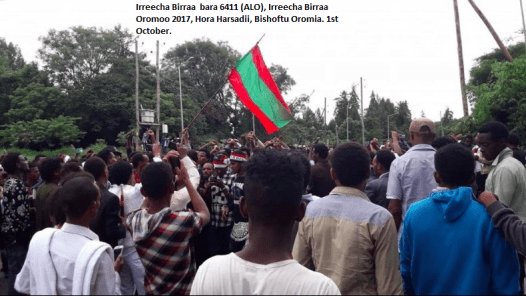
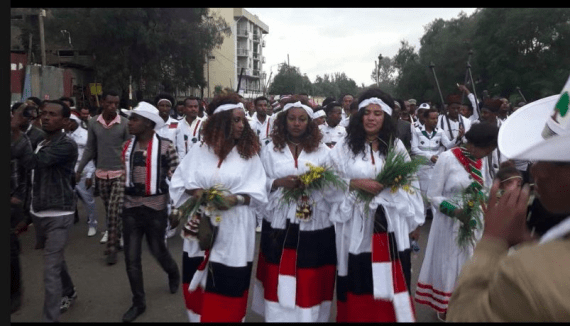



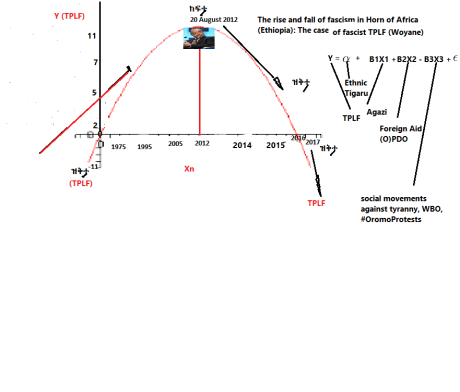

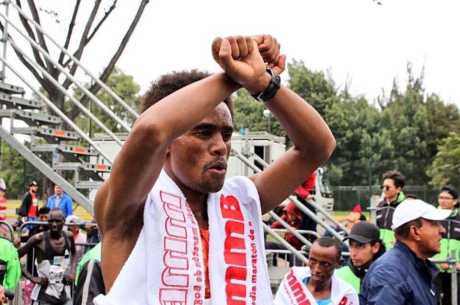





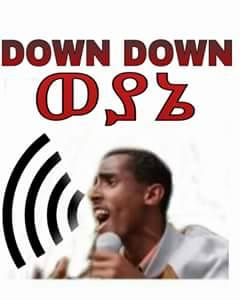

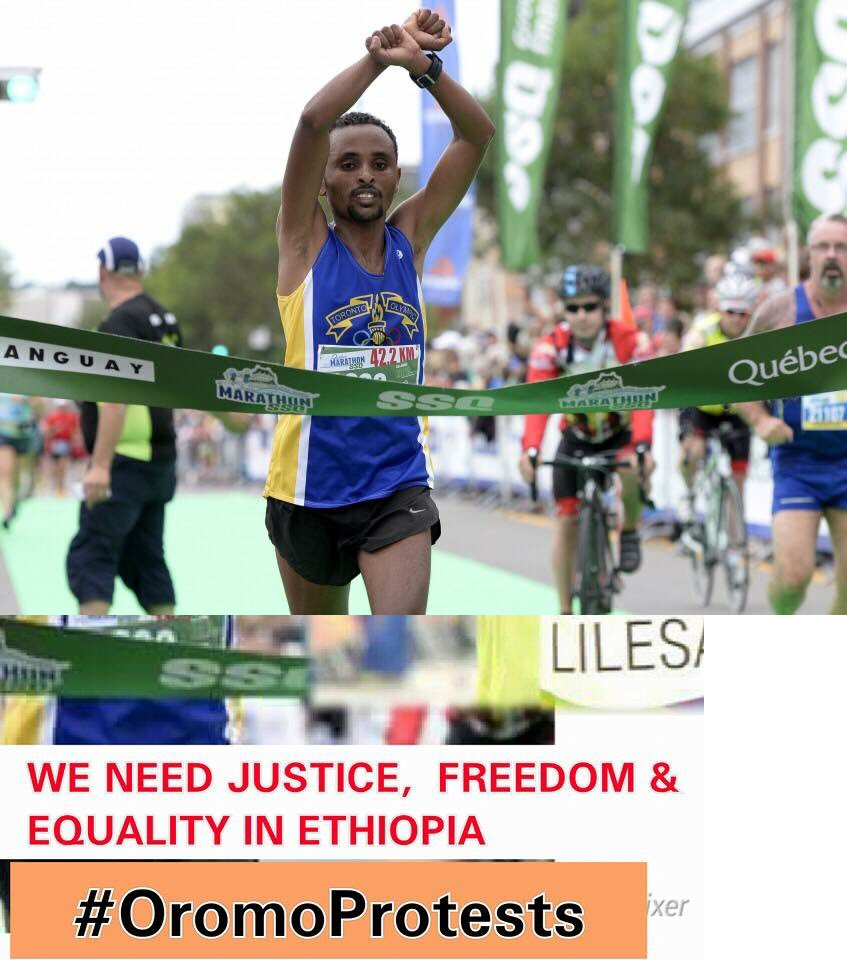


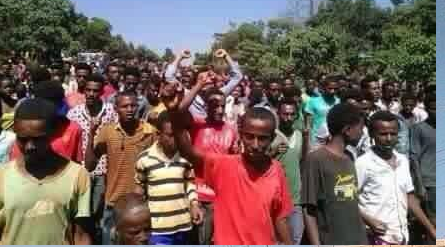


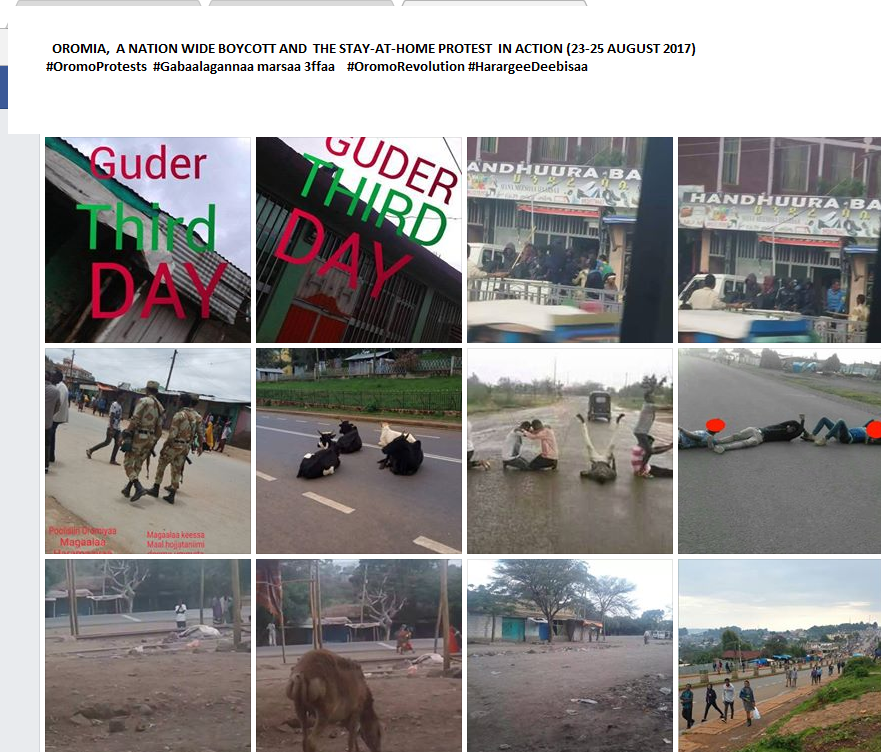
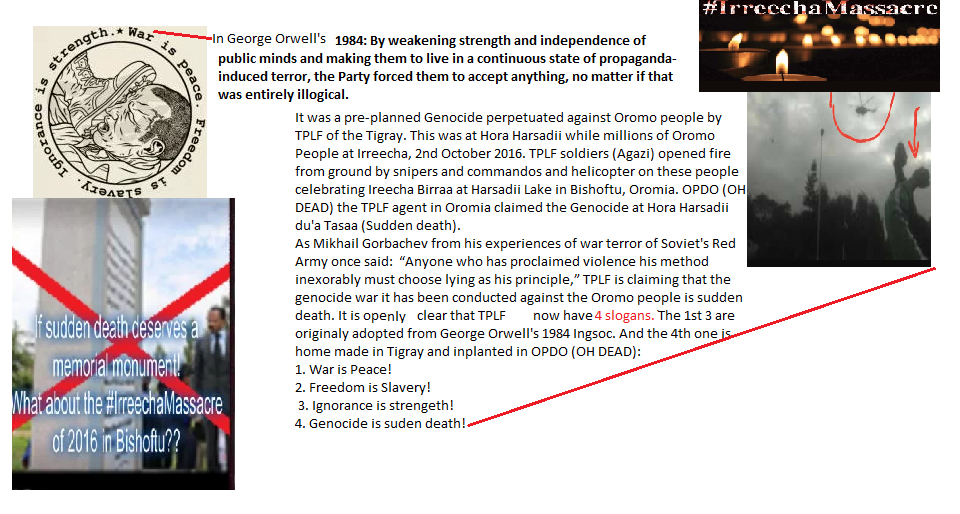





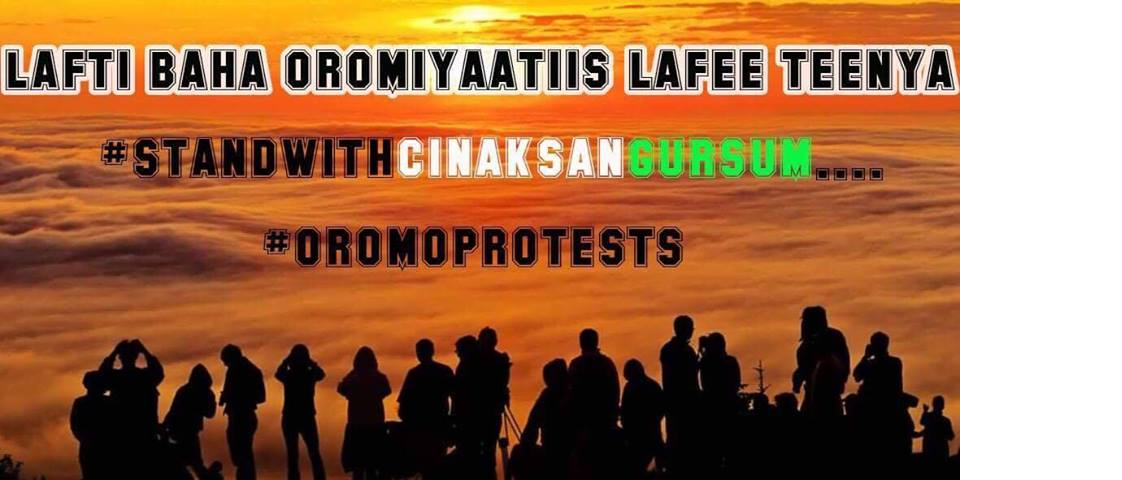
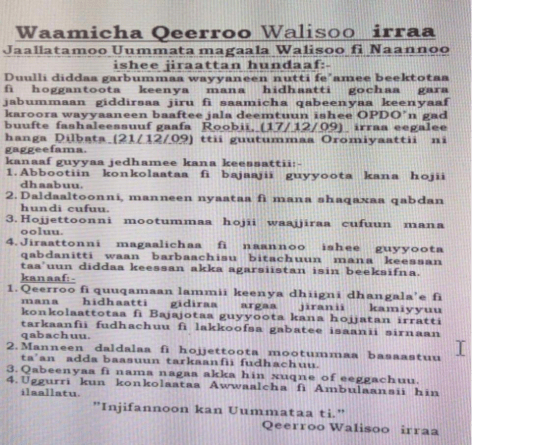



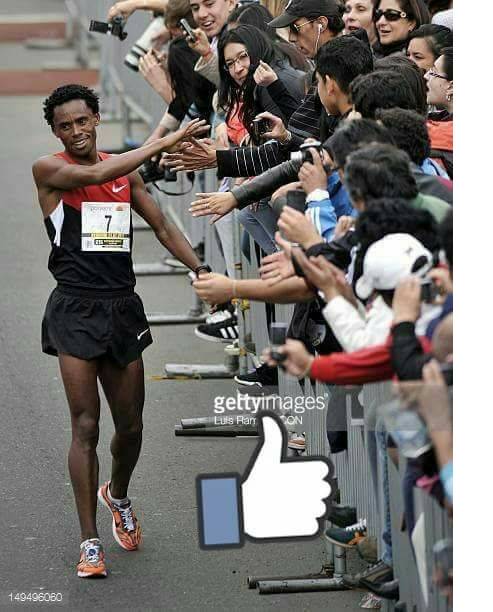











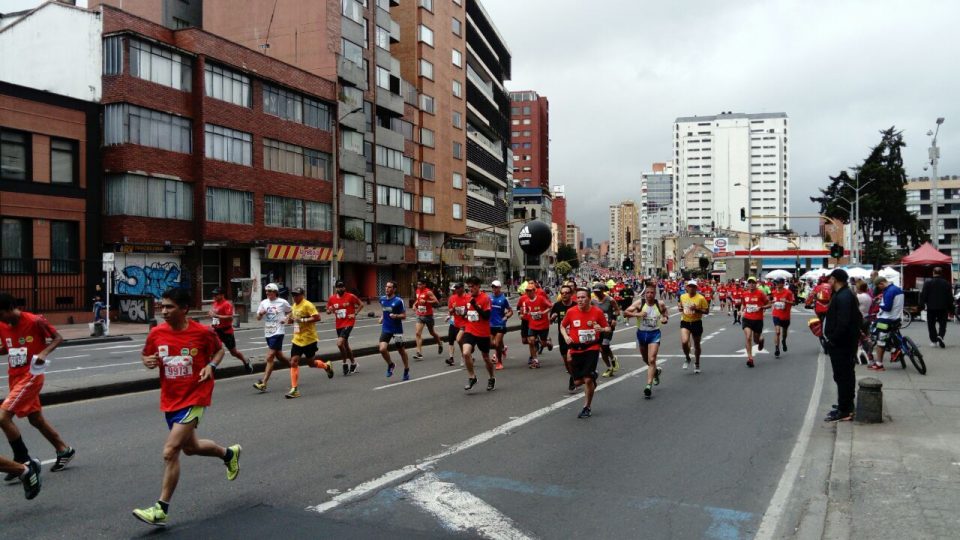


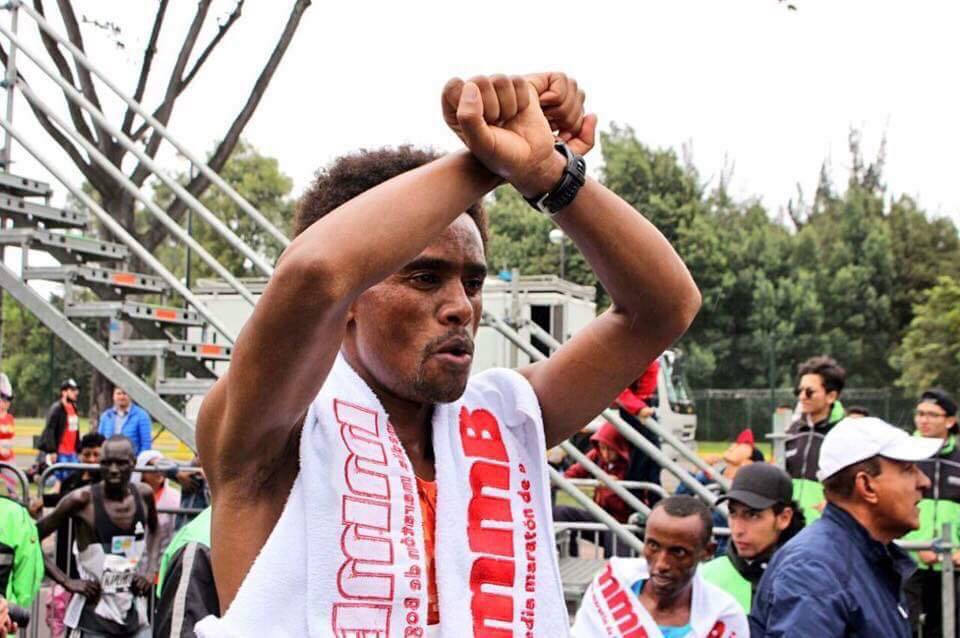

 Godina Wallagaa aanaa Gudayyaa Biilaa irraa,ummaanni gudayyaa biilaa sababa lukkeelee Sirna nama nyaataa mootummaan wayyaanee mirga hiree namummaa fi qabeenya uunfaa ofiitti fayyadamu sarbamnee murtoo balleessanii baduurra geenyeerra jedha qeerroon gudayyaa Biilaa.
 jalatti Argaman keessatti lagannaan gabayaa itti fufeeti jira Qobbootti Lagannaan gabaa roga hundaan godhamaa kan jiru yoo ta’uu wayyaanen daldaltoota walitti qabdee dirqamaan gara hojii keessanii akka deebitan jettee doorsisaa jirti.daldaltoonnis gibirri humnaa ol nutti fe’ame kan doorsisa kamuu kan nu sodaachisuu miti.nuti waan waggaa kudhanitti dalagannee hin arganne waggaa tokkotti mootummaadhaaf kaffaluu maaltu fide osoo hin hojjanne jiraachuu ni dandeenya jechuun ergamtoota wayyaanee ufirraa oofaniiti jiru.


 Godina Arsii.
 Adooleessa 18,2017/Godina Arsii Aanota hedduu keessatti guyyoota lamaan har’aaf kaleessa lagannaan gabaa kan taasifame yoo ta’uu Suuqonni daldalaa magaalota akka Seeruu,Balee, Geersaa, Shaashamannee,Adaabbaa, Dodola,Roobe,Saddiiqa, Waabee, Eddoo, Kofalee, Nageellee, Ajjee keessatti Gibira Wayyaanen Ummatarratti feete mormuun gabaa lagatanii jiru. Tajaajilli Geejjibaas dhaabbateera Konkolaachiftoonni fi Abbootin qabeenyaa sabaan Oromoo hin ta’in muraasni isaanii dalagaa isaanii didanii kan itti fufan yoo ta’uu. Diddaa kanatti akka makaman karaa adda addaatin Qeerron ergeefii kan jiru yoo ta’uu gaaffii isaanif dhiyeessine kana fudhachuun gara ummataa hin goran yoo ta’e Qeerron tarkaanfii Qabeenya isaanii irratti akka fudhatus hubachiisee jira. jedhu Gabaasaalen Qeerroo magaalota adda addaa irraa nu gahaa juru.
 Adoolessaa 18/2017 Godina Lixa Shaggar Aanaa Adaa’aa Bargaa Magaalaa Incinnii Keessatti Qeerroon Dargaggootni Oromoo Sochii Warraaqsaa Biyyoolessa Oromiyaa FXG daran jabeessuun finniinsaa jiruu, Warraaqsii kun yeroo amma sagalee dhaadannoo jabaa dhageesisuun itti fufani jiru.
  Adoolessa 16/2017 Galgala keessaa sa’a 2:50 irraa eegalee Magaalaa Amboo Keessatti Dhukaasni cimaan kan waraana wayyaanee irraa uummatatti baname , gara naannoo Mooraa Yuunibarsiitii Amboottii Waraanni Wayyaanee dhukaasaa guddaa uummata sivilii irratti banuun dargaggoota Oromoo Lama Wareeguun Ibsame jira, Kanneen madeeffaman hanga gabasni kun nu gaheetti adda kan hin baanee ta’uu maddeen Qeerroo Magaalaa Amboo addeessaan. Magaalaan Amboo galgala kana caalaatti gara dirree waraanaatti waan jijjiiramte fakkaatti , gabaasaa dabalataan walitti deebina.
  Adoolessa 16,2017/ Uummanni Shaggar lixaa rakkoo guddaa keessa jiraachuu Qeerroon naannoo Sana’a addeessan.akka gabaasa qeerroo naannoo sanaatti rakkoowwaan jireenyaa ilma namaaf barbaachisan kan akka,tajaajila Daandiin, Ibsaa,Bishaan fi kkf guutummaatti surni nama nyaataa mootummaa wayyaanee ummatarraa kuteera uummanni rakkoo guddaa keessatti argama.
 Adoolessa 15,2017. Godina Arsii Aanaa Siree keessatti Guyyaa har’aa Suuqonni cufaa oolanii jiru. Tilmaama gatii kan galii gibiraa jechuun waajjirri Galii Aanichaa maxxanseen wal qabatee daldaltoonni hojii dhaabanii jiru Waraanni wayyasnees magaalicha keessa deemee ummanni dirqamaan akka suuqii daldalaa isaanii banan furqamsiisuf tattaafachaa jiraachuu maddeen keenya magaalaa Siree gabaasanij jiru.
  Gidduugaleessaa Oromiyaa Godina Lixa Shaggar Magaalaa Ambootti Sochiin Warraaqsaa Biyyoolessa Oromiyaa FXG Kanfaltiin gibiraa dachaa guddaan Uummatarratti dabalamuu waliin walqabatee daran jabaachuun Mormii Guddaan Qeerroo Dargaggoota Oromoo, Daldaltoota fi Uummata Hundaa kan Hirmaachise Warraaqsii Finiinaa jira.


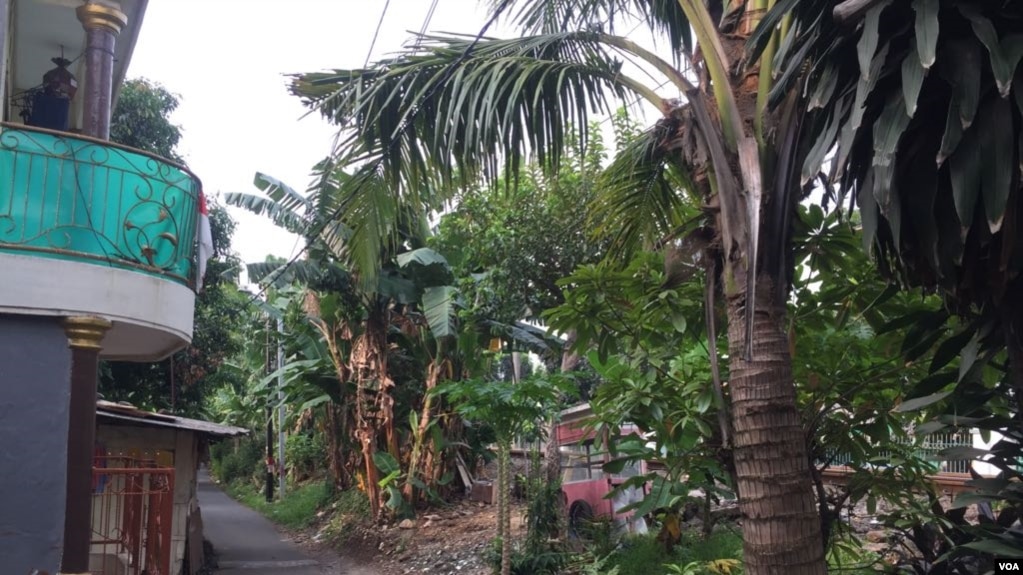
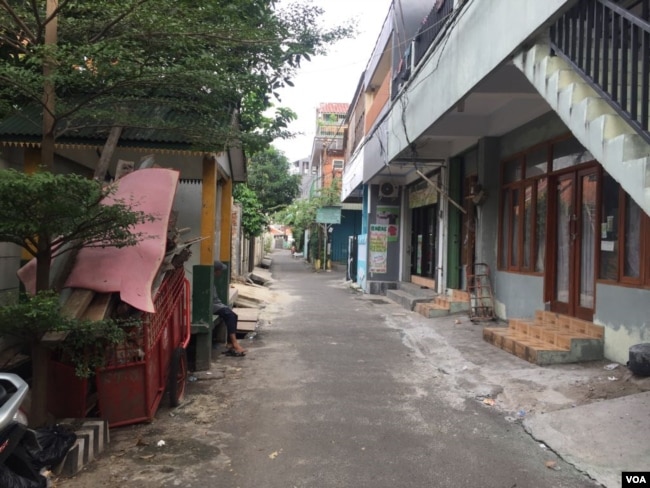
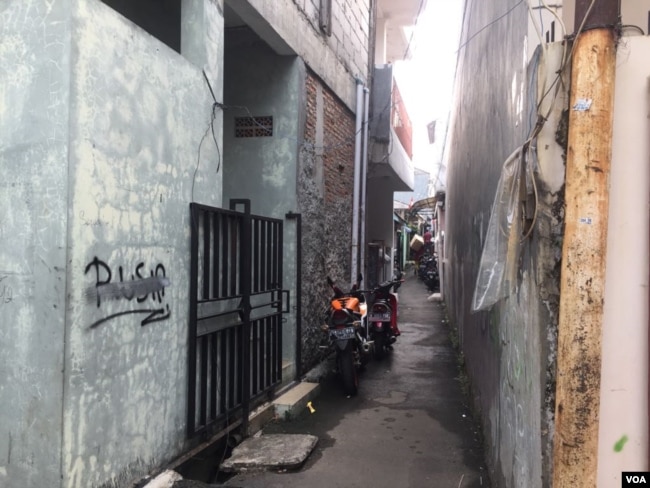

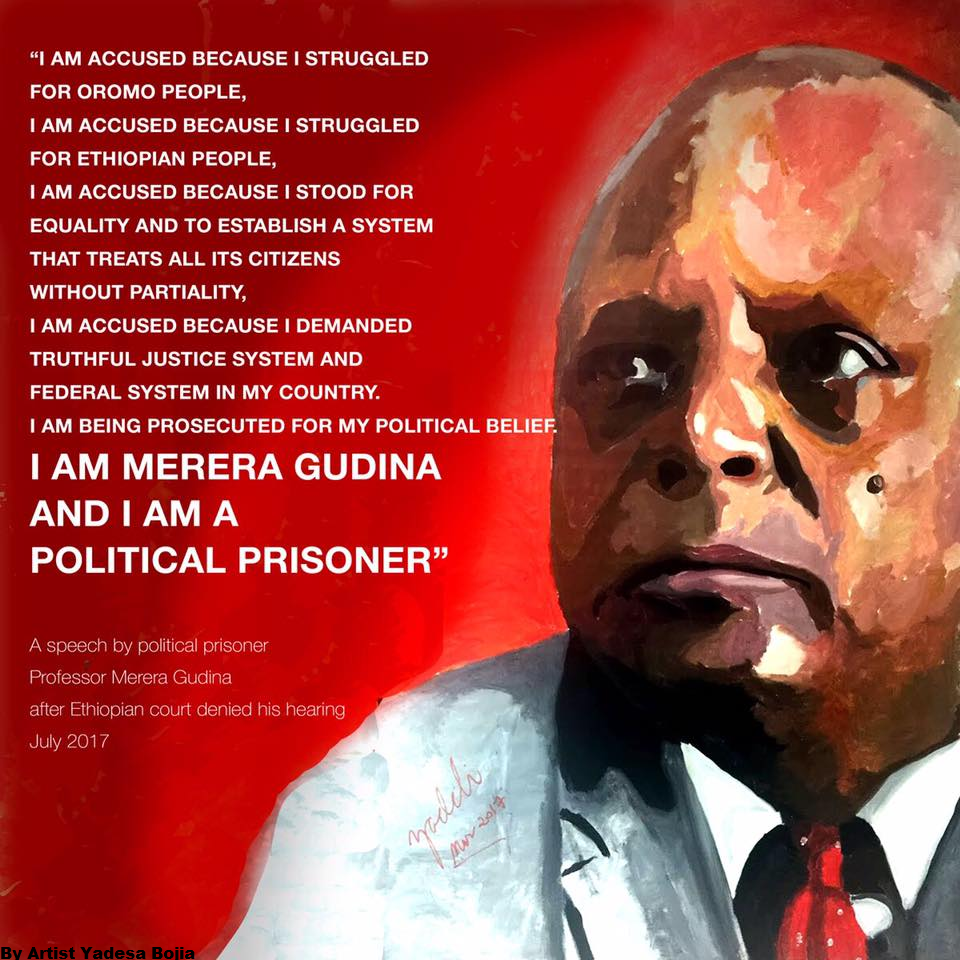


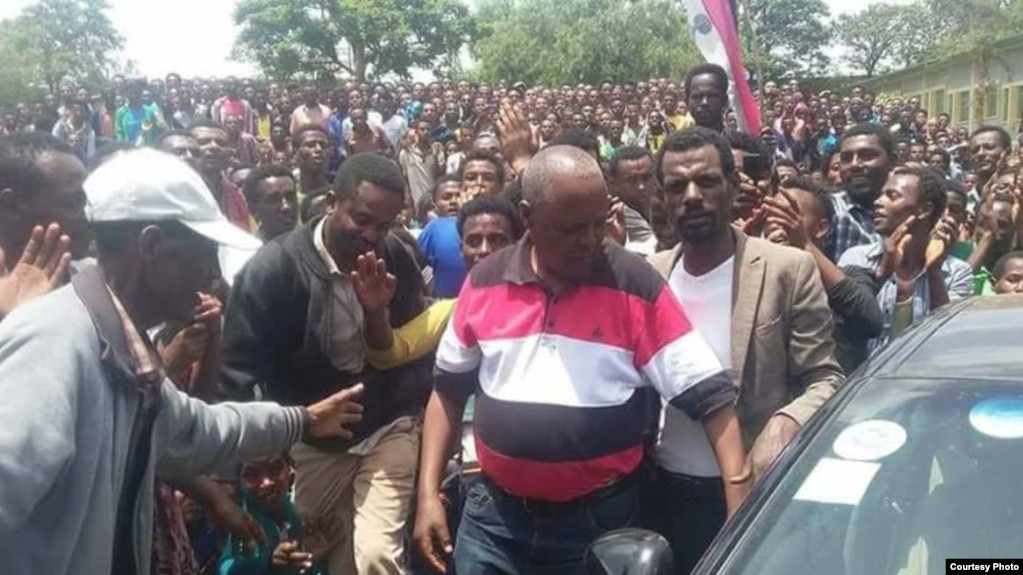






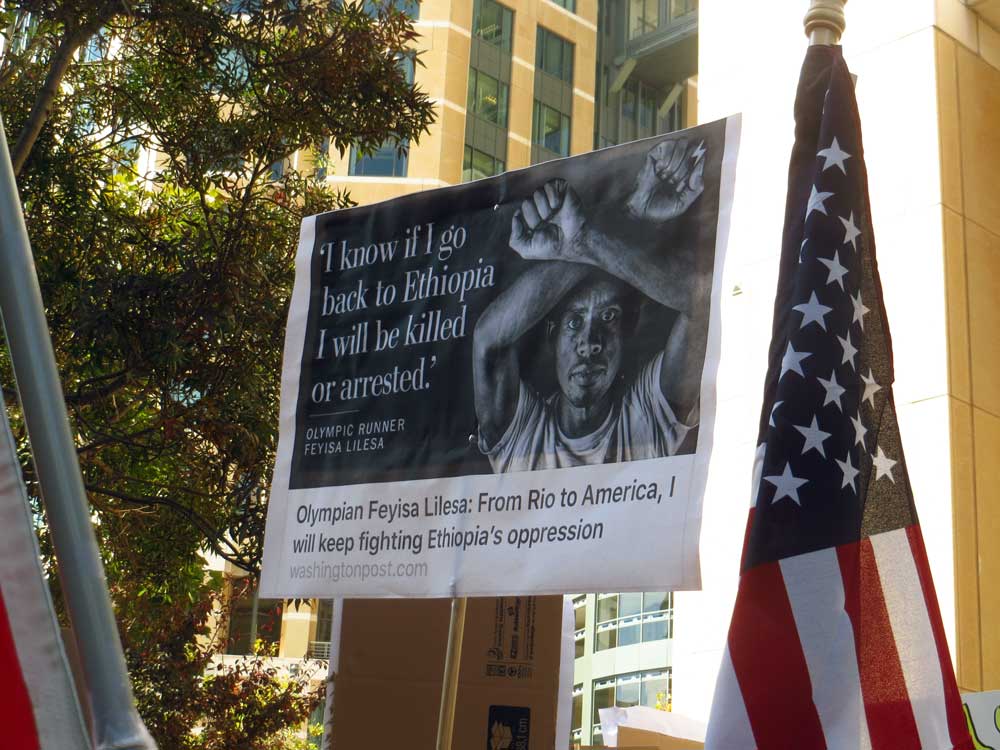

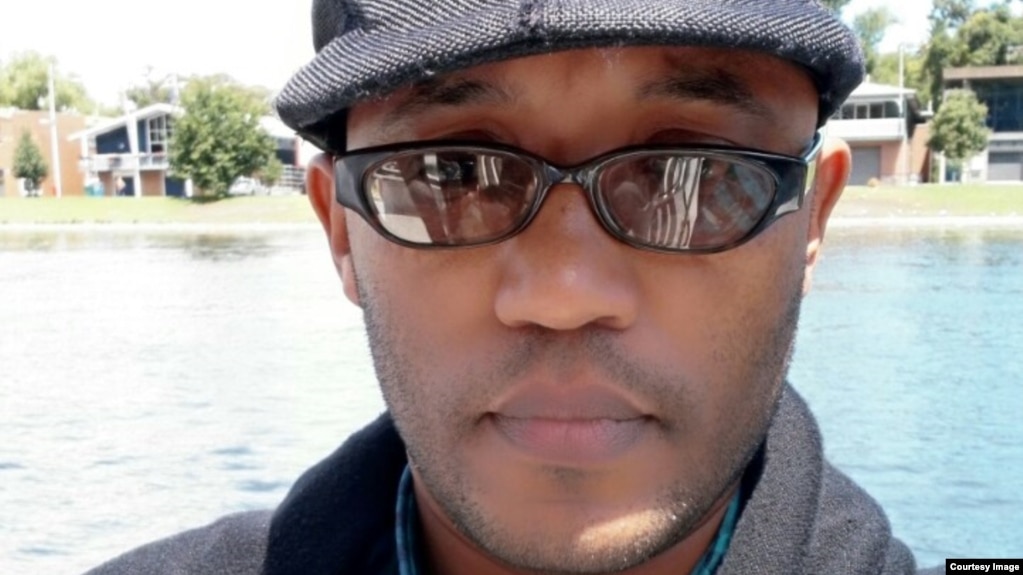





 Waxabajjii 29,2017/Yuunversiitii Wallaggaa keessatti sirna eebbifamtoota bara kanaa irratti diddaan ka’uu. mala jechuun Wayyaaneen baratoota ba’aaf gala dhorkaa jiraachuu Qeerroon gabaase.
 Waxabajjii 30.2017/ Godina Arsii Aanaa Shirkaa Magaalaa Gobeessaa keessatti Dargaggoonni Oromoo hidhamaa jiru. Godina Arsii Aanaa Shirkaatti Ayyaana Iidalfaxriitti Ummanni Akka mormii godhuuf waamicha karaa adda addaatin godhaa turtanii jirtu jechuun Ilmaan Oromoo mana isaanitii guuramuun hidhatti darbatamaa jiru. Akka gabaasni Aanicharraa nu gahe addeessutti dargaggoonni hanga ammaatti mana hidhaatitti darbataman Muhammad Jabboo Aliyyii, Huseen Amaan Gaaradoo, Turaa Jamaal Waakkannee, Ibraahim Jamaal H/ Hasan, Reeduwaan Sh/ Amiin Turee, Awwaloo Ahmad Aloo , Abdii Muhaammad Jamaal, Mahdii Muhaammad Amiin kanneen jedhaman kan keessatti argaman ta’uu maddeen keenya Shirkarraa gabaasanii jiru.


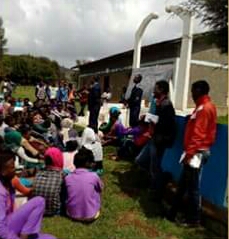



 Biiroon Barnoota OPDO Oromiyaa keessatti tartiiba qubee Afaan Oromoo A B C E F….Z ture jijjirudhaan tartiiba haaraa L irraa eegalu uumee kitaaba barnootaa maxxansee barsiisuu eegaluun wal qabatee gutummaa Oromiyaa keessatti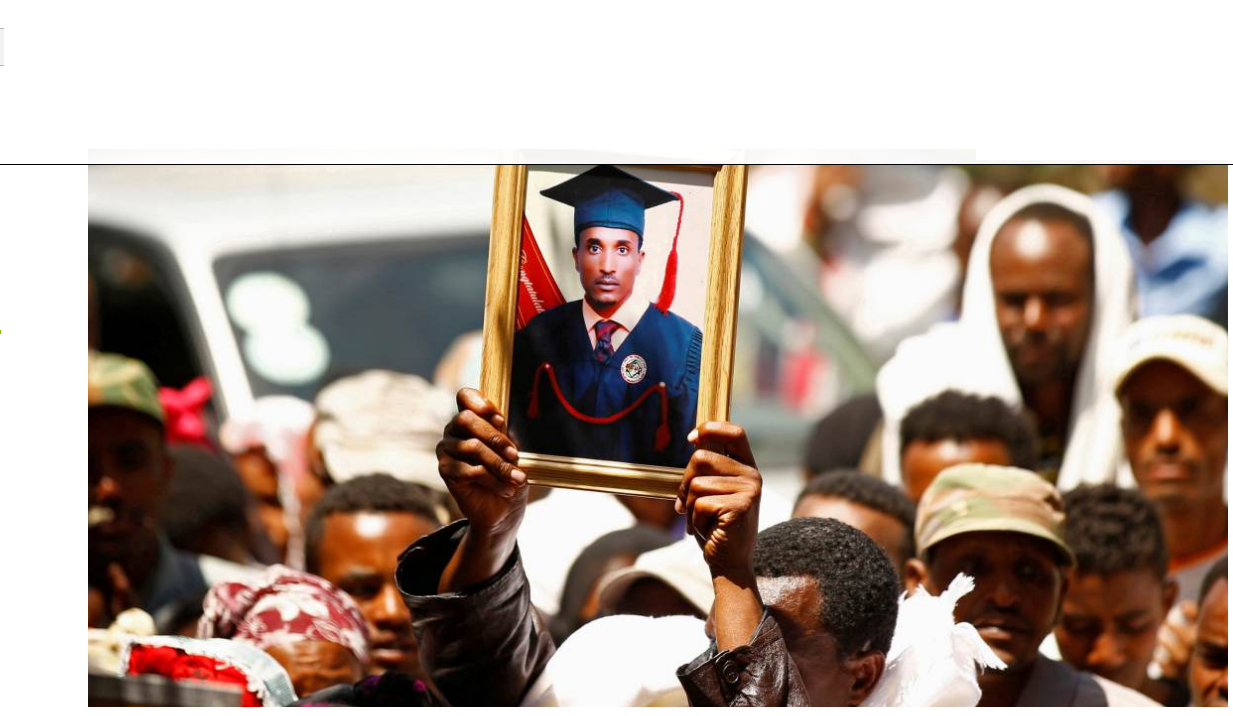





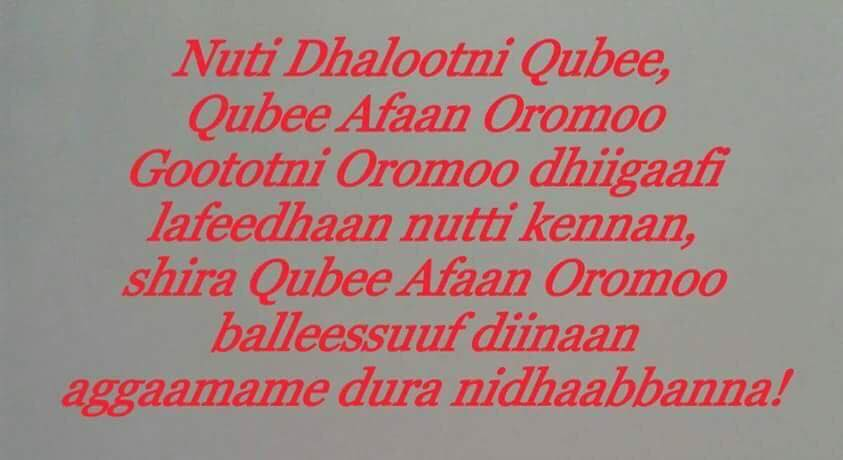


 Caamsaa 29,2017/ Kanneen maqaan isaan armaan gaditti woraqaa fuula duraa irratti tuqamee Himataamtoota Qeerroo Aanaa Dodolaa Magaala Eddo


 Oromian Economist

You must be logged in to post a comment.