Economic and development analysis: Perspectives on economics, society, development, freedom & social justice. Leading issues in Oromo, Oromia, Africa & world affairs. Oromo News. African News. world News. Views. Formerly Oromia Quarterly
Olympic marathon silver medalist Feyisa Lilesa finished second at the Houston Half-Marathon on January 15, 2017, with a time of 61:14 – only a fraction of a second behind the front runner Leonard Korir. The thrilling battle between Lilesa and Korir at the finish line is captured below.
Feyisa Lilesa had, once again, shown the #OromoProtests symbol of “X” (crossing the hands over the head) as he crossed the finish line in Houston. This symbol of the #OromoProtests has been officially deemed illegal by the Ethiopian government since the declaration of the six-month State of Emergency on October 9, 2016 – a week after the Bishoftu Massacre, where hundreds of Oromos were murdered by the Ethiopian army during the UNESCO-recognized Irreecha Oromo cultural and religious festival.
After the race, during a reception thrown by the local community in Houston to honor him, Feyisa Lilesa spoke with Seife-Nebelbal, an online Oromo radio broadcast in Amharic, about his continued use of the symbol of the #OromoProtests at the finish line; Lilesa said he would continue to protest until freedom and democracy dawn in Ethiopia. Below are the interview and some photos from the reception (courtesy of journalist Ebba Abbamurti from the Lone Star State).
Olympics medalist marathoner Feyisa Lilesa lowers his head after being asked about his home country Ethiopia after the Chevron Houston Marathon press conference at the George R. Brown Convention Center, Friday, Jan. 13, 2017, in Houston. ( Marie D. De Jesus / Houston Chronicle )
He’s the loneliest of long-distance runners, a man far removed from his country and his family. These days, Feyisa Lilesa runs not for personal glory but for emotional therapy and for a purpose he believes to be far bigger than himself.
Internet and mobile phone networks were repeatedly disrupted around the country, particularly in the Oromia region during antigovernment protests that began in November 2015(see Restrictions on Connectivity).
Social media and communications platforms were temporarily blocked several times to restrict information about antigovernment protests and police brutality(see Blocking and Filtering).
News websites were newly blocked for reporting on the Oromo protests and a severe drought, adding to a growing blacklist (see Blocking and Filtering).
In May 2016, blogger Zelalem Workagenehu was sentenced to over five years in prison for leading a digital security course (see Prosecutions and Arrests for Online Activities).
Prosecutors challenged the release of members of the Zone 9 blogging collective, after they were acquitted of terrorism charges in 2015 (see Prosecutions and Arrests for Online Activities).
Introduction:
Internet freedom declined in the past year as the government cracked down on antigovernment protests and the digital tools citizens used to organize them.
Starting in the Oromo region in November 2015 as a protest against the authoritarian government’s plan to infringe on land belonging to the marginalized Oromia people, the movement spread across the country in the subsequent months, turning into unprecedented demonstrations seeking regime change and democratic reform.
In a heavy-handed response, the authorities frequently shutdown local and national internet and mobile phone networks to prevent citizens from communicating about the protests. Social media platforms and communications apps such as Facebook, Twitter, Skype, and IMO were also temporarily blocked at different times. In October 2016, the government imposed a six-month state of emergency on October 17, resulting in another internet shutdown lasting several days. Under the state of emergency, accessing or posting content related to the protests on social media and efforts to communicate with “outside forces” are criminal offenses.
News websites and blogs reporting on the protests were permanently blocked in 2015 and 2016. Separately, critical news about the current drought—the worst the country has experienced in 50 years—was systematically censored. Meanwhile, the authorities arrested and prosecuted several bloggers, sentencing blogger Zelalem Workagenehu to five years in prison in May 2016. He was convicted of conspiring to overthrow the government for facilitating a course on digital security. The government’s persecution of the Zone 9 bloggers continued. Though four of the bloggers were acquitted in October 2015, the prosecutor appealed their release to the Supreme Court, and they were repeatedly summoned throughout the year.
The legal environment for internet freedom became more restrictive under the Computer Crime Proclamation enacted in June 2016, which criminalizes defamation and incitement. The proclamation also strengthens the government’s surveillance capabilities by enabling real-time monitoring or interception of communications.
Internet and mobile phone networks were deliberately disrupted in many parts of the country throughout the year, particularly in the Oromia region during largescale antigovernment protests that erupted in November 2015. Meanwhile, poor infrastructure, obstructionist telecom policies, and a government monopoly on the ICT sector make ICT services prohibitively expensive for the majority of the population.
Availability and Ease of Access
Ethiopia is one of the least connected countries in the world with an internet penetration rate of only 12 percent, according to 2015 data from the International Telecommunications Union (ITU).1 Mobile phone penetration is also poor at 43 percent, up from just 32 percent in 2014.2 Low penetration rates stem from underdeveloped telecommunications infrastructure, which is almost entirely absent from rural areas, where about 85 percent of the population resides. A handful of signal stations service the entire country, resulting in network congestion and frequent disconnection.3 In a typical small town, individuals often hike to the top of the nearest hill to find a mobile phone signal.
Access to ICT services remains prohibitively expensive for most Ethiopians, largely due to the government’s monopoly over the telecom sector, which provides consumers with few options. Prices are set by state-controlled EthioTelecom and kept artificially high.4 Price cuts announced in February 2016 mitigated some of the financial strain,5 bringing mobile internet prices to ETB 5 (US$ 0.25) per day for 25 MB of data or ETB 3,000 (US$ 140) per month for 30 GB. Nonetheless, the lower cost 25 MB package is extremely limited considering a standard Google search uses up to 79 KB alone. Regularly loading websites containing 1 GB of multimedia content could cost US$ 9 a day. William Davison, Bloomberg’s Ethiopia correspondent, described the issue on Facebook in March 2016: “It cost me 44 birr ($2.05) to watch Al Jazeera’s latest 3-minute dispatch on Oromo protests using 4G network on my phone, which is not that much less than the average daily wage of a daily laborer in Ethiopia.”6Ethiopians can spend an average of US$85 per month for limited mobile or fixed wireless internet access. Better quality services in neighboring Kenya and Uganda cost less than US$30 a month.
Telecommunication devices, connection fees and other related costs are also beyond the means of many Ethiopians. As a result, Ethiopia has among the lowest smartphone ownership rates in the world at only 4 percent according to a recent Pew survey.7 In April 2016, EthioTelecom proposed a new pricing scheme to charge more for the use of popular Voice-over-IP (VoIP) platforms such as Viber and Facebook Messenger on mobile devices.8 This would make smartphone usage even more expensive.
Consequently, the majority of internet users still rely on cybercafés for internet access. A typical internet user in Addis Ababa pays between ETB 5 and 7 (US$ 0.25 to 0.35) for an hour of access.Because of the scarcity of internet cafes outside urban areas, however, rates in rural cybercafés are higher. In addition, digital literacy rates are generally low.
For the few Ethiopians who can access the internet, connection speeds have been painstakingly slow for years, despite the rapid technological advances improving service quality in other countries. In a test conducted in the capital Addis Ababa,9 the average connection speed during one week in March 2016 was 1.2 Mbps—five times slower than the average 5.5 Mbps connection speed in Kenya. According to Akamai, the average connection speed in Ethiopia was 3 Mbps in the first quarter of 2016, significantly lower than the global average of 6.3 Mbps (Kenya’s average speed was documented at 7.3 Mbps in the same period).10
In practice, such speeds result in extremely sluggish download times, even of simple images. Logging into an email account and opening a single message can take as long as five minutes at a standard cybercafé with broadband in the capital city, while attaching documents or images to an email can take eight minutes or more.11 On mobile connections, Akamai found Ethiopia had the world’s slowest average load time, at 8.5 seconds.12
Compounding Ethiopia’s onerous access issues, severe drought in 2015 and 2016 has had a negative impact on the country’s hydroelectric electricity production,13 resulting in frequent and extended power outages that limit users’ ability to access the internet even further.14
Restrictions on Connectivity
The Ethiopian government’s monopolistic control over the country’s telecommunications infrastructure via EthioTelecom enables it to restrict information flows and access to internet and mobile phone services. In 2015–16, the flow of online traffic into, within, and out of Ethiopia registered a significant decline, likely as a result of network throttling, repeated internet shutdowns, and increased blocking.
As a landlocked country, Ethiopia has no direct access to submarine cable landing stations; thus, it connects to the international internet via satellite, a fiber-optic cable that passes through Sudan and connects to its international gateway, and the SEACOM cable that connects through Djibouti to an international undersea cable. All connections to the international internet are completely centralized via EthioTelecom, enabling the government to cut off the internet at will.
Internet and mobile phone networks were disrupted in many parts of the country throughout the year. Oromia, the largest of the federal republic’s nine regional states, has experienced frequent telecom network since November 2015 saw the start of largescale demonstrations against the government’s plan to appropriate Oromia territory.15 The protest movement escalated and remained ongoing in late 2016, leading the government to declare a six-month state of emergency and shut down mobile internet services nationwide for several days in October.16
In an incident unrelated to the protests, internet services on computers and mobile devices were shut down for 24 hours in July 2016, ostensibly to prevent students from cheating during national university exams.17
The ICT shutdowns have been costly. Network disruptions between July 1, 2015 and June 30, 2016 cost Ethiopia’s economy over US$ 8.5 million, according to the Brookings Institution.18
ICT Market
The space for independent initiatives in the ICT sector, entrepreneurial or otherwise, is extremely limited,19 with state-owned EthioTelecom holding a firm monopoly over internet and mobile phone services as the country’s sole telecommunications service provider. Despite repeated international pressure to liberalize telecommunications in Ethiopia, the government refuses to ease its grip on the sector.20
China is a key investor in Ethiopia’s telecommunications industry,21 with Zhongxing Telecommunication Corporation (ZTE) and Huawei currently serving as contractors to upgrade broadband networks to 4G in Addis Ababa and expand 3G networks elsewhere.22 The partnership has enabled Ethiopia’s authoritarian leaders to maintain their hold over the telecom sector,23though the networks built by the Chinese firms have been criticized for their high cost and poor service.24 Furthermore, the contracts have led to increasing fears that the Chinese may also be assisting the authorities in developing more robust ICT censorship and surveillance capacities (see Surveillance, Privacy, and Anonymity).25 In December 2014, the Swedish telecom group Ericsson also partnered with the government to improve and repair the mobile network infrastructure,26 though ZTE remains the sector’s largest investor.
Onerous government regulations also stymie other aspects of the Ethiopian ICT market. For one, imported ICT items are tariffed at the same high rate as luxury items, unlike other imported goods such as construction materials and heavy duty machinery, which are given duty-free import privileges to encourage investments in infrastructure.27 Ethiopians are required register their laptops and tablets at the airport with the Ethiopian customs authority before they travel out of the country, ostensibly to prevent individuals from illegally importing electronic devices, though observers believe the requirement enables officials to monitor citizens’ ICT activities by accessing the devices without consent.28
Local software companies also suffer from heavy-handed government regulations, which do not have fair, open, or transparent ways of evaluating and awarding bids for new software projects.29 Government companies are given priority for every kind of project, while smaller entrepreneurial software companies are completely overlooked, leaving few opportunities for local technology companies to thrive.
Cybercafés are subject to burdensome operating requirements under the 2002 Telecommunications (Amendment) Proclamation,30 which prohibit them from providing Voice-over-IP (VoIP) services, and mandate that owners obtain a license from EthioTelecom via an opaque process that can take months. In the past few years, EthioTelecom began enforcing its licensing requirements more strictly in response to the increasing spread of cybercafés, reportedly penalizing Muslim cafe owners more harshly. Violations of the requirements entail criminal liability, though no cases have been reported.31
Regulatory Bodies
Since the emergence of the internet in Ethiopia, the Ethiopian Telecommunications Agency (ETA) has been the primary regulatory body overseeing the telecommunications sector. In practice, government executives have complete control over ICT policy and sector regulation.32 The Information Network Security Agency (INSA), a government agency established in 2011 and controlled by individuals with strong ties to the ruling regime,33 also has significant power in regulating the internet under the mandate of protecting the communications infrastructure and preventing cybercrime.
News websites known for their reporting on the Oromo protests joined Ethiopia’s growing list of blocked content, while social media and communications platforms were blocked for periods of time throughout the coverage period for their role in disseminating information about the demonstrations and police brutality. The government manipulates online content, disseminating propaganda to convince Ethiopians that social media is a dangerous tool co-opted by opposition groups to spread hate and violence.
Blocking and Filtering
One of the first African countries to censor the internet,34 Ethiopia has a nationwide, politically motivated internet blocking and filtering regime that is reinforced during sensitive political events. More websites were newly blocked during the Oromia protests that began in November 2015. Targets included the websites of US-based diaspora satellite television stations such as Ethiopian Satellite Television (ESAT) and the Oromo Media Network (OMN), which provided wall-to-wall coverage of the antigovernment protests. Ayyantuu.net and Opride.com, prominent websites also known for their reporting on the protests, were also blocked.35
In an apparent attempt to restrict news about the protests from spreading, social media and file-sharing platforms such as Facebook, Twitter, WhatsApp, and Dropbox were repeatedly blocked for periods of time throughout the protests.36 The blocks on social media first impacted networks in the Oromia region but later spread to other regions,37 and eventually manifested in a shutdown of entire internet and mobile networks for days a time (see Restrictions on Connectivity).
Unrelated to the protests, the authorities blocked access to social media and communications platforms, including Facebook, Twitter, Instagram, Viber, IMO, and Google+, to prevent cheating during university examinations on July 9 and 10, 2016.38 The blocks followed a 24-hour internet blackout for the same reason (see Restrictions on Connectivity). A government spokesperson stated that blocking social media during the exam would help students concentrate. However, some progovernment media organizations and commentators seemed to have exclusive access to social media during the block,39 which reinforced the belief that the government imposes restrictions on citizens while keeping the web open for its own advantage. Viber and IMO, two popular voice-over-IP applications, remained blocked until July 20, according to local sources.40
Separately, coverage of a severe drought—the worst the country has experienced in 50 years—was systematically censored in the past year, with news websites and blogs blocked for reporting on the impact of the disaster that strayed from the government’s official narrative.41
In total, over one hundred websites are inaccessible in Ethiopia.42 A manual test conducted on the ground in mid-2016 confirmed that a large number of the websites tested by Freedom House each year since 2012 remained blocked. Blocked sites include Ethiopian news websites, political party websites, and the websites of international digital rights organizations, such as the Electronic Frontier Foundation and Tactical Technology Collective. Select tools such as text messaging appsand services on Google’s Android operating system on smartphones were also inaccessible, but at irregular intervals and for unclear reasons.43
Notably, several websites that hadn’t been updated for years and appeared abandoned became accessible again in 2016, likely because the authorities deemed them no longer threatening. The social media curation tool Storify—first blocked in July 201244—was also newly accessible during the coverage period,45 in addition to the URL shortening tool Bit.ly.46
To filter the internet, specific internet protocol (IP) addresses or domain names are generally blocked at the level of the EthioTelecom-controlled international gateway. Deep-packet inspection (DPI) is also employed, which blocks websites based on a keyword in the content of a website or communication (such as email).47
Digital security tools are also pervasively blocked in Ethiopia, including Tor, the circumvention tool that enables users to browse anonymously, which been blocked since May 2012.48 As social media platforms were blocked in the past year, diaspora-based activists publicized virtual private networks (VPNs) to circumvent the censorship, but certain VPNs were also subsequently blocked.49 Local sources suspected progovernment commenters were flagging the same tools to be blocked by the authorities. The Amharic translation of the Electronic Frontier Foundations’ “Surveillance Self-Defense” web guide was blocked two weeks after it was published in October 2015.50 One source reported that key terms such as “proxy” yield no search results on unencrypted search engines,51 reflecting the government’s efforts to limit users’ access to circumvention tools and strategies.
Some restrictions are also placed on content transmitted via mobile phones. Text messages to more than ten recipients require prior approval from EthioTelecom.52 A bulk text message sent without prior approval is automatically blocked, irrespective of the content.
There are no procedures for determining which websites are blocked or why, precluding any avenues for appeal. There are no published lists of blocked websites or publicly available criteria for how such decisions are made, and users are met with an error message when trying to access blocked content. The decision-making process does not appear to be controlled by a single entity, as various government bodies—including the Information Network Security Agency (INSA), EthioTelecom, and the ICT ministry—seem to be implementing their own lists, contributing to a phenomenon of inconsistent blocking. This lack of transparency is exacerbated by the government’s continued denial of its censorship efforts. Government officials flatly deny the blocking of websites or jamming of international satellite operations while also stating that the government has a legal and a moral responsibility to protect the Ethiopian public from extremist content.
Content Removal
Politically objectionable content is often targeted for removal, often by way of threats from security officials who personally seek out users and bloggers to instruct them to take down certain content, particularly critical content on Facebook. The growing practice suggests that at least some voices within Ethiopia’s small online community are being closely monitored. For instance, during the various legal proceedings involving the Zone 9 bloggers in 2015, friends and reporters who posted pictures and accounts of the trials on social media were briefly detained and asked to remove the posts.53 During protests in Oromia, activists who wrote messages of solidarity for the protestors on Facebook were also asked to delete their posts.54
Media, Diversity, and Content Manipulation
Lack of adequate funding is a significant challenge for independent online media in Ethiopia, as fear of government pressure dissuades local businesses from advertising with politically critical websites. A 2012 Advertising Proclamation also prohibits advertisements from firms “whose capital is shared by foreign nationals.”55 The process for launching a website on the local .et domain is expensive and demanding,56 requiring a business license from the Ministry of Trade and Industry and a permit from an authorized body.57 While the domestic Ethiopian blogosphere has been expanding, most blogs are hosted on international platforms or published by members of the diaspora community.
Despite Ethiopia’s extremely low levels of internet access, the government employs an army of trolls to distort Ethiopia’s online information landscape.58 Opposition groups, journalists, and dissidents use the contemptuous Amharic colloquial term, “Kokas,” to describe the progovernment commentators.59 Observers say the Kokas regularly discuss Ethiopia’s economic growth in favorable terms and post uncomplimentary comments about Ethiopian journalists and opposition groups on Facebook and Twitter. In return, they are known to receive benefits such as money, land, and employment promotions.
The government also manipulates online content through propaganda that aims to convince Ethiopians that social media is a dangerous tool co-opted by opposition groups to spread hate and violence.60 That characterization has been debunked by research. The University of Oxford and Addis Ababa University analyzed thousands of comments made by Ethiopians on Facebook during general election in 2015, finding that hate speech was a marginal proportion of the total comments assessed.61
Meanwhile, increasing repression against journalists and bloggers has had a major chilling effect on expression online, particularly in response to the spate of blogger arrests that have increased in the past few years (see Prosecutions and Detentions for Online Activities). Many bloggers publish anonymously to avoid reprisals.62 Fear of pervasive surveillance has also led to widespread self-censorship. Local newspapers and web outlets primarily publish reporting by regime critics and opposition organizations in the diaspora. Few independent local journalists will write for either domestic or overseas online outlets due to the threat of repercussions.
Digital Activism
Despite oppressive conditions caused by poor access and the hostile legal environment, online activism has gained considerable momentum and influence in the past year, particularly as traditional media coverage of current events has become increasingly narrow and dominated by pro-government voices. Notably, social media and communications platforms helped tech-savvy Ethiopians launch the widespread antigovernment protests in the Oromia region in November 2015. Online tools have been essential to the #OromoProtests movement, enabling activists to post information about the demonstrations and disseminate news about police brutality as the government cracked down on protesters.63 The use of such tools to fuel the protest movement led the government to block access to several platforms throughout the year, and shut down internet and mobile networks altogether (see Blocking and Filtering and Restrictions on Connectivity).
The new Computer Crime Proclamation enacted in June 2016 criminalizes defamation and incitement; observers say it could be invoked to suppress digital mobilization. The proclamation also strengthens the government’s surveillance capabilities by enabling real-time monitoring or interception of communications. Several bloggers were arrested and prosecuted, with one blogger sentenced to five years in prison, while prosecutors challenged the acquittal of the Zone 9 bloggers.
Legal Environment
Fundamental freedoms are guaranteed for Ethiopian internet users on paper, but the guarantees are routinely flouted in practice. The 1995 Ethiopian constitution provides for freedom of expression, freedom of the press, and access to information, while also prohibiting censorship.64 These constitutional guarantees are affirmed in the 2008 Mass Media and Freedom of Information Proclamation, known as the press law, which governs the print media.65 Nevertheless, the press law also includes problematic provisions that contradict constitutional protections and restrict free expression, such as complex registration processes for media outlets and high fines for defamation.66 The Criminal Code also penalizes defamation with a fine or up to one year in prison.67
Meanwhile, several laws are designed to restrict and penalize legitimate online activities and speech.
Most alarmingly, the 2012 Telecom Fraud Offences Law extends the violations and penalties defined in the 2009 Anti-Terrorism Proclamation and criminal code to electronic communications, which explicitly include both mobile phone and internet services.68 The antiterrorism legislation prescribes prison sentences of up to 20 years for the publication of statements that can be understood as a direct or indirect encouragement of terrorism, which is vaguely defined.69 The law also bans Voice over Internet Protocol (VoIP) services such as Skype70 and requires all individuals to register their telecommunications equipment—including smartphones—with the government, which security officials typically enforce at security checkpoints by confiscating ICT equipment if the owner cannot produce a registration permit, according to sources in the country.
In June 2016, the Ethiopian government passed a new Computer Crime Proclamation that criminalized an array of online activities.71 Civil society expressed concern that the law would be used to further crackdown on critical commentary, political opposition, and social unrest.72 For example, content that “incites fear, violence, chaos or conflict among people” can be punished with up to three years in prison, which could be abused to suppress digital campaigns.73 Other problematic provisions ban the dissemination of defamatory content, which can be penalized with up to 10 years in prison,74 and the distribution of unsolicited messages to multiple emails (spam), which carries up to five years in prison.75
To quell escalating antigovernment protests that began in the Oromia region in November 2015, the government imposed a six-month state of emergency on October 17, 2016 that included restrictions on certain online activities.76 In addition to shutting down the internet for several days, the authorities criminalized the access and posting of content related to the protests on social media, as well as efforts to communicate with “terrorist” groups, a category that includes exiled dissidents. Penalties for violating the state of emergency include prison terms of three to five years.77
Prosecutions and Detention for Online Activities
In the past few years, the authorities have intensified their crackdown against bloggers and online journalists, using harsh laws to arrest and prosecute individuals for their online activities and silence dissent. The most high-profile prosecutions were against six bloggers from the critical Zone 9 blogging collective, who were arrested in April 2014,78 and charged with terrorism under the harsh Anti-Terrorism Proclamation in July.79 The bloggers were accused of intent to overthrow the government, an offense under the criminal code, by encrypting their communications to disseminate seditious writings.80
Despite widespread international condemnation, the detainees were denied bail and brought to court dozens of times for over a year,81 until two of them were unexpectedly released without charge in early July 2015, immediately before U.S. President Obama visited Ethiopia. The four remaining Zone 9 bloggers were acquitted in October 2015,82 though they were barred from leaving the country.83 The prosecutor contested their acquittal and appealed to the Supreme Court, and the four were summoned in December 2015 and in October 2016.84 They were scheduled to return to court in November 2016.85
Several other bloggers were arrested and prosecuted in the past year, including Getachew Shiferaw, editor-in-chief of the online newspaper Negere Ethiopia, in December 2015.86Negere Ethiopia is known for its affiliation with the opposition as well as its coverage of the Zone 9 trials. Shiferaw remained in pretrial detention in mid-2016.87
The prominent opposition member Yonatan Tesfaye was arrested in December 2015 and charged with terrorism based on Facebook posts that criticized the government’s handling of the Oromia protests.88 He remained in prison in mid-2016 and faces the death sentence if convicted.89 Tesfaye’s Twitter handle has been active during his detention, leading to suspicions that the officials have been using his account to bait potential dissidents.90
In April 2016, blogger Zelalem Workagenehu was found guilty of terrorism and sentenced to over five years in prison in May.91 He was first arrested in July 2014 on charges of conspiring to overthrow the government after he facilitated a course on digital security. In the same trial, bloggers Yonatan Wolde and Bahiru Degu were acquitted after spending nearly two years in detention on terrorism charges; they were also arrested in July 2014 for applying to participate in Workaegnehu’s digital security course.92 Workagenehu has appealed to the Supreme Court.93
The ongoing antigovernment protest movement has also led to numerous arrests, some for digital activities, including posting or “liking” social media content about the protests. In October 2016, police arrested Seyoum Teshome, a well-known academic and blogger for the Ethiothinktank.com website who had published an article about the Oromia protest movement inThe New York Times.94
Meanwhile, the well-known dissident journalist and blogger Eskinder Nega is serving an 18-year prison sentence handed down in July 2012 under the draconian anti-terrorism law for criticizing the law itself in an online article.95
Surveillance, Privacy, and Anonymity
Government surveillance of online and mobile phone communications is pervasive in Ethiopia and was strengthened under the new Computer Crime Proclamation enacted in June 2016, which enables real-time monitoring or interception of communications authorized by the Minister of Justice and obliges service providers to store records of all communications and metadata for at least a year.96
There are strong indications that the government has deployed a centralized monitoring system developed by the Chinese telecommunications firm ZTE to monitor mobile phone networks and the internet, according to a 2015 Human Rights Watch report.97 Known for its use by repressive regimes in Libya and Iran, the monitoring system enables deep packet inspection (DPI) of internet traffic across the EthioTelecom network and has the ability to intercept emails and web chats.
Another ZTE technology, known as ZSmart, is a customer management database installed at EthioTelecom that provides the government with full access to user information and the ability to intercept SMS text messages and record phone conversations.98 ZSmart also allows security officials to locate targeted individuals through real-time geolocation tracking of mobile phones.99 While the extent to which the government has made use of the full range of ZTE’s sophisticated surveillance systems is unclear, the authorities frequently present intercepted emails and phone calls as evidence during trials against journalists and bloggers or during interrogations as a scare tactic.100
Meanwhile, exiled dissidents have been targeted by surveillance malware. Citizen Lab research published in March 2015 said Remote Control System (RCS) spyware had been used against two employees of Ethiopian Satellite Television Service (ESAT) in November and December 2014. ESAT is a diaspora-run independent satellite television, radio, and online news media outlet, based in Alexandria, Virginia.101 Made by the Italian company Hacking Team, RCS spyware is advertised as “offensive technology” sold exclusively to law enforcement and intelligence agencies around the world, and has the ability to steal files and passwords and intercept Skype calls and chats.102
While Hacking Team has said that the company does not deal with “repressive regimes,”103 the social engineering tactics used to bait the two ESAT employees made it clear that the attack was targeted. Moreover, analysis of the RCS attacks uncovered credible links to the Ethiopian government, with the spyware’s servers registered at an EthioTelecom address under the name “INSA-PC,” referring to the Information Network Security Agency (INSA), the body established in 2011 to preside over the security of the country’s critical communications infrastructure.104 INSA was already known to be using the commercial toolkit FinFisher to target dissidents and supposed national security threats. FinFisher can secretly monitor computers by turning on webcams, record everything a user types with a key logger, and intercept Skype calls.105
Given the high degree of online repression in Ethiopia, political commentators use proxy servers and anonymizing tools to hide their identities when publishing online and to circumvent filtering, though the tools are also subject to blocking (see Blocking and Filtering).
Anonymity is further compromised by strict SIM card registration requirements. Upon purchase of a SIM card through EthioTelecom or an authorized reseller, individuals must provide their full name, address, government-issued identification number, and a passport-sized photograph. EthioTelecom’s database of SIM registrants enables the government to terminate individuals’ SIM cads and restrict them from registering for new ones. Internet subscribers are also required to register their personal details, including their home address, with the government. During the antigovernment protests in 2016, state-owned ICT provider EthioTelecom announced plans to require mobile phones to be purchased from Ethiopian companies and to create a tracking system for all mobile devices in Ethiopia. Observers believe the plan aims to allow the government to track and identify all communications from subscribers on its network.106
While the government’s stronghold over the Ethiopian ICT sector enables it to proactively monitor users, its access is less direct at cybercafés. For a period following the 2005 elections, cybercafé owners were required to keep a register of their clients, but the requirement has not been enforced since mid-2010.107 Nevertheless, some cybercafé operators have reported that they are required to report “unusual behavior” to security officials, who also visit cybercafés (sometimes in plainclothes) to ask questions about individuals or monitor activity themselves.108
Intimidation and Violence
Government security agents frequently harass and intimidate bloggers, online journalists, and ordinary users for their online activities. Independent bloggers are often summoned by the authorities to be warned against discussing certain topics online, while activists report that they are regularly threatened by state security agents.109 Ethiopian journalists in the diaspora have also been targeted for harassment.110
Amidst escalating antigovernment protests in 2015 and 2016, the authorities reportedly harassed, detained, and abused several people who used their mobile phones to record footage of demonstrations.
Meanwhile, imprisoned bloggers reported being held in degrading conditions and tortured by prison guards seeking to extract false confessions.111 Yonatan Wolde and Bahiru Degu were re-arrested shortly after their acquittal in April 2016 and released the next day, reporting that officials had threatened their lives.112
Technical Attacks
Opposition critics and independent voices face frequent technical attacks, even when based abroad. Independent research has found that Ethiopian authorities have used sophisticated surveillance malware and spyware, such as FinFisher’s FinSpy and Hacking Team’s Remote Control Servers (RCS), to target exiled dissidents.113
There were no reports of technical attacks against human rights defenders or dissidents during the coverage period, though hacktivists launched attacks on government websites, including the Ministry of Defense, as a form of digital protest alongside the largescale Oromo demonstrations.114 Meanwhile, the Information Network Security Agency (INSA) reported that they had foiled at least 155 cyberattacks in 2015. Critics said they used the data to justify cracking down on the internet.115
Notes:
1 International Telecommunication Union, “Percentage of Individuals Using the Internet, 2000-2015,” http://bit.ly/1cblxxY
2 International Telecommunication Union, “Mobile-Cellular Telephone Subscriptions, 2000-2015,” http://bit.ly/1cblxxY
3 Endalk Chala, “When blogging is held hostage of Ethiopia’s telecom policy,” in “GV Advocacy Awards Essays on Internet Censorship from Iran, Venezuela, Ethiopia,” Global Voices (blog), February 3, 2015, http://bit.ly/1OpDvzz
4Ethiopia – Telecoms, Mobile, Broadband and Forecasts, Paul Budde Communication Pty Ltd.: June 2014, http://bit.ly/1ji15Rn
9 Test conducted by Freedom House researcher in March 2016. While the speed test should not be interpreted as a standard speed for the entire EthioTelecom network speeds, the data we gathered from a repeated speed tests over a span of a week from March 16 to March 21, 2016 suggest that Ethiopia’s average speed lags behind the average speed of the region. Nearly same figures were reported by speed-test services such as http://testmy.net and http://www.dospeedtest.com.
10 Akamai, “Average Connection Speed,” map visualization, The State of the Internet, Q1 2016, accessed August 1, 2016, http://akamai.me/1LiS6KD
11 According to tests by Freedom House consultant in 2016.
19 Al Shiferaw, “Connecting Telecentres: An Ethiopian Perspective,” Telecentre Magazine, September 2008, http://bit.ly/1ji348h.
20 “Ethio Telecom to remain monopoly for now,” TeleGeography, June 28, 2013, http://bit.ly/1huyjf7
21 Paul Chapman, “New report explores the Ethiopian – telecoms, mobile and broadband – market insights, statistics and forecasts,” WhatTech, May 1, 2015, http://bit.ly/1L46Awu.
24 Matthew Dalton, “Telecom Deal by China’s ZTE, Huawei in Ethiopia Faces Criticism,” The Wall Street Journal, January 6, 2014, http://on.wsj.com/1LtSCkD.
25 Based on allegations that the Chinese authorities have provided the Ethiopian government with technology that can be used for political repression—such as surveillance cameras and satellite jamming equipment—in the past. See: Addis Neger, “Ethiopia: China Involved in ESAT Jamming,” ECADAF Ethiopian news & Opinion, June 23, 2010, http://bit.ly/1LtSYI9; Gary Sands, “Ethiopia’s Broadband Network – A Chinese Trojan Horse?” Foreign Policy Blogs, Foreign Policy Association, September 6, 2013, http://bit.ly/1FWG8X1.
26 ENA, “Ericsson to take part in telecom expansion in Ethiopia,” Dire Tube, December 18, 2014, http://bit.ly/1PkZfvA.
30 “Proclamation No. 281/2002, Telecommunications (Amendment Proclamation,” Federal Negarit Gazeta No. 28, July 2, 2002, http://bit.ly/1snLgsc.
31 Ethiopian Telecommunication Agency, “License Directive for Resale and Telecenter in Telecommunication Services No. 1/2002,” November 8, 2002, accessed October 20, 2014, http://bit.ly/1pUtpWh.
32 Dr. Lishan Adam, “Understanding what is happening in ICT in Ethiopia,” (policy paper, Research ICT Africa, 2012) http://bit.ly/1LDPyJ5.
33 Halefom Abraha, “THE STATE OF CYBERCRIME GOVERNANCE IN ETHIOPIA,” (paper) http://bit.ly/1huzP0S.
34 Rebecca Wanjiku, “Study: Ethiopia only sub-Saharan Africa nation to filter net,” IDG News Service, October 8, 2009, http://bit.ly/1Lbi3s9.
42 Test conducted by an anonymous researcher contracted by Freedom House, March 2015. During the test, some websites opened at the first attempt but were inaccessible when refreshed.
51 A 2014 report from Human Rights Watch also noted that the term “aljazeera” was unsearchable on Google while the news site was blocked from August 2012 to mid-March 2013. According to HRW research, the keywords “OLF” and “ONLF” (acronyms of Ethiopian opposition groups) are not searchable on the unencrypted version of Google (http://) and other popular search engines. Human Rights Watch, “They Know Everything We Do,” March 25, 2014, 56, 58,http://bit.ly/1Nviu6r.
52 Interview with individuals working in the telecom sector, as well as a test conducted by a Freedom House consultant who found it was not possible for an ordinary user to send out a bulk text message.
55 Exemptions are made for foreign nationals of Ethiopian origin. See, Abrham Yohannes, “Advertisement Proclamation No. 759/2012,” Ethiopian Legal Brief (blog), September 27, 2012, http://bit.ly/1LDQf5c.
56 “Proclamation No. 686/2010 Commercial Registration and Business Licensing,” Federal Negarit Gazeta, July 24, 2010, http://bit.ly/1P3PoLy; World Bank Group, Doing Business 2015: Going Beyond Efficiency, Economy Profile 2015, Ethiopia, 2014, http://bit.ly/1L49tO6.
57 Chala, “When blogging is held hostage of Ethiopia’s telecom policy.”
58 “Ethiopia Trains Bloggers to attack its opposition,” ECADF Ethiopian News & Opinions, June 7, 2014, http://bit.ly/1QemZjl.
59 The term “Koka” is a blend of two words: Kotatam and cadre. Kotatam is a contemptuous Amharic word used to imply that someone is a sellout who does not have a respect for himself or herself.
68 Article 19, “Ethiopia: Proclamation on Telecom Fraud Offences,”legal analysis, August 6, 2012, http://bit.ly/1Lbonjm.
69 “Anti-Terrorism Proclamation No. 652/2009,” Federal Negarit Gazeta No. 57, August 28, 2009.
70 The government first instituted the ban on VoIP in 2002after it gained popularity as a less expensive means of communication and began draining revenue from the traditional telephone business belonging to the state-owned EthioTelecom. In response to widespread criticisms, the government claimed that VoIP applications such as Skype would not be considered under the new law, though the proclamation’s language still enables the authorities to interpret it broadly at whim.
80 Endalk Chala, “What You Need to Know About Ethiopia v. Zone9 Bloggers: Verdict Expected July 20,” Global Voices (blog), July 17, 2015, http://bit.ly/1jTDO9b.
81 Ellery Roberts Biddle, Endalk Chala, Guardian Africa network, “One year on, jailed Ethiopian bloggers are still awaiting trial,” The Guardian, April 24, 2015, http://gu.com/p/47ktv/stw; “Nine Journalists and Bloggers Still Held Arbitrarily,” Reporters Without Borders, “Nine Journalists and Bloggers Still Held Arbitrarily,” August 21, 2014, http://bit.ly/1P3TW4I.
95 Such trumped-up charges were based on an online column Nega had published criticizing the government’s use of the Anti-Terrorism Proclamation to silence political dissent and calling for greater political freedom in Ethiopia. Nega is also the 2011 recipient of the PEN/Barbara Goldsmith Freedom to Write Award.“That Bravest and Most Admirable of Writers: PEN Salutes Eskinder Nega,” PEN American Center (blog), April 13, 2012, http://bit.ly/1Lm89Y7; See also, Markos Lemma, “Ethiopia: Online Reactions to Prison Sentence for Dissident Blogger,” Global Voices, July 15, 2012, http://bit.ly/1OpKaKf; Endalk Chala, “Ethiopia: Freedom of Expression in Jeopardy,” Global Voices Advocacy, February 3, 2012, http://bit.ly/1jfIEO3.
100 Committee to Protect Journalists, “Ethiopian Blogger, Journalists Convicted of Terrorism,” January 19, 2012, http://cpj.org/x/47b9.
101 Bill Marczak et al., Hacking Team Reloaded? US-Based Ethiopian Journalists Again Targeted with Spyware, Citizen Lab, March 9, 2015, http://bit.ly/1Ryogmr.
103 Declan McCullagh, “Meet the ‘Corporate Enemies of the Internet’ for 2013,” CNET, March 11, 2013, accessed February 13, 2014, http://cnet.co/1fo6jJZ.
104 Marczak et al., Hacking Team Reloaded? US-Based Ethiopian Journalists Again Targeted with Spyware.
105 Fahmida Y. Rashid, “FinFisher ‘Lawful Interception’ Spyware Found in Ten Countries, Including the U.S.,” Security Week, August 8, 2012, http://bit.ly/1WRPuap.
106 Endalk Chala, “Ethiopia Locks Down Digital Communications in Wake of #OromoProtests.”
107 Groum Abate, “Internet Cafes Start Registering Users,” The Capital republished Nazret (blog), December 27, 2006, http://bit.ly/1Lm98aX.
108 Human Rights Watch, “They Know Everything We Do,” 67.
How we track our economy influences everything from government spending and taxes to home lending and business investment. In our series The Way We Measure, we’re taking a close look at economic indicators to better understand what’s going on.
Ever since 1944, Gross Domestic Product (GDP) has been a primary measure of economic growth. It’s in the news regularly and, even though few can define what it means, there is general acceptance that when GDP is growing, things are good.
There are problems with this simplistic formulation.
This narrow focus distorts our perception of progress. It guides our representatives to focus only on certain things – what is measured – and allows them to ignore what isn’t quantified and regularly reported.
But a new set of measures is slowly being established, which aims to capture a wider range of human experiences and reset our idea of “success”. Called the UN Sustainable Development Goals (SDGs), these aim to include all the main pillars of a progressive society, from physical safety through to economic opportunity and good health.
SDGs will force action by highlighting what is currently covered up by the narrow measures of how our economy and society are faring.
(Nairobi) – Ethiopia plunged into a human rights crisis in 2016, increasing restrictions on basic rights during a state of emergency and continuing a bloody crackdown against largely peaceful protesters, Human Rights Watch said today in its World Report 2017. The state of emergency permits arbitrary detention, restricts access to social media, and bans communications with foreign groups.
Ethiopian security hold back demonstrators chanting slogans during Irreecha, the thanksgiving festival of the Oromo people, in Bishoftu town, Oromia region, Ethiopia, October 2, 2016.
Security forces killed hundreds and detained tens of thousands of protesters in Ethiopia’s Oromia and Amhara regions during the year. Many of those who were released reported that they were tortured in detention, a longstanding problem in Ethiopia. The government has failed to meaningfully investigate security forces abuses or respond to calls for an international investigation into the crackdown.
“Instead of addressing the numerous calls for reform in 2016, the Ethiopian government used excessive and unnecessary lethal force to suppress largely peaceful protests,” said Felix Horne, senior Africa researcher at Human Rights Watch. “Vague promises of reform are not enough. The government needs to restore basic rights and engage in meaningful dialogue instead of responding to criticism with more abuses.”
In the 687-page World Report, its 27th edition, Human Rights Watch reviews human rights practices in more than 90 countries. In his introductory essay, Executive Director Kenneth Roth writes that a new generation of authoritarian populists seeks to overturn the concept of human rights protections, treating rights as an impediment to the majority will. For those who feel left behind by the global economy and increasingly fear violent crime, civil society groups, the media, and the public have key roles to play in reaffirming the values on which rights-respecting democracy has been built.
Government limitations on free expression and access to information undermine the potential for the inclusive political dialogue needed to understand protesters’ grievances, let alone address them, Human Rights Watch said.
The tens of thousands of people detained in 2016 include journalists, bloggers, musicians, teachers, and health workers. Moderates like the opposition leader Bekele Gerba have been charged with terrorism and remain behind bars, education has been disrupted, and thousands have fled the country.
The Liyu police, a paramilitary force, committed numerous abuses against residents of the Somali region in 2016, and displacement from Ethiopia’s development projects continued, including in the Omo valley.
The crackdown during 2016 followed years of systematic attacks against opposition parties, nongovernmental organizations, and independent media, effectively closing political space and providing little room for dissenting voices.
Fears Of War Increase As South Sudan Replaces Vice President
Like much of the world, 2016 has been a struggle for sub-Saharan Africa.
The region recorded its slowest overall growth in more than two decades, as low commodity prices and political uncertainty elsewhere put the brakes on economic progress. Civil conflicts have continued raging in countries including South Sudan and the Central African Republic, while extremist and Islamist groups have posed significant threats in nations including Nigeria, Somalia.
As 2017 approaches, Newsweek looks ahead to six stories that could shape the next year on the continent.
The Risk of Genocide in South Sudan
“The stage is being set for a repeat of what happened in Rwanda.” That was the stark warning from Yasmin Sooka, the head of a U.N. human rights commission that reported at the end of a 10-day fact-finding mission to South Sudan in November. Sooka was, of course, referring to the 1994 genocide in Rwanda, when extremists from the Hutu ethnic majority killed more than 800,000 members of the Tutsi minority and moderate Hutus.
Since fighting broke out between President Salva Kiir and former vice-president Riek Machar’s forces in December 2013, South Sudan’s civil war has had a devastating impact on the world’s youngest nation. Thousands have been killed; 3 million have been displaced; the economy has gone into freefall. The signing of a peace agreement in August 2015, and the return of rebel leader Machar to the capital Juba in April, provided tantalizing glimmers of hope. But these were washed away as fresh blood was spilled in July; Machar and his troops fled, and the country reverted to a situation of war, alleged human rights abuses and large-scale displacement.
South Sudanese government soldiers celebrate while standing in trenches in Lelo, outside Malakal, South Sudan, October 16. Tens of thousands of people have been killed since civil war broke out in the country in December 2013, and U.N. Secretary-General Ban Ki-moon has urged the country’s leaders to avoid a possible genocide.ALBERT GONZALEZ FARRAN/AFP/GETTY IMAGES
In Rwanda in 1994, the international community looked on as extremist Hutus carried out ethnic cleansing on a scale not seen before in Africa. The outgoing U.N. Secretary-General Ban Ki-moon, writing in Newsweek, urged the world not to let the same thing happen in South Sudan. “Time is running out as the warring parties ready themselves for another vicious cycle of violence,” said Ban. “If [the South Sudanese leaders] fail [to restart an inclusive dialogue], the international community, the region, and the Security Council in particular, must impose penalties on the leadership on both sides. We owe this to the people of South Sudan, who have suffered far too much, for far too long.”
The African National Congress Reinvents Itself
Nelson Mandela, South Africa’s first black president, was vigilant about putting party loyalty to his African National Congress (ANC) ahead of justice for South Africa’s people. “If the ANC does to you what the apartheid government did to you, then you must do to the ANC what you did to the apartheid government,” Mandela told a trade union congress in 1993.
It has been 22 years since the ANC came to power, bringing to an end decades of racial segregation and heralding a liberated South Africa. 2016 must rank as one of the party’s worst years since that pivotal moment. South African students have risen up against the party, accusing it of marginalizing them with expensive tuition fees; the party leader, Jacob Zuma, has been dogged by seemingly endless scandals; and in August’s local elections, the ANC lost control of key metropolitan areas, including the commercial hub Johannesburg, as urban voters made clear their disillusionment with the party.
Those results gave rise to factional infighting within the party and calls for Zuma to resign before the expiration of his second, and final, presidential term in 2019. The ANC is due to hold its elective conference in December 2017; if he survives until then, Zuma is expected to bow out at the conference. There are several prominent candidates to succeed him—his deputy Cyril Ramaphosa, and outgoing African Union chief Nkosazana Dlamini-Zuma, who happens to be Zuma’s ex-wife, seem the most likely.
South African President Jacob Zuma attends a luncheon at the U.N. General Assembly, New York, September 20. A series of scandals and poor election results have heaped pressure on Zuma to step down as ANC leader.PETER FOLEY – POOL/GETTY IMAGES
The ANC is far from being on the brink of defeat: it still took 53.9 percent of the national vote in August, way ahead of the Democratic Alliance (DA) on 26.9 percent. But the choice of its next leader, and how the party negotiates a difficult economic climate and deals with tense protesters, will be important ahead of 2019. Both the DA and left-wing Economic Freedom Fighters are fronted by charismatic, if diametrically-opposed, leaders—Mmusi Maimane and Julius Malema—who will be keen to pounce on any further mistakes South Africa’s liberation party makes.
Leaving a Dictator Behind in Gambia
2016 was a year of shock results in elections and referenda. While Brexit and Donald Trump’s victory grabbed the headlines, perhaps just as astounding was the presidential election held on December 1 in the smallest country on the African mainland.
After 22 years of authoritarian rule by Yahya Jammeh—or His Excellency Sheikh Professor Alhaji Dr Yahya A. J. J. Jammeh Babili Mansa, as he prefers to be known—Gambians threw off their shackles and voted for Adama Barrow, a property developer with next to no political experience.
But now comes the hard part. After graciously accepting the result on December 2—“this is the will of Allah,” Jammeh said—the outgoing president pivoted a week later and announced he was annulling the result. Regional and international leaders went into uproar, demanding Jammeh immediately step aside.
But the former army officer, surrounded by a military whose loyalty he has cultivated for more than two decades, dug himself in. “I am not a coward. My right cannot be intimidated and violated. This is my position, Nobody can deprive me of my victory except the Almighty Allah,” he said.
Gambian President-elect Adama Barrow (C) arrives at a hotel in Banjul for a meeting with four African heads of state, December 13. Gambia’s outgoing president Yahya Jammeh is refusing to leave his post despite losing an election to Barrow.SEYLLOU/AFP/GETTY
What happens next is somewhat unclear. Jammeh has submitted a petition to Gambia’s Supreme Court, which hasn’t sat in over a year and would need to be reconstituted before hearing the appeal. The president of regional body ECOWAS has threatened military intervention if Jammeh refuses to relinquish power. The region and the international community seems set on making an example of Jammeh, an archetypal African strongman leader, but he appears unlikely to go without a struggle.
Ethiopia’s State of Emergency
Ethiopia has been one of sub-Saharan Africa’s economic success stories in recent years; the Horn of Africa state has averaged 10.8 percent growth between 2003/04 and 2014/15, double the regional average of 5.4 percent. But such rapid expansion has masked a delicate situation in a country with clear ethnic divisions and where much of the population still lives in poverty.
Tensions exploded in November 2015 with the outbreak of the so-called Oromo protests—led by members of the majority Oromo ethnic group—against government plans to expand the capital, Addis Ababa, which protesters said would result in forced evictions of Oromo farmers. The government abandoned the plans in January, but the fuse had been lit: security forces were heavy-handed in dealing with the protests, killing and injuring demonstrators, while the government accused protesters of damaging private property and outside forces, including Eritrea, of fueling the discontent. Amnesty International estimates that at least 800 people have been killed since the protests began, thousands have been detained, and authorities have cracked down on media freedom.
Demonstrators chant slogans while making the Oromo protest gesture during Irreecha, the thanksgiving festival of the Oromo people, in Bishoftu town, Oromia region, Ethiopia, October 2. Hundreds of people have been killed since November 2015 and Ethiopia’s government has implemented a restrictive state of emergency.TIKSA NEGERI/REUTERS
Ethiopian Prime Minister Hailemariam Desalegn imposed a six-month nationwide state of emergency on October 9, hoping to defuse the protest movement. The government has began releasing thousands of detained protesters, but this may simply be a way of papering over the cracks in the country. The ruling Ethiopian People’s Revolutionary Democratic Front (EPRDF), in power since 1991, is dominated by the Tigrayan ethnic minority; Oromos and other ethnic groups have complained of being discriminated against and deprived of socioeconomic opportunities. The country’s parliament is also 100 percent-controlled by the EPRDF and a coalition partner, leaving little room for opposition voices. The state of emergency may be simply a sticking plaster, rather than an antidote, for the country’s problems.
Burundi’s Increasing Isolation
A tiny, landlocked country with the lowest GDP per capita in the world, it’d be reasonable to think that Burundi would want all the friends it could get. But since President Pierre Nkurunziza’s controversial decision in April 2015 to run for a third term in office, Burundi has increasingly withdrawn from international organizations and severed regional ties.
The country has rejected attempted interventions by the United Nations, including the sending of an almost-300 strong police force; the European Union has suspended aid worth 432 million euros ($451 million) over six years to the country; and Nkurunziza announced in October that he was pulling Burundi out of the International Criminal Court, despite the court’s chief prosecutor Fatou Bensouda opening a preliminary investigation into the country’s situation in April.
Closer to home, Burundi has consistently accused neighboring Rwanda of arming refugees—83,000 of the almost 330,000 Burundians who have fled the country have gone to Rwanda—in a bid to topple Nkurunziza. Rwanda has denied these allegations and expelled some Burundian refugees.
Members of Burundi’s National Assembly vote to withdraw from the International Criminal Court, Bujumbura, October 12. Burundi, under the leadership of President Pierre Nkurunziza, has increasingly withdrawn from international organizations.ONESPHORE NIBIGIRA/AFP/GETTY IMAGES
According to the United Nations, almost 500 people have been killed in clashes between security forces and anti-Nkurunziza protesters since April 2015. Burundi has been accused of muzzling its media and cracking down on free speech: pupils have been sent home from school for allegedly defacing pictures of Nkurunziza. The concern for Africa and the international community is, as Burundi withdraws further within itself, the conflict and human rights abuses may continue without any independent observers to record them.
Holding Things Together in Nigeria
Things are never quiet in Nigeria. But 2016 has been a busy year even by its hectic standards: the country has made huge gains in fighting Boko Haram, but a seemingly endless whack-a-mole of insurgencies and protest movements have arisen elsewhere.
Militants in the Niger Delta decimated oil production, a major factor that pushed the country into recession; government forces continued clashing with a Shiite group in northern Nigeria; roaming Fulani herdsmen have clashed with settled farmers in the Middle Belt; and separatists in the southeast kept up their campaign for an independent republic of Biafra.
At present, Muhammadu Buhari and his government seem to have a tentative grip on some of the crises. Nigeria’s military is pressing into Boko Haram’s dark heartland of the Sambisa Forest; the Niger Delta Avengers, the main aggressors in the oil-rich Delta, have not claimed an attack on oil pipelines since November. But there are still big challenges. Various states have banned the country’s main Shiite group, the Islamic Movement in Nigeria (IMN), an action that could force it underground; and human rights groups have demanded investigations into the killing of pro-Biafra activists.
Nigerian soldiers prepare a heavily armed convoy in Maiduguri, northeast Nigeria, March 25. The Nigerian military has made big gains against Boko Haram in 2016, but threats have emerged elsewhere in the country.STEFAN HEUNIS/AFP/GETTY IMAGES
While one of the richest countries in Africa, its resources are also limited: the military has been stretched in recent months after having to deploy to the Niger Delta while keeping up the tempo against Boko Haram. One false move by the security forces—take the clashes with the IMN in December 2015, in which almost 350 people were killed—can open up a new frontier that may push the administration beyond its limits.
And in a country with a melting pot of often-competing ethnicities, religions and political groups, things can quickly fall apart.
5.6 Million Ethiopians are in need of emergency food assistance in 2017. Failed rains from late September to November caused a new drought in Oromia, Somali and SNNP regions. Pastoralist and agro pastoralist communities in Borena, Guji, Bale and East Hararge zones of Oromia region, all the nine zones of Somali region and Omo, Gamo Gofa and Segen zones of SNNP region are the most affected.
ADDIS ABABA, Ethiopia — Ethiopia said Monday it will not release a leading opposition figure detained under the country’s state of emergency after meeting with European lawmakers in Belgium.
Prime Minister Hailemariam Desalegn told reporters that Merara Gudina of the Oromo Federalist Congress party instead will face justice.
“Individuals in the European Parliament who are harboring anti-peace elements cannot save those who trespass the law of the country,” the prime minister said.
Merara is one of 22,000 people the prime minister said were detained under the state of emergency declared in October after widespread, sometimes deadly anti-government protests. The government has said several thousand have since been released.
Merara was arrested immediately after he returned from Belgium, where he met with the lawmakers about the state of emergency. He was accused of meeting with members of an armed Ethiopian opposition group in Brussels, an act banned under the emergency law.
Photos posted on social media show him sitting next to Birhanu Nega, leader of the armed opposition group called Ginbot 7 that mainly operates from Eritrea, and Feyisa Lilesa, the Ethiopian marathon runner who crossed his wrists in a sign of protest while crossing the finish line at the Rio Olympic Games.
The Association for Human Rights in Ethiopia said the state of emergency’s wide-ranging restrictions have severely affected freedoms of expression and assembly. “Tens of thousands of individuals have been arrested arbitrarily” and dissent and independent reporting have been quashed, it said.
The state of emergency is set to end in May. The prime minister did not indicate it would be extended, but he told reporters that “as far as the date of lifting the state of emergency is concerned, it should be seen in the perspective that we have to consolidate the gains that we have made so far.”
ADDIS ABABA, Ethiopia – Ethiopia says it will not release a leading opposition figure detained under the country’s state of emergency after meeting with European lawmakers in Belgium.
Prime Minister Hailemariam Desalegn told reporters on Monday that Merara Gudina of the Oromo Federalist Congress party instead will face justice.
The prime minister says “individuals in the European Parliament who are harboring anti-peace elements cannot save those who trespass the law of the country.”
Merara is one of 22,000 people the prime minister says were detained under the state of emergency declared in October after widespread anti-government protests.
Merara was arrested immediately after he returned from Belgium. He was accused of meeting with members of an armed Ethiopian opposition group in Brussels, an act banned under the emergency law.
Nearly three months into the state of emergency declared by Ethiopia, the atmosphere on the streets of its bustling and impressively modern metropolis and capital, Addis Ababa, feels tense.
At 2 355m above sea level, the climate is pleasantly mild most of the year. Its broad thoroughfares are studded with magnificent cultural attractions. These are infused with the glow of an ancient yet resilient civilisation that could withstand both Jesuit and Wahhabi encroachment.
Yet, at present, tourists are understandably few and far between. There have been reports of hundreds of deaths in districts surrounding the capital in recent weeks. But these have been played down as an exaggeration by Prime Minister Heilemariam Desalegn.
Violence broke out during an Oromo religious festival, and in some instances foreigners seem to have been targeted. In response, the predominantly ethnic-Tigrean government clamped down on social media, took a few TV channels off the air, and restricted the movement of the opposition leader and foreign observers.
For the past few years, Ethiopia has been able to partly shed its association with abject poverty and famine. Arguably inspired by China, the country became a developmental success story and one of the fastest-growing countries in the world. At much the same time, Addis Ababa was able to capitalise on being the gateway to the politics of the African continent and foreign aid.
It is evident just how rapidly China’s stakes here have grown over the past few years. Just as evident is China’s different approach to development as compared with the West. It is also easy to see why the recent instability in Ethiopia is a real test to China’s approach.
Behind the veneer of Ethiopia’s parliamentary federalism lies an authoritarian system of state-led development that is preferred by Beijing over the country’s ragtag opposition forces. The question is whether the fruits of fast economic growth can be distributed sufficiently effectively in Ethiopia so as to forestall ethnic rural unrest.
Showcase infrastructural projects
Rather than providing grants directly aimed at poverty alleviation or promoting civil society, Chinese state-owned enterprises have been busy erecting showcase infrastructural projects. The aim is to attract further private business investment and to boost tourism.
The new sparkling African Union conference centre in Addis was fully funded by China. A new six-lane 87km highway to Adama has cut travel time from three hours to just one hour. And the international arm of China State Construction will soon give the capital a state-of-the-art stadium and upgrade its airport.
But perhaps a more persuasive productivity-booster is Addis Ababa’s new light-rail network completed in 2015 by China Railway Engineering Corporation. Often, the Chinese developmental approach is portrayed as construction frenzy ahead of genuine consumer demand.
Yet, far from being at risk of becoming a white elephant, it is already heavily used by local commuters just over a year after inauguration. In a city where taxi fares are exorbitant and buses are often in bad repair, the network is making a real difference to ordinary people’s lives.
But Beijing also runs a real risk here. In 2007, for example, 65 Ethiopians and nine Chinese expatriates were murdered by Somali separatists in an attack on a Sinopec-run oilfield in the east of the country. There is clearly a strong case for Heilemariam to broaden his government’s ethnic support base and heed various regional and rural concerns about disenfranchisement as a result of foreign investment.
No zero-sum game between the US and China
Unlike the Chinese Foreign Affairs ministry, the US State Department has expressed concern over the imposition of the state of emergency.
But the Ethiopian government is likely to remain in the US’s good books. This is primarily because of its role in countering the spread of fundamentalist terrorism in the Horn of Africa. In fact, it is that role that has helped endear Ethiopia to the world, and facilitated Western relief aid.
On the other hand, it would be a mistake to conclude China’s growing stakes in Ethiopia immediately offset Western interests. For one thing, Ethiopia’s recent troubled history suggests the enemies of government often denounce oppression. But they do not necessarily champion human rights when they seize power themselves.
In addition, Western aid is still far greater and more vital to the running of the country than anything China provides. For all the speculation about the Chinese currency replacing the US dollar as global reserve currency soon, most hotels here do not seem to readily exchange China’s currency for Birr yet.
There is, in short, no zero-sum game between the US and China over Ethiopia, at times quite to the contrary. Neither power is interested in Ethiopia purely for exploitative colonial-style mineral extraction, or is purely motivated by altruism. The budding, somewhat desultory Chinatown in Addis Ababa’s Rwanda Vegetable Market hardly comes across as an insular colonial outpost. And the Chinese embassy compound is vastly outsized by the American one.
What plays out instead are perhaps different approaches to the low-income world where the US has prized the diffusion of individual freedoms and human-rights norms and China has prized collective economic betterment. And both the US and China are set to lose out if chaos spreads in the Horn of Africa.
China’s approach may be benefiting Ethiopia
Amid capital scarcity, China’s different approach seems to benefit Ethiopia. Put simply, it opens up another avenue for development where the World Bank and IMF doctrines have until recently been the only show in town.
In concrete terms, it means Chinese companies nowadays bid for projects often with concessional terms – where, in the past, only Western companies had the technological capacity to deliver.
Hydro-electricity is perhaps the best example for that: a healthy competition seems to be building up between Italy’s Salini Impregilo and Sinohydro when it comes to damming Ethiopia’s rivers. Local and foreign NGO oversight would still be vital in order to minimise the dislocation and environmental degradation that both companies can cause.
But, at the same time, with better planning, the untapped potential of hydro-power might mean cleaner and lower-cost energy in a part of the world where power cuts are all too common.
Source: SBO SBO (OLF Radio) status update from Adami Tulu, E Shoa Jan. 5, 2016:
An agriculture complex owned by a TPLF higher official is destroyed by “Special Force” on Dec. 31, 2015 in Adami Tulu District [Woreda], E Shoa. Among destroyed are:
– 5 water tanker trucks,
– 1 tractor,
– 1 corn peeling machine,
– 5 iron (qorqoorroo) houses
Abdii fi Gaachanni Ummata Oromoo WBOn gartuun Humna Addaa Godina Bahaa Amajjii 03, 2016 magaalaa Harar keessaa bakka Dakkar jedhamutti basaasaa fi tika olaanaa gartuu abbaa irree wayyaanee kan ta’e Haayluu G. Tsaadiq kan lammummaan Tigree ta’e irratti tarkaanfii xumuraa fudhateen ajjeesuu Ajaji WBO Godina Baha Oromiyaa beeksise.
Tiki wayyaanee kun waraqaa eenyummaa (ID) kan Itophiyaa, Jibuutii, Somalilandii fi Puntland kan qabu oggaa ta’u, biyya keessa dabalatee biyyoota kanneen keessa naanna’uudhaan ilmaan Oromoo Oromummaan ykn miseensota ykn deggertoota ABO ti jechuun akka hidhaman, ukkaamfamanii fi ajjeefamaniif yakka hiriyaa hin qabne kan raawwataa ture ta’uun beekameera.
Humni Addaa WBO Godina Bahaa tika olaanaa wayyaanee Haayluu G. Tsaadiq irratti kan tarkaanfii fudhate konkolaataa inni ittiin deemaa ture dhaabsisuun oggaa ta’u, shugguxii tokkoo fi maallaqa Itophiyaa 9000s irraa booji’uu Ajaji WBO Godina Bahaa dabalee beeksiseera.
Qabeenyi qondaala wayyaanee tokko barbadaa’uun gabaafame.
Naannoo magaalaa alamganaatti kan argamu warshaan oomishaa meeshaalee ijaarsaa kan obboo Gabruu walda amaanu’el kan jedhamu barbadaa’uun isaa oduun amma as bahe ni hima. Kan hafes haa gubatu
Gootichi WBO Godina Bahaa Amajjii 05, 2016 Har’a Ganama Ona Xuulloo Keessatti Lola Waraana Gabroomfattuu Wayyaanee Waliin Taasise Irratti Loltoota Diinaa 13 Ol Hojiin Ala Godhe.
Mirga Abbaa Biyyummaa fi Bilisummaa Oromoo deebisuuf falmaa hadhawaa gochuu irratti kan argamu gootichi WBO, Amajjii 05,2016 guyyaa har’aa ganama Lixa Harargee Ona Xuulloo naannoo Masalaatti waraana gabroomfattuu wayyaanee kan ummata keenya gaaffii mirgaa finiinsaa jirutti roorrisaa ture haleeluun 8 yeroo irraa ajjeesu, 5 ol ammoo akka madeesse Ajaji WBO Godina Bahaa ifa godheera.
Humni WBO lola kana geggeesse diina irraa meeshaalee gara garaa akka booji’es gabaafameera.
Tarkaanfiin diinaa fi farreen QBO ta’an irratti fudhatamu karaa hundaan haala kennate mara keessatti ciminaan kan itti fufu ta’uu Ajaji WBO Godina Bahaa mirkaneesseera.
Premier international competition in Africa will be taking place in January 2017 which is widely known as “African Cup of Nations”. Gabon will be hosting the 21 day competition starting from 14th January 2017 and will be played through 05 February 2017. Many top African players will be leaving their club sides in Europe to be part of the premier African competition. There will be 16 teams participating in the tournament which starts with group stage of 4 groups with 4 teams each. Top two qualify for the knockout stages and the final takes places on Sunday, 05 February 2017 at Stade de l’Amitié, Libreville.
This will be the 31th ediction of African Continents premier football competition. It was started back in 1957 when only three teams competed in a tri-nation competition but with the passage of time football has evolved in africa and now 16 teams take part in what is a very competitive competition. So far 18 nations in Africa has hosted the competition and 2017 African cup of nations will be taking place in Gabon who are hosting it for the very first time.
Ivory Coast will be defending their title which they won back in 2015. They will be favourites alongside Egypt and Cameroon.
14 nations have won the competition so far with Egypt being the most successful team in the competition having won it 7 times while Ghana and Cameroon has won it 4 times each. Samuel Eto’o of Cameroon has the all time leading goal scorer in African cup of nations and he will be part of Cameroon squad.
African Cup of Nations 2017 – Match Schedule:
The competition will start with the opening game between hosts Gabon and Guinea-Bissau on 14th January while the final match will be played 5th February 2017. here is the complete match schedule of the tournament.
Chelsea Shirt Sponsorship Deal With Turkish Airlines
Feyisa Lilesa caught the world’s attention when he raised his arms in solidarity with the Oromo people as he crossed the finishing line at the Rio Olympic games. He tells Julian Keane what the gesture has cost him.
Drought exacerbated by El Niño, combined with extensive flooding, disease outbreaks and the disruption of basic public services, continue to have a negative impact on the lives and livelihoods of 9.7 million Ethiopians. Urgent funding gaps for the response remain across multiple sectors to the end of 2016, notably for response to Acute Watery Diarrhoea (AWD), for interventions in animal health and food assistance. Major funding requirements are already anticipated for early 2017, as there are concerning indications that the current negative Indian Ocean Dipole, may affect water availability, livestock body condition and Meher harvest performance in southern and eastern Ethiopia.
Some 2,000,000 pastoralists and agro pastoralists need emergency food assistance; serious water shortage continues to affect the regions
Violence Against Free Media and Knowledge Dissemination in Ethiopia: An Analysis of the Mechanisms of Restrictions on Information Flow
By Habtamu Dugo, Visiting Professor of Communications,
University of the District of Columbia
hab.dugo@gmail.com
Abstract
This article examines multiple mechanisms the Ethiopian state has been using to implement information blackout throughout the country in order to distort, misrepresent, hide and deny massive human rights infractions perpetrated by the military against citizens demanding self-government, basic rights and justice across Oromia state and Ethiopia. The data for this research were obtained through multiple research approaches, which included reviewing three relevant Ethiopian laws that justify information blackout; reviewing reports by human rights organizations; reviewing news stories on the topic in multiple languages; and reviewing audio-visual materials containing press releases from Ethiopian authorities. The study finds that the Ethiopian government has used a mixture of mechanisms to restrict the free flow of information by: introducing a slew of draconian proclamations, resorting to suppressing and removing communications applications and hardware and engaging in robust local and global misinformation and denial campaigns in times of unprecedented domestic political upheavals.
Key words: press freedom, freedom of speech, media control, social media control, information blackout, state-led violence, Oromo, Ethiopia, East Africa, Horn of Africa.
Introduction
In the summer of 2014 Ethiopian government police, security forces and commando units shot live ammunitions into crowds of peaceful protesters killing at least 100 (OP, 2014). The protesters were opposed to a city planning scheme known as the Addis Ababa Integrated Development Master Plan (IDMP). By the time this plan was released, Addis Ababa’s expansion had already displaced 150, 000 families of Oromo farmers and was set to displace millions more across Oromia (Legesse, 2014).
Demonstrators demanded that the IDMP be halted immediately and the Oromo people’s constitutional right to self-rule be respected. The Ethiopian government did not respond to the popular demands. Instead, authorities promised massive violence against civilians in an attempt to continue the implementation of the draconian plan (Biyyaa, 2014), characterized by the Oromo as “master killer.”
In a compressive study released in 2014, Amnesty International (2014) reported that between 2011 and 2015, “at least 5000 Oromos have been arrested based on their actual or suspected peaceful opposition to the government.” The popular understanding of the IDRP among the Oromo is that it will continue to uproot millions of Oromo farmers from their land and lead to the eventual splitting of Oromia into two halves—the east and the west. This will separate the Oromo people who share the same language, identity and a regional state from each other. Even families would be separated as they have been in North and South Korea.
None of the perpetrators of the April and May 2014 massacres were brought to justice nor was there an independent investigation into the mass killings by government security. Instead,some government officials such as Abay Tsehaye, the former Minister of Federal Affairs, threatened to take more actions against anyone who is opposed to the plan (OMN, 2014).
Oromia-wide protests against the IDMP recurred in mid-November 2015 in small town west of the capital city “when the government transferred the ownership of a school playground and a stadium to private investors, in addition to clearing the Chilimo natural forest to also make way for investors,” (AI, 2015). In just over a few weeks, the protests spread to all parts of Oromia, involving people from all walks of life. The government responded with lethal force which resulted in the death of more than 200 people, including children, women and the elderly (HRLHA, 2015). Thousands of Oromos were wholesale labeled as “terrorists”, giving a blank check to government officials and commanders of the security forces to act with impunity. Hundreds were killed, thousands maimed and several thousand imprisoned. The government placed a ban on domestic and international human rights organizations, media, journalists, bloggers and citizen journalists to cover up the use of lethal force to suppress the protests and the staggering number of casualties.
Human Rights Watch noted the government’s tight chokehold on information as follows: “Ethiopia’s pervasive restrictions on independent civil society and media mean that very little information is coming from affected areas although social media are filled with photos and videos of the protests,” (HRW, 2016). This has left the global community in the dark about the real magnitude of the crimes security forces have committed. This paper analyzes the different facets of the Ethiopian government’s restrictions on information flow focusing on actions taken during the Oromo protests of 2015-16.
I contend that the government’s endeavors to create an information blackout was designed to avoid responsibility for the mass killings, maiming, detentions, rape and other crimes that the federal police, the Agazi Special Forces, and other state security units have committed against unarmed Oromo civilians. The study also reveals that the government has used a number of ‘legal’ and coercive strategies and tactics to exercise monopolistic control over information.
Disinformation
One of the ways in which the government uses to conceal its atrocities is the state-controlled media and crackdown on alternative media. With near monopoly on media outlets in the country, top government officials appear on state-controlled television (formerly ETV) and make statements that cannot stand to simply scrutiny. On December 15, 2015, for instance, Prime Minister Hailemariam Desalegn threatened to take “merciless actions” against Oromo protestors whom he labeled “terrorists,” “anti-peace forces” and “destabilizing “forces”. He indicated that the government’s Anti-Terror Task Force will take swift measures to restore order. While the security forces have indeed carried out the orders, the purpose of the threats was to cow people into submission. In other words, the media is used to carry out disinformation battles that parallel the real actions.
Currently, the TPLF led regime in Ethiopia is undertaking a mass arrest of Oromos under their draconian law of state of emergency. Recently they jailed the last voice of the Oromo in Ethiopia, Dr Merera Gudina, leading to the imprisonment of almost all leadership of Oromo Federalist Congress (OFC). The allegation for his imprisonment was for giving testimony to the European Parliament about the current violation of human right in Ethiopia. Furthermore, the regime jailed one of Dr. Merera’s lawyers at Ambo prison. So, there is no single opposition political party in Ethiopia that represent the Oromo, a single largest ethnic group in the country.
OFC-ISG, Friends and supporters of Dr Merera Gudina organized an Ad Hoc Committee with motto “Free Dr Merera Gudina And All Politica Prisnors In Ethiopia” to provide international level support for his Lawyers and also to bring this issue to the attention of International Community. Hence, the following Bank Account is a special account opened to help Dr. Merera Gudina finacially. We (OFC-ISG, Freinds, and supporters of Dr. Merera Gudina) kindly request your support for the cause by donating.
Wire Transfer:
Bank Name: Chase Bank
Account Name: Oromo Federalist Congress International Support Group(OFC-ISG)
Account Number: 432572902
Routing Number: 122100024
International Number or code: CHASUS33 OR CHASUS33XXX
Check
Payable to: Oromo Federalist Congress International Support Group
Memo: FREE DR. MERERA
Address: 10314 West Superior Ave
TOLLESON, AZ 85353
For More Information Contact:
Public Relation Officer: Alemayehu Feyera
Phone: 3012734205
Email: afayera@gmail.com
New Year’s Message from HRLHA“It always Seems Dark Until the Sun Rises”December 31, 2016
The Human Rights League of the Horn of Africa (HRLHA) is delighted to be closing 2016. The organization is deeply grateful to its valued Board members, reporters, members, and supporters for their extraordinary efforts to help the HRLHA continue to be the voice for the voiceless in the Horn of Africa in general and in Ethiopia in particular this year.
In 2016, the Horn of Africa Region remains one of the most volatile regions in the world. The civilian unrest in Ethiopia, the civil war in S. Sudan, and Somalia, the mass exodus from Eritrea, Ethiopia, Somalia to neighboring countries away from executions and famine, were some of the notable crucial problems in the region.
The year of 2016 has been a year of sorrows and chaos for nations and nationalities in Ethiopia, due to the deplorable evil actions taken by Ethiopian government killing agents against peaceful Oromo, Amhara and Konso protests in which the Oromo, Amhara, Konso and other nations and nationalities simply tried to exercise their fundamental rights to present their grievances. During the peaceful protests in Oromia, which have been going on for over one year in Amhara regional states and Konso Zone, a number of citizens have been massacred, incarcerated, tortured and disappeared. Due to its mistreatment of its citizens, the government lost control over the country as a whole and then declared a state of emergency to quell the dissent. Since the state of emergency was declared on October 8, 2016, many gross human rights violations have been registered- killings, abductions, and imprisonments. These continue to the present day among Oromo and Amhara nationals.
The staff members and reporters of HRLHA have worked tirelessly to expose the government of Ethiopia’s tyranny and defend and promote human rights in 2016; their work this year has been at its most intense than any of the past nine years. We gave maximum efforts to bring to light the atrocities in Ethiopia in a challenging environment characterized by administrative sanctions on mass media, including social media, email, telephone, sanctions designed to hide the atrocities the government killing agents were committing.
We are greatly indebted to HRLHA members, reporters and supporters who have shown courage and stood with us on this front to deliver their responsibilities of monitoring and reporting human rights abuses in Ethiopia under such difficult situations.
The HRLHA believes that 2016 was the darkest year in the history of the Oromo nation. To give just one example, a mother and father lost their three sons in one night in their home to the government killing squad Agazi force. The mother was forced by the killers to sit on her son’s dead body. In other cases, women were raped in front of their husbands. These are just to mention a few of the crimes known to have been perpetuated against Ethiopians by the dictatorial TPLF/EPRDF government crime groups. The HRLHA believes, however, that behind the darkness there is light for which we must continue fighting “It always Seems Dark Until the Sun Rises”. It might seem that the fight for our basic and fundamental rights is over, due to the repressions by the dictatorial TPLF/EPRDF government for over the past twenty five years since its formation in 1991. But it is not yet over, we should not give up, we must continue fighting for our rights until we win.
Therefore, in 2017, we must redouble the fight to protect human rights, democracy and equality by exposing the dishonesty of the Ethiopian government to its ordinary citizens, and also to its political party members and government authorities.
The biggest fight of all, however, is the struggle for the well-being of all Ethiopians, for equality, and for the elimination of all forms of discrimination. It is also the most difficult because the present reality still hits hard at those who live through the anxiety and anguish of poverty and violence.
Finally, the HRLHA urges all peace, democracy and human rights lovers, governments, government and non-government agencies to work together, so that the core values of peace, democracy, human rights, security and development will be restored in the Horn of Africa region in the incoming year of 2017.
“Let us strive together to make all expectations and goals for each day be fulfilled on the day itself, to remove the darkness in the past and to bring a brighter future in the incoming year of 2017 “
Al Jazeera: #OromoProtests, the defining moments of 2016
My Oromo Personalities and Athletes of the Year 2016 Olympian Feyisa Lilesa and Paralympian Tamiru Demisse….These two Athletes Defied the Ethiopian Regime at a World Stage With Courage #OromoProtests.- Journalist Yassin Juma
My Most Influential Eastern Africa Personality of the year 2016 goes to Jawar Mohammed. When the regime blocked the world from observing the reality on the ground he together with many of the foot soldiers defied and fed us with the Truth. With 1M + followers on Facebook he has been able to influence the direction of “The Course” #Respect. – Journalist Yassin Juma
For inspiring and moving the world with their disciplined courage and bravery in the face of relentless state brutality, for bringing the dream of freedom ever closer to being realized, for their bold commitment to a cause greater than self, for finally forcing the world to pay attention to the plight of Oromo people and for rejuvenating and energizing the Oromo movement and bringing it to the cusp of victory, the Qubee Generation is OPride’s Oromo Person (s) of the year 2016.For over a year, Ethiopia teetered and tottered to contain protests roiling the Oromia state, home to the Oromo people, the country’s largest ethnic group. The grim year not only tested the ruling Ethiopian People’s Revolutionary Democratic Front, EPRDF’s, quarter-century stranglehold over the country but also the limits of human perseverance against determined state action.
Although similar demonstrations have taken place in the Amhara state, Oromia remained the epicenter of the widespread and sustained anti-government protests throughout 2016. Few, if any, of Oromia’s 560 towns and 180 districts, escaped the growing anger and revolt of ordinary citizens against the central state.
From Ginchi to Ajje, Guliso to Nekemte, Awaday to Dallo Mana, and anywhere in between, students, parents and teachers as townsfolk and farmers fought side by side to challenge the social, economic and political marginalization of the Oromo people in Ethiopia. The Oromo constitute nearly half of Ethiopia’s 100 million people, but they remain marginalized.
For the first 10 months of 2016, millions across Oromia took to the streets, demanding an end to forceful dispossession of their ancestral land, the land grab, the release of political prisoners, and the rule of law as opposed to the rule by the gun and prison. Ethiopian security forces responded to peaceful protesters as they always do: Using an excessive and disproportionate force, including live bullets as a standard crowd-control tool. But the state’s extraordinary measures only engendered more anger and inspired more street protests.
In fact, both the protests and the official brutality were unprecedented, even by EPRDF’s checkered history of violence. Security forces killed more than 1,000 people in Oromia alone in 2016. Hundreds were wounded. And the besieged state saw record levels of arrests with legions disappearing in the maze of military training facilities acting as a concentration-like prisoner holding camps. Tens of thousands, including nearly all top leaders of the only “legal” Oromo opposition party, the Oromo Federalist Congress, remain incarcerated on dubious terrorism charges.
The protests began in November 2015, initially over opposition to an urban master plan that sought to expand the boundaries of the Ethiopian capital, Addis Ababa, gobbling up Oromo towns, farmlands, and villages.
Sheer horror
The year’s biggest tragedy took place on the sacred grounds of Hora Arsadi, in Bishoftu, about 25 miles southeast of Addis Ababa. On Sunday, October 2, an estimated 2 million people made the annual pilgrimage to Bishoftu’s ancient crater lake to observe Irreechaa, a premier Oromo thanksgiving holiday that has become the symbol and celebration of Oromummaa (the Oromo identity) itself.
On the millennia-old Irreecha celebration, the Oromo give thanks to their creator (Waaqa) for the bountiful harvests of Birra (spring) and to renew their hopes and aspirations for future after a dark, rainy winter season.
But 2016 was not an ordinary year for the Oromo. The mood ahead of this year’s Irreechaa was predictably tense. Staying true to tradition, the youth arrived in Bishoftu from across Oromia fervently singing resistance songs and chanting anti-government slogans. The protesters’ impatience was palpable even the night before Irreechaa. While there were no major incidents for much of the morning, it was clear that the sea of youth came to Arsadi to make a stand — a statement. Early in the afternoon, as the chorus of protests grew louder, a standoff ensued near the main stage where officials give speeches and traditional leaders offer blessings.
Image: The Guardian
What happened next was tragic beyond words: sheer horror ensued as security forces fired tear gas and live bullets into millions gathered in a confined space. The crowd was surrounded by heavily armed security forces, a lake, deep gorges and ditches. As shots began to ring out from above the crater, festival goers ran for their lives. But they had no way out, encircled as they were by gun-toting officers from the left and shrub-covered ditches on the right side, and a deep lake from below.
At least 678 people died in the ensuing stampede, according to OFC officials and hospital sources. It’s the darkest hour in contemporary Oromo history. Innocent lives were lost on a day they came to celebrate their culture and heritage. The day will forever be remembered as the “Irreechaa massacre,” an extraordinarily savage and horrific tragedy in which the Ethiopian security forces caused the death of hundreds of Oromos.
The bravest act at the Rio Olympic
Unsurprisingly, the turmoil in Ethiopia received marginal media coverage for much of the year. That changed in August. No other event — not even the Irreechaa massacre — had the effect of mainstreaming and raising global awareness about the repression of the Oromo people than Feyisa Lilesa’s defiantly heroic Olympic protest.
On Sunday, August 21, as he approached the finish line, winning a silver medal in the men’s marathon, Feyisa crossed his wrists over his head, forming an X, a popular gesture of protest used by the Oromo youth in Ethiopia. With that simple protest, dubbed “the bravest act at the 2016 Olympics,” which he repeated at the post-race press conference, Feyisa both inspired and implored the world to pay attention to the horrific tragedy taking place in Ethiopia.
Feyisa faced a potential loss of his medal and a grave danger to his life as well as family. But he gave no hoot. “I don’t want to look at my children any different from the children of other people in my country who are being killed,” he later told reporters. “They face the same fate and the same destiny like all other children in Ethiopia.”
Feyisa, 26, was born in West Shewa, Jaldu District in 1990, a year before the EPRDF regime took power in Ethiopia. Growing up in Jaldu about 120km west of Addis Ababa near the border of Macha and Tulama, Feyisa witnessed the injustices and indignities faced by Oromo people. As an elite athlete, he faced a significant dilemma. “I could not join my peers in the streets if I were going to have the chance to compete at all,” he told reporters in September. “I had to leave the country a lot in order to compete overseas, so I knew that if I protested with the ordinary citizens, I would be blocked from ever leaving the country again.”
But the country’s political troubles and blatant violations of human rights affected him deeply for a long time. He recalls visiting friends, former classmates, and acquaintances in prisons. In Addis Ababa, he helps young people from Jaldu and other places who run away from home to escape arrest and have become homeless. This is why his Olympic protest did not come as a spur of the moment decision. It was informed by his own lived experiences. He quietly but meticulously planned and prepared for it months in advance. “I made the decision to protest in Rio three months before the Olympics,” he said. “As soon as the Ethiopian Athletics Federation selected me for the marathon, I decided to work hard and make a stand if I won and got a good result.” The rest, as they say, is history.
The fact that the Oromo, a nation that gave birth to some of the finest long-distance runners in the world, including the great Abebe Bikila, Mammo Wolde, Darartu Tulu, Almaz Ayana and what not, had to wait until 2016 to savor such a demonstration by one of its sons speaks volumes that the current generation had it enough with the marginalization of the Oromo in the Ethiopian state.
Feyisa knew it would be the biggest moment of his life. He anticipated it to be one of the most-watched sporting events in the world. But, he admits, he did not expect the outpouring of the global support he received and the remarkable impact his gesture had in creating awareness. Feyisa’s protest in Rio and his subsequent press conference in Washington, DC, where he spoke to more than 30 journalists from 25 media organizations, generated far more press coverage than the year-long protests in which over 1,000 innocent lives were savagely cut short.
His name will forever be mentioned alongside two legendary African-American athletes —Tommie Smith and John Carlos — who made history by raising the black power salute during the U.S. national anthem at the 1968 Olympics in Mexico City. Other notable comparisons include Muhammad Ali, who famously denounced the Vietnam War, and Billie Jean King, who championed women’s equality long before it was in vogue.
Feyisa has already won international recognition for his defiant protest. Earlier this month, the Foreign Policy magazine named him among the 2016 top 100 global thinkers. He was recognized as a challenger, “for breaking the rules of the games in order to call attention to the brutal actions of his country’s security forces.” Feyisa was also included in the Huffington Post’s list of “athletes who inspired off the field in 2016.” Deutsche Welle featured him in its top ten stories that moved Africa in 2016.
Down, Down Wayane
Feyisa’s was not the only uncommon act of courage by an Oromo in 2016. The defiant protest at Irreechaa in October was the clearest evidence yet of a generation that’s determined to end the Oromo people’s marginalization. As if Feyisa’s wasn’t enough, the generation’s resolve and defiance of authoritarianism were illustrated in one courageous act by Gemeda Wario Wotiye.
Gemeda, 20, came to Bishoftu the morning of the Irreechaa festival with his friends from Shashamane. He was angry, like all of his peers, about the killings of peaceful protesters, the endless arrests of Oromo leaders, the hegemonic domination of ethnic Tigrayans over the country and EPRDF’s deepening authoritarianism. But Gemeda had no special plans other than being part of the Irreechaa festivity and the protests. It was his first time attending the annual event.
The native of Siinqillee town in the restive West Arsi zone grew up in Shashamane. He helped organize protests at his preparatory school. He was detained and held at Sanqallee military camp for more than a month. But until then he was still like any ordinary 11th-grader. Nothing, except his uncommon courage, could have prepared him for what transpired next. As the standoff between the protesters and the attending officialdom heated up that afternoon, Gemeda made a spur-of-the-moment decision and jumped onto the stage. Video footage from the scene shows Gemeda snatching a microphone from one of the emcees who was unsuccessfully pleading with the protesters for calm.
Microphone in hand, Gemeda stretched out his arms toward the sea of protesters gathered below, and started shouting, “down, down Woyane, down, down TPLF.” (Woyane is a moniker for the Tigrayan People’s Liberation Front (TPLF), the kingmakers in the hodgepodge EPRDF coalition.) Gemeda’s neck veins bulged as he led the crowd in the now famous chant. The crowd went wild with jubilation responding to his chant with earth shattering chants of their own and by repeating it numerous times over, with wrists crossed above their head, and finally breaking out into a pandemonium of cheers and jeers.
Gemeda was quickly booted off the stage but his extraordinarily brave act boosted the protesters’ morale, much to the chagrin of the officials and security forces. This provoked the trigger-happy federal security forces to unleash their brutal massacre. Gemeda’s chant, which he blurted out almost accidentally, and the resounding response by the protesters made one thing unmistakably clear: that the only remaining source of legitimacy for the EPRDF government was its monopoly of the forces of violence.
Gemeda’s courageous act quickly gained attention on social media, becoming the most widely shared rallying cry of protesters in the aftermath of that tragic day. The regime simply stepped up its repression. In retaliation, protesters began torching government buildings and gutting foreign-owned business installations. Among the casualties was an American researcher.
The changes in the protesters’ tactics made the region virtually ungovernable, prompting EPRDF to declare a six-month state of emergency on October 9. Following a massive manhunt, Gemeda fled to Egypt after weeks of hiding. He crossed the Sahara desert on foot, retracing a treacherous route increasingly being used by hundreds of young Oromos looking for a safe haven and better opportunities. It is worth noting here that, for the Oromo, the calamity at home in the past year was compounded by the loss of more young lives at the high waters of the Mediterranean, where in one April boat tragedy alone some 180 Oromos perished.
Our rationale: #OromoProtests is a generational revolt
Without a doubt, both Feyisa and Gemeda qualify to be OPride’s Oromo Persons of the Year. They were disruptive to unjust power; they challenged both our assumptions and the status quo, and they became instant heroes to millions of young Ethiopians by defying the odds and gods. Praise songs have been written to extol their bravery and honor their courage.
All told, we initially set out to write an individual profile of Feyisa and honor his once-in-a-generation protest. But a common thread emerged as we researched our much-anticipated, year-end feature story. It was a difficult decision indeed, but in recent years we have also made a tradition of honoring those whose names and selfless deeds are known only unto God. 2016 gave us too many such unsung heroes. The list includes Mustefa Hussein, Adam Dima, Haji Guye Dula, and countless others. But, in the end, we settled on Qubee generation because the Oromo protest is, by and large, a generational revolt.
“If you suffocate people and they don’t have any other options but to protest, it breaks out,” Ambo University lecturer and now certified torture survivor, Seyoum Teshome, told the New York Times in August. “The whole youth is protesting. A generation is protesting.”
Seyoum was right. Gemeda’s defiant protest at Irreechaa 2016 and Feyisa’s brave act at the Rio Olympics epitomize the valor and gallantry of a generation revolting.
Even in a grim year that saw such an unspeakable tragedy, the remarkable Qubee Generation provided hope, to young and old, that there is a light at the end of the tunnel and “freedom is never voluntarily given by the oppressor; it must be demanded by the oppressed.”
Even in a grim year that saw such an unspeakable tragedy — from a mother in Burayu who, after losing her newborn child, had to bury alone because the father was detained in Qilinto prison and she couldn’t rally her neighbors because of the state of emergency; to a wedding party in Ajje that was shot at for simply playing a music that authorities did not approve of; to the devastated parents in Sirka, East Arsi, whose three children were lost to a senseless and random execution by the Agazi force — the remarkable Qubee Generation provided hope, to young and old, that there is a light at the end of the tunnel and “freedom is never voluntarily given by the oppressor; it must be demanded by the oppressed.”
Who are the Qubee Generations?
There is no standardized age range to define this generation, but the term generally refers to those born in the early 1980s onward. In terms of age, the Qubee generation is what a millennial is in the United States. It takes the prefix Qubee from the Latin alphabet that’s adopted in the 1990s for writing in Afaan Oromo. In 1991, when Qubee was formally adopted and Afaan Oromo became the official language of Oromia, the 80s kids were entering middle school, becoming the first generation of Oromos to go to school and learn in their native language.
The Qubee generation now consists of college students, recent graduates, and students in high school and middle schools. Unlike their parent’s generation, the Qubee generation studied in their mother tongue, Afaan Oromo. They are keenly aware of Oromia’s boundaries. This is true in Oromia as it is elsewhere in Ethiopia’s nine linguistic-based pseudo-federal states. This generation grew up singing their respective region’s anthems as opposed to the national anthem. Few, if any, can actually recite Ethiopia’s national anthem by heart. In Oromia, informed by long-standing national grievances toward the central state, the Qubee generation exhibits a pure and unadulterated allegiance to the Oromo question, a demand for the end of Oromo people’s marginalization in the Ethiopian state.
An estimated 71 percent of the Ethiopian population is under the age of 30. In 2014, Ethiopia had a total of 19,382,000 pupils enrolled in primary and secondary education. In the 2013/14 school year, some 627,452 students were enrolled in Ethiopia’s higher education system. More than half a million students enroll in public secondary schools across Oromia every year. This means that the overwhelming majority of today’s protesters are members of the fierce and fearless Qubee generation.
This generation is also acutely aware of their basic rights, as enshrined in the country’s little-practiced constitution — rights that are so callously trampled upon by the EPRDF regime. This is in part because they were taught civic education at an early age. The Qubee generation is by far the most connected thanks to the proliferation of mobile phones.
The adoption of Qubee is one of the enduring legacies of the struggle and sacrifices of the preceding generations. They blazed the trail with blood, literally, so that the Qubee generation can, even with the absence of the full freedoms they fought for, can proudly and unapologetically proclaim, I am Oromo first and I am proud of it. The pioneer generation should also be celebrating as this is in away the fruits of their hard labor. Waqo Gutu, Tadesse Birru, Elemo Qilxu and their contemporaries must all be smiling, even from beyond the clouds.
The soundtrack of the revolution
Artists and singers have long been the vanguard of Oromo nationalism. However, the indomitable spirit of the Qubee generation is best gleaned from the plethora of music singles released over the past year. The incumbent regime has exiled more Oromo singers and artists than any other professional group, including journalists, for which it is often censured. Until recently, there were more professional Oromo singers in the diaspora than inside the country. Oromo singers are known for embracing the principle that, in the words of Toni Cade Bambara, “the role of the revolutionary artist is to make the revolution irresistible.”
The Oromo singer is at once a provocateur, social critic and an inspiration and outlet to a generation suffocated by a deep state hell-bent on clinging to power through the barrel of the gun.
Oromo musicians released more than 100 #OromoProtest singles in the past year alone. One common thread that runs through all of these songs: A disdain and nonexistent fear for authority and a call for an end to Oromo people’s marginal status. The Oromo singer is at once a provocateur, social critic and an inspiration and outlet to a generation suffocated by a deep state hell-bent on clinging to power through the barrel of the gun.It’s worth noting here that female singers had been at the forefront of this lyrical fight, bucking established norms that deem Geerarsa is the sole domain of male artists, which in and of itself is a form of protest. The list is long but it includes moving clips by Hawi Tezera, Seenaa Solomon, Mulu Bekele, and Keeyeroon Darajjee to mention only a few. These and many other artists, including Haacaalu Hundessa, Caalaa Bultume, Jafar Yusuf, Galaana Garoomsaa, Jireenya Shiferaw, Ittiqa Tafarii, Teferi Mokonnen and Jambo Jote, provided the soundtrack for the revolution.
Hawi, Seenaa, Jireenya, Teferi and many other artists, too many to list here, have been in and out of prison. Caalaa Bultume and a handful of other artists including Shukri Jamal, Kadir Martu, Zerihun Wodajo, Addisu Karrayyu and Yanet Dinku were forced into exile.
Again and again, a thread that binds these disparate protests — on the streets, at the Olympic stage, on social media, and through music — is their membership in the fierce and fearless Qubee Generation. They share a universal disdain and mistrust for authority, a desire to be free, respect for their basic rights and an acute ethnic self-awareness.
Economic grievances
To be sure, as with young people all across Africa, the Qubee generation also has real and everyday economic grievances. Youth unemployment continues to run high. The lowest paying public service job requires party membership or deep connections to those in power. Even the lucky few who are employed lack avenues for upward mobility. The hundreds of thousands of yearly college graduates lack well-paying quality jobs. The gap between the rich and the poor keeps widening. The cost of living continues to soar amid persistent inflation. The youth loathe EPRDF’s suffocating Orwellian model of surveillance — known as one to five — which has made life unbearable, reaching down to the village level.
Endemic corruption, cronyism and a heightened focus on ramping up school enrollment to meet global millennial development goals, rather than improving instructional quality, has wrecked the educational system. This is evident in Ethiopia going from having only a handful of universities two decades ago to now boasting more than three dozen public universities. The effects of the plummeting quality of education may not be apparent just yet. But as Ethiopia looks to become a regional manufacturing hub and amid continental efforts toward more regional integration, Ethiopian students are likely to have difficulty competing for jobs and other opportunities. The signs are beginning to show already. Recent college graduates report growing stigma for having spent 16 years going through the school system to only end up working in road construction, breaking cobblestones for Chinese investors.
The way forward: ‘Organize, organize, organize’
Ethiopia’s main challenge today is not corruption or the lack of good governance as the regime often alleges, but its inability to meet the aspirations and grievances of an increasing assertive generation and a new breed of youth, made up mostly of middle and secondary school students, who are determined to decide their fate and shape the destiny of their communities.
The Oromo protests have proved far more disruptive than anything done in the past to address longstanding Oromo grievances. Using social media as an outlet, in a nation where only 4 percent of the population is online, no less, Oromo activists forced the cancellation or postponement of Ethiopia’s secondary school exit exams by leaking test answers to diaspora-based agitators. Official meetings have been recorded and leaked to the media, creating mistrust at the highest levels of government to a point where authorities felt compelled to mandate government ministers, parliamentarians, and regional officials to turn off their cell phones during important meetings.
In spite of all these developments, the EPRDF regime continues to ignore the writing on the wall, instead choosing to play an embarrassing game of cat and mouse with an unpredictable and a horizontally organized movement. The cosmetic changes at the top of the pyramid, including the recent cabinet shuffle, and promises of “deep reform” continue to sidestep the very real issues that are pushing an entire generation toward the edge.
Every day that the EPRDF regime tries to explain away popular, grassroots revolt as machinations of few bad actors from abroad, the tide continues to turn against its brutal and repressive rule. For every athlete or activist that’s forced into exile, there are hundreds more determined to expose the regime’s excesses, promising to keep the story in the media limelight. It will only be a matter of time until rank and file Oromo bureaucrats, the Oromia police, merchants and Oromo members of the armed forces join the budding revolution — for they too belong to the gallant Qubee Generation. Ethiopia’s history suggests that that would herald the end of EPRDF and yet another bloody transition in a country that has never seen a single peaceful transfer of power.
Ethiopia continues to run headlong into the abyss at a fast pace. Its phony federalism, promises of self-governance, and claims of economic miracle have been exposed as a sham from beginning to end. The state of emergency may have temporarily quelled the street protests but the deeper discontents remain. The Qubee generation appears ready to fight on until, in the words of Oromo leader Bekele Gerba, either all Oromos are jailed, killed and exiled, or until everyone is free.
Global trends such as the shocking Brexit vote and the election of Donald Trump as U.S. president suggest that the establishment in Addis Ababa will have a hard time prevailing against Oromo protesters. But in our view, much remains to be done to dislodge the entrenched EPRDF regime. The loose coalition appears shaky. It is badly wounded from within and without. But it is still the biggest and even formidable obstacle blocking the winds of change in Ethiopia.
One thing is for sure: Unlike previous generations of Oromo revolutionaries, the Qube Generation has outwitted the ruling party time after time. Thanks to its resourcefulness and resilience, the regime had to retool itself from time to time simply to catch up with the speed and creativity of the protesters. It is not doubted that Oromo activists are using the remaining months of the state of emergency to ponder next steps.
This holiday season, as we celebrate the visions and victories of Feyisa’s generation, both big and small, we must remain mindful of the incessant need for a broad-based and multi-prolonged campaign to create a durable peace in Ethiopia. Beyond individual acts of heroism, transformative change comes communally from the ground up. Diaspora activism has been key in echoing and amplifying the voices of the protests. But our storytelling — in words, songs and art — must continue to be grounded not in our grandiose political ambitions or positionings, but in the real, everyday grievances of those at home who are staring down the barrel of a gun.
In his keynote address at the 2016 Oromo Studies Association annual conference in August, imprisoned veteran Oromo leader, Merera Gudina, recalled a popular slogan from his student days. At the inauguration of the last leadership of the University Students Union of Addis Ababa, Eshetu Chole, veteran student activist and later professor of Economics there, now deceased, shouted out three slogans to the roaring sound of thousands of university staff and students:
One organize
Two organize;
Three organize
In Merera’s words, “in this regard, there is a clear gap we (the Oromo) should fill.”
Will the Qubee Generation finally bridge this gap?
A luta continua, vitória é certa. Happy Holidays to all!
In his interview with VOA, U.S. Assistant Secretary of State for Democracy, Human Rights, and Labor, Tom Malinowski discussed the current Ethiopian situation and his concerns regarding human right protection. He said, “It’s a very difficult situation. The country is under a state of emergency, and a state of emergency by definition means that certain rights are suspended. Due process is suspended. And however much the government may feel that the state of emergency has brought calm temporarily to the country, it also brings with it certain risks. It risks adding a new layer of grievances to those grievances that initially led people in Oromia and Amhara to come out onto the streets. At first they were concerned about land seizures and lack of jobs and representation, all of which the government has acknowledge to be real and legitimate. But now they’re also upset about the arrests and the violence. And the longer this continues, the more those grievances are likely to build. At the same time, it risks giving greater power to the security apparatus in a way that could delay the introduction of the reforms that the Prime Minister and the government have, to their great credit, said are necessary.” Listen the first part of VOA interview at: http://bit.ly/2h3kmYO https://www.facebook.com/us.emb.addisababa/posts/1372399152802454
An Ethiopian government directive under a state of emergency contains overly broad and vague provisions that risk triggering a human rights crisis, Human Rights Watch said in a legal analysis. The government should promptly repeal or revise all elements of the directive that are contrary to international law. 31 October 2016.
“Internet mobile irrati fayadamuuf mali argameera… akkas agodhani qeeroon Setting..more network….mobile network… access network name…. harka mirgara + kan jedhu tuqu… name kanjedhu … et.wap… APN… et.wap…. proxy…10.204.189.211… port…9028…. authentication… PAP or CHAP kan jedhu guutu… kana booda qeerroon mirgaan galte Mobile jam Tplf irraa hanu… sanan fayadama jira amaan kana.” #OromoRevolution.
The construction cranes towering above the building sites on Ras Abebe Aragay Street in central Addis Ababa are tangible evidence of Ethiopia’s lofty ambitions to transform its capital into a modern hub.
In two years’ time this should become a boulevard of gleaming skyscrapers, home to leading banks and others attracted by Ethiopia’s state-led development model. And with sub-Saharan Africa’s only electric light rail network outside South Africa passing nearby, Addis Ababa will be able to project a much more developed image than any of its regional rivals.
Foreign investors, notably from China, have this year ploughed $2.5bn into an economy that has experienced double-digit annual growth over most of the past decade. But behind the façade, cracks are appearing in the model that helped Ethiopia become one of Africa’s star economic performers.
The consequence for the authoritarian government, which derives much of its legitimacy since taking power 25 years ago from delivering development in the absence of many basic freedoms, is unprecedented uncertainty, analysts say.
Ethiopia is in the third month of a state of emergency imposed to quell demonstrations against the regime, with hundreds of people killed in a brutal crackdown on protests that began more than a year ago. Foreign-owned businesses, particularly in textiles and flower farming, have been targeted in attacks that have caused tens of millions of dollars of damage.
By sacrificing rule-of-law and predictability to achieve short-term stability, the Ethiopian government has damaged its reputation
A few companies have left while others have put expansion plans on hold. Government promises of compensation for the damage have been extremely slow to materialise, adding to investors’ wariness.
Diplomats warn that the government, dominated by the Tigray ethnic group which comprise just 6 per cent of the population, is not addressing the protesters’ underlying grievances of inequitable growth, lack of democracy and perceived rampant nepotism.
“By sacrificing rule-of-law and predictability to achieve short-term stability, the Ethiopian government has damaged its reputation by reinforcing the perception that it is more authoritarian than democratic,” said a western diplomat who engages with foreign companies.
For visitors to Addis Ababa, the most noticeable impact of the crackdown is the complete lack of mobile internet and severe disruption to online services. Deloitte, the global advisory firm, has estimated the shutdown is costing the economy $500,000 a day.
“It has become more than annoying, my business is suffering,” says an engine oil salesman in Addis Ababa, who asked not to be named because of his criticisms of the government. “I like to do a lot of sales on the move, but it’s now very inconvenient. Does the government realise the effect of what it’s doing?”
The country’s growing tourism industry has also been hit, with tour operators reporting lost earnings of $7m in the weeks after the state of emergency was imposed in October. Western governments have lifted travel advisories for most of the country but people in the hospitality industry predict it will take time for visitors to return.
“We have some foreign tourists staying but far fewer than usual,” says the manager at an Addis Ababa hotel who asked not to be named. “And there are practically no western business travellers. The Chinese are still coming though.”
Roger Lee, chief executive of TAL, a Hong Kong-based company which produces clothes for brands such as Banana Republic, says despite the unrest, he would not be reversing the decision to open a factory in Hawassa, 275km south of Addis Ababa.
“It’s not the first time it’s happened in a country we work in,” he says, adding: “It’s very hard to find a developing country with no issues.”
The Ethiopian economy is still growing strongly — by 8 per cent this financial year according to official data. Although three percentage points lower than previously forecast it has come against the backdrop of a bad drought.
The International Monetary Fund also predicts continued robust growth, driven by an industrial base that is set to expand as more infrastructure and low-cost manufacturing, much of it financed by China, come on stream.
But there are also myriad worrying signs. The IMF warned in October that Ethiopia’s current account deficit, the amount by which imports exceed exports, “is not sustainable” at more than 10 per cent of gross domestic product for a second successive year. The resulting pressure on foreign exchange availability is adding to investors’ concerns.
David Cowan, Citi’s chief Africa economist, believes the reality is worse and questions an IMF prediction that foreign direct investment will be $4.45bn in 2016-17, nearly $1bn more than its previous estimate.
“I don’t see where the increase in FDI is going to come from,” he says. “I don’t see it from the multinationals, many of which are in a consolidating mode.”
Many are also pessimistic about how the country can create enough jobs when non-Ethiopians continue to be banned from investing in the banking, telecom and retail sectors.
“Successful economies have deep and diverse private sectors and Ethiopia’s just isn’t there,” said one investor, who asked not to be named. “It’s doing some things well but the gaps in its strategy — both economic and political — are glaring and I don’t see any inclination to address them.”
Merera Gudina is a professor and politician in Ethiopia. He is the leader of the Oromo Federalist Congress (OFC) and opposition coalition – Dr. Merera was arrested on October 30 upon his return from a trip to Brussels where he spoke to members of the European parliament about the situation in Ethiopia. Since his arrest, Merera has not been brought to court or officially charged. We demand the immediate and unconditional release of the good professor.
Merera Gudina is a professor and politician in Ethiopia. He is the leader of the Oromo Federalist Congress (OFC), and an opposition coalition Medrek.
Merera began his college education at Addis Ababa University (AAU), but was imprisoned for seven years due to participating in protests against the dictatorship of Mengistu Haile Mariam. After his release, Merera went to Egypt to complete his education at the American University in Cairo.[1] Merera received his PhD in Political Science July 2002 from the Institute of Social Studies, at the Hague in the Netherlands
Merera founded the Oromo National Congress (ONC) in 1996, which became the largest Oromo opposition group by parliament seats after the 2005 national elections. His OFC had allied with several other parties to form the United Ethiopian Democratic Forces. Due to a court decision in 2007 which awarded the name of the ONC to a splinter group, the original ONC assumed a new name, the Oromo Federalist Congress (OFC) .
Leading opposition leader Merera Gudina after he returned from a trip to Europe. Gurdina was arrested upon his arrival at the airport in the capital Addis Ababa, according to the English private magazine Addis Standard. Gudina had travelled to Brussels where he alleged, during a hearing at the European Parliament, that Ethiopian security forces had committed human rights violations during recent unrest in the country.
Image copyrightAFP. Image caption The Oromo style of protest, arms crossed above the head as if handcuffed, has become famous
Ethiopia’s two largest ethnic groups, the Oromo and Amhara, were using these hashtags for months to bring attention to their protests over economic and political marginalisation.
They accused the government of killing hundreds of demonstrators and arresting thousands in brutal crackdowns.
But in August, when Ethiopia’s Olympic marathon silver medallist Feyisa Lilesa, himself an Oromo, crossed his hands above his head in a gesture of protest as he crossed the finish line in Rio, the world’s media sat up and took notice.
“The Ethiopian government is killing my people so I stand with all protests anywhere as Oromo is my tribe. My relatives are in prison and if they talk about democratic rights they are killed,” he said.
One Ethiopian activist on Twitter compared Lilesa’s actions to the famous black power salute made by two American athletes at the 1974 Olympics, when they staged a silent protest against racial discrimination:
Image copyrightTWITTER
Lilesa was named in Foreign Policy Magazine’s top 100 global thinkers for 2016, which praised him for “breaking the rules of the games” by staging a protest at the Olympics.
He is now living in exile in the US, having said he feared he would be killed or imprisoned if he returned home.
But protests have continued in his home country, with more than 24,000 people arrested since the government introduced a state of emergency in October – half of whom remain in custody.
Verfolgt, geflohen und aufgenommen. In Oberkotzau trifft sich regelmäßig eine Gruppe junger Menschen der Oromo-Ethnie aus Äthiopien.
Junge Oromo mit der verbotenen Flagge ihres Oromo-Landes: Sie sehnen sich nach einem friedlichen Leben.
Oberkotzau– Eine große, bunte Gruppe junger Menschen ist diese Woche Gast im Bürgertreff Oberkotzau gewesen. Leiter Peter Braun hatte erfahren, dass sich in Hof die Gruppe Oromo Family unter der Obhut von Monika Lauterbach zusammengefunden hat. Seit etwa einem Jahr und beginnend mit einem Sprachkurs begleitet die Hoferin Monika Lauterbach die jungen Leute auf ihrem Weg der Integration in eine für sie völlig neue Welt.
In Oberkotzau wurde vor einigen interessierten Jugendlichen und Erwachsenen eingangs die geografische Lage Äthiopiens und der Hochebene Oromo gezeigt; ergänzend dazu berichteten die jungen Oromo von der politischen Situation. Das berichteten sie: Das fruchtbare Ackerland auf der Hochebene ist begehrt, die Rechte der dort ansässigen Bauern und Arbeiter spielen keine Rolle mehr. Es soll an ausländische Investoren verkauft werden, manches ist schon verkauft. Es werden lieber Blumen und Ölsaaten angebaut und keine Grundnahrungsmittel und Kaffee. Wer sich gegen Übergriffe wehrt, wird erbarmungslos verfolgt, eingesperrt, gefoltert und verprügelt. Viele Menschen verschwinden einfach. Dagegen gehen die Menschen auf die Straße und halten Demonstrationen ab, die aber blutig niedergeschlagen werden.
Die äthiopische Regierung achtet die Rechte der Bevölkerung nicht, so der Bericht, und verfolgt die Ethnie der Oromo, sie setzt mit Gewalt und Willkür ihre Ansprüche durch. Das sind die Gründe, warum viele junge Menschen ihre Heimat verlassen müssen, wenn sie überleben wollen. Wenn sie an Demonstrationen teilgenommen, sich gegen die Wegnahme ihrer Farmen gewehrt haben, werden sie gesucht, eingesperrt, getötet. Die Farmen haben die Menschen von ihren Eltern übernommen oder geerbt, das Land, das sie bebauen, gehört dem äthiopischen Staat.
Auf abenteuerlichen und gefährlichen Wegen sind die Oromo vielfältigen Gefahren ausgesetzt, ehe sie in Europa ankommen. Unterwegs haben sie viele Menschen sterben sehen. “Deutschland – das bedeutete für uns Gerechtigkeit, Demokratie und Freiheit”, berichtete einer der Oromo-Jungen. Wir sind von Land zu Land geflohen auf der Suche nach Sicherheit und Leben.
“Erst in Deutschland haben wir eine menschenwürdige Behandlung erfahren. Selbst in Italien mussten wir – Jungen wie Mädchen wie Kinder – auf der Straße schlafen, ohne Decke, ohne Essen und Trinken. Wir wollen hier lernen, und wenn es möglich ist, zurückkehren in unsere Heimat, um unser Wissen weiterzugeben.” Für die Frauen allerdings bedeutete Italien einen ebenfalls schwierigen Teil der Reise – sie waren allen Angriffen schutzlos ausgeliefert und hatten kaum eine ruhige Nacht.
Monika Lauterbach lernte die Gruppe als “freundlich, wohlerzogen und sehr höflich” kennen. Einmal wöchentlich trifft man sich. Als Dolmetscher hilft ein Landsmann, der schon länger in Hof ist und die deutsche Sprache gut beherrscht.
Inzwischen begleitet Lauterbach die jungen Menschen auch zu den Anhörungen nach Zirndorf. “Es ist gut, wenn jemand dabei ist, der Beistand leistet und bestimmte Dinge erklären und klären kann,” betont sie. Wie kann man erklären, dass ein Oromo keinen Pass besitzt? “Nicht viele Menschen in Äthiopien besitzen Pässe, Oromos bekommen Pässe zu den gleichen Bedingungen wie Ausländer – sie werden diskriminiert. Sie erhalten Pässe erst nach dem 18. Geburtstag, Geburtsurkunden gibt es in den seltensten Fällen.”
Gute Erfahrungen macht Lauterbach in der Zusammenarbeit mit der Stadt Hof, der Arbeitsagentur und der Volkshochschule in Hof. Vereinbarungen auf Regierungsebene zwischen Deutschland und Äthiopien sind ihrer Meinung nach höchst gefährlich, weil nicht mit offenen Karten gespielt wird. Die äthiopische Regierung hat nicht vor, die Rückkehrer beziehungsweise die ausgewiesenen Landsleute freizulassen und ihnen ihr Land zurückzugeben. Sie würden in Gefängnissen verschwinden.
Fast alle in der Gruppe haben in Äthiopien die Schule besucht. “Aber es reichte, dass ein Familienmitglied an einer Demonstration teilgenommen hat oder in der Freiheitsbewegung war, schon wurde die ganze Familie verfolgt”, berichtet einer der jungen Männer. Nun sind bereits zwei Kinder in Deutschland geboren. Eines besucht in Hof einen Kindergarten, das zweite ist noch ganz klein. Einige Gruppenmitglieder absolvieren Praktika, sind in der Berufsschule, manche haben bereits feste Arbeitsplätze, sie spielen Fußball in Vereinen. Sie sprechen Deutsch und sind auf der Suche nach Frieden und Normalität, wollen arbeiten und lernen und in Handwerksberufen Lehren machen.
People from the Oromo group block a road in Ethiopia after protesters were shot dead by security forces in Wolenkomi, about 35 miles west of Addis Ababa in December 2015. (AFP/Getty Images)
METI, Ethiopia — Earlier this month, hundreds of high school students in the small Ethiopian town of Meti gathered for a demonstration.They were supposed to be celebrating the country’s Nations and Nationalities day, which commemorates the much-vaunted equality of Ethiopia’s 80 ethnic groups. Instead, they defied a two-month-old state of emergency to voice their anger over stalled political reforms and endemic corruption.
The protest was quickly dispersed and arrests were made, locals said, and calm returned to the village. But the incident is a sign of the simmering resentment that threatens to shatter Ethiopia’s enforced quiet.
The United States, one of Ethiopia’s biggest backers, is urging the government to address the widespread dissatisfaction and open up the country’s politics before it is too late.
“We feel it has reached an inflection point where some hard decisions are going to have to be made,” said Tom Malinowski, the assistant secretary of state for human rights, in an interview during a recent visit to the capital, Addis Ababa. “Otherwise, a lot of the achievements could be jeopardized, and we know from the country’s history what a true crisis could look like.”
It is difficult to overstate the importance of Ethiopia to Africa’s stability. It has the continent’s second-largest population — nearly 100 million people — one of its fastest growing economies and a powerful military that helps stabilize a string of troubled countries around it.
The United States — and many other countries — have invested extensively in aid programs to help the Ethiopian government wrest the country out of poverty and bring it to middle-income status. If it succeeds — and becomes a democracy as well — it could be a model for developing nations everywhere.
Ethiopia has witnessed double-digit growth in the past decade. But this rapid economic expansion has resulted in strains, especially when new factories and commercial farms are being built on land taken from farmers. The central Oromo region, which has historically felt marginalized — despite having the largest segment of the population and some of the richest farmland — has been particularly hard hit.
Protests erupted there in November 2015 over the land grabs, corruption in the local government and lack of services such as running water, electricity and roads. The demonstrations later spread to the northern Amhara region, which has grievances of its own with a government that residents maintain is dominated by the Tigrayan minority group.
It has been the worst unrest in Ethiopia since Tigrayan-led rebels overthrew the Marxist government in 1991. Amnesty International estimates at least 800 people have died in the suppression of protests over the past year.
People have also increasingly singled out Tigrayans for their woes, accusing them of getting the best jobs and dominating the economy. There have been cases of attacks on Tigrayans in the north of the country, and there are fears the unrest could take on a more ethnic dimension.
After dozens were killed during a botched attempt to disperse a crowd at an Oromo religious festival in October, mobs attacked factories and commercial farms across the country and the government declared a state of emergency. Violence has since dropped off, and the government has said it is addressing grievances and has already made significant progress, especially in the Oromo region.
“The reform in Oromia has been far ahead when compared to other regions,” insisted government spokesman Negeri Lencho in a recent news conference. “Ethiopia is in a state of reform — the reform began at the cabinet level . . . and is now continuing at other government levels to the lowest levels.”
But a dozen people interviewed by The Washington Post in the Oromo region said there have been no changes.
“The previous officials are still in office,” complained an old man walking with a cane from a weekend market in the town of Ejere. Like everyone else interviewed, he spoke on the condition of anonymity because of concerns for his safety.
He paused under an acacia tree overlooking his village to complain how nothing had improved. There had been no effort to address calls for paved roads and the installation of electricity, he said.
“The people are resentful of the local officials and don’t want to discuss things with them,” he said. The local administrator also had not shown much interest in talking to the people, he said, although he admitted a potential reason: Villagers burned down his house last year.
A middle-aged woman dressed in a floral print dress and white shawl interrupted. “We need the government to respond to the demands of the people,” she said, her voice rising. “What we need is for the killings and imprisonments to stop.”
Villagers described a climate of fear, with late-night raids targeting young people who had been accused of protesting. Few doubted that demonstrations will resume once the state of emergency is lifted. The government has promised a new electoral system with proportional representation so that opposition politicians have a chance to be elected. Currently, the opposition has no seats in the parliament or on local councils.
“What the government says is simply astonishing, what they are saying is totally different from what we see on the ground,” a young Oromo said in a village not far from the capital.
“On one hand, they talk about a dialogue with the opposition. But on the other hand, they are arresting the head of the main opposition party,” he added, referring to the Dec. 1 arrest of the country’s most prominent Oromo opposition leader, Merera Gudina.
Most of his party’s top and midlevel leaders have also been imprisoned over the past year despite the government’s talk of the need for dialogue with all political parties.
“The effect of the state of emergency counteracts the aspirations they have articulated,” Malinowski noted. He acknowledged that while the Ethiopian government is suggesting reforms, little has materialized. “The problem is they haven’t done any of it yet, and even with unqualified commitment and speed, these things are going to take quite some time to achieve.”
As the countryside seethes, time is not on the government’s side. The United States has urged a number of confidence-building measures such as releasing opposition figures.
The government may be starting to respond. Following Malinowski’s visit in mid-December, it released 9,800 of the nearly 25,000 people detained during the state of emergency.
But years of overwhelming election victories by the ruling party and its allies have left people deeply cynical about the possibility of change.
“During the past elections, those that came to power were not the ones chosen by the people,” said a 32-year-old farmer standing by the side of the highway near the town of Ambo. “We don’t know where the ballots of the people go.”
With opposition groups in the Ethiopian diaspora often preaching violence, Malinowski said the people must be shown that peaceful change within the political system is still possible.
“If they lose faith in that, they are not going to stop asking for change; they will just be more likely to listen to people who seek more extreme goals by more extreme means,” he warned.
By Amy Braunschweiger, Senior Web Communications Manager, Human Rights Watch, 14 December 2016
The gunning down of peaceful protesters in Ethiopia. Animations depicting the devastation of Saudi Arabia’s male ‘guardianship’ system on women’s lives. From these to child brides and LGBT rights, here are the year’s most-watched videos on Human Rights Watch’s YouTube Channel.
1. When we pieced together cell phone footage showing the deaths of peaceful protesters in Ethiopia, it became by far our most-watched video this year – both in English and Amharic.
Ethiopian security forces have killed more than 400 protesters and others, and arrested tens of thousands more during widespread protests in the Oromia region since November 2015.
2. Under Saudi Arabia’s guardianship system, women need a male guardian’s permission to marry, go to school, work, or even undergo certain medical procedures. This holds true even if a guardian – a father, husband, or even son – is abusive.
Saudi Arabia’s male guardianship system remains the most significant impediment to women’s rights in the country despite limited reforms over the last decade.
3. People who don’t conform to traditional ideas of gender in Sri Lanka face discrimination and abuse.
Transgender people and others who don’t conform to social expectations about gender face discrimination and abuse in Sri Lanka, including arbitrary detention, mistreatment, and discrimination accessing employment, housing, and health care. These abuses take place within a broader legal landscape that fails to recognize the gender identity of transgender people without abusive requirements; makes same-sex relations between consenting adults a criminal offense; and enables a range of abuses against LGBTI people by state officials and private individuals. The Sri Lankan government should protect the rights of transgender people and others who face similar discrimination.
4. Thirty-seven percent of girls in Nepal marry before age 18, and 10 percent are married by age 15.
Many children in Nepal are seeing their futures stolen from them by child marriage. Nepal’s government promises reform, but in towns and villages across the country, nothing has changed.
5. In Saudi Arabia, the permission of male guardians is required for women to be released from prison.
Saudi Arabia’s male guardianship system remains the most significant impediment to women’s rights in the country despite limited reforms over the last decade.
6. … and to travel.
Saudi Arabia’s male guardianship system remains the most significant impediment to women’s rights in the country despite limited reforms over the last decade.
7. How LGBT students are bullied in Japan…
The Japanese government has failed to protect lesbian, gay, bisexual, and transgender (LGBT) students from school bullying.
8. A victim shares how he escaped Boko Haram, and talks of those who couldn’t…
9. This man tells how he was tortured in a CIA-run detention center.
A Tunisian man formerly held in secret United States Central Intelligence Agency custody have described previously unreported methods of torture that shed new light on the earliest days of the CIA program. Lotfi al-Arabi El Gherissi, 52, recounted being severely beaten with batons, threatened with an electric chair, subjected to various forms of water torture, and being chained by his arms to the ceiling of his cell for a long period.
10. And at number 10, how tobacco companies make money off the backs — and health — of Indonesian child workers.
Thousands of children in Indonesia, some just 8 years old, are working in hazardous conditions on tobacco farms.
The main purpose of this article is to provoke discussions on the “sacred”, yet very important issue of this country-the Question of Nationalities. The article as it was prepared for a special occasion (where detailed analysis was due time and other inconveniences impossible) suffers from generalizations and inadequate analysis. But I still feel it is not mediocre for a beginning. I expect my readers to avoid the temptation of snatching phrases out of their context and capitalizing on them. Instead every point raised here should be examined in the light of the whole analysis.
We have reached a new stage in the development of the student movement, a level where Socialism as a student ideology has been taken for granted, and reaction with all its window dressing is on the defensive. The contradictory forces are no more revolution versus reform, but correct scientific Socialism versus perversion and fadism.
The Socialist forces in the student movement till now have found it very risky and inconvenient to bring into the open certain fundamental questions because of their fear of being misunderstood. One of the delicate issues which has not yet been resolved up to now is the Question of Nationalities-some people call it ridiculously tribalism-but I prefer to call it nationalism. Panel discussions, articles in STRUGGLE and occasional speakers, clandestine leaflets and even tete-a-tete groups have not really delved into it seriously. Of course there was indeed the fear that it may alienate certain segments of the student population and as well the fear that the government may take advantage of an honest discussion to discredit the revolutionary student movement.
Starting from last year, a small minority began to discuss this delicate issue for the most part in secluded places. Discussions, even private, leak out and because they were not brought into the open they normally led to backbiting, misunderstanding and grossly exaggerated rumours. I think students are mature enough to face reality even if they are very sensitive. And the only solution to this degeneration, as witnessed from some perverted leaflets running amock [amok] these two weeks, is open discussion.
What are the Ethiopian peoples composed of? I stress on the word peoples because sociologically speaking, at this stage, Ethiopia is not really one nation. It is made up of a dozen nationalities with their own languages, ways of dressing, history, social organization and territorial entity. And what else is a nation? It is not made of a people with a particular tongue, particular ways of dressing, particular history, particular social and economic organization? Then, may I conclude that, in Ethiopia, there is the Oromo Nation, the Tigrai Nation, the Amhara Nation, the Gurage Nation, the Sidama Nation, the Wellamo [Wolayta] Nation, the Adere [Harari] Nation, and however much you may not like it, the Somali Nation.
This is the true picture of Ethiopia. There is, of course, the fake Ethiopian Nationalism advanced by the ruling class, and unwillingly accepted and even propagated by innocent fellow travelers.
What is this fake Nationalism? Is it not simply Amhara and to a certain extent Amhara-Tigre supremacy? Ask anybody what Ethiopian culture is? Ask anybody what Ethiopian language is? Ask anybody what Ethiopian music is? Ask anybody what the “national dress” is? It is either Amhara or Amhara-Tigre!!
To be a “genuine Ethiopian” one has to speak Amharic, to listen to Amharic music, to accept the Amhara-Tigre religion, Orthodox Christianity and to wear the Amhara-Tigre Shamma in international conferences. In some cases to be an “Ethiopian”, you will even have to change your name. In short to be an Ethiopian, you will have to wear an Amhara mask (to use Fanon’s expression). Start asserting your national identity and you are automatically a tribalist, that is if you are not blessed to be born an Amhara. According to the constitution you will need Amharic to go to school, to get a job, to read books (however few) and even to listen to the news on Radio “Ethiopia” unless you are a Somali or an Eritrean in Asmara for obvious reasons.
To anybody who has got a nodding acquaintenance with Marxism, culture is nothing more than the super-structure of an economic basis. So cultural domination always presupposes economic subjugation. A clear example of economic subjugation would be the Amhara and to a certain extent Tigrai Neftegna system in the South and the Amhara-Tigre Coalition in the urban areas. The usual pseudo-refutation of this analysis is the reference to the large Amhara andd Tigrai masses wallowing in poverty in the countryside. For that matter during the heydays of British imperialism a large mass of British Workers had to live under inhuman conditions.
Another popular counter argument is that there are two or three ministers of non-amhara-Tigre Nationality in the Cabinet, one or two generals in the army, one or two governors and a dozen balabats in the countryside. But out and out imperialists like the British used to rule their colonies mainly by enlisting the support of tribal chiefs, who were much more rich than the average citizen of the British Metropolis. The fact that (Houphet) Boigne and Senghor were members of the French National Assembly and the fact that they were even ministers did not reduce an iota of Senegalese and Ivory Coast [Ivoirians] loss of political independence.
Of course the economic and cultural subjugation by the Amharas and their junior partners the Tigres is a historical accident. Amharas are not dominant because of inherent imperialist tendencies. The Oromos could have done it, the Wellamos [Wolaytas] could have done it and history proves they tried to do so. But that is not an excuse for the perpetuation of this situation. The immediate question is we must declare a stop to it. And we must build a genuine national- state.
And what is this genuine national-state? It is a state in which all nationalities participate equally in state affairs, it is a state where every nationality is given equal opportunity to preserve and develop its language, its music and its history. It is a state where Amharas, Tigres, Oromos, Aderes [Harari], Somalis, Wollamos [Wolaytas], Gurages, etc. are treated equally. It is a state where no nation dominates another nation be it economically or culturally.
And how do we achieve this genuine democratic and egalitarian state?
Can we do it through military? No!! A military coup is nothing more but a change of personalities. It may be a bit more liberal than the existing regime but it can never resolve the contradiction between either classes or nationalities. The Neway brothers and Tadesse Birus could not have done it. Talking about Mengistu and Tadesse, one cannot fail to remember the reaction that the Mengistus coup though a family one and at that by a sector of Shoa Amharas (with few exceptions, of course among the Workeneh) was very popular just because it was staged by “Ethiopians”-Amharas. With Tadesse, it was automatically a tribalist uprising. Why? Tadesse an Oromo cannot stage a nationalist coup but Oromo Supremacist.
I am not equivocal in condemning coups, but the Tadesse coup had at least one significant quality and a very important one too. It gave our Oromo Brothers and Sisters self-respect. And self-respect is an important pre-requisite for any mass-based revolution. Even the so-called revolutionaries who scoffed at the coup just like the mass of the student body, could not comprehend this quality. You can clearly see in this instance the power of the Amhara-Tigre supremacist [supremacist] feelings. They clearly proved that they were nothing more than the products of government propaganda on this question.
Can the Eritrean Liberation Front and the Bale armed struggle achieve our goal? Not with their present aims and set-up.
Both these movements are exclusive in character, led by the local Bourgeoisie in the first instance and the local feudal lords in the second. They do not have international outlook, which is essential for our goal. They are perfectly right in declaring that there is national oppression. We do not quarrel with them on this score. But their intention is to stop there. They do not try to expand their struggles to the other nationalities. They do not attempt to make a broad-based assault on the foundations of the existing regime. They deliberately try to forget the connection of their local ruling classes with the national oppression. In short these movements are not led by peasants and workers. Therefore, they are not Socialists; it would only be a change of masters for the masses. But for the Socialists the welfare of the masses comes first.
The same can be said for the Gojjam uprising. But I would like to take this opportunity once again to show how much Amhara supremacism [supremacism] is taken for granted in this Campus.
To applaud the ELF is a sin. If anything favorable is written out, it is automatically refuted by both USUAA and NUEUS. But the Gojjam affair was different. Support for it was practically a show of identity to the so-called revolutionaries.
Mind you, I am just saying that these movements are not lasting solutions for our goal-the set-up of a genuine Nationalist Socialist State. I am all for them, the ELF, the Bale movements, the Gojjam uprising, to the extent that they have challenged and weakened the existing regime, and have created areas of discontent to be harnessed later on by a genuine Socialist revolution.
One thing again is certain. I do not oppose these movements just because they are secessionists. There is nothing wrong with secessionism as such. For that matter secession is much better than nationally oppressive government. I quote Lenin, “…People resort to secession only when national oppression and national antagonisms make joint life absolutely intolerable and hinder any and all economic intercourse. In that case the interests of the freedom of the class struggle will be best served by Secession. I would also like to quote the resolution on the question of nationalities from the London International Socialist Congress of 1896 attended, supported and adopted by the Bolsheviks who brought about the October revolution, “This Congress declares that it stands for the full right of all nations to self-determination and expresses its sympathy for the workers and peasants of every country now suffering under the yoke of military, national or other absolutism.”
As long as secession is led by the peasants and workers and believes in its internationalist obligation, it is not only to be supported but also militarily assisted. It is pure backwardness and selfishness to ask a people to be partners in being exploited till you can catch up. We should never dwell on the subject of secession, but whether it is progressive or reactionary. A Socialist Eritrea and Bale would give a great impetus to the revolution in the country and could form an egalitarian and democratic basis for re-unification.
To come back to our central question: How can we form a genuine egalitarian national-state? It is clear that we can achieve this goal only through violence, through revolutionary armed struggle. But we must always guard ourselves against the pseudo-nationalist propaganda of the regime. The revolution can start anywhere. It can even be secessionist to begin with, as long as led by the progressive forces-the peasants and the workers, and has the final aim the liberation of the Ethiopian Mass with due consideration to the economic and cultural independence of all the nationalities. It is the duty of every revolutionary to question whether a movement is Socialist or reactionary not whether a movement is secessionist or not. In the long run Socialism is internationalism and a Socialist movement will never remain secessionist for good.
To quote Lenin again, “From their daily experience the masses know perfectly well the value of geographical and economic ties and the advantages of a big market and a big state.” From this point of view of the struggle as well, a regime like ours harassed from corners is bound to collapse in a relatively short period of time. But when the degree of consciousness of the various nationalities is at different levels, it is not only the right but the duty of the most conscious nationality to first liberate itself and then assist others in the struggle for total liberation. Is that not true of Korea? We do support this movement, don’t we? Then, what is this talk of tribalism, secessionism, etc…..?
——————————————————————–
Wallelign Mekonnen Kassa was born on March 22, 1945 in Debresina Woreda, Wollo, Ethiopia.
In 1965, he joined the Haile-Selassie I University and studied political science. He was one of the devoted university students who struggled to emancipate the Ethiopian workers and peasants from tyranny. Wallelign and his comrades were imprisoned by the Ethiopian government and released after five months. Wallelign was suspended from university by the administration.
The articles he wrote include, “The Question of Nationalities in Ethiopia”, which states the national repression and the solution for this problem, “Le Awaju Awaj”, an article in response to the emperor’s address in the radio regarding the university students, “Ye Azinaraw Eseregan” (Prisoner’s Azinara ) and “Message to Professor Afework Gebereyesus”.
Walelign acquired the love for his country from an early age, and he dedicated his life to Ethiopia until the moment he was assassinated, December 9, 1972.
Nearly 400 of the 623 investors who took land for development in the Gambella region, western Ethiopia, have reportedly taken multiple loans on a single plot of land. Most of the so-called “investors” have reportedly been from Tigray region.
A report issued by a team to probe into the case concluded that 381 investors have taken multiple loans on 45,000 hectares of land. The Development Bank of Ethiopia also said it is investigating cases where multiple loans were issued on a single plot of land.
The report did not say how much money was squandered in the scheme but data shows about 200 investors have taken over 50 million dollars in loans from the Development bank of Ethiopia.
Only about 300 of the close to 600 tractors imported duty free were actually seen on the location of the development.
The report also said 29 investors who took loans to develop land have not reported yet. The team said in a report that it actually could not put faces on the files of the said 29 investors.
The government sponsored study also revealed that only 15% of the 630,000 hectares of land has been developed as of this year.
Last week, over one thousand Tigrayan businessmen who took land for agriculture in Gambella, displacing the locals, complain of lack of additional loans from the Development Bank of Ethiopia.
Critics say the complaint by the Tigrayan businessmen only revealed that they were actually favored by the ethnocentric government and that they were the only ones with access to land and loans.
Several local and Indian investors have disappeared after taking millions of dollars in land loans in Gambella, Benishangul and other naturally endowed regions of Ethiopia.
The irresponsible and minority regime in Finfinnee/Addis Ababa that had declared the scrapping of the so-called ‘Addis Ababa Integrated Master Plan’ a year ago is again doing its best to test the strength of the Oromo people by making another systematic move to implement the deadly ‘Master Plan’ that has caused the death of more than 2,000 Oromo protesters in all over Oromia since Nov. 2015.
TPLF and its puppet OPDO, had been forced to scrap the plan months after the outbreak of Oromia wide protest against the ‘Master Plan’ and the mufti-faceted subjugation against the Oromo people for over a century. The Oromia wide protest that was the first in its kind in Africa, had a profound and shaking impact on the failing Ethiopian empire as it was a revolution that originated from rural grass root Oromo farmers that have been highly affected by the corrupt TPLF led regime.
Even if the Master Plan was declared scrapped a year ago, the Oromo protest has been going on opposing the systemic political, economic, social and cultural marginalization of the Oromo people by the successive Ethiopian rulers.
Due to the indiscriminate and disproportionate attack by Agazi force against the Oromo protesters simply because they have been requesting legitimate and basic rights, more than 2, 000 Oromos have been killed, more than 10, 000 injured, and close to 250, 000 are detained and are being tortured by the TPLF security forces in different detention centers in Oromia.
The current move by TPLF is another round of attempt to implement the ‘Master Paln’ to displace Oromo from their ancestral land with the help of a UN agency called UN – Habitat; However, this must be the last call for all Oromo to renew their resolve to get ride of this brutal minority regime once and for all.
On Saturday Dec. 17, Siraj Fegessa, Ethiopia’s minister of defense and the secretariat of the command post tasked to implement the country’s sweeping six-month state of emergency (SOE), had news that should have come as a relief to tens of thousands of Ethiopians. Minister Siraj, a civilian, told journalists mostly drawn from state-controlled and state-affiliated media houses that some 9, 800 individuals who were detained under the SoE will be released by Wednesday Dec. 21 while 2, 449 others “will be brought to justice.”
But the mood among Ethiopians following the announcement is not that of a celebration; for many, the damage their loved ones have sustained while held at one of the half dozen detention facilities (referred to by many as ‘concentration camps’) is too deep to have been undone by the announcement of their release, and rightly so.
By the government’s account, a total of 24,799 individuals were arrested in two rounds under the SoE since October this year. However, this figure doesn’t mention whether those who were detained prior to the decreeing of the SoE on October 9 are accounted for. And, informed by previous brutalities of the security apparatus, Ethiopians are under no illusion that this figure is much higher than what’s being admitted by the government.
Even one is to take the government’s figures to account, it simply means that thousands of university students have missed this academic year’s attendance; thousands others who were the breadwinners of their families and extended family members have failed to deliver on their promises; and thousands have lost their jobs.
But for some, the cost is too personal to recover from. One such Ethiopian is Alemayehu Merga, (name changed upon request), a former clerk at a private Bank in Awash town some 91 km south east of the capital Addis Abeba.
In a letter sent to Addis Standard a few weeks ago, Alemayehu says when he was arrested from his hotel room (name of the hotel withheld) in Merkato, an open market hailed as the largest in Africa, he was preparing for his wedding scheduled to take place on Sunday September 16 in Adama, 100k south east of Addis Abeba.
The intense crackdown by the police that led to Alemayehu’s arrest followed a massive anti-government protest on August 06, 2016. The weekend protest was called by online activists of the #OromoProtest and was dubbed “Grand Oromo Rally”. It ended when regional and federal police have brutally suppressed the protesters, killing hundreds and detaining thousands. But instead of receding, thousands more of protesters raged through the Special Zone of the Oromia Regional State, eight neighboring towns mostly located within 25k radius from the capital Addis Abeba.
The bedrock of these protests was a 10 month persistent anti-government protest that began in Oromia regional state, the largest regional states in federated Ethiopia, in November 2015; it was followed, several months later, by another anti-government protest in Amhara regional state in the north.
The protests in these two regional states have quickly escalated into a large scale anti-government protest that posed the ultimate challenge to the hitherto unchallenged quarter century reign of the ruling TPLF-dominated EPRDF regime in Ethiopia.
A pre-wedding trip gone dreadful
Almayehu’s arrest happened at a time when, reeling from uncontrollable protest flare ups in most parts of the country, the federal and city police began conducting random stop and search and have arrested unknown numbers of individuals from the city. Low-cost hotels throughout Addis Abeba have also received letters from their respective Kebele administrations ordering them to declare the identities of their guests who come from the countryside.
“I came to Addis Abeba from Awash to buy some household materials and pick my wedding suit which was ready at a tailor’s shop in Piassa. But I was arrested on September 10,” his letter narrates.
Alemayehu was then held at a police station commonly known in Addis Abeba as “Sidistegna” Police station located in the heart of the city. He was kept there incommunicado for about a month. No one from his family knew what happened to him. And he missed his wedding.
“I kept telling the police officers that I was only in town to prepare for my wedding, but they kept telling me I was in town to organize young people to protest. I had a few invitation cards that I was planning to give out to my friends and relatives living in the city. I never managed to give them as I was arrested the very next day after I arrived in the city. And even if I kept showing my wedding invitation cards to the police officers, no one wanted to believe me.”
Alemayehu joined hundreds of others detained under similar circumstances. Most of them are young Ethiopians and all of them were held incommunicado at several police stations in the city.
On October 02, the unthinkable happened when police fired shots at a gathering of millions of Oromo who came to celebrate the annual Ireechaa festival in Bishoftu town, 40 km south of the capital.
For many, the death by stamped of yet unverified numbers of Ethiopians at this sacred, otherwise peaceful festival was the turning point of the almost year-long anti-government protests that gripped the nation. A ‘five-day rage’ was called by online activists of the Oromo protests following what was quickly hashtaged as “IreechaaMassacre. It resulted in protesters attacking foreign owned businesses in several parts of the country. It also led to the near collapse of the country’s tourism industry, forced the government to declare the current SoE and to reshuffle the Prime Minister’s cabinet only a year after it was sworn in to the office.
But for Alemayehu and thousands of others detained pre and post the SoE, the ordeal has just began.
Three days after the decreeing on Oct. 9 of the sweeping SoE, which practically suspended most parts of the constitution, Alemayehu and “roughly 2000 others” held in police stations in Addis Abeba were transported to Awash Abra Military camp, not far away from Alemayehu’s birth place in Awash.
The military camp is one of the dozen camps throughout the country where tens of thousands of Ethiopians detained under the SoE are currently held.
The 2013 country report by the US Bureau of Democracy, Human Rights, and Labor describes these camps as “unofficial detention centers throughout the country, including in Dedessa, Bir Sheleko, Tolay, Hormat, Blate, Tatek, Jijiga, Holeta, and Senkele. Most were located at military camps.”
“None of my family members, including my bride-to-be, knew I was there,” Alemayehu’s 3-pages letter recounts. All of them were told they were arrested by the “orders of the command post”, after they were transported to the camp. By now, the government announced that the command post was led by defense minister Siraj and was comprised of other unnamed senior officials.
“Hell breaks loose”
“Once inside the military camp, we were told we would undergo an ideological training on the current federal arrangement and we will be taught about the illegalities of the protests.”
According to Alemayehu’s letter, in the beginning, there were about 3,000 detains who came from the Oromia regional state. “But after a week, and the weeks that followed our numbers grew, in my estimate, to about 6000. We were told we would only be there for two weeks’ training and be released afterwards.”
Describing the situation inside the military camp, Alemayehu wrote: “It was the moment I experienced how hell breaks loose.”
“The heat is unbearable during day time, and at night the temperature drops to a freezing cold. There was only one meal a day (often bread) and the temporary corrugated iron shacks we were held inside had no running water, no toilets no sleeping places. Sometime in mid-October what looked like a cholera outbreak spread. We have seen many dead bodies being transferred out of the camp at night times.”
“I never wanted to see tomorrow”
The said training didn’t begin during the first week, Alemayehu’s letter further said, “but every night dozens of us would be called for investigations. I was lucky to not have been called for the night time investigations, but many of those who did often come back limping after being tortured beyond words.”
When the training began, it involved hours-long lectures given mostly by military officials on the legacy the late Prime Minister Meles Zenawi, the history of the party he co-founded, TPLF, and the 17 years sacrifices its members had paid to overthrow the military Derg in 1991. It also included the ruling party’s economic ideology of building a developmental state, the concept of federalism and multi-party democracy, according to the letter.
“But most of the time, we would just sit there in the blazing sun, hungry and thirsty, waiting for the officials to arrive. Sometimes, nobody shows up and we would be told to return to the barracks and come back tomorrow morning. But I never wanted to see tomorrow. All I wanted was to die and end my misery.”
Two weeks into his ordeal at the military camp, Almayehu was released after a “police officer who knew who I was and what I did for living in Awash spotted me there.” “After what I think was this police officer’s attempt to help me, I was called one morning and told to pack up and be ready. There will be a car ready to transport me to Adama. That was it; no one to ask for justice; no one to ask for a letter to my employees, nothing.”
Alemayehu is back in Awash, from where he e-mailed us his letter. He is unemployed after the bank he was working for refused to take him back on “administrative grounds. I am now looking for a job.”
And he has since learned the devastating news of the disappearance of his fiancé. “Like me, no one knows where she is at now. I was told that after my mysterious disappearance she was struggling to face the possibilities that I may have simply deserted her. The last time she was seen in the town, where she was living with family members, was on Oct. 13, after that she has simply vanished; it is like she never existed.”
Alemayehu’s story of families torn apart and the hopelessness that follows resonates with hundreds and thousands of others who have been detained and still remain in one of the seven temporary detention facilities throughout the country.
A brief report released yesterday by the Ethiopia Human Right Project sampled 24 individuals, mainly opposition party members, bloggers, and journalists, who are currently detained under the SoE.
The three salient circumstances all the 24 detainees share in common are, according to the report: almost all remained detained without due court process; some have been informed of the reasons for their arrests after they were taken to the detention facilities; and some have not even been informed of the reason for their detention.
By all accounts, it is a story of the human cost in a country under a sweeping State of Emergency; a country where the news of the release of thousands would come too little too late to restore the hopes that were dashed, for some, forever. AS
The Kurds have organized and risen to the point where it is impossible for Western powers to ignore them. As Kurdish aspirations rise, many regional powers would like to see a 21st century equivalent of the Treaty of Lausanne, sacrificing Kurdish interests to those of other regional powers. The Kurds, however, are more organized and more powerful than they have ever been. It is unlikely that they can be betrayed without consequence.
Still, it is essential that the Kurds not wait for a hand-out from the United States, European Union, or other entities. Western assistance is no substitute for Kurdish leaders getting their own house in order. The simple fact is that Kurds remain divided. In Iraqi Kurdistan, family interests trump nationalism. The Iraqi Kurdish peshmerga remain as divided today as they were a decade ago. Masoud Barzani, the de facto regional president, speaks of an independence referendum only when grumbling about economic mismanagement and unpaid salaries gets too great.
Turkey’s Kurdish organizations face a crisis given the information and military campaigns waged against them. Many Turkish Kurdish leaders assume that they stand on the side of justice and popular aspirations, but they have done little to bring that message to the non-Kurdish audience in the West.
Too many politically-active Kurds write for Kurdish websites or portals and debate with fellow Kurds in coffee shops and restaurants catering to a Kurdish clientele. They must write for the Washington Post, New York Times, Le Monde, and Der Spiegel, rather than for Kurdish outlets of which few congressmen, parliamentarians, or ministers have heard. Unfortunately, Kurdish leaders make little effort to reach out to the broader policymaking community whose decision-making may not be based upon a Kurdish consensus about social justice and morality. If Kurds want Western countries to offer support, they must first inform non-Kurdish audiences. If Kurds march under flags bearing the hammer-and-sickle, the symbol of an ideology that contributed to the deaths of tens of millions of people during the 20th century, they risk losing sympathy from mainstream officials in the West. Ditto any embrace of Che Guevara, a man responsible for the murder of hundreds of innocents. Simply put, Kurdish movements must decide whether they want to cultivate support only from the left, or from the right as well. Unless they win the support of both, Kurds will likely fail to achieve broad Western support for their political aims and national aspirations….
The report by the Institute of Chartered Accountants in England and Wales (ICAEW) says the Trump presidency raises the risk of the US rolling back development aid, thus affecting dependent countries such as Kenya, Tanzania, Ethiopia, Nigeria and the Democratic Republic of Congo.
The accountancy and finance body said that signs of an expansionary fiscal stance under the Trump administration, coupled with spending cuts to build dollar reserves for infrastructure development, are likely to lead to a decrease in aid to African countries.
“Aid is probably the main channel through which a change in US policy under a new president could impact Africa,” states the fourth quarter (2016) report commissioned by ICAEW and produced by partner and forecaster Oxford Economics.
“Policymakers and businesses across the continent will be keen to see President-elect Trump’s plans for development policies once he takes office,” the report adds.
Donald Trump is expected to be formally inaugurated as the country’s 45th president on January 20, 2017.
According to the report, and drawing on insights from the Organisation for Economic Co-operation and Development (OECD), the US is sub-Saharan Africa’s major donor in bilateral official aid, with over $9 billion distributed to the region to date.
It is followed by the United Kingdom, with just under $4 billion distributed, and France with just over $2 billion.
In terms of official development aid receipts in East Africa, Ethiopia received the largest amount at over $3.5 billion, followed by Kenya and Tanzania with over $2.5 billion each, and Uganda with over $1.5 billion.
Doing business
According to the report, the change in the US administration will also affect Africa’s trade and investment prospects. It states that steady progress is being made in the continent’s business environment, with Mauritius ranked 49th out of 190 countries globally in terms of the ease of doing business.
The World Bank’s Doing Business 2017 report ranked Rwanda at position 56h, Morocco 68th, Botswana 71st and South Africa 74th. Oil giants Nigeria and Angola were ranked 169 and 182 respectively. According to the report, foreign direct investment inflows into Africa fell by 7 per cent to $54 billion in 2015, with decreasing flows to SSA offsetting larger inflows into North Africa.
Large inflows into Angola saw investment into the Southern African region increase by 2 per cent.
East Africa received $7.8 billion in FDI during 2015, a two per cent decrease from 2014; Central African receipts decreased by 36 per cent and West Africa by 18 per cent.
Increase in FDI
The region is expected to see an increase in net FDI in the coming years, with a 10 per cent rise expected in 2017. Tanzania is expected to attract considerable investor interest in the country’s natural gas sector.
The African Union has expressed concern about Ethiopia’s current State of Emergency against the upcoming Heads of State Summit in the capital Addis Ababa in January 2017.
The concerns were raised by the Chairperson Dr. Nkosazana Dlamini Zuma who met with the newly appointed Ethiopian Minister of Foreign Affairs at the AU Headquarters on Tuesday.
The minister Dr. Workneh Gebeyehu allayed the fears of the AU chairperson by assuring that “the situation had now calmed down substantially and nothing untoward was anticipated to occur that could disrupt the Summit proceedings”.
“The Government was fully engaging the people, with a view to find solutions to the teething issues, such as the persistent problem of youth unemployment which gives way to the exploitation of idle hands,” a statement from the AU quoted the minister.
He also expressed hope that the relationship between Ethiopia and the African Union to remain solid and assume its position as the capital of Africa.
Dlamini Zuma praised the cooperation of the Ethiopian government.
Ethiopia declared a state of emergency on October 9 to curb the unrest which turned violent leading to damage of properties including those of local and international businesses.
Before the State of Emergency was imposed, over 50 people died on October 2 in a stampede at a festival in Bishoftu after police fired teargas and warning shots to disperse protesters at the event.
At least 500 people have been killed and thousands arrested in the wave of anti-government protests in the Amhara and Oromia regions over the past months.
International bodies including the United Nations and the European Union have called on the Ethiopian government to exercise restraint against protesters.







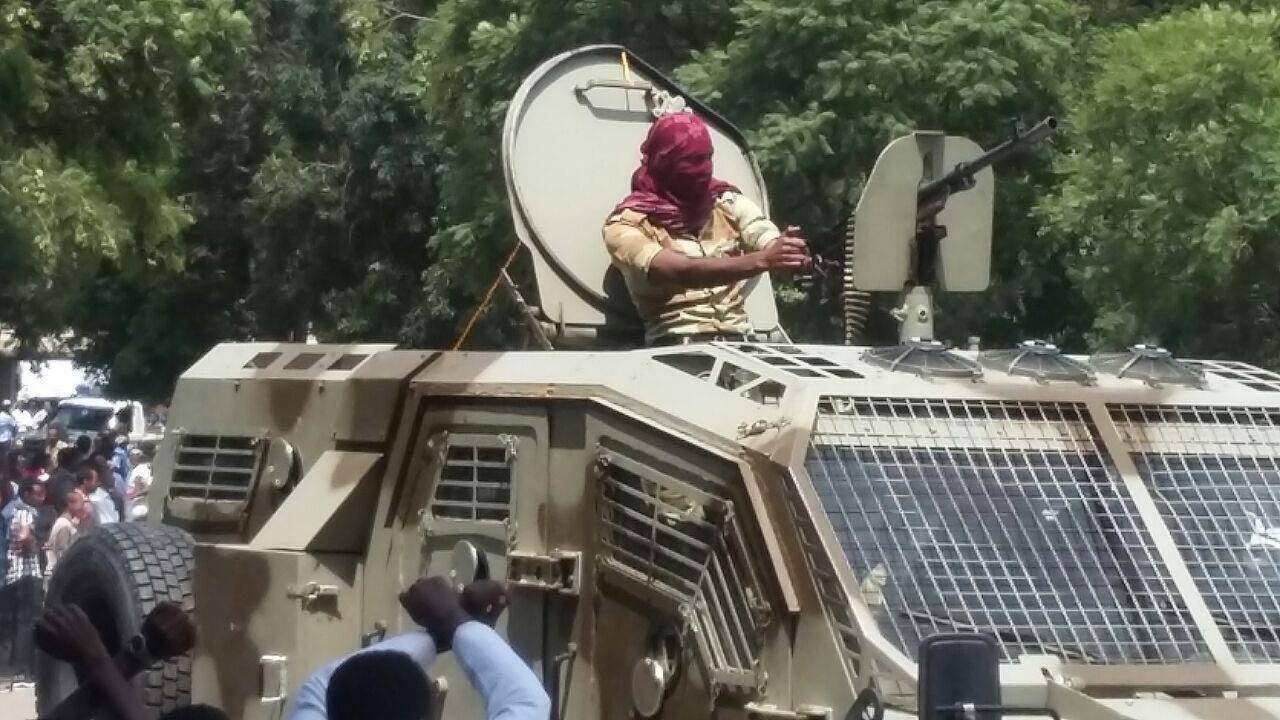


 South Sudanese government soldiers celebrate while standing in trenches in Lelo, outside Malakal, South Sudan, October 16. Tens of thousands of people have been killed since civil war broke out in the country in December 2013, and U.N. Secretary-General Ban Ki-moon has urged the country’s leaders to avoid a possible genocide.ALBERT GONZALEZ FARRAN/AFP/GETTY IMAGES
 South African President Jacob Zuma attends a luncheon at the U.N. General Assembly, New York, September 20. A series of scandals and poor election results have heaped pressure on Zuma to step down as ANC leader.PETER FOLEY – POOL/GETTY IMAGES
 Gambian President-elect Adama Barrow (C) arrives at a hotel in Banjul for a meeting with four African heads of state, December 13. Gambia’s outgoing president Yahya Jammeh is refusing to leave his post despite losing an election to Barrow.SEYLLOU/AFP/GETTY
 Demonstrators chant slogans while making the Oromo protest gesture during Irreecha, the thanksgiving festival of the Oromo people, in Bishoftu town, Oromia region, Ethiopia, October 2. Hundreds of people have been killed since November 2015 and Ethiopia’s government has implemented a restrictive state of emergency.TIKSA NEGERI/REUTERS
 Members of Burundi’s National Assembly vote to withdraw from the International Criminal Court, Bujumbura, October 12. Burundi, under the leadership of President Pierre Nkurunziza, has increasingly withdrawn from international organizations.ONESPHORE NIBIGIRA/AFP/GETTY IMAGES
 Nigerian soldiers prepare a heavily armed convoy in Maiduguri, northeast Nigeria, March 25. The Nigerian military has made big gains against Boko Haram in 2016, but threats have emerged elsewhere in the country.STEFAN HEUNIS/AFP/GETTY IMAGES


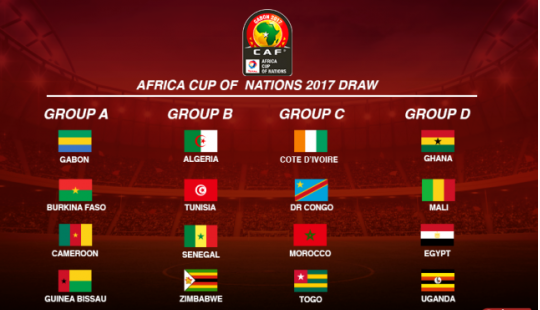


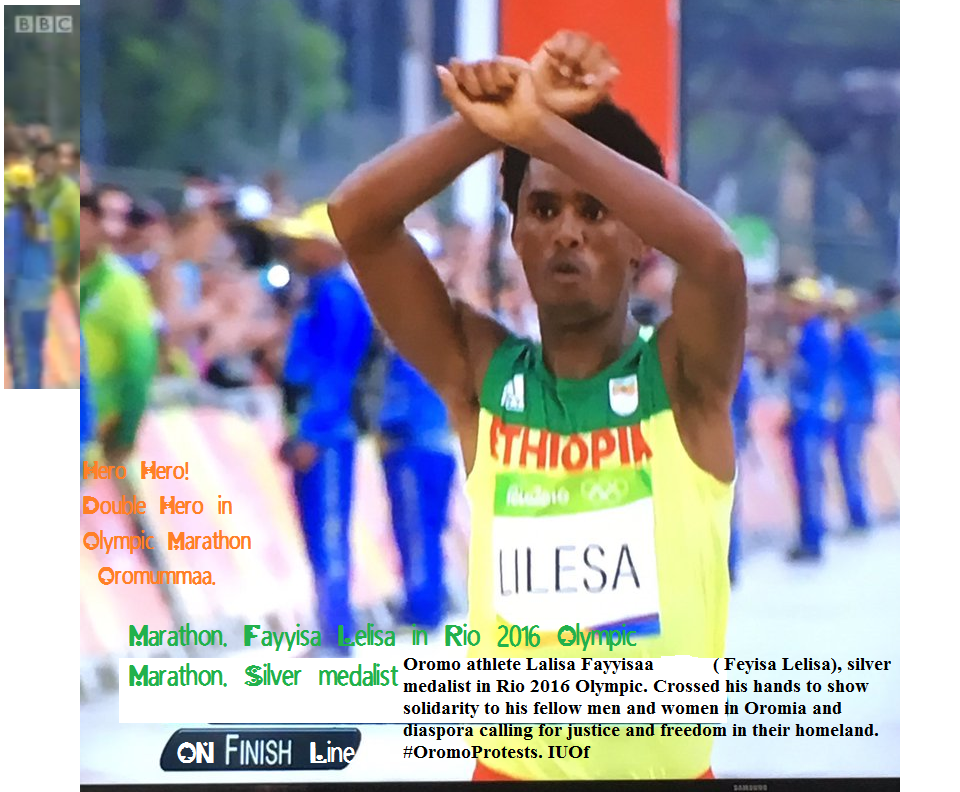
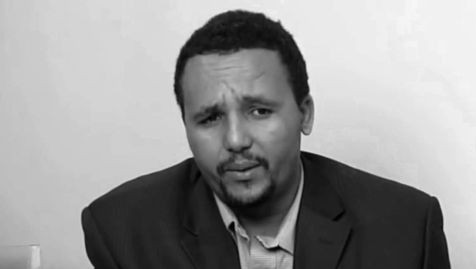


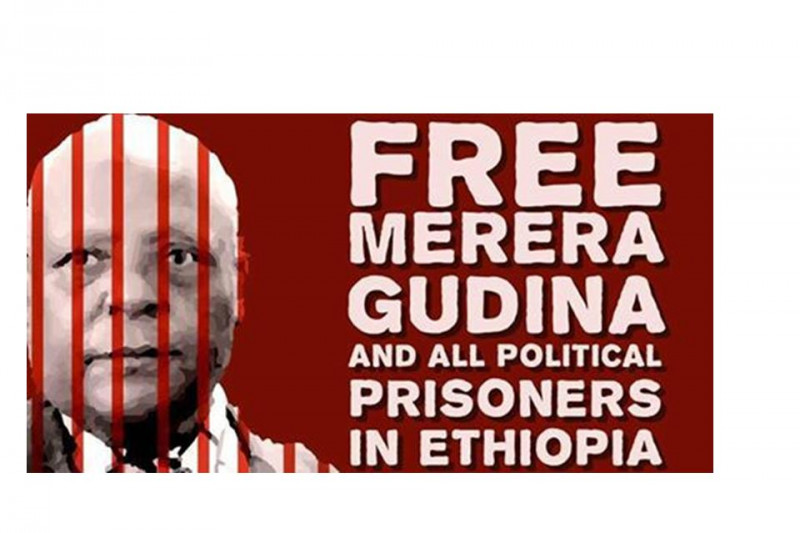




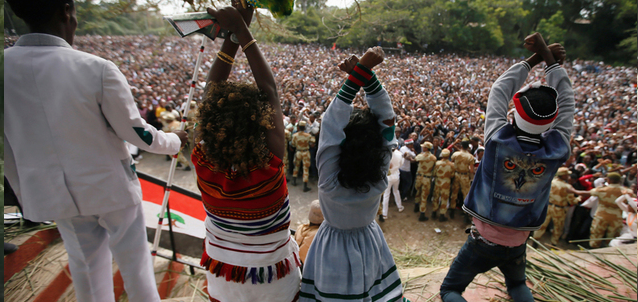


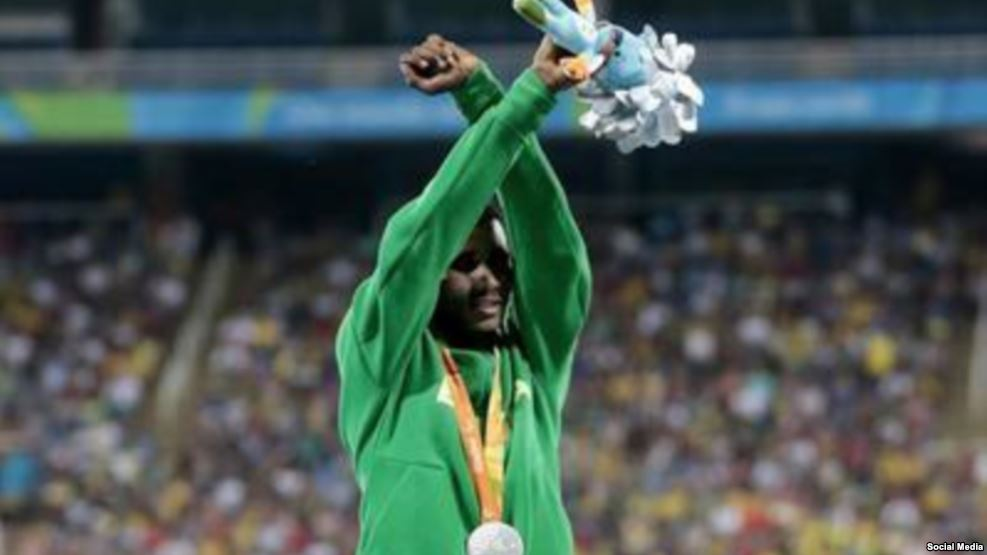


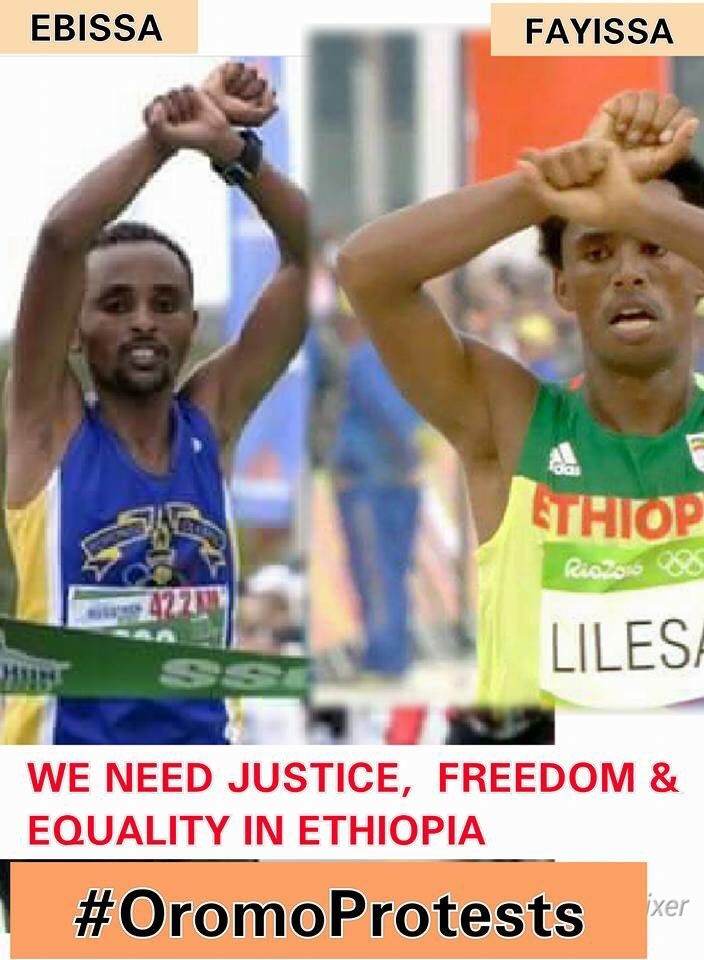

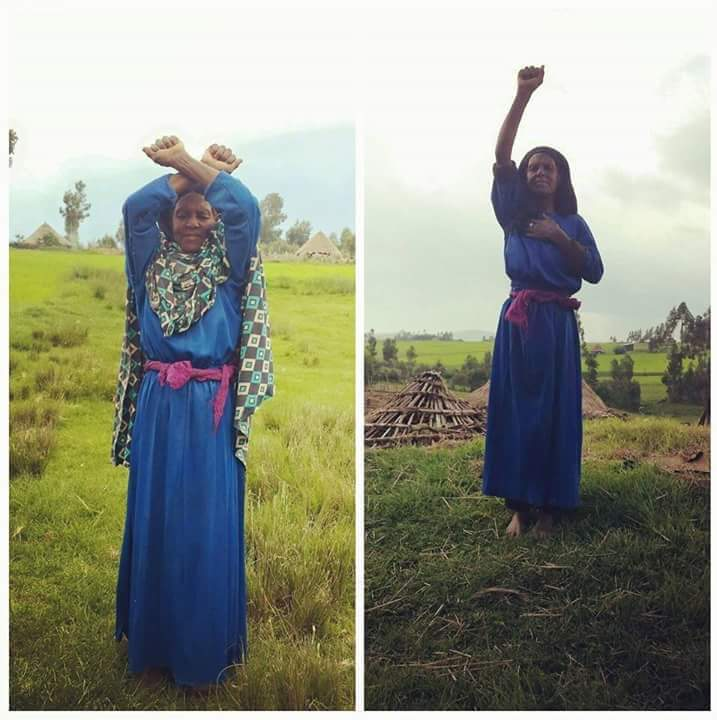


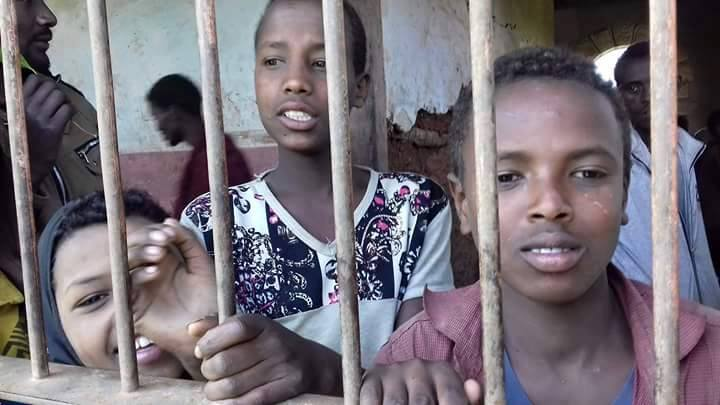
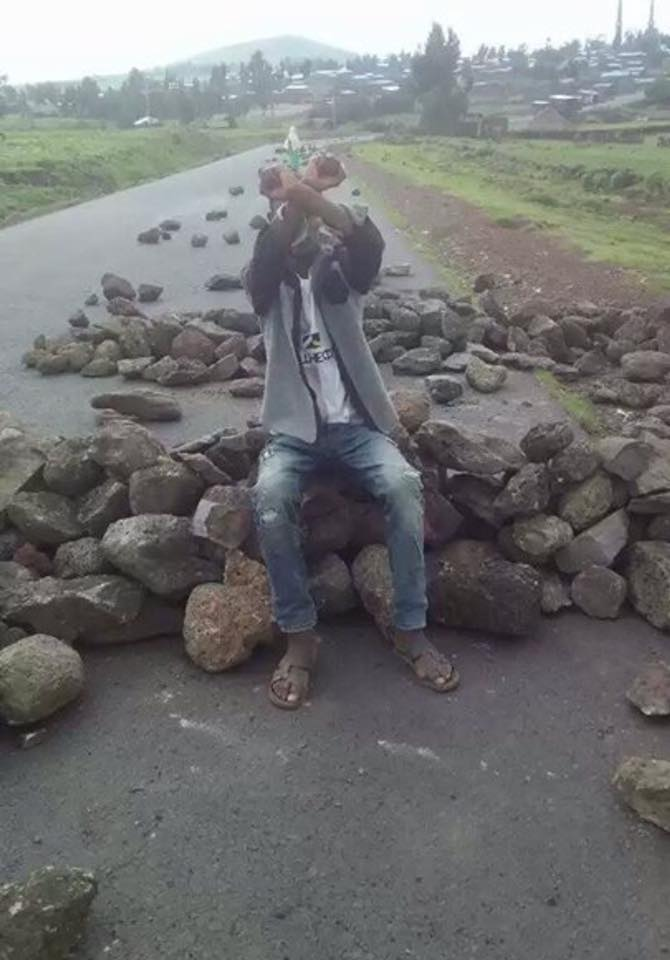

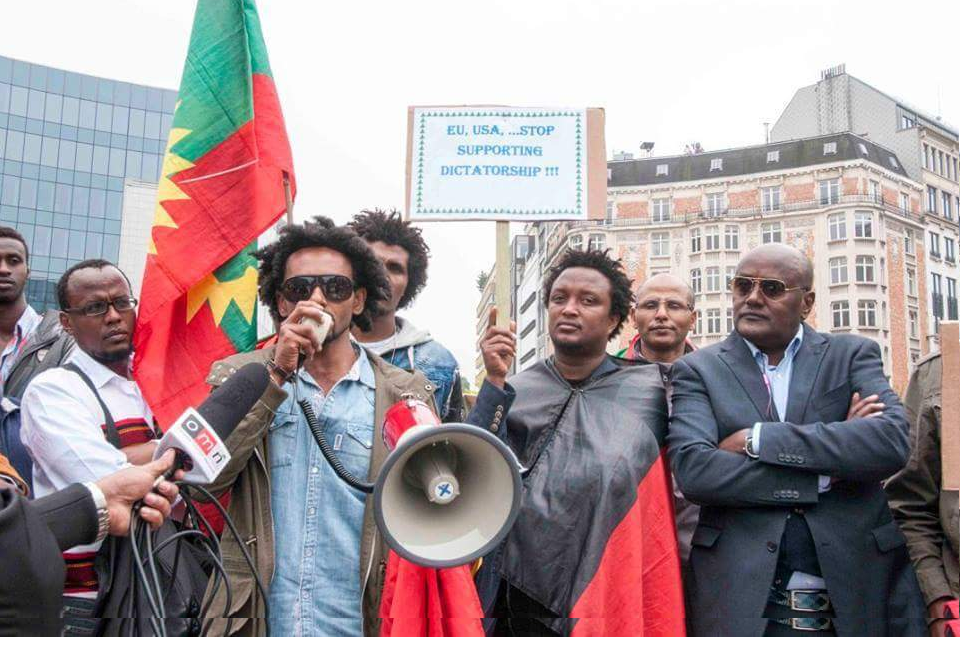

Feyisa, 26, was born in West Shewa, Jaldu District in 1990, a year before the EPRDF regime took power in Ethiopia. Growing up in Jaldu about 120km west of Addis Ababa near the border of Macha and Tulama, Feyisa witnessed the injustices and indignities faced by Oromo people. As an elite athlete, he faced a significant dilemma. “I could not join my peers in the streets if I were going to have the chance to compete at all,” he told reporters in September. “I had to leave the country a lot in order to compete overseas, so I knew that if I protested with the ordinary citizens, I would be blocked from ever leaving the country again.”
Microphone in hand, Gemeda stretched out his arms toward the sea of protesters gathered below, and started shouting, “down, down Woyane, down, down TPLF.” (Woyane is a moniker for the Tigrayan People’s Liberation Front (TPLF), the kingmakers in the hodgepodge EPRDF coalition.) Gemeda’s neck veins bulged as he led the crowd in the now famous chant. The crowd went wild with jubilation responding to his chant with earth shattering chants of their own and by repeating it numerous times over, with wrists crossed above their head, and finally breaking out into a pandemonium of cheers and jeers.
Every day that the EPRDF regime tries to explain away popular, grassroots revolt as machinations of few bad actors from abroad, the tide continues to turn against its brutal and repressive rule. For every athlete or activist that’s forced into exile, there are hundreds more determined to expose the regime’s excesses, promising to keep the story in the media limelight. It will only be a matter of time until rank and file Oromo bureaucrats, the Oromia police, merchants and Oromo members of the armed forces join the budding revolution — for they too belong to the gallant Qubee Generation. Ethiopia’s history suggests that that would herald the end of EPRDF and yet another bloody transition in a country that has never seen a single peaceful transfer of power.




 Godina Arsii Aanaa Roobee m/b Roobee Diida’aatti Mana barumsaa sad 1ffaa Xaqqee jedhamuun beekamutti Mudde 9,2016 barattoonni akkuma qormaata xummuranii bahaniin harka isaanii lamaan wal qaxxaamursiisun mallattoo mormii FXG agarsiisuun homna komaand poostitiin barattoonni afur hidhamuu fi kanneen hafanis adamfamaa jiraachuun dhagayameera.bifuma wal fakkaatun gootonni ilmaan Oromoo achuma aanaa Roobeetti Mana barumsaa sadarkaa 1 ffaa Ataabaa Goraas kan makamaniifi mallattoo mormii FXG agarsiisuu isaanitiin barattoonni hedfuun humnoota poolisii achitti ramadamaniin reebamuun isaanii himame
 Mudde 09,2016/ Yeroo mootummaan goolessituu wayyaanee maqaa labsii hatattamaa komand post (State emergency) maqaa jedhu da,oo godhachuudhaan ilmaan oromoo akkaan ajjeesaa kanneen hafan immoo jumlaan mana hidhaatti guuraa jiru kanatti kaanimmoo mana jireenyaa isaanii irraa saamuudhaan biyya isaanii fi lafa abbaa isaanii irraa yeroo godaansisaa jiru kanatti gootowwan qeerroon guutummaa oromiyaa keessa jiran warraaksa biyyoolessaa jabeessuudhaan diina waliin wallaansoo jabaa geggeessaa jiru.
 Mudde 09,2016/ Mooraa yuunversiitichaa keessatti humni federaalaa mooricha keessa weeraree jiru baratoota nagaa barnoota barachaa jiran ofiisaatiin dubbii itti kaasuudhaan isintu dubbii kaase maqaa jedhuun baratoota moorichaa akka malee gidirsaa jira.Mooricha keessattis gootowwan qeerron mooricha keessa jiran yeroo ammaa kana diddaa isaanii jabeessuun mootummaa garboonffattuu wayyaanee waliin wallaansoo jabaa geggeessaa jiru.


 Mudde 1,2016, Fincila xumura garbummaa ji a kana guutuu mooraa Yuunversiitii Wallaggaa keessatti finiinaa jiruun wal qabatee baratoonni Oromoo Yuunversiiticha keessaa butamanii ukkaamffamaa akka jiran oduun qeerroo moorichaarraa miliqxee nugeesse ifa gooti.




Image copyrightTWITTER
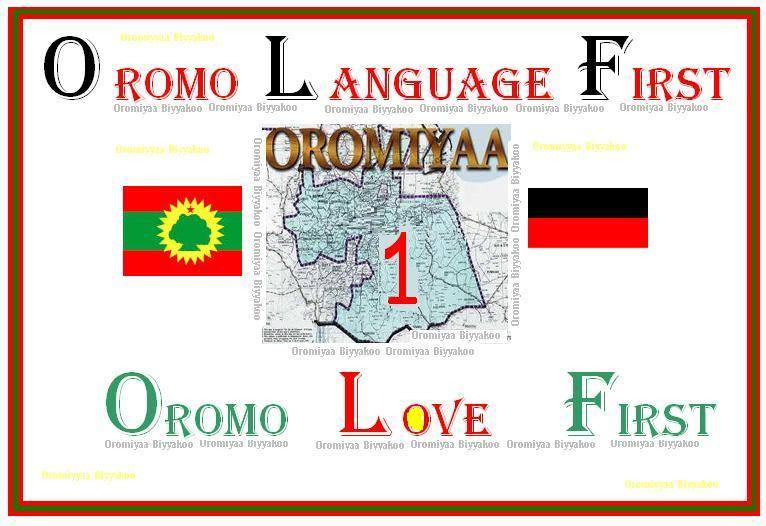




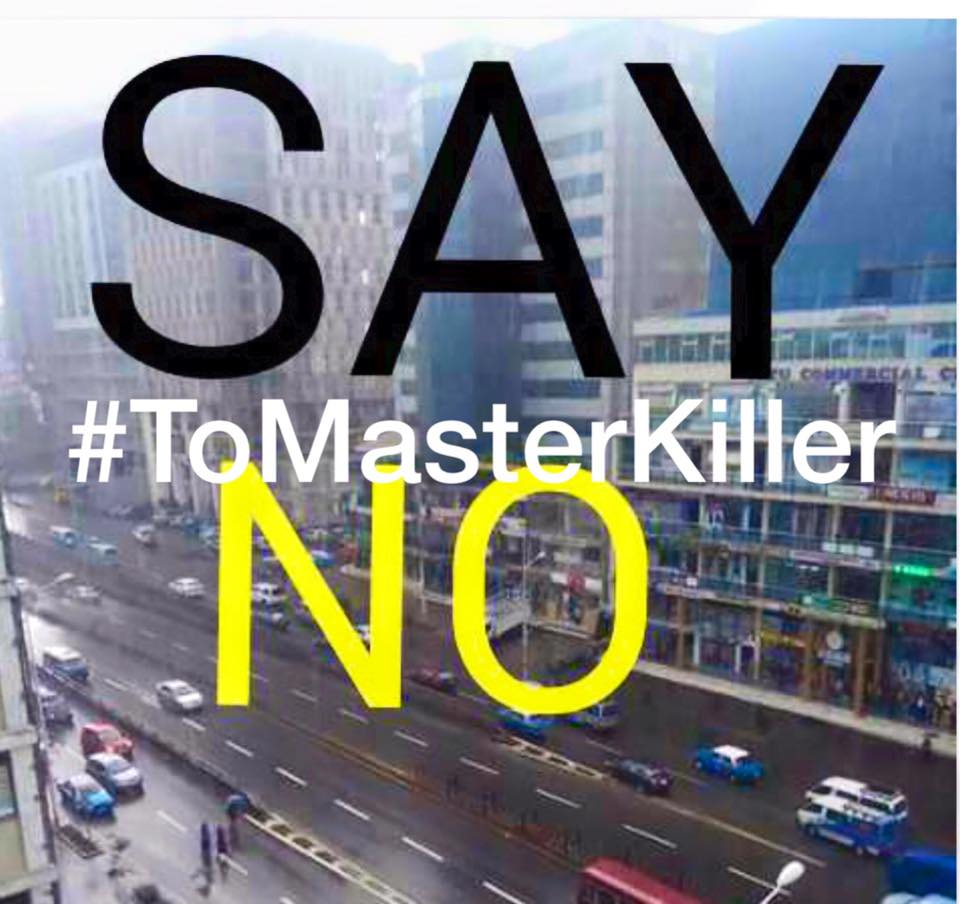
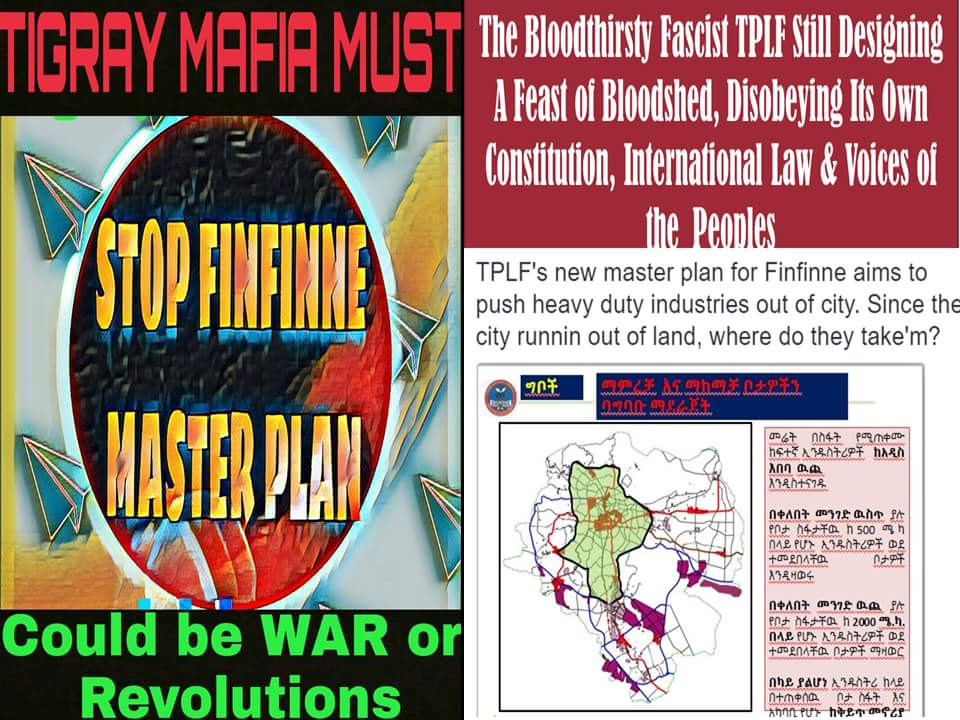


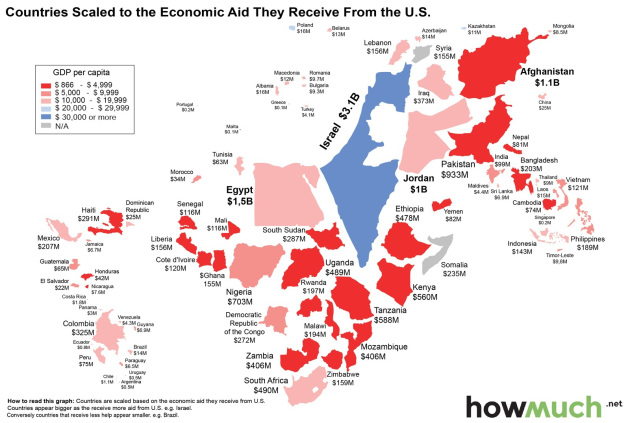


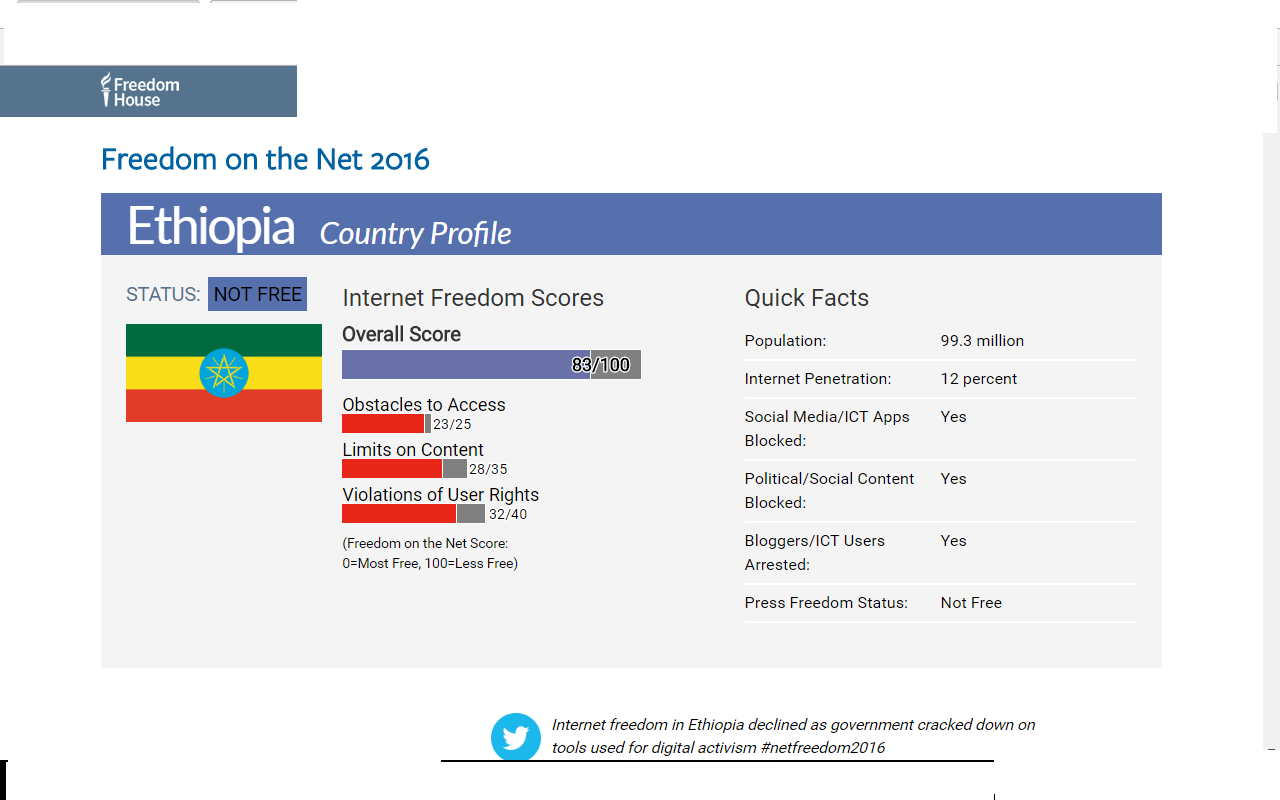
 Internet freedom in Ethiopia declined as government cracked down on tools used for digital activism #netfreedom2016 http://freedomhou.se/2g40lmP
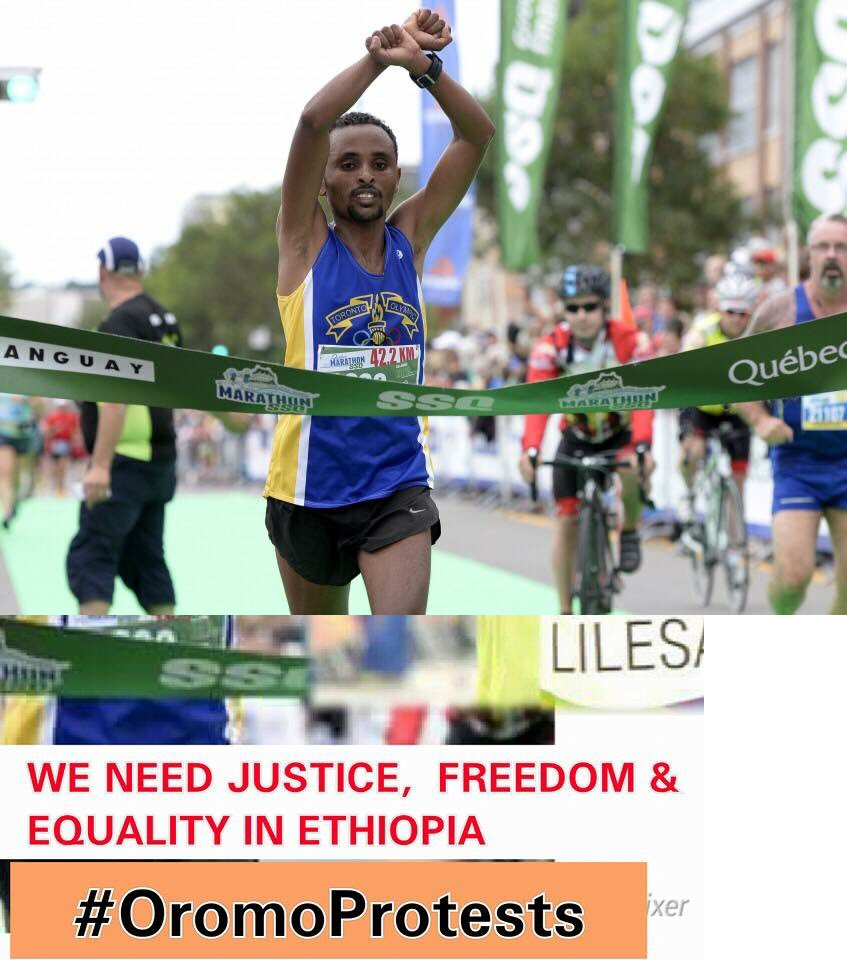


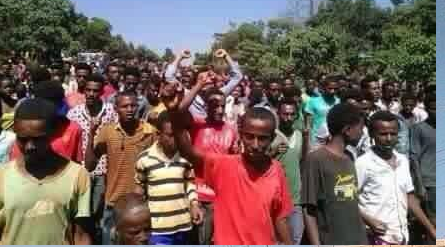


 Oromian Economist
You must be logged in to post a comment.