Economic and development analysis: Perspectives on economics, society, development, freedom & social justice. Leading issues in Oromo, Oromia, Africa & world affairs. Oromo News. African News. world News. Views. Formerly Oromia Quarterly
Letter from Heart Broken Oromo-American Sister to President Obama: From $840 US aide to Oromo students’ slaughter
By Seena Oromia, December 12, 2015
Dear President Obama,
Have you heard the news in Ethiopia? President Obama, have you seen our sorrow? Can you feel our pain? Can you hear our anger? I hope you can! It was not too long ago… that I among thousands of fellow Oromos campaigned for you. I knocked door-to-door, walked miles and made calls throughout the night. Like millions of Americans. I longed for you to win the election. Like all others who lost hope in their governments and discriminated by the system, I prayed and crossed my fingers for you to become the president. In you, I saw my dream and hope. I believed you were the person, the chosen leader that will stand with the people that is left behind for far too long. On a cold Tuesday evening, I waited among thousands others to watch you give the defining speech that moved us so much. You said, “to all those watching tonight from beyond our shores, from parliaments and palaces to those who are huddled around radios in the forgotten corners of our world, our stories are singular, but our destiny is shared…out of many, we are one….”
Since then many things had happed. I watched you transform from candidate to president. As the world leader I watched you take blame for some things that is outside of your controlled. I watched some republican congress trash you simply because they hate to be governed by black person. I saw some conservatives disrespect you in the most painful way I can possible think. Thought you don’t see me, I got burn for you in the inside. Though I am far and irrelevant, I defended you and some of your policies. With all this madness that was and still is going on, I thought you deserved benefit of the doubt like any other human being. You inherited the most dangerous time when America, as we know, was in verge of collapsing internally and externally as well.
However, sometimes I wonder and question some of your judgments. I understand that though you might have enormous pressure to make things right, to prove to the world that your administration and your government has the intelligence to lead our world, president Obama, why do you praise dictators like the Ethiopian that has the thousands of Oromo blood on its hand? Why visit and meet with the Ethiopian prime minister and the party that supposedly won the election by 100% votes? I know you are not naïve to believe the election was legitimate nor do you for a second believe that country was democratic. But, somehow your choice of standing by the dictator and praising his action has only lead to more extreme violence that lead us, not only to question your morality, but also your intentions. And today, so many of our brothers and sisters are paying the price with their lives.
Yesterday, in May of 2014, while your secretary Kerry was giving a speech praising this regime, over 50 university students were murdered in cold blood just less than 70 miles away. Yet, you failed not only to condemn this crime that had happened over and over but failed to denounce the perpetrators. A year later you went there as a first sitting US president praising this very regime. President Obama, you tell me, what happened to change you can believe in? What has happened to those promises on campaign trail? What happened to those promise of yours that said, “Government of the people, by the people, for the people shall not perish?” President Obama, we are hopeless, our sisters and brothers are voiceless that even local reporters turn around and shut their cameras rather than capturing the horrifying images. Perhaps the government restricted them so now international media thinks our lives are less important and not news worthy. Where is the place for people like us, refugees, and political immigrants? Who stands with us, if not you, the president of free world, which is built on the back of African slaves and all immigrants?
President Obama, as one of your biggest fan and supporter who not only campaigned for you but supported you financially, please condemn this violence publicly that is taking place right in front of our eyes. Please stop $840 million aid to the Ethiopian regime that is the perpetrators creating this violence. President Obama, I am hopeless and my heart is in agony. I am also asking you as your fellow American to demand justice for Oromo students that are gunned down each and every day.
For more developing news or story, please check out this links that includes reports from BBCNews,
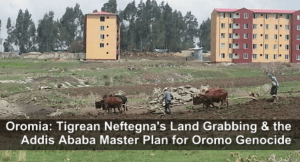
According to a media report, just last month alone, 600 Oromo farming families were evicted from Sululta, one of the towns in Oromia affected by the Addis Ababa Master Plan of the Ethiopian Federal government. The Master Plan evictions in Sululta came in November 2015, just before the latest escalations of Oromo protests as Oromo students in particular, and the Oromo public in general, engage the Federal government to stop the Addis Ababa Master Plan as well as the overall land-grabbing campaigns being undertaken by the Federal government in the name of “development” across Oromia. The report about the Master Plan evictions of 600 Oromo households in Sululta contradicts the Ethiopian Federal government’s stated position that the Addis Ababa Master Plan is still in its drafting phase awaiting public deliberations. Last year, during the April-May 2014’s #OromoProtests, the government promised to open the Master Plan for public deliberations only to forego that phase of the policy-making altogether. Protesters say the government’s promise of public deliberations are only tricks to buy time to fully implement the Master Plan and other land-grabbing campaigns across Oromia.
Here’s an excerpt from the DW report:
One Oromo farmer from Sululta, a town part of the ‘integrated master plan’ located 26 kilometers (16 miles) to the north of Addis Ababa, spoke to DW on condition of anonymity. He claimed that in late November alone, the government evicted 600 farming families on the grounds that their land was needed for the construction of a factory. When asked if they had received fair compensation and a new home, the farmer told DW that the money given to them was ‘very meager,’ and that the families had so far not been given a place to relocate to.
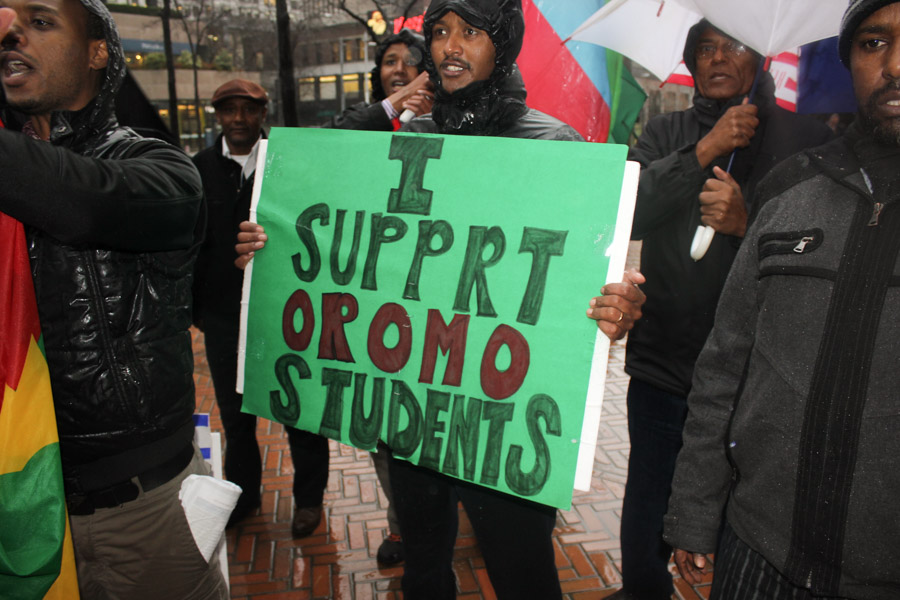
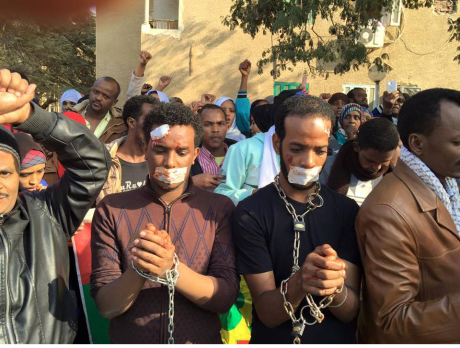
Mergitu Argo, who helped organize a march on Thursday in support of Oromo student protestors in Ethiopia. (Photo by Goorish Wibneh)
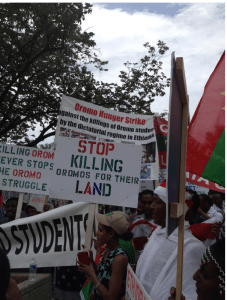
Oromos from the Seattle area gathered downtown yesterday to condemned the Ethiopian government’s lethal response to student protests sparked around the south of the country this week.
The protests of high school and university students were in response to the government’s “master plan” that will integrate the capital and surrounding areas now belonging to the Oromo Region, which protestors say will displace farmers.
“I believe people should have the right to protest without feeling like they are gonna be beaten, or killed or jailed.” said Sartu Adem, 18, who was among about 200 solidarity protesters who gathered in front of the Federal Building on 2nd Avenue. “But I feel like the people should have a say whether they want [the development plan] or not — not just the government saying ‘oh we are developing the country!’”
The action was coordinated by Oromo Community Services of Seattle, and began in the rainy noon hour with march from Yesler Community Center.
Despite being the largest ethnic group in Ethiopia, the Oromo people have historically been politically and economically marginalized. In 1991 a federal constitution was instituted to address the issue, but some Oromo elites remain unconvinced that the region or the people are as autonomous as they should be.
Oromia, which physically includes Addis Ababa (knowns as “Finfine” in the Oromo language), is the largest region in Ethiopia.
Muktar Kedir, the administrator of Oromia Regional State, explained in a press conference earlier today that the development plan will not be implemented before public discussions and agreement.
But Abubeker Ali, one of the organizers of the Seattle protest, said displacement is already happening.
“The extent that we know so far is, in Finfine/Addis Ababa area, thousands of people have been displaced already. Homes have been demolished, people have been arrested,” Ali said.
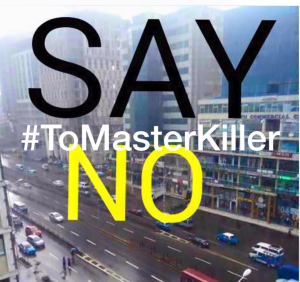
Ali said he opposed the master plan, which he referred to as “master killer.” He called it a “land grab” designed to displace millions of farmers without any compensation.
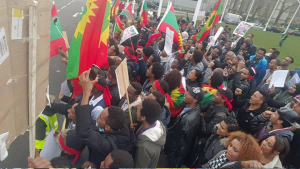
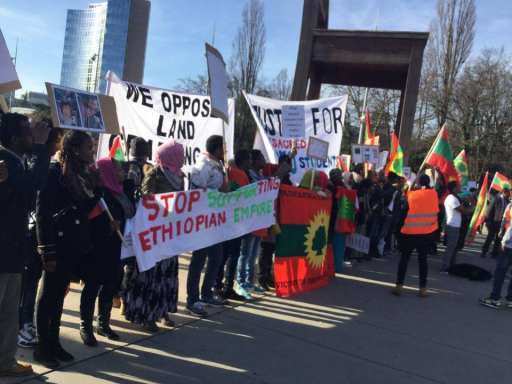
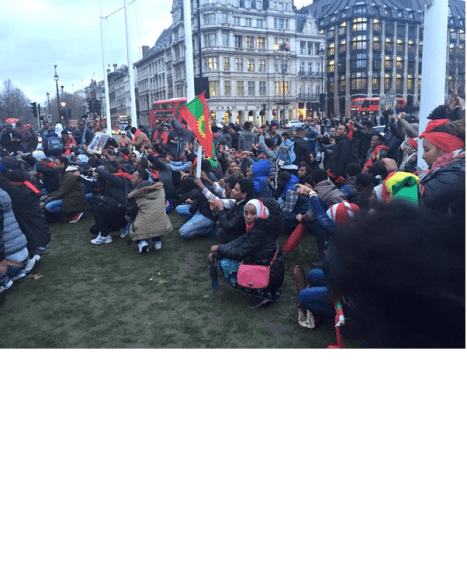
Demonstrators gathered outside the Federal Building asking the U.S. government to apply diplomatic pressure on Ethiopia to end the crackdown on protests. (Photo by Goorish Wibneh)
There are conflicting accounts of the number of students that were killed.Bloomberg reported 10 Oromo students have been killed by security forces, quoting Bekele Nega a leader of the Oromo Federalist Congress, an opposition party. On Wednesday, Horn Affairs reported it was able to confirm five deaths but officials only acknowledged four fatalities.
The protesters in Seattle also delivered a letter to Senators Murray and Cantwellrequesting that the U.S. urge the Ethiopian government to stop violent responseagainst peaceful student protesters and conduct independent investigation into the deaths.
The U.S. has a longstanding military relationship with Ethiopia to fight terrorism. At the rally protestors could be heard chanting for the U.S. to stop “supporting the Ethiopian government” and “funding a terrorist government.”
The protesters included some ethnic Somalis from the Ogaden region in eastern Ethiopia who were there in solidarity.
While the “master plan” has not been officially implemented yet, Addis Ababa has been fast expanding already for several years.
Naboni Amenu who was at the rally with her husband said the farmers that had already been displaced are now stranded on the streets without resources.
FBC, a media outlet affiliated with the government, reported that Muktar Kedir, the administrator of Oromia, said “the violence had occurred due to limitation to clarify the master plan and this has created uncertainty among the community as well as led the public to raise question[sic].”
According to Ethiopia-based blogger Daniel Berhane, protests around the Oromia region are ongoing, with many businesses and public institutions closed. The situation is still fragile.
“I feel like in Ethiopia people only care about which region they’re from,” Adem said yesterday, decrying the regionalism that she sees hurting the country. “Everyone should care about each other. Everyone should think about ‘Has this person eaten?’ ‘How’s this person living?‘”
The Honorable Julie Bishop
Australian Foreign Ministry
PO Box 2010
Subiaco, WA, 6904
Melbourne, Australia
Dear Mrs. Bishop,
Ref: – This weeklong killing, beating and detention of protesting Oromo Students by the Ethiopian security forces across Ethiopia’s Oromia Reginal State,
We are coping you an appeal letter we sent to the Ethiopian regime to draw your attention to the plight of Oromo students, and Oromo people in Oromia, Ethiopia and to convey our great concern about the ongoing violent action against unarmed students protest. We are extremely saddened by reports that Ethiopian security forces again this week opened fire and killed unarmed student protestors at Haro Mayya and Madda Walaabuu Universities, imprisoning unarmed young university and high school students over Oromia Region from East to West and North to south. The current episode is the repeat of the inhumane treatment of two years ago and innocent students and parents are under indiscriminate attack.
The Board of the United Oromo Evangelical Churches, on behalf of its member churches around the World, is sending its urgent appeal to you and all fair minded people of good will, churches and other religious establishments, regimes, and other Human Rights organizations to urgently intervine on behalf of the young Oromo students and the households of students, and the small farmers being displaced and ask the Ethiopian government to:
AUS_-UOEC-petition_letter_cover_-Human-right-Organziations, 4 December 2015
Depuis 10 jours, de violents affrontements ont lieu entre les forces de l’ordre et des manifestants dans la région d’Oromia en Éthiopie. Les militants, pour beaucoup des étudiants, dénoncent un projet “d’accaparement des terres” mené par le gouvernement.
Fin novembre, le gouvernement éthiopien a annoncé un plan d’extension de la capitale Addis Abeba, située dans la région d’Oromia. Appelé “Master Plan”, ce projet a pour objectif, selon les autorités éthiopiennes, de contrôler l’expansion rapide des grandes villes pour atténuer l’exode rural. Mais ce projet fait craindre aux habitants un accaparement des terres agricoles. Il avait déjà été annoncé en 2014 et avait alors suscité une vague de manifestations à travers la région, coûtant la vie à 70 étudiants, selon un communiqué de l’association des étudiants de l’Oromia.
“Ni les habitants ni le gouvernement de l’Oromia n’ont été concertés”
John B
John B (pseudonyme) est étudiant à Ambo University dans la région d’Oromia. Il était sur le campus durant les premiers jours de la manifestation. Il nous explique ce conflit compliqué entre les Oromos et le gouvernement central.
L’Éthiopie est une République fédérale divisée en neuf régions. Selon la constitution, chaque région à le droit à son propre gouvernement. Mais nous avons un problème dans l’Oromia : la capitale du pays, Addis Abeba, est située dans la région et elle est gouvernée par le gouvernement fédéral.
Il y a toujours eu des différents entre la population d’Oromia et le gouvernement central, mais en Éthiopie, il y est difficile de se rebeller. Le mois dernier, le gouvernement a de nouveau mis sur la table son “Master Plan” . Avec ce projet, le gouvernement veut étendre son contrôle administratif dans l’Oromia. C’est une sorte d’extension d’Addis Abeba.
Mais le “Master Plan” remet totalement en cause notre frontière et nous avons peur que cela passe par un accaparement des terres. Des fermiers oromos pourraient-être expulsés. Ni les habitants ni le gouvernement de l’Oromia n’ont été concertés. C’est pour cette raison que la population manifeste : personne ne veut céder ses terres ! Surtout que nous savons que ce plan de “développement” de la ville ne va bénéficier qu’à une minorité de dirigeants, pas aux habitants oromos.
Selon Bekele Nega, le secrétaire général du Congrès Fédéral d’Oromia [parti d’opposition en Éthiopie], 13 étudiants auraient été tués et une centaine jetés en prison suite aux manifestations. Sur Facebook et Twitter, de nombreuses photos d’étudiants blessés et de policiers armés ont été relayées.
Ce sont les étudiants qui se sont mobilisés en premier. Dans mon université, les manifestations ont commencé la semaine dernière. C’était très pacifique et d’ailleurs, selon la Constitution éthiopienne, nous avons le droit de manifester. Trois jours après le début des manifestations, la police est entrée dans le campus. Les forces de l’ordre se sont montrées très violentes, des étudiants se sont fait frapper, beaucoup avaient du sang sur le visage et les mains. Tout le monde s’est mis à courir. Ceux qui n’ont pas eu le temps de s’échapper ont été arrêtés et emmenés au poste de police.
Les fermiers et les habitants de l’Oromia ont rejoint les manifestations étudiantes. Photo prise à Inango – Oromia.
Je sais que dans d’autres universités, les policiers ont utilisé des armes à feu mais pas dans la mienne. En ce moment il n’y a presque plus personne sur le campus : les étudiants ont peur. Dans d’autres villes, les manifestations continuent et les étudiants ont été rejoints par les habitants et les fermiers. Je n’ai jamais vu un mouvement de contestation si important dans la région.
Les médecins de l’hôpital Jimma dans la ville d’Agaro dans l’Oromia expriment leur soutien aux manifestants.
Le mouvement de contestation ne s’arrête pas aux frontières éthiopiennes. Selon le compte Twitter “Oromo Press”, la communauté oromo aux États-Unis s’est mobilisée ce vendredi pour dénoncer le “Master Plan” et demander l’intervention du président américain.
Le commissaire de police de la région s’est justifié lors d’une conférence de presse la semaine dernière. Selon lui, les manifestants auraient été particulièrement violents. Les forces de l’ordre ne seraient alors intervenues que pour maintenir le calme dans les universités et écoles.
……………………………………………………………………
English Translation (Google)
For 10 days, violent clashes took place between police and protesters in the Oromia region in Ethiopia. The activists, many of them students, denounce a project “land grab” led by the government.In late November, the Ethiopian government has announced a plan to extend the capital Addis Ababa, located in Oromia. Called “Master Plan”, the project aims, according to the Ethiopian authorities to control the rapid expansion of large cities to mitigate the rural exodus. But this project fears the inhabitants a farmland grab. It had already been announced in 2014 and was then sparked a wave of protests across the region, claiming the lives of 70 students, according to a statement of the association of students of theOromia.
With nearly 25 million inhabitants, Oromia is the most populated region of Ethiopia. The Oromos, the largest ethnic group in the region, denounce their marginalization for many years.
“Neither the people nor the government of the Oromia have been concerted”
John B
John B (pseudonym) is a student in Ambo University in the Oromia region. He was on campus during the first days of the event. He explains this complicated conflict between the Oromo and the central government.
Ethiopia is a federal republic divided into nine regions.According to the constitution, each region has the right to his own government. But we have a problem in Oromia: the capital, Addis Ababa, is located in the region and it is governed by the federal government.
There have always been different from the population of Oromia and the central government, but in Ethiopia, it is hard to rebel. Last month, the government again put on the table his “Master Plan”. With this project, the government wants to extend its administrative control in the Oromia. This is a kind of extension of Addis Ababa.
But the “Master Plan” runs counter to our border and we fear that it goes through a land grab. Of Oromo farmers could be expelled. Neither the people nor the government of the Oromia have been concerted. This is why the population manifesto: nobody wants to surrender its land!Especially since we know that this plan “development” of the city will benefit only a minority of leaders, not the Oromo people.
According to Bekele Nega, the general secretary of the Federal Congress Oromia [opposition party in Ethiopia], 13 students were killed and hundreds jailed following protests. On Facebook and Twitter, many photos of students injured and armed police were relayed.
These are students who mobilized first. At my university, the demonstrations began last week. It was very peaceful and elsewhere, according to the Ethiopian Constitution, we have the right to demonstrate. Three days after the protests began, the police entered the campus. The security forces have been very violent, students have been hit, many had blood on his face and hands. Everyone started running. Those who have not had time to escape were arrested and taken to the police station.
Farmers and people of Oromia joined student protests.Photo taken at Inango – Oromia.
I know that in other universities, police used firearms but not in mine. Right now there is almost no one on campus: students are afraid. In other cities, the protests continue and the students were joined by local residents and farmers. I have never seen such a large protest movement in the region.
Doctors at the hospital in Jimma town in the Oromia Agaro express their support for protesters.
The protest movement does not stop the Ethiopian border. According to the Twitter account “Oromo Press”, the Oromo community in the US rallied on Friday to denounce the “Master Plan” and request the intervention of US President .
The region’s police commissioner was justified at a press conference last week. He said the demonstrators were particularly violent. The security forces would do that then intervened to maintain calm in universities and schools.
In the last two weeks, protests have spread to more than 50 towns as part of a larger and years-long movement against the Ethiopian government’s controversial development plan. It’s not the first protest against the so-called Master Plan; there was a similar uprising in April and May of 2014 after the development plan was approved. A crackdown by security forces left dozens dead and hundreds arrested.
By all accounts, according to Jawar Mohammed, the founder of Oromo Media Network, the recent movement is much bigger than its predecessor. The Minnesota-based Ethiopian said reports indicate farmers and other citizens have even begun to join in on the demonstrations over the last few days.
“This is the biggest protest by far that I have seen in the last 25 years,” Mohammed said.
In addition to being more widespread than previous demonstrations, this year’s protests have reportedly been better organized, according to American-based Ethiopian journalist Mohammed Ademo. While improved access to social media has played a role, Ademo said the size can also be attributed to a growing dissatisfaction among the public with what he called the “government’s top-down, non-participatory approach to development.”
“Gone are the days when the central government can displace Oromo farmers and forcibly implement any policy,” he said. “Continued crackdown on the protesters only ensures Oromos’ growing estrangement from the state.”
The estrangement has a strong economic component. The expansion of Addis Ababa, the headquarters of both the African Union and the international airline carrier Ethiopia Airways, is a symptom of both the wider urbanization in sub-Saharan African cities and the booming success of national economy.
Addis Ababa has seen growing foreign and economic investment in recent years, while at the same time becoming a regional business hub, Bill Moseley, a geography professor at Macalester College, in St. Paul, Minnesota, said.
“Ethiopia’s seen as this kind of up-and-coming country with a lot of investment that’s posturing to make Addis more of a global city, so I’m sure that’s feeding into this sort of push to expansion,” Moseley explained. “It’s these small farmers that lose out, but it’s rationalized in sort of these broader development goals.”
Generally, said Moseley, when governments pave the way for urban growth they often use this development as a way to justify land grabs. According to Moseley, this situation is not exclusive to Addis Ababa and Ethiopia, but one seen in other cities across sub-Saharan Africa and around the world.
For the Oromo, specifically, activists claim they have not benefited from the country’s growth and prosperity. The regional ethnic group, which counts Oromia as its homeland, makes up more than 80 percent of the state’s 27 million people. Nationally it represents upward of 35 percent.
Literacy rates are bleak and the group is underrepresented in government. According to Mohammed, nearly a dozen Oromo clans have been swallowed up in the city’s horizontal expansion as they are forced off their lands. In Ethiopia, the government owns all of the land, but the constitution does provide some protections for the public. Oromo activists say these rights have been ignored in the rush to expand.
“The capital city is in the middle of Oromia, but you don’t see any Oromo identity in it,” he said. “Every time [Addis Ababa] expands it just destroys them. They’re saying the development has to incorporate us…. You can’t just leave us stranded.”
The planned development has also hit home for the Oromo, who have a very close connection with their land, according to Human Rights Watch Horn of Africa researcher Felix Horne.
“They’re concerned if a large portion of land outside of Addis Ababa comes under control of the city administration that farmers will be displaced from the land,” he explained. “[That] they won’t receive compensation from their livelihoods. And they won’t have the ability to feed their families.”
The government has a history of cracking down on the Oromo people, who represent a majority of the population and a perceived threat to power to the minority-led coalition. Horne said that anytime Oromos expresses dissent or simply asks a question about land development policies, they can be subject to arbitrary detention and mistreatment.
Beyond discrimination and crackdown on the Oromo, freedom of press and other expression is heavily curtailed in the country as a whole. Horne said coverage of the recent protests has been almost non-existent.
“Ethiopia is often applauded internationally for its economic growth and development initiatives, but that’s only one part of the story,” he said. “Anyone who expresses any form of dissent in Ethiopia is in trouble.”
Opposition groups say security forces have killed 20 people in three weeks of protests over a government re-zoning plan. Members of Ethiopia’s largest ethnic group view the plan as a further infringement on their rights.
“Dubbiin lafaa dubbii lafeeti!” (“The matter of land is a matter of the bone.”) When describing the sensitivity of the so-called “Addis Ababa master plan,” Bekele Naga, the Secretary-General of the Oromo Federalist Congress party (OFC), does not mince his words. “The constitution of the country proclaims that the land belongs to the people,” Naga told DW. But he believes this is being violated: “The Ethiopian government has been engaged in land grabbing, leading to cultural genocide [of the Oromo people].”
Oromia is one of nine regional states organized by Ethiopia’s system of “ethnic-based federalism,” which is part of the country’s constitution. The national government is pushing forward with a plan to expand the area of the capital, Addis Ababa, into Oromia state. Protests over the plan have been going on for weeks, but for the Oromo people, tensions have existed for much longer.
Neglect at the root of the crisis
Oromos make up the largest chunk of Ethiopia’s 95 million people, and their language is the fourth most widely spoken African language across the continent. Yet Oromo is not recognized as a federal working language.
Most Oromos feel they have been cheated of political and economic representation by a succession of non-Oromo governments. To them, the plan by the government and city administration to expand the area of the capital – which Oromos prefer to call Finfine instead of the Amharic “Addis Ababa” – is yet another example of the high-handedness of the ruling elite which comprises mostly non-Oromos.
Protests against the plan to connect the capital with a number of Oromia towns first turned violent in April 2014. At least 11 people were killed when security officers used live ammunition against demonstrators. Oromo representatives put the number of dead as high as 47.
According to an Amnesty International report from 2014, “between 2011 and 2014 at least 5,000 Oromos have been arrested […], detained without charge or trial, or killed by security services during protests, arrests and in detention.”
Many of the protestors are students, who are now demonstrating against the violence.
Farming families evicted
In Africa’s second most populous nation, land is hotly contested between farmers and investors, both local and foreign, as the government pushes forward with an ambitious development agenda. Critics of the “Addis Ababa master plan” argue that it is not designed to export development into the surrounding communities as the government claims, but rather to evict Oromo farmers and residents from their land.
One Oromo farmer from Sululta, a town part of the “integrated master plan” located 26 kilometers (16 miles) to the north of Addis Ababa, spoke to DW on condition of anonymity. He claimed that in late November alone, the government evicted 600 farming families on the grounds that their land was needed for the construction of a factory. When asked if they had received fair compensation and a new home, the farmer told DW that the money given to them was “very meager,” and that the families had so far not been given a place to relocate to.
The farmer also claimed that officials at the Sululta municipality and the Oromia regional administration threatened the farmers they were evicting with arrest should they fail to accept the “deal.”
Get the word out
“Where do we go…no one is going to accept us,” another farmer, aged 89, told DW, on condition of anonymity.” Since we have no other solution, we are pleading to you [the media],” he said.
Not surprisingly, there has been little to no information in the country’s mainstream media, which is tightly controlled by a government often criticized by media watch groups for its harassment of independent and critical journalists.
That’s why Oromo protesters have taken to the Internet and to social media. #OromoProtests is trending on Facebook and gruesome images and videos of gunned-down students are circulating widely on the web.
Oromos in the diaspora, known for their vocal contribution to the “Oromo cause,” have also taken to the streets in major cities in the US and Europe. “It is often months before victims and witnesses come forward to reveal what happened in their communities,” says Felix Horne, an Ethiopia researcher with Human Rights Watch. “They eventually do, and the truth will emerge.”
Three weeks of protest have left 20 dead, more than 150 injured and more than 500 arrested – that is according to figures provided to DW by the OFC, the main Oromo political party. The protests are likely to continue, and some embassies in Ethiopia’s capital are bracing for more violence. Norway, for example, has issued travel warnings for parts of Oromia.
In response to the ongoing protests in Ethiopia’s Oromia regional state and authorities’s violent response, killing and injuring several peaceful protesters, Freedom House issued the following statement:
The authorities trying to forcibly stop protests in Oromia should remember that peaceful assembly is guaranteed by Ethiopia’s constitution,” said Jenai Cox, senior Africa program manager. Firing live bullets to disburse peaceful protesters violates this right. The government of Ethiopia should conduct an inquiry into these police killings and bring those responsible to justice.”
Background:
Oromia is the largest regional state in Ethiopia. Students and other residents across the region have staged peaceful rallies to object to a government-proposed master plan that apparently calls for the expansion of Addis Ababa into the Oromia regional state, potentially evicting farmers. Activists report that 14 protesters have been killed by police and several others were injured.
Freedom House is an independent watchdog organization that supports democratic change, monitors the status of freedom around the world, and advocates for democracy and human rights.
Did you know that investments in early childhood are crucial for achieving the brain’s full developmental potential and resilience?
Jim Heckman, Nobel Laureate in economics, and his collaborators have shown that strong foundational skills built in early childhood are crucial for socio-economic success. These foundational skills lead to a self-reinforcing motivation to learn so that “skills beget skills”. This leads to better-paying jobs, healthier lifestyle choices, greater social participation, and more productive societies. Growing research also reveals that these benefits are linked to the important role that early foundations of cognitive and socio-emotional abilities play on healthy brain development across the human lifespan.
Brain complexity –the diversity and complexity of neural pathways and networks— is moulded during childhood and has a lasting impact on the development of cognitive and socio-emotional human abilities.
Early life experiences affect childhood development through changes in brain structure and function
The first one thousand days of a person’s life is a window of opportunity for investments that will lead to health and productivity. The quality of nurturing environments, in particular, preschool experiences and the interactions with adults and peers during childhood, shapes cognitive and socio-emotional skills.
Childhood cognitive abilities provide a foundation for adult cognitive functions. This means that successful brain development ensures that children develop basic cognitive abilities. The so-called “fluid abilities” (such as memory, reasoning, speed of thought and problem solving ability), which underlie high-level cognitive processes, are used to acquire new knowledge, tackle novel problems, and reasoning.
Fluid abilities tend to correlate with each other (i.e. individuals who perform well in one domain have a tendency to perform well in other domains) and intertwine to form a person’s general cognitive ability or intelligence. While there are substantial individual differences in cognitive functioning across the life-span, on average, knowledge-based abilities remain relatively stable into late-life. In addition, fluid abilities start to decline in mid-life and more so during advanced aging.
We are more likely to develop pathologies (diseases) with aging
Aging erodes structural and functional brain integrity. One such cognitive disorder of the aging brain is dementia, the incidence of which increases exponentially with age. It is the leading cause of loss of independent functioning and requirement for institutional care in old age.
Alzheimer’s disease is the most common cause of dementia. The number of people living with dementia worldwide is currently estimated at 47 million –nearly 60% of cases occur in low- and middle-income countries — and is expected to triple by 2050 with increasing life expectancies around the globe. Some of the mainchallenges associated with dementia are the economic impact on families, caregivers, and communities, associated stigma, and social exclusion.
An adequate early childhood environment and strong foundational cognitive abilities protect against the risks of the aging brain. A healthy and active brain, shaped byadequate nutrition and safe and enriching environments in early-life, enables the retention of brain functions across a lifespan.
The peak level of fluid cognitive abilities is shaped, in part, by early childhood cognition and is one of the major factors in determining cognitive aging trajectories. Multiple complex pathways underlie this association, which also explains why childhood cognitive abilities provide, partly via higher educational achievement, entry into better jobs and healthier environments.
The resilient brain
Optimal brain development provides an individual with a greater number of neurons, more synapses (neural connections), and multiple pathways to perform any given task. Such “neuronal redundancy” comes in handy when a person is faced with deleterious brain aging.
More importantly, an increasing number of studies suggest that early childhood interventions targeting mental domains might increase maximum life-time cognition, potentially reduce the trajectory of cognitive decline in late-life, and even postpone the point at which cognitive deficits first appear.
Evidence from this research is inspiring innovations to make brain development a central element in early childhood programs in developing countries. In Colombia, a World Bank pilot program showed caregivers how to stimulate young children using play and talk. A rigorous evaluation shows that it improved their ability to understand and process what they hear or read. A follow up study is being planned to see if the gains have been sustained over the medium term.
In Kenya, researchers are studying whether giving storybooks to poor households helps improve children’s readiness to succeed by stimulating visual and cognitive brain development. In Bangladesh, another study examines whether getting parents to play and sing to their young children helps their brain development by building positive bonds with them.
Studies and increasingly interventions across several disciplines – neuroscience, health, education, economics, and psychology- provide evidence that early and sustained investments in human development are key for our neurons, our brains, for us as individuals, and for our societies. They lay the foundations for our capacity to achieve and to function well despite social or even biological obstacles throughout one’s life course.
Is there a link between the early foundations of brain development and the capacity to recover from adversity? What is the role of socio-emotional development? Advances in the brain sciences show that, indeed, individuals with a good head start in brain development are more resilient to potential mid-life adversities and the aging process.
In our next blog, we will look into new evidence from the fields of neuroscience and psychology. We will write about ‘resilient brain aging’ and the catalytic role of an adequate early-life environment for developing full brain potential. Please check back next week to find out more about the link between socio-emotional abilities and the resilient brain.
Author: Dorota Chapko is a PhD candidate in Public Health at the University of Aberdeen. Omar Arias is acting sector manager and lead economist in the Human Development Economics Unit for the World Bank Europe and Central Asia region
Violent clashes in Ethiopia over ‘master plan’ to expand Addis
Extending capital into surrounding farmland is part of ongoing discrimination against Oromo people, say protesters. Global Voices reports
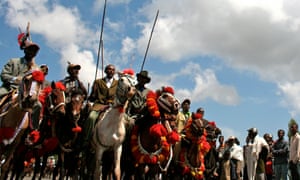
Men parade in the Oromia region outside Addis Ababa. Photograph: STR New/Reuters
Endalk Chala for Global Voices, part of the Guardian Africa network
Friday 11 December 2015
At least 10 students are said to have been killed and hundreds injured during protests against the Ethiopian government’s plans to expand the capital city into surrounding farmland.
According to Human Rights Watch, the students were killed this week when security forces used excessive force and live ammunition to disperse the crowds.
The students were protesting against a controversial proposal, known as “the master plan”, to expand Addis Ababa into surrounding Oromia state, which they say will threaten local farmers with mass evictions.
According to the Ethiopian constitution, Oromia is one of the ninepolitically autonomous regional states in the country, and the region’s Oromo people make up the largest ethnic group in Ethiopia.
It’s not the first time the security forces have reacted violently to protests in support of the group. At least nine students were killed in May 2014 while defending the rights of famers in the region when the “master plan” was first announced.
In response to the violence, Amnesty International issued a report on government repression last year, noting that “between 2011 and 2014, at least 5,000 Oromos [were] arrested based on their actual or suspected peaceful opposition to the government.”
The human rights organisation found that in numerous cases “actual or suspected [Oromo] dissenters were detained without charge or trial, killed by security services during protests, arrests and in detention.”
The ruling elite and members of government are mostly from the Tigray region, which is located in the northern part of the country.
Social media
The Ethiopian media has paid little attention to the protests. Demonstrators have been taking to Facebook and Twitter to report the clashes, with additional coverage coming from diaspora media.
“The Oromo youth are a powerful political entity capable of shaking mountains,” one Facebook user, Aga Teshome, wrote in support of the protesters. “This powerful political entity is hell bent on exposing the [ruling party] EPRDF government’s atrocious human rights record and all round discriminatory practices.”
Another user said more should be done to shine light on the movement: “The silence has truly been deafening. We need to see and hear the inspiring actions undertaken by huge numbers of #Oromo in #Ethiopia.”
Desu Tefera echoed the calls for better media coverage: “We call upon the media to investigate the conditions that these students died trying to expose and resist,” he wrote.
“Oromia needs a new kind of reporting by the international media, which gives voice to the voiceless Oromo people, who for a very long time have been killed, mistreated, abused, neglected and repressed in Ethiopia.”
Dubious development
For many Ethiopians, this week’s clashes show that the issue of Oromo rights refuses to go away.
Protests against the master plan for expansion first began in April last year, when students from outside the capital argued that if the proposal was implemented, it would result in Addis further encroaching into the surrounding territory, allowing the capital to subsume surrounding towns and leaving informal settlements vulnerable to government redevelopment.
The government rejected the accusation, claiming that the plan was intended only to facilitate the development of infrastructure such as transportation, utilities and recreation centres.
The unrest halted the development until now, but in November resentment boiled over again when it became clear the government had resumed its plan.
Since the highly contested 2005 national election forceful evictions and urban land grabbing have become frequent in Addis and its environs, opposition groups say. The city’s rapid growth has resulted in increasing pressure to convert rural land for industrial, housing or other urban use.
The population of the capital is estimated to have grown at a rate of 3.8% per year since 2007, but the repurposing of land in order to accommodate the expansion has been a particularly contentious issue.
Ermias Legesse, a high profile government defector, has argued that since 2000 the Addis Ababa city municipality, with the support of the federal government, has enacted five different pieces of legislation to “legalise” informal settlements, allowing them to be sold on to private property developers.
“Sometimes the informal settlers are given only a few days’ notices before bulldozers arrive on the scene to tear down their shabby houses and lay foundations for new investors,” Legesse said in an interview last week.
To: Office of the UN High Commissioner for Human Rights
United Nations Office at Geneva 1211 Geneva 10, Switzerland
Fax: + 41 22 917 9022
Oromia Support Group Australia (OSGA) extremely shocked about the killings and torture of innocent Oromo students including Primary School Children in Oromia. Oromo student peaceful protests are spreading throughout Ethiopia, Oromia region, as people demonstrate against the endanger that hundred thousand of Oromo farmers, residents and their families living near the capital, Finfinnee (Addis Ababa), could be evicted from their lands by the name of Addis Ababa expansion policy.
Since the first week of December 2015, horrifying, and heartbreaking images and videos of Oromo children peacefully marched on a street and voiced their anger being beaten to death and killed by shootings. There are credible reports of severe injuries and arbitrary arrests in many locations that the Ethiopian government armed forces and authorities are unable to deny and publicly admitted the killings of Oromo children.
The Ethiopian Federal forces, racially affiliated and heavily armed, known as Agazi and part of the select force of the dominant Tigrean People’s Liberation Front (TPLF), violently respond when Oromo students and children from various universities and institutions in the country protested against the Master Plan since the beginning of December 2015. (please see attached further statements and evidence).For full document Oromia-Support-Group-Australia-Statment, December 11, 2015 (1)
Oromia-Support-Group-Australia-Statment, December 11, 2015 (1)
IOYA expresses concern about brutality against Oromo protesters
The following is a statement from the International Oromo Youth Association (IOYA).
09 December 2015
We are greatly concerned about the recent brutal crackdown against innocent unarmed peaceful protesters in Oromia by Ethiopian police.
Words seem inadequate to express the sadness we feel for the peaceful protesters who have been killed, beaten and unlawfully detained. We share their grief in this time of agony and pain. We are appalled that a similar tragedy occurred last year in April, 2014 and not much has changed in Ethiopia. Recent images surfing the internet are heartbreaking and disturbing. As an organization subscribing to broader democratic engagement of the Oromo youth, we oppose the brutal violence that the Ethiopian government is meting out on innocent, unarmed young students who are peacefully protesting. As International Oromo Youth, we support and stand in solidarity with Oromo student protesters.
The students are protesting the Addis Ababa “Integrated Developmental Master Plan” which aims at incorporating smaller towns surrounding Addis Ababa, displacing millions of farmers. The implementation of the “Master Plan” will essentially result in the displacement of the indigenous peoples and their families. Farmers will be dispossessed of their land and their survival both in economic and cultural terms will be threatened. The student protesters strongly believe that this plan will expose their natural environment to risk, threaten their economic means of livelihood (subsistence farming), and violate their constitutional rights.
We call on the international community to join us in denouncing these inhumane and cruel activities carried out by the Ethiopian government. It has been reported that shootings, unlawful arrests, and harassment by security personals are becoming rampant. We believe it is imperative that the international community raise its voice and take action to stop the ongoing atrocities that are wreaking havoc to families and communities in the Oromia region.
We pray for safety and security of all peoples in Ethiopia.
The following is a statement from the Oromo Studies Association (OSA).
—–
Oromo Studies Association (OSA)
P. O. Box 5641
Minneapolis, MN 55406-0541 www.oromostudies.org
Email: admin@oromostudies.org
For Immediate Release
December 9, 2015
Statement on the Addis Ababa Integrated Development Master Plan and Oromo Student Protests against Its Implementation
The Oromo Studies Association (OSA) decries and denounces extreme measures taken by Ethiopian security forces, ongoing from late November 2015, killing and maiming peaceful student protesters.
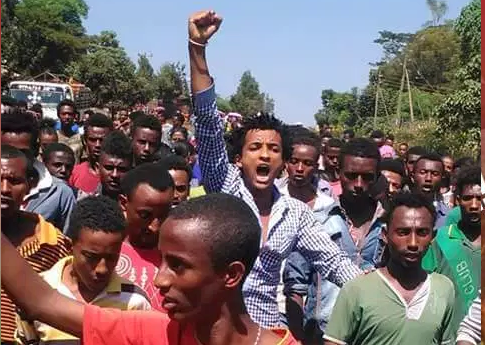
Oromo students at every level of the educational system in Ethiopia, from elementary school to university, began peaceful demonstrations in late November 2015, to protest the implementation of a federally designed Addis Ababa Integrated Development Master Plan (AAIMP), which usurps the authority of the Oromia regional government. The students have been met by heavily armed and equipped special Ethiopian police force units who fire into the crowds with deadly impact. There are ten (10) confirmed deaths at this writing, with the confrontation escalating.
The “Master Plan” refers to the federal government’s controversial design for expanding the territorial boundaries of the capital city, Addis Ababa, increasing the city to twenty times its present size by taking over prime agricultural land from Oromo farmers. This plan, developed in secrecy, was first exposed in April 2014, a disclosure that prompted widespread protests at that time. In April and May 2014 the Oromo students’ peaceful protest against the imposition of the Master Plan in all of Oromia region was met with deadly force and live ammunition, which resulted in the confirmed deaths of more than 70 students, maiming of hundreds and imprisonment of thousands of university students.
Since late November, the demonstrators have started to resist specific steps taken to implement this Plan. It calls for the Federal jurisdiction of the Capital City to seize fertile, well-watered and centrally located parts of the Oromia Regional State. The blueprints for this undertaking were developed without the participation of the Oromia regional government. Since the revelation, there has been no opportunity for public discussion of the plan. Now as Federal forces have begun to move these arable lands out of the domain of indigenous Oromo and into the control of the central government, Oromo students have responded with renewed protests. The scale of the Master Plan is such that it engulfs enough ancestral farmland to affect the lives and livelihoods of nearly six million Oromo people and dismembers the Oromia Regional State by dividing it into two separate zones. There is universal opposition among Oromo both in Oromia and in the diaspora to this Federal action, taken without due process.
OSA members belong to Oromo public and political organizations representing a wide spectrum of ideological and institutional positions. They share a clear focus and mission to produce verifiable data that reveal the real conditions of life of the Oromo people. They also find it within their mission to inform the public of the value and relevance of those findings. In this regard, OSA members have studied and produced research data on multiple dimensions of this very complex and problematic crisis of land use and proprietary rights in the east, west, north, south, as well as centre of Oromia. Findings reveal a longstanding but largely ignored pattern of land confiscation from the Oromo – of which this Master Plan is the latest expression.
OSA believes that the Master Plan is unconstitutional. It violates the principle of federalism, illegally alters the boundaries and jurisdiction of the Oromia regional government, violates citizens’ human right to property and security, and ignores the constitutional principle of transparency for good governance.
OSA believes that the Master Plan is harmful to human development. Contrary to the principles of participatory policy-making for sustainable development, the Master Plan was developed by the federal government to apportion land, in the name of investment, to the economic elite who are already at the top of the social hierarchy. The plan disregards the livelihood of Oromo farmers who will be displaced to face extreme poverty and an increasing unemployment rate. OSA views the plan as having uneven and detrimental impacts by contributing to policy-driven poverty among the Oromo and exacerbating intra-nation/ethnic economic inequality.
OSA believes that the Master Plan is injurious to the environment. Developed in secrecy, the Master Plan violates established principles and practices pertaining to environmental protection clauses. Under the Master Plan, the expanded city will continue dumping toxic substances and industrial wastes on the surrounding cities, towns and lands of Oromo people. Oromo communities in the outlying zones and the ecosystem will remain on the receiving end of the environmental harm.
OSA members fully support the rights of the students who initiated the protests and the rights of those who have now joined them in massive numbers. OSA officers and members will assist their effort to the fullest extent in its capacity as an academic, non-partisan association of Oromo and non-Oromo scholars. We are deeply concerned that the government is using excessive, often deadly, force against unarmed students, including even elementary school students. These incidents are followed by attacks against parents and townsfolk who come out to protect their children against the very security personnel who are constitutionally mandated to provide protection and maintain law and order. It should be a matter of grave concern when an internationally recognized government uses excessive force against its own citizens. It is extremely grievous that the Ethiopian government has called up its well-armed special forces to move against unarmed students. This violates every international human rights principle and rights enshrined in the Ethiopian constitution that officially guarantees extensive, regional and individual rights.
Let us be clear. The issue is not an abstract debate about whether a government has the duty to develop and implement policies to improve the conditions of lives for its citizens or to conduct urban planning necessary to accommodate natural migration of people from rural areas to urban centers. The issue is the unjust process in this instance developed and designed to implement a massive land transfer from Oromia Regional state control to Federal jurisdiction. Even more troublesome is the government’s utter disregard of the people’s inalienable right in a purported democracy to protest policies and to exercise rights guaranteed by the Ethiopian constitution.
The Master Plan is designed to be put into effect over a span of 25 years with a final phase occurring in 2038. When it is fully complete, it will:
o Incorporate 36 towns and 17 rural districts of the Oromia region into the Greater Addis Ababa territory. This includes, Finfinnee (Addis Ababa) Sululta, Dukem, Chancho, Adama, Ambo, Sabata, Mojo and other towns;
o Encompass a total area estimated to be 1.1 million hectares, of which the share of rural and urban areas amount to 85% and 15% with a corresponding population size of 2 million and 11.5 million respectively;
o Accumulate land “to increase rental housing by building 86,000 units every year under what the government calls “Rental Building Cooperative Sector” (10%), “Public Rental Housing Sector” (30%) and “Developmental Owners/Real Estate Sector(15%). As the result, it will uproot millions of Oromo farmers, disrupting not only their lives and livelihoods but dismantling their central position in the territorial and cultural landscape. The takeover disconnects Oromia’s current reach from the eastern to western boundaries of Ethiopia;
o Achieve 30% and 50% level of urbanization in 2023 and 2038 respectively. Given the limited urbanization among the Oromo because of the state-wide discriminatory language and economic policy against the Oromo, the plan will effectively erase Oromo identity, culture and language from the aggrandized Greater Addis Ababa. Even Oromo physical and economic presence would be totally cleared out of this crucially situated zone.
Generally, the plan has the direct effect of forcible transfer, displacement, dislocation and dispossession of the Oromo population from the area in which they are historically indigenous.
The Master Plan reveals that the incumbent policies continue longstanding patterns of historical injustice by denying the Oromo freedom of association, press and expression; by ostracizing residents and the Oromia Regional officials from political decision-making; by stifling and intimidating dissent through invoking arbitrary laws which depict even peaceful protest as terrorism; and by taking repressive measures such as capture, torture, extra-judicial murder, and massive arbitrary detention – all of which were used against Oromo protesters in 2014 and are being actively imposed again as the world witnesses on social media the massacre in broad daylight of the Oromia region’s young and brightest lives.
Cognizant of all of these issues, the Oromo Studies Association calls upon the following:
To the Ethiopian government: o Release immediately all protesters currently being held in open and secret detention; o Stop immediately the use of excessive force by security forces against peaceful protesters; o Honour and protect the rights of citizens to freedom of association, freedom of the press and to freedom of expression; o Protect the constitutionally-guaranteed right of citizens to protest any policy, a right also protected by all international human rights agreements that this government is a contracting party to; o Allow independent investigation into the actions of security forces that have resulted in the death and imprisonment of protesters; and o Bring to justice members of the security force and government officials responsible for the killing and injury of peaceful protesters. o Halt the implementation of the Integrated Development Master Plan for Addis Ababa and submit it to a constitutionally mandated review, giving the citizens a voice in their own governance.
To Foreign Governments, Donors and Consultants engaged in giving expert advice and financial support to the Ethiopian government in the implementation of the Master Plan: o OSA offers our considerable research, data – historical, economic, ecological, cultural and social –to all agencies and government who seek to know the full scope of the impact of their engagement with the Ethiopian government. o OSA acknowledges that all foreign parties in Ethiopia will better pursue their own best interests when operating with full knowledge of the circumstances in the country. We suggest to all parties that reliable information as well as consultation and analysis pertaining to the majority Oromo population of 40 million people is available through Oromo Studies Association. o Examine the evidence that demonstrates that Oromos are a force for peace and stability in Ethiopia and the Horn of Africa. Peace and justice (nagaa fi haaqa Oromoo) are the principles that undergird governance among Oromos.
To Oromo Students all over Oromia and Ethiopia as a whole: o OSA is aware and supportive of your efforts and rights to peaceful protest. We understand that you are risking your lives and well-being simply for exercising your democratic right to peacefully protest a policy that directly impacts you, your family, community and nation. o OSA applauds your commitment to clearly observable forms of peaceful protest. o OSA affirms its commitment to continue to provide the institutional support and intellectual materials to those who will support you in any venue and to document the ongoing crisis.
To the Public in Oromia and in all of Ethiopia: o We offer all possible intellectual and scholarly assistance to those who will create avenues to support Oromo protests against the implementation of the Master Plan, realizing that Oromo cultural identity and livelihood is threatened by this design for unvetted, unexamined land confiscation. o Comparative research by OSA scholars demonstrates that the Ethiopian government’s unconstitutional actions in dealing with one aggrieved the Oromo, indicate an absence of democratic process which inevitably affects all groups. o OSA reaffirms our commitment to providing research and documentation useful to those who wish to create or strengthen avenues for democracy, citizens’ empowerment and peace within and among peoples who are in Ethiopia and the Horn of Africa.
To Non-Governmental, Inter-Governmental and International Community in general: o OSA calls upon you to investigate thoroughly the conditions that the Oromo student protesters are suffering and in many cases, dying, to bring to the world attention. OSA members are committed to work with you to examine the conditions that have given rise to this renewed voice. We call on you to alert your respective governments about the widespread violations of fundamental rights in the Oromo region of Ethiopia. o OSA commends the excellent courageous work of Amnesty International, Human Rights Watch, and International Crisis Group in investigating crises affecting the Oromo over the years. We urge you to continue to document the tragic events underway to bear witness to the sacrifice of the intelligentsia among Oromo youth to draw attention to this issue which is critical to their people’s existence. OSA will provide you with any possible assistance.
To International and Foreign Media Outlets: o There has been a virtual blackout of information and awareness of the Oromo plight in Ethiopia in general and of this immediate crisis in particular. o OSA calls upon all forms of print, broadcast and online media to document and publicize the events underway in the implementation of the Master Plan, the widespread Oromo student protests and the harsh response to them. OSA pledges to supply information as needed. o OSA urges Voice of America to employ at least one, if not several, Oromo correspondents on the ground in Oromia region. o OSA commends BBC for establishing an Oromo language service and anticipates in depth coverage of these issues in near future.
Re-iterating that Oromo livelihood, language, cultural identity and economic survival is threatened by this design to confiscate land in Oromia, OSA affirms its commitment to support the legitimate rights of all citizens to peacefully protest the Addis Ababa Integrated Master Plan. We are committed to offer all possible intellectual and scholarly assistance to strengthen the efforts of those who create avenues to resist its unexamined and unconstitutional implementation.
The Right Honorable Philip Hammond MP
Secretary of State for Foreign and Commonwealth Affairs
Foreign and Commonwealth Office
King Charles Street
London SW1A 2AHOpen letterSystematic repression: Torture, Killing, and Harassment of unarmed school Children in the Oromia regional state of EthiopiaDear Minister,It is with sadness and anger that we report the renewed crackdown on peaceful Oromo protesters by government security forces in Ethiopia. More than 70 students were killed, many made to disappear, others jailed simply for taking part in a peaceful demonstration in April 2014. Amnesty international compiled a detailed report giving a clear account of this crackdown in its report of “because I am Oromo- a sweeping repression in Oromia.” Over the past week the same tragedy was taking place in Oromia high schools and universities as they were protesting against the continued eviction of the Oromo people from their livelihood without compensation and by driving them down to extreme poverty.While more than 15 million peasants are reported to have been starving (BBC report, 9 Nov, 2015) the oppressive regime in Ethiopia continues to push its policy of evicting the Oromo people from their livelihood on
a wider scale. This policy, coupled with the burning of a vast area of natural forests and continued eviction of indigenous people has been opposed in peaceful protest yet met at all times with brutal suppression in the forms of mass arrest, torture and killings.
The government security forces have killed already Twenty four students since the protest began in different parts of Oromia. Among those first casualties,
Clashes between police and protesters in Ethiopia’s Oromia region have left several people dead, according to officials and regional opposition leaders.
Oromia has seen three weeks of protests over a government plan to integrate parts of the region with the capital, Addis Ababa. Critics say the plan will undermine local rule and cause local farmers to lose their land.
Witnesses say police have used force to contain or shut down protests, including one that took place Thursday in the town of Bako.
“Today in Bako city when the students came out to protest, people joined them and they started firing live rounds and hit some students,” a witness told VOA’s Horn of Africa Service. There was no word on whether anyone was killed.
Bloomberg news quotes a prominent opposition leader, Bekele Nega, as saying police have killed 10 students taking part in the ongoing protests.
Ethiopia’s communications minister, Getachew Reda, put the number of dead at four, and said security forces have been exercising restraint in the face of violence.
Widening protests
Oromia is one of Ethiopia’s nine ethnically-based states and holds the largest population at more than 27 million.
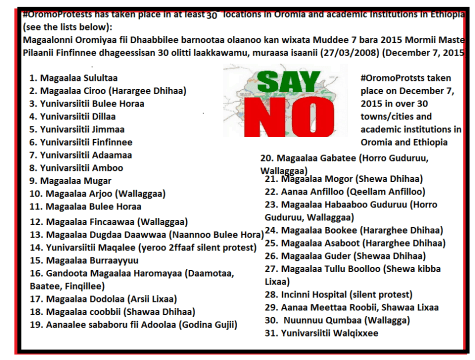
The protests started on November 20 in the Western Oromo region cities of Ambo, Ginchi and Western Welega, and they have since spread.
The tactics used to clamp down on these protests are reminiscent of the 2014 protests in the Oromia towns of Ambo, Nekemte and Jimma, according to Human Rights Watch, where security forces fired live rounds and beat people who were protesting peacefully.
Speaking to journalists in Ethiopia a few days ago, the police commissioner of the Oromia region, Ibrahim Hajj, blamed misinformation and propaganda for fueling hostilities among some in the Oromo community.
“Today the people are ensuring the rights and are beneficiaries in all sectors including, social, economic sectors. But there are some who are trying to make it seem as if the rights of the people have been violated and they take advantage of this situation behind the scenes,” he said.
Felix Horne, an Ethiopia and Eritrea researcher for Human Rights Watch, said the spread of the protests started slowly and gained momentum within schools and other educational institutions.
“Initially it was students in primary schools, secondary schools, some university students and now we are seeing farmers, workers beginning to take part in these protests in different ways — staging protests peaceful means, sit-ins to mourn the death of those who’ve lost their lives. So the protests definitely seem to be gaining momentum,” he said.
Horne said that while the government’s development for Addis sparked the protests, they are about much larger issues.
“Ostensibly these protests are about the Addis Ababa Master Plan but clearly the Oromos have been marginalized by successive governments and so it’s kind of an accumulation of different frustrations,” he said. “Throughout Oromia, arbitrary detention is common, mistreatment in detention is common and then Oromos just don’t have a voice in issues that impact them day-to-day.”
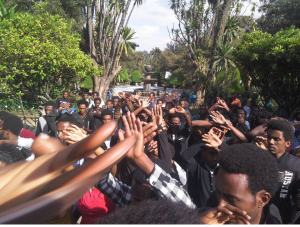
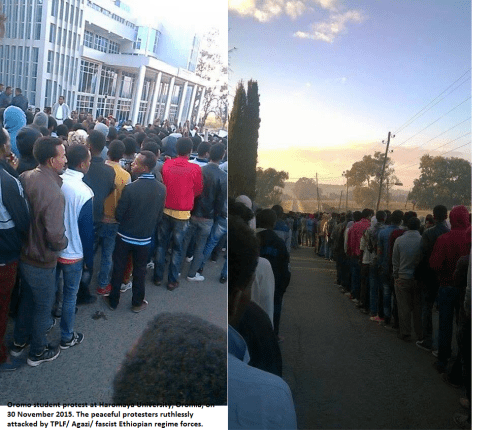
Students mourning at Haromaya University. Photo shared widely on social media.
Over the past two weeks, students in Ethiopia’s largest regional state, Oromia, have been protesting against a government plan to expand the area of the capital, Addis Ababa, into Oromia. Reports suggest security forces used violence including live ammunition to disperse crowds of peaceful demonstrators in the compounds of universities in Oromia.
According to Human Rights Watch, at least three students were killed and hundreds were injured across the region as security forces used excessive force to disperse student protesters. Other reports put the number of students killed up to ten. Although protesters are primarily university students, in some instances, high school and primary school children were also reportedly involved in intense confrontations with government forces.
At least nine students were killed by government forces in May 2014 while protesting over the same issue.
The persecution of Oromo people
The students argue that the controversial plan, known as “the Master Plan”, to expand Addis Ababa into Oromia state would result in mass evictions of farmers mostly belonging to the Oromo ethnic group.
It wouldn’t be the first time the government has uprooted members of an ethnic group. Thousands of ethnic Amharas in western Ethiopia were expelled from the country’s Benishangul Gumuz region in 2013 in what critics called “ethnic cleansing”.
The students have other demands such as making Oromo a federal language. Oromo, the language of the Oromo people, is the most widely spoken language in Ethiopia and the fourth largest African language. However, it is not the working language of the federal government.
According to Ethiopian Constitution, Oromia is one of the nine ethnically based and politically autonomous regional states in Ethiopia. Oromo people make up the largest ethnic group in Ethiopia. However, the group has been systematically marginalized and persecuted for the last 24 years. By some estimates, there were as many as 20,000 Oromo political prisoners in Ethiopia as of March 2014.
A 2014 Amnesty International report on repression in the Oromia region noted:
Between 2011 and 2014, at least 5000 Oromos have been arrested based on their actual or suspected peaceful opposition to the government. These include thousands of peaceful protestors and hundreds of opposition political party members. The government anticipates a high level of opposition in Oromia, and signs of dissent are sought out and regularly, sometimes pre-emptively, suppressed. In numerous cases, actual or suspected dissenters have been detained without charge or trial, killed by security services during protests, arrests and in detention.
The ruling elite of Ethiopia are mostly from the Tigray region, which is located in the northern part of the country.
Social media fills in the gaps
Even as the Ethiopian drought and impending food crisis makes a rare appearance in local—and some international—headlines, little attention is being paid to the student protests in Ethiopian media. But despite Ethiopia’s highly controlled online environment and the government’s firm grip on communications infrastructure, social media users are reporting on the issue, particularly on Facebook, with additional coverage coming from diaspora-based media.
Photo widely circulated on social media, taken from the Facebook page of Jawar Mohammed.
One Facebook user, for example, hopedfor the world to hear stories of the student protesters’ inspiring actions:
The silence has truly been deafening. We need to see and hear the inspiring actions undertaken by huge numbers of #Oromo in #Ethiopia. Tell their story, enable the world to be swept up in their story.Considering the complete absence of freedom to criticize the government or report opposition stories from within the country, people around the world reading about it can help greatly by doing everything possible to amplify this story.
Another Facebook user, Aga Teshome,took note of the political power of Oromo youth:
…#OromoProtests a call for all oppressed people in #Ethiopia to support the ongoing protest against #landgrabing
….the Oromo youth are a powerful political entity capable of shaking mountains. This powerful political entity is hell bent on exposing the [ruling party] EPRDF government’s atrocious human rights record and all round discriminatory practices.
We call upon the media to investigate the conditions that these students died trying to expose and resist, to draw attention to these concerns. Oromia needs a new kind of reporting by the international media, which gives voice to the voiceless Oromo people, who for a very long time have been killed, mistreated, abused, neglected and repressed in Ethiopia. Going forward with the current plan, which ends up displacing tens of thousands of poor farmers, destroying their livelihood and depriving their identity, is a tragedy. It deserves attention. These students put their lives on the line to draw attention to the farmers’ plight.#OromoProtests
Although social media reports are pivotal in letting the world know about the protests, they miss a huge chunk of nuance that would help observers understand how this dispute is unfolding. Notably, the fact that the student protests combine delicate ethnic politics, urban land grabbing and Ethiopia’s diaspora community’s involvement in home country politics.
Given Ethiopia’s highly controlIed environment, one might wonder how the students managed to get organized to express their grievance in the mid of highly controlled environment. Despite the firm grip on communication infrastructure there are constant update on Facebook and Twitter about the protest.
Dubious development practices
The story is unpleasantly familiar, as students are protesting for the second time in less than two years.
In April and May 2014, the protests began in response to the government’s plan to implement the “Integrated Masterplan for Addis Ababa”. As Addis Ababa, the capital of Ethiopia, is an enclave within Oromia regional state, students primarily from Oromia state accused the Ethiopian government of attempting to take over land owned by local farmers in the name of integrating adjacent Oromia towns into the sprawling city of Addis. The students further alleged that if implemented, the Masterplan would result in Addis Ababa further encroaching into the territory of Oromia.
The government rejected the accusation, claiming that the Masterplan was intended only to facilitate the development of infrastructure such as transportation, utilities, and recreation centers.
When the protests began the students’ main demand was the complete halting of the Masterplan. In May 2014, the government did momentarily halt the plan in order to abate the protests after at least nine were killed and hundreds of ethnic Oromo students were imprisoned. But when the government decided to resume plans to implement the Masterplan in November this year resentment boiled over again, resulting in the currently two-week-old student protest leaving at least ten people dead and many injured.
Since the highly contested 2005 national election, forceful evictions and urban land grabbing have become frequent in Addis Ababa. The capital city’s rapid growth has resulted in increasing pressure to convert rural land for industrial, housing, infrastructure, or other urban use.
Diaspora-based advocates say the unrest in Oromia is just a part of the general unhappiness that prevails in the country. They accuse the government of working for the benefit of a few people at the expense of others. They even suggest that the Ethiopian government covertly encouraged informal settlement on the outskirts of Addis Ababa so that they could later find a way to intervene under the guise of rebuilding the slums and lease the land to real estate developers.
Ermias Legesse, a high profile government defector, traces the cause of the Oromo student protest to events that took place 15 years ago. In his book, “Addis Ababa: The Abandoned City”, Ermias notes that since 2000 the Addis Ababa city municipality, with the support of the federal government, enacted five different pieces of legislation to “legalize” the informal settlements, and then sold the “legalized” lands to private property developers.
Most informal settlers on the outskirts of Addis Ababa manage to establish themselves for a period of time until they are displaced by government. “Sometimes the informal settlers are given only a few days’ notices before bulldozers arrive on the scene to tear down their shabby houses and lay foundations for new investors,” Ermias said in an interview with a diaspora-based television channel.
Ethiopia Faces Worst Drought in 50 Years, Millions Affected
By William Davison, bloomberg.com December 7, 2015
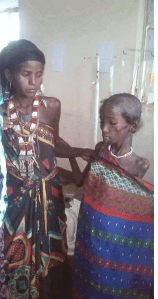
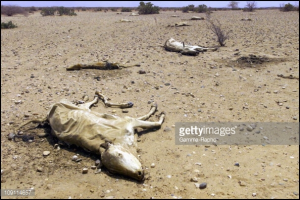
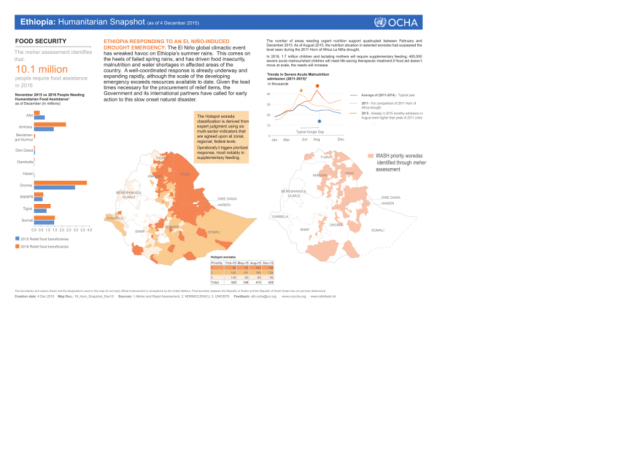
A worsening drought in Ethiopia means 10.1 million people, a 10th of the population, are facing food shortages next year in the Horn of Africa nation, Save the Children said.
The figure is an increase of 1.9 million people from the number the government says currently requires food aid. The assessment means 400,000 children are at risk of severe malnutrition in 2016, the London-based charity said in an e-mailed statement on Monday.
“The worst drought in Ethiopia for 50 years is happening right now, with the overall emergency response estimated to cost $1.4 billion,” said John Graham, Save the Children’s Ethiopia country director.
Ethiopia’s government has allocated $192 million for the crisis and received $163 million from donors since an appeal for $340 million in October, said Mitiku Kassa, who heads the government’s disaster response team.
Another 8 million vulnerable Ethiopians will receive food and cash transfers during the first six months of next year under a mostly donor-funded aid program.
Low rainfall this year had a “devastating effect” on agricultural production, with the next harvest not expected until June, the charity said. Ethiopia’s government has said the drought will not affect official growth rates of about 10 percent a year, despite rain-fed agriculture accounting for almost 40 percent of the economy.
ETHIOPIA RESPONDING TO AN EL NIÑO-INDUCED DROUGHT EMERGENCY:
The El Niño global climactic event has wreaked havoc on Ethiopia’s summer rains. This comes on the heels of failed spring rains, and has driven food insecurity, malnutrition and water shortages in affected areas of the country. A well-coordinated response is already underway and Trends in Severe Acute Malnutrition expanding rapidly, although the scale of the developing admission (2011-2015)3 emergency exceeds resources available to date. Given the lead in thousands times necessary for the procurement of relief items, the Government and its international partners have called for early 40 action to this slow onset natural disaster.
UN Office for the Coordination of Humanitarian Affairs
Oromia/Ethiopia: Human rights defender says attacks on Oromos are ethnic cleansing war crimes.
Oromia/Ethiopia: Region-Wide, Heavy-Handed Crackdown on Peaceful Protesters
HRLHA Urgent Action
For Immediate Release
The Human Rights League of the Horn of Africa (HRLHA) expresses its grave concern at the continuation of gross human rights violations in Oromia Regional State – violations that have regularly occurred since 1991 when the TPLF/EPRDF came into power.
The most recent heinous crime was committed – and is still being committed – against defenseless schoolchildren protesting against the approval of “the Addis Ababa Integrated Master Plan” by the Oromia Regional State Parliament a month ago. The peaceful protest involved many elementary school, high school and university students, and civilians. Among them were students in Western Oromia zones: Najo, Nekemt, Mandi high schools, and in other towns, in Central Oromia in Ginchi, Ambo, Addis Ababa high schools and the surrounding towns, Eastern and Southern Oromia zones, in Haromaya, and Bule Hora Universities, and many more schools and universities. In violation of the rights of the citizen to peaceful demonstration enshrined in the Ethiopian Constitution(1) [Chapter Two, Article 30 (1) states: “Everyone has the right to assemble and to demonstrate together with others peaceably and unarmed, and to petition. Appropriate regulations may be made in the interest of public convenience relating to the location of open-air meetings and the route of movement of demonstrators or, for the protection of democratic rights, public morality and peace during such a meeting or demonstration.”], students, in all of these places, were severely beaten, imprisoned or even killed.
The Human Rights League of the Horn of Africa emphasizes that the ongoing violence and crimes committed in Oromia Regional State for over two and a half decades by the TPLF perpetrators against the Oromo Nation amount to war crimes, and crimes against humanity – a clear failure of the Oromo People Democratic Organization (OPDO) authorities, an organization claiming to represent the Oromo Nation. The members of this bogus political organization have proved to be not the Oromo peoples’ true representatives, but rather stand-ins for their real masters who have compromised the interests of the Oromo Nation. The Oromia Regional State authorities/OPDO did not resist the TPLF regime when Oromo children, farmers, intellectuals, members of political organizations were killed, abducted, imprisoned, tortured and evicted from their livelihoods by TPLF security agents in the past two and half decades. Instead, they helped the TPLF regime to control the political and economic resources of the Oromia Regional State. TPLF high officials and ordinary level cadres in Oromia Regional State engaged in enriching themselves and their family members by selling Oromo land, looting and embezzling public wealth and properties in the occupied areas of the Oromo Nation, and committing many other forms of corruption.
Committing atrocities and crimes against humanity are failures to comply with obligations under international law, international human rights law and international humanitarian law, including the principles of proportionality and discrimination. With many civilians suffering from the crimes and serious violations of human rights, and by not taking any measures to ensure the accountability of those responsible for these crimes and violations, it has become clear that after all these years the so called Oromia Parliament (Caffee Oromiyaa) has betrayed the Oromo people by not protecting them. The OPDO members and the Oromia Parliament (Caffee Oromiyaa) members should not continue in silence while Oromo children are brutalized by Aga’azy squads deployed by the TPLF for ethnic cleansing. The Oromia Parliament(Caffee Oromiyaa) and OPDO have a moral obligation to dissolve their institutions and stand beside their people to resist the TPLF regime’s aggression.
The HRLHA believes that the gross human rights violations committed by the TPLF government, in cooperation with OPDO in the past two and half decades against Oromo Nation, have been pre-planned every time they have happened. TPLF regime security agents imprisoned, killed, tortured, kidnapped, disappeared, and evicted from their ancestral lands thousands of Oromo nationals, simply because of their ethnic backgrounds and to acquire their resources. The TPLF inhuman actions against Oromo civilians are clearly genocidal, a crime against humanity and an ethnic cleansing, which breach domestic and international laws, and all international treaties the government of Ethiopia signed and ratified.
The Human Rights League of the Horn of Africa (HRLHA) expresses its deep concern over the safety and well-being of these Oromo nationals who have been arrested without any court warrant and are being held in different police stations, military camps, “Maekelawi” compound, the main federal police investigation center, in Central Addis Ababa and in different unknown places.
Therefore, HRLHA calls upon governments of the West, all local, regional and international human rights agencies to join hands and demand an immediate halt to these extra-judicial actions, terrorizing civilians and the immediate unconditional release of the detainees.
The HRLHA also calls on all human- rights defender non-governmental, civic organizations, its members, supporters and sympathizers to stand beside the HRLHA and provide moral, professional and financial help to bring the dictatorial TPLF government and officials to international justice.
The HRLHA is a non-political organization that attempts to challenge abuses of human rights of the people of various nations and nationalities in the Horn of Africa. It works to defend fundamental human rights, including freedoms of thought, expression, movement and association. It also works to raise the awareness of individuals about their own basic human rights and those of others. It encourages respect for laws and due process. It promotes the growth and development of free and vigorous civil societies.
—– Copied to:
– UNESCO Headquarters
– UNESCO – Africa Department
– UNESCO – Africa Regional Office
– Office of the UN High Commissioner for Human Rights
– Office of the UNHCR
– African Commission on Human and Peoples’ Rights (ACHPR)
– Council of Europe
– U.S. Department of State – Ethiopia Desk
“Ethiopian police have moved in to suppress this united demonstration of protest. Government sharpshooters are firing into crowds and killing students again.”
Protesters say the central government is trying to evict Oromo farmers from their land under the auspices of urban development, with little or no compensation, essentially turning them into street beggars and daily laborers.
Tensions rise as students in Oromia accuse government of land grab
Activists claim security forces have killed at least seven students in more than two weeks across Ethiopia’s Oromia state, where students have been protesting a government plan to expand the area of the capital, Addis Ababa, into Oromia.
Oromia police have confirmed three fatalities in what it termed provocations by “anti-peace elements.”
Images of severely injured students have been posted on social media, and hundreds of other protesters have reportedly been rounded up in a crackdown on those demonstrating against several state-led development projects.
Oromo students, the opposition and diaspora activists liken the proposed Addis Ababa and the Surrounding Oromia Special Zone Integrated Development Plan, or the Master Plan, to a land grab. They fear that it will displace Oromo farmers and undermine Oromia’s interests by expanding Addis Ababa’s boundaries.
Addis Ababa is in the state of Oromia and serves as the regional and federal capital. In theory, the Ethiopian constitution protects Oromia’s “special interest” in Addis Ababa in the provision of social services and use of natural resources and on joint administrative matters.
While the city, home to 4 million people, has experienced massive growth over the last decade, Oromo activists have long decried the lack of social facilities for its Afaan Oromo speakers, including schools, hospitals and cultural institutions.
The protests broke out in November Ginci, a town about 50 miles west of Addis Ababa. Students from universities, high schools and even some primary schools continue to stage sit-ins and demonstrations around the country.
Oromia, the largest of Ethiopia’s nine ethnically based states, is home to close to half the country’s population of 100 million. The Oromo people have long had a contentious relationship with the national government.
“Many Oromos have felt marginalized and discriminated against by successive Ethiopian governments and have often felt unable to voice their concerns over government policies,” Felix Horne, the Horn of Africa researcher for Human Rights Watch, wrote in a Dec. 5 blog post.
He called for an immediate halt to the excessive use of force by security personnel, an independent and impartial investigation into the killings and the prosecution of security forces involved in the violent crackdown.
‘Long-simmering grievance’
Protesters say the central government is trying to evict Oromo farmers from their land under the auspices of urban development, with little or no compensation, essentially turning them into street beggars and daily laborers.
The government says its plan is mutually beneficial, will enhance cooperation and will make the area globally competitive by remedying its disorganized spatial growth.
Addis Ababa serves as landlocked Ethiopia’s primary gateway to the outside world. Last year the New York–based consultancy A.T. Kearney named Addis Ababa “the third-most-likely city to advance its global positioning,” adding, “the Ethiopian capital is also among the cities closing in fastest on the world leaders.”
Modest economic growth and the lack of opportunities in rural areas have fueled massive rural-to-urban migration. The Master Plan is part of an effort to mitigate the city’s resulting rapid expansion. But critics contend that the proposal focuses mostly on attracting investors and will ensure the continued erasure of Oromos’ historical and cultural values from the city.
The Oromo students’ protests are not new. They been demonstrating against the central state for most of the last two decades.
In April and May 2014, Ethiopian security forces fired live ammunition at unarmed protesters, killing dozens of students and wounding many others. Hundreds of students were arrested and charged under Ethiopia’ssweeping anti-terrorism law, and many remain incarcerated.
A federal court last week convicted five students for participating in those protests. In the early 2000s, Ethiopia saw similar protests and violence over a government plan to move Oromia’s capital from Addis Ababa. The decision was reversed in 2005 amid a public outcry.
There has been limited media coverage of the ongoing protests. There are strong restrictions on the free press in Ethiopia, one of the most censored countries in the world, according to the Committee to Protect Journalists. Government critics and the independent press face increased scrutiny.
Analysts warn that continued violent responses to peaceful protesters could bode ill for Ethiopia’s future.
“The Oromo have long been humiliated with their still marginal status in Ethiopia’s power arrangement,” said Hassen Hussein, an Ethiopian-born university professor in Minnesota. “These almost annual student protests give voice to these long-simmering grievance and perhaps a harbinger of what is to come. The authorities cannot forever count on an aggrieved nation remaining docile.”
Oromo activists and community leaders in North America, Western Europe and Australia are planning solidarity rallies for next week, when more violence is anticipated.
Bonnie Holcomb, an author and anthropologist based in Washington, D.C., said the current situation mirrors the violence of 2014. “The international media were silent when Ethiopian police opened fire into crowds, killing 68, permanently disabling hundreds and arresting thousands. Now the next stage of the Master Plan is being implemented,” she said.
“Ethiopian police have moved in to suppress this united demonstration of protest. Government sharpshooters are firing into crowds and killing students again,” she said.
(Oromia press): The following is a statement from the Peoples’ Alliance for Freedom and Democracy (PAFD), a coalition of five national liberation movements, namely, OLF, SNLF, ONLF, GPLM and BPLM, operating in Ethiopia.
—
Peoples’ Alliance for Freedom and Democracy (PAFD)
The Ethiopian Government Brutal Army and Paramilitary Police Use Lethal Force against Oromo Students Demonstrating Peacefully
Press Statement by Peoples’ Alliance for Freedom and Democracy (PAFD)
The Ethiopian government’s brutal army and paramilitary police are shooting at unarmed Oromo students demonstrating against the implementation of Addis Ababa land grabbing master plan.
Just over a year ago, TPLF’s regime planned to exponentially expand Oromia’s capital, the city of Finfinne (Addis Ababa), under the scheme known as ‘Addis-Master-Plan.’ This plan aims to incorporate the rural agricultural areas in Oromia state surrounding Addis Ababa. This Plan will totally displace the entire Oromo rural population in the area without their consent. The said plan has seriously angered the Oromo people, who went on a peaceful demonstration of opposing the plan. The regime’s security and armed forces’ unprecedented and violent response to the peaceful demonstration has left over 60 Oromo University and high School students and the others Oromo civilians dead, and over 200 wounded.
After remaining silent for around a year, the Prime Minister and others government officials have recently announced their decisions to re-implement ‘Addis-Master-Plan.’ Again, the Oromo students started demonstrating, beginning in West Oromia towns, such as Mattuu, Ambo and others places; it has widened its horizons to almost entire Oromia Zones and districts.
On December 1 and 2, 2015 there have been series of demonstrations in various Oromia regional Zones and districts, including in Madawalaabuu university, Agarfaa, Ayira (Guuliso), Bantuu, Burrayyuu, Chancho, Dalloo, Dinshoo, Finfinnee, Gaasaraa, Gimbi, Gudar, Haromayaa, Horro Guduruu, Jaarraa, Maattu, Sabroo, Jaarsoo, Laaloo, Asabi, Jiddaa, Ayyaanaa, Mandi, Najjoo, Qilxuu Karraa, Sabataa, Walisso, Sabroo, Xuqur Incinni and others various high schools, universities, towns and villages. In all these places, the responses of TPLF security and police personnel has been as brutal as always. Several deaths have been reported since last week. The number of wounded Oromo students, including children, has reached to several hundreds.
PAFD categorically condemns the brutal treatments of the civilians, and calls all liberation fronts and opposition parties to unite in ending the current undemocratic rule and create a new system that respects the rights of all peoples in Ethiopia. We call all nations and peoples in Ethiopia to rise up and stop this illegal displacement of Oromo people from their ancestral lands as is happening in all other parts. We call upon the international community to denounce the unlawful action of the Ethiopian brutal regime and urge it to abide with international laws in respecting citizens’ rights, dignity and safety. We also call upon all nationals working for TPLF’s repressive apparatuses, such us military, police and security that are inflicting pain on their brothers, sisters, mothers and fathers, to unconditionally stop their alliance with the regime brutalizing all peoples, and join a genuine struggles for democratic change to bring about equality for all.
Finally, with deepest sadness, PAFD sends its condolences to the families of Oromo students who have been murdered by the authoritarian Ethiopian regime.
Peoples’ Alliance for Freedom and Democracy (PAFD)
WBOn Godina Bahaa Loltootaa fi Poolisoota Federaalaa Wayyaanee Barattootaa Fi Ummata Irratti Roorrisaa Jiran Haleeluun Hidhattoota Diinaa 23 Ol Hojiin Ala Godhe
Abdii Fi Gaachanni Ummata Oromoo WBOn Godina Bahaa Loltootaa fi Poolisoota Federaalaa Wayyaanee Barattootaa Fi Ummata Irratti Roorrisaa Jiran Haleeluun Hidhattoota Diinaa 23 Ol Hojiin Ala Godhe. Poolisoota Sirna Wayyaanee 2s Oggaa Booji’u, Hidhamtoota Oromoo 21 Ol Ta’an Hidhaadhaa Baase.
Mirga abbaa biyyummaa fi bilisummaa ummata Oromoo dhugoomsuuf falmaa karaa hidhannoo godhaa jiru karaa hundaanuu jabeessaa kan jiru gootichi WBO, haleellaa diinaa fi ergamtoota diinaa irratti fudhataa jiruun Mudde 05 – 07, 2015tti Bahaa fi Lixa Harargee keessatti loltootaa fi poolisoota wayyaanee irratti injifannoo boonsaa galmeessuun 23 ol hojiin ala gochuu Ajaji WBO Godina Bahaa oduu tarkaanfii waraanaa har’a Mudde 07, 2015 SBOf ergeen beeksisee jira.
(Human Rights Watch (HRW, 5 December 2015):Student protests are spreading throughout Ethiopia’s Oromia region, as people demonstrate against the possibility that Oromo farmers and residents living near the capital, Addis Ababa, could be evicted from their lands without appropriate – or possibly any – compensation. Social media is filled with images of bloodied protesters; there are credible reports of injuries and arrests in a number of towns; and local police have publicly acknowledged that three students have died so far.
The current protests echo the bloody events of April and May 2014, when federal forces fired into groups of largely peaceful Oromo protesters, killing dozens. At least hundreds more students were arrested, and many remain behind bars. Both then and today, the demonstrators are ostensibly protesting the expansion of Addis Ababa’s municipal boundary into the surrounding Oromia region, which protesters fear will displace Oromo farmers from their land. But these protests are about much more: Many Oromos have felt marginalized and discriminated against by successive Ethiopian governments and have often felt unable to voice their concerns over government policies.
Of the student protesters detained in 2014, some have been released. Those I spoke with told me about the torture they endured as part of interrogations. But countless others remain in detention. Some have been charged under Ethiopia’s draconian counterterrorism law for their role in the protests; others languish without charge in unknown detention centers and military camps throughout Oromia. This week, five students were convicted of terrorism-related offenses for their role in the protests.
There has been no government investigation into the use of live ammunition and excessive force by security personnel last year.
Ethiopia’s tight restrictions on civil society and media make it difficult to corroborate the current, mounting allegations and the exact details of the ongoing protests emerging from towns like Haramaya, Jarso, Walliso, and Robe. The government may think this strategy of silencing bad news is succeeding. But while the fear of threats and harassment means it is often months before victims and witnesses come forward to reveal what happened in their communities, they eventually do, and the truth will emerge.
The government should ensure that the use of excessive force by its security personnel stops immediately. It should then support an independent and impartial inquiry into the conduct of security forces in the current protests – and last year’s as well. Those responsible for serious abuses should be fairly prosecuted. This would be the best way for the Ethiopian government to show its concern about the deaths and injuries inflicted on the students, that it does not condone the use of live ammunition against peaceful protesters, and that those who break the law are appropriately punished. https://www.hrw.org/news/2015/12/05/dispatches-yet-again-bloody-crackdown-protesters-ethiopia
Oromia/Ethiopia: Region-Wide, Heavy-Handed Crackdown on Peaceful Protesters
HRLHA Urgent ActionDecember 05, 2015For Immediate ReleaseThe Human Rights League of the Horn of Africa expresses its grave concern at the continuation of gross human rights violations in Oromia Regional State, violations that have regularly occurred since 1991 when the TPLF/EPRDF came into power.
The most recent heinous crime was committed- and is still being committed- against defenseless school children protesting against the approval of “the Addis Ababa Integrated Master Plan” by the Oromia Regional State Parliament a month ago. The peaceful protest involved many elementary school, high school, university students and civilians. Among them were students in Western Oromia zones, Najo, Nekemt, Mandi high schools and in other towns, in Central Oromia in Ginchi, Ambo, Addis Ababa high schools and the surrounding towns, Eastern and Southern Oromia zones, in Haromaya , and Bule Hora Universities and many more schools and universities. In violation of the rights of the citizen to peaceful demonstration enshrined in the Ethiopian Constitution[1] Chapter two, article 30 (1) states “Everyone has the right to assemble and to demonstrate together with others peaceably and unarmed, and to petition. Appropriate regulations may be made in the interest of public convenience relating to the location of open-air meetings and ‘the route of movement of demonstrators or, for the protection of democratic rights, public morality and peace during such a meeting or demonstration” students in all of these places were severely beaten, imprisoned or even killed.
The Human Rights League of the Horn of Africa emphasizes that the ongoing violence and crimes committed in Oromia Regional State for over two and a half decades by the TPLF perpetrators against the Oromo Nation amount to war crimes, and crimes against humanity- a clear failure of the Oromo People Democratic Organization (OPDO) authorities, an organization claiming to represent the Oromo Nation. The members of this bogus political organization have proved to be not the Oromo peoples’ true representatives, but rather stand-ins for their real masters who have compromised the interests of the Oromo Nation. The Oromia Regional State authorities/OPDO did not resist the TPLF regime when Oromo children, farmers, intellectuals, members of political organizations were killed, abducted, imprisoned, tortured and evicted from their livelihoods by TPLF security agents in the past two and half decades. Instead, they helped the TPLF regime to control the political and economic resources of the Oromia Regional State. TPLF high officials and ordinary level cadres in Oromia Regional State engaged in enriching themselves and their family members by selling Oromo land, looting and embezzling public wealth and properties in the occupied areas of the Oromo Nation, and committing many other forms of corruption.
Committing atrocities and crimes against humanity are failures to comply with obligations under international law, international human rights law and international humanitarian law, including the principles of proportionality and discrimination. With many civilians suffering from the crimes and serious violations of human rights, and by not taking any measures to ensure the accountability of those responsible for these crimes and violations, it has become clear that after all these years the so called Oromia Parliament(Caffee Oromiyaa) has betrayed the Oromo people by not protecting them. The OPDO members and the Oromia Parliament (Caffee Oromiyaa) members should not continue in silence while Oromo children are brutalized by Aga’azy squads deployed by the TPLF for ethnic cleansing. The Oromia Parliament (Caffee Oromiyaa) and OPDO have a moral obligation to dissolve their institutions and stand beside their people to resist the TPLF regime’s aggression.
The HRLHA believes that the gross human rights violations committed by the TPLF government in cooperation with OPDO in the past two and half decades against Oromo Nation have been pre-planned every time they have happened. TPLF regime security agents imprisoned, killed, tortured, kidnapped, disappeared, and evicted from their ancestral lands thousands of Oromo nationals, simply because of their ethnic backgrounds and to acquire their resources. The TPLF inhuman actions against Oromo civilians are clearly genocidal, a crime against humanity and an ethnic cleansing, which breach domestic and international laws, and all international treaties the government of Ethiopia signed and ratified.
The Human Rights League of the Horn of Africa (HRLHA) expresses its deep concern over the safety and well-being of these Oromo nationals who have been arrested without any court warrant and are being held in different police stations, military camps, “Maekelawi” compound, the main federal police investigation center, in Central Addis Ababa and in different unknown places.
Therefore, HRLHA calls upon governments of the West, all local, regional and international human rights agencies to join hands and demand an immediate halt to these extra-judicial actions, terrorizing civilians and the immediate unconditional release of the detainees.
The HRLHA also calls on all human- rights defender non-governmental, civic organizations, its members, supporters and sympathizers to stand beside the HRLHA and provide moral, professional and financial help to bring the dictatorial TPLF government and officials to international justice.
The HRLHA is a non-political organization that attempts to challenge abuses of human rights of the people of various nations and nationalities in the Horn of Africa. It works to defend fundamental human rights, including freedoms of thought, expression, movement and association. It also works to raise the awareness of individuals about their own basic human rights and those of others. It encourages respect for laws and due process. It promotes the growth and development of free and vigorous civil societies.
Copied to:
UNESCO Headquarters Paris.
7, place de Fontenoy 75352 Paris 07 SP France
1, rue Miollis 75732 Paris Cedex 15 France
General phone:
+33 (0)1 45 68 10 00 http://www.unesco.org
United Nations Educational, Scientific and Cultural Organisation (UNESCO)- Africa Department
7 place Fontenoy,75352
Paris 07 SP
France
General phone:
+33 (0)1 45 68 10 00
Website: http://www.unesco.org/new/en/africa-department/
UNESCO AFRICA RIGIONAL OFFICE
MR.JOSEPH NGU
Director
UNESCO Office in Abuja
Mail: j.ngu(at)unesco.org
Tel: +251 11 5445284
Fax: +251 11 5514936
Office of the UN High Commissioner for Human Rights
United Nations Office at Geneva 1211 Geneva 10, Switzerland Fax: + 41 22 917 9022 (particularly for urgent matters) E-mail: tb-petitions@ohchr.org this e-mail address is being protected from spambots. You need JavaScript enabled to view it
Office of the UNHCR
Telephone: 41 22 739 8111
Fax: 41 22 739 7377
Po Box: 2500
Geneva, Switzerland
African Commission on Human and Peoples‘ Rights (ACHPR)
48 Kairaba Avenue, P.O.Box 673, Banjul, The Gambia.
Tel: (220) 4392 962 , 4372070, 4377721 – 23 Fax: (220) 4390 764
E-mail: achpr@achpr.org
Office of the Commissioner for Human Rights Council of Europe
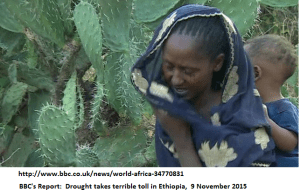
F-67075 Strasbourg Cedex, FRANCE
+ 33 (0)3 88 41 34 21
+ 33 (0)3 90 21 50 53
Contact us by email
U.S. Department of State
Laura Hruby
Ethiopia Desk Officer
U.S. State Department HrubyLP@state.gov
Tel: (202) 647-6473
Dhalataa Godina Shawaa Kaaba Aanaa Dagam Ganda leeman Caarakii mana murtii aanaa Dagam keessa hojjechaa kan ture Obboo Dabalaa Xaafaa Roobii, sababa Oromummaa isaatiin yakkamee woggaa 6 mana hidhaa Makalaawii fi Qallittii kessatti hiraarfamaa ture.
Ob Dabalaan hidhaa waggaa jahaa booda bara darbe mana hidhaati gadi lakkifamee akka ture odeessi nu gahe addeessee jira.
Dabalaa Xaafaa mana hidhaa Maaíkalaawwiitti akka bare kan nuuf ibse hiriyyaan isaa tokko, Dabalaan kutataa, jabaa fi falmataa haqaa taúu isa aragaa bahee jira.
“Achittis walitti obsa halkanoota waan hin bariine hin fakkaanne, guyyoota waan jijjiiraman hinfakkaanne heddu dabarsine,” jechuunis kutannoo fi jabina ittiin hidhaa fi gidraa san keessa darban nu mil’achiise.
OROMO FIRST. Continued marginalization, discrimination and brutal crackdown against peaceful civilian Oromo protest is fast driving the resurgence of ethnic Oromo nationalism in Ethiopia.
Student protests are spreading throughout Ethiopia’s Oromia region, as people demonstrate against the possibility that Oromo farmers and residents living near the capital, Addis Ababa, could be evicted from their lands without appropriate – or possibly any – compensation. Social media is filled with images of bloodied protesters; there are credible reports of injuries and arrests in a number of towns; and local police have publicly acknowledged that three students have died so far.
The current protests echo the bloody events of April and May 2014, when federal forces fired into groups of largely peaceful Oromo protesters, killing dozens. At least hundreds more students were arrested, and many remain behind bars. Both then and today, the demonstrators are ostensibly protesting the expansion of Addis Ababa’s municipal boundary into the surrounding Oromia region, which protesters fear will displace Oromo farmers from their land. But these protests are about much more: Many Oromos have felt marginalized and discriminated against by successive Ethiopian governments and have often felt unable to voice their concerns over government policies.
Of the student protesters detained in 2014, some have been released. Those I spoke with told me about the torture they endured as part of interrogations. But countless others remain in detention. Some have been charged under Ethiopia’s draconian counterterrorism law for their role in the protests; others languish without charge in unknown detention centers and military camps throughout Oromia. This week, five students were convicted of terrorism-related offenses for their role in the protests.
There has been no government investigation into the use of live ammunition and excessive force by security personnel last year.
Ethiopia’s tight restrictions on civil society and mediamake it difficult to corroborate the current, mounting allegations and the exact details of the ongoing protests emerging from towns like Haramaya, Jarso, Walliso, and Robe. The government may think this strategy of silencing bad news is succeeding. But while the fear of threats and harassment means it is often months before victims and witnesses come forward to reveal what happened in their communities, they eventually do, and the truth will emerge.
The government should ensure that the use of excessive force by its security personnel stops immediately. It should then support an independent and impartial inquiry into the conduct of security forces in the current protests – and last year’s as well. Those responsible for serious abuses should be fairly prosecuted. This would be the best way for the Ethiopian government to show its concern about the deaths and injuries inflicted on the students, that it does not condone the use of live ammunition against peaceful protesters, and that those who break the law are appropriately punished.
Haalli Itoophiyaa keessa jiru yeroorrraa gara yerootti hammaachaaa dhufeera. Keessattuu yeroo ammaa kanatti gama tokkoon uummanni beelaan dhumaa yennaa jiru kanatti gama biraatiin ammo mootummaan daa’imman ilmaan Oromoo hegeree biyyaa ta’an rasaasaan fixaa jira. Dhimmoota maasterpilaaii, beelaa fi ajjeechaa fi hidhaa mormitoota Oromoo irratti gaggeeffamu ilaalchisuun ibsa armaan gadii kana baasneerra.
1. Gocha Faashistummaa mootummaan Woyyaanee saba Oromoorratti raawwatu ni balaaleffanna. Hidhaa , reebichaa fi ajjeechaan hatattamaan haa dhaabatu! Mirgi hiriira nagaa fi yaada ofii bilisaan ibsachuu haa kabajamu!
2. Bara 2014 keessa barattoonni 75 ol ajjeefaman. Amma torbaanuma kana keessa namni 3 ol ajjeefamanii dhibbootaan madaahaniiru. Miidhaan cimaan barattoota Oromoorra gahaa jira. Sanbi keenya kumootaan mana hidhaatti guuramaa jira. Namoonni ajjeechaa barattootaa fi hiriirtota irratti raawwatan hatattamaan seeratti haa dhiyaatan! Maatii ijoolleen irraa ajjeefamteef gumaan haa kaffalamu!
3. Karoorri Masterpilaanii Finfinnee kan seeraa fi heera biyyittii diiguu; kan sirna Federaalizimii fi birmadummaa sabootaa dhabamsiisuu fi eenyummaa saba keennaa miidhuurratt aggaammate hatattamaan haa haqamu.
4. Beelli biyya san keessatti dhalate sababa hongee qofa osoo hin taane sababa poolisii fi tarsiimoo dogoggora fi dhaba bulchiinsa gaarii fi olaantummaa seeraa ti jennee amanna. Uummata beela’eef gargaarsi barbaachisaan hatattamaan haa dhaqqabu.
Citizens from all over Oromia have been protesting for months against the Addis Ababa Master Plan, which would see Oromo farmers around the capital evicted from their land with the city’s expansion. Marches have intensified since the events at Haromaya University last week, where Oromo students, protesting peacefully against the government plans, were shot at by the Ethiopian Federal Police, killing at least three and injuring many more. The attack was recorded on a video, which can be viewed from the link below.
The following video shows as the Ethiopian Federal Police, known as Agazi and part of the elite force of the ruling Tigrean People’s Liberation Front (TPLF), shooting at Haromaya University’s Oromo students – who were out protesting against the Addis Ababa Master Plan in late November 2015. According to media reports, at least three were killed and many more were wounded. The students were protesting against the Addis Ababa Master Plan, whose goal, they say, is to expand the City of Addis Ababa by many folds by evicting Oromo farmers from their land around the City of Addis Ababa in Oromiyaa. The Oromo people, especially students, have been expressing their protests against the Addis Ababa Master Plan, ever since it was unveiled by TPLF officials in April 2014. As a result of the Oromiyaa-wide protests against the Addis Ababa Master Plan, over the last year and half, more than a hundred Oromos were killed by the Agazi force, including the four who had been reported dead at the recent Haromaya protest.
The students, pronounced dead, and those others protesting, come from all sections and all zones of Oromiyaa for their higher education at Haromaya University.
1. Seek to successfully demonstrate and repeatedly practice each of our five factors of personal resilience. Success is a powerful learning tool—Just do it! If the challenge is too large or complex at first, start by taking small steps in the desired direction. Don’t try to achieve too much at first. And keep trying until you succeed. The first success is the hardest.
2. Observe resilient people. Use them as role models. Human beings learn largely by observation. Frequent venues where you can watch people exhibiting the skills you wish to acquire. Read books about people who have overcome obstacles similar to those you face. Call or write them. Ask them to share their lessons learned. Their successes will be contagious.
3. Vigorously pursue the encouragement and support of others. Affiliate with supportive and compassionate people who are willing to give of themselves to be supportive of you.
4. Practice self-control. In highly stressful times, myriad physiological and behavioral reactions occur. Physiologically, people experience the fight-or-flight response we mentioned in Chapter One. This cascade of hormones such as adrenalin better prepares you to fight or to flee a threat. They increase your heart rate, muscle strength, and tension. They dramatically improve your memory for certain things while decreasing your ability to remember others, and they cause your blood vessels to shift their priorities. This often results in headaches, cold hands and feet, and even an upset gastrointestinal system. The most significant problem, however, is that this very basic survival mechanism also tends to interfere with rational judgment and problem solving.
Ethiopia: Ongoing Drought in Ethiopia Being Hushed By Its Own Government
A Call to Take Responsibility: Exiled Ethiopian human rights advocate Yared Hailemariam, who is based in Brussels, speculates on why the government denies that the drought has turned into a famine. It is his opinion that the denial is due to a lack of competent governance, democracy, social justice and political will of the last three regime’s. He also says that the EPRDF (The Government of Ethiopia, the Ethiopian People’s Revolutionary Democratic Front) is highly corrupt, and that the development is not what it seems to be.
– The so called development is not humanitarian based – rather it is based on numbers and the economic aspect, but there is still lots of confusion regarding the double digit growth that has been reported to us over the last few years.
ANALYSIS By Fasil Girma, http://allafrica.com/
Birtukan Ali, a woman living in a rural district in Ethiopia, became a sensation following BBC’s report about the ongoing drought and famine. Thereport, which aired on November 10 2015, sparked a new kind of debate on the government’s intention in trying to cover up the famine – a story that remains untold.
Journalist Clive Myrie featured the story of Birtukan Ali who is from a small village called “Kobo” which is located in the North East of Ethiopia. It is a place where the drought is widespread and the effect of it is highly visible. Birtukan told the reporter that her son recently died due to severe malnutrition as a result of the drought in the area. The reporter said that at least two children die in similar cases daily.
The drought, brought on by the El Niño, a weather phenomenon described as a periodic warming of the sea surface, has severely affected the country. Ethiopia is mainly an agrarian economy and the agriculture is fully dependant on rain fall. Ultimately this means that no rain results in no crops, and therefore no food. This year the rainfall was inadequate to cultivate crops for two consecutive seasons. The United Nations estimated that 8.2 million people in Ethiopia’s drought affected areas need relief assistance. UNICEF said that the drought is expected to be the worst in 30 years and that 350,000 children are expected to require treatment for extreme malnutrition.
Ethiopian Government Denies Famine
In a press release by the World Food Program, it is stated that “a dramatic increase in the number of people in need of relief assistance, from 2.5 million at the beginning of the year to 8.2 million in October, led to a serious funding gap”. The Ethiopian government says that it has allocated $192 million USD for emergency food and other assistance.
However, the government and humanitarian agencies have said that Ethiopia needs nearly $600 million USD in international humanitarian assistance. The Ethiopian Prime Minister, Hailemariam Desalegn, has called for international assistance by appealing for food aid to help feed the 8.2 million people that are affected by the drought.
Nevertheless, at the same time, his government denies that there is a famine at all. Deputy Prime Minister, Demeke Mekonen, commented on the BBC report in an interview with a local journalist:
– It is obvious that the foreign media works with different bodies of special interest. There is no such thing as famine in Ethiopia these days, Demeke said.
Similarly, the Ethiopian embassy in the United Kingdom has condemned the BBC report as being “sensational”. The embassy denied reports of approximately two children dying from malnutrition in the area on a daily basis.
Five days after the airing of the BBC’ program, government owned Amhara Mass Media Agency, which is based in Bahar-Dar, the capital of the regional state Amhara, presented a televised program that ridiculed BBC’s report. The program includes Birtukan’s interview with the regional media. This time, however, Birtukan claims that her son died of unspecified “sudden illnesses” and not because of the malnutrition as she had told the BBC reporter.
Felanemunemunim, a local journalist and social media activist who is mentioned by his nickname, followed the news on Ethiopian television. He says that regional governors report as if the agriculture is good enough to produce plenty of food.
– They were talking about it on television for more than four months, but the truth is as BBC reported, even if there was exaggeration.
Government Accused of Diminishing the Extent of the Famine
The statements made by the Ethiopian government have sparked a debate among Ethiopian human rights activists. According to them, the government is trying to cover up the severe effects of the drought.
Argaw Ashine, an exiled journalist based in USA and founder of the web based Amharic internet radio Wazema, which is getting a wide acceptance in the Ethiopian online community for its credible information, commented on the drought. According to him, it is obvious that the Ethiopian government continues to hide the drought from the media, and he believes that they will continue to do so despite the United Nations and others predicting that the worst is yet to come. Admitting that there is a famine would create a problem for the Ethiopian government.
– It costs them politically. The success story they fed to Ethiopians and the international community falls severely short after an exposition of the hunger.
Wazema radio reports that the federal government passes strict instructions to regional governments and Ethiopian embassies all over the world to not give any kind of information to any media regarding the ongoing drought and famine. The instructions include denying access for all journalists to drought affected areas and to take necessary measures for nongovernmental organizations to not leak information regarding the crises to the media.
According to Argaw, media restriction is common during humanitarian crises, and specifically the local media is blocked from reporting the situation.
– They may allow some big international media organizations in to specific locations for only a couple of days. International media reporting is part of convincing the international community to send aid, yet the government does not want an in-depth report on the cause of the problem.
– Authoritarian governments are good at controlling the information flow, and the role of media during crises in Ethiopia is kept at a minimum. Media should be at the forefront to end hunger. Development and better life is impossible without vibrant media in Ethiopia, Argaw said.
A Call to Take Responsibility
Exiled Ethiopian human rights advocate Yared Hailemariam, who is based in Brussels, speculates on why the government denies that the drought has turned into a famine. It is his opinion that the denial is due to a lack of competent governance, democracy, social justice and political will of the last three regime’s. He also says that the EPRDF (The Government of Ethiopia, the Ethiopian People’s Revolutionary Democratic Front) is highly corrupt, and that the development is not what it seems to be.
– The so called development is not humanitarian based – rather it is based on numbers and the economic aspect, but there is still lots of confusion regarding the double digit growth that has been reported to us over the last few years.
Yared says that the first thing the government should do is to rescue those in need. The level of the ongoing and upcoming disaster that would take many lives, needs to be reduced. It is also important to take lessons from the past.
According to World Internet population statistics, countries Such as DR Congo, Chad and Ethiopia barely exist on world map.
(World Economic Forum, Nov. 30, 2015): Digital rights are basically human rights in the internet era. The rights to online privacy and freedom of expression, for example, are really extensions of the equal and inalienable rights laid out in the United Nation’s Universal Declaration of Human Rights. According to the UN, disconnecting people from the internet violates these rights and goes against international law. British Prime Minister David Cameron recently pledged to give all UK homes and businesses access to fast broadband by 2020, adding that access to the internet “shouldn’t be a luxury, it should be a right”.
Singapore has overtaken Finland to become the most effective user of digital technology in the world, according to the latest Networked Readiness Index (NRI). However, it is European nations that dominate the leader-board, with seven top 10 places this year. Singapore is the sole remaining Asian Tiger following the demotion of Hong Kong and South Korea.
The NRI is part of the World Economic Forum’s Global Information Technology Report 2015: ICTs for Inclusive Growth. The NRI identifies the capacity of countries to leverage Information and Communication Technologies (ICTs), by assessing the overall political and business environment, the level of ICT readiness and usage among the population, businesses and government, as well as the overall impacts of ICTs on the economy and society at large.
The 2015 results, which cover 143 economies, confirm the dominance of advanced economies and the persistence of the multiple-faceted digital divides not only across but also within economies. They reveal the pervasive digital poverty that deprives the neediest from the opportunities offered by ICTs.
Beyond this diagnosis, the 2015 edition of the report provides solutions from leading experts and practitioners to alleviate digital poverty and make the ICT revolution a global reality.
In this brief commentary, I will address some general conceptual issues related to resistance against development intervention and then I will proceed to the specific case about the ongoing contested master plan of Finfinne city called “integrated urban development”. This assessment is aimed to achieve multiple purposes; namely to contribute academic inputs to policy making, to clarify to the readers on the nexus between development interventions and resistance, and to indicate that the ongoing resistance from the Oromo is within the context of rights enshrined in the constitution of the country.
Like elsewhere in the modern world, successive Ethiopian governments have been engaged in translating various versions of development discourses into practice – albeit posited within different ideological orientations. The imperial and military regimes had put in place hegemonic systems in channeling down policies and programs that they also tried to sell to the populace under the buzz concepts such as ‘development’ and ‘modernization’. In this regard, historical accounts remind us the social, economic, cultural and political consequences of such modernist development discourses and practices of different groups in the country among which the Oromo were significantly affected. To mention one, the collectivization (villagization) program of the military regime disrupted social ties, economic practices and cultural connectedness of the people to their land. This hints at the repercussions of development projects that are conceived, implemented and managed within hegemonic systems of governance because absence of democratic systems opens the path to external interventions without proper consultation of citizens. Nevertheless, the post-1991 political order in Ethiopia has put in place for the first time in the history of the country a system whereby nations and nationalities are given rights of self-determination to decide on matters that affect their communities including the right to administer resources and development projects, and to promote the language, culture and history of their people to mention a few – no matter how the practical implementation is still the subject of contestation.
2. Development Interventions and Popular Resistance: An Overview
High modernist development practices all over the world entailed the exercise of top-down and expert-based scientific knowledge that considered participation of ordinary citizens and local knowledge at odds with the development visions of the state and/or non-state actors. High modernist development discourses give limited room for participatory approaches of development and government-public partnership. This approach was practiced by colonial powers and continued in the post-colonial periods as well. The general assumption behind high modernist development discourses was that few elites would plan development programs and mobilize the mass for its implementation under strict control of ‘experts’. However, as a famous scholar on peasant resistance, James Scott, has noted, the power of domination often produces the power of resistance from the group that is seemingly powerless as seen in literal conceptions of power. Since the mid-1980s, scholars began not to underestimate the agency of the “weak” who under conditions of domination can use different strategies of resistance against development interventions that they define from their own values, identity, worldviews and history.
However, it is misleading to construe local communities’ resistance against development intervention as if the people are against development – despite controversies revolving around the concept itself. Although the term can be given different meanings and manifestations according to the interest, ideology and worldviews of various actors, what local communities often resist is not the conventional understanding of the concept per se – referring to improvement in the overall wellbeing of human society and their environment. Rather, the approach, strategy and consequence of development programs, projects and practices constitute contestable meanings.
3. The “Integrated Urban Development Plan and the Question of the Oromo
3.1. Background
According to the 1995 Constitution of the Federal Republic of Ethiopia (Article 49) Finfinne (Addis Ababa) became the capital city of the Federal government while at the same time it has been the seat of Oromia regional state. Finfinne is adjoined by Oromia region in all directions. Article 49.5 of the constitution gives special right for Oromia to get special benefit from Finfinne as it is the heartland of Oromia besides being its administrative capital. According to the constitution (Article 49.5), “The special interest of the State of Oromia in AddisAbaba, regarding the provision of social services or the utilization of natural resources and other similar matters,as well as joint administrative matters arising from the location of Addis Ababa within the State of Oromia, shall be respected. Particulars shall be determined by law”. Nevertheless, there are critiques that Oromia has not yet benefited from Finfinne. On this topic, because of lack of empirical evidence whether the Oromo People’s Democratic Organization (OPDO) tried to utilize the constitutional rights given to Oromia in getting benefit from Finfinne or not, I would not push this assertion forward.
The plan, according to the government, is intended to create integrated urban development between Addis Ababa city administration and Oromia towns surrounding the capital city such as Burayu, Sabata, Sululta, Bishoftu, Laga-Xafo Laga-dadhi, Galan and other semi-urban centers adjoining these towns. From this perspective, the government tries to disseminate its development programs by presenting to the public the advantages of the plan in terms of infrastructural and social provisions. On the other hand, the Oromo from different walks of life, including some members of the OPDO officials are skeptical whether the Master Plan has been planned for mutual benefit of Finfinne and Oromia regional state or is just a systematic strategy of incorporating Oromia towns into Finfinne. Thus, it is crucially important to analyze some underlying reasons behind Oromo’s resistance and discontent to the Master Plan. In the following section, I will try to discuss it situating within historical experiences, political scenarios and procedural drawbacks in the planning process. However, one should boldly know that no one is against development project that changes the lives of its people if carefully planned and implemented.
3.2. Why do the Oromo Resist the Master Plan?
Memories and experiences of past evictions and dispossessions
Like other nations and nationalities in the country particularly those who faced the brutal conquest under emperor Menelik II during the late 19th century, the Oromo people have lived memories and experiences of ‘development’ induced displacement, dispossession and oppressions under the successive regimes. Moreover, the assimilationist and hegemonic systems in the past have left enduring repercussions on Oromo culture, language and identity with the case in Finfinne more appalling still today. Historical accounts of the establishment of Finfinne city in 1886 illuminate that the territory was inhabited by different Oromo clans until they were eventually displaced by the imperial regimes. The city was built on the ancestral land of the Oromo through policies of land alienation, dispossession and displacement of indigenous peoples in similar approaches to many other urban centers in the conquered regions of the South. It is, thus fair to argue that Finfinne city was established as a garrison town predominantly occupied by war generals and soldiers. There is no need to turn history books or archives to understand the displacement of indigenous Oromo communities from Finfinne and to comprehend the impacts of the assimilationist projects under the imperial and military regimes. It is rather enough to see the current ethnic composition of the Addis Ababa city where one can clearly see that people who identify themselves as Oromo are immensely few in contrast to Finfinne’s being the heartland of Oromia. Therefore, resistance against the Master Plan should be understood within the historical antecedents the Oromo experienced with regards to dispossession of their land, displacement from their ancestral land and the socio-economic, cultural and political repercussions of development interventions.
In response to the constitutional rights
The Constitution of the Federal Democratic Republic of Ethiopia (FDRE Constitution 1995: Article 43.2) clearly stipulates the right of each nation, nationality and people of Ethiopia to be fully consulted and involved in development projects that affect their community. In addition, Article 39 of the same constitution gives unconditional rights of self-determination to the nations, nationalities and peoples of Ethiopia that include the right and autonomy to determine which development program to envisage and the right of self-government on territories they historically inhabited. These are a few of the fundamental principles of ethnic federalism that are enshrined in the constitution. In this specific context, Oromia regional state and the Oromo people have constitutional rights to decide on the urban development programs through democratic, transparent, bottom-up and inclusive approaches of participation. They have the right to decide whether they opt to go for the integrated urban development or not. The resistance from Oromo intellectuals, politicians, students, peasants and business people should be understood as a response to interventions that to a large extent violated their constitutional right, particularly Article 43.2 of the FDRE’s constitution – the right to be consulted and involved in development projects.
Mistrust generated from lack of genuine participation
Resistance to state development projects to a large extent reflects the nature of state-society relations, questions of legitimacy and trust. Governments have the leverage of building legitimacy and trust or become victims of legitimacy crisis based on their policies, programs and overall political systems vis-à-vis citizenship rights of the society. It has been evident from discussions during public sensitization programs on the Master Plan that the planning process was top-down and did not involve citizens who will be affected by the project. A higher official from EPRDF presumably acknowledged the importance of involving grassroots communities through bottom-up approaches though he maintained the view that there was no problem with the top-down approach in development intervention. Here comes the fundamental disparity between constitutional promises and practices.
Under such circumstances where citizens are not consulted and involved in the planning process, one should not be surprised if they resist the project because any conscious society does not accept something without knowing its benefits, impacts and implications. Therefore, resistance is a function of procedural incongruity with the constitutional promises.
Anticipated Repercussions on the identity, culture and livelihood of the Oromo
Development projects such as urban expansion, dam projects, large scale agricultural projects, and protected areas conservation have significant repercussions on the livelihood, culture and identity of indigenous peoples all over the world unless critically handled. Because of historical experiences the Oromo faced under successive regimes in Ethiopia – experiences of displacement, suppression, exploitation and dispossession – the current project is also seen by the majority of the Oromo as a continuation of the past trends. Rhetoric and discourses can’t simply convince people who have lived-in scars and experiences in their minds, around their homesteads and in their neighbors that are reflected in their culture, identity, language, economy and politics. The government can rather convince the people on the benefits they would enjoy from the project not by injecting them with high modernist discourses of development but through practical and genuine involvement of the people in the projects.
Still another challenge that awaits the government is whether it has really delivered in other areas of development, whether other development projects didn’t have socio-economic and cultural impacts on local inhabitants elsewhere in the country and whether there is independent judiciary system that citizens can use as a guardian of their human rights in cases any development program threatens their right. I leave this question open to the readers. In practice, according to those who think it would incorporate Oromia towns surrounding Finfinne city, the current Master Plan will adversely affect the Oromo by reducing peasants into landlessness and in exacerbating land expropriation under the guise of investment. Like situations in the capital city, Oromo language, culture and other related rights would be suppressed if these towns are incorporated into the city without clear negotiation on who administers these “integrated” cities.
A way forward?
The development project should not be imposed, rather it should involve stakeholders particularly local communities who will be affected by the project from inception to implementation.
The integrated urban development can serve the interest of all stakeholders if and only if it is participatory and if it doesn’t violate constitutional rights of Oromia regional state and its geographical boundaries.
Finfinne City has the potential to develop by its own given that the city administration makes inward looking to develop a system of modernizing the city not necessarily through horizontal expansion. The unanswered question is: why Finfinne city administration started this integrated plan while there are immense critiques that it is unable to solve its own municipal problems. Therefore, before launching ambitious and ambiguous projects like this, the city administration should have utilized all available opportunities within its administrative boundaries to develop and modernize the city.
The regional government of Oromia has to claim its constitutional right to get special benefit from Finfinne (if not yet).
What guarantee does the regional government of Oromia have as to whether Finfinne administration eventually incorporates the surrounding Oromia towns to its administration or not? This is critical question the federal government, Finfinne city administration and particularly the regional government of Oromia should address. More importantly, the failure to put this agenda on the front line in negotiating with the other actors will be a critical test to the legitimacy of OPDO in representing the Oromo people.
In conclusion, two fundamental issues should be made clear regarding resistance against the “Integrated Urban Development Master Plan” of Addis Ababa City:
1) It has been evident that people are not against development per se. However, where development projects are perceived to be threatening fundamental rights and needs of the citizens, it becomes a policy to be resisted rather than a program to be embraced. On the other hand, under contexts where the people are recognized as rightful citizens whose voices, views and knowledge contribute to the overall development vision through genuine participatory approaches, it would be expected, to a large extent, that development mobilizes the society towards similar goals of the state.
2) Regardless of the power of domination the intervening actor might have, development intervention faces the utmost resistance from the people whose livelihood, culture, language, identity and history will be affected. Therefore, the government should not overlook the potency of local resistance in impacting on its legitimacy and trust.
You must be logged in to post a comment.