(Translation: Zelelaem Aberra Tesfa)
http://www.zelealemaberra.com/?page_id=388
Economic and development analysis: Perspectives on economics, society, development, freedom & social justice. Leading issues in Oromo, Oromia, Africa & world affairs. Oromo News. African News. world News. Views. Formerly Oromia Quarterly
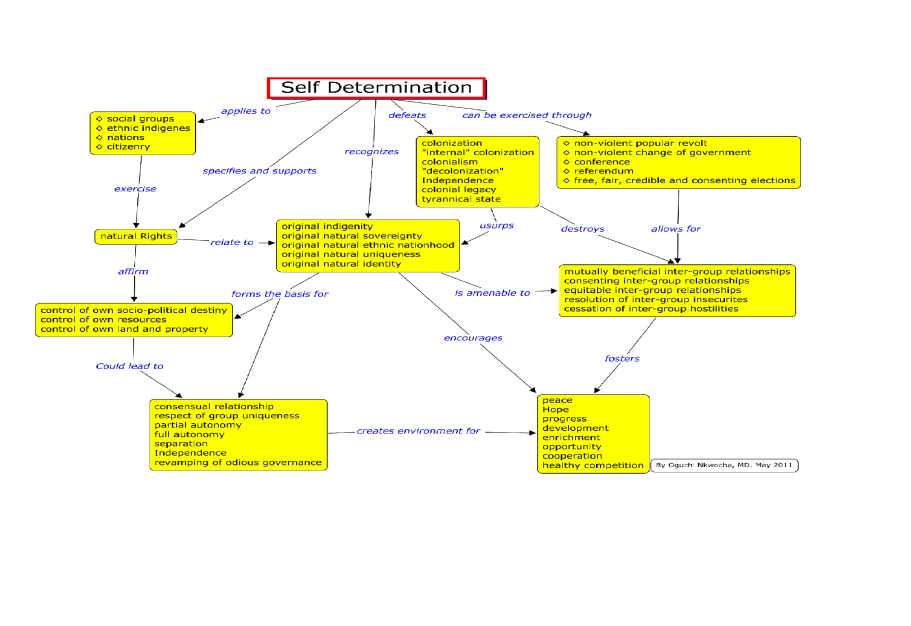
Self-determination “denotes the legal right of people to decide their own destiny in the international order,” the Legal Information Institute.
This right was enshrined in international law with its inclusion in the UN Charter in 1945. Article 1 of the Charter states that one of the purposes of the United Nations is: “to develop friendly relations among nations based on respect for the principle of equal rights and self-determination of peoples.”
In the International Covenant on Civil and Political Rights and the International Covenant on Economic, Social and Cultural Rights, this was made even more explicit: “All peoples have the right of self-determination. By virtue of that right they freely determine their political status and freely pursue their economic, social and cultural development.”
For people deprived of equal rights and political participation, self-determination could take many forms: independence, assimilation, sovereign association, or another form they choose for themselves. But no one has a right to self-determination at the expense of someone else.
“It is well known that any attempt to deny a human group its self-determination only intensifies its demand for sovereignty and enhances its collective identity,” writes Shlomo Sand in The Invention of the Jewish People. “This does not, of course, give a particular group that sees itself as a people the right to dispossess another group of its land in order to achieve its self-determination.
Self-determination is not just a utopian ideal. It is a legal right. The contents of the UN Charter and the Covenant on Civil and Political Rights.
There is an name for ruling over people while preventing them from being part of the political process that governs their lives. It’s called colonialism, In international law, it is a crime against humanity.
see more @ https://alethonews.wordpress.com/…/the-persistent-u-s-oppo…/Self determination (international law)
Self-determination denotes the legal right of people to decide their own destiny in the international order. Self-determination is a core principle of international law, arising from customary international law, but also recognized as a general principle of law, and enshrined in a number of international treaties. For instance, self-determination is protected in the United Nations Charter and the International Covenant on Civil and Political Rights as a right of “all peoples.”The scope and purpose of the principle of self-determination has evolved significantly in the 20th century. In the early 1900’s, international support grew for the right of all people to self-determination. This led to successful secessionist movements during and after WWI, WWII and laid the groundwork for decolonization in the 1960s.
Contemporary notions of self-determination usually distinguish between “internal” and “external” self-determination, suggesting that “self-determination” exists on a spectrum. Internal self-determination may refer to various political and social rights; by contrast, external self-determination refers to full legal independence/secession for the given ‘people’ from the larger politico-legal state.
See, e.g.:
Independence of Kosovo (from Serbia), advisory proceedings currently pending before the ICJ.
Independence of Abhkazia (from Georgia).
See also:uti possidetis juris, requiring the maintenance of the territorial status quo to preserve stability, order and traditional legal boundaries (and hence possibly conflicting with principle of self-determination) (Burkina Faso/Mali, ¶¶25-26, pp.16-17 (“At first sight this principle [UPJ] conflicts outright with another one, the right of peoples to self-determination.”)


http://mashable.com/2014/12/17/internet-freedom-countries/
Sir Tim Berners-Lee, inventor of the World Wide Web and founder of the Web Foundation, has called for the Internet to be recognised as a basic human right. Sir Tim noted that in our increasingly unequal world, the Web has the potential to be a great equalizer, but only “if we hardwire the rights to privacy, freedom of expression, affordable access and net neutrality into the rules of the game.”
In order to reverse this slide and leverage the power of technology to fight inequality, the Web Foundation is calling on policymakers to:
- Accelerate progress towards universal access by increasing access to affordable Internet and ensuring that everyone can use the Web all of the time, safely, freely and privately.
- Level the playing field by preventing price discrimination in Internet traffic, and treating the Internet like any other public utility.
- Invest in high-quality public education for all to ensure that technological progress doesn’t leave some groups behind.
- Promote participation in democracy and protect freedom of opinion by reversing the erosion of press freedom and civil liberties, using the Web to increase government transparency, and protecting the freedoms of speech, association, and privacy.
- Create opportunities for women and poor and marginalised groups by investing more in ICTs to overcome key barriers in health, education, agriculture and gender equity.
ETHIOPIA, The Gambia and Sudan are some of the most repressive places in Africa for online freedom, a new report by watchdog organisation Freedom House indicates, while South Africa and Kenya are the among the most free for internet users in the continent.
But the 12 African countries surveyed show a worrying trend – the majority are becoming more repressive compared to last year. Just South Africa – the best ranked – Kenya, Uganda and Malawi have maintained the same score as last year; Nigeria, Angola, Rwanda, Zimbabwe, Sudan and Ethiopia have deteriorated. Zambia and The Gambia are new entrants on the list this year.
The negative trajectory in internet freedom is mirrored around the world – the report states that in 36 of the 65 countries surveyed, internet freedom scores have become worse, as governments become increasingly nervous about their national security, and more sophisticated in surveillance and control.
“Very few countries registered any gains in internet freedom, and the improvements that were recorded largely reflected less vigorous application of existing internet controls compared with the previous year, rather than genuinely new and positive steps taken [by governments],” the report states.
Although most African countries do not explicitly censor content much, there has been an increasingly harsh manner in which users are targeted for the things they say online – in some countries, Freedom House reports, “the penalties for online expression are worse than those for similar actions offline”.

A higher score means a more repressive environment. Source: Freedom House
In July 2013, for example, the Gambian government passed amendments to the Information and Communication Act that specifically criminalised the use of the internet to criticise, impersonate, or spread false news about public officials. Anyone found guilty could face up to 15 years in prison, fines of roughly $100,000, or both—significantly harsher punishments than what the criminal code prescribes for the equivalent offenses offline.
The report reveals that breaches in cybersecurity are also eroding freedom, as government critics and human rights organisations are subject to increasingly sophisticated and personalised malware attacks, documented in 32 of the 65 countries examined.
Low internet penetration, state monopoly
Ethiopia comes out as the worst place in Africa for internet freedom. In the first place, lack of telecoms infrastructure, government monopoly and oppressive regulation means that internet penetration is just 2%, one of the lowest in Africa.
A law enacted in November 2013 gives the Information Network Security Agency (INSA) carte blanche to inspect private online activities without oversight. Facebook, Twitter, Yahoo, and CNN were inaccessible for 12 hours in July 2013, while the number of permanently blocked webpages also increased.
In the Gambia, as well as setting out punitive new laws, internet cafe registration regulations were tightened in September 2013, requiring operators to provide thorough details for a license, as well as mandating the physical layout of cafes and the signs that must be displayed.
In Nigeria too, cybercafés have to keep a log of their customers – although the mobile revolution means that these attempts at controlling internet use will become increasingly irrelevant.
But if you can’t control access, then persecution and punishment becomes the next measure – and African governments show remarkable sophistication here.
In Ethiopia, the government launched high-tech surveillance malware against several online journalists in the Ethiopian diaspora and dissidents in exile; six bloggers of the prominent Zone9 blogging collective were arrested in April 2014 on charges of terrorism.

This year shows a more repressive environment than last year in many countries. Source: Freedom House
The same was observed in Angola, where “insider sources” affirmed that a German company had assisted the Angolan military intelligence in installing a sophisticated communications monitoring system on a military base, the report states. Further evidence, as of November 2013, found that at least one major ISP hosts a spyware system directly on its server.
In Rwanda, a growing number of independent online news outlets and opposition blogs were intermittently inaccessible in Rwanda in the past year. The Law Relating to the Interception of Communications enacted in October authorised high-ranking security officials to monitor email and telephone conversations of individuals considered potential threats to “public security”.
In Sudan, a localised internet service disruption in June and a nationwide blackout in September corresponded with large anti-government protests; the blackouts were reportedly directed by the government.
Even in the countries ranked as relatively free, harassment and intimidation of journalists and bloggers – and even ordinary citizens – is a widespread form of internet control. In Malawi online journalists are “periodically detained and prosecuted for articles posted on news websites”.
Most recently, Justice Mponda, a correspondent for the online publication Malawi Voice, was arrested in November 2013 for allegedly “intimidating the royal family” in an investigative story about former President Banda’s connection to the theft of millions of Malawian kwacha from government coffers in a scandal known as “Cashgate.” He was later acquitted.
Mugabe’s digital ‘death’
But it’s Zimbabwe that has had some of the most bizarre persecutions. An editor at the Sunday Mail state newspaper, Edmund Kudakwashe Kudzayi, was arrested in June on accusations of running the Baba Jukwa Facebook account, an activist page of over half a million followers harshly critical of the government. In July, the government took down the facebook page, and Kudzayi’s case remains unresolved.
It gets crazier – in January 2014, teenage Facebook user Gumisai Manduwa was arrested for allegedly insulting the president after he posted on his Facebook page that President Mugabe “had died and was being preserved in a freezer.” Manduwa was released on bail two days after his arrest. His case remains on the court’s docket as of mid-2014.
And another court case, this one against 21-year old Shantel Rusike is still being dragged through the magistrate courts in Bulawayo as of mid-2014.
Rusike was arrested on December 24, 2012 and held for four days after she was reported to the police for sending an image depicting President Mugabe “in a nude state” via WhatsApp on her mobile phone. Rusike faces charges of “causing hatred, contempt or ridicule of the president”.
Ethiopia
2013 2014
Internet Freedom Status Not Free Not Free
Obstacles to Access (0-25) 22 23
Limits on Content (0-35) 28 28
Violations of User Rights (0-40) 29 29
TOTAL* (0-100) 79 80
* 0=most free, 100=least free
Population: 89.2 million
Internet Penetration 2013: 2 percent
Social Media/ICT Apps Blocked: Yes
Political/Social Content Blocked: Yes
Bloggers/ICT Users Arrested: Yes
Press Freedom 2014 Status: Not Free
Key Developments: May 2013 – May 2014
• Telecom services worsened, characterized by frequently dropped phone calls, prolonged internet service interruptions, and slow response times to service failures (see Obstacles to Access).
• Facebook, Twitter, Yahoo, and CNN were inaccessible for 12 hours in July 2013, while the
number of permanently blocked webpages also increased (see Limits on Content).
• A law enacted in November 2013 gives the Information Network Security Agency (INSA)
carte blanche to inspect private online activities without oversight (see Violations of User
Rights).
• The government launched sophisticated surveillance malware against several online journalists
in the Ethiopian diaspora and dissidents in exile (see Violations of User Rights).
• Six bloggers of the prominent Zone9 blogging collective were arrested in April 2014 on
charges of terrorism (see Violations of User Rights).
Introduction
Ethiopia continues to have one of the lowest rates of internet and mobile phone connectivity in the world, as meager infrastructure, government monopoly over the telecommunications sector, and obstructive telecom policies have significantly hindered the growth of information and communication technologies (ICTs) in the country. Coupled with highly repressive laws and tactics aimed at restricting freedom of expression and access to information, internet freedom in Ethiopia is consistently rated the worst in sub-Saharan Africa and among the worst in the world.
Despite the country’s extremely poor telecommunications services and a largely disconnected population, Ethiopia is also known as one of the first African countries to censor the internet, beginning in 2006 with opposition blogs.1. Since then, internet censorship has become pervasive and systematic through the use of highly sophisticated tools that block and filter internet content and monitor user activity. The majority of blocked websites feature critical news and opposition viewpoints run by individuals and organizations based mostly in the diaspora. Surveillance of mobile phone and internet networks is systematic and widespread, enabled by Chinese-made technology that allows for the interception of SMS text messages, recording of phone calls, and centralized monitoring of online activities. The government also employs commentators and trolls to proactively manipulate the online news and information landscape.
During the report’s coverage period, internet freedom in Ethiopia worsened due to increasing restrictions on access to social media and communications tools, such as Storify, and the temporary blocking of Facebook and Twitter in July 2013. A new law passed in November 2013 gave the Information Network Security Agency (INSA) carte blanche to track private online communications and investigate electronic devices without oversight. In addition, a number of diaspora journalists and exiled dissidents were targeted with surveillance malware, demonstrating a growing level of sophistication in the government’s effort to silence critical voices that extends beyond the country’s borders.
In 2014, the Ethiopian authorities increased their crackdown against bloggers and online journalists, using the country’s harsh laws to prosecute individuals for their online activities and quash dissent. Most alarmingly, six bloggers from the critical Zone9 blogging collective and three journalists associated with Zone9 were arrested in late April 2014 on charges of terrorism, which, under the Telecom Fraud Offenses Law and anti-terrorism proclamation, can entail a sentence of up to 20 years in prison if the bloggers are found guilty. The Zone9 case was repeatedly stalled by the courts throughout 2014, leaving the bloggers in pre-trial detention for over six months as of late-2014. Meanwhile, two online radio journalists were arrested and detained for a week without charges in August 2013, and the prominent dissident blogger, Eskinder Nega, and award-winning journalist, Reeyot Alemu, continue to serve lengthy prison sentences, despite international pressure for their release. The overall crackdown has had a major chilling effect on internet freedom and freedom of expression in the country, leading to increasing levels of self-censorship among online journalists, bloggers, and ordinary users alike.
Obstacles to Access
In 2013 and 2014, access to ICTs in Ethiopia remained extremely limited, hampered by slow speeds and the state’s tight grip on the telecom sector. According to the International Telecommunications Union (ITU), internet penetration stood at a mere 1.9 percent in 2013, up from 1.5 percent in 2012. Only 0.25 percent of the population had access to fixed-broadband internet, increasing from 0.01 percent in 2012.Ethiopians had more access to mobile phone services, with mobile phone penetration rates increasing from 22 percent in 2012 to 27 percent in 2013 though such access rates still lag behind a regional average of 80 percent. Meanwhile, less than 5 percent of the population has a mobile-broadband subscription. Radio remains the principal mass medium through which most Ethiopians stay informed. While access to the internet via mobile phones increased slightly in the last year, prohibitively expensive mobile data packages still posed a significant financial obstacle for the majority of the population in Ethiopia, where per capita income in 2013 stood at US$470.8 Ethiopia’s telecom market is very unsaturated due to monopolistic control, providing customers with few options at arbitrary prices. Prices are set by the state-controlled Ethio Telecom and kept artificially high. As of mid-2014, monthly packages cost between ETB 200 and 3,000 (US$10 to $150) for 1 to 30 GB of 3G mobile services.
The computer remains the most practical option for going online, though in 2014, personal computers are still prohibitively expensive. The combined cost of purchasing a computer, initiating an internet connection, and paying usage charges makes internet access beyond the reach of most Ethiopians. Consequently, only 2 percent of Ethiopian households had internet access in their homes in 2013. The majority of internet users rely on cybercafes to log online, leading to a growth of
cybercafes in recent years, particularly in large cities. A typical internet user in Addis Ababa pays between ETB 5 and 7 (US$0.25 to $0.35) for an hour of access. Because of the scarcity of internet cafes outside urban areas, however, rates in rural cybercafes are more expensive.
For the few Ethiopians who can access the internet, connection speeds are known to be painstakingly slow. For years, logging into an email account and opening a single message could take as long as six minutes at a standard cybercafe with broadband in the capital city.12 According to May 2014 data from Akamai’s “State of the Internet” report, Ethiopia has an average connection speed of 1.2 Mbps (compared to a global average of 3.9 Mbps). Meanwhile, Ethiopia’s broadband adoption (characterized by connection speeds greater than 4 Mbps) is less than 3 percent,14 while the country’s narrowband adoption (connection speed below 256 Kbps) is about 20 percent among those with access. Numerous users reported that internet and text messaging speeds were extremely slow during the coverage period, with services completely unavailable at times. Frequent electricity outages are also a contributing factor to poor telecom services. Despite reports of massive investments from Chinese telecom companies in recent years,17 Ethiopia’s telecommunications infrastructure is among the least developed in Africa and is almost entirely absent from rural areas, where about 85 percent of the population resides. The country is connected to the international internet via satellite, a fiber-optic cable that passes through Sudan and connects to its international gateway, and the SEACOM cable that connects through Djibouti to an international undersea cable. In an effort to expand connectivity, the government has reportedly installed several
thousand kilometers of fiber-optic cable throughout the country over the past few years. Construction of the East African Submarine Cable System (EASSy) was completed and launched in July 2010, but its effects on Ethiopia have yet to be seen as of mid-2014. The space for independent initiatives in the ICT sector, entrepreneurial or otherwise, is extremely
limited, with state-owned Ethio Telecom holding a firm monopoly over internet and mobile phone services in the country. Consequently, all connections to the international internet are completely centralized via Ethio Telecom, enabling the government to cut off the internet at will. As a result, the internet research company Renesys classified Ethiopia “as being at severe risk of Internet disconnection,” alongside Syria, Uzbekistan, and Yemen in a February 2014 assessment. During the coverage period, one Renesys report found that 40 percent of Ethiopia’s networks were down for a few hours on July 18, 2013 as a result of a disruption on the SEACOM network, though the exact reason for the disruption was unknown. In September 2013, a number of cybercafe owners in Ethiopia reported an increasing trend of unpredictable internet connections and speeds beginning in June that resulted in a significant decline in business, with internet connections reported as unavailable for up to 15 days in a month. Mobile phone networks—also completely centralized under Ethio Telecom—are similarly vulnerable to service disruptions and shutdowns by the government, which often occur during politically sensitive times. During the coverage period, there were frequent reports of dropped cell phone and landline calls, complete network blackouts in many parts of the country, and overlapping voices in calls. The latter phenomenon led people to suspect government engagement in a widespread eavesdropping scheme (see “Violations of User Rights” for details on surveillance). Meanwhile, cybercafes are subject to onerous requirements under the 2002 Telecommunications
(Amendment) Proclamation, which requires cybercafe owners to obtain an operating license with Ethio Telecom via a murky process that can take months. During the coverage period, Ethio Telecom began enforcing its licensing requirements more strictly in response to the increasing spread of cybercafes, reportedly penalizing Muslim cafe owners more harshly. Violations of the stringent requirements, such as a prohibition on providing Voice-over-IP (VoIP) services, entail criminal liability. Despite repeated international pressure to liberalize telecommunications in Ethiopia, the government
has not eased its grip on the sector. In June 2013, the prime minister publicly affirmed that the government would maintain a monopoly over the country’s telecoms. In the meantime, China has emerged as a key investor and contractor in Ethiopia’s telecommunications industry, and in July 2013, the government signed a US$1.6 billion agreement with the Chinese telecom companies,
Zhongxing Telecommunication Corporation (ZTE) and Huawei, to upgrade its broadband network to 4G in Addis Ababa and expand 3G across the country. The networks built by the Chinese firms have been criticized for their high costs and poor service, though the partnership has enabled Ethiopia’s authoritarian leaders to maintain their hold over the telecom sector. Furthermore, the contracts have led to increasing fears that the Chinese may also be assisting the authorities in developing more robust internet and mobile phone censorship and surveillance capacities.
The Ethiopian Broadcasting Authority (EBA) and the Ethiopian Telecommunications Agency (ETA) are the primary regulatory bodies overseeing the telecommunications sector. These two organizations were established as autonomous federal agencies, but both are highly controlled government bodies.
Limits on Content
During the coverage period, over a hundred websites remained inaccessible in Ethiopia, with a greater number of online tools and services targeted for blocking. A June 2014 report affirmed the government’s efforts to recruit and train progovernment citizens to attack politically objectionable content online.
The Ethiopian government imposes nationwide, politically motivated internet blocking and filtering that tends to tighten ahead of sensitive political events. The majority of blocked websites are those that feature opposition or critical content run by individuals or organizations based in the country or the diaspora. The government’s approach to internet filtering generally entails hindering access to a list of specific internet protocol (IP) addresses or domain names at the level of the Ethio Telecom-controlled international gateway. A more sophisticated strategy of blocking websites based on a keyword in the URL path, known as deep-packet inspection (DPI), was detected in May 2012 when the Tor network—an online tool that enables users to browse anonymously—was blocked. In January 2014, an independent test conducted by a researcher based in the country found 120 unique URLs that were inaccessible in the country, 62 of which were Ethiopian news websites, 14 of which were political party websites, of which were blogs, and 7 of which were television and online
radio websites. During the test, some websites opened at the first attempt but were inaccessible when refreshed. The test also found that select tools and services on Google’s Android operating system on smart phones were inaccessible at irregular intervals but for unclear reasons. A separate test on over 1,400 URLs between July and August 2013 by the OpenNet Initiative in partnership withHuman Rights Watch similarly found 62 websites blocked altogether and numerous others intermittently inaccessible. International news outlets were increasingly targeted for censorship. Al Arabiya, a Saudi Arabia-based media outlet, and both of Al Jazeera’s Arabic and English websites were intermittently blocked during the coverage period. In July 2013, websites belonging to Yahoo and CNN were reportedly inaccessible for about 12 hours. Facebook and Twitter were also targets of the short-term July 2013 blocking. There was no evident impetus or reason for the short-term blocking, and other major services such as Gmail and new outlets such as the New York Times remained accessible. Nevertheless, the incident further increased worries over reports of government plans to block popular social media tools completely. Facebook and Twitter platforms were otherwise generally accessible, although some individual Facebook groups belonging to opposition individuals remained blocked altogether, particularly when accessed via the unencrypted (http://) URL pathway. Meanwhile, the social media curation tool Storify—first blocked in July 201241—remained blocked during the coverage period, while the URL shortening tool Bit.ly was inexplicably blocked in late 2013.
In the past few years, the authorities have become more sophisticated in their censorship techniques, electing to block select webpages as opposed to entire websites. Critical online news articles are usually targeted, such as an August 2012 Forbes article titled, “Requiem for a Reprobate Ethiopian Tyrant Should Not Be Lionized,” which was blocked for criticizing the local and global praise of the former prime minister’s debatable economic growth achievements; the article remained blocked as of June 2014.44 A July 2013 YouTube video of the anti government Muslim protests that occurred from 2012-13 was also blocked as of late 2013.
International blog-hosting platforms such as Blogspot have been frequently blocked since the disputed parliamentary elections of 2005, during which the opposition used online communication tools to organize and disseminate information that was critical of the ruling Ethiopian People’s Revolutionary Democratic Front. In 2007, the government instituted a blanket block on the domainnames of two popular blog-hosting websites, Blogspot and Nazret, though the authorities have
since become more sophisticated in their censorship techniques, now blocking select pages such as the Zone9 independent blog hosted on Blogspot, as opposed to the entire blogging platform. Nazret, however, remained completely blocked as of June 2014. Circumvention strategies have also been targeted, with the term “proxy” yielding no search results on Google, according to an independent source. Meanwhile, the terms “sex” or “porn” are still searchable.
In addition to increasing blocks of online content, politically objectionable content is often targeted for removal, often by way of threats from security officials who personally seek out users and bloggers to instruct them to take down certain content, particularly critical content on Facebook. The growing practice suggests that at least some voices within Ethiopia’s small online community are being closely monitored. Some restrictions are also placed on mobile phones, such as the requirement for a text message to obtain prior approval from Ethio Telecom if it is to be sent to more than ten recipients. A bulk text message sent without prior approval is automatically blocked. There are no procedures for determining which websites are blocked or why, which precludes any avenues for appeal. There are no published lists of blocked websites or publicly available criteria for how such decisions are made, and users are met with an error message when trying to access
blocked content. This lack of transparency is exacerbated by the government’s continued denial of its censorship efforts. Meanwhile, the decision-making process does not appear to be controlled by a single entity, as various government bodies—including the Information Network Security Agency (INSA), Ethio Telecom, and the ministry of ICT—seem to be implementing their own lists, contributing to a phenomenon of inconsistent blocking. Lack of adequate funding is a significant challenge for independent online media in Ethiopia, as fear of government pressure dissuades local businesses from advertising with politically critical websites. Local newspapers and web outlets receive their news and information from regime critics and opposition organizations in the diaspora. While the domestic Ethiopian blogosphere has been expanding, most blogging activity on Ethiopian issues still originates in the diaspora. Few Ethiopian journalists work for both the domestic print media and overseas online outlets due to the threat of repercussions. Increasing repression against journalists and bloggers has had a major chilling effect on expression online, particularly following the arrest of the Zone9 bloggers in April 2014 (see “Violations of User Rights”). Fear of pervasive surveillance has led to widespread self-censorship, and many bloggers publish anonymously to avoid reprisals. Notably, users on social media platforms such as Facebook and Twitter seem to practice a lower degree of self-censorship, which may be due to poor awareness of privacy settings, or the perception that posts on social media are anonymous or more secure. Despite extremely low levels of internet access, the authorities employ progovernment commentators and trolls to proactively manipulate the online news and information landscape. Acrimonious exchanges between commentators on apologist websites and an array of diaspora critics and opposition figures have become common in online political debates. There was a noticeable increase in the number of progovernment commentators during the coverage period, as confirmed in a June 2014 report by the Ethiopian Satellite Television Service (ESAT) that detailed the government’s efforts to recruit and train progovernment citizens to attack politically objectionable content online. According to the ESAT report, hundreds of bloggers who report directly to government officials had been trained on how to post progovernment comments and criticize antigovernment articles on social media platforms. As the country prepares for the upcoming 2015 National Election, the state media has stepped up its campaign against the press in general and the use of social media in particular, claiming that foreign agents and terrorists are using social media to destabilize the country. Consequently, many civil society groups based in the country are wary of mobilizing against the government, and calls for protest come mostly from the Ethiopian diaspora rather than from local activists who fear the government’s violent crackdowns against protest movements. Nevertheless, over the past few years, Facebook has become one of the most popular mediums through which Ethiopians share and consume information. Social media services have also become significant platforms for political deliberation and social justice campaigns. For example, in September 2013, a group of young Ethiopian bloggers and activists based in Addis Ababa launched a Facebook and Twitter campaign on the occasion of Ethiopia’s New Year celebration to share their vision of a better Ethiopia, using the hashtag #EthiopianDream.52 In November 2013, Ethiopians responded to the Saudi government’s crackdown on undocumented Ethiopian immigrants in Saudi Arabia by organizing the online campaign, #SomeoneTellSaudiArabia, to protest the abusive treatment of Ethiopian immigrants. Netizen activism was particularly pronounced and widespread following the arrest of six Zone9 bloggers and three journalists for their alleged affiliation with the Zone9 collective (see “Violations of User Rights”). Ethiopian bloggers and social media users flocked online to spread the #FreeZone-9Bloggers hashtag in a campaign that quickly swept across the social media sphere and garnered
widespread support from around the world. Within five days, the #FreeZone9Bloggers hashtag had been tweeted more than 8,000 times. Unfortunately, the international campaign elicited no response from the government, and the imprisoned bloggers and journalists are still awaiting trial on charges of terrorism as of late-2014.
Violations of User Rights
During the coverage period, the Ethiopian government’s already limited space for online expression continued to deteriorate alongside its poor treatment of journalists. A new proclamation passed in November 2013 empowered INSA with sweeping surveillance capabilities without judicial oversight. Sophisticated malware was launched against online radio journalists and dissidents in exile, while repression against bloggers and ICT users in the country increased notably. Six bloggers of the critical Zone9 blogging collective were arrested for their alleged terrorist activities. The 1995 Ethiopian constitution guarantees freedom of expression, freedom of the press, and access to information, while also prohibiting censorship. These constitutional guarantees are affirmed in the 2008 Mass Media and Freedom of Information Proclamation, known as the press law, which also provides certain protections for media workers, such as prohibiting the pre-trial detention of journalists. Nevertheless, the press law also includes problematic provisions that contradict constitutional protections and restrict free expression. For example, media outlets are required to obtain licenses to operate through an onerous registration process that applies to all outlets, regardless of size, though it is uncertain whether the press law’s broad language encompasses online media. Penalties for violating the registration requirement and other restrictions on content, such as defamation, involve high fines and up to two and three years in prison, respectively.
In September 2012, the government codified specific restrictions on various telecommunications activities through the passage of the Telecom Fraud Offences law, which revised a 1996 law that had placed bans on certain communication applications, such as Voice over Internet Protocol (VoIP)60— including Skype and Google Voice—call back services, and internet-based fax services. Under the new law, the penalties under the preexisting ban were toughened, increasing the fine and maximum prison sentence from five to eight years for offending service providers, and penalizing users with
three months to two years in prison. The law also added the requirement for all individuals to register their telecommunications equipment—including smart phones—with the government, which security officials typically enforce by confiscating ICT equipment when a registration permit cannot be furnished at security checkpoints, according to sources in the country.
Most alarmingly, the Telecom Fraud Offences law extended the violations and penalties defined in the 2009 Anti-Terrorism Proclamation and 2004 Criminal Code to electronic communications, which are broadly defined yet explicitly include both mobile phone and internet services. The anti-terrorism legislation prescribes prison sentences of up to 20 years for the publication of statements that can be understood as a direct or indirect encouragement of terrorism, vaguely defined.64 Meanwhile, the criminal code holds any “author, originator or publisher” criminally liable for content allegedly linked to offenses such as treason, espionage, or incitement, which carries with it the penalty of up to life imprisonment or death. The criminal code also penalizes the publication of a “false rumor” with up to three years in prison. In 2014, the Ethiopian authorities increased their crackdown against bloggers and online journalists, using the country’s harsh laws to prosecute individuals for their online activities and silence dissent. Most alarmingly, six bloggers from the critical Zone9 blogging collective and three journalists associated with Zone9 were arrested in late April 2014 on charges of terrorism. They were accused of “working with foreign organizations that claim to be human rights activists… and receiving finance to
incite public violence through social media,” though the arrests had occurred just days following Zone9’s Facebook post announcing plans to resume its activism. The blogging collective had been inactive for seven months as a result of “a considerable amount of surveillance and harassment” the bloggers had suffered at the hands of security agents for their writings and social media activism. Despite widespread international condemnation of the Zone9 arrests, the detainees were denied bail in August and remained in jail as of fall 2014, awaiting trial. Meanwhile, the well-known dissident journalist and blogger Eskinder Nega is still carrying out an 18-year prison sentence handed down in July 2012 under the anti-terrorism law. Numerous other journalists and media outlets—both online and print—were targeted for arrest and prosecutions during the coverage period, including Darsema Sori and Khalid Mohammed who were arrested in August 2013 for their work with the online radio station, Radio Bilal, which is known for its extensive coverage of the 2012-13 anti government protests organized by Ethiopian Muslims.
They were released after being held for a week without charges,71 but the arrests were in keeping with the government’s concerted efforts to silence the protests. Given the high degree of online repression in Ethiopia, some political commentators use proxy servers and anonymizing tools to hide their identities when publishing online and to circumvent filtering, though the ability to communicate anonymously has become more difficult. The Tor Network anonymizing tool was blocked in May 2012, confirming that the government has deployed deep-packet inspection technology, and Google searches of the term “proxy” mysteriously yield no results. Anonymity is further compromised by strict SIM card registration requirements. Upon purchase of a SIM card through Ethio Telecom or an authorized reseller, individuals must provide their full name, address, government-issued identification number, and a passport-sized photograph. Ethio Telecom’s database of SIM registrants enables the government to cut-off the SIM cards belonging to targeted individuals and to restrict those individuals from registering for new SIM cards. Internet subscribers are also required to register their personal details, including their home address, with the government. In 2013, an inside informant leaked worrying details of potential draft legislation that seeks to mandate real-name registration for all internet users in Ethiopia, though there are no further
details of this development as of mid-2014. Government surveillance of online and mobile phone communications is pervasive in Ethiopia, and evidence has emerged in recent years that reveal the scale of such practices. According to 2014
Human Rights Watch research, there are strong indications that the government has deployed a centralized monitoring system from the Chinese telecommunications firm ZTE, known as ZXMT, to monitor phone lines and various types of communications, including mobile phone networks and the internet.73 Known for its use by repressive regimes in Libya and Iran, ZXMT enables deep-packet inspection (DPI) of internet traffic across the Ethio Telecom network and has the ability to intercept emails and web chats. Another ZTE technology, known as ZSmart, is a customer management database installed at Ethio Telecom that provides the government with full access to user information and the ability to intercept SMS text messages and record phone conversations. ZSmart also allows security officials to locate targeted individuals through real-time geolocation tracking of mobile phones. While the extent to which the government has made use of the full range of ZTE’s sophisticated surveillance systems is unclear, the authorities frequently present intercepted emails and phone calls as evidence during trials against journalists and bloggers or during interrogations as a scare tactic. In November 2013, a new Cyber Security Law expanded the surveillance powers of the Information Network Security Agency (INSA)—the government body established in 2011 to preside overcurity of the country’s critical communications infrastructure. According to reports, the law states that “social media outlets, blogs and other internet related media have great capabilities to instigate war, to damage the country’s image and create havoc in the economic atmosphere of the country”—
setting the logic for expanding INSA’s duties to include developing offensive cyber capabilities and ICT tools. The proclamation also empowers INSA to investigate computers, networks, internet, radio, television, and social media platforms “for any possible damage to the country’s social, economic, political and psychological well being.” INSA reportedly uses sophisticated spyware, such as the commercial toolkit FinFisher—a device that can secretly monitor computers by turning on webcams, record everything a user types with a key logger, and intercept Skype calls—to target dissidents and supposed threats. A leaked document confirmed that the UK-based company, Gamma International, had provided Ethio Telecom with the FinFisher surveillance toolkit at some point between April and July 2012.80 In addition, research conducted by Citizen Lab in March 2013 worryingly found evidence of an Ethio Telecom-initiated inSpy campaign launched against users that employed pictures of the exiled prodemocracy group, Ginbot 7, as bait. There has been an increasing trend of exiled dissidents targeted with surveillance malware in the past few years. In April 2013, Tadesse Kersmo, a senior member of Ginbot-7 living in exile in the United Kingdom since 2009, came across the above-mentioned Citizen Lab FinSpy report and noticed that one of the spyware campaign’s bait was a picture of himself. He contacted Citizen Lab to have his computer examined and found that FinSpy had been active on his computer over two days in June 2012. The spyware may have transmitted any or all of Kersmo’s emails, chats, Skype calls, files, and web searches to a server based in Ethiopia, which could have provided the authorities with names of contacts, colleagues, and family members still living in the country. In February 2014, Privacy International filed a criminal complaint to the UK’s National Cyber Crime Unit on Kersmo’s behalf, urging them to investigate the potential unlawful interception of communications.
In the same month, the Electronic Frontier Foundation filed a similar suit in the United States on behalf of another Ethiopian dissident (and American citizen) identified publicly under the pseudonym Mr. Kidane. Kidane’s computer had also been found infected with the FinSpy malware sometime between late October 2012 and March 2013, which had secretly recorded dozens of his Skype calls, copied emails he had sent, and logged a web search conducted by his son on the history of sports medicine for a school research project.86 The FinSpy IP address was linked to a server belonging to
Ethio Telecom. Recent Citizen Lab research published in February 2014 uncovered the use of Remote Control System
(RCS) spyware against two employees of the diaspora-run independent satellite television, radio, and online news media outlet, Ethiopian Satellite Television Service (ESAT), based in Alexandria, VA.87 Made by the Italian company Hacking Team, RCS spyware is advertised as “offensive technology” sold exclusively to law enforcement and intelligence agencies around the world, and has the ability to steal files and passwords, and intercept Skype calls/chats. 88 While Hacking Team claims that they do not deal with “repressive regimes,” the RCS virus sent via sophisticated bait to the two ESAT employees made it clear that the attack was targeted, and researchers have strong suspicions of the Ethiopian government’s involvement.
While the government’s stronghold over the Ethiopian ICT sector enables it to proactively monitor users, its access to user activity and information is less direct at cybercafes. For a period following the 2005 elections, cybercafe owners were required to keep a register of their clients, but the requirement has not been enforced since mid-2010.91 Nevertheless, some cybercafe operators revealed that they are required to report any “unusual behavior” to security officials, and officials often visit cybercafes (sometimes in plainclothes) to ask questions about specific users or monitor user activity themselves.
Government security agents frequently harass and intimidate bloggers, online journalists, and ordinary users for their online activities. Independent bloggers are often summoned by the authorities to be warned against discussing certain topics online, while activists claim that they are consistently threatened by state security agents for their online activism. Bloggers from Zone9, for example, reported suffering a considerable amount of harassment for their work, leading them to go silent for several months. Shortly after the blog announced on Facebook that it was resuming activities in April 2014, six Zone9 bloggers were arrested and sent to a federal detention center in Addis Ababa where the torture of detainees is reportedly common. The active Gmail accounts belonging to several of the Zone9 bloggers94 while in detention suggests that they may have been forced give their passwords to security officials against their will.
Read more @ https://freedomhouse.org/sites/default/files/FOTN_2014_Full_Report_compressedv2_0.pdf

http://qz.com/315903/how-to-get-more-done-and-in-less-time/
In today’s busy world, we’ve become a people obsessed with productivity and “work hacks.”
Getting more done in less time allows us to get ahead, and even gives us more availability to do the things we love outside of work.
The problem we run into is that it is easy to get motivated, but hard to stay disciplined.
Most of us look at productivity in the wrong way: task management tools are shiny at first and then go unused. Being chained to your desk is as unhealthy as it is unproductive.
Achievement isn’t about doing everything, it’s about doing the right things–productivity means saying no.
Focus and consistency are the bread-and-butter of being truly productive. Right now, we’ll take a look at the science behind how the brain works in the synthesis state, and what changes you can make for the better.
According to research by Janet Polivy, our brain fears big projects and often fails to commit to long-term goals because we’re susceptible to “abandoning ship” at the first sign of distress.
Think of the last time you went on a failed diet.
You stocked your fridge with the healthiest foods and planned to exercise every day… until the first day you slipped up. After that, it was back to your old ways.
To make matters worse, research by Kenneth McGraw was able to show that the biggest “wall” to success was often just getting started. Additional research in this area suggests that we’re prone to procrastinating on large projects because we visualize the worst parts; the perfect way to delay getting started.
According to researcher John Bargh, your brain will attempt to “simulate” real productive work by avoiding big projects and focusing on small, mindless tasks to fill your time.
“Big project due tomorrow? Better reorganize my movie collection!”
Perhaps worst of all, numerous studies on the concept of “ego-depletion” have provided some evidence that suggests our willpower is a limited resource that can be used up in it’s entirety. The more you fight it, the more gas you burn. An empty tank leads to empty motivation.
With all of that stacked against us, what can we possibly do to be more productive?
In order to figure this out, one of our best bets is to observe the habits of consistently productive people.
If I were to ask to describe the practice regiments of world-class musicians, you’d probably envision a shut-in artist who plays all day long and then tucks in their instrument at night.
Amazingly though, research by Anders Ericsson that examined the practice sessions of elite violinists clearly showed that the best performers were not spending more time on the violin, but rather were being more productive during their practice sessions.
Better yet, the most elite players were getting more sleep on average than everyone else.
How is that possible?
Subsequent research by Anders reveals the answer: the best players were engaging in more “deliberate practice.” You’ve heard the term, but beyond the hype, what is it all about?
It’s nothing more than spending time on the hardest tasks, and being better at managing your energy levels.
Think of it this way: If you were trying to get better at basketball, you’d be much better off practicing specific drills for two hours rather than “shooting hoops” all day long.
Since deliberate practice requires you to spend more brainpower than busy work, how can you implement it without draining your willpower?
The first answer isn’t very sexy, but it’s necessary: the best way to overcome your fear of spending a lot of energy on a big project is to simply get started.
The Zeigarnik Effect (mentioned above) is a construct that psychologists have observed in numerous studies on “suspense.” One such study gave participants brain-buster puzzles to complete, but not enough time to complete them. The surprising thing was, even when participants were asked to stop, over 90% of them went on to complete the puzzles anyway.
According to the lead researcher:
“It seems to be human nature to finish what we start and, if it is not finished, we experience dissonance.”
It’s the same thing that happens when we become engaged in a story in a book, movie or TV show: we want to see how it ends.
You can use this knowledge to your advantage by just getting started on that next big project; in the most basic sense, don’t focus your motivation on doing Activity X. Instead, focus on making Activity X easier to do.
Start the night before. Is your to-do list already written up? Is your place of work ready for you to get started? Break down barriers of friction before relying on willpower.
A multitude of research has shown us that discipline is best maintained through habits, not through willpower.
According to Tony Schwartz, CEO of The Energy Project, most people hold their productivity back by not rigidly scheduling work and rest breaks throughout the day.
Since most of us are worried about willpower, we don’t push ourselves to maximum output: instead of “giving our all” for brief sessions, we distribute our effort throughout the day, leading us back to busywork to fill our time.
Schwartz often cites a research study conducted by the Federal Aviation Administration that revealed how short breaks between longer working sessions resulted in a 16% improvement in awareness and focus.
Research from Peretz Lavie on ultradian rhythms matches up with these findings: longer productive sessions (of 90 minutes) followed by short breaks (of no more than 15-20 minutes) sync more closely with our natural energy cycles and allow us to maintain a better focus and higher energy level throughout the day.

Both of these studies on energy management match up with the practice schedules of the violinists: the most common regimen for the cream of the crop players was a 90-minute block of intense practice followed by a 15-minute break.
The moral of the story is that it’s hard to be productive while trying to maintain high energy levels through your entire day.
It’s much easier to work intensely when you know that a break is just around the corner, not at the end of the day. Instead of trying to conserve energy for hours, break big projects down into smaller chunks and plan a recovery period right after.
For projects done on your own time, try scheduling blocks of 90-minute work sessions with a planned cool down time of 15 minutes directly afterwards. When you know a break is on the horizon, you won’t try to “pace yourself” with your work, and will be more inclined to dive into the difficult stuff.
While great for tackling the toughest parts of large projects, this technique doesn’t really address many problems related to discipline, an important part of staying productive for more than just a day or two.
One segment of the population known for struggling with discipline are those who are addicted to hard drugs.
Given their disposition for being unable to commit to many things, you might be surprised to find that during an experiment testing the ability of drug addicts to write & submit a 5 paragraph essay on time, those who wrote down when and where they would complete the essay were far more likely to turn it in.
These findings have some interesting correlation with those related to discipline in other people: in a study examining the ability of average people to stick with a strict dieting plan, researchers found that those participants who rigorously monitored what they were eating were able to maintain far higher levels of self-control when it came to maintaining their diet.
Last but not least, Dan Ariely and colleagues conducted a study involving college students and found that students who imposed strict deadlines on themselves for assignments performed far better (and more consistently) than those who didn’t.
These findings were especially interesting because Ariely noted that students who gave themselves too generous of a deadline often suffered from the same problems as students who set zero deadlines: when you allot yourself too much time to complete a task, you can end up creating a “mountain out of a molehill.”
Since we now know that tracking our progress is a key component of productivity, how can we implement this practice into our daily routine?
One method is to use an accountability chart to track what work you’ve completed during your 90-minute productive sessions, similar to how the dieters tracked their food consumption.
To easily implement one, simply create two-columns on a piece of paper, Google Docs spreadsheet, or even a whiteboard.

Don’t include any columns for your 15-minute breaks, as those times are for your own sake and means to replenish your willpower.
This works well for 2 specific reasons:
Dr. Kentaro Fujita argues that tracking your progress in this way is helpful because you’ll be exposed to the work you’ve actually accomplished, and not the (inaccurate) assumption of work you might construe in your head.
Forcing yourself to write down the fact that you spent 2 hours on YouTube isn’t about shaming, it’s about awareness; you’ll be less likely to do it again.
Progress tracking is also a known strategy for stopping yourself from engaging in robotic behavior (also known as busywork), a habit that researcher John Bargh describes as the #1 enemy of goal striving.
With a work schedule, an energy management strategy, and a task-tracking system in place, the last challenge we have to face is that of multitasking.
According to a 1999 study, we have a tendency to view multitasking as effective, even when it isn’t.
However, researcher Zhen Wang was able to show that on average, multitaskers are actually less likely to be productive, yet they feel more “emotionally satisfied” with their work—creating an illusion of productivity.
Worse yet, Stanford researcher Clifford Nass examined the work patterns of multitaskers and analyzed their ability to:
He found that they were terrible at all three.
According to Nass:
“We were absolutely shocked. We all lost our bets. It turns out multitaskers are terrible at every aspect of multitasking.”
When working on the computer, the best thing you can do is turn on Airplane Mode; no need for temptation when you can’t even access the web. If you’re unable, help yourself with tools like StayFocusd to block distracting sites.
The next best strategy is to create an evening planning ritual where you select a few priority tasks to accomplish the next day.
The reason this method works far better than planning your daily tasks in the morning? Research from the Kellogg School has shown that we miscalculate the amount of focus we’ll be able to maintain in the future. We strongly believe that we’ll be able to quickly plan our day the next morning, but when tomorrow rolls we stumble off track.
You can create an evening planning ritual with a simple pen & paper or use an online tool like TeuxDeux each night. List only priority tasks (the “big 5”) for the day.

Instead of listing “Work on research project” as a daily goal, try something like “Finish introduction” or “Find additional sources” as a task you can actually complete.
Let’s play that all back real quick:
Willpower alone is not enough: Your productivity shouldn’t be reliant on your sheer force of will alone. Mental toughness will go a long way, but in order to stay disciplined you’re better off relying on systems.
Give yourself the ability to go “all-in”: Working harder on the stuff that matters is going to drain you mentally & physically. Don’t be afraid of giving yourself multiple breaks throughout the day. It’s better to “chunk” productivity sessions into 90 minute periods (in order to keep yourself sharp and to alleviate the stress of pacing your energy throughout the entire day.
If it’s not worth measuring, it’s not worth doing: Tracking has been proven to be the best way to stay diligent about your progress. Create an accountability chart to list what productive things you’ve gotten done throughout the day. You’ll see how much you’re really accomplishing.
Multitasking is your enemy: Treat it as such. Block out unwanted distractions and as Ron Swanson would say, “Never half-ass two things, whole-ass one thing.” Plan your day the night before so you won’t get consumed with the wonderful distractions of the internet when you start your day.
Read from its source @ http://qz.com/315903/how-to-get-more-done-and-in-less-time/

‘…So, are shortsighted financial markets, working with shortsighted governments, laying the groundwork for the world’s next debt crisis?…’
Joseph E. Stiglitz and Hamid Rashid
(NEW YORK) – In recent years, a growing number of African governments have issued Eurobonds, diversifying away from traditional sources of finance such as concessional debt and foreign direct investment. Taking the lead in October 2007, when it issued a $750 million Eurobond with an 8.5% coupon rate, Ghana earned the distinction of being the first Sub-Saharan country – other than South Africa – to issue bonds in 30 years.
This debut Sub-Saharan issue, which was four times oversubscribed, sparked a sovereign borrowing spree in the region. Nine other countries – Gabon, the Democratic Republic of the Congo, Côte d’Ivoire, Senegal, Angola, Nigeria, Namibia, Zambia, and Tanzania – followed suit. By February 2013, these ten African economies had collectively raised $8.1 billion from their maiden sovereign-bond issues, with an average maturity of 11.2 years and an average coupon rate of 6.2%. These countries’ existing foreign debt, by contrast, carried an average interest rate of 1.6% with an average maturity of 28.7 years.
It is no secret that sovereign bonds carry significantly higher borrowing costs than concessional debt does. So why are an increasing number of developing countries resorting to sovereign-bond issues? And why have lenders suddenly found these countries desirable?
With quantitative easing having driven interest rates to record lows, one explanation is that this is just another, more obscure manifestation of investors’ search for yield. Moreover, recent analyses, carried out in conjunction with the establishment of the new BRICS bank, have demonstrated the woeful inadequacy of official assistance and concessional lending for meeting Africa’s infrastructure needs, let alone for achieving the levels of sustained growth needed to reduce poverty significantly.
Moreover, the conditionality and close monitoring typically associated with the multilateral institutions make them less attractive sources of financing. What politician wouldn’t prefer money that gives him more freedom to do what he likes? It will be years before any problems become manifest – and, then, some future politician will have to resolve them.
To the extent that this new lending is based on Africa’s strengthening economic fundamentals, the recent spate of sovereign-bond issues is a welcome sign. But here, as elsewhere, the record of private-sector credit assessments should leave one wary. So, are shortsighted financial markets, working with shortsighted governments, laying the groundwork for the world’s next debt crisis?
The risks will undoubtedly grow if sub-national authorities and private-sector entities gain similar access to the international capital markets, which could result in excessive borrowing. Nigerian commercial banks have already issued international bonds; in Zambia, the power utility, railway operator, and road builder are planning to issue as much as $4.5 billion in international bonds.
Evidence of either irrational exuberance or market expectations of a bailout is already mounting. How else can one explain Zambia’s ability to lock in a rate that was lower than the yield on a Spanish bond issue, even though Spain’s credit rating is four grades higher? Indeed, except for Namibia, all of these Sub-Saharan sovereign-bond issuers have “speculative” credit ratings, putting their issues in the “junk bond” category and signaling significant default risk.
Signs of default stress are already showing. In March 2009 – less than two years after the issue – Congolese bonds were trading for 20 cents on the dollar, pushing the yield to a record high. In January 2011, Côte d’Ivoire became the first country to default on its sovereign debt since Jamaica in January 2010.
In June 2012, Gabon delayed the coupon payment on its $1 billion bond, pending the outcome of a legal dispute, and was on the verge of a default. Should oil and copper prices collapse, Angola, Gabon, Congo, and Zambia may encounter difficulties in servicing their sovereign bonds.
To ensure that their sovereign-bond issues do not turn into a financial disaster, these countries should put in place a sound, forward-looking, and comprehensive debt-management structure. They need not only to invest the proceeds in the right type of high-return projects, but also to ensure that they do not have to borrow further to service their debt.
These countries can perhaps learn from the bitter experience of Detroit, which issued $1.4 billion worth of municipal bonds in 2005 to ward off an impending financial crisis. Since then, the city has continued to borrow, mostly to service its outstanding bonds. In the process, four Wall Street banks that enabled Detroit to issue a total of $3.7 billion in bonds since 2005 have reaped $474 million in underwriting fees, insurance premiums, and swaps.
Understanding the risks of excessive private-sector borrowing, the inadequacy of private lenders’ credit assessments, and the conflicts of interest that are endemic in banks, Sub-Saharan countries should impose constraints on such borrowing, especially when there are significant exchange-rate and maturity mismatches.
Countries contemplating joining the bandwagon of sovereign-bond issuers would do well to learn the lessons of the all-too-frequent debt crises of the past three decades. Matters may become even worse in the future, because so-called “vulture” funds have learned how to take full advantage of countries in distress. Recent court rulings in the United States have given the vultures the upper hand, and may make debt restructuring even more difficult, while enthusiasm for bailouts is clearly waning. The international community may rightly believe that both borrowers and lenders have been forewarned.
There are no easy, risk-free paths to development and prosperity. But borrowing money from international financial markets is a strategy with enormous downside risks, and only limited upside potential – except for the banks, which take their fees up front. Sub-Saharan Africa’s economies, one hopes, will not have to repeat the costly lessons that other developing countries have learned over the past three decades.
The following is the case study on Ethiopia from Opride Contributors http://www.opride.com/oromsis/articles/opride-contributors/3781-sovereign-bond-may-prove-to-be-a-nightmare-for-ethiopia
Ethiopian has recently joined the sovereign bond market, where governments sell debt to investors with a guarantee that they would pay periodic interest rates and the initial investment value at maturity.The bulk of sovereign bonds are bought by institutions and governments, individual investors constitute a relatively small proportion of total bond buyers. Sovereign bonds are often denominated in local currencies.
Ethiopia’s foray into the sovereign bond market has raised eyebrows in the world of financial market for at least three reasons. First, Ethiopia is the poorest country ever to venture into this market. Second, the real value of Ethiopia’s currency has been deteriorating at alarming rates, devalued by close to 40 percent in the last three years alone. Third, the108-page long prospectus that the Ethiopian government prepared and submitted to formally enter the market contained astonishing revelations. In a bizarre twist, the government made unfamiliar and strange declarations about risks associated with purchasing the bond it is about to issue.
Among other things, authorities warned about: famine, Ethio-Eritrean war, social unrest and upheaval in the aftermath of the May 2015 election. These are extra-ordinary admissions of risks to a scale not heard in this market before. But what is the motive of the Ethiopian government in exhibiting such an extraordinary behavior? What are the triggers for the move to enter the sovereign bond market? In this piece, I will attempt to seek answers to these questions.
Carrot and stick
The local English weekly Addis Fortune reported rumors in Addis Ababa that the unusual admission of the risks was due to naivety of junior staff. However, central government in Ethiopia is known for ordering lower level units to do things a certain way only to deny involvement to avoid blame at a later stage. For example, federal government officials often deny and attribute human rights abuses to local authorities. The latest screw up seems to be an extension of that logic to international diplomacy. The fact that this rumor was leaked through a pro-government newspaper provides further clue about some sinister motives beyond a simple act of incompetence by those who prepared the prospectus.
It is likely that the government used the document as a carrot and stick tactic aimed at Western governments. An evidence of this comes from the revelations about Ethiopia’s “credit lines from China and Chinese entities accounted for 42 per cent of all external loan disbursements in 2013-14, and for 69 percent in 2012-13.” This fact underscores Ethio-Chinese partnerships have been considerably strengthened. Western countries, particularly the U.S., recognize Ethiopia’s support in the global fight against terrorism. But they also know that that support has often been offered to them so officiously with hidden motives, which at times jeopardized Western interests in the Horn of Africa.
The issuance of the sovereign bond and rare admission about the scale of Ethio-China relations appear like a warning to the U.S.: Buy the bond generously if you want to stop us from lurching toward China. The categories of hazards the government chose are even more telling. For instance, the possibility of another war with Eritrea is inserted to gain sympathy and also imply that terrorism is still rampant in Horn of Africa. The likelihood of social unrest after the next election is meant to warn the West that they should not seriously consider pressing the government on human rights and democratization.
Other motivations are rooted in domestic politics. The government knows that the risks are real and investors will find out sooner or later. In that case, by declaring the risks upfront, the regime tries to present itself as a brutally honest and transparent government. In doing so, they might be trying to pre-empt opposition claims about lack of transparency in areas of governance and economic management.
Liquidity crisis
The Ethiopian government has a strange habit of biting more than it could chew. For example, it plans to invest about $5.1 billion per year over the next decade on mega infrastructural projects: power, roads, and telecommunications. Another $6 billion is required to build a 2.4 thousands km railway network. The construction of the Grand Ethiopian Renaissance Dam (GERD) on the Nile River is expected to cost about $4.8 billion. The World Bank has warned that this level of investment (more than 40 percent of GDP and three times the $1.3 billion in infrastructure spending that the country managed during the mid-2000s) is well beyond the country’s modest means.
This created a self-inflicted wound in the form of a very messy liquidity crisis: an acute shortage or drying up of funds in the economy. This crisis is the main trigger for the foray to the sovereign bond market. The shortage of funds is specially manifested in difficulty to borrow funds from the banking system. The crisis has been around in the Ethiopian economy for a good part of the last decade. The government left no stone unturned in the sphere of the domestic economy to overcome the severe liquidity crisis.
But the regime squandered huge sums of free grants and concessionary or low interest loans from donors, annual net-inflows in the upwards of $2 billion, excluding other humanitarian aid.
The debacle from the 2005 election and the 2009 Charities Law, which restricted operations of foreign NGOs, saw a noticeable reduction in foreign aid. The government had to seek non-concessionary loans, particularly from China, to finance its mega projects. Meanwhile, the ill-designed project locations in less productive sectors or regions means sharp declines in export earnings.
For much of the last decade, the government simply printed more and more birr and engaged in a spending spree. However, a limit was reached when inflation hit the roof, approaching 60 percent in 2008. Fearing political backlash through social unrest and also due to pressures from international financial institutions, the government backed down from its inflationary financing strategy.
Involuntary savings
Absent foreign funds, the government maintained a dogged determination and vowed to proceed with the mega projects by entirely relying on domestic savings. This began with sales of government savings bonds to domestic institutions, to raise about $892.2 million in five years. Obviously, this was not realistic. About 70 percent of Ethiopians still live in extreme poverty, and one cannot expect households to voluntarily save even a small proportion of the target amount of saving. Consequently, the government resorted to force savings, using unorthodox methods.
The involuntary savings was accompanied by an intensive propaganda campaign to rally the public around the mega infrastructural projects by creating wartime like atmosphere. It is not only “unpatriotic” to question the suitability or merit of the large projects, it borders with criminality to express any reservations specifically about the GERD. Every civil servant has been forced to buy a saving bond paying her one-month salary in 12 installments. They have also made a relentless but unsuccessful campaign to entice the Ethiopian diaspora. The perverse method applied to sell bonds to households was followed by an even more crude procedures meant to force bonds on the business community. Private Banks have been compelled to purchase bonds equivalent to 27 percent of their annual loans. However, this does not apply to government owned banks. Banking is effectivelygovernment monopoly, the three major state-owned banks hold 73 percent of the total bank assets in the country, 63 percent for the Commercial Bank of Ethiopia alone.
The extent of ignorance among Ethiopia’s policy makers is baffling. The involuntary saving is meant to boost public investment expenditure, which is part of aggregate demand that fuels economic growth. But the authorities grossly overlooked the very act of involuntary saving is bound to reduce the other components of expenditure — household consumption expenditure on goods and services as well asbusiness investment expenditure. Sure enough, the government has belatedly realized there was a limit to achieving their goals through involuntary savings, and with all options in the domestic economy already exhausted.
Sovereign bond
The sovereign bond saga is a yet another maneuver to raise funds the government so desperately needed to finance the ill-conceived mega projects. This time the movement is on a less comfortable and unfamiliar terrain beyond Ethiopia’s borders, in the international market arena where the regime cannot apply brute methods to enforce bond purchases. Perhaps for the first time in its rein, Ethiopia’s ruling party will have to play by the rules.
Accordingly, it set out with a calculated move to secure a “sound” credit rating from known global agencies. In a quick succession during the first half of May 2013, credit rating agencies offered the government exactly what it needed. Fitch Ratings and Moody’s assigned ‘B’ and ‘B1’ ratings to Ethiopia, respectively. These endorsements opened the door for a debut on international capital markets.
However, the government rhetoric notwithstanding, most economic analysts know that the fundamentals of the Ethiopian economy have not reached the level that warranty the kinds of credit ratings offered to Ethiopia. For instance, in May 2012, three months before Meles Zenawi died, theEconomist observed:
JUST how sustainable is Ethiopia’s advance out of poverty? This is a vexed topic among bankers and others in Ethiopia who hold large wads of birr, the oft devalued currency. Despite hard work by the World Bank, oversight from the International Monetary Fund, and studies by economists from donor countries, it is not clear how factual Ethiopia’s economic data are. Life is intolerably expensive for Ethiopians in Addis Ababa, the capital, and its outlying towns. Some think Ethiopia’s inflation figures are fiddled with even more than those in Argentina. Even if the data are deemed usable, the double-digit growth rates predicted by the government of Prime Minister Meles Zenawi look fanciful.
Similarly, soon after Ethiopia received the favorable credit ratings, the International Monetary Fund“warned that the pace of accumulation of public sector debt to finance major investments in dams, factories and housing construction “deserves close attention.”’ Given these reservations about the credibility of Ethiopian authorities, it is perplexing as to why the ratings agencies endorsed Ethiopia to enter the global capital market.
This could have happened only if Ethiopian authorities have utilized their familiar strategy: buying the services of powerful and highly connected lobbying firms. This has become a familiar last resort forauthoritarian regimes in Africa. Ethiopia reportedly allocates a sizeable budget to pay for prohibitively expensive lobbyist service fees.
Public sector debt has been growing at alarming rate. As Horn Affairs reported recently, “Ethiopia’s public sector debt grew threefold in the past five years. The total outstanding external debt surged from $5.6 Billion in 2009/10 to $14 Billion in 2013/14.”These are increasingly becoming commercial or non-concessionary loans such as those from China. Ethiopia’s premature entry into the sovereign bond market amounts to adding fuel to a flame.
IMF predicts Ethiopia’s “total debt to GDP increases from 24 percent to 48 percent of GDP in 5 years, posing risks to debt sustainability. External commercial borrowing entails risks even under the assumption of a highly efficient big-push public investment program.” This means unlike in the past when funds have been flowing in through free grants or soft loans, debt servicing will soon become a huge burden on the Ethiopian economy, given the government’s wasteful investment and a shift from soft to commercial loans. However, it is anybody’s guess whether or not the regime will stay long enough to face the consequences of its decisions.
*The writer, J. Bonsa, is a regular OPride contributor and researcher-based in Asia.

Yaa Maaraam furootu gahee
Waliin nu Gahee
Emmoo yaa obbolee emmoo
Maaram is believed to be the divinity of women. Maaram was created by Waaqa and
addressed as haadha boor (the mother of ocean). I think this is to indicate that Maaram
came to the Oromo from outside. The Oromo believe that Mooram is the mother of a
child. The Oromo women perform traditional ceremonies in respect of Maaram. It is
believed that Maaram will help barren women to beget a child, and help pregnant
women to give birth to a child. When a woman gives birth to a child Oromo women will
gather and ululate (say ilili ilili). They also prepare porridge, and splash butter. It is
normal for the Oromo to sacrifice an animal during this ceremony. Moreover, Maaram
is worshipped for the health of the environment, animals, human beings and crops.
The Oromo Qoolluu leaders pray to Maaram every two weeks for the continuation of
offspring of humans. Maaram has her own ritual house. Ritual goods include Jaaloo
(earthen caldron), and Qoloo (traditional shirt). It has also madabii (raised platform of
Earth). The dancing ceremony is performed on Tuesdays, Thursdays,. and Saturdays.Some writers have explained the nature of Ateetee and Maaram. Knutsson states that the names Ateetee and Maaram are used interchangeably for the same kind of being (Kmitsson 1967,55). Daniel states that the various songs of Ateetee imply that “[a]teete is a ceremony prepared for Ayyolee, Maaram and Waaqa as thanksgiving by those who have children and a lamentation by the barren women” (Daniel 1984, 111). Bartels, however, questioned this assertion. To the Oromo of Western Matcha, Ateetee is the name of the ritual in which Maaram is invoked (Bartels 1983). Baxter (1979) had similar observation concerning the belief of the Arsi Oromo. For Cerulli, Ateetee is conceived as the goddess of fecundity (Cerulli 1922,127; Harris 1968,50).
– http://www.ossrea.net/publications/images/stories/ossrea/ssrr-19-p-3.pdf
In the traditional Oromo society, women played distinct roles through an institution called the Siiqqee (a symbolic decorated stick given to all women by their mothers upon marriage). This is an exclusively women’s solidarity institution sanctioned by tradition and respected by society. It is a sort of sorority that provides women with channels to participate in village councils, and a cultural vehicle to mobilize en masse against violence and abuse. Infringement of certain rights that women enjoy is regarded as an attack on human rights. In the event of violation of their rights, women take out the Siiqqee and mobilize to fight for the respect of rights, and for any perpetrator of abuse to be tried by society. The use of Siiqqee draws an enormous religious, ritual and moral authority and in the pursuit of peace and social tranquility. According to tradition peace is not merely the absence of war, but a constant state of unity and cooperation among the people as well as harmony with God and nature, with the power to bless or curse. Historically, women as a sector of society were designated as strangers and excluded from the Gadaa structures and rituals, but, they stuck together through the Siiqqee counting on one another within this common sorority. –http://oromowomensinternationalconferenceonline.com/general-information.html
http://http://ayyaantuu.com/horn-of-africa-news/oromia/interesting-messages-obtained-from-facebook/
http://ayyaantuu.com/horn-of-africa-news/oromia/interesting-messages-obtained-from-facebook/
http://www.slideshare.net/chalihundu/oromo-peoplehood-historical-and-cultural-overview
http://trace.tennessee.edu/cgi/viewcontent.cgi?article=1080&context=utk_socopubs
http://zelalemkibret.files.wordpress.com/2013/07/jos-volume-4-numbers-12-1997.pdf
In Oromo mythology, the divinity for motherhood and fecundity is Ateetee or Maaram. Maaram or Ateetee is invoked and praised on birth-rituals. In addition, women prepare a feast and invoke Her, praise Her kindness so that they could be fertile, healthy, prosperous, and happy (Bartles, 1990,124; Cerulli 1917, 127, Tilahun Gamta, 2004,101)
Atoomaa hardhoo Maarami!
Maa mukoofna yee!
Yaa Maaram yaa Maaramii,
Wallaalaaf araarami.
Yaa Maaram, yaa kuullee koo,
Kottu taa’i fuullee koo.
Ciniinsuu afaa butuu
Miixuu dagalee butuu
Da’anii mucaa butuu
Iddoo ciniinsuu kee tii
Guddeen kun kan kee ti.
Yaa deessuu waalluu kobe,
Maaramtu boroo gonfe,
Dhirsatu balbalaa kolfe.
Yaa dhabduu waalluu moojoo
Dhirsatu aaree guungume,
Maaramtu boroo sokkee.
Utuun Balasiin ta’e,
Balas Boongaa ta’e,
Dhabaadhaaf mirgan kenna;
ittiin haa doorsifatu.
Utuun Maaramiin ta’e,
Maaram giiftii ta’e,
Dhabduudhaaf ilman kenna,
Dhirsa haadoorsifattu.
Yaa Maaram, yaa Maaramee
Dhabduudhaaf araarami mee.
Yaa Maaram godeettii koo
Yaa dhiiga toleettii koo
Yaa Maaram marmaartuu koo
Yaa hiika gargaartuu koo.
Aayyoleen walii lama
Tokkoo ishee carii gamaa
Tokko ishee asii kana.
Akka abbaa fardaa beeka
Irraangadee kaachisa
Akka abbaa warraa beeka
Niiti deessuu caalchisa
Gaangoo jedhee na cabsee
Gindoo saa nabaachisa
Yaa maaram hundaaf giiftii
Rakkoo kiyya naaf hiiki
Yookaan ilmaa naa kennii,
Beekaattan moggaafadha
Yookaan durba naa kennii
Beektuuttin moggaafadha
Yookaan dua naa kennii
Waayeekoon obbaafadhaa.
Get-together, for today is Maaram
Let us rejoice, throw away the boredom!
O Maaram, O dear Maaram,
Reconcile, with us who lack wisdom.
Maaram with beautiful eyes, O Maaram,
Have a sit, in front of me, please come!
When in pain, the mattress one clutches
When in labour, the wall one clutches
After delivery, a baby one snatches!
In return for your labour pain
Here, the little one is your gain.
O prolific woman, your clothes smell bad,
But Maaram has adorned your backyard,
The husband laughs from the front yard.
O sterile woman, with beautiful dress
Your husband furiously grumbles,
For your backyard, Maaram avoids.
If I were Balas,
That Balas of Boongaa,
To a bad-shooter his trophies I give;
So he could boast about it with relief.
If I were Maaram,
Our great lady Maaram,
A son I would give to the sterile woman,
So she could intimidate her man.
O Maaram, my dear Maaram
Be merciful to the childless.
O Maaram, with beauty and grace
You have revered blood in your face
O Maaram, you are my commuter [between me and God]
My parturifacient mother.
Two kinds of mothers are there
One is far across the river [The biological one]
The other one is the one here. [Maaram]
I know a rider’s thought and will
He gallops down the hill
I know a husband’s thought
He loves the prolific wife the most;
He equates me to a mule, dry and bare
and makes me carry his ploughshare.
O Maaram every women’s’ queen
Resolve this problem for me
Either grant me a baby boy
I call him “he the wise”
Either grant me a baby girl
I call her “she the wise”
Or either give me death
So I could get done with my worries.
The following stanza is taken from a birth song:
Odoshaa gofaa ka’u
Sareen agartee laata?
Agartee nyaattee laata?
Dhabduu ishee mucaaf boossu,
Yeelalaa fayyaaf boowu,
Adeemsa mirgaa boowuu
Maareen agartee laata?
Agartee laattee laata?
Ililleen Waaqa akka
Ililcheen Waaqiin kadha;
Gabaa shaqaxxuu faaqi
Anoo sagadduu Waaqi!
Loome qoraan karaa
Yomiree wal agarraa?
Bor guyyaa afaan waaree
Loonee wal agarra.
Garbuu kaballaa tokko
Manteessuun akaawwatte
Kan maseente ittiin horte
Kan deesse lakkaawwatte.
Deessuun akka naan jette
Mucaa koo hinargin jette
Diinqa koo hindarbin jette.
Maali yoon diinqa shee darbee?
Maali yoon mucaa shees argee?
Mucaa sheef argaan laadha
Garaa koof marqaan nyaadha
Jabbisheetu gola miti
Mucasaheen dhora miti.
Yaa dhabduu anaa nyaatu
Ulfooftee gumaa hin nyaannee
Deesse gumaata hindhugne.
Dhagaa kakatta guutuu
Rarra’etu wal baachise
Dhabduun dawuu hinjibbine
Maaramtu wal caalchise
Yaa deessuu waalluu qobe
Ayyaanni boroo gonfe.
Yaa dhabduu waalluu moojoo
Ayyaanni boroo sokke.
Yaa dhabduu masoo dhirsa
Dhirsatu dhaanu hawwee.
Yaa saree eegee dabbasaa
Kan quufee Waaqiin darbata
Kan Maaram namaa gootu
Haati ofii namaa hingootu.
Sibiila mutaa gootee
Kan djiiga mucaa gootee.
Baddaan qullubbii hinqabu
Muree laga dhaabbata
Kan kee dhukkubbii hinqabu
Turtee nama yaadattaa.
Araarfanne yaa maaram
Sirraa deenyee.
Gadi jedheen xaafii haamaa
Ol jedheen Waaqiin waama
An old horse’s rise from the stable,
I wonder if dogs have seen it and been able?
To have eaten it, and then did settle?
Cry of a baby-longing childles
Lament of a health-longing patient
A trophy-longing hunter’s plight
I wonder if Maaree have seen?
If She has seen and granted!
Ululation for Waaqa is a must
I ululate and beseech Waaqa;
Market of the taxing tanner
I am Waaqa’s earnest prayer!
The Loomee firewood of the street
When do you think we could meet?
Tomorrow, around mid-day
We will meet slipping away.
A handful of barley
That a widow parched and eat
the sterile prospered with it
the prolific counted it. [To equally divide.]
You know what the prolific said?
“Do not see my baby.” she said
“Do not enter my inner-room” she said.
What if I enter her inner-room?
What if I see her baby?
To her baby, I give a gift
To my stomach, porridge I eat.
No calf is kept in her inner-room,
She thinks I pine her child, I presume.
What a pity for the sterile lady
She could not get pregnant and eat a hunk of meat
She could not deliver and have showers of gift.
Abundance of rock and escarpment
Is hanging and piling up
The sterile did not hate giving birth
It is Maaram that un equalizes.
The prolific with smelly skirt
Her backyard is full of spirit.
But, the childless in a pretty skirt
Her backyard is devoid of spirit.
The sterile, the husband’s name-sake
The husband wishes to punish her.
O dog with a hairy tail
The over-fed hurls at Waaqa
The favour Maaram does for one
One’s own mother would not do.
She turned iron to needles
She turned blood to a baby that toddles.
The high land does not have onion
They cut and plant in the valley;
Your delay is not offensive
for you compensate gradually.
Reconciliation with you, O Maaram
You gave us deliverance.
I bow down and harvest xaafi [food plant]
I rise up and invoke Waaqi

Hoga iyya Siiqqee
Ilmaan hidda Horoo,
Guchuma baattee siida Ateetee
Siiqqeen iyyite seenaaf godaante
Safuuf nagaa waaqa tokkichaan dursa
Na ofkolchaa iyya Siiqqeefan tumsaa
Godaana siiqqeefan imimman robsa!
Safuu! Hoga iyya Siiqqeef
kan mandiisu akka bakakkaa
Safuu! Godaana faana Siiqqeef
Seenaa hin duune, kan hin qabne fakkii fi akka!
Uggum! Hoga iyya Siiqqeef
Iyya eenyummaa – diroon fufe gumaaf birmatu
Uggum! Godaana faana Siiqqeef
Adeemsa seenaa – qaraan-qara hin dhaabbatu
Hoo dhommoqxes Siiqqeen hin cabdu
Harooressa hin haanxoftu – gogdee hin baddu
Ni latti akka coqorsaa – jilbeeffattee dhukaan riqxee
Ni lalisti akka saardoo – margee leensa diroon cobxee
Ni daraarti akka keelloo – kuusaa aadaan booka naqxee
Sarara ulumaa Siiqqeen hareeroo
Hormata eenyummaa seenaa iyya Horoo
Duudhaa ganamaa irkoo fi utubaa boroo
Jandoo baaxii galma suuqa sororoo
Siiqqeen hin baddu dagaleen Gadaa
Kanaaf iyyatti – qabattee guchuuma aadaa!
Kan Waaqni mildhate Ayyaantuun eebbaa
Eenyummaaf birmadhu jamaan kaabaa fi kibbaa
Hoga dabarsaa, bahaa fi lixaa seenaa utubaa
Seenaa iyya Siiqqeef goonni dhiiga roobaa!
Kuusaa Oromummaa fi Hooda Ayyaantuu
Bir’uu eenyummaaf Siiqqeef birmatu!
Gadaan quufaa fi gabbina
Gabbisi ya Waaq, keenniif humna!
Humna Siiqqee kan hin cabne
Humna Gadaa kan hin dabne
Humna Oromummaa kan hin banne
Dilbii- Kuusaa kan hin dhumne
Seenaa boonsaa eenyummaa abdanne!
Gadaan gabbina Siiqqeen hareeroo
Gabbisi yaa waaq nurraa cabsi roorroo!
http://waaqeffannaa.org/iyya-siiqqee/
Oromo and Greek based Democracies
By Ibsaa Guutama
This article is for those who did not have the opportunity to know how democracy evolved in human society. Democracy is only one type of government supposedly based on the will of the masses. There had been other types of government like monarchy or aristocracy, dictatorship or autocracy and totalitarian. One can find overlapping characters in all these. So what ever form we may talk about we have to expect element of one in the other. For much, democracy is an ideal type of government but not all proclaimed democracies are fully pro-people. Here the writer is trying to introduce the essence of both Western and Oromo democracy in an easy way. For those who are well versed in theory and practice of democracy this is an opportunity to enrich this work for the benefit of the youth. In particular the young generation that is showing pride in its historic past from oral tradition if armed with the facts may show more interest and start to inquire about it. To prepare the following information in addition to oral tradition and experience this writer was exposed to, the books: Gadaa and Oromo Demokrasii by Asmirom Laggasaa, The Oromo by De Salviac as translated by Qannoon, Folk Litrature by Ceruuli, Aadaa Booranaa by Ton Leus, Ethiopia through Russian Eyes by Bulatovich and Wikiipedia from internet were refered to.
Short note on Western Democracy
Democracy is a term frequently heard from lips of everyone to express equality, justice and liberty in one word. There are no governments that do not claim to follow democratic principles in their governance. Even totalitarian states call themselves “democratic republics” (probably with exception of fascism) in spite of flagrant violation of their subjects’ rights. Just like true democrats they talk about the inviolability of people’s and human rights and respect for the rule of law and fair and free election. They claim that it is to protect these rights on behalf of the masses when they take what are inhuman actions for others. Their founding documents are full of borrowed phrases from ideal democracies. Democratic governmental structures are adopted minus their functions from different countries.
Democratic models many emulate are American governmental structure with its system of separation of powers. The functions of legislature, executive and judiciary are separated into three branches in such a way that one can check on excesses of the other to maintain the balance of power. The executive or President and the legislative or members of Congress are elected directly by the people. Members of the Supreme Court are nominated by the president and endorsed by the legislature for life. The other models are Parliamentary Democracy where the executive is elected by the legislature. Those can be its members or non elected persons that are answerable to it. Britain and European governments fall under this. They have mainly different styles of organization. Still others are traditional rulers blended with modern jargons.
All these claim their objective to be safeguarding peoples’ democratic interests. The term democracy is a legacy of ancient Greek city state, Athens. It is derived from Greek demokratia which means government of the people (“demos”, people, and “kratos”, power). In this aspect “people” for Athens includes only male citizens above 20 years of age. That does not include women, children under 20, those not born in the city state and slaves.
In the city state all those qualified had the right to be present at meetings and participate in deliberations directly. That is why it is now referred to as direct democracy. After many modifications it has reached the present level of modern Western democracy. Here people elect representatives that participate in deliberations on its behalf. The two methods of electing representatives are plurality and proportional voting systems. In the first one with the highest vote is elected even if one represents minority of voters. The second shares votes in proportion of the votes parties got in overall election. Those are the features of modern indirect democracy. In both not all electorates are represented.
Now in most cases men and women above certain age have the right to vote depending on the law of each democratic country. The right to vote for women was achieved, for example, for Switzerland in 1971 on federal level and 1990 at Canton levels. It took a long time and a relentless struggle to attain universal suffrage. Though all accept these basics of democracy the structure and function of elected offices are not yet standardized and methods of elections fall short of including every voter’s voices. For example if hundred people vote for three persons and two of them got thirty votes each and the third one gets forty he/she wins the whole thing. That leaves 60 persons unrepresented. Proportional representation may improve this but cannot totally correct it. Here seats are divided in proportion to votes parties got overall.
For African countries democracy was imposed on them by departing colonial masters that keep on insisting to this day not to abandon it even if it was a fake one. Africans did not participate to construct a government relevant to their culture and tradition. Even those who later wanted to introduce amendments tried to mix the various world systems instead of looking into their own history and tradition and make it reflect national personality or psyche. As copy and eclectic as it is, it is understood only by elites who themselves are copies of colonial culture.
They rule the way they wanted, constitutions are only window dressings. On the other hand the West had modified the concept of democracy in such a way that it fits their particular national needs not as it was practiced by Athenians or any other pioneer democracies. Therefore there is no one common blueprint for it.
Had it not excluded a segment of the population Athenian democracy could have been an ideal one where the concern of every member is taken care of. Much has been tried to approximate that but the world did not yet achieve flawless democracy. Abraham Lincoln’s famous Gettysburg Address “Government of the people, by the people for the people shall not perish from the earth.” reflects that aspiration. The question to be answered is who are the people that influence decisions, are they really the people or oligarchs? Though the ideal is not yet achieved there are those that had come nearer and worth emulating. Had Oromo democracy been able to answer that question?
Be as it may there are certain basics that underlie every governance of those that claim to be democratic. Principles like equality, freedom, fair and free election; rule of law and respect for people’s and individual rights run through all of them. Even dictators and totalitarian government claim to apply these principles in their own way. Thus these are universally accepted principles of governance though malpractice is rampant in so many countries. Ethiopian rulers had tried to adopt constitutionalism under pressure against their established tradition. The emperor had instituted a semblance of Westminster parliament without political parties. His successor (Darg) had one party state. The next (Wayyaanee) is a pseudo multiparty system but only its party is destined to win.
Be him the last emperor or the two dictators after him used democratic phraseology to cover up their core authoritarian values. Their inherited autocratic practices could not go away. The Habashaa in most part of their own history were ruled by forces that come through coup d’états violently or outlaws overthrowing the preceding government. That was so before they formed the empire and remained so even after it. All the three came to power overthrowing their predecessors. The first two staged coup d’états the third was an outlaw.
It was not consensus but brut force that kept that highland kingdom together under one crown. Democracy assumes one man one vote in a fair and free election that should be carried out periodically. Democracy is the rule of majority. Who ever gets most of the votes comes to power. In numbers they are the minority in the empire and are scared of others outnumbering them at the ballot box. They have no confidence of winning an election by strength of their platform and performance. Therefore they believe that many opportunities would be at stake if they really change from the old ways bowing down for democratic principles. The situation makes the rulers greedy, self centered, chauvinistic and paranoid that they believe only in their own ways and wisdom and are not permeable to new possibilities. They do not believe that even their own people would elect them in a democratic election. That is why human right abuse became their trade mark.
Brief note on Gadaa Democracy
When one discusses Gadaa it would be preposterous to claim understanding its depth and breadth. It was a highly complicated and sophisticated societal system to be attributed only to few generations. That it has a background of ancient civilizations can be deduced from organization of society, its legal system and patterns of knowledge it emanates. For this reason what this article presents is only a simplistic superficial aspect of it, which yet could give a clue to its democratic legacy. Leaving aside procedures, rituals and the regalia what interests us here is the legal and democratic principles enshrined in it. To discover the truth of it much effort is needed from nationals that so far considered it to be just one among the age grade initiation systems found in so many societies. They have to erase all they learned about the Oromo in colonial schools and start unraveling the truth about this so far neglected great African nation.
Gadaa was an all encompassing national system where by every male of all ages had roles to play in groups based on peerage. Accordinglly all institutions in society were managed by elected bodies that decide in counsel. Though all activities in general fall under the Gadaa system, it was more visible in its political aspect. Major divisions to be considered are the temporal and the spiritual institutions and within the temporal one the social and the political functions. Gadaa is temporal while Qaalluu is spiritual. It is said that the Qaalluu office used to assist in Gadaa operations like elections. But sovereignty is vested in Gadaa Assembly. Therefore Qaalluu as an institution does not interfere in running political affairs of the country. That means Gadaa was secular. Here we are more interested in Gadaa secular democracy. The social and political aspect of the spiritual institution may worth following for its historical and academic significance. There are several Oromoo that follow traditional religion to this day.
Gadaa was practiced by the Oromo people from time immemorial. In social aspect male members of society are grouped into age grade “hiriyaa” (peer) system. To simplify, these were Dabbalee from 1-8 years, Foollee or Gaammee 9-24 and Qondaala or Kuusaa 25-33, Raaba didiqqaa 30-38, Raaba Doorii, 38-46 Luba 46-54 and Yuba 55-78 and gadamoojjii or jaarsa above 78 (taken from different regions practice for convenience). Each member of a society had rites to pass through. At each grade there were roles to be played and training to go through.
Activity of a hiriyaa group starts from cradle to calf herding, to different hurdles of fitness that include military training to ruling and counseling the country. It is from these hiriyaa groups that members of national leadership evolve and gradually become Luba, members of the Gadaa ruling group. These leaders in most cases had been leaders of hiriyaa group from the beginning. Women, non naturalized aliens (kan luba hin bahin) and artisans were not included in Gadaa power sharing process.
One Gadaa period is eight years. At the end of that period there used to be great feast. That ceremonial feast was called “Buttaa”. Buttaa also served as measurement of time. To know someone’s age one asks “how many Buttaa did you eat?” All those who were born during the eight years tell the same age, one, two, three etc. Buttaa. From that a wise man could tell to which hiriyaa group or Gadaa party one belonged. Five buttaa are slain in one Gadaa cycle of forty years. Those born into each Gadaa are hiriyaa (peers) irrespective of up to eight years possible differences. A boy born at the beginning of the eight years and one born on Buttaa day after eight years are considered to have eaten one Buttaa.
On the political side society is divided into Gadaa of five parties. Members in each Gadaa party were recruited from their own generational age grades. Each Gadaa has a role to play in the political life of the nation depending on the time and level in the Gadaa tier. The oldest group is the Yuba. It is composed of person whose members were in power in previous times. Next is Luba, the ruling party. Below that is the Itmakoo or Raba Doorii (these may have other names with different tribes) juniors that lead in defense and nation building. The next group follows the foot steps of their seniors and engages in different aspects of society appropriate for their ages. Each hiriyaa group maintains close relationship and prepare themselves for the next stage of partisan responsibility. They all elect their leaders. Those at the bottom of the ladder are the dabbalee to whose raising society gives much attention. It is there that the basis of Oromummaa is laid down and hunting for generational leaders start.
At any one period there are three Gadaa levels that engage is serious party work and has conventions or yaa’a. The bottom one is Raabaa Doorii a group that is preparing to take power after eight years (from), the middle one is the Gadaa in power Luba and the last one is the one that leaves office, Yuba. Each Gadaa comes to power after a cycle of forty years. Since there is a party in waiting to replace the other no party can stay in power for more than eight years. No crisis can be obstacle to transfer Baallii for there is a ready made leadership. To transfer Baallii means to transfer authority. As symbol of authority the old Abbaa Gada hands over to the incoming ostrich feather that was in his custody. Each Gadaa proclaims its own constitution and laws. Therefore there is no stagnation in waiting for cumbersome methods of amendments. Even if there is no article to be changed the past law is formally made null and void and proclaimed again as new. The five Gadaa had set names or are called after their leaders.
The highest Assembly of the nation is Caffee or Gumii. The Caffee sits under shade of an Odaa tree. The General Assembly includes all members of the ruling party and any such persons that want to attend it. In this way it is a representative indirect democracy with some elements of direct democracy. Living Abbaa Gadaas and the Yuba can also participate in the assembly. Abbaa Gadaa or Abbaa Bokkuu is the head of the Caffee and the chief executive as well. There is a case where their were two heads of Caffee, one ritual head called Abbaa Bokkuu and another elected head, Abbaa Gadaa. The Luba usually consults “raagaa” wise man or philosopher on the future or consequences of certain decisions. But the raagaa has no power to avert a decision.
In addition to mentioned institutions there are several others that should not escape our attention. For example the institution of clan elders which are hereditary have no place in the Gadaa structure but has important role in organizing and guiding the tribe. Members of Gadaa were recruited (nominated) from tribes they lead. They have ritual symbols and roles to play in cursing and blessing. When Gadaa is the national leadership these ones are tribal ones. It was from among these ones that the colonizers embraced and recruited as agents for all their grassroots activities. In tribal protocol the eldest of the clans is called or seated first. Since tribal structures have already been rendered obsolete it has no nationwide political relevance in modern setting. There is also the Siiqqee institution that gives women social and political authority to some degree. In principle this can be integrated into any modern adaptations.
For the Oromo rights like equality, freedom, fair and free election; rule of law and respect for people’s and individual rights, respect and protection for environment and wild life are inbuilt qualities of Gadaa democracy. All human beings are equal; no one is above the law; discrimination because of origin, color or economic status etc is unjust. Respect for human rights, freedom of expression that are not safuu or morally repulsive, freedom of movement and association are protected by law. Elected officials are loved and respected as long as they serve the people whole heartedly and with the highest morale standard. An incompetent and corrupt official can be removed from office by the assembly before the expiry of his term of office. In meetings it was preferred if decisions were reached by consensus. Each member of a meeting or assembly has the right of veto to halt a discussion. Once decisions were reached all are required to acclaim and the law becomes sacred.
Gadaa Assembly combines executive, legislative and judiciary powers. Gadaa here is to mean the ruling class as well as the eight years of their rule. Leaders of current Gadaa are called Luba. The outgoing Gadaa which participates as advisors and judges are called Yuba. The Yuba group includes two previous Yuba. Though all powers and responsibility lie with the Luba, Yuba and all living Abbaa Gadaas had also roles to play in matters of law and checking on excesses of Luba and had great influence on all political matters. Full retirement comes three Gadaa after they leave office. From thence they are called gadamoojjii or jarsaa. Another hiriyaa group that is active during a Gadaa period is the Itmakoo or Raaba Doorii with defense as their major activity with their eye on the bokkuu when the time comes.
In Oromo society there was a tendency of the weak to form alliance against the strong. For example grandparents and grandchildren ally against parents. In the same way it is logical for Raabaa Doorii to ally against the strongest institution of the land, Luba. In that way power of Luba can be checked before it gets corrupted and become abusive.
The chief Luba is the Abbaa Bokkuu or Abbaa Gadaa (Hayyuu Fiixee). In places he has two deputies one having greater power than the other. The executive power is held by Salgee, the top nine Luba or six in some places. Those were elites elected by the people for eight years with Abbaa Gadaa as their leader. Committees were usually formed at different levels for different functions. Prerogatives of decision making at each level is known. There will always be consultation before decisions are taken. They were it is believed, those frequent meetings to make seera (law, legislation) that gave rise to Amaara legal term “seeraa” to mean conspiracy.
Abbaa Bokkuu implements what is decided by Salgee. Abbaa Bokkuu’s role as a chief is defined by law. Thus he has internal constraint imposed on him by peers and external ones by Yuba and Raaba Doorii and Caffee periodic assembly that is chaired by Abbaa Seera who is a well respected past Abbaa Gadaa. The limitation of office term of only eight years for a party is by it self a reason not to get corrupted lest face humiliation with no chance of reelection. Thus Gadaa democratic system was a well balanced system with inbuilt checks and balance mechanism. The Abbaa Gadaa and Luba had assistances called makala (Makkala). Makala kan be compulsory service to Gadaa offices.
Military functions are assigned to Raaba Doorii by law and tradition. But Abbaa Gadaa was commander in chief and only Caffee can declare war. Commanders are appointed by Abbaa Gadaa for each engagement. After a campaign is over the person went back to his normal duties.
But lack of efficient communication and contingent law enforcement mechanism had given rise for Abbaa Duulaas to defy tradition starting in the course of the 16th century.
Some cardinal points of Gadaa system
Is there any point that modern society discard from these? So far we have tried simplistic approach to uncover old Gadaa practice. Gadaa was more inclusive in its membership than Greek City state democracy. It involves every member of society to equally participate in all activity of the nation according to generations. All male nationals are grouped into generational hiriyaa and play roles society assigned for them. For this reason the Gadaa system involves all in the process of managing a society. Each division stays in the age grade for eight years before it is initiated into the next level. Probably except kids under nine all elect their leaders through electoral process. Gadaa was a representative democracy with some elements of direct democracy. Anyone that can travel to Caffee Assembly can participate in its deliberations and express ones opinion. That gives it semblance of direct democracy. Gadaa was practiced when Qaalluu institution had significant role in Oromo society and the nation was at a different level of economic and technological development than the present. Taking these variations into account let us see if there are principles that we could salvage for new democratic Oromiyaa.
To summarize, the people are sovereign; representative system mixed with direct democracy were practiced; rulers were elected for a limited term of only eight years; citizens had the right to elect and be elected according to their ages; no one was above the law; people can recall their representative; humans, animals and nature are protected by law; the welfare of children was concern of all members of society; their was majority rule but by making decision by consensus minority views were protected; all human being were equal, ill treatment was abhorred; right to assemble and freedom of expression were protected; right to engage in any trade was protected; right to travel were granted; right to worship was recognized and discrimination based on race, age, gender and economic status are forbidden. There was inbuilt check and balance system in the political process but not so spelled out.
Now, that we have seen a brief introduction to western and ancient Oromo Gadaa democracy, let us try if we can come out with a fitting system for reorganizing modern Oromiya. The system of dividing and managing society into generations is not different from modern world school systems. Children learn what is assigned them according to peerage, “preschool, kindergarten, primary, secondary, college”. This is not far from what they call “dabbalee, Foollee, Gaammee, Raaba etc.” Existing political parties recruit members from this school system. But the Oromo as different as they are, had something to add and their own outlook. Oromo see the system in interrelation with all other societal activities. To pass from one stage to the other are rights of all citizens not of particular classes.
Probably it would be essential to revise certain things and see how they may serve modern society better. Instead of collectively saying Oromo youth association if one says association of Foollee, Gaammee, Raaba etc it will help to mobilize in unison generation that under stand each other better. It may also give better opportunity to develop future leadership for society. In the past stages in the Gadaa were seen from fathers’ point. For this reason the age at which one has to produce a child was determined. If one is born before that it was bad omen. Now all children should be treated equally and age has to be considered from childrens point. So, age should not be calculated by butta and father’s Gadaa grade, but the exact date of a child’s birth. All those excluded to participate in gadaa activities and elections must now be included to make true that all humanbeing are eqal. This is only the skeleton otherwise social functions require deeper research. During the period of Abbaa Gadaa there was only one Qaalluu, now they are numerous (in addition to those of other religions). In the past we go for pilgrimage only to Abbaa Muudaa now we crossed the sea and added Mecca and Jerusalem etc. After all, what do you think? This is a big challenge for Oromoo intellectuals. It may require liberating ones mind from the shackles of foreign influences to appreciate what we had. Gadaa is never obsolete but may need refurbishing. Go and make research before responding.
Let us get prepared to be ourselves and show the world that Gadaa still dwells in our minds and body. This will not be difficult for one who has pride in Oromummaa.
Honor and glory for the fallen heroines and heroes; liberty equality and freedom for the living and nagaa and araaraa for the Ayyaanaa of our fore parents!
Ibsaa Guutama
July 2011
http://gubirmans.com/Oromo%20and%20Greek%20based%20Democracies.html
…The presence of the aged, both men and women who attired in traditional costumes, and carrying ritual sticks—bokkuu and siiqqee—the symbols of power and justice of the gadaa system decorated the march which reflected the authentic Oromo tradition. This authenticity is articulated not only in the words spoken by the elders and sung by the artists but also expressed in the peacefulness of the gathering of millions of people. Oromo nationalism is reviving and thriving in the fertile soil of rich symbolic cultural resources that have come to the open since the 1990s. The array of national symbols such as the odaa tree which decorate the costumes worn by men, women and children, the siiqqee, the bokkuu and other pre-colonial pan-Oromo symbols carried by men and women at the festival represent and reinforce the pride of the nation and unite the multitude gathered for the festival through a common imagery of shared memories, myths and values—in other words the shared structures of feeling.
http://maddawalaabuupress.blogspot.co.uk/2012/11/oromo-freedom-from-what-and-for-what.html
Related Article:
by Rundaasaa Asheetee Hundee
is the principle of deep moral honor and accountability that was fostered by Waaqayyo fearing people of Oromia. “Yoon maqe, Waaqni na arga” is the principle rooted in each Oromo proven to be worthy of wholesomeness, to have virtue, and love other. These type of people have a desire to understand and live by traditional values.
Young Oromo children often spoke about the fundamental principle that telling the truth, respecting nature, being trustworthy, and standing for the right thing is natural to human beings. As an Oromo, we were taught these values and it made us women and men of such noble character.
Not only our characters were shaped by Safuu Oromo, even the process of Seera tumu (law making) was inspired by this principle and the Gadaa system was framed on the basis of Safuu. Basically then, Safuu is the principle of restoration of human dignity in a significant way. Because of Safuu, Birmadummaa and honesty is expected from each Oromo so that we all can live virtuous life of divine purposes.
When the Oromo people lived according to the Gadaa system, they dominated the horn of Africa and established their republic, and the Oromoo Foollee turned into statesmen and defended the norm of Gadaa governance. Because they believed in being honest, true, benevolent and virtuous in doing good to humanity, they demanded no money for their work and time. They worked on their farms but served their country as abbaa Seeraa, abbaa Alangaa, abbaa Caffee, abbaa Bokku and as Hadha sinqee etc..
Because of Safuu, the Oromos are inspired to respect nature and committed to deal justly with humankind! That’s why we are indebted to freedom-loving individuals everywhere who had the integrity necessary to build the foundations of human societies upon safuu’s fundamental moral values. Only in an atmosphere of freedom and trust could values like honesty and integrity truly flourish.
Safuu Oromo therefore is an expectation that people must rise above self-interest and act in the public interest with wisdom and courage both on the national and the local political scene.
One reason for the decline of Safuu in Oromia to day is that people invented new standards that constantly changes and undependable moral conduct. As a result, individuals define good and evil as being adjustable according to each situation but doing so is in direct contrast to the Safuu standard.
The vast majority of so called educated Oromos speak or think based on this mindset where right and wrong are calculated to either remain neutral or to be liked by others at the expenses of own value, the Safuu. In the process, our people lost their ancestral knowledge of what is right and what is wrong and went astray by longings for luxury and leisure that they think will be found in the western world style of living and thinking.
The devastation that comes from such fraudulent life style and self misrepresentation is immeasurable. It leads to a false belief that they can worship anything they want following the rules they set for themselves.
However, the continued survival of a free and open society is dependent upon a high degree of divinely inspired values and moral conduct (safuu), as stated by the Oromo Ayaantus. People must have trust in their institutions and in their leaders. Hence, a great need today is for leadership that exemplifies truth, honesty, and decency in both public and private life.
Honesty is not only the best policy, it is the only policy according to Safuu Oromo.
There are several things we can do to develop SAFUU.
Desire It (Fedhii Safuu horadhu)
Live honest life (hin Maqin)
Be Humble (Fayaalessa ta’i)
Study (Qu’adhu)
Search and ponder on ideas (Yaada xiinxali)
Love nature ( Umaa jaaladhu)
Read @ http://advocacy4oromia.org/home/safuu-the-oromo-moral-value-and-doctrine/
http://ayyaantuu.com/horn-of-africa-news/oromia/safuu-the-oromo-moral-value-and-doctrine/

the International Tale communication Union (ITU) rates Ethio Telecom as the Least Service Provider. The report in Information and Communication Technology Development Index (IDI) on October 24, 2014 shows that Ethiopia stands 162nd out of 166 surveyed countries, based on mobile phone and internet use. Among the major criteria that the ITU uses to rank countries are ICT intensity and usage level, and ICT capability or skills. see http://www.itu.int/en/newsroom/Pages/wtis14-mis-images.aspx
Denmark ranked Number One in ITU’s ICT Development Index (IDI)*, a composite measurement that ranks 166 countries according to their level of ICT access, use and skills. It is followed by the Republic of Korea. The IDI top 30-ranking include countries from Europe and high-income nations from other regions including Australia, Bahrain, Canada, Japan, Macao (China), New Zealand, Singapore and the United States. In terms of regional comparisons, Europe’s average IDI value of 7.14 remains well ahead of the next best-performing region, the Commonwealth of Independent States (CIS – 5.33), followed by the Americas (4.86), Asia & the Pacific (4.57), the Arab States (4.55), and Africa at 2.31. The CIS and the Arab States showed the highest improvement in regional IDI averages over the past 12 months.
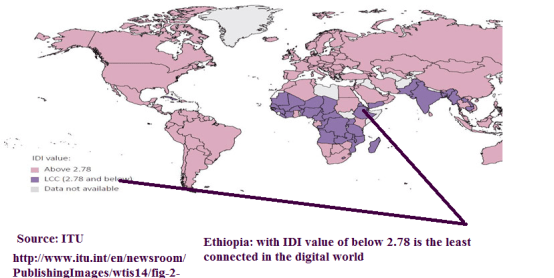
Rather than providing market based quality services to the public, the Ethiopian government is using control of its telecom system as a tool to silence dissenting voices.The TPLF run governmen tis using Chinese and European technology to survey phone calls and Internet activity in Ethiopia and among the diaspora living overseas . http://www.thenational.ae/world/africa/ethiopia-is-spying-on-its-citizens-with-foreign-tech
Please also refer to the genocide going on in other Horn of African country (Ethiopia) against Oromo (Oromia) people:
http://www.amnesty.nl/sites/default/files/public/because_i_am_oromo.pdf
This excellent analysis by Eric Reeves provides an analysis of US policy towards Darfur.
Martin
“Awakening” to the Continuing Nightmare of the Darfur Genocide
Source: Eric Reeves, 17 December 2014
The Obama administration seems finally to have found its voice again in speaking about ongoing genocide in the Darfur region of Sudan. More than a decade after rebellion and conflict began, some three million people are internally displaced or refugees in neighboring Chad. More than 800,000 have been displaced in the past two years; some 2 million human beings have been newly displaced since the disastrously conceived and badly failing UN/African Union Mission in Darfur (UNAMID) took up its civilian protection mandate in January 2008. The death toll from the direct and indirect consequences of violence now exceeds 500,000—and mortality looks to be poised to rise steeply given reduced humanitarian capacity.
After seven years of distinguishing itself only by being…
View original post 2,616 more words


His Excellency Mr Ban Ki-Moon
United Nations Secretary-General
Office of the Secretary General of United Nations
885 Second Avenue
United Nations Headquarters
Room DHL-1B-154
New York, NY 10017
Fax +1 212-963-4879Your Excellency
I write on behalf of the Oromo Liberation Front (OLF) to bring to your kind attention the plight of the Oromo people and to ask you to request the Security Council of the United Nations to treat the matter as a priority, to condemn the lawless atrocities by the Ethiopian regime, adopt appropriate actions to bring perpetrators to account, and safeguard the wellbeing of the Oromo and other peoples in Ethiopia.
In the land of their birth, the Oromo, who constitute the single largest national group in Ethiopia, are denied the most basic democratic right to organize freely and legally and express their political opinion. We do not know any country in the world, expect Ethiopia, where 35 million Oromo people are denied the right to have their own newspapers, to elect their own leaders and support an organization of their choice. Today, it is a serious crime, even punishable by death, to support independent Oromo organizations, such as the Oromo Liberation Front (OLF), internationally recognized organization, which jointly ruled Ethiopia with the TPLF in 1991/92. Supporters of the OLF and other independent organizations are harassed, detained for years without charge and their property confiscated without due process. Your Excellency, there is no doubt that the OLF enjoys support from the majority of the Oromo population. The current Ethiopian regime is dominated and controlled by the ruling Tigrayan People’s Liberation Front (TPLF). The TPLF represents less than seven percent of the population of Ethiopia. The TPLF, which fears the Oromo numerical voting power in any free and fair election, has directed multi-faceted attack on the Oromo political organizations, cultural institutions, educational establishments, the press and the killings of Oromo men and women, young and old, truly reaching a very dangerous proportion. This has to stop before it is too late. Today in Ethiopia all independent Oromo organizations are crippled and our people’s legal newspapers and magazines closed down. Even the Matcha and Tulama Association, a civic association, which was established in 1963 was closed down, its leaders detained and its property confiscated. We believe the TPLF dominated Ethiopian government deliberately targets the Oromo for persecution. This has been well documented by several human rights organizations, including the Ethiopian Human Rights League, European Parliament, Human Rights Watch/Africa, and Human Rights League of the Horn of Africa, Oromia Support Group and the State Department Annual Human Rights Report. The very recent 156 page Amnesty International October 2014 report clearly demonstrates that the TPLF dominated Ethiopian regime deliberately targets the Oromo population for persecution. This attack on the Oromo must be stopped before it is too late.
The Amnesty International, AI, report contains graphic accounts of arassment, intimidation, arbitrary and indefinite detention in formal and secret detention centres, extra-judicial killings and disappearances of innocent civilians on mere suspicion of individuals for sympathies with the Oromo Liberation Front. Collective punishment sometimes punishing entire neighbourhoods and penalising a close relative in place of a suspect, and mutilation and rape in detention are also common place in Oromia.
Peaceful demonstrators are wantonly beaten, tortured and mutilated, and many suspects indefinitely disappeared. The AI report is thoroughly detailed and it is based on information gathered in real time from real victims past and present, and from close family and friends of victims and from observers on the ground. The report provides specific cases that constitute crimes against humanity and violation of international law against arbitrary and cruel punishment. Whilst the report brings forth the regime’s
arbitrary and lawless behaviour, it must be said that it only scratches the surface, as the reality is even much worse.
There is no question that details unearthed by AI constitute extra-judicial killings and violations of international law. If disputed, the facts can be verified but the regime has to agree and guarantee another neutral investigation. The fact remains that the Oromo people and indeed all the different population groups in Ethiopia are undergoing a harrowing experience under abject misrule with no respite. What is happening in Ethiopia that AI report brought forth is a denial of basic freedoms including freedom to organise, freedom of expression, freedom to life and personal security, the freedom to be judged and the freedom to take part in decisions over ones affairs. As experience somewhere showed such lawlessness by governing elites lead to complete breakdowns and increased violence leading to even worse mass suffering and deaths and engulfing ever wider areas within the country and beyond. On experience of similar tragedies elsewhere including Somalia, Liberia, Sierra Leone, Afghanistan, Iraq and Syria, the behaviour of the current Ethiopian regime constitute a clear and present threat to international peace and security, which should not be ignored.
Your Excellency, my people were brought under Ethiopian domination through violent conquest during the Scramble for Africa and made part of the expanded Empire of Ethiopia. My organisation was forced to resort to armed resistance to regain Oromo people’s national rights only after the previous imperial regime adopted violent repression to Oromo attempts at peaceful processes to regain their basic human and democratic rights. The military dictatorship that replaced the imperial regime in 1974 initially raised hopes for a democratic alternative but soon snuffed the life out of any such hopes by instituting an intolerant one party dictatorship that respected no law, trampled elementary democratic practices and denied our people’s right to determine its destiny. The violation of basic human rights by that regime was also well documented by AI and many other human rights organisations.
My organization the OLF and the core of the present regime the Tigrean People’s Liberation Front, TPLF, were during the Marxist military regime on the same side opposing and exposing the lawlessness and excesses of that regime, and they solemnly committed themselves to institute a democratic future for all the oppressed peoples in Ethiopia. They also agreed to recognise their respective peoples’ rights to decide their own affairs and to freely determine their future destiny. They were partners also in organising a transitional programme enshrined in a charter which guaranteed basic liberties for the individual and self-determination of peoples including the Oromo.
According to the transitional programme, all peoples in Ethiopia would govern their affairs and participate in central government on equal basis. The process meant to guarantee equality and a level playing field for all parties with stake in the process. Unfortunately, within less than two years of the transitional exercise, the TPLF and its stalking-horse the Ethiopian Peoples’ Revolutionary Democratic Front, EPRDF, systematically drove all autonomous organisations out of the transitional process and ever since running a one party dictatorship. While opposition parties are registered in name, in an echo of practices in eastern European countries during the Cold War, their members face constant intimidation, harassment and repression and their political activities severely curbed. Similarly, the regime in Ethiopia does not tolerate any criticism of its arbitrary actions, not even a peaceful demonstration by the affected people. The peaceful protests in Oromia at the beginning of the current year 2014 was triggered by the regime’s arbitrary plans to extend the city limits of Addis Ababa against the wishes of the Oromo people, when, as witnessed, the regime unleashing severe repression firing live ammunition on peaceful demonstrators killing many, and detention, torture and disappearance of many more.
Your Excellency, there are undeniable changes from the era of the imperial rule and the Marxist military regime when the very name Oromo and Oromia were outlawed. However, mere facade of federal framework on paper that the current regime boasts does not amount to a real change. The trampling of basic human and democratic rights and the denial of our people’s right to decide their own affairs is fraught with further resentment and resistance. As the saying goes, a stitch in time saves nine. That is why we call on Your Excellency to bring the ever deteriorating situation in Ethiopia to the attention of the Security Council asking them to adopt measures that impress on the TPLF/EPRDF regime to uphold basic freedoms including freedom of expression, organisation, peaceful demonstration, and respect for the national rights of the Oromo people.
It will be recalled that the regime in Ethiopia has on several occasions during the past two decades organised sham elections to justify its misrule. However, far from giving it legitimacy, the charade has only deepened the mistrust and scorn of the Oromo and all other peoples and political players in Ethiopia. Regardless, the regime is again busy to run a similar election in 2015. The result is of course simple to predict. In view of the total obliteration of any meaningful competitors, the TPLF/EPRDF will retain power and the status quo will be maintained. This is an opportunity for the Security Council to
act to prevent maintenance of the status quo, which would speed a slide down the treacherous trail trekked in the past by similar tyrannical regimes in Sierra Leone, Somalia, Liberia and Syria with ruinous consequences. Your kind and swift action is much appreciated.More @ https://oromianeconomist.com/wp-content/uploads/2014/12/appeal-letteer-to-un-general-secretary-mr-ban-ki-moon-12-11-2014.pdf
A panel discussion organised by the Oxford Water Network and the Oxford Martin Programme on Resource Stewardship
Africa faces formidable development challenges in the 21st Century, with expanding populations and accelerating urbanisation; rising demand for water, energy and food; greater hydrological variability predicted with climate change; and persistent poverty and inequalities. Dams seem to promise an appealing package of benefits to meet Africa’s development needs – they can reduce floods, store water for irrigation, provide energy for burgeoning populations and facilitate regional integration. Yet, the benefits and costs of dams are not distributed evenly and new large dams are planned that could alter the political, social and water landscape of the region. What is the role for dams in Africa’s development? Can they give African countries the boost they need for growth and poverty alleviation, or will they only serve to exacerbate environmental problems, conflict and existing inequalities?
See more @ http://www.water.ox.ac.uk/africa-dams-and-development/
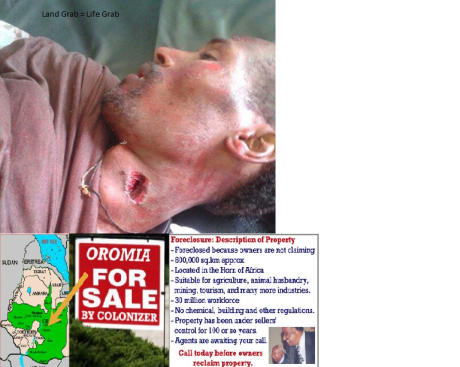
http://www.oaklandinstitute.org/engineering-ethnic-conflict
Oakland, CA – Today, the Oakland Institute (OI), in collaboration with the Anywaa Survival Organisation (ASO), released Engineering Ethnic Conflict: The Toll of Ethiopia’s Plantation Development on the Suri People, the latest in its series of comprehensive investigative reports about land grabs and forced evictions in Ethiopia. The report uncovers the truth behind a reported massacre of 30 to 50 Suri people in May 2012 near the 30,000-hectare Malaysian-owned Koka plantation. Based on extensive fieldwork, Engineering Ethnic Conflict reveals the destabilizing effects of foreign investment in Southwestern Ethiopia and examines the role of international aid programs in supporting forced evictions in the country.
“The tragic experiences of the Suri people outlined in this report are just one of many examples of the human rights abuses experienced by pastoralist communities in regions across Ethiopia,” said OI’s Executive Director, Anuradha Mittal. “These incidents are intimately tied to the Ethiopian government’s priorities of leasing land to foreign entities,” she continued.
“Some donor countries and development institutions have heralded Ethiopia for its unprecedented economic growth in recent years, which has in turn led to large-scale land acquisitions by foreign interests,” said Nyikaw Ochalla, Executive Director of the Anywaa Survival Organisation. “What has gone underreported is the tragic on-the-ground impact of this growth on indigenous populations. Engineering Ethnic Conflict exposes this harsh reality,” Ochalla continued.
“Unfortunately the Suri and other marginalized groups have no ability to voice their concerns over these developments on their land. There is little in the way of an independent media in Ethiopia that is permitted to cover this story, civil society that could advocate on these issues have been decimated by repressive laws, any criticism of government is met with harassment and detention. So what options are left for the Suri?” said Felix Horne of the Human Rights Watch.
The Suri pastoralist communities have lived in Southwestern Ethiopia for up to 200 to 300 years. The introduction of the large-scale plantations, including the Koka plantation in 2010, has not only made important grazing lands unavailable to the Suri and devastated their livelihoods–but also disturbed political order between the Suri and other local ethnic groups, escalating violent conflicts.
From coerced displacement of the Suri people to the exacerbation of pre-existing ethnic tensions between local groups in the region, Engineering Ethnic Conflict highlights the unreported nightmare experienced by Ethiopia’s traditionally pastoralist communities.
The report comes at a significant time in US politics. The US Senate included provisions in the 2014 Appropriations Bill that effectively diverts development aid funds for Ethiopia away from projects associated with forced evictions. Engineering Ethnic Conflict raises important questions about whether and how this language is being implemented, and the problematic connections between aid from the World Bank Group and other international donors, including the International Fund for Agricultural Development, for programs that support forced displacement and perpetrate violence against pastoralist communities.
“The stance taken by the US government in 2014 was encouraging, but it remains unclear whether action has been taken to implement the provisions of the bill and monitor the situation on the ground in Ethiopia,” said Mittal. “In light of this opacity and the continued violence and human rights abuses, it is time for the US government, other donors, and international institutions to stop turning a blind eye and take a strong stand to ensure aid in the name of development is not contributing to the ongoing atrocities nor supporting the forced displacement of people,” she continued.
To read the report, Engineering Ethnic Conflict: The Toll of Ethiopia’s Plantation Development on the Suri People, please visit http://www.oaklandinstitute.org/engineering-ethnic-conflict
About the Oakland Institute
The Oakland Institute is an independent policy think tank whose mission is to increase public participation and promote fair debate on critical social, economic and environmental issues (www.oaklandinstitute.org).
About the Anywaa Survival Organisation
Anywaa Survival Organisation is a not-for-profit organisation that believes in social justice and environmentally sensitive development that recognises and respects the rights of indigenous peoples’ active participation and enjoyment of the benefits of development in their own territories without prejudice (www.anywaasurvival.org).

Federal government plans to take over the entire corridor of 25km between Hawasa and Shashamene. Both Sidama Zone or SNNPR and Oromia have not been consulted yet.
Major cities in Oromia are administered in what is termed as “special zone.” Jimma and its surrounding is special zone; Addis Ababa and its surrounding is special zone; Adama and its surrounding is special zone. Now the federal government of Ethiopia is considering to create one for Shashamane because, sources disclose, the city is becoming home for ”nations and nationalities” and economically very significant to be left for the regional government. In fact, the federal government wants to take over the entire corridor of 25km between Hawasa and Shashamene. And both Sidama Zone or SNNPR and Oromia have not been consulted yet. The plan will land on table presumably after 2015 election and EPRDF secures majority in the house that is already decided at the council of ministers in their last successive meetings.
As a tradition, top-down orders from the Government of Ethiopia (GoE), which is mostly controlled and manipulated by the Tigrayan minority group TPLF, would not be questioned by the regional states and the ruling regional “allies.” Any form of divergence from what the GoE says would not be tolerated and often officials are intimidated. The Addis Ababa master plan for example faced stiff resistance and after about months of “mediation,” the GoE via Addis Ababa city administration is bracing for what is thought to be a potential escalation of dispute with Oromia when the plan is once again put for test in January 2015. The exact terms reached between Addis Ababa and Oromia with more arbrating than mediating role of Federal officials will never be known until documents are available for media and public. As to Diriba Kuma himself, he is nervous because he wants to return back to Oromia with his little left reputation. Aafter all Oromia is much formidable place for officials than the federal government, and this master plan is not making things easy for him. Again, he also wants to stay and turn things around, and that would risk him for intimidation by GoE.
The word ‘’federalize’’ is only used in this context to describe the intention of the Federal government. As it is dictated by the constitution and other bylaws, federal government can’t own land. However, the GoE acts as if it owns everything in the empire amplifying the stark reality and difference between what is on paper and what is being practiced. In fact, the creation of special zones can be taken as a strategy of weakening the regional governments by snatching economically viable and productive areas, at the same time, strengthen the much talked about TPLF’s economic empire.
Creating a special zone is not new thing in developing countries. The noble motive of creating such geographic and administrative demarcation is to facilitate development and ensure smooth and dynamic rural-urban divide, and reduce the negative impacts of emerging industries on the the environment and the society. However, the case of Oromia is quite different, or perhaps as the source indicates, disastrous.
In Addis Ababa, rampant mismanagement and corruption of land is source of fortune for few and destitution for most. Although rarely, this has been acknowledged by the city government itself. The last wave of urban land grab was right after the 2005 election. The so called Land Bank was fabricated to ration land to Tigrayans; following that campaign, Ex-Minister Ermisa Legese tells, over 150000 Oromo farmers and their families were displaced in what is now understood as systematic genocide. The second wave of land grab, this time deep into Oromia, is an ongoing project since 2012 right before Mele’s death. And many believe this Adds Ababa master plan legitimizes what has been done under the radar for the last 10 years. We should be afraid that It might take another 15 year but a complete social and economic Abyssinianization of Jimma, Adama and Shashamane is quite possible within this regime unless change is pending.
As smooth as it looks from outside falsely to handle investment and industries, the creation of special zone is an administrative hurdle because it is a redundant procedure. Creating a zone within Zone, society within society, economy within economy, is not sustainable and fair. There are experiences from other federal countries how to develop both social and economic sectors of the population without adversely impacting the livelihood of the people and the ecology. And the best way to do that is not to disconnect the rural surrounding from its urban epicenter.
Special zone model is attentively and particularly geared to be applied in Oromia as neither in Amhara nor in Tigray regions that they have special zones in a way they are in the former. In the later two regions, there are Mekele zone and Bahirdar zone but it is only purely for economic reasons since they have a smooth and consistent social transition from urban to rural settings. Without bold social and economic policy changes, my source thinks, these cities such as Jimma or Adama are administratively would soon be out of Oromia. because of their economic and administrative model and their social mix, which are not according to the interest of the Oromo people, just like Addis Ababa.
Apart from serving as a new hotbed for corruption and mismanagement, the new special zone around Shashamane and its link with Hawasa is intended to create an ‘’atmosphere of cooperation’’ between the two regional states. The increasing hostility between regional states were an intense topic during several federal security meetings. Most of these disputes are over land and border. Tigrayan controlled GoE, heavily influenced by Amhara individuals (not ANDM persei), wants to check and demise the little autonomy of regional state in pretext of ‘’creating one socioeconomic community’’ rhetoric of the constitution thereby pleasing the assimilative and border-phobic motives of some influential Amhara elites to restore their nostalgic interest of the empire and at the same time ensuring the continuous economic hegemony of Tigrayan minority.
Federal government plans to take over the entire corridor of 25km between Hawasa and Shashamene. Both Sidama Zone or SNNPR and Oromia have not been consulted yet
“Dargaggoonni kun Imaanaa guddaatu isin irra jira.Hacuucamuu sodaattanii biyya irraa hin godaaninaa.Jaalala uummataa qabaadhaa. Walii galtee qabaadhaa. Ani amma milli koo tokko gara boollaati. Isin garuu uummata keessan haqaan tajaajiluuf humnaa fi kutannoo cimaa qabaachuu qabdu!!!” Obbo Bulchaa Dammaqsaa
The only pro-democracy Opposition Coalition Party in Ethiopia, Medrek, held a rare rally in Finfinne (Addis Ababa) on Dec. 14, 2014. According to the reports, thousands of rally goers chanted slogans in Afan Oromo, English and Amharic languages demanding the TPLF-led Ethiopian regime free Oromo political prisoners, journalists and other political prisoners. Some of the slogans included: “Free Bekele Gerba!” – “Free Oromo Students!” – “Stop Land-Grabbing” – and “Free Journalists!”
At the rally, senior leaders of Medrek gave rousing speeches; speakers included: Dr. Beyene Petros (the Coalition’s President), Mr. Bulcha Demeksa (Chairman Emeritus of the Oromo Federalist Congress/OFC – one of the political organizations in the pro-democracy Medrek), Mr. Tilahun Endeshaw of the Ethiopian Social Democratic Federal Party/ESDFP, and Mr. Desta Dinka (Leader of the Medrek Youth).


Gabaasa Qeerroo Mudde 14,2014
Guyyaa har’aa dhaabni mormitootaa OFC magaalaa Finfinneetti hirira baheen dhaadannoolee hedduu dhageessisaa kan oole namoota 2000 ol kan hirmaachise, gana sa’a 3:00 irraa eegalee uummani Oromoo hangi dhagayee fi Qeerroon tumsa kanaaf irratti hirmaachuu dhaan dhaadannoolee waraabbii irratti mul’atan kanaa gadii irratti kan argamuudha,
-Mootummaan wayyaanee dhimma amantaa keessa hin seenin,
-Hidhamtootni siyaasaa haa gadhiifaman
-Baqqalaa Garbaa haa hiikamu
-Maqaa filannootiin uummata hiraarsuun haa dhaabbatu,
-Sobaan uummata yakkuun haa dhaabbatu,
-Afaan oromoo afaan federaalaa haa tahu,
-Saamtotni mootummaa seeratti haa dhiyaatan,
-Boordiin filannoo mootummaa irraa walaba haa tahu,
fi kkf dhageessisuudhaan hanga sa’a 7:00tti adeemsifamee jira, waraabbii dabalataa fi odeessa kana ilaallatu biroo argamuun walitti deebina!


Building on colonial rule’s multilayered identities of first-, second-, and third-class citizens, newly independent African countries regarded ethnolinguistic diversities entrenched in divergent political opinion as detrimental to unity and contrary to the nation-building project. They sought to dilute them in various systems of common-identity, single-nation projects and one-party systems. The failure to accommodate multiple community identities constitutes a critical challenge that poses severe threats to lasting peace, stability, and development, with particular importance in fragile and conflict-affected contexts.
The combination of local mistrust in the current government and the opportunity for material gain present a recipe for violent conflict. Just as colonial powers developed systems focused on extracting resources from the continent to fund their own empires, local elites often use the profits from natural resources on the continent for their own ends. At the heart of the resource curse are issues of democratic governance. Without accountable institutions, the wealth from natural resources corrupts elites and thwarts democratic governance. – http://www.ipinst.org/media/pdf/publications/ipi_e_pub_effective_governance_in_challenging_environments.pdf
The “Africa rising” narrative has gained traction in recent years. But who, exactly, is rising? While statistics point to a continent whose fortunes have improved, many African citizens remain at the margins of socioeconomic development. Citizens’ uprisings in North Africa and in Burkina Faso provide a fresh reminder of the danger in touting impressive economic growth statistics while the majority of a
country’s population remains excluded from democratic governance processes and development.
It is also widely believed that development failures and governance deficits lie “at the heart of
Africa’s violent conflicts.”
According to the report Africa will only live up to the “rising” narrative if it can strengthen its systems of governance, promote inclusive development, and embed a culture of democracy and peace. It examines the obstacles to effective governance in challenging environments—from identity crises to poor natural resource management. A growing youth bulge and the widespread marginalization of young people, enduring underdevelopment, and persistent inequalities are among the social and economic challenges that are negatively impacting efforts to improve governance.
The report argues that Recent reverses in peace and security across Africa illustrate the persistent gaps that exist between the aspirational norms of democratic governance and their implementation. Yet, in the face of these setbacks, policy responses tend to focus on the violent symptoms of insecurity rather
than addressing one of the primary root causes of these conflicts: poor governance. To overcome this ambivalent record, Africa needs a unified strategy to address the continent’s governance challenges and advance long-term peace and stability. Effective, inclusive, and accountable governance; visionary leadership; and solid democratic institutions are critical to ensuring Africa reaches its potential in ever challenging environments. Thus, restoring and strengthening governance in fragile and conflictaffected
contexts calls for a new social contract built on accountability and inclusiveness—of institutions, politics, economic growth, natural resource management, and the delivery of public services. This new social contract, which is an essential prerequisite to Africa’s transformation, has the potential to facilitate the kind of socioeconomic development and responsive, inclusive politics that leads to an enabling environment for sustainable peace and stability.
Exploring African responses to these challenges, the authors outline progress and setbacks in developing frameworks for effective governance and strengthening institutions at regional, national, and local levels. They offer a number of recommendations for the African Union, its member states, and others to enhance democracy, bridge the divide between governance standards and performance, and promote effective governance from the ground up. Read @ http://www.ipinst.org/media/pdf/publications/ipi_e_pub_effective_governance_in_challenging_environments.pdf


It is not often you hear a Vice President of the World Bank calling for revolution, but Oby Ezekweseli did just that at the Royal African Society’s Annual Lecture last week.
There is an unwritten rule among politicians globally that they do not rubbish their rulers when they are abroad, but Oby – who would not describe herself as a politician – did not hold back.
We should have guessed how fired up she was when the former minister in President Obasanjo’s government in Nigeria and World Bank Vice President set the title: “Africa Rising? What will happen when her citizens arise?” You can watch her presentation here
She traced the lack of participation by the vast majority of Africans in their own development over the past 50 years which has left 70 – 80% of them absolutely poor. She blamed the “parasitic” African elites, not just for looting their countries, but for preventing any of the benefits of economic growth reaching their people. Her own country, Nigeria, is very rich but has some of the worst human development figures in the world.
She also pointed out that external actors, the aid donors, the World Bank and the IMF who drove the structural adjustment economic reforms of the 1990s and 2000s and left African citizens with no part to play in making the national choices for development. These reforms were necessary, she said, but “externals cannot give development to any country or any people… The ownership of the process by African citizens has been the missing link.”
Dismissing the current crop of African rulers, she expressed her pride in the people of Burkina Faso for the uprising that ejected President Blaise Compaoré
, who ruled there for 27 years. The leaders “absolutely don’t care” about their own citizens, she said, but spend their time among the global elite “all of whom have each other’s’ phone numbers”.
The next stage of development, said Oby, can only be done with the participation of the people, “no external force can do that…The change you have been waiting for will not come from the elite class waking up and having an epiphany. The change has to be made by the people. They are the only ones who can.”
And she urged the African diaspora to return to Africa and lead the struggle, a remark that created a moment of awkwardness in the room I noticed.
But I am sure you will agree this was an inspiring, energising message: People of Africa, you are citizens, not slaves. Rise up and demand what is yours and remove the people who have stolen it from you. Could the removal of Compaoré
by mass demonstrations followed by the refusal to accept an interim military ruler be the beginning of an Africa-wide trend as a 21st Century generation comes of age? It is not the usual message that you hear from African ministers or the World Bank.
But there is an anomaly here. If Oby is right then the most democratic countries with the most widespread political participation would be the most prosperous. And the most equal in terms of sharing the national cake. But this is not so.
Put aside the oil and mineral-rich countries in Africa, and, as Oby pointed out, you find that the fastest growers are those with stability and strong institutions such as effective ministries that deliver health and education to their people. In turn these attract aid and investment. These countries are Rwanda, Ethiopia, Uganda, Mozambique and Tanzania.
But what else do they have in common? Ethiopia and Rwanda are top-down dictatorships ruled by parties that fought their way to power and have ruled since 1991 and 1994 respectively. They deliver health and education to their people but they do not allow freedom of speech or association. Their media are tightly controlled. Uganda is a less powerful dictatorship but President Yoweri Museveni also came to power through the barrel of a gun in 1986 and his army has controlled the country ever since. The ‘Walk to Work’ mass movement in 2011, which complained about lack of services and high prices, was brutally suppressed.
Museveni was forced by aid donors to open up politics and he now has to put up with a rumbustious parliament and a moderately free press. A grumpy population, especially in the capital, might vote for someone else if they were sure that someone was allowed to run in a fair election. That is unlikely. At election times the state, including the police and the army, is an extension of the ruling party.
Mozambique and Tanzania are still run by the parties that led those countries at independence. Both will soon become exceedingly rich because of oil and gas; God-given resources that are profoundly anti-democratic. Oil-rich countries do not need to raise taxes from their people, they mainline millions from oil companies straight into the treasury. So whoever is in power when those revenues begin to flow may stay there for decades. There is still some democratic space in these countries and there are real national debates with opposition parties in both of them, although it is unlikely that an opposition party could win without provoking violent reactions from the ruling parties.
So is benign dictatorship the best Africans can hope for? There are certain advantages – stability and consistency. The downside is that it is dangerous to think or speak out so there is no national debate. Meanwhile new generations emerge – especially in Africa where birth rates are high – and dictators become out of touch. If the new generation follow Oby Ezekwesili’s call, Africa will remain exceedingly interesting and exciting and should also become prosperous and powerful.
See more @ http://africanarguments.org/2014/12/11/citizens-of-africa-arise-you-have-nothing-to-lose-but-your-chains-says-oby-ezekwesili-by-richard-dowden/

International Human Rights Day marks the anniversary of the adoption of the Universal Declaration of Human Rights on December 10, 1948. Crafted in the shadow of the horrors of the Holocaust and World War II, the Declaration gave the world the vision it needed to stand up to fear and the blueprint it craved to build a safer and more just world. Its single premise is: “Recognition of the inherent dignity and of the equal and inalienable rights of all members of the human family is the foundation of freedom, justice and peace in the world.”
Human Rights Day Message:United Nations High Commissioner for Human Rights Zeid Ra’ad Al Hussein’s message for Human Rights Day 10 December 2014.
In observing Human Rights Day, its important to highlight the horrific going on in 2014 in our world. The following document is the summary of horrific repression going on against Oromo people by tyrannic Ethiopian regime:
Click to access because_i_am_oromo.pdf
https://oromianeconomist.wordpress.com/?s=because+I+am+Oromo&searchbutton=go%21

HRLHA – URGENT ACTION
December 10, 2014
The Human Rights League of the Horn of Africa (HRLHA) would like to express its deep concern over the outbreak of a deadly disease at Gimbi Jail in Western Wollega, as a result of which one inmate has already died and sixty (60) others infected. HRLHA strongly believes that the very poor sanitation in the jail, absence of basic necessities, and denial of treatment after catching the illness have contributed to Mr. Yaikob Nigaru’s death. HRLHA fears that those who have already caught the disease might be facing the same fate. It is well documented that particularly inmates deemed “political prisoners” are deliberately subjected to unfriendly and unhealthy environments and, after getting sick as a result, are not allowed access to treatment until they approach or reach the stage of coma, which is when recoveries are very unlikely. HRLHA considers it one way of the systematic eliminations of alleged and/or perceived political dissidents.
Mr. Ya’kob Nigatu was one of the 224 Oromo Nationals (139 from Gimbi in Western Wollaga, 80 from Ambo, and 5 from Ma’ikellawi in Addis Ababa/Finfinne) who were charged by the Federal Government on the 10th of November, 2014 for allegedly committing acts of terrorism in relation to the April/May, 2014 peaceful protests by Oromo students in different parts of the regional state of Oromia. HRLHA has learnt that five of the 224 Oromo defendants, who were held at the infamous Ma’ikelawi Criminal Investigation for about six months, were subjected to harassments and intimidations through isolations and confinements, with no visitations by relatives and friends, no access to a lawyer, and no open court appearance until when they were eventually taken to court to be given the charges. Those five Oromo nationals, who were transferred to Kilinto Jail right after receiving the alleged terrorism charges, were:
Besides the outbreak of a deadly disease witnessed at Gimbi Jail, and the likelihood of the same situations to occur particularly at highly populated and crowded jails, Kilinto is known to be one of the very notorious substandard prisons in the country. Such facts taken into consideration, HRLHA would like to express its deep concern over the safety of those young Oromo prisoners.
HRLHA has also received reports that 29 Oromo nationals, who have been attending the Addis Ababa/Finfinne University, have been denied proofs of graduations (degrees and/or diplomas) and, as a result, prevented from graduating after completing their studies for allegedly taking part in the April/May peaceful protests of Oromo students and other nationals against the newly drafted and introduced Finfinne Master Plan. The 29 Oromo students were first detained along with 23 other Oromo students of the same university, following the protests, and released on bails ranging between $1000.00 and $4000.00 Birr. Upon re-admission back to the University, they were all (52 of them) forced to appear before the disciplinary committee of the University, where they were asked to confess that their involvement in the peaceful demonstrations was wrong and that they should apologize to the Government and the public. According to reports from HRLHA’s correspondents, it was the students’ refusal to confess and apologize that has resulted in their prevention from graduating, despite their fulfillment of all the academic requirements. HRLHA describes the University’s becoming a political weapon as shameful, and the restrictions imposed on Oromo students as a pure act of racism aimed at partisan political gains. Of the 29 Oromo students who have become victims of the University’s non-academic action, HRLHA has obtained names of the following nine students:
BACKGROUNDS:
The human rights League of the Horn of Africa (HRLHA) has reported (May 1st and 13th, 2014, urgent actions, www.humanrightleague.org) on the heavy-handed crackdown of the Ethiopian Federal Government’s Agazi Special Squad and the resultant extra-judicial killings of 34 (thirty-four) Oromo nationals; and the arrests and detentions of hundreds of others. Besides, Amnesty International in its most recent report on Ethiopia – “Because I am Oromo – Sweeping repression in the Oromia region of Ethiopia” – has exposed how Oromo nationals have been regularly subjected to arbitrary arrest, prolonged detention without charge, enforced disappearance, repeated torture and unlawful state killings as part of the government’s incessant attempts to crush dissent.
Also, the provisions in Ethiopia’s anti-terrorism law have been criticized by local, regional, and international human rights agencies such as Human Rights Watch and Amnesty International as violating most of the fundamental rights guaranteed in the Ethiopian Constitution, other legal documents and international human rights standards that the Country has ratified. Given Ethiopia’s proven track record of mistreating and/or torturing suspected members and supporters of opposition political organizations, HRLHA calls upon the world communities, human rights, humanitarian, and diplomatic agencies so that they monitor using all means available how those young prisoners are treated in Ethiopian jails.
Please direct your concerns to:
His Excellency, Mr. Haila Mariam Dessalegn, Prime Minister of Ethiopia
P.O.Box – 1031 Addis Ababa
Telephone – +251 155 20 44; +251 111 32 41
Fax – +251 155 20 30 , +251 15520
Office of the President of Oromia Regional State
Telephone – 0115510455
Office of the Ministry of Justice of Ethiopia
PO Box 1370,
Addis Ababa,
Ethiopia
Fax: +251 11 5517775; +251 11 5520874
Email: ministry-justice@telecom.net.et
UNESCO Headquarters, Paris.
7 place de Fontenoy 75352 Paris 07 SP France
1 rue Miollis 75732 Paris Cedex 15 France
General phone: +33 (0)1 45 68 10 00
www.unesco.org
United Nations Educational, Scientific and Cultural Organisation (UNESCO)- Africa Department
7 place Fontenoy,75352
Paris 07 SP
France
General phone: +33 (0)1 45 68 10 00
Website: http://www.unesco.org/new/en/africa-department/
UNESCO AFRICA RIGIONAL OFFICE
MR. JOSEPH NGU
Director, UNESCO Office in Abuja
Mail: j.ngu@unesco.org
Tel: +251 11 5445284
Fax: +251 11 5514936
Office of the UN High Commissioner for Human Rights
United Nations Office at Geneva – 1211 Geneva 10, Switzerland
Fax: + 41 22 917 9022 (particularly for urgent matters)
E-mail: tb-petitions@ohchr.org (this e-mail address is being protected from spambots. You need JavaScript enabled to view it.)
Office of the UNHCR
Telephone: 41 22 739 8111
Fax: 41 22 739 7377
Po Box: 2500
Geneva, Switzerland.
African Commission on Human and Peoples‘ Rights (ACHPR)
48 Kairaba Avenue, P.O.Box 673, Banjul, The Gambia.
Tel: (220) 4392 962 , 4372070, 4377721 – 23 Fax: (220) 4390 764
E-mail: achpr@achpr.org
Council of Europe, Commissioner for Human Rights,
F-67075 Strasbourg Cedex, FRANCE
+ 33 (0)3 88 41 34 21, + 33 (0)3 90 21 50 53
Email (C/O): pressunit@coe.int
U.S. Department of State
Laura Hruby, Ethiopia Desk Officer
U.S. State Department
Email: HrubyLP@state.gov
Tel: (202) 647-6473
Amnesty International – London
Claire Beston, Claire Beston”
Claire.Beston@amnesty.org
Human Rights Watch
Felix Horne, “Felix Horne” hornef@hrw.org.

- The WDR 2015 holds new insights on how people make decisions; it provides a framework to help development practitioners and governments apply these insights to development policy.
- Research in the WDR suggests that poverty constitutes a cognitive tax that makes it hard for poor people to think deliberatively, especially in times of hardship or stress.
- When used with existing policy approaches, new tools ranging from simple, low-cost changes such as better framing of messages and changing the timing of aid, can significantly improve outcomes.
Real people are rarely as coherent, forward-looking, strategic or selfish as typically assumed in standard economic models—they sometimes do not pursue their own interests, and can be unexpectedly generous. Such dynamics should be factored more carefully into development policies, a point made in the World Development Report 2015: Mind, Society, and Behavior.
The newly launched report argues that development policies based on new insights into how people actually think and make decisions will help governments and civil society more readily tackle such challenges as increasing productivity, breaking the cycle of poverty from one generation to the next, and acting on climate change. Drawing from a wealth of research that suggests ways of diagnosing and solving the psychological and social constraints to development, the WDR identifies new policy tools that complement standard economic instruments. For instance, an experiment in Colombia modified a cash transfer program by automatically saving a part of the funds on behalf of beneficiaries, and then disbursing them as lump a sum at the time when decisions about school enrollment for the next year were being made. This tweak in timing resulted in increased enrollments for the following year. “Marketers and politicians have long understood the role of psychology and social preferences in driving individual choice,” said Kaushik Basu, Senior Vice President and Chief Economist of the World Bank, “This Report distills new and growing scientific evidence on this broader understanding of human behavior so that it can be used to promote development. Standard economic policies are effective only after the right cognitive propensities and social norms are in place. As such, this WDR can play a major role in enhancing the power of economic policymaking, including standard fiscal and monetary policies. My only worry is that it will be read more diligently by private marketers selling wares and politicians running for office than by people designing development interventions.” To inspire a fresh look at how development work is done, the Report outlines three principles of human decision making: thinking automatically, thinking socially, and thinking with mental models. Much of human thinking is automatic and depends on whatever comes to mind most effortlessly. People are deeply social and are influenced by social networks and norms. Finally, most people do not invent new concepts; rather they use mental models drawn from their societies and shared histories to interpret their experiences. Because the factors affecting decisions are local and contextual, it is hard to predict in advance which aspects of program design and implementation will drive the choices people will make. Interventions therefore need to take account of the insights found in the report and be designed through a ‘learning by doing’ approach. The Report applies the three principles to multiple areas, including early childhood development, productivity, household finance, health and health care, and climate change.This Report distills new and growing scientific evidence on this broader understanding of human behavior so that it can be used to promote development. Standard economic policies are effective only after the right cognitive propensities and social norms are in place.Kaushik Basu Senior Vice President and Chief Economist, World Bank
When it comes to assisting poor people, a key message from WDR 2015 is that poverty is more than a deprivation in material resources. It is also a “cognitive tax.” Take the case of sugar cane farmers in India, who were asked to participate in a series of cognitive tests before and after receiving their harvest income. Their performance was the equivalent of 10 IQ points higher after the harvest, when resources were less scarce. Policy can be designed to reduce some of the impact of poverty on the ability to make choices and plan for the future. Policy makers should try to move crucial decisions out of periods when cognitive resources are scarce. This may mean shifting school enrollment decisions to periods when poor farmers’ seasonal income is higher. There may also be ways of simplifying typically complex decisions such as applying to a higher education program. These ideas apply to any initiative in which good decision making is a challenge. Poverty in childhood, which is often accompanied by high stress and neglect from parents, can impair cognitive development, according to the report, so public programs that provide early childhood stimulation are critical. A 20-year study in Jamaica found that a program aimed at altering the way mothers interacted with their infants led to an increase in earnings by 25 percent once those children became adults, as compared to others who did not participate in the program. All major developing regions are featured in the Report, including the following examples:
- In Malawi, a small performance incentive to encourage farmers to work with their peers increased the take-up of productivity-enhancing agricultural technologies (Ben Yishay and Mobarak 2014). This intervention used social networks to amplify the effects of information programs.
- In the Philippines where encouraging saving was a challenge, one effective fix was to create products that allow individuals to commit to certain savings goals and not allow them to easily renege. When savings accounts were offered in the country without the option of withdrawal for six months, nearly 30 percent of those offered the accounts accepted them (Ashraf, Karlan, and Yin 2006). After one year, individuals who had been offered and had used the accounts increased savings by 82 percent more than a control group.
- In Asia, a new approach, focused on establishing new norms that holds promise is Community-Led Total Sanitation (CLTS). In CLTS, leaders work with community members to make maps of dwellings and the locations where individuals defecate in the open. The facilitator uses a repertoire of exercises to help people recognize the implications of what they have seen for the spread of infections and to develop new norms to protect against the damaging effects of open defecation. A set of these programs in Indian villages lowered open defecation by 11 percent from very high levels. (Patil and others 2014).
According to the Report, because the decisions of development professionals often can have large effects on other people’s lives, it is vital that development actors and organizations put mechanisms in place to check and correct for their own biases and blind spots. Ultimately, behavior change matters for all actors in the development process. http://www.worldbank.org/en/news/feature/2014/12/02/world-development-report-2015-explores-mind-society-and-behavior http://www.worldbank.org/content/dam/Worldbank/Publications/WDR/WDR%202015/WDR-2015-Full-Report.pdf

An info-graphic that shows how the industrial food system contributes to the climate crisis and how food sovereignty is the solution.
1.Take care of the soil
2. Natural farming, no chemicals
3. Cut the food miles & the Corporations, and focus on fresh food
4. Forget the false solutions, focus on what works
5. Get the land back to the farmers, and stop the mega plantation

YABELO, Ethiopia, Dec 5 (Thomson Reuters Foundation) – Nomadic livestock herders in Ethiopia have received their first payout from an insurance scheme that tracks poor pasture conditions with satellite technology.
Ethiopia has difficulty drawing full advantage from its livestock resources – the largest in Africa – because of the unreliability of pasture and water caused by persistent drought.
The new insurance scheme, known as index-based livestock insurance, aims to reduce losses, support pastoral communities, and lower the risk of conflict sparked by pastoralists migrating into agricultural areas in search of forage or water.
Coverage has been sold since July 2012 in southern Ethiopia’s Borena zone by Oromia Insurance Company (OIC), with technical assistance from the International Livestock Research Institute (ILRI), U.S.-based Cornell University, and Mercy Corps, an international development organisation. Just over 500 pastoralists took up coverage initially.
The scheme was based on an earlier insurance effort rolled out in 2010 in neighbouring Marsabit region in northern Kenya, said Andrew Mude, principal economist at ILRI in Nairobi.
There, payouts were based on livestock deaths. But “the (experience) we had with the Kenyan programme was that some animals are more hardy than others, and so (with) differential mortality rates … (it) was a bit complex,” Mude said.
The insurance offered by OIC in Ethiopia instead offers coverage based on the actual scarcity of the herders’ forage, rather than the mortality rate of their livestock.
HOW IT WORKS
The insurance uses NASA satellite data to look at forage availability in the Borena zone. Experts from ILRI and Cornell University compare current images with historical data from the past 30 years.
“We provide the technical expertise to understand how to use the information from satellites on the state of forage on the ground,” Mude said.
The timing and amount of insurance payouts are then calculated based on the severity of the lack of forage.
OIC’s insurance will pay out up to 6,000 Ethiopian birr ($300) for a cow, 10,000 birr ($500) for a camel, and 800 birr ($40) for a sheep or goat annually. Pastoralists pay premiums averaging about 7.5 percent of the value of the maximum payout.
If forage levels become scarce compared to the index based on the historical satellite data, the herder receives compensation, even if no livestock have been lost.
In response to poor forage conditions, OIC made its first payout to all the insured holders, totalling 570,000 birr ($28,300), at the beginning of November this year at a ceremony in Yabelo, a town 565 km (353 miles) south of the capital, Addis Ababa.
Mude said that although livestock is the key productive asset and source of income for pastoralists, the novelty of insurance in this remote region initially made it difficult to sell.
ILRI spent two years researching the needs of the Borena zone herders before formally launching the insurance.
A further challenge is how to assess the damage suffered by policyholders when dealing with a mobile population.
Mude explained that an important feature of the insurance is that pastoralists remain covered even if they migrate out of the woredas (districts) where they are insured, since migration itself implies that there is a severe lack of forage. Compensation is therefore calculated based on the area where they were initially insured.
Wondimu Beteyo, a pastoralist who received a payout for his cattle and goats, says that until recently he had to trek several days for pasture and water. Now, he says, the money he has received will allow him to replenish the cattle he lost during the recent drought.
Dono Kotelo, from Teltale woreda, insured his two goats and two cattle for a total of 1,048 birr ($50) after learning about the insurance scheme. Although none of his animals died, because he migrated to find pasture, he received a payout of 192 birr ($10) for costs associated with the dry season and said he plans to buy insurance again for the coming year.
LOWERING CONFLICT RISK?
Getaneh Eerena, a livestock insurance officer at the micro-insurance department of OIC, said that in the long run the programme is not just about financial payments but about avoiding conflicts.
“The area tends to have high conflict incidence, both within (the) pastoralist community and against agricultural communities,” Eerena said.
Kotelo, the herder, said his Borena community used to cross into the land of agricultural communities when their own pastures were exhausted, often leading to deadly clashes.
Mude and Eerena said their organisations planned to extend the insurance scheme eventually across the country.
Source: Reuters

In June more protests erupted just outside Addis Ababa in opposition to what is considered a discriminatory plan by the city council to expand the capital and displace many of the ethnic Oromos who live at its edges. The government often makes blanket accusations against critics based on their ethnicity. At least 5,000 ethnic Oromos have been arrested between 2011 and 2014 based on their actual or suspected opposition to the government, according to an October 2014 Amnesty International report.
The EPRDF has portrayed itself as a vanguard party, charged with a sacred duty to articulate the “developmental state”. Its dictum is “You are either with or against us.” It has evolved a rich rhetoric for those who oppose it by labelling them “anti-development” or “neoliberal”. In the meantime, the state’s command economy depends on dollars from “neoliberal” donors. It took $3 billion in external assistance in 2012, according to the World Bank, more than any other country in Africa.
In the run-up to the May 2015 general election, will the EPRDF allow the opposition to compete? Will the opposition participate or boycott the polls? Such queries are beside the point: the struggle for democracy in Ethiopia was lost long ago. The next election will be another EPRDF landslide, in keeping with the history of the current ruling party and its revolutionary roots. http://unpo.org/article/17759
In the Ethiopian Parliament, out of 548 MPs, only one is not part of the government coalition. Many other opposition party members, including leaders of the Oromo People’s Congress Party and of the Unity for Democracy and Justice Party, have been imprisoned, joining over 30,000 political prisoners in the country. The ruling party has progressively eliminated any opposition through abuse of anti-terror laws and banning NGOs, which are mainly funded from abroad.
Below is an article published by AllAfrica:
Few political rights exist in Ethiopia and even fewer voices criticise the government.
The right to remain silent is one liberty not denied to critics of the Ethiopian government. Most other political entitlements have vanished. This explains the puzzle of Ethiopia’s invisible political opposition: it is so battered and brutalised, tattered and torn, that what is left of its pieces may never fit together again.
The current government is mostly to blame. It came to power in 1991 after it toppled the communist military junta led by despot Mengistu Haile Mariam. The victorious coalition of ethnic militias promised a new dispensation, based on the concept of “ethnic federalism”.
But nearly a quarter of a century later, Ethiopia remains a de facto one-party state. As countless analysts have noted, including successive European Union election observation missions, there is no separation between the government bureaucracy and the ruling Ethiopian Peoples Revolutionary Democratic Front (EPRDF). No political space is allowed to dissenting voices.
Most critics are behind bars, the first and main reason for the absence of a political opposition in Africa’s oldest independent nation.
Of the 547 members of Parliament (MPs), only one is from an opposition party. Girma Seif Maru of the Unity for Democracy and Justice party (UDJ) is the lonely MP–window dressing whom the government allowed to win a seat in the last general election in 2010. But large swathes of the UDJ are in prison.
Other opposition party members, including Bekele Gerba, a leader of the Oromo Federalist Democratic Movement, and Olbana Lelisa of the Oromo People’s Congress Party, were imprisoned days after meeting with representatives from Amnesty International in 2011.
Andualem Arage, the UDJ’s vice-chairman, and another UDJ leader, Natnael Mekonnen, were put behind bars for debating the 2011 Arab spring rebellions. So was outspoken journalist Eskinder Nega, who posed questions about the possibility of a similar Ethiopian movement in his online pieces. In June 2012 Mr Andualem was sentenced to 75 years in prison, while Messrs Eskinder and Natnael got off lighter with 18 each.
They are just three of the thousands of government critics silenced in the slammer. Barely a month goes by without news of fresh arrests and detentions. In July, four more leaders of the UDJ, Arena Tigray and Semayawi (“Blue”) opposition parties were detained. In addition, Andargachew Tsige, an Ethiopian opposition leader and British citizen, was arrested in Yemen and extradited to Addis Ababa, the capital, in July. He is facing the death penalty for allegedly plotting a coup in 2009.
In July 2013, thousands of people took to the streets of Addis Ababa demanding the release of some of Ethiopia’s estimated 30,000-40,000 political prisoners, according to Amnesty International and Human Rights Watch. The protestors also called for the repeal of a draconian anti-terror law that has been exploited to target legitimate opposition members. Crackdowns and arrests followed, including the detention of 40 UDJ activists who had distributed flyers encouraging people to protest.
The second reason for the opposition’s muffled voice is fear: a decade or more of repression has taken its toll. The government spies on dissidents in the diaspora and uses its control of food aid to literally starve the opposition at home, according to Human Rights Watch. Yet, Ethiopia’s citizens seem to passively accept each new transgression of their rights. They are just too scared to fight back.
A brief emancipatory moment swept Ethiopia in 2005. The ruling EPRDF, under the leadership of the late Meles Zenawi, allowed the forerunner of the UDJ, the Coalition for Unity and Democracy (CUD), a degree of freedom to campaign in the general elections that year. In polls that appeared relatively free, 174 opposition MPs were elected.
But the CUD disputed the results and protests erupted in the capital. Police killed nearly 200 unarmed protestors and arrested 40,000 CUD members and sympathisers in a nationwide clampdown, according to media reports. The memory of that brutality still casts a long shadow. Since then, the government has given no quarter.
This is the third factor explaining Ethiopia’s invisible opposition: the government controls every aspect of daily life. In 2010 Human Rights Watch documented the strategic use of food aid, agricultural inputs such as seeds and fertilisers, access to microcredit, teacher training and even university admissions to encourage support for the ruling party.
It worked. In the 2008 local election the ruling party won 99% of the votes and 3m local government seats. In the 2010 general election, the debacle of 2005 was avoided and voting was peaceful. The EPRDF took 99.6% of the parliamentary slots, leaving the UDJ with the one decorative seat.
The final squeeze on the political opposition and any form of dissent has been the use of repressive laws. The 2009 anti-terror law has a sweeping definition of terrorism. Another 2009 law bans NGOs that engage in human rights or advocacy activities from receiving more than 10% of their funds from abroad. It also requires all NGOs to re-register with a new government agency. This legislation closed down Ethiopia’s critical organisations and made hundreds of activists redundant.
As long-time Ethiopia observer, René Lefort, commented in July in an article on the Open Democracy website: “When the political space is impermeable, the inevitable internal conflicts can only overflow into the ethnic and/or religious sphere.”
They have. The government has been jostling for the last two years with the Muslim community that objected to government attempts to interfere in the appointments of the Islamic council. Every Friday, peaceful protests are held at mosques in Addis Ababa. Every Friday security forces shut them down and jail religious leaders, as reported in the media and acknowledged implicitly by government statements.
In June more protests erupted just outside Addis Ababa in opposition to what is considered a discriminatory plan by the city council to expand the capital and displace many of the ethnic Oromos who live at its edges. The government often makes blanket accusations against critics based on their ethnicity. At least 5,000 ethnic Oromos have been arrested between 2011 and 2014 based on their actual or suspected opposition to the government, according to an October 2014 Amnesty International report.
The EPRDF has portrayed itself as a vanguard party, charged with a sacred duty to articulate the “developmental state”. Its dictum is “You are either with or against us.” It has evolved a rich rhetoric for those who oppose it by labelling them “anti-development” or “neoliberal”. In the meantime, the state’s command economy depends on dollars from “neoliberal” donors. It took $3 billion in external assistance in 2012, according to the World Bank, more than any other country in Africa.
In the run-up to the May 2015 general election, will the EPRDF allow the opposition to compete? Will the opposition participate or boycott the polls? Such queries are beside the point: the struggle for democracy in Ethiopia was lost long ago. The next election will be another EPRDF landslide, in keeping with the history of the current ruling party and its revolutionary roots.
Read @ http://unpo.org/article/17759

Call it a coup or a revolution—Burkina Faso has finally overthrown its longtime strongman Blaise Compaoré. During his 27-year-long rule, Compaoré’s regime was accused of corruption and nepotism and of violently quelling a student and military rebellion in 2011.
Revolutions now happen in real time and Compaoré’s overthrow was no different. This October, protestors, journalists and politicians used the hashtags #Lwili and #Burkina to live-tweet their way through a chain of events that started with massive street protests and ended with a cellphone video of Compaoré fleeing the country with his convoy of SUVs.
The digital connection between Burkinabé youth activists—who dubbed the protests “Revolution 2.0,”—their diaspora, and supporters in the West led to a flurry of online interest in Burkina Faso.
Images showing streets and squares flooded by demonstrators, many of whom were women brandishing wooden spatulas, a local symbol of gender defiance, were shared thousands of times on Twitter and Instagram.
https://twitter.com/joepenney/status/526731837142753280
Alongside international focus in Burkina Faso has been a resurgence of interest in the man many protesters credit as their inspiration—Thomas Sankara.

Overthrown and murdered in Compaoré’s 1987 coup, Sankara has long been revered by African nationalists and leftists for his charismatic blend of revolutionary zeal and progressive philosophy. President of the country for four years between 1983 and 1987, Sankara has only a few interviews and speeches attributed to him—yet his legacy is far larger. Today, his message is finding a new, broader of pool of admirers in the social media generation both in Burkina Faso and abroad.
https://twitter.com/AdeolaFayehun/status/530910177516863488
https://twitter.com/Vusani_/status/538200333714219008
https://twitter.com/CedricMcCay/status/539867151247900672
As president, he changed the name of the country from the colonial Upper Volta to Burkina Faso, which means “land of upright people” in an amalgam of the country’s most popular languages. A guitarist, he wrote the national anthem, a stirring ode against neo-imperialism.

And the phrase on the lips of protesters this summer—“La patrie ou la mort, nous vaincrons,” (homeland or death, we shall overcome)—was on the national crest during his tenure.
One of the popular movements behind Compaoré’s recent ouster—Le Balai Citoyen or The Civic Broom movement—was led by two self-professed Sankarist musicians, who spread their message of “sweeping clean” Burkina politics through social media, a number of popular songs, and large political gatherings. In May they held a rally with the political opposition that filled a 35,000 capacity stadium.
https://www.facebook.com/CitoyenBalayeur/posts/403389569816903
Sankara was famous for his stance against repayment of African debts and his advocacy of economic self-reliance. Under him, Burkina Faso accomplished massive child immunizations, started a national campaign to fight desertification by planting 10 million trees, banned female circumcision and forced marriage, and had a government with women in high positions.
Feminist activist Minna Salami, one of Applause Africa’s “40 African Changemakers under 40,″ has been writing about Thomas Sankara on her influential Ms. Afropolitan blog since 2010. For her, discovering the works of Sankara was a revelation.
“Like other young women of African heritage—and men as well— I thought, why did I not know about this person?” she told Quartz. “Why are we so many millions of miles away from the vision he had for the African continent?”
It’s unclear what will happen next in Burkina Faso. After seizing power when Compaoré fled, the military agreed to form an interim government that will run the country until elections in Nov. 2015. The new prime minister, former military leader, Isaac Zida has vowed to repatriate Compaoré, stamp out corruption and launch an inquiry into Sankara’s 1984 death.
Since the Compaoré’s ouster, neighboring Togo (#tginfo) and nearby Chad have seen large demonstrations with protestors invoking Burkina Faso as a roadmap to unseating their own long-term autocratic leaders just like the Burkinabé activists credited the movement that ousted Senegal’s Wade before them.
You can follow Aaron on Twitter at @aaronleaf. We welcome your comments at ideas@qz.com.
Read more @ http://qz.com/305056/how-burkina-faso-rediscovered-a-revolutionary-hero-and-overthrew-a-dictator/

According to Freedom House: “The internet is a crucial medium through which people can express themselves and share ideas and has become an increasingly important tool through which democracy and human rights activists mobilize and advocate for political, social, and economic reform. Fearing the power of the new technologies, authoritarian states have devised subtle and not-so-subtle ways to filter, monitor, and otherwise obstruct or manipulate the openness of the internet.”
Ethiopia (80 marks) is the worst performer in Africa and one of the 5 worst performers in the world (Iran, Syria, China, Cuba and Ethiopia).
https://freedomhouse.org/report/freedom-net-2014/freedom-net-2014-graphics#.VIDhUNKsX5M
The following are Freedom House 2014 Report and Key findings on Ethiopia:-
https://freedomhouse.org/report/freedom-net/freedom-net-2014#.VIDatNKsX5O
https://freedomhouse.org/report/freedom-net/2014/ethiopia
Ethiopia: Key Findings:–
| POPULATION: | 89.2 MILLION |
| INTERNET PENETRATION: | 2 PERCENT |
| SOCIAL MEDIA/ICT APPS BLOCKED: | YES |
| POLITICAL/SOCIAL CONTENT BLOCKED: | YES |
| BLOGGERS/ICT USERS ARRESTED: | YES |
| PRESS FREEDOM STATUS: | NOT FREE |
| 2014 FREEDOM ON THE NET TOTAL (0 = BEST, 100 = WORST) | 80 |
| 2013 FREEDOM ON THE NET TOTAL (0 = BEST, 100 = WORST) | 79 |
Introduction
Ethiopia continues to have one of the lowest rates of internet and mobile phone connectivity in the world, as meager infrastructure, government monopoly over the telecommunications sector, and obstructive telecom policies have significantly hindered the growth of information and communication technologies (ICTs) in the country. Coupled with highly repressive laws and tactics aimed at restricting freedom of expression and access to information, internet freedom in Ethiopia is consistently rated the worst in sub-Saharan Africa and among the worst in the world.
Despite the country’s extremely poor telecommunications services and a largely disconnected population, Ethiopia is also known as one of the first African countries to censor the internet, beginning in 2006 with opposition blogs.[1] Since then, internet censorship has become pervasive and systematic through the use of highly sophisticated tools that block and filter internet content and monitor user activity. The majority of blocked websites feature critical news and opposition viewpoints run by individuals and organizations based mostly in the diaspora. Surveillance of mobile phone and internet networks is systematic and widespread, enabled by Chinese-made technology that allows for the interception of SMS text messages, recording of phone calls, and centralized monitoring of online activities. The government also employs commentators and trolls to proactively manipulate the online news and information landscape.
During the report’s coverage period, internet freedom in Ethiopia worsened due to increasing restrictions on access to social media and communications tools, such as Storify, and the temporary blocking of Facebook and Twitter in July 2013. A new law passed in November 2013 gave the Information Network Security Agency (INSA) carte blanche to track private online communications and investigate electronic devices without oversight. In addition, a number of diaspora journalists and exiled dissidents were targeted with surveillance malware, demonstrating a growing level of sophistication in the government’s effort to silence critical voices that extends beyond the country’s borders.
In 2014, the Ethiopian authorities increased their crackdown against bloggers and online journalists, using the country’s harsh laws to prosecute individuals for their online activities and quash dissent. Most alarmingly, six bloggers from the critical Zone9 blogging collective and three journalists associated with Zone9 were arrested in late April 2014 on charges of terrorism, which, under the Telecom Fraud Offenses Law and anti-terrorism proclamation, can entail a sentence of up to 20 years in prison if the bloggers are found guilty. The Zone9 case was repeatedly stalled by the courts throughout 2014, leaving the bloggers in pre-trial detention for over six months as of late-2014. Meanwhile, two online radio journalists were arrested and detained for a week without charges in August 2013, and the prominent dissident blogger, Eskinder Nega, and award-winning journalist, Reeyot Alemu, continue to serve lengthy prison sentences, despite international pressure for their release. The overall crackdown has had a major chilling effect on internet freedom and freedom of expression in the country, leading to increasing levels of self-censorship among online journalists, bloggers, and ordinary users alike.
In 2013 and 2014, access to ICTs in Ethiopia remained extremely limited, hampered by slow speeds and the state’s tight grip on the telecom sector.[2] According to the International Telecommunications Union (ITU), internet penetration stood at a mere 1.9 percent in 2013, up from 1.5 percent in 2012.[3] Only 0.25 percent of the population had access to fixed-broadband internet, increasing from 0.01 percent in 2012.[4] Ethiopians had more access to mobile phone services, with mobile phone penetration rates increasing from 22 percent in 2012 to 27 percent in 2013,[5] though such access rates still lag behind a regional average of 80 percent.[6] Meanwhile, less than 5 percent of the population has a mobile-broadband subscription.[7] Radio remains the principal mass medium through which most Ethiopians stay informed.
While access to the internet via mobile phones increased slightly in the last year, prohibitively expensive mobile data packages still posed a significant financial obstacle for the majority of the population in Ethiopia, where per capita income in 2013 stood at US$470.[8] Ethiopia’s telecom market is very unsaturated due to monopolistic control, providing customers with few options at arbitrary prices.[9] Prices are set by the state-controlled Ethio Telecom and kept artificially high. As of mid-2014, monthly packages cost between ETB 200 and 3,000 (US$10 to $150) for 1 to 30 GB of 3G mobile services.[10]
The computer remains the most practical option for going online, though in 2014, personal computers are still prohibitively expensive. The combined cost of purchasing a computer, initiating an internet connection, and paying usage charges makes internet access beyond the reach of most Ethiopians. Consequently, only 2 percent of Ethiopian households had internet access in their homes in 2013.[11] The majority of internet users rely on cybercafes to log online, leading to a growth of cybercafes in recent years, particularly in large cities. A typical internet user in Addis Ababa pays between ETB 5 and 7 (US$0.25 to $0.35) for an hour of access. Because of the scarcity of internet cafes outside urban areas, however, rates in rural cybercafes are more expensive.
For the few Ethiopians who can access the internet, connection speeds are known to be painstakingly slow. For years, logging into an email account and opening a single message could take as long as six minutes at a standard cybercafe with broadband in the capital city.[12]According to May 2014 data from Akamai’s “State of the Internet” report, Ethiopia has an average connection speed of 1.2 Mbps (compared to a global average of 3.9 Mbps).[13] Meanwhile, Ethiopia’s broadband adoption (characterized by connection speeds greater than 4 Mbps) is less than 3 percent,[14] while the country’s narrowband adoption (connection speed below 256 Kbps) is about 20 percent among those with access.[15] Numerous users reported that internet and text messaging speeds were extremely slow during the coverage period, with services completely unavailable at times.[16] Frequent electricity outages are also a contributing factor to poor telecom services.
Despite reports of massive investments from Chinese telecom companies in recent years,[17] Ethiopia’s telecommunications infrastructure is among the least developed in Africa and is almost entirely absent from rural areas, where about 85 percent of the population resides. The country is connected to the international internet via satellite, a fiber-optic cable that passes through Sudan and connects to its international gateway, and the SEACOM cable that connects through Djibouti to an international undersea cable. In an effort to expand connectivity, the government has reportedly installed several thousand kilometers of fiber-optic cable throughout the country over the past few years.[18] Construction of the East African Submarine Cable System (EASSy) was completed and launched in July 2010, but its effects on Ethiopia have yet to be seen as of mid-2014.[19]
The space for independent initiatives in the ICT sector, entrepreneurial or otherwise, is extremely limited,[20] with state-owned Ethio Telecom holding a firm monopoly over internet and mobile phone services in the country. Consequently, all connections to the international internet are completely centralized via Ethio Telecom, enabling the government to cut off the internet at will. As a result, the internet research company Renesys classified Ethiopia “as being at severe risk of Internet disconnection,” alongside Syria, Uzbekistan, and Yemen in a February 2014 assessment.[21] During the coverage period, one Renesys report found that 40 percent of Ethiopia’s networks were down for a few hours on July 18, 2013 as a result of a disruption on the SEACOM network, though the exact reason for the disruption was unknown.[22]In September 2013, a number of cybercafe owners in Ethiopia reported an increasing trend of unpredictable internet connections and speeds beginning in June that resulted in a significant decline in business, with internet connections reported as unavailable for up to 15 days in a month.[23]
Mobile phone networks—also completely centralized under Ethio Telecom—are similarly vulnerable to service disruptions and shutdowns by the government, which often occur during politically sensitive times. During the coverage period, there were frequent reports of dropped cell phone and landline calls, complete network blackouts in many parts of the country,[24] and overlapping voices in calls. The latter phenomenon led people to suspect government engagement in a widespread eavesdropping scheme (see “Violations of User Rights” for details on surveillance).
Meanwhile, cybercafes are subject to onerous requirements under the 2002 Telecommunications (Amendment) Proclamation,[25] which requires cybercafe owners to obtain an operating license with Ethio Telecom via a murky process that can take months. During the coverage period, Ethio Telecom began enforcing its licensing requirements more strictly in response to the increasing spread of cybercafes, reportedly penalizing Muslim cafe owners more harshly. Violations of the stringent requirements, such as a prohibition on providing Voice-over-IP (VoIP) services, entail criminal liability.[26]
Despite repeated international pressure to liberalize telecommunications in Ethiopia, the government has not eased its grip on the sector.[27] In June 2013, the prime minister publicly affirmed that the government would maintain a monopoly over the country’s telecoms.[28] In the meantime, China has emerged as a key investor and contractor in Ethiopia’s telecommunications industry,[29] and in July 2013, the government signed a US$1.6 billion agreement with the Chinese telecom companies, Zhongxing Telecommunication Corporation (ZTE) and Huawei, to upgrade its broadband network to 4G in Addis Ababa and expand 3G across the country.[30] The networks built by the Chinese firms have been criticized for their high costs and poor service,[31] though the partnership has enabled Ethiopia’s authoritarian leaders to maintain their hold over the telecom sector.[32] Furthermore, the contracts have led to increasing fears that the Chinese may also be assisting the authorities in developing more robust internet and mobile phone censorship and surveillance capacities.[33]
The Ethiopian Broadcasting Authority (EBA) and the Ethiopian Telecommunications Agency (ETA) are the primary regulatory bodies overseeing the telecommunications sector. These two organizations were established as autonomous federal agencies, but both are highly controlled government bodies.
During the coverage period, over a hundred websites remained inaccessible in Ethiopia, with a greater number of online tools and services targeted for blocking. A June 2014 report affirmed the government’s efforts to recruit and train progovernment citizens to attack politically objectionable content online.
The Ethiopian government imposes nationwide, politically motivated internet blocking and filtering that tends to tighten ahead of sensitive political events. The majority of blocked websites are those that feature opposition or critical content run by individuals or organizations based in the country or the diaspora. The government’s approach to internet filtering generally entails hindering access to a list of specific internet protocol (IP) addresses or domain names at the level of the Ethio Telecom-controlled international gateway. A more sophisticated strategy of blocking websites based on a keyword in the URL path, known as deep-packet inspection (DPI),[34] was detected in May 2012 when the Tor network—an online tool that enables users to browse anonymously—was blocked.[35]
In January 2014, an independent test conducted by a researcher based in the country found 120 unique URLs that were inaccessible in the country, 62 of which were Ethiopian news websites, 14 of which were political party websites, 37 of which were blogs, and 7 of which were television and online radio websites.[36] During the test, some websites opened at the first attempt but were inaccessible when refreshed. The test also found that select tools and services on Google’s Android operating system on smart phones were inaccessible at irregular intervals but for unclear reasons. A separate test on over 1,400 URLs between July and August 2013 by the OpenNet Initiative in partnership with Human Rights Watch similarly found 62 websites blocked altogether and numerous others intermittently inaccessible.[37]
International news outlets were increasingly targeted for censorship. Al Arabiya, a Saudi Arabia-based media outlet, and both of Al Jazeera’s Arabic and English websites were intermittently blocked during the coverage period.[38] In July 2013, websites belonging to Yahoo and CNN were reportedly inaccessible for about 12 hours. Facebook and Twitter were also targets of the short-term July 2013 blocking.[39]There was no evident impetus or reason for the short-term blocking, and other major services such as Gmail and new outlets such as the New York Times remained accessible. Nevertheless, the incident further increased worries over reports of government plans to block popular social media tools completely.[40] Facebook and Twitter platforms were otherwise generally accessible, although some individual Facebook groups belonging to opposition individuals remained blocked altogether, particularly when accessed via the unencrypted (http://) URL pathway. Meanwhile, the social media curation tool Storify—first blocked in July 2012[41]—remained blocked during the coverage period,[42] while the URL shortening tool Bit.ly was inexplicably blocked in late 2013.[43]
In the past few years, the authorities have become more sophisticated in their censorship techniques, electing to block select webpages as opposed to entire websites. Critical online news articles are usually targeted, such as an August 2012 Forbes article titled, “Requiem for a Reprobate Ethiopian Tyrant Should Not Be Lionized,” which was blocked for criticizing the local and global praise of the former prime minister’s debatable economic growth achievements; the article remained blocked as of June 2014.[44] A July 2013 YouTube video of the antigovernment Muslim protests that occurred from 2012-13 was also blocked as of late 2013.[45]
International blog-hosting platforms such as Blogspot have been frequently blocked since the disputed parliamentary elections of 2005, during which the opposition used online communication tools to organize and disseminate information that was critical of the ruling Ethiopian People’s Revolutionary Democratic Front.[46] In 2007, the government instituted a blanket block on the domain names of two popular blog-hosting websites, Blogspot and Nazret, though the authorities have since become more sophisticated in their censorship techniques, now blocking select pages such as the Zone9 independent blog hosted on Blogspot,[47] as opposed to the entire blogging platform. Nazret, however, remained completely blocked as of June 2014. Circumvention strategies have also been targeted, with the term “proxy” yielding no search results on Google,[48] according to an independent source. Meanwhile, the terms “sex” or “porn” are still searchable.
In addition to increasing blocks of online content, politically objectionable content is often targeted for removal, often by way of threats from security officials who personally seek out users and bloggers to instruct them to take down certain content, particularly critical content on Facebook. The growing practice suggests that at least some voices within Ethiopia’s small online community are being closely monitored. Some restrictions are also placed on mobile phones, such as the requirement for a text message to obtain prior approval from Ethio Telecom if it is to be sent to more than ten recipients.[49] A bulk text message sent without prior approval is automatically blocked.
There are no procedures for determining which websites are blocked or why, which precludes any avenues for appeal. There are no published lists of blocked websites or publicly available criteria for how such decisions are made, and users are met with an error message when trying to access blocked content. This lack of transparency is exacerbated by the government’s continued denial of its censorship efforts. Meanwhile, the decision-making process does not appear to be controlled by a single entity, as various government bodies—including the Information Network Security Agency (INSA), Ethio Telecom, and the ministry of ICT—seem to be implementing their own lists, contributing to a phenomenon of inconsistent blocking.
Lack of adequate funding is a significant challenge for independent online media in Ethiopia, as fear of government pressure dissuades local businesses from advertising with politically critical websites. Local newspapers and web outlets receive their news and information from regime critics and opposition organizations in the diaspora. While the domestic Ethiopian blogosphere has been expanding, most blogging activity on Ethiopian issues still originates in the diaspora. Few Ethiopian journalists work for both the domestic print media and overseas online outlets due to the threat of repercussions.
Increasing repression against journalists and bloggers has had a major chilling effect on expression online, particularly following the arrest of the Zone9 bloggers in April 2014 (see “Violations of User Rights”). Fear of pervasive surveillance has led to widespread self-censorship, and many bloggers publish anonymously to avoid reprisals.[50] Notably, users on social media platforms such as Facebook and Twitter seem to practice a lower degree of self-censorship, which may be due to poor awareness of privacy settings, or the perception that posts on social media are anonymous or more secure.
Despite extremely low levels of internet access, the authorities employ progovernment commentators and trolls to proactively manipulate the online news and information landscape. Acrimonious exchanges between commentators on apologist websites and an array of diaspora critics and opposition figures have become common in online political debates. There was a noticeable increase in the number of progovernment commentators during the coverage period, as confirmed in a June 2014 report by the Ethiopian Satellite Television Service (ESAT) that detailed the government’s efforts to recruit and train progovernment citizens to attack politically objectionable content online. According to the ESAT report, hundreds of bloggers who report directly to government officials had been trained on how to post progovernment comments and criticize antigovernment articles on social media platforms.[51]
As the country prepares for the upcoming 2015 National Election, the state media has stepped up its campaign against the press in general and the use of social media in particular, claiming that foreign agents and terrorists are using social media to destabilize the country. Consequently, many civil society groups based in the country are wary of mobilizing against the government, and calls for protest come mostly from the Ethiopian diaspora rather than from local activists who fear the government’s violent crackdowns against protest movements.
Nevertheless, over the past few years, Facebook has become one of the most popular mediums through which Ethiopians share and consume information. Social media services have also become significant platforms for political deliberation and social justice campaigns. For example, in September 2013, a group of young Ethiopian bloggers and activists based in Addis Ababa launched a Facebook and Twitter campaign on the occasion of Ethiopia’s New Year celebration to share their vision of a better Ethiopia, using the hashtag #EthiopianDream.[52] In November 2013, Ethiopians responded to the Saudi government’s crackdown on undocumented Ethiopian immigrants in Saudi Arabia by organizing the online campaign, #SomeoneTellSaudiArabia, to protest the abusive treatment of Ethiopian immigrants.[53]
Netizen activism was particularly pronounced and widespread following the arrest of six Zone9 bloggers and three journalists for their alleged affiliation with the Zone9 collective (see “Violations of User Rights”). Ethiopian bloggers and social media users flocked online to spread the #FreeZone9Bloggers hashtag in a campaign that quickly swept across the social media sphere and garnered widespread support from around the world. Within five days, the #FreeZone9Bloggers hashtag had been tweeted more than 8,000 times.[54] Unfortunately, the international campaign elicited no response from the government, and the imprisoned bloggers and journalists are still awaiting trial on charges of terrorism as of late-2014.
During the coverage period, the Ethiopian government’s already limited space for online expression continued to deteriorate alongside its poor treatment of journalists. A new proclamation passed in November 2013 empowered INSA with sweeping surveillance capabilities without judicial oversight. Sophisticated malware was launched against online radio journalists and dissidents in exile, while repression against bloggers and ICT users in the country increased notably. Six bloggers of the critical Zone9 blogging collective were arrested for their alleged terrorist activities.
The 1995 Ethiopian constitution guarantees freedom of expression, freedom of the press, and access to information, while also prohibiting censorship.[55] These constitutional guarantees are affirmed in the 2008 Mass Media and Freedom of Information Proclamation, known as the press law, which also provides certain protections for media workers, such as prohibiting the pre-trial detention of journalists.[56]Nevertheless, the press law also includes problematic provisions that contradict constitutional protections and restrict free expression. For example, media outlets are required to obtain licenses to operate through an onerous registration process that applies to all outlets, regardless of size, though it is uncertain whether the press law’s broad language encompasses online media.[57] Penalties for violating the registration requirement and other restrictions on content, such as defamation, involve high fines and up to two and three years in prison, respectively.[58]
In September 2012, the government codified specific restrictions on various telecommunications activities through the passage of the Telecom Fraud Offences law,[59] which revised a 1996 law that had placed bans on certain communication applications, such as Voice over Internet Protocol (VoIP)[60]—including Skype and Google Voice—call back services, and internet-based fax services.[61] Under the new law, the penalties under the preexisting ban were toughened, increasing the fine and maximum prison sentence from five to eight years for offending service providers, and penalizing users with three months to two years in prison.[62] The law also added the requirement for all individuals to register their telecommunications equipment—including smart phones—with the government, which security officials typically enforce by confiscating ICT equipment when a registration permit cannot be furnished at security checkpoints, according to sources in the country.
Most alarmingly, the Telecom Fraud Offences law extended the violations and penalties defined in the 2009 Anti-Terrorism Proclamation and 2004 Criminal Code to electronic communications, which are broadly defined yet explicitly include both mobile phone and internet services.[63] The anti-terrorism legislation prescribes prison sentences of up to 20 years for the publication of statements that can be understood as a direct or indirect encouragement of terrorism, vaguely defined.[64] Meanwhile, the criminal code holds any “author, originator or publisher” criminally liable for content allegedly linked to offenses such as treason, espionage, or incitement, which carries with it the penalty of up to life imprisonment or death.[65] The criminal code also penalizes the publication of a “false rumor” with up to three years in prison.[66]
In 2014, the Ethiopian authorities increased their crackdown against bloggers and online journalists, using the country’s harsh laws to prosecute individuals for their online activities and silence dissent. Most alarmingly, six bloggers from the critical Zone9 blogging collective and three journalists associated with Zone9 were arrested in late April 2014 on charges of terrorism. They were accused of “working with foreign organizations that claim to be human rights activists… and receiving finance to incite public violence through social media,”[67]though the arrests had occurred just days following Zone9’s Facebook post announcing plans to resume its activism. The blogging collective had been inactive for seven months as a result of “a considerable amount of surveillance and harassment” the bloggers had suffered at the hands of security agents for their writings and social media activism.[68] Despite widespread international condemnation of the Zone9 arrests, the detainees were denied bail in August and remained in jail as of fall 2014, awaiting trial.[69] Meanwhile, the well-known dissident journalist and blogger Eskinder Nega is still carrying out an 18-year prison sentence handed down in July 2012 under the anti-terrorism law.[70]
Numerous other journalists and media outlets—both online and print—were targeted for arrest and prosecutions during the coverage period, including Darsema Sori and Khalid Mohammed who were arrested in August 2013 for their work with the online radio station, Radio Bilal, which is known for its extensive coverage of the 2012-13 antigovernment protests organized by Ethiopian Muslims. They were released after being held for a week without charges,[71] but the arrests were in keeping with the government’s concerted efforts to silence the protests.
Given the high degree of online repression in Ethiopia, some political commentators use proxy servers and anonymizing tools to hide their identities when publishing online and to circumvent filtering, though the ability to communicate anonymously has become more difficult. The Tor Network anonymizing tool was blocked in May 2012, confirming that the government has deployed deep-packet inspection technology, and Google searches of the term “proxy” mysteriously yield no results.
Anonymity is further compromised by strict SIM card registration requirements. Upon purchase of a SIM card through Ethio Telecom or an authorized reseller, individuals must provide their full name, address, government-issued identification number, and a passport-sized photograph. Ethio Telecom’s database of SIM registrants enables the government to cut-off the SIM cards belonging to targeted individuals and to restrict those individuals from registering for new SIM cards. Internet subscribers are also required to register their personal details, including their home address, with the government. In 2013, an inside informant leaked worrying details of potential draft legislation that seeks to mandate real-name registration for all internet users in Ethiopia, though there are no further details of this development as of mid-2014.[72]
Government surveillance of online and mobile phone communications is pervasive in Ethiopia, and evidence has emerged in recent years that reveal the scale of such practices. According to 2014 Human Rights Watch research, there are strong indications that the government has deployed a centralized monitoring system from the Chinese telecommunications firm ZTE, known as ZXMT, to monitor phone lines and various types of communications, including mobile phone networks and the internet.[73] Known for its use by repressive regimes in Libya and Iran, ZXMT enables deep-packet inspection (DPI) of internet traffic across the Ethio Telecom network and has the ability to intercept emails and web chats.
Another ZTE technology, known as ZSmart, is a customer management database installed at Ethio Telecom that provides the government with full access to user information and the ability to intercept SMS text messages and record phone conversations.[74] ZSmart also allows security officials to locate targeted individuals through real-time geolocation tracking of mobile phones.[75] While the extent to which the government has made use of the full range of ZTE’s sophisticated surveillance systems is unclear, the authorities frequently present intercepted emails and phone calls as evidence during trials against journalists and bloggers or during interrogations as a scare tactic.[76]
In November 2013, a new Cyber Security Law expanded the surveillance powers of the Information Network Security Agency (INSA)—the government body established in 2011 to preside over the security of the country’s critical communications infrastructure.[77] According to reports, the law states that “social media outlets, blogs and other internet related media have great capabilities to instigate war, to damage the country’s image and create havoc in the economic atmosphere of the country”—setting the logic for expanding INSA’s duties to include developing offensive cyber capabilities and ICT tools. The proclamation also empowers INSA to investigate computers, networks, internet, radio, television, and social media platforms “for any possible damage to the country’s social, economic, political and psychological well being.”[78]
INSA reportedly uses sophisticated spyware, such as the commercial toolkit FinFisher—a device that can secretly monitor computers by turning on webcams, record everything a user types with a key logger, and intercept Skype calls—to target dissidents and supposed threats.[79] A leaked document confirmed that the UK-based company, Gamma International, had provided Ethio Telecom with the FinFisher surveillance toolkit at some point between April and July 2012.[80] In addition, research conducted by Citizen Lab in March 2013 worryingly found evidence of an Ethio Telecom-initiated FinSpy campaign launched against users that employed pictures of the exiled prodemocracy group, Ginbot 7, as bait.[81]
There has been an increasing trend of exiled dissidents targeted with surveillance malware in the past few years. In April 2013, Tadesse Kersmo, a senior member of Ginbot-7 living in exile in the United Kingdom since 2009, came across the above-mentioned Citizen Lab FinSpy report and noticed that one of the spyware campaign’s bait was a picture of himself.[82] He contacted Citizen Lab to have his computer examined and found that FinSpy had been active on his computer over two days in June 2012.[83] The spyware may have transmitted any or all of Kersmo’s emails, chats, Skype calls, files, and web searches to a server based in Ethiopia, which could have provided the authorities with names of contacts, colleagues, and family members still living in the country.[84] In February 2014, Privacy International filed a criminal complaint to the UK’s National Cyber Crime Unit on Kersmo’s behalf, urging them to investigate the potential unlawful interception of communications.
In the same month, the Electronic Frontier Foundation filed a similar suit in the United States on behalf of another Ethiopian dissident (and American citizen) identified publicly under the pseudonym Mr. Kidane.[85] Kidane’s computer had also been found infected with the FinSpy malware sometime between late October 2012 and March 2013, which had secretly recorded dozens of his Skype calls, copied emails he had sent, and logged a web search conducted by his son on the history of sports medicine for a school research project.[86] The FinSpy IP address was linked to a server belonging to Ethio Telecom.
Recent Citizen Lab research published in February 2014 uncovered the use of Remote Control System (RCS) spyware against two employees of the diaspora-run independent satellite television, radio, and online news media outlet, Ethiopian Satellite Television Service (ESAT), based in Alexandria, VA.[87] Made by the Italian company Hacking Team, RCS spyware is advertised as “offensive technology” sold exclusively to law enforcement and intelligence agencies around the world, and has the ability to steal files and passwords, and intercept Skype calls/chats. [88] While Hacking Team claims that they do not deal with “repressive regimes,”[89] the RCS virus sent via sophisticated bait to the two ESAT employees made it clear that the attack was targeted, and researchers have strong suspicions of the Ethiopian government’s involvement.[90]
While the government’s stronghold over the Ethiopian ICT sector enables it to proactively monitor users, its access to user activity and information is less direct at cybercafes. For a period following the 2005 elections, cybercafe owners were required to keep a register of their clients, but the requirement has not been enforced since mid-2010.[91] Nevertheless, some cybercafe operators revealed that they are required to report any “unusual behavior” to security officials, and officials often visit cybercafes (sometimes in plainclothes) to ask questions about specific users or monitor user activity themselves.[92]
Government security agents frequently harass and intimidate bloggers, online journalists, and ordinary users for their online activities. Independent bloggers are often summoned by the authorities to be warned against discussing certain topics online, while activists claim that they are consistently threatened by state security agents for their online activism. Bloggers from Zone9, for example, reported suffering a considerable amount of harassment for their work, leading them to go silent for several months. Shortly after the blog announced on Facebook that it was resuming activities in April 2014, six Zone9 bloggers were arrested and sent to a federal detention center in Addis Ababa where the torture of detainees is reportedly common.[93] The active Gmail accounts belonging to several of the Zone9 bloggers[94] while in detention suggests that they may have been forced give their passwords to security officials against their will.
[1] Rebecca Wanjiku, “Study: Ethiopia only sub-Saharan Africa nation to filter net,” Computerworld, October 8, 2009, http://news.idg.no/cw/art.cfm?id=353092F0-1A64-67EA-E4FBE79C305B60AB.
[2] Tom Jackson, “Telecoms slow down development of Ethiopian tech scene – iceaddis,” humanipo, October 22, 2013, http://www.humanipo.com/news/34843/telecoms-slow-down-development-of-ethiopian-tech-scene-iceaddis/.
[3] International Telecommunication Union, “Percentage of Individuals Using the Internet, 2000-2013,” http://www.itu.int/en/ITU-D/Statistics/Pages/stat/default.aspx.
[4] International Telecommunication Union, “Fixed (Wired)-Broadband Subscriptions, 2000-2013.”
[5] International Telecommunication Union, “Mobile-Cellular Telephone Subscriptions, 2000-2013.”
[6] John Koetsier, “African mobile penetration hits 80% (and is growing faster than anywhere else),” Venture Beat, December 3, 2013, http://venturebeat.com/2013/12/03/african-mobile-penetration-hits-80-and-is-growing-faster-than-anywhere-else/.
[7] International Telecommunication Union, “Ethiopia Profile (Latest data available: 2013),” ICT-Eye, accessed August 1, 2014.
[8] World Bank, “Ethiopia Overview,” last updated July 21, 2014, http://www.worldbank.org/en/country/ethiopia/overview.
[9] “Ethiopia – Telecoms, Mobile, Broadband and Forecasts,” Paul Budde Communication Pty Ltd. June 2014,http://www.researchandmarkets.com/reports/1222503/ethiopia_telecoms_mobile_broadband_and.
[10] Ethio Telecom’s Facebook page, post on September 7, 2014, accessed October 1, 2014, https://www.facebook.com/permalink.php?story_fbid=1501293840115809&id=1435268306718363.
[11] International Telecommunication Union, “Ethiopia Profile (Latest data available: 2013),” ICT-Eye, accessed August 1, 2014, http://www.itu.int/net4/itu-d/icteye/CountryProfileReport.aspx?countryID=77.
[12] Kebena, “Internet Access in the Capital of Africa, Addis Ababa,” video, EthioTube.net, posted June 19, 2010, last accessed August 1, 2014, http://www.ethiotube.net/video/9655/Internet-Access-in-the-Capital-of-Africa-Addis-Ababa.
[13] Akamai, “Average Connection Speed: Ethiopia,” map visualization, The State of the Internet Q1 (2014), http://www.akamai.com/stateoftheinternet/soti-visualizations.html#stoi-map.
[14] Akamai, “Broadband Adoption (connections to Akamai >4 Mbps): Ethiopia,” map visualization, The State of the Internet, Q1 2014, http://www.akamai.com/stateoftheinternet/soti-visualizations.html#stoi-map.
[15] Akamai, “Narrowband Adoption (connections to Akamai <256 kbps): Ethiopia,” map visualization, The State of the Internet, Q1 2014, http://www.akamai.com/stateoftheinternet/soti-visualizations.html#stoi-map.
[16] Bewket Abebe, “Internet Connection Grief,” Addis Fortune, September 29, 2013, http://allafrica.com/stories/201310020838.html?viewall=1.
[17] Aaron Maasho, “Ethiopia signs $700 mln mobile network deal with China’s Huawei,” Reuters, July 25, 2013, http://www.reuters.com/article/2013/07/25/ethiopia-mobile-huawei-idUSL6N0FV4WV20130725.
[18] Bewket Abebe, “Internet Connection Grief,” Addis Fortune, September 29, 2013.
[19] Brian Adero, “WIOCC-EASSy Cable Ready for Business,” IT News Africa, July 23, 2010, http://www.itnewsafrica.com/?p=8419.
[20] Al Shiferaw, “Connecting Telecentres: An Ethiopian Perspective,” Telecentre Magazine, September 2008, http://bit.ly/16DdF6Z.
[21] Jim Cowie, “Syria, Venezuela, Ukraine: Internet Under Fire,” Renesys (blog), February 26, 2014, http://www.renesys.com/2014/02/internetunderfire/.
[22] Renesys, Twitter post, July 18, 2013, 5:10pm, https://twitter.com/renesys/status/357955490237513729/photo/1.
[23] Bewket Abebe, “Internet Connection Grief,” Addis Fortune, September 29, 2013.
[24] Yonas Abiye, “Network Blackout Hits Addis As Parliament Slams Ethio Telecom,” The Reporter, February 8, 2014, http://allafrica.com/stories/201402102129.html.
[25] “Proclamation No. 281/2002, Telecommunications (Amendment Proclamation,” Federal Negarit Gazeta No. 28, July 2, 2002, http://bit.ly/1snLgsc.
[26] Ethiopian Telecommunication Agency, “License Directive for Resale and Telecenter in Telecommunication Services No. 1/2002,” November 8, 2002, accessed August 4, 2014,http://bit.ly/1pUtpWh.
[27] “US urge Ethiopia to Liberalise Telecom Sector,” Africa News via Somali State, March 10, 2010, http://www.somalistate.com/englishnewspage.php?articleid=4638; Technology Strategies International, “ICT Investment Opportunities in Ethiopia—2010,” March 1, 2010, http://bit.ly/1bmsGvq.
[28] “Ethio Telecom to remain monopoly for now,” TeleGeography, June 28, 2013, http://www.telegeography.com/products/commsupdate/articles/2013/06/28/ethio-telecom-to-retain-monopoly-for-now/.
[29] “Ethiopia’s Ethio Telecom signs deal with China’s ZTE,” BBC, August 19, 2013, http://www.bbc.co.uk/news/world-africa-23754626.
[30] “Out of reach,” The Economist, August 24, 2013, http://www.economist.com/news/middle-east-and-africa/21584037-government-expands-mobile-phone-network-tightens-its-grip-out-reach.
[31] Matthew Dalton, “Telecom Deal by China’s ZTE, Huawei in Ethiopia Faces Criticism,” The Wall Street Journal, January 6, 2014,http://online.wsj.com/news/articles/SB10001424052702303653004579212092223818288.
[32] “Out of reach,” The Economist, August 24, 2013.
[33] Based on allegations that the Chinese authorities have provided the Ethiopian government with technology that can be used for political repression—such as surveillance cameras and satellite jamming equipment—in the past. See: “China Involved in ESAT Jamming,” Addis Neger, June 22, 2010, http://addisnegeronline.com/2010/06/china-involved-in-esat-jamming/, Gary Sands, “Ethiopia’s Broadband Network – A Chinese Trojan Horse?” Foreign Policy Association, September 6, 2013, http://foreignpolicyblogs.com/2013/09/06/ethiopias-broadband-network-a-chinese-trojan-horse/.
[34] Daniel Berhane, “Ethiopia’s Web Filtering: Advanced Technology, Hypocritical Criticisms, Bleeding Constitution,” Daniel Berhane’s Blog, January 16, 2011,http://danielberhane.wordpress.com/2011/01/16/ethiopias-web-filtering-advanced-technology-hypocritical-criticisms-bleeding-constitution/.
[35] “Ethiopia Introduces Deep Packet Inspection,” Tor, May 31, 2012, https://blog.torproject.org/blog/ethiopia-introduces-deep-packet-inspection; Warwick Ashford, “Ethiopian Government Blocks Tor Network Online Anonymity,” Computer Weekly, June 28, 2012, http://www.computerweekly.com/news/2240158237/Ethiopian-government-blocks-Tor-Network-online-anonymity.
[36] Test conducted by an anonymous researcher contracted by Freedom House.
[37] “Citizen Lab collaborates with Human Rights Watch on Internet censorship testing in Ethiopia,” Citizen Lab (blog), April 16, 2014, https://citizenlab.org/2014/04/citizen-lab-collaborates-human-rights-watch-internet-censorship-testing-ethiopia/. “Ethiopia 2013 Testing Results,” Citizen Lab (Google Drive document), accessed September 8, 2014,https://docs.google.com/spreadsheet/pub?key=0Ah0XQ-1lDRPYdE9JYzBPNWZudEdXMXl4VVk0TC1JNXc&gid=0.
[38] “Ethiopia ‘Blocks’ Al Jazeera Websites,” Al Jazeera, March 18, 2013, http://www.aljazeera.com/news/africa/2013/03/201331793613725182.html.
[39] Websites blocked were all reportedly accessible via proxy servers. See: “Twitter and Facebook Access Restored After 12-Hour Blackout,” OPride, July 19, 2013,http://www.opride.com/oromsis/news/horn-of-africa/3685-twitter-and-facebook-blocked-in-ethiopia.
[40] An old Amharic saying that demonstrates the country’s deep-rooted culture of fear —“Stay away from electricity and politics”—recently evolved to: “Stay away from Social Media.” The contemporary saying implies that giving one’s political opinions via social media could cause grave bodily injury similar to exposing oneself to electricity.
[41] Mohammed Ademo, Twitter post, July 25, 2012, 1:08 p.m., https://twitter.com/OPride/status/228159700489879552.
[42] Mohammed Ademo, “Media Restrictions Tighten in Ethiopia,” Columbia Journalism Review, August 13, 2012, http://www.cjr.org/behind_the_news/ethiopia_news_crackdown.php?page=all.
[43] Ory Okolloh Mwangi, Twitter post, November 6, 2013, 9:20 a.m., https://twitter.com/kenyanpundit/status/398077421926514688.
[44] Research conducted by Freedom House consultant.
[45] Human Rights Watch, “They Know Everything We Do,” March 2014, pg 57, http://www.hrw.org/sites/default/files/reports/ethiopia0314_ForUpload_0.pdf.
[46] Bogdan Popa, “Google Blocked in Ethiopia,” Softpedia, May 3, 2007, http://news.softpedia.com/news/Google-Blocked-In-Ethiopia-53799.shtml.
[47] Zone9 blog hosted at: http://zone9ethio.blogspot.com/.
[48] A 2014 report from Human Rights Watch also noted that the term “aljazeera” was unsearchable on Google while the news site was blocked from August 2012 to mid-March 2013. According to HRW research, the keywords “OLF” and “ONLF” (acronyms of Ethiopian opposition groups) are not searchable on the unencrypted version of Google (http://) and other popular search engines. Human Rights Watch, “They Know Everything We Do,” March 2014, pg 56, 58.
[49] Interview with individuals working in the telecom sector, as well as a test conducted by a Freedom House consultant who found it was not possible for an ordinary user to send out a bulk text message.
[50] Markos Lemma, “Disconnected Ethiopian Netizens,” Digital Development Debates(blog), http://www.digital-development-debates.org/issues/09-prejudice/african-innovation/disconnected-ethiopian-netizens/.
[51] “Ethiopia Trains Bloggers to attack its opposition,” ECADF Ethiopian News & Opinions, June 7, 2014, http://ecadforum.com/2014/06/07/ethiopia-trains-bloggers-to-attack-its-opposition.
[52] Selamawit, “Millions of Ethiopians share their dream for our country in the new year. What is your dream?” Sodere, September 6, 2013, http://sodere.com/profiles/blogs/millions-of-ethiopians-share-their-dream-for-their-country-in-the.
[53] Ndesanjo Macha, “Ethiopians: #SomeoneTellSaudiArabia to Stop Immigration Crackdown,” Global Voices (blog,) November 13, 2013, http://globalvoicesonline.org/2013/11/13/ethiopians-someonetellsaudiarabia-to-stop-immigration-crackdown/.
[54] “#BBCtrending: Jailed bloggers spark Ethiopia trend,” BBC Trending, April 30, 2014, http://www.bbc.com/news/blogs-trending-27212472.
[55] Constitution of the Federal Democratic Republic of Ethiopia (1995), articles 26 and 29, accessed August 24, 2010, http://www.ethiopar.net/.
[56] Freedom of the Mass Media and Access to Information Proclamation No. 590/2008, Federal Negarit Gazeta No. 64, December 4, 2008.
[57] Article 19, “The Legal Framework for Freedom of Expression in Ethiopia,” accessed September 10, 2014, http://www.article19.org/data/files/pdfs/publications/ethiopia-legal-framework-for-foe.pdf.
[58] Freedom of the Mass Media and Access to Information Proclamation No. 590/2008, Federal Negarit Gazeta No. 64, December 4, 2008.
[59] “A Proclamation on Telecom Fraud Offence,” Federal Negarit Gazeta No. 61, September 4, 2012, http://www.abyssinialaw.com/uploads/761.pdf.
[60] The government first instituted the ban on VoIP in 2002 after it gained popularity as a less expensive means of communication and began draining revenue from the traditional telephone business belonging to the state-owned Ethio Telecom. In response to widespread criticisms, the government claimed that VoIP applications such as Skype would not be considered under the new law, though the proclamation’s language still enables the authorities to interpret it broadly at whim.
[61] Ethiopian Telecommunication Agency, “Telecommunication Proclamation No. 281/2002, Article 2(11) and 2(12),” July 2, 2002, accessed July 25, 2014,http://www.researchictafrica.net/countries/ethiopia/Telecommunications_(Amendment)_Proclamation_no_281:2002.pdf. As an amendment to article 24 of the Proclamation, the Sub-Article (3) specifically states, “The use or provision of voice communication or fax services through the internet are prohibited” (page 1782).
[62] A Proclamation on Telecom Fraud Offence.
[63] Article 19, “Ethiopia: Proclamation on Telecom Fraud Offences.”
[64] “Anti-Terrorism Proclamation No. 652/2009,” Federal Negarit Gazeta No. 57, August 28, 2009.
[65] International Labour Organization, “The Criminal Code of the Federal Democratic Republic of Ethiopia, Proclamation No. 414/2004, Article 44,”http://www.ilo.org/dyn/natlex/docs/ELECTRONIC/70993/75092/F1429731028/ETH70993.pdf.
[66] “The Criminal Code of the Federal Democratic Republic of Ethiopia.”
[67] “Six Members of Blogging Collective Arrested in Ethiopia,” Global Voices Advocacy, April 26, 2014, http://advocacy.globalvoicesonline.org/2014/04/26/six-members-of-blogging-collective-arrested-in-ethiopia/.
[68] Six members of Zone Nine, group of bloggers and activists are arrested” [in Amharic], Zone9 (blog), April 25, 2014, http://zone9ethio.blogspot.com/2014/04/9.html.
[69] “Nine Journalists and Bloggers Still Held Arbitrarily,” Reporters Without Borders, August 21, 2014, http://en.rsf.org/ethiopia-nine-journalists-and-bloggers-21-08-2014,46830.html.
[70] Such trumped-up charges were based on an online column Nega had published criticizing the government’s use of the Anti-Terrorism Proclamation to silence political dissent and calling for greater political freedom in Ethiopia. Nega is also the 2011 recipient of the PEN/Barbara Goldsmith Freedom to Write Award. Sarah Hoffman, “That Bravest and Most Admirable of Writers: PEN Salutes Eskinder Nega,” PEN American Center (blog), April 13, 2012, http://www.pen.org/blog/?p=11198. See also, Markos Lemma, “Ethiopia: Online Reactions to Prison Sentence for Dissident Blogger,” Global Voices, July 15, 2012, http://globalvoicesonline.org/2012/07/15/ethiopia-online-reactions-to-prison-sentence-for-dissident-blogger/; Endalk, “Ethiopia: Freedom of Expression in Jeopardy,” Global Voices, February 3, 2012, http://advocacy.globalvoicesonline.org/2012/02/03/ethiopia-freedom-of-expression-in-jeopardy/.
[71] “Two Ethiopian journalists held for a week without charge,” CPJ (news alert), August 9, 2013, http://cpj.org/2013/08/two-ethiopian-journalists-held-for-a-week-without.php.
[72] Interview conducted by Freedom House consultant.
[73] Human Rights Watch, “They Know Everything We Do,” March 2014, pg 62, http://www.hrw.org/sites/default/files/reports/ethiopia0314_ForUpload_0.pdf.
[74] Human Rights Watch, “They Know Everything We Do,” March 2014, pg 67.
[75] Human Rights Watch, “They Know Everything We Do,” March 2014, pg 52.
[76] Committee to Protect Journalists, “Ethiopian Blogger, Journalists Convicted of Terrorism,” January 19, 2012, http://cpj.org/2012/01/three-journalists-convicted-on-terrorism-charges-i.php.
[77] Yonas Abiye, “INSA to reign all-powering cyberspace,” The Reporter, November 9, 2013, http://www.thereporterethiopia.com/index.php/news-headlines/item/1217-insa-to-reign-all-powerful-over-cyberspace.
[78] “Informationa Network Security Agency (INSA) of Ethiopia is to be reestablished,” Dire Tube, November 5, 2013, http://www.diretube.com/articles/read-information-network-security-agency-insa-of-ethiopia-is-to-be-reestablished_3833.html#.UyDWIPldVz4.
[79] Fahmida Y. Rashid, “FinFisher ‘Lawful Interception’ Spyware Found in Ten Countries, Including the U.S.,” Security Week, August 8, 2012, http://www.securityweek.com/finfisher-lawful-interception-spyware-found-ten-countries-including-us.
[80] The document was seen by Freedom House consultant. Morgan Marquis-Boire et al., “You Only Click Twice: FinFisher’s Global Proliferation,” Citizen Lab (University of Toronto), March 13, 2013, https://citizenlab.org/2013/03/you-only-click-twice-finfishers-global-proliferation-2/.
[81] Marquis-Boire, “You Only Click Twice.”
[82] Liat Clark, “Ethiopian refugee ‘illegally’ spied on using British software,” Wired, February 17, 2014, http://www.wired.co.uk/news/archive/2014-02/17/illegal-spying-ethiopian-refugee.
[83] “Privacy International seeking investigation into computer spying on refugee in UK,” Privacy International (press release), February 17, 2014, https://www.privacyinternational.org/press-releases/privacy-international-seeking-investigation-into-computer-spying-on-refugee-in-uk; Liat Clark, “Ethiopian refugee ‘illegally’ spied on using British software.”
[84] Joshua Kopstein, “Hackers Without Borders,” The New Yorker, March 10, 2014, http://www.newyorker.com/online/blogs/elements/2014/03/hacked-by-ones-own-government.html.
[85] “American Sues Ethiopian Government for Spyware Infection,” Electronic Frontier Foundation (press release), February 18, 2014, https://www.eff.org/press/releases/american-sues-ethiopian-government-spyware-infection.
[86] “Kidane v. Ethiopia,” Electronic Frontier Foundation, last updated August 28, 2014, https://www.eff.org/cases/kidane-v-ethiopia.
[87] Bill Marczak et al., “Hacking Team and the Targeting of Ethiopian Journalists,” Citizen Lab, February 12, 2014, https://citizenlab.org/2014/02/hacking-team-targeting-ethiopian-journalists/.
[88] “Customer Policy,” Hacking Team, accessed February 13, 2014, http://hackingteam.it/index.php/customer-policy.
[89] Declan McCullagh, “Meet the ‘Corporate Enemies of the Internet’ for 2013,” CNET, March 11, 2013, accessed February 13, 2014, http://news.cnet.com/8301-13578_3-57573707-38/meet-the-corporate-enemies-of-the-internet-for-2013/.
[90] Craig Timberg, “Foreign regimes use spyware against journalists, even in U.S.,” Washington Post, February 12, 2014, http://wapo.st/McG3TZ.
[91] Groum Abate, “Internet Cafes Start Registering Users,” Capital, December 25, 2006, http://www.capitalethiopia.com/index.php?option=com_content&view=article&id=259:internet-cafes-start-registering-users-&catid=12:local-news&Itemid=4.
[92] Human Rights Watch, “They Know Everything We Do,” March 2014, pg 67.
[93] “Timeline,” Zone9ers ‘Trial’ (blog), April 26, 2014, http://trialtrackerblog.org/press/.
[94] Anonymous Freedom House researcher reported seeing several of the detained Zone9 bloggers actively online in Gmail chat.
Tsegaye R. Ararssa
When the Ethiopian government announced its readiness to implement its “Integrated Regional Development Plan” (the “Master Plan” for short) in the middle of April 2014, it provoked an immediate reaction from university students across the National Regional State of Oromia. Through the instrumentality of its security forces (such as the Federal and State Police, the Army, and the Special Forces), the Ethiopian government responded with brutal repression of the protests. In a series of campus-based and street protests that barely lasted for two weeks, over a hundred innocent Oromos are killed and thousands are jailed. To date, sporadic and spontaneous protest demonstrations continue to erupt in various parts of Oromia. Fuelled by anger triggered by the reckless words and utter disdain expressed in the course of a televised discussion between the Addis Ababa City Administration and the mayors and other executive heads of the surrounding towns over the Master Plan, and informed by history of killing, mutilation, dispossession, and political marginalization (all of which continue unabated), the protests were more a spontaneous reaction than a planned resistance.
Ignored by the state and local government, lied on by the national propaganda machine, neglected by international media and NGOs (with few exceptions), the students continue to resist. Diaspora Oromo communities, in a gesture of solidarity, voiced the plights of the students at home, and they took the occasion to ‘witness’ the violence once more. The non-Oromo Ethio-political elite, which always finds it difficult to speak out on atrocities perpetrated on Oromos, rather characteristically, is still struggling with itself on how to express anger at the mass killings without siding with the cause of the Oromo. (Basking on the nation-wide challenge to the regime as a fertile political moment, they sought to make gestures of solidarity in the hope that they won’t be left out in the event that the tide gets traction thereby leading to the eventual crumbling of the regime.) But very few groups came out in public and condemn this state-orchestrated terror. To be fair, they did well in voicing the plight of the six bloggers and three journalists arrested in the weeks following the start of the unrest. And that is to be appreciated. But the contrast was nothing less than disheartening to those who expected more than gestures of solidarity and had hoped that Oromo lives and rights would be valued as any other lives and rights in Ethiopia.
In this piece, I seek to make a close reading of the constitutional-legal frame within which to situate the master Plan. Accordingly, first, I seek to explore the constitutional-legal context within which the Master Plan should be considered and analysed. Next, I will present a summary of four major constitutional-legal arguments against the Master Plan.
2. Constitutional Context
The point of departure is the assumption that—the important debate about legitimacy aside—the constitution is ‘the supreme law of the land’ against which the validity of all laws, decisions, and practices is measured (art. 9). According to the constitution, the Ethiopian state is federal in structure (arts 1 and 50-52). Ethiopia is a ‘nation of nations’ (Fasil 1997) that can be considered a multinational federation. In the language of the constitution, ‘Nations, Nationalities, and Peoples’ are the locus of sovereignty (art 8) and have the right to self-determination (art-39). As sovereign entities, they are the ‘building blocks’ that have a co-equal share in the founding of the contemporary Ethiopian polity. As subjects with the right to self-determination, they have, inter alia, the right to a ‘full measure of self-government’ (art 39(3)). Accordingly, most of these ‘nations,’ based on the four-fold criteria of settlement pattern, language, identity, and consent of the people concerned’ (art 46(1)), have established the nine states that constitute federal Ethiopia (art. 47), one of which is the state of Oromia (art.47(1)4))).
Addis Ababa (which Oromos call Finfinne) is designated as the “capital city of the federal” government (art 49(1)) whose ethnically diverse people have a right to self-government (art 49(2)) that is ultimately responsible to the federal government (art 49(3)). Being an Oromo city (albeit the constitution talks only about its ‘location’ in Oromia), it is also the capital city of the state of Oromia. This was stated in both the old and revised constitutions of Oromia (i.e. Art 6 of the 1995 constitution and Art 6 of the revised 2001 Constitution as amended in 2005). Owing to its being an Oromo city, the constitution clearly recognizes Oromia’s ‘special interest in Addis Ababa’ particularly in relation to social services, natural resources, and joint administrative matters (art 49(5)).
The articulation of the content of this special interest has been a matter of quiet controversy between the two governments on the one hand and between the Oromia government and the federal government on the other. The law envisaged to come to effect in order to articulate it was never made. Oromia’s request for the law fell on deaf ears. Oromia’s formal request for interpretation from the constitutional interpreter (the House of Federation cum Council of Constitutional Inquiry) was rejected by the latter on the ground that they do not give ‘advisory opinion’ in the absence of ‘case and controversy’. In the meantime, the formal and informal land-grabbing continued to spread into the neighbouring towns and districts. There being no formal institution that regulates inter-governmental relations—and the federal government being indifferent to the concerns of Oromia and the city government virtually absent from the scene since 2005—the matter became increasingly irritating to the Oromia officials. Frustrated, in 2009, the legislature of Oromia, the Caffee, established a ‘Special Zone’ of towns and districts that surround the city of Addis Ababa. This, they hoped, would give them a focused mode of operation in relation to the specific problems of these towns that are hard hit by the spill over effect of Addis Ababa’s problems (such as wanton destruction of the forest, environmental pollution due to emissions from factories and flower farms, illegal constructions and settlements, all of which was buttressed by absence of governance and corruption).
The boundary of the city was long agreed to be the boundary of the city as circumscribed in 1992 (as per Proclamation No.7/1992 which identified the city as one of the 14 Regions). According to the constitution, the boundaries of states is subject to review either through referendum organized in relation to self-determination (art 39), or through a formal constitutional amendment process (art 105(2)). To date, no such referendum was held[1] nor was there any attempt to amend the constitution.[2]
3. Four Legal Arguments against the Master Plan:
The whole thrust of this piece is to argue that the Master Plan is legally indefensible. Contrary to what government lawyers claim (arguing that the plan is part of constitutional mandate to create one ‘economic’ and ‘political’ community),[3] the plan violates the letter and the spirit of the constitution on many levels. In this section, I present four arguments that indicate that the plan is unconstitutional. As I do so, I will touch upon the content, process, and consequence of the plan and its political implications.
3.1. Argument from Federalism
The plan violates the principle of federalism. In particular, it violates the principle of comity and mutual respect (art 50(8)) and the proper mode of managing intergovernmental relations pertaining to cities. This seems to emanate from a fundamental misunderstanding of federalism. In an unending turn of irony, the government is blaming the Oromo public for misunderstanding the ‘true goal’ of federalism. This misunderstanding is also compounded by the belief held among many that Addis Ababa belongs to the federal government. It also stems from mistaking the federation for a decentralized unitary system. Nothing typifies this more than the heavy reliance on the Master Plans of cities in a unitary country, namely Paris and Lyon of France.[4]
As indicated above, the Master Plan also wrongly conceives Addis Ababa as a federal territory when what it actually is, is the seat of the federal government. In other words, it is wrongly thought that Addis Ababa is the territory of the federal government. In reality, Addis Ababa is not a federal capital territory. It is an Oromo city which serves as the capital city of both the federal government and the government of Oromia.[5] That this has not been clearly spelt out in the constitution has caused an immense sense of insecurity and agitation among Oromos for a long time. The fact that the constitution speaks about it in terms of its ‘location in Oromia’ makes the issue of ownership ambiguous thereby reinforcing the sense of insecurity among Oromos. The ambiguity has also caused the confusion as to who the host is and who the guest is.
As a self-governing city ultimately accountable to the federal government, Addis Ababa is governed through its own city charter (which, legally, is expected to be revised every ten years). The city’s charter defines the powers and responsibilities of the different organs of the city government (the council, the Mayor and the Executive (the Cabinet/the Bureau Heads, and the General Managers), and the Municipality Court. It also defines the powers and responsibilities of the sub-cities (alias Kifle-Ketema) and districts (Kebeles). The city’s territorial limit is defined and the competence/jurisdiction of the city government has been clearly established. The boundary of the city ends at the outer limits of the ten Kifle-Ketemas.
As one of the nine constituent states of the Ethiopian federation, it has its own jurisdiction over its own bounded territory, with its own government that operates (ideally) in accordance with its own constitution. The powers of the states (exclusive and shared as concurrent) are clearly defined in the federal constitution (arts 51-52). The Constitution of Oromia is the supreme law of the territory of Oromia (art 9). Caffee Oromia is the legislature and the supreme political organ in the parliamentary system of government that the state has adopted for itself (art. 50(3) of FDRE and art 46 of the Oromia Constitution). As such, theCaffee is responsible for making any decision (legislative, financial, and political) over matters in its territory within its jurisdictional competence. Needless to say, it does not involve in the administration of the city of Addis Ababa—although one expression of its special interest is its involvement in joint administration of the city.[6]
Imposing a Master Plan designed by the Federal Government[7] on the towns of Oromia and incorporating these towns into Addis Ababa violates the principle of federalism. Ideally, if the city seeks to coordinate its development with the adjacent territories and townships, then it initiates a formal intergovernmental coordination of city development. It can invite the government of the State of Oromia to make a similar effort to raise the level of development of the surrounding cities so that necessary linkages are created in accordance with agreed terms of reference and agreed set of logistical and financial responsibilities. A joint inter-governmental body that oversees the legality, political propriety, financial efficiency, and administrative effectiveness of the project is established. This body could be an ad hoc bilateral inter-governmental relations (IGR) body or it could be a permanent and multilateral body that manages the intergovernmental relations under a pre-existing set of principles and rules. In Ethiopia, the latter framework does not exist. The Master Plan under discussion now is prepared entirely by the Addis Ababa City government, to be run by a project team of the city overseen by a Board of senior officials of the two governments. That it is the city officials that train the Oromia officials about the implementation of the plan betrays the truth about who is in charge of the plan. The fact that some of the Oromia mayors raised questions about the need to consult the government and people of Oromia regarding the matter, even at this late stage, is another indication of how the task is an exclusively Addis Ababa business that is conducted at the expense of the excluded Oromia.
The fact that the plan speaks of incorporating 36 towns and 17 Woredas of Oromia to make them part of the Greater Addis Ababa territory is also a blatant attempt at modifying the territory of the state of Oromia unilaterally. This act of altering boundaries cannot normally happen without a formal constitutional amendment or through the self-determination act that is overseen by the house of federation under article 39(1) & (4) cum arts 62 of the Federal Constitution. Moreover, by subsuming these towns and Woredas of Oromia under Addis Ababa administration, the plan submerges and liquidates the long-demanded special interest of Oromia in the city. Instead of answering the question, this plan now makes the special interest irrelevant by further peripheralizing the state of Oromia from matters concerning the city or the wider country.
In short, the Master Plan is constitutionally indefensible because it: a) violates the principle of federal comity (mutual respect of the different orders of government); b) usurps the power/jurisdiction of the state of Oromia; c) alters the boundary of Oromia by incorporating 36 towns and 17 Woredas of the regional state of Oromia into Addis Ababa and subordinating their jurisdiction under the city government; and d) eliminates the special interest of Oromia and makes the question irrelevant.
3.2. The Master Plan violates the Procedure for Constitutional Amendment
In altering the boundaries of the state of Oromia and the city administration of Addis Ababa, the plan delves into measures that necessitate constitutional amendment. According to the constitution (arts 46-47), states are formed on the basis of settlement pattern, language, identity, and consent of the people concerned. In theory, this act of carving the constituent units is completed when the constitution was adopted in 1995. Presumably, it is based on these criteria that the units were established. The imperative of self-determination allows the possibility of forming a new unit in the federation and/or a separate state (outside of the federation). But when that happens, that effects a constitutional amendment. In order to change the boundaries of existing states, like the one that the Master Plan is forcing upon the State of Oromia, however, one needs to initiate a constitutional amendment in which one either changes the criteria of unit formation or just injects a clause that takes note of the boundaries of the concerned states in article 46-47. To do so without such an amendment or through an act of self-determination will challenge the integrity of the constitution. This Master Plan, by incorporating the new towns and woredas into Addis Ababa, alters too much without a formal constitutional amendment and as such is unconstitutional. This by passing of procedures of amendment will ultimately affect the integrity of the constitution and the order thereof. But in an ‘authoritarian constitutional system’ in which the text of the constitution is invoked more to legitimize sinister political goals than to advance just ideals, subverting the constitutional ideals through other laws and/or policies does not come as a surprise.
3.3. The Master Plan Violates Human Rights
More importantly, the Master Plan leads to the violation of individual rights of Oromo farmers, the collective rights of Oromos qua Oromos, and the rights of the State of Oromia. To begin with, the Master Plan violates the rights of Oromo farmers to socio-economic benefits. Accordingly, the Oromo farmers’ “right to obtain land without payment and the protection against eviction from their possession” (under art 40(6)) will be violated by the evictions that this Master Plan entails. Similarly, their right to livelihood, adequate living standard, chosen work, or generally, access to economic facilities (e.g. land) and social opportunities (including mother-tongue education) will be at risk in the event that this master Plan is implemented. All these rights, one notes, are elaborately stated in art 41 of the FDRE constitution. The right of these farmers to participate in the design of development plans (arts 89(6)), is also affected by the master Plan. Moreover, the cultural rights of Oromos under art 41(9) such as preservation of historical and cultural legacies will be compromised in a city that has historically neglected and/or actively denigrated the Oromo culture and identity. Depending on the aim and content of the Master Plan (which is not clear so far in spite of the insistence of the officials to the contrary), the right of Oromo farmers to a “clean and healthy environment” (under art 44(1) cum art 92(1)) may be adversely affected. The right of displaced persons or those “whose livelihoods have been adversely affected as a result of programs” to “commensurate monetary or alternative means of compensation, including relocation with adequate state assistance” will be violated. This is because past experience shows that the state neither paid compensation nor provided relocation funds. The token of ‘compensation’ investors paid was neither adequate nor voluntary. If experience is something to go by, there is hardly a reason for anyone to expect that the displacements that come about because of the implementation of this plan will be any different. The fact that the “right to administrative justice” and the right to remedies is not explicitly recognized in the constitution compounds the problems that might arise in the event that the Master Plan is implemented.[8]
The second category of rights that the Master Plan violates pertains to the collective right of Oromos. If land is jointly owned by the “Nations, Nationalities, and Peoples” and the State (as per art. 40(3) cum 40(6)), the Master Plan defies the right of the Oromos as Oromos to their land. In addition, the right of Oromo communities to development (art 43) and environment (art 44) in their own state will be violated. Moreover, as a matter of state policy objectives, the constitution also considers ‘peoples’ right to participation in policy formulation (art 90(6)) and to “consultation and expression of views” (art 92(3)). The fact that the process so far lacked participation of the public makes it evident that these rights of the Oromo are already violated and/or are exposed to violation. The Master Plan also continues the decades-long neglect of the special interest of the State of Oromia. In fact, it renders it irrelevant.
The principle of direct democracy in art 8 (3) demands that citizens not only engage in consultation but also protest government policies when they disagree with them. The students’ and the peoples’ protest should not have been met with killings, shootings, and arrests and detentions. The junior Oromo officials’ objection to the Master Plan in the training sessions shouldn’t have been met with reprisals. That the protest to resist the implementation of the Master Plan has led to arbitrary killings, injuries, arrests, and detentions implicates it not only in a blatant defiance of peoples’ voices but also in a gross violation of human rights of Oromo citizens.
3.4. The Master Plan Ignores State Duty to ensure Good Governance
Transparency and accountability are the epitome of good governance. The Ethiopian government officials make a frequent use of the term to justify almost any measure they take. In fact, most of their policies are justified in the name of enhancing development and ensuring good governance.[9] Constitutionally speaking, the state has the obligation to conduct its affairs in a transparent and accountable manner. Thus, according to article 12 of (both the FDRE and Oromia) constitution, “the conduct of government shall be transparent (1). Any public official or an elected representative is accountable for any failure in official duties (2).”That is to say that, first, the conduct of government (i.e., its deliberations, decisions, and actions) is done openly before a watching public. Policies, laws, programs, and measures adopted by state are expected to be made available to the public. To ensure accountability, the officials are expected to listen to the peoples’ views, be responsive to the public’s demands, and take responsibility for such policies, laws, programs, and measures (especially if they have adverse consequences for the people).
The Master Plan’s design is shrouded in secrecy. To date, despite all efforts, I could not trace the authoritative version of the Master Plan document that also explains the goals and objectives, the rationales, the enabling/disabling legal environment, etc. Nor could I find a person who is in possession of the document. My attempt to make a close reading of the Master Plan and to make a comprehensive content-context-process analysis is compromised because of the unavailability of the document.[10] The process was thus hardly transparent.
To date, the government did not assume responsibility for the adverse consequences that flew from the Master Plan. After brutal repression of the protest by the security forces, the officials have been trying to persuade the public about the “supreme importance” of the plan and to demand that people should not listen to the distraction by “some external forces seeking to make political gains” out of this unrest, forces that want to disrupt “our development”. The government officials repeatedly suggested that the Oromo public are misinformed and agitated by ‘others’. They are thus conducting a series of meetings “to correct the public’s misunderstanding of the matter.” No measure is taken to bring to justice the security forces that went on a rampage of shooting. Not even a commission of inquiry is instituted. No government official expressed regret[11] or apology for the death of innocent students, children and other protestors. No government official came out to make any statement showing a willingness to rethink the Master Plan. This refusal to take responsibility and to be accountable to the public may exacerbate the tension impacting negatively on the peace and stability of the country in general. While that does not come as a surprise to people constantly living in an overly securitized state, to legal professionals, the absence of any gesture in the direction of ensuring accountability suggests the need for us to consider international tribunals before which the officials should be held accountable personally as individuals and collectively as a government.
4. Conclusion
In this piece, an attempt is made to make a close reading of the constitutional frame within which to analyse the Master Plan fiasco and the deadly consequences that emerged therefrom. By showing how the plan is against the principle of federal comity and by demonstrating its incompatibility with the federal structure of the contemporary state; by showing how the Plan destabilizes the integrity of the constitutional order by neglecting the procedural rules for constitutional amendment; through identifying the human rights (individual and collective) that the Master Plan will put at risk; and by discussing how the design and implementation of the plan is shrouded in secrecy and the consequent defiance of the constitutional principle of transparency and accountability, an attempt is made to present an argument that the plan is constitutionally-legally indefensible. It is important to note that the invocation of development as an overarching goal does not justify the inappropriateness of the plan or the massive violation of the rights of the displaced farmers and of the protestors that held demonstrations to resist the implementation of the master plan. In a ‘constitutional’ order that supposedly recognizes the importance of the voice and votes of the peoples of Ethiopia (let alone in one where they are sovereign), to protest a policy would be a mere exercise of a right, one that helps to overcome the democratic deficits of a representative government, not a condition that will render a citizen an enemy to be eliminated by all means necessary (including murder and torture by Special Forces of the Ethiopian army).
The announcement of the Master Plan has led to another round of killing and arrests of the Oromo youth. Ethiopian jails are beefed up yet more. Oromia is subjected to a continued state terror. Ethiopia is fast becoming a concentration camp of Oromos. But Oromo national resistance is also taking a national scale and continuing to haunt Ethiopia once more. Coming back in resilience, Oromo nationalism refuses to die, defies the repression, and returns to the Ethiopian scene once more.
The protest has brought to light several other questions that were simmering underground. The demand for legal articulation and enforcement of Oromia’s special interest in Addis Ababa was raised. The long-held demand to make Afaan Oromo a co-equal working language of the Federal government was also raised. The call for the demolition of the statue of Emperor Menelik II, the demand to bring Tewodros Kassahun (Tedy Afro) to justice for his controversial claim that Menelik’s war of conquest was “a Holy war made to unite the country”, the demand to see those who denigrated the Oromo people and abused the Oromo athletes in the All-Ethiopian Sports tournament in Bahr Dar brought to justice, and other demands were aired in the course of these protests. The fact that these and other issues are expressed with this intensity and rage should spell out to the government that Ethiopia has yet to adequately respond to “the question of nationalities” especially to the question of the Oromos. As ever, in its response to the protests, Ethiopia demonstrated that it did not know how to handle peoples’ demand politically. Of course it does know how to handle it militarily. But then, one needs to ask: when will these men in the uniform (the soldiers) face and bow to the men in robes (the judges)? When will the men in suits (the politicians) face and bow to the men in robes (the judges)? When will the law (with all its limitations and its embeddedness in politics) take precedence over politics as policing? Only time will tell.
——-
References
* Fasil Nahum, Constitution for a Nation of Nations. Trenton: Red Sea Press, 1997.
* Federal Democratic Republic of Ethiopia (FDRE) Constitution, Negarit Gazetta, Proclamation No. 1/1995,1995.
* The Constitution of the State of Oromia, Magalata Oromiya Labsii Lakk.1/1995.
* The Revised Constitution of the State of Oromia, 2001 (as amended in 2005).
[1] The closest we came was when the Coalition for Unity and Democracy (CUD) was rumoured to want to hold a referendum about the identity of the city (politically aimed to delink it from Oromia) in the wake of its electoral success in 2005.
[2] No constitutional amendment was considered so far save the one (in 2004/5) pertaining to Parliament’s power to postpone the year of census whenever it coincides with election year.
[3] In a televised interview of a lawyer (named Tesfaye Neway) in May 2014, it was argued that the ultimate goal of the federalism is to build one economic and political community. (Seehttp://www.youtube.com/watch?v=CKsseT1KtJw, accessed on 3 June 2014). The preamble of the constitution of the Federal Democratic Republic of Ethiopia (FDRE) indicates, among other things, that the nations, nationalities, and peoples of Ethiopia, exercising their right to self-determination, have agreed to build one political community based on rule of law, peace, democracy and socio-economic development in the context of the right to equality and non-discrimination. Note that self-determination is the organizing principle that is constitutive of the polity and its foundational principles identified above. The Preamble also talks about the need to build ‘one economic community’ that can enhance mutually supportive relations to effect respect for human rights and to pursue collective interest. These provisos of the preamble are conveniently used by government officials to claim that the overarching goal of the federal dispensation is to consolidate political unity and to create one big market that is indifferent to ethno-national diversity and the federal structure that seeks to respond to the challenge of diversity. This is a misreading of the constitution. This is aside from the putative argument one can make by insisting on the cardinal principle of constitutional interpretation: preambles are not part of the constitution. As such, the principles therein cannot be invoked as legally binding rules. At best, they can only serve as a framework of understanding the constitution.
[4] A government power point prepared for training purposes in June 2013 indicates that the foreign experience shows the same trend in Western Europe, in some regions in China (i.e., Hong Kong, Macau, and Hunan) and some cities in Africa such as Greater Lagos, Greater Johannesburg, and Greater Cairo.
[5] From 1991-2003, Addis Ababa was the capital city of Oromia. In 2004, the Federal Government forced the government of Oromia out of Addis Ababa and the government was relocated to Adama. In the wake of the 2005 election, the Federal Government decided that the Oromia Government relocate again to Addis Ababa. From 2005 to date, Addis Ababa serves as the capital city of Oromia. The constitutional provision relating to the capital city of the State of Oromia has been amended twice.
[6] Article 49 (5) of the constitution reads as follows: “The special interest of the State of Oromia in Addis Ababa, regarding the provision of social services or the utilization of natural resources and other similar matters, as well as joint administrative matters arising from the location of Addis Ababa within the state of Oromia, shall be respected. Particulars shall be determined by law.”
[7] Contrary to this, a series of interviews by the political leaders (e.g. Kumaa Dammaqsaa, Abba Dulaa Gammadaa, Muktar Kadir, Abdulaziz Mohammed, etc) and the architect involved in the design, Matheos Asfaw, insist that the Master Plan is a joint project designed by the two governments. Even if that is the case, how can one ignore the asymmetry of power between the two? We should also note that this new raft of interviews was given to quell the unrest and dampen the resistance staged by the Oromo public.
[8] Not, however, that there is the general right of access to justice under Article 37 of the Federal Constitution and its State equivalent.
[9] Even the massive constitutional revisions of the National Regional States between 2001 and 2002 were justified on these two grounds. Of course the political motivation for this is rooted in the splinter that happened within the Tigray Peoples’ Liberation Front (TPLF), during which time the ‘Splinter Group’ exploited the absence of the principle of separation of powers in the State Constitutions to easily bring some of the States Presidents to their sides. Between 1995 and 2001, the State presidents were also chairmen of the State Legislatures. At the time, there was no office of the Speaker. The result was that whoever has managed to woo the presidents to her/his side will have taken the state. And some of the members of the Splinter did in deed manage to woo Presidents Abate Kisho of the SNNPRS and Kumaa Damaqsaa of Oromia to their side.
[10] Even for the purpose of this analysis, I had to depend on a set of Power Point presentations prepared in June 2013 to help facilitate a training conducted on the Master Plan. The slides are available with the author.
[11] Abbaa Duulaa Gammadaa came close to expressing regret in radio interview he gave to the Voice of America (VOA), Amharic service.
Read orginal article @ Gulele Post, June 4, 2014, titled “Why Resist the Master Plan?: A Constitutional Legal Exploration”, authored by Tsegaye Regassa Ararssa (LL.B, LL.M), former lecturer at Ethiopian Civil Service University and Addis Ababa University, is currently a PhD Candidate at the University of Melbourne Law School.



Effects of Boiling Methods on Anti-nutritional Factors of Anchote (Coccinia Abyssinica (lam.) Cogn) tubers Grown in Western Ethiopia
Habtamu Fekadu Gemede* **
Food Science and Quality Management http://www.iiste.org
ISSN 2224-6088 (Paper) ISSN 2225-0557 (Online)
Vol.27, 2014
Abstract: the raw and boiled Anchote (Coccinia abyssinica) tubers were studied and compared for their antinutritional factors. The raw, boiled after peeling and boiled before peeling Anchote tubers had respective contents (mg/100g) of phytate 389.30, 333.63 and 334.74; for oxalate contents were 8.23, 4.23, and 4.66; for tannin contents were 173.55, 102.36 and 121.21; for cyanide contents were 12.67, 8.16 and 11.14.
Keywords: Anchote, boiled after peeling, boiled before peeling, anti-nutritional factors
1. Introduction
Anchote (Coccinia abyssinica) tubers are an endemic to the Western parts of Ethiopia (Amare, 1973), mainly in the Western region of Ethiopia highlands in Eestern Wollega, Western Wollega, Kelam Wollega, and Mattu (Westphal, 1974). The most widely used vernacular name is Anchote, spelt Ancootee in Oromo. It is also called: Ushushu (Welayita), Shushe (Dawuro), and Ajjo (Kafigna) (Demel et al., 2010). Like many other root, and tuber crops, Anchote is rarely eaten raw (Fufa, and Urga, 1997). Traditionally, boiled after peeling or boiled before peeling and/ or further cooking are applied prior to consumption. Anchote is found both cultivated and wild (Edwards, 1991). The total yield of Anchote is 150-180 quintals/hectare, which is in the range of the total yield of sweet potato, and potato (IAR, 1986). Anchote is Anchote is a valuable food source and according to local farmers, it helps in fast mending of broken/ fracture bones and displaced joints, as it contains high calcium, and proteins than other common and wide spread root and tuber crops (Endashaw, 2007). Traditionally, it is also
believed that, Anchote makes lactating mothers healthier and stronger (Abera, 1995). Dawit and Estifanos (1991) reported that the juice prepared from tubers of Anchote has saponin as an active substance and is used to treat Gonorrhoea, Tuberculosis, and Tumor Cancer.
According to Aletor (1993), there are several antinutritional factors that are very significant in plants used for human foods. Anti-nutritional factors are known to reduce the maximum utilization of nutrients especially proteins, vitamins, and minerals (Ugwu and Oranye, 2006). Several anti-nutritional factors are present in root and tuber crops and are partially neutralized during ordinary cooking (Bhandari and Kawabata, 2004). Among Various antinutrients, and plant toxins, Phytate, Oxalate, Tannin, Cyanide and Trypsin inhibitors are found in root and tuber crops (Wanasundera and Ravindran, 1994), which may have adverse effects on health through inhibition of digestion, absorption, and growth.
Anchote, like many other root, and tuber crops, is rarely eaten raw. Traditionally, boiled after peeling or boiled before peeling and/or further cooking are applied before consumption. Presumed purpose of such processing is to make Anchote more palatable, digestible, to inactivate enzyme inhibitors, and other anti-nutritional factors to qualify it for human consumption. In the case of Anchote, however, no published information is available as to which traditional processing methods are optimal to reduce the effects of the inherent antinutritional factors.
Therefore, it is imperative to investigate which traditional methods are decreases of its risk of human health. The main objective of this research was to determine the effect of traditional processing methods on anti-nutritional factors of Anchote (Coccinia abyssinica (Lam.) Cogn.) tubers grown in Western Ethiopia.
2. Materials and methods
2.1. Sample collection
A total of about 6 kilograms uninfected Anchote were collected from the 12 famers randomly selected (0.5 kilogram per house hold) of study site (Hara, Wayu kumba and Wayu kiltu kebeles) in Jima Arjo woreda, East Wollega Zone, Western Ethiopia. The samples were packed in polyethylene bags, kept in an ice box (to prevent moisture loss), and transported to Food Science and Bioprocess Technology Institute Research laboratory of Wollega University within three hours. Once in the laboratory, samples were mixed for composite analysis of the study variables and washed by clean water all together. The washed tuber was used for nutritional analysis.
2.2. Sample preparation
The washed sample was grouped into three lots of two kilograms each. The first lot was used for analysis of raw Anchote tubers. The raw sample was sliced to uniform thickness 5 mm using a stainless steel knife. The second lot was used as boiled after peeling. The tuber was peeled and boiled for about three to three and half hours and sliced to uniform thickness 5 mm using a stainless steel knife. The third lot was served as boiled before peeling.
The washed tuber was boiled for about three to three and half hours, peeled and sliced to uniform thickness 5 mm using a stainless steel knife.
For anti-nutritional factors analyses, each of the three lot of samples were dried at a time in oven (Gallenkamp Hotbox Oven, size 2, Gallenkamp, UK) at 60°C for 72 hours. Each dried samples were milled into fine powder using electric grinder (NIMA-8300Burman, Germany) until to pass through 0.425 mm sieve mesh size, and finally packed into airtight polyethylene plastic bags to minimize heat build-up, kept in ice box and transported to Addis Ababa University, and stored in the desiccator until required for analysis.
2.4. Analysis of antinutritional factors
Determination of phytate content
The phytate was determined according to Latta andEskin (1980) and later modified by Vaintraub and Lapteva (1988). The absorbance of supernatant was measured at 500 nm using a UV-1600 spectrophotometer (UVVisible spectrophotometer, Shimadzu, Japan). The phytate concentration was calculated from the difference between the control absorbance and that of the assayed sample. A series of standard solutions containing 5-40 mg/ml of phytic acid in distilled water was prepared and a standard curve was prepared (Latta & Eskin, 1980).
The concentration of phytate was calculated from the standard curve, and results were expressed as phytic acid in mg per 100 g dry matter.
Determination of oxalate content
Oxalate was analyzed using the method originally employed by Ukpabi and Ejidoh (1989) in which the
procedures involve three steps: digestion, precipitation, and permanganate titration. About 2.000 g of Anchote samples of each treatment in triplicates were suspended in 190 ml de-ionized water contained in a 250 ml volumetric flask; 10 ml of 6 M HCl was added and the suspension digested at the boiling point of water for 1 hr that followed by cooling. Then made up to 250 ml and filtered. Duplicate portion of 125 ml of filtrate were measured in to a beaker and four drops of methyl red indicator added, followed by the addition of concentrated NH4OH solution drop wise until the test solution changes from salmon pink color to faint yellow color (pH 4-4.5). Each portion was then heated to 90 oC, cooled and filtered to remove precipitate containing ferrous ion. The filtrate was then again heated to 90 oC and 10 ml of 5 % CaCl2 solution was then added while being stirred constantly. After heating it was cooled and left overnight in refrigerator. The solution was then centrifuged at a speed of 2500 rpm for 5 min the supernatant was decanted and the precipitate completely dissolved in 10 ml of 20 % (v/v) H2SO4 solution. At this point the total filtrate resulting from digestion of 2 g of flour was made up to
300 ml. aliquots of 125 ml of filtrate were heated until near boiling, and then titrated against 0.05 M standard KMnO4 solution to a faint pink color which persists for 30 seconds.
Determination of condensed tannin content Tannin content was determined by the method of Burns (1971) as modified by Maxson and Rooney (1972), using catechin as the tannin standard. About 2.0000g of Anchote samples of each treatment in triplicates were weighed in a screw cap test tube and extracted with 10ml of 1% HCl in methanol for 24 hours at room temperature with mechanical shaking. After 24 hours shaking, the solution was centrifuged at 1000rpm for 5 minutes. A 1ml of supernatant was taken and mixed with 5 ml of vanillin-HCl reagent (prepared by combining equal volume of 8% concentrated HCl in methanol and 4% Vanillin in methanol).
D-catechin was used as standard for condensed tannin determination. A 40mg of D- catechin was weighed and dissolved in 1000 ml of 1% HCl in methanol, which was used as stock solution. A 0, 12, 24, 36, 48 and 60 ml of stock solution was taken in test tube and the volume of each test tube was adjusted to 1ml with 1% HCl in methanol. A 5ml of vanillin-HCl reagent was added into each test tube. After 20 minutes, the absorbance of sample solutions and the standard solution were measured at 500nm by using water to zero the spectrophotometer, and the calibration curve was constructed from the series of standard solution. A standard curve was made from absorbance versus concentration and the slope and intercept were used for calculation.
Determination of cyanide content
Cyanide content of Anchote samples were determined according to the official standard method of AOAC (1984), by Silver Nitrate titrimetric methods, in which the steps of distillation and titration was involved. About 10g of Anchote samples of each treatment in triplicates were weighed into a flask and soaked in 100ml of distilled water in separate 500 ml round bottom flask for 2hr. The Kjeldahl flask was adjusted before distilling the tip of delivery tube below surface of liquid and 100 ml distilled water were added. Thereafter, the mixtures in the flask were heated by steam distillation. The released cyanide was collected in a conical flask containing in 20 ml 0.01N AgNO3 acidified with 1 ml concentrated HNO3. When the gas has passed over, the distillate was filtered through sintered glass crucible and rinsed the test tube with little water. The distillate was then titrated against excess AgNO3 with 0.02N KSCN, using ferric alum indicator. At the end point of titration, the color of the indicator changed from red to purple color. Using the relationship1 ml of 0.01 N AgNO3 = 0.27 mg of cyanide.
2.6. Statistical analysis
Samples from each treatment were analyzed in triplicate. Data were subjected to analysis of variance (ANOVA) using SPSS version 15.0 for windows. Means were compared using Duncan’s multiple range test.
3. Result and Discussion
3.2. Anti-nutritional factors content of raw and processed Anchote tubers
Some anti-nutritional factors (phytate, oxalate, tannin and cyanide) content of the raw and processed Anchote tuber is shown in Table 1.
Phytate
The raw Anchote tuber contained 389.30 mg/100g phytate. The phytate content of Anchote boiled after peeling and before peeling had 333.63 mg/100g and 334.74 mg/100g, respectively. The phytate content of Anchote boiled after peeling was significantly (P<0.05) lower than both boiled before peeling and raw Anchote tubers.
Similarly, the mean phytate content of Anchote boiled before peeling was significantly (P<0.05) lower than raw Anchote tuber. The mean phytate content was reduced in boiled after peeling by 14.30% and in boiled before peeling by 14.01% compared to raw tubers. The evident reduction in phytate during cooking may be caused by leaching into the cooking medium, degeneration by heat or the formation of insoluble complexes between phytate and other components, such as phytate-protein and phytate-protein-mineral complexes (Sidhtraju and Becker, 2001). The reduction of phytate during processing Anchote tuber is expected to enhance the bioavailability of proteins and dietary minerals of the tubers and at the same time the lower level of phytate may have some health promotional activities. Currently there is evidence that dietary phytate at low level may have beneficial role as an antioxidant, anticarcinogens and likely play an important role in controlling hypercholesterolemia and atherosclerosis (Phillippy et al., 2004). Because Anchote may provide a substantial
portion of phytate, the nutritional consequences of phytate in Anchote should be investigated.
Oxalate
The raw Anchote tuber contained 8.26 mg/100g oxalate. The oxalate content of boiled after peeling and boiled before peeling of Anchote tuber had 4.23 mg/100g and 4.66 mg/100g, respectively. The oxalate content of Anchote boiled after peeling was significantly (P<0.05) lower than both boiled before peeling and raw Anchote tubers. Also the mean oxalate content of Anchote boiled before peeling was significantly (P<0.05) lower than raw Anchote tuber. The mean oxalate content was reduced in boiled after peeling by 48.79% and in boiled before peeling by 43.58% compared to raw Anchote tubers. The traditional processing methods were found effective methods to reduce the oxalate content in these tubers. Boiling may cause considerable cell rupture and facilitate the leakage of soluble oxalate into cooking water (Albihn and Savage, 2001), this may be the possible reason to observed high reduction in oxalate level upon boiling.
Oxalates can have a harmful effect on human nutrition and health, especially by reducing calcium absorption and aiding the formation of kidney stones (Noonan and Savage, 1999). High-oxalate diets can increase the risk of renal calcium oxalate formation in certain groups of people (Libert and Franceschi, 1987). The majority of urinary stones formed in humans are calcium oxalate stones (Hodgkinson, 1977). Currently, patients are advised to limit their intake of foods with a total intake of oxalate not exceeding 50–60 mg per day (Massey et al., 2001).
The traditionally processed Anchote tubers analyzed in this study are low compared to the recommendations for patients with calcium oxalate kidney stones. Under these guidelines, processed Anchote tubers analyzed could be recommended not only for normal healthy people but also consumption for patients with a history of calcium oxalate kidney stones, assume about 1 kg of Anchote would be necessary for consumption per day. Therefore, the reduced oxalate content resulting from traditionally processed Anchote tubers could have a positive impact on the health of consumers to enhance the bioavailability of essential dietary minerals of the tubers, as well as reduce the risk of kidney stones occurring among consumers. Hence, boiling the tuber would reduce the nutritional problems that the high levels of oxa1ates could cause.
Tannin
The tannin content of raw Anchote tuber was 173.55 mg/100g. The tannin content of boiled after peeling and boiled before peeling of Anchote tuber had 102.36 mg/100g and 121.21 mg/100g, respectively. The tannin content of Anchote boiled after peeling was significantly (P<0.05) lower than both boiled before peeling and raw Anchote tubers. Similarly, the mean tannin content of Anchote boiled before peeling was significantly (P<0.05) lower than raw Anchote tubers. The mean tannin content was reduced in boiled after peeling by 41.87% and in boiled before peeling by 30.12% compared to raw tubers. The reduction in the levels of tannin during heat treatment might be due to thermal degradation and denaturation of the antinutrients as well as the formation of insoluble complexes (Kataria et al., 1989). The toxicity effects of the tannin may not be significant since the total acceptable tannic acid daily intake for a man is 560 mg (Anonymous, 1973). Since the tannin content of raw Anchote tuber is very low compared to its critical toxicity effect and further reduced during traditional processing, its anti-nutritional effect may be insignificant in both raw and processed tuber.
Cyanide
The results of the present study showed that cyanide in raw, boiled after peeling and boiled before peeling Anchote tuber were 12.67 mg/100g, 8.16 mg/100g, and 11.14 mg/100g, respectively. The cyanide content of Anchote boiled after peeling was significantly (P<0.05) lower than both boiled before peeling and raw Anchote tubers. The mean cyanide content of Anchote boiled before peeling was also significantly (P<0.05) lower compared to mean raw.
The mean cyanide content was reduced in boiled after peeling by 35.59% and in boiled before peeling by
12.08% compared to raw tubers. It has been reported that higher intake of cyanides could result in the
development of neurological disease in humans (Montgomery, 1980). The amounts of cyanide produced, only plants that accumulate more than 50 to 200 mg are considered to be dangerous (Kingsbury, 1964). However, smaller amount of cyanides could have several long-term adverse effects on human health (Bhandari and Kawabata, 2004). The results obtained showed that the processed tuber could be considered safe with regard to cyanide poisoning due to the fact that the cyanide levels were far below the detrimental levels of 50 to 200 mg (Kingsbury, 1964). However, the amount remaining cyanide content might be slightly toxic to people who consume high quantities of Anchote tubers and need to be further study.
*Food Technology and Process Engineering Department, Wollega University, Ethiopia
**Center of Food Science and Nutrition, Addis Ababa University, Ethiopia
Corresponding author’s E-email: fekadu_habtamu@yahoo.com, simbokom@gmail.com
Read more @ Ancootee
Is H&M turning a blind eye to land grabs in Ethiopia? TV4 does an investigation into H&M’s cotton sourcing from Ethiopia and discovers the disturbing truth.
” The benefits of trade have been well documented throughout history. The economic case is quite straightforward. Opening up to trade allows countries to shift their patterns of production, exporting goods that they are relatively efficient at producing and importing goods at a lower price that they can’t produce resourcefully at home. This lets resources to be allocated more efficiently allowing a nation’s economy to grow. Fruits of trade can be seen in many countries. In the last 30 years, trade has grown around 7% per year on average (WTO, 2013). During this time period, developing nations have seen their share in world export increase from 34% to 47% (WTO, 2013) which at first glance seem incredible. However if we dig a little deeper, it is quickly apparent that China is the key reason for the majority of the growth and that a bulk of these developing countries aren’t benefiting fully from international trade. Why is this? Many developing countries depend on the export of a few primary products and in some cases a single primary commodity for the majority of their export earnings. In fact, 95 of the 141 developing countries rely of the export of commodities for at least 50% of their export income (Brown, 2008). This is where the problem starts. Prices in the primary good’s market tend to be highly volatile sometimes varying up to 50% in a single year (South Centre, 2005). Often, the fluctuation of these products are out of the hands of the developing countries as they individually have only a small portion of the world supply which is not enough to affect world prices. At the same time, some shocks (ie. Weather) are unpredictable. The unstable commodity price brings uncertainty, instability and often negative economic consequences for the developing countries. This also affects the policymaking in the country as it is hard to implement a sustainable development scheme or a fiscal expansionary policy with uncertain revenue. Positive shocks do increase income in the short run however a study by Dehn (2000) found that there are no permanent effect on the increase on income in the long run. Furthermore, there is often very little scope to growth through primary products as it is very hard to increase volumes of sale. This is due to the demand being inelastic. The over dependence on the export of primary products also causes another problem – a risk of a large trade deficit. Several studies (Olukoshi, 1989, Mundell, 1989) have shown that primary commodity prices are the main cause for the debt problems in many developing countries. In an empirical research done by Swaray (2005), he shows the main reason behind this is the deteriorating terms of trade, developing countries face. Terms of Trade is equal to the value of export over the value of import. Over time there has been a general trend of primary products falling in value. 41 of 46 leading commodities fell in real value over the last 30 years with an average decline of 47% in real prices, according to the World Bank (cited in CFC, 2005). This has occurs due to inelastic demand for commodities and lack of differentiation among producers hence making it a competitive market. The creation of synthetic substitutes has also suppressed prices. At the same time, manufacturing products (which generally developing countries tend to import) see a general rise in prices. Put these trends together, over time, developing countries have seen their terms of trade worsen. A study by CFC (2005), shows that the terms of trade have declined as much as 20% since the 1980s. This, alongside the difficulty to increase volumes of sales has meant many developing countries have a trade deficit. According Bhagwati (1958), it is possible that this decline in the terms of trade could result in diminished welfare. In other words, growth from trade can be negative rather than positive. ”
The benefits of trade have been well documented throughout history. The economic case is quite straightforward. Opening up to trade allows countries to shift their patterns of production, exporting goods that they are relatively efficient at producing and importing goods at a lower price that they can’t produce resourcefully at home. This lets resources to be allocated more efficiently allowing a nation’s economy to grow. Fruits of trade can be seen in many countries. In the last 30 years, trade has grown around 7% per year on average (WTO, 2013). During this time period, developing nations have seen their share in world export increase from 34% to 47% (WTO, 2013) which at first glance seem incredible. However if we dig a little deeper, it is quickly apparent that China is the key reason for the majority of the growth and that a bulk of these developing countries aren’t benefiting fully…
View original post 1,047 more words


November 26, 2014 (The Telegraph) — Denmark has been named the world’s “most connected” country based on mobile phone and internet use.
Scandinavia dominated this year’s rankings, with Sweden in third place, followed by Iceland in fourth, Norway sixth and Finland eighth. Britain came fifth.
They were compiled as part of a report by the International Telecommunication Union – theInformation and Communication Technology Development Index (IDI), which rates 166 countries according to their level of access to, use of and skills in using information and communication technology.
Hong Kong was the ninth most connected country, coming in ahead of Japan in 11th place, while Luxembourg completed the top 10.
Other countries in the top 30 included the US (which ranked 14th), Australia, Switzerland, Singapore, Germany, France, New Zealand, Estonia and Macau, as well the principalities of Andorra and Monaco.
The 10 least connected countries were all in Africa, with the Central African Republic being the worst, followed by Niger, Chad, Eritrea and Ethiopia.
All countries were shown to have improved their IDI values in the last year, while the nations with the “most dynamic” improvement in ranking included the United Arab Emirates, Fiji, Cape Verde, Thailand, Oman, Qatar, Belarus, Bosnia & Herzegovina and Georgia. Improvements were said to have been driven mostly by better wireless broadband connection.
Europe proved to be the most connected region, scooping up eight of the top 10 rankings, while Africa had the lowest regional ranking. The continent, however, did show a mobile broadband growth rate of more than 40 per cent in 2014 on last year.
Nearly three billion people globally will be using the internet by the end of this year, up by nearly 40 per cent on last year. But 450 million people still don’t live within reach of a mobile signal, while 4.3 billion people are not connected to the internet – with 90 per cent of those living in developing countries, the report said.
Earlier this year, Telegraph Travel’s technology expert Donald Strachan outlined the “world’s Wi-Fi-friendliest cities”, featuring various countries from the top 40 of this year’s IDI report.
Connecting in the Finnish capital of Helsinki is password-free and easy thanks to a network of hotspots in public buildings, civic squares and even on some buses and trams around the city.
Hong Kong, “one of the world’s most futuristic cities”, was said to be generous with free internet access in public areas. There are several free Wi-Fi networks, the key ones being GovWiFi (at parks, libraries, public buildings, ferry terminals and more) and MTR WiFi, which provides 15 minutes of free Wi-Fi per device up to five times every day at MTR stations.
Taipei offers 30 days of free access to a national, government-backed network of over 5,000 hotpsots. Hundreds of these free iTaiwan hotspots are available throughout the Taiwanese capital.
Macau was noted for its WiFiGo service which offers free internet for visitors every day between 8am and 1am. The network has around 150 hotspots, meaning there’s usually Wi-Fi close by, including at ports, museums and tourist information centres.
Other major cities with free public Wi-Fi access include New York, Paris and Perth, Australia, as well as Florence and Tel Aviv, which has eighty hotspots dotted around its centre.
Access to free Wi-Fi has been an increasingly important factor for travellers around the world, especially when booking a hotel. Britain’s hotels were found to be among the worst in Europe for free Wi-Fi access, while the two best performing cities were both Swedish – Malmö and Gothenburg, where 98 per cent and 96 per cent of hotels were found to offer free Wi-Fi, a survey by the travel search engine KAYAK earlier this year revealed.
A new website aiming to help travellers in the search for free and fast wireless internet access was introduced earlier this year.Hotewifitest.com lets hotel guests test the speed of their internet connection, and then stores the results for others to view. It also records whether the Wi-Fi is free or comes at a price.
Several airports around the world also offer free Wi-Fi services, with Dallas-Forth Worth in Texas being among the best, providing free Wi-Fi in all five of its terminals since 2012. Since upgrading its former paid network, the number of daily Wi-Fi connections has risen from 2,000 to 55,000. Helsinki Airport, Singapore’s Changi Airport, Seoul’s Incheon Airport and Amsterdam Schiphol complete the world’s top five for airport Wi-Fi quality.
Earlier this year, Britain’s biggest airports have been criticised for failing to provide passengers with unlimited Wi-Fi access.
None of Britain’s six busiest airports – Heathrow, Gatwick, Manchester, Stansted, Edinburgh and Luton – offer unlimited free internet access, according to a study by Skyscanner, the flight comparison website.
Source: The Telegraph
http://www.traveller.com.au/denmark-korea-sweden-the-worlds-most-connected-country-11uwmr

The paradox, however, and one of the reasons why despite having so little land, small producers are feeding the planet, is that small farms are often more productive than large ones. If the yields achieved by Kenya’s small farmers were matched by the country’s large-scale operations, the country’s agricultural output would double. In Central America, the region’s food production would triple. If Russia’s big farms were as productive as its small ones, output would increase by a factor of six. Another reason why small farms are the feeding the planet is because they prioritise food production. They tend to focus on local and national markets and their own families. In fact, much of what they produce doesn’t enter into trade statistics – but it does reach those who need it most: the rural and urban poor. If the current processes of land concentration continue, then no matter how hard-working, efficient and productive they are, small farmers will simply not be able to carry on. The data show that the concentration of farmland in fewer and fewer hands is directly related to the increasing number of people going hungry every day. – http://www.grain.org/article/entries/5072-telling-family-farming-fairy-tales
Telling family farming fairly tales
An opinion piece by GRAIN published by Reuters.
The United Nations declared 2014 as the International Year of Family Farming. As part of the celebrations, the U.N. Food and Agriculture Organisation (FAO) released its annual “State of Food and Agriculture”, which this year is dedicated to family farming. Family farmers, FAO say, manage 70-80 percent of the world’s farmland and produce 80 percent of the world’s food.
But on the ground – whether in Kenya, Brazil, China or Spain – rural people are being marginalised and threatened, displaced, beaten and even killed by a variety of powerful actors who want their land.
 Farmer Djeneba Diarra on her farm in Heremakono, Mali (Photo: Joe Penney/Reuters)
A recent comprehensive survey by GRAIN, examining data from around the world, finds that while small farmers feed the world, they are doing so with just 24 percent of the world’s farmland – or 17 percent if you leave out China and India. GRAIN’s report also shows that this meagre share is shrinking fast.How, then, can FAO claim that family farms occupy 70 to 80 percent of the world’s farmland? In the same report, FAO claims that only 1 percent of all farms in the world are larger than 50 hectares, and that these few farms control 65 percent of the world’s farmland, a figure much more in line with GRAIN’s findings.
The confusion stems from the way FAO deal with the concept of family farming, which they roughly define as any farm managed by an individual or a household. (They admit there is no precise definition. Various countries, like Mali, have their own.)
Thus, a huge industrial soya bean farm in rural Argentina, whose family owners live in Buenos Aires, is included in FAO’s count of “family farms”. What about sprawling Hacienda Luisita, owned by the powerful Cojuanco family in the Philippines and epicentre of the country’s battle for agrarian reform since decades. Is that a family farm?
Looking at ownership to determine what is and is not a family farm masks all the inequities, injustices and struggles that peasants and other small scale food producers across the world are mired in.
It allows FAO to paint a rosy picture and conveniently ignore perhaps the most crucial factor affecting the capacity of small farmers to produce food: lack of access to land. Instead, the FAO focuses its message on how family farmers should innovate and be more productive.
Small food producers’ access to land is shrinking due a range of forces. One is that because of population pressure, farms are getting divided up amongst family members. Another is the vertiginous expansion of monoculture plantations.
In the last 50 years, a staggering 140 million hectares – the size of almost all the farmland in India — has been taken over by four industrial crops: soya bean, oil palm, rapeseed and sugar cane. And this trend is accelerating.
In the next few decades, experts predict that the global area planted to oil palm willdouble, while the soybean area will grow by a third.These crops don’t feed people. They are grown to feed the agroindustrial complex.
Other pressures pushing small food producers off their land include the runaway plague of large-scale land grabs by corporate interests. In the last few years alone, according to the World Bank, some 60 million hectares of fertile farmland have been leased, on a long-term basis, to foreign investors and local elites, mostly in the global South.
While some of this is for energy production, a big part of it is to produce food commodities for the global market, instead of family farming.
SMALL WORKS BETTER
The paradox, however, and one of the reasons why despite having so little land, small producers are feeding the planet, is that small farms are often more productive than large ones.
If the yields achieved by Kenya’s small farmers were matched by the country’s large-scale operations, the country’s agricultural output would double. In Central America, the region’s food production would triple. If Russia’s big farms were as productive as its small ones, output would increase by a factor of six.
Another reason why small farms are the feeding the planet is because they prioritise food production. They tend to focus on local and national markets and their own families. In fact, much of what they produce doesn’t enter into trade statistics – but it does reach those who need it most: the rural and urban poor.
If the current processes of land concentration continue, then no matter how hard-working, efficient and productive they are, small farmers will simply not be able to carry on. The data show that the concentration of farmland in fewer and fewer hands is directly related to the increasing number of people going hungry every day.
According to one U.N. study, active policies supporting small producers and agro-ecological farming methods could double global food production in a decade and enable small farmers to continue to produce and utilise biodiversity, maintain ecosystems and local economies, while multiplying and strengthening meaningful work opportunities and social cohesion in rural areas.
Agrarian reforms can and should be the springboard to moving in this direction.
Experts and development agencies are constantly saying that we need to double food production in the coming decades. To achieve that, they usually recommend a combination of trade and investment liberalisation plus new technologies.
But this will only empower corporate interests and create more inequality. The real solution is to turn control and resources over to small producers themselves and enact agricultural policies to support them.
The message is clear. We need to urgently put land back in the hands of small farmers and make the struggle for genuine and comprehensive agrarian reform central to the fight for better food systems worldwide.
FAO’s lip service to family farming just confuses the matter and avoids putting the real issues on the table.
Read more @ http://www.grain.org/article/entries/5072-telling-family-farming-fairy-tales

They tell us that poverty has been cut in half in the last fifteen years or so, but independent watchdogs have repeatedly shown that this claim rests on statistical sleight-of-hand. Moreover, it relies on a poverty line of $1.25 a day, which no longer has any credibility. A more realistic line of $2.50 – the absolute minimum for achieving normal human life expectancy – shows that 3.1bn people remain in poverty today, which is 352m more people than in 1981, according to a 2008 study. And all the while, the wealth ratio between the richest and poorest countries has grown from 44:1 in 1973 to nearly 80:1 today (according to my estimation). The richest 85 people in the world (Mr Gates being one of them) now have more wealth than the poorest 3.5 billion, or half the world’s population. The aid project is failing because it misses the point about poverty. It assumes that poverty is a natural phenomenon, disconnected from the rich world, and that poor people and countries just need a little bit of charity to help them out. People are smarter than that. They know that poverty is a feature of the global economic system that it is very often caused by people, including some of the people who run or profit from the aid agenda. People have become increasingly aware – particularly since the 2008 crash – that poverty is created by rules that rig the economy in the interests of the rich. – http://www.aljazeera.com/indepth/opinion/2014/11/death-international-developmen-2014111991426652285.html
By Jason Hickel*
International development is dying; people just don’t buy it anymore. The West has been engaged in the project for more than six decades now, but the number of poor people in the world is growing, not shrinking, and inequality between rich and poor continues to widen instead of narrow. People know this, and they are abandoning the official story of development in droves. They no longer believe that foreign aid is some kind of silver bullet, that donating to charities will solve anything, or that Bono and Bill Gates can save the world.
This crisis of confidence has become so acute that the development community is scrambling to respond. The Gates Foundation recently spearheaded a process called the Narrative Project with some of the world’s biggest NGOs – Oxfam, Save the Children, One, etc. – in a last-ditch attempt to turn the tide of defection. They commissioned research to figure out what people thought about development, and their findings revealed a sea change in public attitudes. People are no longer moved by depictions of the poor as pitiable, voiceless “others” who need to be rescued by heroic white people – a racist narrative that has lost all its former currency; rather, they have come to see poverty as a matter of injustice.
These findings clearly demonstrate that people are beginning to reject the aid-centric approach to development. But instead of taking this as an opportunity to face up to their failures and change the way the industry works, the Gates Foundation and its partner NGOs have decided to stick with business as usual – but to cloak it with fresh language.
Leaked internal documents make it clear that the Narrative Project is nothing more than a PR campaign – a bid to “change public attitudes” by rolling out fresh language that will be more effective at securing public support and donations. The strategy goes like this: Talk about the poor as “equals” who share our values; emphasise that development is a “partnership”; stop casting rich people and celebrities as saviours of the poor; and above all, play up the idea of “self-reliance” and “independence”, with special attention to empowering women and girls. Progressive Westerners love this stuff.
This new framing amounts to little more than a propaganda strategy. Instead of changing their actual approach to development, the Narrative Project just wants to make people think they’re changing it. In the end, the existing aid paradigm remains intact, and the real problems remain unaddressed.
A failing project
Why do people no longer believe in the charity and aid-centric model of development? According to the Narrative Project, it’s because they’re all a bit stupid. They let their personal beliefs override the “facts”. They’re “old” and “conservative”. And they’re too calloused to care about social causes. It doesn’t occur to the development industry that people might have good reasons for their scepticism. And there are many.
And all the while, the wealth ratio between the richest and poorest countries has grown from 44:1 in 1973 to nearly 80:1 today (according to my estimation). The richest 85 people in the world (Mr Gates being one of them) now have more wealth than the poorest 3.5 billion, or half the world’s population.
The aid project is failing because it misses the point about poverty. It assumes that poverty is a natural phenomenon, disconnected from the rich world, and that poor people and countries just need a little bit of charity to help them out. People are smarter than that. They know that poverty is a feature of the global economic system that it is very often caused by people, including some of the people who run or profit from the aid agenda. People have become increasingly aware – particularly since the 2008 crash – that poverty is created by rules that rig the economy in the interests of the rich.
A system of plunder
We can trace this rigging process through history. The programmes that global South countries used successfully to build their economies and reduce poverty after the end of colonialism – trade tariffs, subsidies, social spending on healthcare and education – were in many cases actively destroyed by Western intervention in the name of “development”. Western-backed coups in Iran in 1953, Guatemala in 1954, Congo in 1961, Brazil in 1964, Indonesia in 1965, Chile in 1973 – to name just a few – deposed democratically elected leaders with pro-poor platforms to install dictators friendly to multinational corporations. Most of these dictators received billions of dollars in “aid” from Western governments.
When coups fell out of favour with the voting public, the World Bank and the IMF stepped in instead. They leveraged debts to impose crushing “structural adjustment” programmes on poor countries, forcing them to privatise public assets, open their markets to Western goods, cut social spending and reduce wages, and give foreign companies access to extra cheap labour and raw materials. Structural adjustment was one of the greatest single causes of poverty in the global South in the 20th century, and it continues to this day under the guise of “austerity” .
These destructive policies only persist because voting power in the World Bank and the IMF is controlled by rich countries. High-income countries control more than 60 percent of the voting power at the World Bank, but are home to less than 15 percent of the world’s population.
Right now, developing countries lose as much as $900bn each year to tax evasion by multinational companies through trade mispricing, and almost the same sum again through transfer pricing. They lose another $600bn each year in debt service to mostly firslt world banks. These losses alone amount to nearly 20 times more than the total flow of aid, which is a paltry $135bn – and that’s not counting land grabs and other forms of resource theft.
All of this makes it clear that poverty is not a natural condition. It is a state of plunder. It is delusional to believe that charity and aid are meaningful solutions to this kind of problem.
Some people in the NGO community know this all too well, and they are calling for genuine political change: The democratisation of the World Bank and the IMF, fairer trade rules, and an end to tax evasion. But because the leadership at the Gates Foundation and some NGOs find these issues inconvenient such alternative voices are being side-lined in favour of a disingenuous attempt to “fix” public attitudes by pushing ever harder on the same old charity and aid story.
If the Gates Foundation and NGO leadership want to get serious about tackling poverty, they might start by talking to the public about the importance of releasing developing countries from the siphons of rich countries and their corporations. They might help put the final nails in the coffin of the paternalistic story of charity and aid, white saviours and poor brown victims, and tell the real story about how the rich get richer off the backs of the poor. That would be a true starting point for development in the 21st century.
*Dr Jason Hickel lectures at the London School of Economics and serves as an adviser to /The Rules.
Martin Kirk, Global Campaigns Director of /The Rules, contributed to the analysis for this article.
Read more @ http://www.aljazeera.com/indepth/opinion/2014/11/death-international-developmen-2014111991426652285.html
Most of the $80bn of development funds sent to Africa went to areas where national leaders were born rather than the most needy, says AidData report
African leaders are almost three times more likely to spend Chinese development aid in areas where they have ethnic ties, casting doubt on the humanitarian effectiveness of Beijing’s strict “hands-off” policy in the continent.
China says it spends more than half of its foreign aid in 51 African countries, and AidData, an open-source data centre, says Beijing sent more than $80bn in “pledged, initiated, and completed projects” between 2000 and 2012. Most of that aid went to areas where national leaders were born, indicating a strong political bias, AidData said.
“As soon as [a region] becomes the birthplace of an African president this region gets 270% more development assistance (from China) than it would get if it were not the birth region of the president,” said Roland Hodler, professor of economics at the University of St Gallen in Switzerland and co-author of a report, Aid on Demand: African Leaders and the Geography of China’s Foreign Assistance, published in conjunction with the database.
Ghana, the Democratic Republic of the Congo and Ethiopia received the most Chinese development assistance over the reporting period, the study showed.
China is sending development funds to African governments with the aim of buying long-term political alliances, Hodler said. Sierra Leone’s president, Ernest Bai Koroma, recently used Chinese aid to build a school in Yoni, his hometown, according to the report.
“To us, this suggests that the Chinese principle of non-interference in domestic affairs allows African presidents to use Chinese aid for patronage politics. I am sure the Chinese are aware of this, and I would argue that they accept it because they care more about having a president who is sympathetic to them than about the poor,” said Hodler.
But the study also noted that, contrary to popular belief, Chinese aid to Africa is not strongly tied to countries that host Beijing’s oil and mining operations. “We do not find a strong pattern that Chinese aid only goes to regions where there’s a lot of natural resources. The picture that they only go after natural resources is not really confirmed by our sub-national level analysis,” Hodler said.
Deborah Brautigam, director of the China Africa Research Initiative at John Hopkins University, said: “Most Chinese finance in Africa is not official aid, but business-related export credits borrowed by governments to finance infrastructure projects of various kinds. If these governments want to channel projects to their home town, Chinese banks would have no objection.
“For official aid, which is heavily diplomatic, the Chinese government looks beyond any sitting African leader to all the leaders to come, and to public opinion more generally. This is why they use their official aid for big, visible projects like stadiums, ministry buildings, and airports that can be seen and used by many people – in the capital city – and not tucked away in a rural hamlet.”
Researchers took data that China published on its foreign assistance and mapped where development projects were located. “The Chinese tend to send more aid to countries that are somewhat poorer but within these countries they go for the relatively rich regions,” said Hodler.
China maintains that it sends aid to African governments with the aim of furthering their development agendas.
The Chinese government said in July: “When providing foreign assistance, China adheres to the principles of not imposing any political conditions, not interfering in the internal affairs of the recipient countries and fully respecting their right to independently choosing their own paths and models of development. The basic principles China upholds in providing foreign assistance are mutual respect, equality, keeping promise[s], mutual benefits and win-win.”
• This article was amended on 21 November 2014 to clarify that the $80bn figure for aid to Africa between 2000 and 2012 was an estimate by AidData, not an official Chinese government figure, and that the estimate includes “pledged, initiated, and completed projects”.
Read more @ http://www.theguardian.com/global-development/2014/nov/19/african-presidents-china-aid-patronage-politics

The tradition of the Somali population, that is prevalently (especially in the north) but not exclusively pastoral is shaped, I argue, first of all in reaction to the harsh environmental conditions which have forced life to be mobile, fast, less hierarchical, more communitarian and violent because resources are scarce and unequally distributed on the territory. That’s why the Somalis developed a different way to secure themselves from risks and a different system to ensure social security, to which the clan is an essential part. The imposed top-down approaches to state-building are overlooking this aspect and, by claiming and financing the imposition of the state as the competent body to both manage risks for the population and create safety nets for the “citizens”, they also demonstrate to ignore history. They ignore, for example, that the legacies of both colonialism and Barre’s autocratic rule have left behind little trust and much suspicion towards the state among the Somalis, who are unlikely to change this attitude for the short-term period. Hence, the citizens that the state is trying to reach are not there, because a culture mediating the relation between the state and the population is missing in Somalia, and needs to be built from scratch. But before doing that, reconciliation among citizens is required: in a society so threatened by resource scarcity, yet well equipped with traditional institutions devoted to settle disputes, the fact that reconciliation processes have been hindered has particularly plenty of social implications. Therefore, the priority given by the federalist government to security issues may not be the ideal path forward, since it would mean operating on the consequences and not on the root causes. The legitimacy of state institutions is, after all, still missing and for a good reason: it is redundant to say that the lack of legitimacy is likely to influence internal stability as well. The state, rather than a prerequisite for stability, should be conceived instead as a major achievement following the enactment of agreed-upon political practices. – http://www.pambazuka.net/en/category/features/93436
I recently attended a conference where I had the chance to hear the speech of one Somali diplomat, whose identity or post is not what is important here. What he said, however, matters much more as he has indeed brought on the table many issues concerning the Federal Republic of Somalia’s future. Although his speech was preceded by a disclaimer that his opinions were not necessarily those of the Somali government he is representing abroad, it is fair to assume that many of his statements necessarily correspond to actual policies put in place by the federal government which appointed him, as media evidence seems to suggest. Starting from this conference, yet moving forward to analyze current Somali affairs, in this article I would like to engage on questions of reconciliation and (transitional) justice in Somalia: I argue that it’s a proper time to bring these elements in the debate, or rather to bring them back again in the debate, now that the federal system has been set to govern the country, but its realization is yet advancing with manifest strain and tension: in fact, we need to ask what can be held accountable for the slow implementation of the federalist project, and in doing so, it doesn’t seem reasonable to only take into account the flaws in the constitutional text, or the logic of clanpolitics, as a number of analysis have tried to do so far.
To pinpoint the core of the matter, the main concern I am confronted with is the diplomat’s affirmation regarding what to do with Somalia’s past, namely: “the past? Let’s just forget that”, while focusing all efforts to re-build a functioning state, first of all through the securitization of the territory, as he went on to suggest. But is it really the case that the Somali state can be re-built without even attempting any reconciliation among Somali population? In other words, where does the pivot of the discussion about peace and justice in Somalia lie (or should lie)? In the top-down state engineering or in the social norms regulating the harmonious relations among citizens and between them and the state? These are not rhetorical questions, and their answers call for historical as well as social analysis, as I will try to underline now.
The first point that I would like to stress is the following: if we look at the different reconciliation processes which have taken place over time since the collapse of Siad Barre’s regime, the emphasis has prevalently been on the need to resurrect the state or to gather all relevant leaders/warlords around the same table, taking for granted that they would fairly represent the vast majority of the Somalis population. This modus operandi reveals that the international community presupposed a convergence of the socio-political dynamics shaping the Somali society with the ones characterizing western countries: accordingly, they mobilized concepts such as “state institutions”; “representation”, “democracy” without even scrutinizing their factual compliance with local patterns of political behavior. Thereafter, in the face of the poor governance established by those leaders, which nourished rather a state of protracted war, the same international actors would conclude that Somali and African societies in general are hostages of corruption, nepotism, ethnic hatred and similar issues which they treat as “pathologies” that need to be cured. While there is some space to partly concur with what is said above, it is still interesting to note that western institutions were not, anyhow, the ones whose effectiveness was to be put into question in this discourse: poverty, clan rivalry, weak African leadership were to blame, and not much of this myopic way to see things has changed nowadays.
Nevertheless, there is a reality that we need to face: the solution to these exacerbated political issues is not derived from “better” governance alone or, in the case of Somalia, from the federalist structure per se; what is missing in the framework of action of the international community is, first of all, the understanding, or the willingness to understand, the role of history as well as of historical consciousness for reconciliatory processes; secondly, there has not been a serious engagement to include or at least mediate the tenets of the “social contract” of the Somalis, namely the norms which regulate at least three dynamics: the social interactions among people; the definition of citizenry (not so much in a legal way but in the sense of recognized participation in common activities); and the criteria for community membership. As many scholars have underlined, this form of indigenous governance is capable of producing remarkable levels of governance, but unfortunately it is often neglected in the state-building process, notwithstanding their relevance for the everyday life of the people who are supposed to live in that precise state. Hence, what happens is that there is a discrepancy between the rights and duties of the citizen so as described in the federal constitution (articles from 10 to 42) and the kind of “civil society” defined by Somali traditional norms. The overlapping of these two types of both public and private spheres has relevant implications, mistrust and lower loyalty towards the state. To be sure, these traditional norms are not a relic from a primordial past that must change in order to enter an alleged “modernity”.
The tradition of the Somali population, that is prevalently (especially in the north) but not exclusively pastoral is shaped, I argue, first of all in reaction to the harsh environmental conditions which have forced life to be mobile, fast, less hierarchical, more communitarian and violent because resources are scarce and unequally distributed on the territory. That’s why the Somalis developed a different way to secure themselves from risks and a different system to ensure social security, to which the clan is an essential part. The imposed top-down approaches to state-building are overlooking this aspect and, by claiming and financing the imposition of the state as the competent body to both manage risks for the population and create safety nets for the “citizens”, they also demonstrate to ignore history. They ignore, for example, that the legacies of both colonialism and Barre’s autocratic rule have left behind little trust and much suspicion towards the state among the Somalis, who are unlikely to change this attitude for the short-term period. Hence, the citizens that the state is trying to reach are not there, because a culture mediating the relation between the state and the population is missing in Somalia, and needs to be built from scratch.
But before doing that, reconciliation among citizens is required: in a society so threatened by resource scarcity, yet well equipped with traditional institutions devoted to settle disputes, the fact that reconciliation processes have been hindered has particularly plenty of social implications. Therefore, the priority given by the federalist government to security issues may not be the ideal path forward, since it would mean operating on the consequences and not on the root causes. The legitimacy of state institutions is, after all, still missing and for a good reason: it is redundant to say that the lack of legitimacy is likely to influence internal stability as well. The state, rather than a prerequisite for stability, should be conceived instead as a major achievement following the enactment of agreed-upon political practices.
The second matter I wish to deal with now is: what can Transitional Justice (TJ) bring to Somalia? Somali society is in desperate need to re-conciliate after the widespread violence connected to the civil war. Intra-clanic fights; confrontation between nomad/pastors and settled farmers; the emergence of discriminated minorities: these are some of the thorny issues of Somali past are still to be addressed in the post-1991 context. However TJ as commonly understood (including by United Nations) implies too much of state institutions or western-born concepts like the rule of law, to be a viable solution for African problems, it is argued here. In fact, if many African political crises are somehow the outgrowth of the “politics of the belly” (to quote Jean-François Bayart), namely of clientelist practices involving the state and the private sector or the broader population, the solution out of this deteriorated political situation should then come from other political bodies which enjoy people’s legitimacy, the latter built around both common definitions of what is justice as well as generalized perceptions of what is desirable and appropriate for the community’s common good.
At the moment, the state is thus not representing the ideal political body considered able to attract adequate degrees of legitimacy. That’s why the strengthening of state institutions advocated by TJ theories may not be what is firstly needed here, especially if reconciliation and the coming to terms with the past in reverse are not included at any level in the post-conflict recovery process. I intend to underline the need to develop African recipes for reconciliation which can be more responsive to population’s needs: these kinds of indigenous institutions, including the clan, can convey values which are intelligible to the population because they are born out of the local social contract: the respect of this social contract would alone ensure a satisfying degree of national safety while, on the other hand, “the creation of a national army” prioritized by Somali the federal government is not necessarily a synonym for peace-building. I am affirming this because the univocal notion of citizenship proposed by the state is hardly fitting into the reality of the constellation of clans already equipped each with its own respective definition for establishing who is a member.
So, while TJ’s truth-telling initiatives could help establishing an egalitarian approach that affords acknowledgment and dignity to all, the state framework is an inhibitor which would deliberately fragment that “all” into exclusionary definitions of citizenship and partisan factions, eventually jeopardizing the whole process. While these issues should be properly addressed, the specific provocation: “stop being slave of the tribal system and start behaving like a nation” that the diplomat directed to the Somali diaspora, is an indication of the government’s adoption of a mono-strategy to deal with the future of Somalia.
How could Transitional Justice manage the societal diversity? Just for clarity, it should be underlined that even the realization of a state-led reconciliation process based on TJ’s principles would not necessarily mean the consolidation, right away, of a national identity: Somalia is still composed of clans, and the clan is not just a political entity, but also a welfare provider for its members, as well as a security net: it performs a way more complex social role of than usually represented in international media, and it is even more efficient than the state in doing so in the Somali context: the clan makes the life of its member less insecure and problematic, yet more communitarian and more connected to kin through nets of duties and moral obligations. So, once more, reconciliation in Somalia should rather start from the full resurgence of the social contract and the traditional norms, the only ones that at the moment are able to attract the trust of the people and that are thus granted social legitimacy. The reconstruction of fragmented societies through Transitional Justice should be based on cultural forms and systems of knowledge which can be recognized by the concerned population: in the recent history of the international community engagement in Somalia, this would represent a novelty, and it would substantially change the meaning of transition itself: a transition from solely state-based approaches towards the inclusion of local social contract-based elements.
The last point of the discussion is about people. Not only institutions, whether western or Africans, count. People also matter, and people as a matter of fact make the institutions alive. How can history be just forgotten in order to leave space to new nation-building imperatives? Memories of the people are extremely important as they are actively contributing in determining current people’s life decisions; the historical consciousness is too relevant in this discourse to be left instead in the corner; better yet, the fundamental peace effort for Somalia may come exactly from those who have experienced the war and endure painful memories.
To conclude, I firstly stated that the federalist structure of Somalia is faces obstacles for its full implementation in virtue of a missing agreement on who is a citizen, and how relationships among citizens and between them and the state should be regulated. I then underlined that the inclusion of provisions contained in the Somali social contract and in the norms known as “xeer” in the current political development would increase the overall legitimacy of the process. I went on to say that, however, without reconciliation in a post-war traumatized and truth-seeking population, social cohesion is hard to be achieved. I then questioned the potential role of Transitional Justice, a point which I wish to expand now: in the case of Somalia, the current definition of TJ appears too narrow to be beneficial, since it limits the space for local-based procedures of definition of justice as well as consequent means to achieve it: it does so somehow implicitly, in the specific focus given to state, rule of law, democracy and other conceits belonging to the western political dictionary. I have claimed instead the need for a bottom-up reconciliation process in Somalia, based on the indigenous social contract or at least the integration of some of its tenets: these already include, in fact, measures for dispute settlement and are thus preconditions for a working variation model of TJ which would have more chances to be applied successfully. However, as it appears, this solution entails a direct challenge to the well-established strategies of state-building proposed by the west: the key point turns thus around the poor legitimization that Afro-based transitional justice processes would receive by international actors, notwithstanding the rather higher social recognition they would get internally. In other words, TJ as it is framed today in the general debate is at risk of creating an ideological alliance with the theories of the state, which in the African context would be nothing but detrimental, just as the past political record clearly shows. Most likely, it would reiterate the endless confrontation between the alleged “modernity” of the west, on the one hand, and the African tradition on the other, without bringing forward a valid as well as agreed-upon path to reconciliation.
* Marco Zoppi is a PhD fellow in Histories and Dynamics of Globalization at Roskilde University, Denmark. He is currently researching on the Somali diaspora in Scandinavia. He holds a MA in African Studies pursued at the University of Copenhagen. His personal interests include Geopolitics, history of Africa and colonialism. He can be contacted at: marzo@ruc.dk
Read more @ http://www.pambazuka.net/en/category/features/93436

Rome Declaration on #Nutrition, endorsed by over 170 countries, enshrines everyone’s right to have access to safe, sufficient and nutritious #food and commits governments to preventing malnutrition in all its forms, including hunger, micronutrient deficiencies and obesity.
The second International Conference on Nutrition (ICN2) endorsed a political outcome document, the Rome Declaration on Nutrition and an accompanying technical Framework for Action to guide its implementation. The Declaration commits countries to eradicate hunger and prevent all forms of malnutrition worldwide – particularly undernutrition in children, anaemia in women and children, among other micronutrient deficiencies – as well as reverse the trend in obesity. It aims to do this by increasing investments in food systems to improve people’s diets and nutrition. The Framework proposes the creation of an enabling environment for effective action and for strengthening sustainable food systems, including through investments in pro-poor agriculture and smallholder agriculture to improve diets and raise levels of nutrition; nutrition education and information; social protection; strengthened health systems for addressing specific conditions; improved water, sanitation and hygiene; and improved food safety.


Finfinneen Handhuura Oromiyaa Taatullee Addis Ababaan Godaannisa Gabrummaati | Jafer Ali
Qabeenya uumaa hunda keeysaa bu’urri guddaanii fii fiinxeen lafa hoggaa tahu oromooniis qabeenya uumaan badhaafame keeysaa guddichi lafuma isaati.Lafti oromoo bal’ina isii caalaa gabbatuu fii ameeytii tahuu isiitiin beekkamti. Magariisa tahuu daran tan qabeenya bishaaniitiin badhaate tahuu isiitiin jaalatamti. Gubbaa isii qofa osoo hintahin keeysi isiitiis albuda garagaraatiin kan duroome akka tahe niamanama. Dur irraa jalqabee masaanuun ollaa weeraraaf ittiduuluuniis kanumaafi.
Bar dhibbee 19ffa keeysa eega biiyti oromoo kiyyoo Miniliik 2fa jala kufte irraa eegalee, lafti namaa wajjiin weerartoota habashaatiif hiramtee, abbaan biyyaa lafuma isaa irratti sirna gabbaar ja’amee beekkamuun ciisanyaa ykn hojjataa qonnaa tahuun yaadannoo jaarraa dabreeti.
Warraaqsa ummatoota Ethiopia kan bara 1974 irratti lafti tan qotee bulaa akka taatu labsamuun abbootii lafaa hiddaan buqqaasullee mootummaan dargii ifumaafuu abbaa lafaa haaraya itti tahuudhaan qoteebulaan ciisanyaa mootummaa malee abbaa lafaa akka hintahin shalaguun nama hindhibu. Oromoo laalchiseetiis dhugaadhaa dargiin ummata oromoo qilleensa irrattillee tahu, akka sabaati beekuudhaaf dirqamullee lafa isaa
(oromiyaa) beekuudhaaf ammoo osoo hudhamuuti kufa ka’insa hinqabne kufuu mudate.Seenaa empaayera kanaa keeysatti juuzni biraa guddaan jijjiirama mootummaa kan bara 1991 hoggaa tahu hunda dura ammoo geeddarama mootummaa malee geeddarama sirna siyaasaa akka hintahin jala muramuudha qaba. Haatahu malee sabni oromoo kan gaafa dargii qilleensa irratti beekkamuu ture mootumma kana jalatti lafti isaatiis OROMIYAA ja’amtee seeraan beekkamuu dandeeyseeti jirti. Kuniis gumaata mootummaan kun oromoof arjoome osoo hintahin bu’aa dhiiga gootota orommoti.
Lafti oromiyaa akka waliigalaatti seeraan beekkamtee daangawuun waan tokko tahee, mootummaan mooteeqorkeen kun rakkoollee tokko tokko uumuuf ykn habaqaaluuf tattaafachuun isaa ammoo hinoolamne. Fakkeenyaaf daangaa sabaa fii sablammootaa kanneen oromiyaa daandeysan hunda irratti jechuun nidandayamaa, bakka takka takkatti ona (aanaa) tokko tokko, baka gariitti ammaas araddaalee hedduu abboommee laguudhaan akka Oromiyaa waliin gaafii daangaa keeysa galan taasisaati as afe. Kanneen keeysaahiif magaalota akka Dirree Dhawaa, Harar, Jijjiga, Moyyaaleefii Awaash faa maqaa dhahuun nidandayama. Bifa kanaan naannoo hundaan lafa Oromyaa kottoonfachiisuun shira mootummaa kanaa kan fuulduraas Oromoo fii sabaa sablammoota walgalaafachiisuuf karoorfamee bal’inaan itti hojjatamaa jiru hoggaa tahu tooftaan biraa ammaas tan magaalaa finfinnee irratti xiyyeefatte tana tahuu isiiti.
Maggaalaan Finfinnee hundeeyfamuma isii irraa kaaftee kan bu’uramte akkuma magaalota biraa kanneen Oromiyaa keeysatti arkaman hundaatti qubsuma weerartootaa hoggaa taatu barreeysitoota seenaa birattiis magaalota batalaa ykn mishigii ja’amaniiti beekkaman. Kana jechuuniis bara weerara miniliik keeysa lafa nafxanyootni ummata naannawaa humnaan buqqaasanii qubatan hoggaa tahan lakkuma qubsumti tun babal’achaa deemtuuniis magaalawaa deemuu isaanii caalaa ummata Oromoo daran madditti dhiibaa akka dhufan qabeentaa ummata magaalotaa kanaa kan ammallee calaqqisu irraa hubachuun nidandayama.
Magaalaan finfinneetiis qubsuma miniliikii fii ashkaroota isaa taatee eega bu’uramtee as bara baraan babal’achaa dhufuun isii hangam takka ummata oromoo madditti dhiibaa akka dhufte shalaguun nama hindhibu. Kana jechuun magaalaan takka eega hundooyte hinguddtin jechuu akka hintahin osoo hindagatamin wayta bal’attu kana ammoo ummata naannawaa buqqaasuudha balaan isii. babal’atinsa magaalaa keeysattiis qubsumti naannawaa akka dhunfatamtu kanuma eeggamu tahullee, warra buqqa’u san kafaltii gayaa kennuudhaan osoo raaw’atamee dandamata ture. Mootummaan wayyaanee jalqabuma irraahuu lafti kan mootummaati je’ee seeruun isaa saamichuma lafaa kanaaf ifqopheeysuu isaa akka tahe hubachuun nidandayama. Wayta magaalaan finfinnee babal’attu qotee bulaa naannawaa hiyyummaaf saaxiluu daran abbootiin qabeenyaa kanneen lafa tana horataniis galtuu alagaa tahuu isaaniiti balaan lamadaa. Akkaataa kanaan wayta magaalaan tun lafa dabalachaa babal’attu hunda oromoo qofa osoo hintahin oromummaaniis waliin haxaawamtee akka madditti bahaa deemtuus dagatamuu hinqabu. Fakkeenyaaf magaalaa finfinnee tan handhura oromiyaa tiifii maqaafillee tahu galma mootummaa oromiyaa taate tana keeysatii afaan hujii afaan amaaraa hoggaa tahu magaalota amma ammatamuuf deeman kanneen akka laga xaafoo keeysattiis guyyaa bulchiinsa finfinnee jala kufan irraa jalqabee afaan oromoo afaan hujii fii barnootaa tahuun akka hafu irra daddeebinee sodaachuutu nurraa eeggama. Magaalaan finfinnee duriis tahe arraa fii boruus handhura oromiyaa tahuun isii hafuu baattullee, hamma dhunfata oromiyaa jala ooltee oromo oromoo shurufkooytutti ammoo addis ababaan godaannisa gabrummaati wanni jennuufiis tanaafi.
Guddinni finfinnee kan oromoo madditti dhiibaa adeemsifamu kun galmi isaa lakkuma deemuun gama kaabaatiin naannoo amaaraatiin fii gama kibbaatiin ammaas naannoo ummatoota kibbaatiin waliin tuquudhaan oromiyaa amma jirtu tana baka lamatti fottoysuu irratti kan xiyyeefate taachaa shalaguuniis gamnummaadha. Gaafas kutaa walloo kan amma naannoo amaaraa jalatti buluu wajjiin oromiyaa guddittii takka tahuun hafee oromiyaa xixiqqoo sadihiifii sanii ol uumuuf akka yaaddamaa jiruus hubachuun nidandayama. Kuniis bulchiinsa qofa osoohintahin ilaalcha sammuu tiifii sabboonummaa oromootiis qoqqooduu fii darachiisuuf akka tahe shalaguun nama hindhibu.
Walumaagalatti shira mootummaan habashaa dhufaa fii dabraan saganteeyfatee saba kanaan oggolchuuf tattaafatuuf oromoon yoomiyyuu taanaan duuyda shiireysee bitamee hinbeeku. Lolli walloo, kan arsiitii fii calanqootiis kanuma mirkaneeysa. Fincilli barattoota oromoo kan amma masrer planii wayyaannee kana mormuudhaan qabsiifamees ittifufa diddaa abrummaa kan oromoon bara baraan gaggeeysaa ture hoggaa tahu wareegamtootni fincila kanaatiis gootota yoomiyyuu seenaan faarsuu akka taham ragaa bahuun barbaada.
Jafer Ali
Gaazexeysaa fii kitaabsaa
20 Cam, 2014, California USA

In recent years the Ogaden people in Eastern Ethiopia have increasingly suffered various human rights abuses as the Ethiopian State continues its mission of ethnic oppression.
These violations of human rights often compound the current humanitarian crisis that is developing in the region; with foreign aid funds supporting a state that actively deters humanitarian organisations from operating in the Ogaden region.
To help increase awareness about the worsening situation for the Ogaden people, UNPO has published abackground report outlining some of the major human rights that currently exist.
This report focuses on many of the Ogaden people’s civil and political rights that have been violated by the Ethiopian Government, and puts them into the broader context of the general state of human rights compliance throughout the whole country.
Cause for serious concern continues to be the suppression of the free media and freedom of expression within Ethiopia. Silencing the voices of those willing voice concerns of state suppression means that the outside world is never likely to know the full scale of rights violations that are taking place within the country.
Of further concern to international law is the occurrence of extra-territorial activity of the Ethiopian State in both targeting political opposition and persecuting the Ogaden people. The fact that these actions have now begun to span borders makes it even harder to encourage transparency on the issues.
For a full copy of the report click @

Mr. Chairman and members of the committee, thank you for providing me the opportunity to speak today about the human rights situation in Ethiopia.
The other panelists have articulated some of the critical issues that are facing Ethiopia ahead of the May 2015 elections. I would like to elaborate on human rights concerns associated with Ethiopia’s many development challenges.
Ethiopia is the one of the largest recipients of development assistance in the world, including more than $800 million in 2014 from the US government. Many of Ethiopia’s 94 million people live in extreme poverty, and poverty reduction is rightly one of both the US and Ethiopian government’s core goals. Improving economic and human development is fundamental to ensuring that Ethiopians are able to enjoy their rights to health care, education, shelter, food and water, and Ethiopia’s government, civil society, international donors and private investors all have important roles contributing to the realization of these rights.
But sustainable development also requires a commitment to the full range of human rights, not just higher incomes, access to education and health care, but the ability for people to express their views freely, participate in public policy decision-making, join associations of their choice, have recourse to a fair and accessible justice system, and live free of abuse and discrimination.
Moreover, development that is not rooted in respect for human rights can be counter-productive, associated with abusive practices and further impoverishment of people already living in situations of extreme poverty. In Ethiopia, over the past few years Human Rights Watch has documented disturbing cases where international donors providing development assistance are turning a blind eye to government practices that fail to respect the rights of all beneficiaries. Instead of improving life in local communities, these projects are proving harmful to them. And given the repression of independent voices, media and associations, there are no realistic mechanisms for many local communities to express their views to their government. Instead, those who object or critique the government’s approach to development projects face the prospect of intimidation, harassment and even serious abuse.
In 2011 in Ethiopia’s western region, Gambella, Human Rights Watch documented such abuses during the implementation of the first year of the government’s “villagization” program. Gambella is a region populated by indigenous groups who have suffered from political marginalization and lack of development for decades. In theory the villagization program aimed to address some of these concerns. This program required all indigenous households in the region to move from their widely separated homes into larger villages – ostensibly to provide improved basic services including much-needed schools, health clinics and roads.
I was in Gambella for several weeks in 2011 and travelled to 16 different villages in five different districts. I met with people who had not yet moved from their homes and others who had been resettled. I interviewed dozens of people who said they did not wish to move but were forced by the government, by police, and by Ethiopia’s army if necessary. People described widespread human rights violations, including forced displacement, arbitrary arrest and detention, beatings, and rape and other sexual violence. Thousands of villagers fled into neighboring countries where they became refugees. At the same time, in the new villages, many of the promised services were not available and the food security situation was dire.
The villagization program has also been implemented in other marginalized regions in Ethiopia. These regions are the same areas where government is leasing large pieces of land to foreign investors, often from India, China and the Gulf states, without meaningful consultation with local communities, without any compensation being paid to local communities, and with no benefits for local communities other than low-paying labor jobs on the plantations.
In the Omo valley in southern Ethiopia, Human Rights Watch found that the combination of sugar and cotton plantations and hydroelectric development is causing the displacement of up to 200,000 indigenous people from their lands. Massive amounts of water are being used for these projects which will have devastating impacts for Lake Turkana across the border in Kenya and the 300,000 indigenous people who live in the vicinity of the lake and depend upon it. The displacement of communities in the Omo valley is well underway. As in Gambella, communities in the Omo valley told Human Rights Watch about coercion, beatings, arrests and threats from military and police to force people to move to new settlements.
Human Rights Watch also found politically motivated abuse in development programs. In 2010, we documented discrimination and “political capture” in the distribution of the benefits of development programs especially prior to the 2010 elections. Opposition party supporters and others who did not support the ruling party were denied access to some of resources provided by donor-funded programs, including food aid, micro credit, seeds, fertilizers, and other critical agricultural inputs needed for food security, and even employment opportunities. Schools, funded as part of education programs by the US and other development partners, were used to indoctrinate school children in ruling party ideology and teachers were required to report youth perceived to support the opposition to the local authorities. These government practices, many of which continue today, show the intense pressure put on Ethiopian citizens to support the ruling party, and the way in which development aid is manipulated to discriminate against certain communities.
All of these cases have several common features. First, the Ethiopian government routinely denies the allegations without investigation, claiming they are politically motivated, while simultaneously restricting access for independent media and investigators. Second, these programs are directly and indirectly funded by Western donors, who seem unwilling to acknowledge, much less address human rights concerns in Ethiopia.
Monitoring and evaluation of these programs for human rights abuses is inadequate. Even when donors carry out assessments to look into the allegations, as has happened in Gambella, they are not conducted rigorously and do not ensure victims of abuses can speak freely and safely. In the current environment in Ethiopia, it is essential for anyone seeking to investigate human rights violations to go to locations where victims can speak openly, to understand the dynamics of the local communities, and recognize the depths of the fear they are experiencing.
All of these problems are exacerbated by the ongoing government crackdown on the media and civil society. The independent press has been ravaged since the 2010 election, with the vast majority of journalists terrified to report anything that is remotely critical of the government. In October I was in a country neighboring Ethiopia where over 30 journalists have fled in the past few months alone. I spoke to many of them: their papers were closed, their families were threatened, and many had been charged under repressive laws merely because they criticized and questioned the Ethiopian government’s policies on development and other issues. I spoke with someone who was forced to seek asylum abroad because he had questioned in writing whether the development of Africa’s largest dam on the Nile River was the best use of money in a country where poverty is pervasive.
As for Ethiopian civil society, it has been decimated by another law, the Charities and Societies Proclamation. It has made obtaining foreign funding nearly impossible for groups working on human rights, good governance, and advocacy. Leading members of the human rights movement have been forced to flee abroad.
Some people take to the streets to peacefully protest. Throughout 2014 there were various protests throughout Ethiopia. In many of these protests, including during the student protests in the Oromia region in April and May of this year, the security forces used excessive force, including the use of live ammunition against the students. We don’t even know how many Oromo students are still detained because the government publicizes no information, there is no comprehensive human rights monitoring and reporting, and family members are terrified of reporting the cases. Members of the Muslim community who organized protests in 2012 against what they saw as government interference in religious affairs have also paid an enormous price for those demonstrations, with many beaten or arrested and most of the protest organizers now imprisoned on terrorism charges.
Finally, bringing about change through the ballot box is not really an option. Given that 99.6 percent of the parliamentary seats in the 2010 election went to the ruling party and that the political space has shrunk dramatically since then, there is little in the way of a viable opposition that can raise questions about government policy, including development plans, or other sensitive topics.
This situation leaves Ethiopians no real means to express concerns over the policies and development strategies imposed by the government. They either accept it, they face threats and imprisonment for speaking out, or they flee their country as thousands have done. The refugee communities in countries neighboring Ethiopia are full of individuals who have tried to raise concerns in all of these ways, and are now in exile.
To conclude, we all recognize that Ethiopia needs and requires development. The problem is how development is being undertaken. Development projects need to respect the rights of the local communities and improve their quality of life, regardless of ethnicity or political perspective. The United States and Ethiopia’s other major partners can and should play a leading role in supporting sustainable, rights-respecting development. The US should not accept arguments that protecting human rights is in contradiction to development goals and implementation.
In 2014, the appropriations bill required the US to scrutinize and suspend funding for development programs in Ethiopia that might contribute to forced evictions in Ethiopia, including in Gambella and Omo. This was an important signal that the abuses taking place were unacceptable, and this should be maintained in the upcoming FY15 appropriations bill, whether it is a stand-alone bill or a continuing resolution.
As one of Ethiopia’s key partners and supporters of Ethiopia’s development, the US needs to do more to ensure it is rigorously monitoring and consistently responding to human rights abuses in Ethiopia, both bilaterally and multilaterally. The US should be pressing the Ethiopian government to ensure that there is genuine consultation on development initiatives with affected communities, that more robust monitoring is put in place to monitor for potential abuses within programs, and that independent civil society, both domestic and foreign, are able to monitor and report on rights abuses. Respect for human rights is first and foremost a concern of all Ethiopians, but it is also central to all US interests in Ethiopia, from security to good governance to sustainable development.
Felix Horne, Ethiopia Researcher, Human Rights Watch
Joshua Klemm, International Rivers
Read more @ http://www.hrw.org/news/2014/11/17/tom-lantos-human-rights-commission-hearing-human-rights-dilemmas-ethiopia
http://ethsat.com/video/esat-special-report-on-congressional-hearing-on-human-rights-nov-18-2014/


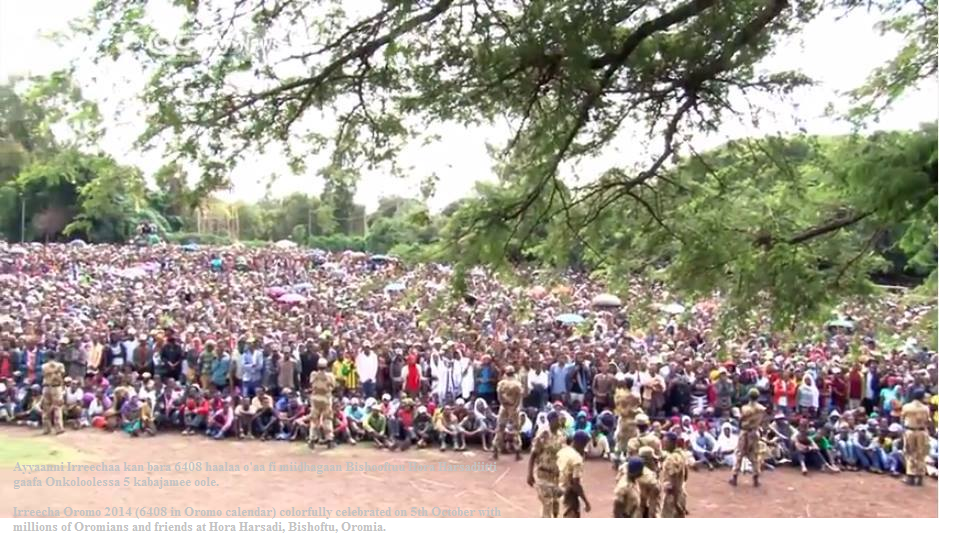
Irreecha (Irreessa) Birraa Oromoo kan Bara 2014 ((akka lakkoobsa Oromootti kan Bara 6408) akka gaariitti karooreffatamee, haala oo’aa fi bareedan kabajame. Here are some of live pictures, videos and reports refer to Irreecha Oromo Thanksgiving 2014 (6408 in Oromo Calendar) Season Global Events Planning and Celebration. The blessing event that started in mid August and celebrated successfully and colorfully through Birraa (September- October). Millions attended Hora Harsadi (Bishoftuu, Oromia) and Malkaa Ateetee (Buraayyuu, Oromia).
At Hora Harsadii


SBO Onkoloolessa 08 Bara 2014 Oduu – Qophii Ayyaana Irreechaa fi SBO Sagantaa Afaan Amaaraa
Irreecha (Oromo Thanksgiving) 2014: Colorfully celebrated in East Wallaggaa, Western Oromia, Naqamtee City, 16 November. This month’s Irreecha also known as Irreecha Yaadanno. Remembrance Irreechaa.
Sadaasa 16, 2014 Wallaggaa Naqamtee irratti gaggeeffame.
Irreechi barana Sadaasa 16/2014 Malkaa Araaraa irratti tahekan Wallaggaa Leeqaa Naqamtee irratti taasifame uummata lixa shagarii fi Wallaggaa magaalaa Naqamtee fi barattoota yuuniversitii fimanneen barnootaa garagaraa guutummaatti kan hirmaachiseedha. Waggoota tokko dura kan gaggeeffame baayinniuummataa kan baranaa dachaadhaan akka dabale uummata kumaatama hedduudhaanlakkaawaman hirmaachise jira.
Buufata malkaa kanatti Qeerroon sirboota qabsoo garagaadhageessisee jira, keessattuu dhaadannowwan:
– Qaroon oromoo ABO dha.
– Yaa oromo mirgakeef ka’ii falmadhu
– Nuti oromoodha, nuu haa beekani.
– Oromiyaan ni bilisoomti kan jedhuu fi sirbootniqabsoo hedduun uummata kakaasuu fi sirboota qabsoo qeerroodhaan sirbamankeessatti poolisoota kan hirmaachise uummata waliin sirboota Qeerroo irrattihirmaachuudhaan haala nama boonsuun kan gaggeeffameedha.
Akkuma olitti ibsuuf yaaleetti uummanni jiraattootni garashawaa lixaaa jiraatan hunduu ayyaana irreechaa malkaa Araaraa kana irratti kanargamaniidha. Irra caalatti barattoota yuuniversitii fi koollejjii akkasumamana barumsaa sadarkaa garagaraa magaalaa Naqamtee, Siree, Baakkoo fi kkf niinkan dhuunfatameedha. Sochii qeerroodhaangodhame keessatti humni waraanaa poolisoonni jiran hunduu uummata waliin haalahoo’aadhaan guyyaa kana kan kabajanii oolanii fi dhaadannoolee uummata oromoofwaamicha taasisu, uummata kakaasan irrattillee kan hirmaatanii jiraniidha, uummanni hunduu kan irreecha kana irratti argaman nageenyaan bahee guyyaakeessa sa’a 7:30 irratti gara qe’ee isaatti kan galeedha. Guyyaa irreechaMalkaa Araaraa kana ilaalchisee gabaasa dabalataa isiniin geenya, waraabbiiqabnuuf haala mijeessinee isiniin geenya, nu eeggattu!


Credits/Tags: Irreecha, Irreecha 2014, Qeerroo


http://finfinnetribune.com/Gadaa/2014/11/irreechi-malkaa-araaraa-wallaggaa-naqamte-irratti-kabajame/
Irreecha (Oromo Thanksgiving) 2014: Colorfully celebrated at Burraayyuu, Malkaa Ateetee, Oromia with millions of Oromians in attendance. 9th October 2014.
Ayyaannii Irreechaa Burraayyuu Malkaa Ateeteetti bakka uummaanni Oromoo miliyoonaan lakkaa’amu argamutti sirna ho’a ta’een kabajame. Uummaatni Oromoo godinaalee Oromiyaa fi magaaloota Finfinnee, Burraayyuu, Bishooftuu, Adaamaa, Sandaafaa, Laga Xaafoo Laga Daadhii, Sulultaa, Sabbataa, Walisoo, Hollotaa, Amboo, fi Neqamtee irra walitti dhufuun haala ajaa’ibsiisa ta’een Ayyaana Irreechaa Magaalaa Burraayyuu Malkaa Ateeteetti kabajachuun eenyummaa, Tokkummaa, Oromomummaa fi Sabboonummaa isaa jebeeffachuun diina afaan faajjessa olee jira. http://qeerroo.org/2014/10/10/ayyaannii-irreechaa-burraayyuu-malkaa-ateeteetti-bakka-uummaanni-oromoo-miliyoonaan-lakkaaamu-argamutti-sirna-hoa-taeen-kabajame/


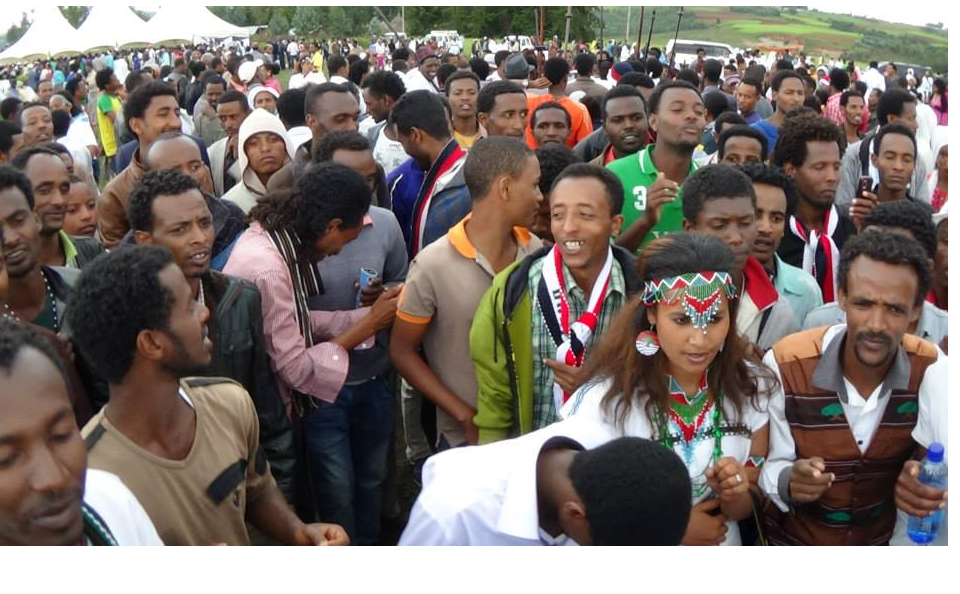

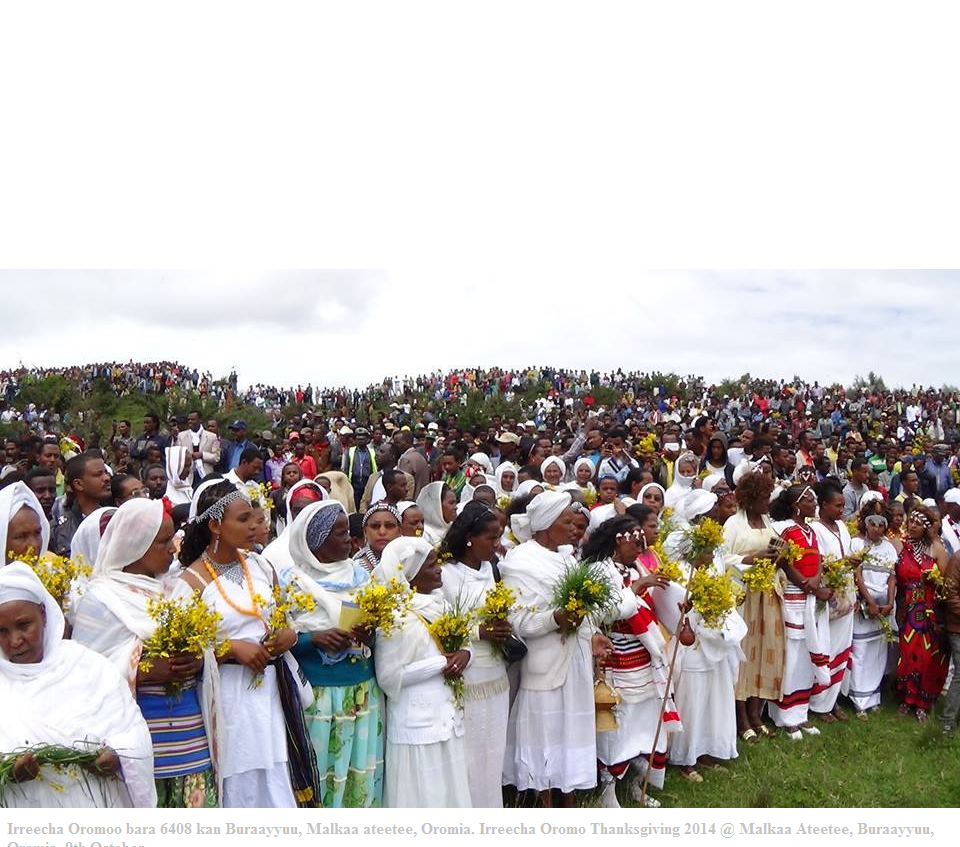
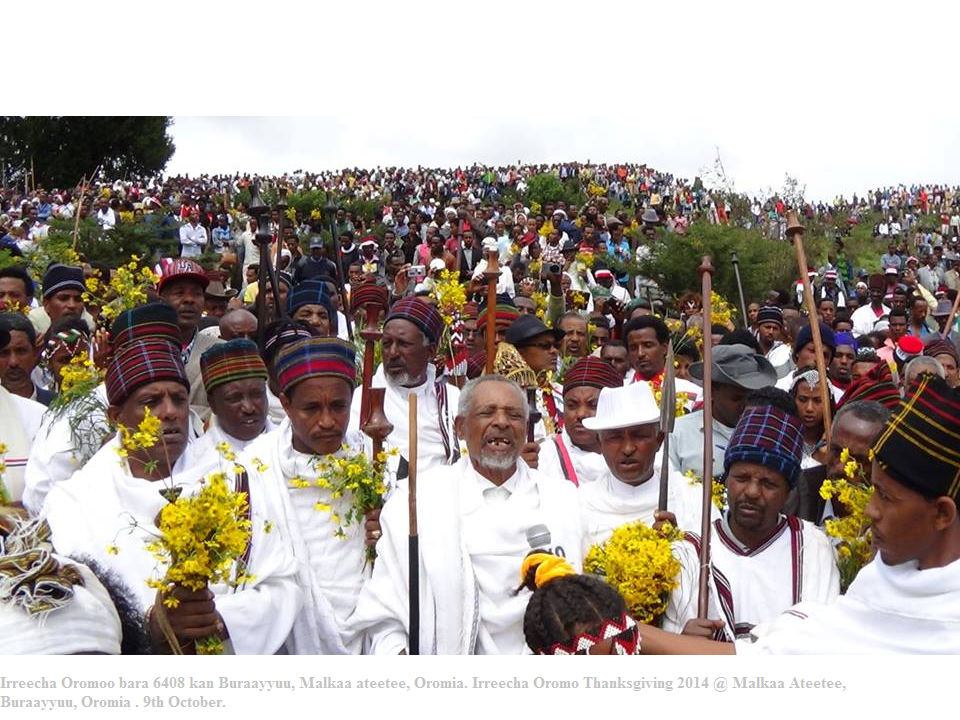




Irreecha (Oromo Thanksgiving) 2014: Colorfully celebrated at Bishoftu Oromia, Hora Harsadii with over 4 million in attendance. 5th October 2014.

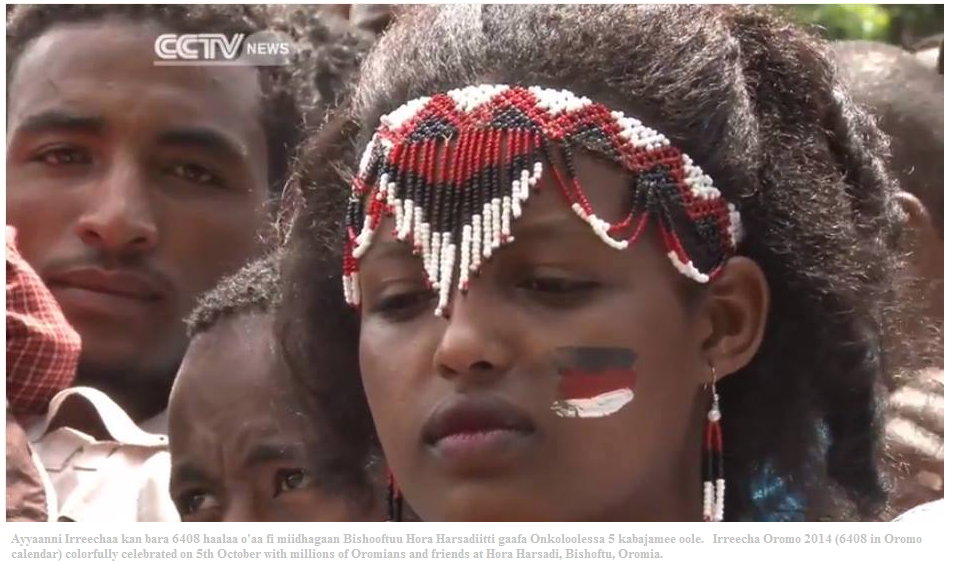

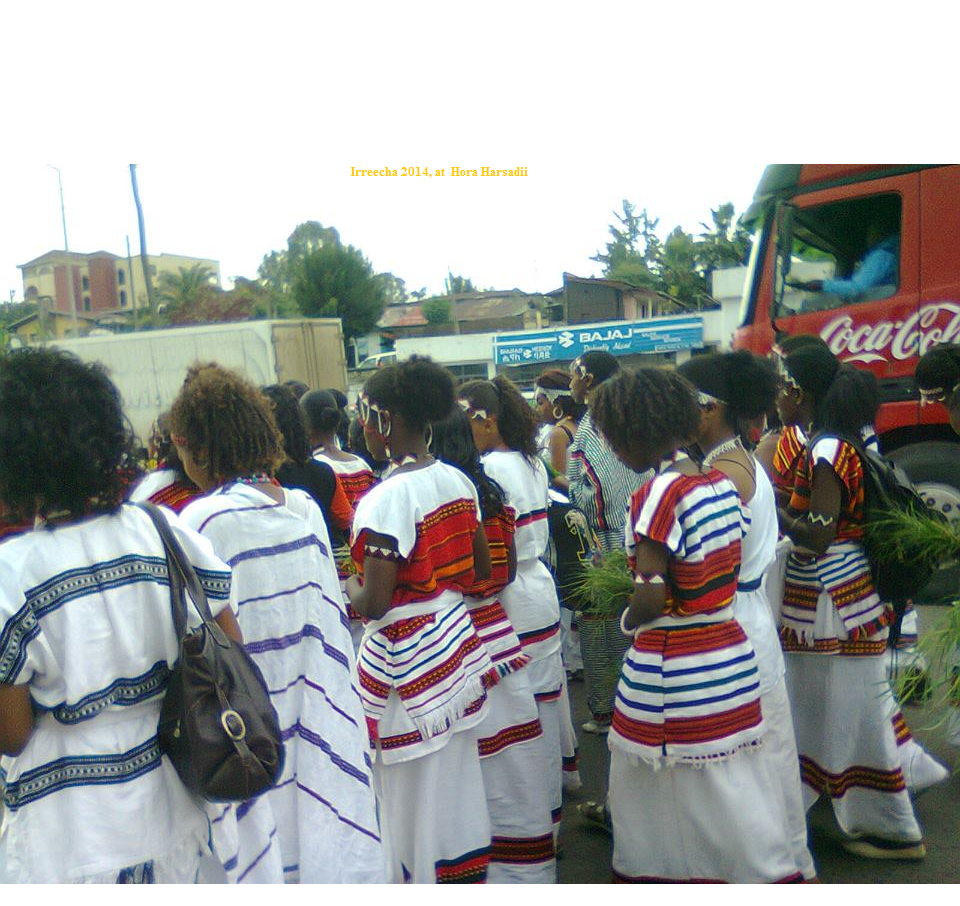
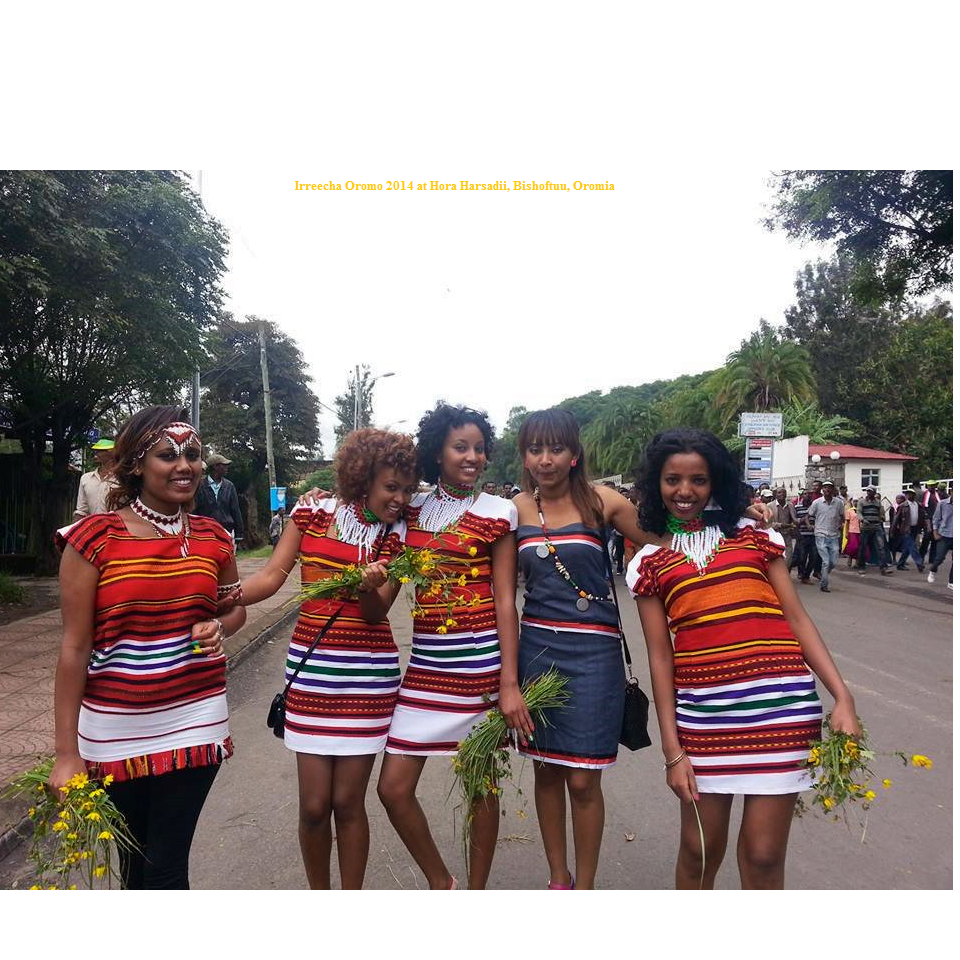
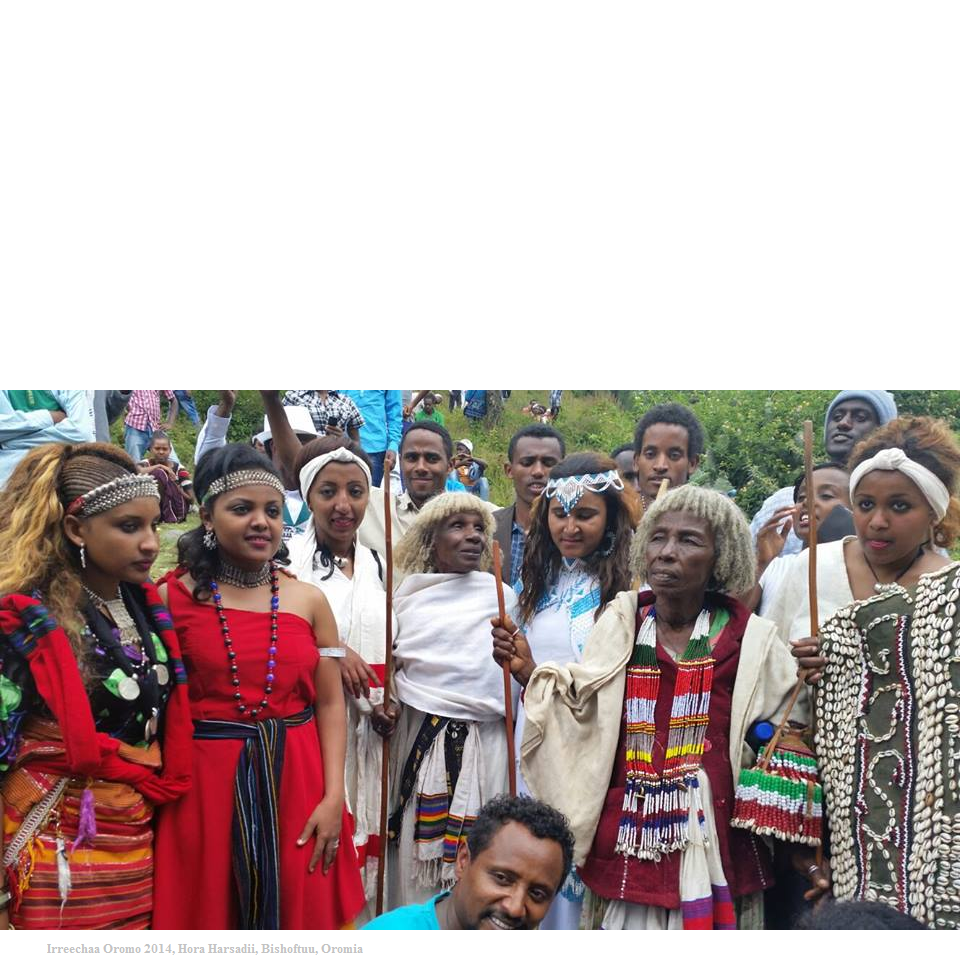


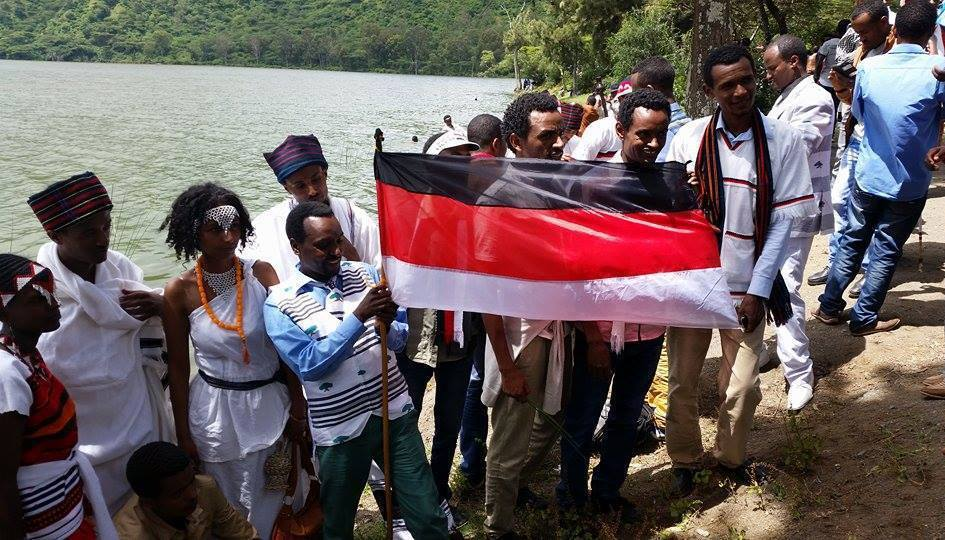

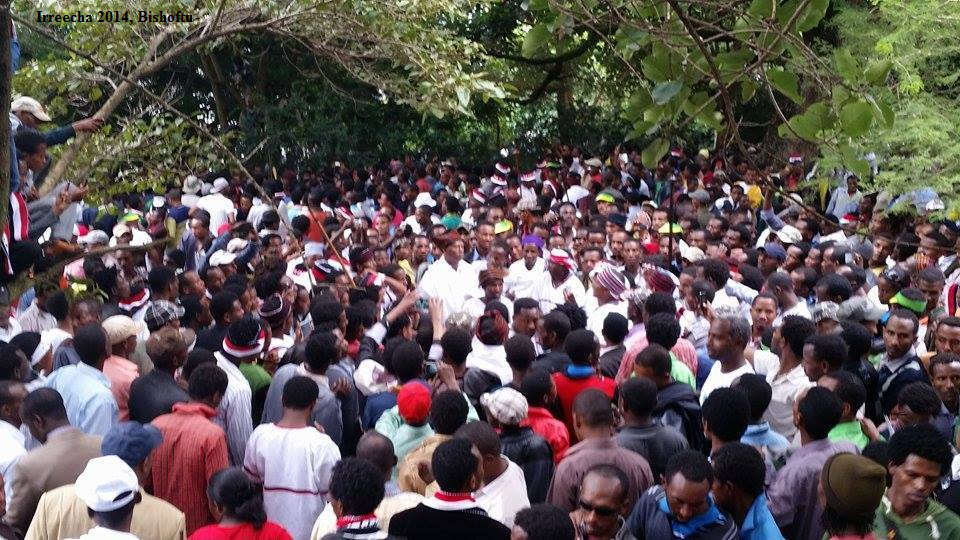
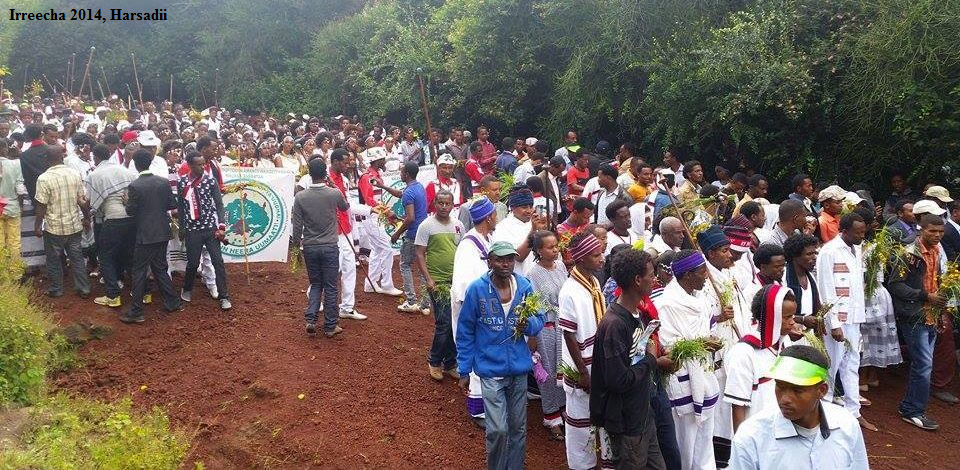

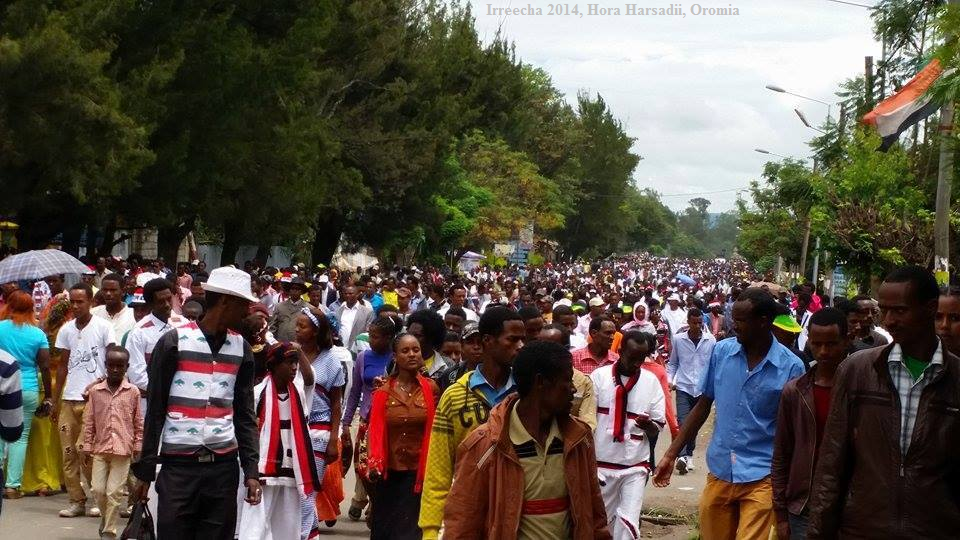
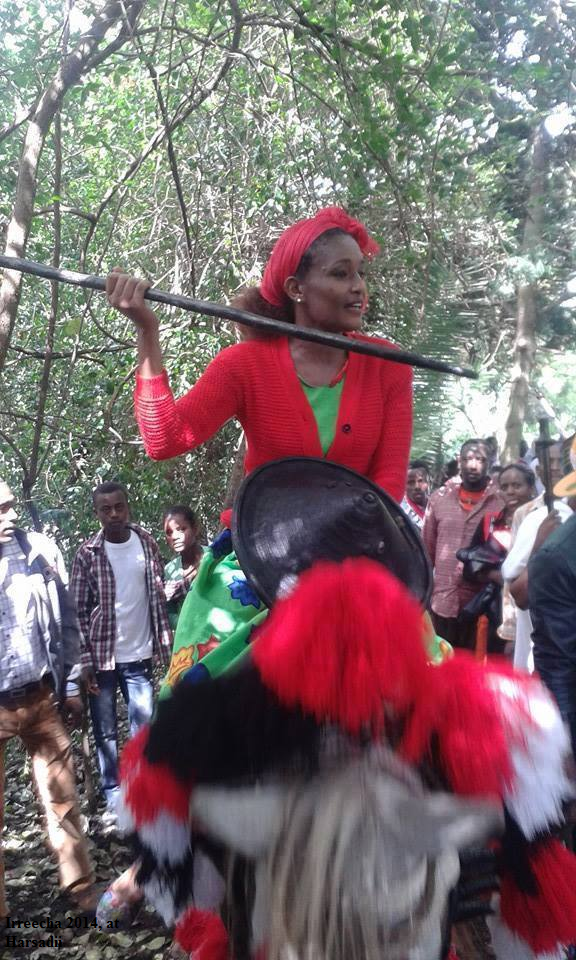
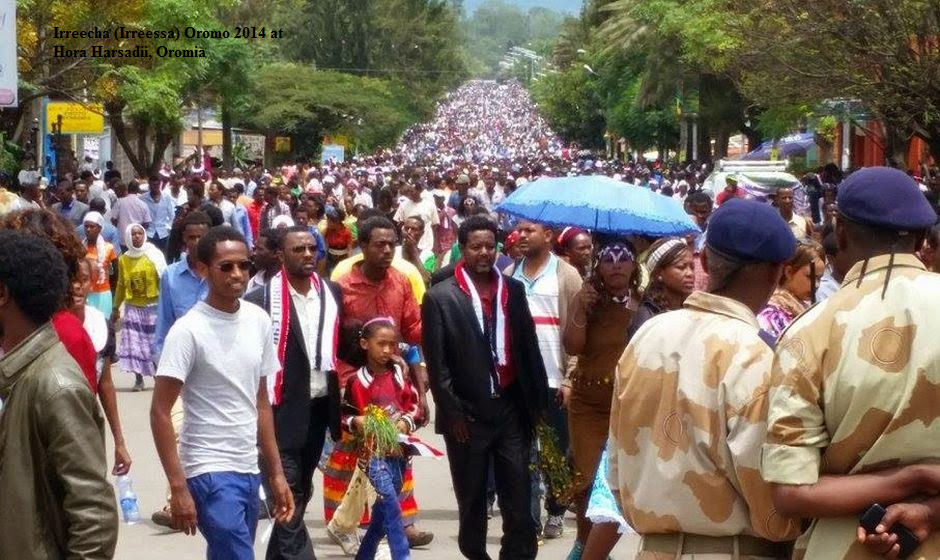
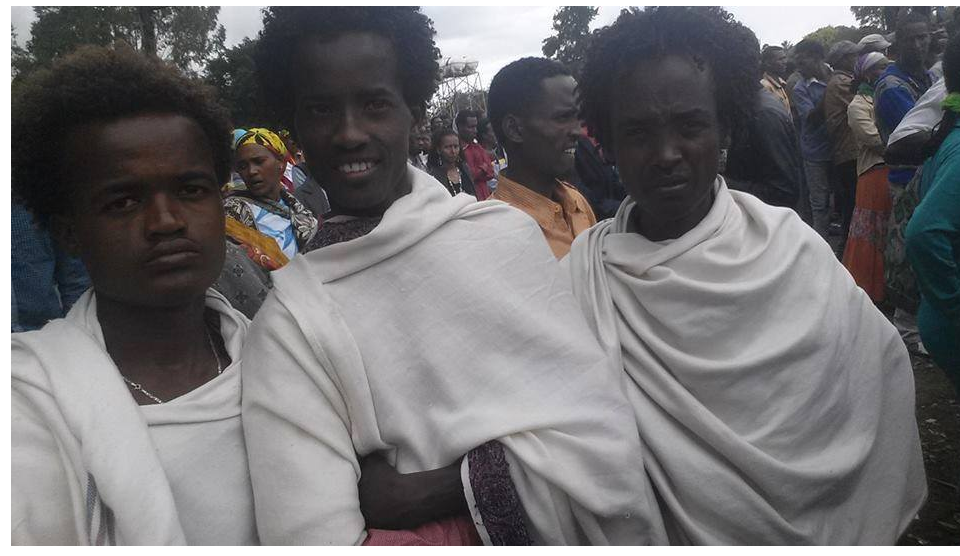
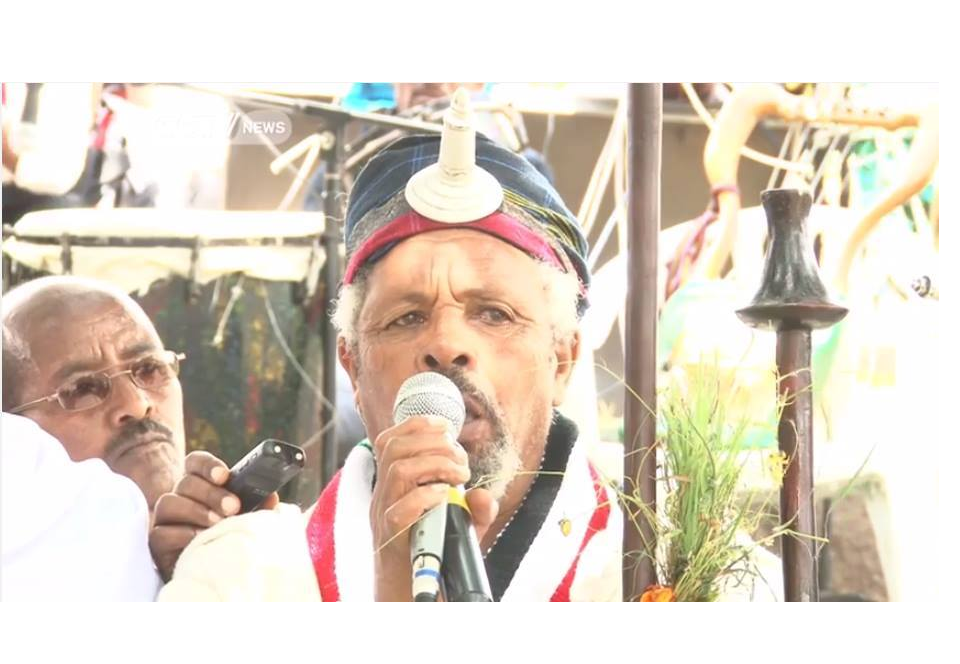


Irreecha (Oromo Thanksgiving) 2014: Colorfully celebrated at Bishoftu Oromia, Hora Harsadii with over 4 million in attendance. 5th October 2014


(OromoPress) – On Sunday October 5, 2014 an estimated 4 million people attended the annual Irreecha Festival at Hora Arasdi (lake) in Bishoftu town, located 47.9 kilometers southeast of the Oromo nation’s capital Finfinne (aka Addis Ababa). Although not conceptually, historically and purposively equivalent, people sometimes superficially use the word from the American holiday “Thanksgiving” to describe Irreecha Festival to expatriates. Oromo and friends of Oromo from across all religions and backgrounds converged to celebrate the transition from a gloomy (dukkana) rainy season to a bright (booqaa) Birraa (Spring season). The rainy season that runs for 3 months–June to August– is considered a harsh winter and is associated with darkness and separation from friends and families because of rivers swelling, (and also because of the lack of electricity). In contrast, Spring is considered a more pleasant season of festivity. Honestly, the tropical rainy season is not as a harsh a season as Winter as we know it in the northern hemisphere if you have the skills to swim and walk in and on waters.To say that Irreecha is a celebration of escaping a bad season, would be a gross oversimplification given the long and complex history of the Oromo indigenous African holiday practiced for thousands of years before the arrival of Abrahamic faiths in Oromia, Ethiopia and the Horn of Africa. Read more @http://oromopress.blogspot.co.uk/2014/10/irreecha-oromos-largest-african.html

Onkololeessaa 26, 2014 Ayyaanni Irreechaa Godina Jimmaatti sirna ho’aa ta’een kabajame! Uummatni Oromoo jalbultii ayyaana kana ilaalchisuun Onkololeessa 25/2014 irraa eegaluun godinaalee Oromiyaa gara dhihaa kanneen akka Godina Iluu abbaa Booraa, Godina kibba Lixa Shawaa, Shawaa Lixaa fi wallaggaa Bahaa irra gara Magaalaa Jimma seenan, jalbultiin Ayyaana kanaa haala akkam miidhagaa ta’een Malkaa Deeddeetti kan eegalame, Guyyaa kaleessaa Malkaa Booyyeetti haala akkam ajaa’ibsiisaa ta’een kabajame jira. Goototni barattootni Oromoo Yuunibarsiitii Jimmaa fi Saabboontootni hojjettootni fi barsiisotni Godina Jimmaa fi Yuunibarsiitii Jimmaa Ayyaana kana irratti argamuun haala akkam boonsaa ta’een Eenyummaa, Oromummaa ,sabboonummaa, fi tokkummaa uummata Oromoo jabeessuun Uummata Oromoo kuma kudha-shani (15,000) Olitti lakka’amuun kabajame jira.
Kabaja ayyaana Irreechaa Godina Jimmaa Malkaa Booyyeetti kabajame kana irratti dargaggootni Qeeerroon barattootni Oromoo Yuunibarsiitii Jimmaa gamtaadhaan argamuun walleewwaan warraaqsaa fi mootuummaa abbaa irree balaaleeffatan Sirbuun uummatni Oromoo eenyummaa, Oromummaa, Sabboonummaa fi bilisummaa isaa gonfachuuf yoom iyyuu rafee akka hin bullee fi tole jedhee halagaa fi abbootii irreef akka hin bitamne walleewwaan warraaqsaa kanaan uummataaf barnootaa fi ergaa guddaa dabarsa, walleewwaan warraaqsaa kanaaniis ABO fi Uummata Oromoo, Qabsoo bilisummaa Oromoo sodaa tokko malee faarsuun diina garaa gubaa oolaniru. walleewwaab Artisti kabajamaa fi Jaalatamaa Eebbisaa Addunyaa guutummaatti sirbaa Oolaan.
Mootummaan abbaa Irree Wayyaanee akkuma amala ayyaana irreecha kana danquu fi uummata sodaachisuuf humna poolisaa guddaa bobbaasuun guyyaa jalbultii Ayyaana kana irraa eegaluun Magaalaan Jimmaa eegamaa turte, tokkummaa Uummataa fi haala hedduminan uummatni Ayyaana kanaaf qophii gochaa jiru irraa ka’uun tajajila uummataa kanneen akka Ibsaa Eliktiriikii, Bishaan dhugaatii fi Network Magaalaa Jimmaa irraa balleessun uummata darara jiraachuun beekamee jira. kessumattuu Ayyaana kanaan walqabatee tajajillii bishaan dhugaatii, Ibsaa fi Network magaalaa Jimmaa irra baduun immoo yeroo amma kana haalan kan uummata dheekkamsiise ta’uun gabaafame.
Goototni Barattootni Yuunibarsiitii Jimmaa tajajillii bishanii, Ibsaa fi network uummata irraa dhaabbatee(citee waan jiruuf Mooraa yuunibarsiitii Jimmaa Main Campus keessa naanna’uun roottoowwaan bishaan itti kuufaman caccabsuun Mootummaan wayyaanee tajaajila hawwasuummaa uummata irraa kutuun uummata darara jiru nurraa ka’uu qaba jechuun halkan guutuu hanga poolisiin mooraa Yuunibarsiitii Jimmaa dhaabsiisuu dhadhabutti iyyaa bulan, Diddaa gootota barattoota Yuunibarsiitii Jimmaa kanatti Mootummaan Wayyaanee Yaaddoo ulfaata keessa seenuun humnoota basaasaa fi poolisaa bobbaasuun Yuunibarsiitiin Jimmaa eegamaa jira.


ONKOLOOLESSA 26/2014 “IRREECHA MALKA BOOYYEE”
 Ayyaanni irreechaa godina Jimmaa malkaa Booyyetti haala akkaan hoo’aa ta’een kabajamee oolee jira.Irreecha birraas ta’ee kan Arfaasaa biyya keessattii fi biyyoota alaattis waggaa waggaan akka irreeffatamu eenyu illee waan haaluu hin dandeenyedha. Haaluma kanaan ummanni oromoo magaalaa Jimmaa,naannawa ishii,akkasumas barattoonni oromoo yunivarsiitii Jimmaa kaampaasota garagaraa fi barattoonni kolleejjii barsiisota Jimmaa walitti dhufuun ayyaanicha jalabultii irraa jalqabuun bifa nama boonsuun kabajuu danda’anii jiru.Qeerroon yunivarsiitii Jimmaa fi kolleejjii barsiisota Jimmaa jiraattota magaalaa fi naannawa ishee waliin ta’uun jalabultii irreechaa dug-duuba kolleejjii barsiisota jimmaa malkaa doodee irratti bifa miidhagaa ta’een kabajanii jiru jedha gabaasni Qeerroo godina Jimmaa. Qeerroo fi sabboontonni oromoo kan yoomiyyuu diinaf gadi hin jenne sirboota fi waallewwan warraaqsan jibbaa fi tuffii diina isaanif qaban itti mul’isuun wayyaane fi ergamtoota wayyaanee daran rifaasisanii jiru.Qeerroo fi sabboontonni oromoo waalleewwan warraaqsaa akka armaan gadii kanatti kaasuun ijjannoo isaanii diinaf mul’isan:
1.Taaddee Birruu leenca boombin dadhabe har’a saaxiniin gadi qabe.
2.Yaa oromoo oromoo qulqulluu qonnee nyaannaa lafa hin gurgurru. 3.Boolloo xaddee Taaddasaa koo hin badde biyyoon galabaa miti wal-irraa hin xaragani.As irratti wanti hubatamuu qabu akka fakkeenyatti maqaan taaddasaa ka’e malee maqaan gootota oromoo osoo falmaa bilisummaa gaggeessanuu lubbuun isaanii wareegamte hedduun kaafamanii jiru.
Ayyaanni irreechaa godina Jimmaa malkaa Booyyetti haala akkaan hoo’aa ta’een kabajamee.
Irreecha (Oromo thanksgiving) 2014: Colorfully celebration in Nürnberg, Germany.18.10.2014
Kabajaa Ayyaana Irrechaa -2014 Celebration of Oromo Thanks giving (Irrechaa) in Nürnberg, Germany.18.10.2014
Ayyaana Irreecha yeroo jalqabaaf gaafa 18.10.2014tti magaala Nürnbergtti kan Kabajame ole yemmu ta’u Seena Ayyaanicha maal akka ta‘e fi akkasumas Ayyaanni kuni Ummata Oromoof maali isa jedhu ilaalchise Miseensa Qindessitoota Ayyaana Irreechaa Awurooppaa kan ta’aani Obbo Getaachoo Camadaa barumsa ball’aa kann kennan yemmu ta’u akkasumas gaaffi fi deebi hirmaattoottaff walin geggeffame jira.
Qophii kana irratti qophii sirna “Buuna Oromoo” shamarran Oromoo dhihessaniiru.
Obbo Getaachoon “Ayyaani kuni ayyaana jaalaa fi araaraati!” kan jedhan yemmu ta’u Oromoonni argamani hunda gammachuu guddaan sirba aadaa Oromoo walin sirba fi ragada kann olani sagantichi haala midhagaa ta’een xumurame jira.
Ayyaana Wagaa 50ffaa WMT fi Qophii Aadaa Oromoo Magaala Nürnbergitti haala midhagaa ta’een Kabajame
Nuernberg 27.09.2014
Qophii Ayyaana Waggaa 50ffaa Waldaa Maccaa-Tuulamaa (WMT) bakka kessummoota hedduu argamaniin magaala Nürnbergitti Akka aadaa Oromoo Ebbaa manguddootan baname.
Ittiaansuudhaan qophii Agarsiisaa aadaa Oromoo fi Sirbaale Oromoon kan dhihaate jiddu jidduttii immo dargaggoota Oromoo Obbo Muktar fi Obbo Ahimedin Walaloo Qabsoo Bilisummaa Oromoo faarsuu fi hamilee nama kakaasu dhihessaniiru.
Turtii boqonnaa fi Laaqana booda immo Waa’ee Waldaa Maccaa- Tulama barumsa Hawaasa Oromoo Berlin irra marsaa Skype dhaan kan kenname yemmu ta’u, Do’ii gabaabdu “Abbaa Caaltu” dargaggoo Oliyad Dinaolin qophaa’ee umataatti barsise fi bashannansiise jira.
Walumagalaatti kabajaa Ayyaana Waggaa 50ffaa WMT hirmaattoota fi Kessummotaaf walittidhufenya harawaa kan ume akkasumas sababni WMT bu‘urreffamef yaadachudhaan kaayyoo sanas hubachuudhaan Qabsoo Bilisummaa Oromoo ittifufudhaaf guyyaa waadaakenya kan ittin haaromsinu ta’u isaa wali galuudhaan milkiin xumurame jira.
Injifannoon Ummata Oromoof!
Tokkummaa Barattoota Oromoo Biyyaa Jarmanii-TBOJ
Irreecha (Oromo thanksgiving) 2014: Colorfully celebration in Tel Aviv, Israel, (Middle East)


Irreecha (Oromo thanksgiving) 2014: Colorfully celebration in Uganda (East Africa)
5th October 2014.
The Oromo people, the largest nation in Ethiopia, celebrate Irreecha, a festival of thanksgiving. Oromo communities spread out across the world perform rituals on this day around water sources to thank God for enduring the rainy season and ushering in the Spring season. The Oromo Community in Uganda held their celebrations at the Kabaka’s Lake in Lubaga on October 5, 2014. http://finfinnetribune.com/Gadaa/2014/10/ntv-uganda-report-oromo-community-in-uganda-celebrate-irreecha-festival/
NTV Uganda


Though lacking a big Oromo community in Groton, Connecticut, that didn’t deter the family of Gammachuu to hold the 2014 Irreecha (Oromo Thanksgiving) celebration; we hope to see a strong Oromo community in Connecticut next year following the Gammachuu’s lead.http://finfinnetribune.com/Gadaa/2014/10/a-beautiful-irreecha-celebration-in-groton-connecticut-it-takes-one-family-to-start-building-a-community/

Irreecha (Oromo thanksgiving) 2014: Colorfully celebration in South Africa.
5th October 2014.


Irreecha (Oromo thanksgiving) 2014: Colorfully celebration in Melbourne, Australia


Irreecha (Oromo thanksgiving) 2014: Colorfully celebration in Cairo, Egypt
5th September 2014.


Irreecha (Oromo Thanksgiving) 2014: Colorfully celebration in Atlanta, Georgia, USA
4th October 2014


Irreecha (Oromo Thanksgiving) 2014: Colorfully celebration in Holland.
4th October 2014


Irreecha (Oromo Thanksgiving) 2014: Colorfully celebration in Boston, MA, USA
28 September 2014


Irreecha (Oromo thanksgiving) 2014: Colorfully celebration in Los Angeles, California
27 September 2014

Hawaasni Oromoo Magaalaa Los angeles fi San Diego Ayyaanaa Biyyoolessa Oromoo, IRREECHA, Birraa 27, 2014 haala hoo’an kabajaanni oolan. Sirni ayyaaneeffanaa sa’aa 11:00WD qabee hanga sa’aa 6:00WB gageeffame kun seeraan banamee, eebbaa manguddootiin itti fufee, aadaa irreechaatiin Waaqaa faarffachaa fi gammachuudhaan sirbaa iddoo haroo adeemudhaan erga irreeffatamee booddaa haaluma walfakkaataan iddoo qophiitti deebi’ame sirbaa fi mariin xumurameera. ‘Barrii baranaa kan hegereetiin Isin ha gahu!’


4th October 2014
Irreecha (Oromo thanksgiving) 2014: Colorfully celebration in Leeds, UK.
27 September 2014


Irreecha (Oromo thanksgiving) 2014: Colorfully celebration in Ohio.
28th September 2014.


Irreecha( Oromo thanksgiving) 2014: Colorfully celebration in Seattle with Oromiya and Caffee Tuulamaa Abbaa Gadaa- Bayanaa Sanbatoo, 28th September 2014


27th September 2014
At the Hururssaa, Name-Recognizing or Name-Giving Ceremony, held in conjunction with the 2014 Washington-DC’s Irreecha celebration, author Tasfaayee Gabra-aab has become “Gadaa” Gabra-aab; watch the ceremony below (video by OPride.com). Hururssaa is one of the rich traditions of the Oromo nation.
Author Tasfaayee Gabra-aab Becoming Gadaa Gabra-aab at DC’s Hururssaa Ceremony (Photo: @OromoPress)


28th September 2014


27th September 2014
Speeches by International Oromo Youth Assocation’s (IOYA) Leaders Amanee Badhaasoo & Sinqee Wesho
27th September 2014
Source: Oromiatimes.Org (http://oromiatimes.org/2014/10/03/dhufaa-jira-coming-soon/)


27th September 2014


Irreecha @Buraayyuu, 2013

Oromians in Sweden Celebrated Irreecha in Stockholm on 13th September 2014
Ayyaanni Irreessaa/irreechaa Sweden magaalaa Stockholmitti Fulbaana 13, 2014 Haala bareedan ayyaaneffatame

Ayyaanni Irreessa/irreecha Sweden magaalaa Stockholmitti Fulbaana 13, 2014 ayyaaneffatame (suuraa kanaan olii ilaalaa, see the above pictures of Irreecha celebration in Stockholm )

Ayyaanni Irreessaa/irreechaa Sweden magaalaa Stockholmitti Fulbaana 13, 2014 ayyaaneffatame


Ayyaanni Irreessaa/irreechaa Sweden magaalaa Stockholmitti Fulbaana 13, 2014 ayyaaneffatame ( Suuraa kanaa olii ilaalaa, Irreecha celebration @ Stockholm pictures).


Irreecha celebration: Toronto,Canada 31 August 2014

We are pleased to inform you that he is finally able come to the United States. OSA has extended its theme focusing on Gada democracy through the end of the year and Abba Gada Bayana speak at a series of OSA-organized workshops in various cities in Unite Stated from September 6-27, focusing on the ongoing work of reviving the Gadaa system.
He will also participate as a guest of honor at several Irreecha celebrations organized by Oromo in the Diaspora.
We invite all who are interested in the Gadaa democratic system and Oromo culture in general to attend these workshops and participate in spectacular Irrechaa celebrations to be held throughout September and October 2014.
We would like to extend our appreciation to local individuals and institutions who participated in preparing these events. We are also grateful to the United States Consular Service for the assistance they provided in issuing Abbaa Gadaa Bayana’s travel documents.
The attached flyer contains general information about dates and cities where Abbaa Gadaa Bayana will be speaking.
Jawar Mohammed
President, Oromo Studies Association
According to the Oromo culture writer, Ob. Anga’a Dhugumaa, the preparation for the spring Oromo holiday of Irreecha/Gubaa, which celebrates the transition from the rainy season to the bright season by giving Thanks to Waaqa, begins in mid-August, and mid-August is only a couple of weeks away from today; the mid-August celebration is calledTaaboree or Muka Dhaabaa.
Here is a quote from Ob. Anga’a Dhugumaa article on Gubaa/Irreecha:
“In the middle of August, a tall olive tree (Ejersa – Olea Africana) is cut, and all its branches removed except at its top. It is then erected (horduu, dhaabuu) on ground as a pole. The species of this tree has to be olive. Olive trees (Ejersa) are considered as holy trees among the Oromo. Its smoke is very sweet. Erecting such a tree at the peak of the rainy season symbolizes a wish for the Earth to get firm. It is a peak time for the ground to get wet or saturated with rainwater, and is too weak to stand heavy rain. This day, which is called Taaboreeor Muka Dhaabaa, is observed by the youth only.
“The final gigantic celebration takes place exactly five weeks later from this day. The five weeks are refereed to as the ‘five-finger rules’. One finger is equivalent to one week.” (Read more here: http://goo.gl/kGdVBD)
With that, Toronto is once again ready to hold the first Irreecha celebration, which will be held in Whitby, Canada, on August 31, 2014.


Misensoota TBOJ fi Oromoo Biyyaa Jarmanii
Ayyaanni Irreechaa Gaafa 18.10.2014tti
Iddoo: Am Pegnitzwiese, Unter Jansenbrücke, 91207 Nürnbergtti
Sa’a: 13:00 irraa kaase akka Walin kabjanu kabajaan isinni affeerra.
Aadaakenya Eenyummaakenya!
Ulfaadhaa
UOSE-Germany
Hunda Dura Baga Nagaan Ayyaana Irreecha Bara Kanaan Isin Gahe!

Ilmaan oromoo hundi jila duudhaa ganama kan ta’e, Aadaa Oromoo kana biyyaa keessaa fi alaa bakka jiran hundatti walitti dhufanii kabajata turan ittis jiru. Nutis Oromoonni biyyaa New Zealand magala Wellington keesa jirru bakka tokkotti walitti dhufnee guyyaa seena- qabeessa kana akka waliin kabajane oolluf waamicha guddaa isiniif goona.
Guyyaan isaa Onkoloolessa 12/10/2014 sa’aa1.00pm iratti oggaaa tahu, bakki: Otari Wilton Park, Wilton, Wellington (address: 160 Wilton Road)
Gaafa kana galgala isaa sagantaa qophii bashannanaa waan qabaannuuf jecha hundi keessan waareen booda sa’aa 4:pm irratti argamtanii nu Waliin akka bashanantan kabajaan isin afeerra.
Bakki isaa: Newtown Hall
HUBACHIISA: Guyyaa kana uffata Aadaa qabdan uffattanii maatii keessan waliin akka dhuftani siin yaadachiisna.
Gadaan roobaa fi gabbina!
Gubaa, Daaraa Gabanna fi Irreecha 2014, Atlanta, Georgia, Onkoloolessa 3-4, 2014


Irreechi Switzerland kan bara 2014 Guyyaa 27.09.2014 Hora Ouchy, magaalaa Lausanne tti kabajama. Koottaa, hirmaadhaa! Aadaa keenya haa guddifnu! Oromummaa bakka jirru hunda tti haa jabeessinu! Aadaa keenya ijoollee keenya kan hegeree Oromoo fi Oromiyaa ta’an fi firoota Oromoo haa barsiifannu!

Akkam jirtu Oromoo Boston?
ODA Boston waggaa waggaadhaan laga Charles River, Cambridge kessatti argaamu irrati guyyaa Irreecha kabajaa turuun isaa ni yadatama. Haaluma Kanaan bara kanas gaafa guyyaa Fulbaana ykn September 28/2014 sa’ati 12:00pm irrati kabajuuf qophii irra jiraachu isaa gamachuudhan isin beekisisaa, akka irrati argamtan kabajaan isiin hafeerra.
Galatoomaa!
Koree ODA Boston
Plan of Event: Ayyaana Irreecha , Oromo Thanksgiving in Cairo, Egypt – on October 5, 2014


BEEKSISA:
Oromoota magaalaa Nairobi fi naannawa isii jiraatan maraaf
DHIMMA: Ayyaana Irreechaa fi Hulluuqqoo, 2014
Ilmaan Oromoo hundi baga ganna bacaqii irraa gara booqaa birraatti nagayaan ceetan jechaa, ayyaanni Irreechaa fi Hulluuqqoo magaalaa Nairobitti Fulbaana 28, 2014 waan kabajamuuf, maatii fi hiriyyoota keessan wajjiin akka irratti hirmaattan kabajaan isin affeerra.
Bakka (Venue): Nairobi City Park
Yeroo: Ganama 8:00AM – 2:00PM
Ayyaana Irreechaa fi Hulluuqqoo sababeeffachuun barnootni:
~ aadaa fi argaa-dhageettii,
~ maalummaa Irreechaa fi Hulluuqqoo,
~ Seenaa fi amantii Oromoo ni kennama. Kana malees sagantaa nyaata aadaa Oromoo fi qophii bashannanaa waan qabnuuf ammas irra deebinee dhiyaadhaa isiniin jenna.
Odeeffannoo dabalataaf ammo karuma fuula facebook’n nu qunnamaa!
Koree Aadaa fi Argaa Dhageettii Oromoo, Nairobi

Guyyaan Fulbaana (September) 27, 2014
Yeroo (Time) 10:00 Am Irra Eegale (start)
Iddo: Hourlack Park (Heritage) kessatti Ayyaana Irreecha waan kabajjamuuf ummata Oromoo marratti akka dhamissa nu dabarrisiitaan kabajjaan isiin gaffana korree Ayyaana Irreecha magala Edmontonni, Kaanaaddaa (Canada)
Oromo Thanksgiving Day Celebration – September 27, 2014
Time: 10:00am start
Oddeffaano (Information call)
1) Nasser 7803945478
2) Amare 5879207786
Irreechi Irree uummata Oromootti!


Ayyaanni Irreecha bara 2014 Fulbaana 27 magaala Los Anjeles keessatti kabajaamuuf qophiin itti fufeera. Lammiiwwan Oromoo fi firoonni Oromiyaa Kaaliforniyaa fi Godina Ollaa keessa jiratan hundinuu koottaa waliin haa Irreeffannuu!
Qophiin sa’aa 11:00 WD jalqaba.
Bakkeen Qophii:
Kenneth Hahn State Recreation Area
4100 S. La Cienega Blvd
Los Angeles, CA – 90056
———————
The Oromo Thanksgiving Day will be celebrated on September 27, 2014. All Oromo citizens and friends of the Oromo nation cordially invited. Please join us on our highly celebrated Holiday.
Program begins at 11:00am
Location:
Kenneth Hahn State Recreation Area
Los Angeles, CA – 90056
Odeefatnoof:
951-400-3998, 951-488-8188, 951-316-4688, 213-985-6086

Ayyaana Irreecha | Oromo Thanksgiving in Helsinki, Finland – on October 4, 2014
Event Details:
Date: 4th of October 2014
Time: from 12:00 to 5:00
Place: Kivikonkaari 11, Kivenkolo, Helsinki, Finland
Transport: Take Metro from Helsinki Railway Station to Kontula; From Kontula, take Bus 78. It is about 5 minutes.
Ayyaana Irreecha | Oromo Thanksgiving in Denver, Colorado – Sept. 27, 2014

Waamicha Kabajaa Ayyaana Irreecha kan Bara 2014 Biyya Jarmanii keessatti qophaa’ee: Koree Qindeesitu Ayyaana Irreeschaa irraa Ilmaan Oromoo Biyya Jarmanii keessa jiraatan Maraaf – Frankfurt am Main, Germany
Kabajammo Ilmaan Oromoo,
hundaa duraan dursee nagaan rabii isin haagahu. Ashamaa ilmaan Oromoo kann biyya Jarmanii keessa jiraattan; obboleewwan keenya dhiira fi dubartiin, baga ayyaana Irreecha bara haaraa 2014 walumaan jala geenye. Ayaanni Irreecha jila (festival) waga/bara haaraatti cee’uumsaatti.
Ayyaanni Irreecha kan bara haaraa 2014 biyya Jarmaniitti kutaa magaalaa Frankfurt am Main “Bockenheim” (im Stadtteil Bockenheim) jedhamu keessatti Fulbaana (September) 20, 2014 kabajamuuf qophiin Koree Qindeessituu Ayyaana Irreescha xumuramee jira. Kanaaf Oromoon biyya Jarmanii keessa jiraatan kabajaa ayyaana Ireechaa kan bara 2014 irratti argamtannii waliin akka kabajnu ulfina guddaan isin afeerra.
Ayyaanni Irreecha kan bara haaraa 2014 Fullbaana (September) 20, 2014, guyya sambata xiqqaa(Saturday), sa’a 12:30 WB (PM) irra eegalee hanga (hama) sa’attii 18:00 WB (PM) Paarkii (iddoo namni itti haara galfatu) “Rebstockpark” jedhamu keessatti cinaa (bukkee) haroo (Weiher im Rebstockpark = Pond in Rebstockpark) ti kabajama.
Ayyaanni Irreecha guyyaa ilmaan Oromoo akka sabaatti heddomminaan walarganii dhimma har’a itti jiran waliif himan, waan hegeree immoo waliin qindeeffaatan, guyyaa waloomaa (day of joint action) Oromoo ti. Heddomminaan bahanii ayyaana Irreecha irratti aadaa fi duudhaa/jifuu (culture and tradition) ofii agarsisuunis mallattoo sabboonummaa saba Oromoo ti. Aadaa kana guddisuu fi muldhisuun eenyummaa Oromoo guddisuudha.
Ayyaanni Irreecha kan bara 2013 kan yeroo kamuu caala biyya keessaa fi alatti sirna ho’aa fi hamilee guddaan akka kabajame, odeeffannoo fi gabaasa bakka gara garaa irraa argaa fi dhagahaa jirra. Kun kan muldhisu, ayyaanni Irreecha guddina aadaa fi duudhaa/jifuu, akkasumas eenyummaa fi tokkummaa saba Oromoof utubaa ta’uu nu hubachiisa.
Koree Qindeesitu Ayyaana Irreescha akka waliin taanee ayyaaneefannu, irraa debi’ee gammachuudhaan waamicha Oromummaa kabajaan isiniif dhiyeessa.
Namoota odeeffannoo dabalataa feetanif, Koree Qindeesitu Ayyaana Irreescha waliin qunnamtii godhaa!
Namoota Koree Qindeesitu Ayyaana Irreescha irra odeeffannoo (information)dabalataa feetanif lakkoofsa bilbila (telefoona) kanatti bilbilsaa:
lakko.bil.:
+4917853498098
+4917680018430
+4915212252957
Ayyaanni Irreessaa yeroo duraatif Magaalaa “Frankfurt am Main” jedhamu keessatti guyyaa gaafa Fulbaana 20, 2014 qophaa’ee:
Sa’aatii/Time: 12:30 WB (PM) ‐ 18:00 WB (PM)
Iddoo/Place: Paarkii “Rebstockpark” jedhamu keessatti (im Rebstockpark), cinaa (bukkee) haroo (Weiher im Rebstockpark = Pond in Rebstockpark)
Daandi (kara)/Street: Am Römerhof, Max‐Pruss‐Straße
Geejiba/Transport: Baabura (tram) lakoofsa 17 (Straßenbahnlinie 17 vom Hauptbahnhof Frankfurt am Main bis zur Endehaltestelle “Rebstockbad”)


Address: 213 Camrose Court, Gahanna, OH


Address: 213 Camrose Court, Gahanna, OH
Mark your calendar; this year’s Irreecha celebration will be held in the city of Leeds, the UK, on Sept. 27, 2014. All Oromos and friends of the Oromo in the UK are invited.
Plan of Event: Ayyaana Irreecha , Oromo Thanksgiving on Onkoloolessa/October4, 2014- Perth, Australia
Baga bacaqii Gannaa nagaan baatanii Booqaa Birraa argitan jechaa, Eenyummaa fi Aadaa ofii yoo abbaan duukaa bu’ee hin kununisifatiin alagaan ishuma hafte iyyuu balleessuuf duubatti hin jedhu waan ta’eef IRREECHA bara kanaa / 2014 sirnna hoo’aan kabajachuuf Oromoonni dhuunfaan sagantaa kana irratti hojjataa jiru. Ammoo dhimma kana fiixaan baasuuf hirmannaan Hawaasa Oromoo Magaalaa Perth murteessaa dha.
Waan kana ta’eef jecha Oromoonni Magaalaa Perth jirraattan hundi ayyaana IRREECHAA kana irratti hafeeramtaniirtu.
Koottaa / dhyaadhaa waliin gammannaa!
Yoom:-
Gaafa 05/10/2014
Guyyaa Dilbataa
Bakka:- Burswood Park, Burswood
Yeroo:- Sa’aatii 11:00 AM irraa eegalee
Hubachiisa:-
Oromoo fi Firottan Oromoo UK Maraaf,
Hawaasni Oromoo UK kessa jiraatu guyyaa Irreecha galata kennan bara 2014 Fulbaana 27, 2014 Magaala Londonitti ayyaneffata. Kanaf, guyyaa Oromon tokkummadhan uumaa galata galchatu kana irratti argamtani akka gammaddan Hawaasni Oromoo UK kabajaan isin aferra. Nyatnii fi dhugaatin gatii bayyessan ni jira.
Kottaa aadaa fi muziqaa Oromoo dhandhamadhaa!
Sagantaa:
A. Sagantaa Irreffachuu: 11:00wd-2:00
Bakka: Hampsted Heath Park Staff Yard, Parliament Hill Fields, High-gate Road, London NW5 1QR
Gejjiba: Atobusii: C2, C11, 214
Baabura: Bufata baaburaa Gospel Oak
Konkolaataa dhabuf sa’ati 2f £2.50 basisa
B. Yeroo gammachuu fi hawaasessuu – 3.00wb-10.30gg
Bakka: Whittington Park Community Centre, Yerbury Road, London N19 4RS
Gejjiba: Atobusii C11 gara bufata baaburaa Archway, 17, 43, 263, 271 (gara bufata baaburaa Upper Holloway Road)
Baabura: Bufata baaburaa Archway
Bufata baaburaa: Upper Holloway Road
Koree Hojii Geggessituu Hawaasa Oromoo UK

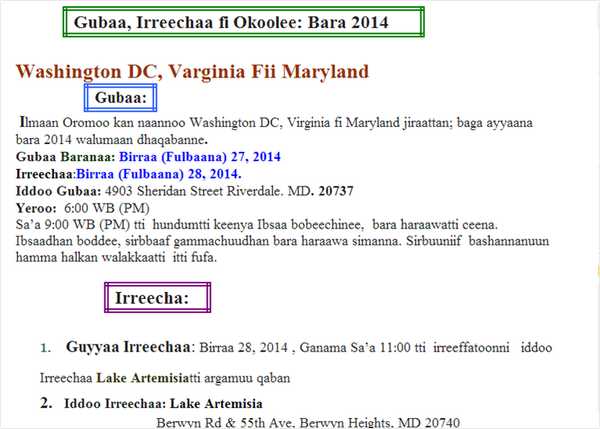

Waaqa Nu Uume Galateeffachuun ni Irreeffanna!
Aadaa Keenya ni Dagaagsina!
Ayyaanni Irreecha Minnesota (Magaalawwan Lakku) keessatti Minneapolisi Hora ykn Lake Nokomositti kabajamuuf deemaa jira.
Ayyaanni irreecha kan bara 2014 Fulbaana 27 bara 2014 ganama sa’aa 10:00 irraa jalqabee kabajama. Oromoo fi Firoottan Oromoo hundumtuu akka ayyaana kanarratti argamtanii waliin Irreeffannu koreen qindeesituu ayyaana Irreecha kabajaa fi ulfina guddaan isin affereera.
Bakki isaa:
Hora (Lake Nokomis)
5001 Lake Nokomis Pkwy W.
Minneaplois, MN 55417
Info:
Tel:
– Awash Nagawoo: 612-227-0712
– Biqilaa Deettii: 612-701-9834


“… birraan barihee dukkana nurra arihee
Ballammi haami jennaan haamee dhufe kuno
lammii kee waami jennaan waamedhufe kuno …” Sirba Oromoo
Ayyaana Irreecha kan baranaa Fulbaana(September) 27 bara 2014biyyaa Norway, magaalaa Oslo, bakka hora Sognsvann jedhamutti waaree dura sa’ati 11:30 irraa eegalee kabajama. Ilmaan Oromoo kannen dhihoo fi fagoo jiraattan hundi jila dudhaa ganamaa kana irratti uffata aadaatiin of miidhagsitanii akka ayyaana kana irratti hirmaattan kabajaa guddaa wajjiin sin afeerra. Malkaa jilaa dhufuudhaaf, baabura lafa jalaa (Metro) laakkofsa3 (Sognsvann) gara kallattii lixaa deemu (westbound) yaabbadhaa; buufatni isaa kan maayyii Sognsvann suduudaan isin fida.
Erga qophiin Irreecha raawwatee booda qophii bashannanaa sa’aa 18:00 irraa eegalee qabna. Halkan guutuu waliin taphataa bulla.
Bakki qophiin bohaarsaa itti dhihaatu:
Simia-venner
Kristoffer Robins Vei 2 (Smedstua)
0978 Oslo
Bakka kana dhufuuf, magaala /Oslo S irraa baabura gara Lillestrøm deemuu qabattanii bakka Haugenstuastasjon jedhutti irraa bu’uun bakka Smedstua jedhu yoo iyyaafattani salphaatti achi geessu. Ykn Stovner Senter irraa bus 65 yoo qabattanii bakka Smedstua jedhutti irraa buutani, bakki qophichaa cinaadhuma sanatti argama.
Odeessii dabalataa yoo barbaaddan yookiin gaaffii yoo qabaattan bilbila harkaa laakkofsa
+47 951 88 081 / + 47 97964087 / irreechaa@gmail.com nuu qunnamaa.
Ana haadhufu!
Gadaan roobaa fi gabbina!
Koree Qindeessituu

Darabaa herding, as practiced in the Daraa district of the North Shawaa Zone in Oromiyaa, involves the migratory herding of cattle in the backwoods of River Mormor (the Blue Nile) valley during the rainy season, when the ground in the village areas becomes too muddy for herding. As the rainy season winds down, and the herders and the cattle return home, the community celebrates the coming of the new season by thankingWaaqaa (God) as part of the Irreecha festival. http://gadaa.net/FinfinneTribune/2014/08/welcoming-the-new-season-and-the-culture-of-darabaa-herding-migratory-herding-in-the-backwoods-among-the-oromo-in-daraa-oromiyaa/
Gubaa/Ibsaa
—————–
Ayyaana Gubaa jechuun dukkanaafi booruu gannaa oofkalanii gara ifa ykn booqaa birraatti ce’uuf sirna gaggeeffamuudha. Akkasumas, mallattoo Waaqa galateeffannaas ni jedhama. Sababni isaa, booruu gannaa, lolaafi bubbee hamaa, bakakkaa, galaanaafi kkf nagaan oofkalanii ifa birraatti waan bahaniif gammachuu ofii ibsachuun Waaqa galateeffatu. Firoonnis walitti dhufanii wal gaafachuu calqabu, “Baga booruu gannaa oofkaltee booqaa birraatti baate” waliin jechuu eegalu.
Ayyaanni Gubaa kun ummata Oromoo biratti kabajaafi jaalala guddaa qaba. Dubartootas ta’ee dhiironni dursanii qophii adda addaa taasisu. Dhiironni osoo guyyaan Gubaa hin ga’in mukeen akka Sukaayee, Sokorruu, Qamaxxee, Tamsaasa, maxaaxee, daalachoo, dhangaggoo fi kkf ciranii goggogsuun gaafa gubaan dhiyaate Xomboora hidhu. Kunis baay’ina dhiirotaatin qophaa’a.
Guyyaa gaafa Xomboora gubanii muka dhaabaa(‘Daamaraa’)f ta’u kanneen akka Abbayyii, Hindhee, Soolee, Ejersa, Ceekaa, Daalachoo, Urgeessaa fi kkf qopheessanii dhaabu. Guyyaa kana mukti jabaaf ta’u kan akka Laaftofii Diddiksaa fa’a ni qophaa’u.
Haala kanaan Ayyaanni Gubaa Oromoo walakeessa baatii Hagayyaa keessa gubama. Ibsaan Oromoo gaafa Hagayya 15 galgala yoo ta’u, Hagayya 16 daaraa guddaa jedhama.. Akka Oromoon dhugeefatutti guyyaa kana Waaqni sibiila lafatti gadi darbata jedhama. Guyyaa kana irraa kaasee lafti jabaachaa adeema, lagni ni hir’ata, firris wal gaafii eegala. Guyyaa gaafa ibsaa kana horiin haalan marga quufanii yeroon galfamu, fardeen yaabbii dhiqanii haalan kunuunsu. Galgala erga horiin hundi galanii booda namoonni mijirii(‘Abdaarii’) tokkotti ibsaa waliin guban marti isaanii walitti yaa’anii iddoo mijirii kanatti wal ga’u. Akkaataa angafaa quxusuu isaanitti Waaqa kadhachuun boolla muka dhaabaa dongoru. Yeroo dongoran kanas “Hamaa keenya dongori” jechaa Waaqa kadhachaa dongoru.
Kadhannaan isaanis:
Ibsaan kun ibsaa nagaa nuuf haa ta’u
Ibsaa quufafi gabbinaa haa ta’uu
Booruu gannaa nu oofkalchee
Booqaa birraas nu haa oofkalchu
Wal bira oolchee nu haa bulchu
……
Abbaa biyyaa biyyarra haa bulchu
Barri quufa; Gadaan gabbina
Gabbis Waaqi…jechuun kadhatanii muka dhaabaa dhaabu.
Mukoota dhaaban kanas hidda cimaan mudhii isaa naannessanii waliti hidhu.
Mukoota dhaabaa kana yommuu dhaaban maqaa muka dhaabanii sana waamun Safuu ykn cimina mukti kun qabuun Waaqa kadhatu. Fakeenyaf
Warri Abbayyii dhaaban, “ Abbayyii ati Abbaa nuuf ta’I” jedhu.
Warri Ejersa dhaaban, “ Waaqayyo ati akka Ejersa kanaatti nu cimsi “ jedhu.
Warri Hindhee ykn Soolee dhaabanis, “ Waaqayyo akka Soolee ykn Hindhee kanaatti nu soroorsi “ jechuun kadhachaa muka dhaabaa kana dhaabu.
Erga muka dhaabaa dhaaban booda muka dhaaban kanatti naanna’uun Sirba Gubaa ykn Hiyyoolee akka armaan gadii kanatti sirbu.
Hiyyoo koo daraari yaa abaaboo koo
Ganni bahee daraari yaa abaaboo koo
Birraan bari’e daraari yaa abaaboo koo
Kan qincee nyaatanii daraari yaa abaaboo koo
Kan fira gaafatanii daraari yaa abaaboo koo
Geese yeroon wal yaadanii daraari yaa abaaboo koo
Ibsaa gubnaa daraari yaa abaaboo koo
Har’I kudha shanii daraari yaa abaaboo koo
Qalloo dangashee too daraari yaa abaaboo koo
Osoon kiyya jedhuu daraari yaa abaaboo koo
Narraa fudhatanii daraari yaa abaaboo koo
Keelloon daraartee daraari yaa abaaboo koo
Randa gamaatti daraari yaa abaaboo koo
Qeerroon maraattee daraari yaa abaaboo koo
Warra durbaatti daraari yaa abaaboo koo
…jechuudhan sirbu.
Kana booda gara manaatti galanii sirna jabaa gaggeessu. Sirni kunis dhadhaa muuddachuun Waaqa kadhatanii Jabaa ibddatti kaa’u. haalli kadhannaa kunis:
Kunoo jabaa siif dhaabnnee ati nu jabeessi
Muudaan siif dhiiyaatee dhaltii okooleerra bulchi
Qotiyyoo harqoota keessa bulchi
Farad kooraa jala bulchi
Walii galtee nuuf kenni
Walitti nu jaaladhu
Bara bara quufaa gadhi.
Jabaa beelaa nurraa qabi
Jabaa deegaa nurraa qabi
………………………… jechuun kadhatu.
Sirni Jabaa akkuma xumurameen sirna Xomboora qabsiisutu itti fufa. Kan qabsiifatanis warra dhiiraa qofa. Haati warraa akka hangafaa quxusuutin abbaa warraa ishee irraa calqabdee Xomboora kanatti qabsiiftif. Yeroo qabsiifatan kanas “ kan baranaan nu geesse bara egereenis nu ga’I “ jechuun qabsiifatanii gara muka dhaabatti ykn bakka Mijirii dhaqanii muka dhaabaa kanatti Xomboora qabsiisu. Yeroo itti qabsiisan kanas gara bahaatti garagalanii “ Nyaataa moraa waraani “ jechuun itti kaa’u.
Sirni gubaa kun iddoo tokko tokkotti galgala muka dhaabanii bulchuun ganama obboroo gubu.
Kana booda dargaggootni mana manarra deemun hiyyoolee sirbu….
(Barruu Gadaa ,2013,:4-6), Sisay Sarbesa
Finfinne Tribune | Gadaa.com
Ayyaani Irreecha, guyyaa Oromoon malkaa ykn tulluutti bahee Waaqa isa uume, waan argateef kan galateeffatuu fi waan fuula dura hawwuu fi barbaadu itti kadhatudha. Irreechi ayyaana Oromoon ittiin beekamu, mallattoo Oromummaa fi Eenummaa isaa ibsu, calaqqee Aadaa fi Duudhaa keenya qofaa osoo hin ta’iin dhaalmayaa hambaa seenaa keenyaa ti. Kanuma mirkaneessuuf Oromoon biyya keenya Oromiyaa keessa jiraatu guyyaa ayyaana Irreecha waggaa waggaan bahaa fi dhihaa, kaabaa fi kibbaa walitti bahee osoo amantii, siyaasa fi kutaan walinqoodiin tokkummaan Ayyaana Irreecha kabajataa jira.
Ayyaani Irreecha Hora Arsadiitti qindoominaa fi hirmaannaa ummata bal’aan kabajamuu kan eegale bara 1997 irraa kaaseetu. Isa dura ummatuma naannoo sanaa fi keessattuu warra aadaa Waaqeffannaa hordofaniin ture. Bara 1997 keessa koreen tokko maqaa Guddinaa fi Dagaagina Aadaa Oromoo jedhuun WMT (Waldaa Maccaa-Tuulamaa) jalatti ijaaramtee Ayyaana Irreecha Bishooftuu kana ummata beeksisuu, barsiisuu fi qindoominaan guyyaa ayyaana kanaa bakka sanatti argamuun qalbii namaa harkisuu jalqabde. Ergasii waggaa waggaan achitti argamuun barumsaa fi dammaqiinsa kennameen sadarkaa har’a ummanni kumaa fi kitilaan herreegamu irratti argamee kabajaa jira. Kabajaa Irreecha Bishooftuu, kan Malkaa Arsadiitti kabajamu babal’achuun yeroo gara garaatti Oromiyaa bakka adda addaatti kabajamuun akka Ayyaana Biyyoolessa biyyaatti fudhatamaa jira.
Kana malees biyyoota alaa naannoo Oromoon heddumminaan qubatee jiruttis haala ho’aan kabajamuu erga eegalee bubbulee jira. Ayyaani Irreecha daran akka guddatuu fi babal’atu hawaasni Oromoo hubannoo gahaa qabaachuu qaba. Gaaffiilee Irreech Aadaa moo Amantiidha jedhuuf deebii argachuuf hayyoota aadaa afeeruun marii gochuu qaba. Hanga ammaatti kan beekamu Irreech Aadaa fi Duudhaa Oromoon waliin Waaqa kadhatu ykn galateeffatu ta’uun beekama. Kun ammoo amantii nama kamuu waan faallessu hin qabu.
Kanuma hubachuun Oromoon biyya keessaas ta’e biyya alaa jiraatan gamtaan bahuun Ayyaana Irreecha kabajuun aadaa fi eenymmaa isaa firaa fi alagaa akka beeksisu, akkasumas tokkummaa Oromoo haala kanaan akka mul’isu abdii qabna.
Ayyaani Irreecha bara 2014, Hora Arsadii Bishooftuutti kan kabajamu guyyaa 05.10.2014 yoo ta’u, biyyoota alaatti ammoo warri qophii xumuratanii fi sagantaa isaanii beeksisan kanneen armaan gadiiti.
• Hagaya/August 31, 2014- Toronto, Canada
• Fuulbana/September 13, 2014 – Stockholm, Sweden
• Fuulbana/September 20, 2014 – Calgary, Canada
.Fuulbana/September 20, 2014- Adelaide, Australia
.Fuulbana/September 20, 2014- Frankfurt Am Main, Germany
.Fuulbana/September 25, 2014- Las Vegas, USA
• Fuulbana/September 27, 2014- Leeds, UK
• Fuulbana/September 27, 2014 – Bergen, Norway
• Fuulbana/September 27, 2014 – Oslo, Norway
• Fuulbana/September 27, 2014 – Switzerland
• Fuulbana/September 27, 2014 – Minneapolis, Minnesota
• Fuulbana/September 27, 2014 – Washington, DC
• Fuulbana/September 27, 2014 – Los Angeles California
• Fuulbana/September 27, 2014 – Finland
.Fuulbana/September 27, 2014- Sydeny, Australia
.Fuulbana/September 27, 2014-Edmonton, Canada
.Fuulbana/September 27, 2014- Denver, Colorado
• Fuulbana/September 27, 2014 – London, England
.Fuulbana/September 28, 2014- Nairobi, Kenya
.Fuulbana/September 28, 2014 – Columbus, Ohio
. Fuulbana/September 28, 2014- Seattle, Washington (NW US and British Columbia)
.Fuulbana/September 28, 2014- Boston/ Cambridge, MA, USA
.Onkoloolessa/October3-4- Atlanta/Georgia, USA
• Onkoloolessa/October 4, 2014 – Amsterdam, Holland – Germany
.Onkoloolessa/October4, 2014- Helsinki, Finland
.Onkoloolessa/October4, 2014- Cairo, Egypt
.Onkoloolessa/October4, 2014- Perth, Australia
• Onkoloolessa/October 5, 2014 – Melbourne, Australia
.Onkoolessa/October 12, 2014-Wellington, New Zeland
http://gadaa.net/FinfinneTribune/2014/09/irreech-mallattoo-tokkummaa-fi-aadaa-oromooti/
SEENAA Y.G(2005)*
Addunyaan keessa jiraannu kun, irra jireessa Seenaa Abbooti Biyyaa Saamanii kan kooti jechuun waan nu dursaniif malee, Itoophiyaanis taatu Addunyaan biraa akka nu duuba jiran ragaalee hedduu tarrisuu dandeenya. Har’a Gabrummaa jala waan jirruuf, haqa kana fudhachiisuun ni ulfaata ta’a. Gaafa jabaannee humna taanee garuu addunyaan waan har’a aguugdee irra teesse kana ifa baasuun waan hin hafne. Gadaa nuuti waraqaa fi Maanguddoota keenya irraa dhaga’uun ala hojiin hin mul’ifne ykn, Beektoonni keenyas baratanii ittiin eebbifamuu malee, hanga har’atti Gadaan akkamiin hojii irra akka ooluu danda’u qorannoo gaggeessanii dhalootaaf dhiheessuu dadhaban kun, Dimokiraasii Ameerikaa har’aaf ka’umsa ta’uu isaa, Gola-hambaa yk Muziyeemiin Ameerikaa keessaa adda addaa, waan Oromoo addatti Booranaa keessaa guurame hedduu akka qaban, warri carraa argatanii ijaan argan ni dubbatu.
Biyyi yk Ummati Walabummaaf of qopheessu tokko, ega Walaboomee booda miti waan Biyya isaa keessatti ijaarrachuuf deemu yk barbaadu qorachuu kan eegalu. Walabummaa booda isa har’a Gabrummaa jalaa ba’uuf tattaaffannu caalaa hojiilee jajjabduutu nu eeggata. Walbummaa keenya kana mirkaneessuuf waan itti qophoofnu hedduutu jira. Humnaanu Biyya keenya dhuunfannu, Qabsoon Wlabummaa keenya addunyaa fudhachiisuuf nu eeggatu lakkoofsa hin qabu. Ragaalee walitti qabachuun, waan addunyaa irratti ittiin falamannu qopheeffachuun, waan gaafataman sirreeffachuun kkf, har’a kan nutti hin mul’annee, dhiheenya keenyatti argannu, yeroo yeroon isaa ga’u of biraa dhabnu hedduutu jira. Addatti beektoonni keenya Dirree siyaasaa irratti wal qabuu irra, hojiilee suduudaan isaan ilaallatan ammumaa gurmaa’aanii fixachuu, ragaalee guurrachuu, hojiilee Dippilomaasii gaggeessuu, waan Ummati kun dur qaba jedhamu kana hundaa walitti fidanii, waan fooyyaa’uu qabu fooyyeessanii, Baraa fi Dhaloota kana waliin akka deemutti qopheessuun Abshaalummaadha. Mata duree kana irratti bal’inaan waan itti qophaa’een qabaa yeroo biraa itti deebi’a. Qoodi hojii odoo jiraatee Mooraa qabsoo illee tasgabbeessuu danda’a jedhee waan yaaduuf.
Ummati Oromoo Gabrummaan dura akkuma Gadaan hundee Tokkummaa isaa ta’ee beekamutti “AYYAANNI IRREECHAA”s mallattoo Tokkummaa Ummatichaa akka ta’ee, kanneen seenaa Ummata kanaa akka gaaritti beekan addunyaa irratti katabanii ragaa ba’aniiru. Mootootii Biyya isaaniif fakkeenyummaa keenya kaasanii gorsaa turuu, Gola hambaa Biyyootaa fi Yunivarstiilee addunyaa irraa bebbeekamootu of keessatti dhokfatee, bara jabaannee nu dubbachuuf eegaa jiru. Amantiileen Addunyaa dhunfatanii jiran kanneen dachee Oromotti osoo hin dhufiin Waaqeffannaan akka turee fi Amantiin Addunyaa kana irra jiru hundi Oromiyaa ega seenee illee, Ummati Oromoo, IRREECHA akka Mallattoo tokkummaa isaatti fudhatee hanga har’aatti waliin Guyyaa Galataa kana kabajachaa jiraachuu ragaa kan ba’an lakkoofsa hin qaban.
Irreechi Guyyaa Waaqa itti Galateeffatan. Guyyaan kun Warra Irreecha dhabamsiisuuf waggoota dheeraaf ifaajjan biratti hin beekamu. Oromoon isaan waliin jiraatu GUYYAA GALATAA jedhee yennaa kabajatu, warra mukattii sagaduu jedhanii isa balaaleffatu. Balaaleffachuu irra dabree hidhaa fi ajjeesaa turan. Addunyaan Oromoo booda dhiheenya kanaa kaaftee Guyyaa Galataa jettee yennaa xibaartu ammoo, amma danda’an lallabaniifii ibsafaa itti kennuu barbaadu. Waan maraafuu kan beekaa rafe … isa jedhan waan ta’eef qalbii isaaniif haa laatu jechuun ala waan jennuun hin qabnu. Fakkeenyaaf Guyyaa jaalalaa kan jedhan addunyaan akka haaraatti faarsiti. Nuuti garuu maqaa adda addaa Godinaalee keenya keessatti haa qabaatu malee Baatiin Birraa Oromoo biratti waan addunyaan akka haaraatti faarsitu kanaan beekama. Addunyaan biqiltuu itti dhaabanii fi naannoo kunuunsan jettee Doolaara Biliyoonaan ittin saaman, Oromoon garuu muka muruuf seera mataa isaa umama isaa kaasee qaba. Addunyaan har’a Guyyaa hundaa, guyyaa fayyaa, guyyaa maanguddoo, guyyaa dubartii, guyyaa daa’immanii kkf jettee reefuu ramadaa jirti. Biyyoota hedduutti ega eegalamees Umuriin dargaggeessa tokko hin caalu. Oromoo biratti garuu Guyyaan 30 maqaa mataa isaa fi hiikkaa mataa isaa qaba. Waa hedduu kaasuu dandeenya. Nuumatu dhimma keenya dhimma addunyaa gochuuf hin tattaafannu malee, ykn Seenummaa isaatti qofaa daangeessinee teenye gaabbiin dhumna malee, waan irratti hojjatamu qabu lakkoofsa hin qabu jechuufan kaasee.
Irreecha waggoota 20 asitti kabajamaa jiru ilaalchisee beektoonni Biyya alaas ta’ee, Ummati keenya yaada nama jajjabeessu heddu kennee jira. Irreechi Guyyaa Galataa irra dabree hiikkaa ykn Kaayyoo jajjabaa kan biraas ni qabaata. Waaqayyoo guyyaa kanaaf isa ga’ee ni galateeffatan. Hegareef illee akka karaa qajeelchuuf dhaammatan. Mallattoo Tokkummaa saba kanaa ta’uu isaa fi Tokkummaa saba kanaa jabeessuuf qooda ofii akka gumaachan kakuu haarofatan, garaa qulqulluu wal eebbisan, hammeenya wal irratti hojjatan waliif dhiisan, garaatti hammeenyaa fi quuqqaa qabaachaa wal hin eebbisan, Malkaa nu’uun dura waan kana fixatan, Gadaa fi Miraga Abbaa Biyyummaa Oromoof kabachiisuuf waadaa seenan, waaqinillee akka gargaaruuf kadhatan, Maanguddoof Umurii, Ga’eessaaf qalbii, Dargaggeessaaf Gootummaa, Ijoolleef guddachuu itti hawwanii eebbisan. Ebbi kun garaa qulqullun yoo ta’ee qabachuu dubbatan. Kun Iccitti muraasa Guyyaa Glataa kana keessa jiru Bara gugguffannaa kana keessa hin guuttatan. Irrumaa barachaa dhaloota Guutuu ta’uu uummachuuf hojjatan.
Irreechi kan Oromooti. Dhimma Oromooti. Dhimma nama dhuunfaa miti. Dhimma beektootaa ykn Namoota siyaasaa ykn dhaabbilee siyaasaa qofaa miti. Waldaalee adda addaa qofaas miti. Qaamoon kanneen, Irreecha kana bakkatti deebisuuf, ykn addunyaatti beeksiisuuf hojjachuu danda’u. Yennaa hojjatanis, kan Oromoo ta’uutti labsanii Ummaticha illee ittiin beeksisan. Kanaaf, Irreecha Mallattoo Tokkummaa keenyaa ta’uu mirkaneessuuf gama hundaa walitti dhufanii fi wal Afeeranii kabajuun, Dimokiraasiin nuuf Aadaa malee kan addunyaan jettu kana akka hin taane mirkaneeffannee, Addunyaatti of beeksiisuun ni dada’ama jedheen amana. Fincila diddaa Gabrummaa Biyya keessaa 2014 ilaachisee Abbootiin Amatii adda addaaHIRIIRA DEEGGARSAA fi gocha wayyaanee balaaleffachuu irratti Biyyoota alaatti argamanii akkuma qooda isaanii gumaachan, IRREECHA BARANAA irratti hirmaatanii Tokkummaa Ummata kanaaf lallaba dhageesisuun nu jabeessa malee nu hin laaffisu. Gama Siyaasaan kan jirrus, waan tokkummaa keenya mamii keessa hin galchine irratti waliin dhaabbachuun akka waliif naatoo qabaannu nu taasisee hegaree keenya waliin qajeelchuuf nu gargaaruun ala badii tokkollee hin qabaatu. Guyyaa waaqa itti galateeffatan qofaa waan ta’eef.
Dubbiin heddummaateef maalitti hin fe’anii jedhama. Lammiileen keenya addatti Dargaggoonni Bara 2014 kana Fincila Diddaa Gabrummaa irratti wareegaman irra jireessi isaanii Aadaa fi Seenaa Oromoof kabajaa guddaa kan qaban, IRREECHA OROMIYAA keessatti babal’isanii Tokkummaa Ummatichaa akka sibiilaa jabeessuuf kan hojjataa turan heddummiinaan keessatti argaman. Kaayyoo isaanii kana Galmaan ga’uuf waadaa keenya illee kan itti haaromsinu haa ta’u. Waan ofii keenyaa addunyaatti nu beeksisuu danda’an katabuu fi barachuu, akkasumas ittiin eebbifamuu qofaa odoo hin taanee, hojii irra oolchuuf irratti haa hojjannu. Kana hojjachuuf ilaalchi siyaasaa kkf nu daangeessu jedhee hin amanu. Seenaa, Aadaa, fi duudhaa Oromoo keessa jiru katabuu fi argaa dhageettin dhaloota lama dabarsinee jirra. Walii dabarsuu kana keessa waan itti dabalamuu fi hir’atu hedduun jiraachuu ni mala. Kanaaf akkaataa dhalooti itti aanu illee ittin jiraatu irratti haa hojjannu. Addunyaa irratti saba Seenaan isaa qofti dubbatamu taanee hafnaa? IRREECHII 2014 KAN MILKII NUUF HAA TA’U! KAN DABE ITTI QAJEELEE, OFITTUMMAAN ITTI DHABAMEE, FEDHIIN ILMAAN OROMOO ITTI QAJEELU HAA TA’U. GADAAN QUUFAA FI GABBINA.
GALATOOMAA!
HORAA BULAA!
* SEENAA Y.G (2005): Burqaa430@gmail.com


IRREECHI GAHEERA. IRREECHILLEE GAHEE NUTOO MAALFAAN QOPHOOFNEE?
MEE HARDHA IRREECHARRAAN WAA XIQQOO SINIIF QOODA WARRA KEENYAA
Irreechi ammaan tana irraa xiqqoo haasahuuf yaalus Irreecha BIRRAA (GALATAA) ti.
Irreechi birraa kan galatataati.mallattoo MALKAA SAAQAAti.
DHAHA/TIBBA EERA.
OROMOON BOORUU GANNAA, BACCEE FI BACAQII, RAAREE FI DHOOQQEE, MALKAA OBAA BOORAHEE FI LAGA GUDDAA FIRA ADDAAN KUTEE BOORUU GANNAA OROMOON LOON ISAA MALKAA HIN BUUSU HAMMA HAAYYOONNI FI AYYAANTUN DURA AANTEEN BOOQAA BIRRAA GAHUUSAA LABSANITTI.GAAFA DUR SAN IBSAA/GUBAA BARII OROMOON FARDASAA MIMMIIDHAGSEe DIINASAATTI DUULA.
GUBAAN OROMOO INNI HAGAYYAA DACHEE GURRAATTIIN RANDAA JAJJABAACHUUSHEE, BOORRUN CALALAA FI TALIILAA DEEMUU,YEROON BOKKAA HAMAA, KAKKAWWISAA FI BAKAKKAADHAA DARBUU…booqan birraammoo,waan waqtii ARFAASAA WAAQASAANII BIRA OLKAAHATAN YKN GAAFATAN SANATU FAROON TOLEET,MILKIIN KEESSA WAAN HULLUUQEF GALATAAF MALKAA DEEMA.MALKAA SAAQUU …
YEROO KANA BOODA NAMAA SA’AAN, WALKEESSA DEDDEEMUUNIS NI JALQABAMA.
Akka walii galaatti, IRREECHI OROMOO FI AFRIKAANOTAAF DHIMMA HAWAAS DIINAGDEETI. MALLATTOO ARAARAATI. MARGI JIIDHAN MALLATTOO KA’UMSA LUBBUU QABIYYEETTI HERREEGAMA.
Irreechi kennaadhas, Kennaa KAA—KENNAA WAAQAA. RUDA JALA URJIITU JIRA BIIFTUTU JIRA
DACHEERRAA FI JALASHEES WAAN LUBBUU QABUU FI HIN QABNETU JIRA.
IRREECHI AMMALLEE ARAARAA EKERAATII.GAAFA GALATEEFFATANIS MAQAA WARRA DARBEE FI JIRUUTINIS GALATA BAASA.
Oromoon heeran bula. Malkaafi horris heeran bulee bulfata. Heera kanatu waliin ceeccatee, raaroo ulfaafii aadaan walyaasee cuftinuu waliin miila dheerata miila gabaabbata. Malkaan hora. Dawoomas qaba. Akka bishaan kaanii miti jedhama. Horri yeroo kaanis ‘XABALA’.
Irreechi birraa, yeroo dhaloonni, hiddaafi hiddiin wal dheebote itti wal arguudha. Gaafa Oromoon garaan waliif fayyaa san Irreecchi ayyaana addaati qaba ture. Gammachuu fi galata addaati. Baras madaalliin uumamaas eeggamaa ture.
Oromoon dhugaarratti yakka waan heeran eeggatuuf gaafas rakkinas hin qabu. Hin rakkatus.
Yoo waa jallate garuu taa’et qorata.Seerri uumamaa akka hin goolamne godha.Maalif jennaan Namnis uumami biraas ni goolama waan taheef tiksuun heera diroo diroodhaa eeguufi tiksuudha. Ofis rakkinaa fi gadadoorraa of tiksuu isaati.
Gaafa Irreechaa, meeshaalee fi ulfaa nagaa ,hormaataa, ayyaantummaa fi ulfoo dhiiraa dhalaa, gadaa, qadaaddoo, yuubaa-ruufaa, ayyaantuufaatu baha.Wanti qara qabaa,wanti waraanaa lallabaa bakka san hin gahu, guyyaan kuni guyyaa gammachuu, guyyaa galataa, guyyaa dhiichisaa, guyyaa ragadaa, guyyaa geelloo fi guyyaa faaruuti, guyyaa jaalalaa fi kaadhimmannaati, gaafa Oromoon Oromoon oromummaan guutuu san.
MALKAA IMMOO DUBARTIITU SAAQA. Haawwoliin keenyammoo kunoo akkas jechaa deemu:-
Hahoo yaa mareehoo
Hahoo yaa maree hoo
Maree hoo maree hoo
Ayyaana waggaa maree sitti marmaaree yaa mareehoo
Irreecha irree koo yaa maree sitti marmaaree hoo
Yaa waaqaa malkaa nuuf tolee yaa ayyolee koo
Yaa abbaa tulluu nutti toli yaa tolee koo
HAHOO YAA MAREE HOO?
MAREE HOO,MAREE HOO
YAA wAAQAA HUNDAAN OLII
YA WAAQA ABBAA HARDHAA BORII
NUUF ROOBIMEE SORII
……………………………………
HAHOO YAA MAREE HOO
MAREE HOO…MAREE HOO
Maree haadha deechuu
Maree haadha teechuu
Maree haadha saawwaa
Maree haadha fayyaa,yaa maree hoo
Wagga waggaan sitti deemna,yaa mareehoo
Kunoo dhufnee jiidhanoo sitti marmaarree hoo
……………………………………………….
HAHOO YAA MAREE HOO
Maree haadhaa loonii
Maree haadha waatii
Maree haadha maatii
Maree haadha gootaa
Maree haadha duulaa
Maree haadha fuulaa
Hahoo yaa maree hoo.
Mmaree hoo,maree hoo
Yaa malkaa tolii sitti marmmaarree
Ilmaa abbaan sitti marmaarree hoo
Kallachaa caaccuun sitti marmaamme hoo
Bukkuu dhuqqusaan sitti marmaarree hoo
Hoohoo…ohohoo!
Hahoo yaa maree hoo
Yaa abba kolbaa
Yaa abba kormaa
Yaa abba malkaa
Siiqqeef qadaaddoon sitti marmaarree hoo yaa ayyeelee hoo
Ulfaafi uumeen sitti marmaarree hoo
Birmaduu-dabballeen sitti marmaarre hoo
Bulaaf buulettiin sitti marmaarree hoo
Kooyaa birraa birraan barihe farda biti yaa gootaa…
Qeerroon fiigichaan dhiichisaa
Namoonni gurguddoon abbootii gadaafi warra ulfaa dabaltee dubartoota dabaalanii,
dhibaayyuu, coqorsa, muka ejersaa, dhallaaduufi muka jiidhaa akka ulmaayiifi abbayiis tahu qabatanii (garuu coqorsi irraa hafuu hin qabu yoollee dhibe saardoo) isaaniitiin gara Malkaatti dhiyaatan.
Irreecha coqorsa jiidhaa, ittacha, ulmaayii, allaaduufi kanneen biro baala muka qulqulluufi gaaroma qabuu qabatanii ulfoo uuman EEBBIFATANII DUBARTIIN MALKAA SAAQXI JECHUUDHA.
Faaruun jedhamaa deemus yeroo baay’ee Gabbisayyoo dha.
Mee gabbisayyoo naannoo Tuullamaa kana haa ilaallu:-
Gabbisayyoon kan faarfamuu yeroo irreechaaf gara malkaas tahee horaa ykn gara tulluutti deeman kadhaa Waaqayyoo bifa sagalee kilooleesanaan faarsaatii deemsa miilaa waliin riitimiin uumamaa qindaayet faarfama.
Gabbisayyoo jenna jedha tokko. Jalaa fuudhaniit sin gabbisaa gabbis jedhuun Akkasitti akka armaan gadii kanatti faarfama ykn gabbifama jechuudha.
Gabbisayyoo, lafa gabbisaa gadaan
Yaa waaq sorii nutti roobi
Oromoon korma qalee
Kormi isaa biyya falee
Yaa waaq sorii nutti roobii
Dhagaan daakuu akka daakuu
Gadaa aabboo kan akaakuu
Yaa waaq sorii nutti roobi
Dhagaa daakuun mirrigaa dhaa
Gadaa ooluun mirrigaadhaa
Yaa waaq sorii nutti roobii
Odaan nabee laga looyee
Waaq aabboo sitti booyee
Yaa Waaq sorii nutti roobi
Odaa Nabee gaaddisa koo
Gadaa aabboo yaa tuma koo
Yaa waaq sorii nutti roobi
Kallachaa caachuu yaa ulfaa koo
Gadaan dhugaa yaa dhugaa koo
Yaa Waaq sorii nutti roobii….. Jechaatii gara Malkaatti deemu.
MALKAA ERGA GAHANIIS, DURA HAAWWOLIIN, HAATI CAACCUU, HAATI SIIQQEE. HANGAFTITTIIN YKN HAATI MALKAA BISHAAN ADDAAN SAAQXI MARGA YKN COQORSAA FI WAAN JIIDHAA HARKAAN QABDUUN JECHUUDHA.
EEBBI HANGAFAA QUXISUUDHAAN EEBBIFAMA.
AMMAAF HAMMI KUNI ANAAF NI GAHA.
WARRI HUBANNOO NA CAALAA QABDAN BEEKUMSA KEESSAN NUUF QOODAA!!
NAGAA WALIIN!
Caalaa Haa Hiluu @FB


Kitaaba Raayyaa Horoo
Bara 6500 A. L . W /2008 ALA kan bahe irraa
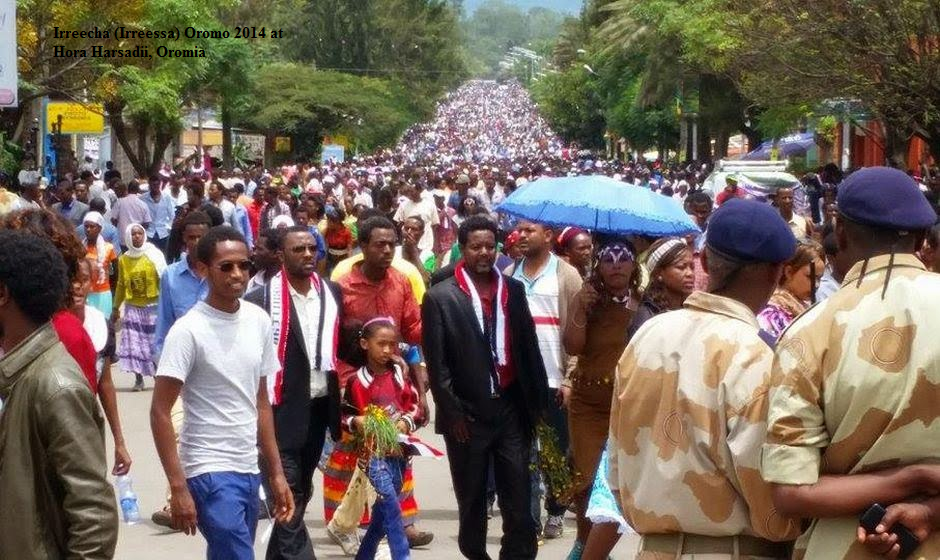
Irreecha (Irreessa) Birraa Oromoo kan Bara 2014 ((akka lakkoobsa Oromootti kan Bara 6408) akka gaariitti karooreffatamee, haala oo’aa fi bareedan kabajame. Here are some of live pictures, videos and reports refer to Irreecha Oromo Thanksgiving 2014 (6408 in Oromo Calendar) Season Global Events Planning and Celebration . The blessing event that started in mid August and celebrated successfully and colorfully through Birraa (September- October). Millions attended Hora Harsadi (Bishoftuu, Oromia) and Malkaa Ateetee (Buraayyuu, Oromia).
At Hora Harsadii
SBO Onkoloolessa 08 Bara 2014 Oduu – Qophii Ayyaana Irreechaa fi SBO Sagantaa Afaan Amaaraa
Irreecha Buraayyuu irrattii yoo kabajamu. Suraan kun kan bara 2013 bara kan maxxanfame.

Oromo woman celebrating Irreecha (Irreessa) Thanksgiving at Burayyuu, Central Oromia, near the capital Finfinnee, September 2013.
Irreecha (Oromo Thanksgiving) 2014: Colorfully celebrated in East Wallaggaa, Western Oromia, Naqamtee City, 16 November. This month’s Irreecha also known as Irreecha Yaadannoo. Remembrance Irreechaa.
Sadaasa 16, 2014 Wallaggaa Naqamtee irratti gaggeeffame.
Irreechi barana Sadaasa 16/2014 Malkaa Araaraa irratti tahekan Wallaggaa Leeqaa Naqamtee irratti taasifame uummata lixa shagarii fi Wallaggaa magaalaa Naqamtee fi barattoota yuuniversitii fimanneen barnootaa garagaraa guutummaatti kan hirmaachiseedha. Waggoota tokko dura kan gaggeeffame baayinniuummataa kan baranaa dachaadhaan akka dabale uummata kumaatama hedduudhaanlakkaawaman hirmaachise jira.
Buufata malkaa kanatti Qeerroon sirboota qabsoo garagaadhageessisee jira, keessattuu dhaadannowwan:
– Qaroon oromoo ABO dha.
– Yaa oromo mirgakeef ka’ii falmadhu
– Nuti oromoodha, nuu haa beekani.
– Oromiyaan ni bilisoomti kan jedhuu fi sirbootniqabsoo hedduun uummata kakaasuu fi sirboota qabsoo qeerroodhaan sirbamankeessatti poolisoota kan hirmaachise uummata waliin sirboota Qeerroo irrattihirmaachuudhaan haala nama boonsuun kan gaggeeffameedha.
Akkuma olitti ibsuuf yaaleetti uummanni jiraattootni garashawaa lixaaa jiraatan hunduu ayyaana irreechaa malkaa Araaraa kana irratti kanargamaniidha. Irra caalatti barattoota yuuniversitii fi koollejjii akkasumamana barumsaa sadarkaa garagaraa magaalaa Naqamtee, Siree, Baakkoo fi kkf niinkan dhuunfatameedha. Sochii qeerroodhaangodhame keessatti humni waraanaa poolisoonni jiran hunduu uummata waliin haalahoo’aadhaan guyyaa kana kan kabajanii oolanii fi dhaadannoolee uummata oromoofwaamicha taasisu, uummata kakaasan irrattillee kan hirmaatanii jiraniidha, uummanni hunduu kan irreecha kana irratti argaman nageenyaan bahee guyyaakeessa sa’a 7:30 irratti gara qe’ee isaatti kan galeedha. Guyyaa irreechaMalkaa Araaraa kana ilaalchisee gabaasa dabalataa isiniin geenya, waraabbiiqabnuuf haala mijeessinee isiniin geenya, nu eeggattu!
http://finfinnetribune.com/Gadaa/2014/11/irreechi-malkaa-araaraa-wallaggaa-naqamte-irratti-kabajame/
Irreecha (Oromo Thanksgiving) 2014: Colorfully celebrated at Burraayyuu, Malkaa Ateetee, Oromia with millions of Oromians in attendance. 9th October 2014.
Ayyaannii Irreechaa Burraayyuu Malkaa Ateeteetti bakka uummaanni Oromoo miliyoonaan lakkaa’amu argamutti sirna ho’a ta’een kabajame. Uummaatni Oromoo godinaalee Oromiyaa fi magaaloota Finfinnee, Burraayyuu, Bishooftuu, Adaamaa, Sandaafaa, Laga Xaafoo Laga Daadhii, Sulultaa, Sabbataa, Walisoo, Hollotaa, Amboo, fi Neqamtee irra walitti dhufuun haala ajaa’ibsiisa ta’een Ayyaana Irreechaa Magaalaa Burraayyuu Malkaa Ateeteetti kabajachuun eenyummaa, Tokkummaa, Oromomummaa fi Sabboonummaa isaa jebeeffachuun diina afaan faajjessa olee jira. http://qeerroo.org/2014/10/10/ayyaannii-irreechaa-burraayyuu-malkaa-ateeteetti-bakka-uummaanni-oromoo-miliyoonaan-lakkaaamu-argamutti-sirna-hoa-taeen-kabajame/
Irreecha (Oromo Thanksgiving) 2014: Colorfully celebrated at Bishoftu Oromia, Hora Harsadii with over 4 million in attendance. 5th October 2014.
Irreecha (Oromo Thanksgiving) 2014: Colorfully celebrated at Bishoftu Oromia, Hora Harsadii with over 4 million in attendance. 5th October 2014.
Irreecha (Oromo Thanksgiving) is a celebration of the coming of the new Birraa (Spring) season in Oromia. Though it is celebrated by many millions throughout Oromia, the celebration at Hora Arsadi (Lake Arsadi) in Bishoftu, Oromia, is the largest of all. The celebration at Hora Arsadi has been identified as the largest festival in Africa, and there’s a proposal submitted to UNESCO to register it as the Cultural Heritage of the world. http://finfinnetribune.com/Gadaa/2014/10/in-photosvideos-the-largest-festival-in-africa-irreecha-oromo-thanksgiving-celebrated-by-millions-at-hora-arsadi-in-bishoftu-oromia-october-5-2014/
Onkoloolessa 5, 2014 Guyyaa har’a Uummatni Oromoo Miliyoona Afurii olitti lakkaa’amu Ayyaana Irreechaa Hora Arsadii irratti wal arguun Ayyaannii Irreechaa ganama barii lafaa eebba manguddootaan kan baname haala ho’aa ta’een kabajamuu eegalee jira.
Ayyaanaa irreechaa danquuf mootummaan abbaa irree wayyaanee EPRDF ugguraa garaagaraa kaa’ee, kellaawwaan biyyaatti cufee haa sakkatta’uu malee uummataa Oromoo eenyuummaa isaa, aadaa isaa, amantii isaa fi tokkummaa isaa cabsuu hin dandeenye, uummatni Oromoo yoom iyyuu caalaa yeroo ammaa kanatti uummata eenyummaa isaa, Oromummaa isaa, aadaa isaa, Amantii isaa fi sabboonummaa isaa jabeeffachuun diina dura dhaabbachuun bilisummaa isaa kabachiifachuuf uummata onnatedha.
Haaluma kana fakkaattuun guyyaa har’aa kana kabaja ayyaanaa irreechaa irratti dargaggootni Oromoo wallee waarraaqsaa fi eenyummaa uummatichaa calaqisiisuu sodaa tokko malee uummataaf sirbuun, uummanni cufti harka walqabanchuun sagalee tokkuummaa, eenyuummaa, abbaa biyyuummaa fi kabajamuu sabboonummaa jettuu dhageesisuun diina uummata Oromoo mootummaa garboomsaa naasuu guddaa keessa galchani jiru. Addaatti dargaggootni Oromoo walleellee warraaqsaa dhageesisuun Sabboonummaa Oromummaa faarsuu irratti argamu. http://qeerroo.org/2014/10/05/guyyaa-hara-uummatni-oromoo-miliyoona-olitti-lakkaaamu-ayyaana-irreechaa-hora-arsadii-irratti-wal-arguun-ayyaannii-irreechaa-ganama-barii-lafaa-eebba-manguddootaan-kan-baname-haala-hoaa-taeen/




(OromoPress) – On Sunday October 5, 2014 an estimated 4 million people attended the annual Irreecha Festival at Hora Arasdi (lake) in Bishoftu town, located 47.9 kilometers southeast of the Oromo nation’s capital Finfinne (aka Addis Ababa). Although not conceptually, historically and purposively equivalent, people sometimes superficially use the word from the American holiday “Thanksgiving” to describe Irreecha Festival to expatriates. Oromo and friends of Oromo from across all religions and backgrounds converged to celebrate the transition from a gloomy (dukkana) rainy season to a bright (booqaa) Birraa (Spring season). The rainy season that runs for 3 months–June to August– is considered a harsh winter and is associated with darkness and separation from friends and families because of rivers swelling, (and also because of the lack of electricity). In contrast, Spring is considered a more pleasant season of festivity. Honestly, the tropical rainy season is not as a harsh a season as Winter as we know it in the northern hemisphere if you have the skills to swim and walk in and on waters.To say that Irreecha is a celebration of escaping a bad season, would be a gross oversimplification given the long and complex history of the Oromo indigenous African holiday practiced for thousands of years before the arrival of Abrahamic faiths in Oromia, Ethiopia and the Horn of Africa. Read more @http://oromopress.blogspot.co.uk/2014/10/irreecha-oromos-largest-african.html
Irreecha Bara 2014 – Sirna Irreeffannaa WBO, Moonaa Leenjii Giddu Gala ABO!
Onkololeessaa 26, 2014 Ayyaanni Irreechaa Godina Jimmaatti sirna ho’aa ta’een kabajame! Uummatni Oromoo jalbultii ayyaana kana ilaalchisuun Onkololeessa 25/2014 irraa eegaluun godinaalee Oromiyaa gara dhihaa kanneen akka Godina Iluu abbaa Booraa, Godina kibba Lixa Shawaa, Shawaa Lixaa fi wallaggaa Bahaa irra gara Magaalaa Jimma seenan, jalbultiin Ayyaana kanaa haala akkam miidhagaa ta’een Malkaa Deeddeetti kan eegalame, Guyyaa kaleessaa Malkaa Booyyeetti haala akkam ajaa’ibsiisaa ta’een kabajame jira. Goototni barattootni Oromoo Yuunibarsiitii Jimmaa fi Saabboontootni hojjettootni fi barsiisotni Godina Jimmaa fi Yuunibarsiitii Jimmaa Ayyaana kana irratti argamuun haala akkam boonsaa ta’een Eenyummaa, Oromummaa ,sabboonummaa, fi tokkummaa uummata Oromoo jabeessuun Uummata Oromoo kuma kudha-shani (15,000) Olitti lakka’amuun kabajame jira.
Kabaja ayyaana Irreechaa Godina Jimmaa Malkaa Booyyeetti kabajame kana irratti dargaggootni Qeeerroon barattootni Oromoo Yuunibarsiitii Jimmaa gamtaadhaan argamuun walleewwaan warraaqsaa fi mootuummaa abbaa irree balaaleeffatan Sirbuun uummatni Oromoo eenyummaa, Oromummaa, Sabboonummaa fi bilisummaa isaa gonfachuuf yoom iyyuu rafee akka hin bullee fi tole jedhee halagaa fi abbootii irreef akka hin bitamne walleewwaan warraaqsaa kanaan uummataaf barnootaa fi ergaa guddaa dabarsa, walleewwaan warraaqsaa kanaaniis ABO fi Uummata Oromoo, Qabsoo bilisummaa Oromoo sodaa tokko malee faarsuun diina garaa gubaa oolaniru. walleewwaab Artisti kabajamaa fi Jaalatamaa Eebbisaa Addunyaa guutummaatti sirbaa Oolaan.
Mootummaan abbaa Irree Wayyaanee akkuma amala ayyaana irreecha kana danquu fi uummata sodaachisuuf humna poolisaa guddaa bobbaasuun guyyaa jalbultii Ayyaana kana irraa eegaluun Magaalaan Jimmaa eegamaa turte, tokkummaa Uummataa fi haala hedduminan uummatni Ayyaana kanaaf qophii gochaa jiru irraa ka’uun tajajila uummataa kanneen akka Ibsaa Eliktiriikii, Bishaan dhugaatii fi Network Magaalaa Jimmaa irraa balleessun uummata darara jiraachuun beekamee jira. kessumattuu Ayyaana kanaan walqabatee tajajillii bishaan dhugaatii, Ibsaa fi Network magaalaa Jimmaa irra baduun immoo yeroo amma kana haalan kan uummata dheekkamsiise ta’uun gabaafame.
Goototni Barattootni Yuunibarsiitii Jimmaa tajajillii bishanii, Ibsaa fi network uummata irraa dhaabbatee(citee waan jiruuf Mooraa yuunibarsiitii Jimmaa Main Campus keessa naanna’uun roottoowwaan bishaan itti kuufaman caccabsuun Mootummaan wayyaanee tajaajila hawwasuummaa uummata irraa kutuun uummata darara jiru nurraa ka’uu qaba jechuun halkan guutuu hanga poolisiin mooraa Yuunibarsiitii Jimmaa dhaabsiisuu dhadhabutti iyyaa bulan, Diddaa gootota barattoota Yuunibarsiitii Jimmaa kanatti Mootummaan Wayyaanee Yaaddoo ulfaata keessa seenuun humnoota basaasaa fi poolisaa bobbaasuun Yuunibarsiitiin Jimmaa eegamaa jira.
ONKOLOOLESSA 26/2014 “IRREECHA MALKA BOOYYEE”
Ayyaanni irreechaa godina Jimmaa malkaa Booyyetti haala akkaan hoo’aa ta’een kabajamee oolee jira.Irreecha birraas ta’ee kan Arfaasaa biyya keessattii fi biyyoota alaattis waggaa waggaan akka irreeffatamu eenyu illee waan haaluu hin dandeenyedha. Haaluma kanaan ummanni oromoo magaalaa Jimmaa,naannawa ishii,akkasumas barattoonni oromoo yunivarsiitii Jimmaa kaampaasota garagaraa fi barattoonni kolleejjii barsiisota Jimmaa walitti dhufuun ayyaanicha jalabultii irraa jalqabuun bifa nama boonsuun kabajuu danda’anii jiru.Qeerroon yunivarsiitii Jimmaa fi kolleejjii barsiisota Jimmaa jiraattota magaalaa fi naannawa ishee waliin ta’uun jalabultii irreechaa dug-duuba kolleejjii barsiisota jimmaa malkaa doodee irratti bifa miidhagaa ta’een kabajanii jiru jedha gabaasni Qeerroo godina Jimmaa. Qeerroo fi sabboontonni oromoo kan yoomiyyuu diinaf gadi hin jenne sirboota fi waallewwan warraaqsan jibbaa fi tuffii diina isaanif qaban itti mul’isuun wayyaane fi ergamtoota wayyaanee daran rifaasisanii jiru.Qeerroo fi sabboontonni oromoo waalleewwan warraaqsaa akka armaan gadii kanatti kaasuun ijjannoo isaanii diinaf mul’isan:
1.Taaddee Birruu leenca boombin dadhabe har’a saaxiniin gadi qabe.
2.Yaa oromoo oromoo qulqulluu qonnee nyaannaa lafa hin gurgurru. 3.Boolloo xaddee Taaddasaa koo hin badde biyyoon galabaa miti wal-irraa hin xaragani.As irratti wanti hubatamuu qabu akka fakkeenyatti maqaan taaddasaa ka’e malee maqaan gootota oromoo osoo falmaa bilisummaa gaggeessanuu lubbuun isaanii wareegamte hedduun kaafamanii jiru.
Ayyaanni irreechaa godina Jimmaa malkaa Booyyetti haala akkaan hoo’aa ta’een kabajamee.
Irreecha (Oromo thanksgiving) 2014: Colorfully celebration in Nürnberg, Germany.18.10.2014
Kabajaa Ayyaana Irrechaa -2014 Celebration of Oromo Thanks giving (Irrechaa) in Nürnberg, Germany.18.10.2014
Ayyaana Irreecha yeroo jalqabaaf gaafa 18.10.2014tti magaala Nürnbergtti kan Kabajame ole yemmu ta’u Seena Ayyaanicha maal akka ta‘e fi akkasumas Ayyaanni kuni Ummata Oromoof maali isa jedhu ilaalchise Miseensa Qindessitoota Ayyaana Irreechaa Awurooppaa kan ta’aani Obbo Getaachoo Camadaa barumsa ball’aa kann kennan yemmu ta’u akkasumas gaaffi fi deebi hirmaattoottaff walin geggeffame jira.
Qophii kana irratti qophii sirna “Buuna Oromoo” shamarran Oromoo dhihessaniiru.
Obbo Getaachoon “Ayyaani kuni ayyaana jaalaa fi araaraati!” kan jedhan yemmu ta’u Oromoonni argamani hunda gammachuu guddaan sirba aadaa Oromoo walin sirba fi ragada kann olani sagantichi haala midhagaa ta’een xumurame jira.
Ayyaana Wagaa 50ffaa WMT fi Qophii Aadaa Oromoo Magaala Nürnbergitti haala midhagaa ta’een Kabajame
Nuernberg 27.09.2014
Qophii Ayyaana Waggaa 50ffaa Waldaa Maccaa-Tuulamaa (WMT) bakka kessummoota hedduu argamaniin magaala Nürnbergitti Akka aadaa Oromoo Ebbaa manguddootan baname.
Ittiaansuudhaan qophii Agarsiisaa aadaa Oromoo fi Sirbaale Oromoon kan dhihaate jiddu jidduttii immo dargaggoota Oromoo Obbo Muktar fi Obbo Ahimedin Walaloo Qabsoo Bilisummaa Oromoo faarsuu fi hamilee nama kakaasu dhihessaniiru.
Turtii boqonnaa fi Laaqana booda immo Waa’ee Waldaa Maccaa- Tulama barumsa Hawaasa Oromoo Berlin irra marsaa Skype dhaan kan kenname yemmu ta’u, Do’ii gabaabdu “Abbaa Caaltu” dargaggoo Oliyad Dinaolin qophaa’ee umataatti barsise fi bashannansiise jira.
Walumagalaatti kabajaa Ayyaana Waggaa 50ffaa WMT hirmaattoota fi Kessummotaaf walittidhufenya harawaa kan ume akkasumas sababni WMT bu‘urreffamef yaadachudhaan kaayyoo sanas hubachuudhaan Qabsoo Bilisummaa Oromoo ittifufudhaaf guyyaa waadaakenya kan ittin haaromsinu ta’u isaa wali galuudhaan milkiin xumurame jira.
Injifannoon Ummata Oromoof!
Tokkummaa Barattoota Oromoo Biyyaa Jarmanii-TBOJ
www.tboj.de
Irreecha (Oromo thanksgiving) 2014: Colorfully celebration in Tel Aviv, Israel, (Middle East)
Irreecha (Oromo thanksgiving) 2014: Colorfully celebration in Uganda (East Africa)
5th October 2014.
The Oromo people, the largest nation in Ethiopia, celebrate Irreecha, a festival of thanksgiving. Oromo communities spread out across the world perform rituals on this day around water sources to thank God for enduring the rainy season and ushering in the Spring season. The Oromo Community in Uganda held their celebrations at the Kabaka’s Lake in Lubaga on October 5, 2014. http://finfinnetribune.com/Gadaa/2014/10/ntv-uganda-report-oromo-community-in-uganda-celebrate-irreecha-festival/
NTV Uganda
Though lacking a big Oromo community in Groton, Connecticut, that didn’t deter the family of Gammachuu to hold the 2014 Irreecha (Oromo Thanksgiving) celebration; we hope to see a strong Oromo community in Connecticut next year following the Gammachuu’s lead.http://finfinnetribune.com/Gadaa/2014/10/a-beautiful-irreecha-celebration-in-groton-connecticut-it-takes-one-family-to-start-building-a-community/
Though lacking a big Oromo community in Groton, Connecticut, that didn’t deter the family of Gammachuu to hold the 2014 Irreecha (Oromo Thanksgiving) celebration; we hope to see a strong Oromo community in Connecticut next year following the Gammachuu’s lead.http://finfinnetribune.com/Gadaa/2014/10/a-beautiful-irreecha-celebration-in-groton-connecticut-it-takes-one-family-to-start-building-a-community/
Irreecha (Oromo thanksgiving) 2014: Colorfully celebration in South Africa.
5th October 2014.
Irreecha (Oromo thanksgiving) 2014: Colorfully celebration in Melbourne, Australia

Irreecha (Oromo thanksgiving) 2014: Colorfully celebration in Cairo, Egypt
5th September 2014.
Irreecha (Oromo Thanksgiving) 2014: Colorfully celebration in Atlanta, Georgia, USA
4th October 2014
Irreecha (Oromo Thanksgiving) 2014: Colorfully celebration in Holland.
4th October 2014

Irreecha (Oromo thanksgiving) 2014: Colorfully celebration in Boston, MA, USA
28 September 2014
Irreecha (Oromo thanksgiving) 2014: Colorfully celebration in Los Angeles, California
27 September 2014
Hawaasni Oromoo Magaalaa Los angeles fi San Diego Ayyaanaa Biyyoolessa Oromoo, IRREECHA, Birraa 27, 2014 haala hoo’an kabajaanni oolan. Sirni ayyaaneeffanaa sa’aa 11:00WD qabee hanga sa’aa 6:00WB gageeffame kun seeraan banamee, eebbaa manguddootiin itti fufee, aadaa irreechaatiin Waaqaa faarffachaa fi gammachuudhaan sirbaa iddoo haroo adeemudhaan erga irreeffatamee booddaa haaluma walfakkaataan iddoo qophiitti deebi’ame sirbaa fi mariin xumurameera. ‘Barrii baranaa kan hegereetiin Isin ha gahu!’
4th October 2014
Irreecha (Oromo thanksgiving) 2014: Colorfully celebration in Leeds, UK.
27 September 2014
Irreecha (Oromo thanksgiving) 2014: Colorfully celebration in Ohio, USA.
28th September 2014.


27th September 2014
At the Hururssaa, Name-Recognizing or Name-Giving Ceremony, held in conjunction with the 2014 Washington-DC’s Irreecha celebration, author Tasfaayee Gabra-aab has become “Gadaa” Gabra-aab; watch the ceremony below (video by OPride.com). Hururssaa is one of the rich traditions of the Oromo nation.
Author Tasfaayee Gabra-aab Becoming Gadaa Gabra-aab at DC’s Hururssaa Ceremony (Photo: @OromoPress)
28th September 2014
Speeches by International Oromo Youth Assocation’s (IOYA) Leaders Aad. Amanee Badhaasoo & Aad. Sinqee Wesho
27th September 2014
Source: Oromiatimes.Org (http://oromiatimes.org/2014/10/03/dhufaa-jira-coming-soon/)
27th September 2014
27th September 2014


Irreecha Birraa 2014 Celebration @ Las Vegas, Sunset Park, Nevada
25 Fuulbana ( September ) 2014.

Ayyaana Irreecha Birraa Oromoo kan bara 2014 Kanaadaa (Canada) Calgaryti Birraa 20 Bara 2014 haala O’ooan kabajamee Ooole. Irreecha celebrated in Calgary, Canada on 20th September 2014. See picture below.
Caayaan Tokkummaa Baqattota Oromo Biyya Masrii Ayyaana Irreecha Barana Fuulbana 20/2014 haala miidhagaa fii bonssaan kabajatan . Sirnicha akka Aadaa Oromotti Eebba Manguddon kan banamee hoggaa tahuu, Duraa Ta,aan Caayaa Tokkummaa duraanii Obbo Mohammed Zen Arabon Gabaasa waggaa lameen dabranii bal’inaan erga manaaf gabaasanii boddee koree haarowa waggaa kana Caayaa Tokkummaa hogganuuf jiratanitti sirna miidhagaan hujii dabarsanii itti laatanii jiru. Kanaaan booda Dura Ta’aan Caayaa Haarowni Obbo Abdallaa Jamaal maqaa Isaa fii koreetiin haawaasaf simannaa godhanii fii jiru . Bifa kanaan koreen Haarowni erga hujii fuudhanii fuula hawaasaa duratti ballamaa galanii jiru. Akkasuma Hawwisoon Baandii Abdii Boruu Wallelee garagaraan hirmaattota sirnicha baayyee gammachisanii jiru. Seenaa Ayyanaa kanarraa Hayyotaa fii manguddonni kan akka Obbo Xayyib fii Obbo Abdusalaam, Obbo Aksiir Nuree’ , Obbo Hassan Fakkaro fii Aaddee Raggaatuun walduraa dubaan ibsa bal’aafii gorsaas godhanii fii jiru. Maayyirratti Surnichi Eeyba Manguddon sirna miidhagaan xumuramee jira.

Oromians in Sweden Celebrated Irreecha in Stockholm on 13th September 2014
Ayyaanni Irreessaa/irreechaa Sweden magaalaa Stockholmitti Fulbaana 13, 2014 Haala bareedan ayyaaneffatame
Ayyaanni Irreessa/irreecha Sweden magaalaa Stockholmitti Fulbaana 13, 2014 ayyaaneffatame (suuraa kanaan olii ilaalaa, see the above pictures of Irreecha celebration in Stockholm )
Ayyaanni Irreessaa/irreechiaa Sweden magaalaa Stockholmitti Fulbaana 13, 2014 ayyaaneffatame
Ayyaanni Irreessaa/irreechaa Sweden magaalaa Stockholmitti Fulbaana 13, 2014 ayyaaneffatame (Suuraa kanaa olii ilaalaa, Sweden Irreecha celebration pictures above).
Ayyaana Irreecha Birraa Bara 2014. Hargaya (August) 31 colourfully Celebrated in Toronto, Canada.
Oromo Thanksgiving Celebration 2014, Toronto Canada. See the pictures below.


Ayyaana Irreecha Birraa Bara 2014. Hargaya (August) 31 as Celebrated in Toronto, Canada.
Oromo Thanksgiving Celebration 2014, Toronto Canada

Ayyaana Irreecha Birraa Bara 2014. Hargaya (August) 31 as Celebrated in Toronto, Canada.
Oromo Thanksgiving Celebration 2014, Toronto Canada
We are pleased to inform you that he is finally able come to the United States. OSA has extended its theme focusing on Gada democracy through the end of the year and Abba Gada Bayana speak at a series of OSA-organized workshops in various cities in Unite Stated from September 6-27, focusing on the ongoing work of reviving the Gadaa system.
He will also participate as a guest of honor at several Irreecha celebrations organized by Oromo in the Diaspora.
We invite all who are interested in the Gadaa democratic system and Oromo culture in general to attend these workshops and participate in spectacular Irrechaa celebrations to be held throughout September and October 2014.
We would like to extend our appreciation to local individuals and institutions who participated in preparing these events. We are also grateful to the United States Consular Service for the assistance they provided in issuing Abbaa Gadaa Bayana’s travel documents.
The attached flyer contains general information about dates and cities where Abbaa Gadaa Bayana will be speaking.
Jawar Mohammed
President, Oromo Studies Association
Plan of Event: Ayyaana Irreecha , Oromo Thanksgiving on Onkoloolessa/October4, 2014- Perth, Australia
Baga bacaqii Gannaa nagaan baatanii Booqaa Birraa argitan jechaa, Eenyummaa fi Aadaa ofii yoo abbaan duukaa bu’ee hin kununisifatiin alagaan ishuma hafte iyyuu balleessuuf duubatti hin jedhu waan ta’eef IRREECHA bara kanaa / 2014 sirnna hoo’aan kabajachuuf Oromoonni dhuunfaan sagantaa kana irratti hojjataa jiru. Ammoo dhimma kana fiixaan baasuuf hirmannaan Hawaasa Oromoo Magaalaa Perth murteessaa dha.
Waan kana ta’eef jecha Oromoonni Magaalaa Perth jirraattan hundi ayyaana IRREECHAA kana irratti hafeeramtaniirtu.
Koottaa / dhyaadhaa waliin gammannaa!
Yoom:-
Gaafa 05/10/2014
Guyyaa Dilbataa
Bakka:- Burswood Park, Burswood
Yeroo:- Sa’aatii 11:00 AM irraa eegalee
Hubachiisa:-
– Hanga danda’ametti Uffannaa Aadaan midhaganii argamuun heddu feesisa.
– BBQ fi waanni dhugan nama maraaf tola.
– warra hin dhageenyeef dabarssaa.
Qopheessituu IRREECHA Magaalaa Western Australia (Perth) bara 2014

Plan of Event: Ayyaana Irreecha , Oromo Thanksgiving in Cairo, Egypt – on October 5, 2014
Akkam jirtu Oromoo Boston?
ODA Boston waggaa waggaadhaan laga Charles River, Cambridge kessatti argaamu irrati guyyaa Irreecha kabajaa turuun isaa ni yadatama. Haaluma Kanaan bara kanas gaafa guyyaa Fulbaana ykn September 28/2014 sa’ati 12:00pm irrati kabajuuf qophii irra jiraachu isaa gamachuudhan isin beekisisaa, akka irrati argamtan kabajaan isiin hafeerra.
Galatoomaa!
Koree ODA Boston
Ayyaana Irreecha | Oromo Thanksgiving in Helsinki, Finland – on October 4, 2014
Posted: Fulbaana/September 28, 2014 · Finfinne Tribune | Gadaa.com
Event Details:
Date: 4th of October 2014
Time: from 12:00 to 5:00
Place: Kivikonkaari 11, Kivenkolo, Helsinki, Finland
Transport: Take Metro from Helsinki Railway Station to Kontula; From Kontula, take Bus 78. It is about 5 minutes.
BEEKSISA:
Oromoota magaalaa Nairobi fi naannawa isii jiraatan maraaf
DHIMMA: Ayyaana Irreechaa fi Hulluuqqoo, 2014
Ilmaan Oromoo hundi baga ganna bacaqii irraa gara booqaa birraatti nagayaan ceetan jechaa, ayyaanni Irreechaa fi Hulluuqqoo magaalaa Nairobitti Fulbaana 28, 2014 waan kabajamuuf, maatii fi hiriyyoota keessan wajjiin akka irratti hirmaattan kabajaan isin affeerra.
Bakka (Venue): Nairobi City Park
Yeroo: Ganama 8:00AM – 2:00PM
Ayyaana Irreechaa fi Hulluuqqoo sababeeffachuun barnootni:
~ aadaa fi argaa-dhageettii,
~ maalummaa Irreechaa fi Hulluuqqoo,
~ Seenaa fi amantii Oromoo ni kennama. Kana malees sagantaa nyaata aadaa Oromoo fi qophii bashannanaa waan qabnuuf ammas irra deebinee dhiyaadhaa isiniin jenna.
Odeeffannoo dabalataaf ammo karuma fuula facebook’n nu qunnamaa!
Koree Aadaa fi Argaa Dhageettii Oromoo, Nairobi
Ayyaana Irreecha | Oromo Thanksgiving in Denver, Colorado – Sept. 27, 2014
Waamicha Kabajaa Ayyaana Irreecha kan Bara 2014 Biyya Jarmanii keessatti qophaa’ee: Koree Qindeesitu Ayyaana Irreeschaa irraa Ilmaan Oromoo Biyya Jarmanii keessa jiraatan Maraaf – Frankfurt am Main, Germany
Kabajammo Ilmaan Oromoo,
hundaa duraan dursee nagaan rabii isin haagahu. Ashamaa ilmaan Oromoo kann biyya Jarmanii keessa jiraattan; obboleewwan keenya dhiira fi dubartiin, baga ayyaana Irreecha bara haaraa 2014 walumaan jala geenye. Ayaanni Irreecha jila (festival) waga/bara haaraatti cee’uumsaatti.
Ayyaanni Irreecha kan bara haaraa 2014 biyya Jarmaniitti kutaa magaalaa Frankfurt am Main “Bockenheim” (im Stadtteil Bockenheim) jedhamu keessatti Fulbaana (September) 20, 2014 kabajamuuf qophiin Koree Qindeessituu Ayyaana Irreescha xumuramee jira. Kanaaf Oromoon biyya Jarmanii keessa jiraatan kabajaa ayyaana Ireechaa kan bara 2014 irratti argamtannii waliin akka kabajnu ulfina guddaan isin afeerra.
Ayyaanni Irreecha kan bara haaraa 2014 Fullbaana (September) 20, 2014, guyya sambata xiqqaa(Saturday), sa’a 12:30 WB (PM) irra eegalee hanga (hama) sa’attii 18:00 WB (PM) Paarkii (iddoo namni itti haara galfatu) “Rebstockpark” jedhamu keessatti cinaa (bukkee) haroo (Weiher im Rebstockpark = Pond in Rebstockpark) ti kabajama.
Ayyaanni Irreecha guyyaa ilmaan Oromoo akka sabaatti heddomminaan walarganii dhimma har’a itti jiran waliif himan, waan hegeree immoo waliin qindeeffaatan, guyyaa waloomaa (day of joint action) Oromoo ti. Heddomminaan bahanii ayyaana Irreecha irratti aadaa fi duudhaa/jifuu (culture and tradition) ofii agarsisuunis mallattoo sabboonummaa saba Oromoo ti. Aadaa kana guddisuu fi muldhisuun eenyummaa Oromoo guddisuudha.
Ayyaanni Irreecha kan bara 2013 kan yeroo kamuu caala biyya keessaa fi alatti sirna ho’aa fi hamilee guddaan akka kabajame, odeeffannoo fi gabaasa bakka gara garaa irraa argaa fi dhagahaa jirra. Kun kan muldhisu, ayyaanni Irreecha guddina aadaa fi duudhaa/jifuu, akkasumas eenyummaa fi tokkummaa saba Oromoof utubaa ta’uu nu hubachiisa.
Koree Qindeesitu Ayyaana Irreescha akka waliin taanee ayyaaneefannu, irraa debi’ee gammachuudhaan waamicha Oromummaa kabajaan isiniif dhiyeessa.
Namoota odeeffannoo dabalataa feetanif, Koree Qindeesitu Ayyaana Irreescha waliin qunnamtii godhaa!
Namoota Koree Qindeesitu Ayyaana Irreescha irra odeeffannoo (information) dabalataa feetanif lakkoofsa bilbila (telefoona) kanatti bilbilsaa:
lakko.bil.:
+4917853498098
+4917680018430
+4915212252957
Ayyaanni Irreessaa yeroo duraatif Magaalaa “Frankfurt am Main” jedhamu keessatti guyyaa gaafa Fulbaana 20, 2014 qophaa’ee:
Sa’aatii/Time: 12:30 WB (PM) ‐ 18:00 WB (PM)
Iddoo/Place: Paarkii “Rebstockpark” jedhamu keessatti (im Rebstockpark), cinaa (bukkee) haroo (Weiher im Rebstockpark = Pond in Rebstockpark)
Daandi (kara)/Street: Am Römerhof, Max‐Pruss‐Straße
Geejiba/Transport: Baabura (tram) lakoofsa 17 (Straßenbahnlinie 17 vom Hauptbahnhof Frankfurt am Main bis zur Endehaltestelle “Rebstockbad”)
Misensoota TBOJ fi Oromoo Biyyaa Jarmanii
Ayyaanni Irreechaa Gaafa 18.10.2014tti
Iddoo: Am Pegnitzwiese, Unter Jansenbrücke, 91207 Nürnbergtti
Sa’a: 13:00 irraa kaase akka Walin kabjanu kabajaan isinni affeerra.
Aadaakenya Eenyummaakenya!
Ulfaadhaa
UOSE-Germany
Hunda Dura Baga Nagaan Ayyaana Irreecha Bara Kanaan Isin Gahe!
Ilmaan oromoo hundi jila duudhaa ganama kan ta’e, Aadaa Oromoo kana biyyaa keessaa fi alaa bakka jiran hundatti walitti dhufanii kabajata turan ittis jiru. Nutis Oromoonni biyyaa New Zealand magala Wellington keesa jirru bakka tokkotti walitti dhufnee guyyaa seena- qabeessa kana akka waliin kabajane oolluf waamicha guddaa isiniif goona.
Guyyaan isaa Onkoloolessa 12/10/2014 sa’aa1.00pm iratti oggaaa tahu, bakki: Otari Wilton Park, Wilton, Wellington (address: 160 Wilton Road)
Gaafa kana galgala isaa sagantaa qophii bashannanaa waan qabaannuuf jecha hundi keessan waareen booda sa’aa 4:pm irratti argamtanii nu Waliin akka bashanantan kabajaan isin afeerra.
Bakki isaa: Newtown Hall
HUBACHIISA: Guyyaa kana uffata Aadaa qabdan uffattanii maatii keessan waliin akka dhuftani siin yaadachiisna.
Gadaan roobaa fi gabbina!
Irreechi Switzerland kan bara 2014 Guyyaa 27.09.2014 Hora Ouchy, magaalaa Lausanne tti kabajama. Koottaa, hirmaadhaa! Aadaa keenya haa guddifnu! Oromummaa bakka jirru hunda tti haa jabeessinu! Aadaa keenya ijoollee keenya kan hegeree Oromoo fi Oromiyaa ta’an fi firoota Oromoo haa barsiifannu!
Guyyaan Fulbaana (September) 27, 2014
Yeroo (Time) 10:00 Am Irra Eegale (start)
Iddo: Hourlack Park (Heritage) kessatti Ayyaana Irreecha waan kabajjamuuf ummata Oromoo marratti akka dhamissa nu dabarrisiitaan kabajjaan isiin gaffana korree Ayyaana Irreecha magala Edmontonni, Kaanaaddaa (Canada)
Oromo Thanksgiving Day Celebration – September 27, 2014
Time: 10:00am start
Oddeffaano (Information call)
1) Nasser 7803945478
2) Amare 5879207786
Irreechi Irree uummata Oromootti!
Gubaa, Daaraa Gabanna fi Irreecha 2014, Atlanta, Georgia , Onkoloolessa 3-4, 2014
Ayyaanni Irreecha bara 2014 Fulbaana 27 magaala Los Anjeles keessatti kabajaamuuf qophiin itti fufeera. Lammiiwwan Oromoo fi firoonni Oromiyaa Kaaliforniyaa fi Godina Ollaa keessa jiratan hundinuu koottaa waliin haa Irreeffannuu!
Qophiin sa’aa 11:00 WD jalqaba.
Bakkeen Qophii:
Kenneth Hahn State Recreation Area
4100 S. La Cienega Blvd
Los Angeles, CA – 90056
———————
The Oromo Thanksgiving Day will be celebrated on September 27, 2014. All Oromo citizens and friends of the Oromo nation cordially invited. Please join us on our highly celebrated Holiday.
Program begins at 11:00am
Location:
Kenneth Hahn State Recreation Area
Los Angeles, CA – 90056
Odeefatnoof:
951-400-3998, 951-488-8188, 951-316-4688, 213-985-6086
Address: 213 Camrose Court, Gahanna, OH
Mark your calendar; this year’s Irreecha celebration will be held in the city of Leeds, the UK, on Sept. 27, 2014. All Oromos and friends of the Oromo in the UK are invited.
Hawaasni Oromoo UK kessa jiraatu guyyaa Irreecha galata kennan bara 2014 Fulbaana 27, 2014 Magaala Londonitti ayyaneffata. Kanaf, guyyaa Oromon tokkummadhan uumaa galata galchatu kana irratti argamtani akka gammaddan Hawaasni Oromoo UK kabajaan isin aferra. Nyatnii fi dhugaatin gatii bayyessan ni jira.
Kottaa aadaa fi muziqaa Oromoo dhandhamadhaa!
Sagantaa:
A. Sagantaa Irreffachuu: 11:00wd-2:00
Bakka: Hampsted Heath Park Staff Yard, Parliament Hill Fields, High-gate Road, London NW5 1QR
Gejjiba: Atobusii: C2, C11, 214
Baabura: Bufata baaburaa Gospel Oak
Konkolaataa dhabuf sa’ati 2f £2.50 basisa
B. Yeroo gammachuu fi hawaasessuu – 3.00wb-10.30gg
Bakka: Whittington Park Community Centre, Yerbury Road, London N19 4RS
Gejjiba: Atobusii C11 gara bufata baaburaa Archway, 17, 43, 263, 271 (gara bufata baaburaa Upper Holloway Road)
Baabura: Bufata baaburaa Archway
Bufata baaburaa: Upper Holloway Road
Koree Hojii Geggessituu Hawaasa Oromoo UK
Hawaasni Oromoo UK kessa jiraatu guyyaa Irreecha galata kennan bara 2014 Fulbaana 27, 2014 Magaala Londonitti ayyaneffata. Kanaf, guyyaa Oromon tokkummadhan uumaa galata galchatu kana irratti argamtani akka gammaddan Hawaasni Oromoo UK kabajaan isin aferra. Nyatnii fi dhugaatin gatii bayyessan ni jira.
Kottaa aadaa fi muziqaa Oromoo dhandhamadhaa!
Sagantaa:
A. Sagantaa Irreffachuu: 11:00wd-2:00
Bakka: Hampsted Heath Park Staff Yard, Parliament Hill Fields, High-gate Road, London NW5 1QR
Gejjiba: Atobusii: C2, C11, 214
Baabura: Bufata baaburaa Gospel Oak
Konkolaataa dhabuf sa’ati 2f £2.50 basisa
B. Yeroo gammachuu fi hawaasessuu – 3.00wb-10.30gg
Bakka: Whittington Park Community Centre, Yerbury Road, London N19 4RS
Gejjiba: Atobusii C11 gara bufata baaburaa Archway, 17, 43, 263, 271 (gara bufata baaburaa Upper Holloway Road)
Baabura: Bufata baaburaa Archway
Bufata baaburaa: Upper Holloway Road
Koree Hojii Geggessituu Hawaasa Oromoo UK

Waaqa Nu Uume Galateeffachuun ni Irreeffanna!
Aadaa Keenya ni Dagaagsina!
Ayyaanni Irreecha Minnesota (Magaalawwan Lakku) keessatti Minneapolisi Hora ykn Lake Nokomositti kabajamuuf deemaa jira.
Ayyaanni irreecha kan bara 2014 Fulbaana 27 bara 2014 ganama sa’aa 10:00 irraa jalqabee kabajama. Oromoo fi Firoottan Oromoo hundumtuu akka ayyaana kanarratti argamtanii waliin Irreeffannu koreen qindeesituu ayyaana Irreecha kabajaa fi ulfina guddaan isin affereera.
Bakki isaa:
Hora (Lake Nokomis)
5001 Lake Nokomis Pkwy W.
Minneaplois, MN 55417
Info:
Tel:
– Awash Nagawoo: 612-227-0712
– Biqilaa Deettii: 612-701-9834
“… birraan barihee dukkana nurra arihee
Ballammi haami jennaan haamee dhufe kuno
lammii kee waami jennaan waamedhufe kuno …” Sirba Oromoo
Ayyaana Irreecha kan baranaa Fulbaana(September) 27 bara 2014biyyaa Norway, magaalaa Oslo, bakka hora Sognsvann jedhamutti waaree dura sa’ati 11:30 irraa eegalee kabajama. Ilmaan Oromoo kannen dhihoo fi fagoo jiraattan hundi jila dudhaa ganamaa kana irratti uffata aadaatiin of miidhagsitanii akka ayyaana kana irratti hirmaattan kabajaa guddaa wajjiin sin afeerra. Malkaa jilaa dhufuudhaaf, baabura lafa jalaa (Metro) laakkofsa3 (Sognsvann) gara kallattii lixaa deemu (westbound) yaabbadhaa; buufatni isaa kan maayyii Sognsvann suduudaan isin fida.
Erga qophiin Irreecha raawwatee booda qophii bashannanaa sa’aa 18:00 irraa eegalee qabna. Halkan guutuu waliin taphataa bulla.
Bakki qophiin bohaarsaa itti dhihaatu:
Simia-venner
Kristoffer Robins Vei 2 (Smedstua)
0978 Oslo
Bakka kana dhufuuf, magaala /Oslo S irraa baabura gara Lillestrøm deemuu qabattanii bakka Haugenstuastasjon jedhutti irraa bu’uun bakka Smedstua jedhu yoo iyyaafattani salphaatti achi geessu. Ykn Stovner Senter irraa bus 65 yoo qabattanii bakka Smedstua jedhutti irraa buutani, bakki qophichaa cinaadhuma sanatti argama.
Odeessii dabalataa yoo barbaaddan yookiin gaaffii yoo qabaattan bilbila harkaa laakkofsa
+47 951 88 081 / + 47 97964087 / irreechaa@gmail.com nuu qunnamaa.
Ana haadhufu!
Gadaan roobaa fi gabbina!
Koree Qindeessituu

Finfinne Tribune | Gadaa.com
Ayyaani Irreecha, guyyaa Oromoon malkaa ykn tulluutti bahee Waaqa isa uume, waan argateef kan galateeffatuu fi waan fuula dura hawwuu fi barbaadu itti kadhatudha. Irreechi ayyaana Oromoon ittiin beekamu, mallattoo Oromummaa fi Eenummaa isaa ibsu, calaqqee Aadaa fi Duudhaa keenya qofaa osoo hin ta’iin dhaalmayaa hambaa seenaa keenyaa ti. Kanuma mirkaneessuuf Oromoon biyya keenya Oromiyaa keessa jiraatu guyyaa ayyaana Irreecha waggaa waggaan bahaa fi dhihaa, kaabaa fi kibbaa walitti bahee osoo amantii, siyaasa fi kutaan walinqoodiin tokkummaan Ayyaana Irreecha kabajataa jira.
Ayyaani Irreecha Hora Arsadiitti qindoominaa fi hirmaannaa ummata bal’aan kabajamuu kan eegale bara 1997 irraa kaaseetu. Isa dura ummatuma naannoo sanaa fi keessattuu warra aadaa Waaqeffannaa hordofaniin ture. Bara 1997 keessa koreen tokko maqaa Guddinaa fi Dagaagina Aadaa Oromoo jedhuun WMT (Waldaa Maccaa-Tuulamaa) jalatti ijaaramtee Ayyaana Irreecha Bishooftuu kana ummata beeksisuu, barsiisuu fi qindoominaan guyyaa ayyaana kanaa bakka sanatti argamuun qalbii namaa harkisuu jalqabde. Ergasii waggaa waggaan achitti argamuun barumsaa fi dammaqiinsa kennameen sadarkaa har’a ummanni kumaa fi kitilaan herreegamu irratti argamee kabajaa jira. Kabajaa Irreecha Bishooftuu, kan Malkaa Arsadiitti kabajamu babal’achuun yeroo gara garaatti Oromiyaa bakka adda addaatti kabajamuun akka Ayyaana Biyyoolessa biyyaatti fudhatamaa jira.
Kana malees biyyoota alaa naannoo Oromoon heddumminaan qubatee jiruttis haala ho’aan kabajamuu erga eegalee bubbulee jira. Ayyaani Irreecha daran akka guddatuu fi babal’atu hawaasni Oromoo hubannoo gahaa qabaachuu qaba. Gaaffiilee Irreech Aadaa moo Amantiidha jedhuuf deebii argachuuf hayyoota aadaa afeeruun marii gochuu qaba. Hanga ammaatti kan beekamu Irreech Aadaa fi Duudhaa Oromoon waliin Waaqa kadhatu ykn galateeffatu ta’uun beekama. Kun ammoo amantii nama kamuu waan faallessu hin qabu.
Kanuma hubachuun Oromoon biyya keessaas ta’e biyya alaa jiraatan gamtaan bahuun Ayyaana Irreecha kabajuun aadaa fi eenymmaa isaa firaa fi alagaa akka beeksisu, akkasumas tokkummaa Oromoo haala kanaan akka mul’isu abdii qabna.
Ayyaani Irreecha bara 2014, Hora Arsadii Bishooftuutti kan kabajamu guyyaa 05.10.2014 yoo ta’u, biyyoota alaatti ammoo warri qophii xumuratanii fi sagantaa isaanii beeksisan kanneen armaan gadiiti.
• Hagaya/August 31,2014- Toronto, Canada
• Fuulbana/September 13, 2014 – Stockholm, Sweden
• Fuulbana/September 20, 2014 – Calgary, Canada
.Fuulbana/September 20, 2014- Adelaide, Australia
.Fuulbana/September 20, 2014- Cairo, Egypt
.Fuulbana/September 20, 2014- Frankfurt Am Main, Germany
.Fuulbana/September 25, 2014- Las Vegas, USA
. Fuulbana/September 27, 2014 – Leeds, UK
• Fuulbana/September 27, 2014 – Bergen, Norway
• Fuulbana/September 27, 2014 – Oslo, Norway
• Fuulbana/September 27, 2014 – Switzerland
• Fuulbana/September 27, 2014 – Minneapolis, Minnesota
• Fuulbana/September 27, 2014 – Washington, DC
• Fuulbana/September 27, 2014 –Los Angeles, California
• Fuulbana/September 27, 2014 – Finland
.Fuulbana/September 27, 2014- Sydeny, Australia
.Fuulbana/September 27, 2014-Edmonton, Canada
.Fuulbana/September 27, 2014- Denver, Colorado
• Fuulbana/September 27, 2014 – London, England
. Fuulbana/September 28, 2014- Seattle, Washington (NW US and British Columbia)
.Fuulbana/September 28, 2014- Kenya, Nairobi
.Fuulbana/September 28, 2014- Boston/ Cambridge, MA, USA
.Fuulbaana/September 28, 2004- Columbus, Ohio
• Onkoloolessa/October 4, 2014 – Amsterdam, Holland – Germany
.Onkoloolessa/October4, 2014- Helsinki, Finland
.Onkoloolessa/October4, 2014- Cairo, Egypt
.Onkoloolessa/October4, 2014- Perth, Australia
• Onkoloolessa/October 5, 2014 – Melbourne, Australia
.Onkoolessa/October 12, 2014-Wellington, New Zeland
http://gadaa.net/FinfinneTribune/2014/09/irreech-mallattoo-tokkummaa-fi-aadaa-oromooti/
According to the Oromo culture writer, Ob. Anga’a Dhugumaa, the preparation for the spring Oromo holiday of Irreecha/Gubaa, which celebrates the transition from the rainy season to the bright season by giving Thanks to Waaqa, begins in mid-August, and mid-August is only a couple of weeks away from today; the mid-August celebration is calledTaaboree or Muka Dhaabaa.
Here is a quote from Ob. Anga’a Dhugumaa article on Gubaa/Irreecha:
“In the middle of August, a tall olive tree (Ejersa – Olea Africana) is cut, and all its branches removed except at its top. It is then erected (horduu, dhaabuu) on ground as a pole. The species of this tree has to be olive. Olive trees (Ejersa) are considered as holy trees among the Oromo. Its smoke is very sweet. Erecting such a tree at the peak of the rainy season symbolizes a wish for the Earth to get firm. It is a peak time for the ground to get wet or saturated with rainwater, and is too weak to stand heavy rain. This day, which is called Taaboreeor Muka Dhaabaa, is observed by the youth only.
“The final gigantic celebration takes place exactly five weeks later from this day. The five weeks are refereed to as the ‘five-finger rules’. One finger is equivalent to one week.” (Read more here: http://goo.gl/kGdVBD)
With that, Toronto is once again ready to hold the first Irreecha celebration, which will be held in Whitby, Canada, on August 31, 2014.

Gubaa/Ibsaa
—————–
Ayyaana Gubaa jechuun dukkanaafi booruu gannaa oofkalanii gara ifa ykn booqaa birraatti ce’uuf sirna gaggeeffamuudha. Akkasumas, mallattoo Waaqa galateeffannaas ni jedhama. Sababni isaa, booruu gannaa, lolaafi bubbee hamaa, bakakkaa, galaanaafi kkf nagaan oofkalanii ifa birraatti waan bahaniif gammachuu ofii ibsachuun Waaqa galateeffatu. Firoonnis walitti dhufanii wal gaafachuu calqabu, “Baga booruu gannaa oofkaltee booqaa birraatti baate” waliin jechuu eegalu.
Ayyaanni Gubaa kun ummata Oromoo biratti kabajaafi jaalala guddaa qaba. Dubartootas ta’ee dhiironni dursanii qophii adda addaa taasisu. Dhiironni osoo guyyaan Gubaa hin ga’in mukeen akka Sukaayee, Sokorruu, Qamaxxee, Tamsaasa, maxaaxee, daalachoo, dhangaggoo fi kkf ciranii goggogsuun gaafa gubaan dhiyaate Xomboora hidhu. Kunis baay’ina dhiirotaatin qophaa’a.
Guyyaa gaafa Xomboora gubanii muka dhaabaa(‘Daamaraa’)f ta’u kanneen akka Abbayyii, Hindhee, Soolee, Ejersa, Ceekaa, Daalachoo, Urgeessaa fi kkf qopheessanii dhaabu. Guyyaa kana mukti jabaaf ta’u kan akka Laaftofii Diddiksaa fa’a ni qophaa’u.
Haala kanaan Ayyaanni Gubaa Oromoo walakeessa baatii Hagayyaa keessa gubama. Ibsaan Oromoo gaafa Hagayya 15 galgala yoo ta’u, Hagayya 16 daaraa guddaa jedhama.. Akka Oromoon dhugeefatutti guyyaa kana Waaqni sibiila lafatti gadi darbata jedhama. Guyyaa kana irraa kaasee lafti jabaachaa adeema, lagni ni hir’ata, firris wal gaafii eegala. Guyyaa gaafa ibsaa kana horiin haalan marga quufanii yeroon galfamu, fardeen yaabbii dhiqanii haalan kunuunsu. Galgala erga horiin hundi galanii booda namoonni mijirii(‘Abdaarii’) tokkotti ibsaa waliin guban marti isaanii walitti yaa’anii iddoo mijirii kanatti wal ga’u. Akkaataa angafaa quxusuu isaanitti Waaqa kadhachuun boolla muka dhaabaa dongoru. Yeroo dongoran kanas “Hamaa keenya dongori” jechaa Waaqa kadhachaa dongoru.
Kadhannaan isaanis:
Ibsaan kun ibsaa nagaa nuuf haa ta’u
Ibsaa quufafi gabbinaa haa ta’uu
Booruu gannaa nu oofkalchee
Booqaa birraas nu haa oofkalchu
Wal bira oolchee nu haa bulchu
……
Abbaa biyyaa biyyarra haa bulchu
Barri quufa; Gadaan gabbina
Gabbis Waaqi…jechuun kadhatanii muka dhaabaa dhaabu.
Mukoota dhaaban kanas hidda cimaan mudhii isaa naannessanii waliti hidhu.
Mukoota dhaabaa kana yommuu dhaaban maqaa muka dhaabanii sana waamun Safuu ykn cimina mukti kun qabuun Waaqa kadhatu. Fakeenyaf
Warri Abbayyii dhaaban, “ Abbayyii ati Abbaa nuuf ta’I” jedhu.
Warri Ejersa dhaaban, “ Waaqayyo ati akka Ejersa kanaatti nu cimsi “ jedhu.
Warri Hindhee ykn Soolee dhaabanis, “ Waaqayyo akka Soolee ykn Hindhee kanaatti nu soroorsi “ jechuun kadhachaa muka dhaabaa kana dhaabu.
Erga muka dhaabaa dhaaban booda muka dhaaban kanatti naanna’uun Sirba Gubaa ykn Hiyyoolee akka armaan gadii kanatti sirbu.
Hiyyoo koo daraari yaa abaaboo koo
Ganni bahee daraari yaa abaaboo koo
Birraan bari’e daraari yaa abaaboo koo
Kan qincee nyaatanii daraari yaa abaaboo koo
Kan fira gaafatanii daraari yaa abaaboo koo
Geese yeroon wal yaadanii daraari yaa abaaboo koo
Ibsaa gubnaa daraari yaa abaaboo koo
Har’I kudha shanii daraari yaa abaaboo koo
Qalloo dangashee too daraari yaa abaaboo koo
Osoon kiyya jedhuu daraari yaa abaaboo koo
Narraa fudhatanii daraari yaa abaaboo koo
Keelloon daraartee daraari yaa abaaboo koo
Randa gamaatti daraari yaa abaaboo koo
Qeerroon maraattee daraari yaa abaaboo koo
Warra durbaatti daraari yaa abaaboo koo.
…………………………………………………………….. jechuudhan sirbu.
Kana booda gara manaatti galanii sirna jabaa gaggeessu. Sirni kunis dhadhaa muuddachuun Waaqa kadhatanii Jabaa ibddatti kaa’u. haalli kadhannaa kunis:
Kunoo jabaa siif dhaabnnee ati nu jabeessi
Muudaan siif dhiiyaatee dhaltii okooleerra bulchi
Qotiyyoo harqoota keessa bulchi
Farad kooraa jala bulchi
Walii galtee nuuf kenni
Walitti nu jaaladhu
Bara bara quufaa gadhi.
Jabaa beelaa nurraa qabi
Jabaa deegaa nurraa qabi
………………………… jechuun kadhatu.
Sirni Jabaa akkuma xumurameen sirna Xomboora qabsiisutu itti fufa. Kan qabsiifatanis warra dhiiraa qofa. Haati warraa akka hangafaa quxusuutin abbaa warraa ishee irraa calqabdee Xomboora kanatti qabsiiftif. Yeroo qabsiifatan kanas “ kan baranaan nu geesse bara egereenis nu ga’I “ jechuun qabsiifatanii gara muka dhaabatti ykn bakka Mijirii dhaqanii muka dhaabaa kanatti Xomboora qabsiisu. Yeroo itti qabsiisan kanas gara bahaatti garagalanii “ Nyaataa moraa waraani “ jechuun itti kaa’u.
Sirni gubaa kun iddoo tokko tokkotti galgala muka dhaabanii bulchuun ganama obboroo gubu.
Kana booda dargaggootni mana manarra deemun hiyyoolee sirbu….
(Barruu Gadaa ,2013,:4-6), Sisay Sarbesa
Darabaa herding, as practiced in the Daraa district of the North Shawaa Zone in Oromiyaa, involves the migratory herding of cattle in the backwoods of River Mormor (the Blue Nile) valley during the rainy season, when the ground in the village areas becomes too muddy for herding. As the rainy season winds down, and the herders and the cattle return home, the community celebrates the coming of the new season by thankingWaaqaa (God) as part of the Irreecha festival. http://gadaa.net/FinfinneTribune/2014/08/welcoming-the-new-season-and-the-culture-of-darabaa-herding-migratory-herding-in-the-backwoods-among-the-oromo-in-daraa-oromiyaa/
IRREECHI GAHEERA.
IRREECHILLEE GAHEE NUTOO MAALFAAN QOPHOOFNEE?
MEE HARDHA IRREECHARRAAN WAA XIQQOO SINIIF QOODA WARRA KEENYAA
Irreechi ammaan tana irraa xiqqoo haasahuuf yaalus Irreecha BIRRAA (GALATAA) ti.
Irreechi birraa kan galatataati.mallattoo MALKAA SAAQAAti.
DHAHA/TIBBA EERA.
OROMOON BOORUU GANNAA, BACCEE FI BACAQII, RAAREE FI DHOOQQEE, MALKAA OBAA BOORAHEE FI LAGA GUDDAA FIRA ADDAAN KUTEE BOORUU GANNAA OROMOON LOON ISAA MALKAA HIN BUUSU HAMMA HAAYYOONNI FI AYYAANTUN DURA AANTEEN BOOQAA BIRRAA GAHUUSAA LABSANITTI.GAAFA DUR SAN IBSAA/GUBAA BARII OROMOON FARDASAA MIMMIIDHAGSEe DIINASAATTI DUULA.
GUBAAN OROMOO INNI HAGAYYAA DACHEE GURRAATTIIN RANDAA JAJJABAACHUUSHEE, BOORRUN CALALAA FI TALIILAA DEEMUU,YEROON BOKKAA HAMAA, KAKKAWWISAA FI BAKAKKAADHAA DARBUU…booqan birraammoo,waan waqtii ARFAASAA WAAQASAANII BIRA OLKAAHATAN YKN GAAFATAN SANATU FAROON TOLEET,MILKIIN KEESSA WAAN HULLUUQEF GALATAAF MALKAA DEEMA.MALKAA SAAQUU …
YEROO KANA BOODA NAMAA SA’AAN, WALKEESSA DEDDEEMUUNIS NI JALQABAMA.
Akka walii galaatti, IRREECHI OROMOO FI AFRIKAANOTAAF DHIMMA HAWAAS DIINAGDEETI. MALLATTOO ARAARAATI. MARGI JIIDHAN MALLATTOO KA’UMSA LUBBUU QABIYYEETTI HERREEGAMA.
Irreechi kennaadhas, Kennaa KAA—KENNAA WAAQAA. RUDA JALA URJIITU JIRA BIIFTUTU JIRA
DACHEERRAA FI JALASHEES WAAN LUBBUU QABUU FI HIN QABNETU JIRA.
IRREECHI AMMALLEE ARAARAA EKERAATII.GAAFA GALATEEFFATANIS MAQAA WARRA DARBEE FI JIRUUTINIS GALATA BAASA.
Oromoon heeran bula. Malkaafi horris heeran bulee bulfata. Heera kanatu waliin ceeccatee, raaroo ulfaafii aadaan walyaasee cuftinuu waliin miila dheerata miila gabaabbata. Malkaan hora. Dawoomas qaba. Akka bishaan kaanii miti jedhama. Horri yeroo kaanis ‘XABALA’.
Irreechi birraa, yeroo dhaloonni, hiddaafi hiddiin wal dheebote itti wal arguudha. Gaafa Oromoon garaan waliif fayyaa san Irreecchi ayyaana addaati qaba ture. Gammachuu fi galata addaati. Baras madaalliin uumamaas eeggamaa ture.
Oromoon dhugaarratti yakka waan heeran eeggatuuf gaafas rakkinas hin qabu. Hin rakkatus.
Yoo waa jallate garuu taa’et qorata.Seerri uumamaa akka hin goolamne godha.Maalif jennaan Namnis uumami biraas ni goolama waan taheef tiksuun heera diroo diroodhaa eeguufi tiksuudha. Ofis rakkinaa fi gadadoorraa of tiksuu isaati.
Gaafa Irreechaa, meeshaalee fi ulfaa nagaa ,hormaataa, ayyaantummaa fi ulfoo dhiiraa dhalaa, gadaa, qadaaddoo, yuubaa-ruufaa, ayyaantuufaatu baha.Wanti qara qabaa,wanti waraanaa lallabaa bakka san hin gahu, guyyaan kuni guyyaa gammachuu, guyyaa galataa, guyyaa dhiichisaa, guyyaa ragadaa, guyyaa geelloo fi guyyaa faaruuti, guyyaa jaalalaa fi kaadhimmannaati, gaafa Oromoon Oromoon oromummaan guutuu san.
MALKAA IMMOO DUBARTIITU SAAQA. Haawwoliin keenyammoo kunoo akkas jechaa deemu:-
Hahoo yaa mareehoo
Hahoo yaa maree hoo
Maree hoo maree hoo
Ayyaana waggaa maree sitti marmaaree yaa mareehoo
Irreecha irree koo yaa maree sitti marmaaree hoo
Yaa waaqaa malkaa nuuf tolee yaa ayyolee koo
Yaa abbaa tulluu nutti toli yaa tolee koo
HAHOO YAA MAREE HOO?
MAREE HOO,MAREE HOO
YAA wAAQAA HUNDAAN OLII
YA WAAQA ABBAA HARDHAA BORII
NUUF ROOBIMEE SORII
……………………………………
HAHOO YAA MAREE HOO
MAREE HOO…MAREE HOO
Maree haadha deechuu
Maree haadha teechuu
Maree haadha saawwaa
Maree haadha fayyaa,yaa maree hoo
Wagga waggaan sitti deemna,yaa mareehoo
Kunoo dhufnee jiidhanoo sitti marmaarree hoo
……………………………………………….
HAHOO YAA MAREE HOO
Maree haadhaa loonii
Maree haadha waatii
Maree haadha maatii
Maree haadha gootaa
Maree haadha duulaa
Maree haadha fuulaa
Hahoo yaa maree hoo.
Mmaree hoo,maree hoo
Yaa malkaa tolii sitti marmmaarree
Ilmaa abbaan sitti marmaarree hoo
Kallachaa caaccuun sitti marmaamme hoo
Bukkuu dhuqqusaan sitti marmaarree hoo
Hoohoo…ohohoo!
Hahoo yaa maree hoo
Yaa abba kolbaa
Yaa abba kormaa
Yaa abba malkaa
Siiqqeef qadaaddoon sitti marmaarree hoo yaa ayyeelee hoo
Ulfaafi uumeen sitti marmaarree hoo
Birmaduu-dabballeen sitti marmaarre hoo
Bulaaf buulettiin sitti marmaarree hoo
Kooyaa birraa birraan barihe farda biti yaa gootaa…
Qeerroon fiigichaan dhiichisaa
Namoonni gurguddoon abbootii gadaafi warra ulfaa dabaltee dubartoota dabaalanii,
dhibaayyuu, coqorsa, muka ejersaa, dhallaaduufi muka jiidhaa akka ulmaayiifi abbayiis tahu qabatanii (garuu coqorsi irraa hafuu hin qabu yoollee dhibe saardoo) isaaniitiin gara Malkaatti dhiyaatan.
Irreecha coqorsa jiidhaa, ittacha, ulmaayii, allaaduufi kanneen biro baala muka qulqulluufi gaaroma qabuu qabatanii ulfoo uuman EEBBIFATANII DUBARTIIN MALKAA SAAQXI JECHUUDHA.
Faaruun jedhamaa deemus yeroo baay’ee Gabbisayyoo dha.
Mee gabbisayyoo naannoo Tuullamaa kana haa ilaallu:-
Gabbisayyoon kan faarfamuu yeroo irreechaaf gara malkaas tahee horaa ykn gara tulluutti deeman kadhaa Waaqayyoo bifa sagalee kilooleesanaan faarsaatii deemsa miilaa waliin riitimiin uumamaa qindaayet faarfama.
Gabbisayyoo jenna jedha tokko. Jalaa fuudhaniit sin gabbisaa gabbis jedhuun Akkasitti akka armaan gadii kanatti faarfama ykn gabbifama jechuudha.
Gabbisayyoo, lafa gabbisaa gadaan
Yaa waaq sorii nutti roobi
Oromoon korma qalee
Kormi isaa biyya falee
Yaa waaq sorii nutti roobii
Dhagaan daakuu akka daakuu
Gadaa aabboo kan akaakuu
Yaa waaq sorii nutti roobi
Dhagaa daakuun mirrigaa dhaa
Gadaa ooluun mirrigaadhaa
Yaa waaq sorii nutti roobii
Odaan nabee laga looyee
Waaq aabboo sitti booyee
Yaa Waaq sorii nutti roobi
Odaa Nabee gaaddisa koo
Gadaa aabboo yaa tuma koo
Yaa waaq sorii nutti roobi
Kallachaa caachuu yaa ulfaa koo
Gadaan dhugaa yaa dhugaa koo
Yaa Waaq sorii nutti roobii….. Jechaatii gara Malkaatti deemu.
MALKAA ERGA GAHANIIS, DURA HAAWWOLIIN, HAATI CAACCUU, HAATI SIIQQEE. HANGAFTITTIIN YKN HAATI MALKAA BISHAAN ADDAAN SAAQXI MARGA YKN COQORSAA FI WAAN JIIDHAA HARKAAN QABDUUN JECHUUDHA.
EEBBI HANGAFAA QUXISUUDHAAN EEBBIFAMA.
AMMAAF HAMMI KUNI ANAAF NI GAHA.
WARRI HUBANNOO NA CAALAA QABDAN BEEKUMSA KEESSAN NUUF QOODAA!!
NAGAA WALIIN!
Caalaa Haa Hiluu @FB
Fulbaana/September 1, 2014 · Finfinne Tribune | Gadaa.com |
SEENAA Y.G(2005)*
Addunyaan keessa jiraannu kun, irra jireessa Seenaa Abbooti Biyyaa Saamanii kan kooti jechuun waan nu dursaniif malee, Itoophiyaanis taatu Addunyaan biraa akka nu duuba jiran ragaalee hedduu tarrisuu dandeenya. Har’a Gabrummaa jala waan jirruuf, haqa kana fudhachiisuun ni ulfaata ta’a. Gaafa jabaannee humna taanee garuu addunyaan waan har’a aguugdee irra teesse kana ifa baasuun waan hin hafne. Gadaa nuuti waraqaa fi Maanguddoota keenya irraa dhaga’uun ala hojiin hin mul’ifne ykn, Beektoonni keenyas baratanii ittiin eebbifamuu malee, hanga har’atti Gadaan akkamiin hojii irra akka ooluu danda’u qorannoo gaggeessanii dhalootaaf dhiheessuu dadhaban kun, Dimokiraasii Ameerikaa har’aaf ka’umsa ta’uu isaa, Gola-hambaa yk Muziyeemiin Ameerikaa keessaa adda addaa, waan Oromoo addatti Booranaa keessaa guurame hedduu akka qaban, warri carraa argatanii ijaan argan ni dubbatu.
Biyyi yk Ummati Walabummaaf of qopheessu tokko, ega Walaboomee booda miti waan Biyya isaa keessatti ijaarrachuuf deemu yk barbaadu qorachuu kan eegalu. Walabummaa booda isa har’a Gabrummaa jalaa ba’uuf tattaaffannu caalaa hojiilee jajjabduutu nu eeggata. Walbummaa keenya kana mirkaneessuuf waan itti qophoofnu hedduutu jira. Humnaanu Biyya keenya dhuunfannu, Qabsoon Wlabummaa keenya addunyaa fudhachiisuuf nu eeggatu lakkoofsa hin qabu. Ragaalee walitti qabachuun, waan addunyaa irratti ittiin falamannu qopheeffachuun, waan gaafataman sirreeffachuun kkf, har’a kan nutti hin mul’annee, dhiheenya keenyatti argannu, yeroo yeroon isaa ga’u of biraa dhabnu hedduutu jira. Addatti beektoonni keenya Dirree siyaasaa irratti wal qabuu irra, hojiilee suduudaan isaan ilaallatan ammumaa gurmaa’aanii fixachuu, ragaalee guurrachuu, hojiilee Dippilomaasii gaggeessuu, waan Ummati kun dur qaba jedhamu kana hundaa walitti fidanii, waan fooyyaa’uu qabu fooyyeessanii, Baraa fi Dhaloota kana waliin akka deemutti qopheessuun Abshaalummaadha. Mata duree kana irratti bal’inaan waan itti qophaa’een qabaa yeroo biraa itti deebi’a. Qoodi hojii odoo jiraatee Mooraa qabsoo illee tasgabbeessuu danda’a jedhee waan yaaduuf.
Ummati Oromoo Gabrummaan dura akkuma Gadaan hundee Tokkummaa isaa ta’ee beekamutti “AYYAANNI IRREECHAA”s mallattoo Tokkummaa Ummatichaa akka ta’ee, kanneen seenaa Ummata kanaa akka gaaritti beekan addunyaa irratti katabanii ragaa ba’aniiru. Mootootii Biyya isaaniif fakkeenyummaa keenya kaasanii gorsaa turuu, Gola hambaa Biyyootaa fi Yunivarstiilee addunyaa irraa bebbeekamootu of keessatti dhokfatee, bara jabaannee nu dubbachuuf eegaa jiru. Amantiileen Addunyaa dhunfatanii jiran kanneen dachee Oromotti osoo hin dhufiin Waaqeffannaan akka turee fi Amantiin Addunyaa kana irra jiru hundi Oromiyaa ega seenee illee, Ummati Oromoo, IRREECHA akka Mallattoo tokkummaa isaatti fudhatee hanga har’aatti waliin Guyyaa Galataa kana kabajachaa jiraachuu ragaa kan ba’an lakkoofsa hin qaban.
Irreechi Guyyaa Waaqa itti Galateeffatan. Guyyaan kun Warra Irreecha dhabamsiisuuf waggoota dheeraaf ifaajjan biratti hin beekamu. Oromoon isaan waliin jiraatu GUYYAA GALATAA jedhee yennaa kabajatu, warra mukattii sagaduu jedhanii isa balaaleffatu. Balaaleffachuu irra dabree hidhaa fi ajjeesaa turan. Addunyaan Oromoo booda dhiheenya kanaa kaaftee Guyyaa Galataa jettee yennaa xibaartu ammoo, amma danda’an lallabaniifii ibsafaa itti kennuu barbaadu. Waan maraafuu kan beekaa rafe … isa jedhan waan ta’eef qalbii isaaniif haa laatu jechuun ala waan jennuun hin qabnu. Fakkeenyaaf Guyyaa jaalalaa kan jedhan addunyaan akka haaraatti faarsiti. Nuuti garuu maqaa adda addaa Godinaalee keenya keessatti haa qabaatu malee Baatiin Birraa Oromoo biratti waan addunyaan akka haaraatti faarsitu kanaan beekama. Addunyaan biqiltuu itti dhaabanii fi naannoo kunuunsan jettee Doolaara Biliyoonaan ittin saaman, Oromoon garuu muka muruuf seera mataa isaa umama isaa kaasee qaba. Addunyaan har’a Guyyaa hundaa, guyyaa fayyaa, guyyaa maanguddoo, guyyaa dubartii, guyyaa daa’immanii kkf jettee reefuu ramadaa jirti. Biyyoota hedduutti ega eegalamees Umuriin dargaggeessa tokko hin caalu. Oromoo biratti garuu Guyyaan 30 maqaa mataa isaa fi hiikkaa mataa isaa qaba. Waa hedduu kaasuu dandeenya. Nuumatu dhimma keenya dhimma addunyaa gochuuf hin tattaafannu malee, ykn Seenummaa isaatti qofaa daangeessinee teenye gaabbiin dhumna malee, waan irratti hojjatamu qabu lakkoofsa hin qabu jechuufan kaasee.
Irreecha waggoota 20 asitti kabajamaa jiru ilaalchisee beektoonni Biyya alaas ta’ee, Ummati keenya yaada nama jajjabeessu heddu kennee jira. Irreechi Guyyaa Galataa irra dabree hiikkaa ykn Kaayyoo jajjabaa kan biraas ni qabaata. Waaqayyoo guyyaa kanaaf isa ga’ee ni galateeffatan. Hegareef illee akka karaa qajeelchuuf dhaammatan. Mallattoo Tokkummaa saba kanaa ta’uu isaa fi Tokkummaa saba kanaa jabeessuuf qooda ofii akka gumaachan kakuu haarofatan, garaa qulqulluu wal eebbisan, hammeenya wal irratti hojjatan waliif dhiisan, garaatti hammeenyaa fi quuqqaa qabaachaa wal hin eebbisan, Malkaa nu’uun dura waan kana fixatan, Gadaa fi Miraga Abbaa Biyyummaa Oromoof kabachiisuuf waadaa seenan, waaqinillee akka gargaaruuf kadhatan, Maanguddoof Umurii, Ga’eessaaf qalbii, Dargaggeessaaf Gootummaa, Ijoolleef guddachuu itti hawwanii eebbisan. Ebbi kun garaa qulqullun yoo ta’ee qabachuu dubbatan. Kun Iccitti muraasa Guyyaa Glataa kana keessa jiru Bara gugguffannaa kana keessa hin guuttatan. Irrumaa barachaa dhaloota Guutuu ta’uu uummachuuf hojjatan.
Irreechi kan Oromooti. Dhimma Oromooti. Dhimma nama dhuunfaa miti. Dhimma beektootaa ykn Namoota siyaasaa ykn dhaabbilee siyaasaa qofaa miti. Waldaalee adda addaa qofaas miti. Qaamoon kanneen, Irreecha kana bakkatti deebisuuf, ykn addunyaatti beeksiisuuf hojjachuu danda’u. Yennaa hojjatanis, kan Oromoo ta’uutti labsanii Ummaticha illee ittiin beeksisan. Kanaaf, Irreecha Mallattoo Tokkummaa keenyaa ta’uu mirkaneessuuf gama hundaa walitti dhufanii fi wal Afeeranii kabajuun, Dimokiraasiin nuuf Aadaa malee kan addunyaan jettu kana akka hin taane mirkaneeffannee, Addunyaatti of beeksiisuun ni dada’ama jedheen amana. Fincila diddaa Gabrummaa Biyya keessaa 2014 ilaachisee Abbootiin Amatii adda addaaHIRIIRA DEEGGARSAA fi gocha wayyaanee balaaleffachuu irratti Biyyoota alaatti argamanii akkuma qooda isaanii gumaachan, IRREECHA BARANAA irratti hirmaatanii Tokkummaa Ummata kanaaf lallaba dhageesisuun nu jabeessa malee nu hin laaffisu. Gama Siyaasaan kan jirrus, waan tokkummaa keenya mamii keessa hin galchine irratti waliin dhaabbachuun akka waliif naatoo qabaannu nu taasisee hegaree keenya waliin qajeelchuuf nu gargaaruun ala badii tokkollee hin qabaatu. Guyyaa waaqa itti galateeffatan qofaa waan ta’eef.
Dubbiin heddummaateef maalitti hin fe’anii jedhama. Lammiileen keenya addatti Dargaggoonni Bara 2014 kana Fincila Diddaa Gabrummaa irratti wareegaman irra jireessi isaanii Aadaa fi Seenaa Oromoof kabajaa guddaa kan qaban, IRREECHA OROMIYAA keessatti babal’isanii Tokkummaa Ummatichaa akka sibiilaa jabeessuuf kan hojjataa turan heddummiinaan keessatti argaman. Kaayyoo isaanii kana Galmaan ga’uuf waadaa keenya illee kan itti haaromsinu haa ta’u. Waan ofii keenyaa addunyaatti nu beeksisuu danda’an katabuu fi barachuu, akkasumas ittiin eebbifamuu qofaa odoo hin taanee, hojii irra oolchuuf irratti haa hojjannu. Kana hojjachuuf ilaalchi siyaasaa kkf nu daangeessu jedhee hin amanu. Seenaa, Aadaa, fi duudhaa Oromoo keessa jiru katabuu fi argaa dhageettin dhaloota lama dabarsinee jirra. Walii dabarsuu kana keessa waan itti dabalamuu fi hir’atu hedduun jiraachuu ni mala. Kanaaf akkaataa dhalooti itti aanu illee ittin jiraatu irratti haa hojjannu. Addunyaa irratti saba Seenaan isaa qofti dubbatamu taanee hafnaa? IRREECHII 2014 KAN MILKII NUUF HAA TA’U! KAN DABE ITTI QAJEELEE, OFITTUMMAAN ITTI DHABAMEE, FEDHIIN ILMAAN OROMOO ITTI QAJEELU HAA TA’U. GADAAN QUUFAA FI GABBINA.
GALATOOMAA!
HORAA BULAA!
* SEENAA Y.G (2005): Burqaa430@gmail.com
http://gadaa.net/FinfinneTribune/2014/09/seenaa-y-g2005-irreechi-mallattoo-tokkummaa-keenyaati/
Kitaaba Raayyaa Horoo
Bara 6500 A. L . W /2008 ALA
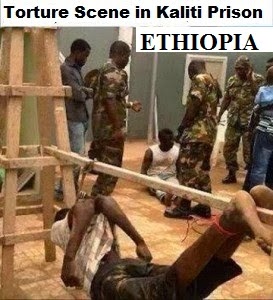
Begna Dugassa, Ph.D
Email: begna.dugassa@gmail.com
Secretary General of the Amnesty International
Amnesty International Ltd
Peter Benenson House
1 Easton Street
London WC1X 0DW
United Kingdom
Dr. Shiferaw Teklemariam
Minster of Federal Affairs
P.O. Box 5718
Finfinee (Addis Ababa)
Getachew Ambaye
Minister of Justice
P.O. Box 1370
Finfinee (Addis Ababa)
Ethiopia
November 12, 2014
Subject: In Defense of the Latest Amnesty International (AI) report Repression in the Oromia
Dear the Secretary General & the Minsters of the Ethiopian Federal Government:
I am writing this letter to defend the latest Amnesty International (AI) report BECAUSE I AM OROMO’ Sweeping Repression in the Oromia Region of Ethiopia1 from the attacks and mischaracterizations of the Ethiopian government presented on BBC Radio and other media outlets. I believe I am entitled to do this for four reasons.
The first reason is, I was born and raised in Oromia among the followers of the Oromo indigenous religion– Waqefaata. I have witnessed human violations perpetuated by consecutive Ethiopian regimes. During the Haile Selassie regime, I witnessed my family members giving a quarter of their harvests to the Abyssinians and paying taxation without representation in the government. I witnessed many Oromo family members tried not to allow baptizing their children in the Abyssinian Orthodox Church. In the belief that if someone first goes through the Waqefaata ceremony known as Amachisa, the person will remain Waqefaata, my community members developed strategy to take their children through the indigenous ceremony first. Accordingly, in the Amachisa ceremony I got the name Tolera = things are good. After that, they had me baptized because the Oromo people were forced to baptize their children in the Orthodox Church. In the ceremony of baptism they gave me a name Gebre Giyorgis = the slave of George. I leave it to the readers to compare the differences in meaning between the two names.
I heard many stories about many innocent Oromo persons being charged with the crimes they did not commit. In most cases it was to free the Abyssinians from crimes they had committed. There is a case that I well knew- about an Oromo person being penalized for referring to the Supreme Court judge as (አንች=anchi) ‘you’, a term used in Amharic in reference to women,-instead of (እርስዎ=irswo) ‘you’ used in reference to the higher officials. The person did not use the term አንች (anchi) to undermine the Supreme Court. The reason was that he did not fully understand the Amharic language. This means that the Oromo people’s cultural rights are regularly violated and such violations are legal. As the UN document clearly states “human rights are indivisible, interrelated and interdependent”; the rights of the Oromo people to social, economic, political and cultural rights are being violated and this is clearly demonstrated in this case of a person being penalized for making a grammar mistake.
— Full Document in PDF
Click to access In-Support-Amensty-International-Report-A.pdf
Amnesty International’s report titled, “‘Because I Am Oromo’: A Sweeping Repression in Oromia …” can be accessed here.


You must be logged in to post a comment.