Economic and development analysis: Perspectives on economics, society, development, freedom & social justice. Leading issues in Oromo, Oromia, Africa & world affairs. Oromo News. African News. world News. Views. Formerly Oromia Quarterly
Oromo nation: The Most Athletically Blessed on Earth
“The Oromo ethnic group in Ethiopia must be one of the most athletically blessed on earth. The list of long distance running champions it has produced includes Haile Gebrselassie, Abebe Bikila, and Sileshi Sihene, as well as Dibaba sisters and Derartu Tulu.” Says Olympic and World Records 2012, Keir Radnedge (Author), pp- 62-82. This is an Official London 2012 Olympic GamesPublication. Wami Biratu, Mammo Dagaga, Tolasa Qotu, Fatuma Roba, Tikki Galana, Lesisa Desisa, Tsegaye Kebede, Meseret Defar, Maryam Yusuf, Gelete Burka, Tariku Bekele, Atsede Bayisa, Mohammed Aman, Gete (Gexee) Wami, Lamma Kumsa, Abebe Mekonnen, Fita (Fixa Bayyisa), Ayelech Worku, Worku Bikila, Kuture Dulacha, Elfnesh Alemu, Abebe Tola, Maru Dhaba, Mariam Hashim, Ibrahim Said, Berhane Adere, Magarsa Tullu, Abarraa Ayyano, Mohammed Kadir, Shibbiruu Raggasaa, Nugussie Roba, Markos Geneti Guta, Tigist Fufa, Almaz Ayyaanaa, Mare Dibaba, Sifan Hassan, Senbere Teferi are Oromians of world stars.
IAAF World Championships 2015 in Beijing, China: Oromo athletes medal gains Calculated Independently. According to the calculations Oromia stands 5th in the world and 2nd to Kenya in Africa.
Injfannoo irratti injfannoo atleetota Oromoo. Baga gammaddan Baga gammanne!
Total victory to Oromo athletes (1-2-3).
#Oromo Athletes Almaaz Ayyaanaa, Sinbiree Tafarii & Ganzabee Dibaabaa Sweep Women’s 5000m Medals (1-2-3) at the 2015 #IAAF World #Championships in Beijing, China. Almaaz Ayyaannaa’s of 14:26.83 marks a new championship record. Ganzabee is the world record-holder and 1500m world champion. Almaz Ayana is the fastest 5000m runner so far in 2015. Almaz #Ayana. #Sembere#Teferi. #Genzebe#Dibaba.
The final of IAAF 2015 Championship in Beijing, 5000m race:
#Oromo athlete #Almaz#Ayana‘s last three thousand metres, if run by itself, would have been the sixth fastest at that distance of all time.
Almaz #Ayana was up against Oromo athlete #Genzebe#Dibaba , who is, hands down, the greatest female middle-distance runner of all time, and who had beaten her this season on numerous occasions. And what did #Ayana do? Halfway through, she put the hammer down. She was flying. ‘I have never seen a championship distance race—male or female—executed with that level of audacity. No one runs that hard that early.’ http://www.newyorker.com/news/sporting-scene/the-most-awesome-female-runner-in-the-world
#Oromo athlete #Mare #Dibaba has won the women’s #marathon at the World #Athletics #Championships in #Beijing on 30th August 2015. Dibaba completed the race in a time of 2:27:35 to win a gold medal in the event at the World Athletics Championships. #Kenya’s Helah #Kiprop came second in 2:27:36, with Dibaba fending off her rival in a sprint finish, while Eunice #Kirwa of #Bahrain claimed the bronze medal with a time of 2:27:39.
Silver medalist Oromo athlete Galatee Burqaa (Gelete Burka), gold medalist Vivian Jepkemoi Cheruiyot of Kenya and bronze medalist Emily Infeld of the United States pose on the podium during the medal ceremony for the Women’s 10000 metres final during day four of the 15th IAAF World Athletics Championships Beijing 2015 at Beijing National Stadium on August 25, 2015 in Beijing, China.
Genzebe Dibaba has made it a habit of turning in jaw-dropping performances over the last couple years, and today’s 1500m in Barcelona was no different, as the 24-year-old ran 3:54.11 in a race where she finished more than 18 seconds faster than second place.
Owner of four World records indoors (1500m, 3,000m, two-mile, and 5,000m), Dibaba today became the ninth fastest woman ever in the outdoor 1500, running the best time since 1997. Her 3:54 is an African record, and lowers the previous 2015 World lead (Jenny Simpson’s 3:59.31) by more than five seconds.
What’s more remarkable is that Dibaba just ran a 14:15 5k PR just four days ago in Paris. That time ranks her as the fourth-fastest woman ever over 5,000m
Oromo athletes won AREVA, 5000m in Paris, IAAF Diamond league.
Atleetoonni Oromoo dorgommii fiigichoo km 5 kan Paarisitti Sanbata Duraa, Hadooleessa 4 bara 2015 ta’e irratti qooda fudhachuun injifannoo boonsaan xumuran. Dorgommii kana irratti Ganzabeen tokkoffaa yoo baatu Almaz Ayaanaa immoo lammaffaa bawuun injifataniiru. 3ffaa fi 4ffaan atleetooa keenya yoo ta’an, Atleetonni Oromoo, sinbiree fi Galateen 5ffaa fi 6ffaa bawuun xumurani.
Oromo athletes, Genzebe Dibaba (1st) & Almaz Ayana (2nd), won 5000m Paris AREVA IAAF DIAMOND LEAGUE. 4 July 2015
Kenyan Mercy Cherono (3rd)and Viola Kibiwot 4th. Oromians Senbere Teferi (5th) and Geleta Burka (6th).
Genzebe Dibaba and Almaz Ayana threw almost everything they had at their assault on the 5000m world record in Paris on Saturday (4).
The results will show Dibaba claimed the victory at the IAAF Diamond League meeting in a personal best and meeting record of 14:15.41, with the hard-working Ayana second in 14:21.97, some seven seconds outside her solo world lead from Shanghai in May.
But that doesn’t tell the full tale of a race in which the pair had been meant to share the pace as they attacked Tirunesh Dibaba’s world record from 2008.
It was actually Ayana who did the lion’s share as the tempo fluctuated from six seconds down to five seconds up on record pace at half way, before they finally faltered over the last kilometre.
Dibaba bided her time for much of the race before pouncing at the bell and running a last 200m of 31.3 to leave her compatriot in her wake.
It was all a bit déjà vu for Ayana, who finished second to the elder Dibaba here in 2013, a performance that persuaded her to switch to 5000m after some early career success in the steeplechase, and drew her back here this evening with the world record in her sights.
The throat-gripping stickiness of earlier in the day had given way to a warm breeze by the start of the race, making the conditions almost perfect for a record attempt.
Or so it seemed.
When the first 1000m went by in a sluggish 2:54.12, six seconds down on record pace, Ayana decided she’d had enough and took off with the younger Dibaba on her heels.
She put in a near suicidal 63.6 fifth lap and pulled her rival through 2000m in 5:38.98, now five seconds up. Dibaba then moved to the front for around 800 metres until Ayana led again through 3000m in 8:36.17.
At 4000m, they were just 0.11 inside Tirunesh’s time, and Ayana was visibly tiring.
Tirunesh had run the last 1000m in 2:42.71 in Oslo, so this was going to be tough.
END OF AGREEMENT
Ayana ploughed on, but Dibaba spotted her chance and flew away at the bell to run a last lap of 61.17.
“The pace of Ayana was too fast for me,” said Dibaba. “That is why I went to my race. I knew there was an agreement before but I could not follow that pace. When it was clear there was no world record I concentrated on my win.”
Ayana saw things differently. “I’m disappointed because the agreement was not kept,” she said. “I did more laps than my rival, especially after 2k. Next time I will run different.”
Younger sister of Tirunesh Dibaba, 24-year-old Oromo athlete Genzebe Dibaba – also hailing from Bekoji, Oromia – won the Diamond League 5K Meet in Oslo, Norway, on June 11, 2015. Among others, she was also cheered by her Oromo supporters in Norway. Oromo athletes Sinbiree and Galate Burqa completed 2nd and 4th respectively.
WORLD LEADS FOR OROMO ATHLETES YOMIF QAJELCHA (KEJELCHA) AND AMAN IN ROME – IAAF DIAMOND LEAGUE. THURSDAY, 4TH JUNE 2015.
Yomif Qajelcha (Kejelcha), author of the best world performance of the season on 5000m in Eugene last on Friday, 29 May 2015 (13’10 “54), improved his own mark in Rome, on the occasion of the fourth stage of the Diamond League, Thursday, 4th June 2015. The young Oromo athlete (17) won in 12’58 “39, before the Kenyan Paul Kipngetich Tanui (12’58” 69). The world 800m champion Mohammed Aman won over two laps of the track in a world-leading 1:43.56.
Sifan Hassan was second in in 1500m women’s race.
Oromia Athletic nation World News
Oromo athlete Sutume Asefa Kebede produced a stunning performance in the BIG 25 Berlin on Sunday May 10, 2015.
Despite 60mph gusts of wind, Oromian newcomer Sutume Asefa Kebede smashed Ejegayehu Dibaba’s national 25km record at the BIG 25 Berlin on Sunday 10 may 2015.
The 21-year-old front-ran to the finish-line in the historic Berlin Olympic Stadium, smashing Ejegayehu Dibaba’s national record with a time of 1:21:55. Despite the windy conditions, Sutume was 19 seconds faster than Ejegayehu Dibaba in Chicago in 2011.
Sutum’s time is a world-lead, and the fifth fastest ever run at this distance. The Oromian was more than four minutes faster than second placed Kenyan Winny Jepkorir who clocked 1:25:59. Elizeba Cherono of Kenya was third with 1:26:59.
Sutume set two lifetime bests en route to victory: 31:05 at 10km, and 68:23 through the halfway mark.
“I am very happy to have broken the national record. I did not expect this to happen today,” said Sutume, who now intends to run the 5000 m on track. “In the autumn I will run road races again.”
At the #Shanghai#IAAF Diamond League meeting on Sunday, 17th May 2015#Oromo athlete #Almaz#Ayana amazed the world in her shinning victory in 5000m race.
Just going faster and faster, Ayana smashed her rivals to win by about 150 metres in 14:14.32.
It was a personal best, a meeting record, an Asian all-comers’ record and an IAAF Diamond League record. Only world record-holder Tirunesh Dibaba (14:11.15) and Meseret Defar (14:12.88), both Oromo athletes, have ever gone faster and Ayana might have topped those times too had she had more competition over the last half of the race.
The 23-year-old Ayana took the bronze medal at the 2013 IAAF World Championships and last year won the IAAF Continental Cup in Marrakech. She has form.
Two years ago, Ayana clung resolutely to Dibaba’s heels as her more illustrious countrywoman ran 14:23.68 at the Paris IAAF Diamond League meeting. Ayana’s reward then was second place in 14:25.84, which remained her personal best coming into Shanghai.
On a cool Sunday night which inevitably suffered a little in contrast to Friday’s IAAF Diamond League opener in Doha, Ayana led after five laps and ran solo from just before the 3000m mark.
At that stage, Kenya’s Viola Kibiwot was still vaguely in contact, but in reality, her only hope of catching Ayana would have been to hail a taxi. Even then it would have been doubtful as the field was spread out all around the track.
It was never hard to spot Ayana, however; you just looked for the woman who was obviously running fast.
With Global Sports physiotherapist Joost Vollaard helping with translation, Ayana said she was not aware of how close she was to the world record.
“I was trying for 14:20, I didn’t think of the world record,” she explained. “I was surprised; it was much faster than I had in mind.”
Based in Finfinnee, Ayana is training just outside the city. She is coached by her husband, 1500m runner Soresa Fida.
#Oromo athlete #Mamitu#Daska created marathon magic at #TCS World 10k in #Bengaluru, India, 17 May 2015 on a fine Sunday.
The story of the day was the spirit of competition, as the entirety of the race was contested in the best possible manner.
Mamitu Daska produced a world-class performance, winning the run but missing the overall course record by 9 seconds. Mamitu ended the race on a high,steering ahead of the competition by a clear 13 seconds, she ended the run with an overall time of 00:31:57. Although Mamitu had pulled far into the lead, the battle for second and third was a thrilling encounter with both Wude Ayalew and Gladys Chesir exchanging positions at the 7km mark. Wude raced ahead by two seconds finishing second at 00:32:10.
Speaking about her medal-winning performance, Mamitu said “I am really happy to end the run on a winning note. Though I was comfortable for the first four kilometres, it got a bit tougher. However I took initiative to push myself after that and crossed the finish line before my competition.”
In the international category of World 10K for Elite Men proceedings as Mosinet Geremew stole the show. The race to claim top honours was tightly contested with the top three finishers separated by 2 seconds each, Geremew emerged victorious, clocking in a time of 00:28:16. His fellow countryman Fikadu Seboka finished second with a timing of 00:28:18, followed by Edwin Kiptoo from Kenya who finished his run in 00:28:20.
Oromians won both the men’s and the women’s races at Riga Marathon Course, the IAAF Bronze Label Road Race on Sunday (17 May 2015).#Oromoathlete Haile #Tolossa Smashes #Riga#Marathon Course Record in men’s race on Sunday 17th May 2015.
In a race where three men ran well inside the previous course record, Haile Tolossa triumphed with a PB of 2:12:29 to record the fastest marathon ever on Latvian soil. Beyene #Effa held on for second place in 2:12:52, also a PB. Duncan Koech of Kenya 3rd in 2:12:53.
Compatriot Oromo athlete #Meseret#Eshetu#Damedominated the women’s race, winning by more than five minutes in 2:37:04 to narrowly miss the course record by 13 seconds.
Oromo athlete Workenesh Tola and Kenya’s Ruth Wanjiru had been running side by side for the majority of the race. Having long passed the fading Chepkemoi, it was only in the final two kilometres thatOromia’s Tola began to pull away, eventually taking second place in 2:42:07.Leading resultsMen
1 Haile Tolossa 2:12:29
2 Beyene Effa 2:12:52
3 Duncan Koech 2:12:53Women
1 Meseret Eshetu Dame 2:37:04
2 Workenesh Tola 2:42:07
3 Ruth Wanjiru 2:42:29
World indoor champion #Oromo athlete #Genzebe#Dibaba was named sportswoman of the year at the Laureus World Sports Awards in Shanghai on Wednesday ( 15th April 2015).
DIBABA NAMED SPORTSWOMAN OF THE YEAR AT LAUREUS WORLD SPORTS AWARDS
World indoor champion Genzebe Dibaba was named sportswoman of the year at the Laureus World Sports Awards in Shanghai on Wednesday (15).
The middle-distance runner became the first sportsperson from Ethiopia to win an award in any category at the prestigious event, which began in 2000.
Dibaba was rewarded for her 2014 season in which she set world indoor records for 1500m and 3000m as well as a world indoor best for two miles.
Outdoors, she went on to record world-leading times over 5000m and 2000m before ending her season with 3000m victory at the IAAF Continental Cup in Marrakech.
On a night in which Renaud Lavillenie, Valerie Adams and Jo Pavey were nominated for other awards, Dibaba was the only winner from the sport of athletics.
Adams was nominated in the same category as Dibaba, while Lavillenie was nominated for the sportsman of the year award, which was given to tennis star Novak Djokovic. Pavey was one of the contenders for the comeback of the year award, which eventually went to rugby player Schalk Burger.
But other legendary athletes played a part in the ceremony. USA’s 400m world record-holder Michael Johnson presented Chinese tennis player Li Na with the exceptional achievement award, while recently retired sprint hurdler Liu Xiang joined Chinese opera singer Liao Changyong on stage for a surprise performance. http://www.iaaf.org/news/news/laureus-awards-2015-genzebe-dibaba
OROMO ATHLETE GENZEBE DIBABA RUNS SECOND-FASTEST 5KM IN HISTORY AT CARLSBAD 5000.
29 MAR 2015REPORTCARLSBAD, UNITED STATES
Two-time world indoor champion Genzebe Dibaba narrowly missed out on breaking the world best at the Carlsbad 5000, but her winning time of 14:48 was the second-fastest ever recorded for 5km on the roads.
The 24-year-old owns the fastest times in history across four distances indoors, and had been hoping to add another mark to her growing collection. Just like three of her indoor record-breaking performances, she was targeting a time that had been set by Meseret Defar. The two-time Olympic champion ran 14:46 in Carlsbad in 2006.http://www.iaaf.org/news/report/carlsbad-5000-2015-genzebe-dibaba-lalang
Injifannoo gammachisaa!!! #Oromo athlete Abera #Kuma from Oromia, pulled away from his rivals in the last seven kilometres of the 35th edition of de NN #Rotterdam#Marathon, an IAAF Gold Label Road Race, to win in 2.06.46 on Sunday (12).
Kenya’s Mark Kiptoo finished second in 2:07:20 and his compatriot Bernard Koech, who did a lot of work in the second part of the race, was third in 2.08.02.
“I was waiting for the more experienced runners to make a move,” reflected Kuma after the third marathon of his career. “I did come here for a personal best but, when the pace slowed down, I decided to try to win the race.”
Oromo athlete Abdi Nageeye was the fastest in the race for the Dutch national title. He finished ninth overall in 2.12.32.
Sisay #Lemma won the 32nd #Vienna City Marathon in 2:07:31 in windy and relatively warm weather conditions at the IAAF Gold Label Road Race on Sunday (12). Kenya’s Duncan Koech was second with 2:12:14 while #SirajGena took third in 2:12:48.
On same day Oromo athletes #Meseret Mengistu Biru and her compatriot Amane Gobena win the Paris Womens Marathon. Seboka #Tola was 3rd in men’s marathon. #Oromo athletes Meseret #Mengistu Biru and her compatriot Amane #Gobenawin the #Paris Womens#Marathon. Seboka #Tola was 3rd in mens marathon.
Injifannoo atileetota Oromoo.
Oromo athletes E. Shumi and B. #Dibaba were crowned champions of#Tokyo#Marathon, Sunday 22nd February 2015. #Oromia. #Africa
Endeshaw #Negesse Shumi clocked a time 2:05:59 to win the men’s race and to beat Olympic and World Champion Stephen Kiprotich of Uganda, who clocked a personal best and national record time of 2:06:30. Kenya’s Dickinson Chumba finished 3rd in 2:06:32.
The women’s Tokyo Marathon winner Birhane Dibabaclocked 2:23:15. Kenya’s Helah Kiprop clocked a personal best time of 2:24:03 to take second while Olympic Champion Tiki #Gelana (#Oromia) was third with a time of 2:24:26.
Congratulations to Oromia’s marathoners Angasaa and Qanani in Indore just like those in Tokyo!
INDORE: Runners from Oromia dominated the inaugural edition of Indore Marathon organised by the Association of Indore Marathoners in the city on Sunday 22nd February 2015.
While all three winners in men’s 21-km open category were Oromians (Oromos), it was their compatriots who were among two of the top three finishers in the women’s open category of the same event.
In the 21-km half marathon men’s open category,Oromia’s Angasa Ware clinched the first place clocking a time of one hour, five minutes and just over 42 seconds, while compatriot Abera Demelash was a close second. Their country mate, management graduate Belay Shimelis stood third.
In the women’s open category of the same event, Oromian Keneni Kome timed one hour, 18 minutes and 58 seconds to win the race, while Kenyan Linal Chirchir stood second and Oromia’s Adanech Jefare secured the third position.
Dibaba broke her fourth indoor world record in just over a year
World indoor champion Oromo athlete Genzebe Dibaba clocked 14:18.86 to beat previous record by more than five seconds at XL Galan meeting in Stockholm, Sweden on 19th February 2015.
Netherland’s European 1500m champion Oromo athlete Sifan Hassan clocked a world-leading indoor personal best of 4:00.46 to win the women’s race. German based Homiyu Tesfaye ran world-leading 1,500 time of 3:34:13.
Oromo athlete Genzebe Dibaba is now the holder of four world indoor records or world bests after clocking 14:18.86 to break the 5000m mark at the XL Galan meeting in Stockholm, Sweden, on Thursday.
With that time the two-time world indoor gold medallist beat the previous world indoor 5000m record set by her compatriot Meseret Defar – also run in Stockholm in 2009 – by more than five seconds. Her 3000m split time of 8:37 is the quickest that distance has been run so far this year.
Dibaba adds this most recent world record to the world indoor records she ran over 1500m and 3000m and the world indoor best she clocked over 2 miles all within 15 days last year. The 3000m record was run at XL Galan, with Defar the previous holder of that record, too.
On Thursday Dibaba finished more than a minute clear of her closest rival, Birtukan Fente, who ran 15:22.56. Oromo athletes filled the top three spots as Birtukan Adamu was third with 15:34.15.
LAVILLENIE, ADAMS, OROMO ATHLETE GENZEBE DIBABA AND PAVEY AMONG 2015 LAUREUS WORLD SPORTSMAN AND SORTSWOMAN NOMINEES.
Read more as follows:
‘IAAF World Athletes of the Year Renaud Lavillenie and Valerie Adams are among the nominees for the 2015 Laureus World Sportsman and Sportswoman of the Year awards.
Lavillenie, in addition to memorably breaking Sergey Bubka’s long-standing pole vault world record last February, was only beaten once during a momentous year.
Outside of athletics, the other male nominees are (in alphabetical order) Serbian tennis player Novak Djokovic, British racing driver Lewis Hamilton, British golfer Rory McIlroy Spanish motorcyclist Marc Marquez and Portuguese footballer Cristiano Ronaldo.
Adams is joined on the list of female nominees by Ethiopian distance runner Genzebe Dibaba; as well skiers Marit Bjorgen and Tina Maze, from Norway and Slovenia respectively, and tennis players Li Na and Serena Williams, from China and the USA.
British distance runner Jo Pavey, who won the European 10,000m title in Zurich last summer at the age of 40 and just 10 months after giving birth, is nominated in the Comeback of the Year category.
The 16th Laureus World Sports Awards will recognise sporting achievement during the calendar year of 2014 and is the premier honours event on the international sporting calendar.
The winners are voted for by the Laureus World Sports Academy, which is made up of 48 of the greatest sportsmen and sportswomen of all time, and they will be unveiled at a globally televised Awards Ceremony staged in the Grand Theatre, Shanghai, on Wednesday 15 April.
“This is going to be yet another classic year. Each year we think the list of Nominees cannot get better, but then it does. The Sportsman of the Year and Team of the Year categories look amazing. You could make a case for every nominee to be the winner,” said Laureus World Sports Academy chairman and former 400m hurdles world record-holder Edwin Moses.’ http://www.iaaf.org/…/news/lavillenie-adams-dibaba-pavey-la…
February 2, 2015 (IAAF) — The world 5000m bronze medallist and Continental Cup winner Oromo athlete Almaz Ayana chats about some of the best things in her world.
Best friend in athletics
My best friend in athletics is Soresa Fida (a 3:34 1500m runner) who is also my husband and always my first source of advice.
Best achievement in athletics
My best achievement is the 5000m victory at the 2014 Continental Cup in Marrakech The other one would be winning a bronze medal in the 5000m at the Moscow World Championships, which was a real breakthrough performance.
Best piece of advice
Every one of us, wherever we live or whoever we are, must work for peacefulness in our world. We are given this world to live in for free and leave it only by the grace of almighty God.
Biggest regret
Up until this point in my life, I have no regrets.
Biggest weakness
I have a weakness in terms of the finish of my races. This is something I am working hard to improve.
Biggest disappointment
I am always highly disappointed when I cannot make a good result in top competitions, like at the 2014 IAAF Diamond League in Brussels (Almaz placed down in ninth in the 3000m). I always want to show my best and I’m unhappy if other circumstances such as illness or injury hold me back.
Best athlete I ever saw
Tirunesh Dibaba is my idol. She has shown great discipline and character throughout her career.
Biggest rival
I have many great rivals but, in the race, time is my biggest rival.
Biggest achievement outside of athletics
I was living in a very small rented room for long time, but recently I bought my own residential house where I am living with my beloved husband.
Best stadium/venue
Competing at the Moscow Olympic Stadium at the 2013 World Championships was the most exciting event in my life. It was an impressive stadium with a great atmosphere and crowd.
Almaz Ayana on her way to winning the 5000m at the IAAF Continental Cup, Marrakech 2014 (Getty Images)[/caption]Almaz Ayana in the 5000m at the 2013 IAAF World Championships (Getty Images)[/caption]
Almaz Ayana in the 5000m at the 2014 IAAF Continental Cup (Getty Images)
Almaz Ayana on her way to winning the 5000m at the IAAF Continental Cup, Marrakech 2014
Source: IAAF.org and http://ayyaantuu.com/sport/personal-bests-almaz-ayana/
HASSAN THE STAR ON A NIGHT OF SIX WORLD LEADS IN KARLSRUHE
February 3, 2015 (IAAF) — The Netherlands’ European 1500m champion Sifan Hassan provided the outstanding performance at the first IAAF Indoor Permit meeting of 2015 when she sped to a national record and world-leading 1500m time of 4:02.57 at the Indoor Meeting Karlsruhe on Saturday (31).
Hassan moved away from Ethiopia’s 20-year-old world indoor silver medallist Axumawit Embaye off the final bend, although the latter was second in an indoor personal best of 4:02.92.
There were five other world-leading marks in the German city.
Turkey’s Ilhan Tanui Ozbilen won the men’s 1500m in 3:38.05, edging out Kenya’s Nixon Chepseba who was second in 3:38.12.
France’s Dmitri Bascou won the 60m hurdles in 7.53, having run the same time in his heat.
“Moments after the start tonight (in the final), I made a big mistake. Had this not happened, I would have run under 7.50 tonight,” said Bascou.
China’s Xie Wenjun was second in 7.62 and Great Britain’s Lawrence Clarke was third in 7.63, equalling his personal best.
Great Britain’s Dina Asher-Smith sped to a 60m time of 7.12, like Bascou, having run as quickly in her preliminary round.
The Briton’s route to victory was eased by the fact that the Netherlands’ European 100m and 200m champion Dafne Schippers, who had also run 7.12 in her heat, was disqualified in the final for a false start.
“I had not reckoned with this time tonight,” bubbled Asher-Smith. “I’m quite surprised how well I ran tonight.”
Spain’s Eusebio Caceres took the long jump honours with an indoor PB of 8.16m.
The Spaniard was languishing down in fifth place with 7.75m before posting his winning attempt in the final round. It spoiled a potential celebration for Germany’s Julian Howard, who actually hails from Karlsruhe and who had leapt an indoor best of 8.04m in the second round
Russia’s former European junior 3000m champion Yelena Korobkina won over 15 laps of the track in a personal best of 8:47.61, almost three seconds faster than she had ever run before under any conditions.
Great Britain’s Laura Muir was second in 8:49.73 with the first seven women home in indoor personal bests.
Lavillenie fails at 6.01m
Not participating in the orgy of world-leading marks was the evening’s headline act, Renaud Lavillenie.
The French vaulter initially looked a bit off his game, after going over 6.00m in Rouen last Saturday, and missed his opening jump at 5.73m.
He then recovered on his next attempt, posting a meeting record of 5.86m on his first try for the victory.
However, he was unsuccessful at what would have been a world-leading 6.01m.
“I was feeling a little tired tonight,” said Lavillenie. “It’s not easy to jump six metres every time out. I had great pleasure in breaking the meeting record, so I’m not unhappy.”
Russia’s Aleksandr Gripich finished second in an indoor best of 5.73m.
USA’s Funmi Jimoh won the women’s long jump with a 6.71m leap right at the end to beat Sweden’s Erica Jarder, who was second with 6.69m. Germany’s world-leading Sosthene Moguenara finished third, also with 6.69m.
Paul Kipsiele Koech’s win in the men’s 3000m never seemed in doubt as he cruised to a 7:45.41 win ahead of Germany’s Richard Ringer, who clocked a best of 7:46.18
US shot putters Christian Cantwell and Ryan Whiting, second and first in Dusseldorf on Thursday, swapped places as Cantwell won with 20.77m to Whiting’s 20.72m.
Susanna Kallur returned to the city of her 2008 world record in the 60m hurdles, running a competitive race over the barriers for the first time since 2010.
The Swede, in the wake of her well-documented injury woes over the past few years, posted creditable 8.14 times in both her heat and final but the competition belonged to Germany’s Cindy Roleder, who won with 8.03 in the final.
Oromo athletes: Lemi Berhanu surprises while Aselefech Mergia makes magnificent Marathon Comeback in the 2015 Dubai Marathon
Note: 90% of Athletes in the ranking positions are Oromo athletes from Oromia
January 23, 2015 (IAAF) — Ethiopia’s Lemi Berhanu emerged as the unexpected champion at the 2015 Standard Chartered Dubai Marathon, crossing the line at the IAAF Gold Label Road Race in a world-leading time and big personal best of 2:05:28 on Friday (23)
It was not a debutants’ triumph as has been the case for the past three years but it was definitely surprise as the 21-year-old Ethiopian – wearing a bib with his extended family name of Hayle on it – left behind some of the biggest names in long-distance running.
Lelisa Desisa, the 2013 Dubai and Boston Marathon champion, took second in 2:05:52 while Deribe Robi completed the all-Ethiopian podium with a time of 2:06:06.
Fourth was Ethiopia’s Feyisa Lilesa in 2:06:35 followed by two more Ethiopians, Sisay Lemma in a personal best of 2:07:06 and Bazu Worku in 2:07:09. Indeed, the top 12 men were all Ethiopian runners.
Split times of 14:39 for 5km and 29:22 for 10km initially pointed towards a sub-2:04 finishing time.
However, the pacemakers could not sustain the pace and when a group of 15 runners reached the 25km mark in 1:13:57, none of them was left in the race.
Five more runners lost contact during the next five kilometres, among them Kenenisa Bekele.
It was Desisa who surged ahead at the 30km refreshment station to take his bottle. The Ethiopian kept going and five countrymen went with him: Robi, Lemma, Lelisa, Girmay Birhanu and Lemi Berhanu.
Five kilometres from the finish a duel between Desisa, who was also second in New York last November, and Lemi Berhanu developed and the latter was able to drop the much more experienced Desisa with about one kilometre to go.
Dream come true in Dubai
“I would never have thought that I could win this race,” said Berhanu, who had won his debut race in Zurich last year with 2:10:40. “It was my dream to do this in Dubai one day, but not this year! With around one kilometre to go, I sensed that I could succeed.”
He has now improved by more than five minutes and is unbeaten in two races.
“If my federation selects me then I would really like to run the marathon in the World Championships in the summer,” added Berhanu, who said he had no idea what to do with the first prize cheque of US$200,000. “I never thought about the money. I really don’t know what I will do with it.”
By contrast, Dubai proved a tough and disappointing marathon experience for Bekele.
Ethiopia’s superstar, in his third marathon, dropped out just beyond the 30km mark, appearing to suffer from a leg injury. He had been in the leading group up to the 28km mark.
“Kenenisa suffered hamstring problems in both legs,” explained his coach Renato Canova.
“But I think the real problem is in his right achilles tendon. At the end of November, he had to reduce training because of this but then it got better and, actually, his final training sessions looked encouraging. A world record was never a realistic target, but a 2:04 time seemed realistic.
“However, when I saw him running today he did not look relaxed, he looked tight. I think this is the reason why he developed hamstring problems. Something must have happened in the final few days before the race,” added the Italian coach. “We now have to solve this tendon problem but for his future marathon career I remain very confident. I think he will do really well.”
Mergia a motivated mother
Making it a marvellous day for Ethiopian runners, other than Bekele, Aselefech Mergia produced a perfect comeback in the women’s race.
Having taken an extensive break from competition to have a baby, the 2011 and 2012 Dubai champion returned to run a marathon for the first time since her disappointing 42nd place at the 2012 Olympics and won in 2:20:02, just 31 seconds outside her course record from three years ago.
In a thrilling battle right to the line, Kenya’s world half marathon champion Gladys Cherono was beaten by just one second in what was the third-fastest marathon debut.
Another Kenyan, Lucy Kabuu, was third in 2:20:21 in a race which saw 10 women run faster than 2:24.
Ethiopia’s Tigist Tufa broke clear shortly after the start and maintained a daunting pace, leading a talented chasing group by a minute at 20km, which was reached in 1:05:23 and suggested a 2:18 finishing time.
However, Tufa paid the price in the end and was caught at 34km by a five-woman group consisting of Mergia, fellow Ethiopians Aberu Kebede and Shure Demissie, Kabuu and Cherono.
The group was reduced to three with just over three kilometres remaining after Kebede and Demissie were dropped, before Mergia eventually proved the strongest in the final kilometre.
“I told myself after having my daughter that I could win a marathon again,” said Mergia, who was watched by her husband and baby daughter. “We used the prize money from my first two wins in Dubai to begin building a hotel back home, now we’ll be able to complete the job.”
Ethiopian runners took the next four places. Fourth was teenager Demissie in a world junior best of 2:20:59, and the fifth fastest debut on record; with Kebede in 2:21:17, 2014 Dubai champion Mulu Seboka in 2:21:56 and then Alemu Bekele in 2:22:51 the next three women across the line.
Men’s results:
Women’s results:
Source: IAAF
Read more at: http://ayyaantuu.com/sport/lemi-berhanu-surprises-while-aselefech-mergia-makes-magnificent-marathon-comeback-in-dubai/
Oromo Athlete Dibaba Successfully Defends Her Xiamen Title as Both Course Records Fall.
January 5, 2015 (IAAF)
Oromo’s (Oromian) Mare Dibaba won the Xiamen Marathon for the second year in succession, taking more than one-and-a-half minutes off the course record she set last year at the IAAF Gold Label Road Race, winning in 2:19:52 on Saturday (3).
For the first time since the inaugural Xiamen Marathon in 2003, both course records were broken as Kenya’s Moses Mosop set a Chinese all-comers’ record of 2:06:19 to win the men’s race on a day when runners were met with ideal conditions with temperatures in the range of 11-15°C.
The organisers had made some adjustments to the route due to some construction-related concerns in the city. Some of the more undulating parts of the course – including the Yanwu Bridge that stretches over the sea – had been taken out.
When Dibaba won in Xiamen last year, she took 61 seconds off the course record and crossed the line five minutes ahead of her nearest rival.
This time, her victory was even more emphatic.
Dibaba built up a significant lead in the early stages of the race and maintained it all the way to the finish, despite some problems with her legs after 33km.
By equalling her PB of 2:19:52, she covered the course one minute and 44 seconds quicker than she did last year, finishing almost eight minutes ahead of Meseret Legesse, who once again finished second to Dibaba for the second year running.
“I could have run faster but I felt a little bit pain in my legs in the last 10km which forced me to slow down,” said the 25-year-old who finished third in Boston and second in Chicago last year. “But I am happy with the result.”
Dibaba had also aimed to break the Chinese all-comers’ record of 2:19:39, set by Sun Yingjie in 2003, and the organisers had offered an extra bonus for achieving such a feat, but Dibaba missed that mark by just 13 seconds.
“I was trying to break the record and I missed it by a few seconds, which was a pity, but I am happy to break the race record,” said Dibaba, who represented Ethiopia in the marathon at the 2012 Olympics. “The new course is very good and the fans along the road were so supportive from the beginning to the end of the race.”
Legesse was about a minute slower than last year, finishing second in 2:27:38. In third, Kenya’s Meriem Wangari set a PB of 2:27:53. It was the second time the 35-year-old had made it on to the podium in Xiamen, having finished second on her marathon debut in 2012.
Mosop back to winning ways
Back in 2011, Mosop made a promising start to his marathon-running career, clocking 2:03:06 on Boston’s record-ineligible course on his debut at the distance and then winning the Chicago Marathon with a course record of 2:05:37 later that year.
But in recent times, the 29-year-old has struggled to recapture that form. He finished eighth at the 2013 Chicago Marathon and a distant 12th in Prague last May, clocking 2:20:37. So when he lined up in Xiamen, he was something of an unknown quantity.
Unlike the women’s race, the men’s contest was more competitive.
A pack of 10 runners ran shoulder to shoulder after 7.5km and passed the 15km check point in 44:50. After 20km was reached in 1:00:20, the leading group was trimmed to six men as Ethiopia’s world bronze medallist Tadese Tola, the fastest man in the race with a PB of 2:04:49, was left behind.
The pace maker dropped out at the 30km mark, but the pace did not slow down. Regassa tried to pull away but was soon caught by Mosop and Ethiopia’s Abrha Milaw.
The leading trio ran alongside one another for a further 5km before Milaw slowed down. Mosop seized the lead at 40km and kept extending his advantage over Regassa untill he hit the finish line in 2:06:19 to take more than a minute off the course record set in 2013 by Oromia’s Getachew Terfa Negari.
Mosop’s time was also the fastest marathon ever recorded on Chinese soil, bettering the 2:06:32 set by the late Samuel Wanjiru when winning the 2008 Olympic title in Beijing.
“I planned to run in sub-2:06 in Xiamen, but I am happy with this result,” said Mosop, who has a PB of 2:05:03. “I have been troubled with injuries – first a knee injury and than an injury in the calf – for two years. Winning in Xiamen at the start of the season is a huge boost for me.”
Mosop’s next marathon will be in Paris in April.
Regassa was also inside the previous course record, clocking 2:06:54 in second place. Milaw finished third in 2:08:09, nine seconds ahead of Kenya’s Robert Kwambai. Tola was a distant fifth in 2:10:30.
In total, more than 43,000 runners competed in the marathon and half-marathon races.
Leading results
Men
1 Moses Mosop (KEN) 2:06:19
2 Tilahun Regassa (Oro) 2:06:54
3 Abrha Milaw (ETH) 2:08:09
4 Robert Kwambai (KEN) 2:08:18
5 Tadese Tola (Oro) 2:10:30
Women
1 Mare Dibaba (Oro) 2:19:52
2 Meseret Legesse (Oro) 2:27:38
3 Meriem Wangari (KEN) 2:27:53
4 Meseret Godana (Oro) 2:36:11
5 Cao Mojie (CHN) 2:43:06
In a record-breaking edition of the #Airtel New #DelhiHalf-Marathon on Sunday (23 November 2014), an unprecedented nine runners ducked under the one-hour mark led by the great #Oromo athlete #Guye#Adola in a course record of 59:06.
The 24-year-old, who won a bronze medal at the #IAAFWorld Half-Marathon Championships in #Copenhagenin March, had the measure of the gold medallist Geoffrey Kamworor this time.
In the deepest race of all-time, #Adola powered to a personal best of 59:06 to defeat #Kamworor – who arrived in the Indian capital unbeaten at the half-marathon in 2014 – by one second.
“The competition was hard, but I am very happy with my podium finish. It was bit cold in the early morning. But I am happy with my timing, and more so because I broke the course record,” said Adola.
Mosinet Geremew finished third in 59:11 while further back, the world-leader Abraham #Cheroben from Kenya placed seventh, albeit in 59:21!
The women’s race was a comparatively sedate affair with world record-holder Florence Kiplagat taking the plaudits in 70:04 in a race which boiled down to a sprint finish on the track inside the Jawaharlal Nehru Stadium.
“It was a very nice and strong field today, very tight group. I knew that if I stuck to the group, I could win and that was my strategy for today,” said the winner.
“Coming into the race as defending champion, there was no pressure on me. I just had to believe in myself and I know I could win back the title.”
World half-marathon champion Gladys #Cherono from and Worknesh #Degefafrom took second and third in 70:05 and 70:07 respectively.
Oromo Athlete Amane Gobena takes the honour at the Istanbul Marathon for the third time
November 17, 2014 (IAAF) — Amane Gobena took the honours at the 2014 Vodafone Istanbul Marathon, winning at the IAAF Gold Label Road Race in 2:28:46 on Sunday (16).
The women’s race had a runner who decided to take matters into her own hands early in the race.
Local road running talent Ummu Kiraz of Turkey led from the start and passed 5km in 17:50 and 10km in 35:25. However, Ethiopia’s Emebt Etea, Amane Gobena and Salomie Getnet kept the gap to around 80 metres, with the home hope Elvan Abeylegesse, Ukraine’s Olena Burkovska and London 2012 Olympic Games bronze medallist Tatyana Petrova Arkhipova close behind.
By the halfway point, covered in 1:14:52, Kiraz was still in the lead by 29 seconds over what had become a six-women pack,
However, around 25 kilometres, race favourite Gobena decided to haul in Kiraz and increased her pace, taking the lead two kilometres later and she passed 30km at 1:46:03, 26 seconds faster than Kiraz and Getnet.
Abeylegesse was running just behind the chasing pair but Burkovska and Petrova Arkhipova were by now another 100 metres in arrears.
Gobena carried on forging ahead and remained unchallenged until the finish line, finishing almost two minutes ahead of anyone else.
Getnet was second in 2:30:36, Burkovska was third with 2:31:30 and Petrova Arkhipova took fourth place with 2:31:47.
Former 5000m world record holder Abeylegessie was fifth in 2:32:15 with the early leader Kiraz eventually finishing sixth in 2:32:52
“I’m very happy to be here for the third time and win for the first” said the 32-year-old Gobena, who was finished third in Istanbul in 2010 and second in 2012.
Her only disappointment was missing out on the course record of 2:27:25, set in 2010 by her compatriot Ashu Kasim Rabo, with race organisers having high hopes that the mark might be improved upon this year.
Hafid Chani, from Morocco, won the men’s competition, finishing the 42-kilometer course in two hours, 11 minutes and 53 seconds, becoming the first athlete from Morocco to win the race in its history. Chani will a $50,000 prize for finishing first.
Oromo athlete Gebo Burka came second after finishing the course in 2:12.23, while Kenya’s Michael Kiprop followed him in a time of 2:12.39.
Burka will receive $25,000, while Kiprop is set to go home with $15,000.
Approximately 25,000 runners from 118 countries registered to compete in today’s races which also included a 15km race and a 10km race.
Oromo athlete Abarraa #Kumaa (Abera#Kuma) wins #Zevenheuvelenloop on Sunday, 16th November 2014.
The Seven Hills Run in #Nijmegen won Sunday by Oromo athlete Abarraa Kumaa. The big favorite and defending champion, Leonard Patrick Komon dropped out midway. He could not keep up the pace.
Kuma was part of a leading group with, among other world record holders Leonard Komon and Zersenay Tadese. These two top runners were on#Zevenheuvelenweg let the leaders go when Kuma accelerated. The Oromian then fought a battle with his compatriots Yigrem Demelash, Yenew Alamirew and Tesfaye Abera. Eventually he arrived solo at the finish.
Gammachuu!!! Gammachuu!!! Injifannoo Atileetota Oromoof! Victory to Oromo athletes! Amanee Gobanaa (Women’s race) and Gebo Burqaa (2nd in men’s race) took the honours at the 2014 Vodafone Istanbul Marathon, winning at the IAAF Gold Label Road Race.
Belayinesh Oljirraa, Emane Margaa & Muktar Idris Win IAAF Cross Country series in Burgos, Spain.
The 11th ‘Cross Internacional de Atapuerca’ marked the opening leg of this winter’s IAAF Cross Country Permit series which will reach the pinnacle with the IAAF World Cross Country Championships next March and saw victories from the Oromian duo Imane Margaa (Men’s race) and Belaynesh Oljirraa (Women’s race) on Sunday 16th November 2014.
Right from the gun, the men’s race – held in cold conditions as the thermometer barely reached 7 degrees Celsius, and with very strong winds – turned into a two-man battle between Margaa and his compatriot Muktar Edris.
Wearing identical orange vests, Edris and Margaa looked in impressive form but it was always Edris who made the pace while the former world champion Margaa ran comfortably just behind him, copying his tactics from the last three editions in Atapuerca where he had taken narrow sprint finish wins.
Oljirraa maintains the Oromians dominance!
In contrast to the men, the 7.9km women’s race opened relatively gently with Spain’s Sonia Bejarano reaching the one kilometre point in the lead while all the favourites were comfortably positioned behind her.
Oljirraa, who won bronze medals at both the IAAF World Cross Country Championships and also in the IAAF World Championships 10,000m last year, took command some five minutes into the race but there still were a large leading group of seven at halfway.
After successive laps of 6:43 and 6:30, two-time Atapuerca winner Hiwot Ayalew went to the front and the group was quickly whittled down to four with only Ayalew, Oljira, Kenya’s 2013 World Championships 5000m silver medallist Mercy Cherono and Morocco’s Malika Asahssah remaining in contention after Ayalew covered the third lap in 6:25.
With just under two kilometres remaining, Oljirraa regained command of the race and her change of speed left first Cherono and then Ayalew behind.
As Oljirraa carried on to secured her win in style, crossing the line in 25:26, Cherono caught Ayalew some 200 metres out to finish eight seconds adrift the victor.
A fading Ayalew could not even keep her third place as she was caught by Asahssah in the closing 30 metres.
“I knew Atapuerca as I already had raced here three years ago. On that occasion, I came second so I was eager to come back to what I think is the best cross country race in the world and win,” said a delighted Oljirraa.
#Oromo athlete Belaynesh #Oljirraa won the 25th edition #Bupa Great South Run.
Oromo Athletes in Germany: Tulu Wodajo Addisu wins the sovereign Rother fair run
August 13, 2014
Oromo Athletes performed superb in Roth, Bayern, Germany on Sunday, August 10, 2014. Athlete Tulu Wodajo Addisu, with Oromia National flag on his shirt (214), finished first, while Etana Getachew finished second and Badhane Gamachu fourth.
Congra! Brave #Oromo athlete Sifan Hassan wins for Europe!
Sifan #Hassan collected an impressive victory in the 1500m to further cushion Team Europe’s lead midway through the second day’s programme.
Hassan, the #European champion from the #Netherlands, won by more than a second in 4:05.99 after taking command of the race from the 800m point. She didn’t hide her delight as she crossed the line, arms held high, smiling widely.
“In the last 600 metres (Seyaum) was going fast so I had to speed up,” said the 21-year-old, who ran a world-leading 3:57.00 at the #IAAF Diamond League meeting in Paris in July. “So that’s how I won. It’s fantastic!”
Oromo Athelete Sifan Hassan (Representing Netherlands) won gold medal in 1500 m at European Championships 2014 in Zurich.
August 15, 2014 (Google Translation from Dutch language – NOS) — Sifan Hassan won the gold medal in the 1500m at the European Championships in Zurich, yesterday, August 14, 2014. Hassan (21) was born in Adama, Oromia, and obtained a Dutch passport only last November. Later this week, Hassan was out on the five kilometers.
It is the second Dutch gold medal in Zurich; Wednesday Dafne Schippers was the fastest in the 100m.
Hassan fitted into the finals its usual tactic. She sat only at the start of the final round in the lead and accelerated, but this time she let herself overtake weather by its biggest competitor, the Swedish Abeba Aregawi. On the final straight, the 21-year-old Arnhem hit mercilessly. Aregawi had to settle for silver in 4.05,08. The bronze medal was for the British Laura Weightman in 4.06,32.
Sifan Hassan left Oromia as a refugee and arrived in the Netherlands in 2008 at age fifteen. She began running while undertaking studies to become a nurse.
Affiliated with Eindhoven Atletiek, she entered the Eindhoven Half Marathon in 2011 and won the race with a time of 77:10 minutes. She was also runner-up at two cross country races (Sylvestercross and Mol Lotto Cross Cup). She won those races in 2012, as well as the 3000 metres at the Leiden Gouden Spike meeting.
Sifan made her breakthrough in the 2013 season. She ran an 800 metres best of 2:00.86 minutes to win at the KBC Night of Athletics and took wins over 1500 metres at the Nijmegen Global Athletics and Golden Spike Ostrava meetings. On the 2013 IAAF Diamond League circuit she was runner-up in the 1500 m at Athletissima with a personal best of 4:03.73 minutes and was third at the DN Galan 3000 metres with a best of 8:32.53 minutes – this time ranked her the fourth fastest in the world that year.
She gained Dutch citizenship in November 2013 and the following month she made her first appearance for her adopted country. At the 2013 European Cross Country Championships she won the gold medal in the under-23 category and helped the Dutch team to third in the rankings. She also won the Warandeloop and Lotto Cross Cup Brussels races that winter. At the beginning of 2014 she ran a world leading time of 8:45.32 minutes for the 3000 m at the Weltklasse in Karlsruhe, then broke the Dutch record in the indoor 1500 m with a run of 4:05.34 minutes at the Birmingham Indoor Grand Prix. http://ethiofreespeech.blogspot.no/2014/08/sifan-hassan-won-gold-medal-in-1500-m.html
“The Oromo ethnic group in Ethiopia must be one of the most athletically blessed on earth. The list of long distance running champions it has produced includes Haile Gebrselassie, Abebe Bikila, and Sileshi Sihene, as well as Dibaba sisters and Derartu Tulu.” Says Olympic and World Records 2012, Keir Radnedge (Author), pp- 62-82. This is an Official London 2012 Olympic Games Publication. Wami Biratu, Mammo Dagaga, Tolasa Qotu, Fatuma Roba, Tikki Galana, Lesisa Desisa, Tsegaye Kebede, Meseret Defar, Maryam Yusuf, Gelete Burka, Tariku Bekele, Atsede Bayisa, Mohammed Aman, Gete (Gexee) Wami, Lamma Kumsa, Abebe Mekonnen, Fita (Fixa Bayyisa), Ayelech Worku, Worku Bikila, Kuture Dulacha, Elfnesh Alemu, Abebe Tola, Maru Dhaba, mariam Hashim, Ibrahim Said, Berhane Adere, Magarsa Tullu, Abarraa Ayyano, Mohammed Kadir, Shibbiruu Raggasaa, Nugussie Roba and Markos Geneti Guta are Oromians of world stars.
Following her dramatic victory in the women’s 10,000m final at Barcelona 1992, Derartu Tulu waited at the finish line for the opponent Elana Meyer, a white South African, and the two set off hand in hand for a victory lap that came to symbolise new hope for Africa. At Sydney 2000, having regained her form of eight years earlier, Tulu again won gold in the women’s 10,000m event, becoming the first woman to win two gold medals in long-distance races at Games and the only woman to win 10,000m gold twice.
Women’s long-distance track events are relatively new to the games programme. It wasn’t until 1996 that a women’s 5000m event introduced and the women’s 10,000m did not make its debut until the 1988 games in Seoul. Only one women, Tirunesh Dibaba at the Beijing games in 2008, has achieved the accolade of claiming the 5000m-10,000m double.
At the 2008 Games in Beijing, Tirunesh Dibaba became the first woman in history to complete the 5000m- 10,000m double.
Gebrselassie burst on to the scene in the 1990s and progressed to become the pre-eminent marathon runner. Bekele took over his crown as king of the men’s 10,000m in 2004 and four years latter laid claim to being the best ever at half the distance. Bekele is aslo arguably the finest cross-country performer the world has ever seen.
Men’s 5000m and 10,000m long distance races challenge an athlete’s speed and endurance. The two events were introduced at the 1912 games Stockholm and many athletes have competed in both over the years with the double achieved on seven occasions, most recently by Kenenisa Bekele at Beijing 2008.
Abebe Bikila, running barefoot, won the men’s Marathon at Rome 1960 to become the first black African gold medallist in history. When runners lined up for the men’s Marathon at Rome 1960, no one outside his own country had heard of 28-year-old Abebe Bikila. He had been drafted into his country’s team at the last moment only after Wami Biratu broke his ankle playing football. By the end of the race, he had claimed the first gold medal won by a black African in the Games’ history – in bare feet, and in a world record time of 2:15.16. Four years latter, he contracted appendicitis just six weeks before Tokyo Games but jogged around the hospital to maintain his fitness. This was his first marathon with shoes , and he won in another record time (2:12.11).
Olympic and World Records 2012
by Keir Radnedge (Author),Hardback, pp- 62-82.
An Official London 2012 Olympic Games Publication
Oromo athlete, a father of 12, Wami Biratu was once among the best long-distance runners in Ethiopia. Wami had at one point trained Abebe Bikila. In his career, Wami had won 30 gold, 40 silver and 10 bronze medals and won competitions in Egypt, Japan and Czhekoslavakia.
Mamo Wolde Dagaga was born in the village of Dirre Jille in Ad’a district about 60 Km from Finfinnee from his parents Obbo Wolde Dagaga and Aadde Ganame Gobana.
Mamo grew up in a traditional upbringing spending most of his childhood in Dredhele where he attended a “qes” schooling. In June of 1951, he was hired by the Imperial Body Guard. While at the armed forces, Mamo was able to further his education. In 1953, he was transferred to the Second Battalion of the Imperial Guard and was sent to Korea as part of the UN peacekeeping mission. Mamo spent 2 years in Korea where he had a distinguished military service. After returning from Korea, Mamo got married and pursued his passion of athletics quite regularly.
Mamo easily qualified to be a member of the Ethiopian Olympics team that participated in the Melbourne Olympics in 1962. He had the overall best performance of the national Olympics team by becoming 4-th in 1500 meter race. In 1968, Mamo competed in the 10000 meters race along with the then favorite Kenyan athletes Kip Keno and Naphtaly Temo. 200 meters before the end of the race, Mamo went to the lead. He maintained the lead until almost the end whence he was overtaken by Naphtaly Temo of Kenya. Mamo won his first Silver Olympic medal. One day before the marathon race, the team trainer Negussie Roba approached Mamo and informed him that the legendary Abebe may not be able to finish the marathon race due to bad health. Coach Negussie told Mamo that he was the nation’s only hope for the next day’s marathon race and orders him to prepare. The next day, October 20, 1968, 72 athletes from 44 countries started the long anticipated race. Abebe Bikila, Mamo Wolde and Demssie represented Ethiopia. Abebe later dropped out of the race at the 15-th Km after leading for the whole duration. Mamo later would muse.
Mamo Wolde completed the race victoriously giving his country a third gold medal in Marathon. Mamo became an instant hero just like Abebe. Mamo was 35 when he won the Mexico City Marathon race. In 1972, Mamo participated in the Munich Olympics at the age of 40 where he won a bronze medal in the 10000 meter. In his athletic career, Mamo had participated in a total of 62 international competitions. http://www.roadrunnersclub.org.uk/documents/196_MamoWoldeandtheRRC.pdf
Oromo athlete Tolossa Qottuu is currently the assistant coach of the Ethiopian National Athletic team. Tolossa had his own successful career in long-distance running which earned him 18 gold, 3 silver and 12 bronze medals. His rise to national level was as a result of his near win in the 5K race in 1972 which he narrowly lost to Miruts. Tolossa had participated in the Montreal and Moscow Olympics.
Oromo athlete Eshetu Tura had won a total of 30 gold, 19 silver and 13 bronze medals in the 3000 meters hurdle race.
Eshetu Tura is a man whose career changed by a song. The famous song written by Solomon Tessema, the legendary sport journalist, to honor Abebe Bikila and Mamo Wolde (marathon li-Ililtwa) was playing on the radio after Mamo’s victory in Mexico City. Eshetu not only get inspiration but also a determination to be like Abebe and Mamo.
Eshetu joined the armed forces, the breeding-ground of athletics success in Ethiopia. His win in the 3000 meters hurdle earned him the national spot-light. Eshetu had won a total of 30 gold, 19 silver and 13 bronze medals in the 3000 meters hurdle race. Eshetu’s name is recorded in the History books as Oromia’s first athlete in the 3K hurdle.
Oromo athlete Darartu Tulluu as she won the women’s 10000 meters race in the Barcelona Olympics in 1992.www.oromiasports
Derartu Tulu rose to fame and an Olympics history, when she convincingly won the women’s 10000 meters race in the Barcelona Olympics in 1992. The scene of this 23 year old Ethiopian young lady winning this race and then draping herself with the national tri-color and doing a lap has placed her in the ranks of the eternal Oromo heroes Abebe Bikila and Mamo Wolde.
Dearatu was born in 1969 in the village of Bokoji in the Arsi region of central Oromia as a seventh child in a family of 10 children. Even in elementary school, Derartu excelled in horse riding competitions. Derartu’s first significant win came in a 400 meter race in her school where she out-run the school’s start male athlete. That along with a win in 800 meters race in her district convincingly put Derartu in a path of a successful career in Athletics. In 1988, Derartu represented the region of Arsi and competed in a national 1500 meters race where she won a bronze medal.
When she was 17, Derartu was hired by the Ethiopian Police Force. In 1989, she competed in her first international race of 6 kilometer cross-country in Norway but was 23rd. In a year time, though, she competed in the same race and won the Gold Medal. Derartu won international recognition and success in the 90’s. Her record-setting win in the 10,000 meter race in Bulgaria and her win in the same distance race in Cairo, Egypt are worth mentioning.
Derartu’s win in the 10,000 meter race in the Barcelona Olympics goes down in the History Books as the first gold-medal win ever by an African woman.
Darartu is the first black African woman to win a gold medal which she won in the 10,000m event at the 1992 Barcelona Olympic Games. The race, where her and Elana Meyer (South Africa) raced for lap after lap way ahead of the rest of the field launched her career. She sat out 1993 and 1994 with a knee injury and returned to competition in the 1995 IAAF World Cross Country Championships where she won gold, having arrived at the race only an hour before the start. She was stuck in Athens airport without sleep for 24 hours. The same year she lost out to Fernanda Ribeiro and won silver at the World Championships 10,000.
1996 was a difficult year. At the IAAF World Cross Country Championships Tulu lost her shoe in the race and had to fight back to get 4th place. She also finished 4th at the Olympic Games where she was nursing an injury. In 1997 she won the world cross country title for the second time but did not factor in the 10,000 metres World Championships. 1998 and 1999 she gave birth, but came back in 2000 in the best shape of her life. She won the 10,000 metres Olympic gold for the second time (the only woman to have done this in the short history of the event). She had also won the IAAF World Cross Country Championships title for the third time. In 2001 she finally won her world 10,000 track title in Edmonton. This was her third world and Olympic gold medal. She has a total of 6 world and Olympic gold medals.
She is also remembered for her speed and her 60.3 second-last lap at the end of the 10,000 metres at the Sydney Olympics was a sprint of note. As of 2014, Derartu Tulu is still running competitively, while most of her old rivals are retired or retiring. In her short but on-going career, she has managed to win over 35 gold, 12 silver and 15 bronze medal.http://en.wikipedia.org/wiki/Derartu_Tulu
Oromo athlete Fatima (Fatuma) Roba. The first black/ African Woman to win Marathon. www.oromiasports
Roba started running in her elementary school in the Arsi region that was once home also to Derartu Tulu and Haile Gebrselassie, 10,000-meter Olympic gold-medalists in 1992 and 1996 respectively.
Fatuma Roba was the fourth of eight children of subsistence farmers living in the rural countryside outside Bukeji, Derartu Tulu’s hometown. Roba began winning 100-meter and 200-meter races and was chosen to represent her school in regional competitions.
“I knew of (1960 Olympic marathon winner) Abebe Bikila and (1968 winner) Mamo Wolde from the radio, so I thought I’d try it, too,” she says. Unlike many rural women runners, Roba says she faced little objection from her Muslim family when she decided to take up the sport. Four years later, she moved to Finfinne became a runner on the prison police force.
‘Fatuma Roba did not take the usual path to becoming a living legend in the sport of marathon running. She was a pioneer, becoming Africa’s first ever female to take the sport’s most prestigious prize at Atlanta in 1996 when she won the Centennial Olympic Marathon. Who would have thought it, when she had only a 2:39 PR coming into the Olympic year!’http://www.runnersworld.com/boston-marathon/fatuma-roba-twisted-path-living-legend
Oromo and Kenyan girls dominated 5000m final race, IAAF Moscow 2013. Bronze medal winner Almaz Ayana of Oromia, gold medal winner Meseret Defar of Oromia and silver medal winner Kenya’s Mercy #Cherono, from left, compete in the women’s 5000-meter final Saturday, Aug. 17, 2013. Photo: David J. Phillip,www.sfgate.com/
Maryam Jamal was born in the Arsi Zone in the Oromia Region of Ethiopia, an area famous for distance runners, including Haile Gebreselassie, Kenenisa Bekele and Tirunesh Dibaba. She is Muslim Oromo. At the 2012 Olympics, Maryam Yusuf Jamal Represented of Bahrain and became the first Gulf female athlete to win a medal when she won a bronze for her showing in the 1,500m race.
Oromo athlete Tikki Galana, as she wins the 2012 Women’s marathon in London.
The 2011 Amsterdam Marathon marked a breakthrough for Tiki as she won the race in a time of 2:22:08 hours – almost eight minutes faster than her previous best and an improvement upon Gete Wami‘s nine-year-old course record.[14] At the end of that year she returned to Ethiopia, where she came runner-up at the Great Ethiopian Run and third at the Ethiopian Clubs Cross Country Championships.[15][16] She improved her personal best at the Kagawa Marugame Half Marathon in February 2012, going unchallenged to win the race in 1:08:48 hours.[17]
She broke the Ethiopian record at the 2012 Rotterdam Marathon, completing a solo run of 2:18:58 hours to win the race almost five minutes ahead of runner-up Valeria Straneo.[18] This made her the fourth fastest woman ever over the distance.[19] She was selected to represent Ethiopia in the Olympic marathon as a result. At the London 2012 Olympics she won the gold medal at the marathon with an Olympic record time of 2:23:07 hours, in spite of rain throughout the race and a fall at the water station.[20] After the Olympics she ran a personal best for the half marathon, recording 1:07:48 for third at the Great North Run,[21] then ran a 15 km best of 48:09 minutes at the Zevenheuvelenloop (finishing behind Olympic 10,000 m champion Tirunesh Dibaba at both races).[22] She was chosen at the AIMS World Athlete of the Year Award for her performances that year.[23]
Injifannoo gammachiisa!!!!
Oromo athlete Genzebe Dibaba wins the women’s 3000m for #TeamAfrica in 8:57.54. The fourth w3000 win in a row for Africa at the IAAF#ContinentalCup, 13th September 2014.
Ibrahim Jeilan (Oromia, silver) and Mo Farah (Britain, gold) in 10,000k Moscow World Athletics 2013 final race.
Winner of the Boston Marathon, Oromo athlete Lelisa Desisa with United States Secretary of State John Kerry at the American Embassy in Oromian Capital, Finfinnee.
In a somber ceremony at the American Embassy on Sunday, 26th May 2013, Lelisa Desisa, the men’s winner of this year’s Boston Marathon, said he intended to donate his medal to the people of Boston.“Sport holds the power to unify people,” Desisa said.
Oromia’s Tsegaye Kebede won the men’s London 2013 Marathon race in an unofficial time of two hours six minutes three seconds after chasing down runaway leader Emmanuel Muta.
Oromo athletes Buzunesh Daba is 2nd in 2013 New York Women Marathon and TigistTufa has demonstrated great performance as debutante. Both were leading the 1st 35 km. Priscah Jeptoo of Kenya is the 1st. The favorite Tsegaye Kebede is 2nd in the men’s race as Kenyan was the 1st.
Oromo athlete Negari Terfa wins the 11th Xiamen International Marathon, an IAAF Gold Label race (2013), and set a course record in the men’s race while while Oromo athleteFatuma Sado made it an Oromiann double by winning the women’s race. Eyarusalem Kuma is 3rd in the women’s race.
Oromo athlete Markos Geneti (born May 30, 1984 in Gute, a small township about 10 km east of Nekemte in Eastern Wollega, the State of Oromia) is an Oromian long-distance runner who previously competed in track running, but now is a road specialist.
In March 2011, he won the Los Angeles Marathon, breaking the record by almost two minutes in his first marathon attempt. His time of 2:06:35 was the sixth fastest ever for a race débutante at that point. In his second race at the 2012 Dubai Marathon he ran a personal best time of 2:04:54 hours, but in one of the fastest races ever, he took third place behind Ayele Abshero and Dino Sefir.He did not return to competition until December, when he ran at the Honolulu Marathon and placed second to Wilson Kipsang.http://en.wikipedia.org/wiki/Markos_Geneti
Oromo Athletes win Great Manchester Run
May 18, 2014, Manchester, England – Oromian athletics legends Kenenisa Bekele and Tirunesh Dibaba eased to victory in their respective races in the Great Manchester Run on Sunday.
World and Olympic 10,000m champion Tirunesh Dibaba earned a comfortable victory in the women’s competition, finishing the 10km course in 31:09.
Bekele, a three-time Olympic gold medalist on the track, raced alongside world marathon record holder Wilson Kipsang of Kenya for much of the 10 kilometres course.
However, the 31-year-old – who indicated he may have an equally glorious career ahead of him in road racing when he won his debut marathon in Paris in April – kicked away in the final 400 metres to finish in a time of 28 minutes 23 seconds.
Kipsang, also fresh from a marathon triumph in London where he set a new course record, came in five seconds back while South Africa’s Steve Mokoka was some distance back in third.
“I’m very happy to win here after having run the marathon recently,” said Bekele.
“There was a lot of wind so I tried to hide behind Kipsang and save my energy.”
A beaming Kipsang was delighted with his showing.
“This is a short distance for me but I still showed I have the speed.
“We shall meet again and over the longer distance (the marathon),” said the 32-year-old, who took marathon bronze in the 2012 Olympics.
Bekele, also a four-time 10 000 metres world champion as well as once the 5 000m titleholder, said that he and Kipsang would face many battles over the marathon distance in the years to come.
“I will run some races on the track still but Wilson and I are the same age and the same level so we will be competing against each other for years to come,” said Bekele.
Dibaba, a three-time Olympic champion and five-time world champion on the track, was never troubled and came home over a minute clear of her nearest rivals Gemma Steel of Great Britain and Polline Wanjiku of Kenya.
“The course was very good but the wind was a problem,” said 28-year-old Dibaba
Bishaan Amboo sana dhugdeeti.
The winner of Dubai and Houston Marathon, #Oromo athlete #Mamitu#Daska is unquestionably the current queen of the #Bolder Boulder’s elite women’s 10K race.
The Oromian won her fourth title Monday 26th may 2014 well ahead of the rest of the field, finishing in 32 minutes, 21.63 seconds. She also won in 2009, 2010 and 2012 and was the runner-up in 2011. Only Portugal‘s Rosa Mota has more career Bolder Boulder victories with five.
Even with temperatures in the high 60s, and even with a hard early pace from Deena Kastor, Daska felt the pace was too slow. So she took off down the left side of a long straightaway before the first mile while the rest of the women followed the inside curve of the road.
The champion “did good training and felt the pace was easy at the beginning,” Daska said through a translator.
That set the tone: If you want to win, prepare for bold moves and a long grind over the scorching pavement of this rolling, high-altitude course.
July 26, 2014 (IAAF) —World youth 3000m champion, Oromo athelete Yomif Kejelcha led for most of the last kilometre to win the men’s 5000m in 13:25.19, his best ever clocking.
Kejelcha’s team mate Yasin Haji, with whom he shared pacing duties in the last third of the race, finished in 13:26.21 for silver. Moses Letoyie of Kenya took bronze in 13:28.11.
Population:
The Oromo people are the native inhabitants of Eastern Africa. Their population is estimated at 40 million people, which comprises the single largest ethnic group in East Africa. There are thousands of Oromo people living in diaspora, largely residing in countries including the United States of America, Australia, Canada, Norway, England and Sweden.
Where is the Oromo land?
The land of the Oromo people is called Oromia. Oromia is bordered by Ogadenia and Somalia in the East, Kenya in the South, Gambella and Sudan in the West and Abyssinia in the North. The capital city of Oromia is called Finfinnee (pronounced fynn-fynn-neh), otherwise referred to as “Addis Ababa”.
Language:
The Oromo people speak Afaan Oromo. They belong to the Cushitic-speaking group of Eastern Africa. The Oromo language is the 4th most spoken language in the continent of Africa.
Religion:
The Oromo people practice three main religions Waqeefanna (Traditional Oromo beliefs), Islam and Christianity.
History:
Since the late 19th century, the Oromo have been under colonization by successive Ethiopian governments. Assisted by European colonial powers with modern weaponry, many Oromo people were killed and during 1870 until 1900s. Bloodshed was intense as the Oromo population was reduced from 10 million to 5 million people. Since the forced incorporation of Oromia as part of present day ‘Ethiopian’ empire, the language and culture of the Oromo people was banned by the Ethiopian government and punishable as a crime, until 1991. Oromo attempts to preserve the Oromo culture and language exist despite open attempts at Oromo ethnic cleansing.
Since the official penalty for speaking the language has been lifted in 1991, many Oromo people are still identified as “Ethiopian”; a title is largely resented because of the because of the historically traumatic connotations for Oromo people.
Notable Oromo movements, particularly in the 1960′s include the Oromo Raayya revolt, the Caalanqo and Aanoole Wars and The Afran Qalloo movements. Other Oromo groups and movements include the Maccaa Tuulama Association, the birth of the Oromo Liberation Front, the Oromo Student movements in 2005.
The Oromo people refer to themselves as Oromo and their land as Oromia.
Historical and cultural information about Oromo people:
Gadaa System:
The Oromo people live by a democratic and egalitarian political system, called the Gadaa system. The Gadaa system consists of Gadaa grades, these grades have individual titles and responsibilities and are also grouped in 8 year periods. Each Gadaa title teaches the young male from birth to develop skills and knowledge about culture, governance, family values and leadership qualities. At the age of 40, Oromo men can be elected as Gadaa officials.
Siinqee Institution:
Like Oromo men, Oromo women have an incorporated institution. Siinqee is one of the pillars of Gadaa, an indigenous system of thought and practice which forms the foundations of Oromo society. As the bride steps out of the door of her mother’s house, she would be handed the Siinqee (a traditional and sacred Oromo stick) by her mother. She walks, imbued with the majesty of Siinqee, shoulder to shoulder with her bridegroom, who carries a spear. The role of Siinqee in Oromo society is to keep the peace and moral sanctity of the society. Warring groups would have to immediately halt their hostilities once the womenfolk wielding Siinqee appear on the battle scene. Most importantly, when in justice is committed, the women in the vicinity would come out in the the morning hours bearing their Siinqee and baring their hairs. According to Oromo custom, the testimony of a woman is not to be doubted. It takes only the testimony of a woman to convict a man. However, it would take the sworn testimony of three men to convict a man as guilty.
Coffee:
Coffee was first found in Oromia, in the city of Kaffa, South Western Oromia. Oromo people began using coffee for nutritional use in the beginning of the 5th century.
Ethiopia: The endless suffering of Oromo Nationals continued even after the landmark victory claim of the EPRDF in the election of May 2015
HRLHA Urgent Action
For Immediate Release
August 29, 2015
Even though the government of Ethiopia claimed 100% of the victory during the parliamentary election of May 2015, harassment and intimidation through arbitrary arrests, kidnappings and disappearances of civilians have continued unabated in all corners of the Oromia Regional State under the pretext they voted for opposition parties and did not give their voice for the EPRDF wing Oromo organization, the Oromo People Democratic Organization (OPDO) According to HRLHA correspondents in Oromia, the major target areas of these most recent government-sponsored human rights abuse include Bule Hora (Guji zone, Southern Oromia), Dambi Dolo (Western Oromia zone), Western and North Showa Zones (Central Oromia Regional State). According to the report obtained from Oromia, more than two thousand Oromo nationals have been arrested and many have been abducted since the May 2015 election. In another incident, the Ethiopian federal police arrested over 400 farmers, men and women in the North Showa Zone Warra Jarso district from different communities on the pretext that they harbored rebels who fought against the government. The victims were picked up from their homes and confined in Warra Jarso district administrative offices and different local schools. Although it has been difficult to identify everyone by their names, HRLHA correspondents have confirmed that the following were among those arrested. The endless suffering of Oromo Nationals
Gerba is a leader of the Oromo Federalist Congress, a political party that represents one of the country’s largest ethnic groups. With estimated numbers of about 30 million, the Oromo make up about a third of Ethiopia’s population.
In 2011, Gerba was arrested after meeting with Amnesty International researchers and sent to prison on what he calls trumped up terrorism charges, often used in Ethiopia against political dissidents. In court he made remarks that have been widely circulated in Ethiopia and beyond: “I am honored to learn that my non-violent struggles and humble sacrifices for the democratic and human rights of the Oromo people, to whom I was born without a wish on my part but due to the will of the Almighty, have been considered a crime and to be unjustly convicted.”
Gerba was released from jail this spring in advance of President Obama’s July visit to Ethiopia. A soft spoken man, who seemed exhausted by his prison ordeal and his numerous appearances at U.S. universities and think tanks, Gerba tells NPR that Obama’s trip sent all the wrong messages.
“He [Obama] shouldn’t have shown any solidarity with that kind of government, which is repressive, very much authoritarian and very much disliked by its own people,” Gerba says.
Since Ethiopia’s ruling party and its allies control all of parliament, his party doesn’t have a voice, he says. What’s more, he says, his people are being pushed off their land by international investors.
“The greatest land grabbers are now the Indians and Chinese …. there are Saudi Arabians as well,” he says, adding that many families are being evicted and losing their livelihoods.
Gerba says those who do get jobs are paid a dollar a day, which he describes as a form of slavery. He is urging the U.S. to use its aid to Ethiopia as leverage to push the government to give workers more rights and allow people to form labor unions.
Gerba’s case has been featured in the State Department’s annual human rights reports. He describes himself as a Christian who believes in non-violence and says he spent his four years in prison pouring over the sermons and speeches of Martin Luther King and translating them into the Oromo language for a book that he hopes to see published. The title: “I Had A Dream.”
Bekele Gerba is not sure what he will face when he returns home from the U.S. When he was jailed, his wife, a high school teacher, lost her job. His family has struggled financially and psychologically.
“Nobody is actually sure in Ethiopia what will happen to him anytime,” he says. “Anytime, people can be arrested, harassed or killed or disappeared.”
Still, he plans to return home next week. He’s expected to return to his job at the Foreign Languages Department at Addis Ababa University.
The Cause of Ethiopia’s Recurrent Famine Is Not Drought, It Is Authoritarianism
Dawit Ayele Haylemariam, The Huffington Post, 24 August 2015 A concerned Citizen and Graduate Student of Political Science at University of Passau, Germany
Twenty years ago one Ethiopian Diaspora in Washington asked the late Prime minister Meles Zenawi what his vision for the country was. A rather polite and amiable Meles outlined his vision in a very human centered way. He said he hopes that in ten years every Ethiopian will have enough to eat three times a day and after 20 years Ethiopians will not only have enough food but they will also have the luxury of choosing what they eat.
Here we are now. Three years have passed since Meles died in office after 21 years in power. Once again Ethiopia’s food crisis is topping the headline. As seasonal rain fails in Eastern and Southern parts of the country, famine is threatening millions of Ethiopians. The UN estimates over 10 million are in need of emergency food aid.
Why is famine and hunger so common in Ethiopia?
Many experts relate Ethiopia’s cyclical famine with the country’s dependence on Rainfed smallholder agriculture, drought, rapid population growth or agricultural market dysfunctions. Although these factors do have significant role in the matter, they tend to hide the critical cause of hunger in the country – lack of rights and accountable government.
Nobel Prize winner and economist Amartya Sen has extensively analyzed the relationship between democracy and famine in his book Development as Freedom. Sen argues democracies don’t have famines, only authoritarian systems do. Famine tend to happen in places where the victims are oppressed by dictators.
A historical investigation of famine also identified 30 major famines during the 20th century. All happened in countries led by autocratic rule or that were under armed conflict, four being in Ethiopia.
Why does autocracy lead to famine? The most fundamental reason is that autocrats often don’t care enough about the population to prevent famine. Autocrats maintain power through force, not popular approval. This argument has been proven true in the case of Ethiopia.
During 1983-1985 the worst famine in the country’s history had led to more than 400,000 deaths. Extensive investigation by Alexander De Waal in his book Evil Days: Thirty Years of War and Famine in Ethiopia has found “more than half this mortality can be attributed to human rights abuses that caused the famine to come earlier, strike harder, and extend further than would otherwise have been the case.” The military government is not only spent between $100 and $200 million to celebrate the tenth anniversary of the revolution while millions were starving, Mengistu’s regime also attempted to impose customs duties on aid shipments.
Similarly during the 1973-1974 Wollo famine, attempts to hide the reality of the situation by the Imperial Feudal System caused 300,000 deaths. This particular famine was not a problem of food shortage in the country but lack of ability to access food. The Ethiopian Ministry of Agriculture Report of 1972 stated that output for 1972-1973 was only 7% lower than the previous year. Also,food price in Wollo were no higher-often substantially lower-than elsewhere in the country. The problem was the poor just couldn’t afford to buy. Meanwhile, Emperor Haile Selassie spend some $35 million to celebrate his eightieth birthday in 1973.
Unfortunately the trend of autocratic-led hunger has not changed under the current government either, if anything Meles’s regime took it to the next level.
In 2004 Humanitarian Exchange Magazine exposed that disregarding experts advise that the situation in the country was very severe and does qualifies as a famine, the government of Ethiopia and USAID conspired to downplay the 2002-2004 food crisis as “localized famine” in fear of global media attention and political dangers for the EPRDF. The report states “the lack of classic famine images….facilitates further disengagement by the media and Western publics, even as large numbers of vulnerable people face destitution, malnutrition, morbidity and mortality.”
Again 2010 in a report titled Development without Freedom: How Aid Underwrites Repression in Ethiopia, Human Right Watch extensively documented how the EPRDF is using development aid to suppress political dissent by conditioning access to essential safety net programs on support for the ruling party.
Today, once again the danger of another catastrophic famine is looming large on the horizon. Ongoing drought worsened by the El Niño global weather phenomenon has already caused deaths of many cattle and have put as many as 14 million people at risk.
The government also argues the country has already realized food security at a national level, that is to say we have enough food in the country to feed everyone. The inherent flaw in this argument is that the presence of food in the country doesn’t necessarily mean those affected by drought will have access to it. As it was the case during the 1973 Wollo famine, when a crop fails it not only affects the food supply, it also destroys the employment and livelihood of farmers, denying them the ability to buy food from the market.
Reports have also shown that the government was informed of the risk of seasonal rain failure forecast as early as two months ago but it chose to keep it to itself. Had the government shared the information with the media and local governments to inform pastoralists to move their cattle near rivers or highlands, much of the animal loss would have been avoided and relief supports would have been delivered on time.
Democracy can effectively prevent famine
Why is the Ethiopia government acting so irresponsibly? The answer is simple – because there is no incentive for the government to work hard to avert famine. Amartya Sen argument related to absence of political incentives generated by election, multiparty politics and investigative journalism is also true in the case of Ethiopia.
The EPRDF led government has successfully wiped out all groups that might pose any form of threat to its power. Fresh from its 100% “election” victory, with very fragmented opposition parties, no civil society and no scope for uncensored public criticism, Hailemariam’s regime doesn’t have to suffer the political consequences of its failure to prevent famine.
If there were a democratic system to keep the government accountable, the state’s response would have been much different. For instance, Botswana, like Ethiopia, is prone to drought but a democracy since its independence in 1966, Botswana never had a famine. Botswana’s democratic government immediately deploys relief efforts during every drought, and even improves them from one drought to the next. Had the government in Botswana failed to undertake timely action, there would have been severe criticism and pressure from the opposition and maybe even bigger political cost in future elections. In contrast, the Ethiopian governments did not have to worry with those prospects.
Another Sen’s key argument is information flow and free press – democracy contributes greatly to bring out information that can have an enormous impact on policies for famine prevention. If it weren’t for the foreign media reporting and social media activists outcry, the government might have kept the current problem a secret for long and caused much greater damage than it already has. In Sen’s words “free press and an active political opposition constitute the best early warning system a country threatened by famine can have”
If aid organizations comprehensively and immediately deploy humanitarian assistance, the current crisis could be impelled with minimal damage. However, the argument that famine in Ethiopia is caused by drought doesn’t hold water anymore. Unless the problem is addressed from its roots, another famine is just a matter of time. For Ethiopia to truly achieve food security and avoid any dangers of famine in the future, nothing but building a democratic, transparent and accountable system is the solution.
In the midst of fastest growth hype and official statistical lies, Ethiopia has been plagued by high rocketed prices for basic goods, intensive and chronic shortages in all sectors of economy. This is the situation of TPLF ( fascist government and monopoly) controlled economy experiencing declining production (supply deficit) relative to citizens demand for basic necessities. In dealing with bureaucratic corruption that tinkers with distribution, citizens are experiencing long queue (disutility) in cities for basic goods for which very limited supply is available. They may be approved or disapproved to get access to the purchase by TPLF local cadres decisions. It has been reported that Ethiopia’s rural areas are in catastrophic famine. Widespread shortages, spiraling inflation and famine are fueling humanitarian crisis.
This is the Ethiopian capital Addis Ababa (Finfinne) where the population of the early morning standing in long lines under the blazing sun (Sunday August 2015) for the purchase of sugar and oil. Cars, children, women, old and adult, all are in never ending line. Source: http://www.ayyaantuu.net/addis-ababa-this-is-eleven-percent-yearly-growth-in-ethiopia-endless-lines-for-sugar/
Peace talks between South Sudan’s warring sides have failed to reach a deal to end a civil war which has claimed tens of thousands of lives in the world’s youngest nation. Last week, the United States proposed implementing a United Nations arms embargo on South Sudan and new sanctions unless the government signs a peace deal to end the conflict. Now the situation in South Sudan is the subject of a new documentary, “We Come as Friends,” by Austrian director Hubert Sauper that provides an aerial view of the conflict in Sudan from a shaky, handmade two-seater plane. The film depicts American investors, Chinese oilmen, United Nations officials and Christian missionaries struggling to shape Sudan according to their own visions, while simultaneously applauding the alleged “independence” of the world’s newest state. What emerges is a devastating critique of the consequences of cultural and economic imperialism. We speak with Hauper and feature excerpts from the film, which debuts this week in theaters.
What are really the causes? Why? What went/goes wrong? What are the main reasons for continued famine in Ethiopia? Is it an act of nature, an act of man or God? Who is to be blamed?
A combination of long period political and economic instability has produced chronic famine in Ethiopia. We could recall the 1972/1973 and 1984/1985 starvation episodes that devoured hundred thousands of lives. Even this time millions of people are starved to death.
It is taken for granted that millions who are starving or threatened with starvation in Ethiopia to day are the victims of a drought caused by an unpredictable and unpreventable reduction of rainfall or natural disaster. In other words, drought or decrease in the annual rain fall is offered as an explanation for famine in Ethiopia. In reality, however, the famine we are witnessing in Ethiopia is not due exclusively drought or natural catastrophe as the Tigray based Ethiopian minority regime and some “researchers” would like us to believe. It is a good example of an inevitable result of bad government polices.
Drought, climate variation and other natural calamities (disasters) occur not only in Ethiopia, but in any part of the world. However, drought does not necessarily result in famine. Famine can be avoided if the government takes its responsibility. Therefore, there are good reasons to consider political instability and lack of democratic governance as significant factors.
Famine should be understood more broadly as a symptom of some thing the solution of which strongly demands a deep understanding of political and environmental systems of the country. In other words famine vulnerability has to be sought in human and natural elements.
Let me try to elaborate this with a very simple formula.
F = HN
Where: F = Famine; H = Human intervention; N = Natural interference
Human Intervention
Lack of political and economic instability:
The TPLF government expends enormous resource to fight against opposition forces
There is restricted freedom of assembly
There is restriction upon the press Thousands of able bodied men and
women including journalist and experts are in prison detained without charge
Misplaced political priorities
Many educated and experts are in exile to save their lives
Environmental degradation mainly as a result of bad managementPolitical crises are thus the centre of the famine problem. When there is politically induced insecurity, instability, repression, people will be affected by famine. When there is lack of freedom of association and lack of voice, there will follow restrictions on economic opportunities. Human right violations cause persecution, suffering and forced displacement of people.
Lack of democracy and peace are major obstacles which have the main effect on famine in Ethiopia. Under authoritarian rule, it is always difficult to fight famine and poverty. The TPLF minority government which is obviously on turmoil seems determined to conduct its campaign under the so called democracy which may as well target national groups to fight what it calls narrow nationalism and separatism.
It has been observed that famine do not occur in democratic countries with a relatively free press and active opposition parties because people have established mechanisms to compel governments to address their pressing needs. Moreover, famine in general and starvation in particular happen because of the failure of governments. Democratic governments are bound by social and political contract to respond to the need of their citizen. They know that failure of the contract on their part brings an end to their stay in power. Elections and the possibility of public criticism make the penalty of famine affect the rulers as well – not the starving people.
Therefore, the main roots of the famine crises in Ethiopia are related to political instability and economic uncertainties. Changes in these features are required on a real urgent base.
Misplaced political priorities can also easily lead to famine. For example, if high emphasis is given to the agricultural development sector and annual imputes into the rural sector are increased, Ethiopia can feed itself with out any problem. Serious studies indicate that only 20% of Ethiopia’s 65% suitable land is used for cultivation.
Natural interference
Drought, pest and disease are good examples of natural interference. Pest and disease are not reported to cause the famine in Ethiopia (at least the government did not claim). Drought by itself is the result of deforestation, soil erosion and biological soil deterioration. Drought triggers the famine crises, but does not cause it. It is to be recalled that calamitous forest fires raged across large areas of the country especially in Oromia region and destructed a vast area of forest. Such type of destruction of forests leads to lowering of soil moisture and suppress rail fall because much of the rain comes from water evaporated off forests/vegetations.
Drought is an environmental issue that has political and social dimensions. Of course, famine preconditions and drought /Environmental degradation are related. The reasoning becomes dangerous however, if we neglect other important agents of famine described above and focus only on drought. Though the Tigray minority regime has failed to address the cause of famine in Ethiopia, there are serious documents that prove that the famine is caused by human intervention rather than by natural catastrophe. Droughts may lower the agricultural production, however, it does not necessarily result in famine anywhere in the world
As the forest is destroyed, it holds less water and produces a drier local climate or drought. Therefore destroying forest reduces not only the amount of rain but also the moisture to evaporate or run off damaged soils. The problem is that the soil’s water-retaining capacity has been reduced by human interference with nature.
The most important thing is to understand that drought is not the direct cause of famine. Assume that drought in Ethiopia has resulted in low levels of production. Does this lead us to conclude that it results in famine? No! People do not starve in a drought related famine simply because there is low production or no food. Famine is influenced by working entire economy. It is very important to take an adequate view of the politico-economic processes that lead to famine in Ethiopia which continue to kill millions of people. What determines whether a person is starving is its food entitlement that is the amount of food he or she can obtain, own and use, not just the total availability of food in the country or region. I can give Ethiopia as an example. Throughout the famine 1984-1985, Ethiopia was a net exporter of food, Ethiopia still export food.
Given the deep-seated interdependences that influence economic and political deprivations and famine, a narrowly drought centred view would defeat the purpose finding practical ways of fighting famine in Ethiopia. Political-economic-peace-democracy and famine interdependences have to be adequately seized for the ultimate elimination of famine and starvation in Ethiopia.
Conclusion!
Catastrophe political and human crises are taking place in Ethiopia. Millions people are on the edge of death, Children, young and old are dying every day.
The famine we are witnessing to day is the inevitable result of bad government policies, lack of political and economic instability, lack of peace and democracy and misplaced political priorities. Therefore, it is important to take an adequately wide view of the political and economic processes that lead to famine which continue to kill millions of people and blight the lives of hundreds of millions
Any attempt to overcome the famine situation in Ethiopia must involve broad understanding of political, economics, humanitarian, social, environmental crises as well as decentralization of the TPLF power, resolution of the demands for the national self-determination, democratization and peace full transfer of power in the country. Read more at :- http://www.ayyaantuu.net/famine-in-ethiopia-the-act-of-man-or-nature/
Related:-
Drought, food crisis and Famine in Ethiopia 2015: Children and adults are dying of lack of food, water and malnutrition. Animals are perishing of persisting drought. The worst Affected areas are: Eastern and Southern Oromia, Afar, Ogaden and Southern nations. #Africa #Oromia
(Tesfa News) — It was with dismay that we read todayalarming reports that warn of catastrophicfood insufficiency in Ethiopia. The grim picture shows that Ethiopia will need an extra $230 million from donors to secure aid for4.5 million people this year alone. How come this is possible must be a very big mystery as Ethiopia is considered to be one of the fastest growing economies of Africa.
To be fair to Ethiopia, the nation has been badly hit by failed seasonal rains. On the other hand, the whole region is suffering from the same phenomenon as weather conditions and other such ‘Acts of God’ neither know nor distinguish between nations; weather neither recognizes nor respects territorial boundaries.
Is it then not about time that the question gets raised why Ethiopia is the only country in the region which is too busy spending its resources on building up military might to terrorize neighbours, occupy sovereign foreign territories and be a general menace both at home and around the neighbourhood while her own people are constantly faced by drought, hunger and famine.
It is exactly thirty years and twenty-five days ago since the artist Bob Geldoff organized the Live Aid concert which was watched by an estimated 1.5 billion worldwide, featuring 16 hours of live music and raising about £50 million on the day, and about £150 million in the decades since the event from merchandise sales. The event which was held live and simultaneously at Wembley Stadium in London and JFK Stadium in Philadelphia on July 13, 1985 featured some of the biggest and most prominent artists of the day. This big charity event was to give aid to the starving millions of Africa as result of failing rains and droughts. Ethiopia was one of the major targets and beneficiary of that heroic effort.
At that time, Eritrea was illegally occupied by Ethiopia and was frenetically fighting for independence. Today, three decades later, Eritrea is a thriving independent nation. Eritrea is as badly hit by failing seasonal rains as Ethiopia, but these adverse effects of ill planning, ill management and poor governance making Ethiopia to go on begging spree year after year are a thing Eritrea left behind her the moment she won her independence.
So, what is Eritrea doing right and Ethiopia doing very wrong? President Obama has partly answered that question when he once said that what Africa needed was strong institutions and not strong men.
Do the Ethiopian leaders not read the holy scriptures? Even pharaoh had the common sense to plan when he dreamt about seven lean cattle devoured seven fat ones. Joseph deciphered the dream as a need to gather and save food during seven years of bounty to cater for seven years of drought and famine. The nation of Egypt thrived and survived those seven lean years without having to beg. Even ants save for a rainy day!
Eritrea is constantly yearning and working for sustainable peace between her and her giant neighbour. Ethiopia would have been more sensible to maintain a more peaceful and amicable co-existence with Eritrea and cooperate in the many sectors in which Eritrea has a proven track record of success such as agriculture despite failing seasonal rains.
UN says 4.5 million Ethiopians now in need of food aid after poor rains
Estimates of those requiring help have surged by 1.5m, and donors must urgently provide an extra $230m to meet their needs, say UN agencies
(KPFA Weekend News, 22nd August 2015): Washington D.C.-based Ethiopian activist Obang Metho says that Ethiopian and Rwandan dictators have been allowed to terrorize their own people because they provide troops for the U.S, War on Terror.
KPFA Weekend News Anchor Sharon Sobotta: Two hundred delegates from African governments and institutions met in Kigali, Rwanda yesterday for a symposium on “democratization and development.” The symposium was organized by the Meles Zenawi Foundation and the African Development Bank. Ethiopian Prime Minister Meles Zenawi’s successor Hailemariam Desalegn joined Rwandan President Paul Kagame in Kigali, where both spoke of the primacy of state power and African agency in development. Washington D.C.-based Ethiopian activist Obang Metho spoke to KPFA’s Ann Garrison about what was wrong with this picture.
Obang Metho: Thank you very much for giving this opportunity. The whole picture is wrong. The whole picture wrong being that Paul Kagame and then the former Prime Minister of Ethiopia, Meles Zenawi, these two gentlemen . . . we cannot talk about them and say that they can bring any new things to Africa.
Obang Metho, center, at the U.S. House Foreign Relations Subcommittee Hearing: Ethiopia After Meles: The Future of Democracy and Human Rights, June 20, 2013Why? Because these are two men who came to power, not by the ballot by the bullet. And if you look at it, these are people also who’ve been in power for long. Meles, he died in power. So the whole thing is wrong with the picture.
Like they were talking about development democracy. Where is the democracy? Ethiopia is a country that, in just the election they had in May this year, the government won by 100%..
KPFA/Ann Garrison: I remember that. They won every single seat in Parliament. Now, are you saying that both these governments are minority dictatorship, Rwanda, dictatorship by the 14 percent Tutsi minority, and Ethiopia dictatorship by the 6 percent Tigrean minority?.
OM: Yes, yes, in Ethiopia the 6 percent is the Tigrean ethnic group.
KPFA: It seems that the United States military partnerships with Rwanda and Ethiopia, based on Rwanda and Ethiopia’s willingness to cooperate with American forces insulates both regimes against criticism from the West.
OM: Correct. Correct. Yeah, because if you look at it now, Obama went to Ethiopia last month. When he was in Ethiopia, the speech he gave was that Ethiopia had the top soldiers. He went there for a specific reason. He said Ehtiopia had the top soldiers. So, in other words, instead of sending the Marines over to die in Somalie to fight Al-Shabab or to fight these which they call the terrorists, actually they send the Ethiopians there, pretty much like a contract. So, in the name of security, the Ethiopians work for the West for what they call War on Terror, but these people are actually known for terrorizing their own peoples.
So for that, the Ethiopian government, the ruling ethnic apartheid regime in Ethiopia that terrorizes their own people, they are not being criticized because they are the darling of the West. They’re pretty much that from Bush till Obama. Anything that the West will ask of them, they will do that.
And the hypocrisy, what Obama did when he went there! He called the Ethiopian government a democratically elected government. There’s no way – 100 percent – you know a group can’t win an election by 100 percent. There’s no way they can be democratic
And then Obama called Burundi, the election there, illegitimate, or not credible. Which one is that? The one that claims to win by 67 percent, or the one that claims to win 100 percent?
So my point is the Ethiopians, because of the so-called War on Terror, the regime has not been criticized in the West, not even by the media.
But in the long run, this thing will explode. So this kind of thing, where you side with a dictator and exclude the people, that will sooner or later haunt.. If violence erupts in Ethiopia, and Ethiopians kill each other, that will be the legacy of Obama. There’s no doubt about it, because he’s the one who has supported this group that has isolated itself from Ethiopians.
KPFA: That was Washington D.C.-based Ethiopian activist Obang Metho.
For Pacifica, KPFA, and ArobeatRadio, I’m Ann Garrison.
The Travel & Tourism Competitiveness Index compiled by World Economic Forum measures the set of factors and policies that enable the sustainable development of the Travel & Tourism sector in a country. The index is expressed on a 1 (worst) to 7 (best) scale across 90 indicators, and assesses 141 economies.
Ethiopia attains the 1181st position overall. Tourism does not play a very important role in the economy, as it is ranking 1181st in terms of T&T prioritization. Given its cultural resources (79th) and natural assets (63rd), the country’s limited development of the tourism industry appears to be a missed opportunity for diversifying the economy and creating employment opportunities. However, several factors have constrained the potential development of the T&T sector in Ethiopia. Improving the inadequate infrastructures, the safety and security, human resources, business environment, heath and hygiene and ICT situations remain arguably the highest priority, as highlighted by low scores in the survey.
Spain leads the 2015 TTCI ranking for the first time, and Europe—with a total of six countries in the top 10—is confirmed as the region with the most T&T-competitive economies. Given the importance of the regional dimension for tourism, the following sections present country performances in the context of five regional groups: Europe and the Caucasus; the Americas (headed by the United States, 4th in the overall list); Asia Pacific, including Central Asia (headed by Australia, 7th overall); Middle East and North Africa (United Arab Emirates, 24th); and Sub-Saharan Africa (South Africa, 48th).
Table 1: The Travel & Tourism Competitiveness Index 2015 Ranking
Rank
Country/Economy
Value
1
Spain
5.31
2
France
5.24
3
Germany
5.22
4
United States
5.12
5
United Kingdom
5.12
6
Switzerland
4.99
7
Australia
4.98
8
Italy
4.98
9
Japan
4.94
10
Canada
4.92
11
Singapore
4.86
12
Austria
4.82
13
Hong Kong SAR
4.68
14
Netherlands
4.67
15
Portugal
4.64
16
New Zealand
4.64
17
China
4.54
18
Iceland
4.54
19
Ireland
4.53
20
Norway
4.52
21
Belgium
4.51
22
Finland
4.47
23
Sweden
4.45
24
United Arab Emirates
4.43
25
Malaysia
4.41
26
Luxembourg
4.38
27
Denmark
4.38
28
Brazil
4.37
29
Korea, Rep.
4.37
30
Mexico
4.36
31
Greece
4.36
32
Taiwan, China
4.35
33
Croatia
4.3
34
Panama
4.28
35
Thailand
4.26
36
Cyprus
4.25
37
Czech Republic
4.22
38
Estonia
4.22
39
Slovenia
4.17
40
Malta
4.16
41
Hungary
4.14
42
Costa Rica
4.1
43
Qatar
4.09
44
Turkey
4.08
45
Russian Federation
4.08
46
Barbados
4.08
47
Poland
4.08
48
South Africa
4.08
49
Bulgaria
4.05
50
Indonesia
4.04
51
Chile
4.04
52
India
4.02
53
Latvia
4.01
54
Seychelles
4
55
Puerto Rico
3.91
56
Mauritius
3.9
57
Argentina
3.9
58
Peru
3.88
59
Lithuania
3.88
60
Bahrain
3.85
61
Slovak Republic
3.84
62
Morocco
3.81
63
Sri Lanka
3.8
64
Saudi Arabia
3.8
65
Oman
3.79
66
Romania
3.78
67
Montenegro
3.75
68
Colombia
3.73
69
Trinidad and Tobago
3.71
70
Namibia
3.69
71
Georgia
3.68
72
Israel
3.66
73
Uruguay
3.65
74
Philippines
3.63
75
Vietnam
3.6
76
Jamaica
3.59
77
Jordan
3.59
78
Kenya
3.58
79
Tunisia
3.54
80
Guatemala
3.51
81
Dominican Republic
3.5
82
Macedonia, FYR
3.5
83
Egypt
3.49
84
Azerbaijan
3.48
85
Kazakhstan
3.48
86
Cape Verde
3.46
87
Bhutan
3.44
88
Botswana
3.42
89
Armenia
3.42
90
Honduras
3.41
91
El Salvador
3.41
92
Nicaragua
3.37
93
Tanzania
3.35
94
Lebanon
3.35
95
Serbia
3.34
96
Lao PDR
3.33
97
Iran, Islamic Rep.
3.32
98
Rwanda
3.32
99
Mongolia
3.31
100
Bolivia
3.29
101
Suriname
3.28
102
Nepal
3.27
103
Kuwait
3.26
104
Guyana
3.26
105
Cambodia
3.24
106
Albania
3.22
107
Zambia
3.22
108
Swaziland
3.2
109
Gambia, The
3.2
110
Venezuela
3.18
111
Moldova
3.16
112
Senegal
3.14
113
Paraguay
3.11
114
Uganda
3.11
115
Zimbabwe
3.09
116
Kyrgyz Republic
3.08
117
Côte d’Ivoire
3.05
118
Ethiopia
3.03
119
Tajikistan
3.03
120
Ghana
3.01
121
Madagascar
2.99
122
Cameroon
2.95
123
Algeria
2.93
124
Gabon
2.92
125
Pakistan
2.92
126
Malawi
2.9
127
Bangladesh
2.9
128
Mali
2.87
129
Lesotho
2.82
130
Mozambique
2.81
131
Nigeria
2.79
132
Sierra Leone
2.77
133
Haiti
2.75
134
Myanmar
2.72
135
Burundi
2.7
136
Burkina Faso
2.67
137
Mauritania
2.64
138
Yemen
2.62
139
Angola
2.6
140
Guinea
2.58
141
Chad
2.43
Sub-Saharan Africa
T&T in Africa has significant potential, notably due to richness in natural resources and the potential to further develop cultural resources. However, it is still mostly in the early stages of development and strongly connected with more general and longstanding development challenges, including infrastructure as well as health and hygiene. While improvements have been achieved in these areas, especially at the local level, they remain important hurdles to attracting international tourists. As the region’s average GDP per capita is less than 4,000 PPP USD, the industry’s growth depends heavily on attracting tourists from other continents.
Most countries in the region are aware of the potential role of tourism as an economic opportunity and development catalyst, and have drafted strategic plans to develop the sector. However, the extent to which the actual implementation of those plans is a national priority varies significantly. Tanzania, Gambia, Kenya and South Africa are all putting significant efforts into advancing T&T development, trailing behind only the Seychelles and Mauritius, where the tourism sector’s share of the economy is particularly large. Also related to political and institutional issues, the business environment varies widely, with South Africa, Botswana, Rwanda and Mauritius among the region’s leaders and Angola, Zimbabwe and Chad among those performing less well.
Two aspects in particular require more international cooperation. One is openness, with some recent policy changes showing a will to make progress—for example, the 15 members of Economic Community of West African States (ECOWAS) have introduced a visa policy that enables free movement of people across member states, offering a larger market to international travellers. Nonetheless, most countries in the region still have significant travel restrictions in place, and there are even discussions of tightening visa policies in countries such as South Africa.
While most countries in the region perform well on environmental sustainability, specific issues such as poaching also require more international collaboration. African governments have already started to work collaboratively to pool resources and information, deploy rangers across cross-border areas and collaborate with customs and law enforcement in destination markets for products derived from poaching, notably in Asia.
South Africa leads the regional ranking and ranks 48th overall, driven by its rich natural (22nd) and cultural (20th) resources, a positive business environment (15th) characterized by little red tape and modest administrative burden and relatively good infrastructure compared to neighboring countries. South Africa is still reaping the benefits of the 2010 World Cup, with several sports stadiums that can host significant entertainment events. In addition, several international association meetings take place in the country every year (36th). South Africa is blessed with abundant wildlife (25th) and several World Heritage sites (15th), which attract the attention of tourists worldwide, ranking 24th in online searches for nature-related activities. The country’s attention to forestry (5th) and participation in international treaties has further supported its tourism industry, though further efforts should be taken to protect coastlines (104th), biodiversity (almost 8% of the large variety of species is endangered) and land (only 6.5% is protected). South Africa also still needs to develop in terms of security (119th) and health (114th), which, together with the labour market (135th), represent the main challenges not only for the tourist sector, but also for the country’s general competitiveness. In addition, South Africa’s visa policy (where the country currently ranks 67th) is poised to become more stringent with the imposition of new immigration laws that also impact visitors, this could certainly harm South Africa’s T&T competitiveness going forward.
Mauritius is a major tourist destination, ranking 3rd in the region and 56th globally. Tourism is one of its main industries, accounting for over 10% of GDP and more than 16% of government investment. Mauritius offers a safe (33rd) and business friendly (24th) environment to develop the T&T industry, with qualified human resources (47th) and a ground (27th) and tourist service infrastructure (28th) that can adequately transport and receive the almost 1 million tourists visiting the country annually. Its air transport infrastructure is somewhat less developed (60th) and could perhaps extend its capacity and open to more airlines. However, sustainability is key for Mauritius; balancing infrastructure development with conservation is becoming more challenging, with a high share of species under threat (134th) and limited protected areas. Greater attention to all aspects of environmental conservation could be beneficial, both by maintaining its resources and by improving the country’s positioning and competitiveness in terms of natural tourism.
Kenya ranks 78th overall and 5th in the region. Natural resources (11th) are well-known assets, as seen in the high number of online searches for natural tourism (10th); Kenya is home to many species and UNESCO heritage sites. The government is trying to leverage these resources by attributing a high importance to the T&T sector (23rd): it is investing approximately 7% of its budget in tourism and has carried out an effective marketing campaign, according to both business leaders (21st) and an external assessment (31st). Environmental sustainability (39th) is also an area of strength, with the notable exception of deforestation (84th) and percentage of wastewater treated (109th). Similarly to other countries in the region, safety and security (131st) and health and hygiene (121st) are the main areas for improvement. For example, the business costs associated with crime and violence (127th) and the incidence of terrorism (131st) limit the tourism and business potential. Kenya’s low access to improved sanitation (125th) and drinking water (131st) highlight the efforts still required to develop the country, as does ICT readiness (103rd), especially in terms of mobile services and broadband internet availability which is going to play an increasingly important role going forward.
Botswana ranks only 7th in the region and 88th overall, despite its remarkable natural resources, including biodiversity and stunning landscapes, notably the Kgalagadi Park, which it shares with South Africa. Botswana has a strong price competitiveness advantage (14th), a relatively conducive business environment (36th) and better safety and security levels (84th) than many peers. However, infrastructures are not well developed, also compared to neighboring South Africa and Namibia. Ground transport (105th) attains a somewhat lower score, and air and tourist service infrastructures (91st) also need significant upgrades. The limited air service impacts the country’s connectedness and actual degree of openness (118th). In addition, despite the prevalence of rich cultural resources, they are not well leveraged, with very few oral and intangible practices recognized worldwide. Country branding is relatively poor given significant T&T-related investment, and a more effective marketing strategy together with long-term infrastructure development could certainly improve the country’s T&T competitiveness.
Nigeria attains the 131st position overall. Tourism does not play a very important role in the economy, accounting for only approximately 1.5% of GDP and employment, and it is not high on the government agenda, ranking 131st in terms of T&T prioritization. Given Nigeria’s cultural resources (57th) and natural assets, the country’s limited development of the tourism industry appears to be a missed opportunity for diversifying the economy and creating employment opportunities. However, significant challenges constrain the potential development of the T&T sector in Nigeria. Firstly, improving the safety and security (141st) situation remains arguably the highest priority, as highlighted by low scores for both the survey and statistics measuring the incidence of violence and terrorism. Secondly, infrastructure is inadequate, hindering economic competitiveness beyond the T&T sector. Nigerian business leaders consider lack of infrastructure as the most problematic factor for doing business, and Nigeria ranks only 127th on ground transport, 111th on air transport and 114th on tourism services infrastructure.7Improving on these aspects is complex and requires time, but would bring long-term benefits not only to T&T competitiveness but also Nigeria’s development path.
In Ethiopia, the World Bank helps fund a program that provides food and cash to people who work on public infrastructure projects. It’s a popular program and many people need the work. But a poor farmer said that when he went to sign up for the program he was turned away. “This doesn’t concern you,” the program coordinator told him.
Three other farmers said they registered and did the work, only to see their names taken off the distribution list to receive the promised two sacks of wheat and 400-500 Birr (US $35-$44). All four were members of Ethiopia’s opposition party. “There is not a single opposition person in the safety net program with me,” a member of the ruling party who took part in the program admitted.
What should the World Bank do in situations like this — where it funds badly needed assistance to poor communities only to see those programs used as an instrument of political repression? The bank’s answer is, not much. Situations like this appear not to violate the World Bank’s social safeguard policies, which borrowing countries are required to follow for World Bank-financed projects.
But those “safeguards” don’t specifically require bank projects to respect human rights at all–an inexcusable omission.
Now the bank is carrying out a supposedly comprehensive overhaul of its safeguard policies but without addressing this problem. Last Tuesday, it released a long-awaited second draft of its proposed changes. The bank had promised that the new safeguards will be “clearer [and] stronger” than its current policies, in support of the bank’s recently adopted twin goals to end extreme poverty and promote shared prosperity.
But the revised draft still doesn’t recognize that those goals can’t be met without demanding respect for fundamental human rights. Instead, it treats human rights as aspirational values that the bank may selectively promote, rather than as a set of obligations with which its borrowers must comply.
As the bank rightly pointed out when adopting its twin goals, even as economic development has raised average income growth, the poorest 40 percent of the population have seen little improvement, and “the world should pay particular attention to those who are less fortunate.” But World Bank projects have harmed these same communities in country after country, as we and others have documented, threatening their land tenure, damaging resources they depend on, or forcing them to resettle in inferior locations.
We have also documented cases around the world of people who speak out against these problems being harassed or even arrested. The bank has policies requiring vulnerable people to be consulted in carrying out its projects, but none require the bank to take responsibility for preventing, investigating, and remedying attacks on people who dare to speak their mind or even the people who file complaints with the bank’s own independent accountability mechanisms.
Where safeguard policies fall short of human rights standards, they leave communities unprotected against governments’ abuses against the most marginalized and poorest communities in carrying out bank projects or retaliation against project critics. Requiring countries to respect human rights would ensure that, at a minimum, bank projects do not harm the same communities that the bank claims are their beneficiaries.
Embracing human rights also has implications beyond the bank. It could set the bar for other development banks and help build borrowing countries’ capacity and support for human rights. On the other hand, there is the risk that the bank’s dilution of human rights standards can weaken existing rights. As the case of the Ethiopian cash-for-work program illustrates, discrimination on the basis of political opinion – or a person’s language – violates human rights but apparently not bank policy. It is a grim sign that the definition of discrimination in the United Nations’ proposed Sustainable Development Goals does not explicitly include discrimination against people for their political opinions or language.
The World Bank should do three things to make good on its promise of clearer, stronger safeguards. First, its operational policies should make clear that it will not finance projects that contravene borrower’s human rights obligations. Second, it should revise its requirements, including on non-discrimination, to comply with human rights. And, third, it should obligate borrowers not to retaliate against project critics.
.. Sarah Saadoun is the Leonard H. Sandler fellow at Human Rights Watch.
Leaked Documents Show Need to Regulate Surveillance Sales
(New York, August 13, 2015) – The Italian spyware firm Hacking Team took no effective action to investigate or stop reported abuses of its technology by the Ethiopian government against dissidents, Human Rights Watch said. A comprehensive review of internal company emails leaked in July 2015 reveals that the company continued to train Ethiopian intelligence agents to hack into computers and negotiated additional contracts despite multiple reports that its services were being used to repress government critics and other independent voices.
The Italian government should investigate Hacking Team practices in Ethiopia and elsewhere with a view toward restricting sales of surveillance technology likely to facilitate human rights abuses, Human Rights Watch said.
“The Hacking Team emails show that the company’s training and technology in Ethiopia directly contributed to human rights violations,” said Cynthia Wong, senior Internetresearcher at Human Rights Watch. “Despite multiple red flags, Hacking Team showed a striking lack of concern about how its business could damage dissenting and independent voices.”
On July 5, 400 gigabytes (GB) of Hacking Team’s internal emails, documents, and source code that had been hacked were leaked online. The leaked emails confirm that the company had sold surveillance systems, training, and support and maintenance services to the Ethiopian Information Network Security Agency (INSA) as early as 2011, with contracts worth US$1 million in 2012. On November 5, 2012 Hacking Team congratulated INSA on infecting its first target.
Leaked Hacking Team emails showed that it reviewed independent reports published in 2014 and 2015 that presented findings that the government was targeting Ethiopian Satellite Television (ESAT) employees based in the United States using Hacking Team technology. Yet the company’s internal emails show only a superficial effort to investigate these findings and end the abuse.
Hacking Team states it sells exclusively to governments. Human Rights Watch first contacted Hacking Team in February 2014 after the Toronto-based research center Citizen Lab reported that the Ethiopian government had attempted to use Hacking Team’s spyware, Remote Control System, to hack into the computers of ESAT employees. ESAT is an independent, diaspora-run television and radio station. On December 20, 2013, a third party made three separate attempts to target two ESAT employees who live outside of Ethiopia. In each attempt, ESAT employees received a file through Skype.
The ESAT employees did not open the files, which were presented as and appeared to be a Word document or PDF file. However, if the employees had opened them, the files would have covertly installed a program that would have given the Ethiopian government access to files, emails, passwords, and Skype calls made on the infected computer. Testing by researchers at Citizen Lab found that the program appeared to be spyware that matched previously established characteristics of Hacking Team’s Remote Control System.
In response to a Human Rights Watch inquiry about this incident, the company stated that under its “Customer Policy,” “when questions about the proper use of our tools are raised either internally or come to our attention from outside the company, we investigate.” If a government agency is found to have misused its software, the company states, it will suspend support for the agency’s system, leaving it “vulnerable to detection and therefor useless”. However, until the firm’s recent data breach, the company has been unwilling to disclose any information on its clients or whether it opened an investigation into how the Ethiopian government has been using its technology under its customer policy.
A second report published in March 2015 by Citizen Lab further corroborated evidence that the Ethiopian security agency continued to use Hacking Team’s system to target ESAT journalists. It also showed that the company provided at least one software update to the agency in between the attacks, despite clear indications of abuse of the software. This raised considerable questions about whether the company took the action set out in its customer policy on earlier reports.
Although Hacking Team point out that the leaked information is partial, arguing that it does not include a record of phone calls or discussions held during internal meetings at the company, the company’s leaked internal emails do not show that the company conducted a serious investigation in response to allegations that the security agency had misused the system in 2014. As Hacking Team staff debated over email about how to respond to media reports of the Ethiopian government’s hacking activities, they were also discussing the security agency’s requests to upgrade its system and purchase additional services.
In March 2015, in response to reports from Human Rights Watch and Citizen Lab, Hacking Team asked Ethiopian officials for a written response to allegations that it was conducting abusive surveillance. The government responded that its targets are members of Ginbot 7, a banned Ethiopian opposition organization that the government considers to be a terrorist organization. The emails show no further inquiry by Hacking Team to the government’s response.
The Ethiopian government has invoked national security to clamp down on core freedoms and human rights. Human Rights Watch documented in a March 2014 report that the Ethiopian government uses its surveillance capacities to unlawfully monitor the activities of perceived political opponents inside the country and among the diaspora. Individuals with perceived or tenuous connections to even registered opposition groups are arbitrarily arrested and interrogated based on their phone calls. Recorded phone calls with family members and friends – particularly those with foreign phone numbers – are often played during abusive interrogations in which people who have been arbitrarily detained are accused of belonging to banned organizations.
The Hacking Team emails show that the company’s training and technology in Ethiopia directly contributed to human rights violations. Despite multiple red flags, Hacking Team showed a striking lack of concern about how its business could damage dissenting and independent voices.
Cynthia Wong
Senior Internet Researcher
Human Rights Watch and others have documented that the country’s anti-terrorism law has been used to target journalistsand others critical of government policies. Dozens of journalists, bloggers, and media publishers have been criminally charged and at least 60 journalists have fled the country since 2010. The clampdown on dissent culminated in the ruling Ethiopian People’s Revolutionary Democratic Front (EPRDF) coalition taking 100 percent of parliamentary seats in the May federal election.
Human Rights Watch wrote to Hacking Team in July to request comment on these findings. The company stated that it “suspended the relationship [with Ethiopia] last year and terminated all relations with Ethiopia earlier this year.” The company also stated that since its stolen information is publicly available, “the record demonstrates that the company followed all laws and regulations as well as its own customer policy.”
The firm specified that it investigated allegations of abuse in 2014 raised by Citizen Lab by “interrogating the client,” but the facts were “inconclusive.” The firm however noted that “there were several within the company who argued that irrespective of the reasons for this particular surveillance attempt, the Ethiopian investigators were inept, and the relationship with the client should be suspended for that reason alone,” and Hacking Team suspended support to the Ethiopian security agency in the fall of 2014. According to statements from Hacking Team to theWashington Post, Hacking Team suspended support, but the government “would still have had some ability to collect data from existing surveillance.”
In internal discussions revealed by the leaked emails, Hacking Team staff appeared toaccept the government’s justification that the surveillance was “lawful.” Hacking Team briefly suspended service to Ethiopia in March 2015, though seemingly due to concerns that the government’s “incompetent” and “reckless and clumsy” use of the company’s system would expose Hacking Team’s technology to detection, rather than concerns over possiblehuman rights abuses.Hacking Team’s surveillance tools are designed to be undetectable by commercial anti-virus programs and other analysis. According to internal emails, Hacking Team believedthat the Ethiopian government’s flawed use of the tool put its covert nature in jeopardy, along withthe confidentiality of the firm’s other customers.In a leaked email, one staff member also expressed concern that if the company continued the relationship with the Ethiopian security agency, it would have “demonstrated that [Hacking Team doesn’t] take seriously [its] own policies” regarding customer misuse of its technology to violate rights. The leaked emails reflect that the government continued to have access to Hacking Team’s tools after March 2015 and the company issued a temporary license to Ethiopia while they began negotiations in April on a new contract worth at least $700,000. At the time Hacking Team was hacked in July, the Ethiopian security agency had allowed its previous license to expire and the agency and the firm had not yet finalized a new contract.
Hacking Team wrote to Human Rights Watch that its “software is operated by the client, not by Hacking Team, and the subjects of surveillance, the information gathered and the reasons for the surveillance” are not available to Hacking Team. Yet the leaked emails suggest that Hacking Team had multiple opportunities to assess whether the government’s surveillance activities violated human rights and take action to stop these abuses. As part of the company’s support and training services, it repeatedly asked Ethiopian officials for information about intended surveillance targets so that the company could better assist the government in carrying out a successful attack, including through more sophisticated “social engineering” techniques to gain access to a target’s computer.
Social engineering often involves sending highly personalized emails from seemingly trusted sources to entice surveillance targets to open documents infected with spyware, which requires knowledge of the target’s contacts and interests. The released emails show no indication that the company conducted any human rights due diligence based on this kind of information, which may have raised red flags about possible abuses. The new 2015 contract that the company was negotiating with Ethiopia at the time of the data breach included “many months of training combined to [sic] our continuous on-site presence — in order to assist them, teach them, and supervise their investigative activities” according toleaked emails.
Previous reporting by Citizen Lab and others described how the Ethiopian government had used tools provided by FinFisher, a UK and Germany based competitor to Hacking Team, to target or monitor computers owned by other individuals in the Ethiopian diaspora in the US, UK, and Norway. In February 2014, the Electronic Frontier Foundation sued the Ethiopian government on behalf of one of the victims for violating US privacy laws.
Italy and other governments should ensure that all sales of Hacking Team systems and similarly controlled technologies are reviewed on a case-by-case basis, Human Rights Watch said. At a minimum, controls should require an inquiry into the human rights climate of the destination country, the end user and likely end use, technical specifications of the technology, and marketing materials employed by the companies to sell to government agencies.
“The Hacking Team leaks show this industry cannot be depended upon to regulate itself,” Wong said. “Italy and other governments should not turn a blind eye to these revelations, but should immediately investigate the practices of international spyware companies and impose real oversight and control over the exports of surveillance technologies.”
Background
The sale of surveillance technologies is largely unregulated at the national and international level. In December 2013, countries participating in the Wassenaar Arrangement on Export Controls for Conventional Arms and Dual-Use Goods and Technologies added “intrusion software” to its multilateral export control list. As a result, the European Union and 41 member countries to the Wassenaar Arrangement have begun to introduce regulations to control the sale of systems like those sold by Hacking Team. The EU regulations, which apply to Italy, went into force in December 2014.
On February 25, Hacking Team released a statement saying it was “complying fully” with the Wassenaar’s intrusion software controls. The company stated that “under the procedures agreed to by Hacking Team and the Italian Ministry of Economic Development, HT will request from the Italian Government export authorization for its technologies.”
The company’s leaked emails show the company’s lobbying efforts to ensure that it would not be required to seek specific authorization to export its technologies for all countries, undermining the Italian government’s ability to exercise oversight over its sales. In October 2014, the Italian Ministry of Economic Development briefly halted Hacking Team’s exports and proposed a broad control on the firm’s sales that would require a case-by-case review to approve each export, citing “possible uses concerning internal repression and violations of human rights.”
Leaked emails showed that company executives lobbied top Italian officials and government contacts to intervene. As a result, the Economic Development Ministry rescinded the broad control in November 2014, and instead granted a one-time “global license” for exports to countries that were part of the Wassenaar Arrangement in April 2015. It is unclear whether the Italian government has required Hacking Team to seek specific authorization for services, updates, and support the firm continues to provide under contracts signed before April.
Properly implemented export controls can be a valuable tool to help curb the unregulated spread of these systems and promote responsible business and human rights norms. Controls also act as an essential accountability and transparency mechanism. Greater transparency can assist governments and nongovernmental organizations in monitoring the human rights impact of their businesses, improving policies to address abuses, and enhancing remedies where violations occur.
A word commonly associated with Ethiopian political prisoners, alias prisoners of conscience. The feeling is so different when you hear a personal account from the very person tortured in Makelawi. An Oromo gentleman tells me his bad experience in that torturing gulag of Ethiopia. He was imprisoned in 2004 on opposing the shift of the Capital City of Oromia from Shager/Addis to Adama. He was 20 years old and a second year of student at Addis Ababa University. In protest to the decision to change the Capital city, thousands of university and high school students demonstrated. In the process, more than 300 students were illegally—merely for political reasons–dismissed from the University. While they were detained at Kolfe Police Training Center for two days, they heard about their dismissal from their university studies from ETV news.
This gentleman remembers how federal police make them walk on their elbows and knees on crooked stone roads. After he was released, it was the Mecha and Tulema Association which rented rooms for the students who had nowhere else to go once they were dismissed from their university campuses. He was residing there for a while until he was rearrested and subsequently taken away to Makelawi. Prior to the re-arrest, while following the university administration’s decision over their case (as they had petitioned for a review of the decision!), he had in the meantime also gone to Ambo to help his relatives with work, intending also to make some money before going back to Addis. At that same time, there was turmoil in Ambo. People were opposing the government. His job in Ambo was to take and bring back his uncle’s children to and from school.
In Ambo, he remembered two high school boys, Jagama Bedane and Kebede Bedasa, shot and killed by a sniper. These students were known for taking active part in leading and organizing the opposition of the Ambo high school students. He told me, when they were killed selectively, they were on normal activity. They were not taking part in any mass protest. They were killed days after the mass protest. And at the time, the school was closed.
Hearing personal stories such as this, apart from learning about the injustice young people of my own generation live with, reminds me of the well-known story of Assefa Maru and the student leaders of the 1960s, who were deliberately aimed at to be killed on the street.
This young man was followed by securities that day. He was informed by an insider, someone who is also a member of the OPDO, that he would be shot by the sniper like the other two on that same day. But thankfully, he was going to the kindergarten to collect the children. But later in the day, the Ambo police called him for ‘interrogation’. And he was forced to spend the night in prison. Because of the insistence of his uncle, they convinced the police to release him the next day after which he immediately left for Addis. That evening, the federal police took him to Makelawi. The charge was that he organized people to initiate a conflict in his village when he was visiting his family. The usual…
In Maekelawi, he told me, there are three type of prison cells: Chelema, Tawila, and Sheraton. Prisoners that are just transferred from other prisons are often sent to Chelema cells. Chellema prison is a house that has smaller cells within. He doesn’t know the exact number of these cells. The cell has the size of a man which is not possible to sit in. He knows there are cells that fit merely the size of one man and those that fit the size of two. He was in both dark cells chained and standing for a 24 hours cycle. He was sharing two people size cell with a man named Guta. He doesn’t know what Guta looks like or who is he. The Chellema prison cellmates usually don’t share information about each other. This is because, they are afraid the cellmate might misinform during the torture interrogation or the cellmate might be a spy assigned by the inspectors. All that time in the dark they chose not to communicate, only sharing their name. He is allowed to go to the toilet only once in 24 hours. Throughout the day, but especially during the nights, he hears the wailing and screaming of other prisoners who cry in agony under the severity of the tortures. The agony is often expressed in Afaan Oromo. He was also taken to other rooms to be beaten every now and then.
In Maikelawi, his first prison was the Tawula room. Where he was summoned for interrogation that involves kicking and insults targeted to break the spirit. He told me, their beating in the middle of the interrogation is not intended to get what they want to hear, it’s simply targeted to hurt. His torturer, named Alemayehu, kicked him on the genitals for no reason. He also told me how Monie Mengesha kicked him on the sheen and left him unconscious. When he wakes up, he found out that he had made his pants wet with urine. Such an interview was conducted after standing for so long hours in the dark room and going back and forth in the cell. And when he feels about to sleep taking him back to the torture room. He told me, he was forced to watch a man of his hands and ankles tied together and hanged on a rod and kicked by different instruments every part of him specially the inside foot ( the style of hanging a sheep).
While they were doing that, the man named Nasser Abdo, hoisted like a sheep and kicked, was having a fluid coming out of his mouth. There was a prison director that was watching when Nasser Abdo was tortured. His name is Taddesse, now he is working as a national bank security and logistic director. There is another torturer named Reta, but his assigned investigator is Alemayehu. He told me, other than the known torturers, there were night time torturers that he couldn’t see their face. This same person Alemayehu was also his prosecutor in the court.
Nasser passed away a week after he was released from prison. The gentleman that I’m telling the story of was sharing a room in Sheraton with Nasser and others. He told me Nasser Abdo’s stamina was so strong. Nasser, whenever he got the time, he was keeping himself busy in studying for high school exam preparation hoping that when he gets released, he will finish his studies, which were interrupted by the arrest. He said when I think of it, this man knows the people that were torturing him, weren’t a human being to think and value what they said at all. At the time, Nasser was encouraging this gentleman not to be affected by the insult they foist upon him, though he couldn’t controls the physical damage the torturer caused. I’m just wondering how many people like Nasser Abdo was keeping their integrity and political stand in that dark suffering cell till the last day and not known by so many including people that share the same belief.
There were also old people that are also a victim of torture and still keep strong in terms of morale. Regarding this he especially remembers a man called Obbo Legese Deti. Obbo Legese Deti now lives in the US. The young man remembers Obbo Legese. On some mornings, he saw Obbo Legese chained, sitting outside in morning sun. This man knows someone in the Tawula room is looking at him from inside via small cracks, so the old man passes a strength and unity sign by making a two hand fist while in chain. He said, while I was in that Tawula room knowing I was noticed by another person gave me strength. He met Oromo individuals from different professions and backgrounds in Maikalawi. Shiferaw Ensamo and Dhabessa Wakjira (now in Australia) were journalists he met there. I wonder if anyone knows where journalist Shiferaw Ensamo is currently. I wonder if he is still in prison or has been released since.
When I asked him in general what he feels now, he said he is tired. And doesn’t care that much about things around him.
Friends, very capable and influential Oromo individuals are in Ethiopian prison! All our LOVE and RESPECT are extended to them. We know they are fighting for each of us and we stand in solidarity with them. Please share what you know about these heroes and heroines still alive or have paid for their cause by giving the ultimate. We thank so much, the gentleman who has shared his story with us!
Due to lack of rain, food crisis and famine people are dying in Ethiopia. Mainstream medias are not reporting. In the absence of free press, the TPLF/ Ethiopian government is hiding the tragedy going on. Children, women and men are dying in rural areas of Eastern and Southern Oromia, Afar state, Ogaden and southern nations. Animals are being perished due to persistent drought. The TPLF/Ethiopian government has also engaged in intensive land grabs and evictions in unaffected (food surplus) areas and intensified the destructions of food security system. In central Oromia (Burrayyuu, Sululta, Bishoftu, etc) and Western Oromia (Ilu Abbaa boraa and Wallaggaa) families in thousands become homeless and destitute because of land grabs both in urban and rural areas. Citizens are reporting the crisis and crying for help and no help is received yet both from the government and international humanitarian aid. Social media and Oromia Media network are reporting in Afaan Oromoo.
Aug. 5: Hunger is once again threatening vast swathes of Africa because of drought and high food prices. The United Nations has estimated that 14 million are at risk and at the heart of the looming catastrophe is Ethiopia, where over 10 million are in need of emergency food aid. ITN’s Martin Geissler reports.
The eventful 2015 Oromummaa Week in North America colorfully celebrated from 1st to 8 August 2015 in DC and Little Oromia (Minnesota). The events were marked by conferences, OSFNA Oromo Sports and cultural shows.
Walitti dhufeenyaa fi, jalalalli ummata keenyaa, yeroo gara yerootti dabalaa jira kan jedhan hirmaattonni kun, inni kun mallattoo tokkummaa saba keenyaa kan agarsiisuudha jedhan.
Torbaan Oromoo Minnesotatti, Hagayya 1 haga 8 bara 2015tti kan geggeffame yoo ta’u, torbaan Oromoo kun, jaalalaan kan jalqabamee fi, gammachuudhaan kan xumuramee ta’uun beekkamee jira.
Usmaan Ukkumeetiin.
#OromoWeek2015 Concert
Powered with Youth Leadership and Volunteers, the 19th OSFNA Oromo Sports & Cultural Festival Rises with Time | Celebrate #OromoWeek2015 in Little Oromia (August 1-8, 2015)
It is not an exaggeration to say that the OSFNA annual Oromo Sports and Cultural Festival is the biggest celebration of Oromummaa, outside of Oromia. Kicked off in Toronto, Canada, in 1996 with a handful of soccer teams from around North America, the OSFNA annual Oromo Sports and Cultural Festival today has become a national icon of Oromo sportsmanship and cultural identity. Since the Twin Cities in Minnesota (Minneapolis and St. Paul), also coined as “Little Oromia,” have the largest Oromo population outside of the Horn of Africa, “Little Oromia” has become the most favorite host for the OSFNA annual festival, though other cities in North America had also been given the chance to host the festival over the years.
This year, too, “Little Oromia” will host the OSFNA festival from August 1 to August 8. During this week-long festival, members of the Oromo community in Minnesota as well as visitors from around the globe celebrate Oromummaa (being of the Oromo nation) with passion. Customarily, the City Councils of the Twin Cities also acknowledge the positive contributions of the OSFNA festival to the local diversity and economy by declaring the week-long festival an “Oromo Week,” thus the hashtag #OromoWeek2015 represents the OSFNA week-long Oromo Sports and Cultural Festival in “Little Oromia.” The OSFNA festival is also a moment for other civic activities, such as OLF meetings and campaign stops by Minnesotan politicians (for instance, Sen. Al Franken made a campaign stop at the OSFNA 2014 festival to help drive votes for his senatorial election).
Over the years, the OSFNA festival has shown great improvements with depth and breadth, especially since the election of the new youth leadership in 2014. Armed with the youth leadership and tens of other young volunteers from around North America, OSFNA – more than anything – is a venue where the dispersed Oromo community around the globe comes to connect to home away from home. With the increasing Oromo Diaspora population, OSFNA’s rise with time is a testament of the commitment of the leadership as well as the volunteers.
This year’s OSFNA events include men’s soccer, women’s soccer and the Abebe Bikila Legacy Race, which is a 2-mile running competition in honor of the Greatest Oromo Olympian and Barefoot Marathoner Abebe Bikila.
The Political Parties Leadership Forum has called upon IGAD to replace some of its mediators.
The PPLF, which is headed by President Salva Kiir, was formed in 2010 after a national dialogue to unite leaders of all the political parties.
The PPLF says Ethiopia and Sudan should be removed from the mediation process.
It says the Compromise Agreement proposed by IGAD Plus is subjected to personal and national commercial interests from these two countries.
In statement, the group says it doubts that mediators from these countries can contribute to a genuine peace in South Sudan because their own countries are in conflicts.
The Minister of Cabinet Affairs, Dr Martin Elia Lomoro, spoke on behalf of the PPLF chairman.
“It is now our conclusion therefore that for peace to return to South Sudan, the entire IGAD Mediation team must be reconstituted,” Dr Lomoro said.
“While General Lazarus Sumbweyio may be acceptable, definitely Seyoum Mesfin and Mohammed Ahmed Mustaffa El-Daby must be replaced.”
The statement comes days after negotiators returned to Addis Ababa for the fourth round of peace talks.
Dr Martin Elia said the venue of the talks should also be relocated to Tanzania, Rwanda or South Africa.
“Not only that, but the venue of the peace talks be equally relocated to a country that has a rudimentary democracy and no rebellion,” he added.
He argued that these countries have a history of successful emersion from conflicts and would be good examples for South Sudan.
Other parties that are also members of the PPLF include the SPLM-DC, headed by Dr Lam Akol, the United Democratic Front, among others.
This group, now under the umbrella group known as the National Alliance, has disagreed with the government on key issues in the peace process, including the proposed Compromise Agreement.
Members of the national alliance were not at the press conference where the PPLF called for change of the IGAD mediators.
“For peace to return to South Sudan, the entire IGAD mediation team must be reconstituted.” – Dr. Martin Elia Lomuro, South Sudan Cabinet Affairs Minister
Agroup of pro-government political parties headed by South Sudan’s Cabinet Affairs Minister Dr. Martin Elia Lomuro have been deported from Ethiopia in response to Juba preventing opposition leader Lam Akol from traveling to the Addis Ababa talks.
Elia and his group traveled to Addis Ababa with the government delegation last week to participate in the peace talks, but Akol, who leads a group of independent opposition parties, said he was prevented from boarding his flight minutes before takeoff on orders of President Salva Kiir.
Speaking on Sunday at a hotel in Juba, Elia said an IGAD administrator approached his delegation hours after they arrived in Addis Ababa and told them arrangements were made for them to return to South Sudan the next day.
Elia said the administrator showed them a document reading: “unless Dr Lam Akol is allowed to travel with his delegation, the IGAD mediators reject your participation and have directed us to inform you accordingly.”
The minister in Kiir’s cabinet said IGAD was not fully informed about what happened to Lam in Juba. He claimed that Akol was requested to obtain clearance and wait for travel permit from authorities but refused to wait. Akol said a police official prevented him from boarding the plane.
“Why didn’t the IGAD mediators prevent the government delegation from traveling because it was the government not political Parties which Prevented Dr. Lam Akol from traveling?” Elia also charged.
Elia accused IGAD of bias against Kiir’s government, and urged the venue of the peace talks move to either Tanzania, Rwanda, or South Africa.
“The attitudes of the IGAD mediators seem to favour groups both internal and external that are opposed to the democratically elected government of South Sudan in fulfillment of their regime change agenda,” he accused.
“It is now our conclusion that for peace to return to South Sudan the entire IGAD mediation team must be reconstituted. While [Kenyan] General Lazarus Sumbeiywo may be acceptable definitely,Seyoum Mesfin [of Ethiopia] and Mohammed Ahmed Mustaffa El Daby [of Sudan] must be replaced,” he said.
He said the two latter countries are undemocratic and have their own rebels so are unfit to negotiate peace in South Sudan.
This is the latest incident in an ongoing power struggle within the “political parties” group of stakeholders meant to participate in the peace talks between Akol’s group of opposition parties and Elia’s group parties which have joined the government.
Last year IGAD deported Elia’s associate Martin Tako from Ethiopia. Tako had claimed to represent the political parties after South Sudanese authorities prevented Lam from traveling to Addis Ababa during a previous round of talks.
By Asafa Jalata, Professor of Sociology, Africana Studies, and Global Studies at the University of Tennessee – Knoxville.
The main purpose of this paper is to theorize Oromummaa by conceptualizing it on different levels and offering theoretical insights and critical analysis of the Oromo national movement in relations to the struggles of other colonized and oppressed peoples.[i] Theorizing and conceptualizing Oromummaa specifically in relation to the ideological problem[ii] of the Oromo nation movement and that of the others require recognizing the need to transform thinking and scholarship in Oromo politics and studies in order to critically and thoroughly assess the prospects for Oromo politico-cultural transformation and liberation. Theoretically, critically, and practically comprehending Oromummaa as Oromo nationalism, national culture, and identity is essential because the Oromo nation is the fulcrum for bringing about a fundamental transformation in the Ethiopian Empire and the Horn of Africa in order to establish sustainable peace, development, security, and an egalitarian multinational democracy.
The primary reason for this assertion is that the Oromo are the largest national group in the empire and the region; Finfinnee, which the colonialists call Addis Ababa, is the heart of Oromia and the seat of the Ethiopian colonial state, the African Union, and many international organizations. In addition, Oromia is located in the heart of the empire state of Ethiopia, and the Oromo people have already created a cultural corridor with different peoples of the region. The foundation of this corridor is the gadaa system (Oromo democracy), which with other indigenous democratic traditions can be a starting point for building a genuine multinational democracy based on the principles of national self-determination. Although the starting point of this analysis is Oromummaa, the issues of other colonized and oppressed peoples are addressed. As we shall see below, the theory and ideology of Oromummaaembrace the principles of human freedom, social justice, equality, equity, national self-determination, and egalitarian multinational democracy.
[i] These colonized and oppressed nations include the Sidama, Annuaks, Ogaden-Somali, Hadiya, Nuer, and others. The oppressed Amharas and Tigrayans who are not part of the Ethiopian colonizing structures can be part of the egalitarian multinational democratic project by rejecting the colonial ideology of Ethiopianism, which has perpetuated colonial terror, underdevelopment, poverty and famine in the Ethiopian Empire/
[ii] For the better understanding the ideological problem of the Oromo national movement, see Asafa Jalata and Harwood Schaffer, “Gadaa/Siqqee as the Fountain of Oromummaaa and the Theoretical Base of Oromo Liberation,” Journal of Oromo Studies.
Africa is now home to more than 160,000 people with personal fortunes worth in excess of $1m (£642,000), a twofold increase in the number of wealthy individuals since the turn of the century that highlights the problem of deepening inequality as some of the world’s poorest nations register strong economic growth. The combined wealth holdings of high-net-worth individuals – those with net assets of $1m or more – in Africa totalled $660bn at the end of 2014, according to a report by New World Wealth, a South African market research firm. Meanwhile, the number of poor people in Africa – defined as those living on less than $1.25 a day – increased from 411.3 million in 2010 to 415.8 millon in 2011,World Bank data shows. By 2024, the number of African millionaires is expected to rise 45%, to approximately 234,000, according to the report. During the past 14 years, the number of high-net-worth individuals in Africa has grown by 145%. The rate for the Middle East over the same period was 136%, while in Latin America it was 278%. The global average was 73%. The report said that by the end of 2014, the number of people worldwide worth more than $1m had reached 13 million with a combined worth of $66tn, although the number of millionaires can vary depending on what assets are included anddifferent methods have produced different figures. New World Wealth, for example, do not include primary residences when assessing wealth or net assets. The World Bank has forecast an average of 5.5% economic growth for sub-Saharan Africa over the next year, though it warned that “extreme poverty remains high across the region”. Nick Dearden, director of the advocacy group Global Justice Now, said the report shows deepening inequality across the continent. “It’s no wonder that rich individuals in Africa are getting richer, because we’re seeing a form of ‘development’ … which hugely benefits the wealthy but makes the lives of the poor even harder. Aid money, trade agreements and corporate ‘investment’ pushed by Britain are locking countries into a form of growth which is all about making the rich even more rich and the poor even more poor.” Mauritius has the wealthiest individuals in Africa, with average per-capita wealth of $21,470, according to the report. The rankings show that people in theDemocratic Republic of the Congo are the poorest, at $230 a person.
To put Africa’s wealth into context: the global average wealth per capita is $27,600, with top-ranking countries such as Switzerland and Australia boasting per-capita wealth of more than $200,000. “Over the last year there’s been very strong growth in places like Mozambique, Zambia and Tanzania. Going forward, we expect Mozambique to continue to be the fastest growing market for high-net-worth individuals in percentage growth terms. So I’d say that Mozambique stands out in this report,” said Andrew Amoils, head of research at New World Wealth. Angola, where per-capita wealth rose from $620 a person in 2000 to $3,920 in 2014, recorded the highest growth over the 14-year period analysed.
In Zimbabwe, the worst performing country, wealth per capita dropped from $630 a person in 2000 to $550 a person in 2014. Zimbabweans have until September to turn in theirZimbabwean dollars before the currency is discarded. The southern African country was one of the wealthiest countries in sub-Saharan Africa on a wealth-per-capita basis, said the report’s authors, but the country is now bottom of the rankings. They also note that while other low-ranked countries on the list such as Libya and Tunisia have been affected by uprisings and political instability, Zimbabweremains under the same leadership. The study identifies erosion of ownership rights in Zimbabwe, ongoing political intimidation, election fixing and investor confusion arising from the banning of the independent media in the early 2000s as key reasons for the country’s poor performance. South Africa is home to the highest number of millionaires on the continent at 46,800 in 2014. Egypt comes in second with more than 20,000, followed by Nigeria in third place.
Amoils said African economies benefit from rich citizens: “A lot of [high-net-worth individuals] keep their wealth locally, so normally, for most African countries, it’s between 50% and 70% local wealth. There’s lots of advantages because a lot of [these individuals] are business owners and a lot of them start businesses even if they are in corporate environments..” Dearden said: “From Nigeria to Mozambique you can see poverty rising at the same time as rapid growth. What does this mean? The growth is being gobbled up by the super-rich and transnational capital. And that means ordinary people, by comparison, find their lives even more impoverished. “It could be different: with decent government spending on public services, progressive taxation, regulation to control capital and regional trading relationships to wean countries off dependency on western markets.”
Sector breakdown of African individuals worth $1m or more
Angola: 41% in oil and gas, 13% in financial services, 12% in real estate and construction, 8% in basic materials, 6% in transport.
Ghana: 24% in financial services, 16% in real estate and construction, 13% in fast-moving consumer goods, 10% in basic materials, 7% in retail.
Kenya: 19% in real estate and construction, 18% in financial services, 10% in manufacturing.
South Africa: 20% in financial services, 16% in real estate and construction, 14% in basic materials, 8% retail.
One village school at a time sees a world where every child and every community are empowered by access to quality education so that all people may reach their full potential. Watch the founder Urge Dinegde with Mr Abdi Fite from the Oromia Media Network (OMN) as Urge shares The Village School Project vision.
Afaan Oromoo Translation: Mul’atni keenya, si’a tokkotti mana barumsaa ganda tokkoo tumsuudhaan namoonni hundinuu humna dandeettii isaanii bira akka ga’anitti, barnoota qulqullina qabu argatanii addunyaa itti ijoollee fi sabni hundinuu jabaatanii of danda’an arguu dha
By praising Ethiopia’s repressive regime for being “democratically elected” last week, President Obama was driving home once again something that should be abundantly clear by now: His administration marks a radical departure from previous ones when it comes to democracy promotion.
On the contrary, the Obama legacy will be one of propping up dictatorial regimes around the world. His praise for the government of Prime Minister Hailemariam Desalegn merely took to Africa what Obama and his foreign policy team have already done on a grander scale in Iran, Cuba and Burma.
To be sure, President Obama was standing next to Desalegn at a joint press conference in Addis Ababa when he spoke. Maybe he didn’t want to be a bad guest. And the President did add that the Ethipiopian government has “more work to do.” After a slew of criticism at home, he later also questioned why African leaders clung on to office rather than leave after their terms were completed.
But Mr. Obama didn’t have to go out of his way to call Desalegn “democratically elected,” let alone do it twice. Nor did he have to make excuses for his government’s horrendous human rights record by recalling the country’s past hardship and the relative infancy of its constitution.
Before leaving for Africa, human rights activists and think tanks had called on Mr. Obama to use his trip to promote economic and political freedom—something the president did only in the mildest of ways.
The Ethiopian government, for the record, has been roundly criticized by all major human rights organizations for holding sham elections in May in which Desalegn’s Ethiopian Peoples Revolutionary Democratic Front (EPRDF) claimed to have won 100 percent of the vote. Immediately upon Mr. Obama’s comments, the President of Freedom House Mark P. Lagon released this reaction:
President Obama unfortunately was fundamentally wrong in his comments about the parliamentary elections Ethiopia held in May, in which the ruling Ethiopian Peoples Revolutionary Democratic Front (EPRDF) won every seat. Calling Ethiopia’s government democratically elected lowers the standards for democracy and undermines the courageous work of so many Ethiopians who fight to realize a just and democratic society.
And that’s just it. President Obama seems to have very little time for dissidents who fight brutal regimes in troubled lands. The reasons for that are many. My Heritage Foundation colleague Joshua Meservey, an Africa expert, brings up two when he tells me:
President Obama seems uncomfortable with democracy promotion for two reasons. First, he wants to distance himself from President George W. Bush’s agenda, a significant plank of which was democracy promotion. Second, I think he is a product of a certain liberal worldview that believes the U.S.’s and West’s past sins, such as slavery and the Crusades, disqualify them from pushing their values abroad, as doing so implies that the U.S.-led West’s model is superior.
Meservey is right, except what liberals don’t seem to get is that they are turning on its head one of the huge achievements of classical liberalism: the Enlightenment promotion of the idea that some rights are natural, and thus universal.
The 18th century Enlightenment was all about the universal applicability of such natural rights as life, liberty and the pursuit of property. Except that to modern liberals, the Enlightenment was all about dead white men, so promoting their ideas is culturally insensitive. Ironically, they resemble in this sense the conservatives of the 18th century, who shared Edmund Burke’s belief in each nation’s particularism.
Only up to a point, of course. Liberals still want to push their pet causes on others. Unfortunately these don’t include democracy or traditional human rights.
David Kramer, Assistant Secretary of State for Democracy and Human Rights under President Bush, sees the hand of National Security Adviser Susan Rice in the Ethiopia faux pas, saying Rice has “had a long-standing interest in Ethiopia and… was a huge fan of the late President Meles Zenawi, who was no democrat, to say the least.” Ms. Rice’s sympathy for African despots is well known.
For the most part, though, Kramer’s analysis is the same as Meservey’s: Obama’s problems with democracy are larger.
“For the first year I put it down to ABB, Anything But Bush—Bush did it, so it was bad,” Kramer told me. “But seven years on that doesn’t explain it anymore. He’s the president who’s shown the least interest in democracy and human rights since Richard Nixon. It’s sad. For someone who constantly extols his past as a community organizer, this is pretty unexplainable.”
STATUTES OF THE PEOPLES’ ALLIANCE FOR FREEDOM AND DEMOCRACY
August 6, 2015
PREAMBLE The Ogaden National Liberation Front (ONLF),
The Oromo Liberation Front (OLF),
The Sheckacho People’s Movement for Democracy and Justice (SHEPMODSOJ),
The Sidama Liberation Front (SLF)
Hereinafter referred to as the Parties,
Whereas united effort among the oppressed people has become essential in the struggle to stop a continuous and gruesome repression perpetrated by the current regime in Ethiopia,
Recognizing the fact that true and lasting cooperation to fight repression could only exist among the oppressed people and political organization that stand and promote the causes of the people, including genuine and unfettered acceptance of the right of selfdetermination for all peoples in Ethiopia;
Reaffirming their unwavering determination to put an end to the underlying causes of repression, bloodshed, insecurity, political instability and marginalization in Ethiopia and the region, which is inflicting severe hardships and suffering on all…
Bekele Gerba, 54 and a father of four, went to elementary school in Boji Dirmaji and completed his high school in Gimbi senior secondary school. Bekele was graduated with BA degree in foreign language and literature from the Addis Abeba University (AAU) and taught in Dembi Dolo and Nejo high schools in western Ethiopia, among others. He finished his post graduate studies in 2001 in teaching English as a foreign language at the AAU and went to Adama Teachers’ College, 98kms south of Finfinne (Addis Ababa), where he taught English and Afaan Oromo. Suspected of allegedly supporting students’ riot that took place a year before, Bekele was dismissed in 2005 by the college. He then came to Addis Abeba where he taught in two private universities for two years until he was employed in 2007 as a full time lecturer by the AUU where he continued teaching English.
Bekele’s political career began in 2009 when he joined the opposition party, Oromo Federalist Democratic Movement (OFDM), as a member of the executive committee and head of the public relations department. Bekele participated and lost in the 2010 parliamentary elections in which the ruling EPRDF claimed more than 99% of the seats in parliament.
Bekele Gerba was first arrested on 27 August 2011 along with Olbana Lelisa, senior member of the Oromo People’s Congress party (OPC), who is still in jail. Both were arrested after having a meeting with representatives of Amnesty International (AI), who were expelled soon after.
Both Bekele and Olbana were then charged under the country’s infamous anti-terrorism law on a specific charge of being members of the banned Oromo Liberation Front (OLF), and inciting a secessionist rebellion. In Dec. 2012, Bekele and Olbana were sentenced to eight and thirteen years in prison respectively.
Upon appeal to the Supreme Court, his sentencing was reduced to three years and seven months with a right to parole. After the merger in 2012 of OFDM and Oromo Peoples’ Congress (OPC) that became known as the Oromo Federalist Congress (OFC) Bekele was appointed as First Deputy Chairman while he was still serving his sentence. Although he was paroled and was eligible to be free in 2014 Bekele was released in the first week of April 2015 only after he finished his sentencing.
Belele represented OFC in the so-called Ethiopian election in May 2015, but the government refused to count the ballots in fear of losing the election. Instead it declared itself, blatantly, a winner with 100% voting count and became laughable around the world.
By the invitation of Oromo Studies Association, Bekele Gerba arrived, this morning, in Washington DC to take part in OSA’s annual conference, which starts on August 1, 2015. He is a keynote speaker of this year’s OSA.
Many Oromos in Washington DC Metro region will have the opportunity to meet the man who went to jail for speaking the voice of millions of Ethiopians, in particular Oromo.
Bekele was welcomed by a large group of Oromo, this morning, at Washington Dulles International Airport.
Source: Ayyaantuu News
Obbo Baqqalaa Garbaa, keessummaa Kabajaa OSA ta’uun Washingiton Diisii seenan.
A new study suggests that good quality fertiliser is more important than agricultural education or micro credit for improving food security in Uganda
Fransisco Trono, The Guardian
Poor quality fertiliser is keeping yields down in Uganda, according to a new study. Photograph: Dan Chung for the Guardian
For agricultural development practitioners, it’s one of the great unanswered questions: why has farm productivity in Africa lagged so far behind the rest of the developing world?
A new study suggests part of the reason is that the planting materials available to African farmers are just terrible.
Take fertiliser. In the developed world, massive overuse of chemical fertilisers has given the stuff a bad name, but in many poorer countries where farmers scratch out a living from badly depleted soils, relatively small amounts of inorganic fertiliser can double or triple farmer’s yields in a single growing season, spelling the difference between hunger and plenty for millions of food insecure farmers.
Most households also apply manure from their goats and cows on fields as a natural fertiliser, but in most cases there isn’t enough manure to replenish the nitrogen in the earth.
As Dr Todd Bensen of the International Food Policy Research Institute (Ifpri) in Washington puts it, “there aren’t any silver bullets in development, but probably the closest thing we have is fertiliser.”
So, if you’re a poor African farmer, you’d be smart to invest in a little fertiliser, right?
Not necessarily.
As researchers are finding out, if the fertiliser available to you is mostly low-quality, it may not be worth it.
The study tested samples of urea fertiliser for sale to farmers in Uganda and found shoddy, low quality fertiliser was pervasive in the Ugandan market
“On average,” the study says, “retail fertiliser contained 31% less nutrient than authentic fertiliser.” And virtually every one of the 369 samples the team tested was significantly under-strength, with less than 1% being more than 90% pure.
The trouble for farmers isn’t just that the fertiliser in Uganda is low quality, it’s the variability of the quality in the market. The fertiliser for sale in the market was all over the chart in terms of quality, and there was no easy way for farmers to distinguish the good stuff from the bad. This makes the learning process hit-and-miss: farmers might get lucky with relatively high strength fertiliser one year, only to be burned by a bad batch the following year.
None of this comes as a surprise to Ugandan farmers. After surveying them, the team found farmers are very well aware of the impact of using genuine fertiliser, and at the same time of the unreliability of the fertiliser actually available to them. Survey results find that, as a group, Ugandan farmers have an uncannily accurate reading of the quality of fertiliser on the market: data setting out the actual nitrogen concentration of fertiliser on the market show remarkable correlation with data setting out farmers’ expectations of fertiliser quality on the market.
Compounding the problem, the study finds that much of the hybrid seed available to farmers is low quality as well, offering substantially lower yields than genuine hybrid seeds. The team tested yields from genuine hybrid seeds, from seeds informally saved by farmers from one season to the next, and from seeds available in local retail markets. As expected, genuine hybrids offered much higher yields than farmer-saved seed. But the seed available to farmers in local retail markets performed, on average, as if the two seed-stocks had been mixed half-and-half.
The researchers didn’t stop there. They planted a series of test plots with local and improved seeds and fertilisers at different levels of purity, to check their impact on yields and livelihoods. Their findings are emphatic: while the vast majority of farmers could expect positive economic returns from real seed and fertiliser, spending money on the dodgy stuff that’s actually available to them would be a wasted money for most Ugandan farmers.
In fact, the study finds that a staggering 80% of farmers could expect to lose money if they invest in seed and fertiliser bought from local markets. It’s little wonder, then, that very few Ugandan farmers bother with market seed and fertiliser at all.
The study didn’t look into the question of why so much of the seed and fertiliser for sale in Uganda is of such poor quality, but stories of malicious adulteration and counterfeiting are rife. Unscrupulous agrodealers are widely believed to “bulk out” their fertiliser bags with cheaper ingredients to extend their profits and to maliciously sell sub-standard grain as hybrid seed.
Other factors could also be at play: if fertiliser is not carefully stored and handled it can volatilise, with important proportions of its precious nitrogen content simply wafting up into the air. And if the moisture content of hybrid seeds is not carefully monitored, germination rates can suffer, leading to losses.
Associate Professor Yanagizawa-Drott, speaking for the research team, says that sparking interest in the exact reasons for low agro-input quality was a priority for the team. “This was really a very simple paper that set out to state some facts. We wanted to open up some questions and set out the case for further research.”
The call comes as international organisations begin to wake up to the problem of substandard inputs driving food insecurity in east Africa. USAid’s landmark Feed the Future programme is focusing on the problem, and a major research project by Ifpri on behalf of USAid is using mobile-phone based platforms to verifying the authenticity of agro-inputs in Uganda . At least three other, smaller research projects are in the works in the region.
As “sustainable intensification” becomes the watchword of agricultural development aid projects, cracking the problem of improving farmer take-up of technology is paramount. More often than not, sustainable intensification projects emphasise farmer education or improved access to credit as interventions able to break the logjam, persuading farmers to spend more on modern agricultural inputs. The assumption is often that farmers are acting irrationally in underinvesting in modern inputs, and projects can help them see the error of their ways.
But if this study is right, development projects focused only on improving access to agricultural credit or agronomic advice may fall short. The reason Ugandan farmers don’t buy market seed and fertiliser isn’t just that they lack education or credit: it’s that, given what’s available to them, no canny businessperson would.
Re-engaging the Global: An Account of the Political and Economic Roots of Conflict in DRC
(picture by the author)
Marta Iñiguez de Heredia
In the last few years there has been a shift in thinking about the roots of conflict in the DRC. From a focus on mineral wealth exploitation, the debate has shifted to land and identity as the primary reasons for conflict to continue.[i] Unresolved historical cleavages around land and power distribution, both of which are linked to identity and belonging, create the basis for political mobilisation through violence.[ii] Although these analyses have offered nuanced explanations of the micro-dynamics, two features put them at risk of reproducing previous problems.
Firstly, the focus on the local has detached these analyses from broader global political and economic structures that condition the micro-level. Secondly, the characterisation of politics, the economy and society as neo-patrimonial has pictured the DRC as…
Conversation based on the seminal 1973 text written by Harvard Emeritus Professor Asmerom Legesse on his expansive study of the Oromo in East Africa entitled Gada: Three Approaches to the Study of African Society.
Walga’iin kun guyyoota lamaaf kan taa’amu oggaa ta’u dhimmoota qorannoo Oromoo irratti warqaalee qorannoo gara garaa hayyoota Oromoo fi kanneen biroon dhiyaatan dhaggeeffachuun marii kan gaggeessan ta’uun beekameera.
In Tyrannic fascist TPLF Ethiopia war, poverty and famine were not only in the past but also very true in this very moment, right now. It has spatial variations as rulers and time changes. In 1960’s and 1970’s (Hailse Sellasie Regime) Wollo and Afar regions were the mainly affected. As documented in Wikpedia:-
In 1973, a famine in Wollo killed an estimated 40,000 to 80,000, mostly of the marginalized Afar herders and Oromo tenant farmers, who suffered from the widespread confiscation of land by the wealthy classes and government of Emperor Haile Selassie. Despite attempts to suppress news of this famine, leaked reports contributed to the undermining of the government’s legitimacy and served as a rallying point for dissidents, who complained that the wealthy classes and the Ethiopian government had ignored both the famine and the people who had died.[12 https://en.wikipedia.org/wiki/1983%E2%80%9385_famine_in_Ethiopia
In 1980’s Tigray was severely affected but not the only.
Five Ethiopian provinces—Gojjam, Eritrea, Hararghe, Tigray, and Wollo—all received record low rainfalls in the mid-1980s.[17] In the south, a separate and simultaneous cause was the government’s response to Oromo Liberation Front (OLF) insurgency. In 1984, President Mengistu Haile Mariam announced that 46% of the Ethiopian Gross National Product would be allocated to military spending, creating the largest standing army in sub-Saharan Africa; the allocation for health in the government budget fell from 6% in 1973–4 to 3% by 1990–1.[18]
Although a UN estimate of one million deaths is often quoted for the 1983–5 famine, this figure has been challenged by famine scholar Alex de Waal. In a major study, de Waal criticized the United Nations for being “remarkably cavalier” about the numbers of people who died, with the UN’s one-million figure having “absolutely no scientific basis whatsoever,” a fact which represents “a trivialization and dehumanization of human misery.”[19]
Nevertheless, the magnitude of the disaster has been well documented: in addition to hundreds of thousands of deaths, millions were made destitute.[20] Media activity in the West, along with the size of the crisis, led to the Do They Know It’s Christmas? charity single and the July 1985 concert Live Aid, which elevated the international profile of the famine and helped secure international aid. In the early to mid-1980s there were famines in two distinct regions of the country, resulting in several studies of one famine that try to extrapolate to the other or less cautious writers referring to a single widespread famine. The famine in the southeast of the country was brought about by the Derg’s counterinsurgency efforts against the OLF. However, most media referring to “the Ethiopian famine” of the 1980s refers to the severe famine in 1983-5 centered on Tigray and northern Wollo, which further affected Eritrea, Begemder and northern Shewa.[21] Living standards had been declining in these government-held regions since 1977, a “direct consequence” of Derg agricultural policies.[22] A further major contributing factor to the famine were the Ethiopian government’s enforced resettlement programs, utilized as part of its counter-insurgency campaign. https://en.wikipedia.org/wiki/1983%E2%80%9385_famine_in_Ethiopia
Since 1991 as rocky Tigray has been prospering through political favoritism, nepoltism and resource transfer from green Oromia and the south that have been subjected to underdevelopment, exploitation, land grabbing, evictions, genocidal mass killings and famine. It is not Ethiopia that has been growing fast and rising, it is rocky Tigray at the expenses of the suffering Oromia and the south. What the TPLF propaganda machine shows to the world is rosy pictures of its business empire that serves only the Tigray, genocidal cliques and new colonizer from the region. During the Obama visit, what the president was shown were Coffee ceremony in government office, Lucy’s skeleton, Fafa factory near Finfinnee, Ethiopian Air Line’s Boeing plane, Abyssinian women and their cultural dances and the Chinese built African Union building in Finfinnee.
Realities in Ethiopia that Obama have not seen:-
Systematic genocidal killings, mass eviction going on against Oromo people in Burrayyuu (Central Oromia, near Fifinnee) and in Bishoftuu (Central Oromia). Thousands have been become homeless and destitute as their homes have been destroyed by Agazi (TPLF) fascist forces that has targeted Oromo for land grabs in its genocidal (Addis Ababa) master plan:-
The following pictures are children, women and adults that has been exposed to famine in Eastern Oromia at the time Obama Africa/ Ethiopia visit. Thousands are exposed to famine and dying but help is reaching them. The pictures are on social media. The main stream media, TPLF and Obama are in Ethiopia’s fast growth hype, democratically elected government and war on terror. No one of them are talking war on politically caused famine.
Suuraaleen armaan gadii kun daa’imman dabalatee namoon kumaatamaan lakaawamani Godina Hargee Lixaa keessatti beelaaf saaxilaman jirachuu kan mul’isu dha. Ogeessonni fayyaa balaa beelaa hammaataa jiru kana dormannoof yoo waywaatanis haga ammaa dhageetti hin arganne. Gargaarsa tokko illee argachaa hin jiran.
The original Oromo/ African name for coffee is ‘Buna’.
Akka dammaa mi’aa, akka bunaa urgaa’
(As sweet as honey, as savoury as coffee)
– Oromo saying
‘Bunaa fi nagaa hin dhabiinaa’
(May you not lack coffee and peace) – Oromo saying
COFFEE IS OROMO ONTOLOGY: BARACK/BARAK ‘RIVER OF BLESS-INGS’
By Dereje Makkoo Tadesse on social media
BARACK OBAMA is the only president-professor to ACKNOWLEDGE that COFFEE is the invention of Ethiopians. Indeed, coffee is NOT ONLY invention of the Oromo, but also that, for the OROMO, the color of REAL coffee tree-plant (blue-black) is the color of Waaqa–the BLACK-SKY SUPREME BEING!!! MOREOVER, coffee is not just beverage/drunk, but also is FOOD for the Oromo–sacred ceremonial food of Qaallu Institution and the QAAALLUU ‘First-Born Wise Father of Unction” of the Oromo nation.
MOREOVER, coffee is, for Oromo, mythological since antiquity–it is symbol of, if I may say, TRINITARIANISM/Trinity, but of NOT like the Christian seraphs or mumbo jumbos but of Two Virgin Brides + Offspring (two inner seeds plus cover/jacket of the bean/berry)! Even more mythological-cum-REAL Cultural History for Oromo, the fact that the color of the coffee berry changes SEQUENTIALLY three–from BLUE-BLACK [English ‘green’] to RED to Black. It’s Oromo ontology since Barraqa “the dawn of history”!!!
In Oromo BARACK or BARAK-aa is the “Blessing Phase” of the THREE-PHASE Coffee ceremony!! It is drank first during BARAQA ‘Time of MORNING SUNSHINE’ or American ‘Morning Rush-hour’! Or when the morning sun shines like that BEAUTIFUL Oromo queen displayed in the picture!!
Unlike the jabberwockies that some spout, the English word ‘COFFEE” is corruption of Oromo qaawwi/akawwii ‘coffee (boiled only)’, literally ‘the roasted, blackened’ from qawa/akawa ‘to roast; to get black’ (see Tutscheck’s 1844 “Oromo-German-English Dictionary”!!
Europe and Arab saw coffee for FIRST TIME during first half of 19th century–about 1830!! Falsities are recently produced casting anachronistically back to 15th century! ONLY fools believe it! They were surprised and began research on coffee by 1900!! There was Journal of Coffee Research (??) I knew and read. Both Coffee and Circumcision SURPRISED them simultaneously!! They tell you FALSITIES like Jesus Christ circumcision. Neither BIBLE nor Qura’an make a SINGLE word about coffee! NEVER!! BOTH coffee and circumcision are Oromo QAALLU-GADAA Institutions–NEVER DONE haphazardly or unintentionally or whimsically or by intuition. BUT Scientifically!!! Before Christianity and Muslims DISTORTED them!! I discussed elsewhere about Christian falsity of Trinitarianism/Trinity versus Oromo Circumcision philosophy of TRINITY!
One of the reasons that Euro-Abyssin Orthodox-Catholic (I can’t accuse the Ethiosemitic, especially Amaaraa innocently-victimized people) joint hatred of Oromo was for the Oromo drink-eat coffee!!! Like tobacco or SMOKING and Č’aatii/Jimaa or ‘khat’, both of which were sacred and ceremonial for Oromo, coffee was considered PAGANISM for they never knew it. Arabs or Islam was also ‘cheated’ originally. They learned their lessons for it was TOO SWEET, gastro-economically!!!
Coffee leaves, powders and young buds, was and indeed IS today, too, also MEDICINAL for the Oromo—against fatigue, asthma, constipation, diarrhea, pneumonia, snake bites, etc.—perhaps one of the earliest herbal medicine in human history. Arabs or Islam was also ‘cheated’ originally. They learned their lessons for it was TOO SWEET, gastro-economically!!!
Once, the funny Euro-Abbysin ‘scholars’–rather venomous hatred propagandists–told us a funny his-stories; (1) the Galla (their preference to ‘Oromo’) wanderers knew nothing about coffee; (2) a certain people of Island of Grox ate coffee as food–the ONLY people on the planet to eat coffee as food!!! (If there were, they must be Oromo-Afrikan slaves they exported as commodities—the MOST degenerate, despicable human-states project ever against another human being!!]. Rubbish the “Arab origin of Abyssin coffee” that they spewed out!!!! FUNNY!!!
READ the Catholic Father and great scholar Lambert Bartels, who threw away the Catholic mumbo jumbos and turned Qaallu himself!! READ another Catholic Father and GREAT scholar Martial De Salviac who did the same!!!!! I don’t wanna kill my energy and spacetime here!!!!
Our river of BARAK-AA ‘Bless-ings’ go to the great BARACK OBAMA!!!!!!!!!!!!!!!!
Buna (Coffee) is original to the Limmu in Jimma, Limmu Kossa district, a village of chorra in Western Oromia. Any other version of the story is only myth.
It was through Eastern Oromia, that the plant was popularized around the world. The plant was brought to Harar from Western Oromo area by a saint called Sheikh Shazali.
Somalia: Explaining why Somali people quit listening to BBC and VOA Somali Services
By Ahmed Abdi, Ayyaantuu, News 30 July 2015
Most of the Somali people have recently started to quit listening to their long-time news provider, BBC Somali Service and news newly-competitor of Voice of America (VOA) Somali Service.
They lost interest and distrusted them due to the privilege of the recent technology they have gained mainly social media such as Facebook, YouTube, Twitter, Google plus and many other Social media platforms.
If you ask at least six different peoples from different locations for example, Hargeisa, Garowe, Kismayo and Mogadishu they will definitely tell you that they did not listen a week or even months or they did not remember the last time they have listened to them.
Of Course, they will tell you that there is no unmet news coverage that they would need from any of them that they did not hear before. Because the above-mentioned news outlets serves better than BBC and Somali Services.
Forget about people in Jigjiga and many other place across Ogaden region that the BBC and VOA Somali Services are muted to cover their regional problems despite the conflicts, famine, human rights violations, social injustice, and underdevelopment.
If they ever do once a year coverage -they avoid mentioning the geographical name, which probably is Ogaden region of Ethiopia due to the region’s name,named after Ogaden-clan , which makes up the region’s half of its populations. More than 6 million Somali audience members had possibly lost there.
Moreover, Many of their former clients will tell you that the editors of the two channels’ tribal affiliation led them to distrust and stop listening to the news channels of BBC and VOA Somali Services. Meanwhile, many others complained about their lack of objective and balanced coverage.
Let us analyse the changes occurred after all these to learn the difference between now and then.
Between 1994-1998, Somali people used to put aside everything in their hands whenever they heard the BBC’s famous music to listen its international and regional news carefully. In the past, villagers, who had no radios used to travel a long distance on foot amid listening the news of the BBC Somali Service for the nearest possible location available to get its news-possibly walking 14 kilometers away from their own villages.
It is obvious that the BBC had been their source of news reference as well their only reliable dictionary in terms of every disputed divination of Somali world. You see, its former Somali reporters had knowledge when it comes to their regional dialects and Somali literary language.
People used to make their appointment-hours the times of the BBC Somali Service be on air i.e specific hours of the morning, afternoon, and evening that is usually devoted to listening to it. This is an indication of how people’s lives were more connected to its programs before. In these hours, crowds of Somalis assembling in a bid to listen to the news of the BBC Somali Service.
Even there was a time, the only available program about Africa including Somalia was Wednesdays. It was BBC Somali Service, which people made a place to return for their disputed sources. And nobody could dispute a news said it is a source of BB Somali Service. The time has changed, so have BBC Somali reporters.
People VOA Somali Service is believed to have been created to compete with the Somali people’s traditional news outlet, BBC Somali Service, after the U.S’s interest of Somalia affairs grew following the U.S-led invasion of Somalia in 1992 ad the U.S’s war on terror as well as the United States fear of China’s East Africa penetration amid the U.S rival’s demand of Africa’s Natural resources to pave its way of being a super-power.
The time that VOA Somali Service aired its first programs was welcomed by the mass and many BBC’s longtime clients turned to VOA Somali Service and it became more popular in every corner of the five-pointed white star of Somali flag represents i.e every place that Somali-Speaking community could be found.
But unfortunately, a media that most of the Somalis mistakenly assumed a role model, a sign of good era, however, turned to be null and void after it has lost its values, which probably means compromising its impartiality.
Several things are supposed to be the reason for the decline of the BBC and VOA Somali listeners including the lack of quality reporters compared to the past reporters that devoted to literature and were rich in their Somali language and their own culture when addressing Somalis, who are culturally rich in oral tradition and have zero-tolerance for such unskilled presenters.
It is obvious that many factors contributed to the disappointment of their audience members including their less quality programs for the result of hiring their new reporters based on evaluation of their knowledge of the English language rather than Somali language and regional knowledge as well as favouring one tribe against another, one politician against another and/or one region against another.
While US president calls for end of crackdown on political and press freedom, his comments on Hailemariam administration are widely condemned
‘Critics accused Obama of granting legitimacy to the regime. Reeyot Alemu, a columnist released earlier this month after four years in jail on terrorism charges, said: “It’s not ‘democratically elected’ because there was only government media and people did not get enough information.
“They also arrested many opposition leaders and journalists. They won the election by using human rights violations. How can it be democratically elected? It is completely false. I wish Barack Obama had sent a strong message.”
Bekele Nega, general secretary of the Oromo Federalist Congress, representing Ethiopia’s biggest ethnic group, said: “I don’t know if democracy means robbing people’s vote and robbing their election result? They have killed people and they have taken the ballot box with them in organised fraud.”
Nega claimed his party found some of its votes thrown down a toilet, while at one polling station its victory by 800 votes to 40 was reversed to a 40-800 defeat. “I wonder if people could tolerate this in America or Britain or wherever? Is this the meaning of democracy in America? We are very sorry that Mr Obama’s comment on our election is really supporting dictators. We know the US is always looking after its own interests and will take over on the military side, sending our people to Somalia.”’
Obama criticised for calling Ethiopia’s government ‘democratically elected’
David Smith, The Guardian, 27th May 2015
Barack Obama has been criticised by opposition groups and journalists in Ethiopia after referring to the country’s government as “democratically elected”, with one human rights watchdog describing the statement as “shocking”.
The US president was speaking at a joint press conference with Hailemariam Desalegn, the Ethiopian prime minister, after the two leaders held talks in the capital, Addis Ababa.
Although Obama said he had raised issues of good governance – “I don’t bite my tongue too much when it comes to these issues” – he also insisted: “We are opposed to any group that is promoting the violent overthrow of a government, including the government of Ethiopia, that has been democratically elected.”
Answering questions from journalists later, Obama repeated the phrase: “We are very mindful of Ethiopia’s history – the hardships that this country has gone through. It has been relatively recently in which the constitution that was formed and the elections put forward a democratically elected government.”
Hailemariam’s party and its allies won 100% of seats in parliament two months ago. The opposition alleged the government had used authoritarian tactics to secure victory, including intimidation, arrests and violently breaking up rallies. At the time, the US said it remained “deeply concerned” by restrictions on civil society, media, opposition parties and independent voices and views.
But Ethiopia remains a key security ally for the US in the fight against the Islamist militant group al-Shabaab. It has also become an economic battleground with China, which has delivered huge infrastructure projects in Africa’s second most populous nation.
Critics accused Obama of granting legitimacy to the regime. Reeyot Alemu, a columnist released earlier this month after four years in jail on terrorism charges, said: “It’s not ‘democratically elected’ because there was only government media and people did not get enough information.
“They also arrested many opposition leaders and journalists. They won the election by using human rights violations. How can it be democratically elected? It is completely false. I wish Barack Obama had sent a strong message.”
Bekele Nega, general secretary of the Oromo Federalist Congress, representing Ethiopia’s biggest ethnic group, said: “I don’t know if democracy means robbing people’s vote and robbing their election result? They have killed people and they have taken the ballot box with them in organised fraud.”
Nega claimed his party found some of its votes thrown down a toilet, while at one polling station its victory by 800 votes to 40 was reversed to a 40-800 defeat. “I wonder if people could tolerate this in America or Britain or wherever? Is this the meaning of democracy in America? We are very sorry that Mr Obama’s comment on our election is really supporting dictators. We know the US is always looking after its own interests and will take over on the military side, sending our people to Somalia.”
“Last time I saw you, you looked like apocalypse Hell and then Genesis combined Last time I saw you, you were stripping me of Anything and anyone that was mine
See that’s how I remember you That’s how I remember you
So please forgive me if I never call you home again So please forgive me If I never call you home again” ~~Corneille: I’ll Never Call you Home Again
Yesterday I attended a conference where we met this year’s fellows from the Mandela Young African Leadership Initiative (YALI). The hot topic of course was discussing how to build and maintain a bridge between the diaspora and residents of the homeland, to leverage a superpower that will engender great change. One of them was of the opinion that those living on the continent had been let down…
‘State institutions are dominated by ruling EPRDF officials who reportedly receive preferential access to credit, land leases, and jobs. Under the government’s “villagization” program, hundreds of thousands of indigenous people have been forcibly relocated to new villages with inadequate infrastructure so that the state can lease their lands to commercial agricultural foreign investors.’
Ethiopia’s economic freedom score is 51.5, making its economy the 149th freest in the 2015 Index. Ethiopia is ranked 37th out of 46 countries in the Sub-Saharan Africa region, and its overall score continues to be below the regional average.
With a large domestic market and promising economic prospects, Ethiopia has the potential to become a regional economic powerhouse, but persistent state intervention in the relatively closed economy has suppressed the growth of economic freedom over the past five years.
Overall, the institutional basis of economic freedom in Ethiopia is still weak. A nominally independent judiciary continues to follow government policy advice, and corruption remains endemic. The government has made significant investments in major development projects, including the Grand Renaissance Dam, but restricts foreign investment in major industries and keeps important sectors of the economy closed to global trade and investment.
Ethiopia has had 10 years of steady economic growth, but not enough to reduce poverty. Its per capita income remains among the world’s lowest. Ethiopia is a leading coffee producer. Its economy is largely based on agriculture and is vulnerable to droughts and external shocks.
RULE OF LAW
Corruption is a significant problem in Ethiopia. State institutions are dominated by ruling EPRDF officials who reportedly receive preferential access to credit, land leases, and jobs. Under the government’s “villagization” program, hundreds of thousands of indigenous people have been forcibly relocated to new villages with inadequate infrastructure so that the state can lease their lands to commercial agricultural foreign investors.
LIMITED GOVERNMENT
Ethiopia’s top individual income tax rate is 35 percent, and its top corporate tax rate remains at 30 percent. Other taxes include a value-added tax and a tax on capital gains. The overall tax burden equals 11.6 percent of the domestic economy, and government spending accounts for 16.9 percent of gross domestic product. Public debt equals 22 percent of annual production.
REGULATORY EFFICIENCY
Inconsistent enforcement of regulations often impedes business activity and undermines economic development. The minimum capital requirement for launching a business is higher than the level of average annual income. Much of the labor force is employed in the informal sector. Monetary stability has been weak, and subsidies for the government’s state-led development model are hindering private-sector growth.
OPEN MARKETS
Ethiopia has a 10.3 percent average tariff rate. It is not a member of the WTO, and government procurement processes can favor domestic companies. Foreign investment is heavily regulated. There is no constitutional right to own land. The small financial sector continues to evolve and is largely dominated by banks. The capital market remains underdeveloped, and there is no stock exchange.
(Freedom House) — As President Obama prepares to visit Ethiopia next week, Freedom House has prepared policy recommendations for the White House, highlighting Ethiopia’s undermining of civil society, independent media, and the political opposition:
“The political environment during parliamentary elections held in May included arrest, harassment and intimidation of opposition members and supporters,” the letter says. “Apart from seriously eroding citizens’ faith in any prospect of an inclusive political framework, the ruling Ethiopian People’s Revolutionary Democratic Front’s entrenched control over all levers of political power sends a strong signal that all avenues of legitimate dissent are closed, fomenting resentment that could lead to violent extremism.”
“Freedom House recommends that President Obama urge the Government of Ethiopia to undertake a comprehensive review of the country’s civil society and anti-terrorism laws and to release imprisoned journalists and peaceful political activists.”
Freedom House is an independent watchdog organization that supports democratic change, monitors the status of freedom around the world, and advocates for democracy and human rights.
Ethiopia: Policy Recommendations, July 2015
Background
In 2009, the Ethiopian Parliament passed the Charities and Societies Proclamation (CSP), tightly restricting Ethiopian civil society organizations (CSOs). This includes limiting the amount of foreign funding that organizations are allowed to receive to 10 percent. Legislation passed in 2009, the Anti-Terrorism Proclamation (ATP) has been extensively used to silence critical voices including independent journalists and members of opposition political parties. These laws coupled with other government policies seriously limit the ability for independent voices to be heard.
Political Space and Inclusive Political Process
In May, the ruling Ethiopian People’s Revolutionary Democratic Front (EPRDF) conducted another tightly controlled national election and won all seats in both federal and regional legislatures. The political environment included the widespread arrest, harassment and intimidation of opposition members and supporters. Apart from seriously eroding citizens’ faith in any prospect of an inclusive political framework, EPRDF’s control of all levers of political power sends a strong signal that all avenues of legitimate dissent are closed, fomenting resentment that could lead to violent extremism. The rise in politically motivated killings of opposition activists after announcement of the election results in May and June (seven reported cases) shows that local officials believe that a total win for EPRDF means no space for opposition. Freedom House therefore recommends that during his visit, President Obama:
Urge the Ethiopian government to release members and supporters of opposition political parties imprisoned as a result of their peaceful political activities.
Encourage the Ethiopian government to undertake a thorough review of electoral laws and institutions to allow for a meaningful engagement of civil society in voters’ education and election observation activities.
Call on the Ethiopian authorities to take measures to address the concerns being raised by the country’s Muslim population. A positive first step in this direction could be releasing representatives of the Muslim community that have been in prison since 2012 being tried under the ATP.
Civil Society and Media
The CSP has effectively decimated human rights groups in Ethiopia. While the stated purpose of the CSP is ‘to aid and facilitate the role of non-governmental organizations (NGOs) in the development of the country,’ it has actually forced at least 10 prominent human rights and democracy promotion organizations to abandon their mandates in order to continue receiving foreign funding while others were forced to scale back their operations significantly. As a direct result of the CSP, Ethiopia’s leading human rights NGO, Ethiopian Human Rights Council (EHRCO, now HRCO), had to close 9 of its 12 regional offices and cut 85 percent of its staff. The Ethiopian Women Lawyers’ Association (EWLA), another prominent group, cut nearly 70 percent of its staff. Authorities also froze the bank accounts of these groups. In addition to the severe restrictions the CSP imposes on funding and human rights work, the dysfunctional legal framework it put in place is actively undermining the role of civil society in development. A 2014 performance audit conducted by the Federal Auditor General found that more than 85 percent of NGOs were not able to comply with one or more of the expenditure and reporting requirements. The Director of the Charities and Societies Agency, the government agency in charge of regulating NGOs, told parliament that if his agency were to enforce the CSP as written, all NGOs would have closed. During President Obama’s visit to Ethiopia, Freedom House recommends that he:
Urge the government of Ethiopia to undertake a comprehensive review of the CSP and the eight implementation guidelines (directives) that limit access to international funding for human rights organizations and their abilities to form networks and consortia.
In the short term, seek ways of making U.S. government funding accessible to Ethiopian human rights groups by setting up a special ‘human rights and civil society’ fund that is not subject to the 10 percent foreign funding cap. The European Union successfully negotiated such an arrangement with the Ethiopian government.
Welcome the recent release of five journalists and bloggers and call for the release of the remaining 11 journalists and bloggers as well as scores of peaceful opposition activists who are currently in prison.
Meet with human rights defenders, civil society activists and recently released journalists and bloggers as a demonstration of U.S government support and solidarity to their cause.
Human Rights and National Security
After Ethiopia’s most competitive elections in 2005 concluded with violence and the detention of hundreds of opposition members and civil society leaders, EPRDF moved to systematize the tools of political control through a series of restrictive legislation backed by intense crackdown on media and civil society intended to silence perceived opponents and critics. As a result, the operational space for legitimate opposition, independent media and human rights activists has been seriously constrained. The ATP is being used to pursue vigorous prosecution of opposition party members and journalists.
The excesses of Ethiopia’s counter-terrorism operations that include arbitrary arrests, widespread practice of torture, alarming trends of disregard to due process rights of detainees and excessive pre-trial detention have stifled legitimate dissent and created a profound climate of fear. Lack of accountability of security forces is exacerbated by a judiciary that is largely subservient to the executive and lacks institutional autonomy to exercise effective oversight and enforcement of constitutionally guaranteed human rights protections. Freedom House therefore recommends that President Obama:
Urge the Ethiopian government to review the provisions of the ATP that lay out an overbroad definition of legitimate activities of journalists and political activists as acts of terror.
Call on Ethiopian authorities to adhere to national and international standards of due process and fair trial in their treatment of detainees under the ATP; and establish an effective mechanism of accountability for law enforcement officials who commit human rights violations.
Offer US technical assistance in reviewing the ATP to bring it up to international standards, and train law enforcement and judicial personnel in international human rights principles and prudent counter-terrorism techniques.
Reiterate the need for civil society to be considered a partner rather than an obstacle in counter-terrorism efforts and stress the role civil society can play in addressing the underlying challenges and gaps that drive extremism.
Support for Human Rights and Democracy Promotion
Given the highly repressive political environment in Ethiopia, it is admittedly difficult to support those who risk their lives to promote democracy and human rights. But it is not impossible, and if such groups are to survive in Ethiopia, they need outside support. Even a small increase in democracy and human rights assistance can have an enormous impact in ensuring that local civil society is able defend the fundamental rights of all Ethiopians. Freedom House recommends that the Obama Administration:
Increase USAID’s democracy, human rights, and governance (DRG) budget for Ethiopia to support programs that aim to strengthen independent media and investigative journalism in an effort to stem growing trends of official corruption and other human rights abuses. The current obligated amount of $350,000 for DRG represents only 1.68 percent of the Agency’s obligated total funding for Ethiopia. Expand USAID programming to cover much needed capacity building support in digital security and human rights monitoring to civil society and digital activists.
Minnesota Congressional Leaders Call on President to Prioritize Human Rights on Trip to Kenya and Ethiopia
July 23, 2015
Keith Ellison
Press Release
WASHINGTON—Senators Amy Klobuchar (D-MN) and Al Franken (D-MN), and Reps. Keith Ellison (D-MN), Tom Emmer (R-MN), Betty McCollum (D-MN), and Tim Walz (D-MN) sent a letter today calling on President Barack Obama to prioritize human rights during his upcoming trip to Kenya and Ethiopia.
We write to urge you to prioritize human rights during your upcoming visit to Kenya and Ethiopia. Minnesota is home to a large Ethiopian and Somali diaspora that adds rich cultural diversity to our state. We are proud to represent them and ask that when you visit Africa you address issues of concern for our Ethiopian and Somali communities. Specifically, we ask that you urge the Kenyan government to prevent discrimination against Somalis and call on the Ethiopian government to address reports of troubling human rights abuses.
After nearly two decades of violence and famine, Somalia is making steady progress towards stability. A provisional constitution and the political will for progress have helped Somalia reestablish a central government. The United States has provided critical assistance, enabling Somalia to make security gains against the terrorist group al-Shabaab. Despite important progress, recent terrorist attacks in Mogadishu and Garissa, Kenya remind us that Somalia still faces enormous challenges. Kenya has been deeply impacted by the instability in Somalia; Kenya is home to more than 350,000 Somali refugees, and al-Shabaab continues to pose a security threat to the region.
As the Kenyan government continues to battle the threat of terrorism, Somali refugees in Kenya are often targeted for detention or deportation, and Somali neighborhoods are frequently raided by Kenyan military and police forces. Recently, Kenya temporarily suspended the licenses of 13 Somali money remittance firms. While the licenses have been restored, the threat of disruption in remittance services remains. Cutting off remittance services compounds the humanitarian crisis being face by Somalis in their home country. This could reverse the limited gains that the Somali government and the international community have made against al Shabaab and lead to increased terrorist activity in Somalia and the greater Horn of Africa. We ask that you raise these issues during your visit.
In Ethiopia, we ask that you urge Prime Minister Desalegn take stronger action to improve human rights. Amnesty International and the U.S. State Department’s Country Reports on Human Rights have documented the Ethiopian government’s crackdown on freedom of the press, arbitrary arrests, politically-motivated prosecutions, and the use of excessive force by security forces. While we are happy to hear that the Ethiopian government has released five journalists from detention, legislation restricting nongovernmental activity remains in place and is contrary to international standards. We also urge you to address the very serious concerns that have been brought to us by Ogaden and Oromo groups. As the first U.S. President to visit Ethiopia, this is a historic opportunity for you to press for meaningful and long-lasting change.
We urge you to use your time in Kenya and Ethiopia to persuade policy makers to prevent discrimination and prioritize human rights. Thank you for your commitment to improving economic growth and security in Africa.
Below is an audio interview I conducted with Devlin Kuyek, Senior Researcher at GRAIN. GRAIN is a small international non-profit organisation that works to support small farmers and social movements in their struggles for community-controlled and biodiversity-based food systems. In the interview, Devlin talks abouta recent report they put out that reveals how a Canadian agribusiness company, Feronia — financed by American and European Development Institutions, is involved in land grabbing, corrupt practices and human rights violations in the Democratic Republic of Congo. Kuyek traces the colonial origins of palm oil plantations in the DRC along the Congo River, dating back from the time of King Leopold and the Lever Brothers (which became Unilever), to present-day land grabs funded by Development Finance Institutions and sanctioned by the World Bank; a process which has occurred as part of a re-orientation of aid from poverty alleviation to straightforward investment in private companies.
Community members interviewed as part of the report claim that their land was never ceded to the company and that conditions on the plantations are abysmal. According to Kuyek, this type of large-scale intensive agricultural model that is expanding in different parts of Africa is deeply problematic, taking away valuable land and water resources from small farmers and pastoralists, and creating greater food insecurity in places that are suffering most from the global food crisis.
Here is an excerpt of my interview with Devlin:
Your recent report looks at what you call ‘agro-colonialism’ in the DRC, and specifically at a Canadian company, Feronia, that’s investing in palm oil plantations in the Congo. We think of agribusiness and land grabs more in a contemporary sense on the continent, but in the DRC there’s a whole history to palm oil. Can you go back a bit and give some historical context to palm oil plantations in the DRC?
Yes, many of the current land grabs are actually new companies taking over old plantation concessions. This is the case in the DRC with Feronia. These plantations go back over 100 years and were set up by the Lever brothers at the time, which became Unilever, now one of the largest food multinationals in the world. They were given an enormous concession by King Leopold along the Congo River, which is a beautiful area of forest. Palm oil is a traditional crop of the people and has hundreds of different uses. They started forcing people to collect and harvest palm oil for them. So initially it wasn’t plantation agriculture, but it quickly moved to a plantation model. Their concessions were for around 100 000 hectares. It was the most severe and grave forms of colonial plantation exploitation you can imagine. Most of the local people would describe it as slavery and this is how it was for about 80, 90 years. Then into the 90s, with war in that part of the Congo, Unilever’s activities started to decrease and they put their plantations up for sale. And you now have this new investor, Feronia, set up by financial players that have no experience in the agricultural sector, but were interested in taking advantage of the new push into agribusiness in Africa. They set up Feronia and were going to turn the DRC into the new Brazil of Africa, introducing a Brazilian model of GMO, intensive monoculture, large-scale farming in the Congo, which is a mainly a country of small-scale production.
In your report, you gave examples of people who have been intimidated by the company for harvesting palm oil in specific areas where there are plantations. There was also a case of a young man who disappeared. Can you talk about some of those incidents?
Whoever we spoke to, one of the first complaints they had was about the local company security. These concessions are like states within a state. The company controls everything – the roads, the social services and their own police force. All of the people that we spoke to had stories of intimidation or abuse from these company security agents. What often happens is, given the poverty and lack of access to land and forest, people will occasionally collect nuts that have fallen in the plantations and apparently, if they are caught by the company security forces with nuts in their hand, they are severely treated. We’ve heard cases of people being whipped, arrested, brought to local prison and in this one case, we were told of a boy who was caught with oil palm nuts and was detained, put on a company vehicle and was supposed to be brought to the local police station, but never made it. He has not been heard of since. The family was afraid that they would be targeted and harassed so they fled as well and have been in hiding ever since.
“The Mursi were told by government officials that if they didn’t sell off their cattle, the cattle would be injected with poison. This caused the Mursi in the north to leave their best cultivation land on the Omo River and in the grasslands in order to protect their cattle. They’ve lost three annual harvests so far as a result.”
US, UK, World Bank among aid donors complicit in Ethiopia’s war on indigenous tribes
Will Hurd, Ecologist, 22nd July 2015
USAID, the UK’s DFID and the World Bank are among those covering up for severe human rights abuses against indigenous peoples in Ethiopia’s Omo Valley, inflicted during forced evictions to make way for huge plantations, writes Will Hurd. Their complicity in these crimes appears to be rooted in US and UK partnership with Ethiopia in the ‘war on terror’.
The Mursi were told by government officials that if they didn’t sell off their cattle, the cattle would be injected with poison. This caused the Mursi in the north to leave their best cultivation land on the Omo River and in the grasslands.
In the fall of 2012 my cell phone rang. It was an official from Department for International Development, DFID – the UK government aid agency. He implored me to remove his name from a transcript of an audio recordingI’d translated. He worried he might lose his job, which would hurt his family.
I’d translated for this official and his colleagues, both from DFID and the United States Agency for International Development (USAID), during a joint visit they made, in January 2012, to the Lower Omo Valley of Southwest Ethiopia.
They wanted to talk to members of the Mursi and Bodi ethnic groups about a controversial government sugar development project. DFID was indirectly helping to fund the forced eviction and resettlement of thousands of people affected by this project, through a World Bank-organized funding program called ‘Promoting Basic Services’ (PBS).
DFID was the biggest state contributor to this program, which had also been accused of indirectly funding resettlement of Anuak in the nearby Gambella region. In Gambella, vast land leases were being given to international and domestic companies. During the visit to the Omo Valley, I turned on an audio recorder.
What struck me about the phone conversation with the DFID official was how much concern he had for his own livelihood and family, and how little concern he and DFID were showing for the hundreds, or even thousands, of families in the Omo Valley.
I acted on his request and left him unnamed.
Aid to ‘help the poor’ opens the way to international agribusiness
The resettlements were happening to clear the land for industrial-scale, international and national, companies. The donors deny a connection between the resettlements and the land leases, but the connection is all too obvious.
The behemoth Gibe III dam is under construction upstream on the Omo River. Its control of the river’s water level allows irrigation dams and canals to be built in the Omo Valley for plantations.
PBS is a $4.9 billion project led by the World Bank, with UK and other funding, under the guiding hand of the Development Assistance Group (DAG). The DAG is 27 of the world’s largest donor organizations, including 21 national government aid agencies.
The full membership of the DAG comprises: the African Development Bank, Australia, Austria, Belgium, Canada, Denmark, European Union, FAO, Finland, France, Germany, IMF, India, Ireland, Israel, Italy, Japan, The Netherlands, Norway, Spain (AECID), Sweden, Switzerland, Turkish International Cooperation Agency (TIKA), UK (DFID), UNDP, UNESCO, USAID, and the World Bank.
It is supposed to provide teacher and health worker salaries and water development in these resettlement sites. This is controversial in itself-only providing services to people who move off their land into resettlement sites – but some of the money was used by the Ethiopian government to pay for implementation of the resettlement scheme.
DFID and the DAG say that this resettlement plan is entirely about providing services to the people. If they believe this, they gravely misunderstand the aims of the Ethiopian Government, which have to do with political control.
Ethiopia’s long-standing plan to pin down the pastoralists
Most of the groups targeted in the southwest are people who depend on cattle and tend to move with the cattle-pastoralists. Pastoralists are difficult for governments to control. For the last 118 years pastoral peoples in the Omo Valley have successfully dodged many of the abuses suffered by settled agricultural tribes in the region, at the hands of the state.
The pastoralists simply gathered their cattle together and moved away, returning when government forces had left. With the help of the DAG, the government is now planning, finally, to pin the pastoralists down in resettlement sites.
David Turton, an anthropologist who has worked in the Omo Valley for more than 45 years, warned me about the possible motives of DFID and USAID for visiting the Omo at that particular time – January 2012.
“They may be reacting to the recent Human Rights Watch report which severely criticized their role in resettlement activities in Gambella”, he wrote. “It’s known that Human Rights watch is planning a report on the Omo, which is likely to be equally critical.
“So, by going to the Omo now, DFID and USAID will be able to argue that they have been keeping ‘a close eye’ on events there. In other words, their trip may have more to do with protecting their own backs against politically embarrassing revelations than with protecting the human rights of the Mursi and Bodi.”
But I’d once had a good experience with the World Bank, when it refused to give money to a conservation organization that was threatening to evict indigenous people from their land in the Omo Valley. I thought it might do good to show these aid agencies the gravity of the situation.
Off to the Omo Valley
We set off in a Land Rover through the grasslands of the Omo Valley. We stopped in a small Mursi village and arranged a meeting with approximately 40 Mursi. At the beginning, a Mursi man asked me, “Did you bring these people?” meaning did I vouch for them. “Yes”, I said.
This let the Mursi feel they could speak freely. DFID and USAID heard many accounts from the Mursi of forced eviction, beatings, rape, and coercion in agreements with the government. Some of these accounts were firsthand. We went on to a Bodi village and heard much the same thing.
Here is a translator telling what the Bodi next to him said:
“This man used to live in the Usso area. In that place one was able to grow a lot of grain … The government has thrown him out of his place and he doesn’t know what to do. His former place is behind that mountain. He says they are going to give it to someone else, a plantation investor.”
The accounts were irrefutable and I thought they must cause the donors to act. Months went by and the donors said they could not substantiate human rights violations in the Gambella region. But they had refused to visit Anuak refugees, although invited by the Anuak themselves, who had been evicted from their land in Gambella.
These Anuak were now living in refugee camps in Kenya and Sudan where they could have spoken of their experiences without fear of government reprisal. I was worried that the donors would also say they could find no evidence of violations in the Omo Valley.
So, I wrote DFID and USAID asking if anything had been done. I told them I had the tape recording transcripts. Had they taken this up with the DAG? I got the above call from a DFID official, after which they stopped responding to emails.
The donors report
Later DFID and USAID said in their report that the allegations of human rights abuses they had heard during their visit to the Omo Valley “could not be substantiated”.
The then British Minister for Overseas Development, Justine Greening, reported the same to UK Parliament. DFID and USAID had used the Mursi and Bodi to protect their reputation, and the reputation of the Ethiopian government.
But I had the tape recording.
At this time, there was strong disagreement between the reports that Human Rights Watch had published out about resettlement in the Gambella region, and the accounts that members of the DAG were putting out of their investigative trips to the same region.
Human Rights Watch was on the ground as the resettlement was being implemented and they also visited Anuak who had fled to refugee camps outside Ethiopia. From both populations they received reports that forced evictions, murders, and beatings had occurred.
The DAG, on the other hand, was saying it could not substantiate any human rights abuses. So, where was the disconnect?
One of the translators for the DAG investigation in Gambella said the communities had told DAG “to their face” of the human rights abuses. But still DAG reported nothing. What was important about the audio recording I’d made was it showed the inside of this investigation process by DAG, and it wasn’t pretty.
I heard in detail about one of the subsequent DAG trips in the Omo Valley in early August, 2013. Ethiopian government representatives had gone to a village in Bodi and told them they were bringing foreigners to ask what the Bodi thought of the resettlement.
The Bodi said, “This is good. When they come we will tell them the truth! How you swindle us, what you did wrong and about the people who abused us. We will tell it straight!” Some days later the villagers saw the caravan of aid agency officials and government officials drive past, on their way to another village.
Pushback
I published the recordings, HRW published a report about abuses in the Omo Valley, the World Bank Inspection Panel investigated the Bank’s resettlement program in Ethiopia, and earlier this year the tide began to turn. DFID pulled its funding from the PBS program.
The World Bank Inspection Panel report on the PBS program was also leaked. It contained damning evidence of human rights violations, and although the World Bank rejected the report findings, World Bank president Jim Yong Kim admitted to serious flaws with its resettlement programs.
This is all to the good, as the aid agencies have been faced with the consequences of their actions, but it doesn’t mean there are any protections for the ethnic groups of Southwest Ethiopia. The plantations and dam are moving ahead as before.
In April, reports surfaced that the Kwegu, the smallest ethnic group in the Omo Valley, were starving. They were not able to grow crops below an irrigation dam the government constructed on the Omo River for its sugarcane plantations. The Kwegu were giving their children to the cattle-herding Bodi to look after, so the kids would have milk to drink.
How can a $4.9 billion program be implemented and leave people starving? The answer, I think, is aid may not be the primary function of some of these organizations. Aid often is a way of paying a foreign government to provide a service for the country ‘giving’ the aid.
The long strings attached to aid
The US government needs Ethiopia as a stable and strategic place to carry out military operations in ‘the War on Terror’ in East Africa and the Middle East. The Horn of Africa has long been Washington’s ‘back-door of the Middle East’. The US now has a drone base in Arba Minch, with range to Somalia and Yemen. Arba Minch is not so far from Mursi territory. Aid has a long history of murky dealings.
In 1990, when the US was trying to get clearance from the UN to attack Iraq in the Gulf War, it bribed many UN member states for ‘yes’ votes with debt relief, gifts of weapons, and other things. When Yemen defied US wishes and voted against the attack, a senior American diplomat declared, “That was the most expensive ‘no vote’ you ever cast.” In three days, a $70 million USAID project was cancelled to one of the world’s poorest countries.
On its website, DFID explained its decision to pull its funding from the PBS Program as follows: “Recognising Ethiopia’s growing success, the UK will now evolve its approach by transitioning support towards economic development to help generate jobs, income and growth.”
But in the UK High Court where it was fighting a case brought against it by an Anuak refugee, ‘Mr O’. DFID said that it had pulled out of the PBS Program because “of ongoing concerns related to civil and political rights at the level of the overall partnership in Ethiopia … and continued concerns about the accountability of the security services.”
The DAG published a letter to the Ethiopian government on its website in February this year, in which it reported on visits it had made in August, 2014 to the Omo Valley and Bench Maji Zone. In this letter, it announced that it had found “no evidence of the Ethiopian Government forcibly resettling people.”
The truth is very different
Many more Bodi and Mursi have been imprisoned since the plantations started. Some were imprisoned after disagreeing with plantation and resettlement plans in meetings. Bodi cultivation sites and Mursi grain stores were bulldozed against their wishes.
Bodi have been in armed conflict with the police and military about the plantations. The Bodi were forbidden by the government to plant at the Omo River and told to move into the resettlement sites. When food aid didn’t arrive they went to plant against government wishes.
The Mursi were told by government officials that if they didn’t sell off their cattle, the cattle would be injected with poison. This caused the Mursi in the north to leave their best cultivation land on the Omo River and in the grasslands in order to protect their cattle. They’ve lost three annual harvests so far as a result.
Thousands of acres of Bodi territory were taken for the plantations and the Bodi ended up with small plots of land with no shade. When the Bodi left these plots, the government took them back for sugarcane. The DAG missed all of this. When are the DAG aid agencies going to start aiding the people of the Omo Valley, and Gambella, instead of participating in their demise?
Ethiopia has the right, and need, to develop its economy and industries, but impoverishing some of its most vulnerable people in the process is counterproductive.
The Mursi and Bodi have been trying to implement the Mursi-Bodi Community Conservation Area. This would capitalize on the already abundant tourism and wildlife in the area, in conjunction with Omo and Mago National Parks. If the government were to approve this, and let it be fully implemented, it may provide benefits for both local people and state.
Will Hurd lived in Ethiopia for eight years, primarily with the Mursi of the Southwest, who are now threatened by a 175,000 hectare sugar plantation. He speaks the Mursi language. He is director of the small non-profit, Cool Ground.

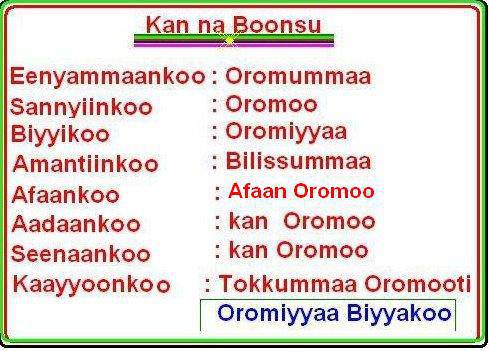
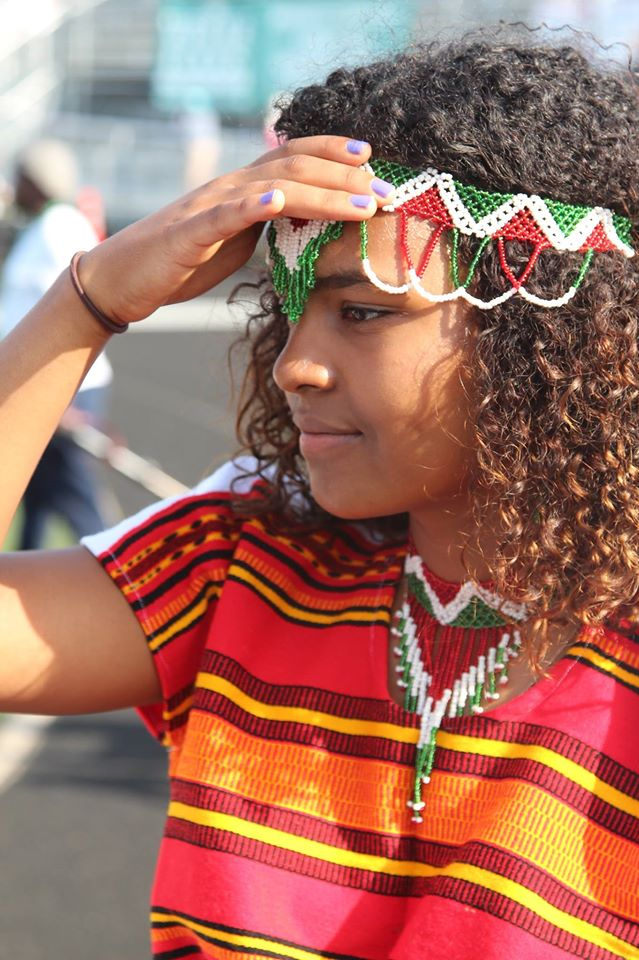
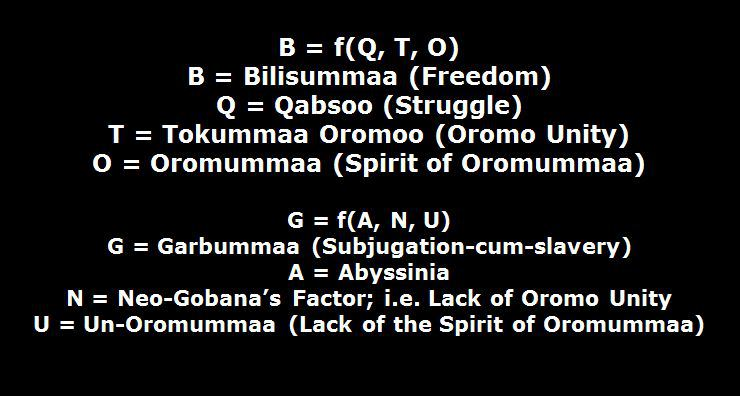


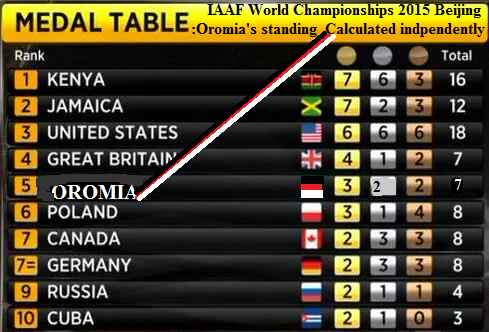
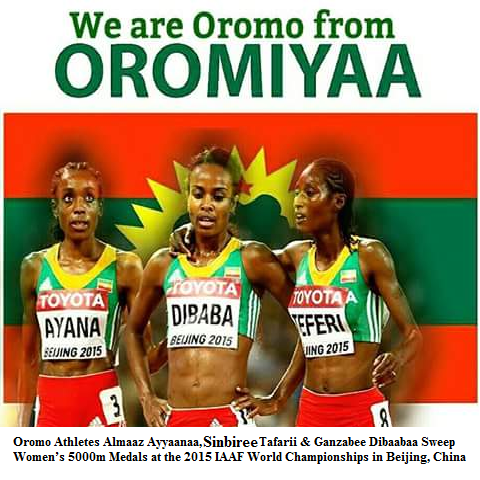
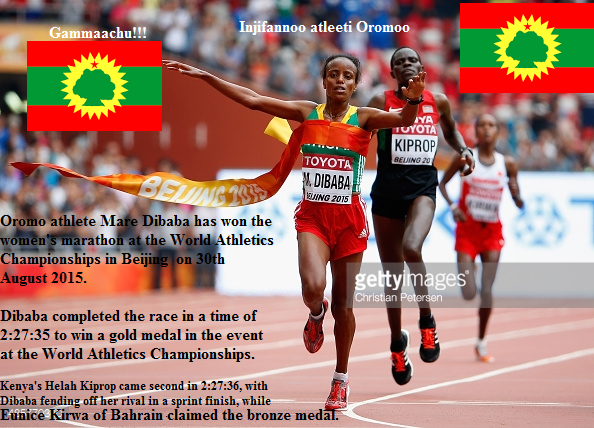
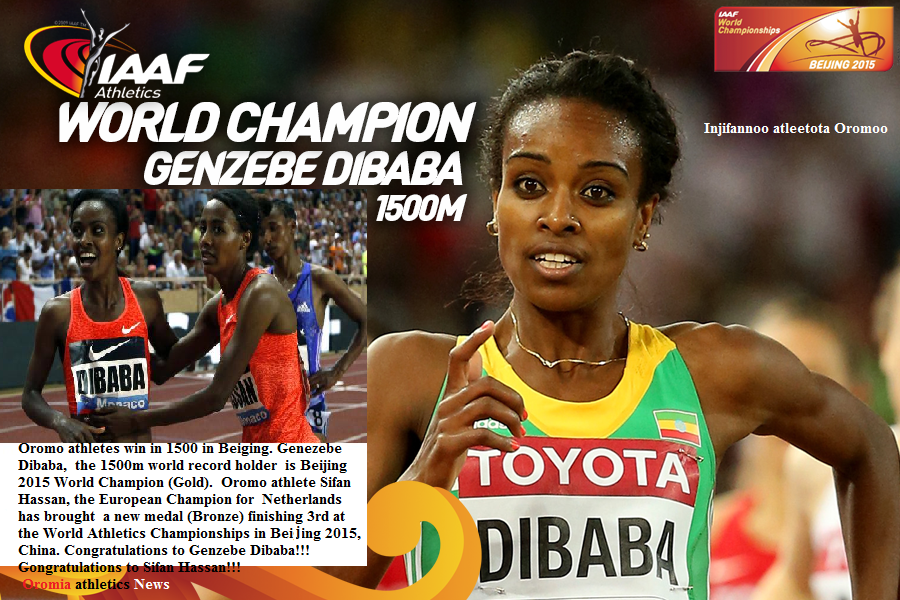
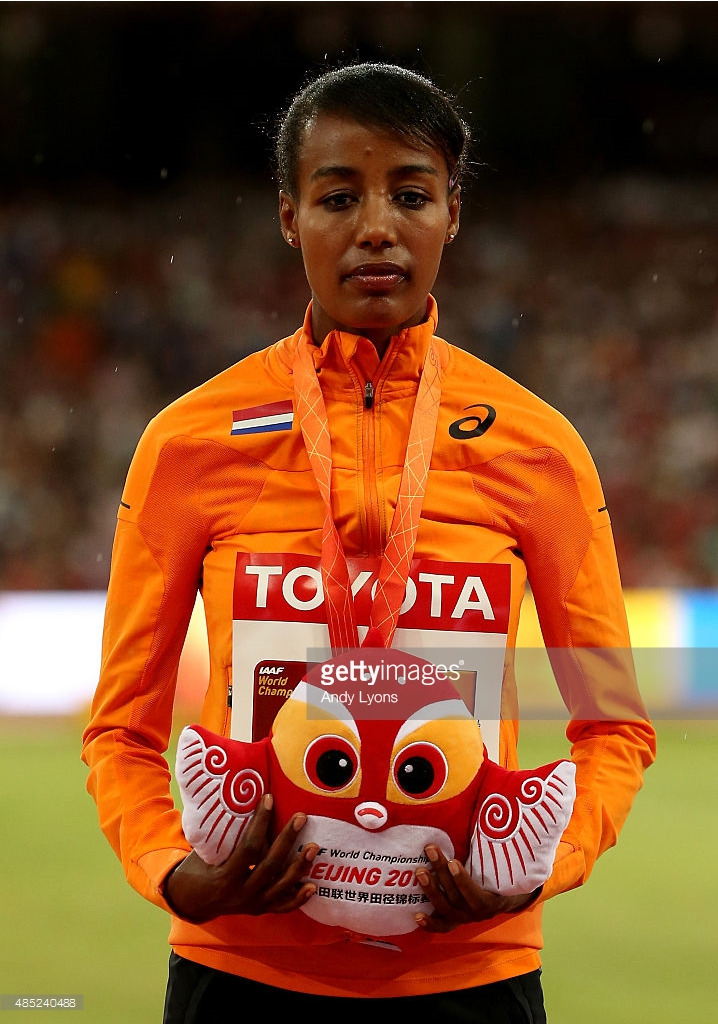
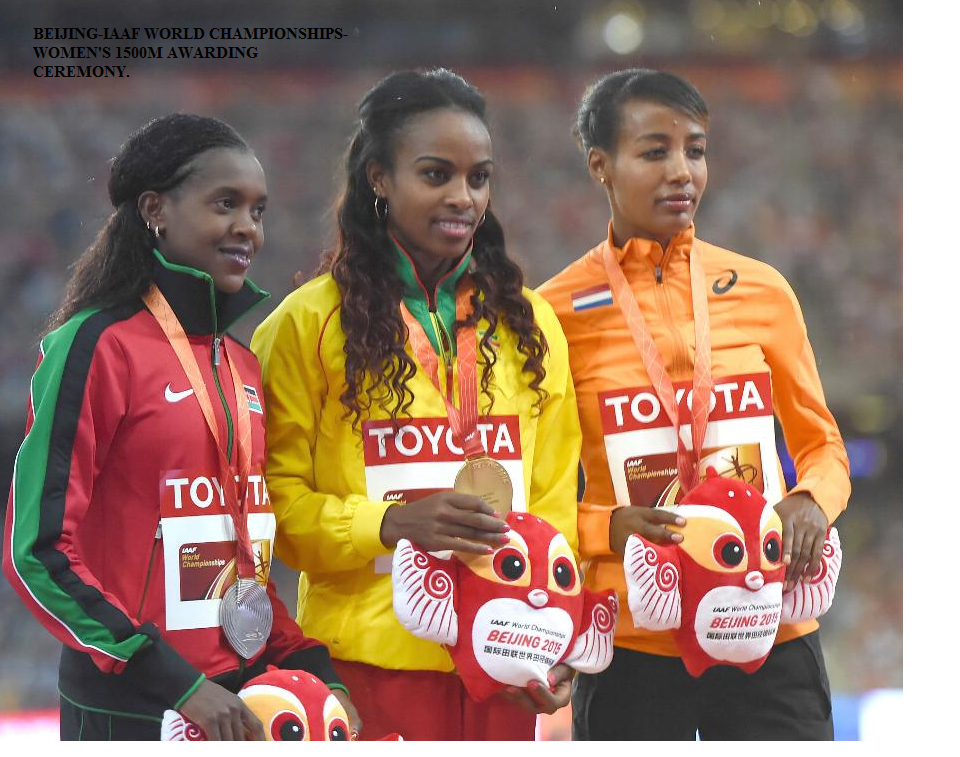
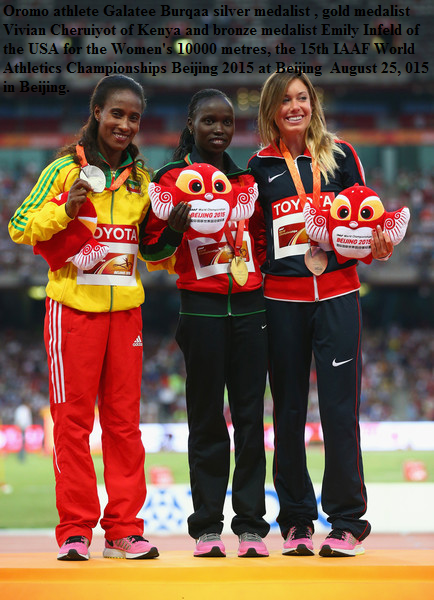
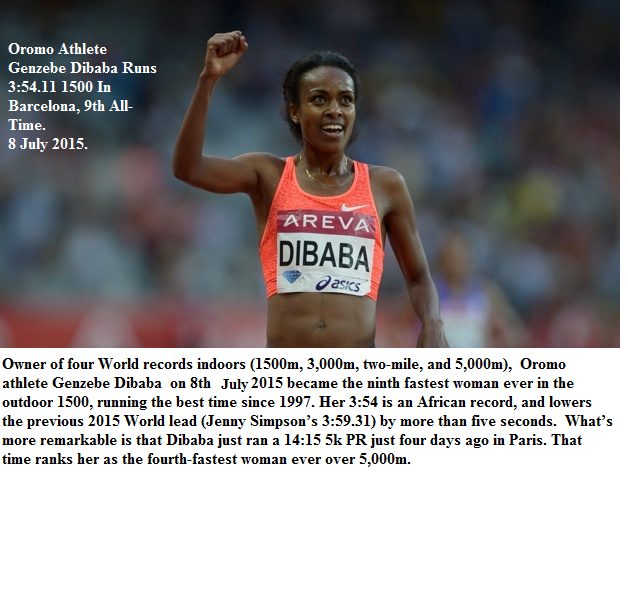
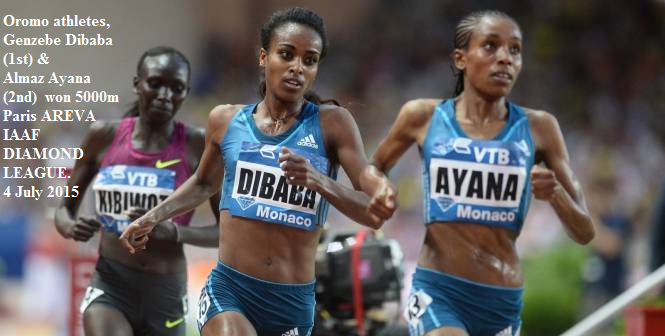

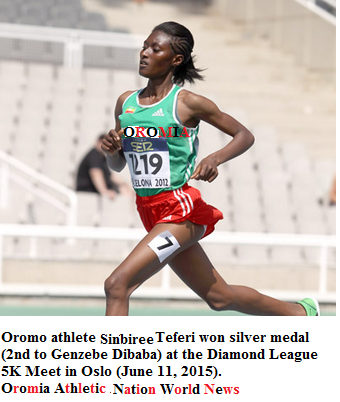
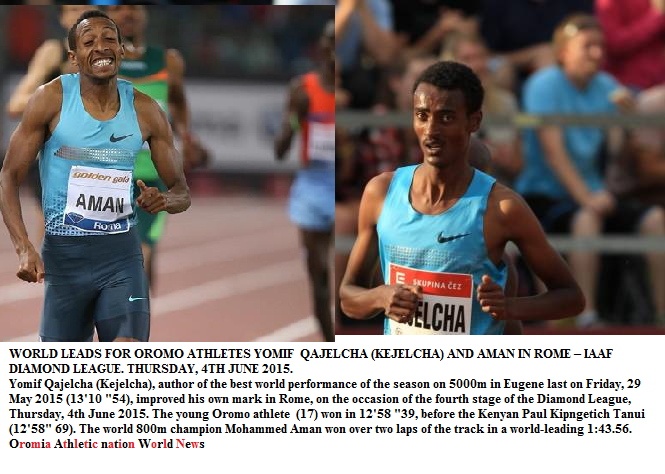

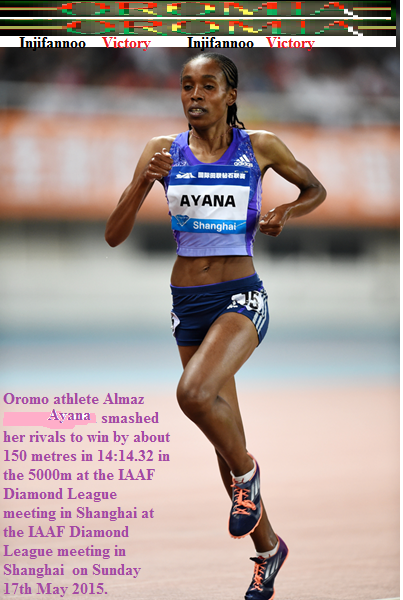
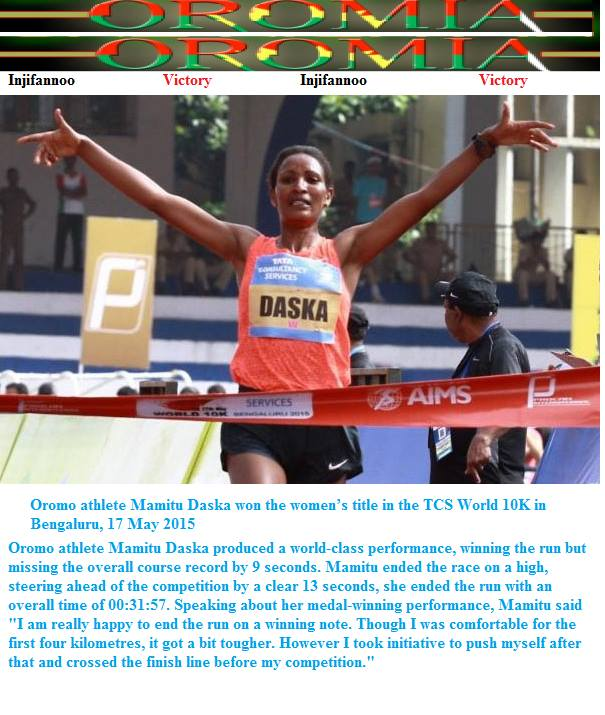
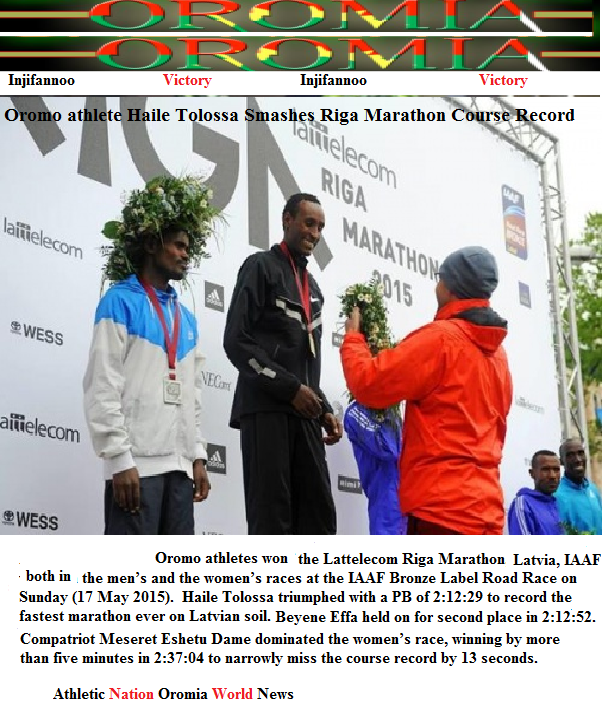


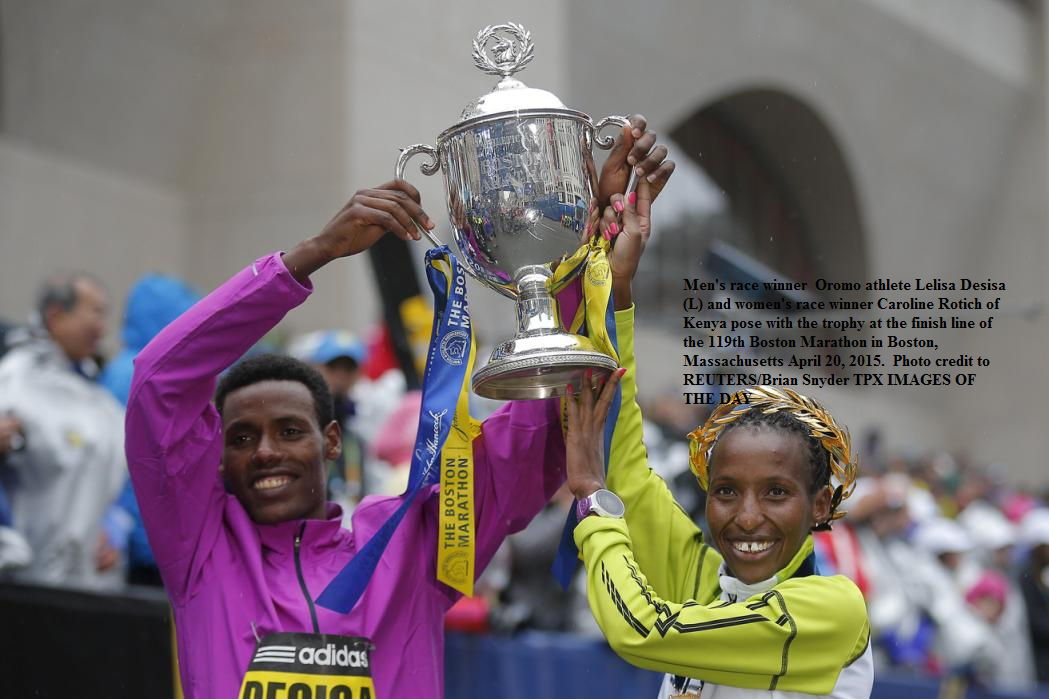


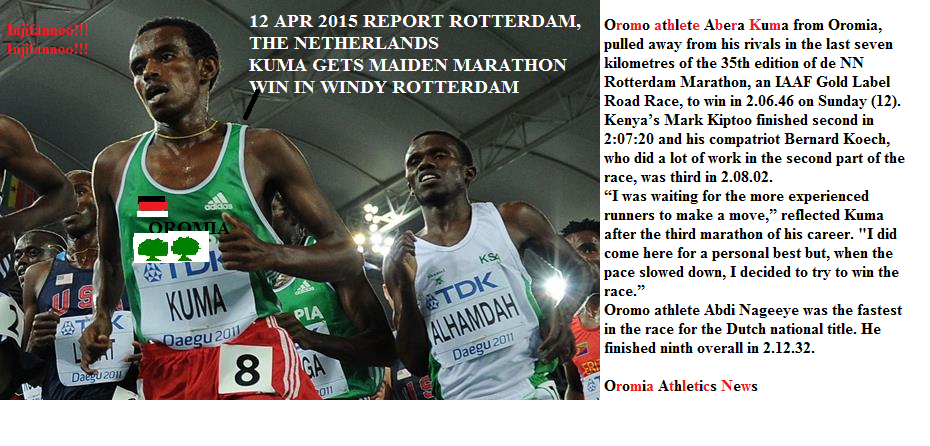
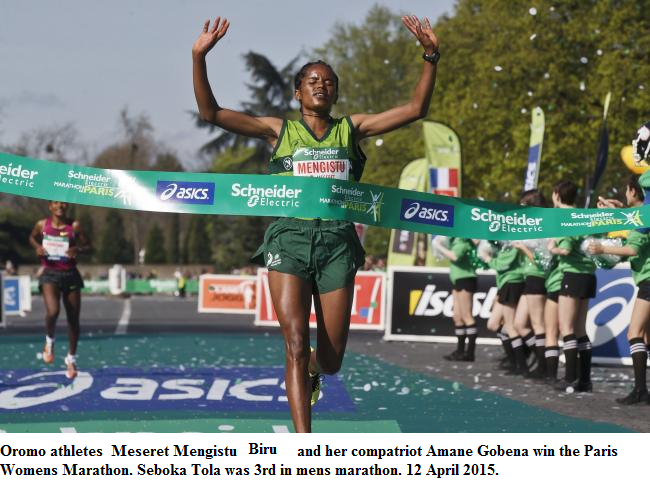

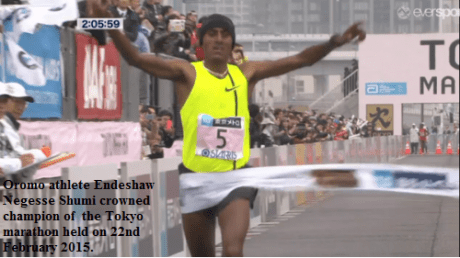
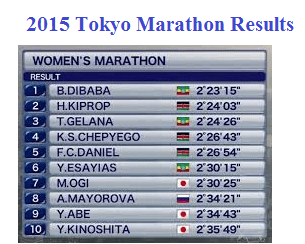


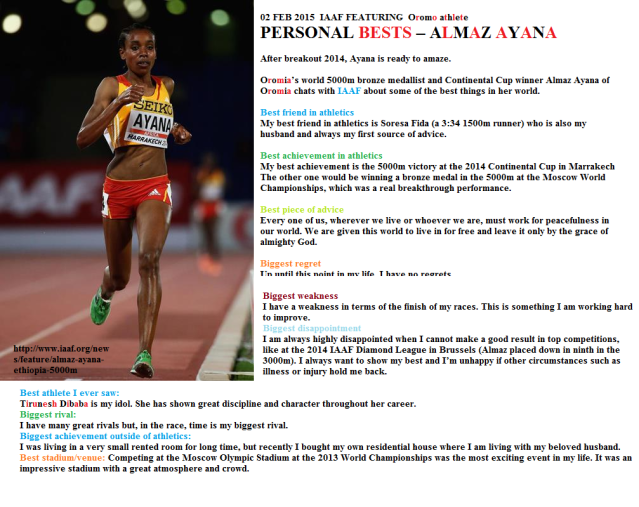


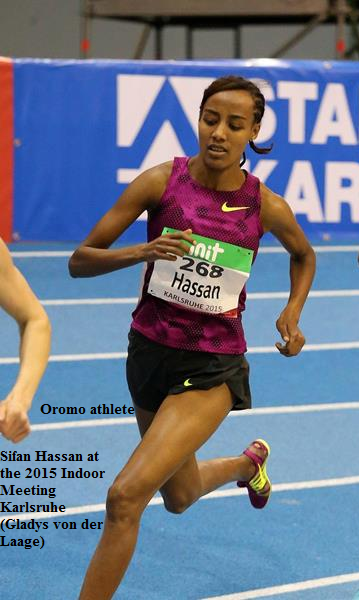

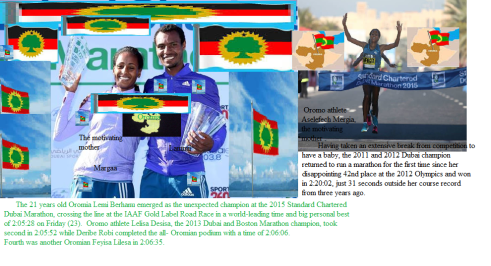


 November 17, 2014 (IAAF) — Amane Gobena took the honours at the 2014 Vodafone Istanbul Marathon, winning at the IAAF Gold Label Road Race in 2:28:46 on Sunday (16).


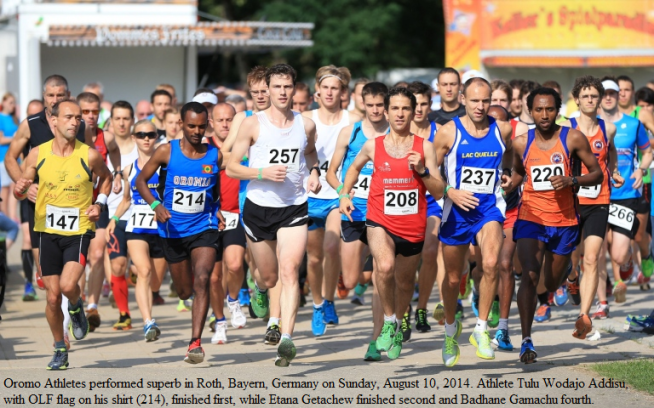
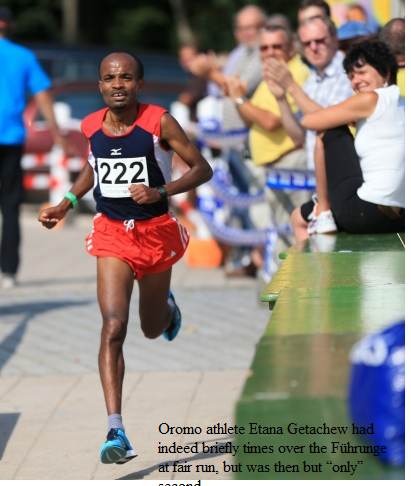
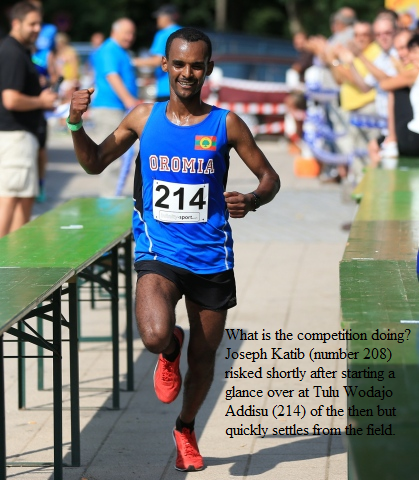
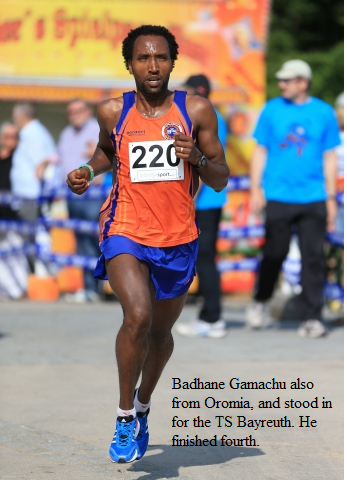


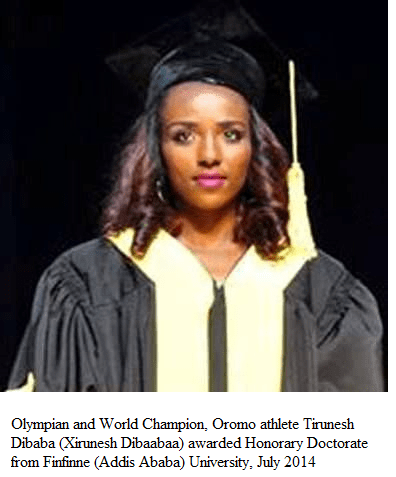
 Oromian Runners Shatter Marathon Race Records.Oromo fans showed support to Oromian athlete Deressa Chimsa as he completed the fastest marathon run in Canada (Photo: Lagatafo Studio)


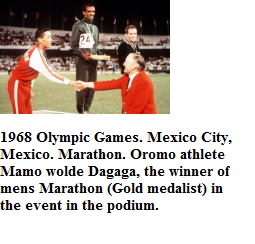
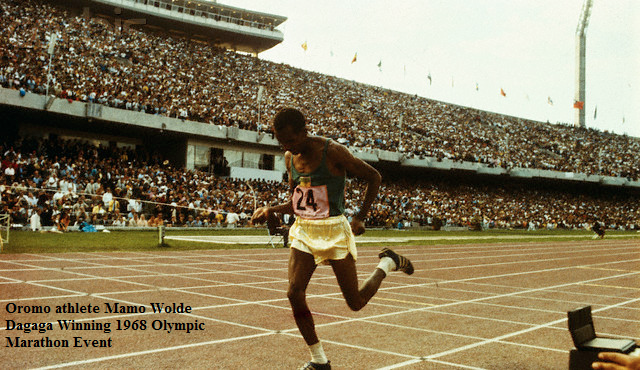

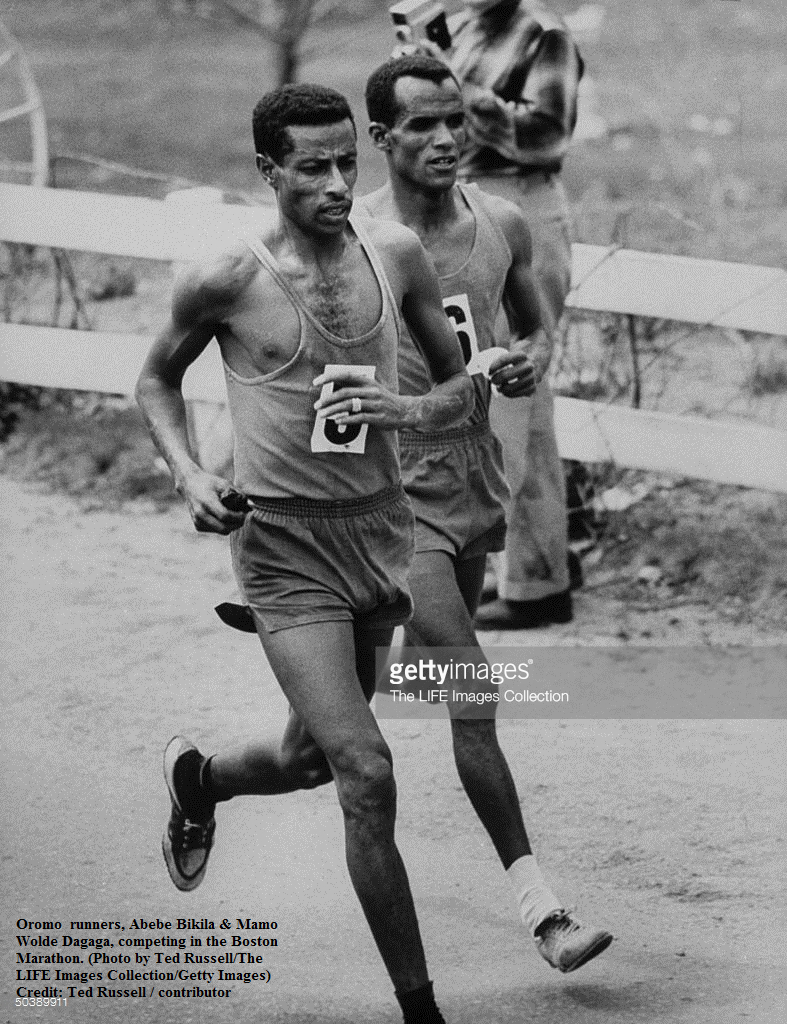
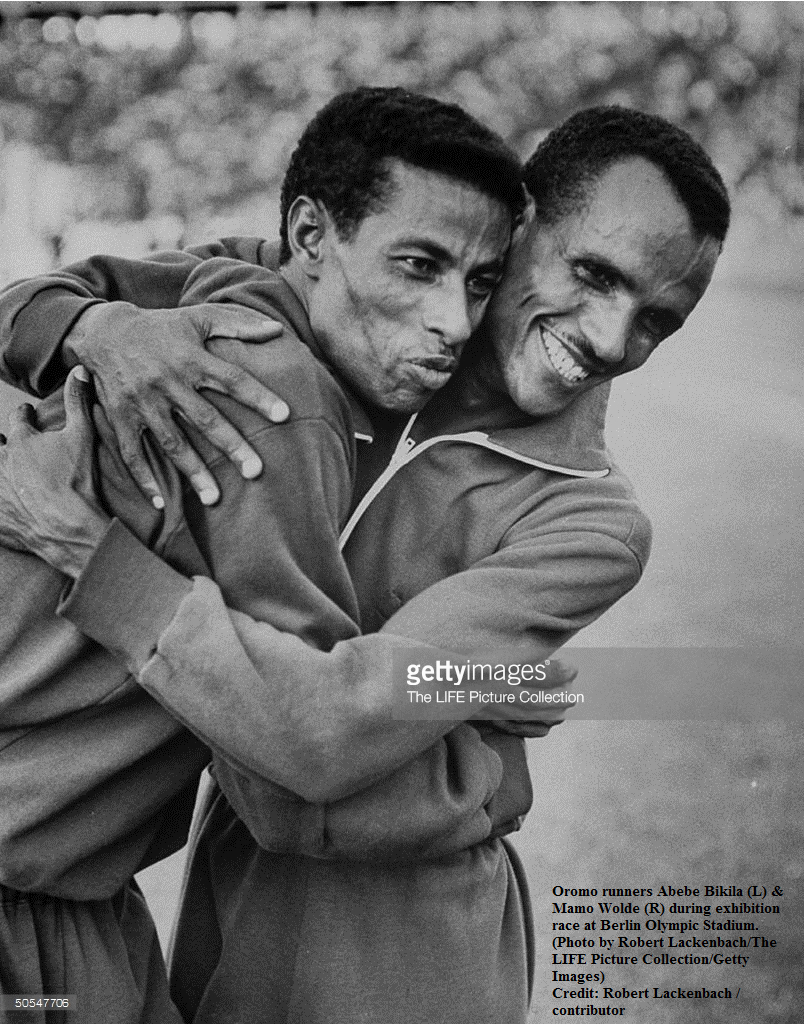


 Ibrahim Jeilan (Oromia, silver) and Mo Farah (Britain, gold) in 10,000k Moscow World Athletics 2013 final race.


 Winner of the Boston Marathon, Oromo athlete Lelisa Desisa with United States Secretary of State John Kerry at the American Embassy in Oromian Capital, Finfinnee.



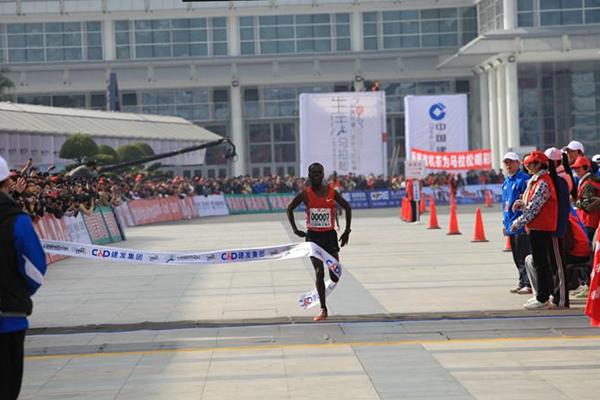


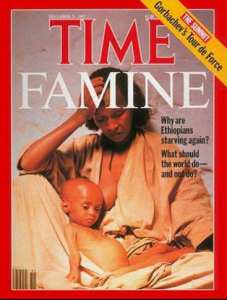

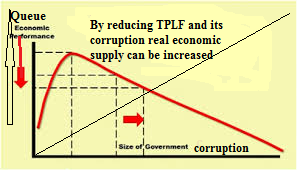

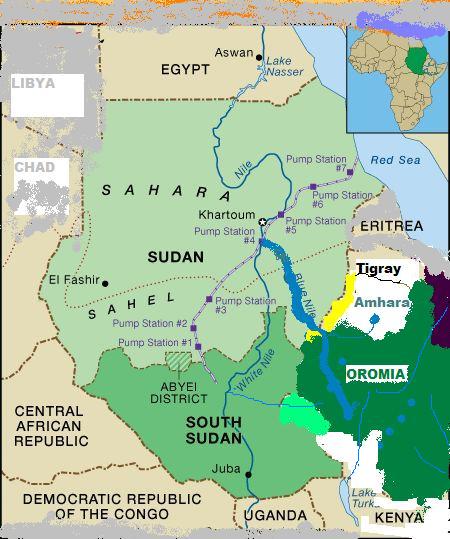
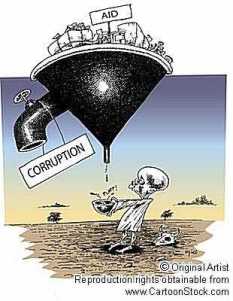




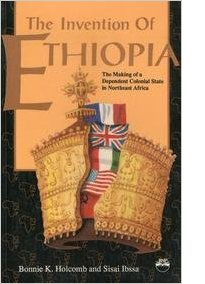






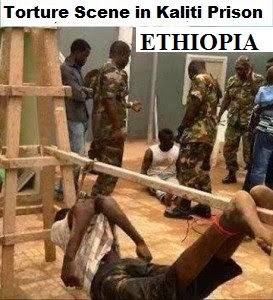
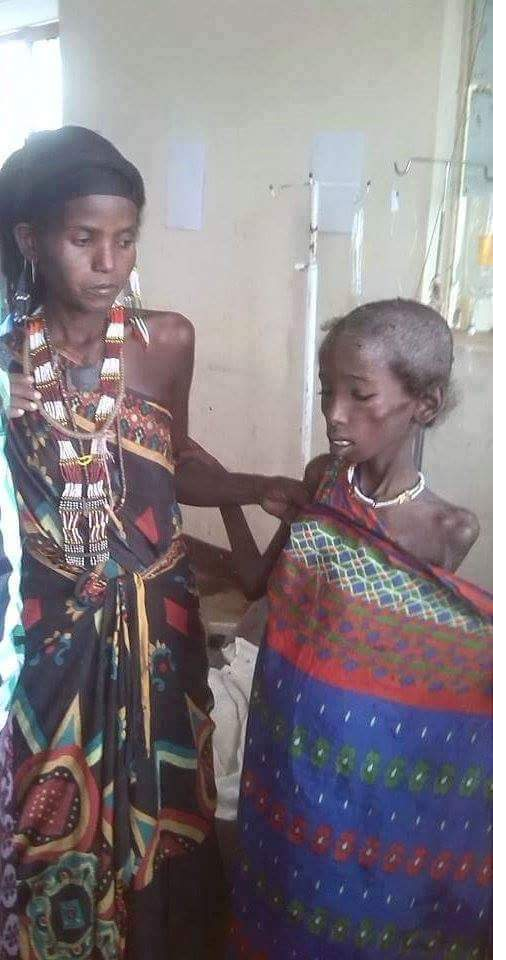

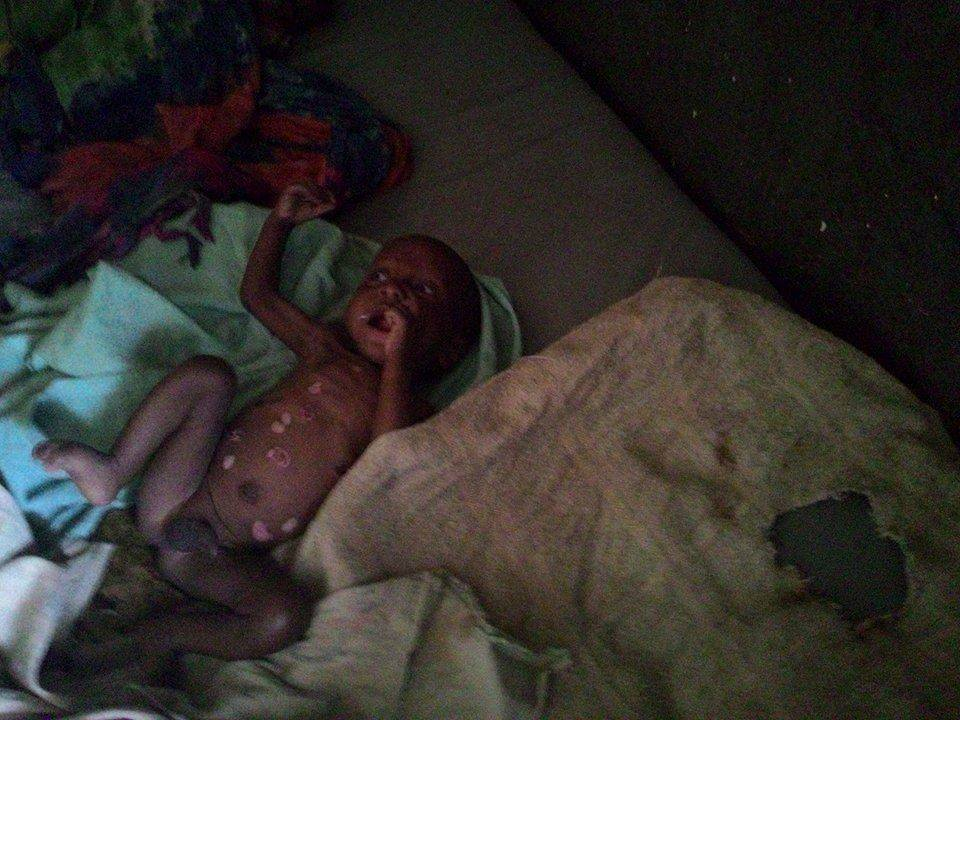
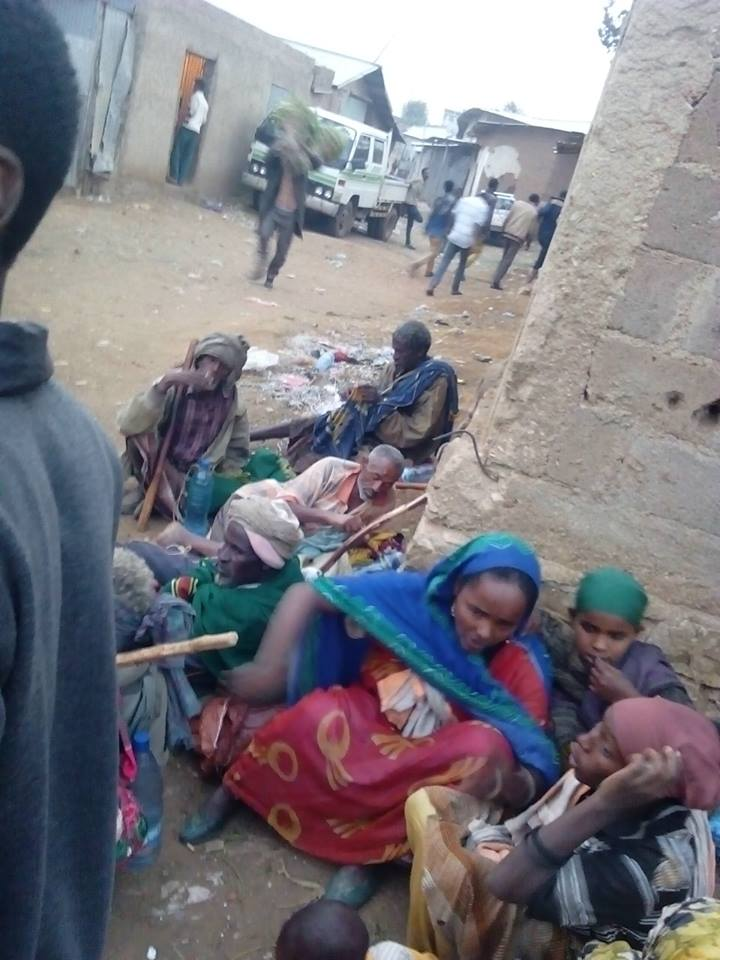


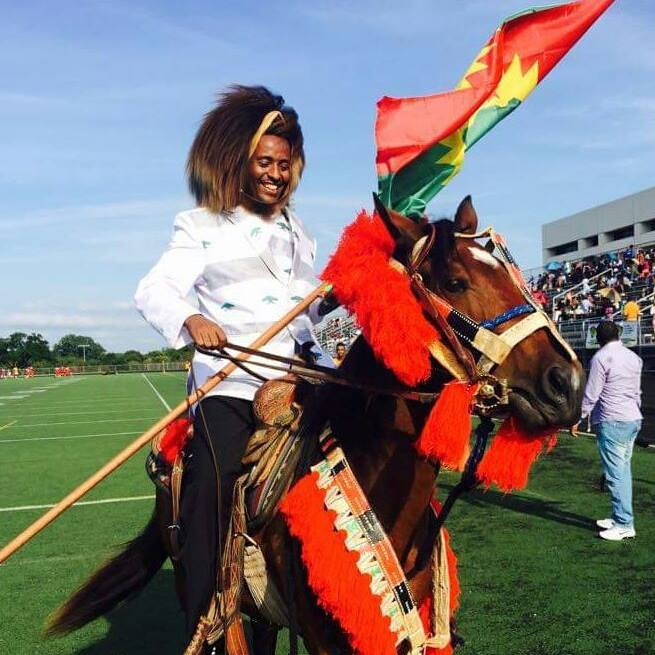
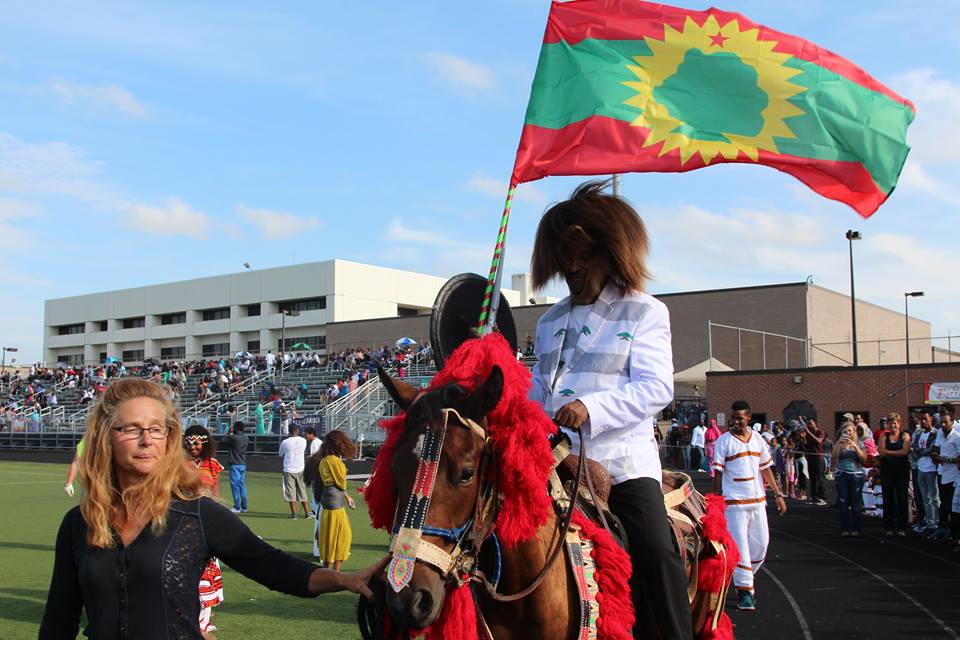
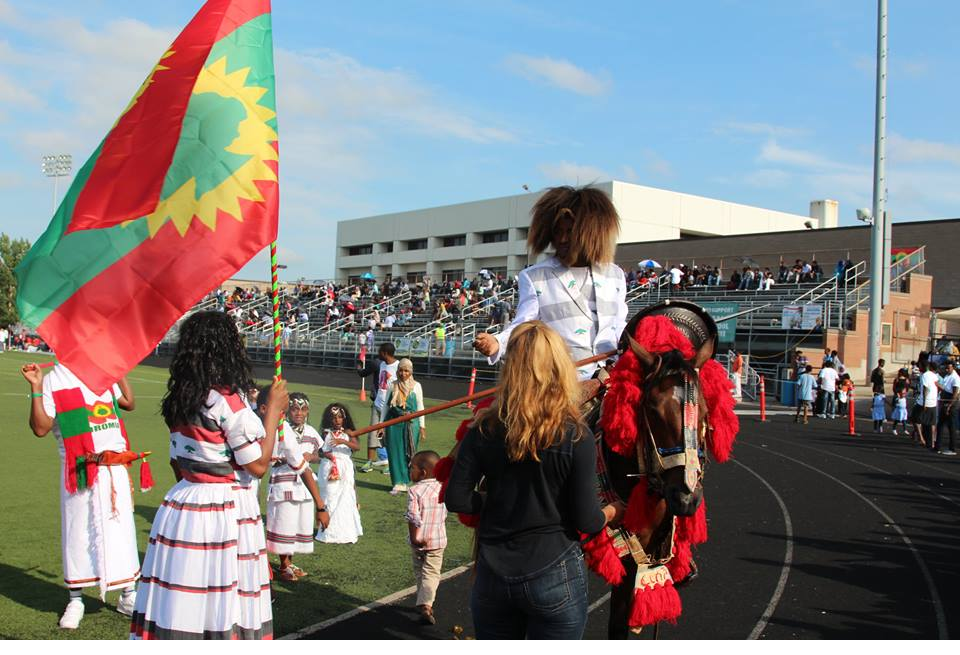
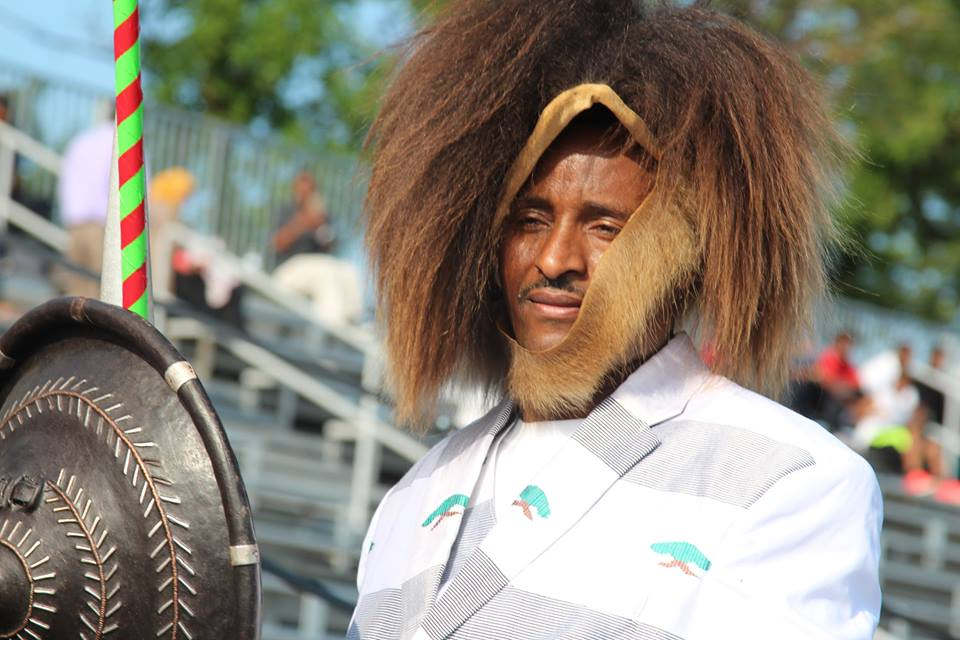

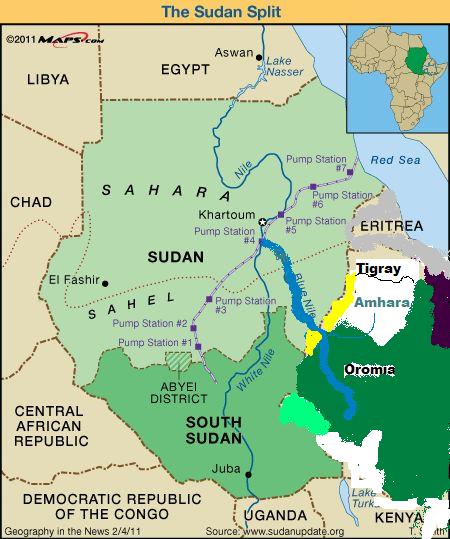

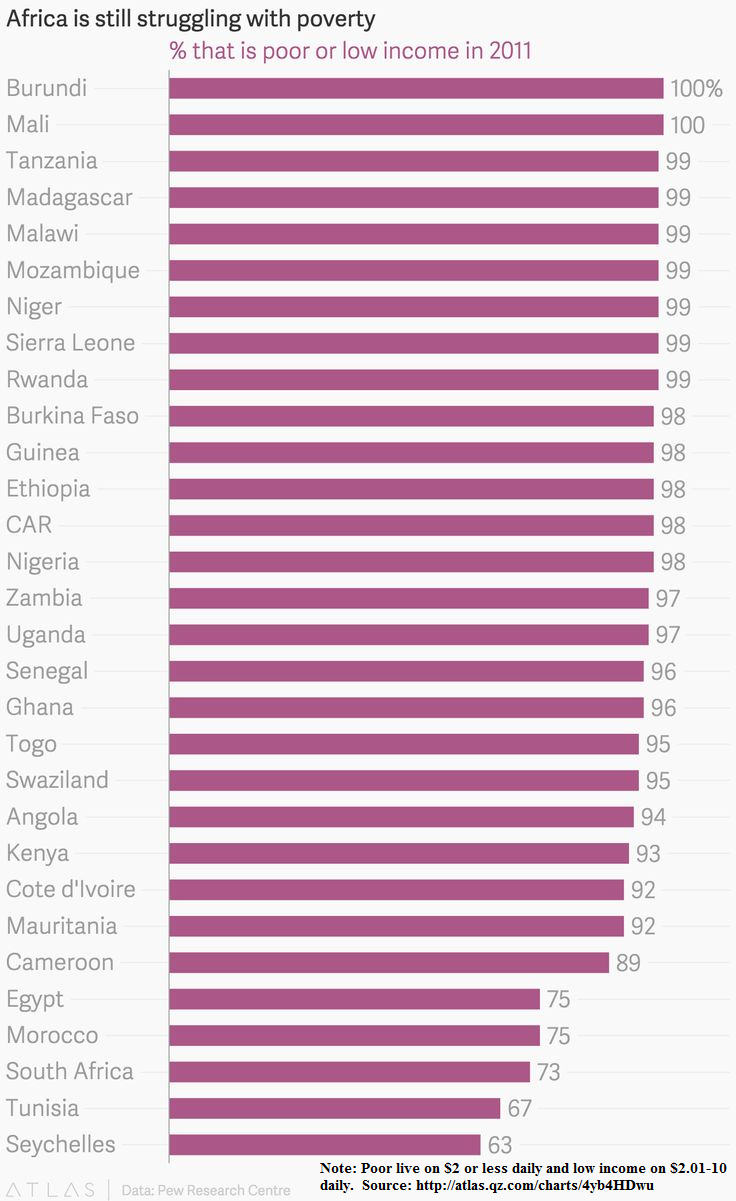


 The Ogaden National Liberation Front (ONLF),
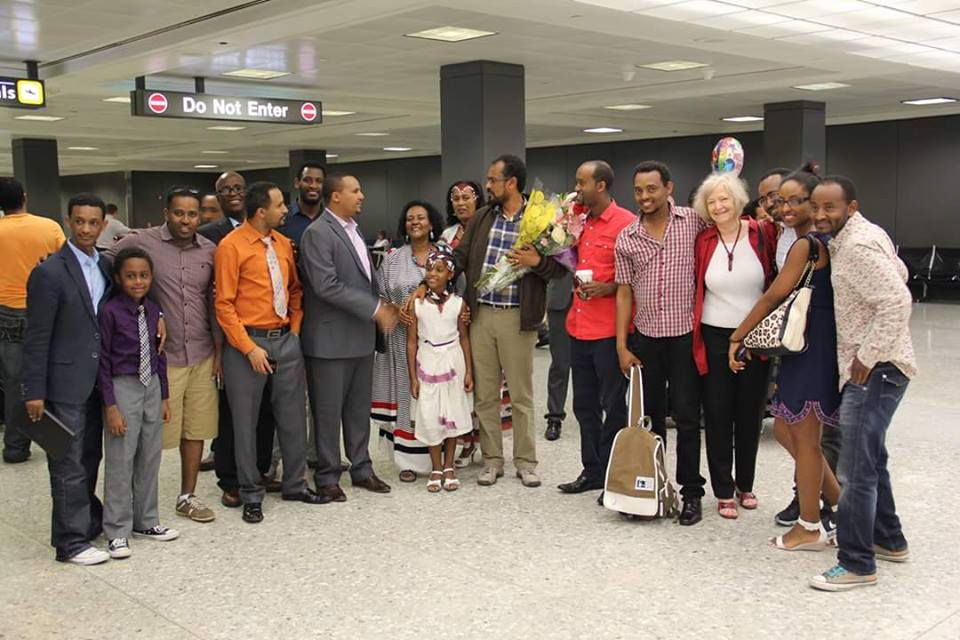
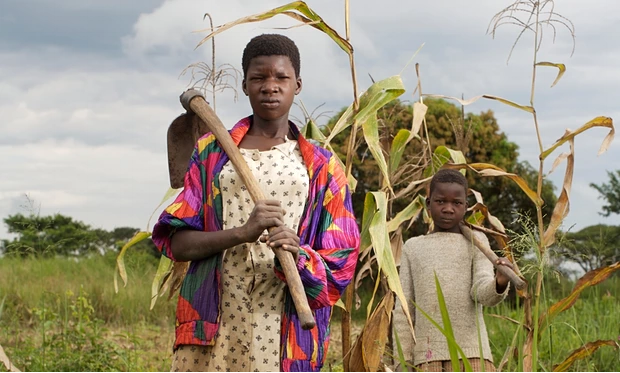

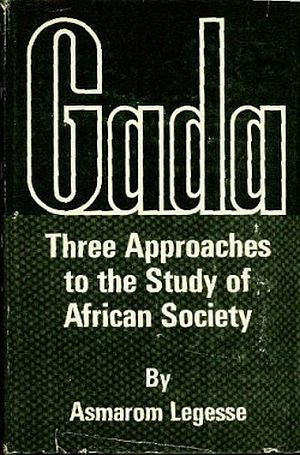

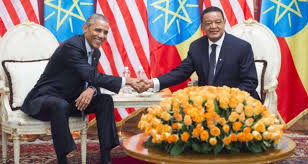
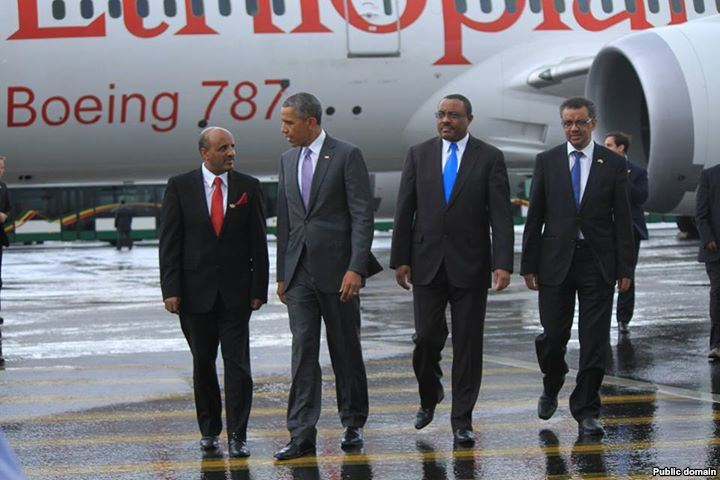

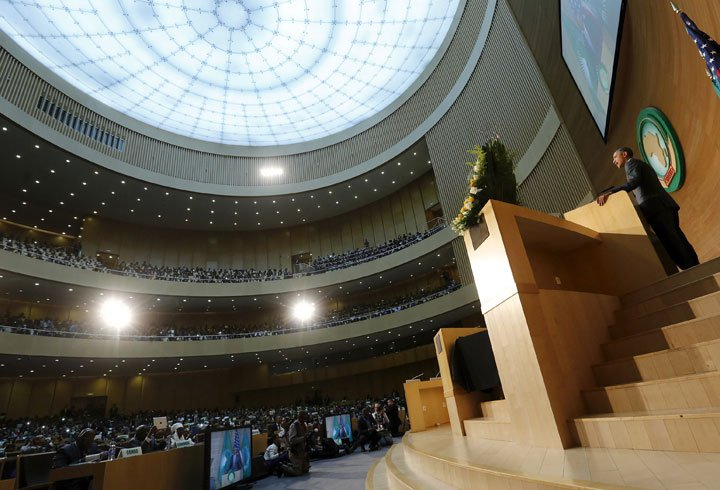


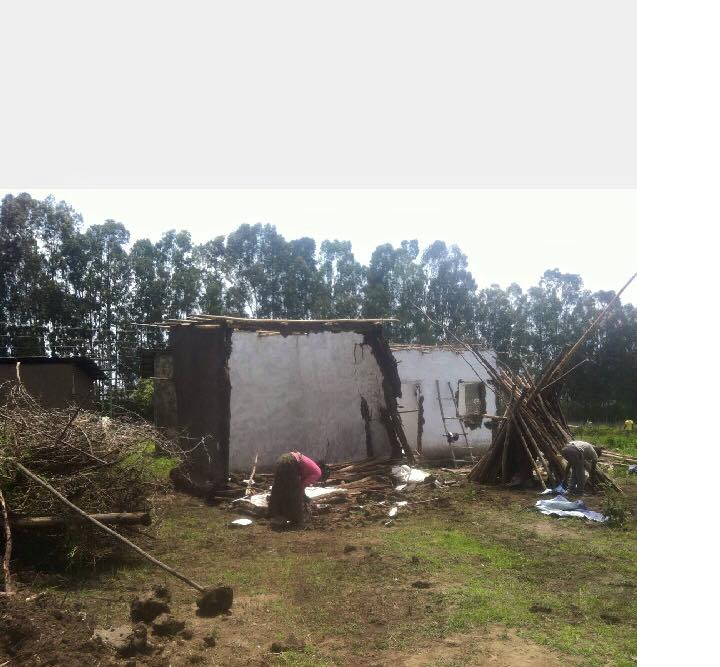
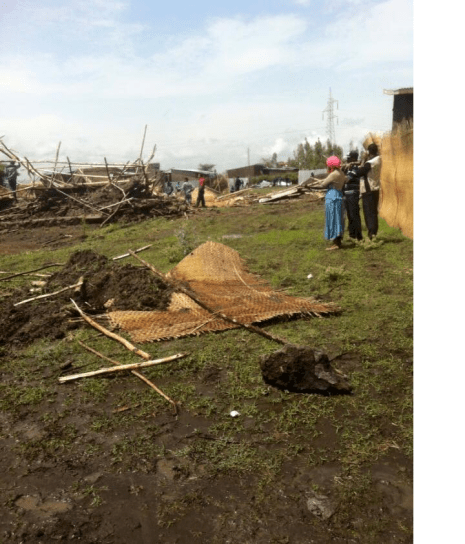
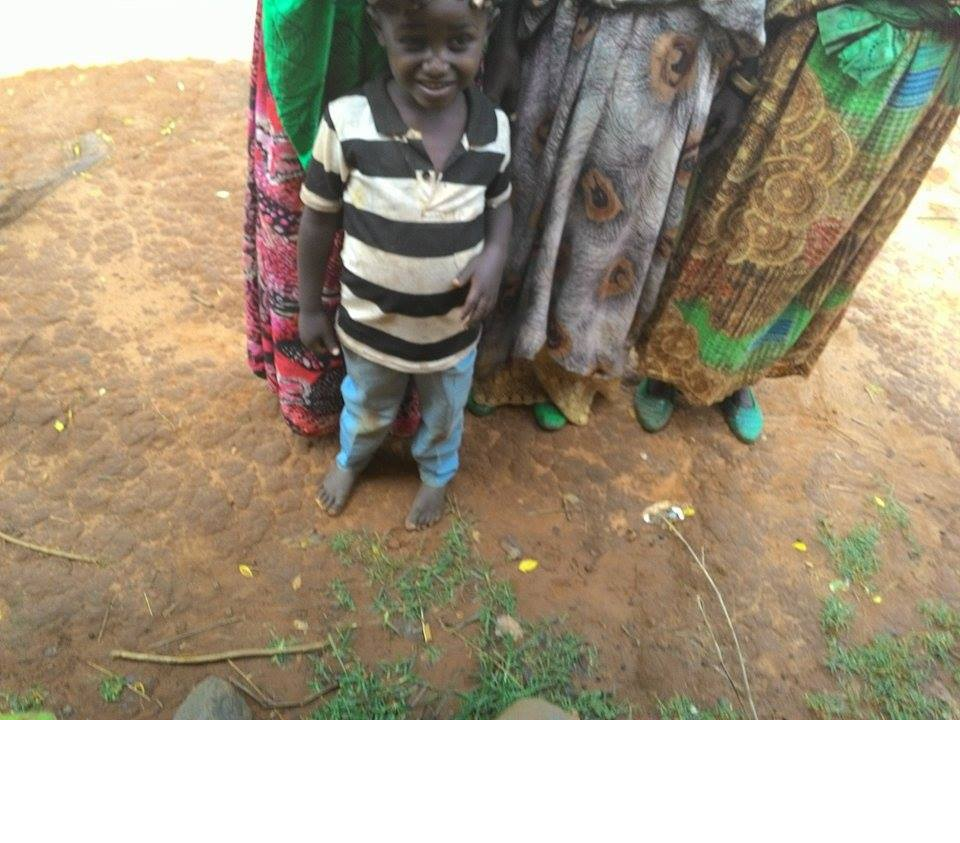
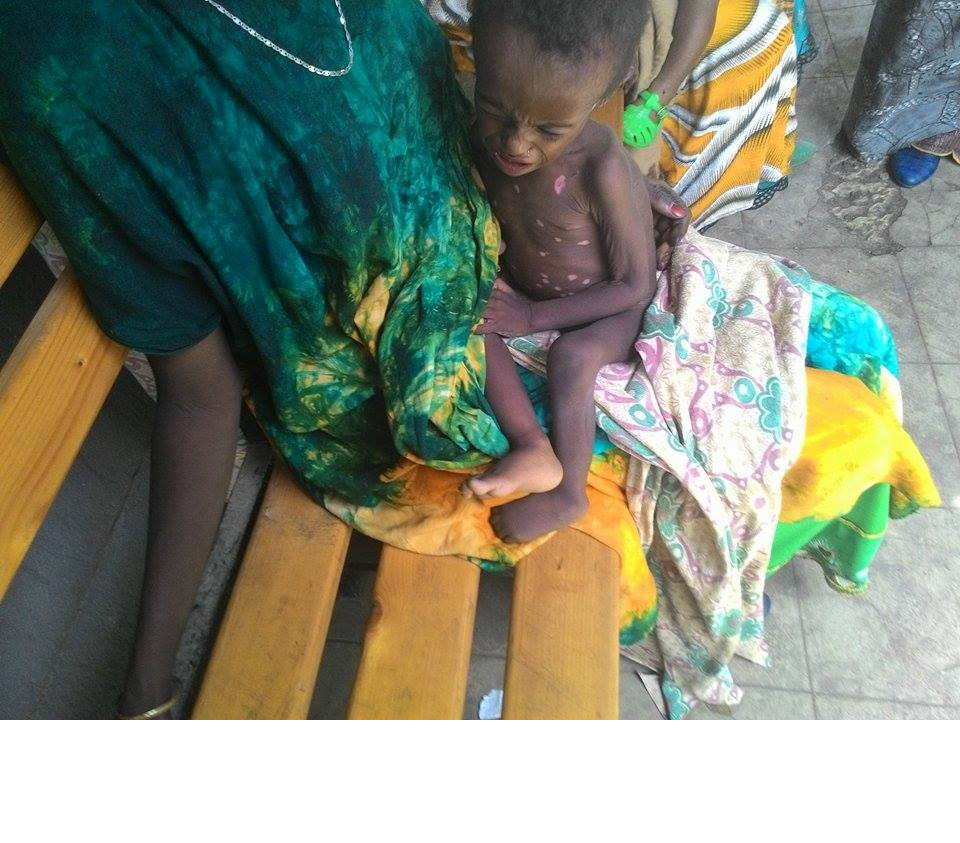
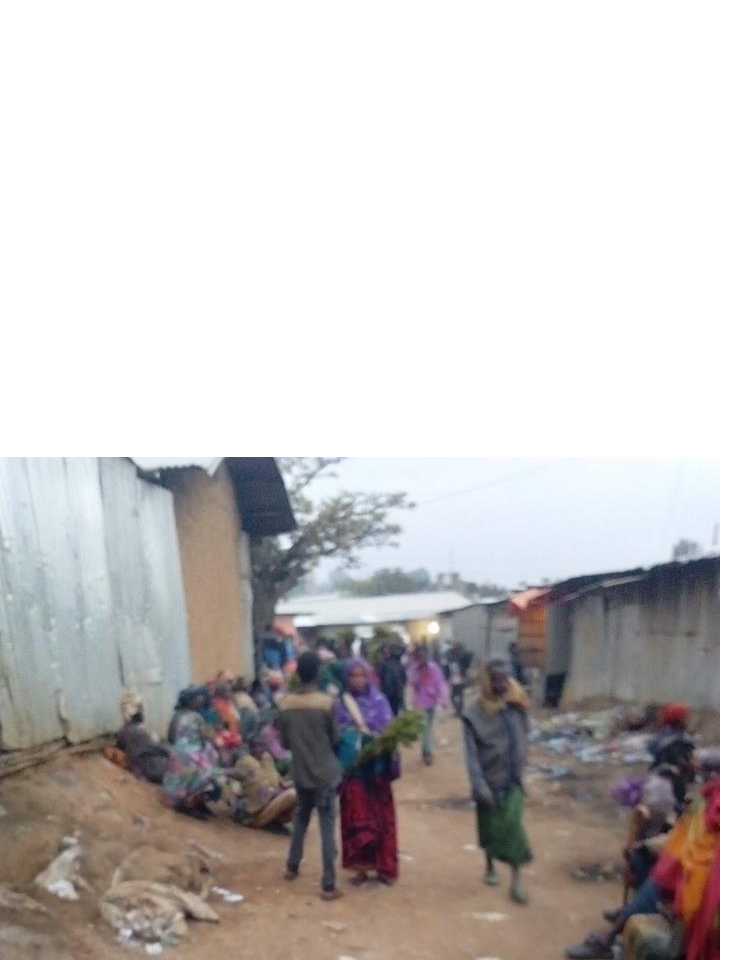
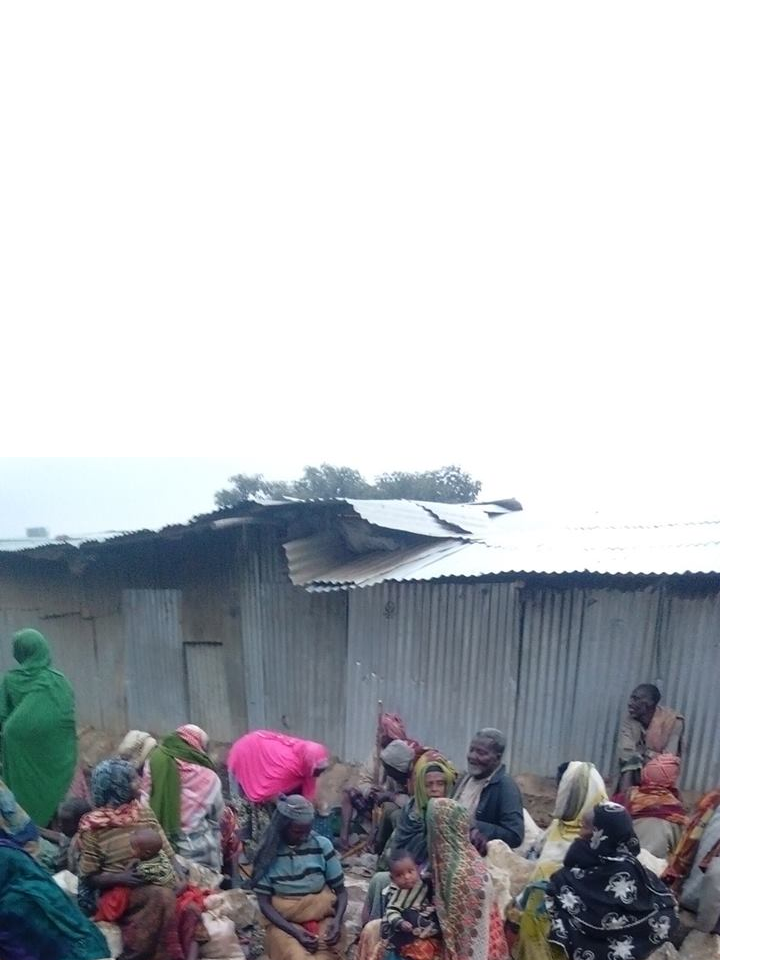
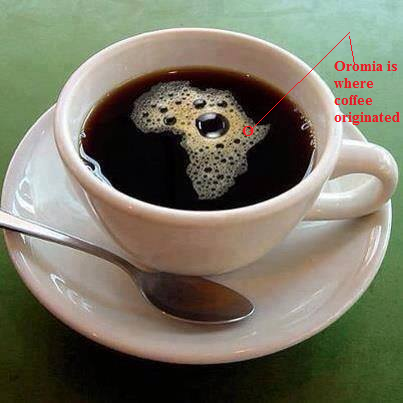
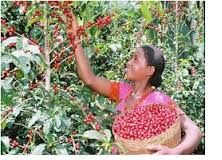
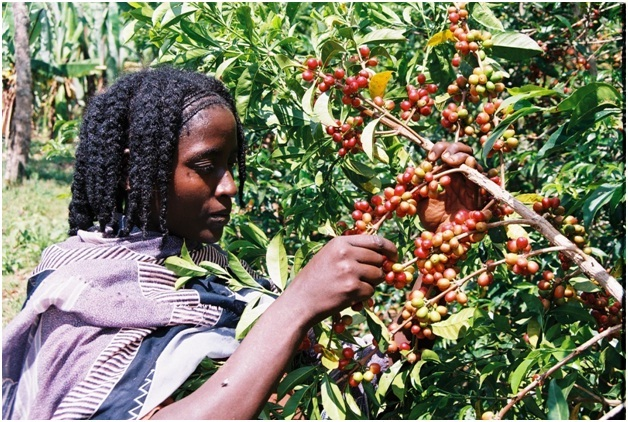

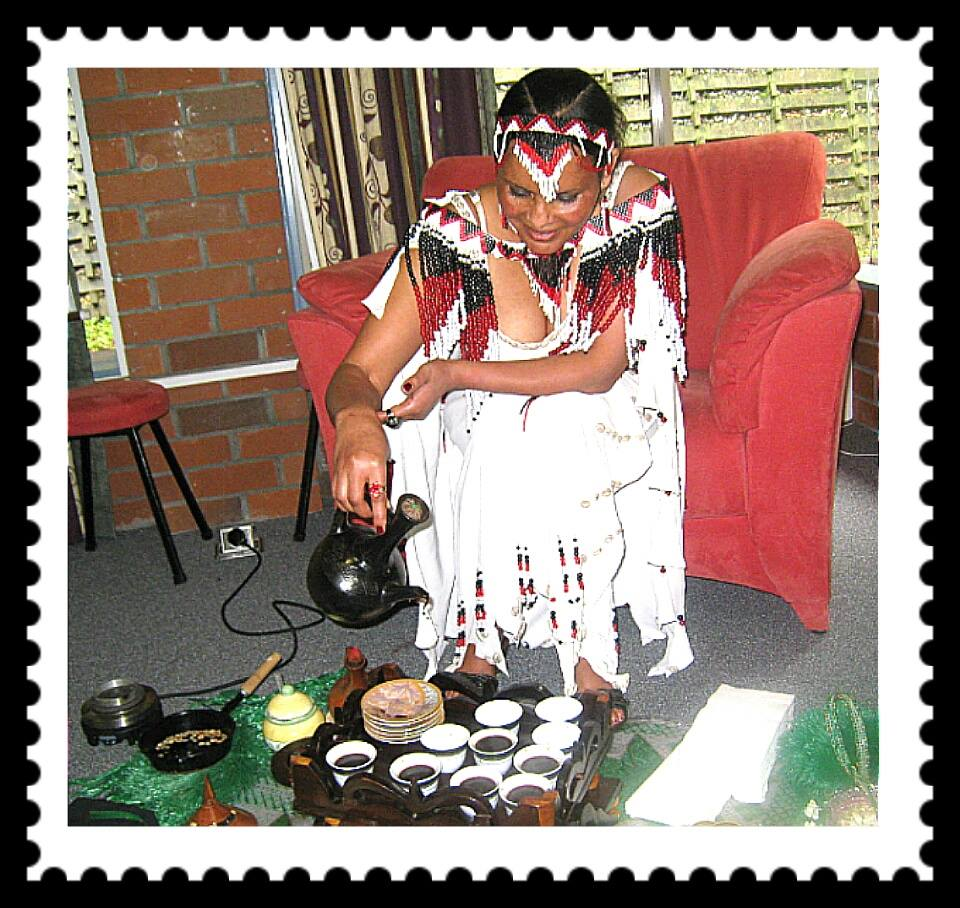

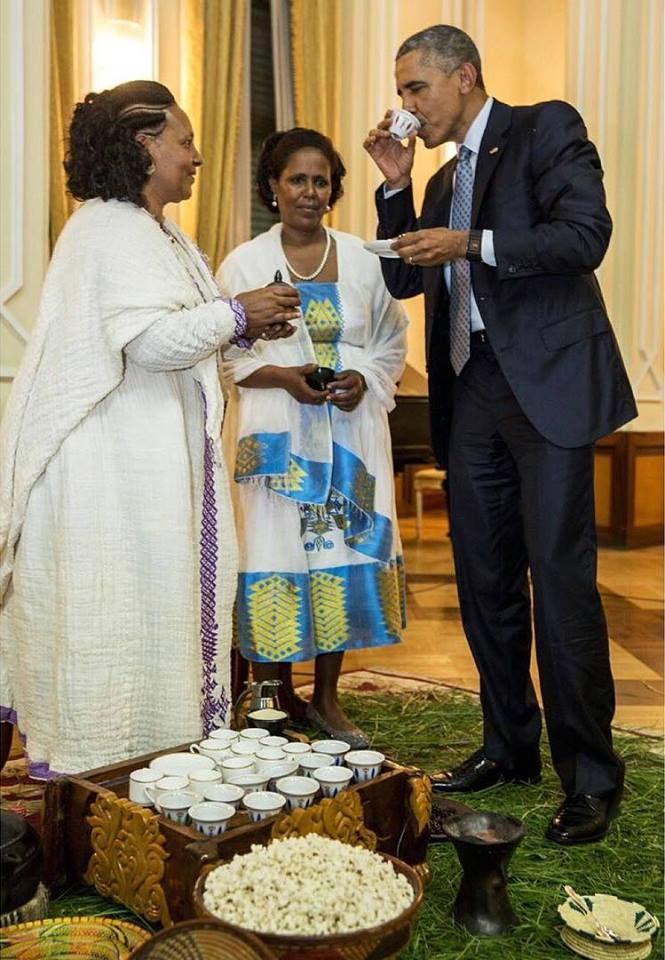

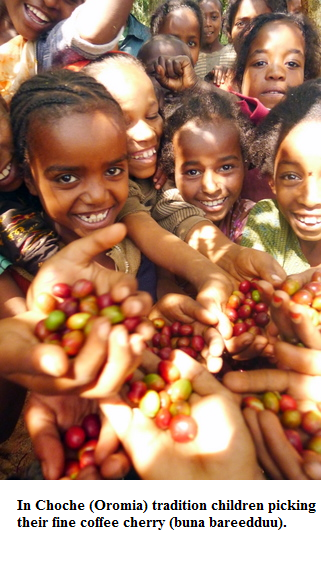
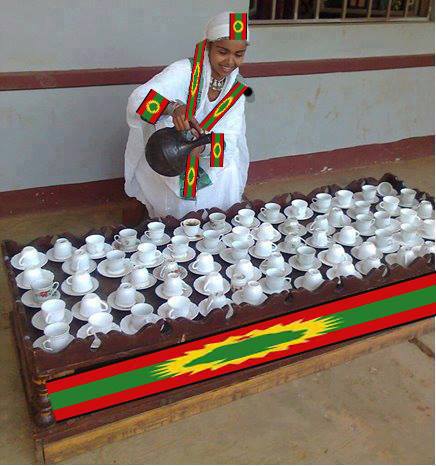






 Oromian Economist

Ethiopia: President Obama Should Urge Changes to Help Civil Society, Political Opposition July 24, 2015
Posted by OromianEconomist in US-Africa Summit.Tags: Africa, Appeal Letter to President Obama from OCA-NA, Barack Obama, Freedom House, Freedom House in response to comments by Under Secretary for Political Affairs, Obama, Obama's plan to visit Ethiopia criticised as 'gift' for repressive government
add a comment
(Freedom House) — As President Obama prepares to visit Ethiopia next week, Freedom House has prepared policy recommendations for the White House, highlighting Ethiopia’s undermining of civil society, independent media, and the political opposition:
“The political environment during parliamentary elections held in May included arrest, harassment and intimidation of opposition members and supporters,” the letter says. “Apart from seriously eroding citizens’ faith in any prospect of an inclusive political framework, the ruling Ethiopian People’s Revolutionary Democratic Front’s entrenched control over all levers of political power sends a strong signal that all avenues of legitimate dissent are closed, fomenting resentment that could lead to violent extremism.”
“Freedom House recommends that President Obama urge the Government of Ethiopia to undertake a comprehensive review of the country’s civil society and anti-terrorism laws and to release imprisoned journalists and peaceful political activists.”
Read the policy reccomendations below.
Ethiopia is rated Not Free in Freedom in the World 2015, Not Free in Freedom of the Press 2015, and Not Free in Freedom on the Net 2015.
Freedom House is an independent watchdog organization that supports democratic change, monitors the status of freedom around the world, and advocates for democracy and human rights.
Ethiopia: Policy Recommendations, July 2015
Background
In 2009, the Ethiopian Parliament passed the Charities and Societies Proclamation (CSP), tightly restricting Ethiopian civil society organizations (CSOs). This includes limiting the amount of foreign funding that organizations are allowed to receive to 10 percent. Legislation passed in 2009, the Anti-Terrorism Proclamation (ATP) has been extensively used to silence critical voices including independent journalists and members of opposition political parties. These laws coupled with other government policies seriously limit the ability for independent voices to be heard.
Political Space and Inclusive Political Process
In May, the ruling Ethiopian People’s Revolutionary Democratic Front (EPRDF) conducted another tightly controlled national election and won all seats in both federal and regional legislatures. The political environment included the widespread arrest, harassment and intimidation of opposition members and supporters. Apart from seriously eroding citizens’ faith in any prospect of an inclusive political framework, EPRDF’s control of all levers of political power sends a strong signal that all avenues of legitimate dissent are closed, fomenting resentment that could lead to violent extremism. The rise in politically motivated killings of opposition activists after announcement of the election results in May and June (seven reported cases) shows that local officials believe that a total win for EPRDF means no space for opposition. Freedom House therefore recommends that during his visit, President Obama:
Civil Society and Media
The CSP has effectively decimated human rights groups in Ethiopia. While the stated purpose of the CSP is ‘to aid and facilitate the role of non-governmental organizations (NGOs) in the development of the country,’ it has actually forced at least 10 prominent human rights and democracy promotion organizations to abandon their mandates in order to continue receiving foreign funding while others were forced to scale back their operations significantly. As a direct result of the CSP, Ethiopia’s leading human rights NGO, Ethiopian Human Rights Council (EHRCO, now HRCO), had to close 9 of its 12 regional offices and cut 85 percent of its staff. The Ethiopian Women Lawyers’ Association (EWLA), another prominent group, cut nearly 70 percent of its staff. Authorities also froze the bank accounts of these groups. In addition to the severe restrictions the CSP imposes on funding and human rights work, the dysfunctional legal framework it put in place is actively undermining the role of civil society in development. A 2014 performance audit conducted by the Federal Auditor General found that more than 85 percent of NGOs were not able to comply with one or more of the expenditure and reporting requirements. The Director of the Charities and Societies Agency, the government agency in charge of regulating NGOs, told parliament that if his agency were to enforce the CSP as written, all NGOs would have closed. During President Obama’s visit to Ethiopia, Freedom House recommends that he:
Human Rights and National Security
After Ethiopia’s most competitive elections in 2005 concluded with violence and the detention of hundreds of opposition members and civil society leaders, EPRDF moved to systematize the tools of political control through a series of restrictive legislation backed by intense crackdown on media and civil society intended to silence perceived opponents and critics. As a result, the operational space for legitimate opposition, independent media and human rights activists has been seriously constrained. The ATP is being used to pursue vigorous prosecution of opposition party members and journalists.
The excesses of Ethiopia’s counter-terrorism operations that include arbitrary arrests, widespread practice of torture, alarming trends of disregard to due process rights of detainees and excessive pre-trial detention have stifled legitimate dissent and created a profound climate of fear. Lack of accountability of security forces is exacerbated by a judiciary that is largely subservient to the executive and lacks institutional autonomy to exercise effective oversight and enforcement of constitutionally guaranteed human rights protections. Freedom House therefore recommends that President Obama:
Support for Human Rights and Democracy Promotion
Given the highly repressive political environment in Ethiopia, it is admittedly difficult to support those who risk their lives to promote democracy and human rights. But it is not impossible, and if such groups are to survive in Ethiopia, they need outside support. Even a small increase in democracy and human rights assistance can have an enormous impact in ensuring that local civil society is able defend the fundamental rights of all Ethiopians. Freedom House recommends that the Obama Administration: