Economics: Role and Method of Econ (1.1-1.5) January 16, 2015
Posted by OromianEconomist in Economics, Uncategorized.Tags: economics
add a comment
‘Economics is the study of choices we make among our many wants and desires given our limited resources. With unlimited resources we wouldn’t have to worry about scarcity.
Resources are inputs that we use to produce goods and services. These include Capital, Entrepreneurship, Land and Labor (CELL). Capital is the goods we make to produce other goods. Entrepreneurship are machines that are used to make products. Land is our natural resources and Labor is the human effort put into making products. Scarcity is defined as products that are desirable but limited. These cause us to change our decision and and give up opportunities that we value, this is known as the Economic Problem.’


1.1
Economics is the study of choices we make among our many wants and desires given our limited resources. With unlimited resources we wouldn’t have to worry about scarcity.
Resources are inputs that we use to produce goods and services. These include Capital, Entrepreneurship, Land and Labor (CELL). Capital is the goods we make to produce other goods. Entrepreneurship are machines that are used to make products. Land is our natural resources and Labor is the human effort put into making products.
Scarcity is defined as products that are desirable but limited. These cause us to change our decision and and give up opportunities that we value, this is known as the Economic Problem. Every person, worker and firms all face the Economic Problem. Consumers have to decide what to buy, save and how much of their money to invest. Workers have to decide where to work, what to do…
View original post 469 more words
Oil, Commodities, And The Dollar Trade January 8, 2015
Posted by OromianEconomist in Economics, Oil, The sate of world Economy, Uncategorized.Tags: commodities and dollar, economics, Oil, Oil price, Oil supply and demand, Supply and Demand, The state of world economy
add a comment
‘The world’s debt situation has become a gigantic Ponzi scheme that makes all others look like children trying to sell candy to a baby. So what is the world situation on oil supply? There is currently an excess of supply and a reduction in usage. China is no longer using oil at a burn rate that makes the Americans look like Sunday drivers. But that is not all that is happening. Commodity prices are falling greatly due to lack of demand. China is no longer building factories and cities that will never be used. Their demand for electrical production has been reduced through lack of industrial activity and gigantic construction projects. In the past ten years the play was in commodity speculation and boy did the speculators speculate, steal, even. Not that demand has collapsed the prices for raw commodities has collapsed with it. Australia is hurting and will suffer some severe economic reverses. Already mines are closing and layoffs appearing. Their housing bubble is bursting as it their job markets. And they are the only ones. Many developing countries are starting to see their trade with China decline. Right now China has become the middle man in the world markets. Where it once produced products using its own labor forces and factories, it has out sourced the unfinished parts to the various undeveloped countries where labor is still cheaper. But here in America we have seen a downturn in demand of goods coming from China.’
Kemants, Neglected Ethnic Group in Ethiopia– Deserve Your Voice January 8, 2015
Posted by OromianEconomist in Agaw people, Ethiopia's Colonizing Structure and the Development Problems of People of Oromia, Afar, Ogaden, Sidama, Southern Ethiopia and the Omo Valley, Uncategorized.Tags: African Studies, Agaw people, Kemants, National Self Determination
add a comment
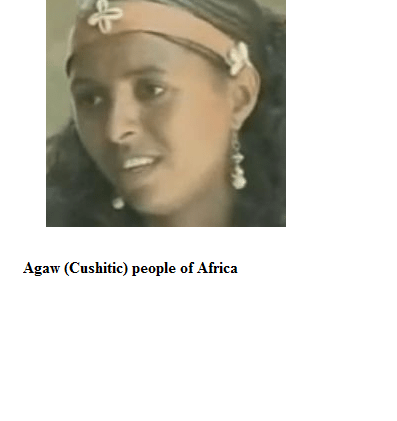
Why the world cry for Mandela? He has many qualities among them are democracy and fairness. The Kemant people had suffered in previous regimes and the suffering is now reaching its peak. One may despise these oppressed people, should not been forgotten that God is also observing injustice taking place.

By Prof. Yigzaw Kebede (e-mail message)
We speak Amharic, but we are not Amharas, but Amharas are our … friends and neighbors.
Dear all,
You might have heard about the Kemant request which is not yet settled. I am distributing this e-mail to clarify some confusion on issues which are circulating in the community. We are also ready to receive your genuine comments.
Here are some of the facts and false rumors:
1. What is the Keamnt’s request? The request is for recognition of identity and self rule. This is the same request that some people characterized as the demand for secession. Actually, the secession was neither our request and nor our interest, will never be our concern in the future.
2. Is our request illegal? Not at all. Our request is constitutional on basis of Article 39. Despite this is the truth, some government officials say the group who…
View original post 1,301 more words
Decolonizing Development:The Political and Cultural Locations of Nationalism and National Self-determination (The Case of Oromia) January 4, 2015
Posted by OromianEconomist in Africa, Colonizing Structure, Development, Dictatorship, Economics, Gadaa System, Humanity and Social Civilization, Ideas, Knowledge and the Colonizing Structure., Language and Development, Oromia, Oromia Quarterly, Oromo, Oromo Identity, Oromo Nation, Oromo Social System, Oromo the Largest Nation of Africa. Human Rights violations and Genocide against the Oromo people in Ethiopia, Self determination, Sirna Gadaa, The Oromo Democratic system, The Oromo Governance System, Theory of Development, Tyranny, Uncategorized, Wisdom.Tags: Africa, African Studies, Anthony Smith, Couchiching First Nation, Decolonization, Development, Economic and Social Freedom, Freedom, Genocide, Horn of Africa, nation, Nation and Nationalism, Nation and Nationalism in Africa, National freedom, National identity, National liberation, National Self Determination, Nations, Nubia, Oromia, Oromia Quarterly, Oromo, Oromo identity and culture, Oromo Liberation Front, Oromo people, Oromummaa, Politics and Nationalism, Scotland, Self determination, State, State and Development, Temesgen M. Erena, The Oppressed, The Oromo theory of development, Theorizing nation and nationalism, United Nations, Universal Declaration of Human Rights
3 comments
Decolonising Development:The Political and Cultural Locations of Nationalism and National Self-determination (the Case of Oromia)
Several scholars have argued that national self-determination is a claim for cultural independence and that nationalism in general is based on the right to cultural autonomy, right to a culture. In the Oromo context, national self-determination is about the representation of collective identity and dignity. It is the demand of the Oromo people to govern themselves. Practically, this can be interpreted as let us be governed by people who are like us, people of our nationality or people who accept and respect our value system. For the last hundred years and so, the Oromo nation has suffered from Abyssinian expansionism, social, ecological and economic destruction and continuous and intensive cultural and physical genocide. The Abyssinians and Oromians connections have been the coloniser (refers to the former) and the colonised (refers to the latter) relationships. Contrary to the Ethiopianist discourse, they have not developed a common unifying identity, social and political system. While the Abyssinians feel a sense of glory of their kings, warlords and dictators, the Oromians feel victimisation to these rulers, so they have not emerged a common ancestry, culture and collective memory, which can result in common ‘Ethiopian’ identity. From the perspective of Oromo social construction, the present Ethiopian domination over Oromia is a continuation of what pervious generations of Oromo nation had experienced. Thus, the Oromo people, sees the present political arrangement as illegitimate because it is a rule by the people who have engaged in destroying them. So, they claim not only cultural but also political independence. Oromo nationalism is also very democratic. It follows the UN principles of self-determination for the citizens of Oromia, claiming independence from the tyranny of Ethiopian Empire. The latter has been constructed based on Amhara-Tigre nationalism. The Oromo nationalism also offers democratic solutions to the ethnic minorities in the Ethiopian Empire. Scholars of Oromo studies claim that there is fundamental behavioural, linguistic, ethnic and cultural differences between the Abyssinians (northern) and their subjects (Southern). The Oromo, Sidama, Afar and the Ogaden (Ogaden Somalians) nations, beyond their common Cushitic progeny, they have common experiences of victimisation and illegitimately absorbed by Abyssinian southward expansion. Their collective memory of past experiences and present victimisation are making common identity. This identity is a key to understand politics there and to work together for self-determination, to recover their lost humanity.
For the early version of this article, see Temesgen M. Erena, The Political and Cultural Locations National Self – Determination, Oromia Quarterly, Vol. II, No.2, March 1999; Temesgen, M. Erena, Oromia: The Nation and the Politics of National Self – Determination, Oromia Quarterly, Vol. I, No.2, December 1997, ISSN 1460-1346.
Man knows himself only insofar as he knows the world, and becomes aware of the world only in himself, and of himself only in it. Every new object, well observed, opens a new organ in ourselves.
-Goethe, Maximen und Reflexionen, VI Build therefore your own world. -Ralph Waldo Emerson, Nature
Introduction
The passions of national freedom and national interest are probably the strongest in the whole political spectrum that characterises the present world. Kellas (1998) holds that it is stronger than the passions aroused by religion, class, individual or group interest. This passion is not all futile, either. In Gellener’s (1983) understanding, nationalism has been considered as essential to the establishment of a modern industrial society. According to Smith (1991), it is ‘the sole vision and rationale of political solidarity.’ For Kellas (1998), it provides legitimacy to the state, and inspires its citizens to feel an emotional attachment towards it. It can be a source of creativity in the arts, and enterprise in the economy. Its power to mobilise political engagement is unrivalled, particularly in the vital activity of nation building. It is intimately linked with the operation of popular democracy. Indeed, the global pattern is a mosaic of political drives, economic interests, linguistic pride, cultural imperatives, psychological needs and nations seeking identity. These factors are manifesting as a powerful staying power in a modern Africa, either. As European colonialism and socialism melted away, the perpetual existence of the backlash against ‘neo-colonial’ colony colonialism and the reviving of national selfdom become more and more significant in social and political dynamics of contemporary multi-ethno-nation African societies. The African experience is motivated by the same aspirations as that of elsewhere. At its root is a need for freedom, dignity, for the right of people of distinct social communities to function freely and independently. In this regard, Oromia represents the case of rejuvenating claim for national freedom and the struggle against more than a century old Abyssinian Empire colonialism in Africa. Oromia is a homeland for an Oromo nation, a group of people with a common culture and value system (seera fi aadaa), language ( Afaan Oromo), political institutions (Gadaa), and historical memories and experiences. Oromia is the single largest, homogeneous and endogenous nation in Africa with a population of 40 to 45 million. Both in terms of territorial and population size, more than two-third’s today’s sovereign states that are making members of UN (United Nations) are smaller than Oromia. The Cushite (see Demie, 1998) Oromo people have inhibited their homeland, Oromia, since pre-history and in antiquity were the agents of humanity’s documented Cushitic civilisation in terms of science, technology, art, political and moral philosophy. The links between the Oromo and the ancient civilisations of Babylon, Cush and Egypt has been discussed in Asfaw Beyene (1992) and John Sorenson (1998) scholarly works. Utilising prodigious evidence from history, philosophy, archaeology and linguistics, Diop (1974 and 1991) confirms that the Cushite Egyptian civilisation was emerged from the Cushite civilisations of North East Africa, particularly, the present day Western Sudan and upper Nile Oromia (also known as Cush or Punt). Indeed, except the name of places, saints and prophets, many of the Old Testament and the Holy Koran moral texts are copies of the Oromo moral codes. The formers are written documents while the latter are orally transmitted. Since the late 1880s the Oromo people have disowned their sovereignty. They disowned their autonomous institutions of governance, culture, education, creativity, business, commerce, etc. Thus, they have been claiming for national self-determination, national-self government and the right to their own state and resist the Abyssinian Empire saver (supremacist’s) nationalism. The Oromians are not only against the quality of Ethiopian Empire governance but also against the philosophy on which it is based: domination, dehumanisation, inequality, double standard, hypocrisy, deceit, exclusion, chauvinism, war institution, rent-seeking, extractive state, conservatism, feudalism, Aste fundamentalism (Aste Tewodros, Aste Yohannis, Aste Menelik, Aste Haile Sellasie), etc. The political goal of national self-determination (national self-government) is asserted in the outlook and attitudes of the Oromo political and social organisations. Of course, the Oromo nationalism, which supports the interests and identity of the Oromo people, is a more subtle, complex and widespread phenomenon than common understanding and observation. It is within this context that we are going to discuss the Oromos’ politics of national self-determination and the search for the national homeland, the demand for reinventing a state of their own in the following sections.
Defining Nation, Nationalism and Self- determination
To define nation and nationalism is as Benjamin Akzin (1964, pp. 7-10) discussed five decades ago, to enter into a terminological jungle in which one easily gets lost. Different scholarly disciplines have their own more or less established and more or less peculiar ways of dealing with nation and nationalism. Ideally, our definition of nation and nationalism should be induced of elements of nationalist ideology. Getting at such a definition has confirmed phenomenally strenuous. Hugh Seton-Watson, an authority in this domain, has deduced that ‘no scientific definition’ of a nation can be concocted. All that we can find to say is that a nation exists when significant number of people in a community consider themselves to form a nation, or behave as if they formed one (Seton-Watson, 1982, p.5).Van den Berghe (1981) defines a nation as a politically conscious ethnic group. Several attempts have been made at making a cardinalist definition of the term, pointing out one or more key cultural variables as defining variables. Among those tried are language, religion, common history/descent, ethnicity/race, statehood and common territory (homeland). For a group of people to be termed a nation, its members typically have to share several of these characteristics, although historically, one criterion may have been predominant (for example, language in Germany, or culture and history in France). In the case of Oromo, common language (Afaan Oromo), common territory (Biyya Oromo, dangaa Oromiyaa or Oromia), common historical experiences (victimisation to Ethiopian Empire rules or Abyssinocracy) are particularly very significant. Stalin made his undertaking in 1913. His definition includes four criteria: the members of a nation live under the same economic conditions, on the same territory, speak the same language, and have similar culture and national character (Seton-Watson, 1982, p.14). Neither Ernest Gellner nor Eric Hobsbawn, two influencials, gave definite definitions of the nation in their major achievements. Indeed, they are very hostile towards what they define as nationalism. ‘…For ever single nationalism which has so far raised its ugly head…’ (Gellner, 1983, p.45), this is a Gellner’s conception and sees the world as naturally divided into nations, each with its own individuality. This implies an acceptance of the nationalist self-perception. There are also other conceptualisations. A social anthropologist, Thomas Hylland Eriksen (1992, p. 220) says ‘a nation is an ethnic group whose leaders have either achieved, or aspire to achieve, a state where its cultural group is hegemonic’, Anthony H. Birch (1989, p.6) considers that a nation is best defined as ‘a society which either governs itself today, or has done so in the past, or has a credible claim to do so in the not-too- distant future. Kellas (1998) defines the nation as a group of people who feel themselves to be a community bound together by ties of history, culture and common ancestry. Nations have ‘objective’ characteristics, which may include a territory, a language, a religion, or common descent, and ‘subjective’ characteristics, essentially a people’s awareness of its nationality and affection for it. In the last resort it is ‘the supreme loyalty’ for people who are prepared to die for their nation. The definition of ‘nation’ which we will make use of in the following is one suggested by Anthony D. Smith (1983,pp. 27-109, 1991, p. 14; 1995); a definition mastering well the ‘sounding board’ dimension. Smith here defines a nation as ‘a named human population sharing a historic territory, common myths and historical memories, a mass, public culture, a common economy and common legal rights and duties for all members. A recent definition of Smith holds nationalism, one manifestation of national-self-determination, as ‘an ideological movement for attaining and maintaining autonomy, unity and identity on behalf of a population deemed by some of its members to constitute an actual or potential ‘nation’ (Smith, 1991, p. 73; 1995). For Smith nationalism has a deep ethnic roots and rejuvenates itself in response to global and domestic impulses. While the phenomenon of globalisation and technocratic culture are there, nationalism is an eternal nature and nourishes and propels itself on technocratic innovations. In this context, national self-determination may be defined as many part aspirations of a nation: To be free to freely determine one’s own national identity, culture, including language, education, religion, and form of government, to be free of rule by another ‘nation’, that is to overcome social and political systems of domination and exclusion in which nations other than one’s own wield predominant power. To be free to select its own form of government; and those governed within it have the right of unflagging consent.
Culture and the Politics of Self-determination
Nation, nationalism and national self-determination are commanding attentions. One of the perennial issues within nationalism is whether national self-determination can stand alone, or whether it requires a ‘qualifier’ from within cultural or political ideas or both to clarify its precise cultural and political location. Several scholars have argued that national self-determination is a claim for cultural independence and that nationalism in general is based on the right to cultural independence and that nationalism is based on the right to a culture. Nielson, for example, peers a nation as groups of people whom ‘perceive themselves as having a distinct culture and traditions’, and Tamir presents that a nation is a community in which individuals develop their culture, and they therefore regard their place within a nation as membership in a cultural group. Indeed, she argues that ‘the right to national-self determination stakes a cultural rather than a political claim, namely, it is the right to preserve the existence of a nation as a distinct cultural entity.’ Will the people who demand national self-determination be satisfied with such an arrangement? Tamir gives credence to that the idea of basing the right to self-determination on the right to a culture is the one that has best conformity with a liberal internationalist viewpoint. That is thinkable, but international liberalism is incompetent on this particular matter. A nationalism, which is based on culture and cultural distinctions, was not very long a go. It is a concept that characteristic the thesis of right wing, or romantic theorists such as Herder. Indeed, Herder’s nationalism was not political, and it distrusted a state as something external, mechanical, not emerging spontaneously from the life of the people. Nevertheless, in the Oromo context the claim for national self-determination is a political rather than a cultural one. If we look at the distinction between the two, it would seem that the claim for national self-determination involves more than a demand to be tolerated while the cultural question is. For example, the Catalan’s and Quebecois’ culture and identity have been tolerated and respected to some extent, and yet many of them thought that this did not reflect a situation of self-determination. Indeed, meeting their claim would involve legislation and redefinition of institutions within the state, and perhaps even a new state. In the Oromo case the demand is actually the claim to have control over their lives. This does not mean over every individual’s private life, but over the public aspect of one’s existence, i.e. the system of mutual relationships, which reflect and sustain one’s membership of a certain collective. Here the self is conceptualised within the context of community, but one that has to be real, actual, and functioning and performing. Otherwise these communal ties are too abstract, which makes it impossible for the self to be defined by them. The statement of Cohen has to be recalled: ‘A person does not only need to develop and enjoy his powers. He needs to know who he is, and how his identity connects him with particular others. He must… find something outside himself which he did not create… He must be able to identify himself with some part of objective social reality’ (Cohen, 1988). Moreover, self-realisation, however, cannot be merely a mental situation; thus this community cannot be only cultural. It must be a political situation at least so that, in order for the Oromo people to realise themselves, they must not be dependent on the goodwill of a second party. They then must be certain that their self-realisation in all spheres of life will not be prevented by the Abyssinian government, the TPLF, the Orthodox Church, and so forth. They should therefore be politically active and watch such institutions carefully. In addition, they must participate in politics in order to decide collectively upon public matters, which influence their self-realisation. So the Oromos claim for national-self determination is about the realisation of their potential status, ability and collective character, which may be achieved only through participation in autonomous political institutions. But for more than a century Oromos have been denied access to these institutions, either officially or in practice. In other words, if Oromos as a nation achieve self-determination they will better able to participate, better represented, better able to deliberate, gain much more control over their life than formerly and more autonomous. The Oromos demand for national self-determination thus, aims at establishing those institutions, which are needed for the realisation of the self-determination. When an Oromo demands national self-determination, he/she is not asserting that he/she would like to control his/her private life, e.g. his/her job, his/her shopping activities, his/her love affairs. Many Oromos do not control these aspects of their lives and yet nevertheless demand national self-determination. But the same principle also applies to cultural life. The Oromos may be allowed more-or-less to use their language, have their own newspapers and theatre, and the freedom of worship, etc. which are making cultural freedom. Actually, these rights are hardly exist at present. But when they claim national self-determination they are not only referring to these aspects of life, as political community: they want to be able to form and choose among and vote for the Oromo political parties, to observe the Oromo constitutional laws, to pay taxes to an Oromo authority, and to have a history (and indeed, myth) of independent Oromo state, from which their identity and self-determination can derive. Thus, the Oromo’s Declaration for Independence will emphasise parliamentary participation and the need to form a constitution, rather than cultural activities. In general the Oromos demand for national self-determination entails that the individuals in this nation should be citizens, engaged in politics as members of a community committed to the realisation of certain (their own) common goods, rather than participating as individuals who seek their self-interests, as it is implied by the right- to- culture school of thought and Liberal Internationalists. Perhaps for this reason Margalit and Halbertal revise the right-to- culture argument, arguing that the right is to a certain culture rather than to culture. A certain culture, then, becomes a common good. And yet, this is not enough, because they still regard the common good in cultural rather than political terms: ‘shared values and symbols… are meant to serve as the focus for citizens’ identification with the state, as well as the sources of their willingness to defend it even at the risk of their lives (Margalit and Halbertal, 1994). Why, then, do theories adhere to the culture discourse? Of course, for most of the Western theorists, the term national self-determination is affiliated to the strive to become part of humanity, to regain the human condition of autonomy; it is adjoined to the struggle to be part of the free world, of the more progressive forces; it is seen as decolonisation, as civilisation, as an attempt made to become part of the world of liberty, rights, and justice. But, it is seen as part of centrifugal forces, from the centre to the global, universalism or what Lane (1974) calls as ‘total situation’ or citizenship based on individual freedom and social justice. These theorists, therefore, universalise the notion of national self-determination: they make it part of liberalism. The liberals’ universal approach tends to be uniformist. This makes a society rootless and a citizen far removed from those who control his/her destiny. On the other hand, the notion as it is put forward and used by the Oromos that the demand for national self-determination is also centripetal, from the global and the greater units to the smaller ones. These groups demand the disengagement from the ‘other’, the global, the colonist, even from other humanity, by asserting that ‘we are not merely the essential equal and part of humanity, but rather we are also different and distinct: we have our own political identity, which we want to preserve, sustain, and establish institutionally, like the Scottish vision in multi-nation state Europe. This is the language of liberation from colonisation. It is also the language of particularisation within the universal or the global, and it seems that the uniformist approach is not sensitive enough to the real Oromos problems. Thus, the Oromos quest for self-determination involves the ultimate goal of particularism (its own unique space), reinventing the Oromia State, owning the national homeland. Of course, in a heterogeneous society of the Ethiopian Empire, though uniformity may simplify system of control, social justice will not be attained in one vast monolithic block of oppressed by colonial legislation, bureaucrats and its armies. An important work of Professor Asafa Jalata, an authority in the study of Oromo nationalism kindly quoted as’ The Oromo question involves both colonialism and ethno nationalism. Ethiopian colonialism has been imposed by global capitalism on the Oromo nation. Ethiopians, both Amharas and Tigrayans, through establishing settler colonialism in Oromia, have systematically killed millions of Oromo and expropriated their lands and other resources from the last decades of the nineteenth century until today. Ethiopian colonialists already destroyed the people called Agaw by taking their lands, systematically killing them, and assimilating the survivors. They attempt to do the same thing to the Oromo by destroying the Oromo national movement, confiscating Oromo lands, and forcing the remaining Oromo into ‘settlement villages’ or (reservations). Many times, some Oromo organisations attempted to democratize Ethiopia so that the Oromo would achieve equal citizenship rights and maintain their ethno cultural identity. Determined to maintain their colonial domination and to destroy the Oromo cultural personality through ethnocide or assimilation, Ethiopian colonialists destroyed or suppressed those Oromo political forces that attempted to transform Ethiopia into a multinational democratic society. Therefore, most Oromos are convinced that their rights and freedom cannot be obtained and respected without creating their own state, or state that they can create as equal partners with other ethno national groups interested in forming a multinational democratic society to promote ethno cultural diversity and human freedom. Hence, Oromo nationalism is an ideology of the subjugated Oromo who seek human rights, freedom, justice, and democracy’ (Jalata, 1997). In fact social justice can be attained when and only when the oppressed majority able to rule its homeland. The Oromos work for national self-determination is the great humanist and historical task in terms of Freire (1993) argument ‘To liberate themselves and their oppressors as well. The oppressors, who oppress, exploit, and rape by virtue of their power, cannot find in this power the strength to liberate either the oppressed or themselves. Only power that springs from the weakness of the oppressed will be sufficiently strong to free both. Any ‘attempt to soften the power of the oppressor in difference to the weakness of the oppressed almost always manifest itself in the form of false generosity; indeed, the attempt never goes beyond this.’ In this context, for Oromos in order to have the continued opportunity to express their ‘generosity,’ the Habasha colonist must perpetuate injustice, too. Tyranny is the permanent fount of this ‘generosity,’ that sustains at the price of death, dehumanisation, despair and poverty. ‘True generosity consists precisely in fighting to destroy the causes which nourish false charity.’ (Freire, 1993). For further discussions on Oromo nationalism, universalism, globalism, Ethiopianist discourses and Oromo Nationalism, see Sorenson (1998) and Sisai Ibssa (1998).
Concluding Thoughts
Man as a social animal always seeks his own territory and belongings to a social group in which his identity and sense of community is observed and respected. In the defence of the cause for social justice and social ecology, these are basic tenets to backlash against the danger of the rhetoric of universalism, polyarchy and false perspectives of social uniformity, which appear to appreciate the social problems from a single privileged point. Georg Hegel, The Phenomenology of Mind ( New York, 1967 edition), in his famous philosophical discussion of the relationship between ‘lordship and bondage’ maintained that a single consciousness could know itself only through another, even in a condition of totally unequal power relationship. According to this philosophical model, the lord (the oppressor) is lord only through the relationship with a bondservant (the oppressed, the one whose humanity is stolen). In the relationship, however, the other is annulled. The self of the mastery, the lord, derives from the conquest and negation of the servant, the bond. Only recognition of the selfhood of the other permits for its annulations. Thus, lordship covertly recognises the separate identity of the dominated. They are normally equal selves locked into unequal hierarchy. Metaphorically, Hegel’s dialectics of lordship and bondage is very important to understand the Ethiopian domination over Oromia. However, in the Ethiopianist discourse, the essential equality of the selves has been escaped totally. Rather, the persisting hierarchy has taken for granted. According to Sorenson (1998), Ethiopianist scholars like Clapham, Sven Rubenson and Levine because of their attachment to one version of the Ethiopian past and present make them either or unwilling to engage with the full complexity of the problem. From this point of view, to accept the unchanging polarity of Ethiopia and Oromia in the lordship-bondage relationship is to succumb to a structure of Ethiopian aggression and colonialism. The Oromians demand for national self-determination is, however, the civilised step out of the polarity upon which the coercive hierarchy relies, it is the collective political demand, as its main purpose is to achieve the good of the social whole, humanisation, the essential liberation of the Oromo national identity, dignity and the reinvention of Oromia as a sovereign state. The Abyssinian occupation of Oromia, the existence of the Abyssinian Rule, war-lordism and their armies in Oromia and the making of Finfinnee their garrison station, the centre of their crowds is not only an act of conquest, aggression and colonialism but also, from Oromo perspective, such elements are symbols of bondage and slavery that negate the Oromo selfhood as equal essential. For the last over hundred years, the Oromo nation has disowned selfhood, its own state or administration, and lived as a bondage of Abyssinia. The Abyssinian administration which has undermined the Oromo national traditions, exploited it economically, and maintained order through mechanical and repressive means- such a nation actually must seek national self-determination to foster within its politics, to bring dignity, justice, freedom and democracy and to survival as essential equal, as a nation and as part of humanity and its civilisation. It is necessary for Oromians to build the world of their own, a world which make them capable to sustain as a group of human people. They must able to liberate themselves and the violent, the oppressor too. In this context, the Oromo issue is a test case to the deceptive ‘democracy world-wide’ which is being advocated in the USA foreign policy and manipulated by the neo-nafxanyas (see Ibssa, 1998). It is a challenge to contemporary theories of democracy and polyarchy (Robinson, 1997) and actors of post cold war Ethiopian politics who simply take for granted that the boundaries and powers of political community in the ‘Horn’ have already been settled. Thanks to the dedicated works of human rights activists, particularly the OSG (the Oromia Support Group) and its UK based publication, Sagalee Haaraa, we have been well informed on plights of human population and their environment in the entire region. We are interested to recommend this publication to all actors of the region. In this context, we are confident to say that Ethiopian democracy rhetoric or federalism sham politics is nothing more than a fig leaf, covering up the continuation of an extraction of the ‘politics of the belly’, in terms of Bayart (1993) from ‘prudish eye of the West.’ Its democratic rhetoric is a new type of rent seeking (extracting economic rent). By making believe, it enables the collection of international aid that includes diplomatic, military and humanitarian. It enables the seizure of the resources of the modern economy for the benefit of the Tigrayan elites. The situation is not in democracy’s favour, rather it is a situation that the Tyranny is retaining control over the security forces, economic rents and the support of the West. Such manipulation is not new for Africa. Menilik, Haile sellassie, Mengistu, Mobutu, Biya, Senghor and Diouf did the same thing either in Ethiopia or elsewhere in the continent at one time or another. The Quote from Bayart’s (1993) African analyis comes to our mind ‘…The support of western powers and multilateral institutions of Bretton Woods and the Vatcan, who despite having waved the flag of democratic conditionality and respect for human rights, have not dared to pursue such sentiments to their logical conclusion and have continued to think in terms of ‘Mobutu or Chaos’ where Gorbachev given up saying ‘Ceaucescu or chaos’…’. Indeed, very recently, we have read the deceptive descriptions to neo-Mobutu, neo-Mengistu, etc.: democratic, new generation, confident and pragmatic, etc. Sadly, everything changes so that everything stays the same. Nevertheless, the oppressed Oromos are not passive objects, either. They have not allowed themselves to be ‘captured’, as in the past they have demonstrated their historical ability to resist dehumanisation, despair and poverty, and predictably will continue to resist until the justice will come to them. An everyday Oromo coins the following: ‘Victory to the Oromo people! Oromia shall be free!’ We feel moral and social responsibility to support the just cause of fellow humanity.
Listen to Oromo Voice Radio (OVR) Broadcast Afaan Oromo interviews with Dr. Almayayyoo Birru on topic of Self-determination:
http://ayyaantuu.com/horn-of-africa-news/oromia/oromo-freedom-from-what-and-for-what-part-1/
http://gadaa.com/oduu/4613/2010/06/27/on-the-question-of-nationalities-in-ethiopia/
‘External self-determination, in particular, seems to carry dual meaning. On the one hand it is taken to mean full independent statehood, while on the other hand it is taken to mean external recognition by other states within the
international community.’
http://bemis.org.uk/docs/redefining-self-determination.pdf
‘Every individual/group possesses a moral right to secede. The burden of proof rests with the opponents of secession.’ http://web.stanford.edu/~tomz/working/secede.pdf
This article is mainly credited to Oromia Quarterly 1997 & 1999.
Copyright © Oromianeconomist 2015 and Oromia Quarterly 1997-2015. All rights reserved. Disclaimer.
Related articles
- The Ethiopian Apartheid Policy on Oromo at Irreecha Festival (oromocentre.org)
- Oromia and Oromo (bilisummaaa.wordpress.com)
- Oromo,on the move (bilisummaaa.wordpress.com)
- Invitation to Oromo National Thanksgiving Day (oromocentre.org)
- Contours of the Emergent & Ancient Oromo Nation (oromianeconomist.wordpress.com)
- Bulcha Demeksa’s Exclusive Interview (walelgnemekonnen.wordpress.com)
- The latest Victims of Injustice in Ethiopia, 9 members of the Oromo Federalist Congress (walelgnemekonnen.wordpress.com)
- For More Than 130 Years Tested and Failed Unity of Abyssinia, Oromia and Others Nations Colonized to Form Ethiopia. (odaakoo.wordpress.com)
- East Africa rights group says hundreds of Oromo nationals arrested by Ethiopia (bikyamasr.com)
Saudi Star To Restart Rice Project on Disputed #Anuak Lands in Ethiopia. #Gambela. #Oromia #Omo. #Africa. January 3, 2015
Posted by OromianEconomist in Africa, African Poor, Amnesty International's Report: Because I Am Oromo, Colonizing Structure, Corruption in Africa, Ethiopia's Colonizing Structure and the Development Problems of People of Oromia, Afar, Ogaden, Sidama, Southern Ethiopia and the Omo Valley, Ethnic Cleansing, Gambella, Genocidal Master plan of Ethiopia, Land Grabs in Africa, Land Grabs in Oromia, Oromia, Uncategorized.Tags: Africa, African Studies, Gambela, Genocide against the Oromo, Horn of Africa, Human rights violations, Land grabbing, Land grabs in Africa, Land Grabs in Oromia, Omo, The Tyranny of Ethiopia
add a comment

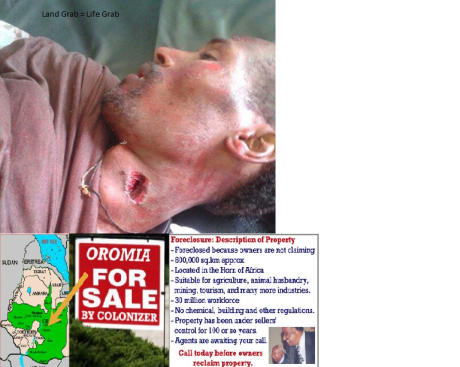
Saudi Star Agricultural Development plans to pump $100 million into a rice export project in Gambella region of Ethiopia despite allegations of human rights violations surrounding the “villagization” program under which the land has been taken from indigenous Anuak pastoralists to lease to foreign investors.
The company is owned by Mohamed al-Amoudi, who was born in Ethiopia to a Saudi father and an Ethiopian mother. Al-Amoudi made a fortune from construction contracts to build Saudi Arabia’s national underground oil storage complex. Now a billionaire many times over, al-Amoudi has invested heavily in Ethiopia where he owns a gold mine and a majority stake in the national oil company.
Al-Amoudi was one of the first to invest in a new scheme under which president Meles Zenawi offered to lease four million hectares of agricultural land to foreign investors and his company was also one of the first to become the subject of controversy. After Saudi Star was awarded a 10,000 hectare (24,700 acres) lease in 2008, a dozen aggrieved Anuak villagers attacked Saudi Star’s compound in Gambella in 2010 and killed several employees.
Saudi Star abandoned work at the time but this past November the company announced that it would return to invest millions to grow rice using new large-scale flood irrigation techniques. Saudi Star hopes to sell its produce to Saudi Arabia under King Abdullah’s Food Security Program.
“We know we’re creating job opportunities, transforming skills, training local indigenous Anuak,” Jemal Ahmed, Saudi Star CEO told Bloomberg. “The government wants the project to be a success and see more Gambella people able to work and produce more, that’s the big hope.”
But activists say that Saudi Star’s newly invigorated project in Gambella is likely to have a detrimental impact on the local population, notably pastoralist groups like the Anuak as well as the Nuer.
“Sadly, right now, the Anuak, nearly all small subsistence farmers, are becoming refugees in their own land as they are internally displaced from indigenous land their ancestors have possessed for centuries,” Obang Metho, Executive Director of Solidarity Movement for a New Ethiopia, told the Africa Congress on Effective Cooperation for a Green Africa.
“They have become ‘discardable’ by a regime that wants their land, but not for them, in order to lease it to foreigners and regime-cronies for commercial farms,” he added.
All told as many as 1.5 million subsistence farmers are expected to be offered voluntary relocation to new settlements where the government has told them that they will be given housing, social services and support infrastructure under the villagization program.
However, activists like Human Rights Watch and the Oakland Institute say that the relocation process has been plagued by violence and broken promises.
Instead of getting housing, villagers are forced to build their own tukols – traditional huts – and risk beatings if they speak out, says Human Rights Watch, which conducted interviews of 100 residents during the first round of villagization that occurred in 2010.
The majority of resettlements did not have a school, health clinic or even water wells, says the Oakland Institute. Lack of agricultural assistance such as seeds, fertilizers, tools and trainings, have further exacerbated the risk of hunger and starvation among families.
The traditional pastoralist communities also say that they are having a hard time adapting to sedentary farming practices in the new settlements. “We want you to be clear the government brought us here…to die…right here,” an Anuak elder in Abobo district told Human Rights Watch. “They brought us no food, they gave away our land to foreigners so we can’t even move back. On all sides the land is given away, so we will die here in one place.”
These are short interviews with farmers who have lost thier farmlands. #Landgrabs. #Oromia. #Africa January 1, 2015
Posted by OromianEconomist in Because I am Oromo, Ethiopia's Colonizing Structure and the Development Problems of People of Oromia, Land and Water Grabs in Oromia, Land Grabs in Africa, Land Grabs in Oromia, No to land grabs in Oromia, No to the Addis Ababa Master Plan, Uncategorized.Tags: Africa, African Studies, Gambela and Omo, Genocide against the Oromo, Land grabbing, Land grabs in Africa, Land Grabs in Oromia, The Tyranny of Ethiopia
add a comment
The Ethiopian Government land owner¬ship right has created it easier for flower growers to get land easily. Abiy Mezgebu, 28 has lost his piece of land because of the government influence and pressure. The government paid him a small amount of money – “I had to take the small amount of money that the government offered me and they threatened me to take away my land if I would refuse to take the offer,” says Abiy. Now Abiy is a laborer in the Menagesha Farms. He has lost his land – his means of living for ages.
Aduna Workneh, father of five, lives across bunches of flower farms near Addis Ababa. Officials from the government and flower farms came and talked to him in person. They told me I will benefit better if I take the offer from the government and leave my land. Initially, I refused the offer – because they money would feed my family for a few years, but my land will feed till the ages of my grandchildren and even beyond.” However, Aduna was forced to take the offer and he is now a landless man. He is not sure about his future.
These flower farms benefit us nothing; at least they were expected to provides employment opportunity, says Aduna. Only a few members of our community got employed; as for the majority are not from this area. Showing across the valley, Aduna says – this whole valley was covered by indigenous trees – now is cut down and green houses have been constructed on them. We were able to collect firewood from leftovers and foliage in the forest – the flower farms have taken away everything from us.

 This is a teenage girl working in Dugda Flower Farm. This was owned by her father in Dugda area…and taken away by the Ethiopian governemnt and given to a TPLF affiliate businessman…now she works as a labourer in this farm being paid under half a dollar a day…
The Ethiopian Government land owner¬ship right has created it easier for flower growers to get land easily. Abiy Mezgebu, 28 has lost his piece of land because of the government influence and pressure. The government paid him a small amount of money – “I had to take the small amount of money that the government offered me and they threatened me to take away my land if I would refuse to take the offer,” says Abiy. Now Abiy is a laborer in the Menagesha Farms. He has lost his land – his means of living for ages.
Aduna Workneh, father of…
View original post 182 more words
2014 in review January 1, 2015
Posted by OromianEconomist in Uncategorized.Tags: Africa, African Studies, Economic and development analysis, economics, Oromia, Oromian Perspectives, Oromo, The pursuit for Justice and freedom
add a comment
The WordPress.com stats helper monkeys prepared a 2014 annual report for this blog.

Here’s an excerpt:
The concert hall at the Sydney Opera House holds 2,700 people. This blog was viewed about 42,000 times in 2014. If it were a concert at Sydney Opera House, it would take about 16 sold-out performances for that many people to see it.
Short term effect on the average consumer as oil prices drop. (Theoretical approach) December 28, 2014
Posted by OromianEconomist in Economics, Uncategorized.Tags: economics, Oil price, Supply and Demand
add a comment
Most economists agree that Oil is considered to be a normal good, by normal we mean that as your income goes up you would buy more of that good, that is a basic definition. As oil prices fall you would expect that oil consumption would increase, however in the short-run that is not the case. Oil in fact is inelastic in the short run, inelastic means that its consumption is not sensitive to price. Companies still need to operate at the same rate to satisfy their operations and people still need to drive to get to work. It takes time for markets to adjust and people to change their way of living. The long run is a different topic by itself and is out of the scope of this post. You are not going to buy a 8 cylinder pick up after you hear oil fell this month are you?
We can then agree that oil consumption would not change in the short run. Now we can check the graph that I have made to illustrate a theoretical approach of what consumers are going through at this point of time.


Most economists agree that Oil is considered to be a normal good, by normal we mean that as your income goes up you would buy more of that good, that is a basic definition. As oil prices fall you would expect that oil consumption would increase, however in the short-run that is not the case. Oil in fact is inelastic in the short run, inelastic means that its consumption is not sensitive to price. Companies still need to operate at the same rate to satisfy their operations and people still need to drive to get to work. It takes time for markets to adjust and people to change their way of living. The long run is a different topic by itself and is out of the scope of this post. You are not going to buy a 8 cylinder pick up after you hear oil fell this month are you?
We can…
View original post 408 more words
POVERTY – Introduction December 25, 2014
Posted by OromianEconomist in African Poor, Amnesty International's Report: Because I Am Oromo, Free development vs authoritarian model, Human Rights Watch on Human Rights Violations Against Oromo People by TPLF Ethiopia, Illicit financial outflows from Ethiopia, Knowledge and the Colonizing Structure. African Heritage. The Genocide Against Oromo Nation, Land and Water Grabs in Oromia, Poverty, The State of Food Insecurity in Ethiopia, Uncategorized, Youth Unemployment.Tags: Africa, African Studies, Developing country, Development and Change, Genocide, Genocide against the Oromo, Poverty and TPLF tyranny in Ethiopia, The causes of poverty
add a comment
‘Poverty is not merely going hungry; it means lack of resources like land or education to make out a living; means lack of employment; means lack of access to some basic needs of life like health services, education, food etc., means lack of voice to be heard and ability to influence the formulation of policies or implementation of programs by the government.
Poverty may also be understood as an aspect of unequal social status and inequitable social relationships, experienced as social exclusion, dependency, and diminished capacity to participate, or to develop meaningful connections with other people in society. This is of considerable relevance to the Indian situation. …Dominant sections of ethnicity in the society controls the political conditions and assets, depriving the marginalized from having access to these economic assets. ‘
Definition : Poverty is a situation where the individual or community lack the resources, ability to meet the basic needs of life.
Relative Poverty: Refers to lacking a usual or socially acceptable level of resources or income as compared with others within a society or country.
Penury : Extreme poverty.
Absolute Poverty: is destitution wherein one lacks basic human needs including clean water, food, clothing, shelter, health cover and education.
The World Bank defines poverty in absolute terms. According to them, the poverty is classified into:
Extreme Poverty : Living on less than US $1.25 per day
Moderate Poverty : Living on less than US $2 a day
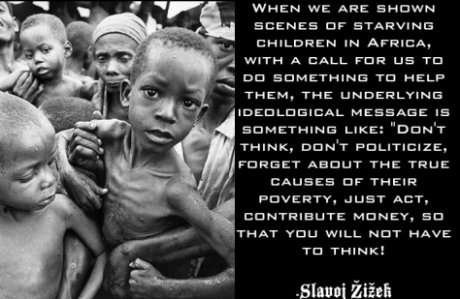


Definition : Poverty is a situation where the individual or community lack the resources, ability to meet the basic needs of life.
Relative Poverty: Refers to lacking a usual or socially acceptable level of resources or income as compared with others within a society or country.
Penury : Extreme poverty.
Absolute Poverty: is destitution wherein one lacks basic human needs including clean water, food, clothing, shelter, health cover and education.
The World Bank defines poverty in absolute terms. According to them, the poverty is classified into:
- Extreme Poverty : Living on less than US $1.25 per day
- Moderate Poverty : Living on less than US $2 a day
World Bank has stated that fighting with poverty is at the core of its work.
According to the definition of poverty by the World Bank, the poor are classified as:
- Subjugate Poor : People with per capita consumption expenditure as…
View original post 345 more words
President Obama wakes up to the Darfur genocide December 18, 2014
Posted by OromianEconomist in Africa, Darfur, Ethiopia's Colonizing Structure and the Development Problems of People of Oromia, Afar, Ogaden, Sidama, Southern Ethiopia and the Omo Valley, Ethnic Cleansing, Genocidal Master plan of Ethiopia, Uncategorized.Tags: Africa, African Studies, Because I Am Oromo: Amnesty International Report, Genocide against the Oromo, Horn of Africa, Human rights, Human rights violations, Janjaweed in Darfur Liyu Police in Oromia, Land grabs in Africa, National Self Determination, Oromia, Oromo people
add a comment
Please also refer to the genocide going on in other Horn of African country (Ethiopia) against Oromo (Oromia) people:
http://www.amnesty.nl/sites/default/files/public/because_i_am_oromo.pdf

This excellent analysis by Eric Reeves provides an analysis of US policy towards Darfur.
Martin
“Awakening” to the Continuing Nightmare of the Darfur Genocide
Source: Eric Reeves, 17 December 2014
The Obama administration seems finally to have found its voice again in speaking about ongoing genocide in the Darfur region of Sudan. More than a decade after rebellion and conflict began, some three million people are internally displaced or refugees in neighboring Chad. More than 800,000 have been displaced in the past two years; some 2 million human beings have been newly displaced since the disastrously conceived and badly failing UN/African Union Mission in Darfur (UNAMID) took up its civilian protection mandate in January 2008. The death toll from the direct and indirect consequences of violence now exceeds 500,000—and mortality looks to be poised to rise steeply given reduced humanitarian capacity.
After seven years of distinguishing itself only by being…
View original post 2,616 more words
Trade & development: Why many developing countries seem, contrary to what the traditional theories suggest, not benefiting from international trade November 27, 2014
Posted by OromianEconomist in Africa, Africa and debt, Africa Rising, African Poor, Agriculture, Aid to Africa, Colonizing Structure, Corruption in Africa, Economics, Economics: Development Theory and Policy applications, Ethiopia the least competitive in the Global Competitiveness Index, Theory of Development, Trade and Development, Uncategorized.Tags: Africa, African Studies, Comparative Advantage, Developing country, Development, Development and Change, economics, Trade and Development
add a comment
” The benefits of trade have been well documented throughout history. The economic case is quite straightforward. Opening up to trade allows countries to shift their patterns of production, exporting goods that they are relatively efficient at producing and importing goods at a lower price that they can’t produce resourcefully at home. This lets resources to be allocated more efficiently allowing a nation’s economy to grow. Fruits of trade can be seen in many countries. In the last 30 years, trade has grown around 7% per year on average (WTO, 2013). During this time period, developing nations have seen their share in world export increase from 34% to 47% (WTO, 2013) which at first glance seem incredible. However if we dig a little deeper, it is quickly apparent that China is the key reason for the majority of the growth and that a bulk of these developing countries aren’t benefiting fully from international trade. Why is this? Many developing countries depend on the export of a few primary products and in some cases a single primary commodity for the majority of their export earnings. In fact, 95 of the 141 developing countries rely of the export of commodities for at least 50% of their export income (Brown, 2008). This is where the problem starts. Prices in the primary good’s market tend to be highly volatile sometimes varying up to 50% in a single year (South Centre, 2005). Often, the fluctuation of these products are out of the hands of the developing countries as they individually have only a small portion of the world supply which is not enough to affect world prices. At the same time, some shocks (ie. Weather) are unpredictable. The unstable commodity price brings uncertainty, instability and often negative economic consequences for the developing countries. This also affects the policymaking in the country as it is hard to implement a sustainable development scheme or a fiscal expansionary policy with uncertain revenue. Positive shocks do increase income in the short run however a study by Dehn (2000) found that there are no permanent effect on the increase on income in the long run. Furthermore, there is often very little scope to growth through primary products as it is very hard to increase volumes of sale. This is due to the demand being inelastic. The over dependence on the export of primary products also causes another problem – a risk of a large trade deficit. Several studies (Olukoshi, 1989, Mundell, 1989) have shown that primary commodity prices are the main cause for the debt problems in many developing countries. In an empirical research done by Swaray (2005), he shows the main reason behind this is the deteriorating terms of trade, developing countries face. Terms of Trade is equal to the value of export over the value of import. Over time there has been a general trend of primary products falling in value. 41 of 46 leading commodities fell in real value over the last 30 years with an average decline of 47% in real prices, according to the World Bank (cited in CFC, 2005). This has occurs due to inelastic demand for commodities and lack of differentiation among producers hence making it a competitive market. The creation of synthetic substitutes has also suppressed prices. At the same time, manufacturing products (which generally developing countries tend to import) see a general rise in prices. Put these trends together, over time, developing countries have seen their terms of trade worsen. A study by CFC (2005), shows that the terms of trade have declined as much as 20% since the 1980s. This, alongside the difficulty to increase volumes of sales has meant many developing countries have a trade deficit. According Bhagwati (1958), it is possible that this decline in the terms of trade could result in diminished welfare. In other words, growth from trade can be negative rather than positive. ”


The benefits of trade have been well documented throughout history. The economic case is quite straightforward. Opening up to trade allows countries to shift their patterns of production, exporting goods that they are relatively efficient at producing and importing goods at a lower price that they can’t produce resourcefully at home. This lets resources to be allocated more efficiently allowing a nation’s economy to grow. Fruits of trade can be seen in many countries. In the last 30 years, trade has grown around 7% per year on average (WTO, 2013). During this time period, developing nations have seen their share in world export increase from 34% to 47% (WTO, 2013) which at first glance seem incredible. However if we dig a little deeper, it is quickly apparent that China is the key reason for the majority of the growth and that a bulk of these developing countries aren’t benefiting fully…
View original post 1,047 more words
UNPO Report on Ogaden persecution in Ethiopia November 18, 2014
Posted by OromianEconomist in Africa, Aid to Africa, Amnesty International's Report: Because I Am Oromo, Colonizing Structure, Ethiopia's Colonizing Structure and the Development Problems of People of Oromia, Afar, Ogaden, Sidama, Southern Ethiopia and the Omo Valley, Free development vs authoritarian model, Ogaden, Oromia, The Tyranny of TPLF Ethiopia, Uncategorized, UNPO.Tags: Africa, African Studies, Genocide, Genocide against Ogaden People, Genocide against the Oromo, National Self Determination, Ogaden People, Oromia, Oromo, Oromo people, The Tyranny of Ethiopia, Tyranny
add a comment
UNPO Publishes Report on Ogaden persecution in Ethiopia

In recent years the Ogaden people in Eastern Ethiopia have increasingly suffered various human rights abuses as the Ethiopian State continues its mission of ethnic oppression.
These violations of human rights often compound the current humanitarian crisis that is developing in the region; with foreign aid funds supporting a state that actively deters humanitarian organisations from operating in the Ogaden region.
To help increase awareness about the worsening situation for the Ogaden people, UNPO has published abackground report outlining some of the major human rights that currently exist.
This report focuses on many of the Ogaden people’s civil and political rights that have been violated by the Ethiopian Government, and puts them into the broader context of the general state of human rights compliance throughout the whole country.
Cause for serious concern continues to be the suppression of the free media and freedom of expression within Ethiopia. Silencing the voices of those willing voice concerns of state suppression means that the outside world is never likely to know the full scale of rights violations that are taking place within the country.
Of further concern to international law is the occurrence of extra-territorial activity of the Ethiopian State in both targeting political opposition and persecuting the Ogaden people. The fact that these actions have now begun to span borders makes it even harder to encourage transparency on the issues.
For a full copy of the report click @
Aadde Tsehay Tolessa, the Widow of Rev. Gudina Tumsa, May Her Soul Rest in Peace. Aayyoo Sabboontuu Aadde Tsahay Tolasaa Biyyoon Itti Hasalphatu October 15, 2014
Posted by OromianEconomist in Aadde Faaxumaa Galmoo, Aadde Tsehay Tolasaa, Artist Almaz Tafarraa, Oromo Nation, Oromummaa, Uncategorized.Tags: Aadde Tsehay Tolasaa, Oromo people
add a comment


Tsehay Tolessa, 84, the widow of Rev. Gudina Tumsa, passed away on October 12, 2014. Aadde Tsehay was a person of faith, courage and great perseverance. The government of Ethiopia, during the 1980s, never tolerated Oromo people’s aspiration for freedom and justice, but forced them to submit to harsh treatment. They grabbed Tolessa and forced her hands under her knees and tied them there, right after her husband, whom she married to in 1951, was abducted on July 28, 1979 and subsequently got killed. They filled her mouth with dirty rags and they beat her breaking bones and causing the skin to peel off. Then they threw her in a cell with 60 other people. There was standing room only and she remembered that she could only feel broken bones and blood as she had to stand. There was only one toilet but since nobody could move in the cell they could not use the facilities properly. No doubt disease was rampant and they were already under an immense famine. There was no light that came in this cell. She could not even hold a cup to drink water as others had to help her.
She stayed in that cell A FULL YEAR!!!! With her broken bones, rotting flesh and dilapidating condition she stayed in that mess of a cell for a whole year! When they let her out of the cell they put her in another jail for 10 years!! She was morally strong, even though she lost a husband, Rev. Gudina Tumsa, and brother-in-law, Baaroo Tumsa, to the Oromo cause.
Aadde Tsehay was a tower of her family, a shining light of courage to her people and a woman of deep faith in God. She survived by four children (Kulani, Lensa, Aster and Boruu) and many more grand children. May God bless her!! Rest in peace!!
Du’aan Boqotuu Aadde Tsehay Tolasaa Ilaalchisee Ibsa Gaddaa ABO irraa kenname.

Harka guddeessa Sabboontota Oromoo addatti ammoo dhalattoota Oromoo Qabsoo Bilisummaa Oromootti dhihoo jiraniin bal’inaan kan beekaman Aadde Teshay Tolasaa hoospitaala Land Mark jedhamutti waldhaanamaa osoo jiranii Onkoloolessa 12, 2014 Oromiyaa/ Finfinneetti addunyaa kana irraa du’aan boqatanii jiran.
Sabboontuu, hiyyeessa gargaaruu fi jajjabeessuun kan beekaman Aadde Tsehay Tolasaa Abbaa warraa isaanii Lubi Guddinaa Tumsaa badiin alatti murtii faashistummaan kan ajjeese mootummaan Dargii, ajjeechaa Abbaa warraa isaanii irratti raawwateen quufuu dhabuu irraa isaaniinis waggoota 10ni oliif mana hidhaa keessatti dararaa turuu seenaan Adde Tsehay ni hubachiisa.
Sabboontuu fi haadha hiyyeessaa kan tahan Aadde Tsehaay Tolasaa mana hidhaa Dargii keessatti miidhaan ol aanaan irra gahullee midhaa irra gaheef osoo harka hin laatne, akka mana hidhaatii bahaniin dhalattoota biyyaa isaaniin olitti rakkoo adda addaan qabamanii jiran gargaaruuf murteeffatanii waggoota 20 ol dabraniif dalagaa namoomaa boonsaa hojjataa turan. Garaa laaftuu fi ummata rakkateef kan naasuu qaban Aadde Tsehay, waggoota kanneen keessatti harka qalleeyyii hedduu nyaachisuu, daara baasuu fi waldhaansisuun hojii boonsaa bara baraan ittiin yaadataman hojjatanii dabran.
Haadha Ijoollee Afurii kan tahan Aadde Tsehay Tolasaa waggaa 84-tti Onkoloolessa 12, 2014 du’aan boqatan.
Qabsoo Bilismmaa ummata Oromoo keessatti qoodni isaanii guddaa dha. Senaan hidhaa waggaa 10 olii kana mirkaneessa.
Addi Bilisummaa Oromoo du’aan boqotuu Aadde Tsehay Tolasaatti gadda cimaa itti dhagahame ibsaa maatii, firoottanii fi sabboontota Oromoo maraaf jajjabina hawwa.
Injifannoo Ummata Oromoof!
Adda Bilisummaa Oromoo
Onkoloolessa 14, 2014
Sirna Owaalcha Adde Tsehay Tolasaa
Onkoloolessa 15 Bara 2014
Funeral service of Aadde Tseay Tolesa, the widow of Rev. Gudina Tumsa
15th October 2015


10 Best and Brightest YouTube Videos That Will Change How You Think October 8, 2014
Posted by OromianEconomist in 10 best Youtube videos, 25 killer Websites that make you cleverer, Inspirational Oromo Women, Tweets and Africa, Uncategorized.Tags: 25 killer Websites that make you cleverer, Best youtube videos that make you the brightest
add a comment
10 YouTube Videos That Will Change How You Think
http://time.com/3481914/inspiring-youtube-videos/
While you may think of YouTube as a place to check out the latest in funny animal videos, there’s a lot of content that caters to the brain rather than the funny bone.
We’ve found the best and brightest videos for you to enjoy when you need to stretch your mental muscles. These cover a variety of topics, but they’re all guaranteed to make you look at the world around you at least a little bit differently.
Dan Gilbert: Why Are We Happy? Why Aren’t We Happy?
Scientist Dan Gilbert has made some surprising discoveries about happiness. For example, lottery winners and paraplegics both have about the same level of happiness one year after the event that changed their lives. How is that possible?
Gilbert explains how our long-term happiness is not on based getting what we want, but how our brains react when we don’t get what we want. And he demonstrates this by way of Mick Jagger, Monet and amnesiacs. Confused? Watch this 22-minute video as he talks about exactly how this works based on his scientific studies into the matter.
Stephen Hawking: Questioning the Universe
One of the most brilliant scientists of our time not only discusses how the universe began and the probability of alien contact, but how that information determines how we should proceed in the future. Given mankind’s selfish and aggressive expansion, Stephen Hawking makes a case for space exploration so that we can continue to thrive on other habitable worlds.
Elizabeth Gilbert: Your Elusive Creative Genius
If you are pursuing creative endeavors, either professionally or personally, this talk by the author of best-seller of Eat, Pray, Love is for you. She questions the assumption we all have that creativity and suffering go hand-in-hand, and challenges creative people to look at their work and their life’s passion to create in a different, more positive light.
Colin Stokes: The Hidden Meanings in Kids’ Movies
Father of two, Colin Stokes wonders aloud, “Why is there so much Force in the movies we have for our kids and so little Yellow Brick Road?” By that, he means films aimed at boys tend to teach them that violence is the answer and a woman is their prize (i.e. Star Wars.) And films aimed at girls tend to teach them to work together and make allies to overcome problems (i.e. The Wizard of Oz.)
The question he has: why aren’t there films focused on gaining allies and solving things diplomatically aimed at boys? Why aren’t there more films that teach young men not to objectify women and treat them as the reward they are entitled to? Most importantly, Colin talks about what we as parents can do about it.
Amy Webb: How I Hacked Online Dating
Is there an algorithm for love? Statistician Amy Webb analyzed not only what she wanted out of a potential husband, but also what men she liked were looking for. Using this process, she altered her online dating profile and it caught the eye of the man she would end up marrying.
This is not just a story about how to find the ideal mate, but how to approach any passion in your life in a way that gets you what you want in a smart way designed for success.
Randy Pausch: The Last Lecture: Achieving Your Childhood Dreams
Though the “Last Lecture” series at Carnegie Mellon University is themed around what the professors’ last lectures would be, for Randy Pausch, who had recently been diagnosed with terminal cancer, this would literally be his last lecture. But don’t think this video is a downer because Pausch is dying: He’s in good humor, and you’re guaranteed to crack a smile while watching his inspirational talk about how to live life to its fullest.
Told through Pausch’s reminiscing, his lecture focuses on achieving one’s childhood dreams and, even better, how to help others achieve their dreams. At over an hour in length, it’s well worth your time.
Steve Jobs: Stanford Commencement Address
Several years before his death, the Apple CEO gave the commencement address to the graduates at Stanford University. In it, he talks about his own life: He dropped out of college after six months, unable to see the value in whiling away all of his parents’ savings. He didn’t know how at the time, but he hoped it would all work out — and if you know anything about the story of his life, it did.
His message of believing in yourself and following your own path is full of humor and insight. It isn’t to be missed and only clocks in at a little more than 15 minutes.
Susan Cain: The Power of Introverts
We live in a world that doesn’t always cater to the needs of introverts—a personality type that accounts for a third to half of all people and tends to prefer quiet over loud, isolation over socialization. Cain, an introvert and the author of Quiet: The Power of Introverts, offers a thought-provoking argument that suggests introverts have as much to offer the world as their extroverted brethren.
One of the more popular TEDTalks, The Power of Introverts runs just under 20 minutes and may make you see a new side of yourself or those around you.
Eli Pariser: Beware Online “Filter Bubbles”
Don’t know what a filter bubble is? It’s a phenomenon unique to the Internet-era in which our interests and preferences tailor the kinds of content we see on search engines and social channels. And while it can be helpful in directing us to the information most relevant to us, in this nine-minute TEDTalk, Eli Pariser explains that it can also prevent us from seeing opposing viewpoints.
Sheryl Sandberg: Why We Have Too Few Women Leaders
Facebook COO Sheryl Sandberg is well-known as a business leader who’s been outspoken on the subject of women in the workplace. So it’s no surprise that when she spoke at a TED Conference, she gave a 15-minute passionate argument for why we need more women leaders in the world. She also focuses on the messages we send women about working and the messages we send our daughters as well.
See more @ http://time.com/3481914/inspiring-youtube-videos/
Ethiopia Ranks 47th in Mo Ibrahim 2014 Governance Index Human Rights category October 1, 2014
Posted by OromianEconomist in Africa, Corruption, Ethiopia & World Press Index 2014, Ethiopia's Colonizing Structure and the Development Problems of People of Oromia, The 2014 Ibrahim Index of African Governance, Uncategorized.Tags: African Studies, Economic and Social Freedom, Governance issues, Human Rights and Liberties, Human rights violations, Oromia, Oromo, State and Development, The 2014 Ibrahim Index of African Governance
add a comment
Ethiopia has been ranked 47th out of 52 countries in Africa by the Mo Ibrahim 2014 governance index on Human Rights. Ethiopia’s score in this category is 28.8/100. Ethiopia (28.8), CAR (27.9), Gambia (26.2), Equatorial Guinea (10.5), Eritrea (8.6) and Somalia (7.3) are the worst performing in this category. Ethiopia has been one of the most deteriorating trend for the last five years with score for change of -6.3. Top 5 performing countries in this category are: Cabo Verde (84.4), Mauritius (81.7), Ghana (78.1), Senegal (74.7), Namibia (73.3). Average African score for human rights category has been 49.4. The 2014 Ibrahim Index of African Governance, launched on 29 September 2014.
See Chart @http://www.moibrahimfoundation.org/interact/#phr;root
In accountability which includes corruption in government and public officials, Ethiopia has scored 38.9 and has been ranked 25th with deteriorating trends. The highest performing Botswana has scored 77.3. The average for all Africa is 38.9. See Chart @http://www.moibrahimfoundation.org/interact/#srl;root
Ethiopia ranks 32nd in over all Ibrahim Index of 2014 African Governance with score of 48.5/100. The top 5 scorers are Mauritius (81.7), Cabo Verde (76.6), Botswana (76.2), South Africa (73.3) and Seychelles (73.2).
According to the Index, governance is defined as:
“The provision of the political, social and economic goods that a citizen has the right to expect from his or her state, and that a state has the responsibility to deliver to its citizens.”
The foundation conducts its assessments with four main conceptual categories: Safety & rule of law, participation and human rights, sustainable economic opportunity and human development.
Read related analysis on the report @The Ibrahim Index and Africa’s new numbers: http://africanarguments.org/2014/10/01/africas-new-numbers-revealing-and-intriguing-by-richard-dowden/
Ethiopia (Sub-Saharan Africa) and the Global Competitiveness Report for 2014-2015 September 6, 2014
Posted by OromianEconomist in Uncategorized.Tags: Africa, African Studies, Economic and Social Freedom, Global Competitiveness Report, Sub-Saharan Africa
1 comment so far

“Strong institutions, available talent, and a high capacity to innovate hold the key for the success of any economy. These elements will continue to be even more essential in the future.”
-GCI Report 2014-2015
“What Africa needs are strong Institutions Not Strong men.” -US President Barack Obama in Accra on his maiden visit to Africa as President .
“There is a monstrous relationship between the government and the citizen whereby the government is more powerful than the citizen” – Rev. Fr. Anthony Adewale, Prof. of Philosophy and Theology Dominican Institute in the Guardian of Sep 9, 2012.
“In the absence of institutions, strong men dominate, and the effect of their dominance is weakened rule of law and elevated uncertainty levels. Institutions have and follow rules, strong men have friends and follow whims. The outcome from one is calculable probability of outcomes; from the other uncertainty. Uncertainty makes decision making problematic and often results in either the avoidance of economic engagement or the high cost of hedging against undesired outcomes. These high transaction costs translate to uncompetitiveness for the economy. Even more troubling, high uncertainty which results in poor economic performance can create a class of people who are so left out they feel they have nothing to lose. With no stake in the social order they turned to conduct that more or less usher in anarchy, what Robert Kaplan quotes a Sierra Leonean Minister in The coming anarchy as dubbing ‘the revenge of the poor’.” – Pat Utomi
Ethiopia ranks 118th/ 144 in this year Global Competitiveness Index (GCI). The report says the country ‘facing challenges across all pillars despite its recent record growth rates. The functioning of its institutions (96th) receives a weaker assessment across almost all indicators, including property rights, ethics and corruption, and government efficiency. Furthermore, the country’s goods market (124th) remains inefficient. Ethiopia also requires significant improvements in the areas of infrastructure (125th), higher education and training (131st), and technological readiness (133rd). On a more positive note, this year points to a slight improvement in the country’s labor market, although concerns about the quality of labor-employer relations (97th), hiring and firing practices (78th), and the alignment between pay and productivity (99th) remain. Primary education, with a net enrollment rate of 86 percent, is comparatively good (although the quality of primary education requires improvement), and women account for a high percentage of the country’s labor force.’
According to the report, more than half of the 20 lowest ranked countries in the GCI are sub-Saharan Africa, and overall the region continues to under perform in many areas of the basic requirements of competitiveness: the infrastructure deficit remains profound, and despite gradual improvements in recent years, health and basic education remains low. Only a handful of sub-Saharan economies—the island states of Mauritius and Seychelles, in addition to Cape Verde—have noteworthy health and education systems. Higher education and training also need to be further developed to provide the skills required for higher-value-added growth. The region’s poor performance across all basic requirements for competitiveness stands in contrast to its comparatively stronger performance in market efficiency, where several of the region’s middle-income economies fare relatively well. Although large regional variations remain in terms of competitiveness—ranging from Mauritius, now a solid 17 places ahead of the second-ranked South Africa, to the lowest ranked Guinea at 144th—efforts to strengthen the very basic requirements for long-term growth will be crucial for sustaining economic growth and making it more inclusive. These efforts will need to emphasize closing the infrastructure deficit and providing the region’s (young) population with the necessary skills to carry out higher-value-added employment. Globally, Switzerland holds the number one spot, followed by Singapore and the United States. Finland and Germany both fell one notch, to the 4th and 5th. In this case, the top of the rankings continues to be dominated by highly advanced Western economies and several Asian tigers. For the sixth consecutive year Switzerland leads the top 10, and again this year Singapore ranks as the second-most competitive economy in the world. Overall, the rankings at the top have remained rather stable, although it is worth noting the significant progress made by the United States, which climbs to 3rd place this year, and Japan, which rises three ranks to 6th position. Brics economies presented a mixed performance, and China (28th, one place up compared to last year) leading the group ahead of Russia (53rd), South Africa (56th), Brazil (57th) and India (71st). The Global Competitiveness Report 2014-2015 assesses the competitiveness of landscape of 144 economies, providing insight into the drivers of their productivity and prosperity. The report series remains the most comprehensive assessment of national competitiveness worldwide. Read the full report @ http://www3.weforum.org/docs/WEF_GlobalCompetitivenessReport_2014-15.pdf
Report reveals sub-Saharan Africa’s 10 most competitive economies
The 25 Most Productive Ways to Spend Time on the Internet & More August 23, 2014
Posted by OromianEconomist in Free ebooks, Project Gutenberg, The Oromo Library, Uncategorized.Tags: Free ebooks
1 comment so far
The 25 Most Productive Ways to Spend Time on the Internet & more
It’s easy to forget that we have access to a virtually limitless resource of information, i.e. the Internet. For a lot of us, this is even true at our fingertips, thanks to the ubiquity of smartphones and an ever-increasing push for online greatness by tech engineers all over the world.
As a result, there are countless websites out there that are geared to make you smarter and more brilliant for either a low or no cost. Here are just 25 killer websites that may just make you more clever than ever before.
https://imgur.com/a/1S2u5/noscript
See also free ebooks@ http://www.gutenberg.org/wiki/Category:Bookshelf
language-teaching website http://www.duolingo.com/
Khan academy https://www.khanacademy.org/
MIT Open Courseware http://ocw.mit.edu/index.htm
Investopedia http://www.investopedia.com/
Quora http://www.quora.com/
Codeacademy http://www.codecademy.com/
Geography http://www.factmonster.com/countries.html
TED http://www.ted.com/
OneLook http://www.onelook.com/
Couchsurfing https://www.couchsurfing.org/
Lumosity http://www.lumosity.com/
Information is Beautiful http://www.informationisbeautiful.net/
Nerd Fitness http://www.nerdfitness.com/
Cooking for Engineers http://www.cookingforengineers.com/
The Dating Specialist http://www.thedatingspecialist.com/
Spreeder http://spreeder.com/
Anki Mastering Recall http://ankisrs.net/
CliffsNotes School and College Study Guides and Test Prep http://www.cliffsnotes.com/
Learn Street http://www.learnstreet.com/
HowStuffWorks http://www.howstuffworks.com/
The World Factbook https://www.cia.gov/library/publications/the-world-factbook/
Justin Guitar http://justinguitar.com/
Afaan Oromo http://www.oromiffa.com/
Oromo Dictionary http://oromodictionary.com/
The Universal Law of Change July 27, 2014
Posted by OromianEconomist in Development & Change, Economics, Ideas, Uncategorized.Tags: Development and Change, economics
add a comment
Change is variation, impermanence, acceleration, flux. Heraclitus, an ancient Greek philosopher, said: “Change, the state of flux, is a permanent feature of nature”. Greeks philosophers were fond of paradoxes. Another ancient Greek philosopher, Parmenides disagreed: “Change is ephemeral and things truly staid the same”. Greek philosophers were fond of disagreement. The dictionary says it’s the process of becoming different. Men have lamented the constancy of Change and decried the lack of Change. Barack Obama won a presidency promising Change.
The interesting thing about Change is that many, if not all, equations describing change look about the same. Let’s say Change is C, some driving force prompting the change is DF, and resistance to change is R. Then the generic form for most equations describing change is:
C = DF * 1/R
If this Universal Law of Change applies to many different Changes, perhaps it also applies to the economic and social Changes? For example:
Influx of Mexican immigrants to the United States, driven by the difference in hourly wages, and resisted by the high “coyote fees”, border patrol and vast deserts.
A flood of Central American children to the Texas border, driven by fear of death or injury from the local gangsters and resisted by the distance, and other resistances mentioned above.
Implementation of green energy generation driven by the fears of climate change, but resisted by the high cost of the green energy.
Etc., etc.
As mentioned, there are many laws describing change is physical systems that look about the same. For example, here’s Newton’s famous law as it is commonly written:F = m a
Or force is mass times acceleration. In this case, acceleration, “a”, represents change. Acceleration occurs when something is at rest or traveling at a constant speed, and then it accelerates (positive acceleration) or decelerates (negative acceleration). Rearranging the equation:
a = F * 1/ m
So change, a, is equal to a force F driving for a change, acting on the object with the mass m. A heavy bowling ball has more mass, so it’s harder to make it accelerate than, let’s say a tennis ball. So m is resistance to change. Given the same driving force, the bigger m, the less change there is. Broadly interpreted, Newton’s law is a mathematical representation of change:
Change = (Driving Force) * (1/Resistance to Change)
In fluid dynamics, a science describing fluid flow, there’s a famous equation called the Bernoulli’s equation:
V12/2g + P1/ρg + Z1 = V22/2g + P2/ρg + Z2
Looks complicated, but rearranged into the Change = (Driving Force) * (1/Resistance to Change) it looks like:
(V22 – V12) = (P1 – P2)* (2/ρ) + 2g(Z1 – Z2)

Change is variation, impermanence, acceleration, flux. Heraclitus, an ancient Greek philosopher, said: “Change, the state of flux, is a permanent feature of nature”. Greeks philosophers were fond of paradoxes. Another ancient Greek philosopher, Parmenides disagreed: “Change is ephemeral and things truly staid the same”. Greek philosophers were fond of disagreement. The dictionary says it’s the process of becoming different. Men have lamented the constancy of Change and decried the lack of Change. Barack Obama won a presidency promising Change.
The interesting thing about Change is that many, if not all, equations describing change look about the same. Let’s say Change is C, some driving force prompting the change is DF, and resistance to change is R. Then the generic form for most equations describing change is:
C = DF * 1/R
If this Universal Law of Change applies to…
View original post 1,685 more words
Aid to Africa:A smokescreen to hide the “sustained looting” of the continent July 20, 2014
Posted by OromianEconomist in Africa, Africa Rising, Aid to Africa, Ethiopia's Colonizing Structure and the Development Problems of People of Oromia, Afar, Ogaden, Sidama, Southern Ethiopia and the Omo Valley, Free development vs authoritarian model, Human Rights Watch on Human Rights Violations Against Oromo People by TPLF Ethiopia, Jen & Josh (Ijoollee Amboo), Land and Water Grabs in Oromia, UK Aid Should Respect Rights, Uncategorized.Tags: African Studies, Aid to Africa, Human rights violations, Illicit Financial outflows, Land grabs in Africa
add a comment
Although sub-Saharan Africa receives $134bn each year in loans, foreign investment and development aid, $192bn leaves the region, leaving a $58bn shortfall. See @ http://www.theguardian.com/global-development/2014/jul/15/aid-africa-west-looting-continent?CMP=fb_ot

Mark Anderson writes for the Guardian:
Western countries are using aid to Africa as a smokescreen to hide the “sustained looting” of the continent as it loses nearly $60bn a year through tax evasion, climate change mitigation, and the flight of profits earned by foreign multinational companies, a group of NGOs has claimed.
Although sub-Saharan Africa receives $134bn each year in loans, foreign investment and development aid, research released on Tuesday by a group of UK and Africa-based NGOs suggests that $192bn leaves the region, leaving a $58bn shortfall.
It says aid sent in the form of loans serves only to contribute to the continent’s debt crisis, and recommends that donors should use transparent contracts to ensure development assistance grants can be properly scrutinised by the recipient country’s parliament.
“The common understanding is that the UK ‘helps’ Africa through aid, but in reality this serves as a smokescreen for the billions taken out,” said Martin Drewry, director of Health Poverty Action, one of the NGOs behind the report. “Let’s use more accurate language. It’s sustained looting – the opposite of generous giving – and we should recognise that the City of London is at the heart of the global financial system that facilitates this.”
Research by Global Financial Integrity shows Africa’s illicit outflows were nearly 50% higher than the average for the global south from 2002-11.The UK-based NGO ActionAid issued a report last year (pdf) that claimed half of large corporate investment in the global south transited through a tax haven.
Supporting regulatory reforms would empower African governments “to control the operations of investing foreign companies”, the report says, adding: “Countries must support efforts under way in the United Nations to draw up a binding international agreement on transnational corporations to protect human rights.”
But NGOs must also change, according to Drewry: “We need to move beyond our focus on aid levels and communicate the bigger truth – exposing the real relationship between rich and poor, and holding leaders to account.”
The report was authored by 13 UK and Africa-based NGOs, including:Health Poverty Action, Jubilee Debt Campaign, World Development Movement, African Forum and Network on Debt and Development,Friends of the Earth Africa, Tax Justice Network, People’s Health Movement Kenya, Zimbabwe and UK, War on Want, Community Working Group on Health Zimbabwe, Medact, Healthworkers4All, Friends of the Earth South Africa, JA!Justiça Ambiental/Friends of the Earth Mozambique.
Sarah-Jayne Clifton, director of Jubilee Debt Campaign, said: “Tackling inequality between Africa and the rest of the world means tackling the root causes of its debt dependency, its loss of government revenue by tax dodging, and the other ways the continent is being plundered. Here in the UK we can start with our role as a major global financial centre and network of tax havens, complicit in siphoning money out of Africa.”
A UK government spokesman said: “The UK put tax and transparency at the heart of our G8 presidency last year and we are actively working with the Organisation for Economic Co-operation and Development to ensure companies are paying the tax they should and helping developing countries collect the tax they are owed.” Read @http://www.theguardian.com/global-development/2014/jul/15/aid-africa-west-looting-continent?CMP=fb_ot
The Inspirational Nelson Mandela: The Long Walk To Freedom (1918 – 2013) July 18, 2014
Posted by OromianEconomist in Africa, Colonizing Structure, Human Rights, Humanity and Social Civilization, Knowledge and the Colonizing Structure., Knowledge and the Colonizing Structure. Africa Heritage. The Genocide Against Oromo Nation, Nelson Mandela, Oromia, Oromiyaa, Oromo, Oromo Culture, Oromo Identity, Oromo Nation, Self determination, Uncategorized.Tags: Africa, African culture, African Studies, Democratic African institution, Development, Economic and Social Freedom, Governance issues, Human Rights and Liberties, Human rights violations, Mandela, Nelson Mandela and Taddasaa Birruu, Oromia, Oromo, Oromo language, Oromo people, Oromummaa, Sub-Saharan Africa, Taddasaa Birruu
comments closed
International Nelson Mandela Day
After spending almost three decades as a political prisoner in his own country, Nelson Mandela emerged from his cell and quickly became one of the most revered world leaders. 18th July, Mandel’s Birthday, has been named International Nelson Mandela Day in his honor.


http://gadaa.com/oduu/23325/2013/12/08/oromo-studies-associations-press-release-on-the-death-of-nelson-mandela/?utm_source=feedburner&utm_medium=twitter&utm_campaign=Feed%3A+gadaa%2FBiJG+%28Gadaa.com+Oduu+-+News%29
Nelson Mandela was not only a great leader; he was a student of great leadership. As a boy, he was dazzled by stories of African leaders from the 17th and 18th centuries, and he saw himself as part of that grand tradition. He was raised by the Regent of the Tembu tribe, who allowed him to sit in on tribal councils. Mandela once told me that the Regent would never speak until the end, and then he would summarize what had been said and try to form a consensus. When I was working with Mandela on his autobiography, Long Walk to Freedom, I sat in on many meetings with his own senior team. He would almost always wait until the end to speak and then see if he could forge a consensus. To him that was the African way.
Mandela was not only a student of great leadership; he was intent on creating great African leaders. He believed that there was a dearth of great leaders in Africa, and he was keen on motivating a new generation of leadership for the continent.
I was with Mandela during many meetings with South African and international leaders. Afterwards, he would comment on a leader’s particular style or tactics, or even on what he wore. He would note if a leader was polite or deferential. He did not like leaders who were overly emotional or histrionic. If he described you as “measured,” that was a great compliment. He prized directness. He had no tolerance for leaders who were not honest. And he would sometimes smile ruefully if someone was in over his head.
Mandela believed that African leaders needed to be different than Western leaders. As the head of the African National Congress, and as the president of South Africa, he always sought consensus. He once told me that as a boy he had spent many days herding cattle, and that the way you lead cattle is from behind. By that he meant, you must marshal your forces and make sure that your people are ready to go in the direction where you want to lead them. Mandela led from the front and behind, and it is his spirit that is behind the Young African Leadership Initiative. And on Mandela’s 96th birthday, we get ready to welcome to Washington the 500 YALI Fellows who are the brightest of a new generation of great African leaders.
Mandela understood that leaders are made as well as born, and that circumstances bring forth great leaders. He liked the old English expression about leadership: “Cometh the moment, cometh the man – or the woman.” This is the moment for these young African leaders.
http://www.bbc.co.uk/news/world-africa-23515879
“I learned that courage was not the absence of fear, but the triumph over it. The brave man is not he who does not feel afraid, but he who conquers that fear.”
“It always seems impossible until it’s done.”
“Living isn’t just about doing for yourself, but what you do for others as well.
“For to be free is not merely to cast off one’s chains, but to live in a way that respects and enhances the freedom of others.”
“No one is born hating another person because of the color of his skin, or his background, or his religion. People must learn to hate, and if they can learn to hate, they can be taught to love, for love comes more naturally to the human heart than its opposite.”
“After climbing a great hill, one only finds that there are many more hills to climb.”
“The greatest glory in living lies not in never falling, but in rising every time we fall.”
“There is nothing like returning to a place that remains unchanged to find the ways in which you yourself have altered.”
“Education is the most powerful weapon which you can use to change the world.”


Anti-apartheid leader and African National Congress member Nelson Mandela and his wife, Winnie, raise fists upon Mandela’s release from Victor Verster prison on Feb. 11, 1990, in Paarl, South Africa.(ALEXANDER JOE/AFP/Getty Images)

Mandela at a funeral for 12 people who died during township unrest in Soweto, South Africa, Sept. 20, 1990.(ALEXANDER JOE/AFP/Getty Images)

Mandela greets supporters behind the fence in the mining town of Randfontein, west of Johannesburg, Nov. 25, 1993. He toured the area as part of his campaign for the 1994 presidential election.(WALTER DHLADHLA/AFP/Getty Images)

South African President Nelson Mandela takes the oath of office on May 10, 1994, at the Union Building in Pretoria.(WALTER DHLADHLA/AFP/Getty Images)

South African President Nelson Mandela takes the oath of office on May 10, 1994, at the Union Building in Pretoria.(WALTER DHLADHLA/AFP/Getty Images)

President Mandela goes on a walkabout round Trafalgar Square in London on his way to South Africa House, where he made a speech from the balcony.(POOL/AFP/Getty Images),
See more at@http://www.nationaljournal.com/pictures-video/nelson-mandela-day-20140718
‘Over the years, Mandela’s initial military training and brief stay in Ethiopia received only a scant media coverage. It has been said that Mandela had come face-to-face with death at many junctures in his long life. But had the alleged 1962 assassination attempt in Addis Ababa, Ethiopia’s capital, succeeded, the world would have been worse off.
 A man who single-handedly saved Mandela has recently come forward with his story. Captain Guta Dinka, 78, was one of the two guards assigned to protect the future icon of peace during his training’ in Finfinnee. Read more at http://www.opride.com/oromsis/news/horn-of-africa/3723-captain-guta-dinka-the-man-who-saved-mandela

Col Fekadu Wakene, Oromo man
In ‘July 1962, Col Fekadu Wakene taught South African political activist Nelson Mandela the tricks of guerrilla warfare – including how to plant explosives before slipping quietly away into the night.’ BBC
WASHINGTON, DC (VOA, Afaan Oromo) — Prezidaantiin Afrikaa kibbaa duraanii Nelson Maandeellaa umrii isaanii 95tti kamiisa kaleessaa du’an boqotanii jiran.Uummanni addunyaa irra jiru prezidaantii gurraacha Afrikaa kibbaaf isa jalqabaa ta’an kanaaf gadda itti dhaga’ame ibsaa jira.
Namoota hedduu biratti maandelaan Goota.Nama kaka’uumsa qabu nama jabaa fi mul’ata qabu. Yeroo baayyee nama gad of qabu, nama gaarii, amanamaa, nama warra biraafis yaadu.
Ta’uun beekamu. Nelson Mandelaan Adooleessa 18 bara 1918 dhalatanii naannoo dur gurraachonni Afrikaa kibbaa keessa jiraatan Transkei jedhamtu keessatti guddatan.
 Nelesen Maandeellaa
Bara dargaggummaa isaanii sochii farra Apaartaayiid keessa seenuun paartii Afrikaan Nashinaal Kongrees ykn ANC jedhamutti dabalaman.Bara 1940 ANC keessatti damee dargaggotaaf hogganaa ta’an.
Maandeellaan kooleejii fi mana barnootaa kan seeraa yeroo seenan nama ANC keessaa Oliver Thamboo wajjin turan.
Yeroo jalqabaafiis waajiira gurraachaa kan waa’ee seeraa irratti hojjatu Afrikaa kibbaa keessatti banan.Gurraachootaaf gorsa seeraa baasii tokko malee tola ykn gatii xiqqoo gaafachuun gargaaraa turan.
http://www.voaafaanoromoo.com/content/article/1804939.html
WASHINGTON,DC — Perzdaantiin Afrikaa Kibbaa ka durii,Nelson Maandellaa nama addunyaan waan hedduun faarsitu.
Akka xiinxalyaan siyaasaa Jawaar Mohaammad yuniversitii New York jedhetti ammoo wannii Maandellaa jaalataniif “nama kana nama bilisummaa sabaatii fi ummata isaatiif falmeen jaalatama…jaarmiyaa paartii Afrikaa Kibbaa ,ANC jijjiiree paartii ummataa godhee.Ummatii cunqurfamoon addunyaa ammoo isa akka fkn laalan.”
Akka Jawaaritti wanti Maandellaa biyya alaatti akkana jaalataniif bara Maandeellaa hidhaa bahe sunitti:
“Oggaa innii qabsoo san injifannoon irra aanee mana hidhaatii bahu san sodaan guddaan… ummata isaa sun qabatee ummata adii biyya san jiru biyya sanii hari’uu, biiluu bahuu dandahaa sodaa jettutti jira..sun ammoo hin taane.”
Dubbii tana araaraan fixuutti akka Maandellaan jaalatamu tolche.Gama kaaniin ammoo Maandellaan gaafa leenjii waraanaatiif Finfinnee dhufe jeneraalii waraanaa bara sunii Taaddasaa Birruu jalatti leenjifame.
Itti gaafatamtootii waraana Oromoo ta bara 1960s keessaa tun Jeneraal Taaddasaa Birruu, Koloneel Fiqaaduu Waakkanneetii,Kumaalaa Fiqaaduu Dibaabaatii fi Kumaalaa Guutaa Dinqaa faan Perz.Maandellaa leenjisanii nagaa isaallee eegaa bahe.haga Maandellaan Finfinnee jiru sunitti leenjisaa waan hedduun gargaaraa bahan.
Kumaalaa Guutaa Dinqaa akka Maandellaa ijjeesu sobamulee “sobamuu didee lubbu Maandeellaa oolche.”
Gaafa Maandeellaan leenjii fixatee Afrikaa Kibbaatti deebihullee kumaalaa Guutaan shugguxii tokkoo fi rasaasa 200 Maandellaa kenne.Jennaan Maandellaan poolisiin itti dhufnaan shugguxii sun gatee ammallee horii guddaan barbaaduutti jiran.
Gama kaaniin ammoo dhaabi fiilmii Amerikaa baasu Holly Woodii fi ka Afrikaa Kibbaalleen seenaa Maandellaafaa shugguxi Maandellaa ta baddee fi seenaa Oromoota isa waliin turanii irralleetti wa hojjachuutti jira.
http://www.voaafaanoromoo.com/content/article/1806836.html?utm_source=dlvr.it&utm_medium=facebook
http://america.aljazeera.com/opinions/2013/12/what-mandela-meanttoafricanactivists.html
His Excellency Jacob G Zuma
President
Republic of South Africa
Dear Mr. President:
It is with feelings of great sorrow that we in the Oromo Liberation Front and the Oromo people at large learned the passing of Mr. Nelson Mandela, the first elected President of South Africa and a true freedom -fighting icon. On behalf of the Oromo Liberation Front (OLF) and the Oromo people, I wish to convey my deepest condolences and sympathies to you and the people of South Africa during this time of national mourning. The passing of Former President Mandela is a tremendous loss not only to South Africa and Africa alone but to the whole world.
The world and Africa in particular has lost an extraordinary statesman; a true freedom fighter whose moral strength, dedication and determination liberated his people from the evil of apartheid and set a genuine example for the rest of world. This gallant son and leader of Africa, through his unconditional sacrifices and heroism transformed his beloved country, South Africa, into peaceful multiracial nation that continues to serve as an example of a true and genuine national reconciliation in the world.
We, Oromo, have very fond memories of Mr. Mandela’s secret visit to our country in 1962, where he was hosted by General Taddasa Biru, an Oromo hero, founder of the OLF and leader who was murdered by the Ethiopian regime in 1975, while in struggle for the liberation of his own people. General Taddasa Biru trained and prepared Mr. Mandela for armed struggle. Because of this connection in particular, Mr. Nelson Mandela has become a source of inspiration for those of us struggling for freedom, equality, peace and reconciliation. We will greatly miss this freedom icon and giant son of Africa.
History will remember President Nelson Mandela as a great man and hero. Nobel laureate Nelson Mandela’s legacy will live on and inspire generations to come.
At this moment, our prayers are with the people of South Africa and President Mandela’s family in particular and we hope that they will find strength and solace to overcome their sorrow during this period of deep grief.
May his soul rest in eternal peace!
Yours Sincerely,
Dawud Ibsa
Chairman
Oromo Libertion Front– National Council
http://ethiofreespeech.blogspot.no/2013/12/olf-sends-condolence-letter-on-mandela.html
http://www.bbc.co.uk/news/world-africa-23515879
The Oromo Studies Association (OSA) is profoundly saddened by the death of Nelson Mandela. Mandela was a father, a husband, a statesman, a global hero, an anti-apartheid symbol, an advocate of human rights, and a fearless fighter of discrimination. He fought for the equal right of the black people in Apartheid South Africa, and paid a heavy price for the freedom of his people. He was condemned to a 27-year imprisonment. Despite the prison ordeals, he defended his dignity, civility, discipline, principle, and emerged a better human being. Eventually, he led a pariah state to a new chapter of peace with itself and the world. A passionate and forgiving man, he built a common home for blacks and white races – making animosity between the once sworn enemies a matter of history. Today, the rainbow nation is a model for a racial equality and tolerance. Added to his popularity and grace was his decision to limit his presidency to one term in the continent often incumbents die in the office or removed by coup.

Mr Mandela with His Oromo Trainer, General Tadesse Biru. (Photo: Public Domain)
Mandela was a prisoner of conscience, but he was a free man at last. Today, there are tens of thousands of Oromo prisoners of conscience in Ethiopian prisons. Mandela was once considered a terrorist. Today, the Ethiopian government often labels one who advocates for the rights of the Oromo people as a terrorist. It is against this background that Mandela’s universal message of justice has a strong resonance in the Oromo nation, a nation trying to overcome a century of discrimination, oppression, marginalization, exploitation, and occupation.
The Oromo nation had a historical connection to a man who changed the world through his words and actions. He inspired General Taddasa Birru, a man who ignited the struggle of the Oromo people for freedom and equality. The Oromo nation takes pride in teaching a military science and training Mandela needed to spark the struggle of the people of South Africa. Mandela cut his teeth under General Taddasa Birru and Capt. Fekadu Wakane. The Oromo nation also foiled an assassination attempt against the life of Nelson Mandela. Captain Dinka Guta is still a living witness for that. We are also happy that Dr. Neville Alexander, a son of an Oromo slave, fought for the independence of the people of South Africa, and imprisoned with Mandela at the same prison.
Mandela has left the world for good; yet he has changed the world for good. Today, the world is a better place for humanity because of a meaningful life he lived and a remarkable legacy he left behind. We are grieving his death, but humanity is better off because of his universal message of love, peace, harmony, understanding, human rights, and democracy. Mandela’s struggle against discrimination and oppression will inspire the struggle of the Oromo people and other oppressed peoples around the world. Our prayers and thoughts are with his family and the people of South Africa during this difficult time.
—————————

Dr. Ibrahim Elemo, the President of OSA, signing a condolence book at the Consulate General of South Africa, in Chicago, December 6, 2013.

Dr. Ibrahim Elemo, the President of OSA, briefed the staff of the Consulate General of South Africa about the link between the Oromo struggle and the South Africans’ struggle against the Apartheid
—————————
Ibrahim Elemo, M.D, M.P.H
President, the Oromo Studies Association/Waldaa Qorannoo Oromoo
E-mail: ielemo@weisshospital.com
December 7, 2013

‘May God bless the memory of Nelson Mandela!’ Obama
The Oromo nationals with the Oromo flag at the memorial services for Nelson Mandela in Soweto FNB Stadium, South Africa, 10th December 2013.
Qunu, South Africa—Nelson Mandela, South Africa’s first democratically-elected president and its most beloved leader, was laid to rest Sunday at a state funeral in the lush green hills he roamed barefoot as a child.
About 4,500 mourners gathered in a giant white tent on the Mandela family compound, where 95 candles—one for each year of Mandela’s life—burned behind his South African flag-draped casket. Family, friends and world leaders recalled Nelson Mandela as disciplined but mischievous, courageous yet humble.
The service concluded a 10-day period of national mourning that included a memorial gathering in Soweto, various concerts and Mandela’s body lying in state for three days in Pretoria. Organizers wanted Sunday’s service to wrap up in two-and-half hours, because a man of Mandela’s stature should be buried at noon, “when the sun is at its highest and the shadow at its shortest,” said African National Congress Deputy President Cyril Ramaphosa, who served as master of ceremonies.
“Madala, your abundant reserves of love, simplicity, honesty, service, humility, care, courage, foresight, patience, tolerance, equality and justice continually served as a source of enormous strength to many millions of people in South Africa and the world,” said Ahmed Kathrada, who gave the first eulogy, addressing Mandela with the Xhosa word for elder. “You symbolize today, and always will, qualities of collective leadership, reconciliation, unity and forgiveness.”
Kathrada, who spent 26 years in prison with Mandela, choked up several times during his address. “When Walter [former African National Congress Secretary General Sisulu] died, I lost a father,” he said. “When you died, I lost a brother. Now I don’t know who to turn to.”
Guests included luminaries like Price Charles, Oprah Winfrey and Jesse Jackson and African leaders such as Malawi’s President Joyce Banda, Tanzania’s President Jakaya Kikwete and Zambia’s former President Kenneth Kaunda.
Mandela’s granddaughter, Nandi Mandela, gave a moving tribute that recalled her grandfather’s humble roots. “He grew up from these rolling hills,” she said. “He went to school barefoot yet he rose to the highest office in the land.”
She depicted Mandela as a stern, but fun-loving and mischievous grandfather who loved telling stories.
“People always talk about his achievements, but he was a lot of fun to be around and he was a great storyteller.” She said he particularly liked to poke fun at himself, recounting a tale he told about trying to pick up a piece of chicken with his fork while at dinner with a girl he was trying to impress and her family. “Every time I stabbed the chicken, it jumped,” Nandi Mandela recalled her grandfather saying with a hearty laughter. “We shall miss your voice, we shall miss your laughter.”
Residents of Qunu and surrounding villages and ordinary South Africans who traveled from all over the country were not permitted inside the tent. Instead, hundreds watched Nandi Mandela and the other speakers on a giant screen set up in a distant field overlooking the Mandela compound, and at other public viewing sites around the country.
Draped in yellow and green Mandela t-shirts and scarves, with small South African flags attached to their hats or behind their ears, they sat quietly and intently, but jumped to their feet ululating and cheering when Mandela’s former praise poet, Zolani Mkiva, offered a rousing introduction to President Jacob Zuma.
The boos that greeted Zuma during a memorial service last week in Soweto were absent Sunday. In his speech, Zuma said Mandela offered, “hope in the place of hopelessness” and promised that South Africans would not abandon the principles that defined Mandela’s life.
“We have to continue building the type of society you worked tirelessly to construct,” Zuma said. “We have to take your legacy forward.”
As they watched the service in the field, mourners recalled how Mandela threw Christmas parties for the children of Qunu and surrounding villages, plying them with shoes, uniforms, and bags for school.
“For a big man like this, he was always there for us,” said Masibulele Magqirha, 42, of Qunu. Magqirha said he grew up playing soccer on the fields where Mandela’s house now stands. And he recalled when his entire soccer team decided they’d go ask Mandela to buy them uniforms.
“He said, ‘What are you doing here?’ But nobody wanted to talk,” Magqirha recalled. “’Gentlemen I’m talking to you, what are you coming here for?’” Mandela said, according to Magqirha. Magqirha finally spoke up: “Tata, please we are here to ask you to buy for us a kit. We are out playing soccer but we don’t have a kit.” Mandela told two team leaders to return the next day, Magqirha said. “When we came back, he said, ‘Tell me, what is your story?’ Are you studying? Please, you must go to school.’”
The next day, Magqirha returned, and was told to hop into a military truck, where he was presented with cleats, socks, shorts and shirts for the entire team.
“Where will we get a person like this again?” he asked.
Following Zuma’s speech, mourners walked behind the giant screen and paused in a vast open field. A young woman sat gazing towards the gravesite, crying. Others stood peering through binoculars towards the Mandela compound. Two police officers took a selfie, the funeral tent in the background. A man raised one fist in the air, holding a poster of Mandela in his other hand, gazing into the distance.
Then two busloads of men from neighboring KwaZulu Natal province, wielding spears and shields, offered a tribute in music and dance to Mandela, gyrating through the field.
Ultimately, Ramaphosa, the master of ceremonies, had to plead with the ancestors for extra time, as the ceremony went about an hour longer than expected. A small, private burial service followed at the family gravesite nearby.
Three helicopters carrying South African flags whizzed by, and military jets passed overhead in tribute as mourners sprinted towards them in a futile dash. A 21-canon salute boomed and smoke filled the village air.
At the Mandela family’s request, the national broadcaster cut the live feed to allow for a private burial. As coverage on the big screen ended, a woman seated in the front row wearing an elegant purple dress raised her hand and waved goodbye.
http://www.channel4.com/news/nelson-mandela-funeral-madiba-live-south-africa-qunu-video
http://www.newsweek.com/mandela-laid-rest-mourners-bid-final-farewell-224567
‘Much of Mandela’s belief system came from his youth in the Xhosa tribe and being raised by a local Thembu King after his own father died. As a boy, he lived in a rondavel — a grass hut — with a dirt floor. He learned to be a shepherd. He fetched water from the spring. He excelled at stick fighting with the other boys. He sat at the feet of old men who told him stories of the brave African princes who ruled South Africa before the coming of the white man. The first time he shook the hand of a white man was when he went off to boarding school. Eventually, little Rolihlahla Mandela would become Nelson Mandela and get a proper Methodist education, but for all his worldliness and his legal training, much of his wisdom and common sense — and joy — came from what he had learned as a young boy in the Transkei. Mandela might have been a more sentimental man if so much had not been taken away from him. His freedom. His ability to choose the path of his life. His eldest son. Two great-grandchildren. Nothing in his life was permanent except the oppression he and his people were under. And everything he might have had he sacrificed to achieve the freedom of his people. But all the crude jailers, tiny cells and bumptious white apartheid leaders could not take away his pride, his dignity and his sense of justice. Even when he had to strip and be hosed down when he first entered Robben Island, he stood straight and did not complain. He refused to be intimidated in any circumstance. I remember interviewing Eddie Daniels, a 5-ft. 3-in. mixed-race freedom fighter who was in cell block B with Mandela on the island; Eddie recalled how anytime he felt demoralized, he would just have to see the 6-ft. 2-in. Mandela walking tall through the courtyard and he would feel revived. Eddie wept as he told me how when he fell ill, Mandela — “Nelson Mandela, my leader!” — came into his cell and crouched down to wash out his pail of vomit and blood and excrement. I always thought that in a free and nonracial South Africa, Mandela would have been a small-town lawyer, content to be a local grandee. This great, historic revolutionary was in many ways a natural conservative. He did not believe in change for change’s sake. But one thing turned him into a revolutionary, and that was the pernicious system of racial oppression he experienced as a young man in Johannesburg. When people spat on him in buses, when shopkeepers turned him away, when whites treated him as if he could not read or write, that changed him irrevocably. For deep in his bones was a basic sense of fairness: he simply could not abide injustice. If he, Nelson Mandela, the son of a chief, tall, handsome and educated, could be treated as subhuman, then what about the millions who had nothing like his advantages? “That is not right,” he would sometimes say to me about something as mundane as a plane flight’s being canceled or as large as a world leader’s policies, but that simple phrase — that is not right — underlay everything he did, everything he sacrificed for and everything he accomplished.’
Read more: Nelson Mandela Dead at 95 | TIME.com http://world.time.com/2013/12/05/nelson-mandela-1918-2013-remembering-an-icon-of-freedom/#ixzz2nfn3oxN0
Copyright © OromianEconomist 2013 & Oromia Quarterly 1997-2013, all rights are reserved. Disclaimer.
Related articles
- Nelson Mandela is home (thehindu.com)
- In Memoriam – Nelson Mandela, 1918 – 2013 (chiefwritingwolf.com)
- Nelson Mandela 1918 – 2013 (prmktgsales.wordpress.com)
- Nelson Mandela, 1918 – 2013: Remembering an Icon of Freedom. Nelson Mandela Dead at 95 (lubwamai.wordpress.com)
Tyranny: What does democracy mean for TPLF/EPRDF? July 13, 2014
Posted by OromianEconomist in Aannolee and Calanqo, Amane Badhaso, Colonizing Structure, Dictatorship, Ethiopia's Colonizing Structure and the Development Problems of People of Oromia, Afar, Ogaden, Sidama, Southern Ethiopia and the Omo Valley, Ethnic Cleansing, Finfinne is Oromia's land, Finfinnee is the Capital City of Oromia, Free development vs authoritarian model, Genocidal Master plan of Ethiopia, Human Rights Watch on Human Rights Violations Against Oromo People by TPLF Ethiopia, Janjaweed Style Liyu Police of Ethiopia, Jen & Josh (Ijoollee Amboo), Land and Water Grabs in Oromia, NO to the Evictions of Oromo Nationals from Finfinnee (Central Oromia), Oromians Protests, Oromo and the call for justice and freedom, Oromo University students and their national demands, The Colonizing Structure & The Development Problems of Oromia, Tyranny, Uncategorized.Tags: African Studies, Genocide against the Oromo, Tyranny
add a comment
What does democracy mean for TPLF/EPRDF?
by Alemu Hurissa
Tigray People’s Liberation Front (TPLF) minority led regime has ruled Ethiopia for 23 years. During the years TPLF has been in power, they have used various methods to control everything in the country. One of these methods was false accusations against individuals or groups of sympathizing with the Oromo Liberation Front although the question of these individuals or groups has been based on the constitution of the country.
At the beginning when they came to power after overthrowing the Derg regime they promised to democratize the country, however they didn’t take time before they started targeting those who didn’t support their ideas as dissenters were subjected to torture and terrible sufferings in mass detention centres across the country. Over the last 23 years they have been in power, they have carried out unimaginable destruction against human life and natural resources in the country particularly in Oromia region. For instance destruction of Oromia forests and other natural resources as well as the killing of Oromo students, farmers and Oromo intellectuals in all parts of the region.
In December 2003 the government security forces massacred more than 400 Anuak Civilians in Gambella region as reported on January 8, 2004 by Genocide Watch, a US based Human Rights group. Police violence in Tepi and Awassa in the Southern Nations-Nationalities, and Peoples (SNNP) regional state, resulted in the death of more than one hundred civilians and the arrest of hundreds. The Human Rights Watch report 14 January 2003 termed it as Collective Punishment.
War Crimes and Crimes against Humanity in the Ogaden area of Ethiopia’s Somali Regional State, June 2008 and 19 October 2006, the Ethiopian police massacred 193 protesters in violence following last year’s disputed elections, an independent report says. These are very few among many such incidents that I have elected to mention as an example of TPLF security forces’ atrocious acts against innocent people in different parts of the country. The victim of these brutal acts range from very young children to the elderly people by age categories. For example, there was a report that an eight years old child was killed by federal police in Gudar in May 2014.
If any individual does not agree and support their agenda, automatically that person is a member of OLF, according to Woyane regime’s definition. For example, Bekele Gerba, who was a lecturer at Addis Ababa University was arrested in 2010 by the TPLF-led regime simply because he clearly depicted the true evil nature and behavior of TPLF and its members. He said the land inOromia is a private property of the ruling party members. If they want they will sell it or they will give it to the people who support them and these are people who got rich in a way that cannot be reasonably explained. Many Oromo prisoners testified about Oromo people suffering in jail after they have been released or escaped from prison. To name some of them, Ashenafi Adugna and Morkaa Hamdee are among the victims who suffered at the hands of Woyane security forces while they were in prison. Many innocent Oromo people sentenced to life term and death without any evidence that shows their involvement in any criminal act. What happened in the Oromia region against Oromo University and high school students by federal police as reported by the BBC and other mass media is evident to mention as an example.
In general, the brutal acts against Oromo people by TPLF security forces have never been witnessed anywhere in the world. This clearly depicts what the TPLF government and its party members stand for and lack of their perception about personal worth, and the contempt they have for a human being. One can be quite sure that oppression cannot continue forever, and the dark time for Oromo people shall be replaced with justice and freedom.
In a democratic country, the people have right to express themselves freely in accordance with the constitution and the laws of the country; but in Oromia, there is no freedom of speech. No one in Oromia can freely express him/herself. In oromia, the will of the people has been replaced by the will of the TPLF regime. What has been unfolding for the last 23 years in Oromia region is that the TPLF regime is busy fabricating false documents that are used by the brutal regime’s security forces to incriminate, intimidate, persecute, harass, arrest, torture and kill the innocent Oromo people. So for Woyane democracy means not to allow people their freedom of expression, intimidating, persecution, harassment, arresting, torture and killing innocents in cold blood.
Generally, woyane is a tyrant regime which uses power oppressively and unjustly in a harsh and cruel manner against Oromo people to keep itself in power as long as they could, but I strongly believe that the crimes woyane carried out against Oromo people as a part of its lust for wealth and power will not keep them in power rather it shall hasten the time the Oromo people will achieve freedom. It would be wrong to say woyane will stay in power while using excessive force of power and committing crimes against innocent Oromo people in horrible and oppressive character. What the government is doing now by the name of development is meaningless and inhuman; how one can bring development while exposing people to suffering and death is beyond anyone’s imagination.
Playing game with human life to gain wealth and acquire luxurious life in modern time by robbing and plundering the Oromo people’s wealth is simply unacceptable. The TPLF regime should have been grateful to the Oromo people instead of making Oromo people live a horrible life; because the better life enjoyed by the TPLF politicians came as a result of Oromia’s natural resources. Instead of displacing Oromo farmers, dismissing, arresting and killing Oromo students and dismissing Oromo workers from their job, would have given more respect and value for all Oromos. The problem is that the TPLF regime and itsSatellites parties like OPDO never understand the importance of Oromo people and Oromia region in Ethiopia. Oromia is bleeding since woyane has come to power, because woyane governed Oromia by using excessive force and violence.
All countries that have diplomatic relationships with Ethiopia have also played a major role in keeping woyane in power, because woyane has received too much money from these developed countries under the name of humanitarian assistance which woyane uses to buy weapons to brutally crackdown Oromo students, farmers and scholars. Under woyane’s political system there is no legal and moral right, in general, no rule of laws and justice.
On May 2, 2014, BBC reported that the security forces of the regime in Ethiopia had massacred at least 47 University and high school students in the town of Ambo in Oromia region. Human rights watch and other Non- governmental organizations also reported how the Ethiopian government abuses its own citizens for the benefit of the ruling party members.
The inhuman acts of TPLF regime against the Oromo students shows that it does not only kill students but also TPLF wants to kill the whole young generation psychologically which is their evil strategy and tactics in fact became in vain as Oromo students have continued their struggle for justice in Oromia region. We, Oromo should stand together to bring the perpetrators of massacre in Ambo town and other Universities to justice. It is true that as long as Woyane keep getting money and other facilities from developed countries; as developed countries also give priority for strategic interest than human right, it will be like climbing the top of a mountain; however, we should not let them to continue their inhuman action. What we have to know is that those students who have been massacred by woyane security forces could have been mine, our relatives or children. These students are hope of their family, Oromo society and the Oromia region in general.
TPLF-led regime in Ethiopia never understand the value of human being, what democracy and freedom of speech means because since they came to power, they have never learned from their mistakes rather than its political system goes from bad to the worst. Atrocities against our people have to continue because of just addressing the human right issue and the question of justice and freedom. So, to change the woyane’s oppressive and horrible political system in Oromia, all people who believe in justice and who know the value of human being should stand with the Oromo people and say no to the fascist and terrorist government of Ethiopia. Killing Oromo University and high school students in April and May 2014, beating and arresting students and local people, when the students and local people protested peacefully against the expansion of Finfinne and the eviction of Oromo farmers from their indigenous land is a proof that the regime in Ethiopia is being the fascist and terrorist regime. Woyane is always looking for a scapegoat for their evil actions and behaviors, but it is only woyane and its members who are responsible and will be held accountable for the crimes they committed against innocent Oromo people.
Fake leadership in Ethiopia have destroyed the Oromo people, and the constitution and the law of the country is always in favour of the TPLF regime, not the Oromo people. The TPLF regime is simply the worst government I have ever seen in the modern era.
At the end of my piece of writing, I challenge all Oromos to unite, as unity is strength and to contribute whatever we can to bring down woyane and its members from power and to bring justice and freedom to Oromia and I challenge and hope developed countries also will stop financial and technical support to terrorist regime in Ethiopia.
Read more@
http://ayyaantuu.com/horn-of-africa-news/oromia/what-does-democracy-mean-for-tplfeprdf/
Related articles and references:
Pre 2015 Election and The Fate of The Opposition In Ethiopia
By Firehiwot Guluma Tezera
When we talk about election in Ethiopia, the 2005 national election has become foremost as previous elections under both Derg and EPRDF were fake. The national election of 2005 has shown a hint of democracy until election date in Addis Ababa but in regions it was until one month before the voting date. The ruling party has been harassing the opposition and has killed strong opposition candidates. In Addis Ababa the hint of democracy disappeared after the ruling party diverted the election results.
Having no other option than forcefully suppressing the anger of the people caused by its altering of election results, the ruling party intensified the harassment and killing. So the outcome for the opposition was either to go to prison or follow the path given by EPRDF. Election 2005 ended in this manner.
The plan of the ruling party to give a quarter of the 540 parliamentary seats to the opposition and to minimize outside pressure and to restart the flow of foreign aid was unsuccessful. The election has made the party to assess itself. Even though it was widely accepted that EPRDF had altered the outcome of the 2005 election and had not anticipated the outcome, many have expected that the party will correct its mistakes. But the party says it has learnt from its mistakes but it made the following strategies:
Measures taken post 2005 election
- To harass print medias and to formulate and implement harassing press legislatures
- The government is the main American ally in east Africa in the anti-terrorist campaign. Through this it gets significant military and financial aid. Using this as a pretext the government formulated and implemented anti-terror laws and used it to harass and imprison parties that struggle peacefully. And through this to weaken peacefull struggle.
- Labeling jobless youth as dangerous and discriminating against the educated was identified as mistake during the election. To correct it they tried to share benefits by replacement and to appoint to political positions and making them members
- Letting jobless youth to organize and allowing them to get loans but making party membership a precondition and to stop youth joining the opposition by means of benefit
- To organize the rest of the people in groups of five and to disperse security personnel among the people and make difficult for the opposition to work with the people
- To change the roads built by aid organizations by cobble stone by employing unemployed youth. Employing the youth was good but they request exaggerated amount from the people. By doing this they are hitting two birds with one stone, to make its members beneficiaries and increase their numbers.
EPRDF used the above strategies for the preparation of 2010 elections. By implementing the strategies it has succeeded in increasing its members but they were not genuine supporters but they supported for benefits. When such kind of members increase, it becomes difficult to fulfill their benefits and at the end they become corruptionists. And they will become the ultimate enemies of the party.
The strategies mentioned above have enabled the party to claim to be winning 99% of the votes. Thenext day the then prime minister said” the people have given us 5 years contract believing that we have learnt from our past mistakes. This is a big warning for us. If we don’t live to their expectation they will take away their votes.” This was his scorning speech. But both the people and they know how they won and the 2010 election was declared error free.
Sabboonoti qabsoo ummataa biyyatti gargaaruuf maal gochuu danda’u? What can nationals do to help the struggle back home? July 10, 2014
Posted by OromianEconomist in Aannolee and Calanqo, Amane Badhaso, Ambo, Colonizing Structure, Ethiopia's Colonizing Structure and the Development Problems of People of Oromia, Afar, Ogaden, Sidama, Southern Ethiopia and the Omo Valley, Ethnic Cleansing, Finfinne is Oromia's land, Finfinnee, Finfinnee is the Capital City of Oromia, Finfinnee n Kan Oromoo ti, Free development vs authoritarian model, Hetosa, Human Rights Watch on Human Rights Violations Against Oromo People by TPLF Ethiopia, Ibsaa Guutamaa, Janjaweed Style Liyu Police of Ethiopia, Jen & Josh (Ijoollee Amboo), Land and Water Grabs in Oromia, Land Grabs in Africa, Language and Development, Nimoona Xilahuun Imaanaa, Nimoonaa Tilahun, No to land grabs in Oromia, No to the Addis Ababa Master Plan, NO to the Evictions of Oromo Nationals from Finfinnee (Central Oromia), Oromia wide Oromo Universtiy students Protested Addis Ababa Expansion Master Plan, Oromian Voices, Oromians Protests, Oromiyaa, Oromo, Oromo Diaspora, Oromo First, Oromo Identity, Oromo Nation, Oromo Protests, Oromo Protests in Ambo, Oromo students movement, Oromo students protests, Oromo the Largest Nation of Africa. Human Rights violations and Genocide against the Oromo people in Ethiopia, Oromo University students and their national demands, Oromummaa, Say no to the expansions of Addis Ababa, Self determination, State of Oromia, Stop evicting Oromo people from Cities, The Colonizing Structure & The Development Problems of Oromia, The extents and dimensions of poverty in Ethiopia, The Mass Massacre & Imprisonment of ORA Orphans, Uncategorized.Tags: African Studies, Development and Change, Genocide against the Oromo, Governance issues, Ibsaa Guutamaa, Oromo, Oromo culture, Oromo people, Oromummaa, United Nations, Universal Declaration of Human Rights
add a comment

Sabboonoti qabsoo ummataa biyyatti gargaaruuf maal gochuu danda’u?
Ibsaa Guutama irraa*
Finfinneen Oromiyaa keessatt bu’uurfamte kanaaf qaama see ta’uun wal hin falmisiisu. Oromiyaan jaarraa oliif qabaa halagaa jala jirti. Finfinneen akka battala human qabateetti tajaajiltuu waan taateef Oromoon too’annoo bucuullee irraa hin qabu. Finqiclha Dargii duuba Oromiyaan humna qabatee jiruun kan fakkeessaa ta’us ifatt beekamtee caasaan bulchaa dhaabbateefii jira. Waan hariirtii ulee falfalaa fakkaatuun empayerittiin Federeeshinatt jijjiiramte. Kanaaf finnooti federeeshinaa hundi ijaaruu fi gaggeessuuf gumaacha walqixee qabu jedhamee yaadama. Kanaaf finnaan federaalaa tokko kophaa ba’aa baatu hin qabatu jechuu dha.
Yoo Oromiyaan feete Federeshinichi Finfinnee Oromiyaa irraa kiraayi fudhachuu yookaa bakka tolaa lafa bitee magaalaa mummittii haaraakaroorfatee ijaarrachuu qaba. Sun hafee ammmas Finfinnee akka lafa qabaa jala jiruutt fudhachuun ofumaa baballisuu yaaluun geeddarama uumaa empayerichatt goone jedhame haaluu dha. Filmaati biraa federalummaa gaabbanii akkuma durii ifaan finnaa empayeraatt deebisne jechuu dha. Sana duuba gaaffiin jiru federalummaa utuu hin ta’in kan kolonummaa ta’a. Akka fedhettuu humni halagaa biyya abbaa keessatt Oromoo ajjeesuun qajeelaa utuu hin ta’in yakka yakka hundaa caaluu. .
Amma ummati Oromiyaa mirga saanii irraa hamaa ittisuuf yoomuu caalaa, meeqayyuu itt haa bahu walii tumsa agarsiisaa jiru. Barattootii fi warri kaaba, kibba, bahaa fi lixaa mootummaan Itophiyaa dubbii Oromoo keessa lixanii burcuu yeroo tokko ka’uun morma agarsiisaa jiru. Mootummichi heera harkuma saatiin midhaasse kan hin kabajne ta’uu beekanuu bu’aa ciicannoo kennufiidhan bahanii heerichi dhugaatt heera ta’uu saa mirkaneessuuf yaaluutt bobba’ani.
Kuunnoo kaa, mootummichi eenyummaa saa dhugaa saaxiluun rasaasa, dullaa fi fuura imimsaa garba gamaa galfateen loltu addaa Agaazii jedhamtu hiriirsee isaan simate. Daa’imman hedduun lubbuu saanii dhabanii qabeenyi hedduunis barbadaawe. Addunyaan empayera fi mootummaa farra ilmoo namaa akkasii jalatt qabsoon nagaa akka hin danda’amne taliila ta’uu saaf akka hubatu taasifameera. Seerooti saanii dhooftuu sobaati. Ummatooti mirga saanii dhalootaa irratt kan hin callifne waan ta’aniif filmaati jiru lola qofa ta’uun waan nama gaddisiisuu.
Itophiyaa waan halle, durooma waa tattaa, human namaa fi surrii saamuu malee hanga yoonaa waan Oromiyaaf buufte hin qabdu. Surrii itt lola’e kan waajjirbulchii Itoophiaa bara dheeraaf jiraachise. Surroota sana isaanii kan fuuloo ta’ee fula saanii xuraawaa dhosseef. Gaaffiin Oromoo gaaffi bilisummaa sabaawaa sammicha seermalee akasii hambisuuf kan dhihaate yoo ta’u kan koloneeffataa olhaantummaa gad jabeessuuf kan dhihate. Yoo qabamsi raawwate malee dhoofsisaaf irraa ka’i waloo hin jiru. Kan golli sadaffaan qayyabachuu dadhabu sana ta’a. Gaaffiin hiree ofii ofiin murteeffachu dhugooffachuu mirkanii jireenya seenaa sabichaa irratt hundaawaa.
Mootummaan amma jiru kana beekuun kan heera saa keessatt mirga kana galche. Sun waan qajeelaa dha. Sobaan dhiheessuun garuu addagummaa dha. Oromomitiin seexaa qaban kan Oromiyaa keessatt dhalatan, jiraatan, yk hojjetan kanneen keesumsiisoo, michuu, nama biyya walii ta’an waan bilisomuu irraa sodaatan kan hin jirreef isaan waliin qabama raawwachiisuuf akka dhaabbatan eegamuu. Kanneen jibba sanyii fi amantee koloneeffamoo hin qabne ummati Oromoo naga qabeessoo fi aada qabeessoo akka tahan beeku. Nama nagaatt roorrisuun uumaa sabichaa keessa waan hin jirre. Garuu Wayyaaneen ofii yakka hamaa tolchee kan biraatt maqachuun amala see waan ta’eef dammaqanii eeggachuu dha.
Koloneeffataa inni eegalaallee yeroo mootii Itophiyaa fi biyya Oromoo ofiin jechuu labse adda addummaa biyyooti lamaan, Itophiyaa fi Oromiyaan qaban beekuufii saa agarsiisa. Oromoon akka wallaaloti tokko tokko xeeban gosa hedduu of keessaa qaba malee ofii gosa miti. Mootummaan ammaa gaaffii bilisummaa Oromoo irra darbama jira. Heera tumuun, Oromoo qabsoo saanii irraa dagachiisee, hamaa dhiiga lolaasu duuba fiduu deemuuf yeroo bitachuu saa ture. Hacuuccaa hagamiittu dhimma bahuun deebii gaaffii akkasiif barbaachisu yeroo hin beekamneef dabarsuun boombii innaa eeggatee dhukahu waan ta’eef irra darbuun hin dandahamu. Kanaaf bu’aa olloototaa fi addunyaa jedhamee ariitiii dandahamuun ilaalamuu qaba.
Ka’ka’i barattoota dhiheenya ta’e qabattee ilaalamu qaban hedduu keessaa tokko qofaa. Kanneen biro akka “Ittissa Haaromaa” (GRD) kan nammi hedduun kuusaa saa jireenyaa gowwoofamee bondi bituun itt dhagalaase; “Samicha lafaa” kan Oromiyaan ummati see buqqifamuun gatii yartuun gurguramte; Afaan Oromoo waajjiraalee fi waabaroota Finfinnee akka hin seene ittifamuu fakkaatan Oromoo waan laalaniif roorroo biraa irratt dabalamuun qabattee morma guddaa kaasuu danda’an keessatt argamu. Lagi Abbayyaa bishaa gara caalu Oromiyaa irraa argata. Yaa’aan saas lafa Oromiyaa guddaa tuqa. Bishaan qajeellaan dhimma itt bahamuu kan mormu hin jiru. Garuu akki inni itt eegalee malbeekiin kan gorsamu mitii, horiin barbaachisu kan hanga dhumaatt baasu miti, yaadi duuba jirus mamsiisaa dha. Wanti sanaan dhufuu kan Oromiyaa hubuu danda’u samicha lafaa gadi hin ta’u.
“GRD” surraa yeroo abba tokkee yk murnaaf moo, dhuguma akka jedhame dantaa Itoophiyaafii? Gartokko leellisuun mufannaa hariiroo sabgidduu mimichiiruunf malee dantaa Itophiyaa waliin kan wal hin agarree laata? Uumaa mootummichaa, martii dhibantootaa dhiphoo qabeenya walitt guuruuf araada qabu irraa yoo laalamu hamilaticha dhumaan gahuuf utuu hin ta’in kan dhoofsisa “dhaabuu yk jijjiiruuf ta’u” irraa bu’aa argamuu jedhanii eegalan fakkaata.
Laggeen Oromiyaa hamma yoonaa hidhaman irraa bu’aa kan argatan Oromiyaa utuu hin ta’in biyya koloneeffatoo fi daldaloota alaatii. Abbayyas adda hin ta’u. Waan lafa laalutt laftii ammayyuu kan mootummaati akka jedhamett hafe. Abbaan akka fedhutt dhimma itt bahuu danda’a. Kanaafi mootummichi kan gaafate hundaaf gatii salphaan gurguratu yk deggertoota saaf hiree akka gurguratanii durooman godhu yk galtuu Oromoo booda “kiraayi sabsaabii” jedhee ittiin dorsisuuf gurguraddhaa jedhee kennuufiitt jira. Jara akksii irraa kan bitatetu abbaan lafaa akka diinaatt ilaala malee kittillayyoon TPLF Oromoo buqqiftee jalaa miliqaa jirti. Lafti kan Oromooti, Oromoon keennaa haa ta’u gurgurtaa akkasii hin hayyamus kontraata akkasiisn seenames kabajuuf hin dirqamu. Kontraata seermalee, fedha Oromoo hin eegnee. Gaaffii Oromoo walii galaa kan laalutt mootummichi raawwachuu mirga of ifsaa gabbaarotaa irratt kan mallatteesse fakkaata. Kanaaf akkaataan ofirraa faccisuu jijjiiramuun dirqii dha; sana malee hiriirri nagaa kamuu of ajjeesuu ta’aa
Fixiisa duuba wanti nama aarsuu, mootummaan afaan dadhabootaa keessatt qooqa hudumuun obbolaa saanii du’anii fi qabsoo saanii akka balaaleffatan gochuu dha. Dubbiin saa kan Federaalati. Kan qawwee daa’imatt jifffatanis isaanii. Garuu kaasaa jeequmsichaa jajallisuun hamajaajii gooftoliin saanii uumuuf deeman balaaleffachuf kan ergaman Goobanoota haaraa dha. Ummatooti Itophiyaa balaaleffannaa akkasii duruu beeku. Mootii moototaaf “harka alaa”, Dargiif “CIA Qixiranyaa”, Wayyaaneef ” gooltuu fi farra guddinaa” jedhamu turan. Goobanooti haaraan akeeki “Karoora Muummichaa” barruun jiraachuu dagatanii Finfinnee magaalaa “Metropolitan’ guddaa tokkott jijjiiruf akka tahe haaluu yaalaniiru.
Oromoon namoota maqaa guddinaatiin Oromiyaa babbaqassanii qabeenya saanii mulquu kan yaalan dura ni dhaabbatu. Qabsoo bilisummaa fi tokkummaaf Oromoon tolchu hololli hamaa n akkamiiyyuu dhaabuu hin dandahu. Oromiyaa walaba tokko taate malee sabi Oromoo jedhamu hin jiraatu. Jaarmaa malbulchaa jabaa dhabuun baraatooti qooda dursuu akkuma yeroo mootii moototaa fudhachaa jiru. Akkuma barasii ABO dullachi hin qophaawu taanaan murni ijaarame biraa fulduratt cehuun kaayyoo sochii bilisummaa ganamaa haaromsa. Hanga roorroon hin raawwannett warraaqsa Oromoo dhaabuun hin danda’amu. Gamnoomaan qabsaawoti Oromo kan gochuu danda’an waan kaleessa ta’eef gadooduuti yeroo dabarsuu dhiisanii amma kaasee maaltu hojjetamuu qaba kan jedhu ilaaluu dha. Kaleessi hamaa fi tolaa saa waliin sokkeera; tolchuuf haa tahu balleessuuf hardha qabannee wayyaa ta’a kan jennu boritt aggammataa jirra.
Oromoo callisisuuf yekki tolfamu caalaatt o’ee oofamaa jira. Haalli badaan torbanoota darbanii kan fuggifamu miti. Garuu sabboonoti hundi akkaataa yakkooti sun itt hinfufne irratt yaaduu akka jalqabantu abdatama. Biyya keessatt geengoon ofirraa ittisuu qaata naanna’uu eegalee. Namooti miidhaan hacuuccaa itt dhagahamaa jiru caccaba Oromiyaa fi jiraattota arraddaa akaakilee fi bakka hiddi hannura dhaloototaa itt bu’ee buqqisuu ofirraa faccisuu ittuma fufuu.
Too’annaa gabii dhabsiisuuf sochii saanii cimfachuu qofa isaan barbaachisa ta’aa. Duuti dargaggoo fi namoota homaa hin balleessinee garaa nama guba garuu yeroo hunda bilissummaaf gatiin baafamu jiraa. Sannaayiroon basaasaa“Goox”, “Garee” fi “Aand Laamist” cabaniiru. Diinni ababbarutt ka’eera; itt fufanii jarjarsuun balleessaa ofiin xaxamee of oolchuuf dhofsisisuu dirqamuu danda’a. Mee, qabattee dhimmasiisan tokko tokko akkaataa sabboonotii fi namooti hundeen Oromiyaa ta’an ala jiraatan gamtaa walirraa hin citneen qabsoo biyyatt tolfamu itt gargaaran xinxaluu dandahan haa laallu.
Oromoon addunyaa guutuu keessa jiran hawaasatt, waldoota dhugeeffannoo fi ogumaatt ijaaramanii jiru. Garuu hundi saanii basaasotaa fi maandhee riphoo luuxxee galtuunkan faalamanii. Dhimma baasuuf dura of afalla’uu qabu. Jaarmaa noolaaf kan jedhame hundi kanneen malbulchaafis dhugaa dha. Akeeki jarmotaa hawaasaa naannaan danga’amaa dha. Gidiraan Oromoo garuu qindooma baaqula guutuu gaafata. Oromoo hundaaf waan dhimma baasuu gochuu waliin bobba’uuf waan danda’aman irratt xiinxala gadi fagoo gaggeessuu fi qabaticha sirriitt qayyabachuu feesisa. Muuxannoo darban irraa wanti baraman yoo jiraatan ilaalamuu qabu.
Jaarmoti malbulchaa yoo bobbaa saanii qindeeffachuu danda’an shaffisoo ta’uu. Yoo hanqatan dhaabotaa fi hooggani haala keessa dhalachuu waan danda’aniif isaanii dhimma hin baafnee ta’uun akka jiru beekamuu qaba. Kanneen sababa addaaf jara kaaniitt makamuu hin dandeenye qabsoo ummataatt gufuu akka hin taane eeggachuu dha. Haala amma jiru jalatt yaada wayyabaa tuffachuu fi mata jaboo ta’uun hin baasu. Biyyatt ijoo dadhabaan Oromoo lammooma, amantee fi gosaa. Diinni sana tuttuquun waldhabdee uumuu yaala. Kanaaf hundi utuu hin yaadin akka hin qabamne dammaqee eeggachuu gaafata. Nammuu guddina aadaa fi qabsoo ummataatt gufuu ta’uuf keetolee koloneeffatoo fi baballatoo kan ergamoota dhaabota amantee fakkaatanii dhihataan jiraachuu hubachuu qaba. Jarri kunis gargarbaaftuuf farra nagaa waan ta’aniif sabboonota amantoota hundaa keesssa jiraniin dura dhaabbatamuu qabu.
Kan irraanfatamu hin qabnee Wayyaaneen basaasota bobbaasuuf qabeenya motummaatt dhimma bahee kan didaniin hunda akka hordofuu. Akeekota saa keessa waldhabdee sabboonota ala jiran gidduutt uumee mormituu saa laashessuu fi iyyaatii sochii saanii corachuufi. Bakka danda’amett isaan keessaa PDO saaf namoota madaqfata. Sanaaf mala haaraa fi dooyaa namaa, luuxee galtuu abbaa dhimmaa caalaa dhimmamaa taatee dhihaattutt dhimma baha. Kun akka masaka dhaabbataa ergamtoota malbeekii kennamett gaggeeffama. Kanaafii jaarmmaa qilleensi hin seennee fi miseensoti amanamoon kan soqaman. Sabaawoti Oromoo jaarmaa saba saanii waliin yk diina waliin jiru. Mooraa lama tajaajiluu hin danda’anii. Waan akkasii keessatt waandhibnummaan dhaabbachuu qaba.Safuun, Oromoo fi nafii walfakkaataa kan qaban gidduu qofatt dhimma baasaa
Ummatooti olla Oromoo kan kolonoma jalatt kufanii fi ammas muummee sanaa ciiga’ami kan irra gahu jiruu. Jar asana waliin hidhata qabsoo uumuun bu’a qabeessa. Jarri sun ummata moo’oo daangaa ofii qabanii fi saboota kanaan dura hidhata qabsoo uummatan hariiroo saanii yeroo danda’ame sadarkaa olhanutt guddifachuu yaaluu dha. Harki diinaa gargar isaan baasuu fedhu caqasamuu qaba. Qabsaawoti Oromoo jara akkasiif bu’aa cicannoo kennuu malee ta’innaan hariiroon akka hin boorofne eeggachuu qabu. Kana malee kiyyoo diinni kaa’ee seenuu ta’a.
Oromooti ala jiran hedduun nambiyyoota biyya keessa jiraniiti. Jarri kun akka murna lammiitt waldaa noolaa qabu. Kanaaf yeroo hundaa ummati duubatti dhiisanii dhufan birmadhaa harka abba hirree jala nabaasaa jedhee iyyataa akka jiru irraanfachuu miti. Utuu isaan jiraniifii Oromiyaa, biyyi seenaan walaba fi demokaraatoftuu taate hirkattuu taatee jiraachuu hin qabdu. Kun seexaa saanii fi didhaa tahuu qaba. Kanaaf qabsoo nagaa malbeekii ummata saanii keessatt qoda taphatan akka qaban fudhachuu qabu. Ummatichi aangoo namaa beekoo fi ogeeyyi akkasumas deggersa waatattaa gosa hundaa barbaadaa. Murni Oromoo hamma saanii madda qabeenyaatt saaqaa qabu hin jiru.
Nammi biyyaa dhimma waloon isaan ilaalu mari’achuu walitt qabamuuf birbadummaa hin qabu. Garuu yoo hacuuccaan dangaa darbuu sodaan qabamuu ni haqamaa. Oromoon sadarkaa sana ga’aa jira. Wayyaaneen ijoolleen hiriirtee dhiistee Oromo hidhuuf ajjeesuun see hin hafuu. Sabicha keessatt hamlee yoo cabsite malee abbaa biyyumaa fi qabeenya samaa jirtu gaafata jettee sodaattii. Hanga danda’amett akka inni hin xiixne, qabeenya akka hin horanne, akka waa hin baranne ukkaamsitee bulchuu yaaltii. Kan Oromummaa ofiitt amanan karaa sabi kun xaxaa halagaa keesssaa futtaafatu maluu fi gargaaruu qabu. Kan lubbuu fi bilisummaa saanii maqaan akka hin badne wareegaa jiran duubbee ofiitt boonaniitu. Biyya ofii keessatt tuffatamanii, birmadummaa dhabuun jiraachuu caalaa wanti badaa fi salphisaan hin jiru. Kanaaf kanneen balaa sana jala hin jirre dubbee cimaa fi amansiisaa ta’u qabuu. Oromummaatu sana gaafata. Nammi tokko yoo hidhamu yk ajjeefamu abbicha qofa utuu hin ta’in hawaasi, warraa fi maatiin, jeeqama malbulchaa, hawaasomaa fi diinagdee keessa wan seensisuuf dubbee ta’uufiin barbachisa.
Qabsaawoti barruu karbooniin garagalchuu eegalan heddummeessituu alkoolii fi stencil keessa darbanii amma bara maxansitu elektronik gahaniiru. Ergamaa fi shiboo sibila isaan dhimma itt bahaa turan amma quunnamtii koputaraan bakka buufameeraa. Hedduun sana utuu hin dhaqqabin karaa mirgoo deemaa of akka barru nu tolchanii darbani. Nammi tokko akka dulloomaa deemeen komputaraa fi yaada ammayyaan walfudhachuun akka isa dhibu beekamaa dha. Kanaaf dhalooti haaraan komputaratt colluma qaban qabsoo shaffisiisuuf itt gaafatama karaa sanaa akka fudhatan jajjabeessuun dansa. Karaa dullachi qunnamtiif haa ta’u bulchaaf yeroon waan itt darbeef jijjiirrachuun anjaa qaba. Akka biraatt akeeki Gadaa kan yaa’a malbulchaa haaromsuu akka baraaf ta’utt guddifamuu qaba jechuu dha. Beekumsi muuxannoon argames dudhaa Oromoo keessatt qooda taphatu qaba. Oromoon yaadannoo ulfina dabankufoota durii fi dhihoo jedhanii bilisummaa irraa fuula deeffachuu hin qabanii. Balaan dhiheenya humna addaa adda koloneeffataa, nama nyaatoo TPLF/EPRDFn ergamaniin dargaggoo Oromoo irratt bu’e yaadachuun yeroo garaan nu madaawu imimmaan qabachuun nu dhiba. Gumaan saanii lafatt akka hin hafne booree nurra kaa’anii darbanii.
Ulfinaa fi surraan gootota kufaniif; walabummaa, walqixxummaa fi bilisummaan kan hafaniif; nagaa fi araarri Ayyaana abboolii fi ayyoliif haa tahu!
* Ibsaa Guutama: Gubirmans.com
http://www.gubirmans.com/What%20can%20nationals%20do%20to%20help%20the%20struggle%20back%20home.html
What can nationals do to help the struggle back home?
By Ibsaa Guutama*
Finfinnee is found in Oromiyaa, and so it is the indisputable part of it. Oromiyaa has been under occupation for over a century. Finfinnee was turned into the headquarters of the occupying force where Oromo was forced to serve with sweat and blood rather than getting benefit out of its formation. After the overthrow of the Darg, the state of Oromiyaa and the interest it has in Finfinnee was formally recognized by the occupying regime and a sort of administrative structure was created for it.
With what seemed a magic wand, the empire was turned into federation. It is assumed that all federal states will have equal contributions in organizing and running it so that no one state should bear a federal burden alone. Therefore, federal state has to lease Finfinnee if Oromiyaa wills or buy land or found a brand new citadel with master plan of its choice. Other than that, trying to expanding Finfinnee will be denying the change in nature of the empire. The alternative is to recant the officially declared federal status, and reestablish it as a colonial empire. Then, the question becomes not federal, but colonial. Be it as it may for an alien force to kill Oromo in their own land for whatsoever reason is unjustifiable, and so is wanton aggression and criminal.
Now the people of Oromiyaa are showing solidarity to defend their rights more than any other time, whatever the cost may be. Students and parents in north, south, west and east Oromiyaa had simultaneously gone out to protest the meddling of the Ethiopian regime in affairs of Oromiyaa. Though they know that the government is not known to respect its own single-handedly crafted Constitution, they gave it benefit of the doubt and went out to test the truth if the Constitution is constitutional. Alas, the government exposed its true self and met them with live bullets and clubs – imported from abroad, and a special force known as “Agaazii.”
Numerous under ages lost their lives, and properties were destroyed. The world has witnessed in clear terms the impossibility of peaceful struggle under such an empire and such anti-people regime. Their laws are only fake instruments. Since people cannot give up on their birth rights, it is lamentable that the alternative available to them is going to remain the violent ones alone.
Ethiopia so far has given nothing to Oromiyaa, but has taken away everything valuable, material wealth, human labor as well as brains from her. It is the brain drained that sustained Ethiopian bureaucracy for a long time. It is those brains that they use as masks to cover their dirty face.
The Oromo question is a question of national liberation to end such undue exploitation, while that of the colonizer is question of domination. There is no common premise for negotiation unless the occupation ends. That is what third parties might fail to understand. The demand for the realization of the right to national self-determination is based on historic fact of life of the people. It was realizing this that the present regime included such right in its constitution. That was the right thing to do. To fake it, is hooliganism. Conscientious non-Oromo who were born, lived or worked in Oromiyaa are expected to stand with their hosts, friends and Oromo compatriots in resisting occupation and have nothing to fear from being free. Those who have no biases against race and creed of the colonized know that the Oromo are the most peaceful and cultured people. To do harm to innocent human beings is not in the nature of the nation. But the possibility of TPLF committing heinous crimes and putting the blame on others must be watched out.
Even the first colonizer recognized the separate status of the two countries Oromiyaa and Ethiopia when he declared himself as emperor of Ethiopia and Oromo country. Oromo is a nation of many tribes not a tribe (gosa) as some ignorant want to refer to it. The present regime has kept on postponing the question of Oromo liberation. Promulgation of the Constitution was only to distract Oromo from their struggle, and buy time for the bloody repression it was going to unleash later. Whatever repressive force it may apply, the response to such questions cannot be avoided indefinitely for it is a time bomb waiting to explode when the appropriate time comes. Therefore, for the benefit of all neighbors and the world, they have to be attained the soonest possible.
Recent student uprising is only one out of several issues of concern. Others like the unsustainable “Great Renaissance Dam” (GRD) in which many are fooled into spending their life’s saving in buying bonds; “Land Grabbing” where Oromiyaa is being sold at the expense of eviction of natives; prohibition of Afan Oromo from schools and offices in Finfinnee also concern Oromo and could possibly be issues provoking public protest in addition to the overall human rights abuses. The Abbayya River gets most of its water from Oromiyaa and its course touches big swath of Oromo land. No one will object to fair use of the water. But, the ways it started is not diplomatically commendable, financially sustainable and the motive is questionable. The consequence affects Oromiyaa no less than the land grab.
Is the “GRD” for momentary individual or group glory or is it really meant for national benefits as stated. Is it meant to manipulate rifts in international relation in favor of one side and has nothing to do with Ethiopia’s interest? From the nature of the regime that is addicted to amassing wealth for small circle of cohorts, it is not to take the project to completion, but to benefit from possible negotiation to modify or end it. Many harnessed rivers of Oromiyaa did not benefit her, but the mother land and foreign business. Abbayya will not be different. As far as the question of land is concerned, land still remains property of the alien government. The owner can dispose of it as it liked. That is why the regime is selling to whoever asks at very cheap price; or give to supporter who amass wealth by selling it or give it to galtuu Oromo whom they could blackmail later with crime of “kiraayi sabsaabii” (rent seeking). It is Oromo land; the Oromo cannot accept the sale of their land or obliged to respect such contracts. It is unlawful contract that did not take peasant farmers’ interest into consideration. As far as the general Oromo question goes, it seems the regime has signed the end to the right of subjects to peacefully express oneself. Therefore, the form of resistance is sure to change, otherwise any peaceful demonstration there will be suicidal.
After the massacre, the most outrageous thing is the putting of words in mouths of the vulnerable by the regime to say things against their dead compatriots and their struggle. The case is Federal. They are also the ones that turned their guns against children. But they were the Neo-Goobanaa that had come out to distort the real causes of the uprising and blame culprits their masters are going to create for it later. The old Goobanaa served the same pacifying role until his dishonorable fall. The Ethiopian peoples have enough experience about allegations. Coined epithets were for the king “foreign hand,” for Darg “CIA hirelings,” and forWayyaanee they are “terrorists and anti-developments.” The Neo-Goobanaa also tried to deny the objective of the Master Plan that is to turn Finfinnee into one metropolitan “Addis Ababa” forgetting the plan is there in black and white.
The Oromo are opposed, of course, to those bodies that are trying to dismantle Oromiyaa in the name of city planning and development that dispossesses them. No amount of malicious propaganda will stop the Oromo struggle for liberation and the integrity of united Oromiyaa. There cannot be a nation called Oromo without integrated free Oromiyaa. For lack of formidable political organization, students are taking the lead as during the emperor’s days. Just like those days, if old OLF is not ready, other organized group will come forward and revitalize the originalKaayyoo of the liberation movement. As long as repression continues, Oromo revolution cannot be stopped. The wisest thing for Oromo activists is not to waste time lamenting about what happened yesterday, but on what should be done henceforth. Yesterday with its best and worst has gone; to make or break, we have today aiming at better tomorrow.
Committing more crimes to silence the Oromo is already in full gears. The tragic events of past weeks cannot be reversed. But it is hoped that all nationals have already started to ponder on how to stop such crime continuing. Domestically, the wheels of resistance have already started rolling. People who are feeling the brunt of alien repression will continue to put up resistance against dismantling Oromiyaa, and evicting the inhabitants from their ancestral grounds where umbilical cords of generations were buried. They may require only to strengthening their movement as to make it difficult for the enemy to control Oromiyaa. The death of young students and innocent nationals is heartbreaking, but there is always price to be paid for freedom. The spy networks of “Goox,”“Garee” and “Aand Laamist” are broken. The enemy has already started to be frantic; keeping the moment could make it entangled with its own follies and forced to negotiate for own survival. Let us raise issues of concern on how nationals and people in the Diaspora help Oromo struggle back home by assessing areas of sustainable cooperation.
Oromo all over the world are organized into communities as well as faith based and professional associations. But all organizations are infested with active and sleeping cells of infiltrators. To be useful for the national cause, they need to cleanse themselves first. What is said of civic entities is also true for political organizations. The functions of a community organization are limited to a surrounding. The Oromo predicament requires global coordination. It needs an in depth assessment of possibilities and thorough understanding of the issue to operate in unison for pan Oromo benefit. Past experiences have lessons to learn from.
Political organization will be effective if they could coordinate their operations. If they fail, it must be known that organizations and leaders can be born out of a situation and make them irrelevant. Those that cannot for reasons take part in joining efforts should take necessary care as not to be obstacle to people’s struggle. Refusing to yield to ideas of majority and stubbornness do not serve under the prevailing situation. The enemy pokes there to trigger conflict. So everyone has to be vigilant not to be caught off guard. On has also to beware of gents of colonialists and expansionists disguised as missionaries of religious establishments to take part in creating obstacles for cultural development and peoples’ struggle for freedom. These are also to be countered by nationals from faiths for they are divisive and anti-peace.
One important thing to remember is that Wayyaanee is using structures created in its embassies and government fund for espionage wherever there is dissidence. Among its objectives are creating conflicts among nationals abroad to paralyze opposition against it and also to gathering information on their movements. Where possible, they also recruit from among their ranks for their PDO’s. For this, they use modern technics as well as human spies, infiltrators who act more radical than true nationalists. This is carried out in accordance with permanent guidelines given to diplomatic missions. That is why tight organization of trusted members is needed. Oromo nationals are either with national organizations or with the enemy. They cannot serve both camps. Liberal attitudes have to stop in such matters. Safuu serves in Oromo context and only with those who have similar values.
There are peoples neighboring Oromiyaa – who had fallen to colonial rule and still face alienation by the same source. Solidarity of struggle with those is indispensable. Those are sovereign peoples with own territory, and deserve unequivocal recognition from all nations, including Oromo, without any precondition. Those who had already joined hands in struggle have to take it to higher level whenever possible. Enemy hand to divide them has to be watched out. Oromo activists have to give benefit of the doubt for such people as not to jeopardize relations by jumping to conclusions on assumptions. Otherwise, it will be walking into enemy trap.
Many Oromo living abroad are citizens of respective countries they live in. These, as ethnic groups, may have civic organizations. There are many arenas open to them to influence decision making of their respective countries. As long as they have the votes, they will have the voice as well. They have always to keep in memory that the people they left behind are crying to be rescued from dictators. Oromiyaa, a historically free and democratic country, should not remain dependent when they are there for her. It has to remain a challenge to their conscience. Therefore, they should take on themselves that they have at least a role to play in the peaceful or diplomatic struggle of their people. Their people need knowledgeable and skilled manpower as well as material support of all sorts. No Oromo group has more exposure to resources than they do.
People back home are not free to gather and discuss matters of common interest. But when oppression pass their limits, fear of being caught fades away. That is the stage where Oromo is reaching. Whether children demonstrate or not, the Wayyaanee will is not stopping incarcerating and killing Oromo. Unless it breaks the morale of the nation, it is afraid that Oromo will demand ownership of the land and resources it is plundering. As far as possible, it will try to gaga it so that it does not utter a word, produce wealth and it remains uninformed. All who believe being Oromo have to help and devise means that this nation can release itself from the alien entanglement. Those who give their lives and freedom to maintain the name high are doing so believing in their rear.
There is nothing worse than living despised and humiliated in own country. For this reason, those who are not living under that scourge have to be strong and dependable rear. Oromummaa demands that. Because when a person is imprisoned or killed, not only the person, but the community and family enter into political, social and economic crisis that is why to support from the rear becomes essential.
Those activists who started with carbon copying and have passed through alcohol and stencil duplicators have now reached the electronic printer age. Messenger and copper wire telephone they used are now replaced by computer communication. Many did not get chance to see it, but they have traveled tortuous road and passed away contributing to our self-consciousness. We may not realize that the older one is the less comfortable one becomes with computers and modern ideas. Therefore, computer suave and better informed younger generation has to be entrusted with that for efficient functioning of the struggle. The old ways have to phase out, be it in communication or administration, for they are becoming obsolete. In other words, the Gadaa principle of rejuvenation of political process has to be adopted in a way fitting changing times. Wisdom acquired through ages has its proper role to play in Oromo tradition. The Oromo have to gear up for the drive towards liberation in memory of their old and recent martyrs. We cannot help being in tears when our hearts bleed remembering the recent atrocities committed against Oromo youth by occupation’s special force sent by TPLF/EPRDF butchers.
Honor and glory for the fallen heroines and heroes; liberty equality and freedom for the living, and nagaa and araaraa for the Ayyaanaa of our fore parents!
* Ibsaa Guutama: Gubirmans.com
http://www.gubirmans.com/What%20can%20nationals%20do%20to%20help%20the%20struggle%20back%20home.html
Ethiopia & poverty: Ethiopia Ranks the second poorest country in the world and Africa, Oxford University study reveals June 24, 2014
Posted by OromianEconomist in Africa, Africa Rising, African Poor, Free development vs authoritarian model, Gambella, No to land grabs in Oromia, NO to the Evictions of Oromo Nationals from Finfinnee (Central Oromia), Omo, Omo Valley, Oromia, Poverty, The Colonizing Structure & The Development Problems of Oromia, The extents and dimensions of poverty in Ethiopia, The Tyranny of Ethiopia, Uncategorized, Youth Unemployment.Tags: African Studies, Development and Change, Economic and Social Freedom, Genocide against the Oromo, Human rights violations, Land grabbing, Land grabs in Africa, poverty, State and Development, Sub-Saharan Africa, United Nations, Universal Declaration of Human Rights, World Bank
add a comment
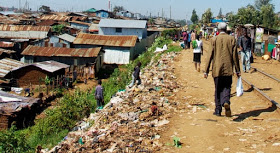

Ethiopia & the extents of its poverty
(OPHI) –The Global Multidimensional Poverty Index (MPI), published by Oxford University reveals that Ethiopia ranks the second poorest country in the world and Africa, just ahead of Niger. The study is based on analysis of acute poverty in 108 developing countries around the world. Despite making progress at reducing the percentage of destitute people, Ethiopia is still home to more than 76 million poor people (out of total population of 87 million). 87.3% of Ethiopians are classified as MPI poor, while 58.1% are considered destitute. Oxford University says poverty is not just about a lack of money. It’s also about not having enough food, education, healthcare and shelter, and some poor are much worse off than others.
A person is identified as multidimensionally poor (or ‘MPI poor’) if they are deprived in at least one third of the weighted MPI indicators. The destitute are deprived in at least one-third of the same weighted indicators, The Global MPI uses 10 indicators to measure poverty in three dimensions: education, health and living standards. 
In rural Ethiopia 96.3% are poor while in the urban area the percentage of poverty is 46.4%.
The 10 Poorest Countries in the World:
1. Niger
2. Ethiopia
3. Mali
4. Burkina Faso
5. Burundi
6. Somalia
7. Central African Republic
8. Liberia
9. Guinea
10. Sierra Leone
According to Dr. Sabina Alkire — director of the Oxford Poverty and Human Development Initiative, the U.N. Millennium Development Goals – which set targets regarding poverty, hunger, malnutrition, health and other issues – expire at the end of next year. Thus, MPI could help in the creation of a replacement for the MDGs that gives a complete picture of poverty. “We need a replacement that keeps our eyes really focused on human poverty and the pain and suffering that it entails, but also brings in the environment. And our suggestion is really simple. That along side the $1.25 a day measure – or some extreme income poverty measure – that we bring into view these people who are multidimensionally poor. And that we can do so with a measure of destitution and a measure of multidimensional poverty and maybe even a measure of vulnerability that would be more appropriate for middle and high income countries.”

OPHI Country Briefing 2014: Ethiopia
http://www.dataforall.org/dashboard/ophi/index.php/
http://www.dataforall.org/dashboard/ophi/index.php/mpi/country_briefings
see Alkire, Conconi and Seth (2014), available at: http://www.ophi.org.uk/multidimensional-poverty-index/.
Ethiopia:
MPI Value 0.564
Percentage of Population:
MPI Poor 87.3%
MPI Poor and Destitute 58.1%
$1.25/day Poor 30.65%
Human Development Index (HDI) 0.396
Inequality (Gini Index) 0.336
Income level Low income
Gross National Income (GNI) per capita 380
Survey: DHS Year: 2011A person is identified as multidimensionally poor (or ‘MPI poor’) if they are deprived in at least one third of the weighted indicators shown above; in other words, the cutoff for poverty (k) is 33.33%.
The proportion of the population that is multidimensionally poor is the incidence of poverty, or headcount ratio (H). The average proportion of indicators in which poor people are deprived is described as the intensity of their poverty (A). The MPI is calculated by multiplying the incidence of poverty by the average intensity of poverty across the poor (MPI = H x A); as a result, it reflects both the share of people in poverty and the degree to which they are deprived.
64.6%
Percentage of Poor People (H)(k = 33.3%)
Average Intensity Across the Poor (A)
58.1%
Inequality Among the MPI PoorVulnerable toPoverty(k = 20%-33.3%)
In SeverePoverty(k = 50%)See more @ Oxford and Human Development Initiative (2014). “Ethiopia Country Briefing”, Multidimensional Poverty Index Data Bank. OPHI, University of Oxford. Available at /.
http://www.ophi.org.uk/multidimensional-poverty-index/mpi-country-briefings
More reference to famine in Ethiopia:
In the last two or three decades, there has been a revolution in thinking about the
explanations of famines. The entitlement’s approach by Amartya Sen brought the issue
of food accessibility to the forefront of the academic debate on famine. Sen noted that,
often enough, there is enough food available in the country during famines but all
people do not have the means to access it. More specifically, famines are explained by
entitlement failures, which in turn can be understood in terms of endowments,
production possibilities, and exchange conditions among others (Sen, 1981).
Ethiopia is a good case in point where, for instance, food was moving out of Wollo
when the people in the region were affected by the 1972-3 famine (Sen, 1981), and even
today some regions in Ethiopia produce surplus, while people in other regions face
famine threats. There are of course infrastructural problems in the country to link the
surplus producing regions to the food-deficit ones. However, the question goes beyond
this simplistic level, as some people simply do not have enough entitlements to have a
share of the food available in the country, a situation which can be described as a case
of direct entitlement failures (Tully 2003: 60)7. Or else, peasants do not find the right
price for their surplus, as in the 2002 Bumper Harvest which ended up in an 80 per cent
price drop, which illustrated a failure in peasants’ exchange entitlements. Alternatively,
the most irrigated land of the country in the Awash River basin, for instance, is used
primarily for cash crop production to be exported to the western world (even when there
is drought) leading the vulnerability of various pastoralist groups to turn into famine or
underpinned by what is known as a crisis in endowments and production possibilities.
In short, while drought and population pressure can partly explain famine threats in
Ethiopia, the entitlements approach provides an explanation from an important but less
visible angle. By shifting the attention from absence of food to lack of financial access
to food, the approach points in the direction of policy failures. That only some classes in
society are affected by famine clearly indicates that policy failures are central to the
understanding of famine. http://portal.svt.ntnu.no/sites/ices16/Proceedings/Volume%203/Alexander%20Attilio%20Vadala%20-%20Understanding%20Famine%20in%20Ethiopia.pdf
Seenaa Gabaabaa Nimoonaa Xilahuun Imaanaa(1986-2014). Short Biography of Nimoonaa Tilahuun Imaanaa June 9, 2014
Posted by OromianEconomist in Ethnic Cleansing, Finfinne is Oromia's land, Finfinnee, Finfinnee is the Capital City of Oromia, Finfinnee n Kan Oromoo ti, Genocidal Master plan of Ethiopia, Human Rights Watch on Human Rights Violations Against Oromo People by TPLF Ethiopia, Nimoona Xilahuun Imaanaa, Nimoonaa Tilahun, No to land grabs in Oromia, No to the Addis Ababa Master Plan, NO to the Evictions of Oromo Nationals from Finfinnee (Central Oromia), Oromia, Oromia wide Oromo Universtiy students Protested Addis Ababa Expansion Master Plan, Oromians Protests, Oromiyaa, Oromo, Oromo and the call for justice and freedom, Oromo Media Network, Oromo Protests, Oromo Protests in Ambo, Oromo students movement, Oromo students protests, Oromo University students and their national demands, Oromummaa, State of Oromia, Stop evicting Oromo people from Cities, The Colonizing Structure & The Development Problems of Oromia, The Tyranny of Ethiopia, Uncategorized.Tags: #OromoProtests 2014, Genocide against the Oromo, Human rights violations, Land Grabs in Oromia, Nimoonaa Xilahuun Imaanaa, Oromo, Oromo people, Tyranny
add a comment
Nimonaa Xilaahuun Imaanaa (1986-2014)
Banking and Insurance graduate of Finfinne (AAU) University and High School teacher
Murdered by TPLF on 6th june 2014 while in jail as political prisoner. His funeral was held on 8th June 2014 in Arjo his birth town.
In an increasingly repressive and cruel TPLF run Ethiopian state, being an Oromo national itself is in practice a crime. Nimoonaa TilahunImaanaa, Banking and Insurance graduate of Finfinne (Addis Ababa) University and former high school teacher, was initially arrested in 2004 along with members of the Macha Tulama Association during widespread protests opposing the relocation of Oromia’s seat from Finfinne to Adama. He was released after a year of incarceration and returned to complete his studies, according to reports by Canada-based Radio Afurra Biyya.
Born in 1986 in Arjo town (Jimma Arjo), Western Oromia, Nimoanaa also known as Firomsaa was re-arrested in 2011 from his teaching job in Shano, a town in north Shewa (Central Oromia) about 80kms from Finfinne (Addis Ababa). He was briefly held at Maekelawi prison, known for torturing inmates and denying legal counsel to prisoners. And later transferred between Kaliti, Kilinto and Zuway where he was continuously tortured over the last three years. Tilahun was denied medical treatment despite being terminally ill. His death on 6th June 2014 in jail is another very shocking sad news that the Oromo people are experiencing under the tyrannic Afro-fascist rule of TPLF Ethiopia.
(Oromedia, 7 Waxabajjii 2014) Nimonaa Tilaahun Imana Godina Wallaga bahaa Magalaa Jimmaa arjootti bara 1986 dhalate. Nimoonaan abbaa isaa Obbo Xilahuun Imaanaa fi haadha isaa Aadde Laaqechi Indaalammaa Mul’ataa irraa godina Wallaggaa Bahaa magaalaa Arjootti dhalate.
Barnoota isaa kutaa tokkoo eegalee hanga kudha lamaatti achuma magaalaa Arjootti baratee xumuruun barnoota sadarkaa olaanaatti fufuuf bara 2004 Unvarsiitii Finfinnee seene. Baruma kana diddaa barattoota Oromoo dhimma Finfinnee waliin walqabatee ka’een murtii jal’aa mootummaa wayyaaneen barattoota Oromoo 400 ol ta’an irratti dabreen, Nimoonaa Xilahuun waggaa tokkoof barnoota irraa arihatame.Nimoonaa Xilahuun Imaanaa (1986 2014)
Waggaa tokko boodas barumsa isaatti debi’ee bara 2005-2007tti “BSc / Banking and Insurance “ dhaan eebbifame. San booda bara 2007 keessa godina Shawaa Kaabaa aanaa Qimibitti/magalaa Shanootti barsiisummaan mindeeffamee achitti hojii eegale. Achitti utuu barsiisuu hiriyoota isaa biraa konkolataan Lakk Gabatee 3F kan jedhamuun humnooti tika wayyanee ukkaamsanii fudhatan.
Haga ji’a tokkootti Mayikalawwitti dhoksaan hidhamee mana dukkana akeessatti gidiraa guddaa argaa ture. Dhiibbaa fi iyyannaa qaamota miran namoomaatiin dhiyaachaa tureenis, himannaan itti banamee gara mana Hidhaa Qaallittiitti dabarfame. Manni murtii Wayyaanees dhaddecha jallootiin murtii jalloo waggaa 11 akka hidhamuuf itti murteesse.
Nimoonaan mana hidhaa Qaalittii, Zuwayii fi Qilinxoo keessaatti garafamaa ture; Reebicha garmalee irra ga’eenis dhibeef saaxilame. Mana hidha akeessatti wal’aansa gahaa waan dhabeef hedduu miidhame. Dhukkuba kanaan erga hiraarfamee boodas, bara 2012 keessa gara Hospitalaa Xiqur-Anbassaatti geeffamee ture.
Sirna Awwaalchaa NimoonaaHaata’uutii, wal’aansa garaa baqaqsaa godhameef iyyuu sirnaan otuu madaan isaa hin qoorin gara mana hidhaa Qaallititti deebifame. Achitti doorsisaafi dararaa guddaattu irra ga’aa ture.
Dhukkubni isaa itti hamaachaa waan dhufeef, dhiyeenya kana gara Hospitaala Xiqur-Anbassaatti deebisan. Garuu, qaamni laafee, bututee waan jiruuf dhibee san irraa dandamachuu dadhabee Waxabajjii 6, bara 2014 ganama barii keessaa saatii 6:00 irratti lubbuun isaa addunyaa kana irraa dabarte.
Sirni awwaalcha Nimoonaa Xilahuun bakka warrii fi lammileen hedduu argamanitti raawwatee jira.“Qabsaa’aan ni kufa; qabsoon itti fufa.”
DUBBADHU QAALLIITTI!!!
dubbadhu qaallitti abaaramtuu lafaa
yoo dubbachuu baatte xuriinsaa sitti hafaa
ajjeechaa Niimoonaa akkaataa du’a isaa
si qofaatu beeka jalqabaaf dhuma isaa
dubbadhu qaallitti Oromoon si hin dhiisu
maal jedhe Niimoonaan yeroo qofaa ciisu?
yeroo kophaa ciisee dukkana daawwatu
hunduu dabaree dhaan yeroo gadi dhiittu
yeroo midhaan dhabee mar’ummaan wal rige
yeroo bishaan dhabee qoonqoon itti goge
yeroo madaa irratti madaa dabalate
yeroo lammiif jecha waanjoo guddaa baate
atis akka isaanii garaa itti jabaattee?
Moo,bakka keenya buutee jabaadhu ittiin jette?
dhiitichaaf kaballaa ciniinatee obsee
iccitii keessa isaa yeroo diina dhokse
maal jedhe Niimoonaan waa’ee miidhama isaa
afaan keen itti himi si eegu maatiin saa
dubbadhu qaallitti ol kaasi sagalee
namni beeku hin jiru yoo waaqaaf si malee
uummata isaaf jedhee rakkoo hunda obsee
iji imimmaan didee yeroo dhiiga cobse
Niimoonaan maal jedhe dhaamsa maal dabarse?
dubbadhu Qaallitti himi waan dhageesse!!sirna awwaalchaa Niimoonaa Tilaahuun Imaanaa!!!


June 7, 2014 by Oromedia
(Oromedia, 7 Waxabajjii 2014) Nimonaa Tilaahun Imana Godina Wallaga bahaa Magalaa Jimmaa arjootti bara 1986 dhalate. Nimoonaan abbaa isaa Obbo Xilahuun Imaanaa fi haadha isaa Aadde Laaqechi Indaalammaa Mul’ataa irraa godina Wallaggaa Bahaa magaalaa Arjootti dhalate.
Barnoota isaa kutaa tokkoo eegalee hanga kudha lamaatti achuma magaalaa Arjootti baratee xumuruun barnoota sadarkaa olaanaatti fufuuf bara 2004 Unvarsiitii Finfinnee seene. Baruma kana diddaa barattoota Oromoo dhimma Finfinnee waliin walqabatee ka’een murtii jal’aa mootummaa wayyaaneen barattoota Oromoo 400 ol ta’an irratti dabreen, Nimoonaa Xilahuun waggaa tokkoof barnoota irraa arihatame.

Nimoonaa Xilahuun (1986 2014)
Waggaa tokko boodas barumsa isaatti debi’ee bara 2005-2007tti “BSc / Banking and Insurance “ dhaan eebbifame. San booda bara 2007 keessa godina Shawaa Kaabaa aanaa Qimibitti/magalaa Shanootti barsiisummaan mindeeffamee achitti hojii eegale. Achitti utuu barsiisuu hiriyoota isaa biraa konkolataan Lakk Gabatee 3F kan jedhamuun humnooti tika wayyanee ukkaamsanii fudhatan.
Haga ji’a tokkootti Mayikalawwitti dhoksaan hidhamee mana…
View original post 153 more words
“When I am writing, I am trying to find out who I am.” May 29, 2014
Posted by OromianEconomist in Africa, African American, Black History, Humanity and Social Civilization, Language and Development, Maya Angelou, Oromo and the call for justice and freedom, Uncategorized, Wisdom.Tags: Africa, Africa and America, African Studies, Black writers, Human Rights and Liberties, Maya Angelou
add a comment
“A Brilliant writer, a fierce friend and a truly phenomenal wowan.” – President Barack Obama

She made her name with the memoir I Know Why the Caged Bird Sings, which charted a childhood of oppression and abuse in the Deep South in the 1930s.
Her family described her as “a warrior for equality, tolerance and peace”
http://www.bbc.co.uk/news/entertainment-arts-27606776

Angelou was born Marguerite Annie Johnson, in St Louis, Missouri, in 1928.
http://www.theguardian.com/books/2014/may/28/maya-angelou-poet-author-dies-86

Newsweek’s Original Review of Maya Angelou’s ‘I Know Why the Caged Bird Sings’
http://www.newsweek.com/newsweeks-original-review-i-know-why-caged-bird-sings-252587

Global Renaissance Woman
Dr. Maya Angelou is one of the most renowned and influential voices of our time. Hailed as a global renaissance woman, Dr. Angelou is a celebrated poet, memoirist, novelist, educator, dramatist, producer, actress, historian, filmmaker, and civil rights activist.
Born on April 4th, 1928, in St. Louis, Missouri, Dr. Angelou was raised in St. Louis and Stamps, Arkansas. In Stamps, Dr. Angelou experienced the brutality of racial discrimination, but she also absorbed the unshakable faith and values of traditional African-American family, community, and culture. Read more @Welcome to Maya Angelou’s Official Site- http://mayaangelou.com/

Maya Angelou in 1969, the year of her landmark memoir

Maya Angelou and Malcolm X in Accra, Ghana, 1964
‘We write for the same reason that we walk, talk, climb mountains or swim the oceans — because we can. We have some impulse within us that makes us want to explain ourselves to other human beings. That’s why we paint, that’s why we dare to love someone — because we have the impulse to explain who we are. Not just how tall we are, or thin… but who we are internally… perhaps even spiritually. There’s something, which impels us to show our inner-souls. The more courageous we are, the more we succeed in explaining what we know.’
Diaspora Speaks for Deliberately Silenced Oromos; Ethiopian Government Responds to UN Review May 20, 2014
Posted by OromianEconomist in Ethnic Cleansing, Finfinne is Oromia's land, Finfinnee, Finfinnee is the Capital City of Oromia, Finfinnee n Kan Oromoo ti, Free development vs authoritarian model, Genocidal Master plan of Ethiopia, Human Rights Watch on Human Rights Violations Against Oromo People by TPLF Ethiopia, Land Grabs in Africa, No to land grabs in Oromia, No to the Addis Ababa Master Plan, NO to the Evictions of Oromo Nationals from Finfinnee (Central Oromia), Ogaden, OMN, Oromia Satelite Radio and TV Channels, Oromia Support Group, Oromia wide Oromo Universtiy students Protested Addis Ababa Expansion Master Plan, Oromian Voices, Oromians Protests, Oromiyaa, Oromo, Oromo Diaspora, Oromo First, Oromo Identity, Oromo Media Network, Oromo Nation, Oromo Protests, Oromo Protests in Ambo, Oromo students movement, Oromo students protests, Oromo the Largest Nation of Africa. Human Rights violations and Genocide against the Oromo people in Ethiopia, Oromo University students and their national demands, Oromummaa, Say no to the expansions of Addis Ababa, Stop evicting Oromo people from Cities, The Colonizing Structure & The Development Problems of Oromia, The Tyranny of Ethiopia, Tyranny, Uncategorized.Tags: African Studies, Genocide against the Oromo, Oromia, Oromummaa
add a comment
When students in Ethiopia started protesting last month against the Ethiopian Government’s proposal to annex territory from the state of Oromia to facilitate the expansion of the capital city Addis Ababa, diasporans mobilized to show their solidarity. As federal “Agazi” security forces cracked down, opening fire on peaceful protesters, placing students on lock-down in their dormitories, and conducting mass arrests, Oromos around the world staged rallies and hunger strikes to raise international awareness and to call on the governments of the countries where they live to withhold aid and put pressure on the Ethiopian Government to respect human rights.
In the first three posts in this series, I discussed the Oromo diaspora’s mobilization to shed light on the human rights violations on the ground, the sharp criticism the government of Ethiopia faced during the Universal Periodic Review on May 6, and the steps the Oromo diaspora in Minnesota is taking to show solidarity and press for accountability in Ethiopia. This final post tells some of the stories of Oromos in the diaspora who have spoken with friends and family on the ground in Oromia about events over the past three weeks, and also covers the Ethiopian government’s formal response to the UN review and offers some suggestions for next steps.
Not “voiceless,” but deliberately silenced by Ethiopian government
“We need to be a voice for the voiceless” has been a common refrain from the diaspora. But in my view, the students and others who are protesting in Ethiopia are far from voiceless. They have been bravely marching, placing their lives and academic careers on the line, to express their opposition to the government’s “Integrated Development Master Plan for Addis Ababa.” In the words of 2004 Sydney Peace Prize winnerArundhati Roy, “there’s really no such thing as the ‘voiceless.’ There are only the deliberately silenced, or the preferably unheard.”The government controls the media and telecommunications in Ethiopia, effectively placing a stranglehold on open debate and criticism of the government. Historically, efforts by western media, including CNN, to cover events on the ground in Ethiopia have been stymied. The government’s repression and intimidation also create obstacles for independent journalists trying to cover the story from outside the country. I spoke with one U.S.-based reporter who covers the Horn of Africa, and he explained that when he tried to confirm casualty reports, hospital personnel in Ethiopia refused to speak to him, fearing for their jobs.

Speaking for the voiceless: Amane Badhasso, President of the International Oromo Youth Association (IOYA), Discusses about the Ongoing #OromoProtests in Oromia State on SaharaTV May 18, 2014
Posted by OromianEconomist in Africa, Amane Badhaso, Colonizing Structure, Dictatorship, Ethnic Cleansing, Finfinnee is the Capital City of Oromia, Finfinnee n Kan Oromoo ti, Free development vs authoritarian model, Genocidal Master plan of Ethiopia, Human Rights, Human Rights Watch on Human Rights Violations Against Oromo People by TPLF Ethiopia, Janjaweed Style Liyu Police of Ethiopia, Land Grabs in Africa, No to land grabs in Oromia, No to the Addis Ababa Master Plan, NO to the Evictions of Oromo Nationals from Finfinnee (Central Oromia), Oromia Support Group, Oromia wide Oromo Universtiy students Protested Addis Ababa Expansion Master Plan, Oromian Voices, Oromians Protests, Oromiyaa, Oromo, Oromo Diaspora, Oromo First, Oromo Identity, Oromo Nation, Oromo Protests, Oromo Protests in Ambo, Oromo students movement, Oromo students protests, Oromo the Largest Nation of Africa. Human Rights violations and Genocide against the Oromo people in Ethiopia, Oromo University students and their national demands, Oromummaa, Prof. Muhammad Shamsaddin Megalommatis, Say no to the expansions of Addis Ababa, Self determination, State of Oromia, Stop evicting Oromo people from Cities, The Colonizing Structure & The Development Problems of Oromia, The Tyranny of Ethiopia, Uncategorized.Tags: African Studies, Development and Change, Economic and Social Freedom, Genocide against the Oromo, Governance issues, Horn of Africa, Human rights, Human Rights and Liberties, Human rights violations, Land grabbing, Land grabs in Africa, National Self Determination, Oromiyaa, Oromo, Oromo culture, Oromummaa, Social Sciences, Sub-Saharan Africa, Tyranny, United Nations, Universal Declaration of Human Rights, World Bank
1 comment so far


Related:
IOYA Appeal Letter
Dear Sir, Madam,
We are reaching out to you as the Board of officers of the International Oromo Youth Association (IOYA) whose nation is in turmoil back in Oromia, Ethiopia. Recently, Oromo students have been protesting against the new Addis Ababa “Integrated Master Plan” which aims at incorporating smaller towns surrounding Addis Ababa for the convenience of vacating land for investors by displacing millions of Oromo farmers. As a political move, this will essentially result in the displacement of the indigenous peoples and their families. Oromo farmers will be dispossessed of their land and their survival both economic and cultural terms will be threatened. The Oromos strongly believe that this plan will expose their natural environment to risk, threaten their economic means of livelihood (subsistence farming), and violate their constitutional rights.
The Ethiopian government is executing its political agenda of progressive marginalization of the Oromo people from matters that concern them both in the Addis Ababa city and the wider Oromia region. The master plan is an unconstitutional change of the territorial expansion over which the city administration has a jurisdiction. The government justifies the move in the name of enhancing the development of the city and facilitating economic growth. The justification is merely a tactical move masked for the governments continued abuse of human rights of the Oromo people. While the Oromos understand that Addis Ababa itself is an Oromo city that serves as the capital of the federal government, they also consider this move as an encroachment on the jurisdiction and borders of the state of Oromia.
The protesters peacefully demonstrated against this move. University students and residents have been in opposition to the plan, but their struggle has been met by a brutal repression in the hands of the military police (famously known as the Agazi). It has been reported that shootings, arrests, and imprisonments are becoming rampant. It is also reported that the death toll is increasing by the hour. Recently, sources indicate that over 80 people have been shot dead, others severally injured and thousands arrested. In addition, Oromo students have been protesting peacefully for over three weeks now, despite mass killings and arrests by Ethiopian security forces. University and high school students from more than ten universities have been engaging in the Oromo protests. The peaceful rally has now spread across the whole country and is expected to continue until the Ethiopian government refrains from incorporating over 36 surrounding smaller towns into Addis Ababa. It is stated to be displacing an estimate of 6.6 million people and violating constitutional rights of regional states.
As an organization subscribing to broader democratic engagement of the Oromo youth, we oppose the brutal violence that the Ethiopian government is meting out on innocent, unarmed young students who are peacefully protesting. As leaders of the Oromo community, we support and stand in solidarity with Oromo protests in Ethiopia. The human rights violations being carried out by the Ethiopian government against innocent students are unacceptable. Continuous assaults, tortures, and killings of innocent civilians must be stopped. We urge you to join us in denouncing these inhumane and cruel activities carried out by the Ethiopian government. We believe it is imperative that the international community raise its voice and take action to stop the ongoing atrocities that are wreaking havoc to families and communities in the Oromia region.
We urgently request that such actions be taken in an attempt to pressure the Ethiopian government to stop terrorizing and killing peaceful protesters:
- The US government and other International organizations should condemn the Ethiopian government’s brutal action taken on unarmed innocent civilians. Furthermore, we demand over 30,000 innocent protesters to be released from prisons, as they will be subjected to torture and ill treatment.
- The Ethiopian People’s Revolutionary Democratic Front (EPRDF) is currently terrorizing its own electorates/nation. Under the law of R2P in the UN constitution, the international community is obliged to protect a nation that is being terrorized by its own government and EPRDF should be taken accountable.
- We demand Ethiopia to be expelled from any regional and international cooperation including and not limited to AU and UN for its previous and current human rights violations. The International community should stop providing support in the name of AID and development to Ethiopia as it is violating the fundamental and basic needs of its nation.
- The Ethiopian government should be stopped on immediate effect; its forceful displacement of the indigenous peoples across Ethiopia is unjust and unconstitutional. We ask the United States, European Union, and the United Nations to stand in solidarity with peaceful student protesters who are condemning such injustice.
- The onus is on the international community to act in favor of the innocent and civilian populace that is seeking its fundamental right. Punitive actions towards this government should be taken for cracking down on freedom of expression and other democratic rights being expressed by its citizens.
We believe it is in the interest of our common humanity to take responsibility, to pay attention to this problem, to witness the plight of the voiceless victims, and to raise concerns to the Ethiopian government so it can desist from its brutal acts of repression.
We count on your solidarity to help the Oromo youth be spared from arbitrary arrest, incarceration, and shootings.
Yours Respectfully,
International Oromo Youth Association
http://ayyaantuu.com/horn-of-africa-news/ioya-appeal-letter/
Protests, State Violence, and the Manufacture of Dissent in Ethiopia May 6, 2014
Posted by OromianEconomist in Africa, Africa Rising, America, Colonizing Structure, Corruption, Development, Ethnic Cleansing, Finfinne is Oromia's land, Finfinnee, Finfinnee is the Capital City of Oromia, Finfinnee n Kan Oromoo ti, Free development vs authoritarian model, Genocidal Master plan of Ethiopia, Hetosa, Human Rights, Human Rights Watch on Human Rights Violations Against Oromo People by TPLF Ethiopia, Janjaweed Style Liyu Police of Ethiopia, Knowledge and the Colonizing Structure., Meroetic Oromo, No to land grabs in Oromia, NO to the Evictions of Oromo Nationals from Finfinnee (Central Oromia), Ogaden, Omo, Oromia, Oromia wide Oromo Universtiy students Protested Addis Ababa Expansion Master Plan, Oromian Voices, Oromiyaa, Oromo Culture, Oromo Diaspora, Oromo Protests, Oromo Protests in Ambo, Oromo students protests, Oromo the Largest Nation of Africa. Human Rights violations and Genocide against the Oromo people in Ethiopia, Oromo University students and their national demands, Oromummaa, Say no to the expansions of Addis Ababa, State of Oromia, Stop evicting Oromo people from Cities, The Colonizing Structure & The Development Problems of Oromia, The Tyranny of Ethiopia, Uncategorized.Tags: African Studies, Development, Economic and Social Freedom, Genocide against the Oromo, Governance issues, Horn of Africa, Human rights, Human Rights and Liberties, Human rights violations, Land grabbing, Land grabs in Africa, Oromo, Oromo people, Oromummaa, State and Development, Sub-Saharan Africa, The Tyranny of Experts, Tyranny, Universal Declaration of Human Rights, World Bank
add a comment
Two things happened simultaneously on May 1st, both involving the U.S. State Department and its relation to Ethiopia. Thing one was the State Department’s news program, Voice of America, broadcasting its brief account of Ethiopian security forces firing upon student demonstrations the previous day (April 30) at three universities resulting in 17 dead and many wounded. Thing two was the Secretary of State John Kerry in Ethiopia giving a speech full of praise for Ethiopia’s rapid economic development as well as the U.S.-Ethiopia partnership in addressing the violence against civilians in neighboring Sudan and Somalia. Apparently, Kerry was unaware that the day before, just a two-hour’s drive down the road from where he was speaking, America’s supposed partner, the Ethiopian government, had committed acts of violence against its citizens. In fact, thousands of individuals at universities and in cities across the Oromia region of Ethiopia had been protesting for days, and as the journalist Mohammed Ademo’s article for Think Africa pointed out on Tuesday (August 29), what they were protesting was precisely the consequences of the rapid economic development and foreign direct investment that Kerry praised in his speech – the eviction and displacement of tenant farmers and poor people due to the expansion of the capital city Addis Ababa into the Oromia region.
We might observe a contradiction here within the same State Department. While the State Department’s news program laments an event and clearly points to the root cause, the State Department’s secretary appears ignorant of the event and also strangely unable to discern the causes of ethnic unrest across Africa. An Al Jazeera op-ed responding to Kerry’s speech suggests that the United States fails to see the contradiction in its policy that talks about democracy and human rights but in practice emphasizes security for foreign direct investment (as per the State Department’s own report on such investment in Ethiopia published shortly before Kerry’s visit.) Noticeably, two contradictory ideas are coming out of the State Department simultaneously. What do we make of that contradiction?
Before I answer that question, I might add on to this strange state of affairs by pointing out that Kerry did criticize the Ethiopian government for using repressive tactics against its journalists — the famous Zone 9 bloggers — but what strikes me is that at the very moment that Kerry criticizes the state of journalism in Ethiopia, the mainstream American news outlets such as CNN, National Public Radio, and the NY Times have for a long time neglected to give any serious coverage of the issues within Ethiopia and in fact did not report on the student demonstrations. The only American media mention of the recent student demonstrations and deaths is a very brief Associated Press article that appeared the day after Kerry’s speech (May 2) and that article embarrassingly gets its facts wrong about what happened and why. Such poor journalism is increasingly perceived to be the norm of America’s once celebrated media whose many factual inaccuracies and lack of any genuine will to truth arguably contributed to the Iraq War back in 2003. Curiously, the only news organization in America that did its job (the VOA) is the news organization intended to serve communities outside of America. Moreover, the VOA is part of the very same “department” that Kerry heads. The quality of mainstream American media coverage might seem excusable if it weren’t for the fact that BBC covered these tragic events in Ethiopia reasonably well, first on its radio program immediately after the massacre (May 1st) and then more comprehensively on its website the following day.

Two things happened simultaneously on May 1st, both involving the U.S. State Department and its relation to Ethiopia. Thing one was the State Department’s news program, Voice of America, broadcasting its brief account of Ethiopian security forces firing upon student demonstrations the previous day (April 30) at three universities resulting in 17 dead and many wounded. Thing two was the Secretary of State John Kerry in Ethiopia giving a speech full of praise for Ethiopia’s rapid economic development as well as the U.S.-Ethiopia partnership in addressing the violence against civilians in neighboring Sudan and Somalia. Apparently, Kerry was unaware that the day before, just a two-hour’s drive down the road from where he was speaking, America’s supposed partner, the Ethiopian government, had committed acts of violence against its citizens. In fact, thousands of individuals at universities and in cities across the Oromia region of Ethiopia had been protesting for days, and as the journalist…
View original post 1,351 more words
The Quest for Oromo’s Indigenous Knowledge and Institutions April 3, 2014
Posted by OromianEconomist in Aannolee and Calanqo, Abbush Zallaqaa, Afaan Publication, Africa, Ancient African Direct Democracy, Finfinnee, Free development vs authoritarian model, Gadaa System, Haile Fida, Humanity and Social Civilization, Irreecha, Kemetic Ancient African Culture, Knowledge and the Colonizing Structure., Language and Development, Oral Historian, Oromia, Oromia Satelite Radio and TV Channels, Oromian Voices, Oromiyaa, Oromo, Oromo Artists, Oromo Culture, Oromo First, Oromo Identity, Oromo Media Network, Oromo Nation, Oromo Social System, Oromo Sport, Oromummaa, Self determination, State of Oromia, The Colonizing Structure & The Development Problems of Oromia, The Oldest Living Person Known to Mankind, The Oromo Democratic system, The Oromo Governance System, The Oromo Library, The Tyranny of Ethiopia, Theory of Development, Toltu Tufa, Uncategorized, Wisdom.Tags: Africa, African culture, African Studies, Development and Change, Economic and Social Freedom, Gadaa, Gadaa System, Genocide against the Oromo, Human Rights and Liberties, National Self Determination, Oromia, Oromiyaa, Oromo, Oromo culture, Oromo people, Oromummaa, State and Development, United Nations, Universal Declaration of Human Rights, World Bank
add a comment
By Iddoosaa Ejjetaa, Ph.D.*
The classical definition of knowledge was given by Plato as “justified true belief.” There are many philosophical theories to explain knowledge. The online Oxford dictionaries define knowledge as a theoretical or practical understanding of a subject [online]. The same source explain knowledge that can be implicit (as with practical skill or expertise) or explicit (as with the theoretical understanding of a subject); it can be more or less formal or systematic. According to Stanley Cavell, “Knowing and Acknowledging” the “knowledge acquisition involves complex cognitive processes: perception, communication, association and reasoning; while knowledge is also said to be related to the capacity of acknowledgment in human beings.” I am not here to write the theory of knowledge, but trying to bring the human society acknowledgement and recognition for the Oromoo nation’s indigenous knowledge.
The Oromoo Gadaa System (OGS) is an indigenous knowledge reserve institution of the Oromoo nation. It is an organic system, which is self-refining every eight years (in two four-year terms) to meet the needs of the society. The OGS is a well-structured and organized indigenous knowledge reserve that encompasses social, political, economic and military institutions that operate mainly based on self-reliance principles while Oromummaa is an act of embracing these institutions and applying the indigenous knowledge to manifest an authentic Oromoo’s cultural and national identity.
The essence of scientific education is to understand Mother Nature, daachee haadha marggoo, and human experience in relation to Mother Nature. Through scientific education we can ask questions and try to investigate or do research to find out the facts and report the new knowledge about the subject. For example, who is responsible for the creation of human being, other living and non-living things as a part of the whole nature? What if I told you that the answer to the question is Mother Nature? I guess, you would not be satisfied with the answer because it leads to another subsequent philosophical questions such as who is responsible for the creation of the Mother Nature. Again, what if I told you the answer is a God? This time, probably you would be settled and agree with me. But how do you know for sure that it is a God who is responsible for the creation of nature?
I have thought deeply about these questions and tried to find the best possible answers. I would like to share the final answer with you later on if you continue the journey with me through reading and thinking about the perplexities of human life experience.
The purpose of this paper is to share my points of view with you and highlight that the Oromoo Gadaa System is the prima source of Oromo indigenous knowledge reserve that every Oromoo person should safeguard it and reclaim it as a shared-value that can be manifested through applied Oromoo knowledge and life experience, which is often called Oromummaa. Hence, the Oromoo Qubee generation are highly encouraged to embark their scientific studies and discoveries on our forefathers’ indigenous knowledge and bring it to light to show the world that our forefathers had made significant contribution to human society and civilization by creating and developing a comprehensive and complex democratic system: the Oromoo Gadaa System and its Institutions. For the qubee Oromoo generation, I would say they have a gold mining opportunity on their own backyards and they have to go for it.
Oromoo’s Indigenous Knowledge
Indigenous knowledge is local by nature. It is primarily based on social skills and production techniques. Both social skills and production techniques employ indigenous knowledge that in turn involves the process of life-long learning and teaching. The Oromoo Gadaa System provides such indigenous knowledge reserve so as to enable the new generation to learn from and teach the generations to come. For example, Oromummaa is a social skill. The Oromoo children learn social skills: respect, love, sympathy, empathy, ethics (Safuu), sharing, helping others, communications, etc from their parents and through well-organized Gadaa institutions such as the Age group (Hiriyyaa) and Qalluu.
Like every society, the Oromoo Gadaa Society had engaged in production of goods and services for long time or millenniums. They have millennium years of farming and animal husbandry experience and knowledge. The Oromoo farmers were the first people who domesticated barley as cereal crop in the region and a coffee plant and used the coffee beans in the world. This means the Oromoo farmers had possessed a primary indigenous knowledge about these crops. This indigenous knowledge reserve, however, needs a substantial effort in the field of scientific research and documentation for learning and teaching purposes by present and future Oromoo generations.
The lack of self-ruling political right in Ethiopian Empire and the decline of the Oromoo Gadaa System of Self-governance lead to the deterioration of the Indigenous knowledge and Institutions. In addition, the absence of curiosities from the Oromoo educated class for long time and self-inflicted prejudices against Oromoo indigenous knowledge had played a significant role on its underdevelopment. The educated class is the first social group who run away from their villages and turn their back to their culture and traditional ways of life. Consequently they find themselves in the garrison cities where almost everything is imitation of modernity that has no root in the local culture or traditions. Moreover, the educated elites had been played an agent role to introduce exogenous values including foreign religion, culture of conspicuous consumption and other copy-cut life styles from the West, and Middle-East world.
As I mentioned above, because of the lack of basic human right the Oromoo as a nation has no formal indigenous institutions yet. Instead, the institutions are maintained by the Oromoo Gadaa fathers and mothers who have been serving as Oromo indigenous knowledge reserve as institution. . This means the Qubee generation scientific research and discoveries are highly dependent on the existence of Gadaa Oromoo fathers and mothers (abbootii Gadaa Oromoo) and time because if they die the institutions and knowledge will die with them. For many of them, a biological time is about running out now. One day they will leave us for good. So it is responsibilities and sacred duties of this generation to secure and backup these precious indigenous “documents” that had been inherited form the previous generations.
As JF Kennedy said, the purpose of education is to advance human knowledge and dissemination of truth. However, contrary he said, the education system in Ethiopia has been harboring ignorance, distortion and denial of the truth that effectively disabled the process of learning, thinking and bringing positive changes to our society. So I suggest to the new generation regardless of their ethnic and cultural background to use the best three doses of pills/prescription for ignorance, distortion and denial of history. They are: genuine education, genuine education, and genuine education (3-GE). Through genuine education one can learn the true essence of love (jaalala), which is unselfishness, the creator, and creatures, uumaa fi uumammaa.
Generally, indigenous knowledge (IK) are the outcome of true and genuine collective human experience. It could be knowledge about culture, tradition, history, philosophy, belief system, art, farming, biodiversity, medicine, family, economic distribution, etc. The Oromoo Gadaa System is one of such collective human experience that need to be learned as universal value to human society and pass down to the next generations.
The Predicaments of Indigenous Knowledge in Ethiopia Politically speaking, Ethiopia as a nation had never been colonized and maintained its independence while all African countries had been colonized by European states. To some extent, this is true. Practically, however, the Ethiopian Empire State had been constructed and maintained by European states and continued to operate under indirect-colonialism of Anglo-American and European States. Like all African Republics or States, the Ethiopia’s government structure, military structure, religious institutions, political and social, educational, and legal systems are highly influenced mainly by Anglo-American and European institutions including British, France, Italian, Germany, American, Japan, China, etc. Consequently, indigenous knowledge had been systematically marginalized and ignored, unfairly criticized as primitive, static and simple idea by semi-literate domestic elites or agents of exogenous institutions.
These exogenous institutions such as the Orthodox Coptic Church officials (clergy/priests) and collusion of feudal neftenyaa and self-serving local balabats in Ethiopia, for instance, had played a key role in dismantling indigenous institutions, discrediting and condemning indigenous knowledge and even blessing Menelik’s genocidal and unjust war against our people and indigenous people of the south. Here one must note that the local Oromoo balabats had played a primary role in sponsoring, defending and assigning a commanding site Oromoland to the Orthodox Churches in Oromiyaa today. In addition to the neftenyaa system, these social class is accountable historically for the decline of the Oromoo Gadaa System and underdevelopment of its Institutions. Beside this, at present the decedent of these social class still maintained their loyalty to the Orthodox Church and Ethiopia’s empire state. Some individuals even have been involving in the Oromoo liberation struggle by dressing a sheep skin to saboteur the genuine aspiration of Oromians for freedom and independence. This author suspect that this very social class had contributed to the weakness of Oromia liberation camp.
The Impacts of Church Education on Indigenous knowledge
The Orthodox Coptic church jealously dominated the education system in Ethiopia. The Orthodox Coptic Church in Ethiopia had provided training in reading and writing in Ge’ez and Amarigna (Amharic) at primary school level to limited areas and people of the country. To summarize the church education in Ethiopia: elementary pupils had to learn to read, write, and recite the Dawit Medgem (Psalms of David). There are 15 sections, called negus (kings), which normally took two years to master. Next they learned to sing kum zema (church hymns), which took four years, and msaewait zema (advanced singing), which took an additional year to learn. Liturgical dancing and systrum holding required three years. Qine (poetry) and law required five years to learn. The interpretation of the Old and New Testaments, as well as the Apostles’ Creed, took four years on average, while the interpretation of the works of learned monks and priests took three years. When a student knew the psalms by heart, he had mastered the “house of reading” and was now considered an elementary school graduate. As one can see there is no a single grain of indigenous knowledge or belief system had been taught by the Orthodox Church.
The Orthodox Coptic Tewahido Church is considered by government as indigenous institution, when it is imported and imposed on native culture. Both religions Christian and Islam were imported and imposed on native population, such as the early Christianized ethnic Tigray and Amhara and then ethnic Oromoo, Sidama, and other people of the south, by few clergies and foreign religious crusaders. These institutions had replaced the indigenous belief system, institutions and knowledge over time. As a result, the majority, if not the entire population, ethnic Tigray and Amhara believe that Bible is the source of their history and culture. As one can easily understand, the people of Tigray and Amhara have lived far more years than the bible does, which is two thousand years. As people who residing in East Africa, the Tigray and Amhara people must have had indigenous culture and knowledge. What are they?
Despite the claim of three thousand years history of civilization, Ethiopians exposed to non-church education or modern education in 1920s. The ministry of education established in 1930s. Secondary schools established in 1940s, and higher education, Addis Ababa University, established in 1960s. In similar way, the modern education system had also failed in teaching and conducting research on indigenous knowledge so as to integrate it into the modern education. As a result, creativity, inventions and innovations have seen as odd culture to our society. On the contrary, receiving aid, economic migration, conspicuous consumption of imported goods including education and dependency on Western advanced societies or institutions have become a culture.
Therefore, it is up to the Habesha (Tigre and Amhara), the Oromoo and other ethnic groups of the new generation to dig deep down to find out their respective indigenous knowledge that deep rooted in their culture and traditions and pass down from one generation to other generations by their native ancestors if any and re-evaluate the existing very controversial written history, which is biased and by large based on fiction history. The cycle of self-discrimination must end by the new generation. By doing this they can find shared human values that would allow them to live in peace without disrespecting one another as good neighbors and citizens of their respective nation. So one must understand that no one would agree on imported history that was written by the followers and supporters of Christianity crusaders, war lords, kings, dictators and agents of the Western discriminatory and racist institutions of the time as shared human value and history of our respective people in our time. The time and world have changed forever.
The present suspicion, political conflicts and all forms of problems in our region will not be solved without recognizing and applying indigenous knowledge. The lasting resolutions for the problems can be achieved if every member of our society or nation adults learn and teach their younger generation good social skills, which are critical to successfully functioning society. Basic social skills enable adults and children to know what to say, how to make good choices, and how to behave in adverse situations. The extent to which young people possess good social skills can influence their adult behavior in decision making, conflict management and problem solving. Social skills are also linked to the quality of the school environment. The Church and modern education in Ethiopia, unfortunately, had been denying members of our society these good basic skills such as respect, appreciation, empathy, apology, truthfulness, positive attitude about others, etc. Instead, the system allowed social ignorance such disrespect, occupational despise, ethnic chauvinism, fear, the divine right of the kings and honor for ruling class. As a result, the Ethiopian empire has produced highly educated class like Dr. Getachew Haile without basic and good social skills; it seems that he passed through poor socialization as one can understand the meaning of his name, ‘lord of …power’, which is false-self has given to him by his parents
and trying his best to make them proud by being discourteous and rude to the Oromoo people. Dr. Getachew Haile, be nice!
The black people or African descents are subject to institutional discrimination and racism more than any other races in the world including the holy land- Israel and Saud Arabia. Do you know why? The reasons can be many, but one of the reasons is imitation of ideas. The black people are the most imitating of other societies’ idea. They did not protect and develop their own indigenous institutions (political, religious, cultural and socio-economic institutions) to shape their lifestyle and influence others. No other nations are imitating Africans’ culture, religion, lifestyles but the Africans tend to imitate others about everything that life needs. Some African or extremists trying to be more imitator and more knowledgeable about the culture, religion and ideology than the original inventor or creator of the idea. It is understandable that human being has ability to imitate and all cultures imitate ideas from original culture. The question I would like ask the readers is why the changes are in one direction only. Why African descents imitate ideas of the other culture when the other culture do not imitate the African idea or world view?
For example, black Africans including Ethiopians has been pretending as if they have better known about the Jesus of Nazareth more than the Israelis and Prophet Muhammad more than the Arabs; Marxism and Leninism or communism more than Russians; democracy more than Americans and Western societies. These blind optimists about other’s idea are cynical at the same time about their own indigenous knowledge; they are willing to abuse, jail, torture and murder their own innocent people for the authenticity of imported ideas, religious and political ideology. In the case of Ethiopia, the king Menelik II and Yohanness II – holy war and wildish conquests were a case in point. They had imitated from the history of European middle-age idea of religious crusaders and empire builders. The Abyssinian kings had been acted as proxy war lords of European colonial powers and committed incalculable atrocity against the Oromo people and other black people in East Africa. In addition, these Abyssinian kingdom were one of the worst Africa’s kingdoms who sold Africans, their own race, to British, Arabs and other European white race for the exchange of European firearms to conquer the land of other nations and subjugate the people and build the empirical institutions based on European ideas and political model. What most disgracing is when people like Dr. Getachew Haile and his like trying to keep the truth elusive and misrepresent the history of the black people and glorifying the history of the White colonial proxy war lords like Menelik II as great black king, who was cowardly cut women’s breast, mutilate men’s hand and embarrassingly sold his own black race to the European white race.
In conclusion, the quest for truth shall continue by present and future Oromo generations. The root cause for conflicts in Africa is an imported knowledge and imitation of ideas. In many cases, imitation represent a false-self or an act to hiding a true-self. Discriminatory and racist attitude against black people had been partly brought up by European’s colonial power proxy war lords in Africa such as Menelik II of Abyssinia/Ethiopia kingdom. Although most black people tend to cherish and assimilate their cultural identity into the Middle-Eastern and Western cultural identity and ways of life, the very culture of the societies they imitating have been reciprocating or holding discrimination against them based on race, stereotypes and historical disadvantages. Institutional racism still exist and there are also significant number of individuals who think that Africans have not yet acquired culture and civilization. The imitation of others’ ideas, belief system and political institutions by Africans including my fellow Oromoo has kept the racist believes alive. It is suffice to mention the 2013 incidents against African immigrants in Saud Arabia and recently in Israel. The majority of Africans believed that embracing Christianity and Islam would lead to heaven via holy land. Unfortunately, it turned out differently; they end up in hell in the holy land. So, the lasting solution would be revitalizing indigenous knowledge and institutions that demands for real efforts, courage and sacrifices. As to the Oromo’s quest for indigenous knowledge and institutions, revitalization of the Gadaa Republic of Oromia and its institutions would be the lasting solution for century old colonial extraction, subjugation and embarrassment.
___________________
* About the author: Iddoosaa Ejjetaa, Ph.D., native to Oromiyaa, Ethiopia. Independent and Naturalist Thinker; An activist and advocator for the revitalization of Authentic Oromummaa, Oromoo Indigenous knowledge and institutions, and for the formation of Biyyaa Abbaa Gadaa,Oromiyaa-The Gadaa Republic of Oromia.
Read more @
http://ayyaantuu.com/horn-of-africa-news/oromia/the-quest-for-oromos-indigenous-knowledge-and-institutions/
Ethiopia: Farmer gets legal aid from UK to sue Britain for giving aid to the brutal regime of Ethiopia March 30, 2014
Posted by OromianEconomist in Aannolee and Calanqo, Africa Rising, Aid to Africa, Corruption, Development, Dictatorship, Domestic Workers, Economics: Development Theory and Policy applications, Ethnic Cleansing, Hadiya and the Omo Valley, Human Rights, Human Traffickings, ICC, Janjaweed Style Liyu Police of Ethiopia, Kambata, Land and Water Grabs in Oromia, Ogaden, OMN, Omo, Omo Valley, Oromia, Oromia Support Group Australia, Oromiyaa, Oromo, The Colonizing Structure & The Development Problems of Oromia, The Tyranny of Ethiopia, Uncategorized, Youth Unemployment.Tags: African Studies, Development, Economic and Social Freedom, Economic development, Economic growth, Governance issues, Horn of Africa, Human Rights and Liberties, Human rights violations, Land grabbing, Land grabs in Africa, National Self Determination, Oromia, Oromia Region, Oromummaa, State and Development, Sub-Saharan Africa, United Nations, Universal Declaration of Human Rights
add a comment
An Ethiopian farmer has been given legal aid in the UK to sue Britain – because he claims millions of pounds sent by the UK to his country is supporting a brutal regime that has ruined his life.
He says UK taxpayers’ money – £1.3 billion over the five years of the coalition Government – is funding a despotic one-party state in his country that is forcing thousands of villagers such as him from their land using murder, torture and rape.
The landmark case is highly embarrassing for the Government, which has poured vast amounts of extra cash into foreign aid despite belt-tightening austerity measures at home.
Prime Minister David Cameron claims the donations are a mark of Britain’s compassion.
But the farmer – whose case is set to cost tens of thousands of pounds – argues that huge sums handed to Ethiopia are breaching the Department for International Development’s (DFID) own human rights rules.
He accuses the Government of devastating the lives of some of the world’s poorest people rather than fulfilling promises to help them. The case comes amid growing global concern over Western aid propping up corrupt and repressive regimes.
If the farmer is successful, Ministers might have to review major donations to other nations accused of atrocities, such as Pakistan and Rwanda – and it could open up Britain to compensation claims from around the world.
Ethiopia, a key ally in the West’s war on terror, is the biggest recipient of British aid, despite repeated claims from human rights groups that the cash is used to crush opposition.
DFID was served papers last month by lawyers acting on behalf of ‘Mr O’, a 33-year-old forced to abandon his family and flee to a refugee camp in Kenya after being beaten and tortured for trying to protect his farm.
He is not seeking compensation but to challenge the Government’s approach to aid. His name is being withheld to protect his wife and six children who remain in Ethiopia.
‘My client’s life has been shattered by what has happened,’ said Rosa Curling, the lawyer handling the case. ‘It goes entirely against what our aid purports to stand for.’
Africa Rising: So What? March 27, 2014
Posted by OromianEconomist in Africa Rising, African Poor, Agriculture, Aid to Africa, Colonizing Structure, Comparative Advantage, Corruption, Development, Economics: Development Theory and Policy applications, Food Production, Free development vs authoritarian model, Janjaweed Style Liyu Police of Ethiopia, Land and Water Grabs in Oromia, Nubia, Ogaden, Omo Valley, Oromia, Oromia Support Group Australia, Oromiyaa, Oromo, Self determination, The Colonizing Structure & The Development Problems of Oromia, The Tyranny of Ethiopia, Tweets and Africa, Tyranny, Uncategorized, Youth Unemployment.Tags: African Studies, Developing country, Development, Economic and Social Freedom, Economic growth, Genocide, Governance issues, Human rights violations, Land grabbing, National Self Determination, Oromia, Oromo people, Oromummaa, poverty, Social Sciences, State and Development, Sub-Saharan Africa, Tyranny, United Nations, Universal Declaration of Human Rights, World Bank
add a comment
This study critically discuses the “Africa rising” story and the sub-narratives it carries, including the rise of the African woman, the rise of the African middle class and the power of innovation. The articles included inform that, in too many cases, it is not the wider population but small segments and interested parties, such as the local political elite and foreign investors, who are benefiting from economic growth and resource wealth. Social cohesion, political freedom and environmental protection carry little importance in the comforting world of impressive growth statistics. The glamorous images of Africa’s prominent women and rising middle class produced and re-produced in the media prevent the less attractive and more complex stories about ordinary people’s daily struggles from being heard.
GDP tells us nothing about health of an economy, let alone its sustainability and the overall impact on GDP is simply a measure of market consumption, which has been improperly adopted to assess economic performance. Rebuilding Libya after the civil war has been a blessing for its GDP. But does that mean that Libya is on an enviable growth path? When there is only one brick left in a country devastated by war or other disasters, then just making another brick means doubling the economy (100 percent growth). Another problem is the reliability of GDP statistics in Africa. Economic growth figures for most African countries are incomplete, thus undermining any generalisation about overall economic performance in the continent. Besides statistical problems, there are important structural reasons why one should be suspicious of the ‘Africa rising’ mantra. Most fast- growing Africa economies are heavily dependent on exports of commodities.
Read the full articles @:
Click to access perspectives_feb_2014_web1.pdf
“About 30% of sub-Saharan Africa’s annual GDP has been moved to secretive tax havens.”
http://www.fairobserver.com/article/africa-illicit-outflow-84931
Copyright © OromianEconomist 2014 & Oromia Quarterly 1997-2014, all rights are reserved. Disclaimer.
Oromia Media Network Launch — Live! March 27, 2014
Posted by OromianEconomist in Africa, Africa Rising, African Beat, African Music, Ancient African Direct Democracy, Dictatorship, Ethnic Cleansing, Finfinnee, Gadaa System, Hadiya and the Omo Valley, Human Rights, Human Traffickings, Humanity and Social Civilization, Ideas, Kemetic Ancient African Culture, Knowledge and the Colonizing Structure., Language and Development, Nubia, Ogaden, OMN, Omo, Omo Valley, Oromia, Oromiyaa, Oromo, Oromo Artists, Oromo Culture, Oromo First, Oromo Identity, Oromo Media Network, Oromo Music, Oromo Nation, Oromo Social System, Oromo Sport, Oromo the Largest Nation of Africa. Human Rights violations and Genocide against the Oromo people in Ethiopia, Oromummaa, Poverty, Qubee Afaan Oromo, Self determination, Sidama, Sirna Gadaa, Slavery, State of Oromia, The Colonizing Structure & The Development Problems of Oromia, The Oromo Democratic system, The Oromo Governance System, The Oromo Library, The Tyranny of Ethiopia, Theory of Development, Uncategorized, Wisdom, Youth Unemployment.Tags: Africa, Development and Change, Economic and Social Freedom, Governance issues, Horn of Africa, Human Rights and Liberties, Human rights violations, Oromia, Oromia Region, Oromiyaa, Oromo, Oromo culture, Oromo people, State and Development, Sub-Saharan Africa, Universal Declaration of Human Rights
add a comment


Oromia Media Network Launch — Live! 1st March 2014
Millions of Oromos now have the chance to enjoy quality media focusing on the needs and aspirations of the Oromo people.


https://www.oromiamedia.org/donorship/
“The Oromia Media Network (OMN) is an independent, nonpartisan and nonprofit news enterprise whose mission is to produce original and citizen-driven reporting on Oromia, the largest and most populous state in Ethiopia. OMN seeks to offer thought-provoking, contextual, and nuanced coverage of critical public interest issues thereby bringing much needed attention to under-reported stories in the region. Our goal is to create a strong and sustainable multilingual newsroom that will serve as a reliable source of information about the Oromo people, the Ethiopian state, and the greater Horn of Africa region. ” – http://www.oromiamedia.org/
Copyright © OromianEconomist 2014 and Oromia Quarterly 1997-2014. All rights reserved. Disclaimer.
Ethiopia’s government is using imported technology to spy on the phones and computers of Citizens March 26, 2014
Posted by OromianEconomist in Aannolee and Calanqo, Africa, Africa Rising, African Poor, Aid to Africa, Colonizing Structure, Corruption, Ethnic Cleansing, Facebook and Africa, Free development vs authoritarian model, Nubia, Ogaden, OMN, Oromia, Oromia Support Group Australia, Oromiyaa, Oromo, Oromo Nation, Oromummaa, Self determination, Sidama, Slavery, The Tyranny of Ethiopia, Tweets and Africa, Tyranny, Uncategorized, Youth Unemployment.Tags: Africa, African Studies, Development and Change, Economic and Social Freedom, Genocide against the Oromo, Governance issues, Horn of Africa, Human Rights and Liberties, Land grabs in Africa, National Self Determination, Oromia, Oromiyaa, Oromo, Oromo culture, State and Development, Sub-Saharan Africa, Tyranny, United Nations, Universal Declaration of Human Rights, World Bank
add a comment
Human Rights Watch (HRW) in it recent research report exposes that Ethiopia has built up a large monitoring system for controlling citizens’ network and phone usage. According to this report the government has a sole monopoly of telecommunications and network. And there is no right constraints that prevent the government from gaining an overview of who have contact with anyone on the phone, sms and internet. The government also saves phone calls on a large scale. The authoritarian regime is using imported technology to spy on the phones and computers of its perceived opponents. HRW accuses the government of trying to silence dissent, using software and kit sold by European and Chinese firms. The report says the firms may be guilty of colluding in oppression.
“While monitoring of communications can legitimately be used to combat criminal activity, corruption, and terrorism, in Ethiopia there is little in the way of guidelines or directives on surveillance of communications or use of collected information to ensure such practices are not illegal. In different parts of the world, the rapid growth of information and communications technology has provided new opportunities for individuals to communicate in a manner and at a pace like never before, increasing the space for political discourse and facilitating access to information. However, many Ethiopians have not been able to enjoy these opportunities. Instead, information and
communications technology is being used as yet another method through which the government seeks to exercise complete control over the population, stifling the rights to freedom of expression and association, eroding privacy, and limiting access to information—all of which limit opportunities for expressing contrary opinions and engaging in meaningful debate.”
“Human Rights Watch interviews suggest that a significant number of Oromo individuals have been targeted for unlawful surveillance. Those arrested are invariably accused of being members or supporters of the OLF. In some cases, security officials may have a reasonable suspicion of these individuals being involved with OLF. But in the majority of cases, Oromos were under surveillance because they were organizing cultural associations or trade unions, were involved in celebrating Oromo culture (through music, art, etc.) or were involved in registered political parties.
“Like the OLF, the Ogaden National Liberation Front (ONLF) was initially a political party, but began a low-level armed insurgency in Ethiopia’s Somali region in response to what it perceived to be the EPRDF’s failure to respect regional autonomy, and to consider demands for self-determination. In 2007, the ONLF scaled up armed attacks against government targets and oil exploration sites, triggering a harsh crackdown by the government. As with the government’s counterinsurgency response to the OLF, the Ethiopian security forces have routinely committed abuses against individuals of Somali ethnicity, including arbitrary detentions, torture, and extrajudicial killings,
based on their ethnicity or perceived support for the ONLF.”“Internet usage in Ethiopia is still in its infancy with less than 1.5 percent of Ethiopians connected to the Internet and fewer than 27,000 broadband subscribers countrywide. By contrast, neighboring Kenya has close to 40 percent access.The majority of Internet users are located in Addis Ababa. According to the ITU, Ethiopia has some of the most expensive broadband in the world. Given these costs, Ethiopians usually access the Internet through the growing number of cybercafés or from their mobile phones.Internet has been available to mobile phone subscribers since 2009.Increasingly available in many of the more expensive hotels and cafes. Connectivity speeds countrywide are quite low, and are prone to frequent outages.”
“State-owned Ethio Telecom is the only telecommunications service provider in Ethiopia. It controls access to the phone network and to the Internet and all phone and Internet traffic must use Ethio Telecom infrastructure. There is no other service provider available in Ethiopia. Ethio Telecom therefore controls access to the Internet backbone that connects Ethiopia to the international Internet. In addition, Internet cafés must apply for a license and purchase service from Ethio Telecom to operate.”
“As Internet access increases, some governments are adopting or compelling use of technologies like “deep packet inspection” (DPI). Deep packet inspection enables the examination of the content of communications (an email or a website) as it is transmitted over an Internet network. Once examined, the communications can be then copied, analyzed, blocked, or even altered. DPI equipment allows Internet service providers—and by extension, governments—to monitor and analyze Internet communications of potentially millions of users in real time. While DPI does have some commercial applications, DPI is also a powerful tool for Internet filtering and blocking and can enable highly intrusive surveillance. Finally, some governments have begun using intrusion software to infiltrate an individual’s computer or mobile phone. Also known as spyware or malware, such software can allow a government to capture passwords (and other text typed into the device), copy or delete files, and even turn on the microphone or camera of the device to eavesdrop. Such software is often unwittingly downloaded when an individual opens a malicious link or file disguised as a legitimate item of interest to the target.”
“The vast majority of the cases documented by Human Rights Watch involving access to phone recordings involved Oromo defendants organizing Oromos in cultural associations, student associations, and trade unions. No credible evidence was presented that would appear to justify their arrest and detention or the accessing of their private phone records. These interrogations took place not only in Addis Ababa, but in numerous police stations and detention centers throughout Oromia and elsewhere in Ethiopia. As described in other publications, the government has gone to great lengths to prevent Oromos and other ethnicities from organizing groups and associations. While the increasing usefulness of the mobile phone to mobilize large groups of people quickly provides opportunities for young people, in particular, to form their own networks, Ethiopia’s monopoly and control over this technology provides Ethiopia with another tool to suppress the formation of these organizations and restrict freedoms of association and peaceful assembly.”
“Ethiopia was the first sub-Saharan African country to begin blocking Internet sites. The first reports of blocked websites appeared in May 2006 when opposition blogs were unavailable, and blocking has become more regular and pervasive ever since. Human Rights Watch and the University of Toronto’s Citizen Lab conducted testing in-country in July and August of 2013 to assess the availability of 171 different URLs that had a higher likelihood of being blocked, based on past testing, on the Ethio Telecom network. A total of 19 tests were run over seven days to ensure reliability of results.”
Read further @
“They Know Everything We Do”
Telecom and Internet Surveillance in Ethiopia
http://www.hrw.org/reports/2014/03/25/they-know-everything-we-do-0
http://thefrontierpost.com/article/84793/Ethiopia-uses-foreign-kit-to-spy-on-opponents-HRW/
Copyright © OromianEconomist 2014 & Oromia Quarterly 1997-2014, all rights are reserved. Disclaimer.
Tribute to the Legendary Oromo artist Almaz Tafarraa (1957- 2014) March 24, 2014
Posted by OromianEconomist in African Beat, African Music, Artist Almaz Tafarraa, Oromia, Oromiyaa, Oromo, Oromo Artists, Oromo Culture, Oromo First, Oromo Identity, Oromo Media Network, Oromo Music, Oromo Nation, Oromo Social System, Oromummaa, State of Oromia, The Oromo Library, Uncategorized.Tags: Afaan Oromo, African culture, African Studies, Almaz Tafarraa, Economic and Social Freedom, Music of Oromia, Oromia, Oromiyaa, Oromo, Oromo Artists, Oromo culture, Oromo people, Oromummaa
add a comment


Artist Almaz Tafarra: the founding member of Afran Qalloo Band: Miseensa Baandi Afran Qalloo jalqabaa
Arstist Almaz Tafarra, the founding member of the Afran Qalloo died on 22nd March 2014 at Police Referral Hospital in Finfinnee. Tafara began singing in Afaan Oromo in early 1970s. Artist Almaz Tafarra was born in 1957 in Oromia,Western Hararghe, Doba district.
In outstanding and successful career that extended across nearly four decades, artist Almaz Tafara recorded and released a total of ten albums. Her lyrical message usually concentrates on her own and collective socio-political issues in Oromia. Tafara released her first solo album in 1983. During her career, Tafara has collaborated and worked with pioneering Oromo artists including Ali Shabo, Kadir Said, Adam Harun, Musa Turki, Worku Bikila and the late poet and singer Abdi Mohamed Qophe. Tafara deeply loved her culture and sang in Afaan Oromo. She released her tenth and final album in 2005.
(Oromedia, 23 Bitootessa 2014) Dhukkuba kaansarii dhiigaan dhukkubsattee yaalamaa kan turte, Artisti Almaaz Tafarraa Bitootess 22, 2014 addunyaa kana irraa du’aan boqochuun ishee beekame.
Bara jireenya ishii aartii fi Afaan Oromoo guddisuu irratti gahee guddaa kan gumaachaa turte artisti Alamaaz Tafarraa, addunyaa kana irraa kan dabarte hospitaala Poolisii Finfinnee keessatti otuu wal’aanamaa jirtu ta’uu oduun nu gahe addeesse jira.
Akka odeeffannoo argannetti, sirni awwaalchi ishe Duilbata- Bitootessa 23, 2014 waaree booda saatii 4:00 irrati magaalaa Harar keessatti akka ta’u beekameera.
Bara 1957 Oromiyaa Bahaa, Harargee Lixaa, Aanaa Doobbaatti kan dhalatte Artisti Almaaz Tafarraa, sirba ishii duraa bara 1983 kaasettaan baafte. Yeroo sanaa eegalees haga dhukkubsattee waltajjii irraa haftetti kaassettoota sirbaa sagal baaftee ummataaf gumaachitee jirti.
Akka seenaa artistoota Oromoo keessaa hubatamutti, artisti Almaaz Tafarraa miseensa baandii Afran Qalloo turte. Sirboota sirbaa turteenis ummta Oromoo biraa jaalalaa fi kabajaa guddaa yeroo argattu, humnoota guddinaa fi dagaagina aadaa fi eenyummaa Oromoo jibbaniin immoo hedduu dararamaa fi miidhamaa akka turte seenaan ishii kan ragaa bahuudha.
Bara 2014 keessa hedduu waan dhukkubsatteef mana yaalaatti deddeebi’aa kan turte, Artisti Alamaaz, deeggarsa ummataan wal’aansa adda addaa Harar irraa gara Finfinneetti deddeebitee fudhachaa akka turte beekameera.
Sirbooti Artisti Almaaz Tafarraa kan yeroo fi barri ittii hin darbinee fi kan dhalootaa dhalootatti barayyuu yaadatamuu dha.
Akka qormaata Oromediaatti, Artisti Almaaz Tafarraa hojii boonsaa aartii Oromoo keessatti gara waggoota 40f dalagneen dhaloota dhalootatti kan yaadatamuudha.
Kan malees, hojii boonsaa yeroo hamtuu fi sodaachisaa keessa ifatti baatee dalagdeen galmee sabboontotaa fi gootota Oromoo Oromummaa jiraachisan keessatti kan ramadamtuudha.
Kanaan dura oduu karaa Oromedia darbee tureen, sabboontoti Oromoo biyya Jarmanii, biyya Ameerikaa fi Sa’udi Arabiyaa qunnamtii karaa Oromedia argataniin gargaarsa maallaqaatiin birmatanii akka wal’aansa gahaa argattu godhan iyyuu, Artisti Almaaz Tafarraa dhukkubicha irra hafuu hin dandenye.
Akka Artisti Alamaaz Tafarraa akka fayyituu fi dhintu kanneen dhuunfaanis ta’ee gamtaan gumaachitan maraaf seenaan isin yaadata jechaa, Rabbi Isin haa jajjabeeysu jenna.
Gareen Oromedia du’aan adunyaa kana irraa boqochuu artistii fi qabsooftu Almaaz Tafarraatin gadda nuuti dhagahamee ibsaa, lubbuun isaanii Waaqin akka qananiisuuf yeroo kadhannu, firootaa fi hiriyyoota ishii akkasums mararfatootta ishiif jajjabin isinif haa kennu jenna.
Seenaa Artist Almaaz Tafarraa
Bara 1957 Aanaa Doobbaatti keessatti dhalatte.
Bara 1973 Hawwisoo poolisii Harar seente.
Bra 1983 kaassetta duraa baafte.
Bitootessa 22, 2014 addunyaa kana irraa boqotte.
http://oromedia.net/…/artisti-almaaz-tafarraa-boqotte…/ http://oromedia.net/…/artisti-almaaz-tafarraa-boqotte…/
http://www.oromiamedia.org/2014/03/breaking-news-artist-almaz-tefera-passed-away/
http://www.opride.com/oromsis/news/horn-of-africa/3738-beloved-oromo-singer-almaza-tafara-dies
Ethiopia: Silence, Pain, Lies and Abductions March 20, 2014
Posted by OromianEconomist in Aannolee and Calanqo, Africa, Africa Rising, African Poor, Colonizing Structure, Dictatorship, Ethnic Cleansing, Finfinnee, Free development vs authoritarian model, Human Rights, Human Traffickings, Janjaweed Style Liyu Police of Ethiopia, Kambata, Land and Water Grabs in Oromia, Nubia, Ogaden, Omo, Omo Valley, Oromia, Oromia Support Group Australia, Oromiyaa, Oromo, Oromo Nation, Oromo the Largest Nation of Africa. Human Rights violations and Genocide against the Oromo people in Ethiopia, Oromummaa, Self determination, Sidama, Slavery, The Colonizing Structure & The Development Problems of Oromia, The Tyranny of Ethiopia, Theory of Development, Uncategorized, Youth Unemployment.Tags: Africa, Development, Economic and Social Freedom, Genocide against the Oromo, Governance issues, Horn of Africa, Human Rights and Liberties, Human rights violations, Land grabs in Africa, National Self Determination, Oromia, Oromo people, Oromummaa, Politics of Ethiopia, State and Development, Sub-Saharan Africa, Tyranny, World Bank
add a comment
https://www.youtube.com/watch?v=-c592hhWlc8
‘This is a regime whose character has the potential to confuse even Jeane J. Kirkpatrick, former Reagan foreign policy advisor, who made a distinction between “authoritarian” and “totalitarian” regimes. In her essay “Dictatorship and Double Standards,” she describes authoritarian dictators as “pragmatic rulers who care about their power and wealth and are indifferent toward ideological issues, even if they pay lip service to some big cause”; while, in contrast, totalitarian leaders are “selfless fanatics who believe in their ideology and are ready to put everything at stake for their ideals”.’
This assessment of the reaction to the article I published on this blog: “Silence and Pain,” is interesting for its exploration of the relationship between the Ethiopian government and the media, even though it overestimates any influence I may have.
Martin
Source: Muktar M. Omer
Ethiopia: Silence, Pain, Lies and Abductions
March 16, 2014
By Muktar M. Omer
Template denials
The Ethiopian Government, through its foreign ministry, responded to Martin Plaut’s article “Silence and Pain: Ethiopia’s human rights record in the Ogaden” with the usual feigned shock and template denial that has long characterized the regime’s political personality. It is the established behavior of aggressive and autocratic regimes to discount well-founded reports of human right violations as propaganda constructs of the ‘enemy’. The response from the Foreign Ministry was thus nothing more than a well memorized and rehearsed Ethiopian way of disregarding documented depravities committed by the regime. As usual…
View original post 2,632 more words
Russia, the Ukraine Crisis and the West: Is it the new cold war in the 21st Century? March 20, 2014
Posted by OromianEconomist in Cold war, Colonizing Structure, Obama, Putin of Russia, Self determination, the Ukraine Crisis and the West, Ukraine and Russia, Uncategorized.Tags: China and the west, Cold war, Economic and Social Freedom, International Politics, Russia, Ukraine and the West
add a comment

In one area the Cold War comparison may be apt: a mutual lack of comprehension and trust. The Ukraine crisis has revealed that Russia and the West remain far apart — not just politically and diplomatically, but culturally and temperamentally. Putin has stoked a brand of macho nationalism increasingly at odds with liberal Europeans….”Attempts to isolate Russia further may boost support for Putin — whose poll ratings have soared due to his tough stance on Ukraine — and make rapprochement harder. But historians see fundamental differences. “Two things characterized the Cold War. First of all there was an ideological divide which was kind of black and white — ‘You’re either with us or against us,'” said Margot Light, professor emeritus of international relations at the London School of Economics. “That really doesn’t exist anymore. “And the Cold War started off as European, but it became global. And again, this isn’t it. I think neither Russia nor the United States have that kind of global reach any longer.” http://bostonherald.com/news_opinion/international/europe/2014/03/east_vs_west_ukraine_conflict_not_a_new_cold_war
NATO planes monitor Ukraine’s border. East and West fight for influence and trade angry warnings. Russian troops conduct massive war games as tensions rise.
With its brinksmanship, bellicose rhetoric, threats and counter-threats, the crisis over Moscow’s takeover of Ukraine’s Crimean Peninsula seems to have whisked the world back to the Cold War, when the United States and the Soviet Union squared off in a high-stakes standoff that divided the world into two opposing camps.
But this is not Cold War 2.0.
Communism has long ceased to be the feared enemy. The ideological certainties of that era are gone. And Russia and the West are locked in economic interdependency.
Here is a look at how the Ukraine crisis may have turned into an East-West standoff — but not a Cold War.
ENTWINED ECONOMIES
The West’s economic and diplomatic pressure may harken back to an age of isolated blocs. And measures such as visa bans, financial sanctions and threats to boycott the G-8 summit that Russia is slated to host all certainly seem intended to isolate Moscow.
But the economies of Russia and the West have become entwined since the Berlin Wall fell 25 years ago — meaning it would be hard to go back to the hermetic “us-versus-them” world of the Cold War.
U.S. brands including McDonald’s and Pepsi have a big presence in Russia, and the European Union does far more trade with the country than the U.S. The Europeans are less eager than Washington to take punitive economic measures, in part because European companies from German engineering firm Siemens to British oil giant BP have major Russian investments. And Russia supplies almost a third of Europe’s natural gas.
But economic rupture could hurt Russia even more. Russia relies heavily on income from oil and gas, which make up more than two-thirds of the country’s exports. Around half of Russia’s exports, mainly natural gas, oil and other raw materials, heads to the EU.
And rich Russians rely on places like London for a place to stash their cash in homes, businesses and discreet, stable banks — so much so that some British people refer to their capital as “Londongrad.”
“London is more important to Russians than Russians are to London,” said Yolande Barnes, head of global research at real estate agent Savills. She says Russians buy about 2.5 percent of prime London properties. “If Russians disappeared, I think London would barely blink.”
MILITARY LIMITS
Rhetoric such as “dangerous escalation” and “brink of disaster” — as well as talk of boosting military defenses in Europe — echo Cold War tensions.
But Western leaders show little appetite for a military response.
NATO did deploy two surveillance planes to fly over Poland and Romania on Wednesday to monitor Ukraine, and the U.S. sent additional fighter jets to Lithuania and Poland to boost air patrols. Russia is in military control of Crimea but has not moved into other areas of Ukraine, aside from seizing a gas distribution facility just outside of Crimea’s border.
The crisis could still escalate. Adrian Basora, a former U.S. ambassador to the Czech Republic, said that if Russia sent troops into eastern Ukraine, it could trigger an escalation that might pull NATO troops into eastern Europe. He acknowledged that would be “an extremely dangerous situation.”
But even that is unlikely to turn into a global confrontation.
Crucially, China — the rising global power of the 21st century — has shown no desire to take sides. Chinese President Xi Jinping, who has discussed the crisis with U.S. President Barack Obama, has merely urged calm and restraint.
It is true that Putin has launched a huge military modernization program. And Russia’s defense minister said last month that it was seeking to expand its worldwide presence by seeking permission for navy ships to use ports in Algeria, Cyprus, Nicaragua, Venezuela, Cuba, Seychelles, Vietnam and Singapore.
Still, Matthew Clements, editor of Jane’s Intelligence Review, said Russia’s “ability to undertake operations across the globe is fairly limited.”
“This is not a reformation of the Soviet Red Army,” he said.
CLASH OF CULTURES
In one area the Cold War comparison may be apt: a mutual lack of comprehension and trust.
The Ukraine crisis has revealed that Russia and the West remain far apart — not just politically and diplomatically, but culturally and temperamentally. Read more @http://bostonherald.com/news_opinion/international/europe/2014/03/east_vs_west_ukraine_conflict_not_a_new_cold_war
Related Article:
http://www.theguardian.com/world/2014/mar/17/russian-actions-ukraine-crimea-cold-war-william-hague
Tribute to the Late Dr. Paul Baxter (1925-2014) March 20, 2014
Posted by OromianEconomist in Aannolee and Calanqo, Afaan Publication, African Beat, Ancient African Direct Democracy, Colonizing Structure, Oromia, Oromo, Oromo Culture, Oromo First, Oromo Identity, Oromo Nation, Oromo Social System, Oromo the Largest Nation of Africa. Human Rights violations and Genocide against the Oromo people in Ethiopia, Oromummaa, Sidama, State of Oromia, The Colonizing Structure & The Development Problems of Oromia, Uncategorized.1 comment so far


The Oromo Studies Association’s Tribute to the Late Dr. Paul Baxter (1925-2014)
It is with great sadness that the Oromo Studies Association (OSA) informs the Oromo and friends of Oromo about the passing away of Dr. Paul Baxter on March 2, 2014. He was 89. Dr. Paul Baxter was a distinguished British anthropologist who devoted his life to Oromo studies. He is one of the finest human being, who contributed immensely to the development of Oromo studies at the time when the scholarship on the Oromo people was extremely discouraged in Ethiopia. His death is a significant loss for his family, all those who knew and were touched by his humanity and kindness, and for the students of Oromo studies. Dr. Paul Baxter is survived by his wife, Pat Baxter, his son, Adam Baxter, and his three grandsons and their children.
Born on January 30, 1925 in England, Paul Trevor William Baxter, popularly known as Paul Baxter or P.T.W. Baxter, earned his BA degree from Cambridge University. Influenced by famous scholars such as Bronisław Kasper Malinowski, Charles Gabriel Seligman, and Evans Pritchard, Paul Baxter had a solid affection for social anthropology. He went to the famous Oxford University to study social anthropology.
It was at the zenith of the Amharization project of Emperor Haile Selassie that he developed a strong interest to study the social organization of the Oromo people. In fact, in 1952, he wanted to go to Ethiopia to study the Oromo Gada system. Let alone tolerating this type of research, Ethiopia was in the middle of the massive project to eradicate the memory of the Oromo from their historic and indigenous territories. The Assimilation policy was in the full swing. Little spared from an attempt was made to change everything Oromo into Amharic. Even the Oromo names of urban centers were rechristened into Amharic names. It is no wonder that Ethiopia was reluctant to welcome a researcher like Baxter who was looking for the soul of the Oromo culture in the homogenizing Ethiopian Empire. Nonetheless, the challenge did not bother the young and exuberant Baxter to pursue his studies. He was determined more than ever to study the social fabric of the Oromo nation. Failed to get permission to do research among the Oromo in Ethiopia, he went to the British Colony Kenya to study the Borana Oromo social organization in northern Kenya. He spent two years (1952 and 1953) among them, which resulted in his PhD dissertation: ‘The Social Organization of the Oromo of Northern Kenya’, in 1954. This research became a foundation for more of his researches to come and a reference for the students of Oromo studies. Besides, the research disqualified many of the myths and pseudo facts that assume the Oromos were a people without civilization, culture, and history. Dr. Paul Baxter did not stop here. He continued with his studies and spent several decades studying different aspects of the Oromo society. It was through his extended research among the Oromos that he deconstructed some of the myths that portrayed the Oromo people as a “warlike” or “barbarian” nation. The title of essays in his honor, in 1994, “A River of Blessings” speaks to his perception and reality of the Oromo as a peace-loving nation. In his article, “Ethiopia’s Unacknowledged Problem: The Oromo,” he highlighted some of the Oromophobic and barbaric manners of the Ethiopian Empire, and he suggested that peace with the Oromo nation was the only lasting panacea to the Ethiopian political sickening.
In his long academic and research career, he studied the Oromo from northern Kenya to Wallo and Arsi to Guji and so on. He edited a number of books on Oromo studies and published many other articles and book chapters in the field of social anthropology. He participated several times on OSA annual conferences. During the 1960s and 1970s, Dr. Paul Baxter was known as the finest living social anthropologist in the United Kingdom. Besides his impressive scholarship on the Oromo society, Dr. Paul Baxter’s lasting legacy is that he educated so many scholars who have studied Oromo culture both in Kenya and Ethiopia. Dr. Paul Baxter’s passion and determination will inspire the generation of students of the Oromo studies. Our prayers and thoughts are with his family, friends, and Oromos and friends of Oromo studies during this difficult time.
Ibrahim Elemo, M.D., M.P.H
President, the Oromo Studies Association
Mohammed Hassen, Ph.D.
Board Chairman, the Oromo Studies Association
———————-
A partial list of his scholarly works on the Oromo includes the followings:
1. “The Social Organization of the [Oromo] of Northern Kenya,” Ph.D. Dissertation, Oxford University, 1954.
2. “Repetition in Certain Boran Ceremonies” In African Systems of Thought, ed. M. Fortes and G. Dieterlin, (London: Oxford University Press for International African Institute, 1960), 64-78.
3. “Acceptance and Rejection of Islam among the Boran of the Northern Frontier District of Kenya” In Islam in Tropical Africa, edited by I.O. Lewis (London: Oxford University Press, 1966), 233-250.
4. “Stock Management and the Diffusion of Property Rights among the Boran” In Proceedings of the Third International Conference of Ethiopian Studies, (Addis Ababa: Institute of Ethiopian Studies, Haile Selassie I University, 1966), 116-127.
5. “Some Preliminary Observations on a type of Arssi Song” In Proceedings of the Third International Congress of Ethiopian Studies, ed. E. Cerulli (Rome: 1972).
6. “Boran Age-Sets and Generation-set: Gada, a Puzzle or a maze?” In Age Generation and time: Some Features of East African Age Oroganisations, ed. P.T.W. Baxter and U. Almagor, ( London: C. Hurst, 1978), 151-182.
7. “Ethiopia’s Unacknowledged Problem: The Oromo”, African Affairs, Volume 77, Number 208 (1978): 283-296.
8. “Atete: A Congregation of Arssi Women” North East African Studies, Volume I (1979), 1-22.
9. Boran Age-Sets and Warfare”, in Warfare among East African Herders, ed. D. Turton and K. Fukui, Senri Ethnological Studies, Number 3, Osaka: National Museum of Ethnology( 1979), 69-95.
10. “Always on the outside looking in: A view of the 1969 Ethiopian elections from a rural constituency” Ethnos, Number 45(1980): 39-59.
11. “The Problem of the Oromo or the Problem for the Oromo” in Nationalism and Self-Determination in the Horn of Africa, ed. I.M. Lewis, (London: Ithaca Press, 1983), 129-150.
12. “Butter for Barley and Barley for Cash: Petty Transactions and small Transformations in an Arssi Market” In Proceedings of Seventh Congress of Ethiopian Studies (Lund: 1984), 459-472.
13. “The Present State of Oromo Studies: a Resume,” Bulletin des Etudes africaine de l’ Inalco, Vol. VI, Number 11(1986): 53-82.
14. “Giraffes and Poetry: Some Observations on Giraffe Hunting among the Boran” Paiduma: Mitteilungen fur Kulturkunde Volume 32 (1986), 103-115.
15. “Some Observations on the short Hymns sung in Praise of Shaikh Nur Hussein of Bale” In The Diversity of the Muslim Community, ed. Ahmed el –Shahi, (London: Ithaca Press, 1987), 139-152.
16. “L’impact de la revolution chez les Oromo: Commentl’ont-ils percu, comment ont-ils reagi?” In La Revolution ethiopienne comme phenomene de societe, edited by Joseph Tubiana, (Paris: l’Harmattan, Bibliotheque Peiresc, 1990), 75-92.
17. “Big men and cattle licks in Oromoland” Social change and Applied Anthropology; Essays in Honor of David David W. Brokensha, edited by Miriam Chaiken & Anne K. Fleuret,( Boulder: Westview Press, 1990), 246-261.
18. “Oromo Blessings and Greetings” In The Creative Communion, edited by Anita Jacoson-Widding & W. Van Beek (Uppsala, Uppsala Studies in Cultural Anthropology , 1990), 235-250.
19. “Introduction “In Guji Oromo Culture in Southern Ethiopia by J. Van de Loo, ( Berli: ReinMer, 1991).
20. “Ethnic Boundaries and Development: Speculations on the Oromo Case” In Inventions and Boundaries: Historical and Anthropological Approaches to the Study of Ethnicity & Nationalism, edited by Kaarsholm Preben & Jan Hultin, (Denmark: Roskilde University, 1994): 247-260.
21. “The Creation & Constitution of Oromo Nationality” In Ethnicity & Conflict in the Horn of Africa, edited by Fukui Katsuyoshi & John Markarkis, (London: James Currey, 1994): 166-86.
22. “Towards a Comparative Ethnography of the Oromo” In Being and Becoming Oromo: Historical & Anthropological Enquiries, edited by Paul Baxter et al, (Uppsala: Nordiska Afikanistitutet, 1996): 178-189.
23. “Components of moral Ethnicity: The case of the Oromo.” In Ethnicity and the state in Eastern Africa, edited by Mohammed Salih & John Markarkis, (Uppsala: OSSREA & SIAS, 1998).
http://gadaa.com/oduu/24792/2014/03/03/the-oromo-studies-associations-tribute-to-the-late-dr-paul-baxter-1925-2014/
“…The efflorescence of feelings of common nationhood and of aspirations of self-determination among the the cluster of peoples who speak Oromo has not been much commented upon. Yet the problem of the Oromo people has been a major and central one in the Ethiopian Empire ever since it was created by Menelik in the last two decades of the nineteenth century. If the Oromo people only obtain a portion of the freedoms which they seek the balance of political power will be completely altered. If the Oromo act with unity they must necessarily constitute a powerful force. … If the Ogaden and Eritrea were detached Ethiopia would merely be diminished, but if the Oromo were to detach themselves, then it is not just that the centre could not hold, the centre would be part of the detached Oromo land. The Empire, which Menelik stuck together and Haile Selassie held together, would just fall apart. The Amhara would then forced back to their barren and remote hills. … The slogan of the Oromo Liberation Front is ‘Let Oromo freedom flower today! (addi bilisumma Oromo Ha’dararuu!).This may be a very over-optimistic hope but, if not today, the time of flowering and fruiting cannot be delayed forever.”
Professor Paul Baxter, Manchester University, in his article
Ethiopia’s Unacknowledged Problem: The Oromo
African Affairs 1978 Volume LXXVII (pp. 283-296) Published for Royal African Society by Oxford University Press.
Baxter daadhiin jala haa yaatu
http://www.opride.com/oromsis/news/horn-of-africa/3737-baxter-daadhiin-jala-haa-yaatu
My friend, the social anthropologist PTW (Paul) Baxter, who has died aged 89, made a significant contribution to western understanding of the Oromo peoples of northern Kenya and Ethiopia and championed their culture, which was frequently denigrated by colonial and local elites.
His work on the plight of the Ethiopian Oromo became a standard text in Oromo studies and a rallying point for the Oromo cause. Paul was not always comfortable with the praise he received as a result, and was often self-deprecating, describing himself as the world’s most unpublished anthropologist. That was a harsh judgment, since a complete list of his output is respectably long. He also made a wider contribution by editing the journal Africa and sitting on the Royal African Society board.
Born in Leamington Spa – his father was a primary school headteacher in the town – Paul attended Warwick school. Academic ambitions were put aside when he joined the commandos in 1943, serving in the Netherlands and occupied Germany. He married Pat, whom he had met at school, in 1944, and after the war went to Downing College, Cambridge, studying English under FR Leavis before switching to anthropology.
On graduation he moved to Oxford, where anthropology under EE Evans-Pritchard was flourishing. Field research on the pastoral Borana people in northern Kenya followed for two years, accompanied by Pat and their son, Timothy. He gained his DPhil in 1954 and more fieldwork followed among the Kiga of Uganda.
With UK jobs scarce, he took a position at the University College of Ghana. This was a happy time for the family, who found Ghana delightful. Returning to the UK in 1960, he was offered a one-year lectureship at the University of Manchester by the sociology and social anthropology head, Max Gluckman, after a recommendation by Evans-Pritchard. He then spent two years at the University College of Swansea (now Swansea University) before returning permanently to the University of Manchester. Over the next 26 years Paul contributed significantly to anthropological studies and to Oromo research, spending 12 months among the Arssi Oromo of Ethiopia before retiring in 1989.
Paul was never interested in winning academic prizes; instead his focus was on helping people. Generations of students, both at home and overseas, benefited from friendship and, often, a warm welcome in his home.
Paul’s life was touched by sadness, particularly Timothy’s death from multiple sclerosis in 2005, but he took great pleasure in his family. He is survived by Pat, their son Adam, four grandchildren and three great-grandchildren.
http://www.theguardian.com/science/2014/mar/18/ptw-baxter-obituary#
Africa’s youth and the self-seeking repressive elites March 15, 2014
Posted by OromianEconomist in Africa, Africa Rising, African Beat, African Poor, Agriculture, Aid to Africa, Ancient African Direct Democracy, Colonizing Structure, Comparative Advantage, Corruption, Development, Dictatorship, Economics: Development Theory and Policy applications, Environment, Ethnic Cleansing, Facebook and Africa, Finfinnee, Food Production, Human Rights, International Economics, International Trade, Janjaweed Style Liyu Police of Ethiopia, Land and Water Grabs in Oromia, Nubia, Ogaden, OMN, Omo, Omo Valley, Opportunity Cost, Oromia, Oromia Support Group, Oromiyaa, Oromo, Oromo Culture, Oromo Identity, Oromo Media Network, Oromo Nation, Oromo Social System, Oromummaa, Poverty, Saudi Arabia, Self determination, Slavery, South Sudan, Specialization, State of Oromia, The Tyranny of Ethiopia, Tweets and Africa, Tyranny, Uncategorized, Youth Unemployment.Tags: Africa, Africa's repressive elites, African culture, African Studies, Developing country, Development and Change, Economic, Economic and Social Freedom, Economic development, Economic growth, Genocide, Genocide against the Oromo, Governance issues, Horn of Africa, Human rights, Human Rights and Liberties, Human rights violations, Land grabbing, Land grabs in Africa, National Self Determination, Oromia, State and Development, Universal Declaration of Human Rights
add a comment

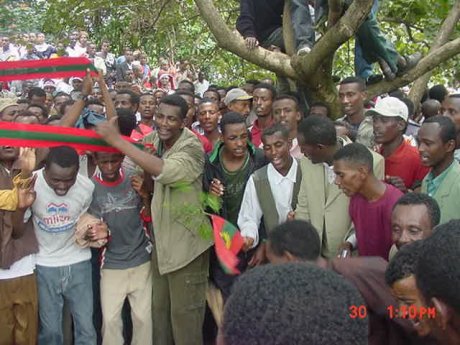
Africa’s youth will protest to remove self-seeking and repressive elites
“Some examples: authoritarian regimes, as in Ethiopia and Rwanda, are consolidating their positions. In Zambia, Angola and Mozambique, the press, civil society organisations and the opposition are under threat for demanding that the proceeds from raw material exports and billion dollar multinational corporate investments should benefit everyone. ….Short-term greed is, once again, depriving the African populations of the right to share in the continent’s immense riches. No-one can predict the future, but what can be said with certainty is that the possibility of a sustainable long-term and fair development that is currently at hand in Africa is being put at risk. The frustration that is fuelled among populations that are hungry and feel ignored by their rulers will bring about increasingly strident and potentially violent protest. In the near future, this will change the political climate, not least in urban areas. Utilising the internet and their mobile phones, Africa’s youth and forgotten people will mobilise and act together to remove self-seeking and repressive elites. But the situation is not hopeless, on the contrary. Civil society is growing stronger in many places in Africa. The internet makes it possible for people to access and disseminate information in an unprecedented way. However, I get really disappointed when I hear all the ingenuous talk about the possibilities to invest and make quick profits in the ‘New Africa’. What is in reality new in the ‘New Africa’? Today, a worker in a Chinese-owned factory in Ethiopia earns one-tenth of the wage of an employee in China. Unless African governments and investors act more responsibly and ensure long-term sustainable construction for people and the environment ‒ which is currently not the case ‒ we must all ask ourselves if we should not use the consumer power we all possess to exert pressure. There are no excuses for letting African populations and their environment once again pay for the global demand for its raw materials and cheap consumer goods.” – Marika Griehsel, journalist, film-maker and lecturer
“Thousands of people are demonstrating on the streets to protest against low salaries, the highcost of living and an insufficient state safety net. A reaction to austerity measures in Greece? Or a follow-up to the Arab Spring? No, these are protests for greater equality in Sub-Saharan Africa, most recently in Burkina Faso. The widening gap between rich and poor is as troubling in Africa as in the rest of the world. In fact, many Africans believe that inequalities are becoming more marked: A tiny minority is getting richer while the lines of poor people grow out the door. The contrast is all the more striking in Africa since the poverty level has been at a consistently high level for decades, despite the continent’s significant average GDP growth. Some take a plane to get treated for hay fever, while others are pushing up daisies because they can’t afford basic malaria treatment.”
– Global Voices: http://globalvoicesonline.org/2014/03/11/reducing-the-gap-between-africas-rich-and-poor/
It is now evident that the African ‘lion economies’ have hardly even begun the economic and democratic transformation that is absolutely necessary for the future of the continent.
The largest movement ever in Africa of people from rural to urban areas is now taking place. Lagos, Nigeria, and Nairobi, Kenya, are among the world’s fastest growing cities.
The frustration that is fuelled among populations that are hungry and feel ignored by their rulers will bring about increasingly strident and potentially violent protest.
Soon, this will change the political climate, not least in urban areas. Utilising the internet and their phones, Africa’s youth and forgotten people will mobilise to remove self-seeking and repressive elites.
This piece was written in Namibia, where I was leading a tour around one of Africa’s more stable nations. There are several signs confirming the World Bank’s reclassification of Namibia as a middle-income country, which in turn means that many aid donors, including Sweden, have ended their bilateral cooperation.
I see newly constructed, subsidised single-family homes accessible for low-income families. I drive on good roads and meet many tourists, although this is off-season. I hear about a growing mining sector, new discoveries of natural gas and oil deposits. I read about irregularities committed by people in power, in a reasonably free press whose editors are not thrown into jail. There is free primary level schooling and almost free health care.
Most people I talk to are optimistic. A better future for a majority of Namibians is being envisaged. This is in all probability the result of the country having a small population ‒ just above 2 million ‒ and a functioning infrastructure despite its large area.
In Namibia, economic growth can hopefully be matched by implementing policies for long-term, sustainable social and economic development that will benefit more than the élite.
But Namibia is an exception. Because it is now evident that the African ‘lion economies’ have hardly even begun the economic and democratic transformation that is absolutely necessary for the future of the continent.
Some examples: authoritarian regimes, as in Ethiopia and Rwanda, are consolidating their positions. In Zambia, Angola and Mozambique, the press, civil society organisations and the opposition are under threat for demanding that the proceeds from raw material exports and billion dollar multinational corporate investments should benefit everyone.
The International Monetary Fund, IMF, predicts continued high growth rates across Africa with an average of over 6 per cent in 2014. That is of course good news for the continent. Perhaps the best, from a macroeconomic viewpoint, since the 1960s, when many of the former colonies became independent. This growth is mainly driven by the raw material needs of China, India and Brazil.
Meanwhile, the largest movement ever in Africa of people from rural to urban areas is now taking place. Lagos, Nigeria, and Nairobi, Kenya, are among the world’s fastest growing cities. But, in contrast with China, where the migrants from the rural areas get employment in the manufacturing industry, the urban migrants in Africa end up in the growing slums of the big cities.
In a few places, notably in Ethiopia, manufacturing is beginning to take off. But the wages in the Chinese-owned factories are even lower than in China, while the corporations pay minimal taxes to the Ethiopian state.
Short-term greed is, once again, depriving the African populations of the right to share in the continent’s immense riches. No-one can predict the future, but what can be said with certainty is that the possibility of a sustainable long-term and fair development that is currently at hand in Africa is being put at risk.
The frustration that is fuelled among populations that are hungry and feel ignored by their rulers will bring about increasingly strident and potentially violent protest. In the near future, this will change the political climate, not least in urban areas. Utilising the internet and their mobile phones, Africa’s youth and forgotten people will mobilise and act together to remove self-seeking and repressive elites.
But the situation is not hopeless, on the contrary. Civil society is growing stronger in many places in Africa. The internet makes it possible for people to access and disseminate information in an unprecedented way. However, I get really disappointed when I hear all the ingenuous talk about the possibilities to invest and make quick profits in the ‘New Africa’.
What is in reality new in the ‘New Africa’?
Today, a worker in a Chinese-owned factory in Ethiopia earns one-tenth of the wage of an employee in China. Unless African governments and investors act more responsibly and ensure long-term sustainable construction for people and the environment ‒ which is currently not the case ‒ we must all ask ourselves if we should not use the consumer power we all possess to exert pressure.
There are no excuses for letting African populations and their environment once again pay for the global demand for its raw materials and cheap consumer goods.
Some examples: authoritarian regimes, as in Ethiopia and Rwanda, are consolidating their positions. In Zambia, Angola and Mozambique, the press, civil society organisations and the opposition are under threat for demanding that the proceeds from raw material exports and billion dollar multinational corporate investments should benefit everyone.
http://naiforum.org/2014/03/africas-youth-will-protest/
The World Bank paints an optimistic picture of African potential, but warns against persistently high inequalities:
Economic growth in Sub-Saharan Africa (SSA) remains strong with growth forecasted to be 4.9% in 2013. Almost a third of countries in the region are growing at 6% and more, and African countries are now routinely among the fastest-growing countries in the world […] [however the report] notes that poverty and inequality remain “unacceptably high and the pace of reduction unacceptably slow.” Almost one out of every two Africans lives in extreme poverty today.
 http://globalvoicesonline.org/2014/03/11/reducing-the-gap-between-africas-rich-and-poor/
The Universal Declaration of Human Rights March 13, 2014
Posted by OromianEconomist in Aannolee and Calanqo, Africa, Development, Ethnic Cleansing, Human Rights, Human Traffickings, Humanity and Social Civilization, ICC, Janjaweed Style Liyu Police of Ethiopia, Land and Water Grabs in Oromia, Nubia, Ogaden, Omo, Oromia, Oromia Support Group Australia, Oromiyaa, Oromo, Oromo Culture, Oromo Nation, Oromo Social System, Oromo the Largest Nation of Africa. Human Rights violations and Genocide against the Oromo people in Ethiopia, Self determination, Sidama, Slavery, State of Oromia, The Tyranny of Ethiopia, Tweets and Africa, Tyranny, Uncategorized, Youth Unemployment.Tags: Africa, African Studies, Development and Change, Economic and Social Freedom, Economic development, Genocide against the Oromo, Governance issues, Horn of Africa, Human Rights and Liberties, Human rights violations, Human Rights Violations in oromia, Land grabs in Africa, National Self Determination, Oromia, Oromiyaa, Oromummaa, State of Oromia, Sub-Saharan Africa, Tyranny, United Nations, Universal Declaration of Human Rights, World Bank
add a comment
The Universal Declaration of Human Rights: What is it? Who uses it? Why was it created?
The Universal Declaration of Human Rights, which was adopted by the UN General Assembly on 10 December 1948, was the result of the experience of the Second World War. With the end of that war, and the creation of the United Nations, the international community vowed never again to allow atrocities like those of that conflict happen again. World leaders decided to complement the UN Charter with a road map to guarantee the rights of every individual everywhere.(http://www.un.org/en/documents/udhr/history.shtml)
http://www.un.org/en/documents/udhr/index.shtml
http://oneworldrights.wordpress.com/2014/02/26/udhr-article-2/
Tweets Ranking Africa: Who tweets most? Who is not? March 12, 2014
Posted by OromianEconomist in Accra, Africa, Africa Rising, African Beat, African Poor, Development, Facebook and Africa, Human Rights, Nairobi, Nelson Mandela, Oromo, South Africa, State of Oromia, The Colonizing Structure & The Development Problems of Oromia, The Oromo Library, The Tyranny of Ethiopia, Tweets and Africa, Uncategorized, Youth Unemployment.Tags: African Studies, Developing country, Development and Change, Economic and Social Freedom, Economic development, Economic growth, Horn of Africa, Oromia, Oromo, Oromummaa, poverty, Social Sciences, State and Development, Tyranny, United Nations, Universal Declaration of Human Rights, World Bank
add a comment

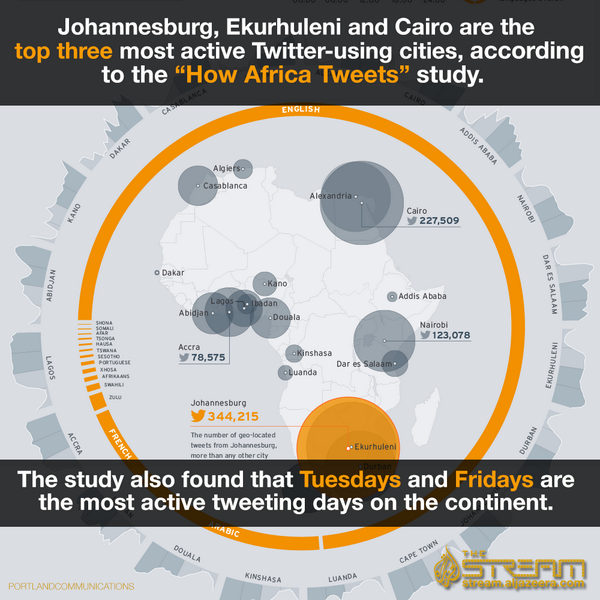
Africa’s largest and second-largest economies, South Africa and Egypt, are Africa’s two most active Twitter countries. Accra, Cairo, Johannesburg and Nairobi are the tweets capitals of Africa. With 344,215 geo-located tweets, Johannesburg is the most active city in Africa.
According to the United Nations International Telecommunication Union (ITU) latest report on information and communications technology in Ethiopia, the country is among the least developed and most expensive in the world. The report placed Ethiopia 151st in ICT development, out of 157 countries, and 152nd out 169 countries in the price of fixed broadband connection. After a decade, in 2012, the internet penetration rate in Ethiopia was a mere 1.1 percent, or 960,331 users and out of this 902,440 are Facebook users. Neighboring Kenya, however, reached a 41 percent penetration rate, with 16.2 million users. As part of its active engagement in curtailing free media, the Ethiopian state is known in making citizen’s use of micro social networkings illegal and blocks internet connections and sites to public.
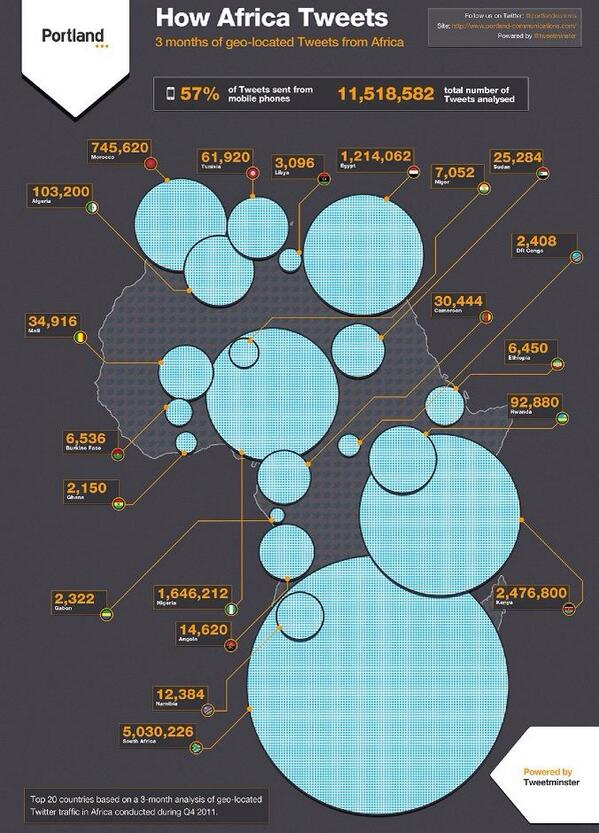
In a follow up to its 2012 study, the London- and Nairobi-based public relations and strategic communications agency Portland analysed geo-located tweets originating from Africa during the final three months of 2013. The second How Africa Tweets study dives deeper into Twitter use on the continent, looking at which cities are the most active, what languages are being used the most and what issues are driving the conversation online.
How Africa Tweets found that, during the final three months of 2013:
Johannesburg is the most active city in Africa, with 344,215 geo-located tweets, followed by Ekurhuleni (264,172) and Cairo (227,509). Durban (163,019) and Alexandria (159,534) make up the remainder of the top five most active cities
Nairobi is the most active city in East Africa and the sixth most active on the continent, with 123,078 geo-located tweets
Accra is the most active city in West Africa and the eight most active on the continent, with 78,575 geo-located tweets
English, French and Arabic are the most common languages on Twitter in Africa, accounting for 75.5% of the total tweets analysed. Zulu, Swahili, Afrikaans, Xhosa and Portuguese are the next most commonly tweeted languages in Africa
Tuesdays and Fridays are the most active tweeting days. Twitter activity rises steadily through the afternoon and evening, with peak volumes around 9pm
The day of Nelson Mandela’s death – 5 December – saw the highest volume of geo-located tweets in Africa
Brands in Africa are becoming increasingly prevalent on Twitter.
Portland tracked major hashtag activity from top brands such as Samsung (#SamsungLove), Adidas (#Adidas) and Magnum ice cream (#MagnumAuction)
Football is the most-discussed topic on Twitter in Africa. Football was discussed more than any other topic, including the death of Nelson Mandela. The most mentioned football team was Johannesburg’s Orlando Pirates (#BlackisBack, #PrayForOrlandoPirates, #OperationFillOrlandoStadium)
Politically-related hashtags were less common than those around other issues, with only four particularly active political hashtags tracked during the time period. This included #KenyaAt50 – celebration of Kenya’s independence – and the competing #SickAt50
Allan Kamau, Head of Portland Nairobi, says: “The African Twittersphere is changing rapidly and transforming the way that Africa communicates with itself and the rest of the world. Our latest research reveals a significantly more sophisticated landscape than we saw just two years ago. This is opening up new opportunities and challenges for companies, campaigning organisations and governments across Africa.”
Mark Flanagan, Head of Digital for Portland, says: “As well as adding diversity of perspective on political and social issues, Africa’s Twitter users are also contributing linguistic diversity. Twitter is now established on the continent as a source of information and a platform for conversation.”http://allafrica.com/stories/201403120080.html
http://allafrica.com/stories/201312230211.html?viewall=1
Copyright © OromianEconomist 2014 & Oromia Quarterly 1997-2014, all rights are reserved. Disclaimer.


 Oromian Economist
You must be logged in to post a comment.