Sadaasa 16, 2014 Wallaggaa Naqamtee irratti gaggeeffame.
Irreecha 2014: The Oromo National And Cultural Holiday, Oromians in Millions Celebrated the Blessing Festival in Oromia and all over the Globe November 18, 2014
Posted by OromianEconomist in Ateetee (Siiqqee Institution), Culture, Hora Harsadii (Bishoftuu), Irreecha, Malkaa Ateteetee (Burraayyuu), Oromiyaa, Oromo, Oromo Culture, Oromo Identity, Oromo Protests, Oromummaa.Tags: African culture, Bishoftuu: Horaa Harsadi, Hora Harsadii (Bishoftuu), Irreecha (Irreesa) Oromoo, Malkaa Ateetee (Buraayyuu), Oromia, Oromiyaa, Oromo, Oromo culture, Oromo people, Oromummaa
add a comment


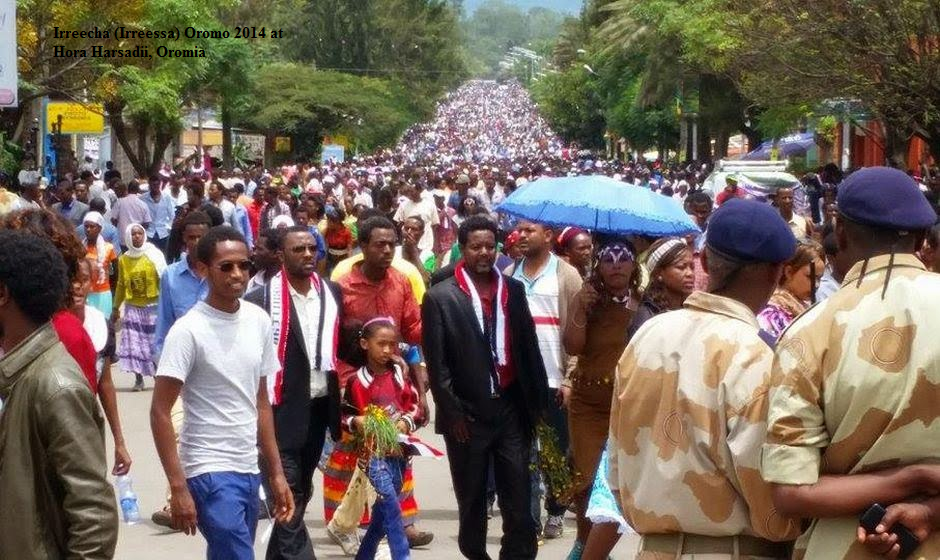
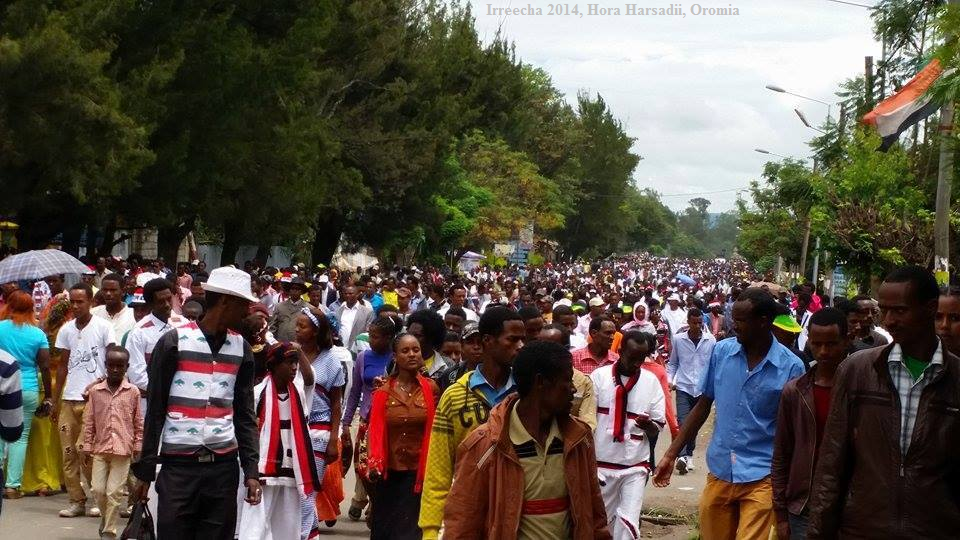

Irreecha (Irreessa) Birraa Oromoo kan Bara 2014 ((akka lakkoobsa Oromootti kan Bara 6408) akka gaariitti karooreffatamee, haala oo’aa fi bareedan kabajame. Here are some of live pictures, videos and reports refer to Irreecha Oromo Thanksgiving 2014 (6408 in Oromo Calendar) Season Global Events Planning and Celebration . The blessing event that started in mid August and celebrated successfully and colorfully through Birraa (September- October). Millions attended Hora Harsadi (Bishoftuu, Oromia) and Malkaa Ateetee (Buraayyuu, Oromia).
At Hora Harsadii

SBO Onkoloolessa 08 Bara 2014 Oduu – Qophii Ayyaana Irreechaa fi SBO Sagantaa Afaan Amaaraa

Irreecha Oromoo kan Bara 2014 Baga Ittiini Isin Gahe! Aadaa Oromoo Maraa Irreechi Hundee Keenya Irree Keenya!!!
Happy the 2014 Oromo Irreecha Thanks Giving, Cultural and National Day!!!!
Felice 2014 Oromo Irreecha Thanks Giving, Culturali e Giornata Nazionale !!!!
Glückliche 2014 die Oromo Irreecha Thanks Giving, kulturellen und nationalen Tag !!!!
Glad de 2014 Oromo Irreecha Thanks Giving, kulturelle og National Day !!!!
Bonne 2014 Oromo Irreecha Merci Donnant, la culture et la Journée nationale !!!!
Gelukkig 2014 Oromo Irreecha Thanks Giving, culturele en nationale Dag !!!!
Shona 2014 Oromo Irreecha Go raibh maith agat a thabhairt, Cultúrtha agus Lá Náisiúnta !!!!
سعيدة 2014 أورومو Irreecha تقديم الشكر والثقافة واليوم الوطني !!!!
Happy the 2014 Oromo Irreecha Thanks Giving, Cultural and National Day!!!!
Felice 2014 Oromo Irreecha Thanks Giving, Culturali e Giornata Nazionale !!!!
Glückliche 2014 die Oromo Irreecha Thanks Giving, kulturellen und nationalen Tag !!!!
Glad de 2014 Oromo Irreecha Thanks Giving, kulturelle og National Day !!!!
Bonne 2014 Oromo Irreecha Merci Donnant, la culture et la Journée nationale !!!!
Gelukkig 2014 Oromo Irreecha Thanks Giving, culturele en nationale Dag !!!!
Shona 2014 Oromo Irreecha Go raibh maith agat a thabhairt, Cultúrtha agus Lá Náisiúnta !!!!
سعيدة 2014 أورومو Irreecha تقديم الشكر والثقافة واليوم الوطني !!!!
Irreecha Buraayyuu irrattii yoo kabajamu. Suraan kun kan bara 2013 bara kan maxxanfame.


Oromo woman celebrating Irreecha (Irreessa) Thanksgiving at Burayyuu, Central Oromia, near the capital Finfinnee, September 2013.
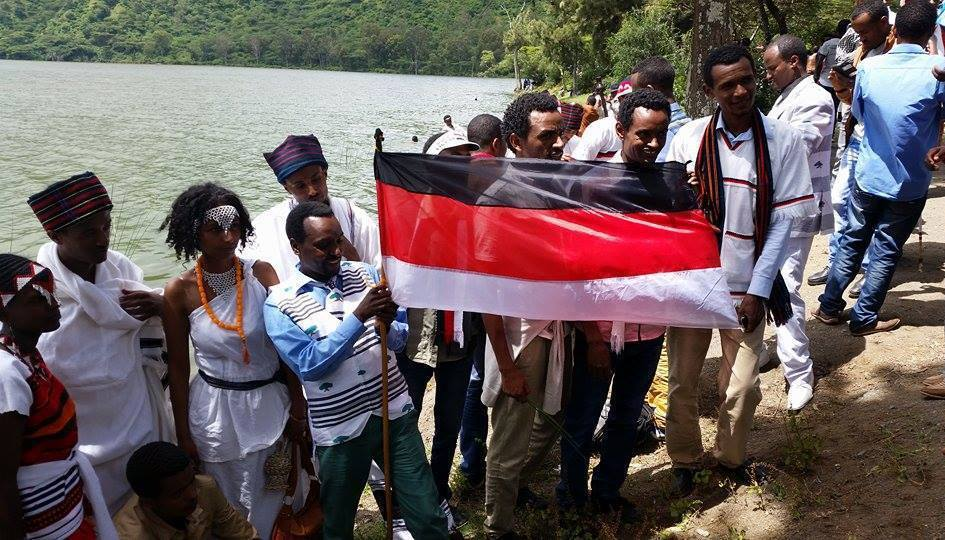
Irreecha (Oromo Thanksgiving) 2014: Colorfully celebrated in East Wallaggaa, Western Oromia, Naqamtee City, 16 November. This month’s Irreecha also known as Irreecha Yaadannoo. Remembrance Irreechaa.
Irreechi Malkaa Araaraa, Wallaggaa Naqamte Irratti Kabajame
Irreechi barana Sadaasa 16/2014 Malkaa Araaraa irratti tahekan Wallaggaa Leeqaa Naqamtee irratti taasifame uummata lixa shagarii fi Wallaggaa magaalaa Naqamtee fi barattoota yuuniversitii fimanneen barnootaa garagaraa guutummaatti kan hirmaachiseedha. Waggoota tokko dura kan gaggeeffame baayinniuummataa kan baranaa dachaadhaan akka dabale uummata kumaatama hedduudhaanlakkaawaman hirmaachise jira.
Buufata malkaa kanatti Qeerroon sirboota qabsoo garagaadhageessisee jira, keessattuu dhaadannowwan:
– Qaroon oromoo ABO dha.
– Yaa oromo mirgakeef ka’ii falmadhu
– Nuti oromoodha, nuu haa beekani.
– Oromiyaan ni bilisoomti kan jedhuu fi sirbootniqabsoo hedduun uummata kakaasuu fi sirboota qabsoo qeerroodhaan sirbamankeessatti poolisoota kan hirmaachise uummata waliin sirboota Qeerroo irrattihirmaachuudhaan haala nama boonsuun kan gaggeeffameedha.
Akkuma olitti ibsuuf yaaleetti uummanni jiraattootni garashawaa lixaaa jiraatan hunduu ayyaana irreechaa malkaa Araaraa kana irratti kanargamaniidha. Irra caalatti barattoota yuuniversitii fi koollejjii akkasumamana barumsaa sadarkaa garagaraa magaalaa Naqamtee, Siree, Baakkoo fi kkf niinkan dhuunfatameedha. Sochii qeerroodhaangodhame keessatti humni waraanaa poolisoonni jiran hunduu uummata waliin haalahoo’aadhaan guyyaa kana kan kabajanii oolanii fi dhaadannoolee uummata oromoofwaamicha taasisu, uummata kakaasan irrattillee kan hirmaatanii jiraniidha, uummanni hunduu kan irreecha kana irratti argaman nageenyaan bahee guyyaakeessa sa’a 7:30 irratti gara qe’ee isaatti kan galeedha. Guyyaa irreechaMalkaa Araaraa kana ilaalchisee gabaasa dabalataa isiniin geenya, waraabbiiqabnuuf haala mijeessinee isiniin geenya, nu eeggattu!


http://finfinnetribune.com/Gadaa/2014/11/irreechi-malkaa-araaraa-wallaggaa-naqamte-irratti-kabajame/
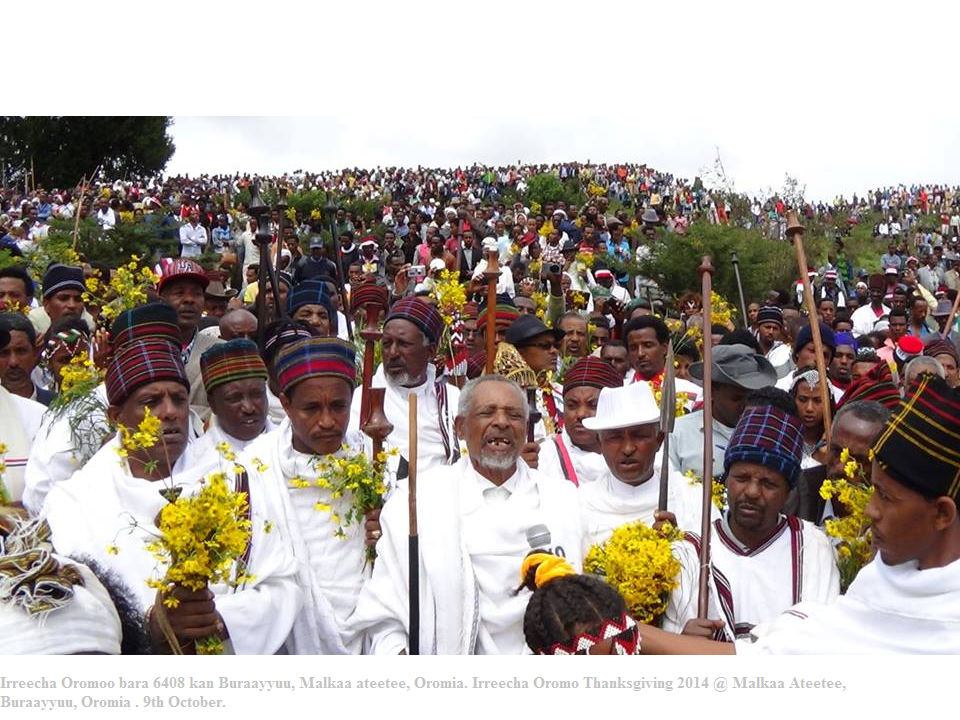
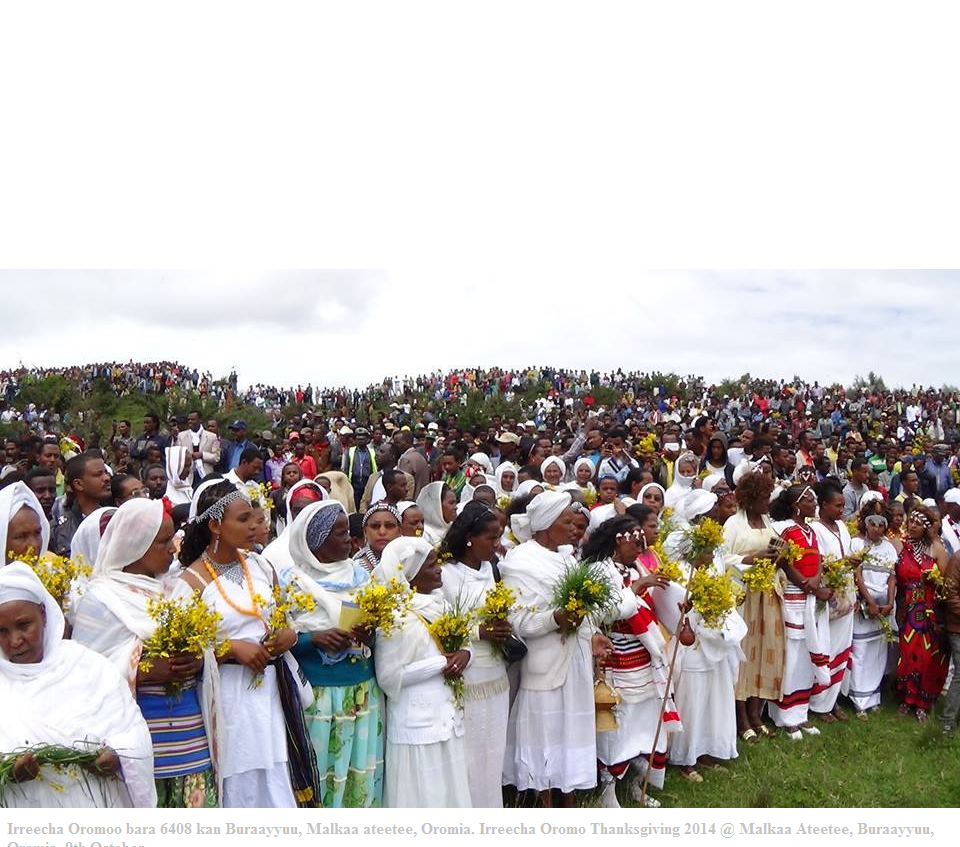
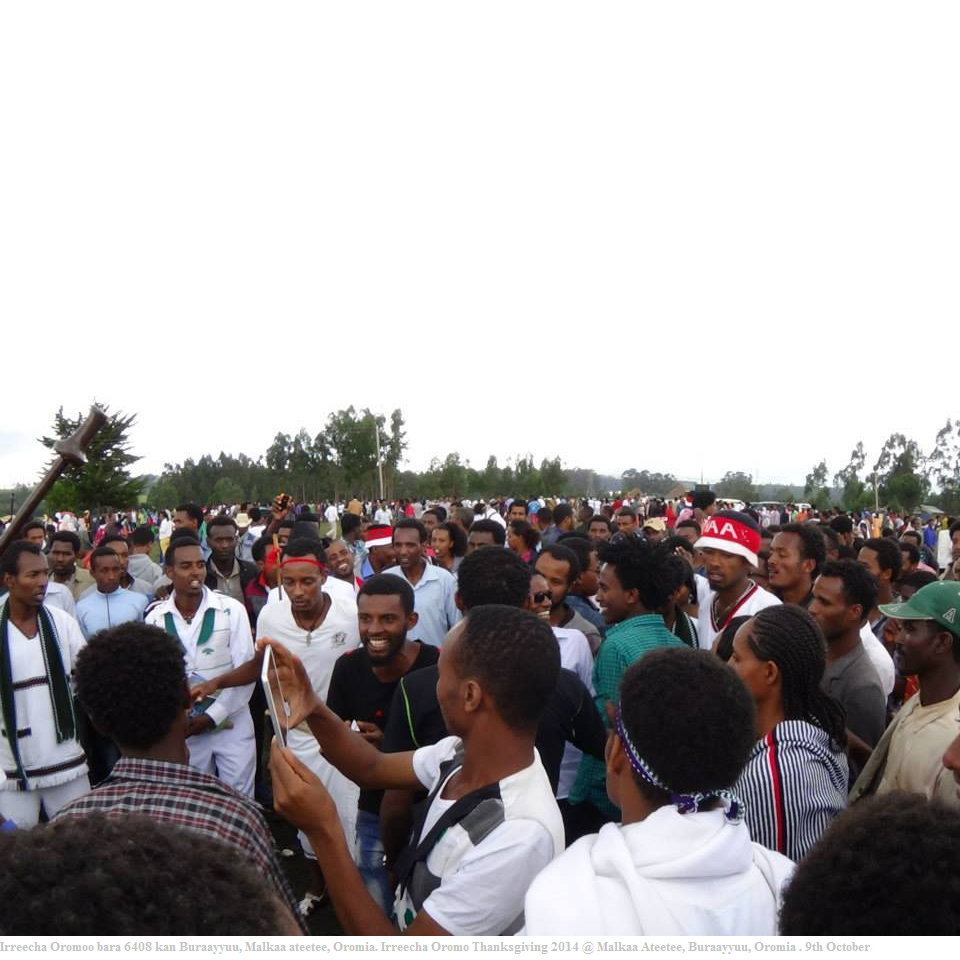
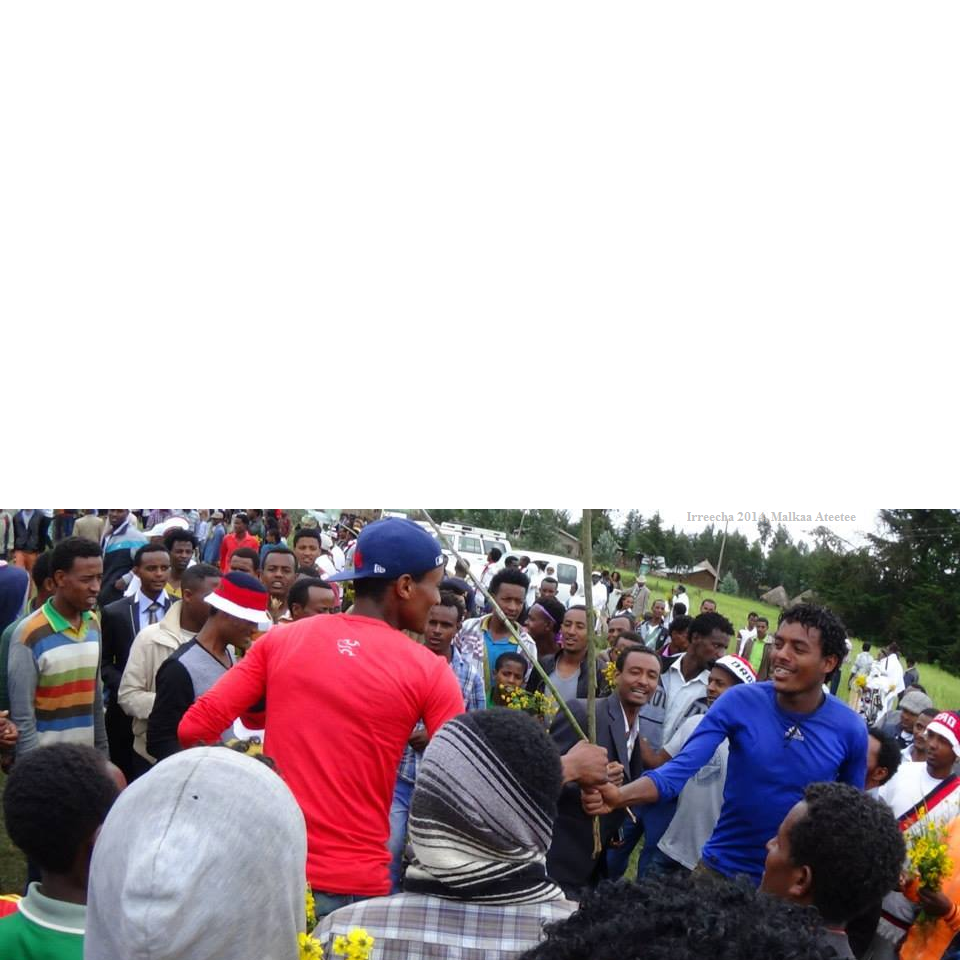
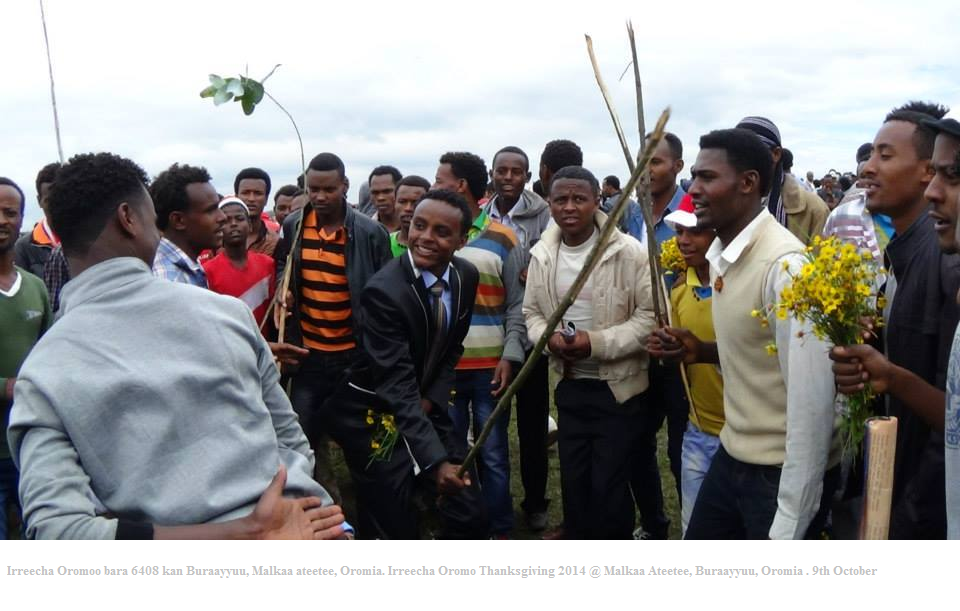
Irreecha (Oromo Thanksgiving) 2014: Colorfully celebrated at Burraayyuu, Malkaa Ateetee, Oromia with millions of Oromians in attendance. 9th October 2014.
Ayyaannii Irreechaa Burraayyuu Malkaa Ateeteetti bakka uummaanni Oromoo miliyoonaan lakkaa’amu argamutti sirna ho’a ta’een kabajame. Uummaatni Oromoo godinaalee Oromiyaa fi magaaloota Finfinnee, Burraayyuu, Bishooftuu, Adaamaa, Sandaafaa, Laga Xaafoo Laga Daadhii, Sulultaa, Sabbataa, Walisoo, Hollotaa, Amboo, fi Neqamtee irra walitti dhufuun haala ajaa’ibsiisa ta’een Ayyaana Irreechaa Magaalaa Burraayyuu Malkaa Ateeteetti kabajachuun eenyummaa, Tokkummaa, Oromomummaa fi Sabboonummaa isaa jebeeffachuun diina afaan faajjessa olee jira. http://qeerroo.org/2014/10/10/ayyaannii-irreechaa-burraayyuu-malkaa-ateeteetti-bakka-uummaanni-oromoo-miliyoonaan-lakkaaamu-argamutti-sirna-hoa-taeen-kabajame/



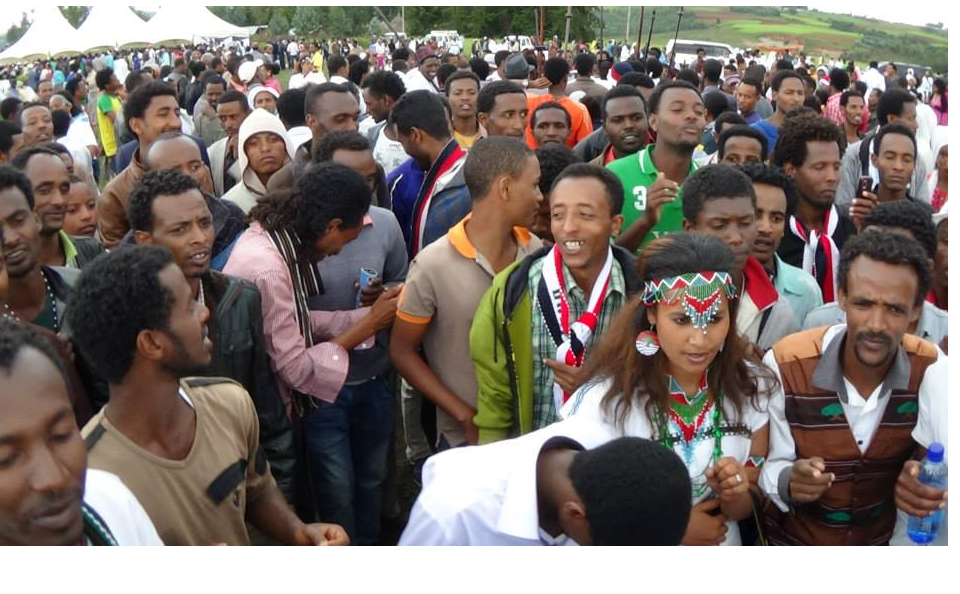


Irreecha (Oromo Thanksgiving) 2014: Colorfully celebrated at Bishoftu Oromia, Hora Harsadii with over 4 million in attendance. 5th October 2014.
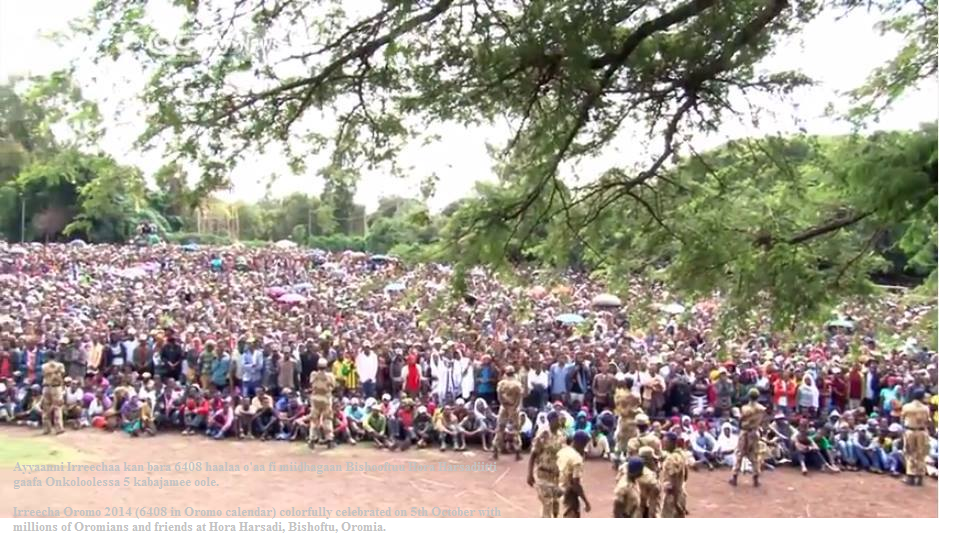


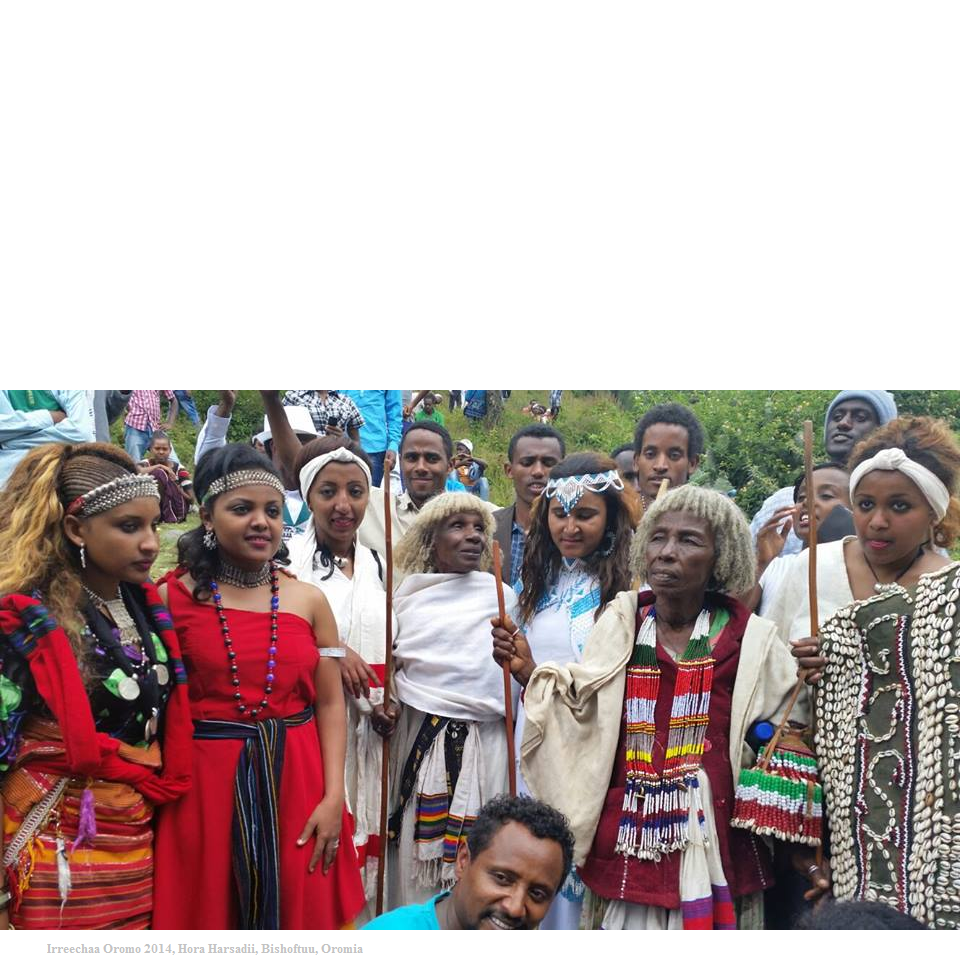

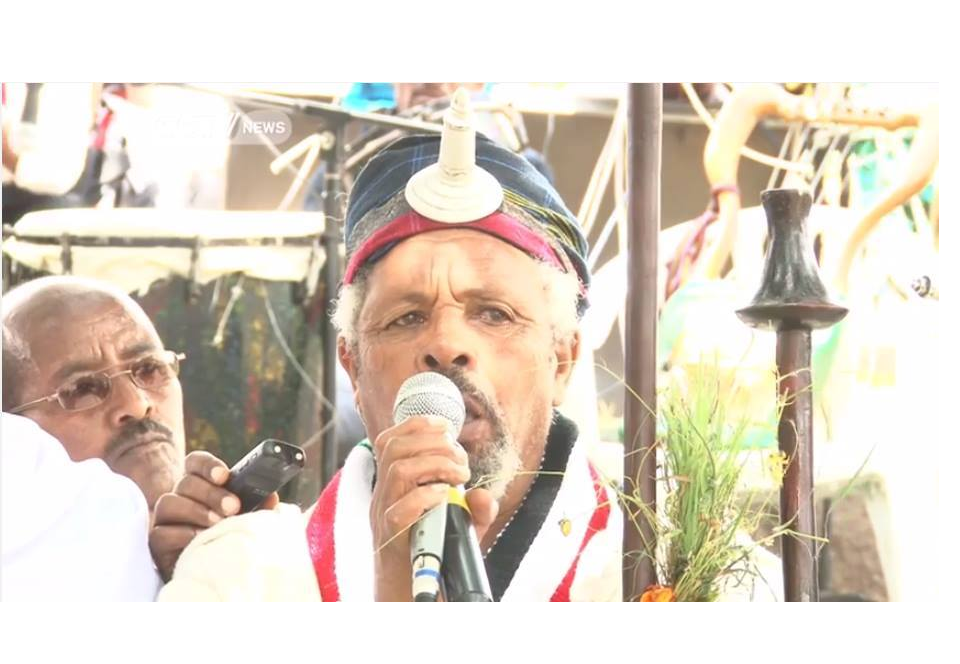

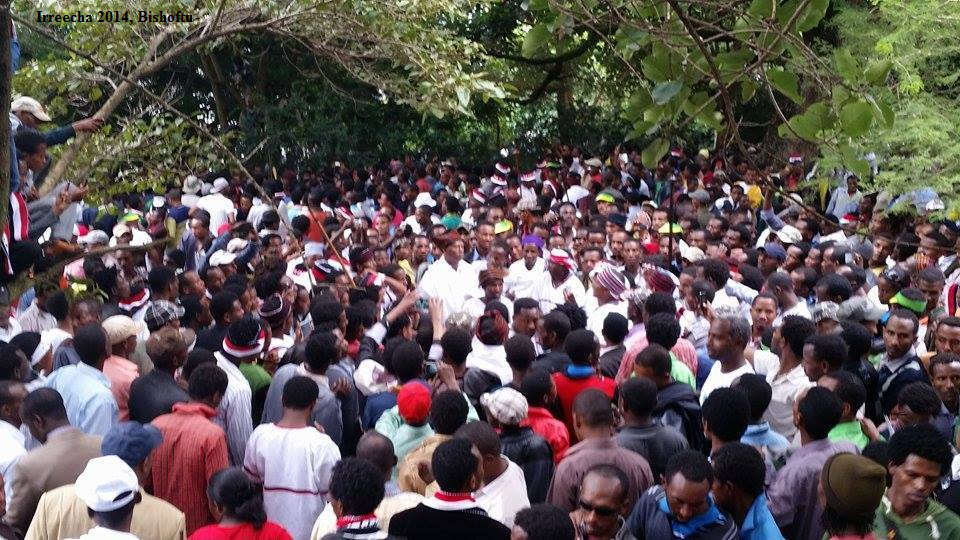

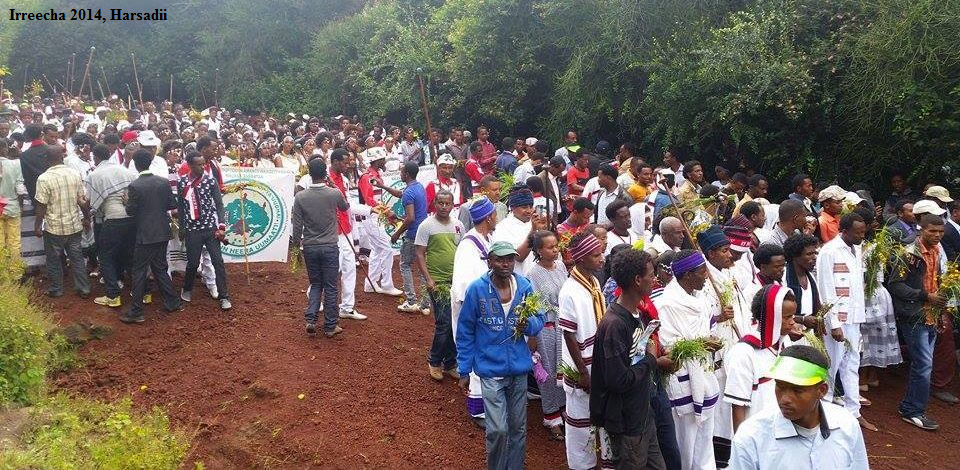

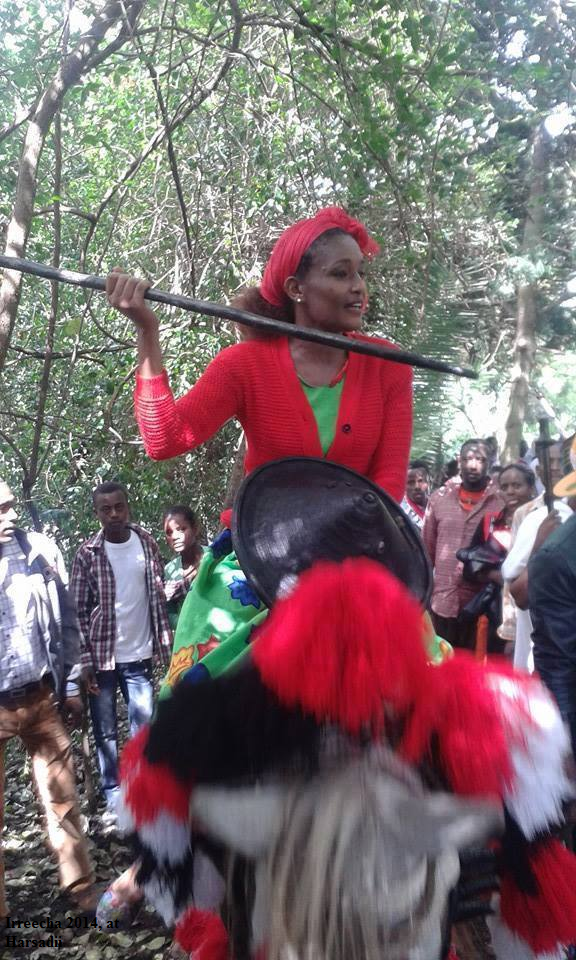


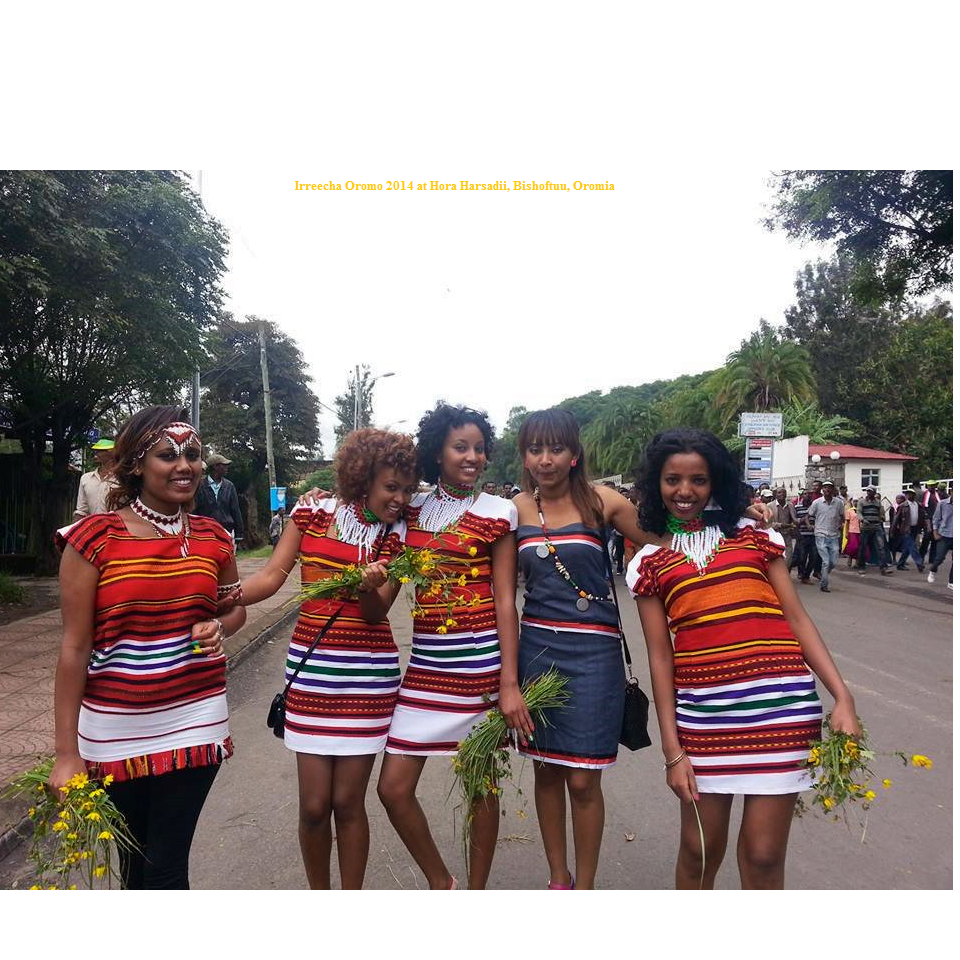
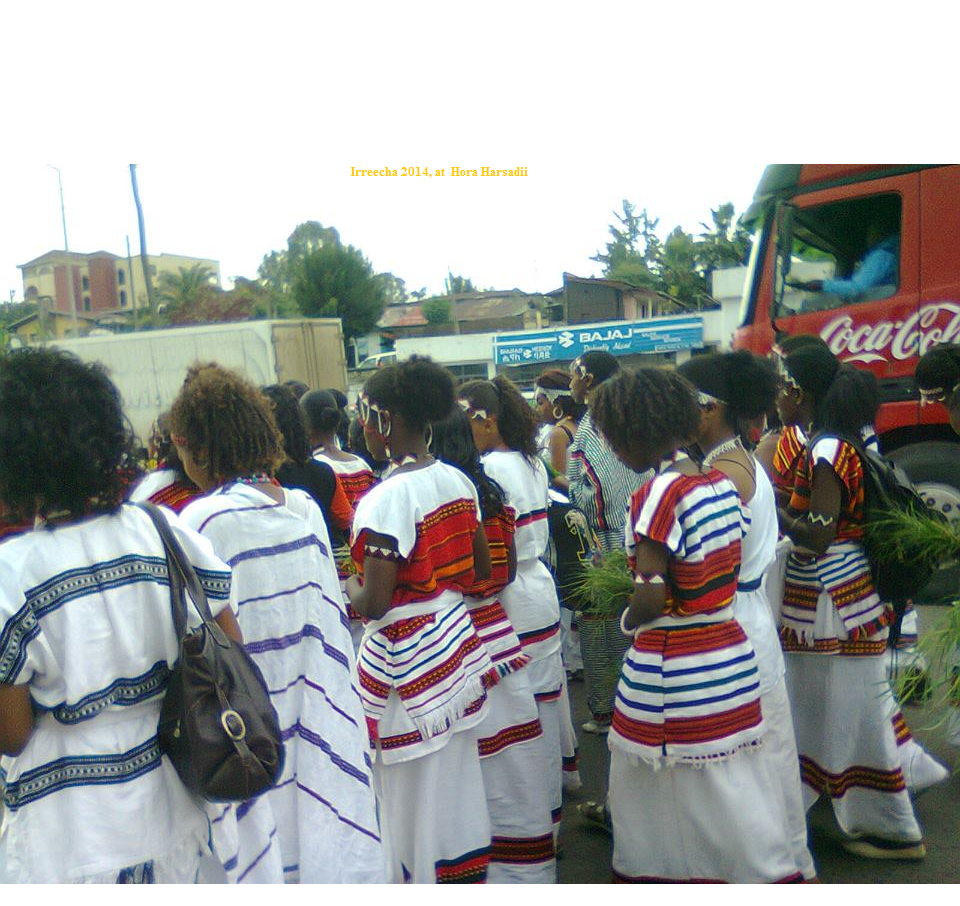

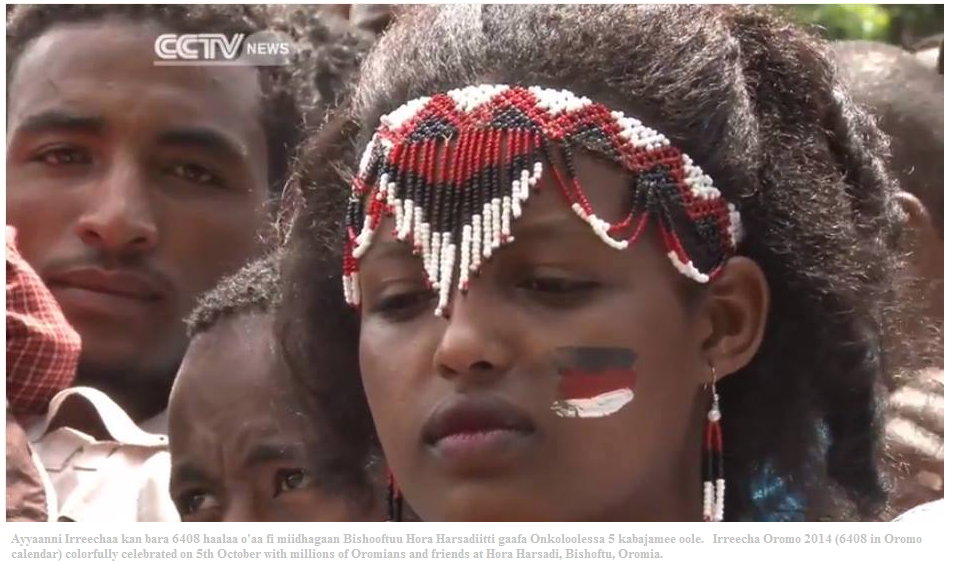

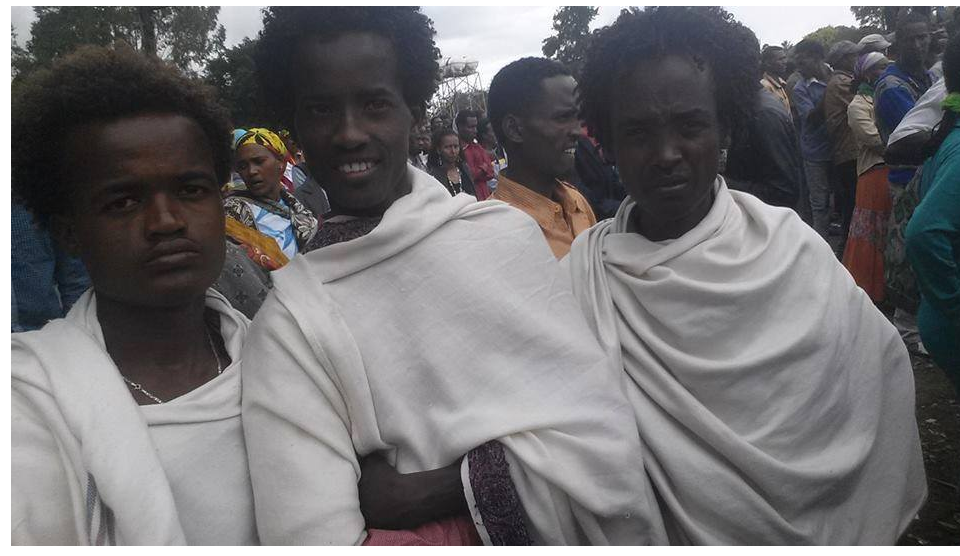


Irreecha (Oromo Thanksgiving) 2014: Colorfully celebrated at Bishoftu Oromia, Hora Harsadii with over 4 million in attendance. 5th October 2014.
Irreecha (Oromo Thanksgiving) is a celebration of the coming of the new Birraa (Spring) season in Oromia. Though it is celebrated by many millions throughout Oromia, the celebration at Hora Arsadi (Lake Arsadi) in Bishoftu, Oromia, is the largest of all. The celebration at Hora Arsadi has been identified as the largest festival in Africa, and there’s a proposal submitted to UNESCO to register it as the Cultural Heritage of the world. http://finfinnetribune.com/Gadaa/2014/10/in-photosvideos-the-largest-festival-in-africa-irreecha-oromo-thanksgiving-celebrated-by-millions-at-hora-arsadi-in-bishoftu-oromia-october-5-2014/
Onkoloolessa 5, 2014 Guyyaa har’a Uummatni Oromoo Miliyoona Afurii olitti lakkaa’amu Ayyaana Irreechaa Hora Arsadii irratti wal arguun Ayyaannii Irreechaa ganama barii lafaa eebba manguddootaan kan baname haala ho’aa ta’een kabajamuu eegalee jira.
Ayyaanaa irreechaa danquuf mootummaan abbaa irree wayyaanee EPRDF ugguraa garaagaraa kaa’ee, kellaawwaan biyyaatti cufee haa sakkatta’uu malee uummataa Oromoo eenyuummaa isaa, aadaa isaa, amantii isaa fi tokkummaa isaa cabsuu hin dandeenye, uummatni Oromoo yoom iyyuu caalaa yeroo ammaa kanatti uummata eenyummaa isaa, Oromummaa isaa, aadaa isaa, Amantii isaa fi sabboonummaa isaa jabeeffachuun diina dura dhaabbachuun bilisummaa isaa kabachiifachuuf uummata onnatedha.
Haaluma kana fakkaattuun guyyaa har’aa kana kabaja ayyaanaa irreechaa irratti dargaggootni Oromoo wallee waarraaqsaa fi eenyummaa uummatichaa calaqisiisuu sodaa tokko malee uummataaf sirbuun, uummanni cufti harka walqabanchuun sagalee tokkuummaa, eenyuummaa, abbaa biyyuummaa fi kabajamuu sabboonummaa jettuu dhageesisuun diina uummata Oromoo mootummaa garboomsaa naasuu guddaa keessa galchani jiru. Addaatti dargaggootni Oromoo walleellee warraaqsaa dhageesisuun Sabboonummaa Oromummaa faarsuu irratti argamu. http://qeerroo.org/2014/10/05/guyyaa-hara-uummatni-oromoo-miliyoona-olitti-lakkaaamu-ayyaana-irreechaa-hora-arsadii-irratti-wal-arguun-ayyaannii-irreechaa-ganama-barii-lafaa-eebba-manguddootaan-kan-baname-haala-hoaa-taeen/


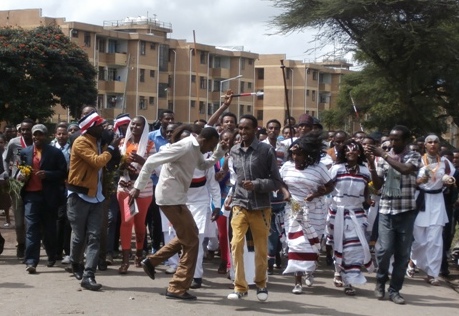


OromoPress Report:- Irreecha: Oromo’s Largest African Festival Celebrated by Millions at Hora Arsadi, Bishoftu
(OromoPress) – On Sunday October 5, 2014 an estimated 4 million people attended the annual Irreecha Festival at Hora Arasdi (lake) in Bishoftu town, located 47.9 kilometers southeast of the Oromo nation’s capital Finfinne (aka Addis Ababa). Although not conceptually, historically and purposively equivalent, people sometimes superficially use the word from the American holiday “Thanksgiving” to describe Irreecha Festival to expatriates. Oromo and friends of Oromo from across all religions and backgrounds converged to celebrate the transition from a gloomy (dukkana) rainy season to a bright (booqaa) Birraa (Spring season). The rainy season that runs for 3 months–June to August– is considered a harsh winter and is associated with darkness and separation from friends and families because of rivers swelling, (and also because of the lack of electricity). In contrast, Spring is considered a more pleasant season of festivity. Honestly, the tropical rainy season is not as a harsh a season as Winter as we know it in the northern hemisphere if you have the skills to swim and walk in and on waters.To say that Irreecha is a celebration of escaping a bad season, would be a gross oversimplification given the long and complex history of the Oromo indigenous African holiday practiced for thousands of years before the arrival of Abrahamic faiths in Oromia, Ethiopia and the Horn of Africa. Read more @http://oromopress.blogspot.co.uk/2014/10/irreecha-oromos-largest-african.html
Irreecha Bara 2014 – Sirna Irreeffannaa WBO, Moonaa Leenjii Giddu Gala ABO!
Ayyaanni Irreechaa Godina Jimmaa
Onkoloolessa 26 bara 2014

Onkololeessaa 26, 2014 Ayyaanni Irreechaa Godina Jimmaatti sirna ho’aa ta’een kabajame! Uummatni Oromoo jalbultii ayyaana kana ilaalchisuun Onkololeessa 25/2014 irraa eegaluun godinaalee Oromiyaa gara dhihaa kanneen akka Godina Iluu abbaa Booraa, Godina kibba Lixa Shawaa, Shawaa Lixaa fi wallaggaa Bahaa irra gara Magaalaa Jimma seenan, jalbultiin Ayyaana kanaa haala akkam miidhagaa ta’een Malkaa Deeddeetti kan eegalame, Guyyaa kaleessaa Malkaa Booyyeetti haala akkam ajaa’ibsiisaa ta’een kabajame jira. Goototni barattootni Oromoo Yuunibarsiitii Jimmaa fi Saabboontootni hojjettootni fi barsiisotni Godina Jimmaa fi Yuunibarsiitii Jimmaa Ayyaana kana irratti argamuun haala akkam boonsaa ta’een Eenyummaa, Oromummaa ,sabboonummaa, fi tokkummaa uummata Oromoo jabeessuun Uummata Oromoo kuma kudha-shani (15,000) Olitti lakka’amuun kabajame jira.
Kabaja ayyaana Irreechaa Godina Jimmaa Malkaa Booyyeetti kabajame kana irratti dargaggootni Qeeerroon barattootni Oromoo Yuunibarsiitii Jimmaa gamtaadhaan argamuun walleewwaan warraaqsaa fi mootuummaa abbaa irree balaaleeffatan Sirbuun uummatni Oromoo eenyummaa, Oromummaa, Sabboonummaa fi bilisummaa isaa gonfachuuf yoom iyyuu rafee akka hin bullee fi tole jedhee halagaa fi abbootii irreef akka hin bitamne walleewwaan warraaqsaa kanaan uummataaf barnootaa fi ergaa guddaa dabarsa, walleewwaan warraaqsaa kanaaniis ABO fi Uummata Oromoo, Qabsoo bilisummaa Oromoo sodaa tokko malee faarsuun diina garaa gubaa oolaniru. walleewwaab Artisti kabajamaa fi Jaalatamaa Eebbisaa Addunyaa guutummaatti sirbaa Oolaan.
Mootummaan abbaa Irree Wayyaanee akkuma amala ayyaana irreecha kana danquu fi uummata sodaachisuuf humna poolisaa guddaa bobbaasuun guyyaa jalbultii Ayyaana kana irraa eegaluun Magaalaan Jimmaa eegamaa turte, tokkummaa Uummataa fi haala hedduminan uummatni Ayyaana kanaaf qophii gochaa jiru irraa ka’uun tajajila uummataa kanneen akka Ibsaa Eliktiriikii, Bishaan dhugaatii fi Network Magaalaa Jimmaa irraa balleessun uummata darara jiraachuun beekamee jira. kessumattuu Ayyaana kanaan walqabatee tajajillii bishaan dhugaatii, Ibsaa fi Network magaalaa Jimmaa irra baduun immoo yeroo amma kana haalan kan uummata dheekkamsiise ta’uun gabaafame.
Goototni Barattootni Yuunibarsiitii Jimmaa tajajillii bishanii, Ibsaa fi network uummata irraa dhaabbatee(citee waan jiruuf Mooraa yuunibarsiitii Jimmaa Main Campus keessa naanna’uun roottoowwaan bishaan itti kuufaman caccabsuun Mootummaan wayyaanee tajaajila hawwasuummaa uummata irraa kutuun uummata darara jiru nurraa ka’uu qaba jechuun halkan guutuu hanga poolisiin mooraa Yuunibarsiitii Jimmaa dhaabsiisuu dhadhabutti iyyaa bulan, Diddaa gootota barattoota Yuunibarsiitii Jimmaa kanatti Mootummaan Wayyaanee Yaaddoo ulfaata keessa seenuun humnoota basaasaa fi poolisaa bobbaasuun Yuunibarsiitiin Jimmaa eegamaa jira.


Ayyaanni irreechaa godina Jimmaa malkaa Booyyetti haala akkaan hoo’aa ta’een kabajamee.
ONKOLOOLESSA 26/2014 “IRREECHA MALKA BOOYYEE”
 Ayyaanni irreechaa godina Jimmaa malkaa Booyyetti haala akkaan hoo’aa ta’een kabajamee oolee jira.Irreecha birraas ta’ee kan Arfaasaa biyya keessattii fi biyyoota alaattis waggaa waggaan akka irreeffatamu eenyu illee waan haaluu hin dandeenyedha. Haaluma kanaan ummanni oromoo magaalaa Jimmaa,naannawa ishii,akkasumas barattoonni oromoo yunivarsiitii Jimmaa kaampaasota garagaraa fi barattoonni kolleejjii barsiisota Jimmaa walitti dhufuun ayyaanicha jalabultii irraa jalqabuun bifa nama boonsuun kabajuu danda’anii jiru.Qeerroon yunivarsiitii Jimmaa fi kolleejjii barsiisota Jimmaa jiraattota magaalaa fi naannawa ishee waliin ta’uun jalabultii irreechaa dug-duuba kolleejjii barsiisota jimmaa malkaa doodee irratti bifa miidhagaa ta’een kabajanii jiru jedha gabaasni Qeerroo godina Jimmaa. Qeerroo fi sabboontonni oromoo kan yoomiyyuu diinaf gadi hin jenne sirboota fi waallewwan warraaqsan jibbaa fi tuffii diina isaanif qaban itti mul’isuun wayyaane fi ergamtoota wayyaanee daran rifaasisanii jiru.Qeerroo fi sabboontonni oromoo waalleewwan warraaqsaa akka armaan gadii kanatti kaasuun ijjannoo isaanii diinaf mul’isan:
1.Taaddee Birruu leenca boombin dadhabe har’a saaxiniin gadi qabe.
2.Yaa oromoo oromoo qulqulluu qonnee nyaannaa lafa hin gurgurru. 3.Boolloo xaddee Taaddasaa koo hin badde biyyoon galabaa miti wal-irraa hin xaragani.As irratti wanti hubatamuu qabu akka fakkeenyatti maqaan taaddasaa ka’e malee maqaan gootota oromoo osoo falmaa bilisummaa gaggeessanuu lubbuun isaanii wareegamte hedduun kaafamanii jiru.
4.Foolleen shanii Dabbaalleen kudhanii maal balleesse kan barataa Kenya hidhanii jechuun barattoota Oromoo gaaffii mirga namoomaafi abbaa biyyummaa gaafatanuu maqaa shororkeessan wayyaaneen mana hidhaatti darbattee hiraarsaa jirtu yaadatanii wall yaadachisuu danda’anii jiru.Walumaa galattii Irreechi birraa malkaa Booyyee oromoota kumaatamaan lakkaa’amaniin sirboota fi waalleewwan warraaqsaan dabaalamuun haala akkaan hoo’aa ta’een kabajamee oolee jira.Wayyaaneen humna tikaa fi basaastota ishii bobbaastus ayyaanichi muudannoo tokko malee milkaa’uu danda’ee Kira.Gabaasa kana irraatti waraabbii suuraa fi sagaleenis qindaawe dhihaata.
Ayyaanni irreechaa godina Jimmaa malkaa Booyyetti haala akkaan hoo’aa ta’een kabajamee.
Irreecha (Oromo thanksgiving) 2014: Colorfully celebration in Nürnberg, Germany.18.10.2014
Kabajaa Ayyaana Irrechaa -2014 Celebration of Oromo Thanks giving (Irrechaa) in Nürnberg, Germany.18.10.2014
Ayyaana Irreecha yeroo jalqabaaf gaafa 18.10.2014tti magaala Nürnbergtti kan Kabajame ole yemmu ta’u Seena Ayyaanicha maal akka ta‘e fi akkasumas Ayyaanni kuni Ummata Oromoof maali isa jedhu ilaalchise Miseensa Qindessitoota Ayyaana Irreechaa Awurooppaa kan ta’aani Obbo Getaachoo Camadaa barumsa ball’aa kann kennan yemmu ta’u akkasumas gaaffi fi deebi hirmaattoottaff walin geggeffame jira.
Qophii kana irratti qophii sirna “Buuna Oromoo” shamarran Oromoo dhihessaniiru.
Obbo Getaachoon “Ayyaani kuni ayyaana jaalaa fi araaraati!” kan jedhan yemmu ta’u Oromoonni argamani hunda gammachuu guddaan sirba aadaa Oromoo walin sirba fi ragada kann olani sagantichi haala midhagaa ta’een xumurame jira.
Ayyaana Wagaa 50ffaa WMT fi Qophii Aadaa Oromoo Magaala Nürnbergitti haala midhagaa ta’een Kabajame
Nuernberg 27.09.2014
Qophii Ayyaana Waggaa 50ffaa Waldaa Maccaa-Tuulamaa (WMT) bakka kessummoota hedduu argamaniin magaala Nürnbergitti Akka aadaa Oromoo Ebbaa manguddootan baname.
Ittiaansuudhaan qophii Agarsiisaa aadaa Oromoo fi Sirbaale Oromoon kan dhihaate jiddu jidduttii immo dargaggoota Oromoo Obbo Muktar fi Obbo Ahimedin Walaloo Qabsoo Bilisummaa Oromoo faarsuu fi hamilee nama kakaasu dhihessaniiru.
Turtii boqonnaa fi Laaqana booda immo Waa’ee Waldaa Maccaa- Tulama barumsa Hawaasa Oromoo Berlin irra marsaa Skype dhaan kan kenname yemmu ta’u, Do’ii gabaabdu “Abbaa Caaltu” dargaggoo Oliyad Dinaolin qophaa’ee umataatti barsise fi bashannansiise jira.
Walumagalaatti kabajaa Ayyaana Waggaa 50ffaa WMT hirmaattoota fi Kessummotaaf walittidhufenya harawaa kan ume akkasumas sababni WMT bu‘urreffamef yaadachudhaan kaayyoo sanas hubachuudhaan Qabsoo Bilisummaa Oromoo ittifufudhaaf guyyaa waadaakenya kan ittin haaromsinu ta’u isaa wali galuudhaan milkiin xumurame jira.
Injifannoon Ummata Oromoof!
Tokkummaa Barattoota Oromoo Biyyaa Jarmanii-TBOJ
www.tboj.de
Irreecha (Oromo thanksgiving) 2014: Colorfully celebration in Tel Aviv, Israel, (Middle East)


Irreecha (Oromo thanksgiving) 2014: Colorfully celebration in Uganda (East Africa)
5th October 2014.
The Oromo people, the largest nation in Ethiopia, celebrate Irreecha, a festival of thanksgiving. Oromo communities spread out across the world perform rituals on this day around water sources to thank God for enduring the rainy season and ushering in the Spring season. The Oromo Community in Uganda held their celebrations at the Kabaka’s Lake in Lubaga on October 5, 2014. http://finfinnetribune.com/Gadaa/2014/10/ntv-uganda-report-oromo-community-in-uganda-celebrate-irreecha-festival/
NTV Uganda


A Beautiful Irreecha Celebration in Groton, Connecticut (It Takes One Family to Start Building a Community)
Though lacking a big Oromo community in Groton, Connecticut, that didn’t deter the family of Gammachuu to hold the 2014 Irreecha (Oromo Thanksgiving) celebration; we hope to see a strong Oromo community in Connecticut next year following the Gammachuu’s lead.http://finfinnetribune.com/Gadaa/2014/10/a-beautiful-irreecha-celebration-in-groton-connecticut-it-takes-one-family-to-start-building-a-community/
A Beautiful Irreecha Celebration in Groton, Connecticut (It Takes One Family to Start Building a Community)
Though lacking a big Oromo community in Groton, Connecticut, that didn’t deter the family of Gammachuu to hold the 2014 Irreecha (Oromo Thanksgiving) celebration; we hope to see a strong Oromo community in Connecticut next year following the Gammachuu’s lead.http://finfinnetribune.com/Gadaa/2014/10/a-beautiful-irreecha-celebration-in-groton-connecticut-it-takes-one-family-to-start-building-a-community/

Irreecha Celebration in Perth (Australia) – Oct. 5, 2014
Irreecha (Oromo thanksgiving) 2014: Colorfully celebration in South Africa.
5th October 2014.


Irreecha (Oromo thanksgiving) 2014: Colorfully celebration in Melbourne, Australia


Irreecha (Oromo thanksgiving) 2014: Colorfully celebration in Cairo, Egypt
5th September 2014.


Irreecha (Oromo Thanksgiving) 2014: Colorfully celebration in Atlanta, Georgia, USA
4th October 2014


Irreecha (Oromo Thanksgiving) 2014: Colorfully celebration in Holland.
4th October 2014


Irreecha (Oromo thanksgiving) 2014: Colorfully celebration in Boston, MA, USA
28 September 2014


Irreecha (Oromo thanksgiving) 2014: Colorfully celebration in Los Angeles, California
27 September 2014

Hawaasni Oromoo Magaalaa Los angeles fi San Diego Ayyaanaa Biyyoolessa Oromoo, IRREECHA, Birraa 27, 2014 haala hoo’an kabajaanni oolan. Sirni ayyaaneeffanaa sa’aa 11:00WD qabee hanga sa’aa 6:00WB gageeffame kun seeraan banamee, eebbaa manguddootiin itti fufee, aadaa irreechaatiin Waaqaa faarffachaa fi gammachuudhaan sirbaa iddoo haroo adeemudhaan erga irreeffatamee booddaa haaluma walfakkaataan iddoo qophiitti deebi’ame sirbaa fi mariin xumurameera. ‘Barrii baranaa kan hegereetiin Isin ha gahu!’


Irreecha (Oromo Thanksgiving) Festival Celebrated in Bay Area, California
4th October 2014
Irreecha (Oromo thanksgiving) 2014: Colorfully celebration in Leeds, UK.
27 September 2014


Irreecha (Oromo thanksgiving) 2014: Colorfully celebration in Ohio, USA.
28th September 2014.


Irreecha( Oromo thanksgiving) 2014: Colorfully celebration in Seattle with Oromiya and Caffee Tuulamaa Abbaa Gadaa- Bayanaa Sanbatoo, 28th September 2014


Irreecha: Colorfully Celebrated
inWashington DC, USA.
27th September 2014
At the Hururssaa, Name-Recognizing or Name-Giving Ceremony, held in conjunction with the 2014 Washington-DC’s Irreecha celebration, author Tasfaayee Gabra-aab has become “Gadaa” Gabra-aab; watch the ceremony below (video by OPride.com). Hururssaa is one of the rich traditions of the Oromo nation.
Author Tasfaayee Gabra-aab Becoming Gadaa Gabra-aab at DC’s Hururssaa Ceremony (Photo: @OromoPress)


Irreecha: Colorfully Celebrated
in Nairobi, Kenya.
28th September 2014


Irreecha: Colorfully Celebrated in
in Chicago, Illinois.
Speeches by International Oromo Youth Assocation’s (IOYA) Leaders Aad. Amanee Badhaasoo & Aad. Sinqee Wesho
27th September 2014
Source: Oromiatimes.Org (http://oromiatimes.org/2014/10/03/dhufaa-jira-coming-soon/)
Irreecha: Colorfully Celebrated in Switzerland
27th September 2014


Irreecha: Colorfully Celebrated in London, UK
27th September 2014


Irreecha: Colorfully Celebrated in Minneapolis, Minnesota, Little Oromia in the Presence of A/G Bayyanaa Sanbatoo & Ob. Laggasaa Deettii, Former Leader of Macha-Tulama Association


Ayyaana irreechaa Fulbaana 27 bara 2014 magaalaa Bergen,Norway
Irreecha Colorfully Celebrated in Oslo, Norway, on Saturday, Sept. 27, 2014
Seife Nebelbal Radio: Special Program on the Irreecha Festival in Dallas, TX (With Abbaa Gadaa Bayyanaa Sanbatoo)

Irreecha Birraa 2014 Celebration @ Las Vegas, Sunset Park, Nevada
25 Fuulbana ( September ) 2014.


The 2014 Irreecha Celebration in Adelaide, South Australia
Ayyaana Irreecha Birraa Oromoo kan bara 2014 Kanaadaa (Canada) Calgaryti Birraa 20 Bara 2014 haala O’ooan kabajamee Ooole. Irreecha celebrated in Calgary, Canada on 20th September 2014. See picture below.


Caayaan Tokkummaa Baqattota Oromo Biyya Masrii Ayyaana Irreecha Barana Fuulbana 20/2014 haala miidhagaa fii bonssaan kabajatan . Sirnicha akka Aadaa Oromotti Eebba Manguddon kan banamee hoggaa tahuu, Duraa Ta,aan Caayaa Tokkummaa duraanii Obbo Mohammed Zen Arabon Gabaasa waggaa lameen dabranii bal’inaan erga manaaf gabaasanii boddee koree haarowa waggaa kana Caayaa Tokkummaa hogganuuf jiratanitti sirna miidhagaan hujii dabarsanii itti laatanii jiru. Kanaaan booda Dura Ta’aan Caayaa Haarowni Obbo Abdallaa Jamaal maqaa Isaa fii koreetiin haawaasaf simannaa godhanii fii jiru . Bifa kanaan koreen Haarowni erga hujii fuudhanii fuula hawaasaa duratti ballamaa galanii jiru. Akkasuma Hawwisoon Baandii Abdii Boruu Wallelee garagaraan hirmaattota sirnicha baayyee gammachisanii jiru. Seenaa Ayyanaa kanarraa Hayyotaa fii manguddonni kan akka Obbo Xayyib fii Obbo Abdusalaam, Obbo Aksiir Nuree’ , Obbo Hassan Fakkaro fii Aaddee Raggaatuun walduraa dubaan ibsa bal’aafii gorsaas godhanii fii jiru. Maayyirratti Surnichi Eeyba Manguddon sirna miidhagaan xumuramee jira.

Oromians in Sweden Celebrated Irreecha in Stockholm on 13th September 2014
Ayyaanni Irreessaa/irreechaa Sweden magaalaa Stockholmitti Fulbaana 13, 2014 Haala bareedan ayyaaneffatame

Ayyaanni Irreessa/irreecha Sweden magaalaa Stockholmitti Fulbaana 13, 2014 ayyaaneffatame (suuraa kanaan olii ilaalaa, see the above pictures of Irreecha celebration in Stockholm )

Ayyaanni Irreessaa/irreechiaa Sweden magaalaa Stockholmitti Fulbaana 13, 2014 ayyaaneffatame


Ayyaanni Irreessaa/irreechaa Sweden magaalaa Stockholmitti Fulbaana 13, 2014 ayyaaneffatame (Suuraa kanaa olii ilaalaa, Sweden Irreecha celebration pictures above).
Ayyaana Irreecha Birraa Bara 2014. Hargaya (August) 31 colourfully Celebrated in Toronto, Canada.
Oromo Thanksgiving Celebration 2014, Toronto Canada. See the pictures below.


Ayyaana Irreecha Birraa Bara 2014. Hargaya (August) 31 as Celebrated in Toronto, Canada.
Oromo Thanksgiving Celebration 2014, Toronto Canada


Ayyaana Irreecha Birraa Bara 2014. Hargaya (August) 31 as Celebrated in Toronto, Canada.
Oromo Thanksgiving Celebration 2014, Toronto Canada

We are pleased to inform you that he is finally able come to the United States. OSA has extended its theme focusing on Gada democracy through the end of the year and Abba Gada Bayana speak at a series of OSA-organized workshops in various cities in Unite Stated from September 6-27, focusing on the ongoing work of reviving the Gadaa system.
He will also participate as a guest of honor at several Irreecha celebrations organized by Oromo in the Diaspora.
We invite all who are interested in the Gadaa democratic system and Oromo culture in general to attend these workshops and participate in spectacular Irrechaa celebrations to be held throughout September and October 2014.
We would like to extend our appreciation to local individuals and institutions who participated in preparing these events. We are also grateful to the United States Consular Service for the assistance they provided in issuing Abbaa Gadaa Bayana’s travel documents.
The attached flyer contains general information about dates and cities where Abbaa Gadaa Bayana will be speaking.
Jawar Mohammed
President, Oromo Studies Association
Plan of Event: Ayyaana Irreecha , Oromo Thanksgiving on Onkoloolessa/October4, 2014- Perth, Australia

Baga bacaqii Gannaa nagaan baatanii Booqaa Birraa argitan jechaa, Eenyummaa fi Aadaa ofii yoo abbaan duukaa bu’ee hin kununisifatiin alagaan ishuma hafte iyyuu balleessuuf duubatti hin jedhu waan ta’eef IRREECHA bara kanaa / 2014 sirnna hoo’aan kabajachuuf Oromoonni dhuunfaan sagantaa kana irratti hojjataa jiru. Ammoo dhimma kana fiixaan baasuuf hirmannaan Hawaasa Oromoo Magaalaa Perth murteessaa dha.
Waan kana ta’eef jecha Oromoonni Magaalaa Perth jirraattan hundi ayyaana IRREECHAA kana irratti hafeeramtaniirtu.
Koottaa / dhyaadhaa waliin gammannaa!
Yoom:-
Gaafa 05/10/2014
Guyyaa Dilbataa
Bakka:- Burswood Park, Burswood
Yeroo:- Sa’aatii 11:00 AM irraa eegalee
Hubachiisa:-
– Hanga danda’ametti Uffannaa Aadaan midhaganii argamuun heddu feesisa.
– BBQ fi waanni dhugan nama maraaf tola.
– warra hin dhageenyeef dabarssaa.
Qopheessituu IRREECHA Magaalaa Western Australia (Perth) bara 2014

Plan of Event: Ayyaana Irreecha , Oromo Thanksgiving in Cairo, Egypt – on October 5, 2014

Ayyaana Irreecha | Oromo Thanksgiving in Boston/Cambridge, MA
Akkam jirtu Oromoo Boston?
ODA Boston waggaa waggaadhaan laga Charles River, Cambridge kessatti argaamu irrati guyyaa Irreecha kabajaa turuun isaa ni yadatama. Haaluma Kanaan bara kanas gaafa guyyaa Fulbaana ykn September 28/2014 sa’ati 12:00pm irrati kabajuuf qophii irra jiraachu isaa gamachuudhan isin beekisisaa, akka irrati argamtan kabajaan isiin hafeerra.
Galatoomaa!
Koree ODA Boston

Ayyaana Irreecha | Oromo Thanksgiving in Helsinki, Finland – on October 4, 2014
Posted: Fulbaana/September 28, 2014 · Finfinne Tribune | Gadaa.com
Event Details:
Date: 4th of October 2014
Time: from 12:00 to 5:00
Place: Kivikonkaari 11, Kivenkolo, Helsinki, Finland
Transport: Take Metro from Helsinki Railway Station to Kontula; From Kontula, take Bus 78. It is about 5 minutes.

BEEKSISA:
Oromoota magaalaa Nairobi fi naannawa isii jiraatan maraaf
DHIMMA: Ayyaana Irreechaa fi Hulluuqqoo, 2014
Ilmaan Oromoo hundi baga ganna bacaqii irraa gara booqaa birraatti nagayaan ceetan jechaa, ayyaanni Irreechaa fi Hulluuqqoo magaalaa Nairobitti Fulbaana 28, 2014 waan kabajamuuf, maatii fi hiriyyoota keessan wajjiin akka irratti hirmaattan kabajaan isin affeerra.
Bakka (Venue): Nairobi City Park
Yeroo: Ganama 8:00AM – 2:00PM
Ayyaana Irreechaa fi Hulluuqqoo sababeeffachuun barnootni:
~ aadaa fi argaa-dhageettii,
~ maalummaa Irreechaa fi Hulluuqqoo,
~ Seenaa fi amantii Oromoo ni kennama. Kana malees sagantaa nyaata aadaa Oromoo fi qophii bashannanaa waan qabnuuf ammas irra deebinee dhiyaadhaa isiniin jenna.
Odeeffannoo dabalataaf ammo karuma fuula facebook’n nu qunnamaa!
Koree Aadaa fi Argaa Dhageettii Oromoo, Nairobi

Ayyaana Irreecha | Oromo Thanksgiving in Denver, Colorado – Sept. 27, 2014

Irreecha Bara 2014 | Kan Biyya Jarmaniitti | Fulbaana/Sept. 20, 2014
Waamicha Kabajaa Ayyaana Irreecha kan Bara 2014 Biyya Jarmanii keessatti qophaa’ee: Koree Qindeesitu Ayyaana Irreeschaa irraa Ilmaan Oromoo Biyya Jarmanii keessa jiraatan Maraaf – Frankfurt am Main, Germany
Kabajammo Ilmaan Oromoo,
hundaa duraan dursee nagaan rabii isin haagahu. Ashamaa ilmaan Oromoo kann biyya Jarmanii keessa jiraattan; obboleewwan keenya dhiira fi dubartiin, baga ayyaana Irreecha bara haaraa 2014 walumaan jala geenye. Ayaanni Irreecha jila (festival) waga/bara haaraatti cee’uumsaatti.
Ayyaanni Irreecha kan bara haaraa 2014 biyya Jarmaniitti kutaa magaalaa Frankfurt am Main “Bockenheim” (im Stadtteil Bockenheim) jedhamu keessatti Fulbaana (September) 20, 2014 kabajamuuf qophiin Koree Qindeessituu Ayyaana Irreescha xumuramee jira. Kanaaf Oromoon biyya Jarmanii keessa jiraatan kabajaa ayyaana Ireechaa kan bara 2014 irratti argamtannii waliin akka kabajnu ulfina guddaan isin afeerra.
Ayyaanni Irreecha kan bara haaraa 2014 Fullbaana (September) 20, 2014, guyya sambata xiqqaa(Saturday), sa’a 12:30 WB (PM) irra eegalee hanga (hama) sa’attii 18:00 WB (PM) Paarkii (iddoo namni itti haara galfatu) “Rebstockpark” jedhamu keessatti cinaa (bukkee) haroo (Weiher im Rebstockpark = Pond in Rebstockpark) ti kabajama.
Ayyaanni Irreecha guyyaa ilmaan Oromoo akka sabaatti heddomminaan walarganii dhimma har’a itti jiran waliif himan, waan hegeree immoo waliin qindeeffaatan, guyyaa waloomaa (day of joint action) Oromoo ti. Heddomminaan bahanii ayyaana Irreecha irratti aadaa fi duudhaa/jifuu (culture and tradition) ofii agarsisuunis mallattoo sabboonummaa saba Oromoo ti. Aadaa kana guddisuu fi muldhisuun eenyummaa Oromoo guddisuudha.
Ayyaanni Irreecha kan bara 2013 kan yeroo kamuu caala biyya keessaa fi alatti sirna ho’aa fi hamilee guddaan akka kabajame, odeeffannoo fi gabaasa bakka gara garaa irraa argaa fi dhagahaa jirra. Kun kan muldhisu, ayyaanni Irreecha guddina aadaa fi duudhaa/jifuu, akkasumas eenyummaa fi tokkummaa saba Oromoof utubaa ta’uu nu hubachiisa.
Koree Qindeesitu Ayyaana Irreescha akka waliin taanee ayyaaneefannu, irraa debi’ee gammachuudhaan waamicha Oromummaa kabajaan isiniif dhiyeessa.
Namoota odeeffannoo dabalataa feetanif, Koree Qindeesitu Ayyaana Irreescha waliin qunnamtii godhaa!
Namoota Koree Qindeesitu Ayyaana Irreescha irra odeeffannoo (information) dabalataa feetanif lakkoofsa bilbila (telefoona) kanatti bilbilsaa:
lakko.bil.:
+4917853498098
+4917680018430
+4915212252957
Ayyaanni Irreessaa yeroo duraatif Magaalaa “Frankfurt am Main” jedhamu keessatti guyyaa gaafa Fulbaana 20, 2014 qophaa’ee:
Sa’aatii/Time: 12:30 WB (PM) ‐ 18:00 WB (PM)
Iddoo/Place: Paarkii “Rebstockpark” jedhamu keessatti (im Rebstockpark), cinaa (bukkee) haroo (Weiher im Rebstockpark = Pond in Rebstockpark)
Daandi (kara)/Street: Am Römerhof, Max‐Pruss‐Straße
Geejiba/Transport: Baabura (tram) lakoofsa 17 (Straßenbahnlinie 17 vom Hauptbahnhof Frankfurt am Main bis zur Endehaltestelle “Rebstockbad”)


UPDATED (Seattle): Workshop on Gadaa with A/G Bayyanaa Sanbatoo following Irreecha: Seattle, Washington (NW U.S. & British Columbia) – Fulb./Sept. 28, 2014

Waamich Kabajaa Ayyaana Irreechaa – Nurnberg, Germany (Onk./Oct. 18, 2014)

Misensoota TBOJ fi Oromoo Biyyaa Jarmanii
Ayyaanni Irreechaa Gaafa 18.10.2014tti
Iddoo: Am Pegnitzwiese, Unter Jansenbrücke, 91207 Nürnbergtti
Sa’a: 13:00 irraa kaase akka Walin kabjanu kabajaan isinni affeerra.
Aadaakenya Eenyummaakenya!
Ulfaadhaa
UOSE-Germany
New Zealand: Affeerraa Kabajaa Ayyaana Irreecha Bara 2014 | National Holiday (Oromo Thanksgiving Festival) – Oct. 12, 2014
Hunda Dura Baga Nagaan Ayyaana Irreecha Bara Kanaan Isin Gahe!

Ilmaan oromoo hundi jila duudhaa ganama kan ta’e, Aadaa Oromoo kana biyyaa keessaa fi alaa bakka jiran hundatti walitti dhufanii kabajata turan ittis jiru. Nutis Oromoonni biyyaa New Zealand magala Wellington keesa jirru bakka tokkotti walitti dhufnee guyyaa seena- qabeessa kana akka waliin kabajane oolluf waamicha guddaa isiniif goona.
Guyyaan isaa Onkoloolessa 12/10/2014 sa’aa1.00pm iratti oggaaa tahu, bakki: Otari Wilton Park, Wilton, Wellington (address: 160 Wilton Road)
Gaafa kana galgala isaa sagantaa qophii bashannanaa waan qabaannuuf jecha hundi keessan waareen booda sa’aa 4:pm irratti argamtanii nu Waliin akka bashanantan kabajaan isin afeerra.
Bakki isaa: Newtown Hall
HUBACHIISA: Guyyaa kana uffata Aadaa qabdan uffattanii maatii keessan waliin akka dhuftani siin yaadachiisna.
Gadaan roobaa fi gabbina!
WAAMICHA KOREE IRREECHA SWITZERLAND SABBOONTOTA OROMOO SWITZERLAND FI NAANNOO JIRAATANIIF!

Irreechi Switzerland kan bara 2014 Guyyaa 27.09.2014 Hora Ouchy, magaalaa Lausanne tti kabajama. Koottaa, hirmaadhaa! Aadaa keenya haa guddifnu! Oromummaa bakka jirru hunda tti haa jabeessinu! Aadaa keenya ijoollee keenya kan hegeree Oromoo fi Oromiyaa ta’an fi firoota Oromoo haa barsiifannu!
GUYYAAN: 27.09.2014
SA’A: 10:00 IRRAA KAASEE HAMMA GALGALAA TTI
BAKKI: HORA OUCHY, LAUSANNE, SWITZERLAND
UFFATA AADAA UFFADHAA KOOTTAA! GALATOOMAA!
KOREE IRREECHA OROMOO SWITZERLAND

Ayyaana Irreecha | Oromo Thanksgiving in Edmonton, Canada – Sept. 27, 2014
Guyyaan Fulbaana (September) 27, 2014
Yeroo (Time) 10:00 Am Irra Eegale (start)
Iddo: Hourlack Park (Heritage) kessatti Ayyaana Irreecha waan kabajjamuuf ummata Oromoo marratti akka dhamissa nu dabarrisiitaan kabajjaan isiin gaffana korree Ayyaana Irreecha magala Edmontonni, Kaanaaddaa (Canada)
Oromo Thanksgiving Day Celebration – September 27, 2014
Time: 10:00am start
Oddeffaano (Information call)
1) Nasser 7803945478
2) Amare 5879207786
Irreechi Irree uummata Oromootti!

Gubaa, Daaraa Gabanna fi Irreecha 2014, Atlanta, Georgia , Onkoloolessa 3-4, 2014
Ayyaana Irreecha | Oromo Thanksgiving in Sydney, Australia – Sept. 27, 2014

Ayyaana Irreecha Bara 2014 | Oromo Thanksgiving in Los Angeles on Sept. 27, 2014

Ayyaanni Irreecha bara 2014 Fulbaana 27 magaala Los Anjeles keessatti kabajaamuuf qophiin itti fufeera. Lammiiwwan Oromoo fi firoonni Oromiyaa Kaaliforniyaa fi Godina Ollaa keessa jiratan hundinuu koottaa waliin haa Irreeffannuu!
Qophiin sa’aa 11:00 WD jalqaba.
Bakkeen Qophii:
Kenneth Hahn State Recreation Area
4100 S. La Cienega Blvd
Los Angeles, CA – 90056
———————
The Oromo Thanksgiving Day will be celebrated on September 27, 2014. All Oromo citizens and friends of the Oromo nation cordially invited. Please join us on our highly celebrated Holiday.
Program begins at 11:00am
Location:
Kenneth Hahn State Recreation Area
Los Angeles, CA – 90056
Odeefatnoof:
951-400-3998, 951-488-8188, 951-316-4688, 213-985-6086
Ayyaana Irreecha Kan Bara 2014 | Oromo Thanksgiving in Columbus, Ohio – Sept. 28, 2014
Address: 213 Camrose Court, Gahanna, OH

Ayyaana Irreecha | Oromo Thanksgiving in Leeds, the UK (Fulbaana/Sept. 27, 2014)
Mark your calendar; this year’s Irreecha celebration will be held in the city of Leeds, the UK, on Sept. 27, 2014. All Oromos and friends of the Oromo in the UK are invited.

Wamicha Guyyaa Irreecha bara 2014 | London: Fulb./Sept. 27, 2014
Hawaasni Oromoo UK kessa jiraatu guyyaa Irreecha galata kennan bara 2014 Fulbaana 27, 2014 Magaala Londonitti ayyaneffata. Kanaf, guyyaa Oromon tokkummadhan uumaa galata galchatu kana irratti argamtani akka gammaddan Hawaasni Oromoo UK kabajaan isin aferra. Nyatnii fi dhugaatin gatii bayyessan ni jira.
Kottaa aadaa fi muziqaa Oromoo dhandhamadhaa!
Sagantaa:
A. Sagantaa Irreffachuu: 11:00wd-2:00
Bakka: Hampsted Heath Park Staff Yard, Parliament Hill Fields, High-gate Road, London NW5 1QR
Gejjiba: Atobusii: C2, C11, 214
Baabura: Bufata baaburaa Gospel Oak
Konkolaataa dhabuf sa’ati 2f £2.50 basisa
B. Yeroo gammachuu fi hawaasessuu – 3.00wb-10.30gg
Bakka: Whittington Park Community Centre, Yerbury Road, London N19 4RS
Gejjiba: Atobusii C11 gara bufata baaburaa Archway, 17, 43, 263, 271 (gara bufata baaburaa Upper Holloway Road)
Baabura: Bufata baaburaa Archway
Bufata baaburaa: Upper Holloway Road
Koree Hojii Geggessituu Hawaasa Oromoo UK
Hawaasni Oromoo UK kessa jiraatu guyyaa Irreecha galata kennan bara 2014 Fulbaana 27, 2014 Magaala Londonitti ayyaneffata. Kanaf, guyyaa Oromon tokkummadhan uumaa galata galchatu kana irratti argamtani akka gammaddan Hawaasni Oromoo UK kabajaan isin aferra. Nyatnii fi dhugaatin gatii bayyessan ni jira.
Kottaa aadaa fi muziqaa Oromoo dhandhamadhaa!
Sagantaa:
A. Sagantaa Irreffachuu: 11:00wd-2:00
Bakka: Hampsted Heath Park Staff Yard, Parliament Hill Fields, High-gate Road, London NW5 1QR
Gejjiba: Atobusii: C2, C11, 214
Baabura: Bufata baaburaa Gospel Oak
Konkolaataa dhabuf sa’ati 2f £2.50 basisa
B. Yeroo gammachuu fi hawaasessuu – 3.00wb-10.30gg
Bakka: Whittington Park Community Centre, Yerbury Road, London N19 4RS
Gejjiba: Atobusii C11 gara bufata baaburaa Archway, 17, 43, 263, 271 (gara bufata baaburaa Upper Holloway Road)
Baabura: Bufata baaburaa Archway
Bufata baaburaa: Upper Holloway Road
Koree Hojii Geggessituu Hawaasa Oromoo UK

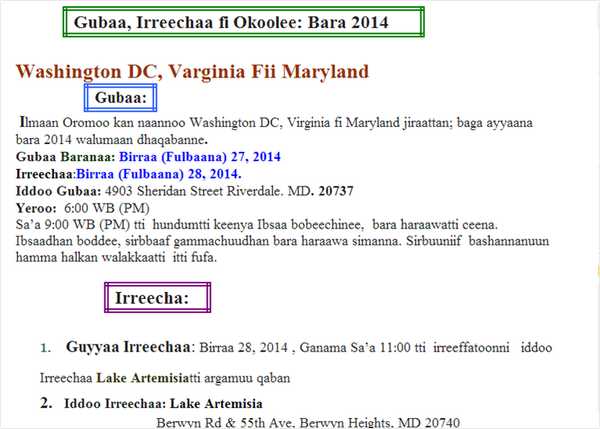
Ayyaanna Irreecha/ Oromo Thanksgiving in Calgary, Canada with Live Concert/ Sept./Fuul. 20, 2014

Qophii Ayyaana Irreecha – Minneapolis – Fulbaana/Sept. 27, 2014
Waaqa Nu Uume Galateeffachuun ni Irreeffanna!
Aadaa Keenya ni Dagaagsina!
Ayyaanni Irreecha Minnesota (Magaalawwan Lakku) keessatti Minneapolisi Hora ykn Lake Nokomositti kabajamuuf deemaa jira.
Ayyaanni irreecha kan bara 2014 Fulbaana 27 bara 2014 ganama sa’aa 10:00 irraa jalqabee kabajama. Oromoo fi Firoottan Oromoo hundumtuu akka ayyaana kanarratti argamtanii waliin Irreeffannu koreen qindeesituu ayyaana Irreecha kabajaa fi ulfina guddaan isin affereera.
Bakki isaa:
Hora (Lake Nokomis)
5001 Lake Nokomis Pkwy W.
Minneaplois, MN 55417
Info:
Tel:
– Awash Nagawoo: 612-227-0712
– Biqilaa Deettii: 612-701-9834
Qophii Ayyaana Irreecha – Oslo, Norway – Fulbaana 27, 2014
“… birraan barihee dukkana nurra arihee
Ballammi haami jennaan haamee dhufe kuno
lammii kee waami jennaan waamedhufe kuno …” Sirba Oromoo
Ayyaana Irreecha kan baranaa Fulbaana(September) 27 bara 2014biyyaa Norway, magaalaa Oslo, bakka hora Sognsvann jedhamutti waaree dura sa’ati 11:30 irraa eegalee kabajama. Ilmaan Oromoo kannen dhihoo fi fagoo jiraattan hundi jila dudhaa ganamaa kana irratti uffata aadaatiin of miidhagsitanii akka ayyaana kana irratti hirmaattan kabajaa guddaa wajjiin sin afeerra. Malkaa jilaa dhufuudhaaf, baabura lafa jalaa (Metro) laakkofsa3 (Sognsvann) gara kallattii lixaa deemu (westbound) yaabbadhaa; buufatni isaa kan maayyii Sognsvann suduudaan isin fida.
Erga qophiin Irreecha raawwatee booda qophii bashannanaa sa’aa 18:00 irraa eegalee qabna. Halkan guutuu waliin taphataa bulla.
Bakki qophiin bohaarsaa itti dhihaatu:
Simia-venner
Kristoffer Robins Vei 2 (Smedstua)
0978 Oslo
Bakka kana dhufuuf, magaala /Oslo S irraa baabura gara Lillestrøm deemuu qabattanii bakka Haugenstuastasjon jedhutti irraa bu’uun bakka Smedstua jedhu yoo iyyaafattani salphaatti achi geessu. Ykn Stovner Senter irraa bus 65 yoo qabattanii bakka Smedstua jedhutti irraa buutani, bakki qophichaa cinaadhuma sanatti argama.
Odeessii dabalataa yoo barbaaddan yookiin gaaffii yoo qabaattan bilbila harkaa laakkofsa
+47 951 88 081 / + 47 97964087 / irreechaa@gmail.com nuu qunnamaa.
Ana haadhufu!
Gadaan roobaa fi gabbina!
Koree Qindeessituu


Irreechi Faajjii Keenya

Irreech Mallattoo Tokkummaa fi Aadaa Oromooti!
Finfinne Tribune | Gadaa.com
Ayyaani Irreecha, guyyaa Oromoon malkaa ykn tulluutti bahee Waaqa isa uume, waan argateef kan galateeffatuu fi waan fuula dura hawwuu fi barbaadu itti kadhatudha. Irreechi ayyaana Oromoon ittiin beekamu, mallattoo Oromummaa fi Eenummaa isaa ibsu, calaqqee Aadaa fi Duudhaa keenya qofaa osoo hin ta’iin dhaalmayaa hambaa seenaa keenyaa ti. Kanuma mirkaneessuuf Oromoon biyya keenya Oromiyaa keessa jiraatu guyyaa ayyaana Irreecha waggaa waggaan bahaa fi dhihaa, kaabaa fi kibbaa walitti bahee osoo amantii, siyaasa fi kutaan walinqoodiin tokkummaan Ayyaana Irreecha kabajataa jira.
Ayyaani Irreecha Hora Arsadiitti qindoominaa fi hirmaannaa ummata bal’aan kabajamuu kan eegale bara 1997 irraa kaaseetu. Isa dura ummatuma naannoo sanaa fi keessattuu warra aadaa Waaqeffannaa hordofaniin ture. Bara 1997 keessa koreen tokko maqaa Guddinaa fi Dagaagina Aadaa Oromoo jedhuun WMT (Waldaa Maccaa-Tuulamaa) jalatti ijaaramtee Ayyaana Irreecha Bishooftuu kana ummata beeksisuu, barsiisuu fi qindoominaan guyyaa ayyaana kanaa bakka sanatti argamuun qalbii namaa harkisuu jalqabde. Ergasii waggaa waggaan achitti argamuun barumsaa fi dammaqiinsa kennameen sadarkaa har’a ummanni kumaa fi kitilaan herreegamu irratti argamee kabajaa jira. Kabajaa Irreecha Bishooftuu, kan Malkaa Arsadiitti kabajamu babal’achuun yeroo gara garaatti Oromiyaa bakka adda addaatti kabajamuun akka Ayyaana Biyyoolessa biyyaatti fudhatamaa jira.
Kana malees biyyoota alaa naannoo Oromoon heddumminaan qubatee jiruttis haala ho’aan kabajamuu erga eegalee bubbulee jira. Ayyaani Irreecha daran akka guddatuu fi babal’atu hawaasni Oromoo hubannoo gahaa qabaachuu qaba. Gaaffiilee Irreech Aadaa moo Amantiidha jedhuuf deebii argachuuf hayyoota aadaa afeeruun marii gochuu qaba. Hanga ammaatti kan beekamu Irreech Aadaa fi Duudhaa Oromoon waliin Waaqa kadhatu ykn galateeffatu ta’uun beekama. Kun ammoo amantii nama kamuu waan faallessu hin qabu.
Kanuma hubachuun Oromoon biyya keessaas ta’e biyya alaa jiraatan gamtaan bahuun Ayyaana Irreecha kabajuun aadaa fi eenymmaa isaa firaa fi alagaa akka beeksisu, akkasumas tokkummaa Oromoo haala kanaan akka mul’isu abdii qabna.
Ayyaani Irreecha bara 2014, Hora Arsadii Bishooftuutti kan kabajamu guyyaa 05.10.2014 yoo ta’u, biyyoota alaatti ammoo warri qophii xumuratanii fi sagantaa isaanii beeksisan kanneen armaan gadiiti.
• Hagaya/August 31,2014- Toronto, Canada
• Fuulbana/September 13, 2014 – Stockholm, Sweden
• Fuulbana/September 20, 2014 – Calgary, Canada
.Fuulbana/September 20, 2014- Adelaide, Australia
.Fuulbana/September 20, 2014- Cairo, Egypt
.Fuulbana/September 20, 2014- Frankfurt Am Main, Germany
.Fuulbana/September 25, 2014- Las Vegas, USA
. Fuulbana/September 27, 2014 – Leeds, UK
• Fuulbana/September 27, 2014 – Bergen, Norway
• Fuulbana/September 27, 2014 – Oslo, Norway
• Fuulbana/September 27, 2014 – Switzerland
• Fuulbana/September 27, 2014 – Minneapolis, Minnesota
• Fuulbana/September 27, 2014 – Washington, DC
• Fuulbana/September 27, 2014 –Los Angeles, California
• Fuulbana/September 27, 2014 – Finland
.Fuulbana/September 27, 2014- Sydeny, Australia
.Fuulbana/September 27, 2014-Edmonton, Canada
.Fuulbana/September 27, 2014- Denver, Colorado
• Fuulbana/September 27, 2014 – London, England
. Fuulbana/September 28, 2014- Seattle, Washington (NW US and British Columbia)
.Fuulbana/September 28, 2014- Kenya, Nairobi
.Fuulbana/September 28, 2014- Boston/ Cambridge, MA, USA
.Fuulbaana/September 28, 2004- Columbus, Ohio
• Onkoloolessa/October 4, 2014 – Amsterdam, Holland – Germany
.Onkoloolessa/October4, 2014- Helsinki, Finland
.Onkoloolessa/October4, 2014- Cairo, Egypt
.Onkoloolessa/October4, 2014- Perth, Australia
• Onkoloolessa/October 5, 2014 – Melbourne, Australia
.Onkoolessa/October 12, 2014-Wellington, New Zeland
http://gadaa.net/FinfinneTribune/2014/09/irreech-mallattoo-tokkummaa-fi-aadaa-oromooti/
Welcoming the New Season; Announcing the Season’s First Irreecha Celebration (Toronto, Canada – August 31, 2014)
According to the Oromo culture writer, Ob. Anga’a Dhugumaa, the preparation for the spring Oromo holiday of Irreecha/Gubaa, which celebrates the transition from the rainy season to the bright season by giving Thanks to Waaqa, begins in mid-August, and mid-August is only a couple of weeks away from today; the mid-August celebration is calledTaaboree or Muka Dhaabaa.
Here is a quote from Ob. Anga’a Dhugumaa article on Gubaa/Irreecha:
“In the middle of August, a tall olive tree (Ejersa – Olea Africana) is cut, and all its branches removed except at its top. It is then erected (horduu, dhaabuu) on ground as a pole. The species of this tree has to be olive. Olive trees (Ejersa) are considered as holy trees among the Oromo. Its smoke is very sweet. Erecting such a tree at the peak of the rainy season symbolizes a wish for the Earth to get firm. It is a peak time for the ground to get wet or saturated with rainwater, and is too weak to stand heavy rain. This day, which is called Taaboreeor Muka Dhaabaa, is observed by the youth only.
“The final gigantic celebration takes place exactly five weeks later from this day. The five weeks are refereed to as the ‘five-finger rules’. One finger is equivalent to one week.” (Read more here: http://goo.gl/kGdVBD)
With that, Toronto is once again ready to hold the first Irreecha celebration, which will be held in Whitby, Canada, on August 31, 2014.

Gubaa/Ibsaa
—————–
Ayyaana Gubaa jechuun dukkanaafi booruu gannaa oofkalanii gara ifa ykn booqaa birraatti ce’uuf sirna gaggeeffamuudha. Akkasumas, mallattoo Waaqa galateeffannaas ni jedhama. Sababni isaa, booruu gannaa, lolaafi bubbee hamaa, bakakkaa, galaanaafi kkf nagaan oofkalanii ifa birraatti waan bahaniif gammachuu ofii ibsachuun Waaqa galateeffatu. Firoonnis walitti dhufanii wal gaafachuu calqabu, “Baga booruu gannaa oofkaltee booqaa birraatti baate” waliin jechuu eegalu.
Ayyaanni Gubaa kun ummata Oromoo biratti kabajaafi jaalala guddaa qaba. Dubartootas ta’ee dhiironni dursanii qophii adda addaa taasisu. Dhiironni osoo guyyaan Gubaa hin ga’in mukeen akka Sukaayee, Sokorruu, Qamaxxee, Tamsaasa, maxaaxee, daalachoo, dhangaggoo fi kkf ciranii goggogsuun gaafa gubaan dhiyaate Xomboora hidhu. Kunis baay’ina dhiirotaatin qophaa’a.
Guyyaa gaafa Xomboora gubanii muka dhaabaa(‘Daamaraa’)f ta’u kanneen akka Abbayyii, Hindhee, Soolee, Ejersa, Ceekaa, Daalachoo, Urgeessaa fi kkf qopheessanii dhaabu. Guyyaa kana mukti jabaaf ta’u kan akka Laaftofii Diddiksaa fa’a ni qophaa’u.
Haala kanaan Ayyaanni Gubaa Oromoo walakeessa baatii Hagayyaa keessa gubama. Ibsaan Oromoo gaafa Hagayya 15 galgala yoo ta’u, Hagayya 16 daaraa guddaa jedhama.. Akka Oromoon dhugeefatutti guyyaa kana Waaqni sibiila lafatti gadi darbata jedhama. Guyyaa kana irraa kaasee lafti jabaachaa adeema, lagni ni hir’ata, firris wal gaafii eegala. Guyyaa gaafa ibsaa kana horiin haalan marga quufanii yeroon galfamu, fardeen yaabbii dhiqanii haalan kunuunsu. Galgala erga horiin hundi galanii booda namoonni mijirii(‘Abdaarii’) tokkotti ibsaa waliin guban marti isaanii walitti yaa’anii iddoo mijirii kanatti wal ga’u. Akkaataa angafaa quxusuu isaanitti Waaqa kadhachuun boolla muka dhaabaa dongoru. Yeroo dongoran kanas “Hamaa keenya dongori” jechaa Waaqa kadhachaa dongoru.
Kadhannaan isaanis:
Ibsaan kun ibsaa nagaa nuuf haa ta’u
Ibsaa quufafi gabbinaa haa ta’uu
Booruu gannaa nu oofkalchee
Booqaa birraas nu haa oofkalchu
Wal bira oolchee nu haa bulchu
……
Abbaa biyyaa biyyarra haa bulchu
Barri quufa; Gadaan gabbina
Gabbis Waaqi…jechuun kadhatanii muka dhaabaa dhaabu.
Mukoota dhaaban kanas hidda cimaan mudhii isaa naannessanii waliti hidhu.
Mukoota dhaabaa kana yommuu dhaaban maqaa muka dhaabanii sana waamun Safuu ykn cimina mukti kun qabuun Waaqa kadhatu. Fakeenyaf
Warri Abbayyii dhaaban, “ Abbayyii ati Abbaa nuuf ta’I” jedhu.
Warri Ejersa dhaaban, “ Waaqayyo ati akka Ejersa kanaatti nu cimsi “ jedhu.
Warri Hindhee ykn Soolee dhaabanis, “ Waaqayyo akka Soolee ykn Hindhee kanaatti nu soroorsi “ jechuun kadhachaa muka dhaabaa kana dhaabu.
Erga muka dhaabaa dhaaban booda muka dhaaban kanatti naanna’uun Sirba Gubaa ykn Hiyyoolee akka armaan gadii kanatti sirbu.
Hiyyoo koo daraari yaa abaaboo koo
Ganni bahee daraari yaa abaaboo koo
Birraan bari’e daraari yaa abaaboo koo
Kan qincee nyaatanii daraari yaa abaaboo koo
Kan fira gaafatanii daraari yaa abaaboo koo
Geese yeroon wal yaadanii daraari yaa abaaboo koo
Ibsaa gubnaa daraari yaa abaaboo koo
Har’I kudha shanii daraari yaa abaaboo koo
Qalloo dangashee too daraari yaa abaaboo koo
Osoon kiyya jedhuu daraari yaa abaaboo koo
Narraa fudhatanii daraari yaa abaaboo koo
Keelloon daraartee daraari yaa abaaboo koo
Randa gamaatti daraari yaa abaaboo koo
Qeerroon maraattee daraari yaa abaaboo koo
Warra durbaatti daraari yaa abaaboo koo.
…………………………………………………………….. jechuudhan sirbu.
Kana booda gara manaatti galanii sirna jabaa gaggeessu. Sirni kunis dhadhaa muuddachuun Waaqa kadhatanii Jabaa ibddatti kaa’u. haalli kadhannaa kunis:
Kunoo jabaa siif dhaabnnee ati nu jabeessi
Muudaan siif dhiiyaatee dhaltii okooleerra bulchi
Qotiyyoo harqoota keessa bulchi
Farad kooraa jala bulchi
Walii galtee nuuf kenni
Walitti nu jaaladhu
Bara bara quufaa gadhi.
Jabaa beelaa nurraa qabi
Jabaa deegaa nurraa qabi
………………………… jechuun kadhatu.
Sirni Jabaa akkuma xumurameen sirna Xomboora qabsiisutu itti fufa. Kan qabsiifatanis warra dhiiraa qofa. Haati warraa akka hangafaa quxusuutin abbaa warraa ishee irraa calqabdee Xomboora kanatti qabsiiftif. Yeroo qabsiifatan kanas “ kan baranaan nu geesse bara egereenis nu ga’I “ jechuun qabsiifatanii gara muka dhaabatti ykn bakka Mijirii dhaqanii muka dhaabaa kanatti Xomboora qabsiisu. Yeroo itti qabsiisan kanas gara bahaatti garagalanii “ Nyaataa moraa waraani “ jechuun itti kaa’u.
Sirni gubaa kun iddoo tokko tokkotti galgala muka dhaabanii bulchuun ganama obboroo gubu.
Kana booda dargaggootni mana manarra deemun hiyyoolee sirbu….
(Barruu Gadaa ,2013,:4-6), Sisay Sarbesa
Welcoming the New Season and the Culture of Darabaa Herding Among the Oromo in Daraa, Oromiyaa

Darabaa herding, as practiced in the Daraa district of the North Shawaa Zone in Oromiyaa, involves the migratory herding of cattle in the backwoods of River Mormor (the Blue Nile) valley during the rainy season, when the ground in the village areas becomes too muddy for herding. As the rainy season winds down, and the herders and the cattle return home, the community celebrates the coming of the new season by thankingWaaqaa (God) as part of the Irreecha festival. http://gadaa.net/FinfinneTribune/2014/08/welcoming-the-new-season-and-the-culture-of-darabaa-herding-migratory-herding-in-the-backwoods-among-the-oromo-in-daraa-oromiyaa/


IRREECHI GAHEERA.
IRREECHILLEE GAHEE NUTOO MAALFAAN QOPHOOFNEE?
MEE HARDHA IRREECHARRAAN WAA XIQQOO SINIIF QOODA WARRA KEENYAA
Irreechi ammaan tana irraa xiqqoo haasahuuf yaalus Irreecha BIRRAA (GALATAA) ti.
Irreechi birraa kan galatataati.mallattoo MALKAA SAAQAAti.
DHAHA/TIBBA EERA.
OROMOON BOORUU GANNAA, BACCEE FI BACAQII, RAAREE FI DHOOQQEE, MALKAA OBAA BOORAHEE FI LAGA GUDDAA FIRA ADDAAN KUTEE BOORUU GANNAA OROMOON LOON ISAA MALKAA HIN BUUSU HAMMA HAAYYOONNI FI AYYAANTUN DURA AANTEEN BOOQAA BIRRAA GAHUUSAA LABSANITTI.GAAFA DUR SAN IBSAA/GUBAA BARII OROMOON FARDASAA MIMMIIDHAGSEe DIINASAATTI DUULA.
GUBAAN OROMOO INNI HAGAYYAA DACHEE GURRAATTIIN RANDAA JAJJABAACHUUSHEE, BOORRUN CALALAA FI TALIILAA DEEMUU,YEROON BOKKAA HAMAA, KAKKAWWISAA FI BAKAKKAADHAA DARBUU…booqan birraammoo,waan waqtii ARFAASAA WAAQASAANII BIRA OLKAAHATAN YKN GAAFATAN SANATU FAROON TOLEET,MILKIIN KEESSA WAAN HULLUUQEF GALATAAF MALKAA DEEMA.MALKAA SAAQUU …
YEROO KANA BOODA NAMAA SA’AAN, WALKEESSA DEDDEEMUUNIS NI JALQABAMA.
Akka walii galaatti, IRREECHI OROMOO FI AFRIKAANOTAAF DHIMMA HAWAAS DIINAGDEETI. MALLATTOO ARAARAATI. MARGI JIIDHAN MALLATTOO KA’UMSA LUBBUU QABIYYEETTI HERREEGAMA.
Irreechi kennaadhas, Kennaa KAA—KENNAA WAAQAA. RUDA JALA URJIITU JIRA BIIFTUTU JIRA
DACHEERRAA FI JALASHEES WAAN LUBBUU QABUU FI HIN QABNETU JIRA.
IRREECHI AMMALLEE ARAARAA EKERAATII.GAAFA GALATEEFFATANIS MAQAA WARRA DARBEE FI JIRUUTINIS GALATA BAASA.
Oromoon heeran bula. Malkaafi horris heeran bulee bulfata. Heera kanatu waliin ceeccatee, raaroo ulfaafii aadaan walyaasee cuftinuu waliin miila dheerata miila gabaabbata. Malkaan hora. Dawoomas qaba. Akka bishaan kaanii miti jedhama. Horri yeroo kaanis ‘XABALA’.
Irreechi birraa, yeroo dhaloonni, hiddaafi hiddiin wal dheebote itti wal arguudha. Gaafa Oromoon garaan waliif fayyaa san Irreecchi ayyaana addaati qaba ture. Gammachuu fi galata addaati. Baras madaalliin uumamaas eeggamaa ture.
Oromoon dhugaarratti yakka waan heeran eeggatuuf gaafas rakkinas hin qabu. Hin rakkatus.
Yoo waa jallate garuu taa’et qorata.Seerri uumamaa akka hin goolamne godha.Maalif jennaan Namnis uumami biraas ni goolama waan taheef tiksuun heera diroo diroodhaa eeguufi tiksuudha. Ofis rakkinaa fi gadadoorraa of tiksuu isaati.
Gaafa Irreechaa, meeshaalee fi ulfaa nagaa ,hormaataa, ayyaantummaa fi ulfoo dhiiraa dhalaa, gadaa, qadaaddoo, yuubaa-ruufaa, ayyaantuufaatu baha.Wanti qara qabaa,wanti waraanaa lallabaa bakka san hin gahu, guyyaan kuni guyyaa gammachuu, guyyaa galataa, guyyaa dhiichisaa, guyyaa ragadaa, guyyaa geelloo fi guyyaa faaruuti, guyyaa jaalalaa fi kaadhimmannaati, gaafa Oromoon Oromoon oromummaan guutuu san.
MALKAA IMMOO DUBARTIITU SAAQA. Haawwoliin keenyammoo kunoo akkas jechaa deemu:-
Hahoo yaa mareehoo
Hahoo yaa maree hoo
Maree hoo maree hoo
Ayyaana waggaa maree sitti marmaaree yaa mareehoo
Irreecha irree koo yaa maree sitti marmaaree hoo
Yaa waaqaa malkaa nuuf tolee yaa ayyolee koo
Yaa abbaa tulluu nutti toli yaa tolee koo
HAHOO YAA MAREE HOO?
MAREE HOO,MAREE HOO
YAA wAAQAA HUNDAAN OLII
YA WAAQA ABBAA HARDHAA BORII
NUUF ROOBIMEE SORII
……………………………………
HAHOO YAA MAREE HOO
MAREE HOO…MAREE HOO
Maree haadha deechuu
Maree haadha teechuu
Maree haadha saawwaa
Maree haadha fayyaa,yaa maree hoo
Wagga waggaan sitti deemna,yaa mareehoo
Kunoo dhufnee jiidhanoo sitti marmaarree hoo
……………………………………………….
HAHOO YAA MAREE HOO
Maree haadhaa loonii
Maree haadha waatii
Maree haadha maatii
Maree haadha gootaa
Maree haadha duulaa
Maree haadha fuulaa
Hahoo yaa maree hoo.
Mmaree hoo,maree hoo
Yaa malkaa tolii sitti marmmaarree
Ilmaa abbaan sitti marmaarree hoo
Kallachaa caaccuun sitti marmaamme hoo
Bukkuu dhuqqusaan sitti marmaarree hoo
Hoohoo…ohohoo!
Hahoo yaa maree hoo
Yaa abba kolbaa
Yaa abba kormaa
Yaa abba malkaa
Siiqqeef qadaaddoon sitti marmaarree hoo yaa ayyeelee hoo
Ulfaafi uumeen sitti marmaarree hoo
Birmaduu-dabballeen sitti marmaarre hoo
Bulaaf buulettiin sitti marmaarree hoo
Kooyaa birraa birraan barihe farda biti yaa gootaa…
Qeerroon fiigichaan dhiichisaa
Namoonni gurguddoon abbootii gadaafi warra ulfaa dabaltee dubartoota dabaalanii,
dhibaayyuu, coqorsa, muka ejersaa, dhallaaduufi muka jiidhaa akka ulmaayiifi abbayiis tahu qabatanii (garuu coqorsi irraa hafuu hin qabu yoollee dhibe saardoo) isaaniitiin gara Malkaatti dhiyaatan.
Irreecha coqorsa jiidhaa, ittacha, ulmaayii, allaaduufi kanneen biro baala muka qulqulluufi gaaroma qabuu qabatanii ulfoo uuman EEBBIFATANII DUBARTIIN MALKAA SAAQXI JECHUUDHA.
Faaruun jedhamaa deemus yeroo baay’ee Gabbisayyoo dha.
Mee gabbisayyoo naannoo Tuullamaa kana haa ilaallu:-
Gabbisayyoon kan faarfamuu yeroo irreechaaf gara malkaas tahee horaa ykn gara tulluutti deeman kadhaa Waaqayyoo bifa sagalee kilooleesanaan faarsaatii deemsa miilaa waliin riitimiin uumamaa qindaayet faarfama.
Gabbisayyoo jenna jedha tokko. Jalaa fuudhaniit sin gabbisaa gabbis jedhuun Akkasitti akka armaan gadii kanatti faarfama ykn gabbifama jechuudha.
Gabbisayyoo, lafa gabbisaa gadaan
Yaa waaq sorii nutti roobi
Oromoon korma qalee
Kormi isaa biyya falee
Yaa waaq sorii nutti roobii
Dhagaan daakuu akka daakuu
Gadaa aabboo kan akaakuu
Yaa waaq sorii nutti roobi
Dhagaa daakuun mirrigaa dhaa
Gadaa ooluun mirrigaadhaa
Yaa waaq sorii nutti roobii
Odaan nabee laga looyee
Waaq aabboo sitti booyee
Yaa Waaq sorii nutti roobi
Odaa Nabee gaaddisa koo
Gadaa aabboo yaa tuma koo
Yaa waaq sorii nutti roobi
Kallachaa caachuu yaa ulfaa koo
Gadaan dhugaa yaa dhugaa koo
Yaa Waaq sorii nutti roobii….. Jechaatii gara Malkaatti deemu.
MALKAA ERGA GAHANIIS, DURA HAAWWOLIIN, HAATI CAACCUU, HAATI SIIQQEE. HANGAFTITTIIN YKN HAATI MALKAA BISHAAN ADDAAN SAAQXI MARGA YKN COQORSAA FI WAAN JIIDHAA HARKAAN QABDUUN JECHUUDHA.
EEBBI HANGAFAA QUXISUUDHAAN EEBBIFAMA.
AMMAAF HAMMI KUNI ANAAF NI GAHA.
WARRI HUBANNOO NA CAALAA QABDAN BEEKUMSA KEESSAN NUUF QOODAA!!
NAGAA WALIIN!
Caalaa Haa Hiluu @FB
SEENAA Y.G(2005): Irreechi Mallattoo Tokkummaa Keenyaati!
Fulbaana/September 1, 2014 · Finfinne Tribune | Gadaa.com |
SEENAA Y.G(2005)*
Addunyaan keessa jiraannu kun, irra jireessa Seenaa Abbooti Biyyaa Saamanii kan kooti jechuun waan nu dursaniif malee, Itoophiyaanis taatu Addunyaan biraa akka nu duuba jiran ragaalee hedduu tarrisuu dandeenya. Har’a Gabrummaa jala waan jirruuf, haqa kana fudhachiisuun ni ulfaata ta’a. Gaafa jabaannee humna taanee garuu addunyaan waan har’a aguugdee irra teesse kana ifa baasuun waan hin hafne. Gadaa nuuti waraqaa fi Maanguddoota keenya irraa dhaga’uun ala hojiin hin mul’ifne ykn, Beektoonni keenyas baratanii ittiin eebbifamuu malee, hanga har’atti Gadaan akkamiin hojii irra akka ooluu danda’u qorannoo gaggeessanii dhalootaaf dhiheessuu dadhaban kun, Dimokiraasii Ameerikaa har’aaf ka’umsa ta’uu isaa, Gola-hambaa yk Muziyeemiin Ameerikaa keessaa adda addaa, waan Oromoo addatti Booranaa keessaa guurame hedduu akka qaban, warri carraa argatanii ijaan argan ni dubbatu.
Biyyi yk Ummati Walabummaaf of qopheessu tokko, ega Walaboomee booda miti waan Biyya isaa keessatti ijaarrachuuf deemu yk barbaadu qorachuu kan eegalu. Walabummaa booda isa har’a Gabrummaa jalaa ba’uuf tattaaffannu caalaa hojiilee jajjabduutu nu eeggata. Walbummaa keenya kana mirkaneessuuf waan itti qophoofnu hedduutu jira. Humnaanu Biyya keenya dhuunfannu, Qabsoon Wlabummaa keenya addunyaa fudhachiisuuf nu eeggatu lakkoofsa hin qabu. Ragaalee walitti qabachuun, waan addunyaa irratti ittiin falamannu qopheeffachuun, waan gaafataman sirreeffachuun kkf, har’a kan nutti hin mul’annee, dhiheenya keenyatti argannu, yeroo yeroon isaa ga’u of biraa dhabnu hedduutu jira. Addatti beektoonni keenya Dirree siyaasaa irratti wal qabuu irra, hojiilee suduudaan isaan ilaallatan ammumaa gurmaa’aanii fixachuu, ragaalee guurrachuu, hojiilee Dippilomaasii gaggeessuu, waan Ummati kun dur qaba jedhamu kana hundaa walitti fidanii, waan fooyyaa’uu qabu fooyyeessanii, Baraa fi Dhaloota kana waliin akka deemutti qopheessuun Abshaalummaadha. Mata duree kana irratti bal’inaan waan itti qophaa’een qabaa yeroo biraa itti deebi’a. Qoodi hojii odoo jiraatee Mooraa qabsoo illee tasgabbeessuu danda’a jedhee waan yaaduuf.
Ummati Oromoo Gabrummaan dura akkuma Gadaan hundee Tokkummaa isaa ta’ee beekamutti “AYYAANNI IRREECHAA”s mallattoo Tokkummaa Ummatichaa akka ta’ee, kanneen seenaa Ummata kanaa akka gaaritti beekan addunyaa irratti katabanii ragaa ba’aniiru. Mootootii Biyya isaaniif fakkeenyummaa keenya kaasanii gorsaa turuu, Gola hambaa Biyyootaa fi Yunivarstiilee addunyaa irraa bebbeekamootu of keessatti dhokfatee, bara jabaannee nu dubbachuuf eegaa jiru. Amantiileen Addunyaa dhunfatanii jiran kanneen dachee Oromotti osoo hin dhufiin Waaqeffannaan akka turee fi Amantiin Addunyaa kana irra jiru hundi Oromiyaa ega seenee illee, Ummati Oromoo, IRREECHA akka Mallattoo tokkummaa isaatti fudhatee hanga har’aatti waliin Guyyaa Galataa kana kabajachaa jiraachuu ragaa kan ba’an lakkoofsa hin qaban.
Irreechi Guyyaa Waaqa itti Galateeffatan. Guyyaan kun Warra Irreecha dhabamsiisuuf waggoota dheeraaf ifaajjan biratti hin beekamu. Oromoon isaan waliin jiraatu GUYYAA GALATAA jedhee yennaa kabajatu, warra mukattii sagaduu jedhanii isa balaaleffatu. Balaaleffachuu irra dabree hidhaa fi ajjeesaa turan. Addunyaan Oromoo booda dhiheenya kanaa kaaftee Guyyaa Galataa jettee yennaa xibaartu ammoo, amma danda’an lallabaniifii ibsafaa itti kennuu barbaadu. Waan maraafuu kan beekaa rafe … isa jedhan waan ta’eef qalbii isaaniif haa laatu jechuun ala waan jennuun hin qabnu. Fakkeenyaaf Guyyaa jaalalaa kan jedhan addunyaan akka haaraatti faarsiti. Nuuti garuu maqaa adda addaa Godinaalee keenya keessatti haa qabaatu malee Baatiin Birraa Oromoo biratti waan addunyaan akka haaraatti faarsitu kanaan beekama. Addunyaan biqiltuu itti dhaabanii fi naannoo kunuunsan jettee Doolaara Biliyoonaan ittin saaman, Oromoon garuu muka muruuf seera mataa isaa umama isaa kaasee qaba. Addunyaan har’a Guyyaa hundaa, guyyaa fayyaa, guyyaa maanguddoo, guyyaa dubartii, guyyaa daa’immanii kkf jettee reefuu ramadaa jirti. Biyyoota hedduutti ega eegalamees Umuriin dargaggeessa tokko hin caalu. Oromoo biratti garuu Guyyaan 30 maqaa mataa isaa fi hiikkaa mataa isaa qaba. Waa hedduu kaasuu dandeenya. Nuumatu dhimma keenya dhimma addunyaa gochuuf hin tattaafannu malee, ykn Seenummaa isaatti qofaa daangeessinee teenye gaabbiin dhumna malee, waan irratti hojjatamu qabu lakkoofsa hin qabu jechuufan kaasee.
Irreecha waggoota 20 asitti kabajamaa jiru ilaalchisee beektoonni Biyya alaas ta’ee, Ummati keenya yaada nama jajjabeessu heddu kennee jira. Irreechi Guyyaa Galataa irra dabree hiikkaa ykn Kaayyoo jajjabaa kan biraas ni qabaata. Waaqayyoo guyyaa kanaaf isa ga’ee ni galateeffatan. Hegareef illee akka karaa qajeelchuuf dhaammatan. Mallattoo Tokkummaa saba kanaa ta’uu isaa fi Tokkummaa saba kanaa jabeessuuf qooda ofii akka gumaachan kakuu haarofatan, garaa qulqulluu wal eebbisan, hammeenya wal irratti hojjatan waliif dhiisan, garaatti hammeenyaa fi quuqqaa qabaachaa wal hin eebbisan, Malkaa nu’uun dura waan kana fixatan, Gadaa fi Miraga Abbaa Biyyummaa Oromoof kabachiisuuf waadaa seenan, waaqinillee akka gargaaruuf kadhatan, Maanguddoof Umurii, Ga’eessaaf qalbii, Dargaggeessaaf Gootummaa, Ijoolleef guddachuu itti hawwanii eebbisan. Ebbi kun garaa qulqullun yoo ta’ee qabachuu dubbatan. Kun Iccitti muraasa Guyyaa Glataa kana keessa jiru Bara gugguffannaa kana keessa hin guuttatan. Irrumaa barachaa dhaloota Guutuu ta’uu uummachuuf hojjatan.
Irreechi kan Oromooti. Dhimma Oromooti. Dhimma nama dhuunfaa miti. Dhimma beektootaa ykn Namoota siyaasaa ykn dhaabbilee siyaasaa qofaa miti. Waldaalee adda addaa qofaas miti. Qaamoon kanneen, Irreecha kana bakkatti deebisuuf, ykn addunyaatti beeksiisuuf hojjachuu danda’u. Yennaa hojjatanis, kan Oromoo ta’uutti labsanii Ummaticha illee ittiin beeksisan. Kanaaf, Irreecha Mallattoo Tokkummaa keenyaa ta’uu mirkaneessuuf gama hundaa walitti dhufanii fi wal Afeeranii kabajuun, Dimokiraasiin nuuf Aadaa malee kan addunyaan jettu kana akka hin taane mirkaneeffannee, Addunyaatti of beeksiisuun ni dada’ama jedheen amana. Fincila diddaa Gabrummaa Biyya keessaa 2014 ilaachisee Abbootiin Amatii adda addaaHIRIIRA DEEGGARSAA fi gocha wayyaanee balaaleffachuu irratti Biyyoota alaatti argamanii akkuma qooda isaanii gumaachan, IRREECHA BARANAA irratti hirmaatanii Tokkummaa Ummata kanaaf lallaba dhageesisuun nu jabeessa malee nu hin laaffisu. Gama Siyaasaan kan jirrus, waan tokkummaa keenya mamii keessa hin galchine irratti waliin dhaabbachuun akka waliif naatoo qabaannu nu taasisee hegaree keenya waliin qajeelchuuf nu gargaaruun ala badii tokkollee hin qabaatu. Guyyaa waaqa itti galateeffatan qofaa waan ta’eef.
Dubbiin heddummaateef maalitti hin fe’anii jedhama. Lammiileen keenya addatti Dargaggoonni Bara 2014 kana Fincila Diddaa Gabrummaa irratti wareegaman irra jireessi isaanii Aadaa fi Seenaa Oromoof kabajaa guddaa kan qaban, IRREECHA OROMIYAA keessatti babal’isanii Tokkummaa Ummatichaa akka sibiilaa jabeessuuf kan hojjataa turan heddummiinaan keessatti argaman. Kaayyoo isaanii kana Galmaan ga’uuf waadaa keenya illee kan itti haaromsinu haa ta’u. Waan ofii keenyaa addunyaatti nu beeksisuu danda’an katabuu fi barachuu, akkasumas ittiin eebbifamuu qofaa odoo hin taanee, hojii irra oolchuuf irratti haa hojjannu. Kana hojjachuuf ilaalchi siyaasaa kkf nu daangeessu jedhee hin amanu. Seenaa, Aadaa, fi duudhaa Oromoo keessa jiru katabuu fi argaa dhageettin dhaloota lama dabarsinee jirra. Walii dabarsuu kana keessa waan itti dabalamuu fi hir’atu hedduun jiraachuu ni mala. Kanaaf akkaataa dhalooti itti aanu illee ittin jiraatu irratti haa hojjannu. Addunyaa irratti saba Seenaan isaa qofti dubbatamu taanee hafnaa? IRREECHII 2014 KAN MILKII NUUF HAA TA’U! KAN DABE ITTI QAJEELEE, OFITTUMMAAN ITTI DHABAMEE, FEDHIIN ILMAAN OROMOO ITTI QAJEELU HAA TA’U. GADAAN QUUFAA FI GABBINA.
GALATOOMAA!
HORAA BULAA!
* SEENAA Y.G (2005): Burqaa430@gmail.com
http://gadaa.net/FinfinneTribune/2014/09/seenaa-y-g2005-irreechi-mallattoo-tokkummaa-keenyaati/

Kitaaba Raayyaa Horoo
Bara 6500 A. L . W /2008 ALA
Aadde Tsehay Tolessa, the Widow of Rev. Gudina Tumsa, May Her Soul Rest in Peace. Aayyoo Sabboontuu Aadde Tsahay Tolasaa Biyyoon Itti Hasalphatu October 15, 2014
Posted by OromianEconomist in Aadde Faaxumaa Galmoo, Aadde Tsehay Tolasaa, Artist Almaz Tafarraa, Oromo Nation, Oromummaa, Uncategorized.Tags: Aadde Tsehay Tolasaa, Oromo people
add a comment


Tsehay Tolessa, 84, the widow of Rev. Gudina Tumsa, passed away on October 12, 2014. Aadde Tsehay was a person of faith, courage and great perseverance. The government of Ethiopia, during the 1980s, never tolerated Oromo people’s aspiration for freedom and justice, but forced them to submit to harsh treatment. They grabbed Tolessa and forced her hands under her knees and tied them there, right after her husband, whom she married to in 1951, was abducted on July 28, 1979 and subsequently got killed. They filled her mouth with dirty rags and they beat her breaking bones and causing the skin to peel off. Then they threw her in a cell with 60 other people. There was standing room only and she remembered that she could only feel broken bones and blood as she had to stand. There was only one toilet but since nobody could move in the cell they could not use the facilities properly. No doubt disease was rampant and they were already under an immense famine. There was no light that came in this cell. She could not even hold a cup to drink water as others had to help her.
She stayed in that cell A FULL YEAR!!!! With her broken bones, rotting flesh and dilapidating condition she stayed in that mess of a cell for a whole year! When they let her out of the cell they put her in another jail for 10 years!! She was morally strong, even though she lost a husband, Rev. Gudina Tumsa, and brother-in-law, Baaroo Tumsa, to the Oromo cause.
Aadde Tsehay was a tower of her family, a shining light of courage to her people and a woman of deep faith in God. She survived by four children (Kulani, Lensa, Aster and Boruu) and many more grand children. May God bless her!! Rest in peace!!
Du’aan Boqotuu Aadde Tsehay Tolasaa Ilaalchisee Ibsa Gaddaa ABO irraa kenname.

Harka guddeessa Sabboontota Oromoo addatti ammoo dhalattoota Oromoo Qabsoo Bilisummaa Oromootti dhihoo jiraniin bal’inaan kan beekaman Aadde Teshay Tolasaa hoospitaala Land Mark jedhamutti waldhaanamaa osoo jiranii Onkoloolessa 12, 2014 Oromiyaa/ Finfinneetti addunyaa kana irraa du’aan boqatanii jiran.
Sabboontuu, hiyyeessa gargaaruu fi jajjabeessuun kan beekaman Aadde Tsehay Tolasaa Abbaa warraa isaanii Lubi Guddinaa Tumsaa badiin alatti murtii faashistummaan kan ajjeese mootummaan Dargii, ajjeechaa Abbaa warraa isaanii irratti raawwateen quufuu dhabuu irraa isaaniinis waggoota 10ni oliif mana hidhaa keessatti dararaa turuu seenaan Adde Tsehay ni hubachiisa.
Sabboontuu fi haadha hiyyeessaa kan tahan Aadde Tsehaay Tolasaa mana hidhaa Dargii keessatti miidhaan ol aanaan irra gahullee midhaa irra gaheef osoo harka hin laatne, akka mana hidhaatii bahaniin dhalattoota biyyaa isaaniin olitti rakkoo adda addaan qabamanii jiran gargaaruuf murteeffatanii waggoota 20 ol dabraniif dalagaa namoomaa boonsaa hojjataa turan. Garaa laaftuu fi ummata rakkateef kan naasuu qaban Aadde Tsehay, waggoota kanneen keessatti harka qalleeyyii hedduu nyaachisuu, daara baasuu fi waldhaansisuun hojii boonsaa bara baraan ittiin yaadataman hojjatanii dabran.
Haadha Ijoollee Afurii kan tahan Aadde Tsehay Tolasaa waggaa 84-tti Onkoloolessa 12, 2014 du’aan boqatan.
Qabsoo Bilismmaa ummata Oromoo keessatti qoodni isaanii guddaa dha. Senaan hidhaa waggaa 10 olii kana mirkaneessa.
Addi Bilisummaa Oromoo du’aan boqotuu Aadde Tsehay Tolasaatti gadda cimaa itti dhagahame ibsaa maatii, firoottanii fi sabboontota Oromoo maraaf jajjabina hawwa.
Injifannoo Ummata Oromoof!
Adda Bilisummaa Oromoo
Onkoloolessa 14, 2014
Sirna Owaalcha Adde Tsehay Tolasaa
Onkoloolessa 15 Bara 2014
Funeral service of Aadde Tseay Tolesa, the widow of Rev. Gudina Tumsa
15th October 2015


Self-Rule: How Decentralized Power, Not Democracy, Will Shape the 21st Century. #Oromia September 30, 2014
Posted by OromianEconomist in Development & Change, Ethiopia's Colonizing Structure and the Development Problems of People of Oromia, Afar, Ogaden, Sidama, Southern Ethiopia and the Omo Valley, National Self- Determination, Oromians Protests, Oromiyaa, Oromo, Oromummaa, Self determination, The Colonizing Structure & The Development Problems of Oromia.Tags: African Studies, Economic and Social Freedom, Human Rights and Liberties, Oromia, Oromiyaa, Oromo, Self determination
add a comment

There is nothing more powerful than an idea whose time has come. People can no longer be cheated (for long) out of their legitimate aspirations for self-rule.
With all the world’s terrain claimed, one’s gain (of independence) must equal another’s loss (of territorial integrity). Borders can therefore either change violently, or can be softened through devolution.
The map of the world is in perpetual flux, with territories splintering and combining in various configurations. North and South Yemen merged in 1990; Czechoslovakia divorced in 1993. South Sudan seceded in 2011; now there’s talk of North and South Korea reunifying along the model of East and West Germany. The fundamental search for more coherent political entities can bring turbulence, but not always violence.
The Scottish precedent is a harbinger of neither global chaos nor the end of multi-national harmony. In fact, devolution’s dialectical opposite is aggregation. The world may splinter, but it also comes together in new combinations such as the European Union, which ultimately absorbs all the continent’s micro-states into a truly multinational federation. Witness the Balkans, where two decades on from the bloody wars of Yugoslavia’s dissolution, all its former republics have become or are candidates for EU membership. If the world wants to see global solidarity of nations, the tribes may need to win first.
How Decentralized Power, Not Democracy, Will Shape the 21st Century
By Parag Khanna @ The Atlantic, 26 September 2014
Last week, the world’s most globe-spanning empire until the mid-20th century let its fate be decided by 3.6 million voters in Scotland. While Great Britain narrowly salvaged its nominal unity, the episode offered an important reminder: The 21st century’s strongest political force is not democracy but devolution.
Before the vote was cast, British Prime Minister David Cameron and his team were so worried by voter sentiment swinging toward Scottish independence that they promised a raft of additional powers to Edinburgh (and Wales and Northern Ireland) such as the right to set its own tax rates—granting even more concessions than Scotland’s own parliament had demanded. Scotland won before it lost. Furthermore, what it won it will never give back, and what it lost it can try to win again later. England, meanwhile, feels ever more like the center of a Devolved Kingdom rather than a united one.
Devolution—meaning the decentralization of power—is the geopolitical equivalent of the second law of thermodynamics: inexorable, universal entropy. Today’s nationalism and tribalism across Europe, Africa, and the Middle East represent the continued push for either greater autonomy within states or total independence from what some view as legacy colonial structures. Whether these movements are for devolution, federalism, or secession, they all to varying degrees advocate the same thing: greater self-rule.
In addition to the traditional forces of anti-colonialism and ethnic grievance, the newer realities of weak and over-populated states, struggles to control natural resources, accelerated economic competition, and even the rise of big data and climate change all point to more devolution in the future rather than less. Surprisingly, this could be a good thing, both for America and the world.
* * *
Woodrow Wilson brought his fierce anti-colonialism to the Paris Peace Conference after World War I, insisting on national self-determination as one of his famous “Fourteen Points.” But stubborn Western Europeans held on to their imperial possessions until World War II bankrupted them. The dismantling of the British and French empires over the course of the 20th century gave birth to more than 75 new countries within four decades. Decolonization was followed by the collapse of the Soviet Union, which created 15 independent states. All told, the jackhammer of devolution has more than tripled the number of countries around the world, from the 51 original member states of the United Nations to its 193 members today.
Strangely, international law as enshrined in the UN Charter appears to work against these trends, strongly privileging state borders as they are as if to freeze the world map in time. But to paraphrase Victor Hugo, there is nothing more powerful than an idea whose time has come. People can no longer be cheated (for long) out of their legitimate aspirations for self-rule.
Devolution helps to sensibly reorganize large and unwieldy post-colonial states. Take the example of India, where more than 60 years of independence have brought little development to peripheral and rural states in the east and northeast of the country. Rather than fostering economic growth outside the capital, New Delhi’s priority instead has been imposing either the Hindi (Mahatma Gandhi’s preference) or English languages across the country. But such malign neglect has only stoked devolutionary pressures. Since 1947, the number of states in the Indian federation has doubled, with the 29th (Telangana) created earlier this year. As state boundaries better conform to ethnic and linguistic boundaries, provincial units can focus more on their internal growth, rather than on having to defend themselves against the center. Notice how the second-largest contributor to Indian GDP besides Mumbai’s Maharashtra state is Tamil Nadu, the state that is geographically farthest from notoriously corrupt New Delhi.
Another accelerant of devolution is ubiquitous data. Much as modern nation-states seem to have lost their monopoly on armed forces, so too has evaporated their dominance of information flows and narratives. Call it the triumph of transparency: Whether through free media, leaks, hacks, democracy, or legal pressure, people increasingly know how their countries are run—and crucially how their money is spent. This March, participants in a nonbinding online referendum in Venice overwhelmingly supported an unofficial “declaration of independence” from Italy. The reason? Venice pays 70 billion euros in taxes per year, but receives only a fraction back in fiscal transfers, meaning support from the capital.
Catalonia, with its unique language and centuries of cultural traditions, made similar calculations with respect to Madrid and is set to vote on independence in November. Spain and Italy’s constitutions forbid secession, but to avoid severe internal unrest beyond that which has already beset them since the financial crisis, both governments will likely grant more autonomy to these important provinces. Ultimately, these upstart—or start-up—regions want the “devo-max” deal the Basques of northern Spain have: complete fiscal autonomy with no taxes paid to the capital.
Even global warming can drive devolution: As Greenland’s ice sheet melts, its 60,000 Inuit have greater access to abundant and valuable reserves of resources such as uranium and natural gas. This creates an incentive for Greenlanders to hoard the potential windfall rather than send it to Copenhagen, which has retained some governing authority over the island since Denmark seized and colonized Greenland nearly three centuries ago. The 2021 date proposed for a Greenland independence vote provides an eerie parallel to Scotland’s referendum, which took place roughly 300 years after that country joined the United Kingdom. Unlike Scotland, however, Greenland’s vote for independence wouldn’t even be close. Make way for another seat at the UN.
* * *
Shrill warnings against devolution ignore the evidence that it is also a logical consequence of connectivity. In the days before Scotland’s independence referendum, Gordon Brown, the Scotland-born former British prime minister, made a passionate appeal to his countrymen to choose unity over independence. Scotland’s “quarrel should be with globalization, rather than England,” he said. But on whose terms should that tug-of-war for jobs be waged? Smaller states and smaller economies have less of a margin for error when it comes to their own survival. Would Scotland have outsourced its manufacturing base to Asia in the way that far-off London capitalists so enthusiastically did? Would Scotland, as politicians in London warned, really have been unable to establish its own currency within 18 months? As even the anti-independence Economist noted, 28 new central banks have been created in the past 25 years; Estonia set up its own central bank and currency in a week. A connected world—the result of Brown’s bogeyman of ‘globalization’—has turned such bureaucratic hurdles into commoditized tasks.
The more cities and provinces attain quality infrastructure—courtesy of investment from their own governments and foreigners—the more they can leverage these new capacities. In America, fiscal federalism is a crucial driver of economic dynamism. For example, Texas has made itself the most business-friendly state in the country by minimizing regulations and keeping taxes low; it now boastsan $8.8 billion surplus. California also experiments at the state level with immigration and greenhouse-gas emissions reduction policies that are best suited to its own needs and goals. Oil-rich British Columbia and gas-and-mineral-rich Western Australia have their own resource wealth funds that have propelled infrastructure investment and growth in cities such as Vancouver and Perth first, before a share of the profits is sent to the distant capitals Ottawa and Canberra.
In Europe, devolution has become a healthy form of competitive arbitrage—a perpetual negotiation to get maximum freedoms from under-performing national governments so that over-performing provinces can get on with their own priorities. An independence movement is brewing in Sardinia, for instance, that would see the already autonomous Italian island sell itself to landlocked (and far better governed) Switzerland as a maritime canton.
Can all devolution be handled so peacefully? With all the world’s terrain claimed, one’s gain (of independence) must equal another’s loss (of territorial integrity). Borders can therefore either change violently, or can be softened through devolution. Devolution is why the Basques and Quebecois are at peace today. To attempt to stem the pro-Russian rebel tide in Ukraine, the parliament in Kiev last week granted self-rule to the eastern provinces of Donetsk and Luhansk as a gesture to keep them within the Ukrainian orbit. Devolution today is thus not just a force of tribalism but a tool of peacemaking.
This kind of thinking will be necessary for remapping the Middle East as the century-old Sykes-Picot map of the region crumbles. The near-total dissolution of the Arab political cartography embodies the most severe entropy, fragmentation, and disorder. Today only the oil-rich micro-states of the Persian Gulf such as Qatar and the UAE have purchased long-term security. But we do not yet know what will replace the current Syria and Iraq—to say nothing of the Islamic State’s plans for Jordan, Lebanon, and beyond.
Yet if one rule of counterinsurgency is to find, protect, and build stable enclaves, that is also a bottom-up approach to replacing Arab colonial cartography with a more legitimate order based on smaller and more coherent islands of stability. Rather than artificial nations, the future Middle East order will likely consist of robust tribal states like Israel and Kurdistan, and urban commercial centers with mixed populations that will protect themselves and their trade routes.
Perhaps a world of smaller states would bring globalization more into balance, with each state maintaining the necessary production and jobs essential for social stability, even if not optimizing global comparative advantage. A world of smaller states might also be a more peaceful one as well, with none able to survive without importing food and goods from others. Such a world would embody the principle of anti-fragility that the author Nassim Taleb advocates: too small to fail.
The map of the world is in perpetual flux, with territories splintering and combining in various configurations. North and South Yemen merged in 1990; Czechoslovakia divorced in 1993. South Sudan seceded in 2011; now there’s talk of North and South Korea reunifying along the model of East and West Germany. The fundamental search for more coherent political entities can bring turbulence, but not always violence.
Thus, the Scottish precedent is a harbinger of neither global chaos nor the end of multi-national harmony. In fact, devolution’s dialectical opposite is aggregation. The world may splinter, but it also comes together in new combinations such as the European Union, which ultimately absorbs all the continent’s micro-states into a truly multinational federation. Witness the Balkans, where two decades on from the bloody wars of Yugoslavia’s dissolution, all its former republics have become or are candidates for EU membership. If the world wants to see global solidarity of nations, the tribes may need to win first. Read @http://www.defenseone.com/threats/2014/09/how-decentralized-power-not-democracy-will-shape-21st-century/95255/
THEORIZING WAAQEFFANNAA: OROMIA’S INDIGENOUS AFRICAN RELIGION AND ITS CAPACITY AND POTENTIAL IN PEACEMAKING September 21, 2014
Posted by OromianEconomist in Africa, African Literature, Ancient African Direct Democracy, Ancient Egyptian, Ancient Rock paintings in Oromia, Ateetee, Ateetee (Siiqqee Institution), Black History, Chiekh Anta Diop, Culture, Cushtic, Humanity and Social Civilization, Irreecha, Irreecha (Irreesa) 2014, Irreecha (Irreessa) 2014, Irreecha Birraa, Kemetic Ancient African Culture, Meroetic Oromo, Oromia, Oromiyaa, Oromo, Oromo Culture, Oromo Identity, Oromo Nation, Oromo Social System, Oromo Wisdom, Oromummaa, Qaallu Institution, The Goddess of Fecundity, Waaqeffanna (Oromo ancient African Faith System).Tags: Africa, African culture, African Studies, Ateetee, Gadaa System, Irreecha, Oromia, Oromiyaa, Oromo, Oromo culture, Oromo people, Oromummaa, Qaalluu, Waaqqeffannaa: Oromo ancient Africa's faith System
add a comment
THEORIZING WAAQEFFANNAA: OROMIA’S INDIGENOUS AFRICAN RELIGION AND ITS CAPACITY AND POTENTIAL IN PEACEMAKINGThe article is Originally published by OromoPress @http://oromopress.blogspot.co.uk/2012/12/theorizing-waaqeffannaa-oromias.htmlSee also Fulbaana/September 18, 2014 · Finfinne Tribune | Gadaa.comhttp://gadaa.net/FinfinneTribune/2014/09/oromopress-theorizing-waaqeffannaa-oromias-indigenous-african-religion-and-its-capacity-and-potential-in-peacemaking/In most of Africa, indigenous African religions have been pushed to the margin because of a number of factors. The implied and open relegation of indigenous African religions to the levels of inferiority and inconsequentiality in world affairs by colonial powers and post-colonial contemporary African states not only undermines and stereotypes the examination of the unique contributions of these religions to peacemaking, but also discards with them unique mythologies, values, laws, cultures and meaning-making systems. I argue that applying North American conflict resolution models, without considering African religious values that existed for many millennia before the arrival of world religions, will be an enormous hindrance to building lasting peace from the bottom-up in the vastly rural and agrarian Africa that is still steeped in traditions and rituals.
Contributing to a range of negative stereotypes about African religions (example, uncivilized, barbaric and conflict-generating) is the fact that many of them have been orally transmitted from generation to generation and lack written major holy books unlike the world religions. The purpose of this paper is to shift attention from common misconceptions about African religions to a productive examination of the constructive roles they can be made to play.
I will focus on the case of Waaqeffannaa, an Oromo indigenous religion of East Africa, and its core values and laws. It will be significant to examine Waaqeffannaa’s complex concepts, such as concept and view of Waaqaa (God), Eebba (prayers and blessings), safuu (the place of all things and beings in the cosmic and social order), issues related to cubbuu (sin) and other religious and ritual practices. Although there is no holy book forWaaqeffannaa thus far, I will obtain my data from published ethnographic books, journal articles, periodicals, relevant reports and press releases. The interactions between Waaqeffannaa and other organized religions, such as Christianity and Islam, will be examined in context.
The paper will seek answers to three related questions:
What are the contributions or lack thereof orally transmitted values and laws of Waaqeffannaa to peacemaking and relationship-building? If there are any contributions, how can they be compared to other forms of conflict resolution? What will be the role of Waaqeffannaa in peacemaking in the ever changing global and local contexts of religious diversity and difference?
The Concept of God in Waaqeffannaa’s Monotheistic System
In order to examine the hermeneutic advantages and disadvantages of Waaqeffannaa and compare it to modern or Western conflict resolution methods, it is essential to examine the concept of God (Waaqaa) in the religion in its own right. There is a consensus among researchers and observers of Waaqeffannaa—the most prominent of whom are pre-colonial European missionaries, explorers and anthropologists and local religious leaders and scholars—that Waaqeffannaa is one of the ancient indigenous African monotheistic religions.[1] The Oromo, the Cushitic African people of Ethiopia, among whom this religion emerged and developed, call their one God Waaqaa or more intimately and endearingly Waaqayyoo (good God). It is difficult to capture with one definition the complexity of the ways in which the followers of this religion (Waaqeffataas) relate to God and make sense of God (not gendered) is hard to capture just with one definition. The question of ways of understanding and relating to God is a question of Waaqeffannaa’s worldview that is indigenous and unique, in some ways, and thus, different from ways in which followers of major world religions understand and relate to God.
While monotheism is a key similarity it shares with Judaism, Christianity and Islam, Waaqeffannaa has the following worldview of its own:
We believe in God who created us. We believe in Him (sic) in a natural way … We believe in God because we can see what God has done and what he does: he makes rains and the rains grow greenery, and crops that we consume. He lets the sun shine. So believing in him is instinctive and inbuilt. It is as natural as the desire we have for food and drink, and as natural as the reproduction of living things. We go to the nature, the nature that He created: mountains and rivers to praise and appreciate Him impressed by His works … [2]
This contemporary declaration of the faith centers on nature and creation that can be pragmatically seen and experienced in daily life. There is no mention of “heaven” and “hell” here. Concerning the followers’ perceptions of the residence of God, Bartels writes, “They do not visualize Waaqaa(sic) existing outside this world in time or space … In this sense Waaqaa is as much of this world as the vault of the sky.”[3] Bokku concurs with Bartels findings that God exists among people on earth, but Bokku makes a radically different claim as follows: “Waaqeffataas don’t [sic] believe in after life. They don’t believe that God would come in the future to judge people and send the righteous to heaven and the sinful to hell. God is with us always.”[4] Bokku’s claims can be controversial because in much of the literature I reviewed, I found that the question of “after life” is either overlooked or ambiguously treated, except in the work of Father De Salviac whose much older field research (1901) explicitly states the existence of the belief in life after death among Waaqeffataas in eastern Oromia as follows:
They acknowledge three places destined to receive the souls after death. The paradise, which they call: the ‘Happiness of God’,Ayyaana Waaqaa; or the: ‘Response of God’, Bayanacha Waaqaa; or even Jenneta Waaqaa; ‘Paradise of God’, is reserved for the just who go there to enjoy the company and infinite blessings of the Lord … they say of death ‘That he passed on to Waaqaa;’ – ‘That he entered into Waaqaa,’ – ‘That he went to his eternal house with Waaqaa’.[5]
Reference to life after death, punishments and rewards in hell and heaven respectively are very rare features of the religion. Nonetheless, the argument that De Salviac makes about the existence of the belief in life after death in Oromo society is enough to make Bokku and other writers’ denial of the existence of “life after death” contested and curious. The issue of justice and how people relate to each other may hold for every writer. The question of relationships between peoples, and nature and justice will be treated in later sections for safuu.
Waaqeffataas generally view and worship Waaqaa based on their amazement with the ingenious works of Waaqaa’s hands that they experience and find them overwhelming to comprehend and explain. Even family prayers around the hearth contains many such instances: “UNIQUE AND SO GREAT GOD SUPPORT WITHOUT PILLAR THE DOME OF THE BLUE SKY.”[6]
Waaqeffataas view the earth as one of the major ingenious works of God. The earth is viewed inseparably from God. The image that followers of this religion have of the relationship between Waaqaa and the Earth “comes close to that of a human couple”[7]: ‘the earth is Waaqaa’s wife—Lafa niti Waaqaa,’[8] According to Bartels, there are four manifestations of the close connection between Waaqaa and the earth in four spheres of theWaaqeffannaa religious life:[9]
- Blessings
May the Waaqaa and the earth help you.
May Waaqaa and the earth cause you to grow up (a blessing for children.) …
- Curses
Be not blessed either by Waaqaa or the earth.
May Waaqaa and the earth burn [make dry] your kidneys and your womb (the curse is addressed to a woman).
- Oaths
The man who takes the oath breaks a dry stick, saying:
‘May the earth on which I walk and Waaqaa beneath whom I walk do the same to me, if I have done such and such a thing.’
- Rituals
There are rituals of slaughtering a bull or sheep for Waaqaa and making libation (dhibayyuu) under a tree for the earth.[10]
Waaqeffannaa rituals honor both God and the earth. Followers of the religion seem to take cue from God Himself, who created the earth, to inform their ways of relating to Waaqaa and earth (lafa). Evidence that suggests a relationship based on fears, intimidations or punishment between God and persons is less prevalent than those that are mostly based on respect for God, one another and for the earth. Waaqeffataas embrace and celebrate the egalitarian view of God and the diversity of names people call God. Despite some differences among people, research points to followers’ similar attitudes towards God. “… it has become clear that their attitude towards him [sic] is not only inspired by awe but also marked by familiarity and even, from time to time, by lack of respect. In his despair, a man may claim: ‘Waaqaa does not exist!’”[11] This just showsWaaqeffataas have a more liberal relationship with God. It does not mean that they are less pious as there is enough evidence to suggest many magnificent examples of humility, piety and obedience.
The question of Waaqeffataas’ acknowledgement of the oneness of God and the multiple names various religions call Him does not only show the openness of the concept of God to various interpretations, but it also shows the religion’s acceptance of religious diversity. It is easier to engage in interfaith or other conflict resolution activities when such an acknowledgement is extant than when religions claim “my way or the highway.” The ways some prayers are rendered testify to this progressive values of Waaqeffannaa: “O Black God who created the dark sky and the clean waters, who is one but called by multitudes of names, who has no competitor, the omniscient, the omnipotent, the omnipresent, who is eternal and ever powerful, whose power can never decline.”[12] Because of the view of God described here, Waaqeffataas believe that God is patient and that it is not in His nature to become angry if people believe in other things abandoning Him. Bokku holds the Waaqeffannaa God is too self-confident to be angered into punishing people who do not obey or defect to other religions.[13]
Prayers and Blessings
Boran society sometimes appears to float on a river of prayers and blessings…
— Paul T. Baxter.[14]
Common to private, collective and family prayers is the focus of Oromo/Waaqeffataas’ prayers on the material conditions and well-beings of the self, the family and the group. Prayers mediate conditions of people to God so he can intervene and alter their current conditions.[15] The faithful pray for peace, health, deliverance from wrongdoing and harmful sprits and things, human and livestock fertility, growth of babies (little ones), long life for adults, for the goodness of the inside and the outside, rain, harvest and development, inter alia.
The Waaqeffannaa prayer is barely about inheriting the kingdom of heaven nor is it about seeking the help of God in a battle against Satan and sin. Evidence suggests that the concept of Devil/Satan does not exist in Waaqeffannaa while spirits that cause all kinds of suffering and misfortune or harm (ayyaana hamaa) are believed to exist.[16] Instances of talk about Devils by Waaqeffataas are generally understood as the borrowing of a religious vocabulary from the adjacent/co-existing major faiths, such as Christianity and Islam. For instance, Waaqeffataa pray to God to prevent them from wrongdoing and errors committed in ignorance. The religion has no room for addressing anxieties and fears arising from the imaginary realm of the devil/evil. For instance, words used in prayers include, “Prevent us from wrongdoing …” (dogogora nu oolchi). In terms of how people experience and understand misfortunes and fortunes (good things) Oromo proverbs capture the peoples’ dependence on Waaqaa. Indeed, the proverbs below indicate how Waaqaa is perceived as the source of good and bad things that happen in real life:[17]
A house that is built by Waaqaa will be completed.
It is Waaqaa who brings hunger;
It is Waaqaa who brings a full stomach.
The one Waaqaa clothes will not go naked.
Who trusts on Waaqaa will not lack anything.
Man wishes, Waaqaa fulfills.
Waaqaa is there [therefore] the sun rises.
It is Waaqaa who makes a person sick;
It is Waaqaa who restores him to health.
Waaqaa is never in a hurry;
But he is always there at the proper time.
There are standard prayers that have been codified in oral tradition and bequeathed down to generations. The codification of prayers, rituals and ceremonies in oral traditions serve the purpose of making Oromo worships definite and unarbitrary. The question of precise transmissions of spoken messages are always up for debates as there are obviously some room for improvisation and modification as the word of mouth (message) travels through time and space. I believe that the improvisation aspect of oral narratives will add an interesting dimension of dynamism to the hermeneutics of Waaqeffannaa.
De Salviac praises the endurance of Waaqeffannaa for many millennia in spite of the oral mode of transmission. De Salviac aptly critiques the West for generally believing that the sole sources of “valid” or “authentic” knowledge are written texts (books) as follows: “We, accustomed to the cycle of knowledge by turning pale over the books, our careless memory resting on the permanence of typography, we hardly take into account the power of tradition, which sufficed, for centuries, for the civilization of many peoples. With the Oromo, religious and secular traditions are formulated in thousands of short sentences …”[18]
What I understand from De Salviac is that Western or modern industrialized societies privilege written knowledge. His critique is on tangent because preference for written and formal communication in the West will certainly shape intervention policy-making, official diplomacy and the attitudes of interveners towards indigenous cultures. Third party interveners with fixed or rigid approaches are not only likely to disrespect and shun local knowledge systems, but they are also likely to impose rigid and unproductive conflict resolution processes developed in the context of limited civilizations.
One can only anticipate the stiff resistance that locals are likely to put up against Western models in today’s Africa where there is an increasing awareness about the importance of self-reliance and going back to the roots in order to solve indigenous problems. The true superficiality of strict Western models of dialogue, mediation, problem-solving workshop can be revealed by observing how in most of Africa’s peripheries cut of modern laws, bureaucracies and infrastructures, people thrive on the strong indigenous knowledge systems. This is how most conflicts are resolved and how people do communal work in either irrigating the land or protecting the environment. In the contexts of corrupt and partisan politics, these efforts by local people to overcome the daily challenges must be given credit because some of them are providing themselves important social services that that their governments have failed to provide them. In any effort of conflict resolution or peacemaking in such dire circumstances, it is imperative to bring local knowers (the wise men and women) into the sphere of diplomacy and peacemaking.
Prayers, sometimes synonymously called blessings or benedictions, in the form of litany and chants are integral parts of indigenous communities. Every communal activity whether it is weddings, funerals or dances and music begins with blessings or prayers. Eebba is aimed moderating the way people relate to each other at certain venues and beyond. They are about building constructive relationships even in times of wars. Here are some examples of Oromo prayers/blessings of different periods and crowds’ responses.
Pre-colonial prayers[19]:
Ya Waaq, have pity on us; Yes, yes, have pity on us
Ya Waaq, bless us; Yes, yes, bless us.
Ya Waaq give us happy days; Yes, yes, happy days.
…
Ya Waaq in our discussions inspire us; Yes, yes, inspire us.
Ya Waaq in our counsel give us light; Yes, yes, give us light.
Ya Waaq bring back rebellious son to his father; Yes, yes, bring back.
Ya Waaq bring back unruly son to his mother; Yes, yes, bring back.
…
Ya Waaq to good man give cows; Yes, yes, give.
Ya Waaq preserve our house from ruin; Yes, yes preserve.
…
Contemporary prayers:[20]
Yes! Yes! Yes!
God of Nature and of Creations;
Waaqaa who created the Haroo Walaabuu (lake)[21];
…
Waaqaa who let us spend the night in peace;
Let us spend the day in peace;
Prevent us from entering into fatal errors;
Guard us against straying from the right path;
Guard us against mistakes/wrongdoings;
May the Creator we pray to hear us!
May Waaqaa guard us against the harmful!
May Waaqaa bring good things our way!
May children (the little ones) grow up!
May the grown-ups live longer!
May the ignorant know!
May experts/the wise last!
May Kormaa (uncustrated bull) reproduce!
May pregnancies stay healthy and hold!
Let Him keep away harmful things!
Gadaa (social system) is the system of rain and peace!
The year is the year of abundance/development and full stomach.
These contemporary prayers cited from the Waaqeffannaa magazine are powerful. They are usually used in order to open any public/communal gatherings secular and spiritual. This is how things are called to order. The religious prayers give authority or credibility to whatever event that is to take place. At the center of this messaging is reaching the hearts and minds of parties to an event by cleansing the air of any hard feelings and ensuring that the heart and minds are softened and ready for the secular or non secular events and exchanges that will proceed from that.
Historically, Oromos made ecumenical pilgrimages to holy sites of Abbaa Muudaa, Spiritual Father,[22] in order to receive blessings for them and to bring back blessings into their communities with them. Blessings are still considered serious religious activities that serve as glues of social life. Spiritual Fathers can give blessings to people on a range of personal and communal matters: such as long life, being alive, more property and wealth, peace in the household, on productions (calves, children, crops).
I have not come across modern mediation, negotiation or other third party intervention processes that start with prayers. Obviously, if blessings are not built into the processes, an attempt at conflict resolution in African societies, such as the Oromo, will be in vain. In the first place, people will not recognize what is not authorized and endorsed by their own knowledge system. Most importantly, empowering and funding Abbaa Mudaas or elders to engage in conflict resolution is likely to be accepted and bear fruit because of the tremendous reputations these people wield in society. They are highly regarded in society and leaving them out of official processes simply works against peace.
In Waaqeffannaa, one sees from the content of the payers and blessings above that most of them take on the nature of what Gopin succinctly characterizes as “Premordial prosocial moral/spiritual values.”[23] Although many of the conflicts in Ethiopia (Africa) are not religiously driven, the application of religious values will have a huge impact on conflicts driven by ethnicity, nationalisms and competition over resources and power. People listen when one reaches out and talks to them at their own level. Gopin provides a detailed critique of why current modern conflict resolution approaches fail to understand the importance of using prosocial religious values in the context of the Arab/Israel conflict in the Middle East, but his appraisal also holds true for the Horn of Africa region, where the volatility and intractability of conflicts are comparable to the ones in the Middle East. Among the important reasons Gopin cites are the West’s refusal to recognize non-Western models and knowledge systems. Gopin articulates the consequences of modern cultures failure to reckon with indigenous religious and cultural systems as follows:
As religion becomes more important in the lives of hundreds of millions of people, the political power generated by this commitment will either lead to a more peaceful world or to a more violent world, depending on how that power is utilized … Methods of peacemaking that continue to focus only on political and intellectual elites or that fail to address the broadest possible range of religious believers are leading to systematic and potentially catastrophic diplomatic failures in key areas of the world … [24]
Survival through Religious Diversification and Rituals
It is accurate that Waaqeffannaa and similar Africa indigenous religions are being reincarnated and are slowly starting to become explicitly important in the lives of so many people. Religious traditions, including those from indigenous religions, form the bedrock of the values of those Africans who converted to Christianity and Islam. Often these values moderate the foreign values associated with the cultures from which these major religions originated. It is not just the Waaqeffataas who only follow the indigenous religion, but a swathe peoples seem to have accepted double or triple religious lives. They shuttle between various religious and cultural values in their daily decision-makings so as to adapt to changing socio-economic circumstances. Pointing to the loose nature of individual’s and group’s negotiations between multiple religious identities, Aguilar[25] presents a case of the importance of “religious diversification for survival” among the Kenyan Boran/Oromo in northern Kenya. Aguilar provides the best illustration for survival and adaptation by accepting diverse religious values. He cites how Muslim and Waaqeffaannaa parents send their children to Catholic schools in northern Kenya and that the children do perfectly well shuttling between religious worldviews without facing physical dangers.[26] The same religious rituals performed by followers of Waaqeffannaa form the cores of the rituals and daily cultural practices of the followers of Islam and Christianity, as a mechanism of preserving and transmitting their identity. For instance, some of the religious traditions and rituals kept by Oromo communities who converted to major religions in north Kenya include similar types of blessings, prayers, and peacemaking through rituals of coffee beans-slaughtering and symbolic prayers.[27] These subtle practices of syncretism not only form the core identity of Oromo in north Kenya and connect them to the mainland (Oromia-Ethiopia), but they also play stabilizing roles in a families and communities there.[28]
The phenomenon of syncretism/ “religious diversification” serves as a survival strategy where minority communities cut off into another country from the mainstream because of colonial map-making try to cope with the alien majority they are swallowed up by. The case of Kenyan Oromos imitating the Waaqeffannaa values of the mainland is an example of such an essential survival strategy. Aguilar puts this as, “It is clear that the strategy of diversification provides the household (and a manyatta [place of settlement]) with security should something happen to either of the herds.”[29]
It is no accident that somebody whom an outsider may perceive as a follower of one religion is actually found at the crossroads of multiple religious values. It takes a deeper look to discern such subtle and significant dynamics. For an intervener who has no interest or who is not patient to take time and learn, the subtlety of the power of tradition will ever remain inaccessible. Because one has no access to the right cultural tools, the very people he/she trying to reach and help will become inaccessible and unresponsive, especially if one attempts to impose some ivory-tower (imported) conflict resolution framework or process on local situations. People have been handling their affairs everyday for centuries independently of outsiders. To assume that they somehow do not or their methods are not in par with modern approaches will defeat the purpose of thinking to help others in the first place.
Safuu in Peacemaking and Social Harmony
This section analyzes the role of Safuu as one of the key elements of Waaqeffannaa. Safuu is a prosocial variable that needs a deeper analysis to see its roles in indigenous peacebuilding. Safuu is a broad concept that governs relationship in and between families, communities, national groups and relationship between people and nature and things.
Bartels provides a nuanced anthropological definition of the term Safuu:[30]
Saffu is a fundamental and all-pervading concept in the Matcha’s [Oromo] life. It implies that all things have a place of their own in the cosmic and social order, and that they should keep this place. Their place is conditioned by the specific ayana [good spirit] each of them has received from Waaqaa. Every creature, and especially man, has to act according to its own ayana and to respect the others’ ayana. Saffu implies both rights and duties. In the people’s eyes wisdom is ‘knowing saffu and abide [sic] by it.’
Gemetchu Megerssa, a leading Oromo anthropologist and former research assistant to Lambert Bartels, probably influenced by Bartels himself, states that safuu is one of the key founding concepts in Oromo culture and Waaqeffannaa tradition.[31] Bartels’ definition is more encapsulating, while it shares one central common feature with Megerssa’s definition, “… the concept of saffu(mutual relationship between elements of the social and cosmic orders) which maintains practice obligatory [sic] through ethical conduct.” They both agree that safuu governs relationships between people and people, and people and nature, but Megersa introduces a newer and more specific idea of safuu as “an ethical conduct.”
Another leading expert on Waaqeffannaa, Bokku quotes Bartels directly and extends the concept of Safuu to broad areas of “morality”, “norm” and “laws” that govern social and ecological order.[32] Bokku states his extended definition building on Bartels: “Safuu is the understanding of differences and appreciation of differences for the peaceful coexistence of all natural things.” For Bokkuu, as opposed to man-made laws “safuu is not subject to change.” He concludes that safuu as laws of nature is necessary for the “smooth operation of life”, which is harmony. Everyone invokes the notions that Safuu owes its authority over social relationship because it derives from the will or the spirit of God (ayyaanaa). Thus, experts agree that Safuuis one of the fundamental principles of Oromo culture that governs relationships and keeps society together.
In Waaqeffannaa in particular and Oromo culture in general, it is believed that “breaking safuu would cause some sort of trouble.”[33] Breaking safuulaws is seen as committing sin. The consequences of breaking various categories of safuu are understood as generating unhappy reactions from God. In Waaqeffannaa when someone sins, God turns His back on him/her. The meaning behind this is that if one misses the face of God, it means that one lacks ayyana (a guardian, blessings or will of God). This core law encourages people to maintain friendly relationships between themselves and with nature. Safuu is a law of rights and obligations. Since Safuu is not something in people, but something between them, it is assumed to promote collective harmony. Paying attention to the concept of “sin” in the meaning system of Waaqeffannaa is important because it comes from the Oromo word, “‘balleessuu’, which actually means ‘to destroy, to damage, to spoil’”[34]
When one engages in destructive activities one is considered to be destroying, damaging, and spoiling relationships between at least three parties: God, creation (nature) and other human beings. In Oromo life, not damaging relationship between oneself and creations is given more importance than not damaging relationship between human and God.[35]
The Dynamisms of the Indigenous Faith System
It is hard to understand how one can be effective in conflict resolution in Africa without having at least the working knowledge of important key principles governing all-rounded relationships, such as safuu. Religious values of Waaqeffannaa may not require so much hermeneutic transformation because they already exist in pro-social form. Keeping natural and social orders is already a stringent requirement on top of acceptance for differences of any sort.
In Waaqeffannaa, destroying (for example killing humans in conflict) is prohibited by the religion’s laws. Those who violate traditional laws and destroy anything will face alienation and banning from God as well as from fellows humans. They are denied opportunities to sit and eat at a table with family members and others; they become social outcasts. My evidence does not suggest any anti-social principles/laws in the Waaqeffannaaworldview so far. Even some of the curses that are put on people have the goal of ensuring social harmony and can be viewed positively. If I had come across anything that says, “if you kill your enemy or someone, God will reward you with heaven or sainthood or some other rewards,” I would have paused and thought, this is a justification for war and destruction that needs to be hermetically transformed. Transformation may be due if violence is made into something sacred. In my opinion the values of this religion particularly those about safuu are poised to play important peacebuilding and relationship-building roles at least in Ethiopia and the Horn of Africa.
One can think of the lack of written scriptures (there are oral ‘scriptures’) for African religion as both advantages and disadvantages. In terms of the creativity and improvisation of transmissions of oral values/laws, the lack of written scriptures is an advantage because followers or leaders of indigenous religions will have the ability to interpret the concepts in ways that meet the physical and spiritual needs of their time. But that can also be a disadvantage since some lament that African could not have converted to Christianity and Islam if they had written scriptures and transformed their religions into organized faith systems.[36]
The question of whether Africans had concepts of God or not or whether they were ‘pagan hordes’ as the colonialists viewed them is now an outdated and irrelevant question because a number of scholars have produced research revealing that indeed Africans had believed in one God even before the advent of Middle Eastern religions.[37] Mbiti’s findings are credible because he stayed in Africa for 15 years and conducted studies on about 300 African communities and their belief systems.
Because indigenous African religions, including Waaqeffannaa, lack written scriptures, culturally biased scholars who judge everything according to Western standards may think religions, such as Waaqeffannaa, are inferior, static and things of the past. In rebuttal, one can respond to that arguing that oral mode of transmission makes African religions dynamic, ever-changing and ever-adapting to social changes even after some converted to other faiths. This happens because African religions do not punish defections and because their religious leaders are less likely to make claims to the permanence of specific oral texts or think of the values/traditions of their religion as the only “Truth” to die for.
About the locus of the existence of African religions, Mbiti writes, “Religion in African societies is written not on paper but in people’s heart, minds, oral history, rituals, and religious personages like the priests, rainmakers, official elders … African religions have neither founders nor reformers.”[38]Mbiti’s notion of the lack of founders and reformers can be contested because it could be that founders and reformers might have existed millennia ago and simply no written records were kept about them. The key point here is that words of mouth are dynamic. The best way to reach the hearts and minds of the vast peoples of rural Africa should be through oral traditions and spoken language. The prevalent practice by third party interveners shows an opposite tendency of bureaucratizing everything and transmitting messages via the written medium (forms and documents) through the agency of “rational professionals”.
Authors caution against viewing Waaqeffannaa religious traditions as part of a static tradition of the past[39], and encourage us to view them as dynamic traditions that are continually changing based on wider experiences that are part of their present. Aguilar is succinct about the advantages of the dynamism of Waaqeffannaa’s hermeneutics: “… traditions are transmitted, never as static forms but as changeable manifestations of an Oromo religion [Waaqeffannaa] that interacts [sic] with other traditions and other ethnic groups, and therefore becomes capable of reshaping society itself.”[40]
Lessons for Conflict Resolution
The values and laws of Waaqeffannaa identified and analyzed in this research suggest the importance of recognizing African indigenous religious systems and the prosocial contributions of their values and laws to conflict resolution.
I deliberately tried not to impose a theoretical framework over my analysis although my approach was influenced by hermeneutics.[41] Engaging in peacemaking in indigenous African communities requires the use of what Gopin, drawing on Lederach, calls “elicitive and cross-cultural methods.”[42] Concepts such as safuu, the Waaqeffannaa worldview, prayers, blessings, harmony are predominantly about building relationships between people and people, and them and nature. The most effective way of arriving at these principles and using them in interventions is to do one’s best to involve indigenous peoples, religious leaders, elders and parties to conflict and to elicit from them the best practices they have evolved over centuries in peacemaking.
Indigenous African religions are caught up in multipronged challenges, such as lack of recognition from interveners, states and richer and more organized religions despite their prevalence and appeal to many African communities. Established conflict resolution methods, such as mediation, negotiation, facilitation, problem-solving workshop and dialogue, are often too Western, rationalistic, elitist and foreign to accommodate other grassroots approaches to peacemaking, such as obeying safuu. If we look at official mediation, for instance, we find the reliance on rigid processes and professionals as its main features. Such formal stages may include collecting data, building hypothesis about a conflict, searching for theories, selecting theory, making intervention, and verifying and nullifying hypothesis.[43] It is not necessarily bad to prepare for mediation in stages, but when everything is prefigured, there is a danger of learning very little on the field while doing the intervention itself. In most rationalistic conflict resolution methods listed above, the immediate settlement of conflict is desired. This may turn out to be a shortcoming because long-term relationship-building and peacemaking, which is the hallmark of indigenous systems, are and sidelined.
Limitation of the Indigenous Religion
The most important limitation of many African indigenous religious values and traditions, including Waaqeffannaa, is that the practice of peacemaking is inbound to groups in which these traditions originated. There are also perceptions and tendencies to associate the good prosocial aspects of religious principles this religion with ethno-nationalist competitions of the day, and therefore, to readily dismiss them as unrepresentative of the whole. A much productive approach, however, is to see the commonalities of multiple African religious traditions and to take key principles from each of them and combine them in order to make everyone feel good about their faiths. There is so much to learn from this culture if one is willing to follow the elicitive path to conflict resolution.
The second obvious limitation is the lack of written scriptures and the challenges of accessing oral scriptures for outsiders due to language barriers, but which can still be overcome with translators and interpreters.
Thirdly, African indigenous religions have not been given the places they deserve in some continental interfaith organizations whose member religions tend to be organized and rich major religions. For instances, the United Religious Initiative (URI) Africa chapter, an international faith network that operates in 25 African countries, professes that it aims to look for solutions to Africa’s challenges at community levels in the areas of corruption, human rights violation, poverty and HIV/AIDs[44], but unfortunately no indigenous African religious tradition from any community is represented by such an important organization. The network carries it activities in Africa through major faiths, such as Christianity and Islam. Another domestic (Ethiopian) interfaith network, Interfaith Peace-building Initiative (IPI), a member of the URI, has no indigenous Ethiopian religions (Waaqeffannaaincluded) as its members.
The problem with URI and IPI is not only a simplistic and envious question of who is represented or who is not, but it appears that the mentioned interfaith networks have been systematically coopted and used to advance the interests of the Ethiopian state since Ambassador Mussie Hailu is serving simultaneously as the Regional Director of URI and the Board Chair of IPI.[45] The more intractable and absurd aspect of IPI is that it is an interfaith organization as far as the major religions are concerned, but the founders and its leaders are members of a single ethno-national group who are publicly known to lean toward the ruling party from the same group. This is a clear negative messaging to others in Ethiopia where the issues of ethnicity are sensitive. To be sure, it is possible to have an interfaith organization with wonderful goals like IPI, but with ethno-nationalist ideological agenda at same time. That will do more to keep peoples apart than bring them together.
Despite its growing popularity in Oromiya regional state, the most populous in Ethiopia, Waaqeffannaa’s attempts to transform itself into an organized religion have failed many times so far because the Ethiopian state has first denied and then revoked the license of the group citing that its leaders sympathize with the Oromo Liberation Front[46], a secular rebel group in conflict with the government on the question of autonomy and self- determination for Oromiya.
Conclusion
Waaqeffannaa’s pro-social principles, laws and values did and will contribute to building constructive relationships between communities. In addition to improving human relations, laws, such as safuu, that emphasize the need to maintain good relationship with nature, can be extended and used in areas of environmental conflict resolution, specially where climate change is threatening pastoralist and agrarian communities in many observable ways today.
I explored and discussed the ways in which the egalitarian but respectful views of God by Waaqeffataas can be helpful in curbing extremist tendencies. Neither oral scriptures of the religion nor its leaders condone acts of violence as something leading to rewards or sainthood. Prayers and blessings function as authoritative moderators and they can be used in opening and closing any intervention efforts. Waaqeffannaa is a very pragmatic religion whose most themes are linked to and earthbound to the material conditions of people. Therefore, people in conflict may have the same questions they want answered through prayers to be answered through interventions.
The potential and capacity of the religion in national or regional peacemaking is promising if it be recognized and the multi-pronged obstacles in its way are removed.
=======================================
References
Abu-Nimer, Mohammed. Nonviolence and Peace Building in Islam: Theory and Practice. Gainesville: University Press of Florida, 2003.
Aguilar, Mario I. The Politics of God in East Africa: Oromo Ritual and Religion. Trenton, N.J.: The Red Sea Press, 2009.
Appleby, Scott R. “Retrieving the Missing Dimension of Statecraft: Religious Faith in the Service of Peacebuilding.” In Faith-Based Diplomacy: Trumping Realpolitik, ed. Douglas Johnston, 2003. Oxford: OUP.
____ The Ambivalence of the Sacred: Religion, Violence and Reconciliation. Lanham: Rowman & Littlefield Publishers, 2000.
Bartels, Lambert. Oromo Religion: Myths and Rites of the Western Oromo of Ethiopia-An Attempt to Understand. Berlin: Dietrich Reamer Verlag, 1983.
Bokku, Dirribi Demissie. Oromo Wisdom in Black Civilization. Finfinne, Ethiopia: Finfinne Printing & Publishing S.C., 2011.
De Salviac, Martial. An Ancient People: Great African Nation: the Oromo. Translation from the 1901 original French edition by Ayalew Kanno. Paris, the French Academy, 2005.
Douglas, Johnston. Faith-Based Diplomacy: Trumping Realpolitik. Oxford: Oxford University Press, 2003.
Gopin, Marc. Between Eden and Armageddon: The Future of World Religions, Violence and Peacemaking. Oxford: Oxford University Press, 2000.
____ Holy War, Holy Peace: How Religion Can Bring Peace to the Middle East. New York: Oxford University Press, 2002.
Megerssa, Gemetchu. “Oromumma: Tradition, Consciousness and Identity.” In Being and Becoming Oromo: Historical and Anthropological Enquiries, Edited by P.T.W. Baxter, Jan Hultin and Alessandro Triulzi. Lawrenceville, N.J.: The Red Sea Press, 1996.
Montville, Joseph V. “Psychoanalytic Enlightenment and the Greening of Diplomacy.” In The Psychodynamics of International Relationships, Eds. Vamik D. Volkan, Demetrios A. Julius, and Joseph V. Montville. Lexington Mass.: Lexington Books (1990-1991): 177-192.
Moore, Christopher W. The Mediation Process: Practical Strategies for Resolving Conflict. 3rd Ed. San Francisco: Jossey-Bass, 2003.
MTA. Waaqeffannaa: Ayyaana Irreechaa Birraa, 2010.Vol. V. No. 1. Finfinnee: MTA, 2010. (trans. Waaqeffannaa: Thanksgiving Holiday of Fall 2010.)
Sandole, Dennis J.D. “Paradigm, Theories, and Metaphors in Conflict and Conflict Resolution: Coherence or Confusion?” In Conflict Resolution Theory and Practice, Ed., Dennis Sandole. Manchester and New York: Manchester University Press, (1993): 3-24.
Stenger, Mary Ann. “Gadamer’s Hermeneutics as a Model for Cross-Cultural Understanding and Truth in Religion.” In Religious Pluralism and Truth: Essays on Cross-Cultural Philosophy of Religion, Ed., Thomas Dean. New York: State University of New York Press, (1995): 151-168.
Volkan, Vamik D. “Psychological Processes in Unofficial Diplomacy Meetings.” In The Psychodynamics of International Relationships, Eds. Vamik D. Volkan, Demetrios A. Julius, and Joseph V. Montville. Lexington Mass.: Lexington Books (1990-1991): 207-219.
=======================================
Footnotes
[1] De Salviac, 1901:43; Bartels, 1983:89; Bokku, 2011: 54). The two previous books on Oromo religion (now named Waaqeffannaa) by European missionaries are widely regarded as authoritative secular scholarly sources closest to the source ever to be published on an indigenous African religion of antiquity. Bokku adds his own recent perspectives on the religion and revises his predecessors’ perspectives without altering the essence of their work.
[2] Bokku, 2011:54.
[3] Bartels, 1983:91.
[4] Bokku,2011:73.
[5] De Selviac, 1901;155.
[6] De Selviac, 1901:173, emphasis in the original.
[7] Bartels, 1983:108
[8] Haberland 1963 in Bartels, 1983:108.
[9] Bartels, 1983:108-109.
[10] Bartels, 1983: 109.
[11] Bartels, 1983;107
[12] Bokku, 2011: 66. The quote was an English translation the author provides from the Afaan Oromoo (Oromo language) version, which runs:“Gurraacha garaa garbaa, leemmoo garaa taliilaa, tokkicha maqaa dhibbaa, guddicha hiriyaa hinqabne, kan waan hundaa beeku, kan waan hundaa gochuu danda’u, kan bakka maraa jiru, kan hinkufine, kan hinduuneefi kan hincabne.”
[13] see footnote number 11.
[14] P.T.W. Baxter, Age, Generation and Time, 155 in Aguilar, 2009:13).
[15] De Salviac, 1901:153, 163; Bartels, 1983:96; Bokku, 2011:66-67; Megerssa, 1996:92-103.
[16] De Salviac, 1983:120; Bokku, 2011: 67.
[17] Bartels, 1983:95.
[18] De Salviac
[19] De Salviac, 1901:163.
[20] Translated by me from Afaan Oromoo into English from the Waaqeffannaa magazine, p i.
[21] Haroo Walaabuu is considered the origin of Oromo community and the source of all walking humans on earth. It plays an important symbolic/mythic role in standard prayers. Water bodies are considered sources of life.
[22] De Salviac, 1901:177.
[23] Gopin, 2000:84.
[24] Gopin, 2000:35.
[25] Aguilar, 2009:13-32.
[26] Aguilar, 2009:28.
[27] See footnote 24
[28] Augilar, 2009:
[29] Ibid., p.27.
[30] Bartels, 1983:170.
[31] Megersa, 1996:96-97.
[32] Bokku, 2011:75.
[33] See footnote 31.
[34] Bartels, 1983:339, Bokku, 2011:76.
[35] Bartels, 1983:339.
[36] Bokku, 2011: 61.
[37] Mbiti, 1992:29.
[38] Mbiti, 1992:4.
[39] Megerssa, 1996:98; Aguilar, 2009:5.
[40] Aguilar, 2009:5
[41] Stenger, 1995.
[42] Gopin, 2000:60-61.
[43] Moore,2003:66
[44] URI. “Purposes and Activities.” http://www.uri.org/cooperation_circles/explore_cooperation_circles/region/africa
[45] IPI Ethiopia. http://www.ipiethiopia.org/index.php?option=com_content&view=article&id=111&Itemid=110
[46] U.S. Department of State on Religious Freedom in Ethiopia, 2010: 4.
Seenaa Gabaabaa Aadde Faaxumaa Galmoo (Haadha Abdii) 1930-2014 September 11, 2014
Posted by OromianEconomist in Aadde Faaxumaa Galmoo, Black History, Inspirational Oromo Women, Oromia, Oromiyaa, Oromo, Oromo Identity, Oromo Nation, Oromo Wisdom, Oromummaa, The Goddess of Fecundity.Tags: Aadde Faaxumaa Galmoo, Africa, African Studies, Inspirational Oromo Woman, Oromia, Oromiyaa, Oromo, Oromo people, Oromummaa
add a comment

Seenaa Gabaabaa Aadde Faaxumaa Galmoo (Haadha Abdii) 1930-2014
Qabsoo ummanni Oromoo gabrummaa jalaa bahuuf godhaa jiru keessatti injifannoon hamma yoonaa galmaawan heddu. Injifannoolee tana galmeeysuuf, biyya keessa qofa odoo hin taane, biyyoota alaa keessattiis wal’aansoo cimtuu tu adeemsifame. Akkuma kan biyya keessaatti, wal’aansooleen biyya alaatti godhamaniis seenaa if dandaye qabu.
Biyyoota sabni Oromoo maalummaa isaanii falmachuuf qabsoo cimtuu itti adeemsisan keessaa takka Somaalee dha. Tan lamadaa Jabuuti. Biyya Jabuutii keessatti maalummaa ifii beeysisuuf wal’aansoon Oromootaan godhamte, tan biyya Soomaalee tiin waldhabbii qabaattullee haala walfakkiitiis guddo qabdi. Kan biraa yo hanqate, hawaasa biyya sanii Oromummaa fudhachiisuuf qabsoon godamtee fii wareegamni saniif bahe tan biyya Soomaalee irraa gadii miti.
Akkuma kan biyya keessaatti, wal’aansoolee biyyoota alaatti godhaman keessattiis namoota seena qabeessa tahan tu jira. Haala kanaan, qabsoo Oromummaa beeysisuuf biyya Jabuutii keessatti adeemsifamte keessatti, warri maqaan isaanii alagaa fii lammii biratti sadarkaa duraatti beekkame keessaa tokko kan Aadde Faaxumaa Galmoo ti. Aadde Faaxumaa Galmoo, abbaa isii Obbo Aammad Muummad Galmoo fii haadha isii Aadde Aaminaa Alii irraa Bitooteessa 15, bara 1930-tti magaalaa Dirree Dhawaatti dhalatte. Abbaa fii haati aadde Faaxumaa, isii malees, ilmaan dhiiraa sadihii fii tan dubartii afur horan. Warri aadde Faaxumaa, Warri Galmoo, warra guddaa Dirree Dhawaa fii naannoo isiitti haalaan beekkame.
Gaafa umrin aadde Faaxumaa heerumaaf gaye, hireen bultii, Obbo Aammad Sheekh Usmaan Qawwee, nama dhaloonni Yakkaa, kan barnoota amantii tiif qe’eerraa fagaatee odoo daddeemuu Dirree dhawaa qubate, waliin walitti hiite.
Obbo Aammad akka aaddee Faaxuma fuudheen, bara 1964 keessa, hujii baabura gubbaa tan hojjachaa tureen haala walqabateen, gama Jabuutii deemuu mudate. Akka achi seeneen, warra aadde Sa’iidaa Abdallaa Kaamil, haadha warra Usmaail Galmootti dhihaate. Haati warra Usmaa’il Galmoo nama saba Affar irraa dhalate. Soddoonni obbo Aammad Jabuutii keessatti arkate gargaarsa barbaaduun itti dirmatanii, akka xiqqo tureen, hujii mootummaatti galmeeysan. Inniniis akka qubachuu isaa mirkaneeffateen, bara 1968 keessa, maatii isaa Dirree Dhawaa irraa if biratti godaansise.
Yaroon aadde Faaxuma biyya Jabuutii itti seente, yaroo warri biyyaa bulchiinsa Faransaayii ifirraa kaasuuf qabsaawaa turani. Aadde Faaxuma, nama sossoohinsi Afran Qalloo Dirree Dhawaa keessatti duruu onnee danfise waan taateef, dhibdee warra biyyaa hubachuuf yaroo irraa hin fuune. Falmaa abbaa biyyummaa fii fincilli sirna koloneeffataa ifirraa buqqaasuuf biyya Jabuutii keessatti godhamaa jiru, haala biyya abbaa isii tiin waan itti walfaakateef, guututti bira dhaabachuun barbaachisa tahuu daftee hubatte.
Aadde Faaxuma, sossoohinsa ummanni biyya Jabuutii godhaa jiran, kan ija isii tiin agarterraa hiis hubannootaa fii dammaqiinsa gudda arkatte. Kuni dammaqiinsa sossooha Afran Qalloo irraa arkatte daranuu keessatti cimse. If bira tartee, dubartoota Oromoo kanneen dammaqiinsa akka isii qaban, warra akka aadde Zeeynabaa Ibraahimii fii Halloo Sheekhaa (Habo Halloo) waliin tahanii, sossooha warra biyyaa maddii dhaabbachaa, ifiifiis wal gurmeeysuu jalqaban.
Haalli kuni, mootummaa Hayle sillaasee tan Jabuuti falmachaa jirtuu fii aadde Faaxumaa Galmoo walitti buuse. Embaasiin Xoophiyaa haala kanarraa isii qophuuf, waan itti jirtu dhiiftee, jaarmaya Waldaya Gargaarsa Dubartoota Iteege Manan kan ja’amu, kan maqaa niitii Hayle Sillaasee tan xiqqo dura duuteen moggaafametti akka makamtu ajajan. Saniifiis xalayaa miseensummaa dhaaba isaanii manatti erganiif. Garuu, onneen aadde Faaxumaa jibba gabroomsaa tiin guutamtee waan turteef, amrii gabroomfataa gurrattuu hin-qicanne. Inumaatuu, gochi jaraa, haala itti jirtutti daran akka cimtu godhe.
Waxabajjii 27, bara 1977, ummanni Jabuutii bulciinsa Faransaayii jalaa walaba akka tahaniin, Oromoonni biyya san keessa jiran, waldaya wal-gargaarsa Oromootaa kan Caayaa Oromoo-tti beekkamuuf jiraatu heeraan galmeeyfatan. Mootummaan Jabuutii, Maabara Xoophiyaa biratti Caayaa Oromoo galmeeysuun faallaa fedhii mootummaa Xophiyaa ti ture. Garuu murtii akkasii akka fudhattu an dirqe, tin’sa aadde Faaxumaa fii Oromoonni biyya san keessa turan qabsoo bilisummaa isaanii tiif godhani.
Caayaan Oromoo Jabuutii dhaabota biyya alaa keessatti maqaa Oromoo tiin jaaramanii heeraan galmeeffamaniif kan angafaa ti. Caayaan dhaabbatte, lammii Oromoo biyya san keessa qubatan gurmeeysuu malees, sossooha qabsoo bilisummaa Oromiya kan biyya keessatti jalqabameef dugugguuruu (lafee duuydaa) taate. Caayaan Oromoo Jabuutii damee lama qabdi. Dameen tokko kan Dhiiraa yaroo tahu kaan han Duartootaa ti. Damee lameen keessaa kan dubartoota haalaan cimaa ture. Kanaafiis sababni aadde Faaxuma. Gaafa Caayaan dhaabbaterraa, aadde Faaxumaa Galmoo, hooggantuu Caayaan Oromoo damee dubartootaa taate.
Caayaan Oromoo Jabuutitti dhaabbachun, yaroo mootummaan Soomaalee lafa Oromiyaa irraa hamma tokko kutachuuf, Dargii, warra Hayle Sillaasee iraa aangoo fudhatan waliin lola cimaa adeemsisaa turani. Lolli kuni, ummata Oromoo jalaa gubbaan ibiddaaf saaxile. Soomaaleen jalaan, Dargiin gubbaan, madaafa ijaa-gurra hin qabne waliti haruun, namaa-sa’a Oromoo qe’ee gugachiisuu jalqaban. San malees, yaroo sanitti, Dargiin Oromoota magaalota keeysa jiran Soomaalee gargartaniin araraasutti seente. Haalii kun Oromoota magaalotaa fii baadiyyoota lollii keessatti deemaa jiru, baqaaf qaadhime. Xiqqaa fi guddaan hawaasaa, Sheekkotiin, hayyoonni, manguddoon, waliigalatti, qarayyoon lammii odoo hin feene, qe’ee itti dhalatanii guddatan irraa biyyaa fii hawaasa hin beeyne, kan Somaalee fii Jabuutiitti, koluu bahuu jalqaban.
Aadde Faaxumaa Galmoo, tan yaroo tanatti Haadha Abdii taate, haala Oromoota mudate kanarraa akkaan gaddite. Isii fii aabban warraa tiis, ummata yakka tokko malee, qabeenyaa fii biyya isaanii irraa arihaman duratti jiruu sadoo jiraachuu maganfatanii, qabeenyaa fii onnee isaanii lammii isaanii tiif banan. Manaa fii mooraan isaanii kan baqattootaa tahee, Beet-Refuujii, ja’amutti seene.
Haadha Abdii tii fii mieensoonni Caayaa Oromoo Jabuutii, odoo dhibdee haalli armaa olii hawaasa Oromoo mudeef rakkatanuu, haalli qabsoo Oromoo biyya keessatti babal’atee, inniniis gama isaa tiin baqattoota alatti yaasuu jalqabe. Kuni Oromoota Jabuutii keeysa jiran kanneen ifiifuu jiruu jiraa gadii jiraachaa jiranitti ba’aa biraa dabale.
Yaroo tana, aadde Faaxumaa, yaroo hujii xixiqqoo cinatti hojjattee maatiif galii ittiin argaamsiiftu baqattoota gargaaruu irratti fuulleeysite. Baqattoota ummatarratti hiruun, warra ugummaa adda addaa qabanii hujii soquun, warra afaan hinbeeyneef simaa-baloo tahuun, kanneen dhukbsataniif qoricha barbaaduu fii mana yaalaa geeysuun hujii isii tahe.
Gama biraa iin, yo namni Oromoo toko du’e, khafana barbaaduun, lafa qabrii qotuu fii tajaajila reeyfaaf barbaachisu godhanii heeraan awwaaluun hujii abbaa Abdii yo tahu, awwaalchaa fii taaziyaa galte gurra namaatiin geeyuun hujii haadha Abdii tahe. Kana godhuuf, oowwa biyya Jabuutii kan halkanii fii guyya adda hin filanne keeysa, fooxaa isii mataarra kaayyattee, haga tokko lafarraa harkisaa, akka nama maratetti gandarra daddeemti. Haala isii kanarraa qalbiin fayyaa miti warri jechaa turan heddu. Awwaala boodaas, gaddi nama fira hin qabnee bakki itti taa’amu, yaroo baayyee, mana haadha Abdii ti. Akkasiin haati Abdii kan du’e awwaaltee, kan awwalcha dhuufe nyaachifte, addaan galchiti.
Haati Abdii, oggaa nama Oromoo tokkorra rakkoo tu gayee jachuu dhageeyse, gargaarsaaf yaroo itti lafaa kaatu if quba hin qabdu. Akkuma yaroo gaddaatti, fooxaa lafarra harkisaa, gandarra kaatti. Warra hojii qaburraa maallaqa hamma danda’an irraa funaantee kan rakkate rakkoo baafti. Waliigalatti, magaalaa Jabuutii keessatti yo namni Oromoo tokko hidhame kan gargaarsaaf yaammatu ykn himatu aadde Faaxuma . Kan dura dirmatuus isuma tahe.
Rakkoon baqataa Oromoo tii fii Oromiyan gabrummaa Habashaa jala jiraachuu haadha Abdii tiif takkaa hiriiba hin laanne. Dhuma bara torbaatamootaa, obboleeysi isii sab-boonaan, sossooha Afran Qallootiif utubaa ture, Obbo Usmaa’il Galmoo, manguddoota sossooha san tin’isaa turan waliin qabamee mootummaa Dargiitiin hidhame. Dargiin, isaa fii warra kaaniis hamma tokkoo eega mana hidhaa keessatti eega araraasan booda, galgala Waxabajjii 07a, bara 1979ii, mana hidhaa keessaa dhooysaan baasanii hiraataaf rasaasa nyaachisan. Kan kana godhaniif, firoottanii fii Oromoota biraa ittiin doorsisuu fi. Haa tahu malee, kuni, garaa aadde Faaxumaa daranuu jabeeysee, murannoo qabsoo bilisummaa tiif qabdu caalaa godhe.
Haati Abdii, guyyaan hunda caalaa isitti hammaate, kan isiin iraanfachu hindandeenye, bara 1991 keeysa, gaafa ummanni Issaa baqattoota Oromoorrati duula bananiin lammii isii bayyinaan qaqqalan tahuu mararfattee dubatti. Gaafana, baqattoota dhibba lamaa olii tu mana isiitti dhokote. Guyyaan kun guyya dukkanawaa jireenya isii tahee hafe.
Aadde Faaxuma, haala armaa olii tiin, jireenya sii guutuu, manaa fii maatii isii hadiyyeessitee, hara-galfii malee, arjummaa hambaa hinqabneen, baqataa Oromo tii fii qabsoo bilisummaa Oromoo gargaaraa akka turte, Oromoota haala baqattummaa tiin Jabuutii keeysa dabran, saboontaa fii qabsaawota bira dabree alagaanilleen ragaa bahaniif.
Haati Abdii, nama faxina dafee waa hubatuu fii baratu. Nama yaroo waa’ee saba isii haasawutti kaate, yaanni akka galaanaati qoma keessaa burqu dhagayamee hin quufamne. Nama odoo mana barnootaa hin dhaqin, afaan Oromoo malees, kan Arabaa, Soomaalee, Affaar, Amaara, Adaree fii Faransaayii sirritti dubbatu.
Jaalalti haati Abdii bilisumaa ummata Oromo tiif qabdu hoonga hin qabdu. Haa tahu malee, dhibdee dadarkaa umrii fii if tajaajiluu dhabarraa itti dhufteen, baroota as aanaa kana dhukubsattee siree mudatte. Yaroo hamma tokkoof, maatii isii tiin odoo tajaajilamaa jirtuu, bilisummaa saba isii tiif hawwitu odoo ijaan hin arkin, Fulbaana 09, bara 2014, biyyuma baqattoota Oromoo kumaatama gargaaraa turtetti, gara fuula Rabbitti deebite.
Haati Abdii, Abdi malees, haadha Fooziya (Hiddii), Usmaan, Sa’iida, Aniisaa fii Aaminaa ti. Aadde Faaxumaa Galmoo, seena fincila diiddaa gabrummaa kan bara dheeraaf deemaa jiru keeysati qoodni laatte haalaan gudda. Qooda qabsoo saba Oromootifi gumaachite, seenaan qabsoo bilisummaa Oromiyaa bara baraan yaadata.
Rabbi jannataan haa qanani’u.
Qabsaawaan ni kufa, qabsoon itti fufa!
Oromiyaan ni bilisoomti!
Abbaa Faayoo / Abbaa Urjii
Caalaatti dirree kana irraa dubbisaa (Read more )@ http://www.gulelepost.com/2014/09/11/seenaa-gabaabaa-aadde-faaxumaa-galmoo-haadha-abdii-1930-2014/
Seenaa Gabaabaa Sabboontuu Oromoo Aadde Faaxumaa Galmoo OMN irraa caqasaa:
Qaallu Institution: A theme in the ancient rock-paintings of Hararqee—implications for social semiosis and history of the Oromo (#Oromia) September 11, 2014
Posted by OromianEconomist in Africa, Ancient African Direct Democracy, Ancient Rock paintings in Oromia, Ateetee, Ateetee (Siiqqee Institution), Black History, Chiekh Anta Diop, Culture, Irreecha, Kemetic Ancient African Culture, Meroe, Meroetic Oromo, Oromia, Oromiyaa, Oromo, Oromo Culture, Oromo Identity, Oromo Nation, Oromo Wisdom, Oromummaa, Philosophy and Knowledge, Qaallu Institution, Qubee Afaan Oromo, Sirna Gadaa, State of Oromia, The Oromo Democratic system, The Oromo Governance System, The Oromo Library.Tags: Afaan Oromo, Africa, African culture, African history, African Studies, Ancient Paintings in Oromia, Ateetee, Civilization, Gadaa System, Oromia, Oromiyaa, Oromo, Oromo culture, Oromo people, Oromummaa, Qaalluu Institution
add a comment
Qaallu Institution: A theme in the ancient rock-paintings
of Hararqee—implications for social semiosis and
history of Ethiopia
Dereje Tadesse Birbirso (PhD)*
International Journal of Archaeology Cultural Studies Vol. 1 (1), pp. 001-018, September, 2013. Available online at http://www.internationalscholarsjournals.org © International Scholars Journals
This article critically analysed some of the ancient rock paintings of Hararqee of Eastern Oromia/Ethiopia with the intention to understand and explain the social epistemological and rhetorical structures that underlie beneath these social ‘texts’. It did so through using sub-themes in the ancient Qaallu Institution of the Oromo as analytical devices. Multi-disciplinary approach that combined concepts from various disciples was adopted as a guiding theoretical framework, while the Eurocentric approach that de-Ethiopinizes these historic heritages was rejected. Field data was collected from various sites of ancient rock paintings in Hararqee. Archival data
were also collected. Two informants expert with wisdom literature were selected in order to consolidate the multi-disciplinary approach adopted with the interpretive framework of the traditional, local social epistemology. The results of the analysis revealed both substantive and methodological insights. Substantively, it suggests that the Oromo Qaallu Institution fundamentally underlies the social semiotic, linguistic and epistemological structures communicated by means of the rock painting signs or motifs. Some of these are the Oromo pre-Christian belief in Black Sky-God, pastoral festival in the praise of the cattle and the
fecundity divinity and genealogico-politico-identification structures. Methodologically, the unique Oromo social semiotical and stylystical rhetorics which could be referred as ‘metaplasmic witticism’ and the role of Qaallu Institution sub-themes as sensitizing devices and the emergent directions for future research are all presented in this report.
INTRODUCTION
Hararqee, the vast land in Eastern Ethiopia, is where over 50% of Ethiopia’s (possibly including Horn of Africa)
rock paintings are found (Bravo 2007:137). Among these is the famous Laga Oda Site “dating to at least 16,000
BP” (Shaw and Jameson 1999:349) and comprising depictions of bovines and many different types of animals. This vast land of Hararqee is settled by the Oromo, the largest tribe of the Cushitic stock, and hence it is part of the Oromia National State. The Oromo people, one of the richest in ancient (oral) cosmogonal- social history , literature and especial owners of the unique socio-philosophico-political institution known as Gada or Gada System, consistently insist that theirs as well as human being’s origin is in the Horn of Africa specifically a place known as Horra βalabu/Ŵolabu ‘the Place of Spring-Water of Genesis of Humanity’ (Dahl and Megerssa 1990).
This and a plethora of Oromo social epistemology has been studied by the plausible Oromo historians (Gidada 2006, Hassen 1990, to mention a few) and non-biased European theologico-ethnologists (Krapf 1842; De Abbadie 1880; De Salviac 1980, Bartels 1983, to mention a few). Similarly, social semiosis is not new to the Oromo. Although Eurocentric archaeologists rarely acknowledge, “the identification of cultural themes and symbolic interpretation has revealed affinities between contemporary Oromo practices and those of other East African culture groups, both ancient and modern (Grant 2000: np.).In like manner, the Classical Greek philosophers wrote that the Ancient Ethiopians were “inventors of worship, of festivals, of solemn assemblies, of sacrifice, and of every religious practice” (Bekerie, 2004:114). The oral history of the Oromo states that it was Makko Billii, whom Antonio De Abbadie, one of the early European scholars who studied and lived with the Oromo, described as “African Lycurgus” (Werner 1914b: 263; Triulzi and Triulzi 1990:319; De Abbadie 1880) and son of the primogenitor of the Oromo nation (Raya or Raâ), who hammered out the antique, generation-based social philosophy known as Gada System (Legesse 1973, 2006; Bartels 1983; Gidada 2006). A key ingredient in Gada system is the For Oromo, the first Qaallu “Hereditary ritual officiant” and “high priest” was of “divine origin” and, as the myth tells us, “‘fell from the sky itself’…with the first black cow” and he was the “‘eldest son of Ilma Orma’” (Hassen 1990:6; Baxter, Hultin and Triulzi 1996:6). In its “dual[ity] nature”, Waaqa, the black Sky-God “controlled fertility, peace, and lifegiving rains… [hence] prayers for peace, fertility, and rain” are the core recursive themes in Oromo religion (Hassen 1990:7). Hence, the concept/word Qaallu refers at large to “Divinity’s fount of blessings in the world” (Baxter, Hultin and Triulzi 1996: 1996: 21). As De Salviac (2005 [1901]: 285) explicated “The Oromo are not fetishists. They believe in Waaqa took, a unique universal creator and master. They see His manifestations in great forces of nature, without mistaking for Him.” As a result of this ‘pre-historic’, Spinozaean like social epistemology, but unlike Martin Heideggerean “ancients” who never dared questioning or confronting ontology but endorsed only veneering it, for the Oromo social semiosis has never been new since time immemorial. Despite all these antique history and tradition, it is unfortunatel, the so-far few studies made on the Ethiopian ancient rock paintings and rock arts never consider—sometimes apparently deliberately isolate–the social history, tradition, culture or language of the Oromo people as a possible explanatory device. What the available few studies usually do is only positivist description of the paintings (types, size and/or number of the signs) rather than inquiry into and explanation of the social origin and the underlying social meaning, praxis or worldview. Partly, the reason is the studies are totally dominated by Eurocentric paradigms that de-Africanize and extrude the native people and their language, religion, social structure, material cultures and, in general, their interpretive worldview. Besides, some of the native researchers are no different since they have unconditionally accepted this Eurocentric, hegemonic epistemology (Bekerie 1997; Smith 1997; Gusarova 2009; Vaughan 2003). As a result, we can neither understand the social origin of these amazing ‘texts’ nor can we explain the underlying social semiosis.. Equally, under this kind of mystification or possible distortion of human (past) knowledge, we miss the golden opportunities that these ancient documents offer for evolutionary, comparative and interdisciplinary social science research and knowledge. Above all, the old Eurocentric view narrowed down the sphere of semiotics (archaeological, social) to only ‘the sign’, extruding the human agents or agency and the social context.
The aim of this paper is to use the ancient Qaallu Institution of Oromo as analytical ‘devices’ in order to understand and explain the underlying social epistemological, semiotical and rhetorical structures, i.e., expressed in all forms of linguistic and non-linguistic structures. In sharp contrast to the aforementioned positivist, narrow, colonial semiotics, in this analysis,
Theo van Leeuwen’s postmodern and advanced approach to social semiotics is adopted. Primarily, Van Leeuwen (2005: 3) expands “semiotic resource” as involving “the actions and artefacts we use to communicate, whether they are produced physiologically – with our vocal apparatus…muscles…facial expressions and gestures, etc. – or by means of technologies – with pen, ink and paper…computer hardware and software…with fabrics, scissors and sewing machines.”
Van Leeuven (2005: xi) introduces the changing semiosphere of social semiotics:
Just as in linguistics the focus changed from the ‘sentence’ to the ‘text’ and its ‘context’, and from
‘grammar’ to ‘discourse’, so in social semiotics the focus changed from the ‘sign’ to the way people use semiotic
‘resources’ both to produce communicative artefacts and events and to interpret them;
Rather than constructing separate accounts of the various semiotic modes – the ‘semiotics of the image’, the ‘semiotics of music’, and so on – social semiotics compares and contrasts semiotic modes, exploring what they have in common as well as how they differ, and investigating how they can be integrated in multimodal artefacts and events.
Indeed, the Classical Western dualism which separates the linguistic from the non-linguistic, the literary from the
non-literary, the painting from the engraved, the notional from the artefactual must be eschewed, especially when
we build evolutionary perspective to analyzing pre-historic arts.
CLEARING SOME CONFUSIONS
Scholars have already explicated and explained away the old de-Ethiopianization historiographies in social sciences
(Bekerie 1997; Smith 1997; Gusarova 2009; Vaughan 2003), humanities (Ehret 1979) and archaeology
(Finneran 2007). Therefore, there is no need to repeat this here. But, it is necessary to briefly show disclose some
veils pertaining to Hararqee pre-historic paintings. As usual, the ‘social’ origin of ‘pre-historic’, Classical or Medieval era Hararqee rock paintings is either mystified or hailed as agentry “Harla” or “Arla” (Cervicek and Braukämper 1975:49), an imaginary community:
According to popular beliefs Harla generally refers to a mysterious, wealthy and mighty people, (frequently even
imagined as giants!), who had once occupied large stretches of the Harar Province before they were destroyed by the supernatural powers through natural catastrophies as punishment for their inordinate pride. This occurred prior to the Galla (Oromo) incursions into these areas during the 16th and 17th centuries” (Cervicek and Braukämper 1975: 49; emphasis added).
In footnote, Cervicek and Braukämper (1975:49) quote Huntingford (1965:74) to on the identity of the Harla: “The
name “Harla” is first mentioned, as far as we know, in the chronicle of the Ethiopian Emperor ‘Amda Seyon in the
14th century (Huntingford 1965:74).” It is clear that this mystification prefigures in the usual gesture of de-Africanizing civilization of Black Africans to justify the so-called Hamitic myths, as explained well in the works of the aforementioned post-modern scholars. Thanks to Professor Claude Sumner (Sumner 1996: 26), today we know the fact of the matter, that it was not Huntingford who composed about the imaginary “Harla”. It was the French Catholic missionaries by the name
François Azais and Roger Chambard who reconstructed to fit it to their interest the imaginary ‘Harla’ (spelling it
rather as “Arla”) from an oral history told to them by an Oromo old man from Alla clan of Barentuu.The story itself
is about a “wealthy” Oromo man called “Barento” who was “very rich but very proud farmer” (Sumner 1996: 26).
For it is both vital and complex (in its ironic message, which cannot however be analyzed here) we have to
quote it in full:
There was in the Guirri country, at Tchenassen [Č’enāssan], an Oromo, a very rich but very proud farmer called Barento. A cloth merchant, an Arab who was also very rich, lived a short distance from there at Derbiga. The merchant’s daughter went one day to see the farmer and told him: “I would like to marry your son.”—“Very well, I shall give him to you,” he answered. The merchant in turn, gave his daughter and made under her daughter’s steps a road of cloth, from Derbiga to Tchenassen, residence of the rich farmer. The tailor replied to this act by making a road of dourah and maize under his son’s steps, from Tchenassen to Derbiga. But God was incensed by this double pride and to punish him, shaked Tchenassen Mountain and brought down a rain of stones which destroyed men and houses; it was then that the race of Arla [Alla] was destroyed (Sumner 1996: 26). Confirming the antiquity and unity of this story and the Oromo, similar story is found in Western Oromo as far closer to the Southern Sudan: “in interpreting certain of their [Oromo] myths about the beginning of things, it was because of man’s taking cultivation and pro-creation toomuch into his own hands, that Waqa[Waaqa] withdrew from him–a withdrawal resulting in a diminution of life on earth in all its forms” (Bartels 1975:512). As a part of the general social semiotics adopted in this study, onomasiology (the scientific analysis of toponyms, anthroponyms,ethnonyms as well as of semiotic metalanguages) is considered as important component for evolutionary social semiosis, particularly for any researcher on Oromo since these are coded or they code social epestemes, are cyclical, based on the principles of Gada System’s name-giving tradition, and, hence, are resistant to change (for detail on this see Legesse 1973). For instance, Cervicek and Braukamper (1965:74) described the Laga Gafra area and its population as: “The area of the site is part of the Gafra Golla Ḍofa village, and the indigenous Ala [Oromo] call it Gada Ba’la (“large shelter”)”, but appropriately, Baalli Gada. Here, let us only remember that Alla and Itťu clans are two of the Hararqee Oromo self-identificating by Afran Qalloo
(literally the Quadruplets, from ancient sub-moiety) who “provide[d] a basis for…construct[ing] models for
prehistoric land and resource use” (Clark and Williams:
Social semiosis, language and reality in the ancient ‘texts’ Social semiosis might be considered as old as homo
sapiens sapiens. But, for our analytical purpose, it is logical to begin from the Ancient Black Africans that some
19th century European missionaries and researchers referred to as ‘Ancient Egyptians’ (although still others
refer to them by Ancient Cushites, Ancient Ethiopians, Ancient Nubians or Meroes), who are the originators of
the first writing systems known as ‘hieroglyphics’. Chiekh Anta Diop (Diop 2000), Geral Massey (Massey 1907)
and other scholars have illuminated to us a lot about hieroglyphics. Initially, hieroglyphics was pictogram or semagram. That is, pictures of real world were ‘painted’ to communicate a sememe or motif, the smallest meaningful structure or concept, for instance, a picture of sitting man for their word equivalent to the English ‘sit’; a picture of man stretching his/her arms to the sky for ‘pray’; a lion for ‘great man’, etc., all or some of which is determined by
the lexical structures (phonological, syllabic, semantic, imagery they arise, etc) of their respective words. Based
on their social philosophy/paradigm, literary/figurative symbolism, and/or their word’s/language’s phonology/syntax, for instance, equivalent to the English ‘woman’, they might have also depicted a picture of a pigeon, or an owl or a cow. This zoomorphic mode of representation as the ‘Sign-Language of Totemism and Mythology’ was the first and early writing system in human history. The Ancient Egyptians used the principles of, among others, sound-meaning association, semantic and ontologic (what something/somebody can cause) similarization, physical resemblance, grouping (duplication or triplication of the same pictograms to represent meaning), aggregation (pictograms are combined in or around a spot or a pictogram is duplicated as many as necessary and congregated in or around a spot), sequencing vertically or horizontally (representing lexico-grammatic, syntactic, semotactic or stylistic structure) and so forth.
Some of these or similar principles or ‘stylistic features’ are observed, particularly, in the Laga Oda painting styles. Cervicek (1971:132-133 122-123), for instance, observed in Laga Oda paintings such stylized ‘discourse’ as ‘group of horseshoe-like headless bovine motifs’, ‘paired ‘soles of feet’ from Bake Khallo [Bakkee Qaallu ‘Sacred Place for Qaallu Ritual]’, ‘oval symbo accompanied as a rule by a stroke on their left side’, sun-like symbol, in the centre with animal and anthropomorphic representations grouped around it’, paired ‘soles of feet’, carefully profiled styles (overhead, side, back point-of-view of bovines), zooming (large versus small size of bovine motifs), headless versus headed bovines, H-shaped anthropomorphic
representations with raised hands’, superimposition and so forth. Any interpretation that renders these as isolated
case, arbitrary or pointless marks can be rejected outright. Some of these ‘early spelling’ are found not only across the whole Horn of Africa but also in Ancient Meroitic-Egyptian rock paintings, hieroglyphics and, generally, organized social semiosis.By the same token, Oromo social semiotical ‘texts’, like any ancient texts, textures “intimate link…between form,
content and concrete situation in life” (Sumner 1996:17-18). Professor Claude Sumner, who produced three volume analysis of Oromo wisdom literature (Sumner 1995, 1996, 1997), sees that like any “ancient texts”, in Oromo wisdom literature, “a same unit of formal characters, namely of expressions, of syntactic forms, of vocabulary, of metaphors, etc., which recur over and over again, and finally a vital situation…that is a same original function in the life of [the people]” (Sumner 1996:19). An elderly Oromo skilled in Oromo wisdom speaks, to use the appropriate Marxian term, ‘historical materialism’, or he speaks “in ritual language, as it was used in old times at the proclamation of the law” (Bartels 1983:309).
Moreover, he speaks in rhythmatic verses, full of “sound parallelism” (Cerulli 1922), “parallelism of sounds” or
“image” or “vocalic harmony” (Bartels 1975: 898ff). Even Gada Laws used to be “issued in verse” (Cotter 1990:
70), in “the long string of rhyme, which consists of repeating the same verse at the end of each couplet” or “series of short sententious phrases” that are “disposed to help memory” (De Salviac 2005 [1901]: 285). The highly experienced researchers on the ancient Oromo system of thought, which is now kept intact mainly by the Booran Gada System, emphasize that “‘the philosophical concepts that underlie the gadaa system’…utilize a symbolic code much of which is common to all Oromo” (Baxter, Hultin and Triulzi 1996: 21). Long ago, one scholar emphatically stated, this is a feature “surely has developed within the [Oromo] language” and “is also only imaginable in a sonorous language such as Oromo” which “as a prerequisite, [has] a formally highly developed poetical technique” (Littmann 1925:25 cited in Bartels 1975:899).
Claude Sumner formulates a “double analogy” tactic as prototypical feature of Oromo wisdom literature, i.e., “vertical” and “horizontal” parallelism style (Sumner 1996:25), known for the most part to linguists, respectively, as ‘paradigmatic’ (‘content’ or ‘material’) and ‘syntagmatic’ (‘form’ or ‘substance’) relations or in both literature and linguistics, as contextual-diachronic and textual-synchronic, relations. Oromo social epistemological concepts/words/signs offers important data for historical and evolutionary social sciences for they recycle and, consequently, are resistant to change both in form and meaning (Legesse 1973). In the same way, in this analysis of the ancient rock paintings of Hararqee, an evolutionary and multidisciplinary analysis of the interrelationship among the traditional ‘semiotic triangle’—the sign (sound or phonon, word or lexon, symbol or image), the signified (the social meaning, ‘semon’, episteme or theme) and the referent (cultural-historical objects and ritual-symbolic actions)——and among the metonymic complex (referring here to layers and clusters of semiotic triangles in their social-natural contexts) is assumed as vital meta-theoretical framework.
METHODS AND THE SEMIOTIC RESOURCES
For this analysis, both archival and field data or semiotic resources are collected. In 2012 visits were made to the
some of the popular (in literature) ancient rock painting sites in Hararqee (Laga Oda, Goda Agawa, Ganda Biiftu,
etc.; comprehensive list of Ethiopian rock painting sites is presented by Bravo 2007). Also, field visits were made to
less known (in literature) ancient to medieval era painting sites were made in the same year (e.g., Goda Rorris,
Huursoo, Goda K’arree Ǧalɖeessa, Goda Ummataa, Goda Daassa, etc). Huge audiovisual data (still and
motion) of both paintings and engravings were collected, only very few of which are used in this paper. On the one
hand, the previously captured data (as photos, sketches or traces) from some of the popular sites, for instance
Laga Oda and Laga Gafra (as in Cervicek 1971; Cervicek and Braukamper 1975), are sometimes found to be
preferably clearer due to wear-off or other factors. On the other hand, from the same sites, some previously
unrevealed or undetected motifs (painted or engraved) were collected. Therefore, both field and archival data are
equally important for this analysis. However, since the Qaallu Institution , and its sub-themes, is used as sensitizing device or a means rather than end— hence is capitalization upon social semiotic and linguistic aspects–there is an inevitable risk of undermining these complex philosophical notions. Yet, for the pertinent (to Qaallu Institution) anthropological-ethnological archivals used as additional secondary data or, to use Theo van Leeuwen’s term, as “semiotic resource”, original and influential references are indicated for further reading. More importantly, two old men skilled in Oromo social epistemology, customarily referred to as ‘walking libraries’, are used as informants. Taaddasaa Birbirsoo Mootii, 87, from Wallagga, Western Oromia (Ethiopia) and Said Soddom Muummee, 85, from Hararqee Eastern Oromia (Ethiopia). Mootii, Addoo Catholic Church Priest (‘Catechist’ is the word they use), was one of the infor- mants and personal colleagues of Father Lambert Bartels, who studied in-depth and wrote widely on Oromo religion, rituals and social philosophy. His scholarly and
comparative (with Biblical) analysis of Oromo religion and world view, child birth custom, praise song for the cow,
Qaallu Institution, Gada system geneaological-social hierarchy are among his seminal works. Although Bartels
only indicated Mootii as “one priest”, he and his colleague Shagirdi Boko (one of the Jaarsa Mana Sagadaa ‘Old
Men of Church’) were among his informant colleagues. Muummee, is not only well seasoned wiseman, but he
still celebrates and identify himself as Waaqeeffata—believer, observer and practitioner of the pre-Christian
Oromo religion founded on Waaqa, the Black Sky-God.
ANALYSIS AND DISCUSSION
Qaallu Institution and the praise to the cattle Above, under Introduction section, we briefly touched upon the mythical-social origin of the Qaallu Institution and its relation with genesis and cow-milk. Qaallu comes from the gerundive qull (qul’qullu, intensive) ‘pure, holy, sacred, blameless; being black, pretty, neat’, pointing to the color and quality of Waaqa (see Bartels 1983; Hassen 1990 for detail).. The “ancient” Qaallu Institution of Oromo (Baxter 1987: 168 quoted and elaborated in Gidada 2005: 146-147) had been widely practiced in Eastern, Hararqee Oromo until the first half of the 20th century. It is as much cosmogonal, cosmological and ideological (identificational) as it is theo-political to the Oromo nation, in particular, and, at large, the pre-colonial (pre-Christian, pre-Islam) Cushite who uniformly believed in Water, as a source of life and on which life is unilaterally dependent, and in Waaqa–a concept/word that means, on the one hand, the abstract ‘Supreme Being, God, Devine, Heave’ and, on the other, the ‘concrete’ ‘Sky, Divinely Water (rain)’. For Oromo, the first Qaallu “a high priest”, the “spiritual leader” was of “divine origin”, as the myth tells us, “ ‘fell from the sky itself’…with the first black cow” and he was the “‘eldest son of Ilma Orma’” and in its “dual nature”, Waaqa, the black Sky-God “controlled fertility, peace, and lifegiving rains…[hence] prayers for peace, fertility, and rain” are the core recursive themes in Oromo religion (Hassen 1990: 6-7). For more on Oromo genealogical tree and history, see Gidada (2006), Bartels (1983), BATO (1998), to mention a few.
The Booran Oromo, who still retains the Qaallu
Institution ‘unspoiled’:
The Booran view of cosmology, ecology and ontology is one of a flow of life emanating from God. For them, the benignancy of divinity is expressed in rain and other conditions necessary for pastoralism. The stream of life flows through the sprouting grass and the mineral waters [hoora] of the wells, into the fecund wombs and generous udders of the cows [ɢurrʔ
ú]. The milk from the latter then promotes human satisfaction and fertility (Dahl and Megerssa 1990: 26).
In this worldview, the giant bull (hanɡafa, hancaffa) is a symbol of angaftitti “seniority of moieties: stratification
and imbalance” (Legesse 2000: 134). Hence, the separation of the most senior or ancient moieties or the cradle land imitates hariera ‘lumbar and sacral vertebrae’ (other meaning ‘queue, line, suture’) or horroo ‘cervical vertebrae’ of the bull.
The primogenitors (horroo) of the Oromo nations (mainly known as Horroo, Raya, Booro) set the first ßala ‘moiety, split (from baɮ ‘to flame, impel, fly; to split, have bilateral symmetry’) or Ẃalaßu ‘freedom, bailing, springing’. The formation of moieties, sub-sub-moieties grew into baɭbaɭa‘sub-sub-sub-etc…lineages’ (also means ‘door, gate’; the reduplication showing repetitiveness). Jan Hultin, an influential anthropologist and writer on Oromo, states “Among the Oromo, descent is a cultural construct by which people conceive of their relations to each other and to livestock and land; it is an
ideology for representing property relations” (Hultin 1995: 168-169). The left hand and right hand of the bovine always represent, in rituals, the “sub-sections of the phratry” (Kassam 2005:105). That is, as the tradition sustains,
when the ancient matrilineal-patrilineal moieties sowed, dissevered (fač’á) from the original East (Boora), the
Booreettúma (designating matrilineality, feminine soul) took or went towards the left hand side, while the Hoorroo
(also for unclear reason βooroo, designating patrilineality, masculine soul) took the right hand side. Both correspond, respectively, to the directions of sunrise and sunset, which configure in the way house is constructed: Baa, Bor ‘the front door’ (literally ‘Origin, Beam, morning twilight’) always faces east, while the back wall (Hooroo) towards west (also Hooroo means ‘Horus, evening twilight’). This still governs the praxis that the backwall “is the place of the marriage negotiations and of the first sexual intercourse of sons and their bride [i.e., behind the stage]” (Bartels 1983: 296). For this reason, Qaallu Institution has had a special Law of the Bovine as well as Holiday of the Cattle/Bovine, Ǧaarrii Looni (Legesse 1973:96; Dahl and Megerssa 1990). On Ǧaarrii Loonii, cattle pen are renovated and embellished, and festivities and dances with praise songs to cattle was chanted (for more, Bartels 1975; Wako 2011; Kassam 2005). An excerpt from the praise song ‘talks’ about them with admiration (See also Bartels 1975: 911):
Chorus: Ahee-ee
Soloist: Sawa, sawilee koo–Cows, o my cows,
Bira watilee koo–and also you, my calves.
Ǧeɗ’e malee maali–Could I say otherwise?
Yá saa, yá saa—o cattle, o cattle!
saa Humbikooti–cattle of my Humbiland,
Saa eessa ǧibbu?–What part of cattle is useless?
Saa qeensa qičču–Our cattle with soft hoofs,
koṱṱeen šínii ta’e—from their hoofs, we make coffee-cups
gogaan wallu ta’e—from their skins, we make wallu
[leather cloth]
gaafi wanč’a ta’ee, — from their horns, we make wáɳč’a
[large beer cup]
faɭ
ʔ
anas ta’a!—as well as spoons! [See Fig.1A, B, C, D,
E]
Chorus: Ahee-ee
Lambert Bartels, a Catholic Father and scholar lived with the Oromo, writes “When they bless, they say: ɡurrači
ɡaraa ǧ’abbii siif ha kenu ‘May the dark one [God] with hail under his abdomen give you all (good things)’
(Bartels 1983:90-91). Cervicek (1971:124 Fig.10) wonders about the unexplained but recurrent “oval
representations… painted black [and] white-dotted” and consistently painted “below” the cow udder (see Fig.2B).
This can be compared with wáɳč’a ‘drinking horn-cup’ or č’óč’oo, č’iič’oo ‘milking (horn-)cup’ (see Fig.1D). On
Irreečča ritual of Thanking Waaqa the Black Sky-God, a line of the doxology mentions, among others, “Waaqa
č’iič’oo gurraattii” ‘God of the dark č’iič’oo milking-cup’ (Sabaa 2006:312). The deadjectival č’óč’orree means ‘white dotted (black background); turkey or similar white dotted bird’, while Waaɳč’ee is a proper name for white-dotted cow.
Qaallu as ecotheological concept
Qaallu is also an ontological concept referring to the spirit that resides in sacred realities, the mountain hills, seas, river
beds, pasture land, etc. As an important place for ritual place for immortalizing (primogenitors, ancestors), blessing
(children, the young), initiations (to Gada classes, power take-over), praying (for fertility, abundance, fortune, rain),
and praising (God, nature, cattle), the sacred land of spirituality must be mountain foot (goda) where there must
be, naturally, laga ‘lagoon, river’, č’affee ‘marshy area with green grasses’ (symbol of the parliamentary assembly),
χaɭoo ‘pasture land’, and the evergreen oɖaa fig sycamores. Oɖaa serves not only as “a depiction of a political power”,
but “is also a centre of social and economic activities” and “symbolizes the entire corpus of their activities, history,
culture and tradition” (Gutamaa 1997:14). Five Qaallu centres are known in Booran sub-moiety: (1) Qaallu Odiituu, (2) Qaallu Karrayyuu, (3) Qaallu Matťarii, (4) Qaallu Karaar, (5) Qaallu Kuukuu, (10) Qaallu Arsii (Nicolas 2010). These centers are like cities of (con-)federal states and simultaneously are (sub-)clan names. These names are codes and decoders of not only genealogical and landscapes, but also of ancient (sub)-moieties and settlement patterns. Since they are cyclical, based on the principles of Gada System’s name-giving principle, they are widespread across Oromia and resistant to change. Werner (1915:2) observed that in Booran Oromo, “every clan has its own mark for cattle, usually a brand (ɢuʋa [ɡuƀá ], which is the name of the instrument used, is an iron spike fixed into a wooden handle)”, a fact which is
significated in other parts of Oromia with different signifiers, for instance, pattern of settlement, which is determined by a
korma karbaʑaa ‘bull that bulldozes jungles’ or korma qallaččaa ‘kindling bull’ (Gidada 2006: 99-100) or bull’s
anatomy (BATO 1998). For instance, quoting Makko Billii, the ancient Gada System law maker, the Wallaga Oromo
recite their settlement pattern in the anatomy of Korma the virile ‘buffalo-bull’ or ‘macho man’: Sibuun garaača. Haruu č’inaacha, Leeqaan dirra sangaati, ‘The Sibuu [Sabboo] clan is the abdomen, the Haruu [Hooroo] is the ribs, and Leeqaa is the chuck of the bull’ (BATO 1998:164).
Qallačča bull as a kindler is related defined qallačča “a white patch between the horns of a cow running back down the
two sides of the neck; a charm” (Foot 1913:33). See Fig.2 A, B, C and D . It is the symbol of a Qaallu’s qallačča, here
meaning, an inherited, from ancestors, spiritual and intellectual grace or sublimity. This is quite related to of
book’a ‘a black cow or bull or ram that has a white mark upon the forehead’ (Tutschek 1844:135-136), a natural
phenomenon considered as a good omen. Adda isá book’aa qaba ‘his forehead has a blaze’ is an idiom appropriately
meaning the person has the natural capacity, inherited from ancestors, to prophesize, foreknow. For this reason, “white-headedness” or wearing white turban is a symbol of (passage to) seniority or superordinate moiety (Kassam 1999). As usual, there is “intimate link…between form, content and concrete situation in life” (Sumner 1996:17-18).
Qallačča as a mysterious metal
Qallačča is a key concept in Qaallu Institution. One instantiation of this complex concept is that it is a mysterious
sacred material culture (Fig.3). Informants tell us that true. qallačča worn on the forehead by the Qaallu was made of
iron that fell from sky as qorsa (comet, metorite); it was only recovered after pouring milk of a black cow on the specific
spot it dropped. For some ethnologists/anthropologists, it is a “white metal horn which is worn on the forehead” and is
“horn-symbolism” for “every man is a bull”, a symbol of virility (Bartels 1983: 146). For others it is just a ‘white
metal horn’ which is a symbol of fertility or just is “phallic ornament” (Haberland 1963:51 quoted in Bartels
1983:146). These argumentations share the root qaɾa ‘horn (sharp and tall), acute; graining fruit, granulate,
shoot’ and the inavariable qaɾ-ɳî ‘sex (characteristics)’. The very Oromo word for ‘sex (intercourse)’, namely
saala, also designates ‘horn, oryx, penis; awe, honor, esteem; shame, shameful’. But, these notions are only
part of the polysemantic and complex concept of qallačča. Amborn (2009: 401) might be wrong when he completely
rejects the “phallisphication” of qallačča by “some anthropologists”. He is right that qallačča is also a symbol
of “socio-religious mediator which is able to bundle positive and negative “cosmic” (for want of a better word)
energies” and rather “symbolizes a link between the human and the supernatural world; its function is to open
up this connection between different spheres.” Knutsson (1967:88-90 quoted in Bartels 1983:145) describes
qallačča as “a conically formed ‘lump’ of black iron…brought from the heaven by the lightening.” Plowman (1918:114), who took a sketch of qallačča (Fig.3 D), described it as “emblem” of the Qaallu “Chief Priest” or of the retired Abba Gadaa ‘the president’. Plowman fleshes out the components of qallačča: (1) “seven bosses superimposed on a raised rim running
round the emblem”; (2) “upright portion made of polished lead”; (3) “circular base of white polished shell-like substance resembling ivory”; (4) “leather straps for fastening emblem to forehead of weaver” (Plowman 1918:114). This mysterious cultural object has multifunction. Taaddasa Birbirsso Mootii, who is not only an informant, but, in the expression of the locals, ‘a man who has sipped mouthful’ (of Oromo traditional wisdom) explains the social epistemological structure underlying qallačča: During the time of Gada System, government by the people’s justice, the Waaqeeffataa used to pour out milk of black cow on Dibayyuu ritual and discover/see their qallačča [truth and abundance]. For it is a sacred object,
qallačča never moved [transported, communicated] withoutsacrificial blood of bulls. It must be smeared on
the forehead [See Fig.3A and P7B on the forehead]. How can urine/semen without water, child without blood, milk
without udder/teats be discovered [gotten]? In the aftermath of lengthy drought, too, they used to take
qallačča to depression/ford and hill-top to pray with one stomach [unanimously] to God with Qaallu the Spiritual
Father. Immediately, qallačča [God’s riposte] reconciled streaming milk from the sky [rains]. Hence, qallačča was
used for collective welfare. Qallačča is God’s qali ‘alethic truth, promise’. Note that from Laga Oda Cave, archaeologists (Brandt 1984:177) have found “‘sickle sheen’ gloss and polish”, which helped archaeologists to recover “possible
indications of intensive harvesting of wild grasses as early as 15, 000 B. P.”; “one awl”, “one endscraper” and
“one curved-backed flake” all “dated 1560 B.C.”; and, “a few microliths that show evidence of mastic adhering
close to the backed edges” which “strongly suggests” that by “1560 B.C…stone tools were being used (probably as components of knives and sickles).”
Qallačča and Gadaa—the generation-age-based
sociopolitical system
Baxter (1979:73, 80) calls it “phallic” or “ritual paraphernalia”, which is worn on the head “by men at crucial stage in the gaada [gadaa] cycle of rituals”. Informants make distinction between two types of qallačča: qallačča laafa (of the soft, acuminous), which is worn by the Qaallu or Abba Gadaa; and qallačča korma (of the virile man or bull, macho). Viterbo (1892) defines “kallaéccia”, qallačča as ‘disciple, pupil’, which cuts para-llel with the anthropologist Baxter (1979: 82-84) who
states that, in Oromo Gada System, a young man’s grown tuft (ɡuuɗuu; see Fig.3D; we shall come back to Fig.3A in the final part of the discussion) is “associated symbolically with an erect penis” and discourses that he is “guutu diira”, which means a “successful warrior”, the one who has reached a class of “member of political adulthood”, for he has “become responsible for the nation”. At this age, Baxter adds, “each of its members puts up a phallic Kalaacha”, a “symbol of firm but
responsible manliness.” The feminine counterpart to ɡuuɗuu hairstyle is “ɡuɖeya” (Werner 1914a: 141), guʈʈiya (literally go-away bird or its tonsure) or qarré ‘tonsure’ (literally, ‘kite’ or similar bird of prey) (Bartels 1983:262), while of the masculine qallačča head-gear is the feminine qárma (literally ‘sharpened, civilized’). In Gada System, this age-class is called Gaammee Gúɖ’ɡuɖá (reduplication ɡuɖá ‘big’) ‘Senior Gamme III’, the age of at which the boys elect their six leaders to
practice political leadership (Legesse 2006:124-125).
Bokkuu: Insignia of power, balance and light of
freedom
Hassen (1990:15) discusses that bokkuu has “two meanings”. One is “the wooden scepter kept by the Abba
Gada in his belt during all the assembly meetings”, an “emblem of authority…the independence of a tribe,
and…a symbol of unity, common law and common government” (Fig.4). De Salviac describes it “has the
shape of a voluminous aspergillum (a container with a handle that is used for sprinkling holy water) or of a mace
of gold of the speaker of the English parliament, but in iron and at the early beginning in hard wood” (De Salviac
2005 [1901]: 216). Legesse (2006: 104) describes it as “a specially curved baton”, which shows that there are two
types in use. The second meaning of bokkuu is, “it refers to the keeper of the bokkuu—Abba Bokkuu” (Hassen
1990:15), or in plural Warra Bokku “people of the scepter” (Legesse 2006: 104). Hence, after serving for full eight year, Abba Bokkuu must celebrate Bokkuu Walira Fuud’a (literally to exchange the scepter bokkuu), a Gada system concept
that refers to two socio-political “events as a single act of “exchange”” (Legesse 1973:81): (1) the event of power
“take over ceremony”, i.e., the symbolic act of “the incoming class” and (2) the event of power “handover
ceremony”, i.e., the symbolic act of “the outgoing class”. This power-exchange ceremony is also called Baalli
Walira Fud’a “Power Exchange” or “transfer of ostrich feathers” (Legesse 1973: 81-82; 2006: 125). Here, baalli
refers not only ‘power, authority, responsibility’ (Stegman 2011: 5, 68), but also ‘ostrich feather’ and ‘twig
(leaved)’, both of which are used as symbolic object on the Baalli power transfer ceremony. De Salviac (2005 [1901]: 216) witnessed “the power is transferred to the successor by remittance of the scepter or bokkuu.” After power exchange ceremony, the ‘neophyte’ Abba Bokkuu: “falls in his knees and raising in his hands the scepter towards the sky, he exclaims, with a majestic and soft voice: Yaa Waaq, Yaa Waaq [Behold! O, God!] Be on my side…make me rule over the
Doorii…over the Qaallu…make me form the morals of the youth!!!…” (De Salviac 2005 [1901]: 213). See Fig.4B.
Then, the new Abba Bokkuu takes possession of the seat and “immolates a sacrifice and recites prayers to obtain
the assistance of On-High in the government of his people….The entire tribe assembled there, out of breath
from emotion and from faith” (De Salviac 2005 [1901]: 212). Above we raised that two symmetrical acts/concepts are
enfolded “as a single act [or word] of “exchange”” is performed by exchanging the Bokkuu scepter during
Baalli ceremony (Legesse 1973:81). That is, when the scepter is the one with bokkuu ‘knobs’ on each edge, it
suffices to enfold it ‘Bokkuu Baalli’ since the symmetricality principle of the act of reciprocal remittance
or power exchange is as adequately abstracted in the phrase as in the iconicity of the balanced bokkuu. Besides, the horooroo stick with a knob (bokkuu) on one side and a v-/y-shape (baalli) on the other side is a semagram and semotactic for the same concept of symmetricality principle, i.e., Bokkuu Baalli.
Ateetee in Qaallu Institution: Fertility symbolism
Cerulli (1922:15, 126-127) “Atētê …the goddess of fecundity, worshipped by the Oromo” and adds that “the
greatest holiday of the [Oromo] pagans is the feast of Atetê”; she is “venerated” by “even the Mussulmen”; she
is referred to “in the songs ayô, ‘the mother,’ often with the diminutive ayoliê, ‘the little mother’”. Women sing
“songs asking the goddess to grant them fecundity and lamenting the woes which are caused by sterility.” Long
before Cerulli, Harris (1844:50) wrote as follow: “when sacrificing to Ateti, the goddess of fecundity, exclaiming
frequently, “Lady, we commit ourselves unto thee; stay thou with us always”.”
The symbolic material cultures pertaining to Aɖeetee are important for our purpose in this paper. Bompiani
(1891:78) saw the Oromo on their “long journeys to visit Abba Múdā” who, “as a sign of peace they make a sheep
go before them on entering the village… and instead of a lance carry a stick, upon the top of which is fixed the horn
of an antelope” (this is well known Ancient Egyptian hieroglyph). Indeed, sheep (ḫooɭaa), common in ancient
rock paintings of Hararqee, is also the favorite for sacrificial animal for Qaallu institution of “peacemaking
and reconciliation”, particularly black sheep, “a sheep of peace” (hoolaa araaraa)” (Gidada 2001: 103). In fact, the
word ḫooɭaa for ‘sheep’ and rêeé, re’ee for ‘goat’ (re’oṱa, rooɖa, plural) have meronymic relationship. The semantic
structure underlying both is ‘high fertility rate’ (arareessá, from ɾaɾí ‘ball, matrix; pool, rivulet’). The “antelope” that Bompaini names is in fact the beautifully speckled ʂiiqqee ‘klipspringer’ (Stegman 2011:45, 35), common in Laga Oda and other paintings along with ‘fat-tailed’ sheep. At the same time, ʂiiqqee (literally, ‘splendid, lustrous, graceful’) is, according to the
Aṱeetee Institution, a sacred, usually tall and speckled, “stick signifying the honor of Oromo women…a blessing… a ceremonial marriage stick given to a girl…a religious stick Oromo women used for prayer” (Kumsaa 1997:118). Kumsa observed that “the very old, the very young and all women, in the Gadaa system, are considered innocent and peace-loving” and quoted the renowned anthropologist Gemetchu Megerssa who expressed that in Oromo Gada tradition women “were also regarded as muka laaftuu (soft wood–a depiction of their liminality) and the law for those categorized as such
protected them” (Kumsa 1997:119). Concentric or circular or ‘sun-burst’ geometric motifs are as abundant as ‘udder chaos’ in the Hararqee and Horn of African ancient rock paintings (Fig.5C from Qunnii or Goda Ummataa; A and B Goda Roorris traditionally known as ‘Errer Kimiet’; G from Goda K’arree Ğaldeesaa or Weybar in Č’elenqoo; E Laga Oda from Cervicek
1971). Bartels (1983) studied well about another symbolic object in Aɖeetee Institution, namely ɡuɳɖo, a grass-plate, made from highly propagative grasses, plaited in a series of concentric-circles (see Fig.5D). It is used to keep bîddeena ‘pizza-like circular bread’ and fruits. Bartels (1983: 261) documented that, on her wedding day: [T]he girl has with her a grass-plate (gundo), which she made herself. This gundo is a symbol of her womb [ɡaɖāmeʑa]. Since…she is expected to be a virgin
[ɡuɳɖúɖa], nothing should have been put in in this grass plate beforehand. Gundo are plaited [with an awl] from
outside inwards, leaving a little hole in the centre [ɡuɖé, qaa]…this little hole is not filled in by the girls themselves,
but they ask a mother of a child to do it for them. If they do it themselves, they fear they will close their womb to
child-bearing (Square brackets added).While, ɡuɳɖó stands for a woman’s gadameʑa ‘womb’ (from gadá ‘temple; generation, time-in-flow), the concentricity of the plaits (marsaa, massaraa, metathesis) is a symbol of the ‘recyclers’ of generations, namely mûssirró ‘the bride-woman’ and marii ‘bride-man’ (marii also means ‘cycle, inwrap, plait’). A bigger
cylindrical ɡuɳɖó with cover called suuba is particularly given as hooda ‘a regard’ to the couples (on their good
ethos, virginity) and is a symbol of súboo ‘the newly married gentlemen, the prudential gentlemen’. Father Lambert Bartels (Bartels 1983: 268) wrote that a buffalo-killer would bring a special gift for his mother or wife from the wilderness: namely, elellee (elellaan, plural) from his buffalo skin” Elellee and č’aačč’u refer to a string of cowries (of snail shells, obsidian rocks or fruits of certain plant called illilii) and festooned to a sinew cut from a sacrificial animal (Fig.5F). They are worn only by
women on the breastplate or forehead or worn to č’ooč’oo, č’iič’oo milk-pots, symbol of “a woman’s sexual and reproductive organ” (Østebø 2009: 1053). See also Fig.5F and G.
We need to add here a praise song to a beauty of woman, which symbolizes her by élé ‘circular cooking pot or oven made of clay’ and bede smaller than élé (Sumner 1996: 68): Admiration is for you, o <ele>… <But> I take out of <bede>…
Admiration is for you, moon shaped beauty. Rightly, Sumner (1996:68) states élé symbolizes “the mother, of woman” while bedé symbolizes “daughters” or the “moon [báṱí] shaped beauty”, i.e., her virginity (ɡuɳɖuɖa), uncorruptedness (baʤí) combined with ethos of chastity (aɖeetee). Woman is expressed arkiftu idda mačč’araa literally ‘puller of the root of one-body/-person’,a paraonomastic way to say circulator, recycler or propagator of the genealogy of Oromo moieties, namely
Mačč’a and Raya/Raã. Here, it is fascinating to observe the unique social semiosis at work—selecting and stitching (qora) the language and world according to the semblance and image the reality (world) offers as a cognitive possibility to operate upon. cowries of “giant snail shells…kept with a string made.
Spear piercing coffee bean
According to the Aṱeetee tradition, on her wedding ritual, the bride “hands her gundo to her mother-in-law who puts
some sprouting barley-grains in it. They are (a symbol of) the children Waqa will give her if he will’’ (Bartels 1983:
261). The mother-in-law will, according to the long tradition, adds some coffee-beans (coffee-beans and
cowries are look-alike, Fig.5 F from Cervicek 1971 and H); “coffee-beans are a symbol of the vagina,
representing the girl to be a potential mother. The beans are children in the shell at this moment, protected and
inaccessible as a virgin’s vagina” (Bartels 1983:261). Later on during the ritual, the elderly bless her: “May
Waqa cause the womb [gundo] sprouts children [grains]! Let it sprout girls and boys!” Amid the ceremony, the
bride “gives the gundo to her groom’s mother. She herself now takes his [bridegroom’s] spear and his stool.
She carries the stool with her left hand, holding it against her breast. In her right hand she grasps the spear….”
The spear, a representation of the male organ, is expressed in the Girl’s Song:
O sheath [qollaa] of a spear,
Handsome daughter,
Sister of the qaɽɽee [us colleagues of marriage-age]
Let us weep for your sake
The buna qalaa ‘slaughtering of coffee fruit’, which reflexes, in direct translation, the ‘slaughtering’ (qaɭa) the
virgin is “a symbol of procreation” (Bartels 1975: 901). The bride “puts the coffee-fruits from the gundo in butter
together with others and put them over the fire” (Bartels 1983: 263). Butter (ɗ’aɗ’á) is a symbol of fecundity
(ṯaɗ’āma) while the floor of the fire, or hearth (baɗ’ā) is a symbol of the nuclear family that is taking shape
(Legesse 1973:39). While, all this was captured by Bartels in the late 20th century in Wallagga, Werner (1914
b: 282) captured similar events a thousand or so kilometers away at Northern Kenya with the Booran:
On the wedding morning, a woman (some friend of the bride’s mother) hangs a chicho [č’iič’oo, č’ooč’oo] full of
milk over the girl’s shoulder….The bridegroom, carrying his spear and wearing a new cloth and a red turban, goes
in at the western gate of the cattle-kraal and out at the eastern, and then walks in a slow and stately way to the
hut of his mother-in-law, where the bride is waiting for him. They sit down side by side just within the door; after
a time they proceed to the cattle-kraal, where his friends are seated. She hands him the chicho and he drinks
some milk, and then passes it on to his friends, who all drink in turn.
In general, matrix-shape, milk-pots, sprouting beans all symbolizes feminineness quality, the natural power to
‘reproductive faculty’ (ʂaɲɲí), a capacity to generate many that, yet, keep alikeness or identity (ʂaɲɲí).
Woman and a cow and infant and a calf
Cows are “a symbolic representation of women” (Sumner 1997: 193; Bartels 1975: 912) because both are equally
haaɗ’a manaa ‘the flex of the home/house’:
Sawayi, ya sawayi—o my cow, o my cow [too high
hypocorism]
ʼnīṱī abbaan gorsatu–a wise man’s wife/a wife of wisest
counselor husband
amali inmulattu–her virtues are hidden;/is virtuous and
has integrity;
saa abbaan tiqsatu–o careful owner’s cow/ similarly, cow
that the owner himself
shepherds/feeds
č’inaači inmuľaṱu–her ribs are hidden/her hook bone is
invisible (full and swollen).
Saa, saa, ya saa–cattle, cattle, o cow,
ya saa marī koo–o cow, my advisor/darling
ţiqē marartu koo–good in the eyes of your herdsman/am
overseeing you spitefully.
(Bartels, 1975: 912)
Likewise, an infant and a young calf are not only congruous, but also sung a lullaby to comfort them:
Sleep, sleep!
My little man slobbers over his breast.
The skin clothes are short.
The groin is dirty
The waist is like the waist of a young wasp
The shepherd with the stick!
Sleep, sleep!
He who milks with the ropes!
Sleep, sleep!
He who takes the milk with the pot!
Sleep, sleep!
The cows of Abba Bone,
The cows of Dad’i Golge:
They’ve gone out and made the grass crack;
They’ve [come home] again and made the pot.
(Sumner 1997: 181)
Basically, there is no difference between a newborn calf and an infant; no need of separate lexisboth is élmee—
diminutive-denominative from elma ‘to milk’. Young calves or children are worn kolliʥa ‘collar’, ǧallattii
‘diadem, crown, tiara’ or č’allee ‘jewelry’ wrapping around their necks, all of whose semiotic significance is to
express ǧalla, ǧallačča ‘love’ and protection from ɡaaɖiɗú ‘evil spirit’ that bewitches not only infants and young of
animals, etc (Bartels 1983: 284-285, 196-197). The first meaning of ɡaaɖiɗú, gádíṱú is ‘silhouette’ or ‘human
shadow’ (see also Tutschek 1844: 54), but, in this context it refers to an evil spirit that accompanies or inhabits a
person. The evil spirit comes in a form of shadow and watches with evil-eye, hence it is also called, in some areas, ɮaltu, ilaltu ‘watcher (wicked)’. All these concepts are common motifs in Hararqee rock paintings (Cervicek 197). See
Fig.6 especially the silhouette-like background and in C an evil-eye motif is seen watching from above.
In accordance with the Qaallu Institution, the Qaallu (or Qaalličča, particulative) receives and embraces new
born children, giving them blessings, buttering their heads and ɡubbisaa ‘giving them names’, literally,
‘incubating’ from ɡubba ‘to be above, over’ or ɡuƀa ‘to brand, heat’ (Knustsson 1967). Women call this process of entrusting children to the Qallu ‘aɖɖaraa ol kaa’, literally ‘Putting/Lifting up oath/children to the topmost (related to the prayer epithet Áɖɖaraa ‘Pray! I beseech you!’). Or, they call it Ők’ubaa ɢalča, literally ‘entering/submitting the Őq’ubaa’, which refers to “the act of kneeling down and raising one’s hands with open fingers towards the sky (Waaqa) and thus submitting oneself to Waaqa” (Gidada 2006:163), from the prayer epithet: Őq’uba ‘Pray!, Prayer!’, literally,
‘Take my fingers!’ A “perfect attitude at prayers in the Oromo’s eyes is to lift the hands towards heaven”
(Bartels 1983: 350). An unfortunate Oromo father/mother has to but say élmee koo ana ǧalaa du’e, literally ‘my offspring/child died from under/underside me’ while an unfortunate child would say abbo/ayyo koo ana’irraa du’e ‘my dear dad/mum died from above/over me’. Some lines from a song for a hero illustrate caressing and kissing the belly of his mother (Cerulli 1922: 48):
The belly which has brought you forth,
How much gold has it brought forth?
Who is the mother who has given birth to you?
If I had seen her with my eyes,
I would have kissed her navel.
These symbolic-actional rhetorical organizations are most probably the underlying ‘grammar’ of the recurrent
anthropomorphic signs, along with a newborn calves, ‘embracing’ the belly, navel of a cow (Fig.6CandD from
Cervicek 1971). Culturally, cows are given as an invaluable gift to an adoptee child, so that she/he never
sleeps a night without a cup of milk. The gift-cow is addressed by hypocoristic aɳɖ’úree ‘navel, umbilical cord’
(aɖɖ’oolee, plural, by play on word ‘good parous ones, the gray/old ones’), which means ‘dear foster-mama’
symbolizing cordiality, wish to long-life and strong bond, protection of the child (see also Hassen 1990: 21).
Earlier in this paper, we saw how matrilineal-patrilineal and moiety phratry are represented partly by bovine
anatomy. As recorded by the Catholic Father Lambert Bartels and others, Waaqa ‘Devine, God, Sky’
symbolizes Abbá, Patriarchic-side of the cosmos or Father or Husband “who goes away” while, Daččee
‘Earth’ symbolizes, the Matriarchic-side, Mother or Wife who “is always with us” (Bartels 1983: 108-111) and
“originally, Heaven and Earth were standing one next to the other on equal terms” (Haberland 1963: 563 quoted in
Bartels 1983: 111). As we observe the Laga Odaa pictures (see Fig.5A), we consistently also find another
interesting analogy–bulls are consistently drawn above the cows. In Oromo worldview, a bull represent ßoo
‘sacred domain of the male’ (vocative form of bâ ‘man, subject, being, masculine 4th person pronoun’), while a
cow (saa, sa’a) represent çâé, îssi ‘sacred domain of the female’ (also ‘feminine 4th person pronoun’) (Kassam
1999:494). From this worldview comes Oromo concept of Ḿootumma ‘rule, government, state, kingdom’:[Ḿootumma comes] from moo’a, autobenefactive: moo’ď/ʈ, is a cattle image. For example, Kormi sun him moo’a, “that bull is in heat” and sa’a sun iti moo’a ‘he is mounting that cow’. With reference to human beings, the implication is not necessarily sexual, but can denote superiority or dominance in general. An moo’a, an mooti is a formula of self praise by a new Abba Gada during his inauguration (Shongolo 1996: 273).
Qallačča and Qaallu: A jigsaw motif
In this last section of this analysis, we must consider the symbolic significance of what an old man skilled in
Oromo oral history says is tremendously important: The Qaallu did this. For the daughter/girl of Ǧillee
[eponymous clan name] he took a heifer; for the daughter/girl of Elellee [eponymous clan name] he also
took a heifer. Then, for the Elellee girl he erected the heifer of Elellee in such a way that her (the heifer’s) head
is faced upwards. For the Ǧillee girl, he erected the heifer of Ǧillee in such a way that her (the heifer’s) is faced
downwards. The girl of Ǧillee too siiqqee stick and hit the Mormor River; then, the Mormor River split into two
(BATO 1998:75; My translation).
This story offers us a tremendously important insight.It corresponds with the amazing critical observation and re-interpretation of my informant Muummee. Muummee rotated 90oCW Cervicek’s (1971) Laga Oda Figure 47 (=
Fig.7 A) and got Fig.7B after rotating. In this motif, the Qaallu , with his qallačča headgear, is at the centre. We
can observe one heifer above the Qaallu (perhaps Ǧillee heifer) her head inverted, serving as qallačča headgear,
and behind him to the right handside, two heifers (cattle, one headless), both of whose heads are facing
downwards but in between them and the qallačča cattle is one anthropomorphic motif, unlike on the lefthand
where there are many, possibly a chorus in praise of the sublime black cow and of the reverenced Qaallu. We also
observe, a heifer (cow?) whose head is faced upwards (possibly Elellee heifer).
As usual, it is likely also that this style is as much for associal-epistemological as is it for grammatical- semotactical reason. The downward-faced heifer or Ǧillee (hypocoristic-diminutive from ǧiɭa ‘ritual ceremony, pilgrimage’), which is equivalent to qallačča headgear of the Qaallu anthropomorphic, is a signification of the semantic of ɡaɮa ‘to safely travel away and come home (or ɢaɮma ‘the Sacred Temple of Qaallu’)’ by the help of the Qallačča the providence of God. Thus, the collocation
forming gaɮa-gaɮča gives the polysemous metonymic senses: (1) to invert, make upside down, (2) one who causes safe home-come i.e., Qallačča. The same ‘play on word’ is true of Elellee: (1) reduplication (emphasis) of ēɮ, éla ‘spring up; well (water)’, and (2) őɮ literally ‘go up; upwards; spare the day peacefully, prevail’. “Őɮa!” is a farewell formula for ‘Good day!’ (literally ‘Be upward! Be above! Prevail!’).Yet, the most interesting aspect lies beyond the lexico-syntactic or semotactic motives. If we look carefully at this motif, the head of the Qaallu and the foreparts of the downwards (ɡaɗi) Ǧillee heifer merge, which makes the latter headless (ɡaɗooma). The Elellee heifer apparently with only one horn but full nape (bok’uu)
appears to be another jigsaw making a thorax (ɡûɗeɫča) of the Qaallu, possibly because in the “Barietuma” Gada
System, the Qaallu are “central”, i.e., “occupy a special position, and their members act as “witnesses” (Galech)
on the occasion of weddings or other important transaction” (Werner 1915:17, 1914a: 140; See also Legesse 2006: 104, 182, for “Gada Triumvirate System”). This is not arbitrary, but is stylized so that the notions of seniority are textured simultaneously, in caput mortuum. Pertaining to the “seven bosses” of the qallačča (Plowman 1918:114) ) is possibly equivalent to Cervicek’s (1971:192) description of this same motif: “Seven animal representations, painting of a symbol ((cen-tre) and pictures of H-shaped anthropomorphic figures…Painted in graphite grey, the big cattle picture a
little darker, the smaller one beneath it in caput mortuum red.” While we can consider, following Dr. Gemetchu Megerssa, anthropology professor, that the seven bosses might stand for the seven holes of human body (above the neck) which still stand for some mythical concepts we cannot discuss here, it is also possible to consider the (related) socio-political structure of the democratic Gada System. They must stand for what Legesse (1973: 82, 107) calls “torban baalli” “the seven
assistants” of Abba Gada in “power” (his in-powerness is makes him Abba Bokkuu, ‘Proprietor/Holder of the
Scepter’). Long before Legesse’s critical and erudite study of Gada System, Phillipson (1916) wrote:
The petty chiefs act in conjunction with the king. These are, however, appointed by election of officers called Toib
[Tor b] or Toibi (= seven councilors or ministers). These are men of standing and character…. They are governed
by, and work in unison with, the head. These officers are appointed by the king, and each of the seven has an
alternative, so that the number is unbroken. Their office is to sit in council with the king, hear cases, administer
justice, and in the king’s absence they can pass sentence in minor cases; but all they do is done by his authority.
For all that, this may act as a check if the king inclines to despotism. There is no such thing as favoritism; the Toibi
stands in the order elected: 1, 2, and c (Phillipson 1916:180). These seven high ranking officials (aɡaoɗa) are
purposely represented by forepart of bovine body (agooda), because this is the strongest and most
powerful part. Ól, literally ‘up, upwards, upper’ is a metaphoric expression for those “On-High in the
government of his [Abba Bokkuu] people” (De Salviac 2005 [1901]: 212). Cervicek (1971:130) is accurate when he theorized “anthropomorphic representations do not seem to have been painted for their own sake but in connection with the cattle and symbolic representations only.” Despite the guttural sounds dissimilarization, as in the expression
ɢaɮčaan naaf ɡalé ‘I understood it by profiling. i.e., symbolically (i.e., from the gerundive ɢaɮču, kalču ‘profiling, aligning, allying’, or kaɬaṯṯi ‘perspective, façade’, or the base kala, χala ‘to construct, design’; see Stegman
2011:2, 17), the very word qallača itself is a metasemiotic language, meaning ‘symbolic interpretation’.
*Dereje Tadesse Birbirso (PhD) is Assistant Professor, School of Foreign Language, College of Social Science and Humanities, Haramaya University
Read full article @ http://internationalscholarsjournals.org/download.php?id=275978303829134960.pdf&type=application/pdf&op=1
‘Nagaa Oromoo’ from Raya to Mombasa as We Welcome New Season, Irreecha 2014! September 2, 2014
Posted by OromianEconomist in Africa, Ancient Egyptian, Ateetee (Siiqqee Institution), Boran Oromo, Gabra Oromo, Irreecha, Irreecha (Irreesa) 2014, Irreecha (Irreessa) 2014, Meroetic Oromo, Munyoyaya Oromo, Orma Oromo, Oromia, Oromiyaa, Oromo, Oromo Culture, Oromo Nation, Oromummaa, Rayya Oromo, Waata Oromo, Wardei Oromo.Tags: Africa, African Studies, Garba, Munyoyaya Oromo, Nagaa Oromoo, Orma, Oromia, Oromiyaa, Oromo, Oromo culture, Oromo people, Oromummaa, Raya Oromo, Waata, Wardei, Waso Boran
add a comment
‘Nagaa Oromoo’ from Raya to Mombasa as We Welcome New Season, Irreecha 2014!
Finfinne Tribune | Gadaa.com |
From the Gadaa.com Editor’s Notebook
While researching about the Oromo tribes in Kenya, we ran into a video of Orma Oromo men engaged in friendly fighting competitions, where two men fight to see who will tackle their opponent first. Such a fighting match does also exist as a proud cultural element of the Raya Oromo, who nowadays speak Tigrigna or Amharic, which they have picked up from their neighbors in the North and West, respectively.

It’s to be noted that there are at least five Oromo tribes, in addition to the Borana and Garba, which call Kenya home. These five tribes, including their traditional homes, are listed below (alphabetically).
These tribes have been given many names over the last century-and-half by several authors, mainly without asking the people the name refers to (the same way the derogatory name for the Oromo made its way into academic works). The reason for this mix-up was primarily as a result of the use of second-hand sources, instead of the people themselves. It’s the task of the OromoQeerroo to conduct the researches on its own to learn about its own people’s history and roots.
Krapf, one of the early European travelers to Central Oromia (near the Tulama-land) and the southern Oromo tribes north of the Mombasa in the Tana Delta region in the 1850′s, had studied extensively about the Oromo on both sides of the border; he had published one of the early dictionaries of Oromo – one for each Oromo dialect. The dictionary by Krapf in Kenya was with Swahili and Afan Oromo. Unlike Krapf, many Kenyans do not have any idea about the ingenious Oromos who call Kenya home, and who are also their fellow citizens, in the Tana River, Isiolo and Marsabit regions; their only exposure to ‘Oromo’ is through the Ethiopian regime’s propaganda of the violence it inflicts in southern Oromia.
Reclaiming ‘Nagaa Oromoo’
Qeerroo (of both sides of the border) is at a historic position to reclaim the lost ‘Nagaa Oromoo’across the East African region; this historic mission will lead not only to the revival of Oromummaain the region, but also to the renaissance of Cushitic peoples in East Africa. ‘Nagaa Oromoo’ was disrupted by the invasion of Abyssinian warlords and the subsequent aggression of Abyssinian warlords – which still continues to this day. ‘Nagaa Oromoo’ is not only for Oromo; the Oromo people believe that, if their neighbor is not at peace, they are not at peace. ‘Nagaa Oromoo’ is not only for humans, but also for other living things and the environment. There is no peace when other living things and the environment where one thrives on and lives with – are exploited and polluted by reckless actions, like the one imposed on the Oromo Nation by Woyane thugs. ‘Nagaa Oromoo’from Raya to Mombasa as we welcome the new season, Irreecha 2014!
The Oromo Nation opposes the TPLF Ethiopian regime’s Addis Ababa Master Plan to annex the Oromo-land in Central Oromiyaa and to demographically alter the ethnic makeup of the region. Such genocidal campaigns disturb ‘Nagaa Oromoo’, and the Oromo people (old and young) will fight to regain ‘Nagaa Oromoo’ in the region.
The five tribes (in addition to the Borana and Garba) in Kenya:
1) Munyoyaya: live in the Tana River County near Garissa, Anole and Kora, and adjacent to the Orma tribe. One can listen to “Afan Munyoyaya” here; the linguistic similarity with Afan Oromo is unmistakable at a glance; more studies need to be conducted.
2) Orma: live in the Tana River County, north of the Galana River and West of the Tana River. Linguists have studied the Orma dialect of Afan Oromo, and some dictionaries are also available.
3) Waata: live in the Tana River County (a sub-group of Orma); live near the Kipini area by the Indian Ocean (by the north of Mombasa).
4) Wardei: live in the Tana River County; though Wardeis speak mainly Somali, they believe they are Oromo. As in the case of the Raya and Wollo of northern Oromia, Wardei have adopted their neighbor’s language; however, Wardeis trace their ancestry to Oromo.
Report on Wardei in Swahili:
5) Waso Boran: live in the Isiolo County. According to the book, “Being Oromo in Kenya” by Mario Aguilar, Waso Boran have still maintained many of the cultural elements of Oromummaa.
—————————
The following map below is from early 2000′s and shows the approximate distributions of Oromo in the Ethiopian Empire and Kenya:
 |
‘Nagaa Oromoo’ from Raya to Mombasa as we welcome the new season, Irreecha 2014!
Oromia: The Oldest Oromo Civic Association, Macha-Tulama Marks 50th year Anniversary Celebration August 20, 2014
Posted by OromianEconomist in Africa, Ethiopia's Colonizing Structure and the Development Problems of People of Oromia, Afar, Ogaden, Sidama, Southern Ethiopia and the Omo Valley, Humanity and Social Civilization, Kemetic Ancient African Culture, Macha & Tulama Association, Oromian Voices, Oromians Protests, Oromo and the call for justice and freedom, Oromo Culture, Oromo Diaspora, Oromo First, Oromo Identity, Oromo Nation, Oromo Social System, Oromo students movement, Oromo the Largest Nation of Africa. Human Rights violations and Genocide against the Oromo people in Ethiopia, Oromummaa, Safuu: the Oromo moral value and doctrine, Self determination, State of Oromia, Waldaa Maccaa fi Tulamaa.Tags: African Studies, Macha & Tulama Association, National Self Determination, Oromia, Oromo, Oromo culture, Oromo people, Oromummaa, Waldaa Maccaa fi Tulamaa
add a comment


Some of the Founders of the Macha-Tulama Association; Photo: Public Domain
FOR OROMO, ‘SURVIVAL ITSELF IS A REVOLUTIONARY ACT
AyantuTibeso
August 5, 2014 Published in Opride Contributors

It is a great honor to be part of the 50th anniversary celebration of the Macha Tulama Association. For a people facing complete erasure, survival itself is a revolutionary act.
The fact that we are gathered here today to honor the founding of Macha Tulama 50 years ago speaks to the fact that despite all odds, we, as a people are survivors. Ethiopian history is full of attempts to annihilate the Oromo—culturally, politically, socially, economically, in all and every ways possible.
Oromos — cast as foreign, aliens to their own lands, have been the targets of the entire infrastructure of the Ethiopian state since their violent incorporation. Our identity, primarily language, religion and belief systems and cultural heritage have been the main targets of wanton destruction.
Oromo and its personhood were already demonized, characterized as embodiments of all that is inferior, shameful and subhuman from the beginning. Oromo people were economically and politically exploited, dominated and alienated.
Oromo cultural, political and religious institutions have been under massive attacks and dismantlement by consecutive Ethiopian governments. Oromos were rendered slaves on their own lands by a colonial land tenure system.
Given the huge systematic and structural forces that have been mobilized against Oromo people and its peoplehood, it is truly astonishing that we have survived. But we have survived not by some miracle, but because our ancestors have continuously resisted violent assimilation, dehumanization, economic exploitation, and complete eradication.
We have survived because our people have courageously and wisely Organized, sang, fought and sacrificed. We have survived because of brilliantly organized Oromo institutions such as Macha Tulama, which have held our communities together.
For five decades, this organization has been the vanguard of the Oromo people’s struggle for freedom, liberty and autonomy. Macha Tulama was conceived at a time when Oromo people desperately needed institutions that would provide direction, leadership, and mobilize the financial, human, intellectual and creative resources to empower Oromo communities.
Readmore from original source @ http://www.opride.com/oromsis/articles/opride-contributors/3766-for-oromo-survival-itself-is-a-revolutionary-act


The 50th Golden Jubilee Anniversary Celebration of Macha-Tulama Association at Washington DC, 1st August 2014
The upcoming 50th Anniversary Celebration of Macha-Tulama Association (MTA).This historic event will be held on August 1, 2014 in Washington DC.Please allow us to explain once again why this celebration will be held in Washington DC, thousands of miles away from Ethiopia.The story of the establishment of the Macha-Tulama Association was an event of great drama and wonder that has captured the imagination of the Oromo public since 1963, while its banning in 1967 is story of epic proportion which demonstrates Oromo powerlessness in Ethiopia. History of modern Ethiopia includes few cases of injustice and open discrimination equal to the banning of the first Oromo peaceful civic organization, which has come to symbolize the condition of the Oromo nation under successive Ethiopian regimes to the extent that in 2014, the Oromo who constitute the single largest national group in Ethiopia, are not allowed even to celebrate the 50th anniversary of the establishment of their oldest civic organization in their own country.The leaders of the Macha-Tulama Association came together from different parts of Oromia. They have become the symbol of courage and sacrifices that have propelled millions of Oromo into organized motion. Firm as their grasp of reality, they looked upon peaceful resistance with a boldness of imagination unsurpassed in modern Ethiopian history. What spirit was it that moved them, made them accept sufferings, torture, imprisonment, loss of property, breakup of families and loss of life itself? Without a doubt, it was the spirit of Oromo political awakening that propelled these men and women onto a new historical stage. They became the organizational expression of Oromo national consciousness. Through their struggle and sacrifices, they won a lasting place in the hearts of the Oromo nation. Within four short years the leaders of Association not only united and provided the Oromo with central leadership, but also made them conscious of their unity and their dehumanization as second-class subjects and inspired them to be agents for their freedom and human dignity. The 50th anniversary celebration is organized for honoring the sacrifices made by the leaders and members of Macha-Tulama Association and for keeping alive the spirit of freedom and human dignity for which they struggled.Without any doubt it was the Macha-Tulama Association that planted the tree of Oromo political consciousness. The limited gains the Oromo achieved since the 1970s was the fruit from that tree of political consciousness. The Tigrayan People’s Liberation Front, which has dominated Ethiopian government since 1991, is determined to deprive the Oromo of any independent organization by banning the Macha-Tulama Association, detaining its leaders from time to time and confiscating its property, thereby demonstrating the utter absence of the rule of law in Ethiopia.We believe that you feel the pain and the daily humiliation of our people who are even denied the simplest right of celebrating the 50th anniversary of their oldest country-wide civic organization in their own country. Those of us who live in freedom beyond the tyranny of the TPLF regime have moral responsibility for supporting the celebration of the 50th anniversary of the establishment of the Macha-Tulama Association. It will give us a wonderful opportunity for informing the Western world that the Oromo and other peoples in Ethiopia are denied their basic human and democratic rights in their own country. What is greater shame for the TPLF regime that beats the empty drum of democracy than denying the Oromo the right to celebrate the 50th anniversary of their civic organization? Together, let us expose the brutality of the Ethiopian regime and lift up the spirit of our people. Now is the time for those of who are interested in freedom, democracy and the rule of law in Ethiopia to rise to the challenge of publicizing the 50th anniversary celebration so that more people will know about the tyrannical TPLF regime.The plan of the day is:
· Demonstration at 9AM, gathering in front of the White House, 1600 Pennsylvania Ave NW.
· Marching to US State Department, 2200 C St, NW, at 11AM – ending at 1PM.
· Official Celebration at the Ukrainian Catholic National Shrine, 4250 Harewood Rd, NE, Washington, DC 20017, starting at 4:30PM.
· Continuing with Oromo Cultural Evening at the Ukrainian Catholic National Shrine until midnight.Please join us so that we joyously celebrate together the 50th anniversary of the Macha-Tulama Association and demonstrate to the TPLF leaders that they will never be able to kill the spirit of freedom and human dignity that the Macha-Tulama Association planted in the heart, mind and soul of the Oromo nation.We thank you for your cooperation in this noble undertaking.Respectfully,MTA 50th Anniversary Organizing Team
http://freeoromia.blogspot.co.uk/2014/07/banned-by-tplf-ethiopian-regime-oldest.html
Waaqeffannaa (Amantii Oromoo):The traditional faith system of the Oromo people August 10, 2014
Posted by OromianEconomist in Ancient Egyptian, Ateetee (Siiqqee Institution), Black History, Chiekh Anta Diop, Culture, Development & Change, Finfinnee, Gadaa System, Irreecha, Kemetic Ancient African Culture, Language and Development, Macha & Tulama Association, Meroe, Meroetic Oromo, Nubia, Oromia, Oromiyaa, Oromo, Oromo Culture, Oromo First, Oromo Identity, Oromo Social System, Oromummaa, Prof. Muhammad Shamsaddin Megalommatis, Safuu: the Oromo moral value and doctrine, State of Oromia, The Oldest Living Person Known to Mankind, The Oromo Democratic system, The Oromo Library, Wisdom.Tags: Africa, African culture, African Studies, Development and Change, Economic and Social Freedom, Gadaa System, Oromia, Oromiyaa, Oromo, Oromo culture, Oromo people, Oromummaa, The traditional faith system of the Oromo people, Waaqeffannaa (Amantii Oromoo)
5 comments
Waaqeffannaa (Amantii Oromoo), the traditional faith system of the Oromo people, is one version of the monotheistic African Traditional Religion (ATR), where the followers of this faith system do believe in only one Supreme Being. African traditional religion is a term referring to a variety of religious practices of the only ONE African religion, which Oromo believers call Waaqeffannaa (believe in Waaqa, the supreme Being), an indigenous faith system to the continent of Africa. Even though there are different ways of practicing this religion with varieties of rituals, in truth, the different versions of the African religion have got the following commonalities:
– Believe in and celebrate a Supreme Being, or a Creator, which is referred to by a myriad of names in various languages as Waaqeffataa Oromo do often say: Waaqa maqaa dhibbaa = God with hundreds of names and Waaqa Afaan dhibbaa = God with hundreds of languages; thus in Afaan Oromoo (in Oromo language) the name of God is Waaqa/Rabbii or Waaqa tokkicha (one god) or Waaqa guraachaa (black God, where black is the symbol for holiness and for the unknown) = the holy God = the black universe (the unknown), whom we should celebrate and love with all our concentration and energy
– No written scripture (ATR’s holy texts are mostly oral), but now some people are trying to compose the written scripture based on the Africans’ oral literature.
– Living according to the will of the Supreme Being and love also those who do have their own way of surviving by following other belief systems, which are different from that of the Waaqeffannaa. It includes keeping both safuu (virtues) and laguu (vices); i.e. to love safuu as well as to hate and abhor cubbuu (sin).
– Correspondence with the Supreme Being in times of a great need (i.e. in times of natural calamities, unexplained deaths) and try to walk always on the karaa nagaa (on the way of peace = on the way of righteousness, on the road of truth).
– Having a devout connection with ancestors; in case of Oromo, the ancestors are all ways blessed and celebrated for the good inheritance we got from them, but not worshiped as some people want to mis understand.
The word “culture” is most commonly defined as the set of shared attitudes, values, goals, and practices that characterizes an institution, organization or group; different cultures are the distinct ways that classified people living in different parts of the world, that represented their experiences and acted creatively. African peoples have got our own culture, which distinguish us from other parts of the world, of course also having our own sub-cultures among ourselves. Aadaa Oromoo (Oromo culture) being one part of the Cush culture is one of the sub-cultures within the common African culture, which consists also the faith system of Waaqeffannaa as part and parcel of the Oromo/African culture.
Waaqeffannaa’s interaction with other religions
According to the expert opinions written up to now, the concept of monotheism is the whole mark of African Traditional Religion including the faith system of the Cush nations. It seems that this concept of monotheism have moved from Cushitic black Africans (including the Oromo) first to ancient Egypt, secondly, further to Israel of the Bible and lastly to the Arab world of Koran. The experts tell us that Moses was not the first monotheist, but Akhenaten was the first revolutionary monotheist; they even claim that Moses might have been black. It is also argued that Moses was an Egyptian Pharaoh known as Akhenaten before the exodus. Additionally, they do argue that Akhenaten’s monotheism revolution in Egypt was not inspired from inside, but induced from outside by the Cushites, i.e. Akhenaten might have derived his monotheism concept from Africa’s/Oromo’s concept of Waaqa tokkicha in a form of “Waaq humna malee bifa hin qabu (God has no physical form, but power).” This concept may have been misinterpreted so that the other religions later started to talk about God with a physical form.
It is also interesting to observe many similarities between some old Egyptian words and Afaan Oromo words; for instance, the similarities of the ancient Egyptian words “Anii and Matii” with the Oromo words of “Ana (Ani) and Maatii.” Anii of Egyptians, which means I (I am who I am), that is equivalent to God is similar to the Oromo word Ani, which also means I and refers to the first person singular (the actor = the main character of GOD). Matii being the designation of God’s congregation and the Oromo word Maatii for the family which is the “congregation” of ani (first person = God) are surprisingly the same. This is only one of many similarities between Oromo and Egypt registered by experts till now. It is not my intention to talk about this historical relationship here, but just to show the relation between Oromo’s traditional religion and the three Abraham religions, even though Judaism is not part of the current religions practiced by the Oromo. It means the new acceptance of both Christianity and Islam by Africans is the coming back of the same belief in Waaqa tokkicha to Africa in different forms.
This historical relation between Amantii Oromoo and the two big religions of the world suggests that Waaqeffannaa is the older version of monotheism and humanism. Waaqeffannaa as a faith system and Irreechaa as a major national celebration were part and parcel of Oromo public life. Now, some Oromo nationals prefer the name Amantii Oromo/Amantii Africa to Waaqeffannaa. It is important if we all can agree to call the Oromo traditional religion as Amantii Oromo/Amantii Africa, just like we agreed on calling our language Afaan Oromo and our country Biyya Oromo. So in short, we can say: Our land is Biyya Oromo, our language is Afaan Oromo and our religion is Amantii Oromo. It is known that some people may argue by saying “how can we call it Amantii Oromo, when we do see that more than half of the Oromo nowadays have Christianity and Islam as their religion?” Are Oromo with other first language rather than Afaan Oromo not Oromo, despite their lost Afaan Oromo? Should we say just because of these Oromo, who nowadays speak only English, German, Amharic, etc., that Oromo language is not Afaan Oromo? The same way, it is not logical not to call Oromo religion as Amantii Oromo because of the Oromo who overtook other religions. Actually, the designation Waaqqeffannaa (believing in and living with Waaqa) can also be applied to Christian Oromo and Islam Oromo even though most of the Islam Oromo prefer the name Rabbii to the name Waaqa. They all are believers in Waaqa = God = Allah = Rabbii. Amantii Oromo differs only because of its specificity for it is the older Oromo faith embedded in only Oromo/African culture without any influence from alien culture.
The fact to be accepted here is that God is universal even though we call HIM Waaqa, Rabbii or Allah. But, Amantii Oromo is the way how our forefathers believed in this universal Waaqa of humankind. We don’t have God or Waaqa, who is specific only to Oromo/Africa and doesn’t care for other nations. Waaqa is the God of nations. But, we Oromo do have a specific way and culture regarding how we do practice our belief in Waaqa. This way of practicing our faith is what we call Amantii Oromo. Amantii Oromo is simply the Oromo way of practicing the faith in the universal Waaqa. It is part of the Oromo way of dealing with the problems of life (it is part of Aadaa Oromo). Accordingly, aadaa (culture) can also be defined as the way, in which a certain collective or group of people deals with its own life problem.
The difference between this Amantii Oromo and the other two big religions practiced by Oromo is that the other two got not only the faith in one God, but also the elements of cultures from the people in which they first emerged. We can see here the Arabs accepted the concept of Waaqa tokkicha while still keeping pre-Mohammad Arab culture in Islam, which is far different from Oromo/from African culture, but Islam practiced by Oromo in Oromia is colored by Arab culture for it is adopted from there. Interestingly, this is the difference between Islam Arab and Islam Oromo; Islam Arabs adopted only the concept of Waaqa tokkicha from Cush of Africa/Egypt/Israel, but don’t seem to exercise alien culture from these areas, whereas Islam Oromo tend to adopt both the faith and the culture from Arabs. Egyptians and Israelis, who accepted the concept of the same Waaqa tokkicha, also do practice their faith being colored by their own previous culture; they don’t seem to practice Cush culture; but again Christianity practiced in Oromia is mostly colored by the culture of the Israelis, the Habeshas as well as by that of the Western world for Christian Oromo tend to adopt not only the faith, but also the alien culture.
That is why it is not actually bad that some Oromo nationals accept and believe in the two monotheist religions (Christianity and Islam) per se, but not good is giving more value to the culture of the nations from which the religions come to us, at the cost of the very valuable Aadaa Oromo. Of course, good elements of foreign cultures can be accommodated without damaging the good elements of our own. For instance, the similarity between dibbee Qaallu (Qaallu’s drum) and the beat of Tigrinya music shows how Tegarus have inherited and kept some elements of Oromo’s culture. This can verify that the suggestion of Donald Levine, who in his book called Greater Ethiopia wrote that “Tegarus are part of the Cushites of the Old Testament who denied their identity”, may be true. After all, why do they call their mother Aadde? Where does the name Barentu in Eritrea come from? Are they only inheritance of names or were they part of the lost Oromo/Cush? Anyways, it is good to follow the advice given once by Luba Shamsadin. He said (paraphrased here), when we try to accept religions from other nations, we have to identify and separate “the bone of the fish from the meat”; i.e. we need to identify and leave the unnecessary cultural elements of other nations, which are usually mixed with their religions we Oromo do tend to accept and adopt.
So as it is put here in short,
Waaqeffannaa (believe in one Waaqa of the universe) is practiced not only among the Cush nations, but also among almost all African nations. This faith system of Africans including Waaqeffannaa has been devalued as something “paganism, barbarism, religionlessness, uncivilization, Godlessness, animism, primitivism, etc”. The black color, which is the symbol of holiness in Waaqeffannaa was/is demonized as a symbol for Satan. All the blessing ceremonies of Waaqeffannaa and the utensil used for the blessings are condemned as a service, an instrument and worshiping of demons/Satan. Despite this denigration, the current revival of Waaqeffannaa and the celebration of Irreechaa in Oromia can be a good example-setting for the other African nations to revive their hitherto devalued and almost lost culture and religion.
To serve this purpose of revival, the right way of Waaqeffannaa (believing in, celebrating of and living with Waaqa) must be cleaned from alien non-constructive elements as well as from non-productive practices and rituals like that of “qaalichaa” (infiltrating idolatry), which are not serving the purpose of Waaqa in our personal or national life. That means, we have to differentiate Waaqeffachuu (realizing God’s purpose in our life) from waaqessuu (serving alien gods). Waaqeffachuu is applying Waaqa’s goodwill in our practical life, whereas waaqessuu is making someone or something be our Waaqa, i.e. practicing idolatry. The Oromo people in general have never had an idol to worship, but always had only one Waaqa to believe in and to celebrate. Of course, there are very few Oromo individuals nowadays tending to practice waaqessuu. Such purification of the African faith system from unimportant and useless elements must be done in all versions of the practices and rituals among all African nations.
Concept of God in Waaqeffannaa
To make Waaqeffannaa a little bit clear, here is a short narration about this faith system in practice. Oromo nationals practicing this faith do talk about Waaqa tokkicha, which is one of the evidences for the faith to be monotheism, just as the Christianity and Islam are. The concept of God among these believers is summarized by their usual saying: “Waaq humna malee bifa hin qabu.” These believers do not misinterpret Waaqa tokkicha as an expression of physical form for even the whole nature as a physical form is also an expression of his power. The believers and the Qaalluu or Qaallitti (local spiritual leader) are usually very lovely; specially the leaders are simply like a love in person. All their followers are selfless people full of good deeds and love; they do talk about Waaqa, calling him as abbaa koo (my father), and they usually do pray for children saying: “akka ijoollee keenyaa eebbisuuf abba keenya gaafanna (let’s ask our father to bless our children),” they usually don’t say “abba keenya kadhanna (let’s beg our father).”
Whenever they are challenged by life problems, they do assert by saying: “Waaq abbaan keenya eessa dhaqeetu (our God is not far away)”, denoting that Waaqa is always ready to help his children. They some times also talk as prophets in a way: “Abbaan keenya akkas jedha, ani sin wajjin jira, ani nan sin gargaara (our father says, I am with you and I will help you)”. According to them, the spiritual father is Waaqa garaa gurraachaa, i.e. Waaqa with holy heart, symbolized with black color, most of whose holiness is unknown to humans. Knowledgeable believers do tell that the concept “Waaqa gurracha garaa garba (black God with heart like ocean)” actually refers to the unknown future. What Waaqa may bring in the future is unknown, and that is signified by black color. Here, garaa garba is also about the unknown. One couldn’t know what is inside the body of water from afar. This point of view seems to be the reason for the color black in the Oromo tricolor to signify the unknown future.
In some regions of Oromia, there are a lot of congregations visited by Oromo at some big houses called gimbi (galma) which have got different names: gimbii diloo, maram, abbaa jama, hiike, etc; the spiritual practices done there include the following: dalaguu (dancing), irreenssa kennu (green leaf as a gift), wareeguu (offerings), hammachiisaa (blessing babies), gashaa (delicious food brought to gimbi), etc. Actually, people go to such gimbi regularly carrying green leaves of Irreensaa. In this culture, green grass or green leaf is a powerful symbol for life and prosperity, and it is an element present in all public rituals of Waaqeffataa Oromo, including funerals and prayers of remembrance, during which grass is spread on the ground or grave. The above listed different names of gimbi are Oromo spiritual holy places and palaces, which are equivalent to temple, church and mosque. In all the places mentioned, everyone prays to Waaqa. The practices mentioned above are just variations of spiritual practice to Waaqa.
It is also to be observed among the practicing Waaqeffattaa how balanced is their way of discussion and relationship. During sorts of discussions, they often discuss very wisely. For example, when they give comments, here is a sample of how they do: “Ilaa, kanaa fi sana waan gaarii jette. Haa ta’u malee, kunimmoo otoo akkana ta’e wayya (here and there you said good, but it is better if this one be so and so)”. They do not denigrate the opinion of the other side, but tell the better alternative to the opinion they do disagree with. They do tolerate the mistake of others and just tell the consequence of the mistake. As far as they are concerned, there is always cubbuu (sin) in their consciousness, but no concept for hell or condemnation after death. This simply implies that we all do experience the consequence of our trespasses regarding the safuu (virtues) and laguu (vices) expected from us during our life time.
Not to suffer such consequences of cubbuu, Waaqeffattaa Oromo have got a lot of very well said prayers in their practical life activities. The following are very few of the impressive prayers in the day to day life of the Oromo, which need to be presented here as examples. They are usually heard from the believers of Amantii Oromo, and they are almost similar to what the believers in Christianity and Islam do pray, let alone the similarity of the greatly formulated prayers we do hear during Irreechaa celebration with what the Christian Qesis and the Islam Sheiks usually do pray:
– Yaa Waaq kan dubbatee nu dubbachiisu fi kan hamaa nutti yaadu nurraa qabbi (God keep us from those who speak evil and make us speak the same).
– Yaa Waaq mirga nu oolch (help us to walk on the right way); hamaa nurraa qabi (protect us from evil).
– Yaa Rabbii, ilmi ga’e haa fuudhu (Oh God, let the young man be married), dubarri geesse haa heerumtu (let the young woman be married), this prayer shows howimportant family building for human blessing is.
– Yaa Waaq, ani galee, kan galee hin rafne narraa qabi; ani rafee kan rafee hin bulle narra qabi (I am now at home to sleep, save me from the evil ones who didn’t yet be at their home and didn’t sleep).
– Yaa Waaq galgala koo hin balleessiin (let my old age not be cursed), this is related with the conse -quence of cubbuu. The believers are asking Waaqa to help them stay away from cubbuu so that their “galgala (late age)” will not be bad/painful. Here we see something similar with the native American’s culture. They say: “when you came to this world, you cried and everybody else laughed; live your life so that when you leave this world, you laugh and everyone else cries”; i.e. to say live your life free from cubbuu and its conse -quence (suffering), the life style which leads you to the blessing in your old age.
This prayers indicate the fact on the ground how Oromo look at Waaqa and at the human-being. Waaqa is conceived as a holy father with whom we can correspond during our day to day life problems or when ever we face calamities or difficulties for his will is always good, whereas human-beings can be with either bad or good intention in relation to each other. Both Gadaa and Qaalluu institutions look at all individuals as human with equal rights in front of Waaqa; that is why there is no a “respect form” of addressing human-being or God in Afaan Oromo, just as there is non in English language. After losing our sovereignty, the Oromo people had to learn how to “respect” authority figures. For there is no such option in Afaan Oromo, we had to use plural verbs to address the authority figures. Even Abbaa Gadaa (chief of the government) and Abbaa Mudaa (the spiritual leader) were addressed as “ati = you in a singular form,” not as “isin = you in a plural form.” Today, we have to address our fellow human being with certain authority as “isin” to show “respect.” It is not bad if such addressing would have been mutual/symmetrical as for instance it is in German language. But such “respect,” which we are now applying is asymmetrical (only the authority figure is addressed with the “respect” form, whereas the authority figure can address the other person without using the “respect” form. Where it is the reality that we don’t use the “respect” form during addressing our Waaqa, as seen in the above prayers, why should we bother to use it in addressing our fellow human being? It would be better if we leave this culture, which we adopted from others with authoritarian culture in contrast to our own egalitarian one. Our concept of Waaqa doesn’t allow us to behave so submissively to any human being, who is equal to us.
Virtues and Vices of Waaqeffannaa
Here in short, safuu (virtue) can be defined as the “to do list” in order to serve Waaqa and to achieve his kaayyoo/goal in our personal and national earthly life; whereas laguu (vice) is the “not to do list” or the taboo, so that we can refrain from doing such activities diverting us from the kaayyoo Waaqa for our life. Cubbuu (sin) then in short includes both not doing the safuu and doing the laguu. Just as an example, if we take bilisummaa (national freedom) as Waaqa’s kaayyoo for the Oromo nation, what are the safuu and the laguu to be respected? If the kaayyoo of Waaqeffannaa is individual healing from any sort of illness, what are the safuu and the laguu, which both the healer and the sick person should respect?
In order to look at the virtues and vices of the traditional Oromo/African belief system for our earthly life, let us now try to describe Waaqeffannaa as we experienced it and knew it. Note that all the descriptions and notions we try to put here on paper are based on our own argaa-dhageetti (based on our own perception), which may differ from that of the other Oromo nationals. For instance, we could observe that Oromo is a nation filled with celebrations of eebba (blessing), who do have different celebrations for almost everything and everybody related to our life. For instance, taaboree as a blessing ceremony for young boys; ingiccaa for blessing young girls; ayyaana abbaa for blessing the ancestors for the good inheritance we got from them; ateetee for blessing our women; borantichaa for blessing adult men; jaarii looni for blessing our useful animals; jaarii qe’e or jaarii kosii for blessing our residence area; jaarii midhaani to bless our farms; garanfasa mucucoo as a celebration of the rainy season and, of course, gubaa and irreechaa for celebration of the coming birraa (the coming spring season) etc. We hope that Oromo students of anthropology, sociology and theology will make a scientific research on these blessing ceremonies and tell us the constructive and non-constructive elements of the activities in them.
But, let us mention few of the virtues (positive aspects) of Waaqeffannaa in our earthly life time. Here the reference point to judge certain elements as negative or positive is the position of the purpose, which Waaqa do have for our personal and national life, i.e. based on the kaayyoo (goal) our Waaqayyoo do have for us. To elaborate this relationship between kaayyoo and Waaqayyoo, we can ask: is Waaq-aayyoo our ka-ayyoo / is our ka-ayyoo the Waaq-ayyoo? It is about knowing what purpose we do serve in our daily life both cognitively and behaviorally, as individuals or as a nation. Be it that we do think and walk at political, religious or private level, we do try to serve certain purpose in life. In order to identify that purpose, we only need to be conscious about it, reflect on it and ask our selves: whom do we privately or collectively serve in our endeavors? Do we serve Waaqa’s purpose for us or that of the others’? Simply put, which purpose should we serve? Fortunately the hitherto cumulative knowledge and wisdom of different societies in general and that of the Oromo society in particular tell us what we ought to serve: i.e. to serve Waaqa’s purpose which is good for us as an individual and as a collective. This good purpose is given a sacred name and it seems to be what people call the will of Waaqa.
As a support for this assertion, we can look at an example written in the Bible of Christians, that states : “God is my objective”. Is this to be understood also as: “my objective is God”? Can we say that our good personal or political purpose is the will of Waaqa, whom we ought to serve? To comprehend this, it is no where clearly written other than in Afaan Oromo. Surprisingly the words kaayyoo and Waaqayyoo in our language do indicate to have the same source. As we know, the short word KA is the name given by our Cushitic ancestors to God and the word aayyoo is, of course, the name given to a mother, who does wish all good things for her children and does plan and try to fulfill it. So KA can be defined as the Supreme Being, which has good purpose for ayyoo’s children. This purpose is the “Goodness” for her children. So KA-ayyoo is God’s will (his good objective to her beloved children). The term Waaqayyo is the short form of waan-KA-ayyoo (what is planned from KA for aayyoo and for her children). So we can see that the good end, we have to serve, can be called kaayyoo from Waaqa. So the will of Waaqa is simply to be defined as the good end we should choose to serve as part of the balanced universe created by HIM.
To fulfill this service to the good end, fortunately the best thing we do observe among Waaqeffataa Oromo is the work-ethics they do have to achieve the purpose of Waaqa in their earthly life, specially in the life areas of career and family. They do love to be the best in both life areas; they love their family and most of them are very enthusiastic to be successful in their profession. They usually say “Waaq taa’i taa’i namaan hin jedhin (let HE not make us idle);” simply put, diligence is part of safuu and to be idle and lazy is part of laguu. We know that there are certain contamination from other cultures to be practiced as rituals contradicting this virtue and which are not serving the purpose of Waaqa for us. That is why we do recommend not only the revival of this marvelous belief system, which was the creation of our forefathers, but also we do suggest a necessary reformation to make the faith system to be fit, so that it can help us to cope with the 21st century challenge and situation. Waaqa’s creation and his keeping the balance of the universe is still going on, so that HE demands also a dynamic creative work from his creature, from the human being. Another impressive virtue of Waaqeffannaa necessary to be mentioned is its relation with nature and its persuasion to help us keep the environment healthy; it is the faith system which is simply through and through green.
Waaqeffannaa’s position on the life after death
According to this belief system, we all will live further after death as ekeraa (in a form of soul/spirit) with our father, with Waaqa, without any possibility of punishment in hell. We recently read Martial De Salviac’s translated book, in which he wrote “Oromo invariably believe that they will go to heaven.” So, the consequence of our cubbuu is not losing eternal life, but suffering in our earthly life. To Waaqeffataa Oromo, Waaqa is the one who wants us not to do a collective cubbuu, but expects us to protect the balanced nature, in which HIS power is manifested. The wisdom that guides Waaqeffataa Oromo in fulfilling this mission seems to be our arga-dhagetti (believe and act on a principle of reality, i.e. based on what we see and hear).
According to argaa-dhageetti, the concepts like “cubbuun ni qabdi (sin has got consequence), cubbuun ni sirriqxi (the consequence of sin can be inherited), cubbu abbaatu eeggata or cubbuu irra abbaatu uf eega (everyone should keep him-/herself from committing sin and everybody is responsible for the consequences of the sin he/she commit)” are nice and practical. What we liked most from the principles of Waaqeffannaa is this concept of cubbuu. The consequences of cubbuu are only to be seen here on this earth, not in the coming life after death. There is no hell that Waaqayyoo has prepared to punish the people with cuubbu. This is hilarious and very healing for those who always have to live with the fear of hell or punishment after death.
Another interesting aspect of Waaqeffannaa is that we never heard from the practicing believers that they are believing in the presence of an evil spiritual power in the form of Satan, which acts and lives against the almighty power of Waaqa. Accordingly, there is only one sovereign power doing and undoing all things in a universe, that is Waaqa. Unfortunately, the concept Satan is now already spread among the whole Oromo population as a contamination taken from other religions. Waaqeffataa Oromo do believe that the evil things we do experience in life are due to the imbalance of nature as a result of the unwise or wicked deeds of humans as collective, i.e. it is a human cubbuu with its consequences on the earth. That is why they usually ask their Waaqa for wisdom to keep the balance of nature and that HE lead them to only those with good intention and protect them from those with bad intention, for example, in a prayer like: “yaa Waaq tolaa nutti qabi, hamaa irraa nu eegi (God lead who is good to us and keep away who is evil from us). Here it seems that good is someone, who works to keep the balance of nature; and evil is the contrary.
According to the faith system of Waaqeffannaa, there is nothing we have to do now to earn eternal life after death; life after death is simply a free gift we got from our father, Waaqayyoo, whom we just need to celebrate and thank as we do daily and during the yearly celebrations like Irreechaa. We also don’t need a savior, who has to suffer and die for us, so that we can get life after death. The only area where we have to work on is trying to live the quality life (the character of the eternal life) according to the will of Waaqa here on earth. To live this quality life, we need to activate our potentials given to us from Waaqa and then walk on the karaa nagaa towards the kaayyoo Waaqa for our life, being free from cubbuu by keeping both safuu and laguu.
Further recommendation
The very important aspect of Waaqeffannaa as part of Oromo/African culture is its principle of argaa-dhaggeetti (it is relatively an evidence based faith system, possibly trying to be free from superstition). This principle is about reading the real situations at hand and finding the appropriate solutions for the situations. Waaqeffannaa teaches that only Waaqa is not prone to change for HE is perfect, but all his creature and all the situations are changing with time; that is why his creative action is still going on and that we also need to be in a position to find new solutions for the changed situations. In short, we need to be situation oriented, time oriented and live accordingly. That means, it is good to know the past version of aadaa and Amantii Oromo/Africa; but better is to live and practice the present version of aadaa and Amantii Oromo; of course the best is to create the most beneficial version of aadaa and Amantii Oromo as well as to inherit it to our coming generation. So let’s learn from the past version, live the present version and love to create the future verion of aadaa Oromo in general, and Amantii Oromo in particular.
This article is of course coloured by subjective perceptions, so that Oromo nationals are welcome to complement or contradict it. All the sub-titles given in this article need a further meticulous research and study. Through scientific studies, it can be possible to cleanse Waaqeffa -nnaa from certain meaningless rituals adopted from the other sub-cultures, e.g rituals like that of “qaalichaa” (idolatry), xinqolaa (sorcery), etc, where the practitioners are actually making business in the name of the religion. Waaqeffannaa needs not only revival, but also reformation as part and parcel of the ongoing liberation from such sensless practices. Elements, which are against the will of Waaqa for all human-being in general and for African nations in particular must be removed, so that we can say Waaqa bless Oromia/Africa and then live accordingly. Adopting good elements, which serve the will of Waaqa for us, from other cultures and faiths is not bad as it is usually said: “waan gaariin bade hundi kan Oromo ti” (every good thing lost belongs to Oromo). Again, good and bad is defined from the position of the will of Waaqa for our life, i.e. from the position of his kaayyoo in our life, which is always a good purpose.
So, only celebrating the holidays and reviving the religion are not enough, if we want to be fit for the present 21st century situation and for the situation in which our future generation will live. Our forefathers created a faith system as part of the solution to their situation; we also need to do the same. So let’s not try to use the same key used by our forefathers in the past to open doors with totally different keyholes at the present and the future or we don’t need to ride a donkey at this age of driving a limousine; in short we need a right solution for the present and the future situations. Our next generation need to inherit from us the latest and modern model/edition/version of our faith system, Waaqeffannaa, which they also can reform, edit and secure for their children and grand children, so that we human-being continue to be as creative as our father, Waaqa.
Let’s give a simple suggestion as an example in the required reforming: why can’t we use bundle of flowers for Irreechaa, instead of only grass used by our forefathers? Why don’t we use water or oil, instead of butter to anoint others during the blessing ceremonies just for the sake of hygiene? Why don’t we use candle light or the modern beautifully colored electric light decorations instead of bonfire during wa-maraa (demera)? etc. Now it is a time to have Waaqeffannaa free from non-productive and untimely elements, so that it will be a faith system, which will be accepted and believed by the enlightened and informed Oromo in particular as well as by Africans in general (so that it will be a faith system serving the will of Waaqa for Oromia in particular, and for Africa in general).
Last but not least, Waaqeffataa Oromo need to be creative in realizing the will of Waaqa in our life, which is the only way to “evangelize” and convert others to the “karaa nagaa (to the right way) HE wants us to walk. We need to learn from the past (the known part of life, which is symbolized by white color), live the present (the challenging part of life symblized by red color) and love to know the future (the unknown part of life symbolized by black color). The karaa nagaa at this particular era/time includes the virtue of a passinate struggle in life both individually and collectively, not an attitude of the pacifistic stoicism. Waaqeffannaa doesn’t persuade us to do things to secure life after death, but it tells us that our effort and enthusiasm are part of the safuu we have to keep and implement in order to make our life here on earth the excellent success story.
Read the full article from original source @http://gihonpostsite.wordpress.com/2014/08/07/waaqeffannaa-the-african-traditional-faith-system/
Meroe, Oromo and Old Nubian: Solving the Mystery of Meroitic Language July 23, 2014
Posted by OromianEconomist in Afaan Publication, Ancient African Direct Democracy, Ancient Egyptian, Ateetee (Siiqqee Institution), Black History, Chiekh Anta Diop, Cushtic, Gadaa System, Irreecha, Kemetic Ancient African Culture, Language and Development, Meroe, Meroetic Oromo, Oromia, Oromo Culture, Oromo Identity, Oromo Nation, Oromummaa, Prof. Muhammad Shamsaddin Megalommatis, Sidama, State of Oromia, The Goddess of Fecundity, The Oromo Democratic system, The Oromo Governance System.Tags: African culture, African Studies, Ancient Egyptian, Chiekh Anta Diop, Cushitic, Gadaa System, Meroe, Oromia, Oromiyaa, Oromo, Oromo culture, Oromo people, Oromummaa, Prof. Muhammad Shamsaddin Megalommatis
add a comment
Meroe, Oromo and Old Nubian: Solving the Mystery of Meroitic Language
By Dereje Tadesse Birbirso (PhD), College of Social Science and HumanitiesHaramaya University, Ethiopia
Abstract
Meroitic language is one of the most controversial ancient languages but one of the few having advanced writing systems. Some classify it Asian, European, non-African, Semitic,or ‘unclassified’. This paper contends Meroe, similar to their Cushitic friends, are left victims of preconceived ideas based on an entirely argument from silence, an hegemonic epistemology that elevates a single perspective and silences other(s). This paper, thus,comparatively analyzes Meroitic and Old Nubian lexical and grammatical items with corresponding Oromo, a Cushitic family which,
a Cushitic family which,vocabulary possibly the Ancientlanguage of the Nile Valley and/or Horn of Africa. Meroitic and Old Nubian lexical, grammatical and epigraphic data were collected from secondary sources by Meroitic researchers. Oromo corpora are obtained both from classical and modern descriptions and native-speakers. Results indicate Oromo lexemes show significant level of cognates with not only Meroitic and Old Nubian, but also with the Ancient Egyptian to their northern part.
Keywords: Oromo, Meroe, Nubian, Ancient Egyptian, Cushitic, Chiekh Anta Diop
Related Reference:
The Meroitic Ethiopian Origins of the Modern Oromo NationBy Prof. Dr. Muhammad Shamsaddin Megalommatis
This paper deals, among others, with the development of Meroitic studies, the Meroitic civilization, the destruction of the city of Meroe, the dispersal of the Meroitic people after the collapse of their state, the Christianization of the post Meroitic states, the migration of the remnants of the Meroitic people in the direction of the Blue Nile and their possible relation of ancestry with the modern Cushitic language speaking Oromo nation. It must be stated clearly at the outset that the issue of Meroitic ancestry of the Oromo nation has not been considered, much less published in an academic journal or scholarly books. The paper was first presented in an academic conference organized by the Oromo Studies Association. Footnotes have been added recently.
1. The Development of the Meroitic Studies, the History of Kush and Meroe, and the Efforts to Decipher the Meroitic Scripture
Interest in what was Ethiopia for the Ancient Greeks and Romans, i.e. the Northern territory of present day Sudan from Khartoum to the Egyptian border1, led to the gradual development of the modern discipline of the Humanities that long stood in the shadow of
Egyptology: the Meroitic Studies.
Considerable advances had been made in academic research and knowledge as the result of the exploratory trips of the Prussian pioneering Egyptologist Richard Lepsius2 (1842 – 1844) that bestowed upon modern scholarship the voluminous ‘Denkmäler aus Aegypten und Aethiopien’ (Monuments from Egypt and Ethiopia), and the series of excavations by E. A. Wallis Budge3 and John Garstang4 at Meroe (modern Bagrawiyah) in the first years of the twentieth century, Francis Llewellyn Griffith5 at Kawa (ancient Gematon, near modern Dongola, 1929 – 1931), Fritz Hintze6 at Musawwarat es Sufra, Jean Leclant7 at Sulb (Soleb), Sadinga (Sedeinga), and Djebel Barkal (ancient Napata, modern Karima) in the 1950s and the 1960s, D. Wildung8 at Naqah, and Charles Bonnet at Kerma. . The pertinent explorations and contributions of scholars like A. J. Arkell9, P. L. Shinnie10 and Laszlo Torok11 that cover a span of 80 years reconstituted a large part of the greatness and splendor of this four-millennia long African civilization.
Yet, due to the lack of direct access to original sources and genuine understanding of the ancient history of Sudan, the legendary Ethiopia of the Greeks and Romans, which also corresponds to what was ‘Kush’ of the Hebrews Bible and ultimately ‘Kas’ of the ancient Egyptians12, we face a serious problem of terminology. We are confined to such terms as Period (or Group) A (3100 – 2700 BCE),13 Period B14 (2700 – 2300 BCE that starts with Pharaoh Snefru’s expedition,15 and the beginning of time-honored enmity between Egypt and Kush), Period C16 (2300 – 2100 BCE, when we have no idea to what specific ethnic or state structures the various Egyptian names Wawat, Irtet, Setjiu,Yam, Zetjau, and Medjay refer)17, Period Kerma18 (2100 – 1500 BCE, named after the modern city and archeological site, 500 km in the south of the present Sudanese – Egyptian border). What we know for sure is that, when the first Pharaohs of the New Empire invaded and colonized the entire area down to Kurgus19 (more than 1000 km alongside the Nile in the south of the present Sudanese – Egyptian border), they established two top Egyptian administrative positions, namely ‘Viceroy of Wawat’ and ‘Viceroy of Kush/Kas’. Wawat is the area between Aswan and Abu Simbel or properly speaking, the area between the first and the second cataracts whereas Kas is all the land that lies beyond. With the collapse of the Kerma culture comes to end a first high-level culture and state in the area of Kush.
We employ the term ‘Kushitic Period’20 to refer to the subsequent period: a) the Egyptian annexation (1500 – 950 BCE) that was followed by a permanent effort to egyptianize Kush and the ceaseless Kushitic revolutions against the Pharaohs;
b) the Kushitic independence (950 – 800 BCE, when a state is formed around Napata21, present day Karima, 750 km in the south of the Sudanese – Egyptian border);
c) the Kushitic expansion and involvement in Egypt (800 – 670 BCE, which corresponds mostly to the XXVth – ‘Ethiopian’ according to Manetho22 – dynasty of Egypt, when the Theban clergy of Amun made an alliance with the Kushitic ‘Qore’ – Kings of Napata, who had two capitals, Napata and Thebes);23 and d) the Kushitic expulsion from Egypt (following the three successive invasions of Egypt by Emperors Assarhaddon24 in 671 BCE, and Assurbanipal25in 669 and 666 BCE, and of Assyria, who made an alliance with the Heliopolitan26 priesthood and Libyan princes against the Theban clergy and the Kushitic kings), and gradual decline (following the invasions by Psamtik/Psammetichus II27 in 591 BCE, and the Achaemedian28 Persian Shah Kambudjiyah/Cambyses29 in 525 BCE) until the transfer of the capital far in the south at Meroe, at the area of present day Bagrawiyah (at the end of the reign of Qore Nastasen30between335 and 315 BCE).
We call ‘Meroitic’ the entire period that covers almost 700 years beginning around 260 BCE with the reign of the successors of Nastasen (Arkamaniqo / Ergamenes31 (the most illustrious among the earliest ones and the first to be buried at Meroe / Bagrawiyah), down to the end of Meroe and the destruction of the Meroitic royal cities by the Axumite Abyssinian Negus Ezana32 (370 CE). It is easily understood that ‘Kushitic’ antedates ‘Meroitic’, but the appellations are quite conventional.
The Ancient people of Kush (or Ethiopia) entered into a period of cultural and scriptural radiation and authenticity relatively late, around the third century BCE, which means that the development took place when Meroe replaced Napata as capital of the Kushites / Meroites. Before that moment, they used Egyptian Hieroglyphic scripture for all purposes of writing, administrative, economic, religious and/or royal. The introduction of the Meroitic alphabetic hieroglyphic writing spearheaded the development of a Meroitic cursive alphabetic scripture that was used for less magnificent purposes than palatial and sacred relief inscriptions. The first person to publish Meroitic inscriptions was the French architect Gau33, who visited Northern Sudan in 1819. Quite unfortunately, almost two centuries after the discovery, we risk being left in mysteries with regard to the contents of the epigraphic evidence collected in both scriptural systems.
The earliest dated Meroitic hieroglyphic inscriptions belong to the reign of the ruling queen Shanakdakheto34 (about 177-155 BCE), but archaeologists believe that this scripture represents the later phase of a language spoken by Kushites / Meroites at least as far back as 750 BCE and possibly many centuries before that (hinting at a Kushitic continuity from the earliest Kerma days). The earliest examples of Meroitic cursive inscriptions, recently found by Charles Bonnet in Dukki Gel (REM 1377-78)35, can be dated from the early second century BCE. The latest text is still probably the famous inscription from Kalabsha mentioning King Kharamadoye (REM 0094)36 and dated from the beginning of the fifth century AD, although some funeral texts from Ballana37 could be contemporary if not posterior.
Despite the fact that F. L. Griffith has identified the 23 Meroitic alphabetic scripture’s signs already in 1909, not much progress has been made towards an ultimate decipherment of the Meroitic38. Scarcity of epigraphic evidence plays a certain role in this regard, since as late as the year 2000 we were not able to accumulate more than 1278 texts. If we now add to that the lack of lengthy texts, the lack of any bilingual text (not necessarily Egyptian /Meroitic, it could be Ancient Greek / Meroitic, if we take into consideration that Arkamaniqo / Ergamenes39 was well versed in Greek), and a certain lack of academic vision, we understand why the state of our knowledge about the history of the Meroites is still so limited.
Linguistics and parallels from other languages have been repeatedly set in motion in order to help the academic research. Griffith and Haycock40 tried to read Meroitic using (modern) Nubian. K.H. Priese41 tried to read the Meroitic text using Eastern Sudanese (Beja42 or Hadendawa43); and F. Hintze44, attempted to compare Meroitic with the Ural-Altaic group. Recently Siegbert Hummel45, compared the “known” Meroitic words to words in the Altaic family which he believed was a substrate language of Meroitic. At times, scholars (like Clyde Winters46) were driven to farfetched interpretations, attempting to equate Meroitic with Tokharian, after assuming a possible relationship between the name Kush and the name Kushan47 of an Eastern Iranian state (of the late Arsacid48, 250 BCE – 224 CE, and early Sassanid49, 224 – 651 CE, times)! However, one must state that the bulk of the researchers working on the Meroitic language do not believe that it was a member of the Afro-Asiatic group.
So far, the only Meroitic words for which a solid translation had been given by Griffith and his successors are the following: man, woman, meat, bread, water, give, big, abundant, good, sister, brother, wife, mother, child, begotten, born, feet. The eventual equivalence between Egyptian and Meroitic texts was a strong motivation for any interpretational approach, recent or not. More recent, but still dubious, suggestions are the following: arohe- «protect», hr- «eat», pwrite «life», yer «milk», ar «boy», are- or dm- «take, receive», dime «cow», hlbi «bull», ns(e) «sacrifice, sdk «journey», tke- «love, revere», we «dog». It is clear that vocalization remains a real problem50.
Through the aforementioned we realize why collective works, like Fontes Historiae Nubiorum. Textual Sources for the History of the Middle Nile Region (vols. I – IV, edited by T. Eide, T. Hägg, R.H. Pierce, and L. Török, University of Bergen, Bergen 1994, 1996. 1998 and 2000), are still seminal for our – unfortunately indirect, as based on Ancient Egyptian, Greek, Latin and Coptic texts – knowledge of Meroe.
2. The End of Meroe
Amidst numerous unclear points of the Kushitic / Meroitic history, the end of Meroe, and the consequences of this event remain a most controversial point among scholars. Quite indicatively, we may mention here the main efforts of historical reconstitution.
A. Arkell, Sayce and others asserted that Meroe was captured and destroyed, following one military expedition led by Ezana of Axum.
B. Reisner insisted that, after Ezana’s invasion and victory, Meroe remained a state with another dynasty tributary to Axum.
C. Monneret de Villard and Hintze affirmed that Meroe was totally destroyed before Ezana’s invasion, due to an earlier Axumite Abyssinian raid.
D. Torok, Shinnie, Kirwan, Haegg and others concluded that Meroe was defeated by a predecessor of Ezana, and continued existing as a vassal state.
E. Bechhaus- Gerst specified that Meroe was invaded prior to Ezana’s raid, and that the Axumite invasion did not reach lands further in the north of Meroe51
With two fragmentary inscriptions from Meroe, one from Axum, two graffitos from Kawa and Meroe, and one coin being all the evidence we have so far, , we have little to reconstruct the details that led to the collapse of Meroe. One relevant source, the Inscription of Ezana (DAE 11, the ‘monotheistic’ inscription in vocalized Ge’eze),52 remains a somewhat controversial historical source to be useful in this regard. The legendary Monumentum Adulitanum53, lost but copied in a confused way by Cosmas Indicopleustes54, may not shed light at all on this event. One point is sure, however: there was never a generalized massacre of the Meroitic inhabitants of the lands conquered by Ezana. The aforementioned DAE 11 inscription mentions just 758 Meroites killed by the Axumite forces.
What is even more difficult to comprehend is the reason behind the scarcity of population attested on Meroitic lands in the aftermath of Ezana’s raid. The post-Meroitic and pre-Christian, transitional phase of Sudan’s history is called X-Group55 or period, or Ballana Period and this is again due to lack to historical insight. Contrary to what happened for many centuries of Meroitic history, when the Meroitic South (the area between Shendi56 and Atbara57 in modern Sudan with the entire hinterland of Butana that was called Insula Meroe / Nesos Meroe, i.e. Island Meroe in the Antiquity) was overpopulated, compared to the Meroitic North (from Napata / Karima to the area between Aswan58 and Abu Simbel59, which was called Triakontaschoinos60 and was divided between Meroe and the Roman Empire), during the X-Group times, the previously under-populated area gives us the impression of a more densely peopled region, if compared to the previous center of Meroitic power and population density. The new situation contradicts earlier descriptions and narrations by Dio Cassius 61 and Strabo.62
Furthermore, the name ‘Ballana period’ is quite indicative in this regard, Ballana being on Egyptian soil, whereas not far in the south of the present Sudanese – Egyptian border lies Karanog with its famous tumuli that bear evidence of Nubian upper hand in terms of social anthropology. The southernmost counterpart of Karanog culture can be found in Tangassi (nearby Karima, which represented the ‘North’ for what was the center of earlier Meroitic power gravitation)
In addition, in terms of culture, X-Group heralds a total break with the Meroitic tradition, with the Nubians and the Blemmyes/Beja outnumbering the Meroitic remnants and imposing a completely different cultural and socio-anthropological milieu out of which would later emanate the first and single Nubian state in the World History: Nobatia.
Much confusion characterized modern scholars when referring to Kush or Meroe by using the modern term ‘Nubia’. By now it is clear that the Nubians lived since times immemorial in both Egypt and the Sudan, being part of the history of these two lands. But Nubians are a Nilo-Saharan ethnic / linguistic group different from the Khammitic Kushites / Meroites. At the times of X-Group and during the long centuries of Christian Sudan, we have the opportunity to attest the differences and divergence between the Nubians and the Meroitic remnants. The epicenter of Nubian center, the area between the first (Aswan) and the third (Kerma) cataracts, rose to independence and prominence first, with capital at Faras, nearby the present day Sudanese – Egyptian border, around 450 CE. Nobatia institutionalized Coptic as religious (Christian) and administrative language, and Nubian language remained an oral only vehicle of communication. The Nobatian control in the south of the third cataract was vague, nominal and precarious. Nobatia was linked with the Coptic – Monophysitic Patriarchate of Alexandria.
The Meroitic remnants underscored their difference from the Nubians / Nobatians, and the depopulated central part of the defunct state of Meroe rose to independence in the first decades of the sixth century. Its name, Makkuria, is in this regard a linguistic resemblance of the name ‘Meroe’ but we know nothing more. The Meroitic remnants inhabited the northern circumference of Makkuria more densely, and the gravitation center turned around Old Dongola (580 km in the south of Wadi Halfa), capital of this Christian Orthodox state that extended from Kerma to Shendi (the area of the sixth cataract), so for more than 1000 km alongside the Nile. But beyond the area of Karima (750 km in the south of Wadi Halfa) and the nearby famous Al Ghazali monastery we have very scarce evidence of Christian antiquities. The old African metropolis Meroe remained at the periphery of Makkuria, Alodia and Axumite Abyssinia.
Makkurians highlighted their ideological – religious divergence from the Nubians, by adopting Greek as religious language. They even introduced a new scripture for their Makkurian language that seems to be a later phase of Meroitic. Makkurian was written in alphabetic Greek signs, and the Makkurians preferred to attach themselves to Christian Orthodoxy, and more particularly to the Greek Patriarchate of Alexandria.
Alodia has long been called the ‘third Christian state’ in Sudan, but recent discoveries in Soba, its capital (15 km at the east of Khartoum), suggest that Alodia rose first to independence (around 500 CE) and later adhered to Christianity (around 580 – 600 CE) following evangelization efforts deployed by missionary Nobatian priests (possibly in a sort of anti-Makkurian religious diplomacy). We know nothing of an Alodian scripture so far.
The later phases of the Christian history of Sudan encompass the Nobatian – Makkurian merge (around 1000 CE), the islamization of Makkuria in 1317, and finally the late collapse of Christian Alodia in 1505. The question remains unanswered until today:
What happened to the bulk of the Meroitic population, i.e. the inhabitants of the Insula Meroe, the present day Butana? What occurred to the Meroites living between the fourth and the sixth cataracts after the presumably brief raid of Ezana of Axum, and the subsequent destruction of Meroe, Mussawarat es Sufra, Naqah, Wad ben Naqah and Basa?
3. Reconstruction of the Post-Meroitic History of the Kushitic Oromo Nation
Certainly, the motives of Ezana’s raid have not yet been properly studied and assessed by modern scholarship. The reasons for the raid may vary from a simple nationalistic usurpation of the name of ‘Ethiopia’ (Kush), which would give Christian eschatological legitimacy to the Axumite Abyssinian kingdom, to the needs of international politics (at the end of 4th century) and the eventuality of an Iranian – Meroitic alliance at the times of Shapur II (310 – 379), aimed at outweighing the Roman – Abyssinian bond. Yet, this alliance could have been the later phase of a time honored Meroitic diplomatic tradition (diffusion of Mithraism as attested on the Jebel Qeili reliefs of Shorakaror). What we can be sure of are the absence of a large-scale massacre, and the characteristic scarcity of population in the central Meroitic provinces during the period that follows Ezana’s raid and the destruction of Meroe.
The only plausible explanation is that the scarcity of population in Meroe mainland after Meroe’s destruction was due to the fact that the Meroites in their outright majority (at least for the inhabitants of Meroe’s southern provinces) fled and migrated to areas where they would stay independent from the Semitic Christian kingdom of Axumite Abyssinia. This explanation may sound quite fresh in approach, but it actually is not, since it constitutes the best utilization of the already existing historical data.
From archeological evidence, it becomes clear that during X-Group phase and throughout the Makkurian period the former heartland of Meroe remained mostly uninhabited. The end of Meroe is definitely abrupt, and it is obvious that Meroe’s driving force had gone elsewhere. The correct question would be “where to?â€
There is no evidence of Meroites sailing the Nile downwards to the area of the 4th (Karima) and the 3rd (Kerma) cataracts, which was earlier the northern circumference of Meroe and remained untouched by Ezana. There is no textual evidence in Greek, Latin and/or Coptic to testify to such a migratory movement or to hint at an even more incredible direction, i.e. Christian Roman Egypt. If we add to this the impossibility of marching to the heartland of the invading Axumites (an act that would mean a new war), we reduce the options to relatively few.
The migrating Meroites could go either to the vast areas of the Eastern and the Western deserts or enter the African jungle or ultimately search a possibly free land that, being arable and good for pasture, would keep them far from the sphere of the Christian Axumites. It would be very erroneous to expect settled people to move to the desert. Such an eventuality would be a unique oxymoron in the history of the mankind. Nomadic peoples move from the steppes, the savannas and the deserts to fertile lands, and they settle there, or cross long distances through steppes and deserts. However, settled people, if under pressure, move to other fertile lands that offer them the possibility of cultivation and pasture. When dispersed by the invading Sea Peoples, the Hittites moved from Anatolia to Northwestern Mesopotamia; they did not cross and stay in the small part of Anatolia that is desert. The few scholars who think that Meroitic continuity could be found among the present day Beja and Hadendawa are oblivious to the aforementioned reality of the world history that was never contravened. In addition, the Blemmyes were never friendly to the Meroites. Every now and then, they had attacked parts of the Nile valley and the Meroites had had to repulse them thence. It would rather be inconceivable for the Meroitic population, after seeing Meroe sacked by Ezana, to move to a land where life would be difficult and enemies would wait them!
Modern technologies help historians and archeologists reconstruct better the ancient world; paleo-botanists, geologists, geo-chemists, paleoentomologists, and other specialized natural scientists are of great help in this regard. It is essential to stress here that the entire environmental milieu of Sudan was very different during the times of the Late Antiquity we examine in our approach. Butana may look like a wasteland nowadays, and the Pyramids of Bagrawiyah may be sunk in the sand, whereas Mussawarat es Sufra and Naqah demand a real effort in crossing the desert. But in the first centuries of Christian era, the entire landscape was dramatically different.
The Butana was not a desert but a fertile cultivated land; we have actually found remains of reservoirs, aqueducts, various hydraulic installations, irrigation systems and canals in Meroe and elsewhere. Not far from Mussawarat es Sufra there must have been an enclosure where captive elephants were trained before being transported to Ptolemais Theron (present day Suakin, 50 km in the south of Port Sudan) and then further on to Alexandria. Desert was in the vicinity, certainly, but not that close.
We should not imagine that Ezana crossed desert areas, moving from the whereabouts (vicinities?) of Agordat, Tesseney and Kessala to Atbarah and Bagrawiyah, as we would do today. And we should not imagine the lands in the south of present day Khartoum, alongside the White Nile, were easy to cross in the antiquity. In ancient times, impenetrable jungle started immediately in the south of Khartoum, and cities like Kosti and Jabalayn lie today on deforested soil. At the southernmost confines of the Meroitic state, pasturelands and arable land could be found alongside the Blue Nile Valley.
Since jungle signified death in the antiquity, and even armies feared to stay overnight in a forest or even more so in the thick African forest, we have good reason to believe that, following the Ezana’s raid, the Meroites, rejecting the perspective of forced christening, migrated southwestwards up to Khartoum. From there, they proceeded southeastwards alongside the Blue Nile in a direction that would keep them safe and far from the Axumite Abyssinians whose state did not expand as far in the south as Gondar and Tana lake. Proceeding in this way and crossing successively areas of modern cities, such as Wad Madani, Sennar, Damazin, and Asosa, and from there on, they expanded in later times over the various parts of Biyya Oromo.
We do not imply that the migration was completed in the span of one lifetime; quite contrarily, we have reasons to believe that the establishment of Alodia (or Alwa) is due to the progressive waves of Meroitic migrants who settled first in the area of Khartoum that was out of the westernmost confines of the Meroitic state. Only when Christianization became a matter of concern for the evangelizing Nobatians, and the two Christian Sudanese states were already strong, the chances of preserving the pre-Christian Meroitic cultural heritage in the area around Soba (capital of Alodia) were truly poor; then another wave of migrations took place, with early Alodian Meroites proceeding as far in the south as Damazin and Asosa, areas that remained always beyond the southern border of Alodia (presumably around Sennar). Like this, the second migratory Meroitic (Makkurian) wave may have entered around 600 CE in the area where the Oromos, descendents of the migrated Meroites, still live today.
A great number of changes at the cultural – behavioral levels are to be expected, when a settled people migrates to faraway lands. The Phoenicians had kings in Tyre, Byblos and their other cities – states, but introduced a democratic system when they sailed faraway and colonized various parts of the Mediterranean. The collapse of the Meroitic royalty was a shock for the Nile valley; the Christian kingdoms of Nobatia, Makkuria and Alodia were ruled by kings whose power was to great extent counterbalanced by that of the Christian clergy. With the Meroitic royal family decimated by Ezana, it is quite possible that high priests of Apedemak and Amani (Amun) took much of the administrative responsibility in their hands, inciting people to migrate and establishing a form of collective and representative authority among the Meroitic Elders. They may even have preserved the royal title of Qore within completely different socio-anthropological context.
4. Call for Comparative Meroitic-Oromo Studies
How can this approach, interpretation, and conclusion be corroborated up to the point of becoming a generally accepted historical reconstitution at the academic level? On what axes should one group of researchers work to collect detailed documentation in support of the Meroitic ancestry of the Oromos?
Quite strangely, I would not give priority to the linguistic approach. The continuity of a language can prove many things and can prove nothing. The Bulgarians are of Uralo-Altaic Turco-Mongolian origin, but, after they settled in Eastern Balkans, they were linguistically slavicized. Most of the Greeks are Albanians, Slavs, and Vlachians, who were hellenized linguistically. Most of the Turks in Turkey are Greeks and Anatolians, who were turkicized linguistically. A people can preserve its own language in various degrees and forms. For the case of languages preserved throughout millennia, we notice tremendous changes and differences. If you had picked up Plato and ‘transferred’ him at the times of Linear B (that was written in Mycenae 800 years before the Greek philosopher lived), you should be sure that Plato would not have understood the language of his ancestors with the exception of some words. Egyptian hieroglyphics was a scripture that favored archaism and linguistic puritanism. But we can be sure that for later Pharaohs, like Taharqa the Kushite (the most illustrious ruler of the ‘Ethiopian’ dynasty), Psamtik, Nechao, Ptolemy II and Cleopatra VII, a Pyramid text (that antedated them by 1700 to 2300 years) would almost be incomprehensible.
A. National diachronic continuity is better attested and more markedly noticed in terms of Culture, Religion and Philosophical – Behavioral system. The first circle of comparative research would encompass the world of the Kushitic – Meroitic and Oromo concepts, anything that relates to the Weltanschauung of the two cultural units/groups under study. A common view of basic themes of life and a common perception of the world would bring a significant corroboration of the Meroitic ancestry of the Oromos. So, first it is a matter of history of religions, African philosophy, social anthropology, ethnography and culture history.
B. Archeological research can help tremendously too. At this point one has to stress the reality that the critical area for the reconstruction suggested has been totally indifferent for Egyptologists, Meroitic and Axumite archeologists so far. The Blue Nile valley in Sudan and Abyssinia was never the subject of an archeological survey, and the same concerns the Oromo highlands. Certainly modern archeologists prefer something concrete that would lead them to a great discovery, being therefore very different from the pioneering nineteenth century archeologists. An archeological study would be necessary in the Blue Nile valley and the Oromo highlands in the years to come.
C. A linguistic – epigraphic approach may bring forth even more spectacular results. It could eventually end up with a complete decipherment of the Meroitic and the Makkurian. An effort must be made to read the Meroitic texts, hieroglyphic and cursive, with the help of Oromo language. Meroitic personal names and toponymics must be studied in the light of a potential Oromo interpretation. Comparative linguistics may unveil affinities that will lead to reconsideration of the work done so far in the Meroitic decipherment.
D. Last but not least, another dimension would be added to the project with the initiation of comparative anthropological studies. Data extracted from findings in the Meroitic cemeteries must be compared with data provided by the anthropological study of present day Oromos. The research must encompass pictorial documentation from the various Meroitic temples’ bas-reliefs.
To all these I would add a better reassessment of the existing historical sources, but this is not a critical dimension of this research project.
I believe my call for Comparative Meroitic – Oromo Studies reached the correct audience that can truly evaluate the significance of the ultimate corroboration of the Meroitic Ancestry of the Oromos, as well as the magnificent consequences such corroboration would have in view of
a) the forthcoming Kushitic Palingenesia – Renaissance if you want – in Africa,
b) the establishment of a Post – Colonial African Historiography, and – last but not least –
c) the Question of the Most Genuine and Authoritative Representation of Africa in the United Nations Security Council.
===============================================
NOTES
1. To those having the slightest doubt, trying purely for political reasons and speculation to include territories of the modern state of Abyssinia into what they Ancient Greeks and Romans called “Aethiopiaâ€, the entry Aethiopia in Pauly-Wissowa, Realenzyklopadie der klassischen Altertumwissenschaft consists in the best and irrevocable answer.
2. http://www.mnsu.edu/emuseum/information … karl.html; http://de.wikipedia.org/wiki/Karl_Richard_Lepsius; parts of the Denkmaeler are already available online: http://edoc3.bibliothek.uni-halle.de/bo … start.html. Also: http://encyclopedia.jrank.org/LEO_LOB/L … 1884_.html. The fact that the furthermost point of ‘Ethiopia’ he reached was Khartoum is of course quite telling.
3. http://en.wikipedia.org/wiki/E._A._Wallis_Budge; he wrote among the rest a book on his Meroe excavations’ results, The Egyptian Sudan: its History and Monuments (London, 1907).
4. Mythical figure of the British Orientalism, Garstang excavated in England, Turkey, Syria, Palestine, Egypt and the Sudan; Albright, William Foxwell: “John Garstang in Memoriam”, Bulletin of the American Schools of Oriental Research, No. 144. (Dec., 1956), pp. 7–8. Garstang’s major articles on his Meroe excavations are the following: ‘Preliminary Note on an Expedition to Meroë in Ethiopia’, Annals of Archaeology and Anthropology 3 (1911 – a), ‘Second Interim Report on the Excavations at Meroë in Ethiopia, I. Excavations’, Annals of Archaeology and Anthropology 4 (1911 – b), ‘Third Interim Report on the Excavations at Meroë in Ethiopia’, Annals of Archaeology and Anthropology 5 (1912), ‘Forth Interim Report on the Excavations at Meroë in Ethiopia’, Annals of Archaeology and Anthropology 6 (1913), and ‘Fifth Interim Report on the Excavations at Meroë in Ethiopia’, Annals of Archaeology and Anthropology 7 (1914). His major contribution was published in the same year under the title ‘Meroë, the City of Ethiopians’ (Oxford). A leading Meroitologist, Laszlo Torok wrote an entire volume on Garstang’s excavations at Meroe: Meroe City, an Ancient African Capital: John Garstang’s Excavations in the Sudan.
5. Griffith was the epigraphist of Grastand and had already published the epigraphic evidence unearthed at Meroe in the chapter entitled ‘the Inscriptions from Meroë’ in Garstang’s ‘Meroë, the City of Ethiopians’. After many pioneering researches and excavations in various parts of Egypt and Northern Sudan, Faras, Karanog, Napata and Philae to name a few, he concentrated on Kerma: ‘Excavations at Kawa’, Sudan Notes and Records 14.
6. Basically: www.sag-online.de/pdf/mittsag9.5.pdf; among other contributions: Die Inschriften des Löwentempels von Musawwarat es Sufra, Berlin (1962); Vorbericht über die Ausgrabungen des Instituts für Ägyptologie der Humboldt-Universität zu Berlin in Musawwarat es Sufra, 1960-1961 (1962); ‘Musawwarat es Sufra. Preliminary Report on the Excavations of the Institute of Egyptology, Humboldt University, Berlin, 1961-1962(Third Season)’, Kush 11 (1963); ‘Preliminary Note on the Epigraphic Expedition to Sudanese Nubia, 1962’, Kush 11 (1963); ‘Preliminary note on the Epigraphic Expedition to Sudanese Nubia, 1963’, Kush 13 (1965).
7. As regards my French professor’s publications focused on his excavations at Sudan: Soleb and Sedeinga in Lexikon der Ägyptologie 5, Wiesbaden 1984 (entries contributed by J. Leclant himself); also J. Leclant, Les reconnaissances archéologiques au Soudan, in: Études nubiennes I, 57-60.
8. His recent volume Sudan: Ancient Kingdoms of the Nile, Paris/New York (1997) contains earlier bibliography.
9. Some of his most authoritative publications: ‘A History of the Sudan from the Earliest Times to 1821’, 1961 (2nd Ed.), London; ‘’The Valley of the Nile’, in: The Dawn of African History, R. Oliver (ed.), London. Arkell is mostly renowned for his monumental ‘The Royal Cemeteries of Kush’ in many volumes.
10. Presentation of his ‘Ancient Nubia’ in:
http://www.keganpaul.com/product_info.p … cts_id=33; for a non exhaustive list of Shinnie’s publications:http://www.arkamani.org/bibliography%20 … ia2.htm#S; see also a presentation of a volume on Meroe, edited by Shinnie et alii:http://www.harrassowitz-verlag.de/mcgi/ … 1163879905{haupt_harrassowitz=http://www.harrassowitz-verlag.de/acgi/a.cgi?alayout=489&ausgabe=detail&aref=353.
11. Many of his publications are listed here:
http://www.arkamani.org/bibliography%20 … ia2.htm#S; also here: http://www.arkamani.org/bibliography%20 … ypt4.htm#T. In the Eighth International Conference for Meroitic Studies, Torok spoke about ‘The End of Meroe’; the speech will be included in the arkamani online project, here:
http://www.arkamani.org/arkamani-librar … -meroe.htm.
12. Useful reading: http://www.culturekiosque.com/art/exhib … souda.htm; also: http://www.nubianet.org/about/about_history4.html; see also the entry ‘Kush’ in Lexikon der Aegyptologie and the Encyclopedia Judaica. More specifically bout the Egyptian Hieroglyphic and the Hebrew writings of the name of Kush: http://www.specialtyinterests.net/journey_to_nubia.html. For more recent bibliography:http://blackhistorypages.net/pages/kush.php. Also: http://en.wikipedia.org/wiki/Cush%2C_son_of_Ham.
13. Basic bibliography in:
http://www.arkamani.org/bibliography%20 … y_a_b.htm; http://oi.uchicago.edu/OI/PROJ/NUB/NUBX … chure.html.
More particularly on Qustul, and the local Group A Cemetery that was discovered in the 60s by Dr. Keith Seele:http://www.homestead.com/wysinger/qustul.html (by Bruce Beyer Williams). Quite interesting approach by Clyde Winters as regards an eventual use of Egyptian Hieroglyphics in Group A Nubia, 200 years before the system was introduced in… Egypt:http://www.geocities.com/Tokyo/Bay/7051/anwrite.htm.
14. Brief info: http://www.nubianet.org/about/about_history3_1.html; see also: http://oi.uchicago.edu/OI/IS/RITNER/Nubia_2005.html; more recently several scholars consider Group B as an extension of Group A (GRATIEN, Brigitte, La Basse Nubie à l’Ancien Empire: Égyptiens et autochtones, JEA 81 (1995), 43-56).
15.Readings:http://www.cartage.org.lb/en/themes/geoghist/histories/oldcivilization/Egyptology/Nubia/nubiad1.htm;http://en.wikipedia.org/wiki/Sneferu;ht … %20Snefrue),%201st%20King%20of%20Egypt’s%204th%20Dynasty.htm (with bibliography);http://www.narmer.pl/dyn/04en.htm; for the Palermo stone inscription where we have the Nubia expedition narrative:http://www.britannica.com/ebi/article-9332360; http://www.ancient-egypt.org/index.html (click on the Palermo Stone);http://en.wikipedia.org/wiki/Palermo_stone (with related bibliography).
16. Readings: http://en.wikipedia.org/wiki/C-Group; http://www.numibia.net/nubia/c-group.htm; http://www.gustavianum.uu.se/sje/sjeexh.htmand http://www.hp.uab.edu/image_archive/ta/tae.html (with designs and pictures); http://www.ancientsudan.org/03_burials_02_early.htm(with focus on Group C burials and burial architecture). See also: http://www.ualberta.ca/~nlovell/nubia.htm;http://www.dignubia.org/maps/timeline/bce-2300a.htm;
17. References in the Lexikon der Aegyptologie. See also: http://www.nigli.net/akhenaten/wawat_1.html; one of the related sources: The Story of an Egyptian Politician, published by T. G. Allen, in: American Journal of Semitic Languages and Literatures, Vol. 38, No. 1 (Oct., 1921), pp. 55-62; Texts relating to Egyptian expeditions in Yam and Irtet: http://www.osirisnet.net/tombes/assouan … rkouf.htm;http://en.wikipedia.org/wiki/Medjay; more in ‘Ancient Nubia: Egypt’s Rival in Africa’(Paperback) by David O’ Connor,http://www.amazon.com/gp/product/092417 … 67-0196731.
18. Brief description: http://www.anth.ucsb.edu/faculty/stsmit … erma.html; http://www.spicey.demon.co.uk/Nubianpag … htm#French (with several interesting links); http://en.wikipedia.org/wiki/Kingdom_of_Kerma (brief but with recent bibliography containing some of Bonnet’s publications).
19. Vivian Davies, ‘La frontière méridionale de l’Empire : Les Egyptiens à Kurgus,’ Bulletin de la Société française d’égyptologie, 2003, no157, pp. 23-37 (http://cat.inist.fr/?aModele=afficheN&cpsidt=15281726); about the ongoing British excavations:http://www.sudarchrs.org.uk/page17.html; about the inscription of Thutmosis I: http://thutmosis_i.know-library.net; also:http://www.meritneith.de/politik_neuesreich.htm, and http://www.aegyptologie.com/forum/cgi-b … 0514112733.
20. In brief and with images: http://www.hp.uab.edu/image_archive/um/umj.html; also: http://en.wikipedia.org/wiki/Kush (with selected recent bibliography) and http://www.mfa.org/collections/search_a … kage=26155 (for art visualization). The period is also called Napatan, out of the Kushitic state capital’s name: http://www.homestead.com/wysinger/kingaspalta.html.
21. To start with: http://www.bartleby.com/67/99.html; http://www.britannica.com/eb/article-9054804/Napata;http://www.mnsu.edu/emuseum/archaeology … apata.html (including references); most authoritative presentation by Timothy Kendall ‘Gebel Barkal and Ancient Napata’ in: http://www.arkamani.org/arkamani-librar … nubia.htm; also: ‘the Rise of the Kushitic kingdom’ by Brian Yare, in: http://www.yare.org/essays/kushite%20ki … Napata.htm. For Karima, notice the interesting itinerary:http://lts3.algonquincollege.com/africa … /sudan.htm, and http://de.wikipedia.org/wiki/Karima.
22. Introductory reading: http://www.ancient-egypt.org/index.html (click on Manetho); http://en.wikipedia.org/wiki/Manetho (with selected bibliography). Among the aforementioned, the entries Manethon (Realenzyklopaedie) and Manetho (Lexikon der Aegyptologie) are essential.
23. For the Ethiopian dynasty, all the related entries in the Lexikon and the Realenzyklopaedie (Piankhi, Shabaka, Shabataka, Taharqa, Tanutamon) are the basic bibliography; see also: http://www.ancientlibrary.com/smith-bio/3017.html; the last edition (1996) of Kenneth Kitchen’s ‘The Third Intermediate Period in Egypt (1100–650 BC)’, Warminster: Aris & Phillips Ltd, remains the best reassessment of the period and the related sources. Introductory information: http://en.wikipedia.org/wiki/Shabaka; http://fr.wikipedia.org/wiki/Shabataka;http://en.wikipedia.org/wiki/Taharqa; and http://en.wikipedia.org/wiki/Tantamani. Also:http://www.homestead.com/wysinger/mentuemhat.html; critical bibliography for understanding the perplex period is J. Leclant lectureship thesis (these d’ Etat) ‘Montouemhat, Quatrieme Prophete D’Amon, (1961)
24. Basics: http://en.wikipedia.org/wiki/Assarhaddon; the edition of the Assyrian emperor’s annals by R. Borger (Die Inschriften Assarhaddons, Königs von Assyrien, AfO 9, Graz, 1956) remain our basic reference to formal sources. More recently, F. Reynolds shed light on private sources, publishing ‘The Babylonian correspondence of Esarhaddon, and letters to Assurbanipal and Sin-Sarru-Iskun from Northern and Central Babylonia’ (SAA 18, 2004).
25. For the Greater Emperor of the Oriental Antiquity: http://en.wikipedia.org/wiki/Ashurbanipal; http://en.wikipedia.org/wiki/Shamash-shum-ukin; http://web.utk.edu/~djones39/Assurbanipal.html; until today we have to rely mostly on the voluminous edition of Assurbanipal’s Annals by Maximilian Streck (Assurbanipal und die letzten assyrischen. Könige bis zum Untergang Niniveh, Leipzig,1916); see also M. W. Waters’ Te’umman in the neo-Assyrian correspondence (Journal of the American Oriental Society, 1999, vol. 119, no3, pp. 473-477)
26. Heliopolis (Iwnw in Egyptian Hieroglyphic – literally the place of the pillars –, On in Hebrew and in Septuaginta Greek) was the center of Egyptian monotheism, the holiest religious center throughout Ancient Egypt; it is from Heliopolis that emanated the Isiac ideology and the Atum Ennead. Basic readings: the entry Heliopolis in Realenzyklopaedie and in Lexikon der Aegyptologie; more recently:http://en.wikipedia.org/wiki/Heliopolis_%28ancient%29.
27. Basic readings: http://www.digitalegypt.ucl.ac.uk/chron … tiki.html; http://en.wikipedia.org/wiki/Psammetichus_I;http://www.phouka.com/pharaoh/pharaoh/d … tik1.html; http://www.specialtyinterests.net/psamtek.html (with pictorial documentation). See also: http://www.nubianet.org/about/about_history6.html.
28. Hakhamaneshian is the first Persian dynasty; it got momentum whenCyrus II invaded successively Media and Babylon. Readings:http://en.wikipedia.org/wiki/Achaemenid_dynasty (with selected bibliography); the 2nd volume of the Cambridge History of Iran is dedicated to Achaemenid history (contents: http://www.cambridge.org/uk/catalogue/c … 0521200911.
29. Readings: http://en.wikipedia.org/wiki/Cambyses_II_of_Persia (with bibliographya nd sources). Cambyses invaded Kush and destroyed Napata at the times of Amani-natake-lebte, and his embattled army was decimated according to the famous narratives of Herodotus that still need to be corroborated. What seems more plausible is that, having reached in an unfriendly milieu of the Saharan desert where they had no earlier experience, the Persians soldiers, at a distance of no less than 4000 km from their capital, faced guerilla undertaken by the Kushitic army remnants and their nomadic allies.
30. Nastasen was the last to be buried in Nuri, in the whereabouts of Napata. Contemporary with Alexander the Great, Nastasen fought against an invader originating from Egypt whose name was recorded as Kambasawden. This led many to confuse the invader with Cambyses, who ruled 200 years earlier (!). The small inscription on the Letti stela does not allow great speculation; was it an attempt of Alexander the Great to proceed to the south of which we never heard anything? Impossible to conclude. For photographical documentation:http://www.dignubia.org/bookshelf/ruler … 00017&ord=. Another interpretation: http://www.nubia2006.uw.edu.pl/nubia/ab … 94e6349d8b.
31. Arkamaniqo was the first to have his pyramid built at Meroe, not at Napata. See: http://www.dignubia.org/bookshelf/ruler … 0018&ord=;http://de.wikipedia.org/wiki/Ergamenes, He inaugurated the architectural works at Dakka, the famous ancient Egyptian Pa Serqet, known in Greek literature as Pselkhis (http://www.touregypt.net/featurestories/dakka.htm), in veneration of God Thot, an endeavour that brought the Ptolemies and the Meroites in alliance.
32. For Abyssinia’s conversion to Christianity: http://www.spiritualite2000.com/page.php?idpage=555, and http://www.rjliban.com/Saint-Frumentius.doc. The Wikipedia entry (http://en.wikipedia.org/wiki/Ezana_of_Axum) is written by ignorant and chauvinist people, and is full of mistakes, ascribing provocatively and irrelevantly to Ezanas following territories (using modern names): “present-day Eritrea, northern Ethiopia, Yemen, southern Saudi Arabia, northern Somalia, Djibouti, northern Sudan, and southern Egyptâ€. All this shows how misleading this encyclopedia can be. Neither southern Egypt, northern Sudan, northern Somalia and Djibouti nor Yemen and southern Saudi Arabia ever belonged to Ezana’s small kingdom that extended from Adulis to Axum, and following the king’s victory over Meroe, it included modern Sudan’s territories between Kessala and Atbara. Nothing more!
33. Richard A. Lobban, ‘The Nubian Dynasty of Kush and Egypt: Continuing Research on Dynasty XXV’: http://209.85.129.104/search?q=cache:4F … clnk&cd=2; these inscriptions were published as early as 1821: E. F. Gau, Nubische Denkmaeler (Stuttgart). Other early publications on Meroitic antiquities: E. Riippell, Reisen in Nubien, Kordofan, &c. (Frankfort a. M., 1829); F. Caillaud, Voyage a Me’roe (Paris, 1826); J. L. Burckhardt, Travels in Nubia, e5fc. (London, 1819); G. Waddington and B. Hanbury, Journal of a Visit to some ‘parts of Ethiopia (London, 1822); L. Reinisch, Die Nuba-Sprache (Vienna, 1879); Memoirs of the Societe khediviale de Geographic, Cairo.
34. Readings: http://www.homestead.com/wysinger/candace.html; http://en.wikipedia.org/wiki/Shanakdakhete; more analytically:http://www.arkamani.org/arkamani-librar … graphy.htm. The only inscription giving her name comes from Temple F in Naga (REM 0039A-B). The name appears in Meroitic hieroglyphics in the middle of an Egyptian text. See also: Laszlo Török, in: Fontes Historiae Nubiorum, Vol. II, Bergen 1996, 660-662. The first attempts to render full Meroitic phrases into hieroglyphs (not only personal names, as it was common earlier) can be dated from the turn of the 3rd / 2nd century BCE, but they reflect the earlier stage of the development.
35. C. Rilly, ‘Les graffiti archaïques de Doukki Gel et l’apparition de l’écriture méroïtique’. Meroitic Newsletter, 2003, No 30 : 41-55, pl. IX-XIII (fig. 41-48).
36. Michael H. Zach, ‘Aksum and the end of Meroe’, in: http://www.arkamani.org/arkamani-librar … s/Zach.htm. See also:http://www.soas.ac.uk/lingfiles/working … rowan2.pdf. Also: Clyde A. Winters, ‘Meroitic evidence for a Blemmy empire in the Dodekaschoins’ in: http://www.arkamani.org/arkamani-librar … labsha.htm. Kharamadoye was a Blemmyan / Beja king who lived around the year 330 CE, and his inscription was curved on the Nubian/Blemmyan temple at Kalabsha (ancient Talmis) in the south of Aswan; more: M. S. Megalommatis, ‘Sudan’s Beja / Blemmyes, and their Right to Freedom and Statehood’, in: http://www.buzzle.com/editorials/8-16-2006-105657.asp, and in: http://www.sudaneseonline.com/en/article_929.shtml. More general: http://www.touregypt.net/kalabsha.htm.
37. For Ballana: http://de.wikipedia.org/wiki/Ballana; http://www.numibia.net/nubia/sites_salv … p_Numb=13;http://www.dignubia.org/maps/timeline/ce-0400.htm; http://www.hp.uab.edu/image_archive/fne … ndex.html; for the excavations carried out there: Farid Shafiq, ‘Excavations at Ballana, 1958-1959’, Cairo, 1963: http://www.archaeologia.com/details.asp?id=647.
38. His publications encompass the following:
‘Karanog: the Meroitic Inscriptions of Karanog and Shablul’, (The Eckley B. Coxe Junior Expedition to Nubia VI), Philadelphia, 1911; ‘Meroitic Inscriptions, I, Sôbâ Dangûl’, Oxford, 1911; ‘Meroitic Inscriptions part II, Napata to Philae and Miscellaneous’, Egypt Exploration Society, Archaeological Survey of Egypt, Memoirs, London, 1912; ‘Meroitic Studies II’, in: Journal of Egyptian Archaeology, vol. 3 (1916).
39. Readings: http://de.wikipedia.org/wiki/Ergamenes; http://de.wikipedia.org/wiki/Arqamani; list of sources concerning Ergamenes II: Laszlo Török, ’Fontes Historiae Nubiorum’, vol. II, Bergen 1996, S. 566-567; further: http://www.chs.harvard.edu/publications … tei.xml_1;http://www.ancientworlds.net/aw/Article/813603; an insightful view: Laszlo Torok, ‘Amasis and Ergamenes’, in: The Intellectual Heritage of Egypt. Studies Kákosy, 555-561. An English translation of Diodorus’ text on Ergamenes (III. 6) is here:http://www.homestead.com/wysinger/diodorus.html.
40. B. G. Haycock, ‘The Problem of the Meroitic Language’, Occasional Papers in Linguistics and Language Learning, no.5 (1978), p. 50-81; see also: http://www.arkamani.org/arkamani-librar … nology.htm. Another significant contribution by B.G.Haycock, ‘Towards a Data for King Ergamenes’, Kush 13 (1965).41. See: K.H.Priese, ‘Die Statue des napatanischen Königs Aramatelqo (Amtelqa) Berlin, Ägyptisches Museum Inv.-Nr. 2249’ in: Festschrift zum 150 jährigen Bestehen des Berliner Ägyptischen Museums, Berlin; of the same author, ’Matrilineare Erbfolge im Reich von Napata’, Zeitschrift für ägyptische Sprache und Altertumskunde, 108 (1981).
42. Readings: http://www.globalsecurity.org/military/ … /beja.htm; http://bejacongress.com;
43. Basic reading: Egeimi, Omer Abdalla, ‘From Adaptation to Marginalization: The Political Ecology of Subsistence Crisis among the Hadendawa Pastoralists of Sudan’, in: Managing Scarcity: Human Adaptation in East African Drylands, edited by Abdel Ghaffar M. Ahmed and Hassan Abdel Ati, 30-49. Proceedings of a regional workshop, Addis Ababa, 24-26 August 1995. Addis Ababa: OSSREA, 1996 (http://www.africa.upenn.edu/ossrea/ossreabiblio.html).
44. F. Hintze, ‘Some problems of Meroitic philology”, in: Studies in
Ancient Languages of the Sudan, pp. 73-78; see discussions: http://www.geocities.com/Tokyo/Bay/7051/mero.htm, andhttp://www.soas.ac.uk/lingfiles/working … rowan2.pdf.
45. In various publications; see indicatively: ‘Die meroitische Sprache und das protoaltaische Sprachsubstrat als Medium zu ihrer Deutung (I): Mit _quivalenten von grammatikalischen Partikeln und Wortgleichungen’, Ulm/Donau (1992).
46. See: http://www.geocities.com/athens/academy … ersc2.html (with extensive list of publications).
47. Readings: http://www.metmuseum.org/toah/hd/kush/hd_kush.htm (with further bibliography); http://en.wikipedia.org/wiki/Kushan_Empire;http://www.kushan.org; (with pictorial documentation) http://www.metmuseum.org/toah/hd/kush/hd_kush.htm;http://www.asianart.com/articles/jaya/index.html (with references).
48. Readings: http://en.wikipedia.org/wiki/Arsacid_Dynasty; http://en.wikipedia.org/wiki/Parthia; authoritative presentation in Cambridge History of Iran.
49. Readings: http://en.wikipedia.org/wiki/Sassanid_Empire (with further bibliography); authoritative presentation in Cambridge History of Iran.
50. See: http://arkamani.org/meroitic_studies/li … oitic.htm; http://arkamani.org/arkamani-library/me … rilly.htm;
http://arkamani.org/arkamani-library/me … graphy.htm.
51. http://arkamani.org/arkamani-library/me … s/Zach.htm (with reference to epigraphic sources).
52. More recently: R.Voigt, The Royal Inscriptions of King Ezana, in the Second International Littmann Conference: Aksum 7-11 January 2006 (see: http://www.oidmg.org/Beirut/downloads/L … Report.pdf); also: http://users.vnet.net/alight/aksum/mhak4.html;http://www.questia.com/PM.qst?a=o&d=37430160. Read also: Manfred Kropp, Die traditionellen äthiopischen Königslisten und ihre Quellen, in:http://www2.rz.hu-berlin.de/nilus/net-p … listen.pdf (with bibliography).
53. Readings: http://www.telemaco.unibo.it/epigr/testi05.htm; http://en.wikipedia.org/wiki/Monumentum_Adulitanum;http://www.shabait.com/staging/publish/ … 3290.html; http://www.homestead.com/wysinger/aksum.html;http://www.arikah.net/encyclopedia/Adulis; further: Yuzo Shitomi, ‘A New Interpretation of the Monumentum Adulitanum’, in: Memoirs of the Research Department of the Toyo Bunko, 55 (1997). French translation is available online here: http://www.clio.fr/BIBLIOTHEQUE/les_gre … hiopie.asp.
54. Readings: http://www.newadvent.org/cathen/04404a.htm; http://en.wikipedia.org/wiki/Cosmas_Indicopleustes; text and translation can be found online: http://ccat.sas.upenn.edu/awiesner/cosmas.html (with bibliography and earlier text/translation publications;http://www.tertullian.org/fathers/#Cosm … opleustes; andhttp://www.ccel.org/ccel/pearse/more … copleustes. Also: http://www.henry-davis.com/MAPS/EMwebpages/202.html; http://davidburnet.com/EarlyFathers-Oth … eintro.htm.
55. Readings: http://library.thinkquest.org/22845/kus … oyalty.pdf
56. See: http://en.wikipedia.org/wiki/Shendi; N. I. Nooter, The Gates of Shendi, Los Angeles, 1999 (http://cat.inist.fr/?aModele=afficheN&cpsidt=1565561).
57. See: http://en.wikipedia.org/wiki/Atbarah; http://www.country-studies.com/sudan/th … ples.html;http://www.sudan.net/tourism/cities.html.
58. Syene (Aswan): see the entries of Realenzyklopaedie and Lexikon der Aegyptologie; also: http://en.wikipedia.org/wiki/Aswan;http://www.newadvent.org/cathen/14367a.htm.
59. Readings: http://en.wikipedia.org/wiki/Abu_Simbel; http://www.bibleplaces.com/abusimbel.htm; http://lexicorient.com/e.o/abu_simbel.htm.
60. http://www.numibia.net/nubia/ptolemies.htm; http://rmcisadu.let.uniroma1.it/nubiaco … zymski.doc. Dodekaschoinos was the northern part of Triakontaschoinos; the area was essential for Roman border security: http://poj.peeters-leuven.be/content.ph … al_code=AS. More recently: http://dissertations.ub.rug.nl/facultie … f.dijkstra.
61. http://en.wikipedia.org/wiki/Dio_Cassius; see details of the early Roman rule over Egypt here: Timo Stickler, ‘Cornelius Gallus and the Beginnings of the Augustan Rule in Egypt’,
62. http://en.wikipedia.org/wiki/Strabo (particularly in his 17th book); English translation available here:http://penelope.uchicago.edu/Thayer/E/R … 17A1*.html.
Archaeological Sites of the Island of Meroe
Listening to Ethiopia’s South: Music, Musicians, and the Performance of Oromo Nationalism July 21, 2014
Posted by OromianEconomist in Africa, African Beat, African Music, Culture, Ethiopia's Colonizing Structure and the Development Problems of People of Oromia, Afar, Ogaden, Sidama, Southern Ethiopia and the Omo Valley, Musicians and the Performance of Oromo Nationalism, Oromia, Oromian Voices, Oromiyaa, Oromo, Oromo Artists, Oromo Culture, Oromo First, Oromo Identity, Oromo Music, Oromummaa, Qubee Afaan Oromo, Self determination, State of Oromia.Tags: African Studies, Development and Change, Economic and Social Freedom, Kay Kaufman Shelemay, Music, Musicians and the Performance of Oromo Nationalism, National Self Determination, Oromia, Oromiyaa, Oromo, Oromo culture, Oromo music, Oromo people, Oromummaa
add a comment
Listening to Ethiopia’s South: Music, Musicians, and the Performance of Oromo Nationalism
By Harvard University Professor Kay Kaufman Shelemay
Oromo Studies Collection
Harvard University’s African Studies Workshop Featuring Kay Kaufman Shelemay: “Listening to Ethiopia’s South: Music, Musicians, and the Performance of Oromo Nationalism”
Title: Listening to Ethiopia’s South: Music, Musicians, and the Performance of Oromo Nationalism
Author: Kay Kaufman Shelemay (Professor of Music and of African and African American Studies at Harvard University)
Published: Seminar Presentation, African Studies Workshop at Harvard University
Language: English
Keywords: Ethnography, Ethnomusicology, Music, Oromo Nationalism
On March 3, 2014, Kay Kaufman Shelemay, G. Gordon Watts Professor of Music and of African and African American Studies at Harvard University, presented, “Listening to Ethiopia’s South: Music, Musicians, and the Performance of Oromo Nationalism.” Ingrid Monson, Quincy Jones Professor of African American Music at Harvard University, was the discussant.
Original Source: African Studies at Harvard University
Sabboonoti qabsoo ummataa biyyatti gargaaruuf maal gochuu danda’u? What can nationals do to help the struggle back home? July 10, 2014
Posted by OromianEconomist in Aannolee and Calanqo, Amane Badhaso, Ambo, Colonizing Structure, Ethiopia's Colonizing Structure and the Development Problems of People of Oromia, Afar, Ogaden, Sidama, Southern Ethiopia and the Omo Valley, Ethnic Cleansing, Finfinne is Oromia's land, Finfinnee, Finfinnee is the Capital City of Oromia, Finfinnee n Kan Oromoo ti, Free development vs authoritarian model, Hetosa, Human Rights Watch on Human Rights Violations Against Oromo People by TPLF Ethiopia, Ibsaa Guutamaa, Janjaweed Style Liyu Police of Ethiopia, Jen & Josh (Ijoollee Amboo), Land and Water Grabs in Oromia, Land Grabs in Africa, Language and Development, Nimoona Xilahuun Imaanaa, Nimoonaa Tilahun, No to land grabs in Oromia, No to the Addis Ababa Master Plan, NO to the Evictions of Oromo Nationals from Finfinnee (Central Oromia), Oromia wide Oromo Universtiy students Protested Addis Ababa Expansion Master Plan, Oromian Voices, Oromians Protests, Oromiyaa, Oromo, Oromo Diaspora, Oromo First, Oromo Identity, Oromo Nation, Oromo Protests, Oromo Protests in Ambo, Oromo students movement, Oromo students protests, Oromo the Largest Nation of Africa. Human Rights violations and Genocide against the Oromo people in Ethiopia, Oromo University students and their national demands, Oromummaa, Say no to the expansions of Addis Ababa, Self determination, State of Oromia, Stop evicting Oromo people from Cities, The Colonizing Structure & The Development Problems of Oromia, The extents and dimensions of poverty in Ethiopia, The Mass Massacre & Imprisonment of ORA Orphans, Uncategorized.Tags: African Studies, Development and Change, Genocide against the Oromo, Governance issues, Ibsaa Guutamaa, Oromo, Oromo culture, Oromo people, Oromummaa, United Nations, Universal Declaration of Human Rights
add a comment

Sabboonoti qabsoo ummataa biyyatti gargaaruuf maal gochuu danda’u?
Ibsaa Guutama irraa*
Finfinneen Oromiyaa keessatt bu’uurfamte kanaaf qaama see ta’uun wal hin falmisiisu. Oromiyaan jaarraa oliif qabaa halagaa jala jirti. Finfinneen akka battala human qabateetti tajaajiltuu waan taateef Oromoon too’annoo bucuullee irraa hin qabu. Finqiclha Dargii duuba Oromiyaan humna qabatee jiruun kan fakkeessaa ta’us ifatt beekamtee caasaan bulchaa dhaabbateefii jira. Waan hariirtii ulee falfalaa fakkaatuun empayerittiin Federeeshinatt jijjiiramte. Kanaaf finnooti federeeshinaa hundi ijaaruu fi gaggeessuuf gumaacha walqixee qabu jedhamee yaadama. Kanaaf finnaan federaalaa tokko kophaa ba’aa baatu hin qabatu jechuu dha.
Yoo Oromiyaan feete Federeshinichi Finfinnee Oromiyaa irraa kiraayi fudhachuu yookaa bakka tolaa lafa bitee magaalaa mummittii haaraakaroorfatee ijaarrachuu qaba. Sun hafee ammmas Finfinnee akka lafa qabaa jala jiruutt fudhachuun ofumaa baballisuu yaaluun geeddarama uumaa empayerichatt goone jedhame haaluu dha. Filmaati biraa federalummaa gaabbanii akkuma durii ifaan finnaa empayeraatt deebisne jechuu dha. Sana duuba gaaffiin jiru federalummaa utuu hin ta’in kan kolonummaa ta’a. Akka fedhettuu humni halagaa biyya abbaa keessatt Oromoo ajjeesuun qajeelaa utuu hin ta’in yakka yakka hundaa caaluu. .
Amma ummati Oromiyaa mirga saanii irraa hamaa ittisuuf yoomuu caalaa, meeqayyuu itt haa bahu walii tumsa agarsiisaa jiru. Barattootii fi warri kaaba, kibba, bahaa fi lixaa mootummaan Itophiyaa dubbii Oromoo keessa lixanii burcuu yeroo tokko ka’uun morma agarsiisaa jiru. Mootummichi heera harkuma saatiin midhaasse kan hin kabajne ta’uu beekanuu bu’aa ciicannoo kennufiidhan bahanii heerichi dhugaatt heera ta’uu saa mirkaneessuuf yaaluutt bobba’ani.
Kuunnoo kaa, mootummichi eenyummaa saa dhugaa saaxiluun rasaasa, dullaa fi fuura imimsaa garba gamaa galfateen loltu addaa Agaazii jedhamtu hiriirsee isaan simate. Daa’imman hedduun lubbuu saanii dhabanii qabeenyi hedduunis barbadaawe. Addunyaan empayera fi mootummaa farra ilmoo namaa akkasii jalatt qabsoon nagaa akka hin danda’amne taliila ta’uu saaf akka hubatu taasifameera. Seerooti saanii dhooftuu sobaati. Ummatooti mirga saanii dhalootaa irratt kan hin callifne waan ta’aniif filmaati jiru lola qofa ta’uun waan nama gaddisiisuu.
Itophiyaa waan halle, durooma waa tattaa, human namaa fi surrii saamuu malee hanga yoonaa waan Oromiyaaf buufte hin qabdu. Surrii itt lola’e kan waajjirbulchii Itoophiaa bara dheeraaf jiraachise. Surroota sana isaanii kan fuuloo ta’ee fula saanii xuraawaa dhosseef. Gaaffiin Oromoo gaaffi bilisummaa sabaawaa sammicha seermalee akasii hambisuuf kan dhihaate yoo ta’u kan koloneeffataa olhaantummaa gad jabeessuuf kan dhihate. Yoo qabamsi raawwate malee dhoofsisaaf irraa ka’i waloo hin jiru. Kan golli sadaffaan qayyabachuu dadhabu sana ta’a. Gaaffiin hiree ofii ofiin murteeffachu dhugooffachuu mirkanii jireenya seenaa sabichaa irratt hundaawaa.
Mootummaan amma jiru kana beekuun kan heera saa keessatt mirga kana galche. Sun waan qajeelaa dha. Sobaan dhiheessuun garuu addagummaa dha. Oromomitiin seexaa qaban kan Oromiyaa keessatt dhalatan, jiraatan, yk hojjetan kanneen keesumsiisoo, michuu, nama biyya walii ta’an waan bilisomuu irraa sodaatan kan hin jirreef isaan waliin qabama raawwachiisuuf akka dhaabbatan eegamuu. Kanneen jibba sanyii fi amantee koloneeffamoo hin qabne ummati Oromoo naga qabeessoo fi aada qabeessoo akka tahan beeku. Nama nagaatt roorrisuun uumaa sabichaa keessa waan hin jirre. Garuu Wayyaaneen ofii yakka hamaa tolchee kan biraatt maqachuun amala see waan ta’eef dammaqanii eeggachuu dha.
Koloneeffataa inni eegalaallee yeroo mootii Itophiyaa fi biyya Oromoo ofiin jechuu labse adda addummaa biyyooti lamaan, Itophiyaa fi Oromiyaan qaban beekuufii saa agarsiisa. Oromoon akka wallaaloti tokko tokko xeeban gosa hedduu of keessaa qaba malee ofii gosa miti. Mootummaan ammaa gaaffii bilisummaa Oromoo irra darbama jira. Heera tumuun, Oromoo qabsoo saanii irraa dagachiisee, hamaa dhiiga lolaasu duuba fiduu deemuuf yeroo bitachuu saa ture. Hacuuccaa hagamiittu dhimma bahuun deebii gaaffii akkasiif barbaachisu yeroo hin beekamneef dabarsuun boombii innaa eeggatee dhukahu waan ta’eef irra darbuun hin dandahamu. Kanaaf bu’aa olloototaa fi addunyaa jedhamee ariitiii dandahamuun ilaalamuu qaba.
Ka’ka’i barattoota dhiheenya ta’e qabattee ilaalamu qaban hedduu keessaa tokko qofaa. Kanneen biro akka “Ittissa Haaromaa” (GRD) kan nammi hedduun kuusaa saa jireenyaa gowwoofamee bondi bituun itt dhagalaase; “Samicha lafaa” kan Oromiyaan ummati see buqqifamuun gatii yartuun gurguramte; Afaan Oromoo waajjiraalee fi waabaroota Finfinnee akka hin seene ittifamuu fakkaatan Oromoo waan laalaniif roorroo biraa irratt dabalamuun qabattee morma guddaa kaasuu danda’an keessatt argamu. Lagi Abbayyaa bishaa gara caalu Oromiyaa irraa argata. Yaa’aan saas lafa Oromiyaa guddaa tuqa. Bishaan qajeellaan dhimma itt bahamuu kan mormu hin jiru. Garuu akki inni itt eegalee malbeekiin kan gorsamu mitii, horiin barbaachisu kan hanga dhumaatt baasu miti, yaadi duuba jirus mamsiisaa dha. Wanti sanaan dhufuu kan Oromiyaa hubuu danda’u samicha lafaa gadi hin ta’u.
“GRD” surraa yeroo abba tokkee yk murnaaf moo, dhuguma akka jedhame dantaa Itoophiyaafii? Gartokko leellisuun mufannaa hariiroo sabgidduu mimichiiruunf malee dantaa Itophiyaa waliin kan wal hin agarree laata? Uumaa mootummichaa, martii dhibantootaa dhiphoo qabeenya walitt guuruuf araada qabu irraa yoo laalamu hamilaticha dhumaan gahuuf utuu hin ta’in kan dhoofsisa “dhaabuu yk jijjiiruuf ta’u” irraa bu’aa argamuu jedhanii eegalan fakkaata.
Laggeen Oromiyaa hamma yoonaa hidhaman irraa bu’aa kan argatan Oromiyaa utuu hin ta’in biyya koloneeffatoo fi daldaloota alaatii. Abbayyas adda hin ta’u. Waan lafa laalutt laftii ammayyuu kan mootummaati akka jedhamett hafe. Abbaan akka fedhutt dhimma itt bahuu danda’a. Kanaafi mootummichi kan gaafate hundaaf gatii salphaan gurguratu yk deggertoota saaf hiree akka gurguratanii durooman godhu yk galtuu Oromoo booda “kiraayi sabsaabii” jedhee ittiin dorsisuuf gurguraddhaa jedhee kennuufiitt jira. Jara akksii irraa kan bitatetu abbaan lafaa akka diinaatt ilaala malee kittillayyoon TPLF Oromoo buqqiftee jalaa miliqaa jirti. Lafti kan Oromooti, Oromoon keennaa haa ta’u gurgurtaa akkasii hin hayyamus kontraata akkasiisn seenames kabajuuf hin dirqamu. Kontraata seermalee, fedha Oromoo hin eegnee. Gaaffii Oromoo walii galaa kan laalutt mootummichi raawwachuu mirga of ifsaa gabbaarotaa irratt kan mallatteesse fakkaata. Kanaaf akkaataan ofirraa faccisuu jijjiiramuun dirqii dha; sana malee hiriirri nagaa kamuu of ajjeesuu ta’aa
Fixiisa duuba wanti nama aarsuu, mootummaan afaan dadhabootaa keessatt qooqa hudumuun obbolaa saanii du’anii fi qabsoo saanii akka balaaleffatan gochuu dha. Dubbiin saa kan Federaalati. Kan qawwee daa’imatt jifffatanis isaanii. Garuu kaasaa jeequmsichaa jajallisuun hamajaajii gooftoliin saanii uumuuf deeman balaaleffachuf kan ergaman Goobanoota haaraa dha. Ummatooti Itophiyaa balaaleffannaa akkasii duruu beeku. Mootii moototaaf “harka alaa”, Dargiif “CIA Qixiranyaa”, Wayyaaneef ” gooltuu fi farra guddinaa” jedhamu turan. Goobanooti haaraan akeeki “Karoora Muummichaa” barruun jiraachuu dagatanii Finfinnee magaalaa “Metropolitan’ guddaa tokkott jijjiiruf akka tahe haaluu yaalaniiru.
Oromoon namoota maqaa guddinaatiin Oromiyaa babbaqassanii qabeenya saanii mulquu kan yaalan dura ni dhaabbatu. Qabsoo bilisummaa fi tokkummaaf Oromoon tolchu hololli hamaa n akkamiiyyuu dhaabuu hin dandahu. Oromiyaa walaba tokko taate malee sabi Oromoo jedhamu hin jiraatu. Jaarmaa malbulchaa jabaa dhabuun baraatooti qooda dursuu akkuma yeroo mootii moototaa fudhachaa jiru. Akkuma barasii ABO dullachi hin qophaawu taanaan murni ijaarame biraa fulduratt cehuun kaayyoo sochii bilisummaa ganamaa haaromsa. Hanga roorroon hin raawwannett warraaqsa Oromoo dhaabuun hin danda’amu. Gamnoomaan qabsaawoti Oromo kan gochuu danda’an waan kaleessa ta’eef gadooduuti yeroo dabarsuu dhiisanii amma kaasee maaltu hojjetamuu qaba kan jedhu ilaaluu dha. Kaleessi hamaa fi tolaa saa waliin sokkeera; tolchuuf haa tahu balleessuuf hardha qabannee wayyaa ta’a kan jennu boritt aggammataa jirra.
Oromoo callisisuuf yekki tolfamu caalaatt o’ee oofamaa jira. Haalli badaan torbanoota darbanii kan fuggifamu miti. Garuu sabboonoti hundi akkaataa yakkooti sun itt hinfufne irratt yaaduu akka jalqabantu abdatama. Biyya keessatt geengoon ofirraa ittisuu qaata naanna’uu eegalee. Namooti miidhaan hacuuccaa itt dhagahamaa jiru caccaba Oromiyaa fi jiraattota arraddaa akaakilee fi bakka hiddi hannura dhaloototaa itt bu’ee buqqisuu ofirraa faccisuu ittuma fufuu.
Too’annaa gabii dhabsiisuuf sochii saanii cimfachuu qofa isaan barbaachisa ta’aa. Duuti dargaggoo fi namoota homaa hin balleessinee garaa nama guba garuu yeroo hunda bilissummaaf gatiin baafamu jiraa. Sannaayiroon basaasaa“Goox”, “Garee” fi “Aand Laamist” cabaniiru. Diinni ababbarutt ka’eera; itt fufanii jarjarsuun balleessaa ofiin xaxamee of oolchuuf dhofsisisuu dirqamuu danda’a. Mee, qabattee dhimmasiisan tokko tokko akkaataa sabboonotii fi namooti hundeen Oromiyaa ta’an ala jiraatan gamtaa walirraa hin citneen qabsoo biyyatt tolfamu itt gargaaran xinxaluu dandahan haa laallu.
Oromoon addunyaa guutuu keessa jiran hawaasatt, waldoota dhugeeffannoo fi ogumaatt ijaaramanii jiru. Garuu hundi saanii basaasotaa fi maandhee riphoo luuxxee galtuunkan faalamanii. Dhimma baasuuf dura of afalla’uu qabu. Jaarmaa noolaaf kan jedhame hundi kanneen malbulchaafis dhugaa dha. Akeeki jarmotaa hawaasaa naannaan danga’amaa dha. Gidiraan Oromoo garuu qindooma baaqula guutuu gaafata. Oromoo hundaaf waan dhimma baasuu gochuu waliin bobba’uuf waan danda’aman irratt xiinxala gadi fagoo gaggeessuu fi qabaticha sirriitt qayyabachuu feesisa. Muuxannoo darban irraa wanti baraman yoo jiraatan ilaalamuu qabu.
Jaarmoti malbulchaa yoo bobbaa saanii qindeeffachuu danda’an shaffisoo ta’uu. Yoo hanqatan dhaabotaa fi hooggani haala keessa dhalachuu waan danda’aniif isaanii dhimma hin baafnee ta’uun akka jiru beekamuu qaba. Kanneen sababa addaaf jara kaaniitt makamuu hin dandeenye qabsoo ummataatt gufuu akka hin taane eeggachuu dha. Haala amma jiru jalatt yaada wayyabaa tuffachuu fi mata jaboo ta’uun hin baasu. Biyyatt ijoo dadhabaan Oromoo lammooma, amantee fi gosaa. Diinni sana tuttuquun waldhabdee uumuu yaala. Kanaaf hundi utuu hin yaadin akka hin qabamne dammaqee eeggachuu gaafata. Nammuu guddina aadaa fi qabsoo ummataatt gufuu ta’uuf keetolee koloneeffatoo fi baballatoo kan ergamoota dhaabota amantee fakkaatanii dhihataan jiraachuu hubachuu qaba. Jarri kunis gargarbaaftuuf farra nagaa waan ta’aniif sabboonota amantoota hundaa keesssa jiraniin dura dhaabbatamuu qabu.
Kan irraanfatamu hin qabnee Wayyaaneen basaasota bobbaasuuf qabeenya motummaatt dhimma bahee kan didaniin hunda akka hordofuu. Akeekota saa keessa waldhabdee sabboonota ala jiran gidduutt uumee mormituu saa laashessuu fi iyyaatii sochii saanii corachuufi. Bakka danda’amett isaan keessaa PDO saaf namoota madaqfata. Sanaaf mala haaraa fi dooyaa namaa, luuxee galtuu abbaa dhimmaa caalaa dhimmamaa taatee dhihaattutt dhimma baha. Kun akka masaka dhaabbataa ergamtoota malbeekii kennamett gaggeeffama. Kanaafii jaarmmaa qilleensi hin seennee fi miseensoti amanamoon kan soqaman. Sabaawoti Oromoo jaarmaa saba saanii waliin yk diina waliin jiru. Mooraa lama tajaajiluu hin danda’anii. Waan akkasii keessatt waandhibnummaan dhaabbachuu qaba.Safuun, Oromoo fi nafii walfakkaataa kan qaban gidduu qofatt dhimma baasaa
Ummatooti olla Oromoo kan kolonoma jalatt kufanii fi ammas muummee sanaa ciiga’ami kan irra gahu jiruu. Jar asana waliin hidhata qabsoo uumuun bu’a qabeessa. Jarri sun ummata moo’oo daangaa ofii qabanii fi saboota kanaan dura hidhata qabsoo uummatan hariiroo saanii yeroo danda’ame sadarkaa olhanutt guddifachuu yaaluu dha. Harki diinaa gargar isaan baasuu fedhu caqasamuu qaba. Qabsaawoti Oromoo jara akkasiif bu’aa cicannoo kennuu malee ta’innaan hariiroon akka hin boorofne eeggachuu qabu. Kana malee kiyyoo diinni kaa’ee seenuu ta’a.
Oromooti ala jiran hedduun nambiyyoota biyya keessa jiraniiti. Jarri kun akka murna lammiitt waldaa noolaa qabu. Kanaaf yeroo hundaa ummati duubatti dhiisanii dhufan birmadhaa harka abba hirree jala nabaasaa jedhee iyyataa akka jiru irraanfachuu miti. Utuu isaan jiraniifii Oromiyaa, biyyi seenaan walaba fi demokaraatoftuu taate hirkattuu taatee jiraachuu hin qabdu. Kun seexaa saanii fi didhaa tahuu qaba. Kanaaf qabsoo nagaa malbeekii ummata saanii keessatt qoda taphatan akka qaban fudhachuu qabu. Ummatichi aangoo namaa beekoo fi ogeeyyi akkasumas deggersa waatattaa gosa hundaa barbaadaa. Murni Oromoo hamma saanii madda qabeenyaatt saaqaa qabu hin jiru.
Nammi biyyaa dhimma waloon isaan ilaalu mari’achuu walitt qabamuuf birbadummaa hin qabu. Garuu yoo hacuuccaan dangaa darbuu sodaan qabamuu ni haqamaa. Oromoon sadarkaa sana ga’aa jira. Wayyaaneen ijoolleen hiriirtee dhiistee Oromo hidhuuf ajjeesuun see hin hafuu. Sabicha keessatt hamlee yoo cabsite malee abbaa biyyumaa fi qabeenya samaa jirtu gaafata jettee sodaattii. Hanga danda’amett akka inni hin xiixne, qabeenya akka hin horanne, akka waa hin baranne ukkaamsitee bulchuu yaaltii. Kan Oromummaa ofiitt amanan karaa sabi kun xaxaa halagaa keesssaa futtaafatu maluu fi gargaaruu qabu. Kan lubbuu fi bilisummaa saanii maqaan akka hin badne wareegaa jiran duubbee ofiitt boonaniitu. Biyya ofii keessatt tuffatamanii, birmadummaa dhabuun jiraachuu caalaa wanti badaa fi salphisaan hin jiru. Kanaaf kanneen balaa sana jala hin jirre dubbee cimaa fi amansiisaa ta’u qabuu. Oromummaatu sana gaafata. Nammi tokko yoo hidhamu yk ajjeefamu abbicha qofa utuu hin ta’in hawaasi, warraa fi maatiin, jeeqama malbulchaa, hawaasomaa fi diinagdee keessa wan seensisuuf dubbee ta’uufiin barbachisa.
Qabsaawoti barruu karbooniin garagalchuu eegalan heddummeessituu alkoolii fi stencil keessa darbanii amma bara maxansitu elektronik gahaniiru. Ergamaa fi shiboo sibila isaan dhimma itt bahaa turan amma quunnamtii koputaraan bakka buufameeraa. Hedduun sana utuu hin dhaqqabin karaa mirgoo deemaa of akka barru nu tolchanii darbani. Nammi tokko akka dulloomaa deemeen komputaraa fi yaada ammayyaan walfudhachuun akka isa dhibu beekamaa dha. Kanaaf dhalooti haaraan komputaratt colluma qaban qabsoo shaffisiisuuf itt gaafatama karaa sanaa akka fudhatan jajjabeessuun dansa. Karaa dullachi qunnamtiif haa ta’u bulchaaf yeroon waan itt darbeef jijjiirrachuun anjaa qaba. Akka biraatt akeeki Gadaa kan yaa’a malbulchaa haaromsuu akka baraaf ta’utt guddifamuu qaba jechuu dha. Beekumsi muuxannoon argames dudhaa Oromoo keessatt qooda taphatu qaba. Oromoon yaadannoo ulfina dabankufoota durii fi dhihoo jedhanii bilisummaa irraa fuula deeffachuu hin qabanii. Balaan dhiheenya humna addaa adda koloneeffataa, nama nyaatoo TPLF/EPRDFn ergamaniin dargaggoo Oromoo irratt bu’e yaadachuun yeroo garaan nu madaawu imimmaan qabachuun nu dhiba. Gumaan saanii lafatt akka hin hafne booree nurra kaa’anii darbanii.
Ulfinaa fi surraan gootota kufaniif; walabummaa, walqixxummaa fi bilisummaan kan hafaniif; nagaa fi araarri Ayyaana abboolii fi ayyoliif haa tahu!
* Ibsaa Guutama: Gubirmans.com
http://www.gubirmans.com/What%20can%20nationals%20do%20to%20help%20the%20struggle%20back%20home.html
What can nationals do to help the struggle back home?
By Ibsaa Guutama*
Finfinnee is found in Oromiyaa, and so it is the indisputable part of it. Oromiyaa has been under occupation for over a century. Finfinnee was turned into the headquarters of the occupying force where Oromo was forced to serve with sweat and blood rather than getting benefit out of its formation. After the overthrow of the Darg, the state of Oromiyaa and the interest it has in Finfinnee was formally recognized by the occupying regime and a sort of administrative structure was created for it.
With what seemed a magic wand, the empire was turned into federation. It is assumed that all federal states will have equal contributions in organizing and running it so that no one state should bear a federal burden alone. Therefore, federal state has to lease Finfinnee if Oromiyaa wills or buy land or found a brand new citadel with master plan of its choice. Other than that, trying to expanding Finfinnee will be denying the change in nature of the empire. The alternative is to recant the officially declared federal status, and reestablish it as a colonial empire. Then, the question becomes not federal, but colonial. Be it as it may for an alien force to kill Oromo in their own land for whatsoever reason is unjustifiable, and so is wanton aggression and criminal.
Now the people of Oromiyaa are showing solidarity to defend their rights more than any other time, whatever the cost may be. Students and parents in north, south, west and east Oromiyaa had simultaneously gone out to protest the meddling of the Ethiopian regime in affairs of Oromiyaa. Though they know that the government is not known to respect its own single-handedly crafted Constitution, they gave it benefit of the doubt and went out to test the truth if the Constitution is constitutional. Alas, the government exposed its true self and met them with live bullets and clubs – imported from abroad, and a special force known as “Agaazii.”
Numerous under ages lost their lives, and properties were destroyed. The world has witnessed in clear terms the impossibility of peaceful struggle under such an empire and such anti-people regime. Their laws are only fake instruments. Since people cannot give up on their birth rights, it is lamentable that the alternative available to them is going to remain the violent ones alone.
Ethiopia so far has given nothing to Oromiyaa, but has taken away everything valuable, material wealth, human labor as well as brains from her. It is the brain drained that sustained Ethiopian bureaucracy for a long time. It is those brains that they use as masks to cover their dirty face.
The Oromo question is a question of national liberation to end such undue exploitation, while that of the colonizer is question of domination. There is no common premise for negotiation unless the occupation ends. That is what third parties might fail to understand. The demand for the realization of the right to national self-determination is based on historic fact of life of the people. It was realizing this that the present regime included such right in its constitution. That was the right thing to do. To fake it, is hooliganism. Conscientious non-Oromo who were born, lived or worked in Oromiyaa are expected to stand with their hosts, friends and Oromo compatriots in resisting occupation and have nothing to fear from being free. Those who have no biases against race and creed of the colonized know that the Oromo are the most peaceful and cultured people. To do harm to innocent human beings is not in the nature of the nation. But the possibility of TPLF committing heinous crimes and putting the blame on others must be watched out.
Even the first colonizer recognized the separate status of the two countries Oromiyaa and Ethiopia when he declared himself as emperor of Ethiopia and Oromo country. Oromo is a nation of many tribes not a tribe (gosa) as some ignorant want to refer to it. The present regime has kept on postponing the question of Oromo liberation. Promulgation of the Constitution was only to distract Oromo from their struggle, and buy time for the bloody repression it was going to unleash later. Whatever repressive force it may apply, the response to such questions cannot be avoided indefinitely for it is a time bomb waiting to explode when the appropriate time comes. Therefore, for the benefit of all neighbors and the world, they have to be attained the soonest possible.
Recent student uprising is only one out of several issues of concern. Others like the unsustainable “Great Renaissance Dam” (GRD) in which many are fooled into spending their life’s saving in buying bonds; “Land Grabbing” where Oromiyaa is being sold at the expense of eviction of natives; prohibition of Afan Oromo from schools and offices in Finfinnee also concern Oromo and could possibly be issues provoking public protest in addition to the overall human rights abuses. The Abbayya River gets most of its water from Oromiyaa and its course touches big swath of Oromo land. No one will object to fair use of the water. But, the ways it started is not diplomatically commendable, financially sustainable and the motive is questionable. The consequence affects Oromiyaa no less than the land grab.
Is the “GRD” for momentary individual or group glory or is it really meant for national benefits as stated. Is it meant to manipulate rifts in international relation in favor of one side and has nothing to do with Ethiopia’s interest? From the nature of the regime that is addicted to amassing wealth for small circle of cohorts, it is not to take the project to completion, but to benefit from possible negotiation to modify or end it. Many harnessed rivers of Oromiyaa did not benefit her, but the mother land and foreign business. Abbayya will not be different. As far as the question of land is concerned, land still remains property of the alien government. The owner can dispose of it as it liked. That is why the regime is selling to whoever asks at very cheap price; or give to supporter who amass wealth by selling it or give it to galtuu Oromo whom they could blackmail later with crime of “kiraayi sabsaabii” (rent seeking). It is Oromo land; the Oromo cannot accept the sale of their land or obliged to respect such contracts. It is unlawful contract that did not take peasant farmers’ interest into consideration. As far as the general Oromo question goes, it seems the regime has signed the end to the right of subjects to peacefully express oneself. Therefore, the form of resistance is sure to change, otherwise any peaceful demonstration there will be suicidal.
After the massacre, the most outrageous thing is the putting of words in mouths of the vulnerable by the regime to say things against their dead compatriots and their struggle. The case is Federal. They are also the ones that turned their guns against children. But they were the Neo-Goobanaa that had come out to distort the real causes of the uprising and blame culprits their masters are going to create for it later. The old Goobanaa served the same pacifying role until his dishonorable fall. The Ethiopian peoples have enough experience about allegations. Coined epithets were for the king “foreign hand,” for Darg “CIA hirelings,” and forWayyaanee they are “terrorists and anti-developments.” The Neo-Goobanaa also tried to deny the objective of the Master Plan that is to turn Finfinnee into one metropolitan “Addis Ababa” forgetting the plan is there in black and white.
The Oromo are opposed, of course, to those bodies that are trying to dismantle Oromiyaa in the name of city planning and development that dispossesses them. No amount of malicious propaganda will stop the Oromo struggle for liberation and the integrity of united Oromiyaa. There cannot be a nation called Oromo without integrated free Oromiyaa. For lack of formidable political organization, students are taking the lead as during the emperor’s days. Just like those days, if old OLF is not ready, other organized group will come forward and revitalize the originalKaayyoo of the liberation movement. As long as repression continues, Oromo revolution cannot be stopped. The wisest thing for Oromo activists is not to waste time lamenting about what happened yesterday, but on what should be done henceforth. Yesterday with its best and worst has gone; to make or break, we have today aiming at better tomorrow.
Committing more crimes to silence the Oromo is already in full gears. The tragic events of past weeks cannot be reversed. But it is hoped that all nationals have already started to ponder on how to stop such crime continuing. Domestically, the wheels of resistance have already started rolling. People who are feeling the brunt of alien repression will continue to put up resistance against dismantling Oromiyaa, and evicting the inhabitants from their ancestral grounds where umbilical cords of generations were buried. They may require only to strengthening their movement as to make it difficult for the enemy to control Oromiyaa. The death of young students and innocent nationals is heartbreaking, but there is always price to be paid for freedom. The spy networks of “Goox,”“Garee” and “Aand Laamist” are broken. The enemy has already started to be frantic; keeping the moment could make it entangled with its own follies and forced to negotiate for own survival. Let us raise issues of concern on how nationals and people in the Diaspora help Oromo struggle back home by assessing areas of sustainable cooperation.
Oromo all over the world are organized into communities as well as faith based and professional associations. But all organizations are infested with active and sleeping cells of infiltrators. To be useful for the national cause, they need to cleanse themselves first. What is said of civic entities is also true for political organizations. The functions of a community organization are limited to a surrounding. The Oromo predicament requires global coordination. It needs an in depth assessment of possibilities and thorough understanding of the issue to operate in unison for pan Oromo benefit. Past experiences have lessons to learn from.
Political organization will be effective if they could coordinate their operations. If they fail, it must be known that organizations and leaders can be born out of a situation and make them irrelevant. Those that cannot for reasons take part in joining efforts should take necessary care as not to be obstacle to people’s struggle. Refusing to yield to ideas of majority and stubbornness do not serve under the prevailing situation. The enemy pokes there to trigger conflict. So everyone has to be vigilant not to be caught off guard. On has also to beware of gents of colonialists and expansionists disguised as missionaries of religious establishments to take part in creating obstacles for cultural development and peoples’ struggle for freedom. These are also to be countered by nationals from faiths for they are divisive and anti-peace.
One important thing to remember is that Wayyaanee is using structures created in its embassies and government fund for espionage wherever there is dissidence. Among its objectives are creating conflicts among nationals abroad to paralyze opposition against it and also to gathering information on their movements. Where possible, they also recruit from among their ranks for their PDO’s. For this, they use modern technics as well as human spies, infiltrators who act more radical than true nationalists. This is carried out in accordance with permanent guidelines given to diplomatic missions. That is why tight organization of trusted members is needed. Oromo nationals are either with national organizations or with the enemy. They cannot serve both camps. Liberal attitudes have to stop in such matters. Safuu serves in Oromo context and only with those who have similar values.
There are peoples neighboring Oromiyaa – who had fallen to colonial rule and still face alienation by the same source. Solidarity of struggle with those is indispensable. Those are sovereign peoples with own territory, and deserve unequivocal recognition from all nations, including Oromo, without any precondition. Those who had already joined hands in struggle have to take it to higher level whenever possible. Enemy hand to divide them has to be watched out. Oromo activists have to give benefit of the doubt for such people as not to jeopardize relations by jumping to conclusions on assumptions. Otherwise, it will be walking into enemy trap.
Many Oromo living abroad are citizens of respective countries they live in. These, as ethnic groups, may have civic organizations. There are many arenas open to them to influence decision making of their respective countries. As long as they have the votes, they will have the voice as well. They have always to keep in memory that the people they left behind are crying to be rescued from dictators. Oromiyaa, a historically free and democratic country, should not remain dependent when they are there for her. It has to remain a challenge to their conscience. Therefore, they should take on themselves that they have at least a role to play in the peaceful or diplomatic struggle of their people. Their people need knowledgeable and skilled manpower as well as material support of all sorts. No Oromo group has more exposure to resources than they do.
People back home are not free to gather and discuss matters of common interest. But when oppression pass their limits, fear of being caught fades away. That is the stage where Oromo is reaching. Whether children demonstrate or not, the Wayyaanee will is not stopping incarcerating and killing Oromo. Unless it breaks the morale of the nation, it is afraid that Oromo will demand ownership of the land and resources it is plundering. As far as possible, it will try to gaga it so that it does not utter a word, produce wealth and it remains uninformed. All who believe being Oromo have to help and devise means that this nation can release itself from the alien entanglement. Those who give their lives and freedom to maintain the name high are doing so believing in their rear.
There is nothing worse than living despised and humiliated in own country. For this reason, those who are not living under that scourge have to be strong and dependable rear. Oromummaa demands that. Because when a person is imprisoned or killed, not only the person, but the community and family enter into political, social and economic crisis that is why to support from the rear becomes essential.
Those activists who started with carbon copying and have passed through alcohol and stencil duplicators have now reached the electronic printer age. Messenger and copper wire telephone they used are now replaced by computer communication. Many did not get chance to see it, but they have traveled tortuous road and passed away contributing to our self-consciousness. We may not realize that the older one is the less comfortable one becomes with computers and modern ideas. Therefore, computer suave and better informed younger generation has to be entrusted with that for efficient functioning of the struggle. The old ways have to phase out, be it in communication or administration, for they are becoming obsolete. In other words, the Gadaa principle of rejuvenation of political process has to be adopted in a way fitting changing times. Wisdom acquired through ages has its proper role to play in Oromo tradition. The Oromo have to gear up for the drive towards liberation in memory of their old and recent martyrs. We cannot help being in tears when our hearts bleed remembering the recent atrocities committed against Oromo youth by occupation’s special force sent by TPLF/EPRDF butchers.
Honor and glory for the fallen heroines and heroes; liberty equality and freedom for the living, and nagaa and araaraa for the Ayyaanaa of our fore parents!
* Ibsaa Guutama: Gubirmans.com
http://www.gubirmans.com/What%20can%20nationals%20do%20to%20help%20the%20struggle%20back%20home.html
Seenaa Gabaabaa Nimoonaa Xilahuun Imaanaa(1986-2014). Short Biography of Nimoonaa Tilahuun Imaanaa June 9, 2014
Posted by OromianEconomist in Ethnic Cleansing, Finfinne is Oromia's land, Finfinnee, Finfinnee is the Capital City of Oromia, Finfinnee n Kan Oromoo ti, Genocidal Master plan of Ethiopia, Human Rights Watch on Human Rights Violations Against Oromo People by TPLF Ethiopia, Nimoona Xilahuun Imaanaa, Nimoonaa Tilahun, No to land grabs in Oromia, No to the Addis Ababa Master Plan, NO to the Evictions of Oromo Nationals from Finfinnee (Central Oromia), Oromia, Oromia wide Oromo Universtiy students Protested Addis Ababa Expansion Master Plan, Oromians Protests, Oromiyaa, Oromo, Oromo and the call for justice and freedom, Oromo Media Network, Oromo Protests, Oromo Protests in Ambo, Oromo students movement, Oromo students protests, Oromo University students and their national demands, Oromummaa, State of Oromia, Stop evicting Oromo people from Cities, The Colonizing Structure & The Development Problems of Oromia, The Tyranny of Ethiopia, Uncategorized.Tags: #OromoProtests 2014, Genocide against the Oromo, Human rights violations, Land Grabs in Oromia, Nimoonaa Xilahuun Imaanaa, Oromo, Oromo people, Tyranny
add a comment
Nimonaa Xilaahuun Imaanaa (1986-2014)
Banking and Insurance graduate of Finfinne (AAU) University and High School teacher
Murdered by TPLF on 6th june 2014 while in jail as political prisoner. His funeral was held on 8th June 2014 in Arjo his birth town.
In an increasingly repressive and cruel TPLF run Ethiopian state, being an Oromo national itself is in practice a crime. Nimoonaa TilahunImaanaa, Banking and Insurance graduate of Finfinne (Addis Ababa) University and former high school teacher, was initially arrested in 2004 along with members of the Macha Tulama Association during widespread protests opposing the relocation of Oromia’s seat from Finfinne to Adama. He was released after a year of incarceration and returned to complete his studies, according to reports by Canada-based Radio Afurra Biyya.
Born in 1986 in Arjo town (Jimma Arjo), Western Oromia, Nimoanaa also known as Firomsaa was re-arrested in 2011 from his teaching job in Shano, a town in north Shewa (Central Oromia) about 80kms from Finfinne (Addis Ababa). He was briefly held at Maekelawi prison, known for torturing inmates and denying legal counsel to prisoners. And later transferred between Kaliti, Kilinto and Zuway where he was continuously tortured over the last three years. Tilahun was denied medical treatment despite being terminally ill. His death on 6th June 2014 in jail is another very shocking sad news that the Oromo people are experiencing under the tyrannic Afro-fascist rule of TPLF Ethiopia.
(Oromedia, 7 Waxabajjii 2014) Nimonaa Tilaahun Imana Godina Wallaga bahaa Magalaa Jimmaa arjootti bara 1986 dhalate. Nimoonaan abbaa isaa Obbo Xilahuun Imaanaa fi haadha isaa Aadde Laaqechi Indaalammaa Mul’ataa irraa godina Wallaggaa Bahaa magaalaa Arjootti dhalate.
Barnoota isaa kutaa tokkoo eegalee hanga kudha lamaatti achuma magaalaa Arjootti baratee xumuruun barnoota sadarkaa olaanaatti fufuuf bara 2004 Unvarsiitii Finfinnee seene. Baruma kana diddaa barattoota Oromoo dhimma Finfinnee waliin walqabatee ka’een murtii jal’aa mootummaa wayyaaneen barattoota Oromoo 400 ol ta’an irratti dabreen, Nimoonaa Xilahuun waggaa tokkoof barnoota irraa arihatame.Nimoonaa Xilahuun Imaanaa (1986 2014)
Waggaa tokko boodas barumsa isaatti debi’ee bara 2005-2007tti “BSc / Banking and Insurance “ dhaan eebbifame. San booda bara 2007 keessa godina Shawaa Kaabaa aanaa Qimibitti/magalaa Shanootti barsiisummaan mindeeffamee achitti hojii eegale. Achitti utuu barsiisuu hiriyoota isaa biraa konkolataan Lakk Gabatee 3F kan jedhamuun humnooti tika wayyanee ukkaamsanii fudhatan.
Haga ji’a tokkootti Mayikalawwitti dhoksaan hidhamee mana dukkana akeessatti gidiraa guddaa argaa ture. Dhiibbaa fi iyyannaa qaamota miran namoomaatiin dhiyaachaa tureenis, himannaan itti banamee gara mana Hidhaa Qaallittiitti dabarfame. Manni murtii Wayyaanees dhaddecha jallootiin murtii jalloo waggaa 11 akka hidhamuuf itti murteesse.
Nimoonaan mana hidhaa Qaalittii, Zuwayii fi Qilinxoo keessaatti garafamaa ture; Reebicha garmalee irra ga’eenis dhibeef saaxilame. Mana hidha akeessatti wal’aansa gahaa waan dhabeef hedduu miidhame. Dhukkuba kanaan erga hiraarfamee boodas, bara 2012 keessa gara Hospitalaa Xiqur-Anbassaatti geeffamee ture.
Sirna Awwaalchaa NimoonaaHaata’uutii, wal’aansa garaa baqaqsaa godhameef iyyuu sirnaan otuu madaan isaa hin qoorin gara mana hidhaa Qaallititti deebifame. Achitti doorsisaafi dararaa guddaattu irra ga’aa ture.
Dhukkubni isaa itti hamaachaa waan dhufeef, dhiyeenya kana gara Hospitaala Xiqur-Anbassaatti deebisan. Garuu, qaamni laafee, bututee waan jiruuf dhibee san irraa dandamachuu dadhabee Waxabajjii 6, bara 2014 ganama barii keessaa saatii 6:00 irratti lubbuun isaa addunyaa kana irraa dabarte.
Sirni awwaalcha Nimoonaa Xilahuun bakka warrii fi lammileen hedduu argamanitti raawwatee jira.“Qabsaa’aan ni kufa; qabsoon itti fufa.”
DUBBADHU QAALLIITTI!!!
dubbadhu qaallitti abaaramtuu lafaa
yoo dubbachuu baatte xuriinsaa sitti hafaa
ajjeechaa Niimoonaa akkaataa du’a isaa
si qofaatu beeka jalqabaaf dhuma isaa
dubbadhu qaallitti Oromoon si hin dhiisu
maal jedhe Niimoonaan yeroo qofaa ciisu?
yeroo kophaa ciisee dukkana daawwatu
hunduu dabaree dhaan yeroo gadi dhiittu
yeroo midhaan dhabee mar’ummaan wal rige
yeroo bishaan dhabee qoonqoon itti goge
yeroo madaa irratti madaa dabalate
yeroo lammiif jecha waanjoo guddaa baate
atis akka isaanii garaa itti jabaattee?
Moo,bakka keenya buutee jabaadhu ittiin jette?
dhiitichaaf kaballaa ciniinatee obsee
iccitii keessa isaa yeroo diina dhokse
maal jedhe Niimoonaan waa’ee miidhama isaa
afaan keen itti himi si eegu maatiin saa
dubbadhu qaallitti ol kaasi sagalee
namni beeku hin jiru yoo waaqaaf si malee
uummata isaaf jedhee rakkoo hunda obsee
iji imimmaan didee yeroo dhiiga cobse
Niimoonaan maal jedhe dhaamsa maal dabarse?
dubbadhu Qaallitti himi waan dhageesse!!sirna awwaalchaa Niimoonaa Tilaahuun Imaanaa!!!


June 7, 2014 by Oromedia
(Oromedia, 7 Waxabajjii 2014) Nimonaa Tilaahun Imana Godina Wallaga bahaa Magalaa Jimmaa arjootti bara 1986 dhalate. Nimoonaan abbaa isaa Obbo Xilahuun Imaanaa fi haadha isaa Aadde Laaqechi Indaalammaa Mul’ataa irraa godina Wallaggaa Bahaa magaalaa Arjootti dhalate.
Barnoota isaa kutaa tokkoo eegalee hanga kudha lamaatti achuma magaalaa Arjootti baratee xumuruun barnoota sadarkaa olaanaatti fufuuf bara 2004 Unvarsiitii Finfinnee seene. Baruma kana diddaa barattoota Oromoo dhimma Finfinnee waliin walqabatee ka’een murtii jal’aa mootummaa wayyaaneen barattoota Oromoo 400 ol ta’an irratti dabreen, Nimoonaa Xilahuun waggaa tokkoof barnoota irraa arihatame.

Nimoonaa Xilahuun (1986 2014)
Waggaa tokko boodas barumsa isaatti debi’ee bara 2005-2007tti “BSc / Banking and Insurance “ dhaan eebbifame. San booda bara 2007 keessa godina Shawaa Kaabaa aanaa Qimibitti/magalaa Shanootti barsiisummaan mindeeffamee achitti hojii eegale. Achitti utuu barsiisuu hiriyoota isaa biraa konkolataan Lakk Gabatee 3F kan jedhamuun humnooti tika wayyanee ukkaamsanii fudhatan.
Haga ji’a tokkootti Mayikalawwitti dhoksaan hidhamee mana…
View original post 153 more words
WHY OROMO WILL STOP THE AAMP BY ANY MEANS, AT ANY COST: STRUGGLE OVER FINFINNEE IS STRUGGLE FOR OROMIA, Part 1 & Part 2 June 1, 2014
Posted by OromianEconomist in Colonizing Structure, Corruption, Dictatorship, Finfinne is Oromia's land, Finfinnee, Finfinnee is the Capital City of Oromia, Finfinnee n Kan Oromoo ti, Free development vs authoritarian model, Genocidal Master plan of Ethiopia, Land and Water Grabs in Oromia, No to land grabs in Oromia, No to the Addis Ababa Master Plan, NO to the Evictions of Oromo Nationals from Finfinnee (Central Oromia), Ogaden, Omo Valley, Oromia wide Oromo Universtiy students Protested Addis Ababa Expansion Master Plan, Oromian Voices, Oromians Protests, Oromiyaa, Oromo Culture, Oromo Diaspora, Oromo students movement, Oromo students protests, Oromo University students and their national demands, Oromummaa, Sidama, State of Oromia, Stop evicting Oromo people from Cities, The Colonizing Structure & The Development Problems of Oromia.Tags: African Studies, Economic and Social Freedom, Genocide against the Oromo, Governance issues, Horn of Africa, Oromia, Oromiyaa, Oromo, State and Development
1 comment so far

PART ONE: WHY THE OROMO WILL STOP THE AAMP BY ANY MEANS, AT ANY COST: THE STRUGGLE OVER FINFINNEE IS THE STRUGGLE FOR OROMIA
By Mekuria Bulcha, Ph.D.*
The so-called Addis Ababa Master Plan (AAMP[1]) has ignited an Oromia-wide protest involving university and high school students. The TPLF-led Ethiopian regime has responded to the peaceful protests staged by Oromo students against the plan with tanks and live ammunition, killing dozens in the crowds. The protest, which started on April 24, 2014 at Jimma University, is joined, not only by tens of thousands of the students of all the universities in Oromia, but also tens of thousands of high school students and members of the local population in many cities, towns and villages. The voice of this massive Oromo rally against the AAMP cannot be silenced by bullets and tanks as in the past. It concerns, not only the cause of the Oromo farmers in Central Oromia, whose livelihoods will be affected by the AAMP, but also that of all the Oromo farmers and pastoralists throughout Oromia whose farms and pasturelands have already been sold and are targeted to be sold to land grabbers by the present Ethiopian regime. In short, it concerns the survival of the Oromo as a nation.
It is important to note that that conflict over the AAMP is an extension of the conflict which was ignited by the 2003 decision of the TPLF regime to evict Oromo institutions from Finfinnee (Addis Ababa) city and relocate them to Adama, a town about 100km to the southeast. Then, the Oromo attempted to stop the eviction with peaceful protest, but were met with atrocities by the TPLF regime. Leaders of the Maccaa Tuulama Association (MTA) and university students, who organized that protest, were arrested and jailed. The property of the MTA, a self-help organization which was established in 1963, was confiscated outright by the government. More than 300 students were expelled from the Addis Ababa University alone. Regrettably, the struggle over Finfinnee which started 11 years ago is not over. The impunity of the TPLF regime, as reflected in the killings of many students who opposed so-called Addis Ababa Master Plan, has continued.
In this article, I will attempt to explain why the present regime is consistently refusing to pay attention to Oromo claims even when expressed through peaceful means in keeping with the current constitution, such as the present student protest. I will also point out why the opposition started by the students of Jimma University on April 24 against the AAMP has turned into an Oromia-wide movement within a very short time. I will discuss how the uprising will reinvigorate the Oromo struggle for independence. In a speech he made at a demonstration staged to oppose the removal of Oromia’s capital from Finfinnee in 2003, the late Secretary General of the Maccaa Tuulamaa Association, Obbo Bekele Nadhi said that:
“The decision that Finfinnee [the Oromo name for Addis Ababa] is no more the Oromo capital is wrong. Oromo claim over Finfinnee is historical and legal. Therefore, we demand that the decision be revoked. Until the decision is revoked we will continue with our protest. If our protests will not change the situation, we will continue with the next phase of our struggle (Gadaa.com. April, 2014)”
The TPLF regime was forced to halt the eviction of Oromo institutions from the city in 2005 under pressure from both Oromo and non-Oromo opposition. That did not mean that Finfinnee was made to serve the Oromo people. In reality, the regime did not withdraw its decision, and the struggle over Finfinnee was not concluded. For unknown reasons, the Oromia Regional State did not build Oromo institutions in the city during the last two decades. Finfinnee (Addis Ababa), which is constitutionally the capital city of Oromia, is without a single public school that uses the Oromo language as a medium of instruction or a single newspaper which is printed in Afaan Oromoo. All of the newspapers which were started in the early 1990s were banned, and their journalists were in jail or in exile by the end of the decade. To paraphrase what the young Oromo artist Jaafar Yuusuf has expressed with poetic eloquence and for which he was detained and tortured, Finfinnee is the capital city of Oromia and of over 35 million Oromos only in name. Thus, despite their historical and “special constitutional interests,” the Oromo, who number between half a million and eight hundred thousand (or 20% of 4 million inhabitants of the city, UN Habitat, 2007), are marginalized and denied the use of their language. Finfinnee remains an Oromo city under a foreign occupation.
The ‘right of conquest’ versus the Ethiopian Constitution of 1995
Many observers refer to the expansion of Finfinnee city as unconstitutional. They refer particularly to Article 49 (5) of the TPLF Constitution of 1995 which talks about “the special interest of the state of Oromia with respect to supply of services, the utilization of resources and joint administrative matters.” The late Prime Minister Meles Zenawi conceded to Oromia’s claim over Finfinnee city in 1991 to convince the OLF to stay in the Transitional Government. In retrospect, it appears that the concession was made to appease the Oromo only until the Meles regime consolidated its control over opponents rather than a genuine recognition of Oromo rights. The arrangement with OLF was included as a provision in the Ethiopian Constitution of 1995. The TPLF regime, however, did not implement the terms of the agreement it had entered with the Oromo Liberation Front (OLF) over the city of Finfinnee. The agreement was forgotten as soon the OLF left the Transitional Government in June 1992. In fact, the TPLF does not see what it does in Oromia in legal or constitutional terms. It considers its control over Oromo territory and its resources in terms of the traditional colonial notion of “the right of conquest.” [2]
Although the right of conquest was once recognized formally in international law it is no longer, yet the TPLF regime is still exercising it. As the TPLF representative has clearly, and indeed arrogantly, told the OPDO at a televised meeting in Adama recently (ETV April 14, 2013), the regime will implement the AAMP irrespective what the Oromo think (his exact word, in translation were “there is nothing you Oromo can do about it”). This statement was directed at the OPDO party members he was addressing. In plain language, he was saying that the Oromo should keep quiet; they do not have rights to land. What he meant was carried out in practice after a few days. Those who peacefully gathered to protest the AAMP were cut down in Ambo, Naqamtee, Jimma, and Haramaya by bullets, or were beaten and imprisoned. In short, the TPLF leaders were asserting an illegitimate “right of conquest” when they drew up the AAMP without consulting the very OPDO members who are legally entitled to make all decisions that affect Oromia. The leaders of the international community (the UN member states) appear to recognize the TPLF-led regime, not because it has achieved internally legitimacy, but because it exhibits the power to maintain “peace and order” in the country. Regrettably, the definition of “peace,” and the choice of the means used to maintain “peace and order” are left to the discretion of Ethiopian authorities. Oddly, what is being exercised as maintenance of peace and order by the Ethiopian regime is, by and large, accepted by the UN and its member states as “normal.” But, what may seem normal for them from distance is in reality state terrorism from the vantage point of Oromo and other peoples in Ethiopia.
Yet Oromo appeals to the international community or attempts to employ legal discourse, have not managed to stop the Ethiopian regime from pursuing an antiquated “rights of conquest” at all. The Greek historian John Markakis (see his Ethiopia: the Last Two Frontiers, 2011: 284) has reminded the Oromo (particularly the leaders of the OLF) to learn from the past, and give up all expectations for external intervention on behalf of our people. The question of Oromo survival cannot wait for the time when the big powers will prioritize human rights over strategic interests and take action by going beyond the barricades of sovereignty to take action against the regime for its egregious violation of human rights. Neither can the people wait until the international community is finally repulsed by the immorality involved in the persecution of the Oromo and advocate for Oromo rights, pushing for big powers to take action. The present Oromo situation requires immediate action. That means Oromo action. I do not mean that advocates should stop presenting the Oromo cause to the international community, but that it is not enough even to ensure the survival of the Oromo as a people, let alone the achievement of their national emancipation. It is well known among observers that the TPLF leaders have been using or subverting the law to advance their interests, and that they do not respect the same law when it does not serve their purpose. Therefore, it is naïve to argue about the unconstitutionality of the AAMP with them. It is futile to expect the TPLF to honor or work to implement the provisions of their own constitution.
The role of the OPDO: some signs of change in the right direction
The fact that OPDO officials and members were not informed about the Addis Ababa Master Plan until the Oromo students of Jimmaa University started to protest should not surprise us. The TPLF rules Oromia with a decision-making arrangement made of two tiers of which the upper occupied by the Tigrayans and the lower by the native conquered peoples, of which the Oromo is the largest group. The structure is hegemonic and colonial. Those who occupy the upper tier make all of the important economic and political decisions often without consulting those who are in the lower tier. The latter are made to implement the decisions irrespective of the negative impacts they may have on them and “their” Oromo constituency. That is why the few OPDO officials, such as Mr. Kuma Damaksa, the former Mayor of Finfinnee and Mrs. Aster Mammo, the Deputy Prime Minister, who might have known about the AAMP, did not inform other OPDO members until the project was ready for implementation. When the controversy broke out, both of these Oromo officials were praising the “government” as a guarantor of peace, justice and equality on the national TV, while the next day the forces of the same government were using live bullets and killing Oromo students who were peacefully exercising their democratic rights in protest. According to a political scientist from the Addis Ababa University, all the top leaders of the OPDO, including those who have ministerial positions are, in the parlance of the Oromo population, “zabanya Tigree” – “the house keepers of Tigrayans.” That is to say, they are not the protectors of Oromo rights and interests.
It seems that the OPDO’s behaviour described above is changing now. It is encouraging to hear particularly about the resolution of the local Oromo police who, in many places, such as Jimma and Naqamtee, have allowed the students to continue with the peaceful protests against the AAMP – apparently refusing to take orders from the federal authorities to stop the students. It is said that some of the local Oromo police have been disarmed and dismissed from their posts for lack loyalty to the regime. It was to be expected that part of the Oromia regional police force would eventually stop serving as zabanya Tigree while the rights of the Oromo people are blatantly violated by the TPLF regime. However, as reflected in the comment of the TPLF representative at the Adama meeting on the AAMP, the regime does not care about what the OPDO think, but will proceed to implement the project as scheduled.
Ethiopia: the predatory state
The historian Tibebu Teshale (see his The Making of Modern Ethiopia, 1995) has pointed out that the Abyssinian state was “by and large a predatory state” that lived by looting the peasants. When one speaks about a predatory state one refers to the habits and practices of its rulers and their agents. In practice, Abyssinian rulers relate to the Oromo as predators relate to prey. The Ethiopian state has survived for more than 130 years mainly on Oromo resources. To this day, its ruling elites have failed to change the predatory behavior that characterizes their relationship to the Oromo people. They have continued to be as cruel to the Oromo as predator is to prey. Predators do not produce. They hunt, kill and consume. They survive on their prey. Predation and violence are interrelated even among humans. A robber often has to frighten or kill the owner to get his or her property. Conquerors and colonizers must suppress and intimidate the conquered or colonized to exploit their resources. The degree of violence used to exploit the conquered differs from one conqueror to another conqueror, and can vary from persuasive intimidation to violent acts that can cause the feelings of terror. Violent methods have been used by the Ethiopian rulers to control resources that belonged to the Oromo and the other conquered peoples. The TPLF regime has surpassed its predecessor in using extreme forms of violence against the Oromo to expropriate their resources. It has been using summary arrests, concentration camps, torture, extra-judicial killings and “disappearances” to terrorize them. The ongoing killings and imprisonment of students, who have voiced their opposition against the AAMP peacefully, show that the regime will terrorize the people in order to implement its projects.
The leaders and members of the TPLF have benefited enormously from the use violence during the last two decades. It is common knowledge that many of the TPLF leaders and fighters, whose southward march was caused by the great Ethiopian famine of 1984-85, and who came to Oromia with empty pockets in 1991, are extremely rich today. Thousands of them have become owners of luxurious homes in Finfinnee and other cities, expensive cars, fat bank accounts and vast assets in real estate, commercial farms and businesses in record time. They could do this, because, soon after they took power by force in 1991, they expropriated banks, industrial plants, commercial farms, transport firms and travel agencies which belonged to the state (built on the resources of the southern people, primarily the Oromo) under the Dergue. Since they controlled the state, no one could question what they did with the expropriated state properties. Therefore, they had used the assets, sold the state properties to themselves, and had set up a conglomeration called the Endowment Fund for the Rehabilitation of Tigray (EFFORT) in 1995 as a holding company for an expanding group of industrial, financial and service enterprises that came to dominate the entire economy of Ethiopia.
However, the TPLF leaders did not stop after the expropriation of the above mentioned assets. They continued with their predatory activities and became, albeit indirectly, owners of all urban and rural land which was nationalized by the state during the Dergue era, and as eloquently laid out in Bekele Garba’s speech from 2010, have amassed (and are amassing) enormous amounts of assets in real estate and bank deposits (the speech is accessed at Gadaa.com.com., archive, May, 21, 2014). Consequently, they have been evicting the Oromo and the other non-Abyssinian peoples from their homes, and selling their land to domestic and foreign land grabbers during the last fifteen years. By and large, the indigenous people are not consulted about or compensated for the land from which they are evicted. Instead, they are treated as squatters. A case in point is what happened in Bakko in western Oromia when the Karuturi Universal moved in with bulldozers and tractors, and destroyed the pastures of the indigenous people, blocked their access to water and to their farmlands (Vidal, the Guardian, March 21, 2011). In the language of some cynical ‘economists’ this is called ‘development.’
Only a few of the indigenous inhabitants are employed as laborers while the majority are cleared off the land altogether. What is also remarkable is that the majority of domestic commercial farm owners are Tigrayans. According to researchers from the Oakland Institute (OI) in California, USA, “almost all of the domestic agricultural investment lands are held by the Tigrayans” (OI, 2011: 23). Citing a regional government official in Gambella, they wrote that “75 percent of the domestic investors in Gambella were from Tigray” and that many of them “seem to have limited, if any, farming experience”, and were engaged primarily in charcoal production activities, cutting down the trees and leaving the land bare. Although detailed information is lacking, the overall situation in Oromia where the regime has leased land to 899 contractors (OI, 2011: 26) may not differ much from that in Gambella.
Much of the so-called double-digit growth ascribed to the Ethiopian economy in recent years is the phenomenal increase of the assets of TPLF leaders and their supporters; it has little to do with the improvement of the living conditions of the millions famine victims who survive on international food handouts from year to year. The leaders of the TPLF and their agents are clever, not only at creating fear, but also in benefiting enormously from the terror they use, particularly against the Oromo people. The AAMP is essentially an extension of the two-decades-long profitable TPLF undertaking described above. When implemented, it will become one of the biggest sources of income for its leaders and their agents. The huge chunk of territory which the AAMP is designed to cover will be divided between the TPLF leaders, TPLF members and their supporters. It will provide them with an opportunity to invest the financial assets they have been amassing so far in new real estate that will bring them more money and power. They will also sell the land, from which the Oromo farmers are evicted to others in order to make larger amounts of money.
Politically, the AAMP may also profit the TPLF regime. The income from it will, without doubt, enhance its political power. It can buy lobbyists in Washington, London, Brussels, etc. and garner diplomatic support from political leaders and opinion makers. The Amhara elites who have been critical of what they call the TPLF ‘ethnic politics’ (which recognized Oromo identity and allowed them to use the Oromo language officially) will, without doubt, support the implementation of the AAMP, albeit in silence. On the other hand, the regime has underestimated the great risk it is taking by trampling on Oromo national rights so blatantly. It has undermined the survival of the Ethiopian state it will continue to rule. To start with, through the AAMP the TPLF regime has, as its predecessors had done in the past, proved that the interest of the Abyssinian elites and the rights of the Oromo people are irreconcilable. Gains to be made by the Tigrayan leaders and their followers through the expansion of Finfinnee city are costing the Oromo their lives and livelihood. It has made the democratization of Ethiopia, which is the slogan of pro-Ethiopia Oromo parties, an illusion. The attempts by pro-Ethiopia Oromo politicians who tend to overlook the colonial history of Ethiopia and wish to build an Ethiopian state to suit Oromo interest have lost the limited relevance they may have had hitherto among some Oromos. The TPLF policy has alienated those Oromos who were sympathizers of the TPLF regime, including a section within the OPDO. This was reflected in the indignity felt and the opposition voiced by the OPDO who participated in an information meeting on the AAMP in Adama (ETV April 14, 2004).
2014 is not 1878 – the Oromo have rallied to oppose the AAMP
As I have discussed elsewhere (see Bulcha, Contours of the Emergent and Ancient Oromo Nation, 2011), the Gullellee Oromo lost the battle over Finfinnee in 1878 against Amhara forces led by Menelik’s cousin Meshesha Seifu because they lacked firearms. They were not supported by other Oromos. Few Oromos knew what was happening in Finfinnee. Those who knew about it might have not considered what happened in Finfinnee their business, and did not come to rescue them. But 2014 is not 1878. The Oromo have learnt from experience that what affects an Oromo community anywhere affects the Oromo as a whole. Collective memory helps a society to understand both its past, present, and by implication, to imagine its future. It is needless to emphasis here that it is the memory of past injustices and the sinister aim of the TPLF regime against the future of the Oromo nation which stirs the present opposition against the AAMP. The AAMP violates the territorial integrity and identity of Oromo and their aspiration to nationhood to live as a free and sovereign people in their homeland. Therefore, they are rallying in self-defense, not only across Oromia, but also across the globe. Rallies in support of those who are opposing the AAMP at home have been organized simultaneously by Oromo communities in over 40 cities across the world starting from Wellington in New Zealand in the east to Los Angeles in the west, and from Stockholm in the north to Johannesburg in the south. The rallies have brought together men and women, young and old, Christians, Muslims and Waqeefffataa who demand that the AAMP be stopped immediately. More than 90 percent of the tens of thousands of the diaspora Oromo who participated in the rallies are refugees displaced from their homeland by the TPLF regime during the last two decades. For them, as it is for the Oromo at home, the struggle over Finfinnee is a struggle for Oromia. The Gullallee Oromo were alone when they faced the Shawan forces in 1878. It is not the case with the inhabitants of the districts over which the TPLF regime will implement the AAMP. Their cause is the cause of the Oromo people at large.
The AAMP, land grabbing and Oromia’s territorial identity
It is estimated that over the last twenty years more than 150,000 Oromos have been displaced as the city expanded. The AAMP aims to expand the city over an area of more than one million hectares affecting 10 districts and many towns. The majority of the inhabitants of these places cannot avoid eviction. Those who will manage to stay will be marginalized like present Oromo inhabitants of Finfinnee city. In addition, that the so-called Addis Ababa Master Plan is a scheme that will destroy Oromia as a territorial entity seems to be clear to every Oromo. Oromo artists, poets and political commentators described as a dagger pointed at Oromia’s heart. Territorially, the project will cut out the Tuulama highlands – which constitute the heartland of the Oromo territory – and call it Greater Addis Ababa. Figuratively expressed, the AAMP is indeed a dagger pointed at the “heart” of Oromia. The uprising which is triggered by the AAMP among the Oromo at home and in the diaspora concerns, not only the survival of Oromia as a contiguous geographical entity, but also the survival of the Oromo as a nation. It is no wonder that the Oromo youth are ready to make sacrifices and oppose the implementation of the AAMP. The project is an attack on their national identity and their future. Therefore, they are acting in spite of the danger posed to their lives by the ruthless security forces of the TPLF regime. As has been expressed eloquently in poems, songs and articles produced by Oromos at home and in the diaspora during the last three weeks, the Oromo cannot afford to leave the regime alone to implement its anti-Oromo project. To put this analogically, the AAMP has put the Oromo nation in a state which looks like the situation of a person who is threatened with a knife pointed at him or her by an assailant. Such a person must not be paralyzed by fear of death. He or she must defeat fear and fight back in order to survive. That is what the Oromo youth are doing and are also expecting from the rest of the Oromo population. For an oppressed or a colonized people, defeating fear is a crucial initial step toward liberation. It is common knowledge that it is not the first time for the Oromo to make great sacrifices in defense of their human rights, but it can be concluded that the current uprising led by the Oromo youth is the beginning of a new chapter in the struggle for the liberation of the Oromo nation. The situation demands a revolution, and what they have set in motion is a revolution for survival.
The Tigrayan elites who are ruling Ethiopia today are more destructive than the Haile Selassie and the Dergue regimes had been. They are displacing the Oromo from the land of their ancestors and are selling it to outsiders. They are destroying, not only Oromo homes, Oromo communities, and Oromo lives, but also changing the demographic identity of the land the Oromo have inherited from their ancestors. The Haile Selassie regime “Amharized” Oromo place names, such as Bishoftu, Adama, etc. to Amharic names, such as Debre Zeit and Nazret. It tried, but it did not succeed in destroying the Oromo culture and language or Amharize their inhabitants. With its demise in 1974, the Oromo reclaimed their old place names, and Debre Zeit became Bishoftu and Nazret became Adama. The TPLF regime is changing the demographic (hence linguistic and cultural) identity of rural and urban Oromo territories by displacing their indigenous inhabitants. The method used by the TPLF regime is direct and brutal — it uproots and displaces the people; it kills those who oppose its plans. If the AAMP is implemented and the majority of their Oromo inhabitants are displaced, Sululta, Sabbataa, Akaki, etc. may remain as place names without the sociological, cultural and historical content they possess at present. They will lose their Oromo culture, their Oromo language and identity. They will cease to be part of the Oromo territory. By and large, that is what the TPLF regime is doing, and will continue to do by implementing the AAMP and similar projects in other parts of Oromia if the current Oromo uprising fails to stop it once for all.
[1] “Addis Ababa Master Plan” (AAMP) sometimes also known as the “Master Plan” has become the shorthand reference for government-announced Integrated Development Master Plan for Addis Ababa.
[2] The “right of conquest” has a long tradition and was accepted among states in the past. This is because it was believed that the forces of the conquering state, being by definition stronger than those who are lawfully entitled to rule the conquered territory in question, are more likely to secure peace and maintain order. That was particularly the case with European colonies in Africa, Latin America and Asia in the past.
—————-
* Mekuria Bulcha, PhD and Professor of Sociology, is an author of widely read books and articles. His most recent book, Contours of the Emergent and Ancient Oromo Nation, is published by CASAS (Centre for Advanced Studies of African Society), Cape Town, South Africa, in 2011. He was also the founder and publisher of The Oromo Commentary (1990-1999). He is an active member of the OLF and has served in the different branches of the national movement since the 1970s.
See original article @ Gadaa.com
May 25, 2014
PART TWO: PROTEST AGAINST LETHAL CRIMES COMMITTED IN THE NAME OF DEVELOPMENT – THE STRUGGLE OVER FINFINNEE IS THE STRUGGLE FOR OROMIA
By Mekuria Bulcha, Ph.D.*
As I have indicated in Part One of this article, the message in the slogans of the Oromo rallies at home and abroad, among other things, is against evictions caused by land grabbing. The Oromo are evicted from their land which is being leased or sold by the TPLF-led Ethiopian regime to foreign and domestic land grabbers. The so-called “Integrated Development Master Plan for Addis Ababa,” which is generally known as the Addis Ababa Master Plan (AAMP), is part of the same scheme. Whether it is for urban expansion or commercial farming, the eviction of the indigenous landowners is conducted in the name of development. The TPLF regime is accusing the opponents of the AAMP as instruments used by “terrorist” organizations to disturb peace and oppose democracy (BBC, May 2, 2014). Although it is instigated by the AAMP, the present students uprising in Oromia is against the crimes which are being perpetrated by the TPLF regime in the name of development. In addition to the defense of Oromia’s territorial integrity and identity mentioned in the previous part of this article, the protest is against eviction and displacement inflicted upon the Oromo as well as about the environmental destruction caused by urban and rural “development” schemes of the present Ethiopian regime.
As correctly indicated by the Oakland Institute (OI, 2011), land lease or land grab is a “legal” transfer of ownership rights forever. What is being transferred is the right belonging to the indigenous peoples, such as the Oromo and the Anuak. Of the 3.6 million hectares (36,000 sq.km. or one and half times the size of the state of Djibouti) of land which the TPLF regime has transferred to domestic and foreign land grabbers (up to 2011), over 1.3 million hectares (13,000 sq.km.) are located in Oromia (OI, 2011). This does not include the thousands of hectares of land leased to mining companies, such as the British company Nyota Minerals in western, and MIDROC in southern Oromia. It should be noted here that MIDROC’s Laga Dambi gold and tantalum mines and Nyota’s new concessions at Tullu Kapi (read Kaphii) cover thousands of hectares of forest and farm lands. The Addis Ababa Master Plan, which covers 1.1 million hectares of land, constitutes an additional transfer of Oromo ownership rights to others forever. It will, as the farming and mining companies have done, displace tens of thousands of Oromo households from their homes without proper compensation, which often means no compensation.
The commercial farmers and the miners are not only displacing the Oromo from their lands, but are destroying the eco-system that nurtures human life. They destroy the future of the indigenous populations by cutting down forests and polluting rivers, lakes, and underground water. As expressed gleefully by Mr. Karmjeet Sekhon, the manager of the Indian company, Karuturi Global, the land lease program of the TPLF regime has opened an opportunity to foreign and domestic investors to make enormous profits. But, as revealed by reporters (see, for example, John Vidal, “Ethiopia’s land rush: Feeding the world”, March 21, 2011, Video) it has brought disasters upon communities, such as the Oromo and Anuak, who were evicted from their homes as their farm and pasturelands are leased to foreign speculators. The environmental destruction being caused as the consequence of the policy is beyond estimation. Mr. Sekhon told John Vidal, the environment editor of the Guardian, that the destruction of the forests and trees that cover much of the 300,000 hectares of land (about 3,000 sq.km.), which his company is leasing for 50 years in Gambella, is inevitable. The owners of Karuturi Global will stay in Gambella as long as the farms bring profits. They will depart as soon as the profits start to decline leaving behind a desert-like landscape, contaminated soil, polluted sources of water and a local population who are suffering from diseases as the consequence of toxic chemicals they had dumped into the soil and sources of water to make quick profits from the farms.
The disastrous consequences of land grabbing for the Oromo are reflected clearly in the rivers and lakes of the Rift Valley which are polluted by chemicals used in the flower farms and processing plants in central Oromia. Ethiopia is the second largest cut-flower exporter in Africa after Kenya. The availability of fertile land, cheap labor, free ground water and generous tax free holidays has brought hordes of land grabbers to Ethiopia starting the year 2000. In 2008, there were 814 flower plantations covering about 1,400 hectares of land, nearly all of which is located in Oromia in four clusters in the districts of Bishoftu, Sabbata, Managesha and Ziway. The first three clusters of farms are located within a distance of 30 to 50 km from Finfinnee while the Ziway cluster is about 100 km away from it. The implementation of the AAMP will evict the rest. Four in five (83%) of farmers leased land from the government and the rest rented it from private owners (Abiy Tamrat, Flower Industry Threatens Right to Water in Ethiopia, 2011). It is important to note, in connection, how land grabbing (eviction of the indigenous Oromo population) for commercial farming is overlapping with the AAMP here. A large section of the Oromo peasant households in Sabbata, Managasha and Bishoftu districts are already displaced by the flower farms. Moreover, if the AAMP is implemented, it wouldn’t be long before the districts lose their Oromo culture and language.
The flower farmers are accused of intensive chemical and fertilizer application, criticized for lack of skills for waste management, and improper use of water. There is no proper inspection or monitoring by concerned authorities. Pollution is most evident in Lake Koka; and flower plantations are pointed out as its main cause. In February 2009 the Al Jazeera TV produced a documentary titled the Green Lake. The lake was once beautiful, and a source of clear and fresh water. Today, much of it is covered by green algae. A deadly variety of algae known as microcystis produce the green color. The algae release toxins that cause severe health impacts to human beings. Professor Brian Whitton of the Environmental Research Centre of the University of Durham who studied the case concluded that the high level of phosphates found in agricultural runoffs and factory effluents are the causes of the excessive growth of the deadly algae in Lake Koka. His study linked the phosphates to flower farms and factories which are located on the banks of the Awash, and its tributaries the Akaki (read Aqaaqii) and Mojo Rivers, which flow into Lake Koka. More than 17,000 people who live in the villages around the lake use it as source of water for drinking, cleaning, animal watering, recreation, irrigation and fishing. The consequences of the pollution to the human and livestock population of the area have been terrible. The human tragedy is reflected in Amina’s story (Al Jazeera, February 21, 2009) who said,
“I gave birth to nine children. Six of them died: Makida, Hadiri, Tahir, Sultan, Kasim, Kalil. Three survived. My husband also died. I have lost seven members of my family. They were all vomiting and having diarrhea with blood in it. We visited a health center, but we were told the problem was associated with water. I feel sad about my dead children and husband. I wake at night thinking of them, and I now worry if my remaining children will survive. I don’t even know if I will survive. Except for God, we have no hope.”
There are tens thousands of mothers who share Amina’s tragedy throughout Oromia. Her grief and fear are shared by all mothers in Oromia and elsewhere who are victims of similar developments in their rural communities. For the Oromo communities which depend on Lake Koka, the economic consequences of pollution are equally disastrous. According to the Al Jazeera report, most of the fish in the lake are dead. The livestock are also dead. The toxic water not only kills humans, but also livestock. The government does not want to let environmental concerns to slow down its economic exploitation of Oromia. Flower farmers and factory owners are not held accountable for the pollution which their economic activities are causing.
The Al Jazeera report reveals the hopelessness felt by the affected inhabitants. A local farmer whose family drinks the contaminated water tells the reporter that his wife has died, and adds:
“We are all internally ill”. Another local resident says “It is better to die thirsty than to drink this water. We are drinking a disease. We told the local authorities that our cattle and goats died due to this polluted water, but nobody helped. We are just waiting to perish.”A social worker who shares the agony of the local residents told the Al Jazeera reporter that:
“The people here have great potential, but we are losing them, specially the children. I am very upset. If I have the ability to do something, I will do it. But I can’t do anything.”
The medical workers who serve the community say the same thing. They reported thousands of people are sick and that the cause is the polluted water they drink. But the concerned authorities have been criminally negligent. Consequently, the Oromo are left hopeless and helpless against the environmental destruction and water pollution caused by the commercial farms and industries owned mainly by outsiders.
It is important to note here that it is not only those who use the contaminated waters of the Awash, Mojo, Akaki rivers and Lake Koka for drinking and washing that are affected by the flower farms in question. Since proper safeguards are not provided by owners of these businesses, workers who are employed on the farms and in the packing workshops are also victims of various diseases related to the chemicals used in the plantations. In addition, since the wage they earn is far below subsistence level, workers cannot afford the medical expenses for the job-related health problems they often experience. A worker is paid about one US dollar a day which is less than the cost of a single rose in Amsterdam or Stockholm. Yet flower farming is said to be the most profitable industry in Ethiopia. According to the Ethiopian Horticulture Development Agency (EHDA, 2010), Ethiopia exported cut-flowers for US$250 million in 2010.
It is no exaggeration to state that, while the Tigrayan ruling elites and businessmen, and foreign land grabbers are getting rich, the majority of the Oromo people are becoming poorer and hungrier than ever before.Gold, Ethiopia’s second largest export commodity after coffee fetched US$ 578.8 million in 2012-13 (William Davison, Bloomberg News: July 6, 2013). Following the recent discovery of large deposits of gold, particularly in western and southern Oromia, revenues from its export are expected to triple soon. However, the realization of profits and revenues from the extraction of minerals and precious metals by investors and the Ethiopian government does not benefit the Oromo people. For them, the consequence of gold mining has been eviction from their land, irreversible environmental damage and severe health problems so far. Consequently, the country’s largest gold mine at Laga Dambi in southern Oromia has been a source of conflict between the local Oromo population, on the one hand, and MIDROC Company and the Ethiopian state, on the other since 2009. Many students and members of the local population who demanded environmental protection and compensation for the damages caused by the mining companies have been imprisoned and persecuted on several occasions during the last five years (see for example Environmental Allegations generate Protest, Mass Arrest” report by the US Embassy, Addis Ababa, February 22, 2010, released by Weakileaks, August 30, 2011; Gadaa-com, Sept 15, 2011).
In general, it is no exaggeration to state that the Tigrayan ruling elites and businessmen and foreign land grabbers are getting rich while the majority of the Oromo people are becoming poorer and hungrier than ever before. As noted above, public health is deteriorating and Oromia is undergoing an irreversible ecological devastation. One often hears people quoting the late Meles Zenawi who said allegedly that “a majority can be reduced to a minority and that a minority can be made to become a majority.” Whether what he meant was political influence or demographic size was not clear, but it is speculated by observers that his comment was about Oromo demography. In fact, given the intensity and multi-dimensionality of the ongoing persecutions, and the rate of displacement that is making Oromo livelihood difficult and almost impossible, the reduction of the Oromo to a minority is not surprising.A noted scholar has argued that masses of people may not be killed overnight, in a week, or in a month for genocide to occur. Small scale killings, repression, and violence that target a category of people, can develop into large scale killings and then into genocide (see Ervin Staub, The Roots of Evil: The Origins of Genocide and Other Group Violence, 1992). Human history is filled with cases where settler minorities have successfully reduced politically oppressed majorities to minorities. The white settlers in the Americas and Australia were for example settler minorities who overtime reduced indigenous majorities to insignificant minorities. In Ethiopia, the killings I have described in previous articles (see Mekuria Bulcha in Gadaa.com; or Ayyaantuu.com, May and July 2013) are signposts on the road to large scale killings unless we stop the present development in time. Genocide is committed, not only through physical destruction of a community, but also committed by imposing conditions that make the survival of its members impossible.The large scale sale of farm- and pasturelands to domestic and international farming and mining companies which are poisoning the rivers, lakes and ground waters in Oromia, and the disintegration of communities by displacing them from their ancestral homes are part of the ongoing process of destruction which the policy of the TPLF regime is inflicting on the Oromo people. The AAMP is part of the disastrous process of destruction and genocide.
In 1993, John Markakis asked the late Meles Zenawi why the TPLF had abandoned the idea of an independent state of Tigray (which was its objectives in the beginning) and decided to capture political power in Addis Ababa. The TPLF leader’s answer was, “When we reached the borders of Tigray, we looked back and saw nothing there” (Markakis, Ethiopia: The Last Frontier, 2011: 192). Meles was talking about the grinding poverty that had affected Tigrayans and the dearth of natural resources of his native province. The situation is quite different today. Tigray is in no desperate need. As indicated above, the Tigrayan middle which came into being during the last two decades is the most powerful and probably the most prosperous class in Ethiopia today. The experience of the Oromo people is the opposite. They are poorer than ever before and are grossly persecuted. They are pushed to the edges and are dehumanized. As I have indicated above, they are being killed in the manner mad dogs are killed in societies that do not have respect for animal life. The ongoing student protest is an uprising in defense of Oromo humanity. It is a struggle for life worthy of human beings.
A crime with multiple dimensions – a crime of the century
Surprised by what he was told by Mr. Karmjeet Sekhon about the conditions under which his company Karuturi Global Ltd. could lease such a vast area of virgin fertile land in Gambella from the Ethiopian regime, John Vidal (The Guardian, March 21, 2011) exclaimed this is “the deal of the century!” In deed it is. Vidal was talking about not only the give-away price of £150 a week at which the Karuturi Universal Ltd. leased the 3000 sq.km of land for 50 years, but also the freedom the company was given to do what it wants with the land and water. The TPLF land deal is the cheapest in the world. Mr. Sekhon told Vidal that his company was given the land almost for free, and that they grabbed it. As described by Mr. Sai R. Karuturi, CEO of Karuturi Global Ltd., his company’s contract with the Ethiopian government is “mouthwatering” in that it includes tax holidays, hassle-free entry into the industry at very low lease rates, tax holidays, and duty free. Mr. Karuturi, who is not only a shareholder in the vast Gambella farm mentioned above but also owner of 11,700 hectare farm in Bakko and 100 hectare flower plantation in Oromia, said that his firm has no commitment to build infrastructure or services that may benefit the local population. He maintains that “There is nothing in the contract that stipulates anything, but payment in cash. The Ethiopian government expects us to pay in cash and we are doing that.”
In other words, his entry into business is “hassle free” because: it includes no commitment to workers’ safety or worry about environmental protection. In general, water for irrigation, whether it is drawn from underground sources, or the rivers, is free of charge. The terms of the contract signed by Karuturi Global Ltd. with the Ethiopian regime do not limit the amount of water the commercial farms can draw from the rivers and the underground water sources. Aditya Agarwal, director of the Emami Biotech company which has leased 30,000 hectares of land for oil seeds cultivation in Oromia says: “We have chosen Ethiopia for investment because of availability of cheap labour, contiguous land and congenial business environment” (OI, 2010:14).
Regrettably, the policy that makes business engagement “hassle free” or “congenial” for investors in Oromia and other places in Ethiopia has filled the life of the affected people such as the Oromo with untold tragedies. As we have seen above, it has brought death to thousands of families who fetch drinking water from Lake Koka. The same can also be said about the tens of thousands of families who depend on water from the Awash, Akaki and Mojo rivers for human and livestock consumption. Karuturi’s flower farm, which is the biggest flower farm in Ethiopia, is one of the contributors to the pollution of Lake Koka. While the hassle-free and congenial policy of the TPLF regime enables domestic and foreign land grabbers to make huge profits, it denies thousands of families the basic human rights of access to food and clean water. The best fertile land on which Oromo farming communities of Ada’aa Bargaa, Akaki Basaqaa, Galaan, Shanoo, Bachoo, etc. produced food for themselves and for city dwellers in the past is leased by the TPLF regime to commercial farmers who produce cash crops, particularly flowers for export. Farmers who were food producers twenty years ago are starving beggars in town- and city streets today. I am not blaming the lucky businessmen such as Mr. Karuturi, but a regime that has betrayed the people it claims to represent.
There are observers who argue that a rapid “economic growth” is taking place in Ethiopia under the current regime. They admit that it may have some negative effects on some people. But they blame its critics for not seeing what they call the positive side of the ongoing economic development. They tell us not to focus on what might have gone wrong in the process. The philosophy of the Ethiopian regime was summarized by Dr. Towldebirhan Gebregziabher, former head of the Ethiopian Environmental Protection, in an interview he gave to a BBC journalist in March 2009. He said “There is no human impact that is not felt by other species or other people. Even when you walk, you kill insects”. He was commenting the criticism directed against the construction of the Gibe III Dam by the Ethiopian regime. However, according to Terry Hathaway, director of the International Rivers’ Africa Program, “Gibe III is the most destructive dam under construction in Africa. The project will condemn half a million of the region’s most vulnerable people to hunger and conflict” (BBC March 26, 2009). My point is that the Ethiopian regime and its supporters will, as implied in Dr. Towldebirhan’s comment, trivialize the consequences of the Gibe III, as well as of commercial farming described above, for the indigenous populations as “normal”. They have little concern, if at all, about the agony felt by mothers such as Amina (mentioned above) over the loss of their children and worries about the future of their families. They tend to see the predicament of Oromo or Anuak households who are evicted from their land as given and an unavoidable aspect of what they call “development”. They do not recognize the helplessness of Oromo communities who are forced to drink water that is contaminated by toxic pollutants from the commercial farms run by land grabbers. Generally economists use Gross National Product (GNP) or the value of the final goods and services produced by a country per annum as a rough measure of economic growth, and not economic development in terms of the improvement of well-being enjoyed by ordinary men, women and children. Commercial crops that are produced for export and concrete high-rise buildings which stand amid shanty towns in a few of the cities constitute a significant part of the GDP growth reported by the media and are owned largely by the TPLF members and their supporters. It is true that Ethiopia is a veritable Eldorado for the leaders and agents of the TPLF regime and a goldmine for domestic and foreign investors such as the Karuturi Global Ltd. As aptly remarked by Mr. Karuturi, the fertile green stretches of land in Gambella and Oromia which are leased to investors is “green gold” (see, Planet for Sale – The New World Agricultural Order, Documentary produced by KAPA Presse TV, 2011). The consequence of land grabbing is the opposite for the Oromo, the Anuak and other peoples. They are denied their property rights by the Tigrayan ruling elites who have illegally made themselves the owners of all land in the non-Abyssinian regions of the Ethiopian state. It means deprivation, displacement, starvation and death. That is what the protest of the Oromo student movement is about.
In general, the land policy of the Ethiopian regime constitutes a crime of a special character. That is why the Oromo students took to the streets in mass everywhere in Oromia peacefully defying live bullets fired at them by the security forces of the regime. In the context of northeast Africa, and particularly Oromia, what John Vidal has called “the deal of the century” can been seen as “the crime of the century”. What makes it such a crime is the multi-dimensional harm it is causing and will continue to cause. It is harmful to human beings and nature. It is a crime against the environment and wildlife. As mentioned above most of the fish in Lake Koka are dead and the lake itself is dying. That will be the fate of the fish and marine life in Lake Ziway and of the lake itself soon. Lake Ziway, which is 420sq.m in area and is the only large body of freshwater in the Central Rift Valley, is already affected by fertilizers used on a cluster of flower farms in the area owned by domestic and foreign contractors. A high fish mortality which is associated with effluent discharge from a flower farm is reported. Growth of algae blooms similar to that in Lake Koka is observed in the lake (Tamrat, 2011). The sparkling life-giving waters of the Akaki and Mojo rivers of yesteryears are murky poisonous morass today. Let alone drinking from them, it is repulsive and at the same time painful to look at pictures that depict them. The waters of the Awash River which sustain life in the Afar desert will soon have the same qualities unless necessary measures are taken now.
As I have described elsewhere,[1] one of the consequences of the TPLF regime’s policy is the disintegration of the affected Oromo, Anuak and other communities. The process of social disintegration is eloquently articulated by Bekele Garba (Gadaa.com – June 9, 2012, who said that in many places, land which was productive in the past is now fenced and looked after by watchmen until buildings will be erected on it. The guard often is a lonely individual, perhaps an evicted former owner of the land employed by the new owner – a land grabber. The land could be where the homestead of the watchman stood in the past. He is there alone because his family could have been disintegrated, as is often the case, by eviction. The community to which his family belonged does not exist anymore. There are tens of thousands of individuals who share the bitter experience of the dispossessed farmer depicted by Bekele Garba. The former English lecturer at the Addis Ababa University and former Deputy Chairperson of Oromo Federalist Democratic Movement (OFDM), Bekele Garba, was arrested in August 2011 and was sentenced to eight years of imprisonment for speaking the truth. He was charged of “provocation of crimes against the state and collaboration with the OLF.” Today, the regime is killing Oromo students with unimaginable impunity for speaking the same truth.
It should be noted here that the Ethiopian region and the regional state of Oromia in particular, is the “water tower” of the Horn of Africa. The Awash which sustains human and animal life in the Afar region, the Wabe Shabelle, the Ganale on which the Ogaden Somali and the inhabitants of Somalia depend for water, the Baro River which flows through Gambella and drains into the White Nile, and the Mugar, Gudar, Angar, Dhidheessa and Dabus rivers which flow into the Blue Nile contribute more than 70 percent of the water it carries down to Khartoum where it mingles with the White Nile are all from Oromia. In fact, more than 50 percent of Nile water that reaches Egypt comes from Oromia. This should compel us to conclude that the threat posed by the ongoing environmental destruction in Oromia is greater than the threat posed by the controversial Grand Dam.
In general, the extensive land grabbing in Oromia is a threat to the survival of the African peoples who depend on the rivers mentioned above. Therefore, it not an exaggeration to construe that the cause for which Oromo students are conducting peaceful protests all over Oromia, and for which many of them are suffering in Ethiopian prisons or are being killed by the Ethiopian security forces now, is also the cause of most of the peoples of northeast Africa. Regrettably, however, the crime being committed against them by the Ethiopian regime has been treated with indifference by the governments of the countries of northeast Africa. Needless to say that their silence, while the Oromo are being mercilessly murdered en masse, is tantamount to betraying the future of their own citizens.
A regime that commits crimes and tells lies without any sense of guilt
The TPLF regime has many infamous methods to suppress the voice of the people against whom it commits crimes. Deception is its modus operandi. It uses lies as an instrument to create conflict between the Oromo and other peoples in Ethiopia and to advance its divide and strategy. It tells the international community blatant lies to frame the opposition as “terrorists” bent on disrupting peace and democratic development in Ethiopia. Its leaders lack a sense of guilt. They seem to have no feeling of shame in the ordinary sense of the word. They commit crimes and accuse others as the culprits. They displace people forcefully from their land and call it “voluntary eviction” (Vidal, the Guardian March 21, 2011 on Video). In addition, the regime forces the people to participate in public demonstrations that actually contradict their interests and moral values, For example, demonstrations are organized to condemn the victims of the regime’s crimes. Lack of participation in such a “required” demonstration has risks. Those who do not cooperate face strong negative consequences. For public servants it means dismissal from their jobs. For businessmen, it means loss of work permits. For farmers it means denial of seeds and fertilizers, the distributions of which is in the monopoly control of companies owned by the regime. For those who depend on international food aid, absence from such demonstrations means withdrawal of the handouts they need for survival. Having forced the people to participate in fake demonstrations the regime tells the world that the people are supporting its policies and actions against “terrorists,” “criminals” and “secessionists.”
The regime’s notorious but futile strategy is already at work to discredit the Oromo students. It is reported that the very people who are to lose their land to the AAMP were forced to participate in a demonstration on May 17th in support of the AAMP condemning the Oromo students as “anti-peace elements.” According to the report, a similar demonstration was organized in Robe in Bale on the 16th of May. The people are forced to“support” their own destruction. Regrettably, the role of the OPDO should be mentioned here. It is pathetic to hear the same OPDO leaders who did not have courage to press their TPLF bosses to implement what Article 49 of the Ethiopian Constitution promises the Oromo during the last two decades are now coercing the Oromo to support their enemy, the TPLF regime, to implement its AAMP and to condemn their own children who oppose it.
I should add here that there are elements in the Ethiopian diaspora who, in support of the TPLF regime, will label the current protests of Oromo students as hostile against the other ethnic groups who live among them. However, the student uprising is for justice and, as such, benefits not only the Oromo but all the other peoples in Ethiopia. It exposes the lies on which the Ethiopian state is built and survives.
Courage for survival and human dignity — learning from others
In Hindu philosophy the greatest gift for an individual or a nation is courage or the ability to defeat fear. Courage was what Mahatma Gandhi instilled in the psyche of the Indian population to resist the British. Martin Luther King did the same with the African Americans. He persuaded them to defy the pain caused by police batons and the fangs of police dogs and continue their march to freedom. He taught them to face the white police without showing signs of fear. Indeed, the determination of the marching masses he had mobilized did not waver. His inspiring words instilled courage in their hearts and pulled thousands of them to join the historical march on Washington where they listened to the famous speech, “I have a dream” on 28 August 1963. Nelson Mandela’s role in the liberation of South Africa from the evils of apartheid is similar. For 27 years he armed the South Africans with inexhaustible courage to continue with the liberation struggle even from his prison cell on Robben Island.
While Oromo political leaders have much to learn from the great leaders mentioned above, Oromo religious leaders must follow the examples which were set by religious leaders such as Martin Luther King and Desmond Tutu and preach courage from the podia in the churches and mosques. Popular resistance cannot be conducted without courage and sacrifice irrespective of the form—armed or peaceful—in which it is to be conducted. Courage is also what our community leaders must instill in the Oromo everywhere. We need to muster moral and intellectual courage to defend our rights and humanity against the TPLF regime as the Indians, the African Americans and the South Africans were armed with courage to fight colonialism and racism. Gandhi’s peaceful method may not work for us, because the British and the Tigrayans are not the same. Although the British were not happy to give up their jewel colony, India, they did not revert to systematic terror to defend their hold on it. The TPLF are unlikely to change their present position on the Oromo peacefully. The adoptability of Mandela’s approach to our situation is also doubtful for two main reasons. To start with, there were whites who fought against apartheid as members or supporters of the ANC. As bridge-builders, their contribution in making reconciliation between the white and black South Africans possible was not negligible. In the absence of their role Mandela could have not convinced his constituency to settle for a multi-racial democratic South Africa peacefully. He may have not even tried. Those type of bridge builders are not yet born in the Tigrayan-Amhara societies. Secondly, apartheid South Africa used terror to maintain white supremacy over the black population. But it was sensitive to the reaction of the world community. The TPLF leaders do not bother much about international opinion or about the human dignity of the people they oppress. Unfortunately, so far the UN and their foreign supporters do not seem bothered by their horrific human rights records. But that will not make us lose hope. In our present situation what we should adopt from both Gandhi and Mandela is their principled and consistent courage to continue with the ongoing revolution to achieve national freedom from the grip of oppression. We should stand for the truth and for what we believe in. In other words, whatever approach we will use to achieve freedom, we must be equipped with courage that targets the oppressor, and cares about the innocent bystander.
The Oromo struggle concerns freedom from fear
The Oromo will lead a life worthy of human beings. As the Burmese winner of the 1991 Nobel Peace Prize and ex-political prisoner, Aung San Suu Kyi, has stated, among the basic freedoms to which humans aspire to lead a full and unhampered life, freedom from fear stands out. The deadliest weapon which tyrannical regimes use against their subjects is fear; they create fear in the minds of those they oppress. Writing about apartheid and its laws Steve Bantu Biko, the murdered anti-apartheid activist and leader of Black Consciousness Movement (BCM) argued, “No average black man can ever at any moment be absolutely sure that he is not breaking a law. There are so many laws governing the lives and behaviour of black people that sometimes one feels that the police only need to page at random their statute book to be able to get a law under which to charge a victim.” In other words, the laws of apartheid spread among the black population a feeling of uncertainty, fear and powerlessness.The TPLF regime has been doing in Oromia during the last two decades what the apartheid regime did before its demise. The regime made the life of millions of Oromo worse than the life of the black South Africans had been during the darkest days of apartheid. Every aspect of Oromo life is impacted by feelings of fear and uncertainty. The Oromo fear the agents of the Tigrayan rulers who can put them in prison without due process of law or make them “disappear” without trace. It is common knowledge that thousands of Oromos have “disappeared” since the TPLF took power in Finfinnee in 1991. They fear the Oromo underdogs who serve the Tigrayan rulers. Through the system called “one to five” (one person spying on five others), the TPLF has planted its “antennae” in every community, every village and homestead throughout Oromia. For an Oromo, it is difficult to tell which head, among his neighbors, is the “antenna” tuned on him or which pair of eyes that are watching him. Hence no Oromo is sure when the ever-present terror of the TPLF regime will strike him or her.Ethiopia is a country of fitesha (endless search) that turns a person, particularly an Oromo, into a perpetual suspect, a criminal by birth. An Oromo is made to fear his/her neighbours, friends, and even relatives because, forced by poverty, many honest people have joined the TPLF’s pack of informers in order to survive. The sniffing dogs of the regime are everywhere, in street corners, in work places, in schools and university lecture halls, and above all in the kebeles— neighborhoods.
For an Oromo in the diaspora, Ethiopia is a country which he/she visits at the risk of causing danger to his/her relatives. It is a country where an innocent telephone call from a son or a daughter from abroad can send a father or mother to prison. It is a country which makes mothers, fathers, brothers and sisters dread to communicate with a family member who lives abroad. The Oromo struggle is about freedom from the climate of fear created by the Tigrayan regime. Oromo artist need freedom to exercise their profession. He/she needs an audience to develop his/her profession as the audience needs art that makes life enjoyable. Oromo art and scholarship must serve the progress and happiness of the Oromo people and humanity at large. Therefore, for those concerned with the development of Oromo art and culture their right place is within the battle being fought for freedom. Indeed, Oromo artists have taken the front line and are making their contributions with courage. That is also what is expected from Oromo scholars: their studies should contribute to the development of the Oromo society.
The Oromo people need political independence to read what they want to read, and enjoy the music they relish without fear for being accused of narrow nationalism, terrorism or of being arrested put in jail, tortured, raped and killed. Ethiopia is a state in which the Oromo are made to fear to speak their mother tongue. They need political freedom to speak their language without fear or looking back on their shoulders fearing that someone is listening to their conversation and reporting them to the security organs of the regime just because they were “committing the crime” of talking in Afaan Oromoo. The right of speaking one’s mother tongue without worry and harassment is a human right. Needless to say here that it is not the case in Oromia even today. It may not happen at all before Oromia is free land. This may seem banal to pro-Ethiopia Oromos who will argue that this dilemma will be solved through the democratization of the Ethiopian state. In my view, those who would hope to inoculate the Ethiopian state against the hegemonic passions of the Abyssinian ruling elites with a “democratic” constitution and empty talk about justice are fooling themselves.
A revolution in need of coordination
The fact that the Oromo people have lived in fear for a long time is not a result of cowardice, but of a deep sense of powerlessness. Today, one can see that this feeling of powerlessness is rapidly changing into a simmering anger of the Oromo population and the readiness of tens of thousands of Oromo youth to sacrifice their lives for freedom. During the last twenty years, the Oromo have expressed their grievances in poetry and music. Above all Oromo music has been an expression of the popular grievance against injustice. The price paid by Oromo youth for waging the struggle has been mass expulsion from educational institutions, exile, torture and death. Many of them were beaten to death by the security agents of the TPLF as if the victims were not human beings. The list of Oromo artists who were jailed, tortured and murdered by the Tigrayan regime for their songs against injustice is very long.
In short, the Oromo have learnt from experience the need for solidarity to defy terror and powerlessness. They are learning that fear and the sense of powerlessness are defeated when they act together. They have witnessed what common action can do in the so-called Arab Spring. Indeed, signs of common action among the Oromo have been increasing both at home and in the diaspora in recent years. The uprising which the AAMP has ignited is a revolutionary signpost of the trend described above. It is a revolution that needs coordination. The way it is coordinated and the goal it aims to achieve matter. The ability of the Oromo political organizations to use the currents which the uprising has set in motion, mobilize our people for a sustained struggle, and lead our nation to freedom is crucial.The uprising should be given the right direction to be effective and fruitful. It should give dividends which will benefit the Oromo as a nation. It is an opportunity that should not be wasted or misused. It should not be hijacked or exploited by political parties who are biding their time to ride back to Menelik’s palace in Finfinnee. They have nothing against the “Addis Ababa Plan” of the TPLF regime. As we all know, they will implement it with great pleasure if they get the chance.Let no Oromo organization become their Trojan horse or another OPDO. If they are wise enough, there is also an opportunity for the current members of the OPDO to abandon their subservient status under the TPLF, and join the national struggle for freedom not only to defend the right of the nation to which they belong, but even to regain the of respect of their countrymen and women. This is the time for every Oromo to get up and be counted on the side of justice and freedom.
————
[1] See for example Mekuria Bulcha, “Landownership, Land Grabbing and Human Rights in Ethiopia: The Indigenous Peoples’ Perspective and Experience”, paper presented at the OSA Mid-Year Conference, 7-8 April 2012 Kennedy School of Government, Harvard University, Cambridge, Massachusetts
———————-
* Mekuria Bulcha, PhD and Professor of Sociology, is an author of widely read books and articles. His most recent book, Contours of the Emergent and Ancient Oromo Nation, was published by CASAS (Centre for Advanced Studies of African Society), Cape Town, South Africa, in 2011. He was also the founder and publisher of The Oromo Commentary (1990-1999). He is an active member of the OLF and has served in the different branches of the national movement since the 1970s.
Related Videos:
Oromo historian Bizuwarq Baalla on land ownership issues, part 1
Oromo historian Bizuwarq Baalla on land ownership issues, part 2
Oromo historian Bizuwarq Baalla on land ownership issues, part 3
Related Articles:
All tactics are to strengthen hegemony; Tooftaa hundi olhantummaa jabeessuufii
By Ibsaa Guutamaa | May 25, 2014
Diaspora Speaks for Deliberately Silenced Oromos; Ethiopian Government Responds to UN Review May 20, 2014
Posted by OromianEconomist in Ethnic Cleansing, Finfinne is Oromia's land, Finfinnee, Finfinnee is the Capital City of Oromia, Finfinnee n Kan Oromoo ti, Free development vs authoritarian model, Genocidal Master plan of Ethiopia, Human Rights Watch on Human Rights Violations Against Oromo People by TPLF Ethiopia, Land Grabs in Africa, No to land grabs in Oromia, No to the Addis Ababa Master Plan, NO to the Evictions of Oromo Nationals from Finfinnee (Central Oromia), Ogaden, OMN, Oromia Satelite Radio and TV Channels, Oromia Support Group, Oromia wide Oromo Universtiy students Protested Addis Ababa Expansion Master Plan, Oromian Voices, Oromians Protests, Oromiyaa, Oromo, Oromo Diaspora, Oromo First, Oromo Identity, Oromo Media Network, Oromo Nation, Oromo Protests, Oromo Protests in Ambo, Oromo students movement, Oromo students protests, Oromo the Largest Nation of Africa. Human Rights violations and Genocide against the Oromo people in Ethiopia, Oromo University students and their national demands, Oromummaa, Say no to the expansions of Addis Ababa, Stop evicting Oromo people from Cities, The Colonizing Structure & The Development Problems of Oromia, The Tyranny of Ethiopia, Tyranny, Uncategorized.Tags: African Studies, Genocide against the Oromo, Oromia, Oromummaa
add a comment
When students in Ethiopia started protesting last month against the Ethiopian Government’s proposal to annex territory from the state of Oromia to facilitate the expansion of the capital city Addis Ababa, diasporans mobilized to show their solidarity. As federal “Agazi” security forces cracked down, opening fire on peaceful protesters, placing students on lock-down in their dormitories, and conducting mass arrests, Oromos around the world staged rallies and hunger strikes to raise international awareness and to call on the governments of the countries where they live to withhold aid and put pressure on the Ethiopian Government to respect human rights.
In the first three posts in this series, I discussed the Oromo diaspora’s mobilization to shed light on the human rights violations on the ground, the sharp criticism the government of Ethiopia faced during the Universal Periodic Review on May 6, and the steps the Oromo diaspora in Minnesota is taking to show solidarity and press for accountability in Ethiopia. This final post tells some of the stories of Oromos in the diaspora who have spoken with friends and family on the ground in Oromia about events over the past three weeks, and also covers the Ethiopian government’s formal response to the UN review and offers some suggestions for next steps.
Not “voiceless,” but deliberately silenced by Ethiopian government
“We need to be a voice for the voiceless” has been a common refrain from the diaspora. But in my view, the students and others who are protesting in Ethiopia are far from voiceless. They have been bravely marching, placing their lives and academic careers on the line, to express their opposition to the government’s “Integrated Development Master Plan for Addis Ababa.” In the words of 2004 Sydney Peace Prize winnerArundhati Roy, “there’s really no such thing as the ‘voiceless.’ There are only the deliberately silenced, or the preferably unheard.”The government controls the media and telecommunications in Ethiopia, effectively placing a stranglehold on open debate and criticism of the government. Historically, efforts by western media, including CNN, to cover events on the ground in Ethiopia have been stymied. The government’s repression and intimidation also create obstacles for independent journalists trying to cover the story from outside the country. I spoke with one U.S.-based reporter who covers the Horn of Africa, and he explained that when he tried to confirm casualty reports, hospital personnel in Ethiopia refused to speak to him, fearing for their jobs.

Speaking for the voiceless: Amane Badhasso, President of the International Oromo Youth Association (IOYA), Discusses about the Ongoing #OromoProtests in Oromia State on SaharaTV May 18, 2014
Posted by OromianEconomist in Africa, Amane Badhaso, Colonizing Structure, Dictatorship, Ethnic Cleansing, Finfinnee is the Capital City of Oromia, Finfinnee n Kan Oromoo ti, Free development vs authoritarian model, Genocidal Master plan of Ethiopia, Human Rights, Human Rights Watch on Human Rights Violations Against Oromo People by TPLF Ethiopia, Janjaweed Style Liyu Police of Ethiopia, Land Grabs in Africa, No to land grabs in Oromia, No to the Addis Ababa Master Plan, NO to the Evictions of Oromo Nationals from Finfinnee (Central Oromia), Oromia Support Group, Oromia wide Oromo Universtiy students Protested Addis Ababa Expansion Master Plan, Oromian Voices, Oromians Protests, Oromiyaa, Oromo, Oromo Diaspora, Oromo First, Oromo Identity, Oromo Nation, Oromo Protests, Oromo Protests in Ambo, Oromo students movement, Oromo students protests, Oromo the Largest Nation of Africa. Human Rights violations and Genocide against the Oromo people in Ethiopia, Oromo University students and their national demands, Oromummaa, Prof. Muhammad Shamsaddin Megalommatis, Say no to the expansions of Addis Ababa, Self determination, State of Oromia, Stop evicting Oromo people from Cities, The Colonizing Structure & The Development Problems of Oromia, The Tyranny of Ethiopia, Uncategorized.Tags: African Studies, Development and Change, Economic and Social Freedom, Genocide against the Oromo, Governance issues, Horn of Africa, Human rights, Human Rights and Liberties, Human rights violations, Land grabbing, Land grabs in Africa, National Self Determination, Oromiyaa, Oromo, Oromo culture, Oromummaa, Social Sciences, Sub-Saharan Africa, Tyranny, United Nations, Universal Declaration of Human Rights, World Bank
1 comment so far


Related:
IOYA Appeal Letter
Dear Sir, Madam,
We are reaching out to you as the Board of officers of the International Oromo Youth Association (IOYA) whose nation is in turmoil back in Oromia, Ethiopia. Recently, Oromo students have been protesting against the new Addis Ababa “Integrated Master Plan” which aims at incorporating smaller towns surrounding Addis Ababa for the convenience of vacating land for investors by displacing millions of Oromo farmers. As a political move, this will essentially result in the displacement of the indigenous peoples and their families. Oromo farmers will be dispossessed of their land and their survival both economic and cultural terms will be threatened. The Oromos strongly believe that this plan will expose their natural environment to risk, threaten their economic means of livelihood (subsistence farming), and violate their constitutional rights.
The Ethiopian government is executing its political agenda of progressive marginalization of the Oromo people from matters that concern them both in the Addis Ababa city and the wider Oromia region. The master plan is an unconstitutional change of the territorial expansion over which the city administration has a jurisdiction. The government justifies the move in the name of enhancing the development of the city and facilitating economic growth. The justification is merely a tactical move masked for the governments continued abuse of human rights of the Oromo people. While the Oromos understand that Addis Ababa itself is an Oromo city that serves as the capital of the federal government, they also consider this move as an encroachment on the jurisdiction and borders of the state of Oromia.
The protesters peacefully demonstrated against this move. University students and residents have been in opposition to the plan, but their struggle has been met by a brutal repression in the hands of the military police (famously known as the Agazi). It has been reported that shootings, arrests, and imprisonments are becoming rampant. It is also reported that the death toll is increasing by the hour. Recently, sources indicate that over 80 people have been shot dead, others severally injured and thousands arrested. In addition, Oromo students have been protesting peacefully for over three weeks now, despite mass killings and arrests by Ethiopian security forces. University and high school students from more than ten universities have been engaging in the Oromo protests. The peaceful rally has now spread across the whole country and is expected to continue until the Ethiopian government refrains from incorporating over 36 surrounding smaller towns into Addis Ababa. It is stated to be displacing an estimate of 6.6 million people and violating constitutional rights of regional states.
As an organization subscribing to broader democratic engagement of the Oromo youth, we oppose the brutal violence that the Ethiopian government is meting out on innocent, unarmed young students who are peacefully protesting. As leaders of the Oromo community, we support and stand in solidarity with Oromo protests in Ethiopia. The human rights violations being carried out by the Ethiopian government against innocent students are unacceptable. Continuous assaults, tortures, and killings of innocent civilians must be stopped. We urge you to join us in denouncing these inhumane and cruel activities carried out by the Ethiopian government. We believe it is imperative that the international community raise its voice and take action to stop the ongoing atrocities that are wreaking havoc to families and communities in the Oromia region.
We urgently request that such actions be taken in an attempt to pressure the Ethiopian government to stop terrorizing and killing peaceful protesters:
- The US government and other International organizations should condemn the Ethiopian government’s brutal action taken on unarmed innocent civilians. Furthermore, we demand over 30,000 innocent protesters to be released from prisons, as they will be subjected to torture and ill treatment.
- The Ethiopian People’s Revolutionary Democratic Front (EPRDF) is currently terrorizing its own electorates/nation. Under the law of R2P in the UN constitution, the international community is obliged to protect a nation that is being terrorized by its own government and EPRDF should be taken accountable.
- We demand Ethiopia to be expelled from any regional and international cooperation including and not limited to AU and UN for its previous and current human rights violations. The International community should stop providing support in the name of AID and development to Ethiopia as it is violating the fundamental and basic needs of its nation.
- The Ethiopian government should be stopped on immediate effect; its forceful displacement of the indigenous peoples across Ethiopia is unjust and unconstitutional. We ask the United States, European Union, and the United Nations to stand in solidarity with peaceful student protesters who are condemning such injustice.
- The onus is on the international community to act in favor of the innocent and civilian populace that is seeking its fundamental right. Punitive actions towards this government should be taken for cracking down on freedom of expression and other democratic rights being expressed by its citizens.
We believe it is in the interest of our common humanity to take responsibility, to pay attention to this problem, to witness the plight of the voiceless victims, and to raise concerns to the Ethiopian government so it can desist from its brutal acts of repression.
We count on your solidarity to help the Oromo youth be spared from arbitrary arrest, incarceration, and shootings.
Yours Respectfully,
International Oromo Youth Association
http://ayyaantuu.com/horn-of-africa-news/ioya-appeal-letter/
Protests, State Violence, and the Manufacture of Dissent in Ethiopia May 6, 2014
Posted by OromianEconomist in Africa, Africa Rising, America, Colonizing Structure, Corruption, Development, Ethnic Cleansing, Finfinne is Oromia's land, Finfinnee, Finfinnee is the Capital City of Oromia, Finfinnee n Kan Oromoo ti, Free development vs authoritarian model, Genocidal Master plan of Ethiopia, Hetosa, Human Rights, Human Rights Watch on Human Rights Violations Against Oromo People by TPLF Ethiopia, Janjaweed Style Liyu Police of Ethiopia, Knowledge and the Colonizing Structure., Meroetic Oromo, No to land grabs in Oromia, NO to the Evictions of Oromo Nationals from Finfinnee (Central Oromia), Ogaden, Omo, Oromia, Oromia wide Oromo Universtiy students Protested Addis Ababa Expansion Master Plan, Oromian Voices, Oromiyaa, Oromo Culture, Oromo Diaspora, Oromo Protests, Oromo Protests in Ambo, Oromo students protests, Oromo the Largest Nation of Africa. Human Rights violations and Genocide against the Oromo people in Ethiopia, Oromo University students and their national demands, Oromummaa, Say no to the expansions of Addis Ababa, State of Oromia, Stop evicting Oromo people from Cities, The Colonizing Structure & The Development Problems of Oromia, The Tyranny of Ethiopia, Uncategorized.Tags: African Studies, Development, Economic and Social Freedom, Genocide against the Oromo, Governance issues, Horn of Africa, Human rights, Human Rights and Liberties, Human rights violations, Land grabbing, Land grabs in Africa, Oromo, Oromo people, Oromummaa, State and Development, Sub-Saharan Africa, The Tyranny of Experts, Tyranny, Universal Declaration of Human Rights, World Bank
add a comment
Two things happened simultaneously on May 1st, both involving the U.S. State Department and its relation to Ethiopia. Thing one was the State Department’s news program, Voice of America, broadcasting its brief account of Ethiopian security forces firing upon student demonstrations the previous day (April 30) at three universities resulting in 17 dead and many wounded. Thing two was the Secretary of State John Kerry in Ethiopia giving a speech full of praise for Ethiopia’s rapid economic development as well as the U.S.-Ethiopia partnership in addressing the violence against civilians in neighboring Sudan and Somalia. Apparently, Kerry was unaware that the day before, just a two-hour’s drive down the road from where he was speaking, America’s supposed partner, the Ethiopian government, had committed acts of violence against its citizens. In fact, thousands of individuals at universities and in cities across the Oromia region of Ethiopia had been protesting for days, and as the journalist Mohammed Ademo’s article for Think Africa pointed out on Tuesday (August 29), what they were protesting was precisely the consequences of the rapid economic development and foreign direct investment that Kerry praised in his speech – the eviction and displacement of tenant farmers and poor people due to the expansion of the capital city Addis Ababa into the Oromia region.
We might observe a contradiction here within the same State Department. While the State Department’s news program laments an event and clearly points to the root cause, the State Department’s secretary appears ignorant of the event and also strangely unable to discern the causes of ethnic unrest across Africa. An Al Jazeera op-ed responding to Kerry’s speech suggests that the United States fails to see the contradiction in its policy that talks about democracy and human rights but in practice emphasizes security for foreign direct investment (as per the State Department’s own report on such investment in Ethiopia published shortly before Kerry’s visit.) Noticeably, two contradictory ideas are coming out of the State Department simultaneously. What do we make of that contradiction?
Before I answer that question, I might add on to this strange state of affairs by pointing out that Kerry did criticize the Ethiopian government for using repressive tactics against its journalists — the famous Zone 9 bloggers — but what strikes me is that at the very moment that Kerry criticizes the state of journalism in Ethiopia, the mainstream American news outlets such as CNN, National Public Radio, and the NY Times have for a long time neglected to give any serious coverage of the issues within Ethiopia and in fact did not report on the student demonstrations. The only American media mention of the recent student demonstrations and deaths is a very brief Associated Press article that appeared the day after Kerry’s speech (May 2) and that article embarrassingly gets its facts wrong about what happened and why. Such poor journalism is increasingly perceived to be the norm of America’s once celebrated media whose many factual inaccuracies and lack of any genuine will to truth arguably contributed to the Iraq War back in 2003. Curiously, the only news organization in America that did its job (the VOA) is the news organization intended to serve communities outside of America. Moreover, the VOA is part of the very same “department” that Kerry heads. The quality of mainstream American media coverage might seem excusable if it weren’t for the fact that BBC covered these tragic events in Ethiopia reasonably well, first on its radio program immediately after the massacre (May 1st) and then more comprehensively on its website the following day.

Two things happened simultaneously on May 1st, both involving the U.S. State Department and its relation to Ethiopia. Thing one was the State Department’s news program, Voice of America, broadcasting its brief account of Ethiopian security forces firing upon student demonstrations the previous day (April 30) at three universities resulting in 17 dead and many wounded. Thing two was the Secretary of State John Kerry in Ethiopia giving a speech full of praise for Ethiopia’s rapid economic development as well as the U.S.-Ethiopia partnership in addressing the violence against civilians in neighboring Sudan and Somalia. Apparently, Kerry was unaware that the day before, just a two-hour’s drive down the road from where he was speaking, America’s supposed partner, the Ethiopian government, had committed acts of violence against its citizens. In fact, thousands of individuals at universities and in cities across the Oromia region of Ethiopia had been protesting for days, and as the journalist…
View original post 1,351 more words
Statement of Oromo Community Organizations in the U.S. and Oromo Studies Association (OSA) to condemn the heinous crimes committed against defenseless and innocent Oromo University students and those who joined their just movements in solidarity May 3, 2014
Posted by OromianEconomist in Aannolee and Calanqo, Dictatorship, Ethnic Cleansing, Finfinne is Oromia's land, Finfinnee, Finfinnee is the Capital City of Oromia, Free development vs authoritarian model, Genocidal Master plan of Ethiopia, Hetosa, Human Rights, Humanity and Social Civilization, Knowledge and the Colonizing Structure., No to land grabs in Oromia, No to the Addis Ababa Master Plan, NO to the Evictions of Oromo Nationals from Finfinnee (Central Oromia), Ogaden, OMN, Omo, Omo Valley, Oromia, Oromia Satelite Radio and TV Channels, Oromia Support Group, Oromia Support Group Australia, Oromia wide Oromo Universtiy students Protested Addis Ababa Expansion Master Plan, Oromian Voices, Oromiyaa, Oromo, Oromo First, Oromo Identity, Oromo Media Network, Oromo students movement, Oromo students protests, Oromo the Largest Nation of Africa. Human Rights violations and Genocide against the Oromo people in Ethiopia, Oromo University students and their national demands, Oromummaa, Say no to the expansions of Addis Ababa, Self determination, The Tyranny of Ethiopia.Tags: African Studies, Genocide against the Oromo, Human rights violations, Land grabbing, Land grabs in Africa, National Self Determination, Oromia, Oromia Region, Oromiyaa, Oromo, Oromo culture, Oromo people, Oromummaa, State and Development, Sub-Saharan Africa, Tyranny, United Nations, Universal Declaration of Human Rights, World Bank
add a comment
Ibsa Ijjannoo Waldaa Qorannoo Oromoo fi Waldaalee Hawaasa Oromoo Ameerikaa Kaabaa: Ijjechaa Barattootaa Oromootiif Ummata Oromoo Ilaalchisee | Statement of Oromo Community Organizations in the U.S. and Oromo Studies Association (OSA)
Posted: Caamsaa/May 3, 2014 · Finfinne Tribune | Gadaa.com
————————-
We, Oromo Community Organizations in USA, and OSA jointly prepared this press statement in Afaan Oromoo to condemn the heinous crimes committed against defenseless and innocent Oromo University students and those who joined their just movements in solidarity. We also expressed our readiness to stand in solidarity with the Oromo University Students and the #OromoProtests. We ask the Ethiopian regime to unconditionally release the hundreds of University Students detained by the Federal Security Forces and bring to justice those who ordered the use of live bullets to put down the protest. We ask the Oromo in Diaspora to protest in all major cities where the Oromo live in large numbers and fund raise money to support the victims of the massacre and affected families by covering some of their medical and miscellaneous expenses. We have formed a National committee to coordinate the fund raising activities during rallies and at prayer places (Mosques, Churches). This is a work in progress and seek your support as we go forward. We strongly believed that the regime can only be defeated through concerted and sustained resistance movements which requires our collective material and intellectual resources. The Oromo must be ready to pay the utmost sacrifices the struggle demands to free our nation and heal the broken hearts of its oppressed masses.
————————-
Ibsa Ijjannoo Waldaa Qorannoo Oromoo fi Waldaalee Hawaasa Oromoo Ameerikaa Kaabaa: Ijjechaa Barattootaa Oromootiif Ummata Oromoo Ilaalchisee
Seensa:
Nuuti Waldaleen Hawaasa Oromoo Ameerikaa Kaabaa keessaa tiif Waldaan Qorannoo Oromoo yeroo ammaan kanaa mootummaa abbaa irree Impaayeera Itoophiyaatiin sochii mormii barattoota Yunivarsittii, barattoota mana barumsaa sadarkaa adda addaa fi ummmata Oromoo dhaamsuuf jechaa ijjechaa garaa hammeennaan barattoota irratti raawwatameen lubbuun barataa hedduu dhabamuun haalaan nu gaddisiise jira.
Mootummaan Itoophiyaa mootummaa mirga ummattoota Itoophiyaa hiree ofii ofiin murteeffachuu humnaan ittisee karaa seeraan alaatiin angoo siyaasaa ofii dheerrafachuuf tattafataa jiruudha. Mootummaa Itoophiyaa TPLFn durfamu jalatti waggoottan 23 dabran keessatti ummatii Oromoo hiree siyaasaa biyya isaa irratti wal-qixxummaan murtessuu dhabee, akka bineensa bosonaa mootummaan yeroo fedhutti ijjeessu ta’ee jira. Ummatii Oromoo mirga bilisummaan gurmaa’uu, dhaabbata siyaasa fedhu deeggaru, mirgaa odeeffannoo walabaa midiyaa walabaa irraa argachuu, hiriira nagaa bahuu dhorkamee biyya isaa irratti lammii lammaffaa fi garboota ta’anii jiraachaa jiru. Haallii Sabii Oromoo tiif ummattootii Itoophiyaa biro keessa jiran gonkummaa fudhatama kan hin qabneef jijjiramuu kan qabuudha.
Guyyaa hardhaa Camsaa 2, 2014 walga’ii hatattamaa Waldaaleen Hawaasa Oromoo Ameerikaa Kaabaa tiif Waldaan Qorannoo Oromoo godheen ibsa ijjannoo waloo kana baafne jirra. Ibsii ijjannoo kun deeggarsa hawaasi Oromoo biyya alaa keessa jiru sochii didda gabrummaa fi fincila barattoota Oromoo Yunivarsitii Oromiyaa/biyyoleessa keessa jiraniif qabnu muldhisuudhaaf kan qophaa’eedha.
Ibsa Ijjannoo:
1. Gocha farrummaa ummataa Oromotiif qabu irraa kan ka’e mootummaan Itoophiyaa Ijjechaa seeraan alaa barattoota Oromoo tiif ummata Oromoo hiriira nagaa bahe irratti raawwate cimsinee kan balaaleffannu ta’u keenna ibsina. Ijjeechaa garaa hammeennaan barattoota Oromoo irratti raawwatameef hoggantoota mootummaa abbaa irreetiin ala qaamnii biraa itti gaafatamu akka hin jirre amanna. Ijjechaan bara baraan dhala Oromoo irratti raawwatamu gocha fixiinsa sanyii Oromoo ta’uuti hubbanna. Hoggantootii mootummaan Itoophiyaa TPLFn durfamu Dhiiga ilmaan Oromoo jissuu irraa akka of-qusatan akkeekkachiifna.
2. Maqaa misooma qindomina qabuu fiduuf jechuudhaan tarsiisoo mootummaan abbaa irree lafa Oromoo ummata Oromoo irraa buqqisuudhaan deeggartootaa fi abbaa fedheef kennuuf maqaa “Addis Ababa and Oromiya Special Zone Joint Development Master Plan” jedhuun moggaase raawwii isaaf tattafachaa jiru cimsinee kan balaleeffannu ta’uu ibsina. Karoorrii kun akkuma ummata Oromoo biyya keessa jiruuf dhimmii kun kallatiin ilaalu biratti fudhatama hin qabne, nu Oromoota biyya ambaa jiraannu birattis akka fudhatama hin qabne ibsuu barbaanna. Mootummaan abbaa irree Impaayeera Itoophiyaa qondaaltoota siyaasaa isaa ijjechaa ilmaan Oromoo keessatti kallatiin qooda qaban hatattamaan too’annoo jala oolanii gara seeraati akka dhiihatan akka godhu akkeekachiifna. Galmaa’an gahuu kaayyoo kanatiif dhaabbileen mirga dhala namaatiif falman hudumtuu mootummaa Itoophiyaa irratti akka dhiibbaa godhan gaafanna. Gochaan ummata Oromotiif ummattoota biroo Itoophiyaa Keessa jiran ukkamsuudhaaf mootummaan Itoophiyaan yeroo yerooti fudhatamaa jiru, fixiinsa sanyii namaa akka ta’e hubatamee qaamnii dhimmii Kun ilaalu kan akka International Criminal Court (ICC) qorannoo shakkamtoota yakka kanaa gara seeraati dhiheessuuf barbaachisu amumma akka eegalan gaafanna.
3. Maatii Wareegamtoota ilmaan Oromoo ijjechaa mootummaan TPLFn raawwatameen dhuman hundaaf gadda guddaa nutti nagahame ibsina. Dhiigii ilmaan Oromoo dhiiga bineensa bosonaa akka hin taane hubannee gumaa isaanii deebisuudhaaf qabsoo gaggeeffamu keessatti deeggarsa nurra barbaadamu godhuudhaaf qophii ta’uu keenna ibsina. Gaddii keessan gadda keennaaf gadda ummata Oromoo cufaa. Kanaafuu,gadda keessan isan waliin dhaabbanne isin sabbarsiisuuf qophii ta’uu keenna ibsina. Galatii ilmaan Oromoo qabsoo mirgaa Oromootiif kufanii bilisummaa saba Oromootiif walabummaa Oromiyaa callaa akka ta’e hubbanna.
4. Barattoota hidhaman hundaa haala duree tokko malee akka gad dhiifaman cimsinee gaafanna. Hidhaamtoota Siyaasa mana hidhaa Impaayeera Itoophiyaa keessa jiran maraa akka gad dhiifaman cimsinee gaafanna. Ummatii Oromoo Ameerikaa kaabaa keessa jiraannu qabsoo haqaa Oromoo keessatti ummata Oromoo biyya jiru cinaa jiraachuu keenna yeroon mirkaneessinu ammaan kana jennee amanna.
Qabsa’aan ni kufa, Qabsoon itti fufa!
Tokkummaan Ummata Oromoo haa jabaatu!
Ibsa Waloo Waldaalee Oromoo armaan gadiiti maqaan tarreeffame:
1. Waldaa Qorannoo Oromoo
2. Waldaa Hawaasa Oromoo Chicago
3. Waldaa Hawaasa Oromoo Ohio
4. Waldaa Hawaasa Oromoo Michigan
5. Waldaa Hawaasa Oromoo Nashville fi Memphis, Tennessee
6. Waldaa Hawaasa Oromoo Kentucky
7. Waldaa Hawaasa Oromoo Seattle
8. Waldaa Hawaasa Oromoo South Dakota
9. Waldaa Manguddoo Oromoo Minnesota
10. Waldaa Hawaasa Oromoo Denver
——————–

Gadaa.com delivers information on the Oromo People and the Horn of African region. Top news…
GADAA.COM
How Long the Sufferings of the Oromo People go on under the Unjust and Tyrannic Rule of Ethiopia? April 22, 2014
Posted by OromianEconomist in Aannolee and Calanqo, Colonizing Structure, Corruption, Dictatorship, Human Rights, Human Traffickings, Janjaweed Style Liyu Police of Ethiopia, Oromia Support Group, Oromian Voices, Oromiyaa, Oromo Artists, Oromo Culture, Oromo Identity, Oromo Media Network, Oromo the Largest Nation of Africa. Human Rights violations and Genocide against the Oromo people in Ethiopia, Oromummaa, Poverty, Self determination, Slavery, State of Oromia, The Colonizing Structure & The Development Problems of Oromia, The Tyranny of Ethiopia, Tyranny.Tags: African Studies, Finfinnee, Genocide against the Oromo, Human Rights and Liberties, Land grabbing, Land grabs in Africa, National Self Determination, Oromia, Oromiyaa, Oromo, Oromo people, Oromummaa, State and Development, Tyranny, Universal Declaration of Human Rights
add a comment
The TPLF Ethiopian government is a government controlled by one person, or a small group of people. In this form of government the power rests entirely in the hands of one person or cliques, and can be obtained by force or inheritance.
The dictator(s) may also take away much of its peoples’ freedom. In contemporary usage, dictatorship refers to an autocratic form of absolute rule by leadership unrestricted by law, constitution, or other social and political factors within the state.
In the 20th century and in this early 21st century hereditary dictatorship remained a relatively common phenomenon.
For some scholars, a dictatorship is a form of government that has the power to govern without consent for those who are being governed (similar to authoritarianism, while totalitarianism describes a state that regulates nearly every aspect of public and private behavour of the people. In other words, dictatorship concerns the source of the governing power (where the power comes from) and totalitarianism concerns the scope of the governing power (what is the government).
In this sense, dictatorship (government without people’s consent) is a contrast to democracy (government whose power comes from people) and totalitarianism (government controls every aspect of people’s life) opposes pluralism.
There for, in the case of Ethiopian’s dictatorial system , not only disappearance of exercising democracy, free speech, free election, free mass media and freedom of demonstrations but also the existence of droughts, poverty and hunger through out the ages of Ethiopian empire.
In fact, Ethiopia today is 123 out of 125 worst fed countries in the world. According to a new Oxfam food database “while the Netherlands ranks number one in the world for having the most plentiful, nutritious, healthy and affordable diet, Chad is last on 125th behind Ethiopia and Angola.”
In the presence of democratic right, according to the International Covenant on Economic, Social, and Cultural Rights:
Here, we’ve got all we need: Article 1, paragraphs 1 and 2 (International Covenant on Civil and Political Rights, which includes the exact same text as the first article) :
- All peoples have the right of self-determination. By virtue of that right they freely determine their political status and freely pursue their economic, social and cultural development.
- All people may, for their own ends, freely dispose of their natural wealth and resources without prejudice to any obligations arising out of international economic cooperation, based upon the principle of mutual benefit, and international law. In no case may a people be deprived of its own means of subsistence.
On the contrary Ethiopia is facing an ecological catastrophe: deforestation, desertification, soil erosion, overgrazing and population explosion .Tens of thousands of Oromo’s who are sick and dying from drinking the polluted waters of Lake Koka, once a pristine lake, located some 50km south of FINFINNE. Like the people who are dying around Lake Koka, the people who live in the Omo River Basin in South-western Ethiopia are facing an environmental disaster that could push them not only to hunger, starvation, dislocation and conflict, but potentially to extinction through habitat destruction. According to International Rivers, a highly respected environmental and human rights organization committed to protecting rivers and defending the rights of communities that depend on them. Furthermore, in 2004 when the then President of Oromia ( now Refugee) agreed to move Caffe Oromia from Finfinne To Adama, Oromo students peacefully demonstrated to oppose the systematic disposition of Finfinne from Oromia. Hundreds of students dismissed from universities, dozens of Metcha Tulema leaders thrown to prison, the Organization which was functional for over 40 years get closed.
In the last 100 years under various regimes of Abyssinians, Oromo farmers and peasants were systematically displaced from the land they lived on for generations. Under TPLF Wayanes regime, oromos in areas around Finfinne have been snatched off their land and left for destitution and forced to work as a daily laborer on their own land or their whereabout is unknown.
Obviously the present project of displacing Oromo’s by Tigrians and amharas is complete, and the next step is the official take over, that is including these areas under Finfinne. When will these expansions stop? Holota? Ambo? Bushoftu? Who is next? We have stopped fighting for ownership of Finfinne since 2004, and they want to take more!
The rights based response to the problem of land and grabbing article 11:
- The States Parties to the present Covenant recognize the right of everyone to an adequate standard of living for himself and his family, including adequate food, clothing and housing, and to the continuous improvement of living conditions. The States Parties will take appropriate steps to ensure the realization of this right, recognizing to this effect the essential importance of international co-operation based on free consent.
- The States Parties to the present Covenant, recognizing the fundamental right of everyone to be free from hunger, shall take, individually and through international co-operation, the measures also including specific programmers, which are needed:
- To improve methods of production, conservation and distribution of food by making full use of technical and scientific knowledge, by disseminating knowledge of the principles of nutrition and by developing or reforming agrarian systems in such a way as to achieve the most efficient development and utilization of natural resources;
- Taking into account the problems of both food-importing and food-exporting countries, to ensure an equitable distribution of world food supplies in relation to need.
In additional, the government has a responsibility to respect his people’s rights!!
The right to life and freedom from torture and degrading treatment. Freedom from slavery and forced labor.
The right to liberty.
The right to a fair trial.
The right not to be punished for something that wasn’t a crime when you did it.
The right to respect for private and family life freedom of thought, conscience and religion, and freedom to express your beliefs freedom of expression freedom of assembly and association.
The right to marry and to start a family.
The right not to be discriminated against the respect of these rights and freedoms.
The right to peaceful enjoyment of your property.
The right to have an education.
The right to participate in free elections.
The right not to be subjected to the death penalty.
Read more @: http://ayyaantuu.com/horn-of-africa-news/oromia/how-long-injustice-and-suffering-of-the-oromo-people-go-on/
The Historic Inauguration of Aannolee Oromo Martyrs’ Memorial Monument and Aannoolee Historical Museum: Siidaa Wareegamtoota Aannolee April 12, 2014
Posted by OromianEconomist in Aannolee and Calanqo, Aannolee Oromo Martyrs’ Memorial Monument, Dhaqaba Ebba, Finfinnee, Hetosa, Oromia, Oromian Voices, Oromiyaa, Oromo, Oromo Culture, Oromo Identity, Oromummaa, Qubee Afaan Oromo, Self determination, Sidama, State of Oromia, The Colonizing Structure & The Development Problems of Oromia, The Tyranny of Ethiopia.Tags: Aannolee Oromo Martyrs’ Memorial Monument, African Studies, Economic and Social Freedom, Governance issues, Hetosa, Human rights, Human Rights and Liberties, Land grabbing, Land grabs in Africa, National Self Determination, Oromia, Oromo, Oromo culture, Oromo people, Oromummaa, State and Development
2 comments


The Abyssinian war lord Menelik, also known as African Hitler, cut the right hands and breasts of men and women, respectively, during his conquest of Oromia and the rest of today’s people and lands of Southern Ethiopia in 1880s. During Emperor Hailesellasie and Mengistu Hailemariam’s Dergue time the erection of Aannole memorial monument was not thinkable. The present state of Oromia has spent over a million dollar to build the Aanolee Oromo Martyrs’ memorial monument. Many admirers of the genocidal Menelik have opposed to the erection of memorial center but there is nothing they could do to prevent this inauguration. Aannole observed the largest human gathering on the 6th April 2014 on the event of inauguration of the monument and the historical museum.


The Aannolee Oromo Martyrs’ Memorial Monument was unveiled in Hetosa, Arsi, Oromiyaa, on April 6, 2014 – also inaugurated was the Aannolee Cultural/Historical Museum. The Monument commemorates the Oromo martyrs whose limbs and breasts were cut off atrociously by the invading Abyssinian/Shoan Amhara army of Menelik II in 1886. Known as the harmaf harka muraa Aannolee, the Menelik’s Abyssinian/Shoan Amhara army mutilated an unknown number of Oromo men’s right hands and Oromo women’s breasts for resisting Abyssinia’s conquest of the Oromo land.
According to the recently published book by Prof. Abbas H. Gnamo, “Conquest and Resistance in the Ethiopian Empire, 1880-1974 – The Case of the Arsi Oromo,” the Aannolee Oromo Martyrdom has “become the symbol of Oromo resistance.”
Prof. Gnamo continues:
“Of all the brutalities committed by the Shoan army and its leaders against the Oromo, the worst was the Anole mutilation known as harmaf harka muraa Anole (the mutilation of hands and breasts at Anole) – a tragedy on which Ethiopian sources are silent …
… Anole is located about 25km north of Asella, an area where most battles took place and where the Arsi inflicted heavy losses on the Shoan army. Anole seemed to have been chosen to avenge Shoan losses and to teach a lesson to the Arsi who still resisted after their shattering defeat at Azule on September 6, 1886. Arsi strong men and women were assembled under the pretext of concluding peace. All the men and women present, whose exact number was unknown perhaps more than thousand people, were mutilated; their right hands and right breasts were cut off. As a further form of humiliation, fear and terror, the mutilated breasts and hands were tied around the necks of the victims who were then sent back home.”
http://gadaa.com/oduu/25205/2014/04/06/in-pictures-the-unveiling-of-the-aannolee-oromo-martyrs-memorial-monument-in-hetosa-oromiyaa/


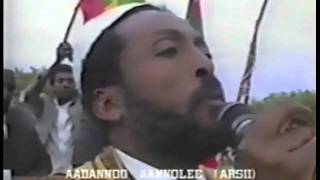
THE EXPANSION OF THE AMORPHOUS ADDIS ABABA, THE ENDLESS PERSECUTION AND EVICTION OF TULAMA OROMOO April 6, 2014
Posted by OromianEconomist in Aannolee and Calanqo, Colonizing Structure, Corruption, Free development vs authoritarian model, Janjaweed Style Liyu Police of Ethiopia, Nubia, Ogaden, Omo Valley, Oromian Voices, Oromiyaa, Oromo, Oromo Nation, Oromo the Largest Nation of Africa. Human Rights violations and Genocide against the Oromo people in Ethiopia, Oromummaa, State of Oromia, The Colonizing Structure & The Development Problems of Oromia, The Tyranny of Ethiopia, Tyranny.Tags: African Studies, Finfinnee, Governance issues, Horn of Africa, Human Rights and Liberties, Human rights violations, Land grabbing, Land grabs in Africa, National Self Determination, Oromia, Oromo, Oromo culture, State and Development, Sub-Saharan Africa, Tyranny, Universal Declaration of Human Rights, World Bank
add a comment
The deliberate expansion of the amorphous city they call “Addis Ababa” is politically created to divide Oromiyaa into east and west sector. It is not a master plan. It is an evil plan mastered to consummate an evil goal.
When we see the history of Abyssinian political philosophy, from which we have a written record, it is entirely based on the philosophy of depriving the Oromos from having any right to homeland. To convert Oromummaa to Amaarummaa and ultimately to Itiyophiyawwinnet has been the policy in action up to this very day.
What happened to those Oromos who were living in Finfinnee for centuries? Particular mention has to be made about those Tulama Oromo groups of Gullallee, Eekkaa, Galaan, Aabbuu, Jillee. The answer is very simple: They were mercilessly decimated; their villages burnt down, their pasture and arable lands confiscated and shared among the invading Manzian Nagasii families of whom the Dejazmach Mangasha Seifu and the Ras Birru families were the most notorious ones. Thereafter, the Oromo territory occupied by Matcha-Tulama was officially changed to the expanding Kingdom of Showa, a detached enclave from Gonder, Abyssinia. Finfinnee was given a new colonial name “Addis Ababa”, just like Zimbabwe was changed to Rhodesia, Harare to Salisbury. Under this excruciating condition, the conquered Matcha-Tulama region had to lose its historic significance and had to be involuntarily submitted to the colonial name Showa.
Among the major Oromo descent groups, the Matcha-Tulama group has got one of the largest populations, stretching on vast area of land in central and western Oromia. As we are able to learn from our fathers, Matcha and Tulama are Borana brothers, being Tulama angafa (first born) and Matcha qixisuu (second born son). As common to all Oromo ethno-history, the tradition that governs the social role of “angafa and qixisuu”, which begins right from the immediate family unit, has a deep genealogical meaning and social role in re-invigorating the solidarity of the nation. From the earliest time of which we have a tradition hanging down to us,
- Matcha-Tulama Oromo has had a supreme legislative organ known as Chaffe. The Chaffe legislates laws which will eventually be adopted as Seera Gadaa
They have a senatorial council known as “Yaa’ii Saglan Booranaa”, in which elected individuals from major clans are represented. The function of Yaa’ii Saglan Booranaa is to deliberate on issues pertaining to regional issues, resolve inter-clan disputes and oversees how interests of each clan in the confederacies are represented; how local resources are fairly shared and wisely utilised according to the law.
- These two northern Boorana brothers are historically referred to as Boorana Booroo or Boorana Kaabaa
- Among the known five Oromo Odaas, Odaa Nabee and Odaa Bisil are found in Boorana Booroo
However, beginning from the 13th century onward, the Match-Tulama country (Boorana Booroo), adjacent to Abyssinian border, has begun to be ravaged by a group of individuals whose legendary genealogy connects them to a certain King Solomon of non-African origin. They came and settled at a place they call “Manz”.They organised themselves at this place, and started to attack neighbouring villages of Cushitic Oromo family stock of Laaloo, Geeraa and Mammaa. The attacked villages were gradually incorporated into the expanding Manz, which eventually developed to a military outpost known as Showa in the late 18th century. Hereafter, they declared themselves “Ye Negasi Zer, the root of Showa Amhara Dynasty.
After vanquishing Agaw people’s identity and sovereignty on the northern frontier, the Solomonic Negasi Dynasties of Showa intensified their attacks against the Match-Tulama of Borana and the Karrayyu of Barantu Oromos. In such turbulent situation, the rule of yeNegasi Zer entered nineteenth century era, which ushered the era of the Scramble for Africa by European imperialist powers. From Africa, it was only King Minilik of Showa (1866-1889) who was recognised as a partner and invited to attend the Berlin Imperialist Conference of 1884. In this conference, Minilik was represented by his cousin, Ras Mekonnen Tenagneworq Sahile-Sellasie (1852-1906). After completing their mission, King Minilik and the European imperialist powers made concession on border demarcation. After the border demarcation had been completed, a systematic elimination of his prominent general, Ras Goobanaa Daacci (1819-1889), was meticulously carried out. Minilik was so confident to declare himself Emperor of Ethiopia (1889- 1913).This was the Ethiopia, the first time in the history of the region, that brutally annexed and included Oromo, Sidama, Walaita, Kaficho, Beneshangul, Gambella, and others to the expanding of Abyssinia.
The years 1887-89 were the boiling point for Minilik’s declaration of being “Emperor of Ethiopia, yeItiyophiya Nuguse, nägest. Why?
- Because, it was the time when he exterminated the Gullallee Oromo from the marshy-hot spring and pasture land of Finfinnee and collectivised the place under a new colonial name Addis Ababa.
- Because, it was the time when he built full confidence in himself and built his permanent palace at Dhaqaa Araaraa, a sacred hill, where the evicted Oromos peacefully used to sit together and conduct peaceful deliberation for reconciliation.
- It was the time when he annexed three-fourth of southern peoples’ territories, including the Oromo territory, to the expanding Showan Dynasty and put under the iron-fist of his inderases(viceroys).
- It was the time when he assured un-shivering confidence of being continued to be assisted and advised by his European colonial partners: militarily, diplomatically and technically.
Here is the question: What happened to those Oromos who were living in Finfinnee for centuries? Particular mention has to be made about those Tulama Oromo groups of Gullallee, Eekkaa, Galaan, Aabbuu, Jillee. The answer is very simple: They were mercilessly decimated; their villages burnt down, their pasture and arable lands confiscated and shared among the invading Manzian Nagasii families of whom the Dejazmach Mangasha Seifu and the Ras Birru families were the most notorious ones. Thereafter, the Oromo territory occupied by Matcha-Tulama was officially changed to the expanding Kingdom of Showa, a detached enclave from Gonder, Abyssinia. Finfinnee was given a new colonial name “Addis Ababa”, just like Zimbabwe was changed to Rhodesia, Harare to Salisbury. Under this excruciating condition, the conquered Matcha-Tulama region had to lose its historic significance and had to be involuntarily submitted to the colonial name Showa.
In addition to the former derogatory term “Galla”, imposed on the conquered Oromos as a whole, the new regional name of Showa is prefixed to the derogatory term Galla. Hence, “ye Showa Galla” came into force as a collective insulting name in addressing the whole Oromo of Matcha-Tulama. This clearly justifies the vertical segregation policy of the conquerors for easy identification of who is who in the newly colonised territory.
Using various forms of oppressive models, Abyssinian colonial tactics and strategies have been going on violently and, now entered into the first half of the 21st century. Since the second half of the 19thcentury in particular, the oppressive models have been amassing massive firearms from European colonialist partners, enjoying diplomatic immunities and profitable political advises.
In the late 19th century, one European writer commented that, if the Abyssinians had not been armed and advised by global colonial powers of the day, notably France and Britain, late alone to defeat the ferocious Oromo forces, they could not have even dared to encroach upon the limits of Oromo borders. He wrote what he witnessed the real situation of the time as follows:
“Against the Galla [Oromo] Menelik has operated with French technicians, French map-makers, French advice on the management of standing army and more French advice as to building captured provinces with permanent garrison of conscripted colonial troops. The French also armed his troops with firearms, and did much else to organize his campaigns. Menelik was at a work on these adventures as King of Shewa during John’s lifetime; adding to his revenues and conscripting the Oromo were thus conquered by the Amhara for the first time in recorded history during the last thirteen years of the nineteenth Century. Without massive European help the Galla [Oromo] would not have been conquered at all.”
The writer further explained what he personally encountered during the campaign in the following unambiguous language:
“A large expedition was sent as far South in Arsi as frontier of Kambata to return with100, 000 head of Cattle. The king’s army fought against tribes who have no other weapons but a lance, a knife and shield, while the Amahras always have in their army several thousand rifles, pistols and often a couple cannon.—-Captive able-bodied males and the elderly were killed. The Severity of the Zamacha [campaign] was aimed at the eradication of all resistance. Whenever the army surged forward, there was the utmost devastation. Houses were burned, crops destroyed, and people executed:”
When we see the history of Abyssinian political philosophy, from which we have a written record, it is entirely based on the philosophy of depriving the Oromos from having any right to homeland. To convert Oromummaa to Amaarummaa and ultimately to Itiyophiyawwinnet has been the policy in action up to this very day. Even though the policy works on all Oromos indiscriminately, the one which has been exercising on the Oromos of Tulama in Finfinnee and surrounding areas has its own unique feature. Some of the unique features are embedded in the formation of “Addis Ababa” itself; as a seat of colonial headquarters with all its oppressive machineries. To have ample space for the settlers, to build army headquarters, to build churches in the name of numerous Saints of Greek and Hebrew origins, to build residences and offices for foreign embassies and missionaries, to build factories and storage houses the crucial demand is land. To fulfil these crucial demands of the customers, helpless Oromo peasants of the area have to be evicted. They have been under routine eviction and land deprivation since the seizure of Burqaa Finfinnee and the establishment of Ethiopian Imperial capital at this place.
It could be incorrect to think of the current TPLF-Arinnet Tigray regime as a detached entity from the whole system of Abyssinian colonial regimes, when we equate what they need against the survival needs of the peoples they generically conquered as “Galla and Shanqilla”. Though since 1991, the Ethiopian imperial system has been overtaken from the Showan Nagasi Dynasty by their junior Tigrean brethren, the life of the colonised Oromo people has been going down from worse to the worst.
What makes TPLF-Arinnet Tigray different from its predecessors is its total monopolisation of resources of the empire, right from the imperial palace to the bottom village levels, from the centre to the periphery. Arable and pasture lands, plain and forest lands, rivers and mining areas are totally under its predatory control. It is routinely evicting peasants from their plots, their only means of existence. They are selling to Chinese, Indians, European, Turkish, Pakistani, Arabians and other companies at the lowest price. In making this huge business, the most preferable area in the empire is Oromoland; of which the land around Finfinee holds rank first.
This politically architected scheme, in the name of investment and development, is daily evicting Oromo peasants around Finfinnee often with meagre or no compensation at all. As a consequence,
- some of the evicted families are migrating to cities like Finfinnee and are becoming beggars
- Some of them are leaving the country for unknown destination and found being refugees in neighbouring countries like Kenya and Yemen.
- Since most of them who have no any alternative, they remain on the sold land and become daily labourers, earning less than half dollar a day.
- Farm lands that had been producing sufficient grains of various types are now turned to produce non-edible flowers and toxic chemicals that contaminate rivers and lakes.
The incumbent Ethiopian regime of TPLF-Arinnet Tigray, more than any other imperial regimes of the past, is committed to make the Oromo people an “African Gypsy”. At one time the deceased prime minister of the Empire and EPDRF leader, Meles Zenawi, refers to the Oromos, who are numerically majority ethnic group in the Empire, said, “It is easy to make them a minority”. They are practically showing us the evil mission they vowed to accomplish. When they become rich of the richest in the Empire, the Oromo peasants they are daily uprooting are becoming poor of the poorest, being reduced to beggary and often deprived of burial sites after death. This evil work, as indicated above, has given priorities to sweep off “garbage” around Finfinnee and ultimately to encompass three-fourth of the region of “Showa” as a domain of “non-garbage” dwellers.
As vividly explained above, the Oromo of Tulama, since the onset of colonisation, have begun to be collectively addressed as “ye Showa Galla”. Those who resisted the derogatory name, the eviction, and the slavery system have been inhumanly executed or hanged. Their land and livestock have been confiscated and shared among the well-armed conquering power.
When Minilik invaded the Gullalle Oromo in Finfinnee, for instance, they remarkably resisted to the last minute but finally defeated. Those who remained behind the massacre had no other option except to leave for other regions against their choice. In their new homes, they have been even treated as collaborators of the invading “Showans” by their own kinsmen, calling them “Goobanaa”.Those able-bodied Gullallee, Eekkaa, Galaan, Abbichuu youths were involuntarily conscripted to the colonial army which is typical to all colonial policies. They were forced to go for further campaign to the south, east and west commanded by Showan fitawuraris and dejazmaches
From time to time, all Abyssinian forces, changing forms of their names, swearing in the name of Ethiopian unity and inviolable sovereignty, have never turned down the initial policy of evicting and persecuting the Oromo from their ancestral araddaa. Araddaa Oromoo is the embryonic stage whereOromummaa has begun to radiate from. Hence, by virtue of its original formation, now and then, it could not be integrated into the enforced Abyssinian policy of Itiyophiyawwinnet .
Since the enforced policy has shown no visible success for the past 130 years, this time, it has taken on to shoulder the last option of “sweeping them off” from around what they call “Addis Ababa” as a priority number one. As a consequence, came into being the destruction of Oromo survival relationship with their ancestors’ plot of land. The desecration of their shrines, sacred rivers, sacred mountains and sacred trees of which the case of Odaa and Burqaa Finfinnee, Dhakaa Araaraa and Caffee Tumaa in the vicinity of Finfinnee are quite enough to mention. TPLF’s long range missile policy of destroying Oromos’ relation to their historic araddaa is not the end. It is just the beginning extrapolated to destroy Biyyoo Oromoo.
At this critical time, any concerned Oromo should not be oblivious of the dreadful situation going on in Oromiyaa right now; in Finfinnee and surrounding areas in particular. The deliberate expansion of the amorphous city they call “Addis Ababa” is politically architected to divide Oromiyaa into east and west sector. It is not a master plan. It is an evil plan mastered to consummate an evil goal.
At this critical time, may we believe in the “No life after death”? Rather, may we are for the life right now? Those who are for the life right now are genuinely expected to show discernible power through tangible solidarity to our victimised families at home. Pursuant to our tradition, we have been nurtured learning the wisdom of “Dubbiin haa bultu”. Now, we should redirect this wisdom to “Dubbiin kun hin bultu”,that we ought to swear by great confidence to move in unison against the inhuman act, endless atrocities and perpetual eviction of our families from their ancestral araddaa. Thereof, could we recall the intrinsic wisdom of our fathers’ saying “Tokko dhuufuun namummaadha, lama dhuufuun harrummaadha?”
The Quest for Oromo’s Indigenous Knowledge and Institutions April 3, 2014
Posted by OromianEconomist in Aannolee and Calanqo, Abbush Zallaqaa, Afaan Publication, Africa, Ancient African Direct Democracy, Finfinnee, Free development vs authoritarian model, Gadaa System, Haile Fida, Humanity and Social Civilization, Irreecha, Kemetic Ancient African Culture, Knowledge and the Colonizing Structure., Language and Development, Oral Historian, Oromia, Oromia Satelite Radio and TV Channels, Oromian Voices, Oromiyaa, Oromo, Oromo Artists, Oromo Culture, Oromo First, Oromo Identity, Oromo Media Network, Oromo Nation, Oromo Social System, Oromo Sport, Oromummaa, Self determination, State of Oromia, The Colonizing Structure & The Development Problems of Oromia, The Oldest Living Person Known to Mankind, The Oromo Democratic system, The Oromo Governance System, The Oromo Library, The Tyranny of Ethiopia, Theory of Development, Toltu Tufa, Uncategorized, Wisdom.Tags: Africa, African culture, African Studies, Development and Change, Economic and Social Freedom, Gadaa, Gadaa System, Genocide against the Oromo, Human Rights and Liberties, National Self Determination, Oromia, Oromiyaa, Oromo, Oromo culture, Oromo people, Oromummaa, State and Development, United Nations, Universal Declaration of Human Rights, World Bank
add a comment
By Iddoosaa Ejjetaa, Ph.D.*
The classical definition of knowledge was given by Plato as “justified true belief.” There are many philosophical theories to explain knowledge. The online Oxford dictionaries define knowledge as a theoretical or practical understanding of a subject [online]. The same source explain knowledge that can be implicit (as with practical skill or expertise) or explicit (as with the theoretical understanding of a subject); it can be more or less formal or systematic. According to Stanley Cavell, “Knowing and Acknowledging” the “knowledge acquisition involves complex cognitive processes: perception, communication, association and reasoning; while knowledge is also said to be related to the capacity of acknowledgment in human beings.” I am not here to write the theory of knowledge, but trying to bring the human society acknowledgement and recognition for the Oromoo nation’s indigenous knowledge.
The Oromoo Gadaa System (OGS) is an indigenous knowledge reserve institution of the Oromoo nation. It is an organic system, which is self-refining every eight years (in two four-year terms) to meet the needs of the society. The OGS is a well-structured and organized indigenous knowledge reserve that encompasses social, political, economic and military institutions that operate mainly based on self-reliance principles while Oromummaa is an act of embracing these institutions and applying the indigenous knowledge to manifest an authentic Oromoo’s cultural and national identity.
The essence of scientific education is to understand Mother Nature, daachee haadha marggoo, and human experience in relation to Mother Nature. Through scientific education we can ask questions and try to investigate or do research to find out the facts and report the new knowledge about the subject. For example, who is responsible for the creation of human being, other living and non-living things as a part of the whole nature? What if I told you that the answer to the question is Mother Nature? I guess, you would not be satisfied with the answer because it leads to another subsequent philosophical questions such as who is responsible for the creation of the Mother Nature. Again, what if I told you the answer is a God? This time, probably you would be settled and agree with me. But how do you know for sure that it is a God who is responsible for the creation of nature?
I have thought deeply about these questions and tried to find the best possible answers. I would like to share the final answer with you later on if you continue the journey with me through reading and thinking about the perplexities of human life experience.
The purpose of this paper is to share my points of view with you and highlight that the Oromoo Gadaa System is the prima source of Oromo indigenous knowledge reserve that every Oromoo person should safeguard it and reclaim it as a shared-value that can be manifested through applied Oromoo knowledge and life experience, which is often called Oromummaa. Hence, the Oromoo Qubee generation are highly encouraged to embark their scientific studies and discoveries on our forefathers’ indigenous knowledge and bring it to light to show the world that our forefathers had made significant contribution to human society and civilization by creating and developing a comprehensive and complex democratic system: the Oromoo Gadaa System and its Institutions. For the qubee Oromoo generation, I would say they have a gold mining opportunity on their own backyards and they have to go for it.
Oromoo’s Indigenous Knowledge
Indigenous knowledge is local by nature. It is primarily based on social skills and production techniques. Both social skills and production techniques employ indigenous knowledge that in turn involves the process of life-long learning and teaching. The Oromoo Gadaa System provides such indigenous knowledge reserve so as to enable the new generation to learn from and teach the generations to come. For example, Oromummaa is a social skill. The Oromoo children learn social skills: respect, love, sympathy, empathy, ethics (Safuu), sharing, helping others, communications, etc from their parents and through well-organized Gadaa institutions such as the Age group (Hiriyyaa) and Qalluu.
Like every society, the Oromoo Gadaa Society had engaged in production of goods and services for long time or millenniums. They have millennium years of farming and animal husbandry experience and knowledge. The Oromoo farmers were the first people who domesticated barley as cereal crop in the region and a coffee plant and used the coffee beans in the world. This means the Oromoo farmers had possessed a primary indigenous knowledge about these crops. This indigenous knowledge reserve, however, needs a substantial effort in the field of scientific research and documentation for learning and teaching purposes by present and future Oromoo generations.
The lack of self-ruling political right in Ethiopian Empire and the decline of the Oromoo Gadaa System of Self-governance lead to the deterioration of the Indigenous knowledge and Institutions. In addition, the absence of curiosities from the Oromoo educated class for long time and self-inflicted prejudices against Oromoo indigenous knowledge had played a significant role on its underdevelopment. The educated class is the first social group who run away from their villages and turn their back to their culture and traditional ways of life. Consequently they find themselves in the garrison cities where almost everything is imitation of modernity that has no root in the local culture or traditions. Moreover, the educated elites had been played an agent role to introduce exogenous values including foreign religion, culture of conspicuous consumption and other copy-cut life styles from the West, and Middle-East world.
As I mentioned above, because of the lack of basic human right the Oromoo as a nation has no formal indigenous institutions yet. Instead, the institutions are maintained by the Oromoo Gadaa fathers and mothers who have been serving as Oromo indigenous knowledge reserve as institution. . This means the Qubee generation scientific research and discoveries are highly dependent on the existence of Gadaa Oromoo fathers and mothers (abbootii Gadaa Oromoo) and time because if they die the institutions and knowledge will die with them. For many of them, a biological time is about running out now. One day they will leave us for good. So it is responsibilities and sacred duties of this generation to secure and backup these precious indigenous “documents” that had been inherited form the previous generations.
As JF Kennedy said, the purpose of education is to advance human knowledge and dissemination of truth. However, contrary he said, the education system in Ethiopia has been harboring ignorance, distortion and denial of the truth that effectively disabled the process of learning, thinking and bringing positive changes to our society. So I suggest to the new generation regardless of their ethnic and cultural background to use the best three doses of pills/prescription for ignorance, distortion and denial of history. They are: genuine education, genuine education, and genuine education (3-GE). Through genuine education one can learn the true essence of love (jaalala), which is unselfishness, the creator, and creatures, uumaa fi uumammaa.
Generally, indigenous knowledge (IK) are the outcome of true and genuine collective human experience. It could be knowledge about culture, tradition, history, philosophy, belief system, art, farming, biodiversity, medicine, family, economic distribution, etc. The Oromoo Gadaa System is one of such collective human experience that need to be learned as universal value to human society and pass down to the next generations.
The Predicaments of Indigenous Knowledge in Ethiopia Politically speaking, Ethiopia as a nation had never been colonized and maintained its independence while all African countries had been colonized by European states. To some extent, this is true. Practically, however, the Ethiopian Empire State had been constructed and maintained by European states and continued to operate under indirect-colonialism of Anglo-American and European States. Like all African Republics or States, the Ethiopia’s government structure, military structure, religious institutions, political and social, educational, and legal systems are highly influenced mainly by Anglo-American and European institutions including British, France, Italian, Germany, American, Japan, China, etc. Consequently, indigenous knowledge had been systematically marginalized and ignored, unfairly criticized as primitive, static and simple idea by semi-literate domestic elites or agents of exogenous institutions.
These exogenous institutions such as the Orthodox Coptic Church officials (clergy/priests) and collusion of feudal neftenyaa and self-serving local balabats in Ethiopia, for instance, had played a key role in dismantling indigenous institutions, discrediting and condemning indigenous knowledge and even blessing Menelik’s genocidal and unjust war against our people and indigenous people of the south. Here one must note that the local Oromoo balabats had played a primary role in sponsoring, defending and assigning a commanding site Oromoland to the Orthodox Churches in Oromiyaa today. In addition to the neftenyaa system, these social class is accountable historically for the decline of the Oromoo Gadaa System and underdevelopment of its Institutions. Beside this, at present the decedent of these social class still maintained their loyalty to the Orthodox Church and Ethiopia’s empire state. Some individuals even have been involving in the Oromoo liberation struggle by dressing a sheep skin to saboteur the genuine aspiration of Oromians for freedom and independence. This author suspect that this very social class had contributed to the weakness of Oromia liberation camp.
The Impacts of Church Education on Indigenous knowledge
The Orthodox Coptic church jealously dominated the education system in Ethiopia. The Orthodox Coptic Church in Ethiopia had provided training in reading and writing in Ge’ez and Amarigna (Amharic) at primary school level to limited areas and people of the country. To summarize the church education in Ethiopia: elementary pupils had to learn to read, write, and recite the Dawit Medgem (Psalms of David). There are 15 sections, called negus (kings), which normally took two years to master. Next they learned to sing kum zema (church hymns), which took four years, and msaewait zema (advanced singing), which took an additional year to learn. Liturgical dancing and systrum holding required three years. Qine (poetry) and law required five years to learn. The interpretation of the Old and New Testaments, as well as the Apostles’ Creed, took four years on average, while the interpretation of the works of learned monks and priests took three years. When a student knew the psalms by heart, he had mastered the “house of reading” and was now considered an elementary school graduate. As one can see there is no a single grain of indigenous knowledge or belief system had been taught by the Orthodox Church.
The Orthodox Coptic Tewahido Church is considered by government as indigenous institution, when it is imported and imposed on native culture. Both religions Christian and Islam were imported and imposed on native population, such as the early Christianized ethnic Tigray and Amhara and then ethnic Oromoo, Sidama, and other people of the south, by few clergies and foreign religious crusaders. These institutions had replaced the indigenous belief system, institutions and knowledge over time. As a result, the majority, if not the entire population, ethnic Tigray and Amhara believe that Bible is the source of their history and culture. As one can easily understand, the people of Tigray and Amhara have lived far more years than the bible does, which is two thousand years. As people who residing in East Africa, the Tigray and Amhara people must have had indigenous culture and knowledge. What are they?
Despite the claim of three thousand years history of civilization, Ethiopians exposed to non-church education or modern education in 1920s. The ministry of education established in 1930s. Secondary schools established in 1940s, and higher education, Addis Ababa University, established in 1960s. In similar way, the modern education system had also failed in teaching and conducting research on indigenous knowledge so as to integrate it into the modern education. As a result, creativity, inventions and innovations have seen as odd culture to our society. On the contrary, receiving aid, economic migration, conspicuous consumption of imported goods including education and dependency on Western advanced societies or institutions have become a culture.
Therefore, it is up to the Habesha (Tigre and Amhara), the Oromoo and other ethnic groups of the new generation to dig deep down to find out their respective indigenous knowledge that deep rooted in their culture and traditions and pass down from one generation to other generations by their native ancestors if any and re-evaluate the existing very controversial written history, which is biased and by large based on fiction history. The cycle of self-discrimination must end by the new generation. By doing this they can find shared human values that would allow them to live in peace without disrespecting one another as good neighbors and citizens of their respective nation. So one must understand that no one would agree on imported history that was written by the followers and supporters of Christianity crusaders, war lords, kings, dictators and agents of the Western discriminatory and racist institutions of the time as shared human value and history of our respective people in our time. The time and world have changed forever.
The present suspicion, political conflicts and all forms of problems in our region will not be solved without recognizing and applying indigenous knowledge. The lasting resolutions for the problems can be achieved if every member of our society or nation adults learn and teach their younger generation good social skills, which are critical to successfully functioning society. Basic social skills enable adults and children to know what to say, how to make good choices, and how to behave in adverse situations. The extent to which young people possess good social skills can influence their adult behavior in decision making, conflict management and problem solving. Social skills are also linked to the quality of the school environment. The Church and modern education in Ethiopia, unfortunately, had been denying members of our society these good basic skills such as respect, appreciation, empathy, apology, truthfulness, positive attitude about others, etc. Instead, the system allowed social ignorance such disrespect, occupational despise, ethnic chauvinism, fear, the divine right of the kings and honor for ruling class. As a result, the Ethiopian empire has produced highly educated class like Dr. Getachew Haile without basic and good social skills; it seems that he passed through poor socialization as one can understand the meaning of his name, ‘lord of …power’, which is false-self has given to him by his parents
and trying his best to make them proud by being discourteous and rude to the Oromoo people. Dr. Getachew Haile, be nice!
The black people or African descents are subject to institutional discrimination and racism more than any other races in the world including the holy land- Israel and Saud Arabia. Do you know why? The reasons can be many, but one of the reasons is imitation of ideas. The black people are the most imitating of other societies’ idea. They did not protect and develop their own indigenous institutions (political, religious, cultural and socio-economic institutions) to shape their lifestyle and influence others. No other nations are imitating Africans’ culture, religion, lifestyles but the Africans tend to imitate others about everything that life needs. Some African or extremists trying to be more imitator and more knowledgeable about the culture, religion and ideology than the original inventor or creator of the idea. It is understandable that human being has ability to imitate and all cultures imitate ideas from original culture. The question I would like ask the readers is why the changes are in one direction only. Why African descents imitate ideas of the other culture when the other culture do not imitate the African idea or world view?
For example, black Africans including Ethiopians has been pretending as if they have better known about the Jesus of Nazareth more than the Israelis and Prophet Muhammad more than the Arabs; Marxism and Leninism or communism more than Russians; democracy more than Americans and Western societies. These blind optimists about other’s idea are cynical at the same time about their own indigenous knowledge; they are willing to abuse, jail, torture and murder their own innocent people for the authenticity of imported ideas, religious and political ideology. In the case of Ethiopia, the king Menelik II and Yohanness II – holy war and wildish conquests were a case in point. They had imitated from the history of European middle-age idea of religious crusaders and empire builders. The Abyssinian kings had been acted as proxy war lords of European colonial powers and committed incalculable atrocity against the Oromo people and other black people in East Africa. In addition, these Abyssinian kingdom were one of the worst Africa’s kingdoms who sold Africans, their own race, to British, Arabs and other European white race for the exchange of European firearms to conquer the land of other nations and subjugate the people and build the empirical institutions based on European ideas and political model. What most disgracing is when people like Dr. Getachew Haile and his like trying to keep the truth elusive and misrepresent the history of the black people and glorifying the history of the White colonial proxy war lords like Menelik II as great black king, who was cowardly cut women’s breast, mutilate men’s hand and embarrassingly sold his own black race to the European white race.
In conclusion, the quest for truth shall continue by present and future Oromo generations. The root cause for conflicts in Africa is an imported knowledge and imitation of ideas. In many cases, imitation represent a false-self or an act to hiding a true-self. Discriminatory and racist attitude against black people had been partly brought up by European’s colonial power proxy war lords in Africa such as Menelik II of Abyssinia/Ethiopia kingdom. Although most black people tend to cherish and assimilate their cultural identity into the Middle-Eastern and Western cultural identity and ways of life, the very culture of the societies they imitating have been reciprocating or holding discrimination against them based on race, stereotypes and historical disadvantages. Institutional racism still exist and there are also significant number of individuals who think that Africans have not yet acquired culture and civilization. The imitation of others’ ideas, belief system and political institutions by Africans including my fellow Oromoo has kept the racist believes alive. It is suffice to mention the 2013 incidents against African immigrants in Saud Arabia and recently in Israel. The majority of Africans believed that embracing Christianity and Islam would lead to heaven via holy land. Unfortunately, it turned out differently; they end up in hell in the holy land. So, the lasting solution would be revitalizing indigenous knowledge and institutions that demands for real efforts, courage and sacrifices. As to the Oromo’s quest for indigenous knowledge and institutions, revitalization of the Gadaa Republic of Oromia and its institutions would be the lasting solution for century old colonial extraction, subjugation and embarrassment.
___________________
* About the author: Iddoosaa Ejjetaa, Ph.D., native to Oromiyaa, Ethiopia. Independent and Naturalist Thinker; An activist and advocator for the revitalization of Authentic Oromummaa, Oromoo Indigenous knowledge and institutions, and for the formation of Biyyaa Abbaa Gadaa,Oromiyaa-The Gadaa Republic of Oromia.
Read more @
http://ayyaantuu.com/horn-of-africa-news/oromia/the-quest-for-oromos-indigenous-knowledge-and-institutions/
Urban centers in Oromia:The integration of indigenous Oromo towns into the Ethiopian colonial structure and the formation of garrison and non-garrison cities and towns April 3, 2014
Posted by OromianEconomist in Aannolee and Calanqo, Africa, Colonizing Structure, Finfinnee, Free development vs authoritarian model, Janjaweed Style Liyu Police of Ethiopia, Land and Water Grabs in Oromia, Nubia, Ogaden, OMN, Omo Valley, Oromia Support Group Australia, Oromian Voices, Oromiyaa, Oromo, Oromo Culture, Oromummaa, Self determination, Sidama, State of Oromia, The Colonizing Structure & The Development Problems of Oromia, The Tyranny of Ethiopia, Youth Unemployment.Tags: African Studies, Development and Change, Governance issues, Horn of Africa, Human Rights and Liberties, Human rights violations, Land grabbing, National Self Determination, Oromia, Oromiyaa, Oromo people, Oromummaa, State and Development, Sub-Saharan Africa, Universal Declaration of Human Rights, World Bank
1 comment so far
Since urban areas and cities are primarily populated by Ethiopian colonial settlers and their collaborators, they are the ones who have access to the limited public facilities such as schools and hospitals. Oromo urbanites like the rural counter parts have been exposed to massive and absolute poverty and have been denied fundamental human rights and needs that Ron Shiffman (1995, 6-8) calls subsistence, protection, affection, and understanding. Most Oromos in urban and rural areas have low levels of subsistence because they lack adequate income, enough food, and livable homes. they do not have protection from disease because they are denied adequate access to health and
medical services.They do not have protection from political violence because the Ethiopian state engages in massive human rights violations and state terrorism ( Jalata 2000). Oromos have been ruled by successive authoritarian-terrorist regimes which have exploited and impoverished them by expropriating their resources. ….The Oromos have been prevented from developing autonomous institutions, organizations, culture, and language, and have been subordinated to the
institutions and organizations of the Habasha colonial settlers in their own cities, towns, and homeland.
Read more @http://works.bepress.com/cgi/viewcontent.cgi?article=1052&context=asafa_jalata
Oromia Media Network Launch — Live! March 27, 2014
Posted by OromianEconomist in Africa, Africa Rising, African Beat, African Music, Ancient African Direct Democracy, Dictatorship, Ethnic Cleansing, Finfinnee, Gadaa System, Hadiya and the Omo Valley, Human Rights, Human Traffickings, Humanity and Social Civilization, Ideas, Kemetic Ancient African Culture, Knowledge and the Colonizing Structure., Language and Development, Nubia, Ogaden, OMN, Omo, Omo Valley, Oromia, Oromiyaa, Oromo, Oromo Artists, Oromo Culture, Oromo First, Oromo Identity, Oromo Media Network, Oromo Music, Oromo Nation, Oromo Social System, Oromo Sport, Oromo the Largest Nation of Africa. Human Rights violations and Genocide against the Oromo people in Ethiopia, Oromummaa, Poverty, Qubee Afaan Oromo, Self determination, Sidama, Sirna Gadaa, Slavery, State of Oromia, The Colonizing Structure & The Development Problems of Oromia, The Oromo Democratic system, The Oromo Governance System, The Oromo Library, The Tyranny of Ethiopia, Theory of Development, Uncategorized, Wisdom, Youth Unemployment.Tags: Africa, Development and Change, Economic and Social Freedom, Governance issues, Horn of Africa, Human Rights and Liberties, Human rights violations, Oromia, Oromia Region, Oromiyaa, Oromo, Oromo culture, Oromo people, State and Development, Sub-Saharan Africa, Universal Declaration of Human Rights
add a comment


Oromia Media Network Launch — Live! 1st March 2014
Millions of Oromos now have the chance to enjoy quality media focusing on the needs and aspirations of the Oromo people.


https://www.oromiamedia.org/donorship/
“The Oromia Media Network (OMN) is an independent, nonpartisan and nonprofit news enterprise whose mission is to produce original and citizen-driven reporting on Oromia, the largest and most populous state in Ethiopia. OMN seeks to offer thought-provoking, contextual, and nuanced coverage of critical public interest issues thereby bringing much needed attention to under-reported stories in the region. Our goal is to create a strong and sustainable multilingual newsroom that will serve as a reliable source of information about the Oromo people, the Ethiopian state, and the greater Horn of Africa region. ” – http://www.oromiamedia.org/
Copyright © OromianEconomist 2014 and Oromia Quarterly 1997-2014. All rights reserved. Disclaimer.
Ethiopia’s government is using imported technology to spy on the phones and computers of Citizens March 26, 2014
Posted by OromianEconomist in Aannolee and Calanqo, Africa, Africa Rising, African Poor, Aid to Africa, Colonizing Structure, Corruption, Ethnic Cleansing, Facebook and Africa, Free development vs authoritarian model, Nubia, Ogaden, OMN, Oromia, Oromia Support Group Australia, Oromiyaa, Oromo, Oromo Nation, Oromummaa, Self determination, Sidama, Slavery, The Tyranny of Ethiopia, Tweets and Africa, Tyranny, Uncategorized, Youth Unemployment.Tags: Africa, African Studies, Development and Change, Economic and Social Freedom, Genocide against the Oromo, Governance issues, Horn of Africa, Human Rights and Liberties, Land grabs in Africa, National Self Determination, Oromia, Oromiyaa, Oromo, Oromo culture, State and Development, Sub-Saharan Africa, Tyranny, United Nations, Universal Declaration of Human Rights, World Bank
add a comment
Human Rights Watch (HRW) in it recent research report exposes that Ethiopia has built up a large monitoring system for controlling citizens’ network and phone usage. According to this report the government has a sole monopoly of telecommunications and network. And there is no right constraints that prevent the government from gaining an overview of who have contact with anyone on the phone, sms and internet. The government also saves phone calls on a large scale. The authoritarian regime is using imported technology to spy on the phones and computers of its perceived opponents. HRW accuses the government of trying to silence dissent, using software and kit sold by European and Chinese firms. The report says the firms may be guilty of colluding in oppression.
“While monitoring of communications can legitimately be used to combat criminal activity, corruption, and terrorism, in Ethiopia there is little in the way of guidelines or directives on surveillance of communications or use of collected information to ensure such practices are not illegal. In different parts of the world, the rapid growth of information and communications technology has provided new opportunities for individuals to communicate in a manner and at a pace like never before, increasing the space for political discourse and facilitating access to information. However, many Ethiopians have not been able to enjoy these opportunities. Instead, information and
communications technology is being used as yet another method through which the government seeks to exercise complete control over the population, stifling the rights to freedom of expression and association, eroding privacy, and limiting access to information—all of which limit opportunities for expressing contrary opinions and engaging in meaningful debate.”
“Human Rights Watch interviews suggest that a significant number of Oromo individuals have been targeted for unlawful surveillance. Those arrested are invariably accused of being members or supporters of the OLF. In some cases, security officials may have a reasonable suspicion of these individuals being involved with OLF. But in the majority of cases, Oromos were under surveillance because they were organizing cultural associations or trade unions, were involved in celebrating Oromo culture (through music, art, etc.) or were involved in registered political parties.
“Like the OLF, the Ogaden National Liberation Front (ONLF) was initially a political party, but began a low-level armed insurgency in Ethiopia’s Somali region in response to what it perceived to be the EPRDF’s failure to respect regional autonomy, and to consider demands for self-determination. In 2007, the ONLF scaled up armed attacks against government targets and oil exploration sites, triggering a harsh crackdown by the government. As with the government’s counterinsurgency response to the OLF, the Ethiopian security forces have routinely committed abuses against individuals of Somali ethnicity, including arbitrary detentions, torture, and extrajudicial killings,
based on their ethnicity or perceived support for the ONLF.”“Internet usage in Ethiopia is still in its infancy with less than 1.5 percent of Ethiopians connected to the Internet and fewer than 27,000 broadband subscribers countrywide. By contrast, neighboring Kenya has close to 40 percent access.The majority of Internet users are located in Addis Ababa. According to the ITU, Ethiopia has some of the most expensive broadband in the world. Given these costs, Ethiopians usually access the Internet through the growing number of cybercafés or from their mobile phones.Internet has been available to mobile phone subscribers since 2009.Increasingly available in many of the more expensive hotels and cafes. Connectivity speeds countrywide are quite low, and are prone to frequent outages.”
“State-owned Ethio Telecom is the only telecommunications service provider in Ethiopia. It controls access to the phone network and to the Internet and all phone and Internet traffic must use Ethio Telecom infrastructure. There is no other service provider available in Ethiopia. Ethio Telecom therefore controls access to the Internet backbone that connects Ethiopia to the international Internet. In addition, Internet cafés must apply for a license and purchase service from Ethio Telecom to operate.”
“As Internet access increases, some governments are adopting or compelling use of technologies like “deep packet inspection” (DPI). Deep packet inspection enables the examination of the content of communications (an email or a website) as it is transmitted over an Internet network. Once examined, the communications can be then copied, analyzed, blocked, or even altered. DPI equipment allows Internet service providers—and by extension, governments—to monitor and analyze Internet communications of potentially millions of users in real time. While DPI does have some commercial applications, DPI is also a powerful tool for Internet filtering and blocking and can enable highly intrusive surveillance. Finally, some governments have begun using intrusion software to infiltrate an individual’s computer or mobile phone. Also known as spyware or malware, such software can allow a government to capture passwords (and other text typed into the device), copy or delete files, and even turn on the microphone or camera of the device to eavesdrop. Such software is often unwittingly downloaded when an individual opens a malicious link or file disguised as a legitimate item of interest to the target.”
“The vast majority of the cases documented by Human Rights Watch involving access to phone recordings involved Oromo defendants organizing Oromos in cultural associations, student associations, and trade unions. No credible evidence was presented that would appear to justify their arrest and detention or the accessing of their private phone records. These interrogations took place not only in Addis Ababa, but in numerous police stations and detention centers throughout Oromia and elsewhere in Ethiopia. As described in other publications, the government has gone to great lengths to prevent Oromos and other ethnicities from organizing groups and associations. While the increasing usefulness of the mobile phone to mobilize large groups of people quickly provides opportunities for young people, in particular, to form their own networks, Ethiopia’s monopoly and control over this technology provides Ethiopia with another tool to suppress the formation of these organizations and restrict freedoms of association and peaceful assembly.”
“Ethiopia was the first sub-Saharan African country to begin blocking Internet sites. The first reports of blocked websites appeared in May 2006 when opposition blogs were unavailable, and blocking has become more regular and pervasive ever since. Human Rights Watch and the University of Toronto’s Citizen Lab conducted testing in-country in July and August of 2013 to assess the availability of 171 different URLs that had a higher likelihood of being blocked, based on past testing, on the Ethio Telecom network. A total of 19 tests were run over seven days to ensure reliability of results.”
Read further @
“They Know Everything We Do”
Telecom and Internet Surveillance in Ethiopia
http://www.hrw.org/reports/2014/03/25/they-know-everything-we-do-0
http://thefrontierpost.com/article/84793/Ethiopia-uses-foreign-kit-to-spy-on-opponents-HRW/
Copyright © OromianEconomist 2014 & Oromia Quarterly 1997-2014, all rights are reserved. Disclaimer.
Tribute to the Legendary Oromo artist Almaz Tafarraa (1957- 2014) March 24, 2014
Posted by OromianEconomist in African Beat, African Music, Artist Almaz Tafarraa, Oromia, Oromiyaa, Oromo, Oromo Artists, Oromo Culture, Oromo First, Oromo Identity, Oromo Media Network, Oromo Music, Oromo Nation, Oromo Social System, Oromummaa, State of Oromia, The Oromo Library, Uncategorized.Tags: Afaan Oromo, African culture, African Studies, Almaz Tafarraa, Economic and Social Freedom, Music of Oromia, Oromia, Oromiyaa, Oromo, Oromo Artists, Oromo culture, Oromo people, Oromummaa
add a comment


Artist Almaz Tafarra: the founding member of Afran Qalloo Band: Miseensa Baandi Afran Qalloo jalqabaa
Arstist Almaz Tafarra, the founding member of the Afran Qalloo died on 22nd March 2014 at Police Referral Hospital in Finfinnee. Tafara began singing in Afaan Oromo in early 1970s. Artist Almaz Tafarra was born in 1957 in Oromia,Western Hararghe, Doba district.
In outstanding and successful career that extended across nearly four decades, artist Almaz Tafara recorded and released a total of ten albums. Her lyrical message usually concentrates on her own and collective socio-political issues in Oromia. Tafara released her first solo album in 1983. During her career, Tafara has collaborated and worked with pioneering Oromo artists including Ali Shabo, Kadir Said, Adam Harun, Musa Turki, Worku Bikila and the late poet and singer Abdi Mohamed Qophe. Tafara deeply loved her culture and sang in Afaan Oromo. She released her tenth and final album in 2005.
(Oromedia, 23 Bitootessa 2014) Dhukkuba kaansarii dhiigaan dhukkubsattee yaalamaa kan turte, Artisti Almaaz Tafarraa Bitootess 22, 2014 addunyaa kana irraa du’aan boqochuun ishee beekame.
Bara jireenya ishii aartii fi Afaan Oromoo guddisuu irratti gahee guddaa kan gumaachaa turte artisti Alamaaz Tafarraa, addunyaa kana irraa kan dabarte hospitaala Poolisii Finfinnee keessatti otuu wal’aanamaa jirtu ta’uu oduun nu gahe addeesse jira.
Akka odeeffannoo argannetti, sirni awwaalchi ishe Duilbata- Bitootessa 23, 2014 waaree booda saatii 4:00 irrati magaalaa Harar keessatti akka ta’u beekameera.
Bara 1957 Oromiyaa Bahaa, Harargee Lixaa, Aanaa Doobbaatti kan dhalatte Artisti Almaaz Tafarraa, sirba ishii duraa bara 1983 kaasettaan baafte. Yeroo sanaa eegalees haga dhukkubsattee waltajjii irraa haftetti kaassettoota sirbaa sagal baaftee ummataaf gumaachitee jirti.
Akka seenaa artistoota Oromoo keessaa hubatamutti, artisti Almaaz Tafarraa miseensa baandii Afran Qalloo turte. Sirboota sirbaa turteenis ummta Oromoo biraa jaalalaa fi kabajaa guddaa yeroo argattu, humnoota guddinaa fi dagaagina aadaa fi eenyummaa Oromoo jibbaniin immoo hedduu dararamaa fi miidhamaa akka turte seenaan ishii kan ragaa bahuudha.
Bara 2014 keessa hedduu waan dhukkubsatteef mana yaalaatti deddeebi’aa kan turte, Artisti Alamaaz, deeggarsa ummataan wal’aansa adda addaa Harar irraa gara Finfinneetti deddeebitee fudhachaa akka turte beekameera.
Sirbooti Artisti Almaaz Tafarraa kan yeroo fi barri ittii hin darbinee fi kan dhalootaa dhalootatti barayyuu yaadatamuu dha.
Akka qormaata Oromediaatti, Artisti Almaaz Tafarraa hojii boonsaa aartii Oromoo keessatti gara waggoota 40f dalagneen dhaloota dhalootatti kan yaadatamuudha.
Kan malees, hojii boonsaa yeroo hamtuu fi sodaachisaa keessa ifatti baatee dalagdeen galmee sabboontotaa fi gootota Oromoo Oromummaa jiraachisan keessatti kan ramadamtuudha.
Kanaan dura oduu karaa Oromedia darbee tureen, sabboontoti Oromoo biyya Jarmanii, biyya Ameerikaa fi Sa’udi Arabiyaa qunnamtii karaa Oromedia argataniin gargaarsa maallaqaatiin birmatanii akka wal’aansa gahaa argattu godhan iyyuu, Artisti Almaaz Tafarraa dhukkubicha irra hafuu hin dandenye.
Akka Artisti Alamaaz Tafarraa akka fayyituu fi dhintu kanneen dhuunfaanis ta’ee gamtaan gumaachitan maraaf seenaan isin yaadata jechaa, Rabbi Isin haa jajjabeeysu jenna.
Gareen Oromedia du’aan adunyaa kana irraa boqochuu artistii fi qabsooftu Almaaz Tafarraatin gadda nuuti dhagahamee ibsaa, lubbuun isaanii Waaqin akka qananiisuuf yeroo kadhannu, firootaa fi hiriyyoota ishii akkasums mararfatootta ishiif jajjabin isinif haa kennu jenna.
Seenaa Artist Almaaz Tafarraa
Bara 1957 Aanaa Doobbaatti keessatti dhalatte.
Bara 1973 Hawwisoo poolisii Harar seente.
Bra 1983 kaassetta duraa baafte.
Bitootessa 22, 2014 addunyaa kana irraa boqotte.
http://oromedia.net/…/artisti-almaaz-tafarraa-boqotte…/ http://oromedia.net/…/artisti-almaaz-tafarraa-boqotte…/
http://www.oromiamedia.org/2014/03/breaking-news-artist-almaz-tefera-passed-away/
http://www.opride.com/oromsis/news/horn-of-africa/3738-beloved-oromo-singer-almaza-tafara-dies
Ethiopia: Silence, Pain, Lies and Abductions March 20, 2014
Posted by OromianEconomist in Aannolee and Calanqo, Africa, Africa Rising, African Poor, Colonizing Structure, Dictatorship, Ethnic Cleansing, Finfinnee, Free development vs authoritarian model, Human Rights, Human Traffickings, Janjaweed Style Liyu Police of Ethiopia, Kambata, Land and Water Grabs in Oromia, Nubia, Ogaden, Omo, Omo Valley, Oromia, Oromia Support Group Australia, Oromiyaa, Oromo, Oromo Nation, Oromo the Largest Nation of Africa. Human Rights violations and Genocide against the Oromo people in Ethiopia, Oromummaa, Self determination, Sidama, Slavery, The Colonizing Structure & The Development Problems of Oromia, The Tyranny of Ethiopia, Theory of Development, Uncategorized, Youth Unemployment.Tags: Africa, Development, Economic and Social Freedom, Genocide against the Oromo, Governance issues, Horn of Africa, Human Rights and Liberties, Human rights violations, Land grabs in Africa, National Self Determination, Oromia, Oromo people, Oromummaa, Politics of Ethiopia, State and Development, Sub-Saharan Africa, Tyranny, World Bank
add a comment
https://www.youtube.com/watch?v=-c592hhWlc8
‘This is a regime whose character has the potential to confuse even Jeane J. Kirkpatrick, former Reagan foreign policy advisor, who made a distinction between “authoritarian” and “totalitarian” regimes. In her essay “Dictatorship and Double Standards,” she describes authoritarian dictators as “pragmatic rulers who care about their power and wealth and are indifferent toward ideological issues, even if they pay lip service to some big cause”; while, in contrast, totalitarian leaders are “selfless fanatics who believe in their ideology and are ready to put everything at stake for their ideals”.’

This assessment of the reaction to the article I published on this blog: “Silence and Pain,” is interesting for its exploration of the relationship between the Ethiopian government and the media, even though it overestimates any influence I may have.
Martin
Source: Muktar M. Omer
Ethiopia: Silence, Pain, Lies and Abductions
March 16, 2014
By Muktar M. Omer
Template denials
The Ethiopian Government, through its foreign ministry, responded to Martin Plaut’s article “Silence and Pain: Ethiopia’s human rights record in the Ogaden” with the usual feigned shock and template denial that has long characterized the regime’s political personality. It is the established behavior of aggressive and autocratic regimes to discount well-founded reports of human right violations as propaganda constructs of the ‘enemy’. The response from the Foreign Ministry was thus nothing more than a well memorized and rehearsed Ethiopian way of disregarding documented depravities committed by the regime. As usual…
View original post 2,632 more words
Tribute to the Late Dr. Paul Baxter (1925-2014) March 20, 2014
Posted by OromianEconomist in Aannolee and Calanqo, Afaan Publication, African Beat, Ancient African Direct Democracy, Colonizing Structure, Oromia, Oromo, Oromo Culture, Oromo First, Oromo Identity, Oromo Nation, Oromo Social System, Oromo the Largest Nation of Africa. Human Rights violations and Genocide against the Oromo people in Ethiopia, Oromummaa, Sidama, State of Oromia, The Colonizing Structure & The Development Problems of Oromia, Uncategorized.1 comment so far


The Oromo Studies Association’s Tribute to the Late Dr. Paul Baxter (1925-2014)
It is with great sadness that the Oromo Studies Association (OSA) informs the Oromo and friends of Oromo about the passing away of Dr. Paul Baxter on March 2, 2014. He was 89. Dr. Paul Baxter was a distinguished British anthropologist who devoted his life to Oromo studies. He is one of the finest human being, who contributed immensely to the development of Oromo studies at the time when the scholarship on the Oromo people was extremely discouraged in Ethiopia. His death is a significant loss for his family, all those who knew and were touched by his humanity and kindness, and for the students of Oromo studies. Dr. Paul Baxter is survived by his wife, Pat Baxter, his son, Adam Baxter, and his three grandsons and their children.
Born on January 30, 1925 in England, Paul Trevor William Baxter, popularly known as Paul Baxter or P.T.W. Baxter, earned his BA degree from Cambridge University. Influenced by famous scholars such as Bronisław Kasper Malinowski, Charles Gabriel Seligman, and Evans Pritchard, Paul Baxter had a solid affection for social anthropology. He went to the famous Oxford University to study social anthropology.
It was at the zenith of the Amharization project of Emperor Haile Selassie that he developed a strong interest to study the social organization of the Oromo people. In fact, in 1952, he wanted to go to Ethiopia to study the Oromo Gada system. Let alone tolerating this type of research, Ethiopia was in the middle of the massive project to eradicate the memory of the Oromo from their historic and indigenous territories. The Assimilation policy was in the full swing. Little spared from an attempt was made to change everything Oromo into Amharic. Even the Oromo names of urban centers were rechristened into Amharic names. It is no wonder that Ethiopia was reluctant to welcome a researcher like Baxter who was looking for the soul of the Oromo culture in the homogenizing Ethiopian Empire. Nonetheless, the challenge did not bother the young and exuberant Baxter to pursue his studies. He was determined more than ever to study the social fabric of the Oromo nation. Failed to get permission to do research among the Oromo in Ethiopia, he went to the British Colony Kenya to study the Borana Oromo social organization in northern Kenya. He spent two years (1952 and 1953) among them, which resulted in his PhD dissertation: ‘The Social Organization of the Oromo of Northern Kenya’, in 1954. This research became a foundation for more of his researches to come and a reference for the students of Oromo studies. Besides, the research disqualified many of the myths and pseudo facts that assume the Oromos were a people without civilization, culture, and history. Dr. Paul Baxter did not stop here. He continued with his studies and spent several decades studying different aspects of the Oromo society. It was through his extended research among the Oromos that he deconstructed some of the myths that portrayed the Oromo people as a “warlike” or “barbarian” nation. The title of essays in his honor, in 1994, “A River of Blessings” speaks to his perception and reality of the Oromo as a peace-loving nation. In his article, “Ethiopia’s Unacknowledged Problem: The Oromo,” he highlighted some of the Oromophobic and barbaric manners of the Ethiopian Empire, and he suggested that peace with the Oromo nation was the only lasting panacea to the Ethiopian political sickening.
In his long academic and research career, he studied the Oromo from northern Kenya to Wallo and Arsi to Guji and so on. He edited a number of books on Oromo studies and published many other articles and book chapters in the field of social anthropology. He participated several times on OSA annual conferences. During the 1960s and 1970s, Dr. Paul Baxter was known as the finest living social anthropologist in the United Kingdom. Besides his impressive scholarship on the Oromo society, Dr. Paul Baxter’s lasting legacy is that he educated so many scholars who have studied Oromo culture both in Kenya and Ethiopia. Dr. Paul Baxter’s passion and determination will inspire the generation of students of the Oromo studies. Our prayers and thoughts are with his family, friends, and Oromos and friends of Oromo studies during this difficult time.
Ibrahim Elemo, M.D., M.P.H
President, the Oromo Studies Association
Mohammed Hassen, Ph.D.
Board Chairman, the Oromo Studies Association
———————-
A partial list of his scholarly works on the Oromo includes the followings:
1. “The Social Organization of the [Oromo] of Northern Kenya,” Ph.D. Dissertation, Oxford University, 1954.
2. “Repetition in Certain Boran Ceremonies” In African Systems of Thought, ed. M. Fortes and G. Dieterlin, (London: Oxford University Press for International African Institute, 1960), 64-78.
3. “Acceptance and Rejection of Islam among the Boran of the Northern Frontier District of Kenya” In Islam in Tropical Africa, edited by I.O. Lewis (London: Oxford University Press, 1966), 233-250.
4. “Stock Management and the Diffusion of Property Rights among the Boran” In Proceedings of the Third International Conference of Ethiopian Studies, (Addis Ababa: Institute of Ethiopian Studies, Haile Selassie I University, 1966), 116-127.
5. “Some Preliminary Observations on a type of Arssi Song” In Proceedings of the Third International Congress of Ethiopian Studies, ed. E. Cerulli (Rome: 1972).
6. “Boran Age-Sets and Generation-set: Gada, a Puzzle or a maze?” In Age Generation and time: Some Features of East African Age Oroganisations, ed. P.T.W. Baxter and U. Almagor, ( London: C. Hurst, 1978), 151-182.
7. “Ethiopia’s Unacknowledged Problem: The Oromo”, African Affairs, Volume 77, Number 208 (1978): 283-296.
8. “Atete: A Congregation of Arssi Women” North East African Studies, Volume I (1979), 1-22.
9. Boran Age-Sets and Warfare”, in Warfare among East African Herders, ed. D. Turton and K. Fukui, Senri Ethnological Studies, Number 3, Osaka: National Museum of Ethnology( 1979), 69-95.
10. “Always on the outside looking in: A view of the 1969 Ethiopian elections from a rural constituency” Ethnos, Number 45(1980): 39-59.
11. “The Problem of the Oromo or the Problem for the Oromo” in Nationalism and Self-Determination in the Horn of Africa, ed. I.M. Lewis, (London: Ithaca Press, 1983), 129-150.
12. “Butter for Barley and Barley for Cash: Petty Transactions and small Transformations in an Arssi Market” In Proceedings of Seventh Congress of Ethiopian Studies (Lund: 1984), 459-472.
13. “The Present State of Oromo Studies: a Resume,” Bulletin des Etudes africaine de l’ Inalco, Vol. VI, Number 11(1986): 53-82.
14. “Giraffes and Poetry: Some Observations on Giraffe Hunting among the Boran” Paiduma: Mitteilungen fur Kulturkunde Volume 32 (1986), 103-115.
15. “Some Observations on the short Hymns sung in Praise of Shaikh Nur Hussein of Bale” In The Diversity of the Muslim Community, ed. Ahmed el –Shahi, (London: Ithaca Press, 1987), 139-152.
16. “L’impact de la revolution chez les Oromo: Commentl’ont-ils percu, comment ont-ils reagi?” In La Revolution ethiopienne comme phenomene de societe, edited by Joseph Tubiana, (Paris: l’Harmattan, Bibliotheque Peiresc, 1990), 75-92.
17. “Big men and cattle licks in Oromoland” Social change and Applied Anthropology; Essays in Honor of David David W. Brokensha, edited by Miriam Chaiken & Anne K. Fleuret,( Boulder: Westview Press, 1990), 246-261.
18. “Oromo Blessings and Greetings” In The Creative Communion, edited by Anita Jacoson-Widding & W. Van Beek (Uppsala, Uppsala Studies in Cultural Anthropology , 1990), 235-250.
19. “Introduction “In Guji Oromo Culture in Southern Ethiopia by J. Van de Loo, ( Berli: ReinMer, 1991).
20. “Ethnic Boundaries and Development: Speculations on the Oromo Case” In Inventions and Boundaries: Historical and Anthropological Approaches to the Study of Ethnicity & Nationalism, edited by Kaarsholm Preben & Jan Hultin, (Denmark: Roskilde University, 1994): 247-260.
21. “The Creation & Constitution of Oromo Nationality” In Ethnicity & Conflict in the Horn of Africa, edited by Fukui Katsuyoshi & John Markarkis, (London: James Currey, 1994): 166-86.
22. “Towards a Comparative Ethnography of the Oromo” In Being and Becoming Oromo: Historical & Anthropological Enquiries, edited by Paul Baxter et al, (Uppsala: Nordiska Afikanistitutet, 1996): 178-189.
23. “Components of moral Ethnicity: The case of the Oromo.” In Ethnicity and the state in Eastern Africa, edited by Mohammed Salih & John Markarkis, (Uppsala: OSSREA & SIAS, 1998).
http://gadaa.com/oduu/24792/2014/03/03/the-oromo-studies-associations-tribute-to-the-late-dr-paul-baxter-1925-2014/
“…The efflorescence of feelings of common nationhood and of aspirations of self-determination among the the cluster of peoples who speak Oromo has not been much commented upon. Yet the problem of the Oromo people has been a major and central one in the Ethiopian Empire ever since it was created by Menelik in the last two decades of the nineteenth century. If the Oromo people only obtain a portion of the freedoms which they seek the balance of political power will be completely altered. If the Oromo act with unity they must necessarily constitute a powerful force. … If the Ogaden and Eritrea were detached Ethiopia would merely be diminished, but if the Oromo were to detach themselves, then it is not just that the centre could not hold, the centre would be part of the detached Oromo land. The Empire, which Menelik stuck together and Haile Selassie held together, would just fall apart. The Amhara would then forced back to their barren and remote hills. … The slogan of the Oromo Liberation Front is ‘Let Oromo freedom flower today! (addi bilisumma Oromo Ha’dararuu!).This may be a very over-optimistic hope but, if not today, the time of flowering and fruiting cannot be delayed forever.”
Professor Paul Baxter, Manchester University, in his article
Ethiopia’s Unacknowledged Problem: The Oromo
African Affairs 1978 Volume LXXVII (pp. 283-296) Published for Royal African Society by Oxford University Press.
Baxter daadhiin jala haa yaatu
http://www.opride.com/oromsis/news/horn-of-africa/3737-baxter-daadhiin-jala-haa-yaatu
My friend, the social anthropologist PTW (Paul) Baxter, who has died aged 89, made a significant contribution to western understanding of the Oromo peoples of northern Kenya and Ethiopia and championed their culture, which was frequently denigrated by colonial and local elites.
His work on the plight of the Ethiopian Oromo became a standard text in Oromo studies and a rallying point for the Oromo cause. Paul was not always comfortable with the praise he received as a result, and was often self-deprecating, describing himself as the world’s most unpublished anthropologist. That was a harsh judgment, since a complete list of his output is respectably long. He also made a wider contribution by editing the journal Africa and sitting on the Royal African Society board.
Born in Leamington Spa – his father was a primary school headteacher in the town – Paul attended Warwick school. Academic ambitions were put aside when he joined the commandos in 1943, serving in the Netherlands and occupied Germany. He married Pat, whom he had met at school, in 1944, and after the war went to Downing College, Cambridge, studying English under FR Leavis before switching to anthropology.
On graduation he moved to Oxford, where anthropology under EE Evans-Pritchard was flourishing. Field research on the pastoral Borana people in northern Kenya followed for two years, accompanied by Pat and their son, Timothy. He gained his DPhil in 1954 and more fieldwork followed among the Kiga of Uganda.
With UK jobs scarce, he took a position at the University College of Ghana. This was a happy time for the family, who found Ghana delightful. Returning to the UK in 1960, he was offered a one-year lectureship at the University of Manchester by the sociology and social anthropology head, Max Gluckman, after a recommendation by Evans-Pritchard. He then spent two years at the University College of Swansea (now Swansea University) before returning permanently to the University of Manchester. Over the next 26 years Paul contributed significantly to anthropological studies and to Oromo research, spending 12 months among the Arssi Oromo of Ethiopia before retiring in 1989.
Paul was never interested in winning academic prizes; instead his focus was on helping people. Generations of students, both at home and overseas, benefited from friendship and, often, a warm welcome in his home.
Paul’s life was touched by sadness, particularly Timothy’s death from multiple sclerosis in 2005, but he took great pleasure in his family. He is survived by Pat, their son Adam, four grandchildren and three great-grandchildren.
http://www.theguardian.com/science/2014/mar/18/ptw-baxter-obituary#
Oromo nationals in UK paid their last respect to Dr. Paul Baxter at the final emotional farewell service held on the 18th March 2014, Stockport, Bramhall Baptist church.
Owwaalchi Prof. Paul Baxter sirna ho’aan Bitootessa 18, 2014 raawwate. Sirni owwaalchaa kun kan raawwate bakka dhaloota Prof. Baxter magaalaa Stockport jedhamu keessatti yommuu ta’u maatii fi firoota isaanii dabalatee namoonni hedduun irratti argamaniiru. Sirna kana irratti ‘London’ fi ‘Manchester’ keessa kan jiraatan Oromoonni hedduunis argamuun gadda isaanii ibsan.
Magaalaa ‘Stockport’ keessa waldaa ‘Bramhall Baptist church’ jedhamu keessatti tajaajila yaadannoo isaaniitiif gaggeeffame irratti namoota haasaa godhan keessaa tokko Obbo Xahaa Abdii turan. Obbo Xahaan uummata Oromoo bakka bu’uun yeroo kanatti yommuu dubbatan Prof. Paul Baxter fira jabaa uummata Oromoo akka turan ibsan. Obbo Xahaan itti fufuun yommuu dubbatan kanneen biroo seenaa, aadaa fi eenyummaan Oromoo akka owwaalamuuf tattaaffi cimaa yommuu godhaa turan keessa bara 1954 Prof Baxter waan gaarii Oromoon qabu ifa baasuun barreessuu isaanii himan. Paul Baxter waa’ee Oromoo irratti akka qorannoo hin gaggeessineef yeroo sirni mootummaa biyya Itoophiyaa hayyama isaan dhorku karaa biyya ‘Kenya’ seenuun Boorana keessatti hojjechuu isaanii dubbatan. Ethiopia: the Unacknowledged problem: The Oromo:’ ka jedhu caaffata maxxansuu isaaniis Obbo Xahaan ifa godhan. Prof Baxter dhimma Oromoo ilaalchisuun waraqaa adda addaa barreessuun, akkasumas Oromoota barnoota isaanii xumuruuf qorannoo gaggeessanii fi warra hojii barbaadaniifis gorsa barbaachisuun cina dhaabbachaa akka turan dabalanii ibsan. Obbo Xahaan dhuma irrattis haadhawarraa Prof. Baxter ka turan Aadde Pat, ijoolee isaanii fi ijoolleen ijoollee isaanii gadda irraa akka if jabeessan dubbachuun Prof Baxteriif ammoo boqonnaa gaarii akka ta’uuf hawwii isaanii ibsan.
Akkasumas dhalootaan Boorana ‘Kenya’ ka ta’e dargaggoon Oromoo Kevin Waldie jedhamu hojii Paul Baxter Oromoof hojjetan ilaalchisee Obbo Xahaatti aanuun dubbate. Prof Baxter hujii gaarii Oromoof hojjetan yoom iyyuu taanaan irraanfatamuu akka hindandeenye Kevin ibse.
Oromootni waldaa warra wangeelaa Oromoo Londonirraa sirna kana irratti argamanis tajaajila faarfan-
naa guyyaa kanaaf ta’u kennuun qalbii namootaa harkisuu danda’uu isaaniitiif dinqisiifaman. Tajaajilli
faarfannaa kun dhimma kristaanotaa qofaa otoo hintaane dhimma Oromoo hundaati jechuun Oromoonni amantii adda addaa qaban illee ol ka’anii cina dhaabbachuun warra faarfaataniif tumsa gaarii godhaniiru.
Bakka sirni bunaa fi ciree gaggeeffame irratti Oromootni hedduun dhuunfaa dhuunfaan namoota
Stockport jiraatan waliin haasawaa turan. Warra waa’ee Oromoo hinbeekiniifis hanga danda’ametti
ibsa gabaabaa kennuun Oromoo beeksisuuf yaalii godhame. Battala kanatti yoon dogoggore namootni
bakka sana turan akka na qajeelchan abdachaa haati warraa Prof Baxter ” There is the Oromoo promise. Please get in touch with me” sagalee jedhu waan dhageessisaa turan natti fakkaata. Waan kana itti
hatattamaan deebinee addaan baafachuun waan nurra eegamu ta’a.
Miseensotni hawaasa Oromoo UK kanneen sirna owwaalcha fira jabaa Oromoo kana irratti yeroo fi
horii keessan gumaachuun argamtan galata guddaa qabdu. Maqaa dhahuuf i) Obbo Xahaa Abdii
ii) Obbo Mangashaa Riqituu iii) Obbo Moosisaa Raggaasaa iv) Obbo Mokonnon Guutaa v) Obbo
Damissee Tulluu vi) Obbo Zalaalam Bantii vii) Obbo Tashaalaa Joobaa viii) Obbo Eyyaasuu Bulaa ix)
Obbo Boonsaa Waltajjii x) Obbo Tolasaa Adabaa xi) Obbo Taarikuu Baanjoo xii) Obbo Immiruu
Ittaanaa.
Kanneen hayyama hojii dhabuu irraa deemuu hanqattan garuu horii keessan baasuun warra deemaniif gargaarsa geejibaa gootanis akkasuma galata guddaa qabdu. Maqaa dhahuuf i) ObboTaaddasaa
Dabalaa ii) Obbo Abdulwasii Ahmed iii) Aadde Baayyee Fufaa
Akkasumas kanneen deemuuf fedha guddaa otoo qabdanii hujii fi karuma hundaa isinii mijatuu
hanqates galata guddaa qabdu.
Walumaa gala Owwaalchi Prof Paul Baxter sirna gaariin yommuu gaggeeffamu Oromoon heddumatuun
sirna kana irratti argamuun isaa maatii fi firoota Prof Baxter hedduu gammachiisee jira.
” Professor Paul Baxter du’aan biyya lafaa kana irraa godaanan illee hujiin isaan Oromoof hojjetan
barabaraan jiraata.”
Koree hojii gaggeessituu hawaasa Oromoo UK
Africa’s youth and the self-seeking repressive elites March 15, 2014
Posted by OromianEconomist in Africa, Africa Rising, African Beat, African Poor, Agriculture, Aid to Africa, Ancient African Direct Democracy, Colonizing Structure, Comparative Advantage, Corruption, Development, Dictatorship, Economics: Development Theory and Policy applications, Environment, Ethnic Cleansing, Facebook and Africa, Finfinnee, Food Production, Human Rights, International Economics, International Trade, Janjaweed Style Liyu Police of Ethiopia, Land and Water Grabs in Oromia, Nubia, Ogaden, OMN, Omo, Omo Valley, Opportunity Cost, Oromia, Oromia Support Group, Oromiyaa, Oromo, Oromo Culture, Oromo Identity, Oromo Media Network, Oromo Nation, Oromo Social System, Oromummaa, Poverty, Saudi Arabia, Self determination, Slavery, South Sudan, Specialization, State of Oromia, The Tyranny of Ethiopia, Tweets and Africa, Tyranny, Uncategorized, Youth Unemployment.Tags: Africa, Africa's repressive elites, African culture, African Studies, Developing country, Development and Change, Economic, Economic and Social Freedom, Economic development, Economic growth, Genocide, Genocide against the Oromo, Governance issues, Horn of Africa, Human rights, Human Rights and Liberties, Human rights violations, Land grabbing, Land grabs in Africa, National Self Determination, Oromia, State and Development, Universal Declaration of Human Rights
add a comment

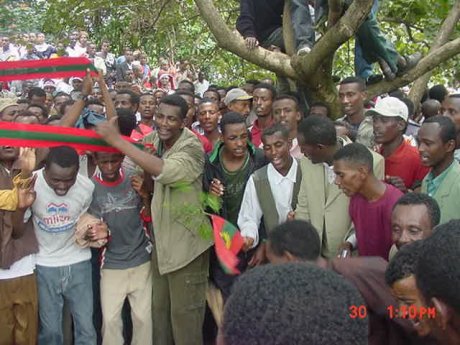
Africa’s youth will protest to remove self-seeking and repressive elites
“Some examples: authoritarian regimes, as in Ethiopia and Rwanda, are consolidating their positions. In Zambia, Angola and Mozambique, the press, civil society organisations and the opposition are under threat for demanding that the proceeds from raw material exports and billion dollar multinational corporate investments should benefit everyone. ….Short-term greed is, once again, depriving the African populations of the right to share in the continent’s immense riches. No-one can predict the future, but what can be said with certainty is that the possibility of a sustainable long-term and fair development that is currently at hand in Africa is being put at risk. The frustration that is fuelled among populations that are hungry and feel ignored by their rulers will bring about increasingly strident and potentially violent protest. In the near future, this will change the political climate, not least in urban areas. Utilising the internet and their mobile phones, Africa’s youth and forgotten people will mobilise and act together to remove self-seeking and repressive elites. But the situation is not hopeless, on the contrary. Civil society is growing stronger in many places in Africa. The internet makes it possible for people to access and disseminate information in an unprecedented way. However, I get really disappointed when I hear all the ingenuous talk about the possibilities to invest and make quick profits in the ‘New Africa’. What is in reality new in the ‘New Africa’? Today, a worker in a Chinese-owned factory in Ethiopia earns one-tenth of the wage of an employee in China. Unless African governments and investors act more responsibly and ensure long-term sustainable construction for people and the environment ‒ which is currently not the case ‒ we must all ask ourselves if we should not use the consumer power we all possess to exert pressure. There are no excuses for letting African populations and their environment once again pay for the global demand for its raw materials and cheap consumer goods.” – Marika Griehsel, journalist, film-maker and lecturer
“Thousands of people are demonstrating on the streets to protest against low salaries, the highcost of living and an insufficient state safety net. A reaction to austerity measures in Greece? Or a follow-up to the Arab Spring? No, these are protests for greater equality in Sub-Saharan Africa, most recently in Burkina Faso. The widening gap between rich and poor is as troubling in Africa as in the rest of the world. In fact, many Africans believe that inequalities are becoming more marked: A tiny minority is getting richer while the lines of poor people grow out the door. The contrast is all the more striking in Africa since the poverty level has been at a consistently high level for decades, despite the continent’s significant average GDP growth. Some take a plane to get treated for hay fever, while others are pushing up daisies because they can’t afford basic malaria treatment.”
– Global Voices: http://globalvoicesonline.org/2014/03/11/reducing-the-gap-between-africas-rich-and-poor/
It is now evident that the African ‘lion economies’ have hardly even begun the economic and democratic transformation that is absolutely necessary for the future of the continent.
The largest movement ever in Africa of people from rural to urban areas is now taking place. Lagos, Nigeria, and Nairobi, Kenya, are among the world’s fastest growing cities.
The frustration that is fuelled among populations that are hungry and feel ignored by their rulers will bring about increasingly strident and potentially violent protest.
Soon, this will change the political climate, not least in urban areas. Utilising the internet and their phones, Africa’s youth and forgotten people will mobilise to remove self-seeking and repressive elites.
This piece was written in Namibia, where I was leading a tour around one of Africa’s more stable nations. There are several signs confirming the World Bank’s reclassification of Namibia as a middle-income country, which in turn means that many aid donors, including Sweden, have ended their bilateral cooperation.
I see newly constructed, subsidised single-family homes accessible for low-income families. I drive on good roads and meet many tourists, although this is off-season. I hear about a growing mining sector, new discoveries of natural gas and oil deposits. I read about irregularities committed by people in power, in a reasonably free press whose editors are not thrown into jail. There is free primary level schooling and almost free health care.
Most people I talk to are optimistic. A better future for a majority of Namibians is being envisaged. This is in all probability the result of the country having a small population ‒ just above 2 million ‒ and a functioning infrastructure despite its large area.
In Namibia, economic growth can hopefully be matched by implementing policies for long-term, sustainable social and economic development that will benefit more than the élite.
But Namibia is an exception. Because it is now evident that the African ‘lion economies’ have hardly even begun the economic and democratic transformation that is absolutely necessary for the future of the continent.
Some examples: authoritarian regimes, as in Ethiopia and Rwanda, are consolidating their positions. In Zambia, Angola and Mozambique, the press, civil society organisations and the opposition are under threat for demanding that the proceeds from raw material exports and billion dollar multinational corporate investments should benefit everyone.
The International Monetary Fund, IMF, predicts continued high growth rates across Africa with an average of over 6 per cent in 2014. That is of course good news for the continent. Perhaps the best, from a macroeconomic viewpoint, since the 1960s, when many of the former colonies became independent. This growth is mainly driven by the raw material needs of China, India and Brazil.
Meanwhile, the largest movement ever in Africa of people from rural to urban areas is now taking place. Lagos, Nigeria, and Nairobi, Kenya, are among the world’s fastest growing cities. But, in contrast with China, where the migrants from the rural areas get employment in the manufacturing industry, the urban migrants in Africa end up in the growing slums of the big cities.
In a few places, notably in Ethiopia, manufacturing is beginning to take off. But the wages in the Chinese-owned factories are even lower than in China, while the corporations pay minimal taxes to the Ethiopian state.
Short-term greed is, once again, depriving the African populations of the right to share in the continent’s immense riches. No-one can predict the future, but what can be said with certainty is that the possibility of a sustainable long-term and fair development that is currently at hand in Africa is being put at risk.
The frustration that is fuelled among populations that are hungry and feel ignored by their rulers will bring about increasingly strident and potentially violent protest. In the near future, this will change the political climate, not least in urban areas. Utilising the internet and their mobile phones, Africa’s youth and forgotten people will mobilise and act together to remove self-seeking and repressive elites.
But the situation is not hopeless, on the contrary. Civil society is growing stronger in many places in Africa. The internet makes it possible for people to access and disseminate information in an unprecedented way. However, I get really disappointed when I hear all the ingenuous talk about the possibilities to invest and make quick profits in the ‘New Africa’.
What is in reality new in the ‘New Africa’?
Today, a worker in a Chinese-owned factory in Ethiopia earns one-tenth of the wage of an employee in China. Unless African governments and investors act more responsibly and ensure long-term sustainable construction for people and the environment ‒ which is currently not the case ‒ we must all ask ourselves if we should not use the consumer power we all possess to exert pressure.
There are no excuses for letting African populations and their environment once again pay for the global demand for its raw materials and cheap consumer goods.
Some examples: authoritarian regimes, as in Ethiopia and Rwanda, are consolidating their positions. In Zambia, Angola and Mozambique, the press, civil society organisations and the opposition are under threat for demanding that the proceeds from raw material exports and billion dollar multinational corporate investments should benefit everyone.
http://naiforum.org/2014/03/africas-youth-will-protest/
The World Bank paints an optimistic picture of African potential, but warns against persistently high inequalities:
Economic growth in Sub-Saharan Africa (SSA) remains strong with growth forecasted to be 4.9% in 2013. Almost a third of countries in the region are growing at 6% and more, and African countries are now routinely among the fastest-growing countries in the world […] [however the report] notes that poverty and inequality remain “unacceptably high and the pace of reduction unacceptably slow.” Almost one out of every two Africans lives in extreme poverty today.
 http://globalvoicesonline.org/2014/03/11/reducing-the-gap-between-africas-rich-and-poor/
Africa: Legacy of Pre-colonial Empires and Colonialism March 13, 2014
Posted by OromianEconomist in Aannolee and Calanqo, Afaan Publication, Africa, Africa Rising, African Beat, African Poor, Agriculture, Aid to Africa, Ancient African Direct Democracy, Colonizing Structure, Comparative Advantage, Corruption, Culture, Development, Dhaqaba Ebba, Dictatorship, Domestic Workers, Economics, Economics: Development Theory and Policy applications, Environment, Ethnic Cleansing, Finfinnee, Haacaaluu Hundeessaa, Hadiya, Hadiya and the Omo Valley, Haile Fida, Human Rights, Human Traffickings, Humanity and Social Civilization, ICC, Janjaweed Style Liyu Police of Ethiopia, Kemetic Ancient African Culture, Knowledge and the Colonizing Structure., Land and Water Grabs in Oromia, Language and Development, Nubia, Ogaden, OMN, Omo, Omo Valley, Oromia, Oromia Support Group, Oromiyaa, Oromo, Oromo Artists, Oromo Culture, Oromo First, Oromo Identity, Oromo Nation, Oromo Social System, Oromo Sport, Oromo the Largest Nation of Africa. Human Rights violations and Genocide against the Oromo people in Ethiopia, Oromummaa, Poverty, Self determination, Sidama, Sirna Gadaa, South Sudan, Specialization, State of Oromia, The Colonizing Structure & The Development Problems of Oromia, The Oldest Living Person Known to Mankind, The Tyranny of Ethiopia, Tweets and Africa, Tyranny, Youth Unemployment.Tags: Africa, African Studies, Development, Economic and Social Freedom, Economic development, economics, Ethiopia, Gadaa System, Genocide against the Oromo, Human Rights and Liberties, Human rights violations, Land grabs in Africa, National Self Determination, Oromia, Oromiyaa, Oromo, Oromo culture, Oromo people, Oromummaa, Politics of Ethiopia, poverty, Social Sciences, State and Development, Sub-Saharan Africa, Tyranny, United Nations, Universal Declaration of Human Rights, World Bank
add a comment
‘Our knowledge of the nature of identity relations in pre-colonial Africa is less than complete. However, there is little doubt that many parts of the continent were torn apart by various wars, during that era. Many of the pre-colonial wars revolved around state formation, empire building, slave raids, and control over resources and trade routs. The slave raiding and looting empires and kingdoms, including those of the 19th century, left behind complex scars in inter-identity relations. It is beyond the scope of this paper to discuss in detail the nature of pre-colonial empires in Africa. The examples of the Abyssinian Empire and the Mahdiyya state in Sudan provide a glimpse of the impacts of pre-colonial empires on the prevailing problems in inter-identity relations. The Abyssinian Empire, for example, is credited for creating the modern Ethiopian state during the second half of the 19th century and defending it from European colonialism. However, it also left behind a deeply divided country where the populations in the newly incorporated southern parts of the country were ravaged by slave raids and lootings and, in many cases, reduced into landless tenants, who tilled the land for northern landlords (Pankhurst, 1968). The Empire also established a hierarchy of cultures where the non-Abyssinian cultures in the newly incorporated territories were placed in a subordinate position. There are claims, for instance, that it was not permissible to publish, preach, teach or broadcast in Oromiya [Afaan Oromo] (language of the Oromo people) in Ethiopia until the end of the reign of Emperor Haile Selassie (Baxter, 1978, 228). It requires a great deal of sensitivity to teach Ethiopian history in the country’s schools, since the empire-builders of the 19th century are heroes to some identities while they are viewed as villains who brought destruction and oppression by others. Similarly, Sudan’s Mahdiyya state, which professed Arab identity and was supported by slave raiding communities, left behind complex scars in inter-identity relations, which still plague the country (Francis Deng, 2010).’ pp 10-12
Diversity Management in Africa: Findings from the African Peer Review Mechanism
and a Framework for Analysis and Policy-Making , 2011.
http://www.uneca.org/sites/default/files/publications/3-diversity-management.pdf
Click to access 3-diversity-management.pdf
Related articles:
No Oromo has constitutional or legal protection from the cruelty of the TPLF/EPRDF regime.
A country is not about its leaders but of its people. It goes without saying that the people are the symbolic mirror of their nation. That is exactly why foreigners particularly the development partners assess and evaluate a nation through its people. In other words, a happy people are citizen of not only a peaceful and happy nation but one which accepts the principles of democracy, rule of law and human and people’s right. On the contrast, heartbroken, timid and unhappy people are subjects of dictatorial, callous and brutal regimes. Such people are robbed of their humanity and identity through systematic harassment, intimidation, unlawful detention, extra judicial killing and disappearances by the leaders who transformed themselves into creators of human life or lords. The largest oromo nation in Ethiopia through the 22years of TPLF/EPRDF repressive leadership has turned into a nation sobbing in the dark. One does not need to be a rocket scientist to figure this out. All it takes is a closer look at any Oromos in the face. The story is the same on all the faces: fear, uncertainty, and an unquenchable thirst for freedom. The disturbing melody of the sobs in the dark echo the rhythmic desire to break free from TPLF dictatorial shackles.
The Horn African region of the Ethiopia is home to just 90 million people, it is also home to one of the world’s most ruthless, and eccentric, tyrannical regime .TPLF/EPRDF is ruling the nation particularly the Oromos with an iron fist for the past two decades and yet moving on. Today dissents in Oromia are frequently harassed, arrested, tortured, murdered and put through sham trials, while the people are kept in a constant state of terror through tight media control, as repeatedly reported by several human rights groups. It has been long time since the Woyane government bans most foreign journalists and human rights organizations and NGOs from operating in the country for the aim of hiding its brutal governance from the world. While the people in Ethiopia are being in terrorized by TPLF gangs, the western powers are yet looking at the country as a very strategic place to fight the so called terrorism in horn African region. But In today’s Ethiopia; as an Oromo, No one can speak out against the dictatorship in that country. You can be killed. You can be arrested. You can be kept in prison for a long time. Or you can disappear in thin air. Nobody will help. Intimidations, looting Oromo resources and evicting Oromos from their farm lands have become the order of the day everywhere across Oromia.
No Oromo has constitutional or legal protection from the killing machinery of the TPLF securities. The recent murdering of Tesfahun Chemeda in kallitti prison is a case book of the current Circumstance.
The So called EPRDF constitution, as all Ethiopian constitutions had always been under the previous Ethiopian regimes, is prepared not to give legal protections to the Oromo people, but to be used against the Oromo people. Prisons in the Ethiopia have become the last home to Oromo nationalists, human right activists or political opponent of the regime. Yet the international community is either not interested or have ignored the numerous Human Right abuses in Ethiopia simply because, they think there is stability in the country. Is there no stability in North Korea? I don’t understand why the international community playing double standard with dining and wining with Ethiopian brutal dictators while trying to internationally isolate other dictators. For crying out loud, all dictators are dangerous to humanity and shaking their hands is even taboo much more doing business with them.
Without the support of the USA and EU, major pillars of the regime would have collapsed. Because one reason why TPLF is sustaining in power is through the budgetary support and development funding of the EU, the United States and offered diplomatic validation by the corrupted African Union. Foremost, the US and EU as the largest partners are responsible for funding the regime’s sustainability and its senseless brutality against ordinary citizens. They would have the capacity to disrupt the economic might of this regime without negatively impacting ordinary citizens, and their failure to do so is directly responsible for the loss of many innocent lives, the torture of many and other grievous human rights abuses. Helping dictators while they butcher our people is what I cannot understand. What I want to notify here is, on the way of struggling for freedom it is very essential to call on the western powers to stop the support they are rendering to dictators in the name of fighting the so called terrorism in Horn Africa, otherwise it will remain an obstacle for the struggle.
Holding elections alone does not make a country democratic. Where there is no an independent media, an independent judiciary (for the rule of law), an independent central bank, an independent electoral commission (for a free and fair vote); neutral and professional security forces; and an autonomous (not a rubber stamp) parliament, no one should expect that the pseudo election will remove TPLF from power. The so-called “Ethiopian constitution” is a façade that is not worth the paper which it is written on. It does not impose the rule of law; and does not effectively limit governmental power. No form of dissent is tolerated in the country.
As my understanding and as we have observed for more than two decades, it is unthinkable to remove TPLF regime without a military struggle or without popular Uprisings. They are staying, staying, and staying in power – 10, 20, 22 and may be 30 or 40 years. They have developed the mentality of staying on power as their own family and ethnic property. So that they are grooming their clans, their wives, sons, cats, dogs and even goats to succeed them. They are simply the worst mafia regime and the most politically intolerant in the Africa. It is impossible to remove them electorally because we have been witnessing that the electoral system is fundamentally flawed and indomitably skewed in favor them. Every gesture and every words coming from TPLF gangs in the last several years have confirmed that to remove them by election is nothing but like to dream in daylight.
The late dictator “Meles Zenawi” had once said that TPLF “shall rule for a thousand years”, asserting that elections SHALL NOT remove his government. He also said: “the group who want the power must go the forest and fight to achieve power”. Therefore, taking part in Pseudo election will have no impact on reducing the pain of the oppressed people. Evidently, the opposition and civil societies have been rendered severely impotent, as any form of dissent attracts the ultimate penalty in Ethiopia. Furthermore, we are watching that this regime is intensifying its repression of democracy each day, and ruling strictly through the instrument of paralyzing fear and the practice of brutality against ordinary citizens.
As we are learning from history, Dictators are not in a business of allowing election that could remove them from their thrones. The only way to remove this TPLF dictatorship is through a military force, popular uprising, or a rebel insurgency: Egypt (2011), Ivory Coast (2011), Tunisia (2011), Libya (2011), Rwanda (1994), Somalia (1991), Liberia (1999), etc. A high time to fire up resistance to the TPLF killings and resource plundering in Oromia, is now. To overthrow this brutal TPLF dictatorship and to end the 22 years of our pain, it is a must to begin the resistance with a nationwide show of defiance including distributing postures of resistance against their brutality across Oromia and the country. Once a national campaign of defiance begins, it will be easy to see how the TPLF regime will crumble like a sand castle. Besides, we the Oromo Diaspora need to work on strengthening the struggle by any means we can. It is the responsibility of the Diaspora to advance the Oromo cause, and at the same time to determine how our efforts can be aided by the international community. As well, it is a time for every freedom thirsty Oromo to take part in supporting our organization Oromo liberation Front by any means we can.
These days, TPLF regime is standing on one foot and removing it is easier than it appears. Let all oppressed nations organize for the final push to liberty. The biggest fear of Woyane regime is people being organized and armed with weapons of unity, knowledge, courage, vigilance, and justice. What is needed is a unified, dedicated struggle for justice and sincerity. Oromo’s are tired of the dying, the arrests, the detentions, the torture, the brutality and the forced disappearances. This should come to an end! DEATH FOR TPLF LEADERES ,.long live FOR OROMIYA
_____________________________________
The author, ROBA PAWELOS, can be reached by bora1273@yahoo.com
A country is not about its leaders but of its people. It goes without saying that the people are the symbolic mirror of their nation. That is exactly why foreigners particularly the development partners assess and evaluate a nation through its people. In other words, a happy people are citizen of not only a peaceful and happy nation but one which accepts the principles of democracy, rule of law and human and people’s right. On the contrast, heartbroken, timid and unhappy people are subjects of dictatorial, callous and brutal regimes. Such people are robbed of their humanity and identity through systematic harassment, intimidation, unlawful detention, extra judicial killing and disappearances by the leaders who transformed themselves into creators of human life or lords. The largest oromo nation in Ethiopia through the 22years of TPLF/EPRDF repressive leadership has turned into a nation sobbing in the dark. One does not need to be a rocket scientist to figure this out. All it takes is a closer look at any Oromos in the face. The story is the same on all the faces: fear, uncertainty, and an unquenchable thirst for freedom. The disturbing melody of the sobs in the dark echo the rhythmic desire to break free from TPLF dictatorial shackles.
The Horn African region of the Ethiopia is home to just 90 million people, it is also home to one of the world’s most ruthless, and eccentric, tyrannical regime .TPLF/EPRDF is ruling the nation particularly the Oromos with an iron fist for the past two decades and yet moving on. Today dissents in Oromia are frequently harassed, arrested, tortured, murdered and put through sham trials, while the people are kept in a constant state of terror through tight media control, as repeatedly reported by several human rights groups. It has been long time since the Woyane government bans most foreign journalists and human rights organizations and NGOs from operating in the country for the aim of hiding its brutal governance from the world. While the people in Ethiopia are being in terrorized by TPLF gangs, the western powers are yet looking at the country as a very strategic place to fight the so called terrorism in horn African region. But In today’s Ethiopia; as an Oromo, No one can speak out against the dictatorship in that country. You can be killed. You can be arrested. You can be kept in prison for a long time. Or you can disappear in thin air. Nobody will help. Intimidations, looting Oromo resources and evicting Oromos from their farm lands have become the order of the day everywhere across Oromia.
No Oromo has constitutional or legal protection from the killing machinery of the TPLF securities. The recent murdering of Tesfahun Chemeda in kallitti prison is a case book of the current Circumstance.
The So called EPRDF constitution, as all Ethiopian constitutions had always been under the previous Ethiopian regimes, is prepared not to give legal protections to the Oromo people, but to be used against the Oromo people. Prisons in the Ethiopia have become the last home to Oromo nationalists, human right activists or political opponent of the regime. Yet the international community is either not interested or have ignored the numerous Human Right abuses in Ethiopia simply because, they think there is stability in the country. Is there no stability in North Korea? I don’t understand why the international community playing double standard with dining and wining with Ethiopian brutal dictators while trying to internationally isolate other dictators. For crying out loud, all dictators are dangerous to humanity and shaking their hands is even taboo much more doing business with them.
Without the support of the USA and EU, major pillars of the regime would have collapsed. Because one reason why TPLF is sustaining in power is through the budgetary support and development funding of the EU, the United States and offered diplomatic validation by the corrupted African Union. Foremost, the US and EU as the largest partners are responsible for funding the regime’s sustainability and its senseless brutality against ordinary citizens. They would have the capacity to disrupt the economic might of this regime without negatively impacting ordinary citizens, and their failure to do so is directly responsible for the loss of many innocent lives, the torture of many and other grievous human rights abuses. Helping dictators while they butcher our people is what I cannot understand. What I want to notify here is, on the way of struggling for freedom it is very essential to call on the western powers to stop the support they are rendering to dictators in the name of fighting the so called terrorism in Horn Africa, otherwise it will remain an obstacle for the struggle.
Holding elections alone does not make a country democratic. Where there is no an independent media, an independent judiciary (for the rule of law), an independent central bank, an independent electoral commission (for a free and fair vote); neutral and professional security forces; and an autonomous (not a rubber stamp) parliament, no one should expect that the pseudo election will remove TPLF from power. The so-called “Ethiopian constitution” is a façade that is not worth the paper which it is written on. It does not impose the rule of law; and does not effectively limit governmental power. No form of dissent is tolerated in the country.
As my understanding and as we have observed for more than two decades, it is unthinkable to remove TPLF regime without a military struggle or without popular Uprisings. They are staying, staying, and staying in power – 10, 20, 22 and may be 30 or 40 years. They have developed the mentality of staying on power as their own family and ethnic property. So that they are grooming their clans, their wives, sons, cats, dogs and even goats to succeed them. They are simply the worst mafia regime and the most politically intolerant in the Africa. It is impossible to remove them electorally because we have been witnessing that the electoral system is fundamentally flawed and indomitably skewed in favor them. Every gesture and every words coming from TPLF gangs in the last several years have confirmed that to remove them by election is nothing but like to dream in daylight.
The late dictator “Meles Zenawi” had once said that TPLF “shall rule for a thousand years”, asserting that elections SHALL NOT remove his government. He also said: “the group who want the power must go the forest and fight to achieve power”. Therefore, taking part in Pseudo election will have no impact on reducing the pain of the oppressed people. Evidently, the opposition and civil societies have been rendered severely impotent, as any form of dissent attracts the ultimate penalty in Ethiopia. Furthermore, we are watching that this regime is intensifying its repression of democracy each day, and ruling strictly through the instrument of paralyzing fear and the practice of brutality against ordinary citizens.
As we are learning from history, Dictators are not in a business of allowing election that could remove them from their thrones. The only way to remove this TPLF dictatorship is through a military force, popular uprising, or a rebel insurgency: Egypt (2011), Ivory Coast (2011), Tunisia (2011), Libya (2011), Rwanda (1994), Somalia (1991), Liberia (1999), etc. A high time to fire up resistance to the TPLF killings and resource plundering in Oromia, is now. To overthrow this brutal TPLF dictatorship and to end the 22 years of our pain, it is a must to begin the resistance with a nationwide show of defiance including distributing postures of resistance against their brutality across Oromia and the country. Once a national campaign of defiance begins, it will be easy to see how the TPLF regime will crumble like a sand castle. Besides, we the Oromo Diaspora need to work on strengthening the struggle by any means we can. It is the responsibility of the Diaspora to advance the Oromo cause, and at the same time to determine how our efforts can be aided by the international community. As well, it is a time for every freedom thirsty Oromo to take part in supporting our organization Oromo liberation Front by any means we can.
These days, TPLF regime is standing on one foot and removing it is easier than it appears. Let all oppressed nations organize for the final push to liberty. The biggest fear of Woyane regime is people being organized and armed with weapons of unity, knowledge, courage, vigilance, and justice. What is needed is a unified, dedicated struggle for justice and sincerity. Oromo’s are tired of the dying, the arrests, the detentions, the torture, the brutality and the forced disappearances. This should come to an end! DEATH FOR TPLF LEADERES ,.long live FOR OROMIYA
_____________________________________
The author, ROBA PAWELOS, can be reached by bora1273@yahoo.com
‘Briefcase bandits’
Africa’s spin doctors (mostly American and European) deliberately choose to represent what the Free Africa Foundation’s George Ayittey so refreshingly describes as “Swiss-bank socialists”, “crocodile liberators”, “quack revolutionaries”, and “briefcase bandits”. Mr Ayittey – a former political prisoner from Ghana – pulls us a lot closer to the truth.
If the mainstream media adopts Mr Ayittey’s language, the free governments of the world would be forced to face the truth and take necessary steps to tie their aid and trade deals to democratic reform for the benefit of Africa’s population. Sunlight is the best disinfectant, and we must combat the work of firms that provide “reputation management” to oppressive states by exposing their role in abetting injustice.
Those firms may want to consider atoning by volunteering for the civil society groups, human rights’ defenders and economic opportunity organisations working to make Africa free and prosperous.’…………………………………………………
Africa’s spin doctors (mostly American and European) deliberately choose to represent what the Free Africa Foundation’s George Ayittey so refreshingly describes as “Swiss-bank socialists”, “crocodile liberators”, “quack revolutionaries”, and “briefcase bandits”. Mr Ayittey – a former political prisoner from Ghana – pulls us a lot closer to the truth.
If the mainstream media adopts Mr Ayittey’s language, the free governments of the world would be forced to face the truth and take necessary steps to tie their aid and trade deals to democratic reform for the benefit of Africa’s population. Sunlight is the best disinfectant, and we must combat the work of firms that provide “reputation management” to oppressive states by exposing their role in abetting injustice.
Those firms may want to consider atoning by volunteering for the civil society groups, human rights’ defenders and economic opportunity organisations working to make Africa free and prosperous.’…………………………………………………
A number of African governments accused of human rights abuses have turned to public relations companies to salvage the image of their countries.
The BBC’s Focus on Africa magazine asked two experts whether “reputation management” is mostly a cover-up for bad governance.
NO: Thor Halvorssen is president of the New York-based Human Rights Foundation and founder of the Oslo Freedom Forum.
Thor Halvorssen has published extensively on the subject of lobbying
For Public Relations (PR) companies and their government clients, “reputation management” can be a euphemism of the worst sort. In many cases across Africa, it often means whitewashing the human rights violations of despotic regimes with fluff journalism and, just as easily, serving as personal PR agents for rulers and their corrupt family members.
But they also help governments drown out criticism, often branding dissidents, democratic opponents and critics as criminals, terrorists or extremists.
Today, with the preponderance of social media, anyone with an opinion, a smart phone and a Facebook account can present their views to an audience potentially as large as any major political campaign can attract.
This has raised citizen journalism to a level of influence unknown previously. Yet, this communication revolution has also resulted in despotic governments smearing not just human rights advocates, but individuals with blogs as well as Twitter, YouTube and Facebook accounts. This undermines the power and integrity of social media.
And as PR firms help regimes “astroturf” with fake social media accounts, they do more damage than just muddling legitimate criticism with false comments and tweets linking back to positive content – they also make the general public sceptical about social media.
It is no surprise that ruthless governments that deny their citizens basic freedoms would wish to whitewash their reputations. But PR professionals who spin for them should be exposed as amoral.
It is no surprise that ruthless governments that deny their citizens basic freedoms would wish to whitewash their reputations”
For instance, Qorvis Communications, a PR and lobbying firm in the United States, represents Equatorial Guinea – among other allegedly repressive governments – for a reported $55,000 a month. The firm is said to have amassed more than $100 million by helping their clients with “reputation management”.
By burying opposing public opinions or spinning false, positive stories of stability and economic growth on behalf of President Teodoro Obiang Nguema’s brutal regime, the firm is seriously hampering the progress of human rights in the country.
In response, Qorvis says that customers with troublesome human rights records are a very small part of its client base, and that these governments are using Qorvis as a means to be heard in the “court of public opinion”.
Washington Media Group, another American PR firm, was hired in 2010 by the Tunisian government. The autocracy was subsequently described in various media outlets as a “stable democracy” and a “peaceful, Islamic country with a terrific story to share with the world”. Only after the regime’s snipers began picking off protesters did Washington Media Group end its $420,000 contract.
‘Limited engagement’
When a PR firm spins a dictator’s story, it does not just present a different viewpoint, as the firm might want you to believe; rather, it undermines the resources from which people can draw opinions. If a website or magazine commends the government, how is an average citizen to know for certain if the information is accurate or true?
President Teodoro Obiang Nguema
Teodoro Obiang Nguema is accused of leading a brutal regime in Equatorial Guinea
Many firms that operate, or have done, on behalf of kleptocracies in Africa are based not only in the US but also in the United Kingdom. They include Bell Pottinger (Hosni Mubarak’s Egypt), Brown Lloyd James (Muammar Gaddafi’s Libya) and Hill & Knowlton (Yoweri Museveni’s Uganda).
There are likely many more that continue to do this work under the cover of corporate secrecy. When firms get caught or criticised for their activities many say it is “limited engagement” for only a few months or that the task only involved “tourism” or “economic progress”.
If, for instance, a firm served the questionable government in the Democratic Republic of the Congo they would probably insist they are “consultants” helping to create “economic opportunity” and, no doubt, providing a “guiding hand” to the current president as he improves the lot of the Congolese poor.
Yet the spin doctors most probably ignore the fact that President Joseph Kabila’s security forces killed Floribert Chebeya, arguably the DR Congo’s leading human rights defender, and likely “disappeared” his driver (he is still missing). Only after an international uproar were the policemen directly responsible for the killing brought to justice.
Meanwhile, political opponents routinely disappear, journalists are arrested for criticising the government and any comprehensive human rights report contains appalling anecdotes and painful analysis about a country with little judicial independence and respect for the rule of law.
PR agents do not create “economic opportunities” – they alter reality so that certain deals and foreign aid can flow faster and in larger quantities – all the while being rewarded handsomely.
‘Briefcase bandits’
Africa’s spin doctors (mostly American and European) deliberately choose to represent what the Free Africa Foundation’s George Ayittey so refreshingly describes as “Swiss-bank socialists”, “crocodile liberators”, “quack revolutionaries”, and “briefcase bandits”.
Mr Ayittey – a former political prisoner from Ghana – pulls us a lot closer to the truth.
If the mainstream media adopts Mr Ayittey’s language, the free governments of the world would be forced to face the truth and take necessary steps to tie their aid and trade deals to democratic reform for the benefit of Africa’s population.
Sunlight is the best disinfectant, and we must combat the work of firms that provide “reputation management” to oppressive states by exposing their role in abetting injustice.
Those firms may want to consider atoning by volunteering for the civil society groups, human rights’ defenders and economic opportunity organisations working to make Africa free and prosperous.

Copyright © OromianEconomist 2014 & Oromia Quarterly 1997-2014, all rights are reserved. Disclaimer.
The Oromo are the second largest indigenous population in Africa March 11, 2014
Posted by OromianEconomist in Aannolee and Calanqo, Afaan Publication, Africa, African Beat, Ancient African Direct Democracy, Colonizing Structure, Development, Dictatorship, Ethnic Cleansing, Facebook and Africa, Fatuma Roba, Finfinnee, Gadaa System, Haacaaluu Hundeessaa, Human Rights, Human Traffickings, Humanity and Social Civilization, Irreecha, Janjaweed Style Liyu Police of Ethiopia, Kemetic Ancient African Culture, Knowledge and the Colonizing Structure., Language and Development, Nubia, OMN, Oromia, Oromia Support Group, Oromiyaa, Oromo, Oromo Artists, Oromo Culture, Oromo First, Oromo Identity, Oromo Media Network, Oromo Music, Oromo Nation, Oromo Social System, Oromo Sport, Oromo the Largest Nation of Africa. Human Rights violations and Genocide against the Oromo people in Ethiopia, Oromummaa, Poverty, Qubee Afaan Oromo, Saudi Arabia, Self determination, Sidama, Sirna Gadaa, Slavery, State of Oromia, The Colonizing Structure & The Development Problems of Oromia, The Oldest Living Person Known to Mankind, The Oromo Democratic system, The Oromo Governance System, The Oromo Library, The Tyranny of Ethiopia, Theory of Development, Uncategorized.Tags: Africa, African culture, African Studies, Development, Genocide, Genocide against the Oromo, Governance issues, Horn of Africa, Human Rights and Liberties, Human rights violations, National Self Determination, Oromia, Oromia and Australia, Oromiyaa, Oromo people, Oromummaa, poverty, State and Development, United Nations, Universal Declaration of Human Rights, World Bank
1 comment so far
Hard roads to freedom: The Oromo fight for recognition in their new home
refugeeweek
‘We have to tell people we are the second largest indigenous population in Africa
because nobody knows about us.’

http://advocacy4oromia.files.wordpress.com/2013/05/oromo-fight-for-recognition-in-their-new-home.pdf
Why Should We Protect Endangered Languages? February 24, 2014
Posted by OromianEconomist in Africa, Ethiopia's Colonizing Structure and the Development Problems of People of Oromia, Afar, Ogaden, Sidama, Southern Ethiopia and the Omo Valley, Ethnic Cleansing, Finfinnee, Janjaweed Style Liyu Police of Ethiopia, Kambata, Kemetic Ancient African Culture, Language and Development, Nubia, Ogaden, Omo, Omo Valley, Oral Historian, Oromia, Oromia Support Group, Oromiyaa, Oromo, Oromo Culture, Oromo First, Oromo Nation, Oromo the Largest Nation of Africa. Human Rights violations and Genocide against the Oromo people in Ethiopia, Oromummaa, Qubee Afaan Oromo, Self determination, Sirna Gadaa, State of Oromia, The Oromo Library, Theory of Development, Toltu Tufa, Uncategorized, Wisdom.Tags: Afaan Oromo, Afaan Oromo Kushitic Kemetic language, African culture, African Studies, Development and Change, Genocide against the Oromo, Human Rights and Liberties, Oromia, Oromo, Oromo culture, Universal Declaration of Human Rights
1 comment so far
Will the speakers, after all, have equal access to the empire or economy? Experience suggests that they don’t; so that for at least one generation, and probably more, they continue to suffer adverse discrimination. The discrimination which had been attached to their language is then converted to a slur on their poverty, their lack of education, their religion, or their personal appearance. And whose ‘progress’ is being promoted? When society becomes more linguistically integrated, the greater gainers – perhaps the only gainers – may be the existing elite who now have a bigger game of domination to play. The future may even have been misunderstood, and the plans go nowhere. Maybe the minority community holds some of the answers. Is there only one path to a desirable future? Certainly, an autonomous community with its own language may gain little when it comes to dependence on welfare support.
In fact, political ‘divisions’ – although potentially an embarrassment for a national government – are very likely essential to the future identity of a community. A surviving minority language is a convenient way of marking and defending this, and tying it up with a massive cultural tradition. Its loss leads simply to oblivion. …‘Why Should We Protect Endangered Languages?’, is that, if we don’t, the communities that speak those languages will vanish, (along with features that make their life distinctive), almost as if they had never been. This is a loss of something valued by its speakers, and hence valuable. And in the general case, there is no corresponding automatic gain. In the general case, such a loss is to be avoided, if at all possible. This is because it makes the world a poorer place, certainly; but above all it is to be be avoided for the sake of the speakers, who stand to lose – in the long term – their very identities, their treasured sense of who they are and where they come from.- http://www.gresham.ac.uk/lectures-and-events/why-should-we-protect-endangered-languages
Afaan Oromo After 100 Years of Disincentives: Toltu Tufa of the Afaan Publications on radio with Jon Faine on the Conversation Hour at ABC Studios Melbourne February 19, 2014
Posted by OromianEconomist in Afaan Publication, Africa, Humanity and Social Civilization, Kemetic Ancient African Culture, Language and Development, Oromia, Oromiyaa, Oromo, Oromo Artists, Oromo Culture, Oromo First, Oromo Identity, Oromo Social System, Oromummaa, Qubee Afaan Oromo, Self determination, Sirna Gadaa, The Colonizing Structure & The Development Problems of Oromia, The Oromo Democratic system, The Oromo Governance System, The Oromo Library, Toltu Tufa, Uncategorized.Tags: Afaan Oromo, Afaan Oromo Kushitic Kemetic language, Afaan publication, Africa, African culture, African Studies, Development and Change, Gadaa System, Genocide against the Oromo, Kushitic Languages, Language and Development, National Self Determination, Oromia, Oromia Region, Oromiyaa, Oromo people, Oromummaa, Qubee Afaan Oromo, Toltu Tufa, Universal Declaration of Human Rights
add a comment

‘EVERY CHILD HAS THE RIGHT TO LEARN THEIR MOTHER TONGUE.’
Related:
http://ayyaantuu.com/horn-of-africa-news/oromia/toltu-tufa-oprides-oromo-person-2013/
AFAAN Publication: Commemorating UNESCO’s International Mother Language Day on Feb. 21, 2014; Highlighting Past Achievements; and Laying out Plans for 2014
February 21 is UNESCO’s International Mother Language Day. AFAAN Publications’ successful campaign to raise funds to produce children books in Afaan Oromo is the highlight of 2013. The Oromo language, Afaan Oromo, is Africa’s 4th most widelyspoken language, which was banned for 100 years until 1991. AFAAN Publications is based in Melbourne.
AFAAN Publication recounts the 2013 successfulfundraising campaign by recognizing some of the international cities which supported the Melbourne’s drive to create children’s books in Afaan Oromo, and AFAAN Publications was also featured last week on 774 Radio ABC Melbourne.
The communications team is available for comments and interview via telephone. Enquiries can be made via email on connect@afaan.com.au
AFAAN Publication: Commemorating UNESCO’s International Mother Language Day on Feb. 21, 2014; Highlighting Past Achievements; and Laying out Plans for 2014.
Copyright © OromianEconomist 2014 & Oromia Quarterly 1997-2014, all rights are reserved. Disclaimer.
US Congress Takes a Historic Stance Against Land Grabs-Related Forced Evictions in Ethiopia February 13, 2014
Posted by OromianEconomist in Africa, Aid to Africa, Colonizing Structure, Corruption, Development, Economics: Development Theory and Policy applications, Environment, Food Production, Human Rights, Janjaweed Style Liyu Police of Ethiopia, Land Grabs in Africa, Nubia, Omo, Oromia, Oromiyaa, Oromo, Oromo Culture, Oromo First, Oromo Identity, Oromo Nation, Oromummaa, Self determination, The Colonizing Structure & The Development Problems of Oromia, Theory of Development, Tyranny, Uncategorized.Tags: African culture, African Studies, Developing country, Development, Development and Change, Economic and Social Freedom, Economic development, Economic growth, Genocide against the Oromo, Gibe Valley, Governance issues, Horn of Africa, Human rights, Human Rights and Liberties, Human rights violations, Land grabbing, Land grabs in Africa, Lower Omo, National Self Determination, Oromia, Oromiyaa, Oromo, Oromo culture, Oromo people, Politics of Ethiopia, poverty, State and Development, Sub-Saharan Africa, Tyranny, United Nations, Universal Declaration of Human Rights, World Bank
1 comment so far

See the Omnibus Appropriations Bill (p. 1295-1296) @
http://docs.house.gov/billsthisweek/20140113/CPRT-113-HPRT-RU00-h3547-hamdt2samdt_xml.pdf
Oakland, CA – In a historic move, the US Congress has taken a stance on land grabs-related human rights abuses in Ethiopia. The 2014 Omnibus Appropriations Bill contains provisions that ensure that US development funds are not used to support forced evictions in Ethiopia.
The bill prevents US assistance from being used to support activities that directly or indirectly involve forced displacement in the Lower Omo and Gambella regions. It further requires US assistance in these areas be used to support local community initiatives aimed at improving livelihoods and be subject to prior consultation with affected populations. The bill goes further and even instructs the directors of international financial institutions to oppose financing for any activities that directly or indirectly involve forced evictions in Ethiopia.
According to Anuradha Mittal, Executive Director of the Oakland Institute, “We welcome this move as it aims to address one major flaw of US assistance to Ethiopia. The step taken by the US Congress is very significant, as it signals to both the Ethiopian government and the US administration that turning a blind eye to human rights abuses in the name of development is no longer an option.”
Several reports from the Oakland Institute have raised alarm about the scale, rate, and negative impacts of large-scale land acquisitions in Ethiopia that would result in the forced displacement of over 1.5 million people. This relocation process through the government’s villagization scheme is destroying the livelihoods of small-scale farmers and pastoralist communities. Ethiopian security forces have beaten, arrested, and intimidated individuals who have refused to relocate and free the lands for large-scale agricultural plantations.
Ethiopia’s so-called development programs cannot be carried out without the support of international donors, primarily the US, one of its main donors. Oakland Institute’s on-the-ground research has documented the high toll paid by local people as well as the role of donor countries such as the US in supporting the Ethiopian policy.
This language represents an important first step towards Congress initiating a comprehensive examination of US development practices in Ethiopia. As the oversight authority of the State Department, Congress must now ensure that the law is fully upheld and implemented. This warrants thorough scrutiny of USAID programs to Ethiopia and their contribution to forced resettlements and human rights abuses.
With this bill, USAID, the State Department, as well as the World Bank, will have to reconsider the terms and modalities of the support they provide to the Ethiopian government. According to Frederic Mousseau, Oakland Institute’s Policy Director, “This is a light of hope for the millions of indigenous people in Ethiopia who have sought international support from the international community to recognize their very destruction as communities and people.” Read Further @
USAID’s cover-up of Ethiopia abuses overruled by Congress 12 February 2014
The United States Congress has acted to prevent its aid to Ethiopia being used to fund forced evictions of tribal peoples in the south west of the country.
The provisions in the Omnibus Appropriations Bill for 2014 represent a slap in the face for USAID, which last month said that ‘there are no reports of widespread or systematic human rights abuses’ in the region.
In fact, tribes of the Lower Omo Valley are being violently evicted from their villages by the government to make way for lucrative cotton, palm oil, and sugarcane plantations whose irrigation will be made possible by the controversial Gibe III dam. Transferred to designated resettlement areas, the once self-sufficient tribes will be left with no access to their livestock or lands and, consequently, will be unable to sustain themselves. Intimidation tactics, such as rape and beatings, have reportedly been used against those who resist resettlement.
One Mursi man told Survival International, ‘We are waiting to die. We are crying. When the government collects people into one village there will be no place for crops, and my children will be hungry and have no food.’
The Ethiopian government has not consulted any indigenous communities over its aggressive plantation plans in the Omo Valley, and very few were consulted over the construction of the Gibe III dam.
This sugarcane plantation, part of a government sponsored land grab, now occupies land used by tribes of the Lower Omo Valley since time immemorial.
© Ethiopian Sugar Corporation
The region’s top human rights body, the African Commission on Human and Peoples’ Rights, has written to the Ethiopian government asking it to halt the forced resettlement of the Lower Omo tribes while it investigates Survival’s submission regarding human rights violations in the area.
Ethiopia is one of the biggest recipients of American and British aid through the United States Agency for International Development (USAID) and the UK Department for International Development (DFID).
Although the provisions in the recent spending bill will force USAID to reevaluate the funding given to Ethiopia, it will ultimately be the responsibility of Congress to guarantee that the terms are upheld.
Survival International Director Stephen Corry said today, ‘This bill is a huge step in the right direction, and shows that USAID’s shameful denials of the human rights abuses being committed in the Lower Omo simply haven’t been believed.
‘American taxpayers want to be sure that their money isn’t going toward the destruction of tribal peoples’ lives. Hopefully the historic provisions in this year’s spending bill will ensure that’s the case. It is now high time that British parliamentarians follow suit and ensure that DFID does not use UK taxpayers’ money to fund human rights violations in the Lower Omo.’ http://www.survivalinternational.org/news/9983
Further References on land grabs in Africa
Around 90 percent of the population of 87 million still suffers from numerous deprivations, ranging from insufficient access to education to inadequate health care; average incomes are still well below $1500 a year; and more than 30 million people still face chronic food shortages.
And while there are a number of positive and genuine reasons for the growth spurt – business and legislative reforms, more professional governance, the achievements of a thriving service sector – many critics say that the growth seen in agriculture, which accounts for almost half of Ethiopia’s economic activity and a great deal of its recent success, is actually being driven by an out of control ‘land grab’, as multinational companies and private speculators vie to lease millions of acres of the country’s most fertile territory from the government at bargain basement prices.
At the ministry of agriculture in Addis Ababa, this land-lease programme is often described as a “win-win” because it brings in new technologies and employment and, supposedly, makes it easier to improve health care, education and other services in rural areas.
“Ethiopia needs to develop to fight poverty, increase food supplies and improve livelihoods and is doing so in a sustainable way,” said one official.
But according to a host of NGO’s and policy advocates, including Oxfam, Human Rights Watch and the Oakland Institute, the true consequences of the land grabs are almost all negative. They say that in order to make such huge areas available for foreign investors to grow foodstuffs and bio-fuels for export – and in direct contravention of Ethiopia’s obligations under international law – the authorities are displacing hundreds of thousands of indigenous peoples, abusing their human rights, destroying their traditions, trashing the environment, and making them more dependent on food aid than ever before.
“The benefits for the local populations are very little,” said renowned Ethiopian sociologist Dessalegn Rahmato. “They’ve taken away their land. They’ve taken away their natural resource, because these investors are clearing the land, destroying the forest, cutting down the trees. The government claims that one of the aims of this investment was to enable local areas to benefit by investing in infrastructure, social services … but these benefits are not included in the contract. It’s only left up to the magnanimity of the investor.”
And those investors, he continued, are simply not interested in anything other than serving their own needs: “They can grow any crop they want, when they want it, they can sell in any market they want, whether it’s a global market or a local market. In fact most of them are not interested in the local markets.”
He cited as an example a massive Saudi-owned plantation in the fertile Gambella region of south west Ethiopia, a prime target area for investors: “They have 10,000 hectares and they are producing rice. This rice is going to be exported to the Middle East, to Saudi Arabia and other places. The local people in that area don’t eat rice.”
But the most controversial element of the government’s programme is known as ‘villagisation’ – the displacement of people from land they have occupied for generations and their subsequent resettlement in artificial communities.
In Gambella, where two ethnic groups, the Anuaks and the Nuers, predominate, it has meant tens of thousands of people have been forced to abandon a traditional way of life. One such is Moot, an Anuak farmer who now lives in a government village far from his home.
“When investors showed up, we were told to pack up our things and to go to the village. If we had decided not to go, they would have destroyed our crops, our houses and our belongings. We couldn’t even claim compensation because the government decided that those lands belonged to the investors. We were scared … if you get upset and say that someone stole your land, you are put in prison. If you complain about being arrested, they will kill you. It’s not our land anymore; we have been deprived of our rights.”
Despite growing internal opposition and international criticism, the Ethiopian government shows no sign of scaling the programme back. According to the Oakland Institute, since 2008, an area the size of France has already been handed over to foreign corporations. Over the next few years an area twice that size is thought to be earmarked for leasing to investors.
So what does all this mean for the people on the ground? In Ethiopia – Land for Sale, filmmakers Veronique Mauduy and Romain Pelleray try and find out.
http://www.aljazeera.com/programmes/peopleandpower/2014/01/ethiopia-land-sale-20141289498158575.html
Farming and food in Africa and the battle over land, water and resource rights
Africa is being heralded as the new frontier for commercial farming but, as governments and investors sign deals, a counter movement of family farmers is promoting alternative pathways to development.
The International Year of Family Farming is now underway, and never before have family farmers in Africa been more under threat.
Large land deals between African governments and usually foreign (and sometimes domestic) investors have seen swathes of the countryside leased or conceded, often for as much as 50-99 years. From Senegal in West Africa to Ethiopia in the Horn, and down to Mozambique in the south, land considered idle and available has changed hands, with profound implications for local people and the environment.
Oromia: OSGA Invited to the UN to report on human rights abuses February 13, 2014
Posted by OromianEconomist in Africa, Environment, Ethnic Cleansing, Finfinnee, Human Rights, Human Traffickings, Land Grabs in Africa, Nubia, Ogaden, Omo, Oromia, Oromia Support Group, Oromia Support Group Australia, Oromiyaa, Oromo, Oromo Identity, Oromo Nation, Oromo Social System, Oromo the Largest Nation of Africa. Human Rights violations and Genocide against the Oromo people in Ethiopia, Oromummaa, Self determination, Sirna Gadaa, The Colonizing Structure & The Development Problems of Oromia, The Oromo Democratic system, Uncategorized.Tags: Africa, African culture, African Studies, Developing country, Economic and Social Freedom, Economic development, Genocide against the Oromo, Horn of Africa, Human rights, Human Rights and Liberties, Human rights violations, Land grabs in Africa, National Self Determination, Oromia, Oromia Support Group, Oromia Support Group Australia, Oromo, Oromo culture, Oromo people, Oromummaa, Politics of Ethiopia, poverty, State and Development, Tyranny, United Nations, Universal Declaration of Human Rights, World Bank
add a comment


HCH is working in conjunction with the Oromia Support Group of Australia (OSGA), one of our long standing community partners, to raise urgently required funds toward a unique opportunity to
present serious allegations of human rights abuses in Ethiopia, at the highest level; the United Nations Universal Periodic Review (UPR).
Human rights organisations have long been reporting human rights abuses committed by the Ethiopian government, which include rape, torture, arbitrary detention and kidnapping. OSGA is an Australian based organisation that was established in 2008 to report on and raise awareness of these violations.
They have recently been offered a significant opportunity to send a delegate to the 19th session of the UN Human Rights Council’s UPR in April, 2014. There they will present a first-hand account of human rights abuses committed by the Ethiopian government.
This opportunity, to report first-hand accounts of torture, arbitrary imprisonment and rape to senior UN officials, will enable them to forward these concerns to the Ethiopian government during the official UPR process. This process will require the Ethiopian government to answer the accusations.
OSGA is raising urgently needed funds to send a representative from the Ethiopian community in Australia. The estimated total cost is approximately $5,000. If you can help, OSGA can provide a receipt, and will also report on the acquisition of any funds. Any contribution would greatly assist this effort.
If you can contribute, please contact info@osgaustralia
Stop Clearing Oromo from their Land in the Name of Boosting Economic Development: Who Will Stand for the Oromo People Living on the Outskirts of Finfinnee? February 11, 2014
Posted by OromianEconomist in Aannolee and Calanqo, Africa, African Poor, Aid to Africa, Climate Change, Colonizing Structure, Corruption, Culture, Development, Dictatorship, Domestic Workers, Economics, Economics: Development Theory and Policy applications, Environment, Ethnic Cleansing, Finfinnee, Food Production, Gadaa System, Human Rights, Human Traffickings, Humanity and Social Civilization, ICC, Ideas, Janjaweed Style Liyu Police of Ethiopia, Knowledge and the Colonizing Structure., Knowledge and the Colonizing Structure. African Heritage. The Genocide Against Oromo Nation, Land Grabs in Africa, Nubia, Ogaden, Omo, Oromia, Oromo, Oromo Culture, Oromo First, Oromo Identity, Oromo Nation, Oromo Social System, Oromo the Largest Nation of Africa. Human Rights violations and Genocide against the Oromo people in Ethiopia, Oromummaa, Self determination, Sirna Gadaa, Slavery, The Tyranny of Ethiopia, Uncategorized, Youth Unemployment.Tags: Africa, African Studies, Developing country, Development, Development and Change, Economic and Social Freedom, economics, Ethiopia, Finfinnee, Gadaa System, Genocide, Genocide against the Oromo, Governance issues, Horn of Africa, Human rights, Human Rights and Liberties, Human rights violations, Land grabbing, Land grabs in Africa, National Self Determination, Ogaden, Omo, Oromia, Oromia Region, Oromiyaa, Oromo, Oromo culture, Oromo people, Oromummaa, Politics of Ethiopia, poverty, Raya under destruction, Social Sciences, State and Development, Sub-Saharan Africa, Tyranny, United Nations, World Bank
add a comment

It is to be recalled that Finfinnee (Addis Ababa) was founded as the present capital city the so called Ethiopian in 1886 by a man called Minilik II. During this time, the area was inhabited by the Oromo people and the area was almost covered with natural forest. Initially the Shawa government made it seat at Ankober. Hence, before the founding of Finfinee as a political and economic capital of the king, all the areas within the present Finfinnee and the surround areas was free like any other Oromia lands. However, after 1886 the Semitic people from the northern segments and others had taken the land and the Oromo people who were used to live in these areas were forced lost their land through time.
For example, according to Central Statistics Agency of Ethiopia (2007) Out of the 2,738,248 100% total population living in Finfinnee, the total number of the Oromo people living in the city was only 534,255 (19.51%). Since its founding as a capital, Finfinnee remained the capital city for the successive Ethiopian regimes (Menilik II, Lij Eyassu, Zawuditu, Hailesillasse I, Mengistu, Melles and HaileMariam). Through time, the number of inhabitants increased and urbanization expanded greatly. The deliberate and implicitly planned mission and decision of the Semitic people to erase any sign of Oromo history from Finfinnee was started during the forcefully integration of Oromo people into Ethiopia as second-class citizens and the process has continued in the present government.
Different people mostly from the northern part of the so called Ethiopia have come from the various ethnic groups come and settled in the capital owing to its supper suitable agro-climatic and exploit the natural within the outside today’s Finfinne from the near distance in the name of work and investment. Where did those Oromo farmers go when Finfinnee became the property of new invaders? Be in mind that the Oromo’s are pushed to the peripheral areas of the capital and the number of Oromo people inhabitants decreased from time to time, as the above data depicts. The indigenous people of the land were pushed out one after the other and were replaced by the invaders from the north. What is happening to the Oromo people living on the outskirt of Finfinne today? It is simply the continuation of a process, which had resulted in a massive displacement of an indigenous Oromo people.
B. The New Master Plan of Fifinnee and Areas to be Incorporated
For the last 100 or so years the Master Plan of Finfinnee city was revised several times. The recent proposal of preparing new Master Plan for City administration that planned to incorporates all the towns and districts lying within the range of 1 hour commuting distance from the Finfinnee, justifies the blatant violation of the constitution and their voracious appetite to systematically replacing resource and land deficient people to these fertile lands owned by the Oromo people. According to the proposed plan of established the “Integrated Regional Development Plan”, an additional 36 towns and 17 districts currently administered by the Oromia regional State will be merged with Finfinnee so that the right of the land use will be determined by the central mayor .
The new Master Plan was intended to incorporate Oromia’s land locating in 100kms around the Finfinnee city. According to Ethiopia Government preparation, the following 36 Towns and 17 Districts are included in the newly planned Master plan. (See the figure 1.)
Some of the Towns are: Adama, Sodere, Mojo, Wenji Adama, Ejere, Alem Tena, Koka, Adulala, Bushoftu, Dukem, Gelen, Akaki Beseka, Godino, Chefe Donsa, Sebeta , Sendafa, Milkewa, Wendoda, Sirti, Duber,Gorfo, Chancho, Mulo, Debra,Muger , Ulo, Adis Alem, Holota, Burayu,Debre Genet, Illu Teji, Tefki, Sebeta, Boneya, Melka Kunture and etc.
Some of the Districts areas are: Adama, Dodota, Bora, Lome, Liben chukala, Adea (around Bushoftu), Akaki, Gimbichu, Bereh(around Sebeta), Aleltu, Jida, Sulultu, Ejere, Welmera, Illu, Sebeta Hawas and etc.
Today, when the world is concerned about preserving ecology and wild life in their natural habitat, it is an Ethiopian Government that is clearing an indigenous Oromo people from their home Land in the name of inequitable Economic Development. Hence, who should stand and speak for these innocent people and argue to preserve the right of the extremely vulnerable Oromo people living in the proposed territories and to preserve the indigenous Oromo people, culture, Languages and etc. Otherwise sooner than latter these great people will be marginalized and lost their identities.

Figure 1: The newly Developed and proposed Master Plan of the tomorrow’s Finfinne over the coming 25 years
C. The Agenda behind the “Integrated Regional Development Plan (IRDP)”
An office called “Addis Ababa and the surrounding Oromia Integrated Development Plan” prepared an International and National Conference on June 2013 at Adama Town, Galma Abba Gadaa. The Objective of organizing the conference of the top ranking government cadres (mostly OPDO’s) was to work on the manifesting of the proposed Integrated Regional Development Plan (IRDP) and prepare the cadre’s to work on the people.
On the Conference, it was stated that, the Purposes of the “IRDP” are:
Instrumental to unleashing Regional Development Potentials
Enables localities addressing their mutual development challenges
Enables localities addressing their mutual development challenges
Strengthens complementarities and interconnection of localities
These purposes can be the explicit or clear objectives of the plan. However, the plan have hidden or implicit agenda. Systematically bringing the land under their custody so that, it will sooner or later scramble among their impoverished people in their region. For example, the Finfinnee City Administration and Finfinnee Special Zone can address their mutual development challenges without being incorporated into one master plan. However, the Master plan is not prepared on mutual benefit as the plan is solely prepared by Finfinnee City Administration, despite the name of the office. Hence, though development is boldly emphasized, the main purpose seems to clear the Oromo farmers from their lands in the name of unfair Economic Development.
It was also stated that the Pillars of the Integrated Regional Development Plan are:
Regional Infrastructure Networks
Natural Resource and Environment Stewardship
Cross – Boundary Investments/ e.g FDI)
Joint Regional Projects
However, there seem hidden agenda behind these pillars. For example, in the name of cross-Boundary Investments, local Oromo farmers are going to lose their land for the so-called “investors” and under the pretext of promoting national economy through FDI initiatives In addition, if the plan is going to be realized natural and environmental degradation is inevitable.
In addition, the Basic Principles of the Integrated Regional Development Plan are:
Ensuring Mutual Benefits
A joint development Framework – not a substitute for local plans
An Integrated Regional Plan voluntarily accepted by participating partners
Differences resolved through negotiation and under in-win scenario
Nevertheless, the plan will not ensure a mutual benefit at it is largely intended to displace Oromo farmers from their land. In additions, the populations of the two areas are not homogenous. Hence, they have no common interest. Even though it is said the “IRDP’ will be voluntarily accepted by participating partners, the top cadres in Oromia themselves have strongly opposed the plan on the conference. Beside, the implicit objective of the plan is to remove/avoid the differences in language and culture there by to plant “Ethiopianism or Tigreans” on Oromo land. The plan is intended to say good bye to Oromo Culture and language. The other thing is that the differences between Oromo and others cannot be resolved as it is intended to eradicate Oromo identity, culture and language. As we know from history, Oromo’s never compromised on these issues. Hence, if the plan is to be implemented, peaceful co-existence may not be there.
D. Problems that may come because of the Integrated Regional Development Plan
As different sources shown, many Oromo’s living in Special Zone has already lost their land in the name of foreign direct investment and land grasping. This is because of several fa3ctories are constructed in the special zone by taking the Lands from local Oromo farmers. It is not new to see Oromo labor workers or guards in their own land. Family members are highly displaced by this measure. Many went to street. Not only the displaced Oromos damaged by this. It is said chemical coming out of the factories are also hurting the health of the remaining Oromos. It is said that “In Central Oromia, thousands of people and their livestock died due to the industrial pollution directly released to rivers and lakes.”
Taking the above as an experience, there also different reasons why the newly Master plan of Finfinne should not be implemented on Oromo people. Some of the reasons are:
1. It will bring Extreme Poverty: It is inevitable that the local Oromo farmers lost their land in the name of investment and urbanization. This means that the Oromos are systematically cleaned from their own land, as they were cleaned from Finfinnee in earlier days. Hence, the local farmers lose their land which is part of their permanent asset. After the lose their land, the farmers will going to work for 300 birrr in the factory or serve as house servant or home guard, which is already started. By doing so, the farmers face extreme poverty. In addition, the gap between rich and poor will very high. For example, one writer described the impact of “investment” saying:
“The current regime has sold out more than 3 million hectares of fertile land to the foreigner investors after forcefully displacing Oromo farmers from their ancestral land. The grabbing of land ended the indigenous people without shelter and foods. This displacement of the Oromo people accompanied by limitless human rights violations set the Oromo to be the vast number of immigrants in the Horn of Africa.”
2. Family displacement and disintegration: Members of a family will be displaced and disintegrated as a result of loosing their land. In addition, the workers of Finfinnee special zone will be displaced as they are working in Afan Oromo.
3. Abuse of constitutional rights: After long year of struggle and sacrifice of thousands of Life, Afan Oromo given constitution right to be used in administration, school and other sectors in Oromia region. This is one of the basic objectives that Oromos has been struggling. However, if the master plan is going to be implemented, working language of Finfinnee City, Amharic, is going to be used in the areas. By doing so, the local people will be forced to learn new language to use it for different purpose. The measure will take back Oromo to the “Atse” region. The Federal Constitution states “Every people, nation and nationality have the right to speak, to write and to develop their own language, as well as to express, to develop and to promote their culture and history.Article 39” will be clearly violated. The Oromo living in Finfinnee Special Zone will lose the rights that the FDRE constitution guarantees them.
4. Academic and psychological impacts on Oromo students: If the newly proposed master plan of Finfinnee City is going to be implemented, Oromo students living in the surrounding area will attend their education in Amharic, which is second language to the students. It is strongly argued that using the native languages of students as a medium of instruction is a decisive factor for effective learning However, this situation, failure to give a role to native languages and largely depending on second/foreign language instruction, brought various difficulties to students. The students are expected to entangle not only with learning the subject matters but also the language itself. It also creates difficulty to students in expressing themselves and as a result it limits their classroom participation as there is fear of making mistakes. In addition, it is a barrier to smooth classroom communication. It is also argued that use of a second/foreign language in education negatively affects the ability and the ease with which knowledge is acquired by students. It also affects the performance of students and creates difficulties in developing their cognitive skills. Moreover, giving low status to native languages of students in educational setting leads to marginalization of majority of the citizens from active engagement in the development arena. In general, the master plan will have negative impacts on Oromo students in various academic aspects.
5. Impact on Identity and Culture of Local Oromo People: The new plan will make Oromos to lose their identity and culture, like the previous regimes did. This is because people having different identity and culture are going to settle on Oromo land. The settlers will push out the Oromo identity and replace by their own. The Oromo’s will have very limited opportunity to exercise their cultural value and linguistic form. The language and cultural development will be also hampered by the new plan.
6. Economic impact: If the master plan is going to be realized, the Finfinnee City Adminstration will control all economic aspects of the areas. The income that is collected from different factories will be taken. The Oromiya government will loose great income to Finfinnee city administration.
7. Impact on Natural Resource and Environment: As the result of the plan, there will be overspread ground and surface water pollution. In addition, there will be severe deforestation and natural resource depletion.
8. Cutting Oromia into East and West Regions: The new Master Plan of Finfinne city will cut the current Oromia into two parts i.e. Eastern and Western. This is because the Central and great part of Oromia is proposed to be taken and incorporated into Finfinnee. Hence, the Central part that joins East and West will be taken.
D. What Should be done to Save the Oromo People around Finfinnee
As shown above, the master plan is so disadvantage for Oromia. In general, if we see the plan, it will affect local Oromo people in various aspects. However, the government who is supposed to represent the Oromo people is unable to see the danger. So we kindly ask the Oromos at home and Diaspora and other concerned bodies to forward ways and mechanisms to stop the intended plan. We ask the Oromo people and international communities, who will stand for the Oromo’s living around Finfinnee??
If we read an honest history of the present and past Governments of Ethiopia, we would conclude that the present Government is truly facing a difficult dilemma. At the dawn of the 21st century, we can neither run away from ourselves nor hide our realities. We have to face our generation and the historical realities of our time. It is undeniable that today, people demand respect for their human and national rights. Above all, people will not rest until their identity and their sovereignty over what is theirs is ensured. These are the peoples’ most burning issues. They realize that they have to make utmost effort of their own. It is within the context of the above-mentioned framework that the Oromo people resolutely demand their rights and freedom. It is to those who want to deny the rights and freedoms of the people that we are most bitterly opposed. It is a crime to deny the national identity and sovereignty of a people no matter how sophisticated the tactics used to do so. It is equally wrong to see the national desire of a people from a selfish perspective. It is based on the above concepts and precepts that the Oromo people continue their unceasing and bitter struggle against being treated as second class citizens. We know that our struggle is just for it is motivated by our desire to preserve our dignity and identity as a people.
We, the sons and daughters of the Oromo people, strenuously oppose the implementation of new Master Plan for Finfinne administration because we fully understand the historical development of the desire of other people to displace the Oromo people in order to benefit the non-Oromo new comers and their lackeys in this country. This highly orchestrated conspiracy, the present Oromo generation shall not tolerate at any cost. It will steadfastly and resolutely resist the conspiracy.
We also request international communities to put pressure on FDRE/TPLF Government and Finfinnee City Administration to stop the proposed Master Plan, which directly or indirectly harm the Oromo people.
We call on the Federal Government of Ethiopia, House of Peoples’ Representatives, the Federation Council, the Oromia Council to stop clearing Oromo people from their home Land in the name of inequitable Development and replacing others on their land.
Please generate comments as many as possible on what should be done about the plan.
May Waaq Gurraacha help us!
From: Sabbontoota Oromoo, Oromia.
We are always Oromo First!!!!
Sabbontoota Oromo can be reached at sabboontotaaoromo@yahoo.in
Ethiopia: Raya under destruction
by Teumay Debesay | February 13, 2014
 Raya refers a tract of land stretching from Ala wuha in the south to Alaje in the north. That is bigger than Adwa and Axum awrajas combined. Historically, this is where the Weyane rebellion started in 1928 as a spontaneous reaction to a repressive system of the time. Originating in their present day Kobo wereda, the revolt would quickly spread to cover the entire Raya and Wejerat provinces. Later, the inhabitants of Enderta joined the revolt and a sort of quasi-organized alliance was formed after a decade of Raya and Wejerat rebellion. This alliance, Weyane, would emerge so potent that by its heyday it practically liberated the provinces of Raya, Wejerat and Enderta. The imperial government with the support of British Air force resorted to aerial bombardment of the rebel held areas which caused a wide-spread damage, including complete erasure of villages. However, the most detrimental factor that actually caused the demise of Weyane was to come from none other than Adwa people. In 1943, Dejazmach Gebrehiwot Meshesha along with a dozen of Adwans exploited the trust vested on them to assassinate the leaders of the Weyane movement. This is significant for in the Ethiopian tradition, at least until then, if one manages to kill the leader one will win the battle. Meshesha and co. breach of the traditional trust and value was so venomous that even to this date mistrust and resentment runs high in Raya. It is to be noted that if not for Meshesha of Adwa, the people were in a very strong bargaining position and if one has to look how similar revolts in Bale and other regions were resolved, the rebels demand for better governance was within reach. As a thank you for their contribution, Meshesha and his fellow Adwans were rewarded heavily by Haileselasse while a series of punitive attacks continued on the ‘originators’ of Weyane and ultimately Raya was divided between Wollo and Tigray.
When the TPLF started the armed insurrection in Ethiopia, it took little time to transform itself as an Adwa-only club by the same inherited act of treachery. The legacy of resentment that Meshesha and co. left means TPLF-Adwa had hard time to set foot in Raya. Hence, they needed to come up with a trick and did it so by cosmetically inserting the word Weyane in the Tigrigna version of its name. Taken with the harsher realities under DERG, Rayans reluctantly sided with TPLF on the principle of the lesser devil. Soon, tens of thousands of Raya youth joined the TPLF, including forming the majority and the backbone of Hadush “Hayelom” Ariaya’s fighting force that brought the little known“Hayelom” into prominence. However, if the experience of my village is anything, it is fair to conclude that almost all the Raya recruits ended up as cannon fodders. Those who survived, especially the independent and rational ones, would have never escaped the Meles-Sebhat death squad. In Raya, for example, it is not uncommon to talk to your relative TPLF fighter over the phone in the morning only to be notified of his death of “natural” consequences on the same day. I will say more on the motives next time. But for now, I want to draw your attention to the following Table, which is taken from the 1994 and 2007 population census of Ethiopia. I think this illustrates how the Raya and Adwa are faring under the TPLF-Adwa administration.

 Raya refers a tract of land stretching from Ala wuha in the south to Alaje in the north. That is bigger than Adwa and Axum awrajas combined. Historically, this is where the Weyane rebellion started in 1928 as a spontaneous reaction to a repressive system of the time. Originating in their present day Kobo wereda, the revolt would quickly spread to cover the entire Raya and Wejerat provinces. Later, the inhabitants of Enderta joined the revolt and a sort of quasi-organized alliance was formed after a decade of Raya and Wejerat rebellion. This alliance, Weyane, would emerge so potent that by its heyday it practically liberated the provinces of Raya, Wejerat and Enderta. The imperial government with the support of British Air force resorted to aerial bombardment of the rebel held areas which caused a wide-spread damage, including complete erasure of villages. However, the most detrimental factor that actually caused the demise of Weyane was to come from none other than Adwa people. In 1943, Dejazmach Gebrehiwot Meshesha along with a dozen of Adwans exploited the trust vested on them to assassinate the leaders of the Weyane movement. This is significant for in the Ethiopian tradition, at least until then, if one manages to kill the leader one will win the battle. Meshesha and co. breach of the traditional trust and value was so venomous that even to this date mistrust and resentment runs high in Raya. It is to be noted that if not for Meshesha of Adwa, the people were in a very strong bargaining position and if one has to look how similar revolts in Bale and other regions were resolved, the rebels demand for better governance was within reach. As a thank you for their contribution, Meshesha and his fellow Adwans were rewarded heavily by Haileselasse while a series of punitive attacks continued on the ‘originators’ of Weyane and ultimately Raya was divided between Wollo and Tigray.
When the TPLF started the armed insurrection in Ethiopia, it took little time to transform itself as an Adwa-only club by the same inherited act of treachery. The legacy of resentment that Meshesha and co. left means TPLF-Adwa had hard time to set foot in Raya. Hence, they needed to come up with a trick and did it so by cosmetically inserting the word Weyane in the Tigrigna version of its name. Taken with the harsher realities under DERG, Rayans reluctantly sided with TPLF on the principle of the lesser devil. Soon, tens of thousands of Raya youth joined the TPLF, including forming the majority and the backbone of Hadush “Hayelom” Ariaya’s fighting force that brought the little known“Hayelom” into prominence. However, if the experience of my village is anything, it is fair to conclude that almost all the Raya recruits ended up as cannon fodders. Those who survived, especially the independent and rational ones, would have never escaped the Meles-Sebhat death squad. In Raya, for example, it is not uncommon to talk to your relative TPLF fighter over the phone in the morning only to be notified of his death of “natural” consequences on the same day. I will say more on the motives next time. But for now, I want to draw your attention to the following Table, which is taken from the 1994 and 2007 population census of Ethiopia. I think this illustrates how the Raya and Adwa are faring under the TPLF-Adwa administration.

Clearly, 7 towns (Robit, Gobiye, Waja, Mersa, Korem, Wedisemro, Chelena) of Raya from the total 11, i.e., 64% of the town that existed in the 1994 Census Ethiopia have died or are dying. Well, with Adwa awraja towns the figures show a hard-to-believe growth registering as ridiculous as 1033% for Gerhusenay, Idegaarbi(377%), Nebelet(266%); even noticeable is the emergence of a novel city (Diobdibo) in the 2007 census, attesting to the developmental and modernization campaigns in Adwa rural areas as well. The bar graph of the rate at which towns are expanding (Adwa) or shrinking (Raya) shown below can only be a proof that in the so-called Tigray “killil” both, depending on the area, de-constructive and constructive policies are in operation. To the unsuspecting, it may occur that this might have to do with the pre-1991 TPLF bandit caused civil war. However, it is not quite so for, for instance, there was no single bomb that was dropped on Adwa towns nor was a confrontation in populated areas in the entire Adwa awraja. There was insignificant causality as far as the civilian population of Adwa is concerned for the TPLF military engagement tactic in Adwa/Axum area was totally different from the rest awrajas. For example, Korem town alone might have received far more arial bombardment than the entire Adwa awraja. From SehulMikael (the Godfather of Ethiopia’s disintegration), to Meshesha-Sebhat-Meles-Sebhat(again), there exist very little dissimilarity. Right now, Alamata, the only remaining city not to die fast enough as Adwans would have liked to see, is under open destruction. The residents never complained on the absence of developmental activity but never expected that the Adwa administration of the city will come-up with a destruction agenda. Surprised by the revelation, the unsuspecting residents went to Mekelle to air their grievances in the hope that the big men there might be rational and take proper action. However, Abay Woldu’s administration did not give it a second to listen; just ordered more Bulldozers, armored tanks and a battalion to effectively carry out the planned destruction. Worse, those who complained the demolishing of their belonging are rounded-up and now languish in Adwa operated secret Tigrayan jails
Reference:
- Central Statistical Authority Ethiopia: The 1994 populaion and Housing Census of Ethiopia. Results for Tigray region, Volume 1, Statistical report.Table 2.2, Page 11
- Central Statistical Authority Ethiopia: The 1994 populaion and Housing Census of Ethiopia. Results for Amhara Region, Volume 1, Statistical report.Table 2.2, Page 13
- The 2007 Population and Housing Census of Ethiopia: Statistical Report for Tigray Region, Table 2.1, page 7
- The 2007 Population and Housing Census of Ethiopia: Statistical Report for Amhara Region, Table 2.2, page 11
http://ethiofreespeech.blogspot.co.uk/2014/02/ethiopia-raya-under-destruction.html?spref=fb


 Oromian Economist
You must be logged in to post a comment.