Economic and development analysis: Perspectives on economics, society, development, freedom & social justice. Leading issues in Oromo, Oromia, Africa & world affairs. Oromo News. African News. world News. Views. Formerly Oromia Quarterly
Oromia/Ethiopia: Region-Wide, Heavy-Handed Crackdown on Peaceful Protesters
HRLHA Urgent ActionDecember 05, 2015For Immediate ReleaseThe Human Rights League of the Horn of Africa expresses its grave concern at the continuation of gross human rights violations in Oromia Regional State, violations that have regularly occurred since 1991 when the TPLF/EPRDF came into power.
The most recent heinous crime was committed- and is still being committed- against defenseless school children protesting against the approval of “the Addis Ababa Integrated Master Plan” by the Oromia Regional State Parliament a month ago. The peaceful protest involved many elementary school, high school, university students and civilians. Among them were students in Western Oromia zones, Najo, Nekemt, Mandi high schools and in other towns, in Central Oromia in Ginchi, Ambo, Addis Ababa high schools and the surrounding towns, Eastern and Southern Oromia zones, in Haromaya , and Bule Hora Universities and many more schools and universities. In violation of the rights of the citizen to peaceful demonstration enshrined in the Ethiopian Constitution[1] Chapter two, article 30 (1) states “Everyone has the right to assemble and to demonstrate together with others peaceably and unarmed, and to petition. Appropriate regulations may be made in the interest of public convenience relating to the location of open-air meetings and ‘the route of movement of demonstrators or, for the protection of democratic rights, public morality and peace during such a meeting or demonstration” students in all of these places were severely beaten, imprisoned or even killed.
The Human Rights League of the Horn of Africa emphasizes that the ongoing violence and crimes committed in Oromia Regional State for over two and a half decades by the TPLF perpetrators against the Oromo Nation amount to war crimes, and crimes against humanity- a clear failure of the Oromo People Democratic Organization (OPDO) authorities, an organization claiming to represent the Oromo Nation. The members of this bogus political organization have proved to be not the Oromo peoples’ true representatives, but rather stand-ins for their real masters who have compromised the interests of the Oromo Nation. The Oromia Regional State authorities/OPDO did not resist the TPLF regime when Oromo children, farmers, intellectuals, members of political organizations were killed, abducted, imprisoned, tortured and evicted from their livelihoods by TPLF security agents in the past two and half decades. Instead, they helped the TPLF regime to control the political and economic resources of the Oromia Regional State. TPLF high officials and ordinary level cadres in Oromia Regional State engaged in enriching themselves and their family members by selling Oromo land, looting and embezzling public wealth and properties in the occupied areas of the Oromo Nation, and committing many other forms of corruption.
Committing atrocities and crimes against humanity are failures to comply with obligations under international law, international human rights law and international humanitarian law, including the principles of proportionality and discrimination. With many civilians suffering from the crimes and serious violations of human rights, and by not taking any measures to ensure the accountability of those responsible for these crimes and violations, it has become clear that after all these years the so called Oromia Parliament(Caffee Oromiyaa) has betrayed the Oromo people by not protecting them. The OPDO members and the Oromia Parliament (Caffee Oromiyaa) members should not continue in silence while Oromo children are brutalized by Aga’azy squads deployed by the TPLF for ethnic cleansing. The Oromia Parliament (Caffee Oromiyaa) and OPDO have a moral obligation to dissolve their institutions and stand beside their people to resist the TPLF regime’s aggression.
The HRLHA believes that the gross human rights violations committed by the TPLF government in cooperation with OPDO in the past two and half decades against Oromo Nation have been pre-planned every time they have happened. TPLF regime security agents imprisoned, killed, tortured, kidnapped, disappeared, and evicted from their ancestral lands thousands of Oromo nationals, simply because of their ethnic backgrounds and to acquire their resources. The TPLF inhuman actions against Oromo civilians are clearly genocidal, a crime against humanity and an ethnic cleansing, which breach domestic and international laws, and all international treaties the government of Ethiopia signed and ratified.
The Human Rights League of the Horn of Africa (HRLHA) expresses its deep concern over the safety and well-being of these Oromo nationals who have been arrested without any court warrant and are being held in different police stations, military camps, “Maekelawi” compound, the main federal police investigation center, in Central Addis Ababa and in different unknown places.
Therefore, HRLHA calls upon governments of the West, all local, regional and international human rights agencies to join hands and demand an immediate halt to these extra-judicial actions, terrorizing civilians and the immediate unconditional release of the detainees.
The HRLHA also calls on all human- rights defender non-governmental, civic organizations, its members, supporters and sympathizers to stand beside the HRLHA and provide moral, professional and financial help to bring the dictatorial TPLF government and officials to international justice.
The HRLHA is a non-political organization that attempts to challenge abuses of human rights of the people of various nations and nationalities in the Horn of Africa. It works to defend fundamental human rights, including freedoms of thought, expression, movement and association. It also works to raise the awareness of individuals about their own basic human rights and those of others. It encourages respect for laws and due process. It promotes the growth and development of free and vigorous civil societies.
Copied to:
UNESCO Headquarters Paris.
7, place de Fontenoy 75352 Paris 07 SP France
1, rue Miollis 75732 Paris Cedex 15 France
General phone:
+33 (0)1 45 68 10 00 http://www.unesco.org
United Nations Educational, Scientific and Cultural Organisation (UNESCO)- Africa Department
7 place Fontenoy,75352
Paris 07 SP
France
General phone:
+33 (0)1 45 68 10 00
Website: http://www.unesco.org/new/en/africa-department/
UNESCO AFRICA RIGIONAL OFFICE
MR.JOSEPH NGU
Director
UNESCO Office in Abuja
Mail: j.ngu(at)unesco.org
Tel: +251 11 5445284
Fax: +251 11 5514936
Office of the UN High Commissioner for Human Rights
United Nations Office at Geneva 1211 Geneva 10, Switzerland Fax: + 41 22 917 9022 (particularly for urgent matters) E-mail: tb-petitions@ohchr.org this e-mail address is being protected from spambots. You need JavaScript enabled to view it
Office of the UNHCR
Telephone: 41 22 739 8111
Fax: 41 22 739 7377
Po Box: 2500
Geneva, Switzerland
African Commission on Human and Peoples‘ Rights (ACHPR)
48 Kairaba Avenue, P.O.Box 673, Banjul, The Gambia.
Tel: (220) 4392 962 , 4372070, 4377721 – 23 Fax: (220) 4390 764
E-mail: achpr@achpr.org
Office of the Commissioner for Human Rights Council of Europe
F-67075 Strasbourg Cedex, FRANCE
+ 33 (0)3 88 41 34 21
+ 33 (0)3 90 21 50 53
Contact us by email
U.S. Department of State
Laura Hruby
Ethiopia Desk Officer
U.S. State Department HrubyLP@state.gov
Tel: (202) 647-6473
Dhalataa Godina Shawaa Kaaba Aanaa Dagam Ganda leeman Caarakii mana murtii aanaa Dagam keessa hojjechaa kan ture Obboo Dabalaa Xaafaa Roobii, sababa Oromummaa isaatiin yakkamee woggaa 6 mana hidhaa Makalaawii fi Qallittii kessatti hiraarfamaa ture.
Ob Dabalaan hidhaa waggaa jahaa booda bara darbe mana hidhaati gadi lakkifamee akka ture odeessi nu gahe addeessee jira.
Dabalaa Xaafaa mana hidhaa Maaíkalaawwiitti akka bare kan nuuf ibse hiriyyaan isaa tokko, Dabalaan kutataa, jabaa fi falmataa haqaa taúu isa aragaa bahee jira.
“Achittis walitti obsa halkanoota waan hin bariine hin fakkaanne, guyyoota waan jijjiiraman hinfakkaanne heddu dabarsine,” jechuunis kutannoo fi jabina ittiin hidhaa fi gidraa san keessa darban nu mil’achiise.
OROMO FIRST. Continued marginalization, discrimination and brutal crackdown against peaceful civilian Oromo protest is fast driving the resurgence of ethnic Oromo nationalism in Ethiopia.
Student protests are spreading throughout Ethiopia’s Oromia region, as people demonstrate against the possibility that Oromo farmers and residents living near the capital, Addis Ababa, could be evicted from their lands without appropriate – or possibly any – compensation. Social media is filled with images of bloodied protesters; there are credible reports of injuries and arrests in a number of towns; and local police have publicly acknowledged that three students have died so far.
The current protests echo the bloody events of April and May 2014, when federal forces fired into groups of largely peaceful Oromo protesters, killing dozens. At least hundreds more students were arrested, and many remain behind bars. Both then and today, the demonstrators are ostensibly protesting the expansion of Addis Ababa’s municipal boundary into the surrounding Oromia region, which protesters fear will displace Oromo farmers from their land. But these protests are about much more: Many Oromos have felt marginalized and discriminated against by successive Ethiopian governments and have often felt unable to voice their concerns over government policies.
Of the student protesters detained in 2014, some have been released. Those I spoke with told me about the torture they endured as part of interrogations. But countless others remain in detention. Some have been charged under Ethiopia’s draconian counterterrorism law for their role in the protests; others languish without charge in unknown detention centers and military camps throughout Oromia. This week, five students were convicted of terrorism-related offenses for their role in the protests.
There has been no government investigation into the use of live ammunition and excessive force by security personnel last year.
Ethiopia’s tight restrictions on civil society and mediamake it difficult to corroborate the current, mounting allegations and the exact details of the ongoing protests emerging from towns like Haramaya, Jarso, Walliso, and Robe. The government may think this strategy of silencing bad news is succeeding. But while the fear of threats and harassment means it is often months before victims and witnesses come forward to reveal what happened in their communities, they eventually do, and the truth will emerge.
The government should ensure that the use of excessive force by its security personnel stops immediately. It should then support an independent and impartial inquiry into the conduct of security forces in the current protests – and last year’s as well. Those responsible for serious abuses should be fairly prosecuted. This would be the best way for the Ethiopian government to show its concern about the deaths and injuries inflicted on the students, that it does not condone the use of live ammunition against peaceful protesters, and that those who break the law are appropriately punished.
Haalli Itoophiyaa keessa jiru yeroorrraa gara yerootti hammaachaaa dhufeera. Keessattuu yeroo ammaa kanatti gama tokkoon uummanni beelaan dhumaa yennaa jiru kanatti gama biraatiin ammo mootummaan daa’imman ilmaan Oromoo hegeree biyyaa ta’an rasaasaan fixaa jira. Dhimmoota maasterpilaaii, beelaa fi ajjeechaa fi hidhaa mormitoota Oromoo irratti gaggeeffamu ilaalchisuun ibsa armaan gadii kana baasneerra.
1. Gocha Faashistummaa mootummaan Woyyaanee saba Oromoorratti raawwatu ni balaaleffanna. Hidhaa , reebichaa fi ajjeechaan hatattamaan haa dhaabatu! Mirgi hiriira nagaa fi yaada ofii bilisaan ibsachuu haa kabajamu!
2. Bara 2014 keessa barattoonni 75 ol ajjeefaman. Amma torbaanuma kana keessa namni 3 ol ajjeefamanii dhibbootaan madaahaniiru. Miidhaan cimaan barattoota Oromoorra gahaa jira. Sanbi keenya kumootaan mana hidhaatti guuramaa jira. Namoonni ajjeechaa barattootaa fi hiriirtota irratti raawwatan hatattamaan seeratti haa dhiyaatan! Maatii ijoolleen irraa ajjeefamteef gumaan haa kaffalamu!
3. Karoorri Masterpilaanii Finfinnee kan seeraa fi heera biyyittii diiguu; kan sirna Federaalizimii fi birmadummaa sabootaa dhabamsiisuu fi eenyummaa saba keennaa miidhuurratt aggaammate hatattamaan haa haqamu.
4. Beelli biyya san keessatti dhalate sababa hongee qofa osoo hin taane sababa poolisii fi tarsiimoo dogoggora fi dhaba bulchiinsa gaarii fi olaantummaa seeraa ti jennee amanna. Uummata beela’eef gargaarsi barbaachisaan hatattamaan haa dhaqqabu.
Citizens from all over Oromia have been protesting for months against the Addis Ababa Master Plan, which would see Oromo farmers around the capital evicted from their land with the city’s expansion. Marches have intensified since the events at Haromaya University last week, where Oromo students, protesting peacefully against the government plans, were shot at by the Ethiopian Federal Police, killing at least three and injuring many more. The attack was recorded on a video, which can be viewed from the link below.
The following video shows as the Ethiopian Federal Police, known as Agazi and part of the elite force of the ruling Tigrean People’s Liberation Front (TPLF), shooting at Haromaya University’s Oromo students – who were out protesting against the Addis Ababa Master Plan in late November 2015. According to media reports, at least three were killed and many more were wounded. The students were protesting against the Addis Ababa Master Plan, whose goal, they say, is to expand the City of Addis Ababa by many folds by evicting Oromo farmers from their land around the City of Addis Ababa in Oromiyaa. The Oromo people, especially students, have been expressing their protests against the Addis Ababa Master Plan, ever since it was unveiled by TPLF officials in April 2014. As a result of the Oromiyaa-wide protests against the Addis Ababa Master Plan, over the last year and half, more than a hundred Oromos were killed by the Agazi force, including the four who had been reported dead at the recent Haromaya protest.
The students, pronounced dead, and those others protesting, come from all sections and all zones of Oromiyaa for their higher education at Haromaya University.
1. Seek to successfully demonstrate and repeatedly practice each of our five factors of personal resilience. Success is a powerful learning tool—Just do it! If the challenge is too large or complex at first, start by taking small steps in the desired direction. Don’t try to achieve too much at first. And keep trying until you succeed. The first success is the hardest.
2. Observe resilient people. Use them as role models. Human beings learn largely by observation. Frequent venues where you can watch people exhibiting the skills you wish to acquire. Read books about people who have overcome obstacles similar to those you face. Call or write them. Ask them to share their lessons learned. Their successes will be contagious.
3. Vigorously pursue the encouragement and support of others. Affiliate with supportive and compassionate people who are willing to give of themselves to be supportive of you.
4. Practice self-control. In highly stressful times, myriad physiological and behavioral reactions occur. Physiologically, people experience the fight-or-flight response we mentioned in Chapter One. This cascade of hormones such as adrenalin better prepares you to fight or to flee a threat. They increase your heart rate, muscle strength, and tension. They dramatically improve your memory for certain things while decreasing your ability to remember others, and they cause your blood vessels to shift their priorities. This often results in headaches, cold hands and feet, and even an upset gastrointestinal system. The most significant problem, however, is that this very basic survival mechanism also tends to interfere with rational judgment and problem solving.
Ethiopia: Ongoing Drought in Ethiopia Being Hushed By Its Own Government
A Call to Take Responsibility: Exiled Ethiopian human rights advocate Yared Hailemariam, who is based in Brussels, speculates on why the government denies that the drought has turned into a famine. It is his opinion that the denial is due to a lack of competent governance, democracy, social justice and political will of the last three regime’s. He also says that the EPRDF (The Government of Ethiopia, the Ethiopian People’s Revolutionary Democratic Front) is highly corrupt, and that the development is not what it seems to be.
– The so called development is not humanitarian based – rather it is based on numbers and the economic aspect, but there is still lots of confusion regarding the double digit growth that has been reported to us over the last few years.
ANALYSIS By Fasil Girma, http://allafrica.com/
Birtukan Ali, a woman living in a rural district in Ethiopia, became a sensation following BBC’s report about the ongoing drought and famine. Thereport, which aired on November 10 2015, sparked a new kind of debate on the government’s intention in trying to cover up the famine – a story that remains untold.
Journalist Clive Myrie featured the story of Birtukan Ali who is from a small village called “Kobo” which is located in the North East of Ethiopia. It is a place where the drought is widespread and the effect of it is highly visible. Birtukan told the reporter that her son recently died due to severe malnutrition as a result of the drought in the area. The reporter said that at least two children die in similar cases daily.
The drought, brought on by the El Niño, a weather phenomenon described as a periodic warming of the sea surface, has severely affected the country. Ethiopia is mainly an agrarian economy and the agriculture is fully dependant on rain fall. Ultimately this means that no rain results in no crops, and therefore no food. This year the rainfall was inadequate to cultivate crops for two consecutive seasons. The United Nations estimated that 8.2 million people in Ethiopia’s drought affected areas need relief assistance. UNICEF said that the drought is expected to be the worst in 30 years and that 350,000 children are expected to require treatment for extreme malnutrition.
Ethiopian Government Denies Famine
In a press release by the World Food Program, it is stated that “a dramatic increase in the number of people in need of relief assistance, from 2.5 million at the beginning of the year to 8.2 million in October, led to a serious funding gap”. The Ethiopian government says that it has allocated $192 million USD for emergency food and other assistance.
However, the government and humanitarian agencies have said that Ethiopia needs nearly $600 million USD in international humanitarian assistance. The Ethiopian Prime Minister, Hailemariam Desalegn, has called for international assistance by appealing for food aid to help feed the 8.2 million people that are affected by the drought.
Nevertheless, at the same time, his government denies that there is a famine at all. Deputy Prime Minister, Demeke Mekonen, commented on the BBC report in an interview with a local journalist:
– It is obvious that the foreign media works with different bodies of special interest. There is no such thing as famine in Ethiopia these days, Demeke said.
Similarly, the Ethiopian embassy in the United Kingdom has condemned the BBC report as being “sensational”. The embassy denied reports of approximately two children dying from malnutrition in the area on a daily basis.
Five days after the airing of the BBC’ program, government owned Amhara Mass Media Agency, which is based in Bahar-Dar, the capital of the regional state Amhara, presented a televised program that ridiculed BBC’s report. The program includes Birtukan’s interview with the regional media. This time, however, Birtukan claims that her son died of unspecified “sudden illnesses” and not because of the malnutrition as she had told the BBC reporter.
Felanemunemunim, a local journalist and social media activist who is mentioned by his nickname, followed the news on Ethiopian television. He says that regional governors report as if the agriculture is good enough to produce plenty of food.
– They were talking about it on television for more than four months, but the truth is as BBC reported, even if there was exaggeration.
Government Accused of Diminishing the Extent of the Famine
The statements made by the Ethiopian government have sparked a debate among Ethiopian human rights activists. According to them, the government is trying to cover up the severe effects of the drought.
Argaw Ashine, an exiled journalist based in USA and founder of the web based Amharic internet radio Wazema, which is getting a wide acceptance in the Ethiopian online community for its credible information, commented on the drought. According to him, it is obvious that the Ethiopian government continues to hide the drought from the media, and he believes that they will continue to do so despite the United Nations and others predicting that the worst is yet to come. Admitting that there is a famine would create a problem for the Ethiopian government.
– It costs them politically. The success story they fed to Ethiopians and the international community falls severely short after an exposition of the hunger.
Wazema radio reports that the federal government passes strict instructions to regional governments and Ethiopian embassies all over the world to not give any kind of information to any media regarding the ongoing drought and famine. The instructions include denying access for all journalists to drought affected areas and to take necessary measures for nongovernmental organizations to not leak information regarding the crises to the media.
According to Argaw, media restriction is common during humanitarian crises, and specifically the local media is blocked from reporting the situation.
– They may allow some big international media organizations in to specific locations for only a couple of days. International media reporting is part of convincing the international community to send aid, yet the government does not want an in-depth report on the cause of the problem.
– Authoritarian governments are good at controlling the information flow, and the role of media during crises in Ethiopia is kept at a minimum. Media should be at the forefront to end hunger. Development and better life is impossible without vibrant media in Ethiopia, Argaw said.
A Call to Take Responsibility
Exiled Ethiopian human rights advocate Yared Hailemariam, who is based in Brussels, speculates on why the government denies that the drought has turned into a famine. It is his opinion that the denial is due to a lack of competent governance, democracy, social justice and political will of the last three regime’s. He also says that the EPRDF (The Government of Ethiopia, the Ethiopian People’s Revolutionary Democratic Front) is highly corrupt, and that the development is not what it seems to be.
– The so called development is not humanitarian based – rather it is based on numbers and the economic aspect, but there is still lots of confusion regarding the double digit growth that has been reported to us over the last few years.
Yared says that the first thing the government should do is to rescue those in need. The level of the ongoing and upcoming disaster that would take many lives, needs to be reduced. It is also important to take lessons from the past.
According to World Internet population statistics, countries Such as DR Congo, Chad and Ethiopia barely exist on world map.
(World Economic Forum, Nov. 30, 2015): Digital rights are basically human rights in the internet era. The rights to online privacy and freedom of expression, for example, are really extensions of the equal and inalienable rights laid out in the United Nation’s Universal Declaration of Human Rights. According to the UN, disconnecting people from the internet violates these rights and goes against international law. British Prime Minister David Cameron recently pledged to give all UK homes and businesses access to fast broadband by 2020, adding that access to the internet “shouldn’t be a luxury, it should be a right”.
Singapore has overtaken Finland to become the most effective user of digital technology in the world, according to the latest Networked Readiness Index (NRI). However, it is European nations that dominate the leader-board, with seven top 10 places this year. Singapore is the sole remaining Asian Tiger following the demotion of Hong Kong and South Korea.
The NRI is part of the World Economic Forum’s Global Information Technology Report 2015: ICTs for Inclusive Growth. The NRI identifies the capacity of countries to leverage Information and Communication Technologies (ICTs), by assessing the overall political and business environment, the level of ICT readiness and usage among the population, businesses and government, as well as the overall impacts of ICTs on the economy and society at large.
The 2015 results, which cover 143 economies, confirm the dominance of advanced economies and the persistence of the multiple-faceted digital divides not only across but also within economies. They reveal the pervasive digital poverty that deprives the neediest from the opportunities offered by ICTs.
Beyond this diagnosis, the 2015 edition of the report provides solutions from leading experts and practitioners to alleviate digital poverty and make the ICT revolution a global reality.
In this brief commentary, I will address some general conceptual issues related to resistance against development intervention and then I will proceed to the specific case about the ongoing contested master plan of Finfinne city called “integrated urban development”. This assessment is aimed to achieve multiple purposes; namely to contribute academic inputs to policy making, to clarify to the readers on the nexus between development interventions and resistance, and to indicate that the ongoing resistance from the Oromo is within the context of rights enshrined in the constitution of the country.
Like elsewhere in the modern world, successive Ethiopian governments have been engaged in translating various versions of development discourses into practice – albeit posited within different ideological orientations. The imperial and military regimes had put in place hegemonic systems in channeling down policies and programs that they also tried to sell to the populace under the buzz concepts such as ‘development’ and ‘modernization’. In this regard, historical accounts remind us the social, economic, cultural and political consequences of such modernist development discourses and practices of different groups in the country among which the Oromo were significantly affected. To mention one, the collectivization (villagization) program of the military regime disrupted social ties, economic practices and cultural connectedness of the people to their land. This hints at the repercussions of development projects that are conceived, implemented and managed within hegemonic systems of governance because absence of democratic systems opens the path to external interventions without proper consultation of citizens. Nevertheless, the post-1991 political order in Ethiopia has put in place for the first time in the history of the country a system whereby nations and nationalities are given rights of self-determination to decide on matters that affect their communities including the right to administer resources and development projects, and to promote the language, culture and history of their people to mention a few – no matter how the practical implementation is still the subject of contestation.
2. Development Interventions and Popular Resistance: An Overview
High modernist development practices all over the world entailed the exercise of top-down and expert-based scientific knowledge that considered participation of ordinary citizens and local knowledge at odds with the development visions of the state and/or non-state actors. High modernist development discourses give limited room for participatory approaches of development and government-public partnership. This approach was practiced by colonial powers and continued in the post-colonial periods as well. The general assumption behind high modernist development discourses was that few elites would plan development programs and mobilize the mass for its implementation under strict control of ‘experts’. However, as a famous scholar on peasant resistance, James Scott, has noted, the power of domination often produces the power of resistance from the group that is seemingly powerless as seen in literal conceptions of power. Since the mid-1980s, scholars began not to underestimate the agency of the “weak” who under conditions of domination can use different strategies of resistance against development interventions that they define from their own values, identity, worldviews and history.
However, it is misleading to construe local communities’ resistance against development intervention as if the people are against development – despite controversies revolving around the concept itself. Although the term can be given different meanings and manifestations according to the interest, ideology and worldviews of various actors, what local communities often resist is not the conventional understanding of the concept per se – referring to improvement in the overall wellbeing of human society and their environment. Rather, the approach, strategy and consequence of development programs, projects and practices constitute contestable meanings.
3. The “Integrated Urban Development Plan and the Question of the Oromo
3.1. Background
According to the 1995 Constitution of the Federal Republic of Ethiopia (Article 49) Finfinne (Addis Ababa) became the capital city of the Federal government while at the same time it has been the seat of Oromia regional state. Finfinne is adjoined by Oromia region in all directions. Article 49.5 of the constitution gives special right for Oromia to get special benefit from Finfinne as it is the heartland of Oromia besides being its administrative capital. According to the constitution (Article 49.5), “The special interest of the State of Oromia in AddisAbaba, regarding the provision of social services or the utilization of natural resources and other similar matters,as well as joint administrative matters arising from the location of Addis Ababa within the State of Oromia, shall be respected. Particulars shall be determined by law”. Nevertheless, there are critiques that Oromia has not yet benefited from Finfinne. On this topic, because of lack of empirical evidence whether the Oromo People’s Democratic Organization (OPDO) tried to utilize the constitutional rights given to Oromia in getting benefit from Finfinne or not, I would not push this assertion forward.
The plan, according to the government, is intended to create integrated urban development between Addis Ababa city administration and Oromia towns surrounding the capital city such as Burayu, Sabata, Sululta, Bishoftu, Laga-Xafo Laga-dadhi, Galan and other semi-urban centers adjoining these towns. From this perspective, the government tries to disseminate its development programs by presenting to the public the advantages of the plan in terms of infrastructural and social provisions. On the other hand, the Oromo from different walks of life, including some members of the OPDO officials are skeptical whether the Master Plan has been planned for mutual benefit of Finfinne and Oromia regional state or is just a systematic strategy of incorporating Oromia towns into Finfinne. Thus, it is crucially important to analyze some underlying reasons behind Oromo’s resistance and discontent to the Master Plan. In the following section, I will try to discuss it situating within historical experiences, political scenarios and procedural drawbacks in the planning process. However, one should boldly know that no one is against development project that changes the lives of its people if carefully planned and implemented.
3.2. Why do the Oromo Resist the Master Plan?
Memories and experiences of past evictions and dispossessions
Like other nations and nationalities in the country particularly those who faced the brutal conquest under emperor Menelik II during the late 19th century, the Oromo people have lived memories and experiences of ‘development’ induced displacement, dispossession and oppressions under the successive regimes. Moreover, the assimilationist and hegemonic systems in the past have left enduring repercussions on Oromo culture, language and identity with the case in Finfinne more appalling still today. Historical accounts of the establishment of Finfinne city in 1886 illuminate that the territory was inhabited by different Oromo clans until they were eventually displaced by the imperial regimes. The city was built on the ancestral land of the Oromo through policies of land alienation, dispossession and displacement of indigenous peoples in similar approaches to many other urban centers in the conquered regions of the South. It is, thus fair to argue that Finfinne city was established as a garrison town predominantly occupied by war generals and soldiers. There is no need to turn history books or archives to understand the displacement of indigenous Oromo communities from Finfinne and to comprehend the impacts of the assimilationist projects under the imperial and military regimes. It is rather enough to see the current ethnic composition of the Addis Ababa city where one can clearly see that people who identify themselves as Oromo are immensely few in contrast to Finfinne’s being the heartland of Oromia. Therefore, resistance against the Master Plan should be understood within the historical antecedents the Oromo experienced with regards to dispossession of their land, displacement from their ancestral land and the socio-economic, cultural and political repercussions of development interventions.
In response to the constitutional rights
The Constitution of the Federal Democratic Republic of Ethiopia (FDRE Constitution 1995: Article 43.2) clearly stipulates the right of each nation, nationality and people of Ethiopia to be fully consulted and involved in development projects that affect their community. In addition, Article 39 of the same constitution gives unconditional rights of self-determination to the nations, nationalities and peoples of Ethiopia that include the right and autonomy to determine which development program to envisage and the right of self-government on territories they historically inhabited. These are a few of the fundamental principles of ethnic federalism that are enshrined in the constitution. In this specific context, Oromia regional state and the Oromo people have constitutional rights to decide on the urban development programs through democratic, transparent, bottom-up and inclusive approaches of participation. They have the right to decide whether they opt to go for the integrated urban development or not. The resistance from Oromo intellectuals, politicians, students, peasants and business people should be understood as a response to interventions that to a large extent violated their constitutional right, particularly Article 43.2 of the FDRE’s constitution – the right to be consulted and involved in development projects.
Mistrust generated from lack of genuine participation
Resistance to state development projects to a large extent reflects the nature of state-society relations, questions of legitimacy and trust. Governments have the leverage of building legitimacy and trust or become victims of legitimacy crisis based on their policies, programs and overall political systems vis-à-vis citizenship rights of the society. It has been evident from discussions during public sensitization programs on the Master Plan that the planning process was top-down and did not involve citizens who will be affected by the project. A higher official from EPRDF presumably acknowledged the importance of involving grassroots communities through bottom-up approaches though he maintained the view that there was no problem with the top-down approach in development intervention. Here comes the fundamental disparity between constitutional promises and practices.
Under such circumstances where citizens are not consulted and involved in the planning process, one should not be surprised if they resist the project because any conscious society does not accept something without knowing its benefits, impacts and implications. Therefore, resistance is a function of procedural incongruity with the constitutional promises.
Anticipated Repercussions on the identity, culture and livelihood of the Oromo
Development projects such as urban expansion, dam projects, large scale agricultural projects, and protected areas conservation have significant repercussions on the livelihood, culture and identity of indigenous peoples all over the world unless critically handled. Because of historical experiences the Oromo faced under successive regimes in Ethiopia – experiences of displacement, suppression, exploitation and dispossession – the current project is also seen by the majority of the Oromo as a continuation of the past trends. Rhetoric and discourses can’t simply convince people who have lived-in scars and experiences in their minds, around their homesteads and in their neighbors that are reflected in their culture, identity, language, economy and politics. The government can rather convince the people on the benefits they would enjoy from the project not by injecting them with high modernist discourses of development but through practical and genuine involvement of the people in the projects.
Still another challenge that awaits the government is whether it has really delivered in other areas of development, whether other development projects didn’t have socio-economic and cultural impacts on local inhabitants elsewhere in the country and whether there is independent judiciary system that citizens can use as a guardian of their human rights in cases any development program threatens their right. I leave this question open to the readers. In practice, according to those who think it would incorporate Oromia towns surrounding Finfinne city, the current Master Plan will adversely affect the Oromo by reducing peasants into landlessness and in exacerbating land expropriation under the guise of investment. Like situations in the capital city, Oromo language, culture and other related rights would be suppressed if these towns are incorporated into the city without clear negotiation on who administers these “integrated” cities.
A way forward?
The development project should not be imposed, rather it should involve stakeholders particularly local communities who will be affected by the project from inception to implementation.
The integrated urban development can serve the interest of all stakeholders if and only if it is participatory and if it doesn’t violate constitutional rights of Oromia regional state and its geographical boundaries.
Finfinne City has the potential to develop by its own given that the city administration makes inward looking to develop a system of modernizing the city not necessarily through horizontal expansion. The unanswered question is: why Finfinne city administration started this integrated plan while there are immense critiques that it is unable to solve its own municipal problems. Therefore, before launching ambitious and ambiguous projects like this, the city administration should have utilized all available opportunities within its administrative boundaries to develop and modernize the city.
The regional government of Oromia has to claim its constitutional right to get special benefit from Finfinne (if not yet).
What guarantee does the regional government of Oromia have as to whether Finfinne administration eventually incorporates the surrounding Oromia towns to its administration or not? This is critical question the federal government, Finfinne city administration and particularly the regional government of Oromia should address. More importantly, the failure to put this agenda on the front line in negotiating with the other actors will be a critical test to the legitimacy of OPDO in representing the Oromo people.
In conclusion, two fundamental issues should be made clear regarding resistance against the “Integrated Urban Development Master Plan” of Addis Ababa City:
1) It has been evident that people are not against development per se. However, where development projects are perceived to be threatening fundamental rights and needs of the citizens, it becomes a policy to be resisted rather than a program to be embraced. On the other hand, under contexts where the people are recognized as rightful citizens whose voices, views and knowledge contribute to the overall development vision through genuine participatory approaches, it would be expected, to a large extent, that development mobilizes the society towards similar goals of the state.
2) Regardless of the power of domination the intervening actor might have, development intervention faces the utmost resistance from the people whose livelihood, culture, language, identity and history will be affected. Therefore, the government should not overlook the potency of local resistance in impacting on its legitimacy and trust.
Ethiopia may face further power shortages because of low water levels at dams after a poor rainy season, an official said, following two days of sporadic cuts caused by technical faults at hydropower plants.
Unspecified issues at a substation serving Oromia region’s Gibe 1 and 2 plants, which together can produce as much as 604 megawatts, and a shutdown at the 320-megawatt Tana Beles installation in Amhara state, caused the outages on Nov. 28-29, Ministry of Water, Irrigation and Energy spokesman Bezuneh Tolcha said Monday by phone.
The drought affecting the east of the country that’s left 8.2 million Ethiopians in need of food aid wasn’t related to the outages, though that may change in the coming months unless there’s non-seasonal rainfall, he said.
“There has been a shortage of rain all over country,” he said from the capital, Addis Ababa. “The dams have not collected as much water as they can collect.”
Growth in Ethiopia, Africa’s second-most populous nation and largest coffee producer, was 8.7 percent last year and may be 8.1 percent this fiscal year, according to the International Monetary Fund. The drought threatens to crimp economic expansion in a country where 39 percent of output stems from agriculture, about 90 percent of which relies on rain.
Water Shortages
The 300-megawatt capacity Tekeze Hydropower Project in the drought-affected Tigray region is producing only 10 megawatts, Prime Minister Hailemariam Desalegn was cited as saying in an interview with The Reporter, an Addis Ababa-based newspaper, published on Nov. 28.
Two months after the end of the main rainy season, there are severe water shortages at the country’s oldest dam at Koka on the Awash River, which can generate 42 megawatts, and the 153-megawatt Melka Wakena on the Wabe Shabelle in east Oromia, Hailemariam said.
Over 94 percent of Ethiopia’s electricity was generated by hydropower in the last quarter of the fiscal year that ended July 7, and production increased 3.5 percent to 2,300 gigawatt hours compared with the year before, according to central bank data. The first two turbines from the 1,870-megawatt Gibe III plant have started producing power, Bezuneh said, without giving details.
The construction of Africa’s largest power station, the 6,000-megawatt Grand Ethiopian Renaissance Dam, is scheduled for completion in mid-2017 and it may annually produce as much as 15,860 gigawatt-hours of electricity.
Civil Disobedience Can Be A Potent Weapon To Dismantle TPLF’s Abyssinian Empire
By Denboba Natie
Civil disobedience is a potent weapon in the hands of those who understand how to use it’ M. Coxall 2015.
I’m Created Equal….No Less No More!
Haromaya University on November 30, 2015. Let us be the voice of the voiceless Oromo peaceful protesters. Their voice is stifled by fascist TPLF regime again. Time to act by Oromo around the world!
People are differently nurtured in different parts of the world although their biological element known as DNA is over 99.5% the same. Nurturing is the basis for peoples’ way of understanding the world around them. History shows that largely, peoples’ attitudes, behaviours and practices have been socially constructed and deconstructed, shaped and reshaped throughout several centuries. Moreover, our collective and individual beings are shaped with our self-awareness as an individual or community. In psychology also, self-awareness is defined as metacognition, awareness of one’s own ability to reasonably and logically assert realities. In humans, metacognition and other advanced cognitive skills, such as social intelligence, planning and reasoning, are all thought to depend on a region of brain known as the prefrontal cortex. Therefore, we, humans became different from the animals only with the power of our brain and the ability of reasoning and self-awareness which distinguish us from most other earthly species.
We are all created equal and thus deserve our inalienable rights enshrined in the UN Universal Declaration and the 18th century American Independence documents as described:-We hold these truths to be self-evident, that all men are created equal, that they are endowed by their Creator with certain unalienable Rights, that among these are Life, Liberty and the pursuit of Happiness.–That to secure these rights, Governments are instituted among Men, deriving their just powers from the concerned of the governed.
Contrary to the above, there are groups of morally corrupt and politically and economically powerful individuals who ascribe inferiority to the ruled. They dictate the majority that they are created special and given omnipotent power to rule over the others. This is why there are socially fabricated royalty, super rich, corporate management, and ruling politicians. Such morally corrupt, self-appointed persons make up rules and regulations to impose them on their likes. They do so for their own egocentrism by keeping the majorities as simple usable tools – in spite of the fact that their likes equally deserve dignity and respect, and share the same human needs such as physiological, safety, social esteem, cognitive and self-actualisation needs; in addition, these individuals deprive the rest of the Mankind of basic needs, including the pursuit of happiness, aspiration and hope.
The inhumane practices of the rulers and business corporations have been in place since time immemorial although their barbarism become more sophisticated as European modernisation became a reality. Notwithstanding such abhorring crimes of slavery committed by Europeans, Americans and Arabians since the 16th century; regardless the European technological advancements, slavery has increased exponentially since the mid1750s to 1800s with scope and dimension under the infamous name known as industrial revolution. My personal opinion is not that the industrial revolution has been bad for mankind. I rather argue that this progress has brought its own evils with it. During this period, the sophistication of strategizing the enslavement of the majority under guise of civilisation and capitalism, whilst keeping the ruled majority silent, ended up with the enslavement of the dummies; in the same period the number of the prisoners of conscience increased significantly too. One of famous American Black Civil rights movement leaders defies the silence of the majority as; ‘Our lives begin to end the day we become silent about things that matter’ Martin Luther King Jr. 1929 – 1968.
Human brain power has got the capacity of either positively or negatively impacting human endeavours. History tells us that this capacity has shaped and unshaped social evolution throughout millennia; therefore humans judge any people or any society, based on their individual or collective contributions and actions to their likes. Ever since humans exist in the form of social entity, some groups of people or individuals have viciously treated their kinds, while within the egalitarian societies people have peacefully and fraternally coexisted with one another and in full agreement with the nature and natural orders. Several establishments across History have repeatedly demonstrated their viciousness by viciously treating their subjects and by erroneously recording and promoting their accounts of history which emphasise their own nobility and superiority, thereby preaching the inferiority of their subjects. Howard Zinn, an authoritative American historian professor advises about such flaws of histories and their repugnant roles in the society as follows:-“I’m worried that students will take their obedient place in society and look to become successful cogs in the wheel – let the wheel spin them around as it wants without taking a look at what they’re doing. I’m concerned that students not become passive acceptors of the official doctrine that’s handed down to them from the White House, the media, textbooks, teachers and preachers”.
Human species with capacity to make fair choice and ability to empathise the sufferings of their likes regrettably switch their positive natural abilities to greed, which takes at times diabolic proportions, and to vicious inhumanity and in this manner they do cause further misery to their kinds. These groups of people create extremely repressive regulations, policies and legislations, which they blatantly impose on the systematically silenced majority, who on most occasions obey without any question. And this has been an ongoing exercise of those who have appointed themselves to be the sole beneficiaries of wealth, greed and social hierarchy since time immemorial. Besides, no person on planet has been given such rights by birth as we saw it from the above argument. Neither royalty nor secret societies nor anyone else has been naturally endowed with such right to be a vicious ruler rejoicing with the sufferings of his likes. Evidences reveal that it’s those who are the ruled ones who allow such systems to evolve from century to century as their minds are increasingly obscured as a result of century’s old bombardments with lies and deceits geared to coerce them to accept the imposed inferiority.
A famous singer, Bob Marley, rightly puts this: ‘Emancipate yourselves from mentalslavery, none but ourselves can free our minds! (Bob Marley 1945 – 1981)’. This has been substantiated by Marcus Garvey as follows: ‘Liberate the minds of men and ultimately you willliberate the bodies of men, (Marcus Garvey 1887 – 1940)). They both agree with one fundamental fact, namely that people must liberate themselves from various forms of injustice imposed on them by simply rejecting such rules.
The first and foremost priority is unambiguously understanding that no one on planet has got any right under whatsoever definition to oppress people individually or collectively or to impose their rules on them due to their military superiority and financial power- with money expropriated from the wealth of the majority. The next step is understanding the power of unity and having unity of purpose. Cognizant of their fundamental rights, if those who are oppressed are united and agree to persistently and unanimously demand their own rights, those who might impose their will on majority will have no choice apart from unwillingly surrendering. However, as mentioned above, it is imperative to acknowledge that those, who are in power, have got weapons and use them against the majority. They have got money and Media machineries and others governmental apparatuses through which they can systematically impose their evil will. More essentially, they might have already systematically brainwashed the majority with lies and deceptive mantras of generations to obscure historical reality. Regardless, if once such erroneous assertions and beliefs of the majority change and the clouds of falsehood diminish, history will inevitably change. Once the majority wake up and understand that no one has got God-given right to rule over them with iron fist from generation to generation, no rulers on planet can stop such wave of united movement.
Throughout Human History, the frustration of the extremely dissatisfied, disillusioned and oppressed citizens has always resulted in some kinds of public reaction. Such reactions, in the best case take the form of civil disobedience (CD) and the others take some form of an armed struggle. As M. Maxall, 2015, analyses it in more extreme cases, CD results in bloody revolution or what modern politicians prefer to call it ‘Terrorism’. Therefore, civil disobedience is an inevitable human reaction to unacceptably imposed oppression by the oppressors in any part of the world. Effectively utilised, CD has brought down governments and even empires, overturned despots of all levels globally, won great civil and human rights victories throughout centuries, driven the engine of human development and brought dignity and power to the people of the world (M. Maxall 2015).
Using CD as a method of forcing government to listen to people’s voice or removing authoritarian rulers from power will undoubtedly have a phenomenal effectiveness. Another famous intellectual and campaigner of civil rights stresses that no one should remain silent while their rights are stifled and they are oppressed for the sake of peace and security: ‘You can’t separate peace from freedom because no one can be at peace unless he has his freedom’. ‘Be peaceful, be courteous, obey the law, respect everyone; but if someone puts his hand on you, send him to… (Malcolm X, 1925 – 1965).
Emphatically Rejecting Oppression until Asserting Own Rights
Preparing to embark on CD needs minimum or no external resources. All the mass need to do is psychologically and mentally feel liberated and freed. They have to believe that they are exonerated from the prisoning systems. It is all about believing that the mass is not any more the slave of the government or corporations and that no one has got right to brutalise and continually enslave them. The oppressed and subjugated subjects need only an internal strength and understanding of the reality on the ground. They must be prepared to continually and in unison demand their unalienable rights whether the regime in power is likely to shoot and kill or intimidate them by any possible means. Often CD can be conducted in a peaceful and in a very discrete manner without even the regime in power or its loyalists understating what is going on. Neither weapons nor expensive means of communications are necessary to conduct CD. Always preparing to conduct CD on non-violent basis will be the most potent weapon as stated by Gandhi:- ‘Non-violence is the greatest force at the disposal of mankind. It’s the mightier than the mightiest Weapon of destruction devised by theingenuity ofMan’ (Mahatma Gandhi, 1869 -1948).
Deeply articulating the fact that no one has got right to exploit the resources of the majority, whilst the majorities are left with little or no choice but suffer the consequences, plays a crucial role in bringing together those who are victimised. Once courageous and determined individuals or groups of peoples come together, their unity triggers waves of CD movements with common vision and understanding, who are therefore able to stand own grounds whilst demanding these universal and unalienable rights to equality. No one has got any rights to prevent us from demanding these rights, as a famous American novelist stated: ‘No person is your friend who demands your silence, or denies your right to grow, Alice Walker).
As I have mentioned above, among the various methods of unanimously rejecting the rules of dictators or corporations, the most efficient, cost effective, simple and potent weapon the oppressed can use against their rulers is CD. Effectively used CD can easily shake the foundations of any oppressor in any part of the world. CD manifests itself by unanimously rejecting any regime wherever it might be, whenever possible. CD is nothing but mere refusal to obey governmental demands or commands; it is a nonviolent and usually collective means of forcing concessions from the government or removing the government. It is entirely non-violent, and this is the reason it ismore potent than any form of manmade weapons. A famous American intellectual, professor, historian, playwright and human rights activists emphasises the importance of this as follows:-
‘The most formidable military machine depends ultimately on obedience of its soldiers, the most powerful corporation becomes helpless when its workers stop working, when its customers refuse to buy its products. The strike, the boycott, the refusal to serve, the ability to paralyse the functioning of a complex social structure, these remain potent weapons against the most fearsome state or corporate power’, (Howard Zinn, 1922 – 2010).
Effectively used CD obliges the rulers to understand that their subjects are not dummies any longer; thus the rulers will be forced to relinquish their power in order for the majority to decide their ways out of the difficulties. One of the America’s novelists agree with this as follows:-‘The most common way people give up their power is by thinking they don’t possess it anymore’ (Alice Walker, American novelist)
Although those who have placed themselves in upper social strata or hierarchy dictate their accounts of history and stories, philosophically their place in history is inferior, as they utterly lack the key elements that make us humane. They are short of the key humane element which makes us feel and empathise the sufferings of the others. They rejoice when they bomb innocent children and civilian with nuclear and others forms of WMD. This is the reason why sadly those who are in power dictate false accounts of everything to hoodwink their subjects in order for them to exploit their subjects – ignorant of historical realities. Howard Zinn states the above argument as follows: –“History is important. If you don’t know history it is as if you were born yesterday. And if you were born yesterday, anybody up there in a position of power can tell you anything, and you have no way of checking up on it”. Human histories are recorded and maintained depending on individual region’s or country’s contexts although the following is a universally binding declaration. Orally narrated histories of traditional societies are much more reliable than the written and serve as valuable in their objective as the written accounts. The question is whether the Universal Declaration of Human Rights are respected in any part of the world
Box 1. Excerpts from ‘UN’s 1948 Universal Declaration of Human Rights’.
Article 1.
All human beings are born free and equal in dignity and rights. They are endowed with reason and conscience and should act towards one another in a spirit of brotherhood. Article 2.
Everyone is entitled to all the rights and freedoms set forth in this Declaration, without distinction of any kind, such as race, colour, sex, language, religion, political or other opinion, national or social origin, property, birth or other status. Furthermore, no distinction shall be made on the basis of the political, jurisdictional or international status of the country or territory to which a person belongs, whether it be independent, trust, non-self-governing or under any other limitation of sovereignty. Article 18.
Everyone has the right to freedom of thought, conscience and religion; this right includes freedom to change his religion or belief, and freedom, either alone or in community with others and in public or private, to manifest his religion or belief in teaching, practice, worship and observance. Article 19.
Everyone has the right to freedom of opinion and expression; this right includes freedom to hold opinions without interference and to seek, receive and impart information and ideas through any media and regardless of frontiers. Article 20.
(1) Everyone has the right to freedom of peaceful assembly and association.
(2) No one may be compelled to belong to an association. Article 21.
(1) Everyone has the right to take part in the government of his country, directly or through freely chosen representatives.
(2) Everyone has the right of equal access to public service in his country.
(3) The will of the people shall be the basis of the authority of government; this will shall be expressed in periodic and genuine elections which shall be by universal and equal suffrage and shall be held by secret vote or by equivalent free voting procedures. Article 27.
(1) Everyone has the right freely to participate in the cultural life of the community, to enjoy the arts and to share in scientific advancement and its benefits.
(2) Everyone has the right to the protection of the moral and material interests resulting from any scientific, literary or artistic production of which he is the author.
Courageous and Bold Move is Essential whilst affecting CD.
The reason why we need CD is simply because those whose rights are violated by those officials or corporations must unite and demand them. The oppressed subjects must defy the current repressive and exploitative orders, either in Ethiopia or worldwide; the universally self-appointed elites who call themselves the rescuers and governors of our planet must be met with CD, i.e. the most effective manner to have them removed. We should not fear any person on planet as long as we stand for genuine cause and aforementioned universally acknowledged rights. One icon of our century’s struggle for freedom and resistance and renowned African statesman states that we must win over our fear whilst standing for our fundamental rights: ‘I learned that courage was not the absence of fear, but the triumph over it. The brave man is not he who does not feel afraid, but he who conquers that fear, (Nelson Mandela 1918 -2013)
Box 2 Some of Key Reasons Initiating Civil Disobedience
Persistent and blatant abuse of power in a number of ways by government officials.
Controlling of civilians by spying on citizens via state and corporation censorship.
Manipulation of public opinion with lies, deceits and obfuscations.
Disallowing room for a political rights and kidnapping and torturing those who choose to be involved.
Morally, economically and ethically corrupt government officials.
Detention without trials only using kangaroo courts for show trails.
Collective punishment of given ethnic groups or nationals for their political views/economic interests of the rulers.
Massacre and genocide of given ethnic nationals or groups of people for their political views.
Rigging election and promoting state terrorism whilst covering up official misdeeds.
Deliberately and systematically impoverishing given ethnic nationals by expropriating their natural resources.
Targeting given ethnic nationals for belonging to given ethnic identity or nationals therefore torturing and mass imprisoning them.
Denial of justice and arbitrarily arresting non-combatant civilians to keep them jailed for years/decades.
Suppression of dissent voices and misuses of police and army power to stifle citizens and keep them silenced.
Discrimination against certain groups or ethnic nationals for their political and economic importance.
Theft of citizens’ property to enrich politicians and their loyalists.
Blackmailing of dissents and human rights activist by authorities.
Institutional incompetence and negligence of authorities.
Disrespect of citizens and repeated hypocrisy… and more.
Since time immemorial, Mankind has experienced rewarding progress and advancement, but at the same time IT continues to suffer ever worsening and appalling evils, troubles and ills. This is because man’s problems are man-caused therefore potentially easily resolvable matters. We must fight and overcome manmade injustice that humans imposed on their kinds. We must challenge and overcome man’s capacity of causing deliberate harm to his/her likes. The most effective means of achieving this is CD.
Understanding the World: prerequisite to effectively conduct CD while not expecting any good from big Evils
History affirms that the largest part of human decadence is ascribed to European and American colonial expansionists who have in massive scale developed the concept of humans’ inferiority or superiority and thereby played a key role in advancing concomitant human sufferings. In addition to simple economic and political superiority, these groups of peoples created weapons of mass destruction and continually experimented them all over the world. For instance, to such evil and inhumane competitions is due the notorious Chernobyl’s 1986 nuclear disaster where over a million civilians have been affected. The worst and inherently inhumane examples were the two bombs dropped on Hiroshima and Nagasaki (August 6 and 9, 1945), resulting in the death of over 300.000 and consequently over a million civilians and children in the following two decades.
The current ongoing global instabilities are mainly ascribed to West in general and to America’s politicians and corporations in particular. These groups of international and regional powerful economic and military giants and their networks don’t want their dummies to know this fact. This is why they have placed themselves in charge of our society. These are the politicians, corporate executives, and owners of press and television channels who dominate our ideas so that they will be secure in their power. They didn’t need soldiers patrolling our streets until they have fabricated boggy men known as terrorists to stifle our freedom of expression and assembly. They made us dummies that can easily be controlled so that the mass remains subservient enslaved and conformist. This is why we sit down in front of television sets glued to their endless and deceptive propagandas. The majority of world peoples became addicted to celebrity culture and fizzy yet literally poisonous drinks massively produced by the corporations in addition to junk meals by McDonald’s, KFC, etc. The same trend is being used by all the regimes of the world, including in the Ethiopian empire. Clear understanding of the anatomy of global rulers and their corporations enables the majority to be united in order for them to effectively and successfully conduct CD.
Particular Case of the Ethiopian Empire
When it comes to the Ethiopian empire, it is essential to note that the mentees of American and European colonisers have caused similar sufferings to all the subjugated nations that are found at their disposal. They have crushed dissents of various ethnic nationals who demanded their collective rights. They have demonised such dissents whilst encouraging and praising subservience. The survival of this colonial state has been stitched together by lies and subterfuges. Its history dictates the hegemony of the rulers and the subjugation and the ensuing blackmailing of those who demand their rights. Although historians and social justice activists strongly believe that ‘Dissent is the highest form ofpatriotism’ and that silence is equivalent to dead walking, while something important to humanity is at stake, Ethiopian TPLF’s regime remain as adamant as all its predecessors.
Those courageous social justice advocates suggest CD as a means of achieving social justice and equality for all – by conquering our fear and uniting with purpose in the following manners: – “CD is not our problem. Our problem is civil obedience. Our problem is that people all over the world have obeyed the dictates of leaders…and millions have been killed because of this obedience…Our problem is that people are obedient all over the world in the face of poverty and starvation and stupidity, and war, and cruelty. Our problem is that people are obedient while the jails are full of petty thieves… (and) the grand thieves are running the country. That’s our problem”. (Howard Zinn)
In the Ethiopian empire, the above account is absolutely correct, and this will never stop unless we prevent the criminals, who call themselves ‘government’, from incriminating innocent majority, impoverishing and enslaving them all. No one has given TPLF’s barbaric regime any rights under whatsoever definition to sell the Sidama land, the lands of the Oromo, Gambela, Ogaden, Afar, Gedeo and other subjugated nations. It is us, the majority who are allowing the regime to freely continue with their criminal acts against the interests of the mass.
Where CD can begin?
CD can begin at home. Stop having any deal with your neighbour, who might be known to you and others for his/her part in torturing and brutalising innocent citizens and expropriating their resources whilst impoverishing them. Systematically stop cooperating with your family member who might have a link with the brutalising regime. Stop allying your pure conscience with the regime whose hands are dirtied with the blood of the innocents. Refuse attending their weddings and funerals. Stop visiting these groups of criminals whilst they are ill, either at home or in hospitals. Systematically stop buying their products and selling yours to them. Stop befriending with such groups of worst quislings.
Never hesitate to surreptitiously offer the necessary support to dissent and never think that it is none of your business. After all, the pain of one person who is targeted today by the regime’ssecurity and army will be yours tomorrow or after tomorrow, if you remain silent today. But if you are courageously and defiantly involved, the regime, though unwillingly, will stop individually targeting innocent civilians or nations’ peoples for their being who they are. If so, the CD will be unanimous. Never think that you don’t have a weapon. Your unity, determination, and indefatigable approach, your effort to underscore of your own rights and your preparedness to persistently demand them is your formidable and lethal weapon. The rulers know this fact, therefore they don’t want you to know about it.
To be able to persistently reclaim your rights until you assert them, unity with likeminded is paramount. Explicitly and implicitly plan your actions and strategize your methods. If the majority can do so, they can easily incapacitate the capability of any brutal regime, let alone the minority of TPLF’s increasingly wobbling bunches of criminal mafias. One of the distinguished Indian human rights activists and author, Arundhati Roy, emphasises about this as follows:-
“Our strategy should be not only to confront empire, but to lay siege to it. To deprive it of oxygen. To shame it. To mock it. With our art, our music, our literature, our stubbornness, our joy, our brilliance, our sheer relentlessness – and our ability to tell our own stories. Stories that are different from the ones we’re being brainwashed to believe. The corporate revolution will collapse if we refuse to buy what they are selling – their ideas, their version of history, their wars, their weapons, their notion of inevitability. Remember this: We be many and they be few. They need us more than we need them. Another world is not only possible, she is on her way. On a quiet day, I can hear her breathing.” Arundhati Roy, April 2003, War Talk’
It is nearly 25 years since the current brutal regime has assumed power and promised millions of lies and deceitful projects none of which has materialised. Therefore, the only way for the empire’s subjects is standing on own ground and rejecting the regime. The regime has got a lot of weapons, but we have to understand that our weapons are much mightier than theirs. Therefore, open your mind; wake up from your hibernation to reclaim your dignity and pride as a fellow respected human being who has got his own life, aspiration, hope, and dream. These all are denied to all captives of Ethiopian empire by the vicious incumbent. To reclaim your rights, the most potent and long lasting method is CD. If CD progresses, other means of struggle, involving the use of arms, will also have further leverages in their momentum to successfully accomplish their part.
Begin it at home, from your neighbours, colleagues, classmates and friends. Completely, yet surreptitiously ostracise all inhumane members of regime’s criminal networks.
Deeggarsa Qeerroo Idila Addunyaa (International Qeerroo Support Group) P. O. Box 55244 Washington, DC 20040 USA
Sadaasa 29, 2015
Akkuma beekamu dhaabbanni Deeggarsi Qeerroo Idila Addunyaa, dhabbaata bu’aaf hin hojjanne (nonprofit organization) yoo ta’u, erga hundaa’ee woggaa tokko ta’eera. Kaayyoon hundeeffama dhaaba kanas falmii qeerroo Oromoo mirga namummaa, dinagdee fi siyyaasa uummanni Oromoo jaarra tokkoo fi cinaa olif mulqamee miidhaa fi cunqursa alagaa hammaataa jalatti kufeef deeggarsa barbaachisaa gochuuf kan dhaabbaate dha. Koreen dhaaba kanaa wolgahii taasiseen haallan uummata Oromoo fi naannoo Oromiyaa keessa dhiittaan mirga namummaa ta’aa marii taasisuun ibsa ejjannoo armaan gadi kana baasuuf murteeseera.
Murtee Caffeen naannoo Oromiyaa waa’ee magaalota naannoo Finfinnee ilaalchisee murtee dabarse, haala aadaa fi dinagdee uummata Oromoo kan hin hubannee fi mirga uumata Oromoo kan cabsu ta’uu isaa fi akkasumas fedhii uummata Oromoo ala ta’uu isaa waan ta’ee murteen kun karaa kamiinuu hojiirra akka hin oolle in balaaleffanna .
The Afan Oromo Global Coordinating Committee (AGCC), the group that lobbied through a successful petition for the inclusion of Afan Oromo in BBC’s upcoming Horn of African service, has released a statement announcing that “the BBC Trust, the BBC Executive Board, and the Government of the United Kingdom have decided to start broadcasting to Ethiopia and the Horn of Africa in Afan Oromo, the single most widely spoken language in Ethiopia.” The AGCC petition garnered more than 30,000 signatures during the month-long campaign in September 2015.
The following is the full statement posted on the AGCC official Facebook page; in the statement, AGCC also calls upon speakers of Afan Oromo and supporters of linguistic equality to mobilize resources to make Afan Oromo one of the Federal Working/Official Languages in Ethiopia, where it’s spoken by more than 50% of the population; despite this figure, however, Afan Oromo has been deprived of an official status in Federal institutions in Ethiopia.
BBC decided to start broadcasting in Afaan Oromo *************************************************************** Congratulations! Pending formal announcement, our sources have confirmed that the BBC Trust, the BBC Executive Board, and the Government of the United Kingdom have decided to start Broadcasting to Ethiopia and the Horn of Africa in Afaan Oromo, the single most widely spoken language in Ethiopia.
Tigrigna and Amharic languages will also be part of the new proposed BBC medium and shortwave radio broadcast to Ethiopia and Eritrea. We thank the BBC Leadership and the Government of the United Kingdom for the decision and for heeding to the voice of tens of millions of our people.
The Afaan Oromo Global Coordinating Committee (AGCC) congratulates all Afaan Oromo speakers and supporters for the well-deserved success that mobilized our people and supporters from across the world in our petition drive to reach this goal.
Making Afaan Oromo the federal working language in Ethiopia on equal footing with Amharic will be the next major task in front of us.
The AGCC calls upon all Afaan Oromo speakers and supporters in Ethiopia and around the world to get mobilized in unison to create a more inclusive, federated and bilingual federal government institutions in Ethiopia, the municipalities of the charter cities of Addis Ababa and Dire Dawa.
Creating bilingual federal government structure by making Afaan Oromo an additional federal working language will allow Afaan Oromoo speakers to get unhindered access to all federal government employment, services, resources, information and opportunities by replacing the existing exclusionary and discriminatory monolingual language policy!!!
The Afaan Oromo Global Coordinating Committee (AGCC)
Aggregate demand is the total amount that consumers, businesses, government, and foreigners are willing to spend on all goods and services in the economy. Changes in aggregate demand occur when any or all of these groups expand or cut back their spending plans. These changes range from:
An increase in consumption that may be caused by
a rise in income levels,
a decrease in interest rates,
a house price inflation.
a rise in the level of government spending.
a balance of payments surplus.
What Happens If An Increase In Aggregate Demand Occurs?
Suppose that the economy is in “normal times,” neither in a recession nor in a boom, so that real GDP equals potential GDP. In theory, firms could respond to the greater demand for their goods either by expanding output or by raising prices. In practice, firms do not raise prices in the short run. Instead, they expand output, and the economy enters a boom.
But prices are not fixed forever. Over time, if demand stays high, firms raise their prices and the boom ends. If aggregate demand falls, the reverse occurs. In the short run, firms lower output instead of cutting prices, and the economy enters a recession. Over time, if demand stays low, prices fall and the economy recovers. Read more at:-
Saartuu, the daughter of the late Oromo artist Usmayyoo Muussaa in her debut music song ‘Abbaa koo’.
Selfless Oromo Artist Usmayyoo Muussaa was in jail for 8 years in a harsh Woyyaane prison. He sustained severe torture and contracted all deadly diseases in jail. He was released from prison only when the regime was sure that he won’t survive. Usmayyoo died on November 18, 2006 in Ciro town and his funeral took place on November 19, 2006 in Ciro with a large crowd with Oromo tradition.
Though an Oromo nationalist and artist Usmaayyoo Muusaa is rest in peace, his legacy is beyond his grave and he passed on the torch of freedom to be pursued by millions of Oromo, including his children.
Like Usmayo Oromo citizens have fallen as the result of victim of torture of TPLF; many are fallen silent in the hands of this murderer’s government agents.
Usmayo’s daughter, Artist Saartuu Usmayoo, has release the first song dedicated to her father, “Abaa Koo”.
Meles Zenawi is in #Landgrabs Even from Grave: TPLF Fascist Ethiopian Government Has Taken 1200 Hectares of Land from Sabbataa Oromo ( Indigenous) Farmers in Oromia in the Name of Meles Zenawi Who Died 20 August 2012 in Brussels, Belgium.
Want to double world food production? Return the land to small farmers!
GRAIN, Ecologist
22nd November 2014
All over the world, small farmers are being forced off their land to make way for corporate agriculture, writes GRAIN – and it’s justified by the need to ‘feed the world’. But it’s the small farmers that are the most productive, and the more their land is grabbed, the more global hunger increases. We must give them their land back!
The data show that the concentration of farmland in fewer and fewer hands is directly related to the increasing number of people going hungry every day.
Family farmers, FAO say, manage 70-80% of the world’s farmland and produce 80% of the world’s food.
But on the ground – whether in Kenya, Brazil, China or Spain – rural people are being marginalised and threatened, displaced, beaten and even killed by a variety of powerful actors who want their land.
A recent comprehensive survey by GRAIN, examining data from around the world, finds that while small farmers feed the world, they are doing so with just 24% of the world’s farmland – or 17% if you leave out China and India. GRAIN’s report also shows that this meagre share is shrinking fast.
How, then, can FAO claim that family farms occupy 70 to 80% of the world’s farmland? In the same report, FAO claims that only 1% of all farms in the world are larger than 50 hectares, and that these few farms control 65% of the world’s farmland, a figure much more in line with GRAIN’s findings.
Just what is a ‘family farm’
The confusion stems from the way FAO deal with the concept of family farming, which they roughly define as any farm managed by an individual or a household. (They admit there is no precise definition. Various countries, like Mali, have their own.)
Thus, a huge industrial soya bean farm in rural Argentina, whose family owners live in Buenos Aires, is included in FAO’s count of ‘family farms’.
What about sprawling Hacienda Luisita, owned by the powerful Cojuanco family in the Philippines and epicentre of the country’s battle for agrarian reform since decades. Is that a family farm?
Looking at ownership to determine what is and is not a family farm masks all the inequities, injustices and struggles that peasants and other small scale food producers across the world are mired in.
It allows FAO to paint a rosy picture and conveniently ignore perhaps the most crucial factor affecting the capacity of small farmers to produce food: lack of access to land. Instead, the FAO focuses its message on how family farmers should innovate and be more productive.
Small farmers are ever more squeezed in
Small food producers’ access to land is shrinking due a range of forces. One is that because of population pressure, farms are getting divided up amongst family members. Another is the vertiginous expansion of monoculture plantations.
In the last 50 years, a staggering 140 million hectares – the size of almost all the farmland in India – has been taken over by four industrial crops: soya bean, oil palm, rapeseed and sugar cane. And this trend is accelerating.
In the next few decades, experts predict that the global area planted to oil palm willdouble, while the soybean area will grow by a third. These crops don’t feed people. They are grown to feed the agro-industrial complex.
Other pressures pushing small food producers off their land include the runaway plague of large-scale land grabs by corporate interests. In the last few years alone, according to the World Bank, some 60 million hectares of fertile farmland have been leased, on a long-term basis, to foreign investors and local elites, mostly in the global South.
While some of this is for energy production, a big part of it is to produce food commodities for the global market, instead of family farming.
Small is beautiful – and productive
The paradox, however, and one of the reasons why despite having so little land, small producers are feeding the planet, is that small farms are often more productive than large ones.
If the yields achieved by Kenya’s small farmers were matched by the country’s large-scale operations, the country’s agricultural output would double. In Central America, the region’s food production would triple. If Russia’s big farms were as productive as its small ones, output would increase by a factor of six.
Another reason why small farms are the feeding the planet is because they prioritise food production. They tend to focus on local and national markets and their own families. In fact, much of what they produce doesn’t enter into trade statistics – but it does reach those who need it most: the rural and urban poor.
If the current processes of land concentration continue, then no matter how hard-working, efficient and productive they are, small farmers will simply not be able to carry on.
The data show that the concentration of farmland in fewer and fewer hands is directly related to the increasing number of people going hungry every day.
According to one UN study, active policies supporting small producers and agro-ecological farming methods could double global food production in a decade and enable small farmers to continue to produce and utilise biodiversity, maintain ecosystems and local economies, while multiplying and strengthening meaningful work opportunities and social cohesion in rural areas.
Agrarian reforms can and should be the springboard to moving in this direction.
To double global food production, we must support the small farmers
Experts and development agencies are constantly saying that we need to double food production in the coming decades. To achieve that, they usually recommend a combination of trade and investment liberalisation plus new technologies.
But this will only empower corporate interests and create more inequality. The real solution is to turn control and resources over to small producers themselves and enact agricultural policies to support them.
The message is clear. We need to urgently put land back in the hands of small farmers and make the struggle for genuine and comprehensive agrarian reform central to the fight for better food systems worldwide.
FAO’s lip service to family farming just confuses the matter and avoids putting the real issues on the table.
* Barattooni magaala ginci namooni 80 ol yakka tokko male oromoo ta’u isaanif qofa hidhaman atattaman akka gadi nuf lakkifaman.
Dhaadannoo kan armaa olii fi kan kana fakkatan dhageessisaan. sirboota qabsoo Oromoo jajjabeesus wallisuun. karaa konkolaata baha gara dhiha Asoosatti darbu cufanii gooma konkolaata karaa irratti gubanii hojii boonsa hojjachaa oolani.
Torbaan darbe kana keessa mormii godina Shawaa lixaa aanaa Daandii magaalaa Gincitti jalqabamee tureen, namoonni 80 ol hidhamuu isaanii kan jiraattonni nutti himan gabasuun keenya ni yaadatama.
Oromia (Finfinnee): KFO fi Fincila Diddaa Saamicha Lafaa (FDSL). The public meeting convened by Oromo Federalist Congress (OFC) in Finfinne on Sunday, October 18, discussed the so called the ‘Master Plan’ and conclude that it is a land grab policy disguised as a development plan and called on Ethiopian authorities to halt it, and on the public to continue rejecting it.
On 30 May 2015 residents in Buraayyuu (Central Oromia) protesting the demolishing of their residential houses by TPLF/ Agazi for being the supporters and voting for the popular opposition OFC/Medrek) in the 24 May 2015 General Elections.
Gaafiin mooraa Yuuniversitii kanatti ka’ee jiru dhimma amantaan kan wal qabate tahullee barattootni Oromoo heddumminaan keessatti gaaffii miidhaan saba Oromoo kaasuun, gubachuu bosonaa fi warshaalee Oromoo keessa jiranis kaasuudhaan gaaffii barattootaa gara gaaffii mirgaatti naannessanii guyyoota lamaan kana jechuun Bitootessa 17 fi 18 barumsi dhaabbatee akka jiru odeessaan Qeerroo gamasii addeessaa jira. Barumsas akka hin baranne Oromiyaan boca uumamashee mootummaa Wayyaanen utuu gadhisaa jirtuu, ilmaan Oromoo mana hidhaatti osoo gidirfamuu jireenya dhuunfaa keenyaaf barumsa kennee lafa dhiituun haa dhaabbatu jechuun diddaan mooraa kanattis qabatee akka jiru odeessi nugahee jira.
Naannoo Wallootti:-
Aanaa Gudayaa ganda Konkaa Ijaa jedhamau Bitootessa gaafa 15 fi 19 /2015 mootummaa irraa ergamee hojii basaastummaa aanaa kana keessatti kan hojjetu dhalootaan Amaara kan tahe tokko nama dhalootaan oromoo tokko sabboonummaa qabu harka mootummaatti dabarseekennuu irraan tarkaanfiin ajjechaa basaasaa mootummaa wayyaanee kana irratti raawwatamee jira. sababa kanaan manneen jireenyaa saba amaaraa 4 ol tahus ibiddaan gubateera,diina mootummaan ergamee uummata hammeenyaaf kennaa jiru kana irratti boombiinis darbatamee namoonni hedduun mada’anii jiru, odeessa Qeerroo hubatamu irraa uummanni tarkaanfii mootummaa wayyaanee irratti fudhachuu eegalee jira,deggertootni mootummaas sodaa kana keessa seenuudhaan hojii isaanii irraa akka deebi’aa jiran dhalootaan saba biraa kan tahan, ilmaan habashaa hojii diinummaa irratti bobbahanii jiranis naannoo sana irraa uummataan ariyamaa akka jiran odeessi Qeerroo addeessa. http://qeerroo.org/2015/03/19/diddaan-sirna-wayyaanee-fi-gaaffiin-mirga-abbaa-biyyummaa-guyyaa-haraa-yuuniversitii-afur4-keessatti-jabaatee-itti-fufe/
Qeerroo’s Status Updates: Feb. 22, 2015 – March 13, 2015
Oromo students protests continue to erupt in several towns in the Oromia Regional State of Ethiopia – taking various forms in recent weeks. The new round of protests began on February 22, 2015, when Oromo students and youth of Jimma town turned an Oromian Sports Championship event, which had been taking place in the city, into a protest against the so-called “Addis Ababa Master Plan” and against the recent inflammatory speech of Abay Tsehaye, one of the TPLF strongmen. The students chanted slogans, such as “Finfinne is ours! Adama is ours! Jimma is ours!” and more, a reminiscent of the bloody April/May 2014 widespread protests, in which more or less the same slogans had been chanted throughout Oromia. The Oromo youth were also singing revolutionary songs in the whole stadium. The protests continued beyond control in Jimma Stadium and on the streets of the city on a daily basis until the Sports Championship was to come to a close on Sunday, March 1, 2015.
Speech of Oromian “President” Muktar Kedir Interrupted
On March 1, 2015, the Oromo students protest escalated to a higher level when two high-level delegates of the Ethiopian government, the so-called President of Oromia – Muktar Kedir and President of Amhara Region Demeke Mekonnen appeared in the stadium for the closing ceremony, and also in an attempt to address and pacify the protesting youth. As the whole stadium erupted with shouting voices, slogans and revolutionary songs of the students, Muktar Kedir was unable speak at all, and he and all the “guests,” including the Honorable GuestDemeke Mekonnen, were forced to leave the stadium in humiliation and eventually reported to have left the city the same day.
Audio: March 1, 2015 – Jimma, Oromia
Govt Messenger’s Indoctrination Meeting Foiled in Nekemte
On the evening of March 1, 2015, the same day students of Jimma university protested, a meeting organized in Wollega University by the government delegate and messenger Dr. Getachew Begashaw through the university administration intended to inculcate the students with the evil policies of the government and to pacify the Oromo students from protesting was foiled by the Oromo students, and the meeting was dismissed. It was as soon as the meeting began that Oromo students started shouting, singing revolutionary songs and chanting slogans, such as “the [Addis Ababa] Master Plan will never be realized! OLF is the hope of Oromo people! International community should be made aware of the genocide committed against us!” and more. Dr. Begashaw and other “guests” were forced to stop their lecture, and leave the university while the students continued chanting slogans and singing in the whole university campus throughout that night. Although the students were protesting peacefully, hours later, a large number of police force entered the university campus and started beating the students and arrested many of them, including a 3rd-year electrical engineering student Kuma Gammachu. The whereabouts of the arrested students is still unknown.
At least 10 Oromo Students Abducted in Jimma
On March 2, 2015, the Ethiopian government unleashed its police force in Jimma University, and abducted at least 10 students for no crime other than exercising their rights by peacefully protesting, together with thousands of other Oromo students. Among the abducted Oromo students of Jimma University are:
These and other abducted Oromo students are said to be held in a prison in Jimma city in an area known as Alazar.
Looting of Oromian Top Soil Thwarted in Sibu Sire
On March 7, 2015, Oromo farmers – who were evicted from their land and from whom their farm land was given to investors in East Wollega zone, Sibu Sire district, in a village called Tuqa Wayyu – organized the youth and the local Oromo population, and stopped lorries which were looting top soil (fertile soil) of their land and taking to an unknown place.
Three OPDO Officials Fired
On March 10, 2015, the government fired three OPDO officials in Western Shaggar (Shoa) zone, Abuna district, accusing them of siding with the protesting Oromo people for their right and being sympathetic to Oromo students. These are:
1. Shiferaw Mekonnen, Head of Finance of the district
2. Bacha Lamessa, Head of Human Resource
3. Girma Bacha, Jobs Coordinator
Protest in Wama Hagalo: An Oromo Pastor Arrested
On March 10, 2015, protest of the Oromo population for their right and against the policies of the EPRDF government was flared up in Eastern Wollega zone, Wama Hagalo district, Qasso town. A fierce clash has occurred between the Oromo population – who were protesting, and government police forces during which the police arrested several people, among whom are:
1. Qajeelaa Raggaasaa
2. Boodanaa Baqqalaa
3. Misgaanuu Raggaasaa
4. Danjaa Dhangi’aa
5. Dhugaasaa Abdiisaa
6. Booboo Addunyaa
7. Misgaanuu Addunyaa and many more.
Moreover, an Oromo pastor of the Evangelical Church of the district, Waqgari Ayana, was abducted and disappeared, accused of praying to God for the downfall of the current government. The whereabouts of this pastor is still unknown. It is to be recalled that a respected Oromo pastor Gudina Tumsa was abducted and killed by the Derg regime in 1970’s.
2nd Round of Protest in Wollega University
Oromo students of Wollega University, Nekemte town, protested for the second time on March 11, 2015 in their university campus. It was right after their breakfast that the students gathered in front of the cafeteria and started chanting the slogans which they had prepared. One of the students who was interviewed by Simbirtu Radio and another student interviewed by OVL/SBO (Oromo Voice of Liberation) – both explained the details of the protest. It was before the protest expanded to the entire campus that a large number of police force came and dispersed the students. It is reported that still a tense situation exists in the university campus, and no two students are allowed to stand together.
Audio: March 11, 2015 – Wollega, Oromia
Protest in Busa: Young Oromo Severely Beaten & Abducted
On March 11, 2015, protest of Oromo population erupted in South West zone of Oromia, Dawo district, Busa town, during which the people chanted slogans, such as “Oromia belongs to the Oromo! We will not give Finfinne (Addis Ababa)! We need peace! We are fed-up of Woyane’s lies!” and more. During this time the government dispatched a large number of police force which were seen beating the protesters. Especially the police has severely beaten an Oromo youth Geleta Waqo – dragged him on the floor and have taken to an unknown location.
Kana malee Anaa Deedoo irraa ilmaan Oromoo torba kanneen ammaf maqaan isiinii nu hin qaqqabiin humna poolisii federaalaan qabamanii mana hidhatti darbamuu maddeen keenya gaabasan.
Haaluma kanaan Yeroo amma kana Mootummaan Wayyaaneen humni Adda Bilisummaa Oromoo ABO’n Godina Jimmaa keessa buufate jira maqaa jedhuu fi maqaa sakkatta’aa dhabamsiisuu jedhuun humna poolisii naannoo Oromiyaa irraa shakkii guddaa qabatuun ajaja mootummaa federaalaatiin poolisoota Federaalaa fi waraanaa aanota Godinichaa keessa bobbaasuun ilmaan Oromoo maqaa qorannoo fi sakkatta’insaan dararuu fi ukkamsuun hidhatti darbaa jiraachuun saaxilamera. Adeemsi gochaa diinummaa mootummaan Wayyaanee fudhachaa jiru kun uummata bakka jiruu dammaqsuun akka uummatni fincilee sochii FDGtti makamuun mirga isaa kabachiifatuuf dirqamsiisa jiraachuu irraa uummatni utuu hidhatti hin ukkanfamiin harka walqabatnee mootummaa abba irree irratti finciluun yeroon gamtaan kaanee falmannuu amma jechuun dhaamsa waliif dabarsaa jiraachuun ibsame jira.
Ethiopia Official Threatens to Continue Mass Murder in Oromia to Grab Land; Use the Hashtag “#StopAbayTsehaye” to Protest Abay Tsehaye and the Addis Ababa Master Plan
February 21, 2015 · Finfinne Tribune & Gadaa.com
(OromoPress) – Abay Teshaye, a member of the Executive Committee of Tigrean People’s Liberation Front (TPLF) and adviser to the current nominal Prime Minster of Ethiopia, made a genocide threat against the Oromo people who oppose the implementation of a land grabbing policy. Abay Tsehaye made the threat with a vitriolic tone of hatred and arrogance toward the Oromo:
“The master plan will be implemented now. If anyone from the Oromia regional administration or anti-peace forces oppose this, we’ll cut them to size,” OMN reported citing a leaked Amharic audio of Abay Tsehaye from a meeting that took place in Hawasa town in the south. Made against the Oromo People’s Democratic Organization (OPDO) and the wider Oromo people; the threat comes on a the heels of massacre across Oromia region from May to July 2014. Oromo media have repeatedly reported that Abay Tsehaye was one of TPLF/EPRDF masterminds of the episode of genocide that claimed the lives of over 200 Oromo students and led to the incarceration of 3,765 students and farmers across Oromia in mid-2014. The students were protesting the implementation of a land grab policy in Oromia towns and rural districts in and around Fifninnee/Addis Ababa, which led to an unexplained disappearance of over 200,000 Oromo farmers.
Abay Tsehaye made the statement at an official meeting on behalf of his party and the Tigrean-led Ethiopian government. His speech was not an empty threat since he and other TPLF officials have followed through with threats and engaged in acts of genocide in Oromia State against innocent civilians, especially the Oromo youth, over the last 24 years (since Tigreans grabbed state power). Oromo activists created a Twitter hashtag #StopAbayTsehaye to protest the angry and arrogant genocide threat by Abay Tsehaye and to spread awareness about the issue to the global audience.
We Are Ready to Pay Any Sacrifice to Stop Abay Tsehaye and His Cohorts
Qeerroo Bilisummaa Calls for Revolt In Response to Abay Tsehaye’s Insult of the Oromo People
One of the leaders of the TPLF/EPRDF regime and an architect of the so called “Addis Ababa Master Plan”, Abay Tsehaye, has openly insulted the Oromo people and particularly the OPDO by saying that the “Master Plan” will be put into practice by all means. Filled with contempt and arrogance, Abay Tsehaye said those who oppose the Master Plan “will be put down” or “face the consequences”. He proved the long time belief that the so called OPDO is nothing but a puppet of the TPLF which can be intimidated by a single TPLF individual. The dictatorial Woyane Ethiopian regime’s leader Abay Tsehaye, who is working as an “advisor” of the Prime Minister Hailemariam Dessalegn, is one of the TPLF heavy-handed personnel who interfere in all internal affairs of the nominal so called “Oromia regional government”. He is said to be constantly harassing and intimidating high ranking OPDO officials and the leaders of the so called Oromia Regional Administration by calling them into his office. It should be clear that his current insult of Oromo nationalists and members of the Oromia regional administration is an insult to the entire Oromo nation. The so called “Master Plan”, which Abay Tsehay and his TPLF hooligans are trying to shove down into the Oromo people’s throat, is a plan intended to evict Oromo farmers from their ancestral land and destroy the Oromo identity. It intended to take away Oromo land without the will of the owners of the land and destroy Oromo language by incorporating Oromian towns and villages into one big Addis Ababa, the capital city which should belong to Oromo in the first place. In doing so, Abay Tsehaye and the Tigrayan elites have a plan to divide Oromia into two: East and West.
In April and May, 2014, Qeerroo Bilisummaa has organized Oromian youth for nationwide protest against this so called “Master Plan”, in which the regime brutally killed hundreds of school children and arrested and ruthlessly tortured tens of thousands others. Our people have already paid the ultimate sacrifice with their blood and the lives of their children. The current chauvinistic outburst of Abay Tsehaye only reaffirms to us that our struggle should continue and that we should pay all necessary sacrifice. We will NEVER let this minority regime dictate its will upon us. We shall ignite the torch of Revolt Against Subjugation (Fincila Diddaa Gabrummaa) again and defend our father’s land and dignity. A minority regime will not “put us down”. More:- Stop Abay Tsehaye and His Cohorts
Addis Ababa has expanded rapidly over the last 20 years by swallowing villages and farming communities, all of whom are Oromos, along its path. This has resulted in the eviction of at least an estimated 100,000 Oromo farmers to make way for “industry” and other high priority “development” endeavours, and for the construction of luxury apartments and mansions for TPLF officials and their accomplices. These farmers, because they have never had any experience with urban ways of life and doing business, soon become homeless, jobless begging on the street when they run out of the unfair compensations they were given by the government. This is very sad, and a crime of genocidal proportion.
Many OPDO officials, contrary to their TPLF masters, know these horrifying stories of farmers left on the street of Addis begging, and others working as daily labourers. And it seems they have said enough when they resisted the top-down approach of imposing the so-called Addis Ababa surrounding Oromia integrated Master Plan, which is kind of a way to legitimize the annexation of towns around the city. Many were killed when they peacefully took to the streets to protest the Master Plan in April/May 2014. No enquiry has ever been conducted regarding the massacres in Ambo and other locations.
And TPLF continues to bully OPDO officials to submit themselves in continuing to committing genocide on the Oromo farmers. Some bow for their masters. Others not so much.
Many believe the Master Plan is not according to the interest of the Oromo people, and it has to be prepared by the Oromia regional state after Addis Ababa is handed over to the Oromia regional state as a special administration territory, also stipulated in article 49(5). Well, TPLF is not even willing to amend the plan, let alone giving the city to Oromia regional state. This is shown in the ignorance of officials, such as Abay Tsehaye, who declares war on people as unison on public meeting. Abay Tsehaye, probably the second in command of TPLF, has vowed to crush any resistance to the Master Plan. But the Oromo youth or Qeerroo and other political parties, both peaceful and through armed movement, have echoed their concern and promised to address the issue seriously.
The following video is a compiled satellite night time images making time lapse of Addis Ababa since 1992. It clearly shows the city has rapidly grown particularly huge jump between 2003 and 2006.
Ask yourself, is this growth or genocide? What is the meaning of development if it just displaces resources, makes one rich for every 1000 poor? Ask yourself, why farmers who have always lived with their land in pride, sustain themselves for generation, are removed from their livelihoods into new ways of life that are quite radical and hard to comprehend? http://finfinnetribune.com/Gadaa/2015/02/reinvent-ethiopia-areal-satellite-images-of-the-addis-ababa-expansion-1992-2013-at-the-expense-of-oromo-farmers/
Few months ago, in an interview with journalist Befekadu Moroda of Oromia Media Network (OMN), I asserted that TPLF and the Tigrean ruling class have transformed into Neftegna. Abay Tsehaye’s recent words and behavior testament to that. Remember the Neftegna system that gave monopoly over the means of violence and the sources of wealth produced chauvinistic agents who exploited and disrespected oppressed groups in Ethiopia. The system also engineered social behaviors that justified the actions of those agents and popularized myths of the dominant groups socio-cultural superiority. Overtime, the ruling class and its base began rationalizing and institutionalizing prejudice and extreme form of violent responses towards those who dissented.
During the early years of their rule, as violent and oppressive they were, TPLF differentiated themselves from their predecessors by being sensitive and showing reasonable respect for groups they subjected. However, they began abandoning such sensitivity as they consolidated power and began amassing wealth, and they have started adopting the ugly behaviors of their predecessors. Nowadays, emboldened by the absolute monopoly of the means of violence, intoxicated with abundance of wealth at their disposal and facing no so significant threat to their rule, the TPLF Tigrean rulers’ rudeness, arrogance and disrespect for other cultures have become their norm. Just like their predecessors, they have the false sense of inherent superiority which had made them feel invincible. This behavior is even worse among their rising generation – which was born into wealth and power and grew up being drugged with post-victory (post-1991) bravado of TPLF.
This is good and bad news. It’s ‘bad’ because such collective behaviors increase and justify violence and repression against the subjected populations. However, on the ‘good’ side, it makes the system intolerable – expanding the base of resistance, and, consequently, speeding up the downfall of the system.
Abay Tsehaye’s threat, its tone and spirit, is very revealing of TPLF’s contempt and disrespect for Oromos, even those who are serving them as puppets. What is the story behind such outburst? After completion of the the Master Plan without any involvement from the Oromia side, Abay Tsehaye gathered senior OPDO leaders and ordered them to implement the plan. They expressed concern that they were not involved in the process of drafting the plan and that it will be hard to convince the rank and file. They were told they will not take NO for answer. The OPDO leaders could not even agree on the matter and when they took the issue to the mid-level leadership, they were met with fierce resistance and hostility. While the Oromia state leaders were planning to bring the issue to the Caffee ( parliament) for deliberation, Abay/TPLF could not wait so they bypassed them, gathered administrators of cities surrounding Finfinne and told them to begin implementation. At this meeting, the city administrators raised several procedural and policy objections and said they cannot take this plan without further study and deliberation at Caffee ( Oromia parliament level.) The administrators said they cannot convince the public about a plan even they themselves neither understand nor accept. In their typical manner Abay Tsehaye and TPLF leaders rejected the request for further discussion at the leadership level and gave them strict orders to begin the implementation phase. This conflict reached the public leading to the mass protest and massacre of April/May 2014.
During and in the aftermath of the protest, OPDO leaders agreed on the need to postpone the Master Plan as a way of containing the situation. This idea was initially accepted by the official EPRDF including the Prime Minister. However, Abay Tsehaye summoned the OPDO leaders and accused them of sabotage and threatened to eliminate them from the top down, and anyone who stands in the way of the Master Plan. Terrified, the puppet leaders went home and began hibernating avoiding the subject altogether.
Therefore, what is heard in this leaked audio of Abay Tsehaye threatening over a thousand urban planners and administrators is nothing new. His contempt towards Oromo and insidious plan to rob them of their land must be confronted. They have already began implementing the Master Plan and Abay Tsehaye had made it abundantly clear that they will go ahead by any means necessary. Well this needs to be met with the same spirit–the plan must be stopped by any means necessary.
Lets remember that the Finfinne issue is not isolated. TPLF’s real master Plan is to establish Tigrean economic monopoly by depriving Oromos of any real source of economy across the country including fertile land, mineral sites, manufacturing and trade. Therefore the target of Oromo resistance needs to focus on fighting back against this real Master Plan. The resistance needs to identify businesses of TPLF and its affiliates across Oromia and take them on to ensure they don’t succeed.
Arrogant TPLF leaders should realize that their power is more vulnerable than their fortified headquarters lead them to believe. The roots and branches of their domination extends deep into the remotest part of our homeland.
Biyya tuffatan harreen garmaaman ========================
The Gulele Post • February 15, 2015
“Waan feetaanis fiddan Masteer Pilaanin Finfinnee hojirra ni oola. Warra nu dura dhaabbate abbaa feetes taatu ‘likkii’ galchina. Qondaalonni Oromoo godiina naannawa Finfinnee yakkamtoota. Qonddaalonni Oromiyaa laamshoodha.” Kun hundi arrabsoofi dhaadannoo qondaaltichi Wayyanee guddichi Abbaay Tsahaayyee Oromoota walitti qabee itti huruurse kaassaayi. Sagalee gabaabduu waraabamtee OMN geette irraa jechoota fokkisaa akkasii yoo dhageenyu kan nuti hin dhagayin hafan maal faa akka ta’e yaadun nam hin dhibu. Akkan dhagayetti, tibba mormiin godhamaa ture san qondaaltoota OPDO gurguddoo walitti qabuun arrabsoo dhuunfaa bira dharbee hamma doorsisuufi harkaan itti aggaamutti gahame ture.
Tuffiifi jibba Abbaay Tsahaayyeefi waahillan isaa Oromoof qaban afaan ajaayan as bahe kun dhimma nam- tokkee akka hin taane namuu hubachuu qaba. Ejjennoo jaarmayni Wayyaanneen qabattee deemtuun, kan qabeenya Oromoo saamuun sirna cunqursaa isaanii tursiisuuf hammeenya hammamii raaw’achuuf akka muratan ragaadha. Karoorri maqaa Master Pilaaniitin Finfinnee bal’isanii, Oromiyaarraa muranii fudhachuu kunis kophatti laalamuu hin qabu. Master Pilaaniin kun karoora guddicha fi isa ol aanaa Tigroonni ol’aantummaa dinagdee yoomifu turu ijaaruuf qaban irraa kan maddeedha. Akkuma namuu argu yeroo amma kanatti lafti gabbataan jaraaf hirmaa jira. Iddoon albuudaa, warshaalee gurguddaani fi magaalaan sochii dinagdee qabdu too’annaa jaraa jala galfamaa jira. Daldaltoonni Tigraay hamma baadiyyaa Oromiyaatti caasaa diriirfachuun daldaltoota Oromoo taphaan ala godhanii jiran. Qonnaan bulaa Oromoo kaan lafa irraa fudhatanii warshaafi mana jireenya waardiyyaa isaani godhatan. Warra hafe ammoo xaa’oo gatiin samii tuqee itti fe’anii kasaarsanii hiyyoomsan.
Sochii Warraaqsa Bilisummaa ta’aa jiru daran jabeessuun dhadannoolee uumata onnachiisanii fi waamicha diddaa sirna Wayyaanee kan qabu barruuleen kun bakkoota mootummaan Wayyaanee beeksisa maxxanfatu irrattii fi lafa magaalota bakka bebbeekamoo irratti maxxanfamuu fi uumataafis raabsamuu gabaasi Qeerroo naannicha irraa nu gahe addeessa.
Keessattuu Qeerroon aanaa Daawoo magaala Buusaa mana murtii fuula duraa fi secondary fuuldura ti waraqaa waamichaa dhoobuu fi magaala iddoo hedduu ti faca’uurraan kan ka’ee uummanni gammachuu guddaan kan itti dhagaheef qeerroon daraan kan onnatan ta’uu odeessi gama sana irraa nu dhaqabeera.
Gabaasa guutuu dhimma kana agama fuula duraa dhiheesina.
Erga guyyaatti 3 ol nyaanna jedhamee Wayyaaneedhaan hololamu eegalee waggoottan 24 darbaniiru. Muummicha ministeeraa wayyaanee kan ture Mallas Zeenaawiirraa eegalee hanga ergamticha har’aa H/Maariyaam Dassaalanyitti guddinarratti guddinni ida’amee, parsantii 11 oliin gudataa jirra jedhamee afarfamaa tureera. Guddinnii fi dhaadannoon waggoottan 24 darbaniif hololamaa ture garuu kunoo dhadhaa abidda bu’e ta’ee hafe. Guddinni gaafa afaan qawweetiin haangottii dhufan irraa eegalanii hololaa turan as buuteen isaa dhabamee ummattoonni biyyattii beelaan mankaraaraa jiru. Impaayeera Itiyoophiyaa keessatti beellii fi gadadaoon babalatee namni miliyoona .15 ol ta’u kan afaaniin qabatee bulu hin qabu. Inni guyyaatti 3 fi sanaa ol nyaata jedhame takkaa dhabee beelaa fi dheebuun harcahaa jira.
Dhugaadha miseensoonni Wayyaanee fi lukkeeleen sirnichaa saamicha fi malaanmaltummaa afaan qawweetiin gaggeessaniin quufanii bulaa jiru.
Ethiopia ‘using aid as a political tool’.
BBC report alleges the government is withholding aidfrom opposition supporters and committing human right abuses
Duroomanii midhaan filatanii nyaatu, wuskii bakka dhaqanitti dhangalaasu,ciree Finfinneetti yoo nyaatan dhayanni isaanii Awuroopaa ta’uu danda’a. Abbaa fooqii hedduutii, makiinaa akka kaalsii miilaatti guyyaa guyyaan jijjiirratu. Warshaaleen biyyattii keessa jiran kan isaaniti. Ummattoonni cunqursaa fi saamicha sirnichaa jala jiran miliyoona 15ni olitti tilmaaman garuu beelaan harcahaa jiru. Qayee fi qabeenyarraa buqqawaa jiru. Biyyaa baqatanii gammoojjii biyya ormaa fi galaanatti dhumaa jiru.Mootummaan Wayyaanee mootummaa gama hedduun ummattoota Impaayeera Itiyoophiyaa keessa jiran, keessumaawuu ummata Oromoo addatti irratti xiyyeeffatee fixaa jiruu dha. Murni saamichaaf umame kun gama tokkoon nama mirga isaa fi lammii isaatiif falme; barattoota qalama malee harkaa hin qabnee dabalatee, sabboontoota rasaasaan karaarratti fixaa jira. Kaan mana hidhaatti guuree, kaan ammoo qayee fi qabeenyarraa buqqisee, carraa hojii fi barnootaa dhorkatee mankaraarsaa jira, biyya dhablee taasisuun kan biyyaa baqachiisee gammoojjii, galaanaa fi kaampii baqattaatti fixes manni haa lakkaawu. Haacaaluu ammoo kunoo amma nama miliyoona 15 ol beeleessee kadhaa fi du’aaf saaxilee jira.
walumaa galattii ummattoonni biyyattii keessumaa Oromoon beelaan, baqaan, rasaasaan , hidhaan goolamaa fi dhumaa jira jechuutu hundarra salphata.
Murni Wayyaanee karaa adda addaan beela nama mil 15 ol miidhaa jiru kana dhoksuuf yaaluus, yeroo kaan ammoo lakkoofsa isaa gadi buusee himuuf carraaqus namni dhumaa, abdiin qotee bulaa fi horsiisee bulaa beeladoonni karraan harcahaa jiru. Akka BBC fi AL-JAZIRA dabalatee miidiyaaleen idil addunyaa hedduu fi dhaabooleen gargaarsaa adda addaa yeroo ammaa kana ifa taasisaa jiranitti impaayeera Itiyoophiyaa Wayyaaneedhaan bulaa jirtu keessatti beelli namoota mili. 15 ol , kan irra jiraan isaa saba Oromoo ta’e akka malee hubaa, lubbuu baasaa jira.
When it comes to eliminating poverty, the degree to which the benefits of growth are shared can have a significant impact on outcomes. According to Martin Ravallion, the former head of research at the World Bank, as cited in The Economist, a 1% increase in incomes in the most unequal countries produces a mere 0.6% reduction in poverty; however in the most equal countries, it yields a 4.3% cut. In other words, societies can get much more ‘bang from a boom’ if they ensure benefits are more widely shared.This brings us to the point at which trickle-down theory ends and inclusive growth begins. According to the Organisation for Economic Cooperation and Development (OECD), inclusive growth is “a new approach to economic growth that aims to improve living standards and share the benefits of increased prosperity more evenly across social groups”.Inclusive growth refers to both the pace and pattern of growth, which are considered interlinked and therefore need to be addressed together. Inclusiveness represents equality of opportunity in terms of access to markets, resources and an unbiased regulatory environment for businesses and individuals. In a nutshell, it is not just about the quantity of growth within our economies and societies, but also about its quality.
Despite its higher severity in terms of intensity and magnitude as compared to similar humanitarian crises in recent time, the current hunger in Ethiopia doesn’t receive adequate response yet from national and international aid organizations. Though good news are coming about bilateral aid support from U.S and certain EU members, the INGOs which have got ample experience in the area of humanitarian responses in the country are either still on the stage of preparation or did not yet plan to respond. The irresponsible position of the ruling party-EPRDF – that claimed the drought would not be beyond government capacity- might have contributed for the late and/ or no response acts of the aid organizations.
Moreover, Aid organizations become more curious about their mandate/roles and forced to operate under strict precaution (even in the case of emergency interventions) since the new civil society law enacted in the year 2009- that explicitly prohibited them to undertake any right based projects. The critical question usually asked by the practitioners goes, “is there any thing as such which can not be a right in the development endeavor? be it education, livelihood, economic empowerment or emergency food support?”. The ruling elites have never wanted to properly address such confusions emanated from their notorious enactment, as their main intention is to narrow dawn the space of civil society in Ethiopia’s political engagements.
Whatever the reasons, the emergency response support to millions who are severely affected by the disaster is already delaying. The results of such irresponsible acts might claim the lives of the vulnerable groups, if the trend continues so. The internationally accepted “Humanitarian” principles and standards are being compromised in Ethiopia due political irresponsibility in the ruling elites and lack of adequate sensitivity in the aid sector. The hunger incident has already severely affected the life of 15 million people through putting at least six regional states in “red level” hot spot situation. Oromia regional state having more than 125 most affected districts is leading in the humanitarian crisis. It should be noted that the recurrent drought crisis is proportionally shifting to South of the country during the recent incidents.
The claimed “food aid” through various government owned mechanisms do not address the need of all affected communities fairly and equally mainly due to autocratic political acts. The target community/ localities that showed their support to opposition forces during the recent national election 2015, for instant, would be discriminated by blind cadres during such government based aid support. Denial of such food aid-humanitarian support- to certain severely affected households due to failing to pay membership fee for OPDO- ruling party in Oromia region- was also observed in some areas.
Thus, alternative emergency response interventions should be in placed immediately. The Aid Organizations (INGOs) and other national civil society organizations as well as the entire community should act now, irrespective the prevailing political and bureaucratic challenges.
Related:-
SBO – Sadaasa 22, 2015. Oduu, Qophii Beelaa, Dhimmoota Adda Addaa Irratti Gaaffii fi Deebii Namoota Gara Garaa Waliin Taasifamee fi Qophiilee Biroo
Office of the UN High Commissioner for Human Rights
United Nations Office at Geneva
1211 Geneva 10, Switzerland
Fax: +41 22 917 9022 (particularly for urgent matters)
E-mail: tb-petitions@unhcr.org
Mr. Antonio Guterres United Nations Higher Commissioner for Refugee (UNHCR)
Case Postale 2500 CH-1211 Geneve 2 Depot Suisse
Email: infoDesk@ohchr.org; GUTERR@unhcr.org
The UNHCR Representation in Kenya
PO Box 43801-00100 GPO
Nairobi, Kenya
Tel: 41 22 739 7280
The President of the Republic of Kenya
President Uhuru Kenyatta
Harambee Avenue
P.O. Box 74434 – 00200
Nairobi, Kenya.
The International Committee for Red Cross (ICRC) delegation in Ethiopia
Bole Sub city-, Kebele 12/13, House no. New
P. O. Box 5701
ADDIS ABABA
Phone: (+251 11) 647 83 00
Fax: (+251 11) 647 83 01 Head of delegation: Mr REYNOLDS James
The ICRC regional delegation in Kenya
Denis Pritt Road
P.O. Box 73226 – 00200
NAIROBI
(covers Kenya, Djibouti, Tanzania)
Phone: (+25420) 2723 963 – 4 – 5
Fax: (+25420) 2713003
Head of regional delegation: Mr MEYRAT Thierry Media contact persons: Ms KILIMO Anne
Phone : (+254 20 2723963
Mobile (+254) 0722 202039
Mr STRAZIUSO Jason
Mobile: (+254) 733 622 026
Subject: Appeal on the urgent case of Mr. Dabasa Guyo’s disappearance and other Refugees in Kenya
Dear All,
I am writing this appeal letter on behalf of the International Oromo Women’s Organization (IOWO), a Non-Profit, Non-governmental Organization established to promote gender equality and be the voice for the voiceless.
The oppressed people in Ethiopia that include the majority of Oromo people fled their home to escape government persecutions, killings, arbitrary arrest, and abductions in Ethiopia. The Ethiopian government spearheaded by the Tigrayan People’s Liberation Front (TPLF), came to power in the early 1990’s. Since that time until present, mass killings, arbitrary arrests, abductions, and evicting people from their home become the day-to-day activities of the government forces. Hundreds and thousands of Oromo and other nationals run away to escape from such government actions.
However, the government security forces hunt refugees in neighboring countries, assassinate or abduct and take back to Ethiopia for further torture and killing.
I. Few examples of mass killings by Government forces in Ethiopia since TPLF came to power:
• The mass killing of University Students in Ambo and other cities April/ May 2014 on the peaceful demonstration against the expansion of Addis Ababa city to other neighboring Oromia cities, which is still continuing. (BBC News May 2, 2014, http://www.bbc.com/news/world-africa-27251331).
• The massacre of Muslim peaceful protestors April and August 2013 in Asasa and Kofele, Oromia, killed at least 26. ( Extracted from the report of CIVICUS: World Alliance for Citizen Participation report 19th Session of the UPR Working Group Submitted 16 September 2013)
This is in violation of religious freedom provided in the country’s constitution of 1995 Article 11/3 which states “The state shall not interfere in religious matters and religion shall not interfere in state affairs”.
• The massacre of members of the Suri tribe took place in December 2012, at least 147 Suris killed. (extracted from HRLHA Statement Feb.2013).
• The Massacre of Oromos Gara Sufi in February 2007. The victims age range from 14 years old Ayisha Ali to seventy years old Ahmed Mohamed Kuree. (VOA Afaan Oromo program on Wednesday Feb. 21, 2007).
• The Locke, Sidama, Massacre 24 May 2002 killing 46 and wounded 44. (OSG No. 38).
• The Massacare of Sheko and Majenger people on 11 March 2002, at least 128 dead. (By Nita Bhalla BBC, Addis Ababa, Tuesday, 16 July, 2002, 11:39 GMT 12:39 UK).
• The Massacare of Babo Gambel village West Wollega on 28 April 1995, 27 people were summarily executed by the EPRDF army in the Babo Gambel village in Jarso District at a places called Shimala Ture and Qiltu near Ganda Sheik in western wollega. (Report from Sue Pollock 13 April
1996 Schottlands National Newspaper PP.10-13).
And others.
II. Some examples of individuals abducted by Ethiopian Security forces and disappeared or not known their whereabouts.
Amanti (Shafee) Abdisaa abducted by Ethiopian Airport security men on August 20, 2000 at Addis Ababa Airport after he boarded the plane for conference in Nairobi representing the Ethiopian Environmental Organization he was working for. (OSG Press Release No.38).
Engineer Banti Guddataa Hirpha: Abducted by armed men January 5, 1998 in Addis Ababa around Behere Tsige in his firiend’s house. (OSG press release n. 23).
Efrem (Xibabu) Kaba: abducted from Addis Ababa November 17, 2000. (OSG press release n. 39).
Lammessa Boru: Arrested on September 17, 1992 near Dembi Dollo by EPRDF soldiers in Toyota land cruiser, later seen in military hospital in Jimma, but disappeared from there since October 23, 1992. (AI Index: AFR 25/06/95)
Yosef Ayele Bati: Arrested by unidentified security officer, on November 27, 1992 in Addis Ababa. (Amnesty International: http://bit.ly/yosefbati).
Zerihun Kinati Dheressa: Abducted by armed plain clothe men and uniformed police in Addis Ababa on October 17, 1997. (OSG press release 20).
According to different sources:
Nadhi Gamada: Detained in 1994 by the Ethiopian security force. Since then his whereabouts is unknown.
Jirenya Ayana and Temesgen Adaba: Abducted by government security men when walking near “Urael Church” in Addis Ababa in August 1995 and disappeared.
Bekele Dawano Hebano: Disappeared while in detention in 1993.
Dachasa (Masfin) Bayana Iticha: Abducted in Addis Ababa around “Mesalemiya” near the City Hotel by government security men in September 1995.
Dagaagaa Bayisaa: Abducted in 1993 while traveling by bus between Siree and Nekempt, and last seen in an underground cell at Bakko.
Daniel (Ida’aa) Akkummaa: Arrested in Addis Ababa in 1992. Since then his whereabouts is unknown.
Dereje Qana’aa: Disappeared in February 19, 1992 from the place he was teaching in Bodji in Wallaga.
Mustafa Idris: Disappeared on his way to home from work in Addis Ababa on May 31, 1994.
Takele Oljirraa: Abducted by government intelligence men in November 1992, near “Teklehaymanot” area (Addis Ababa), another person detained in 1994 believes he saw Takale in the Kasainchis secret detetion center in Addis Ababa (OSG August 1995 press release report, p. 13).
Takalinyi Dago: Abducted from Addis Ababa by the Ethiopian Secret Service, on January 14, 1996.
Due to such brutal actions of government forces, some escaped and ended up their lives in Ocean/sea, some suffered in Yemen and other countries, and some seeking asylum in Kenya and waiting for the resettlement option in third countries.
We thank the Kenya government and people for their hospitality. However, the Ethiopian government forces extended their brutal actions in killing or abducting and taking back, torture and put in prison or kill them.
III. Some examples of such Ethiopian government actions mentioned in “AN OPEN PETITION” of the Oromo Refugee community in Kenya to the UNHCR, September 2013, the followings are the victims of killings and abductions by Ethiopian security forces and mercenaries in neighboring countries:
A. OROMO REFUGEES WHO WERE ASSASSINATED BY ETHIOPIAN SECURITY IN KENYA
2. In 2003, asylum seeker Mr. Halakhe Diidoo was killed by Ethiopian security in the town of Moyale – Kenya as he crossed to seek asylum.
3. In 2004, Mr. Areeroo Galgalo was gunned down in Moyale – Kenya just some 50 metres away from Moyale Police Station as he was heading to seek asylum at the police station.
4. On 4th September 2007, Mr. Gaaromse Abdisaa was shot dead in Moyale town – Kenya while in bid to save his life and seek asylum.
5. 6th November 2007, a group of ten (10) Oromo refugees were attacked in their living apartment in Eastleign Nairobi. At least two were killed on the sport and some injured.
6. On 20th March 2010, Mr. Asefa Alemu Tana, a refugee with UNHCR File No.: Neth 029833/1 was found dead at his home near a bathroom, with deep head injuries. He lived in Huruma with his family members.
9. In 1994 a twenty four year old Boru was found hanged on a tree at the backyard of the camp. Most Oromos believe that the EPRDF agents killed him.
10. In 1994 an unknown gunman, who is believed to be an EPRDF agent, shot and killed many Oromo refugees inside the refugee camp.
11. In the same year (1994), an Oromo religious man, Sheik Abdusalam Mohammed Madare, was shot and wounded seriously. As a result, many Oromos living in the camp had protested against the discriminative killings of the Oromo refugee.
12. In 1995 three Oromo houses were burnt down in Kakuma camp, where a 5 year old baby girl, Hajo Ibrahim, was killed.
13. N 1996 a frustrated Oromo refugee, who fled from the camp and was found dead in the surrounding area, after half of his body was eaten by scavengers.
14. In 1998 a group of masked gunmen, showered bullets in the Oromo section of the camp for several hours.
15. In 1998 Mr. Rashid Abubaker was found dead in Eastleign by gunmen believed to be EPRDF agents.
16. In 1999 Mr. Sulxan Adem, Awal and Mohammed Seraj were kidnapped by unknown secret agents, and disappeared.
17. On 3rd June, 2000 a young nationalist Abudulwasi Abdulaziz was killed by EPRDF government secret killing square at Juja Road at Pangani. He was a member of Oromo Traditional Band.
18. In the same year (2000) Mr. Alamu a well known and respected Oromo in Dadab, was killed by unidentified people, but it is believed that those killers were assisted by Ethiopian authorities.
19. In the same year (2000), a UNHCR field officer named Shida had found one of the Ethiopian community members who bought a gun to kill the Oromo. She was said to have brought the person to Nairobi so that he would be charged in Kenya for his killing attempt.
20. In the same year (2000), one Oromo refugee was shot and lost one of his limbs.
21. In the same year (2000), in Dadab Mr. Solomon was shot dead.
22. In 2001 Ifrah Hassen was kidnapped in Kakuma by unknown group of people and her whereabouts unknown to this date.
23. In 2001 Mr. Jamal Mussa, Mr. Mohammed Adem and Mr. Mohammed Jamal and Tofik Water all disappeared and their whereabouts are still unknown.
24. In 2001 again the one Oromo refugee was killed by planned car accident, the car was driven by an Ethiopian who is believed to be an Ethiopian government agent.
25. At the beginning of 2002 Awel Mohammed Hussen was kidnapped from Dadab, and then found while he was taken to Dolo Military Camp in Ethiopia where he was killed by EPRDF soldiers two days later.
26. In the same year four Oromo refugees escaped in Kakuma fleeing to Nairobi from planned assassination by EPRDF squad.
27. On 2nd November 2002 Mr. Indalkachaw Teshome Asefa was murdered by Ethiopian security forces in Moyale town.
28. On the same day the body of Oromo women, believed to be murdered by security force was found in the town.
29. In December, 2009 an organized attempt by the Ethiopian government to deport some innocent Oromo refugee community members Mr. Mamed Said a well known elder of the community Mr. Alemu Ware and Yesuf Mohamed was reversed by the help of concerned bodies and the cry of Oromo community members.
B. DEPORTATION OF OROMO REFUGEES WHO LIVES WITH UNHCR MANDATE IN KENYA
1. Mr. Legesse Angessa and Teklu Baleha Dhinsa were abducted from Dhadhab Refugee Camp and deported back to Ethiopia.
2. In 2005, Mr. Liiban Jarso, Olqabaa Lataa and Amansiisa Guutaa (former student from Addis Ababa University) were abducted from Eastleign, Nairobi and unlawfully deported back to Ethiopia. In connection to this and many other disappearances of Oromo refugees, hundreds of Oromo refugees marched into mass demonstration and gathered outside UNHCR office in Nairobi on 27th December 2005 to complain the rise of insecurity and abduction cases instigated by the Ethiopian government and claimed that some had been killed.
The Kenya government authority intervened and the security detectives arrested three Ethiopian men believed to be secret security agents deployed to cause atrocities to Oromo refugees in Kenya. The three; Mr. Tesfaye Alemayo and Lulu were charged and tried before the law court which ruled and ordered their deportation to Ethiopia.
Efforts by members of Oromo community, Kenya Human Rights Commission and the UNHCR to prevent their refoulement went to no avail, when on 7th May 2007 during a court hearing of Hebeus Capeaus, Kenyan officials told a local judge, and the two were already deported back to Ethiopia to face terrorism charges.” (Oromo Refugee Committee in Kenya, 2013).
Engineer Tesfahun Chemeda has been killed in Ethiopian prison and Mesfin Abebe is still in prison.
IV. Another example of mass killings in neighboring countries: According to OSA appeal letter to the United Nations High Commissioner for Refugees, Massacre of Oromo Refugees in Bassaso, Puntland (Somalia) on Tuesday December 01, 2009 in which at least 67 lost their lives and hundreds wounded and another time in Bassaso at different place on 02/05/09 mass massacre of 65 were brutally murdered and more than 100 others were injured.
Ethiopian government security force hunting Oromo Refugees anywhere in neighboring countries nonstop.
V. According to the recent HRLHA’s Urgent Action and Appeal of October 25, 2015, 131 Oromo refugees in Kenya targeted to be abducted or assassinated by the TPLF regime. The action started with the first named in the TPLF list, Mr. Dabasa Guyo Safarro, 80 years old, an Oromo cultural legend, resident of Mololongo, Kenya for more than thirty-five (35) years disappeared on September 27, 2015 in Nairobi, Kenya.
We are highly concerned for Mr. Dabasa Guyyo’s safety and security as well as the security of other 130 Oromo refugees named in the list.
We request President Uhuru Kenyatta and the government of Kenya to protect Oromo refugees in Kenya and stop the Ethiopian government boundary violations and harassing Oromo refugees.
We ask the UN High Commissioner for Human Rights to urge the Ethiopian government stop human rights violations and abuse.
We request the ICRC to take urgent action in search of the where about of Mr. Dabasa Guyyo and safe his life.
We request the UNHCR to protect registered refugees and urgently work on their applications to secure asylum request to third countries.
We request the third countries governments and societies to support refugees who are in urgent need of security for their lives in providing asylum and urgent process for their resettlement.
Peace and justice for all,
Yours Sincerely,
Dinknesh Deressa Kitila
International Oromo women’s Organization
Board Director
Injustice anywhere is injustice everywhere!!!
Related:-
OMN: Jim Bernholtz’s Appeal on The Disappearance of Dabbasa Guyyo Nov. 14, 2015
Waan dubartiin san gaazexeessitootattii himtee keysaa akkana jatteen “Nuti hoongeen nuttii hammattee jirtii. Namnii goodanaa jiraa. Anuu ammaa goodansafiin demaa. Edaa edaatuu hiraata osoon hin nyatiniin bulee. Gargaarsi yeroo dhufe mallaqaa kaffalleeti katabamnaa. Abbaan araddaa maallaqa nurraa guurrateeti nu galmeeysaa. Qarshii san kan beeyladaa qabu horii gargureetii ittii kannaa. Walumaagalatti kan qarshii dhibbaa 300 hin qabnee gargaarsa kana hin fudhatu. Gargarsii osoo ummata hoongeen miidhame biraa hin geenye namootuma muraasaaf hiramee dhuma. Gargarsi aanaa keenyaa kan caasaalee araddaatifi kanuma nama qabenyaa qabuu tahe.” jattee icitii silaa isaan dhoysuu barbadaan mara jalaa bafte.
Galgaluma san TV Oromiyaa sagantaa kana dabarsee ture. Garuu kan nama aja’ibsisuu gazaxessooni kun waan intaltii dhala san ittii himtee hin dabarsine. Kan isaan dabarsan “rakkoo beelaa hin qabnuu tan nuti qabnu rakkoo bishaan dhugatiiti” tan jattu dabarsan. Kanaas kan ja’e nama bulchaan aanaa qopheesseen kan dubbatamee dha. Wanni nama gaddisiisu garuu bulchaan ummata bulchaa jiru kun ummata moo mootummaaf akka dhaabbateedha. Sagaleen ummataa ukkamamtee ummanni beelaan dhumaa jiraachuun kun akkamitti xiqqolee garaa isaan hin nyaanne jechuun ummanni bal’aan kaabinoota aanaa komachaa jiran.
Akka odeeffannoon gara Miidhagaa Lolaatii arra nu gahe tokko ibsitutti, hoongeefi beelaan wal qabatee haalli amma naannoo sanitti argamuu akka malee yaaddeessaa tahuu irraa kan ka’e abaar akka baroota dheeraa dura naannoo sanii namoota kumaatamaan baqachiisee turee san daran tahuun shakkisiisaa jira ja’an. Gargaarsi waajibir naannoo san dhufaa jiruus kan kallattiin ummata bira gahaa jiru osoo hin taane kan aangawoota araddaafi nama qarshii qabuu qofa akka tahe ijaan agartoonni naannoo sanii himaa jiran.
Haaluma wal fakkaatuun aanaalee walakkaan horsiifatee bultootaa tahan kan akka Qumbii, Mayyumuluqqee, Gola Odaa, Baabbile, Gursumiifi Cinaaksaniis beeyladaan isaani margaaf bishaan dhabaaf jalaa dhumaa kan jirtuufi ummanniis haala yaaddeessaa taheen beelaan xuruurfamaa jiraachuufi gargaarsi dhufu eessa akka gahu wanni beekan akka hin jirre odeeffannooleen garasii nu dhaqqabaa jiru ni hima.

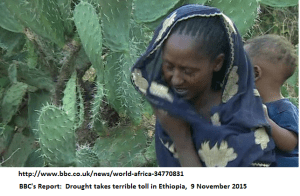
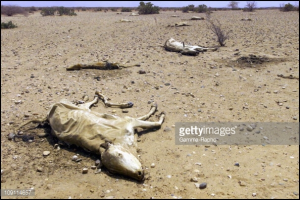


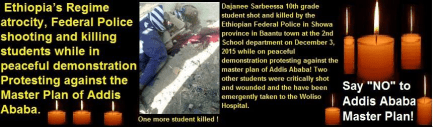



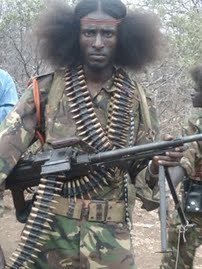




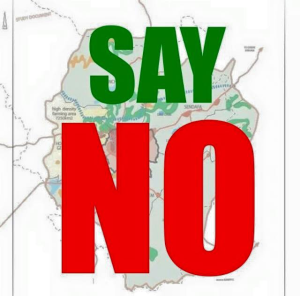

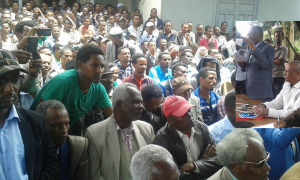



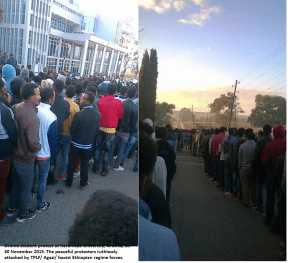



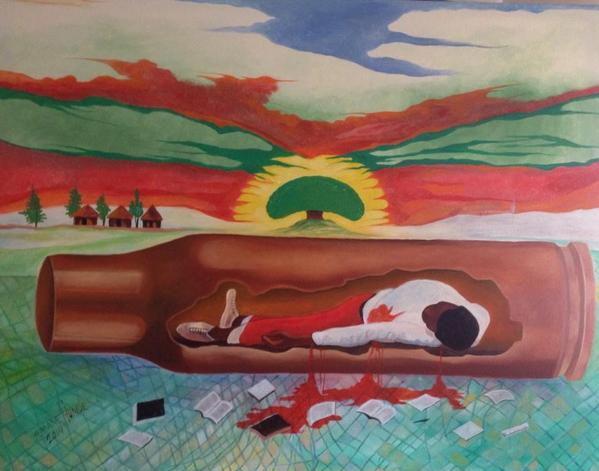
 Hiriira barattoota Oromoo guyyaa har’aa Muddee 03,2015 amma itti jiramu irratti Wallagga Aanaa Gullisoo Ganda Calliyaa Keessatti Gooti Barataan Oromoo Karrasaa Caalaa Rasaasa Mootummaa Abbaa Irree Wayyaaneen erga rukutamee booda bayyaannachuu dadhabuu irraan Wareegame.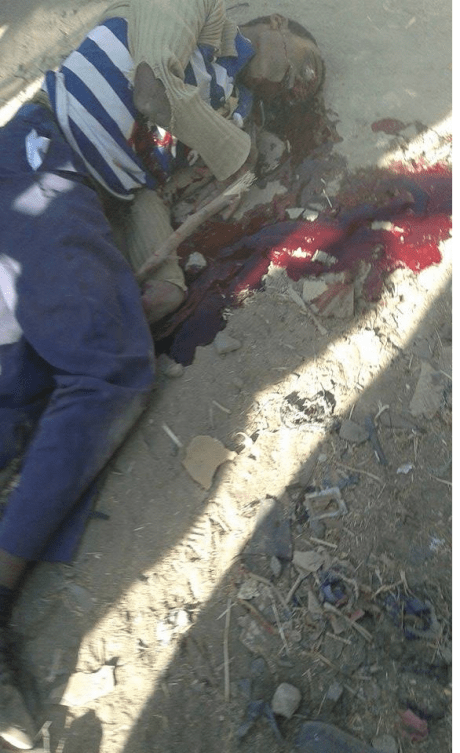

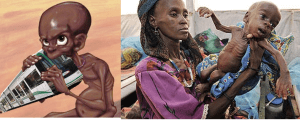
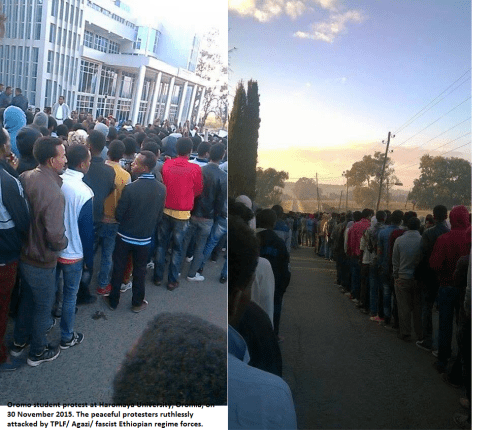


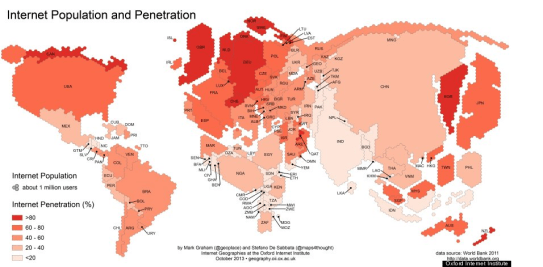
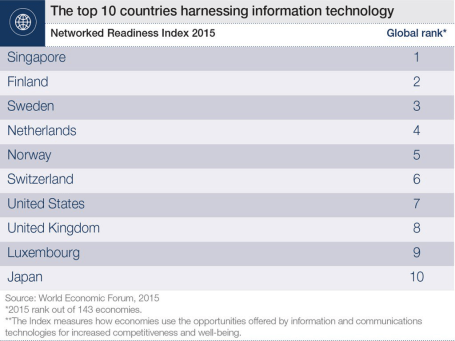
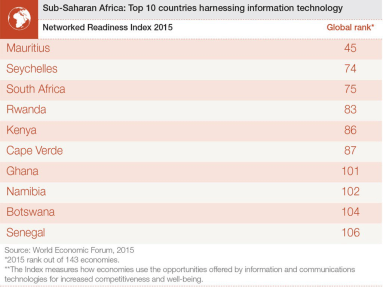
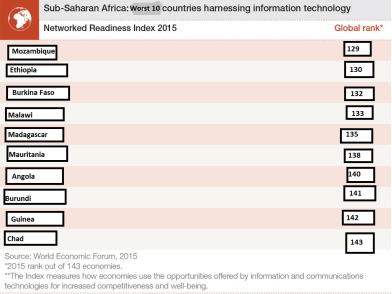

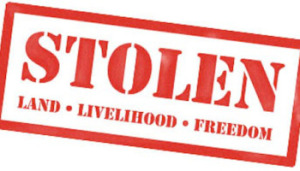
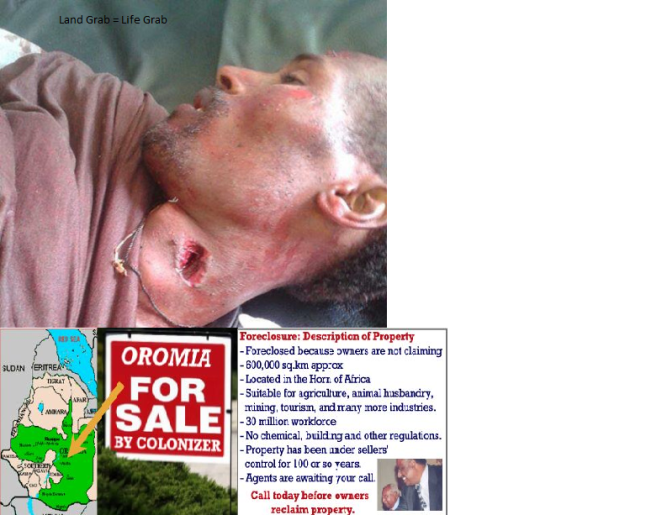
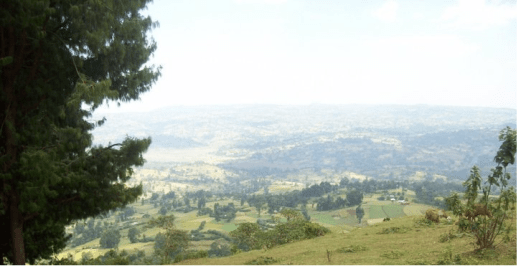
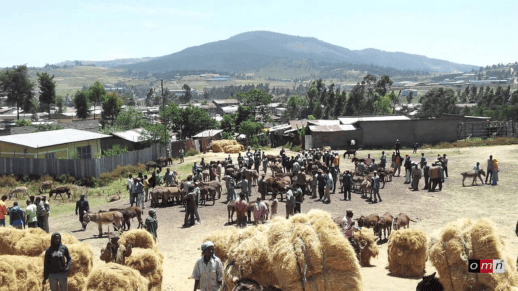
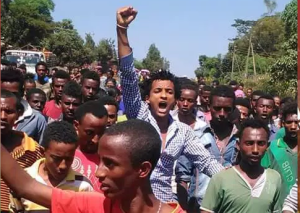
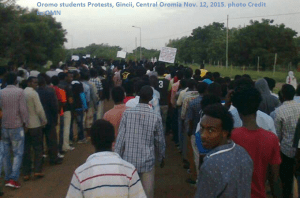
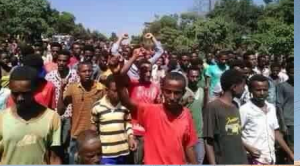

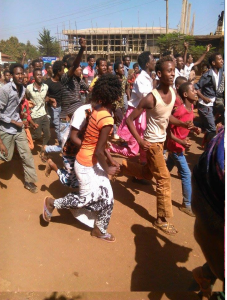



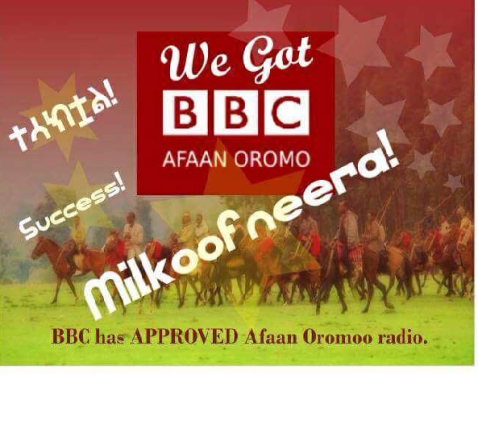

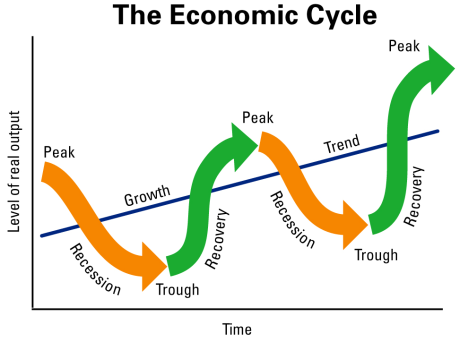


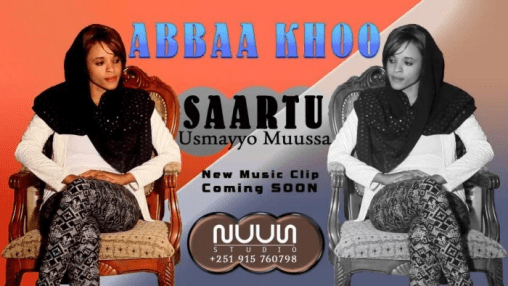
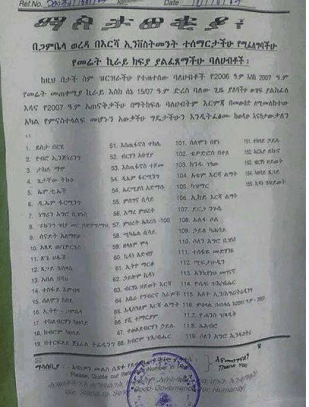

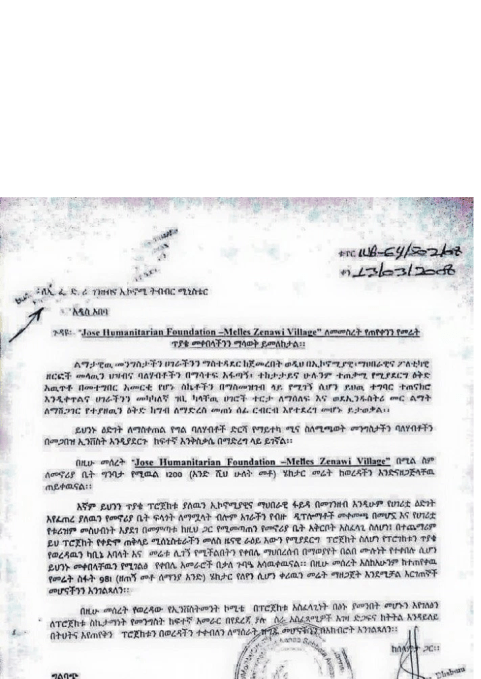

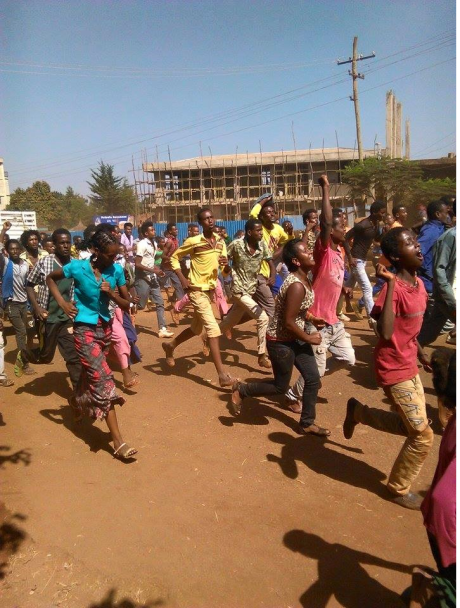





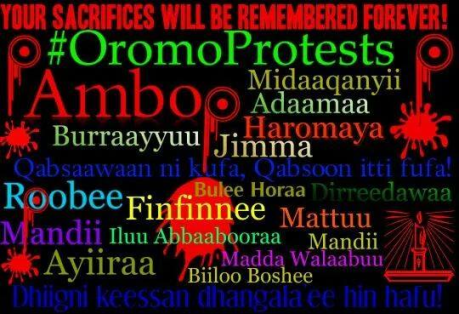
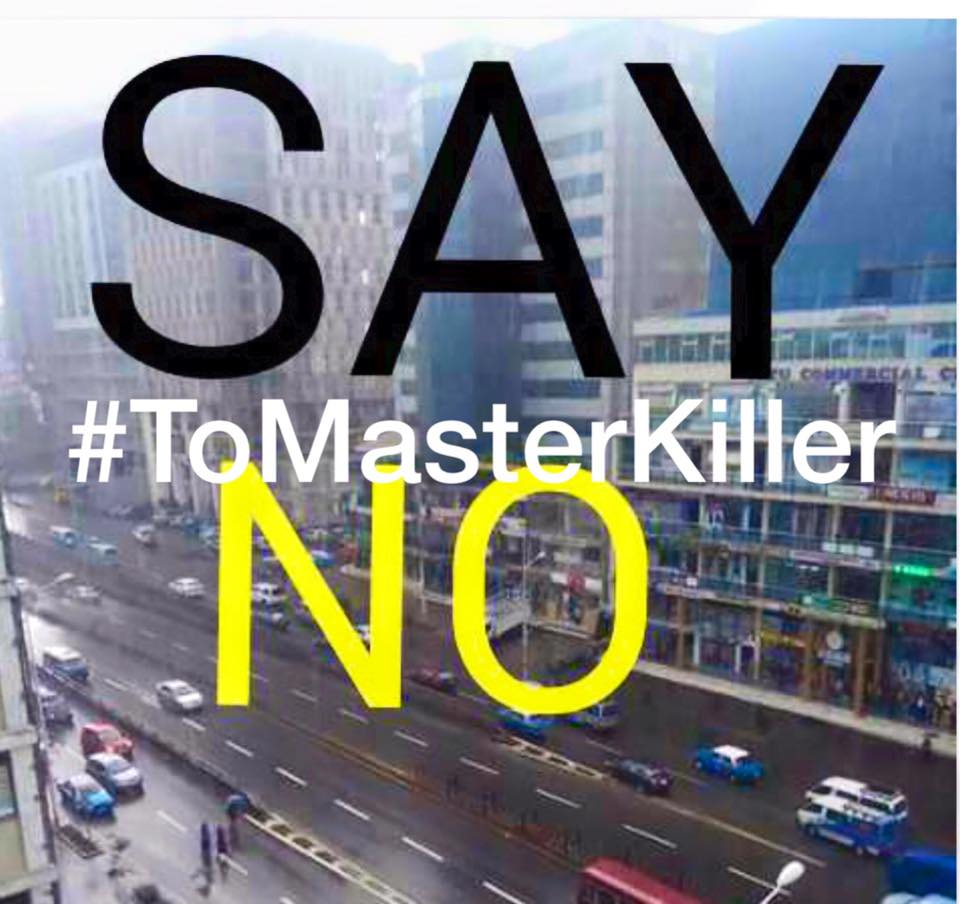





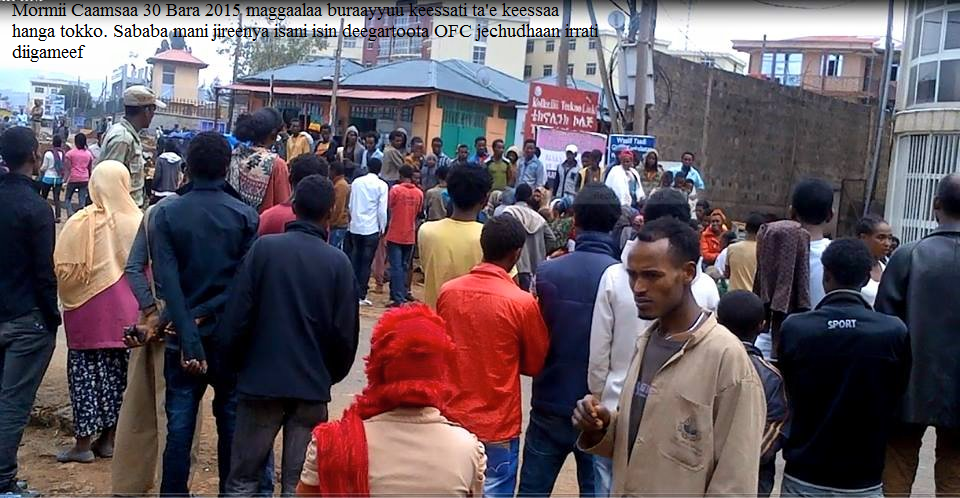

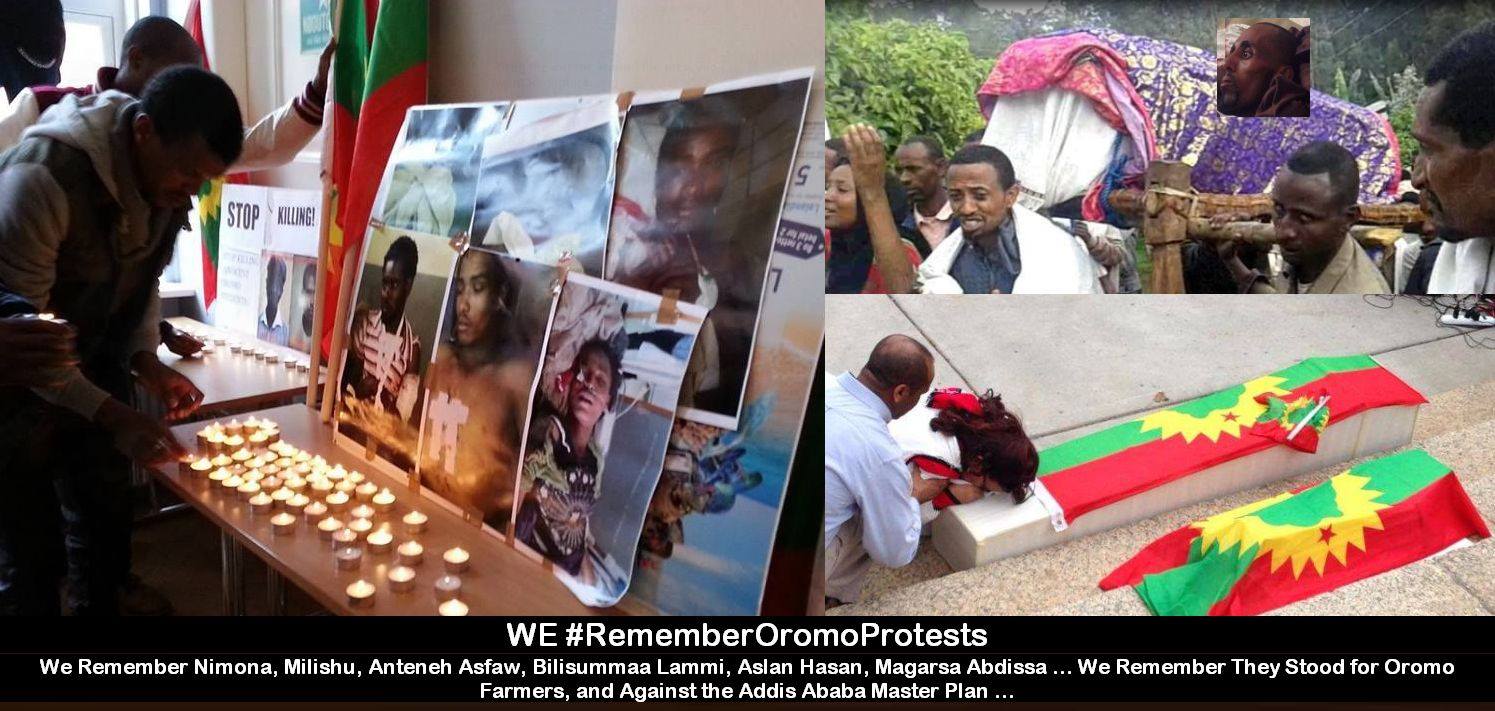

![Jimma[1]](https://qeerroo.files.wordpress.com/2015/03/jimma1.jpg)


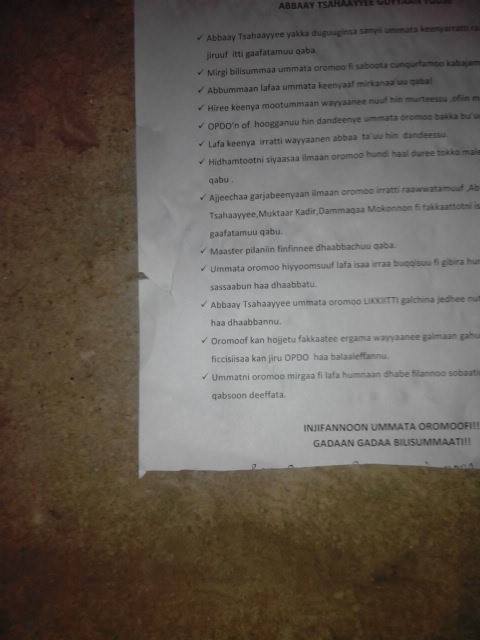





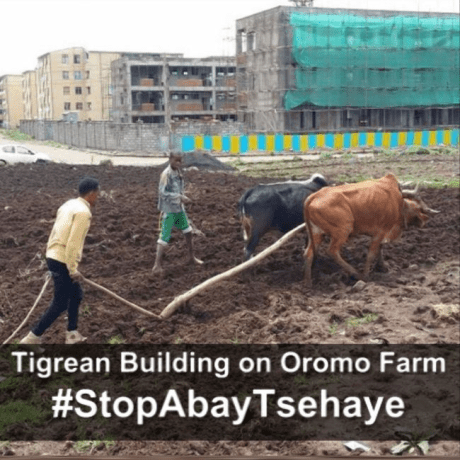
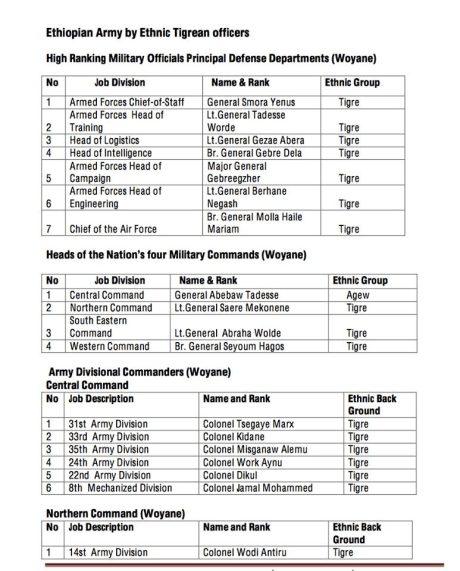

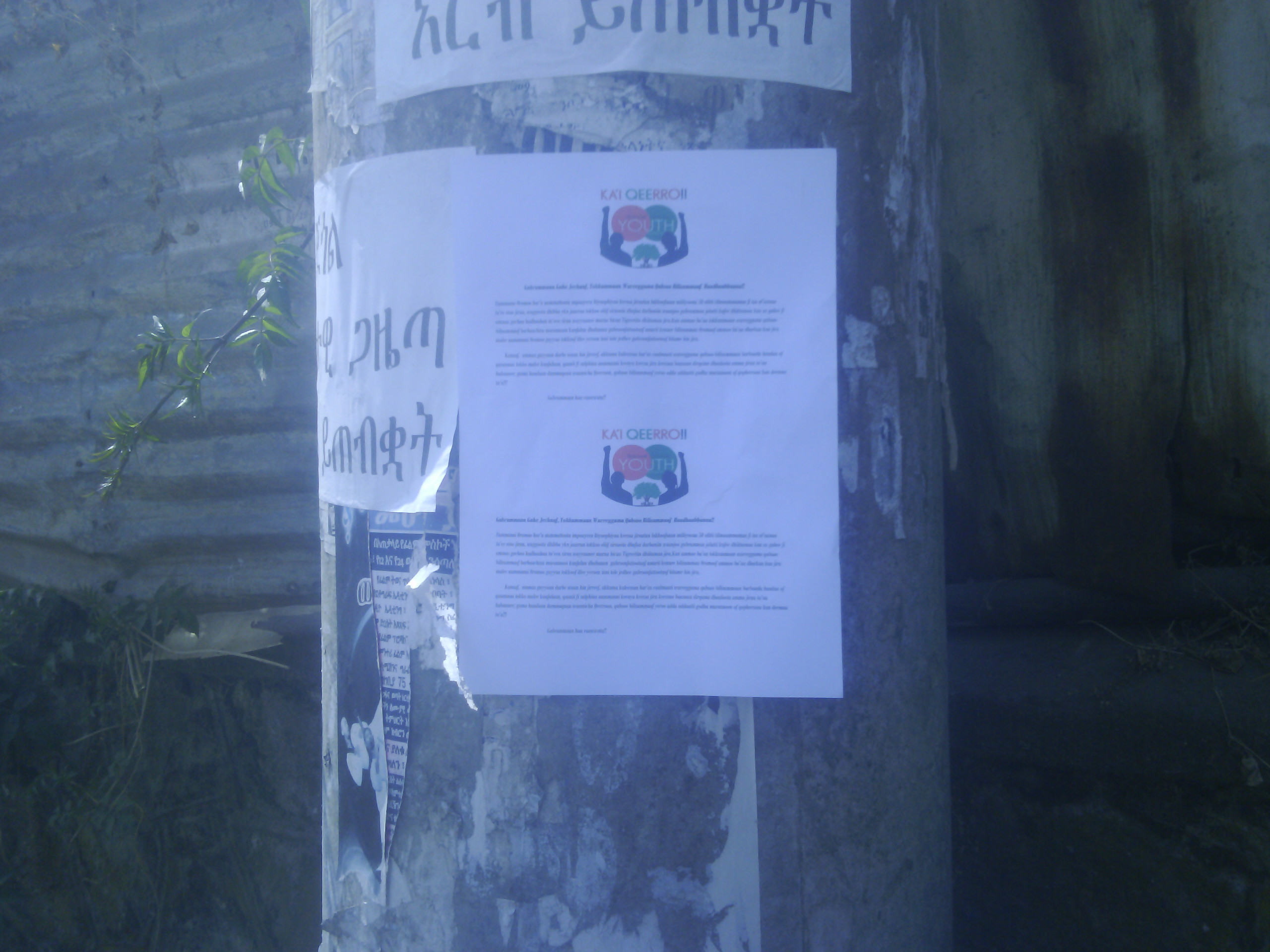


 Dhumaatii beelaan uummattoota naannoo roobni hin geenye irra gahaa jiru daa’immaan, haadholii fi horiiwwan yeroo itti wal faana dhumaatii sukkanneessaa irra jiranitti mootummaan Wayyaanee ofii cooma muree guddina biyyaa odeessaa jira.Kan baayee nama gaddisiisu keesssaa naannowwan kun beelli itti hammaatetti nyaataan mootummaan keenya isaan deggeraa jira jechunis miillii fi harki wayyaanee kan taate jaleen OPDO’n miidiyaa irraan oduu sobaa lafa naqaa jirti kan seenan lubbuu kumaan lakkawamaa jiru gaafatullee sobuudhaan uummata beelaan dhumaa jirutti qoosan. Yeroo biyyaaf boo’ichaa wayyaanee fi jala kaattuu sheef garaa guuttachuun nyaattee uummatatti dhaadatti. Kanumaanuu kan walq abate gaaffiii uummanni Baalee aanaalee garagaraa irratti mootummaan maaliif soba gargaarsi godhame nama dhuunfaa irraa kan hafe hin agine kan warra beela’aniif kan jedhanii wayyaanee soba ishee saaxilan yeroo kana gara siyaasatti harkifamanii qabamaa kan jiran jiru. Akkasuma sadaasa 25/2015 yuuniversirii Madda walaabutti barattotni gaaffii kaasan uummata keenya obbolaa keenya beelaan dhumaniif gaddina jedhuu fi akaksuma barattootni moora yuuniversitichaa mootummaa wayyaanee balaaleffatan.
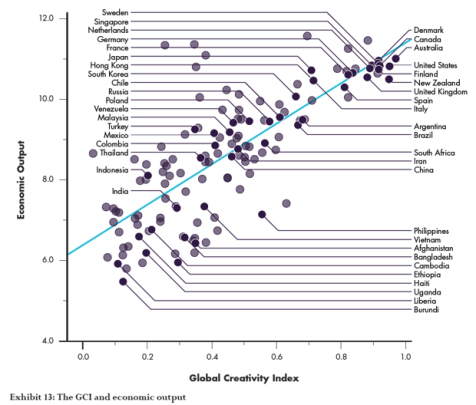


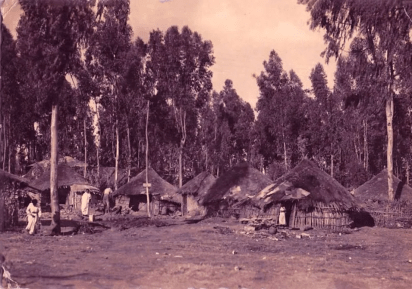
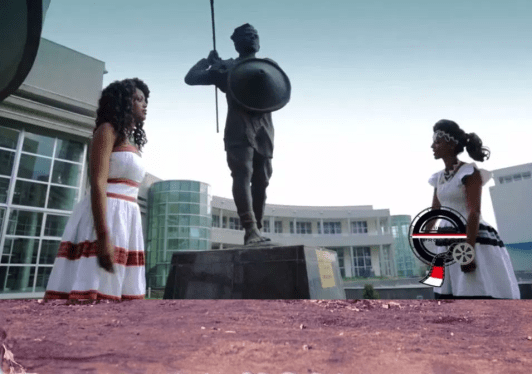
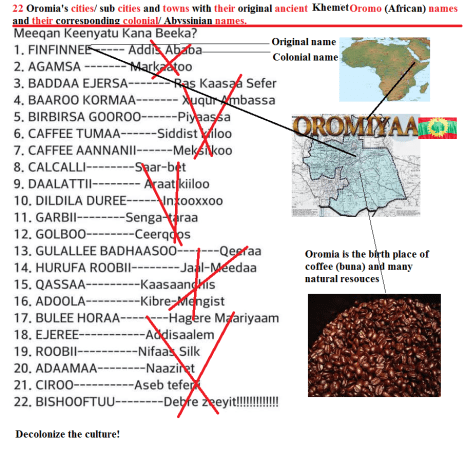

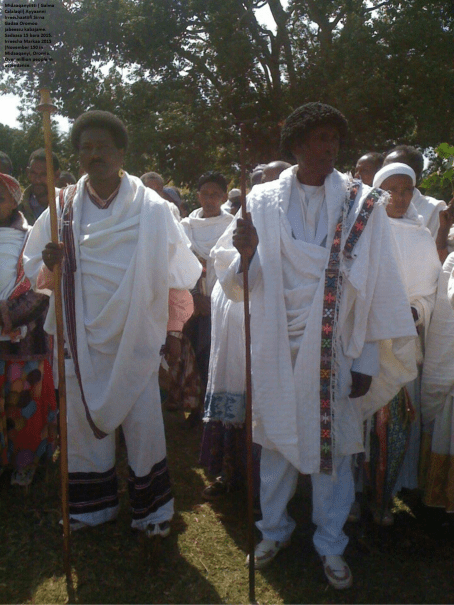
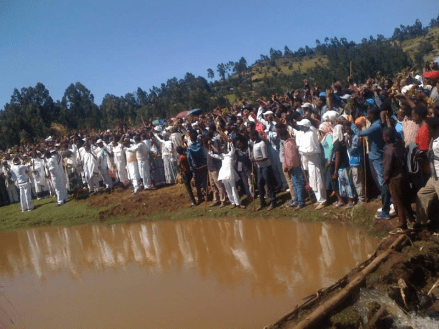
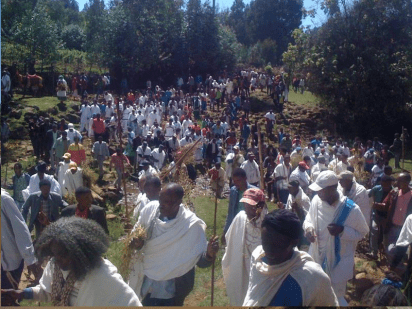
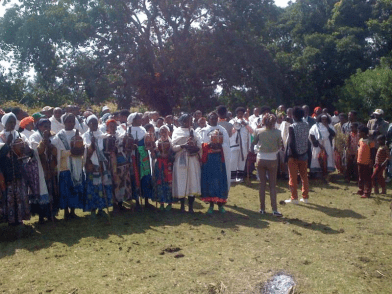
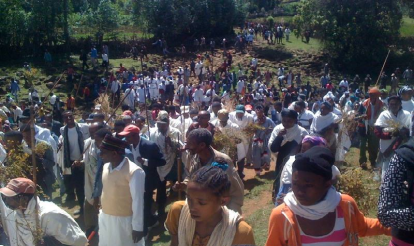
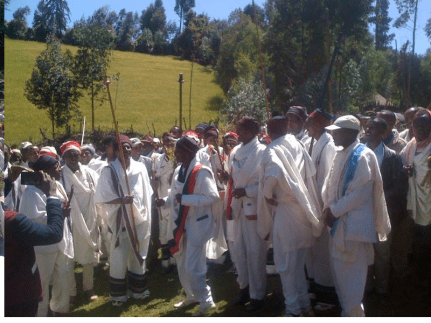



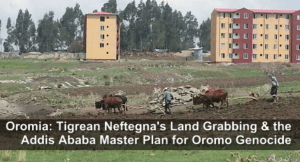


 Oromian Economist