Economic and development analysis: Perspectives on economics, society, development, freedom & social justice. Leading issues in Oromo, Oromia, Africa & world affairs. Oromo News. African News. world News. Views. Formerly Oromia Quarterly
When marathon silver medalist Feyisa Lilesa crossed the finish line at the Rio Olympics, he crossed his arms above his head in an “X”, a sign of protest against the Ethiopian government’s treatment of his people, the ethnic Oromo.
FeyisaLilesa crosses the finish line of the Men’s Marathon athletics event during the Rio 2016 Olympic Games on August 21, 2016. Lilesa crossed his arms above his head as a protest against the Ethiopian government’s crackdown on political dissent. | ADRIAN DENNIS/AFP/Getty Images
“[I knew] I would be jailed or killed if not, I would [never be allowed] out of that country and allowed to participate in any international competition or race at all,” Lilesa told the Thomson Reuters Foundation.
“I am quite sure those things would happen to me,” he said in a Skype interview from Rio where he has been staying since Monday when the rest of his team mates returned to Ethiopia.
The Oromia region, home to more than 25 million Oromos, has been riven by unrest for months over land rights and allegations of human rights violations.
Lilesa, 26, is one of thousands of Ethiopians estimated by activists to have left the country amid a security crackdown on demonstrations sparked by a conflict over land use policies.
Map of municipal plans to expand city limits and include some parts of the Oromiya region within the capital city Addis Ababa.
Human Rights Watch estimated 400 demonstrators were killed by security forces between November 2015 and June 2016 during protests triggered by government plans to include some parts of Oromiya within the capital Addis Ababa’s limits.
Victim shot down during protests. | Oromia Media Network
Up to 100 people were shot in a single weekend in August when security forces also shut down the internet for 48 hours, according to activists.
Thousands more have been arrested, including the prominent Oromo activist Bekele Gerba, who was taken from his home in December.
The government, which disputes the death toll and says the protests are being staged illegally, stoked by rebel groups and overseas-based dissidents, did not respond to several requests by the Thomson Reuters Foundation for a comment.
Lilesa’s fear of being jailed upon his return home reflects the experiences of other Ethiopians who have spoken out against the government.
In the Greek capital Athens, 26-year-old Muaz Mahmud Ayimoo is staying in a cramped apartment with five other Oromo friends who are traveling with him.
A student from Haro Dumal city in Oromiya, Ayimoo was arrested by authorities and imprisoned for a month last November after he attended several non-violent protests along with fellow students.
Conditions for those detained were wretched and abuse was regular, Ayimoo said.
“They used to take us out one by one, torture us with electricity and beat us badly,” he told the Thomson Reuters Foundation.
MuazMahmudAyimoo, a 26-year-old Ethiopian refugee is staying in a cramped apartment in Athens with five other Oromo friends who are traveling with him. | Thomson Reuters Foundation
Ayimoo’s family in Ethiopia paid a bribe for his release, later selling everything they had to get him to Europe.
“I can’t go back because I would lose my life,” he said.
Those in Athens are the lucky ones: Ayimoo’s wife and baby girl drowned in April after the boat they were on crossing the Mediterranean from Libya sank, killing hundreds, according to survivors.
“I could hear the screaming of my baby as I fell. I couldn’t save my family,” he said.
MuazMahmudAyimoo shows photograph of his wife and daugther before their boat sank in the Mediterranean Sea. | Thomson Reuters Foundation
Other Ethiopians now following the unrest from abroad include the journalists of the Oromia Media Network, a dissident satellite TV channel broadcasting into Ethiopia in the Oromo language from Minneapolis in the United States, a city home to around 40,000 Oromo.
Jawar Mohammed, executive director of the Oromia Media Network in Minneapolis. | Thomson Reuters Foundation
“We became part of the whole protester story,” said Jawar Mohammed, executive director of the network, which he said is watched by more than 11 million people in the Middle East and Africa at peak times.
Mohammed also regularly posts updates on his Facebook page, with more than 800,000 followers, about the unrest in his homeland.
Abel Wabella, 30, an activist who wrote for Zone9, a blog which focused on social and civic issues in Ethiopia, was imprisoned between April 2014 and October 2015 in what critics say was an attack on press freedom.
“I think the government is not ready for real reform the people are demanding right now. The people are tired of their false promises and will escalate their resistance,” he said.
Top image: Like many Ethiopian protesters across the world, women cross their hands during a protest against human rights violations in Ethiophia’s Oromia region, in front of United Nation’s information center in Pretoria, South Africa. | Ihsaan Haffejee/Anadolu Agency/Getty Images
ETHIOPIA: How Long the International Community Should Entreat the Rejection of an Independent Investigation into Human Rights Abuses in Ethiopia
HRLHA Press Release
April 23, 2017
The international community finally realized that the Ethiopian government was using democracy as a facade to dehumanize its citizens. Since the current government of Ethiopia came to power in 1991, six international treaties have been signed and ratified by the government, including the Convention against Torture and Other Cruel, Inhuman or Degrading Treatment or Punishment – at which the Ethiopian government’s security is mostly accused more than any dictator country in the world. This means, from a total of thirteen international treaties, Ethiopia had ratified eight, out of which two were signed during the Military Derg era.
It has not been easy for the international community to accept that a country, such as Ethiopia – which signed and ratified a number of international human rights treaties – has the moral to breach the norms of each treaty and commits massacres against its citizens. The ingenuity of the Ethiopian government has become to be known to the international community very lately, beginning from the land-grab-related human rights violations of the 2010’s in Gambela, Oromia, Benishangul – as reported by human rights organizations, such as HRW, AI and HRLHA and the Oakland Institute … thanks to the outcry of national, regional and international human rights organizations to expose the hidden agenda of the Ethiopian government. Though, reports on Ethiopia’s human rights violations spread all over, Ethiopia was elected as a member of the United Nations Human Rights Council in 2011 for a three-year term. After the completion of the first three-year term, it was also reelected on October 28, 2015 for another three-year term. To be legible for the election, the candidate State’s contributions to the promotion and protection of human rights are considered.
The current Ethiopian government began destabilizing the nations and nationalities in the country as it seized power in 1991. The two biggest nations, the Oromo and the Amhara – were the most targeted. Over the course of the first twenty-three years (1991-2014), hundreds of thousands of prominent citizens, political party leaders, members and supporters, journalists, union leaders and members have been killed, forced to disappear, imprisoned and forced to exile. The undisclosed tragedy in the country for so long has started to attract the international attention only in March 2014 when Oromo university students protested against the “Addis Ababa Integrated Master Plan” – which had continually taken place for over four months at which Oromos of all walks of life participated. During the crackdowns on the protests, over 81 Oromos of age 7-81 had been brutally murdered by Ethiopian government’s murderers. The so-called “Addis Ababa Master Plan” was designed to annex 36 Oromo towns evicting an estimated of over three-million Oromo farmers without consultation and compensation. The “Addis Ababa Integrated Master Plan” dispute reignited in November 2015 throughout Oromia and lasted for almost a year until the October 2, 2016 massacre – the incident which changed the peaceful protests to violent. During the protests – which had taken place for almost a year (November 2015 – October 2016) in Oromia Regional State, over 2000 Oromos had been killed by the Ethiopian government’s killing squad known as the Agazi force.
October 2, 2016 was the Oromo Irreecha/Thanksgiving day in which over four-million Oromos had come to gather from all corners of the Oromia Regional State to celebrate at Bishoftu where the government’s Agazi killing squad massacred peaceful people – at which over 700 people were killed through stampede and gunshots from the ground – and supported by air attack. October 2, 2016 was the game changer in the history of the Oromo struggle for self-determination, democracy and justice. The peaceful protest was changed into violent all over the Oromia Regional State. Several government-owned and government-linked properties were destroyed.
The Prime Minister of Ethiopia Hailemariam Dessalegn gave a permission to its killers – deployed all over the Oromia Regional State – to take all necessary actions against the uprising, and several thousand Oromos were killed, imprisoned and forcefully disappeared. To calm down the violent actions in the region, the government of Ethiopia declared a State of Emergency on October 8, 2016. After the State of Emergency was declared, many expected the situation could improve. However, the government’s killing squads deployed deep into Oromia villages used the opportunity to kill more Oromos at their homes, at their neighborhoods during day and night times, raped women and girls in front of their families, and looted valuable properties.
For example,
(1) Hailu Ephrem , the sixteen-year-old boy and Ibsa Runde, seventeen-year-old boy, had been killed, simply in their daily routine like any other playing in their area. They had been killed for no apparent reason except the psychopathic killing machines called Agazi had to kill Oromos to satisfy their masters’ order. The mother of Hailu Ephrem, Mrs Tadelu Tamama, a mother from Dembidolo, Welega (Oromia region of Ethiopia) told VOA Afaan Oromo service radio, “After the soldiers shot and killed my son in front of me ‘They told me to sit down on my dead son’s body’.”
(2) On November 6, 2016 at 5:00am, three brothers – Marabu Jamalo, Abdissa Jamalo and Tola Jamalo – were shot dead by the TPLF killing squad (Agazi force) in their home in Easter Arsi Zone in Shirka district. Their father Mr. Jamalo Hussein said “my children have been killed by the fascist government killing squad, Agazi, not because they stole or did anything wrong, but only because they are Oromos ” – told to HRLHA reporter in the area.
Such crimes are widespread all over Oromia and Amhara regional states, especially at night, and are being perpetrated on an ever-increasing scale and as part of the State of Emergency policy. There is also evidence of the government targeting special groups, such as youth, educated citizens and journalists in those regions. With such criminal records for over two decades, Ethiopia was elected to the other UN subsidiary organization , UN Security Council, on June 28, 2016. This was a period when the Ethiopian government had massacred several Oromos simply because they expressed their grievances in peaceful protest. Regarding this unfair election, the HRLHA expressed its concerns to the President of the 70th Session of the United Nations General Assembly, H.E. Mr. Mogens Lykketoft in its press release “THE ETHIOPIAN GOVERNMENT SHOULD NOT BE REWARDED FOR MASSACRING ITS PEOPLE.”
Ethiopia, a country with high human rights violations – has been allowed to be elected to both the United Nations Human Rights Council and United Nations Security Council positions, the positions which require respect/protect and promote human rights at the global level, and maintain international peace and security, develop friendly relations among nations and cooperate in solving international problems and in promoting respect for human rights.
In the past two years, non-governmental organizations, government agencies and some government offices requested the Ethiopian government to allow access to independent investigations to assess the human rights violations in the country. Requests for independent investigations of the human rights violations in Ethiopia came from the following agencies:
#
Agencies
Date
Europe an Parliament resolution on Ethiopia (2016/2520(RSP))
However, the Ethiopian government has rejected the call of the international community for independent investigations into Ethiopia human rights crises in the past two years. The Chair of the European Parliament’s Subcommittee on Human Rights (DROI), Elena Valenciano (S&D, ES), who visited Ethiopia recently also released a statement calling for an independent investigation into 2 October 2016 killings that claimed the lives of at least 52 people, according to the government media, or over 700 people, according to HRLHA and other reports.
However, the Ethiopian Prime Minister Hailemariam Dessalegn again rejected the call for external investigations by saying “Ethiopia’s sovereignty should be respected,” according the BBC report on April 18, 2016. PM Hailemariam pointed out that the Ethiopia’s Human Rights Commission is an independent institution in the country with whom his government must relay and could be strengthened. He clearly underlined his government’s position for peace, democracy and fundamental rights of the Ethiopians. In his interview with BBC, the PM of Ethiopia said “Ethiopia does not need independent investigator as far as Ethiopia is an independent country.” The government of Ethiopia is committed to continue suppressing all kinds of freedom and democracy in the country. It is unfortunate that Ethiopians could not detach themselves from dictatorial regimes for over a century, “History repeats itself,” again and again.
Therefore, the HRLHA would like to call upon donor governments and international government agencies to take all necessary and decisive measures against the Ethiopian government to respect international human rights and humanitarian laws, and all human rights treats it signed and ratified.
HRLHA Press Release
April 23, 2017
The international community finally realized that the Ethiopian government was using democracy as a facade to dehumanize its citizens. Since the current government of Ethiopia came to power in 1991, six international treaties have been signed and ratified by the government, including the Convention against Torture and Other Cruel, Inhuman or Degrading Treatment or Punishment – at which the Ethiopian government’s security is mostly accused more than any dictator country in the world. This means, from a total of thirteen international treaties, Ethiopia had ratified eight, out of which two were signed during the Military Derg era.
It has not been easy for the international community to accept that a country, such as Ethiopia – which signed and ratified a number of international human rights treaties – has the moral to breach the norms of each treaty and commits massacres against its citizens. The ingenuity of the Ethiopian government has become to be known to the international community very lately, beginning from the land-grab-related human rights violations of the 2010’s in Gambela, Oromia, Benishangul – as reported by human rights organizations, such as HRW, AI and HRLHA and the Oakland Institute … thanks to the outcry of national, regional and international human rights organizations to expose the hidden agenda of the Ethiopian government. Though, reports on Ethiopia’s human rights violations spread all over, Ethiopia was elected as a member of the United Nations Human Rights Council in 2011 for a three-year term. After the completion of the first three-year term, it was also reelected on October 28, 2015 for another three-year term. To be legible for the election, the candidate State’s contributions to the promotion and protection of human rights are considered.
The current Ethiopian government began destabilizing the nations and nationalities in the country as it seized power in 1991. The two biggest nations, the Oromo and the Amhara – were the most targeted. Over the course of the first twenty-three years (1991-2014), hundreds of thousands of prominent citizens, political party leaders, members and supporters, journalists, union leaders and members have been killed, forced to disappear, imprisoned and forced to exile. The undisclosed tragedy in the country for so long has started to attract the international attention only in March 2014 when Oromo university students protested against the “Addis Ababa Integrated Master Plan” – which had continually taken place for over four months at which Oromos of all walks of life participated. During the crackdowns on the protests, over 81 Oromos of age 7-81 had been brutally murdered by Ethiopian government’s murderers. The so-called “Addis Ababa Master Plan” was designed to annex 36 Oromo towns evicting an estimated of over three-million Oromo farmers without consultation and compensation. The “Addis Ababa Integrated Master Plan” dispute reignited in November 2015 throughout Oromia and lasted for almost a year until the October 2, 2016 massacre – the incident which changed the peaceful protests to violent. During the protests – which had taken place for almost a year (November 2015 – October 2016) in Oromia Regional State, over 2000 Oromos had been killed by the Ethiopian government’s killing squad known as the Agazi force.
October 2, 2016 was the Oromo Irreecha/Thanksgiving day in which over four-million Oromos had come to gather from all corners of the Oromia Regional State to celebrate at Bishoftu where the government’s Agazi killing squad massacred peaceful people – at which over 700 people were killed through stampede and gunshots from the ground – and supported by air attack. October 2, 2016 was the game changer in the history of the Oromo struggle for self-determination, democracy and justice. The peaceful protest was changed into violent all over the Oromia Regional State. Several government-owned and government-linked properties were destroyed.
The Prime Minister of Ethiopia Hailemariam Dessalegn gave a permission to its killers – deployed all over the Oromia Regional State – to take all necessary actions against the uprising, and several thousand Oromos were killed, imprisoned and forcefully disappeared. To calm down the violent actions in the region, the government of Ethiopia declared a State of Emergency on October 8, 2016. After the State of Emergency was declared, many expected the situation could improve. However, the government’s killing squads deployed deep into Oromia villages used the opportunity to kill more Oromos at their homes, at their neighborhoods during day and night times, raped women and girls in front of their families, and looted valuable properties.
For example,
(1) Hailu Ephrem , the sixteen-year-old boy and Ibsa Runde, seventeen-year-old boy, had been killed, simply in their daily routine like any other playing in their area. They had been killed for no apparent reason except the psychopathic killing machines called Agazi had to kill Oromos to satisfy their masters’ order. The mother of Hailu Ephrem, Mrs Tadelu Tamama, a mother from Dembidolo, Welega (Oromia region of Ethiopia) told VOA Afaan Oromo service radio, “After the soldiers shot and killed my son in front of me ‘They told me to sit down on my dead son’s body’.”
(2) On November 6, 2016 at 5:00am, three brothers – Marabu Jamalo, Abdissa Jamalo and Tola Jamalo – were shot dead by the TPLF killing squad (Agazi force) in their home in Easter Arsi Zone in Shirka district. Their father Mr. Jamalo Hussein said “my children have been killed by the fascist government killing squad, Agazi, not because they stole or did anything wrong, but only because they are Oromos ” – told to HRLHA reporter in the area.
Such crimes are widespread all over Oromia and Amhara regional states, especially at night, and are being perpetrated on an ever-increasing scale and as part of the State of Emergency policy. There is also evidence of the government targeting special groups, such as youth, educated citizens and journalists in those regions. With such criminal records for over two decades, Ethiopia was elected to the other UN subsidiary organization , UN Security Council, on June 28, 2016. This was a period when the Ethiopian government had massacred several Oromos simply because they expressed their grievances in peaceful protest. Regarding this unfair election, the HRLHA expressed its concerns to the President of the 70th Session of the United Nations General Assembly, H.E. Mr. Mogens Lykketoft in its press release “THE ETHIOPIAN GOVERNMENT SHOULD NOT BE REWARDED FOR MASSACRING ITS PEOPLE.”
Ethiopia, a country with high human rights violations – has been allowed to be elected to both the United Nations Human Rights Council and United Nations Security Council positions, the positions which require respect/protect and promote human rights at the global level, and maintain international peace and security, develop friendly relations among nations and cooperate in solving international problems and in promoting respect for human rights.
In the past two years, non-governmental organizations, government agencies and some government offices requested the Ethiopian government to allow access to independent investigations to assess the human rights violations in the country. Requests for independent investigations of the human rights violations in Ethiopia came from the following agencies:
#
Agencies
Date
Europe an Parliament resolution on Ethiopia (2016/2520(RSP))
However, the Ethiopian government has rejected the call of the international community for independent investigations into Ethiopia human rights crises in the past two years. The Chair of the European Parliament’s Subcommittee on Human Rights (DROI), Elena Valenciano (S&D, ES), who visited Ethiopia recently also released a statement calling for an independent investigation into 2 October 2016 killings that claimed the lives of at least 52 people, according to the government media, or over 700 people, according to HRLHA and other reports.
However, the Ethiopian Prime Minister Hailemariam Dessalegn again rejected the call for external investigations by saying “Ethiopia’s sovereignty should be respected,” according the BBC report on April 18, 2016. PM Hailemariam pointed out that the Ethiopia’s Human Rights Commission is an independent institution in the country with whom his government must relay and could be strengthened. He clearly underlined his government’s position for peace, democracy and fundamental rights of the Ethiopians. In his interview with BBC, the PM of Ethiopia said “Ethiopia does not need independent investigator as far as Ethiopia is an independent country.” The government of Ethiopia is committed to continue suppressing all kinds of freedom and democracy in the country. It is unfortunate that Ethiopians could not detach themselves from dictatorial regimes for over a century, “History repeats itself,” again and again.
Therefore, the HRLHA would like to call upon donor governments and international government agencies to take all necessary and decisive measures against the Ethiopian government to respect international human rights and humanitarian laws, and all human rights treats it signed and ratified.
THE three-hour bus-ride to Ambo from Addis Ababa, Ethiopia’s capital, offers a glimpse into the country’s future. The road is well paved; irrigation ditches and polytunnels criss-cross commercial farmland; electricity lines leap over forested hills. The signal granting access to mobile internet is clear and constant. As the bus pulls into Ambo, a trading centre in Oromia, the largest and most populous of Ethiopia’s nine ethnically based regions, the street is bustling.
But there are signs, too, that not all is well. An army truck rolls down the main road. Federal police surround the entrance to the local university. Unemployed young men playing snooker in bar point at a building across the road: it used to be a bank, but it was burnt down. Three years ago 17 local boys were shot dead by security guards as they protested on the doorstep, the young men say.
Ambo has a reputation for dissent. It was on these streets that protests against authoritarian rule started in 2014 before sweeping across the country. They culminated in the declaration of a six-month state of emergency on October 9th last year.
Students from Ambo University led the charge in opposing a since-shelved plan to expand the capital city into surrounding farmland. Oromo identity is especially powerful here: locals speak angrily about being pushed aside by ethnic Tigrayans, who they say dominate the government despite making up less than 6% of the population.
The country’s leading opposition politician, Merera Gudina—who was charged with inciting terrorism in February and was scheduled to appear in the dock on April 24th—comes from this area. When the ruling Ethiopian People’s Revolutionary Democratic Front (EPRDF) extended the emergency law for another four months (albeit after watering down its most draconian provisions) on March 30th, it was because of places like Ambo. Hundreds of its citizens have been arrested and subjected to months of “re-education” in military camps. Although stability has more or less returned to Ethiopia there are still young men across Oromia and Amhara, the second-largest region, who talk of protesting once more when the state of emergency is eventually lifted.
Not everyone feels this way. There may have been plenty of raised eyebrows when the prime minister, Hailemariam Desalegn, told Parliament on March 15th that 82% of Ethiopians wanted the state of emergency extended. But few want a return to disorder, and many admit that further emergency rule might not be so bad. Shopkeepers and restaurant owners in particular recall that businesses—as well as schools—were closed for months during the unrest. “Peace and security is more valuable than anything,” says a weary pharmacist.
Yet the challenge of addressing both the frustrations of angry youngsters and the concerns of anxious property owners is one the EPRDF is struggling to solve. Ethiopia’s economy is still growing at a healthy 7% a year, one of the fastest rates in Africa, even though drought has again hit large parts of the country. Foreign investment, which the government is promoting energetically, has held up surprisingly well. But with political freedom now a thing of the past, the government’s legitimacy rests on it delivering the prosperity it has long promised to all its citizens.
Its response to the crisis has, therefore, been primarily an economic one. Its top priority is to reduce youth unemployment, of at least 30% in urban areas. It hopes to do so through promoting industrial parks such as the one in the southern town of Awassa, which opened in 2016. It is Africa’s largest and is expected to provide 60,000 jobs. But even the largest industrial parks are still a drop in an ocean of unemployment. And since most of the jobs they provide are low-skilled, they will do little to help the hundreds of thousands of university graduates entering the job market each year. “I’m a graduate in accounting but I work as a hotel cashier,” laments one exasperated Ambo resident.
Political reform has been much less of a priority. Only one regional president has lost his job, though many ought to shoulder quite a bit of the blame for the unrest because of poor governance. A cabinet reshuffle in November included some high-profile changes: an Oromo controls the foreign ministry for the first time, for instance. But dialogue with opposition parties has made little progress. They must still ask permission to give a press conference or hold a public meeting. And an expansive anti-terrorism law, which has crimped their activities since 2009, will still be in place even when the last of the emergency provisions are lifted. The government has long promised to tackle corruption, which is the cause of much unhappiness. But there have been no high level prosecutions since October, even though tens of thousands of low-level officials have been sacked.
Alexis de Tocqueville, a 19th-century French historian, argued that the most dangerous time for a bad government is when it begins to reform itself. The EPRDF is not the ancien regime of pre-revolutionary France. But it has taken de Tocqueville’s lesson to heart. It views Ethiopia as a house of cards that might easily topple. So the old model persists: development now, democracy later.
But it will educate more students about the cause.
“Cupcakes are an attention grabber,” said Adrienne Sgarlato, a Fairfield senior from West Caldwell, N.J., said. “College students are always looking for an incentive.”
Attached to each cupcake the students grabbed Friday on their way in and out of the DiMenna Nyselius Library was a fact about Gerba:
“This is Gerba’s second time being imprisoned.”
“It is speculated that Professor Gerba’s arrest was a reaction to the protests taking place across the Oromia region.”
“An Ethiopian court brought terrorism-related charges against Professor Gerba and 21 others in connection with the protests.”
Professor Janie Leatherman, who leads a service learning class called International Human Rights, called the cupcake idea clever.
“When you do work in peace and conflict resolution, you have to think about what kinds of tools you can use that will end up in the hands of those you want to influence,” Leatherman said. “In terms of outreach and advocacy, cupcakes — with a message —is something very indigenous to this community.”
Leatherman’s class devoted a week to educating the larger university community about Gerba, a professor of foreign languages at Addis Ababa University and a peace activist who has translated the works of Martin Luther King into Ethiopian. Gerba was also First Secretary General of the Oromo Federalist Congress, a political party, and his latest arrest came in December 2015. Terrorism charges were later leveled against him.
Other student events included a panel discussion, a research symposium and a celebration of Ethiopian food and music. At every event, a petition the class started calling for Gerba’s release grew longer.
Leatherman consulted with Scholars at Risk, an international advocacy group that works to free educators and others who become political prisoners, before the course began.
Last year, Leatherman taught a class called Politics and Humanitarian Action, that worked to free Mohammad Hossein Rafiee, an imprisoned chemist in Iran. The work included a meeting with the United Nations Special Rapporteur on Human Rights on Iran, and subsequently a visit to the UN. The class wrote a 50-page case dossier on Rafiee.
Last September, after spending 15 months in prison, Rafiee was released on medical furlough, due to poor health, and was allowed to recuperate at home, without guards.
“We are still concerned about his well-being,” Leatherman said.
She said she believes the work of the class helped elevate the case. And Clare Farne Robinson, an advocacy director for Scholars at Risk, said if it weren’t for the students’ efforts, the case would most likely have missed out on this larger, international audience.
“I am confident that the increased pressure that the students (and others) placed on Iran had a role to play in this,” Robinson said. The class also was in contact with Rafiee’s family, giving them hope.
The 16 students in Leatherman’s current class are hoping for a similar outcome.
“It is not out of reach,” said Jessica Held, an international studies and Spanish major from Pelham, N.Y.
Held said it is important to spread the word.
“People in this class are like-minded,” she said. “There are kids who are not. Who don’t really know as much about world issues.”
McNamee, a junior from Lowell, Mass., said she never knew there were classes like this.
“It’s cool to be working on something that can change another human’s life,” she said.
Leatherman also works with Alfred Babo, a sociology professor, in teaching the class, which touches on the broader topics of human rights and ethnic strife in Ethiopia in addition to fighting specifically for Gerba’s freedom.
In February 2016, an 18-year-old student who I will call Tolessa and two friends took part in their first protest, in Oromia’s East Hararghe zone. As the crowd moved forward, they were met by a line of regional police, federal police and the army. Shortly thereafter and without warning, security forces fired live ammunition into the crowd hitting Tolessa four times. Miraculously he survived. But his two friends were not so lucky.
I first interviewed him in April 2016 for the Human Rights Watch June 2016 report on abuses during the first six months of the Oromo protests. Several days ago, Tolessa got in touch with me again to update me on his condition.
I spoke to him around the time that Ethiopia’s national Human Rights Commission submitted an oral report to parliament on the protests. This was the Commission’s second report to parliament, covering the protests between June and September in parts of Oromia, Amhara, and SNNPR regions. The Commission found that 669 people were killed, including 63 members of the security forces, and concluded – once again – that security forces had taken “proportionate measures in most areas.”
While many will focus on the death toll, the commission’s conclusion that the use of force was mostly proportionate and appropriate is in stark contrast to the descriptions of victims like Tolessa, and at odds with the findings of other independent investigators. At this stage, the grounds for the commission’s conclusion are unclear, since no written report has yet been published.
In its first oral report to parliament, in June, the commission similarly concluded that the level of force used by federal security forces in Oromia was proportionate. The written version of this report was only made public this week, 10 months later. In the 92 page English version [134 pages in Amharic] there is no mention of security forces firing on protesters, mass arrests, torture in detention, or any one of a slew of other abuses that have been widely reported.
Instead, the commission largely describes violence committed by protesters as described to the commission members by local government officials, security forces, and elders. It parrots the government’s narrative, making many references to Oromo Liberation Front (OLF) involvement, but never provides any evidence for this allegation. It references interviews with detainees, but otherwise fails to describe the commission’s methodology, including how many protesters, victims, and witnesses its members interviewed.
It’s quite possible that many protesters and victims of security force abuses would not speak to the commission because of the widespread perception that it has no independence from the government. Independence is crucial for any successful national human rights commission, and the Ethiopian institution has failed to meet this bar for many years. I know first-hand that it is not difficult to find protesters willing to share their experiences.
Armed security officials watch as protesters stage a protest against government during the Irreechaa cultural festival in Bishoftu, Ethiopia on October 02, 2016.
Aside from the commission’s activities, there is no domestic scrutiny of security force abuses. The members of parliament are all from the ruling party and affiliates. The judiciary lacks independence on politically motivated cases. Various courts have consistently refused to investigate mounting allegations of torture from detainees. Harassment, prosecutions, and swathes of restrictions have stifled independent media and nongovernmental organizations. In this situation, the commission and other “independent” institutions like the ombudsmen could play a vital role in scrutinizing abuse by Ethiopia’s security forces, but they too are apparently hamstrung by government influence.
The government consistently tries to frame the protests as the result of lack of “good governance” and youth unemployment. Yet one of the most common slogans heard on the streets of Oromia and Amhara, particularly in the later months of the protests, was a call to respect human rights, stop shooting protesters, and stop imprisoning students. The patterns of abuse documented by several human rights groups in Oromia during various periods, including the 2005 pre-election period and between 2011-2014 are strikingly similar. In each case, the government ignored calls for independent investigations, denied the allegations, and claimed they were politically motivated. These longstanding patterns of abuse against those who challenge the government, committed with complete impunity, are key to understanding the levels of anger fueling protests in the streets of Oromia over the last 18 months. And Oromia isn’t the only place in Ethiopia that has experienced serious rights violations by security forces – sometimes repeatedly – without meaningful investigations.
In Gambella, Human Rights Watch documented possible crimes against humanity by the Ethiopian army in 2003 and 2004, including extrajudicial executions, rape, and torture. In the Somali Regional State (SRS), the Ethiopian military committed war crimes and possibly crimes against humanity between mid-2007 and 2008 during their counterinsurgency campaign against the Ogaden National Liberation Front (ONLF). The government-allied Liyu police have subsequently committed numerous extrajudicial killings, torture, rape, and other attacks on civilians in SRS. Instead of permitting independent investigators to come in, the Ethiopian government consistently shuts the door and insists that Ethiopian institutions, such as the Human Rights Commission, can do the job.
I asked Tolessa his view of the commission. He said it’s “just another arm of the government,” and noted that the its head, Dr Addisu Gebregziabher, was previously chair of the National Electoral Board, another body with questionable independence. While the commission’s lack of independence is hardly newsworthy, it does underscore the need for independent, international scrutiny of Ethiopia’s rights record, especially given the government’s dubious claims that the commission’s investigations are credible. Prime Minister Hailemariam Desalegn reiterated this claim during an April 18 interview with the BBC, rejecting calls for a UN investigation into the protests by stating that Ethiopia is “an independent country that can investigate its own cases.” Yet these repeated refusals beg the question: if the security forces acted appropriately, then what is the government trying to hide?
Ethiopia is currently a member of both the United Nations Security Council and the United Nations Human Rights Council, which requires it to uphold the “highest standards of human rights.” Yet the government repeatedly rejects efforts to hold it to account, refusing entry to all UN special rapporteurs since 2007, except the Special Rapporteur on Eritrea. There are many outstanding requests from these UN monitors – on torture, freedom of opinion and expression, and peaceful assembly, among others. Recent calls by the United Nations top human rights official, the African Commission, the European parliament, and some members of United States Congress, for international investigations have all been dismissed. The government also avoids judicial scrutiny at the highest level as it is not a member of the International Criminal Court (ICC).
Ethiopia is certainly not alone in disliking international scrutiny of its rights record, yet many countries recognize that there are benefits to cooperation, particularly if there is genuine commitment to transparency, accountability, and improving human rights. Ethiopia’s continuous refusals call into question all of these commitments, instead making clear that it is not willing to stop using excessive force against protesters or torturing dissenters into silence.
Human Rights Watch research in many countries has demonstrated that a decision to ignore atrocities and reinforce a culture of impunity carries a high price, and merely encourages future abuses, which should concern investors, diplomats, and others concerned about the long-term stability of Ethiopia following almost 18 months of bloody turmoil. An international investigation would be a first important step in ending Ethiopia’s culture of impunity and would send a powerful and overdue message to the Ethiopian government that its security forces cannot shoot and kill peaceful protesters with impunity. And it would send an important message to victims like Tolessa that their pleas for justice are being heard.
It looked innocuous and many did not even know what it meant. After 26 miles of gruelling competition, Ethiopian Feyisa Lilesa approached the Sambadrome, Rio’s carnival venue and the Olympic marathon finishing line, in second place.
Then he raised his arms and crossed them. And then again, repeating the gesture all the way over the last 100 metres to the finish line. With an Olympic silver medal secured, celebration might have been expected. But as they watched 6,000 miles away back home, his wife and family were fearing the consequences of that simple act.
Unknown to them, Lilesa, 27, one of the favourites for next Sunday’s London Marathon, had been running with a goal which surpassed the individual glory of winning an Olympic medal. He had told nobody of his plan, not even his wife and family.
+4
Ethiopian Feyisa Lilesa made a political statement as he crossed the finishing line in Rio
The crossed arms were a signal of protest about the persecution of his people, the Oromo, in Ethiopia, a country riven by political violence and dispute, where Amnesty International reports at least 800 protesters have been killed. Amnesty has urged the Ethiopian government to end mass arrests and beatings, as well as the unlawful detention of journalists and politicians making the Oromo cause.
‘You can’t even think in your head without feeling suspicious that someone is listening to your thoughts, let alone speaking or telling someone,’ says Lilesa. ‘So I made a decision that I had to keep it to myself. Because if I was to tell someone — even my family — and the word gets out, I would not even be able to go to Rio. So I went there having not told a single person.’
That made his first phone call to his wife, Iftu Mulisa, and children, daughter Soko, five, and son Sora, three, a traumatic affair. While many Oromo people were jubilant their cause was being publicised, his wife was aghast. There was no question in his mind of returning to Ethiopia. However, his family were stuck there.
‘When I first called her I just didn’t have the words to tell her and I didn’t have the words to say to her,’ he says. ‘It was a challenge initially just talking to her and explaining my decision and why I didn’t consult with them.
+4
Lilesa with his wife, daughter Soko, five, and son Sora in their apartment in Arizona
‘But she understood the importance of this. The problem in the country has reached every household. They understand the importance and what it means. Their two main differences were that I did not consult with them when I was planning this and not having a concrete plan for them or the future and what might happen to them.
‘This gesture was started by university students and people knew about it. A lot of people were arrested essentially for showing that gesture. Coincidentally, that same day, the government stopped a rally in Addis Ababa. People went home because the city was engulfed by military forces and they happened to be watching TV.
‘The race was being broadcast on state television when it happened, the first time I showed the gesture. But since I kept repeating it, they quickly cut the live transmission and went back to the studio. People understood why the transmission was cut abruptly.
‘Of course my family was scared and they were shocked because they didn’t know what would happen to me. I had fears for my family. But a lot of people were getting killed. I knew it was just a matter of time before it reached my family. It has touched almost every household.
+4
Lilesa’s wife was aghast that he had publicised the persecution of the Oromo people
‘In fact, my brother-in-law was one of the people arrested and taken away from university and he remains in jail to this day. Young people were being killed, elderly were being killed. My friends were in jail and I had other friends who were being killed. So my family also feared the same fate. I feared they would be affected one day and that they had not was just that it was not their turn.
‘But generally at the time, I didn’t really care much about my life and the consequences this would bring to my family, because I knew the fate other people were going through in that country.’
Lilesa knew he needed a medal for his plan to succeed. ‘If I didn’t win a medal no one would have noticed me. No one would have seen my protest. It would not have had the impact. No one would have actually believed my story and I could have potentially returned to Ethiopia and bad things might have happened to me. So winning the medal was part of my plan.’
He was briefly in no man’s land in Rio de Janiero. Though he says many team-mates and officials supported his protest, he was persona non grata. ‘They don’t even want to see my face, so I don’t expect them to allow me to run for the country,’ he says.
The Ethiopian government have encouraged him to return home, saying he would be welcome. He does not believe them. ‘I didn’t have fears about my life but I did have fears that I might not be able to compete,’ he says. ‘I thought this was the end of my career as an athlete.’
+4
The 27-year-old is one of the favourites for next Sunday’s London Marathon
Fears for his family and career have now been addressed. Ethiopian exiles arranged a flight from Brazil to the US and he is now based in Flagstaff, Arizona, a magnet for top-class distance runners, where he can train properly.
Last month he won the New York Half Marathon in preparation for the London Marathon. More significantly, in February his family were finally permitted to join him in the US.
The reunion was understandably an emotional affair, Soko sprinting into her father’s arms when she finally saw him at the airport. ‘This was very, very important,’ he says. ‘And at least my mind is in one place in the sense that this is one weight lifted off my back. Now that at least I don’t have to worry about the safety of my children.
‘Also, I was living alone and I didn’t have much help. Now that my wife is here she can at least help me with some things I need. But the problem that put me in this position — the problem of my people — remains. My worries and concerns about that remain.’
His protests will continue. He is critical of those icons of Ethiopian athletics, Haile Gebrselassie and Kenenisa Bekele, the latter of whom he will face in London, who he says have benefited from keeping quiet and not criticising the government.
‘I admire Haile as a runner, as champion and as someone who broke a world record,’ says Lilesa. ‘But on the other hand rich people are generally benevolent and they give back to their people and they help the poor. In Ethiopia, the rich people we have are selfish and greedy and they live a parasitic life where they attach themselves to the government.’
A representative of Gebrselassie and Bekele responded by saying that such criticisms did not take account of the complicated and volatile political situation in Ethiopia, where they both still live.
LILESA wants people, especially the British, to know more about the plight of the Oromo in Ethiopia. ‘Our people are being imprisoned, hundreds remain in jail. Others are being killed. Over the past year, people have been dropping like leaves. Others are running away to save their lives — to South Africa — and have died along the way.
‘The Oromo people are the majority in my country. They have a lot resources in terms of the economy. Despite that, we don’t have the political power. They have lost all their freedoms and rights.
‘I want people in England to put pressure on their government because they do provide the biggest amount of aid to the Ethiopian government, to use that leverage not to cosy up to the Ethiopian rulers but to change their behaviour and to allow our people to have their freedom and rights.
‘We don’t hate the people of Ethiopia. Our fight and issues are with the system. What I expressed is based on my experience. I’m speaking about the injustices I saw all my life. The world may not have known… until now.’
The athlete says he could be killed if he goes back home
Exiled Ethiopian runner Feyisa Lilesa has vowed to protest against the government at Sunday’s London Marathon, saying “blood is flowing” in his home country.
Feyisa caught the world’s attention when made a protest gesture in solidarity with the Oromo people while crossing the line in the marathon race at the Rio 2016 Olympics.
In an interview with the BBC’s Sport Today, the silver medalist said he did not regret making the gesture.
How can I regret [it]? I come from the people. My people are dying, still. The blood is flowing.”
He added that would not return to Ethiopia while the current government was in power as he would be “automatically” killed, jailed or barred from leaving the country.
Feyisa refused to go back to Ethiopia after the Olympics, despite the government saying he would be welcomed as a hero.
He is currently living in the US with his wife and children on a temporary visa.
In Rio, Feyisa became the first Ethiopian to finish in the top two of a men’s Olympic marathon since 2000, claiming silver behind Kenya’s Eliud Kipchoge.
As he crossed the line, he lifted his arms to form an X above his head, the same gesture used in protests by the Oromo people, the country’s largest ethnic group, which has suffered a crackdown at the hands of the Ethiopian government.
Getty Images
The ‘X’ sign is used as a symbol of protest in Ethiopia
The state-backed Ethiopia Human Rights Commission said earlier this week that 669 people were killed in protests since November 2015.
The government has blamed the violence on “terrorists”.
A state of emergency has ben in force since last October to curb the unrest.
As documented in the archives of history throughout the world, Oromo’s are not the only indigenous people targeted for their land and their identity. This article will be exploring the indigenous people of Americas, the Native Americans in comparison to the Oromo people. Native Americans have their own way of life, culture, tradition, language and indigenous religious beliefs untouched by the outside world. They were communal society in nature. They embraced a philosophy of living in harmony with nature. The land has and still has special place in their spirituality, as something scared, something to be protected and nurtured. Contrary, to their European invaders that viewed the land only from economic points of view.
At the end of 15th century Europeans migrated to the Americas to conquer the land and resources. Their only obstacle was removing the indigenous people off of the land in order to achieve their objectives. However, the special relationship Native Americans had with their land presented a challenge to the new conquerors. The Europeans wanted the land to settle on, to use, to prosper from and to own. Native Americans viewed land as part of their identity, intrinsic in nature and not dependent on economic again or be swayed by it. Thus, the Indian wars spanning decades are part of these two opposing views. The Native Americans put up a fierce resistance against the Europeans and it was apparent to them that were losing. The Europeans could not win by arm forces, so they used the law to achieve their objectives.
The most devastating blow to Native Americans was delivered as a piece of legislature called The Dawes Act of 1887 which allowed for the allotment of tribal land to an individual ownership. When an individual Native American accepts these pieces of land he/she is granted a U.S. citizenship which means they are no longer under the protections of Indian tribal land and jurisdiction. Thus, every U.S citizen has to abide by the law of the land and state laws and regulations as well. This elaborate plan allowed United States government to take control of 90 million acres of Indian land and made 90,000 Indians Landless in their own ancestral land. In 1908 another legislature called the Curtis Act was introduced to the law which delivered the final blow to Native Americans. The Curtis act, basically abolished tribal communal jurisdiction and rendered tribal government useless.
After they have lost control of their lands and their way of life, a war was declared on their identity. In the name of assimilation, Native Americans were forced to assimilate into Europeans ways of life. Children were forcefully removed from their families and communities and sent to Indian boarding schools established by Europeans to be more “civilized.” They were forced to abandon their languages, cultural heritage and their identity. Their elaborate plan worked because we now see people who have lost their pride, sense of identity and a place they once called home. They live as second citizens in their own ancestral land and trying to survive.
In the Native American Story, European settlers took the center stage as an unwelcomed intruder of once pride filled people while in the Oromo Story we have a garden variety of oppressors. All of these oppressors have one characteristics in common, savagery. We can reflect back to the time long before intruders entered Oromo land and remember how our society functioned. We had our own governing system, culture, tradition, language and peace among us. That order and harmony we had among us and our neighbors were disturbed because savages took over our land and our ways of life much like Europeans took over Indian lands. Menelik II created a land reform that suited his special interest and allowed him to ration our land to his officers, generals and whoever he deemed worthy. Our own land was leased to us by appointed people and the church and the reminder was under direct control of this brute.
Every regime that came and left had one form of land reform or another, but one thing is crystal clear, none of those reforms are in the best interest of the Oromo people. Case in point, what is going on with Finfinne’s sounding area special Oromiya zone is no different. I have outlined how an oppressor can hide behind the law to achieve an objective in the Native American story. The current situation in Oromiya is exactly the same. The law should only be considered law if it upholds a high moral value not when it caters to the special few while disregarding others. We have managed to keep our identity, culture and language against all odds. Are we now defeated both in sprit and in strength to allow our enemies to rob us of our land under the guise of development? Are we ready to say that those who wrote history in their own blood, so that you and I can stand tall as Oromos, did so in vein? Are we ready, to give up? If we are anything like our ancestors the answer is Never!
My massage to the TPLF is that, as much as you like to think of yourselves as clever, I would like to say you did not invent the wheel. You have recycled an old idea and trying to paint it new. We recognize your agenda and we are fully aware. You will not win!!! We will prevail!
Over the past 26 years the Ethiopian government has been dominated by the Ethiopian People’s Revolutionary Democratic Front (EPRDF) and its allies. Meles Zenawi served as president of Ethiopia from 1991 to 1995 and then as prime minister from 1995 until his death in August 2012. His successor, Hailemariam Desalegn, has continued to strengthen his party’s power in the parliament.
Protesters call on the Ethiopian government to respect human rights, Washington DC, USA, 23 September 2006.
Over the last four election cycles, the ruling coalition has consolidated its parliamentarian super majority by alienating opposition parties and progressively closing democratic space in Ethiopia. As a result, the coalition won all of parliament’s 547 seats during the 2015 election, which was widely criticized for “voter coercion, intimidation, and barriers to registration.” Leading up to the election, numerous opposition party members were harassed, arrested, and even killed. The government continues to use arbitrary arrests and prosecutions to silence journalists, bloggers, protesters, and supporters of opposition political parties.
In 2009, the government passed a law that bars civil society organizations that work on human rights, governance, and advocacy from receiving more than 10 percent of their funds from foreign sources. Since most organizations heavily rely on international funding, the law effectively eliminated Ethiopia’s once thriving civil society. Media remains under a government stranglehold, with many journalists having to choose between self-censorship, harassment and arrest, or exile. In 2014, dozens of journalists and bloggers fled the country and six private newspapers closed after a protracted campaign of threats and harassment against them. According to the Committee to Protect Journalists, Ethiopia ranks among the top three countries in the world for the number of journalists in exile.
The last two years have been marked by a further crackdown on freedom of association in response to the mass protests in the Oromia and Amhara regions. Protests erupted in 2015, when the ethnic Oromo population, which accounts for nearly a third of Ethiopia’s total population, pushed back on a proposed city expansion plan that threatened their farmland. Over the past quarter century most of the regions, including Oromia and Amhara, have been left out of the country’s decision-making processes. The protests were a larger demonstration of frustration with the government’s discriminatory treatment of the Oromo people and their exclusion from Ethiopia’s political and economic spheres. Since November 2015, more than 600 protestors have been killed during the demonstrations and thousands more detained. Restrictions on human rights monitoring and on independent media make it difficult to ascertain the precise extent of casualties and arrests.
Despite the crackdown, protests continued, and in response, the government issued an eight-month long state of emergency on October 9, 2016, which suspended constitutionally guaranteed rights and gave sweeping powers to the security sector. Leaders of political parties that represent the region, like the Oromo Federalist Congress (OFC), have been arrested and accused of being terrorists. Thousands of detainees were subjected to a “rehabilitation programme” conducted by the military during detention. Before release, detainees were required to wear “Never Again” t-shirts during a graduation ceremony, which stood for their ‘promise’ to not protest against the government in the future. Despite international scrutiny and condemnation for its recent actions, the Ethiopian government has not called off its state of emergency and is moving forward with prosecution of opposition leaders.
In 2010, the UN Committee Against Torture reported it was “deeply concerned” about “numerous, ongoing, and consistent allegations” concerning “the routine use of torture” by police, prison officers, and other members of the security forces against political dissidents and opposition party members. The committee reported such acts frequently occurred with the consent of commanding officers in police stations, jails, military bases, and unofficial or secret places of detention.
In January 2016, the Ethiopian government’s attacks on the right to freedom of assembly and freedom of expression prompted the European Parliament to pass a resolution condemning the violent crackdown. In September 2016, civil society organizations signed on to a joint letter addressed to the United Nations Human Rights Council (UNHRC) urging it to hold Ethiopia accountable for its numerous rights violations. Both the European Union and the UN have also commented on the crackdown in Ethiopia and called upon the government to practice “restraint” with their security forces.
On September 1, 2016, the African Union (AU) also issued a statement expressing concern about the growing political violence Ethiopia. Dr. Nkosazana Dlamini Zuma, then Chairperson of AU Commission, urged “dialogue among all stakeholders in Ethiopia,” and called for “lasting solutions to the social, political and economic issues motivating the protests.” Despite attempts by the international community to persuade Ethiopia to amend its laws through mechanisms such as the Universal Periodic Review, the government has resisted.
Ethnic Oromo students rally together as they demand the end of foreign land grabs marching with placards on the streets of Addis Ababa, Ethiopia in 2014. Image: FlickrCC
(WNN FEATURES) ETHIOPIA, EAST AFRICA: She spoke to me with tears in her eyes describing the calculated execution of her own people.
Even though Atsede Kazachew feels relatively safe as an ethnic Amharic Ethiopian woman living inside the United States, she is grieving for all her fellow ethnic Ethiopians both Amharic and Oromo, who have been mercilessly killed inside her own country.
“There is no one in the United States who understands,” outlined Atsede. “Why? Why?” she asked as her shaking hands were brought close to her face to hide her eyes.
The Irreecha Holy Festival is a hallowed annual celebration for North East Africa’s largest ethnic group, the Oromo people. Bringing together what has been counted as up to two million people, who live near and far away from the city of Bishoftu, the Irreecha Festival is a annual gathering of spiritual, social and religious significance. It is also a time to appreciate life itself as well as a celebration for the upcoming harvest in the rural regions.
Tragically on Sunday October 2, 2016 the event ended in what Ethiopia’s government said was 55 deaths but what locals described as up to .
“For the past seven months, security forces have fired live ammunition into crowds and carried out summary executions…” added Mepham.
So what has the U.S. been doing about the present crisis situation in Ethiopia?
With a long relationship of diplomacy that spans over 100 years beginning in 1903, that builds up the U.S. to consider Ethiopia as an ‘anchor nation’ on the African continent, corrupt politics and long range U.S. investors in the region are an integral part of the problem. All of it works a head in the sand policies that pander to the status of the ‘’quid pro quo’.
Spurred on by what locals described as Ethiopia military members who disrupted the gathering by threatening those who came to attend the holiday event; the then makeshift military threw tear gas and gun shots into the crowd. The voices of many of those who were present described a “massive stampede” ending in numerous deaths.
“This has all been so hard for me to watch,” Atseda outlined as she described what she witnessed on a variety of videos that captured the ongoing government militarization and violence in the region. “And there’s been little to no coverage on this,” she added. “Western media has been ignoring the situation with way too little news stories.”
“Do you think this is also an attempt by the Ethiopian military to commit genocide against the ethnic Oromo people?” I asked.
“Yes,” she answered. The Amharic and the Oromo people have suffered so very much over many years, outlined Atsede. Much of it lately has been about government land grabs, on land that has belonged to the same families for generations, Atsede continued.
The details on the topic of apparent land grabs wasn’t something I knew very much about in the region, even though I’ve been covering international news and land grabs in Asia Pacific and China’s Tibetan Autonomous Region, along with the plight of global women and human rights cases, for over a decade.
One lone woman stands out surrounded by men during her march with Ethiopia’a Oromo Liberation Front (OLF), a national self-determination organization that has worked to stop atrocity against rural ethnics inside Ethiopia beginning as far back as 1973. Today the Ethiopian government continues to classify the OLF as a terrorist organization. In this image the look on this unnamed woman’s face says “a-thousand-words.” Image: Jonathan Alpeyrie/Wikimedia Commons
In spite of destructive crackdowns by the government against rural farming communities, numerous ethnic women living inside Ethiopia today are attempting to work toward peace in both the northern and southern regions of the country.
Under conditions of internal national and border conflict, ethnic Ethiopian women can often face pronounced stress under forced relocation, personal contact with unwanted violence including domestic abuse and rape, and discriminatory conditions for their family and children. These deteriorating conditions can also cause destabilization under food insecurity with greater malnutrition.
Increasing land grabs also play an integral part in high levels of stress for women who normally want to live with their family in peace without struggle. But corruption in leadership levels inside Ethiopia are encouraging land acquisitions that ignores the needs of families who have lived on the same land for centuries.
As Ethiopia’s high level business interests continue to be strongly affected by insider deals, under both local and global politics, the way back to peace is becoming more complex and more difficult.
Even foreign government advocacy agencies like the World Bank, DFID, as well as members of the European Union, have suffered from ongoing accusations of political pandering and corrupt practices with large based business interests inside Ethiopia.
With the new release of the film ‘Dead Donkeys / Fear No Hyenas’, by Swedish film director Joakim Demmer, the global public eye is now beginning to open wide in understanding how land grab corruption works throughout the regions of East Africa. Outlining an excruciating story that took seven years to complete, the film is working to expand its audience with an April 2017 Kickstarter campaign.
“Dead Donkeys / Fear No Hyenas was triggered by a seemingly trivial scene at the airport in Addis Ababa, six years back. Waiting for my flight late at night, I happened to see some tired workers at the tarmac who were loading food products on an airplane destined for Europe. At the same time, another team was busy unloading sacks with food aid from a second plane. It took some time to realize the real meaning of it – that this famine struck country, where millions are dependent on food aid, is actually exporting food to the western world,” outlined film director Demmer.
It’s no wonder that anger has spread among Ethiopia’s ethnic farming region.
“The anger also came over the ignorance, cynicism and sometimes pure stupidity of international societies like the EU, DFID, World Bank etc., whose intentions might mostly be good, but in this case, ends up supporting a dictatorship and a disastrous development with our tax money, instead of helping the people…,” adds Demmer during his recent crowdfunding campaign.
“What I found was that lives were being destroyed,” said Demmer in a March 28, 2017 interview with the Raoul Wallenberg Institute. “I discovered that the World Bank and other development institutions, financed by tax money, were contributing to these developments in the region. I was ashamed, also ashamed that European and American companies were involved in this.”
“Yes. And yes again,” concurred Atsede in her discussion with me as we talked in person together about big money, vested interests and U.S. investors inside Ethiopia, including other interests coming from the UK, China, Canada, and more.
As regional farmers are pushed from generational land against their will, in what has been expressed as “long term and hard to understand foreign leasing agreements,” ongoing street protests have met numerous acts of severe and lethal violence from government sanctioned security officers.
Ironically some U.S. foreign oil investments in the region vamped up their purchasing with land deals as former U.S. State Department Deputy Secretary Antony Blinken showed approval of the Dijbouti-Ethiopia pipeline project during a press meeting in Ethiopia in February 2016.
As anger among the region’s ethnic population expands, Ethiopia leadership has opted to run its government with a four month April 2017 extension announced as a “State of Emergency” by President Mulatu Teshome Wirtu.
“How long can Ethiopia’s State of Emergency keep the lid on anger?” asks a recent headline in the Guardian News. Land rights, land grabs and the growing anger of the Oromo people is not predicted to stop anytime soon.
The ongoing situation could cost additional lives and heightened violence say numerous human rights and land rights experts.
“The government needs to rein in the security forces, free anyone being held wrongfully, and hold accountable soldiers and police who used excessive force,” outlined Human Rights Watch Deputy Regional Africa Director Leslie Lefko in a HRW report on the situation.
“How can you breathe if you aren’t able to say what you want to say,” echoed Atsede Kazachew. “Instead you get killed.”
___________________________________
___________________________________
For over a decade United Nations panelist and human rights journalist Lys Anzia has reported news covering the latest on-the-ground conditions for global women. Her written and editing work has appeared on numerous publications including Truthout, Women’s Media Center, CURRENT TV, ReliefWeb, UNESCO, World Bank Publications, Alternet, UN Women, Vital Voices, Huffington Post World, The Guardian News Development Network and Thomson Reuters Foundation Trustlaw, among others. Anzia is also founder of Women News Network (WNN). To see more about global women and news check out and follow @womenadvocates on Twitter.
It is saddening to witness repetitions of similar tragic events in history. Recurrences of such dreadful events can even sound farcical when they happen in a very short span of both time and space. This is exactly what is currently happening in the Horn of Africa. It is barely over a decade since the height of the Darfur genocide. One would hope that the international community has been well informed to avoid repetition of Darfur like tragedy anywhere in the world. However, it is depressing to observe that the Darfur crisis is in the process of being replicated in Ethiopia.
In this piece, I will explain how the scale of the crisis unfolding in Ethiopia’s Eastern and Southern regions (and those brewing up in other regions) can have a potential to dwarf the Darfur crisis. The Janjaweed militia (in the case of Sudan) and the so-called Liyyu police (in the case of Ethiopia) are the catalysts for the crisis in their respective regions. For this reason, I will focus my analysis on explaining missions and functions of these two proxy militias.
Sudan’s Janjaweed – Devils on Horseback
In order to draw a parallel between the Darfur and Eastern Oromia, it would prove useful to recap the Janjaweed story. Janjaweed literally means devils on horseback presumably because the Janjaweed often arrived riding horses while raiding and wreaking havoc in villages belonging to non-Arab ethnic groups. The origin of Janjaweed is rooted in a long established traditional conflict primarily over natural resources such as grazing rights and water control among the nomadic Arabized and the sedentary non-Arabized ethnic groups in Chad and Sudan. The Janjaweed militia were initially created as a pan-Arab Legion by the late Mohammed Gadafi in 1972 to tilt power balance in favor of the Arabized people of the region. The key point to note here is that the origin of the Janjaweed as well as the conflict between Arabized and non-Arabized people in the region long predates the Darfur crisis which started in 2003.
The beginning of the Darfur crisis signified a confluence of the traditional conflict between ethnic groups with another strand of conflict in the region – the wider conflict between Sudanese national army and regional liberation movements, the Justice and Equality Movement (JEM), and the Sudan Liberation Movement/Army. The latter was still fighting to liberate what has now become South Sudan. In 2003, the government of Sudan encountered setbacks in its military operations against JEM and SPLA. In its desperate attempt to overcome failures in military front and also cover up for its planned ethnic cleansing in Darfur, the Al-Bashir government applied divide and rule tactic, thereby merging the two strands of the conflicts into one. This was accomplished by organizing, training, arming and providing all necessary logistical support to the Janjaweed militia of the Arabized ethnic group in Darfur. This was how Al-Bashir’s government has engineered ethnic cleansing and undertaken genocide in Darfur with a brutal efficiency, using the Janjaweed as a proxy militia group. The number of people killed in Darfur was estimated to range between 178,000 to 462,000. Human rights groups have documented staggering number of rapes and mass evictions and destructions of livelihoods of millions of people in the region.
Ethiopia’s Liyyu Police – Devils on Armored Vehicles
“Liyyu” is an Amharic expression to mean “special”, so Liyyu police denotes a “special police”. If the Janjaweed are devils on horseback, then Liyyu police can be described as demons maneuvering armored vehicles. It is instructive to examine why, where, and when the regime in Addis Abeba has created Liyyu police.
The Liyyu police was created in 2008 in the Somali People’s Regional State of the ethnically constituted federal government of Ethiopia. It is important to note that like any other regional state, the Somali Regional State (SRS henceforth) has a regular police force of its own. But why was a special police required only for SRS?
The key point is to recognize that Liyyu police is nothing but only a variant of the usual proxy politics that has riddled Ethiopia’s political affair during the ruling EPRDF era. This special force has no separate existence and no life of its own as such but it is just a proxy militia purposely created to cover up for human right abuses that was being perpetrated by Ethiopia’s National Defense Force (ENDF) but also planned to be intensified in its battles against the Ogaden National Liberation Front (ONLF).
The armed wing of ONLF, the Ogaden National Liberation Army (ONLA), has been engaged in armed conflict with ENDF for many years. This conflict reached a turning point in April 2007, when the ONLA raided an oil field and killed 74 ENDF soldiers and nine Chinese engineers. This was followed by frequent clashes between ONLA and ENDF. The conflicts have led to gross human rights violations in the region at a scale unheard before. In its report of early 2008, the Human Rights Watch accused the ENDF for committing summary executions, torture, and rape in Ogaden and has called for donors to take necessary measures to stop crimes against humanity.
In an article entitled “Talking Peace in the Ogaden: The search for an end to conflict in the Somali Regional State (SRS) in Ethiopia”, author Tobias Hagmann observes that the creation of Liyyu police is essentially “indigenization of confrontation”. In other words, the government in Ethiopia established Liyyu police to create a façade that human rights violations in Ogaden and its neighboring regional state are “local conflicts”. This was done pretty much in similar fashion with Sudanese government that resorted to countering freedom fighters in Darfur through the Janjaweed militia. However, unlike the Janjaweed which were already in place, the government in Ethiopia had to assemble the Liyyu police from scratch, applying doggy recruitment methods, including giving prisoners the choice between joining Liyyu police or remaining in jail. The founder and leader of Liyyu Police was none other than the current President of SRS, Abdi Mohammed Omar, known as “Abdi Illey”, who was security chief at the time.
The size of Liyyu militia is estimated to have grown considerably over the years, currently standing at approximately around 42,000. However, any debate over the size of Liyyu police is essentially a superfluous argument, given that there is a very blurred line between ENDF and Liyyu police. After all, it requires an expert eye to distinguish between the military fatigues of the two groups. It has been proven time and again that ENDF soldiers often get engaged in military actions disguised as Liyyu police by simply changing their military uniform to that of Liyyu police. In fact, it is a misnomer to consider Liyyu police as a unit separately operating with different military command structure within the Ogaden region. For all intent and purposes, if we ignore niceties, the Liyyu police is a battalion of Ethiopia’s army operating in the region.
Fomenting Inter-Ethnic Conflict
Liyyu police is a special force with a dual purpose. The first purpose has already highlighted Liyyu as a camouflage for atrocities being committed by ENDF in the SRS, to relegate such atrocities to a “local affair”, as if it is internal conflict between Somalis themselves.
Liyyu’s second purpose is to aggravate the already existing traditional conflicts between Somalis and Oromos over pasture and water resources. ONLA in Ogaden and Oromo Liberation Army, OLA (the military wing of the outlawed Oromo Liberation Front – OLF) have frustrated the Ethiopian army for decades. While OLA has had support all over Oromia, it has traditionally been most active in Eastern and Southern Oromia – Oromia’s districts bordering with the SRS.
Therefore, the EPRDF government realized that it could ride on existing traditional conflicts through a proxy militia to fight two liberation fronts. This was carbon copy of how things were done in Darfur, indicating how dictators learn from each other. Except that the EPRDF had to create Liyyu police from scratch, it acted in similar fashion with the way the Bashir government used the Janjaweed militia in Darfur.
Oromo and Somali herdsmen have traditionally clashed over grazing and water resources but such conflicts have always short-lived due to effective conflict resolution mechanisms practiced by local elders on both sides. These conflict resolution systems have evolved over centuries of peaceful coexistence between the two communities. The EPRDF government’s divide and rule strategy has long targeted to change this equilibrium, and exploit the existing conflict to its advantage.
Conflicts have traditionally arisen when herds arrived at water holes, leading to confrontations as to whose cattle get served first, essentially a conflict over “resource use”, rather than “resource ownership”. Conflicts flare up often among the youth but they were immediately put under control by the elders. Besides, each side are equally equipped with simple tools such as traditional sticks or simple ammunitions, so there has always been power equilibrium. But the regime sought an effective means of aggravating these conflicts by transforming them in to a permanent one.
Such manipulation of the situation was done essentially in two ways. First, supplying deadly modern military equipment, training and military logistics to Liyyu police, thereby destabilizing the existing power balance. Second, and critically, by changing the nature of the conflict from “use rights” to “ownership” of the resource itself. The conflicts were engineered to be elevated from clashes between individual members of communities to that between Somali and Oromo people at a higher scale.
The seeds for conflicts were sown in the process of redrawing borders along adjacent districts of the Somali and Oromia regional states. In this process, the number of contested Kebeles, the lowest administrative units in Ethiopia, were made to suddenly proliferate. Over a decade ago, the number of such contested kebeles already escalated to well over 400. In order to resolve disputes between the two regional states, a referendum was held in October 2004 in 420 kebeles along 12 districts or five zones of the Somali Region. The outcome of the referendum was that Oromia won 80% of the disputed kebeles and SRS won the remaining kebeles. Critically, regardless of the outcome, severe damage was already done to durable good-will in community relationships due to purposeful manipulation of the process by the regime in Addis Abeba before, during and after the referendum.
Once the referendum results were known, all the dark forces bent on divide and rule needed to do was to nudge the Somalis to claim that the vote were rigged during the referendum and hence they should aim to get their territory back by other means, that is to say by force and the Liyyu police was created to do the job.
Since it came into existence, Liyyu’s operations have often overlapped but with varying degrees of intensities across its dual-purposes. During its first phase, Liyyu police focused on operations within Somali region. These operations had much less to do with fighting ONLA but raiding villages and drying up popular support base of the ONLF, in the process committing gross human rights violations at a massive scale. Human rights organizations have widely documented arbitrary detentions, extrajudicial executions, rapes, tortures and ill-treatment of detainees in the region.
Over the years, however, Liyyu’s operations have increasingly focused on the second pillar of the proxy militia’s mission – cross border raids into Oromia. However, Liyyu’s frequent raids into Oromia have not received enough attention from human rights organizations and hence atrocities committed by this proxy militia on Oromo communities over a decade or so has not been well documented. The authorities in Addis Abeba, who have purposefully sown seeds of conflict to aggravate traditional clashes, have often deliberately misreported Liyyu Police raids as “the usual fights” between Oromo and Somali herdsmen but nothing could be further from the truth.
In a desperate attempt to gain popular support from the Somali people, the Liyyu police military adventures have been conducted in the name of regaining territory the SRS lost to Oromia during the referendum of 2004. The evidence one could adduce for this is that every time Liyyu Police encroached into Oromia and occupied a village, they would immediately hoist the Somali flag as a sign of declaring that territorial gains. The proxy militia has done so after attacking and killing large number of civilians and displacing thousands of households in numerous districts in Eastern Oromia: Qumbi, Mayu Mulluqe, Goohaa, Seelaa Jaajoo, Miinoo. Liyyu Police overrun the town of Moyale in Southern Oromia resulting in the death of dozens of people and forcing tens of thousands to flee to Kenya. It was reported that during an attack on Moyale town in Southern Oromia “the 4th army division [of ENDF] stationed just two miles outside the town center watched silently as the militia overrun the police station and ransacked the town. Then the militia was allowed safe passage to retreat after looting and burning the town while administrators of the Borana province who protested against the army complacency were thrown to jail.”
Alliances and Counter-Alliances
The Oromo Peaceful protests erupted on 12th November 2015 and then engulfed the nation, spreading to all corners of Oromia like a forest fire. Oromo Protests ignited Amhara resistance, and then ended up with Oromo-Amhara alliance. It became commonplace to see solidarity slogans on placards carried by protestors both in Amhara and Oromia. It should be noted that Oromo and Amhara population constitute well over two-third of Ethiopia’s population. It was historical acrimony and rivalry between these two dominant ethnic groups which provided a fertile ground for the divide and rule strategy so intensely practiced by the current regime which is dominated by the TPLF, the Tigrean People’s Liberation Front. The Tigre ethnic group account for less than 6% of Ethiopia’s population.
The Oromo-Amhara solidarity sent shock waves among the Tigrean ruling elites. The Oromo Protest, Amhara Resistance and other popular protests elsewhere in Ethiopia exposed the fake nature of the coalition in the ruling party, the Ethiopian People’s Revolutionary Front (EPRDF). It has always been an open secret that EPRDF essentially means TPLF (the Tigrean People Liberation Front). The remaining parties, especially the OPDO (Oromo People’s Democratic Party) was cobbled up in haste from prisoners of war when TPLF was approaching Addis Abeba to control power by ousting the military junta back in 1991. However, even the so-called OPDO – lately joined by the Amhara National Democratic Movement (ANDM) – felt empowered by the popular protests in their respective regions sending a clear sign that TPLF was about to be left naked with its garbs removed.
Now that the Tigreans realized that they cannot reply on dividing Oromo and Amhara any more, they resorted to another variant of divide and rule – fostering alliance between minorities to withstand the impending solidarity between the two majority ethnic groups. This strategic shift was elucidated by two most senior TPLF veterans, Abay Tsehaye and Seyoum Mesfin, in their two-part interview conducted (in Amharic) with the government affiliated Fana Broadcasting Corporation. The TPLF-dominated-EPRD’s new strategy was to present the Oromo-Amhara coalition as a threat to the minority ethnic groups, such as Tigre and Somali. The regime has already experimented pitting minority against majority at different scales: Tigreans against the rest of Ethiopians at national scale, Somali against Oromo at regional scale, and many more similar fabricated divisions at regional and local levels in many communities across Ethiopia. What is new is the fact that these two relatively separate strands are explicitly brought together and extensively implemented at national scale.
In addition to the interview cited above, one can adduce more evidences to illustrate the new machination by the Tigre and Somali political and security alliance. For instance, there was an incidence in which Amhara popular uprising caused some ethnic Tigreans to get relocated from the Amhara regional state. What happened next raised eyebrows of many observers: Abdi Mohamoud Omar, SRS President who rules his people with iron fist, declared his cabinet’s endorsement to “donate 10 million birr for displaced innocent Ethiopian people [Tigreans] from Gondar & Bahir Dar cities of the Amhara regional state”.
Further evidence regarding the maneuvering of minority alliance with deadly intent comes from Aigaforum, a TPLF mouthpiece. In an article entitled “Liyyu Police: The Savior”, the website came up with the following jumbled up assertion: “they [Liyyu Police] are from the people and for the people of Somali region; to protect the honor and dignity of their own people and overall Security of the region, and Ethiopia at large. This special force has a mandate primarily to protect the people of [the] region, to secure and stabilize the aged conflict in Somali region of Ethiopia. This Special force is not like a tribal militia from any specific clan or sub-clan in the region, rather they are holistic and governmental arms —who are well screened, registered and recruited from kebeles and woredas and trained [as per the] standards [of] Ethiopian military training package and armed with modern military equipment. Besides being regional state special forces; they are part and parcel of Ethiopian arm[y].”
In an overzealous effort to glorify the devilish proxy militia, aigaforum inadvertently exposes TPLF by admitting that actually Liyyu Police is part and parcel of the national army, a fact the TPLF politicians have never admitted in public.
Towards full-scale atrocity?
The alliance between Tigre elites and Abdi Mohammed Omar’s cabinet got manifested in the transformation of Liyyu police’s mission from sporadic military excursions to full scale invasion of Oromia. This started by deploying Liyyu police in Oromia to attack and disburse peaceful protestors. For instance, based on eye witness accounts Land-info reported that starting from January 2016 Liyu Police was being used against Oromo demonstrators in many locations, including in Dire Dawa and Bededo.
By the third quarter of 2016, popular protests did not only intensify but literally covered most parts of the country. However, protests that were inherently peaceful were transformed into confrontations between the protestors and the security forces because the latter have already mowed down the lives of hundreds of innocent civilians during the previous months. In a desperate attempt to hang onto power, the TPLF dominated regime enacted a State of Emergency (SoE) on October 8, 2016.
An essential component of the SoE is securitization of many regions and transport corridors in Ethiopia. Particularly, Oromia, the birth place of the latest popular protest, was literally converted into a “high security prison” and Oromos were effectively “put under house arrest”. Oromia’s regional government was made redundant, being replaced at all levels by Military Command Posts, a form of local and regional government by a committee of armed officers. This was exactly the way it has been for the most part of the previous two decades except that the SoE signaled a temporary move to direct control by the military, abandoning the all too familiar indirect controls through puppet civilian parties such as OPDO.
Soon after the SoE was enacted, Abdi Illey declared an all-out war and the Liyyu Police was unleashed on all fronts along the Oromia and SRS boundary, stretching over a total of close to 1200 km. According to information from the Oromia Regional State, the 14 districts affected in the latest wave of Liyyu Police invasion are: Qumbi, Cinaksan, Midhaga Tola, Gursum, Mayu Muluqe and Babile in East Hararghe; Bordode in West Hararghe; Dawe Sarar, Sawena, Mada Walabu and Rayitu in Bale; Gumi Eldelo and Liban in Guji; and Moyale in Borana. It is highly significant to note that there is at least 500 km “as the-crow-flies” distance between Qumbi (extreme North East) and Moyale (extreme South West). Therefore, the sheer number of districts affected, the physical distances between them, and the simultaneous attacks at all fronts indicate that Liyyu’s latest invasion of Oromia is a highly sophisticated and coordinated military adventure which can only be understood as planned by the TPLF-dominated regime’s military central command.
The SoE was enacted with explicit intention of laying information blackout all over Ethiopia, particularly in the highly securitized Oromia Regional State. For this reason, it is difficult to obtain reliable estimates on victims of Liyyu’s invasion of Oromia. Human Rights Watch (HRW) has been receiving reports that dozens of casualties have been, including many civilians in Oromia but “[R]estrictions on access have made it difficult to corroborate details.” Locals indicate that Liyyu police have so far killed large numbers of civilians. Oromo civilians have given up with the hope of getting any meaningful protection from ENDF, given that by now it has become an open secret that the latter is complicit in the invasion. Consequently, in a desperate act of survival, Oromos have organized a civilian defense force. Based on incidents of confrontation between Liyyu Police and Oromo civilian defense force around 23rd February 2017 in Southern Oromia, the Human Rights League for Horn of Africa (HRLHA) reported about 500 people were killed, over 200 injured. If so much destruction has happened in a few days and few districts, then it is possible to imagine that wanton destructions must have been happening during several months of Liyyu police’s occupation in all districts across the long stretch along the Oromia-Somali region boundaries. Opride, an online media, reported: “Mothers and young girls have been gang raped, according to one Mayu resident, who spoke to OPride by phone. He said the attacking Liyu Police were fully armed and they moved about in armored vehicles brandishing machine guns and other heavy weapons. They stole cattle, goats, camels and other properties.”
Publicity and Accountability
When it comes to publicity and awareness, Darfur and Eastern Oromia can only be contrasted. Although it did not lead to avoiding large-scale atrocities, the international community got involved in the case of Darfur at much early stage of the crisis. On the contrary, it is well over a decade now since Abdi Illey’s Liyyu police began rampaging in Ogaden as well as Oromia but the international community has chosen to turn a blind eye to the regional crisis, which has gained momentum and now nearly getting out of control.
Perhaps the reason gross human rights violations by Liyyu Police has been ignored or tolerated by the international community lies in the fact that some donors have been directly implicated in financing and supporting the paramilitary group. For instance, the British Press has repeatedly accused DFID for wasting UK tax payer money on providing training to the Somali Liyyu Police. Similarly, there are evidences to suggest that the notorious proxy militia has also been funded by the US government. It is no wonder then that the UK, US, and the rest of the international community have ignored for so long the unruly Liyyu Police’s military adventures in Ogaden and Oromia.
Last week, the HRW released a report entitled Ethiopia: No Justice in Somali Region Killings. This report is timely in raising awareness of the general public as well as drawing the attention of authorities in the UK and the US, who are most directly implicated with financing the militia group. However, I would hasten to add that what has been lacking is the political will to act and curb the activities of Liyuu police. Starting from 2008 the HRW has released numerous similar reports but this did not stop the atrocities the paramilitary group is committing from escalating over the years.
The HRW’s report asserting that “Paramilitary Force Killed 21, Detained Dozens, in June 2016”, indicates that the report is anchored on an incident that happened in SRS about ten months ago. Although the focus of the report was on the particular incident in SRS, it has also highlighted Liyyu Police’s latest atrocities in Oromia. As indicated in the report, the SoE related movement restrictions means the HRW had to release the report on the incidence in SRS with ten months delay. Clearly, HRW and other human rights organizations could not undertake any meaningful independent assessment on the damages caused by the latest invasion into Oromia. The point here is that while HRW has been grabbling with conducting inquiries into a case in which dozens of people were killed or detained in SRS in mid-2016, Liyyu police has killed and abducted hundreds in Oromia since the start of 2017.
The TPLF dominated EPRDF regime in Addis Abeba has long started sowing the seeds of divide and rule strategy coupled with deliberate acts of fomenting conflicts between different communities. The motivation is pretty clear –it is an act of survival, a minority rule can sustain itself only if it turned other ethnic groups against each other. The case of Liyyu Police and its latest invasion of Oromia fits into that scheme.
If not addressed timely and decisively, Liyyu Police’s invasion of Oromia has a potential to turn into a full-blown atrocities that is likely to dwarf what happened in Darfur. Clearly, the tell-tale signs are already in place. Genocide Watch, the international alliance to end genocide, states that “Genocide is always organized, usually by the state, often using militias to provide deniability of state responsibility (the Janjaweed in Darfur.) Sometimes organization is informal (Hindu mobs led by local RSS militants) or decentralized (terrorist groups.) Special army units or militias are often trained and armed. Plans are made for genocidal killings.”
In Ethiopia, this situation on the ground is rapidly changing and it requires an urgent response from the international community.
The Ethiopian government has extended a nationwide state of emergency for four months, hailing it as successful in restoring stability after almost a year of popular protests and crackdowns that cost hundreds of lives.
But while parts of Amhara, one of the hotbeds of the recent unrest, may be calm on the surface, IRIN found that major grievances remain unaddressed and discontent appears to be festering: There are even widespread reports that farmers in the northern region are engaged in a new, armed rebellion.
Human rights organisations and others have voiced concern at months of draconian government measures – some 20,000 people have reportedly been detained under the state of emergency, which also led to curfews, bans on public assembly, and media and internet restrictions.
“The regime has imprisoned, tortured and abused 20,000-plus young people and killed hundreds more in order to restore a semblance of order,” said Alemante Selassie, emeritus law professor at the College of William & Mary in the US state of Virginia. “Repression is the least effective means of creating real order in any society where there is a fundamental breach of trust between people and their rulers.”
The government line is far rosier.
“There’s been no negative effects,” Zadig Abrha, Ethiopia’s state minister for government communication affairs, told IRIN shortly before the measures were extended by four months, on 30 March.
“The state of emergency enabled us to focus on repairing the economic situation, compensating investors, and further democratising the nation… [and] allowed us to normalise the situation to how it was before, by enabling us to better coordinate security and increase its effectiveness.”
Clamping down
On 7 August 2016, in the wake of protests in the neighbouring Oromia region, tens of thousands of people gathered in the centre of Bahir Dar, the capital of Amhara. They had come to express their frustration at perceived marginalisation and the annexation of part of their territory by Tigray – the region from which the dominant force in Ethiopia’s ruling coalition is drawn.
Accounts vary as to what prompted security forces to open fire on the demonstration – some say a protestor tried to replace a federal flag outside a government building with its now-banned precursor – but by the end of the day, 27 people were dead.
That toll climbed to 52 by the end of the week. In all, some 227 civilians died during weeks of unrest in the Amhara region, according to the government. Others claim the real figure is much higher.
A six-month state of emergency was declared nationally on 9 October. Military personnel, under the coordination of a new entity known as the “Command Post”, flooded into cities across the country.
“Someone will come and say they are with the Command Post and just tell you to go with them – you have no option but to obey,” explained Dawit, who works in the tourism industry in the Amhara city of Gondar. “No one has any insurance of life.”
Local people told IRIN that the Command Post also took control of the city’s courts and did away with due process. Everyday life ground to a halt as traders closed shops and businesses in a gesture of passive resistance.
In Bahir Dar and Gondar, both popular historical stop-offs, tourism, an economic mainstay, tanked.
“In 2015, Ethiopia was voted by the likes of The New York Times and National Geographic as one of the best destinations,” said Stefanos, another Gondar resident who works in the tourism sector. “Then this happened and everything collapsed.”
Lingering resentment
Before it was renewed, the state of emergency was modified, officially reinstating the requirement of search warrants and doing away with detention without trial.
Prominent blogger and Ethiopian political analyst Daniel Berhane said the state of emergency extension might maintain calm in Amhara.
It “isn’t just about security,” he said. “There is a political package with it: Since two weeks ago, the government has been conducting meetings across the region at grassroots levels to address people’s economic and administrative grievances, which are what most people are most concerned about.”
But bitterness remains.
“We have no sovereignty. The government took our land,” a bar owner in Gondar who gave his name only as Kidus explained. “That’s why we shouted Amharaneut Akbiru! Respect Amhara-ness!” during the protests, he added.
Others still feel marginalised and are angry at the government’s heavy-handed response.
“If you kill your own people, how are you a soldier? You are a terrorist,” 32-year old Tesfaye, who recently left the Ethiopian army after seven years, a large scar marking his left cheek, told IRIN in Gondar. “I became a soldier to protect my people. This government has forgotten me since I left. I’ve been trying to get a job for five months.”
A tour guide in Gondar, speaking on condition of anonymity, was also critical of the response: “The government has a chance for peace, but they don’t have the mental skills to achieve it. If protests happen again, they will be worse.”
However, some do believe the authorities have to take a tough line.
“This government has kept the country together. If they disappeared, we would be like Somalia,” said Joseph, who is half-Amharan, half-Tigrayan. “All the opposition does is protest, protest. They can’t do anything else.”
Mountain militias
Even as calm has been restored in some areas, a new form of serious opposition to the government has taken shape: Organised militia made up of local Amhara farmers have reportedly been conducting hit-and-run attacks on soldiers in the mountainous countryside.
“The topography around here is tough, but they’ve spent their lives on it and know it,” said Henok, a student nurse who took part in the protests. “They’re like snipers with their guns.”
“The government controls the urban but not the rural areas,” he said. “[The farmers] are hiding in the landscape and forests. No one knows how many there are,” he said, adding that he’d seen “dozens of soldiers at Gondar’s hospital with bullet and knife wounds.”
Young Gondar men like Henok talk passionately of Colonel Demeke Zewudud, who led Amhara activism for the restoration of [the annexed] Wolkite district until his arrest in 2016, and about Gobe Malke, allegedly a leader of the farmers’ armed struggle until his death in February – reportedly at the hands of a cousin on the government’s payroll.
“The farmers are ready to die,” a priest in Gondar told IRIN on condition of anonymity, stressing that the land is very important to them. “They have never been away from here,” he explained.
Without referring specifically to any organisation of armed farmers, Zadig, the government minister, said the state of emergency had been extended because of “agitators” still at large.
“There are still people who took part in the violence that are not in custody, and agitators and masterminds of the violence who need to be brought before the rule of law,” he said. “And there are arms in circulation that need to be controlled, and some armed groups not apprehended.”
Solutions?
Terrence Lyons, a professor at The School for Conflict Analysis and Resolution at George Mason University in the United States, said the government must decentralise power to achieve longer-term stability.
“Grievances haven’t been addressed by the state of emergency or by the government’s commitment to tackle corruption and boost service delivery,” Lyons told IRIN. “There needs to be a reconsideration of the relationship between an ethnic federation and a strong centralised developmental state, involving a process that is participatory and transparent – but we aren’t seeing that under the state of emergency.”
In 1995, Ethiopia adopted a federal system of government, which in theory devolves considerable power to the country’s regions. But in practice, key decisions are still taken in Addis Ababa.
“If the government wants a true and real form of stabilisation, then it should allow for a true representative form of governance so all people have the representation they need and deserve,” said Tewodros Tirfe of the Amhara Association of America.
In a report presented to a US congressional hearing in early March, Tewodros said some 500 members of the security forces had been killed in the recent clashes in the Amhara region. “Deeper resentment and anger at the government is driving young people to the armed struggle,” he told IRIN.
But Zadig and the government insisted: “The public stood by us.”
“They said no to escalating violence. In a country of more than 90 million, if they’d wanted more escalation we couldn’t have stopped them.”
Lyons warns of complacency.
“As long as dissidents and those speaking about alternatives for Ethiopia are dealt with as terrorists, the underlying grievances will remain: governance, participation, and human rights,” he told IRIN.
“The very strength of the [ruling] EPRDF is its weakness. As an ex-insurgency movement, its discipline and top-down governance enabled it to keep a difficult country together for 25 years. Now, the success of its own developmental state means Ethiopia is very different, but the EPRDF is not into consultative dialogue and discussing the merits of policy.”
Ethnic Oromo students rally together as they demand the end of foreign land grabs marching with placards on the streets of Addis Ababa, Ethiopia in 2014. Image: FlickrCC
She spoke to me with tears in her eyes describing the calculated execution of her own people. Even though Atsede Kazachew feels relatively safe as an Ethnic Amharic Ethiopian woman living inside the United States, she is grieving for all her fellow ethnic Ethiopians both Amharic and Omoro who have been mercilessly killed inside her own country.
“There is no one in the United States who understands,” outlined Atsede. “Why? Why?” she asked as her shaking hands were brought close to her face to hide her eyes.
The Irreecha Holy Festival is a hallowed annual celebration for North East Africa’s largest ethnic group, the Oromo people. Bringing together what has been counted as up to two million people, who live near and far away from the city of Bishoftu, the Irreecha Festival is a annual gathering of spiritual, social and religious significance. It is also a time to appreciate life itself as well as a celebration for the upcoming harvest in the rural regions.
Tragically on Sunday October 2, 2016 the event ended in what Ethiopia’s government said was 55 deaths but what locals described as up to 700 deaths and casualties.
“The Ethiopian government is engaged in its bloodiest crackdown in a decade, but the scale of this crisis has barely registered internationally…,” outlined UK Director of Human Rights Watch (HRW) David Mepham in a June 16, 2016 media release published by the International Business Times.
“For the past seven months, security forces have fired live ammunition into crowds and carried out summary executions…” added Mepham.
So what has the U.S. been doing about the present crisis situation in Ethiopia?
With a long relationship of diplomacy that spans over 100 years beginning in 1903, that builds up the U.S. to consider Ethiopia as an ‘anchor nation’ on the African continent, corrupt politics and long range U.S. investors in the region are an integral part of the problem. All of it works a head in the sand policies that pander to the status of the ‘’quid pro quo’.
Spurred on by what locals described as Ethiopia military members who disrupted the gathering by threatening those who came to attend the holiday event; the then makeshift military threw tear gas and gun shots into the crowd. The voices of many of those who were present described a “massive stampede” ending in numerous deaths.
“This has all been so hard for me to watch,” Atseda outlined as she described what she witnessed on a variety of videos that captured the ongoing government militarization and violence in the region. “And there’s been little to no coverage on this,” she added. “Western media has been ignoring the situation with way too little news stories.”
“Do you think this is also an attempt by the Ethiopian military to commit genocide against the ethnic Omoro people?” I asked.
“Yes,” she answered. The Amharic and the Omoro people have suffered so very much over many years, outlined Atsede. Much of it lately has been about government land grabs, on land that has belonged to the same families for generations, Atsede continued.
The details on the topic of apparent land grabs wasn’t something I knew very much about in the region, even though I’ve been covering international news and land grabs in Asia Pacific and China’s Tibetan Autonomous Region along with the plight of global women and human rights cases for over a decade.
JONATHAN ALPEYRIE/WIKIMEDIA COMMONS
One lone woman stands out surrounded by men during her march with Ethiopia’a Oromo Liberation Front (OLF), a national self-determination organization that has worked to stop atrocity against rural ethnics inside Ethiopia beginning as far back as 1973. Today the Ethiopian government continues to classify the OLF as a terrorist organization. In this image the look on this unnamed woman’s face says “a-thousand-words.” Image: Jonathan Alpeyrie/Wikimedia Commons
Numerous ethnic women living inside Ethiopia today in 2017 are attempting to work toward peace in the northern and southern regions of Ethiopia as they continue to witness the destructive crackdown of the government against rural farming communities.
Under conditions of internal national and border conflict, ethnic Ethiopian women can often face increased stress under forced relocation, personal contact with unwanted violence including domestic abuse and rape, and discriminatory conditions for their family and children that can also affect conditions causing food insecurity and loss.
Increasing land grabs play an integral part of high levels of stress for women who normally want to live with their family in peace without struggle. But corruption on the leadership levels inside Ethiopia are encouraging land acquisitions that ignore the needs of families who have lived on the same land for centuries.
As Ethiopia’s high level business interests continue to be strongly affected by insider deals under both local and global politics the way back to peace is becoming more and more difficult.
Even foreign government advocacy agencies like the World Bank, DFID, as well as members of the European Union, have suffered from ongoing accusations of political pandering and corrupt practices with business interests inside Ethiopia.
With the release of the film ‘Dead Donkeys / Fear No Hyenas’ by Swedish film director Joakim Demmer the global public eye is beginning to open widely in understanding how land grab corruption works inside East Africa. With a story that took seven years to complete the film is now working to expand its audience through an April 2017 Kickstarter campaign.
“Dead Donkeys / Fear No Hyenas was triggered by a seemingly trivial scene at the airport in Addis Ababa, six years back. Waiting for my flight late at night, I happened to see some tired workers at the tarmac who were loading food products on an airplane destined for Europe. At the same time, another team was busy unloading sacks with food aid from a second plane. It took some time to realize the real meaning of it – that this famine struck country, where millions are dependent on food aid, is actually exporting food to the western world,” outlined film director Demmer.
It’s no wonder that anger has spread among Ethiopia’s ethnic farming region.
“The anger also came over the ignorance, cynicism and sometimes pure stupidity of international societies like the EU, DFID, World Bank etc., whose intentions might mostly be good, but in this case, ends up supporting a dictatorship and a disastrous development with our tax money, instead of helping the people…,” continued Demmer in his recent Kickstarter campaign.
“What I found was that lives were being destroyed,” added Demmer in another recent March 28, 2017 interview with the Raoul Wallenberg Institute. ”I discovered that the World Bank and other development institutions, financed by tax money, were contributing to these developments in the region. I was ashamed, also ashamed that European and American companies were involved in this.”
“Yes. And yes again,” concurred Atsede in her discussion with me as we talked about big money, vested interests and U.S. investors inside Ethiopia, including other interests coming from the UK, China, Canada and more.
As regional farmers are pushed from generational land against their will, in what has been expressed as “long term and hard to understand foreign leasing agreements”, ongoing street protests have met numerous times with severe and lethal violence from government sanctioned security officers.
Ironically some U.S. foreign oil investments in the region vamped up purchasing as former U.S. State Department Deputy Secretary Antony Blinken showed approval of the Dijbouti-Ethiopia pipeline project during a press meeting in Ethiopia in February 2016.
In April 2017, as anger with the region’s ethnic population expands, Ethiopia has opted to run its government with a four month extension as President Mulatu Teshome Wirtu announced a continuation of the “State of Emergency.”
“How long can Ethiopia’s State of Emergency keep the lid on anger?” asks a recent headline in The Guardian News. Land rights, land grabs and the growing anger of the Oromo people is not predicted to stop anytime soon.
The ongoing situation could cost additional lives and heightened violence say numerous human rights and land rights experts.
“The government needs to rein in the security forces, free anyone being held wrongfully, and hold accountable soldiers and police who used excessive force,” said Human Rights Watch Deputy Regional Africa Director Leslie Lefko.
“How can you breathe if you aren’t able to say what you want to say,” echoed Atsede Kazachew. “Instead you get killed.”
International Human Rights Day marks the anniversary of the adoption of the Universal Declaration of Human Rights on December 10, 1948. Crafted in the shadow of the horrors of the Holocaust and World War II, the Declaration gave the world the vision it needed to stand up to fear and the blueprint it craved to build a safer and more just world. Its single premise is: “Recognition of the inherent dignity and of the equal and inalienable rights of all members of the human family is the foundation of freedom, justice and peace in the world.”
Human Rights Day Message:United Nations High Commissioner for Human Rights Zeid Ra’ad Al Hussein’s message for Human Rights Day 10 December 2014.
In observing Human Rights Day, its important to highlight the horrific going on in 2014 in our world. The following document is the summary of horrific repression going on against Oromo people by tyrannic Ethiopian regime:
” data-medium-file=”” data-large-file=”” class=”alignleft wp-image-4426″ src=”https://qeerroo.files.wordpress.com/2012/05/hrlha.jpg?w=151&h=151″ alt=”HRLHA” style=”margin: 0px 7px 2px 0px; padding: 4px; border: none; float: left; display: inline;”>February 26, 2017The Ethiopian Somali Liyu Police led by the Ethiopian Federal government’s killing squad have been engaged in a cruel war for the past six months against the Oromo nation in fifteen districts of Oromia. The Oromia districts that have been invaded by the two aforementioned forces are in east and east- west Hararge Zone, Eastern Oromia, Guji, Borana and Bale, South Oromia zones, Southern Oromia of Oromia Regional State.
In his interview with VOA, U.S. Assistant Secretary of State for Democracy, Human Rights, and Labor, Tom Malinowski discussed the current Ethiopian situation and his concerns regarding human right protection. He said, “It’s a very difficult situation. The country is under a state of emergency, and a state of emergency by definition means that certain rights are suspended. Due process is suspended. And however much the government may feel that the state of emergency has brought calm temporarily to the country, it also brings with it certain risks. It risks adding a new layer of grievances to those grievances that initially led people in Oromia and Amhara to come out onto the streets. At first they were concerned about land seizures and lack of jobs and representation, all of which the government has acknowledge to be real and legitimate. But now they’re also upset about the arrests and the violence. And the longer this continues, the more those grievances are likely to build. At the same time, it risks giving greater power to the security apparatus in a way that could delay the introduction of the reforms that the Prime Minister and the government have, to their great credit, said are necessary.” Listen the first part of VOA interview at: http://bit.ly/2h3kmYO https://www.facebook.com/us.emb.addisababa/posts/1372399152802454
An Ethiopian government directive under a state of emergency contains overly broad and vague provisions that risk triggering a human rights crisis, Human Rights Watch said in a legal analysis. The government should promptly repeal or revise all elements of the directive that are contrary to international law. 31 October 2016.
“Internet mobile irrati fayadamuuf mali argameera… akkas agodhani qeeroon Setting..more network….mobile network… access network name…. harka mirgara + kan jedhu tuqu… name kanjedhu … et.wap… APN… et.wap…. proxy…10.204.189.211… port…9028…. authentication… PAP or CHAP kan jedhu guutu… kana booda qeerroon mirgaan galte Mobile jam Tplf irraa hanu… sanan fayadama jira amaan kana.” #OromoRevolution.
For those following the Feyisa Lilesa and #OromoProtests in Ethiopia: Sifan Hassan on his demonstration – “He’s my hero.”
Bush fire is ravaging, since yesterday afternoon, places in the cuqqaalaa mountain ranges of the Liiban Cuqqaalaa district in East Shawa zone, in central Oromia. I did also receive this alert yesterday afternoon from other ground sources -but didn’t post while trying to triangulate grounded evidence. Part on these mountain ranges are ancient monasteries of the orthodox church which are home to some of the most revered medieval period christian collections and documents on a small island turf of the church’s remains. We call up on the local authorities to urgently extend their support to the local community in putting off this bush fire. Via Abbaacabsaa Guutamaa
Qerroo Iluu against TPLF tyranny and its economic corruption. 5 March 2017. #OromoRevolution
Qeerroon Iluu Abbaa Booraa Qabeenya Mahammad Alaamuddiin kan ta’ee fi qonna jirbii Alaamuddiin kan Gambeela keessatti argamu irraa konkolaataa jirbii fe’isa guutuu fe’ee gara Finfinneetti adeemaa ture irratti tarkaanfii fudhatan. konkolaataa qabeenya M. Alaamuddiin kana irratti tarkaanfii kan fudhatame Magaalaa Mattuu keessatti, Bitootessa 4 bara 2017 galgala ture.
Tarkaanfii kanaan, jirbiin fe’amee ture akka hin jirre taasifamee barbadaaweera. Kinkolaatichi garu, birmaannaa hidhattoota diinaa Mattuu qubattee jirtuun, badii irraa hafee jira.
The 3rd anniversary of Oromia Media Network. Mayor of Seattle congratulated the success of OMN. 4 March 2017
Thank you Mayor Ed Murray & City of Seattle for recognizing Oromia Media Network. In democracy the press is celebrated while the tyrants in Ethiopia try to suppress OMN by filing bogus charges.
89% of Ethiopians who migrated to Yemen in January 2017 identified themselves as Oromo
The current domestic tensions and political repression plaguing the country are other key factors driving Ethiopian migration. They stem from the ongoing tensions between the majority Oromo ethnic population and the ruling Tigrayans, which boiled over into major protests in November 2015 over the Oromo’s perceived political and economic marginalisation. The government responded by cracking down on protesters and anyone believed to be involved. Since the initial clampdown, Human Rights Watch has recorded the killing of hundreds of protesters by security forces and the arbitrary detention of tens of thousands more. The state of emergency imposed by the government in October 2016 has also led to further restrictions on the media and political opposition parties.
The government is unwilling to engage in serious dialogue with opposition groups, so these tensions will likely continue to propel migration from the country. The ethnicity of these migrants tellingly reflects Ethiopia’s domestic politics: for example, 89% of Ethiopians who migrated to Yemen in January 2017 identified themselves as Oromo. This speaks to the influence of internal tensions on outward migration flows and reflects an ongoing trend, as Oromo comprise a growing proportion of the Ethiopians migrating.
Ethiopia’s domestic issues must be addressed in order to stem the increasing flow of people out of the country.
The IISS Voices blog features timely comment and analysis on international affairs and security
Date: 28 March 2017
By Anastasia Voronkova, Editor, Armed Conflict Survey; Research Fellow for Armed Conflict and Armed Conflict Database, and Caitlin Vito, Coordinator, Office of the Director of Studies
Ethiopia is a major source country of migrants. A lack of economic opportunities, demographic challenges, food insecurity and rising domestic tensions are all contributing to significant numbers of Ethiopians being on the move.
Although the country has been one of Africa’s top-performing economies for the past ten years and a regular recipient of foreign aid and investment, the general population still faces widespread unemployment and a lack of economic opportunities. Around 20 million Ethiopians live below the poverty line, so economic opportunity abroad continues to be a major driving force for migration. Ethiopia’s rapidly growing population of just over 100 million – of which more than 60% are under the age of 24 – exacerbates the difficulty of securing sustainable livelihoods, leading many to seek opportunity elsewhere. Compounding these economic and demographic challenges are the current drought and famine devastating parts of the Horn of Africa. The resulting severe food insecurity is forcing many Ethiopians to uproot themselves to find subsistence.
The current domestic tensions and political repression plaguing the country are other key factors driving Ethiopian migration. They stem from the ongoing tensions between the majority Oromo ethnic population and the ruling Tigrayans, which boiled over into major protests in November 2015 over the Oromo’s perceived political and economic marginalisation. The government responded by cracking down on protesters and anyone believed to be involved. Since the initial clampdown, Human Rights Watch has recorded the killing of hundreds of protesters by security forces and the arbitrary detention of tens of thousands more. The state of emergency imposed by the government in October 2016 has also led to further restrictions on the media and political opposition parties.
Although major protests seem to have subsided for now, grievances over disputed land and a lack of political freedom persist. The government is unwilling to engage in serious dialogue with opposition groups, so these tensions will likely continue to propel migration from the country. The ethnicity of these migrants tellingly reflects Ethiopia’s domestic politics: for example, 89% of Ethiopians who migrated to Yemen in January 2017 identified themselves as Oromo. This speaks to the influence of internal tensions on outward migration flows and reflects an ongoing trend, as Oromo comprise a growing proportion of the Ethiopians migrating.
Many Ethiopians, especially younger generations, transit primarily through Yemen but also Djibouti, Egypt, Somalia, Sudan and Kenya in search of economic opportunities in the Middle East. A recent report published by the Regional Mixed Migration Secretariat highlights that around 15,000 people a year, mostly Ethiopians, use the so-called ‘southern’ migration route from the Horn of Africa to South Africa, which is regarded as relatively economically prosperous. The research also notes that migrant smuggling along the southern route is consistently high. Most Ethiopian migrants, particularly those travelling via Kenya and Tanzania, use a smuggler or broker to facilitate parts of their journey. Such smuggling activities are reported to be frequently accompanied by violence, kidnappings and exploitation.
Although Ethiopia is a key participant in the EU’s Migration Partnership Framework – aimed at addressing the challenges of managing migration along the Central Mediterranean Route (via Libya to Europe), as well as supporting returns and better border management – major obstacles remain in terms of improving security, and solving the political and economic crises in the region that are contributing to unprecedented flows of irregular migrants. As the experience of regional neighbours, Mali and Libya in particular, demonstrates, ‘breaking the business model of smugglers’ – one of the goals of the Migration Partnership Framework – can be especially difficult when state weakness, a near absence of central government and the resulting spaces with limited governance – foment insecurity, making it easier for smuggling, criminal and armed networks to operate with greater power and determination, on a larger scale and to their advantage. More economic opportunities must be created for the growing youth populations in Ethiopia and beyond. Enabling them to engage more directly in economic life and developing employment opportunities, while also helping to address underlying political tensions, would reduce the incentive to leave and the risk of being lured into illegal networks.
This will be a hugely difficult task, the implementation of which is likely to proceed at a very slow pace. While the government is making efforts to increase employment, through programmes such as its Growth and Transformation Plan (GTP II 2015–16 to 2019–20), which injects funding into major infrastructure projects, it must ensure that the fruits of these projects trickle down and are not held by government elites. Donor aid to increase employment must also be used more effectively. This will require better governance at the national level and the empowerment of local authorities to ensure that robust mechanisms are in place to hold officials accountable.
This post originally appeared in the Armed Conflict Database (ACD), which provides monitoring, data and analysis on armed conflicts worldwide, ranging from rebellions and insurgencies to civil wars and inter-state conflicts.
Extension of the State of Emergency-All is Not Well in Oromia
On October 8, 2016, in the wake of the 2016 October Irrecha Massacre, the Ethiopian government declared a state of emergency for a period of six months. Today, by a unanimous vote, the pseudo-parliament has extended the declaration for 4 months. This is a clear indication that all is not well in Ethiopia.
Following the state of Emergency, most areas of Oromia and some areas in the Amhara state were virtually put under a military rule called a Command Post. Under the rule of the Command Post, the previous serious human rights violations in Oromia were further intensified and caused an alarming and untold misery on the people.
Today, by and large, Oromia is turned into one big prison camp. State structures are overtaken by a military rule, and special paramilitary Agazi force comprising mainly of Tigrean are terrorizing the population. Anybody could be jailed and tortured at any time for just being born an Oromo. Schools, public services, Commerce, farms, and all other trades and vocations were disrupted. People lived in the last six months under a constant fear of imprisonment, torture and execution.
It is this state of affairs that the Ethiopian pseudo parliament today prolonged for six more months. Even before the declaration of the state of emergency, Ethiopia was not by any stretch of imagination a democratic state where the rights of the population were respected. With the introduction of the State of Emergency, however, things just went from bad to worse. Furthermore, the extrajudicial killings and forced disappearances, tortures and imprisonment were simply normalized and legalized.
In today’s Ethiopia, the state of emergency has become the new normal. The prolonging of this perverse repression and torturous situation will have its toll and a long lasting consequence. In order to normalize its brutal repression, the government tries to dismiss the Oromo Protest as triggered by outside forces, and itself as efficient enforcer of law and order. Additionally, it tries to normalize it by portraying the state of emergency as a needed temporary measure.
However much the government tries to justify its brute actions and normalize its violence, the Oromo and other peoples of Ethiopia will not accept this state of affair and live in their own land as animals in a cage. What exists in Ethiopia today is not normal, and it is the moral obligation of everyone to resist and bring an end to it.
Oromo-American Citizens Council (OACC) is a Minnesota non-profit organization established and functioning since 2002. We are made up of Oromo-Americans and others who are concerned about Oromo issues. Among others, we advocate for equal rights of Oromos in Ethiopia, expose human rights violations, and help initiate dialogue and reconciliation among various Ethiopian groups.
Al Jazeera : Ethiopia extends state of emergency by four months
Opposition parties complain that the emergency is being used to clamp down on their members and activities.
The country’s ruling coalition is controlled primarily by the Tigray ethnic group, who accounts for only 6 percent of the population [Tiksa Negeri/Reuters]
The Ethiopian parliament has extended by four months a state of emergency it declared six months ago after almost a year of often violent anti-government demonstrations.
The widely expected extension comes amid reports of continued violence and anti-government activities in some rural areas.
At least 500 people were killed by security forces during the year of protests, according to New York-based Human Rights Watch group – a figure the government later echoed.
“We still have some anti-peace elements that are active and want to capitalise on disputes that arise among regional states in the country,” Ethiopia’s defence minister, Siraj Fegessa, told MPs when he called on them to approve the extension on Thursday.
“In addition, some leaders of the violent acts that we witnessed before are still at large and are disseminating wrong information to incite violence.”
Opposition parties complain that the emergency powers are being used to clamp down on their members and activities, especially in rural regions far from the capital, Addis Ababa.
The state of emergency, declared on October 9, was a reaction to protests that were especially persistent in the Oromia region. Many members of the Oromo ethnic group say they are marginalised and that they do not have access to political power, something the government denies.
A wave of anger was triggered by a development scheme for Addis Ababa, which would have seen its boundaries extended into Oromia. Demonstrators saw it as a land grab that would force farmers off their land.
The protests soon spread to the Amhara region in the north, where locals argued that decades-old federal boundaries had cut off many ethnic Amharas from the region.
Crushed to death
Map of Oromia region in Ethiopia [Al Jazeera]
The Oromo and Amhara ethnic groups together make up about 60 percent of Ethiopia’s population.
The country’s ruling coalition, which has been in power for a quarter of a century, is controlled primarily by the Tigray ethnic group, who make up six percent of the population.
In the following days, rioters torched several mostly foreign-owned factories and other buildings that they claimed were built on seized land.
The government, though, blamed rebel groups and foreign-based dissidents for stoking the violence.
The state of emergency initially included curfews, social media blocks, restrictions on opposition party activity and a ban on diplomats traveling more than 40 kilometres outside the capital without approval.
Some provisions of the state of emergency were relaxed on March 15th, two weeks prior to Thursday’s announced extension. Arrests and searches without court orders were stopped, and restrictions on radio, television and theatre were dropped.
Protesters run from tear gas being fired by police during Irreecha, the religious festival in Bishoftu where at least 52 people died [Tiksa Negeri/Reuters]
Dhalootii Aster Gannoo bara 1870 keessa jedhan,kitaabii Aster faan bara 1890 keessaa Afaan Oromooti hiikamee bahe.
Barii dhaloota Aster Gannoo akka Dr.Ezqi’eelitti,jabana Atsee Yohyaannis biyya bulchaa bahe,bara sun Eertiraa Xaliyaanatti bulcha. Akka jecha Dr.Ezqi’eelitti bara Minilik faan biyya bulchan sun dhiraa fi dubralleen hedduutti gurgurame.
“Garba tahanii buluu duwwaa adoo hin tahanii ..yeroo cimaa keessatti og-barruu Oromootii fi ufi-baruu Oromoo barreessan jari kun.”
Weedduu Jaalalaa,mat-duree kitaaba aaddee Aster fa keessaa tokko
Jalqaba Barsiisaa,kitaabii Aster Gannoo faan bara garbummaa jala jiran barreessan fuula 174 qabu kana keessatti waaan hedduutti barreeffame:
.Weedduu Tissituu
Ururuu,faaru ijoollee
Weeddu Jaalalaaa
Mammaassa
Durii-Durii
Hiobboo
Tapha Ijoollee
Weeddu Ateetee
Geerarsa
Weedduu Cidhaa fi kkf
Jalqaba Barsiisaa bara 1894 keessa qubee Saabaatiin Afaan Oromootti barreeffame
The Oromo language team which was organized about 1890 consisted 15 to 20 members. However, besides Onesimos and Aster, Lidia Dimbo,14 Stefanos Bonaya who was originally from Lamu in present day Kenya, Natnael, and Roro were among the active members of the team. Nils Hylander, a Swede and close friend of Onesimos from his school days in Stockholm, joined them in 1891……The members of the team contributed in different ways in the preparation of the background literature for the educational and missionary work to be launched in Oromoland. A vocabulary of about 1500017 words were collected with the aim of compiling a dictionary, facilitating the translation of the Scriptures, and preparation of educational literature. Aster Ganno, linguistically the most gifted member of the team, wrote down from memory a collection of five hundred Oromo songs, fables and stories. Some of the stories were included in the Oromo Reader mentioned above.18 A comprehensive grammar of the Oromo language was also prepared. These works were left unpublished. – Mekuria Bulcha, Nordic Journal of African Studies 4(1): 36-59 (1995)
She was born free, but was later enslaved by the king of Limmu-Ennarea. She was emancipated in 1886 when Italian ships intercepted a boat which was taking her to be sold on the Arabian Peninsula, then took her to Eritrea where the Imkullu school of the Swedish Evangelical Mission took her in. Aster (by Ethiopian custom, she is referred to by her first name) was educated at their school . Onesimos quickly “discovered that Aster was endowed with considerable mental gifts and possessed a real feeling for the Oromo language” (Arén 1978:383). She was assigned to compile an Oromo dictionary, which was first used in polishing a translation of New Testament published in 1893.
Aster also translated a book of Bible stories and wrote down 500 traditional Oromo riddles, fables, proverbs, and songs, many of which were published in a volume for beginning readers (1894). She later worked with Onesimos in compiling an Oromo hymnbook. Arén reports that a large amount of folklore she collected is still unpublished, preserved by the Hylander family (1978:384, fn. 71).
Aster and Onesimos completed translating the complete Bible into Oromo, which was printed in 1899. The title page and history credit Onesimos as the translator, but it appears that Aster’s contribution was not, and still is not, adequately appreciated.[1]
In 1904, Aster, together with Onesimos and other Oromos, were able to move from Eritrea back to Wellega, where they established schools, Aster serving as a teacher at Nekemte.
Arén, Gustav (1978). Evangelical Pioneers in Ethiopia. Stockholm: Stockholm: EFS Forlaget.
Kebbede Hordofa Janko and Unseth, Peter (2003). “Aster Ganno”. Encyclopaedia Aethiopica, vol. 1, edited by Siegbert Uhlig, pp. 387,388. Wiesbaden: Harrassowitz.
Seyoum Teshome is a professor at a university in Ethiopia and writes to fight the spread of fear that has engulfed his country as a result of an increasingly repressive administration. In September 2016, Seyoum was arrested and charged with incitement to violence against the state. In this blog, he describes the treatment of prisoners in one of Ethiopia’s rehabilitation centres, where he was detained further to his arrest. Thousands of Ethiopians like Seyoum have been arrested and tortured in rehabilitation centres since the state of emergency was imposed in October 2016.
It was around 6:30 am on 30 September 2016 when I was rudely awakened by loud knocks on my door and someone shouting out my name. Peeping through the keyhole, I saw around 10 local police officers. Some of them were staring at the door while others were guarding the corridor.
I said to myself, “Yap! At last…here you go, they have come for you!”
One of them asked if I was Mr Seyoum Teshome to which I replied in the affirmative. They said they wanted to talk to me for a moment, so I opened the door. They showed me a court warrant which gave them permission to search my house. The warrant indicated that I had illegal weapons and pamphlets to incite violence against the government.
Accused without evidence
After searching my entire house and despite finding no signs of the said items, they arrested and took me to a local police station. They also carried off my laptop, smartphone, notebooks and some papers. Confident that they hadn’t found the items mentioned in the court warrant, I was certain of my release. However, three hours later, I found myself being interrogated by a local public prosecutor and two police investigators. The interrogation eventually led to the commencement of a legal charge.
I was scheduled to sit a PhD entry exam on 2 October 2017 at Addis Ababa University, something I had been working towards for a very long time. Throughout the interrogation, my pleas for the case to be hastened so that I wouldn’t miss the rare opportunity to pursue a PhD course fell on deaf ears. My colleagues had provided a car and allowance fee for a police officer to go with me to the university so that I could sit the exam. This is a standard procedure. Yet on that day, they were not willing to lend me a hand. I was stuck in pre-trial detention due to Ethiopia’s Anti-Terrorism Proclamation and missed my chance.
Little did I know that, in just 12 hours, I would be the state’s guest for merely expressing my opinion.
The day before my arrest, I had given an interview to Deutche Welle-Amharic radio station about the nation-wide teachers meeting where I commented that, in Ethiopia, expressing one’s own opinion could lead to arrest, exile or possibly death. Little did I know that, in just 12 hours, I would be the state’s guest for merely expressing my opinion.
On 3 October 2016, I was presented in court. I was accused of writing articles and posts on social media sites aiming to incite violence against the government. In addition to the two notebooks and papers they had taken from my house, the investigator had also printed 61 pages of the 58 articles I posted on the Horn Affairs website that year. In total, they brought more than 200 pages of written and printed writings as evidence to support their allegations. I denied all the charges.
Another court session was scheduled in 10 days to allow the police to conclude their investigations. The 10 days lapsed and the police requested an additional seven days to complete their investigations on me while denying me bail.
On 20 October 2016, a jury found there was no evidence to support the police department’s claims. I thought the matter was over but I was immediately accused of contravening the State of Emergency that had been declared on 9 October 2017. A piece of paper with some writing on it was presented as evidence to support the charge.
Barely survived
The Police initially took me to Tolay Military Camp and later transferred me, together with others arrested, to Woliso Woreda Police Station in central Ethiopia, outside Addis Ababa. We were shoved into a 3×5 metres squared detention room where we joined more than 45 other people already there. It was very hard to find a place to sit. I survived suffocation by breathing through a hole beneath the door. After that terrible night, I was taken back to Tolay where I stayed until 21 December, 2016 – 56 days after my arrest.
Access to food in the first 20 days was limited. We were made to walk while crouching with our hands behind our heads. We also walked barefoot to and from the toilet and dining areas. Due to this treatment, three of my fellow detainees suffered cardiac arrest. I don’t know whether or not they survived. I also heard that a woman’s pregnancy was terminated.
Every day, a police officer came to our room and called out the names of detainees to be taken for the so-called “investigation.” When they returned, the detainees had downtrodden faces and horrible wounds on their backs and legs. Waiting for one’s name to be called was agony.
The healing wound on the back of Seyoum’s leg after being beaten with wood and plastic sticks while in detention.
It took eight days before my name was finally called. I sat in front of five investigators flanked on either side by two others. While I was being interrogated, detainees in another room were being beaten. I could hear them crying and begging their torturers to stop.
Moved by what I had witnessed, I decided to secretly gather the detainees’ information. It didn’t take long before I was discovered by the authorities. On a hot afternoon, they came to my room and called my name. A group of investigators ruthlessly began beating me, to the point where I fainted three times. The beatings were unbearable so I finally confessed to collecting information in the camp. The chief investigator was then called in so that I could also confess to him.
Undeterred
By then, I had gained enough strength to renounce my earlier confessions which angered the Chief Investigator very much. He drew a pistol and threatened to kill me for making a fool out of them. I stretched turned around and spread my arms wide. Then, I said, “Fear of death doesn’t make me confess against myself! Go ahead, shoot!”
Amazingly, the commander ordered me to go to my room and take a shower. I didn’t believe it. I still don’t. I quickly ran off. I was released a little over two weeks later.
Though I finally left Tolay, those memories and emotions are still with me. Though I am still afraid of another arbitrary arrest and being sent back to prison, what I fear more is the totalitarian state that complete denies freedom. . While there, I told myself that, if I made it out, I would raise international awareness on the government’s outrageous treatment of prisoners.
After welcoming speakers and participants from across the globe, the conference’s host, MEP Liliana Rodrigues, opened the event by expressing that the responsibility to stop the atrocities in Ethiopia belongs to us all: “We are here to help break the silence.” Dr Shigut Geleta, of the Oromo Liberation Front (OLF), reminded the audience that large donors, such as the European Union and the United States, continue to provide substantial aid to Ethiopia despite the country’s heinous human rights record. Dr Geleta emphasised that this aid has been crucial in maintaining the ruling coalition’s stranglehold on political power in Ethiopia.
Continuing off of this point, Mr Denboba Natie, an executive committee member of the Sidama National Liberation Front, raised the question of how marginalised communities can make their struggle known when internationally sponsored funds are flowing into the authoritarian regime, contributing to their repression. For a moment of reflection, Mr Natie asked the entire conference to stand in silence to honour the pain and sacrifices of these subjugated peoples and of the women and girls who have been victims of gender-based and sexual trauma in Ethiopia. UNPO Secretary General Marino Busdachin made reference to the array of issues affecting these regions, such as land-grabbing, eviction, poverty and extrajudicial killings, ultimately declaring that “enough is enough.”
To open the first panel, a statement by Graham Peebles, freelance writer and director of The Create Trust, was read by moderator and UNPO Programme Officer Julie Duval. Mr Peebles’ statement drew attention to a number of worrying issues in Ethiopia – the lack of independent media sources, the stifling of any political dissent, the routine sexual abuse and rape of imprisoned women – all of which contribute to the precarious condition of human rights for marginalised populations. Ms Ajo Agwa of the Gambella People’s Liberation Movement and the Gambella Women’s Association gave a poignant overview of the ongoing violence in her region, where public schools and medical clinics are looted, children are abducted and civilians are massacred by assailants clad in military uniforms under the guise of enforcing protection along the border with South Sudan.
The testimony of MsDinknesh Dheressa, Chairwoman of the International Oromo Women’s Organization, highlighted the extreme level of state violence in Oromiya, where government security forces have repeatedly “used live ammunition to disperse protests.”
Mr Garad Mursal, Director of the African Rights Monitor, stated that “civilians in Ogaden, Oromiya, Benishangul-Gumuz, Gambella and Sidama have been subjected to mass murder, torture and rape” by the Ethiopian government and their allies. Mr Mursal explained that due to the famine and the cholera epidemic in the Ogaden region, entire villages of Somalis are being wiped out and yet the Ethiopian government continues to prioritise economic development over fundamental human rights. Following Mr Mursal’s speech, a clip of Mr Peebles’ short documentary entitled Ogaden: Ethiopia’s Hidden Shame was shown in which Somali women give first-hand accounts of the sexual violence and torture they endured at the hands of Ethiopian security forces.
The second panel focussed more exclusively on women’s rights and sexual violence. Mrs Rodrigues reminded the audience that Ethiopia is hardly a unique case when it comes to sexual abuse and rape being used as a weapon of war. She called for accountability measures to be enacted by the Ethiopian government to guarantee that the perpetrators of these crimes are brought to justice, but also to provide physical and psychological care for victims of sexual trauma. Significantly, Mrs Rodrigues emphasised that there must be liability where foreign aid is concerned, and she urged the European Union to put Ethiopia at the top of its agenda.
MEP Julie Ward (S&D) succinctly but powerfully intoned that “The root cause of violence against women and girls is inequality.” In considering the effects of how widespread sexual violence has contributed to the devastation of marginalised communities in Ethiopia, Ms Ward stressed that as a war tactic, mass rape is constitutive of genocide and ethnic cleansing. She further declared it “absolutely wrong that EU aid money should be in any way complicit in these human rights violations and crimes of sexual violence”.
Oromo medical doctor Dr Baro Keno Deressa reiterated Ms Ward’s statements about rape being used as a tool of war in Ethiopia, where sexual violence is used strategically to terrorise and ultimately destroy marginalised communities. He maintained that “it is a violation of human rights when women are not given the right to plan their own families”. Moreover, women from these regions are deliberately excluded from the women’s empowerment programmes touted by the Ethiopian government as a model of their progress. Both Dr Deressa and Ms Mariam Ali, an activist currently studying at the School of Oriental and African Studies in London, asserted that rape has become institutionalised in Ethiopia.
In closing the second panel, Ms Ali provided a summary of facts about the situation in the Ogaden region, including that the Ethiopian army’s blockade has kept independent journalists and medical officials from entering the region. The population is being starved by a “man-made famine”, and Ms Ali affirms that women are subjected to near-constant rape and torture. Ms Ali ended her speech by addressing these brutal human rights violations with a Somali proverb, “Dhiiga kuma dhaqaaqo?” which translates to “Does your blood not move?”
Mrs Rodrigues and Ms Duval gave the final remarks, addressing both the general human rights situation in Ethiopia and the particular burden born by women from marginalised regions. Mrs Rodrigues underlined once again that action must be taken to see that international funds are solely being used in a fashion that supports human rights and ensures women’s rights. Overall, the conference provided a distinct opportunity for representatives of marginalised groups in the regions of Oromiya, Ogaden, Benishangul-Gumuz, Gambella and Sidama to speak directly to Members of the European Parliament and recount their experiences to a wider audience of human rights activists and civil society actors. A fruitful exchange of views following the official programme brought this important event to a close and allowed representatives from the media, academia, political decision-makers, as well as representatives of civil society and diplomatic missions to engage in a lively discussion.
Click here to find the conference declaration and here to find more photos of the event
In this photo taken on 2 October 2016, Ethiopian soldiers try to stop protesters in Bishoftu, Ethiopia
AP Photo
This statement was originally published on africafex.org on 21 March 2017.
A total of 183 deaths were recorded from July to December 2016 following clashes between protestors and security agents in three countries – Ethiopia, Democratic Republic of Congo (DRC) and Mali.
In each of the three countries, security agents used excessive force to disperse protestors who were demonstrating against specific issues in their respective countries. The police brutalities resulted in several deaths. A death toll of 150 was recorded in Ethiopia, 32 in DRC and one in Mali.
To date, not one security agent has been prosecuted for any of the killings in the three countries.
Unfortunately, this is just one of the many violations perpetrated against protestors, journalists and media organisations in Africa as reported in the maiden edition of the Freedom of Expression Situation in Africa report by the African Freedom of Expression Exchange (AFEX) compiled for the period July to December 2016.
The periodic Freedom of Expression Situation in Africa Report is an intervention by AFEX that seeks to monitor and report on FOE violations (including violations against freedom of assembly and association) and other developments in Africa for the timely intervention by appropriate stakeholders.
Over the six-month period, 63 incidents of violation were recorded in 19 countries across the African continent. State security apparatus were the main perpetrators of the violations. Together, they were responsible for 57 percent (36) of the 63 violations.
State security agents were not only responsible for the killing of the 183 protestors in the three countries; they were also the perpetrators of all 19 incidents of arrests and detentions in 10 of the 19 countries covered in the report. in addition, five out of six media organisations were shut down by state security agents.
State officials were also found to be perpetrators of media and FOE rights violations both online and offline. Of the 63 violations, 10 were carried out by/on the orders of state officials. Thus, state actors were generally the main perpetrators of the various violations reported in the Freedom of Expression Situation in Africa report.
Sadly, only seven out of 63 recorded violations received some form of redress actions.
For the full report on the types of violations cited, other perpetrators, the 19 countries monitored and the targets of the violations, click here.
Feyisa Lilesa, who is now living in the United States following his performance at the Rio Olympics, won the United Airlines NYC Half on Sunday. Again, the Olympic marathon silver medallist, who is Ethiopian, crossed his wrists above his head, forming an “X,” in solidarity with the Oromo people, the largest ethnic group in the Horn of Africa. It’s not the first, or second, time that Lilesa has performed such a gesture.
Excluding Sunday’s performance, Lilesa has on two previous notable occasions performed what is part of the Oromo protests since the Olympics including at the Honolulu Marathon and the Houston Half-Marathon. The 27-year-old did not return to Ethiopia after the Olympics fearing for his life because of the finish line act. The long-distance specialist is currently residing in Flagstaff, Ariz. with his family recently relocating to the United States on Valentine’s Day.
According to CNN, there have been protests across Ethiopia “since April of 2014 against systematic marginalization and persecution of ethnic Oromos.” The protests can be sourced to the territorial limits of the capital city Addis Ababa extending into neighboring Oromo villages displacing residents. In 2016, Ethiopian security forces “killed hundreds and detained tens of thousands of protesters in Ethiopia’s Oromia and Amhara regions,” according to Human Rights Watch. The government told Lilesa that it would be safe to return home.
As seen a recent feature in the New York Times, Lilesa has received a green card as a permanent resident in the United States “for individuals of extraordinary ability in the sciences, arts, education, business and sports.” Lilesa’s finish line protests have led other runners, including several in Canada, to cross their wrists above their head at the finish line of races.
On Sunday, Lilesa and Scotland’s Callum Hawkins were side-by-side entering the finishing stretch towards Wall Street. Lilesa won by four seconds in 1:00:04, his first victory since the 2016 Tokyo Marathon. In the women’s race, there was also a tight finish as American Molly Huddle completed the NYC Half three-peat bettering Emily Sisson in 1:08:19 to 1:08:21. The two are training partners and reside in Providence, R.I. (Huddle is married to former Canadian middle-distance specialist Kurt Benninger.)
““I never would have thought I could come back here and win three times,” Huddle said in a New York Road Runners (NYRR) release. “I remember the first win was such a surprise for me, and last year we ran so fast. I just feel really lucky to have won a third time. Every time is really difficult with an international field. New York Road Runners brings in some of the best of the best. Some people are in marathon buildups but some people were really gearing up for this race. I feel like it was a really cool win, and just contributes to my enthusiasm for New York.”
Rachel Cliff (1:12:07) for eighth and Eric Gillis (1:03:49) in 16th were the top Canadians in the race that featured more than 20,000 runners.
1. Col. Gebremedihin Gebre, Shhinelle Zone Coordinator and deputy commander of Somali Special Forces
2 Col. Fiseha, chief of intelligence of somali regional government, specializing particularly in Oromos and Oromia issue, also heads and supervises Fefem zone security
3. Col. Gitet Tesfaye , coordinates and leads disputed borders issue and security
4. Major Desalegn Haddish, Babile front intelligence chief
5 Major Abraha Sisay, heads training of mercenaries and somali recruits at Bobas training center
6 Brigadier General Hadgu Belay, advisor to the president of Somali region on security and organizational affairs on security at regional government level
7 Col. Gebretensae, heads and coordinates Somali militias organization Oromo mercenaries working with the TPLF officials
1. Lieutenant Hassan Ali, former member of defense forces of Ethiopia, now commands a Liyu Police unit consisting 120 members at attacking Erer district( wereda)
2. Captain Mohammed Ibrahim, with a unit of 120 members at Babile front( WEREDA)
3 Sergeant Usman Mohammed, Garalencha district
4 Sergeant Jibril Ahmed spies on Oromo militia in Gursum district, to Fafam direction
5 Sergeant Mohamed Usman, Raqe, Meyu Muluke areas military operations
6 Sergeant Fuad Aliyi, Chinaksen district
* The Liyu Police and Somali region militia are organized in 26 regiment each consisting up to 500 personnel.
March 16, 2017 – Scholars at Risk (SAR) is concerned over the arrest and ongoing incommunicado detention of Professor Bekele Gerba, a foreign language professor at Addis Ababa University and the deputy chairman of the Oromo Federalist Congress (OFC), who is facing terrorism-related charges that apparently stem from his peaceful exercise of the rights to freedom of expression and association.
SAR understands that on December 23, 2015, Ethiopian federal security forces arrested Professor Gerba, a prominent Oromo rights activist, after entering and searching his home. His arrest occurred against a backdrop of protests and intensifying clashes between the Ethiopian government and supporters of the rights of the Oromo minority, over the government’s renewed implementation of its “Addis Ababa Integrated Development Master Plan.” Sources suggest that Professor Gerba’s arrest was a reaction to the protests taking place across the Oromia region.
Upon his arrest, Professor Gerba’s family and witnesses were reportedly told that he would be taken to Maekalawi prison, where they could visit him in 24 hours. The day he was scheduled to appear in court, however, Professor Gerba allegedly disappeared and has since been held incommunicado. SAR understands that on April 22, 2016, an Ethiopian court brought terrorism-related charges against Professor Gerba and 21 others in connection with the protests. Prosecutors have since presented as evidence videos of a speech Professor Gerba gave at an August 2015 conference organized by the Oromo Studies Association and a December 2015 interview with a foreign-based, Ethiopian media outlet. SAR further understands that Professor Gerba has reported that he and his co-defendants have suffered ill-treatment during their detention.
SAR calls for emails, letters, and faxes respectfully urging the authorities to release and drop all charges against Professor Gerba; or, pending this, to ensure his well-being while in custody, including access to legal counsel and family, and to ensure that his case proceeds in a manner consistent with Ethiopia’s obligations under international law, in particular internationally recognized standards of due process, fair trial, and free expression.
Those living in the Ogaden and Oromia regions are most vulnerable to the State-sponsored persecution. Protests in Oromia were violently repressed by the government since they started in April 2014, and continue to be. “Jail Ogaden” holds thousands of prisoners of conscience in overcrowding conditions and unhygienic facilities. Rape is systematically used as a weapon by the government and local polices such as the Liyu Police, combined with other forms of torture. And those are just a handful of examples. UNPO Report, Human Rights in Ethiopia
UNPO has released a report on human rights in Ethiopia, shedding light on the worrying situation of the Oromo and Ogadeni peoples. While international partners tend to hail Ethiopia as an African democratic role model and a beacon of stability and hope in an otherwise troubled region, the fundamental rights of the country’s unrepresented continue to be violated on a daily basis. With the support of major international donors such as the European Union, Addis Ababa increasingly prioritises strong economic growth, development and a high degree of enforced political stability at the expense of human rights and civil liberties.
Ethiopia’s economy has been growing steadily in recent years, boasting a small emerging middle class and receiving continuously-increasing foreign investment. The country is seen as a key ally by Western powers in the fight against terrorism and the regulation of international migration. Meanwhile, Ethiopia remains one of the world’s poorest countries, with a third of the population living in abject poverty and the country’s regime is also one of the African continent’s most authoritarian in character, cracking down mercilessly on those who voice dissent.
Those living in the Ogaden and Oromia regions are most vulnerable to the State-sponsored persecution. Protests in Oromia were violently repressed by the government since they started in April 2014, and continue to be. “Jail Ogaden” holds thousands of prisoners of conscience in overcrowding conditions and unhygienic facilities. Rape is systematically used as a weapon by the government and local polices such as the Liyu Police, combined with other forms of torture. And those are just a handful of examples.
As of March 2017, 300 people have died of hunger and cholera in the Ogaden region, because of the restrictions imposed by the Ethiopian government. Limitations on freedom of movement bars access to healthcare facilities and the trade embargo causes critical food shortages. UNPO calls on the international community to play its role in safeguarding human rights by putting an end to the financial flows fueling the Ethiopian State’s oppression and intimidation of the most vulnerable among its population.
Oromo-Somali Solidarity Forum Press Release
Date: 16th of March, 2017 Ref: OSSF/01/17
For immediate release
Since November 2016, i.e., for the last five months, the murderous Liyu Police forces, commanded by the President of the Somali Regional State, have been undertaking border raids and attacks against civilians in the Oromia region, in the process killing and displacing many people. The attack is launched on five Oromia zones and 14 districts bordering the Somali region. At least 200 civilians have been killed and many others injured in the attacks according to reports. These senseless attacks were ordered by the TPLF as part of its strategy to weaken the popular uprising underway in Oromia against the minority ruling clique. TPLF has been trying to portray the conflict it maneuvered between the brotherly Somali and Oromo peoples as a dispute between the two regions over the ownership of border towns and localities, a dispute that has been settled through public referenda in 2005/6. The two neighboring ethnic groups have co-existed peacefully for centuries and have a culture of resolving disputes through established traditional conflict resolution mechanisms. Without the sinister hands of the TPLF, this conflict would not have even started. TPLF is hiding in plain sight and should understand that such mischief will not absolve it from the crimes it continues to commit against both the Oromo and Somali people.
The atrocities committed by the Liyu Police did not start with defenseless Oromos. These merchants of death and destruction have been terrorizing their own Somali people for the last ten years at the behest of their TPLF masters. They have committed numerous grave human right violations inside the Somali region and even as far beyond as Somalia with gruesome executions, rape, and burning of villages being their distinctive trademarks.
We at the Oromo-Somali Solidarity Forum hereby condemn this TPLF-engineered reckless conflict which led to the bloodshed of our brotherly peoples. We urge the brotherly Somali and Oromo peoples to stand in solidarity and deny the TPLF the pleasure of achieving the division and animosity it aspires to sow between our people. The ongoing conflict is not a war between Oromos and Somalis. It is a proxy war orchestrated by the TPLF against Oromos through the Liyu Police which is an auxiliary instrument of repression by the desperate minority regime. United, we will overcome TPLF’s 26 years of oppression and mayhem.
Victory to the oppressed Oromo and Somali people!
With profound regards!
Oromo-Somali Solidarity Forum
Addressed to: All Ethiopians, Oromos, Somalis and the international press
Press Release For Immediate Release March 14, 2017
The Oromo Leadership Convention (OLC) held its second meeting in the City of Washington, District of Columbia, March 10 – 12, 2017. The Convention was opened with the blessing of representatives of the main religious groups in Oromo society and concluded after successfully deliberating on the current situation in Oromia and passing landmark resolutions that affirm the unity of all Oromo and underscore the need to strengthen institutions of democracy.
This Convention was attended by over 600 religious, civic and community leaders from across North America and other parts of the world, political organizations, professional and civil societies, artists, businessmen, scholars, veterans of the struggle and Oromo notables who have contributed to the advancement of the Oromo cause in their respective fields.
Considering the gravity of the deteriorating situation in Oromia and the tremendous suffering that the state of emergency has imposed on our people, the Convention focused on taking action.
1. Based on the proposal recommended by the Task Force on Humanitarian Assistance, the Convention established a non-governmental organization known as HIRPHA International (Humanitarian Initiative to Relieve the Plight in the Horn of Africa) to assist in the effort deliver coordinated and efficient aid to the victims of the Ethiopian government.
2. Accepting the proposal of the Task Force on Diplomacy and Advocacy, the Convention established a research and policy center that will assist the efforts to conduct diplomatic action in a strategic and coordinated manner with the view to assisting the struggle to end tyrannical rule in Ethiopia. This center will be named Organized Diplomacy and Advocacy Action in the Horn of Africa (ODAAHA).
3. Recognizing that the Task Force of Experts presented revised documents known as the Declaration of Oromo Unity and National Aspirations and Oromo Charter of Freedom, Justice, Dignity and Human Rights reflect the views of the delegates regarding the foundation of Oromo unity and a common ground for political action, the Convention adopted the revised documents as its official documents.
4. Recognizing that the need for further discussions to internalize the contents of these documents, the Convention recommended them to Oromo communities around the world for studying and discussions. The Task Force of Experts was named as a Commission of Experts to spearhead the effort.
Considering that the Oromo struggle needs robust, functioning and autonomous democratic and civil society institutions, the Convention discussed new agendas proposed by the OLC Executive Committee. The new agenda emphasized the need for enhancing women’s participation and youth engagement in the Oromo nation’s future and initiated an effort to create professional associations.
After thoroughly discussing two concept papers, the delegates recommended launching a community-wide conversation with a view of taking concrete steps to enhance women and youth participation in Oromo affairs within a reasonable period.
Recognizing the demand of the Oromo people, the Convention stressed the importance of the unity of purpose among Oromo political organizations for the success of our people’s struggle. The participants recommended to all political parties to continue to work together to find ways to mobilize our people for the bitter struggle ahead and redouble efforts to expand the arena of interparty collaboration, build democratic institutions, and fortify self-rule capabilities.
Recognizing the gravity of the time, Convention participants decided to increase their support for the Oromo struggle and to join hands in solidarity with all freedom loving peoples to fight against the repressive TPLF regime. In view of the continued suffering of our people, the Convention, once again, condemns in the strongest of terms the continued killings, mass incarcerations, enforced disappearances, and persecution of Oromo. The delegates also demanded an immediate end to the State of Emergency that has made life impossible for our compatriots.
Concerned with the continued impunity of the Ethiopian regime, the Convention, once again, calls upon the international community to live up to its commitment not to “never again” allow mass killings from occurring again by demanding the establishment of an independent and thorough investigation into the mass killings, especially at the Irreecha festival on October 2, 2016, and the other crimes perpetrated by Ethiopian security forces against innocent people.
Finally, the Oromo Leadership Convention extends its call to all peoples in Ethiopia to redouble their efforts to end totalitarian rule in the country.
Kaayoon isaa akka koree yaa’ii tana kopheessite keessaa Dr.Izqiheel Gabbisaa yuniversitii Kaateringi ka Mishigen jirtu keessaa dubbatetti ummata Oromoo biyya keessaa fi biyya alaatti rakkoo gugurdoo keessa jiru gargaarsa ilmaan namaatii fi gama siyaasaalleen gargaaraa tokkummaa Oromoo ijaaruu fi jabeessuu dhaaba dhaabuu.
Akkuma kanaan Yaa’iin tun dhaaba HIRPHA International (Humanitarian Initiative to Relieve the Plight in the Horn of Africa) jedhu ka nama mootummaan Itoophiyaatiin Afrikaa gama Gaafaa keessaa miidhame gargaarsa qindaahee kennuun qagaraafuu.
Tanaafuu Afrikaa gama Gaafaa keessatti damee Organized Diplomacy and Advocacy Action in the Horn of Africa (ODAAHA) yayyaban.
3.Tana maleellee galmee yaada Koree Qindeessituutin dhiyaatte jedhan Declaration of Oromo Unity and National Aspirations and Oromo Charter of Freedom,Justice, Dignity and Human Rights jedhuun tokkummaa Oromoo jabeesitu jedhan yayyaban.
WORTHINGTON — Worthington Middle School students came together Friday afternoon to make bracelets as a way to support the Oromo Awareness Project.
The Oromo Awareness Project is an effort led by WMS student and Oromo eighth-grader Chaltu Uli, who hopes to bring awareness to the community about injustice happening in her home country of Ethiopia — specifically with the Oromo people.
The Oromo, Ethiopia’s largest ethnic group, have developed their own cultural, social and political system throughout history that differs from the rest of the country, which is governed by the Tigray People Liberation Front (TPLF). The TPLF has stepped over human rights and silenced any entity or individuals who don’t support its leadership, creating an environment of crisis in Ethiopia. There is constant confrontation currently taking place between the TPLF and the Oromo people that has resulted in significant loss of life.
Initially, Uli handed out letters during Worthington’s International Festival in which she shared her story and the situation in Ethiopia.
“The letter had a good response among some but she wanted to make it bigger, and so we thought, ‘What we can do to get the word out?’ said Kelly Moon, English immersion teacher at WMS. “And what actions do we want people to have in response to the letter?”
Moon was able to answer those questions while attending a student council leadership conference at which she connected with More Believe, a multimedia organization that helps companies promote their causes. Although the company agreed to produce the video for an affordable price, Moon still needed to come up with an idea to finance the video.
“The video is basically going to be about her story and what is happening in Ethiopia,” Moon said. “In order to make that video, we need the funds to create it.”
Uli and part of her family came to the United States in 2014 to flee the violence taking place in their country. However, her mother and youngest sister are still in Ethiopia.
“I have family there, so I am really concerned for them because there are really bad things happening there,” Uli said.
Despite the difficult situations she has had to overcome, Uli has been able to learn English and adapt to her new environment. She still worries, though, about the injustice happening in her native land.
Moon and Uli came up with the idea of creating bracelets and will sell them in the community to raise funds for the video. The student-made bracelets have four beads that represent the Oromo flag. Along with the bracelet, a short description of the meaning of each color is written on the back of the packaging.
Students will sell the bracelets, and a $500 goal has been set.
Moon explained that students are still deciding how to proceed after video is made. Possibilities include approaching legislators or donating funds to an organization, among others.
“We are still trying to figure out which avenues are going to be legitimate — like if it’s going to be donation, where is that money going to go where it will actually help and not just be incorrectly used,” Moon said.
Uli explained that her ultimate goal with the project is to bring awareness to government officials so they take action in helping the Oromo people.
“If they want they can donate money, but more importantly, we want them to contact the government and tell them about the Oromo people and what is happening in Ethiopia,” Uli said. “In the end, our goal is to make the government aware and to take action.”
Moon noted that although the project is focused on the Oromo, she hopes people will be more empathetic with refugees — or any individual who arrives in the country who is running from violence.
“I think when you know somebody’s story, it puts a face to the issue,” Moon said. “it’s not longer just an issue or problem “
Human Rights Watch Statement to US House Foreign Affairs Committee, Subcommittee on Africa, Global Health, Global Human Rights, and International Organizations
Thursday, March 9, 2017
Chairman Smith, Ranking Member Bass, members of the Subcommittee: thank you for holding this important hearing on the current situation in Ethiopia and for inviting me to testify. I am pleased to be a part of it.
Ethiopia is a country of dual realities. Visitors and diplomats alike are impressed with the double-digit economic growth, the progress on development indicators, and the apparent political stability. But in many ways, this is a smokescreen: many Ethiopians live in fear. The current government – the only one since 1991 – runs the country with an almost complete grip on power, controlling almost all aspects of political, public, and even much private life. Pervasive telephone and online surveillance and an intricate network of informants allow the government to quickly curb any threats to its control; it silences critical voices through the use of arbitrary arrests and politically motivated prosecutions. These actions also prevent critical and divergent views as many who may be impacted by these harsh policies fear repercussions.
Ethiopia remains among Africa’s leading jailors of journalists. If you are or you seek to be an independent Ethiopian journalist you must choose between self-censorship, harassment, and possible arrest, or living in exile. The government blocks websites critical of the authorities and sometimes blocks the internet completely. Independent radio and television stations are regularly jammed. In short, the state tightly controls the media landscape, making it extremely challenging for Ethiopians to access information that is independent of government perspectives. As a result, Voice of America, which broadcasts in three Ethiopian languages, has become an increasingly important source of information for many Ethiopians but the government has, at times, obstructed its broadcasts as well.
Independent civil society groups face overwhelming obstructions. The 2009 Charities and Societies Proclamation has made obtaining foreign funding nearly impossible for groups working on human rights, good governance, and advocacy. Leading members of the human rights movement have been forced to flee abroad and many organizations have stopped working on human rights and good governance to avoid problems.
There have also been serious restrictions on opposition political parties. This led to the ruling coalition in the May 2015 election winning 100 percent of the seats in the federal and regional parliaments. This is despite evident anti-government sentiments in much of the country, as the protests would later illustrate. Arbitrary dentition of members and supporters, politically motivated criminal charges, and restrictions on financing ensures that opposition parties are constrained and largely ineffective.
The state systematically ensures that many of the country’s 100 million citizens are dependent on the government for their livelihoods, food security and economic future. It controls the benefits of development including access to seeds, fertilizers, jobs, health care, and humanitarian assistance, even when funded by the US or other donors. While US-funded development assistance contributes to much-needed poverty reduction efforts, it also adds to the repressive capacity of the government by bolstering Ethiopians’ reliance on the government for their livelihoods and ultimately for their survival.
There is no evidence that the ruling party rigs elections – they don’t need to. The population’s dependence on the ruling party and the limits on opposition parties leaves many citizens, particularly in rural areas, little choice but to support the ruling party come election time. As one farmer in the Amhara region told me in July 2014, “we do not like this government, but we always vote for them. We have to because we get our seeds and fertilizer from them. During times of drought, we get food aid from them. If we don’t vote for them, we can’t eat.” He went on to tell me about his neighbor who voted for the opposition in the 2010 election and shortly thereafter was denied food aid, was denied treatment at a government health clinic, and eventually was displaced from his land for an investment project run by a government cadre.
The justice system provides no check on the government. Courts have shown little independence during politically charged trials. Many opposition politicians, journalists, and activists have been convicted under the repressive 2009 anti-terrorism law and sentenced to lengthy prison terms. Acquittals are rare, credible evidence is often not presented, and trials are marred by numerous due process concerns. Mistreatment and torture are common in Ethiopia’s many places of detention. Just two weeks ago, Dr. Merera Gudina , the chair of the Oromo Federalist Congress (OFC), a legally registered political opposition party, was charged with “outrages against the constitution.” A former fellow at the National Endowment for Democracy (NED), Merera joins many other senior opposition leaders currently facing politically motivated criminal charges. Among those presently standing trial is OFC deputy chairman Bekele Gerba. Prosecutors included as ostensible evidence of his crimes a video of Bekele at an August 2016 conference here in Washington, DC, where he spoke of the importance of nonviolence and commitment to the electoral process. Like Merera, he has been a moderate voice of dissent in a highly polarized political landscape.
This begs the question: what avenues are left in Ethiopia to express dissent, to question government policies or to voice concern over abusive practices and how can the United States help strengthen free expression and association rights in Ethiopia?
I speak to you to today 16 months after large-scale and unprecedented protests started in Ethiopia’s largest region of Oromia in November 2015, spreading to the Amhara region in July 2016. Ethiopian military forces and police cracked down on these largely peaceful demonstrations, killing hundreds and detaining tens of thousands. The protests were a predictable response to the systematic and calculated suppression of fundamental rights and freedoms.
On October 2, the protest movement took a devastating turn. In Bishoftu in Ethiopia’s Oromia region, security forces mishandled a large crowd at the Irreecha cultural event causing a stampede that killed scores of people as they fled security forces. In the days that followed, angry mobs of youth destroyed government buildings and private property. Ethiopia was on the brink of chaos. One week after the Irreecha tragedy the government announced a state of emergency that remains in place. It prescribed sweeping and vaguely worded restrictions on a broad range of actions undermining rights to free expression, association, and peaceful assembly. It goes far beyond what is permissible under international human rights law and signaled a continuation of the militarized response to the expression of grievances. While the state of emergency has halted both the destruction of properties and the protests themselves, underlying grievances remain. No one should deny there are serious risks that more unrest could occur.
Since imposing the state of emergency, the Ethiopian government has repeatedly committed publicly to undertake “deep reform” and engage in dialogue with opposition parties to address grievances. In short, the authorities are saying the right things. But the only changes the government has made so far are largely cosmetic and fall dramatically short of the protesters’ calls for the protection of basic human rights.
The continuation of the state of emergency – furthering crushing the space for free expression and divergent views of governance – is not conducive for the open dialogue that is needed to address Ethiopia’s ongoing crisis. The government announced that it arrested over 20,000 people since the state of emergency began, although there has been little corroboration of these numbers, which could be higher. These mass arrests along with politically motivated trials of key opposition leaders, reinforces the message that the government is continuing along the path of suppressing dissent by force and not engaging in genuine and meaningful dialogue with opposition groups.
While we are speaking today about the lack of accountability over the brutal crackdown in Oromia and Amhara regions over the last 16 months, Ethiopians in other regions have also been victims of serious abuses, most often without any meaningful investigations by the government. For example, Human Rights Watch documented possible crimes against humanity committed by the Ethiopian army in 2003 and 2004 in the Gambella region. There was no credible investigation into the extrajudicial executions, rape, and torture. In Ethiopia’s Somali Regional State, the Ethiopian military committed war crimes and possibly crimes against humanity between mid-2007 and 2008 during their counterinsurgency campaign against the Ogaden National Liberation Front (ONLF). The Liyu police, a paramilitary force formed in 2008 that reports to the president of the Somali Regional State, have been implicated in numerous extrajudicial killings, torture, rape, and attacks on civilians accused of backing the ONLF. No meaningful investigations have been undertaken into any of these alleged abuses in the Somali Regional State.
International scrutiny of Ethiopia’s rights record has also been lacking despite its June election to the UN Security Council, and its membership on the UN Human Rights Council – which requires it to uphold the “highest standards of human rights” and cooperate with UN monitors. Ethiopia has refused entry to all UN special rapporteurs since 2007, except the Special Rapporteur on Eritrea. There are outstanding requests from the special rapporteurs on torture, freedom of opinion and expression, and peaceful assembly, among others. In total, 11 UN Special Rapporteurs have outstanding requests for access to Ethiopia.
Despite abundant evidence of serious and growing repression by the Ethiopian government, particularly since the 2005 election, the US government has been a muted critic. Quiet diplomacy proven ineffectual and has coincided with the dramatic downward spiral in human rights and a serious constriction of political space that has led to the crisis Ethiopia is in today. It is time for a new US approach to Ethiopia in which Congress can play a leadership role in seeking a more balanced policy and requiring more deliberate oversight as it has done in other countries in crisis, including the Democratic Republic of Congo and Egypt.
As a starting point, members of Congress should speak out strongly and publicly against abuses by the Ethiopian government. House Resolution 128 and the resolutions introduced last year are steps in the right direction and contain many important elements. While non-binding, they are impactful because they let the Ethiopian government know there are repercussions for brutality against their own citizens – brutality that undermines US priorities in the Horn of Africa, including security, development, and economic growth. These partnerships are dependent on long-term stability in Ethiopia. Opposition to the ruling party’s repressive rule – as witnessed in the last 16 months – is a glaring indication that Ethiopia’s governance model marked by lack of respect for basic rights, is incapable of ensuring that stability.
International legitimacy is very important to the Ethiopian government – it wants to be a key player on the international stage and condemnation of its human rights record contradicts that image. So consistent, sustained and vocal pressure is critical.
It is crucial that the US makes it clear that if Ethiopia is going to remain a strong US partner it needs to open up legitimate political space and allow for critical voices to be heard. To begin with, members of Congress can and should call for the release of all political prisoners, including those like Bekele and Merera who should be part of any credible dialogue between the government and opposition parties. Members of Congress should also call for the release of all journalists unjustly jailed and call for the repeal or substantial amendment of repressive laws used to stifle critical voices. Any meetings with the Ethiopian ambassador to the US should include these points, as should any meetings with other Ethiopian officials, whether in DC or elsewhere. As the FY18 budget process gets underway, US support to the Ethiopian government should be conditioned on making progress in these and other areas of concern.
Members of Congress should use available opportunities to tell Ethiopia to stop hiding its own human rights record from international scrutiny. As a member of both the Human Rights Council and the Security Council, Ethiopia should cooperate fully with UN special mechanisms, in particular the rapporteurs on peaceful assembly and torture.
As expressed in House Resolution 128, members of Congress should reiterate the call of the UN high commissioner for human rights, the African Commission on Human and Peoples’ Rights, and others for an independent international investigation into the crackdown in Oromia and Amhara regions. Such action will send a powerful message to the Ethiopian government that its security forces cannot shoot and kill peaceful protesters with impunity. It will also send an important message to the victims and families, that their pleas for justice are being heard.
I’ll close by saying that I am aware of concerns expressed by some in the administration – and even here in Congress – that a more public stance on Ethiopia’s domestic situation might undermine the bilateral partnership between Addis Ababa and Washington – including cooperation on development, security and peacekeeping. But the United States has often underestimated its own leverage and been overly cautious as a result. Some of Ethiopia’s international partners have made strong public statements in the last year and these statements have not undermined their strategic partnerships. Far from it. The US may need Ethiopia – but Ethiopia needs the US too. The US should send a strong signal of support to the many Ethiopian citizens and Ethiopian Americans who seek the protection of their rights, greater political space, and democracy but whose fight for dignity and freedom has been crushed time and again through brutal force.
Chairman Smith on the hearing:“Ethiopia has long been an important ally, providing effective peacekeepers and collaborating in the War on Terror. However, increasingly repressive policies have diminished political space and threaten to radicalize not only the political opposition but also civil society by frustrating their ability to exercise their rights under law. This hearing will examine the current situation in Ethiopia with an eye toward developing policies to help this nation to reverse an increasingly tense situation in the troubled Horn of Africa.”
Witnesses
Panel I
Terrence Lyons, Ph.D.
Associate Professor
School for Conflict Analysis and Resolution
George Mason University [full text of statement]
[truth in testimony form]
Bara Boorannii Gadaan bulaa bahe bara 1,456 bara addunyaan maan keessa jirti?Amerikaan maqaa guddoo tun qabdu tun bara sun keessaa USA jedhamtee yaamamuufuu ganna 320 hafaaf.
The Borana Oromo have elected Kura Jarso, 30, as their 71st Abba Gadaa in an elaborate, week long ceremony attended by tens of thousands of people in Badhaasa, southern Oromia.
Spectators and invited guests started arriving at Arda Jila Badhaasa (the Badhasa ceremonial place) several days ahead of Jarso’s inaguration. The mood here was euphoric all week long and Badhaasa is packed with people from every corner of Oromia. This is where the Borana Oromo leaders have exchanged power peacefully and in a democratic manner every eight years for more than 560 years. Click here to read more at OPRIDE.
This article explores the raison d’être for why the Neo-Agazians – the king makers in the Tigray People’s Liberation Front (TPLF), a.k.a. the present-day rulers of Ethiopia – have adopted a non-intuitive strategy of waging a war of attrition against the Oromo through a notoriously brutal proxy, the ill-reputed Liyu Police of the Somali region; whilst they were rather widely expected to reassess their current policy and attempt to pacify Oromia – a state that has been the epicenter of a historic and heroic popular opposition against the government in the last three years. In my opinion, here are some of the primary reasons.
The obsession to smoke out and defeat the Oromo Liberation Army:
TPLF’s general disposition and military escapades over the last twenty five years, would lead a neutral analyst to the conclusion that it is obsessed, more than anything else, with the goal of dismantling the Oromo Liberation Front (OLF) and its army. As a result of this fixation, Afaan Oromo has earned the unique distinction of becoming Ethiopia’s “language of prisons”, and Oromia has turned into the killing field of the Horn of Africa, where all sorts of human rights abuses are the norm. TPLF’s various military adventures in the Horn of Africa – from its various illegal military interventions in
(Ayyaantuu) -Somalia to its regular incursions into Kenya, as well as its so-called peacekeeping missions in south Sudan – are all motivated by what appears to be a preoccupation to deny the Oromo liberation army (OLA) a base of operation. These military adventures have been carried out without due regard for the cost in human lives, but they have allowed the regime to stay in power by weakening its greatest homegrown threat which comes in the form of OLA.
There is no doubt that the OLF has been downgraded, partly as a result of these actions by the TPLF and the resulting geo-political outcomes. The OLA has diminished in size and effectiveness from its heyday in the late 1980’s, when it was able to engage two formidable opponents – the Sudan People’s Liberation Army and the Ethiopian army in the west, and the latter in the east and the southeast – and thrive at the same time. TPLF’s strategic maneuver and direct military interventions in the neighboring countries contiguous to Oromia in the last two decades should thus be seen in light of its fixation to deny its strategic nemesis, the OLF, a military base of operation – an objective in which it has succeeded to a great extent, thus far.
But, judging by events that have transpired in Oromia in the last three years, particularly in 2016, it appears that the OLF has adapted to these difficult geo-political circumstances and could be poised to take on the TPLF more vigorously than before. Notwithstanding the misguided efforts by some in the diaspora to hijack the Oromo Protests, there are clear signals that the protest movement is orchestrated by the OLF. This development has shaken the regime to its core, from which it is likely not going to able to recover. The Oromo Protests have put the TPLF in unfamiliar territory, forcing it to react to facts on the ground its adversary has set in motion. Albeit at tremendous cost to Oromo lives, round one of this phase of the conflict between the OLF and the TPLF was decisively concluded with the latter substantially degraded politically and economically, if not militarily yet, invigorating the former substantially. Therefore, the ground work seems to have been laid for round two and perhaps the decisive stage of this phase of the conflict; and judging by its current activities, the TPLF is mightily worried (as it should be) about the likely outcomes.
One of the dangerous policies the TPLF is pursuing currently to foil what is shaping up to be a historic faceoff between its forces and Oromo freedom fighters, is to unleash the notorious Somali region paramilitary group on peaceful Oromo citizens in the east, the south and the southeast. In my opinion, the main purpose of this move is to provoke OLF fighters to come out of the woodwork, as it were, in order to engage them militarily before more recent events have a chance to solidify in ways that will benefit the combatants. Based on certain signals that are out there, the OLF might have succeeded in embedding its forces in certain communities in Oromia, and it would be reasonable to assume that the TPLF wants to flush these Oromo fighters by goading them into battles of its choosing. It is a clever move, but it doesn’t appear that the OLF is taking the bait.
The best defense is a good offense:
The principle of “the best defense is a good offense” has successfully been employed in many areas of life that are guided by strategic interactions between two or more actors. Whether it is sporting competitions, competitions for market, or more consequential human conflicts such as wars, players that prevail are often times those that strike first and knock their opponents off their game plan, forcing them to react. Successful war generals and strategic thinkers – including George Washington, Mao Zedong, Machiavelli and others – have utilized this principle with remarkable success.
The TPLF has used this adage throughout its existence – both in the military and the political arenas – initially against the fearsome Dergue, and later on against all opposition parties, including the OLF. In all the engagements I personally witnessed closely, for instance, the TPLF always seemed to relish the initiative to attack – often with surprising speed and agility – forcing its opponents to scramble to assume defensive positions, denying them opportunities to launch their own attacks. The surviving members of Dergue’s armed forces could speak more competently than I can about the efficacy of TPLF’s famed Qorexa tactics in the battle field.
With the OLF adapting to the aforementioned difficult geo-political realities in the Horn of Africa, and OLA likely getting deeply rooted in Oromia, the TPLF appears to have lost the strategic edge it has worked so hard to achieve and maintain. The Oromo Protests have exposed its weaknesses so unmistakably, sending a clear signal to potential partners or enemies, big or small, that the “dogs from Tigray” might have just been neutered and may not have potent bites anymore. Notice the most recent political developments in Somalia, South Sudan, the European Parliament, and even some corners of the US government – developments that mark that the ground has begun shifting from under the TPLF. Therefore, with no obvious OLF military camp it can attack, and a realization setting in among its senior ranks that its strategic opponent might have regrouped enough to start putting some non-trivial points on the board; the TPLF is undertaking unprovoked military aggressions against Oromo civilians in the east, the southeast, the south, and the west via its proxy paramilitary units, certain that the oppressive system it has built over the years cannot be sustained if it is perceived to have lost its mojo. Thus, its latest move is most likely a desperate attempt to send a signal to its friends and foes that it is in control and still calling the shots.
Attempting to ingratiate to the Oromo a Trojan-Horse named the OPDO:
One of the remarkable outcomes of the Oromo Protests was that it annihilated the intricate and oppressive state structure the TPLF had built in Oromia using the so-called Oromo People’s Democratic Organization (OPDO), an outfit that was created by TPLF to rule and exploit the Oromo. The TPLF doesn’t stand a chance to rule Oromia without the OPDO serving the purpose for which it was invented. To reinstitute its tentacles throughout Oromia, therefore, the TPLF is employing a number of obvious and subtle strategies including the following: launching different initiatives meant to seduce the unemployed youth; promoting a few “educated” Oromo individuals to positions of power; and most importantly, undertaking moves that might ingratiate the OPDO to the Oromo. Lemma Megersa – the shiny-new telegenic puppet of the regime– is assigned a role of play-acting as the second coming of Tadesse Birru on TV, although he is little more than a pawn in a game being conducted behind his back against his own people.
If implemented properly, the unfolding strategy of unleashing the Liyu police on the Oromo would also contribute to the objective of endearing the OPDO to the Oromo to a certain extent. Here is a two-sentence script for this play: The TPLF invades the Oromo by using its proxies just enough to rile up the Oromo from coast-to-coast; then boom, the OPDO comes to the rescue, turning – contrary to reason and logic – into a “legitimate” Oromo organization that can protect the interests of its constituents. Arguably, this drama has thus far played out as planned by its authors, considering how many Oromo activists have fallen for this cruel scheme. Just because they uttered nationalistic soundbites on state TV, some members of the so-called Caffee Oromiyaa are being promoted as defenders of Oromo national interests by individuals who should know better, indicating that the Neo-Agazians might have achieved some of their short term objectives by making the OPDO an acceptable alternative to a segment of our traumatized population. The Oromo national trauma must be so deep that many mistake the enablers of their abusers for their saviors.
Breaking the thriving morale of the Oromo:
Events that have transpired in the last three years in Oromia – particularly the well-orchestrated massacre at the Irreechaa festival on October 2, 2016 and the ethnic cleansing operations being carried out against the Oromo of Hararge, Bale, Guji, Borana, and some parts of Wollega – are well-designed operations by TPLF aimed at, among other things, breaking the thriving morale of the Oromo and checking the rising tide of Oromo nationalism. The TPLF has always banked on riding Oromo nationalism that it believed could be manipulated at will to exploit Oromo resources, and utilized to engage in a campaign against the traditional and historical nemesis of Tigray – the Amhara elites. When this strategy failed – with the Oromo taking a heroic stand to challenge its monopoly of power and exploitation of their resources; and the Oromo and the Amhara showing some signs of solidarity, even if tactically – it resorted to a war of attrition against the Oromo, foolishly thinking that that would break the thriving morale of the Oromo and put the genie back in the bottle.
For those capable of discerning the zeitgeist in contemporary Ethiopia, however, the writing on the wall is unmistakable: Oromo nationalism has prevailed against all odds – thanks to the sacrifices of countless precious Oromo children – and will continue to develop at a pace determined largely by the dialectics within Oromo society. No amount of treacherous designs by the current rulers of Ethiopia, or the ill-will of those who wish to dismantle it, can derail it from its current auspicious trajectory.
Avenging for the loss it has sustained politically, diplomatically, and financially due to Oromo Protests:
As stated earlier, the Oromo Protests have inflicted heavy losses – politically, diplomatically, and financially – on the TPLF from which it will never recover. Although this is not how smart strategic players are supposed to conduct themselves in high-stakes political games, I can’t put it beyond the realm of possibility that avenging for these losses might just be one of the motivating factors for the dangerous course the TPLF has chosen recently. To the extent that the Neo-Agazians are disposed towards having a sense of entitlement to the political and economic power they are currently enjoying undeservedly (there are plenty of evidences indicating that this might be the case), their lashing out against the Oromo – a nation that has effectively foiled their long-term objective of developing Tigray at the expense of Oromia – should not be unexpected.
In summary, the TPLF is a severely wounded entity that is running out of options faster than most so-called experts of the Horn of Africa anticipated. There will not be any measure it will not pursue in order to stay in power for as long as it is feasible. For now, Abay Tsehay and co. are using Abdi Iley and his UK-financed killing-squads as a “Hail Mary pass” to see if that could extricate the TPLF out of its desperate situation. The OLF is expected to execute its game plan with discipline, focusing on the real prize, disregarding the white noise coming out of the diaspora in the virtual space.
Related:
Bob Zimmer, Member of Parliament for Prince George-Peace River-Northern Rockies, Canada has expressed solidarity for #OromoProtests.
True Knowledge is wisdom. The Oromo value wisdom to the highest degree: ‘Rather than to be kissed by foolish man, I prefer to slapped by a wise man.’ How is true knowledge acquired? The Oromo proverbs answers: By inference, by study, through suffering, by moulding another person, by heart. ‘ One who does not understand an inference will never understand the thing as it is.. … But the great school of knowledge is experience, long life and old age. … The Oromo proverb offers no definition of knowledge; they are not interested so much in nature of knowledge as the type of knowledge they propose as a model for man-in-society, and it is clearly a knowledge obtained through experience through proximity to the object, as ‘the calf is known by the enclosure to have become a bull.’ See Claud Summer, Ph.D., Dr.h.c (1995), Oromo Wisdom Literature, Volume I , Proverbs Collection and Analysis.
Makmaaksa Oromoo (Oromo proverbs):
Abba hin qabdu akaakyuuf boochi
Abbaa iyyu malee ollaan namaa hin birmatu
Abbaan damma nyaateef ilma hafaan hin mi’aawu
Abbaatu of mara jedhe bofti hantuuta liqimsee
Abjuun bara beelaa buddeena abjoota
Addaggeen hamma lafa irra ejjettu nama irra ejjetti
Afaan dubbii bare bulluqa alanfata
Afaan gaariin afaa gaarii caala
Afaanii bahee gooftaa namaa ta’a
Akka madaa qubaa, yaadni garaa guba
Akka abalun sirbaan boquu nama jallisa
Akkuma cabannitti okkolu
Akukkuun yeroo argate dhakaa cabsa
Alanfadhuuti gara fira keetti garagalii liqimsi
ama of komatu namni hin komatu
Amartiin namaa hin taane quba namaa hin uriin
Ana haa nyaatuun beela hin baasu
Ani hin hanbifne, ati hin qalbifne
arrabni lafee hin qabdu lafee nama cabsiti
Asiin dhihoon karaa nama busha
“Aseennaa natu dide, kennaa warratu dide otoo nabutanii maal ta’a laata”,jette intalli haftuun
Badduun fira ishee yoo hamattee, baddubaatuun niiti ishee hamatti
Bakkka oolan irra bakka bulan wayya
Bakka kufte osoo hin taane, bakka mucucaatte bari
Balaliitee balaliite allaattiin lafa hin hanqattu
Bara bofti nama nyaate lootuun nama kajeelti!!
Bara dhibee bishaan muka namatti yaaba
Bara fuggisoo harreen gara mana, sareen gara margaa
Barri gangalata fardaati
Beekaan namaa afaan cufata malee hulaa hin cufatu
Biddeena nama quubsu eelee irratti beeku
Billaachi otoo ofii hin uffatiin dhakaatti uffisti
Bishaan gu’a gahe nama hin nyaatiin, namni du’a gahe si hin abaariin
Bishaan maaltu goosa jennaan waan achi keessa jiru gaafadhu jedhe
Bishingaan otoo gubattuu kofalti
Boru hin beekneen qad-bukoon ishee lama
Boftii fi raachi hanga ganni darbutti wal faana jiraattu
Bulbuluma bulbuli hangan dhugu anuu beeka
Buna lubbuuf xaaxa’u warri naa tolii kadhatu
Cabsituun tulluu amaaraatiin giraancee jetti
Citaan tokko luqqaasaniif manni hin dhimmisu
Dabeessa uleen (jirmi) shani
Daddaftee na dhungateef dhirsa naa hin taatu jette sanyoon
Dawaa ofii beekan namaa kudhaamu
Deegan malee waqayyo hin beekani
dhalli namaa otoo nyaattu diida laalti
Dhirsi hamaan maaf hin nyaatiin jedha niitii dhaan
Dhirsaa fi niitiin muka tokko irraa muramu
Dugda hin dhungatan, hunda hin dubbatani
Durbaa fi jiboota garaa gogaa lenjisu
Iyyuuf bakkeen naguma, dhiisuuf laphee na guba
Dhuufuun waliin mari’atanii dhuufan hin ajooftu
Diimina haaduun nyaatani,diimaa arrabaan nyaatu
Dinnichi bakka gobbitetti hordaa cabsiti
Doqnaa fi garbuu sukkuumanii nyaatu
Du’aan dhuufaa jennaan kan bokoke dhiisaa jedhe
Dubbii baha hin dhorkani galma malee
Dubbii jaarsaa ganama didanii galgala itti deebi’ani
Duulli biyya wajjinii godaansa
Eeboo darbatanii jinfuu hin qabatani
Edda waraabessi darbee sareen dutti
Fagaatan malee mi’aa biyyaa hin beekani
Farda kophaa fiiguu fi nama kophaa himatu hin amaniin
Firri gara firaa jennaan kal’een gara loonii jette
Foon lafa jira allaatti samii irraa wal lolti
foon lakkayi jennaan rajijjin tokko jedhe
fokkisaan nama qabata malee nama hin kadhatu
Fuula na tolchi beekumsi ollaa irraa argamaa jette intalli
Gaangeen abbaan kee eenyu jennaan eessumni koo farda jette
Gaangoonn haada kutte jennaan oftti jabeessite jedhani
Gabaan fira dhaba malee nama dhabinsa hin iyyitu
Galaanni bakka bulu hin beekne dhakaa gangalchee deema
Gaalli yoom bade jennaan, gaafa morma dheeratu bade
Gama sanaa garbuun biile (asheete) jennan warra sodaanne malee yoom argaa dhabne jedhe jaldeessi
Gamna gowomsuun jibba dabalachuu dha
Ganaman bahani waaqa jalaahin bahani
Gara barii ni dukkanaa’a
Garaa dhiibuu irra miila dhiibuu wayya
Garbittii lubbuuf walii gadi kaattu, warri qophinaafi se’u
Jaalalli allaatti gara raqaatti nama geessa
Gaashatti dhuufuun daalattii dha
Gogaa duugduun yoo dadhabdu saree arisaa kaati
Gola waaqayyoo itti nama hidhe lookoo malee ijaajju
Goomattuuf goommanni hin margu
Goondaan walqabattee laga ceeti
Gowwaa wajjin hin haasa’iin bakka maleetti sitti odeessa, karaa jaldeesaa hin hordofiin halayyaa nama geessa
Gowwaan ballessaa isaa irraa barat, gamni balleessaa gowwaa irraa barata
Gowwaan bishaan keessa ijaajjee dheebota
Gowwaan gaafa deege nagada
Gubattee hin agarre ibiddatti gamti
Guulaa hin bitiin jiilaa biti
Gowwaa kofalchiisanii, ilkee lakawu
Gowwaa fi bishaan gara itti jallisan deemu
Haadha gabaabduu ijoolleen hiriyaa seeti
haadha laalii intala fuudhi
Haadha yoo garaa beekan ilmoo jalaa qabani
Halagaa ilkaan adii, halangaan isaa sadi
Hanqaaquu keessa huuba barbaada
Haati ballaa (suuloo) ya bakkalcha koo jetti
Haa hafuun biyya abbaa ofiitti nama hanbisa
Haati hattuun intala hin amantu
Haati hattuun intala hin amantu
Haati kee bareeddi jennaan, karaa kana dhufti eegi jedhe
Habbuuqqaa guddinaaf hin quufani
Hagu dhiba jette sareen foksoo nyaatte
Hagu dhiba jette sareen foksoo nyaattee
Halagaa gaafa kolfaa fira gaafa golfaa
Hantuunni hadha ishee jalatti gumbii uruu bartii
Harka namaatiin ibidda qabaa hin sodaatani
Harki dabaruu wal dhiqxi
Harkaan Gudunfanii, Ilkaaniin Hiikkaa Dhaqu
Harree ganama badee, galgala kur-kuriin hin argitu
Harree hin qabnu, waraabessa wajjin wal hin lollu
Kan harree hin qabne farda tuffata
Harreen nyaattu na nyaadhu malee bishaan ol hin yaa’u jette waraabessaan
Harreen yoo alaaktu malee yoo dhuuftu hin beektu
Hidda malee xannachi hin dhiigu
Hidda mukaa lolaan baaseetu, hidda dubbii farshoo (jimaa)n baase
Hidhaa yoo tolcha, gadi garagalchanii baatu
hin guddattuu jennaan baratu dhumee jedhe
Hiriyaa malee dhaqanii gaggeessaa malee galu
hiyyeessaf hin qalani kan qalame nyaata
Hoodhu jennaan diddeetu lafa keenyaan hatte
Hoolaan abbaa abdatte, diboo duuba bulchiti
Hoolaan gaafa morma kutan samii(waaqa) arkiti
Ija laafettiin durbaa obboleessaf dhalti
Ijoollee bara quufaa munneen ibidda afuufa
Ijoollee hamtuun yoo nyaataaf waaman ergaaf na waamu jettee diddi
Ijoolleen abaa ishee dabeessa hin seetu
Ijoolleen quufne hin jett, garaatu na dhukube jetti malee
Ijoolleen quufne hin jettu beerri fayyaa bulle hin jettu
Ijoolleen niitii fuute gaafa quuftu galchiti
Ijoollee qananii fi farshoo qomocoraa warratu leellisa
Ijoollee soressaa dhungachuun gabbarsuu fakkaatti
Ilkaan waraabessaa lafee irratti sodaatu
Ilmi akkoon guddiftu dudda duubaan laga ce’a
Intalli bareedduun koomee milaatiin beekamti
Intallii haati jajju hin heerumtu
Itti hirkisaan kabaa hin ta’u
Ittiin bulinnaa sareen udaan namaa nyaatti
Jaamaan boru ijji keen ni banamti jennaan, edana akkamitin arka jedhe
Jaarsi dhukuba qofaa hin aaduu, waan achisutu garaa jira
Jaarsii fi qalqalloon guutuu malee hin dhaabatu
Jabbiin hootu hin mar’attu
Jaalalli jaldeessa yeroo fixeensaa garaa jalatti, yeroo bokkaa dugda irratti nama baatti
Jaalala keessa adurreen ilmoo nyaatti
Jaalalli allaatti gara raqaatti nama geessa
Jarjaraan re’ee hin horu
Jarjaraan waraabessaa gaafa ciniina
Jibicha korma ta’u elmaa irratti beeku
Jiraa ajjeesuun jalaa callisuu dha
Kadhatanii galanii weddisaa hin daakani
Kan abbaan gaafa cabse halagaan gatii cabsa
Kan abbaan quba kaa’e oromi(namni, halagaan) dhumdhuma kaa’a
Kan afaanii bahee fi kan muccaa bahehin deebi’u
Kan bishaaan nyaate hoomacha qabata
Kan citaa qabaa tokko namaa hin kennine mana bal’isii gorsiti
Kan dandeessu dhaan jennaan gowwaan galee nitii dhaane Adaamiin ollaa hagamsaa jiru bara baraan boo’aa jiraata
Kan gabaa dhagahe gowwaan galee niitii dhokse
Kan hanna bare dooluutu sosso’a
Kan hordaa natti fiiges, kan haaduun natti kaates bagan arge jette saani du’uuf edda fayyitee booda
Kan humnaan lafaa hin kaane yaadaan Sudaanitti nagada
Kan ilkaan dhalchu kormi hin dhalchu
Kan namni nama arabsi irr, kan abbaan of arabsutu caala
kan qabuuf dabali jennaan harreen laga geesse fincoofte
Kan of jaju hin dogoggoru
Kan quufe ni utaala, kan utaale ni caba
Kan tolu fidi jennaan, sidaama biyya fide
Kan tuffatantu nama caala, kan jibbanitu nama dhaala
Kan tuta wajjin hin nyaanne hantuuta wajjin nyaatti
Kan waaqni namaa kaa’e cululleen hin fudhattu
Karaa foolii nun hin jedhani jette wacwacoon
Karaan baheef maqaan bahe hin deebi’u
Karaan sobaan darban, deebi’iitti nama dhiba
Karaa dheeraa milatu gabaabsa, dubbii dheeraa jaarsatu gabaabsa
Karaa fi halagaatu gargar nama baasa
Keessummaan waan dhubbattu dhabde mucaa kee harma guusi jetti
Keessummaan lolaa dha abbaatu dabarfata
Keessa marqaa boojjitootu beeka
Kijiba baranaa manna dhugaa bara egeree wayya
Kokkolfaa haati goota hin seetu
Kormi biyya isaatti bookkisu biyya namaatti ni mar’ata
Kursii irra taa’anii muka hin hamatani
Lafa rukuchuun yartuu ofiin qixxeessuu dha
Lafa sooriin du’e baataatu garmaama
Lafaa fuudhuutti ukaa nama bu’a
Lafti abdatan sanyii nyaatee namni abdatan lammii nyaate
Laga marqaa jennaan ijoolleen fal’aanaan yaate
Lama na hin suufani jette jaartiin qullubbii hattee
Leenci maal nyaata jennaan, liqeeffatte jedhe, maal kanfala jennaan, eenyu isa gaafata jedhe
Lilmoon qaawwaa ishee hin agartu, qaawwaa namaa duuchiti
Lukkuun(hindaaqqoon) haatee haateealbee ittiin qalan baafti
Maa hin nyaatiin jedha dhirsi hamaan
Maal haa baasuuf dhama raasu
Mammaaksi tokko tokko dubbii fida tokko tokko dubbii fida
Mana haadha koon dhaqa jettee goraa bira hin darbiin
Mana karaa irra kessumaatu itti baayyata
Manni Abbaan Gube Iyya Hin Qabu
Maraataa fi sareen mana ofii hin wallalani
Maraatuun jecha beektu, waan jettu garuu hin beektu
Marqaa afuufuun sossobanii liqimsuufi
Marqaan distii badaa miti, irri ni bukata, jalli ni gubata
Marxoon otoo fiiganii hidhatan otuma fiiganii nama irraa bu’a
Mataa hiyyaassaatti haaduu baru
Midhaan eeguun baalatti hafe
Mucaa keetiin qabii mucaa koo naa qabi jettehaati mucaa
Muka jabana qabu reejjiitti dhibaafatu
Morkii dhaaf haaduu liqimsu
Nama foon beeku sombaan hin sobani
Namni akka fardaa nyaatu, gaafa akka namaa nyaate rakkata
Namni beela’e waan quufu hin se’u
Namni dhadhaa afaan kaa’an, dhakaa afaan nama kaa’a
Namni gaafa irrechaa duude, sirba irreechaa sirbaa hafa
Namni guyyaa bofa arge halkan teepha dheessa
Namni hudduu kooban galannii isaa dhuufuu dha
Namni mana tokko ijaaru citaa wal hin saamu
Namni nama arabsu nama hin faarsu
Namni badaan bakka itti badutti mari’ata
Namni gabaabaan otoo kabaja hin argatiin du’a
Namni qotiyyoo hin qabne qacceen qalqala guutuu dha
Nama kokkolfaa nama miidhuu fi bokkaan aduu baasaa roobu tokko
Niitiin dhirsaaf kafana
Niitiin marii malee fuudhan marii malee baati
Niitiin afaan kaa’aami’eeffatte yoo kabaluuf jedhan afaan banti
Nitaati jennaan harree qalle, hin tatuu jennaan harree ganne, qoricha jennaan isuma iyyuu dhaqnee dhabne
Obboleessa laga gamaa mannaa gogaa dugduu(faaqqii) ollaa ofii wayya
Obsaan aannan goromsaa dhuga
Obsan malee hn warroomani
Ofii badanii namaa hin malani
Of jajjuun saree qarriffaan udaani
Ofi iyyuu ni duuti maaliif of huuti
Ofii jedhii na dhugi jedhe dhadhaan
Okolee diddu okkotee hin diddu
Ollaa araban jira akkamittin guddadha jette gurri
Ollaan akkam bultee beeka, akkatti bule abbaatu beeka
Ollaafi garaan nama hin diddiin
Ollaa fi kateen nama xiqqeessiti
Ol hin liqeessiin horii keetu badaa, gadi hin asaasiin hasa’aa keetu bushaa’a
Otoo beeknuu huuba wajjin jette sareen
Otoo garaan tarsa’e jiruu, darsa tarsa’eef boossi
Otoo farda hin bitiin dirree bite
Otoo fi eegeen gara boodaati
Otoo garaan dudda duuba jiraate, qiletti nama darbata
Otoo sireen nama hin dadhabiin tafkii fi tukaaniin nama dadhabdi
Qaalluun kan ishee hin beektu kan namaa xibaarti
Qaban qabaa hin guunnee gad-lakkisan bakkee guutti
Qabbanaa’u harkaan gubnaan fal’aanan
Qabanootuharkaa, hoo’itu fal’aanaan
Qabeenyi fixeensa ganamaati
Qalloo keessi sibiila
Qalladhu illee ani obboleessa eebooti jette lilmoon
qaaqeen yoo mataan ishee marge bade jetti
Qarri lama wal hin waraanu
Qeesiinwaaqayyoo itti dheekkam, daawwitii gurgurtee harree bitatte
Qoonqoon darbu, maqaa hin dabarre nama irra kaa’a
Qoonqoon bilchina eeggattee, qabbana dadhabde
Qorichaofii beekan namaa kudhaamu
Qotee bulaa doofaan, miila kee dhiqadhu jennaa, maalan dhiqadha borus nan qota jedhe
Qurcii dhaan aboottadhu jennaan, qophoofneerra jedhe
Raadni harree keessa ooltedhuufuu barattee galti
Sa’a bonni ajjeese ganni maqaa fuudhe
Saddetin heerume jarjarrsaa akka baranaa hin agarre jette jaartiin, salgaffaa irratti waraabessi bunnaan
Salphoo soqolatte soqolaa gargaaru
Saree soroobduun afaan isheef bukoo ykn. dudda isheef falaxaa hin dhabdu
Sabni namatti jiguu irra gaarri (tulluun) namatti jiguu wayya
Sareen duttu nama hin ciniintu
Sanyii ibiddaa daaraatu nama guba
Sareen warra nyaattuuf dutti
Seenaa bar dhibbaa baruuf bardhibba jiraachuun dirqama miti
Shanis elmamu kudhanis, kan koo qiraaciitti jette adurreen
Sirbituu aggaammii beeku
Sii uggum yaa gollobaa, anaafoo goommani ni dorroba inni gurr’uu soddomaa jette jaartiin horii ishee gollobaan fixnaan
Sodaa abjuu hriba malee hin bulani
Soogidda ofiif jettu mi’aayi kanaachi dhakaa taata
Sombaaf aalbee hin barbaadani
Suphee dhooftuun fayyaa gorgurtee, cabaatti nyaatti
Taa’anii fannisanii dhaabatanii fuudhuun nama dhiba
Takkaa dhuufuun namummaa dh, lammmeessuun harrummaadha
Tikseen dhiyootti dhiifte fagootti barbaacha deemti
Tiksee haaraan horii irraa silmii buqqisaa oolti
Tokko cabe jedhe maraataan dhakaa gabaatti darbatee
tokko kophee dhabeetu booha, tokko immoo miila dhabee booha
Tufani hin arraabani
Udaan lafatti jibban funyaan nama tuqa
Ulee bofa itti ajjeesan alumatti gatu
Ulee fi dubbiin gabaabduu wayya
Ulfinaa fi marcuma abbaatu of jala baata
Waa’een garbaa daakuu fi bishaani
Waan ergisaa galu fokkisa
Waan jiilaniin kakatu
Waan kocaan kaa’e allaattiin hin argu
Waan namaa kaballaa malee hin quufani
Waan samii bu’e dacheen baachuu hin dadhabu
Waan uffattu hin qabdu haguuggatee bobbaa teessi
Waan warri waarii hasa’aan, Ijoolen waaree odeesiti
Wadalli harree nitii isaa irraa waraabessa hin dhowwu
Wal-fakkaattiin wal barbaaddi
Wali galan, alaa galan
Wallaalaan waan beeku dubbata, beekaan waan dubbatu beeka
Waaqaaf safuu jette hindaaqqoon bishaan liqimsitee
Warra gowwaa sareen torba
Waraabessi bakka takkaa nyaatetti sagal deddeebi’a
Waraabessi biyya hin beekne dhaqee gogaa naa afaa jedhe
Waraabessi waan halkan hojjete beekee guyyaa dhokata
Yaa marqaa si afuufuun si liqimsuufi
Yoo ala dhiisan mana seenan, yoo mana dhiisan eessa seenan
Yoo boora’e malee hin taliilu
Yoo ejjennaa tolan darbatanii haleelu
Yoo iyyan malee hin dhalchanii jedhe korbeesi hoolaa kan re’eetiin
Yoo suuta ejjetan qoreen suuta nama waraanti
yoo dhaqna of jaalatan fuula dhiqatu
Yoo namaa oogan eelee jalatti namaa marqu
yoo ta’eef miinjee naa taata jette intalli



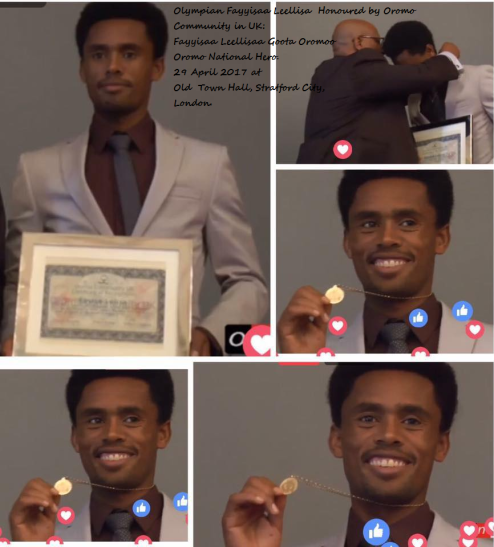


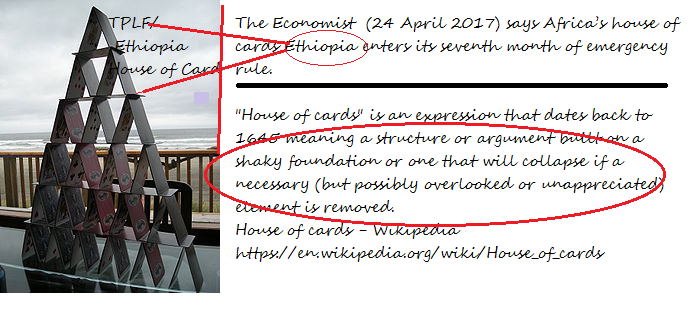







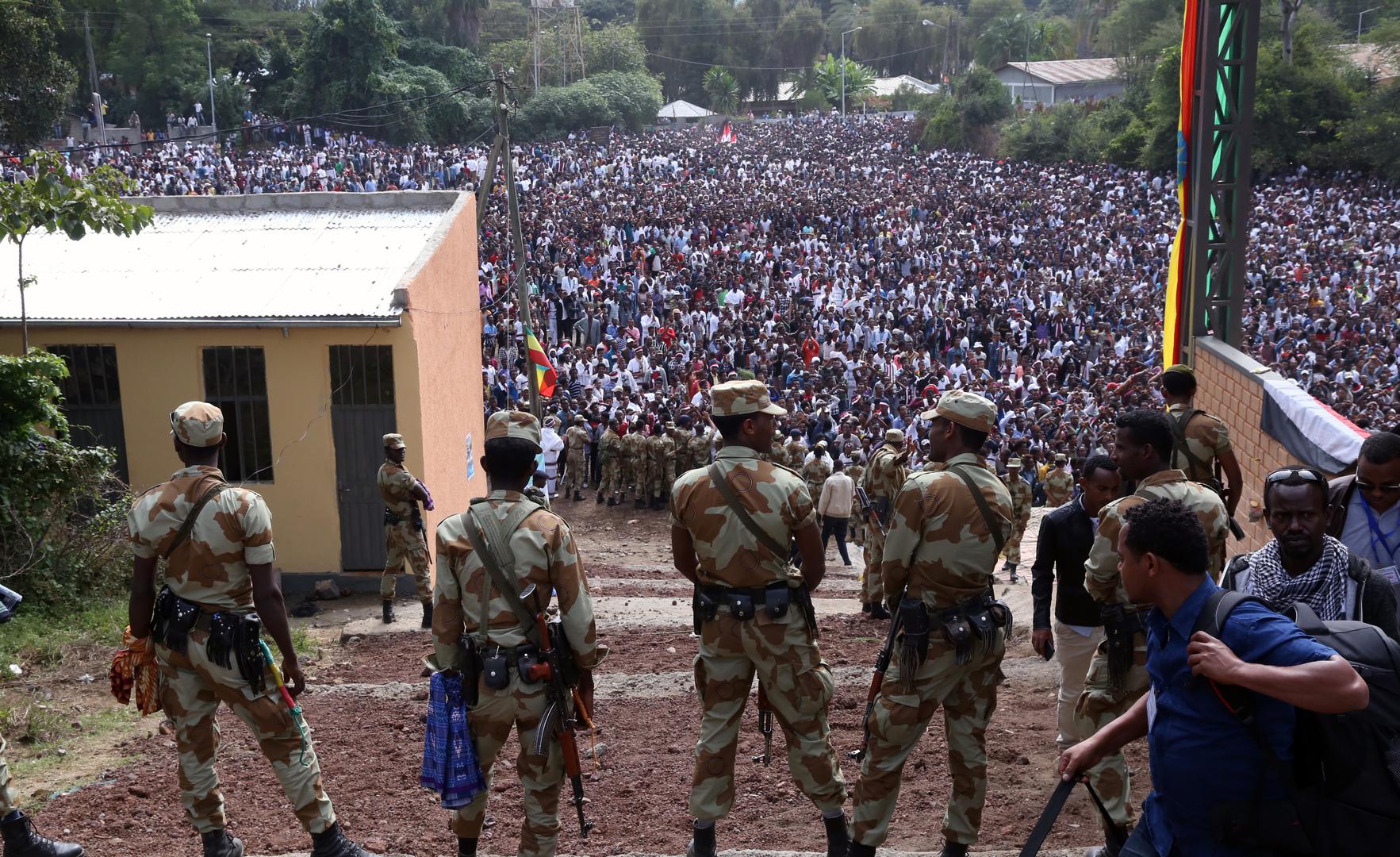
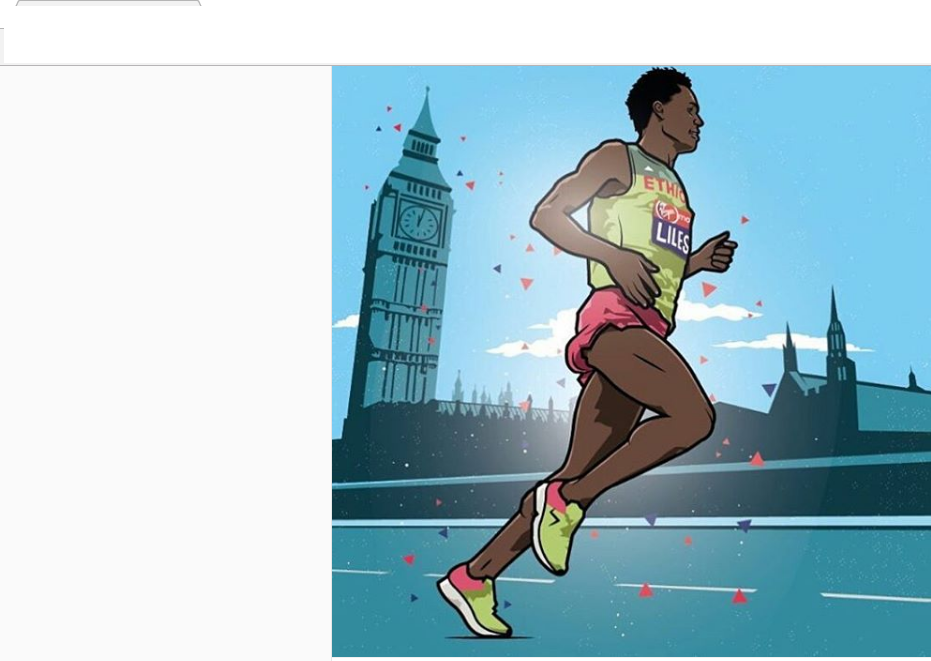




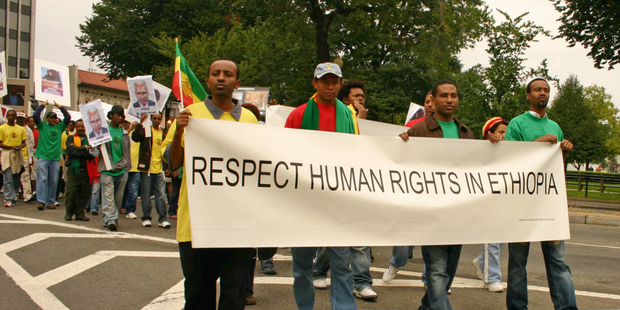


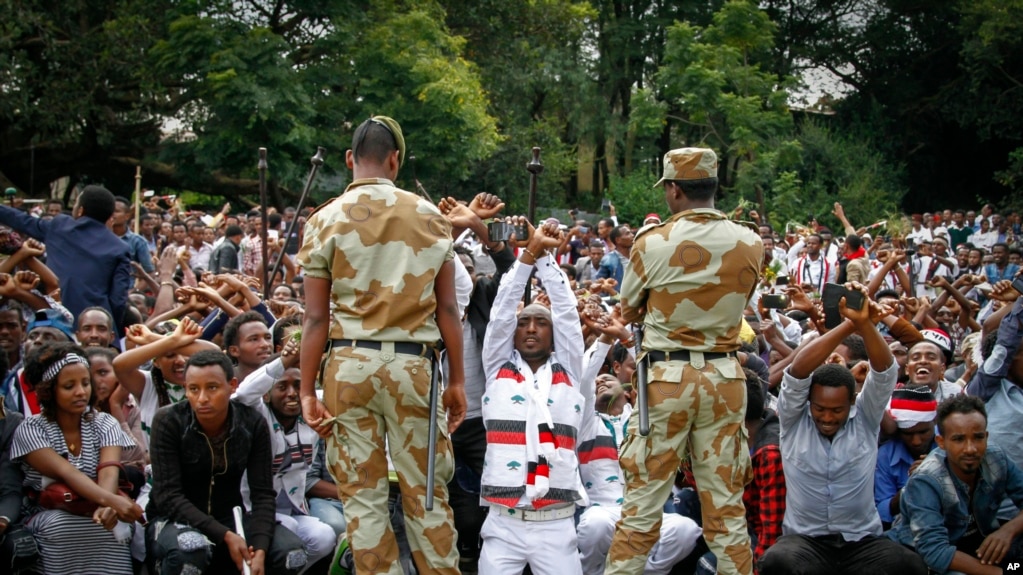
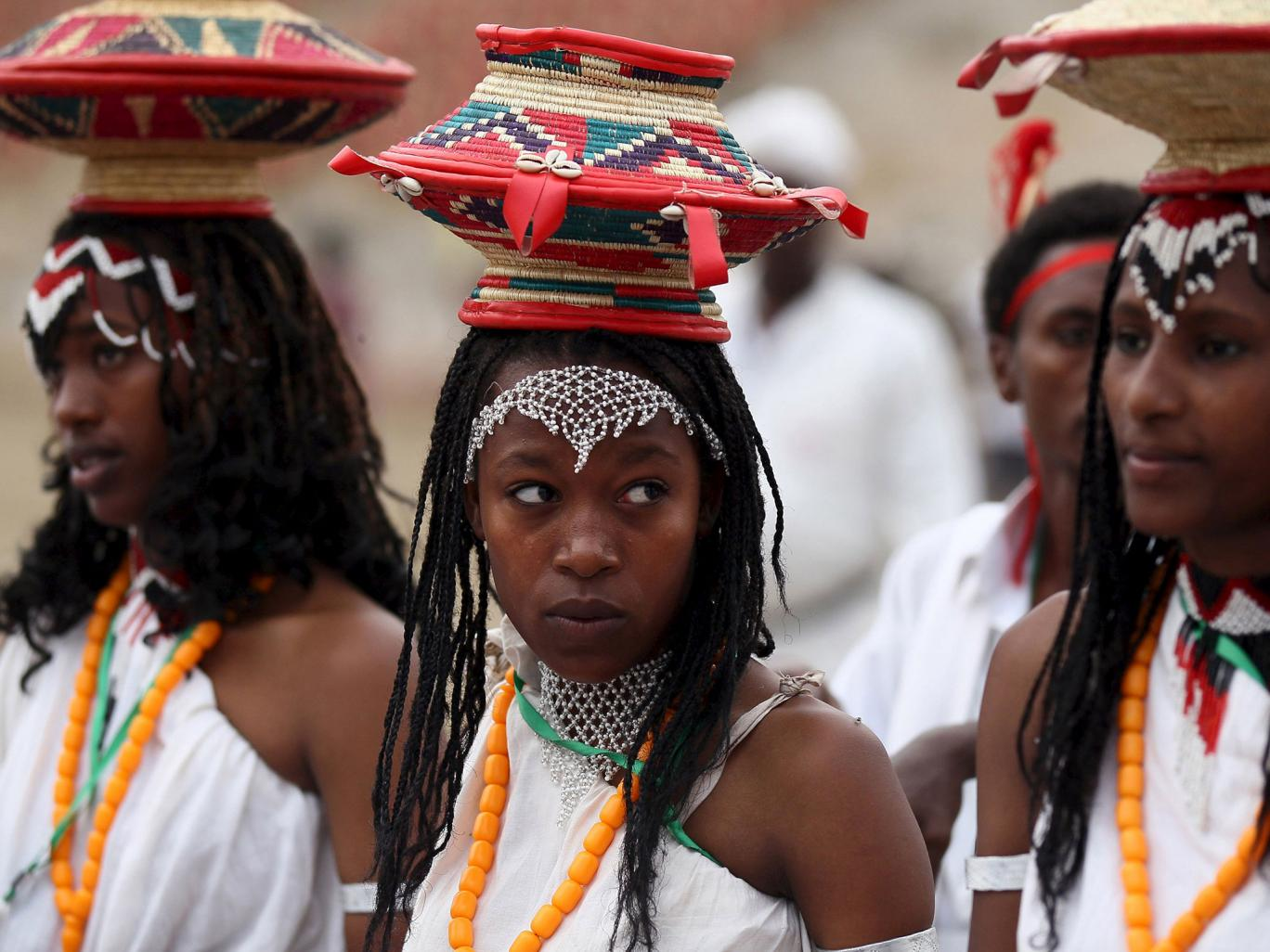
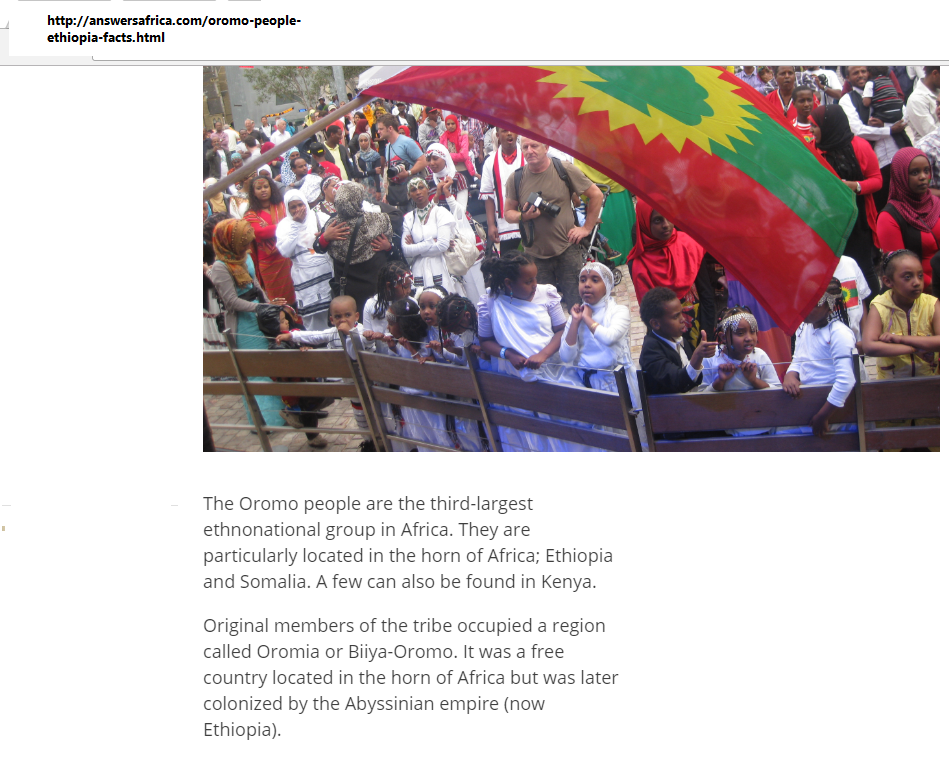


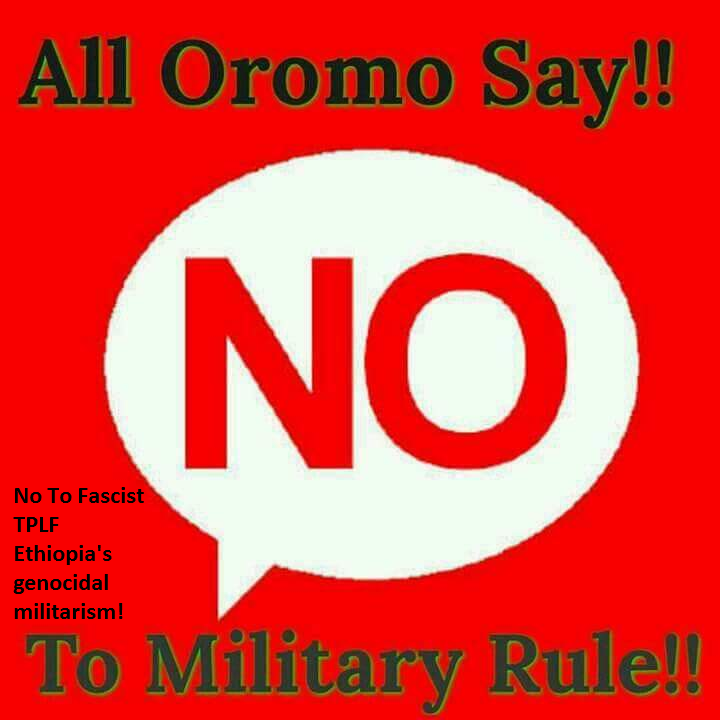








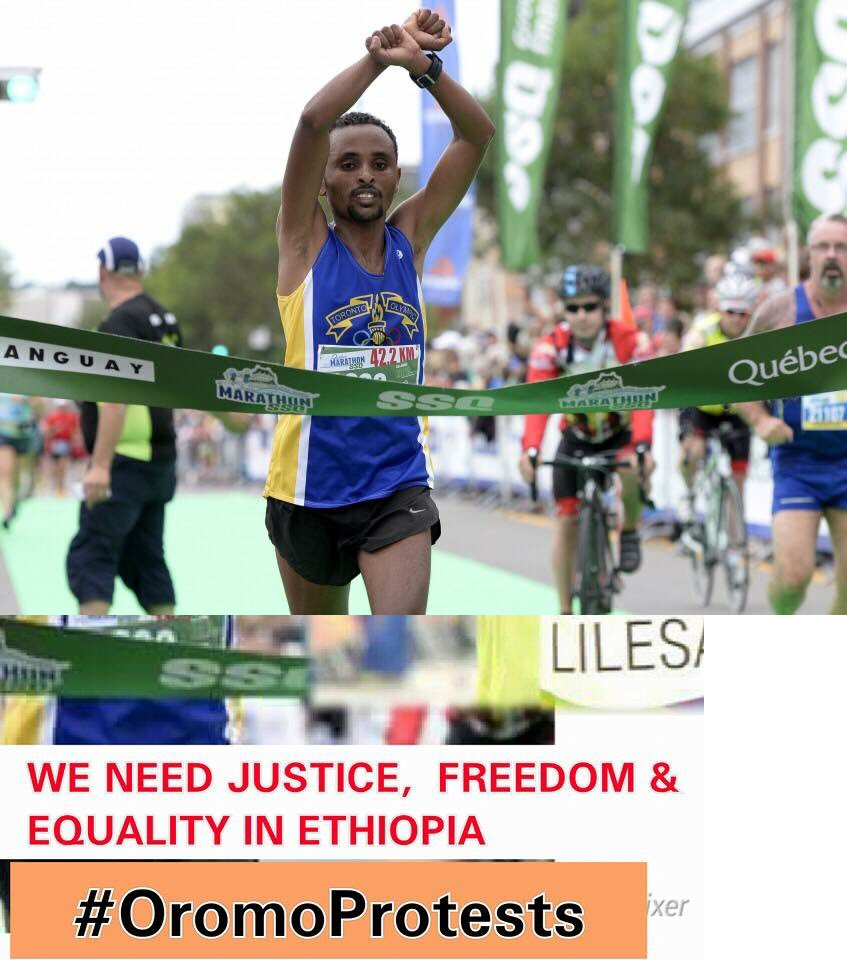


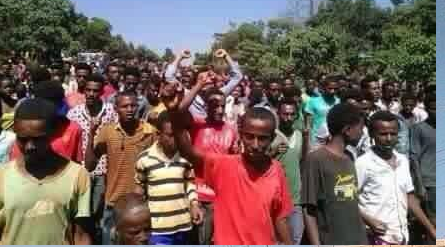





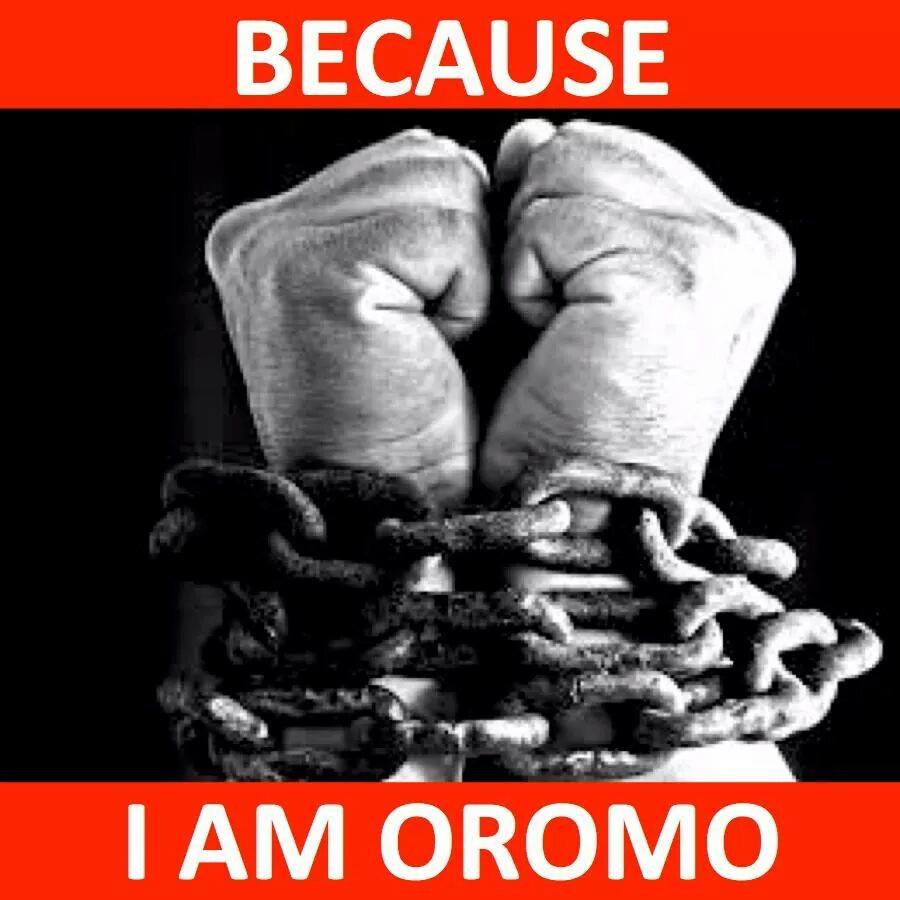

 Bitootessaa 30/2017 AMBOO Gidduugaleessaa Oromiyaa Godina Lixa Shaggar Magaalaa Amboo Keessaatti Warraaqsi Biyyooleessa Oromiyaa FXG Gootota Qeerroo Dargaggootaa Barattoota Oromoon durfamu itti fufe.


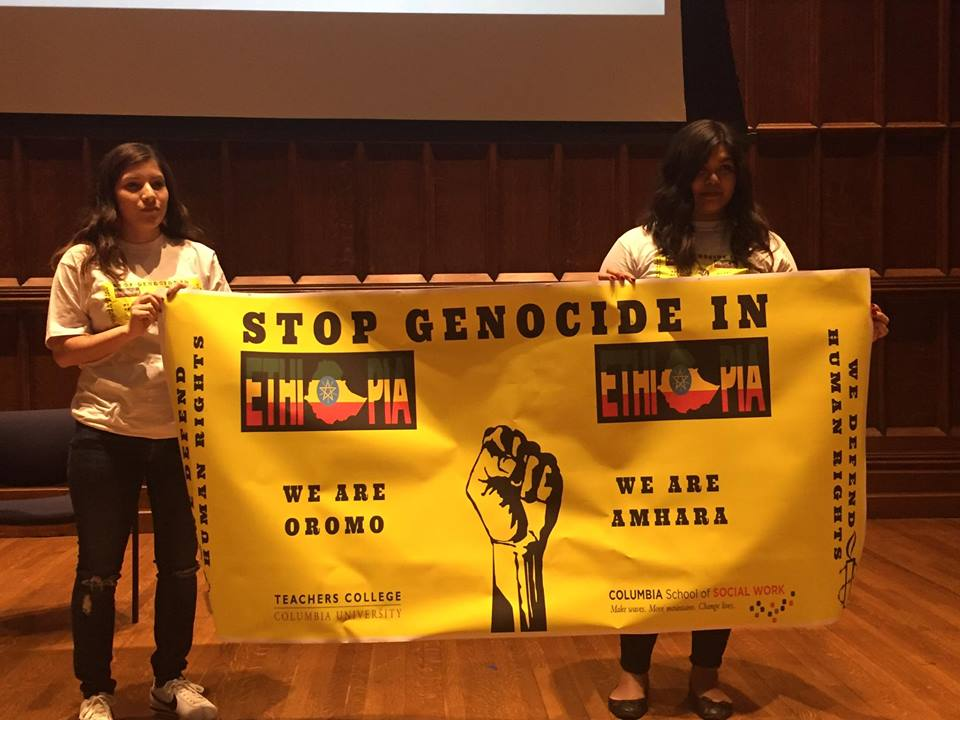
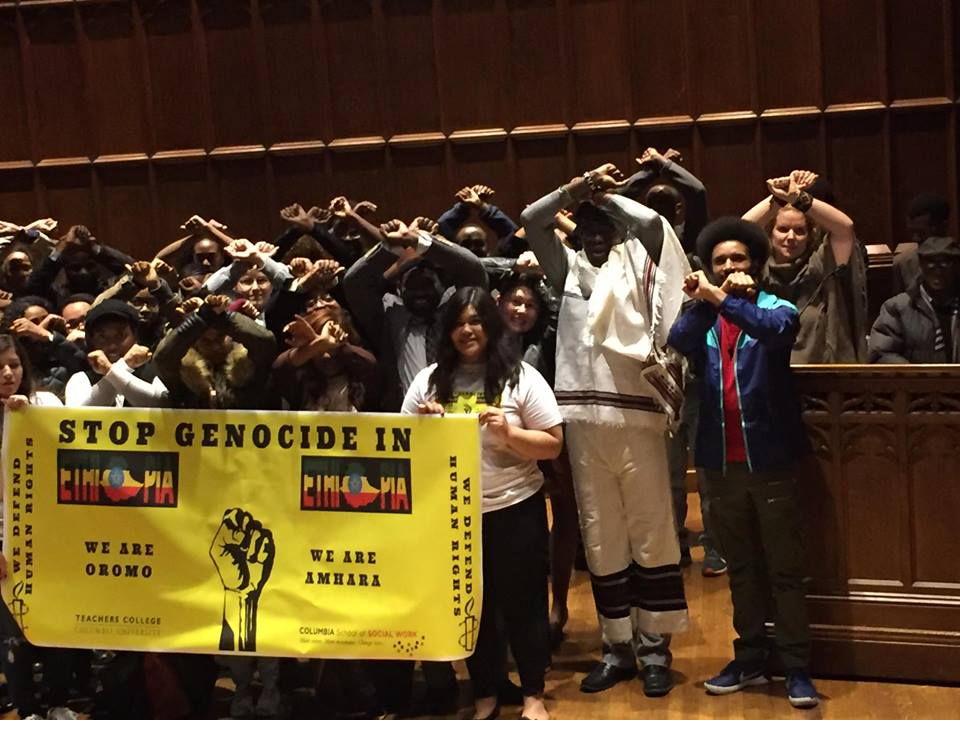



 Bitootessaa 10/2017 Dargaggoo Oromoo Abbaa Seeraa Hayiluu Kifilee Waraanaa Koomandii Poostii Wayyaaneen Ajjeefamee Bosona Iluu Abbaa Booraa naannoo Mattuutti gatamee Bitootessa 9/2017 kan argamee yoo ta’uu, Baatii lama fuuldura Ukkaanfamee eessa buuteen isaa kan dhabamee ture ta’uu maddeen Qeerroo Bilisummaa Oromoo Magaalaa Amboo gabaasan.
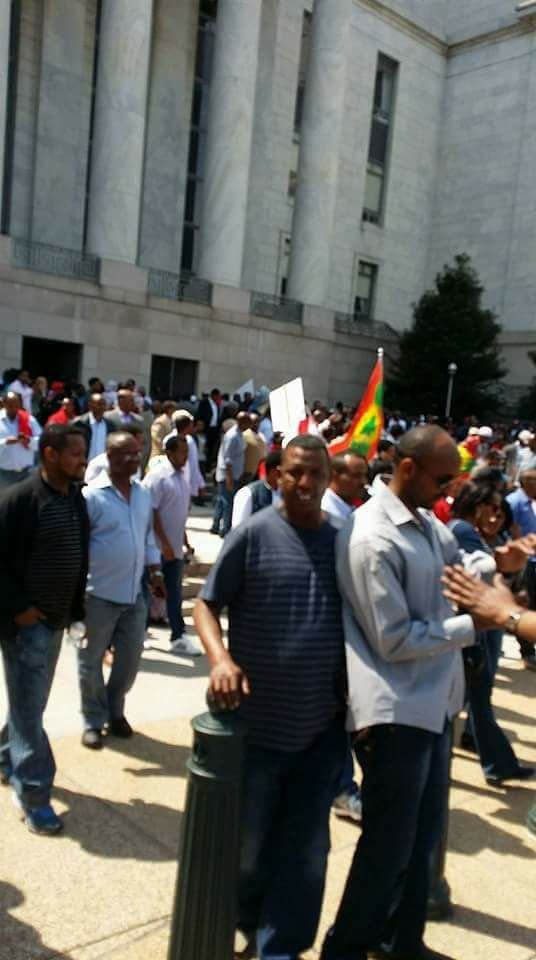

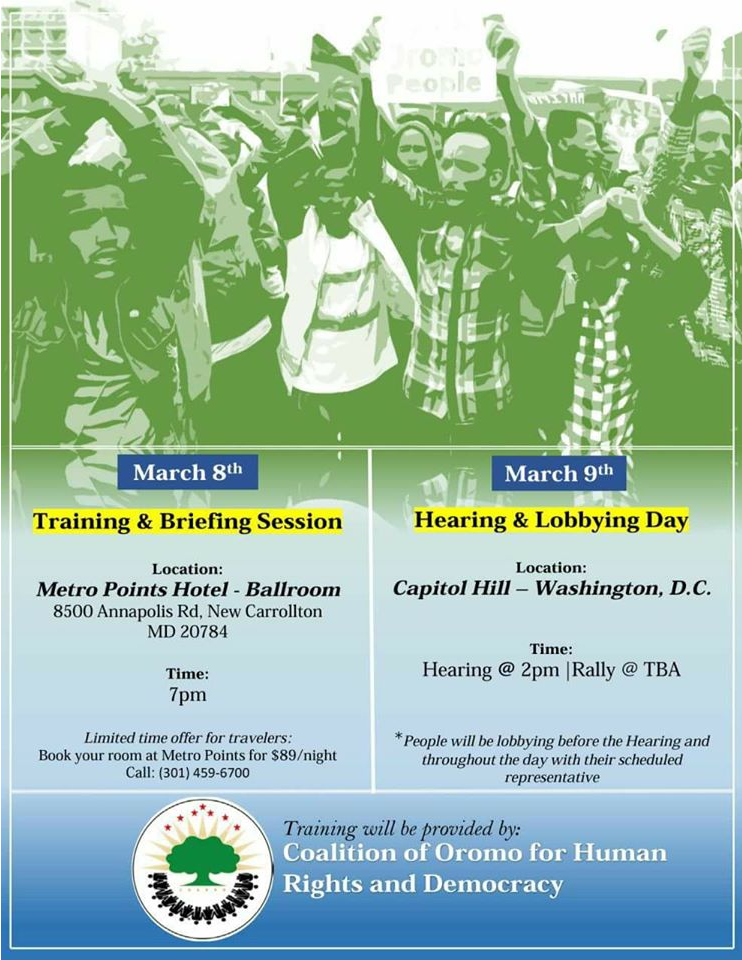


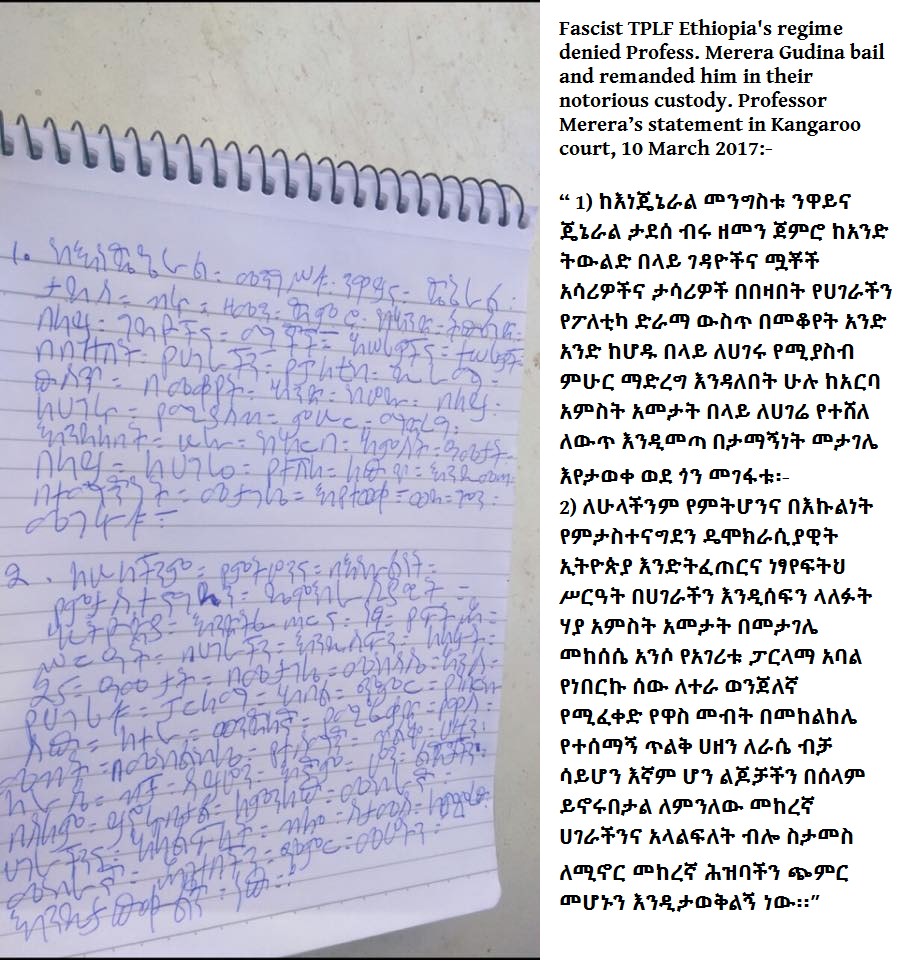

 Bitootessa 7,2017, Godina Wallagga bahaa magaalaa Naqamtee keessaa maqaa malaammaltummaa fi hooromsa jedhuun wal qabatee hojjettoonni waajira teelee magaalaa Naqamtee keessaa heedduminaan ukkaamfamaa akka jiran maddeen Qeerroo Leeqaa gabaasan.
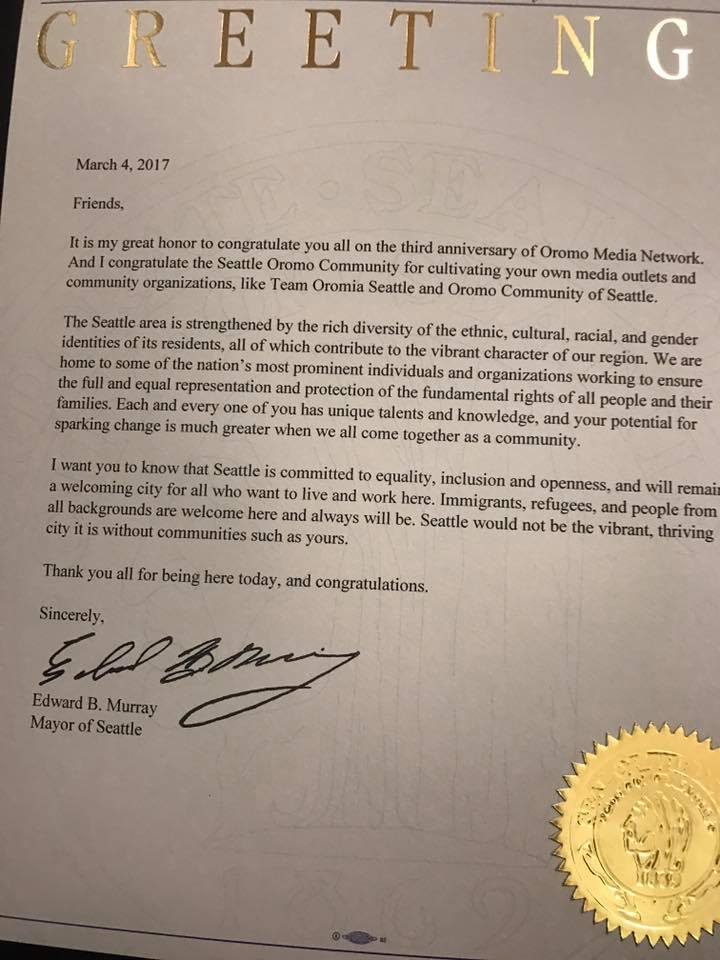


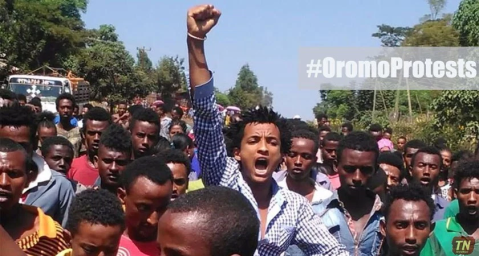

![The country’s ruling coalition is controlled primarily by the Tigray ethnic group, who accounts for only 6 percent of the population [Tiksa Negeri/Reuters]](https://i0.wp.com/www.aljazeera.com/mritems/imagecache/mbdxxlarge/mritems/Images/2017/3/30/2a50297ea6d8467e8ea86235b22d5728_18.jpg "Ethiopia extends state of emergency by four months")


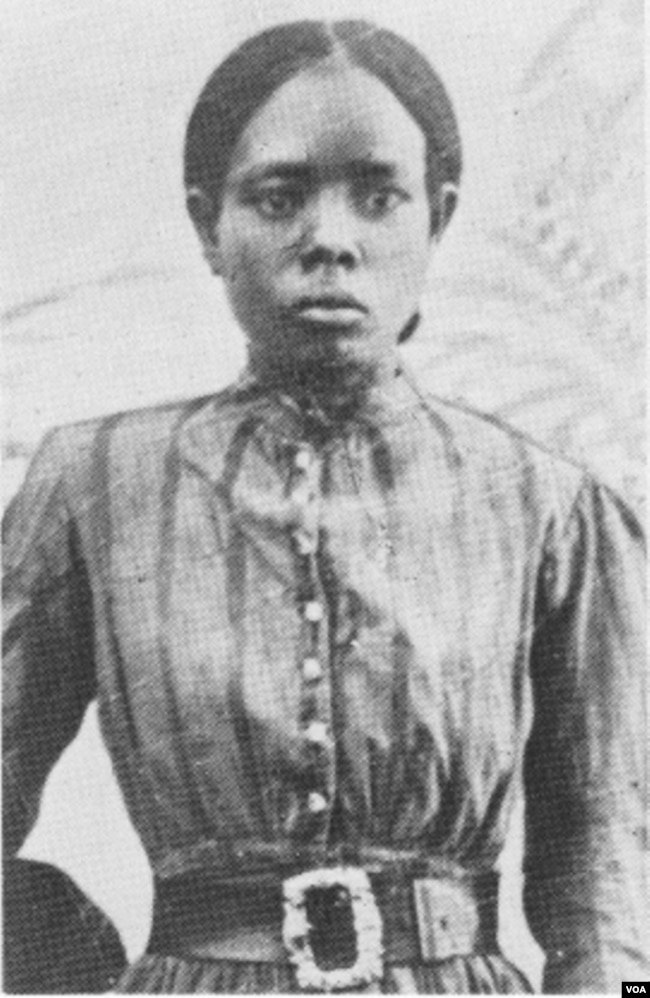


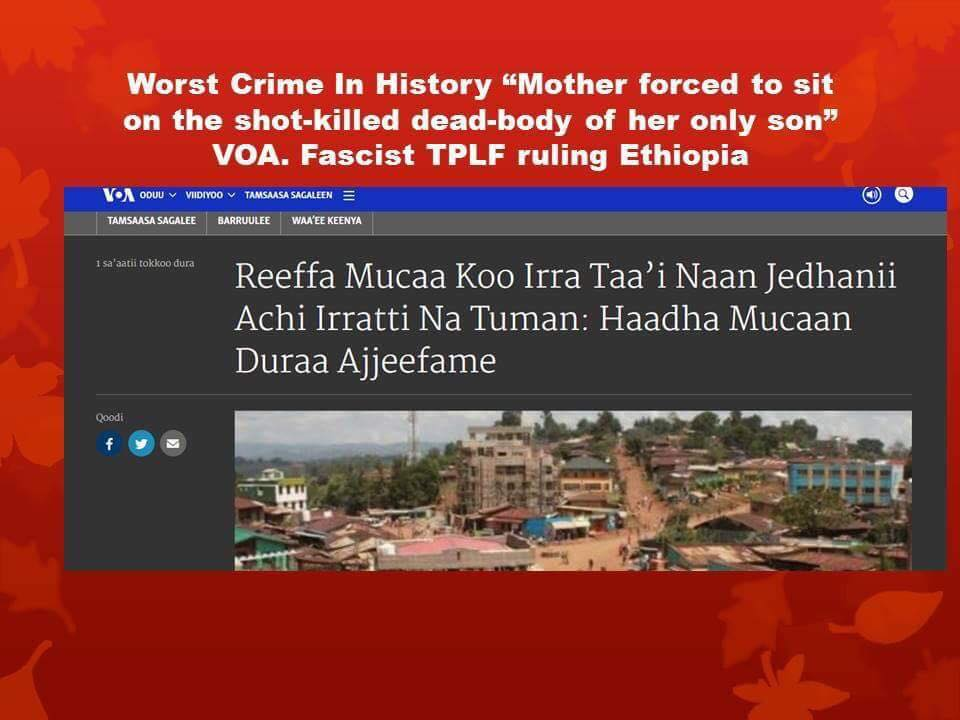


 AP Photo


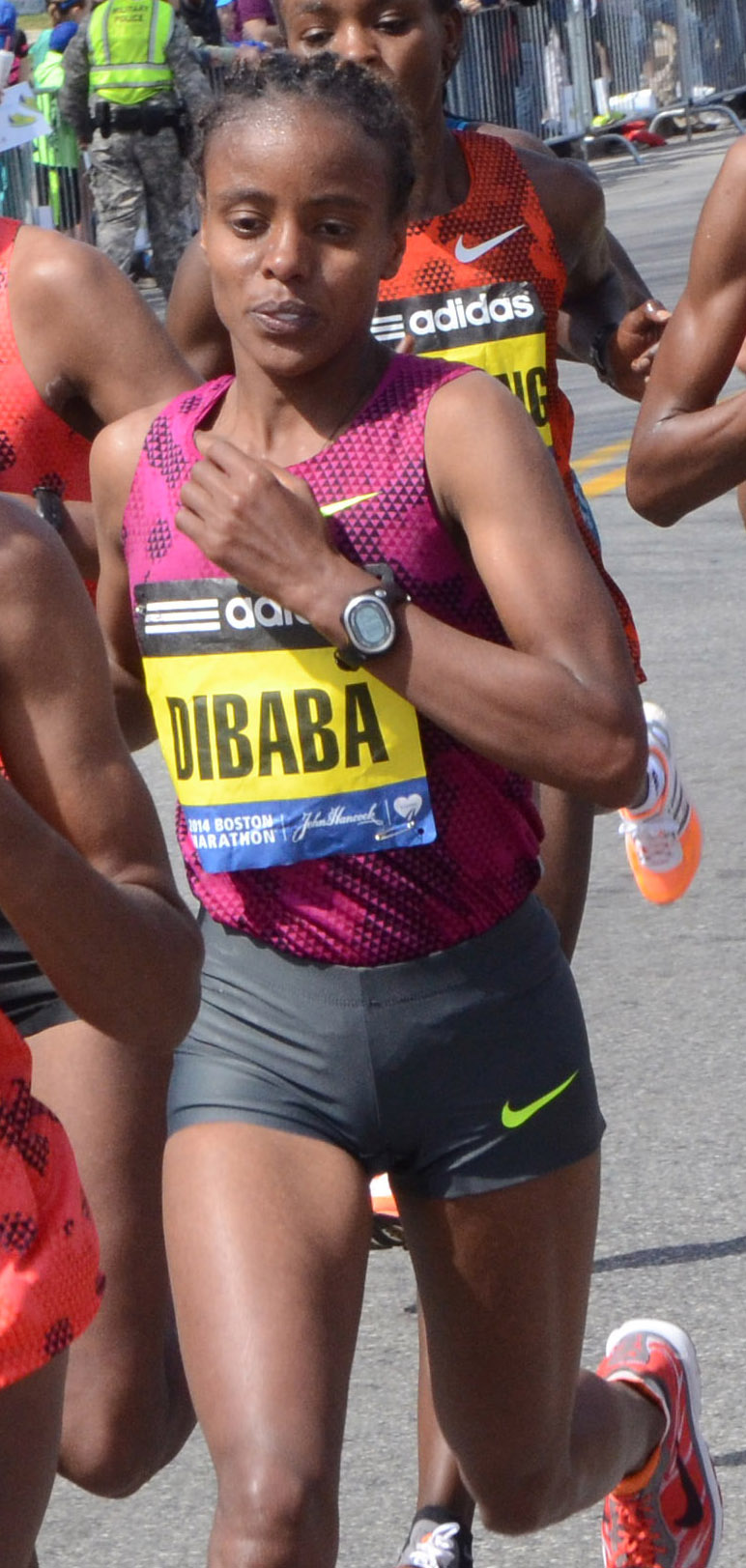


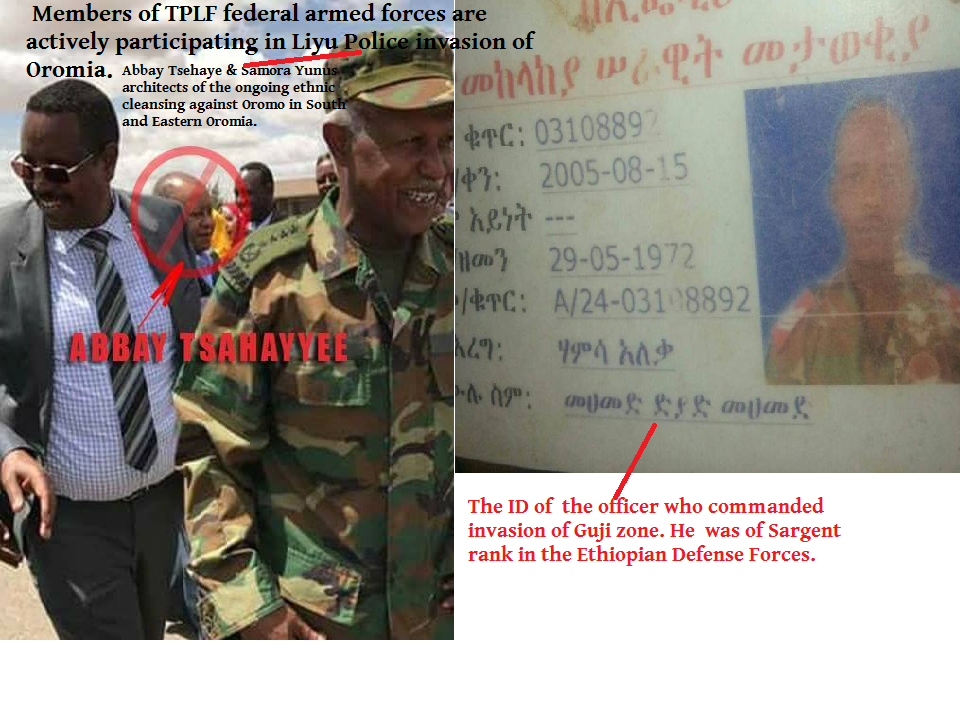


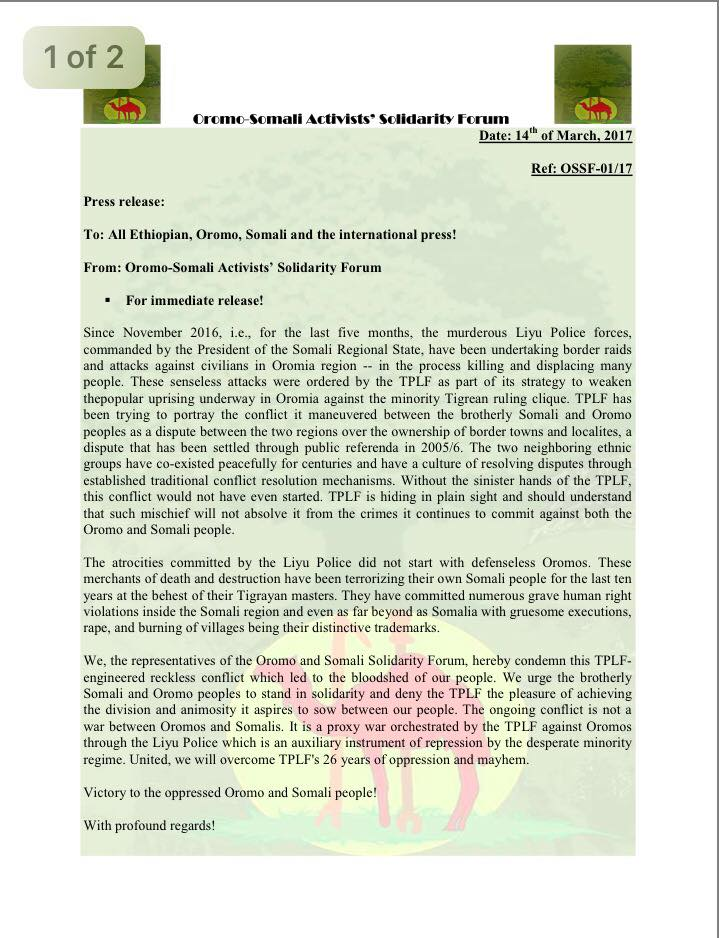
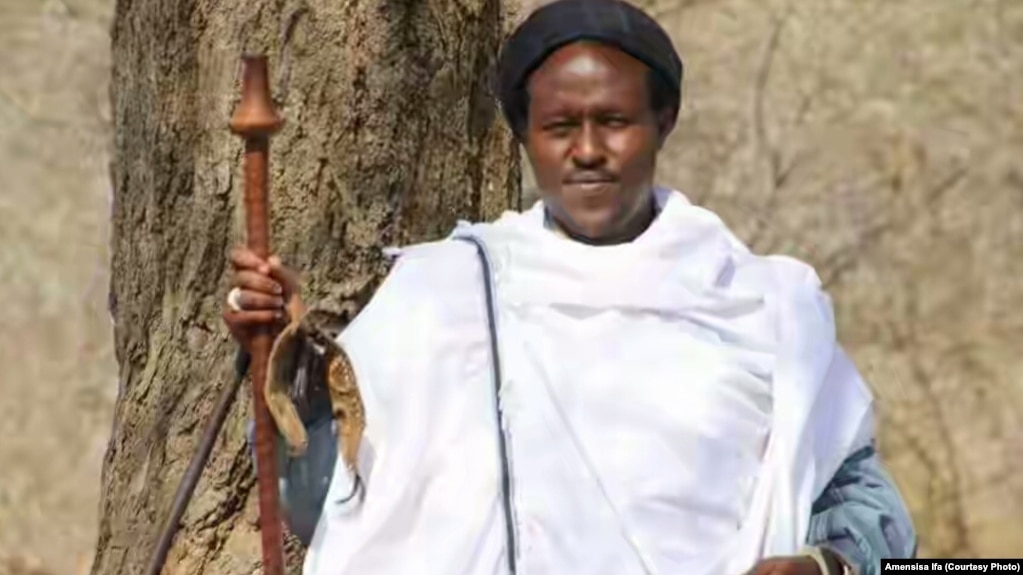
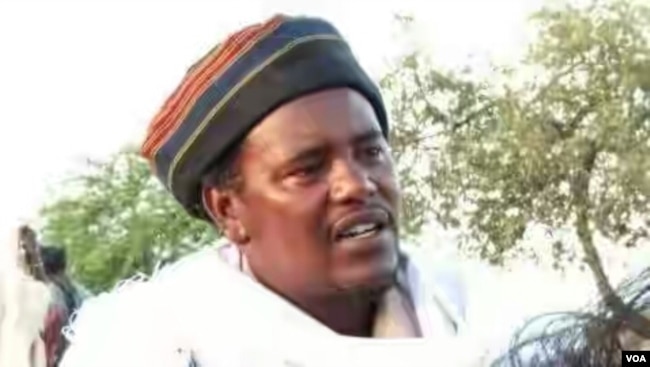
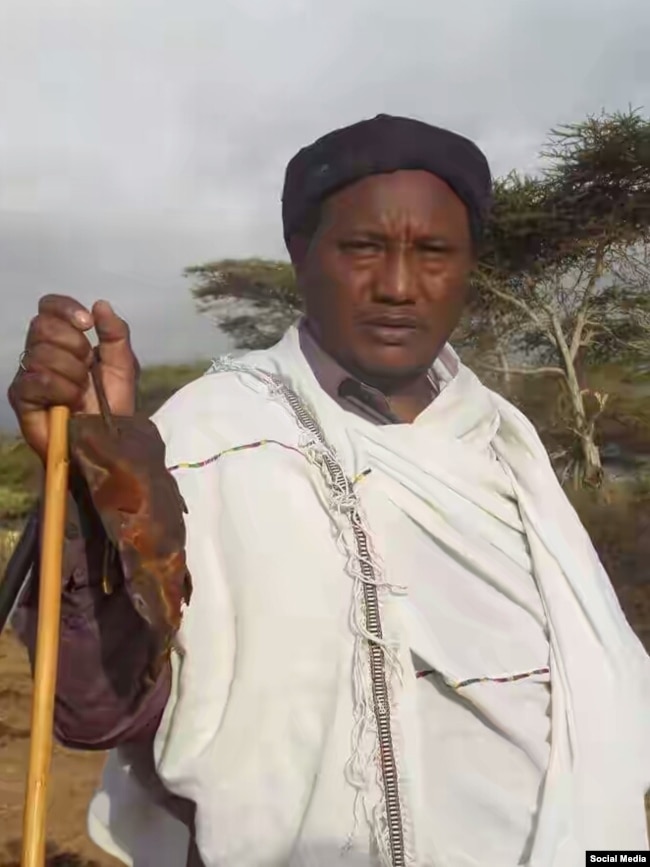
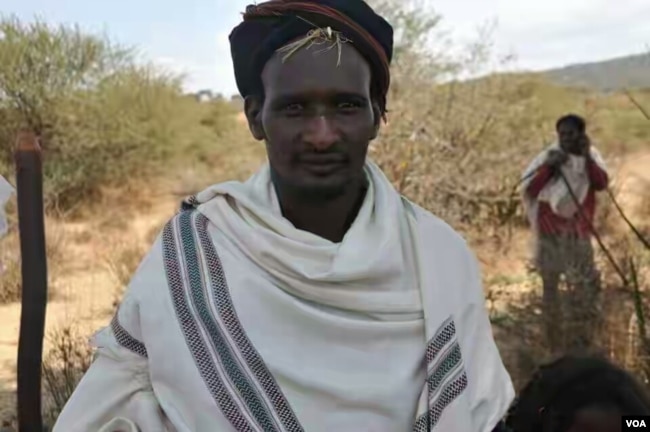
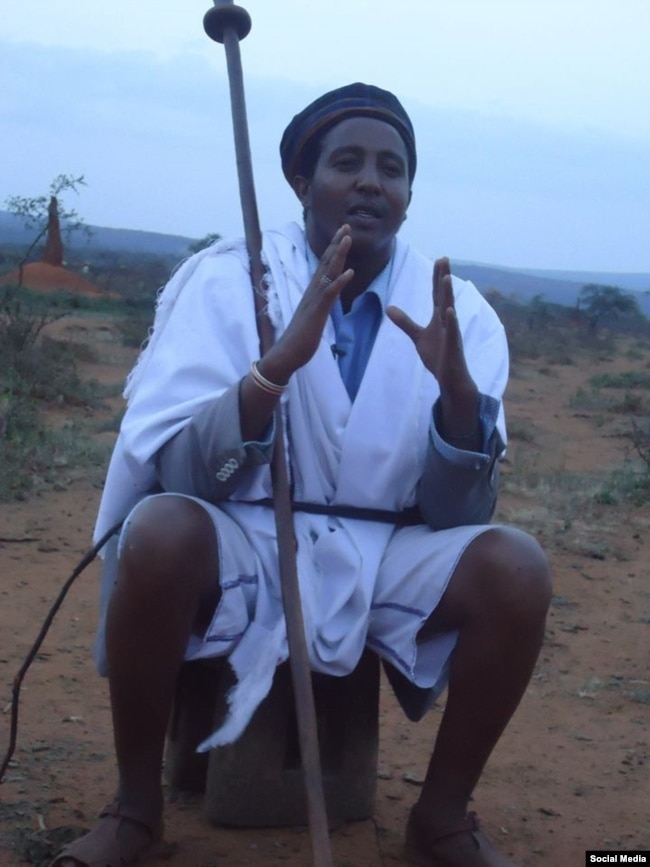





 Oromian Economist

You must be logged in to post a comment.