jump to navigation

What are the 10 most competitive economies in sub-Saharan #Africa? October 8, 2015

Posted by OromianEconomist in Uncategorized.
Tags: , , , ,
add a comment

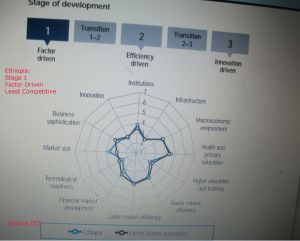
???????????Ethiopia Least competetive GCI 002

What are the 10 most competitive economies in sub-Saharan Africa?

By  Caroline Galvan, World Economic Forum, Sep 30 2015

https://agenda.weforum.org/2015/09/what-are-the-10-most-competitive-economies-in-sub-saharan-africa/?utm_content=buffercdfaa&utm_medium=social&utm_source=twitter.com&utm_campaign=buffer

Despite growth averaging more than 5% a year since the turn of the century, sub-Saharan Africa’s economies remain largely noncompetitive: only three of the region’s countries – Mauritius (46th), South Africa (49th) and Rwanda (58th) three – rank in the top half of the 2015-2016 edition of the Global Competitiveness Index, and they occupy 15 of the bottom 20 places.

In general, the region has made progress in efficiency-enhancing market reform, especially in goods market, but has much more to do to improve its institutions, infrastructure, and health and education sectors, all areas in which reforms will take time to reap benefits. With a coming youth bulge – by 2035, more people will be reaching working age in sub-Saharan Africa than in the rest of the world put together – the need to improve education systems is especially urgent.

The recent fall in commodity prices, putting more pressure on many countries in the region, has also accentuated the need to prioritize competitiveness-enhancing reforms.

Mauritius. Although still the top-ranked country in sub-Saharan Africa, Mauritius dropped seven places to 46th (out of 140) in the overall rankings this year – the first fall down the Index after a decade of improvements. This is accounted for important drops in three of the 12 pillars (overall six pillars are losing places) on which the Index is based, labour market efficiency, financial market development and market size. Still, some fundamentals remain strong: Mauritius has the region’s most efficient goods market, best infrastructure and most healthy and educated workforce. To move further up the development ladder it particularly needs to improve the quality of higher education, the rate at which it adopts new technologies and its capacity to nurture innovation.

sub-saharan-african-top-10

South Africa. Moving in the opposite direction to Mauritius, South Africa climbs seven places to 49th. It has improved year-on-year in its uptake of ICTs and established itself as the region’s most innovative economy. South Africa also tops the region for the efficiency of its financial markets, a pillar on which it ranks 12thglobally. It performs reasonably strongly on the pillars of infrastructure and institutions, although corruption and security remain concerns, but needs to make progress on health and education.

Rwanda. Advancing four places for the second year in a row, Rwanda’s overall position of 58th reflects improvements in the financial development pillar – especially regulation of securities exchanges – and business sophistication. It scores 8thglobally for labour market efficiency, thanks in part to the third-highest female labour participation rate in the world, and 17th globally for the strength of its public and private institutions. However, improvements are needed in some fundamental areas of competitiveness including infrastructure, health and higher education.

Botswana. Up three places to 71st, Botswana posts a top-10 score globally for the stability of its macroeconomic environment. It also boasts relatively strong rankings on institutions and labour market efficiency. Despite some improvements in the last year, however, the health and primary education pillar remains its weakest, with the impact of HIV/AIDS and tuberculosis contributing to the second-lowest life expectancy among the 140 economies surveyed.

Namibia. Advancing for the third year in a row, Namibia gains three places to rank 85th in the global Index. It registered year-on-year improvements in nine of the 12 pillars, most notably business sophistication and innovation – albeit from a low base. It improved its score on its strongest pillar, institutions, but slipped back on its weakest, health and primary education; as in Botswana, tuberculosis and HIV/AIDS remain among the biggest concerns.

Cote d’Ivoire. Leaping 24 places in the last year alone to reach 91st in the overall Index, Cote d’Ivoire has now progressed 40 places in the last three years. It has improved year-on-year on every pillar except for the macroeconomic environment, posting its biggest gains in areas such as innovation, financial market development and institutions – all pillars on which it scores in the top half globally. Despite progress also in health and primary education and higher education and training, they remain its weakest area.

Zambia. Although occupying the same position in the Index as last year, 96th, Zambia has noticeably progressed on some pillars while regressing on others. It has improved its score on macroeconomic stability, for example, with progress on the government budget balance – albeit from a low base – and public debt. However, it drops heavily on the pillars of business sophistication, goods market efficiency and financial market development.

Seychelles. Despite being considerably wealthier than the seven countries in the region that rank as more competitive, the Seychelles loses ground for the third year in a row, dropping five places to 97th overall. The country’s competitiveness is held back by a small market size, scoring bottom globally on this pillar. However, it still ranks in the top half globally on seven of the 12 pillars, with its strongest performances coming on infrastructure (2nd best in the region) and labour market efficiency. It also does well on technological readiness (71st, although low performing second in regional comparison).

Kenya. After two years of forward movement in the Index, Kenya slips nine places to 99th with regressions on three pillars in particular: goods market efficiency, financial market development and institutions. Corruption remains the top concern about doing business in the country, according to executives who took part in a survey which forms part of the Index calculations. Despite the decline, financial market development remains one of Kenya’s three strongest pillars, along with innovation and labour market efficiency; its weakest are the macroeconomic environment and, despite a small improvement in the last year, health and primary education.

Gabon. Improving slightly to 103rd overall, Gabon’s main strength is its macroeconomic environment, which is rated among the world’s top 20 thanks to a positive budget balance and low levels of government debt, reflective of its resource-driven economy. However, this is the only pillar on which Gabon ranks in the top half globally, and it ranks among the world’s bottom 20 on four pillars: goods market efficiency, higher education and training, business sophistication and innovation. To diversify its economy, it needs to invest in productivity-enhancing reforms across the board.

https://agenda.weforum.org/2015/09/what-are-the-10-most-competitive-economies-in-sub-saharan-africa/?utm_content=buffercdfaa&utm_medium=social&utm_source=twitter.com&utm_campaign=buffer

The Global Competitiveness Report 2015-2016 is available here

Oromia: Lubbuun Ummata Oromoo fi Dachiin Oromiyaa, Walabummaa Oromiyaa Qofaan Tikfamti. October 7, 2015

Posted by OromianEconomist in Uncategorized.
Tags: , , , ,
add a comment

???????????Say no to the master killer. Addis Ababa master plan is genocidal plan against Oromo peopleBilisummaa (Freedom Function)

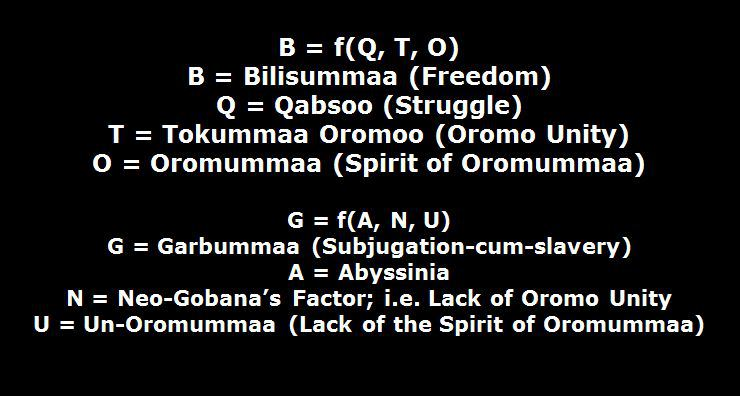
Lubbuun Ummata Oromoo fi Dachiin Oromiyaa, Walabummaa Oromiyaa Qofaan Tikfamti.

barruuOromoota wayyaba, biyyaa Oromiyaa fi ummata Oromoof: gaddan , hinaafan fi rakkoo hamaan ummatni Oromoo keessa jiru irriba  dhorku biratti, hara’aan tana, bu’ura siyaasaa guddaa ta’anii kanneen argaman keessaa tokko waa’ee ‘Master Plan’ mootummaan Impaayera Ixoophiyaa hojii irra oolchuufi deemuu ti.

Mootummaan gabroomfataa impaayera Ixoophiyaa, Oromiyaa nagaa dhowwaa jiru kun,kan  ‘Master plan’ jedhuunii fi kan ummatni Oromoo ammoo ‘Master killer of Oromoo and  Oromia’ ittiin jedhu, karoora: jireenya, eenyummaa, biyya Oromiyaa, abdii fi fuulduree Oromoo dhabamsiisuu irratti qiyyafate yeroo ta’u, mootii Impaayera Ixoophiyaa kan har’aan tana afaan qawweetiin ummata Oromoo ukkaamsee  saamaa fi ajjeessaa jiru qofaan kan jalqabe osoo hin taane wal-irraa fuudhuun ykn wal-irraa dhaaluudhaan yakka moototi Ixoophiyaa Oromoo fi Oromiyaa irratti raawwataa turanii fi ammaan tana illee itti fufee  irratti raawwataa jiruu dha.

Biyya Oromiyaa, afaan qawweetiin weeraranii, Oromoo irraa buqqisuudhaan ummata Ixoophiyaa irra qubsiisuun qabeenyaa dachii kana irratti argamu saamuu, Oromoo dachii isaa irraa buqqisan ammo hojjisiifatuu fi gabaatti baasanii gurguratuun  qawwee bitatuuf karoorfatee kan jalqaba Oromoo fi Oromiya irratti weerara bane mootummaa Aksum kan Tigraay irratti jalqaba bar-kumee ijaarame dha.Mootummaan Aksum, ummata Kibba Yamanii irraa godaanee Galaana Diimaa cehuun qarqara Galaana kanaa jalqaba bar-kumee (first millennium)  keessa ijaaramee weerara gabroomsaa gara:Kaabaa (Eritrea), Dhiha (Sudaani) fi Kibbaatti geggeessee ture. Mootummaan Aksum kun, weerara gara Kibbaatti geggeesse keessatti, laga Abbayyaa cehuun Kaaba Shawwaa qabachuuf haa yaalu maleee, duula farra gabrummaa Oromoon Waajjii bara 112 (AD) irratti geggeesseen duulli gabroomsaa mootummaa Aksum osoo bakka hin gahin hafe.lubbuun-ummata-oromoo-fi-dachiin-oromiyaa-1

Related article:-

Sirna gabroomfattuu Ixoophiyaatiin mootummaan Oromiyaa irratti ijaarame, mootummaa gabroomfattuu fi seeraan alaa ti

Mootummaan gabroomfataa Impaayera Ixoophiyaa, kan ammaan tana Oromiyaa fi biyyoota ummattoota akka: Sidaamaa, Kaffichoo, Shakkichoo, Kambaataa, Walaayitaa, Majangir, Oomoo, Beenishaangul, Gambeelaa, Ogaaden, Afaar, Agawu fi kkf bitaa jiru, akkuma gabroomfattoota Ixoophiyaa isa dura turanii, ummattoota kana: ajjeesaa, hidhaa, biyyaa baqachiisaa fi mirga hiree murteeffannoo isaa dhiitaa  afaan qawweetiin mataa isaa  irra   taa’uun ummattoota kana:hiyyummaa, beela fi wal’alummaa  eessattuu argamee hin beekne keessatti gannoota digdamaaf kan dararaa turee dha.Mootummaan kun, sirna gabrummaa fi nama nyaataa isaa kana itti fufuuf, filannoo seeraan alaa fi farra dimookraasii  Oromiyaa fi biyya ummattoota Kibba Impaayera Ixoophiyaa keessatti geggeessee, barcuma caffee gabroomfattuu Ixoophiyaa hunda injifachuu  eerga labsatee hedduu osoo hin turre,  aangoo seeraa fi dimookraatawaa osoo itti hin qabaatin, mootummaa ijaaruu isaa kaleessa gaafa 6/092015 nutti hime.

Impaayera Ixoophiyaatiin, mootummaan Oromiyaa fi biyyoota ummattoota Kibbaa keessatti ijaarame kun, uumanis ta’e dalagaan, mootummaa:Minilik, Haayile Sillaasee fi Dargii irraa adda kan hin taane, mootummaa gaabroomfattuu, mootummaa seeraan alaa fi mootummaa nama nyaataa dha. Waan kana ta’eef, seerri, tarkaanfiin, murtiin, ajaji, jaarmaani fi ramaddiin mootummaa kana irra maddu, ummata Oromoo fi ummattoota Kibba Impaayera Ixoophiyaa hin ilaallatu. Seerri, murtiin, jaarmaan, ramaddiini fi ajaji mootummaa gabroomfataaa fi seeraan alaa  kana irraa maddu fudhatee hojii irra oolchuuf ummatni Oromoos ta’e ummattooti :Walaayitaa, Kambaataa, Hadiyyaa, kaffichoo, Shakichoo, Gumuzii, Majangir, Beeniishaangul, Gambeelaa, Ogaan, Affaari fi Agawu dirqama seera irra madddu hin qaban. Seerri, murtiin, jaarmaan, ramaddiin fi ajajni mootummaa gabroomfataa kana irraa maddu kan seeraan alaa waan ta’eef, ummatni Oromoo fi ummattootni Kibba Impaayera Ixoophiyaa dura dhaabbachuun mootummaa gabroomfataa fi seeraan alaa kana of irraa kaasanii hanga walabummaatti hiree  isaanii guutuutti mirkaneeffachuuf mirga seenaa fi seeraa qabu.

Mootummaan gabroomfattuu fi seeraan alaa, mata ummata Oromoo fi ummattoota Kibba Impaayera Ixoophiyaa irra  taa’aa jiru kun, afaan qawweetiin yoo ta’e malee seera fi fedhii ummattoota kanaatiin kan bulchaa jiru waan hin taaneefi: seera, murtii, ajaja, jaarmaa fi ramaddii isa irraa madduun waldhabbii isaa fi ummattoota cunqurfamoo  gidduutti dhalatuuf deemu keessatti gaaga’ama uumamuufi  gaafatama guutuu kan fudhatu isa mataa isaa ta’uu mootummaan gabroomfataa Ixoophiyaa  beekuu qaba. Ummatni Oromoo fi ummattooti Kibba Impaayera Ixoophiyaas, mootummaan gabroomfattuu fi seeraan alaa Ixoophiyaa Tigrootaan  hoogganamu kun, dantaa ummata Tgraayiif malee, dantaa isaaf jecha Tigraay irra ka’ee qawwee baatee akka hin dhufne hubatee, mootummaa fedha isaatiin seeraan ijaarratu daddaffiin argamsiifatuufi, yeroo inni qabsoo farra gabrummaa Ixoophiyaa gamtaan daranuu  itti jabeeffatan har’a ta’uu qabu .

Sirni gabroomfataa  fi seeraan alaa, mootummaa seerawaa ijaaruu hin danda’u

Leelloo Sabaa

Oromia: “Say No” to Oppose Tigreans’ Master Plan – Which Is the “Master Killer” for Oromo Farmers October 7, 2015

Posted by OromianEconomist in Uncategorized.
Tags: ,
add a comment

???????????Say no to the master killer. Addis Ababa master plan is genocidal plan against Oromo people. Say no.Say no to the master killer. Addis Ababa master plan is genocidal plan against Oromo peopleTigrean Neftengna's land grabbing and the Addis Ababa Master plan for Oormo genocide

http://www.gopetition.com/petitions/say-no-to-the-master-plan.html

Oromia:Ijoo Dubbii Adda Bilisummaa Oromoo: Mootummaan Wayyaanee Karoora Master Plaanii Magaalaa Finfinnee Humnaan Hojii Irra Oolchuuf Murteeffachuun Isaa Qabsoo Mirga Abbaa Biyyummaa Ummata Oromoo Of Booda Hin Deebisu. October 2, 2015

https://oromianeconomist.wordpress.com/2015/10/02/oromiaijoo-dubbii-adda-bilisummaa-oromoo-mootummaan-wayyaanee-karoora-master-plaanii-magaalaa-finfinnee-humnaan-hojii-irra-oolchuuf-murteeffachuun-isaa-qabsoo-mirga-abbaa-biyyummaa-ummata-oromoo-of/

Jawar Mohammed:- Xinxalaa – Labsii ‘Magaalota Oromiyaa’ fi ‘Maastar Pilaanii Finfinnee’

Onkoloolessa/October 3, 2015 · Finfinne Tribune | Gadaa.com 

Jawar Mohammed irraa*

Labsiin** Magaalota Oromiyaa Dhaabuuf jedhamee dhihaate Caffeen marii gabaabduu booda ibsa gahaafi jijjiirama tokko malee dabarsitee jirti. Labsiin kun Maastar Pilaanii Finfinnee hojirra oolchuuf seeraan hayyame jechuudhaa? Ifatti hin hayyamne. Garuu Maastar Pilaanii bira dabree dantaa Oromoofi Oromiyaan magaalota irraa qabu miidhuuf karaa guddaa bane. Akka armaan gadiitti laalla.

Labsiin kun Maastar Pilanii Finfinnee hojirra oolchuuf suduudaan hin hayyamu. Mataduremarraayyuu ‘magaalota Oromiyaa’ waan jedhuuf ‘walitti makamiinsa’ wanni jedhame kun magaalotuma Oromiyaa jidduutti daangeffama jedhamee waan fudhatamuuf yaaliin magaalota Oromiyaa kan naannoo biraatin walitti makuuf ifatti hin hayyamne. Ammoo walitti makamuun makamuun kun magaalota Oromiyaa giddutti qofa jedhamees ifa waan hin ta’iniif warra magaalota Oromiyaa muratee fudhachuu fedhiifis baniinsa (loophole) guddaa qaba.

Kana daran ammoo labsiin kun miidhaa guddaaf karaa bana. Akkamiin?

‘Jiraattota’ magaalaatiif mirgaafi aangoo guddaa kan sadarkaa zooniifi aanattuu hin jirre kenna. Akka labsii kana keessatti irra deddeebi’amee kaayametti magaalota walitti makuun, maqaa jijjiiruun, hogganoota filachuun, imammataafi tarsiimoo magaalaa hundi ‘fedhii fi waliigaltee’ jiraattota magaalaa irratti hundaaya jedha. Caffeen Oromiyaatifi godinoonni magaalonni keessatti argaman magaalota ajajuu hin danda’an, mari’achiisuu malee.

Kana qofaa miti, galiin magaalaa irraa argamu faaydaafi tajaajila magaalaa saniitif akka oolu ammas ‘fedhiifi waliigaltee’ jiraattotaatin ta’a jedha. Akkuma beekamu magaalonni handhuura galiiti. Kan magaalaa keessatti oomishamu qofaa miti, kan badiyyaan naannawa sanii callaeessus magaluma sanitti kuufama. Akka labsii kanatti galii magaalaa keessatti kuufame kun kan fayyadamuu danda’u ‘jiraattota’ magaalaa saniiti malee qonnaan bulaan ollaa magaalaa san sooromse humaa irraa hin argatu. Waan kana daran kan hammeessu, hariiroon Caffeenifi godinoonni magaalota waliin qaban, waliiftumsuufi wal mari’achuu irratti hundaaya. Magaalaan takka Oromiyaa keessaa aangoofi mirga Oromiyaanuu sirna federaalaa keessatti hin qabne laatameef.

Amma egaa, ‘jiraattonni magaalaatiif’ mirgaafi aangoo hammana guddatu kennuun maalif barbaachise? Miidhaan isaa hoo maali?

Akkuma beekamu magaalonni Oromiyaa hedduun teessoo waraana Nafxanyaa ta’uudhaan bu’uerraffaman. Sirnoota dabran keessatti aadaan magaalaa qilleensa farra Oromoo ta’een waan guutamee, akkasumas Oromoon sirna abbaa lafaatin lafa baadiyyattin waan walitti hidhameef magaalaatti kan godaanu xiqqaa ture. Bara mootummaa kanaa ammoo magaalonni adaduma babal’ataniin qonnaan bulaa Oromoo lafarraa buqqaasaa lafa isaatirra alagaa maallaqaan lafa bitate qubsisaa jiran. Kanaafu, magaalota Oromiyaa keessa qabiyyeen jiraattotaa (demographics) alagaatu heddummaata. ‘Fedhiifi waliigaltee jiraattotaa’ yoo jedhamu ammoo kan warra magaalaa san keessatti baay’ina wayyaba qabuu (majority) jechuudha. Kanaafuu labsiin kun imaammataafi fuulduree magaalota Oromiyaa keessa jiranii harka Oromootii baasee alagaadhaaf laatee jira.

Akkuma namuu argu labsiin kun ogeeyyota Oromootin qoratamee akka hin dhiyaatin ifa. 1ffaa Afaan Amaaraatirraa garagalfamuun ifatti mul’ata. 2ffaa ‘koreen’ silaa labsii kana qopheesse jedhamee Caffeetti dhiheessi yaadrimee xixiqqaa kabsii kana keessatti hammatameeyyuu sirritti akka hin galiniif deebii isaan gaafii ka’aniif kennani irraa beekuun ni danda’ama. (Fkn. garaagarummaan regiopolis fi metropolis maal akka ta’e waan hin galiniif walitti laqaa turan)

Maarree nyaaphni labsii kana tirra diddibee Caffeettii maalif erge?

1) Karoora Maastar Pilaanii Finfinnee akka jiruun osoo dhiheessanii mormiin jabaan akka isaan qunnamu ni beekan. Kanaafuu labsii Pilaanicha suduudaan ammumatti hojirraa oolchuuf isaanif hayyamu yoo argachuu dadhaban, kan dhawaatan galmaan gahuuf isaniif karaa saaqu baafatan. Akka labsiin kun isaaniif hayyametti, lafa Oromoo bitachaafi waliif kennaa waggota muraasa keessatti qabiyyee(demographics) ‘jiraattota’ magaalota naannoo Finfinnee daran jijjiruun alagoomsu. Waggoota lamaan takka booda fedhiifi waliigaltee ummata Finfinneetifi kan Burraayyuu, Sululta, Sabataa kkf sababeeffachuun magaaloonni kun Finfinnee jalatti galan.Gaafas labsii kanaafi ‘fedhii jiraattotaa’ waabeffachuun ‘seeraan’ Masster Pilaanii sani hojirra oolfatu.

2) Labsiin kun Finfinnee qofarratti kan murtaa’u miti. Magaalota akka Jimmaa, Shaashamannee, Haramaayaa, Walisoofi kan biroos harka Oromoofi Oromiyaatii baasuuf shira xaxame ta’uun beekkamaadha. Akka ani shakkutti akkuma magaalonni kun babal’ataa magaalota naannoo biroo kan ollaa san jirinin walitti dhihaatan, ‘fedhiifi waliif galtee jiraattotaan’ walitti makanii, naannolee lamaan jalaa baasanii akkuma Finfinneefi Dirree Dhawaa federaalaan bulchuuf karoora qabu.

Walumaa galatti labsiin kun balaan inni Oromoofi Oromiyaaf qabu kan Maastar Pilaanii Finfinnee daran akkaan badaadha. Hogganoonni OPDO fi miseensonni Caffee labsi shira akkanaa of keessatti hammate kana akka dantaa saba kanaa eegsisuun osoo hin fooyyessin, akkuma gubbaa itti kennametti raggaasisuu isaanitif yakkamtoota seenaati. Ummanni keenyas balaa itti aggaamame kana bifa maraan dura dhaabbachuuf dhugaafi dirqama qaba!

Labsii-Magaalaalee-Oromiyaa

http://gadaa.net/FinfinneTribune/2015/10/jawar-mohammed-xinxalaa-labsii-magaalota-oromiyaa-fi-maastar-pilaanii-finfinnee/

Caffeen Labsii Maaster pilaanii Magaaloota Nannoo Oromiyaaf qophaa’e raggaase.

OMN:Oduu Onko.02,2015 Caffeen Oromiyaa Labsii Magaalota Naannnoo Oromiyaa walitti makuuf qophaa’ee yaa’ii idilee lammaffaa taa’een raggaase jira.

Akka Labsii kanaatti Magaalonni Oromiyaa akka walitti makaman fi Maqaan isaanis akka jijjiramuu danda’u tumamee jira.

Labsiin Caffeen Oromiyaa baase akka ibsutti Magaalonni Oromiyaa fedhii jiraattotaa qofaan walitti makamuu akka danda’an kan tume yoo ta’u sirni gita bittaa darbe Oromoon akka magaalota keessatti bu’uura hin godhane waan uumeef Magaalota Oromiyaa keessatti saboonni biroon akka murtii kennaniif kan haala mijeesseef akka ta’e himamaa jira.

Labsiin Magaaloota Oromiyaa ilaalchisuun bahe dhimma Master Pilaanii Finfinnee yoo eeruu baates kaayyoon isaa inni guddaan Maastar Pilaanii Finfinnee hojii irra oolchuuf maqaa geedaratee akka dhufe xiinxaltonnii himaa jiru.

Magaalonni walitti makamu jedhaman kunneen Magaalota Ollaa Oromiyaa ta’uu fi dhiisuu isaa yoo ifa gochuu baates labsiin kun karoora Maaster pilaanii Finfinnee kanaan dura Mormii hammaan mudatee fi lubbuu baratootaa hedduu galaafate hojiirra oolchuuf ta’e jedhamee akka qophaa’ee keessa beektonni himaa jiru.

Maqaan Magaalaa tokkoo fedhii fi waliigaltee jiraattota magaalichaatiin jijjirama inni jedhu aangoo Caffeen Oromiyaa kan dhiibuu fi Caffeen Oromiyaa labsii heera naanichaa fi mirga caffee dhiibu akka baase illee tumaan labsii kanaa ni mullisa.

Miseensonni Caffee Oromiyaa haara filatamanii seenaan danbii fi seeraa Caffichaa utuu hin hubatin jalqabumaan murtii bara dheeraaf lafa irra harkifachaa ture fi Oromiyaa guutummaatti mormamaa jiru murteesisuun bulchiinsa naanichaa jeequmsa keessa akka galchu danda’u fi ummanni ija shakiin akka ilaalu kan godhee ta’uumis beekameera.

Alamaayyoo Qannaa tiin

https://www.oromiamedia.org/2015/10/caffeen-labsii-maaster-pilaanii-magaaloota-nannoo-oromiyaaf-qophaae-raggaase/

Labsii Caffeen Oromiyaa Magaaloota Oromiyaa ilaalchisuun tume iftoomina hin qabu jedhame.

OMN:Oduu Onk.02,2015 Labsiin Caffeen Oromiyaa dhimma magaalota Oromiyaa ilaalchisuun baasee iftomina kan  hin qabne fi erga siyaasaa addaa akka of keessa qabu Pirezdantiin Mana Murtii waliigalaa Oromiyaa duraanii obbo Tashaalee Abbaraa OMN tti himan.

Master Pilaaniin Fnfinnee bara darbe bahee sirri miti jechuun guutuu Oromiyaa keessa baratonni Dhaabbilee barnoota ol aanaa utuu hin hafin hiriiraa bahuun morma turan hordofuun lubbu namootaa darbe qabeenya barbaada’e fi kanneen sababa sanaan mana hidhaa adda addaa keessatti dararaa utuu argaa jiranii Caffeen Oromiyaa labsii addaa sanaan wal qabatu tumuun rakko guddaa akka ummu danda’u Obbo Tashaalee Abbaraa himanii jiru.

Oromiyaan Finfinnee irra faayidaa addaa akka argattu heera biyyatti irratti tumammee utuu jiru waggoota 24 darban keessatti kabachiisuu kan dadhabe Mootummaan Naanno oromiyaa Magaalota Oromiyaa warreen Federaalaatti kennuuf maaliif akka tattaaftu ifaa akka hin taanes himaniiru.

Pirezdanrt Mana Murtii waliigalaa Oromiyaa kan turan fi sirna sana jibbuun biyya Ingliz kan jiraatan obbo Tashaaleen Magaalaan Guddoon oromiyaa Finfinnee irra gara Adaamaatti yemmuu jijjirames Caffeen Oromiyaa aangoo isaatti fayyadamuu dadhabee Labsii seena keessatti isaanii qaaneesse murteesuun eenyummaa isaanii mullisuu dubabtan.

Mootummaan Naannoo Oromiyaa dantaa fi faayidaa Ummata Oromoofan dhaabadha jedhu dhibba federaalaa irra itti dhufu bu’uura heera Mootummaan keesummessuu utuu qabuu faalla isaa hojjechaa waan jiruuf kun immo hegeree Oromiyaaf yaaddaoo gudda akka ta’e dubbataniiru.

Moootummaan Itoophiyaa Misooma malee Dimookirasiin hin barbaachisu sadarkaa jedhu irra gahuun abbaa irrummaa hojiin akka agarsiisaa jiru kan himan obbo Tashaalee Abbaraa bara 2005 irra eegalee dhaabileen dimookirasii hunduu cufamaa akka deeman dubbataniiru.

Alamaayyoo Qannaatu gabaase.

https://www.oromiamedia.org/2015/10/labsii-caffeen-oromiyaa-magaaloota-oromiyaa-ilaalchisuun-tume-iftoomina-hin-qabu-jedhame/

Hundreds Change Profile Pictures to “Say No” to Oppose Tigreans’ Master Plan – Which Is the “Master Killer” for Oromo Farmers

Onkoloolessa/October 1, 2015 · Finfinne Tribune | Gadaa.com

Hundreds of Oromo (and friends of the Oromo) Facebook and Twitter users have changed their ‘profile pictures’ to the “Say No” graphic asnews broke out earlier on September 30, 2015, that the Tigrean-led Ethiopian government was advancing to finalize the “Addis Ababa Master Plan” through its agent OPDO. The “Addis Ababa Master Plan” aims to evict millions of Oromo farmers from the Oromia Federal State’s localities around Finfinne (Addis Ababa) in order to take the land for Tigrean investors, Tigrean real-estate developers and Tigrean commercial farmers while Oromo farmers will become day-laborers (unskilled workers), guards, housemaids, etc. (i.e. low-wage earners) on the Tigrean investment hub (called “Industrial Zone”) in Central Oromiyaa. In addition to Central Oromiyaa, these Tigrean “Industrial Zones” are to be built all over Oromiyaa near major cities/towns, such as the Dire-Dawa Industrial Zone near Dire-Dawa, the Jimma Industrial Zone near Jimma city, and so on – more details can be read here.

https://www.oromiamedia.org/2015/10/omn-oduu-fulbaana-30-2015/

Say no to the master killer. Addis Ababa master plan is genocidal plan against Oromo people. Say no.

SayNo2MasterKiller – “Say No to Addis Ababa’s Illegal Master Plan

PETITION: SAY NO TO THE MASTER PLAN

http://www.gopetition.com/petitions/say-no-to-the-master-plan.html

Petition published by Tsegaye Ararssa & Girma Gutema on Oct 02, 2015

Target: Federal Government of Ethiopia, National Regional State of Oromia, City Gov’t of Addis Ababa

Petition Background (Preamble):

We, the Oromo people in Ethiopia, the Oromo diaspora across the globe, friends of the Oromo people in and outside of Ethiopia, all other progressive forces in Ethiopia and beyond, and all forces dedicated to the ideas and ideals of justice and democracy, and those of us committed to the principles of liberty and equality of all peoples everywhere, stand together in protest to the proposed Addis Ababa Integrated Regional Development Plan (otherwise known as the Master Plan).

In particular, we request the Federal Government of Ethiopia, that of the National Regional State of Oromia, and of the City of Addis Ababa to immediately stop the implementation of the Master Plan. As the Caffee Oromiyaa meets to adopt the Urban Development Bill of the Region (Wixilee Labsii Magaalota Motummaa Naannoo Oromiyaa Hundeessuf [dhiyaate]), a bill in which the matter of the Master Plan is to be passed in disguise, we like to remind the members that they are at a rare historical moment, a moment when each of them should try and align the call of their conscience and their constituency to that of their party. We urge them to vote the bill down and stop the implementation of the Master Plan. We urge them to start wide-ranging, consultative, and participatory meetings directly with the people in order to address discontents that emerged in relation to, and triggered by, the release of the Master Plan.

So doing is of utmost urgency to the people of Oromia (whose human rights are being violated), the Government of Oromia (whose right to self-governance is defied, whose territorial jurisdiction is bypassed, whose special interest is ignored, and whose stability is endangered), and the government of Addis Ababa (whose people’s rights and interests are ignored, whose right to just administration is repeatedly violated, and whose peace and stability is increasingly at stake).

We demand the interruption of the implementation of the Master Plan and a reconsideration of its process, content, and consequence anew. We do so fully aware of the fact that, as it stands now, the proposed Master Plan lacks legitimacy in the process of its making, in its content, and in its consequence. We believe that the process was not consultative, transparent, and participatory. Its content violates the right of Oromia to self-governance, the rights of the inhabitants to socio-economic rights (such as the right of farmers to subsistence, of people to adequate standard of living, of the Oromo inhabitants to cultural rights such as language, education, and other social services), and the power of Oromia to co-equal administration of the city as its capital. Moreover, its content illegally excises the towns and Woredas of the Special Zone out of the jurisdiction of Oromia and unconstitutionally unites them with the city of Addis Ababa. In short, it expands the territorial and jurisdictional extent of the city to Oromia. In its consequence, it is neither legally defensible nor morally justifiable.

We believe that it will have, as it already had, a negative impact on the people and governments of Oromia and the inhabitants in the area. Thousands of farmers are, and will be unjustly deprived of their only means of subsistence. They are, and will be, removed from their ancestral land and displaced by the wealthy few that favour the regime in power. These farmers and their families are and will be dispossessed, homeless, and unemployed urban poor. The development the regime claims to bring about are not development of the people but an illegal and unjust enrichment of the few. To the Oromo people, its result is eviction en masse through a systematic state act of ethnic cleansing. Its result is the unconstitutional usurpation of the region’s power. It is a forced incorporation of the Oromo territory and people into a city administration that is illegally made already outside of the administrative jurisdiction of Oromia, an administration to which the hosts, i.e., the Oromo, are made the guests. The implementation of the Master Plan exacerbates the already grave conditions in which the Oromo of the area live. It dissolves the constitutionally recognized special interest of Oromia in the city. It imposes a forced cultural assimilation of the Oromo mass by marginalizing their language, invisibilizing their culture, and misrecognizing their identity. It poses a major threat to peace by intensifying conflict between investors and the local inhabitants. It poses a major threat of pollution caused by liquid waste and other acts of environmental degradation. (This, too, is against the constitutional right to a clean and pure environment.)

The implementation of the Master Plan has provoked an Oromia-wide mass protest in 2014. In response, the government brutally murdered over 70 Oromos, wounded hundreds, and illegally detained many more. Not a single one of the perpetrators have been brought before justice to date. To continue to implement the plan now is to invite another round of protest that may result in an even worse violence that might in turn result in a more intensely violent clash between the government and the people and among interest groups in the area.

Petition:

Therefore, we the undersigned seek to draw the regime’s attention to these flaws in the process, content, and consequence of the Master Plan and we urge the government to stop causing an imminent disaster even as it disguises the issue in the new Urban Development Bill. We stand united as a voice of the underprivileged and silenced poor. We stand as a voice of conscience, a voice for justice.

We demand an immediate cessation of the implementation of the Master Plan because we believe it is legally indefensible (as it violates the constitution and other laws of the country), politically implausible (as it has been comprehensively rejected by the people, even through sacrifice in lives, limbs, and futures), and morally unjustifiable (as it is an unfair eviction of poor farmers from their land, denial of their right to the only means of subsistence, deprivation of their identity, a systematic act of mass displacement, and a blunt attempt to cleanse of the land of its Oromo inhabitants).

We also urge that the government starts to enforce the special interest of Oromia over Addis Ababa in accordance with the constitutional imperative in Article 49. We demand that the governments of FDRE, Oromia, and the city of Addis Ababa to establish, jointly or separately, independent and impartial commission(s) to inquire into the government’s violence unleashed on the protestors in 2014 and to address the discontents around it.

Facebook satellite to beam internet to remote regions in Africa October 6, 2015

Posted by OromianEconomist in Uncategorized.
Tags: ,
add a comment

???????????Facebook Internet to Africa

“Connectivity changes lives and communities. We’re going to keep working to connect the entire world – even if that means looking beyond our planet,” Zuckerberg

http://www.jpost.com/Business-and-Innovation/Tech/Facebook-pegs-Israeli-satellite-to-provide-African-Internet-421077

Facebook satellite to beam internet to remote regions in Africa

Sam Thielman, The Guardian, 6 October 2015

http://www.theguardian.com/technology/2015/oct/05/facebook-mark-zuckerberg-internet-access-africa

Mark Zuckerberg details plans on how company is ‘exploring ways to use aircraft and satellites to beam internet access down into communities from the sky’

Zuckerberg didn’t say who would provide the satellite signal receivers but as markets evolve, satellite coverage can be an intermediary measure between the internet and broadband access.
Mark Zuckerberg did not say who would provide the satellite signal receivers but as markets evolve, satellite coverage can be an intermediary measure between the internet and broadband access. Photograph: Stephen Lam/Reuters  

Facebook co-founder Mark Zuckerberg took to his own timeline on Monday to announce that the company would be providing web access … from space. A new satellite called Amos-6 will make the web accessible from big chunks of sub-Saharan Africa, orbiting over the continent and serving what Zuckerberg characterized as “large parts of west, east and southern Africa”.

“Over the last year Facebook has been exploring ways to use aircraft and satellites to beam internet access down into communities from the sky,” Zuckerberg wrote. “To connect people living in remote regions, traditional connectivity infrastructure is often difficult and inefficient, so we need to invent new technologies.”

Zuckerberg did not say who would provide the receivers for the satellite signal – the web still has to connect to computers with cables and local Wi-Fi, after all – merely that Facebook was “going to work with local partners across these regions to help communities begin accessing internet services provided through satellite”. The initiative is undertaken in partnership with a charity Facebook runs called Internet.org.

As local markets evolve, satellite coverage is often an intermediary measure between not having any internet at all and broadband access. Internet.org asks internet service providers (ISPs) to help provide “free basics” to countries where wired internet penetration is sparse or non-existent, touting the the virtues of developing markets and appealing to the tech world’s charitable instincts.

In many countries on the continent, the ISP market is beginning to boom. Until relatively recently, internet in Kenya was largely provided by satellite through a large dish in the Rift Valley; four large submarine fiber-optic cables radically changed the way the country received the web beginning in 2009 under the acronym The East African Marine System (Teams), and now several multinational internet companies have a strong presence in the country, notably Alcatel-Lucent and Fujitsu.

But cable rolls out slowly and usually into densest markets first, where it can reward investment quickly. Satellite services such as Zuckerberg’s could provide a much-needed stopgap solution for large parts of the continent where those slowly approaching fiber-optic cables are a long way off.


Oromia: Ayyaanoo Bariisoo (Jiillicha): “Odaa Roobaa” [New Oromo Music – Oct. 2015] October 6, 2015

Posted by OromianEconomist in Uncategorized.
Tags: , , , , ,
add a comment

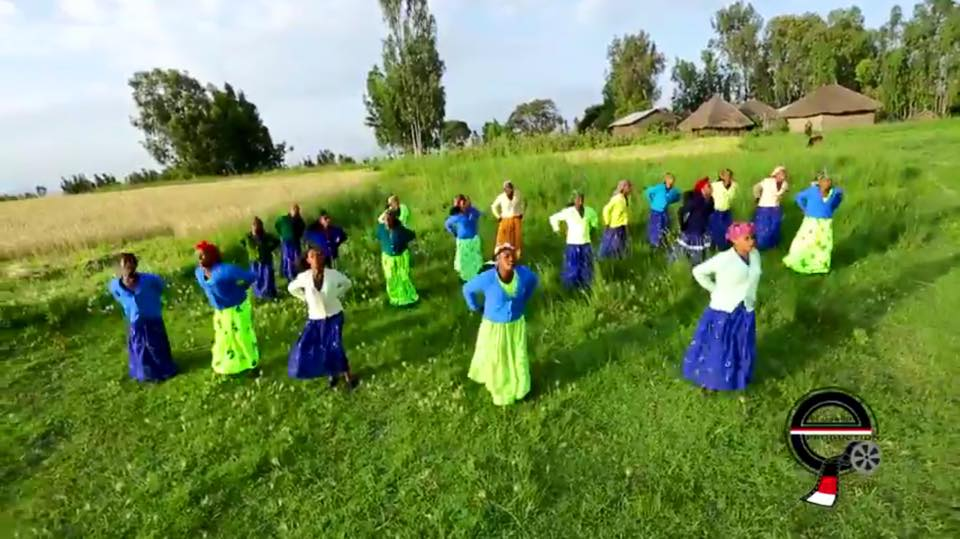
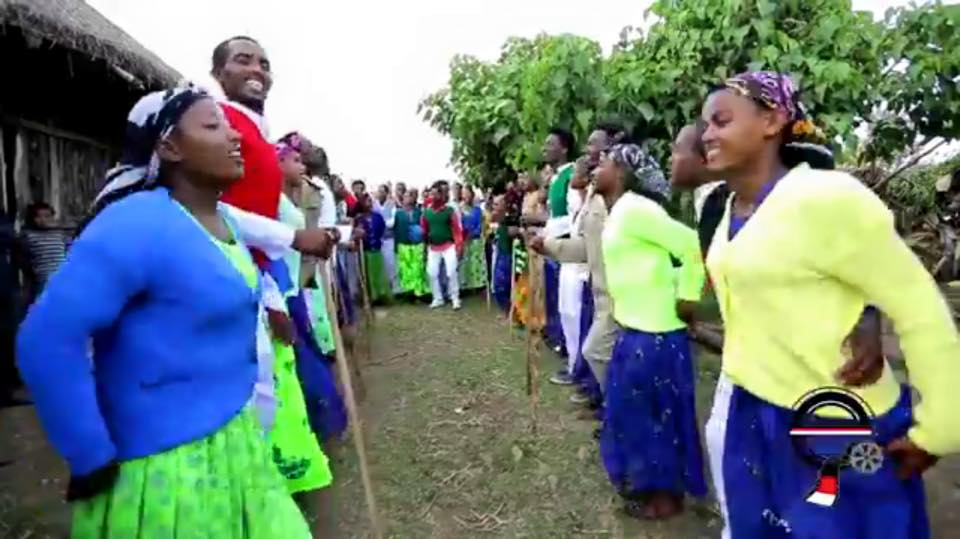
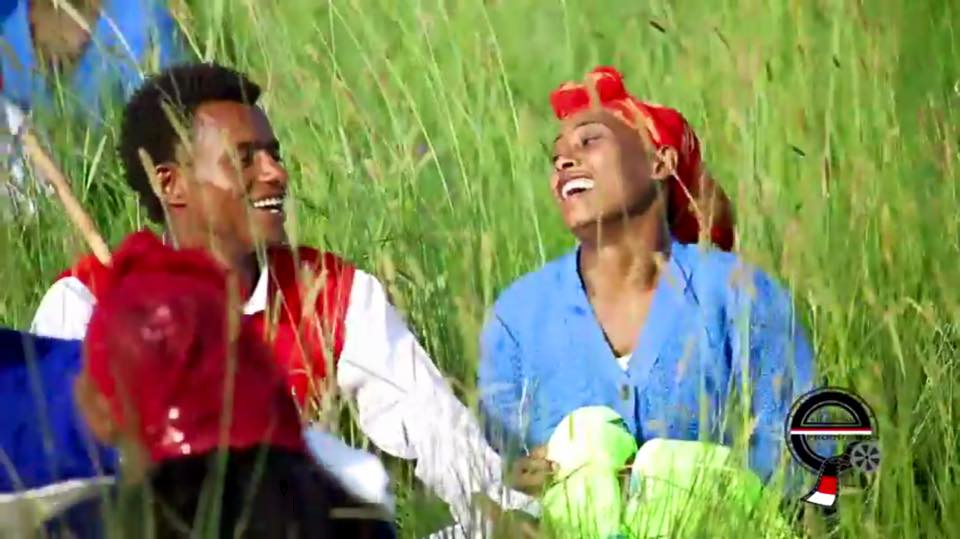
???????????Ayyaanoo Bariisoo (Jiillicha), Odaa Roobaa [New Oromo Music – Oct. 2015]


Oromia: Eliyaas kifluu (Dani) “Bara Olaanoon Gadaa” New Oromo Music Video 20151 October 2, 2015

Posted by OromianEconomist in Uncategorized.
Tags: , , , ,
add a comment

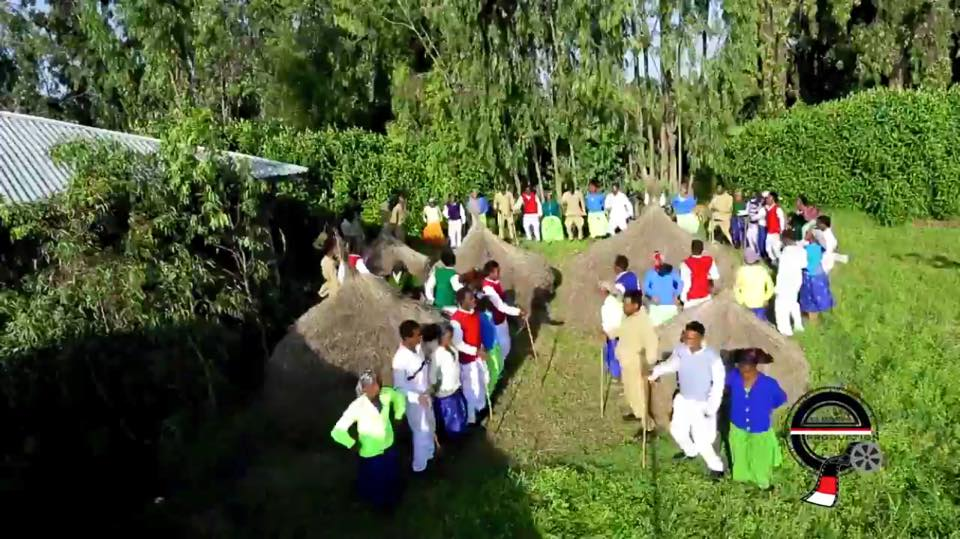
???????????Oromia, Bara Olaanoon Gadaa6Oromia, Bara Olaanoon GadaaOromia, Bara Olaanoon Gadaa3Oromia, Bara Olaanoon Gadaa8Oromia, Bara Olaanoon Gadaa7Oromia, Bara Olaanoon Gadaa1Oromia, Bara Olaanoon Gadaa4Oromia, Bara Olaanoon Gadaa5Oromia, Bara Olaanoon Gadaa2

Oromia:Ijoo Dubbii Adda Bilisummaa Oromoo: Mootummaan Wayyaanee Karoora Master Plaanii Magaalaa Finfinnee Humnaan Hojii Irra Oolchuuf Murteeffachuun Isaa Qabsoo Mirga Abbaa Biyyummaa Ummata Oromoo Of Booda Hin Deebisu. October 2, 2015

Posted by OromianEconomist in Uncategorized.
Tags: , , , , ,
1 comment so far

???????????OLF logo


sbo

Say no to the master killer. Addis Ababa master plan is genocidal plan against Oromo people. Say no.

(Sagalee Bilisummaa Oromoo – Onkoloolessa 02,2015): Mootummaan Wayyaanee Karoora Master Plaanii Magaalaa Finfinnee Humnaan Hojii Irra Oolchuuf Murteeffachuun Isaa Qabsoo Mirga Abbaa Biyyummaa Ummata Oromoo Of Booda Hin Deebisu.

(Ijoo Dubbii Adda Bilisummaa Oromoo – Onkoloolessa 02,2015).

Mootummaan Abbaa Irree Wayyaanee/EPRDF/TPLF diinummaa ummata Oromoof qabu hojiin mul’isuu kan eegale aangootti ol bahee osoo hin bubbulini. Saboota biyya sana keessatti argaman keessaa hunda caalaatti diina angafa godhatee kan irratti duulaa turee fi har’as irratti duulaa jiru ummata Oromoo ti.

Biyya Oromoo Oromiyaa humna afaan qawween qabatee bulchiinsa gabrummaa fi abbaa irrummaa ummata Oromoo irratti erga diriirsee waggoota 24n darban keessatti dinagdee fi qabeenya ummatichaa saamee lammiilee hiyyoomsuu fi deegsuun gamatti, ummaticha gaaffii mirga abbaa biyyummaa irraa deebisuuf, qabsoo isaa dadhabsiisuuf danda’amuuf ammoo bal’eessuuf hedduu ajjeesee, kumoota kudhanootaan ammoo hidhaatti guureera. Kumootni dhibbootni sirna cunqursaa fi saaminsaa kana jalaa baqatanii biyya ambaatti koolu galtummaaf dirqamaniiru.

Hiraarrii fi cunqursaan saba Oromoo irra sirna abbaa irree wayyaaneen geessifamu har’allee babal’atee dameelee hedduu yaafatee gidiraa fi dhiphuu ummata Oromoo akkaan hammeessee jira. Hidhaan, ajjechaanii fi baqi akkuma jirutti ta’ee, maqaa guddina biyyaa, misoomaa fi investimentii jedhuun qonnaan bultootni Oromoo lafa isaanii irraa buqqaafamanii maatiin diigamaniiru. Duulli maqaa misooma biyyaa fi investimentiin geggeeffamaa jiru jireenya Oromoo hundee irraa kan qoree fi lafa akaakilee fi abaabilee irraa buqqisee ilmaan Oromoo hedduun kadhattuu fi harka ormaa ilaaltuu akka ta’an taasisuun dhugaa dirreetti mul’atuu dha.

Gartuun TPLF/EPRDF sirna cunqursaa fi saaminsaa itti fufsiisuuf Oromiyaa dhabamsiisee ummata Oromoo biyya dhablee taasisuuf karoora diinummaa bal’aa lafaa akka qabu dhokataa miti. Karoora isaa keessaa tokko kan ta’ee fi bara 2014 keessa hojii irra oolchuuf yaalee kan dura dhaabbannoon ummata Oromoo isa mudachuu irraa yeroofis ta’u jalaa gufatee ture Karoora Master Plaanii Magaalaa Finfinnee fi naannawa ishee ti.

Karoorri Master Pilaanii Magaalaa Finfinnee fi naannawa ishee jedhamu dhuguma akka sirnichi ololu Oromoo lafa isaa irraa kan hin dhiibnee fi hin buqqisne, jiruu fi jireenya isaa kan hin gaagaane, aadaa, seenaa fi afaan isaa irratti gaaddidduu kan hin buusne osoo hin taane, dhugaa qabatamaan lafa irraa mul’atu Oromoota Finfinnee fi naannawa sana marsanii jiran, kanarra iyyuu darbee haga fageenyaa irratti argaman kan buqqisuu fi diigu, aadaa, seenaa fi afaan Oromoo kan dhabamsiisuu fi bulchiinsa alagaa kan warra gita bittootaa Oromoo irratti kan goobsu akka ta’e qabatamaan mul’ata. Alagaa investara taasisee Oromoo kumoota dhibbaan kan hiyyeessa gadadaawee fi kadhataa taasisuu dha.

Karoorri Master Pilaanii Magaalaa Finfinnee kun shiraan kan guutame, yakka ulfaataa ummata Oromoo irratti dalagamaa jiru ta’uu ammas ummatni Oromoo daqiiqaa tokkoof illee dagatuu hin qabu. Karoorichi imaammata mootummaan abbaa irree wayyaanee lafaa qabu Oromiyaa bakka xixiqqaatti murmuruu, yoo danda’ameef ammoo kaartaa irraa haquun Oromoo humna dhabsiisuu dha. Kanaanis qabsoo Oromoo dadhabsiisuu fi gaaffii mirga hiree murteeffannaa ummatichaa walxaxaa gochuuf kan saganteeffamee dha.

Hawaasa addunyaa, dhaabbattoota garagaraa fi Investeroota biyyoota adda addaa Finfinnee dabalatee Oromiyaatti hawatuun gartuu TPLF/EPRDF guddina biyyaa dhuguma ummatni Oromoo irraa fayyadamu argamsiisuufiif osoo hin taane, akeeka dhokataa kan of keessaa qabu sochii Oromoo kan ittiin haguuganii fi gaaffii haqaa kan mirga hiree murteeffannaa ummata Oromoo dura ittiin dhaabbachuuf akka meeshaatti kan itti fayyadamaa jiru ta’uunis ummata keenyaan, darbees hawaasa addunyaan hubatamuu qaba.

Karoorri Master Plaanii Magaalaa Finfinnee wayyaanee kun dhuguma akka Wayyaaneen haaluu osoo hin taane sochii babal’ifannoo lafaa kan of keessaa qabu akka tahe ragaa waliin kan jiruu dha. Kanaafis Finfinneen kan sq.km. 54,000 turte gara sq.km. miliyoona 1.2tti akka guddattuuf kaartaan baheefii ragaa qabatamaa waliin kan mul’atuu dha. Kanaaf karoora Master Plaanii Finfinnee kana ilaalchisee kan mootummichi jedhu dhugaa irraa kan fagaate mormii fi dura dhaabbannoo ummata Oromoo of irraa qabbaneessuun karoora dhabamsiisii kana hojii irra oolfachuuf kan afanfajjii uumuuf tattaafatuu dha.

Karoorri kun balaa ulfaataa kan ummata Oromootti fidu, Oromoo fi Oromiyaa bakkoota adda addaa 3 fi sanaa olittillee cicciru, qonnaan bultoota Oromoo Finfinnee fi naannawa sana jiran miliyoonotaan lafa irraa buqqisee kan dhabamsiisu, aadaa, seenaa fi afaan Oromoo kan bal’eessuuf karoorfame ta’uu isaa hubachuuni bara 2014 yeroo labsiin kun bahu barattootni Oromoo guutummaa Oromiyaa keessaa fi sabboontotni Oromoo kan dirreetti ba’anii FDGn dura dhaabbatanii morman. Dhiiga dhangalaasanii, lafee cabsanii, wareega lubbuu ulfaataa kafaluun karoorri Oromoo fi Oromiyaa gaaga’uuf bahe kun hojii irra akka hin oolfamneef seenaa gootaa dalaganii darbaniiru. Yoo xiqqaate diddaa fi mormii Master Plaanii kanaaf barattootnii fi sabboontotni Oromoo 73 ol ta’an wareegamuun galmee gootota Oromoo keessatti galmaa’aniiru. Hedduun isaanii hidhamaniiru; gariin haga har’aatti murtii malee hidhaa keessatti gidirfamaa jiran.

Diina innikkaa ummata Oromoo kan ta’e gartuun wayyaanee/EPRDF sochii dabaan guutame kan darbe irraa osoo hin dhaabbatne, karoorri isaa kun ummata Oromoo biratti fudhatama kan hin qabne ta’uu isaa ummata dirreetti bahee itti agarsiise tuffachuu fi maal fidduun, hidhattootaa fi qondaalota isaa kanneen dhiiga barattootaa fi sabboontota Oromoo dhangalaasan osoo seerattillee hin dhiheessin, ammas yeroo lammataaf Karoora Master Plaanii Magaalaa Finfinnee hojii irran oolcha jechuun murteeffatee bifa haaraan sochii eegalee jira. Ergamtooti isaa OPDOnis karoora kana hojii irra akka oolchaniif ajaja itti dabarsee jira. Adeemsi abbaa irrummaa mootummaa wayyaanee kun caalaatti ummata Oromoo dammaqsee, dhabama irraa akka of oolchuuf falmaa fi diddaa caaluuf yoo kakaase malee kan duuba deebisu akka hin taane diinnis firris hubachuu qaba.

Addi Bilisummaa Oromoo har’as boris Finfinneen handhuuraa fi qaama Oromiyaa ta’uutti amana. Qabsoon Finfinnee weeraraa fi saamicha gartuu abbaa irree Wayyaanee irraa oolchuuf taasifamu qaama qabsoo Oromiyaa bilisoomsuuf godhamaa jiruu ti. Rakkoon Finfinnee guutuutti dhugoomuu bilisummaa Oromiyaa keessatti kan furamu ta’ullee, Oromoon badii irraa of oolchuuf, golee jiru cufa keessatti lafa isaa gubbaatti, qe’ee isaa irratti waan qabu qabatee tokkummaan dhaabbatee of ittisuu akka qabu ABOn ni hubachiisa.

Dargaggootnii fi barattootni Oromoo, hojjettootni, qonnaan bultootnii fi horsiisee bulaan Oromoo waliigalatti qaamotni hawaasa Oromoo marti harka walqabatuun duula mootummaa wayyaanee/EPRDF Karoora Master Plaanii fi akkasumas ergamtoota isaa irroomsuuf, magaalota hedduu keessaa manneen diigee lafa ummata irraa saamee deggartootaa fi alagootaaf hiruuf sochii godhaa jiru hundi kan ummata Oromoo fi Oromiyaa dhabamsiisuuf bifa haaraan geggeeffamaa jiru waan ta’eef, kana fashalsuu fi bilisummaa Oromiyaa dhugoomsuuf harka walqabatanii FDG finiinsuu akka qaban ABOn dhaamsa isaa haaromsa.

Injifatnoo Umamta Oromoof!

FP: UN Sustainable Development Goals: No wonder the SDGs went all vague and utopian September 29, 2015

Posted by OromianEconomist in Uncategorized.
Tags: , , , , ,
add a comment

???????????Dounle digit Ethiopia

If there is something to salvage from the SDG debacle, perhaps it is the idealistic advocacy for “universal respect for human rights and human dignity,” not as a 2030 “target,” but just as an increasing recognition of poor people’s rights for self-determination. Similar language was there in the MDGs but ignored. Such advocacy is needed to accept and respect the mainly homegrown rise of the rest. Such advocacy is needed because there are still many aid programs that violate the rights of the poor (such as involuntary resettlement) or aid that supports others who callously violate the rights of the poor (such as autocratic allies of the United States in the war on terror). Such advocacy is needed, not only because the West itself is now far too prone to xenophobic insults of poor people over fears of migration. For this generation of young idealists in rich countries, development should still be a cause worth fighting for. The many humanitarian programs that have been doing good things should continue, even if they are not quite the transformational things that the MDGs promised. But the decline and fall of the pretensions of foreign aid only tell us to not put our hopes in U.N. bureaucrats or Western experts. We can put our hopes instead in the poor people we support as dignified agents of their own destiny.- WILLIAM EASTERLY

The SDGs Should Stand for Senseless, Dreamy, Garbled

The SDGs Should Stand for Senseless, Dreamy, Garbled

Nothing better reflects the decline and fall of hopes for Western foreign aid than the United Nations Sustainable Development Goals (SDGs) for 2030, just launched at a summit this past weekend. TheSDG manifesto is called the “[draft] outcome document of the United Nations summit for the adoption of the post-2015 development agenda.” This not-quite-soaring rhetoric continues for 35 pages of 17 SDGs buried among phrases like: “Thematic reviews of progress,” “Implement the 10-Year Framework of Programmes,” and “Accelerated Modalities of Action.” The 17 goals in turn have 169 targets, a list that has both too many items and too little content for each one, such as target 12.8: “By 2030, ensure that people everywhere have the relevant information and awareness for sustainable development and lifestyles in harmony with nature.”

As for foreign aid, it is barely mentioned. Has anybody else noticed the SDG emperor has a shortage of clothes? Well, the Economist called the SDGs “worse than useless.” Another commentator described them as “a high-school wish list on how to save the world,” which seems unfair to high schoolers. Even Pope Francis warned in his address to the SDG summit this past Friday against the risk to just “rest content” with a “bureaucratic exercise of drawing up long lists of good proposals.” It is a sad result for the much-hyped SDGs. Yet hope remains: The “rise of the rest” — the economic growth of low- and middle-income countries — is causing increased respect for the poor, who are mostly achieving their own homegrown development, a welcome move away from the condescension of the old aid effort.

To be fair, the SDGs sometimes do break through with welcome idealism that is ahead of the curve: “We will cooperate internationally to ensure safe … migration involving full respect for human rights and the humane treatment of migrants … of refugees and of displaced persons.” Other inspirational rhetoric is available: “We envisage a world of universal respect for human rights and human dignity…. We resolve to build a better future for … the millions who have been denied the chance to lead decent, dignified and rewarding lives.” The SDGs might have worked, and I hope could possibly still work, as just idealistic rhetoric that will motivate more people in the rich and free countries to care about the world’s poor and shackled.

But the Sustainable Development Goals are not presented that way — they really are goals and targets. They want to be like their predecessor, the Millennium Development Goals (MDGs), announced in 2000 with targets for 2015 — but they are not. The MDGs were so appealing because they were so precise and measurable. In just one paragraph in the 2000 U.N. Millennium Declaration, the U.N. announced goals to cut in half the proportion of the world’s population that was in extreme poverty, to cut in half the proportion who suffer from hunger, to cut in half the proportion without access to safe drinking water, to achieve universal primary schooling, to reduce the maternal mortality rate by three-quarters, and to reduce under-five child mortality by two-thirds — all by the year 2015. As a later U.N. document in 2005 made clear, the MDGs held everyone accountable for actually meeting these “quantified and time-bound” targets.

In the SDGs, it is hard to imagine what the time-bound and quantified target is for harmony with nature.

Unlike the MDGs, the SDGs are so encyclopedic that everything is top priority, which means nothing is a priority: “Sport is also an important enabler of sustainable development.” “Recognize and value … domestic work … and the promotion of shared responsibility within the household.” It’s unclear how the U.N. is going to get more women to play soccer and more men to do the dishes.

Beyond the unactionable, unquantifiable targets for the SDGs, there are also the unattainable ones: “ending poverty in all its forms and dimensions,” “universal health coverage,” “ending all … preventable deaths [related to newborn, child, and maternal mortality] before 2030,” “[end] all forms of discrimination against all women and girls everywhere,” and “achieve full and productive employment and decent work for all women and men.” Again, these could have been great as ideals — I share such ideals with great enthusiasm. But the SDGs are not put forth as ideals but as “targets” for the year 2030. The rejoinder to a utopian target should be: Wow, if something that great is possible, why wait until 2030? Why didn’t it happen already?

It’s a mark of how the SDGs don’t take seriously their own utopian promises that they keep repeating them over and over again for different sub-groups.

It’s a mark of how the SDGs don’t take seriously their own utopian promises that they keep repeating them over and over again for different sub-groups. After promising full employment of everyone, the SDGs also ask more modestly for full employment of “young people,” having already mentioned even more modestly they are “promoting youth employment.” They don’t seem to get how following a big promise with a much smaller one weakens the big promise’s credibility. You have already won $1 million dollars — plus a free toaster.As if the promises were not already weakened enough by being either unmeasurable or unattainable, there are still a lot of ways to opt out. The commitments “will be voluntary and country-led,” they can be modified upon demand for “different national realities, capacities and levels of development,” and they will defer to each nation’s “policy space and priorities.”

Part of the problem is the use of that word “sustainable” — the U.N. never defines it. “Sustainable” might have something to do with climate change, but the SDGs tell us that climate change will be negotiated in a different U.N. summit in Paris beginning in late November. “Sustainable” is so overused in so many different contexts that it means very little — we might as well call them the “Some-such Development Goals.”

The best chance the SDGs have at saying something with real meaning is the promise, by 2030, to “eradicate extreme poverty for all people everywhere, currently measured as people living on less than $1.25 a day.” This is one of the few endings promised by the SDGs that could actually be possible, mostly because it is such an extreme definition of extreme poverty and the trend on this poverty has already been sloping downward for decades.

Unfortunately, the one and only official international custodian of the global poverty line, the World Bank, chose just this moment to increase the confusion on where the global poverty line should be. World Bank President Jim Yong Kim announced last week that the poverty line is not really $1.25; instead, it is about $1.90 — which might add a hundred million or so poor to the global rolls (not yet determined). Princeton University’s Angus Deaton, one of the world’s leading poverty experts, suggested this confusion is because “[you’ve] got a line that no one knows where to put it,” all based on “underlying data that is bad,” creating a “statistical problem from hell.” So the headline goal of the SDGs turns out to be almost as unmeasurable as the others.

What about foreign aid? President Barack Obama endorsed the SDGs in a speech to the U.N. summit on Sunday, but if there is to be any new U.S. aid for the SDGs, he forgot to mention it. While a price tag for SDGs of $3 trillion is mentioned (with no explanation) in U.N. discussions, there is no talks in the document itself of foreign aid increasing to pay for these targets. The rich countries are “to implement fully their official development assistance commitments” (see target 17.2) — in other words, to keep previous foreign aid promises already broken. A surge in foreign aid had been at the heart of the MDGs, but the SDGs just change the subject as fast as possible — the next target (see target 17.3) is to “mobilize additional financial resources for developing countries from multiple sources.” Nothing better exemplifies the decline and fall of the millennium goals’ transformational hopes for foreign aid than this no-show for the SDGs.

So the SDGs are to monitor the attainment of goals that cannot be monitored or attained, financed by unidentified financing.

How did it wind up like this? Part of the challenge of the SDGs was following a MDG program based on meeting precise targets in 2015, which was a great success. Well, except for meeting precise targets in 2015. As the SDG manifesto notes in a buried paragraph: “[Some] of the Millennium Development Goals remain off-track, in particular those related to maternal, newborn and child health and to reproductive health. We recommit ourselves to the full realization of all the Millennium Development Goals, including the off-track Millennium Development Goals.” No wonder the SDGs went all vague and utopian.

There is something deeper at work here — that there is today a much less confident West compared to the MDGs heyday. The rise of the rest is so much more evident now than in 2000. Per capita GDP growth in low- and middle-income countries since 2000 has been rising much faster than in the West, even in sub-Saharan Africa. Africa now has twice as many cell-phone subscribers as the United States, after remarkable growth that had nothing to do with Western development aid. Remittances from the diaspora and foreign direct investment are together twice as large for Africa as foreign aid. There are so many other long-term trends in these developing countries that are positive — from poverty to health, education to sanitation, and democratization to technology. Yes, the MDG campaign itself and foreign aid commitments do deserve some credit — even if the goals were not met. But the aid was too small to significantly explain these large accomplishments — and these trends began long before the MDGs and will continue long after 2015.

The MDGs gave far too much attention to middle-aged white male experts in the West debating what should be done for the rest of the world (including this author, but far more prominently Bono, Jeffrey Sachs, and Bill Gates). Thank goodness this patronizing direction from the West is no longer seen as so acceptable. People in low- and middle-income countries must now be recognized as equals, the authors of their own development. The surprisingly savvy Pope got this: He called upon leaders at the SDG summit to recognize “these real men and women” in poverty “to be dignified agents of their own destiny.”

If there is something to salvage from the SDG debacle, perhaps it is the idealistic advocacy for “universal respect for human rights and human dignity,” not as a 2030 “target,” but just as an increasing recognition of poor people’s rights for self-determination. Similar language was there in the MDGs but ignored. Such advocacy is needed to accept and respect the mainly homegrown rise of the rest. Such advocacy is needed because there are still many aid programs that violate the rights of the poor (such as involuntary resettlement) or aid that supports others who callously violate the rights of the poor (such as autocratic allies of the United States in the war on terror). Such advocacy is needed, not only because the West itself is now far too prone to xenophobic insults of poor people over fears of migration.

For this generation of young idealists in rich countries, development should still be a cause worth fighting for. The many humanitarian programs that have been doing good things should continue, even if they are not quite the transformational things that the MDGs promised. But the decline and fall of the pretensions of foreign aid only tell us to not put our hopes in U.N. bureaucrats or Western experts. We can put our hopes instead in the poor people we support as dignified agents of their own destiny.

Hoongee fi Gogiinsa Oromiyaa Keessaa Lammiilee Hubaa Jiru September 29, 2015

Posted by OromianEconomist in Uncategorized.
Tags: , ,
add a comment

???????????

Hoongee fi Gogiinsa Oromiyaa Keessaa Lammiilee Hubaa Jiru…

Gabaasa Sagalee Bilisummaa Oromoo

SBOImpaayera Itoophiyaa keessatti imaammata dabaa murni wayyaanee hordofaa jiru irraa kan kahe hoongee fi gogiinsi uumame lubbuu lammiilee fi  beeyladaa balaa ulfaataaf saaxilaa jira. Keessumaa ammoo dacheen Oromiyaa jiidhinaa fi badhaadhinaan beekkamtu imaammatuma gartuu abbaa irree kanaatiin ontee fi gogdee lammiileen kumootaan nyaata dhabuun leeccalloo isaaniis hurgufatanii hiraara argaa jiru. Mootummaan wayyaanee wayta rakkoon kun uumamu ummata nan bulcha jedhuuf birmatee nyaataan dhaqqabuu fi hegereefis akka rakkinichi hin uumamneef hojjechuu mannaa, inumayyuu hammeessaa jiraachuu gabaasaaleen godinaalee Oromiyaa adda addaarraa nu dhaqqaban ni ibsu.

Akka odeessa godinaalee Oromiyaa adda addaa irraa nu gahe kanaatti saamichaa fi manca’iinsa qabeenya bosonaa wayyaaneen geessiserraa kan kahe dacheen qullaatti haftee rooba dhabuudhaan hoongeen uumame midhaan facaafamee fi beeyladoota miidhaaf saaxileera. Ummannis kanarraa beelaan hubamaa fi qayee dhiisee godaanaa akka jirutu ibsame.

haala-qilleensaa-fi-beela-oromiyaa-keessaa-2015-ed


Haala Qilleensaa fi Beela Oromiyaa keessaa…2015 =ED

Oromo Speaks: Some of the Collected Inspirational Speeches (Interviews) of Oromo Women September 29, 2015

Posted by OromianEconomist in Afaan Publication, African Beat, Amane Badhaso, Artist Almaz Tafarraa, Ateetee (Siiqqee Institution), Ayantu Tibeso, Inspirational Oromo Women, Oromia, Oromian Voices, Oromo Culture, Oromo First, Oromo Identity, Oromo Sport, Oromummaa, Safuu: the Oromo moral value and doctrine.
Tags: , , , , , , , ,
1 comment so far

O

15-Year-Old Haawii’s Moving Speech on the Importance of Media, OMN and the Struggle to Uphold Afan Oromo

Mini Documentary by Seenaa Jimjimo

‘The Oromo Community Association in Chicago was featured on Chicago Public Radio’s Worldviewprogram on Wednesday, October 20, 2010. Listen below the full segment of the program on the Oromo people, the Oromo Community Association in Chicago, and the benefit jazz concert that the Association will hold on October 24, 2010.From the Chicago Public RadioThere are an estimated 40 million Oromo in Ethiopia, which makes them the nation’s largest ethnic group. Their numbers extend into Kenya and Somalia as well. Yet, despite their wide influence in the Horn of Africa, many people have never heard of the Oromo. Seenna Jimjimo of Chicago’s Oromo Community Association and Kadiro Elemo talk with Jerome about the Oromo culture, the struggle for independence and the local Oromo community in Chicago.’  Source:Gadaa.com

Listen:

http://gadaa.com/oduu/6380/2010/10/20/oromia-the-oromo-community-of-chicago-featured-on-chicago-public-radio/

Related references:

http://www.oromotv.com/highlighting-the-achievements-of-oromo-women-in-our-lives-raised-in-a-diverse-culture-gifted-with-a-supreme-artistic-talent-and-dedicated-to-interlock-oromo-culture/

 https://www.oromiamedia.org/2015/03/omn-gaafiif-deebii-artist-bohaarsituu-obsaa-bitootessa-16-2015/

Related References to Inspiring Oromo Women:http://www.oromotv.com/category/oromo-women/

Oromia: Oromo-TV: With Luba Balaay Mokonnin: Is this time for Oromian Orthodox Synodos? September 29, 2015

Posted by OromianEconomist in Uncategorized.
Tags: , ,
add a comment

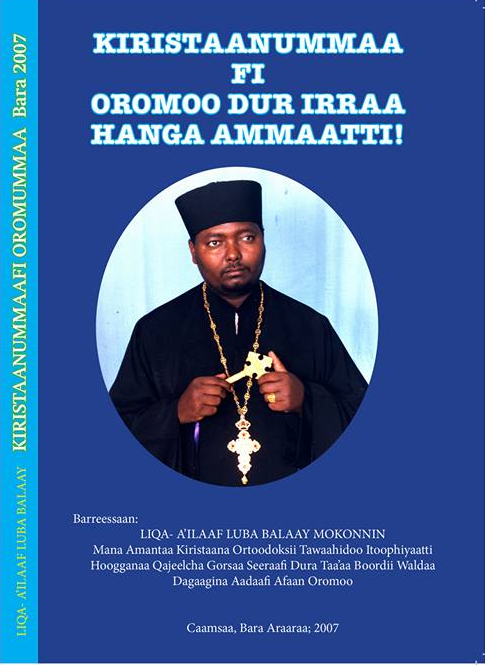
???????????Kiristaanummaa-fi-Oromoo-dur-irraa-hanga-ammaatti, Luba Balay Mokonnon

http://borofa.com/books/kiristaanummaa-fi-oromoo-dur-irraa-hanga-ammaatti/

Oromo-TV: With Luba Balaay Mokonnin | Is this time for Oromian Orthodox Synodos?

Fulbaana/September 29, 2015 · Finfinne Tribune | Gadaa.com |

http://gadaa.net/FinfinneTribune/2015/09/oromo-tv-with-luba-balaay-mokonnin-is-this-time-for-oromian-orthodox-synodos/

Editor’s Note: The ‘Ethiopian’ Orthodox Church Synodos has unashamedly aligned itself (or more appropriately, it has continued to align itself) with the national agenda of domination of the Amhara and Tigray regions of Abyssinia over the non-Abyssinian regions in Ethiopia. Today, Oromo Orthodox Christians are debating, according to information we have gathered from our sources, whether to continue to be part of the Abyssinian-dominated ‘Ethiopian’ Orthodox Synodos, or form an Oromian Orthodox Synodos; after all, even the Amhara and Tigrayan regions of Abyssinia have their own Synodos (each headed by its own Abune). According to sources, many Oromos are thinking of forming an Afan-Oromo-speaking Orthodox Church, for starters, in order to spread the gospel of the Bible (following the Orthodox Doctrine) in their own mother-tongue. Oromo Orthodox Christian believers should not have to be silent when the ‘Ethiopian’ Orthodox Synodoses (whether it’s the exiled Amhara-aligned one, or that which is said to be aligned with the TPLF government) are continuing the Abyssinian national-domination (covered under religion). It’s time that the Diaspora leads in forming Afan-Oromo-speaking Orthodox Church; an Oromo person shall not have to be forced to abandon their faith over their rejection of the “national-domination agenda” of the ‘Ethiopian’ Orthodox Church, or an Oromo person shall not be forced to support the anti-Oromo national agenda of the ‘Ethiopian’ Synodoses in order to sustain their faith. We should hear the good news of the first Afan-Oromo-speaking Orthodox Church soon.

Oromo-TV: With Luba Balaay Mokonnin


The new book by Luba Balaay Mokonnin, “KIRISTAANUMMAA FI OROMOO DUR IRRAA HANGA AMMAATTI!,” is available on Borofa.com.RELATED: Farfanaa Ortodooksii | Afaan Oromoo (“Akeekakee”) – Be Blessed!

History of the National-Domination and Unchristian of the ‘Ethiopian’ Orthodox Synodos:
Before the 1974 Revolution that ousted the forced assimilation of the colonized nations and nationalities in Ethiopia into the Abyssinian cultural and linguistic fabric, it used be openly preached by the Abyssinian-dominated ‘Ethiopian’ Orthodox that “having sex with Galla and Camels are not allowed” – equating the Oromo as ‘beasts’/’animals.’ It’s this Church that has revamped its national-domination agenda over the last decade under the cover of religion. All Oromo nationals, especially Oromo Orthodox believers, should reject this national-domination agenda of the Abyssinian Orthodox Church without having to lose their Orthodox faith. This is one such crime against Oromos (and others) propagated by the Abyssinian Orthodox Church under the disguise of religion. In addition, the Abyssinian Church is using the Holy Baptism to de-Oromonize Oromos by re-naming them in Geez; such baptismal names should be changed to Afan-Oromo.

PHOTO: From “Ra’eye Mariam” religious book of the ‘Ethiopian’ Orthodox Church (see the front cover of the book below), in which the Abyssinian priests equated the Oromo with camels, donkeys and horses; an Oromo Orthodox believer should not be forced to support such teachings of the Abyssinian Orthodox priests just because they want to continue to be faithful Orthodox believers; it’s possible to continue to be faithful to the Orthodox doctrine by forming an Afan-Oromo-speaking Orthodox Church that is clean from such biased and unchristian national-domination agenda.

OrthodoxCrimesonOromo2015_2

Related:-

FINFINNEE RADIO 1(716)748-0835  Luba Balay Mokonnon waliin

http://www.finfinneeonline.com/store/c1/Featured_Products.html

Oromia: “Osoo walbeennuu nuu wal wallaalchisanii” – Shukrii Jamaal and Magartuu Warqinaa -Oromo Music By Raya Studio Via Lagatafo Studio September 27, 2015

Posted by OromianEconomist in Uncategorized.
Tags: , , , , ,
1 comment so far

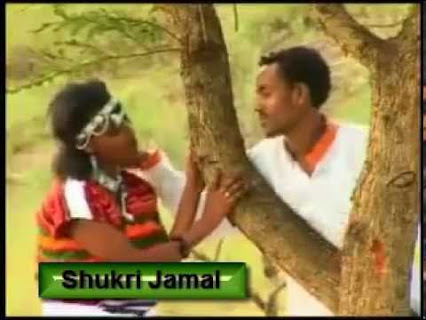
???????????Oromo artist Shukri Jamaal1Oromo artist shukri Jamal

https://youtu.be/mVy2do-f9rM

https://www.youtube.com/watch?v=mVy2do-f9rM

“Lagatafo Studio best for Oromia entertainment”
Lagatafo Studio requests for subscription to its YouTube Channel to get the latest and exciting Oromo song/Music. Don’t forgot to share this Video with your friends and family as well. If you happen to have any new Oromo Song, please forward to Lagatafo Studio
https://www.youtube.com/channel/UCeiu

Related:-

Oromia: The Agony of Oromo athletes under TPLF Ethiopia’s tyranny. #Africa September 27, 2015

Posted by OromianEconomist in Because I am Oromo.
Tags: , , , , , , , , ,
2 comments

???????????Stop Torture

Running for their lives, Ethiopians seek a safer track in Washington

Many of the Ethiopian runners belong to the Oromo ethnic group, which accounts for more than one-third of the country’s population, according to the most recent census, making it by far the most populous ethnic group. “Oromo is no good to them,” explained one runner, who was detained three times but never faced charges. 

Oromos hold few positions of power in Ethiopia, and the EPRDF has governed the nation for more than two decades. In May, Ethiopia held its most recent national election, and the EPRDF and its allies swept every one of the 547 parliamentary seats.

“Most of the stories you hear now out of Ethiopia are about this sort of economic growth and development happening,” said Felix Horne, a researcher with the Human Rights Watch, the international watchdog and advocacy group. “But there are real stories about people who aren’t part of that success, who question the government and suffer pain and torture because of it.”

Fleeing persecution in their native country, Ethiopians such as 18-year-old Genet Lire put promising track careers on hold to take refuge in Washington

(The Washington Post) — Genet Lire locked herself in a bathroom stall at Dulles International Airport and hid. The clock was ticking. If she was found, she would have to get on the plane and eventually return home. She feared she surely would be locked up again, probably beaten, and her family terrorized.

The time passed slowly: five minutes, 10, 15, 20. Feet tapped on the tile floor. Doors opened and closed. Every noise and shuffle made Lire’s chest tighten.

This was supposed to be a quick layover. Lire was a 17-year-old sprinter from Ethi­o­pia, here to compete in the junior world championships in Eugene, Ore. But she had no intention of ever reaching the starting line. She and her teammates flew in from Addis Ababa. They rushed to their gate, watched their bags board the big jet, and that’s when Lire saw her chance, slipping away to the bathroom as the flight began to board.

Fleeing persecution in their native country, Ethiopians put promising track careers on hold to take refuge in Washington. Genet Lire cries while looking through an album containing photos of family and friends she left behind in Ethiopia. Toni L. Sandys/The Washington Post

She didn’t know it at the time, but not far from Dulles, in and around the Washington area, there was an entire community of Ethiopian runners in similar situations. They were beaten and persecuted back home, almost all of them for political reasons. They feared for their lives and sought asylum in the United States, most putting their promising running careers on hold for the chance at stable and safe lives.

About three dozen Ethiopian runners have congregated in the Washington area, many in just the past three years, and 12 agreed to share their stories with The Post. Some requested their full names not be used, fearful that their families in Ethiopia would face retribution. The details vary, but some threads are consistent: They all had been imprisoned but never charged with crimes; most used visas they’d received through their track careers to flee; they were all beaten to some degree; and many have struggled to acclimate to a new life, far from family and lacking the time and resources to continue running competitively.

Ethiopian runner Genet Lire's father and mother, center, surrounded by her seven brothers and sisters in front of the family house. Toni L. Sandys/The Washington Post

“They get here and they are physically and emotionally traumatized,” said Kate Sugarman, a Washington physician who has treated many of the runners. “Some of them can’t even run because of the injuries they suffered during their beatings. I think they’ve lost their confidence and arrive here without a lot of hope.”

The runners have varying skill levels, but most are long-distance specialists, having competed in marathons from New York to China. They’ve won big races in Europe and North America and claimed titles across Africa. One man in his mid-20s once completed a marathon in 2 hours 8 minutes. Only two American-born distance runners have ever run faster.

Genet Lire, right, says she misses her friends, seen here, and her family, but she feels that she will have a better life in the United States. Toni L. Sandys/The Washington Post

Lire was a rising star back in Ethiopia, a promising sprinter in a nation of distance runners. Less than a month earlier, she had won the national title in the 400 meters, setting an Ethiopian record. A strong showing at the junior world championships last July would’ve been an important stepping stone to representing Ethiopia in the 2016 Olympics.

Instead she sat in the Dulles bathroom, half-scared she would be spotted and half-scared she wouldn’t. All she had were the clothes on her back and a red Adidas backpack. Inside were photos of her family, friends and the life she was escaping. Lire felt she had no choice. She had spent several weeks discussing the trip to America at length with her family, and they all urged her to flee at the first opportunity.

After 30 minutes, Lire cautiously opened the bathroom door. The plane was gone, with her teammates and coaches aboard. She looked around and approached a man with a friendly face.

Genet Lire, holding medal on the right, poses for a photo with her track club. Less than a month before fleeing Ethiopia, she set a national record in the 400 meters. Toni L. Sandys/The Washington Post

In her native Amharic, she said, “Please help me.”

‘You’ll never go anywhere’

In Addis Ababa, Haile Mengasha refused to join the nation’s ruling political coalition — the Ethiopian People’s Revolutionary Democratic Front (EPRDF) — and said he was detained for a week in 2012. His interrogators repeatedly struck him in the head and held a flame to his feet. It took 11/2 years to raise enough money, but he finally was able to fly to the United States for a half-marathon with no intentions of returning home. The 25-year-old now works in a Washington liquor store and runs when his aching back allows. Mengasha said many days are “dark” and his future uncertain, but that it beats the alternative.

“I’d rather commit suicide in America than return to Ethiopia,” he said.

Lire smiles as she unpacks groceries delivered to her by another Ethiopian runner in Washington. Toni L. Sandys/The Washington Post

Others share similar stories. Authorities accused them of spreading propaganda or conspiring against the EPRDF. Most of the runners now living in Washington say they were never politically active back in Ethiopia. They simply refused to join the EPRDF. In some cases, their biggest offense was having relatives who refused to join.

“I told them I don’t support any other government. I just wanted to live by myself,” said one runner who was imprisoned for a week in 2010. “I didn’t have any politics.”

Once detained, most were beaten for days on end. For Tesfaye Dube, it was 10.

“They were coming every single day, beating me, saying, ‘We know what you are doing. You are sabotaging, you’re helping the opposition parties. You have to stop doing that or we’ll kill you,’” Dube recalled.

Genet Lire stretches before training on the track at Sidwell Friends. (Toni L. Sandys/The Washington Post)

For Taddase Hailu, it was seven.

“In the morning, they’d come to take me to a dark place to beat me,” he said. “I’m never sure I’d live the next day.”

Hailu suffered a stab wound in his lower back, was beaten with a baton and kicked with heavy boots. Worst of all, they targeted his back and Achilles’, which two years later still prevents him from running at peak form.

“They told me, ‘If you can’t run, you’ll never go anywhere,’ ” he said.

Most detainments lasted only a few days or weeks. There were never criminal charges, no due process, attorneys or visitors. Often families were unaware their loved ones had even been imprisoned at all.

Many of the Ethiopian runners belong to the Oromo ethnic group, which accounts for more than one-third of the country’s population, according to the most recent census, making it by far the most populous ethnic group. “Oromo is no good to them,” explained one runner, who was detained three times but never faced charges.

Geent Lire recently had to leave a room she was renting because she couldn’t afford the $400 monthly fee. She’s temporarily living on a pullout sofa in the apartment of her imigration lawyer. Toni L. Sandys/The Washington Post

Oromos hold few positions of power in Ethiopia, and the EPRDF has governed the nation for more than two decades. In May, Ethiopia held its most recent national election, and the EPRDF and its allies swept every one of the 547 parliamentary seats.

“Most of the stories you hear now out of Ethiopia are about this sort of economic growth and development happening,” said Felix Horne, a researcher with the Human Rights Watch, the international watchdog and advocacy group. “But there are real stories about people who aren’t part of that success, who question the government and suffer pain and torture because of it.”

A new, and different, home

Lire left the airport with a sympathetic man, who happened to be from Botswana, and began trying to navigate her new life. She was quickly connected with some fellow Ethiopians, nonprofit organizations and a church that offered help.

Ethiopian runner Genet Lire fingers a scar left from a spear thrown by a policeman who had come to arrest her father when she was 8 years-old. Lire did not see a doctor after being hit, but was treated by her mom with herbal medicines. Toni L. Sandys/The Washington Post

For Lire, Washington was nothing like her home, a rural farming community outside a city called Hosaena where her father grew rice and beans. He was part of an opposition party called the Southern Ethiopia Peoples’ Democratic Coalition and faced overt pressure and persecution for years.

Lire remembers one of the first times authorities came for her father. She was just 8, and the entire family was fleeing their home on foot. She sprinted, trying to keep up with her father, and remembers a sudden burst of pain shooting through her body. A spear barely missed her father but struck Lire in the right arm, where a decade later she still bears a scar the size of a tennis ball. She tumbled and became entangled in barbed wire, the metal spikes tearing into her scalp. Her father was carrying Lire’s 3-month-old brother when he tripped and fell. The baby was crushed and died. Lire’s father was taken into custody. He was released after one week but detained many more times in the ensuing years.

Genet Lire filed for asylum six months ago and is still waiting for a response. The process can take months, sometimes more than a year. Toni L. Sandys/The Washington Post

That was around the time Lire started running. Always barefoot, she sprinted everywhere — to school, for chores, around the fields near her home. She won early races wearing flats and a dress and began catching the eyes of local running clubs.

Her running career began garnering attention, and last June, despite being younger than others in the starting blocks, Lire set a national record, running the 400 meters in 51.44 seconds. Her track career was taking off just as she was approaching voting age in Ethiopia. Because she would turn 18 before the national election, she’d been feeling pressure for several months to join the EPRDF. Just like her father, she refused.

“The party is not for the people,” she said.

About three dozen Ethiopian runners have congregated in the Washington area, many in just the past three years. Many ask that their full names not be used, fearful that their families in Ethiopia would face retribution. Here, EB runs in Rock Creek Park. Toni L. Sandys/The Washington Post

She and her family decided that she’d flee Ethiopia at the first opportunity. She won $250 in prize money last May competing at the African Youth Games in Botswana, and she spent half of it on a camera, intent on capturing every facet of her life in Ethiopia. “My history,” she calls it.

Lire didn’t have much time. Last June, just two weeks before the junior world championships in Oregon, she was detained. She recalls a small room, packed with too many people to count — too crowded for everyone to lie down at the same time. Even as plain-clothes security officers made threats about her running career, she knew she was given preferential treatment because of her potential. She was allowed to train in the mornings but was locked up each night, never certain what the next day held, when she’d see her family again or whether she’d be allowed to compete.

Of the Ethiopian runners living in Washington, The Ethipian runners living in Washington have varying skill levels but most are long-distance specialists and have competed in marathons around the world. Toni L. Sandys/The Washington Post

Lire made no promises and refused to pledge loyalty to any political party. After 10 days, she was finally released. Three days later, she said goodbye to her family, stuffed her photo album in the red backpack and boarded a plane for the United States.

‘Still happening in my mind’

The transition is never easy. Arriving in the United States might mitigate some fears, but many other issues quickly surface: a complicated legal system, housing, employment, separation from loved ones. It’s no wonder some runners say they dream of being back home.

“My heart is still always with my family,” said Hussen Betusa, 37, who left his wife in Ethiopia after authorities there detained him for 15 days in 2012. “I’d love to go back, but I cannot. They’d kill me.”

After leaving Ethiopia, EB received regular reports from back home that authorities were looking for him and were regularly harassing his family. Toni L. Sandys/The Washington Post

The transplanted Ethiopian runners abscond to the United States for safety more than opportunity. When they arrive, many struggle to assimilate, often navigating a legal maze to seek asylum as they desperately search for day-to-day normalcy.

EB is one of several runners who’s fearful his family will face retribution if he revealed his full name. The 35-year-old was an accomplished runner who raced in the United States, Europe, plus all over Africa. He’d posted impressive wins over competitive fields and cracked 2:15 on his best marathon days. In 2013, EB had just finished a training run in Addis Ababa when he was stopped and beaten on the street. He went to a police station to file a complaint and that’s when he was arrested. He was detained for 10 days — hitting, slapping, yelling.

“The memories — it’s still happening in my mind,” he said.

EB was released and felt he had no choice: He had to leave Addis Ababa as quickly as possible. “If I stay there, maybe I don’t live much longer,” he said.

So he moved to the United States in the summer of 2013 and slowly started adjusting to his new life. He even entered — and won — an East Coast marathon later that year.

But EB felt like he was living in two places: his body in Washington, his heart and mind some 7,100 miles away. He received reports from back home that authorities were looking for him and were regularly harassing his family. They’d visit his younger sister at school, asking, Where is your brother? Are you talking to him? What is he doing?

This 31-year-old marathoner left his oldest child and wife in Ethiopia when he first fled and was able to bring them to the U.S. one year later. 'I get here, and everything is different. It’s not like what I wished in my mind,' he said. 'I thought it’d change my life. It’s not happening. The opportunity is not like that.' Toni L. Sandys/The Washington Post

In early 2014, he learned that his younger sister had hanged herself, and he blamed the political tormenters for her death. He also blamed himself. “If I was just man enough to face that,” he said, “my sister would still be alive. It was because of me being here.”

He stopped running. He stopped doing much of anything. EB felt hopeless and spent his days contemplating suicide.

EB met with psychologist Sheetal Patel, who specializes in working with torture survivors. He was barely a shadow then. Patel saw a man who wasn’t living and a runner who wasn’t running.

“There were just so many barriers,” Patel said. “He’d said he couldn’t do it. He couldn’t run. He could barely breathe.”

While the trauma is very real and still very present, Patel said some of EB’s wounds were somatic — his quiet voice became almost muted, the words unable to pass through his throat. Slowly, Patel and the physician Sugarman worked with him, encouraging him to talk, to open up, to lace up his running shoes. Sugarman invited him in January to join her running group for a five-kilometer fun run. And then he did 10k, followed by a half-marathon.

An Ethiopian marathoner helps his oldest child learn with his reading. The child, who spoke no English when he arrived, is now the most fluent in his family. Toni L. Sandys/The Washington Post

It’s a slow, difficult process, EB said. He learned long ago something every good marathon runner must accept: there are points along the course where the pain seems unbearable, where every step feels like it’s surely the last. A marathon is about surviving, enduring agony and somehow finding the strength to keep putting one foot in front of the other.

“Even if there’s pain, you learn to keep going,” EB said.

Saying goodbye to family is perhaps the toughest part for the Ethiopians runners. Many were married back home, some had children. One runner, a 31-year-old marathoner, for example, left behind a wife and 16-month-old son.

“I get here, and everything is different. It’s not like what I wished in my mind,” he said. “I thought it’d change my life. It’s not happening. The opportunity is not like that.”

As Ethiopian runners in D.C. learned, even after filing for asylum, a person must wait 150 days before applying for employment in the United States. That amounts to five months of scrounging for food and shelter. Toni L. Sandys/The Washington Post

The distance from his family resulted in depression. He struggled finding work and steady housing. Like many of the runners, he found some assistance from a nonprofit called Torture Abolition and Survivors Support Coalition (TASSC), which provides transitional housing, legal assistance, health services, counseling and job placement. The organization serves over 300 survivors annually, about 80 percent of whom are Ethio­pian.

“Some people are literally coming to us straight from the shelter or from the street,” said Gizachew Emiru, TASSC’s executive director. “When they come, most of them come with just the clothes they’re wearing. So when they get here, they’re desperate for everything.”

Even after filing for asylum, a person must wait 150 days before applying for employment in the United States. That amounts to five months of scrounging for food, shelter and under-the-table work. The 31-year-old runner, who had competed in Poland, Germany, Austria and Greece, arrived here in 2010 and cleaned houses and worked in hotels.

His asylum was eventually granted, he was permitted to work legally and after three years apart, his family was allowed to join him in the United States. He’s now a line cook at a Marriott hotel and runs nearly six miles to and from his job each day. That 16-month-old baby is now 5 years old and last month attended his first day of kindergarten.

The path ahead

On a recent warm summer morning, Lire, EB and several other Ethiopian runners gathered in Northwest Washington for a short training session behind Coolidge High School. The Black Lion Athletics Club meets several times a week. Founded by Alan Parra, a local immigration attorney who has represented several of the runners, it operates on a shoestring budget and has become a refuge and meeting place for many of the transplanted Ethiopians.

Their coach stood inside the track with a stopwatch and after just a couple of laps, most of the seasoned runners broke into a sweat. As the others slowed, EB kept moving around the track, his gait smooth, graceful and long. He seemed to be smiling, too, looking every bit like a man who could run forever.

He still speaks just a half-notch above a whisper and is still worried about the harassment his family faces back home. But he’s running again and even has plans to compete in a marathon next spring, which would be his first in more than two years.

“Now I am doing okay,” he said.

Her hair tied in a ponytail, Lire was bent at the waist with hands on her knees as she looked down on her shadow and caught her breath. The sweat made the scar on her arm glisten under the sun.

She is now 18 and still adjusting to her new life. Those early days were difficult. Lire bounced among Ethiopian families and even spent a couple of nights sleeping outdoors. She recently had to leave a room she was renting because she couldn’t afford the $400 monthly fee. She’s now temporarily living with Parra, who’s handling her case, sleeping on a pullout sofa in his one-bedroom apartment.

Lire filed for asylum six months ago and is still waiting for a response. The process can take months, sometimes more than a year. Since 2010 the United States has granted asylum status to at least 8,500 immigrants each year, according to the U.S. Department of Justice. An average of 388 asylum cases were granted from Ethiopia each year, second only to China.

Lire is slowly piecing together her new life. She’s much younger than many of the other relocated torture survivors, so she has few friends here. She misses her family and tears up flipping through her photo album, her “history.” Lire is learning English by watching YouTube videos and listening to Christian radio. Back in Ethiopia, she’d finished the equivalent of the 10th grade, and Parra is trying to place her in school here. He hopes she might soon be able to run track in college, and beyond that, who knows?

“My goal is Olympics,” she said.

Many of the Ethiopian runners circling the Coolidge track have a similar dream — if not Lire’s talent and potential — but no country to represent. The International Association of Athletics Federation, the governing body for track and field, requires athletes to be citizens of a country in order to represent it in competition. If the athlete changes citizenship, there’s typically a one-year waiting period. The runners who’ve been granted asylum fall into a gray area and must wait for five years before they can apply for U.S. citizenship, a lifetime for an elite athlete.

For now, Lire continues training, her immediate and long-term future equally uncertain. She said she’s both grateful and sad to be here. She tries to chat on the telephone with her family once every couple of weeks but doesn’t know when — or if — she’ll see them again. For now, Lire figures, the best she can do is honor their wishes and keep running as fast as she can.

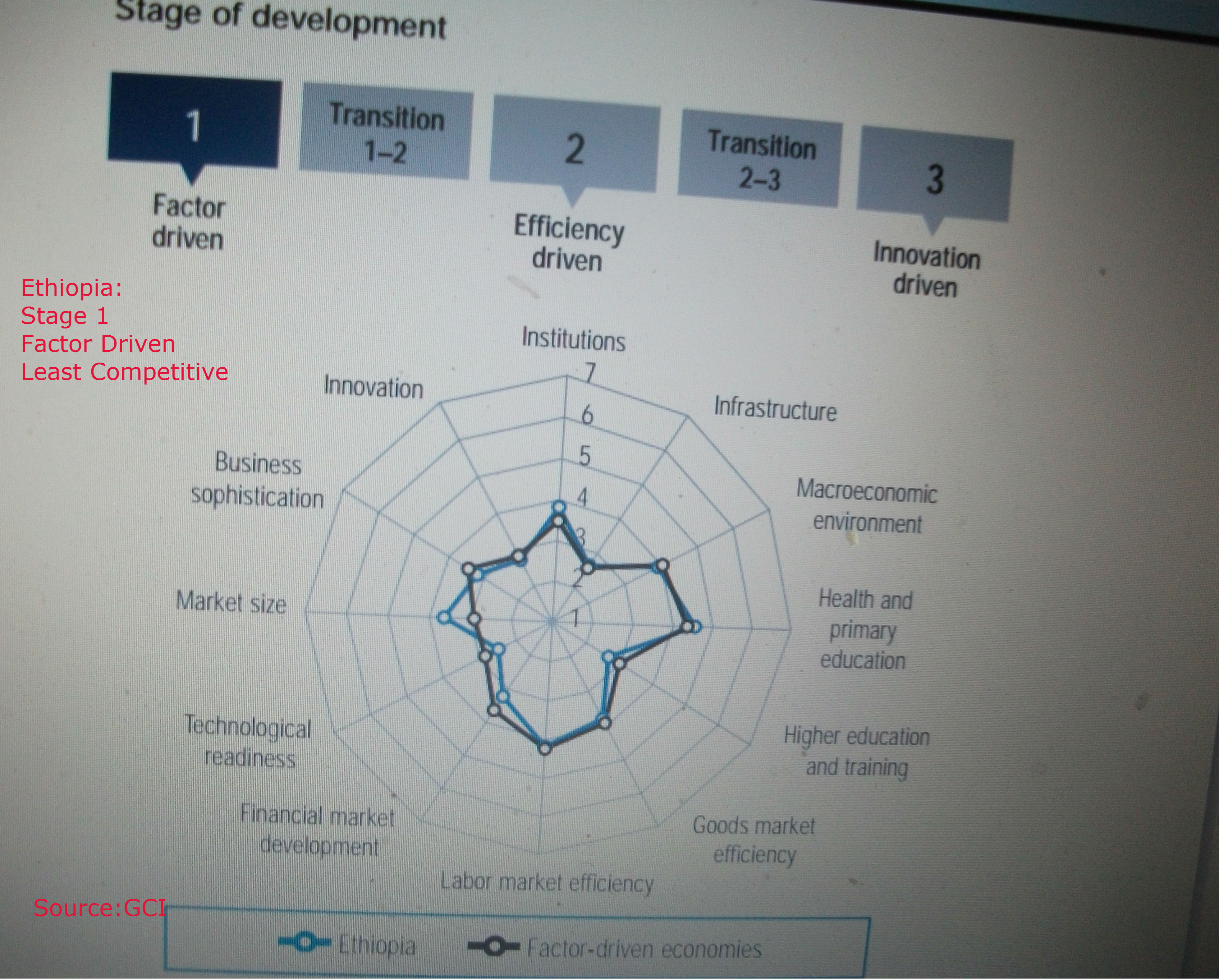
The Colonialism of language ( Amharic and the bureaucracy): The politics of language and representative bureaucracy in Ethiopia: The case of federal government September 25, 2015

Posted by OromianEconomist in Uncategorized.
Tags: , , , , , , , ,
add a comment

???????????Afaan Oromo is the ancient indigenous language of Africa

The politics of language and representative bureaucracy in Ethiopia: The case of Federal Government,

By Milkesa Midega,

Journal of Public Administration and Policy Research,” Vol. 7, No. 1 (2015), pp. 15-23.

The politics of language and representative bureaucracy in Ethiopia, the case of Federal Government,

The politics of language and representative bureaucracy in Ethiopia, the case of Federal Government,

Click to access article1422345245_Midega.pdf

Making the rich richer doesn’t necessarily make the rest of us richer September 24, 2015

Posted by OromianEconomist in Economics.
Tags: ,
1 comment so far

???????????Trickle down economics

Nick Johnson's avatarThe Political Economy of Development

ha-joon-changHere is an insightful video interview with Cambridge economist Ha-Joon Chang, exploring three ideas from his very readable book ’23 Things They Don’t Tell You About Capitalism’.

View original post

Oromia: Konsertii Siyyoo Dandanaa Irratti Aartistooti Oromoo Gamtaan Dhaabbachuun Lammii Boonsan September 22, 2015

Posted by OromianEconomist in Uncategorized.
Tags: , ,
add a comment

???????????Oromo artist, Tsaggaayee Dandanaa

Tsaggaayee (Sayyoo) Dandanaa Dhibamee Gargaarsa Lammii Barbaada. Rescue the Life of Artist Tsegaye Dandana!

Ethiopia: Early Warning Project identifies countries most at risk for state-led mass killing. Ethiopia making the top 15th in the list September 21, 2015

Posted by OromianEconomist in Uncategorized.
Tags: , , , , , , , ,
add a comment

???????????Tigrean Neftengna's land grabbing and the Addis Ababa Master plan for Oormo genocide

Report:-Which Countries Are Most Likely to Suffer Onsets of State-Led Mass Killing in 2015?

Sep 21, 2015

Read at:-

http://www.earlywarningproject.com/2015/09/18/2015-statistical-risk-assessment

Tyranny and Famine: Why Famine is a Permanent Phenomenon in Ethiopia? September 21, 2015

Posted by OromianEconomist in Famine in Ethiopia.
Tags: , , , , , , , , , ,
add a comment

???????????

Why Famine is a Permanent Phenomenon in Ethiopia?

By Tokkicha Abbaa Milkii, http://www.ayyaantuu.net/
Time Magazine Ethiopia Famine 2008

“We are still surprised by the prevalence of draught-induced food shortages in Africa, 3,500 years after the Pharaohs worked out how to store grain.” (The dictator’s Handbook, by Bruce Buend De Mesquita and Alastair Smith, p x-xi)

A recorded history shows that there was famine during the reign of Minilik. This famine was attributed to a plague called “ye Hidar Beshita” as their chroniclers put it. The story goes like this, “this plague killed people and their domestic animals like cows and oxen that caused a wide spread catastrophe and famine throughout the newly incorporated regions of the empire. The true story which the chroniclers did not want to mention was the plague broke out due to genocide committed in Oromia and the southern regions by Minilik army.

Somehow the plague killed millions of people and farm animals. Since the farm animals were extinct there were no means left to plow the land to grow crops. The chroniclers of the king’s history told us that the king ordered the skilled people to produce pickaxes to be distributed to the people to dig the land by hand in which the king himself participated in digging to prepare the land for growing crops. That was a “big technological innovation” discovered by Minilk to mitigate famine according to them.

This was narrated by his admirers to present Minilik as the innovative king who had concern for his people. For a shallow minded people it looks true. But Minilik who was an expert in amassing war technology like gun and ammunition from European countries to kill several millions of Oromos and the Southern Peoples had no sympathy to ask for medicine, food and farm technology aid from his war patrons.

If anybody think that this bloodthirsty monster had no knowledge how to get that aid is a fool. He had enough access and knowledge but did not want to save the subjects lives and introduce any sort of civilization into the newly incorporated regions.

To simply understand Minilik’s diplomatic ability and access to European countries it is enough to look at the next example. He amassed the next bulk of guns and ammunitions between 1968 and 1990 from four European countries with which he massacred millions of unarmed Oromos and the Southern Peoples.

Country                           guns                ammunitions
1-England                            15,000              5,000,000
2-France                            500,000           20,000,000
3-Italy                                  50,000            10,000,000
4-Rusia                              150,000             15,000,000 (Source Amharic book Written by Tabor Wamii titled “ye wugena Drsetochina yetarik Ewunetoch” p 499, translated from Amharic)

During Minilik’s reign a productive forces- all men capable of producing- from the north ( Habasha country) were forced to wage colonization war on the South (oromi’a, Sidama, wolayita,Somali, etc,) productive forces who resisted colonization. This process of war took more than two decades and during which all sort of production and progress was impeded. Therefore it is not a matter of wonder if famine and plague hit the people, because it was a man made famine and plague.

Take the case of Tewodros, he didn’t force the European missionary to produce improved farming tools. Instead he forced them to produce not even simple guns, but cannons. This shows that his appetite for mass destruction was overwhelming and clarified that Habasha rulers were and still are obsessed not with development and growth but with killing neighboring people to colonize and loot their wealth. This famine is inherent in this part of the world because the regimes were busy at war and looting the resource of the people rather than development and progress.

Out of thousands of Tewodros’s barbaric acts, to mention one of his anti-production deeds “Tewodros went to Karoda village. Karoda is known with its grain production and specially, in grape production. It was said that in Gonder one barrel of wine was sold with one bar of salt. Europeans said Karod wine was superior to European wine. He (Tewodros) ordered that grapes to be uprooted. Everybody who heard the King’s order uprooted his grapes. After that there was no wine in Ethiopia. Haleka Weldemariam wrote that, “Tewodros upon his arrival at Karoda ordered the people to be gathered at one place, 1700 people including children were gathered together. He packed all people in the houses at a maximum capacity and burnt them alive.” (Yewugena dirsetochina ye tarik Ewunetoch, by Tabor Wami, p416-417). Tewodros’s advocates try to convince us that he had a big vision for Ethiopia. I don’t understand how, the king who instead of rewarding those productive people at Karoda, burn them alive can be presented as visionary.

Tewodros never owned and resides in a palace and never settled in one place. He was called a king who lived in tent. He came to power through war, he waged war on different rival chiefs, brutally punished the people in the localities he found resistance. He committed genocide and brutal acts like mutilation of hands and legs, burning alive in mass, slain etc. wherever he set foot on. What makes Tewodros special is, even though he did the same crime on neighboring Wallo Oromos, his victims include Abisinyans. This does not mean that he had no hatred for other nations like Oromos, he had extreme rancor for Oromos and had a long intention to invade and evict them from their land. This evil intention was expressed in his letter written to Queen Victoria of England to ask for armaments to wipe out these Oromos whom he mentioned “pagans who occupied his father’s land”.

When we come to the modern era we find the Haile Selassie aristocratic and keliptocratic monarchy rule which the remnants of Naftenyas consider as nirvana. In actual fact it was as hell as the present time for  the people who were expropriated their land and reduced to gabar, chisagna, slave, etc. This regime divided all the colonized peoples’ land among his invading army leaders who were changed to feudal land lords. This system of land ownership discouraged the farmers to produce in full capacity and famine was the day to day life style of the people. We can mention what famine meant to these rulers.

“Heart-wrenching images of starving children are a surefire way to stimulate aid donations. Since the technology to store grain has been known since the time of the pharaohs, we cannot help but wonder why the children of North Africa remain vulnerable to famine. A possible explanation lies in the observations of Ryszard Kapuscinski. Writing about the court of the Ethiopian emperor Haile Selassie, Kapuscinski describes its response to efforts by aid agencies to assist millions of Ethiopians affected by drought and famine in 1972.

Suddenly report came in that those overseas benefactors who had taken upon themselves the trouble of feeding our ever-insatiable people had rebelled and were suspending shipments because our Finance Minister, Mr.Yelma Deresa, wanting to enrich the Imperial treasury, had ordered the benefactors to pay high customs fees on the aid. “You want to help?” the Minister asked. “Please do, but you must pay.” And they said “What do you mean, pay? We give help! And we are supposed to pay?” “Yes, says the minister, “those are the regulations. Do you want to help in such a way that our Empire gains nothing by it?”

The antics of Ethiopian government should perhaps come as little surprise. Autocrats need money to pay their coalition. Haile Selassie, although temporarily displaced by Italy’s invasion in the 1930s, held the throne from 1930 until overcome by decrepitude in 1974. As a long term successful autocrat, Selassie knew not to put the needs of the people above the wants of his essential supporters. To continue with Kapuscinski’s description:

‘First of all, death from hunger had existed in our Empire for hundreds of years, an everyday, natural thing, and it never occurred to anyone to make any noise about it. Drought would come and the earth would dry up, the cattle would drop dead, the peasants would starve. Ordinary, in accordance with the laws of nature and the eternal order of things. Since this was eternal and normal, none of the dignitaries would dare to bother His Most Exalted Highness with the news that in such and such a province a given person had died of hunger……..So how were we to know that there was unusual hunger up north?’

Silassie fed his supporters first and himself second; the starving masses had to wait their turn, which might never come. His callous disregard for the suffering of the people is chilling, at least until you compare it to his successor. Mengistu Hail Mariam led the Derg military regime that followed Silassie’s reign. He carried out policies that exacerbated drought in the Northern Provinces of Tigry and Wollo in the mid1980s. With civil war raging in these provinces and a two year drought, he engaged in forced collectivization. Millions were forced into collective farms and hundreds of thousands forced out of the province entirely. Mass starvation resulted. Estimates of the death toll are between 300,000 and 1 million people. From the Derg’s perspective the famine seriously weakened the rebels, a good thing as Mengistu saw it. Many of us remember Live Aid, a series of records and concerts organized by Bob Geldof to raise disaster relief. Unfortunately, as well intentioned as these efforts were, much of the aid fell under the influence of the government. For instance, trucks meant for delivering aid were requisitioned to forcibly move people into collective farms all around the country. Perhaps 100,000 people died in these relocation.” (The Dictators Hand Book, by Bruce Bueno De Mesquita and Alastair Smith, P162-163)

What I mentioned above is to refresh your memory a little bit. Even though corruption and kleptocracy were not started by Habasha rulers they were the first to introduce it to Africa. H/ Silassie started hording billions of Dollars in Swiss banks long before any African country got its independence. Therefore he is considered to be the first kleptocrat, the father and teacher of corruption in Africa.

We are still in the same vicious circle of corruption and kleptocratic rule. Instead of avoiding the barbaric acts of their fathers and forefathers todays Fascist rulers modernized and continued the same barbaric acts. Instead of burning alive, mutilation of hands and legs in public like Tewdros and Minilik, and instead of killing and throwing the dead body of their victims on the streets of cities like the military junta, today’s rulers do it behind doors, in known and un known detention camps, and prison centers like H/ Silassie deed. A hidden war is waged on the people in all colonized regions too.

Therefore it is not a matter of wander if peoples of this part of the world are starved in millions year after year. All Monarchs, Communist Military Junta leaders and The Fascist TPLF Dictators are on the same set of war against the colonized people, corruption and looting. In all of the mentioned criminal regimes government revenue was and is spent on bribing supporters and left open for corruption and on buying the loyalty of a few key cronies at the expense of general welfare. Yet these corrupt dictators make sure that the people cannot coordinate, rebel, and take control of the state and endeavor to keep those outside of their coalition poor, ignorant, and unorganized.

That is what TPLF fascists are doing today. Instead of mitigating poverty and hunger they loot all tax payers money, borrowed and aid money to reward their supportrs and buy weapons with the extra money to wage war on the colonized peoples like Oromo, sidama ,Ogadeenia, afar etc. who ask for their freedom. What is heart breaking most is on the very day they preached  the self- sufficiency of the country in food supply and the idea was praised by US President, the International Agencies and medias started disclosing at least 4.5 million people are starved in a “Praised Ethiopia for its double digit economic growth”.

These Fascists behave like shy to tell the truth to the people of the country they rule about the famine looming on the people. On another hand they are courageous enough to exaggerate the damage to the donor countries to attract more relief funds. Once the aid fund is secured, it is simple for them to divert it into their private accounts, rather than being steered towards famine mitigation. Letting people die is  good governance for them. This is the behavior of corrupt rulers.

I want to quote “We started this chapter with an account of Hail Silassie’s shakedown of donors. By now it should be clear that this practice is all too common, and reflects the logic of privately given aid. When private donors provide aid, governments must either strike deals with them so that the government gets its cut-that, after all, is the value of aid to a small coalition regime-or, in the absence of such deals, they must shakedown well-intentioned private donors. Either way, the government must get its piece of the action or it will make it impossible for donors to deliver assistance.”(The Dictator’s Handbook, p.186)   This prevalence of master thieves among world leaders is shocking.

As the writer of this book clearly stated this practice is all too common to day and the corrupt TPLF leaders are an expert in channeling aid money to their foreign bank accounts. Their so called Civil Society’s Law was declared only to shakedown donors like their grandfather did half a century ago. So this process is a vicious circle which does not go away by itself. Nothing can stop this peril except liberating ourselves from the grip of these keliptocratic fascist dictators with our own struggle and sacrifice and build democratic and accountable governance.

Thank you

Finfinnee: A Partnership between France And The World Bank In Gentrification and Inhumane Mission. #Landgrabs. #Oromia #Africa September 20, 2015

Posted by OromianEconomist in No to the Addis Ababa Master Plan, NO to the Evictions of Oromo Nationals from Finfinnee (Central Oromia).
Tags: , , , , ,
1 comment so far

???????????Say no to the master killer. Addis Ababa master plan is genocidal plan against Oromo peopleTigrean Neftengna's land grabbing and the Addis Ababa Master plan for Oormo genocide

A Partnership between France And The World Bank In Gentrification and Inhumane Mission

Screen-Shot-2015-09-18-at-10.29.03-PM-777x437

ADDIS ABABA, Ethiopia (The Post Post)–France with the help of the World Bank has embarked on missions that destroyed many lives in some African countries. One of those countries in which this duo operates is Ethiopia. Mali, Burkina Faso and Benin are the other victims of the “urbanization for the 21st century,” which mainly advocates building cities around public transportation.

In May 2014, university student protesters of Oromo ethnic origin took to the streets of Ethiopia in opposition to the “Integrated Development Master Plan.” Some student protesters quoted by social media activists dubbed it “a master killer,” because dozens of students and people who protested were gunned down by Ethiopian security forces. Some of them pointed to its “unconstitutionality,” saying it encroaches on Oromia’s land. Ethiopian government security forces effectively silenced the protesters.

However, the real victims of the urbanization projects were the low-income families who lived in Addis Ababa and vicinity. Bekele Feyissa, a farmer in Sebeta, complained to Bloomberg’s reporter in 2014 that he got paid $36 for 1.5 acres of land. Even though the government owns the land, Mr. Feyissa, a father of six has customary rights to the land. He has at least eight people to feed. People like Fayissa are the ones who have gotten the short end of the stick.

It all started with the 1999-2000 urbanization projects. There were multiple moving parts—lender [World Bank Group], contractor [Lyon Town Planning Agency], Addis Ababa city government, French government agencies and German Technical Cooperation Agency (GTZ).

A document detailing the zenith of a 15-year-old mission is buried in the deep web pages of UrbaLyon—The Planning Agency of the Lyon metropolitan area. Coincidentally, “Mission from 19-26 May 2009” is displayed in bold letters under a picture of Addis Ababa on a cloudy day. According to the header, the document was a result of a collaboration of three organizations. They were Addis Ababa City Government, Lyon Town Planning Agency, and Ville de Lyon—city municipal of Lyon—France’s second-largest city after Paris. The page after the agenda for the seven-day mission, splashes a photo of Ethiopian Herald, with a title that reads, “Officials of Ville De Lyon keen to work with Addis.”
Ethiopian Herald’s title was misleading as it implied working with Addis was a new venture. The “technical cooperation” started ten years before, and the May 2009 mission was to transform it into “city to city cooperation.”

Screen-Shot-2015-09-18-at-10.40.23-PM

addismasterplanagreement

In the historical background section, the document emphasizes the cooperation of Addis Ababa city government and the French (Grand Lyon and the French Embassy). It further states the decision by the French to fund the revision of the 2002 master plan was to establish pre-operational project processes, implying they were there to collect the return.

This rich French city also has other contracts with other African cities like Bamako, Ouagadougou, Porto-Novo and Rabat, whose stories are not too far from that of Addis Ababa. Some of those countries were a little generous to their displaced people due to urbanization planned by Lyon Urban Planning Agency, even though the displaced still suffered consequences.

The most significant part of this document shows the involvement of the World Bank, which is not a surprise by any stretch. However, investigative reports showed the organization’s involvement in projects which ruined at least 3.4 million lives worldwide. These contracts Grand Lyon signs with sub-Saharan cities, do not seem to involve financial planning even though it appears they often made sure the World Bank funded the projects. Three World Bank officials were listed in this document among the contacts: Abebaw Alemayehu (senior development specialist), Yoshimichi Kawasumi (senior highway engineer), and Yitbarek Tessema (senior water and sanitation specialist).

Reports by International Consortium of Investigative Journalists, The Huffington Post, and The Investigative Fund found that The World Bank Group repeatedly failed to enforce own rules to protect communities in its projects’ path. One of the stories featured by these reporters includes Ethiopian Anuak family who were beaten, raped, and displaced from their land as a result of The World Bank Group funded Ethiopian government villagization program.

The disconcerting and destructive quote to The World Bank’s mission came from the World Bank’s Ethiopia program director, Greg Toulmin. “We are not in the physical security business,” ICIJ quoted him saying at the time. Despite his dismissive quote towards human rights and his contradicting of the World Bank Group’s mission, Mr. Toulmin is currently the acting Country Director for Ethiopia.
The World Bank, whose private lending arm, International Finance Corporation (IFC) is a defendant in a class action lawsuit filed in District of Columbia, sent a link to a press release in response to The Horn Post’s request for a budget document showing financial compensation for the displaced people in the outskirts of Addis Ababa. In the press release, in March 2015, the World Bank Group President Jim Yong Kim said, “We took a hard look at ourselves on resettlement and what we found caused me deep concern.” He also goes on to acknowledge failures in overseeing projects involving resettlement, implementation and enforcement of own policies.

The World Bank’s Operational Policies (OP 4.12) clearly states involuntary displacement needs special attention in paragraph 2.

“Involuntary resettlement may cause severe long-term hardship, impoverishment, and environmental damage unless appropriate measures are carefully planned and carried out. For these reasons, the overall objectives of the Bank’s policy on involuntary resettlement are the following:

  1. Involuntary resettlement should be avoided where feasible, or minimized, exploring all viable alternative
  2. Where it is not feasible to avoid resettlement, resettlement activities should be conceived and executed as sustainable development programs, providing sufficient investment resources to enable the persons displaced by the project to share in project benefits should be meaningfully consulted and should have opportunities to participate in planning and implementing resettlement programs.
  3. Displaced persons should be assisted in their efforts to improve their livelihoods and standards of living or at least to restore them, in real terms, to pre-displacement levels or to levels prevailing prior to the beginning of project implementation, whichever is higher.”

Perhaps not coincidentally, the press release came after both the ICIJ report and the lawsuit accusing International Finance Corporation of irresponsible and negligent conduct in appraising, financing, advising, supervising and monitoring a coal-fired powered plant in India.

Countries like China and Turkey are operating in Ethiopia, but France takes the lead in displacing the poor with near zero compensation in the outskirts of Addis Ababa.

An email from The Horn Post to Lyon city officials seeking comments regarding Addis Ababa Master plan did not get a response at the time of this publication.

The Real Reason Economic Growth Is Considered Important September 19, 2015

Posted by OromianEconomist in Uncategorized.
Tags: , ,
add a comment

???????????

rly1987's avatarAll For Israel

Economic growth is not fundamentally important.  For example, perfect egalitarian societies like many hunter-gatherer clans or the Hakka societies occupying the Fujian Tulou could experience zero economic growth and still be absolutely fine as long as they maintain the same standard of living from year to year.

Economic growth becomes far more important for backward societies that function off of hypocritical elitism, oppression, enforced poverty, and some form of forced labour.  These are the qualities of inverse civilization which includes all slave-making civilizations.

Within slave-making societies, the easiest and most convenient position is to be a slave-maker.  As long as you force others to work and keep others constantly oppressed, you get to climb to elite ranks, don’t have to do much work yourself and can get away with it because everybody else is so tired and desperate for any crumb you throw at them that they can’t rebel against you.

Inverse

View original post 848 more words

A THIRSTY THIRD WORLD: HOW LAND GRABS ARE LEAVING ETHIOPIA IN THE DUST, By Emily Ingebretsen September 19, 2015

Posted by OromianEconomist in Land and resource Rights, Land Grabs in Africa, Land Grabs in Oromia.
Tags: , , , , , , ,
1 comment so far

???????????Tigrean Neftengna's land grabbing and the Addis Ababa Master plan for Oormo genocide

Land grab inOromiaEthiopian-land-giveaway

Attracting investment to Ethiopia by offering large plots of land to agricultural investors is a development strategy being aggressively pursued by the Ethiopian government. The government announced this strategy in 2009, stating it planned to lease 3 million hectares1 of land to foreign and domestic investors for agriculture use over a period of three years in order to increase productivity and earn foreign exchange (McClure 2009, 1). The simplest motivation for these actions is macroeconomic. In 2009, the IMF issued a staff report stating that the balance of payments in Ethiopia for the 2009-2010 year was “troubling” due to the global recession taking a toll on remittances, exports, and direct foreign investment. The impact of rising oil prices and decreasing foreign assistance was also expected to have an impact (IMF 2009, 5). In response to these prospects, the Ethiopian government created the Federal Land Bank to facilitate the acquisition of land by investors looking to acquire large tracts for cultivation. The foreign investors are mainly coming from India and Saudi Arabia, but also from Germany, Israel, the Netherlands, Italy, China, and recently, even the National Bank of Egypt (Makki and Geisler 2011, 13). In addition, about half of the investors are domestic, representing Ethiopian diaspora or wealthy Ethiopian highland residents (Vidal 2011). The investors are mainly interested in growing crops to export to their home markets or in cultivating agrofuels, crops which are used to create biofuels. While some 1 Approximately 7.4 million acres A THIRSTY THIRD WORLD Page 7 of 74 companies promise to sell some produce on the domestic market, there are no contractual obligations to do such. The issue of transferring land and its productive uses from domestic cultivators to foreign interests is particularly concerning in Ethiopia as it is a country that has often made headlines for famines, and the underlying issue, droughts. Despite having a great deal of water in certain areas, sporadic rainfall and poor collection techniques make water security a central issue of concern for the country. Many of the countries that are choosing to grow crops in Ethiopia are countries that face water insecurities of their own. They are seeking to stabilize their food security, but the impact that this will have on water access and quality for Ethiopians who depend on subsistence agriculture for survival is not being addressed in the deals that have been made. Anders Jågerskog, a leading scholar on the issue of water and land deals from the Stockholm International Water Institute (SIWI) has noted that, “The risk from poorly supervised land acquisitions is that a wealthy economy simply exports its water “footprint” elsewhere” (SAPA 2012). It is especially concerning that the design and implementation of this policy is having a stratified, possibly intentional, impact on the different ethnically divided regions of the country. The region experiencing the heaviest concentration of land deals is Gambella, a comparatively tiny region in the southwestern part of the country, bordered by newly formed South Sudan to its west. This area has had 42 percent of its land leased out to investors. Gambella also has had a difficult and increasingly violent relationship with the federal government. There have been numerous instances of the government targeting this region with oppressive tactics, violence, and biased policies. It is also one of the areas that has been identified for the latest wave of villagization, a process of relocation that is being undertaken to “increase service delivery.” However, Gambella’s villagization program appears to be being pursued with greater intensity than other regions’ programs as the government has stated it intends to relocate every indigenous, rural household in Gambella (HRW 2012, 22). The scale and intensity of these land grabs in this region coupled with the fervor of villagization is very concerning and merits much closer attention. –  Emily-Ingebretsen.-A-Thirsty-Third-World

Click to access Emily-Ingebretsen.-A-Thirsty-Third-World.pdf

Also read at:-

A THIRSTY THIRD WORLD: HOW LAND GRABS ARE LEAVING ETHIOPIA IN THE DUST,  WH2O Issue 4,   pp 94-103

http://issuu.com/daniellegambogi/docs/wh2o_issue_4_pq

UNPO: Oromo Diaspora Calls for BBC Afan Oromo Radio Programme. #Oromia. #Africa @BBC September 19, 2015

Posted by OromianEconomist in Afaan Oromoo.
Tags: , , , , , , , ,
1 comment so far

???????????The six widely spoken languages in Africakemetic alphabet (Qubee)


Afan Oromo, the single most widely spoken language in Ethiopia, is also spoken in Kenya, Somalia, Djibouti and Eritrea which will give the BBC wider audience than any other language, making it the largest broadcasting and media market in Africa. Furthermore, the Horn of Africa, as one of the most volatile and democratically deficient regions of Africa, needs an impartial and independent mass media outlets that will provide credible and trustworthy news and information services that promote democracy, economic development, and mutual-coexistence of various cultures, religions, and values.


(UNPO) – In response to the BBC’s decision to launch new services to Ethiopia and Eritrea, the Oromo people from across the world have begun a petition, demanding the opening of an Afan Oromo Radio Programme.  http://unpo.org/article/18564

Below is the Preamble and Petition itself

Preamble

We, the Oromo Diaspora in the United Kingdom and the rest of the world, the Oromo people in Ethiopia and the Horn of African countries, and the friends of the Oromo People and Afan Oromo speaking people across the world, welcome the recent announcement by the BBC to launch news services to Ethiopia and Eritrea. In this connection, we would like to draw the attention of the BBC Board of Trustees, the BBC Board of Directors, and the government of the United Kingdom on the vital significance of starting medium- and short-wave Afan Oromo Radio Program that will broadcast to Ethiopia, Eritrea, Somalia, Kenya and Djibouti.

Afan Oromo, the single most widely spoken language in Ethiopia, is also spoken in Kenya, Somalia, Djibouti and Eritrea which will give the BBC wider audience than any other language, making it the largest broadcasting and media market in Africa. Furthermore, the Horn of Africa, as one of the most volatile and democratically deficient regions of Africa, needs an impartial and independent mass media outlets that will provide credible and trustworthy news and information services that promote democracy, economic development, and mutual-coexistence of various cultures, religions, and values.

The Afan Oromo speaking population, which constitutes close to half of the estimated 98.9 million inhabitants of Ethiopia (over 30 million of whom are mother tongue speakers), remains among the most affected with the prevailing democratic deficiency in the region. As a result, there is no single independent and impartial Afan Oromo newspaper, news website, and radio or television station. This democratic deficiency is depriving Afan Oromo speakers, particularly the youth which constitutes about 74% of the total population, access to any credible, impartial, and independent news outlets. The danger this poses on the national and regional peace and stability, poverty eradication and economic development is self-evident; and needs urgent attention from policy makers and all interested parties including the BBC and the government of the United Kingdom.

Consequently, we call upon the BBC governing bodies and the government of the United Kingdom to make an urgent policy decision to reach out to this highly disenfranchised and marginalized Afan Oromo speaking population of Ethiopia and the Greater Horn through the radio programs. It is hoped that this will also help to advance the United Kingdom’s global economic development and poverty eradication policies as well as to promote free expression, peace and stability in the Horn of Africa.

Needless to say, to launch programs broadcast to the region in other languages and not launch one in Afan Oromo would mean contributing to the privileging of the less widely spoken languages in the region and to sanction the existing inter-linguistic asymmetry created by the States’ national media. Not to fall into this trap, it would be ideal decision if the BBC decides to broadcast in three languages widely spoken in Ethiopia – Afan Oromo, Amharic and Tigrigna following the VOA’s model.

Petition

Therefore, we the undersigned, the Oromo Diaspora in the United Kingdom and the rest of the world, the Oromo people in Ethiopia and the Horn of Africa, and friends of the Oromo People and Afan Oromo speaking peoples across the world, call up on the BBC Shareholders, the BBC Trustees, the BBC Board of Directors, and the government of the United Kingdom to mandate the BBC to launch Afan Oromo Radio Program as a matter of urgency and as top priority to meet the urgent need of providing trustworthy and credible information and news services that attends to the day-to-day living conditions of tens of millions of Afan Oromo speakers.

To sign the petition, follow this link.

To sign the petition, follow this link.


Related:-

https://oromianeconomist.wordpress.com/2015/09/10/oromia-bbcn-afaan-oromootiinis-akka-tamsaasu-waamichi-dhihaatebbc-consider-afan-oromo-for-your-new-radio-broadcasts-to-ethiopiaeritrea-as-a-matter-of-priority/

The return of the Tigrean rebels to TPLF camp might be shocking to those who have been counting on them to serve as reliable ally. However for those who has followed recent development carefully, this event could hardly be surprising. September 18, 2015

Posted by OromianEconomist in Tyranny.
Tags: , , , , , , ,
add a comment

???????????Afro fascismWoyane unite to kill freedom

When an elite drawn from small minority ascends to power, the process of consolidation brings about two developments that are complementary and conflicting at the same time. On one hand, as they try to consolidate power by fending off potential rivals, they develop an exclusionist policy that leads them to accumulate disproportionately high wealth and power. On the other, such exclusionist policy leads to developments of resentment among excluded groups which would be expressed through generalized hostility towards the privileged group as whole. These two developments enable the regime to increase internal cohesion. The control of huge resource among the minority elites allows them to spread it around hence reducing internal competition and conflict. More importantly the ever increasing hostility of elites of the ‘other’ towards the privileged group in general creates sense of collective insecurity and solidarity making ‘sticking together’ an inevitable reaction.

This is basically what has been happening in Ethiopian politics in the last two and half decades. Tigreans who make up no more than 6% of the population have come to monopolize the meager wealth and power that country has. The TPLF regime has control over national resource that can be spread around the Tigrean elite reducing competition and conflict among them. The repression and exclusion of the rest has led to ever intensification of vocal hostility towards Tigreans. In such situation, even those Tigreans who might not support the regime policy and are not attracted to wealth and power would have to join the mothership due to shared sense of existential threat to the collective.

ABDELA HUSSEN DJILLO's avatarHIIBBOO PRESS እንቆቅልሽ ፕሬስ

The return of the Tigrean rebels to TPLF camp might be shocking to those who have been counting on them to serve as reliable ally. However for those who has followed recent development carefully, this event could hardly be surprising. In the last few years, particularly since Meles’ death, we have been witnessing re(unification) of Tigrean forces and Molla Asgedom’s decision to abandon opposition politics and rejoin the mothership is part of this trend.

1) Those who were purged during the the 2001 have either officially rejoined ( eg. Bitew Belay), or become active supporters of the regime ( Generals Tsadkan G/Tensai & Abebe Teklehaymanot) or have muted their criticism ( Seeye Abreha who has quit politics and took up a UN job. Even Gebreu Asrat has reduced his opposition to infrequent soft criticism).

2) Those intellectuals and media personnels who were once fierce critiques are slowly returning to the…

View original post 627 more words

Refugees walking from danger to danger: Members of Ethiopia’s largest national group, the #Oromo, which activists charge is systematically disenfranchised by the government are still heading to #Yemen September 17, 2015

Posted by OromianEconomist in Uncategorized.
Tags: , , , , , ,
add a comment
 ???????????
Walking into danger: migrants still head to Yemen
HARGEISA, 11 August 2015 (IRIN) – Qader and Abdi are two weeks into their journey. Carrying only one empty plastic water bottle each, flattened, with no liquid to return it to its cylindrical shape, the two men figure they will be walking for another month-and-a-half before they reach the sea. From there, they will take a smuggler boat the short distance to Yemen, where another 600-kilometre walk lies ahead before they may reach their final destination, Saudi Arabia.
The pair – members of Ethiopia’s largest ethnic group, the Oromo, which activists charge is systematically disenfranchised by the government – are walking along an uncrowded road connecting the capital of Somaliland, Hargeisa, to a northern port city. They walk because they cannot afford the roughly $150-200 that a series of smugglers would charge to take them from the Ethiopian border east through Somaliland to the port of Bosaso in the neighbouring semi-autonomous region of Puntland.“We will walk until we become weak,” said 30-year-old Qader, who withheld his last name to protect his identity. He and his 19-year-old companion are dressed in dirtied long-sleeve shirts to shield them from the early morning sun, which will become unbearable by midday. They have made it this far off the good will of Somalilanders who offer them small change or meals as they pass.There is a small risk they could be arrested so they veer off the paved road near checkpoints but quickly return so as not to lose their way. Although walking along roads in Somaliland – a self-declared nation that the international community still classifies as a region of Somalia – puts migrants like them at increased risk of robbery or assault, Somalilanders generally do not wish the duo ill will. Government officials have even been known to stop and provide food and drink to migrants despite their illegal status in the country.

When they reach Bosaso the help will likely come to an end and Qader and Abdi will have to pay. Unlike on land, which the destitute can traverse without charge as long as they can avoid arrest, the sea is only passable by ships operated by smugglers, who are more than happy to continue transporting people to war-torn Yemen for a fee.

Ever more dangerous journey

Migration to and through Yemen – historically the backdoor for migrants and asylum seekers from the Horn of Africa trying to reach Saudi Arabia – has always put people at risk of death and inhumane treatment. Last year, there were numerous drownings in the Gulf of Aden and Human Rights Watch released a report in 2014 documenting “torture camps” where smugglers held newcomers for ransom.

But a civil war, precipitated by the departure of Yemen’s internationally-recognised government and a Saudi Arabian-led bombing campaign to restore its legitimacy, has made an already perilous journey for migrants all the more death-defying.

“It’s very dangerous, and I cannot stress that enough,” said Teddy Leposky, an external relations officer for the UN’s refugee agency, UNHCR, in Yemen.

Not only has the war given smugglers license to act more ruthlessly than before, but also the ability of aid agencies to provide services to migrants and refugees has been severely compromised and the conflict’s violence has been indiscriminate. Five migrants were caught in shelling near the Saudi border in May and, at the end of March, a camp for displaced people camp was bombed, killing at least 45.

But as migrants and refugees know, the grinding poverty, political persecution or violence that typically push them out of the Horn of Africa, do not conveniently abate as wars break out in their path. So they continue to risk life and liberty and end up on Yemen’s shores. According to figures from UNHCR, more than 10,500 people have arrived in Yemen since March when the bombing campaign began. Although some of those might be part of the 51,000 who are now also leaving, as war in Yemen has created a circular flow in the region.

“I know it’s a high risk, but I will take it,” said Fila Aden, 24, in a café in Hargeisa. He is familiar with what lies ahead. This is the second time he left home in Ethiopia for work in oil-rich Saudi Arabia. Although he struggles to provide a precise timeline of events, he estimates he was deported from the kingdom about a month ago after working there for almost a year.Hiding the risks

Some aid officials believe that boat smugglers in Bosaso and Djibouti (for the Red Sea route to Yemen) may be downplaying the conflict in Yemen or flat-out lying to clients about the dangers they have seen.

Fila Aden in Hargeisa doesn’t doubt smugglers are sugarcoating forecasts, but he thinks the conflict in Yemen might actually work to his advantage. He is reassured by news that one of his friends just traversed Yemen and slipped unnoticed across the border with Saudi.

“We worry about Yemen. We could be accused of fighting [for a certain side] in the conflict. People are more paranoid now,” he said. “But looking at it from the Saudi perspective, they aren’t concerned about us. They are fighting a war in Yemen.”

As long as those like Aden are willing to go, there is money to be made. Several sources said the smugglers had doubled their asking price in Bosaso, which pre-war ran from $60 to $120 for the sea crossing. Omar, who asked that a pseudonym be used, smuggles Ethiopians from the border into Somaliland. He is fairly new, joining the ranks of the illicit business just five months ago. But the job has proven lucrative. He saw a drop in numbers around the time war broke out in Yemen, but Ramadan (which straddled June and July this year) was profitable, suggesting an uptick in those still willing to go to Yemen.

“People know damn well that they are taking a risk,” he said, when IRIN asked if smugglers were taking advantage of the war and luring clients under false pretenses. But he said smugglers too were taking extra risks, and more and more fearful of arrest. “I feel bad sometimes but what can I do? I have to make a living.”

No refuge any more

While Omar continues to facilitate a migrant march east, deteriorating conditions in Yemen have destroyed a refuge that many once sought.

Abdulqader Ahmed, a 17-year-old Ethiopian migrant, arrived in Yemen in March from Djibouti right as street battles began to erupt in the southern port city of Aden. He made his way to the UN-sponsored al-Kharaz camp nearby, too afraid to begin his journey north to Saudi Arabia. He watched as the camp ran short of food and water, with aid agencies unable to get supplies in. Finally, he managed to secure passage on a ship that evacuated him to Somaliland.

At a migrant response center in Hargeisa, where he was waiting to be repatriated back to Ethiopia, Ahmed said the war in Yemen had helped him reach the realisation that his goal of getting to Saudi Arabia would likely cost him his life. He now intends to return to farming with his father in Ethiopia, even though it will be almost impossible to earn a living.

For UNHCR’s Leposky, Yemen’s collapse is particularly concerning because of the country’s history of opening its borders to refugees and asylum seekers. He told IRIN that those arriving now in Yemen are making the costly journey across the sea only to find themselves in a similar situation, if not worse.

“It’s so unfortunate that a country that has provided protection and asylum to people for so many years is now in dire straits.”

http://m.irinnews.org/report/101848/walking-into-danger-migrants-still-head-to-yemen#.VfsJXNJVikq

Undamming the rivers: Solar farms are super efficient new and clean sources of Energy September 17, 2015

Posted by OromianEconomist in Energy Economics.
Tags: , ,
add a comment

???????????Yale environment 360

“From Britain to the Czech Republic, European nations have been restoring rivers to their natural state — taking down dams, removing levees, and reviving floodplains. For a continent that long viewed rivers as little more than shipping canals and sewers, it is a striking change.”

Undamming Rivers: A Chance
For New Clean Energy Source

John Waldman and Karin Limburg, Environment 360, 6 August 2015

Many hydroelectric dams produce modest amounts of power yet do enormous damage to rivers and fish populations. Why not take down these aging structures, build solar farms in the drained reservoirs, and restore the natural ecology of the rivers?

Hydroelectric power is often touted as clean energy, but this claim is true only in the narrow sense of not causing air pollution. In many places, such as the U.S. East Coast, hydroelectric dams have damaged the ecological integrity of nearly every major river and have decimated runs of migratory fish.

This need not continue. Our rivers can be liberated from their concrete shackles, while also continuing to produce electricity at the site of former hydropower dams. How might that occur? A confluence of factors — the aging of many dams, the advent of industrial-scale alternative energy sources, and increasing recognition of the failure of traditional engineering approaches to sustain migratory fish populations — raises fresh possibilities for large rivers to continue to help provide power and, simultaneously, to have their biological legacies restored.

The answer may lie in “sharing” our dammed rivers, and the concept is straightforward. Remove aging hydroelectric dams, many of which produce relatively small amounts of electricity and are soon up for relicensing. When waters recede, rivers will occupy only part of the newly exposed reservoir bottoms. Let’s use these as a home for utility-scale solar and wind power installations, and let’s employ the existing power line infrastructure to the dams to connect the new solar and wind power facilities to the grid. This vision both keeps the electricity flowing from these former hydropower sites, while helping to resurrect once-abundant fish runs, as has recently happened in Maine….

Read more at:-

https://e360.yale.edu/feature/undamming_rivers_a_chance_for_new_clean_energy_source/2901/

https://wordpress.com/read/post/feed/18743358/809633065

Burkina Faso: Compaoré may have disappeared, but the state he created remained alive and well – and violently resistant to change. #Africa September 17, 2015

Posted by OromianEconomist in Africa, Burkina Faso.
Tags: , , , ,
2 comments

???????????Daily Maverick

Burkina Faso: The sting in the tail of the counter-revolution

SIMON ALLISON, DAILY MAVERICK

17 SEP 2015

simon-burkina-faso-coup.jpg

When the much-feared Presidential Guard stormed into a cabinet meeting to arrest Burkina Faso’s interim President and Prime Minister, we should not have been surprised. Until now, the country’s revolution has been – superficially at least – a little too clean, a little too orderly. In hindsight, another setback was always inevitable. By SIMON ALLISON.

As revolutions go, Burkina Faso’s was relatively tidy. President Blaise Compaoré chose not to fight to the death, scurrying into exile instead; and while violence was used to disperse popular protests, the casualty count remained in the single digits.

But as always, things behind the scenes were a lot more complicated. While interim President Michel Kafando was a civilian, his Prime Minister, Lieutenant Colonel Zida, was drawn from the upper echelons of the elite presidential guard (theRégiment de sécurité présidentielle, or RSP), the primary enforcers of the Compaoré regime. The army, meanwhile, continued to play a major role in political affairs ahead of the general election scheduled for 11 October.

Compaoré may have disappeared, but the state he created remained alive and well – and violently resistant to change.

These tensions exploded into the open on Wednesday, when members of the presidential guard stormed a cabinet meeting and arrested both President Kafando and Prime Minister Zida. State television and radio were taken off air. Nervous citizens stayed at home in anticipation of more trouble, and shops have closed their doors.

On Thursday, the RSP confirmed everyone’s worst fears: this was more than just intimidation tactics. This was a coup. In a public address, a military official said that the interim government had been disbanded, to be replaced with “a national democracy council tasked with organising democratic and inclusive elections” – whatever that means.

Two things prompted this sudden escalation in hostilities. First was the government’s decision to exclude members of the Compaore regime from contesting the upcoming elections. In the statement, the military said that this was not inclusive or democratic and therefore provided legitimate grounds for a coup. It is likely that Compaore’s former party, the Congress for Democracy and Progress, either supported or played a role in orchestrating the coup (tellingly, its leaders have refused to condemn the coup).

Second, and probably more pertinent, was the recommendation by the national Truth and Reconciliation Commission to disband the RSP. This represented an existential threat to the very institution that has now seized power.

“The presidential guard has always been the backbone of power, and within the new political dispensation the new political authorities have made it clear they want to reduce the influence of that unit within the army, if not suppress it completely,” said David Zounmenou, a senior researcher at the Institute for Security Studies.

Leading the campaign against the RSP was Prime Minister Zida, who went from the unit’s second-in-command to its most vociferous opponent. It is likely that personal animosity between Zida and General Gilbert Diendéré, the head of the unit, is also a factor in the current unrest. Although General Diendéré tends to avoid the spotlight, he was often described as Compaore’s right-hand man, or the power behind the throne.

Attention turns now to what comes next. Will the military really organise new elections? Who will take charge in the meantime? And will the people of Burkina Faso – who have already removed one leader through popular protests – accept the takeover?

“Unconfirmed rumours are that General Diendéré would be the new man in power, even if behind the scenes,” said Eloïse Bertrand, a researcher with the University of Warwick and an expert on Burkinabé politics. “The population, however, seems ready to resist this new coup, and I really think there is a wide consensus against the RSP. I think there is a real possibility that things will become violent as the coup leaders seem to have nothing to lose, and would probably repress violently massive protests.” Already, Reuters reported that soldiers fired warning shots to disperse a crowd of more than 100 people gathered in Ouagadougou’s Independence Square on Thursday morning.

Another important question concerns Compaoré himself. If his allies are calling the shots, is the exiled leader likely to return?

“While the RSP is definitely linked to the Compaoré regime, I would be very shocked to see a return of Compaoré himself. History demonstrates that once a military leader has taken power, he is unlikely to hand it to another leader. Therefore, while this is possibly a counter-revolution – or as I would prefer, a ‘counter-coup’ – in that it has returned power to the bloc that previously ruled the country, I do not foresee the return of Compaoré, or the return of democracy,” said Frank Charnas, Daily Maverick contributor and CEO of risk analysis firm Afrique Consulting.

Charnas added: “This coup places the international community in a precarious position. Kafando and Zida were not democratically elected, and while they were set to hold elections in the near future, their mandate was no more legitimate than that of the coup leaders. As was demonstrated following the overthrow of Compaoré, the international community is unlikely to take any concrete action beyond public denouncement of the coup.” DM

Read more at:-

http://www.dailymaverick.co.za/article/2015-09-17-burkina-faso-the-sting-in-the-tail-of-the-counter-revolution/#.VfqsXdJVikq

https://donvely.wordpress.com/2015/09/17/burkina-faso-military-confirms-coup/

Oromia: OBS: Qophii Addaa, Kabaja Ayyaana Ingichaa (2015) Abbaa Muudaa Abbabaa Haayiluu faana taasifnee. September 17, 2015

Posted by OromianEconomist in Uncategorized.
Tags: , , , , , , , , ,
add a comment

???????????

Oromia: A Pilgrimage to Oromummaa Roots | The Colorful Irreecha at Bishoftu | A More Complete Video of Irreecha 2014 (Bishoftu, Oromia) September 16, 2015

Posted by OromianEconomist in Irreecha, Irreecha (Irreesa) 2014, Irreecha Birraa, Irreecha Oromo.
Tags: , , , , , , , , , , , , , ,
1 comment so far

???????????Irreecha Oromo 2014 Hora Harsadii, Oromia 5

https://www.youtube.com/watch?t=1266&v=4swTJ4xEEDg

A Pilgrimage to Oromummaa Roots | The Colorful Irreecha at Bishoftu | A More Complete Video of Irreecha 2014 (Bishoftu, Oromia), see more at:-  http://finfinnetribune.com/Gadaa/2015/09/a-pilgrimage-to-oromummaa-roots-irreecha-at-bishoftu-a-more-complete-video-of-irreecha-2014-bishoftu-oromia/

OBS: Marii Haayyootaa: Dhimma Afaan Oromoo Irratti September 15, 2015

Posted by OromianEconomist in Afaan Oromoo.
Tags: , ,
add a comment

???????????Afaan Oromo is the ancient indigenous language of Africaqubee durii fi ammaa


Time: Are markets irrationally exuberant? Nobel Prize winning economist Robert Shiller believes they are. September 14, 2015

Posted by OromianEconomist in 10 best Youtube videos, 25 killer Websites that make you cleverer, Economics.
Tags: , , , , , ,
add a comment

???????????Trickle down economics

Shiller, a behavioral economist, closely tracks investors’ feelings about the market. He believes that emotions can hold the key to market movements. When I saw Shiller late last week for an interview about his new book on the economics of deception (“Phishing for Phools,” written with Fed Chair Janet Yellen’s husband George Akerlof), he told me more investors are worried that the market is over-valued than at any time since the peak of the dotcom bubble in 2000.

“Interest rates have been at zero” for a long time, says Shiller. “The economy has been viewed as sluggish, and yet [corporate] earnings have been growing and prices have been growing at a rapid pace.” That kind of “irrational exuberance,” says Shiller, is exactly what bubbles are made of.

So, why haven’t we seen a major sell-off, one more lasting than the dip we saw a few weeks back, after which the markets quickly rebounded? Because, says Shiller, investors are caught between two dueling narratives about the market.

First, there’s the “New Normal,” story, which is that we’re in a period of low interest rates that will last a long time, and that’s what’s kept markets up. This creates a sense of unease that our recovery isn’t real, but has somehow been genetically modified by central bankers.

“The aggressive monetary policy, which developed as kind of a new approach to managing [the economy] and was largely international, brought us these very low interest rates,” says Shiller. What’s more, “long rates are low, which represents some kind of public attitude that this [new normal] is going to go on for a long time.” As I have written many times, long periods of easy money always create bubbles. Meanwhile, says Shiller, “there’s another not so commonly-raised factor in connection with understanding the market: concern about inequality, which is rising, and also related to that a concern about information technology replacing jobs.”

Both of those things add to the sense that there is bad news lurking underneath those seemingly strong corporate earnings data of the last several years. That makes investors jittery.

But there’s another narrative. America is still the prettiest house on the ugly block that is the global economy. Where else can people park their money, if not in U.S. blue chips? Shiller adds that the growing sense that bad news may be looming can also “encourage people to accept high prices for houses and the stock market because they need to have something for the future.” Rising markets are supported by investors and consumers whoneed them to rise, because it makes them feel richer. “And they’re not going to say, “Oh, this price is too high, I’m going to consume this,” says Shiller. Rather, they accept the higher and higher asset prices – until they don’t anymore. That’s when the bubble bursts.

Those two dueling narratives may be one reason that markets have been volatile of late. People who hold equities have earned a lot of money — the stock market has gone way up. You could conclude, says Shiller, “I’ve got so much money, let’s go on a cruise! Let’s have a lark.” That sentiment drives consumer spending at the higher level. “But maybe you don’t because you’re worried. You have the sense that [things could change] — or maybe you’re worried about your children,” says Shiller. “In 20 or 30 years, I don’t know what they’re going to be doing. I’m just worried. Or maybe they’ll be doing horribly. So let’s keep that stock.” That in turn buoys markets. It’s a somewhat bipolar cycle that fits with the level of volatility we’ve seen all this year, which is much higher than last.

So what happens now? At some point, the market will receive some important new signal. It could be a rate hike from the Fed this week. Or it could be another raft of bad news from China. At that point, we’ll likely see another sell-off. The question then is whether it becomes a stampede. There’s no metric that will answer that question for sure. Emotions, as much as data, hold the key to what the markets will do. No wonder Shiller won the Nobel for saying as much.

http://time.com/4033314/fed-interest-rates-volatility/

Leaves in a Dry Wind September 14, 2015

Posted by OromianEconomist in Uncategorized.
Tags: , , , , , , ,
add a comment

???????????Drought, food crisis and famine in Afar state captured through social media1, August 2015ethi_famine_30_years1414175983

lifelessons's avatarlifelessons - a blog by Judy Dykstra-Brown

Version 2
The essay I am reproducing below is a reply to a comment made in my blog by OromianEconomist regarding the pictures and short essay on my blog  (You can find them HERE.) in which I referred to the Ethiopian drought of the early 1970’s. This was his comment:

“The same is going on right now in Ethiopia. Authorities are either hiding the presence of famine or stealing the food aid.”

He included the below link to an article written about the current drought which I suggest you read.  https://oromianeconomist.wordpress.com/2015/08/27/the-cause-of-ethiopias-recurrent-famine-is-not-drought-it-is-authoritarianism/      My comments follow below.

                                                           Leaves in a Dry Wind

I wrote this initially short reply to the Oromian Economist’s comment on my blog, but then I seemed to just keep writing and writing until it turned into an essay of sorts.  The facts are from memory and I realize I need to do some further research and I’d…

View original post 1,478 more words

Welcome to Oromo St in  Little Oromia, Minnesota September 14, 2015

Posted by OromianEconomist in Uncategorized.
Tags: , , ,
add a comment

(Advocacy4Oromia, 11 September 2015) Minnesota Oromos get their very own street under their community’s name-Oromo Street, today, 11 of September 2015.

Oromo St 2

Little Oromia’s ‘Oromo Street’  was officially inaugurated on September 12, 2015.

Minnesota of United States of America is widely known as “Little Oromia” among Oromos with an estimated 40,000 Oromos who flee from their homeland,Oromia, East Africa, due to political persecution.

The Oromo are the single largest national group in Ethiopia, constituting nearly half of the country’s 98 million population.

Oromo St

Public Reaction 

“To the Oromo who has for so long remained invisible in its adopted home after home, a well-deserved recognition, and a breath of warm air in the thick of Minnesota’s bitter winter,” said Hassan Hussein, the executive director of the Oromo Community of Minnesota. (http://www.opride.com/oromsis/news/3784-minneapolis-may-soon-get-a-commemorative-oromo-street)

“Picture of the Day: Little Oromia (Minneapolis) Now Has ‘Oromo Street,’” http://gadaa.net/FinfinneTribune/2015/09/picture-of-the-day-little-oromia-minneapolis-now-has-oromo-street-via-hegeree-media/

“Minnesota Oromos get their very own street under their community’s name today! How Awesome!,” said Demitu Argo on her Facebook timeline.

“It is official that the most anticipated commemoration of ‪#‎Oromo‬ and ‪#‎Somali‬ street is happening this coming Saturday. Cheers to all my East African immigrants! In celebration, the WestBank communities are hosting 1st Annual Block party. Here is the program breakdowns on Saturday 12, 2015. Can’t wait to park on Oromo street!,” said Edao Dawano on his Facebook timeline.

“Oromo Street is in effect in Minneapolis, Minnesota. Can’t wait to visit. Thank you America for recognizing the people you saved for the brutal Ethiopian government,” said Birhanie Beka Geleto on her Facebook with a feeling hopeful, from Washington, DC, United States ·

“Minneapolis to officially designate Oromo street in a ceremony on Saturday,” said on its Facebook OPride.com.

Background

This street name was proposed by Abdi Warsame who was born in Somalia and grew up in the United Kingdom of Great Britain where he studied and obtained a B.Sc. in Business and a Masters Degree in International Business.

Following that proposal, the Minneapolis City Planning Commission held a public hearing on Jan. 12 to decide on Council Member Abdi Warsame’s application for commemorative street names along the city’s Cedar riverside area.

Warsame’s proposal called for 4th Street South between Cedar Avenue and 15th Avenue South to be named “Oromo Street,” and for the stretch between 6th Street and Cedar Avenue to 15th avenue South to be called “Somali Street.”

Additional background information can be get from http://www.opride.com/oromsis/news/3784-minneapolis-may-soon-get-a-commemorative-oromo-street.

Welcome to Oromo St in Minisota, USA

http://oromedia.net/2015/09/11/karaan-ameerikaa-maqaa-oromootiin-moggaafame/

http://http://www.oromotv.com/sagantaa-odeeffannoo-oromo-street/

https://oromianeconomist.wordpress.com/2015/01/13/oromo-street/

Oromian Voices: Current Affairs, News, Views, Analysis and Entertainment from Oromia Media Network, Madda Walaabuu and Other Various sources. #Oromia. #Oromo September 13, 2015

Posted by OromianEconomist in 10 best Youtube videos, 25 killer Websites that make you cleverer, African Music, Oromian Voices, Oromiyaa, Oromo and the call for justice and freedom, Oromo Artists, Oromo Culture, Oromo First, Oromo Identity, Oromo Media Network, Oromo Music, Oromo Nation, Oromummaa.
Tags: , , , , , , , , , , , , , , , , , , , , , ,
add a comment

???????????Oromia Media Network Oromia knwoledge and social media sources

https://www.oromiamedia.org/


http://www.siitube.com/watch.php?vid=d1d2ae60b

https://www.oromiamedia.org/2015/09/omn-london-oduu-fulbaana-12-2015-2/


https://www.oromiamedia.org/2015/08/godina-harargee-lixaatti-namoonni-kuma-sagaltama-ol-taan-beelaaf-saaxilaman/

http://qeerroo.org/2015/08/12/sbo-hagayya-122015-oduu-gaaffii-fi-deebii-jaal-odaa-xasee-miseensa-gumii-sabaa-abo-waliin-geggeeffame-ibsa-ejjennoo-hirmaattota-kora-gamtaa-miseensota-abo-godina-auroppaa-fi-sbo-sagantaa-afaan-ama/


https://www.oromiamedia.org/2015/07/omn-tamsaasa-toora-gama-saatalaayitiitti-deebie/

https://www.oromiamedia.org/2015/07/omn-oduu-adooleessa-13-2015/

https://www.oromiamedia.org/2015/07/omn-oduu-waxabajjii-30-2015/

https://www.oromiamedia.org/2015/06/omn-oduu-waxabajjii-26-2015/

https://www.oromiamedia.org/2015/06/omn-qophii-xiinxalaa-waxabajjii-26-2015/

https://www.oromiamedia.org/2015/06/oduu-waxabajjii-252015/

https://www.oromiamedia.org/2015/06/omn-qophii-xiyyeefannaa-waxabajjii-25-2015/

https://www.oromiamedia.org/2015/06/omn-oduu-waxabajjii-22-2015/

https://www.oromiamedia.org/2015/06/omn-london-oduu-waxabajjii-20-2015/

https://www.oromiamedia.org/2015/06/omn-oduu-waxabajjii-24-2015/

https://www.oromiamedia.org/2015/06/omn-amharic-news-june-20-2015/

https://www.oromiamedia.org/2015/06/omn-oduu-waxabajjii-19-2015/

http://qeerroo.org/2015/06/13/sbo-waxabajjii-142015-oduu-fi-waggaa-27ffaa-hundeeffama-guyyaa-sbo-waxabajjii-15-ilaalchisuun-qophiileelee-gara-garaa/

https://www.oromiamedia.org/2015/06/omn-qophii-xiinxalaa-waxabajjii-12-2015/

https://www.oromiamedia.org/2015/06/omn-oduu-waxabajjii-12-2015/

https://www.oromiamedia.org/2015/06/omn-oduu-waxabajjii-11-2015/

https://www.oromiamedia.org/2015/06/omn-tumsaa-fi-kabaja-waggaa-1ffaa-omn-kan-biyya-new-zealand-waxabajjii-11-2015/

https://www.oromiamedia.org/2015/06/omn-oduu-waxabajjii-10-2015/

https://www.oromiamedia.org/2015/06/omn-aoa-show-waxabajjii-10-2015-2/

https://www.oromiamedia.org/2015/06/omn-qophii-aadaa-fi-dudha-oromoo-waxabajjii-10-2015/

https://www.oromiamedia.org/2015/06/omn-oduu-waxabajjii-9-2015/

https://www.oromiamedia.org/2015/06/omn-oduu-waxabajjii-8-2015/

https://www.oromiamedia.org/2015/06/omn-london-oduu-waxabajjii-7-2015-3/

https://www.oromiamedia.org/2015/06/omn-london-oduu-waxabajjii-6-2015-2/

https://www.oromiamedia.org/2015/06/omn-oduu-waxabajjii-5-2015/

https://www.oromiamedia.org/2015/06/omn-oduu-waxabajjii-4-2015/

https://www.oromiamedia.org/2015/06/omn-oduu-waxabajji-3-2015/

https://www.oromiamedia.org/2015/06/omn-london-oduu-caamsaa-31-2015/

https://www.oromiamedia.org/2015/06/gaaffi-fi-deebii-ob-guddataa-urgesaa-kutaa-1ffaa-waxabajjii-1-2015/

https://www.oromiamedia.org/2015/05/omn-oduu-amma-nu-gahe-2/

https://www.oromiamedia.org/2015/05/omn-oduu-caamsaa-29-2015/

https://www.oromiamedia.org/2015/05/omn-amharic-news-may-302015/

https://www.oromiamedia.org/2015/05/marii-filannoo-caamsaa-242015/

https://www.oromiamedia.org/2015/05/omn-oduu-london-camsaa-23-2015/

https://www.oromiamedia.org/2015/05/omn-amharic-news-may-232015/

https://www.oromiamedia.org/2015/05/omn-qophii-xiinxalaa-caamsaa-22-2015/

https://www.oromiamedia.org/2015/05/omn-duula-filannoo-kfoofc-caamsaa-20-2015/

https://www.oromiamedia.org/2015/05/omn-oduu-caamsaa-20-2015/

https://www.oromiamedia.org/2015/05/omn-duula-filannoo-kfoofc-caamsaa-19-2015/

https://www.oromiamedia.org/2015/05/omn-oduu-caamsaa-19-2015/

https://www.oromiamedia.org/2015/05/omn-oduu-amma-nu-gahe-breaking-news-caamsaa-19-2015/

https://www.oromiamedia.org/2015/05/omn-oduu-caamsaa-18-2015/

http://qeerroo.org/2015/05/19/sbo-caamsaa-202015-oduu-filannoo-wayyaanee-irratti-ibsa-abo-beeksisoota-sbo-fi-gaaffii-fi-deebii-inispecter-abdallaa-qaasim-kutaa-lammataa-fi-sbo-sagantaa-afaan-amaaraa/

https://youtu.be/glpQbNNTpQo

https://www.oromiamedia.org/2015/05/omn-oduu-london-caamsaa-16-2015/

https://www.youtube.com/watch?feature=player_embedded&v=uZB8UO_WQ7A

https://youtu.be/5yJcZ7_iaew

https://www.oromiamedia.org/2015/05/omn-amharic-news-may-16-2015/

https://www.oromiamedia.org/2015/05/omn-oduu-caamsaa-11-2015/

https://www.oromiamedia.org/2015/05/omn-london-oduu-caamsaa-10-2015/

https://www.oromiamedia.org/2015/05/omn-london-oduu-caamsaa-9-2015/

https://www.oromiamedia.org/2015/05/amharic-news-may-9-2015/

https://www.oromiamedia.org/2015/05/omn-oduu-caamsaa-5-2015/

https://www.oromiamedia.org/2015/05/omn-oduu-caamsaa-6-2015/

blob:https%3A//www.youtube.com/ce9001d0-4ad4-4166-a2fc-4b9d23ffbd56

https://www.oromiamedia.org/2015/04/omn-london-oduu-ebla-25-2015/

https://www.oromiamedia.org/2015/04/omn-oduu-ebla-22-2015/

https://www.oromiamedia.org/2015/04/omn-qophii-addaa-ebla-25-2015/

https://www.oromiamedia.org/2015/04/omn-qophii-keessummaa-gaafiif-deebii-dawitee-mokonnon-ebla-21-2015/

https://www.oromiamedia.org/2015/04/omnoduu-ebla-24-2015/

https://www.oromiamedia.org/2015/04/omn-gaafiif-deebii-luba-bantii-ujuluu-waliin-taasifame-k-1ffaa-ebla-23-2015/

https://www.oromiamedia.org/2015/04/dhumaatii-liibiyaa-ilaalchisee-yaada-ummataa-ebla-22-2015-biyya-london/

https://www.oromiamedia.org/2015/04/omn-oduu-ebla-20-2015/

https://www.oromiamedia.org/2015/04/omn-faana-baqataa-ebla-16-2015/

https://www.oromiamedia.org/2015/04/omn-oduu-ebla-16-2015/

https://www.oromiamedia.org/2015/04/omn-qophii-addaa-ebla-16-2015/

https://www.oromiamedia.org/2015/04/omn-qophii-addaa-k-1ffaa-ebla-14-2015/

https://www.oromiamedia.org/2015/04/omn-beeksisa-qophii-tumsa-omn-sundsvall-sweden/

https://www.oromiamedia.org/2015/04/beeksisa-tumsa-omn-london-uk/

https://www.oromiamedia.org/2015/04/omn-oduu-ebla-13-2015/

https://www.oromiamedia.org/2015/04/omn-qophii-addaa-ebla-12-2015/

https://www.oromiamedia.org/2015/04/omn-london-oduu-ebla-11-2015/

https://www.oromiamedia.org/2015/04/omn-amharic-news-april-11-2015/

https://www.oromiamedia.org/2015/04/omn-haala-yeroo-ammaa-oromiyaa-irratti-marii-taasifame-ebla-10-2015/

https://www.oromiamedia.org/2015/04/omn-oduu-ebla-9-2015/

https://www.oromiamedia.org/2015/04/omn-oduu-ebla-8-2015/

https://www.oromiamedia.org/2015/04/omn-qophii-kessummaa-artist-gaaddisaa-abdullaahii-k-3ffaa-ebla-8-2015/

https://www.oromiamedia.org/2015/04/omn-tumsa-omn-biyya-jarman-magaalaa-munik-k-2ffaa-kan-dhumaa-ebla-5-2015/

https://www.oromiamedia.org/2015/04/omn-london-oduu-ebla-4-2015/

https://www.oromiamedia.org/2015/04/omn-amharic-news-april-4-2015/

https://www.oromiamedia.org/2015/04/omn-amharic-osa-conference-april-4-2015/

https://www.oromiamedia.org/2015/04/omn-oduu-ebla-3-2015/

https://www.oromiamedia.org/2015/04/omn-oduu-ebla-1-2015/

https://www.oromiamedia.org/2015/04/omn-qophii-kessummaa-oboo-gaaddisaa-abdullaahi-kutaa-2ffaa-ebla-1-2015/

https://www.oromiamedia.org/2015/04/omn-oduu-bitootessa-31-2015/

https://www.oromiamedia.org/2015/03/omn-oduu-amma-nu-gahebreaking-news-bitootessa-30-2015/

http://https://vimeo.com/123633032

https://www.oromiamedia.org/2015/03/omn-london-oduu-bitootessa-28-2015/

https://www.oromiamedia.org/2015/03/omn-amharic-news-march-28-2015/

https://www.oromiamedia.org/2015/03/omn-obbo-leencoo-lataa-imala-jilli-odf-gara-biyyaatti-taasise-irratti-omn-waliin-gaafii-fi-deebii-godhanii-jiru/

http://qeerroo.org/2015/03/28/sbo-bitootessa-29-bara-2015-oduu-ijoo-dubbii-abo-gaaffii-fi-deebii-miseensa-khr-abo-jaal-jabeessaa-gabbisaa-waliin-geggeeffame-sochii-fdg-giddu-gala-oromiyaa-gara-lixaa-keessatti-deemaa-jiru-ila/

https://www.oromiamedia.org/2015/03/omn-oduu-bitootessa-24-2015/

https://www.oromiamedia.org/2015/03/beeksisa-tumsa-omn-munich-germany/

https://www.oromiamedia.org/2015/03/beeksisa-tumsa-omn-munich-germany/

https://www.oromiamedia.org/2015/03/omn-gaafiif-deebii-artist-hayluu-kitaabaa-bitootessa-25-2015/

https://www.oromiamedia.org/2015/03/omn-qophii-dalagaa-bitootessa-24-2015/

https://www.oromiamedia.org/2015/03/omn-oduu-bitootessa-23-2015/ https://www.oromiamedia.org/2015/03/omn-london-oduu-bitootessa-21-2015/ https://www.oromiamedia.org/2015/03/omn-amharic-news-march-21-2015/   https://www.oromiamedia.org/2015/03/omn-oduu-bitootessa-20-2015/   https://www.oromiamedia.org/2015/03/omn-oduu-amma-nu-gahebreaking-news-3-19-2015/ https://www.oromiamedia.org/2015/03/omn-oduu-amma-nu-gahebreaking-news-3-19-2015/ http://https://www.oromiamedia.org/2015/03/omn-oduu-bitootessa-17-2015/ http://https://www.oromiamedia.org/2015/03/omn-london-oduu-bitootessa-14-2015/ https://oromianeconomist.wordpress.com/2015/03/10/oromia-media-network-omn-1st-year-anniversary-celebration/ Journalist Abdi Fite Raises Questions for Abbaa-Duulaa: OMN Journalists Discuss Abbaa-Duulaa’s Tigrean-Sanctioned Trip to Little Oromia: See more @  https://oromianeconomist.wordpress.com/2015/01/10/oromian-voices-current-affairs-news-views-analysis-and-entertainment-from-oromia-media-network-madda-walaabuu-and-other-various-sources/ http://www.gadaa.com/oduu/ http://www.voaafaanoromoo.com/ http://www.bakkalchatv.com/ http://qeerroo.org/2014/03/29/sbo-bitootessa-30-bara-2014-oduu-fi-qophiilee-keenya-kan-dhageenyee-fi-dubbifne-irraa-dabalatee-waan-gara-garaa-qabnaa-nu-caqasaa/ http://www.opride.com/oromsis/ http://ayyaantuu.com/ Do you know this facts about Oromo and Oromia? http://www.oromoliberationfront.info/press/Oromo-flyer-ver.4.0.pdf http://www.amnesty.org/en/library/info/AFR25/006/2014/en

Time: As Europe Begins to Welcome Syrians, African Refugees Fear Being Left Behind September 12, 2015

Posted by OromianEconomist in Uncategorized.
Tags: , , , ,
add a comment

???????????

Italy Migrants
Carmelo Imbesi—APMigrants wait to disembark from the Irish Navy vessel LE Niamh at the Messina harbor in Sicily, on Aug. 24, 2015. Source:- http://time.com/4031569/migrant-crisis-europe-african-refugees/

There is growing concern that Europe may unwittingly divide migrants into two distinct classes

With E.U. leaders finally working on a Europe-wide refugee policy, there is growing concern among some migrants and aid officials that the new policies might unwittingly divide the migrants into two distinct classes—with two different kinds of welcomes.

First, the hundreds of thousands of Syrians fleeing the war back home, whose stunning flight into Europe has seized world attention; and second, the hundreds of thousands of much poorer, less educated newcomers who have also fled dire circumstances in Africa.

As EU officials prepare to meet in Brussels on Monday to hash out an emergency plan, the details are sketchy as to how the continent will integrate the massive influx of migrants who have crossed into Europe from Asia, Africa, and the Middle East. On Wednesday the European Commission President Jean-Claude Juncker made it clear to the EU Parliament that the union’s 28 countries were duty-bound to help host the 160,000 asylum-seekers currently stuck in Greece, Italy, and Hungary, and emphasized that all would be treated equally. “Europe has made the mistake in the past of distinguishing between Jews, Christians, Muslims,” he said. “There is no religion, no belief, no philosophy when it comes to refugees.”

Yet, for some of the 80,000 or so who have landed in Sicily this year—the vast majority African—the promise of fairness for all sounds unconvincing.

Africans who have fled deadly, often forgotten conflicts, or various kinds of persecution—including religious and anti-gay violence—say they believe it could take years to win refugee status or residence in Europe, if they ever receive it at all. Those simply fleeing poverty, and there are many, are not eligible for asylum.

Instead, many predict a long, tough road towards acceptance and employment somewhere on the continent. Several African asylum-seekers in Sicily described overwhelming bureaucratic hurdles towards those goals — a far different picture than the tens of thousands of Syrians whom the E.U. and U.S. now appear willing to host.

Yet both sets of newcomers share one experience: life-threatening journeys to Europe. “”We risked everything to cross the Mediterranean,” says Samate, a tall 17-year-old from Senegal, sitting in a detention center in the Sicilian town of Messina on Wednesday. He said he fled his home last February after separatist rebels in the disputed Casamance region where he comes from tried to draft him into battle. The Italian Coast Guard rescued him and other migrants as they tried to cross the Mediterranean on in late July, and brought them to Sicily.

About half of those who have landed on Europe’s shores this year have been Syrian, according to the U.N. refugee agency, most crossing from Turkey to Greece, before moving quickly on to Austria, Germany and Sweden. But a large portion of the rest are Africans who have crossed from Libya to Italy—a more lethal sea route that has so far killed more than 2,200 migrants this year. Most have arrived after hair-raising treks across the vast, searing Sahara, and then weeks in Libya’s migrant jails. Samate’s five-month journey included working for traffickers in Niger and Libya at meager wages.

Far different from the Syrians clambering off boats in Greece, the Africans land in Sicily penniless and empty-handed. When I ask to see what they carried with them, most look puzzled, then point to the clothes on their back. “I arrived with nothing, not even my documents,” said Mandjo, 16, from Guinea, who fled when religious violence destroyed his village. What little he grabbed as he fled was lost to bandits along the way.

Now, the plight of African refugees like Mandjo risks getting lost amid the Syrian refugee crisis in Europe, aid officials say. “It’s important to us that Europe is now beginning to talk about opening their borders and welcoming refugees,” says Giovanna Di Benedetto of Save the Children in Sicily. “But it is not only Syrians who have to be welcomed.”

To underscore her point, Di Benedetto whips out her iPhone to show me photos of dead African infants whose bodies washed ashore on a beach off Zuwara, Libya on August 28, when their smugglers’ boat capsized. About 200 people drowned when the ship overturned.

Five days later, a photo on a beach off Bodrum, Turkey showed another dead toddler: Aylan Kurdi, a three-year-old Syrian boy. That image finally jolted EU leaders into action. “Syrians of course need help, but they are not the only ones,” Di Benedetto says. Shaking her head at the photos of dead African children on her phone, she says she wonders whether Aylan’s “white skin” made the difference.

On Wednesday, Juncker, the European Commission President, announced a new €1.8-billion fund for Africa that will be financed from the EU’s operating budget. The fund is meant to address “root causes of illegal migration in Africa,” and Juncker expects individual European countries to “pitch in” with more money to effectively persuade Africans to stay at home, rather than move to Europe. He said the money would help generate jobs in Africa, thus reducing “destabilization, forced displacement and illegal migration.”

Such programs, sorely needed, could take generations to work, however. In the meantime, thousands of African migrants await settlement inside Europe’s borders.

How the EU will address this more immediate problem that problem is less clear than the issue of the new Syrian arrivals. “The EU is talking about the Syrians,” says Valeria Morace, an Italian working in the Messina center for unaccompanied minors. “But politicians don’t talk about Africans in general, because they are not really doing anything for them.”

http://time.com/4031569/migrant-crisis-europe-african-refugees/

The alienated consciousness, dehumanized human nature and capitalism September 11, 2015

Posted by OromianEconomist in Uncategorized.
Tags: , , ,
1 comment so far

Oleg Komlik's avatarEconomic Sociology & Political Economy

alienation work“The alienated consciousness is correlative with a money economy. Its root is the compulsion to work. This compulsion to work subordinates man to things, producing at the same time confusion in the valuation of things and devaluation of the human body. It reduces the drives of the human being to greed and competition… The desire for money takes the place of all genuinely human needs. Thus the apparent accumulation of wealth is really the impoverishment of human nature, and its appropriate morality is the renunciation of human nature and desires – asceticism. The effect is to substitute an abstraction, Homo Economicus, for the concrete totality of human nature, and thus to dehumanize human nature. In this dehumanized human nature man loses contact with his own body, more specifically with his senses, with sensuality and with the pleasure-principle. And this dehumanized human nature produces an inhuman consciousness, whose only currency…

View original post 125 more words

Oromia: Caalaa Bultuume: “Wareegama Guddaa Ba’a” [New Oromo Music – 2015] September 11, 2015

Posted by OromianEconomist in Muscians and the Performance Of Oromo Nationalism, Oromian Voices, Uncategorized.
Tags: , , , , , , , , , , , ,
2 comments

 ???????????

 untitled
 Must listen: Gooticha Artist Caalaa Bultumee Wallee Haaraa Fulbaana 2015

» Caalaa Bultuume: “Wareegama Guddaa Ba’a” [New Oromo Music – 2015]

Caalaa Bultuume:

http://https://soundcloud.com/gadaa-oromo-radio/caalaa-bultumee-qeerransoo-wareegama-guddaa-baa

http://qeerroo.org/2015/09/10/must-listen-gooticha-artist-caalaa-bultumee-wallee-haaraa-fulbaana-2015/

Oromia: Duula hidhaa fi master planii Finfinnee September 10, 2015

Posted by OromianEconomist in Uncategorized.
Tags: , ,
add a comment

???????????Say no to the master killer. Addis Ababa master plan is genocidal plan against Oromo peopleTigrean Neftengna's land grabbing and the Addis Ababa Master plan for Oormo genocide


Mootummaan abbaa irree wayyaanee maaster  pilaanii  Finfinnee bara haaraa Habashootaatti hojiirran olcha jedhee dhaadataa jiruun dura Barattoota Oromoo ummata  narratti  kakaasuuf  jiran jedhee shakku    hidhaattii naqaa jira.

hidhaa


Maaster pilaanii Finfinnee Oromiyaa cicciruu fi ummata Oromoo qe’ee isaa irraa buqqaasuuf mootummaa wayyaaneen karoorfame bara haaraa Habashootatti hojii irra akka olfamu sirnichaan dhaadatamuun wal qabatee mormiin ummata Oromoo irraa yeroo lammaffaaf akka ka’aa jiru bal’inaan mul’achaa wayta jiru kanatti, mootummichi sabboontota Oromoo ummataa fi barattoota qindeessanii na irratti kakaasaa jiru kan jedhuun hidhaattii naqaa akka jiru maddeen SBO mirkaneessaniiru.

Akka maddeen SBO ifa godhanitti, bara haaraa Habashootaatti maastar pilaaniin magaalaa Finfinnee hojii irra olfamuun dura, mootummaan abbaa irree wayyaanee Oromiyaa bakkoota adda addaatii ilmaan Oromoo ummataa fi Qeerroo dargaggoota barattoota Oromoo narratti kakaasuu dandahan jedhee shakku isin hojii ABO fudhattanii jeequmsaaf deemaa jirtu jechuun dharaan yakkee hidhaatti  guuruu eegaleera.

Akka kanaan barattooti Oromoo 9 ol tahan Ona Horroo Jimmaa Gannatii, magaalaa Amboo fi magaalaa Finfinnee naannoo Sabbataa irraa maqaa isin ABO waliin taatanii ummata nurratti kakaasuun akeeka maaster pilaanii Finfinnee jeequmsaan fashalsuuf jirtu ittiin jechuun hidhaatti darbanii dararaa akka jiranii dha maddeen keenya kan ifa godhan.

Haaluma kanaan Ona Horroo Jimmaa Gannatii irraa Fulbaana 03,2015 barattooti Oromoo shan Nugusee Biraanuu, Iyyaasuu Tashoomaa, Miimmii Guddataa, Namee Dhadhaloo fi Garramuu Fayyeeraa jedhaman waajjira poolisii Onichaatti, magaalaa Amboo irraa barattooti Oromoo Tarreessaa Nagarii fi Firoomsaa jedhaman gaafa Fulbaana 05,2015 waajjira poolisii magaalaa Ambootti akkasumas magaalaa Finfinnee naannoo Sabbataa irraa barattooti Oromoo Taayyee Harqinaa fi Mangistuu Sarbeessaa jedhaman Fulbaana 08,2015 mana hidhaa magaalaa Finfinnee “Sostanyaa poolis Xaabiyaa” jedhamutti hidhamuun kanneen dararamaa jiran keessatti akka argaman beekameera.

Duula hidhaa kanas Oromiyaa bakkoota gara garaatti jabeessee itti fufuun maaster pilaanii Oromiyaa bakka adda addaatti kukutuu fi Oromoo lafa dhable taasisee aadaa, seenaa fi eenyummaa isaa dhabamsiisuuf akeekkate kana sirnichi humnaan hojii irra oolfachuuf dhaadatus, ummatni Oromoo akkuma bara 2014 dirreetti bahee biyyaa fi mirga isaaf wareegama baasee fashalse, ammas diddaa isaa jabinaan itti kan fufuu fi dura dhaabbatu ta’uu sabboontotni Oromoo hubachiisaniiru. Wareegama baafametti firii gochuuf ummatni Oromoo biyya abbaa isaa fi mirga isaa waliigalaa harka isaatti galfachuuf diddaa Master Pilaanii Finfinnee hojii irra oolfamuuf dhadatamaa jiru kana dura keessaa fi alaan gamtaan akka dhaabbatu Qeerroon Bilisummaa Oromoo yaamicha lammummaa ummata Oromoof dabarsuunis kan yaadatamuu dha.

Oromia: BBC’n Afaan Oromootiinis akka tamsaasu waamichi dhihaate: BBC: Consider Afan Oromo for your new radio-broadcasts to Ethiopia/Eritrea, as a matter of priority September 10, 2015

Posted by OromianEconomist in Uncategorized.
Tags: , , , , , , , , , ,
12 comments

???????????kemetic alphabet (Qubee)The six widely spoken languages in Africa

Awash Post: BBC’n Afaan Oromootiinis akka tamsaasu waamichi dhihaate

BBC’n Afaan Oromootiin akka tamsaasuu waamicha kan dhiheessan Dr. Birhaanamasqal Abbabaa Sanyii fi Girmabbaacabsaati

BBC’n tamsaasa Itoophiyaafi Eertiraa irratti fuulleffate akka eegaluuf deemu Fulbaana 7, 2015 labsee jira. Sababni BBC’n barbaachisummaa tamsaasa kanaaf dhiheesse ukkaamamiinsa miidiyaalee wolabaan wolqabatee hir’inni ykn hanqinni dimokraasii biyyoota lamaanuu keessatti bal’inaan mul’ataa jiraachuu isaati. Egaa kallattiin xiyyeeffannaa BBC qaawwala uumame kana cufuufi rakkoo argame kanaaf furmaata barbaaduudha. Ummataa beela odeeffannoo qabu kana odeeffannoo haqaafi madaalawaa ta’e sooruudha, kaayyoon BBC.

BBC’n tamsaasa eegaluuf karoorfachuun alatti afaan tamsaasni isaa ittiin darbu afaan kam kam akka ta’uuf deemu ammatti wanti ibse hinjiru. Kan fuulleffate Itoophiyaafi Eertiraa irratti waan ta’eef Amaariffaafi Tigriffi nihafa jedhee kan yaadu hinjiru. Jidduu kanatti kan dagatamuuf jiru, akkuma ummata isa dubbatuu, Afaan Oromooti.

Rakkoon BBC’n nifura jedhee yaadu kanniin irra jireessatti kan dhadhamaa jiru Oromoodha. Oromoon kan dubbatuufi kan qajeelatti hubatu afaan isaati. Kanaaf BBC’n rakkoo furuu ykn qaawwala cufuuf deemu san qajeelatti cufuu fedha yoo ta’e, bifa kamiinuu Afaan Oromoo dagatuun irra hinjiraatu. Afaan Oromoo afaan BBC’n ittiin tamsaasu ta’uun kan fayyadu Oromoofi kanniin Afaan Oromoo dubbatan qofaa miti. Kaayyoon BBC’s akka salphatti galma gayuu ykn milkaayuu kan danda’au tamsaasnin yaadame kuni Afaan ummanni miliyoona 40 olitti tilmaamamu dubbatutti yoo dhimma baye. Afaan Oromoo dhiisanii afaan lamaan qofaan tamsaasuu jechuun garaacha gara alaa miicanii isa gara keessaa dhiisuu wolfakkaata. Miicuun yoo hinoolle luf godhaniiti.

BBC’n Afaan Oromootiin akka tamsaasuu waamicha kan dhiheessan Dr. Birhaanamasqal Abbabaa Sanyii fi Girmabbaacabsaati. Sodaa ykn shakkii BBC’n Afaan Oromoo nidagata jedhu ta’uu hinoolle kan Dr. Birhaanamasqal faa gara murtii dursanii waamicha dhiheessuutti isaan geesse. Hirmaannaan hunda keenyaa Afaan Oromoo gara BBC’tti fiduu akka danda’u hinshakkinaa. Tamsaasa Afan Oromoo BBC irraa darbu kan dhagayuu hawwu hundi waamicha godhameef kana awwaachuu qofa kan isarraa eeggamu. Waamicha BBC’f godhame irratti hirmaachuu kan feetan as bira cuqaasa.

BBC’n afaan Hawusaa, Kiswaahilii, Somaalee, Kirundiifi Kinyaruwaandaan tamsaasa isaa ummata Afrikaa kallattii adda addaatti argamu biraan akka gayu nibeekama. Afaan Hawusaafi Kiswaahiliin alatti hundi dubbattoota Afaan Oromoo qabuu gadi hedduu xiqqaa ta’e qaban.

SHARE  (WALII DADDABARSAA)

Related:-

Ethiopian Oromo campaign for BBC language service

Emmanuel Igunza

BBC Africa, Addis Ababa

Ethiopian Oromos have started a petition asking the BBC to consider the Afan Oromo language for proposed news services for Ethiopia.

“This language is spoken as a first language by more than 30 million Oromo and neighbouring peoples in Ethiopia and parts of northern Kenya,” it says.

On Monday, the BBC announced it was proposing to introduce a news service for Eritrea and Ethiopia on medium- and short-wave radio – but gave no further details.

It would be ideal if the BBC decided to broadcast in three languages spoken in Ethiopia – Amharic, Tigrigna and Afan Oromo – the campaigners said.

http://www.bbc.co.uk/news/live/world-africa-34104064?ns_mchannel=social&ns_source=twitter&ns_campaign=bbc_live&ns_linkname=34209041%26Ethiopian%20Oromo%20campaign%20for%20BBC%20language%20service%2611:30&ns_fee=0#post_34209041

Yep, power to developing countries as simple as that September 10, 2015

Posted by OromianEconomist in Uncategorized.
Tags:
add a comment

???????????solar energy

ecoquant's avatar667 per centimeter

No tanker trucks needed, no pipelines, no roads, no utilities, no security forces to defend them, and no government back-room-deals with oil and gas companies.

Hat tip to Eco inventos for the original inspiration.

View original post

Oromia: Waraanni Bilisummaa Oromoo Godina Bahaa Tarkaanfii Humna Qubattuu Diinaa Irratti Fudhateen Loltoota Wayyaanee 42 Ol Hojiin Ala Taasise September 9, 2015

Posted by OromianEconomist in Uncategorized.
Tags: , ,
1 comment so far

Waraanni Bilisummaa Oromoo Godina Bahaa Tarkaanfii Humna Qubattuu Diinaa Irratti Fudhateen Loltoota Wayyaanee 42 Ol Hojiin Ala Taasise


sboBilisummaa (Freedom Function)

Oromo soldier

Oromo soldier


Ajaji WBO Godina Bahaa akka beeksisetti Abdii fi Gaachanni Ummata Oromoo WBOn kan Godina Bahaa keessa sossohu Fulbaana 03 fi 6, 2015 gidduutti Bahaa fi Dhiha Harargee bakkoota adda addaa keessatti tarkaanfii waraana wayyaanee irratti fudhateen 20 yeroo ajjeesu, 22 ol ammoo madoo taasisuun konkolaataa waraanaa tokkos daaressee jira.

Haaluma kanaan Fulbaana 04, 2015 Dhiha Harargee Ona Gammachiis keessaa bakka Gola-Buubaa jedhamutti WBOn waraana wayyaanee kan konkolaataa waraanaan sossohaa ture haxiidhaan haleeluun 5 yeroo irraa ajjeesu, 3 ammoo madeessee jira. Konkolaataan loltootni wayyaanee ittiin socho’aa turan kun kan daareffame oggaa ta’u, waytuma kana qawween AK-47 jedhamu 4 diina irraa hiikkatameera.

Waraanni Bilisummaa Oromoo Godina Bahaa tarkaanfii isaa itti fufuun Fulbaana 06,2015ttis Baha Harargee Fadis Ona Miidhagaa keessaa bakka Dhagaa-Gaachanaa jedhamutti waraana wayyaanee hojii ummata gooluutti bobba’ee fi sochii WBO danquuf ramadame haleeluun loltoota 9 irraa ajjeesee, 12 ol madeessuun meeshaalee adda addaa diina irraa booji’uu Ajaji WBO Godina Bahaa dabalee beeksiseera.

Fulbaana 03,2015ttis Waraanni Bilisummaa Oromoo (WBO)n Dhiha Harargee Ona Hawwii Guddinaa bakka Sakattee jedhamutti waraana diinaa sakattaaf bobbaa irra ture irratti tarkaanfii haleellaa fudhateen 6 ajjeesuun, 7 ol ammoo madeessuu Ajaji WBO Godina Bahaa mirkaneessee jira. Lola kanaan qawween AK-47 3 fi meeshaaleen adda addaa booji’amuunis gabaafameera.

Walumaagalatti WBOn Godina Bahaa Fulbaana 03, 04 fi 06, 2015 Bahaa fi Lixa Harargee Onoota Gammachiis, Miidhagaa fi Hawwii Guddinaa keessatti tarkaanfii waraana diinaa irratti fudhateen loltoota 20 yeroo ajjeesu, 22 ol madeessuu, konkolaataa waraanaa tokko barbadeessuu fi qawwee AK-47 7 diina irraa booji’uun dantaa QBOf oolchuu Ajaji WBO Godina Bahaa beeksisee jira.